EP2500692A1 - Systems and methods for detecting positions - Google Patents
Systems and methods for detecting positions Download PDFInfo
- Publication number
- EP2500692A1 EP2500692A1 EP11186996A EP11186996A EP2500692A1 EP 2500692 A1 EP2500692 A1 EP 2500692A1 EP 11186996 A EP11186996 A EP 11186996A EP 11186996 A EP11186996 A EP 11186996A EP 2500692 A1 EP2500692 A1 EP 2500692A1
- Authority
- EP
- European Patent Office
- Prior art keywords
- mobile device
- reference point
- sensor
- relative displacement
- time interval
- Prior art date
- Legal status (The legal status is an assumption and is not a legal conclusion. Google has not performed a legal analysis and makes no representation as to the accuracy of the status listed.)
- Withdrawn
Links
- 238000000034 method Methods 0.000 title claims abstract description 29
- 238000006073 displacement reaction Methods 0.000 claims abstract description 31
- 230000001133 acceleration Effects 0.000 claims abstract description 16
- 230000004913 activation Effects 0.000 claims description 5
- 238000012545 processing Methods 0.000 claims description 5
- 238000005516 engineering process Methods 0.000 description 9
- 230000005540 biological transmission Effects 0.000 description 7
- 238000010586 diagram Methods 0.000 description 6
- 230000004075 alteration Effects 0.000 description 1
- 238000012937 correction Methods 0.000 description 1
- 238000001514 detection method Methods 0.000 description 1
- 238000011161 development Methods 0.000 description 1
- 230000000694 effects Effects 0.000 description 1
- 238000009429 electrical wiring Methods 0.000 description 1
- 239000000835 fiber Substances 0.000 description 1
- 238000012986 modification Methods 0.000 description 1
- 230000004048 modification Effects 0.000 description 1
Images


Classifications
-
- G—PHYSICS
- G01—MEASURING; TESTING
- G01C—MEASURING DISTANCES, LEVELS OR BEARINGS; SURVEYING; NAVIGATION; GYROSCOPIC INSTRUMENTS; PHOTOGRAMMETRY OR VIDEOGRAMMETRY
- G01C21/00—Navigation; Navigational instruments not provided for in groups G01C1/00 - G01C19/00
- G01C21/10—Navigation; Navigational instruments not provided for in groups G01C1/00 - G01C19/00 by using measurements of speed or acceleration
- G01C21/12—Navigation; Navigational instruments not provided for in groups G01C1/00 - G01C19/00 by using measurements of speed or acceleration executed aboard the object being navigated; Dead reckoning
- G01C21/16—Navigation; Navigational instruments not provided for in groups G01C1/00 - G01C19/00 by using measurements of speed or acceleration executed aboard the object being navigated; Dead reckoning by integrating acceleration or speed, i.e. inertial navigation
- G01C21/165—Navigation; Navigational instruments not provided for in groups G01C1/00 - G01C19/00 by using measurements of speed or acceleration executed aboard the object being navigated; Dead reckoning by integrating acceleration or speed, i.e. inertial navigation combined with non-inertial navigation instruments
- G01C21/1654—Navigation; Navigational instruments not provided for in groups G01C1/00 - G01C19/00 by using measurements of speed or acceleration executed aboard the object being navigated; Dead reckoning by integrating acceleration or speed, i.e. inertial navigation combined with non-inertial navigation instruments with electromagnetic compass
-
- G—PHYSICS
- G01—MEASURING; TESTING
- G01C—MEASURING DISTANCES, LEVELS OR BEARINGS; SURVEYING; NAVIGATION; GYROSCOPIC INSTRUMENTS; PHOTOGRAMMETRY OR VIDEOGRAMMETRY
- G01C21/00—Navigation; Navigational instruments not provided for in groups G01C1/00 - G01C19/00
- G01C21/10—Navigation; Navigational instruments not provided for in groups G01C1/00 - G01C19/00 by using measurements of speed or acceleration
- G01C21/12—Navigation; Navigational instruments not provided for in groups G01C1/00 - G01C19/00 by using measurements of speed or acceleration executed aboard the object being navigated; Dead reckoning
-
- G—PHYSICS
- G01—MEASURING; TESTING
- G01S—RADIO DIRECTION-FINDING; RADIO NAVIGATION; DETERMINING DISTANCE OR VELOCITY BY USE OF RADIO WAVES; LOCATING OR PRESENCE-DETECTING BY USE OF THE REFLECTION OR RERADIATION OF RADIO WAVES; ANALOGOUS ARRANGEMENTS USING OTHER WAVES
- G01S5/00—Position-fixing by co-ordinating two or more direction or position line determinations; Position-fixing by co-ordinating two or more distance determinations
- G01S5/02—Position-fixing by co-ordinating two or more direction or position line determinations; Position-fixing by co-ordinating two or more distance determinations using radio waves
- G01S5/0284—Relative positioning
- G01S5/0289—Relative positioning of multiple transceivers, e.g. in ad hoc networks
-
- H—ELECTRICITY
- H04—ELECTRIC COMMUNICATION TECHNIQUE
- H04W—WIRELESS COMMUNICATION NETWORKS
- H04W4/00—Services specially adapted for wireless communication networks; Facilities therefor
- H04W4/20—Services signaling; Auxiliary data signalling, i.e. transmitting data via a non-traffic channel
-
- H—ELECTRICITY
- H04—ELECTRIC COMMUNICATION TECHNIQUE
- H04L—TRANSMISSION OF DIGITAL INFORMATION, e.g. TELEGRAPHIC COMMUNICATION
- H04L67/00—Network arrangements or protocols for supporting network services or applications
- H04L67/50—Network services
- H04L67/52—Network services specially adapted for the location of the user terminal
-
- H—ELECTRICITY
- H04—ELECTRIC COMMUNICATION TECHNIQUE
- H04W—WIRELESS COMMUNICATION NETWORKS
- H04W4/00—Services specially adapted for wireless communication networks; Facilities therefor
- H04W4/02—Services making use of location information
- H04W4/023—Services making use of location information using mutual or relative location information between multiple location based services [LBS] targets or of distance thresholds
-
- H—ELECTRICITY
- H04—ELECTRIC COMMUNICATION TECHNIQUE
- H04W—WIRELESS COMMUNICATION NETWORKS
- H04W64/00—Locating users or terminals or network equipment for network management purposes, e.g. mobility management
- H04W64/006—Locating users or terminals or network equipment for network management purposes, e.g. mobility management with additional information processing, e.g. for direction or speed determination
Definitions
- the disclosure relates generally to position management, and, more particularly to systems and methods that perform position detection for mobile devices.
- a mobile device may have a telecommunication, an email message, an advanced address book management, a media playback, and various other functions. Due to increased convenience and functions of the devices, these devices have become basic life necessities.
- a mobile device may be equipped with wireless positioning technology, such as GPS (Global Positioning System) technology.
- GPS Global Positioning System
- a GPS can receive signals from satellites, and accordingly determine the position of mobile devices.
- a GPS cannot receive signals from satellites when the GPS is located indoors, such that the position of mobile devices will not be known.
- due to the limited precision of GPS' it is hard to determine the position of a mobile device when several mobile devices are located in a small area.
- mobile devices can locate the positions of other mobile devices, applications for user operational interfaces may be increased. Consequently, providing position information between mobile devices has become an important issue for innovation and development.
- An embodiment of a system for detecting positions, applied to a first mobile device includes a transceiver, a storage unit, at least one sensor, and a processing unit.
- the storage unit is arranged for recording a reference point.
- the at least one sensor is arranged for detecting a movement, an acceleration, and an orientation of the first mobile device.
- the processing unit is arranged for calculating a relative displacement between the reference point and the first mobile device according to the predetermined time interval, and the data detected by the at least one sensor, and for transmitting the relative displacement to a second mobile device via the transceiver.
- a reference point is recorded by a first mobile device. Then, a movement, an acceleration, and an orientation of the first mobile device are detected by at least one sensor. Then, in every predetermined time interval, a relative displacement between the reference point and the first mobile device is calculated according to the predetermined time interval, and the data detected by using at least one sensor, and the relative displacement is transmitted to a second mobile device.
- the second mobile device can calculate a current position of the first mobile device according to the reference point and the relative displacement of the first mobile device.
- the first mobile device records the reference point by performing an operation when it's located at the reference point.
- the operation can be an activation of a specific application, or a contact or knock with the second mobile device.
- contact or knock between the first mobile device and the second mobile device occurs, the first mobile device and the second mobile device can record and track positions relative to each other.
- the second mobile device can adopt a touch-sensitive screen to generate vicinity gesture information in order to adjust the current position of the first mobile device.
- Methods for detecting positions may take the form of a program code embodied in a tangible media.
- the program code When the program code is loaded into and executed by a machine, the machine becomes an apparatus for practicing the disclosed method.
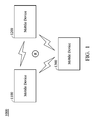
- Fig. 1 is a schematic diagram illustrating an embodiment of a system for detecting positions of the invention
- Fig. 2 is a schematic diagram illustrating an embodiment of a mobile device of the invention
- Fig. 3 is a flowchart of an embodiment of a method for detecting positions of the invention
- Fig. 4 is a flowchart of another embodiment of a method for detecting positions of the invention.
- Fig. 5 is a schematic diagram illustrating another embodiment of a system for detecting positions of the invention.
- Fig. 6 is a flowchart of another embodiment of a method for detecting positions of the invention.
- Fig. 1 is a schematic diagram illustrating an embodiment of a system for detecting positions of the invention.
- the mobile devices 1100, 1200 and 1300 can transmit information therebetween by using wireless transmission technology, such as WiFi, Bluetooth, or other transmission technologies.
- Each mobile device (1100, 1200 or 1300) can determine the current positions of other mobile devices by using a reference point R.
- Fig. 2 is a schematic diagram illustrating an embodiment of a mobile device of the invention.
- the mobile device 1100 may be a portable device, such as a mobile phone, a smart phone, a PDA, or a Netbook.
- the mobile device 1100 comprises a transceiver 1110, a storage unit 1120, at least one sensor 1130, and a processing unit 1140.
- the transceiver 1110 is arranged for transmitting related information to other mobile devices via wireless transmission technology, such as WiFi or Bluetooth technology. It is understood that, in some embodiments, the transceiver 1110 may be WiFi unit or a Bluetooth unit.
- the storage unit 1120 is arranged for recording information 1121 regarding the reference point R.
- the sensor 1130 is arranged for detecting a movement, an acceleration, and an orientation of the mobile device 1100. It is understood that, in some embodiments, the sensor 1130 in the mobile device 1100 can comprise a Gyroscope, a G-sensor, and/or an e-compass.
- the Gyroscope can detect the movement of the mobile device 1100.
- the G-sensor can detect the acceleration of the mobile device 1100.
- the e-compass can detect the orientation of the mobile device 1100. It is noted that, the above various sensor types are only examples of the present disclosure, and the present invention is not limited thereto. Any sensor which can detect the movement, the acceleration, and the orientation of the mobile device 1100 can also be applied in the present invention.
- the processing unit 1140 is arranged for performing the methods for detecting positions of the invention, which will be discussed further in the following paragraphs.
- Fig. 3 is a flowchart of an embodiment of a method for detecting positions of the invention.
- the method for detecting positions can be used in a mobile device, such as a mobile phone, a smart phone, a PDA, a Netbook, or other portable device.
- the mobile device in every predetermined time interval the mobile device can calculate a relative displacement between the reference point and the mobile device according to the predetermined time interval, and transmit the relative displacement to other mobile devices.
- a reference point is recorded. It is understood that, in some embodiments, the reference point may be at a fixed location. At this time, the mobile device can move to the reference point, and perform an operation, such as activation of a specific application in order to record the position information corresponding to the reference point. Further, in some embodiments, contact or knock between at least two mobile devices can occur, or at least two mobile devices can respectively activate a specific application. The position where contact or knock between the at least two mobile devices can be set as the reference point. When contact or knock between the at least two mobile devices occurs, the position information corresponding to the reference point is recorded. Additionally, in some embodiments, when contact or knock between the at least two mobile devices occurs, each mobile device can record the contacted or knocked mobile device, and track the position of the contacted or knocked mobile device.
- the mobile device can be moved.
- a movement, an acceleration, and an orientation of the mobile device are detected by using at least one sensor of the mobile device.
- the at least one sensor in the mobile device can comprise a Gyroscope, a G-sensor, and/or an e-compass.
- the Gyroscope can detect the movement of the mobile device.
- the G-sensor can detect the acceleration of the mobile device.
- the e-compass can detect the orientation of the mobile device. It is noted that, the above various sensor types are only examples of the present disclosure, and the present invention is not limited thereto. Any sensor which can detect the movement, the acceleration, and the orientation of the mobile device can also be applied in the present invention.
- step S3300 it is determined whether a predetermined time interval has passed. It is understood that, the predetermined time interval can be designed and adjusted according to various requirements and applications. When the predetermined time interval has not passed (No in step S3300), the procedure returns to step S3200.
- step S3400 a relative displacement between the reference point and the mobile device is calculated according to the predetermined time interval, and the data detected by the at least one sensor. It is understood that, in some embodiments, the relative displacement can be calculated according to the predetermined time interval, and the data detected by the at least one sensor using the following equations:
- step S3500 the relative displacement is transmitted to other mobile devices via the transceiver of the mobile device. Thereafter, the procedure returns to step S3200.
- Fig. 4 is a flowchart of another embodiment of a method for detecting positions of the invention.
- the method for detecting positions can be used in a mobile device, such as a mobile phone, a smart phone, a PDA, a Netbook, or other portable device.
- the mobile device can obtain a relative displacement between the reference point and a specific mobile device, and accordingly calculate a current position of the specific mobile device.
- step S4100 a relative displacement between the reference point and a specific mobile device is received from the specific mobile device.
- step S4200 a current position of the specific mobile device is calculated according to the reference point and the relative displacement of the specific mobile device.
- the user when the mobile device (the user of the mobile device) is aware that there is a difference between the calculated position of the specific mobile device and an actual position, the user can generate a correction instruction using the mobile device in order to adjust the current position of the specific mobile device.
- the user can adopt a touch-sensitive screen (not shown) of the mobile device to generate vicinity gesture information.
- the vicinity gesture information can record a gesture pointed toward the specific mobile device.
- the current position of the specific mobile device can be corrected according to the vicinity gesture information and the movement track of the specific mobile device.
- Fig. 5 is a schematic diagram illustrating another embodiment of a system for detecting positions of the invention.
- a first mobile device 5100 and a second mobile device 5200 can transmit related information therebetween by using wireless transmission technology, such as WiFi, Bluetooth, or other transmission technologies.
- the first mobile device 5100 and the second mobile device 5200 can determine the positions of other mobile devices by using a reference point R.
- Fig. 6 is a flowchart of another embodiment of a method for detecting positions of the invention. It is noted that, as described, the first mobile device 5100 and the second mobile device 5200 can determine the current positions of other mobile devices. However, in the embodiment, only the calculation of a current position of the first mobile device 5100 by the second mobile device 5200 is discussed.
- the first mobile device 5100 records a reference point R.
- the reference point R may be at a fixed location.
- the first mobile device 5100 can move to the reference point R, and perform an operation, such as activation of a specific application, in order to record the position information corresponding to the reference point R.
- contact and knock of the first mobile device 5100 and the second mobile device 5200 may occur, or a specific application may be respectively activated.
- the position where contact or knock between the first mobile device 5100 and the second mobile device 5200 occurs can be set as the reference point R.
- the position information corresponding to the reference point R is recorded.
- the first mobile device 5100 and the second mobile device 5200 can respectively record the contacted or knocked mobile device, and track the subsequent position of the contacted or knocked mobile device.
- the first mobile device 5100 can be moved.
- a movement, an acceleration, and an orientation of the first mobile device 5100 are detected by using at least one sensor of the first mobile device 5100.
- the at least one sensor in the mobile device can comprise a Gyroscope, a G-sensor, and/or an e-compass.
- the Gyroscope can detect the movement of the mobile device.
- the G-sensor can detect the acceleration of the mobile device.
- the e-compass can detect the orientation of the mobile device. It is noted that, the various sensor types are only examples of the present disclosure, and the present invention is not limited thereto.
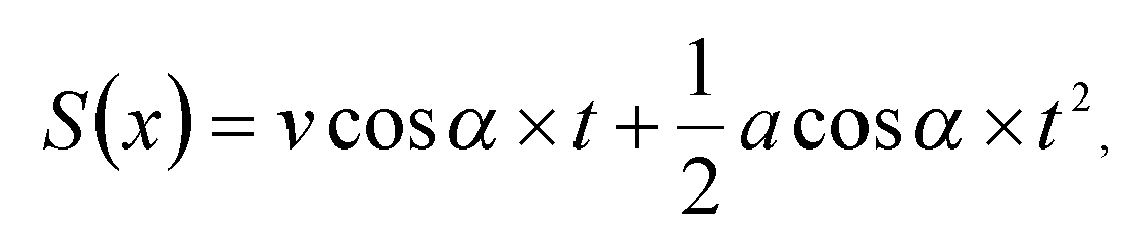
- step S6300 a relative displacement between the reference point R and the first mobile device 5100 is calculated according to a predetermined time interval, and the data detected by the at least one sensor. It is understood that, in some embodiments, the relative displacement can be calculated according to the predetermined time interval, and the data detected by the at least one sensor using the following equations:
- S ( x ), S ( y ) and S ( z ) are the relative displacements of x , y and z axes corresponding to the first mobile device 5100, respectively
- ⁇ cos ⁇ , ⁇ cos ⁇ and ⁇ cos ⁇ are the components of the initial velocity of the first mobile device 5100 in x , y and z axes, respectively
- a cos ⁇ , a cos ⁇ and a cos ⁇ are the components of the acceleration of the first mobile device 5100 in x , y and z axes, respectively.
- the predetermined time interval it is determined whether the predetermined time interval has passed. It is understood that, the predetermined time interval can be designed and adjusted according to various requirements and applications.
- the procedure waits until the predetermined time interval has passed.
- the relative displacement between the reference point R and the first mobile device 5100 is calculated.
- the relative displacement between the reference point R and the first mobile device 5100 is calculated, in step S6400, the relative displacement is transmitted to the second mobile device 5200 via the transceiver of the first mobile device 5100.
- step S6500 a current position of the first mobile device 5100 is calculated according to the reference point R and the relative displacement of the first mobile device 5100.
- step S6600 vicinity gesture information is generated adopting a touch-sensitive screen of the second mobile device 5200 in order to adjust the current position of the first mobile device 5100 according to the vicinity gesture information and the movement track of the first mobile device 5100. It is understood that, in some embodiments, the vicinity gesture information can record a gesture pointed toward the first mobile device 5100.
- mobile devices can directly know and accurately determine the positions of other mobile devices without additional deployment of costly equipment or electronic units. Based on the technical effects of the present invention, applications for user operational interfaces may be increased.
- Methods for detecting positions may take the form of a program code (i.e., executable instructions) embodied in tangible media, such as floppy diskettes, CD-ROMS, hard drives, or any other machine-readable storage medium, wherein, when the program code is loaded into and executed by a machine, such as a computer, the machine thereby becomes an apparatus for practicing the methods.
- the methods may also be embodied in the form of a program code transmitted over some transmission medium, such as electrical wiring or cabling, through fiber optics, or via any other form of transmission, wherein, when the program code is received and loaded into and executed by a machine, such as a computer, the machine becomes an apparatus for practicing the disclosed methods.
- the program code When implemented on a general-purpose processor, the program code combines with the processor to provide a unique apparatus that operates analogously to application specific logic circuits.
Landscapes
- Engineering & Computer Science (AREA)
- Radar, Positioning & Navigation (AREA)
- Remote Sensing (AREA)
- Physics & Mathematics (AREA)
- General Physics & Mathematics (AREA)
- Automation & Control Theory (AREA)
- Electromagnetism (AREA)
- Computer Networks & Wireless Communication (AREA)
- Signal Processing (AREA)
- Telephone Function (AREA)
- User Interface Of Digital Computer (AREA)
Abstract
Systems and methods for detecting positions are provided. First, a reference point is recorded by a first mobile device. Then, a movement, an acceleration, and an orientation of the first mobile device are detected by at least one sensor. Then, after a predetermined time interval, a relative displacement between the reference point and the first mobile device is calculated according to the predetermined time interval, and the data detected by the at least one sensor, and the relative displacement to the first mobile device is transmitted to a second mobile device.
Description
- This Application claims priority of Taiwan Patent Application No.
100109083, filed on March 17, 2011 - The disclosure relates generally to position management, and, more particularly to systems and methods that perform position detection for mobile devices.
- Recently, mobile devices, such as mobile phones, smart phones, and PDAs (Personal Digital Assistants), have become more and more technically advanced and multifunctional. For example, a mobile device may have a telecommunication, an email message, an advanced address book management, a media playback, and various other functions. Due to increased convenience and functions of the devices, these devices have become basic life necessities.
- Generally, a mobile device may be equipped with wireless positioning technology, such as GPS (Global Positioning System) technology. A GPS can receive signals from satellites, and accordingly determine the position of mobile devices. However, due to the technical limitations of GPS', a GPS cannot receive signals from satellites when the GPS is located indoors, such that the position of mobile devices will not be known. Additionally, due to the limited precision of GPS', it is hard to determine the position of a mobile device when several mobile devices are located in a small area.
- If mobile devices can locate the positions of other mobile devices, applications for user operational interfaces may be increased. Consequently, providing position information between mobile devices has become an important issue for innovation and development.
- Systems and methods for detecting positions are provided.
- An embodiment of a system for detecting positions, applied to a first mobile device includes a transceiver, a storage unit, at least one sensor, and a processing unit. The storage unit is arranged for recording a reference point. The at least one sensor is arranged for detecting a movement, an acceleration, and an orientation of the first mobile device. In every predetermined time interval, the processing unit is arranged for calculating a relative displacement between the reference point and the first mobile device according to the predetermined time interval, and the data detected by the at least one sensor, and for transmitting the relative displacement to a second mobile device via the transceiver.
- In an embodiment of a method for detecting positions, a reference point is recorded by a first mobile device. Then, a movement, an acceleration, and an orientation of the first mobile device are detected by at least one sensor. Then, in every predetermined time interval, a relative displacement between the reference point and the first mobile device is calculated according to the predetermined time interval, and the data detected by using at least one sensor, and the relative displacement is transmitted to a second mobile device.
- In some embodiments, the second mobile device can calculate a current position of the first mobile device according to the reference point and the relative displacement of the first mobile device.
- In some embodiments, the first mobile device records the reference point by performing an operation when it's located at the reference point. The operation can be an activation of a specific application, or a contact or knock with the second mobile device. In some embodiments, when contact or knock between the first mobile device and the second mobile device occurs, the first mobile device and the second mobile device can record and track positions relative to each other.
- In some embodiments, the second mobile device can adopt a touch-sensitive screen to generate vicinity gesture information in order to adjust the current position of the first mobile device.
- Methods for detecting positions may take the form of a program code embodied in a tangible media. When the program code is loaded into and executed by a machine, the machine becomes an apparatus for practicing the disclosed method.
- The invention will become more fully understood by referring to the following detailed description with reference to the accompanying drawings, wherein:
-
Fig. 1 is a schematic diagram illustrating an embodiment of a system for detecting positions of the invention; -
Fig. 2 is a schematic diagram illustrating an embodiment of a mobile device of the invention; -
Fig. 3 is a flowchart of an embodiment of a method for detecting positions of the invention; -
Fig. 4 is a flowchart of another embodiment of a method for detecting positions of the invention; -
Fig. 5 is a schematic diagram illustrating another embodiment of a system for detecting positions of the invention; and -
Fig. 6 is a flowchart of another embodiment of a method for detecting positions of the invention. - Systems and methods for detecting positions are provided.
-
Fig. 1 is a schematic diagram illustrating an embodiment of a system for detecting positions of the invention. As shown inFig. 1 , in the system for detectingpositions 1000, themobile devices -
Fig. 2 is a schematic diagram illustrating an embodiment of a mobile device of the invention. Themobile device 1100 may be a portable device, such as a mobile phone, a smart phone, a PDA, or a Netbook. - The
mobile device 1100 comprises atransceiver 1110, astorage unit 1120, at least onesensor 1130, and aprocessing unit 1140. Thetransceiver 1110 is arranged for transmitting related information to other mobile devices via wireless transmission technology, such as WiFi or Bluetooth technology. It is understood that, in some embodiments, thetransceiver 1110 may be WiFi unit or a Bluetooth unit. Thestorage unit 1120 is arranged for recordinginformation 1121 regarding the reference point R. Thesensor 1130 is arranged for detecting a movement, an acceleration, and an orientation of themobile device 1100. It is understood that, in some embodiments, thesensor 1130 in themobile device 1100 can comprise a Gyroscope, a G-sensor, and/or an e-compass. The Gyroscope can detect the movement of themobile device 1100. The G-sensor can detect the acceleration of themobile device 1100. The e-compass can detect the orientation of themobile device 1100. It is noted that, the above various sensor types are only examples of the present disclosure, and the present invention is not limited thereto. Any sensor which can detect the movement, the acceleration, and the orientation of themobile device 1100 can also be applied in the present invention. Theprocessing unit 1140 is arranged for performing the methods for detecting positions of the invention, which will be discussed further in the following paragraphs. -
Fig. 3 is a flowchart of an embodiment of a method for detecting positions of the invention. The method for detecting positions can be used in a mobile device, such as a mobile phone, a smart phone, a PDA, a Netbook, or other portable device. In the embodiment, in every predetermined time interval the mobile device can calculate a relative displacement between the reference point and the mobile device according to the predetermined time interval, and transmit the relative displacement to other mobile devices. - In step S3100, a reference point is recorded. It is understood that, in some embodiments, the reference point may be at a fixed location. At this time, the mobile device can move to the reference point, and perform an operation, such as activation of a specific application in order to record the position information corresponding to the reference point. Further, in some embodiments, contact or knock between at least two mobile devices can occur, or at least two mobile devices can respectively activate a specific application. The position where contact or knock between the at least two mobile devices can be set as the reference point. When contact or knock between the at least two mobile devices occurs, the position information corresponding to the reference point is recorded. Additionally, in some embodiments, when contact or knock between the at least two mobile devices occurs, each mobile device can record the contacted or knocked mobile device, and track the position of the contacted or knocked mobile device.
- Then, the mobile device can be moved. At the same time, in step S3200, a movement, an acceleration, and an orientation of the mobile device are detected by using at least one sensor of the mobile device. Similarly, as described, in some embodiments, the at least one sensor in the mobile device can comprise a Gyroscope, a G-sensor, and/or an e-compass. The Gyroscope can detect the movement of the mobile device. The G-sensor can detect the acceleration of the mobile device. The e-compass can detect the orientation of the mobile device. It is noted that, the above various sensor types are only examples of the present disclosure, and the present invention is not limited thereto. Any sensor which can detect the movement, the acceleration, and the orientation of the mobile device can also be applied in the present invention. Then, in step S3300, it is determined whether a predetermined time interval has passed. It is understood that, the predetermined time interval can be designed and adjusted according to various requirements and applications. When the predetermined time interval has not passed (No in step S3300), the procedure returns to step S3200. When the predetermined time interval has passed (Yes in step S3300), in step S3400, a relative displacement between the reference point and the mobile device is calculated according to the predetermined time interval, and the data detected by the at least one sensor. It is understood that, in some embodiments, the relative displacement can be calculated according to the predetermined time interval, and the data detected by the at least one sensor using the following equations:
-

-

and -

- wherein S(x), S(y) and S(z) are the relative displacements of x, y and z axes corresponding to the mobile device, respectively, νcosα, νcosβ and νcosγ are the components of the initial velocity of the mobile device in x, y and z axes, respectively, and a cos α, a cos β and a cos γ are the components of the acceleration of the mobile device in x, y and Z axes, respectively. When the relative displacement between the reference point and the mobile device is calculated, in step S3500, the relative displacement is transmitted to other mobile devices via the transceiver of the mobile device. Thereafter, the procedure returns to step S3200.
-
Fig. 4 is a flowchart of another embodiment of a method for detecting positions of the invention. The method for detecting positions can be used in a mobile device, such as a mobile phone, a smart phone, a PDA, a Netbook, or other portable device. In the embodiment, the mobile device can obtain a relative displacement between the reference point and a specific mobile device, and accordingly calculate a current position of the specific mobile device. - In step S4100, a relative displacement between the reference point and a specific mobile device is received from the specific mobile device. In step S4200, a current position of the specific mobile device is calculated according to the reference point and the relative displacement of the specific mobile device.
- It is noted that, in some embodiments, when the mobile device (the user of the mobile device) is aware that there is a difference between the calculated position of the specific mobile device and an actual position, the user can generate a correction instruction using the mobile device in order to adjust the current position of the specific mobile device. For example, in some embodiments, the user can adopt a touch-sensitive screen (not shown) of the mobile device to generate vicinity gesture information. The vicinity gesture information can record a gesture pointed toward the specific mobile device. The current position of the specific mobile device can be corrected according to the vicinity gesture information and the movement track of the specific mobile device.
-
Fig. 5 is a schematic diagram illustrating another embodiment of a system for detecting positions of the invention. As shown inFig. 5 , in the system for detectingpositions 5000, a firstmobile device 5100 and a secondmobile device 5200 can transmit related information therebetween by using wireless transmission technology, such as WiFi, Bluetooth, or other transmission technologies. The firstmobile device 5100 and the secondmobile device 5200 can determine the positions of other mobile devices by using a reference point R. - Please refer to
Figs. 5 and6 , whereinFig. 6 is a flowchart of another embodiment of a method for detecting positions of the invention. It is noted that, as described, the firstmobile device 5100 and the secondmobile device 5200 can determine the current positions of other mobile devices. However, in the embodiment, only the calculation of a current position of the firstmobile device 5100 by the secondmobile device 5200 is discussed. - In step S6100, the first
mobile device 5100 records a reference point R. Similarly, in some embodiments, the reference point R may be at a fixed location. At this time, the firstmobile device 5100 can move to the reference point R, and perform an operation, such as activation of a specific application, in order to record the position information corresponding to the reference point R. Further, in some embodiments, contact and knock of the firstmobile device 5100 and the secondmobile device 5200 may occur, or a specific application may be respectively activated. The position where contact or knock between the firstmobile device 5100 and the secondmobile device 5200 occurs can be set as the reference point R. When contact or knock between the firstmobile device 5100 and the secondmobile device 5200 occurs, the position information corresponding to the reference point R is recorded. Additionally, in some embodiments, when contact or knock between the firstmobile device 5100 and the secondmobile device 5200 occurs, the firstmobile device 5100 and the secondmobile device 5200 can respectively record the contacted or knocked mobile device, and track the subsequent position of the contacted or knocked mobile device. - Then, the first
mobile device 5100 can be moved. At the same time, in step S6200, a movement, an acceleration, and an orientation of the firstmobile device 5100 are detected by using at least one sensor of the firstmobile device 5100. Similarly, as described previously, in some embodiments, the at least one sensor in the mobile device can comprise a Gyroscope, a G-sensor, and/or an e-compass. The Gyroscope can detect the movement of the mobile device. The G-sensor can detect the acceleration of the mobile device. The e-compass can detect the orientation of the mobile device. It is noted that, the various sensor types are only examples of the present disclosure, and the present invention is not limited thereto. Any sensor which can detect the movement, the acceleration, and the orientation of the mobile device can also be applied in the present invention. Then, in step S6300, a relative displacement between the reference point R and the firstmobile device 5100 is calculated according to a predetermined time interval, and the data detected by the at least one sensor. It is understood that, in some embodiments, the relative displacement can be calculated according to the predetermined time interval, and the data detected by the at least one sensor using the following equations: -
-

and -

- wherein S(x), S(y) and S(z) are the relative displacements of x, y and z axes corresponding to the first
mobile device 5100, respectively, ν cos α, ν cos β and ν cos γ are the components of the initial velocity of the firstmobile device 5100 in x, y and z axes, respectively, and a cos α, a cos β and a cos γ are the components of the acceleration of the firstmobile device 5100 in x, y and z axes, respectively. - It is understood that, in some embodiments, it is determined whether the predetermined time interval has passed. It is understood that, the predetermined time interval can be designed and adjusted according to various requirements and applications. When the predetermined time interval has not passed, the procedure waits until the predetermined time interval has passed. When the predetermined time interval has passed, the relative displacement between the reference point R and the first
mobile device 5100 is calculated. When the relative displacement between the reference point R and the firstmobile device 5100 is calculated, in step S6400, the relative displacement is transmitted to the secondmobile device 5200 via the transceiver of the firstmobile device 5100. When the secondmobile device 5200 receives the relative displacement of the firstmobile device 5100, in step S6500, a current position of the firstmobile device 5100 is calculated according to the reference point R and the relative displacement of the firstmobile device 5100. Then, in step S6600, vicinity gesture information is generated adopting a touch-sensitive screen of the secondmobile device 5200 in order to adjust the current position of the firstmobile device 5100 according to the vicinity gesture information and the movement track of the firstmobile device 5100. It is understood that, in some embodiments, the vicinity gesture information can record a gesture pointed toward the firstmobile device 5100. - Therefore, by using the systems and methods for detecting positions of the present disclosure, mobile devices can directly know and accurately determine the positions of other mobile devices without additional deployment of costly equipment or electronic units. Based on the technical effects of the present invention, applications for user operational interfaces may be increased.
- Methods for detecting positions, or certain aspects or portions thereof, may take the form of a program code (i.e., executable instructions) embodied in tangible media, such as floppy diskettes, CD-ROMS, hard drives, or any other machine-readable storage medium, wherein, when the program code is loaded into and executed by a machine, such as a computer, the machine thereby becomes an apparatus for practicing the methods. The methods may also be embodied in the form of a program code transmitted over some transmission medium, such as electrical wiring or cabling, through fiber optics, or via any other form of transmission, wherein, when the program code is received and loaded into and executed by a machine, such as a computer, the machine becomes an apparatus for practicing the disclosed methods. When implemented on a general-purpose processor, the program code combines with the processor to provide a unique apparatus that operates analogously to application specific logic circuits.
- While the invention has been described by way of example and in terms of preferred embodiment, it is to be understood that the invention is not limited thereto. Those who are skilled in this technology can still make various alterations and modifications without departing from the scope and spirit of this invention. Therefore, the scope of the present invention shall be defined and protected by the following claims and their equivalents.
Claims (10)
- A system for detecting positions, applied to a first mobile device, comprising:a transceiver;a storage unit, arranged for recording a reference point;at least one sensor, arranged for detecting a movement, an acceleration, and an orientation of the first mobile device; anda processing unit, arranged for calculating, in every predetermined time interval, a relative displacement between the reference point and the first mobile device according to the predetermined time interval, and the data detected by the at least one sensor, and for transmitting the relative displacement to a second mobile device via the transceiver.
- The system of claim 1, wherein the second mobile device is further arranged for calculating a current position of the first mobile device according to the reference point and the relative displacement between the reference point and the first mobile device.
- The system of claim 2, wherein the first mobile device records the reference point by performing an operation when it's located at the reference point, wherein the operation comprises an activation of a specific application, or a contact or knock with the second mobile device; and when contact or knock between the first mobile device and the second mobile device occurs, the first mobile device and the second mobile device record and track positions relative to each other.
- The system of claim 2, wherein the second mobile device further adopts a touch-sensitive screen to generate vicinity gesture information in order to adjust the current position of the first mobile device.
- The system of claim 1, wherein the transceiver comprises a WiFi unit or a Bluetooth unit.
- The system of claim 1, wherein the at least one sensor comprises at least one of a Gyroscope, a G-sensor, and an e-compass.
- A method for detecting positions, applied to a first mobile device, comprising:recording a reference point;detecting a movement, an acceleration, and an orientation of the first mobile device by using at least one sensor;calculating, in every predetermined time interval, a relative displacement between the reference point and the first mobile device according to the predetermined time interval, and the data detected by the at least one sensor; andtransmitting the relative displacement to a second mobile device.
- The method of claim 7, further comprising:calculating a current position of the first mobile device by the second mobile device according to the reference point and the relative displacement between the reference point and the first mobile device.
- The method of claim 8, further comprising:the first mobile device recording the reference point by performing an operation when it's at the reference point, wherein the operation comprises an activation of a specific application, or a contact or knock with the second mobile device; andwhen the contact or knock between the first mobile device and the second mobile device occurs, the first mobile device and the second mobile device recording and tracking positions relative to each other.
- The method of claim 8, further comprising:generating vicinity gesture information by adopting a touch-sensitive screen of the second mobile device in order to adjust the current position of the first mobile device.
Applications Claiming Priority (1)
| Application Number | Priority Date | Filing Date | Title |
|---|---|---|---|
| TW100109083A TW201239317A (en) | 2011-03-17 | 2011-03-17 | Systems and methods for detecting positions, and computer program products thereof |
Publications (1)
| Publication Number | Publication Date |
|---|---|
| EP2500692A1 true EP2500692A1 (en) | 2012-09-19 |
Family
ID=44862741
Family Applications (1)
| Application Number | Title | Priority Date | Filing Date |
|---|---|---|---|
| EP11186996A Withdrawn EP2500692A1 (en) | 2011-03-17 | 2011-10-27 | Systems and methods for detecting positions |
Country Status (3)
| Country | Link |
|---|---|
| US (1) | US20120238298A1 (en) |
| EP (1) | EP2500692A1 (en) |
| TW (1) | TW201239317A (en) |
Cited By (1)
| Publication number | Priority date | Publication date | Assignee | Title |
|---|---|---|---|---|
| WO2014057401A3 (en) * | 2012-10-10 | 2014-05-30 | Telefonaktiebolaget L M Ericsson (Publ) | Methods, network nodes, wireless device and positioning node for positioning based on displacement data |
Families Citing this family (4)
| Publication number | Priority date | Publication date | Assignee | Title |
|---|---|---|---|---|
| KR101690777B1 (en) * | 2013-05-02 | 2016-12-28 | 주식회사 퓨처플레이 | Method for matching multiple devices, device for enabling matching thereof and server system |
| WO2015054866A1 (en) * | 2013-10-17 | 2015-04-23 | Nokia Technologies Oy | A relative positioning method |
| IL260406B2 (en) * | 2018-07-03 | 2024-04-01 | Elbit Systems Land & C4I Ltd | System and method for determining real-world geographic locations of multiple members |
| CN116033358B (en) * | 2023-01-04 | 2025-11-25 | 四川科道芯国智能技术股份有限公司 | A method, apparatus, device, and storage medium for locating mobile devices. |
Citations (9)
| Publication number | Priority date | Publication date | Assignee | Title |
|---|---|---|---|---|
| GB2264837A (en) * | 1992-02-20 | 1993-09-08 | Kokusai Denshin Denwa Co Ltd | Gps for a vehicle |
| EP1077579A1 (en) * | 1999-08-19 | 2001-02-21 | Texas Instruments Incorporated | Improvements in or relating to mobile cellular systems |
| US20020006800A1 (en) * | 2000-07-14 | 2002-01-17 | Norman Mohi | Locating system and method |
| US20030008671A1 (en) * | 2001-07-06 | 2003-01-09 | Global Locate, Inc. | Method and apparatus for providing local orientation of a GPS capable wireless device |
| GB2380080A (en) * | 2001-06-06 | 2003-03-26 | E Lead Electronic Co Ltd | Locating mobile device |
| WO2004077374A1 (en) * | 2003-02-26 | 2004-09-10 | Commonwealth Scientific And Industrial Research Organisation | Tracking method and apparatus |
| WO2005003875A1 (en) * | 2003-07-03 | 2005-01-13 | Sandvik Tamrock Oy | Arrangement for monitoring the location of a mining vehicle in a mine |
| US20090221298A1 (en) * | 2008-02-29 | 2009-09-03 | Sony Ericsson Mobile Communications Ab | Wireless communication terminals and methods that display relative direction and distance therebetween responsive to acceleration data |
| WO2011021068A1 (en) * | 2009-08-19 | 2011-02-24 | Eric Sacknoff | Motion sensing remote microphone |
Family Cites Families (8)
| Publication number | Priority date | Publication date | Assignee | Title |
|---|---|---|---|---|
| JP3485336B2 (en) * | 1992-09-08 | 2004-01-13 | キャタピラー インコーポレイテッド | Method and apparatus for determining the position of a vehicle |
| US20070042790A1 (en) * | 2000-07-14 | 2007-02-22 | Norman Mohi | Locating system and method |
| US6859725B2 (en) * | 2002-06-25 | 2005-02-22 | The Boeing Company | Low power position locator |
| US20040087314A1 (en) * | 2002-11-06 | 2004-05-06 | Charles Duncan | Apparatus and method for tracking the location and position of an individual |
| US20040183674A1 (en) * | 2003-01-31 | 2004-09-23 | Ruvarac Thomas C. | Apparatus, system and method for monitoring a location of a portable device |
| US8655960B2 (en) * | 2008-06-19 | 2014-02-18 | Verizon Patent And Licensing Inc. | Location-aware instant messaging |
| US8145417B1 (en) * | 2008-12-31 | 2012-03-27 | Cellco Partnership | Enabling a first mobile device to navigate to a location associated with a second mobile device |
| US8930438B2 (en) * | 2009-06-17 | 2015-01-06 | Apple Inc. | Push-based location update |
-
2011
- 2011-03-17 TW TW100109083A patent/TW201239317A/en unknown
- 2011-09-23 US US13/242,756 patent/US20120238298A1/en not_active Abandoned
- 2011-10-27 EP EP11186996A patent/EP2500692A1/en not_active Withdrawn
Patent Citations (9)
| Publication number | Priority date | Publication date | Assignee | Title |
|---|---|---|---|---|
| GB2264837A (en) * | 1992-02-20 | 1993-09-08 | Kokusai Denshin Denwa Co Ltd | Gps for a vehicle |
| EP1077579A1 (en) * | 1999-08-19 | 2001-02-21 | Texas Instruments Incorporated | Improvements in or relating to mobile cellular systems |
| US20020006800A1 (en) * | 2000-07-14 | 2002-01-17 | Norman Mohi | Locating system and method |
| GB2380080A (en) * | 2001-06-06 | 2003-03-26 | E Lead Electronic Co Ltd | Locating mobile device |
| US20030008671A1 (en) * | 2001-07-06 | 2003-01-09 | Global Locate, Inc. | Method and apparatus for providing local orientation of a GPS capable wireless device |
| WO2004077374A1 (en) * | 2003-02-26 | 2004-09-10 | Commonwealth Scientific And Industrial Research Organisation | Tracking method and apparatus |
| WO2005003875A1 (en) * | 2003-07-03 | 2005-01-13 | Sandvik Tamrock Oy | Arrangement for monitoring the location of a mining vehicle in a mine |
| US20090221298A1 (en) * | 2008-02-29 | 2009-09-03 | Sony Ericsson Mobile Communications Ab | Wireless communication terminals and methods that display relative direction and distance therebetween responsive to acceleration data |
| WO2011021068A1 (en) * | 2009-08-19 | 2011-02-24 | Eric Sacknoff | Motion sensing remote microphone |
Cited By (2)
| Publication number | Priority date | Publication date | Assignee | Title |
|---|---|---|---|---|
| WO2014057401A3 (en) * | 2012-10-10 | 2014-05-30 | Telefonaktiebolaget L M Ericsson (Publ) | Methods, network nodes, wireless device and positioning node for positioning based on displacement data |
| US9188659B2 (en) | 2012-10-10 | 2015-11-17 | Telefonaktiebolaget L M Ericsson (Publ) | Methods and network nodes for positioning based on displacement data |
Also Published As
| Publication number | Publication date |
|---|---|
| US20120238298A1 (en) | 2012-09-20 |
| TW201239317A (en) | 2012-10-01 |
Similar Documents
| Publication | Publication Date | Title |
|---|---|---|
| US9042942B2 (en) | Method and apparatus for displaying home screen in mobile terminal | |
| EP2500692A1 (en) | Systems and methods for detecting positions | |
| US11513676B2 (en) | Method and system for controlling device | |
| KR20100116326A (en) | Apparatus and method for calibration of portable terminal | |
| US20140035875A2 (en) | Method and device for receiving reflectance-based input | |
| US9214043B2 (en) | Gesture based map annotation | |
| KR20120118830A (en) | Method and system for using shared location information in a portagble terminal | |
| US20120229371A1 (en) | Screen Rotation Lock Methods and Systems | |
| US9557781B2 (en) | Adjusting coordinates of touch input | |
| EP3734531B1 (en) | Graphic coding display method and apparatus | |
| KR102149913B1 (en) | Route guidance service system, method and apparatus for fault diagonosis of gps in the system | |
| CN103322998B (en) | The information processor of display current location | |
| EP3151019B1 (en) | Portable apparatus, method for controlling portable apparatus, and control program | |
| EP2996316A1 (en) | Methods and systems for communication management between an electronic device and a wearable electronic device | |
| US9521545B2 (en) | Methods and systems for notification management between an electronic device and a wearable electronic device | |
| US20160353407A1 (en) | Methods and systems for notification management between an electronic device and a wearable electronic device | |
| JP5896167B2 (en) | Moving track display device, program, and moving track display method | |
| US20140226917A1 (en) | Storing location information with metadata of visual media | |
| US9848073B2 (en) | Methods and systems for commencing a process based on a sound trigger | |
| CN102722264A (en) | Position detection system and position detection method | |
| EP2924544A1 (en) | Methods and systems for managing motion information for electronic devices | |
| US20170026508A1 (en) | Methods and systems for detection management between electronic devices | |
| KR101585472B1 (en) | Data processing apparatus and method thereof | |
| KR20120077356A (en) | Mobile terminal and method for changing display mode based on the device wobbles thereof | |
| US20150006022A1 (en) | Electronic device and vehicle monitoring method |
Legal Events
| Date | Code | Title | Description |
|---|---|---|---|
| PUAI | Public reference made under article 153(3) epc to a published international application that has entered the european phase |
Free format text: ORIGINAL CODE: 0009012 |
|
| AK | Designated contracting states |
Kind code of ref document: A1 Designated state(s): AL AT BE BG CH CY CZ DE DK EE ES FI FR GB GR HR HU IE IS IT LI LT LU LV MC MK MT NL NO PL PT RO RS SE SI SK SM TR |
|
| AX | Request for extension of the european patent |
Extension state: BA ME |
|
| STAA | Information on the status of an ep patent application or granted ep patent |
Free format text: STATUS: THE APPLICATION IS DEEMED TO BE WITHDRAWN |
|
| 18D | Application deemed to be withdrawn |
Effective date: 20130320 |