EP2500033A1 - Method for preparing muliple antigen glycopeptide carbohydrate conjugates - Google Patents
Method for preparing muliple antigen glycopeptide carbohydrate conjugates Download PDFInfo
- Publication number
- EP2500033A1 EP2500033A1 EP11290138A EP11290138A EP2500033A1 EP 2500033 A1 EP2500033 A1 EP 2500033A1 EP 11290138 A EP11290138 A EP 11290138A EP 11290138 A EP11290138 A EP 11290138A EP 2500033 A1 EP2500033 A1 EP 2500033A1
- Authority
- EP
- European Patent Office
- Prior art keywords
- carbohydrate
- cell epitope
- galnac
- conjugate
- protected
- Prior art date
- Legal status (The legal status is an assumption and is not a legal conclusion. Google has not performed a legal analysis and makes no representation as to the accuracy of the status listed.)
- Withdrawn
Links
Images


Classifications
-
- C—CHEMISTRY; METALLURGY
- C07—ORGANIC CHEMISTRY
- C07K—PEPTIDES
- C07K1/00—General methods for the preparation of peptides, i.e. processes for the organic chemical preparation of peptides or proteins of any length
- C07K1/06—General methods for the preparation of peptides, i.e. processes for the organic chemical preparation of peptides or proteins of any length using protecting groups or activating agents
-
- C—CHEMISTRY; METALLURGY
- C07—ORGANIC CHEMISTRY
- C07K—PEPTIDES
- C07K9/00—Peptides having up to 20 amino acids, containing saccharide radicals and having a fully defined sequence; Derivatives thereof
-
- A—HUMAN NECESSITIES
- A61—MEDICAL OR VETERINARY SCIENCE; HYGIENE
- A61K—PREPARATIONS FOR MEDICAL, DENTAL OR TOILETRY PURPOSES
- A61K40/00—Cellular immunotherapy
-
- A—HUMAN NECESSITIES
- A61—MEDICAL OR VETERINARY SCIENCE; HYGIENE
- A61K—PREPARATIONS FOR MEDICAL, DENTAL OR TOILETRY PURPOSES
- A61K47/00—Medicinal preparations characterised by the non-active ingredients used, e.g. carriers or inert additives; Targeting or modifying agents chemically bound to the active ingredient
- A61K47/50—Medicinal preparations characterised by the non-active ingredients used, e.g. carriers or inert additives; Targeting or modifying agents chemically bound to the active ingredient the non-active ingredient being chemically bound to the active ingredient, e.g. polymer-drug conjugates
- A61K47/51—Medicinal preparations characterised by the non-active ingredients used, e.g. carriers or inert additives; Targeting or modifying agents chemically bound to the active ingredient the non-active ingredient being chemically bound to the active ingredient, e.g. polymer-drug conjugates the non-active ingredient being a modifying agent
- A61K47/54—Medicinal preparations characterised by the non-active ingredients used, e.g. carriers or inert additives; Targeting or modifying agents chemically bound to the active ingredient the non-active ingredient being chemically bound to the active ingredient, e.g. polymer-drug conjugates the non-active ingredient being a modifying agent the modifying agent being an organic compound
- A61K47/55—Medicinal preparations characterised by the non-active ingredients used, e.g. carriers or inert additives; Targeting or modifying agents chemically bound to the active ingredient the non-active ingredient being chemically bound to the active ingredient, e.g. polymer-drug conjugates the non-active ingredient being a modifying agent the modifying agent being an organic compound the modifying agent being also a pharmacologically or therapeutically active agent, i.e. the entire conjugate being a codrug
-
- A—HUMAN NECESSITIES
- A61—MEDICAL OR VETERINARY SCIENCE; HYGIENE
- A61K—PREPARATIONS FOR MEDICAL, DENTAL OR TOILETRY PURPOSES
- A61K47/00—Medicinal preparations characterised by the non-active ingredients used, e.g. carriers or inert additives; Targeting or modifying agents chemically bound to the active ingredient
- A61K47/50—Medicinal preparations characterised by the non-active ingredients used, e.g. carriers or inert additives; Targeting or modifying agents chemically bound to the active ingredient the non-active ingredient being chemically bound to the active ingredient, e.g. polymer-drug conjugates
- A61K47/51—Medicinal preparations characterised by the non-active ingredients used, e.g. carriers or inert additives; Targeting or modifying agents chemically bound to the active ingredient the non-active ingredient being chemically bound to the active ingredient, e.g. polymer-drug conjugates the non-active ingredient being a modifying agent
- A61K47/62—Medicinal preparations characterised by the non-active ingredients used, e.g. carriers or inert additives; Targeting or modifying agents chemically bound to the active ingredient the non-active ingredient being chemically bound to the active ingredient, e.g. polymer-drug conjugates the non-active ingredient being a modifying agent the modifying agent being a protein, peptide or polyamino acid
- A61K47/64—Drug-peptide, drug-protein or drug-polyamino acid conjugates, i.e. the modifying agent being a peptide, protein or polyamino acid which is covalently bonded or complexed to a therapeutically active agent
- A61K47/645—Polycationic or polyanionic oligopeptides, polypeptides or polyamino acids, e.g. polylysine, polyarginine, polyglutamic acid or peptide TAT
-
- A—HUMAN NECESSITIES
- A61—MEDICAL OR VETERINARY SCIENCE; HYGIENE
- A61P—SPECIFIC THERAPEUTIC ACTIVITY OF CHEMICAL COMPOUNDS OR MEDICINAL PREPARATIONS
- A61P35/00—Antineoplastic agents
-
- C—CHEMISTRY; METALLURGY
- C07—ORGANIC CHEMISTRY
- C07K—PEPTIDES
- C07K14/00—Peptides having more than 20 amino acids; Gastrins; Somatostatins; Melanotropins; Derivatives thereof
- C07K14/435—Peptides having more than 20 amino acids; Gastrins; Somatostatins; Melanotropins; Derivatives thereof from animals; from humans
- C07K14/705—Receptors; Cell surface antigens; Cell surface determinants
- C07K14/70503—Immunoglobulin superfamily
- C07K14/70539—MHC-molecules, e.g. HLA-molecules
-
- C—CHEMISTRY; METALLURGY
- C07—ORGANIC CHEMISTRY
- C07K—PEPTIDES
- C07K9/00—Peptides having up to 20 amino acids, containing saccharide radicals and having a fully defined sequence; Derivatives thereof
- C07K9/001—Peptides having up to 20 amino acids, containing saccharide radicals and having a fully defined sequence; Derivatives thereof the peptide sequence having less than 12 amino acids and not being part of a ring structure
Definitions
- the present invention relates to a method for preparing carbohydrate T cell epitope conjugates of formula (I), and to carbohydrate T cell epitope intermediates of formula (II) useful according to said method.
- MAG-Tn3 corresponds to the following structure [S( ⁇ -D-GalNAc)-T( ⁇ -D-GalNAc)-T( ⁇ -D-GalNAc)-QY 5 IKANS 10 KFIGI 15 TEL] 4 -K 2 -K- ⁇ -Ala :
- MAG refers to Multiple Antigen Glycopeptide.
- MAG-Tn3 corresponds to a carbohydrate peptide conjugate B4-T4-M of the following formula:
- the MAG-Tn3 is a good therapeutic vaccine candidate to treat carcinomas that should advance into a phase I/II clinical trial.
- the present invention in one aspect, provides a novel process for preparing MAG-Tn3, and more generally carbohydrate T cell epitope conjugates of formula (I) (M(T-B) n ), allowing a large-scale production, with better yields and purity : nB Pr + M(T) n ⁇ M(T-B Pr ) n , (II) ⁇ M(T-B) n , (I)
- the method according to the invention advantageously enables to minimize the synthesis side-products, to improve the robustness of the process, and to scale-up the synthesis in a repeatable manner.
- Another object of the present invention is to provide novel carbohydrate T cell epitope conjugates of formula (II) (M(T-B Pr ) n ), which compounds are useful for the preparation of carbohydrate T cell epitope conjugates of formula M(T-B) n with high yields and purity.
- a further object of the present invention is to provide carbohydrate T cell epitope conjugates of formula (I) (M(T-B) n ) having a purity grade superior than 95%, obtainable by the process according to the invention.
- the present invention relates to a method for preparing a carbohydrate T cell epitope conjugate of formula (I) : M(T-B) n (I) wherein:
- the poly-Lysine core of the conjugate of formula (I) is a dendrimeric structure, which may be represented as a star, having multiple branches (-T-B), which may be identical or not.
- the number of (-T-B) branches n ranges from 4 to 16, notably from 4 to 8.
- the dendrimeric polyLysine core M comprises at least 3 lysine residues, in particular 3 to 15 lysine residues, more particularly 3 to 7 lysine residues.
- conjugate M(T-B) n is selected from the following formulae (Ia) or (Ib) : wherein :
- dendrimeric structures (Ia) and (Ib) provide a high density of antigens at the surface of the dendrimeric polyLysine core M.
- M is (K) 2 K- ⁇ Ala-OH of the following formula :
- T cell epitope means an antigen, in particular of a peptidic nature, capable of eliciting a T cell response.
- Such epitopes are notably described in S. Stevanovic, "Identification of Tumour-associated T-cell epitopes for vaccine development", Nature Reviews, Vol. 2, July 2002, p. 1 to 7 ; J.H. Kessler, C.J.M. Melief, "Identification of T-cell epitopes for cancer immunotherapy", Leukemia (2007) 21, 1859-1874 , or in the Cancer immunity / peptide database website : http://www.cancerimmunity.org/peptide database/tumorspecific.htm.
- T cell epitopes incorporated in the conjugate of formula (I) may be the same or different, peptidic or not.
- carbohydrate T cell epitope conjugates are carbohydrate peptide conjugates.
- Peptidic T-cell epitopes can comprise 2 to 50 aminoacids.
- T cell epitopes may notably be selected amongst CD8 + , or CD4 + T cell epitopes.
- CD8 + T cell epitopes, recognized as tumoral markers may be selected from the group consisting of :
- T is or comprises a CD4 + T cell epitope, which may be notably a poliovirus (PV) protein fragment, a tetanus toxin fragment or a PADRE peptide.
- PV poliovirus
- CD4 + T cell epitope selected amongst poliovirus (PV) protein fragment mention may be made of the synthetic peptide that corresponds to the 103-115 sequence of VP1 protein from poliovirus type 1 (KLFAVWKITYKDT) (SEQ ID N°4).
- CD4 + T cell epitope selected amongst tetanus toxin fragment mention may be made of the following fragments :
- peptidic T cell epitopes typically bind to a plurality of MHC (Major Histocompatibility Complex) human and murine molecules of class II avoiding in consequence the restriction problems encountered with the CD4+ T cellular response, associated with the polymorphism of the MHC molecules existing between individuals.
- MHC Major Histocompatibility Complex
- tetanus toxin peptides should increase the immunogenicity of antigens present on the conjugate of the present invention, as a result of the vaccination of numerous individuals with the tetanus toxo ⁇ d.
- peptide T-cell epitopes As further examples of peptide T-cell epitopes, reference may be made to S. Stevanovic, "Identification of Tumour-associated T-cell epitopes for vaccine development ", Nature Reviews, Vol. 2, July 2002, p. 1 to 7 ; J.H. Kessler, C.J.M. Melief, "Identification of T-cell epitopes for cancer immunotherapy", Leukemia (2007) 21, 1859-1874 , or in the Cancer immunity / peptide database website : http://www.cancerimmunity.org/peptide database/tumorspecific.htm.
- non-peptidic T cell epitopes include notably :
- B cell epitope means antigens capable of eliciting a B cell response.
- a carbohydrate means a saccharide, notably mono-, di-, oligo-, and polysaccharides.
- the carbohydrate residue (b) forming the B cell epitope of the conjugate of formula (I) is a N-acetylgalactopyranosyl residue, or a derivative thereof.
- the carbohydrate residue (b) is attached to an amino acid, peptide, or lipid residue.
- the carbohydrate residue is an O-glycosyl amino acid or peptide.
- the B cell epitope is attached to the dendrimeric structure M(T) n via said aminoacid or peptide.
- the B cell epitope may comprise one or more carbohydrate residues (b), notably 1 to 10, in particular 1 to 6 carbohydrate residues.
- Such B cell epitope may be selected from tumor (cancer) glycosidic antigens, notably from :
- the B cell epitope of the conjugate according to the present invention may also originate from capsular bacterial polysaccharides of, for example, Neisseria meningitis, Haemophilus influenzae, Streptococcus pneumoniae, and of the Streptococcus group.
- the polysaccharides are carbohydrate residues obtained by a synthetic process.
- the B cell epitope of the present conjugate may be also of fungal origin, such as for example, one isolated from the yeast Saccharomyces.
- the B cell epitopes of the conjugate of formula (I) are preferentially tumor markers, such as, for example, Tn and TF antigens.
- Tn can be selected from the group comprising Tn, di-Tn, tri-Tn (Tn3), hexa- Tn (Tn6), or TF antigens.
- B is or comprises the carbohydrate residues selected from the group consisting of :
- B is or comprises the residue ( ⁇ -GalNAc-Ser/Thr) 3 , most preferably ( ⁇ -GalNAc)Ser-( ⁇ -GalNAc)Thr-( ⁇ -GalNAc)Thr.
- the conjugate of formula (I) is MAG-Tn3.
- the method according to the present invention comprises the step i) of coupling a protected carbohydrate B cell epitope (B Pr ) which hydroxyl groups of the carbohydrate residue (b) are protected with a protecting group (Pr), with a compound M(T) n thereby forming a carbohydrate T cell epitope conjugate M(T- B Pr ) n , said protecting group (Pr) being selected from the group consisting of allyl, p -methoxybenzyl (PMB), t -butyldimethylsilyl (TBDMS), benzyloxymethyl (BOM), levulinyl (Lev), benzoyl (Bz), 2,5-difluorobenzoyl, chloroacetyl, benzyl (Bn) or an acetyl (Ac), or forming with two hydroxyl groups to which it is attached a C 5 -C 6 isopropylidene ketal or a C 5 -C 6 cycl
- Pr is benzyl (Bn) or acetyl (Ac).
- step i) comprises the steps of :
- protecting groups Pr enable to control the coupling of each of the carbohydrate residues b, or of the B cell epitope B, with M(T) n in step i). Further, it has been shown that the removal of these protecting groups allows to obtain the desired product, with an improved compromise between yield and purity.
- the hydroxyl groups of the carbohydrate residue can be protected by the above mentioned protecting groups (Pr), notably by benzyl or acetyl groups, according to conventional methods.
- B cell epitopes B Pr or carbohydrate residues (b Pr ) may be commercially available or may be prepared from commercially available starting materials and/or according to conventional methods.
- the dendrimeric polyLysine core M and thus the subsequent M(T) n building block are immobilized on a solid support, thus enabling iterative solid phase peptide synthesis.
- solid support As an example of solid support, mention may be made of polystyrene resin functionalized with p -benzyloxybenzyl alcohol (Wang resin), or with Fmoc- ⁇ -Ala such as those sold under the trade name Fmoc- ⁇ -Ala-TentaGel R Trt.
- the M core may notably be attached via a ⁇ -Ala-OH residue.
- b Pr is a protected O-glycosyl amino acid or peptide.
- Protected O-glycosyl peptide may be coupled to the M(T) n building block by successively introducing the protected constitutive O-glycosyl amino acid residues b Pr .
- solid phase peptide and glycopeptide synthesis may be performed using the standard Fmoc chemistry protocol [5] and [6].
- N- ⁇ -Fmoc aminoacids and glycosylated aminoacids or peptides are incorporated stepwise in the peptide chain.
- the Fmoc is cleaved, for example in the presence of 20% of piperidine in DMF or NMP. Then a second protected N- ⁇ -Fmoc O-glycosyl amino acid b Pr may be similarly reacted with the NH 2 group of the first protected amino acid residue, and so on.
- step i) of the method according to the invention may comprise the step of repeating the coupling according to step a) up to obtaining the carbohydrate T cell epitope conjugate M(T-B Pr ) n .
- peptide coupling may be carried out in a polar aprotic solvent such as DMF or NMP, in the presence of coupling reagents such as HATU and DIPEA or DIC/HOBt, and PyBOP.
- a polar aprotic solvent such as DMF or NMP
- coupling reagents such as HATU and DIPEA or DIC/HOBt, and PyBOP.
- Pr is benzyl.
- the deprotection step ii) may be carried out in the presence of TfOH or by a catalytic hydrogenation.
- step ii) is a catalytic hydrogenation.
- the catalytic hydrogenation is carried out in the presence of Pd/C, notably of 10% Pd/C (% w/w), as a catalyst.
- Pd/C notably of 10% Pd/C (% w/w)
- the weight ratio of the conjugate of formula (II)/ catalyst may vary from 10/2 to 10/10, and is preferably of about 10/8.
- the catalyst may be added portionwise over a long period.
- the catalytic hydrogenation is preferably carried out in NMP/H 2 O, notably in a volume ratio of 87,5/12,5, as a solvent.
- the catalytic hydrogenation reaction is preferably carried out at a temperature ranging from 20 to 40 °C, in particular at about 37°C.
- the catalytic hydrogenation reaction is preferably carried out under a pressure ranging from 1 to 10 bar, more preferably at about 5 bar.
- step ii) is carried out in the presence of TfOH.
- the conjugate of formula (II) is reacted with TfOH, in the presence of TFA, DMS and m -cresol.
- the relative ratio of TfOH/TFA/DMF/m-cresol may be of 1/5/3/1 v/v/v/v.
- the protecting group Pr is acetyl.
- the deprotection of acetyl protecting groups in step ii) is preferably performed in the presence of hydrazine, in a protic polar solvent, for example an alcohol such as methanol. This reaction may be performed at room temperature, i.e between 15 and 25°C.
- the molar ratio of hydrazine relative to the compound of formula (II) may vary from 100 to 1500 molar equivalents.
- the deprotection of acetyl may alternatively be performed in the presence of MeONa, notably in MeOH as a solvent, at room temperature, i.e between 15 and 25°C.
- the conjugate of formula (II) obtained at the end of i) is preliminary cleaved from the solid support, before performing the deprotection step ii).
- Such cleavage may be performed in the presence of TFA and TIS in water, for example with the following volume ratio 95/2.5/2.5 v/v/v.
- the method according to the invention may further comprise a step iii) subsequent to step ii) consisting in one or more purification steps, notably by reverse phase high-performance liquid chromatography (RP-HPLC).
- RP-HPLC reverse phase high-performance liquid chromatography
- the method according to the invention may further comprise a subsequent step iv) of recovering the product.
- the method according to the invention further comprises the step of preparing the conjugate M(T) n .
- the conjugate M(T) n is prepared starting from the dendrimeric polyLysine core and by introducing stepwise the N-protected amino acid residues constituting the peptide T cell epitope.
- the N-protected amino acid residues are notably Fmoc amino acid residues.
- the amino acid couplings may be performed in a polar aprotic solvent such as DMF, in the presence of one or more peptide coupling reagents such as DIC, HOBt, PyBOP, HATU or DIPEA.
- a polar aprotic solvent such as DMF
- one or more peptide coupling reagents such as DIC, HOBt, PyBOP, HATU or DIPEA.
- DIC/HOBt and PyBOP or alternatively (HATU/DIPEA) are particularly preferred.
- Alternative coupling reagents are also disclosed in E. Valeur; M. Bradley, Chem Soc Rev (2009) 38, 606 ; A. El-Faham et al. Chem Eur J (2009) 15, 9404 or R. Subiros-Funosas et al. Org Biomol Chem (2010) 8, 3665 .
- N-amino acid protecting groups are removed.
- Fmoc protecting groups can be removed in the presence of piperidine in a polar aprotic solvent such as DMF.
- the amino acid residues AA 9-10 and AA 15-16 can be incorporated as pseudo-proline dipeptides.
- the incorporation of such dipeptides demonstrated a significant impact on the crude quality of the product.
- the method according to the invention further comprises the step of preparing a dendrimeric polyLysine core M.
- the dendrimeric polyLysine core M may be prepared according to the method disclosed in US patent number US 6,676,946 .
- the present invention advantageously provides a carbohydrate T cell epitope conjugate M(T-B) n having a grade of purity ⁇ 95% obtainable according to the method of the invention.
- Such a purity grade may be obtained by performing a purification step (iii) after step (ii), notably a reverse phase high-performance liquid chromatography (RP-HPLC).
- RP-HPLC may be performed with a low-granulometry column, notably having a granulometry inferior to 5 ⁇ .
- Elution may be performed with water (0,1% TFA)/acetonitrile with a shallow gradient, for instance from 70/30 to 60/40 over a period of about 20 minutes.
- the purity grade of the conjugate of formula (I) can be determined by any conventional method, notably by RP-HPLC.
- the purity is preferably ⁇ 96%, notably ⁇ 98%, and advantageously ⁇ 99%.
- the present invention provides a carbohydrate T cell epitope conjugate of formula (II) : M(T-B Pr ) n (II)
- B Pr is a protected ( ⁇ -GalNAc-Ser/Thr)3.
- Pr is benzyl or acetyl
- M is HO- ⁇ Ala-K(K) 2 .
- T is QYIKANSKFIGITEL (SEQ ID N°1).
- the invention provides a use of a carbohydrate peptide conjugate M(T-B Pr ) n for preparing a carbohydrate peptide conjugate M(T-B) n , M(T-B Pr ) n and M(T-B) n being as defined above.
- the synthesis of 6 was performed stepwise on solid-phase using Fmoc chemistry.
- Amino acid side chain protective groups used were Trt on Gln and Asn, Boc on the Lys 7 and Lys 11 , tBu on Tyr, Ser and Thr, OtBu on Glu.
- the protective groups were Fmoc.
- the net peptide contents were determined by nitrogen analysis or quantitative amino acid analysis using a Beckman 6300 analyser after hydrolysis of the compounds with 6N HCl at 110°C for 20h.
- HPLC/MS analyses were performed on an Alliance 2695 system coupled to a UV detector 2487 (220 nm) and to a Q-Tofmicro TM spectrometer (Micromass) with an electrospray ionisation (positive mode) source (Waters). The samples were cooled to 4°C on the autosampler. The linear gradient was performed with acetonitrile+0.025%FA (A) / water+0.04%TFA+0.05%FA (B) over 20min.
- the column was a Zorbax 300SB C18 (3.5 ⁇ , 3x150 mm) (Agilent) (gradient 13-53% A) or a XBridge TM BEH130 C18 (3.5 ⁇ , 2.1x150 mm) (Waters) (gradient 15-40% A).
- the temperature of the source was maintained at 120°C and the desolvation temperature at 400°C.
- the cone voltage was 40V.
- the ESMS analyses were recorded in the positive mode by direct infusion in the same mass spectrometer.
- the samples were dissolved at ⁇ 5 ⁇ M concentration in water / acetonitrile (1/1) with 0.1% formic acid.
- the SELDI-TOF analyses were performed on a PCS 4000 mass spectrometer (Bio-Rad Labs). H4 ProteinChip array surfaces were activated with 1 ⁇ L CH 3 CN. Spots were incubated with the reaction mixture (2.5 ⁇ L, 1mg/mL) in a box at RT for 20min. They were then washed with the reaction buffer (3xlmin) and H 2 O (3xlmin). The matrix (2x0.6 ⁇ L of sinapinic acid saturated in 50% CH 3 CN/0.5%TFA) was applied on each spot and allowed to air-dry. Spectra were generated from each array spot with a laser setting ⁇ 3 ⁇ J. The instrument was externally calibrated with bovine ubiquitin, bovine cytochrome C, ⁇ -lactoglobulin with the matrix and the settings as described above.
- the purity of 6 was analyzed by RP-HPLC using an Agilent 1200 pump system with a UV detector at 220 nm.
- the column was a Zorbax 300SB C18 (3.5 ⁇ , 3x150 mm) (Agilent) and the gradient was performed with acetonitrile+0.1% TFA (A) /water+0.1%TFA (B) over 40min, from 13 to 53%A (0.8mL/min, retention time 20.5min).
- the molar equivalents of all reagents are indicated relative to amino groups.
- the molar amounts of the protected intermediates 4 and 5 are calculated based on the starting Fmoc- ⁇ -Ala-resin 1 substitution.
- the overall yields include all the synthetic steps from 1 . They were calculated on the net peptide content of the final product 6 from the Fmoc- ⁇ -Ala-resin 1 substitution.
- the resin was washed three times with DMF.
- the residual hydroxyl groups were capped using the following protocol.
- the resin was resuspended in 13mL of DMF. 1.55mL (16.4mmol) of Ac 2 O (Sigma) in 1mL of DMF, and then 660mg (5.41mmol) of DMAP in 1mL of DMF were added. After gently stirring for 30min at room temperature, the suspension was filtered in a sintered glass funnel, successively washed three times by DMF, three times by CH 2 Cl 2 and then was dried overnight in a desiccator. The resin 1 was stored at 4°C.
- the tetravalent peptide was synthesized from 250mg (25 ⁇ mol) of Fmoc- ⁇ -Ala-resin 1 on an Applied Biosystems peptide synthesizer 433A using Fmoc chemistry.
- the Applied standard synthesis protocol was followed except for an additional washing step after each coupling step. Briefly, the Fmoc groups were removed with 22% piperidine in NMP (Applied Biosystems) and the deprotection was monitored by conductivity.
- the lysine core was constructed by successively coupling two levels of Fmoc-Lys(Fmoc)-OH (Applied Biosystems) (1 st cycle : 40eq, 2 nd cycle : 20eq) using HATU (Applied Biosystems) (1 st cycle : 40eq, 2 nd cycle : 20eq) / DIPEA (Applied Biosystems) (1 st cycle : 80eq, 2 nd cycle : 40eq) as the coupling reagents and NMP as solvent (Note : the use of this very large excess of reagents should be not necessary for the efficiency of the reaction and is only due to the fact that the prepacked cartridges are filled with 1mmol of amino acid).
- the resin was extensively washed with DMF and CH 2 Cl 2 , and dried in a desiccator. 10mL of TFA (Applied Biosystems) / water / TIS (Acros) (95/2.5/2.5 v/v/v) were added to the resin at 4°C and the mixture was stirred for 1h30 at room temperature. After filtration of the resin, the solution was concentrated and the crude product precipitated with diethyl ether. After centrifugation, the pellet was dissolved in water and lyophilized to yield 229mg of the crude glycopeptides 5.
- TFA Applied Biosystems
- water / TIS Micros
- the product was dissolved in 7.7mL of 0.05M ammonium acetate buffer and the pH adjusted to 7 with 1M ammonia. After 1h at room temperature, the solution was lyophilized to yield to 412mg of the crude product.
- the product was purified by RP-HPLC using an Agilent 1200 pump system with a UV detector at 230nm.
- the column was a Zorbax C18 (5 ⁇ , 300 ⁇ , 9.4 x 250 mm) (Agilent) and the gradient was performed with water (0.1 % TFA) / acetonitrile over 20min, from 73/27 to 60/40.
- the purification gave 3.9mg (net peptide content) of 6 in 99.50% purity. The overall yield is 1.6%.
- the tetravalent peptide was synthesized from 36.9g (4.8mmol) of Fmoc- ⁇ -Ala-Tentagel R Trt resin 1 (0.13mmol/g) (Rapp Polymere) on a manual peptide synthesizer equipped with a Schmizo reactor. Before the elongation process, the resin was swelled in DMF for 2 to 3 hours and was washed with 240mL of DMF (three times, 2 min/cycle). Following each coupling, the Fmoc groups were removed with 20% piperidine in 240mL of DMF (three steps, 20min each).
- the amino acid couplings (1.5 to 2eq / amine) were performed in DMF (111mL) at room temperature with DIC/HOBT (1.5 to 2eq each / amine) (see details below).
- the AA in positions 15-16 and 9-10 were incorporated as, respectively, Fmoc-Ile-Thr( ⁇ Me,Me pro)-OH and Fmoc-Asn(Trt)-Ser( ⁇ Me,Me pro)-OH.
- DIC DIC
- a fresh portion of DIC (1.5 to 2eq) was added to the reaction mixture.
- the coupling steps were monitored by the Kaiser test [1].
- Fmoc-Ala-OH (2, 9.6) 2,9.6 60 1 7.
- Fmoc-Lys(Boc)-OH (2, 9.6) 2,9.6 60 1 6.
- Fmoc-Ile-OH (2, 9.6) 2,9.6 60 1 5.
- the glycopeptide-resin (0.15mmol) was suspended in a TFA/TIS/H 2 O (95/2.5/2.5 v/v/v) (10mL/g of glycopeptide-resin) and stirred for 1h at 20°C ⁇ 2°C. After filtration, the resin was washed twice with the same TFA mixture (2mL/g of glycopeptide-resin per wash). The filtrates and the washes were gathered and stirred for additional 30min at 20°C ⁇ 2°C. After concentration (bath temperature ⁇ 35°C), the crude product was precipitated with DIPE ( ⁇ 35mL/g of glycopeptide-resin). After filtration and washing with DIPE, the solid was dried (t° ⁇ 30°C) and gave 750mg of crude 4 . ESMS: 12409.589 (C 553 H 855 N 107 O 213 calcd 12410,465)
- glycopeptide-resin (20g, 1.096mmol) was treated as previously described for 4 and afforded 9.95g of crude 5 .
- the column was a Zorbax C18 (5 ⁇ , 300 ⁇ , 9.4 x 250 mm) (Agilent) and the gradient was performed with water (0.1% TFA) / acetonitrile over 20min, from 72/28 to 62/38.
- the purification gave 5.8mg (net peptide content) of 6 in 96.10% purity.
- the overall yield is 2.7%.
- the column was a Kromasil C4 (5 ⁇ , 100 ⁇ , 10x250 mm) (AIT) and the gradient was performed with 0.1% aqueous TFA (VWR) / acetonitrile (Carlo Erba) over 30 min, from 73/27 to 62/38.
- VWR aqueous TFA
- Carlo Erba acetonitrile
- the purification gave 754 ⁇ g (net peptide content) of 6 in 91.4% purity.
- the overall yield is 1.4%.
- the primary purification was carried out on a Vydac C18 column (300 ⁇ , 10-15 ⁇ m, 50mL/mn) with TFA/H 2 O/CH 3 CN 0.1/94.9/5.0 v/v/v (A) and with TFA/H 2 O/CH 3 CN 0.1/49.9/50.0 v/v/v (B).
- the gradient was 0%B over 15min, 0-40%B over 5min, 40-80%B over 60min.
- the secondary purification was carried out on a Vydac C18 column (300 ⁇ , 10-15 ⁇ m, 50mL/mn) with AcOH/H 2 O/CH 3 CN 0.5/94.5/5.0 v/v/v (A) and with AcOH/H 2 O/CH 3 CN 0.5/49.5/50.0 v/v/v (B).
- the gradient was 0%B over 15min, 0-20%B over 5min, 20-60%B over 60min.
Landscapes
- Health & Medical Sciences (AREA)
- Chemical & Material Sciences (AREA)
- Life Sciences & Earth Sciences (AREA)
- Organic Chemistry (AREA)
- General Health & Medical Sciences (AREA)
- Medicinal Chemistry (AREA)
- Proteomics, Peptides & Aminoacids (AREA)
- Bioinformatics & Cheminformatics (AREA)
- Engineering & Computer Science (AREA)
- Molecular Biology (AREA)
- Public Health (AREA)
- Animal Behavior & Ethology (AREA)
- Veterinary Medicine (AREA)
- Biochemistry (AREA)
- Genetics & Genomics (AREA)
- Biophysics (AREA)
- Pharmacology & Pharmacy (AREA)
- Epidemiology (AREA)
- Immunology (AREA)
- Cell Biology (AREA)
- Toxicology (AREA)
- Gastroenterology & Hepatology (AREA)
- Zoology (AREA)
- Chemical Kinetics & Catalysis (AREA)
- General Chemical & Material Sciences (AREA)
- Nuclear Medicine, Radiotherapy & Molecular Imaging (AREA)
- Analytical Chemistry (AREA)
- Peptides Or Proteins (AREA)
- Medicines Containing Antibodies Or Antigens For Use As Internal Diagnostic Agents (AREA)
- Preparation Of Compounds By Using Micro-Organisms (AREA)
- Container Filling Or Packaging Operations (AREA)
Abstract
M(T-B)n (I)
wherein M, T, B and n are as defined in claim 1.
Description
- The present invention relates to a method for preparing carbohydrate T cell epitope conjugates of formula (I), and to carbohydrate T cell epitope intermediates of formula (II) useful according to said method.
- During the last decade, the MAG-Tn3, a new type of synthetic immunogen which displays the tumor-associated Tn antigen, has been developed. The MAG-Tn3 is a fully synthetic glycopeptide (MW = 10'897Da) which associates the carbohydrate Tn antigen (as a tri-Tn cluster) to a peptidic CD4+ T cell epitope on a tetravalent backbone [5,9].
- MAG-Tn3 corresponds to the following structure [S(α-D-GalNAc)-T(α-D-GalNAc)-T(α-D-GalNAc)-QY5IKANS10KFIGI15TEL]4-K2-K-β-Ala :

- MAG refers to Multiple Antigen Glycopeptide.
- Thus, MAG-Tn3 corresponds to a carbohydrate peptide conjugate B4-T4-M of the following formula:

- Wherein
- KKK is the dendritic polyLysine core (M),
- T is the peptidic CD4+ T cell epitope having the following sequence : QYIKANSKFIGITEL
- Tn3 is the tri-Tn B cell epitope having the following sequence : (α-GalNAc)Ser-(α-GalNAc)Thr-(α-GalNAc)Thr.
- Based on successful in vivo results obtained in mice and primates [8, 9], the MAG-Tn3 is a good therapeutic vaccine candidate to treat carcinomas that should advance into a phase I/II clinical trial.
- A synthetic route for preparing peptide carbohydrate conjugates, such as notably MAG-Tn3 has been disclosed in the International Patent Application
WO 98/43677 US patent number 6,676,946 . In this process, implemented in small-scale (1-10 mg of final compound), the carbohydrate Tn3 antigen is incorporated to the dendrimeric peptide M(T)4 building block. It is to be noted that the incorporation of the Tn3 antigen is achieved with the fully unprotected sugar, which may appear as advantageous since it avoids a final deprotection step. - However, the inventors have shown that such a method fails when scaled-up. Indeed, the extra-incorporation of Tn residues is difficult to control and affects the crude purity and the overall yield. Further, the purification of such high molecular weight glycopeptide is complex.
- Thus, there is a need for an improved method for preparing MAG-Tn3 which overcomes the drawbacks of the prior art, in particular allows to obtain better yields and purity, notably at a larger scale and in a repeatable manner.
- Thus, the present invention, in one aspect, provides a novel process for preparing MAG-Tn3, and more generally carbohydrate T cell epitope conjugates of formula (I) (M(T-B)n), allowing a large-scale production, with better yields and purity :
nBPr + M(T)n → M(T-BPr)n, (II) → M(T-B)n, (I)
- The method according to the invention advantageously enables to minimize the synthesis side-products, to improve the robustness of the process, and to scale-up the synthesis in a repeatable manner.
- More specifically, it has been discovered that protecting the hydroxyl groups of the carbohydrate B cell epitope with a suitable protecting group (Pr), before incorporating the B cell epitope to the M(T)n building block, enables a better control of the B cell epitope incorporation, and thus to improve both the yields and purity, in particular at a large scale.
- Another object of the present invention is to provide novel carbohydrate T cell epitope conjugates of formula (II) (M(T-BPr)n), which compounds are useful for the preparation of carbohydrate T cell epitope conjugates of formula M(T-B)n with high yields and purity.
- A further object of the present invention is to provide carbohydrate T cell epitope conjugates of formula (I) (M(T-B)n) having a purity grade superior than 95%, obtainable by the process according to the invention.
- These and other objects, features and advantages of the method according to the invention will be disclosed in the following detailed description of the patent disclosure.
- Thus, in one aspect, the present invention relates to a method for preparing a carbohydrate T cell epitope conjugate of formula (I) :
M(T-B)n (I)
wherein: - M is a dendrimeric poly-Lysine core ;
- T is a T cell epitope comprising a peptide ;
- B is a carbohydrate B cell epitope comprising at least one carbohydrate residue (b) ;
- n is an integer and represents the number of -T-B groups covalently bonded to M ;
- Said method comprising the steps of :
- i) coupling a protected carbohydrate B cell epitope (BPr) which hydroxyl groups of the carbohydrate residue (b) are protected with a protecting group (Pr),
with a compound M(T)n thereby forming a carbohydrate T cell epitope conjugate M(T- BPr)n,
said protecting group (Pr) being selected from the group consisting of allyl, p-methoxybenzyl (PMB), t-butyldimethylsilyl (TBDMS), benzyloxymethyl (BOM), levulinyl (Lev), benzoyl (Bz), 2,5-difluorobenzoyl, chloroacetyl, benzyl (Bn) or an acetyl (Ac),
or forming with two hydroxyl groups to which it is attached a C5-C6 isopropylidene ketal or a C5-C6 cyclic alkylcarbonate ;
and - ii) removing the protecting groups Pr from the obtained conjugate M(T-BPr)n thereby obtaining the carbohydrate T cell epitope conjugate M(T-B)n.
- The poly-Lysine core of the conjugate of formula (I) is a dendrimeric structure, which may be represented as a star, having multiple branches (-T-B), which may be identical or not.
- Such branches are covalently bonded to the NH2 end of each lysine residue of the dendrimeric core, notably by a peptide bond -NH-C(=O)-.
- The valence m of the dendrimeric polyLysine core (M), i.e the number of NH2 end of each lysine residue is such that m ≥ n, preferably m = n, n designating the number of (-T-B) branches covalently bonded to M.
- In another aspect, the number of (-T-B) branches n ranges from 4 to 16, notably from 4 to 8.
- In a further aspect, the dendrimeric polyLysine core M comprises at least 3 lysine residues, in particular 3 to 15 lysine residues, more particularly 3 to 7 lysine residues.
- In an additional aspect, the conjugate M(T-B)n is selected from the following formulae (Ia) or (Ib) :


- K is a lysine residue, and
- T and B are as defined above.
- Advantageously, dendrimeric structures (Ia) and (Ib) provide a high density of antigens at the surface of the dendrimeric polyLysine core M.
- In a further aspect, M is (K)2K-βAla-OH of the following formula :

- The presence of both carbohydrate B cell epitopes and T cell epitopes on the conjugate of formula (I) renders the latter an efficient immunogen.
- As used herein, T cell epitope means an antigen, in particular of a peptidic nature, capable of eliciting a T cell response.
- Such epitopes are notably described in S. Stevanovic, "Identification of Tumour-associated T-cell epitopes for vaccine development", Nature Reviews, Vol. 2, July 2002, p. 1 to 7 ; J.H. Kessler, C.J.M. Melief, "Identification of T-cell epitopes for cancer immunotherapy", Leukemia (2007) 21, 1859-1874, or in the Cancer immunity / peptide database website : http://www.cancerimmunity.org/peptide database/tumorspecific.htm.
- The T cell epitopes incorporated in the conjugate of formula (I) may be the same or different, peptidic or not.
- In a particular aspect, carbohydrate T cell epitope conjugates are carbohydrate peptide conjugates. Peptidic T-cell epitopes can comprise 2 to 50 aminoacids.
- T cell epitopes may notably be selected amongst CD8+, or CD4+ T cell epitopes.
- CD8+ T cell epitopes, recognized as tumoral markers, may be selected from the group consisting of :
- MUC-1 peptides (pancreas, breast)
-
MAGE 1 and 3 (melanoma, lung) (T. Boon et al. (1995), Immunology Today, vol. 16 n°7, pp 334-336) - pme 117/gp 100 (melanoma)
- Tyrosinase (melanoma) BAGE (melanoma)
- GAGE (melanoma) LB-33-B (melanoma)
- CDK4
- p185HER (breast, ovary)
- CEA MART1/Melan-A (melanoma)
- or selected in the group consisting of tumor antigens described in A. Van Pel et al. (1995) Immunological. Reviews n° 145, pp 229-250 or in P. G. Coulie (1995), Stem Cells, 13, pp 393-403.
- In a particular aspect, T is or comprises a CD4+ T cell epitope, which may be notably a poliovirus (PV) protein fragment, a tetanus toxin fragment or a PADRE peptide.
- As an example of CD4+ T cell epitope selected amongst poliovirus (PV) protein fragment, mention may be made of the synthetic peptide that corresponds to the 103-115 sequence of VP1 protein from poliovirus type 1 (KLFAVWKITYKDT) (SEQ ID N°4).
- As example of CD4+ T cell epitope selected amongst tetanus toxin fragment, mention may be made of the following fragments :
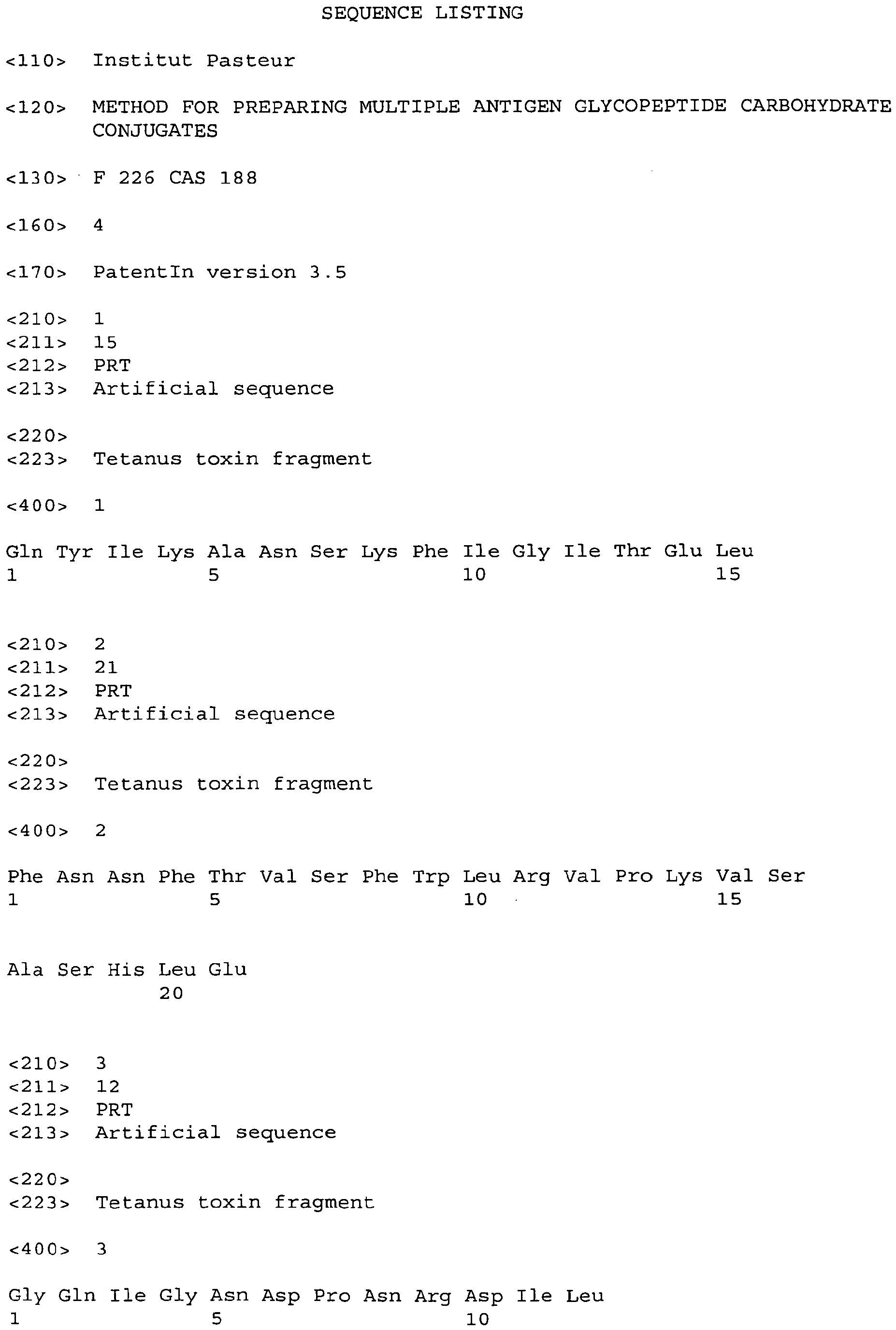
- 830-844 sequence of the tetanus toxin (QYIKANSKFIGITEL) (SEQ ID N°1)
- 947-967 sequence of the tetanus toxin (FNNFTVSFWLRVPKVSASHLE) (SEQ ID N°2)
- 1273-1284 sequence of the tetanus toxin (GQIGNDPNRDIL) (SEQ ID N°3).
- These peptidic T cell epitopes typically bind to a plurality of MHC (Major Histocompatibility Complex) human and murine molecules of class II avoiding in consequence the restriction problems encountered with the CD4+ T cellular response, associated with the polymorphism of the MHC molecules existing between individuals. Moreover the use of tetanus toxin peptides should increase the immunogenicity of antigens present on the conjugate of the present invention, as a result of the vaccination of numerous individuals with the tetanus toxoïd.
- As further examples of peptide T-cell epitopes, reference may be made to S. Stevanovic, "Identification of Tumour-associated T-cell epitopes for vaccine development ", Nature Reviews, Vol. 2, July 2002, p. 1 to 7 ; J.H. Kessler, C.J.M. Melief, "Identification of T-cell epitopes for cancer immunotherapy", Leukemia (2007) 21, 1859-1874, or in the Cancer immunity / peptide database website : http://www.cancerimmunity.org/peptide database/tumorspecific.htm.
- Examples of non-peptidic T cell epitopes include notably :
- fragments of
pneumococcal type 4 polysaccharide, and oligosaccharide tetanus toxoid conjugates as described by C. C. A. M. Peeters (1991), in The Journal of Immunology, 146,4309-4314, - meningococcal liposaccharides as described by A. F. M. Verheul (1991) in Detection and Immunity, vol. 59, n°10, pp. 3566-3573.
- As used herein, B cell epitope means antigens capable of eliciting a B cell response.
- As used herein, a carbohydrate means a saccharide, notably mono-, di-, oligo-, and polysaccharides.
- In a preferred aspect, the carbohydrate residue (b) forming the B cell epitope of the conjugate of formula (I) is a N-acetylgalactopyranosyl residue, or a derivative thereof.
- In a particular aspect, the carbohydrate residue (b) is attached to an amino acid, peptide, or lipid residue. In yet a further aspect, the carbohydrate residue is an O-glycosyl amino acid or peptide. In a further aspect, the B cell epitope is attached to the dendrimeric structure M(T)n via said aminoacid or peptide.
- The B cell epitope may comprise one or more carbohydrate residues (b), notably 1 to 10, in particular 1 to 6 carbohydrate residues.
- Such B cell epitope may be selected from tumor (cancer) glycosidic antigens, notably from :
- the glycolipid class, including acidic glycolipid such as, for example, gangliosides GD2, GD3 and GM3 (melanoma) and neutral glycolipids such as, for example, the Lewisy (Ley) (breast, prostate, ovary) and the Globo H (breast, prostate, ovary) antigens ;
- the O-glycosyl peptides (or aminoacid) class such as, for example, the Tn antigen (α-GalNAc-Ser or α-GalNAc-Thr), TF antigen (β-Gal-(1-3)-α-GalNAc-Ser or ß-Gal-(1-3)-α-GalNAc-Thr), two tumor markers frequently present in carcinomas but not usually in normal tissues [Springer G. F. Science 224,1198-1206 (1984)] (ovary, breast, lung), or di-Tn (α-GalNAc-Ser/Thr)2, tri-Tn (α-GalNAc-Ser/Thr)3 or hexa- Tn (α-GalNAc-Ser/Thr)6
- The B cell epitope of the conjugate according to the present invention may also originate from capsular bacterial polysaccharides of, for example, Neisseria meningitis, Haemophilus influenzae, Streptococcus pneumoniae, and of the Streptococcus group.
- The polysaccharides are carbohydrate residues obtained by a synthetic process.
- The B cell epitope of the present conjugate may be also of fungal origin, such as for example, one isolated from the yeast Saccharomyces.
- In a preferred aspect, the B cell epitopes of the conjugate of formula (I) are preferentially tumor markers, such as, for example, Tn and TF antigens.
- It can be selected from the group comprising Tn, di-Tn, tri-Tn (Tn3), hexa- Tn (Tn6), or TF antigens.
- In a further aspect, B is or comprises the carbohydrate residues selected from the group consisting of :
- α-GalNAc,
- α-GalNAc-Ser,
- α-GalNAc-Thr,
- β-GalNAc,
- β-GalNAc-Ser,
- β-GalNAc-Thr,
- β-Gal-(1-3)-α-GalNAc-Ser,
- β-Gal-(1-3)-α-GalNAc-Thr,
- (α-GalNAc-Ser/Thr)2,
- (α-GalNAc-Ser/Thr)3, and
- (α-GalNAc-Ser/Thr)6,
- In a preferred aspect, B is or comprises the residue (α-GalNAc-Ser/Thr)3, most preferably (α-GalNAc)Ser-(α-GalNAc)Thr-(α-GalNAc)Thr.
- In another preferred embodiment, the conjugate of formula (I) is MAG-Tn3.
- The method according to the present invention, comprises the step i) of coupling a protected carbohydrate B cell epitope (BPr) which hydroxyl groups of the carbohydrate residue (b) are protected with a protecting group (Pr), with a compound M(T)n thereby forming a carbohydrate T cell epitope conjugate M(T- BPr)n,
said protecting group (Pr) being selected from the group consisting of allyl, p-methoxybenzyl (PMB), t-butyldimethylsilyl (TBDMS), benzyloxymethyl (BOM), levulinyl (Lev), benzoyl (Bz), 2,5-difluorobenzoyl, chloroacetyl, benzyl (Bn) or an acetyl (Ac),
or forming with two hydroxyl groups to which it is attached a C5-C6 isopropylidene ketal or a C5-C6 cyclic alkylcarbonate. - In a preferred aspect, Pr is benzyl (Bn) or acetyl (Ac).
- In a particular aspect, step i) comprises the steps of :
- a) Coupling a first protected carbohydrate residue (bPr) which hydroxyl groups are protected with a protecting group (Pr), notably selected from benzyl (Bn) or acetyl (Ac), with a compound M(T)n thereby forming a carbohydrate T cell epitope conjugate M(T-bPr)n ; and optionnally
- b) repeating step a) with further protected carbohydrate residues (bPr) up to obtaining a protected carbohydrate conjugate of formula (II) M(T-BPr)n.
- Advantageously, it has been demonstrated that such protecting groups Pr enable to control the coupling of each of the carbohydrate residues b, or of the B cell epitope B, with M(T)n in step i). Further, it has been shown that the removal of these protecting groups allows to obtain the desired product, with an improved compromise between yield and purity.
- The hydroxyl groups of the carbohydrate residue can be protected by the above mentioned protecting groups (Pr), notably by benzyl or acetyl groups, according to conventional methods.
- Protected B cell epitopes BPr or carbohydrate residues (bPr) may be commercially available or may be prepared from commercially available starting materials and/or according to conventional methods.
- In a preferred aspect, the dendrimeric polyLysine core M and thus the subsequent M(T)n building block are immobilized on a solid support, thus enabling iterative solid phase peptide synthesis.
- As an example of solid support, mention may be made of polystyrene resin functionalized with p-benzyloxybenzyl alcohol (Wang resin), or with Fmoc-β-Ala such as those sold under the trade name Fmoc-β-Ala-TentaGel R Trt. The M core may notably be attached via a β-Ala-OH residue.
- In a particular aspect, bPr is a protected O-glycosyl amino acid or peptide. Protected O-glycosyl peptide may be coupled to the M(T)n building block by successively introducing the protected constitutive O-glycosyl amino acid residues bPr.
- In this regard, the solid phase peptide and glycopeptide synthesis may be performed using the standard Fmoc chemistry protocol [5] and [6]. N-α-Fmoc aminoacids and glycosylated aminoacids or peptides are incorporated stepwise in the peptide chain.
- Thus, step i) may be performed by reacting a first protected N-α-Fmoc O-glycosyl amino acid bPr with the M(T)n building block. More specifically, the carboxylic group (COOH) of the first O-glycosyl amino acid bPr is reacted with the NH2 end of each of the T branches, thereby forming a peptide covalent bond (-C(=O)NH-).
- The Fmoc is cleaved, for example in the presence of 20% of piperidine in DMF or NMP. Then a second protected N-α-Fmoc O-glycosyl amino acid bPr may be similarly reacted with the NH2 group of the first protected amino acid residue, and so on.
- Thus, when the B cell epitope comprises several carbohydrate residues (b), step i) of the method according to the invention may comprise the step of repeating the coupling according to step a) up to obtaining the carbohydrate T cell epitope conjugate M(T-BPr)n.
- These peptide coupling may be carried out in a polar aprotic solvent such as DMF or NMP, in the presence of coupling reagents such as HATU and DIPEA or DIC/HOBt, and PyBOP.
- In a particular aspect, Pr is benzyl. In that case, the deprotection step ii) may be carried out in the presence of TfOH or by a catalytic hydrogenation.
- In a particular aspect, step ii) is a catalytic hydrogenation.
- In a preferred aspect, the catalytic hydrogenation is carried out in the presence of Pd/C, notably of 10% Pd/C (% w/w), as a catalyst. The weight ratio of the conjugate of formula (II)/ catalyst may vary from 10/2 to 10/10, and is preferably of about 10/8. The catalyst may be added portionwise over a long period.
- The catalytic hydrogenation is preferably carried out in NMP/H2O, notably in a volume ratio of 87,5/12,5, as a solvent.
- The catalytic hydrogenation reaction is preferably carried out at a temperature ranging from 20 to 40 °C, in particular at about 37°C.
- The catalytic hydrogenation reaction is preferably carried out under a pressure ranging from 1 to 10 bar, more preferably at about 5 bar.
- In another aspect, step ii) is carried out in the presence of TfOH.
- Preferably, the conjugate of formula (II) is reacted with TfOH, in the presence of TFA, DMS and m-cresol. The relative ratio of TfOH/TFA/DMF/m-cresol may be of 1/5/3/1 v/v/v/v.
- In another aspect, the protecting group Pr is acetyl.
- The deprotection of acetyl protecting groups in step ii) is preferably performed in the presence of hydrazine, in a protic polar solvent, for example an alcohol such as methanol. This reaction may be performed at room temperature, i.e between 15 and 25°C.
- The molar ratio of hydrazine relative to the compound of formula (II) may vary from 100 to 1500 molar equivalents.
- The deprotection of acetyl may alternatively be performed in the presence of MeONa, notably in MeOH as a solvent, at room temperature, i.e between 15 and 25°C.
- In a particular aspect, when immobilized in a solid support, the conjugate of formula (II) obtained at the end of i) is preliminary cleaved from the solid support, before performing the deprotection step ii). Such cleavage may be performed in the presence of TFA and TIS in water, for example with the following volume ratio 95/2.5/2.5 v/v/v.
- The method according to the invention may further comprise a step iii) subsequent to step ii) consisting in one or more purification steps, notably by reverse phase high-performance liquid chromatography (RP-HPLC).
- The method according to the invention may further comprise a subsequent step iv) of recovering the product.
- In a particular aspect, the method according to the invention further comprises the step of preparing the conjugate M(T)n.
- In a particular embodiment, the conjugate M(T)n is prepared starting from the dendrimeric polyLysine core and by introducing stepwise the N-protected amino acid residues constituting the peptide T cell epitope. The N-protected amino acid residues are notably Fmoc amino acid residues.
- The amino acid couplings may be performed in a polar aprotic solvent such as DMF, in the presence of one or more peptide coupling reagents such as DIC, HOBt, PyBOP, HATU or DIPEA. The combinations (DIC/HOBt and PyBOP) or alternatively (HATU/DIPEA) are particularly preferred. Alternative coupling reagents are also disclosed in E. Valeur; M. Bradley, Chem Soc Rev (2009) 38, 606 ; A. El-Faham et al. Chem Eur J (2009) 15, 9404 or R. Subiros-Funosas et al. Org Biomol Chem (2010) 8, 3665.
- Following each peptide coupling, the N-amino acid protecting groups are removed. As an example, Fmoc protecting groups can be removed in the presence of piperidine in a polar aprotic solvent such as DMF.
- As regards the synthesis of the peptide fragment SEQ ID n°1 the amino acid residues AA9-10 and AA15-16 can be incorporated as pseudo-proline dipeptides. Advantageously, the incorporation of such dipeptides demonstrated a significant impact on the crude quality of the product.
- In a particular aspect, the method according to the invention further comprises the step of preparing a dendrimeric polyLysine core M.
- The dendrimeric polyLysine core M may be prepared according to the method disclosed in US patent number
US 6,676,946 . - In another aspect, the present invention advantageously provides a carbohydrate T cell epitope conjugate M(T-B)n having a grade of purity ≥ 95% obtainable according to the method of the invention.
- Such a purity grade may be obtained by performing a purification step (iii) after step (ii), notably a reverse phase high-performance liquid chromatography (RP-HPLC). As an example, RP-HPLC may be performed with a low-granulometry column, notably having a granulometry inferior to 5 µ. Elution may be performed with water (0,1% TFA)/acetonitrile with a shallow gradient, for instance from 70/30 to 60/40 over a period of about 20 minutes.
- The purity grade of the conjugate of formula (I) can be determined by any conventional method, notably by RP-HPLC.
- The purity is preferably ≥ 96%, notably ≥ 98%, and advantageously ≥ 99%.
- In an additional aspect, the present invention provides a carbohydrate T cell epitope conjugate of formula (II) :
M(T-BPr)n (II)
- Wherein
- M is a dendrimeric poly-Lysine core ;
- T is a T cell epitope, preferably comprising a peptide residue ;
- BPr is a protected carbohydrate B cell epitope comprising at least one carbohydrate residue (b) which hydroxyl groups are protected by a Pr group,
said Pr group being selected from the group consisting of allyl, p-methoxybenzyl (PMB), t-butyldimethylsilyl (TBDMS), benzyloxymethyl (BOM), levulinyl (Lev), benzoyl (Bz), 2,5-difluorobenzoyl, chloroacetyl, benzyl (Bn) or an acetyl (Ac),
or forming with two hydroxyl groups to which it is attached a C5-C6 isopropylidene ketal or a C5-C6 cyclic alkylcarbonate ;
and - n is an integer and represents the number of -T-B groups covalently bonded to M.
- In a particular aspect, BPr is a protected (α-GalNAc-Ser/Thr)3.
- In an additional aspect, Pr is benzyl or acetyl
- In a further aspect, M is HO-βAla-K(K)2.
- In another aspect, T is QYIKANSKFIGITEL (SEQ ID N°1).
- In another object, the invention provides a use of a carbohydrate peptide conjugate M(T-BPr)n for preparing a carbohydrate peptide conjugate M(T-B)n, M(T-BPr)n and M(T-B)n being as defined above.
- Other features of the invention will become apparent in the course of the following descriptions of exemplary embodiments. These examples are given for illustration of the invention and are not intended to be limiting thereof.
-
-
Figure 1 : MAG-Tn3 synthesis according to protocol A of the method of the invention. The molar equivalents are indicated relative to amino group. The AA9-10 and AA15-16 are incorporated as pseudo-Pro dipeptides. -
Figure 2 : MAG-Tn3 synthesis according to protocol B of the method of the invention. The molar equivalents are indicated relative to amino group. The AA9-10 and AA15-16 are incorporated as pseudo-Pro dipeptides. -
- AA
- amino acid
- Ac
- acetyl
- AcOH
- acetic acid
- Bn
- benzyl
- Boc
- tert-butoxycarbonyl
- tBu
- tert-butyl
- DIC
- N,N'-diisopropylcarbodiimide
- DIPEA
- diisopropylethylamine
- DIPE
- diisopropyl ether
- DMAP
- 4-dimethylaminopyridine
- DMF
- dimethylformamide
- DMS
- dimethylsulfide
- DVB
- divinylbenzene
- EtOH
- ethanol
- FA
- formic acid
- Fmoc
- 9-fluorenylmethoxycarbonyl
- HATU
- 2-(1H-9-azabenzotriazole-1-yl)-1,1,3,3-tetramethyluronium hexafluorophosphate
- HOBt
- N-hydroxybenzotriazole
- HPLC/MS
- high performance liquid chromatography / mass spectroscopy
- MAG
- multiple antigenic glycoppeptide
- MeOH
- methanol
- MeONa
- sodium methylate
- ESMS
- electrospray mass spectrometry
- MW
- molecular weight
- NMP
- N-methylpyrrolidone
- NMR
- nuclear magnetic resonance
- PyBOP
- benzotriazole-1-yl-oxy-tris-pyrrolidino-phosphonium hexafluorophosphate
- RP-HPLC
- reverse phase high-performance liquid chromatography
- RT
- room temperature
- SELDI-TOF
- MS surface-enhanced laser desorption/ionization time-of-flight mass spectrometry
- TBS
- tert-butyldimethylsilyl
- TFA
- trifluoroacetic acid
- TfOH
- trifluoromethanesulfonic acid
- THF
- tetrahydrofuran
- TIS
- triisopropylsilane
- TMSBr
- trimethylsilyl bromide
- Trt
- trityl
- The synthesis of 6 was performed stepwise on solid-phase using Fmoc chemistry. Amino acid side chain protective groups used were Trt on Gln and Asn, Boc on the Lys7 and Lys11, tBu on Tyr, Ser and Thr, OtBu on Glu. For the Lys19 and Lys20, the protective groups were Fmoc.
- The net peptide contents were determined by nitrogen analysis or quantitative amino acid analysis using a Beckman 6300 analyser after hydrolysis of the compounds with 6N HCl at 110°C for 20h.
- The HPLC/MS analyses were performed on an Alliance 2695 system coupled to a UV detector 2487 (220 nm) and to a Q-Tofmicro™ spectrometer (Micromass) with an electrospray ionisation (positive mode) source (Waters). The samples were cooled to 4°C on the autosampler. The linear gradient was performed with acetonitrile+0.025%FA (A) / water+0.04%TFA+0.05%FA (B) over 20min. The column was a Zorbax 300SB C18 (3.5µ, 3x150 mm) (Agilent) (gradient 13-53% A) or a XBridge™ BEH130 C18 (3.5µ, 2.1x150 mm) (Waters) (gradient 15-40% A). The temperature of the source was maintained at 120°C and the desolvation temperature at 400°C. The cone voltage was 40V.
- The ESMS analyses were recorded in the positive mode by direct infusion in the same mass spectrometer. The samples were dissolved at ~5µM concentration in water / acetonitrile (1/1) with 0.1% formic acid.
- The SELDI-TOF analyses were performed on a PCS 4000 mass spectrometer (Bio-Rad Labs). H4 ProteinChip array surfaces were activated with 1µL CH3CN. Spots were incubated with the reaction mixture (2.5µL, 1mg/mL) in a box at RT for 20min. They were then washed with the reaction buffer (3xlmin) and H2O (3xlmin). The matrix (2x0.6µL of sinapinic acid saturated in 50% CH3CN/0.5%TFA) was applied on each spot and allowed to air-dry. Spectra were generated from each array spot with a laser setting ~3µJ. The instrument was externally calibrated with bovine ubiquitin, bovine cytochrome C, β-lactoglobulin with the matrix and the settings as described above.
- The purity of 6 was analyzed by RP-HPLC using an Agilent 1200 pump system with a UV detector at 220 nm. The column was a Zorbax 300SB C18 (3.5µ, 3x150 mm) (Agilent) and the gradient was performed with acetonitrile+0.1% TFA (A) /water+0.1%TFA (B) over 40min, from 13 to 53%A (0.8mL/min, retention time 20.5min).
- The molar equivalents of all reagents are indicated relative to amino groups. The molar amounts of the protected
intermediates resin 1 substitution. The overall yields (Table) include all the synthetic steps from 1 . They were calculated on the net peptide content of thefinal product 6 from the Fmoc-β-Ala-resin 1 substitution. - 2g of p-benzyloxybenzyl alcohol resin (Wang resin, 0.91 mmol/g , 100-200 mesh, polymer matrix: copoly(styrene-1 %DVB), Novabiochem) were swelled in DMF (Applied Biosystems) for 1h in a dry round-bottomed flask. 311 mg (1mmol) of dry Fmoc-β-Ala-OH (Novabiochem, Merck Chemicals Ltd) were dissolved in 8mL of anhydrous CH2Cl2 (Acros). Four drops of DMF were added to complete the dissolution. After the addition of 77µL (0.5mmol) of DIC (Fluka), the reaction mixture was stirred for 20min under argon, at room temperature. The reaction mixture was evaporated to dryness and the rotary evaporator opened under argon. The residue was dissolved in the minimum volume of DMF (6mL) and the solution was added to the resin. 6mg (0.05mmol) of DMAP (Acros) dissolved in 0.5mL of DMF were added and the suspension was stirred gently for 2h at room temperature.
- The resin substitution rate was measured by UV analysis of a resin sample according to the following procedure. 2 to 6mg of resin were transferred with a Pasteur pipette to a small sintered glass funnel. The resin was washed with DMF, CH2Cl2 (Carlo Erba) and dried. The resin was transferred in an UV cell, precisely weighted and then added with 2.8mL of 20% piperidine (Aldrich) in DMF. The suspension was agitated with the aid of a Pasteur pipette for 2min. The absorbance was read at 300.5nm (ε = 7800) with the reference cell containing 20% piperidine in DMF. The extent of loading was found to be 0.1 mmol/g.
- The resin was washed three times with DMF. The residual hydroxyl groups were capped using the following protocol. The resin was resuspended in 13mL of DMF. 1.55mL (16.4mmol) of Ac2O (Sigma) in 1mL of DMF, and then 660mg (5.41mmol) of DMAP in 1mL of DMF were added. After gently stirring for 30min at room temperature, the suspension was filtered in a sintered glass funnel, successively washed three times by DMF, three times by CH2Cl2 and then was dried overnight in a desiccator. The
resin 1 was stored at 4°C. - The tetravalent peptide was synthesized from 250mg (25 µmol) of Fmoc-β-Ala-
resin 1 on an Applied Biosystems peptide synthesizer 433A using Fmoc chemistry. The Applied standard synthesis protocol was followed except for an additional washing step after each coupling step. Briefly, the Fmoc groups were removed with 22% piperidine in NMP (Applied Biosystems) and the deprotection was monitored by conductivity. The lysine core was constructed by successively coupling two levels of Fmoc-Lys(Fmoc)-OH (Applied Biosystems) (1st cycle : 40eq, 2nd cycle : 20eq) using HATU (Applied Biosystems) (1st cycle : 40eq, 2nd cycle : 20eq) / DIPEA (Applied Biosystems) (1st cycle : 80eq, 2nd cycle : 40eq) as the coupling reagents and NMP as solvent (Note : the use of this very large excess of reagents should be not necessary for the efficiency of the reaction and is only due to the fact that the prepacked cartridges are filled with 1mmol of amino acid). The stepwise introduction of the subsequent Fmoc-protected amino acids (Applied Biosystems, 10eq/amine) carrying standard side-chain protective groups was performed with HATU (10eq/amine) / DIPEA (20eq/amine) in NMP. The AA in positions 15-16 and 9-10 were incorporated as, respectively, Fmoc-Ile-Thr(ΨMe,Mepro)-OH and Fmoc-Asn(Trt)-Ser(ΨMe,Mepro)-OH (10eq/amine) (Novabiochem, Merck Chemicals Ltd) with HATU (10eq/amine) and DIPEA (20eq/amine). - Starting from 2a (25µmol), the glycosylated building blocks were incorporated manually: Fmoc-T(α-D-GalAc(OBn)3)-OH (Ficher Chemicals AG) (1st cycle), Fmoc-T(α-D-GalNAc(OBn)3)-OH (2nd cycle) and Fmoc-S(α-D-GalNAc(OBn)3)-OH (Ficher Chemicals AG) (3rd cycle). Briefly, the dry building block (0.3mmol, 3eq / free amino group) was dissolved in the minimum amount of DMF (~2 mL). A solution of 55mg (0.145mmol) of HATU (Novabiochem) in 0.5mL DMF was added and the resulting mixture was added to the resin. After adding 52µL (0.3mmol) of DIPEA (Aldrich), the suspension was mechanically stirred. The three coupling steps were monitored by the Kaiser test [1] and were completed, respectively, in 1h, 1h and 1h. After each coupling steps, the resin was washed with DMF (four times). All Fmoc cleavages were carried out by treatment of the resin with 20% piperidine in DMF. Following each deprotection, the resin was successively washed by DMF (six times), CH2Cl2 (six times), and DMF (six times). At the end of the synthesis, the resin was extensively washed with DMF and CH2Cl2, and dried in a desiccator. 10mL of TFA (Applied Biosystems) / water / TIS (Acros) (95/2.5/2.5 v/v/v) were added to the resin at 4°C and the mixture was stirred for 1h30 at room temperature. After filtration of the resin, the solution was concentrated and the crude product precipitated with diethyl ether. After centrifugation, the pellet was dissolved in water and lyophilized to yield 229mg of the
crude glycopeptides 5. - 200mg (0.014mmol) of 5 were dissolved in 2.96mL of TFA, 1.78mL of DMS (Sigma-Aldrich) and 587µL of metacresol (Sigma-Aldrich) at RT. The solution was cooled to -10°C and 587µL of TfOH (Fluka) was added and the mixture was stirred 1h15 at -10°C (TfOH/TFA/DMS/m-
cresol 1/5/3/1 v/v/v/v). The product was precipitated with diethyl ether and, after centrifugation, the pellet was dissolved in water and lyophilized to yield 372 mg of the crude glycopeptide. The product was dissolved in 7.7mL of 0.05M ammonium acetate buffer and the pH adjusted to 7 with 1M ammonia. After 1h at room temperature, the solution was lyophilized to yield to 412mg of the crude product. The product was purified by RP-HPLC using an Agilent 1200 pump system with a UV detector at 230nm. The column was a Zorbax C18 (5 µ, 300Å, 9.4 x 250 mm) (Agilent) and the gradient was performed with water (0.1 % TFA) / acetonitrile over 20min, from 73/27 to 60/40. The purification gave 3.9mg (net peptide content) of 6 in 99.50% purity. The overall yield is 1.6%. - Until the incorporation of Tyr5, the tetravalent peptide was synthesized from 36.9g (4.8mmol) of Fmoc-β-Ala-Tentagel R Trt resin 1 (0.13mmol/g) (Rapp Polymere) on a manual peptide synthesizer equipped with a Schmizo reactor. Before the elongation process, the resin was swelled in DMF for 2 to 3 hours and was washed with 240mL of DMF (three times, 2 min/cycle). Following each coupling, the Fmoc groups were removed with 20% piperidine in 240mL of DMF (three steps, 20min each). In the case of Glu17, Asn9 and Gln4, 2% HOBt was added to the deprotection solution. Following each deprotection, the resin was successively washed by 240mL of DMF (4 times, 2min/cycle), 240mL of 2% HOBt in DMF (twice, 5min/cycle), and 240mL of DMF (twice, 2min/cycle).
- The amino acid couplings (1.5 to 2eq / amine) were performed in DMF (111mL) at room temperature with DIC/HOBT (1.5 to 2eq each / amine) (see details below). The AA in positions 15-16 and 9-10 were incorporated as, respectively, Fmoc-Ile-Thr(ΨMe,Mepro)-OH and Fmoc-Asn(Trt)-Ser(ΨMe,Mepro)-OH. After 30min, a fresh portion of DIC (1.5 to 2eq) was added to the reaction mixture. The coupling steps were monitored by the Kaiser test [1]. From Leu18 to Ser1, after 1h coupling with DIC/HOBT, PyBOP reagent was added (see details below) and the pH was adjusted to 7 by dropwise addition of DIPEA. After 30min, the resin was washed with 240mL of DMF (5 times, 2 min/cycle) and an acetylation step was carried out from Leu18 to Thr2. The acetylation was performed at room temperature with acetic anhydride (1eq/amine) in the presence of pyridine (1eq/amine) in 111mL of DMF. After 20min, the resin was washed with 240mL of DMF (6 times, 2 min/cycle). After the incorporation of Tyr5, the resin was extensively washed with 240mL of DMF (8 times, 2 min/cycle) and 240mL of CH2Cl2 (8 times, 2 min/cycle), before drying.
- After the incorporation of Tyr5, the assembly was pursued on a 0.15mmol scale or a 4.65mmol scale using the same protocole and afforded the peptide-
resin 2b for, respectively, 4 and 5.Amino acids (eq/amine, mmol) DIC/HOBt (eq/amine, mmol) Coupling reaction (min) PyBOP (eq/amine) 20. Fmoc-Lys(Fmoc)-OH (1.75, 2.1) 1.75,2.1 60 0.5 19. Fmoc-Lys(Fmoc)-OH (2, 4.8) 2,4.8 105 1 18. Fmoc-Leu-OH (2, 9.6) 2,9.6 60 1 17. Fmoc-Glu(OtBu) (2, 9.6) 2,9.6 60 1 16-15. Fmoc-Ile-Thr(ΨMe-Mepro)-OH (1.5, 7.2) 1.5, 7.2 60 0.5 14. Fmoc-Gly-OH (2, 9.6) 2,9.6 60 1 13. Fmoc-Ile-OH (2, 9.6) 2,9.6 60 1 12. Fmoc-Phe-OH (2, 9.6) 2,9.6 60 1 11. Fmoc-Lys(Boc)-OH (2eq, 9.6mmol) 2,9.6 60 1 10-9. Fmoc-Asn(Trt)-Ser(ΨMe-Mepro)-OH (1.5, 7.2) 1.5, 7.2 60 0.5 8. Fmoc-Ala-OH (2, 9.6) 2,9.6 60 1 7. Fmoc-Lys(Boc)-OH (2, 9.6) 2,9.6 60 1 6. Fmoc-Ile-OH (2, 9.6) 2,9.6 60 1 5. Fmoc-Tyr(tBu)-OH (2, 9.6) 2,9.6 60 1 4. Fmoc-Gln(Trt)-OH (2, 1.2 for 4) or (2, 37.2 for 5 ) (2, 1.2) or (2, 37.2) 60 1 - The synthesis was performed from 2b (0.15mmol) as previously described for 2b. The coupling steps were performed with the following AA building blocks [5] and reagents.
Amino acids (eq/amine, mmol) DIC/HOBt (eq/amine, mmol) Coupling reaction (min) PyBOP (eq/amine) 3. Fmoc-Thr(α-D-GalNAc(OAc)3)-OH (1.5, 0.9) 1.5, 0.9 60 0.5 2. Fmoc-Thr(α-D-GalNAc(OAc)3)-OH (1.5, 0.9) 1.5,0.9 60 0.5 1. Fmoc-Ser(α-D-GalNAc(OAc)3)-OH (1.5, 0.9) 1.5,0.9 60 0.5 - At the end of the synthesis, the glycopeptide-resin (0.15mmol) was suspended in a TFA/TIS/H2O (95/2.5/2.5 v/v/v) (10mL/g of glycopeptide-resin) and stirred for 1h at 20°C ± 2°C. After filtration, the resin was washed twice with the same TFA mixture (2mL/g of glycopeptide-resin per wash). The filtrates and the washes were gathered and stirred for additional 30min at 20°C ± 2°C. After concentration (bath temperature ≤ 35°C), the crude product was precipitated with DIPE (~35mL/g of glycopeptide-resin). After filtration and washing with DIPE, the solid was dried (t°≤30°C) and gave 750mg of
crude 4.
ESMS: 12409.589 (C553H855N107O213 calcd 12410,465) - The synthesis was performed from 2b (4.65mmol) as previously described for 2b. The coupling steps were performed with the following AA building blocks (Ficher Chemicals AG) and reagents. At the end of the synthesis, 84.87g of glycopeptide-resin were obtained.
Amino acids (eq/amine, mmol) DIC/HOBt (eq/amine, mmol) Coupling reaction (min) PyBOP (eq/amine) 3. Fmoc-Thr(α-D-GalNAc(OBn)3)-OH (1.5, 27.9) 1.5, 27.9 60 0.5 2. Fmoc-Thr(α-D-GalNAc(OBn)3)-OH (1.5, 27.9) 1.5, 27.9 60 0.5 1. Fmoc-Ser(α-D-GalNAc(OBn)3)-OH (1.5, 27.9) 1.5, 27.9 60 0.5 - The glycopeptide-resin (20g, 1.096mmol) was treated as previously described for 4 and afforded 9.95g of
crude 5 .
ESMS: 14141.433 (C733H999N107O177 calcd 14141,610) - Note: This protocol gave a comparable crude compound as that obtained according to protocol A, i.e. starting from Fmoc-β-Ala-p-benzyloxybenzyl alcohol resin (Wang resin) (see above).
- 100mg (20µmol) of 4 were dissolved in 3.2mL of MeOH. 567µL (11.3mmol) of hydrazine monohydrate were added and the solution was stirred at room temperature. After 2h30, the solution is cooled to 0°C and 3.2mL of acetone were added. After 1h, the solution was concentrated and co-distilled five times with acetone. The crude glycopeptide was lyophilized to yield 117mg. The product was purified by RP-HPLC using an Agilent 1200 pump system with a UV detector at 230 nm. The column was a Zorbax C18 (5 µ, 300Å, 9.4 x 250 mm) (Agilent) and the gradient was performed with water (0.1% TFA) / acetonitrile over 20min, from 72/28 to 62/38. The purification gave 5.8mg (net peptide content) of 6 in 96.10% purity. The overall yield is 2.7%.
- 24mg (4.8µmol) of 4b were dissolved in 3.2mL of MeOH. The pH was adjusted to 14 (pH meter, moist pH paper ~10.5) with 1% MeONa in MeOH and the solution stirred at RT. The reaction was monitored by RP-HPLC. After 2h, the reaction is neutralized with dry ice and evaporated to dryness. The crude peptide was dissolved in 1% aqueous TFA and lyophilized. The product was purified by RP-HPLC using an Agilent 1200 pump system with a UV detector at 230 nm. The column was a Kromasil C4 (5 µ, 100Å, 10x250 mm) (AIT) and the gradient was performed with 0.1% aqueous TFA (VWR) / acetonitrile (Carlo Erba) over 30 min, from 73/27 to 62/38. The purification gave 754µg (net peptide content) of 6 in 91.4% purity. The overall yield is 1.4%.
- 10g (1.1mmol) of 5 were dissolved in 800mL of NMP/H2O 87.5/12.5. After addition of 4g of 10%Pd/C type 39 (Johnson Matthey), the reaction was stirred at 37°C and 5 bar for 170h. Two additional amounts of catalyst were added portionwise after 72h (2g) and 120h (2g). At the end of the reaction, the catalyst was filtrated on celite and washed with NMP/H2O 87.5/12.5. The resulting filtrate was gathered with other filtrates issued from similar reaction (1.35mmol in total). After dilution with H2O (until NMP/H2O 10/90), the filtrates were purified by RP-HPLC in two steps. The primary purification was carried out on a Vydac C18 column (300Å, 10-15µm, 50mL/mn) with TFA/H2O/CH3CN 0.1/94.9/5.0 v/v/v (A) and with TFA/H2O/CH3CN 0.1/49.9/50.0 v/v/v (B). The gradient was 0%B over 15min, 0-40%B over 5min, 40-80%B over 60min. The secondary purification was carried out on a Vydac C18 column (300Å, 10-15µm, 50mL/mn) with AcOH/H2O/CH3CN 0.5/94.5/5.0 v/v/v (A) and with AcOH/H2O/CH3CN 0.5/49.5/50.0 v/v/v (B). The gradient was 0%B over 15min, 0-20%B over 5min, 20-60%B over 60min. After concentration by RP-HPLC on a Daisogel SP-300-10-ODS-AP column (20mL/mn, isocratic TFA/H2O/CH3CN 0.1/49.9/50.0 v/v/v), the solution was evaporated on rotary evaporator and lyophilized to afford 225mg (net peptide content) of 6 in 96.3% purity. The overall yield is 1.5%.
ESMS: 10897.387 (C481H783N107O177 calcd 10897,123) - The obtained results are summarized in the following table :
Initial process I1 New process II Carbohydrate protective group (R) None (H) TBS Ac Bn Deprotection method - TFA NH2-NH2 TfOH H2 Overall yield2 (Purity)3 1- 10mg scale 3% (94.5%) >10mg scale <1% (<95%)- 2.7% (96.4%) 1.6% (95.9%) 1.5% (96.3%) Comment Scale4 Impurities and reproducibility issues during scale-up => new synthesis route with carbohydrate protection No expected compound (partial deprotection) Impurities++ Scale ~5mg Compromise between complete deprotection and degradation. Scale ~5mg Scale 225mg 1 ref 5 and 11, patent US 6,676,946 .
2 calculated on the net peptide content from the Fmoc-βAla-resin substitution (includes all the synthesis steps from 1 ).
3 as determined by RP-HPLC: Column Zorbax 300SB C18 (3.5µ, 3x150 mm) (Agilent), 0.8 mL/min, A: acetonitrile+0.1% TFA, B: water+0.1% TFA,gradient 13% to 53% of A over 40 min, detection at 220 nm.
4 Refers to the final product (net peptide content) - Compared to the initial synthesis using unprotected carbohydrate synthons (
Figures 1 and2 ), the new process (involving protected carbohydrates, II,Figures 1 and2 ) allows to: - minimize the synthesis side-products
- improve the process repeatability
- scale-up the synthesis in a repeatable manner
- Among the tested protocols in the new process (Table,
Figures 1 and2 ), three emerge as the best strategies: Ac/Hydrazine, Bn/TfOH and Bn/H2 (protecting group/deprotection method) (Table). They all led to the MAG-Tn3 with a purity ≥95%, in a repeatable manner. - The Bn/TfOH method afforded the MAG-Tn3 with an overall yield of 1.6%. This method relies on a compromise between complete deprotection and degradation. Alternatively, the Bn/H2 method afforded the MAG-Tn3 with similar yield (1.5%) and, most importantly, the process has been validated on a 225mg scale. Finally the Ac/hydrazine method gave the highest overall yield (2.7%, compared to 1.6% and 1.5%).
- A MAG-Tn3 based on another peptide (PV=KLFAVWKITYKDT) (SEQ ID N°4) has also been prepared according to the method of invention (Ac/Hydrazine, Bn/TfOH).)
-
- 1. Kaiser, E., R.L. Colescott, C.D. Bossinger, and P.I. Cook, Anal Biochem (1970). 34: 595-8.
- 2. Maemura, M., A. Ohgaki, Y. Nakahara, H. Hojo, and Y. Nakahara, Bioscience Biotechnology and Biochemistry (2005). 69: 1575-1583.
- 3. Tam, J.P., W.F. Heath, and R.B. Merrifield, J Am Chem Soc (1986). 108: 5242-5251.
- 4. Tanaka, E., Y. Nakahara, Y. Kuroda, Y. Takano, N. Kojima, H. Hojo, and Y. Nakahara, Bioscience Biotechnology and Biochemistry (2006). 70: 2515-2522.
- 5. Bay, S., R. Lo-Man, E. Osinaga, H. Nakada, C. Leclerc, and D. Cantacuzène, J. Peptide Res. (1997). 49: 620-625 ;
- 6. : Fmoc solid phase peptide synthesis, A practical approach, Edited by W.C. Chan and P. D. White, Oxford University Press.
- 7. Sander, J. and H. Waldmann, Chem Eur J (2000). 6: 1564-1577.
- 8. Lo-Man, R., S. Vichier-Guerre, S. Bay, E. Dériaud, D. Cantacuzène, and C. Leclerc, J. Immunol. (2001). 166: 2849-2854.
- 9. Lo-Man, R., S. Vichier-Guerre, R. Perraut, E. Dériaud, V. Huteau, L. BenMohamed, O.M. Diop, P.O. Livingston, S. Bay, and C. Leclerc, Cancer Res (2004). 64: 4987-4994.
- 10. Babino, A., D. Tello, A. Rojas, S. Bay, E. Osinaga, and P.M. Alzari, FEBS Lett. (2003). 536: 106-110.

Claims (24)
- A method for preparing a carbohydrate T cell epitope conjugate of formula (I):
M(T-B)n (I)
wherein:- M is a dendrimeric poly-Lysine core ;- T is a T cell epitope ;- B is a carbohydrate B cell epitope comprising at least one carbohydrate residue (b);- n is an integer and represents the number of -T-B groups covalently bonded to M ;Said method comprising the steps of :i) coupling a protected carbohydrate B cell epitope (BPr) which hydroxyl groups of the carbohydrate residue (b) are protected with a protecting group (Pr), with a compound M(T)n thereby forming a carbohydrate T cell epitope conjugate M(T-BPr)n, said protecting group (Pr) being selected from the group consisting of allyl, p-methoxybenzyl (PMB), t-butyldimethylsilyl (TBDMS), benzyloxymethyl (BOM), levulinyl (Lev), benzoyl (Bz), 2,5-difluorobenzoyl, chloroacetyl, benzyl (Bn) or an acetyl (Ac), or forming with two hydroxyl groups to which it is attached a C5-C6 isopropylidene ketal or a C5-C6 cyclic alkylcarbonate ;
andii) removing the protecting groups Pr from the obtained conjugate M(T-BPr)n thereby obtaining the carbohydrate T cell epitope conjugate M(T-B)n. - The method of claim 1, wherein M(T-B)n is selected from the following formulae (Ia) or (Ib) :


T and B are as defined in claim 1. - The method of any of claims 1 or 2, wherein M is (K)2K-βAla-OH of formula :

- The method of any of the preceding claims, wherein T is a T cell epitope comprising a peptide.
- The method of claim 4, wherein T is or comprises a CD8+ or a CD4+ T cell epitope.
- The method of claim 5, wherein T is or comprises a CD4+ T cell epitope.
- The method of claim 6, wherein T is or comprises a poliovirus (PV) fragment protein, a tetanus toxin fragment or a PADRE peptide.
- The method of claim 7, wherein T is a peptide consisting of QYIKANSKFIGITEL (SEQ ID No 1).
- The method of any of the preceding claims, wherein the carbohydrate residue (b) is attached to an amino acid, peptide or lipid residue.
- The method of any of the preceding claims, wherein B is or comprises a carbohydrate residue selected from the group consisting of :- α-GalNAc-Ser,- α-GalNAc-Thr,- β-GalNAc-Ser,- β-GalNAc-Thr,- β-Gal-(1-3)-α-GalNAc-Ser,- β-Gal-(1-3)-α-GalNAc-Thr,- (α-GalNAc-Ser/Thr)2,- (α-GalNAc-Ser/Thr)3, and- (α-GalNAc-Ser/Thr)6,
- The method of claim 10, wherein B is or comprises the residue (α-GalNAc-Ser/Thr)3.
- The method of any of the preceding claims, wherein the protecting group Pr is benzyl (Bn) or acetyl (Ac).
- The method of any of the preceding claims, wherein step i) comprises the steps of :a) coupling a first protected carbohydrate residue (bPr) which hydroxyl groups are protected with a protecting group (Pr) as defined in any of the preceding claims with a compound M(T)n thereby forming a carbohydrate T cell epitope conjugate M(T-bPr)n ; andb) repeating step a) with further protected carbohydrate residues (bPr) up to obtaining a protected carbohydrate conjugate of formula (II) M(T-BPr)n.
- The method of any of the preceding claims, wherein Pr is benzyl.
- The method of claim 14, wherein benzyl groups are removed in the presence of TfOH or H2.
- The method of any of claims 1 to 13, wherein Pr is acetyl.
- The method of claim 16, wherein acetyl groups are removed in the presence of hydrazine or MeONa.
- A carbohydrate T cell epitope conjugate of formula (II) :
M(T-BPr)n (II)
wherein- M is a dendrimeric poly-Lysine core ;- T is a T cell epitope ;- BPr is a protected carbohydrate B cell epitope comprising at least one carbohydrate residue (b) which hydroxyl groups are protected by a Pr group as defined in claim 1 ; and- n is an integer and represents the number of -T-B groups covalently bonded to M. - The carbohydrate T cell epitope conjugate of claim 18, wherein T is or comprises a peptide.
- The carbohydrate T cell epitope conjugate of any of claims 18 or 19, wherein Pr is benzyl (Bn) or acetyl (Ac).
- The carbohydrate T cell epitope conjugate of any of claims 18 to 20, wherein BPr is a protected (α-GalNAc-Ser/Thr)3.
- The carbohydrate T cell epitope conjugate of any of claims 18 to 21, wherein M is HO-βAla-K(K)2.
- The carbohydrate T cell epitope conjugate of any of claims 18 to 22, wherein T is QYIKANSKFIGITEL (SEQ ID N°1).
- A use of a carbohydrate T cell epitope conjugate M(T-BPr)n of any of claims 18 to 23 for preparing a carbohydrate peptide conjugate M(T-B)n as defined in any of claims 1 to 17.
Priority Applications (18)
| Application Number | Priority Date | Filing Date | Title |
|---|---|---|---|
| EP11290138A EP2500033A1 (en) | 2011-03-17 | 2011-03-17 | Method for preparing muliple antigen glycopeptide carbohydrate conjugates |
| MX2013010618A MX354325B (en) | 2011-03-17 | 2012-03-16 | METHOD FOR PREPARING GLUCTIDIC CONJUGATES OF MULTIPLE ANTIGENIC GLICOPEPTIDES. |
| JP2013558565A JP6006244B2 (en) | 2011-03-17 | 2012-03-16 | Method for preparing multiple antigen glycopeptide carbohydrate conjugates |
| EA201391202A EA201391202A1 (en) | 2011-03-17 | 2012-03-16 | METHOD FOR PREPARING MULTIPLE ANTIGENE GLYKOPEPTID-CARBON CONJUGATES |
| AU2012227940A AU2012227940A1 (en) | 2011-03-17 | 2012-03-16 | Method for preparing multiple antigen glycopeptide carbohydrate conjugates |
| PCT/IB2012/051285 WO2012123926A1 (en) | 2011-03-17 | 2012-03-16 | Method for preparing multiple antigen glycopeptide carbohydrate conjugates |
| BR112013023599-3A BR112013023599B1 (en) | 2011-03-17 | 2012-03-16 | METHOD FOR PREPARING A CARBOHYDRATE-T-CELL Epitope CONJUGATE, CARBOHYDRATE-T-CELL Epitope CONJUGATE, AND, USE OF A CARBOHYDRATE-T-CELL Epitope CONJUGATE |
| CN201280011373.8A CN103732246B (en) | 2011-03-17 | 2012-03-16 | The method for preparing many antigen glycopeptide carbohydrate conjugates |
| ES12712748.8T ES2537180T3 (en) | 2011-03-17 | 2012-03-16 | Method for preparing multiple antigen carbohydrate glycopeptide conjugates |
| CA2828688A CA2828688C (en) | 2011-03-17 | 2012-03-16 | Method for preparing multiple antigen glycopeptide carbohydrate conjugates |
| US14/005,336 US20140378652A9 (en) | 2011-03-17 | 2012-03-16 | Method for preparing multiple antigen glycopeptide carbohydrate conjugates |
| SG2013068762A SG193433A1 (en) | 2011-03-17 | 2012-03-16 | Method for preparing multiple antigen glycopeptide carbohydrate conjugates |
| DK12712748.8T DK2686009T3 (en) | 2011-03-17 | 2012-03-16 | Process for preparing multiple antigen-glycopeptide carbohydrate conjugates |
| KR1020137027111A KR20140048107A (en) | 2011-03-17 | 2012-03-16 | Method for preparing multiple antigen glycopeptide carbohydrate conjugates |
| EP20120712748 EP2686009B1 (en) | 2011-03-17 | 2012-03-16 | Method for preparing multiple antigen glycopeptide carbohydrate conjugates |
| ZA2013/06219A ZA201306219B (en) | 2011-03-17 | 2013-08-19 | Method for preparing multiple antigen glycopeptide carbohydrate conjugates |
| IL228384A IL228384A0 (en) | 2011-03-17 | 2013-09-12 | Method for preparing multiple antigen glycopeptide carbohydrate conjugates |
| US15/444,547 US10899799B2 (en) | 2011-03-17 | 2017-02-28 | Method for preparing multiple antigen glycopeptide carbohydrate conjugates |
Applications Claiming Priority (1)
| Application Number | Priority Date | Filing Date | Title |
|---|---|---|---|
| EP11290138A EP2500033A1 (en) | 2011-03-17 | 2011-03-17 | Method for preparing muliple antigen glycopeptide carbohydrate conjugates |
Publications (1)
| Publication Number | Publication Date |
|---|---|
| EP2500033A1 true EP2500033A1 (en) | 2012-09-19 |
Family
ID=44512239
Family Applications (2)
| Application Number | Title | Priority Date | Filing Date |
|---|---|---|---|
| EP11290138A Withdrawn EP2500033A1 (en) | 2011-03-17 | 2011-03-17 | Method for preparing muliple antigen glycopeptide carbohydrate conjugates |
| EP20120712748 Active EP2686009B1 (en) | 2011-03-17 | 2012-03-16 | Method for preparing multiple antigen glycopeptide carbohydrate conjugates |
Family Applications After (1)
| Application Number | Title | Priority Date | Filing Date |
|---|---|---|---|
| EP20120712748 Active EP2686009B1 (en) | 2011-03-17 | 2012-03-16 | Method for preparing multiple antigen glycopeptide carbohydrate conjugates |
Country Status (16)
| Country | Link |
|---|---|
| US (2) | US20140378652A9 (en) |
| EP (2) | EP2500033A1 (en) |
| JP (1) | JP6006244B2 (en) |
| KR (1) | KR20140048107A (en) |
| CN (1) | CN103732246B (en) |
| AU (1) | AU2012227940A1 (en) |
| BR (1) | BR112013023599B1 (en) |
| CA (1) | CA2828688C (en) |
| DK (1) | DK2686009T3 (en) |
| EA (1) | EA201391202A1 (en) |
| ES (1) | ES2537180T3 (en) |
| IL (1) | IL228384A0 (en) |
| MX (1) | MX354325B (en) |
| SG (1) | SG193433A1 (en) |
| WO (1) | WO2012123926A1 (en) |
| ZA (1) | ZA201306219B (en) |
Cited By (1)
| Publication number | Priority date | Publication date | Assignee | Title |
|---|---|---|---|---|
| WO2017134265A1 (en) | 2016-02-05 | 2017-08-10 | Institut Pasteur | Use of inhibitors of adam12 as adjuvants in tumor therapies |
Citations (2)
| Publication number | Priority date | Publication date | Assignee | Title |
|---|---|---|---|---|
| WO1998043677A1 (en) | 1997-03-27 | 1998-10-08 | Institut Pasteur | Multiple antigen glycopeptide carbohydrate, vaccine comprising the same and use thereof |
| US20030157115A1 (en) * | 1997-03-27 | 2003-08-21 | Sylvie Bay | Multiple antigen glycopeptide carbohydrate vaccine comprising the same and use thereof |
Family Cites Families (3)
| Publication number | Priority date | Publication date | Assignee | Title |
|---|---|---|---|---|
| IL105503A (en) | 1992-04-28 | 1999-05-09 | Astra Ab | Peptide-carbohydrate conjugates capable of generating t cell immunity |
| US6410690B1 (en) * | 1995-06-07 | 2002-06-25 | Medarex, Inc. | Therapeutic compounds comprised of anti-Fc receptor antibodies |
| EP0996455B1 (en) * | 1997-04-16 | 2009-12-16 | Sloan-Kettering Institute For Cancer Research | Alpha-o-linked glycoconjugates with clustered (2,6)-st epitopes, methods of preparation and uses thereof |
-
2011
- 2011-03-17 EP EP11290138A patent/EP2500033A1/en not_active Withdrawn
-
2012
- 2012-03-16 BR BR112013023599-3A patent/BR112013023599B1/en active IP Right Grant
- 2012-03-16 DK DK12712748.8T patent/DK2686009T3/en active
- 2012-03-16 CA CA2828688A patent/CA2828688C/en active Active
- 2012-03-16 SG SG2013068762A patent/SG193433A1/en unknown
- 2012-03-16 JP JP2013558565A patent/JP6006244B2/en active Active
- 2012-03-16 CN CN201280011373.8A patent/CN103732246B/en active Active
- 2012-03-16 WO PCT/IB2012/051285 patent/WO2012123926A1/en not_active Ceased
- 2012-03-16 MX MX2013010618A patent/MX354325B/en active IP Right Grant
- 2012-03-16 KR KR1020137027111A patent/KR20140048107A/en not_active Withdrawn
- 2012-03-16 US US14/005,336 patent/US20140378652A9/en not_active Abandoned
- 2012-03-16 ES ES12712748.8T patent/ES2537180T3/en active Active
- 2012-03-16 EP EP20120712748 patent/EP2686009B1/en active Active
- 2012-03-16 AU AU2012227940A patent/AU2012227940A1/en not_active Abandoned
- 2012-03-16 EA EA201391202A patent/EA201391202A1/en unknown
-
2013
- 2013-08-19 ZA ZA2013/06219A patent/ZA201306219B/en unknown
- 2013-09-12 IL IL228384A patent/IL228384A0/en unknown
-
2017
- 2017-02-28 US US15/444,547 patent/US10899799B2/en active Active
Patent Citations (3)
| Publication number | Priority date | Publication date | Assignee | Title |
|---|---|---|---|---|
| WO1998043677A1 (en) | 1997-03-27 | 1998-10-08 | Institut Pasteur | Multiple antigen glycopeptide carbohydrate, vaccine comprising the same and use thereof |
| US20030157115A1 (en) * | 1997-03-27 | 2003-08-21 | Sylvie Bay | Multiple antigen glycopeptide carbohydrate vaccine comprising the same and use thereof |
| US6676946B2 (en) | 1997-03-27 | 2004-01-13 | Institut Pasteur | Multiple antigen glycopeptide carbohydrate vaccine comprising the same and use thereof |
Non-Patent Citations (24)
| Title |
|---|
| "Fmoc solid phase peptide synthesis, A practical approach", OXFORD UNIVERSITY PRESS |
| A. EL-FAHAM ET AL., CHEM EUR J, vol. 15, 2009, pages 9404 |
| A. F. M. VERHEUL, DETECTION AND IMMUNITY, vol. 59, no. 10, 1991, pages 3566 - 3573 |
| A. VAN PEL ET AL., IMMUNOLOGICAL. REVIEWS, 1995, pages 229 - 250 |
| BABINO, A., D. TELLO, A. ROJAS, S. BAY, E. OSINAGA, P.M. ALZARI, FEBS LETT., vol. 536, 2003, pages 106 - 110 |
| BAY, S., R. LO-MAN, E. OSINAGA, H. NAKADA, C. LECLERC, D. CANTACUZENE, J. PEPTIDE RES., vol. 49, 1997, pages 620 - 625 |
| BOLSCHER J G M ET AL: "Solid-phase synthesis of a pentavalent GalNAc-containing glycopeptide (Tn antigen) representing the nephropathy-associated IgA hinge region", CARBOHYDRATE RESEARCH, PERGAMON, GB, vol. 345, no. 14, 23 September 2010 (2010-09-23), pages 1998 - 2003, XP027262684, ISSN: 0008-6215, [retrieved on 20100902] * |
| BUSKAS THERESE ET AL: "Immunotherapy for cancer: synthetic carbohydrate-based vaccines.", 28 September 2009, CHEMICAL COMMUNICATIONS (CAMBRIDGE, ENGLAND) 28 SEP 2009 LNKD- PUBMED:19724783, NR. 36, PAGE(S) 5335 - 5349, ISSN: 1364-548X, XP002658544 * |
| C. C. A. M. PEETERS, THE JOURNAL OF IMMUNOLOGY, vol. 146, 1991, pages 4309 - 4314 |
| E. VALEUR, M. BRADLEY, CHEM SOC REV, vol. 38, 2009, pages 606 |
| INGALE SAMPAT ET AL: "Robust immune responses elicited by a fully synthetic three-component vaccine", NATURE CHEMICAL BIOLOGY, vol. 3, no. 10, October 2007 (2007-10-01), pages 663 - 667, XP002658545 * |
| J.H. KESSLER, C.J.M. MELIEF: "Identification of T-cell epitopes for cancer immunotherapy", LEUKEMIA, vol. 21, 2007, pages 1859 - 1874, XP002516100, DOI: doi:10.1038/sj.leu.2404787 |
| KAISER, E., R.L. COLESCOTT, C.D. BOSSINGER, P.I. COOK, ANAL BIOCHEM, vol. 34, 1970, pages 595 - 8 |
| LO-MAN, R., S. VICHIER-GUERRE, R. PERRAUT, E. DERIAUD, V. HUTEAU, L. BENMOHAMED, O.M. DIOP, P.O. LIVINGSTON, S. BAY, C. LECLERC, CANCER RES, vol. 64, 2004, pages 4987 - 4994 |
| LO-MAN, R., S. VICHIER-GUERRE, S. BAY, E. DÉRIAUD, D. CANTACUZENE, C. LECLERC, J. IMMUNOL., vol. 166, 2001, pages 2849 - 2854 |
| MAEMURA, M., A. OHGAKI, Y. NAKAHARA, H. HOJO, Y. NAKAHARA, BIOSCIENCE BIOTECHNOLOGY AND BIOCHEMISTRY, vol. 69, 2005, pages 1575 - 1583 |
| P. G. COULIE, STEM CELLS, vol. 13, 1995, pages 393 - 403 |
| R. SUBIROS-FUNOSAS ET AL., ORG BIOMOL CHEM, vol. 8, 2010, pages 3665 |
| S. STEVANOVIC: "Identification of Tumour-associated T-cell epitopes for vaccine development", NATURE REVIEWS, vol. 2, July 2002 (2002-07-01), pages 1 - 7 |
| SANDER, J., H. WALDMANN, CHEM EUR J, vol. 6, 2000, pages 1564 - 1577 |
| SPRINGER G. F., SCIENCE, vol. 224, 1984, pages 1198 - 1206 |
| T. BOON ET AL., IMMUNOLOGY TODAY, vol. 16, no. 7, 1995, pages 334 - 336 |
| TAM, J.P, W.F. HEATH, R.B. MERRIFIELD, JAM CHEM SOC, vol. 108, 1986, pages 5242 - 5251 |
| TANAKA, E., Y. NAKAHARA, Y. KURODA, Y. TAKANO, N. KOJIMA, H. HOJO, Y. NAKAHARA, BIOSCIENCE BIOTECHNOLOGY AND BIOCHEMISTRY, vol. 70, 2006, pages 2515 - 2522 |
Cited By (1)
| Publication number | Priority date | Publication date | Assignee | Title |
|---|---|---|---|---|
| WO2017134265A1 (en) | 2016-02-05 | 2017-08-10 | Institut Pasteur | Use of inhibitors of adam12 as adjuvants in tumor therapies |
Also Published As
| Publication number | Publication date |
|---|---|
| JP2014510083A (en) | 2014-04-24 |
| ES2537180T3 (en) | 2015-06-03 |
| US20140378652A9 (en) | 2014-12-25 |
| ZA201306219B (en) | 2014-05-28 |
| CA2828688C (en) | 2021-08-03 |
| CA2828688A1 (en) | 2012-09-20 |
| BR112013023599A2 (en) | 2019-05-07 |
| AU2012227940A1 (en) | 2013-09-05 |
| EP2686009A1 (en) | 2014-01-22 |
| CN103732246B (en) | 2017-06-30 |
| EA201391202A1 (en) | 2014-03-31 |
| SG193433A1 (en) | 2013-10-30 |
| WO2012123926A1 (en) | 2012-09-20 |
| MX354325B (en) | 2018-02-26 |
| MX2013010618A (en) | 2014-04-14 |
| BR112013023599B1 (en) | 2023-01-10 |
| KR20140048107A (en) | 2014-04-23 |
| US20140171618A1 (en) | 2014-06-19 |
| IL228384A0 (en) | 2013-12-31 |
| EP2686009B1 (en) | 2015-04-29 |
| JP6006244B2 (en) | 2016-10-12 |
| US10899799B2 (en) | 2021-01-26 |
| DK2686009T3 (en) | 2015-06-15 |
| US20170283466A1 (en) | 2017-10-05 |
| CN103732246A (en) | 2014-04-16 |
Similar Documents
| Publication | Publication Date | Title |
|---|---|---|
| Grigalevicius et al. | Chemoselective assembly and immunological evaluation of multiepitopic glycoconjugates bearing clustered Tn antigen as synthetic anticancer vaccines | |
| Becker et al. | Synthetic glycopeptides from the mucin family as potential tools in cancer immunotherapy | |
| WO2023089594A1 (en) | Process for the preparation of tirzepatide or pharmaceutically acceptable salt thereof | |
| KR20170026326A (en) | Method for preparing amg 416 | |
| Goyard et al. | Multivalent glycocyclopeptides: conjugation methods and biological applications | |
| US6676946B2 (en) | Multiple antigen glycopeptide carbohydrate vaccine comprising the same and use thereof | |
| WO2006017180A2 (en) | Glycopeptide dimers and uses thereof | |
| US10899799B2 (en) | Method for preparing multiple antigen glycopeptide carbohydrate conjugates | |
| Willems et al. | Design, automated synthesis and immunological evaluation of NOD2-ligand–antigen conjugates | |
| EP1406927B1 (en) | Glycopeptides, their preparation and use in the diagnosis or therapeutic treatment of multiple sclerosis | |
| CN120173086A (en) | A solid-liquid combined synthesis method of semaglutide | |
| CN100357313C (en) | Peptides having protected amines of untargeted sites, methods for production thereof and of specifically conjugated PEG peptides using the same | |
| Becker et al. | Synthesis of dendrimeric tumor-associated mucin-type glycopeptide antigens | |
| US20210260204A1 (en) | Fluoro-tf-muc1 glycopeptide conjugate, preparation method and application thereof | |
| Swarts et al. | Synthesis and CD structural studies of CD52 peptides and glycopeptides | |
| CN116836258A (en) | Solid phase synthesis method of liraglutide | |
| Hoffmann-Röder et al. | Perfluoroalkylated amphiphilic MUC1 glycopeptide antigens as tools for cancer immunotherapy | |
| Karch et al. | Synthesis of glycosylated β3-homo-threonine conjugates for mucin-like glycopeptide antigen analogues | |
| Willems | HP (2012, No ember 1) | |
| CN121824694A (en) | Conformational-locked amphibian skin peptide derivative, conjugate, preparation method and application thereof | |
| KR20260018815A (en) | Complexes, pharmaceutical compositions, vaccines and their applications | |
| US20070237785A1 (en) | Multiple antigen glycopeptide carbohydrate, vaccine comprising the same and use thereof | |
| Fiore et al. | Chemical synthesis of carbohydrate-based vaccines against cancers | |
| Thompson | HUMORAL IMMUNE RESPONSES BY IMMUNIZATIONS WITH FULLY SYNTHETIC THREE-COMPONENT CANCER VACCINE CANDIDATES | |
| Miermont | Syntheses and immunological studies of tumor associated carbohydrate antigens |
Legal Events
| Date | Code | Title | Description |
|---|---|---|---|
| PUAI | Public reference made under article 153(3) epc to a published international application that has entered the european phase |
Free format text: ORIGINAL CODE: 0009012 |
|
| AK | Designated contracting states |
Kind code of ref document: A1 Designated state(s): AL AT BE BG CH CY CZ DE DK EE ES FI FR GB GR HR HU IE IS IT LI LT LU LV MC MK MT NL NO PL PT RO RS SE SI SK SM TR |
|
| AX | Request for extension of the european patent |
Extension state: BA ME |
|
| 17P | Request for examination filed |
Effective date: 20130221 |
|
| GRAP | Despatch of communication of intention to grant a patent |
Free format text: ORIGINAL CODE: EPIDOSNIGR1 |
|
| INTG | Intention to grant announced |
Effective date: 20140217 |
|
| RIC1 | Information provided on ipc code assigned before grant |
Ipc: A61K 39/00 20060101AFI20140312BHEP Ipc: A61K 47/48 20060101ALI20140312BHEP Ipc: C07K 9/00 20060101ALI20140312BHEP |
|
| STAA | Information on the status of an ep patent application or granted ep patent |
Free format text: STATUS: THE APPLICATION IS DEEMED TO BE WITHDRAWN |
|
| 18D | Application deemed to be withdrawn |
Effective date: 20140628 |