EP2499117B1 - A compound, a process for its preparation, a pharmaceutical composition, use of a compound, a method for modulating or regulating serine/threonine kinases and a serine/threonine kinases modulating agent - Google Patents
A compound, a process for its preparation, a pharmaceutical composition, use of a compound, a method for modulating or regulating serine/threonine kinases and a serine/threonine kinases modulating agent Download PDFInfo
- Publication number
- EP2499117B1 EP2499117B1 EP10781867.6A EP10781867A EP2499117B1 EP 2499117 B1 EP2499117 B1 EP 2499117B1 EP 10781867 A EP10781867 A EP 10781867A EP 2499117 B1 EP2499117 B1 EP 2499117B1
- Authority
- EP
- European Patent Office
- Prior art keywords
- carcinoma
- pim
- group
- cell
- sarcoma
- Prior art date
- Legal status (The legal status is an assumption and is not a legal conclusion. Google has not performed a legal analysis and makes no representation as to the accuracy of the status listed.)
- Not-in-force
Links
- IKBPPBPUBQVNKU-UHFFFAOYSA-N Brc(c(Br)c1Br)c2[nH]c(N3CC(CN(CC4)CCN4c4ncccc4)CCC3)nc2c1Br Chemical compound Brc(c(Br)c1Br)c2[nH]c(N3CC(CN(CC4)CCN4c4ncccc4)CCC3)nc2c1Br IKBPPBPUBQVNKU-UHFFFAOYSA-N 0.000 description 1
- NWGMEQIFMBPFMZ-UHFFFAOYSA-N CC[n]1c(N2CCN(CCN3CCNCC3)CC2)nc(c(Br)c2Br)c1c(Br)c2Br Chemical compound CC[n]1c(N2CCN(CCN3CCNCC3)CC2)nc(c(Br)c2Br)c1c(Br)c2Br NWGMEQIFMBPFMZ-UHFFFAOYSA-N 0.000 description 1
- JWVCLYRUEFBMGU-UHFFFAOYSA-N c(cc1)cc2c1ncnc2 Chemical compound c(cc1)cc2c1ncnc2 JWVCLYRUEFBMGU-UHFFFAOYSA-N 0.000 description 1
- LFSXCDWNBUNEEM-UHFFFAOYSA-N c1ccc(cnnc2)c2c1 Chemical compound c1ccc(cnnc2)c2c1 LFSXCDWNBUNEEM-UHFFFAOYSA-N 0.000 description 1
Images


Classifications
-
- C—CHEMISTRY; METALLURGY
- C07—ORGANIC CHEMISTRY
- C07D—HETEROCYCLIC COMPOUNDS
- C07D235/00—Heterocyclic compounds containing 1,3-diazole or hydrogenated 1,3-diazole rings, condensed with other rings
- C07D235/02—Heterocyclic compounds containing 1,3-diazole or hydrogenated 1,3-diazole rings, condensed with other rings condensed with carbocyclic rings or ring systems
- C07D235/04—Benzimidazoles; Hydrogenated benzimidazoles
- C07D235/24—Benzimidazoles; Hydrogenated benzimidazoles with hetero atoms or with carbon atoms having three bonds to hetero atoms with at the most one bond to halogen, e.g. ester or nitrile radicals, directly attached in position 2
- C07D235/30—Nitrogen atoms not forming part of a nitro radical
-
- A—HUMAN NECESSITIES
- A61—MEDICAL OR VETERINARY SCIENCE; HYGIENE
- A61P—SPECIFIC THERAPEUTIC ACTIVITY OF CHEMICAL COMPOUNDS OR MEDICINAL PREPARATIONS
- A61P1/00—Drugs for disorders of the alimentary tract or the digestive system
- A61P1/04—Drugs for disorders of the alimentary tract or the digestive system for ulcers, gastritis or reflux esophagitis, e.g. antacids, inhibitors of acid secretion, mucosal protectants
-
- A—HUMAN NECESSITIES
- A61—MEDICAL OR VETERINARY SCIENCE; HYGIENE
- A61P—SPECIFIC THERAPEUTIC ACTIVITY OF CHEMICAL COMPOUNDS OR MEDICINAL PREPARATIONS
- A61P1/00—Drugs for disorders of the alimentary tract or the digestive system
- A61P1/16—Drugs for disorders of the alimentary tract or the digestive system for liver or gallbladder disorders, e.g. hepatoprotective agents, cholagogues, litholytics
-
- A—HUMAN NECESSITIES
- A61—MEDICAL OR VETERINARY SCIENCE; HYGIENE
- A61P—SPECIFIC THERAPEUTIC ACTIVITY OF CHEMICAL COMPOUNDS OR MEDICINAL PREPARATIONS
- A61P11/00—Drugs for disorders of the respiratory system
-
- A—HUMAN NECESSITIES
- A61—MEDICAL OR VETERINARY SCIENCE; HYGIENE
- A61P—SPECIFIC THERAPEUTIC ACTIVITY OF CHEMICAL COMPOUNDS OR MEDICINAL PREPARATIONS
- A61P13/00—Drugs for disorders of the urinary system
- A61P13/08—Drugs for disorders of the urinary system of the prostate
-
- A—HUMAN NECESSITIES
- A61—MEDICAL OR VETERINARY SCIENCE; HYGIENE
- A61P—SPECIFIC THERAPEUTIC ACTIVITY OF CHEMICAL COMPOUNDS OR MEDICINAL PREPARATIONS
- A61P13/00—Drugs for disorders of the urinary system
- A61P13/10—Drugs for disorders of the urinary system of the bladder
-
- A—HUMAN NECESSITIES
- A61—MEDICAL OR VETERINARY SCIENCE; HYGIENE
- A61P—SPECIFIC THERAPEUTIC ACTIVITY OF CHEMICAL COMPOUNDS OR MEDICINAL PREPARATIONS
- A61P13/00—Drugs for disorders of the urinary system
- A61P13/12—Drugs for disorders of the urinary system of the kidneys
-
- A—HUMAN NECESSITIES
- A61—MEDICAL OR VETERINARY SCIENCE; HYGIENE
- A61P—SPECIFIC THERAPEUTIC ACTIVITY OF CHEMICAL COMPOUNDS OR MEDICINAL PREPARATIONS
- A61P15/00—Drugs for genital or sexual disorders; Contraceptives
-
- A—HUMAN NECESSITIES
- A61—MEDICAL OR VETERINARY SCIENCE; HYGIENE
- A61P—SPECIFIC THERAPEUTIC ACTIVITY OF CHEMICAL COMPOUNDS OR MEDICINAL PREPARATIONS
- A61P17/00—Drugs for dermatological disorders
-
- A—HUMAN NECESSITIES
- A61—MEDICAL OR VETERINARY SCIENCE; HYGIENE
- A61P—SPECIFIC THERAPEUTIC ACTIVITY OF CHEMICAL COMPOUNDS OR MEDICINAL PREPARATIONS
- A61P17/00—Drugs for dermatological disorders
- A61P17/06—Antipsoriatics
-
- A—HUMAN NECESSITIES
- A61—MEDICAL OR VETERINARY SCIENCE; HYGIENE
- A61P—SPECIFIC THERAPEUTIC ACTIVITY OF CHEMICAL COMPOUNDS OR MEDICINAL PREPARATIONS
- A61P19/00—Drugs for skeletal disorders
-
- A—HUMAN NECESSITIES
- A61—MEDICAL OR VETERINARY SCIENCE; HYGIENE
- A61P—SPECIFIC THERAPEUTIC ACTIVITY OF CHEMICAL COMPOUNDS OR MEDICINAL PREPARATIONS
- A61P21/00—Drugs for disorders of the muscular or neuromuscular system
-
- A—HUMAN NECESSITIES
- A61—MEDICAL OR VETERINARY SCIENCE; HYGIENE
- A61P—SPECIFIC THERAPEUTIC ACTIVITY OF CHEMICAL COMPOUNDS OR MEDICINAL PREPARATIONS
- A61P25/00—Drugs for disorders of the nervous system
-
- A—HUMAN NECESSITIES
- A61—MEDICAL OR VETERINARY SCIENCE; HYGIENE
- A61P—SPECIFIC THERAPEUTIC ACTIVITY OF CHEMICAL COMPOUNDS OR MEDICINAL PREPARATIONS
- A61P27/00—Drugs for disorders of the senses
- A61P27/02—Ophthalmic agents
-
- A—HUMAN NECESSITIES
- A61—MEDICAL OR VETERINARY SCIENCE; HYGIENE
- A61P—SPECIFIC THERAPEUTIC ACTIVITY OF CHEMICAL COMPOUNDS OR MEDICINAL PREPARATIONS
- A61P29/00—Non-central analgesic, antipyretic or antiinflammatory agents, e.g. antirheumatic agents; Non-steroidal antiinflammatory drugs [NSAID]
-
- A—HUMAN NECESSITIES
- A61—MEDICAL OR VETERINARY SCIENCE; HYGIENE
- A61P—SPECIFIC THERAPEUTIC ACTIVITY OF CHEMICAL COMPOUNDS OR MEDICINAL PREPARATIONS
- A61P3/00—Drugs for disorders of the metabolism
- A61P3/08—Drugs for disorders of the metabolism for glucose homeostasis
- A61P3/10—Drugs for disorders of the metabolism for glucose homeostasis for hyperglycaemia, e.g. antidiabetics
-
- A—HUMAN NECESSITIES
- A61—MEDICAL OR VETERINARY SCIENCE; HYGIENE
- A61P—SPECIFIC THERAPEUTIC ACTIVITY OF CHEMICAL COMPOUNDS OR MEDICINAL PREPARATIONS
- A61P35/00—Antineoplastic agents
-
- A—HUMAN NECESSITIES
- A61—MEDICAL OR VETERINARY SCIENCE; HYGIENE
- A61P—SPECIFIC THERAPEUTIC ACTIVITY OF CHEMICAL COMPOUNDS OR MEDICINAL PREPARATIONS
- A61P35/00—Antineoplastic agents
- A61P35/02—Antineoplastic agents specific for leukemia
-
- A—HUMAN NECESSITIES
- A61—MEDICAL OR VETERINARY SCIENCE; HYGIENE
- A61P—SPECIFIC THERAPEUTIC ACTIVITY OF CHEMICAL COMPOUNDS OR MEDICINAL PREPARATIONS
- A61P37/00—Drugs for immunological or allergic disorders
- A61P37/02—Immunomodulators
- A61P37/06—Immunosuppressants, e.g. drugs for graft rejection
-
- A—HUMAN NECESSITIES
- A61—MEDICAL OR VETERINARY SCIENCE; HYGIENE
- A61P—SPECIFIC THERAPEUTIC ACTIVITY OF CHEMICAL COMPOUNDS OR MEDICINAL PREPARATIONS
- A61P43/00—Drugs for specific purposes, not provided for in groups A61P1/00-A61P41/00
-
- A—HUMAN NECESSITIES
- A61—MEDICAL OR VETERINARY SCIENCE; HYGIENE
- A61P—SPECIFIC THERAPEUTIC ACTIVITY OF CHEMICAL COMPOUNDS OR MEDICINAL PREPARATIONS
- A61P9/00—Drugs for disorders of the cardiovascular system
-
- C—CHEMISTRY; METALLURGY
- C07—ORGANIC CHEMISTRY
- C07D—HETEROCYCLIC COMPOUNDS
- C07D401/00—Heterocyclic compounds containing two or more hetero rings, having nitrogen atoms as the only ring hetero atoms, at least one ring being a six-membered ring with only one nitrogen atom
- C07D401/02—Heterocyclic compounds containing two or more hetero rings, having nitrogen atoms as the only ring hetero atoms, at least one ring being a six-membered ring with only one nitrogen atom containing two hetero rings
- C07D401/12—Heterocyclic compounds containing two or more hetero rings, having nitrogen atoms as the only ring hetero atoms, at least one ring being a six-membered ring with only one nitrogen atom containing two hetero rings linked by a chain containing hetero atoms as chain links
-
- C—CHEMISTRY; METALLURGY
- C07—ORGANIC CHEMISTRY
- C07D—HETEROCYCLIC COMPOUNDS
- C07D401/00—Heterocyclic compounds containing two or more hetero rings, having nitrogen atoms as the only ring hetero atoms, at least one ring being a six-membered ring with only one nitrogen atom
- C07D401/14—Heterocyclic compounds containing two or more hetero rings, having nitrogen atoms as the only ring hetero atoms, at least one ring being a six-membered ring with only one nitrogen atom containing three or more hetero rings
-
- C—CHEMISTRY; METALLURGY
- C07—ORGANIC CHEMISTRY
- C07D—HETEROCYCLIC COMPOUNDS
- C07D403/00—Heterocyclic compounds containing two or more hetero rings, having nitrogen atoms as the only ring hetero atoms, not provided for by group C07D401/00
- C07D403/02—Heterocyclic compounds containing two or more hetero rings, having nitrogen atoms as the only ring hetero atoms, not provided for by group C07D401/00 containing two hetero rings
- C07D403/04—Heterocyclic compounds containing two or more hetero rings, having nitrogen atoms as the only ring hetero atoms, not provided for by group C07D401/00 containing two hetero rings directly linked by a ring-member-to-ring-member bond
-
- C—CHEMISTRY; METALLURGY
- C07—ORGANIC CHEMISTRY
- C07D—HETEROCYCLIC COMPOUNDS
- C07D403/00—Heterocyclic compounds containing two or more hetero rings, having nitrogen atoms as the only ring hetero atoms, not provided for by group C07D401/00
- C07D403/02—Heterocyclic compounds containing two or more hetero rings, having nitrogen atoms as the only ring hetero atoms, not provided for by group C07D401/00 containing two hetero rings
- C07D403/12—Heterocyclic compounds containing two or more hetero rings, having nitrogen atoms as the only ring hetero atoms, not provided for by group C07D401/00 containing two hetero rings linked by a chain containing hetero atoms as chain links
-
- C—CHEMISTRY; METALLURGY
- C07—ORGANIC CHEMISTRY
- C07D—HETEROCYCLIC COMPOUNDS
- C07D405/00—Heterocyclic compounds containing both one or more hetero rings having oxygen atoms as the only ring hetero atoms, and one or more rings having nitrogen as the only ring hetero atom
- C07D405/02—Heterocyclic compounds containing both one or more hetero rings having oxygen atoms as the only ring hetero atoms, and one or more rings having nitrogen as the only ring hetero atom containing two hetero rings
- C07D405/12—Heterocyclic compounds containing both one or more hetero rings having oxygen atoms as the only ring hetero atoms, and one or more rings having nitrogen as the only ring hetero atom containing two hetero rings linked by a chain containing hetero atoms as chain links
-
- C—CHEMISTRY; METALLURGY
- C07—ORGANIC CHEMISTRY
- C07D—HETEROCYCLIC COMPOUNDS
- C07D407/00—Heterocyclic compounds containing two or more hetero rings, at least one ring having oxygen atoms as the only ring hetero atoms, not provided for by group C07D405/00
- C07D407/14—Heterocyclic compounds containing two or more hetero rings, at least one ring having oxygen atoms as the only ring hetero atoms, not provided for by group C07D405/00 containing three or more hetero rings
-
- C—CHEMISTRY; METALLURGY
- C07—ORGANIC CHEMISTRY
- C07D—HETEROCYCLIC COMPOUNDS
- C07D409/00—Heterocyclic compounds containing two or more hetero rings, at least one ring having sulfur atoms as the only ring hetero atoms
- C07D409/02—Heterocyclic compounds containing two or more hetero rings, at least one ring having sulfur atoms as the only ring hetero atoms containing two hetero rings
- C07D409/04—Heterocyclic compounds containing two or more hetero rings, at least one ring having sulfur atoms as the only ring hetero atoms containing two hetero rings directly linked by a ring-member-to-ring-member bond
-
- C—CHEMISTRY; METALLURGY
- C07—ORGANIC CHEMISTRY
- C07D—HETEROCYCLIC COMPOUNDS
- C07D409/00—Heterocyclic compounds containing two or more hetero rings, at least one ring having sulfur atoms as the only ring hetero atoms
- C07D409/14—Heterocyclic compounds containing two or more hetero rings, at least one ring having sulfur atoms as the only ring hetero atoms containing three or more hetero rings
-
- C—CHEMISTRY; METALLURGY
- C07—ORGANIC CHEMISTRY
- C07D—HETEROCYCLIC COMPOUNDS
- C07D417/00—Heterocyclic compounds containing two or more hetero rings, at least one ring having nitrogen and sulfur atoms as the only ring hetero atoms, not provided for by group C07D415/00
- C07D417/02—Heterocyclic compounds containing two or more hetero rings, at least one ring having nitrogen and sulfur atoms as the only ring hetero atoms, not provided for by group C07D415/00 containing two hetero rings
- C07D417/12—Heterocyclic compounds containing two or more hetero rings, at least one ring having nitrogen and sulfur atoms as the only ring hetero atoms, not provided for by group C07D415/00 containing two hetero rings linked by a chain containing hetero atoms as chain links
-
- C—CHEMISTRY; METALLURGY
- C07—ORGANIC CHEMISTRY
- C07D—HETEROCYCLIC COMPOUNDS
- C07D417/00—Heterocyclic compounds containing two or more hetero rings, at least one ring having nitrogen and sulfur atoms as the only ring hetero atoms, not provided for by group C07D415/00
- C07D417/14—Heterocyclic compounds containing two or more hetero rings, at least one ring having nitrogen and sulfur atoms as the only ring hetero atoms, not provided for by group C07D415/00 containing three or more hetero rings
-
- C—CHEMISTRY; METALLURGY
- C07—ORGANIC CHEMISTRY
- C07D—HETEROCYCLIC COMPOUNDS
- C07D471/00—Heterocyclic compounds containing nitrogen atoms as the only ring hetero atoms in the condensed system, at least one ring being a six-membered ring with one nitrogen atom, not provided for by groups C07D451/00 - C07D463/00
- C07D471/02—Heterocyclic compounds containing nitrogen atoms as the only ring hetero atoms in the condensed system, at least one ring being a six-membered ring with one nitrogen atom, not provided for by groups C07D451/00 - C07D463/00 in which the condensed system contains two hetero rings
- C07D471/04—Ortho-condensed systems
-
- C—CHEMISTRY; METALLURGY
- C07—ORGANIC CHEMISTRY
- C07D—HETEROCYCLIC COMPOUNDS
- C07D471/00—Heterocyclic compounds containing nitrogen atoms as the only ring hetero atoms in the condensed system, at least one ring being a six-membered ring with one nitrogen atom, not provided for by groups C07D451/00 - C07D463/00
- C07D471/02—Heterocyclic compounds containing nitrogen atoms as the only ring hetero atoms in the condensed system, at least one ring being a six-membered ring with one nitrogen atom, not provided for by groups C07D451/00 - C07D463/00 in which the condensed system contains two hetero rings
- C07D471/08—Bridged systems
Definitions
- the present invention is inter alia concerned with a compound, a process for its preparation, a pharmaceutical composition, use of a compound, a method for modulating or regulating serine/threonine and tyrosine kinases and a serine/threonine and tyrosine kinases modulating agent.
- the present invention thus inter alia relates to novel small-molecule compounds with kinase inhibitory activity, having superior properties as pharmaceutical agents, production method thereof and uses thereof.
- this invention relates to new derivatives of tetrahalogenated benzimidazoles with serine/threonine and tyrosine kinases inhibitory properties, wherein the kinases are preferably selected from the group of PIM, HIPK, DYRK, CLK, CDK, FLT, PKG, Haspin, MER, TAO, MNK, TRK kinases, and wherein the derivatives exhibit inter alia superior pharmacological actions, and can be useful for the treatment of disease conditions, especially cancers depending on serine/threonine kinases, such as e.g. leukemias, lymphomas and solid tumors.
- the kinases are preferably selected from the group of PIM, HIPK, DYRK, CLK, CDK, FLT, PKG, Haspin, MER, TAO, MNK, TRK kinases, and wherein the derivatives exhibit inter alia superior pharmacological actions, and can be useful for the treatment of disease conditions, especially
- Kinases are enzymes that modify other proteins by chemically adding phosphate groups to them (a process called phosphorylation). Phosphorylation of the targeted proteins results in a functional change of their activity but also can modify association with other proteins, traffiking and subcellular localization. It is estimated that up to 30% of all proteins can be modified by kinases. For this reason kinases are key regulators of majority of cellular pathways, especially those involved in signal transduction. Kinases are currently one of the most interesting and most extensively investigated drug targets. Among the new kinase targets for therapeutic inhibition pursued currently, PIM kinases are definitely one of the most interesting emerging molecular targets. The PIM family of serine-threonine kinases is composed of three highly homologous proteins PIM-1, -2 and -3 which play an important role in intracellular signaling and contribute to pathways involved in cell survival, inflammation, cell movement and stress response.
- the PIM-1 gene was identified as a proviral insertion site of the Moloney Murine Leukemia Virus (MoMuLV) in experiments designed to find new genes, which are involved in tumorogenesis.
- MoMuLV Moloney Murine Leukemia Virus
- These findings established PIM-1 as a proto-oncogene and important player in the process of malignant transformation (Nagarajan et al ., 1986).
- the PIM-1 gene is located on chromosome 6p21.1-p21.31 (Zakut-Houri et al., 1987).
- the PIM-1 gene comprises approximately 5 kb, contains six exons and five introns. Its cDNA contains an open reading frame of 313 codons with 94% homology to the mouse counterpart.
- RNA transcript is 2.9 kilobases (kb) long (Saris et al ., 1991). Shortly after discovery of the gene, PIM-1 protein was identified to be a serine/ threonine kinase, belonging to CAMK kinases (group of calcium/calmodulin-regulated kinases). (Saris et al ., 1991; Reeves et al ., 1990). It contains ATP-anchor, kinase domain and an active site. There are two forms of PIM-1 in human and mouse, associated with alternative initiation codon (44kDa and 33kDa). Both forms have relatively short half-life, however the 44kDa isoform seems to be more stable.
- PIM-1 kinase activity is found in the cytoplasm, nuclear fraction and the membrane of the cells. Two isoforms have different subcellular localization - 44kDa is present mainly on the plasma membrane; 33kDa in nucleus and cytoplasm.
- the crystal structure of PIM-1 obtained in 2005 revealed that it is a constitutively active kinase and that in contrast to many other kinases, like Akt or MAPK kinases, PIM-1 does not require additional phosphorylation for its kinase activity, however phosphorylation of this protein may contribute to its stability (Qian et al ., 2005a; Qian et al ., 2005b).
- the hinge region presents two features of particular interest: an insertion residue as well as a proline residue (Pro123), which combine to form an ATP- and inhibitor-binding region quite distinct from other protein kinases.
- a substrate recognition sequence of the PIM-1 kinase was identified by selective peptide mapping ((K/R)3-X-S/T-X or R/K-R/K-R-R/K-X-S/T-X, where X is an amino acid (aa) residue with a small side chain but neither basic nor acidic) (Peng et al ., 2007).
- PIM-1 kinases overexpression has been reported in a variety of cancer types, ranging from hematopoietic malignancies such as diffuse B cell lymphoma, chronic lymphocytic leukemia and acute myelogenous leukemia to solid tumors such as prostate and pancreatic cancer.
- Acquisition of mutations in the PIM-1 gene can be one of the molecular mechanisms involved in histological transformation of follicular lymphoma (FL) and B-chronic lymphocytic leukemia (B-CLL) to diffuse large B-cell lymphoma (DLBCL)(Rossi et al., 2006).
- FL follicular lymphoma
- B-CLL B-chronic lymphocytic leukemia
- DLBCL diffuse large B-cell lymphoma
- PIM-1 kinase is upregulated in Epstein Barr virus infected B-cells where it enhances transcriptional activity of EBNA2 protein, essential for the growth transformation and immortalization of infected B-cells. This mechanism of action of PIM-1 kinases may predispose immortalized B-cell to undergo malignant transformation (Rainio et al., 2005).
- PIM-1 kinase was implicated in leukemogenesis and aberrant expression levels of this kinase can be involved neoplastic transformation by phosphorylation and activation of Runx transcription factors (Aho et al., 2006; Kim et al., 2008). Chromosome translocations and point mutations are well-documented and frequent genetic alterations in RUNX leukemias (Penther et al., 2002; Osato and Ito, 2005). PIM-1 seems to play also a crucial role in development of acute myeloid leukemias (AML).
- AML acute myeloid leukemias
- Activated STAT5B stimulates expression of downstream effectors like PIM-1 kinase and the A1 protein, key factors essential for in vitro transformation and in vivo leukemogenesis mediated by Bcr/Abl.
- PIM-2 is a second member of the PIM kinase family. Functionally, it has been noticed that PIM-2 overlaps with the Akt/mTOR pathway, but is regulated independently. Both PIM-2 and Akt1 kinase regulate NF ⁇ B-dependent transcription by phosphorylation of the Cot kinase (Kane et al., 2002; Hammerman et al., 2004). It has been indicated that PIM-2 expression maintains high levels of NF- ⁇ B activity and NF- ⁇ B activation by PIM-2 is required for its antiapoptotic function.
- PIM-1 and 2 are transcriptionally induced by upstream signaling (like FLT3 or Bcr-Abl signaling), they can cooperate and are essential in neoplastic transformation of B-cells by v-Abl oncogene (Chen et al., 2008).
- upstream signaling like FLT3 or Bcr-Abl signaling
- PIM-2 and c-Myc transgene induces malignant transformation (Allen et al., 1997).
- PIM-2 hepatocellular carcinoma
- HCC hepatocellular carcinoma
- PIM-2 gene expression and its protein levels were investigated in human liver cancer tissues and HepG2 cells (human hepatocellular liver carcinoma cell line). In both cases the expression of PIM-2 gene and protein was higher than in immortalized liver cell line L02, indicating its role as a tumor biomarker. Further experiments indicated that PIM-2 expression and its kinase activity are IL-3 dependent; however its apoptotic inhibition role is IL-3-inedependent.
- PIM-2 protection against apoptosis by PIM-2 is glucose-dependent, so liver cells growing in vivo , surrounded by high glucose and growth factors concentration have favorable conditions to express PIM-2, however PIM-2 was unable to prevent apoptosis upon glucose deprivation. So once overexpressed in hepatic cells PIM-2 can be an important factor in tumorigenesis.
- PIM-3 (also known as Kid-1 - kinase induced by depolarization) is the third member of the PIM kinase family. Similarly to PIM-2 and PIM-1, PIM-3 acts in a prosurvival way preventing apoptosis by phosphorylation of Bad. However, in contrast to PIM-1/2, PIM-3 seems to be less specific to Ser112 residue, preferably phosphorylating Ser136, Ser155 and Ser170 (Macdonald et al., 2006). PIM-3 was the most effective kinase in phosphorylating Ser136 residue, which seems to be crucial for subsequent phosphorylation steps and interaction with the anti-apoptotic Bcl-XL protein.
- PIM phosphorylation of Bad was therefore found to promote the 14-3-3 binding and inhibition of Bcl-XL binding.
- PIM-3 seems to be also involved in promoting vessel formation and angiogenesis (Zippo et al., 2004; Zhang et al., 2009b).
- Angiogenesis is a physiological process involving the growth of new blood vessels from pre-existing vessels. This feature play significant role in tumorigenesis because angiogenesis usually precede metastasis.
- angiogenesis is a normal process in growth and development it is also a fundamental step in the transition of tumors from a dormant state to a malignant one.
- FAK focal lamelliopodia focal kinase
- PIM-3 overexpression has been observed in several human cancers, mainly solid tumors like gastrointestinal, colon or liver cancers where expression of PIM-3 seems to be also a poor prognostic marker, however its role in development of pancreatic adenocarcinoma has been studies in more detail (Popivanova et al., 2007; Zheng et al ., 2008). PIM-3 was found to be expressed in malignant lesions of the pancreas but not in normal pancreatic tissue (Li et al., 2006). In line with this finding, PIM-3 mRNA and protein were constitutively expressed in all examined human pancreatic cancer cell lines.
- CLK kinases belong to Lammer dual specificity kinase subfamily and phosphorylate serines, threonines and tyrosines. The family consists of 4 members (Clk1/Sty and Clk2-4). CLKs are dual-specificity kinases, which have the ability to autophosphorylate themselves at tyrosine residues but phosphorylate their substrates exclusively on serine/threonine residues. These kinases phosphorylate serine- and arginine-rich (SR) proteins of the spliceosomal complex like ASF/SF2, SRp40 and SRp55, critical components of splicesosomes (Soret and Tazi, 2003; Stojdl and Bell, 1999).
- SR serine- and arginine-rich
- Alternative splicing is a crucial mechanism for generating protein diversity. Different splice variants of a given protein can display different and even antagonistic biological functions. Therefore, appropriate control of their synthesis is required to assure the complex orchestration of cellular processes within multicellular organisms. Mechanisms that alter the accuracy of either constitutive or alternative splicing could have a profound impact on human pathogenesis, in particular in tumor development and progression (Hagiwara, 2005).
- Clk kinases were so far shown to be implicated in regulation of alternative splicing of only few genes like tissue factor, VEGF receptor and PKCbeta II kinase. Apart from VEGF splicing, where Clk seem to have rather beneficial role and act in a anti-angiogenic way leading to formation of anti-angiogenic form of VEGF-b, there is no direct evidence in literature on their role in cancer development. There are however indirect reports showing that they might play a role in such cancers like erythroleukemia.
- PKCbeta can contribute in several ways to tumor formation. In addition to direct effects on tumor cells, PKCbeta is involved in tumor host mechanisms such as inflammation and angiogenesis. Elevated expression ofPKCbetaII seems to be an early event in colon cancer development and transgenic overexpression of PKCbetaII in the intestine induces hyper-proliferation and an invasive phenotype in epithelial cells by activating beta-catenin/Apc signaling pathway. A study by Abrams demonstrated that overexpression of the PKCbetaII isoform is a feature of CLL (chronic lymphocytic leukemia) cells and that activity of this enzyme strongly correlates with CLL cell response to BCR engagement.
- CLL chronic lymphocytic leukemia
- Benzimidazole derivatives substituted with halogens have been previously described as protein kinase inhibitors of IRAK, CK2, DYRK, HIPK and PIM kinases ( WO03/030902 A1 ; WO2005/092866 ; Gianoncelli et al., 2009; Pagano et al., 2008 and 2004; Andrzejewska et al., 2003).
- Pagano, et. al the art described therein teaches about a class of tetrabromobenzimidazole compounds that are substituted with a group of atoms forming an open chain.
- Embodiments of the present invention adds the novelty of cyclic substituents that are selected from a group of carbocycles and heterocycles which may be saturated, unsaturated, or aromatic, not taught by the Pagano et al., 2004 (see Scheme 1 and Table 1 from Pagano, et. al. 2004).
- the present invention described herein, represented inter alia by Formulas A and B, is further distinguished from findings of Pagano, et.al 2008, by notable differences observed in the structure activity relationship. Pagano, et.
- the major goal of the present invention is to provide novel derivatives of tetrahalogenated benzimidazoles with more potent anticancer activity in comparison to the previously published compounds and improved potency and specificity towards serine/threonine kinases.
- the invention also reports on other groups of kinases as new kinase targets of tetrahalogenated benzimidazoles, which were not reported previously and which belong to groups of CDK, FLT, HIPK, CLK, PKG, Haspin, MER, TAO, MNK and TRK kinases. These kinases are new targets of tetrahalogenated benzimidazoles that were to the knowledge of the inventors so far not described in the literature.
- examples provided by the prior art teach that DMAT and TBB when tested at 1 ⁇ M do not inhibit CDK2/cyclin A activity (Table 1 in above publication).
- the inventors of the present invention were inter alia able to show that compounds according to the present invention exert more potent activity in inhibiting kinases exemplified but not limited to CDK kinases (as shown in Table 5 of the present application). Inhibition of these novel targets of tetrahalogenated benzimidazoles may contribute to unexpected and improved anticancer activity of these compounds.
- compounds of the present invention exert improved solubility, bioavailability and metabolic stability and are thus very promising for pharmaceutical development and treatment of diseases like cancer and immunological disorders.
- compounds of this invention and pharmaceutically acceptable compositions thereof are effective inhibitors of the PIM kinase family, but also other kinases like the CDK, FLT, HIPK, CLK, PKG, Haspin, MER, TAO, MNK and TRK kinases. These compounds exert also improved cytotoxic activity in vitro when tested on a panel of neoplastic cell lines.
- n is 1 to form a 5-membered carbocycle or heterocycle, but not aromatic.
- n is 2 to form a 6-membered carbocycle or heterocycle but not aromatic.
- n is selected from 1, 2, or 3 to form a 5-, 6-, or 7-membered carbocycle heterocycle but not aromatic.
- Z 1 and Z 2 may be taken together independently to form fused rings that are 5-, 6-, or 7-membered carbocycles or heterocycles, which may be saturated or unsaturated or aromatic and which may be substituted as set out above.
- Z 1 and Z 2 may be taken together to form a second fused ring that is a 5-, 6-, or 7-membered carbocycle or heterocycle, which may be saturated or unsaturated or aromatic and which may be substituted as set out above.
- R A is independently selected at each occurrence from the group consisting of H, amino, hydroxyl, aminoalkyl, alkoxy, carboxylic acid, carboxyester, carboxamide, carbamate, sulfonic acid, sulfonamide, trifluoromethyl and preferably monocyclic 5- to 8-membered carbocyclic and heterocyclic groups, which are saturated, unsaturated, or aromatic and which may be substituted as set out above.
- the present invention refers to compounds of formula (A) wherein Z 0 , Z 1 , Z 2 and n are selected such that a substituted or unsubstituted 6-membered carbocycle or heterocycle is formed, which is saturated or unsaturated but not aromatic.
- said substituted or unsubstituted carbocycle or heterocycle is saturated.
- the present invention refers to compounds of formula (A) wherein Z 0 , Z 1 , Z 2 and n are selected such that a substituted or unsubstituted 6-membered heterocycle is formed, which is saturated or unsaturated but not aromatic.
- said substituted or unsubstituted heterocycle is saturated. More preferably, said heterocycle comprises two N-heteroatoms. Even more preferably, said heterocycle is unsubstituted or substituted by a single substituent only, which preferably corresponds to R 4 .
- the present invention refers to compounds of formula (A) wherein Z 0 , Z 1 , Z 2 and n are selected such that a substituted or unsubstituted 6-membered heterocycle corresponding to substituted or unsubstituted piperazine is formed.
- Z 0 is N
- Z 1 is CHR 3
- n is 2
- Z 2 (1) is CHR 3
- Z 2 (2) is NR 4 .
- R 3 is at each occurrence H or at at least one occurrence -Y 1 (C 1-6 alkyl)R A . If R 3 is in said embodiments at at least one occurrence -Y 1 (C 1-6 alkyl)R A , it can be preferred that-Y 1 is absent and that R A is a 6-membered substituted or unsubstituted carbocyclic or heterocyclic group, preferably a substituted or unsubstituted piperazine. It can further be preferred that R 4 is H or -Y 1 (C 1-6 alkyl)R A .
- R 4 is in said embodiments -Y 1 (C 1-6 alkyl)R A , it can be preferred that -Y 1 is absent and that R A is a 6-membered substituted or unsubstituted carbocyclic or heterocyclic group, preferably a substituted or unsubstituted piperazine, more preferably an unsubstituted piperazine.
- R A is a 6-membered substituted or unsubstituted carbocyclic or heterocyclic group, preferably a substituted or unsubstituted piperazine, more preferably an unsubstituted piperazine.
- Especially preferred embodiments of the above mentioned embodiments refer to compounds, wherein both R 3 and R 4 are H at all occurrences.
- X 1 is at all occurrences selected from either F, Cl or Br, wherein Br is especially preferred.
- R 1 is selected from H, methyl, (C 2-6 alkyl)R A , and saturated 5- to 6-membered carbocyclic groups. H can be particularly preferred. If R 1 is in said embodiments (C 2-6 alkyl)R A, , it can be particularly preferred that R A is H and that said alkyl is selected from a substituted or unsubstituted ethyl, propyl, isopropyl and butyl, wherein said alkyl is preferably unsubstituted and most preferably unsubstituted ethyl or isopropyl.
- Alkyl is a saturated hydrocarbon chain having 1 to 15 carbon atoms, preferably 1 to 10, more preferably 1 to 4 carbon atoms. It is, however, clear to the skilled person that an indication of the number of carbon atoms in connection with the term “alkyl” refers to a hydrocarbon chain having the indicated number of carbon atoms; thus, e.g.”C 1-6 alkyl” means that said hydrocarbon chain has 1 to 6 carbon atoms.
- Alkenyl is a hydrocarbon chain having at least one (preferably only one) carbon-carbon double bond and having 2 to 15 carbon atoms, preferably 2 to 10, more preferably 2 to 4 carbon atoms.
- Alkynyl is a hydrocarbon chain having at least one (preferably only one) carbon-carbon triple bond and having 2 to 15 carbon atoms, preferably 2 to 10, more preferably 2 to 4 carbon atoms.
- Alkyl, alkenyl and alkynyl chains (referred to collectively as “hydrocarbon chains”) may be straight or branched and may be unsubstituted or substituted.
- Preferred branched alkyl, alkenyl and alkynyl chains have one or two branches, preferably one branch. Preferred chains are alkyl.
- Alkyl, alkenyl and alkynyl hydrocarbon chains each may be unsubstituted or substituted with from 1 to 4 substituents; when substituted, preferred chains are mono-, di-, or tri-substituted.
- Alkyl, alkenyl and alkynyl hydrocarbon chains each may be substituted with halo, hydroxy, aryloxy (e.g. phenoxy), heteroaryloxy, acyloxy (e.g. acetoxy), carboxy, aryl (e.g. phenyl), heteroaryl, cycloalkyl, heterocycloalkyl, spirocycle, amino, amido, acylamino, keto, thioketo, cyano, or any combination thereof.
- Preferred hydrocarbon groups include methyl, ethyl, propyl, isopropyl, butyl, vinyl, allyl, and butenyl.
- a “lower” alkyl, alkenyl or alkynyl moiety is a chain comprised of 1 to 6, preferably from 1 to 4, carbon atoms in the case of alkyl and 2 to 6, preferably 2 to 4, carbon atoms in the case of alkenyl and alkynyl.
- Aryl is an aromatic hydrocarbon ring.
- Aryl rings are monocyclic or fused bicyclic ring systems.
- Monocyclic aryl rings contain 6 carbon atoms in the ring.
- Monocyclic aryl rings are also referred to as phenyl rings.
- Bicyclic aryl rings contain from 8 to 17 carbon atoms, preferably 9 to 12 carbon atoms, in the ring.
- Bicyclic aryl rings include ring systems wherein one ring is aryl and the other ring is aryl, cycloalkyl, or heterocycloalkyl.
- Preferred bicyclic aryl rings comprise 5-, 6- or 7-membered rings fused to 5-, 6-, or 7-membered rings.
- Aryl rings may be unsubstituted or substituted with from 1 to 4 substituents on the ring.
- Aryl may be substituted with halo, cyano, nitro, hydroxy, carboxy, amino, acylamino, alkyl, heteroalkyl, haloalkyl, phenyl, aryloxy, alkoxy, heteroalkyloxy, carbamyl, haloalkyl, methylenedioxy, heteroaryloxy, or any combination thereof.
- Preferred aryl rings include naphthyl, tolyl, xylyl, and phenyl. The most preferred aryl ring radical is phenyl.
- Cycloalkyl is a saturated hydrocarbon ring. Cycloalkyl rings are not aromatic. Cycloalkyl rings are monocyclic, or are fused, spiro, or bridged bicyclic ring systems. Monocyclic cycloalkyl rings contain from about 3 to about 9 carbon atoms, preferably from 3 to 7 carbon atoms, in the ring. Bicyclic cycloalkyl rings contain from 7 to 17 carbon atoms, preferably from 7 to 12 carbon atoms, in the ring. Preferred bicyclic cycloalkyl rings comprise 4-, 5-, 6- or 7-membered rings fused to 5-, 6-, or 7-membered rings.
- Cycloalkyl rings may be unsubstituted or substituted with from 1 to 4 substituents on the ring. Cycloalkyl may be substituted with halo, cyano, alkyl, heteroalkyl, haloalkyl, phenyl, keto, hydroxy, carboxy, amino, acylamino, aryloxy, heteroaryloxy, or any combination thereof. Preferred cycloalkyl rings include cyclopropyl, cyclopentyl, and cyclohexyl.
- Heteroatom is a nitrogen, sulfur, or oxygen atom. Groups containing more than one heteroatom may contain different heteroatoms.
- Heteroalkyl is a saturated chain containing carbon and at least one heteroatom, wherein no two heteroatoms are adjacent. Heteroalkyl chains contain from 2 to 15 member atoms (carbon and heteroatoms) in the chain, preferably 2 to 10, more preferably 2 to 5. For example, alkoxy (i.e. -O-alkyl or -O-heteroalkyl) radicals are included in heteroalkyl. Heteroalkyl chains may be straight or branched. Preferred branched heteroalkyl have one or two branches, preferably one branch. Heteroalkyl chains may be unsubstituted or substituted with from 1 to 4 substituents.
- Preferred substituted heteroalkyl are mono-, di-, or tri-substituted.
- Heteroalkyl may be substituted with lower alkyl, haloalkyl, halo, hydroxy, aryloxy, heteroaryloxy, acyloxy, carboxy, monocyclic aryl, heteroaryl, cycloalkyl, heterocycloalkyl, spirocycle, amino, acylamino, amido, keto, thioketo, cyano, or any combination thereof.
- Heteroaryl is an aromatic ring containing carbon atoms and from 1 to about 6 heteroatoms in the ring. Heteroaryl rings are monocyclic or fused bicyclic ring systems. Monocyclic heteroaryl rings contain from about 5 to about 9 member atoms (carbon and heteroatoms), preferably 5 or 6 member atoms, in the ring. Bicyclic heteroaryl rings contain from 8 to 17 member atoms, preferably 8 to 12 member 60 atoms, in the ring. Bicyclic heteroaryl rings include ring systems wherein one ring is heteroaryl and the other ring is aryl, heteroaryl, cycloalkyl, or heterocycloalkyl.
- Preferred bicyclic heteroaryl ring systems comprise 5-, 6- or 7-membered rings fused to 5-, 6-, or 7-membered rings.
- Heteroaryl rings may be unsubstituted or substituted with from 1 to 4 substituents on the ring.
- Heteroaryl may be substituted with halo, cyano, nitro, hydroxyl, carboxy, amino, acylamino, alkyl, heteroalkyl, phenyl, alkoxy, aryloxy, heteroaryloxy, or any combination thereof.
- Preferred heteroaryl rings include, but are not limited to, the following:
- Halogen is fluorine, chlorine, or bromine.
- Aminoalkyl is -NH(C1-6alkyl), or -N(Cl-6alkyl) 2 or a quaternized amine, i.e.-N(C1-6alkyl) 3 .
- Alkoxy is -O(C1-6alkyl).
- Carboxylic acid is -C(O)OH.
- Carboxy is -C(O)O-.
- Carboxyester is -C(O)O(C1-6alkyl).
- Carboxamide is -C(O)NH-, -C(O)N(C1-6alkyl)-.
- “Carbamate” is -OC(O)NH-, -OC(O)N(C1-6alkyl)-.
- Sulfonamide is -S(O) 2 NH-, or -S(O) 2 N(C1-6alkyl)-.
- Carbonyl is -C(O)-.
- Aminoalkylamine is -NH(C1-6alkyl)NH(C1-6alkyl), or -NH(C1-6alkyl)N(C1-6alkyl) 2 .
- Aminoalkylalkoxy is -NH(C1-6alkyl)O(C1-6alkyl),-O(C1-6alkyl)NH(C1-6alkyl),-O(C1-6alkyl)N(C1-6alkyl) 2 .
- Amidine is -C(NH)NH 2 .
- Sulfone is an optionally cyclic structure of -(C1-6alkyl)S(O) 2 (C1-6alkyl).
- Heterocycloalkyl is a saturated ring containing carbon atoms and from 1 to about 4 (preferably 1 to 3) heteroatoms in the ring. Heterocycloalkyl rings are not aromatic. Heterocycloalkyl rings are monocyclic, or are fused, bridged, or spiro bicyclic ring systems. Monocyclic heterocycloalkyl rings contain from about 3 to about 9 member atoms (carbon and heteroatoms), preferably from 5 to 7 member atoms, in the ring. Bicyclic heterocycloalkyl rings contain from 7 to 17 member atoms, preferably 7 to 12 member atoms, in the ring.
- Bicyclic heterocycloalkyl rings contain from about 7 to about 17 ring atoms, preferably from 7 to 12 ring atoms. Bicyclic heterocycloalkyl rings may be fused, spiro, or bridged ring systems. Preferred bicyclic heterocycloalkyl rings comprise 5-, 6- or 7-membered rings fused to 5-, 6-, or 7-membered rings. Heterocycloalkyl rings may be unsubstituted or substituted with from 1 to 4 substituents on the ring.
- Heterocycloalkyl may be substituted with halo, cyano, hydroxy, carboxy, keto, thioketo, amino, acylamino, acyl, amido, alkyl, heteroalkyl, haloalkyl, phenyl, alkoxy, aryloxy or any combination thereof.
- Preferred substituents on heterocycloalkyl include halo and haloalkyl.
- Preferred heterocycloalkyl rings include, but are not limited to, the following:
- alkyl, heteroalkyl, cycloalkyl, and heterocycloalkyl groups may be substituted with hydroxy, amino, and amido groups as stated above, the following are not envisioned in the invention:
- More than one hydroxy, amino, or amido attached to a single carbon except where two nitrogen atoms are attached to a single carbon atom and all three atoms are member atoms within a heterocycloalkyl ring).
- Some of the compounds disclosed herein may contain one or more asymmetric centers and may thus lead to enantiomers, diastereomers, and other stereoisomeric forms.
- the present invention is also meant to encompass all such possible forms as well as their racemic and resolved forms and mixtures thereof, unless specified otherwise.
- the compounds described herein contain olefinic double bonds or other centers of geometric asymmetry, and unless specified otherwise, it is intended to include both E and Z geometric isomers. All tautomers are intended to be encompassed by the present invention as well.
- stereoisomers is a general term for all isomers of individual molecules that differ only in the orientation of their atoms in space. It includes enantiomers and isomers of compounds with more than one chiral center that are not mirror images of one another (diastereomers).
- chiral center refers to a carbon atom to which four different groups are attached.
- enantiomer or enantiomeric refers to a molecule that is nonsuperimposeable on its mirror image and hence optically active wherein the enantiomer rotates the plane of polarized light in one direction and its mirror image rotates the plane of polarized light in the opposite direction.
- racemic refers to a mixture of equal parts of enantiomers and which is optically inactive.
- resolution refers to the separation or concentration or depletion of one of the two enantiomeric forms of a molecule.
- the compound is selected from Table 1: Table 1.
- a pharmaceutically acceptable salt is selected from the group consisting of hydrochloride, hydrobromide, hydroiodide, nitrate, sulfate, bisulfate, phosphate, acid phosphate, isonicotinate, acetate, lactate, salicylate, citrate, tartrate, pantothenate, bitartrate, ascorbate, succinate, maleate, gentisinate, fumarate, gluconate, glucuronate, saccharate, formate, benzoate, glutamate, methanesulfonate, ethanesulfonate, benzensulfonate, p-toluenesulfonate and pamoate and the like.
- a "pharmaceutically-acceptable salt” is a cationic salt formed at any acidic (e.g. carboxylic acid) group, or an anionic salt formed at any basic (e.g. amino) group.
- acidic e.g. carboxylic acid
- anionic salt formed at any basic (e.g. amino) group.
- Preferred cationic salts include the alkali metal salts (such as sodium and potassium), and alkaline earth metal salts (such as magnesium and calcium) and organic salts.
- Preferred anionic salts include the halides (such as chloride salts), sulfonates, carboxylates, phosphates, and the like.
- the next subject of invention is a pharmaceutical composition, comprising a therapeutically effective amount of at least one compound selected from the group consisting of compounds as described above and optionally comprising a therapeutic agent selected from a chemotherapeutic or anti-proliferative agent, an immunomodulatory or immunosuppressive agent, or an anti-inflammatory agent.
- composition is intended to encompass a product comprising the specified ingredients in the specified amounts, as well as any product which results, directly or indirectly, from combinations of the specified ingredients in the specified amounts.
- the active agents of the invention are used, alone or in combination with one or more additional active ingredients, to formulate pharmaceutical compositions of the invention.
- a pharmaceutical composition of the invention comprises an effective amount of at least one active agent in accordance with the invention.
- at least one pharmaceutically acceptable carrier may be comprised in embodiments of pharmaceutical compositions according to this invention.
- a carrier may also be denoted as excipient in the following.
- the said composition optionally comprises a therapeutic agent selected from a chemotherapeutic or anti-proliferative agent, an immunomodulatory or immunosuppressive agent, or an anti-inflammatory agent.
- a therapeutic agent selected from a chemotherapeutic or anti-proliferative agent, an immunomodulatory or immunosuppressive agent, or an anti-inflammatory agent.
- the therapeutically effective amount provided in the treatment is administered in an amount of about 0,01 to 1,000 mg/kg at least once a day for the duration of the treatment.
- terapéuticaally effective amount means that amount of active compound or pharmaceutical agent that elicits the biological or medicinal response in a tissue system, animal or human that is being sought by a researcher, veterinarian, medical doctor or other clinician, which includes alleviation of the symptoms of a disease or disorder.
- a “therapeutically effective amount” means an amount sufficient to at least affect the activity of such receptor. Measuring the activity of the target kinase may be performed by routine analytical methods. Target kinase modulation is useful in a variety of settings, including assays.
- effective amounts or doses of the active agents of the present invention may be ascertained by routine methods such as modeling, dose escalation studies or clinical trials, and by taking into consideration routine factors, e.g., the mode or route of administration or drug delivery, the pharmacokinetics of the agent, the severity and course of the disease, disorder, or condition, the subject's previous or ongoing therapy, the subject's health status and response to drugs, and the judgment of the treating physician.
- routine methods such as modeling, dose escalation studies or clinical trials, and by taking into consideration routine factors, e.g., the mode or route of administration or drug delivery, the pharmacokinetics of the agent, the severity and course of the disease, disorder, or condition, the subject's previous or ongoing therapy, the subject's health status and response to drugs, and the judgment of the treating physician.
- the amount varies according to the size, age and response pattern of the patient, the severity of the disorders, the judgment of the attending physician and the like.
- the said composition is administered parenterally, vaginally, rectally, transdermally, orally or through the otolaryngologal sphere.
- it further comprises a pharmaceutically acceptable carrier selected from the group consisting of flavoring agents, sweetener, lubricants, solubilizers, suspending agents, fillers, glidants, compression aides, binders, tablet-disintegrating agents, effervescing agent, wetting agent encapsulating materials, dyestuff, and mixtures thereof wherein carrier is chosen from solid or liquid carriers, whether sterile or not.
- a pharmaceutically acceptable carrier selected from the group consisting of flavoring agents, sweetener, lubricants, solubilizers, suspending agents, fillers, glidants, compression aides, binders, tablet-disintegrating agents, effervescing agent, wetting agent encapsulating materials, dyestuff, and mixtures thereof wherein carrier is chosen from solid or liquid carriers, whether sterile or not.
- the said composition optionally further comprises of one or more additional pharmaceutically acceptable carriers selected from the group consisting of a flavoring agents, sweeteners, binders, diluents, solubilizer, lubricants, suspending agents, fillers, glidants, compression aides, disintegrating agents, effervescing agents, dyestuffs, wetting agents or encapsulating materials and mixtures thereof wherein carrier is chosen from solid or liquid carriers, whether sterile or not.
- the carrier and compound is a finely divided solid.
- said compound is mixed with a carrier having the necessary compression properties in suitable proportions and compacted in the shape and size desired. Said powders and tablets contain from 0,1 to 99% by weight of the compound.
- Solid carriers suitable for use in the composition of the invention include but are not limited to calcium phosphate, magnesium stearate, talc, sugars, lactose, dextrin, starch, gelatin, cellulose, methyl cellulose, sodium carboxymethyl cellulose, polyvinylpyrrolidine, low melting waxes and ion exchange resins.
- any pharmaceutically acceptable liquid carrier suitable for preparing solutions, suspensions, emulsions, syrups and elixirs can be employed in the composition of the invention.
- the compound is dissolved or suspended in a pharmaceutically acceptable liquid carrier such as water, an organic solvent, or pharmaceutically acceptable oil or fat, or a mixture thereof.
- Said liquid composition contain additionally or not other suitable pharmaceutical additives such as solubilizers, emulsifiers, buffers, preservatives, sweeteners, flavoring agents, suspending agents, thickening agents, coloring agents, viscosity regulators, stabilizers, osmo-regulators, or the like.
- liquid carriers suitable for oral and parenteral administration include water, particularly containing additives as above but not limited to cellulose derivatives, preferably sodium carboxymethyl cellulose solution, alcohols, including monohydric alcohols and polyhydric alcohols, such as glycols or their derivatives, or oils such as fractionated coconut oil, cottonseed oil and arachid oil.
- the carrier may also be an oily ester such as ethyl oleate or isopropyl myristate.
- the said composition is a sterile solution or suspension suitable for parenteral administration, including but not limited to intramuscular, intraperitoneal, intravenous, intrathecal or subcutaneous injection or perfusion.
- the pharmaceutical composition is suitable for oral administration either liquid or solid composition form, including pills, tablets, capsules, sachets, dragees, powders, granules, lozenges, powders for reconstitution, orally disintegrating tablet, films, osmotic controlled release capsule, elixir, emulsion, syrup, suspension, tincture, solutions or powder for inhalation and nebulization, or sublingual administration.
- liquid or solid composition form including pills, tablets, capsules, sachets, dragees, powders, granules, lozenges, powders for reconstitution, orally disintegrating tablet, films, osmotic controlled release capsule, elixir, emulsion, syrup, suspension, tincture, solutions or powder for inhalation and nebulization, or sublingual administration.
- the said composition is a formulation for transdermal, rectal, vaginal administration, including ointments, creams, lotions, liniments, gels, paste, films, suppositories, enemas and pessaries.
- the said composition is a formulation for administration through the eyes, ears and nose.
- the composition is an immediate, extended or slow- release formulation.
- the therapeutically effective amount is provided in the treatment of a disease, disorders or medical condition that is selected from the group consisting of myeloid leukemia both acute and chronic, acute lymphoblastic leukemia, chronic lymphocytic leukemia, hairy cell leukemia, myeloproliferative diseases, multiple myeloma, myelodysplastic syndrome, Hodgkin's disease, non-Hodgkin's lymphoma ; adenocarcinoma, lymphoma, leukemia of the kidney, Wilm's tumor, renal cell carcinoma, renal pelvis carcinoma, nephroma, teratoma, sarcoma of the kidney, squamous cell carcinoma, transitional cell carcinoma, adenocarcinoma of bladder and urethra, sarcoma of the prostate, seminoma, embryonal carcinoma, teratocarcinoma, choriocarcinoma
- neoplastic conditions especially related with the modulation or regulation of serine/threonine or tyrosine kinases, preferably selected from the group of PIM, HIPK, DYRK, CLK, CDK, FLT, PKG, Haspin, MER, TAO, MNK and TRK kinases.
- Serine/threonine and tyrosine kinases inhibitors disclosed in this application may also be used for treating immune disorders such as but not limited to bone marrow transplant rejection, rheumatoid arthritis, psoriasis, type I diabetes mellitus, multiple sclerosis. Inhibition of serine/threonine and tyrosine kinases can be also used for treatment of infectious diseases exemplified by but not limited to infections with herpesiviruses.
- the next subject of invention is a use of the compound of Formula A as claimed in independent claim 1 for the preparation of a pharmaceutical composition
- a pharmaceutical composition comprising a therapeutically effective amount of at least one compound selected from the group consisting of compounds as described above and optionally comprising a therapeutic agent selected from a chemotherapeutic or anti-proliferative agent, an immunomodulatory or immunosuppressive agent, or an anti-inflammatory agent.
- neoplastic or immune conditions especially related to the modulation or regulation of serine/threonine and tyrosine kinases, preferably selected from the group of PIM, HIPK, DYRK, CLK, CDK, FLT, PKG, Haspin, MER, TAO, MNK and TRK kinases.
- neoplastic conditions selected from the group consisting of myeloid leukemia both acute and chronic, acute lymphoblastic leukemia, chronic lymphocytic leukemia, hairy cell leukemia, a myeloproliferative disease, multiple myeloma, myelodysplastic syndrome, Hodgkin's disease, non-Hodgkin's lymphoma; adenocarcinoma, lymphoma, leukemia of the kidney, Wilm's tumor, renal cell carcinoma, renal pelvis carcinoma, nephroma, teratoma, sarcoma of the kidney, squamous cell carcinoma, transitional cell carcinoma, adenocarcinoma of bladder and urethra, sarcoma of the prostate, seminoma, embryonal carcinoma, teratocarcinoma, choriocarcinoma, sarcoma, interstitial cell carcinoma, fibroma, fibroadenoma,
- serine/threonine or tyrosine kinases preferably kinases selected from the group of PIM, HIPK, DYRK, CLK, CDK, FLT, PKG, Haspin, MER, TAO, MNK and TRK kinases is in a subject with a disease, disorders or medical condition that is selected from the group consisting of myeloid leukemia both acute and chronic, acute lymphoblastic leukemia, chronic lymphocytic leukemia, hairy cell leukemia, a myeloproliferative disease, multiple myeloma, myelodysplastic syndrome, Hodgkin's disease, non-Hodgkin's lymphoma ; adenocarcinoma, lymphoma, leukemia of the kidney, Wilm's tumor, renal cell carcinoma, renal pelvis carcinoma, nephroma, teratoma, sarcoma of the kidney, squamous cell carcinoma, transitional cell carcinoma,
- the next subject of invention is a process for the preparation of a compound as claimed herein characterized in that the process comprises: reacting of a corresponding, unsubstituted or substituted 2,4,5,6,7-pentabromo-benzimidazole with a suitable amine at elevated temperature, wherein the reactive substituents are optionally protected with suitable protecting groups and wherein the resulting product is subjected to purification by crystallization or chromatography according to the reaction as shown in Reaction scheme 1 below.
- Reaction scheme 1 synthetic route of production of a compound by reacting an unsubstituted or substituted 2,4,5,6,7-pentahalogenated-benzimidazole with a suitable amine.
- the invention relates to compounds as claimed.
- Example 1 Growth inhibition test on human chronic myelocytic leukemia K562 cells - results summarized in Table 4
- DMEM medium culture medium
- FCS fetal calf serum
- Example 4 Growth inhibition test on human breast adenocarcinoma MCF7 cells - results summarized in Table 4
- DMEM medium culture medium
- FCS fetal calf serum
- Example 5 Growth inhibition test on human colorectal adenocarcinoma SW480 cells - results summarized in Table 4
- Example 6 Growth inhibition test on human myelomonocytic, biphenotypic leukemia MV4-11 cells - results summarized in Table 4
- Example 7 Growth inhibition test on human acute lymphocytic leukemia E6.1 Jurkat cells - results summarized in Table 4
- Example 8 Growth inhibition test on human hepatoma HepG2 cells - results summarized in Table 4
- DMEM medium culture medium
- FCS fetal calf serum
- DMSO dimethyl sulfoxide
- Example 9 Growth inhibition test on human erytroblast leukemia HEL-92.1.7 cells - results summarized in Table 4
- Example 10 Luminometric kinase assay for PIM1 kinase- results summarized in Table 4
- Kinase assay was performed using luminescent Kinase-Glo® (Promega) system.
- the Kinase-Glo® Luminescent Kinase Assay Platform provides a homogeneous, high-throughput screening method for measuring kinase activity by quantifying the amount of ATP remaining in solution following a kinase reaction.
- the luminescent signal is correlated with the amount of ATP present and is inversely correlated with the kinase activity.
- Appropriate amounts of both kinase and substrate were mixed in 96-well, white wall plate in the reaction buffer (8 mM MOPS/NaOH, pH7.0, 0,2mM EDTA, 2mM MgCl 2 ).
- Tested compounds were diluted in DMSO and serial dilutions starting with 1 ⁇ M were added to the palates. Reaction was initiated by adding 1 ⁇ M of ATP solution and conducted for 25 min. at RT. Luminescent signal was detected by adding Kinase-Glo® reagent and measured using a microplate spectrophotometer (Synergy 2 multi-mode microplate reader (BioTek)). IC50 values were obtained by fitting sigmoidal dose-response curve (variable slope) using GraphPad Prism software.
- This kinase panel is based on radiometric assay that quantitatively measures the ability of a compound to prevent phosphorylation of a peptide substrate.
- the radiometric based filtration binding assay is considered to be the "gold standard" to which other non-radiometric methods are compared.
- the kinase reaction is performed in the presence of radioactive ATP isotope followed by binding of the final radioisotope labeled products to filters.
- kinase inhibitors are described in the literature for which after a more detailed and broad analysis is was shown, that the activity is not related to primary target.
- Table 5 provides selectivity data for representative compound 4,5,6,7-tetrabromo-1-ethyl-2-(piperazin-1-yl)-1H-benzo[d]imidazole (compound 416). As indicated in the Table 5 when tested at 1 ⁇ M concentration 4,5,6,7-tetrabromo-1-ethyl-2-(piperazin-1-yl)-1H-benzo[d]imidazole was revealed to be not only a potent inhibitor of PIM kinases, but also exerts activity on a set of other kinases. Table 5.
- the inventors have investigated the efficacy of PIM-1 kinase inhibition by compound 20 on MV4-11 cells 4h and 24h after the treatment.
- the efficacy of PIM-1 inhibition was evaluated basing on the changes in the expression and phosphorylation levels of its downstream target proteins, using Western blot ( Figure 1 ).
- Sunitinib was used as a positive control.
- cellular IC50 was assessed (Table 6).
- the analysis revealed dose dependent inhibition of c-MYC after 4h and 24h being most efficient after 4h.
- another biomarker, p-4EBP1(Ser65) showed dose- and time-dependent inhibition.
- PIM-1 and tubulin protein levels were assessed as controls. Table 6 .
- Example 13 In vivo anticancer activity
- the anticancer activity of compounds 20, 359 and 416 was assessed on tumors derived from MV4-11 cells xenografted in nude mice. Mice were inoculated with 5*10 6 cells and the tumor volume was measured until it reached 100 mm 3 . Then, compounds were administered per os (PO), every day (QD) for 21 days, at the doses as indicated in the Table 7. Throughout the whole study tumor volume has been measured ( Figure 2 ) and tumor growth inhibition (TGI) was calculated. After 21 days of treatment, compounds 20 (dose 150 mg/kg, administration QD), 359 and 416 showed the most pronounced tumor growth inhibition (Table 7). Table 7. Comparison of xenograft results after treatment with compound 20, -359, and -416 compounds.
- Compound stock solutions were prepared in DMSO to final concentrations of 1000 mM. For each compound studied, 12 solutions were prepared to cover concentrations from 0.001 to 1 mM. As a solvent 0.2 mM phosphate buffer (pH 7.4) was used. The final concentration of DMSO in the solutions was 1% (v/v). The solutions were left mixing for 24 hours at 37°C, 350 rpm and following incubation centrifuged for 5 minutes at 14500 rpm. The samples were then analyzed by RP HPLC using a C18 column and 0.2% solution of formic acid in water/acetonitrile mobile phase. For low concentration solutions the HPLC signal dependence on compound concentration is linear and reaches plateau for higher concentrations.
- solubility was determined as the point as the point at which the concentration curve reaches plateau. Examples of the results for chosen compounds are shown in Table 8. In general, tetrahalogenated benzimidazoles are poorly soluble compounds, what renders their chances for successful therapeutic administration in commonly used routes of administration and standard conditions. In contrast to previously published tetrabromobenzimidazoles exemplified by DMAT, certain compounds provided in the application show a markedly increase in water solubility. As solubility is one of the key parameters that influences compound pharmacokinetics, permeability and therefore also activity in vitro and in vivo , improved solubility of the selected compounds is a surprising feature that can lead to improved efficacy in treating PIM kinase associated disease conditions. Table 8. Solubility of the compounds in pH 7.4. Compound No. Solubility [mM] in phosphate buffer pH 7.4 DMAT ⁇ 0,01 Compound 20 0,081
Landscapes
- Health & Medical Sciences (AREA)
- Chemical & Material Sciences (AREA)
- Organic Chemistry (AREA)
- Life Sciences & Earth Sciences (AREA)
- Public Health (AREA)
- General Chemical & Material Sciences (AREA)
- Medicinal Chemistry (AREA)
- Nuclear Medicine, Radiotherapy & Molecular Imaging (AREA)
- Chemical Kinetics & Catalysis (AREA)
- Pharmacology & Pharmacy (AREA)
- Veterinary Medicine (AREA)
- Animal Behavior & Ethology (AREA)
- General Health & Medical Sciences (AREA)
- Bioinformatics & Cheminformatics (AREA)
- Engineering & Computer Science (AREA)
- Urology & Nephrology (AREA)
- Immunology (AREA)
- Diabetes (AREA)
- Neurology (AREA)
- Dermatology (AREA)
- Physical Education & Sports Medicine (AREA)
- Endocrinology (AREA)
- Hematology (AREA)
- Emergency Medicine (AREA)
- Transplantation (AREA)
- Biomedical Technology (AREA)
- Obesity (AREA)
- Neurosurgery (AREA)
- Pain & Pain Management (AREA)
- Rheumatology (AREA)
- Ophthalmology & Optometry (AREA)
- Orthopedic Medicine & Surgery (AREA)
- Oncology (AREA)
- Heart & Thoracic Surgery (AREA)
- Cardiology (AREA)
- Pulmonology (AREA)
- Gastroenterology & Hepatology (AREA)
- Reproductive Health (AREA)
- Pharmaceuticals Containing Other Organic And Inorganic Compounds (AREA)
- Plural Heterocyclic Compounds (AREA)
Description
- The present invention is inter alia concerned with a compound, a process for its preparation, a pharmaceutical composition, use of a compound, a method for modulating or regulating serine/threonine and tyrosine kinases and a serine/threonine and tyrosine kinases modulating agent. The present invention thus inter alia relates to novel small-molecule compounds with kinase inhibitory activity, having superior properties as pharmaceutical agents, production method thereof and uses thereof. In particular, this invention relates to new derivatives of tetrahalogenated benzimidazoles with serine/threonine and tyrosine kinases inhibitory properties, wherein the kinases are preferably selected from the group of PIM, HIPK, DYRK, CLK, CDK, FLT, PKG, Haspin, MER, TAO, MNK, TRK kinases, and wherein the derivatives exhibit inter alia superior pharmacological actions, and can be useful for the treatment of disease conditions, especially cancers depending on serine/threonine kinases, such as e.g. leukemias, lymphomas and solid tumors.
- Kinases are enzymes that modify other proteins by chemically adding phosphate groups to them (a process called phosphorylation). Phosphorylation of the targeted proteins results in a functional change of their activity but also can modify association with other proteins, traffiking and subcellular localization. It is estimated that up to 30% of all proteins can be modified by kinases. For this reason kinases are key regulators of majority of cellular pathways, especially those involved in signal transduction. Kinases are currently one of the most interesting and most extensively investigated drug targets. Among the new kinase targets for therapeutic inhibition pursued currently, PIM kinases are definitely one of the most interesting emerging molecular targets. The PIM family of serine-threonine kinases is composed of three highly homologous proteins PIM-1, -2 and -3 which play an important role in intracellular signaling and contribute to pathways involved in cell survival, inflammation, cell movement and stress response.
- Around 15 years ago, the PIM-1 gene was identified as a proviral insertion site of the Moloney Murine Leukemia Virus (MoMuLV) in experiments designed to find new genes, which are involved in tumorogenesis. These findings established PIM-1 as a proto-oncogene and important player in the process of malignant transformation (Nagarajan et al., 1986). In humans, the PIM-1 gene is located on chromosome 6p21.1-p21.31 (Zakut-Houri et al., 1987). The PIM-1 gene comprises approximately 5 kb, contains six exons and five introns. Its cDNA contains an open reading frame of 313 codons with 94% homology to the mouse counterpart. The RNA transcript is 2.9 kilobases (kb) long (Saris et al., 1991). Shortly after discovery of the gene, PIM-1 protein was identified to be a serine/ threonine kinase, belonging to CAMK kinases (group of calcium/calmodulin-regulated kinases). (Saris et al., 1991; Reeves et al., 1990). It contains ATP-anchor, kinase domain and an active site. There are two forms of PIM-1 in human and mouse, associated with alternative initiation codon (44kDa and 33kDa). Both forms have relatively short half-life, however the 44kDa isoform seems to be more stable. Activity of PIM-1 kinase is found in the cytoplasm, nuclear fraction and the membrane of the cells. Two isoforms have different subcellular localization - 44kDa is present mainly on the plasma membrane; 33kDa in nucleus and cytoplasm. The crystal structure of PIM-1 obtained in 2005 revealed that it is a constitutively active kinase and that in contrast to many other kinases, like Akt or MAPK kinases, PIM-1 does not require additional phosphorylation for its kinase activity, however phosphorylation of this protein may contribute to its stability (Qian et al., 2005a; Qian et al., 2005b). Obtained crystal structure allowed also discovering unusual structural features of the PIM-1 kinase domain. Most notably, the hinge region presents two features of particular interest: an insertion residue as well as a proline residue (Pro123), which combine to form an ATP- and inhibitor-binding region quite distinct from other protein kinases. A substrate recognition sequence of the PIM-1 kinase was identified by selective peptide mapping ((K/R)3-X-S/T-X or R/K-R/K-R-R/K-X-S/T-X, where X is an amino acid (aa) residue with a small side chain but neither basic nor acidic) (Peng et al., 2007). With regard to molecular mechanisms of PIM-1 involvement in oncogenic transformation and cancer development, one can point out several processes that are regulated by the PIM-1 kinase like stimulation of cell cycle progression, coactivation of mTOR pathway, inhibition of apoptosis, transcriptional coactivation of c-Myc, promotion of drug resistance and cell migration and metastasis PIM kinases overexpression has been reported in a variety of cancer types, ranging from hematopoietic malignancies such as diffuse B cell lymphoma, chronic lymphocytic leukemia and acute myelogenous leukemia to solid tumors such as prostate and pancreatic cancer. Acquisition of mutations in the PIM-1 gene can be one of the molecular mechanisms involved in histological transformation of follicular lymphoma (FL) and B-chronic lymphocytic leukemia (B-CLL) to diffuse large B-cell lymphoma (DLBCL)(Rossi et al., 2006). Mutations of the PIM-1 gene have also been detected in cases of AIDS-associated non-Hodgkin lymphoma (Gaidano et al., 2003), HCV-infected B-cell NHL patients (Libra et al., 2005), primary central nervous system lymphomas (PCNSLs) (Montesinos-Rongen et al., 2004), extranodal DLBCL cases and primary cutaneous marginal zone B-cell lymphoma (PCMZL) (Deutsch et al., 2009; Deutsch et al., 2007), primary mediastinal large B-cell lymphoma (PMLBCL)(Martelli et al., 2008). PIM-1 kinase is upregulated in Epstein Barr virus infected B-cells where it enhances transcriptional activity of EBNA2 protein, essential for the growth transformation and immortalization of infected B-cells. This mechanism of action of PIM-1 kinases may predispose immortalized B-cell to undergo malignant transformation (Rainio et al., 2005). Initial study performed by Amson in 1989 showed that the 33kDa isoform of PIM-1 kinase was overexpressed in approximately 30% of the analyzed samples (out of 70 hematopoietic malignancies analyzed - 51 patients and 19 cell lines), pointing toward the role of this kinase in development of myeloid and lymphoid acute leukemias (Amson et al., 1989). This finding was further confirmed in a variety of other studies showing elevated levels of PIM-1 kinase in various human clinical leukemias and myeloid and lymphocytic cell lines (Meeker et al., 1990). For example, PIM-1 kinase was implicated in leukemogenesis and aberrant expression levels of this kinase can be involved neoplastic transformation by phosphorylation and activation of Runx transcription factors (Aho et al., 2006; Kim et al., 2008). Chromosome translocations and point mutations are well-documented and frequent genetic alterations in RUNX leukemias (Penther et al., 2002; Osato and Ito, 2005). PIM-1 seems to play also a crucial role in development of acute myeloid leukemias (AML). Several reports pointed out a role of PIM-1 kinase in downstream signaling by FLT3 (Fms-like tyrosine kinase 3) kinase. Constitutively activating internal tandem duplication (ITD) mutations of the receptor tyrosine kinase FLT3 play an important role in leukemogenesis, and their presence is associated with poor prognosis in AML. Constitutive FLT3 signaling upregulates PIM-1 levels in leukemia cells and the juxtamembrane domain of FLT3 is a critical domain required for this upregulation (Kim et al., 2005; Vu et al., 2009). Interestingly, this downstream signaling seems to be independent of STAT5, Akt and MAPK signaling. Up-regulation of PIM-1 kinase contributes to the proliferative and antiapoptotic pathways induced by FLT3 signaling, and the major antiapoptotic mechanism of action is PIM-1 dependent Bad phosphorylation (Kim et al., 2006). Similarly to FLT3, PIM-1 kinase is also upregulated by the Bcr-Abl fusion protein, a major cause of the chronic myelogenous leukemia. A SH3 /SH2 mediated interaction of Bcr/Abl kinase with Hck kinase (hematopoietic cell kinase) lead to activation of Hck and phosphorylation of STAT5B on the critical Tyr699 residue. Activated STAT5B stimulates expression of downstream effectors like PIM-1 kinase and the A1 protein, key factors essential for in vitro transformation and in vivo leukemogenesis mediated by Bcr/Abl. (Klejman et al., 2002; Nieborowska-Skorska et al., 2002). Whereas inhibition of PIM-1 seems not to be sufficient to overcome Bcr/Abl mediated transformation in cancer cells, an elegant study by Adam et al., showed that PIM-1 and PIM-2 play here redundant roles and simultaneous targeting of the two kinases may be an exciting therapeutic alternative to overcome resistance against small-molecule tyrosine kinase inhibitors (Nosaka and Kitamura, 2002; Adam et al., 2006). Involvement of PIM-1 kinase in development of prostate cancer has been extensively studied over the past years and provided several examples of clinical importance and rationale for therapeutic indication. Already in 2001 in a microarrays screen PIM-1 expression was shown to correlate with clinical outcome of the disease and was suggested to be a better marker than the standard diagnostic test for PSA levels in serum (Dhanasekaran et al., 2001). This was further confirmed in studies performed by other groups (Cibull et al., 2006; Xu et al., 2005; Thompson et al., 2003; Valdman et al., 2004). Overexpression of PIM-1 in human prostate cancer cells induces genomic instability by subverting the mitotic spindle checkpoint, centrosome amplification, chromosome misaggregation and polyploidy. When the PIM-1kinase is overexpressed in immortalized, non-tumorigenic human cells, these cells became tumorigenic (Roh et al., 2008; Roh et al., 2003). A very interesting finding by Zemskova and colleagues support additionally use of PIM-1 kinase inhibitors in prostate cancer treatment. Surprisingly, treatment of prostate cancer cells with docetaxel, a standard of care induces STAT3 phosphorylation and transcriptional upregulation of the PIM-1 gene. Expression of PIM-1 kinase was crucial for survival of these cells after docetaxel treatment, as shown by knock down and inhibitor experiments. This data supports further testing of novel, small molecule kinase inhibitors in combination therapies with patients with docetaxel resistance (Zemskova et al., 2008). In an extensive study by Beier et al., immunohistochemistry experiment performed on cells compared to non-neoplastic tissue showed overexpression of the PIM-1 protein in 98% (41/42) of invasive head and neck squamous cell carcinomas (HNSCC). This study was repeated using primary tumors and metastasis biopsies showing nearly significant correlation of PIM-1 expression with histological tumor, underlining role of PIM-1 in HNSCC developments (Beier et al., 2007). In line with this finding, moderate or high expression of PIM-1 and nuclear localization was also linked to prediction of radiation response in squamocellular cancers of head and neck (Peltola et al., 2009).
- PIM-2 is a second member of the PIM kinase family. Functionally, it has been noticed that PIM-2 overlaps with the Akt/mTOR pathway, but is regulated independently. Both PIM-2 and Akt1 kinase regulate NFκB-dependent transcription by phosphorylation of the Cot kinase (Kane et al., 2002; Hammerman et al., 2004). It has been indicated that PIM-2 expression maintains high levels of NF-κB activity and NF-κB activation by PIM-2 is required for its antiapoptotic function. Moreover, the data has suggested that Cot-dependent activation of NFκB can occur via the transcriptional induction of PIM-2 rather than as a direct result of a receptor-initiated kinase cascade. Several reports showed that PIM-2 can to some extent substitute or cooperate with PIM-1 in driving tumorigenesis. As both kinases share some of the targets, like the Bad protein, they act both as prosurvival kinases preventing induction of apoptosis (Yan et al., 2003; Aho et al., 2004). As both PIM-1 and 2 are transcriptionally induced by upstream signaling (like FLT3 or Bcr-Abl signaling), they can cooperate and are essential in neoplastic transformation of B-cells by v-Abl oncogene (Chen et al., 2008). Similarly to PIM-1, coexpression of PIM-2 and c-Myc transgene induces malignant transformation (Allen et al., 1997). Also the effect on the cell cycle inhibition for both PIM-1 and PIM-2 seem to synergize in accelerating cell proliferation and cell cycle progression as shown in the literature, although the molecular mechanism of cell cycle regulation are described in detail only for PIM-1 kinase (Dai et al., 2005; Chen et al., 2005) There seem however also to be differences between the two kinases. Whereas recent publications on hypoxia point out its emerging role in solid tumor formation and chemoresistance, no similar reports are known for PIM-2 kinase and this role needs to be explored. On the other hand, in the recent publication by Tamburini, a special emphasis was put on the role of PIM-2 in phosphorylation of crucial 4EBP1 transcription factor (on serine S65)(Tamburini et al., 2009). As shown in this publication, expression of PIM-1 in clinical samples did not correlate with the above finding, providing a proof for nonoverlapping role of PIM-1 and PIM-2 in regulation of 4EBP1 phosphorylation, regulation of protein synthesis and promotion of neoplastic transformation. Similar finding were already reported in by Fox and colleagues, stressing out a crucial role of PIM-2 kinase in controlling translation independently from the Akt/mTOR pathway and pointing towards inhibition of PIM-1 kinase as an attractive option for development of new therapies, especially in acute myelogenous leukemia (Fox et al., 2003).
- Similarly to PIM-1, overexpression of PIM-2 has been documented in several human tumors types. One of the distinguishing reports is involvement of PIM-2 in tumorigenesis of hepatocellular carcinoma (HCC) (Gong et al., 2008). PIM-2 gene expression and its protein levels were investigated in human liver cancer tissues and HepG2 cells (human hepatocellular liver carcinoma cell line). In both cases the expression of PIM-2 gene and protein was higher than in immortalized liver cell line L02, indicating its role as a tumor biomarker. Further experiments indicated that PIM-2 expression and its kinase activity are IL-3 dependent; however its apoptotic inhibition role is IL-3-inedependent. It was also found that protection against apoptosis by PIM-2 is glucose-dependent, so liver cells growing in vivo, surrounded by high glucose and growth factors concentration have favorable conditions to express PIM-2, however PIM-2 was unable to prevent apoptosis upon glucose deprivation. So once overexpressed in hepatic cells PIM-2 can be an important factor in tumorigenesis.
- PIM-3 (also known as Kid-1 - kinase induced by depolarization) is the third member of the PIM kinase family. Similarly to PIM-2 and PIM-1, PIM-3 acts in a prosurvival way preventing apoptosis by phosphorylation of Bad. However, in contrast to PIM-1/2, PIM-3 seems to be less specific to Ser112 residue, preferably phosphorylating Ser136, Ser155 and Ser170 (Macdonald et al., 2006). PIM-3 was the most effective kinase in phosphorylating Ser136 residue, which seems to be crucial for subsequent phosphorylation steps and interaction with the anti-apoptotic Bcl-XL protein. PIM phosphorylation of Bad was therefore found to promote the 14-3-3 binding and inhibition of Bcl-XL binding. Similarly to PIM-1, PIM-3 seems to be also involved in promoting vessel formation and angiogenesis (Zippo et al., 2004; Zhang et al., 2009b). Angiogenesis is a physiological process involving the growth of new blood vessels from pre-existing vessels. This feature play significant role in tumorigenesis because angiogenesis usually precede metastasis. Although angiogenesis is a normal process in growth and development it is also a fundamental step in the transition of tumors from a dormant state to a malignant one. It was found that PIM-3 is highly expressed both at mRNA and protein levels in endothelial cells and the protein is co-localized at the cellular lamelliopodia focal kinase (FAK), a kinase involved in cellular adhesion and spreading processes. FAK is typically located at structures known as focal adhesions; these are multi-protein structures that link the extracellular matrix to the cytoplasmic cytoskeleton. It is recruited as a participant in focal adhesion dynamics between cells and has a role in motility and cell survival. FAK have also tyrosine kinase activity and originally identified as a substrate for the oncogene protein. After treatment with cytochalasin D which disrupts actin microfilaments, PIM-3 was dispersed from lamelliopodia suggesting strong interaction of PIM-3 with cytoskeleton. Furthermore knockdown of PIM-3 by siRNA had significant effects on endothelial cells migration, proliferation and formation of sprouts. In light of this finding PIM-3 kinase seems to be a new and promising target for novel inhibitors of angiogenesis.
- PIM-3 overexpression has been observed in several human cancers, mainly solid tumors like gastrointestinal, colon or liver cancers where expression of PIM-3 seems to be also a poor prognostic marker, however its role in development of pancreatic adenocarcinoma has been studies in more detail (Popivanova et al., 2007; Zheng et al., 2008). PIM-3 was found to be expressed in malignant lesions of the pancreas but not in normal pancreatic tissue (Li et al., 2006). In line with this finding, PIM-3 mRNA and protein were constitutively expressed in all examined human pancreatic cancer cell lines. Knock down of the PIM-1 mRNA levels resulted in apoptosis of the cells, proving essential role of PIM-3 in inhibition of apoptosis in pancreatic cancer cell lines. Further experiments showed that expression of PIM-3 in pancreatic cell lines is controlled by binding of the Ets-1 protein to the 5'-flanking region of human PIM-3 gene between -249 and -183 bp (Li et al., 2009). Overexpression of Ets-1 transcription factor was able to stimulate transcription and translation of the PIM-3 kinase. These observations indicate that the transcription factor Ets-1 can induce aberrant PIM-3 expression and subsequently prevent apoptosis in human pancreatic cancer cells. Despite the fact that PIM-3 is a kinase of emerging role in cancer development, presented above results implicate how important and diversified roles PIM-3 may play in tumorigenesis and provide rationale for further development of PIM-3 inhibitors for cancer treatment.
- CLK kinases belong to Lammer dual specificity kinase subfamily and phosphorylate serines, threonines and tyrosines. The family consists of 4 members (Clk1/Sty and Clk2-4). CLKs are dual-specificity kinases, which have the ability to autophosphorylate themselves at tyrosine residues but phosphorylate their substrates exclusively on serine/threonine residues. These kinases phosphorylate serine- and arginine-rich (SR) proteins of the spliceosomal complex like ASF/SF2, SRp40 and SRp55, critical components of splicesosomes (Soret and Tazi, 2003; Stojdl and Bell, 1999). Alternative splicing is a crucial mechanism for generating protein diversity. Different splice variants of a given protein can display different and even antagonistic biological functions. Therefore, appropriate control of their synthesis is required to assure the complex orchestration of cellular processes within multicellular organisms. Mechanisms that alter the accuracy of either constitutive or alternative splicing could have a profound impact on human pathogenesis, in particular in tumor development and progression (Hagiwara, 2005).
- Clk kinases were so far shown to be implicated in regulation of alternative splicing of only few genes like tissue factor, VEGF receptor and PKCbeta II kinase. Apart from VEGF splicing, where Clk seem to have rather beneficial role and act in a anti-angiogenic way leading to formation of anti-angiogenic form of VEGF-b, there is no direct evidence in literature on their role in cancer development. There are however indirect reports showing that they might play a role in such cancers like erythroleukemia. In a study by Garcia-Sacristan from 2005 it was shown that Clk/STY, as well as other members of the family (clk2, clk3 and clk4), are upregulated during HMBA-induced erythroleukemia cell differentiation(Garcia-Sacristan et al., 2005). In a recent article by Jiang et al., it was shown that Akt2, in response to insulin, resulted in phosphorylation of Clk/Sty, which then altered SR protein phosphorylation in concert with Akt2 (Jiang et al., 2009). Apart from its importance in diabetes, the influence of Clk inhibitor on PKC beta splicing can be important in cancer treatment. There is evidence that PKCbeta can contribute in several ways to tumor formation. In addition to direct effects on tumor cells, PKCbeta is involved in tumor host mechanisms such as inflammation and angiogenesis. Elevated expression ofPKCbetaII seems to be an early event in colon cancer development and transgenic overexpression of PKCbetaII in the intestine induces hyper-proliferation and an invasive phenotype in epithelial cells by activating beta-catenin/Apc signaling pathway. A study by Abrams demonstrated that overexpression of the PKCbetaII isoform is a feature of CLL (chronic lymphocytic leukemia) cells and that activity of this enzyme strongly correlates with CLL cell response to BCR engagement.
- Benzimidazole derivatives substituted with halogens have been previously described as protein kinase inhibitors of IRAK, CK2, DYRK, HIPK and PIM kinases (
WO03/030902 A1 WO2005/092866 ; Gianoncelli et al., 2009; Pagano et al., 2008 and 2004; Andrzejewska et al., 2003). In an article by Pagano, et. al the art described therein teaches about a class of tetrabromobenzimidazole compounds that are substituted with a group of atoms forming an open chain. Embodiments of the present invention, represented by Formulas A and B, adds the novelty of cyclic substituents that are selected from a group of carbocycles and heterocycles which may be saturated, unsaturated, or aromatic, not taught by the Pagano et al., 2004 (seeScheme 1 and Table 1 from Pagano, et. al. 2004). The present invention described herein, represented inter alia by Formulas A and B, is further distinguished from findings of Pagano, et.al 2008, by notable differences observed in the structure activity relationship. Pagano, et. al, teaches that when the substituent on N-1 is other than hydrogen PIM1 receptor binding activity is relatively weaker as can be deduced from comparison of pairs of compounds like K10 with K15 and K25 with K40 (Pagano et al 2008, see Table S2). Whereas, the inventors of the present invention have inter alia demonstrated that when R1 is, for example, ethyl or isopropyl (compounds A and B) PIM1 activity is equally good or better, and such compounds can inhibit or reverse the growth of cancer cells in-vitro and in vivo. Articles by Battistutta, et. al 2005 and Bortolato, et. al 2007 refer to the same class of tetrabromobenzimidazole compounds as described by Pagano, et. al (2004 and 2008) and do not teach anything new. The single exception is a tetrabromobenzimidazole CK2 inhibitor by Bortolato, et. al, which contains a sulfur linked nitrobenzene substituent, and is not described within the scope of this invention (Battistutta et al 2005; Bortolato et al 2007). - The major goal of the present invention is to provide novel derivatives of tetrahalogenated benzimidazoles with more potent anticancer activity in comparison to the previously published compounds and improved potency and specificity towards serine/threonine kinases. The invention also reports on other groups of kinases as new kinase targets of tetrahalogenated benzimidazoles, which were not reported previously and which belong to groups of CDK, FLT, HIPK, CLK, PKG, Haspin, MER, TAO, MNK and TRK kinases. These kinases are new targets of tetrahalogenated benzimidazoles that were to the knowledge of the inventors so far not described in the literature. Thus, examples provided by the prior art (like Pagano et al., 2008, Biochem. J) teach that DMAT and TBB when tested at 1 µM do not inhibit CDK2/cyclin A activity (Table 1 in above publication). In contrast, the inventors of the present invention were inter alia able to show that compounds according to the present invention exert more potent activity in inhibiting kinases exemplified but not limited to CDK kinases (as shown in Table 5 of the present application). Inhibition of these novel targets of tetrahalogenated benzimidazoles may contribute to unexpected and improved anticancer activity of these compounds. Moreover, compounds of the present invention exert improved solubility, bioavailability and metabolic stability and are thus very promising for pharmaceutical development and treatment of diseases like cancer and immunological disorders.
- It has inter alia been surprisingly found that compounds of this invention and pharmaceutically acceptable compositions thereof are effective inhibitors of the PIM kinase family, but also other kinases like the CDK, FLT, HIPK, CLK, PKG, Haspin, MER, TAO, MNK and TRK kinases. These compounds exert also improved cytotoxic activity in vitro when tested on a panel of neoplastic cell lines. In contrast to tetrabromobenzimidazole derivatives published in the prior art, which in general did not reach the ED50 values below 10 µM for more than 2 or 3 neoplastic cell lines, compounds presented in the application show better cytotoxicity defined as ED50 values below 10 µM in at least five different neoplastic cell lines of both hematological and solid tumor origin. This feature will inter alia allow broader therapeutic indication of the compounds from the current application to treat e.g. various cancer types. In addition, one of the technical features that renders further pharmaceutical development and medical use of the tetrabromobenzimidazoles is their very low solubility in physiological solutions and pH above 7, and this feature could also be improved for compounds according to the present invention.
- Subject of the present invention are inter alia compounds as claimed in
independent claim 1. - In a preferred embodiment, n is 1 to form a 5-membered carbocycle or heterocycle, but not aromatic.
- In another preferred embodiment, n is 2 to form a 6-membered carbocycle or heterocycle but not aromatic.
- In still another preferred embodiment, n is selected from 1, 2, or 3 to form a 5-, 6-, or 7-membered carbocycle heterocycle but not aromatic.
- In another preferred embodiment, Z1 and Z2 may be taken together independently to form fused rings that are 5-, 6-, or 7-membered carbocycles or heterocycles, which may be saturated or unsaturated or aromatic and which may be substituted as set out above. In still another preferred embodiment, Z1 and Z2 may be taken together to form a second fused ring that is a 5-, 6-, or 7-membered carbocycle or heterocycle, which may be saturated or unsaturated or aromatic and which may be substituted as set out above.
- In another preferred embodiment, RA is independently selected at each occurrence from the group consisting of H, amino, hydroxyl, aminoalkyl, alkoxy, carboxylic acid, carboxyester, carboxamide, carbamate, sulfonic acid, sulfonamide, trifluoromethyl and preferably monocyclic 5- to 8-membered carbocyclic and heterocyclic groups, which are saturated, unsaturated, or aromatic and which may be substituted as set out above.
- In the following, preferred embodiments of the present invention referring to particularly preferred compounds of formula (A) as shown above are listed.
- Thus, in a preferred embodiment, the present invention refers to compounds of formula (A) wherein Z0, Z1, Z2 and n are selected such that a substituted or unsubstituted 6-membered carbocycle or heterocycle is formed, which is saturated or unsaturated but not aromatic.
- Preferably, said substituted or unsubstituted carbocycle or heterocycle is saturated.
- In a further preferred embodiment, the present invention refers to compounds of formula (A) wherein Z0, Z1, Z2 and n are selected such that a substituted or unsubstituted 6-membered heterocycle is formed, which is saturated or unsaturated but not aromatic.
- Preferably, said substituted or unsubstituted heterocycle is saturated. More preferably, said heterocycle comprises two N-heteroatoms. Even more preferably, said heterocycle is unsubstituted or substituted by a single substituent only, which preferably corresponds to R4.
- In a further preferred embodiment, the present invention refers to compounds of formula (A) wherein Z0, Z1, Z2 and n are selected such that a substituted or unsubstituted 6-membered heterocycle corresponding to substituted or unsubstituted piperazine is formed. Thus, in such an embodiment, Z0 is N, Z1 is CHR3, n is 2, Z2(1) is CHR3 and Z2(2) is NR4.
- In all the above mentioned embodiments it can be preferred that R3 is at each occurrence H or at at least one occurrence -Y1(C1-6alkyl)RA. If R3 is in said embodiments at at least one occurrence -Y1(C1-6alkyl)RA, it can be preferred that-Y1 is absent and that RA is a 6-membered substituted or unsubstituted carbocyclic or heterocyclic group, preferably a substituted or unsubstituted piperazine. It can further be preferred that R4 is H or -Y1(C1-6alkyl)RA. If R4 is in said embodiments -Y1(C1-6alkyl)RA, it can be preferred that -Y1 is absent and that RA is a 6-membered substituted or unsubstituted carbocyclic or heterocyclic group, preferably a substituted or unsubstituted piperazine, more preferably an unsubstituted piperazine. Especially preferred embodiments of the above mentioned embodiments refer to compounds, wherein both R3 and R4 are H at all occurrences.
- It can further be preferred in all the above embodiments that X1 is at all occurrences selected from either F, Cl or Br, wherein Br is especially preferred.
- It can also be preferred in all the above embodiments that R1 is selected from H, methyl, (C2-6alkyl)RA, and saturated 5- to 6-membered carbocyclic groups. H can be particularly preferred. If R1 is in said embodiments (C2-6alkyl)RA,, it can be particularly preferred that RA is H and that said alkyl is selected from a substituted or unsubstituted ethyl, propyl, isopropyl and butyl, wherein said alkyl is preferably unsubstituted and most preferably unsubstituted ethyl or isopropyl.
- Further objects of the present invention inter alia refer to pharmaceutical compositions comprising compounds (A) according to
claim 1 . Said further objects will be referred to in the detailed description below. -
-
Figure 1 shows the inhibition of biomarkers as indicated on the left side (Piml as expression control, p-4EBP1, c-myc and as negative control tubulin) in MV411 cells after 4h and 24h treatment withcompound 20 in the concentrations as indicated above each lane of the Western blot, S corresponds to Sunitinib. Standard antibodies against the indicated biomarkers were used in the Western blots. -
Figure 2 shows the MV411 tumor growth progression after treatment withcompounds - The following is a list of definitions for terms used herein.
- "Alkyl" is a saturated hydrocarbon chain having 1 to 15 carbon atoms, preferably 1 to 10, more preferably 1 to 4 carbon atoms. It is, however, clear to the skilled person that an indication of the number of carbon atoms in connection with the term "alkyl" refers to a hydrocarbon chain having the indicated number of carbon atoms; thus, e.g."C1-6alkyl" means that said hydrocarbon chain has 1 to 6 carbon atoms. "Alkenyl" is a hydrocarbon chain having at least one (preferably only one) carbon-carbon double bond and having 2 to 15 carbon atoms, preferably 2 to 10, more preferably 2 to 4 carbon atoms. "Alkynyl" is a hydrocarbon chain having at least one (preferably only one) carbon-carbon triple bond and having 2 to 15 carbon atoms, preferably 2 to 10, more preferably 2 to 4 carbon atoms. Alkyl, alkenyl and alkynyl chains (referred to collectively as "hydrocarbon chains") may be straight or branched and may be unsubstituted or substituted. Preferred branched alkyl, alkenyl and alkynyl chains have one or two branches, preferably one branch. Preferred chains are alkyl. Alkyl, alkenyl and alkynyl hydrocarbon chains each may be unsubstituted or substituted with from 1 to 4 substituents; when substituted, preferred chains are mono-, di-, or tri-substituted. Alkyl, alkenyl and alkynyl hydrocarbon chains each may be substituted with halo, hydroxy, aryloxy (e.g. phenoxy), heteroaryloxy, acyloxy (e.g. acetoxy), carboxy, aryl (e.g. phenyl), heteroaryl, cycloalkyl, heterocycloalkyl, spirocycle, amino, amido, acylamino, keto, thioketo, cyano, or any combination thereof. Preferred hydrocarbon groups include methyl, ethyl, propyl, isopropyl, butyl, vinyl, allyl, and butenyl.
- Also, as referred to herein, a "lower" alkyl, alkenyl or alkynyl moiety (e.g. "lower alkyl") is a chain comprised of 1 to 6, preferably from 1 to 4, carbon atoms in the case of alkyl and 2 to 6, preferably 2 to 4, carbon atoms in the case of alkenyl and alkynyl.
- "Aryl" is an aromatic hydrocarbon ring. Aryl rings are monocyclic or fused bicyclic ring systems. Monocyclic aryl rings contain 6 carbon atoms in the ring. Monocyclic aryl rings are also referred to as phenyl rings. Bicyclic aryl rings contain from 8 to 17 carbon atoms, preferably 9 to 12 carbon atoms, in the ring. Bicyclic aryl rings include ring systems wherein one ring is aryl and the other ring is aryl, cycloalkyl, or heterocycloalkyl. Preferred bicyclic aryl rings comprise 5-, 6- or 7-membered rings fused to 5-, 6-, or 7-membered rings. Aryl rings may be unsubstituted or substituted with from 1 to 4 substituents on the ring. Aryl may be substituted with halo, cyano, nitro, hydroxy, carboxy, amino, acylamino, alkyl, heteroalkyl, haloalkyl, phenyl, aryloxy, alkoxy, heteroalkyloxy, carbamyl, haloalkyl, methylenedioxy, heteroaryloxy, or any combination thereof. Preferred aryl rings include naphthyl, tolyl, xylyl, and phenyl. The most preferred aryl ring radical is phenyl.
- "Cycloalkyl" is a saturated hydrocarbon ring. Cycloalkyl rings are not aromatic. Cycloalkyl rings are monocyclic, or are fused, spiro, or bridged bicyclic ring systems. Monocyclic cycloalkyl rings contain from about 3 to about 9 carbon atoms, preferably from 3 to 7 carbon atoms, in the ring. Bicyclic cycloalkyl rings contain from 7 to 17 carbon atoms, preferably from 7 to 12 carbon atoms, in the ring. Preferred bicyclic cycloalkyl rings comprise 4-, 5-, 6- or 7-membered rings fused to 5-, 6-, or 7-membered rings. Cycloalkyl rings may be unsubstituted or substituted with from 1 to 4 substituents on the ring. Cycloalkyl may be substituted with halo, cyano, alkyl, heteroalkyl, haloalkyl, phenyl, keto, hydroxy, carboxy, amino, acylamino, aryloxy, heteroaryloxy, or any combination thereof. Preferred cycloalkyl rings include cyclopropyl, cyclopentyl, and cyclohexyl.
- "Heteroatom" is a nitrogen, sulfur, or oxygen atom. Groups containing more than one heteroatom may contain different heteroatoms.
- "Heteroalkyl" is a saturated chain containing carbon and at least one heteroatom, wherein no two heteroatoms are adjacent. Heteroalkyl chains contain from 2 to 15 member atoms (carbon and heteroatoms) in the chain, preferably 2 to 10, more preferably 2 to 5. For example, alkoxy (i.e. -O-alkyl or -O-heteroalkyl) radicals are included in heteroalkyl. Heteroalkyl chains may be straight or branched. Preferred branched heteroalkyl have one or two branches, preferably one branch. Heteroalkyl chains may be unsubstituted or substituted with from 1 to 4 substituents.
- Preferred substituted heteroalkyl are mono-, di-, or tri-substituted. Heteroalkyl may be substituted with lower alkyl, haloalkyl, halo, hydroxy, aryloxy, heteroaryloxy, acyloxy, carboxy, monocyclic aryl, heteroaryl, cycloalkyl, heterocycloalkyl, spirocycle, amino, acylamino, amido, keto, thioketo, cyano, or any combination thereof.
- "Heteroaryl" is an aromatic ring containing carbon atoms and from 1 to about 6 heteroatoms in the ring. Heteroaryl rings are monocyclic or fused bicyclic ring systems. Monocyclic heteroaryl rings contain from about 5 to about 9 member atoms (carbon and heteroatoms), preferably 5 or 6 member atoms, in the ring. Bicyclic heteroaryl rings contain from 8 to 17 member atoms, preferably 8 to 12 member 60 atoms, in the ring. Bicyclic heteroaryl rings include ring systems wherein one ring is heteroaryl and the other ring is aryl, heteroaryl, cycloalkyl, or heterocycloalkyl. Preferred bicyclic heteroaryl ring systems comprise 5-, 6- or 7-membered rings fused to 5-, 6-, or 7-membered rings. Heteroaryl rings may be unsubstituted or substituted with from 1 to 4 substituents on the ring. Heteroaryl may be substituted with halo, cyano, nitro, hydroxyl, carboxy, amino, acylamino, alkyl, heteroalkyl, phenyl, alkoxy, aryloxy, heteroaryloxy, or any combination thereof.
- Preferred heteroaryl rings include, but are not limited to, the following:


- "Halogen" is fluorine, chlorine, or bromine.
- "Aminoalkyl" is -NH(C1-6alkyl), or -N(Cl-6alkyl)2 or a quaternized amine, i.e.-N(C1-6alkyl)3.
- "Alkoxy" is -O(C1-6alkyl).
- "Carboxylic acid" is -C(O)OH.
- "Carboxy" is -C(O)O-.
- "Carboxyester" is -C(O)O(C1-6alkyl).
- "Carboxamide" is -C(O)NH-, -C(O)N(C1-6alkyl)-.
- "Carbamate" is -OC(O)NH-, -OC(O)N(C1-6alkyl)-.
- "Sulfonic acid" is -S(O)2OH.
- "Sulfonamide" is -S(O)2NH-, or -S(O)2N(C1-6alkyl)-.
- "Oxo" is -O-.
- "Carbonyl" is -C(O)-.
- "Aminoalkylamine" is -NH(C1-6alkyl)NH(C1-6alkyl), or -NH(C1-6alkyl)N(C1-6alkyl)2.
- "Aminoalkylalkoxy" is -NH(C1-6alkyl)O(C1-6alkyl),-O(C1-6alkyl)NH(C1-6alkyl),-O(C1-6alkyl)N(C1-6alkyl)2.
- "Amidine" is -C(NH)NH2.
- "Nitrile" is -CN.
- "Sulfone" is an optionally cyclic structure of -(C1-6alkyl)S(O)2(C1-6alkyl).
- "Heterocycloalkyl" is a saturated ring containing carbon atoms and from 1 to about 4 (preferably 1 to 3) heteroatoms in the ring. Heterocycloalkyl rings are not aromatic. Heterocycloalkyl rings are monocyclic, or are fused, bridged, or spiro bicyclic ring systems. Monocyclic heterocycloalkyl rings contain from about 3 to about 9 member atoms (carbon and heteroatoms), preferably from 5 to 7 member atoms, in the ring. Bicyclic heterocycloalkyl rings contain from 7 to 17 member atoms, preferably 7 to 12 member atoms, in the ring. Bicyclic heterocycloalkyl rings contain from about 7 to about 17 ring atoms, preferably from 7 to 12 ring atoms. Bicyclic heterocycloalkyl rings may be fused, spiro, or bridged ring systems. Preferred bicyclic heterocycloalkyl rings comprise 5-, 6- or 7-membered rings fused to 5-, 6-, or 7-membered rings. Heterocycloalkyl rings may be unsubstituted or substituted with from 1 to 4 substituents on the ring. Heterocycloalkyl may be substituted with halo, cyano, hydroxy, carboxy, keto, thioketo, amino, acylamino, acyl, amido, alkyl, heteroalkyl, haloalkyl, phenyl, alkoxy, aryloxy or any combination thereof. Preferred substituents on heterocycloalkyl include halo and haloalkyl. Preferred heterocycloalkyl rings include, but are not limited to, the following:


- While alkyl, heteroalkyl, cycloalkyl, and heterocycloalkyl groups may be substituted with hydroxy, amino, and amido groups as stated above, the following are not envisioned in the invention:
- Enols (OH attached to a carbon bearing a double bond).
- Amino groups attached to a carbon bearing a double bond (except for vinylogous amides).
- More than one hydroxy, amino, or amido attached to a single carbon (except where two nitrogen atoms are attached to a single carbon atom and all three atoms are member atoms within a heterocycloalkyl ring).
- Hydroxy, amino, or amido attached to a carbon that also has a heteroatom attached to it.
- Hydroxy, amino, or amido attached to a carbon that also has a halogen attached to it. Some of the compounds disclosed herein may contain one or more asymmetric centers and may thus lead to enantiomers, diastereomers, and other stereoisomeric forms.
- The present invention is also meant to encompass all such possible forms as well as their racemic and resolved forms and mixtures thereof, unless specified otherwise. When the compounds described herein contain olefinic double bonds or other centers of geometric asymmetry, and unless specified otherwise, it is intended to include both E and Z geometric isomers. All tautomers are intended to be encompassed by the present invention as well.
- As used herein, the term "stereoisomers" is a general term for all isomers of individual molecules that differ only in the orientation of their atoms in space. It includes enantiomers and isomers of compounds with more than one chiral center that are not mirror images of one another (diastereomers). The term "chiral center" refers to a carbon atom to which four different groups are attached. The term "enantiomer" or "enantiomeric" refers to a molecule that is nonsuperimposeable on its mirror image and hence optically active wherein the enantiomer rotates the plane of polarized light in one direction and its mirror image rotates the plane of polarized light in the opposite direction. The term "racemic" refers to a mixture of equal parts of enantiomers and which is optically inactive. The term "resolution" refers to the separation or concentration or depletion of one of the two enantiomeric forms of a molecule.
- As used in the specification and the claims, the singular forms of "a" and "an" also include the corresponding plurals unless the context clearly dictates otherwise.
- The terms "about" and "approximately" in the context of the present invention denotes an interval of accuracy that a person skilled in the art will understand to still ensure the technical effect of the feature in question. The term typically indicates a deviation from the indicated numerical value of ±10% and preferably ±5%.
- It needs to be understood that the term "comprising" is not limiting. For the purposes of the present invention, the term "consisting of" is considered to be a preferred embodiment of the term "comprising of". If hereinafter a group is defined to comprise at least a certain number of embodiments, this is also meant to encompass a group which preferably consists of these embodiments only.
- Preferably, the compound is selected from Table 1:
Table 1. Example list I (Formula A) Compound number Name/Properties Structure 18 4,5,6,7-tetrabromo-2-(pyrrolidin-1-yl)-1H-benzo[d]imidazole; C11H9Br4N3 (MW 502.82) General procedure A; m/z 503.7 [M+H]+; RT= 7.5 min 
19 4,5,6,7-tetrabromo-2-morpholino-1H-benzo[d]imidazole; C11H9Br4N3O (MW 518.82) General procedure A; m/z 519.7 [M+H]+; RT= 12.5 min 
20 4,5,6,7-tetrabromo-2-(piperazin-1-yl)-1H-benzo[d]imidazole; C11H10Br4N4 (MW 517.84) General procedure A; m/z 518.6 [M+H]+; RT= 5.4 min 
21 4,5,6,7-tetrabromo-2-(4-methylpiperazin-1-yl)-1H-benzo[d]imidazole; C12H12Br4N4(MW 531.87) General procedure A; m/z 532.7 [M+H]+; RT= 5.5 min 
75 3-(4-(4,5,6,7-tetrabromo-1H-benzo[d]imidazol-2-yl)piperazin-1-yl)-N,N-dimethylpropan-1-amine; C16H21Br4N5 (MW 602.99) General procedure A; m/z 603.3[M+H]+; RT= 3.1 min 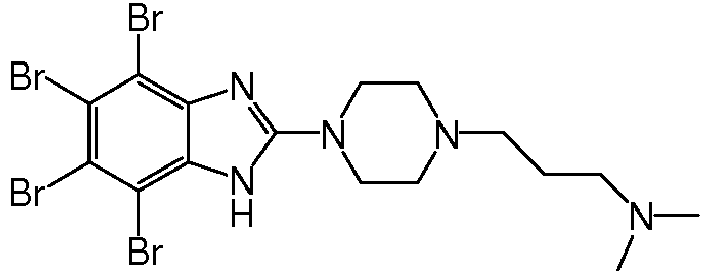
76 4,5,6,7-tetrabromo-2-(4-(2-(piperidin-1-yl)ethyl)piperazin-1-yl)-1H-benzo[d]imidazole; C18H23Br4N5 (MW 629.02) General procedure A; m/z 629.8 [M+H]+; 
103 3-(4-(4,5,6,7-tetrabromo-1H-benzo[d]imidazol-2-yl)piperazin-1-yl)-N,N,N-trimethylpropan-1-ammonium bromide; C17H24Br5N5 (MW 697.93) General procedure B; m/z 617.9 [M-H]-; RT= 2.3 min 
242 4,5,6,7-tetrabromo-2-(indolin-1-yl)-1H-benzo[d]imidazole; C15H9Br4N3 (MW 550.87) General procedure A; m/z 551.7[M+H]+; RT= 23.4 min 
256 4,5,6,7-tetrabromo-2-(4-methyl-1,4-diazepan-1-yl)-1H-benzo[d]imidazole; C13H14Br4N4 (545.89) General procedure A; m/z 546.7 [M+H]+; RT= 5.6 min 
260 4,5,6,7-tetrabromo-2-(1,4-diazepan-1-yl)-1H-benzo[d]imidazole; C12H12Br4N4 (531.87) General procedure A; m/z 532.7 [M+H]+; RT= 5.6 min 
262 4,5,6,7-tetrabromo-2-(3-((2-methyl-1H-imidazol-1-yl)methyl)piperidin-1-yl)-1H-benzo[d]imidazole; C17H17Br4N5 (610.97) General procedure A; m/z 611.8 [M+H]+; RT= 6.7 min 
266 4,5,6,7-tetrabromo-2-(3-((4-(pyridin-2-yl)piperazin-1-yl)methyl)piperidin-1-yl)-1H-benzo[d]imidazole C22H24Br4N6 (692.07) General procedure A; m/z 692.9 [M+H]+; RT= 6.6 min 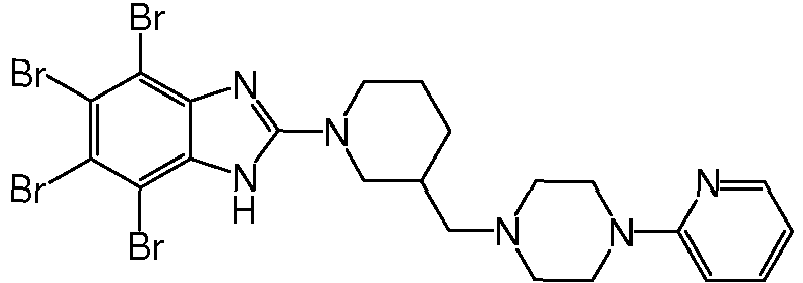
301 4,5,6,7-tetrabromo-2-(4-(1-[1-(1,1-dioxidotetrahydro-3-thienyl)-3,5-dimethyl-1H-pyrazol-4-yl]piperazin-1-yl-1H-benzo[d]imidazole; C20H22Br4N6O2S (730.11) General procedure A; m/z 730.8 [M+H]+; RT= 17.6 min 
305 1-(4,5,6,7-tetrabromo-1H-benzo[d]imidazol-2-yl)-N-(5-methylthiazol-2-yl)piperidine-4-carboxamide; C17H15Br4N5OS (657.02) General procedure A; m/z 
657.8 [M+H]+; RT= 16.3 min 343 2-(4-(4,5,6,7-tetrabromo-1H-benzo[d]imidazol-2-yl)piperazin-1-yl)-N,N-dimethylethanamine; C15H19Br4N5 (588.96) General procedure A; m/z 589.9 [M+H]+; RT= 5.4 min 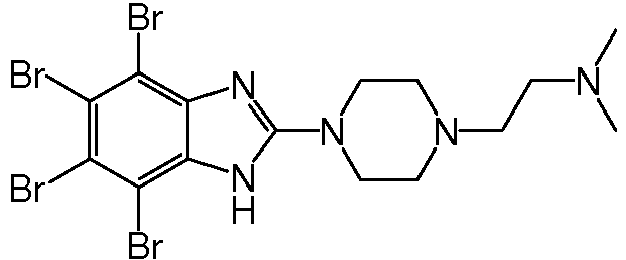
350 2-(4,5,6,7-tetrabromo-1H-benzo[d]imidazol-2-yl)-2,5-diaza-bicyclo[3.2.2]nonane; C14H14Br4N4 (557.9) General procedure A; m/z 558.9 [M+H]+; RT= 6.0 min 
353 4,5,6,7-tetrabromo-2-((3aR,7aS)-octahydroindol-1-yl)-1H-benzo[d]imidazole; C14H12Br4N4 (555.89) General procedure A; m/z 577.8 [M+23]+; RT= 12.7 min 
359 4,5,6,7-tetrabromo-1-isopropyl-2-(piperazin-1-yl)-1H-benzo[d]imidazole; C14H16Br4N4 (559.92) General procedure A; m/z 560.7 [M+H]+; RT= 7.5 min 
364 4,5,6,7-tetrabromo-2-((2S,5R)-2,5-dimethylpiperazin-1-yl)-1H-benzo[d]imidazole; C13H14Br4N4 (545.89) General procedure A; m/z 546.7 [M+H]+; RT= 6.3 min 
367 1-(4,5,6,7-tetrabromo-1H-benzo[d]imidazol-2-yl)-1,2,3,4-tetrahydroquinoxaline; C15H10Br4N4 (565.88) General procedure A; m/z 566.6 [M+H]+; RT= 19.5 min 
374 1-benzyl-4,5,6,7-tetrabromo-2-(piperazin-1-yl)-1H-benzo[d]imidazole; C18H16Br4N4 (607.96) General procedure A; m/z 608.6 [M+H]+; RT= 8.2 min 
376 ethyl 4-(4,5,6,7-tetrabromo-1H-benzo[d]imidazol-2-yl)piperazine-1-carboxylate; C15H16Br4N4O2 (603.93) General procedure C; m/z 604.7[M+H]+; RT= 9.2 min 
377 ethyl 2-(4-(ethoxycarbonyl)piperazin-1-yl)-4,5,6,7-tetrabromo-1H-benzo[d]imidazole-1-carboxylate; C19H22Br4N4O4 (690.02) General procedure C; m/z 690.8 [M+H]+; RT= 11.6 min 
378 1-(4,5,6,7-tetrabromo-1H-benzo[d]imidazol-2-yl)-N,N-dimethylpiperidin-3-amine; C14H16Br4N4 (559.92) General procedure A; m/z 560.8 [M+H]+; RT= 6.1 min 
383 3-(4-(4,5,6,7-tetrabromo-1H-benzo[d]imidazol-2-yl)piperazin-1-yl)propan-1-ol; C14H16Br4N4O4 (575.92) General procedure A; m/z 576.7 [M+H]+; RT= 5.5 min 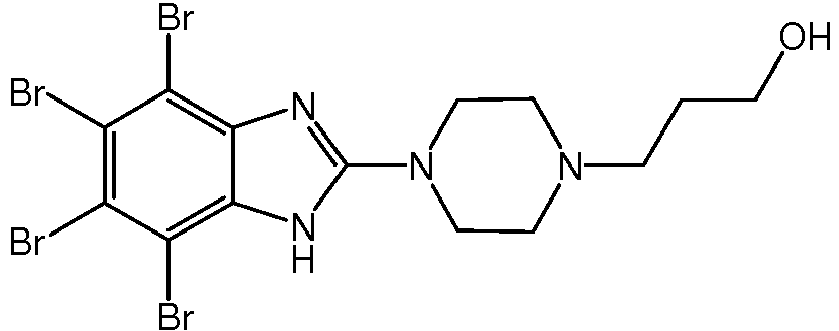
384 2-(4-(4,5,6,7-tetrabromo-1H-benzo[d]imidazol-2-yl)piperazin-1-yl)-3-methylbutanenitrile; C16H17Br4N5 (MW 598.96) General procedure A; m/z 599.8 [M+H]+; RT= 20.2 min 
385 4,5,6,7-tetrabromo-2-(4-(4-methylpiperazin-1-yl)piperidin-1-yl)-1H-benzo[d]imidazole; C17H21Br4N5(MW 615.0) General procedure A; m/z 615.7 [M+H]+; RT= 5.3 min 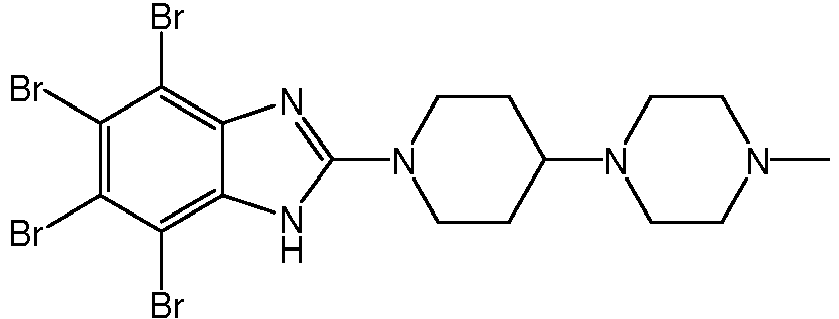
386 4,5,6,7-tetrabromo-2-(4-(piperidin-4-yl)piperidin-1-yl)-1H-benzo[d]imidazole; C17H20Br4N4 (599.98) General procedure A; m/z 600.8 [M+H]+; RT= 6.9 min 
387 2-(4-((H-imidazo[1,2-a]pyridin-2-yl)methyl)piperazin-1-yl)-4,5,6,7-tetrabromo-1H-benzo[d]imidazole; C19H16Br4N6 (647.99) General procedure A; m/z 650.8 [M+H]+; RT= 6.2 min 
389 4,5,6,7-tetrabromo-2-(4-((2-(4-fluorophenyl)thiazol-4-yl)methyl)piperazin-1-yl)-1H-benzo[d]imidazole; C21H16Br4FN5S (709.06) General procedure A; m/z 709.7 [M+H]+; RT= 9.8 min 
390 4,5,6,7-tetrabromo-2-(4-((3-p-tolyl-1,2,4-oxadiazol-5-yl)methyl)piperazin-1-yl)-1H-benzo[d]imidazole; C21H18Br4N6O (690.02) General procedure; m/z 690.7 [M+H]+; RT= 21.3 min 
392 4-(4,5,6,7-tetrabromo-1H-benzo[d]imidazol-2-yl)piperazine-1-carboxamidine; C12H12Br4N6 (559.88) General procedure B; m/z 560.8 [M+H]+; RT= 5.9 min 
393 2-(4-(4,5,6,7-tetrabromo-1H-benzo[d]imidazol-2-yl)piperazin-1-yl)acetic acid; C13H12Br4N4O2 (575.88) General procedure C; m/z 576.8 [M+H]+; RT= 8.0 min 
394 2-(4-(3-methoxybenzyl)piperazin-1-yl)-4,5,6,7-tetrabromo-1H-benzo[d]imidazole; C19H18Br4N4O (637.99) General procedure A; m/z 638.8 [M+H]+; RT= 8.2 min 
414 4,5,6,7-tetrabromo-2-(4-((2-methyl-1H-imidazo[1,2-a]pyridin-3-yl)methyl)piperazin-1-yl)-1H-benzo[d]imidazole; C20H18Br4N6 (662.01) General procedure A; m/z 662.7 [M+H]+; RT= 6.7 min 
415 4,5,6,7-tetrabromo-1-methyl-2-(piperazin-1-yl)-1H-benzo[d]imidazole; C12H12Br4N4 (531.87) General procedure A; m/z 532.80 [M+H]+; RT= 5.9 min 
416 4,5,6,7-tetrabromo-1-ethyl-2-(piperazin-1-yl)-1H-benzo[d]imidazole; C13H14Br4N4 (545.89) General procedure A; m/z 546.7 [M+H]+; RT= 6.8 min 
417 4,5,6,7-tetrabromo-2-(piperazin-1-yl)-1-propyl-1H-benzo[d]imidazole; C14H16Br4N4 (559.92) General procedure A; m/z 560.8 [M+H]+; RT= 7.7 min 
421 [4-[4,5,6,7-tetrabromo-1-(carboxymethyl)-1H-benzo[d]imidazol-2-yl]piperazin-1-yl]acetic acid C15H14Br4N4O4 (633.91). General procedure C; m/z 634.8 [M+H]+; RT= 8.1 min 
436 4,5,6,7-tetrabromo-2-(4-(2-(piperazin-1-yl)ethyl)piperazin-1-yl)-1H-benzo[d]imidazole; C17H22Br4N6 (630.01) General procedure A; m/z 630.9 [M+H]+; RT= 3.6 min 
441 4,5,6,7-tetrabromo-1-ethyl-2-(4-(2-(piperazin-1-yl)ethyl)piperazin-1-yl)-1H-benzo[d]imidazole; C19H26Br4N6 (658.07) General procedure A; m/z 658.9 [M+H]+; RT=4.4 min 
450 4,5,6,7-tetrabromo-1-ethyl-2-(4-(3-morpholinopropyl)piperazin-1-yl)-1H-benzo[d]imidazole; C20H27Br4N5O (673.08) General procedure A; m/z 673.9 [M+H]+; RT= 4.0 min 
451 4,5,6,7-tetrabromo-2-(4-(3-(piperazin-1-yl)propyl)piperazin-1-yl)-1H-benzo[d]imidazole; C18H24Br4N6 (644.04) General procedure A; m/z 644.9 [M+H]+; RT= 2.9 min 
- Preferably, a pharmaceutically acceptable salt is selected from the group consisting of hydrochloride, hydrobromide, hydroiodide, nitrate, sulfate, bisulfate, phosphate, acid phosphate, isonicotinate, acetate, lactate, salicylate, citrate, tartrate, pantothenate, bitartrate, ascorbate, succinate, maleate, gentisinate, fumarate, gluconate, glucuronate, saccharate, formate, benzoate, glutamate, methanesulfonate, ethanesulfonate, benzensulfonate, p-toluenesulfonate and pamoate and the like.
- A "pharmaceutically-acceptable salt" is a cationic salt formed at any acidic (e.g. carboxylic acid) group, or an anionic salt formed at any basic (e.g. amino) group. Many such salts are known in the art, as described in World Patent Publication
87/05297, Johnston et al., published Sep. 11, 1987 - Such salts are well understood by the skilled artisan, and the skilled artisan is able to prepare any number of salts given the knowledge in the art. Furthermore, it is recognized that the skilled artisan may prefer one salt over another for reasons of solubility, stability, formulation ease and the like.
- The next subject of invention is a pharmaceutical composition, comprising a therapeutically effective amount of at least one compound selected from the group consisting of compounds as described above and optionally comprising a therapeutic agent selected from a chemotherapeutic or anti-proliferative agent, an immunomodulatory or immunosuppressive agent, or an anti-inflammatory agent.
- The term "composition" is intended to encompass a product comprising the specified ingredients in the specified amounts, as well as any product which results, directly or indirectly, from combinations of the specified ingredients in the specified amounts. The active agents of the invention are used, alone or in combination with one or more additional active ingredients, to formulate pharmaceutical compositions of the invention. A pharmaceutical composition of the invention comprises an effective amount of at least one active agent in accordance with the invention. As known in pharmaceutical technology, at least one pharmaceutically acceptable carrier may be comprised in embodiments of pharmaceutical compositions according to this invention. A carrier may also be denoted as excipient in the following.
- Preferably, the said composition optionally comprises a therapeutic agent selected from a chemotherapeutic or anti-proliferative agent, an immunomodulatory or immunosuppressive agent, or an anti-inflammatory agent.
- Preferably, the therapeutically effective amount provided in the treatment is administered in an amount of about 0,01 to 1,000 mg/kg at least once a day for the duration of the treatment.
- The term "therapeutically effective amount" as used herein, means that amount of active compound or pharmaceutical agent that elicits the biological or medicinal response in a tissue system, animal or human that is being sought by a researcher, veterinarian, medical doctor or other clinician, which includes alleviation of the symptoms of a disease or disorder. When referring to modulating the target receptor, a "therapeutically effective amount" means an amount sufficient to at least affect the activity of such receptor. Measuring the activity of the target kinase may be performed by routine analytical methods. Target kinase modulation is useful in a variety of settings, including assays. In addition, effective amounts or doses of the active agents of the present invention may be ascertained by routine methods such as modeling, dose escalation studies or clinical trials, and by taking into consideration routine factors, e.g., the mode or route of administration or drug delivery, the pharmacokinetics of the agent, the severity and course of the disease, disorder, or condition, the subject's previous or ongoing therapy, the subject's health status and response to drugs, and the judgment of the treating physician.
- The amount varies according to the size, age and response pattern of the patient, the severity of the disorders, the judgment of the attending physician and the like.
- Preferably, the said composition is administered parenterally, vaginally, rectally, transdermally, orally or through the otolaryngologal sphere.
- Preferably, it further comprises a pharmaceutically acceptable carrier selected from the group consisting of flavoring agents, sweetener, lubricants, solubilizers, suspending agents, fillers, glidants, compression aides, binders, tablet-disintegrating agents, effervescing agent, wetting agent encapsulating materials, dyestuff, and mixtures thereof wherein carrier is chosen from solid or liquid carriers, whether sterile or not.
- Preferably, the said composition optionally further comprises of one or more additional pharmaceutically acceptable carriers selected from the group consisting of a flavoring agents, sweeteners, binders, diluents, solubilizer, lubricants, suspending agents, fillers, glidants, compression aides, disintegrating agents, effervescing agents, dyestuffs, wetting agents or encapsulating materials and mixtures thereof wherein carrier is chosen from solid or liquid carriers, whether sterile or not. In powders, the carrier and compound is a finely divided solid. In tablets, said compound is mixed with a carrier having the necessary compression properties in suitable proportions and compacted in the shape and size desired. Said powders and tablets contain from 0,1 to 99% by weight of the compound. Solid carriers suitable for use in the composition of the invention include but are not limited to calcium phosphate, magnesium stearate, talc, sugars, lactose, dextrin, starch, gelatin, cellulose, methyl cellulose, sodium carboxymethyl cellulose, polyvinylpyrrolidine, low melting waxes and ion exchange resins.
- Any pharmaceutically acceptable liquid carrier suitable for preparing solutions, suspensions, emulsions, syrups and elixirs can be employed in the composition of the invention. Is that case, the compound is dissolved or suspended in a pharmaceutically acceptable liquid carrier such as water, an organic solvent, or pharmaceutically acceptable oil or fat, or a mixture thereof. Said liquid composition contain additionally or not other suitable pharmaceutical additives such as solubilizers, emulsifiers, buffers, preservatives, sweeteners, flavoring agents, suspending agents, thickening agents, coloring agents, viscosity regulators, stabilizers, osmo-regulators, or the like.
- Examples of liquid carriers suitable for oral and parenteral administration include water, particularly containing additives as above but not limited to cellulose derivatives, preferably sodium carboxymethyl cellulose solution, alcohols, including monohydric alcohols and polyhydric alcohols, such as glycols or their derivatives, or oils such as fractionated coconut oil, cottonseed oil and arachid oil. For parenteral administration the carrier may also be an oily ester such as ethyl oleate or isopropyl myristate.
- Preferably, the said composition is a sterile solution or suspension suitable for parenteral administration, including but not limited to intramuscular, intraperitoneal, intravenous, intrathecal or subcutaneous injection or perfusion.
- Preferably the pharmaceutical composition is suitable for oral administration either liquid or solid composition form, including pills, tablets, capsules, sachets, dragees, powders, granules, lozenges, powders for reconstitution, orally disintegrating tablet, films, osmotic controlled release capsule, elixir, emulsion, syrup, suspension, tincture, solutions or powder for inhalation and nebulization, or sublingual administration.
- Preferably, the said composition is a formulation for transdermal, rectal, vaginal administration, including ointments, creams, lotions, liniments, gels, paste, films, suppositories, enemas and pessaries.
- Preferably, the said composition is a formulation for administration through the eyes, ears and nose.
- Preferably, the composition is an immediate, extended or slow- release formulation. Preferably, the therapeutically effective amount is provided in the treatment of a disease, disorders or medical condition that is selected from the group consisting of myeloid leukemia both acute and chronic, acute lymphoblastic leukemia, chronic lymphocytic leukemia, hairy cell leukemia, myeloproliferative diseases, multiple myeloma, myelodysplastic syndrome, Hodgkin's disease, non-Hodgkin's lymphoma ; adenocarcinoma, lymphoma, leukemia of the kidney, Wilm's tumor, renal cell carcinoma, renal pelvis carcinoma, nephroma, teratoma, sarcoma of the kidney, squamous cell carcinoma, transitional cell carcinoma, adenocarcinoma of bladder and urethra, sarcoma of the prostate, seminoma, embryonal carcinoma, teratocarcinoma, choriocarcinoma, sarcoma, interstitial cell carcinoma, fibroadenoma, adenomatoid tumors, lipoma of the testis, angiosarcoma, fibrosarcoma, rhabdomyosarcoma, liposarcoma, myxoma, rhabdomyoma, fibroma, lipoma and teratoma of the heart, astrocytoma, medulloblastoma, glioma, ependymoma, germinoma , glioblastoma multiform, oligodendroglioma, schwannoma, retinoblastoma, congenital tumors of the brain, neurofibroma, meningioma, sarcoma of the spinal cord, osteoma, hemangioma, granuloma, xanthoma, osteitis deformians of the skull, meningiosarcoma, gliomatosis of the meninges; squamous cell, undifferentiated small cell, undifferentiated large cell, adenocarcinoma, alveolar carcinoma, bronchial adenoma, sarcoma, lymphoma, chondromatous hanlartoma, mesothelioma of the bronchus; adenocarcinoma, lymphoma, Karposi's sarcoma, leiomyoma, lipoma, , fibroma of the small bowel, large bowel, leiomyosarcoma, lymphoma of the esophagus, carcinoma, leiomyosarcoma of the stomach, ductal adenocarcinoma, insulinoma, glucagonoma, gastrinoma, vipoma of the pancreas; hepatocellular carcinoma, cholangiocarcinoma, hepatoblastoma, angiosarcoma, hepatocellular adenoma, hemangioma of the liver; osteogenic sarcoma, fibrosarcoma, malignant fibrous histiocytoma, chondrosarcoma, Ewing's sarcoma, malignant lymphoma including reticulum cell sarcoma, malignant giant cell tumor chondroma, osteochondroma such as osteocartilaginous exostoses, benign chondroma, chondroblastoma, chondromyxofibroma, osteoid osteoma and giant cell tumors, endometrial carcinoma, cervical carcinoma, pre-tumor cervical dysplasia, ovarian carcinoma including serous cystadenocarcinoma, mucinous cystadenocarcinoma, granulosa-thecal cell tumors, Sertol/Leydig cell tumors, dysgerminoma, malignant teratoma of the ovary, intraepithelial carcinoma, adenocarcinoma, fibrosarcoma, melanoma of the vulva, clear cell carcinoma, squamous cell carcinoma, botryoid sarcoma includingembryonal rhabdomyosarcoma of the vagina, fallopian tubes carcinoma), malignant melanoma, basal cell carcinoma, moles dysplastic nevi, angioma, dermatofibroma, keloids, bone marrow transplant rejection, rheumatoid arthritis, psoriasis, type I diabetes mellitus and multiple sclerosis. Thus, the terms "cancer", "neoplasm" or "neoplastic," as provided herein, refer to a cell afflicted by any one of the above-identified conditions but are not limited thereto.
- Preferably, it is for the prevention or treatment of neoplastic conditions, especially related with the modulation or regulation of serine/threonine or tyrosine kinases, preferably selected from the group of PIM, HIPK, DYRK, CLK, CDK, FLT, PKG, Haspin, MER, TAO, MNK and TRK kinases.
- Serine/threonine and tyrosine kinases inhibitors disclosed in this application may also be used for treating immune disorders such as but not limited to bone marrow transplant rejection, rheumatoid arthritis, psoriasis, type I diabetes mellitus, multiple sclerosis. Inhibition of serine/threonine and tyrosine kinases can be also used for treatment of infectious diseases exemplified by but not limited to infections with herpesiviruses.
- The next subject of invention is a use of the compound of Formula A as claimed in
independent claim 1 for the preparation of a pharmaceutical composition comprising a therapeutically effective amount of at least one compound selected from the group consisting of compounds as described above and optionally comprising a therapeutic agent selected from a chemotherapeutic or anti-proliferative agent, an immunomodulatory or immunosuppressive agent, or an anti-inflammatory agent. - Preferably, it is used for the prevention or treatment of neoplastic or immune conditions, especially related to the modulation or regulation of serine/threonine and tyrosine kinases, preferably selected from the group of PIM, HIPK, DYRK, CLK, CDK, FLT, PKG, Haspin, MER, TAO, MNK and TRK kinases.
- Preferably, for preventing or treating neoplastic conditions selected from the group consisting of myeloid leukemia both acute and chronic, acute lymphoblastic leukemia, chronic lymphocytic leukemia, hairy cell leukemia, a myeloproliferative disease, multiple myeloma, myelodysplastic syndrome, Hodgkin's disease, non-Hodgkin's lymphoma; adenocarcinoma, lymphoma, leukemia of the kidney, Wilm's tumor, renal cell carcinoma, renal pelvis carcinoma, nephroma, teratoma, sarcoma of the kidney, squamous cell carcinoma, transitional cell carcinoma, adenocarcinoma of bladder and urethra, sarcoma of the prostate, seminoma, embryonal carcinoma, teratocarcinoma, choriocarcinoma, sarcoma, interstitial cell carcinoma, fibroma, fibroadenoma, adenomatoid tumors, lipoma of the testis, angiosarcoma, fibrosarcoma, rhabdomyosarcoma, liposarcoma, myxoma, rhabdomyoma, lipoma and teratoma of the heart, astrocytoma, medulloblastoma, glioma, ependymoma, germinoma , glioblastorma multiform, oligodendroglioma, schwannoma, retinoblastoma, congenital tumors of the brain, neurofibroma, meningioma, sarcoma of the spinal cord, osteoma, hemangioma, granuloma, xanthoma, osteitis deformians of the skull, meningiosarcoma, gliomatosis of the meninges, alveolar carcinoma, bronchial adenoma, chondromatous hanlartoma, mesothelioma of the bronchus; adenocarcinoma, lymphoma, carcinoid tumors, Karposi's sarcoma, leiomyoma, lipoma, fibromaof the small bowel, adenocarcinoma, tubular adenoma, villous adenoma, hamartoma, leiomyoma of the large bowel, leiomyosarcoma, lymphoma of the esophagus, carcinoma, leiomyosarcoma of the stomach, ductal adenocarcinoma, insulinoma, glucagonoma, gastrinoma, vipoma of the pancreas; hepatocellular carcinoma, cholangiocarcinoma, hepatoblastoma, hepatocellular adenoma, hemangioma of the liver; osteogenic sarcoma, malignant fibrous histiocytoma, chondrosarcoma, Ewing's sarcoma, malignant lymphoma including reticulum cell sarcoma, malignant giant cell tumor chordoma, osteochronfroma including osteocartilaginous exostoses, benign chondroma, chondroblastoma, chondromyxofibroma, osteoid osteoma, giant cell tumors, endometrial carcinoma, cervical carcinoma, pre-tumor cervical dysplasia, ovarian carcinoma including serous cystadenocarcinoma, mucinous cystadenocarcinoma, granulosa-thecal cell tumors, Sertol/Leydig cell tumors, dysgerminoma, malignant teratoma of the ovary, intraepithelial carcinoma, melanoma of the vulva, clear cell carcinoma, botryoid sarcoma including embryonal rhabdomyosarcoma of the vagina, fallopian tubes carcinoma, breast malignant melanoma, basal cell carcinoma, squamous cell carcinoma, Karposi's sarcoma, moles dysplastic nevi, angioma, dermatofibroma, keloids, bone marrow transplant rejection, rheumatoid arthritis, psoriasis, type I diabetes mellitus and multiple sclerosis.
- Preferably, serine/threonine or tyrosine kinases, preferably kinases selected from the group of PIM, HIPK, DYRK, CLK, CDK, FLT, PKG, Haspin, MER, TAO, MNK and TRK kinases is in a subject with a disease, disorders or medical condition that is selected from the group consisting of myeloid leukemia both acute and chronic, acute lymphoblastic leukemia, chronic lymphocytic leukemia, hairy cell leukemia, a myeloproliferative disease, multiple myeloma, myelodysplastic syndrome, Hodgkin's disease, non-Hodgkin's lymphoma ; adenocarcinoma, lymphoma, leukemia of the kidney, Wilm's tumor, renal cell carcinoma, renal pelvis carcinoma, nephroma, teratoma, sarcoma of the kidney, squamous cell carcinoma, transitional cell carcinoma, adenocarcinoma of bladder and urethra, sarcoma of the prostate, seminoma, embryonal carcinoma, teratocarcinoma, choriocarcinoma, sarcoma, interstitial cell carcinoma, fibroma, fibroadenoma, adenomatoid tumors, lipoma of the testis, angiosarcoma, fibrosarcoma, rhabdomyosarcoma, liposarcoma, myxoma, rhabdomyoma, lipoma and teratoma of the heart, astrocytoma, medulloblastoma, glioma, ependymoma, germinoma , glioblastorma multiform, oligodendroglioma, schwannoma, retinoblastoma, congenital tumors of the brain, neurofibroma, meningioma, sarcoma of the spinal cord, osteoma, hemangioma, granuloma, xanthoma, osteitis deformians of the skull, meningiosarcoma, gliomatosis of the meninges, alveolar carcinoma, bronchial adenoma, chondromatous hanlartoma, mesothelioma of the bronchus; adenocarcinoma, lymphoma, carcinoid tumors, Karposi's sarcoma, leiomyoma, lipoma, fibromaof the small bowel, adenocarcinoma, tubular adenoma, villous adenoma, hamartoma, leiomyoma of the large bowel, leiomyosarcoma, lymphoma of the esophagus, carcinoma, leiomyosarcoma of the stomach, ductal adenocarcinoma, insulinoma, glucagonoma, gastrinoma, vipoma of the pancreas; hepatocellular carcinoma, cholangiocarcinoma, hepatoblastoma, hepatocellular adenoma, hemangioma of the liver; osteogenic sarcoma, malignant fibrous histiocytoma, chondrosarcoma, Ewing's sarcoma, malignant lymphoma including reticulum cell sarcoma, malignant giant cell tumor chordoma, osteochronfroma including osteocartilaginous exostoses, benign chondroma, chondroblastoma, chondromyxofibroma, osteoid osteoma, giant cell tumors, endometrial carcinoma, cervical carcinoma, pre-tumor cervical dysplasia, ovarian carcinoma including serous cystadenocarcinoma, mucinous cystadenocarcinoma, granulosa-thecal cell tumors, Sertol/Leydig cell tumors, dysgerminoma, malignant teratoma of the ovary, intraepithelial carcinoma, melanoma of the vulva, clear cell carcinoma, , botryoid sarcoma such as embryonal rhabdomyosarcoma of the vagina, fallopian tubes carcinoma, breast malignant melanoma, basal cell carcinoma, squamous cell carcinoma, Karposi's sarcoma, moles dysplastic nevi, angioma, dermatofibroma, keloids, bone marrow transplant rejection, rheumatoid arthritis, psoriasis, type I diabetes mellitus and multiple sclerosis.
- The next subject of invention is a process for the preparation of a compound as claimed herein characterized in that the process comprises: reacting of a corresponding, unsubstituted or substituted 2,4,5,6,7-pentabromo-benzimidazole with a suitable amine at elevated temperature, wherein the reactive substituents are optionally protected with suitable protecting groups and wherein the resulting product is subjected to purification by crystallization or chromatography according to the reaction as shown in
Reaction scheme 1 below.
- Reaction scheme 1: synthetic route of production of a compound by reacting an unsubstituted or substituted 2,4,5,6,7-pentahalogenated-benzimidazole with a suitable amine.
- Below, there are example embodiments of the present invention defined above.
- The following specific Examples are set forth to illustrate the invention and to aid in the understanding of the invention.
- The invention relates to compounds as claimed.
-
- 1 equivalent of appropriate derivative of 2,4,5,6,7-pentabromobenzimidazole suspended in ethanol was heated at 120°C together with 5 equivalents of appropriate amine in a sealed tube for 5 to 20 hours. Alternatively, the reaction can be carried in butanol reflux. Product was isolated using crystallization or flash chromatography.
- 1 equivalent of 4,5,6,7-tetrabromo-2-(piperazin-1-yl)-1H-benzo[d]imidazole or N-(3-aminopropyl)-4,5,6,7-tetrabromo-1H-benzo[d]imidazol-2-amine was suspended in DMF with 2 equivalents of DIPEA. Suspension was cooled to 0°C and then 2 equivalents of 1H-pyrazole-1-carboximidamide were added. The reaction mixture (RM) was stirred for 4 hours and then NaOH was added. Solid product was filtered and washed with distilled water.
- 1 equivalent of 4,5,6,7-tetrabromo-2-(piperazin-1-yl)-1H-benzo[d]imidazole was suspended in EtOH with 2 equivalents of appropriate halogeno derivative and 2 eq of K2CO3. RM was refluxed for 2-16 hours. Product was isolated using crystallization or flash chromatography.
- 1 equivalent of N1-(4,5,6,7-tetrabromo-1H-benzo[d]imidazol-2-yl)cyclohexane-1,2-diamine and 1 eq of appropriate ketone or aldehyde derivative were suspended in DCE and then 2 eq of NaBH(OAc)3 and 1 eq ofAcOH were added. Solution was stirred at room temperature for 24 hours. Product was isolated using crystallization or flash chromatography.
- Ten thousand cells of human chronic myelocytic leukemia K562 were inoculated into each well of a 96-well microplate (manufactured by Corning Corp.) using Iscove's MDM medium (culture medium) containing 10% fetal calf serum (FCS). Next day, a dimethyl sulfoxide (DMSO) solution of each test compound prepared in a concentration of 10 mmol/L was further diluted with culture medium to the desired concentrations (0.1, 0.5, 1, 2.5, 5 and 10 micromol/L), and the diluted solution was added to each well. The individual wells were further cultured in 5% carbon dioxide at 37° C for 72 hours. After completion of the culture, 10 µl MTS (3-(4,5-Dimethyl-2-thiazolyl)-5-(carboxymethoxyphenyl)-2-(4-sulfophenyl)-2H-tetrazolium, inner salt assay (CellTiter96® AQueous One Solution Cell Proliferation Assay, Promega) was added to each well, and culturing was performed in 5% carbon dioxide at 37° C for 2 hours. Using a microplate spectrophotometer (Synergy 2 multi-mode microplate reader (BioTek)), the absorbance of each well was measured at 490 nm. The value for cells not incorporated with a test compound was designated as 100%. By comparing these values with the absorbance difference obtained at the well in which each test compound was added, the cell viability (% viability) after treatment with the test compound was calculated.
- Two thousand cells of human prostate adenocarcinoma PC3 were inoculated into each well of a 96-well microplate (manufactured by Corning Corp.), and using F12K (Ham's F12:RPMI 8226 1:1) medium (culture medium) containing 10% fetal calf serum (FCS). Next day, a dimethyl sulfoxide (DMSO) solution of each test compound prepared in a concentration of 10 mmol/L was further diluted with culture medium to the desired concentrations (0.1, 0.5, 1, 2.5, 5 and 10 micromol/L), and the diluted solution was added to each well. The individual wells were further cultured in 5% carbon dioxide at 37° C for 72 hours. After completion of the culture, 10 µl MTS (3-(4,5-Dimethyl-2-thiazolyl)-5-(carboxymethoxyphenyl)-2-(4-sulfophenyl)-2H-tetrazolium, inner salt assay (CellTiter96® AQueous One Solution Cell Proliferation Assay, Promega) was added to each well, and culturing was performed in 5% carbon dioxide at 37° C for 2 hours. Using a microplate spectrophotometer (Synergy 2 multi-mode microplate reader (BioTek)), the absorbance of each well was measured at 490 nm. The value for cells not incorporated with a test compound was designated as 100%. By comparing these values with the absorbance difference obtained at the well in which each test compound was added, the cell viability (% viability) after treatment with the test compound was calculated.
- Two thousand cells of human prostate carcinoma DU145 were inoculated into each well of a 96-well microplate (manufactured by Corning Corp.), and using DMEM medium (culture medium) containing 10% fetal calf serum (FCS). Next day, a dimethyl sulfoxide (DMSO) solution of each test compound prepared in a concentration of 10 mmol/L was further diluted with culture medium to the desired concentrations (0.1, 0.5, 1, 2.5, 5 and 10 micromol/L), and the diluted solution was added to each well. The individual wells were further cultured in 5% carbon dioxide at 37° C for 72 hours. After completion of the culture, 10 µl MTS (3-(4,5-Dimethyl-2-thiazolyl)-5-(carboxymethoxyphenyl)-2-(4-sulfophenyl)-2H-tetrazolium, innersalt assay (CellTiter96® AQueous One Solution Cell Proliferation Assay, Promega) was added to each well, and culturing was performed in 5% carbon dioxide at 37° C for 2 hours. Using a microplate spectrophotometer (Synergy 2 multi-mode microplate reader (BioTek)), the absorbance of each well was measured at 490 nm. The value for cells not incorporated with a test compound was designated as 100%. By comparing these values with the absorbance difference obtained at the well in which each test compound was added, the cell viability (% viability) after treatment with the test compound was calculated.
- Two thousand cells of human breast adenocarcinoma MCF7 were inoculated into each well of a 96-well microplate (manufactured by Corning Corp.), and using DMEM medium (culture medium) containing 10% fetal calf serum (FCS). Next day, a dimethyl sulfoxide (DMSO) solution of each test compound prepared in a concentration of 10 mmol/L was further diluted with culture medium to the desired concentrations (0.1, 0.5, 1, 2.5, 5 and 10 micromol/L), and the diluted solution was added to each well. The individual wells were further cultured in 5% carbon dioxide at 37°C for 72 hours. After completion of the culture, 10 µl MTS (3-(4,5-Dimethyl-2-thiazolyl)-5-(carboxymethoxyphenyl)-2-(4-sulfophenyl)-2H-tetrazolium, inner salt assay (CellTiter96® AQueous One Solution Cell Proliferation Assay, Promega) was added to each well, and culturing was performed in 5% carbon dioxide at 37°C for 2 hours. Using a microplate spectrophotometer (Synergy 2 multi-mode microplate reader (BioTek)), the absorbance of each well was measured at 490 nm. The value for cells not incorporated with a test compound was designated as 100%. By comparing these values with the absorbance difference obtained at the well in which each test compound was added, the cell viability (% viability) after treatment with the test compound was calculated.
- Two thousand cells of human colorectal adenocarcinoma SW480 were inoculated into each well of a 96-well microplate (manufactured by Corning Corp.), and using DMEM/ Ham's F121:1 medium (culture medium) containing 5% fetal calf serum (FCS). Next day, a dimethyl sulfoxide (DMSO) solution of each test compound prepared in a concentration of 10 mmol/L was further diluted with culture medium to the desired concentrations (0.1, 0.5, 1, 2.5, 5 and 10 micromol/L), and the diluted solution was added to each well. The individual wells were further cultured in 5% carbon dioxide at 37°C for 72 hours. After completion of the culture, 10 µl MTS (3-(4,5-Dimethyl-2-thiazolyl)-5-(carboxymethoxyphenyl)-2-(4-sulfophenyl)-2H-tetrazolium, inner salt assay (CellTiter96® AQueous One Solution Cell Proliferation Assay, Promega) was added to each well, and culturing was performed in 5% carbon dioxide at 37°C for 2 hours. Using a microplate spectrophotometer (Synergy 2 multi-mode microplate reader (BioTek)), the absorbance of each well was measured at 490 nm. The value for cells not incorporated with a test compound was designated as 100%. By comparing these values with the absorbance difference obtained at the well in which each test compound was added, the cell viability (% viability) after treatment with the test compound was calculated.
- Ten thousand cells of human myelomonocytic, biphenotypic leukemia MV4-11 were inoculated into each well of a 96-well microplate (manufactured by Corning Corp.)using Iscove's MDM medium (culture medium) containing 10% fetal calf serum (FCS). Next day, a dimethyl sulfoxide (DMSO) solution of each test compound prepared in a concentration of 10 mmol/L was further diluted with culture medium to the desired concentrations (0.1, 0.5, 1, 2.5, 5 and 10 micromol/L), and the diluted solution was added to each well. The individual wells were further cultured in 5% carbon dioxide at 37°C for 72 hours. After completion of the culture, 10 µl MTS (3-(4,5-Dimethyl-2-thiazolyl)-5-(carboxymethoxyphenyl)-2-(4-sulfophenyl)-2H-tetrazolium, inner salt assay (CellTiter96® AQueous One Solution Cell Proliferation Assay, Promega) was added to each well, and culturing was performed in 5% carbon dioxide at 37°C for 2 hours. Using a microplate spectrophotometer (Synergy 2 multi-mode microplate reader (BioTek)), the absorbance of each well was measured at 490 nm. The value for cells not incorporated with a test compound was designated as 100%. By comparing these values with the absorbance difference obtained at the well in which each test compound was added, the cell viability (% viability) after treatment with the test compound was calculated.
- Twenty thousand cells of human acute lumphocytic leukemia E6.1 Jurkat were inoculated into each well of a 96-well microplate (manufactured by Corning Corp.) using RPMI 8226 medium (culture medium) containing 10% fetal calf serum (FCS). Next day, a dimethyl sulfoxide (DMSO) solution of each test compound prepared in a concentration of 10 mmol/L was further diluted with culture medium to the desired concentrations (0.1, 0.5, 1, 2.5, 5 and 10 micromol/L), and the diluted solution was added to each well. The individual wells were further cultured in 5% carbon dioxide at 37°C for 72 hours. After completion of the culture, 10 µl MTS (3-(4,5-Dimethyl-2-thiazolyl)-5-(carboxymethoxyphenyl)-2-(4-sulfophenyl)-2H-tetrazolium, inner salt assay (CellTiter96® AQueous One Solution Cell Proliferation Assay, Promega) was added to each well, and culturing was performed in 5% carbon dioxide at 37°C for 2 hours. Using a microplate spectrophotometer (Synergy 2 multi-mode microplate reader (BioTek)), the absorbance of each well was measured at 490 nm. The value for cells not incorporated with a test compound was designated as 100%. By comparing these values with the absorbance difference obtained at the well in which each test compound was added, the cell viability (% viability) after treatment with the test compound was calculated.
- Two thousand cells of human hepatoma HepG2 were inoculated into each well of a 96-well microplate (manufactured by Corning Corp.) using DMEM medium (culture medium) containing 10% fetal calf serum (FCS). Next day, a dimethyl sulfoxide (DMSO) solution of each test compound prepared in a concentration of 10 mmol/L was further diluted with culture medium to the desired concentrations (0.1, 0.5, 1, 2.5, 5 and 10 micromol/L), and the diluted solution was added to each well. The individual wells were further cultured in 5% carbon dioxide at 37°C for 72 hours. After completion of the culture, 10 µl MTS (3-(4,5-Dimethyl-2-thiazolyl)-5-(carboxymethoxyphenyl)-2-(4-sulfophenyl)-2H-tetrazolium, inner salt assay (CellTiter96® AQueous One Solution Cell Proliferation Assay, Promega) was added to each well, and culturing was performed in 5% carbon dioxide at 37°C for 2 hours. Using a microplate spectrophotometer (Synergy 2 multi-mode microplate reader (BioTek)), the absorbance of each well was measured at 490 nm. The value for cells not incorporated with a test compound was designated as 100%. By comparing these values with the absorbance difference obtained at the well in which each test compound was added, the cell viability (% viability) after treatment with the test compound was calculated.
- Ten thousand cells of human erytroblast leukemia HEL-92.1.7 were inoculated into each well of a 96-well microplate (manufactured by Corning Corp.) using RPMI 1640 medium (culture medium) containing 10% fetal calf serum (FCS). Next day, a dimethyl sulfoxide (DMSO) solution of each test compound prepared in a concentration of 10 mmol/L was further diluted with culture medium to the desired concentrations (0.1, 0.5, 1, 2.5, 5 and 10 micromol/L), and the diluted solution was added to each well. The individual wells were further cultured in 5% carbon dioxide at 37°C for 72 hours. After completion of the culture, 10 µl MTS (3-(4,5-Dimethyl-2-thiazolyl)-5-(carboxymethoxyphenyl)-2-(4-sulfophenyl)-2H-tetrazolium, inner salt assay (CellTiter96® AQueous One Solution Cell Proliferation Assay, Promega) was added to each well, and culturing was performed in 5% carbon dioxide at 37°C for 2 hours. Using a microplate spectrophotometer (Synergy 2 multi-mode microplate reader (BioTek)), the absorbance of each well was measured at 490 nm. The value for cells not incorporated with a test compound was designated as 100%. By comparing these values with the absorbance difference obtained at the well in which each test compound was added, the cell viability (% viability) after treatment with the test compound was calculated.
- Kinase assay was performed using luminescent Kinase-Glo® (Promega) system. The Kinase-Glo® Luminescent Kinase Assay Platform provides a homogeneous, high-throughput screening method for measuring kinase activity by quantifying the amount of ATP remaining in solution following a kinase reaction. The luminescent signal is correlated with the amount of ATP present and is inversely correlated with the kinase activity. Appropriate amounts of both kinase and substrate were mixed in 96-well, white wall plate in the reaction buffer (8 mM MOPS/NaOH, pH7.0, 0,2mM EDTA, 2mM MgCl2). Tested compounds were diluted in DMSO and serial dilutions starting with 1 µM were added to the palates. Reaction was initiated by adding 1 µM of ATP solution and conducted for 25 min. at RT. Luminescent signal was detected by adding Kinase-Glo® reagent and measured using a microplate spectrophotometer (Synergy 2 multi-mode microplate reader (BioTek)). IC50 values were obtained by fitting sigmoidal dose-response curve (variable slope) using GraphPad Prism software.
- Reaction conditions are presented in Table 3.
Table 3. Reaction conditions for luminometric kinase assay. Kinase Kinase concentration Peptide substrate sequence Peptide concentration ATP concentration PIM-1 6ng KKRNRTLTK 100 µM 1 µM - As reference compounds previously described halogenated derivatives of benzotriazole, benzimidazole and benzopyrazole were used (Pagano et al., Biochem. J. 2008 415, 353-365), Structures of used reference compounds DMAT, TBB, TBI, K66 and K64 are depicted on
Figure 2 of the above publication. - DMAT:
- 2-dimethylamino-4,5,6,7-tetrabromo-1H-benzimidazole
- TBB:
- 4,5,6,7-tetrabromo-1Hbenzotriazole
- TBI- or TBBz:
- 4,5,6,7-tetrabromo-1H-benzimidazole
- K66:
- 1-carboxymethyl-2-dimethylamino-4,5,6,7-tetrabromo-benzimidazole
- K64:
- 3,4,5,6,7-pentabromo-1H-indazole
- (http://www.millipore.com/drugdiscovery/dd3/KinaseProfiler) using the Millipore's KinaseProfilerTM service, a high-throughput method for screening small molecule compounds against large numbers of different wild type and mutant kinases. This kinase panel is based on radiometric assay that quantitatively measures the ability of a compound to prevent phosphorylation of a peptide substrate. The radiometric based filtration binding assay is considered to be the "gold standard" to which other non-radiometric methods are compared. In this assay type, the kinase reaction is performed in the presence of radioactive ATP isotope followed by binding of the final radioisotope labeled products to filters. After the reaction was performed, unreacted phosphate is washed away and the levels of phosphorylated radioactive substrate are measured. Selectivity of kinase inhibition is one of the key parameters in therapeutic use of this class of compounds. Off-target inhibition could be one of the major safety and toxicity issues in drug development and use of the compounds for treatment of various disease conditions, but also can be one of the reasons of potency and anticancer effect displayed by the compound. Several examples of kinase inhibitors are described in the literature for which after a more detailed and broad analysis is was shown, that the activity is not related to primary target.
- Therefore representative compounds disclosed in the application were tested on a panel kinases to determine specificity in PIM kinase inhibition. Table 5 provides selectivity data for
representative compound 4,5,6,7-tetrabromo-1-ethyl-2-(piperazin-1-yl)-1H-benzo[d]imidazole (compound 416). As indicated in the Table 5 when tested at 1µM concentration 4,5,6,7-tetrabromo-1-ethyl-2-(piperazin-1-yl)-1H-benzo[d]imidazole was revealed to be not only a potent inhibitor of PIM kinases, but also exerts activity on a set of other kinases.Table 5. KinomeScan Max kinase binding inhibition panel results for 4,5,6,7-tetrabromo-1-ethyl-2-(piperazin-1-yl)-1H-benzo[d]imidazole tested at 1 µM in duplicate. Values represent % of remaining kinase activity Kinase % remaining activity Kinase % remaining activity Kinase % remaining activity Kinase % remaining activity HIPK3(h) -1 CK1δ(h) 62 JNK3(h) 87 Abl (Q252H) (h) 98 Flt3(h) 0 Hck(h) activated 63 MINK(h) 87 LIMK1(h) 98 CDK5/p25(h) 1 Lyn(h) 65 MLK1(h) 87 PDGFRα(h) 98 Flt3(DS35Y)(h) 1 Src(1-530)(h) 65 MSSK1(h) 87 PKCβII(h) 98 HIPK2(h) 1 GSK3β(h) 66 TGFBR1(h) 87 EphA4(h) 99 PIM-1(h) 1 STK33(h) 66 MLCK(h) 88 EphA5(h) 99 CDK5/p35(h) 2 AMPKα2(h) 67 PhKγ2(h) 88 FGFR1(h) 99 CLK2(h) 2 CaMKIIβ(h) 67 ULK2(h) 88 PTK5(h) 99 Haspin(h) 2 Fgr(h) 67 CaMKI(h) 89 SAPK2a(h) 99 PKG1β(h) 5 PDGFRα(V561D)(h) 68 CK1γ3(h) 89 Txk(h) 99 CDK2/cyclinE(h) 6 SAPK3(h) 68 EGFR(h) 89 ASK1(h) 100 CK1(y) 6 FGFR1(V561M)(h) 69 ErbB4(h) 89 DAPK1(h) 100 cKit(D816H)(h) 6 Lck(h) activated 69 PKCδ(h) 89 EphB4(h) 100 TAO1(h) 6 Met(M1268T)(h) 70 Rsk4(h) 89 Fer(h) 100 CDK1/cyclinB(h) 7 Met(Y1248H)(h) 70 Abl(m) 90 JNK2α2(h) 100 CDK2/cyclinA(h) 7 PKA(h) 70 PKBβ(h) 90 MKK4(m) 100 PKG1α(h) 7 MST1(h) 71 ROCK-I(h) 90 PAK3(h) 100 HEPK1(H) 8 ROCK-Π(r) 71 SGK(h) 90 DCAMKL2(h) 101 PIM-2(h) 10 Rsk3(h) 71 Snk(h) 90 FGFR2(N549H)(h) 101 EGFR(T790M,L858R)(h) 11 Fms(h) 72 BrSK2(h) 91 MAPKAP-K2(h) 101 Mer(h) 14 Met(D1246H)(h) 72 CDK6/cyclinD3(h) 91 Plk3(h) 101 TAO3(h) 14 CK2α2(h) 73 CSK(h) 91 Tie2(R849W)(h) 101 CDK3/cyclinE(h) 16 Fyn(h) 73 EphA7(h) 91 BTK(R28H)(h) 102 MSK2(h) 16 Lyn(m) 73 FGFR2(h) 91 EphA8(h) 102 Flt4(h) 17 MEK1(h) 73 GRK6(h) 91 PDGFRβ(h) 102 Mnk2(h) 17 Met(Y1248C)(h) 73 IRR(h) 91 PKCβI(h) 102 PDGFRα(D842V)(h) 17 NEK11(h) 73 MARK1(h) 91 SRPK2(h) 102 Ret(VS04M)(h) 20 JAK3(h) 74 NEK2(h) 91 WNK2(h) 102 EGFR(L858R)(h) 22 Met(D1246N)(h) 74 PRAK(h) 91 BrSK1(h) 103 CDK7/cyclinH/MAT1(h) 25 PrKX(h) 74 SAPK2b(h) 91 mTOR/FKBP12(h) 103 PKCθ(H) 26 EphA1(h) 75 Tie2(V897S)(h) 91 MuSK(h) 103 Ret (V804L)(h) 26 GCK(h) 75 Abl(T315I)(h) 92 VRK2(h) 103 CDK9/cyclin T1(h) 27 IGF-1R(h) 75 Abl(Y253F)(h) 92 IR(h) 104 EGFR(L861Q)(h) 27 BRK(h) 76 DAPK2(h) 92 PKCε(h) 104 Ret(h) 27 CHK2(h) 76 Fms(Y969C)(h) 92 
104 CaMKIIδ(h) 28 CHK2(R145W)(h) 76 PKCη(h) 92 Ros(h) 104 EGFR(T790M)(h) 28 IKKβ(h) 78 SGK3(h) 92 TBK1(h) 104 KDR(H) 28 cSRC(h) 79 Tie2(h) 92 TLK2(h) 104 PASK(h) 28 Hck(h) 79 ARK5(h) 93 DDR2(h) 105 PKCµ(h) 30 PAK4(h) 79 GRK7(h) 93 FGFR3(h) 105 IRAK1(h) 33 RIPK2(h) 79 IR(h), activated 93 Itk(h) 105 PIM-3(h) 34 Rskl(r) 79 MST2(h) 93 Rse(h) 105 cKit(V560G)(h) 35 SGK2(h) 79 MST3(h) 93 ALK(h) 106 TRKA(h) 35 Aurora-B(h) 80 PAK5(h) 93 EphA2(h) 106 Axl(h) 36 CHK2(I157T)(h) 80 PKCγ(h) 93 EphB2(h) 106 cKit(V654A)(h) 36 MAPK2(h) 81 Bmx(h) 94 MAPKAP-K3(h) 106 TRKB(h) 37 Met(h) 81 CaMKIδ(h) 94 SRPK1(h) 106 PYBγ(h) 39 Met(Y1248D)(h) 81 EphA3(h) 94 Abl(h) 107 Flt1(h) 40 ROCK-II(h) 81 FAK(h) 94 Abl(H396P) (h) 107 Src(T341M)(h) 40 Rsk2(h) 81 FGFR4(h) 94 BTK(h) 107 CaMKIIγ(h) 41 AMPKα1(h) 82 MAPK1(h) 94 eEF-2K(h) 107 Lck(h) 43 CLK3(h) 82 WNK3(h) 94 PKCζ(h) 107 MKK6(h) 43 DRAK1(h) 82 Abl(M351T)(h) 95 Tec(h) activated 107 DYRK2(h) 45 MAPK2(m) 82 MKK7β(h) 95 Ron(h) 108 Yes(h) 48 TAO2(h) 82 mTOR(h) 95 ZAP-70(h) 108 LOK(h) 50 CK1γ1(h) 83 PAK2(h) 95 PDK1(h) 109 SAPK4(h) 51 SIK(h) 84 PKCα(h) 95 ALK4(h) 112 Fes(h) 52 ULK3(h) 84 Syk(h) 95 CHK1(h) 113 IRAK4(h) 52 CaMKIV(h) 85 TSSK2(h) 95 MRCKβ(h) 113 TAK1(H) 52 CK1γ2(h) 85 ZIPK(h) 95 NEK7(h) 115 MSK1(h) 54 c-RAF(h) 85 Arg(m) 96 Plk1(h) 117 IKKα(h) 56 NEK3(h) 85 GRK5(h) 96 Arg(h) 119 p70S6K(h) 56 NLK(h) 85 MRCKα(h) 96 cKit(h) 121 PRK2(h) 56 PAK6(h) 85 TSSK1(h) 96 EphB3(h) 121 Rsk1(h) 56 PAR-1Bα(h) 85 ACK1(h) 97 JAK2(h) 121 PKD2(h) 58 LKB1(h) 86 Blk(m) 97 Aurora-A(h) 125 CK2(h) 59 MELK(h) 86 DMPK(H) 97 PKBα(h) 59 SAPK2a(T106M)(h) 86 JNK1α1(h) 97 GSK3α(h) 60 EphB1(h) 87 NEK6(h) 97 cKit(D816V)(h) 61 IGF-1R(h), activated 87 Pyk2(h) 97 - The inventors have investigated the efficacy of PIM-1 kinase inhibition by
compound 20 on MV4-11cells Figure 1 ). Sunitinib was used as a positive control. After densitometric quantification of the obtained results, cellular IC50 was assessed (Table 6). The analysis revealed dose dependent inhibition of c-MYC after 4h and 24h being most efficient after 4h. Similarly, another biomarker, p-4EBP1(Ser65), showed dose- and time-dependent inhibition. PIM-1 and tubulin protein levels were assessed as controls.Table 6. Comparison of calculated cellular IC50 for biomarker inhibition in MV411 cells after 4 and 24h treatment with compound 20. Values are given in µM concentration.compound 204h 24h c- MYC 0,89 2,03 p-4EBP1 (Ser65) 3,13 1,12 - The anticancer activity of
compounds Figure 2 ) and tumor growth inhibition (TGI) was calculated. After 21 days of treatment, compounds 20 (dose 150 mg/kg, administration QD), 359 and 416 showed the most pronounced tumor growth inhibition (Table 7).Table 7. Comparison of xenograft results after treatment with compound 20, -359, and -416 compounds. TGI - tumor growth inhibition, QD - once a day.Compound Dose TGI (%) Control - 0 compound 20150 mg/kg, QD -57,8 compound 359 150 mg/kg, QD -84,7 compound 416150 mg/kg, QD -102,8 - Compound stock solutions were prepared in DMSO to final concentrations of 1000 mM. For each compound studied, 12 solutions were prepared to cover concentrations from 0.001 to 1 mM. As a solvent 0.2 mM phosphate buffer (pH 7.4) was used. The final concentration of DMSO in the solutions was 1% (v/v). The solutions were left mixing for 24 hours at 37°C, 350 rpm and following incubation centrifuged for 5 minutes at 14500 rpm. The samples were then analyzed by RP HPLC using a C18 column and 0.2% solution of formic acid in water/acetonitrile mobile phase. For low concentration solutions the HPLC signal dependence on compound concentration is linear and reaches plateau for higher concentrations. The solubility was determined as the point as the point at which the concentration curve reaches plateau. Examples of the results for chosen compounds are shown in Table 8. In general, tetrahalogenated benzimidazoles are poorly soluble compounds, what renders their chances for successful therapeutic administration in commonly used routes of administration and standard conditions. In contrast to previously published tetrabromobenzimidazoles exemplified by DMAT, certain compounds provided in the application show a markedly increase in water solubility. As solubility is one of the key parameters that influences compound pharmacokinetics, permeability and therefore also activity in vitro and in vivo, improved solubility of the selected compounds is a surprising feature that can lead to improved efficacy in treating PIM kinase associated disease conditions.
Table 8. Solubility of the compounds in pH 7.4. Compound No. Solubility [mM] in phosphate buffer pH 7.4 DMAT <0,01 Compound 200,081
| Compound number | PIM-1 IC50 [nM] | MV-4-11 ED50 [µM] | Jurkat ED50 [µM] | K562 ED50 [µM] | HEL92 ED50 [µM] | MCF-7 ED50 [µM] | SW480 ED50 [µM] | PC-3 ED50 [µM] | HepG 2 ED50 [µM] |
| DMAT | 31,02 | 3,15 | 8,18 | >10 | >10 | >10 | >10 | >10 | |
| TBB | >1000 | >10 | >10 | >10 | >10 | >10 | >10 | ||
| TBI | 101,85 | >10 | >10 | >10 | 7,21 | >10 | >10 | ||
| K66 | >1000 | >10 | >10 | >10 | >10 | >10 | >10 | ||
| K64 | >1000 | >10 | >10 | >10 | 9,13 | >10 | >10 | ||
| 18 | 13,32 | 7,68 | |||||||
| 19 | 29,4 | 6,83 | 4,63 | ||||||
| 20 | 16,95 | 0,48 | 2,19 | 6,46 | 6,04 | 2,47 | 3,45 | 5,14 | 2,86 |
| 21 | 41,9 | 3,78 | 2,63 | 7,99 | 5,98 | 6,32 | |||
| 75 | 278,8 | 3,33 | 7,79 | 5,85 | |||||
| 76 | 117,2 | 5,27 | 3,06 | 4,54 | |||||
| 256 | 2,6 | 4,86 | 5,11 | 5,18 | 3,39 | ||||
| 260 | 29,92 | 1,45 | 5,35 | 5,65 | 5,59 | 7,04 | |||
| 262 | 61,36 | ||||||||
| 266 | 293,9 | 2,55 | 2,48 | ||||||
| 343 | 36,79 | ||||||||
| 350 | 32,73 | 5,52 | 6,55 | 8,48 | 5,55 | ||||
| 353 | 70,80 | 7,53 | ∼10 | 8,01 | |||||
| 359 | 6,84 | 0,6 | 3,05 | 3,85 | 1,6 | 1,6 | 2,95 | 1,85 | |
| 364 | 10,25 | 1,97 | 5,21 | 5,57 | 1,6 | 1,27 | 4,58 | 2,33 | |
| 367 | 39,48 | 3,77 | |||||||
| 374 | 107,03 | 1,3 | 2,94 | 3 | 1,5 | 1,44 | 2,5 | 1,33 | |
| 376 | 5,17 | 7,93 | 6,61 | 9,4 | |||||
| 377 | 5,92 | 9,73 | 5,99 | 9,72 | |||||
| 378 | 39,13 | 6,15 | 9,04 | 6,19 | 5 | 6,66 | 4,2 | ||
| 383 | 94,40 | 3,43 | 8,32 | 3,72 | 8,3 | 7,12 | |||
| 385 | 45,29 | 4,57 | 2,21 | 5,8 | 6,88 | 3,76 | |||
| 386 | 57,96 | 3,31 | 2,86 | 6,12 | 2,47 | 1,77 | 2,77 | ||
| 387 | 2,13 | 9,25 | 3,27 | 5,49 | |||||
| 392 | 6,72 | 7,55 | 1,85 | 4,48 | |||||
| 414 | 3,03 | 7,1 | 8,23 | 4,32 | 8,94 | ||||
| 416 | 6,55 | 0,55 | 3,65 | 2,72 | 1,26 | 1,25 | 2,1 | 1,31 | |
| 417 | 9,36 | 0,56 | 4,96 | 3,28 | 2,54 | 2,56 | 2,57 | 1,85 | |
| 441 | 65 | 0,7 | 1,65 | 0,6 | 1,3 | 0,7 | 1,6 | 0,7 | |
| 450 | 125 | 0,6 | 2,9 | 0,8 | 2 | 1 | 3,6 | 1,5 | |
Claims (14)
- A compound of formula (A):
 X1 is independently selected at each occurrence from F, Cl, or Br;Z0 is selected from C, CH, and N;Z1 is independently selected at each occurrence from CR2, CHR3, N, NR4, and O;Z2 is independently selected at each occurrence from CR2, CHR3, N, NR4, O, and S;n is 1, 2, 3, or 4 to form a 5-, 6-, 7-, or 8-membered carbocycle or heterocycle, which is saturated or unsaturated but not aromatic;Z1 and Z2 are optionally taken together independently to form a second and optionally a third fused ring to form at least one 4-, 5-, 6-, or 7-membered carbocycle or heterocycle, which is saturated or unsaturated or aromatic and which is optionally substituted with one or more substituents selected from H, halogen, amino, hydroxyl, aminoalkyl, alkoxy, carboxylic acid, carboxyester, carboxamide, carbamate, sulfonic acid, sulfonamide and trifluoromethyl, wherein said 4- to 7- membered heterocyclic groups contain one or more heteroatom(s) selected from N, O, and S;R1 is selected from the group consisting of H, methyl, carboxyester, carboxamide, sulfonamide, -(C2-6alkyl)RA, and 5- to 8-membered carbocyclic and heterocyclic groups, which are saturated, unsaturated, or aromatic, which are optionally substituted with one or more substitutents selected from H, halogen, amino, hydroxyl, aminoalkyl, alkoxy, carboxylic acid, carboxyester, carboxamide, carbamate, sulfonic acid, sulfonamide and trifluoromethyl, wherein said 5- to 8- membered heterocyclic groups contain one or more heteroatom(s) selected from N, O, and S, with point of attachment being carbon, wherein said -(C2-6alkyl)RA is optionally branched and further substituted with one or more substituent(s) selected from oxo, hydroxyl, and amino;R2 is independently selected at each occurrence from the group consisting of H, halogen, amino, hydroxyl, oxo, aminoalkyl, alkoxy, carbonyl, carboxylic acid, carboxyester, carboxamide, carbamate, sulfonic acid, sulfonamide,-Y1(C1-6alkyl)RA, and Y1RB, wherein said -Y1(C1-6alkyl)RA is optionally branched and further substituted with one or more substituent(s) selected from oxo, hydroxyl, and amino;R3 is independently selected at each occurrence from the group consisting of H, amino, hydroxyl, aminoalkyl, alkoxy, carboxylic acid, carboxyester, carboxamide, carbamate, sulfonic acid, sulfonamide, trifluoromethyl, -Y1(C1-6alkyl)RA, and Y1RB, wherein said - Y1(C1-6alkyl)RA is optionally branched and further substituted with one or more substituent(s) selected from oxo, hydroxyl, and amino;R4 is independently selected at each occurrence from the group consisting of H, carboxyester, carboxamide, carbamate, sulfonamide, amidine, -Y1(C1-6alkyl)RA, and RB with the proviso that the point of attachment on RB is carbon, wherein said -Y1(C1-6alkyl)RA is optionally branched and further substituted with one or more substituent(s) selected from oxo, hydroxyl, nitrile and amino;RA is independently selected at each occurrence from the group consisting of H, amino, hydroxyl, aminoalkyl, alkoxy, carboxylic acid, carboxyester, carboxamide, carbamate, sulfonic acid, sulfonamide, trifluoromethyl, 5- to 9-membered mono- or bicyclic carbocyclic and heterocyclic groups, which are saturated, unsaturated, or aromatic, which are optionally substituted with one or more substitutents selected from H, halogen, amino, hydroxyl, alkyl, aminoalkyl, alkoxy, carboxylic acid, carboxyester, carboxamide, carbamate, sulfonic acid, sulfonamide, trifluoromethyl, substituted or unsubstituted aryl and heteroaryl, wherein said 5-to 9- membered heterocyclic groups contain one or more heteroatom(s) selected from N, O, and S, with point of attachment being carbon or nitrogen;RB is independently selected at each occurrence from the group consisting of 5- to 8-membered carbocyclic and heterocyclic groups, which are saturated, unsaturated, or aromatic, which are optionally substituted with one or more substitutents selected from H, halogen, amino, hydroxyl, alkyl, aminoalkyl, alkoxy, carboxylic acid, carboxyester, carboxamide, carbamate, sulfonic acid, sulfone, sulfonamide, trifluoromethyl, aryl and heteroaryl, wherein said 5- to 8- membered heterocyclic groups contain one or more heteroatom(s) selected from N, O, and S, with point of attachment being carbon or nitrogen;Y1 is absent, or independently selected at each occurrence from the group consisting of-C(O)-, -C(O)NH-, -S(O)2-, -S(O)2NH-,-C(O)O-, -C(NH)NH-;wherein said halogen is selected from the group consisting of fluorine, chlorine and bromine;
or an enantiomer thereof or a mixture of its enantiomers or its pharmaceutically acceptable salt. - A compound according to claim 1, wherein n is 2 and at least one occurrence of Z0, Z1 and Z2 is selected from N, NR4, O and S such that a 6-membered heterocycle is formed.
- A compound according to claim 1 or 2, wherein the pharmaceutically acceptable salt is selected from the group consisting of the hydrochloride, hydrobromide, hydroiodide, nitrate, sulfate, bisulfate, phosphate, acid phosphate, isonicotinate, acetate, lactate, salicylate, citrate, tartrate, pantothenate, bitartrate, ascorbate, succinate, maleate, gentisinate, fumarate, gluconate, glucuronate, saccharate, formate, benzoate, glutamate, methanesulfonate, ethanesulfonate, benzensulfonate, p-toluenesulfonate and pamoate.
- A pharmaceutical composition comprising a therapeutically effective amount of at least one compound according to claim 1.
- A pharmaceutical composition according to claim 4, wherein said therapeutically effective amount is 0.01 to 1000 mg/kg per day.
- A pharmaceutical composition according to claim 4 or 5, wherein said composition additionally comprises at least one therapeutic agent selected from the group comprising a chemotherapeutic or anti-proliferative agent, an immunomodulatory or immunosuppressive agent, or an anti-inflammatory agent; or wherein said composition comprises said at least one compound according to formula (A) as the only pharmaceutically active agent.
- A pharmaceutical composition according to any of claims 4 to 6, wherein said composition is administered parenterally, vaginally, rectally, transdermally, orally or through the otolaryngologal sphere.
- A pharmaceutical composition according to any of claims 4 to 7, wherein said composition additionally comprises at least one pharmaceutically acceptable excipient selected from the group consisting of flavoring agents, sweetener, lubricants, solubilizers, suspending agents, fillers, glidants, compression aides, binders, tablet-disintegrating agents, effervescing agent, wetting agent encapsulating materials, dyestuff, and mixtures thereof, wherein said carrier is preferably chosen from solid or liquid carriers and optionally sterile.
- A pharmaceutical composition according to any of claims 4 to 8, wherein said composition is a sterile solution or suspension suitable for parenteral administration by intramuscular, intraperitoneal, intravenous, intrathecal, or subcutaneous injection or perfusion; or wherein said composition is an oral dosage form, preferably a liquid or solid dosage form selected from the group comprising pills, tablets, capsules, sachets, dragees, powders, granules, lozenges, powders for reconstitution, orally disintegrating tablet, films, osmotic controlled release capsule, elixir, emulsion, syrup, suspension, tincture and solutions or powder for inhalation and nebulization, or sublingual administration; or wherein said composition is a transdermal, rectal or vaginal dosage form selected from the group comprising ointments, creams, lotions, liniments, gels, paste, films, suppositories, enemas and pessaries; or wherein said composition is a dosage form for administration through the eyes, ears and nose.
- A pharmaceutical composition according to any of claim 4 to 9, wherein said composition is an immediate, extended or slow- release formulation.
- A pharmaceutical composition according to any of claims 4 to 10 for use in the treatment or prevention of a disease selected from the group consisting of myeloid leukemia both acute and chronic, acute lymphoblastic leukemia, chronic lymphocytic leukemia, hairy cell leukemia, a myeloproliferative disease, multiple myeloma, myelodysplastic syndrome, Hodgkin's disease, non-Hodgkin's lymphoma, adenocarcinoma, lymphoma, leukemia of the kidney, Wilm's tumor, renal cell carcinoma, renal pelvis carcinoma, nephroma, teratoma, sarcoma of the kidney, squamous cell carcinoma, transitional cell carcinoma, adenocarcinoma of bladder and urethra, sarcoma of the prostate, seminoma, embryonal carcinoma, teratocarcinoma, choriocarcinoma, sarcoma, interstitial cell carcinoma, fibroma, fibroadenoma, adenomatoid tumors, lipoma of the testis, angiosarcoma, fibrosarcoma, rhabdomyosarcoma, liposarcoma, myxoma, rhabdomyoma, lipoma and teratoma of the heart, astrocytoma, medulloblastoma, glioma, ependymoma, germinoma, glioblastoma multiform, oligodendroglioma, schwannoma, retinoblastoma, congenital tumors of the brain, neurofibroma, meningioma, sarcoma of the spinal cord, osteoma, hemangioma, granuloma, xanthoma, osteitis deformians of the skull, meningiosarcoma, gliomatosis of the meninges, alveolar carcinoma, bronchial adenoma, chondromatous hanlartoma, mesothelioma of the bronchus, carcinoid tumors, Karposi's sarcoma, leiomyoma, lipoma, fibroma of the small bowel, tubular adenoma, villous adenoma, hamartoma, leiomyoma of the large bowel, leiomyosarcoma, lymphoma of the esophagus, carcinoma, leiomyosarcoma of the stomach, ductal adenocarcinoma, insulinoma, glucagonoma, gastrinoma, vipoma of the pancreas, hepatocellular carcinoma, cholangiocarcinoma, hepatoblastoma, hepatocellular adenoma, hemangioma of the liver, osteogenic sarcoma, malignant fibrous histiocytoma, chondrosarcoma, Ewing's sarcoma, malignant lymphoma including reticulum cell sarcoma, malignant giant cell tumor chondroma, osteochondroma including osteocartilaginous exostoses, benign chondroma, chondroblastoma, chondromyxofibroma, osteoid osteoma, giant cell tumors, endometrial carcinoma, cervical carcinoma, pre-tumor cervical dysplasia, ovarian carcinoma including serous cystadenocarcinoma, mucinous cystadenocarcinoma, granulosa-thecal cell tumors, Sertol/Leydig cell tumors, dysgerminoma, malignant teratoma of the ovary, intraepithelial carcinoma, melanoma of the vulva, clear cell carcinoma, botryoid sarcoma including embryonal rhabdomyosarcoma of the vagina, fallopian tubes carcinoma, malignant melanoma, basal cell carcinoma, moles dysplastic nevi, angioma, dermatofibroma, keloids, bone marrow transplant rejection, rheumatoid arthritis, psoriasis, type I diabetes mellitus and multiple sclerosis.
- Use of a compound according to claim 1 for the preparation of a pharmaceutical composition according to any of claims 4 to 11.
- A method for modulating or regulating serine/threonine or tyrosine kinases, preferably selected from the group of PIM, HIPK, DYRK, CLK, CDK, FLT, PKG, Haspin, MER, TAO, MNK, TRK kinases, wherein said serine/threonine or tyrosine kinases are exposed to an effective amount of at least one compound according to claim 1, wherein said method is performed outside the human or animal body.
- A process for the preparation of a compound according to claim 1, wherein said process comprises: reacting of an unsubstituted or substituted 2,4,5,6,7-pentahalogenobenzimidazole with a suitable amine at elevated temperature, wherein the reactive substituents are optionally protected with suitable protecting groups and wherein the resulting product is preferably subjected to purification by crystallization or chromatography according to the reaction, wherein said halogen is selected from the group consisting of fluorine, chlorine and bromine.
Priority Applications (1)
| Application Number | Priority Date | Filing Date | Title |
|---|---|---|---|
| EP10781867.6A EP2499117B1 (en) | 2009-11-12 | 2010-11-12 | A compound, a process for its preparation, a pharmaceutical composition, use of a compound, a method for modulating or regulating serine/threonine kinases and a serine/threonine kinases modulating agent |
Applications Claiming Priority (4)
| Application Number | Priority Date | Filing Date | Title |
|---|---|---|---|
| EP09460048A EP2366695A1 (en) | 2009-11-12 | 2009-11-12 | A compound, a process for its preparation, a pharmaceutical composition, use of a compound, a method for modulating or regulating serine/threonine kinases and a serine/threonine kinases modulating agent |
| US12/617,067 US20110230481A2 (en) | 2009-11-12 | 2009-11-12 | Derivatives of tetrabromobenzimidazole, a process for the preparation thereof, a pharmaceutical composition comprising the same, a method of using the same, a method for modulating or regulating serine/threonine kinases, and serine/threonine kinases modulating agent |
| EP10781867.6A EP2499117B1 (en) | 2009-11-12 | 2010-11-12 | A compound, a process for its preparation, a pharmaceutical composition, use of a compound, a method for modulating or regulating serine/threonine kinases and a serine/threonine kinases modulating agent |
| PCT/EP2010/067385 WO2011058139A1 (en) | 2009-11-12 | 2010-11-12 | A compound, a process for its preparation, a pharmaceutical composition, use of a compound, a method for modulating or regulating serine/threonine kinases and a serine/threonine kinases modulating agent |
Publications (2)
| Publication Number | Publication Date |
|---|---|
| EP2499117A1 EP2499117A1 (en) | 2012-09-19 |
| EP2499117B1 true EP2499117B1 (en) | 2015-10-21 |
Family
ID=43530078
Family Applications (1)
| Application Number | Title | Priority Date | Filing Date |
|---|---|---|---|
| EP10781867.6A Not-in-force EP2499117B1 (en) | 2009-11-12 | 2010-11-12 | A compound, a process for its preparation, a pharmaceutical composition, use of a compound, a method for modulating or regulating serine/threonine kinases and a serine/threonine kinases modulating agent |
Country Status (7)
| Country | Link |
|---|---|
| EP (1) | EP2499117B1 (en) |
| JP (1) | JP2013510824A (en) |
| CN (1) | CN102712601A (en) |
| BR (1) | BR112012011109A2 (en) |
| CA (1) | CA2780031A1 (en) |
| RU (1) | RU2012120784A (en) |
| WO (1) | WO2011058139A1 (en) |
Families Citing this family (31)
| Publication number | Priority date | Publication date | Assignee | Title |
|---|---|---|---|---|
| US8604217B2 (en) | 2009-11-12 | 2013-12-10 | Selvita S.A. | Compound, a process for its preparation, a pharmaceutical composition, use of a compound, a method for modulating or regulating serine/threonine kinases and a serine/threonine kinases modulating agent |
| GB201223265D0 (en) * | 2012-12-21 | 2013-02-06 | Selvita Sa | Novel benzimidazole derivatives as kinase inhibitors |
| EP2943485B1 (en) | 2013-01-14 | 2017-09-20 | Incyte Holdings Corporation | Bicyclic aromatic carboxamide compounds useful as pim kinase inhibitors |
| ME03780B (en) | 2013-01-15 | 2021-04-20 | Incyte Holdings Corp | THIAZOLE CARBOXAMIDE DERIVATIVES AND PYRIDINE CARBOXAMIDE DERIVATIVES USED AS PIM KINASE INHIBITORS |
| CN103157031A (en) * | 2013-03-31 | 2013-06-19 | 苗洁清 | Preparation method of postoperative medicine for chondroblastoma |
| TW201605866A (en) | 2013-08-23 | 2016-02-16 | 英塞特公司 | Furo- and thieno-pyridine carboxamide compounds useful as PIM kinase inhibitors |
| TWI663159B (en) * | 2013-12-10 | 2019-06-21 | 美商健臻公司 | Tropomyosin-related kinase (trk) inhibitors |
| ES2645631T3 (en) * | 2014-05-07 | 2017-12-07 | Commissariat A L'energie Atomique Et Aux Energies Alternatives | Green microalgae that lack the functional gene DYRKP-1, for use in increasing the production of raw materials |
| BR112016030690B1 (en) * | 2014-06-27 | 2023-11-14 | Nogra Pharma Limited | Aryl receptor modulating compounds, pharmaceutical composition comprising the same and therapeutic uses of said compounds |
| US9580418B2 (en) | 2014-07-14 | 2017-02-28 | Incyte Corporation | Bicyclic aromatic carboxamide compounds useful as Pim kinase inhibitors |
| WO2016010897A1 (en) | 2014-07-14 | 2016-01-21 | Incyte Corporation | Bicyclic heteroaromatic carboxamide compounds useful as pim kinase inhibitors |
| CN104262348B (en) * | 2014-08-15 | 2017-12-15 | 北京师范大学 | A kind of alpha 7 nicotinic acetylcholine receptors part and preparation method thereof |
| EP3233057A2 (en) | 2014-12-18 | 2017-10-25 | Genzyme Corporation | Pharmaceutical formulations of tropomyosin related kinase (trk) inhibitors |
| WO2016196244A1 (en) | 2015-05-29 | 2016-12-08 | Incyte Corporation | Pyridineamine compounds useful as pim kinase inhibitors |
| CA2992317A1 (en) * | 2015-07-16 | 2017-01-19 | Chia Tai Tianqing Pharmaceutical Group Co., Ltd. | Aniline pyrimidine derivatives and uses thereof |
| AR105967A1 (en) | 2015-09-09 | 2017-11-29 | Incyte Corp | SALTS OF A PIM QUINASA INHIBITOR |
| WO2017059251A1 (en) | 2015-10-02 | 2017-04-06 | Incyte Corporation | Heterocyclic compounds useful as pim kinase inhibitors |
| MX2021011775A (en) | 2017-04-26 | 2023-01-10 | Basilea Pharm Int Ag | Processes for the preparation of furazanobenzimidazoles and crystalline forms thereof. |
| US10596161B2 (en) | 2017-12-08 | 2020-03-24 | Incyte Corporation | Low dose combination therapy for treatment of myeloproliferative neoplasms |
| EP3906028A4 (en) * | 2018-12-31 | 2022-10-12 | Icahn School of Medicine at Mount Sinai | KINASE INHIBITOR COMPOUNDS, COMPOSITIONS AND METHODS OF USE |
| EP3908578A4 (en) * | 2019-01-08 | 2023-03-08 | B.G. Negev Technologies and Applications Ltd., at Ben-Gurion University | ANTIMICROBIAL COMPOUNDS AND COMPOSITIONS COMPRISING THEM |
| US11564913B2 (en) | 2019-05-03 | 2023-01-31 | Children's Hospital Medical Center | Compositions and methods for treating cancer |
| JP7121999B2 (en) * | 2019-09-26 | 2022-08-19 | 学校法人九州文化学園 | Male hypogonadism therapeutic agent |
| IL295014B1 (en) * | 2020-01-28 | 2026-05-01 | Raziel Therapeutics Ltd | Pharmaceutical composition comprising 5-(3,6-dibromo-9h-carbazol-9-yl)-n,n,n-trimethylpentan-1-aminium, or a pharmaceutically acceptable salt thereof for use in the treatment of angiolipoma |
| CN115667224A (en) * | 2020-02-26 | 2023-01-31 | 斯克里普斯研究学院 | SCL15A4 small molecule inhibitors with anti-inflammatory activity |
| CN113491691B (en) * | 2020-04-02 | 2023-04-14 | 深圳贝瑞生物医药科技有限公司 | A kind of compound used for preparing antitumor drug or 14-3-3η protein inhibitor |
| US20230365589A1 (en) * | 2020-09-18 | 2023-11-16 | Sumitomo Pharma Co., Ltd. | Novel amine derivatives |
| WO2022059778A1 (en) * | 2020-09-18 | 2022-03-24 | カルナバイオサイエンス株式会社 | Cyclic urea derivative |
| KR20220081631A (en) * | 2020-12-09 | 2022-06-16 | 보로노이 주식회사 | Novel use of pyrolo-pyridine derivatives for preventing or treating inflammatory diseases |
| WO2025007859A1 (en) * | 2023-07-03 | 2025-01-09 | Insilico Medicine Ip Limited | Substituted thiazole compounds as cdk2/4/6 inhibitors and methods of use thereof |
| CN119330886B (en) * | 2024-09-03 | 2026-03-20 | 常州大学 | A benzimidazole amine derivative, its preparation method, and its application as an allosteric antagonist of β2-adrenergic receptors. |
Family Cites Families (19)
| Publication number | Priority date | Publication date | Assignee | Title |
|---|---|---|---|---|
| CH456236A (en) * | 1966-05-06 | 1968-07-15 | Agripat Sa | Process for protecting textile keratinous fiber materials from insect damage and means for carrying out this process |
| NL7013343A (en) * | 1969-09-26 | 1971-03-30 | ||
| BE791907A (en) * | 1971-11-24 | 1973-05-24 | Beecham Group Ltd | NEW DERIVATIVES OF IMIDAZOLINES |
| US4783443A (en) | 1986-03-03 | 1988-11-08 | The University Of Chicago | Amino acyl cephalosporin derivatives |
| US5326502A (en) * | 1990-08-02 | 1994-07-05 | Steadfast, Incorporated | Pyridylbenzimidazole compositions for absorbing ultraviolet light |
| DE10060292A1 (en) * | 2000-12-05 | 2002-06-20 | Aventis Pharma Gmbh | Use of substituted benzimidazoles for the manufacture of a medicament for the treatment of diseases which can be influenced by inhibition of the Na + / H + exchanger and medicament containing them |
| ES2367422T3 (en) | 2001-10-09 | 2011-11-03 | Amgen Inc. | IMIDAZOL DERIVATIVES AS ANTI-INFLAMMATORY AGENTS. |
| US7049333B2 (en) * | 2002-06-04 | 2006-05-23 | Sanofi-Aventis Deutschland Gmbh | Substituted thiophenes: compositions, processes of making, and uses in disease treatment and diagnosis |
| DE10224892A1 (en) * | 2002-06-04 | 2003-12-18 | Aventis Pharma Gmbh | Substituted thiophenes, process for their preparation, their use as a medicament or diagnostic agent, and medicament containing them |
| TWI372050B (en) * | 2003-07-03 | 2012-09-11 | Astex Therapeutics Ltd | (morpholin-4-ylmethyl-1h-benzimidazol-2-yl)-1h-pyrazoles |
| US7691886B2 (en) * | 2003-07-11 | 2010-04-06 | Merck Patent Gmbh | Benzimidazole derivatives as raf kinase inhibitors |
| WO2005082340A2 (en) * | 2004-02-20 | 2005-09-09 | Chiron Corporation | Modulation of inflammatory and metastatic processes |
| PL366690A1 (en) | 2004-03-29 | 2005-10-03 | Fundacja Rozwoju Diagnostyki I Terapii | New derivatives of 4,5,6,7-tetrabromobenzimidazole and method for their obtaining |
| WO2006130673A1 (en) * | 2005-05-31 | 2006-12-07 | Janssen Pharmaceutica, N.V. | 3-benzoimidazolyl-pyrazolopyridines useful in treating kinase disorders |
| US7652023B2 (en) * | 2005-11-23 | 2010-01-26 | Bristol-Myers Squibb Company | Heterocyclic CETP inhibitors |
| US7868177B2 (en) * | 2006-02-24 | 2011-01-11 | Amgen Inc. | Multi-cyclic compounds and method of use |
| FR2903406B1 (en) * | 2006-07-04 | 2012-08-10 | Aventis Pharma Sa | PYRAZOLYLBENZIMIDAZOLE DERIVATIVES, COMPOSITIONS CONTAINING SAME AND USE THEREOF |
| US7947723B2 (en) * | 2008-02-01 | 2011-05-24 | Spelman College | Synthesis and anti-proliferative effect of benzimidazole derivatives |
| DE102009033208A1 (en) * | 2009-07-15 | 2011-01-20 | Merck Patent Gmbh | aminopyridine derivatives |
-
2010
- 2010-11-12 EP EP10781867.6A patent/EP2499117B1/en not_active Not-in-force
- 2010-11-12 RU RU2012120784/04A patent/RU2012120784A/en not_active Application Discontinuation
- 2010-11-12 CA CA2780031A patent/CA2780031A1/en not_active Abandoned
- 2010-11-12 CN CN201080061119XA patent/CN102712601A/en active Pending
- 2010-11-12 WO PCT/EP2010/067385 patent/WO2011058139A1/en not_active Ceased
- 2010-11-12 JP JP2012538348A patent/JP2013510824A/en active Pending
- 2010-11-12 BR BR112012011109A patent/BR112012011109A2/en not_active IP Right Cessation
Also Published As
| Publication number | Publication date |
|---|---|
| BR112012011109A2 (en) | 2019-09-24 |
| EP2499117A1 (en) | 2012-09-19 |
| JP2013510824A (en) | 2013-03-28 |
| CN102712601A (en) | 2012-10-03 |
| RU2012120784A (en) | 2013-12-20 |
| WO2011058139A1 (en) | 2011-05-19 |
| CA2780031A1 (en) | 2011-05-19 |
Similar Documents
| Publication | Publication Date | Title |
|---|---|---|
| US8604217B2 (en) | Compound, a process for its preparation, a pharmaceutical composition, use of a compound, a method for modulating or regulating serine/threonine kinases and a serine/threonine kinases modulating agent | |
| EP2499117A1 (en) | A compound, a process for its preparation, a pharmaceutical composition, use of a compound, a method for modulating or regulating serine/threonine kinases and a serine/threonine kinases modulating agent | |
| US20250084039A1 (en) | 4-substituted aminoisoquinoline derivatives | |
| CN104936951B (en) | Benzimidizole derivatives as kinase inhibitor | |
| EP4212525A1 (en) | 5-substituted indole 3-amide derivative, preparation method and use thereof | |
| US10266537B2 (en) | 3-acetylenyl-pyrazole-pyrimidine derivative, and preparation method therefor and uses thereof | |
| US10266535B2 (en) | Inhibitor of FLT3 kinase and use thereof | |
| US20160297758A1 (en) | Pyrrolidinyl urea, thiourea, guanidine and cyanoguanidine compounds as trka kinase inhibitors | |
| RU2550346C2 (en) | New chemical compounds (versions) and using them for treating oncological diseases | |
| AU2018326721A1 (en) | Compounds and compositions for IRE1 inhibition | |
| US10975082B2 (en) | Inhibitor of FLT3 kinase and use thereof | |
| US20110112091A1 (en) | Derivatives of tetrabromobenzimidazole, a process for the preparation thereof, a pharmaceutical composition comprising the same, a methof of using the same, a method for modulating or regulating serine/threonine kinases, and serine/threonine kinases modulating agent | |
| US20250136614A1 (en) | 2,7-substituted pyrrolo[2,1-f][1,2,4]triazine compound having protein kinase inhibitory activity | |
| EP2366695A1 (en) | A compound, a process for its preparation, a pharmaceutical composition, use of a compound, a method for modulating or regulating serine/threonine kinases and a serine/threonine kinases modulating agent | |
| HK40076911A (en) | 4-substituted aminoisoquinoline derivatives | |
| US20240246942A1 (en) | Kinase inhibitors for the treatment of neurodegenerative diseases | |
| HK1240219A1 (en) | 3-acetylenyl-pyrazole-pyrimidine derivative, and preparation method therefor and uses thereof |
Legal Events
| Date | Code | Title | Description |
|---|---|---|---|
| PUAI | Public reference made under article 153(3) epc to a published international application that has entered the european phase |
Free format text: ORIGINAL CODE: 0009012 |
|
| 17P | Request for examination filed |
Effective date: 20120522 |
|
| AK | Designated contracting states |
Kind code of ref document: A1 Designated state(s): AL AT BE BG CH CY CZ DE DK EE ES FI FR GB GR HR HU IE IS IT LI LT LU LV MC MK MT NL NO PL PT RO RS SE SI SK SM TR |
|
| DAX | Request for extension of the european patent (deleted) | ||
| 17Q | First examination report despatched |
Effective date: 20130417 |
|
| GRAP | Despatch of communication of intention to grant a patent |
Free format text: ORIGINAL CODE: EPIDOSNIGR1 |
|
| RAP1 | Party data changed (applicant data changed or rights of an application transferred) |
Owner name: SELVITA S.A. |
|
| RIN1 | Information on inventor provided before grant (corrected) |
Inventor name: ZAREBSKI, ADRIAN Inventor name: SABINIARZ, ALEKSANDRA Inventor name: BEUZEN, NICOLAS Inventor name: MILLIK, MARIUSZ Inventor name: BRZOZKA, KRZYSZTOF Inventor name: CZARDYBON, WOJCIECH Inventor name: WINDAK, RENATA |
|
| INTG | Intention to grant announced |
Effective date: 20150223 |
|
| GRAP | Despatch of communication of intention to grant a patent |
Free format text: ORIGINAL CODE: EPIDOSNIGR1 |
|
| INTG | Intention to grant announced |
Effective date: 20150625 |
|
| GRAS | Grant fee paid |
Free format text: ORIGINAL CODE: EPIDOSNIGR3 |
|
| GRAA | (expected) grant |
Free format text: ORIGINAL CODE: 0009210 |
|
| RIN1 | Information on inventor provided before grant (corrected) |
Inventor name: BRZOZKA, KRZYSZTOF Inventor name: CZARDYBON, WOJCIECH Inventor name: WINDAK, RENATA Inventor name: SABINIARZ, ALEKSANDRA Inventor name: BEUZEN, NICOLAS Inventor name: ZAREBSKI, ADRIAN Inventor name: MILLIK, MARIUSZ |
|
| AK | Designated contracting states |
Kind code of ref document: B1 Designated state(s): AL AT BE BG CH CY CZ DE DK EE ES FI FR GB GR HR HU IE IS IT LI LT LU LV MC MK MT NL NO PL PT RO RS SE SI SK SM TR |
|
| REG | Reference to a national code |
Ref country code: GB Ref legal event code: FG4D Ref country code: NL Ref legal event code: MP Effective date: 20151021 |
|
| REG | Reference to a national code |
Ref country code: CH Ref legal event code: EP |
|
| REG | Reference to a national code |
Ref country code: AT Ref legal event code: REF Ref document number: 756511 Country of ref document: AT Kind code of ref document: T Effective date: 20151115 |
|
| REG | Reference to a national code |
Ref country code: IE Ref legal event code: FG4D |
|
| REG | Reference to a national code |
Ref country code: FR Ref legal event code: PLFP Year of fee payment: 6 |
|
| REG | Reference to a national code |
Ref country code: DE Ref legal event code: R096 Ref document number: 602010028465 Country of ref document: DE |
|
| REG | Reference to a national code |
Ref country code: LT Ref legal event code: MG4D |
|
| REG | Reference to a national code |
Ref country code: AT Ref legal event code: MK05 Ref document number: 756511 Country of ref document: AT Kind code of ref document: T Effective date: 20151021 |
|
| PG25 | Lapsed in a contracting state [announced via postgrant information from national office to epo] |
Ref country code: IS Free format text: LAPSE BECAUSE OF FAILURE TO SUBMIT A TRANSLATION OF THE DESCRIPTION OR TO PAY THE FEE WITHIN THE PRESCRIBED TIME-LIMIT Effective date: 20160221 Ref country code: IT Free format text: LAPSE BECAUSE OF FAILURE TO SUBMIT A TRANSLATION OF THE DESCRIPTION OR TO PAY THE FEE WITHIN THE PRESCRIBED TIME-LIMIT Effective date: 20151021 Ref country code: LT Free format text: LAPSE BECAUSE OF FAILURE TO SUBMIT A TRANSLATION OF THE DESCRIPTION OR TO PAY THE FEE WITHIN THE PRESCRIBED TIME-LIMIT Effective date: 20151021 Ref country code: NO Free format text: LAPSE BECAUSE OF FAILURE TO SUBMIT A TRANSLATION OF THE DESCRIPTION OR TO PAY THE FEE WITHIN THE PRESCRIBED TIME-LIMIT Effective date: 20160121 Ref country code: ES Free format text: LAPSE BECAUSE OF FAILURE TO SUBMIT A TRANSLATION OF THE DESCRIPTION OR TO PAY THE FEE WITHIN THE PRESCRIBED TIME-LIMIT Effective date: 20151021 Ref country code: HR Free format text: LAPSE BECAUSE OF FAILURE TO SUBMIT A TRANSLATION OF THE DESCRIPTION OR TO PAY THE FEE WITHIN THE PRESCRIBED TIME-LIMIT Effective date: 20151021 Ref country code: NL Free format text: LAPSE BECAUSE OF FAILURE TO SUBMIT A TRANSLATION OF THE DESCRIPTION OR TO PAY THE FEE WITHIN THE PRESCRIBED TIME-LIMIT Effective date: 20151021 |
|
| PG25 | Lapsed in a contracting state [announced via postgrant information from national office to epo] |
Ref country code: LV Free format text: LAPSE BECAUSE OF FAILURE TO SUBMIT A TRANSLATION OF THE DESCRIPTION OR TO PAY THE FEE WITHIN THE PRESCRIBED TIME-LIMIT Effective date: 20151021 Ref country code: PL Free format text: LAPSE BECAUSE OF FAILURE TO SUBMIT A TRANSLATION OF THE DESCRIPTION OR TO PAY THE FEE WITHIN THE PRESCRIBED TIME-LIMIT Effective date: 20151021 Ref country code: PT Free format text: LAPSE BECAUSE OF FAILURE TO SUBMIT A TRANSLATION OF THE DESCRIPTION OR TO PAY THE FEE WITHIN THE PRESCRIBED TIME-LIMIT Effective date: 20160222 Ref country code: RS Free format text: LAPSE BECAUSE OF FAILURE TO SUBMIT A TRANSLATION OF THE DESCRIPTION OR TO PAY THE FEE WITHIN THE PRESCRIBED TIME-LIMIT Effective date: 20151021 Ref country code: AT Free format text: LAPSE BECAUSE OF FAILURE TO SUBMIT A TRANSLATION OF THE DESCRIPTION OR TO PAY THE FEE WITHIN THE PRESCRIBED TIME-LIMIT Effective date: 20151021 Ref country code: GR Free format text: LAPSE BECAUSE OF FAILURE TO SUBMIT A TRANSLATION OF THE DESCRIPTION OR TO PAY THE FEE WITHIN THE PRESCRIBED TIME-LIMIT Effective date: 20160122 Ref country code: FI Free format text: LAPSE BECAUSE OF FAILURE TO SUBMIT A TRANSLATION OF THE DESCRIPTION OR TO PAY THE FEE WITHIN THE PRESCRIBED TIME-LIMIT Effective date: 20151021 Ref country code: SE Free format text: LAPSE BECAUSE OF FAILURE TO SUBMIT A TRANSLATION OF THE DESCRIPTION OR TO PAY THE FEE WITHIN THE PRESCRIBED TIME-LIMIT Effective date: 20151021 |
|
| REG | Reference to a national code |
Ref country code: CH Ref legal event code: PL |
|
| REG | Reference to a national code |
Ref country code: DE Ref legal event code: R097 Ref document number: 602010028465 Country of ref document: DE |
|
| PG25 | Lapsed in a contracting state [announced via postgrant information from national office to epo] |
Ref country code: CZ Free format text: LAPSE BECAUSE OF FAILURE TO SUBMIT A TRANSLATION OF THE DESCRIPTION OR TO PAY THE FEE WITHIN THE PRESCRIBED TIME-LIMIT Effective date: 20151021 Ref country code: CH Free format text: LAPSE BECAUSE OF NON-PAYMENT OF DUE FEES Effective date: 20151130 Ref country code: MC Free format text: LAPSE BECAUSE OF FAILURE TO SUBMIT A TRANSLATION OF THE DESCRIPTION OR TO PAY THE FEE WITHIN THE PRESCRIBED TIME-LIMIT Effective date: 20151021 Ref country code: LI Free format text: LAPSE BECAUSE OF NON-PAYMENT OF DUE FEES Effective date: 20151130 |
|
| REG | Reference to a national code |
Ref country code: IE Ref legal event code: MM4A |
|
| PLBE | No opposition filed within time limit |
Free format text: ORIGINAL CODE: 0009261 |
|
| STAA | Information on the status of an ep patent application or granted ep patent |
Free format text: STATUS: NO OPPOSITION FILED WITHIN TIME LIMIT |
|
| PG25 | Lapsed in a contracting state [announced via postgrant information from national office to epo] |
Ref country code: DK Free format text: LAPSE BECAUSE OF FAILURE TO SUBMIT A TRANSLATION OF THE DESCRIPTION OR TO PAY THE FEE WITHIN THE PRESCRIBED TIME-LIMIT Effective date: 20151021 Ref country code: SK Free format text: LAPSE BECAUSE OF FAILURE TO SUBMIT A TRANSLATION OF THE DESCRIPTION OR TO PAY THE FEE WITHIN THE PRESCRIBED TIME-LIMIT Effective date: 20151021 Ref country code: EE Free format text: LAPSE BECAUSE OF FAILURE TO SUBMIT A TRANSLATION OF THE DESCRIPTION OR TO PAY THE FEE WITHIN THE PRESCRIBED TIME-LIMIT Effective date: 20151021 Ref country code: RO Free format text: LAPSE BECAUSE OF FAILURE TO SUBMIT A TRANSLATION OF THE DESCRIPTION OR TO PAY THE FEE WITHIN THE PRESCRIBED TIME-LIMIT Effective date: 20151021 Ref country code: SM Free format text: LAPSE BECAUSE OF FAILURE TO SUBMIT A TRANSLATION OF THE DESCRIPTION OR TO PAY THE FEE WITHIN THE PRESCRIBED TIME-LIMIT Effective date: 20151021 |
|
| 26N | No opposition filed |
Effective date: 20160722 |
|
| PG25 | Lapsed in a contracting state [announced via postgrant information from national office to epo] |
Ref country code: IE Free format text: LAPSE BECAUSE OF NON-PAYMENT OF DUE FEES Effective date: 20151112 |
|
| REG | Reference to a national code |
Ref country code: FR Ref legal event code: PLFP Year of fee payment: 7 |
|
| PG25 | Lapsed in a contracting state [announced via postgrant information from national office to epo] |
Ref country code: SI Free format text: LAPSE BECAUSE OF FAILURE TO SUBMIT A TRANSLATION OF THE DESCRIPTION OR TO PAY THE FEE WITHIN THE PRESCRIBED TIME-LIMIT Effective date: 20151021 |
|
| PG25 | Lapsed in a contracting state [announced via postgrant information from national office to epo] |
Ref country code: BE Free format text: LAPSE BECAUSE OF FAILURE TO SUBMIT A TRANSLATION OF THE DESCRIPTION OR TO PAY THE FEE WITHIN THE PRESCRIBED TIME-LIMIT Effective date: 20151021 |
|
| PGFP | Annual fee paid to national office [announced via postgrant information from national office to epo] |
Ref country code: DE Payment date: 20161125 Year of fee payment: 7 Ref country code: GB Payment date: 20161124 Year of fee payment: 7 Ref country code: FR Payment date: 20161124 Year of fee payment: 7 |
|
| PG25 | Lapsed in a contracting state [announced via postgrant information from national office to epo] |
Ref country code: BG Free format text: LAPSE BECAUSE OF FAILURE TO SUBMIT A TRANSLATION OF THE DESCRIPTION OR TO PAY THE FEE WITHIN THE PRESCRIBED TIME-LIMIT Effective date: 20151021 Ref country code: HU Free format text: LAPSE BECAUSE OF FAILURE TO SUBMIT A TRANSLATION OF THE DESCRIPTION OR TO PAY THE FEE WITHIN THE PRESCRIBED TIME-LIMIT; INVALID AB INITIO Effective date: 20101112 |
|
| PG25 | Lapsed in a contracting state [announced via postgrant information from national office to epo] |
Ref country code: CY Free format text: LAPSE BECAUSE OF FAILURE TO SUBMIT A TRANSLATION OF THE DESCRIPTION OR TO PAY THE FEE WITHIN THE PRESCRIBED TIME-LIMIT Effective date: 20151021 |
|
| PG25 | Lapsed in a contracting state [announced via postgrant information from national office to epo] |
Ref country code: TR Free format text: LAPSE BECAUSE OF FAILURE TO SUBMIT A TRANSLATION OF THE DESCRIPTION OR TO PAY THE FEE WITHIN THE PRESCRIBED TIME-LIMIT Effective date: 20151021 Ref country code: MT Free format text: LAPSE BECAUSE OF FAILURE TO SUBMIT A TRANSLATION OF THE DESCRIPTION OR TO PAY THE FEE WITHIN THE PRESCRIBED TIME-LIMIT Effective date: 20151021 |
|
| PG25 | Lapsed in a contracting state [announced via postgrant information from national office to epo] |
Ref country code: LU Free format text: LAPSE BECAUSE OF NON-PAYMENT OF DUE FEES Effective date: 20151112 |
|
| REG | Reference to a national code |
Ref country code: DE Ref legal event code: R119 Ref document number: 602010028465 Country of ref document: DE |
|
| PG25 | Lapsed in a contracting state [announced via postgrant information from national office to epo] |
Ref country code: MK Free format text: LAPSE BECAUSE OF FAILURE TO SUBMIT A TRANSLATION OF THE DESCRIPTION OR TO PAY THE FEE WITHIN THE PRESCRIBED TIME-LIMIT Effective date: 20151021 |
|
| GBPC | Gb: european patent ceased through non-payment of renewal fee |
Effective date: 20171112 |
|
| REG | Reference to a national code |
Ref country code: FR Ref legal event code: ST Effective date: 20180731 |
|
| PG25 | Lapsed in a contracting state [announced via postgrant information from national office to epo] |
Ref country code: FR Free format text: LAPSE BECAUSE OF NON-PAYMENT OF DUE FEES Effective date: 20171130 Ref country code: DE Free format text: LAPSE BECAUSE OF NON-PAYMENT OF DUE FEES Effective date: 20180602 Ref country code: AL Free format text: LAPSE BECAUSE OF FAILURE TO SUBMIT A TRANSLATION OF THE DESCRIPTION OR TO PAY THE FEE WITHIN THE PRESCRIBED TIME-LIMIT Effective date: 20151021 |
|
| PG25 | Lapsed in a contracting state [announced via postgrant information from national office to epo] |
Ref country code: GB Free format text: LAPSE BECAUSE OF NON-PAYMENT OF DUE FEES Effective date: 20171112 |