EP2498482A1 - A system and method for providing secondary content using a colour controller - Google Patents
A system and method for providing secondary content using a colour controller Download PDFInfo
- Publication number
- EP2498482A1 EP2498482A1 EP11157712A EP11157712A EP2498482A1 EP 2498482 A1 EP2498482 A1 EP 2498482A1 EP 11157712 A EP11157712 A EP 11157712A EP 11157712 A EP11157712 A EP 11157712A EP 2498482 A1 EP2498482 A1 EP 2498482A1
- Authority
- EP
- European Patent Office
- Prior art keywords
- content
- mobile device
- controller
- secondary content
- interface
- Prior art date
- Legal status (The legal status is an assumption and is not a legal conclusion. Google has not performed a legal analysis and makes no representation as to the accuracy of the status listed.)
- Granted
Links
Images




Classifications
-
- H—ELECTRICITY
- H04—ELECTRIC COMMUNICATION TECHNIQUE
- H04M—TELEPHONIC COMMUNICATION
- H04M1/00—Substation equipment, e.g. for use by subscribers
- H04M1/72—Mobile telephones; Cordless telephones, i.e. devices for establishing wireless links to base stations without route selection
- H04M1/724—User interfaces specially adapted for cordless or mobile telephones
- H04M1/72403—User interfaces specially adapted for cordless or mobile telephones with means for local support of applications that increase the functionality
- H04M1/72427—User interfaces specially adapted for cordless or mobile telephones with means for local support of applications that increase the functionality for supporting games or graphical animations
-
- H—ELECTRICITY
- H04—ELECTRIC COMMUNICATION TECHNIQUE
- H04M—TELEPHONIC COMMUNICATION
- H04M1/00—Substation equipment, e.g. for use by subscribers
- H04M1/72—Mobile telephones; Cordless telephones, i.e. devices for establishing wireless links to base stations without route selection
- H04M1/724—User interfaces specially adapted for cordless or mobile telephones
- H04M1/72403—User interfaces specially adapted for cordless or mobile telephones with means for local support of applications that increase the functionality
- H04M1/72445—User interfaces specially adapted for cordless or mobile telephones with means for local support of applications that increase the functionality for supporting Internet browser applications
Definitions
- the present matter relates to providing secondary content on a mobile device and in particular to providing secondary content on a mobile device using a controller.
- Advertisements are often displayed on mobile devices.
- Mobile devices have limited screen sizes and thus limited real estate on an interface for displaying content. Advertisements and other content are often best viewed when displayed on the entire interface of the mobile device.
- a method of providing secondary content on a mobile device the secondary content associated with a controller, the secondary content being a member of one of a plurality of content categories
- the method comprising: displaying primary content on an interface of the mobile device; receiving the secondary content at the mobile device; applying a visual property to the controller, the visual property identifying the content category that the secondary content is a member of; after receiving the secondary content at the mobile device, displaying the controller on the interface of the mobile device such that the controller does not visually interfere with the displayed primary content; receiving input selecting the controller; and in response to receiving the input, displaying the secondary content associated with the controller on the interface of the mobile device.
- a mobile device having a processor and memory, the memory storing instructions and data for execution by the processor to configure the device to: display primary content on an interface of the mobile device; receive secondary content at the mobile device, the secondary content associated with a controller, the secondary content being a member of one of a plurality of content categories; apply a visual property to the controller, the visual property identifying the content category that the secondary content is a member of; after receiving the secondary content at the mobile device, displa the controller on the interface of the mobile device such that the controller does not visually interfere with the displayed primary content; receive input selecting the controller; and in response to receiving the input, display the secondary content associated with the controller on the interface of the mobile device.
- a computer readable medium having computer readable code embodied therein for execution by a processor for configuring a mobile device to carry out a method of providing secondary content on a mobile device, the secondary content associated with a controller, the secondary content being a member of one of a plurality of content categories, the method comprising: displaying primary content on an interface of the mobile device; receiving the secondary content at the mobile device; applying a visual property to the controller, the visual property identifying the content category that the secondary content is a member of; after receiving the secondary content at the mobile device, displaying the controller on the interface of the mobile device such that the controller does not visually interfere with the displayed primary content; receiving input selecting the controller; and in response to receiving the input, displaying the secondary content associated with the controller on the interface of the mobile device.
- the telecommunication infrastructure 100 includes a plurality of mobile devices 102, a plurality of base stations 104, a communication network 106 and a plurality of network servers 108.
- the mobile devices 102 include wireless computing devices such as a smart phone, a personal digital assistant (PDA), and the like.
- the mobile devices 102 are in communication with one of the base stations 104.
- the base stations relay data between the mobile devices 102 and the network servers 108 via the communication network 106.
- the communication network 106 may include several components such as a wireless network, a relay, a corporate server and/or a mobile data server for relaying data between the base stations 104 and the network servers 108.
- the network servers 108 include servers such as a Web server, an application server, and an application server with web services. It will be appreciated by a person of ordinary skill in the art that the telecommunication infrastructure 100 described herein is example and that changes may be made to one or more components to accommodate different network configurations without affecting the scope of the aspects described herein.
- the mobile device 102 is often a two-way communication device having both voice and data communication capabilities, including the capability to communicate with other computer systems. Depending on the functionality provided by the mobile device 102, it may be referred to as a data messaging device, a two-way pager, a cellular telephone with data messaging capabilities, a wireless Internet appliance, or a data communication device.
- the mobile device 102 includes a communication subsystem 211, which includes a receiver 212, a transmitter 214, and associated components, such as one or more embedded or internal antenna elements 216 and 218, local oscillators (LOs) 213, and a processing module such as a digital signal processor (DSP) 220.
- a communication subsystem 211 which includes a receiver 212, a transmitter 214, and associated components, such as one or more embedded or internal antenna elements 216 and 218, local oscillators (LOs) 213, and a processing module such as a digital signal processor (DSP) 220.
- LOs local oscillators
- DSP digital signal processor
- the mobile device 102 includes a microprocessor 238 which controls general operation of the mobile device 102.
- the microprocessor 238 also interacts with additional device subsystems such as a display 222, a flash memory 224, a random access memory (RAM) 226, auxiliary input/output (I/O) subsystems 228, a serial port 230, a keyboard 232, a speaker 234, a microphone 236, a short-range communications subsystem 240 such as BluetoothTM for example, and any other device subsystems or peripheral devices generally designated at 242.
- the mobile device 102 may also include a positioning device 244, such as a GPS receiver, for receiving positioning information.
- Operating system software used by the microprocessor 238 is preferably stored in a persistent store such as the flash memory 224, which may alternatively be a read-only memory (ROM) or similar storage element (not shown).
- a persistent store such as the flash memory 224
- ROM read-only memory
- RAM 226 volatile store
- the microprocessor 238, in addition to its operating system functions, preferably enables execution of software applications on the mobile device 102.
- a predetermined set of applications which control basic device operations, is installed on the mobile device 102 during its manufacture. These basic operations typically include data and voice communication applications, for example. Additionally, applications may also be loaded onto the mobile device 102 through the network 106, an auxiliary I/O subsystem 228, serial port 230, short-range communications subsystem 240, or any other suitable subsystem 242, and installed by a user in RAM 226, or preferably the persistent store 224, for execution by the microprocessor 238.
- Such flexibility in application installation increases the functionality of the mobile device 102 and may provide enhanced on-device features, communication-related features, or both.
- the display 222 is used to visually present an application's graphical user interface (GUI) on the mobile device 102.
- GUI graphical user interface
- Application data can be manipulated by modifying information on the GUI using an input device such as the keyboard 232 for example.
- an input device such as the keyboard 232 for example.
- the user may have access to other types of input devices, such as, for example, a scroll wheel, trackball, light pen or touch sensitive screen (e.g. a touchscreen).
- the positioning device 244 may be a GPS receiver for receiving satellite broadcasts.
- the satellite broadcast data is used by the mobile device 102 to determine its position.
- the satellite broadcast data is transmitted from the mobile device 102 to one of the network servers 108 to determine the position of the mobile device 102.
- the positioning device 244 may be a positioning module for receiving positioning information from one of the network servers 108.
- the positioning module may comprise a software solution, rather than a hardware solution.
- Data can be transmitted from one or more servers 108 to a mobile device 102.
- Figure 3 shows the server 108 transmitting or communicating secondary content 302 and a controller 304 to the mobile device 102, according to an embodiment.
- This communication between the server 108 and mobile device 102 can be over the communication network 106, for example.
- Secondary content 302 comprises content not specifically requested at the mobile device 102 such as advertisements, coupons, contests, etc.
- the server 108 can be, for example, an advertisement server that compiles advertisements that may be targeted to content or information stored on the mobile device 102 and that communicates these advertisements to the mobile device 102.
- the controller 304 is associated with the secondary content 302 and is displayed on the interface of the mobile device 102 in order to indicate the presence of the secondary content 302.
- the controller 304 originates or is generated on the mobile device 102 rather than being transmitted by the server 108 to the mobile device. Instead, only the secondary content 302 is transmitted by the server 108 to the mobile device 102.
- the secondary content 302 is a member of one of a plurality of content categories. Each content category defines a set of secondary content 302 that is of a specific type. The types of secondary content 302 defined in each content category can comprise advertisements, coupons, contests and subscriptions, for example.
- Figure 4 is a schematic diagram depicting an interface 404 on the display 222 of the mobile device 102.
- Primary content 402 and the controller 304 are displayed on the interface 404.
- the primary content 402 can be a messaging program such as email, a game application or other types of applications such as a web browser or word processing application, for example. Other examples of primary content 402 will be familiar to skilled persons.
- primary content 402 is initiated through input into the mobile device 102.
- Primary content 402 can also be communicated over the communications network 106 to the mobile device 102, for example.
- the primary content 402 can be communicated to the mobile device 102 from a different server 108 from which the secondary content 302 is communicated.
- the controller 304 has a visual property 406 that identifies one of the plurality of content categories.
- the visual property 406 identifies the content category that the secondary content 302 is a member of.
- the visual property 406 can be a colour or a pattern that is associated with a particular content category.
- the visual property 406 can comprise one of a plurality of colours, with each of the plurality of colours identifying a specific content category.
- a blue visual property 406 can be associated with the content category that includes the coupons type of secondary content 302.
- the visual property 406 can be applied to the controller 304 at the mobile device 102.
- the mobile device 102 receives the secondary content 302 (e.g. from the server 108) and determines the content category of the secondary content 302.
- the mobile device 102 can receive the secondary content 302 before applying the visual property 406 to the controller 304.
- the determination of the content category of the secondary content 302 can be undertaken based on the contents of the secondary content 302. For example, the content category of the secondary content 302 can be indicated using a flag set in the meta data. Alternatively, the flag can be communicated from the server 108 to the mobile device 102 separately from the secondary content 302.
- the content category of the secondary content 302 can be determined from other content of the meta data associated with the secondary content 302. There may be a field in the meta data that identifies the content type.
- the mobile device 102 can have an application that automatically parses the fields in the meta data of received secondary content 302 in order to determine the content category.
- the visual property 406 of the controller 304 can be mapped to a pre-set visual property 405 (e.g. a specific colour) based on the determined content category.
- the mobile device 102 can have a filter that is applied to the received secondary content 302 that blocks certain categories of secondary content 302 and its associated controller 304 from being displayed on the interface 404.
- the filter can be an application operating on the mobile device 102, for example.
- the filter can be configured to block secondary content 302 that is a member of a prohibited content category from being displayed on the mobile device 102.
- the prohibited content categories can be adjusted or specified through input into the mobile device 102.
- the prohibited content categories can comprise a list of content categories that is set or adjusted by input into the mobile device.
- the prohibited content categories can comprise a pre-determined list of content categories.
- the controller 304 that is associated with prohibited secondary content 302 is also prohibited from being displayed on the mobile device 102 by the operation of the filter.
- the controller 304 shown in Figure 3 has a visual property 406 that is a dotted pattern and occupies an edge of interface 404.
- the controller 304 and its visual property 406 are displayed on interface 404 such that the primary content 402 controller 304 does not visually interfere with the primary content 402 on the interface 404. In other words, the primary content 402 remains visible along with the controller 304 on the interface 404 and the controller 304 does not distract from the visibility of the primary content 402 on the interface 404.
- the controller 304 can be translucent, flashing, small or located on the edge of the display 222 screen.
- the mobile device 102 can receive input to select the controller 304.
- input can be received via a keyboard, trackball, touchscreen display or other I/O component.
- the input can be a finger swipe or slide on a touchscreen in the direction of the controller 304.
- the secondary content 302 associated with the selected controller 304 is displayed on the interface 404.
- the secondary content 302 can be displayed in a separate window or frame on interface 404 of the mobile device 102.
- a mere glance at the primary content 402 and controller 304 on interface 404 can be enough to determine the type of secondary content 302 that is available for viewing.
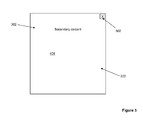
- Figure 5 is a schematic diagram showing secondary content 302 on interface 404 of the display 222.
- a cancel control 502 shown as an 'X' in a box is in the top corner of interface 404.
- the cancel control 502 is a selectable virtual button that closes the secondary content 302 from interface 404.
- the secondary content 302 is closed (e.g. by selecting the cancel button 502), the primary content 402 is shown on interface 404.
- the secondary content 302 is one of an advertisement, coupon, contest or subscription form.
- the secondary content 302 can have interactive elements, such as virtual buttons or data entry fields.
- the secondary content 302 can be a contest entry form with fillable data entry fields that can be filled in with information (e.g. name, address, etc.) received through input into interface 404 of the mobile device 102 for entering the contest.
- the secondary content 302 comprises a choice between two different advertisements (e.g. an ad for a mini-van or for a sports car) one of which can be selected through input into interface 404.
- the secondary content 302 can be targeted based on the primary content 402.
- the primary content 402 can comprise text and the secondary content 302 can be advertising that is targeted to the primary content 402 based on the text of the primary content 402.
- the server 108 that communicates the secondary content 302 to the mobile device 102 may be in communication with the mobile device 102 or another server 108 that serves the primary content 402 in order to access the text in the primary content 402. In this way the server 108 is aware of the primary content 402 so that the server 108 or another application can use the primary content 402 to target the secondary content 302 that is transmitted to the mobile device 102.
- the secondary content 302 can be targeted to the primary content 402 based on the location of the mobile device 102 or on the recent activity (e.g. recent input received or recently operated applications) on the mobile device 102.
- FIG. 6 is a schematic diagram showing another embodiment of secondary content 302 that is displayed on interface 404 after input is received at the mobile device selecting the controller 304 associated with the secondary content 302.
- Secondary content 302 is shown on interface 404.
- a cancel control 502 and a return indicator 602 (i.e. another control) are also shown on interface 404.
- the return indicator 602 can be selected by user input.
- the return indicator 602 is a bar on the side of interface 404. It is recognized that the return indicator 602 can be another selectable icon or selectable item displayed on interface 404 or, alternatively, the return indicator 602 can be a key or virtual button.
- the return indicator 602 is selected, the secondary content 302 is closed revealing the primary content 402 again.
- the return indicator 602 can be selected using input methods known to skilled persons such as a keyboard or touchscreen interface.
- FIG. 7 is a schematic diagram of an embodiment of interface 404 of the display 222.
- the interface 404 of Figure 7 shows the primary content 402, the controller 304 and a second controller 304b on interface 404.
- the controller 304 is shown as a bar on one edge of interface 404 and the second controller 304b is shown as a bar on the opposite edge of interface 404.
- the primary content 402 is still visible along with the controller 304 and second controller 304b.
- the controller 304 and second controller 304b do not interfere with the visibility of the primary content 402.
- the second controller 304b is associated with an alternative secondary content (not shown).
- the second controller 304b provides the same functionality as the controller 304. When input is received selecting the second controller 304b, the alternative secondary content is displayed on interface 404.
- the controller 304 has a visual property 406 that is blue and the second controller 304b has a visual property 406 that is green.
- the blue colour identifies the content category of the secondary content 302.
- the green colour identifies the content category of the alternative secondary content. For example, green indicates that the secondary content 302 is in the content category of advertisements that contain free coupons.
- an advertisement containing a free coupon appears on interface 404.
- the blue colour of the second controller 304b identifies the category of a contest.
- a contest appears on interface 404.
- Further examples of visual properties identifying content categories are as follows: red identifies a content category of subscription forms; and black identifies a content category of a cash-back advertisement.
- interface 404 is a touchscreen interface and the controllers 304, 304b are selectable using a finger swipe.
- a finger 702, a right arrow 704 and a left arrow 706 are shown for demonstrative purposes.
- the finger 702 can swipe on interface 404 in the direction of the left arrow 706 in order to select the controller 304.
- the finger 702 can swipe on interface 404 in the direction of the right arrow 704 in order to select the second controller 304b.
- a flow chart showing a method of providing secondary content 302 and controllers 304 is depicted at 800 in Figure 8 . More specifically, the method is for providing secondary content 302 on a mobile device 102 with the secondary content 302 associated with a controller 304 and the secondary content 302 being a member of one of a plurality of content categories.
- the primary content 402 is displayed on an interface 404 of the mobile device 102.
- the primary content 402 can be requested (e.g. downloaded) from a remote server 108 by the mobile device 102 over the communication network 106, for example.
- the secondary content 302 is received at the mobile device 102 from the server 108.
- the server 108 that communicates the secondary content 302 to the mobile device 102 is not necessarily the same server 108 that communicates primary content 402 to the mobile device 102.
- the controller 304 associated with the secondary content 302 may be communicated to the mobile device 102 as well. Alternatively, the controller 304 may be generated at the mobile device 102.
- the visual property 406 is applied to the controller 304.
- the visual property 406 is for identifying the content category that the secondary content 302 is a member of.
- the visual property 406 of the controller 304 may also be communicated to the mobile device 102 from the server 108 along with the controller 304.
- the visual property 406 may be applied to the controller 304 associated with the secondary content 302 on the mobile device 102.
- the visual property may be applied to the controller 304 in accordance with preferences or flags set on the mobile device 102.
- the preferences can comprise filters on the mobile device 102 that are applied to the meta data in the secondary content 302, for example.
- the preferences for the visual properties 406 for one or more content categories can be set or adjusted through input into the mobile device 102.
- the visual property 406 such as the colour green can be associated on the mobile device with the content category of coupons.
- the controller 304 applied to that secondary content 302 will have the visual property 406 of the colour green applied to it.
- the controller 304 is displayed on the interface 404 of the mobile device 102 such that the controller 304 does not visually interfere with the primary content 402.
- the controller 304 includes a visual property 406 identifying the content category of which the secondary content 302 is a member.
- the controller 304 may be located on the interface 404 in a position that allows a user to still view the content of the primary content 402.
- step 810 input is received at the mobile device 102 selecting the controller 304.
- the input can be received through a touchscreen interface, for example.
- the input can be a finger swipe in the direction of the controller 304 on the touchscreen interface, for example.
- the secondary content 302 associated with the controller 304 is displayed on the interface 404 of the mobile device 102.
- the secondary content 302 may be displayed in a pop-up window on interface 404, for example. It is recognized that more than one controller 304, 304b can be simultaneously displayed on interface 404 of the mobile device 102 with each controller 304, 304b associated with distinct secondary content 302.
- FIG. 9 is a flowchart depicting at 900 additional optional steps to the method of providing secondary content 302 and controllers 304 on a mobile device 102.
- a filter operating on the mobile device 102 determines whether the content category of the secondary content 302 is a prohibited content category. If the content category is a prohibited content category then, at step 904, the controller 304 is blocked from being displayed on the interface 404 of the mobile device 102.
Landscapes
- Engineering & Computer Science (AREA)
- Human Computer Interaction (AREA)
- Computer Networks & Wireless Communication (AREA)
- Signal Processing (AREA)
- Information Transfer Between Computers (AREA)
- User Interface Of Digital Computer (AREA)
Abstract
Description
- The present matter relates to providing secondary content on a mobile device and in particular to providing secondary content on a mobile device using a controller.
- Advertisements are often displayed on mobile devices. Mobile devices have limited screen sizes and thus limited real estate on an interface for displaying content. Advertisements and other content are often best viewed when displayed on the entire interface of the mobile device.
- In order that the subject matter may be readily understood, embodiments are illustrated by way of examples in the accompanying drawings, in which:
-
Figure 1 is a block diagram illustrating a telecommunication infrastructure; -
Figure 2 is a block diagram illustrating components of a mobile device; -
Figure 3 is a block diagram illustrating secondary content and a controller being communicated from a server to a mobile device; -
Figure 4 is a schematic diagram illustrating an interface of a mobile device having primary content displayed thereon; -
Figure 5 is a schematic diagram illustrating another embodiment of an interface of a mobile device having secondary content displayed thereon; -
Figure 6 is a schematic diagram illustrating another embodiment of an interface of a mobile device having secondary content displayed thereon; -
Figure 7 is a screen shot shown of an embodiment of an interface; -
Figure 8 is a flowchart depicting a method for providing secondary content on a mobile device and; -
Figure 9 is a flowchart depicting additional optional steps for the method of claim 8. - According to an aspect, disclosed is a method of providing secondary content on a mobile device, the secondary content associated with a controller, the secondary content being a member of one of a plurality of content categories, the method comprising: displaying primary content on an interface of the mobile device; receiving the secondary content at the mobile device; applying a visual property to the controller, the visual property identifying the content category that the secondary content is a member of; after receiving the secondary content at the mobile device, displaying the controller on the interface of the mobile device such that the controller does not visually interfere with the displayed primary content; receiving input selecting the controller; and in response to receiving the input, displaying the secondary content associated with the controller on the interface of the mobile device.
- According to another aspect, disclosed is a mobile device having a processor and memory, the memory storing instructions and data for execution by the processor to configure the device to: display primary content on an interface of the mobile device; receive secondary content at the mobile device, the secondary content associated with a controller, the secondary content being a member of one of a plurality of content categories; apply a visual property to the controller, the visual property identifying the content category that the secondary content is a member of; after receiving the secondary content at the mobile device, displa the controller on the interface of the mobile device such that the controller does not visually interfere with the displayed primary content; receive input selecting the controller; and in response to receiving the input, display the secondary content associated with the controller on the interface of the mobile device.
- According to another aspect, disclosed is a computer readable medium having computer readable code embodied therein for execution by a processor for configuring a mobile device to carry out a method of providing secondary content on a mobile device, the secondary content associated with a controller, the secondary content being a member of one of a plurality of content categories, the method comprising: displaying primary content on an interface of the mobile device; receiving the secondary content at the mobile device; applying a visual property to the controller, the visual property identifying the content category that the secondary content is a member of; after receiving the secondary content at the mobile device, displaying the controller on the interface of the mobile device such that the controller does not visually interfere with the displayed primary content; receiving input selecting the controller; and in response to receiving the input, displaying the secondary content associated with the controller on the interface of the mobile device.
- For convenience, like numerals in the description refer to like structures in the drawings. Referring to
Figure 1 , a typical telecommunication infrastructure is illustrated generally bynumeral 100. Thetelecommunication infrastructure 100 includes a plurality ofmobile devices 102, a plurality ofbase stations 104, acommunication network 106 and a plurality ofnetwork servers 108. - The
mobile devices 102 include wireless computing devices such as a smart phone, a personal digital assistant (PDA), and the like. Themobile devices 102 are in communication with one of thebase stations 104. The base stations relay data between themobile devices 102 and thenetwork servers 108 via thecommunication network 106. Accordingly, thecommunication network 106 may include several components such as a wireless network, a relay, a corporate server and/or a mobile data server for relaying data between thebase stations 104 and thenetwork servers 108. - The
network servers 108 include servers such as a Web server, an application server, and an application server with web services. It will be appreciated by a person of ordinary skill in the art that thetelecommunication infrastructure 100 described herein is example and that changes may be made to one or more components to accommodate different network configurations without affecting the scope of the aspects described herein. - Referring to
Figure 2 , a typicalmobile device 102 is illustrated in greater detail. Themobile device 102 is often a two-way communication device having both voice and data communication capabilities, including the capability to communicate with other computer systems. Depending on the functionality provided by themobile device 102, it may be referred to as a data messaging device, a two-way pager, a cellular telephone with data messaging capabilities, a wireless Internet appliance, or a data communication device. - The
mobile device 102 includes acommunication subsystem 211, which includes a receiver 212, atransmitter 214, and associated components, such as one or more embedded orinternal antenna elements communication subsystem 211 depends on the communication network in whichmobile device 102 is intended to operate. More than onecommunication subsystem 211 may be incorporated or shared for communications in multiple communication networks. - The
mobile device 102 includes amicroprocessor 238 which controls general operation of themobile device 102. Themicroprocessor 238 also interacts with additional device subsystems such as adisplay 222, aflash memory 224, a random access memory (RAM) 226, auxiliary input/output (I/O)subsystems 228, aserial port 230, akeyboard 232, aspeaker 234, amicrophone 236, a short-range communications subsystem 240 such as Bluetooth™ for example, and any other device subsystems or peripheral devices generally designated at 242. Themobile device 102 may also include apositioning device 244, such as a GPS receiver, for receiving positioning information. - Operating system software used by the
microprocessor 238 is preferably stored in a persistent store such as theflash memory 224, which may alternatively be a read-only memory (ROM) or similar storage element (not shown). Those skilled in the art will appreciate that the operating system, specific device applications, or parts thereof, may be temporarily loaded into a volatile store such asRAM 226. - The
microprocessor 238, in addition to its operating system functions, preferably enables execution of software applications on themobile device 102. A predetermined set of applications, which control basic device operations, is installed on themobile device 102 during its manufacture. These basic operations typically include data and voice communication applications, for example. Additionally, applications may also be loaded onto themobile device 102 through thenetwork 106, an auxiliary I/O subsystem 228,serial port 230, short-range communications subsystem 240, or any othersuitable subsystem 242, and installed by a user inRAM 226, or preferably thepersistent store 224, for execution by themicroprocessor 238. Such flexibility in application installation increases the functionality of themobile device 102 and may provide enhanced on-device features, communication-related features, or both. - The
display 222 is used to visually present an application's graphical user interface (GUI) on themobile device 102. Application data can be manipulated by modifying information on the GUI using an input device such as thekeyboard 232 for example. Depending on the type ofmobile device 102, the user may have access to other types of input devices, such as, for example, a scroll wheel, trackball, light pen or touch sensitive screen (e.g. a touchscreen). - Location-based applications executing on the
mobile device 102 use positioning information from thepositioning device 244 to provide relevant information to the user, often in real-time. Thepositioning device 244 may be a GPS receiver for receiving satellite broadcasts. In one embodiment, the satellite broadcast data is used by themobile device 102 to determine its position. In another embodiment, the satellite broadcast data is transmitted from themobile device 102 to one of thenetwork servers 108 to determine the position of themobile device 102. - Alternatively, the
positioning device 244 may be a positioning module for receiving positioning information from one of thenetwork servers 108. In this embodiment, the positioning module may comprise a software solution, rather than a hardware solution. - Data (e.g. primary content or secondary content) can be transmitted from one or
more servers 108 to amobile device 102.Figure 3 shows theserver 108 transmitting or communicatingsecondary content 302 and acontroller 304 to themobile device 102, according to an embodiment. This communication between theserver 108 andmobile device 102 can be over thecommunication network 106, for example.Secondary content 302 comprises content not specifically requested at themobile device 102 such as advertisements, coupons, contests, etc. Theserver 108 can be, for example, an advertisement server that compiles advertisements that may be targeted to content or information stored on themobile device 102 and that communicates these advertisements to themobile device 102. Thecontroller 304 is associated with thesecondary content 302 and is displayed on the interface of themobile device 102 in order to indicate the presence of thesecondary content 302. - According to an alternative embodiment, the
controller 304 originates or is generated on themobile device 102 rather than being transmitted by theserver 108 to the mobile device. Instead, only thesecondary content 302 is transmitted by theserver 108 to themobile device 102. - The
secondary content 302 is a member of one of a plurality of content categories. Each content category defines a set ofsecondary content 302 that is of a specific type. The types ofsecondary content 302 defined in each content category can comprise advertisements, coupons, contests and subscriptions, for example. -
Figure 4 is a schematic diagram depicting aninterface 404 on thedisplay 222 of themobile device 102.Primary content 402 and thecontroller 304 are displayed on theinterface 404. Theprimary content 402 can be a messaging program such as email, a game application or other types of applications such as a web browser or word processing application, for example. Other examples ofprimary content 402 will be familiar to skilled persons. Typically,primary content 402 is initiated through input into themobile device 102.Primary content 402 can also be communicated over thecommunications network 106 to themobile device 102, for example. Alternatively, theprimary content 402 can be communicated to themobile device 102 from adifferent server 108 from which thesecondary content 302 is communicated. - The
controller 304 has avisual property 406 that identifies one of the plurality of content categories. Specifically, thevisual property 406 identifies the content category that thesecondary content 302 is a member of. For example, thevisual property 406 can be a colour or a pattern that is associated with a particular content category. Thevisual property 406 can comprise one of a plurality of colours, with each of the plurality of colours identifying a specific content category. For example, a bluevisual property 406 can be associated with the content category that includes the coupons type ofsecondary content 302. Optionally, there may be a menu interface (not shown) that displays a legend outlining which visuallyproperties 406 identify which content categories. - According to an embodiment, the
visual property 406 can be applied to thecontroller 304 at themobile device 102. Themobile device 102 receives the secondary content 302 (e.g. from the server 108) and determines the content category of thesecondary content 302. Themobile device 102 can receive thesecondary content 302 before applying thevisual property 406 to thecontroller 304. The determination of the content category of thesecondary content 302 can be undertaken based on the contents of thesecondary content 302. For example, the content category of thesecondary content 302 can be indicated using a flag set in the meta data. Alternatively, the flag can be communicated from theserver 108 to themobile device 102 separately from thesecondary content 302. By way of further example, the content category of thesecondary content 302 can be determined from other content of the meta data associated with thesecondary content 302. There may be a field in the meta data that identifies the content type. Themobile device 102 can have an application that automatically parses the fields in the meta data of receivedsecondary content 302 in order to determine the content category. After the content category is determined thevisual property 406 of thecontroller 304 can be mapped to a pre-set visual property 405 (e.g. a specific colour) based on the determined content category. - The
mobile device 102 can have a filter that is applied to the receivedsecondary content 302 that blocks certain categories ofsecondary content 302 and its associatedcontroller 304 from being displayed on theinterface 404. The filter can be an application operating on themobile device 102, for example. The filter can be configured to blocksecondary content 302 that is a member of a prohibited content category from being displayed on themobile device 102. The prohibited content categories can be adjusted or specified through input into themobile device 102. For example, the prohibited content categories can comprise a list of content categories that is set or adjusted by input into the mobile device. By way of further example, the prohibited content categories can comprise a pre-determined list of content categories. Further, thecontroller 304 that is associated with prohibitedsecondary content 302 is also prohibited from being displayed on themobile device 102 by the operation of the filter. - The
controller 304 shown inFigure 3 has avisual property 406 that is a dotted pattern and occupies an edge ofinterface 404. Thecontroller 304 and itsvisual property 406 are displayed oninterface 404 such that theprimary content 402controller 304 does not visually interfere with theprimary content 402 on theinterface 404. In other words, theprimary content 402 remains visible along with thecontroller 304 on theinterface 404 and thecontroller 304 does not distract from the visibility of theprimary content 402 on theinterface 404. For example, thecontroller 304 can be translucent, flashing, small or located on the edge of thedisplay 222 screen. Themobile device 102 can receive input to select thecontroller 304. For example, input can be received via a keyboard, trackball, touchscreen display or other I/O component. By way of further example, the input can be a finger swipe or slide on a touchscreen in the direction of thecontroller 304. - When the
controller 304 is selected through input received on themobile device 102, thesecondary content 302 associated with the selectedcontroller 304 is displayed on theinterface 404. Thesecondary content 302 can be displayed in a separate window or frame oninterface 404 of themobile device 102. Thus, a mere glance at theprimary content 402 andcontroller 304 oninterface 404 can be enough to determine the type ofsecondary content 302 that is available for viewing. -
Figure 5 is a schematic diagram showingsecondary content 302 oninterface 404 of thedisplay 222. A cancelcontrol 502 shown as an 'X' in a box is in the top corner ofinterface 404. The cancelcontrol 502 is a selectable virtual button that closes thesecondary content 302 frominterface 404. When thesecondary content 302 is closed (e.g. by selecting the cancel button 502), theprimary content 402 is shown oninterface 404. - According to an embodiment, the
secondary content 302 is one of an advertisement, coupon, contest or subscription form. Thesecondary content 302 can have interactive elements, such as virtual buttons or data entry fields. For example, thesecondary content 302 can be a contest entry form with fillable data entry fields that can be filled in with information (e.g. name, address, etc.) received through input intointerface 404 of themobile device 102 for entering the contest. By way of further example, thesecondary content 302 comprises a choice between two different advertisements (e.g. an ad for a mini-van or for a sports car) one of which can be selected through input intointerface 404. - The
secondary content 302 can be targeted based on theprimary content 402. For example, theprimary content 402 can comprise text and thesecondary content 302 can be advertising that is targeted to theprimary content 402 based on the text of theprimary content 402. Theserver 108 that communicates thesecondary content 302 to themobile device 102 may be in communication with themobile device 102 or anotherserver 108 that serves theprimary content 402 in order to access the text in theprimary content 402. In this way theserver 108 is aware of theprimary content 402 so that theserver 108 or another application can use theprimary content 402 to target thesecondary content 302 that is transmitted to themobile device 102. By way of further example, thesecondary content 302 can be targeted to theprimary content 402 based on the location of themobile device 102 or on the recent activity (e.g. recent input received or recently operated applications) on themobile device 102. -
Figure 6 is a schematic diagram showing another embodiment ofsecondary content 302 that is displayed oninterface 404 after input is received at the mobile device selecting thecontroller 304 associated with thesecondary content 302.Secondary content 302 is shown oninterface 404. A cancelcontrol 502 and a return indicator 602 (i.e. another control) are also shown oninterface 404. Thereturn indicator 602 can be selected by user input. Thereturn indicator 602 is a bar on the side ofinterface 404. It is recognized that thereturn indicator 602 can be another selectable icon or selectable item displayed oninterface 404 or, alternatively, thereturn indicator 602 can be a key or virtual button. When thereturn indicator 602 is selected, thesecondary content 302 is closed revealing theprimary content 402 again. Thereturn indicator 602 can be selected using input methods known to skilled persons such as a keyboard or touchscreen interface. -
Figure 7 is a schematic diagram of an embodiment ofinterface 404 of thedisplay 222. Theinterface 404 ofFigure 7 shows theprimary content 402, thecontroller 304 and asecond controller 304b oninterface 404. Thecontroller 304 is shown as a bar on one edge ofinterface 404 and thesecond controller 304b is shown as a bar on the opposite edge ofinterface 404. Theprimary content 402 is still visible along with thecontroller 304 andsecond controller 304b. Thecontroller 304 andsecond controller 304b do not interfere with the visibility of theprimary content 402. Thesecond controller 304b is associated with an alternative secondary content (not shown). Thesecond controller 304b provides the same functionality as thecontroller 304. When input is received selecting thesecond controller 304b, the alternative secondary content is displayed oninterface 404. - The
controller 304 has avisual property 406 that is blue and thesecond controller 304b has avisual property 406 that is green. The blue colour identifies the content category of thesecondary content 302. The green colour identifies the content category of the alternative secondary content. For example, green indicates that thesecondary content 302 is in the content category of advertisements that contain free coupons. When thecontroller 304 with a greenvirtual property 406 is selected an advertisement containing a free coupon appears oninterface 404. By way of further example, the blue colour of thesecond controller 304b identifies the category of a contest. When input is received selecting thesecond controller 304b a contest appears oninterface 404. Further examples of visual properties identifying content categories are as follows: red identifies a content category of subscription forms; and black identifies a content category of a cash-back advertisement. - According to the embodiment shown in
Figure 7 ,interface 404 is a touchscreen interface and thecontrollers finger 702, aright arrow 704 and aleft arrow 706 are shown for demonstrative purposes. Thefinger 702 can swipe oninterface 404 in the direction of theleft arrow 706 in order to select thecontroller 304. Thefinger 702 can swipe oninterface 404 in the direction of theright arrow 704 in order to select thesecond controller 304b. - A flow chart showing a method of providing
secondary content 302 andcontrollers 304 is depicted at 800 inFigure 8 . More specifically, the method is for providingsecondary content 302 on amobile device 102 with thesecondary content 302 associated with acontroller 304 and thesecondary content 302 being a member of one of a plurality of content categories. - At
step 802, theprimary content 402 is displayed on aninterface 404 of themobile device 102. Theprimary content 402 can be requested (e.g. downloaded) from aremote server 108 by themobile device 102 over thecommunication network 106, for example. - At
step 804, thesecondary content 302 is received at themobile device 102 from theserver 108. Theserver 108 that communicates thesecondary content 302 to themobile device 102 is not necessarily thesame server 108 that communicatesprimary content 402 to themobile device 102. Thecontroller 304 associated with thesecondary content 302 may be communicated to themobile device 102 as well. Alternatively, thecontroller 304 may be generated at themobile device 102. - At
step 806, thevisual property 406 is applied to thecontroller 304. Thevisual property 406 is for identifying the content category that thesecondary content 302 is a member of. Thevisual property 406 of thecontroller 304 may also be communicated to themobile device 102 from theserver 108 along with thecontroller 304. Alternatively thevisual property 406 may be applied to thecontroller 304 associated with thesecondary content 302 on themobile device 102. For example, the visual property may be applied to thecontroller 304 in accordance with preferences or flags set on themobile device 102. The preferences can comprise filters on themobile device 102 that are applied to the meta data in thesecondary content 302, for example. The preferences for thevisual properties 406 for one or more content categories can be set or adjusted through input into themobile device 102. For example, thevisual property 406 such as the colour green can be associated on the mobile device with the content category of coupons. Thus, whensecondary content 302 that is in the content category of coupons is received at themobile device 102, thecontroller 304 applied to thatsecondary content 302 will have thevisual property 406 of the colour green applied to it. - At
step 808, after receiving thesecondary content 302 at themobile device 102, thecontroller 304 is displayed on theinterface 404 of themobile device 102 such that thecontroller 304 does not visually interfere with theprimary content 402. Thecontroller 304 includes avisual property 406 identifying the content category of which thesecondary content 302 is a member. For example, thecontroller 304 may be located on theinterface 404 in a position that allows a user to still view the content of theprimary content 402. - At
step 810, input is received at themobile device 102 selecting thecontroller 304. The input can be received through a touchscreen interface, for example. The input can be a finger swipe in the direction of thecontroller 304 on the touchscreen interface, for example. - At
step 812, in response to receiving the input, thesecondary content 302 associated with thecontroller 304 is displayed on theinterface 404 of themobile device 102. Thesecondary content 302 may be displayed in a pop-up window oninterface 404, for example. It is recognized that more than onecontroller interface 404 of themobile device 102 with eachcontroller secondary content 302. -
Figure 9 is a flowchart depicting at 900 additional optional steps to the method of providingsecondary content 302 andcontrollers 304 on amobile device 102. Atstep 902, a filter operating on themobile device 102 determines whether the content category of thesecondary content 302 is a prohibited content category. If the content category is a prohibited content category then, atstep 904, thecontroller 304 is blocked from being displayed on theinterface 404 of themobile device 102. - One or more currently preferred embodiments have been described by way of example. It will be apparent to persons skilled in the art that a number of variations and modifications can be made without departing from the scope of what is defined in the claims.
Claims (14)
- A method of providing secondary content (302) on a mobile device (102), the secondary content (302) associated with a controller (304), the secondary content (302) being a member of one of a plurality of content categories, the method comprising:displaying primary content (402) on an interface of the mobile device;receiving the secondary content (302) at the mobile device;applying a visual property (406) to the controller (304), the visual property identifying the content category that the secondary content (302) is a member of;after receiving the secondary content (302) at the mobile device, displaying the controller (304) on the interface (404) of the mobile device (102) such that the controller (304) does not visually interfere with the displayed primary content (402);receiving input selecting the controller (304); andin response to receiving the input, displaying the secondary content (302) associated with the controller (304) on the interface of the mobile device.
- The method of claim 1 wherein the step of applying the visual property (406) to the controller (304) occurs after the step of receiving the secondary content (302) at the mobile device.
- The method of claim 1 or 2 wherein the visual property (406) is automatically applied to the controller (304) based on the contents of the secondary content (302).
- The method of claim 1 or 2 wherein the visual property (406) is manually selected for applying to the controller (304).
- The method of any one of claims 1 to 4 wherein the visual property (406) comprises a one of a plurality of colours, each of the plurality of colours identifying a specific content category.
- The method of any one of claims 1 to 5 wherein the secondary content (302) is one of an advertisement, a coupon, a contest or a subscription form.
- The method of any one of claims 1 to 6 wherein the controller (304) is a bar on the edge of the interface of the mobile device.
- The method of any one of claims 1 to 7 wherein the content categories comprise advertisements, coupons, contests and subscriptions.
- The method of any one of claims 1 to 8 wherein the primary content (402) is one of an electronic message, an image, a game or a web page.
- The method of any one of claims 1 to 9 further comprising:determining whether the content category of the secondary content (302) is a prohibited content category; and
wherein if the content category of the secondary content (302) is a prohibited content category then the controller (304) is blocked from being displayed on the interface (404) of the mobile device (102). - The method of claim 10 wherein the determination of whether the content category of the secondary content (302) is a prohibited content category comprises comparing the content category to a pre-defined list of prohibited content categories.
- The method of any one of claims 1 to 11 wherein the secondary content (302) is targeted based on the primary content (402).
- A mobile device (102) having a processor and memory, the memory storing instructions and data for execution by the processor to configure the device to carry out the method of any one of claims 1 to 12.
- A computer readable medium having computer readable code embodied therein for execution by a processor for configuring a mobile device (102) to carry out the method of any one of claims 1 to 12.
Priority Applications (2)
| Application Number | Priority Date | Filing Date | Title |
|---|---|---|---|
| EP11157712.8A EP2498482B1 (en) | 2011-03-10 | 2011-03-10 | A system and method for providing secondary content using a colour controller |
| CA2765687A CA2765687C (en) | 2011-03-10 | 2012-01-27 | A system and method for providing secondary content using a colour controller |
Applications Claiming Priority (1)
| Application Number | Priority Date | Filing Date | Title |
|---|---|---|---|
| EP11157712.8A EP2498482B1 (en) | 2011-03-10 | 2011-03-10 | A system and method for providing secondary content using a colour controller |
Publications (2)
| Publication Number | Publication Date |
|---|---|
| EP2498482A1 true EP2498482A1 (en) | 2012-09-12 |
| EP2498482B1 EP2498482B1 (en) | 2018-01-03 |
Family
ID=44315114
Family Applications (1)
| Application Number | Title | Priority Date | Filing Date |
|---|---|---|---|
| EP11157712.8A Active EP2498482B1 (en) | 2011-03-10 | 2011-03-10 | A system and method for providing secondary content using a colour controller |
Country Status (2)
| Country | Link |
|---|---|
| EP (1) | EP2498482B1 (en) |
| CA (1) | CA2765687C (en) |
Citations (2)
| Publication number | Priority date | Publication date | Assignee | Title |
|---|---|---|---|---|
| US20050154796A1 (en) * | 2002-03-06 | 2005-07-14 | Forsyth John M. | Method of enabling a wireless information device to access data services |
| US20080160967A1 (en) * | 2006-12-28 | 2008-07-03 | Funmobility, Inc. | Tag ticker display on a mobile device |
-
2011
- 2011-03-10 EP EP11157712.8A patent/EP2498482B1/en active Active
-
2012
- 2012-01-27 CA CA2765687A patent/CA2765687C/en active Active
Patent Citations (2)
| Publication number | Priority date | Publication date | Assignee | Title |
|---|---|---|---|---|
| US20050154796A1 (en) * | 2002-03-06 | 2005-07-14 | Forsyth John M. | Method of enabling a wireless information device to access data services |
| US20080160967A1 (en) * | 2006-12-28 | 2008-07-03 | Funmobility, Inc. | Tag ticker display on a mobile device |
Also Published As
| Publication number | Publication date |
|---|---|
| EP2498482B1 (en) | 2018-01-03 |
| CA2765687A1 (en) | 2012-09-10 |
| CA2765687C (en) | 2016-01-26 |
Similar Documents
| Publication | Publication Date | Title |
|---|---|---|
| US9411486B2 (en) | System and method for providing secondary content using a colour controller | |
| US9125017B2 (en) | Mobile terminal and schedule notifying method thereof | |
| US8838180B2 (en) | Relational rendering with a mobile terminal | |
| US9110564B2 (en) | Mobile terminal, method for controlling mobile terminal, and method for displaying image of mobile terminal | |
| CN110457034B (en) | Generate navigation user interfaces for use in third-party applications | |
| US20120223966A1 (en) | Terminal to provide augmented reality | |
| US9203948B2 (en) | Mobile terminal and controlling method thereof | |
| WO2016099710A1 (en) | Methods, systems, and media for controlling information used to present content on a public display device | |
| JP2016504691A (en) | Restructure vehicle user interface based on context | |
| CN110058754B (en) | Option display method and terminal device | |
| US20130122968A1 (en) | Electronic device, screen control method, and screen control program | |
| CN102770832A (en) | Method and apparatus for providing cooperative enablement of user input options | |
| CN110221737A (en) | A kind of icon display method and terminal device | |
| JPWO2014006710A1 (en) | Rights providing apparatus and rights providing method | |
| CN111199424A (en) | Advertisement putting method and device, terminal equipment and storage medium | |
| AU2010202519A1 (en) | Designed console for providing a variety of cellular services to a driver of a motor vehicle and his environment | |
| JP5024688B2 (en) | Display device and program | |
| US8654235B2 (en) | Apparatus and method for displaying service information provided in service zone | |
| CN107544790A (en) | Service figure layer generation method, device, terminal device and user interface system | |
| CN109358789B (en) | Notification message management method and device and mobile terminal | |
| CN107132908B (en) | Image updating method and device | |
| KR20180098598A (en) | Theme data | |
| US20110137735A1 (en) | Uses of multiple location parameters, polygonal exclusion and inclusion zones, and other input data in location-coupled information selection | |
| US9997138B2 (en) | System and method for adaptive and persistent media presentations | |
| JP6151816B1 (en) | Server, control method, and control program |
Legal Events
| Date | Code | Title | Description |
|---|---|---|---|
| PUAI | Public reference made under article 153(3) epc to a published international application that has entered the european phase |
Free format text: ORIGINAL CODE: 0009012 |
|
| 17P | Request for examination filed |
Effective date: 20110310 |
|
| AK | Designated contracting states |
Kind code of ref document: A1 Designated state(s): AL AT BE BG CH CY CZ DE DK EE ES FI FR GB GR HR HU IE IS IT LI LT LU LV MC MK MT NL NO PL PT RO RS SE SI SK SM TR |
|
| AX | Request for extension of the european patent |
Extension state: BA ME |
|
| RAP1 | Party data changed (applicant data changed or rights of an application transferred) |
Owner name: BLACKBERRY LIMITED |
|
| RAP1 | Party data changed (applicant data changed or rights of an application transferred) |
Owner name: BLACKBERRY LIMITED |
|
| 17Q | First examination report despatched |
Effective date: 20160601 |
|
| GRAP | Despatch of communication of intention to grant a patent |
Free format text: ORIGINAL CODE: EPIDOSNIGR1 |
|
| INTG | Intention to grant announced |
Effective date: 20170724 |
|
| GRAS | Grant fee paid |
Free format text: ORIGINAL CODE: EPIDOSNIGR3 |
|
| GRAA | (expected) grant |
Free format text: ORIGINAL CODE: 0009210 |
|
| AK | Designated contracting states |
Kind code of ref document: B1 Designated state(s): AL AT BE BG CH CY CZ DE DK EE ES FI FR GB GR HR HU IE IS IT LI LT LU LV MC MK MT NL NO PL PT RO RS SE SI SK SM TR |
|
| REG | Reference to a national code |
Ref country code: GB Ref legal event code: FG4D |
|
| REG | Reference to a national code |
Ref country code: CH Ref legal event code: EP Ref country code: AT Ref legal event code: REF Ref document number: 961245 Country of ref document: AT Kind code of ref document: T Effective date: 20180115 |
|
| REG | Reference to a national code |
Ref country code: IE Ref legal event code: FG4D |
|
| REG | Reference to a national code |
Ref country code: DE Ref legal event code: R096 Ref document number: 602011044656 Country of ref document: DE |
|
| REG | Reference to a national code |
Ref country code: FR Ref legal event code: PLFP Year of fee payment: 8 |
|
| REG | Reference to a national code |
Ref country code: NL Ref legal event code: MP Effective date: 20180103 |
|
| REG | Reference to a national code |
Ref country code: LT Ref legal event code: MG4D |
|
| REG | Reference to a national code |
Ref country code: AT Ref legal event code: MK05 Ref document number: 961245 Country of ref document: AT Kind code of ref document: T Effective date: 20180103 |
|
| PG25 | Lapsed in a contracting state [announced via postgrant information from national office to epo] |
Ref country code: NL Free format text: LAPSE BECAUSE OF FAILURE TO SUBMIT A TRANSLATION OF THE DESCRIPTION OR TO PAY THE FEE WITHIN THE PRESCRIBED TIME-LIMIT Effective date: 20180103 |
|
| PG25 | Lapsed in a contracting state [announced via postgrant information from national office to epo] |
Ref country code: ES Free format text: LAPSE BECAUSE OF FAILURE TO SUBMIT A TRANSLATION OF THE DESCRIPTION OR TO PAY THE FEE WITHIN THE PRESCRIBED TIME-LIMIT Effective date: 20180103 Ref country code: HR Free format text: LAPSE BECAUSE OF FAILURE TO SUBMIT A TRANSLATION OF THE DESCRIPTION OR TO PAY THE FEE WITHIN THE PRESCRIBED TIME-LIMIT Effective date: 20180103 Ref country code: LT Free format text: LAPSE BECAUSE OF FAILURE TO SUBMIT A TRANSLATION OF THE DESCRIPTION OR TO PAY THE FEE WITHIN THE PRESCRIBED TIME-LIMIT Effective date: 20180103 Ref country code: CY Free format text: LAPSE BECAUSE OF FAILURE TO SUBMIT A TRANSLATION OF THE DESCRIPTION OR TO PAY THE FEE WITHIN THE PRESCRIBED TIME-LIMIT Effective date: 20180103 Ref country code: FI Free format text: LAPSE BECAUSE OF FAILURE TO SUBMIT A TRANSLATION OF THE DESCRIPTION OR TO PAY THE FEE WITHIN THE PRESCRIBED TIME-LIMIT Effective date: 20180103 Ref country code: NO Free format text: LAPSE BECAUSE OF FAILURE TO SUBMIT A TRANSLATION OF THE DESCRIPTION OR TO PAY THE FEE WITHIN THE PRESCRIBED TIME-LIMIT Effective date: 20180403 |
|
| PG25 | Lapsed in a contracting state [announced via postgrant information from national office to epo] |
Ref country code: PL Free format text: LAPSE BECAUSE OF FAILURE TO SUBMIT A TRANSLATION OF THE DESCRIPTION OR TO PAY THE FEE WITHIN THE PRESCRIBED TIME-LIMIT Effective date: 20180103 Ref country code: GR Free format text: LAPSE BECAUSE OF FAILURE TO SUBMIT A TRANSLATION OF THE DESCRIPTION OR TO PAY THE FEE WITHIN THE PRESCRIBED TIME-LIMIT Effective date: 20180404 Ref country code: AT Free format text: LAPSE BECAUSE OF FAILURE TO SUBMIT A TRANSLATION OF THE DESCRIPTION OR TO PAY THE FEE WITHIN THE PRESCRIBED TIME-LIMIT Effective date: 20180103 Ref country code: IS Free format text: LAPSE BECAUSE OF FAILURE TO SUBMIT A TRANSLATION OF THE DESCRIPTION OR TO PAY THE FEE WITHIN THE PRESCRIBED TIME-LIMIT Effective date: 20180503 Ref country code: LV Free format text: LAPSE BECAUSE OF FAILURE TO SUBMIT A TRANSLATION OF THE DESCRIPTION OR TO PAY THE FEE WITHIN THE PRESCRIBED TIME-LIMIT Effective date: 20180103 Ref country code: SE Free format text: LAPSE BECAUSE OF FAILURE TO SUBMIT A TRANSLATION OF THE DESCRIPTION OR TO PAY THE FEE WITHIN THE PRESCRIBED TIME-LIMIT Effective date: 20180103 Ref country code: BG Free format text: LAPSE BECAUSE OF FAILURE TO SUBMIT A TRANSLATION OF THE DESCRIPTION OR TO PAY THE FEE WITHIN THE PRESCRIBED TIME-LIMIT Effective date: 20180403 Ref country code: RS Free format text: LAPSE BECAUSE OF FAILURE TO SUBMIT A TRANSLATION OF THE DESCRIPTION OR TO PAY THE FEE WITHIN THE PRESCRIBED TIME-LIMIT Effective date: 20180103 |
|
| REG | Reference to a national code |
Ref country code: DE Ref legal event code: R097 Ref document number: 602011044656 Country of ref document: DE |
|
| PG25 | Lapsed in a contracting state [announced via postgrant information from national office to epo] |
Ref country code: RO Free format text: LAPSE BECAUSE OF FAILURE TO SUBMIT A TRANSLATION OF THE DESCRIPTION OR TO PAY THE FEE WITHIN THE PRESCRIBED TIME-LIMIT Effective date: 20180103 Ref country code: IT Free format text: LAPSE BECAUSE OF FAILURE TO SUBMIT A TRANSLATION OF THE DESCRIPTION OR TO PAY THE FEE WITHIN THE PRESCRIBED TIME-LIMIT Effective date: 20180103 Ref country code: AL Free format text: LAPSE BECAUSE OF FAILURE TO SUBMIT A TRANSLATION OF THE DESCRIPTION OR TO PAY THE FEE WITHIN THE PRESCRIBED TIME-LIMIT Effective date: 20180103 Ref country code: EE Free format text: LAPSE BECAUSE OF FAILURE TO SUBMIT A TRANSLATION OF THE DESCRIPTION OR TO PAY THE FEE WITHIN THE PRESCRIBED TIME-LIMIT Effective date: 20180103 |
|
| REG | Reference to a national code |
Ref country code: CH Ref legal event code: PL |
|
| PLBE | No opposition filed within time limit |
Free format text: ORIGINAL CODE: 0009261 |
|
| STAA | Information on the status of an ep patent application or granted ep patent |
Free format text: STATUS: NO OPPOSITION FILED WITHIN TIME LIMIT |
|
| PG25 | Lapsed in a contracting state [announced via postgrant information from national office to epo] |
Ref country code: DK Free format text: LAPSE BECAUSE OF FAILURE TO SUBMIT A TRANSLATION OF THE DESCRIPTION OR TO PAY THE FEE WITHIN THE PRESCRIBED TIME-LIMIT Effective date: 20180103 Ref country code: SM Free format text: LAPSE BECAUSE OF FAILURE TO SUBMIT A TRANSLATION OF THE DESCRIPTION OR TO PAY THE FEE WITHIN THE PRESCRIBED TIME-LIMIT Effective date: 20180103 Ref country code: CZ Free format text: LAPSE BECAUSE OF FAILURE TO SUBMIT A TRANSLATION OF THE DESCRIPTION OR TO PAY THE FEE WITHIN THE PRESCRIBED TIME-LIMIT Effective date: 20180103 Ref country code: MC Free format text: LAPSE BECAUSE OF FAILURE TO SUBMIT A TRANSLATION OF THE DESCRIPTION OR TO PAY THE FEE WITHIN THE PRESCRIBED TIME-LIMIT Effective date: 20180103 Ref country code: SK Free format text: LAPSE BECAUSE OF FAILURE TO SUBMIT A TRANSLATION OF THE DESCRIPTION OR TO PAY THE FEE WITHIN THE PRESCRIBED TIME-LIMIT Effective date: 20180103 |
|
| REG | Reference to a national code |
Ref country code: BE Ref legal event code: MM Effective date: 20180331 |
|
| 26N | No opposition filed |
Effective date: 20181005 |
|
| REG | Reference to a national code |
Ref country code: IE Ref legal event code: MM4A |
|
| PG25 | Lapsed in a contracting state [announced via postgrant information from national office to epo] |
Ref country code: LU Free format text: LAPSE BECAUSE OF NON-PAYMENT OF DUE FEES Effective date: 20180310 |
|
| PG25 | Lapsed in a contracting state [announced via postgrant information from national office to epo] |
Ref country code: IE Free format text: LAPSE BECAUSE OF NON-PAYMENT OF DUE FEES Effective date: 20180310 |
|
| PG25 | Lapsed in a contracting state [announced via postgrant information from national office to epo] |
Ref country code: BE Free format text: LAPSE BECAUSE OF NON-PAYMENT OF DUE FEES Effective date: 20180331 Ref country code: LI Free format text: LAPSE BECAUSE OF NON-PAYMENT OF DUE FEES Effective date: 20180331 Ref country code: CH Free format text: LAPSE BECAUSE OF NON-PAYMENT OF DUE FEES Effective date: 20180331 Ref country code: SI Free format text: LAPSE BECAUSE OF FAILURE TO SUBMIT A TRANSLATION OF THE DESCRIPTION OR TO PAY THE FEE WITHIN THE PRESCRIBED TIME-LIMIT Effective date: 20180103 |
|
| PG25 | Lapsed in a contracting state [announced via postgrant information from national office to epo] |
Ref country code: MT Free format text: LAPSE BECAUSE OF NON-PAYMENT OF DUE FEES Effective date: 20180310 |
|
| PG25 | Lapsed in a contracting state [announced via postgrant information from national office to epo] |
Ref country code: TR Free format text: LAPSE BECAUSE OF FAILURE TO SUBMIT A TRANSLATION OF THE DESCRIPTION OR TO PAY THE FEE WITHIN THE PRESCRIBED TIME-LIMIT Effective date: 20180103 |
|
| PG25 | Lapsed in a contracting state [announced via postgrant information from national office to epo] |
Ref country code: PT Free format text: LAPSE BECAUSE OF FAILURE TO SUBMIT A TRANSLATION OF THE DESCRIPTION OR TO PAY THE FEE WITHIN THE PRESCRIBED TIME-LIMIT Effective date: 20180103 Ref country code: HU Free format text: LAPSE BECAUSE OF FAILURE TO SUBMIT A TRANSLATION OF THE DESCRIPTION OR TO PAY THE FEE WITHIN THE PRESCRIBED TIME-LIMIT; INVALID AB INITIO Effective date: 20110310 |
|
| PG25 | Lapsed in a contracting state [announced via postgrant information from national office to epo] |
Ref country code: MK Free format text: LAPSE BECAUSE OF NON-PAYMENT OF DUE FEES Effective date: 20180103 |
|
| REG | Reference to a national code |
Ref country code: DE Ref legal event code: R082 Ref document number: 602011044656 Country of ref document: DE Ref country code: DE Ref legal event code: R081 Ref document number: 602011044656 Country of ref document: DE Owner name: MALIKIE INNOVATIONS LTD., IE Free format text: FORMER OWNER: BLACKBERRY LIMITED, WATERLOO, ONTARIO, CA |
|
| REG | Reference to a national code |
Ref country code: GB Ref legal event code: 732E Free format text: REGISTERED BETWEEN 20240620 AND 20240627 |
|
| PGFP | Annual fee paid to national office [announced via postgrant information from national office to epo] |
Ref country code: GB Payment date: 20260319 Year of fee payment: 16 |
|
| PGFP | Annual fee paid to national office [announced via postgrant information from national office to epo] |
Ref country code: DE Payment date: 20260320 Year of fee payment: 16 |
|
| PGFP | Annual fee paid to national office [announced via postgrant information from national office to epo] |
Ref country code: FR Payment date: 20260323 Year of fee payment: 16 |