EP2498133A2 - Resin pattern, method for producing the pattern, method for producing MEMS structure, method for manufacturing semiconductor device, and method for producing plated pattern - Google Patents
Resin pattern, method for producing the pattern, method for producing MEMS structure, method for manufacturing semiconductor device, and method for producing plated pattern Download PDFInfo
- Publication number
- EP2498133A2 EP2498133A2 EP12158216A EP12158216A EP2498133A2 EP 2498133 A2 EP2498133 A2 EP 2498133A2 EP 12158216 A EP12158216 A EP 12158216A EP 12158216 A EP12158216 A EP 12158216A EP 2498133 A2 EP2498133 A2 EP 2498133A2
- Authority
- EP
- European Patent Office
- Prior art keywords
- group
- component
- resin composition
- producing
- photosensitive resin
- Prior art date
- Legal status (The legal status is an assumption and is not a legal conclusion. Google has not performed a legal analysis and makes no representation as to the accuracy of the status listed.)
- Withdrawn
Links
- 229920005989 resin Polymers 0.000 title claims abstract description 132
- 239000011347 resin Substances 0.000 title claims abstract description 132
- 238000004519 manufacturing process Methods 0.000 title claims abstract description 90
- 238000000034 method Methods 0.000 title claims abstract description 49
- 239000004065 semiconductor Substances 0.000 title description 11
- 239000011342 resin composition Substances 0.000 claims abstract description 147
- 239000000758 substrate Substances 0.000 claims abstract description 68
- 239000002904 solvent Substances 0.000 claims abstract description 56
- 238000000576 coating method Methods 0.000 claims abstract description 33
- 238000011161 development Methods 0.000 claims abstract description 33
- 239000011248 coating agent Substances 0.000 claims abstract description 28
- 230000005855 radiation Effects 0.000 claims abstract description 19
- 239000007788 liquid Substances 0.000 claims abstract description 18
- -1 isocyanate compound Chemical class 0.000 claims description 250
- 239000000178 monomer Substances 0.000 claims description 247
- 125000002887 hydroxy group Chemical group [H]O* 0.000 claims description 83
- 125000003178 carboxy group Chemical group [H]OC(*)=O 0.000 claims description 69
- 239000002253 acid Substances 0.000 claims description 62
- ISWSIDIOOBJBQZ-UHFFFAOYSA-N phenol group Chemical group C1(=CC=CC=C1)O ISWSIDIOOBJBQZ-UHFFFAOYSA-N 0.000 claims description 55
- 229920000642 polymer Polymers 0.000 claims description 32
- 239000003431 cross linking reagent Substances 0.000 claims description 30
- 125000003566 oxetanyl group Chemical group 0.000 claims description 27
- 229920002451 polyvinyl alcohol Polymers 0.000 claims description 25
- 239000004372 Polyvinyl alcohol Substances 0.000 claims description 24
- 125000003700 epoxy group Chemical group 0.000 claims description 24
- 238000010438 heat treatment Methods 0.000 claims description 18
- 229920001577 copolymer Polymers 0.000 claims description 17
- 239000012948 isocyanate Substances 0.000 claims description 14
- 125000004122 cyclic group Chemical group 0.000 claims description 9
- 229920002845 Poly(methacrylic acid) Polymers 0.000 claims description 8
- 239000003999 initiator Substances 0.000 claims description 8
- 125000004432 carbon atom Chemical group C* 0.000 description 94
- 150000001875 compounds Chemical class 0.000 description 92
- 239000000203 mixture Substances 0.000 description 77
- 125000000217 alkyl group Chemical group 0.000 description 67
- 239000010410 layer Substances 0.000 description 46
- 125000003545 alkoxy group Chemical group 0.000 description 37
- CERQOIWHTDAKMF-UHFFFAOYSA-N Methacrylic acid Chemical compound CC(=C)C(O)=O CERQOIWHTDAKMF-UHFFFAOYSA-N 0.000 description 36
- 230000018109 developmental process Effects 0.000 description 31
- LYCAIKOWRPUZTN-UHFFFAOYSA-N Ethylene glycol Chemical compound OCCO LYCAIKOWRPUZTN-UHFFFAOYSA-N 0.000 description 28
- 230000035945 sensitivity Effects 0.000 description 28
- 239000004094 surface-active agent Substances 0.000 description 28
- 125000002496 methyl group Chemical group [H]C([H])([H])* 0.000 description 26
- 239000000047 product Substances 0.000 description 26
- NIXOWILDQLNWCW-UHFFFAOYSA-M Acrylate Chemical compound [O-]C(=O)C=C NIXOWILDQLNWCW-UHFFFAOYSA-M 0.000 description 25
- 125000001997 phenyl group Chemical group [H]C1=C([H])C([H])=C(*)C([H])=C1[H] 0.000 description 23
- 150000003254 radicals Chemical class 0.000 description 22
- WGTYBPLFGIVFAS-UHFFFAOYSA-M tetramethylammonium hydroxide Chemical compound [OH-].C[N+](C)(C)C WGTYBPLFGIVFAS-UHFFFAOYSA-M 0.000 description 22
- 239000000243 solution Substances 0.000 description 21
- 125000001424 substituent group Chemical group 0.000 description 21
- 125000004435 hydrogen atom Chemical group [H]* 0.000 description 20
- 239000007864 aqueous solution Substances 0.000 description 19
- 239000003822 epoxy resin Substances 0.000 description 18
- 125000005843 halogen group Chemical group 0.000 description 18
- 229920000647 polyepoxide Polymers 0.000 description 18
- XLYOFNOQVPJJNP-UHFFFAOYSA-N water Substances O XLYOFNOQVPJJNP-UHFFFAOYSA-N 0.000 description 18
- 239000004593 Epoxy Substances 0.000 description 15
- 239000003963 antioxidant agent Substances 0.000 description 15
- 235000006708 antioxidants Nutrition 0.000 description 15
- 230000015572 biosynthetic process Effects 0.000 description 15
- 239000000126 substance Substances 0.000 description 15
- 238000011156 evaluation Methods 0.000 description 14
- OKKJLVBELUTLKV-UHFFFAOYSA-N Methanol Chemical compound OC OKKJLVBELUTLKV-UHFFFAOYSA-N 0.000 description 13
- 125000004849 alkoxymethyl group Chemical group 0.000 description 13
- 150000001732 carboxylic acid derivatives Chemical class 0.000 description 13
- 229910052731 fluorine Inorganic materials 0.000 description 13
- VOZRXNHHFUQHIL-UHFFFAOYSA-N glycidyl methacrylate Chemical compound CC(=C)C(=O)OCC1CO1 VOZRXNHHFUQHIL-UHFFFAOYSA-N 0.000 description 13
- IQPQWNKOIGAROB-UHFFFAOYSA-N isocyanate group Chemical group [N-]=C=O IQPQWNKOIGAROB-UHFFFAOYSA-N 0.000 description 13
- 239000003795 chemical substances by application Substances 0.000 description 12
- NIXOWILDQLNWCW-UHFFFAOYSA-N acrylic acid group Chemical group C(C=C)(=O)O NIXOWILDQLNWCW-UHFFFAOYSA-N 0.000 description 11
- 125000003118 aryl group Chemical group 0.000 description 11
- 230000000052 comparative effect Effects 0.000 description 11
- 150000002148 esters Chemical class 0.000 description 11
- 125000001495 ethyl group Chemical group [H]C([H])([H])C([H])([H])* 0.000 description 11
- QSHDDOUJBYECFT-UHFFFAOYSA-N mercury Chemical compound [Hg] QSHDDOUJBYECFT-UHFFFAOYSA-N 0.000 description 11
- 229910052753 mercury Inorganic materials 0.000 description 11
- 125000001624 naphthyl group Chemical group 0.000 description 11
- LLHKCFNBLRBOGN-UHFFFAOYSA-N propylene glycol methyl ether acetate Chemical compound COCC(C)OC(C)=O LLHKCFNBLRBOGN-UHFFFAOYSA-N 0.000 description 11
- DHKHKXVYLBGOIT-UHFFFAOYSA-N acetaldehyde Diethyl Acetal Natural products CCOC(C)OCC DHKHKXVYLBGOIT-UHFFFAOYSA-N 0.000 description 10
- 125000002947 alkylene group Chemical group 0.000 description 10
- 230000003078 antioxidant effect Effects 0.000 description 10
- 150000007514 bases Chemical class 0.000 description 10
- 238000006243 chemical reaction Methods 0.000 description 10
- 230000000694 effects Effects 0.000 description 10
- 238000005530 etching Methods 0.000 description 10
- WGCNASOHLSPBMP-UHFFFAOYSA-N hydroxyacetaldehyde Natural products OCC=O WGCNASOHLSPBMP-UHFFFAOYSA-N 0.000 description 10
- 150000002513 isocyanates Chemical class 0.000 description 10
- 238000006116 polymerization reaction Methods 0.000 description 10
- 238000007127 saponification reaction Methods 0.000 description 10
- 229920000178 Acrylic resin Polymers 0.000 description 9
- 239000004925 Acrylic resin Substances 0.000 description 9
- XUIMIQQOPSSXEZ-UHFFFAOYSA-N Silicon Chemical compound [Si] XUIMIQQOPSSXEZ-UHFFFAOYSA-N 0.000 description 9
- 125000005427 anthranyl group Chemical group 0.000 description 9
- RAXXELZNTBOGNW-UHFFFAOYSA-N imidazole Natural products C1=CNC=N1 RAXXELZNTBOGNW-UHFFFAOYSA-N 0.000 description 9
- DNIAPMSPPWPWGF-UHFFFAOYSA-N monopropylene glycol Natural products CC(O)CO DNIAPMSPPWPWGF-UHFFFAOYSA-N 0.000 description 9
- 125000004108 n-butyl group Chemical group [H]C([H])([H])C([H])([H])C([H])([H])C([H])([H])* 0.000 description 9
- 229920001296 polysiloxane Polymers 0.000 description 9
- 239000010703 silicon Substances 0.000 description 9
- 229910052710 silicon Inorganic materials 0.000 description 9
- FJKROLUGYXJWQN-UHFFFAOYSA-N 4-hydroxybenzoic acid Chemical compound OC(=O)C1=CC=C(O)C=C1 FJKROLUGYXJWQN-UHFFFAOYSA-N 0.000 description 8
- 150000001241 acetals Chemical class 0.000 description 8
- 125000004093 cyano group Chemical group *C#N 0.000 description 8
- 238000004090 dissolution Methods 0.000 description 8
- 238000005227 gel permeation chromatography Methods 0.000 description 8
- 125000005647 linker group Chemical group 0.000 description 8
- 239000007787 solid Substances 0.000 description 8
- 238000003786 synthesis reaction Methods 0.000 description 8
- 125000000999 tert-butyl group Chemical group [H]C([H])([H])C(*)(C([H])([H])[H])C([H])([H])[H] 0.000 description 8
- SMZOUWXMTYCWNB-UHFFFAOYSA-N 2-(2-methoxy-5-methylphenyl)ethanamine Chemical compound COC1=CC=C(C)C=C1CCN SMZOUWXMTYCWNB-UHFFFAOYSA-N 0.000 description 7
- YCKRFDGAMUMZLT-UHFFFAOYSA-N Fluorine atom Chemical compound [F] YCKRFDGAMUMZLT-UHFFFAOYSA-N 0.000 description 7
- WOBHKFSMXKNTIM-UHFFFAOYSA-N Hydroxyethyl methacrylate Chemical compound CC(=C)C(=O)OCCO WOBHKFSMXKNTIM-UHFFFAOYSA-N 0.000 description 7
- 239000002202 Polyethylene glycol Substances 0.000 description 7
- 229910052801 chlorine Inorganic materials 0.000 description 7
- 125000001309 chloro group Chemical group Cl* 0.000 description 7
- 239000011737 fluorine Substances 0.000 description 7
- 125000000449 nitro group Chemical group [O-][N+](*)=O 0.000 description 7
- 229920001223 polyethylene glycol Polymers 0.000 description 7
- 229920001451 polypropylene glycol Polymers 0.000 description 7
- ZMXDDKWLCZADIW-UHFFFAOYSA-N N,N-Dimethylformamide Chemical compound CN(C)C=O ZMXDDKWLCZADIW-UHFFFAOYSA-N 0.000 description 6
- VYPSYNLAJGMNEJ-UHFFFAOYSA-N Silicium dioxide Chemical compound O=[Si]=O VYPSYNLAJGMNEJ-UHFFFAOYSA-N 0.000 description 6
- ZMANZCXQSJIPKH-UHFFFAOYSA-N Triethylamine Chemical compound CCN(CC)CC ZMANZCXQSJIPKH-UHFFFAOYSA-N 0.000 description 6
- 150000008065 acid anhydrides Chemical class 0.000 description 6
- 230000009471 action Effects 0.000 description 6
- 239000003513 alkali Substances 0.000 description 6
- 239000000470 constituent Substances 0.000 description 6
- 238000001312 dry etching Methods 0.000 description 6
- 125000001301 ethoxy group Chemical group [H]C([H])([H])C([H])([H])O* 0.000 description 6
- 125000001153 fluoro group Chemical group F* 0.000 description 6
- 125000001449 isopropyl group Chemical group [H]C([H])([H])C([H])(*)C([H])([H])[H] 0.000 description 6
- 239000000463 material Substances 0.000 description 6
- 125000000956 methoxy group Chemical group [H]C([H])([H])O* 0.000 description 6
- 239000011259 mixed solution Substances 0.000 description 6
- 125000004123 n-propyl group Chemical group [H]C([H])([H])C([H])([H])C([H])([H])* 0.000 description 6
- 230000008569 process Effects 0.000 description 6
- 230000002829 reductive effect Effects 0.000 description 6
- 229920001059 synthetic polymer Polymers 0.000 description 6
- 125000002023 trifluoromethyl group Chemical group FC(F)(F)* 0.000 description 6
- 229910052721 tungsten Inorganic materials 0.000 description 6
- 238000005406 washing Methods 0.000 description 6
- LSNNMFCWUKXFEE-UHFFFAOYSA-M Bisulfite Chemical compound OS([O-])=O LSNNMFCWUKXFEE-UHFFFAOYSA-M 0.000 description 5
- WKBOTKDWSSQWDR-UHFFFAOYSA-N Bromine atom Chemical group [Br] WKBOTKDWSSQWDR-UHFFFAOYSA-N 0.000 description 5
- 102100026735 Coagulation factor VIII Human genes 0.000 description 5
- 229920000858 Cyclodextrin Polymers 0.000 description 5
- 101000911390 Homo sapiens Coagulation factor VIII Proteins 0.000 description 5
- 239000000654 additive Substances 0.000 description 5
- 238000007334 copolymerization reaction Methods 0.000 description 5
- 239000013078 crystal Substances 0.000 description 5
- 238000001723 curing Methods 0.000 description 5
- 238000000354 decomposition reaction Methods 0.000 description 5
- 125000000816 ethylene group Chemical group [H]C([H])([*:1])C([H])([H])[*:2] 0.000 description 5
- 125000000524 functional group Chemical group 0.000 description 5
- 239000001257 hydrogen Substances 0.000 description 5
- 229910052739 hydrogen Inorganic materials 0.000 description 5
- 239000001866 hydroxypropyl methyl cellulose Substances 0.000 description 5
- 235000010979 hydroxypropyl methyl cellulose Nutrition 0.000 description 5
- 229920003088 hydroxypropyl methyl cellulose Polymers 0.000 description 5
- UFVKGYZPFZQRLF-UHFFFAOYSA-N hydroxypropyl methyl cellulose Chemical compound OC1C(O)C(OC)OC(CO)C1OC1C(O)C(O)C(OC2C(C(O)C(OC3C(C(O)C(O)C(CO)O3)O)C(CO)O2)O)C(CO)O1 UFVKGYZPFZQRLF-UHFFFAOYSA-N 0.000 description 5
- 229910052751 metal Inorganic materials 0.000 description 5
- 239000002184 metal Substances 0.000 description 5
- 125000001037 p-tolyl group Chemical group [H]C1=C([H])C(=C([H])C([H])=C1*)C([H])([H])[H] 0.000 description 5
- 239000004014 plasticizer Substances 0.000 description 5
- 229920000058 polyacrylate Polymers 0.000 description 5
- 229920001515 polyalkylene glycol Polymers 0.000 description 5
- 125000004805 propylene group Chemical group [H]C([H])([H])C([H])([*:1])C([H])([H])[*:2] 0.000 description 5
- 125000002914 sec-butyl group Chemical group [H]C([H])([H])C([H])([H])C([H])(*)C([H])([H])[H] 0.000 description 5
- BDHFUVZGWQCTTF-UHFFFAOYSA-M sulfonate Chemical compound [O-]S(=O)=O BDHFUVZGWQCTTF-UHFFFAOYSA-M 0.000 description 5
- 125000000391 vinyl group Chemical group [H]C([*])=C([H])[H] 0.000 description 5
- COVKSLBAQCJQMS-UHFFFAOYSA-N 1-chloro-4-[(4-chlorophenoxy)methoxy]benzene Chemical compound C1=CC(Cl)=CC=C1OCOC1=CC=C(Cl)C=C1 COVKSLBAQCJQMS-UHFFFAOYSA-N 0.000 description 4
- XLLXMBCBJGATSP-UHFFFAOYSA-N 2-phenylethenol Chemical compound OC=CC1=CC=CC=C1 XLLXMBCBJGATSP-UHFFFAOYSA-N 0.000 description 4
- 229940090248 4-hydroxybenzoic acid Drugs 0.000 description 4
- PAYRUJLWNCNPSJ-UHFFFAOYSA-N Aniline Chemical compound NC1=CC=CC=C1 PAYRUJLWNCNPSJ-UHFFFAOYSA-N 0.000 description 4
- RTZKZFJDLAIYFH-UHFFFAOYSA-N Diethyl ether Chemical compound CCOCC RTZKZFJDLAIYFH-UHFFFAOYSA-N 0.000 description 4
- IAZDPXIOMUYVGZ-UHFFFAOYSA-N Dimethylsulphoxide Chemical compound CS(C)=O IAZDPXIOMUYVGZ-UHFFFAOYSA-N 0.000 description 4
- VZCYOOQTPOCHFL-OWOJBTEDSA-N Fumaric acid Chemical compound OC(=O)\C=C\C(O)=O VZCYOOQTPOCHFL-OWOJBTEDSA-N 0.000 description 4
- PEDCQBHIVMGVHV-UHFFFAOYSA-N Glycerine Chemical compound OCC(O)CO PEDCQBHIVMGVHV-UHFFFAOYSA-N 0.000 description 4
- YNAVUWVOSKDBBP-UHFFFAOYSA-N Morpholine Chemical compound C1COCCN1 YNAVUWVOSKDBBP-UHFFFAOYSA-N 0.000 description 4
- NQRYJNQNLNOLGT-UHFFFAOYSA-N Piperidine Chemical compound C1CCNCC1 NQRYJNQNLNOLGT-UHFFFAOYSA-N 0.000 description 4
- KYQCOXFCLRTKLS-UHFFFAOYSA-N Pyrazine Chemical compound C1=CN=CC=N1 KYQCOXFCLRTKLS-UHFFFAOYSA-N 0.000 description 4
- JUJWROOIHBZHMG-UHFFFAOYSA-N Pyridine Chemical compound C1=CC=NC=C1 JUJWROOIHBZHMG-UHFFFAOYSA-N 0.000 description 4
- 239000006087 Silane Coupling Agent Substances 0.000 description 4
- UIIMBOGNXHQVGW-UHFFFAOYSA-M Sodium bicarbonate Chemical compound [Na+].OC([O-])=O UIIMBOGNXHQVGW-UHFFFAOYSA-M 0.000 description 4
- PPBRXRYQALVLMV-UHFFFAOYSA-N Styrene Chemical group C=CC1=CC=CC=C1 PPBRXRYQALVLMV-UHFFFAOYSA-N 0.000 description 4
- MPIAGWXWVAHQBB-UHFFFAOYSA-N [3-prop-2-enoyloxy-2-[[3-prop-2-enoyloxy-2,2-bis(prop-2-enoyloxymethyl)propoxy]methyl]-2-(prop-2-enoyloxymethyl)propyl] prop-2-enoate Chemical compound C=CC(=O)OCC(COC(=O)C=C)(COC(=O)C=C)COCC(COC(=O)C=C)(COC(=O)C=C)COC(=O)C=C MPIAGWXWVAHQBB-UHFFFAOYSA-N 0.000 description 4
- 239000002250 absorbent Substances 0.000 description 4
- 230000002745 absorbent Effects 0.000 description 4
- 238000007259 addition reaction Methods 0.000 description 4
- MTHSVFCYNBDYFN-UHFFFAOYSA-N anhydrous diethylene glycol Natural products OCCOCCO MTHSVFCYNBDYFN-UHFFFAOYSA-N 0.000 description 4
- 125000003710 aryl alkyl group Chemical group 0.000 description 4
- 239000007795 chemical reaction product Substances 0.000 description 4
- 125000000113 cyclohexyl group Chemical group [H]C1([H])C([H])([H])C([H])([H])C([H])(*)C([H])([H])C1([H])[H] 0.000 description 4
- 125000001511 cyclopentyl group Chemical group [H]C1([H])C([H])([H])C([H])([H])C([H])(*)C1([H])[H] 0.000 description 4
- DMBHHRLKUKUOEG-UHFFFAOYSA-N diphenylamine Chemical compound C=1C=CC=CC=1NC1=CC=CC=C1 DMBHHRLKUKUOEG-UHFFFAOYSA-N 0.000 description 4
- 239000011521 glass Substances 0.000 description 4
- VPVSTMAPERLKKM-UHFFFAOYSA-N glycoluril Chemical class N1C(=O)NC2NC(=O)NC21 VPVSTMAPERLKKM-UHFFFAOYSA-N 0.000 description 4
- 230000001771 impaired effect Effects 0.000 description 4
- 125000000959 isobutyl group Chemical group [H]C([H])([H])C([H])(C([H])([H])[H])C([H])([H])* 0.000 description 4
- 125000001280 n-hexyl group Chemical group C(CCCCC)* 0.000 description 4
- RPQRDASANLAFCM-UHFFFAOYSA-N oxiran-2-ylmethyl prop-2-enoate Chemical compound C=CC(=O)OCC1CO1 RPQRDASANLAFCM-UHFFFAOYSA-N 0.000 description 4
- 238000007747 plating Methods 0.000 description 4
- 229920000193 polymethacrylate Polymers 0.000 description 4
- BWHMMNNQKKPAPP-UHFFFAOYSA-L potassium carbonate Chemical compound [K+].[K+].[O-]C([O-])=O BWHMMNNQKKPAPP-UHFFFAOYSA-L 0.000 description 4
- 150000003242 quaternary ammonium salts Chemical class 0.000 description 4
- 239000007870 radical polymerization initiator Substances 0.000 description 4
- HFHDHCJBZVLPGP-UHFFFAOYSA-N schardinger α-dextrin Chemical compound O1C(C(C2O)O)C(CO)OC2OC(C(C2O)O)C(CO)OC2OC(C(C2O)O)C(CO)OC2OC(C(O)C2O)C(CO)OC2OC(C(C2O)O)C(CO)OC2OC2C(O)C(O)C1OC2CO HFHDHCJBZVLPGP-UHFFFAOYSA-N 0.000 description 4
- 229910052814 silicon oxide Inorganic materials 0.000 description 4
- 238000003860 storage Methods 0.000 description 4
- 239000002562 thickening agent Substances 0.000 description 4
- VZCYOOQTPOCHFL-UHFFFAOYSA-N trans-butenedioic acid Natural products OC(=O)C=CC(O)=O VZCYOOQTPOCHFL-UHFFFAOYSA-N 0.000 description 4
- 229910021642 ultra pure water Inorganic materials 0.000 description 4
- 239000012498 ultrapure water Substances 0.000 description 4
- JNELGWHKGNBSMD-UHFFFAOYSA-N xanthone Chemical compound C1=CC=C2C(=O)C3=CC=CC=C3OC2=C1 JNELGWHKGNBSMD-UHFFFAOYSA-N 0.000 description 4
- HVBADOTWUFBZMF-UHFFFAOYSA-N 1-ethoxyethyl 2-methylprop-2-enoate Chemical compound CCOC(C)OC(=O)C(C)=C HVBADOTWUFBZMF-UHFFFAOYSA-N 0.000 description 3
- TXBCBTDQIULDIA-UHFFFAOYSA-N 2-[[3-hydroxy-2,2-bis(hydroxymethyl)propoxy]methyl]-2-(hydroxymethyl)propane-1,3-diol Chemical compound OCC(CO)(CO)COCC(CO)(CO)CO TXBCBTDQIULDIA-UHFFFAOYSA-N 0.000 description 3
- 125000004172 4-methoxyphenyl group Chemical group [H]C1=C([H])C(OC([H])([H])[H])=C([H])C([H])=C1* 0.000 description 3
- GZVHEAJQGPRDLQ-UHFFFAOYSA-N 6-phenyl-1,3,5-triazine-2,4-diamine Chemical class NC1=NC(N)=NC(C=2C=CC=CC=2)=N1 GZVHEAJQGPRDLQ-UHFFFAOYSA-N 0.000 description 3
- QTBSBXVTEAMEQO-UHFFFAOYSA-N Acetic acid Chemical compound CC(O)=O QTBSBXVTEAMEQO-UHFFFAOYSA-N 0.000 description 3
- SOGAXMICEFXMKE-UHFFFAOYSA-N Butylmethacrylate Chemical compound CCCCOC(=O)C(C)=C SOGAXMICEFXMKE-UHFFFAOYSA-N 0.000 description 3
- LCGLNKUTAGEVQW-UHFFFAOYSA-N Dimethyl ether Chemical compound COC LCGLNKUTAGEVQW-UHFFFAOYSA-N 0.000 description 3
- LFQSCWFLJHTTHZ-UHFFFAOYSA-N Ethanol Chemical compound CCO LFQSCWFLJHTTHZ-UHFFFAOYSA-N 0.000 description 3
- XEKOWRVHYACXOJ-UHFFFAOYSA-N Ethyl acetate Chemical compound CCOC(C)=O XEKOWRVHYACXOJ-UHFFFAOYSA-N 0.000 description 3
- WMFOQBRAJBCJND-UHFFFAOYSA-M Lithium hydroxide Chemical compound [Li+].[OH-] WMFOQBRAJBCJND-UHFFFAOYSA-M 0.000 description 3
- 239000004698 Polyethylene Substances 0.000 description 3
- 239000004793 Polystyrene Substances 0.000 description 3
- KWYUFKZDYYNOTN-UHFFFAOYSA-M Potassium hydroxide Chemical compound [OH-].[K+] KWYUFKZDYYNOTN-UHFFFAOYSA-M 0.000 description 3
- RWRDLPDLKQPQOW-UHFFFAOYSA-N Pyrrolidine Chemical compound C1CCNC1 RWRDLPDLKQPQOW-UHFFFAOYSA-N 0.000 description 3
- HEMHJVSKTPXQMS-UHFFFAOYSA-M Sodium hydroxide Chemical compound [OH-].[Na+] HEMHJVSKTPXQMS-UHFFFAOYSA-M 0.000 description 3
- WYGWHHGCAGTUCH-ISLYRVAYSA-N V-65 Substances CC(C)CC(C)(C#N)\N=N\C(C)(C#N)CC(C)C WYGWHHGCAGTUCH-ISLYRVAYSA-N 0.000 description 3
- HVVWZTWDBSEWIH-UHFFFAOYSA-N [2-(hydroxymethyl)-3-prop-2-enoyloxy-2-(prop-2-enoyloxymethyl)propyl] prop-2-enoate Chemical compound C=CC(=O)OCC(CO)(COC(=O)C=C)COC(=O)C=C HVVWZTWDBSEWIH-UHFFFAOYSA-N 0.000 description 3
- FZEYVTFCMJSGMP-UHFFFAOYSA-N acridone Chemical class C1=CC=C2C(=O)C3=CC=CC=C3NC2=C1 FZEYVTFCMJSGMP-UHFFFAOYSA-N 0.000 description 3
- 235000011114 ammonium hydroxide Nutrition 0.000 description 3
- 150000001491 aromatic compounds Chemical class 0.000 description 3
- 125000001797 benzyl group Chemical group [H]C1=C([H])C([H])=C(C([H])=C1[H])C([H])([H])* 0.000 description 3
- 125000006267 biphenyl group Chemical group 0.000 description 3
- 229920002678 cellulose Polymers 0.000 description 3
- 235000010980 cellulose Nutrition 0.000 description 3
- 239000012295 chemical reaction liquid Substances 0.000 description 3
- 125000000753 cycloalkyl group Chemical group 0.000 description 3
- 125000004386 diacrylate group Chemical group 0.000 description 3
- 238000010586 diagram Methods 0.000 description 3
- ZBCBWPMODOFKDW-UHFFFAOYSA-N diethanolamine Chemical compound OCCNCCO ZBCBWPMODOFKDW-UHFFFAOYSA-N 0.000 description 3
- 125000006575 electron-withdrawing group Chemical group 0.000 description 3
- 238000009713 electroplating Methods 0.000 description 3
- DMEGYFMYUHOHGS-UHFFFAOYSA-N heptamethylene Natural products C1CCCCCC1 DMEGYFMYUHOHGS-UHFFFAOYSA-N 0.000 description 3
- RRAMGCGOFNQTLD-UHFFFAOYSA-N hexamethylene diisocyanate Chemical compound O=C=NCCCCCCN=C=O RRAMGCGOFNQTLD-UHFFFAOYSA-N 0.000 description 3
- NIMLQBUJDJZYEJ-UHFFFAOYSA-N isophorone diisocyanate Chemical compound CC1(C)CC(N=C=O)CC(C)(CN=C=O)C1 NIMLQBUJDJZYEJ-UHFFFAOYSA-N 0.000 description 3
- JDSHMPZPIAZGSV-UHFFFAOYSA-N melamine Chemical group NC1=NC(N)=NC(N)=N1 JDSHMPZPIAZGSV-UHFFFAOYSA-N 0.000 description 3
- 125000001570 methylene group Chemical group [H]C([H])([*:1])[*:2] 0.000 description 3
- JESXATFQYMPTNL-UHFFFAOYSA-N mono-hydroxyphenyl-ethylene Natural products OC1=CC=CC=C1C=C JESXATFQYMPTNL-UHFFFAOYSA-N 0.000 description 3
- 150000002762 monocarboxylic acid derivatives Chemical class 0.000 description 3
- 125000006606 n-butoxy group Chemical group 0.000 description 3
- 125000003136 n-heptyl group Chemical group [H]C([H])([H])C([H])([H])C([H])([H])C([H])([H])C([H])([H])C([H])([H])C([H])([H])* 0.000 description 3
- 125000003506 n-propoxy group Chemical group [H]C([H])([H])C([H])([H])C([H])([H])O* 0.000 description 3
- 125000003854 p-chlorophenyl group Chemical group [H]C1=C([H])C(*)=C([H])C([H])=C1Cl 0.000 description 3
- 230000036961 partial effect Effects 0.000 description 3
- 125000006340 pentafluoro ethyl group Chemical group FC(F)(F)C(F)(F)* 0.000 description 3
- 125000000538 pentafluorophenyl group Chemical group FC1=C(F)C(F)=C(*)C(F)=C1F 0.000 description 3
- KTNLYTNKBOKXRW-UHFFFAOYSA-N phenyliodanium Chemical compound [IH+]C1=CC=CC=C1 KTNLYTNKBOKXRW-UHFFFAOYSA-N 0.000 description 3
- 229920000728 polyester Polymers 0.000 description 3
- 229920000573 polyethylene Polymers 0.000 description 3
- 229920002223 polystyrene Polymers 0.000 description 3
- 238000001556 precipitation Methods 0.000 description 3
- 125000001436 propyl group Chemical group [H]C([*])([H])C([H])([H])C([H])([H])[H] 0.000 description 3
- 125000005504 styryl group Chemical group 0.000 description 3
- 150000005846 sugar alcohols Polymers 0.000 description 3
- 150000003459 sulfonic acid esters Chemical class 0.000 description 3
- 238000001308 synthesis method Methods 0.000 description 3
- 238000012546 transfer Methods 0.000 description 3
- 229920002554 vinyl polymer Polymers 0.000 description 3
- RSHKWPIEJYAPCL-UHFFFAOYSA-N (3-ethyloxetan-3-yl)methyl 2-methylprop-2-enoate Chemical compound CC(=C)C(=O)OCC1(CC)COC1 RSHKWPIEJYAPCL-UHFFFAOYSA-N 0.000 description 2
- KMOUUZVZFBCRAM-OLQVQODUSA-N (3as,7ar)-3a,4,7,7a-tetrahydro-2-benzofuran-1,3-dione Chemical compound C1C=CC[C@@H]2C(=O)OC(=O)[C@@H]21 KMOUUZVZFBCRAM-OLQVQODUSA-N 0.000 description 2
- PJMXUSNWBKGQEZ-UHFFFAOYSA-N (4-hydroxyphenyl) 2-methylprop-2-enoate Chemical compound CC(=C)C(=O)OC1=CC=C(O)C=C1 PJMXUSNWBKGQEZ-UHFFFAOYSA-N 0.000 description 2
- AZQWKYJCGOJGHM-UHFFFAOYSA-N 1,4-benzoquinone Chemical compound O=C1C=CC(=O)C=C1 AZQWKYJCGOJGHM-UHFFFAOYSA-N 0.000 description 2
- SGUVLZREKBPKCE-UHFFFAOYSA-N 1,5-diazabicyclo[4.3.0]-non-5-ene Chemical compound C1CCN=C2CCCN21 SGUVLZREKBPKCE-UHFFFAOYSA-N 0.000 description 2
- VXNZUUAINFGPBY-UHFFFAOYSA-N 1-Butene Chemical group CCC=C VXNZUUAINFGPBY-UHFFFAOYSA-N 0.000 description 2
- YBYIRNPNPLQARY-UHFFFAOYSA-N 1H-indene Chemical compound C1=CC=C2CC=CC2=C1 YBYIRNPNPLQARY-UHFFFAOYSA-N 0.000 description 2
- RNIPJYFZGXJSDD-UHFFFAOYSA-N 2,4,5-triphenyl-1h-imidazole Chemical compound C1=CC=CC=C1C1=NC(C=2C=CC=CC=2)=C(C=2C=CC=CC=2)N1 RNIPJYFZGXJSDD-UHFFFAOYSA-N 0.000 description 2
- 125000004201 2,4-dichlorophenyl group Chemical group [H]C1=C([H])C(*)=C(Cl)C([H])=C1Cl 0.000 description 2
- 125000004215 2,4-difluorophenyl group Chemical group [H]C1=C([H])C(*)=C(F)C([H])=C1F 0.000 description 2
- NYFYPLLPDFAFFX-UHFFFAOYSA-N 2-(2-methylprop-2-enoyloxy)ethyl 4-hydroxybenzoate Chemical compound CC(=C)C(=O)OCCOC(=O)C1=CC=C(O)C=C1 NYFYPLLPDFAFFX-UHFFFAOYSA-N 0.000 description 2
- FALRKNHUBBKYCC-UHFFFAOYSA-N 2-(chloromethyl)pyridine-3-carbonitrile Chemical compound ClCC1=NC=CC=C1C#N FALRKNHUBBKYCC-UHFFFAOYSA-N 0.000 description 2
- QTUVQQKHBMGYEH-UHFFFAOYSA-N 2-(trichloromethyl)-1,3,5-triazine Chemical class ClC(Cl)(Cl)C1=NC=NC=N1 QTUVQQKHBMGYEH-UHFFFAOYSA-N 0.000 description 2
- WYGWHHGCAGTUCH-UHFFFAOYSA-N 2-[(2-cyano-4-methylpentan-2-yl)diazenyl]-2,4-dimethylpentanenitrile Chemical compound CC(C)CC(C)(C#N)N=NC(C)(C#N)CC(C)C WYGWHHGCAGTUCH-UHFFFAOYSA-N 0.000 description 2
- FDSUVTROAWLVJA-UHFFFAOYSA-N 2-[[3-hydroxy-2,2-bis(hydroxymethyl)propoxy]methyl]-2-(hydroxymethyl)propane-1,3-diol;prop-2-enoic acid Chemical compound OC(=O)C=C.OC(=O)C=C.OC(=O)C=C.OC(=O)C=C.OC(=O)C=C.OCC(CO)(CO)COCC(CO)(CO)CO FDSUVTROAWLVJA-UHFFFAOYSA-N 0.000 description 2
- BSKHPKMHTQYZBB-UHFFFAOYSA-N 2-methylpyridine Chemical compound CC1=CC=CC=N1 BSKHPKMHTQYZBB-UHFFFAOYSA-N 0.000 description 2
- JWAZRIHNYRIHIV-UHFFFAOYSA-N 2-naphthol Chemical compound C1=CC=CC2=CC(O)=CC=C21 JWAZRIHNYRIHIV-UHFFFAOYSA-N 0.000 description 2
- MKHXOKALQIHXPI-UHFFFAOYSA-N 2-phenylprop-1-en-1-ol Chemical compound OC=C(C)C1=CC=CC=C1 MKHXOKALQIHXPI-UHFFFAOYSA-N 0.000 description 2
- VQGHOUODWALEFC-UHFFFAOYSA-N 2-phenylpyridine Chemical compound C1=CC=CC=C1C1=CC=CC=N1 VQGHOUODWALEFC-UHFFFAOYSA-N 0.000 description 2
- JXYNZTJZVRFERL-UHFFFAOYSA-N 3-(2-methylprop-2-enoyloxy)propyl 4-hydroxybenzoate Chemical compound CC(=C)C(=O)OCCCOC(=O)C1=CC=C(O)C=C1 JXYNZTJZVRFERL-UHFFFAOYSA-N 0.000 description 2
- OFNISBHGPNMTMS-UHFFFAOYSA-N 3-methylideneoxolane-2,5-dione Chemical compound C=C1CC(=O)OC1=O OFNISBHGPNMTMS-UHFFFAOYSA-N 0.000 description 2
- VHYFNPMBLIVWCW-UHFFFAOYSA-N 4-Dimethylaminopyridine Chemical compound CN(C)C1=CC=NC=C1 VHYFNPMBLIVWCW-UHFFFAOYSA-N 0.000 description 2
- JVZRCNQLWOELDU-UHFFFAOYSA-N 4-Phenylpyridine Chemical compound C1=CC=CC=C1C1=CC=NC=C1 JVZRCNQLWOELDU-UHFFFAOYSA-N 0.000 description 2
- 125000004800 4-bromophenyl group Chemical group [H]C1=C([H])C(*)=C([H])C([H])=C1Br 0.000 description 2
- 125000001255 4-fluorophenyl group Chemical group [H]C1=C([H])C(*)=C([H])C([H])=C1F 0.000 description 2
- 150000005422 4-hydroxybenzoic acid derivatives Chemical class 0.000 description 2
- FUGYGGDSWSUORM-UHFFFAOYSA-N 4-hydroxystyrene Chemical compound OC1=CC=C(C=C)C=C1 FUGYGGDSWSUORM-UHFFFAOYSA-N 0.000 description 2
- XLSZMDLNRCVEIJ-UHFFFAOYSA-N 4-methylimidazole Chemical compound CC1=CNC=N1 XLSZMDLNRCVEIJ-UHFFFAOYSA-N 0.000 description 2
- FKNQCJSGGFJEIZ-UHFFFAOYSA-N 4-methylpyridine Chemical compound CC1=CC=NC=C1 FKNQCJSGGFJEIZ-UHFFFAOYSA-N 0.000 description 2
- YYROPELSRYBVMQ-UHFFFAOYSA-N 4-toluenesulfonyl chloride Chemical compound CC1=CC=C(S(Cl)(=O)=O)C=C1 YYROPELSRYBVMQ-UHFFFAOYSA-N 0.000 description 2
- FVCSARBUZVPSQF-UHFFFAOYSA-N 5-(2,4-dioxooxolan-3-yl)-7-methyl-3a,4,5,7a-tetrahydro-2-benzofuran-1,3-dione Chemical compound C1C(C(OC2=O)=O)C2C(C)=CC1C1C(=O)COC1=O FVCSARBUZVPSQF-UHFFFAOYSA-N 0.000 description 2
- ZCYVEMRRCGMTRW-UHFFFAOYSA-N 7553-56-2 Chemical group [I] ZCYVEMRRCGMTRW-UHFFFAOYSA-N 0.000 description 2
- KDCGOANMDULRCW-UHFFFAOYSA-N 7H-purine Chemical compound N1=CNC2=NC=NC2=C1 KDCGOANMDULRCW-UHFFFAOYSA-N 0.000 description 2
- KSMGAOMUPSQGTB-UHFFFAOYSA-N 9,10-dibutoxyanthracene Chemical compound C1=CC=C2C(OCCCC)=C(C=CC=C3)C3=C(OCCCC)C2=C1 KSMGAOMUPSQGTB-UHFFFAOYSA-N 0.000 description 2
- CSCPPACGZOOCGX-UHFFFAOYSA-N Acetone Chemical compound CC(C)=O CSCPPACGZOOCGX-UHFFFAOYSA-N 0.000 description 2
- HRPVXLWXLXDGHG-UHFFFAOYSA-N Acrylamide Chemical compound NC(=O)C=C HRPVXLWXLXDGHG-UHFFFAOYSA-N 0.000 description 2
- 229920001450 Alpha-Cyclodextrin Polymers 0.000 description 2
- IJGRMHOSHXDMSA-UHFFFAOYSA-N Atomic nitrogen Chemical compound N#N IJGRMHOSHXDMSA-UHFFFAOYSA-N 0.000 description 2
- KZWJSCHDSFSDBT-UHFFFAOYSA-N CC(=C)C(=O)OCOC(=O)c1ccc(O)cc1 Chemical compound CC(=C)C(=O)OCOC(=O)c1ccc(O)cc1 KZWJSCHDSFSDBT-UHFFFAOYSA-N 0.000 description 2
- RYGMFSIKBFXOCR-UHFFFAOYSA-N Copper Chemical compound [Cu] RYGMFSIKBFXOCR-UHFFFAOYSA-N 0.000 description 2
- RGSFGYAAUTVSQA-UHFFFAOYSA-N Cyclopentane Chemical compound C1CCCC1 RGSFGYAAUTVSQA-UHFFFAOYSA-N 0.000 description 2
- YXHKONLOYHBTNS-UHFFFAOYSA-N Diazomethane Chemical class C=[N+]=[N-] YXHKONLOYHBTNS-UHFFFAOYSA-N 0.000 description 2
- 239000001856 Ethyl cellulose Substances 0.000 description 2
- ZZSNKZQZMQGXPY-UHFFFAOYSA-N Ethyl cellulose Chemical compound CCOCC1OC(OC)C(OCC)C(OCC)C1OC1C(O)C(O)C(OC)C(CO)O1 ZZSNKZQZMQGXPY-UHFFFAOYSA-N 0.000 description 2
- 239000005057 Hexamethylene diisocyanate Substances 0.000 description 2
- XEEYBQQBJWHFJM-UHFFFAOYSA-N Iron Chemical compound [Fe] XEEYBQQBJWHFJM-UHFFFAOYSA-N 0.000 description 2
- 239000005058 Isophorone diisocyanate Substances 0.000 description 2
- 229920000877 Melamine resin Polymers 0.000 description 2
- AFVFQIVMOAPDHO-UHFFFAOYSA-N Methanesulfonic acid Chemical compound CS(O)(=O)=O AFVFQIVMOAPDHO-UHFFFAOYSA-N 0.000 description 2
- JLTDJTHDQAWBAV-UHFFFAOYSA-N N,N-dimethylaniline Chemical compound CN(C)C1=CC=CC=C1 JLTDJTHDQAWBAV-UHFFFAOYSA-N 0.000 description 2
- SJRJJKPEHAURKC-UHFFFAOYSA-N N-Methylmorpholine Chemical compound CN1CCOCC1 SJRJJKPEHAURKC-UHFFFAOYSA-N 0.000 description 2
- PVNIIMVLHYAWGP-UHFFFAOYSA-N Niacin Chemical compound OC(=O)C1=CC=CN=C1 PVNIIMVLHYAWGP-UHFFFAOYSA-N 0.000 description 2
- PXHVJJICTQNCMI-UHFFFAOYSA-N Nickel Chemical compound [Ni] PXHVJJICTQNCMI-UHFFFAOYSA-N 0.000 description 2
- DFPAKSUCGFBDDF-UHFFFAOYSA-N Nicotinamide Chemical compound NC(=O)C1=CC=CN=C1 DFPAKSUCGFBDDF-UHFFFAOYSA-N 0.000 description 2
- PCNDJXKNXGMECE-UHFFFAOYSA-N Phenazine Natural products C1=CC=CC2=NC3=CC=CC=C3N=C21 PCNDJXKNXGMECE-UHFFFAOYSA-N 0.000 description 2
- LGRFSURHDFAFJT-UHFFFAOYSA-N Phthalic anhydride Natural products C1=CC=C2C(=O)OC(=O)C2=C1 LGRFSURHDFAFJT-UHFFFAOYSA-N 0.000 description 2
- GLUUGHFHXGJENI-UHFFFAOYSA-N Piperazine Chemical compound C1CNCCN1 GLUUGHFHXGJENI-UHFFFAOYSA-N 0.000 description 2
- 229920003171 Poly (ethylene oxide) Polymers 0.000 description 2
- 239000004642 Polyimide Substances 0.000 description 2
- OFOBLEOULBTSOW-UHFFFAOYSA-N Propanedioic acid Natural products OC(=O)CC(O)=O OFOBLEOULBTSOW-UHFFFAOYSA-N 0.000 description 2
- KAESVJOAVNADME-UHFFFAOYSA-N Pyrrole Chemical compound C=1C=CNC=1 KAESVJOAVNADME-UHFFFAOYSA-N 0.000 description 2
- SMWDFEZZVXVKRB-UHFFFAOYSA-N Quinoline Chemical compound N1=CC=CC2=CC=CC=C21 SMWDFEZZVXVKRB-UHFFFAOYSA-N 0.000 description 2
- 229910052581 Si3N4 Inorganic materials 0.000 description 2
- CDBYLPFSWZWCQE-UHFFFAOYSA-L Sodium Carbonate Chemical compound [Na+].[Na+].[O-]C([O-])=O CDBYLPFSWZWCQE-UHFFFAOYSA-L 0.000 description 2
- 239000004115 Sodium Silicate Substances 0.000 description 2
- YTPLMLYBLZKORZ-UHFFFAOYSA-N Thiophene Chemical compound C=1C=CSC=1 YTPLMLYBLZKORZ-UHFFFAOYSA-N 0.000 description 2
- HEDRZPFGACZZDS-MICDWDOJSA-N Trichloro(2H)methane Chemical compound [2H]C(Cl)(Cl)Cl HEDRZPFGACZZDS-MICDWDOJSA-N 0.000 description 2
- DAKWPKUUDNSNPN-UHFFFAOYSA-N Trimethylolpropane triacrylate Chemical compound C=CC(=O)OCC(CC)(COC(=O)C=C)COC(=O)C=C DAKWPKUUDNSNPN-UHFFFAOYSA-N 0.000 description 2
- QYKIQEUNHZKYBP-UHFFFAOYSA-N Vinyl ether Chemical compound C=COC=C QYKIQEUNHZKYBP-UHFFFAOYSA-N 0.000 description 2
- JUDXBRVLWDGRBC-UHFFFAOYSA-N [2-(hydroxymethyl)-3-(2-methylprop-2-enoyloxy)-2-(2-methylprop-2-enoyloxymethyl)propyl] 2-methylprop-2-enoate Chemical compound CC(=C)C(=O)OCC(CO)(COC(=O)C(C)=C)COC(=O)C(C)=C JUDXBRVLWDGRBC-UHFFFAOYSA-N 0.000 description 2
- OEHZHOYULAGWFG-UHFFFAOYSA-N [2-hydroxy-3-(2-methylprop-2-enoyloxy)propyl] 4-hydroxybenzoate Chemical compound CC(=C)C(=O)OCC(O)COC(=O)C1=CC=C(O)C=C1 OEHZHOYULAGWFG-UHFFFAOYSA-N 0.000 description 2
- LMBCUZJGJVCPSD-UHFFFAOYSA-N [[cyano(phenyl)methylidene]amino] 4-methylbenzenesulfonate Chemical compound C1=CC(C)=CC=C1S(=O)(=O)ON=C(C#N)C1=CC=CC=C1 LMBCUZJGJVCPSD-UHFFFAOYSA-N 0.000 description 2
- 238000005299 abrasion Methods 0.000 description 2
- 239000003377 acid catalyst Substances 0.000 description 2
- 125000002723 alicyclic group Chemical group 0.000 description 2
- 125000005529 alkyleneoxy group Chemical group 0.000 description 2
- HFHDHCJBZVLPGP-RWMJIURBSA-N alpha-cyclodextrin Chemical compound OC[C@H]([C@H]([C@@H]([C@H]1O)O)O[C@H]2O[C@@H]([C@@H](O[C@H]3O[C@H](CO)[C@H]([C@@H]([C@H]3O)O)O[C@H]3O[C@H](CO)[C@H]([C@@H]([C@H]3O)O)O[C@H]3O[C@H](CO)[C@H]([C@@H]([C@H]3O)O)O3)[C@H](O)[C@H]2O)CO)O[C@@H]1O[C@H]1[C@H](O)[C@@H](O)[C@@H]3O[C@@H]1CO HFHDHCJBZVLPGP-RWMJIURBSA-N 0.000 description 2
- 229940043377 alpha-cyclodextrin Drugs 0.000 description 2
- 229910052782 aluminium Inorganic materials 0.000 description 2
- XAGFODPZIPBFFR-UHFFFAOYSA-N aluminium Chemical compound [Al] XAGFODPZIPBFFR-UHFFFAOYSA-N 0.000 description 2
- VSCWAEJMTAWNJL-UHFFFAOYSA-K aluminium trichloride Chemical compound Cl[Al](Cl)Cl VSCWAEJMTAWNJL-UHFFFAOYSA-K 0.000 description 2
- 239000000908 ammonium hydroxide Substances 0.000 description 2
- MWPLVEDNUUSJAV-UHFFFAOYSA-N anthracene Chemical compound C1=CC=CC2=CC3=CC=CC=C3C=C21 MWPLVEDNUUSJAV-UHFFFAOYSA-N 0.000 description 2
- 150000004056 anthraquinones Chemical class 0.000 description 2
- 150000004982 aromatic amines Chemical class 0.000 description 2
- QVGXLLKOCUKJST-UHFFFAOYSA-N atomic oxygen Chemical compound [O] QVGXLLKOCUKJST-UHFFFAOYSA-N 0.000 description 2
- 239000002585 base Substances 0.000 description 2
- ZYGHJZDHTFUPRJ-UHFFFAOYSA-N benzo-alpha-pyrone Natural products C1=CC=C2OC(=O)C=CC2=C1 ZYGHJZDHTFUPRJ-UHFFFAOYSA-N 0.000 description 2
- ISAOCJYIOMOJEB-UHFFFAOYSA-N benzoin Chemical compound C=1C=CC=CC=1C(O)C(=O)C1=CC=CC=C1 ISAOCJYIOMOJEB-UHFFFAOYSA-N 0.000 description 2
- AOJOEFVRHOZDFN-UHFFFAOYSA-N benzyl 2-methylprop-2-enoate Chemical compound CC(=C)C(=O)OCC1=CC=CC=C1 AOJOEFVRHOZDFN-UHFFFAOYSA-N 0.000 description 2
- WGQKYBSKWIADBV-UHFFFAOYSA-N benzylamine Chemical compound NCC1=CC=CC=C1 WGQKYBSKWIADBV-UHFFFAOYSA-N 0.000 description 2
- 239000002981 blocking agent Substances 0.000 description 2
- JHIWVOJDXOSYLW-UHFFFAOYSA-N butyl 2,2-difluorocyclopropane-1-carboxylate Chemical compound CCCCOC(=O)C1CC1(F)F JHIWVOJDXOSYLW-UHFFFAOYSA-N 0.000 description 2
- 230000008859 change Effects 0.000 description 2
- MVPPADPHJFYWMZ-UHFFFAOYSA-N chlorobenzene Chemical compound ClC1=CC=CC=C1 MVPPADPHJFYWMZ-UHFFFAOYSA-N 0.000 description 2
- 238000001816 cooling Methods 0.000 description 2
- 229910052802 copper Inorganic materials 0.000 description 2
- 239000010949 copper Substances 0.000 description 2
- 235000001671 coumarin Nutrition 0.000 description 2
- 150000004775 coumarins Chemical class 0.000 description 2
- 125000006165 cyclic alkyl group Chemical group 0.000 description 2
- 125000001995 cyclobutyl group Chemical group [H]C1([H])C([H])([H])C([H])(*)C1([H])[H] 0.000 description 2
- 125000000582 cycloheptyl group Chemical group [H]C1([H])C([H])([H])C([H])([H])C([H])([H])C([H])(*)C([H])([H])C1([H])[H] 0.000 description 2
- VEZUQRBDRNJBJY-UHFFFAOYSA-N cyclohexanone oxime Chemical compound ON=C1CCCCC1 VEZUQRBDRNJBJY-UHFFFAOYSA-N 0.000 description 2
- 125000002433 cyclopentenyl group Chemical group C1(=CCCC1)* 0.000 description 2
- 125000004663 dialkyl amino group Chemical group 0.000 description 2
- DOIRQSBPFJWKBE-UHFFFAOYSA-N dibutyl phthalate Chemical compound CCCCOC(=O)C1=CC=CC=C1C(=O)OCCCC DOIRQSBPFJWKBE-UHFFFAOYSA-N 0.000 description 2
- 150000001990 dicarboxylic acid derivatives Chemical class 0.000 description 2
- JXTHNDFMNIQAHM-UHFFFAOYSA-N dichloroacetic acid Chemical compound OC(=O)C(Cl)Cl JXTHNDFMNIQAHM-UHFFFAOYSA-N 0.000 description 2
- 229910001873 dinitrogen Inorganic materials 0.000 description 2
- 230000002708 enhancing effect Effects 0.000 description 2
- JBKVHLHDHHXQEQ-UHFFFAOYSA-N epsilon-caprolactam Chemical compound O=C1CCCCCN1 JBKVHLHDHHXQEQ-UHFFFAOYSA-N 0.000 description 2
- FJKIXWOMBXYWOQ-UHFFFAOYSA-N ethenoxyethane Chemical compound CCOC=C FJKIXWOMBXYWOQ-UHFFFAOYSA-N 0.000 description 2
- 235000019325 ethyl cellulose Nutrition 0.000 description 2
- 229920001249 ethyl cellulose Polymers 0.000 description 2
- ZJXZSIYSNXKHEA-UHFFFAOYSA-N ethyl dihydrogen phosphate Chemical compound CCOP(O)(O)=O ZJXZSIYSNXKHEA-UHFFFAOYSA-N 0.000 description 2
- 239000001530 fumaric acid Substances 0.000 description 2
- 239000007789 gas Substances 0.000 description 2
- 235000011187 glycerol Nutrition 0.000 description 2
- 125000005908 glyceryl ester group Chemical group 0.000 description 2
- PCHJSUWPFVWCPO-UHFFFAOYSA-N gold Chemical compound [Au] PCHJSUWPFVWCPO-UHFFFAOYSA-N 0.000 description 2
- 229910052737 gold Inorganic materials 0.000 description 2
- 239000010931 gold Substances 0.000 description 2
- 125000001188 haloalkyl group Chemical group 0.000 description 2
- 125000004836 hexamethylene group Chemical group [H]C([H])([*:2])C([H])([H])C([H])([H])C([H])([H])C([H])([H])C([H])([H])[*:1] 0.000 description 2
- 229910052740 iodine Inorganic materials 0.000 description 2
- 125000001972 isopentyl group Chemical group [H]C([H])([H])C([H])(C([H])([H])[H])C([H])([H])C([H])([H])* 0.000 description 2
- 238000003475 lamination Methods 0.000 description 2
- 125000000040 m-tolyl group Chemical group [H]C1=C([H])C(*)=C([H])C(=C1[H])C([H])([H])[H] 0.000 description 2
- VZCYOOQTPOCHFL-UPHRSURJSA-N maleic acid Chemical compound OC(=O)\C=C/C(O)=O VZCYOOQTPOCHFL-UPHRSURJSA-N 0.000 description 2
- 239000011976 maleic acid Substances 0.000 description 2
- FPYJFEHAWHCUMM-UHFFFAOYSA-N maleic anhydride Chemical compound O=C1OC(=O)C=C1 FPYJFEHAWHCUMM-UHFFFAOYSA-N 0.000 description 2
- 238000005259 measurement Methods 0.000 description 2
- 229920003145 methacrylic acid copolymer Polymers 0.000 description 2
- 229940117841 methacrylic acid copolymer Drugs 0.000 description 2
- 125000004184 methoxymethyl group Chemical group [H]C([H])([H])OC([H])([H])* 0.000 description 2
- 229920000609 methyl cellulose Polymers 0.000 description 2
- 235000010981 methylcellulose Nutrition 0.000 description 2
- 125000006610 n-decyloxy group Chemical group 0.000 description 2
- 125000006608 n-octyloxy group Chemical group 0.000 description 2
- 125000000740 n-pentyl group Chemical group [H]C([H])([H])C([H])([H])C([H])([H])C([H])([H])C([H])([H])* 0.000 description 2
- 125000001971 neopentyl group Chemical group [H]C([*])([H])C(C([H])([H])[H])(C([H])([H])[H])C([H])([H])[H] 0.000 description 2
- 125000003261 o-tolyl group Chemical group [H]C1=C([H])C(*)=C(C([H])=C1[H])C([H])([H])[H] 0.000 description 2
- 230000003287 optical effect Effects 0.000 description 2
- 239000012044 organic layer Substances 0.000 description 2
- 239000003960 organic solvent Substances 0.000 description 2
- 229910052760 oxygen Inorganic materials 0.000 description 2
- 239000001301 oxygen Substances 0.000 description 2
- 238000000059 patterning Methods 0.000 description 2
- 125000004817 pentamethylene group Chemical group [H]C([H])([*:2])C([H])([H])C([H])([H])C([H])([H])C([H])([H])[*:1] 0.000 description 2
- 229910052698 phosphorus Inorganic materials 0.000 description 2
- 229920003229 poly(methyl methacrylate) Polymers 0.000 description 2
- 229920001721 polyimide Polymers 0.000 description 2
- 239000004926 polymethyl methacrylate Substances 0.000 description 2
- 229910000027 potassium carbonate Inorganic materials 0.000 description 2
- 235000011181 potassium carbonates Nutrition 0.000 description 2
- BBEAQIROQSPTKN-UHFFFAOYSA-N pyrene Chemical compound C1=CC=C2C=CC3=CC=CC4=CC=C1C2=C43 BBEAQIROQSPTKN-UHFFFAOYSA-N 0.000 description 2
- UMJSCPRVCHMLSP-UHFFFAOYSA-N pyridine Natural products COC1=CC=CN=C1 UMJSCPRVCHMLSP-UHFFFAOYSA-N 0.000 description 2
- HNJBEVLQSNELDL-UHFFFAOYSA-N pyrrolidin-2-one Chemical compound O=C1CCCN1 HNJBEVLQSNELDL-UHFFFAOYSA-N 0.000 description 2
- 125000001453 quaternary ammonium group Chemical group 0.000 description 2
- 230000007261 regionalization Effects 0.000 description 2
- 230000001105 regulatory effect Effects 0.000 description 2
- 230000027756 respiratory electron transport chain Effects 0.000 description 2
- 230000004044 response Effects 0.000 description 2
- HQVNEWCFYHHQES-UHFFFAOYSA-N silicon nitride Chemical compound N12[Si]34N5[Si]62N3[Si]51N64 HQVNEWCFYHHQES-UHFFFAOYSA-N 0.000 description 2
- 239000002002 slurry Substances 0.000 description 2
- 229910000030 sodium bicarbonate Inorganic materials 0.000 description 2
- 235000017557 sodium bicarbonate Nutrition 0.000 description 2
- NTHWMYGWWRZVTN-UHFFFAOYSA-N sodium silicate Chemical compound [Na+].[Na+].[O-][Si]([O-])=O NTHWMYGWWRZVTN-UHFFFAOYSA-N 0.000 description 2
- 229910052911 sodium silicate Inorganic materials 0.000 description 2
- 229940014800 succinic anhydride Drugs 0.000 description 2
- 239000000725 suspension Substances 0.000 description 2
- 229940073455 tetraethylammonium hydroxide Drugs 0.000 description 2
- LRGJRHZIDJQFCL-UHFFFAOYSA-M tetraethylazanium;hydroxide Chemical compound [OH-].CC[N+](CC)(CC)CC LRGJRHZIDJQFCL-UHFFFAOYSA-M 0.000 description 2
- 125000003718 tetrahydrofuranyl group Chemical group 0.000 description 2
- 125000001412 tetrahydropyranyl group Chemical group 0.000 description 2
- LDHQCZJRKDOVOX-UHFFFAOYSA-N trans-crotonic acid Natural products CC=CC(O)=O LDHQCZJRKDOVOX-UHFFFAOYSA-N 0.000 description 2
- 125000000876 trifluoromethoxy group Chemical group FC(F)(F)O* 0.000 description 2
- BPSIOYPQMFLKFR-UHFFFAOYSA-N trimethoxy-[3-(oxiran-2-ylmethoxy)propyl]silane Chemical compound CO[Si](OC)(OC)CCCOCC1CO1 BPSIOYPQMFLKFR-UHFFFAOYSA-N 0.000 description 2
- GETQZCLCWQTVFV-UHFFFAOYSA-N trimethylamine Chemical compound CN(C)C GETQZCLCWQTVFV-UHFFFAOYSA-N 0.000 description 2
- DTGKSKDOIYIVQL-WEDXCCLWSA-N (+)-borneol Chemical group C1C[C@@]2(C)[C@@H](O)C[C@@H]1C2(C)C DTGKSKDOIYIVQL-WEDXCCLWSA-N 0.000 description 1
- SNICXCGAKADSCV-JTQLQIEISA-N (-)-Nicotine Chemical compound CN1CCC[C@H]1C1=CC=CN=C1 SNICXCGAKADSCV-JTQLQIEISA-N 0.000 description 1
- LNAZSHAWQACDHT-XIYTZBAFSA-N (2r,3r,4s,5r,6s)-4,5-dimethoxy-2-(methoxymethyl)-3-[(2s,3r,4s,5r,6r)-3,4,5-trimethoxy-6-(methoxymethyl)oxan-2-yl]oxy-6-[(2r,3r,4s,5r,6r)-4,5,6-trimethoxy-2-(methoxymethyl)oxan-3-yl]oxyoxane Chemical compound CO[C@@H]1[C@@H](OC)[C@H](OC)[C@@H](COC)O[C@H]1O[C@H]1[C@H](OC)[C@@H](OC)[C@H](O[C@H]2[C@@H]([C@@H](OC)[C@H](OC)O[C@@H]2COC)OC)O[C@@H]1COC LNAZSHAWQACDHT-XIYTZBAFSA-N 0.000 description 1
- JEQDSBVHLKBEIZ-REOHCLBHSA-N (2s)-2-chloropropanoyl chloride Chemical compound C[C@H](Cl)C(Cl)=O JEQDSBVHLKBEIZ-REOHCLBHSA-N 0.000 description 1
- WYTZZXDRDKSJID-UHFFFAOYSA-N (3-aminopropyl)triethoxysilane Chemical compound CCO[Si](OCC)(OCC)CCCN WYTZZXDRDKSJID-UHFFFAOYSA-N 0.000 description 1
- PYEYLPDXIYOCJK-UHFFFAOYSA-N (3-ethyloxetan-3-yl)methyl prop-2-enoate Chemical compound C=CC(=O)OCC1(CC)COC1 PYEYLPDXIYOCJK-UHFFFAOYSA-N 0.000 description 1
- MUTGBJKUEZFXGO-OLQVQODUSA-N (3as,7ar)-3a,4,5,6,7,7a-hexahydro-2-benzofuran-1,3-dione Chemical compound C1CCC[C@@H]2C(=O)OC(=O)[C@@H]21 MUTGBJKUEZFXGO-OLQVQODUSA-N 0.000 description 1
- ZRDYULMDEGRWRC-UHFFFAOYSA-N (4-hydroxyphenyl)-(2,3,4-trihydroxyphenyl)methanone Chemical compound C1=CC(O)=CC=C1C(=O)C1=CC=C(O)C(O)=C1O ZRDYULMDEGRWRC-UHFFFAOYSA-N 0.000 description 1
- DJFZWUYNTIZEKY-UHFFFAOYSA-M (4-methoxyphenyl)-diphenylsulfanium;2,2,2-trifluoroacetate Chemical compound [O-]C(=O)C(F)(F)F.C1=CC(OC)=CC=C1[S+](C=1C=CC=CC=1)C1=CC=CC=C1 DJFZWUYNTIZEKY-UHFFFAOYSA-M 0.000 description 1
- WBUSZOLVSDXDOC-UHFFFAOYSA-M (4-methoxyphenyl)-diphenylsulfanium;trifluoromethanesulfonate Chemical compound [O-]S(=O)(=O)C(F)(F)F.C1=CC(OC)=CC=C1[S+](C=1C=CC=CC=1)C1=CC=CC=C1 WBUSZOLVSDXDOC-UHFFFAOYSA-M 0.000 description 1
- XXCQVFAKDMZVLF-UHFFFAOYSA-M (4-methoxyphenyl)-phenyliodanium;2,2,2-trifluoroacetate Chemical compound [O-]C(=O)C(F)(F)F.C1=CC(OC)=CC=C1[I+]C1=CC=CC=C1 XXCQVFAKDMZVLF-UHFFFAOYSA-M 0.000 description 1
- YXSLFXLNXREQFW-UHFFFAOYSA-M (4-methoxyphenyl)-phenyliodanium;trifluoromethanesulfonate Chemical compound [O-]S(=O)(=O)C(F)(F)F.C1=CC(OC)=CC=C1[I+]C1=CC=CC=C1 YXSLFXLNXREQFW-UHFFFAOYSA-M 0.000 description 1
- PVPBBTJXIKFICP-UHFFFAOYSA-N (7-aminophenothiazin-3-ylidene)azanium;chloride Chemical compound [Cl-].C1=CC(=[NH2+])C=C2SC3=CC(N)=CC=C3N=C21 PVPBBTJXIKFICP-UHFFFAOYSA-N 0.000 description 1
- DNIAPMSPPWPWGF-GSVOUGTGSA-N (R)-(-)-Propylene glycol Chemical compound C[C@@H](O)CO DNIAPMSPPWPWGF-GSVOUGTGSA-N 0.000 description 1
- KYLXYSWUYYPCHF-UHFFFAOYSA-N (diphenyl-lambda3-iodanyl) 2,2,2-trifluoroacetate Chemical compound C=1C=CC=CC=1I(OC(=O)C(F)(F)F)C1=CC=CC=C1 KYLXYSWUYYPCHF-UHFFFAOYSA-N 0.000 description 1
- QYGBYAQGBVHMDD-XQRVVYSFSA-N (z)-2-cyano-3-thiophen-2-ylprop-2-enoic acid Chemical compound OC(=O)C(\C#N)=C/C1=CC=CS1 QYGBYAQGBVHMDD-XQRVVYSFSA-N 0.000 description 1
- WBYWAXJHAXSJNI-VOTSOKGWSA-M .beta-Phenylacrylic acid Natural products [O-]C(=O)\C=C\C1=CC=CC=C1 WBYWAXJHAXSJNI-VOTSOKGWSA-M 0.000 description 1
- MYWOJODOMFBVCB-UHFFFAOYSA-N 1,2,6-trimethylphenanthrene Chemical compound CC1=CC=C2C3=CC(C)=CC=C3C=CC2=C1C MYWOJODOMFBVCB-UHFFFAOYSA-N 0.000 description 1
- GJZFGDYLJLCGHT-UHFFFAOYSA-N 1,2-diethylthioxanthen-9-one Chemical compound C1=CC=C2C(=O)C3=C(CC)C(CC)=CC=C3SC2=C1 GJZFGDYLJLCGHT-UHFFFAOYSA-N 0.000 description 1
- QWUWMCYKGHVNAV-UHFFFAOYSA-N 1,2-dihydrostilbene Chemical group C=1C=CC=CC=1CCC1=CC=CC=C1 QWUWMCYKGHVNAV-UHFFFAOYSA-N 0.000 description 1
- UYEDESPZQLZMCL-UHFFFAOYSA-N 1,2-dimethylthioxanthen-9-one Chemical compound C1=CC=C2C(=O)C3=C(C)C(C)=CC=C3SC2=C1 UYEDESPZQLZMCL-UHFFFAOYSA-N 0.000 description 1
- ZYVXFNCWRJNIQJ-UHFFFAOYSA-M 1-(4,7-dibutoxynaphthalen-1-yl)thiolan-1-ium;trifluoromethanesulfonate Chemical compound [O-]S(=O)(=O)C(F)(F)F.C12=CC(OCCCC)=CC=C2C(OCCCC)=CC=C1[S+]1CCCC1 ZYVXFNCWRJNIQJ-UHFFFAOYSA-M 0.000 description 1
- GYQQFWWMZYBCIB-UHFFFAOYSA-N 1-[diazo-(4-methylphenyl)sulfonylmethyl]sulfonyl-4-methylbenzene Chemical compound C1=CC(C)=CC=C1S(=O)(=O)C(=[N+]=[N-])S(=O)(=O)C1=CC=C(C)C=C1 GYQQFWWMZYBCIB-UHFFFAOYSA-N 0.000 description 1
- VMOQKKFBYIBJOJ-UHFFFAOYSA-N 1-ethenyl-4-(2-ethoxyethoxy)benzene Chemical compound CCOCCOC1=CC=C(C=C)C=C1 VMOQKKFBYIBJOJ-UHFFFAOYSA-N 0.000 description 1
- 125000001637 1-naphthyl group Chemical group [H]C1=C([H])C([H])=C2C(*)=C([H])C([H])=C([H])C2=C1[H] 0.000 description 1
- VYMSWGOFSKMMCE-UHFFFAOYSA-N 10-butyl-2-chloroacridin-9-one Chemical compound ClC1=CC=C2N(CCCC)C3=CC=CC=C3C(=O)C2=C1 VYMSWGOFSKMMCE-UHFFFAOYSA-N 0.000 description 1
- WJFKNYWRSNBZNX-UHFFFAOYSA-N 10H-phenothiazine Chemical compound C1=CC=C2NC3=CC=CC=C3SC2=C1 WJFKNYWRSNBZNX-UHFFFAOYSA-N 0.000 description 1
- HYZJCKYKOHLVJF-UHFFFAOYSA-N 1H-benzimidazole Chemical compound C1=CC=C2NC=NC2=C1 HYZJCKYKOHLVJF-UHFFFAOYSA-N 0.000 description 1
- WYMUYYZQUXYMJI-UHFFFAOYSA-M 2,2,2-trifluoroacetate;triphenylsulfanium Chemical compound [O-]C(=O)C(F)(F)F.C1=CC=CC=C1[S+](C=1C=CC=CC=1)C1=CC=CC=C1 WYMUYYZQUXYMJI-UHFFFAOYSA-M 0.000 description 1
- LTMRRSWNXVJMBA-UHFFFAOYSA-L 2,2-diethylpropanedioate Chemical compound CCC(CC)(C([O-])=O)C([O-])=O LTMRRSWNXVJMBA-UHFFFAOYSA-L 0.000 description 1
- HMBHAQMOBKLWRX-UHFFFAOYSA-N 2,3-dihydro-1,4-benzodioxine-3-carboxylic acid Chemical compound C1=CC=C2OC(C(=O)O)COC2=C1 HMBHAQMOBKLWRX-UHFFFAOYSA-N 0.000 description 1
- GWCJNVUIVCCXER-UHFFFAOYSA-N 2-(1-phenylprop-2-enoxymethyl)oxirane Chemical compound C=1C=CC=CC=1C(C=C)OCC1CO1 GWCJNVUIVCCXER-UHFFFAOYSA-N 0.000 description 1
- RKYJPYDJNQXILT-UHFFFAOYSA-N 2-(2-prop-2-enoyloxyethoxycarbonyl)benzoic acid Chemical compound OC(=O)C1=CC=CC=C1C(=O)OCCOC(=O)C=C RKYJPYDJNQXILT-UHFFFAOYSA-N 0.000 description 1
- JAHNSTQSQJOJLO-UHFFFAOYSA-N 2-(3-fluorophenyl)-1h-imidazole Chemical compound FC1=CC=CC(C=2NC=CN=2)=C1 JAHNSTQSQJOJLO-UHFFFAOYSA-N 0.000 description 1
- PTBAHIRKWPUZAM-UHFFFAOYSA-N 2-(oxiran-2-yl)ethyl 2-methylprop-2-enoate Chemical compound CC(=C)C(=O)OCCC1CO1 PTBAHIRKWPUZAM-UHFFFAOYSA-N 0.000 description 1
- CBKJLMZJKHOGEQ-UHFFFAOYSA-N 2-(oxiran-2-yl)ethyl prop-2-enoate Chemical compound C=CC(=O)OCCC1CO1 CBKJLMZJKHOGEQ-UHFFFAOYSA-N 0.000 description 1
- JFWFAUHHNYTWOO-UHFFFAOYSA-N 2-[(2-ethenylphenyl)methoxymethyl]oxirane Chemical compound C=CC1=CC=CC=C1COCC1OC1 JFWFAUHHNYTWOO-UHFFFAOYSA-N 0.000 description 1
- OCKQMFDZQUFKRD-UHFFFAOYSA-N 2-[(3-ethenylphenyl)methoxymethyl]oxirane Chemical compound C=CC1=CC=CC(COCC2OC2)=C1 OCKQMFDZQUFKRD-UHFFFAOYSA-N 0.000 description 1
- ZADXFVHUPXKZBJ-UHFFFAOYSA-N 2-[(4-ethenylphenyl)methoxymethyl]oxirane Chemical compound C1=CC(C=C)=CC=C1COCC1OC1 ZADXFVHUPXKZBJ-UHFFFAOYSA-N 0.000 description 1
- SAFWZKVQMVOANB-UHFFFAOYSA-N 2-[tert-butylsulfonyl(diazo)methyl]sulfonyl-2-methylpropane Chemical compound CC(C)(C)S(=O)(=O)C(=[N+]=[N-])S(=O)(=O)C(C)(C)C SAFWZKVQMVOANB-UHFFFAOYSA-N 0.000 description 1
- UUNIOFWUJYBVGQ-UHFFFAOYSA-N 2-amino-4-(3,4-dimethoxyphenyl)-10-fluoro-4,5,6,7-tetrahydrobenzo[1,2]cyclohepta[6,7-d]pyran-3-carbonitrile Chemical compound C1=C(OC)C(OC)=CC=C1C1C(C#N)=C(N)OC2=C1CCCC1=CC=C(F)C=C12 UUNIOFWUJYBVGQ-UHFFFAOYSA-N 0.000 description 1
- SZTBMYHIYNGYIA-UHFFFAOYSA-N 2-chloroacrylic acid Chemical compound OC(=O)C(Cl)=C SZTBMYHIYNGYIA-UHFFFAOYSA-N 0.000 description 1
- 125000006176 2-ethylbutyl group Chemical group [H]C([H])([H])C([H])([H])C([H])(C([H])([H])*)C([H])([H])C([H])([H])[H] 0.000 description 1
- NRGGMCIBEHEAIL-UHFFFAOYSA-N 2-ethylpyridine Chemical compound CCC1=CC=CC=N1 NRGGMCIBEHEAIL-UHFFFAOYSA-N 0.000 description 1
- 125000002941 2-furyl group Chemical group O1C([*])=C([H])C([H])=C1[H] 0.000 description 1
- OMIGHNLMNHATMP-UHFFFAOYSA-N 2-hydroxyethyl prop-2-enoate Chemical compound OCCOC(=O)C=C OMIGHNLMNHATMP-UHFFFAOYSA-N 0.000 description 1
- KOPOGNACHDPWHF-UHFFFAOYSA-N 2-oxo-n-[6-[2,4,6-trioxo-3,5-bis[6-[(2-oxoazepane-1-carbonyl)amino]hexyl]-1,3,5-triazinan-1-yl]hexyl]azepane-1-carboxamide Chemical compound C1CCCCC(=O)N1C(=O)NCCCCCCN(C(N(CCCCCCNC(=O)N1C(CCCCC1)=O)C1=O)=O)C(=O)N1CCCCCCNC(=O)N1CCCCCC1=O KOPOGNACHDPWHF-UHFFFAOYSA-N 0.000 description 1
- DWYHDSLIWMUSOO-UHFFFAOYSA-N 2-phenyl-1h-benzimidazole Chemical compound C1=CC=CC=C1C1=NC2=CC=CC=C2N1 DWYHDSLIWMUSOO-UHFFFAOYSA-N 0.000 description 1
- 125000000094 2-phenylethyl group Chemical group [H]C1=C([H])C([H])=C(C([H])=C1[H])C([H])([H])C([H])([H])* 0.000 description 1
- 125000000175 2-thienyl group Chemical group S1C([*])=C([H])C([H])=C1[H] 0.000 description 1
- RZPFVRFSYMUDJO-UHFFFAOYSA-N 2h-naphthalen-1-one Chemical compound C1=CC=C2C(=O)CC=CC2=C1 RZPFVRFSYMUDJO-UHFFFAOYSA-N 0.000 description 1
- ACNUVXZPCIABEX-UHFFFAOYSA-N 3',6'-diaminospiro[2-benzofuran-3,9'-xanthene]-1-one Chemical compound O1C(=O)C2=CC=CC=C2C21C1=CC=C(N)C=C1OC1=CC(N)=CC=C21 ACNUVXZPCIABEX-UHFFFAOYSA-N 0.000 description 1
- KKAJSJJFBSOMGS-UHFFFAOYSA-N 3,6-diamino-10-methylacridinium chloride Chemical compound [Cl-].C1=C(N)C=C2[N+](C)=C(C=C(N)C=C3)C3=CC2=C1 KKAJSJJFBSOMGS-UHFFFAOYSA-N 0.000 description 1
- SBWOBTUYQXLKSS-UHFFFAOYSA-N 3-(2-methylprop-2-enoyloxy)propanoic acid Chemical compound CC(=C)C(=O)OCCC(O)=O SBWOBTUYQXLKSS-UHFFFAOYSA-N 0.000 description 1
- QOXOZONBQWIKDA-UHFFFAOYSA-N 3-hydroxypropyl Chemical group [CH2]CCO QOXOZONBQWIKDA-UHFFFAOYSA-N 0.000 description 1
- AYKYXWQEBUNJCN-UHFFFAOYSA-N 3-methylfuran-2,5-dione Chemical compound CC1=CC(=O)OC1=O AYKYXWQEBUNJCN-UHFFFAOYSA-N 0.000 description 1
- CYUZOYPRAQASLN-UHFFFAOYSA-N 3-prop-2-enoyloxypropanoic acid Chemical compound OC(=O)CCOC(=O)C=C CYUZOYPRAQASLN-UHFFFAOYSA-N 0.000 description 1
- SJECZPVISLOESU-UHFFFAOYSA-N 3-trimethoxysilylpropan-1-amine Chemical compound CO[Si](OC)(OC)CCCN SJECZPVISLOESU-UHFFFAOYSA-N 0.000 description 1
- UITKHKNFVCYWNG-UHFFFAOYSA-N 4-(3,4-dicarboxybenzoyl)phthalic acid Chemical compound C1=C(C(O)=O)C(C(=O)O)=CC=C1C(=O)C1=CC=C(C(O)=O)C(C(O)=O)=C1 UITKHKNFVCYWNG-UHFFFAOYSA-N 0.000 description 1
- ZEWLHMQYEZXSBH-UHFFFAOYSA-N 4-[2-(2-methylprop-2-enoyloxy)ethoxy]-4-oxobutanoic acid Chemical compound CC(=C)C(=O)OCCOC(=O)CCC(O)=O ZEWLHMQYEZXSBH-UHFFFAOYSA-N 0.000 description 1
- HQHKCNMTLZRXIP-UHFFFAOYSA-N 4-[2-(2-methylprop-2-enoyloxy)ethoxycarbonyl]benzoic acid Chemical compound CC(=C)C(=O)OCCOC(=O)C1=CC=C(C(O)=O)C=C1 HQHKCNMTLZRXIP-UHFFFAOYSA-N 0.000 description 1
- IRQWEODKXLDORP-UHFFFAOYSA-N 4-ethenylbenzoic acid Chemical compound OC(=O)C1=CC=C(C=C)C=C1 IRQWEODKXLDORP-UHFFFAOYSA-N 0.000 description 1
- VJXRKZJMGVSXPX-UHFFFAOYSA-N 4-ethylpyridine Chemical compound CCC1=CC=NC=C1 VJXRKZJMGVSXPX-UHFFFAOYSA-N 0.000 description 1
- SXIFAEWFOJETOA-UHFFFAOYSA-N 4-hydroxy-butyl Chemical group [CH2]CCCO SXIFAEWFOJETOA-UHFFFAOYSA-N 0.000 description 1
- UZDMJPAQQFSMMV-UHFFFAOYSA-N 4-oxo-4-(2-prop-2-enoyloxyethoxy)butanoic acid Chemical compound OC(=O)CCC(=O)OCCOC(=O)C=C UZDMJPAQQFSMMV-UHFFFAOYSA-N 0.000 description 1
- JAGRUUPXPPLSRX-UHFFFAOYSA-N 4-prop-1-en-2-ylphenol Chemical compound CC(=C)C1=CC=C(O)C=C1 JAGRUUPXPPLSRX-UHFFFAOYSA-N 0.000 description 1
- QCVGEOXPDFCNHA-UHFFFAOYSA-N 5,5-dimethyl-2,4-dioxo-1,3-oxazolidine-3-carboxamide Chemical compound CC1(C)OC(=O)N(C(N)=O)C1=O QCVGEOXPDFCNHA-UHFFFAOYSA-N 0.000 description 1
- SSIZVBOERWVGFR-UHFFFAOYSA-N 5-(oxiran-2-yl)pentyl 2-methylprop-2-enoate Chemical compound CC(=C)C(=O)OCCCCCC1CO1 SSIZVBOERWVGFR-UHFFFAOYSA-N 0.000 description 1
- CYKONRWVCOIAHL-UHFFFAOYSA-N 5-(oxiran-2-yl)pentyl prop-2-enoate Chemical compound C=CC(=O)OCCCCCC1CO1 CYKONRWVCOIAHL-UHFFFAOYSA-N 0.000 description 1
- JVERADGGGBYHNP-UHFFFAOYSA-N 5-phenylbenzene-1,2,3,4-tetracarboxylic acid Chemical compound OC(=O)C1=C(C(O)=O)C(C(=O)O)=CC(C=2C=CC=CC=2)=C1C(O)=O JVERADGGGBYHNP-UHFFFAOYSA-N 0.000 description 1
- PQJUJGAVDBINPI-UHFFFAOYSA-N 9H-thioxanthene Chemical group C1=CC=C2CC3=CC=CC=C3SC2=C1 PQJUJGAVDBINPI-UHFFFAOYSA-N 0.000 description 1
- GJCOSYZMQJWQCA-UHFFFAOYSA-N 9H-xanthene Chemical compound C1=CC=C2CC3=CC=CC=C3OC2=C1 GJCOSYZMQJWQCA-UHFFFAOYSA-N 0.000 description 1
- 244000215068 Acacia senegal Species 0.000 description 1
- GDALETGZDYOOGB-UHFFFAOYSA-N Acridone Natural products C1=C(O)C=C2N(C)C3=CC=CC=C3C(=O)C2=C1O GDALETGZDYOOGB-UHFFFAOYSA-N 0.000 description 1
- VHUUQVKOLVNVRT-UHFFFAOYSA-N Ammonium hydroxide Chemical class [NH4+].[OH-] VHUUQVKOLVNVRT-UHFFFAOYSA-N 0.000 description 1
- JBRZTFJDHDCESZ-UHFFFAOYSA-N AsGa Chemical compound [As]#[Ga] JBRZTFJDHDCESZ-UHFFFAOYSA-N 0.000 description 1
- NOWKCMXCCJGMRR-UHFFFAOYSA-N Aziridine Chemical compound C1CN1 NOWKCMXCCJGMRR-UHFFFAOYSA-N 0.000 description 1
- WVDDGKGOMKODPV-UHFFFAOYSA-N Benzyl alcohol Chemical compound OCC1=CC=CC=C1 WVDDGKGOMKODPV-UHFFFAOYSA-N 0.000 description 1
- 241001518005 Callisto Species 0.000 description 1
- 229920002134 Carboxymethyl cellulose Polymers 0.000 description 1
- 108010076119 Caseins Proteins 0.000 description 1
- WBYWAXJHAXSJNI-SREVYHEPSA-N Cinnamic acid Chemical compound OC(=O)\C=C/C1=CC=CC=C1 WBYWAXJHAXSJNI-SREVYHEPSA-N 0.000 description 1
- 229920002261 Corn starch Polymers 0.000 description 1
- XZMCDFZZKTWFGF-UHFFFAOYSA-N Cyanamide Chemical compound NC#N XZMCDFZZKTWFGF-UHFFFAOYSA-N 0.000 description 1
- XDTMQSROBMDMFD-UHFFFAOYSA-N Cyclohexane Chemical compound C1CCCCC1 XDTMQSROBMDMFD-UHFFFAOYSA-N 0.000 description 1
- 229920003270 Cymel® Polymers 0.000 description 1
- FMGYKKMPNATWHP-UHFFFAOYSA-N Cyperquat Chemical compound C1=C[N+](C)=CC=C1C1=CC=CC=C1 FMGYKKMPNATWHP-UHFFFAOYSA-N 0.000 description 1
- 239000004375 Dextrin Substances 0.000 description 1
- 229920001353 Dextrin Polymers 0.000 description 1
- MQIUGAXCHLFZKX-UHFFFAOYSA-N Di-n-octyl phthalate Natural products CCCCCCCCOC(=O)C1=CC=CC=C1C(=O)OCCCCCCCC MQIUGAXCHLFZKX-UHFFFAOYSA-N 0.000 description 1
- XBPCUCUWBYBCDP-UHFFFAOYSA-N Dicyclohexylamine Chemical compound C1CCCCC1NC1CCCCC1 XBPCUCUWBYBCDP-UHFFFAOYSA-N 0.000 description 1
- RWSOTUBLDIXVET-UHFFFAOYSA-N Dihydrogen sulfide Chemical class S RWSOTUBLDIXVET-UHFFFAOYSA-N 0.000 description 1
- ZAFNJMIOTHYJRJ-UHFFFAOYSA-N Diisopropyl ether Chemical compound CC(C)OC(C)C ZAFNJMIOTHYJRJ-UHFFFAOYSA-N 0.000 description 1
- 102000002322 Egg Proteins Human genes 0.000 description 1
- 108010000912 Egg Proteins Proteins 0.000 description 1
- 241000196324 Embryophyta Species 0.000 description 1
- IMROMDMJAWUWLK-UHFFFAOYSA-N Ethenol Chemical compound OC=C IMROMDMJAWUWLK-UHFFFAOYSA-N 0.000 description 1
- NKZTZAQIKKGTDB-QPLCGJKRSA-N Fispemifene Chemical compound C1=CC(OCCOCCO)=CC=C1C(\C=1C=CC=CC=1)=C(\CCCl)C1=CC=CC=C1 NKZTZAQIKKGTDB-QPLCGJKRSA-N 0.000 description 1
- YLQBMQCUIZJEEH-UHFFFAOYSA-N Furan Chemical compound C=1C=COC=1 YLQBMQCUIZJEEH-UHFFFAOYSA-N 0.000 description 1
- 229910001218 Gallium arsenide Inorganic materials 0.000 description 1
- 108010010803 Gelatin Proteins 0.000 description 1
- 229920000084 Gum arabic Polymers 0.000 description 1
- 239000004354 Hydroxyethyl cellulose Substances 0.000 description 1
- 229920000663 Hydroxyethyl cellulose Polymers 0.000 description 1
- AVXURJPOCDRRFD-UHFFFAOYSA-N Hydroxylamine Chemical compound ON AVXURJPOCDRRFD-UHFFFAOYSA-N 0.000 description 1
- 229920002153 Hydroxypropyl cellulose Polymers 0.000 description 1
- DGAQECJNVWCQMB-PUAWFVPOSA-M Ilexoside XXIX Chemical compound C[C@@H]1CC[C@@]2(CC[C@@]3(C(=CC[C@H]4[C@]3(CC[C@@H]5[C@@]4(CC[C@@H](C5(C)C)OS(=O)(=O)[O-])C)C)[C@@H]2[C@]1(C)O)C)C(=O)O[C@H]6[C@@H]([C@H]([C@@H]([C@H](O6)CO)O)O)O.[Na+] DGAQECJNVWCQMB-PUAWFVPOSA-M 0.000 description 1
- GPXJNWSHGFTCBW-UHFFFAOYSA-N Indium phosphide Chemical compound [In]#P GPXJNWSHGFTCBW-UHFFFAOYSA-N 0.000 description 1
- OKOBUGCCXMIKDM-UHFFFAOYSA-N Irganox 1098 Chemical compound CC(C)(C)C1=C(O)C(C(C)(C)C)=CC(CCC(=O)NCCCCCCNC(=O)CCC=2C=C(C(O)=C(C=2)C(C)(C)C)C(C)(C)C)=C1 OKOBUGCCXMIKDM-UHFFFAOYSA-N 0.000 description 1
- VQTUBCCKSQIDNK-UHFFFAOYSA-N Isobutene Chemical group CC(C)=C VQTUBCCKSQIDNK-UHFFFAOYSA-N 0.000 description 1
- 229930194542 Keto Natural products 0.000 description 1
- VVQNEPGJFQJSBK-UHFFFAOYSA-N Methyl methacrylate Chemical compound COC(=O)C(C)=C VVQNEPGJFQJSBK-UHFFFAOYSA-N 0.000 description 1
- WRQNANDWMGAFTP-UHFFFAOYSA-N Methylacetoacetic acid Chemical compound COC(=O)CC(C)=O WRQNANDWMGAFTP-UHFFFAOYSA-N 0.000 description 1
- ZCQWOFVYLHDMMC-UHFFFAOYSA-N Oxazole Chemical compound C1=COC=N1 ZCQWOFVYLHDMMC-UHFFFAOYSA-N 0.000 description 1
- QLZHNIAADXEJJP-UHFFFAOYSA-N Phenylphosphonic acid Chemical compound OP(O)(=O)C1=CC=CC=C1 QLZHNIAADXEJJP-UHFFFAOYSA-N 0.000 description 1
- OAICVXFJPJFONN-UHFFFAOYSA-N Phosphorus Chemical compound [P] OAICVXFJPJFONN-UHFFFAOYSA-N 0.000 description 1
- 206010034972 Photosensitivity reaction Diseases 0.000 description 1
- 229920002873 Polyethylenimine Polymers 0.000 description 1
- 239000004743 Polypropylene Substances 0.000 description 1
- WTKZEGDFNFYCGP-UHFFFAOYSA-N Pyrazole Chemical compound C=1C=NNC=1 WTKZEGDFNFYCGP-UHFFFAOYSA-N 0.000 description 1
- 229910000676 Si alloy Inorganic materials 0.000 description 1
- PMZURENOXWZQFD-UHFFFAOYSA-L Sodium Sulfate Chemical compound [Na+].[Na+].[O-]S([O-])(=O)=O PMZURENOXWZQFD-UHFFFAOYSA-L 0.000 description 1
- 229920002472 Starch Polymers 0.000 description 1
- 229910000831 Steel Inorganic materials 0.000 description 1
- 244000028419 Styrax benzoin Species 0.000 description 1
- 235000000126 Styrax benzoin Nutrition 0.000 description 1
- NINIDFKCEFEMDL-UHFFFAOYSA-N Sulfur Chemical compound [S] NINIDFKCEFEMDL-UHFFFAOYSA-N 0.000 description 1
- 235000008411 Sumatra benzointree Nutrition 0.000 description 1
- FZWLAAWBMGSTSO-UHFFFAOYSA-N Thiazole Chemical compound C1=CSC=N1 FZWLAAWBMGSTSO-UHFFFAOYSA-N 0.000 description 1
- GSEJCLTVZPLZKY-UHFFFAOYSA-N Triethanolamine Chemical compound OCCN(CCO)CCO GSEJCLTVZPLZKY-UHFFFAOYSA-N 0.000 description 1
- ZJCCRDAZUWHFQH-UHFFFAOYSA-N Trimethylolpropane Chemical compound CCC(CO)(CO)CO ZJCCRDAZUWHFQH-UHFFFAOYSA-N 0.000 description 1
- OKKRPWIIYQTPQF-UHFFFAOYSA-N Trimethylolpropane trimethacrylate Chemical compound CC(=C)C(=O)OCC(CC)(COC(=O)C(C)=C)COC(=O)C(C)=C OKKRPWIIYQTPQF-UHFFFAOYSA-N 0.000 description 1
- SLGBZMMZGDRARJ-UHFFFAOYSA-N Triphenylene Natural products C1=CC=C2C3=CC=CC=C3C3=CC=CC=C3C2=C1 SLGBZMMZGDRARJ-UHFFFAOYSA-N 0.000 description 1
- XSQUKJJJFZCRTK-UHFFFAOYSA-N Urea Chemical compound NC(N)=O XSQUKJJJFZCRTK-UHFFFAOYSA-N 0.000 description 1
- ALVGSDOIXRPZFH-UHFFFAOYSA-N [(1-diazonioimino-3,4-dioxonaphthalen-2-ylidene)hydrazinylidene]azanide Chemical compound C1=CC=C2C(=N[N+]#N)C(=NN=[N-])C(=O)C(=O)C2=C1 ALVGSDOIXRPZFH-UHFFFAOYSA-N 0.000 description 1
- CGRTZESQZZGAAU-UHFFFAOYSA-N [2-[3-[1-[3-(3-tert-butyl-4-hydroxy-5-methylphenyl)propanoyloxy]-2-methylpropan-2-yl]-2,4,8,10-tetraoxaspiro[5.5]undecan-9-yl]-2-methylpropyl] 3-(3-tert-butyl-4-hydroxy-5-methylphenyl)propanoate Chemical compound CC(C)(C)C1=C(O)C(C)=CC(CCC(=O)OCC(C)(C)C2OCC3(CO2)COC(OC3)C(C)(C)COC(=O)CCC=2C=C(C(O)=C(C)C=2)C(C)(C)C)=C1 CGRTZESQZZGAAU-UHFFFAOYSA-N 0.000 description 1
- BGYHLZZASRKEJE-UHFFFAOYSA-N [3-[3-(3,5-ditert-butyl-4-hydroxyphenyl)propanoyloxy]-2,2-bis[3-(3,5-ditert-butyl-4-hydroxyphenyl)propanoyloxymethyl]propyl] 3-(3,5-ditert-butyl-4-hydroxyphenyl)propanoate Chemical compound CC(C)(C)C1=C(O)C(C(C)(C)C)=CC(CCC(=O)OCC(COC(=O)CCC=2C=C(C(O)=C(C=2)C(C)(C)C)C(C)(C)C)(COC(=O)CCC=2C=C(C(O)=C(C=2)C(C)(C)C)C(C)(C)C)COC(=O)CCC=2C=C(C(O)=C(C=2)C(C)(C)C)C(C)(C)C)=C1 BGYHLZZASRKEJE-UHFFFAOYSA-N 0.000 description 1
- FNUVBEYTIKWZLQ-UHFFFAOYSA-N [N-]=[N+]=[N-].[N-]=[N+]=[N-].C1(C(C=CC2=CC=CC=C12)=O)=O.OC1=C(C(=O)C2=CC=C(C=C2)O)C=CC(=C1O)O Chemical compound [N-]=[N+]=[N-].[N-]=[N+]=[N-].C1(C(C=CC2=CC=CC=C12)=O)=O.OC1=C(C(=O)C2=CC=C(C=C2)O)C=CC(=C1O)O FNUVBEYTIKWZLQ-UHFFFAOYSA-N 0.000 description 1
- MPGOFFXRGUQRMW-UHFFFAOYSA-N [N-]=[N+]=[N-].[N-]=[N+]=[N-].O=C1C=CC=CC1=O Chemical compound [N-]=[N+]=[N-].[N-]=[N+]=[N-].O=C1C=CC=CC1=O MPGOFFXRGUQRMW-UHFFFAOYSA-N 0.000 description 1
- GLGXSTXZLFQYKJ-UHFFFAOYSA-N [cyclohexylsulfonyl(diazo)methyl]sulfonylcyclohexane Chemical compound C1CCCCC1S(=O)(=O)C(=[N+]=[N-])S(=O)(=O)C1CCCCC1 GLGXSTXZLFQYKJ-UHFFFAOYSA-N 0.000 description 1
- 238000010521 absorption reaction Methods 0.000 description 1
- 235000010489 acacia gum Nutrition 0.000 description 1
- 239000000205 acacia gum Substances 0.000 description 1
- PXAJQJMDEXJWFB-UHFFFAOYSA-N acetone oxime Chemical compound CC(C)=NO PXAJQJMDEXJWFB-UHFFFAOYSA-N 0.000 description 1
- 150000007513 acids Chemical class 0.000 description 1
- DPKHZNPWBDQZCN-UHFFFAOYSA-N acridine orange free base Chemical compound C1=CC(N(C)C)=CC2=NC3=CC(N(C)C)=CC=C3C=C21 DPKHZNPWBDQZCN-UHFFFAOYSA-N 0.000 description 1
- 150000001251 acridines Chemical class 0.000 description 1
- 229940023020 acriflavine Drugs 0.000 description 1
- 125000005396 acrylic acid ester group Chemical group 0.000 description 1
- 125000005073 adamantyl group Chemical group C12(CC3CC(CC(C1)C3)C2)* 0.000 description 1
- 230000000996 additive effect Effects 0.000 description 1
- 230000002411 adverse Effects 0.000 description 1
- 229910052783 alkali metal Inorganic materials 0.000 description 1
- 229910000288 alkali metal carbonate Inorganic materials 0.000 description 1
- 150000008041 alkali metal carbonates Chemical class 0.000 description 1
- 150000008044 alkali metal hydroxides Chemical class 0.000 description 1
- 229920000180 alkyd Polymers 0.000 description 1
- 125000005907 alkyl ester group Chemical group 0.000 description 1
- 150000005215 alkyl ethers Chemical class 0.000 description 1
- 125000006365 alkylene oxy carbonyl group Chemical group 0.000 description 1
- PNEYBMLMFCGWSK-UHFFFAOYSA-N aluminium oxide Inorganic materials [O-2].[O-2].[O-2].[Al+3].[Al+3] PNEYBMLMFCGWSK-UHFFFAOYSA-N 0.000 description 1
- 150000001408 amides Chemical class 0.000 description 1
- 150000001412 amines Chemical class 0.000 description 1
- 150000008064 anhydrides Chemical class 0.000 description 1
- 235000021120 animal protein Nutrition 0.000 description 1
- PYKYMHQGRFAEBM-UHFFFAOYSA-N anthraquinone Natural products CCC(=O)c1c(O)c2C(=O)C3C(C=CC=C3O)C(=O)c2cc1CC(=O)OC PYKYMHQGRFAEBM-UHFFFAOYSA-N 0.000 description 1
- RJGDLRCDCYRQOQ-UHFFFAOYSA-N anthrone Chemical group C1=CC=C2C(=O)C3=CC=CC=C3CC2=C1 RJGDLRCDCYRQOQ-UHFFFAOYSA-N 0.000 description 1
- 150000008365 aromatic ketones Chemical class 0.000 description 1
- 125000000732 arylene group Chemical group 0.000 description 1
- 125000003289 ascorbyl group Chemical class [H]O[C@@]([H])(C([H])([H])O*)[C@@]1([H])OC(=O)C(O*)=C1O* 0.000 description 1
- 238000004380 ashing Methods 0.000 description 1
- 125000005235 azinium group Chemical group 0.000 description 1
- SRSXLGNVWSONIS-UHFFFAOYSA-N benzenesulfonic acid Chemical compound OS(=O)(=O)C1=CC=CC=C1 SRSXLGNVWSONIS-UHFFFAOYSA-N 0.000 description 1
- 229940092714 benzenesulfonic acid Drugs 0.000 description 1
- 229960002130 benzoin Drugs 0.000 description 1
- RWCCWEUUXYIKHB-UHFFFAOYSA-N benzophenone Chemical compound C=1C=CC=CC=1C(=O)C1=CC=CC=C1 RWCCWEUUXYIKHB-UHFFFAOYSA-N 0.000 description 1
- 239000012965 benzophenone Substances 0.000 description 1
- DZBUGLKDJFMEHC-UHFFFAOYSA-N benzoquinolinylidene Natural products C1=CC=CC2=CC3=CC=CC=C3N=C21 DZBUGLKDJFMEHC-UHFFFAOYSA-N 0.000 description 1
- OCVSBJXTWPHUPQ-UHFFFAOYSA-N benzyl 2-methylprop-2-enoate;2-methylprop-2-enoic acid Chemical compound CC(=C)C(O)=O.CC(=C)C(=O)OCC1=CC=CC=C1 OCVSBJXTWPHUPQ-UHFFFAOYSA-N 0.000 description 1
- 229950011260 betanaphthol Drugs 0.000 description 1
- 230000033228 biological regulation Effects 0.000 description 1
- 125000000319 biphenyl-4-yl group Chemical group [H]C1=C([H])C([H])=C([H])C([H])=C1C1=C([H])C([H])=C([*])C([H])=C1[H] 0.000 description 1
- BJQHLKABXJIVAM-UHFFFAOYSA-N bis(2-ethylhexyl) phthalate Chemical compound CCCCC(CC)COC(=O)C1=CC=CC=C1C(=O)OCC(CC)CCCC BJQHLKABXJIVAM-UHFFFAOYSA-N 0.000 description 1
- ZFMQKOWCDKKBIF-UHFFFAOYSA-N bis(3,5-difluorophenyl)phosphane Chemical compound FC1=CC(F)=CC(PC=2C=C(F)C=C(F)C=2)=C1 ZFMQKOWCDKKBIF-UHFFFAOYSA-N 0.000 description 1
- 238000009835 boiling Methods 0.000 description 1
- 150000001642 boronic acid derivatives Chemical class 0.000 description 1
- QHIWVLPBUQWDMQ-UHFFFAOYSA-N butyl prop-2-enoate;methyl 2-methylprop-2-enoate;prop-2-enoic acid Chemical compound OC(=O)C=C.COC(=O)C(C)=C.CCCCOC(=O)C=C QHIWVLPBUQWDMQ-UHFFFAOYSA-N 0.000 description 1
- 239000004202 carbamide Substances 0.000 description 1
- 125000002837 carbocyclic group Chemical group 0.000 description 1
- 229910052799 carbon Inorganic materials 0.000 description 1
- 239000005018 casein Substances 0.000 description 1
- BECPQYXYKAMYBN-UHFFFAOYSA-N casein, tech. Chemical compound NCCCCC(C(O)=O)N=C(O)C(CC(O)=O)N=C(O)C(CCC(O)=N)N=C(O)C(CC(C)C)N=C(O)C(CCC(O)=O)N=C(O)C(CC(O)=O)N=C(O)C(CCC(O)=O)N=C(O)C(C(C)O)N=C(O)C(CCC(O)=N)N=C(O)C(CCC(O)=N)N=C(O)C(CCC(O)=N)N=C(O)C(CCC(O)=O)N=C(O)C(CCC(O)=O)N=C(O)C(COP(O)(O)=O)N=C(O)C(CCC(O)=N)N=C(O)C(N)CC1=CC=CC=C1 BECPQYXYKAMYBN-UHFFFAOYSA-N 0.000 description 1
- 235000021240 caseins Nutrition 0.000 description 1
- 238000006555 catalytic reaction Methods 0.000 description 1
- 239000001913 cellulose Substances 0.000 description 1
- 125000004218 chloromethyl group Chemical group [H]C([H])(Cl)* 0.000 description 1
- 125000000068 chlorophenyl group Chemical group 0.000 description 1
- 229940075419 choline hydroxide Drugs 0.000 description 1
- VZWXIQHBIQLMPN-UHFFFAOYSA-N chromane Chemical compound C1=CC=C2CCCOC2=C1 VZWXIQHBIQLMPN-UHFFFAOYSA-N 0.000 description 1
- 229930016911 cinnamic acid Natural products 0.000 description 1
- 235000013985 cinnamic acid Nutrition 0.000 description 1
- HNEGQIOMVPPMNR-IHWYPQMZSA-N citraconic acid Chemical compound OC(=O)C(/C)=C\C(O)=O HNEGQIOMVPPMNR-IHWYPQMZSA-N 0.000 description 1
- 229940018557 citraconic acid Drugs 0.000 description 1
- 238000009500 colour coating Methods 0.000 description 1
- WCCJDBZJUYKDBF-UHFFFAOYSA-N copper silicon Chemical compound [Si].[Cu] WCCJDBZJUYKDBF-UHFFFAOYSA-N 0.000 description 1
- 239000008120 corn starch Substances 0.000 description 1
- AFYCEAFSNDLKSX-UHFFFAOYSA-N coumarin 460 Chemical compound CC1=CC(=O)OC2=CC(N(CC)CC)=CC=C21 AFYCEAFSNDLKSX-UHFFFAOYSA-N 0.000 description 1
- LDHQCZJRKDOVOX-NSCUHMNNSA-N crotonic acid Chemical compound C\C=C\C(O)=O LDHQCZJRKDOVOX-NSCUHMNNSA-N 0.000 description 1
- 125000002592 cumenyl group Chemical group C1(=C(C=CC=C1)*)C(C)C 0.000 description 1
- 150000004292 cyclic ethers Chemical class 0.000 description 1
- 229940097362 cyclodextrins Drugs 0.000 description 1
- WQPDQJCBHQPNCZ-UHFFFAOYSA-N cyclohexa-2,4-dien-1-one Chemical compound O=C1CC=CC=C1 WQPDQJCBHQPNCZ-UHFFFAOYSA-N 0.000 description 1
- 125000000640 cyclooctyl group Chemical group [H]C1([H])C([H])([H])C([H])([H])C([H])([H])C([H])(*)C([H])([H])C([H])([H])C1([H])[H] 0.000 description 1
- 125000001559 cyclopropyl group Chemical group [H]C1([H])C([H])([H])C1([H])* 0.000 description 1
- 230000003111 delayed effect Effects 0.000 description 1
- 238000010511 deprotection reaction Methods 0.000 description 1
- 230000006866 deterioration Effects 0.000 description 1
- 235000019425 dextrin Nutrition 0.000 description 1
- 125000005520 diaryliodonium group Chemical group 0.000 description 1
- 125000000664 diazo group Chemical group [N-]=[N+]=[*] 0.000 description 1
- 125000004915 dibutylamino group Chemical group C(CCC)N(CCCC)* 0.000 description 1
- 150000001991 dicarboxylic acids Chemical class 0.000 description 1
- 229960005215 dichloroacetic acid Drugs 0.000 description 1
- 125000004188 dichlorophenyl group Chemical group 0.000 description 1
- QVQGTNFYPJQJNM-UHFFFAOYSA-N dicyclohexylmethanamine Chemical compound C1CCCCC1C(N)C1CCCCC1 QVQGTNFYPJQJNM-UHFFFAOYSA-N 0.000 description 1
- PUFGCEQWYLJYNJ-UHFFFAOYSA-N didodecyl benzene-1,2-dicarboxylate Chemical compound CCCCCCCCCCCCOC(=O)C1=CC=CC=C1C(=O)OCCCCCCCCCCCC PUFGCEQWYLJYNJ-UHFFFAOYSA-N 0.000 description 1
- HPNMFZURTQLUMO-UHFFFAOYSA-N diethylamine Chemical compound CCNCC HPNMFZURTQLUMO-UHFFFAOYSA-N 0.000 description 1
- 125000001664 diethylamino group Chemical group [H]C([H])([H])C([H])([H])N(*)C([H])([H])C([H])([H])[H] 0.000 description 1
- BEPAFCGSDWSTEL-UHFFFAOYSA-N dimethyl malonate Chemical compound COC(=O)CC(=O)OC BEPAFCGSDWSTEL-UHFFFAOYSA-N 0.000 description 1
- 125000002147 dimethylamino group Chemical group [H]C([H])([H])N(*)C([H])([H])[H] 0.000 description 1
- ICKXHPFFRLCMMS-UHFFFAOYSA-M diphenyl-(4-phenylsulfanylphenyl)sulfanium;2,2,2-trifluoroacetate Chemical compound [O-]C(=O)C(F)(F)F.C=1C=C([S+](C=2C=CC=CC=2)C=2C=CC=CC=2)C=CC=1SC1=CC=CC=C1 ICKXHPFFRLCMMS-UHFFFAOYSA-M 0.000 description 1
- WEYUQUMMYNRIPP-UHFFFAOYSA-M diphenyl-(4-phenylsulfanylphenyl)sulfanium;trifluoromethanesulfonate Chemical compound [O-]S(=O)(=O)C(F)(F)F.C=1C=C([S+](C=2C=CC=CC=2)C=2C=CC=CC=2)C=CC=1SC1=CC=CC=C1 WEYUQUMMYNRIPP-UHFFFAOYSA-M 0.000 description 1
- SBQIJPBUMNWUKN-UHFFFAOYSA-M diphenyliodanium;trifluoromethanesulfonate Chemical compound [O-]S(=O)(=O)C(F)(F)F.C=1C=CC=CC=1[I+]C1=CC=CC=C1 SBQIJPBUMNWUKN-UHFFFAOYSA-M 0.000 description 1
- 238000007598 dipping method Methods 0.000 description 1
- WEHWNAOGRSTTBQ-UHFFFAOYSA-N dipropylamine Chemical compound CCCNCCC WEHWNAOGRSTTBQ-UHFFFAOYSA-N 0.000 description 1
- 125000004914 dipropylamino group Chemical group C(CC)N(CCC)* 0.000 description 1
- 238000010494 dissociation reaction Methods 0.000 description 1
- 230000005593 dissociations Effects 0.000 description 1
- 238000001035 drying Methods 0.000 description 1
- 235000014103 egg white Nutrition 0.000 description 1
- 210000000969 egg white Anatomy 0.000 description 1
- 238000010894 electron beam technology Methods 0.000 description 1
- YQGOJNYOYNNSMM-UHFFFAOYSA-N eosin Chemical compound [Na+].OC(=O)C1=CC=CC=C1C1=C2C=C(Br)C(=O)C(Br)=C2OC2=C(Br)C(O)=C(Br)C=C21 YQGOJNYOYNNSMM-UHFFFAOYSA-N 0.000 description 1
- IINNWAYUJNWZRM-UHFFFAOYSA-L erythrosin B Chemical compound [Na+].[Na+].[O-]C(=O)C1=CC=CC=C1C1=C2C=C(I)C(=O)C(I)=C2OC2=C(I)C([O-])=C(I)C=C21 IINNWAYUJNWZRM-UHFFFAOYSA-L 0.000 description 1
- 229940011411 erythrosine Drugs 0.000 description 1
- 235000012732 erythrosine Nutrition 0.000 description 1
- 239000004174 erythrosine Substances 0.000 description 1
- 125000004185 ester group Chemical group 0.000 description 1
- 125000005745 ethoxymethyl group Chemical group [H]C([H])([H])C([H])([H])OC([H])([H])* 0.000 description 1
- XYIBRDXRRQCHLP-UHFFFAOYSA-N ethyl acetoacetate Chemical compound CCOC(=O)CC(C)=O XYIBRDXRRQCHLP-UHFFFAOYSA-N 0.000 description 1
- 239000000706 filtrate Substances 0.000 description 1
- GVEPBJHOBDJJJI-UHFFFAOYSA-N fluoranthrene Natural products C1=CC(C2=CC=CC=C22)=C3C2=CC=CC3=C1 GVEPBJHOBDJJJI-UHFFFAOYSA-N 0.000 description 1
- RMBPEFMHABBEKP-UHFFFAOYSA-N fluorene Chemical compound C1=CC=C2C3=C[CH]C=CC3=CC2=C1 RMBPEFMHABBEKP-UHFFFAOYSA-N 0.000 description 1
- GNBHRKFJIUUOQI-UHFFFAOYSA-N fluorescein Chemical compound O1C(=O)C2=CC=CC=C2C21C1=CC=C(O)C=C1OC1=CC(O)=CC=C21 GNBHRKFJIUUOQI-UHFFFAOYSA-N 0.000 description 1
- ANSXAPJVJOKRDJ-UHFFFAOYSA-N furo[3,4-f][2]benzofuran-1,3,5,7-tetrone Chemical compound C1=C2C(=O)OC(=O)C2=CC2=C1C(=O)OC2=O ANSXAPJVJOKRDJ-UHFFFAOYSA-N 0.000 description 1
- 239000008273 gelatin Substances 0.000 description 1
- 229920000159 gelatin Polymers 0.000 description 1
- 235000019322 gelatine Nutrition 0.000 description 1
- 235000011852 gelatine desserts Nutrition 0.000 description 1
- 239000002241 glass-ceramic Substances 0.000 description 1
- 239000003292 glue Substances 0.000 description 1
- 150000004676 glycans Chemical class 0.000 description 1
- 125000003055 glycidyl group Chemical group C(C1CO1)* 0.000 description 1
- IZLAVFWQHMDDGK-UHFFFAOYSA-N gold(1+);cyanide Chemical compound [Au+].N#[C-] IZLAVFWQHMDDGK-UHFFFAOYSA-N 0.000 description 1
- 235000019382 gum benzoic Nutrition 0.000 description 1
- 229910052736 halogen Inorganic materials 0.000 description 1
- 230000020169 heat generation Effects 0.000 description 1
- FLBJFXNAEMSXGL-UHFFFAOYSA-N het anhydride Chemical compound O=C1OC(=O)C2C1C1(Cl)C(Cl)=C(Cl)C2(Cl)C1(Cl)Cl FLBJFXNAEMSXGL-UHFFFAOYSA-N 0.000 description 1
- 125000000623 heterocyclic group Chemical group 0.000 description 1
- 229920001519 homopolymer Polymers 0.000 description 1
- 229940042795 hydrazides for tuberculosis treatment Drugs 0.000 description 1
- XMBWDFGMSWQBCA-UHFFFAOYSA-N hydrogen iodide Chemical class I XMBWDFGMSWQBCA-UHFFFAOYSA-N 0.000 description 1
- 235000019447 hydroxyethyl cellulose Nutrition 0.000 description 1
- 150000002443 hydroxylamines Chemical class 0.000 description 1
- 239000001863 hydroxypropyl cellulose Substances 0.000 description 1
- 235000010977 hydroxypropyl cellulose Nutrition 0.000 description 1
- 230000000937 inactivator Effects 0.000 description 1
- AMGQUBHHOARCQH-UHFFFAOYSA-N indium;oxotin Chemical compound [In].[Sn]=O AMGQUBHHOARCQH-UHFFFAOYSA-N 0.000 description 1
- 238000002329 infrared spectrum Methods 0.000 description 1
- 230000000977 initiatory effect Effects 0.000 description 1
- 239000002198 insoluble material Substances 0.000 description 1
- 239000011810 insulating material Substances 0.000 description 1
- 230000010354 integration Effects 0.000 description 1
- 229910052742 iron Inorganic materials 0.000 description 1
- 150000002576 ketones Chemical class 0.000 description 1
- 150000002596 lactones Chemical class 0.000 description 1
- QDLAGTHXVHQKRE-UHFFFAOYSA-N lichenxanthone Natural products COC1=CC(O)=C2C(=O)C3=C(C)C=C(OC)C=C3OC2=C1 QDLAGTHXVHQKRE-UHFFFAOYSA-N 0.000 description 1
- CDOSHBSSFJOMGT-UHFFFAOYSA-N linalool Chemical compound CC(C)=CCCC(C)(O)C=C CDOSHBSSFJOMGT-UHFFFAOYSA-N 0.000 description 1
- 239000004973 liquid crystal related substance Substances 0.000 description 1
- 238000013035 low temperature curing Methods 0.000 description 1
- 150000007974 melamines Chemical class 0.000 description 1
- DZVCFNFOPIZQKX-LTHRDKTGSA-M merocyanine Chemical compound [Na+].O=C1N(CCCC)C(=O)N(CCCC)C(=O)C1=C\C=C\C=C/1N(CCCS([O-])(=O)=O)C2=CC=CC=C2O\1 DZVCFNFOPIZQKX-LTHRDKTGSA-M 0.000 description 1
- HNEGQIOMVPPMNR-NSCUHMNNSA-N mesaconic acid Chemical compound OC(=O)C(/C)=C/C(O)=O HNEGQIOMVPPMNR-NSCUHMNNSA-N 0.000 description 1
- 125000005397 methacrylic acid ester group Chemical group 0.000 description 1
- 229940098779 methanesulfonic acid Drugs 0.000 description 1
- IWVKTOUOPHGZRX-UHFFFAOYSA-N methyl 2-methylprop-2-enoate;2-methylprop-2-enoic acid Chemical compound CC(=C)C(O)=O.COC(=O)C(C)=C IWVKTOUOPHGZRX-UHFFFAOYSA-N 0.000 description 1
- WBYWAXJHAXSJNI-UHFFFAOYSA-N methyl p-hydroxycinnamate Natural products OC(=O)C=CC1=CC=CC=C1 WBYWAXJHAXSJNI-UHFFFAOYSA-N 0.000 description 1
- 239000001923 methylcellulose Substances 0.000 description 1
- CXKWCBBOMKCUKX-UHFFFAOYSA-M methylene blue Chemical compound [Cl-].C1=CC(N(C)C)=CC2=[S+]C3=CC(N(C)C)=CC=C3N=C21 CXKWCBBOMKCUKX-UHFFFAOYSA-M 0.000 description 1
- LVHBHZANLOWSRM-UHFFFAOYSA-N methylenebutanedioic acid Natural products OC(=O)CC(=C)C(O)=O LVHBHZANLOWSRM-UHFFFAOYSA-N 0.000 description 1
- HNEGQIOMVPPMNR-UHFFFAOYSA-N methylfumaric acid Natural products OC(=O)C(C)=CC(O)=O HNEGQIOMVPPMNR-UHFFFAOYSA-N 0.000 description 1
- 229960000907 methylthioninium chloride Drugs 0.000 description 1
- 230000004048 modification Effects 0.000 description 1
- 238000012986 modification Methods 0.000 description 1
- 125000004573 morpholin-4-yl group Chemical group N1(CCOCC1)* 0.000 description 1
- OOHAUGDGCWURIT-UHFFFAOYSA-N n,n-dipentylpentan-1-amine Chemical compound CCCCCN(CCCCC)CCCCC OOHAUGDGCWURIT-UHFFFAOYSA-N 0.000 description 1
- DNYZBFWKVMKMRM-UHFFFAOYSA-N n-benzhydrylidenehydroxylamine Chemical compound C=1C=CC=CC=1C(=NO)C1=CC=CC=C1 DNYZBFWKVMKMRM-UHFFFAOYSA-N 0.000 description 1
- JACMPVXHEARCBO-UHFFFAOYSA-N n-pentylpentan-1-amine Chemical compound CCCCCNCCCCC JACMPVXHEARCBO-UHFFFAOYSA-N 0.000 description 1
- 125000004923 naphthylmethyl group Chemical group C1(=CC=CC2=CC=CC=C12)C* 0.000 description 1
- 229910052759 nickel Inorganic materials 0.000 description 1
- 235000005152 nicotinamide Nutrition 0.000 description 1
- 239000011570 nicotinamide Substances 0.000 description 1
- 229960002715 nicotine Drugs 0.000 description 1
- SNICXCGAKADSCV-UHFFFAOYSA-N nicotine Natural products CN1CCCC1C1=CC=CN=C1 SNICXCGAKADSCV-UHFFFAOYSA-N 0.000 description 1
- 235000001968 nicotinic acid Nutrition 0.000 description 1
- 239000011664 nicotinic acid Substances 0.000 description 1
- 229960003512 nicotinic acid Drugs 0.000 description 1
- 150000002826 nitrites Chemical class 0.000 description 1
- 125000002868 norbornyl group Chemical group C12(CCC(CC1)C2)* 0.000 description 1
- 229920003986 novolac Polymers 0.000 description 1
- 238000000655 nuclear magnetic resonance spectrum Methods 0.000 description 1
- 230000000269 nucleophilic effect Effects 0.000 description 1
- NIHNNTQXNPWCJQ-UHFFFAOYSA-N o-biphenylenemethane Natural products C1=CC=C2CC3=CC=CC=C3C2=C1 NIHNNTQXNPWCJQ-UHFFFAOYSA-N 0.000 description 1
- NWAHZAIDMVNENC-UHFFFAOYSA-N octahydro-1h-4,7-methanoinden-5-yl methacrylate Chemical compound C12CCCC2C2CC(OC(=O)C(=C)C)C1C2 NWAHZAIDMVNENC-UHFFFAOYSA-N 0.000 description 1
- 239000011368 organic material Substances 0.000 description 1
- 150000001451 organic peroxides Chemical class 0.000 description 1
- CSVRUJBOWHSVMA-UHFFFAOYSA-N oxolan-2-yl 2-methylprop-2-enoate Chemical compound CC(=C)C(=O)OC1CCCO1 CSVRUJBOWHSVMA-UHFFFAOYSA-N 0.000 description 1
- 125000005440 p-toluyl group Chemical group [H]C1=C([H])C(=C([H])C([H])=C1C(*)=O)C([H])([H])[H] 0.000 description 1
- WXZMFSXDPGVJKK-UHFFFAOYSA-N pentaerythritol Chemical compound OCC(CO)(CO)CO WXZMFSXDPGVJKK-UHFFFAOYSA-N 0.000 description 1
- HLBJQXMIAGQWAL-UHFFFAOYSA-N pentane-2,3,4-triol phthalic acid Chemical compound C(C=1C(C(=O)O)=CC=CC1)(=O)O.CC(C(C(O)C)O)O HLBJQXMIAGQWAL-UHFFFAOYSA-N 0.000 description 1
- 125000001147 pentyl group Chemical group C(CCCC)* 0.000 description 1
- 125000002080 perylenyl group Chemical group C1(=CC=C2C=CC=C3C4=CC=CC5=CC=CC(C1=C23)=C45)* 0.000 description 1
- CSHWQDPOILHKBI-UHFFFAOYSA-N peryrene Natural products C1=CC(C2=CC=CC=3C2=C2C=CC=3)=C3C2=CC=CC3=C1 CSHWQDPOILHKBI-UHFFFAOYSA-N 0.000 description 1
- 239000002530 phenolic antioxidant Substances 0.000 description 1
- 150000002989 phenols Chemical class 0.000 description 1
- 229950000688 phenothiazine Drugs 0.000 description 1
- 239000011574 phosphorus Substances 0.000 description 1
- 230000036211 photosensitivity Effects 0.000 description 1
- 125000004193 piperazinyl group Chemical group 0.000 description 1
- 229920002587 poly(1,3-butadiene) polymer Polymers 0.000 description 1
- 229920001748 polybutylene Polymers 0.000 description 1
- 229920001610 polycaprolactone Polymers 0.000 description 1
- 239000004632 polycaprolactone Substances 0.000 description 1
- 229920001225 polyester resin Polymers 0.000 description 1
- 239000004645 polyester resin Substances 0.000 description 1
- 229920001195 polyisoprene Polymers 0.000 description 1
- 229920001155 polypropylene Polymers 0.000 description 1
- 229920001282 polysaccharide Polymers 0.000 description 1
- 239000005017 polysaccharide Substances 0.000 description 1
- 229920000036 polyvinylpyrrolidone Polymers 0.000 description 1
- 239000001267 polyvinylpyrrolidone Substances 0.000 description 1
- 235000013855 polyvinylpyrrolidone Nutrition 0.000 description 1
- 239000011148 porous material Substances 0.000 description 1
- 229910000028 potassium bicarbonate Inorganic materials 0.000 description 1
- 235000015497 potassium bicarbonate Nutrition 0.000 description 1
- 239000011736 potassium bicarbonate Substances 0.000 description 1
- TYJJADVDDVDEDZ-UHFFFAOYSA-M potassium hydrogencarbonate Chemical compound [K+].OC([O-])=O TYJJADVDDVDEDZ-UHFFFAOYSA-M 0.000 description 1
- 229940086066 potassium hydrogencarbonate Drugs 0.000 description 1
- 238000002360 preparation method Methods 0.000 description 1
- NARVIWMVBMUEOG-UHFFFAOYSA-N prop-1-en-2-ol Chemical group CC(O)=C NARVIWMVBMUEOG-UHFFFAOYSA-N 0.000 description 1
- 125000005767 propoxymethyl group Chemical group [H]C([H])([H])C([H])([H])C([H])([H])[#8]C([H])([H])* 0.000 description 1
- 125000006239 protecting group Chemical group 0.000 description 1
- 230000001681 protective effect Effects 0.000 description 1
- 239000011241 protective layer Substances 0.000 description 1
- 238000000425 proton nuclear magnetic resonance spectrum Methods 0.000 description 1
- PBMFSQRYOILNGV-UHFFFAOYSA-N pyridazine Chemical compound C1=CC=NN=C1 PBMFSQRYOILNGV-UHFFFAOYSA-N 0.000 description 1
- ZDYVRSLAEXCVBX-UHFFFAOYSA-N pyridinium p-toluenesulfonate Chemical compound C1=CC=[NH+]C=C1.CC1=CC=C(S([O-])(=O)=O)C=C1 ZDYVRSLAEXCVBX-UHFFFAOYSA-N 0.000 description 1
- MCJGNVYPOGVAJF-UHFFFAOYSA-N quinolin-8-ol Chemical compound C1=CN=C2C(O)=CC=CC2=C1 MCJGNVYPOGVAJF-UHFFFAOYSA-N 0.000 description 1
- 229920005604 random copolymer Polymers 0.000 description 1
- 230000009257 reactivity Effects 0.000 description 1
- 238000010992 reflux Methods 0.000 description 1
- 238000007665 sagging Methods 0.000 description 1
- 150000003377 silicon compounds Chemical class 0.000 description 1
- 239000000377 silicon dioxide Substances 0.000 description 1
- 235000012239 silicon dioxide Nutrition 0.000 description 1
- XJKVPKYVPCWHFO-UHFFFAOYSA-N silicon;hydrate Chemical compound O.[Si] XJKVPKYVPCWHFO-UHFFFAOYSA-N 0.000 description 1
- 229920002050 silicone resin Polymers 0.000 description 1
- 125000003808 silyl group Chemical group [H][Si]([H])([H])[*] 0.000 description 1
- 229910052708 sodium Inorganic materials 0.000 description 1
- 239000011734 sodium Substances 0.000 description 1
- 229910000029 sodium carbonate Inorganic materials 0.000 description 1
- 235000019795 sodium metasilicate Nutrition 0.000 description 1
- 229910052938 sodium sulfate Inorganic materials 0.000 description 1
- 235000011152 sodium sulphate Nutrition 0.000 description 1
- 238000001228 spectrum Methods 0.000 description 1
- 238000004528 spin coating Methods 0.000 description 1
- 239000007921 spray Substances 0.000 description 1
- 238000005507 spraying Methods 0.000 description 1
- 229940071182 stannate Drugs 0.000 description 1
- 125000005402 stannate group Chemical group 0.000 description 1
- 235000019698 starch Nutrition 0.000 description 1
- 239000010959 steel Substances 0.000 description 1
- 150000003440 styrenes Chemical class 0.000 description 1
- 125000000547 substituted alkyl group Chemical group 0.000 description 1
- 238000006467 substitution reaction Methods 0.000 description 1
- 235000000346 sugar Nutrition 0.000 description 1
- 150000008163 sugars Chemical class 0.000 description 1
- 125000000446 sulfanediyl group Chemical group *S* 0.000 description 1
- LSNNMFCWUKXFEE-UHFFFAOYSA-L sulfite Chemical class [O-]S([O-])=O LSNNMFCWUKXFEE-UHFFFAOYSA-L 0.000 description 1
- 229910052717 sulfur Inorganic materials 0.000 description 1
- 239000011593 sulfur Substances 0.000 description 1
- YBBRCQOCSYXUOC-UHFFFAOYSA-N sulfuryl dichloride Chemical compound ClS(Cl)(=O)=O YBBRCQOCSYXUOC-UHFFFAOYSA-N 0.000 description 1
- XKXIQBVKMABYQJ-UHFFFAOYSA-M tert-butyl carbonate Chemical group CC(C)(C)OC([O-])=O XKXIQBVKMABYQJ-UHFFFAOYSA-M 0.000 description 1
- 238000012360 testing method Methods 0.000 description 1
- DZLFLBLQUQXARW-UHFFFAOYSA-N tetrabutylammonium Chemical compound CCCC[N+](CCCC)(CCCC)CCCC DZLFLBLQUQXARW-UHFFFAOYSA-N 0.000 description 1
- VDZOOKBUILJEDG-UHFFFAOYSA-M tetrabutylammonium hydroxide Chemical compound [OH-].CCCC[N+](CCCC)(CCCC)CCCC VDZOOKBUILJEDG-UHFFFAOYSA-M 0.000 description 1
- MCZDHTKJGDCTAE-UHFFFAOYSA-M tetrabutylazanium;acetate Chemical compound CC([O-])=O.CCCC[N+](CCCC)(CCCC)CCCC MCZDHTKJGDCTAE-UHFFFAOYSA-M 0.000 description 1
- JCJNUSDBRRKQPC-UHFFFAOYSA-M tetrahexylazanium;hydroxide Chemical compound [OH-].CCCCCC[N+](CCCCCC)(CCCCCC)CCCCCC JCJNUSDBRRKQPC-UHFFFAOYSA-M 0.000 description 1
- CXWXQJXEFPUFDZ-UHFFFAOYSA-N tetralin Chemical compound C1=CC=C2CCCCC2=C1 CXWXQJXEFPUFDZ-UHFFFAOYSA-N 0.000 description 1
- QEMXHQIAXOOASZ-UHFFFAOYSA-N tetramethylammonium Chemical class C[N+](C)(C)C QEMXHQIAXOOASZ-UHFFFAOYSA-N 0.000 description 1
- MRYQZMHVZZSQRT-UHFFFAOYSA-M tetramethylazanium;acetate Chemical compound CC([O-])=O.C[N+](C)(C)C MRYQZMHVZZSQRT-UHFFFAOYSA-M 0.000 description 1
- IEVVGBFMAHJELO-UHFFFAOYSA-M tetramethylazanium;benzoate Chemical compound C[N+](C)(C)C.[O-]C(=O)C1=CC=CC=C1 IEVVGBFMAHJELO-UHFFFAOYSA-M 0.000 description 1
- 238000005979 thermal decomposition reaction Methods 0.000 description 1
- 229920002803 thermoplastic polyurethane Polymers 0.000 description 1
- 150000004897 thiazines Chemical class 0.000 description 1
- 150000003573 thiols Chemical class 0.000 description 1
- 229930192474 thiophene Natural products 0.000 description 1
- 150000004764 thiosulfuric acid derivatives Chemical class 0.000 description 1
- YRHRIQCWCFGUEQ-UHFFFAOYSA-N thioxanthen-9-one Chemical compound C1=CC=C2C(=O)C3=CC=CC=C3SC2=C1 YRHRIQCWCFGUEQ-UHFFFAOYSA-N 0.000 description 1
- 238000004448 titration Methods 0.000 description 1
- 229950003937 tolonium Drugs 0.000 description 1
- HNONEKILPDHFOL-UHFFFAOYSA-M tolonium chloride Chemical compound [Cl-].C1=C(C)C(N)=CC2=[S+]C3=CC(N(C)C)=CC=C3N=C21 HNONEKILPDHFOL-UHFFFAOYSA-M 0.000 description 1
- JOXIMZWYDAKGHI-UHFFFAOYSA-N toluene-4-sulfonic acid Chemical compound CC1=CC=C(S(O)(=O)=O)C=C1 JOXIMZWYDAKGHI-UHFFFAOYSA-N 0.000 description 1
- 125000003944 tolyl group Chemical group 0.000 description 1
- 238000013519 translation Methods 0.000 description 1
- URAYPUMNDPQOKB-UHFFFAOYSA-N triacetin Chemical compound CC(=O)OCC(OC(C)=O)COC(C)=O URAYPUMNDPQOKB-UHFFFAOYSA-N 0.000 description 1
- 229960002622 triacetin Drugs 0.000 description 1
- 125000005409 triarylsulfonium group Chemical group 0.000 description 1
- 150000003628 tricarboxylic acids Chemical class 0.000 description 1
- YNJBWRMUSHSURL-UHFFFAOYSA-N trichloroacetic acid Chemical compound OC(=O)C(Cl)(Cl)Cl YNJBWRMUSHSURL-UHFFFAOYSA-N 0.000 description 1
- 229960004319 trichloroacetic acid Drugs 0.000 description 1
- 125000003866 trichloromethyl group Chemical group ClC(Cl)(Cl)* 0.000 description 1
- ITMCEJHCFYSIIV-UHFFFAOYSA-M triflate Chemical compound [O-]S(=O)(=O)C(F)(F)F ITMCEJHCFYSIIV-UHFFFAOYSA-M 0.000 description 1
- ITMCEJHCFYSIIV-UHFFFAOYSA-N triflic acid Chemical compound OS(=O)(=O)C(F)(F)F ITMCEJHCFYSIIV-UHFFFAOYSA-N 0.000 description 1
- SRPWOOOHEPICQU-UHFFFAOYSA-N trimellitic anhydride Chemical compound OC(=O)C1=CC=C2C(=O)OC(=O)C2=C1 SRPWOOOHEPICQU-UHFFFAOYSA-N 0.000 description 1
- 125000005580 triphenylene group Chemical group 0.000 description 1
- FAYMLNNRGCYLSR-UHFFFAOYSA-M triphenylsulfonium triflate Chemical compound [O-]S(=O)(=O)C(F)(F)F.C1=CC=CC=C1[S+](C=1C=CC=CC=1)C1=CC=CC=C1 FAYMLNNRGCYLSR-UHFFFAOYSA-M 0.000 description 1
- YFTHZRPMJXBUME-UHFFFAOYSA-N tripropylamine Chemical compound CCCN(CCC)CCC YFTHZRPMJXBUME-UHFFFAOYSA-N 0.000 description 1
- 150000003672 ureas Chemical class 0.000 description 1
- 238000001039 wet etching Methods 0.000 description 1
- 150000003732 xanthenes Chemical class 0.000 description 1
- 150000007964 xanthones Chemical class 0.000 description 1
- NWONKYPBYAMBJT-UHFFFAOYSA-L zinc sulfate Chemical compound [Zn+2].[O-]S([O-])(=O)=O NWONKYPBYAMBJT-UHFFFAOYSA-L 0.000 description 1
- 229960001763 zinc sulfate Drugs 0.000 description 1
- 229910000368 zinc sulfate Inorganic materials 0.000 description 1
Images

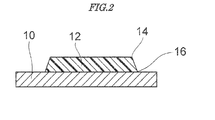

Classifications
-
- G—PHYSICS
- G03—PHOTOGRAPHY; CINEMATOGRAPHY; ANALOGOUS TECHNIQUES USING WAVES OTHER THAN OPTICAL WAVES; ELECTROGRAPHY; HOLOGRAPHY
- G03F—PHOTOMECHANICAL PRODUCTION OF TEXTURED OR PATTERNED SURFACES, e.g. FOR PRINTING, FOR PROCESSING OF SEMICONDUCTOR DEVICES; MATERIALS THEREFOR; ORIGINALS THEREFOR; APPARATUS SPECIALLY ADAPTED THEREFOR
- G03F7/00—Photomechanical, e.g. photolithographic, production of textured or patterned surfaces, e.g. printing surfaces; Materials therefor, e.g. comprising photoresists; Apparatus specially adapted therefor
- G03F7/26—Processing photosensitive materials; Apparatus therefor
- G03F7/40—Treatment after imagewise removal, e.g. baking
Definitions
- the present invention relates to a resin pattern, a method for producing the pattern, a method for producing a MEMS structure, a method for manufacturing a semiconductor device, and a method for producing a plated pattern.
- JP-A-10-73923 JP-A denotes a Japanese unexamined patent application publication
- JP-A denotes a Japanese unexamined patent application publication
- JP-T-2008-533510 JP-T denotes a published Japanese translation of a PCT application discloses an example of the production of a MEMS structure using a sacrificial layer resist.
- the control of the shape of the resist is important.
- a resist when used as an etching resist in a dry etching process, it is required to form a profile with a large taper angle in a rectangular shape, in order to realize production of a precise pattern by etching.
- the photosensitive resin composition described in JP-A-10-73923 has a problem in that a rectangular profile cannot be obtained due to heat flow at the time of a bake process.
- a problem that is to be solved by the present invention is to provide a method for producing a resin pattern, which is capable of forming a resin pattern that is rectangular or close to a rectangle even after heat treatment of the formed resin pattern.
- a method for producing a resin pattern which is capable of forming a resin pattern that is rectangular or close to a rectangle even after a formed resin pattern is heat-treated.
- the description of "lower limit to upper limit”, which indicates a range of values, indicates “equal to or more than the lower limit and equal to or less than the upper limit,” and the description of “upper limit to lower limit” indicates “equal to or less than the upper limit and equal to or more than the lower limit.” That is, the descriptions indicate the ranges of values including the upper limit and the lower limit.
- the "(Component A1) polymer including a monomer unit (a1-1) having a residue of a carboxyl group or a phenolic hydroxyl group protected with an acid-decomposable group, and a monomer unit (a1-2) having an epoxy group and/or an oxetanyl group” or the like will be also simply referred to as “Component A” or the like
- the "monomer unit (a1-1) having a residue of a carboxyl group or a phenolic hydroxyl group protected with an acid-decomposable group” or the like will be also simply referred to as "monomer unit (a1-1)” or the like.
- the method for producing a resin pattern of the present invention is characterized by including at least the steps (1) to (7) in this order:
- the method for producing a resin pattern of the present invention includes (1) a coating step of coating a photosensitive resin composition on a substrate.
- the photosensitive resin composition be applied on a given substrate, and the solvent be removed under reduced pressure and/or by heating (prebake), and thereby a desired dry film be formed.
- Examples of the substrate material that can be used in the present invention include silicon, silicon dioxide, silicon nitride, alumina, glass, glass-ceramics, gallium arsenide, indium phosphide, copper, aluminum, nickel, iron, steel, a copper-silicon alloy, indium tin oxide-coated glass; organic films of polyimides and polyesters; and any substrates including patterned regions of metal, semiconductors and insulating materials, but the examples are not limited to these.
- a bake step can be carried out on the substrate, before the photosensitive resin composition is applied, in order to remove the absorbed moisture.
- a coating method of the substrate there are no particular limitations on the coating method of the substrate, and for example, methods such as a slit coating method, a spray method, a roll coating method, or a rotary coating method can be used.
- the slit coating method is preferable over the others.
- a large-sized substrate means a substrate having a size which measures from 1 to 5 m on each side.
- step (1) in a case of being applied to flexible films such as polyimides and polyesters as a substrate, a transfer material having the photosensitive resin composition would be obtained.
- a transfer material having the photosensitive resin composition
- it is transferred to a non-flexible substrate such as a glass substrate.
- a method for producing a resin pattern in the case of forming a resin pattern as a transfer material can also be made with reference to JP-A-2010-72589 or the like.
- the method for producing a resin pattern of the present invention includes (2) a solvent removal step of removing the solvent from the applied photosensitive resin composition.
- the solvent be removed from the film applied under reduced pressure (vacuum) and/or by heating, and thereby a dry coating film be formed on the substrate.
- the heating conditions are preferably for about 30 to 300 seconds at 70°C to 120°C.
- the method for producing a resin pattern of the present invention is, because of a satisfactory shape controllability thereof, suitably used for the production of a thick film pattern, which has a film thickness after the solvent removal of 4 ⁇ m or greater.
- the film thickness after the solvent removal is preferably 4 to 500 ⁇ m, and 4 to 100 ⁇ m is particularly preferable.
- the method for producing a resin pattern of the present invention includes (3) an exposure step of patternwise exposing the photosensitive resin composition from which the solvent has been removed, to an active radiation.
- the substrate provided with a dry coating film is irradiated with an active radiation.
- the exposure may be carried out via a mask, or a predetermined pattern may be directly drawn.
- An active radiation having a wavelength of from 300 nm to 450 nm can be used preferably.
- a low pressure mercury lamp, a high pressure mercury lamp, an ultrahigh pressure mercury lamp, a chemical lamp, a laser generating apparatus, an LED light source or the like can be used.
- an active radiation having a wavelength of g-line (436 nm), i-line (365 nm), or h-line (405 nm) can be preferably used.
- a mercury lamp is more advantageous than laser light from the viewpoint that the mercury lamp is appropriate for exposure of a large area.
- 343 nm or 355 nm are used in the case of a solid (YAG) laser, and 351 nm (XeF) is used in the case of an excimer laser. Furthermore, 375 nm or 405 nm are used in the case of a semiconductor laser. Among these, 355 nm or 405 nm are more preferable from the viewpoints of stability and cost. Laser light can be irradiated on the coating film in a single dose or in several divided doses.
- the energy density per pulse of laser light is preferably 0.1 to 10,000 mJ/cm 2 .
- an energy density of 0.3 mJ/cm 2 or greater is more preferable, and 0.5 mJ/cm 2 or greater is most preferable.
- an energy density of 1,000 mJ/cm 2 or less is more preferable, and 100 mJ/cm 2 or less is most preferable.
- the pulse width is preferably from 0.1 nsec to 30,000 nsec.
- a pulse width of 0.5 nsec or longer is more preferable, and 1 nsec or longer is most preferable.
- a pulse width of 1,000 nsec or shorter is more preferable, and 50 nsec or shorter is most preferable.
- the frequency of the laser is preferably from 1 Hz to 50,000 Hz. In order to shorten the exposure treatment time, the frequency is more preferably 10 Hz or greater, and most preferably 100 Hz or greater. In order to increase the alignment accuracy at the time of scan exposure, the frequency is more preferably 10,000 Hz or less, and most preferably 1,000 Hz or less.
- a laser is more advantageous than a mercury lamp, from the viewpoint that focusing is easy, a mask for the pattern formation in the exposure step is unnecessary, and the cost can be reduced.
- the exposing apparatus that can be used in the present invention is not particularly limited, but commercially available products such as Callisto (manufactured by V Technology Co., Ltd.), AEGIS (manufactured by V Technology Co., Ltd.), DF2200G (manufactured by Dainippon Screen Co., Ltd.) or the like can be used. Apparatuses other than those described above can also be suitably used.
- the irradiation light can also be regulated through a spectrometric filter such as a long wavelength cutoff filter, a short wavelength cutoff filter, or a band pass filter.
- a spectrometric filter such as a long wavelength cutoff filter, a short wavelength cutoff filter, or a band pass filter.
- PEB post-exposure bake
- the temperature is preferably 30°C to 130°C, more preferably 40°C to 110°C, and particularly preferably 50°C to 90°C.
- the method for producing a resin pattern of the present invention includes (4) a development step of developing the exposed photosensitive resin composition using an aqueous developer liquid.
- the exposed photosensitive resin composition is developed using an aqueous developer liquid.
- the aqueous developer liquid is preferably an alkaline developer liquid, and as the basic compound that can be used in the alkaline developer liquid, for example, aqueous solutions of alkali metal hydroxides such as lithium hydroxide, sodium hydroxide, and potassium hydroxide; alkali metal carbonates such as sodium carbonate and potassium carbonate; alkali metal hydrogen carbonates such as sodium hydrogen carbonate and potassium hydrogen carbonate; ammonium hydroxides such as tetramethylammonium hydroxide, tetraethylammonium hydroxide, and choline hydroxide; sodium silicate and sodium metasilicate can be used.
- an aqueous solution prepared by adding an appropriate amount of a water-soluble organic solvent such as methanol or ethanol, or a surfactant to an aqueous solution of an alkali can also be used as the developer liquid.
- the pH of the developer liquid is preferably 10.0 to 14.0.
- the development time is preferably 30 to 180 seconds, and the technique of development may be any of a paddling method, a dipping method, a showering method and the like. After the development, it is preferable to perform washing under flowing water for 10 to 90 seconds, and to thereby form a desired pattern.
- the method for producing a resin pattern of the present invention preferably includes a re-exposure step of re-exposing the substrate with a pattern formed thereon to an active radiation, either between step (4) and step (5), or between step (5) and step (6).
- the exposure in the re-exposure step may be carried out by the same means as used in the exposure step, but in the re-exposure step, it is preferable to perform full-area exposure on the side of the substrate where a film of the photosensitive resin composition has been formed.
- a preferable amount of exposure for the re-exposure step is 100 to 1,000 mJ/cm 2 .
- the method for producing a resin pattern of the present invention includes (5) an overcoating step of providing an overcoat layer on the developed photosensitive resin composition.
- the coating refers to coating and solvent removal, and is performed throughout an entire area of the resin pattern.
- the overcoat layer is formed so as to fill up the grooves of the already formed resin pattern, and the surface of the overcoat layer becomes nearly flat.
- the material of the overcoat layer is not particularly limited, as long as it is neither melted during the baking nor thermally decomposed, but can be removed after baking.
- polymers which do not have an adverse effect on the production of semiconductors, and are excellent in heat resistance are preferably used, and the examples thereof include animal proteins (glue, casein, gelatin, egg white or the like), semi-synthetic polymers (methyl celluloses, ethyl cellulose, carboxymethyl cellulose (CMC), or the like), plant-derived polysaccharides (corn starch, gum arabic, or the like), and synthetic polymers.
- semi-synthetic polymers such as celluloses or starches, and synthetic polymers represented by polyvinyl alcohol or poly(meth)acrylic acid ester copolymer are preferable.
- the overcoat layer can be coated and provided on a resin pattern from a solution where these polymers have been dissolved in a solvent such as water or organic solvents.
- the semi-synthetic polymers are preferably dextrins, and celluloses; more preferably natural cyclodextrins, methyl cellulose, ethyl cellulose, methyl hydroxy cellulose, hydroxyethyl cellulose, and hydroxypropyl cellulose; yet more preferably ⁇ -cyclodextrin and hydroxypropyl methylcellulose; and particularly preferably hydroxypropyl methylcellulose.
- polyester resins acrylic resins, and vinyl resins, and specifically, preferably, acrylic resins such as poly(meth)acrylic acid ester copolymer, sodium poly(meth)acrylate, and poly(meth)acrylic amide; vinyl resins such as polyvinyl alcohol, and polyvinyl pyrrolidone, more preferably poly(meth)acrylate copolymer, and polyvinyl alcohol (PVA), and particularly preferably polyvinyl alcohol (PVA) can be used.
- acrylic resins such as poly(meth)acrylic acid ester copolymer, sodium poly(meth)acrylate, and poly(meth)acrylic amide
- vinyl resins such as polyvinyl alcohol, and polyvinyl pyrrolidone, more preferably poly(meth)acrylate copolymer, and polyvinyl alcohol (PVA), and particularly preferably polyvinyl alcohol (PVA) can be used.
- the above-mentioned poly(meth)acrylic acid ester copolymers are preferably an ester of poly (meth)acrylic acid with an aliphatic or aromatic alcohol having 1 to 10 carbon atoms, and a random copolymer with (meth)acrylic acid, and the copolymerization ratio thereof is more preferably in the range of 60 to 90 mol% of (meth)acrylic acid ester and 40 to 10 mol% of (meth)acrylic acid.
- the (meth)acrylic acid ester includes an ester of a lower alcohol having 1 to 5 carbon atoms with (meth)acrylic acid such as methyl methacrylate; and an ester of an aralkyl alcohol having 7 to 10 carbon atoms with (meth)acrylic acid such as benzyl methacrylate.
- the monomer unit derived from a (meth)acrylic acid may be partially such as a tetramethylammonium salt.
- the weight average molecular weight is preferably 2,000 to 50,000, from the viewpoint of the coating suitability.
- poly(meth)acrylic acid ester copolymer examples include methyl methacrylate-methacrylic acid copolymer (copolymerization ratio of 90:10 mol%, weight average molecular weight of about 12,000), and benzyl methacrylate-methacrylic acid copolymer (copolymerization ratio of 80:20 mol%, weight average molecular weight of 10,000).
- the overcoat layer can be coated and provided from a solution of the above-mentioned poly (meth)acrylic acid ester copolymer in a glycol-based solvent such as propylene glycol monomethyl ether acetate, and the overcoat layer is removed by a dilute alkali aqueous solution such as an aqueous solution of tetramethylammonium hydroxide.
- a glycol-based solvent such as propylene glycol monomethyl ether acetate
- PVA is crystallized by heating in order for the hydroxyl group thereof to form hydrogen bonds, and thereby a satisfactory heat resistance can be obtained, and thermal sagging of the resin pattern can be prevented.
- grades may gave a variety of saponification degrees and polymerization degrees, and modified polyvinyl alcohol can be used.
- PVA is commercially available from many manufacturers, and the manufacturers include Kuraray Co., Ltd., and Kuraray Poval (registered trademark) is commercially available.
- PVA is largely classified as each of a grade having complete saponification (saponification degree of about 98 to 99%), intermediate saponification (saponification degree of about 90.5 to 96.5%), and partial saponification (saponification degree of about 87 to 89% or about 71 to 83%), and PVA having the partial saponification, such as PVA 203, PVA 205, and PVA 210 can be preferably used.
- Partially saponified polyvinyl alcohol is readily soluble in cold water, and is completely soluble at a high temperature, and thereby is used for coating.
- PVA having a high saponification degree requires a high temperature and time for complete dissolution.
- a preferable polymerization degree of PVA is about 400 to 600, and the protective film is applied and dried, from an aqueous solution having a viscosity about 4 to 10 mPa ⁇ sec at 20°C.
- a dry thickness of the overcoat layer can be appropriately selected.
- the overcoat layer is coated and provided preferably so as to be a layer thickness of 0.1 to 8 ⁇ m, and more preferably so as to be a thickness of 6 to 8 ⁇ m after adding the overcoat layer to a resin pattern.
- PVA having a partial saponification degree is also excellent in view of the fact that it is easy to remove the overcoat layer in the subsequent step (7).
- the overcoat layer is easily removed by washing with water.
- the method for producing a resin pattern of the present invention includes (6) a heat-treating step (a bake step) of heat-treating the photosensitive resin composition on which the overcoat layer has been provided.
- a cured film can be formed by heat-treating the photosensitive resin composition on which the overcoat layer has been provided.
- the temperature for heat-treating (The baking temperature) is preferably 180°C to 250°C, and the time for heat-treating is preferably 30 to 150 minutes.
- the temperature for the first stage baking is preferably 90°C to 150°C, and the time is preferably 10 to 60 minutes.
- the temperature for the second stage baking is preferably 180°C to 210°C, and the time is preferably 30 to 90 minutes.
- a bake step of three or more stages can also be carried out.
- the method for producing a resin pattern of the present invention includes (7) a removal step of removing the overcoat layer. This step removes the overcoat layer applied on the photosensitive resin composition heat-treated in the step (6).
- the solvent removal method is not limited, and includes a method such as a dry treatment (a dry etching), and a wet treatment (removing by dissolution in a treatment liquid). From the viewpoint of simplicity and a small effect on the photosensitive composition (the resin pattern), it is preferable to remove by dissolution in water, an aqueous alkali solution, or a solvent; more preferably in water and an aqueous alkali solution; and most preferably in water.
- a method such as a treatment of immersing the photosensitive composition in a treatment liquid, a treatment by showering in a liquid treatment, and a treatment (paddling) of placing a treatment liquid on a photosensitive resin composition, is included.
- the heating process may be provided again. This process may be effective for more complete curing of the film.
- the taper angle for the cross-sectional shape of the pattern after the bake step is preferably 60° or greater, more preferably 70° or greater, and particularly preferably 80° or greater.
- the "taper angle” is the angle formed by the lateral side of the pattern and the substrate plane on which the pattern is formed, in the cross-sectional shape obtained after forming a pattern and performing a heat-treating step.
- the cross-sectional shape of the lateral side of the pattern is not straight, the angle formed between a straight line connecting an end of the lower surface of the pattern which is in contact with the substrate, with an end of the upper surface of the pattern, and the plane of the substrate is designated as the taper angle.
- ⁇ in the respective pattern cross-sectional shapes shown in FIG. 1 represents a taper angle.
- the angle formed between a straight line connecting the apex of the arch, which is the remotest point on the arch from the substrate, and an end of the lower surface of the pattern that is in contact with the substrate, and the plane of the substrate, is designated as ⁇ .
- a resin pattern having a profile that is rectangular or close to a rectangle can be obtained even after the heat treatment step, by the method for producing a resin pattern of the present invention. Therefore, the resin pattern obtained by the method for producing a resin pattern of the present invention (the resin pattern of the present invention) can be suitably used for a MEMS structure, an etching resist, a resist for forming a bump or a metal post and the like.
- a rectangular pattern can be obtained without the exposure after development (the so-called post-exposure), by the method for producing a resin pattern of the present invention.
- the method for producing a MEMS (Micro Electro Mechanical System) structure of the present invention preferably includes two ways.
- One is a MEMS structure produced by using a resin pattern produced by the method for producing a resin pattern of the present invention as a sacrificial layer at the time of lamination of the structure; and the other is a MEMS structure produced by using a resin pattern produced by the method for producing a resin pattern of the present invention as the MEMS structural component.
- a MEMS Micro Electro Mechanical System refers to an electromechanical element or system having a microscopic structure having a size in the micrometer-scale, or a micromachine, and an example thereof may be a device in which a mechanical driving part, a sensor, an actuator, and an electronic circuit are integrated on a silicon substrate, a glass substrate or an organic material.
- examples of the MEMS shutter device and the image forming apparatus including a MEMS shutter device include those described in JP-T-2008- 533510 .
- a method for manufacturing a semiconductor device of the present invention is a method manufacturing a semiconductor device such as an integrated circuit by etching a substrate using the resin pattern produced by the method for producing a resin pattern of the present invention as an etching resist. Since a method for manufacturing a semiconductor device of the present invention enables production of a rectangular resin pattern, the substrate to be etched can be clearly etched.
- the method for producing a plated pattern of the present invention is a method for producing the plated pattern plating the resin pattern produced by the method for producing a resin pattern of the present invention as a template. Since the method for producing a resin pattern of the present invention enables production of a rectangular resin pattern having a thick film thickness, plated patterns for a bump or a metal post can be suitably produced.
- the bump refers to an electrode used in a case of connecting large-scale integration (LSI) and the like with electronic devices, and is described in detail in Japanese Patent No. 4544219 .
- an "alkyl group” has a meaning of including an alkyl group which has no substituent (unsubstituted alkyl group) as well as an alkyl group having a substitute (substituted alkyl group).
- the photosensitive composition used in the present invention is not particularly limited as long as it has photosensitivity and developability. It preferably has a property capable of being cured by heat. Among them, it is preferably any of the three embodiments shown below.
- the first embodiment which is a preferable embodiment of the photosensitive resin composition is a photosensitive resin composition containing (Component A1) a polymer including a monomer unit (a1-1) having a residue of a carboxyl group or a phenolic hydroxyl group protected with an acid-decomposable group, and a monomer unit (a1-2) having an epoxy group and/or an oxetanyl group.
- Component A1 a polymer including a monomer unit (a1-1) having a residue of a carboxyl group or a phenolic hydroxyl group protected with an acid-decomposable group, and a monomer unit (a1-2) having an epoxy group and/or an oxetanyl group.
- Component A1 preferably includes, in addition to the monomer units (a1-1) and (a1-2), a monomer unit (a1-3) having a cyclic structure, and/or a monomer unit (a1-4) having a carboxyl group or a hydroxyl group.
- Component A1 may also include a monomer unit (a1-5) in addition to the monomer units (a1-1) to (a1-4).
- the "monomer unit” according to the present invention is intended to include not only a constituent unit formed from one monomer molecule, but also a constituent unit obtained by modifying a constituent unit formed from one monomer molecule by a polymer reaction or the like.
- the residue of a carboxyl group or a phenolic hydroxyl group protected with an acid-decomposable group can produce a carboxyl group or a phenolic hydroxyl group by decomposing (deprotecting) the acid-decomposable group with an acid.
- Component A1 Polymer including a monomer unit (a1-1) and the monomer unit (a1-2)
- the photosensitive resin composition preferably contains (Component A1) a polymer including a monomer unit (a1-1) having a residue of a carboxyl group or a phenolic hydroxyl group protected with an acid-decomposable group, and a monomer unit (a1-2) having an epoxy group and/or an oxetanyl group.
- Component A1 a polymer including a monomer unit (a1-1) having a residue of a carboxyl group or a phenolic hydroxyl group protected with an acid-decomposable group, and a monomer unit (a1-2) having an epoxy group and/or an oxetanyl group.
- Component A1 is preferably a resin which is alkali-insoluble, and becomes alkali-soluble when the acid-decomposable group in the monomer unit (a1-1) is decomposed.
- alkali-soluble means that a coating film (thickness 4 ⁇ m) of the compound (resin) formed when a solution of the compound (resin) is applied on a substrate and heated for 2 minutes at 90°C, has a dissolution rate in a 0.4 wt% aqueous solution of tetramethylammonium hydroxide at 23°C of 0.01 ⁇ m/second or greater.
- alkali-insoluble means that a coating film (thickness 4 ⁇ m) of the compound (resin) formed when a solution of the compound (resin) is applied on a substrate and heated for 2 minutes at 90°C, has a dissolution rate in a 0.4 wt% aqueous solution of tetramethylammonium hydroxide at 23°C of less than 0.01 ⁇ m/second, preferably less than 0.005 ⁇ m/second.
- the weight average molecular weight (Mw) of Component A1 is preferably 5,000 or greater, more preferably 12,000 or greater, and yet more preferably 20,000 or greater, and is preferably 1,000,000 or less, more preferably 80,000 or less, and yet more preferably 60,000 or less.
- Mw weight average molecular weight
- the weight average molecular weight is 12,000 or greater, a profile having a satisfactory rectangular shape or a shape close to a rectangle can be obtained even after a bake step.
- the weight average molecular weight is 80,000 or less, excellent pattern formability at the time of development is obtained.
- the weight average molecular weight is a value measured by gel permeation chromatography (GPC) and calculated relative to polystyrene standards. It is preferable to measure the weight average molecular weight using THF as a solvent, and using TSKgel SuperHZ3000 and TSKgel SuperHZM-M columns (all manufactured by Tosoh Corp.).
- Component A1 is preferably an acrylic polymer.
- the "acrylic polymer” according to the present invention is an addition polymerized resin, and is a polymer containing a monomer unit derived from (meth)acrylic acid or an ester thereof.
- the "acrylic polymer” may also have a monomer unit other than the monomer derived from (meth)acrylic acid or an ester thereof, for example, a monomer unit derived from a styrene or a monomer unit derived from a vinyl compound.
- Component A may also include a monomer unit derived from (meth)acrylic acid and a monomer unit derived from a (meth)acrylic acid ester together.
- the "monomer unit derived from (meth)acrylic acid or an ester thereof" is also referred to as an "acrylic monomer unit.”
- (meth)acrylic acid is meant to collectively refer to methacrylic acid and acrylic acid.
- Component A has at least a monomer unit (a1-1) having a residue of a carboxyl group or a phenolic hydroxyl group protected with an acid-decomposable group.
- a photosensitive resin composition having very high sensitivity can be obtained.
- a monomer unit having a residue of a carboxyl group protected with an acid-decomposable group is characterized in that development is rapidly achieved, as compared with a monomer unit having a residue of a phenolic hydroxyl group protected with an acid-decomposable group. Therefore, for development to be rapid, a monomer unit having a residue of a carboxyl group protected with an acid-decomposable group is preferable. On the contrary, for development to be delayed, it is preferable to use a monomer unit having a residue of a phenolic hydroxyl group protected with an acid-decomposable group.
- a monomer unit having a carboxyl group may be, for example, a monomer unit derived from an unsaturated carboxylic acid having at least one carboxyl group in the molecule, such as an unsaturated monocarboxylic acid, an unsaturated dicarboxylic acid, or an unsaturated tricarboxylic acid.
- Examples of the unsaturated carboxylic acid used to obtain the monomer unit having a carboxyl group include the acids described below. That is, examples of the unsaturated monocarboxylic acid include acrylic acid, methacrylic acid, crotonic acid, ⁇ -chloroacrylic acid, and cinnamic acid. Examples of the unsaturated dicarboxylic acid include maleic acid, fumaric acid, itaconic acid, citraconic acid, and mesaconic acid. Furthermore, the unsaturated polyvalent carboxylic acid used to obtain the monomer unit having a carboxyl group may also be in the form of an acid anhydride thereof. Specific examples include maleic anhydride, itaconic anhydride, and citraconic anhydride.
- the unsaturated polyvalent carboxylic acid may be a mono(2-methacryloyloxyalkyl) ester of a polyvalent carboxylic acid, and examples include mono(2-acryloyloxyethyl) succinate, mono(2-methacryloyloxyethyl) succinate, mono(2-acryloyloxyethyl) phthalate, and mono(2-methacryloyloxyethyl) phthalate.
- the unsaturated polyvalent carboxylic acid may be a mono(meth)acrylate of a dicarboxypolymer having the unsaturated polyvalent carboxylic acid at the two ends, and examples thereof include ⁇ -carboxypolycaprolactone monoacrylate, and ⁇ -carboxypolycaprolactone monomethacrylate.
- unsaturated carboxylic acid acrylic acid-2-carboxyethyl ester, methacrylic acid-2-carboxyethyl ester, maleic acid monoalkyl ester, fumaric acid monoalkyl ester, 4-carboxystyrene and the like can also be used.
- acrylic acid, methacrylic acid, or an anhydride of an unsaturated polyvalent carboxylic acid it is preferable to use acrylic acid, methacrylic acid, or an anhydride of an unsaturated polyvalent carboxylic acid in order to form the monomer unit having a carboxyl group, and it is more preferable to use acrylic acid or methacrylic acid.
- the monomer unit having a carboxyl group may be composed of one kind only, or may be composed of two or more kinds.
- the monomer unit having a carboxyl group may be a monomer unit obtained by allowing a monomer unit having a hydroxyl group to react with an acid anhydride.
- acid anhydride known compounds may be used, and specific examples include dibasic acid anhydrides such as maleic anhydride, succinic anhydride, itaconic anhydride, phthalic anhydride, tetrahydrophthalic anhydride, hexahydrophthalic anhydride, and chlorendic anhydride; and acid anhydrides such as trimellitic anhydride, pyromellitic anhydride, benzophenonetetracarboxylic acid anhydride, and biphenyltetracarboxylic acid anhydride.
- dibasic acid anhydrides such as maleic anhydride, succinic anhydride, itaconic anhydride, phthalic anhydride, tetrahydrophthalic anhydride, hexahydrophthalic anhydride, and chlorendic anhydride
- acid anhydrides such as trimellitic anhydride, pyromellitic anhydride, benzophenonetetracarboxylic acid anhydride, and biphen
- the reaction ratio of the acid anhydride with respect to the hydroxyl group is preferably 10 to 100 mol%, and more preferably 30 to 100 mol%, from the viewpoint of developability.
- the monomer unit (a1-1-1) having a residue of a carboxyl group protected with an acid-decomposable group is preferably a monomer unit in which the carboxyl group of the monomer unit having a carboxyl group has a residue protected by an acid-decomposable group that will be described in detail below.
- acid-decomposable groups for positive resist for KrF and positive resist for ArF can be used, and there are no particular limitations thereon.
- a group that can be relatively easily decomposed by an acid for example, an acetal-based functional group such as a tetrahydropyranyl group
- a group which cannot be relatively easily decomposed by an acid for example, a t -butyl-based functional group such as a t -butyl ester group or a t-butyl carbonate group
- a monomer unit in which the acid-decomposable group is a residue in which a carboxyl group is protected with an acetal, or is a residue in which a carboxyl group protected with a ketal is preferable from the viewpoints of the fundamental properties of the resist, particularly sensitivity, pattern shape, contact hole formability, and storage stability of the photosensitive resin composition. Furthermore, among the acid-decomposable groups, it is more preferable, from the viewpoint of sensitivity, that the monomer unit have a residue in which a carboxyl group is protected with an acetal or ketal represented by the following formula (a1-1).
- R 1 and R 2 each independently represent a hydrogen atom or an alkyl group, provided that the case where R 1 and R 2 are both hydrogen atoms is excluded;
- R 3 represents an alkyl group;
- R 1 or R 2 and R 3 may be joined to form a cyclic ether; and the wavy line represents the position of bonding to another structure.
- R 1 to R 3 each independently represent a hydrogen atom or an alkyl group, and the alkyl group may be either linear, branched or cyclic.
- R 1 and R 2 represent hydrogen atoms
- at least one of R 1 and R 2 represents an alkyl group.
- R 1 , R 2 and R 3 represent alkyl groups
- the alkyl group may be either linear, branched or cyclic.
- the linear or branched alkyl group preferably has 1 to 12 carbon atoms, more preferably 1 to 6 carbon atoms, and yet more preferably 1 to 4 carbon atoms.
- Specific examples include a methyl group, an ethyl group, a n -propyl group, an i -propyl group, a n -butyl group, an i -butyl group, a sec -butyl group, a t -butyl group, a n -pentyl group, a neopentyl group, a n -hexyl group, a thexyl group (2,3-dimethyl-2-butyl group), a n -heptyl group, a n -octyl group, a 2-ethylhexyl group, a n -nonyl group, and a n -decyl group.
- the cyclic alkyl group preferably has 3 to 12 carbon atoms, more preferably 4 to 8 carbon atoms, and yet more preferably 4 to 6 carbon atoms.
- Examples of the cyclic alkyl group include a cyclopropyl group, a cyclobutyl group, a cyclopentyl group, a cyclohexyl group, a cycloheptyl group, a cyclooctyl group, a norbornyl group, and an isobornyl group.
- the alkyl group may be substituted with a substituent, and examples of the substituent include a halogen atom, an aryl group, and an alkoxy group.
- R 1 , R 2 and R 3 becomes haloalkyl groups
- R 1 , R 2 and R 3 become aralkyl groups.
- halogen atom examples include a fluorine atom, a chlorine atom, a bromine atom, and an iodine atom, and among these, a fluorine atom and a chlorine atom are preferable.
- the aryl group is preferably an aryl group having 6 to 20 carbon atoms, and more preferably an aryl group having 6 to 12 carbon atoms. Specific examples include a phenyl group, an ⁇ -methylphenyl group, and a naphthyl group.
- the aralkyl group is preferably an aralkyl group having 7 to 32 carbon atoms, and more preferably an aralkyl group having 7 to 20 carbon atoms. Specific examples include a benzyl group, an ⁇ -methylphenyl group, a phenethyl group, and a naphthylmethyl group.
- the alkoxy group is preferably an alkoxy group having 1 to 6 carbon atoms, and more preferably an alkoxy group having 1 to 4 carbon atoms.
- a methoxy group or an ethoxy group is yet more preferable.
- the cycloalkyl group may have a linear or branched alkyl group having 1 to 10 carbon atoms as a substituent, and when the alkyl group is a linear or branched alkyl group, the group may have a cycloalkyl group having 3 to 12 carbon atoms as a substituent.
- R 1 , R 2 and R 3 represent aryl groups
- the aryl group preferably has 6 to 12 carbon atoms, and more preferably has 6 to 10 carbon atoms.
- the aryl group may be substituted with a substituent, and a preferable example of the substituent is an alkyl group having 1 to 6 carbon atoms.
- the aryl group include a phenyl group, a tolyl group, a silyl group, a cumenyl group, and a 1-naphthyl group.
- R 1 , R 2 and R 3 may be joined to each other and may form a ring together with the carbon atoms to which they are bonded.
- Examples of the cyclic structure that can be formed when R 1 and R 2 , R 1 and R 3 , or R 2 and R 3 are joined, include a cyclobutyl group, a cyclopentyl group, a cyclohexyl group, a cycloheptyl group, a tetrahydrofuranyl group, an adamantyl group, and a tetrahydropyranyl group. Among them, a tetrahydrofuranyl group is preferable.
- R 1 and R 2 be a hydrogen atom or a methyl group.
- the radical polymerizable monomer used to form the monomer unit having a residue represented by the formula (a1-1) a commercially available compound may be used, or a product synthesized by a known method may also be used.
- the monomer can be synthesized by allowing (meth)acrylic acid to react with a vinyl ether in the presence of an acid catalyst.
- R 11 represents a hydrogen atom or an alkyl group, and is preferably a hydrogen atom or a methyl group.
- R 12 and R 13 as in the form of -CH(R 12 )(R 13 ), have the same meaning as R 2 defined for the formula (a1-1), and R 14 has the same meaning as R 1 defined for the formula (a1-1).
- R 15 has the same meaning as R 3 defined for the formula (a1-1), and these substituents also have the same preferable ranges as R 1 , R 2 and R 3 .
- the above-mentioned synthesis may be carried out by copolymerizing (meth)acrylic acid with the other monomer in advance, and then allowing the product to react with a vinyl ether in the presence of an acid catalyst.
- Specific preferable examples of the monomer unit (a1-1-1) having a residue of a carboxyl group protected with an acid-decomposable group include the following monomer units.
- R represents a hydrogen atom or a methyl group.
- Examples of a monomer unit having a phenolic hydroxyl group include a hydroxystyrene-based monomer unit and a monomer unit found in a novolac-based resin.
- a monomer represented by formula (a1-2) is preferable from the viewpoint of transparency and sensitivity.
- R 20 represents a hydrogen atom or a methyl group
- R 21 represents a single bond or a divalent linking group
- R 22 represents a halogen atom or an alkyl group
- a represents an integer from 1 to 5
- b represents an integer from 1 to 4, while a+b is 5 or less; and when there are two or more of R 22 , these R 22 'S may be different or may be identical.
- R 20 represents a hydrogen atom or a methyl group, and is preferably a methyl group.
- R 21 in the formula (a1-2) represents a single bond or a divalent linking group.
- the divalent linking group of R 21 may be an alkylene group, and specific examples of the alkylene group as R 21 include a methylene group, an ethylene group, a propylene group, an isopropylene group, an n -butylene group, an isobutylene group, a tert -butylene group, a pentylene group, an isopentylene group, a neopentylene group, and a hexylene group.
- R 21 be a single bond, a methylene group or an ethylene group.
- the divalent linking group may be substituted with a substituent, and examples of the substituent include a halogen atom, a hydroxyl group, and an alkoxy group.
- a in the formula (a1-2) represents an integer from 1 to 5, but from the viewpoints of the effect of the present invention or facilitated production, a is preferably 1 or 2, and a is more preferably 1.
- the position of bonding of the hydroxyl group in the benzene ring is preferably such that R 21 is bonded at the 4-position when the carbon atom bonded to R 21 is taken as the reference position (1-position).
- R 22 in the formula (a1-2) represents a halogen atom, or a linear or branched alkyl group having 1 to 5 carbon atoms. Specific examples include a fluorine atom, a chlorine atom, a bromine atom, a methyl group, an ethyl group, a propyl group, an isopropyl group, a n -butyl group, an isobutyl group, a tert -butyl group, a pentyl group, an isopentyl group, and a neopentyl group. Among them, from the viewpoint that production is easy, R 22 is preferably a chlorine atom, a bromine atom, a methyl group or an ethyl group.
- b represents 0 or an integer from 1 to 4.
- a monomer unit represented by the formula (a1-2') is more preferable from the viewpoints of transparency and sensitivity.
- the linking group of R 21 include, in addition to an alkylene group, an alkyleneoxycarbonyl group (from the side of the main chain of the copolymer).
- the monomer unit having a phenolic hydroxyl group be represented by the following formula (a1-2').
- R 30 represents a hydrogen atom or a methyl group
- R 33 represents a divalent linking group
- R 32 represents a halogen atom or an alkyl group
- a represents an integer from 1 to 5
- b represents an integer from 0 to 4, while a+b is 5 or less; and when there are two or more R 32 's, these R 32 'S may be identical with or different from each other.
- R 30 has the same meaning as R 20 in the formula (a1-2)
- R 32 has the same meaning as R 22 in the formula (a1-2)
- a and b respectively have the same meanings as a and b in the formula (a1-2). They also have the same preferable ranges.
- R 33 represents a divalent linking group, and a preferable example may be an alkylene group.
- the alkylene group may be either a linear group or a branched group, and preferably has 2 to 6 carbon atoms. Examples thereof include an ethylene group, a propylene group, an isopropylene group, an n -butylene group, a tert -butylene group, a pentylene group, an isopentylene group, a neopentylene group, and a hexylene group.
- the divalent linking group may be substituted with a substituent, and examples of the substituent include a halogen atom, a hydroxyl group, and an alkoxy group.
- R 33 is preferably an ethylene group, a propylene group, or a 2-hydroxypropylene group, from the viewpoint of sensitivity.
- the monomer unit having a residue of a phenolic hydroxyl group protected with an acid-decomposable group is a monomer unit having a residue in which the phenolic hydroxyl group of the monomer unit having a phenolic hydroxyl group is protected by the acid-decomposable group that will be described in detail below.
- the acid-decomposable group those groups that are well known can be used as previously described, and there are no particular limitations.
- a monomer unit having a residue of a phenolic hydroxyl group protected with an acetal, or a residue of a phenolic hydroxyl group protected with a ketal is preferable from the viewpoints of the fundamental properties of the resist, particularly sensitivity, pattern shape, storage stability of the photosensitive resin composition, and contact hole formability.
- a residue in which a phenolic hydroxyl group is protected with an acetal or ketal represented by the formula (a1-1) is more preferable from the viewpoint of sensitivity.
- the overall structure of the residue is -Ar-O-CR 1 R 2 (OR 3 ).
- Ar represents an arylene group.
- an acetal ester structure protecting the phenolic hydroxyl group include a combination of R 1 , R 2 and R 3 each being a methyl group, and a combination of R 1 and R 2 each being a methyl group and R 3 being a benzyl group.
- radical polymerizable monomers used to form the monomer unit having a residue of a phenolic hydroxyl group protected with an acetal or a ketal include a 1-alkoxyalkyl-protected product of hydroxystyrene, a tetrahydropyranyl-protected product of hydroxystyrene, a 1-alkoxyalkyl-protected product of ⁇ -methylhydroxystyrene, a tetrahydropyranyl-protected product of ⁇ -methylhydroxystyrene, a 1-alkoxyalkyl-protected product of 4-hydroxyphenyl methacrylate, a tetrahydropyranyl-protected product of 4-hydroxyphenyl methacrylate, a 1-alkoxyaklyl-protected product of 4-hydroxybenzoic acid (1-methacryloyloxymethyl) ester, a tetrahydropyranyl-protected product of 4-hydroxybenzoic acid (1
- the acetal protective group and the ketal protective group for the phenolic hydroxyl group are preferably a group represented by the formula (a1-1). These can be used singly or in combination of two or more kinds.
- the monomer unit (a1-1-2) include the following monomer units, but the present invention is not limited to these examples.
- R in the following monomer units represents a hydrogen atom or a methyl group.
- the content of the monomer unit (a1-1) in Component A1 is preferably 3 to 70 mol%, more preferably 5 to 60 mol%, and yet more preferably 10 to 50 mol%, based on all the monomer units of Component A1.
- the content of the monomer unit (a1-1) is preferably 45 mol% or less, in view of deterioration of the profile due to deprotection shrinkage, and is particularly preferably in the range of 10 to 45 mol% in view of a balance between sensitivity and rectangle formability.
- Component A1 has a monomer unit (a1-2) having an epoxy group and/or an oxetanyl group.
- Component A1 may have both of a monomer unit having an epoxy group and a monomer unit having an oxetanyl group.
- the group having an epoxy group is not particularly limited as long as it has an epoxy ring, but preferable examples include a glycidyl group, and a 3,4-epoxycyclohexylmethyl group.
- the group having an oxetanyl group is not particularly limited as long as it has an oxetane ring, and a preferable example may be a (3-ethyloxetan-3-yl)methyl group.
- the monomer unit (a1-2) may have at least one epoxy group or oxetanyl group in one monomer unit, and may also have one or more epoxy groups and one or more oxetanyl group, two or more epoxy groups, or two or more oxetanyl groups. There are no particular limitations, but the monomer unit (a1-2) preferably has one to three epoxy groups and/or oxetanyl groups in total, more preferably has one or two epoxy groups and/or oxetanyl groups in total, and yet more preferably has one epoxy group or one oxetanyl group.
- radical polymerizable monomer used to form the monomer unit having an epoxy group examples include glycidyl acrylate, glycidyl methacrylate, glycidyl ⁇ -ethylacrylate, glycidyl ⁇ - n -propylacrylate, glycidyl ⁇ - n -butylacrylate, 3,4-epoxybutyl acrylate, 3,4-epoxybutyl methacrylate, 6,7-epoxyheptyl acrylate, 6,7-epoxyheptyl methacrylate, 6,7-epoxyheptyl ⁇ -ethylacrylate, o-vinylbenzyl glycidyl ether, m -vinylbenzyl glycidyl ether, p -vinylbenzyl glycidyl ether, and the compound containing an alicyclic epoxy skeleton described in paragraphs 0031 to 0035
- radical polymerizable monomer used to form the monomer unit having an oxetanyl group examples include the (meth)acrylic acid esters having an oxetanyl group described in paragraphs 0011 to 0016 of JP-A-2001-330953 .
- radical polymerizable monomer used to form the monomer unit (a1-2) include a monomer containing a methacrylic acid ester structure, and a monomer containing an acrylic acid ester structure.
- more preferable examples include glycidyl methacrylate, glycidyl acrylate, a compound containing an alicyclic epoxy skeleton as described in paragraphs 0034 to 0035 of Japanese Patent No. 4168443 , and a (meth)acrylic acid ester having an oxetanyl group as described in paragraphs 0011 to 0016 of JP-A-2001-330953 .
- a particularly preferable example is a monomer unit derived from any one of (3-ethyloxetan-3-yl)methyl acrylate and (3-ethyloxetan-3-yl)methyl methacrylate.
- These monomer units (a1-2) can be used singly or in combination of two or more kinds.
- monomer unit (a1-2) include the following monomer units.
- the content of the monomer unit (a1-2) in Component A1 is preferably 20 to 55 mol%, more preferably 25 to 55 mol%, and particularly preferably 25 to 50 mol%, based on all the monomer units of Component A1.
- the monomer unit (a1-2) is incorporated at the above-described proportion, the properties of the cured film become satisfactory.
- Component A1 preferably contains a monomer unit (a1-3) having a cyclic structure, from the viewpoint of enhancing dry etching resistance or chemical resistance.
- Examples of the monomer forming the monomer unit (a1-3) include (meth)acrylic acid cyclic alkyl esters such as styrenes, dicyclopentanyl (meth)acrylate, cyclohexyl (meth)acrylate, and cyclohexyl (meth)acrylate; and unsaturated aromatic compounds.
- a preferable example of the monomer unit (a1-3) having a cyclic structure may be a monomer unit represented by the following formula (a3-1) or formula (a3-2).
- R A represents a hydrogen atom or an alkyl group having 1 to 6 carbon atoms.
- R A in the formula (a3-1) is preferably a hydrogen atom or a methyl group, and particularly preferably a hydrogen atom, from the viewpoint of the uniformity of polymerization rate of each monomer at the time of polymerization.
- R B represents a hydrogen atom or a methyl group
- X represents a single bond or an alkylene group having 1 to 4 carbon atoms
- ring A represents a cyclopentane ring or a cyclopentene ring; and the structure may or may not have the ring A.
- R 8 in the formula (a3-2) is preferably a methyl group from the viewpoint of the uniformity of the polymerization rate of each monomer at the time of polymerization.
- X in the formula (a3-2) is preferably a single bond, a methylene group or an ethylene group, and more preferably a single bond.
- the ring A in the formula (a3-2) is preferably a cyclopentane ring.
- the formula (a3-2) have the ring A.
- the position of the double bond of a cyclopentene ring for the ring A is not particularly limited, and any position may be acceptable.
- the content of the monomer unit (a1-3) in Component A1 is preferably 1 to 30 mol%, more preferably 5 to 25 mol%, and particularly preferably 10 to 20 mol%, based on all the monomer units of Component A1.
- the resulting pattern has excellent dry etching resistance and chemical resistance.
- Component A1 preferably has a monomer unit (a1-4) having a carboxyl group or a hydroxyl group, from the viewpoint of developability.
- the monomer unit (a1-4) is preferably introduced to the extent that Component A1 does not become alkali-soluble.
- the content of the monomer unit (a1-4) in Component A1 is preferably 2 to 20 mol%, more preferably 2 to 15 mol%, and particularly preferably 3 to 15 mol%, based on all the monomer units of Component A1.
- the same unit as the "monomer unit having a carboxyl group" described in the monomer unit (a1-1-2) having a residue of a carboxyl group protected with an acid-decomposable group can be used.
- acrylic acid or methacrylic acid in order to form the monomer unit (a1-4-1) having a carboxyl group.
- An example of the monomer unit (a1-4) having a hydroxyl group may be a monomer unit (a1-4-2) having a phenolic hydroxyl group.
- a radical polymerizable monomer used to form a monomer unit (a1-4-2) having a phenolic hydroxyl group include hydroxystyrenes such as p-hydroxystyrene and ⁇ -methyl- p -hydroxystyrene; the compounds described in paragraphs 0011 to 0016 of JP-A-2008-40183 ; the 4-hydroxybenzoic acid derivatives described in paragraphs 0007 to 0010 of Japanese Patent No. 2888454 ; addition reaction products of 4-hydroxybenzoic acid and glycidyl methacrylate; and addition reaction products of 4-hydroxybenzoic acid and glycidyl acrylate.
- radical polymerizable monomers used to form the monomer unit (a1-4-2) having a phenolic hydroxyl group methacrylic acid, acrylic acid
- the compounds described in paragraphs 0011 to 0016 of JP-A-2008-40183 the 4-hydroxybenzoic acid derivatives described in paragraphs 0007 to 0010 of Japanese Patent No. 2888454
- addition reaction products of 4-hydroxybenzoic acid and glycidyl methacrylate and addition reaction products of 4-hydroxybenzoic acid and glycidyl acrylate are more preferable.
- methacrylic acid and acrylic acid are particularly preferable.
- These monomer units can be used singly or in combination of two or more kinds.
- Monomer unit having a hydroxyl group other than a phenolic hydroxyl group (a1-4-3)
- Any monomer unit having a hydroxyl group can be used as the monomer unit (a1-4-3) having a hydroxyl group other than a phenolic hydroxyl group, but preferable examples include monomer units derived from a hydroxyl group-containing (meth)acrylic acid ester, a (meth)acrylic acid ester of an alkyl group-terminated polyalkylene glycol, and a (meth)acrylic acid ester of an aryl group-terminated polyalkylene glycol.
- hydroxyl group-containing (meth)acrylic acid ester include (meth)acrylic acid hydroxyalkyl esters such as 2-hydroxyethyl acrylate, 2-hydroxypropyl (meth)acrylate, 3-hydroxypropyl (meth)acrylate, 2,3-dihydroxypropyl (meth)acrylate, and 4-hydroxybutyl (meth)acrylate; polyethylene glycol mono(meth)acrylate, polypropylene glycol mono(meth)acrylate, poly(ethylene glycol-propylene glycol) mono(meth)acrylate, polyethylene glycol-polyproylene glycol mono(meth)acrylate, poly(ethylene glycol-tetramethylene glycol) mono(meth)acrylate, poly(propylene glycol-tetramethylene glycol) mono(meth)acrylate, and propylene glycol-polybutylene glycol mono(meth)acrylate.
- (meth)acrylic acid hydroxyalkyl esters such as 2-hydroxyethyl
- Preferable examples of the (meth)acrylic acid ester of alkyl group-terminated polyalkylene glycol include methoxypolyethylene glycol (meth)acrylate, octoxypolyethylene glycol polypropylene glycol (meth)acrylate, lauroxypolyethylene glycol (meth)acrylate, and stearoxypolyethylene glycol (meth)acrylate.
- Preferable examples of the (meth)acrylic acid ester of aryl group-terminated polyalkylene glycol include phenoxypolyethylene glycol (meth)acrylate, phenoxypolyethylene glycol-polypropylene glycol (meth)acrylate, nonylphenoxypolyethylene glycol (meth)acrylate, nonylphenoxy-polypropylene glycol (meth)acrylate, and nonylphenoxy-poly(ethylene glycol-propylene glycol) (meth)acrylate.
- the number of hydroxyl groups in the monomer unit (a1-4-3) is preferably 1 to 30, more preferably 1 to 15, and particularly preferably 1 to 5.
- the monomer unit (a1-4) can be used singly or in combination of two or more kinds.
- the content of the monomer unit (a1-4) in Component A1 is preferably 0.5 to 30 mol%, more preferably 0.5 to 25 mol%, and particularly preferably 1 to 25 mol%, based on all the monomer units of Component A1.
- the content of the monomer unit (a1-4) in Component A1 is preferably 3 to 30 wt%, more preferably 3 to 25 wt%, and particularly preferably 5 to 25 wt%, based on the total weight of Component A1.
- the monomer unit (a1-4) is incorporated at the above-described proportion, developability is improved, and a photosensitive composition having high sensitivity can be obtained.
- the monomer unit (a1-2) described above and the monomer unit (a1-4) are combined, a photosensitive resin composition having very high sensitivity can be obtained.
- Component A1 may include a monomer unit (a1-5) other than the monomer units (a1-1) to (a1-4), to the extent that the effect of the present invention is not impaired.
- Examples of the radical polymerizable monomer used to form the monomer unit (a1-5) include the compounds described in paragraphs 0021 to 0024 of JP-A-2004-264623 (provided that the monomers forming the monomer units (a1-1) to (a1-4) are excluded).
- Component A1 may have only one kind of the monomer unit (a1-5), or may have two or more kinds of the monomer unit (a1-5).
- the content of the monomer unit (a1-5) in Component A1 is preferably 0 to 40 mol% based on all the monomer units of Component A1.
- the content of the monomer unit (a1-5) in Component A1 is preferably 1 to 40 mol%, more preferably 5 to 30 mol%, and particularly preferably 5 to 25 mol%, based on all the monomer units of Component A1.
- the weight average molecular weight according to the present invention is a weight average molecular weight measured by gel permeation chromatography (GPC) and calculated relative to polystyrene standards.
- the method of introducing the various monomer units of Component A1 may be a polymerization method or may be a polymer reaction method, and these two methods may also be used in combination.
- Component A1 can be used singly or in combination of two or more kinds, in the photosensitive resin composition.
- the content of Component A1 in the photosensitive resin composition is preferably 20 to 99 wt%, more preferably 40 to 97 wt%, and yet more preferably 60 to 95 wt%, based on the total solids content of the photosensitive resin composition. When the content is in this range, pattern formability is improved when the pattern is developed.
- the solids content of the photosensitive resin composition herein means the amount of Components excluding volatile Components such as solvent.
- a resin other than Component A1 may be used in combination to the extent that the effect of the present invention is not impaired.
- the content of the resin other than Component A1 is preferably smaller than the content of Component A1 from the viewpoint of developability.
- the photosensitive resin composition contains (Component B1) a photo acid generator.
- Component B1 is preferably a compound which generates an acid in response to an active radiation having a wavelength of 300 nm or greater, and preferably a wavelength of 300 to 450 nm, but there are no limitations on the chemical structure. Furthermore, even in the case of a photo acid generator which does not directly respond to an active radiation having a wavelength of 300 nm or greater, a compound which generates an acid in response to an active radiation having a wavelength of 300 nm or greater when used together with a sensitizer, can be preferably used in combination with a sensitizer.
- Component B1 is preferably a photo acid generator which generates an acid having a pKa of 4 or lower, and more preferably a photo acid generator which generates an acid having a pKa of 3 or lower.
- Examples of the photo acid generator include trichloromethyl- s -triazines, sulfonium salts or iodonium salts, quaternary ammonium salts, diazomethane compounds, imidosulfonate compounds, and oxime sulfonate compounds. Among these, it is preferable to use oxime sulfonate compounds from the viewpoint of having high sensitivity.
- These photo acid generators can be used singly or in combination of two or more kinds.
- the photosensitive resin composition preferably contains, as (Component B1) photo acid generator, an oxime sulfonate compound having at least one oxime sulfonate residue represented by the following formula (1). Meanwhile, the wavy line represents the position of bonding to another chemical structure.
- the oxime sulfonate, compound having at least one oxide sulfonate, residue represented by the above formula (1) is preferably a compound represented by the following formula (2).
- R 1A -C(R 2A ) N-O-SO 2 -R 3A
- R 1A represents an alkyl group having 1 to 6 carbon atoms, a halogenated alkyl group having 1 to 4 carbon atoms, a phenyl group, a biphenyl group, a naphthyl group, a 2-furyl group, a 2-thienyl group, an alkoxy group having 1 to 4 carbon atoms, or a cyano group.
- R 1A is a phenyl group, a biphenyl group, a naphthyl group or an anthranyl group
- these groups may be substituted with a substituent selected from the group consisting of a halogen atom, a hydroxyl group, an alkyl group having 1 to 4 carbon atoms, an alkoxy group having 1 to 4 carbon atoms, and a nitro group.
- R 2A represents an alkyl group having 1 to 10 carbon atoms, an alkoxy group having 1 to 10 carbon atoms, a halogenated alkyl group having 1 to 5 carbon atoms, a halogenated alkoxy group having 1 to 5 carbon atoms, a phenyl group which may be substituted with W, a naphthyl group which may be substituted with W, or an anthranyl group which may be substituted with W, a dialkylamino group, a morpholino group, or a cyano group.
- R 2A and R 1A may be joined together to form a 5-membered ring or a 6-membered ring, and the 5-membered ring or the 6-membered ring may be bonded to a benzene ring which may be substituted with any one or two substituents.
- R 3A represents an alkyl group having 1 to 10 carbon atoms, an alkoxy group having 1 to 10 carbon atoms, a halogenated alkyl group having 1 to 5 carbon atoms, a halogenated alkoxy group having 1 to 5 carbon atoms, a phenyl group which may be substituted with W, a naphthyl group which may be substituted with W, or an anthranyl group which may be substituted with W.
- W represents a halogen atom, a cyano group, a nitro group, an alkyl group having 1 to 10 carbon atoms, an alkoxy group having 1 to 10 carbon atoms, a halogenated alkyl group having 1 to 5 carbon atoms, or a halogenated alkoxy group having 1 to 5 carbon atoms.
- the alkyl group having 1 to 6 carbon atoms represented by R 1A may be a linear or branched alkyl group, and examples include a methyl group, an ethyl group, a propyl group, an isopropyl group, a n -butyl group, a sec -butyl group, a tert -butyl group, a n-pentyl group, an isoamyl group, a n -hexyl group, and a 2-ethylbutyl group.
- Examples of the halogenated alkyl group having 1 to 4 carbon atoms represented by R 1A include a chloromethyl group, a trichloromethyl group, a trifluoromethyl group, and a 2-bromopropyl group.
- Examples of the alkoxy group having 1 to 4 carbon atoms represented by R 1A include a methoxy group and an ethoxy group.
- R 1A represents a phenyl group, a biphenyl group, a naphthyl group or an anthranyl group
- these groups may be substituted with a substituent selected from the group consisting of a halogen atom (for example, a chlorine atom, a bromine atom, or an iodine atom), a hydroxyl group, an alkyl group having 1 to 4 carbon atoms (for example, a methyl group, an ethyl group, a propyl group, an isopropyl group, a n -butyl group, a sec -butyl group, or a tert -butyl group), an alkoxy group having 1 to 4 carbon atoms (for example, a methoxy group, an ethoxy group, a n -propoxy group, an i-propoxy group, or a n -butoxy group), and a nitro group.
- a halogen atom for
- alkyl group having 1 to 10 carbon atoms represented by R 2A include a methyl group, an ethyl group, a n -propyl group, an i -propyl group, a n- butyl group, an i -butyl group, a s -butyl group, a t- butyl group, a n -amyl group, an i -amyl group, a s -amyl group, a n -hexyl group, a n -heptyl group, a n -octyl group, a n -nonyl group, and a n -decyl group.
- alkoxy group having 1 to 10 carbon atoms represented by R 2A include a methoxy group, an ethoxy group, a n -propoxy group, an i -propoxy group, a n -butoxy group, a n -amyloxy group, a n -octyloxy group, and a n -decyloxy group.
- halogenated alkyl group having 1 to 5 carbon atoms represented by R 2A include a trifluoromethyl group, a pentafluoroethyl group, a perfluoro- n- propyl group, a perfluoro- n -butyl group, and a perfluoro- n -amyl group.
- halogenated alkoxy group having 1 to 5 carbon atoms represented by R 2A include a trifluoromethoxy group, a pentafluoroethoxy group, a perfluoro-n-propoxy group, a perfluoro- n -butoxy group, and a perfluoro-n-amyloxy group.
- phenyl group which may be substituted with W include an o -tolyl group, a m -tolyl group, a p -tolyl group, an o- ethylphenyl group, a m -ethylphenyl group, a p -ethylphenyl group, a p -( n -propyl)phenyl group, a p -( i -propyl)phenyl group, a p-(n -butyl)phenyl group, a p -( i -butyl)phenyl group, a p -( i -butyl)phenyl group, a p -( s -butyl)phenyl group, a p -( t -butyl)phenyl group, a p -( n -amyl)phenyl group, a p- (
- naphthyl group which may be substituted with W include a 2-methyl-1-naphthyl group, a 3-methyl-1-naphthyl group, a 4-methyl-1-naphthyl group, a 5-methyl-1-naphthyl group, a 6-methyl-1-naphthyl group, a 7-methyl-1-naphthyl group, an 8-methyl-1-naphthyl group, a 1-methyl-2-naphthyl group, a 3-methyl-2-naphthyl group, a 4-methyl-2-naphthyl group, a 5-methyl-2-naphthyl group, a 6-methyl-2-naphthyl group, a 7-methyl-2-naphthyl group, and an 8-methyl-2-naphthyl group.
- anthranyl group which may be substituted with W include a 2-methyl-1-anthranyl group, a 3-methyl-1-anthranyl group, a 4-methyl-1-anthranyl group, a 5-methyl-1-anthranyl group, a 6-methyl-1-anthranyl group, a 7-methyl-1-anthranyl group, an 8-methyl-1-anthranyl group, a 9-methyl-1-anthranyl group, a 10-methyl-1-anthranyl group, a 1-methyl-2-anthranyl group, a 3-methyl-2-anthranyl group, a 4-methyl-2-anthranyl group, a 5-methyl-2-anthranyl group, a 6-methyl-2-anthranyl group, a 7-methyl-2-anthranyl group, an 8-methyl-2-anthranyl group, a 9-methyl-2-anthranyl group, and a
- dialkylamino group represented by R 2A examples include a dimethylamino group, a diethylamino group, a dipropylamino group, a dibutylamino group, and a diphenylamino group.
- alkyl group having 1 to 10 carbon atoms represented by R 3A include a methyl group, an ethyl group, a n -propyl group, an i -propyl group, a n- butyl group, an i -butyl group, a s -butyl group, a t -butyl group, a n -amyl group, an i -amyl group, a s -amyl group, a n -hexyl group, a n -heptyl group, a n -octyl group, a n -nonyl group, and a n -decyl group.
- alkoxy group having 1 to 10 carbon atoms represented by R 3A include a methoxy group, an ethoxy group, a n -propoxy group, an i -propoxy group, a n -butoxy group, a n -amyloxy group, a n -octyloxy group, and a n -decyloxy group.
- halogenated alkyl group having 1 to 5 carbon atoms represented by R 3A include a trifluoromethyl group, a pentafluoroethyl group, a perfluoro- n -propyl group, a perfluoro- n -butyl group, and a perfluoro- n -amyl group.
- halogenated alkoxy group having 1 to 5 carbon atoms represented by R 3A include a trifluoromethoxy group, a pentafluoroethoxy group, a perfluoro-n-propoxy group, a perfluoro- n -butoxy group, and a perfluoro- n -amyloxy group.
- phenyl group which may be substituted with W include an o -tolyl group, a m -tolyl group, a p -tolyl group, an o- ethylphenyl group, a m -ethylphenyl group, a p -ethylphenyl group, a p -( n -propyl)phenyl group, a p -( i -propyl)phenyl group, a p -( n -butyl)phenyl group, a p-(i -butyl)phenyl group, a p-(s-butyl)phenyl group, a p -( t -butyl)phenyl group, a p -( n -amyl)phenyl group, a p -( i- amyl)phenyl group
- naphthyl group which may be substituted with W include a 2-methyl-1-naphthyl group, a 3-methyl-1-naphthyl group, a 4-methyl-1-naphthyl group, a 5-methyl-1-naphthyl group, a 6-methyl-1-naphthyl group, a 7-methyl-1-naphthyl group, an 8-methyl-1-naphthyl group, a 1-methyl-2-naphthyl group, a 3-methyl-2-naphthyl group, a 4-methyl-2-naphthyl group, a 5-methyl-2-naphthyl group, a 6-methyl-2-naphthyl group, a 7-methyl-2-naphthyl group, and an 8-methyl-2-naphthyl group.
- anthranyl group which may be substituted with W include a 2-methyl-1-anthranyl group, a 3-methyl-1-anthranyl group, a 4-methyl-1-anthranyl group, a 5-methyl-1-anthranyl group, a 6-methyl-1-anthranyl group, a 7-methyl-1-anthranyl group, an 8-methyl-1-anthranyl group, a 9-methyl-1-anthranyl group, a 10-methyl-1-anthranyl group, a 1-methyl-2-anthranyl group, a 3-methyl-2-anthranyl group, a 4-methyl-2-anthranyl group, a 5-methyl-2-anthranyl group, a 6-methyl-2-anthranyl group, a 7-methyl-2-anthranyl group, an 8-methyl-2-anthranyl group, a 9-methyl-2-anthranyl group, and a
- alkyl group having 1 to 10 carbon atoms examples include the same groups mentioned as specific examples of the alkyl group having 1 to 10 carbon atoms, the alkoxy group having 1 to 10 carbon atoms, the halogenated alkyl group having 1 to 5 carbon atoms, and the halogenated alkoxy group having 1 to 5 carbon atoms, which are represented by W, include the same groups mentioned as specific examples of the alkyl group having 1 to 10 carbon atoms, the alkoxy group having 1 to 10 carbon atoms, the halogenated alkyl group having 1 to 5 carbon atoms, and the halogenated alkoxy group having 1 to 5 carbon atoms, which are represented by R 2A or R 3A
- R 2A and R 1A may be joined together to form a 5-membered ring or a 6-membered ring.
- the 5-membered ring or the 6-membered ring may be a carbocyclic group or a heterocyclic group, and examples thereof include cyclopentane, cyclohexane, cycloheptane, pyrrole, furane, thiophene, imidazole, oxazole, thiazole, pyrane, pyridine, pyrazine, morpholine, piperidine, and piperazine rings.
- the 5-membered ring or 6-memebred ring may be bonded to a benzene ring which may be arbitrarily substituted, and examples thereof include tetrahydronaphthalene, dihydroanthracene, indene, chromane, fluorene, xanthene, and thioxanthene rings.
- the 5-membered ring or 6-membered ring may contain a carboxyl group, and examples thereof include cyclohexadienone, naphthalenone, and anthrone rings.
- One of suitable embodiments of the compound represented by the formula (2) is a compound represented by the following formula (2-1).
- the compound represented by the formula (2-1) is a compound in which R 2A and R 1A in the formula (2) are joined to form a 5-membered ring.
- R 3A has the same meaning as R 3A in the formula (2);
- X represents an alkyl group, an alkoxy group or a halogen atom;
- t represents an integer from 0 to 3, and when t is 2 or 3, plural X's may be identical or different.
- the alkyl group represented by X is preferably a linear or branched alkyl group having 1 to 4 carbon atoms.
- the alkoxy group represented by X is preferably a linear or branched alkoxy group having 1 to 4 carbon atoms.
- the halogen atom represented by X is preferably a chlorine atom or a fluorine atom.
- t is preferably 0 or 1.
- oxime sulfonate compound represented by the formula (2-1) include the following compound (i), compound (ii), compound (iii), compound (iv), and the like. These compounds may be used singly, or two or more kinds may be used in combination.
- the compounds (i) to (iv) are available as commercial products.
- the oxime sulfonate compound can also be used in combination with a photo acid generator of different type.
- R 1A represents an alkyl group having 1 to 4 carbon atoms, a trifluoromethyl group, a phenyl group, a chlorophenyl group, a dichlorophenyl group, a methoxyphenyl group, a 4-biphenyl group, a naphthyl group, or an anthranyl group;
- R 2A represents a cyano group
- R 3A represents an alkyl group having 1 to 10 carbon atoms, an alkoxy group having 1 to 10 carbon atoms, a halogenated alkyl group having 1 to 5 carbon atoms, a halogenated alkoxy group having 1 to 5 carbon atoms, a phenyl group which may be substituted with W, a naphthyl group which may be substituted with W, or an anthranyl group which may be substituted with W, while W represents a halogen atom, a cyano group, a nitro group, an alkyl group having 1 to 10 carbon atoms, an alkoxy group having 1 to 10 carbon atoms, a halogenated alkyl group having 1 to 5 carbon atoms, or a halogenated alkoxy group having 1 to 5 carbon atoms.
- the compound represented by the formula (2) may be preferably a compound represented by the following formula (2-2).
- R 4A represents a halogen atom, a hydroxyl group, an alkyl group having 1 to 4 carbon atoms, an alkoxy group having 1 to 4 carbon atoms, or a nitro group; and L represents an integer from 0 to 5.
- R 3A represents an alkyl group having 1 to 10 carbon atoms, an alkoxy group having 1 to 10 carbon atoms, a halogenated alkyl group having 1 to 5 carbon atoms, a halogenated alkoxy group having 1 to 5 carbon atoms, a phenyl group which may be substituted with W, a naphthyl group which may be substituted with W, or an anthranyl group which may be substituted with W; and W represents a halogen atom, a cyano group, a nitro group, an alkyl group having 1 to 10 carbon atoms, an alkoxy group having 1 to 10 carbon atoms, a halogenated alkyl group having 1 to 5 carbon atoms, or a halogenated alkoxy group having 1 to 5 carbon atoms.
- R 3A in the formula (2-2) is preferably a methyl group, an ethyl group, a n -propyl group, a n -butyl group, a n -octyl group, a trifluoromethyl group, a pentafluoroethyl group, a perfluoro- n -propyl group, a perfluoro- n -butyl group, a p -tolyl group, a 4-chlorophenyl group, or a pentafluorophenyl group, and particularly preferably a methyl group, an ethyl group, a n -propyl group, a n -butyl group or a p -tolyl group.
- the halogen atom represented by R 4A is preferably a fluorine atom, a chlorine atom, or a bromine atom.
- the alkyl group having 1 to 4 carbon atoms represented by R 4A is preferably a methyl group or an ethyl group.
- the alkoxy group having 1 to 4 carbon atoms represented by R 4A is preferably a methoxy group or an ethoxy group.
- L is preferably 0 to 2, and particularly preferably 0 to 1.
- a preferable embodiment of the compound included in the compounds represented by the formula (2-2) is a compound in which, in the formula (2), R 1A represents a phenyl group or a 4-methoxyphenyl group; R 2A represents a cyano group; and R 3A represents a methyl group, an ethyl group, a n -propyl group, a n -butyl group, or a 4-tolyl group.
- the compound represented by the formula (1) may be preferably a compound represented by the following formula (1-2).
- (Component B1) photo acid generator is preferably used in an amount of 0.1 to 10 parts by weight, and more preferably in an amount of 0.5 to 10 parts by weight, based on 100 parts by weight of Component A1.
- the photosensitive resin composition contains (Component C1) a solvent.
- the photosensitive resin composition is preferably prepared as a solution in which Component A1 and Component B1, which are essential Components, and optional Components such as various additives that will be described below, as preferable Components, in (Component C1) solvent.
- solvent used in the photosensitive resin composition a known solvent can be used, and examples includes ethylene glycol monoalkyl ethers, ethylene glycol dialkyl ethers, ethylene glycol monoalkyl ether acetates, propylene glycol monoalkyl ethers, propylene glycol dialkyl ethers, propylene glycol monoalkyl ether acetates, diethylene glycol dialkyl ethers, diethylene glycol monoalkyl ether acetates, dipropylene glycol monoalkyl ethers, dipropylene glycol dialkyl ethers, dipropylene glycol monoalkyl ether acetates, esters, ketones, amides, and lactones.
- diethylene glycol ethyl methyl ether, and/or propylene glycol monomethyl ether acetate are preferable, and propylene glycol monomethyl ether acetate are particularly preferable.
- Solvent used in the present invention may be used singly or as mixtures of two or more kinds.
- the content of (Component C1) solvent in the photosensitive resin composition is preferably 50 to 3,000 parts by weight, more preferably 100 to 2,000 parts by weight, and yet more preferably 150 to 1,500 parts by weight, per 100 parts by weight of Component A1.
- the photosensitive resin composition preferably contains (Component D1) a thermal crosslinking agent, according to necessity.
- Component D1 a thermal crosslinking agent
- the heat flow in the bake step can be suppressed.
- Component D1 according to the present invention is a compound other than Component A1, Component A2 and Component A3.
- thermal crosslinking agent examples include a blocked isocyanate-based crosslinking agent, an alkoxymethyl group-containing crosslinking agent, an epoxy resin having an epoxy group, or a (meth)acrylic resin having a carboxyl group, which will be described later.
- a blocked isocyanate-based crosslinking agent is particularly preferable from the viewpoints of resist sensitivity and storage stability.
- an alkoxymethyl group-containing crosslinking agent can also be suitably used, and the crosslinking agent preferably includes at least a methylolated melamine compound.
- the alkoxymethyl group-containing crosslinking agent is preferably alkoxymethylated melamine, akloxymethylated benzoguanamine, alkoxymethylated glycoluril, alkoxymethylated urea, or the like. These can be obtained by converting the respective methylol groups of methylolated melamine, methylolated benzoguanamine, methylolated glycoluril, and methylolated urea into alkoxymethyl groups.
- this alkoxymethyl group There are no particular limitations on the type of this alkoxymethyl group, and examples include a methoxymethyl group, an ethoxymethyl group, a propoxymethyl group, and a butoxymethyl group. However, from the viewpoint of the amount of outgas generation, a methoxymethyl group is particularly preferable.
- alkoxymethyl group-containing crosslinking agents include alkoxymethylated melamine, alkoxymethylated benzoguanamine, and alkoxymethylated glycoluril. From the viewpoint of transparency, alkoxymethylated glycoluril is particularly preferable.
- alkoxymethyl group-containing crosslinking agents are available as commercial products, and preferable examples that can be used include CYMEL 300, 301, 303, 370, 325 (all manufactured by Mitsui Cyanamide, Ltd.); NIKALAC MX-750 and -270, NIKALAC MS-11, NIKALAC MW-30HM, -100 LM, and -390 (all manufactured by Sanwa Chemical Co., Ltd.). Among these, NIKALAC MX-270 and NIKALAC MW-100LM are particularly preferable.
- the addition amount of the alkoxymethyl group-containing crosslinking agent is preferably 0.05 to 50 parts by weight, more preferably 0.5 to 10 parts by weight, and yet more preferably 0.5 to 5 parts by weight, based on 100 parts by weight of Component A1.
- the crosslinking agent is added in this range, high sensitivity, and preferable alkali solubility at the time of development are obtained.
- the blocked isocyanate-based crosslinking agent is not particularly limited as long as it is a compound having a blocked isocyanate group (blocked isocyanate compound).
- the crosslinking agent is preferably a compound having two or more blocked isocyanate groups in one molecule.
- the blocked isocyanate group according to the present invention is a group capable of producing an isocyanate group under the action of heat, and a preferable example may be a group protecting an isocyanate group by allowing a blocking agent to react with an isocyanate group. Furthermore, the blocked isocyanate group is preferably a group capable of producing an isocyanate group under the action of heat at 90°C to 250°C.
- skeleton of the blocked isocyanate-based crosslinking agent there are no particular limitations on the skeleton of the blocked isocyanate-based crosslinking agent, and compounds having a hexamethylene diisocyanate (HDI) skeleton, an isophorone diisocyanate (LPDI) skeleton, and a prepolymer type skeleton derived from HDI or IPDI can be suitably used.
- HDI hexamethylene diisocyanate
- LPDI isophorone diisocyanate
- prepolymer type skeleton derived from HDI or IPDI can be suitably used.
- the blocking agent for the isocyanate group with regard to the blocked isocyanate group is not particularly limited, and an active methylene compound such as a diester compound, and an active hydrogen compound such as an oxime compound, a lactam compound or an amine compound can be preferably used. Among these, an active methylene compound is particularly preferable from the viewpoint of reactivity.
- Examples of the active methylene compound include diethyl malonate, dimethyl malonate, ethyl acetoacetate, and methyl acetoacetate.
- oxime compound examples include cyclohexanone oxime, benzophenone oxime, and acetoxime.
- lactam compound examples include ⁇ -caprolactam, and ⁇ -butyrolactam.
- amine compound examples include aniline, diphenylamine, ethyleneimine, and polyethyleneimine.
- the active hydrogen compound reacts with an isocyanate group as shown in the following formula, and forms a blocked isocyanate group.
- blocked isocyanate-based crosslinking agents are available as commercial products, and preferable examples that can be used include DURANATE MF-K60X, MF-K60B, MF-B60X, 17B-60P, TPA-B80E, E402-B80B, SBN-70D, and K6000 (all manufactured by Asahi Kasei Chemicals Corp.), DESMODUR BL3272 and BL3575/1 (all manufactured by Sumitomo Bayer Urethane Co., Ltd.), and UREHYPER PUR-1804 (manufactured by DIC Corp.).
- DURANATE MF-K60X, MF-K60B, SBN-70D and K6000 are particularly preferable.
- the addition amount of the blocked isocyanate-based crosslinking agent is preferably 0.1 to 50 parts by weight, more preferably 1 to 20 parts by weight, and yet more preferably 3 to 15 parts by weight, based on 100 parts by weight of Component A1.
- the blocked isocyanate-based crosslinking agent is added in this range, high sensitivity, and preferable alkali solubility at the time of development can be obtained.
- Component E1 Compound having total functional group equivalent for epoxy group, oxetanyl group, hydroxyl group and carboxyl group of 400 g/eq or greater
- the photosensitive resin composition prefferably to add a compound having a total functional group equivalent for an epoxy group, an oxetanyl group, a hydroxyl group and a carboxyl group of 400 g/eq or greater, in order to suppress the curing shrinkage of the film and to obtain a rectangular profile after baking.
- Component E1 is preferably a resin having a weight average molecular weight of 1,000 or greater.
- copolymers including monomer units containing an epoxy group, an oxetanyl group, a hydroxyl group and/or a carboxyl group.
- a compound which contains none of the functional groups described above such as a homopolymer of polymethyl methacrylate (PMMA), can also be added as Component E1.
- PMMA polymethyl methacrylate
- Component E1 when Component E1 satisfies the definition of Component D1, the compound is classified as belonging to both of the classes.
- Component E1 when Component E1 is an epoxy resin having an epoxy equivalent of 400 g/eq or greater, the epoxy resin is Component D1, and also Component E1.
- Component E1 according to the present invention is other than Component A1 and Component A2.
- the equivalent can be calculated by measuring the content of the relevant group in a specific amount of the compound through titration or the like. For example, measurement can be made by making reference to the method described in JIS K7236, K0070 or the like.
- Component E1 is preferably an epoxy resin.
- the epoxy resin When an epoxy resin is added, heat flow at the time of baking can be suppressed.
- the epoxy resin preferably has a large epoxy equivalent, so that curing shrinkage of the cross-linked film is suppressed, and a profile that is rectangular or close to a rectangle is obtained.
- the epoxy equivalent is preferably 400 g/eq or greater, more preferably 400 to 1,000 g/eq, and particularly preferably 400 to 600 g/eq. When the epoxy equivalent is in this range, curing shrinkage occurs to a reduced extent, and a profile that is rectangular or close to a rectangle can be obtained. Also, the tolerance level of the process conditions at the time of production of a cured film is large.
- the method for measuring the epoxy equivalent is preferably carried out according to JIS K7236.
- epoxy resin commercially available products and synthesized products can be used. Specific examples of the epoxy resin having an epoxy equivalent of 400 g/eq or greater, which are commercially available, are listed below.
- the addition amount of the epoxy resin is preferably 10 to 50 wt%, and particularly preferably 20 to 40 wt%, based on the total solids content of the photosensitive resin composition. When the addition amount is in this range, it is easier to obtain a profile that is rectangular or close to a rectangle, and to form a desired pattern by the development process.
- the molecular weight (weight average molecular weight) of the epoxy resin is preferably 500 or greater.
- the molecular weight is 500 or greater, volatilization of the epoxy resin in the solvent drying step or discharge of the epoxy resin in the development step can be suppressed, and thus the effect of adding an epoxy resin can be sufficiently obtained.
- the epoxy resin can be used singly, or as mixtures of two or more kinds.
- the photosensitive resin composition preferably contains an alkoxymethyl group-containing crosslinking agent and an epoxy resin having an epoxy equivalent of 400 g/eq or greater, from the viewpoint of obtaining a profile that is closer to rectangle.
- Component E1 may be a (meth)acrylic resin having a carboxyl group.
- the (meth)acrylic resin having a carboxyl group preferably has a large carboxyl group equivalent, in order to suppress curing shrinkage of the cross-linked film and to obtain a rectangular profile.
- the carboxyl group equivalent is preferably 400 g/eq or greater, more preferably 400 to 1,000 g/eq, and particularly preferably 400 to 600 g/eq.
- the (meth)acrylic resin having a carboxyl group can be obtained by using a known (meth)acrylic monomer, and the adjustment of the carboxyl group equivalent can be achieved by regulating the type of the monomer, and the amount ratios of the monomers.
- the acrylic monomer is preferably, for example, an unsaturated monocarboxylic acid, a (meth)acrylic acid ester, a crotonic acid ester, or a (meth)acrylamide.
- the (meth)acrylic resin having a carboxyl group is preferably a copolymer of benzyl (meth)acrylate and (meth)acrylic acid.
- the content of Component E1 in the photosensitive resin composition is preferably 0.5 to 50 parts by weight, more preferably 1 to 40 parts by weight, and yet more preferably 5 to 30 parts by weight, based on 100 parts by weight of Component A1. When the content is in this range, it is easier to obtain a profile that is rectangular or close to a rectangle.
- the photosensitive resin composition may contain other Components other than Component A1 to Component E1.
- the photosensitive resin composition contain (Component F1) a sensitizer, from the viewpoint of sensitivity. Also, from the viewpoint of sensitivity, it is preferable to add (Component G1) a development accelerator.
- the photosensitive resin composition preferably contains (Component H1) an adhesion improving agent from the viewpoint of the adhesiveness to substrate, preferably contains (Component I1) a basic compound from the viewpoint of liquid storage stability, and preferably contains (Component J1) a surfactant (a fluorine-based surfactant, a silicone-based surfactant, or the like) from the viewpoint of coatability.
- Component H1 an adhesion improving agent from the viewpoint of the adhesiveness to substrate
- Component I1 a basic compound from the viewpoint of liquid storage stability
- Component J1 a surfactant (a fluorine-based surfactant, a silicone-based surfactant, or the like) from the viewpoint of coatability.
- additives such as (Component K1) an antioxidant, (Component L1) a plasticizer, (Component M1) a thermal radical generator, (Component N1) a thermal acid generator, (Component O1) an acid amplifier, an ultraviolet absorbent, a thickening agent, and organic or inorganic precipitation preventing agent, can be added to the photosensitive resin composition.
- the photosensitive resin composition contain an epoxy resin having an epoxy equivalent of 400 g/eq or greater, (Component H1) an adhesion improving agent, (Component I1) a basic compound, and (Component J1) a surfactant, and it is particularly preferable that the composition contain an alkoxymethyl group-containing crosslinking agent, an epoxy resin having an epoxy equivalent of 400 g/eq or greater, (Component H1) an adhesion improving agent, (Component I1) a basic compound, and (Component J1) a surfactant.
- a sensitizer can be added to the photosensitive resin composition, for the combination with (Component B1) the photo acid generator, in order to accelerate the decomposition of the photo acid generator.
- the sensitizer absorbs active rays or radiation, and enters an electron-excited state.
- the sensitizer in the electron-excited state is brought into contact with the photo acid generator, and actions such as electron transfer, energy transfer, and heat generation occur. Thereby, the photo acid generator undergoes a chemical change and is decomposed, thus producing an acid.
- the sensitizer include compounds which belong to the following compounds and have an absorption wavelength in the range of 350 nm to 450 nm.
- Examples include polynuclear aromatic compounds (for example, pyrene, perylene, triphenylene, and anthracene), xanthenes (for example, fluorescein, eosin, erythrosine, rhodamin B, and Rose Bengal), xanthones (for example, xanthone, thioxanthone, dimethylthioxanthone, and diethylthioxanthone), cyanines (for example, thiacarbocyanine and oxacarbocyanine), merocyanines (for example, merocyanine and carbomerocyanine), rhodacyanines, oxonols, thiazines (for example, thionine, methylene blue, and toluidine blue), acridines (for example, acridine orange, chloroflavine, and acriflavine), acridones (for example, acridone and 10-
- sensitizers a sensitizer which absorbs active rays or radiation, enters an electron-excited state, and effects electron transfer to the photo acid generator is preferable, and polynuclear aromatic compounds, acridones, coumarins, and base styryls are particularly preferable.
- the sensitizer commercially available products may be used, or the sensitizer may be synthesized by a known synthesis method.
- the addition amount of the sensitizer is preferably 20 to 300 parts by weight, and particularly preferably 30 to 200 parts by weight, based on 100 parts by weight of (Component B1) photo acid generator.
- the photosensitive resin composition preferably contains (Component G1) a development accelerator.
- the development accelerator any compound having a development accelerating effect can be used, but the development accelerator is preferably a compound having at least one kind of structure selected from the group consisting of a carboxyl group, a phenolic hydroxyl group, and an alkyleneoxy group, more preferably a compound having a carboxyl group or a phenolic hydroxyl group, and most preferably a compound having a phenolic hydroxyl group.
- the molecular weight of (Component G1) the development accelerator is preferably 100 to 2,000, more preferably 150 to 1,500, and particularly preferably 150 to 1,000.
- Examples of the development accelerator include, as the compound having an alkyleneoxy group, polyethylene glycol, monomethyl ether of polyethylene glycol, dimethyl ether of polyethylene glycol, polyethylene glycol glyceryl ester, polypropylene glycol glyceryl ester, polypropylene glycol diglyceryl ester, polybutylene glycol, polyethylene glycol-bisphenol A ether, polypropylene glycol-bisphenol A ether, alkyl ether of polyoxyethylene, alkyl ester of polyoxyethylene, and the compounds described in JP-A-9-222724 .
- Examples of the compound having a carboxyl group include the compounds described in JP-A-2000-66406 , JP-A-9-6001 , JP-A-10-20501 , JP-A-11-3338150 , and the like.
- Examples of the compound having a phenolic hydroxyl group include the compounds described in JP-A-2005-346024 , JP-A-10-133366 , JP-A-9-194415 , JP-A-9-222724 , JP-A-11-171810 , JP-A-2007-121766 , JP-A-9-297396 , JP-A-2003-43679 , and the like.
- a phenol compound having 2 to 10 benzene rings is suitable, and a phenol compound having 2 to 5 benzene rings is more suitable.
- Particularly preferable examples include the phenolic compounds disclosed as dissolution accelerators in JP-A-10-133366 .
- Component G1 the development accelerator may be used singly, or two or more kinds may also be used in combination.
- the addition amount of (Component G1) the development accelerator in the photosensitive resin composition is preferably 0.1 to 30 parts by weight, more preferably 0.2 to 20 parts by weight, and most preferably 0.5 to 10 parts by weight, based on 100 parts by weight of Component A1, from the viewpoint of sensitivity and the residual film ratio.
- the photosensitive resin composition preferably contains (Component H1) an adhesion improving agent.
- the adhesion improving agent that can be used in the photosensitive resin composition is a compound which enhances adhesiveness between an inorganic substance that forms a substrate, for example, a silicon compound such as silicon, silicon oxide, or silicon nitride, or a metal such as gold, copper or aluminum, and an insulating film.
- a silicon compound such as silicon, silicon oxide, or silicon nitride
- a metal such as gold, copper or aluminum
- an insulating film for example, a silicon compound such as silicon, silicon oxide, or silicon nitride, or a metal such as gold, copper or aluminum, and an insulating film.
- Specific examples include a silane coupling agent, and a thiol-based compound.
- the silane coupling agent as (Component H1) the adhesion improving agent used in the present invention is intended for the modification of the interface, and any known silane coupling agent can be used without particular limitations.
- silane coupling agent examples include ⁇ -aminopropyltrimethoxysilane, ⁇ -aminopropyltriethoxysilane, ⁇ -glycidoxypropyltrialkoxysilane, ⁇ -glycidoxypropylalkyldialkoxysilane, ⁇ -methacryloxypropyltrialkoxysilane, ⁇ -methacryloxypropylalkyldialkoxysilane, ⁇ -chloropropyltrialkoxysilane, ⁇ -mercaptopropyltrialkoxysilane, ⁇ -(3,4-epoxycyclohexyl)ethyltrialkoxysilane, and vinyltrialkoxysilane.
- ⁇ -glycidoxypropyltrialkoxysilane, and ⁇ -methacryloxypropyltrialkoxysilane are more preferable, and ⁇ -glycidoxypropyltrialkoxysilane is yet more preferable.
- the content of (Component H1) the adhesion improving agent in the photosensitive resin composition is preferably 0.1 to 20 parts by weight, and more preferably 0.5 to 10 parts by weight, based on 100 parts by weight of Component A1.
- the photosensitive resin composition preferably contains (Component I1) a basic compound.
- Component I1 any compound among those used in chemically amplified resists can be selected and used. Examples include an aliphatic amine, an aromatic amine, a heterocyclic amine, a quaternary ammonium hydroxide, and a quaternary ammonium salt of a carboxylic acid.
- Examples of the aliphatic amine include trimethylamine, diethylamine, triethylamine, di- n -propylamine, tri- n -propylamine, di- n -pentylamine, tri- n -pentylamine, diethanolamine, triethanolamine, dicyclohexylamine, and dicyclohexylmethylamine.
- aromatic amine examples include aniline, benzylamine, N , N- dimethylaniline, and diphenylamine.
- heterocyclic amine examples include pyridine, 2-methylpyridine, 4-methylpyridine, 2-ethylpyridine, 4-ethylpyridine, 2-phenylpyridine, 4-phenylpyridine, N-methyl-4-phenylpyridine, 4-dimethylaminopyridine, imidazole, benzimidazole, 4-methylimidazole, 2-phenylbenzimidazole, 2,4,5-triphenylimidazole, nicotine, nicotinic acid, nicotinic acid amide, quinoline, 8-oxyquinoline, pyrazine, pyrazole, pyridazine, purine, pyrrolidine, piperidine, piperazine, morpholine, 4-methylmorpholine, 1,5-diazabicyclo[4.3.0]-5-nonene, and 1,8-diazabicyclo[5.3.0]-7-undecene.
- Examples of the quaternary ammonium hydroxide include tetramethylammonium hydroxide, tetraethylammonium hydroxide, tetra- n- butylammonium hydroxide, and tetra- n -hexylammonium hydroxide.
- Examples of the quaternary ammonium salt of a carboxylic acid include tetramethylammonium acetate, tetramethylammonium benzoate, tetra- n- butylammonium acetate, and tetra- n -butylammonium benzoate.
- the basic compound that can be used in the present invention may be used singly, or two or more kinds may be used in combination.
- the content of (Component I1) basic compound in the photosensitive resin composition is preferably 0.001 to 1 part by weight, and more preferably 0.002 to 0.2 parts by weight, based on 100 parts by weight of Component A1.
- Component J1 Surfactant (fluorine-based surfactant, silicone-based surfactant, or the like)
- the photosensitive resin composition preferably contains (Component J1) a surfactant (a fluorine-based surfactant, a silicone-based surfactant, or the like).
- a surfactant a fluorine-based surfactant, a silicone-based surfactant, or the like.
- a preferable example of the surfactant may be a copolymer (3) including a constituent unit A and a constituent unit B represented by the following formulae.
- the weight average molecular weight (Mw) of the copolymer is preferably from 1,000 to 10,000, and more preferably from 1,500 to 5,000.
- the weight average molecular weight is a value measured by gel permeation chromatography (GPC) and calculated relative to polystyrene standards.
- R 21 and R 23 each independently represent a hydrogen atom or a methyl group
- R 22 represents a linear alkylene group having from 1 to 4 carbon atoms
- R 24 represents a hydrogen atom or an alkyl group having from 1 to 4 carbon atoms
- L represents an alkylene group having from 3 to 6 carbon atoms
- p and q represent weight percentages representing polymerization ratios, while p represents a value of from 10 wt% to 80 wt%, and q represents a value of from 20 wt% to 90 wt%
- r represents an integer from 1 to 18
- n represents an integer from 1 to 10.
- L in the constituent unit B is preferably an alkylene group represented by the following formula (4).
- R 25 represents an alkyl group having from 1 to 4 carbon atoms, and from the viewpoints of compatibility and wettability to the surface to be coated, an alkyl group having from 1 to 3 carbon atoms is preferable, and an alkyl group having 2 or 3 carbon atoms is more preferable.
- fluorine-based surfactant and the silicone-based surfactant include the surfactants described in JP-A-62-36663 , JP-A-61-226746 , JP-A-61-226745 , JP-A-62-170950 , JP-A-63-34540 , JP-A-7-230165 , JP-A-8-62834 , JP-A-9-54432 , JP-A-9-5988 , JP-A-2001-330953 , and the like, and commercially available surfactants can also be used.
- Examples of commercially available surfactants that can be used include fluorine-based surfactants such as EFTOP EF301 and EF303 (all manufactured by Mitsubishi Materials Electronic Chemicals Co., Ltd.), FLUORAD FC430 and 431 (all manufactured by Sumitomo 3M, Ltd.), MEGAFAC F171, F173, F176, F189 and R08 (all manufactured by DIC Corp.), SURFLON S-382, SC101, 102, 103, 104, 105 and 106 (all manufactured by Asahi Glass Co., Ltd.), and POLYFOX series (manufactured by OMNOVA Solutions, Inc.); and silicone-based surfactants. Furthermore, Polysiloxane Polymer KP-341 (manufactured by Shin-Etsu Chemical Co., Ltd.) can also be used as a silicone-based surfactant.
- fluorine-based surfactants such as EFTOP EF301 and EF303 (all manufactured by Mitsubishi Materials Electronic Chemicals Co., Ltd.), F
- surfactants can be used singly, or as mixtures of two or more kinds. Furthermore, fluorine-based surfactants and silicone-based surfactants may also be used in combination.
- the addition amount of (Component J1) surfactant (a fluorine-based surfactant, a silicone-based surfactant, or the like) in the photosensitive resin composition is preferably 10 parts by weight or less, more preferably 0.01 to 10 parts by weight, and yet more preferably 0.01 to 1 part by weight, based on 100 parts by weight of Component A1.
- the photosensitive resin composition may contain (Component K1) an antioxidant.
- the photosensitive resin composition can contain a known antioxidant.
- the antioxidant is added, coloration of the cured film can be prevented.
- the antioxidant also advantages that it can also reduce a decrease in the film thickness due to decomposition, and has excellent heat resistance and transparency.
- antioxidants examples include phosphorus-based antioxidants, hydrazides, hindered amine-based antioxidants, sulfur-based antioxidants, phenol-based antioxidants, ascorbic acid compounds, zinc sulfate, sugars, nitrites, sulfites, thiosulfates, and hydroxylamine derivatives.
- phenol-based antioxidants are particularly preferable from the viewpoint of the coloration of the cured film and a decrease in the film thickness. These may be used singly, or may be used in combination of two or more kinds.
- Examples of commercially available products of the phenolic antioxidants include ADK STAB AO-60, ADK STAB AO-80 (all manufactured by Adeka Corp.), and IRGANOX 1098 (manufactured by Ciba-Geigy Japan, Ltd.).
- the content of (Component K1) the antioxidant is preferably 0.1 to 6 wt%, more preferably 0.2 to 5 wt%, and particularly preferably 0.5 to 4 wt%, based on the total solids content of the photosensitive resin composition. When the content is in this range, sufficient transparency of the formed film is obtained, and the sensitivity at the time of pattern formation also becomes satisfactory.
- the photosensitive resin composition may contain (Component L1) a plasticizer.
- the plasticizer examples include dibutyl phthalate, dioctyl phthalate, didodecyl phthalate, polyethylene glycol, glycerin, dimethyl glycerin phthalate, dibutyl stannate, dioctyl adipate, and triacetylglycerin.
- the content of (Component L1) the plasticizer in the photosensitive resin composition is preferably 0.1 to 30 parts by weight, and more preferably 1 to 10 parts by weight, based on 100 parts by weight of Component A1.
- the photosensitive resin composition may contain (Component M1) a thermal radical generator, and when the composition contains an ethylenic unsaturated compound such as a compound having at least one ethylenic unsaturated double bond described above, it is preferable that the composition contains (Component M1) the thermal radical generator.
- thermal radical generator a known thermal radical generator can be used.
- the thermal radical generator is a compound which generates a radical under the action of thermal energy, and initiates or accelerates the polymerization reaction of a polymerizable compound.
- the thermal radical generator is added, the cured film thus obtained becomes tougher, and heat resistance and solvent resistance may increase.
- thermal radical generator examples include aromatic ketones, onium salt compounds, organic peroxides, thio compounds, hexaarylbiimidazole compounds, keto oxime ester compounds, borate compounds, azinium compounds, metallocene compounds, active ester compounds, compounds having a carbon-halogen bond, azo compounds, and bibenzyl compounds.
- thermo radical generator (Component M1) the thermal radical generator may be used singly, or can also be used in combination of two or more kinds.
- the content of (Component M1) the thermal radical generator in the photosensitive resin composition is preferably 0.01 to 50 parts by weight, more preferably 0.1 to 20 parts by weight, and most preferably 0.5 to 10 parts by weight, based on 100 parts by weight of Component A1, from the viewpoint of an enhancement of the film properties.
- Component N1 a thermal acid generator may be used to improve the film properties and the like under low temperature curing.
- the thermal acid generator is a compound which generates an acid under the action of heat, and is preferably a compound having a thermal decomposition point in the range of 130°C to 250°C, and more preferably 150°C to 220°C.
- the thermal acid generator is a compound which generates a less nucleophilic acid such as sulfonic acid, carboxylic acid, or disulfonylimide.
- the acid to be generated is preferably strong sulfonic acid having a pKa value of 2 or less, an alkylcarboxylic acid or arylcarboxylic acid substituted with an electron-withdrawing group, or disulfonylimide substituted with a similar electron-withdrawing group.
- the electron-withdrawing group include a halogen atom such as a fluorine atom, a haloalkyl group such as a trifluoromethyl group, a nitro group, and a cyano group.
- a sulfonic acid ester which substantially does not generate an acid under irradiation of exposure light, but generates an acid under the action of heat.
- That an acid is substantially not generated under irradiation of exposure light can be judged by measuring the IR spectrum and the NMR spectrum before and after the exposure of the compound, and observing if there is no change in the spectra.
- the molecular weight of the thermal acid generator is preferably 230 to 1,000, and more preferably 230 to 800.
- sulfonic acid ester that can be used in the present invention, a commercially available product may be used, or a product synthesized by a known method may also be used.
- the sulfonic acid ester may be synthesized by, for example, allowing sulfonyl chloride or sulfonic acid anhydride to react with a corresponding polyhydric alcohol under basic conditions.
- the content of the photosensitive resin composition of the thermal acid generator is preferably 0.5 to 20 parts by weight, and particularly preferably 1 to 15 parts by weight, based on 100 parts by weight of Component A1.
- the photosensitive resin composition can use (Component O1) an acid amplifier for the purpose of sensitivity enhancement.
- the acid amplifier used in the present invention is a compound which can further generate an acid by an acid-catalyzed reaction, and can increase the acid concentration within the reaction system, and is a compound which stably exists in the state where acid is not present. Since such a compound causes an increase in one or more acid molecules through a single reaction, the reaction proceeds in an accelerating manner along with the progress of the reaction.
- the strength of the acid generated here is preferably 3 or less, and particularly preferably 2 or less, in terms of the acid dissociation constant, pKa.
- the acid amplifier include the compound described in paragraphs 0203 to 0223 of JP-A-10-1508 , paragraphs 0016 to 0055 of JP-A-10-282642 , and page 39, line 12 to page 47, line 2 of JP-T-9-512498 .
- the acid amplifier that can be used in the present invention may be a compound which is decomposed by the acid generated from an acid generator, and generates an acid having a pKa value of 3 or less, such as dichloroacetic acid, trichloroacetic acid, methanesulfonic acid, benzenesulfonic acid, trifluoromethanesulfonic acid, or phenylphosphonic acid.
- the content of the acid amplifier in the photosensitive resin composition is preferably set to 10 to 1,000 parts by weight from the viewpoint of dissolution contrast of exposed areas and unexposed areas, and more preferably 20 to 500 parts by weight, based on 100 parts by weight of (Component B1) the photo acid generator.
- the photosensitive resin composition of the first embodiment is particularly preferably a chemically amplified type positive type photosensitive resin composition (a chemically amplified positive type photosensitive resin composition).
- the second embodiment which is a preferable embodiment of the photosensitive composition is a photosensitive resin composition containing (Component A2) a polymer including a monomer unit (a2-1) having a carboxyl group or a phenolic hydroxyl group, and a monomer unit (a2-2) having an epoxy group and/or an oxetanyl group; (Component B2) a quinonediazide compound; and (Component C2) a solvent.
- Component A2 a polymer including a monomer unit (a2-1) having a carboxyl group or a phenolic hydroxyl group, and a monomer unit (a2-2) having an epoxy group and/or an oxetanyl group
- Component B2 a quinonediazide compound
- Component C2 a solvent
- the photosensitive resin composition of the second embodiment is particularly preferably a positive type photosensitive resin composition.
- Component A2 Polymer including a monomer unit (a2-1) and the monomer unit (a2-2)
- the photosensitive resin composition preferably contains (Component A2) a polymer including a monomer unit (a2-1) having a carboxyl group or a phenolic hydroxyl group, and a monomer unit (a2-2) having an epoxy group and/or an oxetanyl group.
- Component A2 a polymer including a monomer unit (a2-1) having a carboxyl group or a phenolic hydroxyl group, and a monomer unit (a2-2) having an epoxy group and/or an oxetanyl group.
- Component A2 is a polymer which does not include the monomer unit (a1-1) described above.
- the monomer unit (a2-1) is preferably a monomer unit having a carboxyl group or a phenolic hydroxyl group described in an item of monomer unit (a1-1).
- the monomer unit (a2-2) is the same as the monomer unit (a1-2) described above, and preferable embodiments are also same.
- Component A2 may also include a monomer unit, i.e., a monomer unit (a1-5), having a hydroxyl group other than the phenolic hydroxyl group in the monomer unit (a1-3) and the monomer unit (a1-4) described above.
- a monomer unit i.e., a monomer unit (a1-5) having a hydroxyl group other than the phenolic hydroxyl group in the monomer unit (a1-3) and the monomer unit (a1-4) described above.
- the content of Component A2 in the photosensitive resin composition is preferably 20 wt % to 99 wt %, more preferably 40 wt % to 97 wt %, and yet more preferably 60 wt % to 95 wt %, based on the total solids content of the photosensitive resin composition. When the content is in this range, pattern formability is improved when the pattern is developed.
- a resin other than Component A2 may be used in combination to the extent that the effect of the present invention is not impaired.
- the content of the resin other than Component A2 is preferably smaller than the content of Component A2 from the viewpoint of developability.
- the photosensitive resin composition preferably contains (Component B2) a quinonediazide compound.
- Component B2 is preferably a 1,2-quinonediazide compound.
- the quinonediazide compound is a quinonediazide compound which has a function to generate a carboxylic acid upon irradiation with radiation such as ultraviolet rays, and examples thereof include 1,2-benzoquinonediazide sulfonic acid ester, 1,2-naphthoquinonediazide sulfonic acid ester, 1,2-benzoquinonediazide sulfonic acid amide, and 1,2-naphthoquinonediazide sulfonic acid amide.
- Component B2 the compounds described in paragraphs 0018 to 0024 of JP-A-2003-307847 can be used.
- the photosensitive resin composition preferably contains (Component C2) a solvent.
- the content of the (Component C2) solvent in the photosensitive resin composition is preferably 50 to 3,000 parts by weight, more preferably 100 to 2,000 parts by weight, and yet more preferably 150 to 1,500 parts by weight, per 100 parts by weight of Component A2.
- Component C2 has the same meaning as Component C1 described above, and has the same preferable meanings.
- the photosensitive resin composition of the second embodiment may contain other Components other than Component A2 to Component C2.
- Examples of the other Components include Components D1 to Components O1 described above, an ultraviolet absorbent, a thickening agent, and organic or inorganic precipitation preventing agent.
- the third embodiment which is a preferable embodiment of the photosensitive composition is a photosensitive resin composition containing (Component A3) a polymer having a carboxyl group or a phenolic hydroxyl group; (Component B3) a photopolymerization initiator; (Component C3) a solvent; and (Component D3) a polymerizable monomer.
- the photosensitive resin composition of the third embodiment is particularly preferably a negative type photosensitive resin composition.
- Component A3 Polymer having a carboxyl group or a phenolic hydroxyl group
- the photosensitive resin composition preferably contains (Component A3) a polymer having a carboxyl group or a phenolic hydroxyl group.
- Component A3 is a polymer which does not include the monomer unit (a1-1) described above.
- the monomer unit (a3-1) having a carboxyl group or a phenolic hydroxyl group in Component A3 is preferably a monomer unit having a carboxyl group or a monomer unit having a phenolic hydroxyl group described above in the monomer unit (a1-1).
- Component A3 may also include a monomer unit, i.e., monomer unit (a-5), having a hydroxyl group other than the phenolic hydroxyl group in the monomer unit (a1-2), the monomer unit (a1-3), and the monomer unit (a1-4) described above.
- monomer unit (a-5) having a hydroxyl group other than the phenolic hydroxyl group in the monomer unit (a1-2), the monomer unit (a1-3), and the monomer unit (a1-4) described above.
- the content of Component A3 in the photosensitive resin composition is preferably 20 wt % to 95 wt %, more preferably 25 wt % to 80 wt %, and yet more preferably 30 wt % to 50 wt %, based on the total solids content of the photosensitive resin composition. When the content is in this range, pattern formability is improved when the pattern is developed.
- a resin other than Component A3 may be used in combination to the extent that the effect of the present invention is not impaired.
- the content of the resin other than Component A3 is preferably smaller than the content of Component A3 from the viewpoint of developability.
- the photosensitive resin composition preferably contains (Component B3) a photopolymerization initiator.
- the photopolymerization initiator is a compound which can generate a radical species capable of initiating polymerization of the polymerizable monomer (Component D3) upon irradiation with actinic rays such as visible rays, ultraviolet rays, far-ultraviolet rays, electron beams and X rays.
- this photopolymerization generator include a photo-radical polymerization initiator such as oxime ester-based compounds, imidazole-based compounds, benzoin-based compounds, benzophenone-based compounds, ⁇ -diketone-based compounds, polynuclear quinone-based compounds, xanthone-based compounds, and diazo-based compounds.
- a photo-radical polymerization initiator such as oxime ester-based compounds, imidazole-based compounds, benzoin-based compounds, benzophenone-based compounds, ⁇ -diketone-based compounds, polynuclear quinone-based compounds, xanthone-based compounds, and diazo-based compounds.
- Component B3 only one type thereof may be used or two or more types thereof may be used in combination.
- Component B3 is preferably an oxime ester-based compound.
- the content of (Component B3) photopolymerization initiator is preferably 0.01 to 80 parts by weight, and more preferably 1 to 60 parts by weight, based on 100 parts by weight of the polymerizable monomer.
- the photosensitive resin composition preferably contains (Component C3) a solvent.
- the content of (Component C3) solvent in the photosensitive resin composition is preferably 50 to 3,000 parts by weight, more preferably 100 to 2,000 parts by weight, and yet more preferably 150 to 1,500 parts by weight, per 100 parts by weight of Component A3.
- Component C3 has the same meaning as Component C1 described above, and has the same preferable meanings.
- the photosensitive resin composition preferably contains a polymerizable monomer.
- the polymerizable monomer in the present invention is not particularly limited as long as it has a polymerizable and ethylenically unsaturated bond, but is preferably a monomer which has at least two polymerizable and ethylenically unsaturated bonds, the preferable monomer being capable of being polymerized by a radical species which is generated upon irradiation with radiation to (Component B3) the photopolymerization initiator.
- polyfunctional monomer examples include, diacrylates or dimethacrylates of alkylene glycols such as ethylene glycol, or propylene glycol; diacrylates or dimethacrylates of polyalkylene glycols such as polyethylene glycol, or polypropylene glycol; polyacrylates or polymethacrylates of trivalent or greater polyhydric alcohols such as glycerin, trimethylolpropane, pentaerythritol, or dipentaerythritol, and modified dicarboxylic acids thereof; oligoacrylates or oligomethacrylates such as polyesters, urethane resins, alkyd resins, silicone resins, or spirane resins; diacrylates or dimethacrylates of polymers hydroxlated at both terminals such as poly-1,3-butadiene having a hydroxyl group at both terminals, polyisoprene having a hydroxyl group at both terminals, or polycaprolactone having a hydroxyl
- polyacrylates or polymethacrylates of trivalent or more polyhydric alcohols are preferable, and specific examples thereof include trimethylolpropane triacrylate, trimethylolpropane trimethacrylate, pentaerythritol triacrylate, pentaerythritol trimethacrylate, pentaerythritol tetraacrylate, pentaerythritol tetramethacrylate, dipentaerythritol pentaacrylate, dipentaerythritol pentamethacrylate, dipentaerythritol hexaacrylate, dipentaerythritol hexamethacrylate, succinic acid-modified pentaerythritol triacrylate, and succinic acid-modified pentaerythritol trimethacrylate; and trimethylolpropane triacrylate, pentaerythritol triacrylate
- the content of Component D3 is preferably 50 to 3,00 parts by weight, and more preferably 80 to 200 parts by weight, based on 100 parts by weight of the content of Component A3.
- the photosensitive resin composition of the third embodiment may contain other Components other than Component A3 to Component C3.
- Examples of the other Components include Components E1 to Components O1 described above, an ultraviolet absorbent, a thickening agent, and an organic or inorganic precipitation preventing agent.
- GMA Glycidyl methacrylate
- PGMEA Propylene glycol monomethyl ether acetate
- Polymers A-2 to A-7 were respectively synthesized in the same manner as in the synthesis of the polymer A-1, except that the various monomers used in the synthesis of the polymer A-1 were changed to the monomers forming the respective monomer units described in Table 1, and the use amounts of the monomers forming the respective monomer units were changed as described in Table 1.
- the addition amount of the radical polymerization initiator V-65 was respectively adjusted to obtain the molecular weight described in Table 1.
- the amount described in Table 1 is a molar ratio, and represents a copolymerization ratio of the monomer units derived from the various monomers described in the Type column.
- the symbol "-" in Table 1 indicates that the relevant monomer unit was not used.
- Acetic acid (7.3 g) and a 50% aqueous solution of hydroxylamine (8.0 g) were added to a suspension solution of the ketone compound thus obtained (3.0 g) and methanol (30 mL), and the mixture was heated to reflux. After the system was left to cool, water (50 mL) was added, and precipitated crystals were filtered and washed with cold methanol. The crystals were dried, and thus an oxime compound (2.4 g) was obtained.
- the oxime compound (1.8 g) thus obtained was dissolved in acetone (20 mL), and under ice cooling, triethylamine (1.5 g) and p -toluenesulfonyl chloride (2.4 g) were added thereto. The mixture was heated to room temperature, and was allowed to react for 1 hour. Water (50 mL) was added to the reaction liquid, and precipitated crystals were filtered. Subsequently, the crystals were reslurried in methanol (20 mL), and the slurry was filtered and dried. Thus, B-3 (2.3 g) was obtained.
- a photosensitive resin composition was slit coated on a silicon wafer having a silicon oxide film, and then the silicon wafer was pre-baked on a hot plate at 90°C for 120 seconds. Thus, a coating film having a thickness of 15 ⁇ m was formed.
- the film was exposed through a predetermined mask using an i-line stepper (FPA-3000 i5 + manufactured by Canon, Inc.).
- the substrate was developed by a paddling method using a 2.38% aqueous solution of tetramethylammonium hydroxide at 23°C for 90 seconds.
- the substrate was rinsed with ultrapure water for 45 seconds.
- the optimum exposure amount (Eopt) which was capable of resolution of a line-and-space pattern with a line width of 20 ⁇ m at 1:1 by these operations, was defined as sensitivity.
- Composition 9 which is a negative type photosensitive resin composition
- the optimum exposure amount which was capable of resolution of a line-and-space pattern with a line width of 20 ⁇ m at 1:1 was measured.
- the result of the measurement was 50 mJ/cm 2 .
- Table 3 Composition Sensitivity Composition 1 1 Composition 2 1 Composition 3 1 Composition 4 1 Composition 5 1 Composition 6 2 Composition 7 2 Composition 8 2 Composition 9 50 mJ/cm 2
- a photosensitive resin composition was slit coated on a silicon wafer having a silicon oxide film. Subsequently, the solvent was removed to a hot plate at 90°C for 120 seconds. Thus, a coating film having a thickness of 15 ⁇ m was formed.
- the film was exposed through a predetermined mask using an i-line stepper (FPA-3000 i5 + manufactured by Canon, Inc.) with an optimum exposure amount.
- the substrate was developed by a paddling method using a 2.38 wt % aqueous solution of tetramethylammonium hydroxide at 23°C for 90 seconds.
- the substrate was rinsed with ultrapure water for 45 seconds.
- the entire pattern was subjected to full-area exposure at 300 mJ/cm 2 using an extra-high pressure mercury lamp.
- an overcoat layer was formed under one of the following conditions.
- PVA205 polyvinyl alcohol manufactured by Kuraray Co., Ltd.
- the aqueous solution of PVA 205 was spin coated on a pattern to cover the resin pattern, and then the substrate was heat-treated at 190°C for 30 minutes. Subsequently, the overcoat layer was removed by washing with water to obtain a resin pattern.
- Copolymer of benzyl methacrylate and methacrylic acid (weight average molecular weight of 10,000, copolymerization ratio of 80:20 mol%) was dissolved in propylene glycol monomethyl ether acetate to obtain a 15 wt % solution thereof.
- the solution was spin coated on a pattern to cover the resin pattern, and then the substrate was heat-treated at 210°C for 30 minutes.
- the overcoat layer was removed by washing with a 0.4 wt % aqueous solution of tetramethylammonium hydroxide, and further washed with water to obtain a resin pattern.
- a photosensitive resin composition was slit coated on a silicon wafer having a silicon oxide film. Subsequently, the solvent was removed by heating on a hot plate at 90°C for 120 seconds. Thus, a coating film having a thickness of 15 ⁇ m was formed.
- the film was exposed through a predetermined mask using an i-line stepper (FPA-3000 i5 + manufactured by Canon, Inc.) with an optimum exposure amount.
- the substrate was developed by a paddling method using a 2.38% aqueous solution of tetramethylammonium hydroxide at 23°C for 90 seconds.
- the substrate was rinsed with ultrapure water for 45 seconds.
- Hydroxypropyl methylcellulose (TC-5E manufactured by Shin-Etsu Chemical Co., Ltd.,) was dissolved in water to obtain a 17 wt % aqueous solution thereof. This solution was spin coated on a pattern to cover the resin pattern, and then the substrate was heat-treated at 100°C for 30 minutes, and further heat-treated at 220°C for 30 minutes. Subsequently, the overcoat layer was removed by washing with water to obtain a resin pattern.
- ⁇ -Cyclodextrin (CAVAMAX W6 manufactured by Cyclochem Co., Ltd. KK) was dissolved in water to obtain a 13 wt % aqueous solution thereof. This solution was spin coated on a resin pattern to cover the resin pattern. Then, the substrate was heat-treated at 140°C for 30 minutes, and subsequently, the overcoat layer was removed by washing with water. Further, the substrate was heat-treated at 220°C for 30 minutes to obtain a resin pattern.
- the cross-section of the produced line-and-space pattern was observed with a scanning electron microscope (SEM), and the taper angle was measured.
- Grades 1 to 3 were considered as levels without any problem in practical use.
- the image of the shape is shown in FIG. 1 .
- the upper end of the pattern (one example is 14 in Fig. 2 ) produced in (2) described above was evaluated based on the rectangle formability.
- the image of the shape is shown in Fig. 3 .
- the lower end of the pattern (the contact point with the substrate; one example thereof is 16 in Fig. 2 ) produced in (2) described above was evaluated based on the rectangle formability.
- the image of the shape is shown in Fig. 3 .
- Example 4 Composition Protective layer Taper angle Upper end of Pattern Lower end of Pattern Example 1 Composition 1 PVA205 2 1 1 Example 2 Composition 2 PVA205 2 1 1 Example 3 Composition 3 PVA205 2 1 1 Example 4 Composition 4 PVA205 3 2 1 Example 5 Composition 5 PVA205 1 1 1 Example 6 Composition 6 PVA205 2 1 2 Example 7 Composition 5 Acrylic 1 1 1 Example 8 Composition 7 PVA205 3 2 2 Example 9 Composition 8 PVA205 3 2 2 Example 10 Composition 9 PVA205 2 1 2 Example 11 Composition 1 TC-5E 1 1 1 Example 12 Composition 2 TC-5E 1 1 1 Example 13 Composition 3 TC-5E 1 1 1 Example 14 Composition 4 TC-5E 2 1 1 Example 15 Composition 5 TC-5E 1 1 1 Example 16 Composition 6 Cyclodextrin 2 1 2 Example 17 Composition 7 Cyclodextrin 3 2 2 Example 18 Composition 8 Cyclodextrin 3 2 2 Compar
- the coat formation of the overcoat layer improves the taper angle, and the rectangle formabilities of the upper and the lower ends of the pattern.
- the first embodiment is particularly preferable from the viewpoint of taper angle and rectangle formability.
- a MEMS shutter device and a display apparatus using a 5-inch MEMS shutter device were produced according to the method described in JP-T-2008-533510 using the pattern as a sacrificial layer. When the produced display apparatus was driven, the image was clearly displayed.
- MEMS devices were produced using the photosensitive resin composition 5 as the resist film of FIG. 20 shown in the patent document, with a desired pattern in the method for coating and forming of the overcoat layer on the resin pattern obtained by developing the composition, and the performance as a the microsensors was evaluated. As a result, satisfactory device characteristics were obtained.
- Photosensitive resin composition 5 was slit coated on a silicon wafer substrate.
- the film was exposed through a predetermined mask using an i-line stepper (FPA-3000 i5 + manufactured by Canon, Inc.) with an optimum exposure amount.
- the substrate was developed by a paddling method using a 0.4 wt % aqueous solution of tetramethylammonium hydroxide at 23°C for 60 seconds.
- the substrate was rinsed with ultrapure water for 45 seconds.
- the entire pattern was subjected to full-area exposure at 300 mJ/cm 2 using an extra-high pressure mercury lamp.
- the aforementioned overcoat layer was coated thereon and formed.
- the substrate was heat-treated at 230°C for 20 minutes to obtain a resist pattern.
- the dry etching was performed for 90 seconds using a dry etching apparatus manufactured by PMT Co. (Pinnacle 8000) under the conditions of CF 4 as an etching gas, a gas flow rate of 75 sccm, a pressure of 2.5 mTorr, and an output of 2,500 W.
- Photosensitive resin composition 5 was coated on a gold sputtered substrate by means of a spin coater, and then heated on a hot plate at 90°C for 5 minutes. Thus, a resin film having a thickness of 25 ⁇ m was formed. Subsequently, the resin film was exposed through a pattern mask using an extra-high pressure mercury lamp (HBO manufactured by OSRAM, output: 1,000 W) with an optimum exposure amount.
- HBO extra-high pressure mercury lamp
- the resin film was developed by immersing for 90 seconds at room temperature (25°C) using a 2.38 wt % aqueous solution of tetramethylammonium hydroxide, and then washed under flowing water.
- the entire pattern was subjected to full-area exposure at 500 mJ/cm 2 using an extra-high pressure mercury lamp (HBO manufactured by OSRAM, output: 1,000 W).
- HBO extra-high pressure mercury lamp
- the aforementioned overcoat layer was coated thereon and formed.
- patterning substrate (A) the substrate with this resin pattern formed thereon is referred to as a "patterning substrate (A)".
- the patterning substrate (A) was subjected to an ashing treatment with oxygen plasma (output: 100 W, oxygen flow rate: 100 ml, treatment time: 1 minute) as a pretreatment for electroplating, to make the pattern substrate hydrophilic. Subsequently, the substrate was immersed in 1 liter of a gold cyanide plating solution (trade name: Temperex 401, manufactured by Electroplating Engineers of Japan Ltd.), and subjected to electroplating for about 60 minutes under the conditions of a plating bath temperature of 44°C and a current density of 0.7 A/dm 2 to form a plated shaped article for a bump having a thickness of 20 ⁇ m. Then, the substrate was washed under flowing water and blown with nitrogen gas to dry it.
- a gold cyanide plating solution trade name: Temperex 401, manufactured by Electroplating Engineers of Japan Ltd.
Landscapes
- Physics & Mathematics (AREA)
- General Physics & Mathematics (AREA)
- Photosensitive Polymer And Photoresist Processing (AREA)
- Materials For Photolithography (AREA)
Abstract
Description
- The present invention relates to a resin pattern, a method for producing the pattern, a method for producing a MEMS structure, a method for manufacturing a semiconductor device, and a method for producing a plated pattern.
- In production processes of liquid crystal display apparatuses, organic EL display apparatuses, semiconductor devices, MEMS and the like, photosensitive resin compositions have been used as etching resists or structures.
- As a conventional photosensitive resin composition, for example,
JP-A-10-73923 -
JP-T-2008-533510 - For example, in a production of an MEMS, the control of the shape of the resist is important.
- Furthermore, when a resist is used as an etching resist in a dry etching process, it is required to form a profile with a large taper angle in a rectangular shape, in order to realize production of a precise pattern by etching.
- In a conventional photosensitive resin composition, it has been difficult to obtain a profile that is rectangular or close to a rectangle, when a heat treatment (bake) for enhancing a cured film strength is carried out.
- For example, the photosensitive resin composition described in
JP-A-10-73923 - A problem that is to be solved by the present invention is to provide a method for producing a resin pattern, which is capable of forming a resin pattern that is rectangular or close to a rectangle even after heat treatment of the formed resin pattern.
- The problem to be solved by the present invention has been solved by the means described in the following items <1> or <15> to <19>. These means will be described below together with items <2> to <14>, which are preferable embodiments.
- <1> A method for producing a resin pattern, the method of which is characterized by including at least the steps (1) to (7) in this order:
- (1) A coating step of coating a photosensitive resin composition on a substrate;
- (2) A solvent removal step of removing the solvent from the applied photosensitive resin composition;
- (3) An exposure step of patternwise exposing the photosensitive resin composition from which the solvent has been removed, to an active radiation;
- (4) A development step of developing the exposed photosensitive resin composition using an aqueous developer liquid;
- (5) An overcoating step of providing an overcoat layer on the developed photosensitive resin composition;
- (6) A heat-treating step of heat-treating the photosensitive resin composition on which the overcoat layer has been provided; and
- (7) a removal step of removing the overcoat layer;
- <2> The method for producing a resin pattern according to item <1>, wherein the overcoat layer contains polyvinyl alcohol or poly(meth)acrylic acid ester copolymer;
- <3> The method for producing a resin pattern according to item <1> or <2>, wherein the method further includes a post-exposure step of performing full-area exposure of the substrate with a pattern formed thereon to active radiation, between step (4) and step (5), or between step (5) and step (6);
- <4> The method for producing a resin pattern according to any one of items <1> to <3>, wherein the cross-sectional taper angle of the resin pattern after the heat treatment step of step (6) is 70° or larger;
- <5> The method for producing a resin pattern according to any one of items <1> to <4>, wherein the thickness of the resin pattern after the heat treatment step of step (6) is 4 µm to 100 µm;
- <6> The method for producing a resin pattern according to any one of items <1> to <5>, wherein the photosensitive resin composition contains the following components: (Component A1) a polymer including a monomer unit (a1-1) having a residue of a carboxyl group or a phenolic hydroxyl group protected with an acid-decomposable group, and a monomer unit (a1-2) having an epoxy group and/or an oxetanyl group; (Component B1) a photo acid generator; and (Component C1) a solvent;
- <7> The method for producing a resin pattern according to any one of items <1> to <6>, wherein the photosensitive resin composition further contains (Component D1) a thermal crosslinking agent;
- <8> The method for producing a resin pattern according to item <7>, wherein Component D1 includes a blocked isocyanate compound;
- <9> The method for producing a resin pattern according to any one of items <6> to <8>, wherein Component A1 further has a monomer unit (a1-3) having a cyclic structure, in addition to the monomer units (a1-1) and (a1-2);
- <10> The method for producing a resin pattern according to any one of items <6> to <9>, wherein Component A1 further has a monomer unit (a1-4) having a carboxyl group or a hydroxyl group, in addition to the monomer units (a1-1) and (a1-2);
- <11> The method for producing a resin pattern according to any one of items <6> to <10>, wherein the content of the monomer unit (a1-1) in Component A1 is 45 mol% or less based on all the monomer units of Component A1;
- <12> The method for producing a resin pattern according to any one of items <1> to <11>, wherein the photosensitive resin composition is a chemically amplified positive type photosensitive resin composition;
- <13> The method for producing a resin pattern according to any one of items <1> to <5>, wherein the photosensitive resin composition contains the following components: (Component A2) a polymer including a constitutional unit (a2-1) having a carboxyl group or a phenolic hydroxyl group, and a constitutional unit (a2-2) having an epoxy group and/or an oxetanyl group; (Component B2) a quinonediazide compound; and (Component C2) a solvent;
- <14> The method for producing a resin pattern according to any one of items <1> to <5>, wherein the photosensitive resin composition contains the following components: (Component A3) a polymer having a carboxyl group or a phenolic hydroxyl group; (Component B3) a photopolymerization initiator; (Component C3) a solvent; and (Component D3) a polymerizable monomer;
- <15> A resin pattern produced by the method for producing a resin pattern according to any one of items <1> to <14>;
- <16> A method for producing a MEMS structure, the method including producing the structure using the resin pattern according to item <15> as a sacrificial layer at the time of lamination of the structure;
- <17> A method for producing a MEMS structure, the method including using the resin pattern according to item <15> as the structural component;
- <18> A method for manufacturing a semiconductor device, the method including producing a resin pattern on a substrate using the resin pattern according to item <15> as an etching resist; and
- <19> A method for producing a plated pattern, the method including producing the plated pattern by plating the resin pattern according to item <15> as a template.
- According to the present invention, there is provided a method for producing a resin pattern, which is capable of forming a resin pattern that is rectangular or close to a rectangle even after a formed resin pattern is heat-treated.
-
-
FIG. 1 is a schematic diagram showing the cross-section profile after heat treatment. -
FIG. 2 is a schematic diagram showing the upper end and the lower end of a resin pattern in one example of a resin pattern. -
FIG. 3 is a schematic diagram showing an example of the rectangle-forming properties of the upper end and the lower end of a resin pattern as one example of a resin pattern in the cross-section profile after a heat treatment. -
- 10: Substrate
- 12: Resin pattern
- 14: Upper end of the resin pattern
- 16: Lower end of the resin pattern
- θ: Taper angle
- Hereinafter, the method for producing a resin pattern of the present invention will be described in detail.
- According to the present invention, the description of "lower limit to upper limit", which indicates a range of values, indicates "equal to or more than the lower limit and equal to or less than the upper limit," and the description of "upper limit to lower limit" indicates "equal to or less than the upper limit and equal to or more than the lower limit." That is, the descriptions indicate the ranges of values including the upper limit and the lower limit.
- According to the present invention, the "(Component A1) polymer including a monomer unit (a1-1) having a residue of a carboxyl group or a phenolic hydroxyl group protected with an acid-decomposable group, and a monomer unit (a1-2) having an epoxy group and/or an oxetanyl group" or the like will be also simply referred to as "Component A" or the like, and the "monomer unit (a1-1) having a residue of a carboxyl group or a phenolic hydroxyl group protected with an acid-decomposable group" or the like will be also simply referred to as "monomer unit (a1-1)" or the like.
- The method for producing a resin pattern of the present invention is characterized by including at least the steps (1) to (7) in this order:
- (1) A coating step of coating a photosensitive resin composition on a substrate;
- (2) A solvent removal step of removing the solvent from the applied photosensitive resin composition;
- (3) An exposure step of patternwise exposing the photosensitive resin composition from which the solvent has been removed, to an active radiation;
- (4) A development step of developing the exposed photosensitive resin composition using an aqueous developer liquid;
- (5) An overcoating step of providing an overcoat layer on the developed photosensitive resin composition;
- (6) A heat-treating step of heat-treating the photosensitive resin composition on which the overcoat layer has been provided; and
- (7) A removal step of removing the overcoat layer.
- Hereinafter, the respective steps will be described in order.
- The method for producing a resin pattern of the present invention includes (1) a coating step of coating a photosensitive resin composition on a substrate.
- In the step (1), it is preferable that the photosensitive resin composition be applied on a given substrate, and the solvent be removed under reduced pressure and/or by heating (prebake), and thereby a desired dry film be formed.
- Examples of the substrate material that can be used in the present invention include silicon, silicon dioxide, silicon nitride, alumina, glass, glass-ceramics, gallium arsenide, indium phosphide, copper, aluminum, nickel, iron, steel, a copper-silicon alloy, indium tin oxide-coated glass; organic films of polyimides and polyesters; and any substrates including patterned regions of metal, semiconductors and insulating materials, but the examples are not limited to these. In some cases, a bake step can be carried out on the substrate, before the photosensitive resin composition is applied, in order to remove the absorbed moisture. There are no particular limitations on the coating method of the substrate, and for example, methods such as a slit coating method, a spray method, a roll coating method, or a rotary coating method can be used. In the case of a large-sized substrate, the slit coating method is preferable over the others. Here, a large-sized substrate means a substrate having a size which measures from 1 to 5 m on each side.
- Here, in step (1), in a case of being applied to flexible films such as polyimides and polyesters as a substrate, a transfer material having the photosensitive resin composition would be obtained. In this case, after the solvent removal step and before the exposure step, it is transferred to a non-flexible substrate such as a glass substrate. A method for producing a resin pattern in the case of forming a resin pattern as a transfer material can also be made with reference to
JP-A-2010-72589 - Furthermore, the photosensitive resin composition which can be used in the step (1) will be described below.
- The method for producing a resin pattern of the present invention includes (2) a solvent removal step of removing the solvent from the applied photosensitive resin composition.
- In the step, it is preferable that the solvent be removed from the film applied under reduced pressure (vacuum) and/or by heating, and thereby a dry coating film be formed on the substrate. The heating conditions are preferably for about 30 to 300 seconds at 70°C to 120°C.
- The method for producing a resin pattern of the present invention is, because of a satisfactory shape controllability thereof, suitably used for the production of a thick film pattern, which has a film thickness after the solvent removal of 4 µm or greater. The film thickness after the solvent removal is preferably 4 to 500 µm, and 4 to 100 µm is particularly preferable.
- The method for producing a resin pattern of the present invention includes (3) an exposure step of patternwise exposing the photosensitive resin composition from which the solvent has been removed, to an active radiation.
- In the (3) exposure step, the substrate provided with a dry coating film is irradiated with an active radiation. The exposure may be carried out via a mask, or a predetermined pattern may be directly drawn. An active radiation having a wavelength of from 300 nm to 450 nm can be used preferably. For the exposure to an active radiation, a low pressure mercury lamp, a high pressure mercury lamp, an ultrahigh pressure mercury lamp, a chemical lamp, a laser generating apparatus, an LED light source or the like can be used.
- In the case of using a mercury lamp, an active radiation having a wavelength of g-line (436 nm), i-line (365 nm), or h-line (405 nm) can be preferably used. A mercury lamp is more advantageous than laser light from the viewpoint that the mercury lamp is appropriate for exposure of a large area.
- When a laser is used, 343 nm or 355 nm are used in the case of a solid (YAG) laser, and 351 nm (XeF) is used in the case of an excimer laser. Furthermore, 375 nm or 405 nm are used in the case of a semiconductor laser. Among these, 355 nm or 405 nm are more preferable from the viewpoints of stability and cost. Laser light can be irradiated on the coating film in a single dose or in several divided doses.
- The energy density per pulse of laser light is preferably 0.1 to 10,000 mJ/cm2. In order to sufficiently cure the coating film, an energy density of 0.3 mJ/cm2 or greater is more preferable, and 0.5 mJ/cm2 or greater is most preferable. In order to prevent the decomposition of the coating film due to an abrasion phenomenon, an energy density of 1,000 mJ/cm2 or less is more preferable, and 100 mJ/cm2 or less is most preferable. Furthermore, the pulse width is preferably from 0.1 nsec to 30,000 nsec. In order to prevent the decomposition of a color coating film due to an abrasion phenomenon, a pulse width of 0.5 nsec or longer is more preferable, and 1 nsec or longer is most preferable. In order to increase the alignment accuracy at the time of scan exposure, a pulse width of 1,000 nsec or shorter is more preferable, and 50 nsec or shorter is most preferable.
- Furthermore, the frequency of the laser is preferably from 1 Hz to 50,000 Hz. In order to shorten the exposure treatment time, the frequency is more preferably 10 Hz or greater, and most preferably 100 Hz or greater. In order to increase the alignment accuracy at the time of scan exposure, the frequency is more preferably 10,000 Hz or less, and most preferably 1,000 Hz or less.
- A laser is more advantageous than a mercury lamp, from the viewpoint that focusing is easy, a mask for the pattern formation in the exposure step is unnecessary, and the cost can be reduced.
- The exposing apparatus that can be used in the present invention is not particularly limited, but commercially available products such as Callisto (manufactured by V Technology Co., Ltd.), AEGIS (manufactured by V Technology Co., Ltd.), DF2200G (manufactured by Dainippon Screen Co., Ltd.) or the like can be used. Apparatuses other than those described above can also be suitably used.
- Furthermore, if necessary, the irradiation light can also be regulated through a spectrometric filter such as a long wavelength cutoff filter, a short wavelength cutoff filter, or a band pass filter.
- In a case of using a photosensitive composition of the first embodiment, after the exposure step and before the development step, PEB (post-exposure bake) can be carried out as necessary. When the PEB is carried out, the temperature is preferably 30°C to 130°C, more preferably 40°C to 110°C, and particularly preferably 50°C to 90°C.
- The method for producing a resin pattern of the present invention includes (4) a development step of developing the exposed photosensitive resin composition using an aqueous developer liquid.
- In the development step of (4), the exposed photosensitive resin composition is developed using an aqueous developer liquid.
- The aqueous developer liquid is preferably an alkaline developer liquid, and as the basic compound that can be used in the alkaline developer liquid, for example, aqueous solutions of alkali metal hydroxides such as lithium hydroxide, sodium hydroxide, and potassium hydroxide; alkali metal carbonates such as sodium carbonate and potassium carbonate; alkali metal hydrogen carbonates such as sodium hydrogen carbonate and potassium hydrogen carbonate; ammonium hydroxides such as tetramethylammonium hydroxide, tetraethylammonium hydroxide, and choline hydroxide; sodium silicate and sodium metasilicate can be used. Furthermore, an aqueous solution prepared by adding an appropriate amount of a water-soluble organic solvent such as methanol or ethanol, or a surfactant to an aqueous solution of an alkali can also be used as the developer liquid.
- The pH of the developer liquid is preferably 10.0 to 14.0.
- The development time is preferably 30 to 180 seconds, and the technique of development may be any of a paddling method, a dipping method, a showering method and the like. After the development, it is preferable to perform washing under flowing water for 10 to 90 seconds, and to thereby form a desired pattern.
- Furthermore, the method for producing a resin pattern of the present invention preferably includes a re-exposure step of re-exposing the substrate with a pattern formed thereon to an active radiation, either between step (4) and step (5), or between step (5) and step (6).
- The exposure in the re-exposure step may be carried out by the same means as used in the exposure step, but in the re-exposure step, it is preferable to perform full-area exposure on the side of the substrate where a film of the photosensitive resin composition has been formed.
- A preferable amount of exposure for the re-exposure step is 100 to 1,000 mJ/cm2.
- The method for producing a resin pattern of the present invention includes (5) an overcoating step of providing an overcoat layer on the developed photosensitive resin composition.
- The coating refers to coating and solvent removal, and is performed throughout an entire area of the resin pattern. In this case, the overcoat layer is formed so as to fill up the grooves of the already formed resin pattern, and the surface of the overcoat layer becomes nearly flat.
- In the presence of this overcoat layer, by performing the heat treatment (bake) to be described, a pattern that has a larger taper angle or having an angle that is closer to rectangular, can be obtained.
- The material of the overcoat layer is not particularly limited, as long as it is neither melted during the baking nor thermally decomposed, but can be removed after baking.
- As the material used to form an overcoat layer, polymers which do not have an adverse effect on the production of semiconductors, and are excellent in heat resistance are preferably used, and the examples thereof include animal proteins (glue, casein, gelatin, egg white or the like), semi-synthetic polymers (methyl celluloses, ethyl cellulose, carboxymethyl cellulose (CMC), or the like), plant-derived polysaccharides (corn starch, gum arabic, or the like), and synthetic polymers. Among these, semi-synthetic polymers such as celluloses or starches, and synthetic polymers represented by polyvinyl alcohol or poly(meth)acrylic acid ester copolymer are preferable. The overcoat layer can be coated and provided on a resin pattern from a solution where these polymers have been dissolved in a solvent such as water or organic solvents.
- The semi-synthetic polymers are preferably dextrins, and celluloses; more preferably natural cyclodextrins, methyl cellulose, ethyl cellulose, methyl hydroxy cellulose, hydroxyethyl cellulose, and hydroxypropyl cellulose; yet more preferably α-cyclodextrin and hydroxypropyl methylcellulose; and particularly preferably hydroxypropyl methylcellulose.
- Examples of the synthetic polymers include polyester resins, acrylic resins, and vinyl resins, and specifically, preferably, acrylic resins such as poly(meth)acrylic acid ester copolymer, sodium poly(meth)acrylate, and poly(meth)acrylic amide; vinyl resins such as polyvinyl alcohol, and polyvinyl pyrrolidone, more preferably poly(meth)acrylate copolymer, and polyvinyl alcohol (PVA), and particularly preferably polyvinyl alcohol (PVA) can be used.
- The above-mentioned poly(meth)acrylic acid ester copolymers are preferably an ester of poly (meth)acrylic acid with an aliphatic or aromatic alcohol having 1 to 10 carbon atoms, and a random copolymer with (meth)acrylic acid, and the copolymerization ratio thereof is more preferably in the range of 60 to 90 mol% of (meth)acrylic acid ester and 40 to 10 mol% of (meth)acrylic acid. The (meth)acrylic acid ester includes an ester of a lower alcohol having 1 to 5 carbon atoms with (meth)acrylic acid such as methyl methacrylate; and an ester of an aralkyl alcohol having 7 to 10 carbon atoms with (meth)acrylic acid such as benzyl methacrylate. In the copolymer, the monomer unit derived from a (meth)acrylic acid may be partially such as a tetramethylammonium salt. The weight average molecular weight is preferably 2,000 to 50,000, from the viewpoint of the coating suitability.
- Specific examples of the poly(meth)acrylic acid ester copolymer include methyl methacrylate-methacrylic acid copolymer (copolymerization ratio of 90:10 mol%, weight average molecular weight of about 12,000), and benzyl methacrylate-methacrylic acid copolymer (copolymerization ratio of 80:20 mol%, weight average molecular weight of 10,000).
- The overcoat layer can be coated and provided from a solution of the above-mentioned poly (meth)acrylic acid ester copolymer in a glycol-based solvent such as propylene glycol monomethyl ether acetate, and the overcoat layer is removed by a dilute alkali aqueous solution such as an aqueous solution of tetramethylammonium hydroxide.
- PVA is crystallized by heating in order for the hydroxyl group thereof to form hydrogen bonds, and thereby a satisfactory heat resistance can be obtained, and thermal sagging of the resin pattern can be prevented.
- For polyvinyl alcohol, as listed below, grades may gave a variety of saponification degrees and polymerization degrees, and modified polyvinyl alcohol can be used. PVA is commercially available from many manufacturers, and the manufacturers include Kuraray Co., Ltd., and Kuraray Poval (registered trademark) is commercially available.
- The above-mentioned PVA is largely classified as each of a grade having complete saponification (saponification degree of about 98 to 99%), intermediate saponification (saponification degree of about 90.5 to 96.5%), and partial saponification (saponification degree of about 87 to 89% or about 71 to 83%), and PVA having the partial saponification, such as PVA 203, PVA 205, and PVA 210 can be preferably used.
- Partially saponified polyvinyl alcohol is readily soluble in cold water, and is completely soluble at a high temperature, and thereby is used for coating. PVA having a high saponification degree requires a high temperature and time for complete dissolution.
- Furthermore, in order to coat and provide the overcoat layer, a known method such as spin coating, and spray coating can be used. A preferable polymerization degree of PVA is about 400 to 600, and the protective film is applied and dried, from an aqueous solution having a viscosity about 4 to 10 mPa·sec at 20°C.
- A dry thickness of the overcoat layer can be appropriately selected. As a typical thickness, on a resin pattern having a thickness of about 4 µm, the overcoat layer is coated and provided preferably so as to be a layer thickness of 0.1 to 8 µm, and more preferably so as to be a thickness of 6 to 8 µm after adding the overcoat layer to a resin pattern.
- PVA having a partial saponification degree is also excellent in view of the fact that it is easy to remove the overcoat layer in the subsequent step (7). When the temperature of a bake process is set to be slightly lower, the overcoat layer is easily removed by washing with water.
- The method for producing a resin pattern of the present invention includes (6) a heat-treating step (a bake step) of heat-treating the photosensitive resin composition on which the overcoat layer has been provided.
- In the step of (6), a cured film can be formed by heat-treating the photosensitive resin composition on which the overcoat layer has been provided.
- The temperature for heat-treating (The baking temperature) is preferably 180°C to 250°C, and the time for heat-treating is preferably 30 to 150 minutes. In order to obtain a profile that is rectangular or close to a rectangle, it is preferable to perform so-called two-stage baking, by which heating is performed in two stages at different temperatures. The temperature for the first stage baking is preferably 90°C to 150°C, and the time is preferably 10 to 60 minutes. The temperature for the second stage baking is preferably 180°C to 210°C, and the time is preferably 30 to 90 minutes. Furthermore, a bake step of three or more stages can also be carried out.
- The method for producing a resin pattern of the present invention includes (7) a removal step of removing the overcoat layer. This step removes the overcoat layer applied on the photosensitive resin composition heat-treated in the step (6). The solvent removal method is not limited, and includes a method such as a dry treatment (a dry etching), and a wet treatment (removing by dissolution in a treatment liquid). From the viewpoint of simplicity and a small effect on the photosensitive composition (the resin pattern), it is preferable to remove by dissolution in water, an aqueous alkali solution, or a solvent; more preferably in water and an aqueous alkali solution; and most preferably in water.
- When it is removed by dissolution in a treatment liquid, a method such as a treatment of immersing the photosensitive composition in a treatment liquid, a treatment by showering in a liquid treatment, and a treatment (paddling) of placing a treatment liquid on a photosensitive resin composition, is included.
- After the step (7), the heating process may be provided again. This process may be effective for more complete curing of the film.
- The taper angle for the cross-sectional shape of the pattern after the bake step is preferably 60° or greater, more preferably 70° or greater, and particularly preferably 80° or greater.
- The "taper angle" is the angle formed by the lateral side of the pattern and the substrate plane on which the pattern is formed, in the cross-sectional shape obtained after forming a pattern and performing a heat-treating step. When the cross-sectional shape of the lateral side of the pattern is not straight, the angle formed between a straight line connecting an end of the lower surface of the pattern which is in contact with the substrate, with an end of the upper surface of the pattern, and the plane of the substrate is designated as the taper angle.
- As a specific example, θ in the respective pattern cross-sectional shapes shown in
FIG. 1 represents a taper angle. - In the example of
Grade 5 ofFIG. 1 , since the pattern cross-sectional shape is arch-shaped, and the upper surface of the pattern is not recognized, the angle formed between a straight line connecting the apex of the arch, which is the remotest point on the arch from the substrate, and an end of the lower surface of the pattern that is in contact with the substrate, and the plane of the substrate, is designated as θ. - A resin pattern having a profile that is rectangular or close to a rectangle can be obtained even after the heat treatment step, by the method for producing a resin pattern of the present invention. Therefore, the resin pattern obtained by the method for producing a resin pattern of the present invention (the resin pattern of the present invention) can be suitably used for a MEMS structure, an etching resist, a resist for forming a bump or a metal post and the like.
- A rectangular pattern can be obtained without the exposure after development (the so-called post-exposure), by the method for producing a resin pattern of the present invention.
- The method for producing a MEMS (Micro Electro Mechanical System) structure of the present invention preferably includes two ways.
- One is a MEMS structure produced by using a resin pattern produced by the method for producing a resin pattern of the present invention as a sacrificial layer at the time of lamination of the structure; and
the other is a MEMS structure produced by using a resin pattern produced by the method for producing a resin pattern of the present invention as the MEMS structural component. - A MEMS (Micro Electro Mechanical System) refers to an electromechanical element or system having a microscopic structure having a size in the micrometer-scale, or a micromachine, and an example thereof may be a device in which a mechanical driving part, a sensor, an actuator, and an electronic circuit are integrated on a silicon substrate, a glass substrate or an organic material.
- Furthermore, examples of the MEMS shutter device and the image forming apparatus including a MEMS shutter device include those described in
JP-T-2008- 533510 - A method for manufacturing a semiconductor device of the present invention is a method manufacturing a semiconductor device such as an integrated circuit by etching a substrate using the resin pattern produced by the method for producing a resin pattern of the present invention as an etching resist. Since a method for manufacturing a semiconductor device of the present invention enables production of a rectangular resin pattern, the substrate to be etched can be clearly etched.
- The method for producing a plated pattern of the present invention is a method for producing the plated pattern plating the resin pattern produced by the method for producing a resin pattern of the present invention as a template. Since the method for producing a resin pattern of the present invention enables production of a rectangular resin pattern having a thick film thickness, plated patterns for a bump or a metal post can be suitably produced.
- The bump refers to an electrode used in a case of connecting large-scale integration (LSI) and the like with electronic devices, and is described in detail in Japanese Patent No.
4544219 - Hereinafter, the respective Components constituting the photosensitive resin composition will be described.
- In regard to the description of a group (atomic group) according to the present specification, a description without the term substituted or unsubstituted is intended to include a group having no substituent, as well as a group having a substituent. For example, an "alkyl group" has a meaning of including an alkyl group which has no substituent (unsubstituted alkyl group) as well as an alkyl group having a substitute (substituted alkyl group).
- The photosensitive composition used in the present invention is not particularly limited as long as it has photosensitivity and developability. It preferably has a property capable of being cured by heat. Among them, it is preferably any of the three embodiments shown below.
- The first embodiment which is a preferable embodiment of the photosensitive resin composition is a photosensitive resin composition containing (Component A1) a polymer including a monomer unit (a1-1) having a residue of a carboxyl group or a phenolic hydroxyl group protected with an acid-decomposable group, and a monomer unit (a1-2) having an epoxy group and/or an oxetanyl group.
- Component A1 preferably includes, in addition to the monomer units (a1-1) and (a1-2), a monomer unit (a1-3) having a cyclic structure, and/or a monomer unit (a1-4) having a carboxyl group or a hydroxyl group.
- Component A1 may also include a monomer unit (a1-5) in addition to the monomer units (a1-1) to (a1-4).
- The "monomer unit" according to the present invention is intended to include not only a constituent unit formed from one monomer molecule, but also a constituent unit obtained by modifying a constituent unit formed from one monomer molecule by a polymer reaction or the like.
- The residue of a carboxyl group or a phenolic hydroxyl group protected with an acid-decomposable group can produce a carboxyl group or a phenolic hydroxyl group by decomposing (deprotecting) the acid-decomposable group with an acid.
- The photosensitive resin composition preferably contains (Component A1) a polymer including a monomer unit (a1-1) having a residue of a carboxyl group or a phenolic hydroxyl group protected with an acid-decomposable group, and a monomer unit (a1-2) having an epoxy group and/or an oxetanyl group.
- Component A1 is preferably a resin which is alkali-insoluble, and becomes alkali-soluble when the acid-decomposable group in the monomer unit (a1-1) is decomposed.
- The term "alkali-soluble" according to the present invention means that a coating film (
thickness 4 µm) of the compound (resin) formed when a solution of the compound (resin) is applied on a substrate and heated for 2 minutes at 90°C, has a dissolution rate in a 0.4 wt% aqueous solution of tetramethylammonium hydroxide at 23°C of 0.01 µm/second or greater. The term "alkali-insoluble" means that a coating film (thickness 4 µm) of the compound (resin) formed when a solution of the compound (resin) is applied on a substrate and heated for 2 minutes at 90°C, has a dissolution rate in a 0.4 wt% aqueous solution of tetramethylammonium hydroxide at 23°C of less than 0.01 µm/second, preferably less than 0.005 µm/second. - The weight average molecular weight (Mw) of Component A1 is preferably 5,000 or greater, more preferably 12,000 or greater, and yet more preferably 20,000 or greater, and is preferably 1,000,000 or less, more preferably 80,000 or less, and yet more preferably 60,000 or less. When the weight average molecular weight is 12,000 or greater, a profile having a satisfactory rectangular shape or a shape close to a rectangle can be obtained even after a bake step. Furthermore, when the weight average molecular weight is 80,000 or less, excellent pattern formability at the time of development is obtained.
- Meanwhile, the weight average molecular weight is a value measured by gel permeation chromatography (GPC) and calculated relative to polystyrene standards. It is preferable to measure the weight average molecular weight using THF as a solvent, and using TSKgel SuperHZ3000 and TSKgel SuperHZM-M columns (all manufactured by Tosoh Corp.).
- Component A1 is preferably an acrylic polymer.
- The "acrylic polymer" according to the present invention is an addition polymerized resin, and is a polymer containing a monomer unit derived from (meth)acrylic acid or an ester thereof. The "acrylic polymer" may also have a monomer unit other than the monomer derived from (meth)acrylic acid or an ester thereof, for example, a monomer unit derived from a styrene or a monomer unit derived from a vinyl compound. Furthermore, Component A may also include a monomer unit derived from (meth)acrylic acid and a monomer unit derived from a (meth)acrylic acid ester together.
- In the present specification, the "monomer unit derived from (meth)acrylic acid or an ester thereof" is also referred to as an "acrylic monomer unit." Furthermore, (meth)acrylic acid is meant to collectively refer to methacrylic acid and acrylic acid.
- Hereinafter, various monomer units such as the monomer unit (a1-1) and the monomer unit (a1-2) will be described.
- Component A has at least a monomer unit (a1-1) having a residue of a carboxyl group or a phenolic hydroxyl group protected with an acid-decomposable group.
- When Component A has the monomer unit (a1-1), a photosensitive resin composition having very high sensitivity can be obtained. A monomer unit having a residue of a carboxyl group protected with an acid-decomposable group, is characterized in that development is rapidly achieved, as compared with a monomer unit having a residue of a phenolic hydroxyl group protected with an acid-decomposable group. Therefore, for development to be rapid, a monomer unit having a residue of a carboxyl group protected with an acid-decomposable group is preferable. On the contrary, for development to be delayed, it is preferable to use a monomer unit having a residue of a phenolic hydroxyl group protected with an acid-decomposable group.
- A monomer unit having a carboxyl group may be, for example, a monomer unit derived from an unsaturated carboxylic acid having at least one carboxyl group in the molecule, such as an unsaturated monocarboxylic acid, an unsaturated dicarboxylic acid, or an unsaturated tricarboxylic acid.
- Examples of the unsaturated carboxylic acid used to obtain the monomer unit having a carboxyl group include the acids described below. That is, examples of the unsaturated monocarboxylic acid include acrylic acid, methacrylic acid, crotonic acid, α-chloroacrylic acid, and cinnamic acid. Examples of the unsaturated dicarboxylic acid include maleic acid, fumaric acid, itaconic acid, citraconic acid, and mesaconic acid. Furthermore, the unsaturated polyvalent carboxylic acid used to obtain the monomer unit having a carboxyl group may also be in the form of an acid anhydride thereof. Specific examples include maleic anhydride, itaconic anhydride, and citraconic anhydride. Furthermore, the unsaturated polyvalent carboxylic acid may be a mono(2-methacryloyloxyalkyl) ester of a polyvalent carboxylic acid, and examples include mono(2-acryloyloxyethyl) succinate, mono(2-methacryloyloxyethyl) succinate, mono(2-acryloyloxyethyl) phthalate, and mono(2-methacryloyloxyethyl) phthalate.
- Furthermore, the unsaturated polyvalent carboxylic acid may be a mono(meth)acrylate of a dicarboxypolymer having the unsaturated polyvalent carboxylic acid at the two ends, and examples thereof include ω-carboxypolycaprolactone monoacrylate, and ω-carboxypolycaprolactone monomethacrylate.
- As the unsaturated carboxylic acid, acrylic acid-2-carboxyethyl ester, methacrylic acid-2-carboxyethyl ester, maleic acid monoalkyl ester, fumaric acid monoalkyl ester, 4-carboxystyrene and the like can also be used.
- Among them, from the viewpoint of developability, it is preferable to use acrylic acid, methacrylic acid, or an anhydride of an unsaturated polyvalent carboxylic acid in order to form the monomer unit having a carboxyl group, and it is more preferable to use acrylic acid or methacrylic acid.
- The monomer unit having a carboxyl group may be composed of one kind only, or may be composed of two or more kinds.
- The monomer unit having a carboxyl group may be a monomer unit obtained by allowing a monomer unit having a hydroxyl group to react with an acid anhydride.
- As the acid anhydride, known compounds may be used, and specific examples include dibasic acid anhydrides such as maleic anhydride, succinic anhydride, itaconic anhydride, phthalic anhydride, tetrahydrophthalic anhydride, hexahydrophthalic anhydride, and chlorendic anhydride; and acid anhydrides such as trimellitic anhydride, pyromellitic anhydride, benzophenonetetracarboxylic acid anhydride, and biphenyltetracarboxylic acid anhydride. Among these, from the viewpoint of developability, phthalic anhydride, tetrahydrophthalic anhydride, and succinic anhydride are preferable.
- The reaction ratio of the acid anhydride with respect to the hydroxyl group is preferably 10 to 100 mol%, and more preferably 30 to 100 mol%, from the viewpoint of developability.
- The monomer unit (a1-1-1) having a residue of a carboxyl group protected with an acid-decomposable group is preferably a monomer unit in which the carboxyl group of the monomer unit having a carboxyl group has a residue protected by an acid-decomposable group that will be described in detail below.
- As the acid-decomposable group, groups hitherto known as acid-decomposable groups for positive resist for KrF and positive resist for ArF can be used, and there are no particular limitations thereon. Conventionally, a group that can be relatively easily decomposed by an acid (for example, an acetal-based functional group such as a tetrahydropyranyl group) and a group which cannot be relatively easily decomposed by an acid (for example, a t-butyl-based functional group such as a t-butyl ester group or a t-butyl carbonate group) are known.
- Among these acid-decomposable groups, a monomer unit in which the acid-decomposable group is a residue in which a carboxyl group is protected with an acetal, or is a residue in which a carboxyl group protected with a ketal, is preferable from the viewpoints of the fundamental properties of the resist, particularly sensitivity, pattern shape, contact hole formability, and storage stability of the photosensitive resin composition. Furthermore, among the acid-decomposable groups, it is more preferable, from the viewpoint of sensitivity, that the monomer unit have a residue in which a carboxyl group is protected with an acetal or ketal represented by the following formula (a1-1). Meanwhile, in the case of a residue in which a carboxyl group is protected with an acetal or ketal represented by the following formula (a1-1), the residue has an overall structure of -C(=O)-O-CR1R2(OR3).

- In the formula (a1-1), R1 to R3 each independently represent a hydrogen atom or an alkyl group, and the alkyl group may be either linear, branched or cyclic. Here, it is not necessary that both of R1 and R2 represent hydrogen atoms, and at least one of R1 and R2 represents an alkyl group.
- In the formula (a1-1), when R1, R2 and R3 represent alkyl groups, the alkyl group may be either linear, branched or cyclic.
- The linear or branched alkyl group preferably has 1 to 12 carbon atoms, more preferably 1 to 6 carbon atoms, and yet more preferably 1 to 4 carbon atoms. Specific examples include a methyl group, an ethyl group, a n-propyl group, an i-propyl group, a n-butyl group, an i-butyl group, a sec-butyl group, a t-butyl group, a n-pentyl group, a neopentyl group, a n-hexyl group, a thexyl group (2,3-dimethyl-2-butyl group), a n-heptyl group, a n-octyl group, a 2-ethylhexyl group, a n-nonyl group, and a n-decyl group.
- The cyclic alkyl group preferably has 3 to 12 carbon atoms, more preferably 4 to 8 carbon atoms, and yet more preferably 4 to 6 carbon atoms. Examples of the cyclic alkyl group include a cyclopropyl group, a cyclobutyl group, a cyclopentyl group, a cyclohexyl group, a cycloheptyl group, a cyclooctyl group, a norbornyl group, and an isobornyl group.
- The alkyl group may be substituted with a substituent, and examples of the substituent include a halogen atom, an aryl group, and an alkoxy group. When the alkyl group has a halogen atom as the substituent, R1, R2 and R3 becomes haloalkyl groups, and when the alkyl group has an aryl group as the substituent, R1, R2 and R3 become aralkyl groups.
- Examples of the halogen atom include a fluorine atom, a chlorine atom, a bromine atom, and an iodine atom, and among these, a fluorine atom and a chlorine atom are preferable.
- The aryl group is preferably an aryl group having 6 to 20 carbon atoms, and more preferably an aryl group having 6 to 12 carbon atoms. Specific examples include a phenyl group, an α-methylphenyl group, and a naphthyl group.
- The aralkyl group is preferably an aralkyl group having 7 to 32 carbon atoms, and more preferably an aralkyl group having 7 to 20 carbon atoms. Specific examples include a benzyl group, an α-methylphenyl group, a phenethyl group, and a naphthylmethyl group.
- The alkoxy group is preferably an alkoxy group having 1 to 6 carbon atoms, and more preferably an alkoxy group having 1 to 4 carbon atoms. A methoxy group or an ethoxy group is yet more preferable.
- When the alkyl group is a cycloalkyl group, the cycloalkyl group may have a linear or branched alkyl group having 1 to 10 carbon atoms as a substituent, and when the alkyl group is a linear or branched alkyl group, the group may have a cycloalkyl group having 3 to 12 carbon atoms as a substituent.
- These substituents may be further substituted with the substituents described above.
- In the formula (a1-1), when R1, R2 and R3 represent aryl groups, the aryl group preferably has 6 to 12 carbon atoms, and more preferably has 6 to 10 carbon atoms. The aryl group may be substituted with a substituent, and a preferable example of the substituent is an alkyl group having 1 to 6 carbon atoms. Examples of the aryl group include a phenyl group, a tolyl group, a silyl group, a cumenyl group, and a 1-naphthyl group.
- Furthermore, R1, R2 and R3 may be joined to each other and may form a ring together with the carbon atoms to which they are bonded. Examples of the cyclic structure that can be formed when R1 and R2, R1 and R3, or R2 and R3 are joined, include a cyclobutyl group, a cyclopentyl group, a cyclohexyl group, a cycloheptyl group, a tetrahydrofuranyl group, an adamantyl group, and a tetrahydropyranyl group. Among them, a tetrahydrofuranyl group is preferable.
- In the formula (a1-1), it is preferable that any one of R1 and R2 be a hydrogen atom or a methyl group.
- For the radical polymerizable monomer used to form the monomer unit having a residue represented by the formula (a1-1), a commercially available compound may be used, or a product synthesized by a known method may also be used. For example, as shown below, the monomer can be synthesized by allowing (meth)acrylic acid to react with a vinyl ether in the presence of an acid catalyst.

- R11 represents a hydrogen atom or an alkyl group, and is preferably a hydrogen atom or a methyl group.
- R12 and R13, as in the form of -CH(R12)(R13), have the same meaning as R2 defined for the formula (a1-1), and R14 has the same meaning as R1 defined for the formula (a1-1). R15 has the same meaning as R3 defined for the formula (a1-1), and these substituents also have the same preferable ranges as R1, R2 and R3.
- The above-mentioned synthesis may be carried out by copolymerizing (meth)acrylic acid with the other monomer in advance, and then allowing the product to react with a vinyl ether in the presence of an acid catalyst.
- Specific preferable examples of the monomer unit (a1-1-1) having a residue of a carboxyl group protected with an acid-decomposable group include the following monomer units. R represents a hydrogen atom or a methyl group.

- Examples of a monomer unit having a phenolic hydroxyl group include a hydroxystyrene-based monomer unit and a monomer unit found in a novolac-based resin. Among the monomer units having a phenolic hydroxyl group, a monomer represented by formula (a1-2) is preferable from the viewpoint of transparency and sensitivity.

- In the formula (a1-2), R20 represents a hydrogen atom or a methyl group, and is preferably a methyl group.
- Furthermore, R21 in the formula (a1-2) represents a single bond or a divalent linking group. In the case of a single bond, it is preferable because sensitivity can be increased, and the transparency of the cured film can be increased. The divalent linking group of R21 may be an alkylene group, and specific examples of the alkylene group as R21 include a methylene group, an ethylene group, a propylene group, an isopropylene group, an n-butylene group, an isobutylene group, a tert-butylene group, a pentylene group, an isopentylene group, a neopentylene group, and a hexylene group. Among these, it is preferable that R21 be a single bond, a methylene group or an ethylene group. Furthermore, the divalent linking group may be substituted with a substituent, and examples of the substituent include a halogen atom, a hydroxyl group, and an alkoxy group.
- Furthermore, a in the formula (a1-2) represents an integer from 1 to 5, but from the viewpoints of the effect of the present invention or facilitated production, a is preferably 1 or 2, and a is more preferably 1.
- The position of bonding of the hydroxyl group in the benzene ring is preferably such that R21 is bonded at the 4-position when the carbon atom bonded to R21 is taken as the reference position (1-position).
- R22 in the formula (a1-2) represents a halogen atom, or a linear or branched alkyl group having 1 to 5 carbon atoms. Specific examples include a fluorine atom, a chlorine atom, a bromine atom, a methyl group, an ethyl group, a propyl group, an isopropyl group, a n-butyl group, an isobutyl group, a tert-butyl group, a pentyl group, an isopentyl group, and a neopentyl group. Among them, from the viewpoint that production is easy, R22 is preferably a chlorine atom, a bromine atom, a methyl group or an ethyl group.
- Also, b represents 0 or an integer from 1 to 4.
- Among the monomer units having a phenolic hydroxyl group, when R21 in the formula (a1-2) is not an alkylene group, a monomer unit represented by the formula (a1-2') is more preferable from the viewpoints of transparency and sensitivity. Preferable examples of the linking group of R21 include, in addition to an alkylene group, an alkyleneoxycarbonyl group (from the side of the main chain of the copolymer). In this case, it is preferable that the monomer unit having a phenolic hydroxyl group be represented by the following formula (a1-2').

- In the formula (a1-2'), R30 has the same meaning as R20 in the formula (a1-2), R32 has the same meaning as R22 in the formula (a1-2), and a and b respectively have the same meanings as a and b in the formula (a1-2). They also have the same preferable ranges.
- In the formula (a1-2'), R33 represents a divalent linking group, and a preferable example may be an alkylene group. The alkylene group may be either a linear group or a branched group, and preferably has 2 to 6 carbon atoms. Examples thereof include an ethylene group, a propylene group, an isopropylene group, an n-butylene group, a tert-butylene group, a pentylene group, an isopentylene group, a neopentylene group, and a hexylene group. The divalent linking group may be substituted with a substituent, and examples of the substituent include a halogen atom, a hydroxyl group, and an alkoxy group. Among these, R33 is preferably an ethylene group, a propylene group, or a 2-hydroxypropylene group, from the viewpoint of sensitivity.
- The monomer unit having a residue of a phenolic hydroxyl group protected with an acid-decomposable group, is a monomer unit having a residue in which the phenolic hydroxyl group of the monomer unit having a phenolic hydroxyl group is protected by the acid-decomposable group that will be described in detail below.
- As the acid-decomposable group, those groups that are well known can be used as previously described, and there are no particular limitations. Among the acid-decomposable group, a monomer unit having a residue of a phenolic hydroxyl group protected with an acetal, or a residue of a phenolic hydroxyl group protected with a ketal, is preferable from the viewpoints of the fundamental properties of the resist, particularly sensitivity, pattern shape, storage stability of the photosensitive resin composition, and contact hole formability. Furthermore, among the acid-decomposable groups, a residue in which a phenolic hydroxyl group is protected with an acetal or ketal represented by the formula (a1-1) is more preferable from the viewpoint of sensitivity. When the phenolic hydroxyl group is a residue protected with the acetal or ketal represented by the formula (a1-1), the overall structure of the residue is -Ar-O-CR1R2(OR3). Here, Ar represents an arylene group.
- Preferable examples of an acetal ester structure protecting the phenolic hydroxyl group include a combination of R1, R2 and R3 each being a methyl group, and a combination of R1 and R2 each being a methyl group and R3 being a benzyl group.
- Examples of radical polymerizable monomers used to form the monomer unit having a residue of a phenolic hydroxyl group protected with an acetal or a ketal, include a 1-alkoxyalkyl-protected product of hydroxystyrene, a tetrahydropyranyl-protected product of hydroxystyrene, a 1-alkoxyalkyl-protected product of α-methylhydroxystyrene, a tetrahydropyranyl-protected product of α-methylhydroxystyrene, a 1-alkoxyalkyl-protected product of 4-hydroxyphenyl methacrylate, a tetrahydropyranyl-protected product of 4-hydroxyphenyl methacrylate, a 1-alkoxyaklyl-protected product of 4-hydroxybenzoic acid (1-methacryloyloxymethyl) ester, a tetrahydropyranyl-protected product of 4-hydroxybenzoic acid (1-methacryloyloxymethyl) ester, a 1-alkoxyalkyl-protected product of 4-hydroxybenzoic acid (2-methacryloyloxyethyl) ester, a tetrahydropyranyl-protected product of 4-hydroxybenzoic acid (2-methacryloyloxyethyl) ester, a 1-alkoxyalkyl-protected product of 4-hydroxybenzoic acid (3-methacryloyloxypropyl) ester, a tetrahydropyranyl-protected product of 4-hydroxybenzoic acid (3-methacryloyloxypropyl) ester, a 1-alkoxyalkyl-protected product of 4-hydroxybenzoic acid (3-methacryloyloxy-2-hydroxypropyl) ester, and a tetrahydropyranyl-protected product of 4-hydroxybenzoic acid (3-methacryloyloxy-2-hydroxypropyl) ester.
- The acetal protective group and the ketal protective group for the phenolic hydroxyl group are preferably a group represented by the formula (a1-1). These can be used singly or in combination of two or more kinds.
- Preferable specific examples of the monomer unit (a1-1-2) include the following monomer units, but the present invention is not limited to these examples. R in the following monomer units represents a hydrogen atom or a methyl group.


- The content of the monomer unit (a1-1) in Component A1 is preferably 3 to 70 mol%, more preferably 5 to 60 mol%, and yet more preferably 10 to 50 mol%, based on all the monomer units of Component A1. On the other hand, the content of the monomer unit (a1-1) is preferably 45 mol% or less, in view of deterioration of the profile due to deprotection shrinkage, and is particularly preferably in the range of 10 to 45 mol% in view of a balance between sensitivity and rectangle formability.
- Component A1 has a monomer unit (a1-2) having an epoxy group and/or an oxetanyl group. Component A1 may have both of a monomer unit having an epoxy group and a monomer unit having an oxetanyl group.
- The group having an epoxy group is not particularly limited as long as it has an epoxy ring, but preferable examples include a glycidyl group, and a 3,4-epoxycyclohexylmethyl group.
- The group having an oxetanyl group is not particularly limited as long as it has an oxetane ring, and a preferable example may be a (3-ethyloxetan-3-yl)methyl group.
- The monomer unit (a1-2) may have at least one epoxy group or oxetanyl group in one monomer unit, and may also have one or more epoxy groups and one or more oxetanyl group, two or more epoxy groups, or two or more oxetanyl groups. There are no particular limitations, but the monomer unit (a1-2) preferably has one to three epoxy groups and/or oxetanyl groups in total, more preferably has one or two epoxy groups and/or oxetanyl groups in total, and yet more preferably has one epoxy group or one oxetanyl group.
- Specific examples of the radical polymerizable monomer used to form the monomer unit having an epoxy group include glycidyl acrylate, glycidyl methacrylate, glycidyl α-ethylacrylate, glycidyl α-n-propylacrylate, glycidyl α-n-butylacrylate, 3,4-epoxybutyl acrylate, 3,4-epoxybutyl methacrylate, 6,7-epoxyheptyl acrylate, 6,7-epoxyheptyl methacrylate, 6,7-epoxyheptyl α-ethylacrylate, o-vinylbenzyl glycidyl ether, m-vinylbenzyl glycidyl ether, p-vinylbenzyl glycidyl ether, and the compound containing an alicyclic epoxy skeleton described in paragraphs 0031 to 0035 of Japanese Patent No.
4168443 - Examples of the radical polymerizable monomer used to form the monomer unit having an oxetanyl group include the (meth)acrylic acid esters having an oxetanyl group described in paragraphs 0011 to 0016 of
JP-A-2001-330953 - Preferable examples of the radical polymerizable monomer used to form the monomer unit (a1-2) include a monomer containing a methacrylic acid ester structure, and a monomer containing an acrylic acid ester structure.
- Among these monomers, more preferable examples include glycidyl methacrylate, glycidyl acrylate, a compound containing an alicyclic epoxy skeleton as described in paragraphs 0034 to 0035 of Japanese Patent No.
4168443 JP-A-2001-330953 - A particularly preferable example, from the viewpoint of heat resistance and transparency, is a monomer unit derived from any one of (3-ethyloxetan-3-yl)methyl acrylate and (3-ethyloxetan-3-yl)methyl methacrylate.
- These monomer units (a1-2) can be used singly or in combination of two or more kinds.
- Specific preferable examples of the monomer unit (a1-2) include the following monomer units.

- The content of the monomer unit (a1-2) in Component A1 is preferably 20 to 55 mol%, more preferably 25 to 55 mol%, and particularly preferably 25 to 50 mol%, based on all the monomer units of Component A1. When the monomer unit (a1-2) is incorporated at the above-described proportion, the properties of the cured film become satisfactory.
- Component A1 preferably contains a monomer unit (a1-3) having a cyclic structure, from the viewpoint of enhancing dry etching resistance or chemical resistance.
- Examples of the monomer forming the monomer unit (a1-3) include (meth)acrylic acid cyclic alkyl esters such as styrenes, dicyclopentanyl (meth)acrylate, cyclohexyl (meth)acrylate, and cyclohexyl (meth)acrylate; and unsaturated aromatic compounds.
- A preferable example of the monomer unit (a1-3) having a cyclic structure may be a monomer unit represented by the following formula (a3-1) or formula (a3-2).

- RA in the formula (a3-1) is preferably a hydrogen atom or a methyl group, and particularly preferably a hydrogen atom, from the viewpoint of the uniformity of polymerization rate of each monomer at the time of polymerization.

- R8 in the formula (a3-2) is preferably a methyl group from the viewpoint of the uniformity of the polymerization rate of each monomer at the time of polymerization.
- X in the formula (a3-2) is preferably a single bond, a methylene group or an ethylene group, and more preferably a single bond.
- The ring A in the formula (a3-2) is preferably a cyclopentane ring.
- It is preferable that the formula (a3-2) have the ring A. The position of the double bond of a cyclopentene ring for the ring A is not particularly limited, and any position may be acceptable.
- The content of the monomer unit (a1-3) in Component A1 is preferably 1 to 30 mol%, more preferably 5 to 25 mol%, and particularly preferably 10 to 20 mol%, based on all the monomer units of Component A1. When the monomer unit (a1-3) is incorporated at the above-described proportion, the resulting pattern has excellent dry etching resistance and chemical resistance.
- Component A1 preferably has a monomer unit (a1-4) having a carboxyl group or a hydroxyl group, from the viewpoint of developability.
- The monomer unit (a1-4) is preferably introduced to the extent that Component A1 does not become alkali-soluble. The content of the monomer unit (a1-4) in Component A1 is preferably 2 to 20 mol%, more preferably 2 to 15 mol%, and particularly preferably 3 to 15 mol%, based on all the monomer units of Component A1. When the monomer unit (a1-4) is incorporated at the above-described proportion, high sensitivity is obtained, and developability is improved.
- As the monomer unit (a1-4-1) having a carboxyl group, the same unit as the "monomer unit having a carboxyl group" described in the monomer unit (a1-1-2) having a residue of a carboxyl group protected with an acid-decomposable group, can be used.
- Among them, from the viewpoint of developability, it is preferable to use acrylic acid or methacrylic acid in order to form the monomer unit (a1-4-1) having a carboxyl group.
- An example of the monomer unit (a1-4) having a hydroxyl group may be a monomer unit (a1-4-2) having a phenolic hydroxyl group.
- Preferable examples of a radical polymerizable monomer used to form a monomer unit (a1-4-2) having a phenolic hydroxyl group include hydroxystyrenes such as p-hydroxystyrene and α-methyl-p-hydroxystyrene; the compounds described in paragraphs 0011 to 0016 of
JP-A-2008-40183 2888454 - Among the radical polymerizable monomers used to form the monomer unit (a1-4-2) having a phenolic hydroxyl group, methacrylic acid, acrylic acid; the compounds described in paragraphs 0011 to 0016 of
JP-A-2008-40183 2888454 - Any monomer unit having a hydroxyl group can be used as the monomer unit (a1-4-3) having a hydroxyl group other than a phenolic hydroxyl group, but preferable examples include monomer units derived from a hydroxyl group-containing (meth)acrylic acid ester, a (meth)acrylic acid ester of an alkyl group-terminated polyalkylene glycol, and a (meth)acrylic acid ester of an aryl group-terminated polyalkylene glycol.
- Preferable examples of the hydroxyl group-containing (meth)acrylic acid ester include (meth)acrylic acid hydroxyalkyl esters such as 2-hydroxyethyl acrylate, 2-hydroxypropyl (meth)acrylate, 3-hydroxypropyl (meth)acrylate, 2,3-dihydroxypropyl (meth)acrylate, and 4-hydroxybutyl (meth)acrylate; polyethylene glycol mono(meth)acrylate, polypropylene glycol mono(meth)acrylate, poly(ethylene glycol-propylene glycol) mono(meth)acrylate, polyethylene glycol-polyproylene glycol mono(meth)acrylate, poly(ethylene glycol-tetramethylene glycol) mono(meth)acrylate, poly(propylene glycol-tetramethylene glycol) mono(meth)acrylate, and propylene glycol-polybutylene glycol mono(meth)acrylate.
- Preferable examples of the (meth)acrylic acid ester of alkyl group-terminated polyalkylene glycol include methoxypolyethylene glycol (meth)acrylate, octoxypolyethylene glycol polypropylene glycol (meth)acrylate, lauroxypolyethylene glycol (meth)acrylate, and stearoxypolyethylene glycol (meth)acrylate.
- Preferable examples of the (meth)acrylic acid ester of aryl group-terminated polyalkylene glycol include phenoxypolyethylene glycol (meth)acrylate, phenoxypolyethylene glycol-polypropylene glycol (meth)acrylate, nonylphenoxypolyethylene glycol (meth)acrylate, nonylphenoxy-polypropylene glycol (meth)acrylate, and nonylphenoxy-poly(ethylene glycol-propylene glycol) (meth)acrylate.
- The number of hydroxyl groups in the monomer unit (a1-4-3) is preferably 1 to 30, more preferably 1 to 15, and particularly preferably 1 to 5.
- The monomer unit (a1-4) can be used singly or in combination of two or more kinds.
- The content of the monomer unit (a1-4) in Component A1 is preferably 0.5 to 30 mol%, more preferably 0.5 to 25 mol%, and particularly preferably 1 to 25 mol%, based on all the monomer units of Component A1.
- Furthermore, the content of the monomer unit (a1-4) in Component A1 is preferably 3 to 30 wt%, more preferably 3 to 25 wt%, and particularly preferably 5 to 25 wt%, based on the total weight of Component A1. When the monomer unit (a1-4) is incorporated at the above-described proportion, developability is improved, and a photosensitive composition having high sensitivity can be obtained. Particularly, when the monomer unit (a1-2) described above and the monomer unit (a1-4) are combined, a photosensitive resin composition having very high sensitivity can be obtained.
- Component A1 may include a monomer unit (a1-5) other than the monomer units (a1-1) to (a1-4), to the extent that the effect of the present invention is not impaired.
- Examples of the radical polymerizable monomer used to form the monomer unit (a1-5) include the compounds described in paragraphs 0021 to 0024 of
JP-A-2004-264623 - Component A1 may have only one kind of the monomer unit (a1-5), or may have two or more kinds of the monomer unit (a1-5).
- The content of the monomer unit (a1-5) in Component A1 is preferably 0 to 40 mol% based on all the monomer units of Component A1.
- When Component A1 includes the monomer unit (a1-5), the content of the monomer unit (a1-5) in Component A1 is preferably 1 to 40 mol%, more preferably 5 to 30 mol%, and particularly preferably 5 to 25 mol%, based on all the monomer units of Component A1.
- The weight average molecular weight according to the present invention is a weight average molecular weight measured by gel permeation chromatography (GPC) and calculated relative to polystyrene standards.
- The method of introducing the various monomer units of Component A1 may be a polymerization method or may be a polymer reaction method, and these two methods may also be used in combination.
- Component A1 can be used singly or in combination of two or more kinds, in the photosensitive resin composition.
- The content of Component A1 in the photosensitive resin composition is preferably 20 to 99 wt%, more preferably 40 to 97 wt%, and yet more preferably 60 to 95 wt%, based on the total solids content of the photosensitive resin composition. When the content is in this range, pattern formability is improved when the pattern is developed. The solids content of the photosensitive resin composition herein means the amount of Components excluding volatile Components such as solvent.
- Furthermore, in the photosensitive resin composition, a resin other than Component A1 may be used in combination to the extent that the effect of the present invention is not impaired. However, the content of the resin other than Component A1 is preferably smaller than the content of Component A1 from the viewpoint of developability.
- The photosensitive resin composition contains (Component B1) a photo acid generator.
- Component B1 is preferably a compound which generates an acid in response to an active radiation having a wavelength of 300 nm or greater, and preferably a wavelength of 300 to 450 nm, but there are no limitations on the chemical structure. Furthermore, even in the case of a photo acid generator which does not directly respond to an active radiation having a wavelength of 300 nm or greater, a compound which generates an acid in response to an active radiation having a wavelength of 300 nm or greater when used together with a sensitizer, can be preferably used in combination with a sensitizer.
- Component B1 is preferably a photo acid generator which generates an acid having a pKa of 4 or lower, and more preferably a photo acid generator which generates an acid having a pKa of 3 or lower.
- Examples of the photo acid generator include trichloromethyl-s-triazines, sulfonium salts or iodonium salts, quaternary ammonium salts, diazomethane compounds, imidosulfonate compounds, and oxime sulfonate compounds. Among these, it is preferable to use oxime sulfonate compounds from the viewpoint of having high sensitivity. These photo acid generators can be used singly or in combination of two or more kinds.
- Specific examples thereof include the following compounds.
- As trichloromethyl-s-triazines, 2-(3-chlorophenyl)bis(4,6-trichloromethyl)-s-triazine, 2-(4-methoxyphenyl)bis(4,6-trichloromethyl)-s-triazine, 2-(4-methylthiophenyl)bis(4,6-trichloromethyl)-s-triazine, 2-(4-methoxy-β-styryl)bis(4,6-trichloromethyl)-s-triazine, 2-piperonylbis(4,6-trichloromethyl)-s-triazine, 2-[2-(furan-2-yl)ethenyl]bis(4,6-trichloromethyl)-s-triazine, 2-[2-(5-methylfuran-2-yl)ethenyl]bis(4,6-trichloromethyl)-s-triazine, 2-[2-(4-diethylamino-2-methylphenyl)ethenyl]bis(4,6-trichloromethyl)-s-triazine, and 2-(4-methoxynaphthyl)bis(4,6-trichloromethyl)-s-triazine-,
as diaryliodonium salts, diphenyliodonium trifluoroacetate, diphenyliodonium trifluoromethanesulfonate, 4-methoxyphenylphenyliodonium trifluoromethanesulfonate, 4-methoxyphenylphenyliodonium trifluoroacetate, phenyl-4-(2'-hydroxy-1'-tetradecaoxy)phenyliodonium trifluoromethanesulfonate, 4"(2'-hydroxy-1'-tetradecaoxy)phenyliodonium hexafluoroantimonate, and phenyl-4-(2'-hydroxy-1'-tetradecaoxy)phenyliodonium p-toluenesulfonate;
as triarylsulfonium salts, triphenylsulfonium trifluoromethanesulfonate, triphenylsulfonium trifluoroacetate, 4-methoxyphenyldiphenylsulfonium trifluoromethanesulfonate, 4-methoxyphenyldiphenylsulfonium trifluoroacetate, 4-phenylthiophenyldiphenylsulfonium trifluoromethanesulfonate, and 4-phenylthiophenyldiphenylsulfonium trifluoroacetate;
as quaternary ammonium salts, tetramethylammonium butyltris(2,6-difluorophenyl)borate, tetramethylammonium hexyltris(p-chlorophenyl)borate, tetramethylammonium hexyltris(3-trifluoromethylphenyl)borate, benzyldimethylphenylammonium butyltris(2,6-difluorophenyl)borate, benzyldimethyiphenylammonium hexyltris(p-chlorophenyl)borate, and benzyldimethylphenylammonium hexyltris(3-trifluoromethylphenyl)borate;
as diazomethane derivatives, bis(cyclohexylsulfonyl)diazomethane, bis(t-butylsulfonyl)diazomethane, and bis(p-toluenesulfonyl)diazomethane; and
as imidosulfonate derivatives, trifluoromethylsulfonyloxybicyclo[2.2.1]hept-5- enedicarboxylimide, succinimidotrifluoromethyl sulfonate, phthalimidotrifluoromethyl sulfonate, N-hydroxynaphthalimidomethane sulfonate, and N-hydroxy-5-norbornene-2,3-dicarboxylimidopropane sulfonate. - The photosensitive resin composition preferably contains, as (Component B1) photo acid generator, an oxime sulfonate compound having at least one oxime sulfonate residue represented by the following formula (1). Meanwhile, the wavy line represents the position of bonding to another chemical structure.

- The oxime sulfonate, compound having at least one oxide sulfonate, residue represented by the above formula (1) is preferably a compound represented by the following formula (2).
(2) R1A-C(R2A)=N-O-SO2-R3A
- In the formula (2), R1A represents an alkyl group having 1 to 6 carbon atoms, a halogenated alkyl group having 1 to 4 carbon atoms, a phenyl group, a biphenyl group, a naphthyl group, a 2-furyl group, a 2-thienyl group, an alkoxy group having 1 to 4 carbon atoms, or a cyano group. When R1A is a phenyl group, a biphenyl group, a naphthyl group or an anthranyl group, these groups may be substituted with a substituent selected from the group consisting of a halogen atom, a hydroxyl group, an alkyl group having 1 to 4 carbon atoms, an alkoxy group having 1 to 4 carbon atoms, and a nitro group.
- In the formula (2), R2A represents an alkyl group having 1 to 10 carbon atoms, an alkoxy group having 1 to 10 carbon atoms, a halogenated alkyl group having 1 to 5 carbon atoms, a halogenated alkoxy group having 1 to 5 carbon atoms, a phenyl group which may be substituted with W, a naphthyl group which may be substituted with W, or an anthranyl group which may be substituted with W, a dialkylamino group, a morpholino group, or a cyano group. R2A and R1A may be joined together to form a 5-membered ring or a 6-membered ring, and the 5-membered ring or the 6-membered ring may be bonded to a benzene ring which may be substituted with any one or two substituents.
- In the formula (2), R3A represents an alkyl group having 1 to 10 carbon atoms, an alkoxy group having 1 to 10 carbon atoms, a halogenated alkyl group having 1 to 5 carbon atoms, a halogenated alkoxy group having 1 to 5 carbon atoms, a phenyl group which may be substituted with W, a naphthyl group which may be substituted with W, or an anthranyl group which may be substituted with W. W represents a halogen atom, a cyano group, a nitro group, an alkyl group having 1 to 10 carbon atoms, an alkoxy group having 1 to 10 carbon atoms, a halogenated alkyl group having 1 to 5 carbon atoms, or a halogenated alkoxy group having 1 to 5 carbon atoms.
- The alkyl group having 1 to 6 carbon atoms represented by R1A may be a linear or branched alkyl group, and examples include a methyl group, an ethyl group, a propyl group, an isopropyl group, a n-butyl group, a sec-butyl group, a tert-butyl group, a n-pentyl group, an isoamyl group, a n-hexyl group, and a 2-ethylbutyl group.
- Examples of the halogenated alkyl group having 1 to 4 carbon atoms represented by R1A include a chloromethyl group, a trichloromethyl group, a trifluoromethyl group, and a 2-bromopropyl group.
- Examples of the alkoxy group having 1 to 4 carbon atoms represented by R1A include a methoxy group and an ethoxy group.
- When R1A represents a phenyl group, a biphenyl group, a naphthyl group or an anthranyl group, these groups may be substituted with a substituent selected from the group consisting of a halogen atom (for example, a chlorine atom, a bromine atom, or an iodine atom), a hydroxyl group, an alkyl group having 1 to 4 carbon atoms (for example, a methyl group, an ethyl group, a propyl group, an isopropyl group, a n-butyl group, a sec-butyl group, or a tert-butyl group), an alkoxy group having 1 to 4 carbon atoms (for example, a methoxy group, an ethoxy group, a n-propoxy group, an i-propoxy group, or a n-butoxy group), and a nitro group.
- Specific examples of the alkyl group having 1 to 10 carbon atoms represented by R2A include a methyl group, an ethyl group, a n-propyl group, an i-propyl group, a n-butyl group, an i-butyl group, a s-butyl group, a t-butyl group, a n-amyl group, an i-amyl group, a s-amyl group, a n-hexyl group, a n-heptyl group, a n-octyl group, a n-nonyl group, and a n-decyl group.
- Specific examples of the alkoxy group having 1 to 10 carbon atoms represented by R2A include a methoxy group, an ethoxy group, a n-propoxy group, an i-propoxy group, a n-butoxy group, a n-amyloxy group, a n-octyloxy group, and a n-decyloxy group.
- Specific examples of the halogenated alkyl group having 1 to 5 carbon atoms represented by R2A include a trifluoromethyl group, a pentafluoroethyl group, a perfluoro-n-propyl group, a perfluoro-n-butyl group, and a perfluoro-n-amyl group.
- Specific examples of the halogenated alkoxy group having 1 to 5 carbon atoms represented by R2A include a trifluoromethoxy group, a pentafluoroethoxy group, a perfluoro-n-propoxy group, a perfluoro-n-butoxy group, and a perfluoro-n-amyloxy group.
- Specific examples of the phenyl group which may be substituted with W, as represented by R2A, include an o-tolyl group, a m-tolyl group, a p-tolyl group, an o-ethylphenyl group, a m-ethylphenyl group, a p-ethylphenyl group, a p-(n-propyl)phenyl group, a p-(i-propyl)phenyl group, a p-(n-butyl)phenyl group, a p-(i-butyl)phenyl group, a p-(s-butyl)phenyl group, a p-(t-butyl)phenyl group, a p-(n-amyl)phenyl group, a p-(i-amyl)phenyl group, a p-(t-amyl)phenyl group, an o-methoxyphenyl group, a m-methoxyphenyl group, a p-methoxyphenyl group, an o-ethoxyphenyl group, a methoxyphenyl group, a p-ethoxyphenyl group, a p-(n-propoxy)phenyl group, a p-(i-propoxy)phenyl group, a p-(n-butoxy)phenyl group, a p-(i-butoxy)phenyl group, a p-(s-butoxy)phenyl group, a p-(t-butoxy)phenyl group, a p-(n-amyloxy)phenyl group, a p-(i-amyloxy)phenyl group, a p-(t-amyloxy)phenyl group, a p-chlorophenyl group, a p-bromophenyl group, a p-fluorophenyl group, a 2,4-dichlorophenyl group, a 2,4-dibromophenyl group, a 2,4-difluorophenyl group, a 2,4,6-dichlorophenyl group, a 2,4,6-tribromophenyl group, a 2,4,6-trifluorophenyl group, a pentachlorophenyl group, a pentabromophenyl group, a pentafluorophenyl group, and a p-biphenylyl group.
- Specific examples of the naphthyl group which may be substituted with W, as represented by R2A, include a 2-methyl-1-naphthyl group, a 3-methyl-1-naphthyl group, a 4-methyl-1-naphthyl group, a 5-methyl-1-naphthyl group, a 6-methyl-1-naphthyl group, a 7-methyl-1-naphthyl group, an 8-methyl-1-naphthyl group, a 1-methyl-2-naphthyl group, a 3-methyl-2-naphthyl group, a 4-methyl-2-naphthyl group, a 5-methyl-2-naphthyl group, a 6-methyl-2-naphthyl group, a 7-methyl-2-naphthyl group, and an 8-methyl-2-naphthyl group.
- Specific examples of the anthranyl group which may be substituted with W, as represented by R2A, include a 2-methyl-1-anthranyl group, a 3-methyl-1-anthranyl group, a 4-methyl-1-anthranyl group, a 5-methyl-1-anthranyl group, a 6-methyl-1-anthranyl group, a 7-methyl-1-anthranyl group, an 8-methyl-1-anthranyl group, a 9-methyl-1-anthranyl group, a 10-methyl-1-anthranyl group, a 1-methyl-2-anthranyl group, a 3-methyl-2-anthranyl group, a 4-methyl-2-anthranyl group, a 5-methyl-2-anthranyl group, a 6-methyl-2-anthranyl group, a 7-methyl-2-anthranyl group, an 8-methyl-2-anthranyl group, a 9-methyl-2-anthranyl group, and a 1 0-methyl-2-anthranyl group.
- Examples of the dialkylamino group represented by R2A include a dimethylamino group, a diethylamino group, a dipropylamino group, a dibutylamino group, and a diphenylamino group.
- Specific examples of the alkyl group having 1 to 10 carbon atoms represented by R3A include a methyl group, an ethyl group, a n-propyl group, an i-propyl group, a n-butyl group, an i-butyl group, a s-butyl group, a t-butyl group, a n-amyl group, an i-amyl group, a s-amyl group, a n-hexyl group, a n-heptyl group, a n-octyl group, a n-nonyl group, and a n-decyl group.
- Specific examples of the alkoxy group having 1 to 10 carbon atoms represented by R3A include a methoxy group, an ethoxy group, a n-propoxy group, an i-propoxy group, a n-butoxy group, a n-amyloxy group, a n-octyloxy group, and a n-decyloxy group.
- Specific examples of the halogenated alkyl group having 1 to 5 carbon atoms represented by R3A include a trifluoromethyl group, a pentafluoroethyl group, a perfluoro-n-propyl group, a perfluoro-n-butyl group, and a perfluoro-n-amyl group.
- Specific examples of the halogenated alkoxy group having 1 to 5 carbon atoms represented by R3A include a trifluoromethoxy group, a pentafluoroethoxy group, a perfluoro-n-propoxy group, a perfluoro-n-butoxy group, and a perfluoro-n-amyloxy group.
- Specific examples of the phenyl group which may be substituted with W, as represented by R3A, include an o-tolyl group, a m-tolyl group, a p-tolyl group, an o-ethylphenyl group, a m-ethylphenyl group, a p-ethylphenyl group, a p-(n-propyl)phenyl group, a p-(i-propyl)phenyl group, a p-(n-butyl)phenyl group, a p-(i-butyl)phenyl group, a p-(s-butyl)phenyl group, a p-(t-butyl)phenyl group, a p-(n-amyl)phenyl group, a p-(i-amyl)phenyl group, a p-(t-amyl)phenyl group, an o-methoxyphenyl group, a m-methoxyphenyl group, a p-methoxyphenyl group, an o-ethoxyphenyl group, a methoxyphenyl group, a p-ethoxyphenyl group, a p-(n-propoxy)phenyl group, a p-(i-propoxy)phenyl group, a p-(n-butoxy)phenyl group, a p-(i-butoxy)phenyl group, a p-(s-butoxy)phenyl group, a p-(t-butoxy)phenyl group, a p-(n-amyloxy)phenyl group, a p-(i-amyloxy)phenyl group, a p-(t-amyloxy)phenyl group, a p-chlorophenyl group, a p-bromophenyl group, a p-fluorophenyl group, a 2,4-dichlorophenyl group, a 2,4-dibromophenyl group, a 2,4-difluorophenyl group, a 2,4,6-dichlorophenyl group, a 2,4,6-tribromophenyl group, a 2,4,6-trifluorophenyl group, a pentachlorophenyl group, a pentabromophenyl group, a pentafluorophenyl group, and a p-biphenylyl group.
- Specific examples of the naphthyl group which may be substituted with W, as represented by R3A, include a 2-methyl-1-naphthyl group, a 3-methyl-1-naphthyl group, a 4-methyl-1-naphthyl group, a 5-methyl-1-naphthyl group, a 6-methyl-1-naphthyl group, a 7-methyl-1-naphthyl group, an 8-methyl-1-naphthyl group, a 1-methyl-2-naphthyl group, a 3-methyl-2-naphthyl group, a 4-methyl-2-naphthyl group, a 5-methyl-2-naphthyl group, a 6-methyl-2-naphthyl group, a 7-methyl-2-naphthyl group, and an 8-methyl-2-naphthyl group.
- Specific examples of the anthranyl group which may be substituted with W, as represented by R3A, include a 2-methyl-1-anthranyl group, a 3-methyl-1-anthranyl group, a 4-methyl-1-anthranyl group, a 5-methyl-1-anthranyl group, a 6-methyl-1-anthranyl group, a 7-methyl-1-anthranyl group, an 8-methyl-1-anthranyl group, a 9-methyl-1-anthranyl group, a 10-methyl-1-anthranyl group, a 1-methyl-2-anthranyl group, a 3-methyl-2-anthranyl group, a 4-methyl-2-anthranyl group, a 5-methyl-2-anthranyl group, a 6-methyl-2-anthranyl group, a 7-methyl-2-anthranyl group, an 8-methyl-2-anthranyl group, a 9-methyl-2-anthranyl group, and a 10-methyl-2-anthranyl group.
- Specific examples of the alkyl group having 1 to 10 carbon atoms, the alkoxy group having 1 to 10 carbon atoms, the halogenated alkyl group having 1 to 5 carbon atoms, and the halogenated alkoxy group having 1 to 5 carbon atoms, which are represented by W, include the same groups mentioned as specific examples of the alkyl group having 1 to 10 carbon atoms, the alkoxy group having 1 to 10 carbon atoms, the halogenated alkyl group having 1 to 5 carbon atoms, and the halogenated alkoxy group having 1 to 5 carbon atoms, which are represented by R2A or R3A
- R2A and R1A may be joined together to form a 5-membered ring or a 6-membered ring.
- When R2A and R1A are joined together to form a 5-membered ring or a 6-membered ring, the 5-membered ring or the 6-membered ring may be a carbocyclic group or a heterocyclic group, and examples thereof include cyclopentane, cyclohexane, cycloheptane, pyrrole, furane, thiophene, imidazole, oxazole, thiazole, pyrane, pyridine, pyrazine, morpholine, piperidine, and piperazine rings. The 5-membered ring or 6-memebred ring may be bonded to a benzene ring which may be arbitrarily substituted, and examples thereof include tetrahydronaphthalene, dihydroanthracene, indene, chromane, fluorene, xanthene, and thioxanthene rings. The 5-membered ring or 6-membered ring may contain a carboxyl group, and examples thereof include cyclohexadienone, naphthalenone, and anthrone rings.
- One of suitable embodiments of the compound represented by the formula (2) is a compound represented by the following formula (2-1). The compound represented by the formula (2-1) is a compound in which R2A and R1A in the formula (2) are joined to form a 5-membered ring.
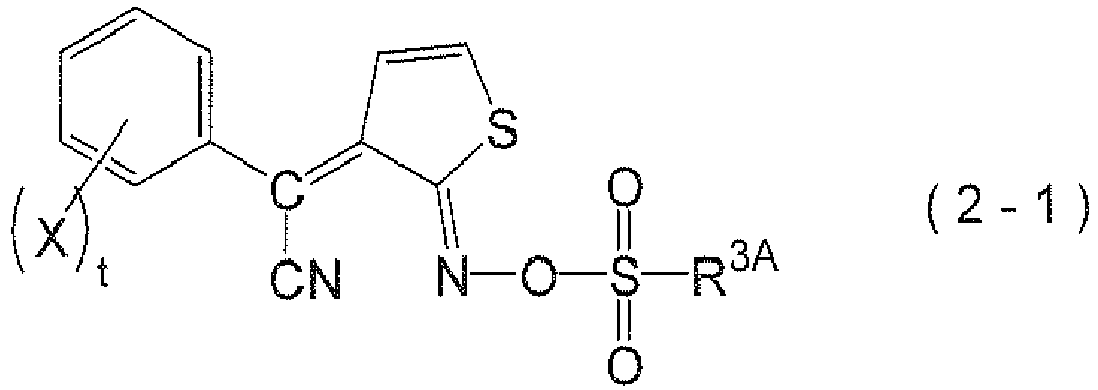
- The alkyl group represented by X is preferably a linear or branched alkyl group having 1 to 4 carbon atoms.
- The alkoxy group represented by X is preferably a linear or branched alkoxy group having 1 to 4 carbon atoms.
- The halogen atom represented by X is preferably a chlorine atom or a fluorine atom.
- t is preferably 0 or 1.
- A compound in which, in the formula (2-1), t is 1; X is a methyl group; the substitution position of X is the ortho-position; R3A is a linear alkyl group having 1 to 10 carbon atoms, a 7,7-dimethyl-2-oxonorbornylmethyl group or a p-toluyl group, is particularly preferable.
- Specific examples of the oxime sulfonate compound represented by the formula (2-1) include the following compound (i), compound (ii), compound (iii), compound (iv), and the like. These compounds may be used singly, or two or more kinds may be used in combination. The compounds (i) to (iv) are available as commercial products.
- Furthermore, the oxime sulfonate compound can also be used in combination with a photo acid generator of different type.


- According to one preferable embodiment of the compound represented by the formula (2),
- R1A represents an alkyl group having 1 to 4 carbon atoms, a trifluoromethyl group, a phenyl group, a chlorophenyl group, a dichlorophenyl group, a methoxyphenyl group, a 4-biphenyl group, a naphthyl group, or an anthranyl group;
- R2A represents a cyano group; and
- R3A represents an alkyl group having 1 to 10 carbon atoms, an alkoxy group having 1 to 10 carbon atoms, a halogenated alkyl group having 1 to 5 carbon atoms, a halogenated alkoxy group having 1 to 5 carbon atoms, a phenyl group which may be substituted with W, a naphthyl group which may be substituted with W, or an anthranyl group which may be substituted with W, while W represents a halogen atom, a cyano group, a nitro group, an alkyl group having 1 to 10 carbon atoms, an alkoxy group having 1 to 10 carbon atoms, a halogenated alkyl group having 1 to 5 carbon atoms, or a halogenated alkoxy group having 1 to 5 carbon atoms.
- The compound represented by the formula (2) may be preferably a compound represented by the following formula (2-2).

- In the formula (2-2), R4A represents a halogen atom, a hydroxyl group, an alkyl group having 1 to 4 carbon atoms, an alkoxy group having 1 to 4 carbon atoms, or a nitro group; and L represents an integer from 0 to 5. R3A represents an alkyl group having 1 to 10 carbon atoms, an alkoxy group having 1 to 10 carbon atoms, a halogenated alkyl group having 1 to 5 carbon atoms, a halogenated alkoxy group having 1 to 5 carbon atoms, a phenyl group which may be substituted with W, a naphthyl group which may be substituted with W, or an anthranyl group which may be substituted with W; and W represents a halogen atom, a cyano group, a nitro group, an alkyl group having 1 to 10 carbon atoms, an alkoxy group having 1 to 10 carbon atoms, a halogenated alkyl group having 1 to 5 carbon atoms, or a halogenated alkoxy group having 1 to 5 carbon atoms.
- R3A in the formula (2-2) is preferably a methyl group, an ethyl group, a n-propyl group, a n-butyl group, a n-octyl group, a trifluoromethyl group, a pentafluoroethyl group, a perfluoro-n-propyl group, a perfluoro-n-butyl group, a p-tolyl group, a 4-chlorophenyl group, or a pentafluorophenyl group, and particularly preferably a methyl group, an ethyl group, a n-propyl group, a n-butyl group or a p-tolyl group.
- The halogen atom represented by R4A is preferably a fluorine atom, a chlorine atom, or a bromine atom.
- The alkyl group having 1 to 4 carbon atoms represented by R4A is preferably a methyl group or an ethyl group.
- The alkoxy group having 1 to 4 carbon atoms represented by R4A is preferably a methoxy group or an ethoxy group.
- L is preferably 0 to 2, and particularly preferably 0 to 1.
- Among the compounds represented by the formula (2), a preferable embodiment of the compound included in the compounds represented by the formula (2-2) is a compound in which, in the formula (2), R1A represents a phenyl group or a 4-methoxyphenyl group; R2A represents a cyano group; and R3A represents a methyl group, an ethyl group, a n-propyl group, a n-butyl group, or a 4-tolyl group.
- The compound represented by the formula (1) may be preferably a compound represented by the following formula (1-2).

- For the photosensitive resin composition, (Component B1) photo acid generator is preferably used in an amount of 0.1 to 10 parts by weight, and more preferably in an amount of 0.5 to 10 parts by weight, based on 100 parts by weight of Component A1.
- The photosensitive resin composition contains (Component C1) a solvent.
- The photosensitive resin composition is preferably prepared as a solution in which Component A1 and Component B1, which are essential Components, and optional Components such as various additives that will be described below, as preferable Components, in (Component C1) solvent.
- As (Component C1) solvent used in the photosensitive resin composition, a known solvent can be used, and examples includes ethylene glycol monoalkyl ethers, ethylene glycol dialkyl ethers, ethylene glycol monoalkyl ether acetates, propylene glycol monoalkyl ethers, propylene glycol dialkyl ethers, propylene glycol monoalkyl ether acetates, diethylene glycol dialkyl ethers, diethylene glycol monoalkyl ether acetates, dipropylene glycol monoalkyl ethers, dipropylene glycol dialkyl ethers, dipropylene glycol monoalkyl ether acetates, esters, ketones, amides, and lactones.
- Among the solvents described above, diethylene glycol ethyl methyl ether, and/or propylene glycol monomethyl ether acetate are preferable, and propylene glycol monomethyl ether acetate are particularly preferable.
- Solvent used in the present invention may be used singly or as mixtures of two or more kinds.
- The content of (Component C1) solvent in the photosensitive resin composition is preferably 50 to 3,000 parts by weight, more preferably 100 to 2,000 parts by weight, and yet more preferably 150 to 1,500 parts by weight, per 100 parts by weight of Component A1.
- The photosensitive resin composition preferably contains (Component D1) a thermal crosslinking agent, according to necessity. When the composition contains (Component D1) thermal crosslinking agent, the heat flow in the bake step can be suppressed. Component D1 according to the present invention is a compound other than Component A1, Component A2 and Component A3.
- Preferable examples of the thermal crosslinking agent include a blocked isocyanate-based crosslinking agent, an alkoxymethyl group-containing crosslinking agent, an epoxy resin having an epoxy group, or a (meth)acrylic resin having a carboxyl group, which will be described later.
- Among others, a blocked isocyanate-based crosslinking agent is particularly preferable from the viewpoints of resist sensitivity and storage stability. Furthermore, an alkoxymethyl group-containing crosslinking agent can also be suitably used, and the crosslinking agent preferably includes at least a methylolated melamine compound.
- The alkoxymethyl group-containing crosslinking agent is preferably alkoxymethylated melamine, akloxymethylated benzoguanamine, alkoxymethylated glycoluril, alkoxymethylated urea, or the like. These can be obtained by converting the respective methylol groups of methylolated melamine, methylolated benzoguanamine, methylolated glycoluril, and methylolated urea into alkoxymethyl groups. There are no particular limitations on the type of this alkoxymethyl group, and examples include a methoxymethyl group, an ethoxymethyl group, a propoxymethyl group, and a butoxymethyl group. However, from the viewpoint of the amount of outgas generation, a methoxymethyl group is particularly preferable.
- Among these alkoxymethyl group-containing crosslinking agents, preferable examples of the alkoxymethyl group-containing crosslinking agent include alkoxymethylated melamine, alkoxymethylated benzoguanamine, and alkoxymethylated glycoluril. From the viewpoint of transparency, alkoxymethylated glycoluril is particularly preferable.
- These alkoxymethyl group-containing crosslinking agents are available as commercial products, and preferable examples that can be used include CYMEL 300, 301, 303, 370, 325 (all manufactured by Mitsui Cyanamide, Ltd.); NIKALAC MX-750 and -270, NIKALAC MS-11, NIKALAC MW-30HM, -100 LM, and -390 (all manufactured by Sanwa Chemical Co., Ltd.). Among these, NIKALAC MX-270 and NIKALAC MW-100LM are particularly preferable.
- In the case of using an alkoxymethyl group-containing crosslinking agent in the photosensitive resin composition, the addition amount of the alkoxymethyl group-containing crosslinking agent is preferably 0.05 to 50 parts by weight, more preferably 0.5 to 10 parts by weight, and yet more preferably 0.5 to 5 parts by weight, based on 100 parts by weight of Component A1. When the crosslinking agent is added in this range, high sensitivity, and preferable alkali solubility at the time of development are obtained.
- The blocked isocyanate-based crosslinking agent is not particularly limited as long as it is a compound having a blocked isocyanate group (blocked isocyanate compound). However, from the viewpoint of curability, the crosslinking agent is preferably a compound having two or more blocked isocyanate groups in one molecule.
- The blocked isocyanate group according to the present invention is a group capable of producing an isocyanate group under the action of heat, and a preferable example may be a group protecting an isocyanate group by allowing a blocking agent to react with an isocyanate group. Furthermore, the blocked isocyanate group is preferably a group capable of producing an isocyanate group under the action of heat at 90°C to 250°C.
- There are no particular limitations on the skeleton of the blocked isocyanate-based crosslinking agent, and compounds having a hexamethylene diisocyanate (HDI) skeleton, an isophorone diisocyanate (LPDI) skeleton, and a prepolymer type skeleton derived from HDI or IPDI can be suitably used.
- The blocking agent for the isocyanate group with regard to the blocked isocyanate group is not particularly limited, and an active methylene compound such as a diester compound, and an active hydrogen compound such as an oxime compound, a lactam compound or an amine compound can be preferably used. Among these, an active methylene compound is particularly preferable from the viewpoint of reactivity.
- Examples of the active methylene compound include diethyl malonate, dimethyl malonate, ethyl acetoacetate, and methyl acetoacetate.
- Examples of the oxime compound include cyclohexanone oxime, benzophenone oxime, and acetoxime.
- Examples of the lactam compound include ε-caprolactam, and γ-butyrolactam. Examples of the amine compound include aniline, diphenylamine, ethyleneimine, and polyethyleneimine.
- The active hydrogen compound reacts with an isocyanate group as shown in the following formula, and forms a blocked isocyanate group.
R-NCO + H-R' → R-NH-C(=O)-R'
wherein H-R' represents an active hydrogen compound; H in H-R' represents an active hydrogen atom; R represents a moiety other than the isocyanate group in an isocyanate compound; and R' represents a moiety other than the active hydrogen atom in an active hydrogen compound. - These blocked isocyanate-based crosslinking agents are available as commercial products, and preferable examples that can be used include DURANATE MF-K60X, MF-K60B, MF-B60X, 17B-60P, TPA-B80E, E402-B80B, SBN-70D, and K6000 (all manufactured by Asahi Kasei Chemicals Corp.), DESMODUR BL3272 and BL3575/1 (all manufactured by Sumitomo Bayer Urethane Co., Ltd.), and UREHYPER PUR-1804 (manufactured by DIC Corp.). Among these, DURANATE MF-K60X, MF-K60B, SBN-70D and K6000 are particularly preferable.
- In the case of using a blocked isocyanate crosslinking agent in the photosensitive resin composition, the addition amount of the blocked isocyanate-based crosslinking agent is preferably 0.1 to 50 parts by weight, more preferably 1 to 20 parts by weight, and yet more preferably 3 to 15 parts by weight, based on 100 parts by weight of Component A1. When the blocked isocyanate-based crosslinking agent is added in this range, high sensitivity, and preferable alkali solubility at the time of development can be obtained.
- It is preferable for the photosensitive resin composition to add a compound having a total functional group equivalent for an epoxy group, an oxetanyl group, a hydroxyl group and a carboxyl group of 400 g/eq or greater, in order to suppress the curing shrinkage of the film and to obtain a rectangular profile after baking.
- Component E1 is preferably a resin having a weight average molecular weight of 1,000 or greater.
- Specific examples include copolymers including monomer units containing an epoxy group, an oxetanyl group, a hydroxyl group and/or a carboxyl group.
- Furthermore, a compound which contains none of the functional groups described above, such as a homopolymer of polymethyl methacrylate (PMMA), can also be added as Component E1.
- According to the present invention, when Component E1 satisfies the definition of Component D1, the compound is classified as belonging to both of the classes. For example, when Component E1 is an epoxy resin having an epoxy equivalent of 400 g/eq or greater, the epoxy resin is Component D1, and also Component E1. Component E1 according to the present invention is other than Component A1 and Component A2.
- Furthermore, there are no particular limitations on the method of measuring the epoxy equivalent, oxetanyl equivalent, hydroxyl group equivalent and carboxyl group equivalent, and any known method can be used. For example, the equivalent can be calculated by measuring the content of the relevant group in a specific amount of the compound through titration or the like. For example, measurement can be made by making reference to the method described in JIS K7236, K0070 or the like.
- Component E1 is preferably an epoxy resin. When an epoxy resin is added, heat flow at the time of baking can be suppressed. Furthermore, the epoxy resin preferably has a large epoxy equivalent, so that curing shrinkage of the cross-linked film is suppressed, and a profile that is rectangular or close to a rectangle is obtained. Specifically, the epoxy equivalent is preferably 400 g/eq or greater, more preferably 400 to 1,000 g/eq, and particularly preferably 400 to 600 g/eq. When the epoxy equivalent is in this range, curing shrinkage occurs to a reduced extent, and a profile that is rectangular or close to a rectangle can be obtained. Also, the tolerance level of the process conditions at the time of production of a cured film is large.
- Meanwhile, the method for measuring the epoxy equivalent is preferably carried out according to JIS K7236.
- As the epoxy resin, commercially available products and synthesized products can be used. Specific examples of the epoxy resin having an epoxy equivalent of 400 g/eq or greater, which are commercially available, are listed below.
- EPICLON 1050, 1055, 3050, 4050, 7050, AM-020-P, AM-040-P, HM-091, HM-101, 1050-70X, 1050-75X, 1055-75X, 1051-75M, 7070-40K, HM-091-40AX, 152, 153, 153-60T, 153-60M, 1121N-80M, 1123P-75M, TSR-601, 1650-75MPX, 5500, 5800, 5300-70, 5500-60, EXA-4850-150, EXA-4850-1000, EXA-4816, and EXA-4822 (all manufactured by DIC Corp.
- The addition amount of the epoxy resin is preferably 10 to 50 wt%, and particularly preferably 20 to 40 wt%, based on the total solids content of the photosensitive resin composition. When the addition amount is in this range, it is easier to obtain a profile that is rectangular or close to a rectangle, and to form a desired pattern by the development process.
- The molecular weight (weight average molecular weight) of the epoxy resin is preferably 500 or greater. When the molecular weight is 500 or greater, volatilization of the epoxy resin in the solvent drying step or discharge of the epoxy resin in the development step can be suppressed, and thus the effect of adding an epoxy resin can be sufficiently obtained.
- The epoxy resin can be used singly, or as mixtures of two or more kinds.
- Furthermore, the photosensitive resin composition preferably contains an alkoxymethyl group-containing crosslinking agent and an epoxy resin having an epoxy equivalent of 400 g/eq or greater, from the viewpoint of obtaining a profile that is closer to rectangle.
- Component E1 may be a (meth)acrylic resin having a carboxyl group.
- The (meth)acrylic resin having a carboxyl group preferably has a large carboxyl group equivalent, in order to suppress curing shrinkage of the cross-linked film and to obtain a rectangular profile. Specifically, the carboxyl group equivalent is preferably 400 g/eq or greater, more preferably 400 to 1,000 g/eq, and particularly preferably 400 to 600 g/eq.
- The (meth)acrylic resin having a carboxyl group can be obtained by using a known (meth)acrylic monomer, and the adjustment of the carboxyl group equivalent can be achieved by regulating the type of the monomer, and the amount ratios of the monomers.
- The acrylic monomer is preferably, for example, an unsaturated monocarboxylic acid, a (meth)acrylic acid ester, a crotonic acid ester, or a (meth)acrylamide.
- The (meth)acrylic resin having a carboxyl group is preferably a copolymer of benzyl (meth)acrylate and (meth)acrylic acid.
- The content of Component E1 in the photosensitive resin composition is preferably 0.5 to 50 parts by weight, more preferably 1 to 40 parts by weight, and yet more preferably 5 to 30 parts by weight, based on 100 parts by weight of Component A1. When the content is in this range, it is easier to obtain a profile that is rectangular or close to a rectangle.
- The photosensitive resin composition may contain other Components other than Component A1 to Component E1.
- As the other Components, it is preferable that the photosensitive resin composition contain (Component F1) a sensitizer, from the viewpoint of sensitivity. Also, from the viewpoint of sensitivity, it is preferable to add (Component G1) a development accelerator.
- Furthermore, the photosensitive resin composition preferably contains (Component H1) an adhesion improving agent from the viewpoint of the adhesiveness to substrate, preferably contains (Component I1) a basic compound from the viewpoint of liquid storage stability, and preferably contains (Component J1) a surfactant (a fluorine-based surfactant, a silicone-based surfactant, or the like) from the viewpoint of coatability.
- Furthermore, if necessary, known additives such as (Component K1) an antioxidant, (Component L1) a plasticizer, (Component M1) a thermal radical generator, (Component N1) a thermal acid generator, (Component O1) an acid amplifier, an ultraviolet absorbent, a thickening agent, and organic or inorganic precipitation preventing agent, can be added to the photosensitive resin composition.
- Furthermore, from the viewpoint of obtaining a profile that is closer to rectangle, it is preferable that the photosensitive resin composition contain an epoxy resin having an epoxy equivalent of 400 g/eq or greater, (Component H1) an adhesion improving agent, (Component I1) a basic compound, and (Component J1) a surfactant, and it is particularly preferable that the composition contain an alkoxymethyl group-containing crosslinking agent, an epoxy resin having an epoxy equivalent of 400 g/eq or greater, (Component H1) an adhesion improving agent, (Component I1) a basic compound, and (Component J1) a surfactant.
- Hereinafter, the other Components that can be contained in the photosensitive resin composition used in the present invention will be described.
- (Component F1) a sensitizer can be added to the photosensitive resin composition, for the combination with (Component B1) the photo acid generator, in order to accelerate the decomposition of the photo acid generator. The sensitizer absorbs active rays or radiation, and enters an electron-excited state. The sensitizer in the electron-excited state is brought into contact with the photo acid generator, and actions such as electron transfer, energy transfer, and heat generation occur. Thereby, the photo acid generator undergoes a chemical change and is decomposed, thus producing an acid.
- Preferable examples of the sensitizer include compounds which belong to the following compounds and have an absorption wavelength in the range of 350 nm to 450 nm.
- Examples include polynuclear aromatic compounds (for example, pyrene, perylene, triphenylene, and anthracene), xanthenes (for example, fluorescein, eosin, erythrosine, rhodamin B, and Rose Bengal), xanthones (for example, xanthone, thioxanthone, dimethylthioxanthone, and diethylthioxanthone), cyanines (for example, thiacarbocyanine and oxacarbocyanine), merocyanines (for example, merocyanine and carbomerocyanine), rhodacyanines, oxonols, thiazines (for example, thionine, methylene blue, and toluidine blue), acridines (for example, acridine orange, chloroflavine, and acriflavine), acridones (for example, acridone and 10-butyl-2-chloroacridone), anthraquinones (for example, anthraquinone), squariums (for example, squarium), styryls, base styryls, and coumarins (for example, 7-diethylamino-4-methylcoumarin). Among these sensitizers, a sensitizer which absorbs active rays or radiation, enters an electron-excited state, and effects electron transfer to the photo acid generator is preferable, and polynuclear aromatic compounds, acridones, coumarins, and base styryls are particularly preferable.
- In regard to the sensitizer, commercially available products may be used, or the sensitizer may be synthesized by a known synthesis method.
- The addition amount of the sensitizer is preferably 20 to 300 parts by weight, and particularly preferably 30 to 200 parts by weight, based on 100 parts by weight of (Component B1) photo acid generator.
- The photosensitive resin composition preferably contains (Component G1) a development accelerator.
- As (Component G1) the development accelerator, any compound having a development accelerating effect can be used, but the development accelerator is preferably a compound having at least one kind of structure selected from the group consisting of a carboxyl group, a phenolic hydroxyl group, and an alkyleneoxy group, more preferably a compound having a carboxyl group or a phenolic hydroxyl group, and most preferably a compound having a phenolic hydroxyl group.
- Furthermore, the molecular weight of (Component G1) the development accelerator is preferably 100 to 2,000, more preferably 150 to 1,500, and particularly preferably 150 to 1,000.
- Examples of the development accelerator include, as the compound having an alkyleneoxy group, polyethylene glycol, monomethyl ether of polyethylene glycol, dimethyl ether of polyethylene glycol, polyethylene glycol glyceryl ester, polypropylene glycol glyceryl ester, polypropylene glycol diglyceryl ester, polybutylene glycol, polyethylene glycol-bisphenol A ether, polypropylene glycol-bisphenol A ether, alkyl ether of polyoxyethylene, alkyl ester of polyoxyethylene, and the compounds described in
JP-A-9-222724 - Examples of the compound having a carboxyl group include the compounds described in
JP-A-2000-66406 JP-A-9-6001 JP-A-10-20501 JP-A-11-3338150 - Examples of the compound having a phenolic hydroxyl group include the compounds described in
JP-A-2005-346024 JP-A-10-133366 JP-A-9-194415 JP-A-9-222724 JP-A-11-171810 JP-A-2007-121766 JP-A-9-297396 JP-A-2003-43679 JP-A-10-133366 - (Component G1) the development accelerator may be used singly, or two or more kinds may also be used in combination.
- The addition amount of (Component G1) the development accelerator in the photosensitive resin composition is preferably 0.1 to 30 parts by weight, more preferably 0.2 to 20 parts by weight, and most preferably 0.5 to 10 parts by weight, based on 100 parts by weight of Component A1, from the viewpoint of sensitivity and the residual film ratio.
- The photosensitive resin composition preferably contains (Component H1) an adhesion improving agent.
- (Component H1) the adhesion improving agent that can be used in the photosensitive resin composition is a compound which enhances adhesiveness between an inorganic substance that forms a substrate, for example, a silicon compound such as silicon, silicon oxide, or silicon nitride, or a metal such as gold, copper or aluminum, and an insulating film. Specific examples include a silane coupling agent, and a thiol-based compound. The silane coupling agent as (Component H1) the adhesion improving agent used in the present invention is intended for the modification of the interface, and any known silane coupling agent can be used without particular limitations.
- Preferable examples of the silane coupling agent include γ-aminopropyltrimethoxysilane, γ-aminopropyltriethoxysilane, γ-glycidoxypropyltrialkoxysilane, γ-glycidoxypropylalkyldialkoxysilane, γ-methacryloxypropyltrialkoxysilane, γ-methacryloxypropylalkyldialkoxysilane, γ-chloropropyltrialkoxysilane, γ-mercaptopropyltrialkoxysilane, β-(3,4-epoxycyclohexyl)ethyltrialkoxysilane, and vinyltrialkoxysilane.
- Among these, γ-glycidoxypropyltrialkoxysilane, and γ-methacryloxypropyltrialkoxysilane are more preferable, and γ-glycidoxypropyltrialkoxysilane is yet more preferable.
- These can be used singly, or in combination of two or more kinds. These are effective in the enhancement of the adhesiveness to the substrate, and are also effective in the regulation of the taper angle with the subsrate.
- The content of (Component H1) the adhesion improving agent in the photosensitive resin composition is preferably 0.1 to 20 parts by weight, and more preferably 0.5 to 10 parts by weight, based on 100 parts by weight of Component A1.
- The photosensitive resin composition preferably contains (Component I1) a basic compound.
- As (Component I1) basic compound, any compound among those used in chemically amplified resists can be selected and used. Examples include an aliphatic amine, an aromatic amine, a heterocyclic amine, a quaternary ammonium hydroxide, and a quaternary ammonium salt of a carboxylic acid.
- Examples of the aliphatic amine include trimethylamine, diethylamine, triethylamine, di-n-propylamine, tri-n-propylamine, di-n-pentylamine, tri-n-pentylamine, diethanolamine, triethanolamine, dicyclohexylamine, and dicyclohexylmethylamine.
- Examples of the aromatic amine include aniline, benzylamine, N,N-dimethylaniline, and diphenylamine.
- Examples of the heterocyclic amine include pyridine, 2-methylpyridine, 4-methylpyridine, 2-ethylpyridine, 4-ethylpyridine, 2-phenylpyridine, 4-phenylpyridine, N-methyl-4-phenylpyridine, 4-dimethylaminopyridine, imidazole, benzimidazole, 4-methylimidazole, 2-phenylbenzimidazole, 2,4,5-triphenylimidazole, nicotine, nicotinic acid, nicotinic acid amide, quinoline, 8-oxyquinoline, pyrazine, pyrazole, pyridazine, purine, pyrrolidine, piperidine, piperazine, morpholine, 4-methylmorpholine, 1,5-diazabicyclo[4.3.0]-5-nonene, and 1,8-diazabicyclo[5.3.0]-7-undecene.
- Examples of the quaternary ammonium hydroxide include tetramethylammonium hydroxide, tetraethylammonium hydroxide, tetra-n-butylammonium hydroxide, and tetra-n-hexylammonium hydroxide.
- Examples of the quaternary ammonium salt of a carboxylic acid include tetramethylammonium acetate, tetramethylammonium benzoate, tetra-n-butylammonium acetate, and tetra-n-butylammonium benzoate.
- The basic compound that can be used in the present invention may be used singly, or two or more kinds may be used in combination.
- The content of (Component I1) basic compound in the photosensitive resin composition is preferably 0.001 to 1 part by weight, and more preferably 0.002 to 0.2 parts by weight, based on 100 parts by weight of Component A1.
- The photosensitive resin composition preferably contains (Component J1) a surfactant (a fluorine-based surfactant, a silicone-based surfactant, or the like).
- A preferable example of the surfactant may be a copolymer (3) including a constituent unit A and a constituent unit B represented by the following formulae. The weight average molecular weight (Mw) of the copolymer is preferably from 1,000 to 10,000, and more preferably from 1,500 to 5,000. The weight average molecular weight is a value measured by gel permeation chromatography (GPC) and calculated relative to polystyrene standards.

- In the copolymer (3), R21 and R23 each independently represent a hydrogen atom or a methyl group; R22 represents a linear alkylene group having from 1 to 4 carbon atoms; R24 represents a hydrogen atom or an alkyl group having from 1 to 4 carbon atoms; L represents an alkylene group having from 3 to 6 carbon atoms; p and q represent weight percentages representing polymerization ratios, while p represents a value of from 10 wt% to 80 wt%, and q represents a value of from 20 wt% to 90 wt%; r represents an integer from 1 to 18; and n represents an integer from 1 to 10.
- L in the constituent unit B is preferably an alkylene group represented by the following formula (4).

- In the formula (4), R25 represents an alkyl group having from 1 to 4 carbon atoms, and from the viewpoints of compatibility and wettability to the surface to be coated, an alkyl group having from 1 to 3 carbon atoms is preferable, and an alkyl group having 2 or 3 carbon atoms is more preferable.
- Furthermore, the sum of p and q (p+q) is preferably such that p + q = 100, that is, 100 wt%.
- Specific examples of the fluorine-based surfactant and the silicone-based surfactant include the surfactants described in
JP-A-62-36663 JP-A-61-226746 JP-A-61-226745 JP-A-62-170950 JP-A-63-34540 JP-A-7-230165 JP-A-8-62834 JP-A-9-54432 JP-A-9-5988 JP-A-2001-330953 - These surfactants can be used singly, or as mixtures of two or more kinds. Furthermore, fluorine-based surfactants and silicone-based surfactants may also be used in combination.
- The addition amount of (Component J1) surfactant (a fluorine-based surfactant, a silicone-based surfactant, or the like) in the photosensitive resin composition is preferably 10 parts by weight or less, more preferably 0.01 to 10 parts by weight, and yet more preferably 0.01 to 1 part by weight, based on 100 parts by weight of Component A1.
- The photosensitive resin composition may contain (Component K1) an antioxidant.
- As (Component K1) the antioxidant, the photosensitive resin composition can contain a known antioxidant. When (Component K1) the antioxidant is added, coloration of the cured film can be prevented. The antioxidant also advantages that it can also reduce a decrease in the film thickness due to decomposition, and has excellent heat resistance and transparency.
- Examples of such an antioxidant include phosphorus-based antioxidants, hydrazides, hindered amine-based antioxidants, sulfur-based antioxidants, phenol-based antioxidants, ascorbic acid compounds, zinc sulfate, sugars, nitrites, sulfites, thiosulfates, and hydroxylamine derivatives. Among these, phenol-based antioxidants are particularly preferable from the viewpoint of the coloration of the cured film and a decrease in the film thickness. These may be used singly, or may be used in combination of two or more kinds.
- Examples of commercially available products of the phenolic antioxidants include ADK STAB AO-60, ADK STAB AO-80 (all manufactured by Adeka Corp.), and IRGANOX 1098 (manufactured by Ciba-Geigy Japan, Ltd.).
- The content of (Component K1) the antioxidant is preferably 0.1 to 6 wt%, more preferably 0.2 to 5 wt%, and particularly preferably 0.5 to 4 wt%, based on the total solids content of the photosensitive resin composition. When the content is in this range, sufficient transparency of the formed film is obtained, and the sensitivity at the time of pattern formation also becomes satisfactory.
- Furthermore, various ultraviolet absorbents, metal inactivators and the like described in "Kobunshi Tenkazai no Shintenkai (New Development of Polymer Additives; Nikkan Kogyo Shimbun, Ltd.)" may also be added to the photosensitive resin composition, as additives other than the antioxidant.
- The photosensitive resin composition may contain (Component L1) a plasticizer.
- Examples of (Component L1) the plasticizer include dibutyl phthalate, dioctyl phthalate, didodecyl phthalate, polyethylene glycol, glycerin, dimethyl glycerin phthalate, dibutyl stannate, dioctyl adipate, and triacetylglycerin.
- The content of (Component L1) the plasticizer in the photosensitive resin composition is preferably 0.1 to 30 parts by weight, and more preferably 1 to 10 parts by weight, based on 100 parts by weight of Component A1.
- The photosensitive resin composition may contain (Component M1) a thermal radical generator, and when the composition contains an ethylenic unsaturated compound such as a compound having at least one ethylenic unsaturated double bond described above, it is preferable that the composition contains (Component M1) the thermal radical generator.
- As the thermal radical generator, a known thermal radical generator can be used.
- The thermal radical generator is a compound which generates a radical under the action of thermal energy, and initiates or accelerates the polymerization reaction of a polymerizable compound. When the thermal radical generator is added, the cured film thus obtained becomes tougher, and heat resistance and solvent resistance may increase.
- Preferable examples of the thermal radical generator include aromatic ketones, onium salt compounds, organic peroxides, thio compounds, hexaarylbiimidazole compounds, keto oxime ester compounds, borate compounds, azinium compounds, metallocene compounds, active ester compounds, compounds having a carbon-halogen bond, azo compounds, and bibenzyl compounds.
- (Component M1) the thermal radical generator may be used singly, or can also be used in combination of two or more kinds.
- The content of (Component M1) the thermal radical generator in the photosensitive resin composition is preferably 0.01 to 50 parts by weight, more preferably 0.1 to 20 parts by weight, and most preferably 0.5 to 10 parts by weight, based on 100 parts by weight of Component A1, from the viewpoint of an enhancement of the film properties.
- According to the present invention, (Component N1) a thermal acid generator may be used to improve the film properties and the like under low temperature curing.
- The thermal acid generator is a compound which generates an acid under the action of heat, and is preferably a compound having a thermal decomposition point in the range of 130°C to 250°C, and more preferably 150°C to 220°C. For example, the thermal acid generator is a compound which generates a less nucleophilic acid such as sulfonic acid, carboxylic acid, or disulfonylimide.
- The acid to be generated is preferably strong sulfonic acid having a pKa value of 2 or less, an alkylcarboxylic acid or arylcarboxylic acid substituted with an electron-withdrawing group, or disulfonylimide substituted with a similar electron-withdrawing group. Examples of the electron-withdrawing group include a halogen atom such as a fluorine atom, a haloalkyl group such as a trifluoromethyl group, a nitro group, and a cyano group.
- According to the present invention, it is also preferable to use a sulfonic acid ester which substantially does not generate an acid under irradiation of exposure light, but generates an acid under the action of heat.
- That an acid is substantially not generated under irradiation of exposure light can be judged by measuring the IR spectrum and the NMR spectrum before and after the exposure of the compound, and observing if there is no change in the spectra.
- The molecular weight of the thermal acid generator is preferably 230 to 1,000, and more preferably 230 to 800.
- For the sulfonic acid ester that can be used in the present invention, a commercially available product may be used, or a product synthesized by a known method may also be used. The sulfonic acid ester may be synthesized by, for example, allowing sulfonyl chloride or sulfonic acid anhydride to react with a corresponding polyhydric alcohol under basic conditions.
- The content of the photosensitive resin composition of the thermal acid generator is preferably 0.5 to 20 parts by weight, and particularly preferably 1 to 15 parts by weight, based on 100 parts by weight of Component A1.
- The photosensitive resin composition can use (Component O1) an acid amplifier for the purpose of sensitivity enhancement. The acid amplifier used in the present invention is a compound which can further generate an acid by an acid-catalyzed reaction, and can increase the acid concentration within the reaction system, and is a compound which stably exists in the state where acid is not present. Since such a compound causes an increase in one or more acid molecules through a single reaction, the reaction proceeds in an accelerating manner along with the progress of the reaction. However, because the generated acid itself causes self-decomposition, the strength of the acid generated here is preferably 3 or less, and particularly preferably 2 or less, in terms of the acid dissociation constant, pKa.
- Specific examples of the acid amplifier include the compound described in paragraphs 0203 to 0223 of
JP-A-10-1508 JP-A-10-282642 line 12 to page 47,line 2 ofJP-T-9-512498 - The acid amplifier that can be used in the present invention may be a compound which is decomposed by the acid generated from an acid generator, and generates an acid having a pKa value of 3 or less, such as dichloroacetic acid, trichloroacetic acid, methanesulfonic acid, benzenesulfonic acid, trifluoromethanesulfonic acid, or phenylphosphonic acid.
- The content of the acid amplifier in the photosensitive resin composition is preferably set to 10 to 1,000 parts by weight from the viewpoint of dissolution contrast of exposed areas and unexposed areas, and more preferably 20 to 500 parts by weight, based on 100 parts by weight of (Component B1) the photo acid generator.
- The photosensitive resin composition of the first embodiment is particularly preferably a chemically amplified type positive type photosensitive resin composition (a chemically amplified positive type photosensitive resin composition).
- The second embodiment which is a preferable embodiment of the photosensitive composition is a photosensitive resin composition containing (Component A2) a polymer including a monomer unit (a2-1) having a carboxyl group or a phenolic hydroxyl group, and a monomer unit (a2-2) having an epoxy group and/or an oxetanyl group; (Component B2) a quinonediazide compound; and (Component C2) a solvent.
- The photosensitive resin composition of the second embodiment is particularly preferably a positive type photosensitive resin composition.
- The photosensitive resin composition preferably contains (Component A2) a polymer including a monomer unit (a2-1) having a carboxyl group or a phenolic hydroxyl group, and a monomer unit (a2-2) having an epoxy group and/or an oxetanyl group.
- Component A2 is a polymer which does not include the monomer unit (a1-1) described above.
- The monomer unit (a2-1) is preferably a monomer unit having a carboxyl group or a phenolic hydroxyl group described in an item of monomer unit (a1-1).
- The monomer unit (a2-2) is the same as the monomer unit (a1-2) described above, and preferable embodiments are also same.
- Furthermore, Component A2 may also include a monomer unit, i.e., a monomer unit (a1-5), having a hydroxyl group other than the phenolic hydroxyl group in the monomer unit (a1-3) and the monomer unit (a1-4) described above.
- The content of Component A2 in the photosensitive resin composition is preferably 20 wt % to 99 wt %, more preferably 40 wt % to 97 wt %, and yet more preferably 60 wt % to 95 wt %, based on the total solids content of the photosensitive resin composition. When the content is in this range, pattern formability is improved when the pattern is developed.
- Furthermore, in the photosensitive resin composition, a resin other than Component A2 may be used in combination to the extent that the effect of the present invention is not impaired. However, the content of the resin other than Component A2 is preferably smaller than the content of Component A2 from the viewpoint of developability.
- The photosensitive resin composition preferably contains (Component B2) a quinonediazide compound.
- Component B2 is preferably a 1,2-quinonediazide compound.
- The quinonediazide compound is a quinonediazide compound which has a function to generate a carboxylic acid upon irradiation with radiation such as ultraviolet rays, and examples thereof include 1,2-benzoquinonediazide sulfonic acid ester, 1,2-naphthoquinonediazide sulfonic acid ester, 1,2-benzoquinonediazide sulfonic acid amide, and 1,2-naphthoquinonediazide sulfonic acid amide.
- Furthermore, as Component B2, the compounds described in paragraphs 0018 to 0024 of
JP-A-2003-307847 - The photosensitive resin composition preferably contains (Component C2) a solvent.
- The content of the (Component C2) solvent in the photosensitive resin composition is preferably 50 to 3,000 parts by weight, more preferably 100 to 2,000 parts by weight, and yet more preferably 150 to 1,500 parts by weight, per 100 parts by weight of Component A2.
- Component C2 has the same meaning as Component C1 described above, and has the same preferable meanings.
- The photosensitive resin composition of the second embodiment may contain other Components other than Component A2 to Component C2.
- Examples of the other Components include Components D1 to Components O1 described above, an ultraviolet absorbent, a thickening agent, and organic or inorganic precipitation preventing agent.
- The third embodiment which is a preferable embodiment of the photosensitive composition is a photosensitive resin composition containing (Component A3) a polymer having a carboxyl group or a phenolic hydroxyl group; (Component B3) a photopolymerization initiator; (Component C3) a solvent; and (Component D3) a polymerizable monomer.
- The photosensitive resin composition of the third embodiment is particularly preferably a negative type photosensitive resin composition.
- The photosensitive resin composition preferably contains (Component A3) a polymer having a carboxyl group or a phenolic hydroxyl group.
- Component A3 is a polymer which does not include the monomer unit (a1-1) described above.
- The monomer unit (a3-1) having a carboxyl group or a phenolic hydroxyl group in Component A3 is preferably a monomer unit having a carboxyl group or a monomer unit having a phenolic hydroxyl group described above in the monomer unit (a1-1).
- Furthermore, Component A3 may also include a monomer unit, i.e., monomer unit (a-5), having a hydroxyl group other than the phenolic hydroxyl group in the monomer unit (a1-2), the monomer unit (a1-3), and the monomer unit (a1-4) described above.
- The content of Component A3 in the photosensitive resin composition is preferably 20 wt % to 95 wt %, more preferably 25 wt % to 80 wt %, and yet more preferably 30 wt % to 50 wt %, based on the total solids content of the photosensitive resin composition. When the content is in this range, pattern formability is improved when the pattern is developed.
- Furthermore, in the photosensitive resin composition, a resin other than Component A3 may be used in combination to the extent that the effect of the present invention is not impaired. However, the content of the resin other than Component A3 is preferably smaller than the content of Component A3 from the viewpoint of developability.
- The photosensitive resin composition preferably contains (Component B3) a photopolymerization initiator.
- The photopolymerization initiator is a compound which can generate a radical species capable of initiating polymerization of the polymerizable monomer (Component D3) upon irradiation with actinic rays such as visible rays, ultraviolet rays, far-ultraviolet rays, electron beams and X rays.
- Preferable examples of this photopolymerization generator include a photo-radical polymerization initiator such as oxime ester-based compounds, imidazole-based compounds, benzoin-based compounds, benzophenone-based compounds, α-diketone-based compounds, polynuclear quinone-based compounds, xanthone-based compounds, and diazo-based compounds.
- With regard to Component B3, only one type thereof may be used or two or more types thereof may be used in combination.
- Furthermore, Component B3 is preferably an oxime ester-based compound.
- The content of (Component B3) photopolymerization initiator is preferably 0.01 to 80 parts by weight, and more preferably 1 to 60 parts by weight, based on 100 parts by weight of the polymerizable monomer.
- The photosensitive resin composition preferably contains (Component C3) a solvent.
- The content of (Component C3) solvent in the photosensitive resin composition is preferably 50 to 3,000 parts by weight, more preferably 100 to 2,000 parts by weight, and yet more preferably 150 to 1,500 parts by weight, per 100 parts by weight of Component A3.
- Component C3 has the same meaning as Component C1 described above, and has the same preferable meanings.
- The photosensitive resin composition preferably contains a polymerizable monomer.
- The polymerizable monomer in the present invention is not particularly limited as long as it has a polymerizable and ethylenically unsaturated bond, but is preferably a monomer which has at least two polymerizable and ethylenically unsaturated bonds, the preferable monomer being capable of being polymerized by a radical species which is generated upon irradiation with radiation to (Component B3) the photopolymerization initiator.
- Examples of such a polyfunctional monomer include, diacrylates or dimethacrylates of alkylene glycols such as ethylene glycol, or propylene glycol; diacrylates or dimethacrylates of polyalkylene glycols such as polyethylene glycol, or polypropylene glycol; polyacrylates or polymethacrylates of trivalent or greater polyhydric alcohols such as glycerin, trimethylolpropane, pentaerythritol, or dipentaerythritol, and modified dicarboxylic acids thereof; oligoacrylates or oligomethacrylates such as polyesters, urethane resins, alkyd resins, silicone resins, or spirane resins; diacrylates or dimethacrylates of polymers hydroxlated at both terminals such as poly-1,3-butadiene having a hydroxyl group at both terminals, polyisoprene having a hydroxyl group at both terminals, or polycaprolactone having a hydroxyl group at both terminals, as well as trisacryloyloxy ethyl phosphate, and trismethacryloyloxy ethyl phosphate.
- Among these polyfunctional monomers, polyacrylates or polymethacrylates of trivalent or more polyhydric alcohols are preferable, and specific examples thereof include trimethylolpropane triacrylate, trimethylolpropane trimethacrylate, pentaerythritol triacrylate, pentaerythritol trimethacrylate, pentaerythritol tetraacrylate, pentaerythritol tetramethacrylate, dipentaerythritol pentaacrylate, dipentaerythritol pentamethacrylate, dipentaerythritol hexaacrylate, dipentaerythritol hexamethacrylate, succinic acid-modified pentaerythritol triacrylate, and succinic acid-modified pentaerythritol trimethacrylate; and trimethylolpropane triacrylate, pentaerythritol triacrylate, dipentaerythritol pentaacrylate, and dipentaerythritol hexaacrylate are particularly preferable.
- The content of Component D3 is preferably 50 to 3,00 parts by weight, and more preferably 80 to 200 parts by weight, based on 100 parts by weight of the content of Component A3.
- The photosensitive resin composition of the third embodiment may contain other Components other than Component A3 to Component C3.
- Examples of the other Components include Components E1 to Components O1 described above, an ultraviolet absorbent, a thickening agent, and an organic or inorganic precipitation preventing agent.
- Next, the present invention will be described more specifically based on Examples. However, the present invention is not intended to be limited to these Examples. Unless particularly stated otherwise, "parts" and "percent (%)" are on a weight basis.
- In the following Synthesis Examples, the following abbreviations represent the following compounds.
- V-65: 2,2'-Azobis(2,4-dimethylvaleronitrile)
- GMA: Glycidyl methacrylate
- PGMEA: Propylene glycol monomethyl ether acetate
- 0.5 parts of phenothiazine was added to 144.2 parts (2 molar equivalents) of ethyl vinyl ether, and while the reaction system was cooled to 10°C or below, 86.1 parts (1 molar equivalent) of methacrylic acid was added dropwise thereto. Subsequently, the reaction system was stirred for 4 hours at room temperature (25°C). 5.0 parts of pyridinium p-toluenesulfonate was added to the system, and then the mixture was stirred for 2 hours at room temperature and left to stand overnight at room temperature. 5 parts of sodium hydrogen carbonate and 5 parts of sodium sulfate were added to the reaction liquid, and the mixture was stirred for 1 hour at room temperature. Insoluble materials were filtered, and then the filtrate was concentrated under reduced pressure at 40°C or less. A residual yellow oily substance was distilled under reduced pressure, and 134.0 parts of 1-ethoxyethyl methacrylate in a fraction having a boiling point (bp.) of 43°C to 45°C/7 mmHg was obtained as a colorless oily substance.
- A mixed solution of 1-ethoxyethyl methacrylate (66.41 parts (0.4 molar equivalents)) thus obtained, methacrylic acid (6.9 parts (0.10 molar equivalents)), glycidyl methacrylate (GMA) (49.75 parts (0.35 molar equivalents)), 2-hydroxyethyl methacrylate (19.52 parts (0.15 molar equivalents)) and propylene glycol monomethyl ether acetate (PGMEA) (132.5 parts) was heated at 70°C under a nitrogen gas stream. While this mixed solution was stirred, a mixed solution of a radical polymerization initiator V-65 (2,2'-azobis(2,4-dimethylvaleronitrile), manufactured by Wako Pure Chemical Industries, Ltd., 12.0 parts) and PGMEA (100.0 parts) was added dropwise to the mixed solution over 3.5 hours. After completion of the dropwise addition, the reaction solution was allowed to react for 4 hours at 70°C, and thereby a PGMEA solution of a copolymer A-1 (solids concentration: 40% by weight) was obtained. The weight average molecular weight (Mw) of the copolymer A-1 thus obtained, as measured by gel permeation chromatography (GPC), was 12,000.
- Polymers A-2 to A-7 were respectively synthesized in the same manner as in the synthesis of the polymer A-1, except that the various monomers used in the synthesis of the polymer A-1 were changed to the monomers forming the respective monomer units described in Table 1, and the use amounts of the monomers forming the respective monomer units were changed as described in Table 1. The addition amount of the radical polymerization initiator V-65 was respectively adjusted to obtain the molecular weight described in Table 1.
(Table 1) Monomer unit (a1-1) monomer unit (a1-2) Monomer unit (a1-3) Monomer unit (a1-4) Monomer unit (a1-5) Type Amount Type Amount Type Amount Type Amount Type Amount Type Amount A-1 MAEVE 40 GMA 35 - - MAA 10 HEMA 15 - - A-2 MATHF 40 OXE 40 - - MAA 10 HEMA 10 - - A-3 MAEVE 40 GMA 40 DCPM 7.5 MAA 7.5 - - n- BMA 5 A-4 HS-EVE 30 BVGE 30 St 30 HS 10 - - - - Monomer unit (a2-1) Monomer unit (a2-2) Monomer unit (a1-3) Monomer unit (a1-4) Monomer unit (a1-5) Type Amount Type Amount Type Amount Type Amount Type Amount Type Amount A-5 MAA 35 GMA 35 DCPM 15 HEMA 5 - - MMA 10 A-6 HS 35 BVGE 35 St 30 - - - - - - Monomer unit (a3-1) Monomer unit (a2-2) Monomer unit (a1-3) Monomer unit (a1-4) Monomer unit (a1-5) Type Amount Type Amount Type Amount Type Amount Type Amount Type Amount A-7 MAA 35 GMA 35 DCPM 15 HEMA 10 - - MMA 5 - The amount described in Table 1 is a molar ratio, and represents a copolymerization ratio of the monomer units derived from the various monomers described in the Type column. The symbol "-" in Table 1 indicates that the relevant monomer unit was not used.
- The abbreviations in Table 1 are as follows.
- MAEVE: 1-Ethoxyethyl methacrylate
- MATHF: Tetrahydrofuran-2-yl methacrylate
- GMA: Glycidyl methacrylate
- OXE: (3-Ethyloxetan-3-yl)methyl methacrylate (manufactured by Osaka Organic Chemical Industry, Ltd.)
- St: Styrene
- DCPM: Dicyclopentanyl methacrylate
- HEMA: 2-Hydroxyethyl methacrylate
- MAA: Methacrylic acid
- HS: p-Hydroxystyrene
- n-BMA: n-Butyl methacrylate
- HS-EVE: Compound shown below (4-(1-ethoxy)ethoxy styrene)
- BVGE: Vinylbenzyl glycidyl ether

- The various components shown in the following Table 2 were mixed to obtain homogeneous solutions, and then each of the solutions was filtered using a polyethylene filter having a pore size of 0.1 µm. Thus, the photosensitive resin compositions were respectively prepared. The following evaluations were respectively carried out using the
photosensitive resin compositions 1 to 9 (Compositions 1 to 9) thus obtained. The evaluation results are shown in Table 3 and Table 4.(Table 2) Polymer Photo acid generator Thickening agent Basic compound Additive Surfactant Adhesion improving agent Solvent Type Parts Type Parts Type Parts Type Parts Type Parts Type Parts Type Parts Type Parts Type Parts Type Parts Composition 1 A-1 100 B-1 2 - - I-1/I-2 0.01/0.01 - - E-1 20 - - J-1 0.25 H-1 3 C-1 200 Composition 2 A-2 100 B-2 2 F-1 2 I-1/I-2 0.01/0.01 - - E-1 20 - - J-1 0.25 H-1 3 C-1 200 Composition 3 A-3 100 B-3 2 - - I-1/I-2 0.01/001 - - - - E-2 20 J-1 0.25 H-1 3 C-1 200 Composition 4 A-4 100 B-3 2 - - I-1/I-2 0.01/0.01 D-1 2 D-2 6 E-1 2 J-1 0.25 H-1 3 C-1 200 Composition 5 A-2 100 B-3 2 - - I-1/I-2 0.01/0.01 D-2 10 E-1 8 E-2 16 J-1 0.25 H-1 3 C-1 200 Composition 6 A-2 100 B-4 2 F-1 2 I-1/I-2 0.01/0.01 D-2 4 E-1 16 - - J-1 0.25 H-1 3 C-1 200 Composition 7 A-5 80 B-5 20 - - - - - - E-1 10 - - J-1 0.25 H-1 3 C-1 200 Composition 8 A-6 80 B-5 20 - - - - D-2 5 E-1 5 - - J-1 0.25 H-1 3 C-1 200 Composition 9 A-7 100 B-6 10 - - - - D-3 100 E-1 5 - - J-1 0.25 H-1 3 C-1 200 - The abbreviations in Table 2 are as follows.
- B-1: CGI1397 (compound shown below, manufactured by Ciba Specialty Chemicals)
- B-2: α-(p-Toluenesulfonyloxyimino)phenylacetonitrile (the synthesis method is as shown below.)
- B-3: Oxime sulfonate compound synthesized by the synthesis method shown below
- B-4: 4,7-di-n-Butoxy-1-naphthyl tetrahydrothiophenium trifluoromethane sulfonate
- B-5: A condensate of 2,3,4,4'-tetrahydroxybenzophenone (1 mol) and 1,2-naphthoquinonediazide-4-sulfonyl chloride (2 mol) (2,3,4,4'-tetrahydroxybenzophenone-1,2-naphthoquinonediazide 4-sulfonic acid ester)
- B-6: IRGACURE OXE 02 (manufactured by BASF, an oxime ester type radical polymerization initiator)
- C-1: Propylene glycol monomethyl ether acetate
- D-1: NIKALAC MW-100LM (manufactured by Sanwa Chemical Co., Ltd.)
- D-2: DURANATE MF-K60X (blocked isocyanate-based crosslinking agent, active methylene-protected polyfunctional type, manufactured by Asahi Kasei Chemicals Corp.)
- D-3: KAYARAD DPHA (dipentaerythritol hexaacrylate, manufactured by Nippon Kayaku Co., Ltd.)
- E-1: EPICLON EXA-4816 (manufactured by DIC Corp., epoxy equivalent: 403 g/eq)
- E-2: JER157S65 (manufactured by Mitsubishi Chemical Corp., epoxy equivalent: 200 to 220 g/eq)
- F-1: 9,10-Dibutoxyanthracene (DBA)
- H-1: 3-Glycidoxypropyltrimethoxysilane (KBM-403 (manufactured by Shin-Etsu Chemical Co., Ltd.))
- I-1: 1,5-Diazabicyclo[4.3.0]-5-nonene
- I-2: Triphenylimidazole
- J-1: Compound W-3 shown below


- α-(p-Toluenesulfonyloxyimino)phenylacetonitrile was synthesized according to the method described in paragraph 0108 of
JP-T-2002-528451 - Aluminum chloride (10.6 g) and 2-chloropropionyl chloride (10.1 g) were added to a suspension solution of 2-naphthol (10 g) and chlorobenzene (30 mL), and the mixture liquid was heated to 40°C to allow the mixture to react for 2 hours. Under ice cooling, a 4 N aqueous HCl solution (60 mL) was added dropwise to the reaction liquid, ethyl acetate (50 mL) was added thereto, and the mixture was partitioned. Potassium carbonate (19.2 g) was added to the organic layer, and the mixture was allowed to react at 40°C for 1 hour. Subsequently, a 2 N aqueous HCl solution (60 mL) was added thereto, and the mixture was partitioned. The organic layer was concentrated, and then crystals were reslurried in diisopropyl ether (10 mL). The slurry was filtered and dried, and thus a ketone compound (6.5 g) was obtained.
- Acetic acid (7.3 g) and a 50% aqueous solution of hydroxylamine (8.0 g) were added to a suspension solution of the ketone compound thus obtained (3.0 g) and methanol (30 mL), and the mixture was heated to reflux. After the system was left to cool, water (50 mL) was added, and precipitated crystals were filtered and washed with cold methanol. The crystals were dried, and thus an oxime compound (2.4 g) was obtained.
- The oxime compound (1.8 g) thus obtained was dissolved in acetone (20 mL), and under ice cooling, triethylamine (1.5 g) and p-toluenesulfonyl chloride (2.4 g) were added thereto. The mixture was heated to room temperature, and was allowed to react for 1 hour. Water (50 mL) was added to the reaction liquid, and precipitated crystals were filtered. Subsequently, the crystals were reslurried in methanol (20 mL), and the slurry was filtered and dried. Thus, B-3 (2.3 g) was obtained.
- The 1H-NMR spectrum (300 MHz, CDCl3) of B-3 was as follows: δ = 8.3(d, 1H), 8.0(d, 2H), 7.9(d, 1 H), 7.8(d, 1H), 7.6(dd, 1H), 7.4(dd, 1H) 7.3(d, 2H), 7.1(d, 1 H), 5.6(q, 1H), 2.4(s, 3H), 1.7(d, 3H).
- A photosensitive resin composition was slit coated on a silicon wafer having a silicon oxide film, and then the silicon wafer was pre-baked on a hot plate at 90°C for 120 seconds. Thus, a coating film having a thickness of 15 µm was formed.
- Subsequently, the film was exposed through a predetermined mask using an i-line stepper (FPA-3000 i5+ manufactured by Canon, Inc.). The substrate was developed by a paddling method using a 2.38% aqueous solution of tetramethylammonium hydroxide at 23°C for 90 seconds. The substrate was rinsed with ultrapure water for 45 seconds. The optimum exposure amount (Eopt) which was capable of resolution of a line-and-space pattern with a line width of 20 µm at 1:1 by these operations, was defined as sensitivity.
- 1: Eopt less than 100 mJ/cm2
- 2: Eopt equal to or greater than 100 mJ/cm2 and less than 300 mJ/cm2
- 3: Eopt equal to or greater than 300 mJ/cm2
- The higher sensitivity, the more preferable, and
grade - For the Composition 9, which is a negative type photosensitive resin composition, under the same conditions as described in the above (1), the optimum exposure amount which was capable of resolution of a line-and-space pattern with a line width of 20 µm at 1:1 was measured. The result of the measurement was 50 mJ/cm2.
(Table 3) Composition Sensitivity Composition 1 1 Composition 21 Composition 31 Composition 41 Composition 51 Composition 6 2 Composition 7 2 Composition 8 2 Composition 9 50 mJ/cm2 - It was found that as a photo acid generator, when an oxime sulfonate compound is used, the composition has a high sensitivity. (2) Production and evaluation of resin pattern (Examples 1 to 10, and Comparative Examples 1 to 9).
- A photosensitive resin composition was slit coated on a silicon wafer having a silicon oxide film. Subsequently, the solvent was removed to a hot plate at 90°C for 120 seconds. Thus, a coating film having a thickness of 15 µm was formed.
- Subsequently, the film was exposed through a predetermined mask using an i-line stepper (FPA-3000 i5+ manufactured by Canon, Inc.) with an optimum exposure amount.
- Subsequently, the substrate was developed by a paddling method using a 2.38 wt % aqueous solution of tetramethylammonium hydroxide at 23°C for 90 seconds. The substrate was rinsed with ultrapure water for 45 seconds.
- Subsequently, the entire pattern was subjected to full-area exposure at 300 mJ/cm2 using an extra-high pressure mercury lamp.
- Subsequently, an overcoat layer was formed under one of the following conditions.
- PVA205 (polyvinyl alcohol manufactured by Kuraray Co., Ltd.) was dissolved in water to obtain a 15 wt % aqueous solution thereof. The aqueous solution of PVA 205 was spin coated on a pattern to cover the resin pattern, and then the substrate was heat-treated at 190°C for 30 minutes. Subsequently, the overcoat layer was removed by washing with water to obtain a resin pattern.
- Copolymer of benzyl methacrylate and methacrylic acid (weight average molecular weight of 10,000, copolymerization ratio of 80:20 mol%) was dissolved in propylene glycol monomethyl ether acetate to obtain a 15 wt % solution thereof. The solution was spin coated on a pattern to cover the resin pattern, and then the substrate was heat-treated at 210°C for 30 minutes. The overcoat layer was removed by washing with a 0.4 wt % aqueous solution of tetramethylammonium hydroxide, and further washed with water to obtain a resin pattern.
- A photosensitive resin composition was slit coated on a silicon wafer having a silicon oxide film. Subsequently, the solvent was removed by heating on a hot plate at 90°C for 120 seconds. Thus, a coating film having a thickness of 15 µm was formed.
- Subsequently, the film was exposed through a predetermined mask using an i-line stepper (FPA-3000 i5+ manufactured by Canon, Inc.) with an optimum exposure amount.
- Subsequently, the substrate was developed by a paddling method using a 2.38% aqueous solution of tetramethylammonium hydroxide at 23°C for 90 seconds. The substrate was rinsed with ultrapure water for 45 seconds.
- Here, a resin pattern was formed without an exposure after the development.
- Hydroxypropyl methylcellulose (TC-5E manufactured by Shin-Etsu Chemical Co., Ltd.,) was dissolved in water to obtain a 17 wt % aqueous solution thereof. This solution was spin coated on a pattern to cover the resin pattern, and then the substrate was heat-treated at 100°C for 30 minutes, and further heat-treated at 220°C for 30 minutes. Subsequently, the overcoat layer was removed by washing with water to obtain a resin pattern.
- α-Cyclodextrin (CAVAMAX W6 manufactured by Cyclochem Co., Ltd. KK) was dissolved in water to obtain a 13 wt % aqueous solution thereof. This solution was spin coated on a resin pattern to cover the resin pattern. Then, the substrate was heat-treated at 140°C for 30 minutes, and subsequently, the overcoat layer was removed by washing with water. Further, the substrate was heat-treated at 220°C for 30 minutes to obtain a resin pattern.
- The cross-section of the produced line-and-space pattern was observed with a scanning electron microscope (SEM), and the taper angle was measured.
-
Grades 1 to 3 were considered as levels without any problem in practical use. The image of the shape is shown inFIG. 1 . - 1: A taper angle of the line cross-section is equal to or larger than 80° and equal to or less than 90°
- 2: A taper angle of the line cross-section is equal to or larger than 75° and less than 80°
- 3: A taper angle of the line cross-section is equal to or larger than 70° and less than 75°
- 4: A taper angle of the line cross-section is equal to or larger than 60° and less than 70°
- 5: A taper angle of the line cross-section is less than 60°
- Furthermore, the upper end of the pattern (one example is 14 in
Fig. 2 ) produced in (2) described above was evaluated based on the rectangle formability. The pattern of which the upper end is rectangular (angular), is preferable. In addition, the image of the shape is shown inFig. 3 . - 1: The upper end is sharply angular.
- 2: The upper end is angular, but the tip of the edge is slightly rounded.
- 3: The upper end is not angular, and is rounded.
- Furthermore, the lower end of the pattern (the contact point with the substrate; one example thereof is 16 in
Fig. 2 ) produced in (2) described above was evaluated based on the rectangle formability. The pattern of which the lower end is rectangular (angular), is preferable. In addition, the image of the shape is shown inFig. 3 . - 1: The lower end is sharply angular. Specific example thereof includes the state of Example 1.
- 2: The lower end is angular, but the tip of the edge is slightly rounded.
- 3: The lower end is not angular, and is rounded.
- The test conditions and the evaluation results for Examples 1 to 18 and Comparative Examples 1 to 9 are shown in Table 4.
(Table 4) Composition Protective layer Taper angle Upper end of Pattern Lower end of Pattern Example 1 Composition 1 PVA205 2 1 1 Example 2 Composition 2 PVA205 2 1 1 Example 3 Composition 3 PVA205 2 1 1 Example 4 Composition 4 PVA205 3 2 1 Example 5 Composition 5 PVA205 1 1 1 Example 6 Composition 6 PVA205 2 1 2 Example 7 Composition 5 Acrylic 1 1 1 Example 8 Composition 7 PVA205 3 2 2 Example 9 Composition 8 PVA205 3 2 2 Example 10 Composition 9 PVA205 2 1 2 Example 11 Composition 1 TC-5E 1 1 1 Example 12 Composition 2 TC-5E 1 1 1 Example 13 Composition 3 TC-5E 1 1 1 Example 14 Composition 4 TC-5E 2 1 1 Example 15 Composition 5 TC-5E 1 1 1 Example 16 Composition 6 Cyclodextrin 2 1 2 Example 17 Composition 7 Cyclodextrin 3 2 2 Example 18 Composition 8 Cyclodextrin 3 2 2 Comparative Example 1 Composition 1 Without 5 3 3 Comparative Example 2 Composition 2 Without 5 3 3 Comparative Example 3 Composition 3 Without 5 3 3 Comparative Example 4 Composition 4 Without 5 3 3 Comparative Example 5 Composition 5 Without 5 3 3 Comparative Example 6 Composition 6 Without 5 3 3 Comparative Example 7 Composition 7 Without 5 3 3 Comparative Example 8 Composition 8 Without 5 3 3 Comparative Example 9 Composition 9 Without 5 3 3 (Notes) TC-5E. Hydroxypropyl methylcellulose - The coat formation of the overcoat layer improves the taper angle, and the rectangle formabilities of the upper and the lower ends of the pattern. The first embodiment is particularly preferable from the viewpoint of taper angle and rectangle formability.
- In the method for coating and forming of the overcoat layer on the resin pattern obtained by developing the
photosensitive composition 5, as a desired pattern, a MEMS shutter device and a display apparatus using a 5-inch MEMS shutter device were produced according to the method described inJP-T-2008-533510 - In order to produce the micromachine described in
JP-A-2000-343463 photosensitive resin composition 5 as the resist film of FIG. 20 shown in the patent document, with a desired pattern in the method for coating and forming of the overcoat layer on the resin pattern obtained by developing the composition, and the performance as a the microsensors was evaluated. As a result, satisfactory device characteristics were obtained. -
Photosensitive resin composition 5 was slit coated on a silicon wafer substrate. - Subsequently, the solvent was removed to a hot plate at 90°C for 120 seconds. Thus, a coating film having a thickness of 4.0 µm was formed.
- Subsequently, the film was exposed through a predetermined mask using an i-line stepper (FPA-3000 i5+ manufactured by Canon, Inc.) with an optimum exposure amount.
- Subsequently, the substrate was developed by a paddling method using a 0.4 wt % aqueous solution of tetramethylammonium hydroxide at 23°C for 60 seconds. The substrate was rinsed with ultrapure water for 45 seconds.
- Subsequently, the entire pattern was subjected to full-area exposure at 300 mJ/cm2 using an extra-high pressure mercury lamp.
- The aforementioned overcoat layer was coated thereon and formed.
- Subsequently, the substrate was heat-treated at 230°C for 20 minutes to obtain a resist pattern.
- In order to etch the silicon wafer substrate, the dry etching was performed for 90 seconds using a dry etching apparatus manufactured by PMT Co. (Pinnacle 8000) under the conditions of CF4 as an etching gas, a gas flow rate of 75 sccm, a pressure of 2.5 mTorr, and an output of 2,500 W.
- The substrate was immersed in a mixed solution of dimethyl sulfoxide and N,N-dimethylformamide (weight ratio = 50:50) for 10 minutes to release the resin film portion.
- When it was observed with an optical microscope and an electron microscope, it was confirmed that a rectangular pattern which had reproduced a mask pattern thoroughly on a silicon water, was obtained.
-
Photosensitive resin composition 5 was coated on a gold sputtered substrate by means of a spin coater, and then heated on a hot plate at 90°C for 5 minutes. Thus, a resin film having a thickness of 25 µm was formed. Subsequently, the resin film was exposed through a pattern mask using an extra-high pressure mercury lamp (HBO manufactured by OSRAM, output: 1,000 W) with an optimum exposure amount. - The resin film was developed by immersing for 90 seconds at room temperature (25°C) using a 2.38 wt % aqueous solution of tetramethylammonium hydroxide, and then washed under flowing water.
- The entire pattern was subjected to full-area exposure at 500 mJ/cm2 using an extra-high pressure mercury lamp (HBO manufactured by OSRAM, output: 1,000 W).
- The aforementioned overcoat layer was coated thereon and formed.
- Subsequently, the substrate was heat-treated at 230°C for 20 minutes to obtain a resist pattern. Hereinafter, the substrate with this resin pattern formed thereon is referred to as a "patterning substrate (A)".
- The patterning substrate (A) was subjected to an ashing treatment with oxygen plasma (output: 100 W, oxygen flow rate: 100 ml, treatment time: 1 minute) as a pretreatment for electroplating, to make the pattern substrate hydrophilic. Subsequently, the substrate was immersed in 1 liter of a gold cyanide plating solution (trade name: Temperex 401, manufactured by Electroplating Engineers of Japan Ltd.), and subjected to electroplating for about 60 minutes under the conditions of a plating bath temperature of 44°C and a current density of 0.7 A/dm2 to form a plated shaped article for a bump having a thickness of 20 µm. Then, the substrate was washed under flowing water and blown with nitrogen gas to dry it. Thereafter, the substrate was immersed in a mixed solution of dimethyl sulfoxide and N,N-dimethylformamide (weight ratio = 50:50) for 10 minutes to release the resin film portion, and further a portion of the conductive layer on the substrate other than the region where the plated shaped article had been formed was removed by wet etching to obtain a substrate having a plated shaped article.
- When it was observed with an optical microscope and an electron microscope, it was confirmed that the plated pattern had reproduced a mask pattern thoroughly.
Claims (15)
- A method for producing a resin pattern, the method comprising at least the steps (1) to (7) in this order:(1) A coating step of coating a photosensitive resin composition on a substrate;(2) A solvent removal step of removing the solvent from the applied photosensitive resin composition;(3) An exposure step of patternwise exposing the photosensitive resin composition from which the solvent has been removed, to an active radiation;(4) A development step of developing the exposed photosensitive resin composition using an aqueous developer liquid;(5) An overcoating step of providing an overcoat layer on the developed photosensitive resin composition;(6) A heat-treating step of heat-treating the photosensitive resin composition on which the overcoat layer has been provided; and(7) a removal step of removing the overcoat layer.
- The method for producing a resin pattern according to Claim 1, wherein the overcoat layer contains polyvinyl alcohol or poly(meth)acrylic acid ester copolymer.
- The method for producing a resin pattern according to Claim 1 or 2, wherein the method further includes a post-exposure step of performing full-area exposure of the substrate with a pattern formed thereon to active radiation, between step (4) and step (5), or between step (5) and step (6).
- The method for producing a resin pattern according to any one of Claims 1 to 3, wherein the cross-sectional taper angle of the resin pattern after the heat treatment step of step (6) is 70° or larger.
- The method for producing a resin pattern according to any one of Claims 1 to 4, wherein the thickness of the resin pattern after the heat treatment step of step (6) is 4 to 100 µm.
- The method for producing a resin pattern according to any one of Claims 1 to 5, wherein the photosensitive resin composition contains the following components:(Component A1) a polymer including a monomer unit (a1-1) having a residue of a carboxyl group or a phenolic hydroxyl group protected with an acid-decomposable group, and a monomer unit (a1-2) having an epoxy group and/or an oxetanyl group;(Component B1) a photo acid generator; and(Component C1) a solvent.
- The method for producing a resin pattern according to any one of Claims 1 to 6, wherein the photosensitive resin composition further contains (Component D1) a thermal crosslinking agent.
- The method for producing a resin pattern according to Claim 7, wherein Component D1 includes a blocked isocyanate compound.
- The method for producing a resin pattern according to any one of Claims 6 to 8, wherein Component A1 further has a monomer unit (a1-3) having a cyclic structure, in addition to the monomer units (a1-1) and (a1-2).
- The method for producing a resin pattern according to any one of Claims 6 to 9, wherein Component A1 further has a monomer unit (a1-4) having a carboxyl group or a hydroxyl group, in addition to the monomer units (a1-1) and (a1-2).
- The method for producing a resin pattern according to any one of Claims 6 to 10, wherein the content of the monomer unit (a1-1) in Component A1 is 45 mol% or less based on all the monomer units of Component A1.
- The method for producing a resin pattern according to any one of Claims 1 to 11, wherein the photosensitive resin composition is a chemically amplified positive type photosensitive resin composition.
- The method for producing a resin pattern according to any one of Claims 1 to 5, wherein the photosensitive resin composition contains the following components:(Component A2) a polymer including a constitutional unit (a2-1) having a carboxyl group or a phenolic hydroxyl group, and a constitutional unit (a2-2) having an epoxy group and/or an oxetanyl group;(Component B2) a quinonediazide compound; and(Component C2) a solvent.
- The method for producing a resin pattern according to any one of Claims 1 to 5, wherein the photosensitive resin composition contains the following components:(Component A3) a polymer having a carboxyl group or a phenolic hydroxyl group;(Component B3) a photopolymerization initiator;(Component C3) a solvent; and(Component D3) a polymerizable monomer.
- A resin pattern obtainable by the method for producing a resin pattern according to any one of Claims 1 to 14.
Applications Claiming Priority (2)
| Application Number | Priority Date | Filing Date | Title |
|---|---|---|---|
| JP2011054358 | 2011-03-11 | ||
| JP2011102973A JP5635449B2 (en) | 2011-03-11 | 2011-05-02 | Resin pattern and manufacturing method thereof, MEMS structure manufacturing method, semiconductor element manufacturing method, and plating pattern manufacturing method |
Publications (2)
| Publication Number | Publication Date |
|---|---|
| EP2498133A2 true EP2498133A2 (en) | 2012-09-12 |
| EP2498133A3 EP2498133A3 (en) | 2013-07-10 |
Family
ID=45939105
Family Applications (1)
| Application Number | Title | Priority Date | Filing Date |
|---|---|---|---|
| EP12158216.7A Withdrawn EP2498133A3 (en) | 2011-03-11 | 2012-03-06 | Resin pattern, method for producing the pattern, method for producing MEMS structure, method for manufacturing semiconductor device, and method for producing plated pattern |
Country Status (3)
| Country | Link |
|---|---|
| US (1) | US8728716B2 (en) |
| EP (1) | EP2498133A3 (en) |
| JP (1) | JP5635449B2 (en) |
Cited By (2)
| Publication number | Priority date | Publication date | Assignee | Title |
|---|---|---|---|---|
| JP2014074893A (en) * | 2012-09-13 | 2014-04-24 | Shin Etsu Chem Co Ltd | Production method of resin structure for microstructure, and production method of microstructure |
| US20230273521A1 (en) * | 2020-08-04 | 2023-08-31 | Tokyo Ohka Kogyo Co., Ltd. | Chemically amplified photosentive composition, photosensitive dry film, production method of substrate having template for plating, and production method of plated article |
Families Citing this family (15)
| Publication number | Priority date | Publication date | Assignee | Title |
|---|---|---|---|---|
| CN104662643B (en) * | 2012-06-13 | 2016-03-30 | 三菱瓦斯化学株式会社 | Cleaning fluid composition, the cleaning method of semiconductor element and the manufacture method of semiconductor element |
| JP5794241B2 (en) * | 2013-02-06 | 2015-10-14 | 信越化学工業株式会社 | Manufacturing method of resin structure for microstructure and manufacturing method of microstructure |
| TWI617629B (en) * | 2013-05-01 | 2018-03-11 | Jsr股份有限公司 | Method for producing substrate having concave pattern, composition, method for forming conductive film, electronic circuit and electronic component |
| TWI518459B (en) * | 2013-07-23 | 2016-01-21 | 奇美實業股份有限公司 | Photosensitive resin composition, color filter, and liquid crystal display element thereof |
| JP6284849B2 (en) * | 2013-08-23 | 2018-02-28 | 富士フイルム株式会社 | Laminate |
| JP6438645B2 (en) * | 2013-09-26 | 2018-12-19 | 富士フイルム株式会社 | Actinic ray-sensitive or radiation-sensitive composition, and resist film, pattern forming method, resist-coated mask blank, photomask manufacturing method, and electronic device manufacturing method using the same |
| JP6267951B2 (en) * | 2013-12-18 | 2018-01-24 | 富士フイルム株式会社 | Photosensitive transfer material, pattern forming method and etching method |
| JP6032325B2 (en) * | 2015-06-16 | 2016-11-24 | 信越化学工業株式会社 | Manufacturing method of resin structure for microstructure and manufacturing method of microstructure |
| US10276440B2 (en) | 2017-01-19 | 2019-04-30 | Honeywell International Inc. | Removable temporary protective layers for use in semiconductor manufacturing |
| JP7141260B2 (en) * | 2018-06-27 | 2022-09-22 | 東京応化工業株式会社 | Chemically amplified positive photosensitive resin composition, photosensitive dry film, method for producing photosensitive dry film, method for producing patterned resist film, method for producing substrate with template, method for producing plated model, and nitrogen-containing product aromatic heterocyclic compound |
| WO2020203790A1 (en) * | 2019-03-29 | 2020-10-08 | 太陽インキ製造株式会社 | Photoresist composition and cured product of same |
| JP7451270B2 (en) * | 2020-04-09 | 2024-03-18 | Jsr株式会社 | Method for processing radiation-sensitive compositions |
| WO2022030052A1 (en) * | 2020-08-07 | 2022-02-10 | 昭和電工マテリアルズ株式会社 | Photosensitive resin composition, photosensitive element, method for forming resist pattern, and method for producing printed wiring board |
| CN113341650B (en) * | 2021-06-24 | 2022-08-02 | 北京北旭电子材料有限公司 | Photoresist and patterning method |
| WO2023154365A1 (en) * | 2022-02-10 | 2023-08-17 | Tokyo Electron Limited | Selective deprotection via dye diffusion |
Citations (38)
| Publication number | Priority date | Publication date | Assignee | Title |
|---|---|---|---|---|
| JPS61226746A (en) | 1985-03-30 | 1986-10-08 | Japan Synthetic Rubber Co Ltd | Radiation sensitive composition |
| JPS61226745A (en) | 1985-03-30 | 1986-10-08 | Japan Synthetic Rubber Co Ltd | Radiation sensitive composition |
| JPS6236663A (en) | 1985-08-12 | 1987-02-17 | Mitsubishi Chem Ind Ltd | Naphthoquinonediazide type compound and positive type photoresist composition containing it |
| JPS62170950A (en) | 1986-01-23 | 1987-07-28 | Fuji Photo Film Co Ltd | Photosensitive composition |
| JPS6334540A (en) | 1986-07-30 | 1988-02-15 | Mitsubishi Chem Ind Ltd | Positive type photoresist composition |
| JPH07230165A (en) | 1993-06-30 | 1995-08-29 | Tokyo Ohka Kogyo Co Ltd | Positive type photoresist composition |
| JPH0862834A (en) | 1994-08-22 | 1996-03-08 | Mitsubishi Chem Corp | Photoresist composition |
| JPH095988A (en) | 1995-06-21 | 1997-01-10 | Mitsubishi Chem Corp | Radiation-sensitive coating composition |
| JPH096001A (en) | 1995-06-15 | 1997-01-10 | Tokyo Ohka Kogyo Co Ltd | Coating solution for forming positive type resist film |
| JPH0954432A (en) | 1995-08-18 | 1997-02-25 | Dainippon Ink & Chem Inc | Photoresist composition |
| JPH09194415A (en) | 1996-01-18 | 1997-07-29 | Sumitomo Chem Co Ltd | Phenolic binuclear compound, production method and use thereof |
| JPH09222724A (en) | 1996-02-16 | 1997-08-26 | Japan Synthetic Rubber Co Ltd | Radiation-sensitive resin composition |
| JPH09297396A (en) | 1996-05-02 | 1997-11-18 | Japan Synthetic Rubber Co Ltd | Radiation-sensitive resin composition |
| JPH09512498A (en) | 1994-04-25 | 1997-12-16 | ポラロイド コーポレイション | Process for fixing images |
| JPH101508A (en) | 1996-06-17 | 1998-01-06 | Toyo Ink Mfg Co Ltd | Active ray-sensitive acid generator composition, sensitive composition and image recording composition |
| JPH1020501A (en) | 1996-07-03 | 1998-01-23 | Japan Synthetic Rubber Co Ltd | Radiation-sensitive resin composition |
| JPH1073923A (en) | 1996-07-05 | 1998-03-17 | Taiyo Ink Mfg Ltd | Manufacture of photosensitive resin composition and printed-wiring board |
| JPH10133366A (en) | 1996-08-28 | 1998-05-22 | Jsr Corp | Radiation-sensitive resin composition |
| JPH10282642A (en) | 1997-04-03 | 1998-10-23 | Fuji Photo Film Co Ltd | Planographic printing plate |
| JP2888454B2 (en) | 1991-01-11 | 1999-05-10 | 富士写真フイルム株式会社 | Method for producing hydroxybenzoic acid having polymerizable group |
| JPH11171810A (en) | 1997-12-08 | 1999-06-29 | Jsr Corp | Phenol compound and its production |
| JPH11338150A (en) | 1998-05-26 | 1999-12-10 | Fuji Photo Film Co Ltd | Positive type photosensitive resinous composition |
| JP2000066406A (en) | 1995-06-15 | 2000-03-03 | Tokyo Ohka Kogyo Co Ltd | Coating fluid for forming positive type resist film |
| JP2000343463A (en) | 1999-05-31 | 2000-12-12 | Ball Semiconductor Kk | Manufacturing method of micromachine |
| JP2001330953A (en) | 2000-05-22 | 2001-11-30 | Jsr Corp | Radiation-sensitive resin composition |
| JP2002528451A (en) | 1998-10-23 | 2002-09-03 | ダウ・アグロサイエンス・エル・エル・シー | 3- (substituted phenyl) -5- (substituted heterocyclyl) -1,2,4-triazole compound |
| JP2003043679A (en) | 2001-07-31 | 2003-02-13 | Jsr Corp | Radiation-sensitive resin composition |
| JP2003307847A (en) | 2002-04-16 | 2003-10-31 | Jsr Corp | Composition for forming interlayer insulating film by inkjet method |
| JP2004264623A (en) | 2003-03-03 | 2004-09-24 | Jsr Corp | Radiation-sensitive resin composition, interlayer insulating film and microlens, and methods for forming them |
| US20050245663A1 (en) * | 2004-04-30 | 2005-11-03 | Yoshiki Sugeta | Over-coating agent for forming fine patterns and a method of forming fine patterns using such agent |
| JP2005346024A (en) | 2003-09-18 | 2005-12-15 | Mitsubishi Gas Chem Co Inc | Resist compound and radiation-sensitive composition |
| JP2007121766A (en) | 2005-10-28 | 2007-05-17 | Jsr Corp | Positive radiation sensitive resin composition |
| JP2008040183A (en) | 2006-08-07 | 2008-02-21 | Tokyo Ohka Kogyo Co Ltd | Photosensitive resin composition for interlayer insulation film |
| JP2008533510A (en) | 2005-02-23 | 2008-08-21 | ピクストロニクス,インコーポレイテッド | Display device and manufacturing method thereof |
| JP4168443B2 (en) | 2003-07-30 | 2008-10-22 | Jsr株式会社 | Radiation-sensitive resin composition, interlayer insulating film and microlens, and production method thereof |
| JP2010072589A (en) | 2008-09-22 | 2010-04-02 | Fujifilm Corp | Photosensitive transfer material, method of forming resin pattern, substrate having resin pattern, display element, and display |
| JP2010185986A (en) * | 2009-02-10 | 2010-08-26 | Tokyo Ohka Kogyo Co Ltd | Chemically amplified positive photoresist composition for thick film and method for manufacturing thick film resist pattern |
| JP4544219B2 (en) | 2006-08-31 | 2010-09-15 | Jsr株式会社 | Method for producing positive-type radiation-sensitive resin composition, transfer film, and plated model |
Family Cites Families (16)
| Publication number | Priority date | Publication date | Assignee | Title |
|---|---|---|---|---|
| JPH02110462A (en) * | 1988-06-21 | 1990-04-23 | Mitsubishi Kasei Corp | Positive type photoresist |
| JP3218814B2 (en) * | 1993-08-03 | 2001-10-15 | 株式会社日立製作所 | Method for manufacturing semiconductor device |
| TW329539B (en) * | 1996-07-05 | 1998-04-11 | Mitsubishi Electric Corp | The semiconductor device and its manufacturing method |
| JP3924910B2 (en) * | 1998-03-31 | 2007-06-06 | 三菱電機株式会社 | Manufacturing method of semiconductor device |
| JP3348715B2 (en) * | 2000-02-25 | 2002-11-20 | ティーディーケイ株式会社 | Resist pattern forming method, frame plating method, and method of manufacturing thin-film magnetic head |
| US6486058B1 (en) * | 2000-10-04 | 2002-11-26 | Integrated Device Technology, Inc. | Method of forming a photoresist pattern using WASOOM |
| JP3485183B1 (en) * | 2002-06-28 | 2004-01-13 | 東京応化工業株式会社 | Coating forming agent for pattern refinement and method for forming fine pattern using the same |
| JP4148098B2 (en) * | 2002-10-24 | 2008-09-10 | 住友化学株式会社 | Radiation sensitive resin composition |
| JP4644857B2 (en) * | 2005-07-22 | 2011-03-09 | 昭和電工株式会社 | Photosensitive resin composition |
| JP2007186599A (en) * | 2006-01-13 | 2007-07-26 | Toyo Ink Mfg Co Ltd | Polymerizable composition, negative resist using the same, and image pattern forming method using the same |
| US8168371B2 (en) * | 2007-01-22 | 2012-05-01 | Nissan Chemical Industries, Ltd. | Positive photosensitive resin composition |
| JP2008243957A (en) * | 2007-03-26 | 2008-10-09 | Nitto Denko Corp | Manufacturing method of printed circuit board |
| JP4637209B2 (en) * | 2007-06-05 | 2011-02-23 | 富士フイルム株式会社 | Positive photosensitive resin composition and cured film forming method using the same |
| JP4656242B2 (en) * | 2009-02-19 | 2011-03-23 | 三菱電機株式会社 | Resist material and method of manufacturing semiconductor device using the same |
| JP5174124B2 (en) * | 2010-11-02 | 2013-04-03 | 富士フイルム株式会社 | Photosensitive resin composition for MEMS structural member, pattern production method, MEMS structure and production method thereof |
| JP5291744B2 (en) * | 2010-11-02 | 2013-09-18 | 富士フイルム株式会社 | Photosensitive resin composition for etching resist, pattern manufacturing method, MEMS structure and manufacturing method thereof, dry etching method, wet etching method, MEMS shutter device, and image display device |
-
2011
- 2011-05-02 JP JP2011102973A patent/JP5635449B2/en active Active
-
2012
- 2012-03-06 EP EP12158216.7A patent/EP2498133A3/en not_active Withdrawn
- 2012-03-09 US US13/416,870 patent/US8728716B2/en active Active
Patent Citations (38)
| Publication number | Priority date | Publication date | Assignee | Title |
|---|---|---|---|---|
| JPS61226745A (en) | 1985-03-30 | 1986-10-08 | Japan Synthetic Rubber Co Ltd | Radiation sensitive composition |
| JPS61226746A (en) | 1985-03-30 | 1986-10-08 | Japan Synthetic Rubber Co Ltd | Radiation sensitive composition |
| JPS6236663A (en) | 1985-08-12 | 1987-02-17 | Mitsubishi Chem Ind Ltd | Naphthoquinonediazide type compound and positive type photoresist composition containing it |
| JPS62170950A (en) | 1986-01-23 | 1987-07-28 | Fuji Photo Film Co Ltd | Photosensitive composition |
| JPS6334540A (en) | 1986-07-30 | 1988-02-15 | Mitsubishi Chem Ind Ltd | Positive type photoresist composition |
| JP2888454B2 (en) | 1991-01-11 | 1999-05-10 | 富士写真フイルム株式会社 | Method for producing hydroxybenzoic acid having polymerizable group |
| JPH07230165A (en) | 1993-06-30 | 1995-08-29 | Tokyo Ohka Kogyo Co Ltd | Positive type photoresist composition |
| JPH09512498A (en) | 1994-04-25 | 1997-12-16 | ポラロイド コーポレイション | Process for fixing images |
| JPH0862834A (en) | 1994-08-22 | 1996-03-08 | Mitsubishi Chem Corp | Photoresist composition |
| JP2000066406A (en) | 1995-06-15 | 2000-03-03 | Tokyo Ohka Kogyo Co Ltd | Coating fluid for forming positive type resist film |
| JPH096001A (en) | 1995-06-15 | 1997-01-10 | Tokyo Ohka Kogyo Co Ltd | Coating solution for forming positive type resist film |
| JPH095988A (en) | 1995-06-21 | 1997-01-10 | Mitsubishi Chem Corp | Radiation-sensitive coating composition |
| JPH0954432A (en) | 1995-08-18 | 1997-02-25 | Dainippon Ink & Chem Inc | Photoresist composition |
| JPH09194415A (en) | 1996-01-18 | 1997-07-29 | Sumitomo Chem Co Ltd | Phenolic binuclear compound, production method and use thereof |
| JPH09222724A (en) | 1996-02-16 | 1997-08-26 | Japan Synthetic Rubber Co Ltd | Radiation-sensitive resin composition |
| JPH09297396A (en) | 1996-05-02 | 1997-11-18 | Japan Synthetic Rubber Co Ltd | Radiation-sensitive resin composition |
| JPH101508A (en) | 1996-06-17 | 1998-01-06 | Toyo Ink Mfg Co Ltd | Active ray-sensitive acid generator composition, sensitive composition and image recording composition |
| JPH1020501A (en) | 1996-07-03 | 1998-01-23 | Japan Synthetic Rubber Co Ltd | Radiation-sensitive resin composition |
| JPH1073923A (en) | 1996-07-05 | 1998-03-17 | Taiyo Ink Mfg Ltd | Manufacture of photosensitive resin composition and printed-wiring board |
| JPH10133366A (en) | 1996-08-28 | 1998-05-22 | Jsr Corp | Radiation-sensitive resin composition |
| JPH10282642A (en) | 1997-04-03 | 1998-10-23 | Fuji Photo Film Co Ltd | Planographic printing plate |
| JPH11171810A (en) | 1997-12-08 | 1999-06-29 | Jsr Corp | Phenol compound and its production |
| JPH11338150A (en) | 1998-05-26 | 1999-12-10 | Fuji Photo Film Co Ltd | Positive type photosensitive resinous composition |
| JP2002528451A (en) | 1998-10-23 | 2002-09-03 | ダウ・アグロサイエンス・エル・エル・シー | 3- (substituted phenyl) -5- (substituted heterocyclyl) -1,2,4-triazole compound |
| JP2000343463A (en) | 1999-05-31 | 2000-12-12 | Ball Semiconductor Kk | Manufacturing method of micromachine |
| JP2001330953A (en) | 2000-05-22 | 2001-11-30 | Jsr Corp | Radiation-sensitive resin composition |
| JP2003043679A (en) | 2001-07-31 | 2003-02-13 | Jsr Corp | Radiation-sensitive resin composition |
| JP2003307847A (en) | 2002-04-16 | 2003-10-31 | Jsr Corp | Composition for forming interlayer insulating film by inkjet method |
| JP2004264623A (en) | 2003-03-03 | 2004-09-24 | Jsr Corp | Radiation-sensitive resin composition, interlayer insulating film and microlens, and methods for forming them |
| JP4168443B2 (en) | 2003-07-30 | 2008-10-22 | Jsr株式会社 | Radiation-sensitive resin composition, interlayer insulating film and microlens, and production method thereof |
| JP2005346024A (en) | 2003-09-18 | 2005-12-15 | Mitsubishi Gas Chem Co Inc | Resist compound and radiation-sensitive composition |
| US20050245663A1 (en) * | 2004-04-30 | 2005-11-03 | Yoshiki Sugeta | Over-coating agent for forming fine patterns and a method of forming fine patterns using such agent |
| JP2008533510A (en) | 2005-02-23 | 2008-08-21 | ピクストロニクス,インコーポレイテッド | Display device and manufacturing method thereof |
| JP2007121766A (en) | 2005-10-28 | 2007-05-17 | Jsr Corp | Positive radiation sensitive resin composition |
| JP2008040183A (en) | 2006-08-07 | 2008-02-21 | Tokyo Ohka Kogyo Co Ltd | Photosensitive resin composition for interlayer insulation film |
| JP4544219B2 (en) | 2006-08-31 | 2010-09-15 | Jsr株式会社 | Method for producing positive-type radiation-sensitive resin composition, transfer film, and plated model |
| JP2010072589A (en) | 2008-09-22 | 2010-04-02 | Fujifilm Corp | Photosensitive transfer material, method of forming resin pattern, substrate having resin pattern, display element, and display |
| JP2010185986A (en) * | 2009-02-10 | 2010-08-26 | Tokyo Ohka Kogyo Co Ltd | Chemically amplified positive photoresist composition for thick film and method for manufacturing thick film resist pattern |
Cited By (4)
| Publication number | Priority date | Publication date | Assignee | Title |
|---|---|---|---|---|
| JP2014074893A (en) * | 2012-09-13 | 2014-04-24 | Shin Etsu Chem Co Ltd | Production method of resin structure for microstructure, and production method of microstructure |
| JP2016221678A (en) * | 2012-09-13 | 2016-12-28 | 信越化学工業株式会社 | Manufacturing method of resin structure for microstructure and manufacturing method of microstructure |
| TWI618983B (en) * | 2012-09-13 | 2018-03-21 | 信越化學工業股份有限公司 | Method for producing resin structure for microstructures and method for producing microstructures |
| US20230273521A1 (en) * | 2020-08-04 | 2023-08-31 | Tokyo Ohka Kogyo Co., Ltd. | Chemically amplified photosentive composition, photosensitive dry film, production method of substrate having template for plating, and production method of plated article |
Also Published As
| Publication number | Publication date |
|---|---|
| JP5635449B2 (en) | 2014-12-03 |
| US8728716B2 (en) | 2014-05-20 |
| US20120231396A1 (en) | 2012-09-13 |
| EP2498133A3 (en) | 2013-07-10 |
| JP2012208453A (en) | 2012-10-25 |
Similar Documents
| Publication | Publication Date | Title |
|---|---|---|
| US8728716B2 (en) | Resin pattern, method for producing the pattern, method for producing MEMS structure, method for manufacturing semiconductor device, and method for producing plated pattern | |
| JP5313285B2 (en) | Positive photosensitive resin composition, pattern manufacturing method, MEMS structure and manufacturing method thereof, dry etching method, wet etching method, MEMS shutter device, and image display device | |
| JP5616871B2 (en) | Positive photosensitive resin composition, method for producing cured product, method for producing resin pattern, cured product, and optical member | |
| JP5291744B2 (en) | Photosensitive resin composition for etching resist, pattern manufacturing method, MEMS structure and manufacturing method thereof, dry etching method, wet etching method, MEMS shutter device, and image display device | |
| JP5715967B2 (en) | Positive photosensitive resin composition, method for forming cured film, cured film, liquid crystal display device, and organic EL display device | |
| EP2447773B1 (en) | Method for producing a pattern, method for producing a MEMS structure, use of a cured film of a photosensitive composition as a sacrificial layer or as a component of a MEMS structure | |
| WO2011086997A1 (en) | Photosensitive resin composition, method for forming cured film, cured film, organic el display device, and liquid crystal display device | |
| JP5358005B2 (en) | Positive photosensitive acrylic resin and positive photosensitive resin composition | |
| WO2013161862A1 (en) | Chemically amplified positive photosensitive resin composition, method for manufacturing hardened film, hardened film, organic el display device, and liquid-crystal display device | |
| JP5566988B2 (en) | Resin composition, method for producing cured product, method for producing resin pattern, cured product and optical member | |
| TWI665524B (en) | Negative-type photosensitive resin composition, photo-curable pattern and image display device using the same | |
| JP5174124B2 (en) | Photosensitive resin composition for MEMS structural member, pattern production method, MEMS structure and production method thereof | |
| KR101890633B1 (en) | Resin composition, method for producing cured product, method for producing resin pattern, cured product and optical member | |
| JP2012008223A (en) | Positive photosensitive resin composition, hardening film formation method, hardening film, liquid crystal display device and organic el display device | |
| JP5744694B2 (en) | Positive photosensitive resin composition, method for producing cured product, method for producing resin pattern, cured product, and optical member | |
| JP2012189875A (en) | Resin pattern, manufacturing method for the same, manufacturing method for mems structure, manufacturing method for semiconductor element, and manufacturing method for plating pattern | |
| JP2012042837A (en) | Positive photosensitive composition, method for forming cured film, cured film, liquid crystal display device and organic el display device | |
| JP5433654B2 (en) | Photosensitive resin composition, cured film, method for forming cured film, organic EL display device, and liquid crystal display device | |
| JP5321498B2 (en) | Method for forming encapsulant pattern |
Legal Events
| Date | Code | Title | Description |
|---|---|---|---|
| PUAI | Public reference made under article 153(3) epc to a published international application that has entered the european phase |
Free format text: ORIGINAL CODE: 0009012 |
|
| AK | Designated contracting states |
Kind code of ref document: A2 Designated state(s): AL AT BE BG CH CY CZ DE DK EE ES FI FR GB GR HR HU IE IS IT LI LT LU LV MC MK MT NL NO PL PT RO RS SE SI SK SM TR |
|
| AX | Request for extension of the european patent |
Extension state: BA ME |
|
| PUAL | Search report despatched |
Free format text: ORIGINAL CODE: 0009013 |
|
| AK | Designated contracting states |
Kind code of ref document: A3 Designated state(s): AL AT BE BG CH CY CZ DE DK EE ES FI FR GB GR HR HU IE IS IT LI LT LU LV MC MK MT NL NO PL PT RO RS SE SI SK SM TR |
|
| AX | Request for extension of the european patent |
Extension state: BA ME |
|
| RIC1 | Information provided on ipc code assigned before grant |
Ipc: G03F 7/40 20060101AFI20130605BHEP |
|
| 17P | Request for examination filed |
Effective date: 20131219 |
|
| RBV | Designated contracting states (corrected) |
Designated state(s): AL AT BE BG CH CY CZ DE DK EE ES FI FR GB GR HR HU IE IS IT LI LT LU LV MC MK MT NL NO PL PT RO RS SE SI SK SM TR |
|
| 17Q | First examination report despatched |
Effective date: 20151116 |
|
| STAA | Information on the status of an ep patent application or granted ep patent |
Free format text: STATUS: THE APPLICATION IS DEEMED TO BE WITHDRAWN |
|
| 18D | Application deemed to be withdrawn |
Effective date: 20160330 |