EP2497933A1 - Cogeneration apparatus - Google Patents
Cogeneration apparatus Download PDFInfo
- Publication number
- EP2497933A1 EP2497933A1 EP20120158179 EP12158179A EP2497933A1 EP 2497933 A1 EP2497933 A1 EP 2497933A1 EP 20120158179 EP20120158179 EP 20120158179 EP 12158179 A EP12158179 A EP 12158179A EP 2497933 A1 EP2497933 A1 EP 2497933A1
- Authority
- EP
- European Patent Office
- Prior art keywords
- exhaust gas
- airtight chamber
- hot water
- water
- flow path
- Prior art date
- Legal status (The legal status is an assumption and is not a legal conclusion. Google has not performed a legal analysis and makes no representation as to the accuracy of the status listed.)
- Granted
Links
- XLYOFNOQVPJJNP-UHFFFAOYSA-N water Substances O XLYOFNOQVPJJNP-UHFFFAOYSA-N 0.000 claims abstract description 224
- 239000007789 gas Substances 0.000 claims description 150
- 238000000926 separation method Methods 0.000 claims description 27
- 238000002485 combustion reaction Methods 0.000 claims description 23
- 239000002918 waste heat Substances 0.000 claims description 14
- 238000009423 ventilation Methods 0.000 description 27
- 238000011144 upstream manufacturing Methods 0.000 description 19
- 238000010438 heat treatment Methods 0.000 description 16
- UGFAIRIUMAVXCW-UHFFFAOYSA-N Carbon monoxide Chemical compound [O+]#[C-] UGFAIRIUMAVXCW-UHFFFAOYSA-N 0.000 description 13
- 229910002091 carbon monoxide Inorganic materials 0.000 description 13
- 239000000446 fuel Substances 0.000 description 11
- 238000005192 partition Methods 0.000 description 10
- 239000003921 oil Substances 0.000 description 9
- 239000010687 lubricating oil Substances 0.000 description 6
- 230000006835 compression Effects 0.000 description 5
- 238000007906 compression Methods 0.000 description 5
- 238000006243 chemical reaction Methods 0.000 description 4
- 230000002093 peripheral effect Effects 0.000 description 4
- 230000007423 decrease Effects 0.000 description 3
- 230000004913 activation Effects 0.000 description 2
- 230000009849 deactivation Effects 0.000 description 2
- 238000010276 construction Methods 0.000 description 1
- 238000001514 detection method Methods 0.000 description 1
- 230000005611 electricity Effects 0.000 description 1
- 238000012986 modification Methods 0.000 description 1
- 230000004048 modification Effects 0.000 description 1
- 239000007858 starting material Substances 0.000 description 1
Images







Classifications
-
- F—MECHANICAL ENGINEERING; LIGHTING; HEATING; WEAPONS; BLASTING
- F02—COMBUSTION ENGINES; HOT-GAS OR COMBUSTION-PRODUCT ENGINE PLANTS
- F02G—HOT GAS OR COMBUSTION-PRODUCT POSITIVE-DISPLACEMENT ENGINE PLANTS; USE OF WASTE HEAT OF COMBUSTION ENGINES; NOT OTHERWISE PROVIDED FOR
- F02G5/00—Profiting from waste heat of combustion engines, not otherwise provided for
- F02G5/02—Profiting from waste heat of exhaust gases
- F02G5/04—Profiting from waste heat of exhaust gases in combination with other waste heat from combustion engines
-
- F—MECHANICAL ENGINEERING; LIGHTING; HEATING; WEAPONS; BLASTING
- F02—COMBUSTION ENGINES; HOT-GAS OR COMBUSTION-PRODUCT ENGINE PLANTS
- F02B—INTERNAL-COMBUSTION PISTON ENGINES; COMBUSTION ENGINES IN GENERAL
- F02B63/00—Adaptations of engines for driving pumps, hand-held tools or electric generators; Portable combinations of engines with engine-driven devices
- F02B63/04—Adaptations of engines for driving pumps, hand-held tools or electric generators; Portable combinations of engines with engine-driven devices for electric generators
- F02B63/044—Adaptations of engines for driving pumps, hand-held tools or electric generators; Portable combinations of engines with engine-driven devices for electric generators the engine-generator unit being placed on a frame or in an housing
-
- F—MECHANICAL ENGINEERING; LIGHTING; HEATING; WEAPONS; BLASTING
- F02—COMBUSTION ENGINES; HOT-GAS OR COMBUSTION-PRODUCT ENGINE PLANTS
- F02G—HOT GAS OR COMBUSTION-PRODUCT POSITIVE-DISPLACEMENT ENGINE PLANTS; USE OF WASTE HEAT OF COMBUSTION ENGINES; NOT OTHERWISE PROVIDED FOR
- F02G2260/00—Recuperating heat from exhaust gases of combustion engines and heat from cooling circuits
-
- F—MECHANICAL ENGINEERING; LIGHTING; HEATING; WEAPONS; BLASTING
- F02—COMBUSTION ENGINES; HOT-GAS OR COMBUSTION-PRODUCT ENGINE PLANTS
- F02G—HOT GAS OR COMBUSTION-PRODUCT POSITIVE-DISPLACEMENT ENGINE PLANTS; USE OF WASTE HEAT OF COMBUSTION ENGINES; NOT OTHERWISE PROVIDED FOR
- F02G2262/00—Recuperating heat from exhaust gases of combustion engines and heat from lubrication circuits
-
- Y—GENERAL TAGGING OF NEW TECHNOLOGICAL DEVELOPMENTS; GENERAL TAGGING OF CROSS-SECTIONAL TECHNOLOGIES SPANNING OVER SEVERAL SECTIONS OF THE IPC; TECHNICAL SUBJECTS COVERED BY FORMER USPC CROSS-REFERENCE ART COLLECTIONS [XRACs] AND DIGESTS
- Y02—TECHNOLOGIES OR APPLICATIONS FOR MITIGATION OR ADAPTATION AGAINST CLIMATE CHANGE
- Y02E—REDUCTION OF GREENHOUSE GAS [GHG] EMISSIONS, RELATED TO ENERGY GENERATION, TRANSMISSION OR DISTRIBUTION
- Y02E20/00—Combustion technologies with mitigation potential
- Y02E20/14—Combined heat and power generation [CHP]
-
- Y—GENERAL TAGGING OF NEW TECHNOLOGICAL DEVELOPMENTS; GENERAL TAGGING OF CROSS-SECTIONAL TECHNOLOGIES SPANNING OVER SEVERAL SECTIONS OF THE IPC; TECHNICAL SUBJECTS COVERED BY FORMER USPC CROSS-REFERENCE ART COLLECTIONS [XRACs] AND DIGESTS
- Y02—TECHNOLOGIES OR APPLICATIONS FOR MITIGATION OR ADAPTATION AGAINST CLIMATE CHANGE
- Y02T—CLIMATE CHANGE MITIGATION TECHNOLOGIES RELATED TO TRANSPORTATION
- Y02T10/00—Road transport of goods or passengers
- Y02T10/10—Internal combustion engine [ICE] based vehicles
- Y02T10/12—Improving ICE efficiencies
Definitions
- the present invention relates to cogeneration apparatus constructed in such a manner that water introduced into an apparatus casing is changed into hot water by use of exhaust or waste heat of a prime mover and the thus- generated hot water is directed out of the casing to be used for a desired purpose.
- the conventionally-known cogeneration apparatus are combined heat and power apparatus which include an engine, power generator and heat exchanger provided within an apparatus casing, and in which exhaust heat of an engine driving the power generator is collected and the collected heat is used for heating the interior of a room and the like.
- An example of such cogeneration apparatus is disclosed in Japanese Patent Application Laid-open Publication No. 2007-187027 , which, because the engine, power generator and heat exchanger are provided within the apparatus casing, is constructed to ventilate the air within the casing to thereby keep optimal an environment temperature within the casing.
- the conventionally-known cogeneration apparatus is one which includes a CO sensor for detecting carbon monoxide (CO) contained in exhaust gas.
- CO carbon monoxide
- the CO sensor detects carbon monoxide (CO) contained in the exhaust gas.
- the exhaust gas stored within the casing may flow out of the casing before the CO sensor detects carbon monoxide in the exhaust gas flown out to within the casing. If the cogeneration apparatus is installed indoors, the exhaust gas may undesirably flow out of the casing to an indoor area.
- an object of the present invention to provide an improved cogeneration apparatus which can reliably prevent exhaust gas from flowing out of the interior of the casing to an indoor area.
- the present invention provides an improved cogeneration apparatus cogeneration apparatus for generating hot water from water, introduced from outside an apparatus casing into the apparatus casing via a water flow path, by use of exhaust or waste heat of a prime mover, and directing the generated hot water out of the apparatus casing via the water flow path, which comprises: an airtight chamber provided within the apparatus casing and constructed to prevent the exhaust gas of the prime mover from flowing out from the airtight chamber; and a relief valve provided in the water flow path within the airtight chamber and constructed to discharge the exhaust gas, contained in the water flow path, to the airtight chamber.
- the exhaust gas contained in the water flow path, can be discharged to the airtight chamber via the relief valve and the airtight chamber is capable of preventing the exhaust gas of the prime mover from flowing out therefrom, the exhaust gas discharged to the airtight chamber can be caused to stay in the airtight chamber.
- the exhaust gas discharged to the airtight chamber can be prevented from undesirably flowing out from within the casing to the indoor area.
- the cogeneration apparatus of the present invention is constructed to discharge the exhaust gas, contained in the water flow path, to the airtight chamber via the relief valve.
- the cogeneration apparatus of the present invention can prevent the exhaust gas, contained in the water flow path, from undesirably flowing out to the indoor area (e.g., the interior of the room) where waste heat (exhaust heat) of the prime mover is used for a heating purpose.
- the relief valve is constructed to be opened once inner pressure of the water flow path exceeds a threshold value. Namely, if exhaust gas is contained in the water flow path, the inner pressure of the water flow path would exceed the threshold value, in response to which the relief valve is opened so that not only the hot water is discharged from the water flow path to the airtight chamber but also the exhaust gas contained in the hot water is discharged to the airtight chamber. Due to the hot water being discharged from the water flow path to the airtight chamber, an amount of hot water in the water flow path decreases so that the hot water flowing in the water flow path increases in temperature.
- the cogeneration apparatus of the present invention further comprises a temperature sensor provided in the water flow path for detecting a temperature of the hot water flowing in the water flow path; and a control section for, on the basis of information indicative of the temperature detected via the temperature sensor, identifying a temperature increase of the hot water occurring as a result of opening of the relief valve, to thereby deactivate the prime mover in response to the identified temperature increase.
- the control section can identify the opened state of the relief valve on the basis of a temperature increase of the hot water and output to an actuator a signal for deactivating the prime mover.
- the exhaust gas contained in the water flow path can be prevented from undesirably flowing out to the indoor area (interior of the room) where the waste heat (exhaust heat) of the prime mover is used for heating.
- the airtight chamber is capable of preventing the exhaust gas from undesirably flowing out therefrom, the exhaust gas discharged to the airtight chamber can stay in the airtight chamber, so that it can be prevented from being undesirably discharged from within the airtight chamber to the indoor area.
- the airtight chamber is capable of communicating with a combustion chamber of the prime mover via an intake passage.
- the cogeneration apparatus of the present invention further comprises an exhaust gas separation section provided in the water flow path within the airtight chamber for separating the exhaust gas, contained in the water flow path, from the hot water, the exhaust gas separated from the hot water by the exhaust gas separation section being discharged via the relief valve to the airtight chamber.
- the cogeneration apparatus of the present invention can prevent the exhaust gas, contained in the water flow path, from undesirably flowing out to the indoor area (interior of the room) where the waste heat (exhaust heat) of the prime mover is used heating.
- the cogeneration apparatus 10 is a combined heat and power apparatus which includes: a cogeneration casing (apparatus casing) 11 defining an outer frame of the cogeneration apparatus 10; an airtight chamber 12 provided within the cogeneration casing 11; an engine (prime mover) 14 accommodated in the airtight chamber 12; a power generator 16 provided above the body of the engine 14 (hereinafter referred to as "engine body 15"); a heat exchanger 17 provided laterally to the engine body 15; and a hot water output section for outputting hot water generated by the heat exchanger 17.
- the cogeneration apparatus 10 further includes: a first control section 21 provided to the left of the engine body 15 outside the airtight chamber 12; a power conversion section 22 provided above the first control section 21 outside the airtight chamber 12; and a second control section 23 provided above the heat exchanger 17 outside the airtight chamber 12.
- the cogeneration apparatus 10 is installed in indoors (in an indoor area or room) 38 and constructed to generate hot water by use of exhaust heat (waste heat) of the engine 14) so that the heat of the generated hot water can be used for heating the interior of the room.
- exhaust heat waste heat
- the cogeneration casing 11 is formed in a generally rectangular parallelepiped shape by a bottom panel 25, front and rear panels (not shown), a left side panel 26, a right side panel 27 and a roof panel 28.
- a partition wall 31 is provided within the cogeneration casing 11 adjacent to and along the left side panel 26, and an upper partition section 32 extends from an upper end portion 31a of the partition wall 31 to the right side panel 27.
- the airtight chamber 12 is a hermetically sealed space defined by the bottom panel 25, partition wall 31, upper partition section 32, right side panel 27 and ventilation duct 34.
- the ventilation duct 34 has a lower end portion 34a located at the partition section 42, and an upper end portion 34b located at the roof panel 28.
- the ventilation duct 34 communicates at the lower end portion 34a with a ventilation opening 35 formed in the upper partition section 32, so that the ventilation duct 34 is in communication with the airtight chamber 12 via the ventilation opening 35.
- the ventilation duct 34 communicates at the upper end portion 34b with an external duct 37 via a ventilation opening 36 formed in the roof panel 28, and the external duct 37 is in communication with outdoors (outside of the casing) 39.
- the airtight chamber 12 is a space provided within the cogeneration casing 11 and accommodates therein the engine body 15, power generator 16 and heat exchanger 17.
- the airtight chamber 12 has seal performance capable of preventing exhaust gas, discharged via a later-described release passage 92, from flowing out from the airtight chamber 12.
- An under frame 29 is provided on the bottom panel (bottom portion) 25 of the airtight chamber 12.
- the first control section 21, power conversion section (inverter unit) 22 and second control section 23 are accommodated (disposed) in a space 31 within the cogeneration casing 11 but outside the airtight chamber 12. Further, an air cleaner section 44, gas flow rate adjustment section 45 and mixer 46 (including a throttle valve), constituting a part of an intake system 41 of the engine 14, are accommodated (disposed) in the space 31 within the cogeneration casing 11 but outside the airtight chamber 12.
- the engine 14 is a gas engine which includes: the engine body 15 capable of rotating a drive shaft 16a of the power generator 16; the intake system 41 that supplies a gas fuel to a combustion chamber 18 of the engine body 15; and an exhaust system 51 that discharges exhaust gas of the combustion chamber 18 to the outdoors 39.
- the engine body 15 has a crankshaft 19 connected coaxially with the drive shaft 16a of the power generator 16, and a piston connected to the crankshaft 19 via a con rod.
- the engine body 15 is a reciprocating type engine in which the piston is slidably provided within a cylinder block 15a and the combustion chamber 18 is provided in a distal end portion of the cylinder block 15a.
- the gas fuel is burned in the combustion chamber 18 so that the piston slides in the cylinder to rotate the crankshaft 19.
- the rotation of the crankshaft 19 causes the drive shaft 16a of the power generator 16 to rotate.
- the intake system 41 has an intake opening 42 formed in the upper partition portion 32, an intake passage 43 communicating the intake opening 42 with the combustion chamber 18 of the engine body 18, and the air cleaner section 44 provided halfway in the intake passage 43. Further, the mixer 46 is provided in the intake passage 43 at a position downstream of the air cleaner section 44. Thus, the combustion chamber 18 of the engine 15 is in communication with the airtight chamber 12 via the intake passage 43, mixer 46, air cleaner section 44 and intake opening 42.
- Air sucked in from the airtight chamber 12 is directed through the intake opening 42 to the intake passage 43 and then to the air cleaner section 44, so that the air is cleaned or purified by the air cleaner section 44.
- the thus-purified air is mixed with a gas fuel by the mixer 46.
- the gas fuel is directed to the gas flow rate adjustment section 45 via a gas supply passage 48, so that the gas fuel having been adjusted in flow rate by the gas flow rate adjustment section 45 is directed to the mixer 46.
- the gas fuel mixed with the air by the mixer 46 is then introduced into the combustion chamber 18 of the engine body 15, via the throttle valve and intake passage 43, so that the engine 14 is driven by the gas fuel.
- the exhaust system 51 includes an exhaust section 52 for directing exhaust gas of the combustion chamber 18 to the outside, and a condensed water separation section 62 communicating with a halfway position of the exhaust section 52.
- the exhaust section 52 includes: a first exhaust passage 53 communicating the combustion chamber 18 of the engine body 15 with the heat exchanger 17; a second exhaust passage 54 communicating the heat exchanger 17 with a muffler 55 that in turn communicates with an outlet portion of the second exhaust passage 54; and a third exhaust passage 56 communicating the muffler 55 with the outdoors 39.
- Exhaust gas of the engine 14 is directed to the heat exchanger 17 via the first exhaust passage 53, and the exhaust gas is then directed from the heat exchanger 17 to the second exhaust passage 54. Then, the exhaust gas directed to the second exhaust passage 54 is directed to the muffler 55, from which it is directed to the third exhaust passage 56 to be discharged to the outdoors 39.
- the condensed water separation section 62 includes: a condensed water passage 63 communicating with a bottom communicating opening 55a of the muffler 55; a storage section 64 communicating with an outlet portion 63a of the condensed water passage 63; and a condensed water discharge section 67 communicating with an outlet portion 64b of the storage section 64.
- the condensed water passage 63 is accommodated in the airtight chamber 12, has an inlet portion communicating with the bottom communicating opening 55a of the muffler 55 and extends vertically toward the bottom panel 25.
- the condensed water passage 63 is a flow passage into which condensed water, contained in the exhaust section 52, is introduced via the communicating opening 55a of the muffler 55.
- the storage section 64 is accommodated in the airtight chamber 12 and has an inlet portion 64a communicating with the outlet portion 63a of the condensed water passage 63.
- the storage section 64 is formed in a substantially U shape with the inlet portion 64a and outlet portion 64b located above the bottom portion 64c.
- Condensed water contained exhaust gas can be stored in the storage section 64 formed in such a substantially U shape, and thus, exhaust gas of the condensed water passage 63 can be prevented from being discharged to the airtight chamber 12 via the storage section 64.
- the condensed water discharge section 67 is in communication with the outlet portion 64b of the storage section 64.
- the condensed water discharge section 67 extends obliquely downwardly from the outlet portion 64b of the storage section 64 through the left panel 26 to project into the indoors 38.
- Condensed water separated from exhaust gas in the muffler 55 is directed to the condensed water passage 63 of the condensed water separation section 62 and stored into the storage section 64.
- the condensed water can prevent the exhaust gas, directed from the interior of the muffler 55 to the condensed water passage 63, from being directed to the storage section 64.
- the exhaust gas directed to the condensed water passage 63 can be prevented from being discharged from the interior of the cogeneration casing 11 to the indoors 63 by way of the storage section 64.
- the power generator 16 is provided above the engine body 15, and the drive shaft 16a of the power generator 16 is connected coaxially with the crankshaft 19 of the engine 14. By being driven by the engine 14, the engine 14 can generate AC electric power or electricity.
- a ventilation fan 81 is provided over the power generator 16 and driven in response to driving of the power generator 16.
- the power generator 16 and the ventilation fan 81 are covered with a fan cover 82.
- a ventilating air introducing opening 83 is formed in a top wall portion 82a of the fan cover 82, and an air lead-out opening 84 is formed in a side wall portion of the fan cover 82.
- the air lead-out opening 84 is in communication with the airtight chamber 12. Thus, while the ventilation fan 81 is in operation, air within the fan cover 82 can be lead out to the airtight chamber 12 through the air lead-out opening 84.
- the ventilating air introducing opening 83 is located near the ventilation opening 35 and in communication with the outdoors 39 via the airtight chamber 12, ventilation opening 35, ventilation duct 34 and external duct 37.
- external air i.e. air in the outdoors 39, can be introduced through the ventilating air introducing opening 83 to inside the fan cover 82 via the external duct 37, ventilation duct 34, ventilation opening 35 and airtight chamber 12.
- the ventilation fan 81 by operation of the ventilation fan 81, external air, i.e. air in the outdoors 39, can be introduced to inside the fan cover 82 via the ventilation duct 34, airtight chamber 12, etc.
- the power generator 16 is cooled with the external air introduced to inside the fan cover 82.
- the air having cooled the power generator 16 is directed through the air lead-out opening 84 into the airtight chamber 12 and circulates through the airtight chamber 12 so that the engine body 15 and heat exchanger 17 are cooled with the air.
- the intake opening 42 is in communication with the airtight chamber 12, and thus, the air, having cooled the engine body 15 and heat exchanger 17, is directed into the combustion chamber 18 of the engine body 15 by way of the intake opening 42, intake passage 43, etc.
- To the heat exchanger 17 is directed exhaust gas from the engine 14 via the first exhaust passage 53, as well as water sent from an indoor area outside the cogeneration casing 11 (more specifically, a room where heat of hot water is used for a heating purpose) via a hot water lead-out section 20.
- the water directed to the heat exchanger 17 is raised in temperature by being heat-exchanged with the exhaust gas, thereby generating hot water.
- the hot water lead-out section 20 includes a water flow path 85 communicating with the heat exchanger 17 and the cylinder block 15a of the cylinder body 15, and an exhaust gas removal section 91 provided in the water flow path 85 and capable of separating exhaust gas of the water flow path 85.
- the water flow path 85 includes: a first water passage 86 communicating with an oil tank 15b of the engine body 15; a second water passage 87 communicating the oil tank 15b and the heat exchanger 17 with each other; a third water passage 88 for directing hot water, generated by the heat exchanger 17, to the cylinder block 15a; and a fourth water passage 89 for directing the hot water from the cylinder block 15a to the room where the heat of the hot water is used for heating.
- the water flow path 85 includes a pump (not shown) provided in or adjacent to the indoor area (room) where the heat of the hot water is used for heating.
- the pump can circulate the water (warm or low-temperature hot water) through the water flow path 85.
- the water is directed from the indoor area, where the heat of hot water is used for heating, is directed to the oil tank 15b, so that the thus-directed water is heat-exchanged with heat of lubricating oil.
- the water warmed with the heat of the lubricating oil is directed to the heat exchanger 17 via the second water passage 87, where it is heat-exchanged with waste heat (exhaust heat) of the engine 14.
- waste heat exhaust heat
- hot water is generated using the waste heat (exhaust heat) of the engine 14 as a heat source.
- the thus-generated hot water is directed to the cylinder block 15a of the engine body 15 via the third water passage 88 and then directed out of the cogeneration casing 11 to the indoor area via the fourth water passage 89, so that the heat of the hot water is used for heating the interior of the room.
- the exhaust gas removal section 91 includes the release passage 92 communicating with the fourth water passage 89, a relief valve 93 provided halfway in the release passage 92, and a temperature sensor 94 provided in an upstream end portion 89a of the fourth water passage 89.
- the release passage 92 is accommodated in the airtight chamber 12, and the release passage 92 extends downwardly with its upper end portion (upstream end portion) 92a communicating with the fourth water passage 89 and with its lower end portion (downstream end portion) 92b located over the under frame 29.
- hot water flowing from the lower end portion 92b of the release passage 92 to the air tight chamber 12 can be stored on the under frame 29.
- the relief valve 93 is accommodated in the airtight chamber 12 and disposed near the upper end portion 92a of the release passage 92 so that it is in communication with the fourth water passage 89.
- the relief valve 93 includes a body (valve box) 96 capable of communicating with the release passage 92, a valve member 97 slidably provided in a passage 96a of the body 96, and a compression spring 99 for normally biasing the valve member 97 against a body seat portion 98.
- the relief valve 93 is constructed in such a manner that the valve member 97 is kept abutted against the body seat portion 98 while inner pressure Pw of the fourth water passage 89 is of a threshold value Pw1 or below. With the valve member 97 kept abutted against the body seat portion 98, the passage 96a of the body 96 is closed, so that the relief valve 93 is maintained in a closed state.
- the compression spring 99 is compressed so that the valve member 97 moves away from the body seat portion 98 as indicated by a black downward arrow, in response to which the passage 96a of the body 96 is brought into communication with the release passage 92 and thus the relief valve 93 is brought to an opened state.
- the temperature sensor 94 provided in the upstream end portion 89a of the fourth water passage 89 as shown in Fig. 2 , detects a temperature Tw of hot water flowing through the upstream end portion 89a and conveys or outputs temperature information, indicative of the detected temperature Tw, to the second control section 23.
- the upstream end portion 89a of the fourth water passage 89 is in communication with the outlet portion of the cylinder block 15a of the engine body 15, and thus, the hot water flowing through the upstream end portion 89a of the fourth water passage 89 has the highest temperature in the water flow path 85.
- the first control section 21 is provided on the partition wall 31 in a space 13 inside the cogenerating casing 11 but outside the airtight chamber 12.
- an electric leakage breaker is shows as an example of the first control section 21, the first control section 21 is not so limited and may have any other suitable engine control function.
- the second control section 23 is also provided in the space 13 inside the cogenerating casing 11but outside the airtight chamber 12, and it is located above the heat exchanger 17 and to the right of the air cleaner section 44.
- the second control section 23 is an ECU which has, among others, a function of switching the power generator 16 to a starter function at the time of activation of the engine 14 and switching the power generator 16 to a power generator function after activation of the engine 14.
- the second control section 23 determines, on the basis of the temperature information output from the temperature sensor 94, whether the temperature indicated by the temperature information has exceeded the threshold value Tw1. If the second control section 23 has determined or identified that the temperature indicated by the temperature information has exceeded the threshold value Tw1, it outputs to an actuator (not shown) a deactivation signal for deactivating the engine 14, in response to which the not-shown actuator stops supply of a gas fuel to the engine 14.
- the temperature sensor 94 detecting the temperature Tw of the hot water flowing through the upstream end portion 89a, it is possible to promptly detect when the temperature Tw of the hot water has exceeded the threshold value Tw1. Namely, as the hot water flows out via the relief passage 92 in response to the opening of the relief valve 93, the engine 14 can be promptly deactivated in response to the temperature Tw of the hot water exceeding the threshold value Tw1.
- the power conversion section 22 is provided on an upper half portion of the partition wall 31 in the space 13 inside the cogeneration casing 11 but outside the airtight chamber 12, as shown in Fig. 1 .
- the power conversion section 22 is an inverter unit that converts AC power, generated by the power generator 16, into a form of power corresponding to required specifications.
- Fig. 4 a state in which the cogeneration apparatus 10 is operating normally.
- air is sucked from the airtight chamber 12 into the intake opening 42 as indicated by arrow A in response to operation of the engine 14.
- the air sucked into the intake opening 42 is directed via the intake passage 43 to the air cleaner section 44 as indicated by arrow B.
- the air having been directed to the air cleaner section 44, is cleaned or purified by the air cleaner section 44 and then directed to the mixer 46 where it is mixed with a gas fuel is directed via the gas supply passage 48 to the gas flow rate adjustment section 45 as indicated by arrow D and then to the mixer 46.
- the gas fuel mixed with the air by the mixer 46 is directed into the combustion chamber 18 of the engine body 15 via the throttle valve and intake passage 43 as indicated by arrow E.
- both the power generator 16 and the ventilation fan 81 are driven by the engine 14.
- air inside the fan cover 82 is directed via the air lead-out opening 84 into the airtight chamber 12 as indicated by arrow F.
- the power generator 16 is cooled with the air directed to inside the fan cover 82.
- the air having thus cooled the power generator 16 is directed into the airtight chamber 12 via the air lead-out opening 84 as indicated by arrow F and circulates through the airtight chamber 12 as indicated by arrow I to thereby cool the engine body 15 and heat exchanger 17.
- the air having cooled the engine body 15 and heat exchanger 17 is directed via the intake opening 42 to the intake passage 43, from which it is directed to the air cleaner section 44 as indicated by arrow B.
- the air having been purified by the air cleaner section 44 is directed into the combustion chamber 18 of the engine body 15 via the intake passage 43.
- the air directed to the intake passage 43 in the aforementioned manner is then directed into the combustion chamber 18 of the engine body 15 via the air cleaner section 44, mixer 46, etc. as indicated by arrow K.
- the engine 14 can be promptly deactivated in response to the directed exhaust gas.
- the exhaust gas having flown out to the airtight chamber 12 might be of only a minute amount.
- the exhaust gas is discharged from the airtight chamber 12 to the outdoors 39 via the combustion chamber 18, heat exchanger 17, muffler 55, third exhaust passage 56, etc., and thus, it can be prevented from being undesirably discharged from the interior of the cogeneration casing 11 to the indoors 38.
- the water is directed via the first water passageway 86 to the oil tank 15b as indicated by arrow L, and the water thus directed to the oil tank 15b is heat-exchanged with the heat of lubricating oil in the oil tank 15b.
- the water heated by the heat of the lubricating oil is directed to the heat exchanger 17 via the second water passage 87, as indicated by arrow M, where it is heat-exchanged with the heat of the exhaust gas (i.e., exhaust or waste heat of the engine 14) directed to the heat exchanger 17.
- hot water is generated using the waste heat of the engine 14 as a heat source.
- the thus-generated hot water is directed via the third water passage 88 to the cylinder block 15a as indicated by arrow N, from which it is directed to the indoors, as indicated by arrow O, where it is used for heating the interior of the room and the like.
- the hot water directed to the cylinder block 15a may get to contain exhaust gas while flowing in the cylinder block 15a and, consequently, the inner pressure Pw of the fourth water passage 89 may increase to exceed the threshold value Pw1.
- the compression spring 99 is compressed so that the valve member 97 moves away from the body seat portion 98 as indicated by arrow P in Fig. 7 , in response to which the passage 96a of the body 96 communicates with the release passage 92 and thus the relief valve 93 is brought to the opened state.
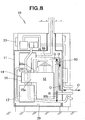
- the hot water and exhaust gas of the fourth water passage 89 is directed to the release passage 92, as indicated by arrow Q in Fig. 8 .
- the hot water having been directed to the release passage 92 is caused to flow out to the airtight chamber 12 via the relief valve 93 and lower end portion 92b release passage 92 as indicated by arrow R.
- the hot water having flown out to the airtight chamber 12 via the release passage 92 is stored on the under frame 29 so that it can be prevented from flowing out from the airtight chamber 12.
- the exhaust gas having been directed to the release passage 92, is discharged to the airtight chamber 12 via the relief valve 93 and lower end portion 92b of the release passage 92 as indicated by arrow R in Fig. 8 .
- the exhaust gas discharged to the airtight chamber 12 can be prevented from flowing out from the airtight chamber 12.
- the hot water of the fourth water passage 89 is caused to flow out via the relief passage 92, the amount of hot water flowing in the heat exchanger 17 and cylinder block 15a decreases.
- the hot water flowing in the heat exchanger 17 and cylinder block 15a increases in temperature, so that the detected temperature Tw exceeds the threshold value Tw1.
- the temperature sensor 94 detects the temperature Tw of the hot water flowing through the upstream end portion 89a of the fourth water passage 89 and outputs temperature information, indicative of the detected temperature Tw, to the second control section 23, as set forth above.
- the hot water has the highest temperature at the outlet portion of the cylinder block 15a (i.e., upstream end portion 89a of the fourth water passage 89).
- a temperature increase of the hot water can be detected or identified promptly by the temperature sensor 94 detecting the temperature Tw of the hot water flowing through the upstream end portion 89a.
- the second control section 23 determines, on the basis of the temperature information output from the temperature sensor 94, whether the temperature indicated by the temperature information has exceeded the threshold value Tw1. If the second control section 23 has determined that the temperature indicated by the temperature information has exceeded the threshold value Tw1, it outputs to the actuator (not shown) a deactivation signal for deactivating the engine 14, in response to which the not-shown actuator, for example, stops supply of a gas fuel to the engine 14 so that the engine 14 can be promptly deactivated.
- the relief valve 93 is opened so that the hot water and exhaust gas can be discharged, or can be caused to flow out, via the release passage 92. Also, once the temperature Tw of the hot water exceeds the threshold value Tw1 due to flowing out of the hot water, the engine 14 can be deactivated promptly.
- the exhaust gas having flown out (or having been discharged) to the airtight chamber 12, is caused to stay in the airtight chamber 12, so that the discharged exhaust gas can be prevented from being undesirably discharged from the interior of the cogeneration casing 11 to the indoors 38.
- the engine 14 can be deactivated promptly as noted above, the exhaust gas contained in the hot water can be prevented from flowing out, via the fourth water passage 89, to the indoors 38 (more specifically, to the room where the heat of the hot water is used for heating) outside the cogeneration casing 11 together with the hot water.
- the cogeneration apparatus 110 according to the second embodiment of the present invention is different from the cogeneration apparatus 10 according to the first embodiment in that it includes an exhaust gas removal section 111 in place of the exhaust gas removal section 91 provided in the first embodiment.
- the exhaust gas removal section 111 includes an exhaust gas separation section 112 provided halfway in the fourth water passage 89, and a relief valve 113 provided on the exhaust gas separation section 112.
- the exhaust gas separation section 112 is a cylindrical member having a flow passage diameter D1 and provided substantially vertically halfway in the fourth water passage 89 within the airtight chamber 12.
- the exhaust gas separation section 112 includes a peripheral wall portion 115 defining a cylindrical flow passage, a top portion 116 closing the upper end 115a of the peripheral wall portion 115, and a bottom portion 117 closing the lower end 115b of the peripheral wall portion 115.
- the fourth water passage 89 has an upstream portion communicating with a portion of the peripheral wall portion 115 located near the upper end 115a, and thus, the upstream portion of the fourth water passage 89 is located higher by a height H2 than the bottom portion 117.
- the flow passage diameter D1 of the exhaust gas separation section 112 is greater than a flow passage diameter D2 of the fourth water passage 89.
- the relief valve 113 is provided on the top portion 116 of the exhaust gas separation section 112 and accommodated in the airtight chamber 12 (see also Fig. 9 ).
- the relief valve 113 is in communication with the gas storage space 122 of the exhaust gas separation section 112 via a communication hole 116a.
- the relief valve 113 includes a body (valve box) 126 capable of communicating with the gas storage space 122 of the exhaust gas separation section 112, a valve member 97 slidably provided in a passage 126a of the body 126, and a compression spring 129 for normally biasing the valve member 127 against a body seat portion 128.
- the relief valve 113 is constructed in such a manner that the valve member 127 is kept abutted against the body seat portion 128 while inner pressure Pg of the gas storage space 122 is of a threshold value Pg1 or below. With the valve member 127 kept abutted against the body seat portion 128, the passage 126a of the body 126 is closed, so that the relief valve 133 is maintained in a closed state.
- the compression spring 129 is compressed so that the valve member 127 moves away from the body seat portion 128 as indicated by a black upward arrow, in response to which the passage 126a of the body 126 is brought into communication with the release passage 126a and thus the relief valve 113 is brought to an opened state.
- exhaust gas having been directed into the gas storage space 122, can be discharged to the airtight chamber 12 via the relief valve 133.
- the water (warm or low-temperature hot water hot water) is directed via the first water passageway 86 to the oil tank 15b as indicated by arrow S, and the water thus directed to the oil tank 15b is heat-exchanged with the heat of lubricating oil in the oil tank 15b.
- the water warmed by the heat of the lubricating oil is directed to the heat exchanger 17 via the second water passage 87, as indicated by arrow T, where it is heat-exchanged with the heat of the exhaust gas (i.e., exhaust or waste heat of the engine 14) directed to the heat exchanger 17.
- hot water is generated using the waste heat of the engine 14 as a heat source.
- the thus-generated hot water is directed via the third water passage 88 to the cylinder block 15a as indicated by arrow U, from which it is directed, via the fourth water passage 89 and exhaust gas separation section 112, to the indoors, as indicated by arrow V, where it is used for heating the interior of the room and the like.
- the hot water 119 directed via the third water passage 88 to the cylinder block 15a may get to contain exhaust gas while flowing in the cylinder block 15a so that exhaust gas is present in the upstream portion of the fourth water passage 89.
- the hot water 119 is directed from the upstream portion of the fourth water passage 89 to the exhaust gas separation section 112 as indicated by arrow V in Fig. 13 .
- the flow passage diameter D1 of the exhaust gas separation section 112 is greater than the flow passage diameter D2 of the fourth water passage 89, and thus, when the hot water 119 is directed from the upstream portion of the fourth water passage 89 to the exhaust gas separation section 112 as indicated by arrow V, the gas storage space 122 is formed by the upper end portion 112a of the exhaust gas separation section 112. As a result, the exhaust gas contained in the upstream portion of the fourth water passage 89 can be directed into the gas storage space 122 while being separated from the hot water as indicated by arrow W.
- the inner pressure Pg of the gas storage space 122 exceeds the threshold value Pg1, so that the relief valve 113 is brought to the opened state.
- the exhaust gas having been directed into the gas storage space 122, can be discharged to the airtight chamber 12 via the relief valve 133 as indicated by arrow X.
- the exhaust gas discharged to the airtight chamber 12 can be prevented from undesirably flowing out from the airtight chamber 12.
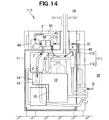
- the exhaust gas, having flown out to the airtight chamber 12, is mixed with air present in the airtight chamber 12, and the exhaust gas thus mixed with the air is directed via the intake opening 42 to the intake passage 43 as indicated by arrow Y in Fig. 14 .
- the air directed to the intake passage 43 in the aforementioned manner is then directed into the combustion chamber 18 of the engine body 15 via the air cleaner section 44, mixer 46, etc. as indicated by arrow Z.
- the engine 14 can be promptly deactivated in response to the directed exhaust gas.
- the exhaust gas discharged to the airtight chamber 12 is caused to stay in the airtight chamber 12 as noted above, so that the discharged exhaust gas can be prevented from being undesirably discharged from the interior of the cogeneration casing 11 to the indoors 38.
- the engine 14 can be deactivated promptly, the exhaust gas contained in the hot water can be prevented from flowing out, via the fourth water passage 89, to the indoors (more specifically, to the room where the heat of the hot water is used for heating) outside the cogeneration casing 11 together with the hot water.
- the cogeneration apparatus of the present invention is not limited to the above-described embodiments and may be modified variously.
- the cogeneration apparatus according to the first and second embodiments of the present invention have been described above as using the gas engine 14 as the prime mover, the present invention is not so limited, and any other types of engines, such as a gasoline engine, may be used as the prime mover.
- the cogeneration apparatus according to the first and second embodiments of the present invention have been described as installed indoors, the cogeneration apparatus of the present invention may be installed outdoors.
- the cogeneration apparatus has been described above in relation to the case where the exhaust gas separation section 112 is provided substantially vertically, the exhaust gas separation section 112 may be provided obliquely or substantially horizontally with the relief valve 113 provided on the top of the exhaust gas separation section 112.
- the shapes and constructions of the cogeneration apparatus 10, 110, cogeneration casing 11, airtight 12, engine 14, heat exchanger 17, combustion chamber 18, intake flow passage 43, water flow path 85, relief valve 93, 113, temperature sensor 94, exhaust gas separation section 112, etc. are not limited to those shown and described in relation to the first and second embodiments and may be modified as appropriate.
- the basic principles of the present invention are well suited for application to cogeneration apparatus in which water introduced into an apparatus casing is changed into hot water by use of waste heat of a prime mover and the thus-generated hot water is directed out of the apparatus casing.
- a cogeneration apparatus (10; 110) includes: an airtight chamber (12) provided within an apparatus casing (11) and constructed to prevent exhaust gas of a prime mover (14) from flowing out therefrom; and a relief valve (93; 113) provided in a water flow path (85) within the airtight chamber (12) and constructed to discharge the exhaust gas, contained in the water flow path, to the airtight chamber.
Landscapes
- Engineering & Computer Science (AREA)
- Chemical & Material Sciences (AREA)
- Combustion & Propulsion (AREA)
- Mechanical Engineering (AREA)
- General Engineering & Computer Science (AREA)
- Heat-Pump Type And Storage Water Heaters (AREA)
Abstract
Description
- The present invention relates to cogeneration apparatus constructed in such a manner that water introduced into an apparatus casing is changed into hot water by use of exhaust or waste heat of a prime mover and the thus- generated hot water is directed out of the casing to be used for a desired purpose.
- The conventionally-known cogeneration apparatus are combined heat and power apparatus which include an engine, power generator and heat exchanger provided within an apparatus casing, and in which exhaust heat of an engine driving the power generator is collected and the collected heat is used for heating the interior of a room and the like. An example of such cogeneration apparatus is disclosed in Japanese Patent Application Laid-open Publication No.
2007-187027 - Among other examples of the conventionally-known cogeneration apparatus is one which includes a CO sensor for detecting carbon monoxide (CO) contained in exhaust gas. When exhaust gas has flown out to within the casing, carbon monoxide (CO) contained in the exhaust gas is detected by the CO sensor, so that the engine is deactivated in response to CO detection information output from the CO sensor. However, in order for the CO sensor to detect carbon monoxide (CO) contained in the exhaust gas, it is necessary that a certain amount of exhaust gas be stored within the casing. Therefore, the exhaust gas stored within the casing may flow out of the casing before the CO sensor detects carbon monoxide in the exhaust gas flown out to within the casing. If the cogeneration apparatus is installed indoors, the exhaust gas may undesirably flow out of the casing to an indoor area.
- In view of the foregoing prior art problems, it is an object of the present invention to provide an improved cogeneration apparatus which can reliably prevent exhaust gas from flowing out of the interior of the casing to an indoor area.
- In order to accomplish the above-mentioned object, the present invention provides an improved cogeneration apparatus cogeneration apparatus for generating hot water from water, introduced from outside an apparatus casing into the apparatus casing via a water flow path, by use of exhaust or waste heat of a prime mover, and directing the generated hot water out of the apparatus casing via the water flow path, which comprises: an airtight chamber provided within the apparatus casing and constructed to prevent the exhaust gas of the prime mover from flowing out from the airtight chamber; and a relief valve provided in the water flow path within the airtight chamber and constructed to discharge the exhaust gas, contained in the water flow path, to the airtight chamber.
- Because the exhaust gas, contained in the water flow path, can be discharged to the airtight chamber via the relief valve and the airtight chamber is capable of preventing the exhaust gas of the prime mover from flowing out therefrom, the exhaust gas discharged to the airtight chamber can be caused to stay in the airtight chamber. Thus, in a case where the cogeneration apparatus of the present invention is installed indoors (in an indoor area, such as the interior of a room), the exhaust gas discharged to the airtight chamber can be prevented from undesirably flowing out from within the casing to the indoor area.
- In addition, the cogeneration apparatus of the present invention is constructed to discharge the exhaust gas, contained in the water flow path, to the airtight chamber via the relief valve. Thus, the cogeneration apparatus of the present invention can prevent the exhaust gas, contained in the water flow path, from undesirably flowing out to the indoor area (e.g., the interior of the room) where waste heat (exhaust heat) of the prime mover is used for a heating purpose.
- Preferably, in the cogeneration apparatus of the present invention, the relief valve is constructed to be opened once inner pressure of the water flow path exceeds a threshold value. Namely, if exhaust gas is contained in the water flow path, the inner pressure of the water flow path would exceed the threshold value, in response to which the relief valve is opened so that not only the hot water is discharged from the water flow path to the airtight chamber but also the exhaust gas contained in the hot water is discharged to the airtight chamber. Due to the hot water being discharged from the water flow path to the airtight chamber, an amount of hot water in the water flow path decreases so that the hot water flowing in the water flow path increases in temperature.
- Thus, the cogeneration apparatus of the present invention further comprises a temperature sensor provided in the water flow path for detecting a temperature of the hot water flowing in the water flow path; and a control section for, on the basis of information indicative of the temperature detected via the temperature sensor, identifying a temperature increase of the hot water occurring as a result of opening of the relief valve, to thereby deactivate the prime mover in response to the identified temperature increase. In this way, the control section can identify the opened state of the relief valve on the basis of a temperature increase of the hot water and output to an actuator a signal for deactivating the prime mover. Thus, once the hot water increases in temperature due to the opening of the relief valve, the prime mover can be deactivated promptly by means of the actuator. In this way, the exhaust gas contained in the water flow path can be prevented from undesirably flowing out to the indoor area (interior of the room) where the waste heat (exhaust heat) of the prime mover is used for heating. In addition, because the airtight chamber is capable of preventing the exhaust gas from undesirably flowing out therefrom, the exhaust gas discharged to the airtight chamber can stay in the airtight chamber, so that it can be prevented from being undesirably discharged from within the airtight chamber to the indoor area.
- Preferably, in the cogeneration apparatus of the present invention, the airtight chamber is capable of communicating with a combustion chamber of the prime mover via an intake passage. The cogeneration apparatus of the present invention further comprises an exhaust gas separation section provided in the water flow path within the airtight chamber for separating the exhaust gas, contained in the water flow path, from the hot water, the exhaust gas separated from the hot water by the exhaust gas separation section being discharged via the relief valve to the airtight chamber.
- Thus, if exhaust gas is contained in the water flow path, only the exhaust gas can be discharged to the airtight chamber while being separated from the hot water by means of the exhaust gas separation section. Further, because the airtight chamber communicates with the combustion chamber of the prime mover via the intake passage, the exhaust gas discharged to the airtight chamber can be compulsorily directed to the combustion chamber via the intake passage. By the compulsory directing of the exhaust gas, the primer mover can be deactivated promptly. In this way, the cogeneration apparatus of the present invention can prevent the exhaust gas, contained in the water flow path, from undesirably flowing out to the indoor area (interior of the room) where the waste heat (exhaust heat) of the prime mover is used heating.
- The following will describe embodiments of the present invention, but it should be appreciated that the present invention is not limited to the described embodiments and various modifications of the invention are possible without departing from the basic principles. The scope of the present invention is therefore to be determined solely by the appended claims.
- Certain preferred embodiments of the present invention will be described in detail below, by way of example only, with reference to the accompanying drawings, in which:
-
Fig. 1 is a schematic sectional front view showing a cogeneration apparatus according to a first embodiment of the present invention; -
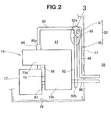
Fig. 2 is a front view of a hot water output section ofFig. 1 ; -
Fig. 3 is a sectional view showing in enlarged scale a section encircled at 3 inFig. 2 ; -
Fig. 4 is a sectional view illustrating an example state in which the cogeneration apparatus is operating normally; -
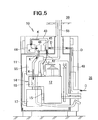
Fig. 5 is a sectional view illustrating an example detailed manner in which exhaust gas flows out to an airtight chamber in the cogeneration apparatus; -
Fig. 6 is a sectional view illustrating an example detailed manner in which hot water is generated in the cogeneration apparatus; -
Fig. 7 is a sectional view illustrating an example detailed manner in which a relief valve is opened in the cogeneration apparatus; -
Fig. 8 is a sectional view illustrating an example detailed manner in which hot water is caused to flow out via a release passage to deactivate an engine; -
Fig. 9 is a schematic sectional front view showing a cogeneration apparatus according to a second embodiment of the present invention; -
Fig. 10 is a sectional view showing an exhaust gas removal section provided in the cogeneration apparatus according to the second embodiment of the present invention; -
Fig. 11 is a sectional view showing in enlarged scale a section encircled at 11 inFig. 10 ; -
Fig. 12 is a sectional view illustrating an example detailed manner in which hot water is generated in the cogeneration apparatus according to the second embodiment of the present invention; -
Fig. 13 is a sectional view illustrating an example detailed manner in which a relief valve is opened to discharge exhaust gas to the airtight chamber in the cogeneration apparatus according to the second embodiment of the present invention; and -
Fig. 14 is a sectional view illustrating an example detailed manner in which exhaust gas is discharged to the airtight chamber to deactivate the engine in the cogeneration apparatus according to the second embodiment. - In the following description, the terms "left" and "right" are used to refer to directions as viewed from the back of a
cogeneration apparatus 10 of the present invention. - Reference is made initially to
Fig. 1 showing in schematic sectional front elevation acogeneration apparatus 10 according to a first embodiment of the present invention. Thecogeneration apparatus 10 is a combined heat and power apparatus which includes: a cogeneration casing (apparatus casing) 11 defining an outer frame of thecogeneration apparatus 10; anairtight chamber 12 provided within thecogeneration casing 11; an engine (prime mover) 14 accommodated in theairtight chamber 12; apower generator 16 provided above the body of the engine 14 (hereinafter referred to as "engine body 15"); aheat exchanger 17 provided laterally to theengine body 15; and a hot water output section for outputting hot water generated by theheat exchanger 17. - The
cogeneration apparatus 10 further includes: afirst control section 21 provided to the left of theengine body 15 outside theairtight chamber 12; apower conversion section 22 provided above thefirst control section 21 outside theairtight chamber 12; and asecond control section 23 provided above theheat exchanger 17 outside theairtight chamber 12. - For example, the
cogeneration apparatus 10 is installed in indoors (in an indoor area or room) 38 and constructed to generate hot water by use of exhaust heat (waste heat) of the engine 14) so that the heat of the generated hot water can be used for heating the interior of the room. - The
cogeneration casing 11 is formed in a generally rectangular parallelepiped shape by abottom panel 25, front and rear panels (not shown), aleft side panel 26, aright side panel 27 and aroof panel 28. Apartition wall 31 is provided within thecogeneration casing 11 adjacent to and along theleft side panel 26, and anupper partition section 32 extends from anupper end portion 31a of thepartition wall 31 to theright side panel 27. - The
airtight chamber 12 is a hermetically sealed space defined by thebottom panel 25,partition wall 31,upper partition section 32,right side panel 27 andventilation duct 34. Theventilation duct 34 has alower end portion 34a located at thepartition section 42, and anupper end portion 34b located at theroof panel 28. Theventilation duct 34 communicates at thelower end portion 34a with aventilation opening 35 formed in theupper partition section 32, so that theventilation duct 34 is in communication with theairtight chamber 12 via theventilation opening 35. Further, theventilation duct 34 communicates at theupper end portion 34b with anexternal duct 37 via aventilation opening 36 formed in theroof panel 28, and theexternal duct 37 is in communication with outdoors (outside of the casing) 39. - The
airtight chamber 12 is a space provided within thecogeneration casing 11 and accommodates therein theengine body 15,power generator 16 andheat exchanger 17. Theairtight chamber 12 has seal performance capable of preventing exhaust gas, discharged via a later-describedrelease passage 92, from flowing out from theairtight chamber 12. Anunder frame 29 is provided on the bottom panel (bottom portion) 25 of theairtight chamber 12. - The
first control section 21, power conversion section (inverter unit) 22 andsecond control section 23 are accommodated (disposed) in aspace 31 within thecogeneration casing 11 but outside theairtight chamber 12. Further, anair cleaner section 44, gas flowrate adjustment section 45 and mixer 46 (including a throttle valve), constituting a part of anintake system 41 of theengine 14, are accommodated (disposed) in thespace 31 within thecogeneration casing 11 but outside theairtight chamber 12. - The
engine 14 is a gas engine which includes: theengine body 15 capable of rotating adrive shaft 16a of thepower generator 16; theintake system 41 that supplies a gas fuel to acombustion chamber 18 of theengine body 15; and anexhaust system 51 that discharges exhaust gas of thecombustion chamber 18 to theoutdoors 39. - The
engine body 15 has acrankshaft 19 connected coaxially with thedrive shaft 16a of thepower generator 16, and a piston connected to thecrankshaft 19 via a con rod. Theengine body 15 is a reciprocating type engine in which the piston is slidably provided within acylinder block 15a and thecombustion chamber 18 is provided in a distal end portion of thecylinder block 15a. In theengine body 15, the gas fuel is burned in thecombustion chamber 18 so that the piston slides in the cylinder to rotate thecrankshaft 19. The rotation of thecrankshaft 19 causes thedrive shaft 16a of thepower generator 16 to rotate. - The
intake system 41 has anintake opening 42 formed in theupper partition portion 32, anintake passage 43 communicating theintake opening 42 with thecombustion chamber 18 of theengine body 18, and theair cleaner section 44 provided halfway in theintake passage 43. Further, themixer 46 is provided in theintake passage 43 at a position downstream of theair cleaner section 44. Thus, thecombustion chamber 18 of theengine 15 is in communication with theairtight chamber 12 via theintake passage 43,mixer 46,air cleaner section 44 andintake opening 42. - Air sucked in from the
airtight chamber 12 is directed through theintake opening 42 to theintake passage 43 and then to theair cleaner section 44, so that the air is cleaned or purified by theair cleaner section 44. The thus-purified air is mixed with a gas fuel by themixer 46. - The gas fuel is directed to the gas flow
rate adjustment section 45 via agas supply passage 48, so that the gas fuel having been adjusted in flow rate by the gas flowrate adjustment section 45 is directed to themixer 46. The gas fuel mixed with the air by themixer 46 is then introduced into thecombustion chamber 18 of theengine body 15, via the throttle valve andintake passage 43, so that theengine 14 is driven by the gas fuel. - The
exhaust system 51 includes anexhaust section 52 for directing exhaust gas of thecombustion chamber 18 to the outside, and a condensedwater separation section 62 communicating with a halfway position of theexhaust section 52. - The
exhaust section 52 includes: afirst exhaust passage 53 communicating thecombustion chamber 18 of theengine body 15 with theheat exchanger 17; asecond exhaust passage 54 communicating theheat exchanger 17 with amuffler 55 that in turn communicates with an outlet portion of thesecond exhaust passage 54; and athird exhaust passage 56 communicating themuffler 55 with theoutdoors 39. - Exhaust gas of the engine 14 (combustion chamber 18) is directed to the
heat exchanger 17 via thefirst exhaust passage 53, and the exhaust gas is then directed from theheat exchanger 17 to thesecond exhaust passage 54. Then, the exhaust gas directed to thesecond exhaust passage 54 is directed to themuffler 55, from which it is directed to thethird exhaust passage 56 to be discharged to theoutdoors 39. - The condensed
water separation section 62 includes: acondensed water passage 63 communicating with abottom communicating opening 55a of themuffler 55; astorage section 64 communicating with anoutlet portion 63a of thecondensed water passage 63; and a condensedwater discharge section 67 communicating with anoutlet portion 64b of thestorage section 64. - The
condensed water passage 63 is accommodated in theairtight chamber 12, has an inlet portion communicating with thebottom communicating opening 55a of themuffler 55 and extends vertically toward thebottom panel 25. Thecondensed water passage 63 is a flow passage into which condensed water, contained in theexhaust section 52, is introduced via the communicatingopening 55a of themuffler 55. - The
storage section 64 is accommodated in theairtight chamber 12 and has aninlet portion 64a communicating with theoutlet portion 63a of thecondensed water passage 63. Thestorage section 64 is formed in a substantially U shape with theinlet portion 64a andoutlet portion 64b located above thebottom portion 64c. - Condensed water contained exhaust gas can be stored in the
storage section 64 formed in such a substantially U shape, and thus, exhaust gas of thecondensed water passage 63 can be prevented from being discharged to theairtight chamber 12 via thestorage section 64. - The condensed
water discharge section 67 is in communication with theoutlet portion 64b of thestorage section 64. The condensedwater discharge section 67 extends obliquely downwardly from theoutlet portion 64b of thestorage section 64 through theleft panel 26 to project into the indoors 38. - Condensed water separated from exhaust gas in the
muffler 55 is directed to thecondensed water passage 63 of the condensedwater separation section 62 and stored into thestorage section 64. By being stored into thestorage section 64 like this, the condensed water can prevent the exhaust gas, directed from the interior of themuffler 55 to thecondensed water passage 63, from being directed to thestorage section 64. Thus, the exhaust gas directed to thecondensed water passage 63 can be prevented from being discharged from the interior of thecogeneration casing 11 to the indoors 63 by way of thestorage section 64. - The
power generator 16 is provided above theengine body 15, and thedrive shaft 16a of thepower generator 16 is connected coaxially with thecrankshaft 19 of theengine 14. By being driven by theengine 14, theengine 14 can generate AC electric power or electricity. - A
ventilation fan 81 is provided over thepower generator 16 and driven in response to driving of thepower generator 16. Thepower generator 16 and theventilation fan 81 are covered with afan cover 82. A ventilatingair introducing opening 83 is formed in atop wall portion 82a of thefan cover 82, and an air lead-outopening 84 is formed in a side wall portion of thefan cover 82. - The air lead-out
opening 84 is in communication with theairtight chamber 12. Thus, while theventilation fan 81 is in operation, air within thefan cover 82 can be lead out to theairtight chamber 12 through the air lead-outopening 84. - Further, the ventilating
air introducing opening 83 is located near theventilation opening 35 and in communication with theoutdoors 39 via theairtight chamber 12,ventilation opening 35,ventilation duct 34 andexternal duct 37. Thus, while theventilation fan 81 is in operation, external air, i.e. air in theoutdoors 39, can be introduced through the ventilatingair introducing opening 83 to inside thefan cover 82 via theexternal duct 37,ventilation duct 34,ventilation opening 35 andairtight chamber 12. - Namely, by operation of the
ventilation fan 81, external air, i.e. air in theoutdoors 39, can be introduced to inside thefan cover 82 via theventilation duct 34,airtight chamber 12, etc. Thepower generator 16 is cooled with the external air introduced to inside thefan cover 82. The air having cooled thepower generator 16 is directed through the air lead-outopening 84 into theairtight chamber 12 and circulates through theairtight chamber 12 so that theengine body 15 andheat exchanger 17 are cooled with the air. - The
intake opening 42 is in communication with theairtight chamber 12, and thus, the air, having cooled theengine body 15 andheat exchanger 17, is directed into thecombustion chamber 18 of theengine body 15 by way of theintake opening 42,intake passage 43, etc. - To the
heat exchanger 17 is directed exhaust gas from theengine 14 via thefirst exhaust passage 53, as well as water sent from an indoor area outside the cogeneration casing 11 (more specifically, a room where heat of hot water is used for a heating purpose) via a hot water lead-outsection 20. The water directed to theheat exchanger 17 is raised in temperature by being heat-exchanged with the exhaust gas, thereby generating hot water. - As shown in
Fig. 2 , the hot water lead-outsection 20 includes awater flow path 85 communicating with theheat exchanger 17 and thecylinder block 15a of thecylinder body 15, and an exhaustgas removal section 91 provided in thewater flow path 85 and capable of separating exhaust gas of thewater flow path 85. - The
water flow path 85 includes: afirst water passage 86 communicating with anoil tank 15b of theengine body 15; asecond water passage 87 communicating theoil tank 15b and theheat exchanger 17 with each other; athird water passage 88 for directing hot water, generated by theheat exchanger 17, to thecylinder block 15a; and afourth water passage 89 for directing the hot water from thecylinder block 15a to the room where the heat of the hot water is used for heating. - The
water flow path 85 includes a pump (not shown) provided in or adjacent to the indoor area (room) where the heat of the hot water is used for heating. The pump can circulate the water (warm or low-temperature hot water) through thewater flow path 85. - Through operation of the pump of the
water flow path 85, the water is directed from the indoor area, where the heat of hot water is used for heating, is directed to theoil tank 15b, so that the thus-directed water is heat-exchanged with heat of lubricating oil. - Then, the water warmed with the heat of the lubricating oil is directed to the
heat exchanger 17 via thesecond water passage 87, where it is heat-exchanged with waste heat (exhaust heat) of theengine 14. Namely, in theheat exchanger 17, hot water is generated using the waste heat (exhaust heat) of theengine 14 as a heat source. - The thus-generated hot water is directed to the
cylinder block 15a of theengine body 15 via thethird water passage 88 and then directed out of thecogeneration casing 11 to the indoor area via thefourth water passage 89, so that the heat of the hot water is used for heating the interior of the room. - The exhaust
gas removal section 91 includes therelease passage 92 communicating with thefourth water passage 89, arelief valve 93 provided halfway in therelease passage 92, and atemperature sensor 94 provided in anupstream end portion 89a of thefourth water passage 89. - The
release passage 92 is accommodated in theairtight chamber 12, and therelease passage 92 extends downwardly with its upper end portion (upstream end portion) 92a communicating with thefourth water passage 89 and with its lower end portion (downstream end portion) 92b located over theunder frame 29. Thus, hot water flowing from thelower end portion 92b of therelease passage 92 to the airtight chamber 12 can be stored on theunder frame 29. - The
relief valve 93 is accommodated in theairtight chamber 12 and disposed near theupper end portion 92a of therelease passage 92 so that it is in communication with thefourth water passage 89. - As shown in
Fig. 3 , therelief valve 93 includes a body (valve box) 96 capable of communicating with therelease passage 92, avalve member 97 slidably provided in apassage 96a of thebody 96, and acompression spring 99 for normally biasing thevalve member 97 against abody seat portion 98. - The
relief valve 93 is constructed in such a manner that thevalve member 97 is kept abutted against thebody seat portion 98 while inner pressure Pw of thefourth water passage 89 is of a threshold value Pw1 or below. With thevalve member 97 kept abutted against thebody seat portion 98, thepassage 96a of thebody 96 is closed, so that therelief valve 93 is maintained in a closed state. - On the other hand, once the inner pressure Pw of the
fourth water passage 89 exceeds the threshold value Pw1, thecompression spring 99 is compressed so that thevalve member 97 moves away from thebody seat portion 98 as indicated by a black downward arrow, in response to which thepassage 96a of thebody 96 is brought into communication with therelease passage 92 and thus therelief valve 93 is brought to an opened state. - The
temperature sensor 94, provided in theupstream end portion 89a of thefourth water passage 89 as shown inFig. 2 , detects a temperature Tw of hot water flowing through theupstream end portion 89a and conveys or outputs temperature information, indicative of the detected temperature Tw, to thesecond control section 23. - The
upstream end portion 89a of thefourth water passage 89 is in communication with the outlet portion of thecylinder block 15a of theengine body 15, and thus, the hot water flowing through theupstream end portion 89a of thefourth water passage 89 has the highest temperature in thewater flow path 85. - As shown in
Fig. 1 , thefirst control section 21 is provided on thepartition wall 31 in aspace 13 inside the cogeneratingcasing 11 but outside theairtight chamber 12. Whereas an electric leakage breaker is shows as an example of thefirst control section 21, thefirst control section 21 is not so limited and may have any other suitable engine control function. - Further, the
second control section 23 is also provided in thespace 13 inside the cogenerating casing 11but outside theairtight chamber 12, and it is located above theheat exchanger 17 and to the right of theair cleaner section 44. - The
second control section 23 is an ECU which has, among others, a function of switching thepower generator 16 to a starter function at the time of activation of theengine 14 and switching thepower generator 16 to a power generator function after activation of theengine 14. - Further, the
second control section 23 determines, on the basis of the temperature information output from thetemperature sensor 94, whether the temperature indicated by the temperature information has exceeded the threshold value Tw1. If thesecond control section 23 has determined or identified that the temperature indicated by the temperature information has exceeded the threshold value Tw1, it outputs to an actuator (not shown) a deactivation signal for deactivating theengine 14, in response to which the not-shown actuator stops supply of a gas fuel to theengine 14. - The following describe how (or a condition in which) the detected temperature Tw exceeds the threshold value Tw1. Namely, as the
relief valve 93 is opened to cause the hot water of thefourth water passage 89 to flow out via therelief passage 92, an amount of hot water flowing in theheat exchanger 17 andcylinder block 15a decreases. Thus, the hot water flowing in theheat exchanger 17 andcylinder block 15a increases in temperature, so that the detected temperature Tw exceeds the threshold value Tw1. - By the
temperature sensor 94 detecting the temperature Tw of the hot water flowing through theupstream end portion 89a, it is possible to promptly detect when the temperature Tw of the hot water has exceeded the threshold value Tw1. Namely, as the hot water flows out via therelief passage 92 in response to the opening of therelief valve 93, theengine 14 can be promptly deactivated in response to the temperature Tw of the hot water exceeding the threshold value Tw1. - In addition, the
power conversion section 22 is provided on an upper half portion of thepartition wall 31 in thespace 13 inside thecogeneration casing 11 but outside theairtight chamber 12, as shown inFig. 1 . Thepower conversion section 22 is an inverter unit that converts AC power, generated by thepower generator 16, into a form of power corresponding to required specifications. - The following describe, with reference to
Fig. 4 , a state in which thecogeneration apparatus 10 is operating normally. As shown inFig. 4 , air is sucked from theairtight chamber 12 into theintake opening 42 as indicated by arrow A in response to operation of theengine 14. The air sucked into theintake opening 42 is directed via theintake passage 43 to theair cleaner section 44 as indicated by arrow B. - The air, having been directed to the
air cleaner section 44, is cleaned or purified by theair cleaner section 44 and then directed to themixer 46 where it is mixed with a gas fuel is directed via thegas supply passage 48 to the gas flowrate adjustment section 45 as indicated by arrow D and then to themixer 46. - The gas fuel mixed with the air by the
mixer 46 is directed into thecombustion chamber 18 of theengine body 15 via the throttle valve andintake passage 43 as indicated by arrow E. - In the aforementioned manner, both the
power generator 16 and theventilation fan 81 are driven by theengine 14. In response to the driving of theventilation fan 81, air inside thefan cover 82 is directed via the air lead-outopening 84 into theairtight chamber 12 as indicated by arrow F. - By the air inside the
fan cover 82 being directed into theairtight chamber 12, pressure in the interior of thefan cover 82 becomes negative, in response to which air in theventilation duct 34 is directed to inside thefan cover 82 via theventilation opening 35,airtight chamber 12 and ventilatingair introducing opening 83 as indicated by arrow G. - In response to the air in the
ventilation duct 34 being directed to inside thefan cover 82 as noted above, air in theoutdoors 39 is directed to theventilation duct 34 as indicated by arrow H. - Namely, as the
ventilation fan 81 is driven, air in theoutdoors 39 is directed to inside thefan cover 82 via theexternal duct 37,ventilation duct 34,airtight chamber 12, etc. as indicated by arrow G. - The
power generator 16 is cooled with the air directed to inside thefan cover 82. The air having thus cooled thepower generator 16 is directed into theairtight chamber 12 via the air lead-outopening 84 as indicated by arrow F and circulates through theairtight chamber 12 as indicated by arrow I to thereby cool theengine body 15 andheat exchanger 17. - The air having cooled the
engine body 15 andheat exchanger 17 is directed via theintake opening 42 to theintake passage 43, from which it is directed to theair cleaner section 44 as indicated by arrow B. The air having been purified by theair cleaner section 44 is directed into thecombustion chamber 18 of theengine body 15 via theintake passage 43. - The following describe, with reference to
Fig. 5 , an example detailed manner in which theengine 14 is deactivated when exhaust gas has flown out to theairtight chamber 12 of thecogeneration apparatus 10. - As shown in
Fig. 5 , if exhaust gas flows out to theairtight chamber 12, the exhaust gas is caused to stay in theairtight chamber 12, so that the exhaust gas can be prevented from being discharged from the interior of thecogeneration casing 11 to the indoors 38. In this state, the exhaust gas, having flown out to theairtight chamber 12, is mixed with air present in theairtight chamber 12, and the exhaust gas thus mixed with the air is directed via theintake opening 42 to theintake passage 43 as indicated by arrow J. - The air directed to the
intake passage 43 in the aforementioned manner is then directed into thecombustion chamber 18 of theengine body 15 via theair cleaner section 44,mixer 46, etc. as indicated by arrow K. - Because the exhaust gas having flown out to the
airtight chamber 12 is compulsorily directed to thecombustion chamber 18 in the aforementioned manner, theengine 14 can be promptly deactivated in response to the directed exhaust gas. - In some case, the exhaust gas having flown out to the
airtight chamber 12 might be of only a minute amount. In such a case, the exhaust gas is discharged from theairtight chamber 12 to theoutdoors 39 via thecombustion chamber 18,heat exchanger 17,muffler 55,third exhaust passage 56, etc., and thus, it can be prevented from being undesirably discharged from the interior of thecogeneration casing 11 to the indoors 38. - The following describe, with reference to
Figs. 6 to 8 , an example detailed manner in which theengine 14 is deactivated in response to therelief valve 93 of thecogeneration apparatus 10 being opened to cause hot water to flow out via therelease passage 92. As shown inFig. 6 , water (warm or low-temperature hot water) of thewater flow path 85 is caused to circulate by driving of the pump provided in the indoors (in the room) where the heat of hot water is used for heating. - By the circulation, the water is directed via the
first water passageway 86 to theoil tank 15b as indicated by arrow L, and the water thus directed to theoil tank 15b is heat-exchanged with the heat of lubricating oil in theoil tank 15b. - Then, the water heated by the heat of the lubricating oil is directed to the
heat exchanger 17 via thesecond water passage 87, as indicated by arrow M, where it is heat-exchanged with the heat of the exhaust gas (i.e., exhaust or waste heat of the engine 14) directed to theheat exchanger 17. Namely, hot water is generated using the waste heat of theengine 14 as a heat source. - The thus-generated hot water is directed via the
third water passage 88 to thecylinder block 15a as indicated by arrow N, from which it is directed to the indoors, as indicated by arrow O, where it is used for heating the interior of the room and the like. - It is conceivable that the hot water directed to the
cylinder block 15a may get to contain exhaust gas while flowing in thecylinder block 15a and, consequently, the inner pressure Pw of thefourth water passage 89 may increase to exceed the threshold value Pw1. - Once the inner pressure Pw of the
fourth water passage 89 exceeds the threshold value Pw1, thecompression spring 99 is compressed so that thevalve member 97 moves away from thebody seat portion 98 as indicated by arrow P inFig. 7 , in response to which thepassage 96a of thebody 96 communicates with therelease passage 92 and thus therelief valve 93 is brought to the opened state. - By the
relief valve 93 being opened in the aforementioned manner, the hot water and exhaust gas of thefourth water passage 89 is directed to therelease passage 92, as indicated by arrow Q inFig. 8 . Then, the hot water having been directed to therelease passage 92 is caused to flow out to theairtight chamber 12 via therelief valve 93 andlower end portion 92b release passage 92 as indicated by arrow R. The hot water having flown out to theairtight chamber 12 via therelease passage 92 is stored on theunder frame 29 so that it can be prevented from flowing out from theairtight chamber 12. - Similarly to the hot water, the exhaust gas, having been directed to the
release passage 92, is discharged to theairtight chamber 12 via therelief valve 93 andlower end portion 92b of therelease passage 92 as indicated by arrow R inFig. 8 . The exhaust gas discharged to theairtight chamber 12 can be prevented from flowing out from theairtight chamber 12. - As the hot water of the
fourth water passage 89 is caused to flow out via therelief passage 92, the amount of hot water flowing in theheat exchanger 17 andcylinder block 15a decreases. Thus, the hot water flowing in theheat exchanger 17 andcylinder block 15a increases in temperature, so that the detected temperature Tw exceeds the threshold value Tw1. - Namely, the
temperature sensor 94 detects the temperature Tw of the hot water flowing through theupstream end portion 89a of thefourth water passage 89 and outputs temperature information, indicative of the detected temperature Tw, to thesecond control section 23, as set forth above. - At the
upstream end portion 89a of thefourth water passage 89 is flowing the hot water having just flown out of thecylinder block 15a of theengine body 15. Thus, the hot water has the highest temperature at the outlet portion of thecylinder block 15a (i.e.,upstream end portion 89a of the fourth water passage 89). As a result, a temperature increase of the hot water can be detected or identified promptly by thetemperature sensor 94 detecting the temperature Tw of the hot water flowing through theupstream end portion 89a. - The
second control section 23 determines, on the basis of the temperature information output from thetemperature sensor 94, whether the temperature indicated by the temperature information has exceeded the threshold value Tw1. If thesecond control section 23 has determined that the temperature indicated by the temperature information has exceeded the threshold value Tw1, it outputs to the actuator (not shown) a deactivation signal for deactivating theengine 14, in response to which the not-shown actuator, for example, stops supply of a gas fuel to theengine 14 so that theengine 14 can be promptly deactivated. - Namely, once the inner pressure Pw of the
fourth water passage 89 exceeds the threshold value Pw1 due to the exhaust gas getting to be contained into the hot water, therelief valve 93 is opened so that the hot water and exhaust gas can be discharged, or can be caused to flow out, via therelease passage 92. Also, once the temperature Tw of the hot water exceeds the threshold value Tw1 due to flowing out of the hot water, theengine 14 can be deactivated promptly. - The exhaust gas, having flown out (or having been discharged) to the
airtight chamber 12, is caused to stay in theairtight chamber 12, so that the discharged exhaust gas can be prevented from being undesirably discharged from the interior of thecogeneration casing 11 to the indoors 38. - In addition, because the
engine 14 can be deactivated promptly as noted above, the exhaust gas contained in the hot water can be prevented from flowing out, via thefourth water passage 89, to the indoors 38 (more specifically, to the room where the heat of the hot water is used for heating) outside thecogeneration casing 11 together with the hot water. - Next, with reference to
Figs. 9 to 11 , a description will be given about acogeneration apparatus 110 according to a second embodiment of the present invention, where similar elements to those in the first embodiment are indicated by the same reference numerals and characters as used for the first embodiment and will not be described here to avoid unnecessary duplication. - As shown in
Fig. 9 , thecogeneration apparatus 110 according to the second embodiment of the present invention is different from thecogeneration apparatus 10 according to the first embodiment in that it includes an exhaustgas removal section 111 in place of the exhaustgas removal section 91 provided in the first embodiment. - The exhaust
gas removal section 111 includes an exhaustgas separation section 112 provided halfway in thefourth water passage 89, and arelief valve 113 provided on the exhaustgas separation section 112. - As shown in
Fig. 10 , the exhaustgas separation section 112 is a cylindrical member having a flow passage diameter D1 and provided substantially vertically halfway in thefourth water passage 89 within theairtight chamber 12. The exhaustgas separation section 112 includes aperipheral wall portion 115 defining a cylindrical flow passage, atop portion 116 closing theupper end 115a of theperipheral wall portion 115, and abottom portion 117 closing thelower end 115b of theperipheral wall portion 115. - The
fourth water passage 89 has an upstream portion communicating with a portion of theperipheral wall portion 115 located near theupper end 115a, and thus, the upstream portion of thefourth water passage 89 is located higher by a height H2 than thebottom portion 117. - The flow passage diameter D1 of the exhaust
gas separation section 112 is greater than a flow passage diameter D2 of thefourth water passage 89. Thus, whenhot water 119 is directed from an upstream portion of thefourth water passage 89 to the exhaustgas separation section 112, agas storage space 122 can be formed by anupper end portion 112a of the exhaustgas separation section 112. As a result, exhaust gas contained in the upstream portion of thefourth water passage 89 can be directed into thegas storage space 122 while being separated from the hot water. - The
relief valve 113 is provided on thetop portion 116 of the exhaustgas separation section 112 and accommodated in the airtight chamber 12 (see alsoFig. 9 ). Therelief valve 113 is in communication with thegas storage space 122 of the exhaustgas separation section 112 via acommunication hole 116a. - As shown in
Fig. 11 , therelief valve 113 includes a body (valve box) 126 capable of communicating with thegas storage space 122 of the exhaustgas separation section 112, avalve member 97 slidably provided in apassage 126a of thebody 126, and acompression spring 129 for normally biasing thevalve member 127 against abody seat portion 128. - The
relief valve 113 is constructed in such a manner that thevalve member 127 is kept abutted against thebody seat portion 128 while inner pressure Pg of thegas storage space 122 is of a threshold value Pg1 or below. With thevalve member 127 kept abutted against thebody seat portion 128, thepassage 126a of thebody 126 is closed, so that the relief valve 133 is maintained in a closed state. - On the other hand, once the inner pressure Pg of the
gas storage space 122 exceeds the threshold value Pg1, thecompression spring 129 is compressed so that thevalve member 127 moves away from thebody seat portion 128 as indicated by a black upward arrow, in response to which thepassage 126a of thebody 126 is brought into communication with therelease passage 126a and thus therelief valve 113 is brought to an opened state. Thus, exhaust gas, having been directed into thegas storage space 122, can be discharged to theairtight chamber 12 via the relief valve 133. - The following describe, with reference to
Figs. 12 to 14 , an example detailed manner in which theengine 14 is deactivated by therelief valve 113 of thecogeneration apparatus 110 being opened to discharge exhaust gas to theairtight chamber 12 to thereby deactivate theengine 14. As shown inFig. 12 , water (warm or low-temperature hot water) of thewater flow path 85 is caused to circulate by driving of the pump provided in the indoors (in the room) where the heat of hot water is used for heating. - By the circulation, the water (warm or low-temperature hot water hot water) is directed via the
first water passageway 86 to theoil tank 15b as indicated by arrow S, and the water thus directed to theoil tank 15b is heat-exchanged with the heat of lubricating oil in theoil tank 15b. - Then, the water warmed by the heat of the lubricating oil is directed to the
heat exchanger 17 via thesecond water passage 87, as indicated by arrow T, where it is heat-exchanged with the heat of the exhaust gas (i.e., exhaust or waste heat of the engine 14) directed to theheat exchanger 17. Namely, hot water is generated using the waste heat of theengine 14 as a heat source. - The thus-generated hot water is directed via the
third water passage 88 to thecylinder block 15a as indicated by arrow U, from which it is directed, via thefourth water passage 89 and exhaustgas separation section 112, to the indoors, as indicated by arrow V, where it is used for heating the interior of the room and the like. - It is conceivable that the
hot water 119 directed via thethird water passage 88 to thecylinder block 15a may get to contain exhaust gas while flowing in thecylinder block 15a so that exhaust gas is present in the upstream portion of thefourth water passage 89. In this state, thehot water 119 is directed from the upstream portion of thefourth water passage 89 to the exhaustgas separation section 112 as indicated by arrow V inFig. 13 . - The flow passage diameter D1 of the exhaust
gas separation section 112 is greater than the flow passage diameter D2 of thefourth water passage 89, and thus, when thehot water 119 is directed from the upstream portion of thefourth water passage 89 to the exhaustgas separation section 112 as indicated by arrow V, thegas storage space 122 is formed by theupper end portion 112a of the exhaustgas separation section 112. As a result, the exhaust gas contained in the upstream portion of thefourth water passage 89 can be directed into thegas storage space 122 while being separated from the hot water as indicated by arrow W. - Due to the exhaust gas being directed into the
gas storage space 122, the inner pressure Pg of thegas storage space 122 exceeds the threshold value Pg1, so that therelief valve 113 is brought to the opened state. Thus, only the exhaust gas, having been directed into thegas storage space 122, can be discharged to theairtight chamber 12 via the relief valve 133 as indicated by arrow X. The exhaust gas discharged to theairtight chamber 12 can be prevented from undesirably flowing out from theairtight chamber 12. - The exhaust gas, having flown out to the
airtight chamber 12, is mixed with air present in theairtight chamber 12, and the exhaust gas thus mixed with the air is directed via theintake opening 42 to theintake passage 43 as indicated by arrow Y inFig. 14 . The air directed to theintake passage 43 in the aforementioned manner is then directed into thecombustion chamber 18 of theengine body 15 via theair cleaner section 44,mixer 46, etc. as indicated by arrow Z. - Because the exhaust gas having flown out (having been discharged) to the
airtight chamber 12 is compulsorily directed to thecombustion chamber 18 in the aforementioned manner, theengine 14 can be promptly deactivated in response to the directed exhaust gas. - The exhaust gas discharged to the
airtight chamber 12 is caused to stay in theairtight chamber 12 as noted above, so that the discharged exhaust gas can be prevented from being undesirably discharged from the interior of thecogeneration casing 11 to the indoors 38. - In addition, because the
engine 14 can be deactivated promptly, the exhaust gas contained in the hot water can be prevented from flowing out, via thefourth water passage 89, to the indoors (more specifically, to the room where the heat of the hot water is used for heating) outside thecogeneration casing 11 together with the hot water. - It should be appreciated that the cogeneration apparatus of the present invention is not limited to the above-described embodiments and may be modified variously. For example, whereas the cogeneration apparatus according to the first and second embodiments of the present invention have been described above as using the
gas engine 14 as the prime mover, the present invention is not so limited, and any other types of engines, such as a gasoline engine, may be used as the prime mover. - Further, whereas the cogeneration apparatus according to the first and second embodiments of the present invention have been described as installed indoors, the cogeneration apparatus of the present invention may be installed outdoors.
- Furthermore, the cogeneration apparatus according to the second embodiment of the present invention has been described above in relation to the case where the exhaust
gas separation section 112 is provided substantially vertically, the exhaustgas separation section 112 may be provided obliquely or substantially horizontally with therelief valve 113 provided on the top of the exhaustgas separation section 112. - Furthermore, the shapes and constructions of the
cogeneration apparatus cogeneration casing 11, airtight 12,engine 14,heat exchanger 17,combustion chamber 18,intake flow passage 43,water flow path 85,relief valve temperature sensor 94, exhaustgas separation section 112, etc. are not limited to those shown and described in relation to the first and second embodiments and may be modified as appropriate. - The basic principles of the present invention are well suited for application to cogeneration apparatus in which water introduced into an apparatus casing is changed into hot water by use of waste heat of a prime mover and the thus-generated hot water is directed out of the apparatus casing.
- A cogeneration apparatus (10; 110) includes: an airtight chamber (12) provided within an apparatus casing (11) and constructed to prevent exhaust gas of a prime mover (14) from flowing out therefrom; and a relief valve (93; 113) provided in a water flow path (85) within the airtight chamber (12) and constructed to discharge the exhaust gas, contained in the water flow path, to the airtight chamber.
Claims (3)
- A cogeneration apparatus (10; 110) for generating hot water from water, introduced from outside an apparatus casing (11) into the apparatus casing via a water flow path (85), by use of waste heat of a prime mover (14), and directing the generated hot water out of the apparatus casing via the water flow path, which comprises:an airtight chamber (12) provided within the apparatus casing (12) and constructed to prevent the exhaust gas of the prime mover from flowing out from the airtight chamber; anda relief valve (93; 113) provided in the water flow path (85) within the airtight chamber (12) and constructed to discharge the exhaust gas, contained in the water flow path, to the airtight chamber.
- The cogeneration apparatus according to claim 1, wherein the relief valve is constructed to be opened once inner pressure of the water flow path exceeds a threshold value (93; 113), and
which further comprises:a temperature sensor (94) provided in the water flow path (85) for detecting a temperature of hot water flowing in the water flow path; anda control section (23) for, on the basis of information indicative of the temperature detected via the temperature sensor (94), identifying a temperature increase of the hot water occurring as a result of opening of the relief valve (93; 113), to thereby deactivate the prime mover (14) in response to the identified temperature increase. - The cogeneration apparatus according to claim 1, wherein the airtight chamber (12) is constructed to be capable of communicating with a combustion chamber (18) of the prime mover via an intake passage, and
which further comprises an exhaust gas separation section (112) provided in the water flow path (85) within the airtight chamber (12) for separating the exhaust gas, contained in the water flow path, from the hot water, the exhaust gas separated from the hot water by the exhaust gas separation section (112) being discharged via the relief valve (113) to the airtight chamber (12).
Applications Claiming Priority (1)
| Application Number | Priority Date | Filing Date | Title |
|---|---|---|---|
| JP2011050681A JP5712004B2 (en) | 2011-03-08 | 2011-03-08 | Cogeneration equipment |
Publications (2)
| Publication Number | Publication Date |
|---|---|
| EP2497933A1 true EP2497933A1 (en) | 2012-09-12 |
| EP2497933B1 EP2497933B1 (en) | 2015-09-09 |
Family
ID=45811336
Family Applications (1)
| Application Number | Title | Priority Date | Filing Date |
|---|---|---|---|
| EP12158179.7A Not-in-force EP2497933B1 (en) | 2011-03-08 | 2012-03-06 | Cogeneration apparatus |
Country Status (3)
| Country | Link |
|---|---|
| US (1) | US8893472B2 (en) |
| EP (1) | EP2497933B1 (en) |
| JP (1) | JP5712004B2 (en) |
Families Citing this family (1)
| Publication number | Priority date | Publication date | Assignee | Title |
|---|---|---|---|---|
| DE102021121074B4 (en) | 2021-08-13 | 2024-10-10 | Viessmann Climate Solutions Se | combined heat and power plant |
Citations (5)
| Publication number | Priority date | Publication date | Assignee | Title |
|---|---|---|---|---|
| EP0268726A2 (en) * | 1986-11-21 | 1988-06-01 | Craig L. Linden | Cogeneration system |
| DE10151121A1 (en) * | 2001-10-20 | 2003-05-08 | Reimund Stelzer | Force-heat coupled device for supplying thermal and electrical energy, has insulated housing for engine and generator that is externally closed air tight and fitted with internal cooling circuit |
| US20050161521A1 (en) * | 2003-11-07 | 2005-07-28 | Guyer Eric C. | System and method for hydronic space heating with electrical power generation |
| JP2007187027A (en) | 2006-01-11 | 2007-07-26 | Chugoku Electric Power Co Inc:The | Cogeneration system |
| DE102009010834A1 (en) * | 2009-02-28 | 2010-09-09 | Piper, Erik John William | Micro heat and power system for power supply to building e.g. single-family house, has suction hole formed in storage housing, where suction air is supplied to combustion engine via hole and guided over and through generator |
Family Cites Families (8)
| Publication number | Priority date | Publication date | Assignee | Title |
|---|---|---|---|---|
| DE9100340U1 (en) * | 1991-01-12 | 1992-02-13 | Immler, Volker | Power generation unit in combined heat and power technology |
| US6595431B1 (en) * | 2002-11-14 | 2003-07-22 | Dennis A. Lieske | Exhaust heat trap and redirecting system |
| JP4848968B2 (en) * | 2007-01-31 | 2011-12-28 | トヨタ自動車株式会社 | Waste heat recovery device |
| JP5043558B2 (en) * | 2007-08-17 | 2012-10-10 | 本田技研工業株式会社 | Cogeneration equipment |
| JP4886667B2 (en) * | 2007-11-19 | 2012-02-29 | 本田技研工業株式会社 | Cogeneration equipment |
| JP4838225B2 (en) * | 2007-11-19 | 2011-12-14 | 本田技研工業株式会社 | Cogeneration equipment |
| JP5118604B2 (en) * | 2008-10-29 | 2013-01-16 | 本田技研工業株式会社 | Engine drive power generator |
| US20110036095A1 (en) * | 2009-08-11 | 2011-02-17 | Zero-Co2 Llc | Thermal vapor stream apparatus and method |
-
2011
- 2011-03-08 JP JP2011050681A patent/JP5712004B2/en not_active Expired - Fee Related
-
2012
- 2012-03-06 US US13/413,120 patent/US8893472B2/en not_active Expired - Fee Related
- 2012-03-06 EP EP12158179.7A patent/EP2497933B1/en not_active Not-in-force
Patent Citations (5)
| Publication number | Priority date | Publication date | Assignee | Title |
|---|---|---|---|---|
| EP0268726A2 (en) * | 1986-11-21 | 1988-06-01 | Craig L. Linden | Cogeneration system |
| DE10151121A1 (en) * | 2001-10-20 | 2003-05-08 | Reimund Stelzer | Force-heat coupled device for supplying thermal and electrical energy, has insulated housing for engine and generator that is externally closed air tight and fitted with internal cooling circuit |
| US20050161521A1 (en) * | 2003-11-07 | 2005-07-28 | Guyer Eric C. | System and method for hydronic space heating with electrical power generation |
| JP2007187027A (en) | 2006-01-11 | 2007-07-26 | Chugoku Electric Power Co Inc:The | Cogeneration system |
| DE102009010834A1 (en) * | 2009-02-28 | 2010-09-09 | Piper, Erik John William | Micro heat and power system for power supply to building e.g. single-family house, has suction hole formed in storage housing, where suction air is supplied to combustion engine via hole and guided over and through generator |
Also Published As
| Publication number | Publication date |
|---|---|
| US20120227384A1 (en) | 2012-09-13 |
| JP2012188932A (en) | 2012-10-04 |
| US8893472B2 (en) | 2014-11-25 |
| EP2497933B1 (en) | 2015-09-09 |
| JP5712004B2 (en) | 2015-05-07 |
Similar Documents
| Publication | Publication Date | Title |
|---|---|---|
| US8723346B2 (en) | Portable integrated power supply and HVAC unit | |
| US6376944B1 (en) | Electrical power generator | |
| CA2898954C (en) | Through flow ventilation system for a power generation turbine package | |
| CN103573494B (en) | Portable gas-engine generator | |
| AU2009245147B2 (en) | Engine-containing package | |
| WO2006077774A1 (en) | Engine-driven work machine | |
| EP1669551A3 (en) | Gas turbine engine with supplemental oil cooler airflow | |
| US6082094A (en) | Ventilation system for acoustic enclosures for combustion turbines and air breathing heat engines | |
| KR20170129064A (en) | Integrated ventilation and leak detection system and method of assembly | |
| GB2388423B (en) | Cooling system for an internal combustion engine | |
| CN108189995A (en) | A kind of control method of air conditioner ventilating system for the explosion-proof place in naval vessel | |
| US8186314B2 (en) | Generator cooling system and method | |
| EP1628094A3 (en) | Air conditioning system combined with an electricity generating system | |
| EP2497933B1 (en) | Cogeneration apparatus | |
| JP5715834B2 (en) | Cogeneration equipment | |
| CN106438000B (en) | Cabin cooling device of generator set and cooling means | |
| JP2011047333A (en) | Engine system with transformer arranged in independent ventilation path | |
| CA2686580A1 (en) | Outboard motor | |
| US8552574B2 (en) | Cogeneration apparatus | |
| KR950032993A (en) | Fresh Air Flow Generator | |
| CN106240282A (en) | Air handling system for vehicle | |
| JP2012188933A (en) | Cogeneration apparatus | |
| JP2005308328A (en) | Refrigeration equipment | |
| SE532362C2 (en) | Vessel for temporary refuge | |
| JP2001132565A (en) | Engine work machine with soundproof case |
Legal Events
| Date | Code | Title | Description |
|---|---|---|---|
| PUAI | Public reference made under article 153(3) epc to a published international application that has entered the european phase |
Free format text: ORIGINAL CODE: 0009012 |
|
| 17P | Request for examination filed |
Effective date: 20120306 |
|
| AK | Designated contracting states |
Kind code of ref document: A1 Designated state(s): AL AT BE BG CH CY CZ DE DK EE ES FI FR GB GR HR HU IE IS IT LI LT LU LV MC MK MT NL NO PL PT RO RS SE SI SK SM TR |
|
| AX | Request for extension of the european patent |
Extension state: BA ME |
|
| RIC1 | Information provided on ipc code assigned before grant |
Ipc: F02G 5/04 20060101AFI20140528BHEP Ipc: F02B 63/04 20060101ALN20140528BHEP |
|
| RIC1 | Information provided on ipc code assigned before grant |
Ipc: F02B 63/04 20060101ALN20141218BHEP Ipc: F02G 5/04 20060101AFI20141218BHEP |
|
| GRAP | Despatch of communication of intention to grant a patent |
Free format text: ORIGINAL CODE: EPIDOSNIGR1 |
|
| INTG | Intention to grant announced |
Effective date: 20150323 |
|
| RIC1 | Information provided on ipc code assigned before grant |
Ipc: F02B 63/04 20060101ALN20150313BHEP Ipc: F02G 5/04 20060101AFI20150313BHEP |
|
| GRAS | Grant fee paid |
Free format text: ORIGINAL CODE: EPIDOSNIGR3 |
|
| GRAA | (expected) grant |
Free format text: ORIGINAL CODE: 0009210 |
|
| AK | Designated contracting states |
Kind code of ref document: B1 Designated state(s): AL AT BE BG CH CY CZ DE DK EE ES FI FR GB GR HR HU IE IS IT LI LT LU LV MC MK MT NL NO PL PT RO RS SE SI SK SM TR |
|
| REG | Reference to a national code |
Ref country code: GB Ref legal event code: FG4D |
|
| REG | Reference to a national code |
Ref country code: AT Ref legal event code: REF Ref document number: 748333 Country of ref document: AT Kind code of ref document: T Effective date: 20150915 Ref country code: CH Ref legal event code: EP |
|
| REG | Reference to a national code |
Ref country code: IE Ref legal event code: FG4D |
|
| REG | Reference to a national code |
Ref country code: DE Ref legal event code: R096 Ref document number: 602012010246 Country of ref document: DE |
|
| PG25 | Lapsed in a contracting state [announced via postgrant information from national office to epo] |
Ref country code: NO Free format text: LAPSE BECAUSE OF FAILURE TO SUBMIT A TRANSLATION OF THE DESCRIPTION OR TO PAY THE FEE WITHIN THE PRESCRIBED TIME-LIMIT Effective date: 20151209 Ref country code: GR Free format text: LAPSE BECAUSE OF FAILURE TO SUBMIT A TRANSLATION OF THE DESCRIPTION OR TO PAY THE FEE WITHIN THE PRESCRIBED TIME-LIMIT Effective date: 20151210 Ref country code: LT Free format text: LAPSE BECAUSE OF FAILURE TO SUBMIT A TRANSLATION OF THE DESCRIPTION OR TO PAY THE FEE WITHIN THE PRESCRIBED TIME-LIMIT Effective date: 20150909 Ref country code: LV Free format text: LAPSE BECAUSE OF FAILURE TO SUBMIT A TRANSLATION OF THE DESCRIPTION OR TO PAY THE FEE WITHIN THE PRESCRIBED TIME-LIMIT Effective date: 20150909 Ref country code: FI Free format text: LAPSE BECAUSE OF FAILURE TO SUBMIT A TRANSLATION OF THE DESCRIPTION OR TO PAY THE FEE WITHIN THE PRESCRIBED TIME-LIMIT Effective date: 20150909 |
|
| REG | Reference to a national code |
Ref country code: NL Ref legal event code: FP |
|
| REG | Reference to a national code |
Ref country code: LT Ref legal event code: MG4D |
|
| REG | Reference to a national code |
Ref country code: AT Ref legal event code: MK05 Ref document number: 748333 Country of ref document: AT Kind code of ref document: T Effective date: 20150909 |
|
| PG25 | Lapsed in a contracting state [announced via postgrant information from national office to epo] |
Ref country code: RS Free format text: LAPSE BECAUSE OF FAILURE TO SUBMIT A TRANSLATION OF THE DESCRIPTION OR TO PAY THE FEE WITHIN THE PRESCRIBED TIME-LIMIT Effective date: 20150909 Ref country code: HR Free format text: LAPSE BECAUSE OF FAILURE TO SUBMIT A TRANSLATION OF THE DESCRIPTION OR TO PAY THE FEE WITHIN THE PRESCRIBED TIME-LIMIT Effective date: 20150909 Ref country code: SE Free format text: LAPSE BECAUSE OF FAILURE TO SUBMIT A TRANSLATION OF THE DESCRIPTION OR TO PAY THE FEE WITHIN THE PRESCRIBED TIME-LIMIT Effective date: 20150909 Ref country code: ES Free format text: LAPSE BECAUSE OF FAILURE TO SUBMIT A TRANSLATION OF THE DESCRIPTION OR TO PAY THE FEE WITHIN THE PRESCRIBED TIME-LIMIT Effective date: 20150909 |
|
| PG25 | Lapsed in a contracting state [announced via postgrant information from national office to epo] |
Ref country code: EE Free format text: LAPSE BECAUSE OF FAILURE TO SUBMIT A TRANSLATION OF THE DESCRIPTION OR TO PAY THE FEE WITHIN THE PRESCRIBED TIME-LIMIT Effective date: 20150909 Ref country code: IS Free format text: LAPSE BECAUSE OF FAILURE TO SUBMIT A TRANSLATION OF THE DESCRIPTION OR TO PAY THE FEE WITHIN THE PRESCRIBED TIME-LIMIT Effective date: 20160109 Ref country code: SK Free format text: LAPSE BECAUSE OF FAILURE TO SUBMIT A TRANSLATION OF THE DESCRIPTION OR TO PAY THE FEE WITHIN THE PRESCRIBED TIME-LIMIT Effective date: 20150909 Ref country code: CZ Free format text: LAPSE BECAUSE OF FAILURE TO SUBMIT A TRANSLATION OF THE DESCRIPTION OR TO PAY THE FEE WITHIN THE PRESCRIBED TIME-LIMIT Effective date: 20150909 Ref country code: IT Free format text: LAPSE BECAUSE OF FAILURE TO SUBMIT A TRANSLATION OF THE DESCRIPTION OR TO PAY THE FEE WITHIN THE PRESCRIBED TIME-LIMIT Effective date: 20150909 |
|
| PG25 | Lapsed in a contracting state [announced via postgrant information from national office to epo] |
Ref country code: AT Free format text: LAPSE BECAUSE OF FAILURE TO SUBMIT A TRANSLATION OF THE DESCRIPTION OR TO PAY THE FEE WITHIN THE PRESCRIBED TIME-LIMIT Effective date: 20150909 Ref country code: PL Free format text: LAPSE BECAUSE OF FAILURE TO SUBMIT A TRANSLATION OF THE DESCRIPTION OR TO PAY THE FEE WITHIN THE PRESCRIBED TIME-LIMIT Effective date: 20150909 Ref country code: RO Free format text: LAPSE BECAUSE OF FAILURE TO SUBMIT A TRANSLATION OF THE DESCRIPTION OR TO PAY THE FEE WITHIN THE PRESCRIBED TIME-LIMIT Effective date: 20150909 Ref country code: PT Free format text: LAPSE BECAUSE OF FAILURE TO SUBMIT A TRANSLATION OF THE DESCRIPTION OR TO PAY THE FEE WITHIN THE PRESCRIBED TIME-LIMIT Effective date: 20160111 |
|
| REG | Reference to a national code |
Ref country code: DE Ref legal event code: R097 Ref document number: 602012010246 Country of ref document: DE |
|
| PLBE | No opposition filed within time limit |
Free format text: ORIGINAL CODE: 0009261 |
|
| STAA | Information on the status of an ep patent application or granted ep patent |
Free format text: STATUS: NO OPPOSITION FILED WITHIN TIME LIMIT |
|
| 26N | No opposition filed |
Effective date: 20160610 |
|
| PG25 | Lapsed in a contracting state [announced via postgrant information from national office to epo] |
Ref country code: SI Free format text: LAPSE BECAUSE OF FAILURE TO SUBMIT A TRANSLATION OF THE DESCRIPTION OR TO PAY THE FEE WITHIN THE PRESCRIBED TIME-LIMIT Effective date: 20150909 Ref country code: BE Free format text: LAPSE BECAUSE OF NON-PAYMENT OF DUE FEES Effective date: 20160331 Ref country code: DK Free format text: LAPSE BECAUSE OF FAILURE TO SUBMIT A TRANSLATION OF THE DESCRIPTION OR TO PAY THE FEE WITHIN THE PRESCRIBED TIME-LIMIT Effective date: 20150909 |
|
| PG25 | Lapsed in a contracting state [announced via postgrant information from national office to epo] |
Ref country code: MC Free format text: LAPSE BECAUSE OF FAILURE TO SUBMIT A TRANSLATION OF THE DESCRIPTION OR TO PAY THE FEE WITHIN THE PRESCRIBED TIME-LIMIT Effective date: 20150909 Ref country code: LU Free format text: LAPSE BECAUSE OF FAILURE TO SUBMIT A TRANSLATION OF THE DESCRIPTION OR TO PAY THE FEE WITHIN THE PRESCRIBED TIME-LIMIT Effective date: 20160306 |
|
| REG | Reference to a national code |
Ref country code: CH Ref legal event code: PL |
|
| REG | Reference to a national code |
Ref country code: IE Ref legal event code: MM4A |
|
| PG25 | Lapsed in a contracting state [announced via postgrant information from national office to epo] |
Ref country code: BE Free format text: LAPSE BECAUSE OF FAILURE TO SUBMIT A TRANSLATION OF THE DESCRIPTION OR TO PAY THE FEE WITHIN THE PRESCRIBED TIME-LIMIT Effective date: 20150909 |
|
| REG | Reference to a national code |
Ref country code: FR Ref legal event code: ST Effective date: 20161130 |
|
| PG25 | Lapsed in a contracting state [announced via postgrant information from national office to epo] |
Ref country code: CH Free format text: LAPSE BECAUSE OF NON-PAYMENT OF DUE FEES Effective date: 20160331 Ref country code: IE Free format text: LAPSE BECAUSE OF NON-PAYMENT OF DUE FEES Effective date: 20160306 Ref country code: FR Free format text: LAPSE BECAUSE OF NON-PAYMENT OF DUE FEES Effective date: 20160331 Ref country code: LI Free format text: LAPSE BECAUSE OF NON-PAYMENT OF DUE FEES Effective date: 20160331 |
|
| PG25 | Lapsed in a contracting state [announced via postgrant information from national office to epo] |
Ref country code: MT Free format text: LAPSE BECAUSE OF FAILURE TO SUBMIT A TRANSLATION OF THE DESCRIPTION OR TO PAY THE FEE WITHIN THE PRESCRIBED TIME-LIMIT Effective date: 20150909 |
|
| PG25 | Lapsed in a contracting state [announced via postgrant information from national office to epo] |
Ref country code: HU Free format text: LAPSE BECAUSE OF FAILURE TO SUBMIT A TRANSLATION OF THE DESCRIPTION OR TO PAY THE FEE WITHIN THE PRESCRIBED TIME-LIMIT; INVALID AB INITIO Effective date: 20120306 Ref country code: CY Free format text: LAPSE BECAUSE OF FAILURE TO SUBMIT A TRANSLATION OF THE DESCRIPTION OR TO PAY THE FEE WITHIN THE PRESCRIBED TIME-LIMIT Effective date: 20150909 Ref country code: SM Free format text: LAPSE BECAUSE OF FAILURE TO SUBMIT A TRANSLATION OF THE DESCRIPTION OR TO PAY THE FEE WITHIN THE PRESCRIBED TIME-LIMIT Effective date: 20150909 |
|
| PG25 | Lapsed in a contracting state [announced via postgrant information from national office to epo] |
Ref country code: MK Free format text: LAPSE BECAUSE OF FAILURE TO SUBMIT A TRANSLATION OF THE DESCRIPTION OR TO PAY THE FEE WITHIN THE PRESCRIBED TIME-LIMIT Effective date: 20150909 Ref country code: MT Free format text: LAPSE BECAUSE OF FAILURE TO SUBMIT A TRANSLATION OF THE DESCRIPTION OR TO PAY THE FEE WITHIN THE PRESCRIBED TIME-LIMIT Effective date: 20160331 Ref country code: TR Free format text: LAPSE BECAUSE OF FAILURE TO SUBMIT A TRANSLATION OF THE DESCRIPTION OR TO PAY THE FEE WITHIN THE PRESCRIBED TIME-LIMIT Effective date: 20150909 |
|
| PG25 | Lapsed in a contracting state [announced via postgrant information from national office to epo] |
Ref country code: BG Free format text: LAPSE BECAUSE OF FAILURE TO SUBMIT A TRANSLATION OF THE DESCRIPTION OR TO PAY THE FEE WITHIN THE PRESCRIBED TIME-LIMIT Effective date: 20150909 |
|
| PG25 | Lapsed in a contracting state [announced via postgrant information from national office to epo] |
Ref country code: AL Free format text: LAPSE BECAUSE OF FAILURE TO SUBMIT A TRANSLATION OF THE DESCRIPTION OR TO PAY THE FEE WITHIN THE PRESCRIBED TIME-LIMIT Effective date: 20150909 |
|
| PGFP | Annual fee paid to national office [announced via postgrant information from national office to epo] |
Ref country code: NL Payment date: 20190313 Year of fee payment: 8 |
|
| REG | Reference to a national code |
Ref country code: DE Ref legal event code: R084 Ref document number: 602012010246 Country of ref document: DE |
|
| REG | Reference to a national code |
Ref country code: GB Ref legal event code: 746 Effective date: 20191219 |
|
| REG | Reference to a national code |
Ref country code: NL Ref legal event code: MM Effective date: 20200401 |
|
| PG25 | Lapsed in a contracting state [announced via postgrant information from national office to epo] |
Ref country code: NL Free format text: LAPSE BECAUSE OF NON-PAYMENT OF DUE FEES Effective date: 20200401 |
|
| PGFP | Annual fee paid to national office [announced via postgrant information from national office to epo] |
Ref country code: DE Payment date: 20210224 Year of fee payment: 10 |
|
| PGFP | Annual fee paid to national office [announced via postgrant information from national office to epo] |
Ref country code: GB Payment date: 20210224 Year of fee payment: 10 |
|
| REG | Reference to a national code |
Ref country code: DE Ref legal event code: R119 Ref document number: 602012010246 Country of ref document: DE |
|
| GBPC | Gb: european patent ceased through non-payment of renewal fee |
Effective date: 20220306 |
|
| PG25 | Lapsed in a contracting state [announced via postgrant information from national office to epo] |
Ref country code: GB Free format text: LAPSE BECAUSE OF NON-PAYMENT OF DUE FEES Effective date: 20220306 Ref country code: DE Free format text: LAPSE BECAUSE OF NON-PAYMENT OF DUE FEES Effective date: 20221001 |