EP2497361A1 - Method for gravitational fluctuation stress loading, aircraft, method for aircraft operation, method for promoting serotonin synthesis gene expression, method for synthesizing serotonin, method for stimulating central nervous system, and method for determining drug effect - Google Patents
Method for gravitational fluctuation stress loading, aircraft, method for aircraft operation, method for promoting serotonin synthesis gene expression, method for synthesizing serotonin, method for stimulating central nervous system, and method for determining drug effect Download PDFInfo
- Publication number
- EP2497361A1 EP2497361A1 EP10828307A EP10828307A EP2497361A1 EP 2497361 A1 EP2497361 A1 EP 2497361A1 EP 10828307 A EP10828307 A EP 10828307A EP 10828307 A EP10828307 A EP 10828307A EP 2497361 A1 EP2497361 A1 EP 2497361A1
- Authority
- EP
- European Patent Office
- Prior art keywords
- stress
- serotonin
- loading
- gene expression
- aircraft
- Prior art date
- Legal status (The legal status is an assumption and is not a legal conclusion. Google has not performed a legal analysis and makes no representation as to the accuracy of the status listed.)
- Granted
Links
- 238000011068 loading method Methods 0.000 title claims abstract description 169
- QZAYGJVTTNCVMB-UHFFFAOYSA-N serotonin Chemical compound C1=C(O)C=C2C(CCN)=CNC2=C1 QZAYGJVTTNCVMB-UHFFFAOYSA-N 0.000 title claims description 151
- 230000014509 gene expression Effects 0.000 title claims description 101
- 229940076279 serotonin Drugs 0.000 title claims description 75
- 238000000034 method Methods 0.000 title claims description 57
- 210000003169 central nervous system Anatomy 0.000 title claims description 26
- 230000001737 promoting effect Effects 0.000 title claims description 15
- 230000004936 stimulating effect Effects 0.000 title claims description 12
- 230000015572 biosynthetic process Effects 0.000 title 1
- 230000000857 drug effect Effects 0.000 title 1
- 238000003786 synthesis reaction Methods 0.000 title 1
- 230000002194 synthesizing effect Effects 0.000 title 1
- 241001465754 Metazoa Species 0.000 claims abstract description 42
- 238000010171 animal model Methods 0.000 claims abstract description 40
- 230000005486 microgravity Effects 0.000 claims abstract description 32
- 230000003938 response to stress Effects 0.000 claims description 24
- 108090000623 proteins and genes Proteins 0.000 claims description 23
- 229940079593 drug Drugs 0.000 claims description 15
- 239000003814 drug Substances 0.000 claims description 15
- 238000004519 manufacturing process Methods 0.000 claims description 10
- 238000005259 measurement Methods 0.000 claims description 7
- 238000001647 drug administration Methods 0.000 claims description 3
- 230000007383 nerve stimulation Effects 0.000 claims description 2
- 230000035882 stress Effects 0.000 abstract description 139
- 208000026345 acute stress disease Diseases 0.000 abstract description 4
- 206010000605 Acrophobia Diseases 0.000 description 36
- 230000001133 acceleration Effects 0.000 description 19
- 241000699666 Mus <mouse, genus> Species 0.000 description 17
- 210000001259 mesencephalon Anatomy 0.000 description 17
- VYFYYTLLBUKUHU-UHFFFAOYSA-N dopamine Chemical compound NCCC1=CC=C(O)C(O)=C1 VYFYYTLLBUKUHU-UHFFFAOYSA-N 0.000 description 16
- 210000000813 small intestine Anatomy 0.000 description 16
- 230000004044 response Effects 0.000 description 15
- 230000008859 change Effects 0.000 description 14
- 210000000653 nervous system Anatomy 0.000 description 14
- 210000004369 blood Anatomy 0.000 description 13
- 239000008280 blood Substances 0.000 description 13
- 210000004556 brain Anatomy 0.000 description 13
- 239000003596 drug target Substances 0.000 description 12
- OMFXVFTZEKFJBZ-UHFFFAOYSA-N Corticosterone Natural products O=C1CCC2(C)C3C(O)CC(C)(C(CC4)C(=O)CO)C4C3CCC2=C1 OMFXVFTZEKFJBZ-UHFFFAOYSA-N 0.000 description 11
- OMFXVFTZEKFJBZ-HJTSIMOOSA-N corticosterone Chemical compound O=C1CC[C@]2(C)[C@H]3[C@@H](O)C[C@](C)([C@H](CC4)C(=O)CO)[C@@H]4[C@@H]3CCC2=C1 OMFXVFTZEKFJBZ-HJTSIMOOSA-N 0.000 description 11
- 241000699670 Mus sp. Species 0.000 description 10
- 210000004027 cell Anatomy 0.000 description 10
- 201000010099 disease Diseases 0.000 description 9
- 208000037265 diseases, disorders, signs and symptoms Diseases 0.000 description 9
- 230000010006 flight Effects 0.000 description 9
- 238000004458 analytical method Methods 0.000 description 8
- 229960003638 dopamine Drugs 0.000 description 8
- 230000000694 effects Effects 0.000 description 8
- 101150115335 TPH2 gene Proteins 0.000 description 7
- 230000007794 irritation Effects 0.000 description 7
- 208000019901 Anxiety disease Diseases 0.000 description 6
- 101150115032 MAOB gene Proteins 0.000 description 6
- 208000019906 panic disease Diseases 0.000 description 6
- 230000004037 social stress Effects 0.000 description 6
- 102000004190 Enzymes Human genes 0.000 description 5
- 108090000790 Enzymes Proteins 0.000 description 5
- 101150044140 Slc7a5 gene Proteins 0.000 description 5
- 230000005484 gravity Effects 0.000 description 5
- 230000007246 mechanism Effects 0.000 description 5
- 102000008214 Glutamate decarboxylase Human genes 0.000 description 4
- 108091022930 Glutamate decarboxylase Proteins 0.000 description 4
- 101150051213 MAOA gene Proteins 0.000 description 4
- 101150058700 Tph1 gene Proteins 0.000 description 4
- UCTWMZQNUQWSLP-UHFFFAOYSA-N adrenaline Chemical compound CNCC(O)C1=CC=C(O)C(O)=C1 UCTWMZQNUQWSLP-UHFFFAOYSA-N 0.000 description 4
- 230000009194 climbing Effects 0.000 description 4
- 238000010586 diagram Methods 0.000 description 4
- 238000002474 experimental method Methods 0.000 description 4
- BTCSSZJGUNDROE-UHFFFAOYSA-N gamma-aminobutyric acid Chemical compound NCCCC(O)=O BTCSSZJGUNDROE-UHFFFAOYSA-N 0.000 description 4
- 239000000758 substrate Substances 0.000 description 4
- 238000012360 testing method Methods 0.000 description 4
- 101150014889 Gad1 gene Proteins 0.000 description 3
- 101150015707 HTR1A gene Proteins 0.000 description 3
- QIVBCDIJIAJPQS-VIFPVBQESA-N L-tryptophane Chemical compound C1=CC=C2C(C[C@H](N)C(O)=O)=CNC2=C1 QIVBCDIJIAJPQS-VIFPVBQESA-N 0.000 description 3
- 241000700157 Rattus norvegicus Species 0.000 description 3
- QIVBCDIJIAJPQS-UHFFFAOYSA-N Tryptophan Natural products C1=CC=C2C(CC(N)C(O)=O)=CNC2=C1 QIVBCDIJIAJPQS-UHFFFAOYSA-N 0.000 description 3
- 108010031944 Tryptophan Hydroxylase Proteins 0.000 description 3
- 102000005506 Tryptophan Hydroxylase Human genes 0.000 description 3
- 230000008901 benefit Effects 0.000 description 3
- 230000007423 decrease Effects 0.000 description 3
- 230000003247 decreasing effect Effects 0.000 description 3
- 230000004060 metabolic process Effects 0.000 description 3
- 239000002858 neurotransmitter agent Substances 0.000 description 3
- 230000037361 pathway Effects 0.000 description 3
- 210000001428 peripheral nervous system Anatomy 0.000 description 3
- 210000001609 raphe nuclei Anatomy 0.000 description 3
- 238000012216 screening Methods 0.000 description 3
- OGNSCSPNOLGXSM-UHFFFAOYSA-N (+/-)-DABA Natural products NCCC(N)C(O)=O OGNSCSPNOLGXSM-UHFFFAOYSA-N 0.000 description 2
- SFLSHLFXELFNJZ-QMMMGPOBSA-N (-)-norepinephrine Chemical compound NC[C@H](O)C1=CC=C(O)C(O)=C1 SFLSHLFXELFNJZ-QMMMGPOBSA-N 0.000 description 2
- 101150106793 GAD2 gene Proteins 0.000 description 2
- 241001262617 Japonica Species 0.000 description 2
- 102000010909 Monoamine Oxidase Human genes 0.000 description 2
- 108010062431 Monoamine oxidase Proteins 0.000 description 2
- 241000700159 Rattus Species 0.000 description 2
- 230000004913 activation Effects 0.000 description 2
- 230000037328 acute stress Effects 0.000 description 2
- 238000006243 chemical reaction Methods 0.000 description 2
- 239000013611 chromosomal DNA Substances 0.000 description 2
- 230000001684 chronic effect Effects 0.000 description 2
- 230000007613 environmental effect Effects 0.000 description 2
- 238000010195 expression analysis Methods 0.000 description 2
- 229960003692 gamma aminobutyric acid Drugs 0.000 description 2
- 238000012252 genetic analysis Methods 0.000 description 2
- 230000002068 genetic effect Effects 0.000 description 2
- 230000014759 maintenance of location Effects 0.000 description 2
- 239000000463 material Substances 0.000 description 2
- 230000002503 metabolic effect Effects 0.000 description 2
- 239000002547 new drug Substances 0.000 description 2
- 229960002748 norepinephrine Drugs 0.000 description 2
- SFLSHLFXELFNJZ-UHFFFAOYSA-N norepinephrine Natural products NCC(O)C1=CC=C(O)C(O)=C1 SFLSHLFXELFNJZ-UHFFFAOYSA-N 0.000 description 2
- 230000000717 retained effect Effects 0.000 description 2
- 230000000638 stimulation Effects 0.000 description 2
- 102100022738 5-hydroxytryptamine receptor 1A Human genes 0.000 description 1
- 101710138638 5-hydroxytryptamine receptor 1A Proteins 0.000 description 1
- 108091032151 5-hydroxytryptamine receptor family Proteins 0.000 description 1
- 102000040125 5-hydroxytryptamine receptor family Human genes 0.000 description 1
- 108010078791 Carrier Proteins Proteins 0.000 description 1
- 208000027534 Emotional disease Diseases 0.000 description 1
- 101000830742 Homo sapiens Tryptophan 5-hydroxylase 1 Proteins 0.000 description 1
- 101000851865 Homo sapiens Tryptophan 5-hydroxylase 2 Proteins 0.000 description 1
- 102100038204 Large neutral amino acids transporter small subunit 1 Human genes 0.000 description 1
- 101710183361 Large neutral amino acids transporter small subunit 1 Proteins 0.000 description 1
- 102000003960 Ligases Human genes 0.000 description 1
- 108090000364 Ligases Proteins 0.000 description 1
- 241000124008 Mammalia Species 0.000 description 1
- 102000012106 Neutral Amino Acid Transport Systems Human genes 0.000 description 1
- 108010036505 Neutral Amino Acid Transport Systems Proteins 0.000 description 1
- 102000019208 Serotonin Plasma Membrane Transport Proteins Human genes 0.000 description 1
- 108010012996 Serotonin Plasma Membrane Transport Proteins Proteins 0.000 description 1
- 102100024971 Tryptophan 5-hydroxylase 1 Human genes 0.000 description 1
- 102100036474 Tryptophan 5-hydroxylase 2 Human genes 0.000 description 1
- 108091000117 Tyrosine 3-Monooxygenase Proteins 0.000 description 1
- 102000048218 Tyrosine 3-monooxygenases Human genes 0.000 description 1
- 230000009471 action Effects 0.000 description 1
- 230000006389 acute stress response Effects 0.000 description 1
- 210000004404 adrenal cortex Anatomy 0.000 description 1
- 235000001014 amino acid Nutrition 0.000 description 1
- 150000001413 amino acids Chemical class 0.000 description 1
- 230000010397 anxiety-related behavior Effects 0.000 description 1
- 239000002249 anxiolytic agent Substances 0.000 description 1
- 238000013459 approach Methods 0.000 description 1
- 230000003542 behavioural effect Effects 0.000 description 1
- -1 cells Substances 0.000 description 1
- 230000001413 cellular effect Effects 0.000 description 1
- 210000003737 chromaffin cell Anatomy 0.000 description 1
- 230000000052 comparative effect Effects 0.000 description 1
- 239000002299 complementary DNA Substances 0.000 description 1
- 206010012601 diabetes mellitus Diseases 0.000 description 1
- 238000006911 enzymatic reaction Methods 0.000 description 1
- 238000011156 evaluation Methods 0.000 description 1
- 230000003203 everyday effect Effects 0.000 description 1
- 238000004128 high performance liquid chromatography Methods 0.000 description 1
- 229940088597 hormone Drugs 0.000 description 1
- 239000005556 hormone Substances 0.000 description 1
- 238000009396 hybridization Methods 0.000 description 1
- 238000001727 in vivo Methods 0.000 description 1
- 230000001939 inductive effect Effects 0.000 description 1
- 239000000138 intercalating agent Substances 0.000 description 1
- 230000003834 intracellular effect Effects 0.000 description 1
- 239000007788 liquid Substances 0.000 description 1
- 230000033001 locomotion Effects 0.000 description 1
- 210000005036 nerve Anatomy 0.000 description 1
- NRNCYVBFPDDJNE-UHFFFAOYSA-N pemoline Chemical compound O1C(N)=NC(=O)C1C1=CC=CC=C1 NRNCYVBFPDDJNE-UHFFFAOYSA-N 0.000 description 1
- 235000018102 proteins Nutrition 0.000 description 1
- 102000004169 proteins and genes Human genes 0.000 description 1
- 230000002285 radioactive effect Effects 0.000 description 1
- 238000003753 real-time PCR Methods 0.000 description 1
- 238000004064 recycling Methods 0.000 description 1
- 230000001105 regulatory effect Effects 0.000 description 1
- 210000002966 serum Anatomy 0.000 description 1
- 230000001960 triggered effect Effects 0.000 description 1
Images







Classifications
-
- G—PHYSICS
- G01—MEASURING; TESTING
- G01N—INVESTIGATING OR ANALYSING MATERIALS BY DETERMINING THEIR CHEMICAL OR PHYSICAL PROPERTIES
- G01N33/00—Investigating or analysing materials by specific methods not covered by groups G01N1/00 - G01N31/00
- G01N33/48—Biological material, e.g. blood, urine; Haemocytometers
- G01N33/50—Chemical analysis of biological material, e.g. blood, urine; Testing involving biospecific ligand binding methods; Immunological testing
- G01N33/5005—Chemical analysis of biological material, e.g. blood, urine; Testing involving biospecific ligand binding methods; Immunological testing involving human or animal cells
- G01N33/5008—Chemical analysis of biological material, e.g. blood, urine; Testing involving biospecific ligand binding methods; Immunological testing involving human or animal cells for testing or evaluating the effect of chemical or biological compounds, e.g. drugs, cosmetics
- G01N33/5082—Supracellular entities, e.g. tissue, organisms
- G01N33/5088—Supracellular entities, e.g. tissue, organisms of vertebrates
-
- G—PHYSICS
- G01—MEASURING; TESTING
- G01N—INVESTIGATING OR ANALYSING MATERIALS BY DETERMINING THEIR CHEMICAL OR PHYSICAL PROPERTIES
- G01N33/00—Investigating or analysing materials by specific methods not covered by groups G01N1/00 - G01N31/00
- G01N33/48—Biological material, e.g. blood, urine; Haemocytometers
- G01N33/50—Chemical analysis of biological material, e.g. blood, urine; Testing involving biospecific ligand binding methods; Immunological testing
- G01N33/94—Chemical analysis of biological material, e.g. blood, urine; Testing involving biospecific ligand binding methods; Immunological testing involving narcotics or drugs or pharmaceuticals, neurotransmitters or associated receptors
- G01N33/9406—Neurotransmitters
- G01N33/942—Serotonin, i.e. 5-hydroxy-tryptamine
-
- A—HUMAN NECESSITIES
- A01—AGRICULTURE; FORESTRY; ANIMAL HUSBANDRY; HUNTING; TRAPPING; FISHING
- A01K—ANIMAL HUSBANDRY; AVICULTURE; APICULTURE; PISCICULTURE; FISHING; REARING OR BREEDING ANIMALS, NOT OTHERWISE PROVIDED FOR; NEW BREEDS OF ANIMALS
- A01K2207/00—Modified animals
- A01K2207/35—Animals modified by environmental factors, e.g. temperature, O2
-
- A—HUMAN NECESSITIES
- A01—AGRICULTURE; FORESTRY; ANIMAL HUSBANDRY; HUNTING; TRAPPING; FISHING
- A01K—ANIMAL HUSBANDRY; AVICULTURE; APICULTURE; PISCICULTURE; FISHING; REARING OR BREEDING ANIMALS, NOT OTHERWISE PROVIDED FOR; NEW BREEDS OF ANIMALS
- A01K2267/00—Animals characterised by purpose
- A01K2267/03—Animal model, e.g. for test or diseases
- A01K2267/035—Animal model for multifactorial diseases
- A01K2267/0356—Animal model for processes and diseases of the central nervous system, e.g. stress, learning, schizophrenia, pain, epilepsy
-
- G—PHYSICS
- G01—MEASURING; TESTING
- G01N—INVESTIGATING OR ANALYSING MATERIALS BY DETERMINING THEIR CHEMICAL OR PHYSICAL PROPERTIES
- G01N2500/00—Screening for compounds of potential therapeutic value
- G01N2500/04—Screening involving studying the effect of compounds C directly on molecule A (e.g. C are potential ligands for a receptor A, or potential substrates for an enzyme A)
-
- G—PHYSICS
- G01—MEASURING; TESTING
- G01N—INVESTIGATING OR ANALYSING MATERIALS BY DETERMINING THEIR CHEMICAL OR PHYSICAL PROPERTIES
- G01N2800/00—Detection or diagnosis of diseases
- G01N2800/30—Psychoses; Psychiatry
- G01N2800/301—Anxiety or phobic disorders
-
- G—PHYSICS
- G01—MEASURING; TESTING
- G01N—INVESTIGATING OR ANALYSING MATERIALS BY DETERMINING THEIR CHEMICAL OR PHYSICAL PROPERTIES
- G01N2800/00—Detection or diagnosis of diseases
- G01N2800/70—Mechanisms involved in disease identification
- G01N2800/7004—Stress
Definitions
- the present invention relates to a gravitational fluctuation stress loading method, an aircraft, an aircraft-flying method, a method for promoting serotonin-producing gene expression, a serotonin-producing method, a method for stimulating the central nervous system, and an efficacy-measuring method.
- a known stress loading method in the related art includes a method for placing an acute stress load on a laboratory animal by inducing acrophobia using an elevated plus-maze or an elevated platform (refer to, for example, Non Patent Literature 1 and Non Patent Literature 2).
- a biological reaction triggered in the laboratory animal with such an elevated plus-maze is known to be an emotional reaction caused by stress, such as discomfort and fear (refer to, for example, Non Patent Literature 1).
- This elevated-platform testing method is also a known method for screening antianxiety agents.
- the relationship between resistance to stress and disease, such as diabetes has also been studied using the above-described elevated-platform testing method (refer to, for example, Non Patent Literature 2).
- Non Patent Literature 1 it was not possible to selectively secrete serotonin, in other words, to specifically express a serotonin-producing gene, because this stress loading method promoted intracerebral release of not only serotonin but also a number of amino acids, such as dopamine and GABA (Gamma-Amino Butyric Acid). Furthermore, although the stress loading method using an elevated platform described in Non Patent Literature 2 demonstrated that a biological reaction resulting from acute stress loaded as described above had some relationship with the serotonin nervous system, it did not succeed in offering a specific approach for elucidating the mechanism of such a relationship.
- the present invention has been conceived in light of these circumstances and, an object thereof is to provide a gravitational fluctuation stress loading method capable of triggering a new acute stress reaction in a subject or a laboratory animal; an aircraft; an aircraft-flying method; a method for promoting serotonin-producing gene expression; a serotonin-producing method; a method for stimulating the central nervous system; and an efficacy-measuring method.
- the gravitational fluctuation stress loading method of the first aspect of the present invention it is possible to apply physical irritation by means of microgravity ( ⁇ G), which is impossible to produce on the ground, to the subject or the laboratory animal.
- Microgravity is gravity less than about 1 G.
- parabolic flight of an aircraft produces about 10 -2 G gravity.
- the above-described microgravity is preferably maintained at about 3 ⁇ 10 -2 G or less.
- the inventors have found that the above-described stress loading method by means of microgravity causes a new stress response, which was impossible to produce with conventional stress loading methods.
- the above-described new stress response is an acute stress response caused as a result of the central nervous system being stimulated by a specific pathway, in other words, specific to serotonin.
- the inventors have also found that the gravitational fluctuation stress loading method according to the present invention selectively expresses the genetic system that works so as to produce/retain serotonin, serving as a neurotransmitter.
- the gravitational fluctuation stress loading method of the first aspect of the present invention it is possible to produce a stress-response producing model that causes the above-described new stress response. With this stress-response producing model, it is possible to search for new drug target molecules that act on the central nervous system related to serotonin. Furthermore, according to the gravitational fluctuation stress loading method of the first aspect of the present invention, the above-described stress-response producing model can be used as a tool for elucidating the mechanism causing panic disorder and anxiety disorder of the central nervous system, which are diseases allegedly related to serotonin.
- the gravitational fluctuation stress loading method may further include at least one second stress-loading step of placing a stress load on the subject or the laboratory animal by means of hypergravity.
- hypergravity is gravity more than 1 G, for example, from 1 G to 2.5 G and refers to a state of gravity larger than normal gravity.
- the above-described hypergravity is preferably maintained at about 1.4 G or less.
- the first stress-loading step and the second stress-loading step may be repeated alternately.
- alternate physical irritation in the form of gravitational fluctuation of microgravity and hypergravity which are impossible to produce on the ground, can be applied to the subject or the laboratory animal.
- the first stress-loading step may be performed not more than 20 times in one hour.
- the first stress-loading step is performed preferably at least eight times. In this manner, because stress loading by means of microgravity can be ensured at least for about 15 to 20 seconds during one first stress-loading step, sufficient stress loading under a microgravity environment is ensured.
- the gravitational fluctuation stress loading method of the first aspect of the present invention is realized by, for example, an aircraft
- hypergravity is produced while the aircraft is restoring its airframe orientation.
- a time long enough to restore the airframe orientation can be ensured while the hypergravity is being controlled to about 1.3 G to about 2.0 G, which would otherwise be hypergravity of 2.0 G to 2.5 G.
- the first stress-loading step and the second stress-loading step can be repeated alternately without having to apply high load with hypergravity larger than required to the subject or the laboratory animal in the second stress-loading step.
- a second aspect according to the present invention is an aircraft that performs a gravitational fluctuation stress loading method including at least one first stress-loading step of placing a microgravity stress load on a subject or a laboratory animal by forming a microgravity environment in the aircraft through a parabolic flight.
- a gravitational fluctuation stress loading method including at least one first stress-loading step of placing a microgravity stress load on a subject or a laboratory animal by forming a microgravity environment in the aircraft through a parabolic flight.
- Parabolic flight is also called "Hobutsusen Hiko" and refers to a flight technique for flying, for example, an aircraft so as to perform a parabolic movement while adjusting the velocity to form a zero-gravity state in the aircraft.
- the laboratory animal refers to an animal belonging to mammals used for normal animal experiments.
- the subject refers to a healthy individual that meets physical check conditions for weightless flight after giving informed consent to what is done in the experiment.
- a third aspect according to the present invention is an aircraft-flying method including at least one first stress-loading step of placing a microgravity stress load on a subject or a laboratory animal by forming a microgravity environment in an aircraft through a parabolic flight.
- the aircraft-flying method of the present invention because it is possible to fly an aircraft that forms a microgravity environment therein by parabolic flight and applies physical irritation by means of microgravity which is impossible to produce on the ground, the above-described new stress response can be produced in the subject or the laboratory animal.
- a fourth aspect according to the present invention is a method for promoting serotonin-producing gene expression using the above-described gravitational fluctuation stress loading method.
- This method includes a stress-response producing step of producing a stress response in the subject or the laboratory animal by performing the first stress-loading step; and a gene expression step of selectively expressing a serotonin-producing gene in a cell of the subject or the laboratory animal.
- the above-described new stress response produced by physical irritation in the form of microgravity can be made to act specifically on the serotonin-producing gene of chromosomal DNA to selectively express the serotonin-producing gene.
- this method can be used for various experiments using a serotonin-producing gene.
- a fifth aspect according to the present invention is a serotonin-producing method using the above-described method for promoting serotonin-producing gene expression.
- This method includes a production step of producing serotonin in the cell by performing the gene expression step.
- this method can be used as a tool for elucidating the mechanism of how serotonin affects the nervous system, much of which remains to be clarified, by conducting in-vivo analysis.
- a sixth aspect according to the present invention is a method for stimulating a central nervous system using the above-described serotonin-producing method.
- This method includes a nerve stimulation step of stimulating a central nervous system of the subject or the laboratory animal by using the above-described serotonin produced by performing the above-described production step.
- the method for stimulating a central nervous system of the sixth aspect of the present invention it is possible to stimulate the central nervous system through serotonin-specific stimulation using selectively produced serotonin.
- a specimen of a laboratory animal whose central nervous system has been stimulated by the above-described serotonin-specific stimulation can be used as a specimen for elucidating the mechanism causing panic disorder and anxiety disorder of the central nervous system, which are diseases allegedly related to serotonin.
- this method can be used for screening drugs effective for serotonin-related diseases of the central nervous system.
- a seventh aspect according to the present invention is an efficacy-measuring method using the above-described gravitational fluctuation stress loading method.
- This method includes a stress-response producing step of producing a stress response in the subject or the laboratory animal by performing the first stress-loading step; a drug administration step of administering a drug to the subject or the laboratory animal; and a measurement step of measuring the efficacy of the drug.
- the efficacy-measuring method of the seventh aspect of the present invention if drug target molecules that are likely to provide advantageous effects by acting on the nervous system are discovered or developed, it is possible to observe and measure the action and effects of the drug target molecules upon the nervous system by administering a drug containing the drug target molecules to the subject or the laboratory animal, serving as an examination subject, in which the above-described new stress response has been produced. Because this allows the efficacy of the drug target molecules upon the nervous system to be checked, it can be used as a new tool for searching for and proposing drug target molecules effective for diseases of the nervous system, such as panic disorder and anxiety disorder.
- the present invention provides the advantage of causing a new acute stress reaction in a subject or a laboratory animal. It also provides the advantage of selectively expressing a genetic system that works so as to produce/retain serotonin, serving as a neurotransmitter, with the above-described new acute stress reaction.
- a first embodiment according to the present invention is described below.
- This embodiment relates to a gravitational fluctuation stress loading method in which a laboratory animal, for example, is subjected to physical irritation in the form of gravitational fluctuation resulting from the parabolic flight of an aircraft. This embodiment will be described with reference to Figs. 1 and 2 .
- Fig. 1 is an illustration of a gravitational fluctuation stress loading method using the parabolic flight of an aircraft.
- mice are used as laboratory animals.
- the aircraft with these mice on board takes off, climbs to a predetermined height (parabolic flight start height T1), and maintains that height.
- the mice to be examined are placed in a box. This box is retained in a predetermined secure position in the aircraft, such as on a seat, with, for example, a belt.
- the aircraft After the aircraft reaches the predetermined height and the airframe is stabilized, the aircraft starts parabolic flight at parabolic flight start height T1. The aircraft descends continuously through parabolic flight until it reaches a predetermined height (first stress-loading step S1). One parabolic flight continues for about 15 seconds to ensure a sufficient microgravity environment.
- the microgravity in this microgravity environment is about 10 -2 G.
- the parabolic flight is stopped (parabolic flight stop height T2), and then the aircraft airframe gradually reascends towards the parabolic flight start height T1 while restoring the airframe orientation by changing the aircraft nose direction from downward to upward (second stress-loading step S2).
- a hypergravity environment is formed in the aircraft.
- the hypergravity in this hypergravity environment is about 1.4 G.
- Fig. 2 is a diagram depicting environmental acceleration induced while the first stress-loading step S1 and second stress-loading step S2 are repeated, eight times each, by the method shown in Fig. 1 .
- the vertical axis represents aircraft acceleration
- the horizontal axis represents time.
- the horizontal axis is graduated in six-minute increments.
- acceleration Gx, acceleration Gy, and acceleration Gz represent the acceleration in the front/back direction, horizontal direction, and up/down direction, respectively, relative to the aircraft travelling direction.
- acceleration Gy is substantially zero from takeoff to landing of the aircraft, indicating that the aircraft travels straight without swaying to the left or right relative to the travelling direction.
- the acceleration temporarily exhibits a slight decrease just before the start of parabolic flight, and during the parabolic flight in the first stress-loading step S1, the downward acceleration increases, causing a sharp rise in the graph. Subsequently, when the parabolic flight stop height T2 is reached, the acceleration temporarily becomes substantially zero. Thereafter, while the aircraft is climbing to the parabolic flight start height T1 restoring the airframe orientation in the second stress-loading step S2, the upward acceleration increases, causing a rise in the graph. As the aircraft is climbing, the upward acceleration gradually decreases, and when the aircraft reaches the parabolic flight start height T1, the acceleration becomes substantially equivalent to that before the start of the parabolic flight.
- acceleration Gx The acceleration in the front/back direction, denoted by acceleration Gx, is substantially zero because the aircraft moves mainly in the up/down direction relative to the travelling direction, during parabolic flight in the first stress-loading step S1 and during restoration of the airframe orientation and while the aircraft is climbing in the second stress-loading step S2.
- Fig. 3 is an illustration of a stress loading method based on acrophobia stress (EPS: Elevated-platform stress) for use as a comparative controlled experiment.
- EPS Elevated-platform stress
- a transparent cylindrical member is put on a footed rod-shaped member with a height of about 140 centimeters to serve as a circular foothold, on which a mouse taken out of a cage is placed so as to be subjected to acrophobia stress for ten minutes.
- the mouse After having been subjected to 10-minute acrophobia stress as described above, the mouse is replaced in the cage. Thirty minutes after the mouse is replaced in the cage, blood is collected to measure the blood corticosterone concentration. Corticosterone is a known hormone whose production is promoted under stress by the adrenal cortex. As shown in Fig. 3 , the blood corticosterone concentration of the mouse that has been subjected to the 10-minute acrophobia stress significantly increases compared with that of a mouse in the control group without acrophobia stress. This confirms that the mouse was under acrophobia stress.
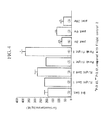
- Fig. 4 is a graph of the blood corticosterone concentration of mice (C57BLK/6J, male, 8 weeks old) after being subjected to stress loading by the gravitational fluctuation stress loading method based on the parabolic flight shown in Fig. 1 . More specifically, Fig. 4 shows measurements of the blood corticosterone concentration of mice after being subjected to one parabolic flight (Parab flight 1) and eight parabolic flights (Parab flight 8) by the gravitational fluctuation stress loading method shown in Fig. 1 , as well as measurements three hours (post 3hr), six hours (post 6hr), and 24 hours (post 24hr) after the end of those parabolic flights.
- Fig. 4 demonstrates that the blood corticosterone concentration measured after eight parabolic flights significantly increased, compared with Flight Cont 2, which was the blood corticosterone concentration of mice measured in the aircraft before the start of parabolic flight. This indicates that the mice were under parabolic flight stress. Furthermore, it was found that the mice were relieved from parabolic flight stress more than three hours after the end of the parabolic flight because the blood corticosterone concentration significantly decreased.
- Fig. 5 is a table showing a comparison of intracellular gene expression as influenced by the gravitational fluctuation stress shown in Fig. 1 , the acrophobia load stress shown in Fig. 3 , and social stress (not shown).
- Black arrows pointing upward in Fig. 5 indicate that gene expression after stress loading significantly increased compared with gene expression before stress loading.
- White arrows pointing upward in the drawing indicate that gene expression after stress loading increased, though not significantly, compared with gene expression before stress loading.
- Arrows pointing downward in the drawing indicate that gene expression after stress loading significantly decreased compared with gene expression before stress loading.
- Minus symbols (-) indicate that gene expression was below the detectable limit or exhibited no significant differences. ND indicates that the gene in question was not analyzed.
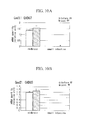
- Figs. 6A to 10B are graphs showing changes in gene expression at the mid brain (mid brain), typifying the central nervous system, and at the small intestine (small intestine), typifying the peripheral nervous system, between before and after the gravitational fluctuation stress loading shown in Fig. 1 .
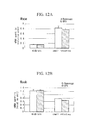
- Figs. 11A to 15B are graphs showing changes in gene expression at the mid brain and the small intestine between before and after the acrophobia load stress loading shown in Fig. 3 .
- RNA expression level was carried out by quantitatively calculating the RNA expression level from a real-time PCR reaction by the intercalator method using SYBR Premix Ex Taq II (manufactured by Takara Bio Inc), with cDNA synthesized for the target gene and the reference gene as a template.
- the results of gene expression in the column marked "SOCIAL” in Fig. 5 indicate gene expression of the target gene in the serotonin nucleus (DRN: dorsal raphe nucleus) of a laboratory rat analyzed by the subtractive hybridization method after the laboratory rat was subjected to chronic social stress by bringing the rat into contact with a large, fierce brown rat every day for five weeks (cited from Abumaria, et al. "Identification of Genes Regulated by Chronic Social Stress in the Rat Dorsal Raphe Nucleus," Cellular and Molecular Neurobiology, March 2006, 26 (2) p. 145-162 ).
- results of gene expression analysis in the column marked "GRAVITATIONAL FLUCTUATION" in Fig. 5 indicate the results of genetic analysis of a mouse that was subjected to stress loading by parabolic flight based on the gravitational fluctuation stress loading method shown in Fig. 1 . More specifically, they are results of analysis derived from measurements of gene expression in cells of the mid brain and the small intestine of the mouse, conducted six hours after completing the first of the eight parabolic flights, subsequent to the landing of the aircraft that performed parabolic flight based on the gravitational fluctuation stress loading method shown in Fig. 1 (post PF in Figs. 6A to 10B ). Each parabolic flight lasted for about 15 seconds.
- the results of gene expression analysis in the column marked "ACROPHOBIA" in Fig. 5 indicate the genetic analysis results of a mouse subjected to stress loading by the acrophobia stress loading method shown in Fig. 3 . More specifically, the mouse was subjected to 10-minute acrophobia stress by the method shown in Fig. 3 , the mouse was then replaced in the cage, and gene expression in cells of the mid brain including the raphe nucleus, as well as in cells of the small intestine including chromaffin cells, of the mouse was analyzed six hours after the mouse was replaced in the cage (EPS in Figs. 11A to 15B ). Furthermore, gene expression of a mouse left in the cage was analyzed, and these results were employed as analysis results before acrophobia stress loading (Homecage in Figs. 11A to 15B ).
- Tph1 (tryptophan hydroxylase 1) is known to be a gene that is related to tryptophan hydroxylase, which acts on the peripheral nervous system, such as the small intestine.
- Tph2 (tryptophan hydroxylase 2) is known to be a gene that is related to tryptophan hydroxylase, which acts on the central nervous system, such as the brain. Both Tph1 and Tph2 are known to be serotonin-producing genes.
- Fig. 16 is a diagram illustrating a serotonin-producing system. As shown in Fig. 16 , because serotonin is produced by the effect of tryptophan hydroxylase, serotonin production will be promoted in the peripheral nervous system, such as the small intestine, when Tph1 expression is increased. Likewise, serotonin production will be promoted in the central nervous system, such as the brain, when Tph2 expression is increased.
- Figs. 5 , 6A , and 11A demonstrate that the gene expression level of Tph1 in the mid brain and in the small intestine changes only slightly whether by gravitational fluctuation stress loading or by acrophobia stress loading.
- Figs. 5 , 6B , and 11B demonstrate that the gene expression level of Tph2 in the mid brain and the small intestine exhibits no change in response to acrophobia stress loading, whereas gene expression of Tph2 is significantly increased only in the mid brain in response to gravitational fluctuation stress loading.
- Gene expression of Tph2 also exhibits no change in response to social stress loading.
- Maoa (Monoamine oxidase A) is known to be a gene that is related to a serotonin-degrading enzyme with serotonin as a substrate.
- Maob (Monoamine oxidase B) is known to be a gene that is related to a dopamine-degrading enzyme with dopamine as a substrate.
- Fig. 17 is a diagram illustrating a serotonin metabolic system. As shown in Fig. 17 , because serotonin is metabolized by the effect of serotonin-degrading enzyme Maoa with serotonin as a substrate, an increase in the expression of Maoa will result in promoting serotonin metabolism.
- Figs. 5 , 7A , and 12A demonstrate that gene expression of Maoa in the mid brain and the small intestine exhibits no change between before and after the gravitational fluctuation stress loading, nor between before and after the acrophobia stress loading.
- Figs. 5 , 7B , and 12B demonstrate that gene expression of Maob in the mid brain and the small intestine exhibits no change in response to the acrophobia stress loading, whereas gene expression of Maob is significantly increased only in the mid brain in response to the gravitational fluctuation stress loading.
- gravitational fluctuation stress loading specifically increases the expression of dopamine-degrading enzyme Maob in the brain, thereby selectively promoting dopamine metabolism.
- gene expression is selectively increased so as to cause serotonin not to be metabolized but to be retained. Consequently, according to this embodiment, it is possible to produce a new stress response and selectively promote serotonin retention in the brain through gravitational fluctuation stress loading using an aircraft.
- Sert is related to a serotonin transmitter and is known to be a gene that is related to serotonin recycling for effective use of produced serotonin.
- Slc7a5 Solute Carrier Family 7 Member 5
- tryptophan is known to be a material for producing serotonin. Tryptophan is taken up into cells by the effect of the above-described transporter and is subjected to enzyme reaction in the cells to produce serotonin.
- the gene expression level exhibits no change in response to the acrophobia stress loading, whereas gene expression is significantly increased in response to the gravitational fluctuation stress loading.
- the expression level exhibits no change in response to the gravitational fluctuation stress loading, whereas gene expression is significantly decreased in response to the acrophobia stress loading.
- social stress loading causes no change in gene expression of Sert.
- the gene expression level exhibits no change in response to the acrophobia stress loading, whereas gene expression is significantly increased in response to the gravitational fluctuation stress loading.
- the gene expression level exhibits no change between before and after the gravitational fluctuation stress loading, nor between before and after the acrophobia stress loading.
- this embodiment it is possible to produce a new stress response by gravitational fluctuation stress loading with an aircraft to selectively promote the production, retention, and reuse rate of serotonin in the brain, thus stimulating the central nervous system in a specific pathway, namely, in a serotonin-selective pathway.
- this embodiment can be used as a tool for elucidating the mechanism allegedly causing serotonin-related diseases of the central nervous system, such as panic disorder or anxiety disorder.
- this embodiment can be used for screening drugs effective for serotonin-related diseases of the central nervous system.
- Htr1a (serotonin 1A receptor) is known to be a gene that is related to a serotonin receptor that receives produced serotonin.
- Th (tyrosine hydroxylase) is known to be a gene that is related to the first-stage synthetase of thyrosin serving as a material of adrenaline, noradrenaline, and dopamine.
- Gad1 glutamic acid decarboxylase 1
- GAVA glutamic acid decarboxylase 2
- GAVA glutamic acid decarboxylase 2
- GAVA glutamic acid decarboxylase 2
- the gene expression level exhibits no change in response to the gravitational fluctuation stress loading, whereas gene expression is significantly increased in response to the acrophobia stress loading.
- Social stress loading causes no change in gene expression of Htr1a.
- the expression level exhibits no change in response to the acrophobia stress loading, whereas gene expression increases, though not significantly, in response to the gravitational fluctuation stress loading.
- first stress-loading step S1 and the second stress-loading step S2 are repeated eight times each in this embodiment, the number of repetitions is not limited to this.
- the first stress-loading step S1 may be carried out, for example, only once. This is because forming a microgravity environment at least once can afford the advantage of the present application.
- the first stress-loading step S1 and the second stress-loading step S2 may be repeated more than eight times each.
- gravitational fluctuation stress loading including the first stress-loading step S1 and the second stress-loading step S2 takes about one hour in this embodiment
- the stress loading time is not limited to this.
- the stress loading time may be more or less than one hour, depending on the number of times that the first stress-loading step S1 and the second stress-loading step S2 are repeated.
- the microgravity in the first stress-loading step S1 is about 10 -2 G in this embodiment, the microgravity is not limited to this.
- the microgravity may be less than 1 G ranging, for example, from 10 -6 G to 10 -2 G.
- the hypergravity in the second stress-loading step S2 is about 1.4 G in this embodiment, the hypergravity is not limited to this.
- the hypergravity may range, for example, from 1 G to 2.5 G.
- parabolic flight start height T1 and the parabolic flight stop height T2 are predetermined heights in this embodiment, T1 and T2 are not limited to this.
- the start height of the first parabolic flight may be different from those of the second and subsequent parabolic flights, and furthermore, the stop height of the first parabolic flight may be different from those of the second and subsequent parabolic flights, as long as a microgravity environment can be maintained in the aircraft for a predetermined period of time.
- the durations of the first to eighth parabolic flights are constant in this embodiment because the parabolic flight start height T1 and the parabolic flight stop height T2 are predetermined heights, the durations of the parabolic flights are not limited to this.
- the duration of the first parabolic flight may be 15 seconds
- the durations of the second and subsequent parabolic flights may be 20 seconds.
- the parabolic flight duration may be less than 15 seconds, for example, 10 seconds, and is not limited particularly.
- This embodiment relates to an efficacy-measuring method for measuring the efficacy of a drug which has been administered to a laboratory animal, such as a mouse, or a subject serving as an examination subject after the examination subject has been subjected to gravitational fluctuation stress loading according to the first embodiment.
- Drugs to be administered include, but are not limited to, drugs including drug target molecules that have been found to be likely to effectively act on depression, panic disorder, anxiety disorder, and other diseases of the nervous system.
- Items to be measured over time include, but are not limited to, the blood concentration of drug target molecules after drug administration. Specimens that can be collected from the above-described examination subject, such as blood, cells, chromosomal DNA and protein, or other measurable parameters are also acceptable. Methods for measuring the drug efficacy include, but are not limited to, the use of measuring devices, such as a gas chromatograph mass spectrometer (GC-MS), a liquid chromatograph (HPLC), and a flow cytometer. Any kinds of known measuring devices can be combined. Furthermore, the drug efficacy may be measured to obtain radioactivity using drug target molecules at least one of whose substituents is labeled with a radioactive label, such as 125 I, 3 H, or 14 C.
- a radioactive label such as 125 I, 3 H, or 14 C.
- this embodiment can be used as a new tool for finding and proposing drug target molecules effective for diseases of the nervous system, such as panic disorder and anxiety disorder.
- the present invention is not limited to the above-described embodiments but can be modified as necessary without departing from the spirit and the scope of the present invention.
Landscapes
- Health & Medical Sciences (AREA)
- Engineering & Computer Science (AREA)
- Life Sciences & Earth Sciences (AREA)
- Biomedical Technology (AREA)
- Immunology (AREA)
- Molecular Biology (AREA)
- Urology & Nephrology (AREA)
- Chemical & Material Sciences (AREA)
- Hematology (AREA)
- Cell Biology (AREA)
- Analytical Chemistry (AREA)
- General Health & Medical Sciences (AREA)
- Bioinformatics & Cheminformatics (AREA)
- Pathology (AREA)
- Food Science & Technology (AREA)
- Medicinal Chemistry (AREA)
- Physics & Mathematics (AREA)
- Biotechnology (AREA)
- Biochemistry (AREA)
- Microbiology (AREA)
- General Physics & Mathematics (AREA)
- Toxicology (AREA)
- Tropical Medicine & Parasitology (AREA)
- Pharmacology & Pharmacy (AREA)
- Investigating Or Analysing Biological Materials (AREA)
- Preparation Of Compounds By Using Micro-Organisms (AREA)
- Measuring Or Testing Involving Enzymes Or Micro-Organisms (AREA)
Abstract
Description
- The present invention relates to a gravitational fluctuation stress loading method, an aircraft, an aircraft-flying method, a method for promoting serotonin-producing gene expression, a serotonin-producing method, a method for stimulating the central nervous system, and an efficacy-measuring method.
- A known stress loading method in the related art includes a method for placing an acute stress load on a laboratory animal by inducing acrophobia using an elevated plus-maze or an elevated platform (refer to, for example,
Non Patent Literature 1 and Non Patent Literature 2).
A biological reaction triggered in the laboratory animal with such an elevated plus-maze is known to be an emotional reaction caused by stress, such as discomfort and fear (refer to, for example, Non Patent Literature 1).
This elevated-platform testing method is also a known method for screening antianxiety agents. Furthermore, the relationship between resistance to stress and disease, such as diabetes, has also been studied using the above-described elevated-platform testing method (refer to, for example, Non Patent Literature 2). -
- {NPL 1}
Taku Yamaguchi et al. "Evaluation of anxiety-related behavior in elevated plus-maze test and its applications," Folia Pharmacologica Japonica, 2005, 126(2) p.99-105 - {NPL 2}
Shigeo Miyata et al. "Elevated-platform testing method: simple behavioral analysis method suitable for stress vulnerability," Folia Pharmacologica Japonica, 2008, 132(4) p.213-216 - However, with the stress loading method using an elevated plus-maze described in
Non Patent Literature 1, it was not possible to selectively secrete serotonin, in other words, to specifically express a serotonin-producing gene, because this stress loading method promoted intracerebral release of not only serotonin but also a number of amino acids, such as dopamine and GABA (Gamma-Amino Butyric Acid).
Furthermore, although the stress loading method using an elevated platform described inNon Patent Literature 2 demonstrated that a biological reaction resulting from acute stress loaded as described above had some relationship with the serotonin nervous system, it did not succeed in offering a specific approach for elucidating the mechanism of such a relationship. - The present invention has been conceived in light of these circumstances and, an object thereof is to provide a gravitational fluctuation stress loading method capable of triggering a new acute stress reaction in a subject or a laboratory animal; an aircraft; an aircraft-flying method; a method for promoting serotonin-producing gene expression; a serotonin-producing method; a method for stimulating the central nervous system; and an efficacy-measuring method.
- In order to solve the above-described problems, a gravitational fluctuation stress loading method, an aircraft, an aircraft-flying method, a method for promoting serotonin-producing gene expression, a serotonin-producing method, a method for stimulating the central nervous system, and an efficacy-measuring method according to the present invention provide the following solutions.
More specifically, a first aspect according to the present invention is a gravitational fluctuation stress loading method including at least one first stress-loading step of placing a stress load on a subject or a laboratory animal by means of microgravity. - According to the gravitational fluctuation stress loading method of the first aspect of the present invention, it is possible to apply physical irritation by means of microgravity (µG), which is impossible to produce on the ground, to the subject or the laboratory animal. Microgravity is gravity less than about 1 G. For example, parabolic flight of an aircraft produces about 10-2 G gravity. The above-described microgravity is preferably maintained at about 3×10⁻² G or less.
The inventors have found that the above-described stress loading method by means of microgravity causes a new stress response, which was impossible to produce with conventional stress loading methods. The above-described new stress response is an acute stress response caused as a result of the central nervous system being stimulated by a specific pathway, in other words, specific to serotonin.
The inventors have also found that the gravitational fluctuation stress loading method according to the present invention selectively expresses the genetic system that works so as to produce/retain serotonin, serving as a neurotransmitter. - Furthermore, according to the gravitational fluctuation stress loading method of the first aspect of the present invention, it is possible to produce a stress-response producing model that causes the above-described new stress response. With this stress-response producing model, it is possible to search for new drug target molecules that act on the central nervous system related to serotonin.
Furthermore, according to the gravitational fluctuation stress loading method of the first aspect of the present invention, the above-described stress-response producing model can be used as a tool for elucidating the mechanism causing panic disorder and anxiety disorder of the central nervous system, which are diseases allegedly related to serotonin. - The gravitational fluctuation stress loading method according to the first aspect of the present invention may further include at least one second stress-loading step of placing a stress load on the subject or the laboratory animal by means of hypergravity.
In this manner, physical irritation in the form of gravitational fluctuation of microgravity and hypergravity, which are impossible to produce on the ground, can be applied to the subject or the laboratory animal. Hypergravity is gravity more than 1 G, for example, from 1 G to 2.5 G and refers to a state of gravity larger than normal gravity. The above-described hypergravity is preferably maintained at about 1.4 G or less. - In the gravitational fluctuation stress loading method according to the first aspect of the present invention, the first stress-loading step and the second stress-loading step may be repeated alternately.
In this manner, alternate physical irritation in the form of gravitational fluctuation of microgravity and hypergravity, which are impossible to produce on the ground, can be applied to the subject or the laboratory animal. - In the gravitational fluctuation stress loading method according to the first aspect of the present invention, the first stress-loading step may be performed not more than 20 times in one hour. The first stress-loading step is performed preferably at least eight times.
In this manner, because stress loading by means of microgravity can be ensured at least for about 15 to 20 seconds during one first stress-loading step, sufficient stress loading under a microgravity environment is ensured. - Furthermore, if the gravitational fluctuation stress loading method of the first aspect of the present invention is realized by, for example, an aircraft, hypergravity is produced while the aircraft is restoring its airframe orientation. In this case, a time long enough to restore the airframe orientation can be ensured while the hypergravity is being controlled to about 1.3 G to about 2.0 G, which would otherwise be hypergravity of 2.0 G to 2.5 G.
As a result, the first stress-loading step and the second stress-loading step can be repeated alternately without having to apply high load with hypergravity larger than required to the subject or the laboratory animal in the second stress-loading step. - A second aspect according to the present invention is an aircraft that performs a gravitational fluctuation stress loading method including at least one first stress-loading step of placing a microgravity stress load on a subject or a laboratory animal by forming a microgravity environment in the aircraft through a parabolic flight.
According to the aircraft of the second aspect of the present invention, because physical irritation due to microgravity, which is impossible to produce on the ground, can be applied by forming a microgravity environment in the aircraft through parabolic flight, the above-described new stress response can be produced in the subject or the laboratory animal. Parabolic flight is also called "Hobutsusen Hiko" and refers to a flight technique for flying, for example, an aircraft so as to perform a parabolic movement while adjusting the velocity to form a zero-gravity state in the aircraft.
The laboratory animal refers to an animal belonging to mammals used for normal animal experiments. The subject refers to a healthy individual that meets physical check conditions for weightless flight after giving informed consent to what is done in the experiment. - A third aspect according to the present invention is an aircraft-flying method including at least one first stress-loading step of placing a microgravity stress load on a subject or a laboratory animal by forming a microgravity environment in an aircraft through a parabolic flight.
According to the aircraft-flying method of the present invention, because it is possible to fly an aircraft that forms a microgravity environment therein by parabolic flight and applies physical irritation by means of microgravity which is impossible to produce on the ground, the above-described new stress response can be produced in the subject or the laboratory animal. - A fourth aspect according to the present invention is a method for promoting serotonin-producing gene expression using the above-described gravitational fluctuation stress loading method. This method includes a stress-response producing step of producing a stress response in the subject or the laboratory animal by performing the first stress-loading step; and a gene expression step of selectively expressing a serotonin-producing gene in a cell of the subject or the laboratory animal.
According to the method for promoting serotonin-producing gene expression of the fourth aspect of the present invention, the above-described new stress response produced by physical irritation in the form of microgravity can be made to act specifically on the serotonin-producing gene of chromosomal DNA to selectively express the serotonin-producing gene. Thus, this method can be used for various experiments using a serotonin-producing gene. - A fifth aspect according to the present invention is a serotonin-producing method using the above-described method for promoting serotonin-producing gene expression. This method includes a production step of producing serotonin in the cell by performing the gene expression step.
According to the serotonin-producing method of the fifth aspect of the present invention, because it is possible to selectively produce serotonin that acts on the central nervous system by selectively expressing the serotonin-producing gene, this method can be used as a tool for elucidating the mechanism of how serotonin affects the nervous system, much of which remains to be clarified, by conducting in-vivo analysis. - A sixth aspect according to the present invention is a method for stimulating a central nervous system using the above-described serotonin-producing method. This method includes a nerve stimulation step of stimulating a central nervous system of the subject or the laboratory animal by using the above-described serotonin produced by performing the above-described production step.
According to the method for stimulating a central nervous system of the sixth aspect of the present invention, it is possible to stimulate the central nervous system through serotonin-specific stimulation using selectively produced serotonin.
Furthermore, according to the method for stimulating the central nervous system of the sixth aspect of the present invention, a specimen of a laboratory animal whose central nervous system has been stimulated by the above-described serotonin-specific stimulation can be used as a specimen for elucidating the mechanism causing panic disorder and anxiety disorder of the central nervous system, which are diseases allegedly related to serotonin.
Furthermore, with specimens and measurements collected from the subject or laboratory animal as a tool, it is possible not only to search for drug target molecules that act on the nervous system but also to develop new drugs. In particular, this method can be used for screening drugs effective for serotonin-related diseases of the central nervous system. - A seventh aspect according to the present invention is an efficacy-measuring method using the above-described gravitational fluctuation stress loading method. This method includes a stress-response producing step of producing a stress response in the subject or the laboratory animal by performing the first stress-loading step; a drug administration step of administering a drug to the subject or the laboratory animal; and a measurement step of measuring the efficacy of the drug.
- According to the efficacy-measuring method of the seventh aspect of the present invention, if drug target molecules that are likely to provide advantageous effects by acting on the nervous system are discovered or developed, it is possible to observe and measure the action and effects of the drug target molecules upon the nervous system by administering a drug containing the drug target molecules to the subject or the laboratory animal, serving as an examination subject, in which the above-described new stress response has been produced.
Because this allows the efficacy of the drug target molecules upon the nervous system to be checked, it can be used as a new tool for searching for and proposing drug target molecules effective for diseases of the nervous system, such as panic disorder and anxiety disorder. - The present invention provides the advantage of causing a new acute stress reaction in a subject or a laboratory animal. It also provides the advantage of selectively expressing a genetic system that works so as to produce/retain serotonin, serving as a neurotransmitter, with the above-described new acute stress reaction.
-
- {
Fig. 1 }
Fig. 1 is an illustration depicting parabolic flight according to a first embodiment of the present invention. - {
Fig. 2 }
Fig. 2 is a diagram depicting environmental acceleration data on the parabolic flight inFig. 1 . - {
Fig. 3 }
Fig. 3 is an illustration depicting a stress loading method based on acrophobia. - {
Fig. 4 }
Fig. 4 is a graph showing differences in serum corticosterone in blood based on a gravitational fluctuation stress loading method according to the present invention. - {
Fig. 5 }
Fig. 5 is a table describing results of analyzed gene expression based on stress loading. - {
Fig. 6A }
Fig. 6A is a graph showing changes in gene expression based on the gravitational fluctuation stress loading method according to the present invention. - {
Fig. 6B }
Fig. 6B is a graph showing changes in gene expression based on the gravitational fluctuation stress loading method according to the present invention. - {
Fig. 7A }
Fig. 7A is a graph showing changes in gene expression based on the gravitational fluctuation stress loading method according to the present invention. - {
Fig. 7B }
Fig. 7B is a graph showing changes in gene expression based on the gravitational fluctuation stress loading method according to the present invention. - {
Fig. 8A }
Fig. 8A is a graph showing changes in gene expression based on the gravitational fluctuation stress loading method according to the present invention. - {
Fig. 8B }
Fig. 8B is a graph showing changes in gene expression based on the gravitational fluctuation stress loading method according to the present invention. - {
Fig. 9A }
Fig. 9A is a graph showing changes in gene expression based on the gravitational fluctuation stress loading method according to the present invention. - {
Fig. 9B }
Fig. 9B is a graph showing changes in gene expression based on the gravitational fluctuation stress loading method according to the present invention. - {
Fig. 10A }
Fig. 10A is a graph showing changes in gene expression based on the gravitational fluctuation stress loading method according to the present invention. - {
Fig. 10B }
Fig. 10B is a graph showing changes in gene expression based on the gravitational fluctuation stress loading method according to the present invention. - {
Fig. 11A }
Fig. 11A is a graph showing changes in gene expression based on a stress loading method for acrophobia stress. - {
Fig. 11B }
Fig. 11B is a graph showing changes in gene expression based on a stress loading method for acrophobia stress. - {
Fig. 12A }
Fig. 12A is a graph showing changes in gene expression based on a stress loading method for acrophobia stress. - {
Fig. 12B }
Fig. 12B is a graph showing changes in gene expression based on a stress loading method for acrophobia stress. - {
Fig. 13A }
Fig. 13A is a graph showing changes in gene expression based on a stress loading method for acrophobia stress. - {
Fig. 13B }
Fig. 13B is a graph showing changes in gene expression based on a stress loading method for acrophobia stress. - {
Fig. 14A }
Fig. 14A is a graph showing changes in gene expression based on a stress loading method for acrophobia stress. - {
Fig. 14B }
Fig. 14B is a graph showing changes in gene expression based on a stress loading method for acrophobia stress. - {
Fig. 15A }
Fig. 15A is a graph showing changes in gene expression based on a stress loading method for acrophobia stress. - {
Fig. 15B }
Fig. 15B is a graph showing changes in gene expression based on a stress loading method for acrophobia stress. - {
Fig. 16 }
Fig. 16 is an illustration for a serotonin-producing system. - {
Fig. 17 }
Fig. 17 is an illustration for a serotonin metabolic system. - Embodiments according to the present invention will now be described with reference to the drawings.
- A first embodiment according to the present invention is described below.
This embodiment relates to a gravitational fluctuation stress loading method in which a laboratory animal, for example, is subjected to physical irritation in the form of gravitational fluctuation resulting from the parabolic flight of an aircraft.
This embodiment will be described with reference toFigs. 1 and2 . -
Fig. 1 is an illustration of a gravitational fluctuation stress loading method using the parabolic flight of an aircraft.
In this embodiment, mice are used as laboratory animals. The aircraft with these mice on board takes off, climbs to a predetermined height (parabolic flight start height T1), and maintains that height. The mice to be examined are placed in a box. This box is retained in a predetermined secure position in the aircraft, such as on a seat, with, for example, a belt. - After the aircraft reaches the predetermined height and the airframe is stabilized, the aircraft starts parabolic flight at parabolic flight start height T1. The aircraft descends continuously through parabolic flight until it reaches a predetermined height (first stress-loading step S1). One parabolic flight continues for about 15 seconds to ensure a sufficient microgravity environment. The microgravity in this microgravity environment is about 10-2 G.
- After the aircraft descends to the predetermined height, the parabolic flight is stopped (parabolic flight stop height T2), and then the aircraft airframe gradually reascends towards the parabolic flight start height T1 while restoring the airframe orientation by changing the aircraft nose direction from downward to upward (second stress-loading step S2). While the aircraft is climbing, a hypergravity environment is formed in the aircraft. The hypergravity in this hypergravity environment is about 1.4 G.
- As shown in
Fig. 1 , the aircraft that has taken off climbs to the parabolic flight start height T1 and then starts the first stress-loading step S1 a second time. In this manner, the aircraft repeats the first stress-loading step S1 and the second stress-loading step S2, eight times each, and then gradually descends from the parabolic flight start height T1 to the ground. It takes about one hour to repeat the above-described first stress-loading step S1 and second stress-loading step S2 eight times each. -
Fig. 2 is a diagram depicting environmental acceleration induced while the first stress-loading step S1 and second stress-loading step S2 are repeated, eight times each, by the method shown inFig. 1 . The vertical axis represents aircraft acceleration, and the horizontal axis represents time. The horizontal axis is graduated in six-minute increments.
Furthermore, acceleration Gx, acceleration Gy, and acceleration Gz represent the acceleration in the front/back direction, horizontal direction, and up/down direction, respectively, relative to the aircraft travelling direction. - As shown in
Fig. 2 , the acceleration in the horizontal direction, denoted by acceleration Gy, is substantially zero from takeoff to landing of the aircraft, indicating that the aircraft travels straight without swaying to the left or right relative to the travelling direction. - For the acceleration in the up/down direction denoted by acceleration Gz, the acceleration temporarily exhibits a slight decrease just before the start of parabolic flight, and during the parabolic flight in the first stress-loading step S1, the downward acceleration increases, causing a sharp rise in the graph. Subsequently, when the parabolic flight stop height T2 is reached, the acceleration temporarily becomes substantially zero. Thereafter, while the aircraft is climbing to the parabolic flight start height T1 restoring the airframe orientation in the second stress-loading step S2, the upward acceleration increases, causing a rise in the graph. As the aircraft is climbing, the upward acceleration gradually decreases, and when the aircraft reaches the parabolic flight start height T1, the acceleration becomes substantially equivalent to that before the start of the parabolic flight.
- The acceleration in the front/back direction, denoted by acceleration Gx, is substantially zero because the aircraft moves mainly in the up/down direction relative to the travelling direction, during parabolic flight in the first stress-loading step S1 and during restoration of the airframe orientation and while the aircraft is climbing in the second stress-loading step S2.
-
Fig. 3 is an illustration of a stress loading method based on acrophobia stress (EPS: Elevated-platform stress) for use as a comparative controlled experiment.
A transparent cylindrical member is put on a footed rod-shaped member with a height of about 140 centimeters to serve as a circular foothold, on which a mouse taken out of a cage is placed so as to be subjected to acrophobia stress for ten minutes. - After having been subjected to 10-minute acrophobia stress as described above, the mouse is replaced in the cage. Thirty minutes after the mouse is replaced in the cage, blood is collected to measure the blood corticosterone concentration. Corticosterone is a known hormone whose production is promoted under stress by the adrenal cortex.
As shown inFig. 3 , the blood corticosterone concentration of the mouse that has been subjected to the 10-minute acrophobia stress significantly increases compared with that of a mouse in the control group without acrophobia stress. This confirms that the mouse was under acrophobia stress. -
Fig. 4 is a graph of the blood corticosterone concentration of mice (C57BLK/6J, male, 8 weeks old) after being subjected to stress loading by the gravitational fluctuation stress loading method based on the parabolic flight shown inFig. 1 .
More specifically,Fig. 4 shows measurements of the blood corticosterone concentration of mice after being subjected to one parabolic flight (Parab flight 1) and eight parabolic flights (Parab flight 8) by the gravitational fluctuation stress loading method shown inFig. 1 , as well as measurements three hours (post 3hr), six hours (post 6hr), and 24 hours (post 24hr) after the end of those parabolic flights. As controls, the blood corticosterone concentration of mice on the ground (Grd Cont), as well as the blood corticosterone concentration of mice in the aircraft before the start of parabolic flight (Flight Cont), were measured. Figures in parentheses indicate the number of measured individuals.
Fig. 4 demonstrates that the blood corticosterone concentration measured after eight parabolic flights significantly increased, compared withFlight Cont 2, which was the blood corticosterone concentration of mice measured in the aircraft before the start of parabolic flight. This indicates that the mice were under parabolic flight stress.
Furthermore, it was found that the mice were relieved from parabolic flight stress more than three hours after the end of the parabolic flight because the blood corticosterone concentration significantly decreased. - Changes in gene expression due to stress loading will be described with reference to
Figs. 5 to 17 .
Fig. 5 is a table showing a comparison of intracellular gene expression as influenced by the gravitational fluctuation stress shown inFig. 1 , the acrophobia load stress shown inFig. 3 , and social stress (not shown). - Black arrows pointing upward in
Fig. 5 indicate that gene expression after stress loading significantly increased compared with gene expression before stress loading.
White arrows pointing upward in the drawing indicate that gene expression after stress loading increased, though not significantly, compared with gene expression before stress loading.
Arrows pointing downward in the drawing indicate that gene expression after stress loading significantly decreased compared with gene expression before stress loading.
Minus symbols (-) indicate that gene expression was below the detectable limit or exhibited no significant differences. ND indicates that the gene in question was not analyzed. -
Figs. 6A to 10B are graphs showing changes in gene expression at the mid brain (mid brain), typifying the central nervous system, and at the small intestine (small intestine), typifying the peripheral nervous system, between before and after the gravitational fluctuation stress loading shown inFig. 1 .
Figs. 11A to 15B are graphs showing changes in gene expression at the mid brain and the small intestine between before and after the acrophobia load stress loading shown inFig. 3 . - The analysis of gene expression before and after the gravitational fluctuation stress loading shown in
Fig. 1 , as well as the analysis of gene expression before and after the acrophobia load stress loading shown inFig. 3 , was carried out by quantitatively calculating the RNA expression level from a real-time PCR reaction by the intercalator method using SYBR Premix Ex Taq II (manufactured by Takara Bio Inc), with cDNA synthesized for the target gene and the reference gene as a template. - The results of gene expression in the column marked "SOCIAL" in
Fig. 5 indicate gene expression of the target gene in the serotonin nucleus (DRN: dorsal raphe nucleus) of a laboratory rat analyzed by the subtractive hybridization method after the laboratory rat was subjected to chronic social stress by bringing the rat into contact with a large, fierce brown rat every day for five weeks (cited from Abumaria, et al. "Identification of Genes Regulated by Chronic Social Stress in the Rat Dorsal Raphe Nucleus," Cellular and Molecular Neurobiology, March 2006, 26 (2) p. 145-162). - The results of gene expression analysis in the column marked "GRAVITATIONAL FLUCTUATION" in
Fig. 5 indicate the results of genetic analysis of a mouse that was subjected to stress loading by parabolic flight based on the gravitational fluctuation stress loading method shown inFig. 1 .
More specifically, they are results of analysis derived from measurements of gene expression in cells of the mid brain and the small intestine of the mouse, conducted six hours after completing the first of the eight parabolic flights, subsequent to the landing of the aircraft that performed parabolic flight based on the gravitational fluctuation stress loading method shown inFig. 1 (post PF inFigs. 6A to 10B ). Each parabolic flight lasted for about 15 seconds. Measurement was carried out after six hours in order to ensure a sufficiently long time for gene expression.
In addition, gene expression in cells of a mouse (C57BLK/6J, male, eight weeks old) was analyzed at the stable height the first time the aircraft that had taken off reached the parabolic flight start height T1, and these analysis results were employed as analysis results before parabolic flight (before PF inFigs. 6A to 10B ). - The results of gene expression analysis in the column marked "ACROPHOBIA" in
Fig. 5 indicate the genetic analysis results of a mouse subjected to stress loading by the acrophobia stress loading method shown inFig. 3 .
More specifically, the mouse was subjected to 10-minute acrophobia stress by the method shown inFig. 3 , the mouse was then replaced in the cage, and gene expression in cells of the mid brain including the raphe nucleus, as well as in cells of the small intestine including chromaffin cells, of the mouse was analyzed six hours after the mouse was replaced in the cage (EPS inFigs. 11A to 15B ).
Furthermore, gene expression of a mouse left in the cage was analyzed, and these results were employed as analysis results before acrophobia stress loading (Homecage inFigs. 11A to 15B ). - Tph1 (tryptophan hydroxylase 1) is known to be a gene that is related to tryptophan hydroxylase, which acts on the peripheral nervous system, such as the small intestine. Tph2 (tryptophan hydroxylase 2) is known to be a gene that is related to tryptophan hydroxylase, which acts on the central nervous system, such as the brain. Both Tph1 and Tph2 are known to be serotonin-producing genes.
-
Fig. 16 is a diagram illustrating a serotonin-producing system. As shown inFig. 16 , because serotonin is produced by the effect of tryptophan hydroxylase, serotonin production will be promoted in the peripheral nervous system, such as the small intestine, when Tph1 expression is increased.
Likewise, serotonin production will be promoted in the central nervous system, such as the brain, when Tph2 expression is increased. -
Figs. 5 ,6A , and11A demonstrate that the gene expression level of Tph1 in the mid brain and in the small intestine changes only slightly whether by gravitational fluctuation stress loading or by acrophobia stress loading.
In contrast,Figs. 5 ,6B , and11B demonstrate that the gene expression level of Tph2 in the mid brain and the small intestine exhibits no change in response to acrophobia stress loading, whereas gene expression of Tph2 is significantly increased only in the mid brain in response to gravitational fluctuation stress loading. Gene expression of Tph2 also exhibits no change in response to social stress loading. - From the above-described results, it is concluded that gravitational fluctuation stress loading specifically increases Tph2 expression, which acts on the central nervous system, in the mid brain.
Consequently, according to this embodiment, it is possible to produce a new stress response and selectively promote serotonin production in the brain through gravitational fluctuation stress loading using an aircraft. - Maoa (Monoamine oxidase A) is known to be a gene that is related to a serotonin-degrading enzyme with serotonin as a substrate. Maob (Monoamine oxidase B) is known to be a gene that is related to a dopamine-degrading enzyme with dopamine as a substrate.
Fig. 17 is a diagram illustrating a serotonin metabolic system. As shown inFig. 17 , because serotonin is metabolized by the effect of serotonin-degrading enzyme Maoa with serotonin as a substrate, an increase in the expression of Maoa will result in promoting serotonin metabolism.
In addition, because dopamine is metabolized, but serotonin is not metabolized, by the effect of dopamine-degrading enzyme Maob with dopamine as a substrate d, an increase in the expression of Maob will result in promoting only dopamine metabolism. -
Figs. 5 ,7A , and12A demonstrate that gene expression of Maoa in the mid brain and the small intestine exhibits no change between before and after the gravitational fluctuation stress loading, nor between before and after the acrophobia stress loading.
In contrast,Figs. 5 ,7B , and12B demonstrate that gene expression of Maob in the mid brain and the small intestine exhibits no change in response to the acrophobia stress loading, whereas gene expression of Maob is significantly increased only in the mid brain in response to the gravitational fluctuation stress loading. - From the above-described results, it is concluded that gravitational fluctuation stress loading specifically increases the expression of dopamine-degrading enzyme Maob in the brain, thereby selectively promoting dopamine metabolism. In short, gene expression is selectively increased so as to cause serotonin not to be metabolized but to be retained. Consequently, according to this embodiment, it is possible to produce a new stress response and selectively promote serotonin retention in the brain through gravitational fluctuation stress loading using an aircraft.
- Sert (serotonin transporter) is related to a serotonin transmitter and is known to be a gene that is related to serotonin recycling for effective use of produced serotonin.
Slc7a5 (Solute Carrier Family 7 Member 5) is known to be a large neutral amino acid transporter. Furthermore, tryptophan is known to be a material for producing serotonin. Tryptophan is taken up into cells by the effect of the above-described transporter and is subjected to enzyme reaction in the cells to produce serotonin. - As shown in
Figs. 5 ,8A , and13A , as far as gene expression of Sert in the mid brain is concerned, the gene expression level exhibits no change in response to the acrophobia stress loading, whereas gene expression is significantly increased in response to the gravitational fluctuation stress loading.
As far as gene expression of Sert in the small intestine is concerned, the expression level exhibits no change in response to the gravitational fluctuation stress loading, whereas gene expression is significantly decreased in response to the acrophobia stress loading.
Furthermore, social stress loading causes no change in gene expression of Sert. - As shown in
Figs. 5 ,8B , and13B , as far as gene expression of Slc7a5 in the mid brain is concerned, the gene expression level exhibits no change in response to the acrophobia stress loading, whereas gene expression is significantly increased in response to the gravitational fluctuation stress loading.
As far as gene expression of Slc7a5 in the small intestine is concerned, the gene expression level exhibits no change between before and after the gravitational fluctuation stress loading, nor between before and after the acrophobia stress loading. - The above-described results demonstrate that gravitational fluctuation stress loading specifically increases the gene expression level of Sert in the brain, thereby selectively promoting reuse of serotonin. Furthermore, because gene expression of Sert decreases in the small intestine, gene expression is increased so as to increase the reuse rate of serotonin in the brain, thus specifically stimulating the central nerve.
Consequently, according to this embodiment, it is possible to produce a new stress response in a mouse, serving as a laboratory animal, and selectively promote the reuse rate of serotonin in the brain through gravitational fluctuation stress loading using an aircraft. - Furthermore, the above-described results demonstrate that gene expression of Slc7a5 is specifically increased in the brain, and thereby extracellular tryptophan is taken up into cells, thus selectively promoting production of serotonin. In addition, because gene expression of Slc7a5 does not change in the small intestine, gene expression is increased so as to produce serotonin in the brain and specifically stimulate the central nervous system.
- Therefore, according to this embodiment, it is possible to produce a new stress response by gravitational fluctuation stress loading with an aircraft to selectively promote the production, retention, and reuse rate of serotonin in the brain, thus stimulating the central nervous system in a specific pathway, namely, in a serotonin-selective pathway.
As a result, this embodiment can be used as a tool for elucidating the mechanism allegedly causing serotonin-related diseases of the central nervous system, such as panic disorder or anxiety disorder. In particular, this embodiment can be used for screening drugs effective for serotonin-related diseases of the central nervous system. - Htr1a (serotonin 1A receptor) is known to be a gene that is related to a serotonin receptor that receives produced serotonin.
Th (tyrosine hydroxylase) is known to be a gene that is related to the first-stage synthetase of thyrosin serving as a material of adrenaline, noradrenaline, and dopamine. - Gad1 (glutamic acid decarboxylase 1), glutamic acid decarboxylase with a molecular weight of 67 kDa, is known to be a gene that is related to GAVA, which is a neurotransmitter that works so as to suppress brain activation.
Gad2 (glutamic acid decarboxylase 2), glutamic acid decarboxylase with a molecular weight of 65 kDa, like Gad1, is known to be a gene that is related to GAVA. - As shown in
Figs. 5 ,9A , and14A , as far as gene expression of Htr1a in the mid brain is concerned, the gene expression level exhibits no change in response to the gravitational fluctuation stress loading, whereas gene expression is significantly increased in response to the acrophobia stress loading. Social stress loading causes no change in gene expression of Htr1a.
As far as gene expression of Th in the mid brain is concerned, the expression level exhibits no change in response to the acrophobia stress loading, whereas gene expression increases, though not significantly, in response to the gravitational fluctuation stress loading.
Furthermore, as shown inFigs. 10A, 10B ,15A, and 15B , gene expression of Gad1 and Gad2 in the mid brain and the small intestine exhibit no change between before and after the gravitational fluctuation stress loading, nor between before and after the acrophobia stress loading. - The above-described results demonstrate that because gravitational fluctuation stress loading is likely to increase gene expression of Th in the brain, it is also likely to activate the entire nervous system by promoting activation of the adrenaline nervous system, the noradrenaline nervous system, the dopamine nervous system, and so forth. However, because the gene expression degree of Th does not exhibit a significant difference, only a minor influence on gene expression will result, though gene expression is somewhat likely to increase.
- The results described above demonstrate that, through gravitational fluctuation stress loading with an aircraft according to this embodiment, it is possible to produce a new stress response, which was impossible to produce by conventional stress loading methods.
- Although the first stress-loading step S1 and the second stress-loading step S2 are repeated eight times each in this embodiment, the number of repetitions is not limited to this. The first stress-loading step S1 may be carried out, for example, only once. This is because forming a microgravity environment at least once can afford the advantage of the present application. Furthermore, the first stress-loading step S1 and the second stress-loading step S2 may be repeated more than eight times each.
- Furthermore, although gravitational fluctuation stress loading, including the first stress-loading step S1 and the second stress-loading step S2, takes about one hour in this embodiment, the stress loading time is not limited to this. The stress loading time may be more or less than one hour, depending on the number of times that the first stress-loading step S1 and the second stress-loading step S2 are repeated.
- Although the microgravity in the first stress-loading step S1 is about 10-2 G in this embodiment, the microgravity is not limited to this. The microgravity may be less than 1 G ranging, for example, from 10-6 G to 10-2 G.
In addition, although the hypergravity in the second stress-loading step S2 is about 1.4 G in this embodiment, the hypergravity is not limited to this. The hypergravity may range, for example, from 1 G to 2.5 G. - Furthermore, although the parabolic flight start height T1 and the parabolic flight stop height T2 are predetermined heights in this embodiment, T1 and T2 are not limited to this. The start height of the first parabolic flight may be different from those of the second and subsequent parabolic flights, and furthermore, the stop height of the first parabolic flight may be different from those of the second and subsequent parabolic flights, as long as a microgravity environment can be maintained in the aircraft for a predetermined period of time.
- Furthermore, although the durations of the first to eighth parabolic flights are constant in this embodiment because the parabolic flight start height T1 and the parabolic flight stop height T2 are predetermined heights, the durations of the parabolic flights are not limited to this. For example, the duration of the first parabolic flight may be 15 seconds, and the durations of the second and subsequent parabolic flights may be 20 seconds. Furthermore, the parabolic flight duration may be less than 15 seconds, for example, 10 seconds, and is not limited particularly.
- A second embodiment according to the present invention will now be described.
This embodiment relates to an efficacy-measuring method for measuring the efficacy of a drug which has been administered to a laboratory animal, such as a mouse, or a subject serving as an examination subject after the examination subject has been subjected to gravitational fluctuation stress loading according to the first embodiment.
Drugs to be administered include, but are not limited to, drugs including drug target molecules that have been found to be likely to effectively act on depression, panic disorder, anxiety disorder, and other diseases of the nervous system. - Items to be measured over time include, but are not limited to, the blood concentration of drug target molecules after drug administration. Specimens that can be collected from the above-described examination subject, such as blood, cells, chromosomal DNA and protein, or other measurable parameters are also acceptable.
Methods for measuring the drug efficacy include, but are not limited to, the use of measuring devices, such as a gas chromatograph mass spectrometer (GC-MS), a liquid chromatograph (HPLC), and a flow cytometer. Any kinds of known measuring devices can be combined. Furthermore, the drug efficacy may be measured to obtain radioactivity using drug target molecules at least one of whose substituents is labeled with a radioactive label, such as 125I, 3H, or 14C. - According to this embodiment, it is possible to observe and measure the effect of drug target molecules of a drug upon the nervous system of a laboratory animal or a subject after the drug has been administered to the laboratory animal or the subject in which a new stress response is produced by the gravitational fluctuation stress loading method according to the first embodiment.
- Because this allows the efficacy of the drug containing drug target molecules to be studied and developed, this embodiment can be used as a new tool for finding and proposing drug target molecules effective for diseases of the nervous system, such as panic disorder and anxiety disorder.
The present invention is not limited to the above-described embodiments but can be modified as necessary without departing from the spirit and the scope of the present invention. -
- S1 first stress-loading step
- S2 second stress-loading step
- T1 parabolic flight start height
- T2 parabolic flight stop height
Claims (10)
- A gravitational fluctuation stress loading method comprising at least one first stress-loading step of placing a stress load on a subject or a laboratory animal by means of microgravity.
- The gravitational fluctuation stress loading method according to Claim 1, further comprising at least one second stress-loading step of placing a stress load on the subject or the laboratory animal by means of hypergravity.
- The gravitational fluctuation stress loading method according to Claim 2, wherein the first stress-loading step and the second stress-loading step are repeated alternately.
- The gravitational fluctuation stress loading method according to one of Claims 1 to 3, wherein the first stress-loading step is performed not more than 20 times in one hour.
- An aircraft that performs a gravitational fluctuation stress loading method including at least one first stress-loading step of placing a microgravity stress load on a subject or a laboratory animal by forming a microgravity environment in the aircraft through a parabolic flight.
- An aircraft-flying method comprising at least one first stress-loading step of placing a microgravity stress load on a subject or a laboratory animal by forming a microgravity environment in an aircraft through a parabolic flight.
- A method for promoting serotonin-producing gene expression using the gravitational fluctuation stress loading method according to one of Claims 1 to 4, comprising:a stress-response producing step of producing a stress response in the subject or the laboratory animal by performing the first stress-loading step; anda gene expression step of selectively expressing a serotonin-producing gene in a cell of the subject or the laboratory animal.
- A serotonin-producing method using the method for promoting serotonin-producing gene expression according to Claim 7, comprising:a production step of producing serotonin in the cell by performing the gene expression step.
- A method for stimulating a central nervous system using the serotonin-producing method according to Claim 8, comprising:a nerve stimulation step of stimulating a central nervous system of the subject or the laboratory animal by using the serotonin produced by performing the production step.
- An efficacy-measuring method using the gravitational fluctuation stress loading method according to one of Claims 1 to 4, comprising:a stress-response producing step of producing a stress response in the subject or the laboratory animal by performing the first stress-loading step;a drug administration step of administering a drug to the subject or the laboratory animal; anda measurement step of measuring efficacy of the drug.
Applications Claiming Priority (2)
| Application Number | Priority Date | Filing Date | Title |
|---|---|---|---|
| JP2009253133A JP5422340B2 (en) | 2009-11-04 | 2009-11-04 | Medicinal effect measurement method using gravity load stress |
| PCT/JP2010/069598 WO2011055747A1 (en) | 2009-11-04 | 2010-11-04 | Method for gravitational fluctuation stress loading, aircraft, method for aircraft operation, method for promoting serotonin synthesis gene expression, method for synthesizing serotonin, method for stimulating central nervous system, and method for determining drug effect |
Publications (3)
| Publication Number | Publication Date |
|---|---|
| EP2497361A1 true EP2497361A1 (en) | 2012-09-12 |
| EP2497361A4 EP2497361A4 (en) | 2013-04-03 |
| EP2497361B1 EP2497361B1 (en) | 2014-08-20 |
Family
ID=43969985
Family Applications (1)
| Application Number | Title | Priority Date | Filing Date |
|---|---|---|---|
| EP10828307.8A Not-in-force EP2497361B1 (en) | 2009-11-04 | 2010-11-04 | Method for gravitational fluctuation stress loading |
Country Status (5)
| Country | Link |
|---|---|
| US (2) | US20120291147A1 (en) |
| EP (1) | EP2497361B1 (en) |
| JP (1) | JP5422340B2 (en) |
| CN (1) | CN102665400B (en) |
| WO (1) | WO2011055747A1 (en) |
Families Citing this family (1)
| Publication number | Priority date | Publication date | Assignee | Title |
|---|---|---|---|---|
| US20180232589A1 (en) * | 2017-02-16 | 2018-08-16 | Samsung Electronics Co., Ltd. | Device for measuring biometric information and internet of things system including the same |
-
2009
- 2009-11-04 JP JP2009253133A patent/JP5422340B2/en active Active
-
2010
- 2010-11-04 WO PCT/JP2010/069598 patent/WO2011055747A1/en not_active Ceased
- 2010-11-04 CN CN201080049021.2A patent/CN102665400B/en not_active Expired - Fee Related
- 2010-11-04 US US13/503,720 patent/US20120291147A1/en not_active Abandoned
- 2010-11-04 EP EP10828307.8A patent/EP2497361B1/en not_active Not-in-force
-
2014
- 2014-08-04 US US14/450,521 patent/US20150031044A1/en not_active Abandoned
Non-Patent Citations (8)
| Title |
|---|
| DATABASE MEDLINE [Online] US NATIONAL LIBRARY OF MEDICINE (NLM), BETHESDA, MD, US; May 2001 (2001-05), CHEN X P ET AL: "[Effects of simulated microgravity on the contents of monoamine transmitters in human plasma during heat stress].", XP002692318, Database accession no. NLM21171415 & ZHONGGUO YING YONG SHENG LI XUE ZA ZHI = ZHONGGUO YINGYONG SHENGLIXUE ZAZHI = CHINESE JOURNAL OF APPLIED PHYSIOLOGY MAY 2001, vol. 17, no. 2, May 2001 (2001-05), pages 182-185, ISSN: 1000-6834 * |
| MILLER J D ET AL: "Effects of microgravity on brain neurotransmitter receptors", EUROPEAN JOURNAL OF PHARMACOLOGY, ELSEVIER SCIENCE, NL, vol. 161, no. 2-3, 28 February 1989 (1989-02-28), pages 165-171, XP025545411, ISSN: 0014-2999, DOI: 10.1016/0014-2999(89)90839-X [retrieved on 1989-02-28] * |
| MITSUHIRO YOSHIOKA ET AL: "Effects of Parabolic Flight on Serotonin-Related Gene Expression in the Mouse Brain", GRAVITATIONAL AND SPACE BIOLOGY, vol. 26, no. 2, 1 October 2012 (2012-10-01), pages 22-29, XP055053679, * |
| MONICA S DA SILVA ET AL: "Anorexia in space and possible etiologies", NUTRITION, vol. 18, no. 10, 1 October 2002 (2002-10-01), pages 805-813, XP055053676, ISSN: 0899-9007, DOI: 10.1016/S0899-9007(02)00915-2 * |
| S BLANC ET AL: "Counteraction of spaceflight-induced changes in the rat central serotonergic system by adrenalectomy and corticosteroid replacement", NEUROCHEMISTRY INTERNATIONAL, vol. 33, no. 4, 1 October 1998 (1998-10-01), pages 375-382, XP055053677, ISSN: 0197-0186, DOI: 10.1016/S0197-0186(98)00042-4 * |
| See also references of WO2011055747A1 * |
| STEFAN SCHNEIDER ET AL: "Parabolic flight experience is related to increased release of stress hormones", EUROPEAN JOURNAL OF APPLIED PHYSIOLOGY, SPRINGER, BERLIN, DE, vol. 100, no. 3, 10 March 2007 (2007-03-10), pages 301-308, XP019517322, ISSN: 1439-6327, DOI: 10.1007/S00421-007-0433-8 * |
| YOSHIOKA MITSUHIRO: "Overview: Pharmacological potential of microgravity condition", JOURNAL OF PHARMACOLOGICAL SCIENCES, vol. 106, no. Suppl. 1, 2008, page 42P, XP008160239, & 81ST ANNUAL MEETING OF THE JAPANESE-PHARMACOLOGICAL-SOCIETY; YOKOHAMA, JAPAN; MARCH 17 -19, 2008 ISSN: 1347-8613 * |
Also Published As
| Publication number | Publication date |
|---|---|
| JP2011097839A (en) | 2011-05-19 |
| JP5422340B2 (en) | 2014-02-19 |
| CN102665400A (en) | 2012-09-12 |
| WO2011055747A1 (en) | 2011-05-12 |
| CN102665400B (en) | 2014-09-17 |
| US20150031044A1 (en) | 2015-01-29 |
| US20120291147A1 (en) | 2012-11-15 |
| EP2497361A4 (en) | 2013-04-03 |
| EP2497361B1 (en) | 2014-08-20 |
Similar Documents
| Publication | Publication Date | Title |
|---|---|---|
| Ryczko et al. | A descending dopamine pathway conserved from basal vertebrates to mammals | |
| Kasture et al. | Big lessons from tiny flies: Drosophila melanogaster as a model to explore dysfunction of dopaminergic and serotonergic neurotransmitter systems | |
| La Rosa et al. | Newly generated and non-newly generated “immature” neurons in the mammalian brain: a possible reservoir of young cells to prevent brain aging and disease? | |
| Jarero-Basulto et al. | Interactions between epilepsy and plasticity | |
| Govindpani et al. | Towards a better understanding of GABAergic remodeling in Alzheimer’s disease | |
| Ungless et al. | Are you or aren’t you? Challenges associated with physiologically identifying dopamine neurons | |
| Pandey et al. | Deficits in amygdaloid cAMP-responsive element–binding protein signaling play a role in genetic predisposition to anxiety and alcoholism | |
| von Trotha et al. | Emotions and motivated behavior converge on an amygdala‐like structure in the zebrafish | |
| Rey et al. | Altered inhibitory function in hippocampal CA2 contributes in social memory deficits in Alzheimer’s mouse model | |
| Bambico et al. | Father absence in the monogamous California mouse impairs social behavior and modifies dopamine and glutamate synapses in the medial prefrontal cortex | |
| Bartoszek et al. | Ongoing habenular activity is driven by forebrain networks and modulated by olfactory stimuli | |
| Díaz-Morán et al. | Relationships of open-field behaviour with anxiety in the elevated zero-maze test: Focus on freezing and grooming | |
| Serra et al. | Effect of acute stress on the expression of BDNF, trkB, and PSA-NCAM in the hippocampus of the roman rats: a genetic model of vulnerability/resistance to stress-induced depression | |
| Luo et al. | Retinoic acid signaling in the brain marks formation of optic projections, maturation of the dorsal telencephalon, and function of limbic sites | |
| Farries et al. | Selective encoding of reward predictions and prediction errors by globus pallidus subpopulations | |
| Orieux et al. | Consequences of dopaminergic denervation on the metabolic activity of the cortical neurons projecting to the subthalamic nucleus in the rat | |
| Fukuyama et al. | Age-dependent and sleep/seizure-induced pathomechanisms of autosomal dominant sleep-related hypermotor epilepsy | |
| Skelton et al. | LRRK2 at striatal synapses: cell-type specificity and mechanistic insights | |
| Turco et al. | The influence of recreational substance use in TMS research | |
| Hiraoka et al. | Pattern of c-Fos expression induced by tail suspension test in the mouse brain | |
| Konkoly et al. | The role of TRPA1 channels in the central processing of odours contributing to the behavioural responses of mice | |
| Nahar et al. | Regulation of Pv‐specific interneurons in the medial prefrontal cortex and reward‐seeking behaviors | |
| Potier et al. | DM1 transgenic mice exhibit abnormal neurotransmitter homeostasis and synaptic plasticity in association with RNA foci and mis-splicing in the hippocampus | |
| Karatayev et al. | Neurological disorders induced by drug use: effects of adolescent and embryonic drug exposure on behavioral neurodevelopment | |
| Maddaloni et al. | Impact of serotonin deficiency on circadian dopaminergic rhythms |
Legal Events
| Date | Code | Title | Description |
|---|---|---|---|
| PUAI | Public reference made under article 153(3) epc to a published international application that has entered the european phase |
Free format text: ORIGINAL CODE: 0009012 |
|
| 17P | Request for examination filed |
Effective date: 20120424 |
|
| AK | Designated contracting states |
Kind code of ref document: A1 Designated state(s): AL AT BE BG CH CY CZ DE DK EE ES FI FR GB GR HR HU IE IS IT LI LT LU LV MC MK MT NL NO PL PT RO RS SE SI SK SM TR |
|
| DAX | Request for extension of the european patent (deleted) | ||
| RIC1 | Information provided on ipc code assigned before grant |
Ipc: G01N 33/50 20060101ALI20130220BHEP Ipc: A01K 67/00 20060101AFI20130220BHEP Ipc: C12P 13/00 20060101ALI20130220BHEP Ipc: G01N 33/94 20060101ALI20130220BHEP |
|
| A4 | Supplementary search report drawn up and despatched |
Effective date: 20130305 |
|
| 17Q | First examination report despatched |
Effective date: 20130830 |
|
| GRAP | Despatch of communication of intention to grant a patent |
Free format text: ORIGINAL CODE: EPIDOSNIGR1 |
|
| INTG | Intention to grant announced |
Effective date: 20140313 |
|
| GRAS | Grant fee paid |
Free format text: ORIGINAL CODE: EPIDOSNIGR3 |
|
| GRAA | (expected) grant |
Free format text: ORIGINAL CODE: 0009210 |
|
| AK | Designated contracting states |
Kind code of ref document: B1 Designated state(s): AL AT BE BG CH CY CZ DE DK EE ES FI FR GB GR HR HU IE IS IT LI LT LU LV MC MK MT NL NO PL PT RO RS SE SI SK SM TR |
|
| REG | Reference to a national code |
Ref country code: GB Ref legal event code: FG4D |
|
| RIN1 | Information on inventor provided before grant (corrected) |
Inventor name: GYOTOKU, JUNICHIRO Inventor name: OCHIAI, TOSHIMASA Inventor name: YOSHIOKA, MITSUHIRO Inventor name: OHTA, HISASHI |
|
| REG | Reference to a national code |
Ref country code: CH Ref legal event code: EP |
|
| REG | Reference to a national code |
Ref country code: AT Ref legal event code: REF Ref document number: 682898 Country of ref document: AT Kind code of ref document: T Effective date: 20140915 |
|
| REG | Reference to a national code |
Ref country code: IE Ref legal event code: FG4D |
|
| REG | Reference to a national code |
Ref country code: DE Ref legal event code: R096 Ref document number: 602010018472 Country of ref document: DE Effective date: 20141002 |
|
| REG | Reference to a national code |
Ref country code: AT Ref legal event code: MK05 Ref document number: 682898 Country of ref document: AT Kind code of ref document: T Effective date: 20140820 |
|
| REG | Reference to a national code |
Ref country code: NL Ref legal event code: VDEP Effective date: 20140820 |
|
| REG | Reference to a national code |
Ref country code: LT Ref legal event code: MG4D |
|
| PG25 | Lapsed in a contracting state [announced via postgrant information from national office to epo] |
Ref country code: GR Free format text: LAPSE BECAUSE OF FAILURE TO SUBMIT A TRANSLATION OF THE DESCRIPTION OR TO PAY THE FEE WITHIN THE PRESCRIBED TIME-LIMIT Effective date: 20141121 Ref country code: PT Free format text: LAPSE BECAUSE OF FAILURE TO SUBMIT A TRANSLATION OF THE DESCRIPTION OR TO PAY THE FEE WITHIN THE PRESCRIBED TIME-LIMIT Effective date: 20141222 Ref country code: LT Free format text: LAPSE BECAUSE OF FAILURE TO SUBMIT A TRANSLATION OF THE DESCRIPTION OR TO PAY THE FEE WITHIN THE PRESCRIBED TIME-LIMIT Effective date: 20140820 Ref country code: NO Free format text: LAPSE BECAUSE OF FAILURE TO SUBMIT A TRANSLATION OF THE DESCRIPTION OR TO PAY THE FEE WITHIN THE PRESCRIBED TIME-LIMIT Effective date: 20141120 Ref country code: ES Free format text: LAPSE BECAUSE OF FAILURE TO SUBMIT A TRANSLATION OF THE DESCRIPTION OR TO PAY THE FEE WITHIN THE PRESCRIBED TIME-LIMIT Effective date: 20140820 Ref country code: BG Free format text: LAPSE BECAUSE OF FAILURE TO SUBMIT A TRANSLATION OF THE DESCRIPTION OR TO PAY THE FEE WITHIN THE PRESCRIBED TIME-LIMIT Effective date: 20141120 Ref country code: FI Free format text: LAPSE BECAUSE OF FAILURE TO SUBMIT A TRANSLATION OF THE DESCRIPTION OR TO PAY THE FEE WITHIN THE PRESCRIBED TIME-LIMIT Effective date: 20140820 Ref country code: SE Free format text: LAPSE BECAUSE OF FAILURE TO SUBMIT A TRANSLATION OF THE DESCRIPTION OR TO PAY THE FEE WITHIN THE PRESCRIBED TIME-LIMIT Effective date: 20140820 |
|
| PG25 | Lapsed in a contracting state [announced via postgrant information from national office to epo] |
Ref country code: HR Free format text: LAPSE BECAUSE OF FAILURE TO SUBMIT A TRANSLATION OF THE DESCRIPTION OR TO PAY THE FEE WITHIN THE PRESCRIBED TIME-LIMIT Effective date: 20140820 Ref country code: LV Free format text: LAPSE BECAUSE OF FAILURE TO SUBMIT A TRANSLATION OF THE DESCRIPTION OR TO PAY THE FEE WITHIN THE PRESCRIBED TIME-LIMIT Effective date: 20140820 Ref country code: AT Free format text: LAPSE BECAUSE OF FAILURE TO SUBMIT A TRANSLATION OF THE DESCRIPTION OR TO PAY THE FEE WITHIN THE PRESCRIBED TIME-LIMIT Effective date: 20140820 Ref country code: RS Free format text: LAPSE BECAUSE OF FAILURE TO SUBMIT A TRANSLATION OF THE DESCRIPTION OR TO PAY THE FEE WITHIN THE PRESCRIBED TIME-LIMIT Effective date: 20140820 Ref country code: IS Free format text: LAPSE BECAUSE OF FAILURE TO SUBMIT A TRANSLATION OF THE DESCRIPTION OR TO PAY THE FEE WITHIN THE PRESCRIBED TIME-LIMIT Effective date: 20141220 |
|
| PG25 | Lapsed in a contracting state [announced via postgrant information from national office to epo] |
Ref country code: NL Free format text: LAPSE BECAUSE OF FAILURE TO SUBMIT A TRANSLATION OF THE DESCRIPTION OR TO PAY THE FEE WITHIN THE PRESCRIBED TIME-LIMIT Effective date: 20140820 |
|
| PG25 | Lapsed in a contracting state [announced via postgrant information from national office to epo] |
Ref country code: DK Free format text: LAPSE BECAUSE OF FAILURE TO SUBMIT A TRANSLATION OF THE DESCRIPTION OR TO PAY THE FEE WITHIN THE PRESCRIBED TIME-LIMIT Effective date: 20140820 Ref country code: SK Free format text: LAPSE BECAUSE OF FAILURE TO SUBMIT A TRANSLATION OF THE DESCRIPTION OR TO PAY THE FEE WITHIN THE PRESCRIBED TIME-LIMIT Effective date: 20140820 Ref country code: CZ Free format text: LAPSE BECAUSE OF FAILURE TO SUBMIT A TRANSLATION OF THE DESCRIPTION OR TO PAY THE FEE WITHIN THE PRESCRIBED TIME-LIMIT Effective date: 20140820 Ref country code: RO Free format text: LAPSE BECAUSE OF FAILURE TO SUBMIT A TRANSLATION OF THE DESCRIPTION OR TO PAY THE FEE WITHIN THE PRESCRIBED TIME-LIMIT Effective date: 20140820 Ref country code: EE Free format text: LAPSE BECAUSE OF FAILURE TO SUBMIT A TRANSLATION OF THE DESCRIPTION OR TO PAY THE FEE WITHIN THE PRESCRIBED TIME-LIMIT Effective date: 20140820 |
|
| REG | Reference to a national code |
Ref country code: DE Ref legal event code: R097 Ref document number: 602010018472 Country of ref document: DE |
|
| PG25 | Lapsed in a contracting state [announced via postgrant information from national office to epo] |
Ref country code: PL Free format text: LAPSE BECAUSE OF FAILURE TO SUBMIT A TRANSLATION OF THE DESCRIPTION OR TO PAY THE FEE WITHIN THE PRESCRIBED TIME-LIMIT Effective date: 20140820 |
|
| REG | Reference to a national code |
Ref country code: DE Ref legal event code: R119 Ref document number: 602010018472 Country of ref document: DE |
|
| PLBE | No opposition filed within time limit |
Free format text: ORIGINAL CODE: 0009261 |
|
| STAA | Information on the status of an ep patent application or granted ep patent |
Free format text: STATUS: NO OPPOSITION FILED WITHIN TIME LIMIT |
|
| PG25 | Lapsed in a contracting state [announced via postgrant information from national office to epo] |
Ref country code: BE Free format text: LAPSE BECAUSE OF NON-PAYMENT OF DUE FEES Effective date: 20141130 Ref country code: MC Free format text: LAPSE BECAUSE OF FAILURE TO SUBMIT A TRANSLATION OF THE DESCRIPTION OR TO PAY THE FEE WITHIN THE PRESCRIBED TIME-LIMIT Effective date: 20140820 Ref country code: LU Free format text: LAPSE BECAUSE OF FAILURE TO SUBMIT A TRANSLATION OF THE DESCRIPTION OR TO PAY THE FEE WITHIN THE PRESCRIBED TIME-LIMIT Effective date: 20141104 |
|
| REG | Reference to a national code |
Ref country code: CH Ref legal event code: PL |
|
| 26N | No opposition filed |
Effective date: 20150521 |
|
| GBPC | Gb: european patent ceased through non-payment of renewal fee |
Effective date: 20141120 |
|
| PG25 | Lapsed in a contracting state [announced via postgrant information from national office to epo] |
Ref country code: LI Free format text: LAPSE BECAUSE OF NON-PAYMENT OF DUE FEES Effective date: 20141130 Ref country code: CH Free format text: LAPSE BECAUSE OF NON-PAYMENT OF DUE FEES Effective date: 20141130 |
|
| REG | Reference to a national code |
Ref country code: IE Ref legal event code: MM4A |
|
| REG | Reference to a national code |
Ref country code: FR Ref legal event code: PLFP Year of fee payment: 6 |
|
| PG25 | Lapsed in a contracting state [announced via postgrant information from national office to epo] |
Ref country code: DE Free format text: LAPSE BECAUSE OF NON-PAYMENT OF DUE FEES Effective date: 20150602 Ref country code: GB Free format text: LAPSE BECAUSE OF NON-PAYMENT OF DUE FEES Effective date: 20141120 Ref country code: IE Free format text: LAPSE BECAUSE OF NON-PAYMENT OF DUE FEES Effective date: 20141104 |
|
| PG25 | Lapsed in a contracting state [announced via postgrant information from national office to epo] |
Ref country code: SI Free format text: LAPSE BECAUSE OF FAILURE TO SUBMIT A TRANSLATION OF THE DESCRIPTION OR TO PAY THE FEE WITHIN THE PRESCRIBED TIME-LIMIT Effective date: 20140820 |
|
| PGFP | Annual fee paid to national office [announced via postgrant information from national office to epo] |
Ref country code: IT Payment date: 20151124 Year of fee payment: 6 |
|
| PG25 | Lapsed in a contracting state [announced via postgrant information from national office to epo] |
Ref country code: SM Free format text: LAPSE BECAUSE OF FAILURE TO SUBMIT A TRANSLATION OF THE DESCRIPTION OR TO PAY THE FEE WITHIN THE PRESCRIBED TIME-LIMIT Effective date: 20140820 |
|
| PG25 | Lapsed in a contracting state [announced via postgrant information from national office to epo] |
Ref country code: CY Free format text: LAPSE BECAUSE OF FAILURE TO SUBMIT A TRANSLATION OF THE DESCRIPTION OR TO PAY THE FEE WITHIN THE PRESCRIBED TIME-LIMIT Effective date: 20140820 |
|
| PG25 | Lapsed in a contracting state [announced via postgrant information from national office to epo] |
Ref country code: HU Free format text: LAPSE BECAUSE OF FAILURE TO SUBMIT A TRANSLATION OF THE DESCRIPTION OR TO PAY THE FEE WITHIN THE PRESCRIBED TIME-LIMIT; INVALID AB INITIO Effective date: 20101104 Ref country code: BE Free format text: LAPSE BECAUSE OF FAILURE TO SUBMIT A TRANSLATION OF THE DESCRIPTION OR TO PAY THE FEE WITHIN THE PRESCRIBED TIME-LIMIT Effective date: 20140820 Ref country code: MT Free format text: LAPSE BECAUSE OF FAILURE TO SUBMIT A TRANSLATION OF THE DESCRIPTION OR TO PAY THE FEE WITHIN THE PRESCRIBED TIME-LIMIT Effective date: 20140820 Ref country code: TR Free format text: LAPSE BECAUSE OF FAILURE TO SUBMIT A TRANSLATION OF THE DESCRIPTION OR TO PAY THE FEE WITHIN THE PRESCRIBED TIME-LIMIT Effective date: 20140820 |
|
| REG | Reference to a national code |
Ref country code: FR Ref legal event code: PLFP Year of fee payment: 7 |
|
| REG | Reference to a national code |
Ref country code: FR Ref legal event code: PLFP Year of fee payment: 8 |
|
| PG25 | Lapsed in a contracting state [announced via postgrant information from national office to epo] |
Ref country code: IT Free format text: LAPSE BECAUSE OF NON-PAYMENT OF DUE FEES Effective date: 20161104 |
|
| PGFP | Annual fee paid to national office [announced via postgrant information from national office to epo] |
Ref country code: FR Payment date: 20171012 Year of fee payment: 8 |
|
| PG25 | Lapsed in a contracting state [announced via postgrant information from national office to epo] |
Ref country code: MK Free format text: LAPSE BECAUSE OF FAILURE TO SUBMIT A TRANSLATION OF THE DESCRIPTION OR TO PAY THE FEE WITHIN THE PRESCRIBED TIME-LIMIT Effective date: 20140820 |
|
| PG25 | Lapsed in a contracting state [announced via postgrant information from national office to epo] |
Ref country code: AL Free format text: LAPSE BECAUSE OF FAILURE TO SUBMIT A TRANSLATION OF THE DESCRIPTION OR TO PAY THE FEE WITHIN THE PRESCRIBED TIME-LIMIT Effective date: 20140820 |
|
| PG25 | Lapsed in a contracting state [announced via postgrant information from national office to epo] |
Ref country code: FR Free format text: LAPSE BECAUSE OF NON-PAYMENT OF DUE FEES Effective date: 20181130 |