EP2493615B1 - Catalysts - Google Patents
Catalysts Download PDFInfo
- Publication number
- EP2493615B1 EP2493615B1 EP10769053.9A EP10769053A EP2493615B1 EP 2493615 B1 EP2493615 B1 EP 2493615B1 EP 10769053 A EP10769053 A EP 10769053A EP 2493615 B1 EP2493615 B1 EP 2493615B1
- Authority
- EP
- European Patent Office
- Prior art keywords
- ebi
- compound
- formula
- rac
- halo
- Prior art date
- Legal status (The legal status is an assumption and is not a legal conclusion. Google has not performed a legal analysis and makes no representation as to the accuracy of the status listed.)
- Not-in-force
Links
- 239000003054 catalyst Substances 0.000 title claims description 42
- 150000001875 compounds Chemical class 0.000 claims description 74
- VLKZOEOYAKHREP-UHFFFAOYSA-N n-Hexane Chemical compound CCCCCC VLKZOEOYAKHREP-UHFFFAOYSA-N 0.000 claims description 66
- YXFVVABEGXRONW-UHFFFAOYSA-N Toluene Chemical compound CC1=CC=CC=C1 YXFVVABEGXRONW-UHFFFAOYSA-N 0.000 claims description 54
- -1 nitro, amino, phenyl Chemical group 0.000 claims description 53
- 239000002904 solvent Substances 0.000 claims description 40
- 125000000217 alkyl group Chemical group 0.000 claims description 33
- 238000000034 method Methods 0.000 claims description 32
- 239000004698 Polyethylene Substances 0.000 claims description 27
- WYURNTSHIVDZCO-UHFFFAOYSA-N Tetrahydrofuran Chemical compound C1CCOC1 WYURNTSHIVDZCO-UHFFFAOYSA-N 0.000 claims description 25
- 229920000573 polyethylene Polymers 0.000 claims description 22
- 230000008569 process Effects 0.000 claims description 21
- RTZKZFJDLAIYFH-UHFFFAOYSA-N Diethyl ether Chemical compound CCOCC RTZKZFJDLAIYFH-UHFFFAOYSA-N 0.000 claims description 20
- 125000001997 phenyl group Chemical group [H]C1=C([H])C([H])=C(*)C([H])=C1[H] 0.000 claims description 20
- 125000003545 alkoxy group Chemical group 0.000 claims description 13
- 238000006243 chemical reaction Methods 0.000 claims description 13
- 229910052726 zirconium Inorganic materials 0.000 claims description 13
- YMWUJEATGCHHMB-UHFFFAOYSA-N Dichloromethane Chemical compound ClCCl YMWUJEATGCHHMB-UHFFFAOYSA-N 0.000 claims description 12
- 229910052735 hafnium Chemical group 0.000 claims description 12
- 125000002496 methyl group Chemical group [H]C([H])([H])* 0.000 claims description 11
- 125000003118 aryl group Chemical group 0.000 claims description 10
- QCWXUUIWCKQGHC-UHFFFAOYSA-N Zirconium Chemical group [Zr] QCWXUUIWCKQGHC-UHFFFAOYSA-N 0.000 claims description 9
- 239000012190 activator Substances 0.000 claims description 9
- 150000001336 alkenes Chemical class 0.000 claims description 8
- VBJZVLUMGGDVMO-UHFFFAOYSA-N hafnium atom Chemical group [Hf] VBJZVLUMGGDVMO-UHFFFAOYSA-N 0.000 claims description 8
- 229920000098 polyolefin Polymers 0.000 claims description 8
- JRZJOMJEPLMPRA-UHFFFAOYSA-N olefin Natural products CCCCCCCC=C JRZJOMJEPLMPRA-UHFFFAOYSA-N 0.000 claims description 7
- UHOVQNZJYSORNB-UHFFFAOYSA-N Benzene Chemical compound C1=CC=CC=C1 UHOVQNZJYSORNB-UHFFFAOYSA-N 0.000 claims description 6
- 125000001424 substituent group Chemical group 0.000 claims description 6
- ZMXDDKWLCZADIW-UHFFFAOYSA-N N,N-Dimethylformamide Chemical compound CN(C)C=O ZMXDDKWLCZADIW-UHFFFAOYSA-N 0.000 claims description 5
- 229910052744 lithium Inorganic materials 0.000 claims description 5
- 239000000178 monomer Substances 0.000 claims description 5
- 229910052708 sodium Inorganic materials 0.000 claims description 5
- HEDRZPFGACZZDS-UHFFFAOYSA-N Chloroform Chemical compound ClC(Cl)Cl HEDRZPFGACZZDS-UHFFFAOYSA-N 0.000 claims description 4
- RTAQQCXQSZGOHL-UHFFFAOYSA-N Titanium Chemical group [Ti] RTAQQCXQSZGOHL-UHFFFAOYSA-N 0.000 claims description 3
- 150000001450 anions Chemical class 0.000 claims description 3
- 125000004104 aryloxy group Chemical group 0.000 claims description 3
- 150000004678 hydrides Chemical class 0.000 claims description 3
- CPOFMOWDMVWCLF-UHFFFAOYSA-N methyl(oxo)alumane Chemical group C[Al]=O CPOFMOWDMVWCLF-UHFFFAOYSA-N 0.000 claims description 3
- 229910052700 potassium Inorganic materials 0.000 claims description 3
- 239000010936 titanium Chemical group 0.000 claims description 3
- 229910052719 titanium Inorganic materials 0.000 claims description 3
- VOITXYVAKOUIBA-UHFFFAOYSA-N triethylaluminium Chemical compound CC[Al](CC)CC VOITXYVAKOUIBA-UHFFFAOYSA-N 0.000 claims description 2
- 125000001475 halogen functional group Chemical group 0.000 claims 9
- YLQBMQCUIZJEEH-UHFFFAOYSA-N tetrahydrofuran Natural products C=1C=COC=1 YLQBMQCUIZJEEH-UHFFFAOYSA-N 0.000 claims 2
- UHOVQNZJYSORNB-MZWXYZOWSA-N benzene-d6 Chemical compound [2H]C1=C([2H])C([2H])=C([2H])C([2H])=C1[2H] UHOVQNZJYSORNB-MZWXYZOWSA-N 0.000 description 58
- 229910007928 ZrCl2 Inorganic materials 0.000 description 53
- 239000000243 solution Substances 0.000 description 40
- 238000005160 1H NMR spectroscopy Methods 0.000 description 35
- 239000007787 solid Substances 0.000 description 27
- 230000000694 effects Effects 0.000 description 26
- 125000005843 halogen group Chemical group 0.000 description 21
- 238000005481 NMR spectroscopy Methods 0.000 description 20
- HEDRZPFGACZZDS-MICDWDOJSA-N Trichloro(2H)methane Chemical compound [2H]C(Cl)(Cl)Cl HEDRZPFGACZZDS-MICDWDOJSA-N 0.000 description 20
- 229920000642 polymer Polymers 0.000 description 18
- YMWUJEATGCHHMB-DICFDUPASA-N dichloromethane-d2 Chemical compound [2H]C([2H])(Cl)Cl YMWUJEATGCHHMB-DICFDUPASA-N 0.000 description 16
- 239000000523 sample Substances 0.000 description 16
- 239000005977 Ethylene Substances 0.000 description 14
- 238000005227 gel permeation chromatography Methods 0.000 description 14
- VGGSQFUCUMXWEO-UHFFFAOYSA-N Ethene Chemical compound C=C VGGSQFUCUMXWEO-UHFFFAOYSA-N 0.000 description 13
- 239000000203 mixture Substances 0.000 description 13
- 238000001644 13C nuclear magnetic resonance spectroscopy Methods 0.000 description 12
- 238000006116 polymerization reaction Methods 0.000 description 12
- 241000894007 species Species 0.000 description 12
- 125000001309 chloro group Chemical group Cl* 0.000 description 11
- 239000011541 reaction mixture Substances 0.000 description 11
- 125000004432 carbon atom Chemical group C* 0.000 description 10
- 238000002844 melting Methods 0.000 description 10
- 230000008018 melting Effects 0.000 description 10
- 238000002360 preparation method Methods 0.000 description 10
- 125000000999 tert-butyl group Chemical group [H]C([H])([H])C(*)(C([H])([H])[H])C([H])([H])[H] 0.000 description 10
- 239000003446 ligand Substances 0.000 description 8
- 238000003756 stirring Methods 0.000 description 8
- 238000002441 X-ray diffraction Methods 0.000 description 7
- 230000015572 biosynthetic process Effects 0.000 description 7
- 239000013078 crystal Substances 0.000 description 7
- 239000002002 slurry Substances 0.000 description 7
- 239000011734 sodium Substances 0.000 description 7
- 229910018965 MCl2 Inorganic materials 0.000 description 6
- 238000013459 approach Methods 0.000 description 6
- 125000001246 bromo group Chemical group Br* 0.000 description 6
- 230000003197 catalytic effect Effects 0.000 description 6
- 238000000605 extraction Methods 0.000 description 6
- AMXOYNBUYSYVKV-UHFFFAOYSA-M lithium bromide Chemical compound [Li+].[Br-] AMXOYNBUYSYVKV-UHFFFAOYSA-M 0.000 description 6
- KVWLUDFGXDFFON-UHFFFAOYSA-N lithium;methanidyl(trimethyl)silane Chemical compound [Li+].C[Si](C)(C)[CH2-] KVWLUDFGXDFFON-UHFFFAOYSA-N 0.000 description 6
- 230000004044 response Effects 0.000 description 6
- 238000003786 synthesis reaction Methods 0.000 description 6
- 125000000484 butyl group Chemical group [H]C([*])([H])C([H])([H])C([H])([H])C([H])([H])[H] 0.000 description 5
- 238000009826 distribution Methods 0.000 description 5
- 125000000623 heterocyclic group Chemical group 0.000 description 5
- JUJWROOIHBZHMG-UHFFFAOYSA-N pyridine Substances C1=CC=NC=C1 JUJWROOIHBZHMG-UHFFFAOYSA-N 0.000 description 5
- 229920006395 saturated elastomer Polymers 0.000 description 5
- 241000349731 Afzelia bipindensis Species 0.000 description 4
- IJGRMHOSHXDMSA-UHFFFAOYSA-N Atomic nitrogen Chemical compound N#N IJGRMHOSHXDMSA-UHFFFAOYSA-N 0.000 description 4
- UFWIBTONFRDIAS-UHFFFAOYSA-N Naphthalene Chemical compound C1=CC=CC2=CC=CC=C21 UFWIBTONFRDIAS-UHFFFAOYSA-N 0.000 description 4
- VYPSYNLAJGMNEJ-UHFFFAOYSA-N Silicium dioxide Chemical compound O=[Si]=O VYPSYNLAJGMNEJ-UHFFFAOYSA-N 0.000 description 4
- 229910010068 TiCl2 Inorganic materials 0.000 description 4
- QVGXLLKOCUKJST-UHFFFAOYSA-N atomic oxygen Chemical compound [O] QVGXLLKOCUKJST-UHFFFAOYSA-N 0.000 description 4
- 125000000753 cycloalkyl group Chemical group 0.000 description 4
- 238000000113 differential scanning calorimetry Methods 0.000 description 4
- 238000001914 filtration Methods 0.000 description 4
- 229910052736 halogen Inorganic materials 0.000 description 4
- 150000002367 halogens Chemical class 0.000 description 4
- IHLVCKWPAMTVTG-UHFFFAOYSA-N lithium;carbanide Chemical compound [Li+].[CH3-] IHLVCKWPAMTVTG-UHFFFAOYSA-N 0.000 description 4
- 229910052751 metal Inorganic materials 0.000 description 4
- 239000002184 metal Substances 0.000 description 4
- 239000012968 metallocene catalyst Substances 0.000 description 4
- 229910052760 oxygen Inorganic materials 0.000 description 4
- 239000001301 oxygen Substances 0.000 description 4
- 238000012916 structural analysis Methods 0.000 description 4
- 238000006467 substitution reaction Methods 0.000 description 4
- 239000000725 suspension Substances 0.000 description 4
- ZWYDDDAMNQQZHD-UHFFFAOYSA-L titanium(ii) chloride Chemical compound [Cl-].[Cl-].[Ti+2] ZWYDDDAMNQQZHD-UHFFFAOYSA-L 0.000 description 4
- 229910052723 transition metal Inorganic materials 0.000 description 4
- PQDJYEQOELDLCP-UHFFFAOYSA-N trimethylsilane Chemical group C[SiH](C)C PQDJYEQOELDLCP-UHFFFAOYSA-N 0.000 description 4
- PBKONEOXTCPAFI-UHFFFAOYSA-N 1,2,4-trichlorobenzene Chemical compound ClC1=CC=C(Cl)C(Cl)=C1 PBKONEOXTCPAFI-UHFFFAOYSA-N 0.000 description 3
- PNEYBMLMFCGWSK-UHFFFAOYSA-N aluminium oxide Inorganic materials [O-2].[O-2].[O-2].[Al+3].[Al+3] PNEYBMLMFCGWSK-UHFFFAOYSA-N 0.000 description 3
- 125000003785 benzimidazolyl group Chemical group N1=C(NC2=C1C=CC=C2)* 0.000 description 3
- 125000004452 carbocyclyl group Chemical group 0.000 description 3
- 230000008859 change Effects 0.000 description 3
- ZMMRKRFMSDTOLV-UHFFFAOYSA-N cyclopenta-1,3-diene zirconium Chemical compound [Zr].C1C=CC=C1.C1C=CC=C1 ZMMRKRFMSDTOLV-UHFFFAOYSA-N 0.000 description 3
- 125000001072 heteroaryl group Chemical group 0.000 description 3
- 125000001183 hydrocarbyl group Chemical group 0.000 description 3
- 125000004435 hydrogen atom Chemical group [H]* 0.000 description 3
- 125000002883 imidazolyl group Chemical group 0.000 description 3
- 229920004889 linear high-density polyethylene Polymers 0.000 description 3
- 239000000463 material Substances 0.000 description 3
- 238000000655 nuclear magnetic resonance spectrum Methods 0.000 description 3
- 239000000843 powder Substances 0.000 description 3
- XOJVVFBFDXDTEG-UHFFFAOYSA-N pristane Chemical compound CC(C)CCCC(C)CCCC(C)CCCC(C)C XOJVVFBFDXDTEG-UHFFFAOYSA-N 0.000 description 3
- 239000000047 product Substances 0.000 description 3
- 125000000561 purinyl group Chemical group N1=C(N=C2N=CNC2=C1)* 0.000 description 3
- 125000003373 pyrazinyl group Chemical group 0.000 description 3
- 125000002294 quinazolinyl group Chemical group N1=C(N=CC2=CC=CC=C12)* 0.000 description 3
- 239000006228 supernatant Substances 0.000 description 3
- 150000003624 transition metals Chemical class 0.000 description 3
- 0 *C1C(*C2c3c(*)c(*)c(*)c(*)c3C(*)=C2*)C2C(*)=C(*)C(*)=C(*)C2C1* Chemical compound *C1C(*C2c3c(*)c(*)c(*)c(*)c3C(*)=C2*)C2C(*)=C(*)C(*)=C(*)C2C1* 0.000 description 2
- BXOWUNROGNJGHZ-UHFFFAOYSA-N 1,2,4,5,6,7-hexamethyl-3-methylideneindene Chemical compound CC1=C(C)C(C)=C(C)C2=C1C(=C)C(C)=C2C BXOWUNROGNJGHZ-UHFFFAOYSA-N 0.000 description 2
- 238000006418 Brown reaction Methods 0.000 description 2
- QXNVGIXVLWOKEQ-UHFFFAOYSA-N Disodium Chemical compound [Na][Na] QXNVGIXVLWOKEQ-UHFFFAOYSA-N 0.000 description 2
- UFHFLCQGNIYNRP-UHFFFAOYSA-N Hydrogen Chemical compound [H][H] UFHFLCQGNIYNRP-UHFFFAOYSA-N 0.000 description 2
- DGAQECJNVWCQMB-PUAWFVPOSA-M Ilexoside XXIX Chemical group C[C@@H]1CC[C@@]2(CC[C@@]3(C(=CC[C@H]4[C@]3(CC[C@@H]5[C@@]4(CC[C@@H](C5(C)C)OS(=O)(=O)[O-])C)C)[C@@H]2[C@]1(C)O)C)C(=O)O[C@H]6[C@@H]([C@H]([C@@H]([C@H](O6)CO)O)O)O.[Na+] DGAQECJNVWCQMB-PUAWFVPOSA-M 0.000 description 2
- VQTUBCCKSQIDNK-UHFFFAOYSA-N Isobutene Chemical compound CC(C)=C VQTUBCCKSQIDNK-UHFFFAOYSA-N 0.000 description 2
- WHXSMMKQMYFTQS-UHFFFAOYSA-N Lithium Chemical group [Li] WHXSMMKQMYFTQS-UHFFFAOYSA-N 0.000 description 2
- OFBQJSOFQDEBGM-UHFFFAOYSA-N Pentane Chemical compound CCCCC OFBQJSOFQDEBGM-UHFFFAOYSA-N 0.000 description 2
- 239000004743 Polypropylene Substances 0.000 description 2
- 239000004793 Polystyrene Substances 0.000 description 2
- NINIDFKCEFEMDL-UHFFFAOYSA-N Sulfur Chemical compound [S] NINIDFKCEFEMDL-UHFFFAOYSA-N 0.000 description 2
- 239000005864 Sulphur Substances 0.000 description 2
- ZMANZCXQSJIPKH-UHFFFAOYSA-N Triethylamine Chemical compound CCN(CC)CC ZMANZCXQSJIPKH-UHFFFAOYSA-N 0.000 description 2
- 238000004458 analytical method Methods 0.000 description 2
- 125000000499 benzofuranyl group Chemical group O1C(=CC2=C1C=CC=C2)* 0.000 description 2
- 229910052794 bromium Inorganic materials 0.000 description 2
- 238000006555 catalytic reaction Methods 0.000 description 2
- 229910052801 chlorine Inorganic materials 0.000 description 2
- 125000004230 chromenyl group Chemical group O1C(C=CC2=CC=CC=C12)* 0.000 description 2
- 238000001816 cooling Methods 0.000 description 2
- 238000012937 correction Methods 0.000 description 2
- ATDGTVJJHBUTRL-UHFFFAOYSA-N cyanogen bromide Chemical compound BrC#N ATDGTVJJHBUTRL-UHFFFAOYSA-N 0.000 description 2
- 125000004122 cyclic group Chemical group 0.000 description 2
- 125000001995 cyclobutyl group Chemical group [H]C1([H])C([H])([H])C([H])(*)C1([H])[H] 0.000 description 2
- 125000000113 cyclohexyl group Chemical group [H]C1([H])C([H])([H])C([H])([H])C([H])(*)C([H])([H])C1([H])[H] 0.000 description 2
- 125000001511 cyclopentyl group Chemical group [H]C1([H])C([H])([H])C([H])([H])C([H])(*)C1([H])[H] 0.000 description 2
- 125000001559 cyclopropyl group Chemical group [H]C1([H])C([H])([H])C1([H])* 0.000 description 2
- 230000003247 decreasing effect Effects 0.000 description 2
- 238000002330 electrospray ionisation mass spectrometry Methods 0.000 description 2
- 125000001495 ethyl group Chemical group [H]C([H])([H])C([H])([H])* 0.000 description 2
- 238000001704 evaporation Methods 0.000 description 2
- 230000008020 evaporation Effects 0.000 description 2
- 239000000284 extract Substances 0.000 description 2
- 229910052731 fluorine Inorganic materials 0.000 description 2
- 125000002541 furyl group Chemical group 0.000 description 2
- 239000007789 gas Substances 0.000 description 2
- 239000011521 glass Substances 0.000 description 2
- 239000003365 glass fiber Substances 0.000 description 2
- PDPJQWYGJJBYLF-UHFFFAOYSA-J hafnium tetrachloride Chemical compound Cl[Hf](Cl)(Cl)Cl PDPJQWYGJJBYLF-UHFFFAOYSA-J 0.000 description 2
- 229910052739 hydrogen Inorganic materials 0.000 description 2
- 239000001257 hydrogen Substances 0.000 description 2
- 239000012535 impurity Substances 0.000 description 2
- 125000003453 indazolyl group Chemical group N1N=C(C2=C1C=CC=C2)* 0.000 description 2
- 125000001041 indolyl group Chemical group 0.000 description 2
- 125000000904 isoindolyl group Chemical group C=1(NC=C2C=CC=CC12)* 0.000 description 2
- 125000001449 isopropyl group Chemical group [H]C([H])([H])C([H])(*)C([H])([H])[H] 0.000 description 2
- 125000000842 isoxazolyl group Chemical group 0.000 description 2
- 125000002950 monocyclic group Chemical group 0.000 description 2
- SYSQUGFVNFXIIT-UHFFFAOYSA-N n-[4-(1,3-benzoxazol-2-yl)phenyl]-4-nitrobenzenesulfonamide Chemical class C1=CC([N+](=O)[O-])=CC=C1S(=O)(=O)NC1=CC=C(C=2OC3=CC=CC=C3N=2)C=C1 SYSQUGFVNFXIIT-UHFFFAOYSA-N 0.000 description 2
- 125000004108 n-butyl group Chemical group [H]C([H])([H])C([H])([H])C([H])([H])C([H])([H])* 0.000 description 2
- 125000001624 naphthyl group Chemical group 0.000 description 2
- 229910052757 nitrogen Inorganic materials 0.000 description 2
- 125000002868 norbornyl group Chemical group C12(CCC(CC1)C2)* 0.000 description 2
- 239000003921 oil Substances 0.000 description 2
- 125000002971 oxazolyl group Chemical group 0.000 description 2
- 125000001484 phenothiazinyl group Chemical group C1(=CC=CC=2SC3=CC=CC=C3NC12)* 0.000 description 2
- 125000004592 phthalazinyl group Chemical group C1(=NN=CC2=CC=CC=C12)* 0.000 description 2
- 229920001155 polypropylene Polymers 0.000 description 2
- 229920002223 polystyrene Polymers 0.000 description 2
- 239000002244 precipitate Substances 0.000 description 2
- 125000001436 propyl group Chemical group [H]C([*])([H])C([H])([H])C([H])([H])[H] 0.000 description 2
- QQONPFPTGQHPMA-UHFFFAOYSA-N propylene Natural products CC=C QQONPFPTGQHPMA-UHFFFAOYSA-N 0.000 description 2
- 125000004805 propylene group Chemical group [H]C([H])([H])C([H])([*:1])C([H])([H])[*:2] 0.000 description 2
- 125000001042 pteridinyl group Chemical group N1=C(N=CC2=NC=CN=C12)* 0.000 description 2
- 125000004076 pyridyl group Chemical group 0.000 description 2
- 125000000714 pyrimidinyl group Chemical group 0.000 description 2
- 125000000719 pyrrolidinyl group Chemical group 0.000 description 2
- 125000000168 pyrrolyl group Chemical group 0.000 description 2
- 238000010992 reflux Methods 0.000 description 2
- 125000006413 ring segment Chemical group 0.000 description 2
- 125000002914 sec-butyl group Chemical group [H]C([H])([H])C([H])([H])C([H])(*)C([H])([H])[H] 0.000 description 2
- 239000000377 silicon dioxide Substances 0.000 description 2
- 238000004467 single crystal X-ray diffraction Methods 0.000 description 2
- 238000010583 slow cooling Methods 0.000 description 2
- 230000003335 steric effect Effects 0.000 description 2
- 125000000335 thiazolyl group Chemical group 0.000 description 2
- 125000001544 thienyl group Chemical group 0.000 description 2
- 239000003039 volatile agent Substances 0.000 description 2
- DUNKXUFBGCUVQW-UHFFFAOYSA-J zirconium tetrachloride Chemical compound Cl[Zr](Cl)(Cl)Cl DUNKXUFBGCUVQW-UHFFFAOYSA-J 0.000 description 2
- 239000004711 α-olefin Substances 0.000 description 2
- 125000004169 (C1-C6) alkyl group Chemical group 0.000 description 1
- YBYIRNPNPLQARY-UHFFFAOYSA-N 1H-indene Natural products C1=CC=C2CC=CC2=C1 YBYIRNPNPLQARY-UHFFFAOYSA-N 0.000 description 1
- 125000004974 2-butenyl group Chemical group C(C=CC)* 0.000 description 1
- 125000000069 2-butynyl group Chemical group [H]C([H])([H])C#CC([H])([H])* 0.000 description 1
- 125000000850 2H-chromenyl group Chemical group O1C(C=CC2=CC=CC=C12)* 0.000 description 1
- CSDQQAQKBAQLLE-UHFFFAOYSA-N 4-(4-chlorophenyl)-4,5,6,7-tetrahydrothieno[3,2-c]pyridine Chemical compound C1=CC(Cl)=CC=C1C1C(C=CS2)=C2CCN1 CSDQQAQKBAQLLE-UHFFFAOYSA-N 0.000 description 1
- 125000002471 4H-quinolizinyl group Chemical group C=1(C=CCN2C=CC=CC12)* 0.000 description 1
- 239000004215 Carbon black (E152) Substances 0.000 description 1
- 238000004252 FT/ICR mass spectrometry Methods 0.000 description 1
- PGTKVMVZBBZCKQ-UHFFFAOYSA-N Fulvene Chemical compound C=C1C=CC=C1 PGTKVMVZBBZCKQ-UHFFFAOYSA-N 0.000 description 1
- 229910003865 HfCl4 Inorganic materials 0.000 description 1
- 229920010126 Linear Low Density Polyethylene (LLDPE) Polymers 0.000 description 1
- OAICVXFJPJFONN-UHFFFAOYSA-N Phosphorus Chemical compound [P] OAICVXFJPJFONN-UHFFFAOYSA-N 0.000 description 1
- ZLMJMSJWJFRBEC-UHFFFAOYSA-N Potassium Chemical group [K] ZLMJMSJWJFRBEC-UHFFFAOYSA-N 0.000 description 1
- YZCKVEUIGOORGS-IGMARMGPSA-N Protium Chemical compound [1H] YZCKVEUIGOORGS-IGMARMGPSA-N 0.000 description 1
- XUIMIQQOPSSXEZ-UHFFFAOYSA-N Silicon Chemical compound [Si] XUIMIQQOPSSXEZ-UHFFFAOYSA-N 0.000 description 1
- 229910000831 Steel Inorganic materials 0.000 description 1
- 229910010062 TiCl3 Inorganic materials 0.000 description 1
- 238000005162 X-ray Laue diffraction Methods 0.000 description 1
- 229910007926 ZrCl Inorganic materials 0.000 description 1
- 229910007932 ZrCl4 Inorganic materials 0.000 description 1
- 238000010521 absorption reaction Methods 0.000 description 1
- 125000000641 acridinyl group Chemical group C1(=CC=CC2=NC3=CC=CC=C3C=C12)* 0.000 description 1
- 230000004913 activation Effects 0.000 description 1
- 125000002723 alicyclic group Chemical group 0.000 description 1
- 125000001931 aliphatic group Chemical group 0.000 description 1
- 125000003342 alkenyl group Chemical group 0.000 description 1
- 125000000304 alkynyl group Chemical group 0.000 description 1
- 230000003466 anti-cipated effect Effects 0.000 description 1
- 239000003963 antioxidant agent Substances 0.000 description 1
- 230000003078 antioxidant effect Effects 0.000 description 1
- 235000006708 antioxidants Nutrition 0.000 description 1
- 125000006615 aromatic heterocyclic group Chemical group 0.000 description 1
- 125000004045 azirinyl group Chemical group 0.000 description 1
- 125000004196 benzothienyl group Chemical group S1C(=CC2=C1C=CC=C2)* 0.000 description 1
- 125000001797 benzyl group Chemical group [H]C1=C([H])C([H])=C(C([H])=C1[H])C([H])([H])* 0.000 description 1
- 125000000609 carbazolyl group Chemical group C1(=CC=CC=2C3=CC=CC=C3NC12)* 0.000 description 1
- 125000002837 carbocyclic group Chemical group 0.000 description 1
- 238000001460 carbon-13 nuclear magnetic resonance spectrum Methods 0.000 description 1
- 238000012512 characterization method Methods 0.000 description 1
- 239000003153 chemical reaction reagent Substances 0.000 description 1
- 125000003016 chromanyl group Chemical group O1C(CCC2=CC=CC=C12)* 0.000 description 1
- 238000004587 chromatography analysis Methods 0.000 description 1
- 125000000259 cinnolinyl group Chemical group N1=NC(=CC2=CC=CC=C12)* 0.000 description 1
- 239000003426 co-catalyst Substances 0.000 description 1
- 230000000052 comparative effect Effects 0.000 description 1
- 238000011109 contamination Methods 0.000 description 1
- 238000002425 crystallisation Methods 0.000 description 1
- 230000008025 crystallization Effects 0.000 description 1
- 238000002447 crystallographic data Methods 0.000 description 1
- MKNXBRLZBFVUPV-UHFFFAOYSA-L cyclopenta-1,3-diene;dichlorotitanium Chemical compound Cl[Ti]Cl.C=1C=C[CH-]C=1.C=1C=C[CH-]C=1 MKNXBRLZBFVUPV-UHFFFAOYSA-L 0.000 description 1
- 125000000058 cyclopentadienyl group Chemical group C1(=CC=CC1)* 0.000 description 1
- 238000013480 data collection Methods 0.000 description 1
- 230000001419 dependent effect Effects 0.000 description 1
- 238000000151 deposition Methods 0.000 description 1
- 125000005509 dibenzothiophenyl group Chemical group 0.000 description 1
- AASUFOVSZUIILF-UHFFFAOYSA-N diphenylmethanone;sodium Chemical compound [Na].C=1C=CC=CC=1C(=O)C1=CC=CC=C1 AASUFOVSZUIILF-UHFFFAOYSA-N 0.000 description 1
- 239000006185 dispersion Substances 0.000 description 1
- 238000006073 displacement reaction Methods 0.000 description 1
- 238000004821 distillation Methods 0.000 description 1
- 125000005303 dithiazolyl group Chemical group S1SNC(=C1)* 0.000 description 1
- LJWKFGGDMBPPAZ-UHFFFAOYSA-N ethoxyethane;toluene Chemical compound CCOCC.CC1=CC=CC=C1 LJWKFGGDMBPPAZ-UHFFFAOYSA-N 0.000 description 1
- 238000002474 experimental method Methods 0.000 description 1
- 238000001640 fractional crystallisation Methods 0.000 description 1
- 125000003838 furazanyl group Chemical group 0.000 description 1
- 239000000499 gel Substances 0.000 description 1
- 150000004820 halides Chemical class 0.000 description 1
- 238000010438 heat treatment Methods 0.000 description 1
- 125000000592 heterocycloalkyl group Chemical group 0.000 description 1
- 239000002035 hexane extract Substances 0.000 description 1
- 125000004051 hexyl group Chemical group [H]C([H])([H])C([H])([H])C([H])([H])C([H])([H])C([H])([H])C([H])([H])* 0.000 description 1
- 229920001903 high density polyethylene Polymers 0.000 description 1
- 239000004700 high-density polyethylene Substances 0.000 description 1
- 229930195733 hydrocarbon Natural products 0.000 description 1
- 150000002430 hydrocarbons Chemical class 0.000 description 1
- 125000002887 hydroxy group Chemical group [H]O* 0.000 description 1
- 125000002632 imidazolidinyl group Chemical group 0.000 description 1
- 125000003454 indenyl group Chemical group C1(C=CC2=CC=CC=C12)* 0.000 description 1
- 125000003406 indolizinyl group Chemical group C=1(C=CN2C=CC=CC12)* 0.000 description 1
- 238000002347 injection Methods 0.000 description 1
- 239000007924 injection Substances 0.000 description 1
- 125000001977 isobenzofuranyl group Chemical group C=1(OC=C2C=CC=CC12)* 0.000 description 1
- 125000003384 isochromanyl group Chemical group C1(OCCC2=CC=CC=C12)* 0.000 description 1
- 125000002183 isoquinolinyl group Chemical group C1(=NC=CC2=CC=CC=C12)* 0.000 description 1
- 125000005956 isoquinolyl group Chemical group 0.000 description 1
- 125000001786 isothiazolyl group Chemical group 0.000 description 1
- HWSZZLVAJGOAAY-UHFFFAOYSA-L lead(II) chloride Chemical compound Cl[Pb]Cl HWSZZLVAJGOAAY-UHFFFAOYSA-L 0.000 description 1
- 125000005647 linker group Chemical group 0.000 description 1
- 239000007788 liquid Substances 0.000 description 1
- 238000001819 mass spectrum Methods 0.000 description 1
- 230000007246 mechanism Effects 0.000 description 1
- 238000002156 mixing Methods 0.000 description 1
- 230000004048 modification Effects 0.000 description 1
- 238000012986 modification Methods 0.000 description 1
- 239000002808 molecular sieve Substances 0.000 description 1
- 125000002757 morpholinyl group Chemical group 0.000 description 1
- 125000004123 n-propyl group Chemical group [H]C([H])([H])C([H])([H])C([H])([H])* 0.000 description 1
- 125000004593 naphthyridinyl group Chemical group N1=C(C=CC2=CC=CN=C12)* 0.000 description 1
- 238000006053 organic reaction Methods 0.000 description 1
- 125000002524 organometallic group Chemical group 0.000 description 1
- 125000000466 oxiranyl group Chemical group 0.000 description 1
- 125000001147 pentyl group Chemical group C(CCCC)* 0.000 description 1
- 239000010702 perfluoropolyether Substances 0.000 description 1
- 125000005327 perimidinyl group Chemical group N1C(=NC2=CC=CC3=CC=CC1=C23)* 0.000 description 1
- 125000004934 phenanthridinyl group Chemical group C1(=CC=CC2=NC=C3C=CC=CC3=C12)* 0.000 description 1
- 125000004625 phenanthrolinyl group Chemical group N1=C(C=CC2=CC=C3C=CC=NC3=C12)* 0.000 description 1
- 125000001791 phenazinyl group Chemical group C1(=CC=CC2=NC3=CC=CC=C3N=C12)* 0.000 description 1
- 125000001644 phenoxazinyl group Chemical group C1(=CC=CC=2OC3=CC=CC=C3NC12)* 0.000 description 1
- 229910052698 phosphorus Inorganic materials 0.000 description 1
- 239000011574 phosphorus Substances 0.000 description 1
- 125000004193 piperazinyl group Chemical group 0.000 description 1
- 125000005936 piperidyl group Chemical group 0.000 description 1
- 230000037048 polymerization activity Effects 0.000 description 1
- 239000002685 polymerization catalyst Substances 0.000 description 1
- 239000011591 potassium Chemical group 0.000 description 1
- ZBJSHDVMDCJOEZ-UHFFFAOYSA-N potassium;1h-naphthalen-1-ide Chemical compound [K+].[C-]1=CC=CC2=CC=CC=C21 ZBJSHDVMDCJOEZ-UHFFFAOYSA-N 0.000 description 1
- 125000002924 primary amino group Chemical group [H]N([H])* 0.000 description 1
- 238000000425 proton nuclear magnetic resonance spectrum Methods 0.000 description 1
- 125000004309 pyranyl group Chemical group O1C(C=CC=C1)* 0.000 description 1
- 125000003072 pyrazolidinyl group Chemical group 0.000 description 1
- 125000003226 pyrazolyl group Chemical group 0.000 description 1
- 125000002098 pyridazinyl group Chemical group 0.000 description 1
- 125000001422 pyrrolinyl group Chemical group 0.000 description 1
- 125000002943 quinolinyl group Chemical group N1=C(C=CC2=CC=CC=C12)* 0.000 description 1
- 125000005493 quinolyl group Chemical group 0.000 description 1
- 125000001567 quinoxalinyl group Chemical group N1=C(C=NC2=CC=CC=C12)* 0.000 description 1
- 230000005855 radiation Effects 0.000 description 1
- 230000035484 reaction time Effects 0.000 description 1
- 230000009467 reduction Effects 0.000 description 1
- 239000012488 sample solution Substances 0.000 description 1
- 229910052710 silicon Inorganic materials 0.000 description 1
- 239000010703 silicon Substances 0.000 description 1
- URGAHOPLAPQHLN-UHFFFAOYSA-N sodium aluminosilicate Chemical compound [Na+].[Al+3].[O-][Si]([O-])=O.[O-][Si]([O-])=O URGAHOPLAPQHLN-UHFFFAOYSA-N 0.000 description 1
- QLUMLEDLZDMGDW-UHFFFAOYSA-N sodium;1h-naphthalen-1-ide Chemical group [Na+].[C-]1=CC=CC2=CC=CC=C21 QLUMLEDLZDMGDW-UHFFFAOYSA-N 0.000 description 1
- 239000012453 solvate Substances 0.000 description 1
- 238000000527 sonication Methods 0.000 description 1
- 230000003595 spectral effect Effects 0.000 description 1
- 239000007858 starting material Substances 0.000 description 1
- 239000010959 steel Substances 0.000 description 1
- 230000002194 synthesizing effect Effects 0.000 description 1
- 125000003718 tetrahydrofuranyl group Chemical group 0.000 description 1
- 125000003831 tetrazolyl group Chemical group 0.000 description 1
- 125000004627 thianthrenyl group Chemical group C1(=CC=CC=2SC3=CC=CC=C3SC12)* 0.000 description 1
- 125000005505 thiomorpholino group Chemical group 0.000 description 1
- 125000004568 thiomorpholinyl group Chemical group 0.000 description 1
- XJDNKRIXUMDJCW-UHFFFAOYSA-J titanium tetrachloride Chemical compound Cl[Ti](Cl)(Cl)Cl XJDNKRIXUMDJCW-UHFFFAOYSA-J 0.000 description 1
- YONPGGFAJWQGJC-UHFFFAOYSA-K titanium(iii) chloride Chemical compound Cl[Ti](Cl)Cl YONPGGFAJWQGJC-UHFFFAOYSA-K 0.000 description 1
- 125000003944 tolyl group Chemical group 0.000 description 1
- 125000004306 triazinyl group Chemical group 0.000 description 1
- 125000001425 triazolyl group Chemical group 0.000 description 1
- 210000000689 upper leg Anatomy 0.000 description 1
- 238000013022 venting Methods 0.000 description 1
- 238000010792 warming Methods 0.000 description 1
- QMBQEXOLIRBNPN-UHFFFAOYSA-L zirconocene dichloride Chemical class [Cl-].[Cl-].[Zr+4].C=1C=C[CH-]C=1.C=1C=C[CH-]C=1 QMBQEXOLIRBNPN-UHFFFAOYSA-L 0.000 description 1
- 125000004933 β-carbolinyl group Chemical group C1(=NC=CC=2C3=CC=CC=C3NC12)* 0.000 description 1
Images



Classifications
-
- C—CHEMISTRY; METALLURGY
- C08—ORGANIC MACROMOLECULAR COMPOUNDS; THEIR PREPARATION OR CHEMICAL WORKING-UP; COMPOSITIONS BASED THEREON
- C08F—MACROMOLECULAR COMPOUNDS OBTAINED BY REACTIONS ONLY INVOLVING CARBON-TO-CARBON UNSATURATED BONDS
- C08F110/00—Homopolymers of unsaturated aliphatic hydrocarbons having only one carbon-to-carbon double bond
- C08F110/02—Ethene
-
- B—PERFORMING OPERATIONS; TRANSPORTING
- B01—PHYSICAL OR CHEMICAL PROCESSES OR APPARATUS IN GENERAL
- B01J—CHEMICAL OR PHYSICAL PROCESSES, e.g. CATALYSIS OR COLLOID CHEMISTRY; THEIR RELEVANT APPARATUS
- B01J31/00—Catalysts comprising hydrides, coordination complexes or organic compounds
- B01J31/16—Catalysts comprising hydrides, coordination complexes or organic compounds containing coordination complexes
- B01J31/22—Organic complexes
- B01J31/2282—Unsaturated compounds used as ligands
- B01J31/2295—Cyclic compounds, e.g. cyclopentadienyls
-
- C—CHEMISTRY; METALLURGY
- C07—ORGANIC CHEMISTRY
- C07F—ACYCLIC, CARBOCYCLIC OR HETEROCYCLIC COMPOUNDS CONTAINING ELEMENTS OTHER THAN CARBON, HYDROGEN, HALOGEN, OXYGEN, NITROGEN, SULFUR, SELENIUM OR TELLURIUM
- C07F17/00—Metallocenes
-
- C—CHEMISTRY; METALLURGY
- C08—ORGANIC MACROMOLECULAR COMPOUNDS; THEIR PREPARATION OR CHEMICAL WORKING-UP; COMPOSITIONS BASED THEREON
- C08F—MACROMOLECULAR COMPOUNDS OBTAINED BY REACTIONS ONLY INVOLVING CARBON-TO-CARBON UNSATURATED BONDS
- C08F10/00—Homopolymers and copolymers of unsaturated aliphatic hydrocarbons having only one carbon-to-carbon double bond
-
- B—PERFORMING OPERATIONS; TRANSPORTING
- B01—PHYSICAL OR CHEMICAL PROCESSES OR APPARATUS IN GENERAL
- B01J—CHEMICAL OR PHYSICAL PROCESSES, e.g. CATALYSIS OR COLLOID CHEMISTRY; THEIR RELEVANT APPARATUS
- B01J2231/00—Catalytic reactions performed with catalysts classified in B01J31/00
- B01J2231/10—Polymerisation reactions involving at least dual use catalysts, e.g. for both oligomerisation and polymerisation
- B01J2231/12—Olefin polymerisation or copolymerisation
-
- B—PERFORMING OPERATIONS; TRANSPORTING
- B01—PHYSICAL OR CHEMICAL PROCESSES OR APPARATUS IN GENERAL
- B01J—CHEMICAL OR PHYSICAL PROCESSES, e.g. CATALYSIS OR COLLOID CHEMISTRY; THEIR RELEVANT APPARATUS
- B01J2531/00—Additional information regarding catalytic systems classified in B01J31/00
- B01J2531/02—Compositional aspects of complexes used, e.g. polynuclearity
- B01J2531/0261—Complexes comprising ligands with non-tetrahedral chirality
- B01J2531/0263—Planar chiral ligands, e.g. derived from donor-substituted paracyclophanes and metallocenes or from substituted arenes
-
- B—PERFORMING OPERATIONS; TRANSPORTING
- B01—PHYSICAL OR CHEMICAL PROCESSES OR APPARATUS IN GENERAL
- B01J—CHEMICAL OR PHYSICAL PROCESSES, e.g. CATALYSIS OR COLLOID CHEMISTRY; THEIR RELEVANT APPARATUS
- B01J2531/00—Additional information regarding catalytic systems classified in B01J31/00
- B01J2531/40—Complexes comprising metals of Group IV (IVA or IVB) as the central metal
- B01J2531/46—Titanium
-
- B—PERFORMING OPERATIONS; TRANSPORTING
- B01—PHYSICAL OR CHEMICAL PROCESSES OR APPARATUS IN GENERAL
- B01J—CHEMICAL OR PHYSICAL PROCESSES, e.g. CATALYSIS OR COLLOID CHEMISTRY; THEIR RELEVANT APPARATUS
- B01J2531/00—Additional information regarding catalytic systems classified in B01J31/00
- B01J2531/40—Complexes comprising metals of Group IV (IVA or IVB) as the central metal
- B01J2531/48—Zirconium
-
- B—PERFORMING OPERATIONS; TRANSPORTING
- B01—PHYSICAL OR CHEMICAL PROCESSES OR APPARATUS IN GENERAL
- B01J—CHEMICAL OR PHYSICAL PROCESSES, e.g. CATALYSIS OR COLLOID CHEMISTRY; THEIR RELEVANT APPARATUS
- B01J2531/00—Additional information regarding catalytic systems classified in B01J31/00
- B01J2531/40—Complexes comprising metals of Group IV (IVA or IVB) as the central metal
- B01J2531/49—Hafnium
-
- C—CHEMISTRY; METALLURGY
- C08—ORGANIC MACROMOLECULAR COMPOUNDS; THEIR PREPARATION OR CHEMICAL WORKING-UP; COMPOSITIONS BASED THEREON
- C08F—MACROMOLECULAR COMPOUNDS OBTAINED BY REACTIONS ONLY INVOLVING CARBON-TO-CARBON UNSATURATED BONDS
- C08F2420/00—Metallocene catalysts
- C08F2420/07—Heteroatom-substituted Cp, i.e. Cp or analog where at least one of the substituent of the Cp or analog ring is or contains a heteroatom
-
- C—CHEMISTRY; METALLURGY
- C08—ORGANIC MACROMOLECULAR COMPOUNDS; THEIR PREPARATION OR CHEMICAL WORKING-UP; COMPOSITIONS BASED THEREON
- C08F—MACROMOLECULAR COMPOUNDS OBTAINED BY REACTIONS ONLY INVOLVING CARBON-TO-CARBON UNSATURATED BONDS
- C08F4/00—Polymerisation catalysts
- C08F4/42—Metals; Metal hydrides; Metallo-organic compounds; Use thereof as catalyst precursors
- C08F4/44—Metals; Metal hydrides; Metallo-organic compounds; Use thereof as catalyst precursors selected from light metals, zinc, cadmium, mercury, copper, silver, gold, boron, gallium, indium, thallium, rare earths or actinides
- C08F4/60—Metals; Metal hydrides; Metallo-organic compounds; Use thereof as catalyst precursors selected from light metals, zinc, cadmium, mercury, copper, silver, gold, boron, gallium, indium, thallium, rare earths or actinides together with refractory metals, iron group metals, platinum group metals, manganese, rhenium technetium or compounds thereof
- C08F4/62—Refractory metals or compounds thereof
- C08F4/64—Titanium, zirconium, hafnium or compounds thereof
- C08F4/659—Component covered by group C08F4/64 containing a transition metal-carbon bond
- C08F4/65912—Component covered by group C08F4/64 containing a transition metal-carbon bond in combination with an organoaluminium compound
-
- Y—GENERAL TAGGING OF NEW TECHNOLOGICAL DEVELOPMENTS; GENERAL TAGGING OF CROSS-SECTIONAL TECHNOLOGIES SPANNING OVER SEVERAL SECTIONS OF THE IPC; TECHNICAL SUBJECTS COVERED BY FORMER USPC CROSS-REFERENCE ART COLLECTIONS [XRACs] AND DIGESTS
- Y10—TECHNICAL SUBJECTS COVERED BY FORMER USPC
- Y10S—TECHNICAL SUBJECTS COVERED BY FORMER USPC CROSS-REFERENCE ART COLLECTIONS [XRACs] AND DIGESTS
- Y10S526/00—Synthetic resins or natural rubbers -- part of the class 520 series
- Y10S526/943—Polymerization with metallocene catalysts
Definitions
- This invention relates to catalysts. More specifically, the present invention relates to particular metallocene procatalysts, and the use of such procatalysts in polyolefin polymerization reactions.
- ethylene and ⁇ -olefins in general
- transition metal catalysts These catalysts are generally known as Zeigler-Natta type catalysts.
- a particular group of these Zeigler-Natta type catalysts which catalyse the polymerization of ethylene (and ⁇ -olefins in general), comprise an aluminoxane activator and a metallocene transition metal catalyst.
- Metallocenes comprise a metal bound between two ⁇ 5 -cyclopentadienyl type ligands.
- the ⁇ 5 -cyclopentadienyl type ligands are selected from ⁇ 5 -cyclopentadienyl, ⁇ 5 -indenyl and ⁇ 5 -fluorenyl.
- the present invention provides a compound of the formula I shown below wherein:
- the compounds of the present invention possess particularly high catalytic performance when used for the polymerization of polyethylene.
- the present invention provides a process for synthesizing a compound of formula I as defined herein.
- the present invention provides the use of a compound of formula I as defined herein as a procatalyst for the synthesis of polyolefins (e.g. polyethylene).
- polyolefins e.g. polyethylene
- the present invention provides a process for the polymerization of olefin monomers (e.g. ethylene) comprising reacting the olefin monomers in the presence of a compound of formula I as defined herein and suitable activator.
- olefin monomers e.g. ethylene
- hydrocarbyl as used herein includes reference to moieties consisting exclusively of hydrogen and carbon atoms; such a moiety is an aliphatic moiety.
- the moiety may, for example, comprise 1, 2, 3, 4, 5, 6, 7, 8, 9, 10, 11 or 12 carbon atoms.
- hydrocarbyl groups include C 1-6 alkyl (e.g. C 1 , C 2 , C 3 or C 4 alkyl, for example methyl, ethyl, propyl, isopropyl, n-butyl, sec-butyl or tert-butyl); alkenyl (e.g. 2-butenyl); and alkynyl (e.g. 2-butynyl) and the like.
- alkyl as used herein include reference to a straight or branched chain alkyl moieties, typically having 1, 2, 3, 4, 5 or 6 carbon atoms. This term includes reference to groups such as methyl, ethyl, propyl (n-propyl or isopropyl), butyl (n-butyl, sec-butyl or tert-butyl), pentyl, hexyl and the like. In particular, an alkyl may have 1, 2, 3 or 4 carbon atoms.
- alkoxy as used herein include reference to -O-alkyl, wherein alkyl is straight or branched chain and comprises 1, 2, 3, 4, 5 or 6 carbon atoms. In one class of embodiments, alkoxy has 1, 2, 3 or 4 carbon atoms. This term includes reference to groups such as methoxy, ethoxy, propoxy, isopropoxy, butoxy, tert-butoxy, pentoxy, hexoxy and the like.
- carbocyclyl as used herein includes reference to a saturated (e.g. cycloalkyl) or unsaturated (e.g. aryl) ring moiety having 3, 4, 5, 6, 7, 8, 9 or 10 ring carbon atoms.
- carbocyclyl includes a 3- to 10-membered ring or ring system and, in particular, a 6-membered ring, which may be saturated or unsaturated.
- a carbocyclic moiety is, for example, selected from cyclopropyl, cyclobutyl, cyclopentyl, cyclohexyl, norbornyl, bicyclo[2.2.2]octyl, phenyl, naphthyl, and the like.
- cycloalkyl as used herein includes reference to an alicyclic moiety having 3, 4, 5, 6, 7 or 8 carbon atoms.
- the group may be a bridged or polycyclic ring system. More often cycloalkyl groups are monocyclic. This term includes reference to groups such as cyclopropyl, cyclobutyl, cyclopentyl, cyclohexyl, norbornyl, bicyclo[2.2.2]octyl and the like.
- aryl as used herein includes reference to an aromatic ring system comprising 6, 7, 8, 9 or 10 ring carbon atoms.
- Aryl is often phenyl but may be a polycyclic ring system, having two or more rings, at least one of which is aromatic. This term includes reference to groups such as phenyl, naphthyl and the like.
- heterocyclyl as used herein includes reference to a saturated (e.g. heterocycloalkyl) or unsaturated (e.g. heteroaryl) heterocyclic ring moiety having from 3, 4, 5, 6, 7, 8, 9 or 10 ring atoms, at least one of which is selected from nitrogen, oxygen, phosphorus, silicon and sulphur.
- heterocyclyl includes a 3- to 10-membered ring or ring system and more particularly a 5- or 6-membered ring, which may be saturated or unsaturated.
- a heterocyclic moiety is, for example, selected from oxiranyl, azirinyl, 1,2-oxathiolanyl, imidazolyl, thienyl, furyl, tetrahydrofuryl, pyranyl, thiopyranyl, thianthrenyl, isobenzofuranyl, benzofuranyl, chromenyl, 2 H -pyrrolyl, pyrrolyl, pyrrolinyl, pyrrolidinyl, imidazolyl, imidazolidinyl, benzimidazolyl, pyrazolyl, pyrazinyl, pyrazolidinyl, thiazolyl, isothiazolyl, dithiazolyl, oxazolyl, isoxazolyl, pyridyl, pyrazinyl, pyrimidinyl, piperidyl, piperazinyl, pyridazinyl, morpholinyl, thio
- heteroaryl as used herein includes reference to an aromatic heterocyclic ring system having 5, 6, 7, 8, 9 or 10 ring atoms, at least one of which is selected from nitrogen, oxygen and sulphur.
- the group may be a polycyclic ring system, having two or more rings, at least one of which is aromatic, but is more often monocyclic.
- This term includes reference to groups such as pyrimidinyl, furanyl, benzo[b]thiophenyl, thiophenyl, pyrrolyl, imidazolyl, pyrrolidinyl, pyridinyl, benzo[b]furanyl, pyrazinyl, purinyl, indolyl, benzimidazolyl, quinolinyl, phenothiazinyl, triazinyl, phthalazinyl, 2H-chromenyl, oxazolyl, isoxazolyl, thiazolyl, isoindolyl, indazolyl, purinyl, isoquinolinyl, quinazolinyl, pteridinyl and the like.
- halogen or "halo" as used herein includes reference to F, Cl, Br or l. In an embodiment, a halogen is F, Cl or Br. In many instances, a halogen will be Cl.
- substituted as used herein in reference to a moiety means that one or more, especially up to 5, more especially 1, 2 or 3, of the hydrogen atoms in said moiety are replaced independently of each other by the corresponding number of the described substituents.
- optionally substituted as used herein means substituted or unsubstituted.
- substituents are only at positions where they are chemically possible, the person skilled in the art being able to decide (either experimentally or theoretically) without inappropriate effort whether a particular substitution is possible.
- amino or hydroxy groups with free hydrogen may be unstable if bound to carbon atoms with unsaturated (e.g. olefinic) bonds.
- substituents described herein may themselves be substituted by any substituent, subject to the aforementioned restriction to appropriate substitutions as recognised by the skilled man.
- X is zirconium or hafnium.
- X is zirconium
- X is hafnium
- each Y group is the same.
- Y is selected from halo, (1-6C)alkyl or phenyl, wherein the alkyl or phenyl group is optionally substituted with halo, nitro, amino, phenyl, (1-6C)alkoxy, or Si[(1-4C)alkyl] 3 .
- Y is selected from halo or a (1-6C)alkyl group which is optionally substituted with halo, nitro, amino, phenyl, (1-6C)alkoxy, or Si[(1-4C)alkyl] 3 .
- Y is selected from halo or a (1-6C)alkyl group which is optionally substituted with halo, phenyl, or Si[(1-2C)alkyl] 3 .
- Y is selected from chloro, bromo, or a (1-4C)alkyl group which is optionally substituted with halo, phenyl, or Si[Me] 3 .
- Y is selected from chloro or a (1-4C)alkyl group which is optionally substituted with phenyl or Si[Me] 3 .
- Y is chloro, bromo or methyl.
- Y is chloro or bromo.
- Y is chloro
- Y is methyl
- the compound has the structural formula IV shown below wherein: X and Y are as defined hereinbefore.
- X is zirconium or hafnium.
- X is zirconium
- X is hafnium
- each Y group is the same.
- Y is selected from halo, (1-6C)alkyl or phenyl, wherein the alkyl or phenyl group is optionally substituted with halo, nitro, amino, phenyl, (1-6C)alkoxy, or Si[(1-4C)alkyl] 3 .
- Y is selected from halo or a (1-6C)alkyl group which is optionally substituted with halo, phenyl or Si[(1-2C)alkyl] 3 .
- Y is selected from chloro, bromo or a (1-4C)alkyl group which is optionally substituted with halo, phenyl or Si[Me] 3 .
- Y is selected from chloro or a (1-4C)alkyl group which is optionally substituted with halo, phenyl, or Si[Me] 3 .
- Y is chloro, bromo or methyl, especially chloro or methyl.
- the compound has the structural formula V shown below wherein: Y is as defined hereinbefore.
- the compound has the structural formula VI shown below wherein: X is as defined hereinbefore.
- a particular compound of the invention is:
- catalytic compounds of the invention include any one of the following:
- the compounds of the present invention may be present in one or more isomeric forms.
- the compounds of the present invention may be present as meso or rac isomers, and the present invention includes both such isomeric forms.
- a person skilled in the art will appreciate that a mixture of isomers of the compound of the present invention may be used for catalysis applications, or the isomers may be separated and used individually (using techniques well known in the art, such as, for example, fractional crystallization).
- the compounds of the present invention may be synthesised by any suitable process known in the art. Particular examples of processes for the preparing compounds of the present invention are set out in the accompanying examples.
- a compound of the present invention is prepared by:
- M is Li in step (i) of the process defined above.
- the compound of formula B is provided as a solvate.
- the compound of formula B may be provided as X(Y') 4 .THF p , where p is an integer (e.g. 2).
- Any suitable solvent may be used for step (i) of the process defined above.
- a particularly suitable solvent is toluene or THF.
- step (ii) the compound of formula Ib.
- a suitable solvent may be, for example, diethyl ether, toluene, THF, dicloromethane, chloroform, hexane DMF, benzene etc.
- Any suitable solvent may be used for step (i) of the above process.
- a particularly suitable solvent is diethyl ether.
- any suitable solvent may be used for step (ii) of the above process.
- a suitable solvent may be, for example, toluene, THF, DMF etc.
- the C 10 H 8 .M reagent used in step (ii) of the above process is lithium, sodium or potassium naphthalenide.
- C 10 H 8 .M is sodium naphthalenide.
- the compounds of the present invention are extremely effective procatalysts for use in olefin polymerization reactions.
- the present invention also provides the use of a compound of formula I as defined herein as an olefin polymerization procatalyst, in particular an ethylene polymerization catalyst.
- the present invention also provides a process for forming a polyolefin (e.g. polyethylene) which comprises reacting the olefin monomers in the presence of a compound of formula I as defined herein and a suitable activator.
- a polyolefin e.g. polyethylene
- Suitable activators are well known in the art and include, but are not limited to, aluminoxanes (e.g. methylaluminoxane) or triethylaluminium.
- the catalyst compound of formula I may be applied to a suitable support.
- suitable supports include silica gels, aluminium oxides, or any other inorganic support materials.
- pre-activate the catalyst of formula I by mixing the catalyst with the activator before use in the polymerisation reaction.
- pre-activation is carried out in solution, and typically in an inert hydrocarbon such as toluene.
- the polymerisation reaction is carried out in a known manner in solution, in suspension or in the gas phase, continuously, or batchwise in one or more steps.
- a person skilled in the art of olefin polymerization will be able to select suitable reaction conditions (e.g. temperature, pressures, reaction times etc.) for such a polymerization reaction.
- suitable reaction conditions e.g. temperature, pressures, reaction times etc.
- a person skilled in the art will also be able to manipulate the process parameters in order to produce a polyolefin having particular properties.
- the temperature of such reactions could range from -60 to 250°C and the pressures may range from 0.5 to 100 bar, in certain circumstances.
- the polyolefin is polyethylene
- Deuterated solvents for NMR spectroscopy of oxygen or moisture sensitive materials were treated as follows: C 6 D 6 was freeze-pump-thaw degassed and dried over a K mirror; d 5 -pyridine and CDCl 3 were dried by reflux over calcium hydride and purified by trap-to-trap distillation; and CD 2 Cl 2 was dried over 3 ⁇ molecular sieves.
- 1 H and 13 C NMR spectroscopy were performed using a Varian 300 MHz spectrometer and recorded at 300 K unless stated otherwise. 1 H and 13 C NMR spectra were referenced via the residual protio solvent peak. Oxygen or moisture sensitive samples were prepared using dried and degassed solvents under an inert atmosphere in a glovebox, and were sealed in Wilmad 5mm 505-PS-7 tubes fitted with Young's type concentric stopcocks.
- Mass spectra were using a Bruker FT-ICR-MS Apex III spectrometer.
- the sample solutions were filtered through a glass-fibre filter and part of the filtered solutions were then transferred to glass sample vials. After an initial delay of 30 minutes in a heated sample compartment to allow the sample to equilibrate thermally, injection of part of the contents of each vial was carried out automatically. The samples appeared to be completely soluble and there were no problems with either the filtration or the chromatography of the solutions.
- the GPC system was calibrated with Polymer Laboratories polystyrene calibrants. The calibration was carried out in such a manner that combined GPC-viscosity could be used to give 'true' molecular weight data and conventional GPC could also be applied. For the conventional GPC results, the system is calibrated with linear polyethylene or linear polypropylene. This correction has previously been shown to give good estimates of the true molecular weights for the linear polymers.
- the system is still calibrated using polystyrene but the use of the refractive index (concentration) and differential pressure (viscosity) detector responses, together with accurate knowledge of the polymer solution concentration, allows computation of 'true' molecular weight data without applying any correction.
- This approach also gives intrinsic viscosity data that allows comparison of long chain branching. Although this approach does give 'true' molecular weight data, some parameters are adjusted to ensure a good match for a known material and the approach used to obtain the polymer sample concentration can be important.
- the differential refractive index ( d n/ d c) for the polyethylene/solvent combination was assumed and the concentration back calculated from the refractive index detector response.
- EBI*Li 2 ⁇ THF 0.38 (0.350g, 7.51 x 10 -4 mol) was slurried in toluene and cooled to -78°C. To this orange-red slurry was added a white slurry of ZrCl 4 ⁇ THF 2 (0.284g, 7.51 x 10 -4 mol) in toluene. No immediate change was observed and the reaction mixture was allowed to warm to room temperature with stirring. After stirring for a further 15 hours, the red-brown reaction mixture was filtered affording a red-orange solution. The residues were extracted with CH 2 Cl 2 and the extracts combined.
- the rac / meso mix was extracted and filtered with CH 2 Cl 2 to afford a red solution which was layered with hexane.
- the yellow supernatant was decanted via cannula leaving an orange solid, shown by NMR analysis to be pure rac -EBI*ZrCl 2 .
- the supernatant was reduced under vacuum to an orange solid; a more meso enriched mixture of isomers; and washed with 60°C hexane, leaving pure rac isomer.
- the orange-yellow solution was again reduced to an isomeric solid mix, extracted with 60 °C hexane and cooled to -80°C, depositing a final crop of rac- EBI*ZrCl 2 . Crystals of rac -EBI*ZrCl 2 suitable for X-ray diffraction were grown as pale orange plates by layering a CD 2 Cl 2 solution of the sample with Et 2 O.
- the predominantly meso extracts were further extracted with 60 °C hexane and filtered, reduced to a minimum volume and cooled slowly to -35 °C.
- Orange needles of pure meso- EBI*ZrCl 2 suitable for X-ray diffraction were collected and washed with -78°C hexane.
- ESDs Estimated standard deviations (ESDs) are given in parentheses Lengths ( ⁇ ) Zr(1) - C(3) 2.479(3) C(4) - C(14) 1.439(4) Zr(1) - C(4) 2.558(3) C(5) - C(10) 1.430(4) Zr(1) - C(5) 2.612(3) C(10) - C(12) 1.385(4) Zr(1) - C(6) 2.582(3) C(12) - C(13) 1.432(4) Zr(1) - C(7) 2.520(3) C(13) - C(14) 1.382(4) C(3) - C(4) 1.448(4) C(3) - C(18) 1.504(4) C(4) - C(5) 1.443(4) C(18) - C(18)* 1.546(6) C(5) - C(6) 1.437(4) Avg.
- the buff rac/meso mix was extracted with 60 °C hexane and filtered giving a yellow solution, removal of the solvent under vacuum from which gave a solid consisting of mainly the meso-isomer with a small impurity including the rac form.
- Another extraction of this solid with 60 °C hexane afforded a yellow solution plus yellow solid.
- This yellow solid was dissolved in CH 2 Cl 2 , reduced to a minimum volume and layered with hexane.
- a light yellow solid precipitated and removal of the supernatant via cannula left pure rac-EBI*HfCl 2 .
- the second yellow hexane extraction was reduced to a minimum volume and cooled to -35 °C, whereupon a bright yellow solid crop of meso-EBI*HfCl 2 was collected and washed with -78°C hexane.
- ESDs Estimated standard deviations (ESDs) are given in parentheses Lengths ( ⁇ ) Hf(1) - C(3) 2.498(3) C(5) - C(12) 1.440(4) Hf(1) - C(4) 2.462(3) C(6) - C(9) 1.433(4) Hf(1) - C(5) 2.541(3) C(9) - C(10) 1.379(4) Hf(1) - C(6) 2.598(3) C(10) - C(11) 1.441(4) Hf(1) - C(7) 2.571(3) C(11) - C(12) 1.378(4) C(3) - C(4) 1.426(4) C(4) - C(41) 1.507(4) C(4) - C(5) 1.446(4) C(41) - C(41)* 1.554(6) C(5) - C(6) 1.448(4) Avg.
- EBI*Li 2 ⁇ THF 0.38 (0.075g, 1.61 x 10 -4 mol) was slurried in toluene and cooled to - 78 °C. To this buff slurry was added a bright blue solution of TiCl 3 ⁇ THF 3 (0.060g, 1.61 x 10 -4 mol) in THF. The reaction mixture was observed to darken, and on warming to room temperature a red-brown solution was obtained. The reaction mixture was stirred for a further 15 hours at room temperature, then transferred via cannula onto a slurry of PbCl 2 (0.030g, 1.05 x 10 -4 mol) in THF.
- the reaction mixture changed to a yellow-green colour, and a dark grey solid was seen on the bottom of the Schlenk, presumed to be Pb.
- the reaction mixture was stirred for another 15 hours and left to settle, affording a green-yellow solution with dark grey solid and a dark grey metallic rim at the solvent edge. Filtration and removal of the solvent under vacuum left a dark green solid, shown by NMR analysis to contain peaks consistent with EBI*TiCl 2 together with EBI*H 2 and fulvene peaks.
- the residue was washed with hexane, dissolved in a minimum volume of toluene and the green solution cooled to -78°C. A solid precipitated and was collected by filtration, washed with -78°C toluene, NMR analysis showing it to be consistent with the formula of the desired product EBI*TiCl 2 . Yield: 0.009g, 10%.
- rac -EBI*ZrCl 2 was suspended in Et 2 O and cooled to -78°C. To this orange suspension was added an excess of 1.56M MeLi ⁇ LiBr in Et 2 O and the reaction mixture allowed to warm to room temperature. The initial orange suspension became a yellow solution and was stirred for a further 2 hours. Removal of the solvent under vacuum, extraction with hexane and removal of the volatiles afforded a light orange-yellow solid, shown by NMR analysis to be meso -EBI*ZrMe 2 . The use of low halide MeLi in Et 2 O with rac -EBI*ZrCl 2 was found to yield rac -EBI*ZrMe 2 . A similar procedure was followed with meso -EBI*ZrCl 2 and 1.56M MeLi ⁇ LiBr in Et 2 O affording meso -EBI*ZrMe 2 .
- meso -EBI*HfCl 2 was treated in the same way, the hexane extracts being almost colourless and removal of the solvent under vacuum affording an off-white solid. This was shown by NMR analysis to be meso -EBI*HfMe 2 .
- the homogenous ethylene polymerisation activity of the catalysts prepared in examples 1 and 2 was evaluated.
- the catalysts were dissolved in toluene with half the modified methylaluminoxane (MMAO) activator added in this solution (5000 equivalents vs metal), and the other half added in the 5L steel autoclaves.
- MMAO modified methylaluminoxane
- both rac and meso Zr compounds are very active in ethylene polymerisation, with catalytic activities obtained between 3 x 10 8 and 6 x 10 8 g PE /mol Zr/h.
- the Hf analogues are less active, by a factor of approximately 49 for the rac compounds and approximately 11 for the meso forms.
- the rac isomer was approximately 1.6 times more active than the meso ; this trend is reversed in EBI*HfCl 2 , with the meso form being 2.7 times more active than the rac.
- MAO is the most commonly used aluminoxane, however it has been shown that MMAO/metallocene and MAO/metallocene systems have comparable polymerisation rates, hence values in this work can be readily compared with the literature. 9
- Table 8 Qualitative performance assignment for catalyst activities, together with converted values for EBI*MCl 2 species Performance Activity (g polymer /mmol met/h/bar) Very low less than 1 Low 1 - 10 Moderate 10 - 10 2 High 10 2 - 10 3 Very thigh greater than 10 3 Catalyst rac -EBI*ZrCl 2 6.18 x 10 4 meso -EBI*ZrCl 2 3.82 x 10 4 rac -EBI*HfCl 2 1.25 x 10 3 meso -EBI*HfCl 2 3.35 x 10 3
- each of the four EBI* catalysts tested have a very high activity rating in ethylene polymerisation.
- Al/Zr ratio 8300:1, 50°C, P C2 2 bar
- Ind 2 ZrCl 2 and rac -EBIZrCl 2 have been reported to have activities of 1.40 x 10 4 and 1.30 x 10 4 g PE /mmol Zr/h/bar respectively.
- 13 rac -EBI*ZrCl 2 surpasses this maximum activity by a factor of approximately five.
- each of the four polyethylene samples analysed has a similar melting point.
- the literature reports that polyethylene synthesised by meso -EBIZrCl 2 catalyst has a melting point determined by DSC of 123°C, compared with 135°C for that of the rac analogue. 13, 14 This reduction in melting point has been attributed to the introduction of short branches into the polyethylene chain and the formation of linear low-density polyethylene (LLDPE).
- each polyethylene sample has been further analysed by high temperature gel permeation chromatography (GPC); using both combined GPC-viscosity and conventional GPC approaches.
- GPC high temperature gel permeation chromatography
- the GPC system was calibrated in such a manner that combined GPC-viscosity could be used to give 'true' molecular weight data and conventional GPC could also be applied, results from the latter expressed as for linear polyethylene.
- GPC-viscosity was not used for the polypropylene oligomer since the viscosity detector response is effectively a function of molecular weight, hence the response to the propylene oligomer sample is too low for this technique to be sensible.
- Table 11 Comparison of activity, M w and polydispersity (M w /M n ) for select Zr and Hf Ind catalysts in ethylene polymerisation Catalyst Activity (kg PE /mol met/h) Al/Zr ratio M w (x 10 3 ) M w /M n Ref.
- Hf catalysts are less active than their Zr analogues, and polymers obtained with Hf catalysts show a higher molecular weight than the corresponding Zr species under similar conditions.
- EBI*MCl 2 the meso Hf species seems unusual in this regard in that it has a dramatically lower M w .
- the data in Table 11 show that the ansa bridged Ind species produce polymers with much lower M w than the unbridged analogues.
- M w for the polymers produced by rac -EBIZrCl 2 and rac- EBI*ZrCl 2 are similar, however the M w of the rac -EBI*HfCl 2 catalysed sample is also lower than anticipated, despite being greater than its Zr catalysed analogue. It has been found that changing the catalyst type dramatically affects the M w , with M w values increasing in the order EBIZrCl 2 ⁇ Cp 2 ZrCl 2 ⁇ Cp 2 HfCl 2 ⁇ Cp 2 TiCl 2 ⁇ EBTHIZrCl 2 . 17 Furthermore, the same study found increases in MAO concentrations to decrease average molecular weight. It is not unexpected therefore that the M w values for the EBI* species studied are the lowest in Table 11.
Landscapes
- Chemical & Material Sciences (AREA)
- Organic Chemistry (AREA)
- Chemical Kinetics & Catalysis (AREA)
- Health & Medical Sciences (AREA)
- Medicinal Chemistry (AREA)
- Polymers & Plastics (AREA)
- Engineering & Computer Science (AREA)
- Materials Engineering (AREA)
- Inorganic Chemistry (AREA)
- Crystallography & Structural Chemistry (AREA)
Description
- This invention relates to catalysts. More specifically, the present invention relates to particular metallocene procatalysts, and the use of such procatalysts in polyolefin polymerization reactions.
- It is well known that ethylene (and α-olefins in general) can be readily polymerized at low or medium pressures in the presence of certain transition metal catalysts. These catalysts are generally known as Zeigler-Natta type catalysts.
- A particular group of these Zeigler-Natta type catalysts, which catalyse the polymerization of ethylene (and α-olefins in general), comprise an aluminoxane activator and a metallocene transition metal catalyst. Metallocenes comprise a metal bound between two η5-cyclopentadienyl type ligands. Generally the η5-cyclopentadienyl type ligands are selected from η5-cyclopentadienyl, η5-indenyl and η5-fluorenyl.
- It is also well known that these η5-cyclopentadienyl type ligands can be modified in a myriad of ways. One particular modification involves the introduction of a linking group between the two cyclopentadienyl rings to form ansa-metallocenes.
- Numerous ansa-metallocenes of transition metals are known in the art. However, there remains a need for improved ansa-metallocene catalysts for use in polyolefin polymerization reactions. In particular, there remains a need for new metallocene catalysts with high polymerization activities/efficiencies.
- There is also a need for catalysts that can produce polyethylenes with particular characteristics. For example, catalysts capable of producing linear high density polyethylene (LHDPE) with a relatively narrow dispersion in polymer chain length are desirable.
- Accordingly, it is an object of the present invention to provide improved ansa-metallocene catalysts.
- The present invention is defined in and by the appended claims.
- In a first aspect, the present invention provides a compound of the formula I shown below

- R1, R2, R3, R4, R5, R6, R7, R8, R9, R10, R11 and R12 are methyl;
- Q is a -CH2-CH2- bridging group;
- X is selected from zirconium, titanium or hafnium;
- Y is selected from halo, hydride, a phosphonated or sulfonated anion, or a (1-6C)alkyl, (1-6C)alkoxy, aryl or aryloxy group which is optionally substituted with halo, nitro, amino, phenyl, (1-6C)alkoxy, or Si[(1-4C)alkyl]3.
- It has surprisingly been found that the compounds of the present invention possess particularly high catalytic performance when used for the polymerization of polyethylene.
- In a further aspect, the present invention provides a process for synthesizing a compound of formula I as defined herein.
- In a further aspect, the present invention provides the use of a compound of formula I as defined herein as a procatalyst for the synthesis of polyolefins (e.g. polyethylene).
- In a further aspect, the present invention provides a process for the polymerization of olefin monomers (e.g. ethylene) comprising reacting the olefin monomers in the presence of a compound of formula I as defined herein and suitable activator..
- The term "hydrocarbyl" as used herein includes reference to moieties consisting exclusively of hydrogen and carbon atoms; such a moiety is an aliphatic moiety. The moiety may, for example, comprise 1, 2, 3, 4, 5, 6, 7, 8, 9, 10, 11 or 12 carbon atoms. Examples of hydrocarbyl groups include C1-6 alkyl (e.g. C1, C2, C3 or C4 alkyl, for example methyl, ethyl, propyl, isopropyl, n-butyl, sec-butyl or tert-butyl); alkenyl (e.g. 2-butenyl); and alkynyl (e.g. 2-butynyl) and the like.
- The term "alkyl" as used herein include reference to a straight or branched chain alkyl moieties, typically having 1, 2, 3, 4, 5 or 6 carbon atoms. This term includes reference to groups such as methyl, ethyl, propyl (n-propyl or isopropyl), butyl (n-butyl, sec-butyl or tert-butyl), pentyl, hexyl and the like. In particular, an alkyl may have 1, 2, 3 or 4 carbon atoms.
- The term "alkoxy" as used herein include reference to -O-alkyl, wherein alkyl is straight or branched chain and comprises 1, 2, 3, 4, 5 or 6 carbon atoms. In one class of embodiments, alkoxy has 1, 2, 3 or 4 carbon atoms. This term includes reference to groups such as methoxy, ethoxy, propoxy, isopropoxy, butoxy, tert-butoxy, pentoxy, hexoxy and the like.
- The term "carbocyclyl" as used herein includes reference to a saturated (e.g. cycloalkyl) or unsaturated (e.g. aryl) ring moiety having 3, 4, 5, 6, 7, 8, 9 or 10 ring carbon atoms. In particular, carbocyclyl includes a 3- to 10-membered ring or ring system and, in particular, a 6-membered ring, which may be saturated or unsaturated. A carbocyclic moiety is, for example, selected from cyclopropyl, cyclobutyl, cyclopentyl, cyclohexyl, norbornyl, bicyclo[2.2.2]octyl, phenyl, naphthyl, and the like.
- The term "cycloalkyl" as used herein includes reference to an alicyclic moiety having 3, 4, 5, 6, 7 or 8 carbon atoms. The group may be a bridged or polycyclic ring system. More often cycloalkyl groups are monocyclic. This term includes reference to groups such as cyclopropyl, cyclobutyl, cyclopentyl, cyclohexyl, norbornyl, bicyclo[2.2.2]octyl and the like.
- The term "aryl" as used herein includes reference to an aromatic ring system comprising 6, 7, 8, 9 or 10 ring carbon atoms. Aryl is often phenyl but may be a polycyclic ring system, having two or more rings, at least one of which is aromatic. This term includes reference to groups such as phenyl, naphthyl and the like.
- The term "heterocyclyl" as used herein includes reference to a saturated (e.g. heterocycloalkyl) or unsaturated (e.g. heteroaryl) heterocyclic ring moiety having from 3, 4, 5, 6, 7, 8, 9 or 10 ring atoms, at least one of which is selected from nitrogen, oxygen, phosphorus, silicon and sulphur. In particular, heterocyclyl includes a 3- to 10-membered ring or ring system and more particularly a 5- or 6-membered ring, which may be saturated or unsaturated.
- A heterocyclic moiety is, for example, selected from oxiranyl, azirinyl, 1,2-oxathiolanyl, imidazolyl, thienyl, furyl, tetrahydrofuryl, pyranyl, thiopyranyl, thianthrenyl, isobenzofuranyl, benzofuranyl, chromenyl, 2H-pyrrolyl, pyrrolyl, pyrrolinyl, pyrrolidinyl, imidazolyl, imidazolidinyl, benzimidazolyl, pyrazolyl, pyrazinyl, pyrazolidinyl, thiazolyl, isothiazolyl, dithiazolyl, oxazolyl, isoxazolyl, pyridyl, pyrazinyl, pyrimidinyl, piperidyl, piperazinyl, pyridazinyl, morpholinyl, thiomorpholinyl, especially thiomorpholino, indolizinyl, isoindolyl, 3H-indolyl, indolyl, benzimidazolyl, cumaryl, indazolyl, triazolyl, tetrazolyl, purinyl, 4H-quinolizinyl, isoquinolyl, quinolyl, tetrahydroquinolyl, tetrahydroisoquinolyl, decahydroquinolyl, octahydroisoquinolyl, benzofuranyl, dibenzofuranyl, benzothiophenyl, dibenzothiophenyl, phthalazinyl, naphthyridinyl, quinoxalyl, quinazolinyl, quinazolinyl, cinnolinyl, pteridinyl, carbazolyl, β-carbolinyl, phenanthridinyl, acridinyl, perimidinyl, phenanthrolinyl, furazanyl, phenazinyl, phenothiazinyl, phenoxazinyl, chromenyl, isochromanyl, chromanyl and the like.
- The term "heteroaryl" as used herein includes reference to an aromatic heterocyclic ring system having 5, 6, 7, 8, 9 or 10 ring atoms, at least one of which is selected from nitrogen, oxygen and sulphur. The group may be a polycyclic ring system, having two or more rings, at least one of which is aromatic, but is more often monocyclic. This term includes reference to groups such as pyrimidinyl, furanyl, benzo[b]thiophenyl, thiophenyl, pyrrolyl, imidazolyl, pyrrolidinyl, pyridinyl, benzo[b]furanyl, pyrazinyl, purinyl, indolyl, benzimidazolyl, quinolinyl, phenothiazinyl, triazinyl, phthalazinyl, 2H-chromenyl, oxazolyl, isoxazolyl, thiazolyl, isoindolyl, indazolyl, purinyl, isoquinolinyl, quinazolinyl, pteridinyl and the like.
- The term "halogen" or "halo" as used herein includes reference to F, Cl, Br or l. In an embodiment, a halogen is F, Cl or Br. In many instances, a halogen will be Cl.
- The term "substituted" as used herein in reference to a moiety means that one or more, especially up to 5, more especially 1, 2 or 3, of the hydrogen atoms in said moiety are replaced independently of each other by the corresponding number of the described substituents. The term "optionally substituted" as used herein means substituted or unsubstituted.
- It will, of course, be understood that substituents are only at positions where they are chemically possible, the person skilled in the art being able to decide (either experimentally or theoretically) without inappropriate effort whether a particular substitution is possible. For example, amino or hydroxy groups with free hydrogen may be unstable if bound to carbon atoms with unsaturated (e.g. olefinic) bonds. Additionally, it will of course be understood that the substituents described herein may themselves be substituted by any substituent, subject to the aforementioned restriction to appropriate substitutions as recognised by the skilled man.
- As stated above, the present invention provides a compound of the formula I shown below

- R1, R2, R3, R4, R5, R6, R7, R8, P9, R10, R11 and R12 are methyl;
- Q is a -CH2-CH2- bridging group;
- X is selected from zirconium, titanium or hafnium; and
- each Y is selected from halo, hydride, a phosphonated or sufonated anion, or a (1-6C)alkyl, (1-6C)alkoxy, aryl or aryloxy group which is optionally substituted with halo, nitro, amino, phenyl, (1-6C)alkoxy, or Si[(1-4C)alkyl]3.
- It will be appreciated that the structural formula I presented above is intended to show the substituent groups in a clear manner. A more representative illustration of the spatial arrangement of the groups is shown in the alternative representation below:

- In an embodiment, X is zirconium or hafnium.
- In a particular embodiment, X is zirconium.
- In a particular embodiment, X is hafnium.
- In an embodiment, each Y group is the same.
- In an embodiment, Y is selected from halo, (1-6C)alkyl or phenyl, wherein the alkyl or phenyl group is optionally substituted with halo, nitro, amino, phenyl, (1-6C)alkoxy, or Si[(1-4C)alkyl]3.
- In an embodiment, Y is selected from halo or a (1-6C)alkyl group which is optionally substituted with halo, nitro, amino, phenyl, (1-6C)alkoxy, or Si[(1-4C)alkyl]3.
- In another embodiment, Y is selected from halo or a (1-6C)alkyl group which is optionally substituted with halo, phenyl, or Si[(1-2C)alkyl]3.
- In another embodiment, Y is selected from chloro, bromo, or a (1-4C)alkyl group which is optionally substituted with halo, phenyl, or Si[Me]3.
- In a particular embodiment, Y is selected from chloro or a (1-4C)alkyl group which is optionally substituted with phenyl or Si[Me]3.
- In a further embodiment, Y is chloro, bromo or methyl.
- In a further embodiment, Y is chloro or bromo.
- In a further embodiment, Y is chloro.
- In another embodiment, Y is methyl.
- In an embodiment, the compound has the structural formula IV shown below

X and Y are as defined hereinbefore. - In a particular group of compounds of formula IV, X is zirconium or hafnium.
- In a further group of compounds of formula IV, X is zirconium.
- In a further group of compounds of formula IV, X is hafnium.
- In a particular group of compounds of formula IV, each Y group is the same.
- In a further group of compounds of formula IV, Y is selected from halo, (1-6C)alkyl or phenyl, wherein the alkyl or phenyl group is optionally substituted with halo, nitro, amino, phenyl, (1-6C)alkoxy, or Si[(1-4C)alkyl]3.
- In a further group of compounds of formula IV, Y is selected from halo or a (1-6C)alkyl group which is optionally substituted with halo, phenyl or Si[(1-2C)alkyl]3.
- In a particular group of compounds of formula IV, Y is selected from chloro, bromo or a (1-4C)alkyl group which is optionally substituted with halo, phenyl or Si[Me]3.
- In a particular group of compounds of formula IV, Y is selected from chloro or a (1-4C)alkyl group which is optionally substituted with halo, phenyl, or Si[Me]3.
- In a particular group of compounds of formula IV, Y is chloro, bromo or methyl, especially chloro or methyl.
- In an embodiment, the compound has the structural formula V shown below

Y is as defined hereinbefore. - In an embodiment, the compound has the structural formula VI shown below

X is as defined hereinbefore. - A particular compound of the invention is:

- Particular examples of catalytic compounds of the invention include any one of the following:
- EBI*ZrCl2;
- EBI*HfCl2;
- EBI*TiCl2;
- EBI*ZrMe2;
- EBI*Zr(CH2R)2 (where R is phenyl, tertiary butyl or trimethylsilane);
- EBI*HfMe2; or
- EBI*Hf(CH2R)2 (where R is phenyl, tertiary butyl or trimethylsilane).
- The compounds of the present invention may be present in one or more isomeric forms. In particular, the compounds of the present invention may be present as meso or rac isomers, and the present invention includes both such isomeric forms. A person skilled in the art will appreciate that a mixture of isomers of the compound of the present invention may be used for catalysis applications, or the isomers may be separated and used individually (using techniques well known in the art, such as, for example, fractional crystallization).
- The compounds of the present invention may be synthesised by any suitable process known in the art. Particular examples of processes for the preparing compounds of the present invention are set out in the accompanying examples.
- Suitably, a compound of the present invention is prepared by:
- (i) reacting a compound of formula A:

with a compound of the formula B:
X(Y')4 B
(wherein X is as defined hereinbefore and Y' is halo (particularly chloro or bromo)) in the presence of a suitable solvent to form a compound of formula Ia:
- (ii) reacting the compound of formula Ia above with MY" (wherein M is as defined above and Y" is a group Y as defined herein other than halo), in the presence of a suitable solvent to form the compound of the formula Ib shown below
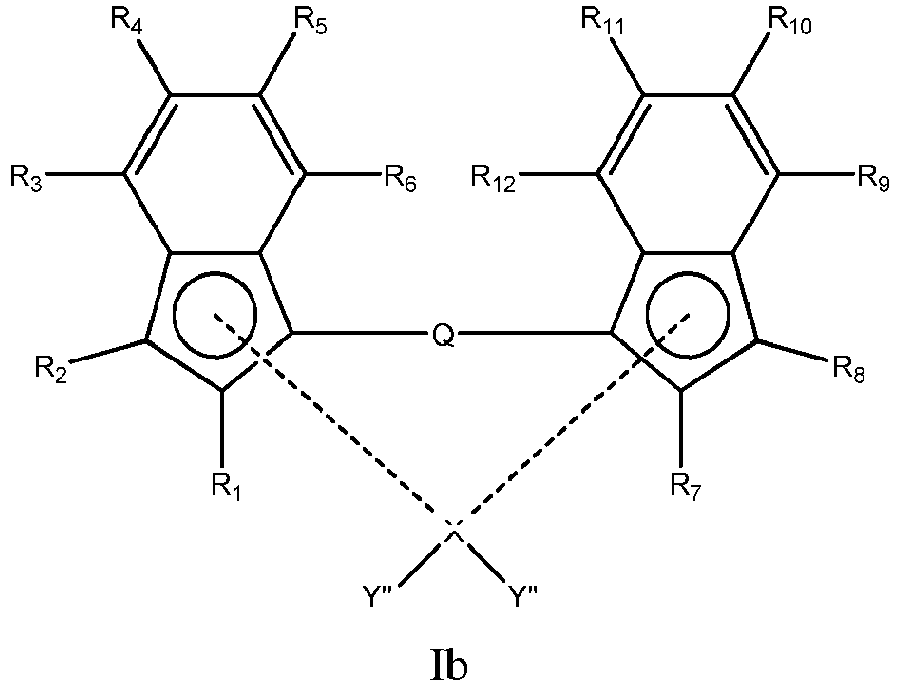
- (ii) reacting the compound of formula Ia above with MY" (wherein M is as defined above and Y" is a group Y as defined herein other than halo), in the presence of a suitable solvent to form the compound of the formula Ib shown below
- Suitably, M is Li in step (i) of the process defined above.
- Suitably, the compound of formula B is provided as a solvate. In particular, the compound of formula B may be provided as X(Y')4.THFp, where p is an integer (e.g. 2).
- Any suitable solvent may be used for step (i) of the process defined above. A particularly suitable solvent is toluene or THF.
- If a compound of formula I in which Y is other than halo is required, then the compound of formula Ia above may be further reacted in the manner defined in step (ii) to provide a compound of formula Ib.
- Any suitable solvent may be used for step (ii) of the process defined above. A suitable solvent may be, for example, diethyl ether, toluene, THF, dicloromethane, chloroform, hexane DMF, benzene etc.
- Processes by which compounds of the formula A above can be prepared are well known art. For example, a process for the synthesis of a di-sodium ethylene-bis-hexamethylindenyl ligand of formula A is described in J. Organomet. Chem., 694, (2009), 1059-1068. A process for the synthesis of a di-lithium ethylene-bis-hexamethylindenyl ligand of formula A is described in the accompanying examples.
- Compounds of formula A in which R1 and R7, R2 and R8, R3 and R9, R4 and R10, R5 and R11, R6 and R12 are methyl and Q is -CH2-CH2- may generally be prepared by:
- (i) Reacting a compound of formula D


- (ii) reacting a compound of formula E with C10H8.M in the presence of a suitable solvent to form a compound of formula A.
- Compounds of formula D can be readily synthesized by techniques well known in the art.
- Any suitable solvent may be used for step (i) of the above process. A particularly suitable solvent is diethyl ether.
- Similarly, any suitable solvent may be used for step (ii) of the above process. A suitable solvent may be, for example, toluene, THF, DMF etc.
- For the avoidance of doubt, the C10H8.M reagent used in step (ii) of the above process is lithium, sodium or potassium naphthalenide. In an embodiment, C10H8.M is sodium naphthalenide.
- As previously indicated, the compounds of the present invention are extremely effective procatalysts for use in olefin polymerization reactions.
- Thus, the present invention also provides the use of a compound of formula I as defined herein as an olefin polymerization procatalyst, in particular an ethylene polymerization catalyst.
- The present invention also provides a process for forming a polyolefin (e.g. polyethylene) which comprises reacting the olefin monomers in the presence of a compound of formula I as defined herein and a suitable activator.
- Suitable activators are well known in the art and include, but are not limited to, aluminoxanes (e.g. methylaluminoxane) or triethylaluminium.
- The catalyst compound of formula I may be applied to a suitable support. Examples of suitable supports include silica gels, aluminium oxides, or any other inorganic support materials.
- It is possible to pre-activate the catalyst of formula I by mixing the catalyst with the activator before use in the polymerisation reaction. Suitably, such pre-activation is carried out in solution, and typically in an inert hydrocarbon such as toluene.
- Typically, the polymerisation reaction is carried out in a known manner in solution, in suspension or in the gas phase, continuously, or batchwise in one or more steps.
- A person skilled in the art of olefin polymerization will be able to select suitable reaction conditions (e.g. temperature, pressures, reaction times etc.) for such a polymerization reaction. A person skilled in the art will also be able to manipulate the process parameters in order to produce a polyolefin having particular properties. For example, the temperature of such reactions could range from -60 to 250°C and the pressures may range from 0.5 to 100 bar, in certain circumstances.
- In a particular embodiment, the polyolefin is polyethylene.
- The invention will now be described in more detail in relation to the following illustrative examples.
- All organometallic manipulations were performed under an atmosphere of N2 using standard Schlenk line techniques or a MBraun UNIIab glovebox, unless stated otherwise. All organic reactions were carried out under air unless stated otherwise. Solvents used were dried by either reflux over sodium-benzophenone diketyl (THF), or passage through activated alumina (hexane, Et2O toluene, CH2Cl2) using a MBraun SPS-800 solvent system. Solvents were stored in dried glass ampoules, and thoroughly degassed by passage of a stream of N2 gas through the liquid and tested with a standard sodium-benzophenone-THF solution before use. Deuterated solvents for NMR spectroscopy of oxygen or moisture sensitive materials were treated as follows: C6D6 was freeze-pump-thaw degassed and dried over a K mirror; d5-pyridine and CDCl3 were dried by reflux over calcium hydride and purified by trap-to-trap distillation; and CD2Cl2 was dried over 3 Å molecular sieves.
- 1H and 13C NMR spectroscopy were performed using a Varian 300 MHz spectrometer and recorded at 300 K unless stated otherwise. 1H and 13C NMR spectra were referenced via the residual protio solvent peak. Oxygen or moisture sensitive samples were prepared using dried and degassed solvents under an inert atmosphere in a glovebox, and were sealed in Wilmad 5mm 505-PS-7 tubes fitted with Young's type concentric stopcocks.
- Mass spectra were using a Bruker FT-ICR-MS Apex III spectrometer.
- For Single-crystal X-ray diffraction in each case, a typical crystal was mounted on a glass fibre using the oil drop technique, with perfluoropolyether oil and cooled rapidly to 150 K in a stream of N2 using an Oxford Cryosystems Cryostream.21 Diffraction data were measured using an Enraf-Nonius KappaCCD diffractometer (graphite-monochromated MoKα radiation, λ = 0.71073 A). Series of ω-scans were generally performed to provide sufficient data in each case to a maximum resolution of 0.77 Å. Data collection and cell refinement were carried out using DENZO-SMN. 22 Intensity data were processed and corrected for absorption effects by the multi-scan method, based on multiple scans of identical and Laue equivalent reflections using SCALEPACK (within DENZO-SMN). Structure solution was carried out with direct methods using the program SIR92 23 within the CRYSTALS software suite. 24 In general, coordinates and anisotropic displacement parameters of all non-hydrogen atoms were refined freely except where this was not possible due to the presence of disorder (i.e. toluene of crystallization in meso-2). Hydrogen atoms were generally visible in the difference map and were treated in the usual manner25 .
- Polymerization trials and differential scanning calorimetry (DSC) experiments were run under industrial conditions. High temperature gel permeation chromatography were performed using a Polymer Laboratories GPC220 instrument, with one PLgel Olexis guard plus two Olexis 30 cm x 13 µm columns. The solvent used was 1,2,4-trichlorobenzene with anti-oxidant, at a nominal flow rate of 1.0 mLmin-1 and nominal temperature of 160°C. Refractive index and Viscotek differential pressure detectors were used. The data were collected and analysed using Polymer Laboratories "Cirrus" software. A single solution of each sample was prepared by adding 15mL of solvent to 15mg of sample and heating at 190 °C for 20 minutes, with shaking to dissolve. The sample solutions were filtered through a glass-fibre filter and part of the filtered solutions were then transferred to glass sample vials. After an initial delay of 30 minutes in a heated sample compartment to allow the sample to equilibrate thermally, injection of part of the contents of each vial was carried out automatically. The samples appeared to be completely soluble and there were no problems with either the filtration or the chromatography of the solutions. The GPC system was calibrated with Polymer Laboratories polystyrene calibrants. The calibration was carried out in such a manner that combined GPC-viscosity could be used to give 'true' molecular weight data and conventional GPC could also be applied. For the conventional GPC results, the system is calibrated with linear polyethylene or linear polypropylene. This correction has previously been shown to give good estimates of the true molecular weights for the linear polymers.
- For the GPC-viscosity approach, the system is still calibrated using polystyrene but the use of the refractive index (concentration) and differential pressure (viscosity) detector responses, together with accurate knowledge of the polymer solution concentration, allows computation of 'true' molecular weight data without applying any correction. This approach also gives intrinsic viscosity data that allows comparison of long chain branching. Although this approach does give 'true' molecular weight data, some parameters are adjusted to ensure a good match for a known material and the approach used to obtain the polymer sample concentration can be important. For this work, the differential refractive index (dn/dc) for the polyethylene/solvent combination was assumed and the concentration back calculated from the refractive index detector response. If samples were not simply polyethylene, errors would be introduced due to a change in dn/dc. The differential pressure (viscosity) detector response is a function of concentration and intrinsic viscosity (effective molecular weight) and the response to the propylene oligomer was too low for the application of the GPC-viscosity approach to be sensible.
- Li (0.13g, 1.86 x 10⁻² mol) and naphthalene (2.56g, 2.00 x 10⁻² mol) were stirred in THF, forming a green solution after 3 hours which still contained Li and so was stirred for a further 15 hours. C16H20 (3.69g, 1.74 x 10⁻² mol) was dissolved in THF giving a bright yellow solution, which was added to the dark green C10H8Li mixture at -78°C. The reaction mixture was stirred at -78°C for 30 minutes then allowed to warm to room temperature with stirring. A precipitate formed after 2 hours, and after a further 3 hours the solvent was removed under vacuum from the yellow-green mixture. The residue was washed with Et2O and dried to yield an off white powder. Yield: 3.78g, 93%. Analysis by NMR spectroscopy showed this solid to be of the formula EBI*Li2·THF0.38, 1H NMR (d5-pyridine): δ 2.42, 2.45, 2.62, 2.89, 2.91 3.06 (all s, 6H, Me), 3.78 (s, 4H, C2H4). 13C NMR (d5-pyridine): δ 13.8, 16.3, 17.3, 17.4, 18.7, 19.2 (Me), 36.4 (C2H4), 97.8, 105.6, 119.1, 119.4, 123.5, 123.6, 124.8, 126.8, 128.8 (ring Cs).
-

- BrCN (2.89g, 2.72 x 10⁻³ mol) was added under a N2 flush to a-78 °C slurry in Et2O of Ind*Li (6.00g, 2.72 x 10⁻³ mol), prepared by a literature procedure.1 The reaction mixture was stirred at -78°C for 2 hours then allowed to warm to room temperature, upon which the off-white precipitate dissolved to give a yellow solution. After stirring for 15 hours under a dynamic pressure of N2 to allow venting of HCN produced, volatiles were removed under vacuum. NMR analysis of the residues occasionally showed contamination of the desired product with an intermediate species, Ind*Br. Addition of Et3N and further stirring converted this into the fulvene compound C16H20. Extraction with 30°C pentane, passing the resulting solution through silica and removal of the solvent under vacuum afforded 2,3,4,5,6,7-hexamethyl-1-methylene-indene, C16H20 as a bright yellow solid. Yield: 4.10g, 71%.
- Characterising data:
- 1H NMR (C6D6) δ (ppm): 1.91, 2.08 (both s, 3H, Me), 2.11 (s, 6H, Me), 2.30, 2.36 (both s, 3H, Me), 5.56, 5.84 (both s, 1 H, CH2).
- 1H NMR (CDCl3) δ (ppm): 2.00, 2.23, 2.26, 2.28 (all s, 3H, Me), 2,45 (bs, 6H, Me), 5.51, 5.88 (both s, 1H, CH2).
- 13C NMR (C6D6) δ (ppm): 9.56, 15.53, 15.91, 16.03, 16.43, 16.64 (Me), 28.84 (CH2), 126.35, 129.45, 131.49, 131.61, 132.61, 132.22, 134.90, 137.18, 140.37, 150.48 (ring Cs).
- HRMS (EI): Calc: 212.1565 Found: 212.1567.
- Na (0.17g, 7.56 x 10⁻³ mol) was stirred in THF with naphthalene (1.04g, 8.11 x 10⁻³ mol) for 15 hours, resulting in a deep green solution of C10H8Na. After cooling to -78°C, a solution in THF of 2,3,4,5,6,7-hexamethyl-1-methylene-indene (1.50g, 7.06 x 10⁻³ mol) was added. The mixture was stirred for 2 hours at -78°C and then allowed to warm to room temperature. Removal of the solvent under vacuum afforded a light brown solid, which was washed with Et2O and filtered to give a light brown pyrophoric powder. Yield: 1.26g, 76%.
- Characterising data:
- 1H NMR (d5-pyridine) δ (ppm): 2.49 (s, 12H, Me), 2.55, 2.71, 2.72, 3.13 (all s, 6H, Me), 3.94 (s, 4H, C2H4).
- 13C NMR (d5-pyridine) δ (ppm): 13.59, 16.41, 17.33, 17.46, 18.60, 19.05 (Me), 35.06 (C2H4), 97.01, 104.27, 117.68, 118.07, 123.12, 123.17, 123.77, 125.20, 125.79 (ring Cs).
- The reaction mechanism for the above reaction is shown in Scheme 2 below.

-

- EBI*Li2·THF0.38 (0.350g, 7.51 x 10⁻⁴ mol) was slurried in toluene and cooled to -78°C. To this orange-red slurry was added a white slurry of ZrCl4·THF2 (0.284g, 7.51 x 10⁻⁴ mol) in toluene. No immediate change was observed and the reaction mixture was allowed to warm to room temperature with stirring. After stirring for a further 15 hours, the red-brown reaction mixture was filtered affording a red-orange solution. The residues were extracted with CH2Cl2 and the extracts combined. Removal of the solvent under vacuum gave a red-orange solid, which was washed with -78°C hexane. The resultant residue was extracted with room temperature hexane to give a red-orange solid and yellow-orange solution. NMR analysis of this solid showed it to be an approximately 1:0.8 rac/meso mix. The solvent was removed under vacuum from the yellow-orange solution to give an orange solid; NMR analysis of this solid indicated it to be mainly composed of meso-EBI*ZrCl2 with a tiny proportion of impurities including the rac-isomer.
- The rac/meso mix was extracted and filtered with CH2Cl2 to afford a red solution which was layered with hexane. The yellow supernatant was decanted via cannula leaving an orange solid, shown by NMR analysis to be pure rac-EBI*ZrCl2. The supernatant was reduced under vacuum to an orange solid; a more meso enriched mixture of isomers; and washed with 60°C hexane, leaving pure rac isomer. The orange-yellow solution was again reduced to an isomeric solid mix, extracted with 60 °C hexane and cooled to -80°C, depositing a final crop of rac-EBI*ZrCl2. Crystals of rac-EBI*ZrCl2 suitable for X-ray diffraction were grown as pale orange plates by layering a CD2Cl2 solution of the sample with Et2O.
- The predominantly meso extracts were further extracted with 60 °C hexane and filtered, reduced to a minimum volume and cooled slowly to -35 °C. Orange needles of pure meso-EBI*ZrCl2 suitable for X-ray diffraction were collected and washed with -78°C hexane.
- Yield: 0.060g, 0.028g, total 20%.
- Characterising data:
- HRMS (EI): Calc: 584.1554 Found: 584.1567.
- rac-EBI*ZrCl2:
- 1H NMR (C6D6) δ (ppm): 1.78, 2.11, 2.22, 2.43, 2.46, 2.56 (all s, 6H, Me), 3.22-3.40, 3.70-3.88 (m, 4H, C2H4).
- 1H NMR (CDCl3) δ (ppm): 1.84, 2.23, 2.29, 2.33, 2.40, 2.79 (all s, 6H, Me), 3.65-3.81, 4.02-4.18 (m, 4H, C2H4).
- 1H NMR (CD2Cl2) δ (ppm): 1.84, 2.24, 2.29, 2.31, 2.37, 2.80 (all s, 6H, Me), 4.03-4.22, 3.63-3.82 (m, 4H, C2H4).
- 13C NMR (CD2Cl2) δ (ppm): 11.96, 15.91, 16.58, 16.91, 17.71, 17.95 (Me), 32.94 (C2H4), 115.97, 118.84, 123.56, 125.21, 126.40, 128.84, 129.46, 130.65, 134.59 (ring Cs).
- Anal. Calc for C32H40ZrCl2: C, 65.50; H, 6.87. Found: C, 65.44; H, 6.79.
- meso-EBI*ZrCl2:
- 1H NMR (C6D6) δ (ppm): 1.85, 1.99, 2.01, 2.39, 2.51, 2.52 (all s, 6H, Me), 3.20-3.34 3.74-3.88 (m, 4H, C2H4).
- 1H NMR (CDCl3) δ (ppm): 2.12, 2.13, 2.16, 2.32, 2.45, 2.60 (all s, 6H, Me), 3.63-3.80, 4.07-4.24 (m, 4H, C2H4).
- 1H NMR (CD2Cl2) δ (ppm): 2.13 (s, 12H, Me), 2.17, 2.29, 2.43, 2.61 (all s, 6H, Me), 3.64-3.82, 4.08-4.26 (m, 4H, C2H4).
- 13C NMR (C6D6) δ (ppm): 13.27, 15.71, 16.51, 16.87, 17.59, 17.71 (Me), 31.39 (C2H4), 106.72, 113.97, 121.50, 126.97, 127.29, 129.03, 130.68, 132.98, 134.05 (ring Cs).
- 13C NMR (CDCl3) δ (ppm): 13.45, 15.41, 16.45, 16.82, 17.40, 17.43 (Me), 31.34 (C2H4), 104.09, 114.17, 121.62, 126.25, 126.75, 129.52, 130.21, 133.03, 134.29 (ring Cs).
- As stated above, single crystals of rac-EBI*ZrCl2 suitable for X-ray diffraction were grown as pale orange plates by the layering of a sample in CD2Cl2 with Et2O. The compound crystallises in the monoclinic space group C2/c, and four alternate views are shown in
Figure 1 . The compound is located on a crystallographic twofold axis of rotation, hence both indenyl rings are equivalent and relevant bond lengths and angles are given in Table 1 below.Table 1: Selected bond lengths and angles for rac-EBI*ZrCl2. Estimated standard deviations (ESDs) are given in parentheses Lengths (Å) Zr(1) - C(3) 2.479(3) C(4) - C(14) 1.439(4) Zr(1) - C(4) 2.558(3) C(5) - C(10) 1.430(4) Zr(1) - C(5) 2.612(3) C(10) - C(12) 1.385(4) Zr(1) - C(6) 2.582(3) C(12) - C(13) 1.432(4) Zr(1) - C(7) 2.520(3) C(13) - C(14) 1.382(4) C(3) - C(4) 1.448(4) C(3) - C(18) 1.504(4) C(4) - C(5) 1.443(4) C(18) - C(18)* 1.546(6) C(5) - C(6) 1.437(4) Avg. C5 - Me 1.505 C(6) - C(7) 1.414(4) Avg. C6 - Me 1.514 C(7) - C(3) 1.430(4) Zr(1) - Cpcent 2.240 Zr(1) - Cl(2) 2.4358(7) ΔM-C 0.054 Angles (°) C6-C5 planes 2.6 δ 129.4 Cl(2) - Zr - Cl(2)* 96.24(4) Hinge Angle 2.7 α α' 57.2 55.6 Rotation Angle 124.4 β β' -1.1 0.3 - As stated above, X-ray quality crystals of meso-EBI*ZrCl2 were obtained as orange needles by the slow cooling of a concentrated hexane solution to -35 °C. The compound crystallises in the triclinic space group P
1 , with one EBI* moiety and one toluene molecule per asymmetric unit. Alternate views are shown inFigure 2 , and relevant bond distances and angles are given in Table 2.Table 2: Selected bond lengths and angles for meso-EBI*ZrCl2. Estimated standard deviations (ESDs) are given in parentheses Lengths (Å) Zr(1) - C(13) 2.470(5) Zr(1) - C(4) 2.627(5) Zr(1) - C(14) 2.557(5) Zr(1) - C(5) 2.596(5) Zr(1) - C(15) 2.574(5) Zr(1) - C(6) 2.487(5) Zr(1) - C(16) 2.597(5) Zr(1) - C(7) 2.504(5) 2.556(5) Zr(1) - C(8) 2.570(5) C(13) - C(14) 1.442(8) C(4) - C(5) 1.441(7) C(14) - C(15) 1.438(8) C(5) - C(6) 1.448(8) C(15) - C(16) 1.436(8) C(6) - C(7) 1.422(8) C(16) - C(17) 1.402(8) C(7) - C(8) 1.412(8) C(17) - C(13) 1.417(8) C(8) - C(4) 1.441(7) C(15) - C(20) 1.435(8) C(5) - C(28) 1.429(8) C(20) - C(22) 1.384(9) C(28) - C(29) 1.373(9) C(22) - C(23) 1.422(10) C(29) - C(31) 1.422(9) C(23) - C(24) 1.369(9) C(31) - C(32) 1.379(8) C(24) - C(14) 1.424(8) C(32) - C(4) 1.434(8) C(13) - C(12) 1.521(8) C(6) - C(11) 1.501(8) C(12) - C(11) 1.539(9) Avg. C5 - Me 1.512 Avg. C5 - Me 1.508 Avg. C6 - Me 1.513 Avg. C6 - Me 1.513 Zr(1) - Cpcent 2.244 Hf(1) - Cpcent 2.248 Zr(1) - Cl(2) 2.4276(13) Zr(1) - Cl(3) 2.4571(14) ΔM-C 0.033 ΔM-C 0.082 Angles (°) C6 - C5 planes 6.4 C6 - C5 planes 3.9 Cl(2) - Zr - Cl(3) 97.41(5) - α α' 56.9 54.4 - β β' 1.3 2.9 β β' 1.0 1.9 δ 128.73 - Hinge Angle 6.0 Hinge Angle 3.3 Rotation Angle 46.8 - -

- To an orange-red slurry of EBI*Li2·THF0.38 (0.350g, 7.51 x 10⁻⁴ mol) in toluene at -78°C was added a white slurry of HfCl4·THF2 (0.349g, 7.51 x 10⁻⁴ mol) in toluene. The reaction mixture was allowed to warm to room temperature with stirring, with no observed change. After stirring for 15 hours, an aliquot was taken and NMR analysis showed a 1.7:1 mix of meso/rac isomers. The yellow-brown reaction mixture was filtered, and the remaining solid extracted with toluene and combined to give an orange-brown solution. Removal of the solvent under vacuum afforded a yellow-orange solid which was extracted with 60 °C hexane, giving a bright yellow solution and buff powder, shown by NMR analysis to be a 1:1 mix of rac/meso isomers. Removal of the solvent under vacuum from the bright yellow solution left a bright yellow solid, consisting by NMR analysis of predominantly meso-EBI*HfCl2 with a small amount of the rac-isomer, and was purified to the pure meso form by extraction with room temperature hexane and filtration.
- The buff rac/meso mix was extracted with 60 °C hexane and filtered giving a yellow solution, removal of the solvent under vacuum from which gave a solid consisting of mainly the meso-isomer with a small impurity including the rac form. Another extraction of this solid with 60 °C hexane afforded a yellow solution plus yellow solid. This yellow solid was dissolved in CH2Cl2, reduced to a minimum volume and layered with hexane. A light yellow solid precipitated and removal of the supernatant via cannula left pure rac-EBI*HfCl2. The second yellow hexane extraction was reduced to a minimum volume and cooled to -35 °C, whereupon a bright yellow solid crop of meso-EBI*HfCl2 was collected and washed with -78°C hexane.
- Single crystals of the meso form suitable for analysis by X-ray diffraction were grown as pale yellow plates by the cooling of a saturated isomerically pure hexane solution of meso-EBI*HfCl2 to -35 °C. X-ray diffraction quality crystals of the rac-isomer were obtained as pale yellow needles by the slow evaporation of an NMR pure C6D6 solution of rac-EBI*HfCl2.
- Yield: 0.095g, 0.057g, total 30%.
- Characterising data:
- MS (EI): Calc: 674.1957 Found: 674.1969.
- rac-EBI*HfCl2:
- 1H NMR (C6D6) δ (ppm): 1.82, 2.12, 2.25, 2.46, 2.48, 2.55 (all s, 6H, Me), 3.43-3.52, 3.66-3.75 (m, 4H, C2H4).
- 1H NMR (CDCl3) δ (ppm): 1.88, 2.24, 2.31 (all s, 6H, Me), 2.38 (s, 12H, Me), 2.77 (s, 6H, Me), 3.83-3.94, 3.95-4.06 (m, 4H, C2H4).
- 1H NMR (CD2Cl2) δ (ppm): 1.89, 2.26, 2.32, 2.34, 2.36, 2.79 (all s, 6H, Me), 3.85-3.94, 3.98-4.07 (m, 4H, C2H4).
- 13C NMR (CD2Cl2) δ (ppm): 11.49, 15.72, 16.17, 16.49, 16.82, 17.68 (Me), 32.18 (C2H4), ring Cs not visible.
- Anal. Calc for C32H40HfCl2: C, 57.02; H, 5.98. Found: C, 57.08; H, 6.06.
- meso-EBI*HfCl2:
- 1H NMR (C6D6) δ (ppm): 1.90, 2.01, 2.03, 2.39, 2.49, 2.57 (all s, 6H, Me), 3.23-3.40, 3.78-3.95 (m, 4H, C2H4).
- 1H NMR (CDCl3) δ (ppm): 2.13, 2.15, 2.22, 2.32, 2.51, 2.57 (all s, 6H, Me), 3.68-3.84, 4.11-4.27 (m, 4H, C2H4).
- 13C NMR (C6D6) δ (ppm): 13.19, 15.47, 16.43, 16.79, 17.57, 17.69 (Me), 30.70 (C2H4), 110.79, 119.11, 125.30, 126.17, 126.33, 127.41, 130.46, 132.74, 133.76 (ring Cs).
- 13C NMR (CDCl3) δ (ppm): 13.72, 15.17, 16.36, 16.71, 17.38, 17.41 (Me), 30.61 (C2H4), 110.91, 119.17, 124.88, 125.39, 126.47, 127.88, 129.97, 132.77, 133.96 (ring Cs).
- Both isomers of EBI*HfCl2 were characterised by 1H and 13C NMR spectroscopy, MS, EA, single-crystal X-ray diffraction and electrochemical studies. The 1H NMR spectral data of rac and meso-EBI*HfCl2 were similar to those observed with rac and meso-EBI*ZrCl2, in a number of different solvents. This implies the Zr and Hf species also have similar structures in solution.
- As stated above, single crystals of rac-EBI-HfCl2 suitable for X-ray diffraction were grown as pale yellow needles by the slow evaporation of a C6D6 solution. The molecule crystallises in the monoclinic space group C2/c, with 0.5 EBI* moieties per asymmetric unit. Four alternate views are shown in
Figure 3 and relevant bond distances and angles are given in Table 3. - As shown in Table 3 below, many structural parameters of rac-EBI*HfCl2 are very similar to those of the Zr analogue given in Table 1. The EBI* moiety bonds to the metal centre in a similar bis-η5 manner, the replacement of the second row transition metal element with its smaller third row equivalent resulting in an decrease in the M-Cpcent distance of 0.018Å.
Figure 3 clearly shows the large tilt angle α, and the unusual negative value of β, as in rac-EBI*ZrCl2Table 3: Selected bond lengths and angles for rac-EBI*HfCl2. Estimated standard deviations (ESDs) are given in parentheses Lengths (Å) Hf(1) - C(3) 2.498(3) C(5) - C(12) 1.440(4) Hf(1) - C(4) 2.462(3) C(6) - C(9) 1.433(4) Hf(1) - C(5) 2.541(3) C(9) - C(10) 1.379(4) Hf(1) - C(6) 2.598(3) C(10) - C(11) 1.441(4) Hf(1) - C(7) 2.571(3) C(11) - C(12) 1.378(4) C(3) - C(4) 1.426(4) C(4) - C(41) 1.507(4) C(4) - C(5) 1.446(4) C(41) - C(41)* 1.554(6) C(5) - C(6) 1.448(4) Avg. C5 - Me 1.508 C(6) - C(7) 1.433(4) Avg. C6 - Me 1.511 C(7) - C(3) 1.417(4) Hf(1) - Cpcent 2.222 Hf(1) - Cl(2) 2.4118(7) ΔM-C 0.053 Angles (°) C6 - C5 planes 2.5 δ 129.9 Cl(2) - Hf - Cl(2)* 95.43(4) Hinge Angle 2.0 α α' 57.0 55.9 Rotation Angle 125.2 β β' -1.5 0.9 - As stated above, the slow cooling to -35 °C of a concentrated toluene solution of meso-EBI*HfCl2 afforded pale yellow plates suitable for study by X-ray diffraction. The compound crystallises in the monoclinic space group P21/n, with one EBI* moiety in the asymmetric unit. For alternate views are shown in
Figure 4 , and selected bond distances and angles are given in Table 4.Table 4: Selected bond lengths and angles for meso-EBI*HfCl2. Estimated standard deviations (ESDs) are given in parentheses Lengths (Å) Hf(1) - C(7) 2.562(6) Hf(1) - C(22) 2.453(5) Hf(1) - C(8) 2.459(5) Hf(1) - C(24) 2.534(5) Hf(1) - C(9) 2.478(6) Hf(1) - C(30) 2.577(5) Hf(1) - C(11) 2.553(5) Hf(1) - C(31) 2.593(6) Hf(1) - C(12) 2.622(5) Hf(1) - C(32) 2.527(5) C(7) - C(8) 1.436(8) C(22) - C(24) 1.438(8) C(8) - C(9) 1.402(8) C(24) - C(30) 1.446(7) C(9) - C(11) 1.428(8) C(30) - C(31) 1.437(8) C(11) - C(12) 1.432(8) C(31) - C(32) 1.415(8) C(12) - C(7) 1.445(8) C(32) - C(22) 1.428(8) C(12) - C(13) 1.421(8) C(24) - C(25) 1.429(8) C(13) - C(15) 1.371(9) C(25) - C(27) 1.378(8) C(15) - C(16) 1.439(10) C(27) - C(28) 1.423(9) C(16) - C(17) 1.374(9) C(28) - C(29) 1.389(9) C(17) - C(7) 1.450(8) C(29) - C(30) 1.418(8) C(8) - C(20) 1.511(8) C(22) - C(21) 1.519(7) C(20) - C(21) 1.551(9) Avg. C5 - Me 1.511 Avg. C5 - Me 1.513 Avg. C6 - Me 1.516 Avg. C6 - Me 1.515 Hf(1) - Cpcent 2.225 Hf(1) - Cpcent 2.226 Hf(1) - Cl(2) 2.4215(13) Hf(1) - Cl(6) 2.3953(13) ΔM-C 0.086 ΔM-C 0.030 Angles (°) C6 - C5 planes 1.5 C6 - C5 planes 2.3 Cl(2)-Hf-Cl(6) 96.02(5) - α α' 56.9 55.1 - β β' 0.2 0.5 β β' 0.9 2.1 δ 129.9 - Hinge Angle 2.6 Hinge Angle 4.2 Rotation Angle 45.0 - -

- EBI*Li2·THF0.38 (0.075g, 1.61 x 10⁻⁴ mol) was slurried in toluene and cooled to - 78 °C. To this buff slurry was added a bright blue solution of TiCl3·THF3 (0.060g, 1.61 x 10⁻⁴ mol) in THF. The reaction mixture was observed to darken, and on warming to room temperature a red-brown solution was obtained. The reaction mixture was stirred for a further 15 hours at room temperature, then transferred via cannula onto a slurry of PbCl2 (0.030g, 1.05 x 10⁻⁴ mol) in THF. The reaction mixture changed to a yellow-green colour, and a dark grey solid was seen on the bottom of the Schlenk, presumed to be Pb. The reaction mixture was stirred for another 15 hours and left to settle, affording a green-yellow solution with dark grey solid and a dark grey metallic rim at the solvent edge. Filtration and removal of the solvent under vacuum left a dark green solid, shown by NMR analysis to contain peaks consistent with EBI*TiCl2 together with EBI*H2 and fulvene peaks. The residue was washed with hexane, dissolved in a minimum volume of toluene and the green solution cooled to -78°C. A solid precipitated and was collected by filtration, washed with -78°C toluene, NMR analysis showing it to be consistent with the formula of the desired product EBI*TiCl2. Yield: 0.009g, 10%.
- Characterising data:
- rac-EBI*TiCl2
- MS (EI): Calc: 542.1987 Found: 542.1994.
- 1H NMR (C6D6) δ (ppm): 1.70, 2.11, 2.23, 2.46, 2.47, 2.59 (all s, 6H, Me), 3.25-3.42, 3.86-4.03 (m, 4H, C2H4).
- 1H NMR (CDCl3) δ (ppm): 1.74, 2.25, 2.32, 2.35, 2.40, 2.84 (all s, 6H, Me), 3.74-3.90, 4.26-4.42 (m, 4H, C2H4).
- 1H NMR (d8-toluene) δ (ppm): 1.68, 2.11, 2.21, 2.40, 2.42, 2.60 (all s, 6H, Me), sample too weak to assign C2H4 multiplet accurately.
- rac-EBI*ZrCl2 was suspended in Et2O and cooled to -78°C. To this orange suspension was added an excess of 1.56M MeLi·LiBr in Et2O and the reaction mixture allowed to warm to room temperature. The initial orange suspension became a yellow solution and was stirred for a further 2 hours. Removal of the solvent under vacuum, extraction with hexane and removal of the volatiles afforded a light orange-yellow solid, shown by NMR analysis to be meso-EBI*ZrMe2. The use of low halide MeLi in Et2O with rac-EBI*ZrCl2 was found to yield rac-EBI*ZrMe2. A similar procedure was followed with meso-EBI*ZrCl2 and 1.56M MeLi·LiBr in Et2O affording meso-EBI*ZrMe2.
- Characterising data:
- rac-EBI*ZrMe2:
1H NMR (C6D6) δ (ppm): -0.99 (s, 6H, Zr-Me), 1.69, 2.12, 2.22, 2.41, 2.49, 2.51 (all s, 6H, Me), 3.12-3.29, 3.41-3.58 (m, 4H, C2H4). - meso-EBI*ZrMe2:
- 1H NMR (C6D6) δ (ppm): -2.33, -0.20 (both s, 3H, Zr-Me), 1.77, 2.04, 2.07, 2.41, 2.42, 2.48 (all s, 6H, Me), 2.95-3.12, 3.53-3.70 (m, 4H, C2H4).
- 1H NMR (CDCl3) δ (ppm): -2.88, -0.62 (both s, 3H, Zr-Me), 2.03, 2.11, 2.14, 2.38, 2.39, 2.48 (all s, 6H, Me), 3.23-3.38, 3.68-3.83 (m, 4H, C2H4).
- To an NMR tube containing a suspension of rac-EBI*ZrCl2 in C6D6 was added an excess of either KCH2Ph, LiCH2SiMe3 or LiCH2 tBu. The tube was sonicated for 10 minutes and the NMR spectrum acquired. In the cases with KCH2Ph and LiCH2SiMe3, initial NMR analysis indicated the reaction was instantaneous, forming meso-EBI*(CH2Ph)2 and rac-EBI*Zr(CH2SiMe3)2 respectively. The reaction of rac-EBI*ZrCl2 with LiCH2 tBu initially showed some starting materials to remain, however after being left for 15 hours NMR analysis indicated complete conversion to rac-EBI*Zr(CH2 tBu)2.
- Characterising data:
- meso-EBI*Zr(CH2 tBu)2:
1H NMR (C6D6) δ (ppm): -2.19, 0.43 (both s, 2H, Zr-CH2 tBu), 0.59, 1.40 (both s, 9H, CH2CMe3 ), 1.96, 2.13, 2.15, 2.47, 2.52, 2.60 (all s, 6H, Me), 3.00-3.11, 3.60-3.71 (m, 4H, C2H4). - rac-EBI*Zr(CH2SiMe3)2:
1H NMR (C6D6) δ (ppm): -1.73, -0.21 (both d, 2H, J = 10.50 Hz, Zr-CH2 TMS), 0.09 (s, 18H, CH2SiMe3 ), 1.80, 2.12, 2.24, 2.46, 2.53, 2.57 (all s, 6H, Me), 3.12-3.31, 3.39-3.58 (m, 4H, C2H4). - meso-EBI*Zr(CH2Ph)2:
1H NMR (C6D6) δ (ppm): -0.72, 1.82 (both s, 2H, Zr-CH2 Ph), 1.84, 2.00 (both s, 6H, Me), 2.03 (s, 12H, Me), 2.40, 2.49 (both s, 6H, Me), 2.98-3.16, 3.58-3.76 (m, 4H, C2H4), 6.39, 6.57 (both d, 2H, J = 6.6 Hz, CH2C6 H2 ortho H2 metaHpara), 6.80, 6.94 (both t, 1H, CH2C6H2 orthoH2 meta H para), 7.05, 7.13, (both t, 2H, CH2C6H2 ortho H2 meta Hpara). - rac-EBI*HfCl2 was dissolved in Et2O cooled to -78 °C and an excess of 1.56M MeLi·LiBr in Et2O added, the mixture becoming lighter in colour. After stirring for 2 hours, the solvent was removed under vacuum. Extraction with hexane afforded a light yellow solution, and removal of the solvent under vacuum a light yellow solid shown by NMR analysis to be rac-EBI*HfMe2.
- meso-EBI*HfCl2 was treated in the same way, the hexane extracts being almost colourless and removal of the solvent under vacuum affording an off-white solid. This was shown by NMR analysis to be meso-EBI*HfMe2.
- Characterising data:
- rac-EBI*HfMe2:
1H NMR (C6D6) δ (ppm): -1.18 (s, 6H, Hf-Me), 1.70, 2.12, 2.23, 2.41, 2.49, 2.53 (all s, 6H, Me), 3.28-3.36, 3.42-3.50 (m, 4H, C2H4). - meso-EBI*HfMe2:
- 1H NMR (C6D6) δ (ppm): -2.59, -0.39 (both s, 3H, Hf-Me), 1.83, 2.04, 2.07, 2.41, 2.42, 2.46 (all s, 6H, Me), 3.03-3.20, 3.58-3.75 (m, 4H, C2H4).
- 13C NMR (C6D6) δ (ppm): 13.12, 14.44, 16.35, 16.68, 17.47, 17,55 (Me), 29.88 (C2H4), 92.85, 106.04, 110.34, 123.92 (ring Cs), other ring Cs not visible.
- To an NMR tube containing an orange solution of rac-EBI*HfCl2 in C6D6 was added an excess of either KCH2Ph, LiCH2SiMe3 or LiCH2 tBu. The tube was sonicated for 10 minutes and the NMR spectrum obtained, showing complete conversion to rac-EBI*Hf(CH2R)2.
- A bright yellow solution of meso-EBI*HfCl2 in C6D6 was treated with an excess of either KCH2Ph, LiCH2SiMe3 or LiCH2 tBu. After sonication for 10 minutes the NMR spectrum was obtained. Reaction with KCH2Ph was instantaneous; those with LiCH2SiMe3 and LiCH2 tBu showed a mixture of meso-EBI*HfCl2 and the desired product, and were left for a further 15 hours. NMR analysis of these samples showed complete conversion to meso-EBI*Hf(CH2SiMe3)2 and meso-EBI*Hf(CH2 tBu)2 respectively.
- Characterising data:
- rac-EBI*Hf(CH2 tBu)2:
1H NMR (C6D6) δ (ppm): -1.36, -0.20 (both d, 2H, J = 11.70 Hz, Hf-CH2 tBu), 1.00 (s, 18H, CH2CMe3 ), 1.93, 2.16, 2.25, 2.51, 2.55, 2.58 (all s, 6H, Me), sample too weak to assign C2H4 multiplet accurately. - meso-EBI*Hf(CH2 tBu)2:
1H NMR (C6D6) δ (ppm): -2.49, 0.08 (both s, 2H, Hf-CH2 tBu), 0.59, 1.40 (both s, 9H, CH2CMe3 ), 2.01, 2.13, 2.15, 2.49, 2.50, 2.67 (all s, 6H, Me), 3.06-3.22, 3.61-3.77 (m, 4H, C2H4). - rac-EBI*Hf(CH2SiMe3)2:
1H NMR (C6D6) δ (ppm): -1.95, -0.53 (both d, 2H, J = 12.00 Hz, Hf-CH2 SiMe3), 0.09 (s, 18H, CH2SiMe3 ), 1.81, 2.12, 2.25, 2.48, 2.53, 2.57 (all s, 6H, Me), sample too weak to assign C2H4 multiplet accurately. - meso-EBI*Hf(CH2SiMe3)2:
1H NMR (C6D6) δ (ppm): -3.32, -0.64 (both s, 2H, CH2 SiMe3), 2.00, 2.07, 2.16, 2.44, 2.53, 2.59 (all s, 6H, Me), 3.00-3.27, 3.52-3.79 (m, 4H, C2H4), CH2SiMe3 peaks obscured by residual LiCH2SiMe3 resonances. - rac-EBI*Hf(CH2Ph)2:
1H NMR (C6D6) δ (ppm): -0.36, 1.17 (both d, 2H, J = 12.30 Hz, Hf-CH2 tBu), 1.67, 1.79, 2.15, 2.17, 2.31, 2.58 (all s, 6H, Me), 3.28-3.45, 3.48-3.65 (m, 4H, C2H4), 6.80-7.20 (m, 10H, CH2 Ph). - meso-EBI*Hf(CH2Ph)2:
1H NMR (C6D6) δ (ppm): -0.92, 1.61 (both s, 2H, Hf-CH2 Ph), 1.94, 1.99, 2.01, 2.10, 2.39, 2.48 (all s, 6H, Me), 3.05-3.24, 3.62-3.81 (m, 4H, C2H4), 6.37, 6.72 (both d, 2H, J = 7.2 Hz, CH2C6 H2 rtho H2 metaHpara), 6.77, 6.96 (both t, 1H, CH2C6H2 orthoH2 meta Hpara ), 7.06, 7.17 (both t, 2H, CH2C6H2 ortho H2 meta H para ). - The homogenous ethylene polymerisation activity of the catalysts prepared in examples 1 and 2 was evaluated. The catalysts were dissolved in toluene with half the modified methylaluminoxane (MMAO) activator added in this solution (5000 equivalents vs metal), and the other half added in the 5L steel autoclaves. The polymerisation conditions and results are summarised in Table 5.
Table 5 Homogenous ethylene polymerisation conditions and results obtained with rac and meso-EBI*MCl2 (M = Zr, Hf) Catalyst Catalyst amount MMAO Run time Polymer yield (g) Productivity (gPF/mol met/h) rac-EBI*ZrCl2 1.17 mg 20 mmol 15 min 309 6.18 x 10⁸ meso-EBI*ZrCl2 2 µmol Zr 10000 eq/Zr 30 min 382 3.83 x 10⁸ rac-EBI*HfCl2 1.35 mg 20 mmol 60 min 25 1.25 x 10 meso-EBI*HfCl2 2 µmol Hf 10000 eq/Hf 67 3.35 x 10⁷ - As shown in Table 5, both rac and meso Zr compounds are very active in ethylene polymerisation, with catalytic activities obtained between 3 x 10⁸ and 6 x 10⁸ gPE/mol Zr/h. The Hf analogues are less active, by a factor of approximately 49 for the rac compounds and approximately 11 for the meso forms. In the case of EBI*ZrCl2, the rac isomer was approximately 1.6 times more active than the meso; this trend is reversed in EBI*HfCl2, with the meso form being 2.7 times more active than the rac.
- Comparative studies on the catalytic performance of other Group 4 metallocene compounds generally agree with the activity of Zr complexes being substantially higher than that of the corresponding Hf compounds under similar conditions.2-4 Studies have been performed into the electronic and steric effects of the ligands, together with the polymerisation conditions, on the ethylene polymerisation activities of zirconocene catalysts.5-8 The role of the aluminoxane co-catalyst has been examined, and for most homogenous metallocene catalysts a large excess of aluminoxane is required for the polymerisation to achieve its optimum productivity. The literature commonly reports Al/Zr ratios between 1000 to 50000, with activity generally increasing as the ratio increases, up to an optimal value. It is therefore important when comparing activity data to compare similar conditions and Al/Zr ratios where possible. MAO is the most commonly used aluminoxane, however it has been shown that MMAO/metallocene and MAO/metallocene systems have comparable polymerisation rates, hence values in this work can be readily compared with the literature.9
- The effect of ligand substitution on the polymerisation activity has been rationalised on steric grounds, with unsubstituted zirconocene dichloride being more active than mixed sandwiches which are in turn more active than symmetrically substituted compounds, as shown in Table 6. The Me groups have a sterically hindering effect and decrease the flexibility towards the spatial requirements of the incoming monomer and the growing polymer chain.
Table 6: Ethylene polymerisation data, showing negative steric effect on catalytic activity of Cp based zirconocenes/MAO systems, together with activities of EBI* species in the same units Catalyst Activity (kgPE/gZr/h) Al/Zr ratio Ref. Cp2ZrCl2 500 8000:1 18 a (CpMe4H)CpZrCl2 255 8000:1 18 a Cp*CpZrCl2 170 8000:1 18 a (CpMe4H)2ZrCl2 135 8000:1 18 a Cp*2ZrCl2 135 8000:1 18 a rac-EBI*ZrCl2 6775 10000:1 This invention b meso-EBI*ZrCl2 4187 10000:1 This invention b a 70°C, PC2 = 5 bar; b 70 °C, PC2 = 10 bar - It can also be seen from Table 6 that, although the Al/Zr ratio is slightly higher for the EBI*ZrCl2 samples, the activity is significantly greater than for all the Cp based Zr systems.
- The data in Table 7 show that the unbridged Ind species Ind2ZrCl2 is approximately 3.7 times more active than Cp2ZrCl2. Furthermore, they indicate that the introduction of an ansa bridge in this Ind case reduces the activity of the resulting catalyst by almost 7 times to a value similar to that of Cp*2ZrCl2. These trends of decreasing activity with increasing steric substitution, and decreased activity of bridged compared with non-bridged species, has also been documented elsewhere in the literature.10
Table 7: Ethylene polymerisation data for a series of Cp and Ind based zirconocene catalysts Catalyst Activity (kgPE/gZr/h) Al/Zr ratio Ref. Cp2ZrCl2 185 4000:1 18 a Cp*2ZrCl2 95 4000:1 18 a Ind2ZrCl2 686 5000:1 19 b rac-EBIZrCl2 102 5000:1 19 b a 70°C, PC2 = 5 bar; b 50°C, PC2 = 2 bar - The data in Table 6 and Table 7 suggest that, even though information at equivalent Al/Zr ratios is not available, the EBI*ZrCl2 catalysts are much more active than either the Cp based, unbridged Ind, or ansa Zr species given here. It appears that the EBI* ligand array counters the usual trends, being both ansa bridged and fully substituted yet also highly active.
- As mentioned earlier, experimentally determined values of catalyst activity are highly dependent upon the precise reaction conditions, and often the kinetic profile or lifetime of the catalyst is not mentioned. However, to enable comparison of values in the literature, Gibson suggests converting activity figures to gpolymer/mmol metal/h/bar, and placing the catalyst on a scale of merit ranging from very low to very high. This scale is shown in Table 8, together with the converted values for the EBI*MCl2 species tested.12
Table 8: Qualitative performance assignment for catalyst activities, together with converted values for EBI*MCl2 species Performance Activity (gpolymer/mmol met/h/bar) Very low less than 1 Low 1 - 10 Moderate 10 - 102 High 102 - 103 Very thigh greater than 103 Catalyst rac-EBI*ZrCl2 6.18 x 10⁴ meso-EBI*ZrCl2 3.82 x 10⁴ rac-EBI*HfCl2 1.25 x 10³ meso-EBI*HfCl2 3.35 x 10³ - According to this scheme, each of the four EBI* catalysts tested have a very high activity rating in ethylene polymerisation. Under similar conditions (Al/Zr ratio 8300:1, 50°C, PC2 = 2 bar) Ind2ZrCl2 and rac-EBIZrCl2 have been reported to have activities of 1.40 x 10⁴ and 1.30 x 10⁴ gPE/mmol Zr/h/bar respectively.13 rac-EBI*ZrCl2 surpasses this maximum activity by a factor of approximately five.
- Samples of each polymer produced by EBI*MCl2 catalysts were analysed by differential scanning calorimetry (DSC) in order to determine their melting points, and values obtained are shown in Table 9.
Table 9: Melting points of polyethylene samples prodcuced, measured by DSC Catalyst Melting point of polyethylene produced (°C) rac-EBI*ZrCl2 133.16 meso-EBI*ZrCl2 133.75 rac-EBI*HfCl2 134.59 meso-EBI*HfCl2 132.03 - It can be seen that each of the four polyethylene samples analysed has a similar melting point. There is slightly more variation between the samples produced by the Hf catalysts than those produced by rac and meso-EBI*ZrCl2. For comparison, the literature reports that polyethylene synthesised by meso-EBIZrCl2 catalyst has a melting point determined by DSC of 123°C, compared with 135°C for that of the rac analogue.13, 14 This reduction in melting point has been attributed to the introduction of short branches into the polyethylene chain and the formation of linear low-density polyethylene (LLDPE). However, a number of other polyethylene samples produced via ansa bridged substituted meso zirconocene catalysis show a melting point of approximately 133°C.15 In general the melting points of EBI* catalysed polyethylene samples are comparable with those in the literature for non-branched, linear high-density polyethylene (HDPE).16
- For comparison of their molecular weight distributions and a comparison of chain branching, each polyethylene sample has been further analysed by high temperature gel permeation chromatography (GPC); using both combined GPC-viscosity and conventional GPC approaches. The GPC system was calibrated in such a manner that combined GPC-viscosity could be used to give 'true' molecular weight data and conventional GPC could also be applied, results from the latter expressed as for linear polyethylene. GPC-viscosity was not used for the polypropylene oligomer since the viscosity detector response is effectively a function of molecular weight, hence the response to the propylene oligomer sample is too low for this technique to be sensible. These data are summarised in Table 10 as the calculated molecular weight averages (weight average molecular weight Mw, number average molecular weight Mn) and polydispersities (Mw/Mn).
Table 10: Molecular weight averages and polydispersities (Mw/Mn) for the four polyethylene samples produced, data obtained by high temperature GPC and combined GPC-viscosity, with duplicate runs performed for each sample Catalyst Technique MW Mn Mw/Mn rac-EBI*ZrCl2 GPC 215000 88800 2.4 215000 91200 2.4 GPC-viscosity 217000 83200 2.6 216000 85000 2.5 meso-EBI*ZrCl2 GPC 203000 86100 2.4 203000 86400 2.4 GPC-viscosity 202000 80000 2.5 202000 79900 2.5 rac-EBI*HfCl2 GPC 228000 85600 2.7 227000 85100 2.7 GPC-viscosity 228000 79800 2.9 225000 77700 2.9 meso-EBI*HfCl2 GPC 106000 33700 3.2 107000 34800 3.1 GPC-viscosity 103000 34200 3.0 103000 35200 2.9 - It can clearly be seen from Table 10 that three of the four polyethylene samples have similar molecular weight distributions, however the sample produced by the meso-EBI*HfCl2 catalyst is of considerable lower molecular weight (approximately half) and has the broadest distribution. Within the other three samples, there are small but clear differences; the polymer produced with rac-EBI*HfCl2 as catalyst has the highest weight average molecular weight (Mw) and broadest distribution, while that from meso-EBI*ZrCl2 has the lowest Mw. Although the Mw and Mn of the Zr catalysed samples are different, their polydispersities are identical. Within Hf catalysed samples, a similar effect is observed in polydispersities in the combined GPC-viscosity data. It appears that for both Zr and Hf catalysed polyethylene samples, the polymers with the highest Mw are those of the rac rather than the meso catalysts. By reference to Table 9 it can be seen that there exists a correlation between the highest values of Mw, Mn and melting point for the rac-EBI*HfCl2 catalysed polymer, and the lowest values of Mw, Mn and melting point for the resultant meso-EBI*HfCl2 polyethylene.
- It has been noted in the literature that molecular weight distributions of polymers obtained in ethylene polymerisation studies vary with the reaction conditions, making direct quantitative comparisons between previously published results difficult.17,16 However, values of Mw and polydispersity of EBI*MCl2 catalysed polymers are similar to those found in the literature.7,8,17 Some reported values of activity, Mw and polydispersity for a number of metallocene catalysed polyethylene samples are given in Table 11.
Table 11: Comparison of activity, Mw and polydispersity (Mw/Mn) for select Zr and Hf Ind catalysts in ethylene polymerisation Catalyst Activity (kgPE/mol met/h) Al/Zr ratio Mw (x 103) Mw/Mn Ref. Ind2ZrCl2 62500 5000:1 490 2.3 19 a Ind2HfCl2 7812 5000:1 959 2.6 19 a rac-EBIZrCl2 9377 5000:1 240 3.2 19 a rac-EBIHfCl2 2101 5000:1 387 4.4 19 a rac-EBIOSiZrCl2 2100 10000:1 200 3.2 20 b rac-EBIOSiHfCl2 200 10000:1 280 3.3 20 b rac-EBIHIOSiZrCl2 2500 10000:1 >1000 2-4 20 b rac-EBI*ZrCl2 618000 10000:1 217 2.6 This invention c meso-EBI*ZrCl2 382000 10000:1 202 2.5 This invention c rac-EBI*HfCl2 12500 10000:1 227 2.9 This invention c meso-EBI*HfCl2 33500 10000:1 103 3.0 This invention ca50°C, PC2 = 2 bar; b 40°C, PC2 = 2.5 bar, IOSi = 2-OSiMe2 tBu-indenyl; c 70°C, PC2 = 10 bar - In general, Hf catalysts are less active than their Zr analogues, and polymers obtained with Hf catalysts show a higher molecular weight than the corresponding Zr species under similar conditions.2-4 However, in the case of EBI*MCl2, the meso Hf species seems unusual in this regard in that it has a dramatically lower Mw. The data in Table 11 show that the ansa bridged Ind species produce polymers with much lower Mw than the unbridged analogues. The values of Mw for the polymers produced by rac-EBIZrCl2 and rac-EBI*ZrCl2 are similar, however the Mw of the rac-EBI*HfCl2 catalysed sample is also lower than anticipated, despite being greater than its Zr catalysed analogue. It has been found that changing the catalyst type dramatically affects the Mw, with Mw values increasing in the order EBIZrCl2 < Cp2ZrCl2 < Cp2HfCl2 < Cp2TiCl2 < EBTHIZrCl2.17 Furthermore, the same study found increases in MAO concentrations to decrease average molecular weight. It is not unexpected therefore that the Mw values for the EBI* species studied are the lowest in Table 11.
-
- 1. D. O'Hare, J. C. Green, T. Marder, S. Collins, G. Stringer, A. K. Kakkar, N. Kaltsoyannis, A. Kuhn, R. Lewis, et al., Organometallics, 1992, 11, 48.
- 2. K. Weiss, U. Neugebauer, S. Blau, H. Lang, J. Organomet Chem., 1996, 520, 171.
- 3. G. Jany, M. Gustafsson, T. Repo, E. Aitola, J. A. Dobado, M. Klinga, M. Leskela, J. Organomet. Chem., 1998, 553, 173.
- 4. H. G. Alt, K. Fottinger, W. Milius, J. Organomet. Chem., 1998, 564, 109.
- 5. C. Janiak, U. Versteeg, K. C. H. Lange, R. Weimann, E. Hahn, J. Organomet. Chem., 1995, 501, 219.
- 6. P. C. Möhring, N. J. Coville, Coord. Chem. Rev., 2006, 250, 18.
- 7. W. Kaminsky, R. Engehausen, K. Zoumis, W. Spaleck, J. Rohrmann, Makromol. Chem., 1992, 193, 1643.
- 8. J. Tian, B. Huang, Macromol. Rapid Commun., 1994, 15, 923.
- 9. A. E. Hamielec, J. B. P. Soares, Prog. Polym. Sci., 1996, 21, 651.
- 10. F. Silveira, L. M. T. Simplicio, Z. Novais da Rocha, J. H. Zimnoch dos Santos, Appl. Catal., A, 2008, 344, 98.
- 11. I. M. Lee, W. J. Gauthier, J. M. Ball, B. lyengar, S. Collins, Organometallics, 1992, 11, 2115.
- 12. G. J. P. Britovsek, V. C. Gibson, D. F. Wass, Angew. Chem., Int. Ed. Engl., 1999, 38, 428.
- 13. J. C. W. Chien, D. He, J. Polym. Sci., Part A: Polym. Chem., 1991, 29, 1585.
- 14. L. Izzo, L. Caporaso, G. Senatore, L. Oliva, Macromolecules, 1999, 32, 6913.
- 15. G. Melillo, L. Izzo, M. Zinna, C. Tedesco, L. Oliva, Macromolecules, 2002, 35, 9256.
- 16. R. Leino, H. J. G. Luttikhedde, P. Lehmus, C.-E. Wilen, R. Sjoeholm, A. Lehtonen, J. V. Seppaelae, J. H. Naesman, Macromolecules, 1997, 30, 3477.
- 17. L. D'Agnillo, J. B. P. Soares, A. Penlidis, Macromol. Chem. Phys., 1998, 199, 955.
- 18. Janiak, C.; Versteeg, U.; Lange, K. C. H.; Weimann, R.; Hahn, E. J. Organomet. Chem. 1995, 501, 219-34.
- 19. G. Jany, M. Gustafsson, T. Repo, E. Aitola, J. A. Dobado, M. Klinga, M. Leskela, J. Organomet. Chem., 1998, 553, 173.
- 20. R. Leino, H. J. G. Luttikhedde, P. Lehmus, C.-E. Wilen, R. Sjoeholm, A. Lehtonen, J. V. Seppaelae, J. H. Naesman, Macromolecules, 1997, 30, 3477.
- 21. Cosier, J.; Glazer, A. M. J. Appl. Cryst 1886, 19, 105-197.
- 22. Processing of X-ray Diffraction Data Collected in Oscillation Mode; Otwinowski, Z.; Minor, W., Eds.; Academic Press, 1997; Vol. 276.
- 23. Altomare, A.; Cascarano, G.; Giacovazzo, C.; Guagliardi, A.; Burla, M. C.; Polidori, G.; Camalli, M. J. Appl. Crystallogr. 1994, 27, 435.
- 24. Betteridge, P. W.; Carruthers, J. R.; Cooper, R. I.; Prout, K.; Watkin, D. J. J. Appl. Crystallogr. 2003, 36, 1487.
- 25. Cooper, R. I.; Thompson, A. L.; Watkin, D. J. J. Appl. Cryst. 2010, 43, 1100-1107.
Claims (14)
- A compound of the formula I shown below
 R1, R2, R3, R4, R5, R6, R7, R8, R9, R10, R11 and R12 are methyl;Q is a -CH2-CH2- bridging group;X is selected from zirconium, titanium or hafnium; andeach Y group is selected from halo, hydride, a phosphonated or sulphonated anion, or a (1-6C)alkyl, (1-6C)alkoxy, aryl or aryloxy group which is optionally substituted with halo, nitro, amino, phenyl, (1-6C)alkoxy, or Si[(1-4C)alkyl]3.
 - The compound according to claim 1, wherein X is zirconium or hafnium.
- A compound according to claim 1 or 2, wherein X is zirconium.
- The compound according to any one of claims 1, 2 and 3, wherein Y is selected from halo, (1-6C)alkyl or phenyl, wherein the alkyl or phenyl group is optionally substituted with halo, nitro, amino, phenyl, (1-6C)alkoxy, or Si[(1-4C)alkyl]3.
- The compound according to claim 4, wherein Y is selected from halo or a (1-2C)alkyl group which is optionally substituted with halo, phenyl, or Si[(1-4C)alkyl]3.
- The compound according to claim 4, wherein Y is halo.
- The compound according to any preceding claim, wherein each Y group present is the same substituent.
- The compound according to claim 1, wherein the compound has the structural formula:

- A process of preparing a compound according to claim 1, the process comprising the steps of:(i) reacting a compound of formula A:

with a compound of the formula B:
X(Y')4 B
wherein X is as defined in claim 1 and Y' is halo;
in the presence of a suitable solvent to form a compound of formula la: (ii) reacting the compound of formula la above with MY", wherein M is as defined above and Y" is a group Y as defined in claim 1 other than halo, the reaction being conducted in the presence of a suitable solvent to form the compound of the formula Ib shown below
- The process of claim 9, wherein:i) the suitable solvent used in step i) is toluene or tetrahydrofuran; and/orii) the suitable solvent used in step ii) is selected from diethyl ether, toluene, tetrahydrofuran, dichloromethane, chloroform, hexane, dimethylformamide and benzene.
- A use of a compound of formula I according to any one of claims 1 to 8 as a pro-catalyst for the polymerisation of olefins.
- A process for forming a polyolefin which comprises reacting olefin monomers in the presence of a compound of formula I according to any one of claims 1 to 8 and a suitable activator, wherein the suitable activator is an aluminoxane or triethylaluminium.
- The process according to claim 12, wherein the suitable activator is methylaluminoxane.
- The process according to claim 12 or 13, wherein the polyolefin is polyethylene.
Applications Claiming Priority (2)
| Application Number | Priority Date | Filing Date | Title |
|---|---|---|---|
| GBGB0918736.0A GB0918736D0 (en) | 2009-10-26 | 2009-10-26 | Catalysts |
| PCT/GB2010/051791 WO2011051705A1 (en) | 2009-10-26 | 2010-10-25 | Catalysts |
Publications (2)
| Publication Number | Publication Date |
|---|---|
| EP2493615A1 EP2493615A1 (en) | 2012-09-05 |
| EP2493615B1 true EP2493615B1 (en) | 2018-05-09 |
Family
ID=41426707
Family Applications (1)
| Application Number | Title | Priority Date | Filing Date |
|---|---|---|---|
| EP10769053.9A Not-in-force EP2493615B1 (en) | 2009-10-26 | 2010-10-25 | Catalysts |
Country Status (4)
| Country | Link |
|---|---|
| US (2) | US8980781B2 (en) |
| EP (1) | EP2493615B1 (en) |
| GB (1) | GB0918736D0 (en) |
| WO (1) | WO2011051705A1 (en) |
Families Citing this family (20)
| Publication number | Priority date | Publication date | Assignee | Title |
|---|---|---|---|---|
| US9006367B2 (en) | 2012-11-07 | 2015-04-14 | Chevron Phillips Chemical Company Lp | Low density polyolefin resins and films made therefrom |
| EP3022235B1 (en) | 2013-07-17 | 2020-04-08 | ExxonMobil Chemical Patents Inc. | Metallocenes and catalyst compositions derived therefrom |
| WO2015009472A1 (en) | 2013-07-17 | 2015-01-22 | Exxonmobil Chemcal Patents Inc. | Metallocenes and catalyst compositions derived therefrom |
| EP3022236B1 (en) | 2013-07-17 | 2017-11-15 | ExxonMobil Chemical Patents Inc. | Process using substituted metallocene catalysts and products therefrom |
| EP3022233B1 (en) | 2013-07-17 | 2019-05-01 | ExxonMobil Chemical Patents Inc. | Cyclopropyl substituted metallocene catalysts |
| US9938364B2 (en) | 2013-07-17 | 2018-04-10 | Exxonmobil Chemical Patents Inc. | Substituted metallocene catalysts |
| JP2016531978A (en) | 2013-07-17 | 2016-10-13 | エクソンモービル ケミカル パテンツ インコーポレイテッド | Substituted metallocene catalyst |
| US9181370B2 (en) | 2013-11-06 | 2015-11-10 | Chevron Phillips Chemical Company Lp | Low density polyolefin resins with low molecular weight and high molecular weight components, and films made therefrom |
| GB201407000D0 (en) | 2014-04-17 | 2014-06-04 | Isis Innovation | Catalysts |
| GB201410202D0 (en) * | 2014-06-09 | 2014-07-23 | Scg Chemicals Co Ltd | Process |
| GB201420215D0 (en) * | 2014-11-13 | 2014-12-31 | Scg Chemicals Co Ltd | Catalysts |
| CN107001395A (en) * | 2014-11-13 | 2017-08-01 | Scg化学有限公司 | Metallocene and its purposes as polymerization catalyst |
| KR20170083127A (en) * | 2014-11-13 | 2017-07-17 | 에스씨지 케미컬스 컴퍼니, 리미티드. | Catalysts |
| KR20170102956A (en) | 2015-01-06 | 2017-09-12 | 에스씨지 케미컬스 컴퍼니, 리미티드. | SiO2-layered double hydroxide microspheres and their use as catalyst supports in ethylene polymerization |
| CN107107025A (en) | 2015-01-06 | 2017-08-29 | Scg化学有限公司 | SiO2Layered double-hydroxide microballoon and their preparation method |
| KR102032456B1 (en) * | 2015-06-08 | 2019-10-15 | 주식회사 엘지화학 | Supported metallocene catalyst and preparation of preparing polyolefin using the same |
| KR102002983B1 (en) | 2016-02-24 | 2019-07-23 | 주식회사 엘지화학 | Supported hybrid metallocene catalyst, and method for preparing polyolefin using the same |
| GB201608384D0 (en) * | 2016-05-12 | 2016-06-29 | Scg Chemicals Co Ltd | Unsymmetrical metallocene catalysts and uses thereof |
| GB201820099D0 (en) | 2018-12-10 | 2019-01-23 | Scg Chemicals Co Ltd | Catalytic compounds |
| WO2022234292A1 (en) * | 2021-05-07 | 2022-11-10 | SCG Chemicals Public Company Limited | Catalysts |
Citations (1)
| Publication number | Priority date | Publication date | Assignee | Title |
|---|---|---|---|---|
| EP0646604A1 (en) * | 1993-10-01 | 1995-04-05 | Hoechst Aktiengesellschaft | Process for olefin polymerization |
Family Cites Families (6)
| Publication number | Priority date | Publication date | Assignee | Title |
|---|---|---|---|---|
| ES2128371T3 (en) | 1992-08-15 | 1999-05-16 | Targor Gmbh | PROCEDURE FOR OBTAINING POLYOLEFINS. |
| DE4333128A1 (en) | 1993-09-29 | 1995-03-30 | Hoechst Ag | Process for the preparation of polyolefins |
| US6143686A (en) | 1994-08-03 | 2000-11-07 | Exxon Chemical Patents, Inc. | Supported ionic catalyst compositions |
| FI971565A7 (en) | 1997-04-14 | 1998-10-15 | Borealis As | Substituted metallocene compounds for catalyst systems for the polymerization of olefins, intermediates thereof and method of preparation |
| ES2203965T3 (en) | 1997-03-29 | 2004-04-16 | Basell Polyolefine Gmbh | METALOCENES AND CATALYSTS FOR POLYMERIZATION OF OLEFINS. |
| DE19813657A1 (en) | 1998-03-27 | 1999-09-30 | Aventis Res & Tech Gmbh & Co | Catalyst system, process for its preparation and its use for the polymerization of olefins |
-
2009
- 2009-10-26 GB GBGB0918736.0A patent/GB0918736D0/en not_active Ceased
-
2010
- 2010-10-25 EP EP10769053.9A patent/EP2493615B1/en not_active Not-in-force
- 2010-10-25 WO PCT/GB2010/051791 patent/WO2011051705A1/en not_active Ceased
- 2010-10-25 US US13/503,906 patent/US8980781B2/en not_active Expired - Fee Related
-
2015
- 2015-02-11 US US14/619,785 patent/US20150218292A1/en not_active Abandoned
Patent Citations (1)
| Publication number | Priority date | Publication date | Assignee | Title |
|---|---|---|---|---|
| EP0646604A1 (en) * | 1993-10-01 | 1995-04-05 | Hoechst Aktiengesellschaft | Process for olefin polymerization |
Also Published As
| Publication number | Publication date |
|---|---|
| WO2011051705A1 (en) | 2011-05-05 |
| US8980781B2 (en) | 2015-03-17 |
| GB0918736D0 (en) | 2009-12-09 |
| EP2493615A1 (en) | 2012-09-05 |
| US20120271016A1 (en) | 2012-10-25 |
| US20150218292A1 (en) | 2015-08-06 |
Similar Documents
| Publication | Publication Date | Title |
|---|---|---|
| US8980781B2 (en) | Catalysts | |
| CN102781972B (en) | Supported metallocene catalyst, method for preparing the same and method for preparing polyolefin using the same | |
| CA2198954C (en) | Substituded indenyl unbridged metallocenes | |
| EP2824107B1 (en) | Ansa-metallocene compound and method for preparing supported catalyst using same | |
| KR101116699B1 (en) | Hybrid Supported Metallocene Catalyst, Method for Preparing the Same, and Method for Preparing Polyolefin using the Same | |
| EP3218385B1 (en) | Metallocenes and their use as polymerization catalysts | |
| JP2000507621A (en) | One-pot production of bimetallic catalyst for ethylene / 1-olefin copolymerization | |
| KR101123410B1 (en) | Method for Preparing Supported Multi-site Metallocene Catalyst and Method for Preparing Polyolefin using the Same | |
| US20170313793A1 (en) | Catalysts | |
| KR101116701B1 (en) | Supported Metallocene Catalyst, Method for Preparing the Same, and Method for Preparing Polyolefin using the Same | |
| KR101725351B1 (en) | Method for preparing supported hybrid metallocene catalyst, and supported hybrid metallocene catalyst using the same | |
| EP3218418A1 (en) | Catalysts | |
| KR101600583B1 (en) | Dinuclear metallocene compound, and method for preparing the same | |
| JP2006182778A (en) | Catalyst composition for polymerization and copolymerization of alpha olefin | |
| Licht et al. | Mixed substituted zirconocene dichloride complexes as catalyst precursors for homogeneous ethylene polymerization | |
| KR101365884B1 (en) | Tandem catalyst system comprising transition metal compound for alpha-olefin synthesis, and preparation method for polyethylene using the system | |
| KR102251397B1 (en) | Transition metal compound, supported metallocene catalyst comprising the same, and method for preparing olefin polymer using the same |
Legal Events
| Date | Code | Title | Description |
|---|---|---|---|
| PUAI | Public reference made under article 153(3) epc to a published international application that has entered the european phase |
Free format text: ORIGINAL CODE: 0009012 |
|
| 17P | Request for examination filed |
Effective date: 20120525 |
|
| AK | Designated contracting states |
Kind code of ref document: A1 Designated state(s): AL AT BE BG CH CY CZ DE DK EE ES FI FR GB GR HR HU IE IS IT LI LT LU LV MC MK MT NL NO PL PT RO RS SE SI SK SM TR |
|
| DAX | Request for extension of the european patent (deleted) | ||
| RAP1 | Party data changed (applicant data changed or rights of an application transferred) |
Owner name: OXFORD UNIVERSITY INNOVATION LIMITED |
|
| RAP1 | Party data changed (applicant data changed or rights of an application transferred) |
Owner name: OXFORD UNIVERSITY INNOVATION LIMITED |
|
| 17Q | First examination report despatched |
Effective date: 20170612 |
|
| GRAP | Despatch of communication of intention to grant a patent |
Free format text: ORIGINAL CODE: EPIDOSNIGR1 |
|
| RIC1 | Information provided on ipc code assigned before grant |
Ipc: C08F 10/00 20060101ALI20171020BHEP Ipc: C08F 110/02 20060101ALI20171020BHEP Ipc: C08F 4/6592 20060101ALI20171020BHEP Ipc: C08F 4/659 20060101ALI20171020BHEP Ipc: B01J 31/22 20060101AFI20171020BHEP |
|
| INTG | Intention to grant announced |
Effective date: 20171127 |
|
| GRAS | Grant fee paid |
Free format text: ORIGINAL CODE: EPIDOSNIGR3 |
|
| GRAA | (expected) grant |
Free format text: ORIGINAL CODE: 0009210 |
|
| AK | Designated contracting states |
Kind code of ref document: B1 Designated state(s): AL AT BE BG CH CY CZ DE DK EE ES FI FR GB GR HR HU IE IS IT LI LT LU LV MC MK MT NL NO PL PT RO RS SE SI SK SM TR |
|
| REG | Reference to a national code |
Ref country code: GB Ref legal event code: FG4D |
|
| REG | Reference to a national code |
Ref country code: CH Ref legal event code: EP Ref country code: AT Ref legal event code: REF Ref document number: 997084 Country of ref document: AT Kind code of ref document: T Effective date: 20180515 |
|
| REG | Reference to a national code |
Ref country code: IE Ref legal event code: FG4D |
|
| REG | Reference to a national code |
Ref country code: DE Ref legal event code: R096 Ref document number: 602010050514 Country of ref document: DE |
|
| REG | Reference to a national code |
Ref country code: NL Ref legal event code: FP |
|
| REG | Reference to a national code |
Ref country code: LT Ref legal event code: MG4D |
|
| REG | Reference to a national code |
Ref country code: NO Ref legal event code: T2 Effective date: 20180509 |
|
| REG | Reference to a national code |
Ref country code: FR Ref legal event code: PLFP Year of fee payment: 9 |
|
| PG25 | Lapsed in a contracting state [announced via postgrant information from national office to epo] |
Ref country code: BG Free format text: LAPSE BECAUSE OF FAILURE TO SUBMIT A TRANSLATION OF THE DESCRIPTION OR TO PAY THE FEE WITHIN THE PRESCRIBED TIME-LIMIT Effective date: 20180809 Ref country code: FI Free format text: LAPSE BECAUSE OF FAILURE TO SUBMIT A TRANSLATION OF THE DESCRIPTION OR TO PAY THE FEE WITHIN THE PRESCRIBED TIME-LIMIT Effective date: 20180509 Ref country code: SE Free format text: LAPSE BECAUSE OF FAILURE TO SUBMIT A TRANSLATION OF THE DESCRIPTION OR TO PAY THE FEE WITHIN THE PRESCRIBED TIME-LIMIT Effective date: 20180509 Ref country code: LT Free format text: LAPSE BECAUSE OF FAILURE TO SUBMIT A TRANSLATION OF THE DESCRIPTION OR TO PAY THE FEE WITHIN THE PRESCRIBED TIME-LIMIT Effective date: 20180509 Ref country code: ES Free format text: LAPSE BECAUSE OF FAILURE TO SUBMIT A TRANSLATION OF THE DESCRIPTION OR TO PAY THE FEE WITHIN THE PRESCRIBED TIME-LIMIT Effective date: 20180509 |
|
| PG25 | Lapsed in a contracting state [announced via postgrant information from national office to epo] |
Ref country code: HR Free format text: LAPSE BECAUSE OF FAILURE TO SUBMIT A TRANSLATION OF THE DESCRIPTION OR TO PAY THE FEE WITHIN THE PRESCRIBED TIME-LIMIT Effective date: 20180509 Ref country code: LV Free format text: LAPSE BECAUSE OF FAILURE TO SUBMIT A TRANSLATION OF THE DESCRIPTION OR TO PAY THE FEE WITHIN THE PRESCRIBED TIME-LIMIT Effective date: 20180509 Ref country code: GR Free format text: LAPSE BECAUSE OF FAILURE TO SUBMIT A TRANSLATION OF THE DESCRIPTION OR TO PAY THE FEE WITHIN THE PRESCRIBED TIME-LIMIT Effective date: 20180810 Ref country code: RS Free format text: LAPSE BECAUSE OF FAILURE TO SUBMIT A TRANSLATION OF THE DESCRIPTION OR TO PAY THE FEE WITHIN THE PRESCRIBED TIME-LIMIT Effective date: 20180509 |
|
| REG | Reference to a national code |
Ref country code: AT Ref legal event code: MK05 Ref document number: 997084 Country of ref document: AT Kind code of ref document: T Effective date: 20180509 |
|
| PG25 | Lapsed in a contracting state [announced via postgrant information from national office to epo] |
Ref country code: EE Free format text: LAPSE BECAUSE OF FAILURE TO SUBMIT A TRANSLATION OF THE DESCRIPTION OR TO PAY THE FEE WITHIN THE PRESCRIBED TIME-LIMIT Effective date: 20180509 Ref country code: PL Free format text: LAPSE BECAUSE OF FAILURE TO SUBMIT A TRANSLATION OF THE DESCRIPTION OR TO PAY THE FEE WITHIN THE PRESCRIBED TIME-LIMIT Effective date: 20180509 Ref country code: DK Free format text: LAPSE BECAUSE OF FAILURE TO SUBMIT A TRANSLATION OF THE DESCRIPTION OR TO PAY THE FEE WITHIN THE PRESCRIBED TIME-LIMIT Effective date: 20180509 Ref country code: RO Free format text: LAPSE BECAUSE OF FAILURE TO SUBMIT A TRANSLATION OF THE DESCRIPTION OR TO PAY THE FEE WITHIN THE PRESCRIBED TIME-LIMIT Effective date: 20180509 Ref country code: CZ Free format text: LAPSE BECAUSE OF FAILURE TO SUBMIT A TRANSLATION OF THE DESCRIPTION OR TO PAY THE FEE WITHIN THE PRESCRIBED TIME-LIMIT Effective date: 20180509 Ref country code: AT Free format text: LAPSE BECAUSE OF FAILURE TO SUBMIT A TRANSLATION OF THE DESCRIPTION OR TO PAY THE FEE WITHIN THE PRESCRIBED TIME-LIMIT Effective date: 20180509 Ref country code: SK Free format text: LAPSE BECAUSE OF FAILURE TO SUBMIT A TRANSLATION OF THE DESCRIPTION OR TO PAY THE FEE WITHIN THE PRESCRIBED TIME-LIMIT Effective date: 20180509 |
|
| REG | Reference to a national code |
Ref country code: DE Ref legal event code: R097 Ref document number: 602010050514 Country of ref document: DE |
|
| PG25 | Lapsed in a contracting state [announced via postgrant information from national office to epo] |
Ref country code: SM Free format text: LAPSE BECAUSE OF FAILURE TO SUBMIT A TRANSLATION OF THE DESCRIPTION OR TO PAY THE FEE WITHIN THE PRESCRIBED TIME-LIMIT Effective date: 20180509 Ref country code: IT Free format text: LAPSE BECAUSE OF FAILURE TO SUBMIT A TRANSLATION OF THE DESCRIPTION OR TO PAY THE FEE WITHIN THE PRESCRIBED TIME-LIMIT Effective date: 20180509 |
|
| PLBE | No opposition filed within time limit |
Free format text: ORIGINAL CODE: 0009261 |
|
| STAA | Information on the status of an ep patent application or granted ep patent |
Free format text: STATUS: NO OPPOSITION FILED WITHIN TIME LIMIT |
|
| 26N | No opposition filed |
Effective date: 20190212 |
|
| PG25 | Lapsed in a contracting state [announced via postgrant information from national office to epo] |
Ref country code: SI Free format text: LAPSE BECAUSE OF FAILURE TO SUBMIT A TRANSLATION OF THE DESCRIPTION OR TO PAY THE FEE WITHIN THE PRESCRIBED TIME-LIMIT Effective date: 20180509 |
|
| REG | Reference to a national code |
Ref country code: CH Ref legal event code: PL |
|
| REG | Reference to a national code |
Ref country code: BE Ref legal event code: MM Effective date: 20181031 |
|
| PG25 | Lapsed in a contracting state [announced via postgrant information from national office to epo] |
Ref country code: MC Free format text: LAPSE BECAUSE OF FAILURE TO SUBMIT A TRANSLATION OF THE DESCRIPTION OR TO PAY THE FEE WITHIN THE PRESCRIBED TIME-LIMIT Effective date: 20180509 Ref country code: LU Free format text: LAPSE BECAUSE OF NON-PAYMENT OF DUE FEES Effective date: 20181025 |
|
| REG | Reference to a national code |
Ref country code: IE Ref legal event code: MM4A |
|
| PG25 | Lapsed in a contracting state [announced via postgrant information from national office to epo] |
Ref country code: CH Free format text: LAPSE BECAUSE OF NON-PAYMENT OF DUE FEES Effective date: 20181031 Ref country code: LI Free format text: LAPSE BECAUSE OF NON-PAYMENT OF DUE FEES Effective date: 20181031 Ref country code: BE Free format text: LAPSE BECAUSE OF NON-PAYMENT OF DUE FEES Effective date: 20181031 |
|
| PG25 | Lapsed in a contracting state [announced via postgrant information from national office to epo] |
Ref country code: IE Free format text: LAPSE BECAUSE OF NON-PAYMENT OF DUE FEES Effective date: 20181025 |
|
| PG25 | Lapsed in a contracting state [announced via postgrant information from national office to epo] |
Ref country code: AL Free format text: LAPSE BECAUSE OF FAILURE TO SUBMIT A TRANSLATION OF THE DESCRIPTION OR TO PAY THE FEE WITHIN THE PRESCRIBED TIME-LIMIT Effective date: 20180509 |
|
| PG25 | Lapsed in a contracting state [announced via postgrant information from national office to epo] |
Ref country code: MT Free format text: LAPSE BECAUSE OF NON-PAYMENT OF DUE FEES Effective date: 20181025 |
|
| PG25 | Lapsed in a contracting state [announced via postgrant information from national office to epo] |
Ref country code: TR Free format text: LAPSE BECAUSE OF FAILURE TO SUBMIT A TRANSLATION OF THE DESCRIPTION OR TO PAY THE FEE WITHIN THE PRESCRIBED TIME-LIMIT Effective date: 20180509 |
|
| PG25 | Lapsed in a contracting state [announced via postgrant information from national office to epo] |
Ref country code: PT Free format text: LAPSE BECAUSE OF FAILURE TO SUBMIT A TRANSLATION OF THE DESCRIPTION OR TO PAY THE FEE WITHIN THE PRESCRIBED TIME-LIMIT Effective date: 20180509 |
|
| PG25 | Lapsed in a contracting state [announced via postgrant information from national office to epo] |
Ref country code: HU Free format text: LAPSE BECAUSE OF FAILURE TO SUBMIT A TRANSLATION OF THE DESCRIPTION OR TO PAY THE FEE WITHIN THE PRESCRIBED TIME-LIMIT; INVALID AB INITIO Effective date: 20101025 Ref country code: MK Free format text: LAPSE BECAUSE OF NON-PAYMENT OF DUE FEES Effective date: 20180509 Ref country code: CY Free format text: LAPSE BECAUSE OF FAILURE TO SUBMIT A TRANSLATION OF THE DESCRIPTION OR TO PAY THE FEE WITHIN THE PRESCRIBED TIME-LIMIT Effective date: 20180509 |
|
| PG25 | Lapsed in a contracting state [announced via postgrant information from national office to epo] |
Ref country code: IS Free format text: LAPSE BECAUSE OF FAILURE TO SUBMIT A TRANSLATION OF THE DESCRIPTION OR TO PAY THE FEE WITHIN THE PRESCRIBED TIME-LIMIT Effective date: 20180909 |
|
| PGFP | Annual fee paid to national office [announced via postgrant information from national office to epo] |
Ref country code: NL Payment date: 20211027 Year of fee payment: 12 |
|
| PGFP | Annual fee paid to national office [announced via postgrant information from national office to epo] |
Ref country code: DE Payment date: 20211026 Year of fee payment: 12 Ref country code: NO Payment date: 20211028 Year of fee payment: 12 Ref country code: GB Payment date: 20211022 Year of fee payment: 12 |
|
| PGFP | Annual fee paid to national office [announced via postgrant information from national office to epo] |
Ref country code: FR Payment date: 20211028 Year of fee payment: 12 |
|
| REG | Reference to a national code |
Ref country code: DE Ref legal event code: R119 Ref document number: 602010050514 Country of ref document: DE |
|
| REG | Reference to a national code |
Ref country code: NO Ref legal event code: MMEP |
|
| REG | Reference to a national code |
Ref country code: NL Ref legal event code: MM Effective date: 20221101 |
|
| GBPC | Gb: european patent ceased through non-payment of renewal fee |
Effective date: 20221025 |
|
| PG25 | Lapsed in a contracting state [announced via postgrant information from national office to epo] |
Ref country code: NO Free format text: LAPSE BECAUSE OF NON-PAYMENT OF DUE FEES Effective date: 20221031 Ref country code: NL Free format text: LAPSE BECAUSE OF NON-PAYMENT OF DUE FEES Effective date: 20221101 Ref country code: FR Free format text: LAPSE BECAUSE OF NON-PAYMENT OF DUE FEES Effective date: 20221031 Ref country code: DE Free format text: LAPSE BECAUSE OF NON-PAYMENT OF DUE FEES Effective date: 20230503 |
|
| PG25 | Lapsed in a contracting state [announced via postgrant information from national office to epo] |
Ref country code: GB Free format text: LAPSE BECAUSE OF NON-PAYMENT OF DUE FEES Effective date: 20221025 |