EP2493127A1 - Method for virtual link discovery control and system for fibre channel over ethernet protocol - Google Patents
Method for virtual link discovery control and system for fibre channel over ethernet protocol Download PDFInfo
- Publication number
- EP2493127A1 EP2493127A1 EP10824453A EP10824453A EP2493127A1 EP 2493127 A1 EP2493127 A1 EP 2493127A1 EP 10824453 A EP10824453 A EP 10824453A EP 10824453 A EP10824453 A EP 10824453A EP 2493127 A1 EP2493127 A1 EP 2493127A1
- Authority
- EP
- European Patent Office
- Prior art keywords
- port
- enode
- fcf
- vfc
- virtual
- Prior art date
- Legal status (The legal status is an assumption and is not a legal conclusion. Google has not performed a legal analysis and makes no representation as to the accuracy of the status listed.)
- Granted
Links
Images


Classifications
-
- H—ELECTRICITY
- H04—ELECTRIC COMMUNICATION TECHNIQUE
- H04L—TRANSMISSION OF DIGITAL INFORMATION, e.g. TELEGRAPHIC COMMUNICATION
- H04L12/00—Data switching networks
- H04L12/28—Data switching networks characterised by path configuration, e.g. LAN [Local Area Networks] or WAN [Wide Area Networks]
- H04L12/46—Interconnection of networks
- H04L12/4641—Virtual LANs, VLANs, e.g. virtual private networks [VPN]
Definitions
- the present invention relates to a control technique of a Fibre Channel over Ethernet (FCoE) protocol and, in particular, relates to a control method of virtual link discovery in an FCoE system, and an FCoE system.
- FCoE Fibre Channel over Ethernet
- FCoE technique is a technique that operates a Fibre Channel (FC) protocol family based on an Ethernet.
- an Ethernet node such as a server, a storage device and the like may be connected to an Ethernet interface of an FCoE Forwarder (FCF), which in turn is connected to an FC network via an FC interface of the FCF.
- FCF FCoE Forwarder
- a virtual logic link between a Virtual Node (VN) port and a Virtual Fibre Channel (VFC) port in an FC layer which is called a virtual link for short, namely, a logic connection formed by the VN port ->the Ethernet interface of the ENode ->the Ethernet interface of the FCF ->the VFC port.
- VN Virtual Node
- VFC Virtual Fibre Channel
- a process of virtual link discovery between an ENode and an FCF may be realized through FCoE Initialization Protocol (FIP) messages, which specifically comprises the following steps.
- FIP FCoE Initialization Protocol
- Step 201 the ENode sends, via its VN port, an FIP Discovery Solicitation message to a VFC port of an FCF that has the highest priority or whose forwarder name has the largest value among all of FCFs.
- Step 202 the FCF checks an address mode of the ENode.
- Step 203 the FCF returns, via its VFC port, an FIP Discovery Advertisement message to the VN port of the ENode after the address mode check of the ENode is passed.
- Step 204 the ENode checks a maximum size (MAX size) of the Discovery Advertisement message and obtains a physical (MAC) address of the FCF.
- MAX size a maximum size of the Discovery Advertisement message
- Step 205 the ENode sends, via its VN port, a Virtual Link Instantiation Request message carrying a Fabric Login (FLOGI) message to the VFC port of the FCF after the MAX size check is passed.
- FLOGI Fabric Login
- Step 206 the FCF activates the VFC port according to the FLOGI message carried in the Virtual Link Instantiation Request message.
- Step 207 the FCF determines whether a login of the VN port of the ENode is allowed, and replies a Virtual Link Instantiation Reply message carrying a login response (LS_ACC) message to the VN port of the ENode if the login of the VN port of the ENode is allowed.
- LS_ACC login response
- Step 208 the ENode activates the VN port that has logged into the VFC port of the FCF according to the LS_ACC message carried in the Virtual Link Instantiation Reply message, so that a virtual link between this VN port and the VFC port of the FCF is established.
- the FCoE system based on virtual links can change an FC network topology substantively by arbitrarily establishing different virtual links between FCFs and ENodes.
- Fig. 3 suppose that there are two FCFs and four ENodes, virtual links (as shown by solid lines in Fig. 3 ) are established between each of ENodes 1-4 and FCF1 according to the process shown in Fig. 2 , and ENodes 1-4 access an FC network through the virtual links to FCF1.
- ENodes 1-4 can switch to FCF2 serving as a backup and establish virtual links to FCF2 (as shown by dashed lines in Fig. 3 ), and can access the FC network again through the virtual links to FCF2, so that link backup for the FC network topology is realized and hence network reliability is improved.
- all the ENodes will access the same FCF that has the highest priority or whose forwarder name has the largest value upon discovery of a virtual link according to the process shown in Fig. 2 . That is, in step 201, all the ENodes can only send the Discovery Solicitation messages to the same specified FCF that has the highest priority or whose forwarder name has the largest value according to such predefined information as the priority of the FCF or the forwarder name. As a result, all the ENodes access the same FCF, such as FCF 1 in Fig. 3 , while other FCFs serving as backups, such as FCF2 in Fig. 3 , may remain in an idle state for a long time.
- the FCF that all the ENodes access may have message congestion, while the FCFs serving as backups are wasted in resource. Furthermore, during the switching to the backup, each of the ENodes has to perform the process of virtual link discovery as shown in Fig. 2 , so that an efficiency of switching the virtual links is low.
- the present invention provides a control method of virtual link discovery in an FCoE system as well as an FCoE system, which can reduce message congestion and increase resource utilization rate.
- a control method of virtual link discovery in an FCoE system provided by the present invention is applied between Ethernet Nodes ENodes and FCoE Forwarders FCFs, wherein some of the ENodes and the FCFs are allocated to different virtual networks, a Virtual Node VN port of each ENode and a Virtual Fibre Channel VFC port of each FCF are provided respectively with a Virtual Network Identification VN ID of a virtual network to which they belong, and the control method comprises the following steps:
- Step a2 further comprises adding, by the ENode, all of the FCFs that reply the FIP Discovery Advertisement message, to an accessible FCF list it has maintained.
- step a3 there is a further step of re-initiating, by the ENode, a login of the VN port to a VFC port of any FCF in the accessible FCF list it has maintained when a fault occurs in an FCF where a VFC port connected to the VN port of the ENode is located.
- Step a1 further comprises triggering a timer corresponding to the VN port, which represents a collection time.
- the method further comprises, when timing of the timer expires, ending step a2 and performing step a3.
- FIP messages including the FIP Discovery Solicitation message and the FIP Discovery Advertisement message carry the VN ID in a reserved field of their message header.
- Step a3 further comprises, when there is no matched VN ID, initiating a login to a VFC port whose default value indicates that the reserved field does not carry anything.
- a further control method of virtual link discovery in an FCoE system provided by the present invention is applied between Ethernet Nodes ENodes and FCoE Forwarders FCFs, wherein some of the ENodes and the FCFs are allocated to different virtual networks, a Virtual Node VN port of each ENode and a Virtual Fibre Channel VFC port of each FCF are provided respectively with a Virtual Network Identification VN ID of a virtual network to which they belong, and the control method comprises the following steps:
- FIP messages including the FIP Discovery Solicitation message and the FIP Discovery Advertisement message carry the VN ID in a reserved field of their message header.
- An FCoE system comprises Ethernet Nodes ENodes having Virtual Node VN ports and FCoE Forwarders FCFs having Virtual Fibre Channel VFC ports, some of the ENodes and the FCFs being allocated to different virtual networks, a VN port and a VFC port of each ENode and each FCF belonging to each virtual network are provided respectively with a Virtual Network Identification VN ID of the virtual network; each ENode sending an FCoE Initialization Protocol FIP Discovery Solicitation message to the VFC port of each FCF and receiving an FIP Discovery Advertisement message replied by the VFC port of each FCF via its VN port, the FIP Discovery Solicitation message carrying the VN ID of the VN port, the FIP Discovery Advertisement message carrying the VN ID of the corresponding VFC port; matching the VN ID of its VN port with the VN ID carried in each of the FIP Discovery Advertisement messages, and logging into the VFC port corresponding to the matched VN ID in preference, so that a
- each FCF receiving the FIP Discovery Solicitation message sent by the VN port of each ENode and replying the FIP Discovery Advertisement message to the VN port of each ENode via its VFC port, the FIP Discovery Advertisement message carrying the VN ID of the VFC port.
- Each ENode is further used for adding all of the FCFs that reply the FIP Discovery Advertisement message to, an accessible FCF list it has maintained, so that a login can be initiated to a VFC port of any FCF in the accessible FCF list when a fault occurs in an FCF where a VFC port connected to the VN port of the ENode is located.
- Each ENode is further used for triggering a timer corresponding to its VN port that represents a collection time when sending the Discovery Solicitation message via its VN port, and starting to perform the matching when timing of the timer expires.
- FIP messages including the FIP Discovery Solicitation message and the FIP Discovery Advertisement message carry the VN ID in a reserved field of their message header.
- Each ENode is further used for initiating a login to a VFC port whose VN ID value is a default value indicating that the reserved field does not carry anything when there is no matched VN ID.
- the present invention allocates some of the ENodes and the FCFs to different virtual networks during networking, so that VN ports and VFC ports of some of the ENodes and the FCFs belong to different virtual networks and have VN IDs of the virtual networks to which they belong.
- the VN ports of the ENodes exchange the VN IDs with the VFC ports of FCFs, so that the VN port of each ENode can establish a virtual link with a VFC port belonging to the same VN in preference.
- some ENodes access FCFs that belong to the same virtual network as the ENodes, thereby avoiding accessing the same FCF at the same time by all the ENodes.
- a possibility of message congestion in FCF is reduced, and a possibility of resource waste due to long time idling of one or more FCFs is also reduced.
- the ENode may add all of the FCFs replying the FIP Discovery Advertisement message, to the accessible FCF list it has maintained.
- the ENode can directly initiate a VN port login to a VFC port of any FCF in the accessible FCF list it has maintained, thereby avoiding a repetitive exchange of the Discovery Solicitation message and the Discovery Advertisement message with other FCFs serving as backups and hence increasing an efficiency of the switching to the backup.
- the present invention can carry the VN ID using the reserved field in message header of all FIP messages in an FIP protocol family.
- values of VN IDs of a VN port and a VFC port of the ENode and the FCF may take a default value of 0 indicating that the reserved fields do not carry anything, thereby improving compatibility of the present invention.
- some ENodes and FCFs are allocated to different virtual networks during networking, so that some VN ports belong to virtual networks of the ENodes where they are located and have virtual network IDs (VN IDs) of the virtual networks, and some VFC ports belong to virtual networks of the FCFs where they are located and have VN IDs of the virtual networks.
- VN IDs virtual network IDs
- VFC ports belong to virtual networks of the FCFs where they are located and have VN IDs of the virtual networks.
- a VN port of an ENode can exchange VN IDs with VFC ports of a plurality of FCFs and can establish in preference virtual links with VFC ports that belong to the same virtual network.
- Fig. 4 is a schematic diagram of a process of virtual link discovery in an FCoE system according to an embodiment of the present invention. As shown in Fig. 4 , a process of interacting, by an ENode, with each FCF it may access is as follows.
- Step 401 the ENode sends, via its VN port, an FIP Discovery Solicitation message to a VFC port of each FCF (only one FCF is shown in Fig. 4 ), and carries a VN ID of the VN port in the FIP Discovery Solicitation message.
- the ENode in this step can send the FIP Discovery Solicitation message to other FCFs through its VN port. This is different from sending the FIP Discovery Solicitation message only to a VFC port of an FCF that has the highest priority or whose forwarder name has the largest value in the prior art.
- this step can be viewed as a process of detecting its accessible FCFs by the ENode.
- Step 402 the FCF checks an address mode of the ENode.
- the FCF may receive FIP Discovery Solicitation messages sent by other ENodes and check address modes of the other ENodes.
- Step 403 the FCF replies, via its VFC port, an FIP Discovery Advertisement message to the VN port of the ENode after the address mode check of the ENode is passed, and carries a VN ID of the VFC port in the FIP Discovery Advertisement message.
- Step 404 the ENode checks a MAX size of the FIP Discovery Advertisement message replied by a VFC port of each FCF (only one FCF is shown in Fig. 4 ) and obtains an MAC address of the FCF, and then records the VN ID carried in the FIP Discovery Advertisement message.
- this step can be viewed as a process of collecting the accessible FCFs by the ENode.
- the ENode may further add the collected accessible FCFs, i.e. FCFs where VFC ports corresponding to VN IDs carried in the FIP Discovery Advertisement messages are located, to an accessible FCF list it has maintained, so that when a fault occurs in a subsequently connected FCF, any FCF in the accessible FCF list can be used as a backup and a switching to the backup can be realized through initiating a login to a VFC port of the backup FCF.
- the processing of step 401 to this step 404 may be skipped to directly initiate a login of the VN port according to the subsequent steps, thereby increasing an efficiency of the switching to the backup.
- a timer can be provided for each VN port, which represents a collection time.
- the ENode When sending the Discovery Solicitation message through the VN port in step 401, the ENode further triggers a timer corresponding to the VN port.
- the collection performed in this step 404 is ended when timing of the timer expires, and moves to the subsequent step 405.
- Step 405 the ENode matches the VN ID of its VN port with the VN ID carried in each of the FIP Discovery Advertisement messages it has recorded, and, when there is a matched VN ID, confirms that the VN port belong to the same VN as a VFC port corresponding to the VN ID, and then performs step 406.
- Step 406 the ENode sends, via its VN port, an FIP Virtual Link Instantiation Request message carrying an FLOGI message to the VFC port corresponding to the matched VN ID so as to log into the VFC port of the matched VN ID.
- Step 407 the FCF activates the VFC port according to the FLOGI message carried in the FIP Virtual Link Instantiation Request message.
- Step 408 the FCF determines whether the VN port of the ENode is allowed to log in, and replies an FIP Virtual Link Instantiation Reply message carrying an LS_ACC message to the VN port of the ENode if the VN port of the ENode is allowed to log in.
- Step 409 the ENode activates the VN port that has logged into the VFC port so that a virtual link is established between the VN port and the VFC port.
- steps 406-408 of Fig. 4 concerns only the FCF where one VFC port matching the VN ID is located, while the processing in steps 401-403 of Fig. 4 concerns all the accessible FCFs.
- the VN ID is carried in a reserved field in a message header of an FIP protocol family.
- message headers of an FIP Non-Discovery Advertisement message, an FIP Keep Alive (FKA) message, and other various types of FIP messages used during interaction will also carry the VN ID. That is to say, all types of FIP messages in the FIP protocol family will carry the VN ID.
- VN IDs of VN ports and VFC ports of the ENodes and the FCFs that do not support the virtual network may be set to a default value of 0 indicating that the above-mentioned reserved field does not carry anything.
- values of VN IDs of VN ports and VFC ports of ENodes and FCFs that support the virtual network may be a default value of 0 before a they are set.
- step 405 if no matched VN ID is found in step 405, it means that there is no VFC port that belongs to the same virtual network as the VN port. This may be because a fault occurs in the FCF in the same virtual network or because the ENode where the VN port is located does not support the virtual network, or because neither the ENode where the VN port is located nor the FCF in the same virtual network is set. However, no matter what the reason is, the VN port may initiate a login to any VFC port whose VN ID has a default value of 0, so that ENodes and FCFs under all circumstances are compatible.
- the VN ID of the VFC port connected to the VN port via a virtual link may be different from the VN ID previously collected by the VN port.
- the FCoE system of this embodiment comprises ENodes having VN ports and FCFs having VFC ports, wherein some of the ENodes and the FCFs are allocated to different virtual networks. Accordingly, a VN port of an ENode belonging to each virtual network has a VN ID of the virtual network, and a VFC port of an FCF belonging to each virtual network has a VN ID of the virtual network.
- Each ENode is used for sending, via its VN port, an FIP Discovery Solicitation message to a VFC port of each FCF, instead of sending the FIP Discovery Solicitation message only to an FCF that has the highest priority or whose forwarder name has the largest value.
- the FIP Discovery Solicitation message sent by the ENode via its VN port also carries the VN ID of the VN port.
- Each FCF is used for replying, via its VFC port, an FIP Discovery Advertisement message to the VN port of the ENode after the address mode check of the ENode is passed, and the replied FIP Discovery Advertisement message carries the VN ID of the VFC port.
- each ENode is also used for checking a MAX size of the FIP Discovery Advertisement message replied by the VFC port of each FCF, obtaining an MAC address of the FCF, and then recording the VN ID carried in the FIP Discovery Advertisement message to realize collection of the accessible FCFs, and then matching the VN ID of its VN port with the VN ID carried in each of the recorded FIP Discovery Advertisement messages, and logging into the VFC port corresponding to the matched VN ID in preference by using an FIP Virtual Link Instantiation Request message carrying an FLOGI message, so that a virtual link is established between the VN port of the ENode and the VFC port after the VN port of the ENode receives an FIP Virtual Link Instantiation Reply message carrying an LS_ACC message replied by the VFC port of the FCF after allowing a login of the VN port.
- each ENode may be further used for adding all of the FCFs that reply the FIP Discovery Advertisement message to an accessible FCF list it has maintained, so that a login can be initiated to a VFC port of any FCF in the accessible FCF list when a fault occurs in an FCF where a VFC port connected to its VN port is located.
- each ENode may be further used for, when sending the Discovery Solicitation message via its VN port, triggering a timer corresponding to the VN port, and starting to perform the matching when timing of the timer expires.
- the VN ID is carried in a reserved field in a message header of an FIP protocol family.
- message headers of an FIP Non-Discovery Advertisement message, an FIP Keep Alive (FKA) message, and other various types of FIP messages used during interaction will also carry the VN ID. That is to say, all types of FIP messages in the FIP protocol family will carry the VN ID.
- VN IDs of VN ports and VFC ports of the ENodes and FCFs that do not support the virtual network may be set to a default value of 0 indicating that the above-mentioned reserved field does not carry anything.
- values of VN IDs of VN ports and VFC ports of ENodes and FCFs that support the virtual network may be a default value of 0 before they are set.
- the ENode can initiate, through the VN port, a login to any VFC port whose VN ID has a default value of 0, so that ENodes and FCFs under all circumstances are compatible. That is to say, when there are ENodes and FCFs under all circumstances that are to be compatible, the VN ID of the VFC port connected to the VN port of the ENode via a virtual link may be different from the VN ID previously collected for the VN port by the ENode.
- the technical solution in this embodiment can still realize link backup for the FC network topology by setting different virtual links between FCFs and ENodes.
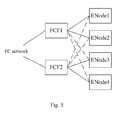
- virtual links (as shown by solid lines between ENodes 1-2 and FCF1 in Fig. 5 ) are established between ENodes 1-2 and FCF1 according to the process shown in Fig. 4 , and ENodes 1-2 access an FC network via the virtual links to FCF1; virtual links (as shown by solid lines between ENodes 3-4 and FCF2 in Fig. 5 ) are established between ENodes 3-4 and FCF2 according to the process shown in Fig. 4 , and ENodes 3-4 access the FC network via the virtual links to FCF2.
- ENodes 1-2 When a fault occurs in FCF1, ENodes 1-2 can be directly switched to FCF2 serving as a backup according to the accessible FCF lists they have maintained, and establish virtual links to FCF2 (as shown by dashed lines between ENodes 1-2 and FCF2 in Fig. 5 ), and access the FC network again through the virtual links to FCF2.
- ENodes 3-4 When a fault occurs in FCF2, ENodes 3-4 can be directly switched to FCF1 serving as a backup according to the accessible FCF lists they have maintained, and establish virtual links to FCF1 (as shown by dashed lines between ENodes 3-4 and FCF1 in Fig. 5 ), and access the FC network again through the virtual links to FCF2.
Landscapes
- Engineering & Computer Science (AREA)
- Computer Security & Cryptography (AREA)
- Computer Networks & Wireless Communication (AREA)
- Signal Processing (AREA)
- Data Exchanges In Wide-Area Networks (AREA)
Abstract
Description
- The present invention relates to a control technique of a Fibre Channel over Ethernet (FCoE) protocol and, in particular, relates to a control method of virtual link discovery in an FCoE system, and an FCoE system.
- An FCoE technique is a technique that operates a Fibre Channel (FC) protocol family based on an Ethernet. In an FCoE system, an Ethernet node (ENode) such as a server, a storage device and the like may be connected to an Ethernet interface of an FCoE Forwarder (FCF), which in turn is connected to an FC network via an FC interface of the FCF.
- Specifically, referring to
Fig. 1 , between each ENode and an FCF connected thereto, there is not only a physical link between Ethernet interfaces in an Ethernet layer, but also a virtual logic link between a Virtual Node (VN) port and a Virtual Fibre Channel (VFC) port in an FC layer, which is called a virtual link for short, namely, a logic connection formed by the VN port ->the Ethernet interface of the ENode ->the Ethernet interface of the FCF ->the VFC port. - Referring to
Fig. 2 , a process of virtual link discovery between an ENode and an FCF may be realized through FCoE Initialization Protocol (FIP) messages, which specifically comprises the following steps. - Step 201: the ENode sends, via its VN port, an FIP Discovery Solicitation message to a VFC port of an FCF that has the highest priority or whose forwarder name has the largest value among all of FCFs.
- Step 202: the FCF checks an address mode of the ENode.
- Step 203: the FCF returns, via its VFC port, an FIP Discovery Advertisement message to the VN port of the ENode after the address mode check of the ENode is passed.
- Step 204: the ENode checks a maximum size (MAX size) of the Discovery Advertisement message and obtains a physical (MAC) address of the FCF.
- Step 205: the ENode sends, via its VN port, a Virtual Link Instantiation Request message carrying a Fabric Login (FLOGI) message to the VFC port of the FCF after the MAX size check is passed.
- Step 206: the FCF activates the VFC port according to the FLOGI message carried in the Virtual Link Instantiation Request message.
- Step 207: the FCF determines whether a login of the VN port of the ENode is allowed, and replies a Virtual Link Instantiation Reply message carrying a login response (LS_ACC) message to the VN port of the ENode if the login of the VN port of the ENode is allowed.
- Step 208: the ENode activates the VN port that has logged into the VFC port of the FCF according to the LS_ACC message carried in the Virtual Link Instantiation Reply message, so that a virtual link between this VN port and the VFC port of the FCF is established.
- So far, the process of virtual link discovery ends.
- Thus, in addition to having such advantages as I/O integration and network uniformity, the FCoE system based on virtual links can change an FC network topology substantively by arbitrarily establishing different virtual links between FCFs and ENodes.
- Referring to
Fig. 3 , suppose that there are two FCFs and four ENodes, virtual links (as shown by solid lines inFig. 3 ) are established between each of ENodes 1-4 and FCF1 according to the process shown inFig. 2 , and ENodes 1-4 access an FC network through the virtual links to FCF1. When a fault occurs in FCF1, ENodes 1-4 can switch to FCF2 serving as a backup and establish virtual links to FCF2 (as shown by dashed lines inFig. 3 ), and can access the FC network again through the virtual links to FCF2, so that link backup for the FC network topology is realized and hence network reliability is improved. - However, in the existing networking ways by which the link backup for the FC network topology is realized, all the ENodes will access the same FCF that has the highest priority or whose forwarder name has the largest value upon discovery of a virtual link according to the process shown in
Fig. 2 . That is, instep 201, all the ENodes can only send the Discovery Solicitation messages to the same specified FCF that has the highest priority or whose forwarder name has the largest value according to such predefined information as the priority of the FCF or the forwarder name. As a result, all the ENodes access the same FCF, such as FCF 1 inFig. 3 , while other FCFs serving as backups, such as FCF2 inFig. 3 , may remain in an idle state for a long time. - In this case, the FCF that all the ENodes access may have message congestion, while the FCFs serving as backups are wasted in resource. Furthermore, during the switching to the backup, each of the ENodes has to perform the process of virtual link discovery as shown in
Fig. 2 , so that an efficiency of switching the virtual links is low. - In view of the above, the present invention provides a control method of virtual link discovery in an FCoE system as well as an FCoE system, which can reduce message congestion and increase resource utilization rate.
- A control method of virtual link discovery in an FCoE system provided by the present invention is applied between Ethernet Nodes ENodes and FCoE Forwarders FCFs, wherein some of the ENodes and the FCFs are allocated to different virtual networks, a Virtual Node VN port of each ENode and a Virtual Fibre Channel VFC port of each FCF are provided respectively with a Virtual Network Identification VN ID of a virtual network to which they belong, and the control method comprises the following steps:
- a1: an ENode sending, via its VN port, an FCoE Initialization Protocol FIP Discovery Solicitation message to the VFC port of each FCF, the FIP Discovery Solicitation message carrying the VN ID of the VN port;
- a2: the ENode receiving, via its VN port, an FIP Discovery Advertisement message replied by the VFC port of each FCF, the FIP Discovery Advertisement message carrying the VN ID of the VFC port;
- a3: the ENode matching the VN ID of its VN port with the VN ID carried in each of the FIP Discovery Advertisement messages, and logging into the VFC port corresponding to the matched VN ID in preference, so that a virtual link is established between the VN port of the ENode and the VFC port.
- Step a2 further comprises adding, by the ENode, all of the FCFs that reply the FIP Discovery Advertisement message, to an accessible FCF list it has maintained.
- After step a3, there is a further step of re-initiating, by the ENode, a login of the VN port to a VFC port of any FCF in the accessible FCF list it has maintained when a fault occurs in an FCF where a VFC port connected to the VN port of the ENode is located.
- Step a1 further comprises triggering a timer corresponding to the VN port, which represents a collection time.
- The method further comprises, when timing of the timer expires, ending step a2 and performing step a3.
- All types of FIP messages including the FIP Discovery Solicitation message and the FIP Discovery Advertisement message carry the VN ID in a reserved field of their message header.
- Step a3 further comprises, when there is no matched VN ID, initiating a login to a VFC port whose default value indicates that the reserved field does not carry anything.
- A further control method of virtual link discovery in an FCoE system provided by the present invention is applied between Ethernet Nodes ENodes and FCoE Forwarders FCFs, wherein some of the ENodes and the FCFs are allocated to different virtual networks, a Virtual Node VN port of each ENode and a Virtual Fibre Channel VFC port of each FCF are provided respectively with a Virtual Network Identification VN ID of a virtual network to which they belong, and the control method comprises the following steps:
- b1: an FCF receiving, via its VFC port, an FCoE Initialization Protocol FIP Discovery Solicitation message sent by the VN port of each ENode, the FIP Discovery Solicitation message carrying the VN ID of the VN port;
- b2: the FCF replying, via its VFC port, an FIP Discovery Advertisement message to the VN port of each ENode, the FIP Discovery Advertisement message carrying the VN ID of the VFC port so that an ENode belonging to the same virtual network as the FCF logs into the VFC port of the FCF in preference and a virtual link is established between a VN port of the ENode and the VFC port.
- All types of FIP messages including the FIP Discovery Solicitation message and the FIP Discovery Advertisement message carry the VN ID in a reserved field of their message header.
- An FCoE system provided by the present invention comprises Ethernet Nodes ENodes having Virtual Node VN ports and FCoE Forwarders FCFs having Virtual Fibre Channel VFC ports,
some of the ENodes and the FCFs being allocated to different virtual networks, a VN port and a VFC port of each ENode and each FCF belonging to each virtual network are provided respectively with a Virtual Network Identification VN ID of the virtual network;
each ENode sending an FCoE Initialization Protocol FIP Discovery Solicitation message to the VFC port of each FCF and receiving an FIP Discovery Advertisement message replied by the VFC port of each FCF via its VN port, the FIP Discovery Solicitation message carrying the VN ID of the VN port, the FIP Discovery Advertisement message carrying the VN ID of the corresponding VFC port; matching the VN ID of its VN port with the VN ID carried in each of the FIP Discovery Advertisement messages, and logging into the VFC port corresponding to the matched VN ID in preference, so that a - virtual link is established between the VN port of the ENode and the VFC port;
each FCF receiving the FIP Discovery Solicitation message sent by the VN port of each ENode and replying the FIP Discovery Advertisement message to the VN port of each ENode via its VFC port, the FIP Discovery Advertisement message carrying the VN ID of the VFC port. - Each ENode is further used for adding all of the FCFs that reply the FIP Discovery Advertisement message to, an accessible FCF list it has maintained, so that a login can be initiated to a VFC port of any FCF in the accessible FCF list when a fault occurs in an FCF where a VFC port connected to the VN port of the ENode is located.
- Each ENode is further used for triggering a timer corresponding to its VN port that represents a collection time when sending the Discovery Solicitation message via its VN port, and starting to perform the matching when timing of the timer expires.
- All types of FIP messages including the FIP Discovery Solicitation message and the FIP Discovery Advertisement message carry the VN ID in a reserved field of their message header.
- Each ENode is further used for initiating a login to a VFC port whose VN ID value is a default value indicating that the reserved field does not carry anything when there is no matched VN ID.
- It can be seen from the above technical solutions that the present invention allocates some of the ENodes and the FCFs to different virtual networks during networking, so that VN ports and VFC ports of some of the ENodes and the FCFs belong to different virtual networks and have VN IDs of the virtual networks to which they belong. In this way, the VN ports of the ENodes exchange the VN IDs with the VFC ports of FCFs, so that the VN port of each ENode can establish a virtual link with a VFC port belonging to the same VN in preference. In this case, some ENodes access FCFs that belong to the same virtual network as the ENodes, thereby avoiding accessing the same FCF at the same time by all the ENodes. Hence, a possibility of message congestion in FCF is reduced, and a possibility of resource waste due to long time idling of one or more FCFs is also reduced.
- As a further alternative, the ENode may add all of the FCFs replying the FIP Discovery Advertisement message, to the accessible FCF list it has maintained. Thus, when a fault occurs in an FCF where a VFC port connected to the VN port of the ENode is located, in order to switch to other FCFs to realize backup, the ENode can directly initiate a VN port login to a VFC port of any FCF in the accessible FCF list it has maintained, thereby avoiding a repetitive exchange of the Discovery Solicitation message and the Discovery Advertisement message with other FCFs serving as backups and hence increasing an efficiency of the switching to the backup.
- In addition, the present invention can carry the VN ID using the reserved field in message header of all FIP messages in an FIP protocol family. Moreover, for an ENode and an FCF that do not support a virtual network, values of VN IDs of a VN port and a VFC port of the ENode and the FCF may take a default value of 0 indicating that the reserved fields do not carry anything, thereby improving compatibility of the present invention.
-
-
Fig. 1 is a schematic diagram of a virtual link in an existing FCoE system; -
Fig. 2 is a schematic diagram of a process of virtual link discovery in an existing FCoE system; -
Fig. 3 is a schematic diagram of an example for realizing link backup for an FC network topology in an existing FCoE system; -
Fig. 4 is a schematic diagram of a process of virtual link discovery in an FCoE system according to an embodiment of the present invention; -
Fig. 5 is a schematic diagram of an example for realizing link backup for an FC network topology in an FCoE system according to an embodiment of the present invention. - The present invention is described in further detail below with reference to the accompanying drawings and in conjunction with embodiments so as to make objects, technical solutions and advantages thereof clearer.
- In an embodiment of the present invention, some ENodes and FCFs are allocated to different virtual networks during networking, so that some VN ports belong to virtual networks of the ENodes where they are located and have virtual network IDs (VN IDs) of the virtual networks, and some VFC ports belong to virtual networks of the FCFs where they are located and have VN IDs of the virtual networks. Moreover, a VN port of an ENode can exchange VN IDs with VFC ports of a plurality of FCFs and can establish in preference virtual links with VFC ports that belong to the same virtual network.
- In this case, for the VN port and the VFC port belonging to the same virtual network, their respective ENode and FCF must belong to the same virtual network. Hence, ENodes in each virtual network can be made to access FCFs in the same virtual network so as to avoid accessing the same FCF at the same time by all the ENodes, which reduces a possibility of message congestion in the FCF. Besides, since FCFs in each virtual network may be accessed by ENodes of the virtual network, a possibility of resource waste caused by long time idling of one or more FCFs can be reduced.
-
Fig. 4 is a schematic diagram of a process of virtual link discovery in an FCoE system according to an embodiment of the present invention. As shown inFig. 4 , a process of interacting, by an ENode, with each FCF it may access is as follows. - Step 401: the ENode sends, via its VN port, an FIP Discovery Solicitation message to a VFC port of each FCF (only one FCF is shown in
Fig. 4 ), and carries a VN ID of the VN port in the FIP Discovery Solicitation message. - That is to say, in addition to the FCF shown in
Fig. 4 , the ENode in this step can send the FIP Discovery Solicitation message to other FCFs through its VN port. This is different from sending the FIP Discovery Solicitation message only to a VFC port of an FCF that has the highest priority or whose forwarder name has the largest value in the prior art. Thus, this step can be viewed as a process of detecting its accessible FCFs by the ENode. - Step 402: the FCF checks an address mode of the ENode.
- In a practical application, in addition to the ENode shown in
Fig. 4 , the FCF may receive FIP Discovery Solicitation messages sent by other ENodes and check address modes of the other ENodes. - Step 403: the FCF replies, via its VFC port, an FIP Discovery Advertisement message to the VN port of the ENode after the address mode check of the ENode is passed, and carries a VN ID of the VFC port in the FIP Discovery Advertisement message.
- Step 404: the ENode checks a MAX size of the FIP Discovery Advertisement message replied by a VFC port of each FCF (only one FCF is shown in
Fig. 4 ) and obtains an MAC address of the FCF, and then records the VN ID carried in the FIP Discovery Advertisement message. - That is to say, in addition to receiving the FIP Discovery Advertisement message replied by the VFC port of the FCF shown in
Fig. 4 , the VN port of the ENode in this step will receive FIP Discovery Advertisement messages replied by VFC ports of other FCFs at the same time. Thus, this step can be viewed as a process of collecting the accessible FCFs by the ENode. - In addition, in this step, the ENode may further add the collected accessible FCFs, i.e. FCFs where VFC ports corresponding to VN IDs carried in the FIP Discovery Advertisement messages are located, to an accessible FCF list it has maintained, so that when a fault occurs in a subsequently connected FCF, any FCF in the accessible FCF list can be used as a backup and a switching to the backup can be realized through initiating a login to a VFC port of the backup FCF. In this case, during the switching to the backup, the processing of
step 401 to this step 404 may be skipped to directly initiate a login of the VN port according to the subsequent steps, thereby increasing an efficiency of the switching to the backup. - In a practical application, a timer can be provided for each VN port, which represents a collection time. When sending the Discovery Solicitation message through the VN port in
step 401, the ENode further triggers a timer corresponding to the VN port. The collection performed in this step 404 is ended when timing of the timer expires, and moves to thesubsequent step 405. - Step 405: the ENode matches the VN ID of its VN port with the VN ID carried in each of the FIP Discovery Advertisement messages it has recorded, and, when there is a matched VN ID, confirms that the VN port belong to the same VN as a VFC port corresponding to the VN ID, and then performs
step 406. - Step 406: the ENode sends, via its VN port, an FIP Virtual Link Instantiation Request message carrying an FLOGI message to the VFC port corresponding to the matched VN ID so as to log into the VFC port of the matched VN ID.
- Step 407: the FCF activates the VFC port according to the FLOGI message carried in the FIP Virtual Link Instantiation Request message.
- Step 408: the FCF determines whether the VN port of the ENode is allowed to log in, and replies an FIP Virtual Link Instantiation Reply message carrying an LS_ACC message to the VN port of the ENode if the VN port of the ENode is allowed to log in.
- Step 409: the ENode activates the VN port that has logged into the VFC port so that a virtual link is established between the VN port and the VFC port.
- It should be noted again that the processing in steps 406-408 of
Fig. 4 concerns only the FCF where one VFC port matching the VN ID is located, while the processing in steps 401-403 ofFig. 4 concerns all the accessible FCFs. - So far, the process of virtual link discovery ends.
- In the control method of virtual link discovery in this embodiment, in order to facilitate carrying of the VN ID in the FIP Discovery Solicitation message and the FIP Discovery Advertisement message, preferably, the VN ID is carried in a reserved field in a message header of an FIP protocol family. In this case, after discovery and establishment of a virtual link between the ENode and the FCF, message headers of an FIP Non-Discovery Advertisement message, an FIP Keep Alive (FKA) message, and other various types of FIP messages used during interaction will also carry the VN ID. That is to say, all types of FIP messages in the FIP protocol family will carry the VN ID.
- In addition, when allocating the ENodes and the FCFs to different virtual networks, there might be some ENodes and FCFs that do not support a virtual network. Values of VN IDs of VN ports and VFC ports of the ENodes and the FCFs that do not support the virtual network may be set to a default value of 0 indicating that the above-mentioned reserved field does not carry anything. Of course, values of VN IDs of VN ports and VFC ports of ENodes and FCFs that support the virtual network may be a default value of 0 before a they are set.
- Thus, if no matched VN ID is found in
step 405, it means that there is no VFC port that belongs to the same virtual network as the VN port. This may be because a fault occurs in the FCF in the same virtual network or because the ENode where the VN port is located does not support the virtual network, or because neither the ENode where the VN port is located nor the FCF in the same virtual network is set. However, no matter what the reason is, the VN port may initiate a login to any VFC port whose VN ID has a default value of 0, so that ENodes and FCFs under all circumstances are compatible. - That is to say, when there are ENodes and FCFs under all circumstances that are to be compatible, the VN ID of the VFC port connected to the VN port via a virtual link may be different from the VN ID previously collected by the VN port.
- The above is the detailed description of the control method of virtual link discovery in this embodiment. Now an FCoE system that may realize virtual link discovery in this embodiment will be described in detail.
- The FCoE system of this embodiment comprises ENodes having VN ports and FCFs having VFC ports, wherein some of the ENodes and the FCFs are allocated to different virtual networks. Accordingly, a VN port of an ENode belonging to each virtual network has a VN ID of the virtual network, and a VFC port of an FCF belonging to each virtual network has a VN ID of the virtual network.
- Each ENode is used for sending, via its VN port, an FIP Discovery Solicitation message to a VFC port of each FCF, instead of sending the FIP Discovery Solicitation message only to an FCF that has the highest priority or whose forwarder name has the largest value. Moreover, in this embodiment, the FIP Discovery Solicitation message sent by the ENode via its VN port also carries the VN ID of the VN port.
- Each FCF is used for replying, via its VFC port, an FIP Discovery Advertisement message to the VN port of the ENode after the address mode check of the ENode is passed, and the replied FIP Discovery Advertisement message carries the VN ID of the VFC port.
- Besides, each ENode is also used for checking a MAX size of the FIP Discovery Advertisement message replied by the VFC port of each FCF, obtaining an MAC address of the FCF, and then recording the VN ID carried in the FIP Discovery Advertisement message to realize collection of the accessible FCFs, and then matching the VN ID of its VN port with the VN ID carried in each of the recorded FIP Discovery Advertisement messages, and logging into the VFC port corresponding to the matched VN ID in preference by using an FIP Virtual Link Instantiation Request message carrying an FLOGI message, so that a virtual link is established between the VN port of the ENode and the VFC port after the VN port of the ENode receives an FIP Virtual Link Instantiation Reply message carrying an LS_ACC message replied by the VFC port of the FCF after allowing a login of the VN port.
- To increase an efficiency of the switching to the backup, each ENode may be further used for adding all of the FCFs that reply the FIP Discovery Advertisement message to an accessible FCF list it has maintained, so that a login can be initiated to a VFC port of any FCF in the accessible FCF list when a fault occurs in an FCF where a VFC port connected to its VN port is located. Moreover, in order to control time of collecting the accessible FCFs, each ENode may be further used for, when sending the Discovery Solicitation message via its VN port, triggering a timer corresponding to the VN port, and starting to perform the matching when timing of the timer expires.
- In order to facilitate carrying of the VN ID in the FIP Discovery Solicitation message and the FIP Discovery Advertisement message, preferably, the VN ID is carried in a reserved field in a message header of an FIP protocol family. In this case, after discovery and establishment of a virtual link between the ENode and the FCF, message headers of an FIP Non-Discovery Advertisement message, an FIP Keep Alive (FKA) message, and other various types of FIP messages used during interaction will also carry the VN ID. That is to say, all types of FIP messages in the FIP protocol family will carry the VN ID.
- In addition, when allocating the ENodes and the FCFs to different virtual networks, there might be some ENodes and FCFs that do not support a virtual network. Values of VN IDs of VN ports and VFC ports of the ENodes and FCFs that do not support the virtual network may be set to a default value of 0 indicating that the above-mentioned reserved field does not carry anything. Of course, values of VN IDs of VN ports and VFC ports of ENodes and FCFs that support the virtual network may be a default value of 0 before they are set. Thus, if no matched VN ID is found by the ENode, it means that there is no VFC port that belongs to the same virtual network as the VN port. This may be because a fault occurs in the FCF in the same virtual network or because the ENode where the VN port is located does not support the virtual network, or because neither the ENode where the VN port is located nor the FCF in the same virtual network is set. However, no matter what the reason is, the ENode can initiate, through the VN port, a login to any VFC port whose VN ID has a default value of 0, so that ENodes and FCFs under all circumstances are compatible. That is to say, when there are ENodes and FCFs under all circumstances that are to be compatible, the VN ID of the VFC port connected to the VN port of the ENode via a virtual link may be different from the VN ID previously collected for the VN port by the ENode.
- The technical solution in this embodiment can still realize link backup for the FC network topology by setting different virtual links between FCFs and ENodes. Referring to
Fig. 5 , suppose again that there are two FCFs and four ENodes, virtual links (as shown by solid lines between ENodes 1-2 and FCF1 inFig. 5 ) are established between ENodes 1-2 and FCF1 according to the process shown inFig. 4 , and ENodes 1-2 access an FC network via the virtual links to FCF1; virtual links (as shown by solid lines between ENodes 3-4 and FCF2 inFig. 5 ) are established between ENodes 3-4 and FCF2 according to the process shown inFig. 4 , and ENodes 3-4 access the FC network via the virtual links to FCF2. In this way, neither FCF1 norFCF 2 is accessed by all of ENodes 1-4, and neither of them is idle. Compared to the existing mode shown inFig. 3 , this reduces a possibility of message congestion in FCF and reduces a possibility of resource waste caused by long time idling of one or more FCFs. - When a fault occurs in FCF1, ENodes 1-2 can be directly switched to FCF2 serving as a backup according to the accessible FCF lists they have maintained, and establish virtual links to FCF2 (as shown by dashed lines between ENodes 1-2 and FCF2 in
Fig. 5 ), and access the FC network again through the virtual links to FCF2. When a fault occurs in FCF2, ENodes 3-4 can be directly switched to FCF1 serving as a backup according to the accessible FCF lists they have maintained, and establish virtual links to FCF1 (as shown by dashed lines between ENodes 3-4 and FCF1 inFig. 5 ), and access the FC network again through the virtual links to FCF2. Thus, a repetitive exchange of the FIP Discovery Solicitation message and the FIP Discovery Advertisement message as well as such a process as the address mode check can be avoided during the switching, thereby increasing an efficiency of the switching to the backup. - The above are only the preferred embodiments of the present invention and do not intend to limit a protection scope of the present invention. Any modification, equivalent substitution and improvement made within the spirit and principle of the present invention shall be included in the protection scope of the present invention.
Claims (12)
- A control method of virtual link discovery in a Fibre Channel over Ethernet FCoE protocol system, the method being applied between Ethernet Nodes ENodes and FCoE Forwarders FCFs, wherein some of the ENodes and the FCFs are allocated to different virtual networks, a Virtual Node VN port of each ENode and a Virtual Fibre Channel VFC port of each FCF are provided respectively with a Virtual Network Identification VN ID of a virtual network to which they belong, and the control method comprises the following steps:a1: an ENode sending, via its VN port, an FCoE Initialization Protocol FIP Discovery Solicitation message to the VFC port of each FCF, the FIP Discovery Solicitation message carrying the VN ID of the VN port;a2: the ENode receiving, via its VN port, an FIP Discovery Advertisement message replied by the VFC port of each FCF, the FIP Discovery Advertisement message carrying the VN ID of the VFC port;a3: the ENode matching the VN ID of its VN port with the VN ID carried in each of the FIP Discovery Advertisement messages, and logging into the VFC port corresponding to the matched VN ID in preference, so that a virtual link is established between the VN port of the ENode and the VFC port.
- The control method according to claim 1, characterized in that step a2 further comprises adding, by the ENode, all of the FCFs that reply the FIP Discovery Advertisement message, to an accessible FCF list it has maintained;
after step a3, there is a further step of re-initiating, by the ENode, a login of the VN port to a VFC port of any FCF in the accessible FCF list it has maintained when a fault occurs in an FCF where a VFC port connected to the VN port of the ENode is located. - The control method according to claim 2, characterized in that step a1 further comprises triggering a timer corresponding to the VN port, which represents a collection time;
the method further comprises, when timing of the timer expires, ending step a2 and performing step a3. - The control method according to any of claims 1-3, characterized in that all types of FIP messages including the FIP Discovery Solicitation message and the FIP Discovery Advertisement message carry the VN ID in a reserved field of their message header.
- The control method according to claim 4, characterized in that step a3 further comprises, when there is no matched VN ID, initiating a login to a VFC port whose default value indicates that the reserved field does not carry anything.
- A control method of virtual link discovery in a Fibre Channel over Ethernet FCoE protocol system, the method being applied between Ethernet Nodes ENodes and FCoE Forwarders FCFs, wherein some of the ENodes and the FCFs are allocated to different virtual networks, a Virtual Node VN port of each ENode and a Virtual Fibre Channel VFC port of each FCF are provided respectively with a Virtual Network Identification VN ID of a virtual network to which they belong, and the control method comprises the following steps:b1: the FCF receiving, via its VFC port, an FCoE Initialization Protocol FIP Discovery Solicitation message sent by the VN port of each ENode, the FIP Discovery Solicitation message carrying the VN ID of the VN port;b2: the FCF replying, via its VFC port, an FIP Discovery Advertisement message to the VN port of each ENode, the FIP Discovery Advertisement message carrying the VN ID of the VFC port, so that an ENode belonging to the same virtual network as the FCF logs into the VFC port of the FCF in preference and a virtual link is established between the VN port of the ENode and the VFC port.
- The control method according to claim 6, characterized in that all types of FIP messages including the FIP Discovery Solicitation message and the FIP Discovery Advertisement message carry the VN ID in a reserved field of their message header.
- A Fibre Channel over Ethernet FCoE system comprising Ethernet Nodes ENodes having Virtual Node VN ports and FCoE Forwarders FCFs having Virtual Fibre Channel VFC ports,
characterized in that some of the ENodes and the FCFs are allocated to different virtual networks, a VN port and a VFC port of each ENode and each FCF belonging to each virtual network are provided respectively with a Virtual Network Identification VN ID of the virtual network;
each ENode sending an FCoE Initialization Protocol FIP Discovery Solicitation message to the VFC port of each FCF and receives an FIP Discovery Advertisement message replied by the VFC port of each FCF via its VN port, the FIP Discovery Solicitation message carrying the VN ID of the VN port, the FIP Discovery Advertisement message carrying the VN ID of the corresponding VFC port; matching the VN ID of its VN port with the VN ID carried in each of the FIP Discovery Advertisement messages, and logging into the VFC port corresponding to the matched VN ID in preference, so that a virtual link is established between the VN port of the ENode and the VFC port;
each FCF receiving the FIP Discovery Solicitation message sent by the VN port of each ENode and replying the FIP Discovery Advertisement message to the VN port of each ENode via its VFC port, the FIP Discovery Advertisement message carrying the VN ID of the VFC port. - The system according to claim 8, characterized in that each ENode is further used for adding all of the FCFs that reply the FIP Discovery Advertisement message, to an accessible FCF list it has maintained, so that a login can be initiated to a VFC port of any FCF in the accessible FCF list when a fault occurs in an FCF where a VFC port connected to the VN port of the ENode is located.
- The system according to claim 9, characterized in that each ENode is further used for triggering a timer corresponding to its VN port that represents a collection time when sending the Discovery Solicitation message via its VN port, and starting to perform the matching when timing of the timer expires.
- The system according to any of claims 8-10, characterized in that all types of FIP messages including the FIP Discovery Solicitation message and the FIP Discovery Advertisement message carry the VN ID in a reserved field of their message header.
- The system according to claim 11, characterized in that each ENode is further used for initiating a login to a VFC port whose VN ID value is a default value indicating that the reserved field does not carry anything when there is no matched VN ID.
Applications Claiming Priority (2)
| Application Number | Priority Date | Filing Date | Title |
|---|---|---|---|
| CN 200910236061 CN102045248B (en) | 2009-10-19 | 2009-10-19 | Virtual link discovery control method and Ethernet-bearing fiber channel protocol system |
| PCT/CN2010/077826 WO2011047612A1 (en) | 2009-10-19 | 2010-10-18 | Method for virtual link discovery control and system for fibre channel over ethernet protocol |
Publications (3)
| Publication Number | Publication Date |
|---|---|
| EP2493127A1 true EP2493127A1 (en) | 2012-08-29 |
| EP2493127A4 EP2493127A4 (en) | 2014-01-08 |
| EP2493127B1 EP2493127B1 (en) | 2015-03-04 |
Family
ID=43899830
Family Applications (1)
| Application Number | Title | Priority Date | Filing Date |
|---|---|---|---|
| EP10824453.4A Active EP2493127B1 (en) | 2009-10-19 | 2010-10-18 | Method for virtual link discovery control and system for fibre channel over ethernet protocol |
Country Status (4)
| Country | Link |
|---|---|
| US (1) | US8929368B2 (en) |
| EP (1) | EP2493127B1 (en) |
| CN (1) | CN102045248B (en) |
| WO (1) | WO2011047612A1 (en) |
Families Citing this family (17)
| Publication number | Priority date | Publication date | Assignee | Title |
|---|---|---|---|---|
| US8625597B2 (en) | 2011-01-07 | 2014-01-07 | Jeda Networks, Inc. | Methods, systems and apparatus for the interconnection of fibre channel over ethernet devices |
| US9106579B2 (en) | 2011-01-07 | 2015-08-11 | Jeda Networks, Inc. | Methods, systems and apparatus for utilizing an iSNS server in a network of fibre channel over ethernet devices |
| US9071629B2 (en) | 2011-01-07 | 2015-06-30 | Jeda Networks, Inc. | Methods for the interconnection of fibre channel over ethernet devices using shortest path bridging |
| US8559335B2 (en) * | 2011-01-07 | 2013-10-15 | Jeda Networks, Inc. | Methods for creating virtual links between fibre channel over ethernet nodes for converged network adapters |
| US9178944B2 (en) * | 2011-01-07 | 2015-11-03 | Jeda Networks, Inc. | Methods, systems and apparatus for the control of interconnection of fibre channel over ethernet devices |
| US8811399B2 (en) | 2011-01-07 | 2014-08-19 | Jeda Networks, Inc. | Methods, systems and apparatus for the interconnection of fibre channel over ethernet devices using a fibre channel over ethernet interconnection apparatus controller |
| US8559433B2 (en) | 2011-01-07 | 2013-10-15 | Jeda Networks, Inc. | Methods, systems and apparatus for the servicing of fibre channel fabric login frames |
| US9071630B2 (en) | 2011-01-07 | 2015-06-30 | Jeda Networks, Inc. | Methods for the interconnection of fibre channel over ethernet devices using a trill network |
| CN102611952B (en) | 2012-03-29 | 2015-04-01 | 杭州华三通信技术有限公司 | Method and device for realizing port consultation between fabric channel over Ethernet (FCoE) forwarders |
| US9143567B2 (en) * | 2012-06-27 | 2015-09-22 | International Business Machines Corporation | Gateway device to connect native fibre channel ports to pure fibre channel over ethernet storage area networks |
| CN102752214B (en) * | 2012-07-12 | 2015-12-16 | 杭州华三通信技术有限公司 | For the method and apparatus suppressing same link to conflict |
| CN103580980B (en) * | 2012-07-24 | 2019-05-24 | 中兴通讯股份有限公司 | Method and device for automatic discovery and automatic configuration of virtual network |
| US8804708B1 (en) * | 2012-12-21 | 2014-08-12 | Juniper Networks, Inc. | Methods and apparatus for implementing access control at a network switch |
| CN103607321B (en) * | 2013-11-18 | 2016-08-31 | 华中科技大学 | A kind of FCoE virtual link fault detection method |
| CN105471692B (en) * | 2014-07-29 | 2019-02-01 | 华为技术有限公司 | A method and device for network interworking |
| CN104301231B (en) * | 2014-10-15 | 2018-03-20 | 武汉烽火网络有限责任公司 | Virtual link management method and a kind of FIP interchangers in a kind of FCoE network |
| CN113810439B (en) * | 2020-06-12 | 2023-02-03 | 华为技术有限公司 | Ethernet storage system and information notification method and related device thereof |
Family Cites Families (4)
| Publication number | Priority date | Publication date | Assignee | Title |
|---|---|---|---|---|
| CN101040489B (en) | 2004-10-22 | 2012-12-05 | 思科技术公司 | Network device architecture for consolidating input/output and reducing latency |
| US8661518B2 (en) * | 2007-06-13 | 2014-02-25 | Cisco Technology, Inc. | N-port ID virtualization (NPIV) proxy module, NPIV proxy switching system and methods |
| US8108454B2 (en) * | 2007-12-17 | 2012-01-31 | Brocade Communications Systems, Inc. | Address assignment in Fibre Channel over Ethernet environments |
| US8817656B2 (en) * | 2008-04-08 | 2014-08-26 | Cisco Technology, Inc. | Discovery for fibre channel over ethernet devices |
-
2009
- 2009-10-19 CN CN 200910236061 patent/CN102045248B/en active Active
-
2010
- 2010-10-18 US US13/387,067 patent/US8929368B2/en active Active
- 2010-10-18 EP EP10824453.4A patent/EP2493127B1/en active Active
- 2010-10-18 WO PCT/CN2010/077826 patent/WO2011047612A1/en not_active Ceased
Also Published As
| Publication number | Publication date |
|---|---|
| US8929368B2 (en) | 2015-01-06 |
| CN102045248B (en) | 2012-05-23 |
| WO2011047612A1 (en) | 2011-04-28 |
| US20120195188A1 (en) | 2012-08-02 |
| EP2493127B1 (en) | 2015-03-04 |
| CN102045248A (en) | 2011-05-04 |
| EP2493127A4 (en) | 2014-01-08 |
Similar Documents
| Publication | Publication Date | Title |
|---|---|---|
| US8929368B2 (en) | Control method of virtual link discovery and system for fibre channel over ethernet protocol | |
| EP2224645B1 (en) | A method and equipment for transmitting a message based on the layer-2 tunnel protocol | |
| US8108454B2 (en) | Address assignment in Fibre Channel over Ethernet environments | |
| JP7634561B2 (en) | MESSAGE PROCESSING METHOD AND APPARATUS, NOTIFICATION METHOD AND APPARATUS, NETWORK BRIDGE NODE, SOURCE DEVICE, STORAGE MEDIUM AND MESSAGE PROCESSING SYSTEM | |
| US8264985B2 (en) | Locally unique node port identifiers | |
| US9438679B2 (en) | Method, apparatus, name server and system for establishing FCOE communication connection | |
| US20140344444A1 (en) | Recovery of Dynamic Host Configuration Protocol IP Addresses | |
| EP2493117A1 (en) | Method, apparatus and system for duplicate address detection proxy | |
| US7408882B2 (en) | Automatic discovery of network node addresses | |
| WO2018058677A1 (en) | Message processing method, computing device, and message processing apparatus | |
| CN107257291B (en) | Network equipment data interaction method and system | |
| US7707312B2 (en) | Printer discovery protocol system and method | |
| CA2774281C (en) | User access method, system, access server, and access device | |
| WO2018010616A1 (en) | Link layer based network management | |
| WO2009021424A1 (en) | A device and method for handling messages | |
| CN103685007B (en) | A kind of mac learning method when edge device message forwards and edge device | |
| CN102647338B (en) | Network communication method and equipment | |
| CN107566262A (en) | Message forwarding method and device in virtual expansible LAN VXLAN | |
| US7653769B2 (en) | Management of devices connected to infiniband ports | |
| CN113746574B (en) | Information interaction method, system and equipment | |
| CN103812707B (en) | A kind of method for processing forwarding of line identification message | |
| EP4170972A1 (en) | Message forwarding method, device and system | |
| CN114024725A (en) | Inter-container communication method, system, electronic equipment and storage medium | |
| CN102045240B (en) | Routing conversion and device | |
| CN101873250A (en) | Data forwarding method and device |
Legal Events
| Date | Code | Title | Description |
|---|---|---|---|
| PUAI | Public reference made under article 153(3) epc to a published international application that has entered the european phase |
Free format text: ORIGINAL CODE: 0009012 |
|
| 17P | Request for examination filed |
Effective date: 20120124 |
|
| AK | Designated contracting states |
Kind code of ref document: A1 Designated state(s): AL AT BE BG CH CY CZ DE DK EE ES FI FR GB GR HR HU IE IS IT LI LT LU LV MC MK MT NL NO PL PT RO RS SE SI SK SM TR |
|
| DAX | Request for extension of the european patent (deleted) | ||
| A4 | Supplementary search report drawn up and despatched |
Effective date: 20131205 |
|
| RIC1 | Information provided on ipc code assigned before grant |
Ipc: H04L 12/70 20130101AFI20131129BHEP Ipc: H04L 12/46 20060101ALN20131129BHEP |
|
| REG | Reference to a national code |
Ref country code: DE Ref legal event code: R079 Ref document number: 602010022932 Country of ref document: DE Free format text: PREVIOUS MAIN CLASS: H04L0012560000 Ipc: H04L0012700000 |
|
| RIC1 | Information provided on ipc code assigned before grant |
Ipc: H04L 12/70 20130101AFI20141027BHEP Ipc: H04L 12/46 20060101ALN20141027BHEP |
|
| GRAP | Despatch of communication of intention to grant a patent |
Free format text: ORIGINAL CODE: EPIDOSNIGR1 |
|
| RIC1 | Information provided on ipc code assigned before grant |
Ipc: H04L 12/70 20130101AFI20141124BHEP Ipc: H04L 12/46 20060101ALN20141124BHEP |
|
| INTG | Intention to grant announced |
Effective date: 20141217 |
|
| GRAS | Grant fee paid |
Free format text: ORIGINAL CODE: EPIDOSNIGR3 |
|
| GRAA | (expected) grant |
Free format text: ORIGINAL CODE: 0009210 |
|
| AK | Designated contracting states |
Kind code of ref document: B1 Designated state(s): AL AT BE BG CH CY CZ DE DK EE ES FI FR GB GR HR HU IE IS IT LI LT LU LV MC MK MT NL NO PL PT RO RS SE SI SK SM TR |
|
| REG | Reference to a national code |
Ref country code: GB Ref legal event code: FG4D |
|
| REG | Reference to a national code |
Ref country code: CH Ref legal event code: EP |
|
| REG | Reference to a national code |
Ref country code: IE Ref legal event code: FG4D |
|
| REG | Reference to a national code |
Ref country code: AT Ref legal event code: REF Ref document number: 714678 Country of ref document: AT Kind code of ref document: T Effective date: 20150415 |
|
| REG | Reference to a national code |
Ref country code: DE Ref legal event code: R096 Ref document number: 602010022932 Country of ref document: DE Effective date: 20150416 |
|
| REG | Reference to a national code |
Ref country code: AT Ref legal event code: MK05 Ref document number: 714678 Country of ref document: AT Kind code of ref document: T Effective date: 20150304 Ref country code: NL Ref legal event code: VDEP Effective date: 20150304 |
|
| PG25 | Lapsed in a contracting state [announced via postgrant information from national office to epo] |
Ref country code: FI Free format text: LAPSE BECAUSE OF FAILURE TO SUBMIT A TRANSLATION OF THE DESCRIPTION OR TO PAY THE FEE WITHIN THE PRESCRIBED TIME-LIMIT Effective date: 20150304 Ref country code: SE Free format text: LAPSE BECAUSE OF FAILURE TO SUBMIT A TRANSLATION OF THE DESCRIPTION OR TO PAY THE FEE WITHIN THE PRESCRIBED TIME-LIMIT Effective date: 20150304 Ref country code: LT Free format text: LAPSE BECAUSE OF FAILURE TO SUBMIT A TRANSLATION OF THE DESCRIPTION OR TO PAY THE FEE WITHIN THE PRESCRIBED TIME-LIMIT Effective date: 20150304 Ref country code: HR Free format text: LAPSE BECAUSE OF FAILURE TO SUBMIT A TRANSLATION OF THE DESCRIPTION OR TO PAY THE FEE WITHIN THE PRESCRIBED TIME-LIMIT Effective date: 20150304 Ref country code: NO Free format text: LAPSE BECAUSE OF FAILURE TO SUBMIT A TRANSLATION OF THE DESCRIPTION OR TO PAY THE FEE WITHIN THE PRESCRIBED TIME-LIMIT Effective date: 20150604 Ref country code: ES Free format text: LAPSE BECAUSE OF FAILURE TO SUBMIT A TRANSLATION OF THE DESCRIPTION OR TO PAY THE FEE WITHIN THE PRESCRIBED TIME-LIMIT Effective date: 20150304 |
|
| REG | Reference to a national code |
Ref country code: LT Ref legal event code: MG4D |
|
| PG25 | Lapsed in a contracting state [announced via postgrant information from national office to epo] |
Ref country code: LV Free format text: LAPSE BECAUSE OF FAILURE TO SUBMIT A TRANSLATION OF THE DESCRIPTION OR TO PAY THE FEE WITHIN THE PRESCRIBED TIME-LIMIT Effective date: 20150304 Ref country code: RS Free format text: LAPSE BECAUSE OF FAILURE TO SUBMIT A TRANSLATION OF THE DESCRIPTION OR TO PAY THE FEE WITHIN THE PRESCRIBED TIME-LIMIT Effective date: 20150304 Ref country code: AT Free format text: LAPSE BECAUSE OF FAILURE TO SUBMIT A TRANSLATION OF THE DESCRIPTION OR TO PAY THE FEE WITHIN THE PRESCRIBED TIME-LIMIT Effective date: 20150304 Ref country code: GR Free format text: LAPSE BECAUSE OF FAILURE TO SUBMIT A TRANSLATION OF THE DESCRIPTION OR TO PAY THE FEE WITHIN THE PRESCRIBED TIME-LIMIT Effective date: 20150605 |
|
| PG25 | Lapsed in a contracting state [announced via postgrant information from national office to epo] |
Ref country code: NL Free format text: LAPSE BECAUSE OF FAILURE TO SUBMIT A TRANSLATION OF THE DESCRIPTION OR TO PAY THE FEE WITHIN THE PRESCRIBED TIME-LIMIT Effective date: 20150304 |
|
| PG25 | Lapsed in a contracting state [announced via postgrant information from national office to epo] |
Ref country code: PT Free format text: LAPSE BECAUSE OF FAILURE TO SUBMIT A TRANSLATION OF THE DESCRIPTION OR TO PAY THE FEE WITHIN THE PRESCRIBED TIME-LIMIT Effective date: 20150706 Ref country code: RO Free format text: LAPSE BECAUSE OF FAILURE TO SUBMIT A TRANSLATION OF THE DESCRIPTION OR TO PAY THE FEE WITHIN THE PRESCRIBED TIME-LIMIT Effective date: 20150304 Ref country code: EE Free format text: LAPSE BECAUSE OF FAILURE TO SUBMIT A TRANSLATION OF THE DESCRIPTION OR TO PAY THE FEE WITHIN THE PRESCRIBED TIME-LIMIT Effective date: 20150304 Ref country code: SK Free format text: LAPSE BECAUSE OF FAILURE TO SUBMIT A TRANSLATION OF THE DESCRIPTION OR TO PAY THE FEE WITHIN THE PRESCRIBED TIME-LIMIT Effective date: 20150304 Ref country code: CZ Free format text: LAPSE BECAUSE OF FAILURE TO SUBMIT A TRANSLATION OF THE DESCRIPTION OR TO PAY THE FEE WITHIN THE PRESCRIBED TIME-LIMIT Effective date: 20150304 |
|
| PG25 | Lapsed in a contracting state [announced via postgrant information from national office to epo] |
Ref country code: IS Free format text: LAPSE BECAUSE OF FAILURE TO SUBMIT A TRANSLATION OF THE DESCRIPTION OR TO PAY THE FEE WITHIN THE PRESCRIBED TIME-LIMIT Effective date: 20150704 Ref country code: PL Free format text: LAPSE BECAUSE OF FAILURE TO SUBMIT A TRANSLATION OF THE DESCRIPTION OR TO PAY THE FEE WITHIN THE PRESCRIBED TIME-LIMIT Effective date: 20150304 |
|
| REG | Reference to a national code |
Ref country code: DE Ref legal event code: R097 Ref document number: 602010022932 Country of ref document: DE |
|
| PG25 | Lapsed in a contracting state [announced via postgrant information from national office to epo] |
Ref country code: IT Free format text: LAPSE BECAUSE OF FAILURE TO SUBMIT A TRANSLATION OF THE DESCRIPTION OR TO PAY THE FEE WITHIN THE PRESCRIBED TIME-LIMIT Effective date: 20150304 |
|
| PLBE | No opposition filed within time limit |
Free format text: ORIGINAL CODE: 0009261 |
|
| STAA | Information on the status of an ep patent application or granted ep patent |
Free format text: STATUS: NO OPPOSITION FILED WITHIN TIME LIMIT |
|
| PG25 | Lapsed in a contracting state [announced via postgrant information from national office to epo] |
Ref country code: DK Free format text: LAPSE BECAUSE OF FAILURE TO SUBMIT A TRANSLATION OF THE DESCRIPTION OR TO PAY THE FEE WITHIN THE PRESCRIBED TIME-LIMIT Effective date: 20150304 |
|
| 26N | No opposition filed |
Effective date: 20151207 |
|
| PG25 | Lapsed in a contracting state [announced via postgrant information from national office to epo] |
Ref country code: SI Free format text: LAPSE BECAUSE OF FAILURE TO SUBMIT A TRANSLATION OF THE DESCRIPTION OR TO PAY THE FEE WITHIN THE PRESCRIBED TIME-LIMIT Effective date: 20150304 |
|
| PG25 | Lapsed in a contracting state [announced via postgrant information from national office to epo] |
Ref country code: LU Free format text: LAPSE BECAUSE OF FAILURE TO SUBMIT A TRANSLATION OF THE DESCRIPTION OR TO PAY THE FEE WITHIN THE PRESCRIBED TIME-LIMIT Effective date: 20151018 |
|
| REG | Reference to a national code |
Ref country code: CH Ref legal event code: PL |
|
| PG25 | Lapsed in a contracting state [announced via postgrant information from national office to epo] |
Ref country code: MC Free format text: LAPSE BECAUSE OF FAILURE TO SUBMIT A TRANSLATION OF THE DESCRIPTION OR TO PAY THE FEE WITHIN THE PRESCRIBED TIME-LIMIT Effective date: 20150304 |
|
| REG | Reference to a national code |
Ref country code: IE Ref legal event code: MM4A |
|
| PG25 | Lapsed in a contracting state [announced via postgrant information from national office to epo] |
Ref country code: CH Free format text: LAPSE BECAUSE OF NON-PAYMENT OF DUE FEES Effective date: 20151031 Ref country code: LI Free format text: LAPSE BECAUSE OF NON-PAYMENT OF DUE FEES Effective date: 20151031 |
|
| REG | Reference to a national code |
Ref country code: FR Ref legal event code: ST Effective date: 20160630 |
|
| PG25 | Lapsed in a contracting state [announced via postgrant information from national office to epo] |
Ref country code: FR Free format text: LAPSE BECAUSE OF NON-PAYMENT OF DUE FEES Effective date: 20151102 Ref country code: BE Free format text: LAPSE BECAUSE OF FAILURE TO SUBMIT A TRANSLATION OF THE DESCRIPTION OR TO PAY THE FEE WITHIN THE PRESCRIBED TIME-LIMIT Effective date: 20150304 |
|
| PG25 | Lapsed in a contracting state [announced via postgrant information from national office to epo] |
Ref country code: IE Free format text: LAPSE BECAUSE OF NON-PAYMENT OF DUE FEES Effective date: 20151018 |
|
| PG25 | Lapsed in a contracting state [announced via postgrant information from national office to epo] |
Ref country code: HU Free format text: LAPSE BECAUSE OF FAILURE TO SUBMIT A TRANSLATION OF THE DESCRIPTION OR TO PAY THE FEE WITHIN THE PRESCRIBED TIME-LIMIT; INVALID AB INITIO Effective date: 20101018 Ref country code: BG Free format text: LAPSE BECAUSE OF FAILURE TO SUBMIT A TRANSLATION OF THE DESCRIPTION OR TO PAY THE FEE WITHIN THE PRESCRIBED TIME-LIMIT Effective date: 20150304 Ref country code: SM Free format text: LAPSE BECAUSE OF FAILURE TO SUBMIT A TRANSLATION OF THE DESCRIPTION OR TO PAY THE FEE WITHIN THE PRESCRIBED TIME-LIMIT Effective date: 20150304 |
|
| PG25 | Lapsed in a contracting state [announced via postgrant information from national office to epo] |
Ref country code: CY Free format text: LAPSE BECAUSE OF FAILURE TO SUBMIT A TRANSLATION OF THE DESCRIPTION OR TO PAY THE FEE WITHIN THE PRESCRIBED TIME-LIMIT Effective date: 20150304 |
|
| PG25 | Lapsed in a contracting state [announced via postgrant information from national office to epo] |
Ref country code: MT Free format text: LAPSE BECAUSE OF FAILURE TO SUBMIT A TRANSLATION OF THE DESCRIPTION OR TO PAY THE FEE WITHIN THE PRESCRIBED TIME-LIMIT Effective date: 20150304 Ref country code: TR Free format text: LAPSE BECAUSE OF FAILURE TO SUBMIT A TRANSLATION OF THE DESCRIPTION OR TO PAY THE FEE WITHIN THE PRESCRIBED TIME-LIMIT Effective date: 20150304 |
|
| REG | Reference to a national code |
Ref country code: DE Ref legal event code: R082 Ref document number: 602010022932 Country of ref document: DE Representative=s name: SCHOPPE, ZIMMERMANN, STOECKELER, ZINKLER, SCHE, DE Ref country code: DE Ref legal event code: R081 Ref document number: 602010022932 Country of ref document: DE Owner name: HEWLETT PACKARD ENTERPRISE DEVELOPMENT LP, HOU, US Free format text: FORMER OWNER: HANGZHOU H3C TECHNOLOGIES CO., LTD., HANGZHOU, ZHEJIANG, CN |
|
| REG | Reference to a national code |
Ref country code: GB Ref legal event code: 732E Free format text: REGISTERED BETWEEN 20171012 AND 20171018 |
|
| REG | Reference to a national code |
Ref country code: DE Ref legal event code: R082 Ref document number: 602010022932 Country of ref document: DE Representative=s name: SCHOPPE, ZIMMERMANN, STOECKELER, ZINKLER, SCHE, DE |
|
| PG25 | Lapsed in a contracting state [announced via postgrant information from national office to epo] |
Ref country code: MK Free format text: LAPSE BECAUSE OF FAILURE TO SUBMIT A TRANSLATION OF THE DESCRIPTION OR TO PAY THE FEE WITHIN THE PRESCRIBED TIME-LIMIT Effective date: 20150304 |
|
| PG25 | Lapsed in a contracting state [announced via postgrant information from national office to epo] |
Ref country code: AL Free format text: LAPSE BECAUSE OF FAILURE TO SUBMIT A TRANSLATION OF THE DESCRIPTION OR TO PAY THE FEE WITHIN THE PRESCRIBED TIME-LIMIT Effective date: 20150304 |
|
| REG | Reference to a national code |
Ref country code: DE Ref legal event code: R082 Ref document number: 602010022932 Country of ref document: DE Representative=s name: FLEUCHAUS & GALLO PARTNERSCHAFT MBB - PATENT- , DE Ref country code: DE Ref legal event code: R082 Ref document number: 602010022932 Country of ref document: DE Representative=s name: FLEUCHAUS & GALLO PARTNERSCHAFT MBB PATENTANWA, DE |
|
| PGFP | Annual fee paid to national office [announced via postgrant information from national office to epo] |
Ref country code: DE Payment date: 20241029 Year of fee payment: 15 |
|
| PGFP | Annual fee paid to national office [announced via postgrant information from national office to epo] |
Ref country code: GB Payment date: 20241022 Year of fee payment: 15 |