EP2492274A1 - 2,4,6- or 2,6-alkoxyphenyl dialkylphosphine, tetrafluoroborate, preparation method and use thereof - Google Patents
2,4,6- or 2,6-alkoxyphenyl dialkylphosphine, tetrafluoroborate, preparation method and use thereof Download PDFInfo
- Publication number
- EP2492274A1 EP2492274A1 EP09850497A EP09850497A EP2492274A1 EP 2492274 A1 EP2492274 A1 EP 2492274A1 EP 09850497 A EP09850497 A EP 09850497A EP 09850497 A EP09850497 A EP 09850497A EP 2492274 A1 EP2492274 A1 EP 2492274A1
- Authority
- EP
- European Patent Office
- Prior art keywords
- tetrafluoroborate
- alkoxyphenyl
- dialkylphosphine
- reaction
- phosphine
- Prior art date
- Legal status (The legal status is an assumption and is not a legal conclusion. Google has not performed a legal analysis and makes no representation as to the accuracy of the status listed.)
- Granted
Links
Classifications
-
- B—PERFORMING OPERATIONS; TRANSPORTING
- B01—PHYSICAL OR CHEMICAL PROCESSES OR APPARATUS IN GENERAL
- B01J—CHEMICAL OR PHYSICAL PROCESSES, e.g. CATALYSIS OR COLLOID CHEMISTRY; THEIR RELEVANT APPARATUS
- B01J31/00—Catalysts comprising hydrides, coordination complexes or organic compounds
- B01J31/16—Catalysts comprising hydrides, coordination complexes or organic compounds containing coordination complexes
- B01J31/24—Phosphines, i.e. phosphorus bonded to only carbon atoms, or to both carbon and hydrogen atoms, including e.g. sp2-hybridised phosphorus compounds such as phosphabenzene, phosphole or anionic phospholide ligands
- B01J31/2404—Cyclic ligands, including e.g. non-condensed polycyclic ligands, the phosphine-P atom being a ring member or a substituent on the ring
-
- C—CHEMISTRY; METALLURGY
- C07—ORGANIC CHEMISTRY
- C07B—GENERAL METHODS OF ORGANIC CHEMISTRY; APPARATUS THEREFOR
- C07B37/00—Reactions without formation or introduction of functional groups containing hetero atoms, involving either the formation of a carbon-to-carbon bond between two carbon atoms not directly linked already or the disconnection of two directly linked carbon atoms
- C07B37/04—Substitution
-
- C—CHEMISTRY; METALLURGY
- C07—ORGANIC CHEMISTRY
- C07D—HETEROCYCLIC COMPOUNDS
- C07D307/00—Heterocyclic compounds containing five-membered rings having one oxygen atom as the only ring hetero atom
- C07D307/02—Heterocyclic compounds containing five-membered rings having one oxygen atom as the only ring hetero atom not condensed with other rings
- C07D307/34—Heterocyclic compounds containing five-membered rings having one oxygen atom as the only ring hetero atom not condensed with other rings having two or three double bonds between ring members or between ring members and non-ring members
- C07D307/56—Heterocyclic compounds containing five-membered rings having one oxygen atom as the only ring hetero atom not condensed with other rings having two or three double bonds between ring members or between ring members and non-ring members with hetero atoms or with carbon atoms having three bonds to hetero atoms with at the most one bond to halogen, e.g. ester or nitrile radicals, directly attached to ring carbon atoms
- C07D307/58—One oxygen atom, e.g. butenolide
-
- C—CHEMISTRY; METALLURGY
- C07—ORGANIC CHEMISTRY
- C07F—ACYCLIC, CARBOCYCLIC OR HETEROCYCLIC COMPOUNDS CONTAINING ELEMENTS OTHER THAN CARBON, HYDROGEN, HALOGEN, OXYGEN, NITROGEN, SULFUR, SELENIUM OR TELLURIUM
- C07F9/00—Compounds containing elements of Groups 5 or 15 of the Periodic Table
- C07F9/02—Phosphorus compounds
- C07F9/28—Phosphorus compounds with one or more P—C bonds
- C07F9/50—Organo-phosphines
- C07F9/5022—Aromatic phosphines (P-C aromatic linkage)
-
- C—CHEMISTRY; METALLURGY
- C07—ORGANIC CHEMISTRY
- C07F—ACYCLIC, CARBOCYCLIC OR HETEROCYCLIC COMPOUNDS CONTAINING ELEMENTS OTHER THAN CARBON, HYDROGEN, HALOGEN, OXYGEN, NITROGEN, SULFUR, SELENIUM OR TELLURIUM
- C07F9/00—Compounds containing elements of Groups 5 or 15 of the Periodic Table
- C07F9/02—Phosphorus compounds
- C07F9/28—Phosphorus compounds with one or more P—C bonds
- C07F9/54—Quaternary phosphonium compounds
- C07F9/5442—Aromatic phosphonium compounds (P-C aromatic linkage)
-
- B—PERFORMING OPERATIONS; TRANSPORTING
- B01—PHYSICAL OR CHEMICAL PROCESSES OR APPARATUS IN GENERAL
- B01J—CHEMICAL OR PHYSICAL PROCESSES, e.g. CATALYSIS OR COLLOID CHEMISTRY; THEIR RELEVANT APPARATUS
- B01J2231/00—Catalytic reactions performed with catalysts classified in B01J31/00
- B01J2231/40—Substitution reactions at carbon centres, e.g. C-C or C-X, i.e. carbon-hetero atom, cross-coupling, C-H activation or ring-opening reactions
- B01J2231/42—Catalytic cross-coupling, i.e. connection of previously not connected C-atoms or C- and X-atoms without rearrangement
- B01J2231/4205—C-C cross-coupling, e.g. metal catalyzed or Friedel-Crafts type
- B01J2231/4211—Suzuki-type, i.e. RY + R'B(OR)2, in which R, R' are optionally substituted alkyl, alkenyl, aryl, acyl and Y is the leaving group
- B01J2231/4227—Suzuki-type, i.e. RY + R'B(OR)2, in which R, R' are optionally substituted alkyl, alkenyl, aryl, acyl and Y is the leaving group with Y= Cl
-
- B—PERFORMING OPERATIONS; TRANSPORTING
- B01—PHYSICAL OR CHEMICAL PROCESSES OR APPARATUS IN GENERAL
- B01J—CHEMICAL OR PHYSICAL PROCESSES, e.g. CATALYSIS OR COLLOID CHEMISTRY; THEIR RELEVANT APPARATUS
- B01J2231/00—Catalytic reactions performed with catalysts classified in B01J31/00
- B01J2231/40—Substitution reactions at carbon centres, e.g. C-C or C-X, i.e. carbon-hetero atom, cross-coupling, C-H activation or ring-opening reactions
- B01J2231/42—Catalytic cross-coupling, i.e. connection of previously not connected C-atoms or C- and X-atoms without rearrangement
- B01J2231/4277—C-X Cross-coupling, e.g. nucleophilic aromatic amination, alkoxylation or analogues
- B01J2231/4283—C-X Cross-coupling, e.g. nucleophilic aromatic amination, alkoxylation or analogues using N nucleophiles, e.g. Buchwald-Hartwig amination
-
- B—PERFORMING OPERATIONS; TRANSPORTING
- B01—PHYSICAL OR CHEMICAL PROCESSES OR APPARATUS IN GENERAL
- B01J—CHEMICAL OR PHYSICAL PROCESSES, e.g. CATALYSIS OR COLLOID CHEMISTRY; THEIR RELEVANT APPARATUS
- B01J2531/00—Additional information regarding catalytic systems classified in B01J31/00
- B01J2531/80—Complexes comprising metals of Group VIII as the central metal
- B01J2531/82—Metals of the platinum group
- B01J2531/824—Palladium
-
- Y—GENERAL TAGGING OF NEW TECHNOLOGICAL DEVELOPMENTS; GENERAL TAGGING OF CROSS-SECTIONAL TECHNOLOGIES SPANNING OVER SEVERAL SECTIONS OF THE IPC; TECHNICAL SUBJECTS COVERED BY FORMER USPC CROSS-REFERENCE ART COLLECTIONS [XRACs] AND DIGESTS
- Y02—TECHNOLOGIES OR APPLICATIONS FOR MITIGATION OR ADAPTATION AGAINST CLIMATE CHANGE
- Y02P—CLIMATE CHANGE MITIGATION TECHNOLOGIES IN THE PRODUCTION OR PROCESSING OF GOODS
- Y02P20/00—Technologies relating to chemical industry
- Y02P20/50—Improvements relating to the production of bulk chemicals
- Y02P20/582—Recycling of unreacted starting or intermediate materials
Definitions
- the current invention relates to the structure, a simple one step synthesis of dialkyl(2,4,6- or 2,6-alkoxyphenyl)phosphine or its tetrafluoroborate, as well as its applications in the Suzuki coupling reactions and the carbon-nitrogen bond formation reactions after palladium catalyzed carbon-chlorine bond activation reactions.
- the highly active organic phosphine is used to coordinate with the palladium catalyst in order to activate the inert carbon-chlorine bond highly selectively.
- Organic halides are very important building blocks in organic synthesis. However, in their application in the past, expensive but relatively active organic bromides and iodides were used in coupling reactions to synthesize target molecules ( Chem. Rev. 1994, 94, 1047 ). If inert carbon-chlorine bonds can be selectively activated and to use cheap chlorides in these types of reactions, it would be much better not only in respect of atom economy but also in respect of industrial cost. So far, some organic phosphine ligands can be used to activate inert carbon-chlorine bonds ( Angew. Chem. Int. Ed. 2002, 41, 4176 ; Acc. Chem. Res. 2007, 40, 275 ; Acc. Chem. Res.
- the object of the current invention is to provide a new type of organic phosphine ligand --- dialkyl(2,4,6- or 2,6-alkoxyphenyl)phosphine and its tetrafluoroborate as well as the method of their preparation.
- Another goal of the current invention is to provide a method and application for the inert sp 2 carbon-chlorine bonds activations highly selectively in the presence of the palladium catalyst and the above mentioned organic phosphine or its tetrafluoroborate.
- dialkyl(2,4,6- or 2,6-alkoxyphenyl)phosphine or its tetrafluoroborate can activate inert carbon-chlorine bonds highly selectively, and can catalyze Suzuki coupling reaction with arylboronic acid, or carbon-nitrogen bond formation reaction with organic amines.
- the method of current invention is short, easy to operate, which has undoubtedly high research and application value.
- dialkyl(2,4,6- or 2,6-alkoxyphenyl)phosphine and its tetrafluoroborate of the current invention are as follows: wherein, R 1 , R 2 is isopropyl, tertbutyl, cyclopropyl, cyclopentyl, cyclohexyl or admantyl group and R 3 is alkyl group.
- trichlorophosphine, alkylmagnesium chloride, alkoxybenzene and n -butyl lithium are used as starting materials.
- 1,3- or 1,3,5-alkoxybenzene is reacted with n -butyl lithium in tetrahydrofuran to produce the corresponding lithium reagent.
- Alkylmagnesium chloride is reacted with trichlorophosphine to produce chlorodialkyl phosphine.
- the above mentioned lithium reagent is reacted with chlorodialkyl phosphine to produce dialkyl(2,4,6- or 2,6-alkoxyphenyl)phosphine.
- Tetrafluoroboric acid aqueous solution can be used to quench the reaction to produce the corresponding pure dialkyl(2,4,6- or 2,6-alkoxyphenyl)phosphine tetrafluoroborate after re-crystallization.
- R 1 , R 2 is isopropyl, tertbutyl, cyclopropyl, cyclopentyl, cyclohexyl or admantyl group and R 3 is alkyl group.
- Dialkyl(2,4,6- or 2,6-alkoxyphenyl)phosphine and its tetrafluoroborate of the current invention can be used in the selective activation of inert carbon-chlorine bond for Suzuki coupling reaction to produce biphenyl compounds.
- the synthesis of the coupling compounds is carried out under the protection of inert gases, the reaction temperature is 80-120°C, toluene is the solvent, palladium acetate, dialkyl(2,4,6- or 2,6-alkoxyphenyl)phosphine or its tetrafluoroborate, potassium carbonate, arylboronic acid and optically active chlorolactone undergo reaction for 5-60 minutes and the corresponding coupling optically active lactone compounds are obtained; the equivalent molar ratio of said palladium acetate, dialkyl(2,4,6- or 2,6-alkoxyphenyl)phosphine or its tetrafluoroborate, potassium carbonate, arylboronic acid and optically active chlorolactone is 0.05 : 0.05 ⁇ 0.10 : 3.0 ⁇ 4.5 : 1.2 ⁇ 2.0 : 1.0; the organic phosphine or its salt is the dialkyl(2,4,6- or 2,6-alkoxyphenyl)phosphine or its t
- R 5 is ortho-, meta-, para- substituted alkyl, alkoxy, aryl or hydrogen
- R 6 is alkyl, phenyl or heterocyclic group
- said heterocyclic group is thiophene, furan or pyridine
- R 7 is alkyl group
- said base is potassium carbonate, potassium phosphate, cesium carbonate, or cesium chloride
- said organic phosphine is the dialkyl(2,4,6- or 2,6-alkoxyphenyl)phosphine.
- Dialkyl(2,4,6- or 2,6-alkoxyphenyl)phosphine or its tetrafluoroborate of the current invention can also be used in the carbon-nitrogen bond formation reaction between the inert carbon-chlorine bond and the amines to produce aromatic secondary amines or tertiary amines.
- toluene is the solvent
- dialkyl(2,4,6- or 2,6-alkoxyphenyl)phosphine or its tetrafluoroborate and palladium are the catalysts, base, organic amines and aryl chlorides undergo reaction for 1-36 hours to obtain the corresponding coupling compounds of aromatic secondary or tertiary amines
- the molar ratio of said base and palladium catalysts, organic phosphine or its tetrafluoroborate, organic amine and aryl chlorides is 1.5 ⁇ 4.0 : 0.01 ⁇ 0.05 : 0.015 ⁇ 0.10 : 1.2 ⁇ 2.5 : 1.0
- said organic solvent is 1,4-dioxane or toluene
- said palladium catalyst is palladium acetate or tris(dibenzylideneacetone)dipalladium (Pd 2 (dba) 3 CHC
- dialkyl(2,4,6- or 2,6-alkoxyphenyl)phosphine or its tetrafluoroborate, potassium phosphate, palladium acetate, arylboronic acid and arylchloride are used as starting materials.
- Toluene or 1,4-dioxane is used as solvent
- dialkyl(2,4,6- or 2,6-alkoxyphenyl)phosphine or its tetrafluoroborate is used to coordinated with palladium catalyst in order to activate inert carbon-chlorine bonds highly selectively to produce biphenyl compounds.
- the detailed steps are: 3.5 equivalent of anhydrous potassium phosphate powder is added into the reactor.
- the reactor is heated under vacuum and backfilled with inert gas for three times. After the reactor is cooled to rt, 0.03 equivalent of palladium acetate, 0.06 equivalent of dialkyl(2,4,6- or 2,6-alkoxyphenyl)phosphine or its tetrafluoroborate, 2.0 equivalent of acrylboronic acid, 3.0 equivalent of water, 2.0 equivalent of arylchloride and 1 mL of 1,4-dioxane are added into the reactor. The reaction is carried out at 110°C and the reactants are stirred for 0.6-28 hours to afford corresponding biphenyl compounds.
- the method to produce optically active lactone compounds is as follows: dialkyl(2,4,6- or 2,6-alkoxyphenyl)phosphine or its tetrafluoroborate, potassium carbonate, palladium acetate, arylboronic acid and optically active chlorolactone are used as starting materials. Toluene is solvent. Dialkyl(2,4,6- or 2,6-alkoxyphenyl)phosphine or its tetrafluoroborate is used to coordinated with palladium catalyst to activate inert carbon-chlorine highly selectively to produce optically active lactones.
- the synthesis steps are as follows: with the protection of inert gas, 0.05 equivalent of palladium acetate, 0.05-0.10 equivalent of dialkyl(2,4,6- or 2,6-alkoxyphenyl)phosphine or its tetrafluoroborate, 3.0-4.5 equivalents of potassium carbonate, 1.5 equivalents of arylboronic acid, optically active chlorolactone and toluene are added to the reactor.
- the reaction is carried out at 110 °C and the reactants are stirred for 5-60 minutes to afford the corresponding coupling optically active latones.
- the method to produce phenylamine of the current invention is as follows: dialkyl(2,4,6- or 2,6-alkoxyphenyl)phosphine or its tetrafluoroborate, potassium tert-butoxide, tris(dibenzylideneacetone)dipalladium (Pd 2 (dba) 3 CHCl 3 ) or palladium acetate, organic amine and arylchloride are used as starting materials. Toluene is used as the solvent.
- Dialkyl(2,4,6- or 2,6-alkoxyphenyl)phosphine or its tetrafluoroborate is used to coordinated with palladium catalyst to activate inert carbon-chlorine bonds highly selectively in order to produce aromatic secondary amines or tertiary amines.
- the steps are as follows: Under the protection of inert gases, 0.05 equivalent of palladium acetate, 0.075 equivalent of dialkyl(2,4,6- or 2,6-alkoxyphenyl)phosphine or its tetrafluoroborate, potassium tert-butoxide, arylchloride and toluene are added into the reactor. The reactants are stirred for 1-36 hours at 110 °C to afford the corresponding coupling aromatic secondary amines or tertiary amines.
- the current invention relates to a new method to synthesize dialkyl(2,4,6- or 2,6-alkoxyphenyl)phosphine or its tetrafluoroborate, and its application in the inert carbon-chlorine bond activation for Suzuki coupling reactions and the carbon-nitrogen bond formation reactions.
- the current invention relates to a new method to synthesize dialkyl(2,4,6- or 2,6-alkoxyphenyl)phosphine or its tetrafluoroborate which is stable in the air, and to use the highly active organic phosphine ligand in the reaction to coordinated with palladium catalyst in order to activate sp 2 carbon-chlorine bonds highly selectively and to catalyze the Suzuki couplings with aryl boronic acids or carbon-nitrogen bond couplings with amines.
- the organic phosphine compounds of the current invention can be used in the Suzuki coupling reactions of optically active ⁇ -chloro- ⁇ , ⁇ -unsaturated five-membered lactones to produce the corresponding optically active products.
- the current invention uses only one step to synthesize dialkyl(2,4,6- or 2,6-alkoxyphenyl)phosphine and its tetrafluoroborate which are stable in the air, and develops a new type of organic phosphine compounds (dialkyl(2,4,6- or 2,6-alkoxyphenyl)phosphine and its tetrafluoroborate) which has been used in highly effcient activation of inert carbon-chlorine bonds and the applications in the inert carbon-chlorine bond for Suzuki coupling reactions and carbon-nitrogen bond formation reactions.
- the method of the current invention is short, easy to operate.
- the Suzuki coupling products of optically active chlorolactones and arylboronic acids would maintain their configuration and optical purity.
- trimethoxybenzene (2.0182 g, 12 mmol, 12 mmol) in 50 mL of dry THF was added n -butyl lithium (.8 mL, 2.5 M in hexane, 12 mmol) dropwise under N 2 .
- n -butyl lithium (.8 mL, 2.5 M in hexane, 12 mmol) dropwise under N 2 .
- the mixture was stirred for 11.5 hours at room temperature, at which time the reaction system was then cooled to -78°C. Chlorodicyclohexyl phosphine was added dropwise. After the mixture is stirred for 30 minutes, the temperature is warmed to room temperature and the reaction was stirred for another 18 hours.
- the synthesis is carried in the same manner as the method described in example 2. The difference is that: the starting material is trichlorophosphine (0.92 mL , 1.38 g , 10 mmol), cyclohexylmagnesium chloride (0.8 M in Et 2 O), 1,3-Dimethoxybenzene (1.60 mL , 1.68 g , 12 mmol) and n -butyl lithium (2.5 M in hexane). After the reaction is done in ether/ tetrahydrofuran, tetrafluoborate aqueous solution is used to quench the reaction, and dialkyl(2,6-methoxyphenyl)phosphine tetrafluoroborate is obtained. The yield is 15%.
- phenylboronic acid (19.1 mg, 98%, 0.15 mmol), palladium acetate (1.2 mg , 0.0054 mmol), dicyclohexyl(2,4,6-trimethoxyphenyl)phosphine tetrafluoroborate (11.0 mg , 0.024 mmol), potassium carbonate (63.1 mg, 0.46 mmol) and 0.5 mL of anhydrous toluene are added sequentially to the reactor.
- Example 6 (control example) coupling reaction of optically active 4-chloride cicrotoic acid lactone with Cy 3 P ⁇ HBF 4 being the ligand
- This reaction is carried out in the same manner as the reaction in example 5.
- the reactans are (R)-(-)-3-propyl-4-chloride-5-phenyl-2(5H)-furanone (23.9 mg, 0.10 mmol, 97% ee), phenylboronic acid (19.2 mg, 98%, 0.15 mmol), palladium acetate (1.1 mg, 0.005 mmol), tricyclohexylphosphonium tetrafluoroborate (1.8 mg, 0.005 mmol), potassium carbonate (62.0 mg, 0.45 mmol) and 1 mL of anhydrous toluene.
- the reactants ar reacted for 1 hours under 110°C, and 3-methyl-4,5-diphenyl-2(5H)-furanone is obtained.
- the yield is 67%, 0% ee, 9% the starting material is recycled.
- Example 7 (control example) coupling reaction of optically active 4-chloride cicrotoic acid lactone using 2-dicyclohexylphosphino-2',6'-dimethoxybiphenyl as the catalyst
- This reaction is carried out in the same manner as the reaction in example 5.
- the reactants are (R)-(-)-3-propyl-4-chloride-5-phenyl-2(5H)-furanone (22.9 mg, 0.097 mmol, 97% ee), phenylboronic acid (19.0 mg, 98%, 0.15 mmol), palladium acetate (1.1 mg, 0.005 mmol), 2-dicyclohexylphosphino-2',6'-dimethoxybiphenyl (2.1 mg, 0.005 mmol), potassium carbonate (62.1 mg, 0.45 mmol) and 1 mL of anhydrous toluene.
- the reactants ar reacted for 1 hours under 110°C, and 3-methyl-4,5-diphenyl-2(5H)-furanone is obtained.
- the yield is 40%, ⁇ 16% ee, 11% the starting material is recycled.
- This reaction is carried out in the same manner as the reaction in example 5. The difference is that 5% dicyclohexyl(2,4,6-trimethoxyphenyl)phosphine is used as the ligand to react for 5 minutes. 70% yield is achieved. 96% ee (R)-(-)-3-propyl-4,5-diphenyl-2(5H)-furanone is obtained.
- This reaction is carried out in the same manner as the reaction in example 5.
- the reactans are (S)-3-methyl-4-chloride-5-phenyl-2(5H)-furanone (20.2 mg, 0.097 mmol), phenylboronic acid (19.0 mg, 98%, 0.15 mmol), palladium acetate (1.1 mg, 0.01 mmol), dicyclohexyl(2,4,6-trimethoxyphenyl)phosphine tetrafluoroborate (2.5 mg, 0.0055 mmol), potassium carbonate (62.3 mg, 0.45 mmol) are reacted in 2 mL of anhydrous toluene at 110°C for 6 minutes and 20.1 mg (S)-3-methyl-4,5-diphenyl-2(5H)-furanone is obtained.
- the yield is 83%, 99% ee.
- This reaction is carried out in the same manner as the reaction in example 4. The difference is that 3-methyl-4-chloride-5-phenyl-2(5H)- furanone (42.0 mg, 0.2 mmol), methoxyphenyl boronic acid (46.5 mg, 97%, 0.3 mmol), palladium acetate (2.3 mg, 0.01 mmol), dicyclohexyl(2,4,6-trimethoxyphenyl)phosphine (7.3 mg, 0.02 mmol), potassium carbonate (82.3 mg, 0.6 mmol) are reacted in 1 mL of toluene at 110°C for 35 minutes and 3-methyl-4-(methoxyphenyl)-5-phenyl-2(5H)- furanone is obtained. The yield is 100%.
- This reaction is carried out in the same manner as the reaction in example 4. The difference is that reactants are 3,5-dimethoxychlorobenzene (169.9 mg, 0.98 mmol), 2,6-dimethoxyphenyl boronic acid (332.0 mg, purity: 90%, 2.0 mmol), palladium acetate (27.
- This reaction is carried out in the same manner as the reaction in example 4. The difference is that reactants are 2,6-dimethoxychlorobenzene (139.1 mg, 0.99 mmol), 3-methoxyphenyl boronic acid (313.8 mg, 97%, 2.0 mmol), palladium acetate (6.5 mg, 0.029 mmol), dicyclohexyl(2,4,6-trimethoxyphenyl)phosphine tetrafluoborate (27.1 mg, 0.060 mmol), potassium phosphate (742.6 mg, 3.5 mmol), water (54.0 ⁇ L, 3.0 mmol) and 2.5 mL of 1,4-dioxane are reacted at 110°C for 11 hours and 202.8 mg of 2,6-dimethyl-3'-methoxydiphenyl is obtained. The yield is 97%.
- This reaction is carried out in the same manner as the reaction in example 4. The difference is that 0.06 equivalent of dicyclohexyl( 2 , 6 -dimethoxyphenyl) phosphine tetrafluoborate is used as catalyst. The reaction is carried out for 12 hours and 4-methoxydiphenyl is obtained. The yield is 41 %.
- This reaction is carried out in the same manner as the reaction in example 4. The difference is that 0.06 equivalent of dicyclohexyl(2,6-diisopropyl)phosphine tetrafluoborate is used as catalyst. The reaction is carried out for 12 hours and 4-methoxydiphenyl is obtained. The yield is 100%.
- This reaction is carried out in the same manner as the reaction in example 4. The difference is that 3 equivalent of potassium carbonate is used as base. The reaction is carried out at 110° for 28 hours and 4-methoxydiphenyl is obtained. The yield is 88%.
- This reaction is carried out in the same manner as the reaction in example 4. The difference is that 3 equivalent of cesium fluoride is used as base. The reaction is carried out at 110° for 24 hours and 4-methoxydiphenyl is obtained. The yield is 80%.
Landscapes
- Chemical & Material Sciences (AREA)
- Organic Chemistry (AREA)
- General Health & Medical Sciences (AREA)
- Chemical Kinetics & Catalysis (AREA)
- Health & Medical Sciences (AREA)
- Life Sciences & Earth Sciences (AREA)
- Biochemistry (AREA)
- Molecular Biology (AREA)
- Materials Engineering (AREA)
- Engineering & Computer Science (AREA)
- Inorganic Chemistry (AREA)
- Low-Molecular Organic Synthesis Reactions Using Catalysts (AREA)
- Organic Low-Molecular-Weight Compounds And Preparation Thereof (AREA)
Abstract
Description
- The current invention relates to the structure, a simple one step synthesis of dialkyl(2,4,6- or 2,6-alkoxyphenyl)phosphine or its tetrafluoroborate, as well as its applications in the Suzuki coupling reactions and the carbon-nitrogen bond formation reactions after palladium catalyzed carbon-chlorine bond activation reactions. To be more specific, during the synthesis of stable dialkyl(2,4,6- or 2,6-alkoxyphenyl)phosphine or its tetrafluoroborate, the highly active organic phosphine is used to coordinate with the palladium catalyst in order to activate the inert carbon-chlorine bond highly selectively.
- Organic halides are very important building blocks in organic synthesis. However, in their application in the past, expensive but relatively active organic bromides and iodides were used in coupling reactions to synthesize target molecules (Chem. Rev. 1994, 94, 1047). If inert carbon-chlorine bonds can be selectively activated and to use cheap chlorides in these types of reactions, it would be much better not only in respect of atom economy but also in respect of industrial cost. So far, some organic phosphine ligands can be used to activate inert carbon-chlorine bonds (Angew. Chem. Int. Ed. 2002, 41, 4176 ; Acc. Chem. Res. 2007, 40, 275 ; Acc. Chem. Res. 2007, 40, 676 ; Acc. Chem. Res. 2008, 41, 1461 ; Eur. J. Org. Chem. 2008, 2013 ; Angew. Chem. Int. Ed. 2008, 47, 6338). However, during the study on the carbon-chlorine bond coupling reactions of the optically active β-chloro-α,β-unsaturated five-membered lactones, the inventor of the current invention has discovered that some ligands commonly used in the activation of carbon-chlorine bonds (such as: tricyclohexylphosphonium tetrafluoroborate or 2-dicyclohexylphosphino-2',6'-dimethoxybiphenyl etc.) cannot yield the corresponding optically active coupling products highly selectively (please see embodiments for specific examples).
- The object of the current invention is to provide a new type of organic phosphine ligand --- dialkyl(2,4,6- or 2,6-alkoxyphenyl)phosphine and its tetrafluoroborate as well as the method of their preparation.
- Another goal of the current invention is to provide a method and application for the inert sp2 carbon-chlorine bonds activations highly selectively in the presence of the palladium catalyst and the above mentioned organic phosphine or its tetrafluoroborate.
- The coordination of dialkyl(2,4,6- or 2,6-alkoxyphenyl)phosphine or its tetrafluoroborate with palladium catalyst can activate inert carbon-chlorine bonds highly selectively, and can catalyze Suzuki coupling reaction with arylboronic acid, or carbon-nitrogen bond formation reaction with organic amines. Compared with known synthetic routes of ligands used in activating carbon-chlorine bonds, the method of current invention is short, easy to operate, which has undoubtedly high research and application value.
- The structures of the dialkyl(2,4,6- or 2,6-alkoxyphenyl)phosphine and its tetrafluoroborate of the current invention are as follows:

- In the method to synthesize dialkyl(2,4,6- or 2,6-alkoxyphenyl)phosphine or its tetrafluoroborate of the current invention, trichlorophosphine, alkylmagnesium chloride, alkoxybenzene and n-butyl lithium are used as starting materials. 1,3- or 1,3,5-alkoxybenzene is reacted with n-butyl lithium in tetrahydrofuran to produce the corresponding lithium reagent. Alkylmagnesium chloride is reacted with trichlorophosphine to produce chlorodialkyl phosphine. The above mentioned lithium reagent is reacted with chlorodialkyl phosphine to produce dialkyl(2,4,6- or 2,6-alkoxyphenyl)phosphine. Tetrafluoroboric acid aqueous solution can be used to quench the reaction to produce the corresponding pure dialkyl(2,4,6- or 2,6-alkoxyphenyl)phosphine tetrafluoroborate after re-crystallization.
- More detailed reaction steps are described as follows:
- 1) use tetrahydrofuran as an organic solvent, and at room temperature, alkoxybenzene (R3O) n C6H(6-n) is reacted with n-butyl lithium for 2-15 hours to produce the corresponding lithium reagent (R3O) n C6H(5-n)Li;
- 2) react the lithium reagent above (R3O) n C6H(5-n )Li with chlorodialkyl phosphine R1R2PCl under -78-30 °C for 2 to 10 hours to produce a dialkyl(2,4,6- or 2,6-alkoxyphenyl)phosphine (R3O) n C6H(5-n)P R1R2, tetrafluoroboric acid aqueous solution is used to quench the reaction and to produce the corresponding dialkyl(2,4,6- or 2,6-alkoxyphenyl)phosphine tetrafluoroborate ((R3O) n C6H(5-n )P R1R2)(H+BF4 -); the molar ratio of said chlorodialkyl phosphine and (2,4,6- or 2,6-alkoxyphenyl) lithium is 0.8-1.2 :1; said R1, R2 and R3 are as described before. The reaction products can be purified by re-crystallization.
- A typical reaction formula is as follows:

- In the reaction, R1, R2 is isopropyl, tertbutyl, cyclopropyl, cyclopentyl, cyclohexyl or admantyl group and R3 is alkyl group.
- Dialkyl(2,4,6- or 2,6-alkoxyphenyl)phosphine and its tetrafluoroborate of the current invention can be used in the selective activation of inert carbon-chlorine bond for Suzuki coupling reaction to produce biphenyl compounds.
- The more detailed description of the above mentioned application is as follows: The synthesis of the coupling compounds are carried out under the protection of inert gases, at 80-120 °C, in an organic solvent, with the dialkyl(2,4,6- or 2,6-alkoxyphenyl)phosphine or its tetrafluoroborate and palladium as catalysts, arylboronic acid, base, water and arylchloride are reacted for 0.6-28 hours to produce the corresponding biphenyl compounds; said organic solvent is 1,4-dioxane or toluene; the equivalent molar ratio of base, palladium catalyst, dialkyl(2,4,6- or 2,6-alkoxyphenyl)phosphine or its tetrafluoroborate, arylboronic acid, water and arylchloride is 2.0~4.0 : 0.03~0.05 : 0.06~0.10 : 1.5~2.5 : 0~5.0 : 1.0; said organic solvent is 1,4-dioxane or toluene; said base is potassium carbonate, potassium phosphate, cesium carbonate, or cesium fluoride; dialkyl(2,4,6- or 2,6-alkoxyphenyl)phosphine or its tetrafluoroborate is as claimed in claim 1; said arylchloride is R4 substituted chlorobenzene; said arylboronic acid is R5 substituted aryl boronic acid; R4 is ortho-, meta-, para- substituted alkyl, alkoxy or hydrogen; R5 is ortho-, meta-, para- substituted alkyl, alkoxy, aryl or hydrogen.
- Alternatively, the synthesis of the coupling compounds is carried out under the protection of inert gases, the reaction temperature is 80-120°C, toluene is the solvent, palladium acetate, dialkyl(2,4,6- or 2,6-alkoxyphenyl)phosphine or its tetrafluoroborate, potassium carbonate, arylboronic acid and optically active chlorolactone undergo reaction for 5-60 minutes and the corresponding coupling optically active lactone compounds are obtained; the equivalent molar ratio of said palladium acetate, dialkyl(2,4,6- or 2,6-alkoxyphenyl)phosphine or its tetrafluoroborate, potassium carbonate, arylboronic acid and optically active chlorolactone is 0.05 : 0.05~0.10 : 3.0~4.5 : 1.2~2.0 : 1.0; the organic phosphine or its salt is the dialkyl(2,4,6- or 2,6-alkoxyphenyl)phosphine or its tetrafluoroborate of claim 1; the arylboronic acid is R5C6H4B(OH)2; the chemical structure of the optically active chlorolactone is


- The typical method to synthesize Suzuki coupling compounds can be demonstrated by the following reaction formulas:


- Dialkyl(2,4,6- or 2,6-alkoxyphenyl)phosphine or its tetrafluoroborate of the current invention can also be used in the carbon-nitrogen bond formation reaction between the inert carbon-chlorine bond and the amines to produce aromatic secondary amines or tertiary amines.
- In other words, the synthesis of said aromatic secondary or tertiary amines is carried out under the protection of inert gases, toluene is the solvent, dialkyl(2,4,6- or 2,6-alkoxyphenyl)phosphine or its tetrafluoroborate and palladium are the catalysts, base, organic amines and aryl chlorides undergo reaction for 1-36 hours to obtain the corresponding coupling compounds of aromatic secondary or tertiary amines; the molar ratio of said base and palladium catalysts, organic phosphine or its tetrafluoroborate, organic amine and aryl chlorides is 1.5~4.0 : 0.01~0.05 : 0.015~0.10 : 1.2~2.5 : 1.0 ; said organic solvent is 1,4-dioxane or toluene; said palladium catalyst is palladium acetate or tris(dibenzylideneacetone)dipalladium (Pd2(dba)3CHCl3); base is potassium tert-butoxide, sodium tert-butoxide, potassium phosphate, potassium hydroxide, sodium hydroxide, sodium hydride, and the base which can provide alkoxy anion, hydrogen anion or hydroxyl anion; the organic phosphine or its salt is the dialkyl(2,4,6- or 2,6-alkoxyphenyl)phosphine or its tetrafluoroborate of claim 1; said aryl chloride is R4 substituted chlorobenzene; said organic amine is R8, R9 substituted organic primary amine and secondary amine; R8 is alkyl, phenyl or heterocyclic group; R9 is alkyl, phenyl, heterocyclic group or hydrogen; said heterocyclic group thiophene, furan or pyridine.
- The typical method to produce carbon-nitrogen coupling compounds can be demonstrated with the following formula:

- According to the method to synthesize biphenyl compounds of the current invention, dialkyl(2,4,6- or 2,6-alkoxyphenyl)phosphine or its tetrafluoroborate, potassium phosphate, palladium acetate, arylboronic acid and arylchloride are used as starting materials. Toluene or 1,4-dioxane is used as solvent dialkyl(2,4,6- or 2,6-alkoxyphenyl)phosphine or its tetrafluoroborate is used to coordinated with palladium catalyst in order to activate inert carbon-chlorine bonds highly selectively to produce biphenyl compounds. The detailed steps are: 3.5 equivalent of anhydrous potassium phosphate powder is added into the reactor. The reactor is heated under vacuum and backfilled with inert gas for three times. After the reactor is cooled to rt, 0.03 equivalent of palladium acetate, 0.06 equivalent of dialkyl(2,4,6- or 2,6-alkoxyphenyl)phosphine or its tetrafluoroborate, 2.0 equivalent of acrylboronic acid, 3.0 equivalent of water, 2.0 equivalent of arylchloride and 1 mL of 1,4-dioxane are added into the reactor. The reaction is carried out at 110°C and the reactants are stirred for 0.6-28 hours to afford corresponding biphenyl compounds.
- The method to produce optically active lactone compounds is as follows: dialkyl(2,4,6- or 2,6-alkoxyphenyl)phosphine or its tetrafluoroborate, potassium carbonate, palladium acetate, arylboronic acid and optically active chlorolactone are used as starting materials. Toluene is solvent. Dialkyl(2,4,6- or 2,6-alkoxyphenyl)phosphine or its tetrafluoroborate is used to coordinated with palladium catalyst to activate inert carbon-chlorine highly selectively to produce optically active lactones. The synthesis steps are as follows: with the protection of inert gas, 0.05 equivalent of palladium acetate, 0.05-0.10 equivalent of dialkyl(2,4,6- or 2,6-alkoxyphenyl)phosphine or its tetrafluoroborate, 3.0-4.5 equivalents of potassium carbonate, 1.5 equivalents of arylboronic acid, optically active chlorolactone and toluene are added to the reactor. The reaction is carried out at 110 °C and the reactants are stirred for 5-60 minutes to afford the corresponding coupling optically active latones.
- The method to produce phenylamine of the current invention is as follows: dialkyl(2,4,6- or 2,6-alkoxyphenyl)phosphine or its tetrafluoroborate, potassium tert-butoxide, tris(dibenzylideneacetone)dipalladium (Pd2(dba)3CHCl3) or palladium acetate, organic amine and arylchloride are used as starting materials. Toluene is used as the solvent. Dialkyl(2,4,6- or 2,6-alkoxyphenyl)phosphine or its tetrafluoroborate is used to coordinated with palladium catalyst to activate inert carbon-chlorine bonds highly selectively in order to produce aromatic secondary amines or tertiary amines. The steps are as follows: Under the protection of inert gases, 0.05 equivalent of palladium acetate, 0.075 equivalent of dialkyl(2,4,6- or 2,6-alkoxyphenyl)phosphine or its tetrafluoroborate, potassium tert-butoxide, arylchloride and toluene are added into the reactor. The reactants are stirred for 1-36 hours at 110 °C to afford the corresponding coupling aromatic secondary amines or tertiary amines.
- The current invention relates to a new method to synthesize dialkyl(2,4,6- or 2,6-alkoxyphenyl)phosphine or its tetrafluoroborate, and its application in the inert carbon-chlorine bond activation for Suzuki coupling reactions and the carbon-nitrogen bond formation reactions. To be more specific, the current invention relates to a new method to synthesize dialkyl(2,4,6- or 2,6-alkoxyphenyl)phosphine or its tetrafluoroborate which is stable in the air, and to use the highly active organic phosphine ligand in the reaction to coordinated with palladium catalyst in order to activate sp2 carbon-chlorine bonds highly selectively and to catalyze the Suzuki couplings with aryl boronic acids or carbon-nitrogen bond couplings with amines. The organic phosphine compounds of the current invention can be used in the Suzuki coupling reactions of optically active β-chloro-α,β-unsaturated five-membered lactones to produce the corresponding optically active products. However, two well-known organic phosphine (tricyclohexylphosphonium tetrafluoroborate and 2-dicyclohexylphosphino-2',6'-dimethoxybiphenyl) always used in carbon-chlorine bond activation would lead to racemizations.
- The current invention uses only one step to synthesize dialkyl(2,4,6- or 2,6-alkoxyphenyl)phosphine and its tetrafluoroborate which are stable in the air, and develops a new type of organic phosphine compounds (dialkyl(2,4,6- or 2,6-alkoxyphenyl)phosphine and its tetrafluoroborate) which has been used in highly effcient activation of inert carbon-chlorine bonds and the applications in the inert carbon-chlorine bond for Suzuki coupling reactions and carbon-nitrogen bond formation reactions. Compared with known synthetic routes of ligands in activating carbon-chlorine bonds, the method of the current invention is short, easy to operate. Moreover, with this type of ligands, the Suzuki coupling products of optically active chlorolactones and arylboronic acids would maintain their configuration and optical purity.
- The following examples serve only to provide a better understanding of the invention without any limitation of the current invention.
-

- To a solution of trimethoxybenzene (1.0062g, 6 mmol) in 20 mL of dry THF was added n-butyl lithium (2.6 mL, 2.5 M in hexane, 6.6 mmol) dropwise under N2. The mixture was stirred for 4.5 hours at room temperature, at which time the reaction system was then cooled to -78°C. Chlorodicyclohexyl phosphine was added dropwise. After the mixture is stirred for 30 minutes, the reaction system was warmed up to room temperature and stirred for another 18 hours. Extraction with ethyl acetate, washed with water, dried over anhydrous sodium sulfate, and purified by column chromatography (petroleum ether/ethyl acetate = 10/1~5/1) afforded 0.5514 g of product. The yield is 25%.
- 1H NMR (300 MHz, CDCl3) δ 6.08 (d, J = 1.5 Hz, 2H). 3.81 (s, 3H), 3.77 (s, 6H), 2.30-2.16 (m, 2H), 1.92-1.54 (m, 8H), 1.48-0.90 (m, 12H); 31P NMR (121 MHz, CDCl3) δ -14.6.
-

- To a solution of trimethoxybenzene (2.0182 g, 12 mmol, 12 mmol) in 50 mL of dry THF was added n-butyl lithium (.8 mL, 2.5 M in hexane, 12 mmol) dropwise under N2. The mixture was stirred for 11.5 hours at room temperature, at which time the reaction system was then cooled to -78°C. Chlorodicyclohexyl phosphine was added dropwise. After the mixture is stirred for 30 minutes, the temperature is warmed to room temperature and the reaction was stirred for another 18 hours.
- To another dried three-neck flask was added PCl3 (0.92 mL, d = 1.50 g/mL, 1.38 g, 10 mmol) and 50 mL of dry Et2O. The solution was cooled to -40 °C and cyclohexylmagnesium chloride (25 mL, 0.80 M, 20 mmol) was added dropwise at this temperature within 10 min. After the addition, the resulting mixture was allowed to stir at 30 °C for 7.4 h. The above prepared S-trimethoxyphenyl lithium solution was then added in one portion. After another 11.5 h with stirring at 30 °C, the reaction was quenched with 40 mL of aqueous HBF4 (38% wt) with vigorous stirring for 20 min. Water (100 mL) was added and the resulting mixture was extracted with CH2Cl2 (100+50 mL), washed with 50 mL of brine, and dried over anhydrous Na2SO4. Filtration, evaporation and recrystalization by Et2O/CH2Cl2 afforded 1.4092 g of dicyclohexyl(2,4,6-trimethoxyphenyl)phosphine tetrafluoroborate is obtained and the yield is 31 %.
m.p.: 142.6-143.4 °C; 1H NMR (300 MHz, CDCl3) δ 6.55 (dt, J 1 = 480 Hz, J 2 = 6.9 Hz, 1H), 6.23 (d, J = 4.2 Hz, 2H), 3.90 (s, 9H), 2.80-2.58 (m, 2H), 2.12-1.97 (m, 2H), 1.90-1.60 (m, 8H), 1.51-1.09 (m, 10H); 13C NMR (75 MHz, CDCl3) δ 168.4, 164.2, 91.5 (d, J = 6.4 Hz), 78.9 (d, J = 88.3 Hz), 56.5, 56.1, 29.0 (d, J = 45.8 Hz), 27.9 (d, J = 2.1 Hz), 26.7 (d, J = 3.2 Hz), 25.8 (d, J = 14.2 Hz), 25.6 (d, J = 13.0 Hz), 24.9; 31P NMR (121 MHz, CDCl3) δ 7.09; IR (KBr) ν (cm-1) 3417, 2933, 2854, 1599, 1577, 1468, 1452, 1416, 1344, 1233, 1210, 1164, 1130, 1108, 1084; MS (70 eV, EI) m/z (%): 364 (M+-HBF4, 26.75), 349 (M+-HBF4-Me, 7.41), 333 (M+-HBF4-OMe, 31.52), 309 (M+-BF4-C4H8, 19.82), 282 (M+-BF4-Cy, 100), 199 (M+-BF4-2Cy, 78.01); (computed value: Anal. Calcd. For) C21H34BF4O3P: C: 55.77; H: 7.58. value measured Found: C: 55.83; H: 7.54. -
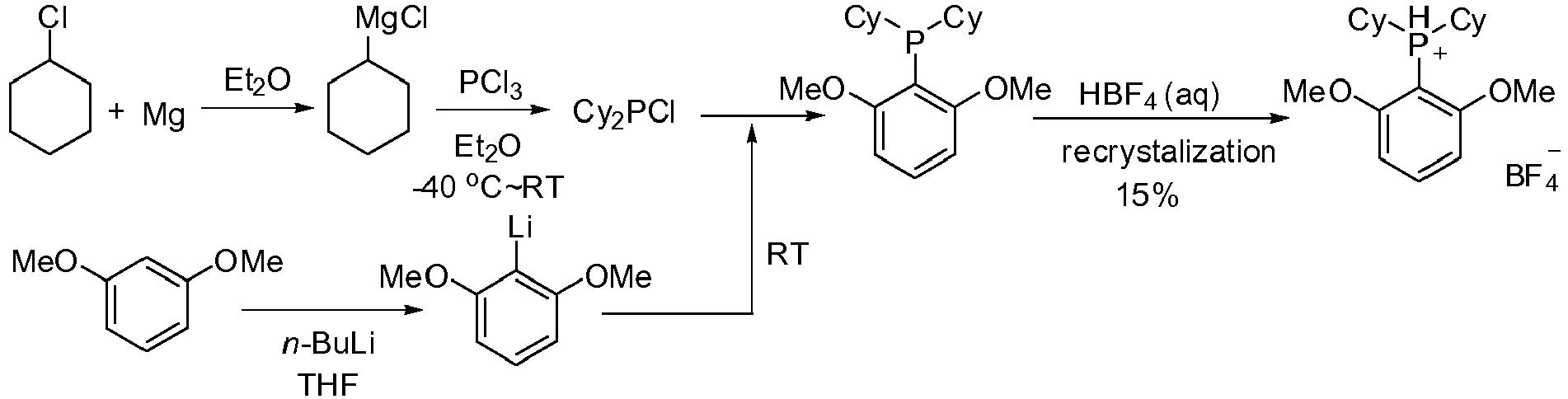
- The synthesis is carried in the same manner as the method described in example 2. The difference is that: the starting material is trichlorophosphine (0.92 mL , 1.38 g , 10 mmol), cyclohexylmagnesium chloride (0.8 M in Et2O), 1,3-Dimethoxybenzene (1.60 mL , 1.68 g , 12 mmol) and n-butyl lithium (2.5 M in hexane). After the reaction is done in ether/ tetrahydrofuran, tetrafluoborate aqueous solution is used to quench the reaction, and dialkyl(2,6-methoxyphenyl)phosphine tetrafluoroborate is obtained. The yield is 15%.
- 1H NMR (300 MHz, CDCl3) δ 7.63-7.71 (m, 1H), 6.80-6.65 (m, 2H), 6.77 (dt, J 1 = 486 Hz, J 2 = 6.3 Hz, 1H); 3.95 (s, 6H), 2.90-2.70 (m, 2H), 2.20-2.06 (m, 2H), 1.95-1.63 (m, 8H), 1.56-1.10 (m, 10H); 31P NMR (121 MHz, CDCl3) δ 7.36.
-

- To a rubber-capped Schlenk vessel was added K3PO4 (298.4 mg, 1.4 mmol). This equipment was dried with flame under vacuum and backfilled with nitrogen for three times. Then Pd(OAc) (2.7 mg, 0.012 mmol), dicyclohexyl(2,4,6-trimethoxyphenyl)phosphine tetrafluoroborate (11.0 mg, 0.024 mmol), phenyl bronic acid (99.8 mg, 98%, 0.80 mmol), and 0.5 mL of dioxane were added sequentially to the Schlenk vessel. After being stirred for about 5 min at room temperature, p-methoxyphenyl chloride (56.5 mg, 0.40 mmol), another 0.5 mL of dioxane, and 21.5 µL of water (21.5 mg, 1.2 mmol) were added sequentially in one portion. The resulting mixture was heated at 110 °C with a preheated oil bath. After 11 h, the reaction was complete as monitored by GC. The reaction mixture was then cooled and diluted by 10 mL of CH2Cl2 and filtered through a short column of silica gel (eluent: 2×10 mL of CH2Cl2). Evaporation and purification by chromatography (petroleum ether/ether = 60/1) on silica gel afforded 4-Methoxybiphenyl (65.9 mg, 90%)
m.p.: 87.2-87.8 °C; 1H NMR (300 MHz, CDCl3) δ 7.65-7.55 (m, 4H), 7.52-7.41 (m, 2H), 7.40-7.32 (m, 1H), 7.08-7.00 (m, 2H), 3.89 (s, 3H); 13C NMR (75 MHz, CDCl3) δ 159.1, 140.7, 133.7, 128.7, 128.1, 126.7, 126.6, 114.1, 55.3; IR (KBr) ν (cm-1) 3069, 3027, 3003, 2955, 2895, 2829, 1606, 1522, 1488, 1464, 1288, 1270, 1251, 1201, 1184, 1035; MS (70 eV, EI) m/z (%): 185 (M++1, 14.24), 184 (M+, 100). -

- Under the protection of nitrogen, phenylboronic acid (19.1 mg, 98%, 0.15 mmol), palladium acetate (1.2 mg , 0.0054 mmol), dicyclohexyl(2,4,6-trimethoxyphenyl)phosphine tetrafluoroborate (11.0 mg , 0.024 mmol), potassium carbonate (63.1 mg, 0.46 mmol) and 0.5 mL of anhydrous toluene are added sequentially to the reactor. The mixture is stirred at room temperature for 3 min and then (R)-(-)-3-propyl-4-chloride-5-phenyl-2(5H)-furanone (22.8 mg, 0.096 mmol, 97% ee) and 0.5 mL of anhydrous toluene are added into the reactor. The reaction is carried out at 110°C for 6 min and quenched with 10 mL of water. Extracted with ether, wash with brine, dried over anhydrous sodium sulfate, and purified by column chromatography afforded 20.1 mg of (R)-(-)-3-propyl-4,5-diphenyl-2(5H)-furanone. The yield is 75%, 98% ee.
- HPLC condition: Chiralpak OD-H, rate: 0.8 mL/min, λ = 230 nm, n-hexane/i-PrOH = 65/35. m.p.: 103.8-104.9 °C (n-hexane). 1H NMR (300 MHz, CDCl3) δ 7.37-7.15 (m, 10H), 6.16-6.14 (m, 1H), 2.58-2.42 (m, 2H), 1.78-1.60 (m, 2H), 0.98 (t, J = 7.4 Hz, 3H); 13C NMR (75 MHz, CDCl3) δ 174.1, 159.1, 134.9, 131.5, 129.5, 129.1, 128.7, 128.5, 127.8, 127.3, 83.7, 26.3, 21.5, 14.1; IR (KBr) ν (cm-1) 3057, 3027, 2958, 2939, 2870, 1749, 1734, 1649, 1498, 1455, 1445, 1355, 1340, 1206, 1126, 1090, 1072, 1014; MS (70 eV, EI) m/z (%): 279 (M++1, 16.57), 278 (M+, 77.10), 173 (100); Anal. Calcd. for C19H18O2: C, 81.99; H, 6.52. Found: C, 82.00; H, 6.53. [α]20 D = - 152.0.
-

- This reaction is carried out in the same manner as the reaction in example 5. The difference is that, the reactans are (R)-(-)-3-propyl-4-chloride-5-phenyl-2(5H)-furanone (23.9 mg, 0.10 mmol, 97% ee), phenylboronic acid (19.2 mg, 98%, 0.15 mmol), palladium acetate (1.1 mg, 0.005 mmol), tricyclohexylphosphonium tetrafluoroborate (1.8 mg, 0.005 mmol), potassium carbonate (62.0 mg, 0.45 mmol) and 1 mL of anhydrous toluene. The reactants ar reacted for 1 hours under 110°C, and 3-methyl-4,5-diphenyl-2(5H)-furanone is obtained. The yield is 67%, 0% ee, 9% the starting material is recycled.
-

- This reaction is carried out in the same manner as the reaction in example 5. The difference is that, the reactants are (R)-(-)-3-propyl-4-chloride-5-phenyl-2(5H)-furanone (22.9 mg, 0.097 mmol, 97% ee), phenylboronic acid (19.0 mg, 98%, 0.15 mmol), palladium acetate (1.1 mg, 0.005 mmol), 2-dicyclohexylphosphino-2',6'-dimethoxybiphenyl (2.1 mg, 0.005 mmol), potassium carbonate (62.1 mg, 0.45 mmol) and 1 mL of anhydrous toluene. The reactants ar reacted for 1 hours under 110°C, and 3-methyl-4,5-diphenyl-2(5H)-furanone is obtained. The yield is 40%, <16% ee, 11% the starting material is recycled.
-

- This reaction is carried out in the same manner as the reaction in example 5. The difference is that 5% dicyclohexyl(2,4,6-trimethoxyphenyl)phosphine is used as the ligand to react for 5 minutes. 70% yield is achieved. 96% ee (R)-(-)-3-propyl-4,5-diphenyl-2(5H)-furanone is obtained.
-

- This reaction is carried out in the same manner as the reaction in example 5. The difference is that, the reactans are (S)-3-methyl-4-chloride-5-phenyl-2(5H)-furanone (20.2 mg, 0.097 mmol), phenylboronic acid (19.0 mg, 98%, 0.15 mmol), palladium acetate (1.1 mg, 0.01 mmol), dicyclohexyl(2,4,6-trimethoxyphenyl)phosphine tetrafluoroborate (2.5 mg, 0.0055 mmol), potassium carbonate (62.3 mg, 0.45 mmol) are reacted in 2 mL of anhydrous toluene at 110°C for 6 minutes and 20.1 mg (S)-3-methyl-4,5-diphenyl-2(5H)-furanone is obtained. The yield is 83%, 99% ee.
- [α]20 D = + 179.5 (c = 0.96, CHCl3); liquid; 1H NMR (300 MHz, CDCl3) δ 7.40-7.17 (m, 10H), 6.21-6.16 (m, 1H), 2.16 (d, J = 1.8 Hz, 3H); 13C NMR (75 MHz, CDCl3) δ 174.5, 158.3, 135.0, 131.4, 129.6, 129.2, 128.79, 128.77, 128.0, 127.5, 124.1, 83.7, 10.3.
-

- This reaction is carried out in the same manner as the reaction in example 5. The difference is that (S)-(+)-3-methyl-4-chloride-5-phenyl-2(5H)- furanone (42.1 mg, 0.20 mmol, 97%ee), methoxyphenylboronic acid (47.3 mg, 97%, 0.30 mmol), palladium acetate (2.2mg, 0.0098 mmol), dicyclohexyl(2,4,6-trimethoxyphenyl)phosphine tetrafluoroborate (4.6 mg, 0.010 mmol), potassium carbonate (123.4 mg, 0.89 mmol) are reacted in 2 mL of anhydrous toluene at 110°C for 6 minutes and 56.5 mg of (S)-3-methyl-4-(methoxyphenyl)-5-phenyl-2(5H)-furanone is obtained. The yield is 100%, 97% ee.
- [α]20 D = + 229.7 (c = 1.05, CHCl3); liquid; 1H NMR (300 MHz, CDCl3) δ 7.32-7.19 (m, 7H), 6.90-6.83 (m, 2H), 6.18-6.13 (m, 1H), 3.78 (s, 3H), 2.18 (d, J = 1.5 Hz, 3H); 13C NMR (75 MHz, CDCl3) δ 174.7, 160.4, 157.6, 135.4, 129.6, 129.1, 128.7, 127.5, 123.6, 122.1, 114.1, 83.4, 55.2, 10.5; IR (neat) ν (cm-1) 3063, 3033, 3003, 2934, 2840, 1747, 1651, 1607, 1572, 1515, 1456, 1421, 1383, 1343, 1295, 1256, 1182, 1095, 1035; MS (70 eV, EI) m/z (%): 281 (M++1, 15.43), 280 (M+, 78.42), 175 (100); HRMS calcd for C18H16O3 (M+): 280.1099. Found: 280.1097.
-

- This reaction is carried out in the same manner as the reaction in example 5. The difference is that (S)-(-)-3-methyl-5-pentyl-4-chloride-2(5H)- furanone (19.7 mg, 0.097 mmol, 97%ee) and 2.0 equivalent methoxyphenyl boronic acid are used as starting material. Under standard conditions, the yield can reach 81 %, ee value is 98%, and corresponding (R)-(-)-3-methyl-5-pentyl-4(methoxyphenyl)-2(5H)-furanone is obtained.
- [a]20 D = - 268.2 (c = 1.00, CHCl3); 1H NMR (300 MHz, CDCl3) δ 7.31-7.21 (m, 4H), 5.36-5.29 (m, 1H), 2.42 (s, 3H), 2.04 (d, J = 1.8 Hz, 3H), 1.85-1.75 (m, 1H), 1.49-1.31 (m, 3H), 1.31-1.10 (m, 4H), 0.83 (t, J = 6.8 Hz, 3H); 13C NMR (75 MHz, CDCl3) δ 174.8, 159.5, 140.0, 129.7, 128.7, 127.6, 122.8, 81.7, 33.0, 31.3, 24.1, 22.4, 21.4, 13.9, 10.0; IR (neat) ν (cm-1) 2955, 2927, 2860, 1752, 1656, 1614, 1515, 1454, 1383, 1337, 1228, 1090, 1056; MS (70 eV, EI) m/z (%): 259 (M++1, 2.67), 258 (M+, 13.76), 159 (100); HRMS calcd for C17H22O2 (M+): 258.1620. Found: 258.1620.
-

- This reaction is carried out in the same manner as the reaction in example 5. The difference is that (S)-(+)-3-methyl-5-4-chloride-5-phenyl-2(5H)- furanone (20.1 mg, 0.096 mmol, 97%ee), methoxyphenyl boronic acid (20.4 mg, 98%, 0.15 mmol), palladium acetate (1.2 mg, 0.0054 mmol), dicyclohexyl(2,4,6-trimethoxyphenyl)phosphine tetrafluoroborate (2.2 mg, 0.0049 mmol), potassium carbonate (62.8 mg, 0.46 mmol) are reacted in 1 mL of toluene at 110°C for 5 minutes and 18.3 mg of (S)-3-methyl-4-(methoxyphenyl)-5-phenyl-2(5H)-furanone is obtained. The yield is 100%, 96% ee.
- [α]20 D = + 191.3 (c = 0.83, CHCl3); liquid; 1H NMR (300 MHz, CDCl3) δ 7.31-7.12 (m, 9H), 6.20-6.16 (m, 1H), 2.32 (s, 3H), 2.16 (d, J = 1.5 Hz, 3H); 13C NMR (75 MHz, CDCl3) δ 174.7, 158.2, 140.0, 135.3, 129.5, 129.1, 128.8, 128.5, 127.9, 127.5, 123.3, 83.6, 21.3, 10.4.
-

- This reaction is carried out in the same manner as the reaction in example 4. The difference is that 3-methyl-4-chloride-5-phenyl-2(5H)- furanone (42.0 mg, 0.2 mmol), methoxyphenyl boronic acid (46.5 mg, 97%, 0.3 mmol), palladium acetate (2.3 mg, 0.01 mmol), dicyclohexyl(2,4,6-trimethoxyphenyl)phosphine (7.3 mg, 0.02 mmol), potassium carbonate (82.3 mg, 0.6 mmol) are reacted in 1 mL of toluene at 110°C for 35 minutes and 3-methyl-4-(methoxyphenyl)-5-phenyl-2(5H)- furanone is obtained. The yield is 100%.
-

- This reaction is carried out in the same manner as the reaction in example 4. The difference is that reactants are 3,5-dimethoxychlorobenzene (169.9 mg, 0.98 mmol), 2,6-dimethoxyphenyl boronic acid (332.0 mg, purity: 90%, 2.0 mmol), palladium acetate (27. mg, 0.030 mmol), dicyclohexyl(2,4,6-trimethoxyphenyl)phosphine tetrafluoborate (27.3 mg, 0.060 mmol), potassium phosphate (742.5 mg, 3.5 mmol), water (54.0 µL, 3.0 mmol) and 2.5 mL of 1,4-dioxane are reacted at 110°C for 11 hours and 223.5 mg of 2,6-dimethyl-3',5'-dimethoxydiphenyl is obtained. The yield is 94%.
- 1H NMR (300 MHz, CDCl3) δ 7.18-7.02 (m, 3H), 6.45 (t, J = 2.2 Hz, 1H), 6.31 (d, J = 2.4 Hz, 2H), 3.76 (s, 6H), 2.08 (s, 6H); 13C NMR (75 MHz, CDCl3) δ 160.8, 143.0, 141.7, 135.8, 127.1, 127.0, 106.8, 98.5, 55.1, 20.5; IR (neat) ν (cm-1) 3057, 2999, 2955, 2835, 1592, 1455, 1421, 1377, 1344, 1327, 1296, 1250, 1205, 1154, 1064, 1033; MS (70 eV, EI) m/z (%): 243 (M++1, 18.52), 242 (M+, 100).
-

- This reaction is carried out in the same manner as the reaction in example 4. The difference is that reactants are 2,6-dimethoxychlorobenzene (139.1 mg, 0.99 mmol), 3-methoxyphenyl boronic acid (313.8 mg, 97%, 2.0 mmol), palladium acetate (6.5 mg, 0.029 mmol), dicyclohexyl(2,4,6-trimethoxyphenyl)phosphine tetrafluoborate (27.1 mg, 0.060 mmol), potassium phosphate (742.6 mg, 3.5 mmol), water (54.0 µL, 3.0 mmol) and 2.5 mL of 1,4-dioxane are reacted at 110°C for 11 hours and 202.8 mg of 2,6-dimethyl-3'-methoxydiphenyl is obtained. The yield is 97%.
- 1H NMR (300 MHz, CDCl3) δ 7.34-7.26 (m, 1H), 7.17-7.05 (m, 3H), 6.88-6.83 (m, 1H), 6.75-6.67 (m, 2H), 3.77 (s, 3H), 2.04 (s, 6H); 13C NMR (75 MHz, CDCl3) δ 159.6, 142.4, 141.6, 135.9, 129.4, 127.2, 127.0, 121.3, 114.4, 112.0, 55.0, 20.7; IR (neat) ν (cm-1) 3063, 2999, 2954, 2833, 1608, 1578, 1466, 1430, 1377, 1309, 1288, 1247, 1208, 1177, 1050, 1026; MS (70 eV, EI) m/z (%): 213 (M++1, 17.22), 212 (M+, 100).
- This reaction is carried out in the same manner as the reaction in example 4. The difference is that 0.06 equivalent of dicyclohexyl(2,6-dimethoxyphenyl) phosphine tetrafluoborate is used as catalyst. The reaction is carried out for 12 hours and 4-methoxydiphenyl is obtained. The yield is 41 %.
- This reaction is carried out in the same manner as the reaction in example 4. The difference is that 0.06 equivalent of dicyclohexyl(2,6-diisopropyl)phosphine tetrafluoborate is used as catalyst. The reaction is carried out for 12 hours and 4-methoxydiphenyl is obtained.The yield is 100%.
- This reaction is carried out in the same manner as the reaction in example 4. The difference is that 3 equivalent of potassium carbonate is used as base. Toluene is the solvent. The reaction is carried out at 110° for 28 hours and 4-methoxydiphenyl is obtained.The yield is 41%.
- This reaction is carried out in the same manner as the reaction in example 4. The difference is that 3 equivalent of potassium carbonate is used as base. The reaction is carried out at 110° for 28 hours and 4-methoxydiphenyl is obtained. The yield is 88%.
- This reaction is carried out in the same manner as the reaction in example 4. The difference is that 3 equivalent of cesium fluoride is used as base. The reaction is carried out at 110° for 24 hours and 4-methoxydiphenyl is obtained.The yield is 80%.
- This reaction is carried out in the same manner as the reaction in example 4. The difference is that 3 equivalent of cesium carbonate is used as base. The reaction is carried out at 110° for 13 hours and 4-methoxydiphenyl is obtained.The yield is 88%.
-

- Under the protection of nitrogen, palladium acetate (4.4 mg, 0.02 mmol), dicyclohexyl(2,6-dimethoxyphenyl)phosphine tetrafluoborate (14.4 mg, 0.03 mmol), sodium tert-butoxide (155.1 mg, 97%, 1.6 mmol), 3,5-dimethoxychlorobenzene (68.8 mg, 0.4 mmol) and 1 mL of toluene were added to the reactor sequentially. The mixture is stirred at room temperature for 4 minutes. N-methylphenyl amine (86.1 mg, 0.8 mmol) and another 1 mL of toluene were added into the reactor. The reactor was heated to 110°C and the temperature is maintained for 24 hours. After the reactor is cooled, 10 mL of methylene dichloride was used to quench the reaction. Filtration and column chromatography (petroleum: ethyl acetate: triethylamine = 100:1:1) afforded 74.5 mg of N-phenyl-N-methyl-3,5-dimethylpheylamine. The yield is 77%.
- 1H NMR (300 MHz, CDCl3) δ 7.38-7.29 (m, 2H), 7.16-7.10 (m, 2H), 7.09-7.01 (m, 1H), 6.16 (d, J = 2.1 Hz, 2H), 6.10 (t, J = 2.0 Hz, 1H), 3.76 (s, 6H), 3.32 (s, 3H); 13C NMR (75 MHz, CDCl3) δ 161.3, 150.8, 148.6, 129.2, 122.4, 122.3, 97.4, 92.4, 55.2, 40.3.
-

- Under the protection of nitrogen, 0.05 equivalent of palladium acetate, 0.075 equivalent of dicyclohexyl(2,6-diisopropyl)phosphine tetrafluoborate, 2.0 equivalent of potassium hydroxide, 1.0 equivalent of 3,5-dimethoxychlorobenzene and 1.2 equivalent of phenylamine were reacted in toluene at 110°C for 3 hours. N-phenyl-N-methyl-3,5-dimethylpheylamine was obtained with a yield of 93%.
-

- Under the protection of nitrogen, 0.025 equivalent of tris(dibenzylideneacetone)dipalladium (Pd2(dba)3 .CHCl3), 0.075 equivalent of dicyclohexyl(2,6-diisopropyl)phosphine tetrafluoborate, 4.0 equivalent of potassium tert-butoxide, 1.0 equivalent of 3,5-dimethoxychlorobenzene and 2.0 equivalent of phenylamine were reacted in toluene at 110 °C for 24 hours. N-phenyl-N-methyl-3,5-dimethylpheylamine was obtained with a yield of 57%.
- The reaction was carried out in the same manner as the reaction in example 22. The difference was that 4.0 equivalent of sodium hydride was used as base. After the reaction was carried out at 110 °C for 24 hours, N-phenyl-N-methyl-3,5-dimethylpheylamine was obtained with a yield of 56%.
Claims (8)
- A dialkylphosphine (2,4,6- or 2,6-alkoxyphenyl) or its tetrafluoroborate, characterized in that said dialkylphosphine (2,4,6- or 2,6-alkoxyphenyl) or its tetrafluoroborate has the following structure:

- A method for the preparation of the dialkylphosphine (2,4,6- or 2,6-alkoxyphenyl) or its tetrafluoroborate of claim 1, characterized in that they are obtained via the following steps:1) use tetrahydrofuran as an organic solvent, and at room temperature, alkoxybenzene (R3O)nC6H(6-n) is reacted with butyl lithium for 2-15 hours to produce the corresponding lithium reagent (R3O) nC6H (5-n) Li;2) react the lithium reagent above (R3O)nC6H(5-n)Li with dialkyl phosphoric chloride R1R2PCl under -78-30° for 2 to 10 hours to produce a dialkylphosphine (2,4,6- or 2,6-alkoxyphenyl) (R3O) n C6H(5-n)P R1R2, tetrafluoroboric acid aqueous solution is used to quench the reaction and to produce the corresponding dialkylphosphine (2,4,6- or 2,6-alkoxyphenyl) tetrafluoroborate ((R3O) n C6H(5-n)PR1R2)(H+BF4 -); the molar ratio of said dialkyl phosphoric chloride and (2,4,6- or 2,6-alkoxyphenyl) lithium is 0.8-1.2 :1;
said R1, R2 and R3 are as described in claim 1. - A method for preparation of the dialkylphosphine (2,4,6- or 2,6-alkoxyphenyl) or its tetrafluoroborate of claim 2, characterized in that said dialkylphosphine (2,4,6- or 2,6-alkoxyphenyl) tetrafluoroborate ((R3O) n C6H(5-n)P R1R2)(H+BF4 -) is purified by re-crystallization.
- Use of the dialkylphosphine (2,4,6- or 2,6-alkoxyphenyl) or its tetrafluoroborate of claim 1 in the inert carbon-chloride bond selection Suzuki coupled reaction to produce coupled compounds or in the coupled reaction between the inert carbon-chloride bond and the carbon-nitrogen bond of amines to produce aromatic secondary amines or tertiary amines.
- Use of claim 4, characterized in that the synthesis of the coupled compounds are carried out under the protection of inert gases, at 80-120°, in an organic solvent, with alkaline and palladium as catalysts, the dialkylphosphine (2,4,6- or 2,6-alkoxyphenyl) or its tetrafluoroborate, arylboronic acid, water and arylchloride are reacted for 0.6-28 hours to produce the corresponding bephenyl compounds; said organic solvent is 1,4-dioxane or toluene; the equivalent weight ratio of alkaline, palladium catalyst, dialkylphosphine (2,4,6- or 2,6-alkoxyphenyl) or its tetrafluoroborate, arylboronic acid, water and arylchloride is 2.0~4.0 : 0.03~0.05 : 0.06~0.10 : 1.5~2.5 : 0~5.0 : 1.0; said organic solvent is 1,4-dioxane or toluene; said alkaline is potassium carbonate, potassium phosphate, caesium carbonate, or caesium chloride; dialkylphosphine (2,4,6- or 2,6-alkoxyphenyl) or its tetrafluoroborate is as claimed in claim1; said arylchloride is R4 substituted chlorbenzene; said arylboronic acid is R5C6H4B (OH) 2, R4 is ortho-, meta-, para- substituted C1-C4 alkyl, alkoxy or hydrogen; R5 is ortho-, meta-, para- substituted C1-C4 alkyl, alkoxy or hydrogen.
- Use of claim 4, characterized in that the synthesis of the coupled compounds is carried out under the protection of inert gases, the reaction temperature is 80-120°, toluene is the solvent, palladium acetate, dialkylphosphine (2,4,6- or 2,6-alkoxyphenyl) or its tetrafluoroborate, potassium carbonate, arylboronic acid and photoactive chlorolactone undergo reaction for 5-60 minutes and the corresponding coupled photoactive lactone compounds are obtained; the equivalent weight ratio of said palladium acetate, dialkylphosphine (2,4,6- or 2,6-alkoxyphenyl) or its tetrafluoroborate, potassium carbonate, arylboronic acid and photoactive chlorolactone is 0.05 : 0.05~0.10 : 3.0~4.5 : 1.2~2.0 : 1.0; the organic phosphor or its salt is the dialkylphosphine (2,4,6- or 2,6-alkoxyphenyl) or its tetrafluoroborate of claim 1; the arylboronic acid is R5C6H4B (OH) 2; the chemical structure of the photoactive chlorolactone is

- Use of claim 4, characterized in that the synthesis of said aromatic secondary or tertiary amines is carried out under the protection of inert gases, toluene is the solvent, alkaline and palladium are the catalysts, dialkylphosphine (2,4,6- or 2,6-alkoxyphenyl) or its tetrafluoroborate, organic phosphor and aryl chlorides undergo reaction for 1-36 hours to obtain the corresponding coupled compounds of aromatic primary or secondary amines; the equivalent weight ratio of said alkaline and palladium catalysts, aromatic secondary or tertiary amines, organic phosphor or tetrafluoroborate, organic amine and aryl chlorides is 1.5~4.0 : 0.01~0.05 : 0.015~0.10 : 1.2~2.5 : 1.0 ; said organic solvent is 1,4-dioxane or toluene; said palladium catalyst is palladium acetate or tris(dibenzylideneacetone)dipalladium; alkaline is potassium tert-butoxide, sodium tert-butoxide, potassium phosphate, potassium hydroxide, sodium hydroxide, sodium hydride, and the alkaline which can provide alkoxy anion, hydrogen anion or hydroxyl anion; the organic phosphor or its salt is the dialkylphosphine (2,4,6- or 2,6-alkoxyphenyl) or its tetrafluoroborate of claim 1; said aryl chloride is R4 substituted chlorbenzene; R4 is ortho-, meta-, para- substituted C1-C4 alkyl, alkoxy or hydrogen; said organic amine is R8, R9 substituted organic primary amine and secondary amine; R8 is C1-C10 alkyl, phenyl or heterocyclic group; R9 is C1-C10 alkyl, phenyl, heterocyclic group or hydrogen; said heterocyclic group thiophene, furan or pyridine.
- Use of claims 4, 5 or 6, characterized in that the products of the coupled reaction between said photoactive chlorolactone and aryl boronic acid, whose configuration and optical purity are maintained have the following structure

Applications Claiming Priority (2)
| Application Number | Priority Date | Filing Date | Title |
|---|---|---|---|
| CN200910154029A CN101693723B (en) | 2009-10-22 | 2009-10-22 | 3-tri-alkoxy phenyl dialkyl phosphine tetrafluoroborate and synthesis and application thereof |
| PCT/CN2009/001527 WO2011047501A1 (en) | 2009-10-22 | 2009-12-21 | 2,4,6- or 2,6-alkoxyphenyl dialkylphosphine, tetrafluoroborate, preparation method and use thereof |
Publications (3)
| Publication Number | Publication Date |
|---|---|
| EP2492274A1 true EP2492274A1 (en) | 2012-08-29 |
| EP2492274A4 EP2492274A4 (en) | 2013-08-07 |
| EP2492274B1 EP2492274B1 (en) | 2016-09-21 |
Family
ID=42092730
Family Applications (1)
| Application Number | Title | Priority Date | Filing Date |
|---|---|---|---|
| EP09850497.0A Active EP2492274B1 (en) | 2009-10-22 | 2009-12-21 | 2,4,6- or 2,6-alkoxyphenyl dialkylphosphine, tetrafluoroborate and use thereof |
Country Status (4)
| Country | Link |
|---|---|
| US (1) | US9006491B2 (en) |
| EP (1) | EP2492274B1 (en) |
| CN (1) | CN101693723B (en) |
| WO (1) | WO2011047501A1 (en) |
Cited By (1)
| Publication number | Priority date | Publication date | Assignee | Title |
|---|---|---|---|---|
| CN108368142A (en) * | 2015-12-02 | 2018-08-03 | 住友化学株式会社 | Aromatic compound production method and palladium complex |
Families Citing this family (9)
| Publication number | Priority date | Publication date | Assignee | Title |
|---|---|---|---|---|
| WO2013032951A1 (en) * | 2011-08-26 | 2013-03-07 | Neupharma, Inc. | Certain chemical entities, compositions, and methods |
| CN102675366B (en) | 2012-05-10 | 2015-09-30 | 浙江大学 | 2-alkoxyl group-6-aminophenyl dialkyl phosphine and synthesis thereof and application |
| US9238665B2 (en) * | 2012-07-06 | 2016-01-19 | Sumitomo Chemical Company, Limited | Method for producing aromatic compound |
| JP6142874B2 (en) * | 2012-07-06 | 2017-06-07 | 住友化学株式会社 | Method for producing aromatic compound |
| CN103073489A (en) * | 2013-02-06 | 2013-05-01 | 利民化工股份有限公司 | Preparation method of Boscalid |
| CN110112414A (en) * | 2019-06-11 | 2019-08-09 | 欧格尼材料科技江苏有限公司 | A kind of novel anode material, preparation method and applications |
| CN113773244B (en) * | 2021-04-06 | 2024-03-22 | 复旦大学 | A method for removing ketone fragments in substituents of nitrogen heterocyclic compounds |
| CN113683639B (en) * | 2021-09-06 | 2024-03-26 | 大连双硼医药化工有限公司 | Process method for synthesizing tri-tert-butyl phosphorus tetrafluoroborate |
| CN114805017B (en) * | 2022-04-29 | 2023-10-10 | 上海毕得医药科技股份有限公司 | Preparation method of 2-fluoro-1, 5-hexadiene compound |
Family Cites Families (5)
| Publication number | Priority date | Publication date | Assignee | Title |
|---|---|---|---|---|
| US6867310B1 (en) * | 1997-11-20 | 2005-03-15 | Massachusetts Institute Of Technology | Arylation and vinylation of activated carbons |
| US7223879B2 (en) | 1998-07-10 | 2007-05-29 | Massachusetts Institute Of Technology | Ligands for metals and improved metal-catalyzed processes based thereon |
| US6307087B1 (en) * | 1998-07-10 | 2001-10-23 | Massachusetts Institute Of Technology | Ligands for metals and improved metal-catalyzed processes based thereon |
| US6124462A (en) * | 1999-11-30 | 2000-09-26 | E. I. Du Pont De Nemours And Company | Catalysis using phosphine oxide compounds |
| CN100548948C (en) * | 2002-12-09 | 2009-10-14 | 麻省理工学院 | Metal ligands and improved metal catalytic processes based thereon |
-
2009
- 2009-10-22 CN CN200910154029A patent/CN101693723B/en active Active
- 2009-12-21 US US13/383,208 patent/US9006491B2/en active Active
- 2009-12-21 EP EP09850497.0A patent/EP2492274B1/en active Active
- 2009-12-21 WO PCT/CN2009/001527 patent/WO2011047501A1/en not_active Ceased
Cited By (3)
| Publication number | Priority date | Publication date | Assignee | Title |
|---|---|---|---|---|
| CN108368142A (en) * | 2015-12-02 | 2018-08-03 | 住友化学株式会社 | Aromatic compound production method and palladium complex |
| EP3385270A4 (en) * | 2015-12-02 | 2020-01-22 | Sumitomo Chemical Company, Ltd | PROCESS FOR PRODUCING AROMATIC COMPOUND AND PALLADIUM COMPLEX |
| US11045796B2 (en) | 2015-12-02 | 2021-06-29 | Sumitomo Chemical Company, Limited | Process for producing aromatic compound, and palladium complex |
Also Published As
| Publication number | Publication date |
|---|---|
| WO2011047501A1 (en) | 2011-04-28 |
| US20120197030A1 (en) | 2012-08-02 |
| US9006491B2 (en) | 2015-04-14 |
| EP2492274B1 (en) | 2016-09-21 |
| EP2492274A4 (en) | 2013-08-07 |
| CN101693723A (en) | 2010-04-14 |
| CN101693723B (en) | 2012-09-05 |
Similar Documents
| Publication | Publication Date | Title |
|---|---|---|
| EP2492274B1 (en) | 2,4,6- or 2,6-alkoxyphenyl dialkylphosphine, tetrafluoroborate and use thereof | |
| Chen et al. | Homocoupling reaction of terminal alkynes catalyzed by a reusable cationic 2, 2′-bipyridyl palladium (II)/CuI system in water | |
| CN106631702B (en) | Catalytic Asymmetric Synthesis of Chiral Spirodiphenol Derivatives | |
| Iranpoor et al. | 1, 3, 2, 4-Diazadiphosphetidines as new P–N ligands for palladium-catalyzed Heck reaction in water | |
| Kwong et al. | Palladium-catalyzed phosphination of functionalized aryl triflates | |
| CN110240616A (en) | Three biaryl monophosphorus ligands, their preparation method and the purposes in catalyzed coupling reaction | |
| Madduri et al. | Access to chiral α-bromo and α-H-substituted tertiary allylic alcohols via copper (i) catalyzed 1, 2-addition of Grignard reagents to enones | |
| JP2004505091A (en) | Phosphane ligands having an adamantyl group, their preparation and their use in catalytic reactions | |
| CN102153592A (en) | Suzuki-Miyaura coupling reaction of catalyzing aryl chloride by N-heterocyclic carbine-palladium-imidazole complex at room temperature under condition of water phase | |
| Song et al. | Divergent intramolecular reactions between phosphines and alkynes | |
| CN101195641A (en) | Novel phosphine ligand, production and uses in catalytic reaction thereof | |
| CN111620911A (en) | Chiral spiro-bis-rhodium phosphate complex and preparation method and application thereof | |
| US20100197969A1 (en) | Use of phosphonium salts in coupling reactions and process for their manufacture | |
| Huang et al. | Structural probing of D-fructose derived ligands for asymmetric addition of diethylzinc to aldehydes | |
| Jumde et al. | Deoxycholic acid derived monophosphites as chiral ligands in the asymmetric Suzuki–Miyaura cross-coupling | |
| Martı́n et al. | One-pot palladium-catalyzed phosphination of aryl iodides with Ph2PSnR3 | |
| Ohe et al. | Palladium (II)-Catalyzed Michael-Type Addition Reactions Using Aryltin Compounds. | |
| CN108467408B (en) | A kind of diaryl phosphorus compound with hydroxyphenyl functional group and preparation method thereof | |
| Liu et al. | Polymer-supported tertiaryphosphine (JJ–TPP) as a green and recyclable organocatalyst for α-addition of carbon nucleophiles to α, β-unsaturated compounds | |
| CN110156832A (en) | Bisacetal base Phenylphosphine, their preparation method and the purposes in coupling reaction | |
| Chang et al. | Developing five-membered heterocycle substituted phosphinous acids as ligands for palladium-catalyzed Suzuki–Miyaura and Catellani reactions | |
| CN110372544A (en) | A kind of synthetic method of the biaryl hydrocarbons and their derivates of iron catalysis | |
| WO2009137322A2 (en) | Processes for the preparation of biphenyl compounds | |
| CN109096338B (en) | Benzazepine phosphinophosphine oxygen ligand and complex containing the same, preparation method and application | |
| KR102066464B1 (en) | Markovnikov-selective palladium catalyst for carbonylation of alkynes with heteroarenes |
Legal Events
| Date | Code | Title | Description |
|---|---|---|---|
| PUAI | Public reference made under article 153(3) epc to a published international application that has entered the european phase |
Free format text: ORIGINAL CODE: 0009012 |
|
| 17P | Request for examination filed |
Effective date: 20120522 |
|
| AK | Designated contracting states |
Kind code of ref document: A1 Designated state(s): AT BE BG CH CY CZ DE DK EE ES FI FR GB GR HR HU IE IS IT LI LT LU LV MC MK MT NL NO PL PT RO SE SI SK SM TR |
|
| RIN1 | Information on inventor provided before grant (corrected) |
Inventor name: LV, BO Inventor name: FU, CHUNLING Inventor name: MA, SHENGMING |
|
| RIN1 | Information on inventor provided before grant (corrected) |
Inventor name: LV, BO Inventor name: MA, SHENGMING Inventor name: FU, CHUNLING |
|
| DAX | Request for extension of the european patent (deleted) | ||
| RIC1 | Information provided on ipc code assigned before grant |
Ipc: B01J 31/24 20060101ALI20130619BHEP Ipc: C07F 9/50 20060101AFI20130619BHEP Ipc: C07C 43/215 20060101ALI20130619BHEP Ipc: C07C 41/30 20060101ALI20130619BHEP Ipc: C07D 307/58 20060101ALI20130619BHEP |
|
| RIC1 | Information provided on ipc code assigned before grant |
Ipc: C07C 41/30 20060101ALI20130627BHEP Ipc: C07C 43/215 20060101ALI20130627BHEP Ipc: C07D 307/58 20060101ALI20130627BHEP Ipc: C07F 9/50 20060101AFI20130627BHEP Ipc: B01J 31/24 20060101ALI20130627BHEP |
|
| A4 | Supplementary search report drawn up and despatched |
Effective date: 20130704 |
|
| 17Q | First examination report despatched |
Effective date: 20150108 |
|
| GRAJ | Information related to disapproval of communication of intention to grant by the applicant or resumption of examination proceedings by the epo deleted |
Free format text: ORIGINAL CODE: EPIDOSDIGR1 |
|
| GRAP | Despatch of communication of intention to grant a patent |
Free format text: ORIGINAL CODE: EPIDOSNIGR1 |
|
| GRAP | Despatch of communication of intention to grant a patent |
Free format text: ORIGINAL CODE: EPIDOSNIGR1 |
|
| INTG | Intention to grant announced |
Effective date: 20160629 |
|
| RIN1 | Information on inventor provided before grant (corrected) |
Inventor name: FU, CHUNLING Inventor name: MA, SHENGMING Inventor name: LV, BO |
|
| GRAS | Grant fee paid |
Free format text: ORIGINAL CODE: EPIDOSNIGR3 |
|
| GRAA | (expected) grant |
Free format text: ORIGINAL CODE: 0009210 |
|
| AK | Designated contracting states |
Kind code of ref document: B1 Designated state(s): AT BE BG CH CY CZ DE DK EE ES FI FR GB GR HR HU IE IS IT LI LT LU LV MC MK MT NL NO PL PT RO SE SI SK SM TR |
|
| REG | Reference to a national code |
Ref country code: GB Ref legal event code: FG4D |
|
| REG | Reference to a national code |
Ref country code: CH Ref legal event code: EP |
|
| REG | Reference to a national code |
Ref country code: AT Ref legal event code: REF Ref document number: 830974 Country of ref document: AT Kind code of ref document: T Effective date: 20161015 |
|
| REG | Reference to a national code |
Ref country code: IE Ref legal event code: FG4D |
|
| REG | Reference to a national code |
Ref country code: DE Ref legal event code: R096 Ref document number: 602009041339 Country of ref document: DE |
|
| REG | Reference to a national code |
Ref country code: FR Ref legal event code: PLFP Year of fee payment: 8 |
|
| REG | Reference to a national code |
Ref country code: LT Ref legal event code: MG4D Ref country code: NL Ref legal event code: MP Effective date: 20160921 |
|
| PG25 | Lapsed in a contracting state [announced via postgrant information from national office to epo] |
Ref country code: FI Free format text: LAPSE BECAUSE OF FAILURE TO SUBMIT A TRANSLATION OF THE DESCRIPTION OR TO PAY THE FEE WITHIN THE PRESCRIBED TIME-LIMIT Effective date: 20160921 Ref country code: LT Free format text: LAPSE BECAUSE OF FAILURE TO SUBMIT A TRANSLATION OF THE DESCRIPTION OR TO PAY THE FEE WITHIN THE PRESCRIBED TIME-LIMIT Effective date: 20160921 Ref country code: NO Free format text: LAPSE BECAUSE OF FAILURE TO SUBMIT A TRANSLATION OF THE DESCRIPTION OR TO PAY THE FEE WITHIN THE PRESCRIBED TIME-LIMIT Effective date: 20161221 |
|
| REG | Reference to a national code |
Ref country code: AT Ref legal event code: MK05 Ref document number: 830974 Country of ref document: AT Kind code of ref document: T Effective date: 20160921 |
|
| PG25 | Lapsed in a contracting state [announced via postgrant information from national office to epo] |
Ref country code: LV Free format text: LAPSE BECAUSE OF FAILURE TO SUBMIT A TRANSLATION OF THE DESCRIPTION OR TO PAY THE FEE WITHIN THE PRESCRIBED TIME-LIMIT Effective date: 20160921 Ref country code: SE Free format text: LAPSE BECAUSE OF FAILURE TO SUBMIT A TRANSLATION OF THE DESCRIPTION OR TO PAY THE FEE WITHIN THE PRESCRIBED TIME-LIMIT Effective date: 20160921 Ref country code: GR Free format text: LAPSE BECAUSE OF FAILURE TO SUBMIT A TRANSLATION OF THE DESCRIPTION OR TO PAY THE FEE WITHIN THE PRESCRIBED TIME-LIMIT Effective date: 20161222 Ref country code: NL Free format text: LAPSE BECAUSE OF FAILURE TO SUBMIT A TRANSLATION OF THE DESCRIPTION OR TO PAY THE FEE WITHIN THE PRESCRIBED TIME-LIMIT Effective date: 20160921 |
|
| PG25 | Lapsed in a contracting state [announced via postgrant information from national office to epo] |
Ref country code: RO Free format text: LAPSE BECAUSE OF FAILURE TO SUBMIT A TRANSLATION OF THE DESCRIPTION OR TO PAY THE FEE WITHIN THE PRESCRIBED TIME-LIMIT Effective date: 20160921 Ref country code: EE Free format text: LAPSE BECAUSE OF FAILURE TO SUBMIT A TRANSLATION OF THE DESCRIPTION OR TO PAY THE FEE WITHIN THE PRESCRIBED TIME-LIMIT Effective date: 20160921 |
|
| PG25 | Lapsed in a contracting state [announced via postgrant information from national office to epo] |
Ref country code: SM Free format text: LAPSE BECAUSE OF FAILURE TO SUBMIT A TRANSLATION OF THE DESCRIPTION OR TO PAY THE FEE WITHIN THE PRESCRIBED TIME-LIMIT Effective date: 20160921 Ref country code: IS Free format text: LAPSE BECAUSE OF FAILURE TO SUBMIT A TRANSLATION OF THE DESCRIPTION OR TO PAY THE FEE WITHIN THE PRESCRIBED TIME-LIMIT Effective date: 20170121 Ref country code: ES Free format text: LAPSE BECAUSE OF FAILURE TO SUBMIT A TRANSLATION OF THE DESCRIPTION OR TO PAY THE FEE WITHIN THE PRESCRIBED TIME-LIMIT Effective date: 20160921 Ref country code: AT Free format text: LAPSE BECAUSE OF FAILURE TO SUBMIT A TRANSLATION OF THE DESCRIPTION OR TO PAY THE FEE WITHIN THE PRESCRIBED TIME-LIMIT Effective date: 20160921 Ref country code: CZ Free format text: LAPSE BECAUSE OF FAILURE TO SUBMIT A TRANSLATION OF THE DESCRIPTION OR TO PAY THE FEE WITHIN THE PRESCRIBED TIME-LIMIT Effective date: 20160921 Ref country code: PT Free format text: LAPSE BECAUSE OF FAILURE TO SUBMIT A TRANSLATION OF THE DESCRIPTION OR TO PAY THE FEE WITHIN THE PRESCRIBED TIME-LIMIT Effective date: 20170123 Ref country code: BE Free format text: LAPSE BECAUSE OF FAILURE TO SUBMIT A TRANSLATION OF THE DESCRIPTION OR TO PAY THE FEE WITHIN THE PRESCRIBED TIME-LIMIT Effective date: 20160921 Ref country code: PL Free format text: LAPSE BECAUSE OF FAILURE TO SUBMIT A TRANSLATION OF THE DESCRIPTION OR TO PAY THE FEE WITHIN THE PRESCRIBED TIME-LIMIT Effective date: 20160921 Ref country code: BG Free format text: LAPSE BECAUSE OF FAILURE TO SUBMIT A TRANSLATION OF THE DESCRIPTION OR TO PAY THE FEE WITHIN THE PRESCRIBED TIME-LIMIT Effective date: 20161221 Ref country code: SK Free format text: LAPSE BECAUSE OF FAILURE TO SUBMIT A TRANSLATION OF THE DESCRIPTION OR TO PAY THE FEE WITHIN THE PRESCRIBED TIME-LIMIT Effective date: 20160921 |
|
| REG | Reference to a national code |
Ref country code: DE Ref legal event code: R097 Ref document number: 602009041339 Country of ref document: DE |
|
| PG25 | Lapsed in a contracting state [announced via postgrant information from national office to epo] |
Ref country code: IT Free format text: LAPSE BECAUSE OF FAILURE TO SUBMIT A TRANSLATION OF THE DESCRIPTION OR TO PAY THE FEE WITHIN THE PRESCRIBED TIME-LIMIT Effective date: 20160921 |
|
| PLBE | No opposition filed within time limit |
Free format text: ORIGINAL CODE: 0009261 |
|
| STAA | Information on the status of an ep patent application or granted ep patent |
Free format text: STATUS: NO OPPOSITION FILED WITHIN TIME LIMIT |
|
| PG25 | Lapsed in a contracting state [announced via postgrant information from national office to epo] |
Ref country code: DK Free format text: LAPSE BECAUSE OF FAILURE TO SUBMIT A TRANSLATION OF THE DESCRIPTION OR TO PAY THE FEE WITHIN THE PRESCRIBED TIME-LIMIT Effective date: 20160921 |
|
| 26N | No opposition filed |
Effective date: 20170622 |
|
| PG25 | Lapsed in a contracting state [announced via postgrant information from national office to epo] |
Ref country code: MC Free format text: LAPSE BECAUSE OF FAILURE TO SUBMIT A TRANSLATION OF THE DESCRIPTION OR TO PAY THE FEE WITHIN THE PRESCRIBED TIME-LIMIT Effective date: 20160921 |
|
| PG25 | Lapsed in a contracting state [announced via postgrant information from national office to epo] |
Ref country code: LU Free format text: LAPSE BECAUSE OF NON-PAYMENT OF DUE FEES Effective date: 20161221 |
|
| PG25 | Lapsed in a contracting state [announced via postgrant information from national office to epo] |
Ref country code: IE Free format text: LAPSE BECAUSE OF NON-PAYMENT OF DUE FEES Effective date: 20161221 Ref country code: SI Free format text: LAPSE BECAUSE OF FAILURE TO SUBMIT A TRANSLATION OF THE DESCRIPTION OR TO PAY THE FEE WITHIN THE PRESCRIBED TIME-LIMIT Effective date: 20160921 |
|
| REG | Reference to a national code |
Ref country code: FR Ref legal event code: PLFP Year of fee payment: 9 |
|
| PG25 | Lapsed in a contracting state [announced via postgrant information from national office to epo] |
Ref country code: CY Free format text: LAPSE BECAUSE OF FAILURE TO SUBMIT A TRANSLATION OF THE DESCRIPTION OR TO PAY THE FEE WITHIN THE PRESCRIBED TIME-LIMIT Effective date: 20160921 Ref country code: HU Free format text: LAPSE BECAUSE OF FAILURE TO SUBMIT A TRANSLATION OF THE DESCRIPTION OR TO PAY THE FEE WITHIN THE PRESCRIBED TIME-LIMIT; INVALID AB INITIO Effective date: 20091221 |
|
| PG25 | Lapsed in a contracting state [announced via postgrant information from national office to epo] |
Ref country code: TR Free format text: LAPSE BECAUSE OF FAILURE TO SUBMIT A TRANSLATION OF THE DESCRIPTION OR TO PAY THE FEE WITHIN THE PRESCRIBED TIME-LIMIT Effective date: 20160921 Ref country code: MK Free format text: LAPSE BECAUSE OF FAILURE TO SUBMIT A TRANSLATION OF THE DESCRIPTION OR TO PAY THE FEE WITHIN THE PRESCRIBED TIME-LIMIT Effective date: 20160921 Ref country code: HR Free format text: LAPSE BECAUSE OF FAILURE TO SUBMIT A TRANSLATION OF THE DESCRIPTION OR TO PAY THE FEE WITHIN THE PRESCRIBED TIME-LIMIT Effective date: 20160921 |
|
| PG25 | Lapsed in a contracting state [announced via postgrant information from national office to epo] |
Ref country code: MT Free format text: LAPSE BECAUSE OF NON-PAYMENT OF DUE FEES Effective date: 20161221 |
|
| REG | Reference to a national code |
Ref country code: CH Ref legal event code: U11 Free format text: ST27 STATUS EVENT CODE: U-0-0-U10-U11 (AS PROVIDED BY THE NATIONAL OFFICE) Effective date: 20260101 |
|
| PGFP | Annual fee paid to national office [announced via postgrant information from national office to epo] |
Ref country code: GB Payment date: 20251222 Year of fee payment: 17 |
|
| PGFP | Annual fee paid to national office [announced via postgrant information from national office to epo] |
Ref country code: FR Payment date: 20251222 Year of fee payment: 17 |
|
| PGFP | Annual fee paid to national office [announced via postgrant information from national office to epo] |
Ref country code: DE Payment date: 20251222 Year of fee payment: 17 |
|
| PGFP | Annual fee paid to national office [announced via postgrant information from national office to epo] |
Ref country code: CH Payment date: 20260101 Year of fee payment: 17 |