EP2491766B1 - Led lighting device for producing multi-chromatic light radiation - Google Patents
Led lighting device for producing multi-chromatic light radiation Download PDFInfo
- Publication number
- EP2491766B1 EP2491766B1 EP10805219.2A EP10805219A EP2491766B1 EP 2491766 B1 EP2491766 B1 EP 2491766B1 EP 10805219 A EP10805219 A EP 10805219A EP 2491766 B1 EP2491766 B1 EP 2491766B1
- Authority
- EP
- European Patent Office
- Prior art keywords
- radiation
- sources
- chromatic
- leds
- lighting device
- Prior art date
- Legal status (The legal status is an assumption and is not a legal conclusion. Google has not performed a legal analysis and makes no representation as to the accuracy of the status listed.)
- Not-in-force
Links
- 230000005855 radiation Effects 0.000 title claims description 119
- 238000010586 diagram Methods 0.000 claims description 14
- 239000000654 additive Substances 0.000 claims description 8
- 230000000996 additive effect Effects 0.000 claims description 8
- 239000000203 mixture Substances 0.000 claims description 5
- 230000003213 activating effect Effects 0.000 claims description 4
- 239000003086 colorant Substances 0.000 description 17
- 230000000694 effects Effects 0.000 description 17
- 241000220225 Malus Species 0.000 description 5
- 238000000295 emission spectrum Methods 0.000 description 3
- 238000011065 in-situ storage Methods 0.000 description 3
- 241000581835 Monodora junodii Species 0.000 description 2
- 241001465805 Nymphalidae Species 0.000 description 2
- 235000021016 apples Nutrition 0.000 description 2
- 238000004737 colorimetric analysis Methods 0.000 description 2
- 230000009977 dual effect Effects 0.000 description 2
- 230000001747 exhibiting effect Effects 0.000 description 2
- 230000006870 function Effects 0.000 description 2
- 239000000463 material Substances 0.000 description 2
- 238000000034 method Methods 0.000 description 2
- 229920006395 saturated elastomer Polymers 0.000 description 2
- 230000003595 spectral effect Effects 0.000 description 2
- 238000001228 spectrum Methods 0.000 description 2
- 230000032683 aging Effects 0.000 description 1
- 230000000295 complement effect Effects 0.000 description 1
- 238000011217 control strategy Methods 0.000 description 1
- 230000002708 enhancing effect Effects 0.000 description 1
- 238000005286 illumination Methods 0.000 description 1
- 238000009434 installation Methods 0.000 description 1
- 238000012986 modification Methods 0.000 description 1
- 230000004048 modification Effects 0.000 description 1
- 230000003287 optical effect Effects 0.000 description 1
- 230000008447 perception Effects 0.000 description 1
- 238000009877 rendering Methods 0.000 description 1
Images


Classifications
-
- H—ELECTRICITY
- H05—ELECTRIC TECHNIQUES NOT OTHERWISE PROVIDED FOR
- H05B—ELECTRIC HEATING; ELECTRIC LIGHT SOURCES NOT OTHERWISE PROVIDED FOR; CIRCUIT ARRANGEMENTS FOR ELECTRIC LIGHT SOURCES, IN GENERAL
- H05B45/00—Circuit arrangements for operating light-emitting diodes [LED]
- H05B45/20—Controlling the colour of the light
-
- H—ELECTRICITY
- H05—ELECTRIC TECHNIQUES NOT OTHERWISE PROVIDED FOR
- H05B—ELECTRIC HEATING; ELECTRIC LIGHT SOURCES NOT OTHERWISE PROVIDED FOR; CIRCUIT ARRANGEMENTS FOR ELECTRIC LIGHT SOURCES, IN GENERAL
- H05B45/00—Circuit arrangements for operating light-emitting diodes [LED]
Definitions
- the present description relates to lighting devices.
- the present description has been developed with particular attention to the possible application to lighting devices capable of generating multi-chromatic light radiation (for example 'white' light) and comprising several sources (for example, a set of LEDs) of component radiations to be mixed to produce the multi-chromatic' light radiation through additive mixing of said component radiations.
- multi-chromatic light radiation for example 'white' light
- sources for example, a set of LEDs
- CCT 'Color-Correlated Temperature'
- CRI Color Rendering Index
- Illuminating devices with a high CRI are normally preferred for their capacity to render the colors in a 'balanced' or 'equalized' fashion.
- devices with a low CRI may be used. In the latter case, these are not low quality devices, but devices that are deliberately aimed at giving rise to an 'unbalanced' appearance of colors: for example, the predominance of the red band in the radiation used to illuminate a red apple renders the illuminated apple 'even more red', whereas the predominance of the green band in the radiation used to illuminate a green apple renders the illuminated apple 'even more green'.
- a set of LEDs emitting at various wavelengths there currently exist lighting devices capable of generating light radiation as an additive mixture of several component radiations produced by a plurality of radiation sources (for example, a set of LEDs emitting at various wavelengths).
- a set of sources of light radiation is used, for example colored LEDs, with complementary chromatic characteristics, for example three LEDs that respectively emit in the Red band, in the Green band and in the Blue band so as to form a tri-chromatic RGB system, to which is sometimes added another white LED device.
- the variation of the color of the emitted radiation is obtained by selectively varying the intensity of the component radiations emitted from the various sources.
- the assignment of the emission bands of the various LEDs of the lamp, together with the relative combinations of spectra, are defined with the aim of maximizing the CRI, hence being moved in exactly the opposite direction with respect to the direction in which they are moved when it is desired to achieve an effect of enhancement of a particular chromatic component.
- the lighting devices that are designed for this other purpose are noteworthy as lighting devices with chromatic characteristics that are practically fixed.
- a lighting device created in order to enhance, for example, the red band is generally unusable, for example, for illuminating with a chromatic enhancement effect a green colored object: on the contrary, the final effect can turn out to be that the green object illuminated with red light, rather than enhancing its appearance, is seen to assume a completely wan appearance.
- the invention relates to lighting device according to the preamble of claim 1, which is known, e.g. from US 2005/212 404 A1 .
- the CCT is held constant, or an additional feature is provided for adjusting the white, while maximizing the output intensity or applying any other control strategy.
- the aim of the present invention is to satisfy the aforementioned requirements.
- Various embodiments provide a multichannel lighting device, in other words comprising a plurality of lighting radiation sources, in which several combinations of bands can deliver by additive mixing the same resultant white light (in other words the same CCT), with the possibility to select in situ one of such combinations according to the lighting requirements.
- an embodiment within the scope of this description is used to indicate that a particular configuration, structure or feature described in relation to the embodiment is comprised within at least one embodiment.
- particular layouts, structures or features may be combined in an appropriate manner in one or more embodiments.
- any color may be generated as a mixture of component radiations defining a tri-chromatic system: each point inside a so-called "triangle of colors" represents a color that is obtainable by mixing in appropriate amounts three colors referred to as primary colors, chosen in such a manner that none of them can be obtained with any mixture of the other two. This is the rule for additive mixing, foundation of the tri-chromatic theory.
- the component radiations defining the tri-chromatic system are red, green and blue component radiations, whence the denotation RGB (Red-Green-Blue) assigned to such a chromatic system.
- each point represents light radiation with given chromatic characteristics
- the mixing of two colors is represented by points from the segment connecting the two points representing the colors that are mixed.
- the segment that connects two points comprises all the colors able to be reproduced by mixing the appropriate quantities of the two colors of the radiation represented by the end points.
- the quantities of the two colors to be mixed in order to obtain a given color are inversely proportional, when the units of the primary colors are fixed, to the lengths of the segments that connect the point corresponding to the mixture with the two ends of the segment.
- a geometry equivalent to a normal geometry can thus be applied, by which, as can be seen, an intermediate point on the segment of line linking two points corresponds to radiation exhibiting chromatic characteristics that are intermediate with respect to the characteristics of the radiation corresponding to the two ends of the segment.
- the baricenter of the triangle defined by three points corresponds to radiation exhibiting 'baricentric' chromatic characteristics with respect to the chromatic characteristics of the three points that represent the vertices.
- the drawing in figure 1 (and the same goes for the drawing in figure 3 and the drawing in figure 6 ) refers to the so-called Cartesian color space (colorimetric diagram) in the C.I.E. 1931 system.
- the reference L indicates the spectral line position of the color points that represent the monochromatic colors of the spectrum
- the line SP is the line known as the line of the saturated purples, in other words the location of the points representative of the colors obtainable by mixing of the colors corresponding to the ends of the spectral line L.
- Various embodiments are based on the criterion of generating multi-chromatic light radiation (such as for example 'white' radiation) by an additive mixing of a set of component radiations.
- various embodiments are designed to provide a plurality of sets (pairs, triads, etc.) - different from one another - of component radiations that are to be mixed together with the possibility of activating said sets of component radiations in a selective manner, in other words, for example, activating one system of light radiation sources (e.g. LEDs) in place of another.
- the point W can be the point representing the white of equal intensity, which can be generated by alternately (completely) mixing together three different pairs of component radiations, in other words:
- the point W is 'baricentric' (central) with respect to the points corresponding to the mixed component radiations.
- the point W representing the white of equal intensity is also able to be reproduced by alternately (completely) mixing together two different radiation triads:
- the result of the above is to leave unaltered the resultant multi-chromatic light radiation corresponding to the 'baricentric' point W, but produces enhancement effects for different chromatic components depending on the specific sources (1, 2, 3 or 1', 2', 3').
- the radiation W can be generated using, alternately, one of the radiation pairs 1 and 1' or 2 and 2' or 3 and 3', (completely) alternately from one another, or one of the radiation triads, i.e. the triad 1, 2 and 3 or the triad 1', 2' and 3', still alternately from one another, nothing prevents (thanks to the 'baricentric' position of the point W) several pairs or both the radiation/source triads in question from being activated simultaneously, if necessary with different intensity levels. This has the result of leaving unaltered the resultant multi-chromatic light radiation corresponding to the 'baricentric' point W, but leading with even more flexibility to enhancement effects for different chromatic components.
- each point on the diagram in figure 1 corresponds to radiation that is in turn obtainable by mixing (at least) two different radiations.
- Figure 2 makes reference to a possible implementation of a lighting device 100 corresponding to the examples considered hereinabove, in other words a lighting device 1 comprising exactly six radiation sources, for example six LEDs, respectively indicated with 1, 2, 3 and with 1', 2' and 3' capable of emitting, when activated, "colored" radiation corresponding to the homologous points represented on the color triangle in figure 1 .
- a lighting device 1 comprising exactly six radiation sources, for example six LEDs, respectively indicated with 1, 2, 3 and with 1', 2' and 3' capable of emitting, when activated, "colored" radiation corresponding to the homologous points represented on the color triangle in figure 1 .
- the schematic layout in figure 2 shows that within the same device or 'lamp' 100, or inside the same reflector (or analogous structure capable of performing the mixing of the radiation emitted from the various sources) 102, it is possible to install radiation sources such as LEDs 1, 2, 3, 1', 2', 3' with chromatic emission characteristics corresponding to the relative points in the diagram in figure 1 .
- the possibility is furthermore provided of selectively connecting to a power supply device PS' (of a conventional type), operating by means of a switch 10:
- the switch 10 is, on the other hand, configured for selectively connecting to the power supply device PS:
- the device 10 may also be configured in such a manner as to simultaneously activate, if necessary with different intensity levels, several pairs or both the triads of radiation/sources in question.
- the drawing in figure 2 deliberately schematic, generally identifies with 12 a function (denoted per se) designed to take into account the variation (derating) of the characteristics of the various radiation sources (LEDs) as a function of the current, of the temperature and of the aging and to compensate for the drift phenomena of the emission characteristics of the various LEDs. This is carried out so as to preserve over time the performance of the lamp 100, in particular as regards the stability of the white radiation corresponding to the baricenter W in figure 1 .
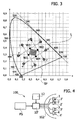
- the diagram in figure 3 develops the concept of 'redundancy' of the light radiation sources already introduced in figures 1 and 2 proposing an embodiment, not in accordance with the invention as claimed, in which the effect of variation of the band in which the chromatic enhancement is applied is accompanied by a variation ('tuning') of the resultant 'white' radiation.
- the example in figure 3 refers to an embodiment, not in accordance with the invention as claimed, that may be implemented according to the general circuit diagram shown in figure 4 , in which four pairs of radiation sources (for example LEDs) 1, 1' ; 2, 2' ; 3, 3' and 4, 4' are present in the device or lamp 100, which may be selectively activated by means of a switch 10'.
- each source is identified by the point that represents the radiation emitted from it in the colorimetric diagram C.I.E. 1931 in figure 3 .
- Each pair of LEDs is composed of two dual sources that identify, in a 'baricentric' position between them, a multi-chromatic light, substantially white (W1 for the LEDs 1, 1'; W2 for the LEDs 2, 2' ; W3 for the LEDs 3, 3' and W4 for the LEDs 4, 4').
- the switch 10' in the circuit diagram in figure 4 allows the following to be selectively connected to the power supply device PS:
- the switch 10' it is also possible to enable the switch 10' to connect simultaneously two or more pairs of sources (for example the pair of LEDs 1 and 1' and the pair of LEDs 2 and 2', if necessary with different intensity levels) to the power supply device PS.
- two or more pairs of sources for example the pair of LEDs 1 and 1' and the pair of LEDs 2 and 2', if necessary with different intensity levels
- the switch 10' there is the possibility of varying the chromatic characteristics of the radiation emitted from the device 100 over the whole shaded area identified in figure 3 by the points W1, W2, W3 and W4.
- Three pairs of radiation sources for example LEDs 1, 1'; 2, 2' ; and 3, 3' are present in the device or lamp 100, which may be selectively activated by means of a switch 10 (cf. figure 2 ).
- each source is identified by the point that represents the radiation emitted from it in the colorimetric diagram C.I.E. 1931 in figure 5 .
- Each pair of LEDs is composed of two dual sources that identify, in a 'baricentric' position between them, a multi-chromatic light, substantially white for at least one of the pairs (W1 for the LEDs 1, 1' ; W2 for the LEDs 2, 2' ; and W3 for the LEDs 3, 3').
- at least one of the pairs has a baricentric position that is colored, i.e. non-white.
- the switch 10 in the circuit diagram in figure 2 allows the following to be selectively connected to the power supply device PS:
- the switch 10 it is also possible to enable the switch 10 to connect simultaneously two or more pairs of sources (for example the pair of LEDs 2 and 2' and the pair of LEDs 3 and 3', if necessary with different intensity levels) to the power supply device PS.
- two or more pairs of sources for example the pair of LEDs 2 and 2' and the pair of LEDs 3 and 3', if necessary with different intensity levels
- the switch 10 there is the possibility of varying the chromatic characteristics of the radiation emitted from the device 100 over the whole shaded area identified in figure 3 by the points W1, W2, and W3.
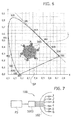
- the circuit diagram in figure 7 refers to an embodiment, not in accordance with the invention as claimed, in which radiation sources, for example six LEDs, 1, 2, 3, 4, 5, 6, are provided mounted inside the reflector 102 and powered from the device PS via a regulation device 1000 - such as for example a microcontroller - which is capable of selectively varying the contribution (in practice radiation intensity) emitted from each source 1, 2, 3, 4, 5, 6.
- a regulation device 1000 - such as for example a microcontroller - which is capable of selectively varying the contribution (in practice radiation intensity) emitted from each source 1, 2, 3, 4, 5, 6.
- each set (for example, the pair 1 and 4, 2 and 5 or 3 and 6) comprising sources of light radiation that are to be mixed to produce multi-chromatic light radiation by additive mixing of the radiation generated from the sources comprised in the set.
- each source is identified by the point that represents the radiation emitted from it in the colorimetric diagram C.I.E. 1931 in figure 6 , it is possible to vary the chromatic characteristics of the resultant radiation in a kind of 'baricenter space' WS.
- the optimum combination can be controlled by the microcontroller 1000 using a dedicated algorithm.
- the various embodiments include, within the framework of a lighting device 100, the presence of several different (sub)sets of radiation sources each of which is capable, by mixing, of giving rise to a substantially white radiation.
- the choice of the specific subset then determines a variation of the chromatic enhancement characteristics obtained.
- at least one of the subsets may be designed to be capable, by mixing, of giving rise to a colored, i.e. non-white radiation.
- Various embodiments allow a single lamp 100 to be developed that is usable for a wide range of applications, in particular with the possibility of obtaining a chromatic enhancement effect in a selectively variable chromatic band.
- the customer's logistics is simplified and likewise his final installation is optimized in that the same set of lamps with the same combination of bands can be mounted in order to illuminate different scenes.
- the lamp may be subject to variations in the combinations of bands in order to meet the requirements for different lighting chromatic characteristics (for example a change in the products or goods to be illuminated).
- a capability for automatically determining the combinations of bands where such a selection may be carried out for example by closed-loop control of the operation of the lamp L with optical sensors able to supply a feedback signal.
Landscapes
- Circuit Arrangement For Electric Light Sources In General (AREA)
- Non-Portable Lighting Devices Or Systems Thereof (AREA)
Description
- The present description relates to lighting devices.
- The present description has been developed with particular attention to the possible application to lighting devices capable of generating multi-chromatic light radiation (for example 'white' light) and comprising several sources (for example, a set of LEDs) of component radiations to be mixed to produce the multi-chromatic' light radiation through additive mixing of said component radiations.
- In general lighting applications, the lighting devices are normally described by means of the parameter known as 'Color-Correlated Temperature' (henceforth written as CCT). This parameter provides an indication of the 'color' of the emitted light radiation. The capacity to render the proper colors of an illuminated scene is, on the other hand, described by means of the parameter denoted as Color Rendering Index (henceforth written as CRI). This index depends on the emission spectrum of the device.
- Illuminating devices with a high CRI are normally preferred for their capacity to render the colors in a 'balanced' or 'equalized' fashion. However, for specific applications, in order to obtain the enhancement of given wavelength bands, in other words certain chromatic components such as for example the color of some products, devices with a low CRI may be used. In the latter case, these are not low quality devices, but devices that are deliberately aimed at giving rise to an 'unbalanced' appearance of colors: for example, the predominance of the red band in the radiation used to illuminate a red apple renders the illuminated apple 'even more red', whereas the predominance of the green band in the radiation used to illuminate a green apple renders the illuminated apple 'even more green'.
- There currently exist lighting devices capable of generating light radiation as an additive mixture of several component radiations produced by a plurality of radiation sources (for example, a set of LEDs emitting at various wavelengths). In these devices, it is possible to vary the color of the emitted radiation and to generate either 'white' light or colored light with variable chromatic characteristics over a broad spectrum. In order to achieve this result, a set of sources of light radiation is used, for example colored LEDs, with complementary chromatic characteristics, for example three LEDs that respectively emit in the Red band, in the Green band and in the Blue band so as to form a tri-chromatic RGB system, to which is sometimes added another white LED device. The variation of the color of the emitted radiation is obtained by selectively varying the intensity of the component radiations emitted from the various sources.
- For the lighting devices of more general use, preference is usually given to lighting devices that emit white radiation with a high value of CRI, hence radiation in which no chromatic component is prevalent, and in which it is more important that the final emission spectrum be uniform so as to obtain a value of CRI that is as high as possible. This also applies in the case of lighting devices for which it is desired to choose the color temperature of the resulting white radiation (so as to have either a "warmer" or a "colder" white light). Also in this case, the assignment of the emission bands of the various LEDs of the lamp, together with the relative combinations of spectra, are defined with the aim of maximizing the CRI, hence being moved in exactly the opposite direction with respect to the direction in which they are moved when it is desired to achieve an effect of enhancement of a particular chromatic component.
- In contrast, the lighting devices that are designed for this other purpose (in other words the enhancement of a particular chromatic component: for example, predominance of the red band for lighting red apples) are noteworthy as lighting devices with chromatic characteristics that are practically fixed. As a consequence of this, a lighting device created in order to enhance, for example, the red band is generally unusable, for example, for illuminating with a chromatic enhancement effect a green colored object: on the contrary, the final effect can turn out to be that the green object illuminated with red light, rather than enhancing its appearance, is seen to assume a completely wan appearance.
- More specifically, the invention relates to lighting device according to the preamble of
claim 1, which is known, e.g. fromUS 2005/212 404 A1 . - From what has previously been said arises the need to dispose of lighting devices capable of combining the positive aspects of the solutions described hereinabove that overcome the inherent drawbacks therein, with, for example, the possibility of varying the emission spectrum according to the chromatic band that it is desired to enhance working in situ, in other words using - if necessary also during operation - the control of the various radiation sources present in the device, without modifications to the lighting device.
- At the same time, the CCT is held constant, or an additional feature is provided for adjusting the white, while maximizing the output intensity or applying any other control strategy. The aim of the present invention is to satisfy the aforementioned requirements.
- According to the invention, the aforementioned objective is met thanks to a lighting device having the features claimed in
claim 1 that follows. - The claims form an integral part of the technical teaching herein provided in relation to the invention.
- Various embodiments provide a multichannel lighting device, in other words comprising a plurality of lighting radiation sources, in which several combinations of bands can deliver by additive mixing the same resultant white light (in other words the same CCT), with the possibility to select in situ one of such combinations according to the lighting requirements. This means that:
- whatever the combinations of bands (in other words the combinations of radiation sources) used, it is possible to obtain a totally white illumination (CCT), and
- the individual combination of bands each time preselected is capable of providing the desired enhancement effect for the desired lighting effect.
- For example:
- a given combination of bands (in other words of radiation sources, for example LEDs) can provide a CCT of 3000 K, accentuating the red band in order to illuminate with an enhancement effect, for example, red apples, and
- a different combination of bands can provide the same CCT of 3000 K, but accentuating the green band in order to illuminate with an enhancement effect, for example, green apples.
- The invention will now be described solely be way of non-limiting example and with reference to the appended drawings, in which:
-
figure 1 illustrates the principle of operation of a first embodiment, -
figure 2 is a schematic circuit diagram of the structure of one embodiment, -
figure 3 illustrates the principle of operation of one embodiment, -
figure 4 illustrates the structure of one embodiment, -
figure 5 illustrates the principle of operation of a one embodiment, -
figure 6 illustrates the principle of operation of one embodiment, and -
figure 7 illustrates the structure of one embodiment. - The embodiments of
figures 3 to 7 are not in accordance with the invention as claimed. - In the following description, various specific details are illustrated for the purpose of a better understanding of the embodiments. The embodiments may be implemented without one or more of the specific details, or with other methods, components, materials, etc. In other cases, known structures, materials or modes of operation are not shown or described in detail in order to avoid obscuring various aspects of the embodiments.
- The reference to "an embodiment" within the scope of this description is used to indicate that a particular configuration, structure or feature described in relation to the embodiment is comprised within at least one embodiment. Thus, phrases such as "in one embodiment", which may occur at various places in this description, do not necessarily refer to the same embodiment. Furthermore, particular layouts, structures or features may be combined in an appropriate manner in one or more embodiments.
- The references used here are only for convenience and do not therefore define the range of protection or the scope of the embodiment.
- One of the basic principles of colorimetry states that any color may be generated as a mixture of component radiations defining a tri-chromatic system: each point inside a so-called "triangle of colors" represents a color that is obtainable by mixing in appropriate amounts three colors referred to as primary colors, chosen in such a manner that none of them can be obtained with any mixture of the other two. This is the rule for additive mixing, foundation of the tri-chromatic theory.
- In the case of the RGB system, used, for example, for the reproduction of the color images on television and computer screens, on photographic and video cameras, and also for the capture of color images, the component radiations defining the tri-chromatic system are red, green and blue component radiations, whence the denotation RGB (Red-Green-Blue) assigned to such a chromatic system.
- More generally, as is well known to those skilled in the art of colorimetry, within the area of a color triangle, each point represents light radiation with given chromatic characteristics, whereas the mixing of two colors is represented by points from the segment connecting the two points representing the colors that are mixed. Thus, the segment that connects two points comprises all the colors able to be reproduced by mixing the appropriate quantities of the two colors of the radiation represented by the end points. The quantities of the two colors to be mixed in order to obtain a given color are inversely proportional, when the units of the primary colors are fixed, to the lengths of the segments that connect the point corresponding to the mixture with the two ends of the segment.
- Within the area of a color triangle, a geometry equivalent to a normal geometry can thus be applied, by which, as can be seen, an intermediate point on the segment of line linking two points corresponds to radiation exhibiting chromatic characteristics that are intermediate with respect to the characteristics of the radiation corresponding to the two ends of the segment. In an analog manner, the baricenter of the triangle defined by three points corresponds to radiation exhibiting 'baricentric' chromatic characteristics with respect to the chromatic characteristics of the three points that represent the vertices.
- Accordingly, it follows that it is possible to define a practically infinite number of sets (pairs, triads, quads, etc.) - different from one another - of chromatic components able to give rise, by mixing together, to the same resultant radiation (for example 'white' radiation, or white light).
- The drawing in
figure 1 (and the same goes for the drawing infigure 3 and the drawing infigure 6 ) refers to the so-called Cartesian color space (colorimetric diagram) in the C.I.E. 1931 system. - In such a diagram, the reference L indicates the spectral line position of the color points that represent the monochromatic colors of the spectrum, whereas the line SP is the line known as the line of the saturated purples, in other words the location of the points representative of the colors obtainable by mixing of the colors corresponding to the ends of the spectral line L.
- Various embodiments are based on the criterion of generating multi-chromatic light radiation (such as for example 'white' radiation) by an additive mixing of a set of component radiations. In particular, various embodiments are designed to provide a plurality of sets (pairs, triads, etc.) - different from one another - of component radiations that are to be mixed together with the possibility of activating said sets of component radiations in a selective manner, in other words, for example, activating one system of light radiation sources (e.g. LEDs) in place of another.
- As an example, in the drawing in
figure 1 , the point W can be the point representing the white of equal intensity, which can be generated by alternately (completely) mixing together three different pairs of component radiations, in other words: - radiation corresponding to the
point 1 and radiation corresponding to the point 1'; - radiation corresponding to the
point 2 and radiation corresponding to the point 2'; - radiation corresponding to the
point 3 and radiation corresponding to the point 3'. - In fact, in all three cases, the point W is 'baricentric' (central) with respect to the points corresponding to the mixed component radiations.
- The choice of one or other pair of component radiations (1 and 1'; 2 and 2'; or 3 and 3') leaves unaltered the resultant multi-chromatic light radiation (in other words the radiation corresponding to the point W), but produces enhancement effects for different chromatic components: the sources activated in order to generate the mixed component radiations are actually different, with different chromatic (hence enhancement) characteristics. Even if the appended figures do not allow for color reproduction, the fact that, for example, the radiation/sources corresponding to the
points 2, 1' and 3 (quite close to the line of the saturated purples SP) correspond to colors that are completely different from one another is immediately evident. - It will furthermore be appreciated that the same criterion previously described with reference to pairs of radiation/sources may be applied (perhaps in a more intuitive manner in view of the habit of reasoning in terms of tri-chromatic systems), for example, to triads of radiation/sources.
- Accordingly, still referring to the drawing in
figure 1 , it can be noted that the point W representing the white of equal intensity is also able to be reproduced by alternately (completely) mixing together two different radiation triads: - the first triad, identified by the points identified with 1, 2 and 3, and
- the second triad, identified by the points identified with 1', 2' and 3'.
- As in the preceding case, the result of the above is to leave unaltered the resultant multi-chromatic light radiation corresponding to the 'baricentric' point W, but produces enhancement effects for different chromatic components depending on the specific sources (1, 2, 3 or 1', 2', 3').
- Although the description hereinabove has been presented assuming for simplicity that the radiation W can be generated using, alternately, one of the radiation pairs 1 and 1' or 2 and 2' or 3 and 3', (completely) alternately from one another, or one of the radiation triads, i.e. the
triad - The possible generalization to sets of radiation/sources comprising a number of radiation/sources greater than two (pair) or three (triad) is immediate if it is noted that each point on the diagram in
figure 1 corresponds to radiation that is in turn obtainable by mixing (at least) two different radiations. -
Figure 2 makes reference to a possible implementation of alighting device 100 corresponding to the examples considered hereinabove, in other words alighting device 1 comprising exactly six radiation sources, for example six LEDs, respectively indicated with 1, 2, 3 and with 1', 2' and 3' capable of emitting, when activated, "colored" radiation corresponding to the homologous points represented on the color triangle infigure 1 . - The schematic layout in
figure 2 shows that within the same device or 'lamp' 100, or inside the same reflector (or analogous structure capable of performing the mixing of the radiation emitted from the various sources) 102, it is possible to install radiation sources such asLEDs figure 1 . - This is substantially analogous to a structure now consolidated by LED lamps comprising several "colored" radiation sources which may potentially be used to vary the color temperature (CCT) of the white radiation emitted.
- In various embodiments, the possibility is furthermore provided of selectively connecting to a power supply device PS' (of a conventional type), operating by means of a switch 10:
- the first pair of
LEDs 1 and 1'; - the second pair of
LEDs 2 and 2'; or - the third pair of
LEDs 3 and 3'. - In various embodiments, the
switch 10 is, on the other hand, configured for selectively connecting to the power supply device PS: - the first triad of
LEDs - the second triad of LEDs 1', 2', 3'.
- Once again, it will be remembered that the
device 10 may also be configured in such a manner as to simultaneously activate, if necessary with different intensity levels, several pairs or both the triads of radiation/sources in question. - In each case, since chromatic components with the same baricenter W correspond to the three pairs of LEDs or to the two triads of LEDs, the resulting white light, in other words the white light emitted from the
device 100, will correspond to the same CCT. The processes for achieving this result correspond to the combination of completely different chromatic components. - The solution referred to in
figures 1 and 2 thus allows the same resultant white radiation to be obtained within thesame lamp 100, but with completely different chromatic enhancement effects depending on which and on how the three pairs of LEDs (1, 1' or 2, 2' or 3, 3') or the two triads of LEDs (1, 2, 3 or 1', 2', 3') is/are activated at that time by means of theswitch 10. - The drawing in
figure 2 , deliberately schematic, generally identifies with 12 a function (denoted per se) designed to take into account the variation (derating) of the characteristics of the various radiation sources (LEDs) as a function of the current, of the temperature and of the aging and to compensate for the drift phenomena of the emission characteristics of the various LEDs. This is carried out so as to preserve over time the performance of thelamp 100, in particular as regards the stability of the white radiation corresponding to the baricenter W infigure 1 . - The diagram in
figure 3 develops the concept of 'redundancy' of the light radiation sources already introduced infigures 1 and 2 proposing an embodiment, not in accordance with the invention as claimed, in which the effect of variation of the band in which the chromatic enhancement is applied is accompanied by a variation ('tuning') of the resultant 'white' radiation. The example infigure 3 refers to an embodiment, not in accordance with the invention as claimed, that may be implemented according to the general circuit diagram shown infigure 4 , in which four pairs of radiation sources (for example LEDs) 1, 1' ; 2, 2' ; 3, 3' and 4, 4' are present in the device orlamp 100, which may be selectively activated by means of a switch 10'. - Also in this case, for simplicity, each source is identified by the point that represents the radiation emitted from it in the colorimetric diagram C.I.E. 1931 in
figure 3 . Each pair of LEDs is composed of two dual sources that identify, in a 'baricentric' position between them, a multi-chromatic light, substantially white (W1 for theLEDs 1, 1'; W2 for theLEDs 2, 2' ; W3 for theLEDs 3, 3' and W4 for the LEDs 4, 4'). - The switch 10' in the circuit diagram in
figure 4 allows the following to be selectively connected to the power supply device PS: - the radiation sources (LEDs) 1 and 1'
- the
LEDs 2 and 2' - the
LEDs 3 and 3', and - the LEDs 4 and 4'.
- In this manner, aside from obtaining various combinations of emission bands (with a corresponding variation of the desired chromatic enhancement effect), it is also possible to modify the baricenter, hence the characteristics of the resultant 'white' radiation, by making the latter correspond, for example, to various different baricenters respectively indicated by W1, W2, W3 and W4.
- In this case, it is also possible to enable the switch 10' to connect simultaneously two or more pairs of sources (for example the pair of
LEDs 1 and 1' and the pair ofLEDs 2 and 2', if necessary with different intensity levels) to the power supply device PS. In addition, there is the possibility of varying the chromatic characteristics of the radiation emitted from thedevice 100 over the whole shaded area identified infigure 3 by the points W1, W2, W3 and W4. - It will be appreciated that, in this case also, what was said previously with reference to the - pairs - of
sources 1, 1' ; 2, 2' ; 3, 3' and 4, 4' may be applied to triads, quads or, in general, sets of more sources. - The same principle as in
figure 4 may be applied to a device built according tofigure 2 if the LEDs forming pairs are chosen in a different way than infigure 1 , as it is sketched infigure 5 : choosing LEDs of different colors, also resulting in the effect of variation of the band in which the chromatic enhancement is applied is accompanied by a variation ('tuning') of the resultant 'white' radiation. The only difference to the device according tofigure 2 therefore is the types of LEDs being combined according tofigure 5 . - Three pairs of radiation sources (for example LEDs) 1, 1'; 2, 2' ; and 3, 3' are present in the device or
lamp 100, which may be selectively activated by means of a switch 10 (cf.figure 2 ). - Also in this case, for simplicity, each source is identified by the point that represents the radiation emitted from it in the colorimetric diagram C.I.E. 1931 in
figure 5 . Each pair of LEDs is composed of two dual sources that identify, in a 'baricentric' position between them, a multi-chromatic light, substantially white for at least one of the pairs (W1 for theLEDs 1, 1' ; W2 for theLEDs 2, 2' ; and W3 for theLEDs 3, 3'). In a special embodiment at least one of the pairs has a baricentric position that is colored, i.e. non-white. - The
switch 10 in the circuit diagram infigure 2 allows the following to be selectively connected to the power supply device PS: - the radiation sources (LEDs) 1 and 1'
- the
LEDs 2 and 2' and - the
LEDs 3 and 3'. - In this manner, aside from obtaining various combinations of emission bands (with a corresponding variation of the desired chromatic enhancement effect), it is also possible to modify the baricenter, hence the characteristics of the resultant 'white' radiation, by making the latter correspond, for example, to various different baricenters respectively indicated by W1, W2, and W3.
- In this case, it is also possible to enable the
switch 10 to connect simultaneously two or more pairs of sources (for example the pair ofLEDs 2 and 2' and the pair ofLEDs 3 and 3', if necessary with different intensity levels) to the power supply device PS. In addition, there is the possibility of varying the chromatic characteristics of the radiation emitted from thedevice 100 over the whole shaded area identified infigure 3 by the points W1, W2, and W3. The circuit diagram infigure 7 refers to an embodiment, not in accordance with the invention as claimed, in which radiation sources, for example six LEDs, 1, 2, 3, 4, 5, 6, are provided mounted inside thereflector 102 and powered from the device PS via a regulation device 1000 - such as for example a microcontroller - which is capable of selectively varying the contribution (in practice radiation intensity) emitted from eachsource sources pair - Assuming once again that, for simplicity, each source is identified by the point that represents the radiation emitted from it in the colorimetric diagram C.I.E. 1931 in
figure 6 , it is possible to vary the chromatic characteristics of the resultant radiation in a kind of 'baricenter space' WS. - In this way, by varying (for example in a continuous manner) the weight of the various
chromatic components - The optimum combination can be controlled by the
microcontroller 1000 using a dedicated algorithm. - The various embodiments include, within the framework of a
lighting device 100, the presence of several different (sub)sets of radiation sources each of which is capable, by mixing, of giving rise to a substantially white radiation. The choice of the specific subset then determines a variation of the chromatic enhancement characteristics obtained. In a special embodiment also at least one of the subsets may be designed to be capable, by mixing, of giving rise to a colored, i.e. non-white radiation. - Various embodiments allow a
single lamp 100 to be developed that is usable for a wide range of applications, in particular with the possibility of obtaining a chromatic enhancement effect in a selectively variable chromatic band. The customer's logistics is simplified and likewise his final installation is optimized in that the same set of lamps with the same combination of bands can be mounted in order to illuminate different scenes. In addition to which, by means of a quick calibration, it is possible to choose in situ the best combination of bands according to the perception and/or to the indications of the user and/or customer. During its useful lifetime, the lamp may be subject to variations in the combinations of bands in order to meet the requirements for different lighting chromatic characteristics (for example a change in the products or goods to be illuminated). It is also possible to develop as a further feature of the invention a capability for automatically determining the combinations of bands, where such a selection may be carried out for example by closed-loop control of the operation of the lamp L with optical sensors able to supply a feedback signal. - It goes without saying that the principle of the invention remains unchanged, although the specifics of the implementation and the embodiments may vary, even significantly, with respect to which it is illustrated purely by way of non-limiting example, without straying from the scope of the invention as defined in the appended claims. This can be valid in particular as regards the possibility of using sources of light radiation different from LEDs, for example OLEDs or substantially monochromatic light sources of another nature.
Claims (6)
- A lighting device (100) including light radiation sources that can be mixed (102) to produce multi-chromatic light radiation (W) as an additive mixture of the radiations generated by said sources, including:- a plurality of sets (1, 1' ; 2, 2' ; 3, 3') of light radiation sources, wherein each set includes light radiation sources that can be mixed (102) to produce multi-chromatic light radiation through additive mixing of the radiations generated by the sources in the set, and- a control device (10) to selectively activate the sets (1, 1'; 2, 2'; 3, 3') of radiation sources in said plurality,characterized in that
each said set of radiation sources (1, 1' ; 2, 2' ; 3, 3') includes sources of radiations which correspond to points in the Cartesian colorimetric diagram in the C.I.E. 1931 system with a baricentric point (W)
wherein said sets of radiation sources (1, 1'; 2, 2'; 3, 3') of said plurality have one and the same baricentric point (W). - The lighting device as claimed in claim 1, wherein said control device (10) is configured for activating selectively and alternatively the sets of sources (1, 1' ; 2, 2' ; 3, 3') of said plurality.
- The lighting device as claimed in claim 1, wherein said control device (10) is configured for simultaneously activating plural sets of radiation sources (1, 1' ; 2, 2' ; 3, 3') of said plurality.
- The lighting device as claimed in any one of the preceding claims, wherein said control device (10) is configured for selectively varying the intensity of the mixable radiations emitted by said radiation sources (1, 1'; 2, 2'; 3, 3').
- The lighting device as claimed in any one of the preceding claims, wherein said plurality of sets of radiation sources includes at least one first set (1, 2, 3) of radiation sources and at least one second set (1', 2', 3') of radiation sources wherein to each radiation source in said first set (1, 2, 3) there corresponds a corresponding source in said second set (1', 2', 3').
- The lighting device as claimed in any one of the preceding claims, wherein said one and the same baricentric point (W) corresponds to a white radiation.
Applications Claiming Priority (2)
| Application Number | Priority Date | Filing Date | Title |
|---|---|---|---|
| ITTO20090954 | 2009-12-04 | ||
| PCT/EP2010/068660 WO2011067298A1 (en) | 2009-12-04 | 2010-12-01 | Led lighting device for producing multi - chromatic light radiation |
Publications (2)
| Publication Number | Publication Date |
|---|---|
| EP2491766A1 EP2491766A1 (en) | 2012-08-29 |
| EP2491766B1 true EP2491766B1 (en) | 2015-02-25 |
Family
ID=42040539
Family Applications (1)
| Application Number | Title | Priority Date | Filing Date |
|---|---|---|---|
| EP10805219.2A Not-in-force EP2491766B1 (en) | 2009-12-04 | 2010-12-01 | Led lighting device for producing multi-chromatic light radiation |
Country Status (4)
| Country | Link |
|---|---|
| US (1) | US20120314412A1 (en) |
| EP (1) | EP2491766B1 (en) |
| CN (1) | CN102640566B (en) |
| WO (1) | WO2011067298A1 (en) |
Families Citing this family (1)
| Publication number | Priority date | Publication date | Assignee | Title |
|---|---|---|---|---|
| WO2014166930A1 (en) * | 2013-04-09 | 2014-10-16 | Koninklijke Philips N.V. | Arrangement for changing the visual appearance of a target object |
Family Cites Families (5)
| Publication number | Priority date | Publication date | Assignee | Title |
|---|---|---|---|---|
| US7066623B2 (en) * | 2003-12-19 | 2006-06-27 | Soo Ghee Lee | Method and apparatus for producing untainted white light using off-white light emitting diodes |
| US7083302B2 (en) * | 2004-03-24 | 2006-08-01 | J. S. Technology Co., Ltd. | White light LED assembly |
| EP1872625A4 (en) * | 2005-04-06 | 2014-05-07 | Koninkl Philips Nv | WHITE LUMINAIRE WITH ADJUSTABLE COLOR TEMPERATURE ADJUSTABLE |
| US7568815B2 (en) * | 2007-03-26 | 2009-08-04 | Avago Technologies Ecbu Ip (Singapore) Pte. Ltd. | Light source having a plurality of white LEDs with different output spectra |
| TWI521972B (en) * | 2008-03-31 | 2016-02-11 | 林克實驗公司 | Electronic display element with integrated illumination system |
-
2010
- 2010-12-01 WO PCT/EP2010/068660 patent/WO2011067298A1/en not_active Ceased
- 2010-12-01 CN CN201080054937.7A patent/CN102640566B/en not_active Expired - Fee Related
- 2010-12-01 EP EP10805219.2A patent/EP2491766B1/en not_active Not-in-force
- 2010-12-01 US US13/513,853 patent/US20120314412A1/en not_active Abandoned
Also Published As
| Publication number | Publication date |
|---|---|
| WO2011067298A1 (en) | 2011-06-09 |
| US20120314412A1 (en) | 2012-12-13 |
| CN102640566B (en) | 2015-07-08 |
| CN102640566A (en) | 2012-08-15 |
| EP2491766A1 (en) | 2012-08-29 |
Similar Documents
| Publication | Publication Date | Title |
|---|---|---|
| US8766555B2 (en) | Tunable white color methods and uses thereof | |
| US7972028B2 (en) | System, method and tool for optimizing generation of high CRI white light, and an optimized combination of light emitting diodes | |
| KR101659503B1 (en) | Method and system for dependently controlling colour light sources | |
| US9753275B2 (en) | Illumination apparatus | |
| US8427721B2 (en) | Device and method for dynamically changing color | |
| JP6677323B2 (en) | Light emitting device and lighting device | |
| WO2010126065A1 (en) | Illuminating device | |
| CA2974997A1 (en) | System and method for generating light representative of a target natural light | |
| TWI441551B (en) | White light source with adjustable color temperature | |
| US11778707B2 (en) | Settings yielding different spectra and similar color | |
| US20070085789A1 (en) | Multiple primary color display system and method of display using multiple primary colors | |
| JP2014182192A5 (en) | ||
| US11076461B2 (en) | User control modality for LED color tuning | |
| TW202107940A (en) | Selecting parameters in a color-tuning application | |
| US20220330399A1 (en) | Lighting system with integrated sensor | |
| WO2020236525A1 (en) | User control modality for led color tuning | |
| US20130278149A1 (en) | Apparatus, system and method for multi-channel illumination | |
| CN117062272B (en) | Light source modules and lamps | |
| JP6145818B2 (en) | Lighting system | |
| US20120314412A1 (en) | LED Lighting Device for Producing Multi-Chromatic Light Radiation | |
| US12464614B2 (en) | System and method for producing high quality temperature adjustable white light | |
| US7220017B2 (en) | Method and system of controlling bicolor luminary system | |
| KR20120091435A (en) | Led lighting device for producing multi - chromatic light radiation | |
| EP3811736B1 (en) | Lighting system with integrated sensor | |
| JP7389417B2 (en) | lighting method |
Legal Events
| Date | Code | Title | Description |
|---|---|---|---|
| PUAI | Public reference made under article 153(3) epc to a published international application that has entered the european phase |
Free format text: ORIGINAL CODE: 0009012 |
|
| 17P | Request for examination filed |
Effective date: 20120523 |
|
| AK | Designated contracting states |
Kind code of ref document: A1 Designated state(s): AL AT BE BG CH CY CZ DE DK EE ES FI FR GB GR HR HU IE IS IT LI LT LU LV MC MK MT NL NO PL PT RO RS SE SI SK SM TR |
|
| RAP1 | Party data changed (applicant data changed or rights of an application transferred) |
Owner name: OSRAM GMBH Owner name: OSRAM S.P.A. - SOCIETA' RIUNITE OSRAM EDISON CLERI |
|
| DAX | Request for extension of the european patent (deleted) | ||
| RAP1 | Party data changed (applicant data changed or rights of an application transferred) |
Owner name: OSRAM GMBH Owner name: OSRAM S.P.A. - SOCIETA' RIUNITE OSRAM EDISON CLERI |
|
| 17Q | First examination report despatched |
Effective date: 20130507 |
|
| GRAP | Despatch of communication of intention to grant a patent |
Free format text: ORIGINAL CODE: EPIDOSNIGR1 |
|
| INTG | Intention to grant announced |
Effective date: 20141121 |
|
| GRAS | Grant fee paid |
Free format text: ORIGINAL CODE: EPIDOSNIGR3 |
|
| GRAA | (expected) grant |
Free format text: ORIGINAL CODE: 0009210 |
|
| AK | Designated contracting states |
Kind code of ref document: B1 Designated state(s): AL AT BE BG CH CY CZ DE DK EE ES FI FR GB GR HR HU IE IS IT LI LT LU LV MC MK MT NL NO PL PT RO RS SE SI SK SM TR |
|
| REG | Reference to a national code |
Ref country code: GB Ref legal event code: FG4D |
|
| REG | Reference to a national code |
Ref country code: CH Ref legal event code: EP |
|
| REG | Reference to a national code |
Ref country code: IE Ref legal event code: FG4D |
|
| REG | Reference to a national code |
Ref country code: DE Ref legal event code: R096 Ref document number: 602010022673 Country of ref document: DE Effective date: 20150409 |
|
| REG | Reference to a national code |
Ref country code: AT Ref legal event code: REF Ref document number: 712927 Country of ref document: AT Kind code of ref document: T Effective date: 20150415 |
|
| REG | Reference to a national code |
Ref country code: NL Ref legal event code: VDEP Effective date: 20150225 |
|
| REG | Reference to a national code |
Ref country code: AT Ref legal event code: MK05 Ref document number: 712927 Country of ref document: AT Kind code of ref document: T Effective date: 20150225 |
|
| REG | Reference to a national code |
Ref country code: LT Ref legal event code: MG4D |
|
| PG25 | Lapsed in a contracting state [announced via postgrant information from national office to epo] |
Ref country code: NO Free format text: LAPSE BECAUSE OF FAILURE TO SUBMIT A TRANSLATION OF THE DESCRIPTION OR TO PAY THE FEE WITHIN THE PRESCRIBED TIME-LIMIT Effective date: 20150525 Ref country code: FI Free format text: LAPSE BECAUSE OF FAILURE TO SUBMIT A TRANSLATION OF THE DESCRIPTION OR TO PAY THE FEE WITHIN THE PRESCRIBED TIME-LIMIT Effective date: 20150225 Ref country code: HR Free format text: LAPSE BECAUSE OF FAILURE TO SUBMIT A TRANSLATION OF THE DESCRIPTION OR TO PAY THE FEE WITHIN THE PRESCRIBED TIME-LIMIT Effective date: 20150225 Ref country code: SE Free format text: LAPSE BECAUSE OF FAILURE TO SUBMIT A TRANSLATION OF THE DESCRIPTION OR TO PAY THE FEE WITHIN THE PRESCRIBED TIME-LIMIT Effective date: 20150225 Ref country code: ES Free format text: LAPSE BECAUSE OF FAILURE TO SUBMIT A TRANSLATION OF THE DESCRIPTION OR TO PAY THE FEE WITHIN THE PRESCRIBED TIME-LIMIT Effective date: 20150225 Ref country code: LT Free format text: LAPSE BECAUSE OF FAILURE TO SUBMIT A TRANSLATION OF THE DESCRIPTION OR TO PAY THE FEE WITHIN THE PRESCRIBED TIME-LIMIT Effective date: 20150225 |
|
| PG25 | Lapsed in a contracting state [announced via postgrant information from national office to epo] |
Ref country code: LV Free format text: LAPSE BECAUSE OF FAILURE TO SUBMIT A TRANSLATION OF THE DESCRIPTION OR TO PAY THE FEE WITHIN THE PRESCRIBED TIME-LIMIT Effective date: 20150225 Ref country code: RS Free format text: LAPSE BECAUSE OF FAILURE TO SUBMIT A TRANSLATION OF THE DESCRIPTION OR TO PAY THE FEE WITHIN THE PRESCRIBED TIME-LIMIT Effective date: 20150225 Ref country code: AT Free format text: LAPSE BECAUSE OF FAILURE TO SUBMIT A TRANSLATION OF THE DESCRIPTION OR TO PAY THE FEE WITHIN THE PRESCRIBED TIME-LIMIT Effective date: 20150225 Ref country code: IS Free format text: LAPSE BECAUSE OF FAILURE TO SUBMIT A TRANSLATION OF THE DESCRIPTION OR TO PAY THE FEE WITHIN THE PRESCRIBED TIME-LIMIT Effective date: 20150625 Ref country code: GR Free format text: LAPSE BECAUSE OF FAILURE TO SUBMIT A TRANSLATION OF THE DESCRIPTION OR TO PAY THE FEE WITHIN THE PRESCRIBED TIME-LIMIT Effective date: 20150526 |
|
| PG25 | Lapsed in a contracting state [announced via postgrant information from national office to epo] |
Ref country code: NL Free format text: LAPSE BECAUSE OF FAILURE TO SUBMIT A TRANSLATION OF THE DESCRIPTION OR TO PAY THE FEE WITHIN THE PRESCRIBED TIME-LIMIT Effective date: 20150225 |
|
| PG25 | Lapsed in a contracting state [announced via postgrant information from national office to epo] |
Ref country code: SK Free format text: LAPSE BECAUSE OF FAILURE TO SUBMIT A TRANSLATION OF THE DESCRIPTION OR TO PAY THE FEE WITHIN THE PRESCRIBED TIME-LIMIT Effective date: 20150225 Ref country code: EE Free format text: LAPSE BECAUSE OF FAILURE TO SUBMIT A TRANSLATION OF THE DESCRIPTION OR TO PAY THE FEE WITHIN THE PRESCRIBED TIME-LIMIT Effective date: 20150225 Ref country code: CZ Free format text: LAPSE BECAUSE OF FAILURE TO SUBMIT A TRANSLATION OF THE DESCRIPTION OR TO PAY THE FEE WITHIN THE PRESCRIBED TIME-LIMIT Effective date: 20150225 Ref country code: DK Free format text: LAPSE BECAUSE OF FAILURE TO SUBMIT A TRANSLATION OF THE DESCRIPTION OR TO PAY THE FEE WITHIN THE PRESCRIBED TIME-LIMIT Effective date: 20150225 Ref country code: RO Free format text: LAPSE BECAUSE OF FAILURE TO SUBMIT A TRANSLATION OF THE DESCRIPTION OR TO PAY THE FEE WITHIN THE PRESCRIBED TIME-LIMIT Effective date: 20150225 |
|
| REG | Reference to a national code |
Ref country code: DE Ref legal event code: R097 Ref document number: 602010022673 Country of ref document: DE |
|
| PG25 | Lapsed in a contracting state [announced via postgrant information from national office to epo] |
Ref country code: PL Free format text: LAPSE BECAUSE OF FAILURE TO SUBMIT A TRANSLATION OF THE DESCRIPTION OR TO PAY THE FEE WITHIN THE PRESCRIBED TIME-LIMIT Effective date: 20150225 |
|
| PG25 | Lapsed in a contracting state [announced via postgrant information from national office to epo] |
Ref country code: IT Free format text: LAPSE BECAUSE OF FAILURE TO SUBMIT A TRANSLATION OF THE DESCRIPTION OR TO PAY THE FEE WITHIN THE PRESCRIBED TIME-LIMIT Effective date: 20150225 |
|
| PLBE | No opposition filed within time limit |
Free format text: ORIGINAL CODE: 0009261 |
|
| STAA | Information on the status of an ep patent application or granted ep patent |
Free format text: STATUS: NO OPPOSITION FILED WITHIN TIME LIMIT |
|
| 26N | No opposition filed |
Effective date: 20151126 |
|
| PG25 | Lapsed in a contracting state [announced via postgrant information from national office to epo] |
Ref country code: SI Free format text: LAPSE BECAUSE OF FAILURE TO SUBMIT A TRANSLATION OF THE DESCRIPTION OR TO PAY THE FEE WITHIN THE PRESCRIBED TIME-LIMIT Effective date: 20150225 |
|
| PG25 | Lapsed in a contracting state [announced via postgrant information from national office to epo] |
Ref country code: BE Free format text: LAPSE BECAUSE OF FAILURE TO SUBMIT A TRANSLATION OF THE DESCRIPTION OR TO PAY THE FEE WITHIN THE PRESCRIBED TIME-LIMIT Effective date: 20150225 |
|
| PG25 | Lapsed in a contracting state [announced via postgrant information from national office to epo] |
Ref country code: LU Free format text: LAPSE BECAUSE OF FAILURE TO SUBMIT A TRANSLATION OF THE DESCRIPTION OR TO PAY THE FEE WITHIN THE PRESCRIBED TIME-LIMIT Effective date: 20151201 Ref country code: MC Free format text: LAPSE BECAUSE OF FAILURE TO SUBMIT A TRANSLATION OF THE DESCRIPTION OR TO PAY THE FEE WITHIN THE PRESCRIBED TIME-LIMIT Effective date: 20150225 |
|
| REG | Reference to a national code |
Ref country code: CH Ref legal event code: PL |
|
| GBPC | Gb: european patent ceased through non-payment of renewal fee |
Effective date: 20151201 |
|
| REG | Reference to a national code |
Ref country code: IE Ref legal event code: MM4A |
|
| REG | Reference to a national code |
Ref country code: FR Ref legal event code: ST Effective date: 20160831 |
|
| PG25 | Lapsed in a contracting state [announced via postgrant information from national office to epo] |
Ref country code: IE Free format text: LAPSE BECAUSE OF NON-PAYMENT OF DUE FEES Effective date: 20151201 Ref country code: LI Free format text: LAPSE BECAUSE OF NON-PAYMENT OF DUE FEES Effective date: 20151231 Ref country code: GB Free format text: LAPSE BECAUSE OF NON-PAYMENT OF DUE FEES Effective date: 20151201 Ref country code: CH Free format text: LAPSE BECAUSE OF NON-PAYMENT OF DUE FEES Effective date: 20151231 |
|
| PG25 | Lapsed in a contracting state [announced via postgrant information from national office to epo] |
Ref country code: FR Free format text: LAPSE BECAUSE OF NON-PAYMENT OF DUE FEES Effective date: 20151231 |
|
| PG25 | Lapsed in a contracting state [announced via postgrant information from national office to epo] |
Ref country code: HU Free format text: LAPSE BECAUSE OF FAILURE TO SUBMIT A TRANSLATION OF THE DESCRIPTION OR TO PAY THE FEE WITHIN THE PRESCRIBED TIME-LIMIT; INVALID AB INITIO Effective date: 20101201 Ref country code: SM Free format text: LAPSE BECAUSE OF FAILURE TO SUBMIT A TRANSLATION OF THE DESCRIPTION OR TO PAY THE FEE WITHIN THE PRESCRIBED TIME-LIMIT Effective date: 20150225 Ref country code: BG Free format text: LAPSE BECAUSE OF FAILURE TO SUBMIT A TRANSLATION OF THE DESCRIPTION OR TO PAY THE FEE WITHIN THE PRESCRIBED TIME-LIMIT Effective date: 20150225 |
|
| PG25 | Lapsed in a contracting state [announced via postgrant information from national office to epo] |
Ref country code: CY Free format text: LAPSE BECAUSE OF FAILURE TO SUBMIT A TRANSLATION OF THE DESCRIPTION OR TO PAY THE FEE WITHIN THE PRESCRIBED TIME-LIMIT Effective date: 20150225 |
|
| PG25 | Lapsed in a contracting state [announced via postgrant information from national office to epo] |
Ref country code: MT Free format text: LAPSE BECAUSE OF FAILURE TO SUBMIT A TRANSLATION OF THE DESCRIPTION OR TO PAY THE FEE WITHIN THE PRESCRIBED TIME-LIMIT Effective date: 20150225 Ref country code: TR Free format text: LAPSE BECAUSE OF FAILURE TO SUBMIT A TRANSLATION OF THE DESCRIPTION OR TO PAY THE FEE WITHIN THE PRESCRIBED TIME-LIMIT Effective date: 20150225 |
|
| PG25 | Lapsed in a contracting state [announced via postgrant information from national office to epo] |
Ref country code: MK Free format text: LAPSE BECAUSE OF FAILURE TO SUBMIT A TRANSLATION OF THE DESCRIPTION OR TO PAY THE FEE WITHIN THE PRESCRIBED TIME-LIMIT Effective date: 20150225 Ref country code: PT Free format text: LAPSE BECAUSE OF FAILURE TO SUBMIT A TRANSLATION OF THE DESCRIPTION OR TO PAY THE FEE WITHIN THE PRESCRIBED TIME-LIMIT Effective date: 20150225 |
|
| PG25 | Lapsed in a contracting state [announced via postgrant information from national office to epo] |
Ref country code: AL Free format text: LAPSE BECAUSE OF FAILURE TO SUBMIT A TRANSLATION OF THE DESCRIPTION OR TO PAY THE FEE WITHIN THE PRESCRIBED TIME-LIMIT Effective date: 20150225 |
|
| REG | Reference to a national code |
Ref country code: DE Ref legal event code: R079 Ref document number: 602010022673 Country of ref document: DE Free format text: PREVIOUS MAIN CLASS: H05B0033080000 Ipc: H05B0045000000 |
|
| PGFP | Annual fee paid to national office [announced via postgrant information from national office to epo] |
Ref country code: DE Payment date: 20211210 Year of fee payment: 12 |
|
| REG | Reference to a national code |
Ref country code: DE Ref legal event code: R119 Ref document number: 602010022673 Country of ref document: DE |
|
| P01 | Opt-out of the competence of the unified patent court (upc) registered |
Effective date: 20230821 |
|
| PG25 | Lapsed in a contracting state [announced via postgrant information from national office to epo] |
Ref country code: DE Free format text: LAPSE BECAUSE OF NON-PAYMENT OF DUE FEES Effective date: 20230701 |