EP2490498A1 - Apparatus, method and computer programs for determining and receiving measurement information - Google Patents
Apparatus, method and computer programs for determining and receiving measurement information Download PDFInfo
- Publication number
- EP2490498A1 EP2490498A1 EP11290090A EP11290090A EP2490498A1 EP 2490498 A1 EP2490498 A1 EP 2490498A1 EP 11290090 A EP11290090 A EP 11290090A EP 11290090 A EP11290090 A EP 11290090A EP 2490498 A1 EP2490498 A1 EP 2490498A1
- Authority
- EP
- European Patent Office
- Prior art keywords
- radio
- resource utilization
- information
- radio resource
- base station
- Prior art date
- Legal status (The legal status is an assumption and is not a legal conclusion. Google has not performed a legal analysis and makes no representation as to the accuracy of the status listed.)
- Granted
Links
- 238000005259 measurement Methods 0.000 title claims abstract description 79
- 238000000034 method Methods 0.000 title claims description 30
- 238000004590 computer program Methods 0.000 title claims description 8
- 230000003252 repetitive effect Effects 0.000 claims abstract description 17
- 230000011664 signaling Effects 0.000 claims description 29
- 230000005540 biological transmission Effects 0.000 claims description 23
- 229920000122 acrylonitrile butadiene styrene Polymers 0.000 description 75
- 230000001413 cellular effect Effects 0.000 description 3
- 238000010586 diagram Methods 0.000 description 3
- 238000004891 communication Methods 0.000 description 2
- 238000013500 data storage Methods 0.000 description 2
- 230000006870 function Effects 0.000 description 2
- 238000007726 management method Methods 0.000 description 2
- 230000015654 memory Effects 0.000 description 2
- 238000010295 mobile communication Methods 0.000 description 2
- 230000008054 signal transmission Effects 0.000 description 2
- 230000006978 adaptation Effects 0.000 description 1
- 230000009286 beneficial effect Effects 0.000 description 1
- 239000000969 carrier Substances 0.000 description 1
- 238000001514 detection method Methods 0.000 description 1
- 238000005516 engineering process Methods 0.000 description 1
- 230000007774 longterm Effects 0.000 description 1
- 238000012544 monitoring process Methods 0.000 description 1
- 230000007704 transition Effects 0.000 description 1
Images


Classifications
-
- H—ELECTRICITY
- H04—ELECTRIC COMMUNICATION TECHNIQUE
- H04W—WIRELESS COMMUNICATION NETWORKS
- H04W72/00—Local resource management
- H04W72/20—Control channels or signalling for resource management
- H04W72/27—Control channels or signalling for resource management between access points
-
- H—ELECTRICITY
- H04—ELECTRIC COMMUNICATION TECHNIQUE
- H04W—WIRELESS COMMUNICATION NETWORKS
- H04W16/00—Network planning, e.g. coverage or traffic planning tools; Network deployment, e.g. resource partitioning or cells structures
- H04W16/24—Cell structures
- H04W16/32—Hierarchical cell structures
-
- H—ELECTRICITY
- H04—ELECTRIC COMMUNICATION TECHNIQUE
- H04W—WIRELESS COMMUNICATION NETWORKS
- H04W24/00—Supervisory, monitoring or testing arrangements
- H04W24/10—Scheduling measurement reports ; Arrangements for measurement reports
-
- H—ELECTRICITY
- H04—ELECTRIC COMMUNICATION TECHNIQUE
- H04W—WIRELESS COMMUNICATION NETWORKS
- H04W72/00—Local resource management
-
- H—ELECTRICITY
- H04—ELECTRIC COMMUNICATION TECHNIQUE
- H04W—WIRELESS COMMUNICATION NETWORKS
- H04W84/00—Network topologies
- H04W84/02—Hierarchically pre-organised networks, e.g. paging networks, cellular networks, WLAN [Wireless Local Area Network] or WLL [Wireless Local Loop]
- H04W84/04—Large scale networks; Deep hierarchical networks
- H04W84/042—Public Land Mobile systems, e.g. cellular systems
- H04W84/045—Public Land Mobile systems, e.g. cellular systems using private Base Stations, e.g. femto Base Stations, home Node B
Definitions
- the present invention relates to wireless communications, more particularly but not exclusively to radio resource management and inter-frequency measurements in a mobile communication system.
- Heterogeneous networks are networks which utilize cell types of different sizes, as for example macrocells, picocells, and femtocells. Such cells are established by base station transceivers for which their coverage areas are determined by their transmission power and interference condition. Picocells and femtocells are cells having a smaller coverage area than macrocells. In some network scenarios the small cells' coverage area can be surrounded by the coverage area of a macrocell. The small cells can be deployed to extend the capacity of the network.
- HetNets have been added to the scope of the Long Term Evolution-Advanced (LTE-A for abbreviation) work item. Since the cells or base stations in such networks may utilize the same frequency resources such architectures can suffer from interference created by the overlapping coverage areas of these cells. Therefore enhanced inter-cell interference coordination (ICIC for abbreviation) for co-channel HetNet deployment is one of the key techniques for LTE Release 10 (Rel-10 for abbreviation). Co-channel HetNets comprise macrocells and small cells operating on the same frequency channel. Such deployments present some specific interference scenarios for which ICIC techniques are utilized.
- ICIC inter-cell interference coordination
- the small cells are picocells, which are open to users of the macrocell network.
- user equipment UE for abbreviation
- mobile transceivers may be programmed or configured to associate preferentially with the picocells rather than the macrocells, for example by biasing the signal-to-interference-and-noise ratio (SINR for abbreviation) threshold at which they will select a picocell to associate with.
- SINR signal-to-interference-and-noise ratio
- some subframes may be configured as "blank” or "almost blank” in a macrocell.
- a blank subframe may contain no transmission from the macrocell, while an "almost blank” subframe typically contains no data transmission and little or no control signaling transmission, but may contain reference signal transmissions in order to ensure backward compatibility with legacy terminals which expect to find the reference signals for measurements but are unaware of the configuration of almost blank subframes.
- Almost blank subframes may also contain synchronization signals, broadcast control information and/or paging signals.
- the utilization of "blank” or “almost blank” subframes enables reduced or even suppressed interference for the picocell within these subframes.
- "blank” or “almost blank” sub-frames may be regarded as sub-frames during which at least some radio resources are suspended from transmission.
- ABS blank or almost blank subframes
- X2 backhaul interface
- Such signaling can help the picocell to schedule data transmissions in the picocell appropriately to avoid interference (e.g., by scheduling transmissions to UEs near the edge of the picocell during ABSs), and to signal to the UEs the subframes which should have low macrocellular interference and should therefore be used for measurements.
- Examples for such measurements are measurements for Radio Resource Management (RRM for abbreviation), which typically relate to handover, measurements for Radio Link Monitoring (RLM for abbreviation), which typically relate to detection of serving radio link failure, and measurements for Channel State Information (CSI for abbreviation), which typically relate to link adaptation on the serving radio link.
- RRM Radio Resource Management
- RLM Radio Link Monitoring
- CSI Channel State Information
- Radio Resource Control (RRC for abbreviation) signaling can be utilized to indicate to the UEs the set of subframes which they should use for measurements (e.g., for RLM/RRM or CSI), where RRC is a signaling protocol standardized by 3GPP for control and configuration signaling.
- RRC Radio Resource Control
- femtocells which operate on a Closed Subscriber Group (CSG for abbreviation) basis, and are therefore typically not open to users of the macrocellular network.
- CSG Closed Subscriber Group
- the femtocells can cause strong interference to the macrocell UEs when these macrocell UEs come close to the femto base station transceivers, however, without having the possibility to associate with them.
- the macrocells may indicate to their UEs the subframes in which they should make resource specific measurements, i.e. the subframes in which interference from one or more femtocells is reduced or absent.
- eNodeB eNodeB
- HetNets Another aspect of HetNets arises considering overlay cells, which operate at a different frequency channel or band and have an overlapping geographical coverage area. Such overlapping or overlay networks may be HetNets as well.
- inter-frequency neighbouring cell RRM measurements may be carried out by a UE, for example to determine or enable inter-frequency handover (HO for abbreviation).
- Inter-frequency handover i.e. handover to an overlay cell or an overlay network
- Embodiments may be based on a finding that in a heterogeneous network scenario, e.g. a macrocell with pico- or femtocells therein, a UE may need to measure the macrocell in another frequency either using the non-ABS or ABS (ABS pattern is repeated every 40ms) of that macrocell for inter-frequency handover.
- Embodiments may be further based on the finding that such an inter-frequency handover measurement may depend on whether it is carried out in an ABS or in a non-ABS sub-frame and the UE should therefore be informed about an ABS pattern of an overlay cell.
- Embodiments may be based on a further finding that in order to measure an overlay macrocell signal quality on the non-ABS or ABS, the UE needs to be aligned to a system frame number (SFN for abbreviation) of the macrocell in the other frequency, as the ABS pattern is also aligned to the SFN.
- SFN system frame number
- the ABS pattern is SFN aligned among the pico- and macro- intra-frequency-cells. This assumption may not apply to inter-frequency cells operating at different carrier frequencies.
- the macrocell using the other frequency channel or band communicates using a repetitive radio frame pattern, also referred to as system frames, which are aligned with the ABS pattern.
- Embodiments may be further based on the finding that a UE measuring the inter-frequency macrocell is only radio frame aligned rather than SFN aligned to the inter-frequency cell of the overlay network, which can either lead to a delay, as the UE may need to wait to get SFN aligned to determine the correct ABS-pattern or, if there is not enough time to wait for the SFN alignment, lead to disadvantageous measurement results as the UE would not know whether the measurement is taken during an ABS or a non-ABS-frame.
- Embodiments may be further based on a finding that, for example, in an LTE or LTE-A scenario, as the UE is radio frame aligned to the cell for measurement rather than SFN aligned, it is possible to look for common ABS or non-ABS sub-frames among every 10ms portion of the ABS pattern of the neighbouring inter-frequency cell, i.e. on a radio frame basis.
- the common ABS or non-ABS sub-frames can be signaled to the UE by the serving cell.
- Embodiments may provide an apparatus being adapted for determining information on a common radio resource utilization for a mobile transceiver communicating with a base station transceiver using a first frequency channel, the common radio resource utilization referring to a second frequency channel.
- the common radio resource utilization can be of a second frequency channel.
- the common radio resource utilization may determine a common use of radio resources in a second frequency channel, where, for example, certain sub-frames may be commonly used in all radio frames of the second frequency channel for a certain purpose as e.g. ABS or non-ABS.
- the apparatus comprises means adapted for providing information on a radio resource utilization of an overlay base station transceiver, the overlay base station transceiver being operative for communicating with the mobile transceiver using the second frequency channel and for using a repetitive radio frame pattern comprising a plurality of radio frames, the information on the radio resource utilization comprising information on a radio resource utilization for each of the plurality of radio frames in the radio frame pattern.
- the apparatus further comprises means adapted for determining, based on a comparison of the information on the radio resource utilization for each of the plurality of radio frames in the radio frame pattern, the common radio resource utilization common among all of the plurality of radio frames in the radio frame pattern.
- each of the plurality of radio frames can be further subdivided in a plurality of sub-frames, where each sub-frame provides radio resources and wherein the information on the radio resource utilization indicates during which ones of the sub-frames at least some of the radio resources are suspended from transmission by the overlay base station transceiver.
- the radio frame pattern may have a duration of 40ms, a radio frame may have a duration of 10ms, and a sub-frame may have a duration of 1ms.
- the common radio resource utilization may indicate, commonly for all radio frames in the radio frame pattern, during which ones of the sub-frames at least some of the radio resources are suspended from transmission or during which ones of the sub-frames radio resources are not suspended for transmission by the overlay base station transceiver.
- the common radio resource utilization may comprise indications for a subset of sub-frames, the subset comprising fewer sub-frames than a radio frame in the radio frame pattern.
- Embodiments may also provide a base station transceiver apparatus or a mobile transceiver apparatus comprising the above described apparatus and further comprising signaling means adapted for signaling information on the common radio resource utilization to the mobile transceiver as part of information on a measurement configuration.
- the base station transceiver may further comprise a receiving means adapted for receiving a measurement result from the mobile transceiver, the measurement result being based on the information on the common radio resource utilization.
- the base station transceiver apparatus can be adapted for communicating in an LTE or LTE-A network, wherein the measurement configuration can correspond to an inter-frequency RRM measurement configuration and the information on the common radio resource utilization may correspond to an ABS pattern common to all frames of the radio frame pattern or the system frame utilized by the overlay base station transceiver, which can also be adapted for communicating in an LTE or LTE-A network.
- the measurement configuration can correspond to an inter-frequency RRM measurement configuration
- the information on the common radio resource utilization may correspond to an ABS pattern common to all frames of the radio frame pattern or the system frame utilized by the overlay base station transceiver, which can also be adapted for communicating in an LTE or LTE-A network.
- Embodiments may further relate to an apparatus being adapted for receiving information on a measurement configuration from a base station transceiver using a first frequency channel for communicating with a mobile transceiver apparatus, the mobile transceiver apparatus being adapted for communicating with an overlay base station transceiver using a second frequency channel.
- the apparatus comprises means being adapted for determining information on a radio resource utilization of the overlay base station transceiver, the overlay base station transceiver using a repetitive radio frame pattern comprising a plurality of radio frames, the information on the measurement configuration comprising information on a common radio resource utilization common among all of the plurality of radio frames in the radio frame pattern, wherein the means adapted for determining is further adapted for determining the information on the radio resource utilization of the overlay base station transceiver based on the information on the common radio resource utilization.
- each of the plurality of radio frames in the radio frame pattern may be further subdivided in a plurality of sub-frames, where each sub-frame provides radio resources and wherein the information on the common radio resource utilization indicates during which ones of the sub-frames at least some of the radio resources are suspended from transmission by the overlay base station transceiver, or wherein the information on the common radio resource utilization indicates during which ones of the sub-frames radio resources are not suspended from transmission by the overlay base station transceiver.
- the information on the common radio resource utilization may comprise indications for a subset of sub-frames of a radio frame, the subset comprising fewer sub-frames than a radio frame in the radio frame pattern.
- the radio frame pattern may have a duration of 40ms
- a radio frame may have a duration of 10ms
- a sub-frame may have a duration of 1ms.
- the determining means can be adapted for determining the information on the radio resource utilization of the overlay base station transceiver based on a repetition of the common radio resource utilization of one radio frame in the radio frame pattern in all radio frames of the radio frame pattern.
- embodiments may relate to a mobile transceiver apparatus comprising the above described apparatus being adapted for receiving information on a measurement configuration from a base station transceiver, further comprising measuring means adapted for measuring signals of the second frequency channel based on the information on the measurement configuration and the information on the common radio resource utilization of the overlay base station transceiver to obtain a measurement result.
- the mobile transceiver apparatus may further comprise a transmitting means adapted for transmitting the measurement result to the base station transceiver.
- the mobile transceiver apparatus can be adapted for communicating in an LTE or LTE-A network, wherein the measurement configuration may correspond to an inter-frequency RRM measurement configuration and the information on the common radio resource utilization may correspond to an ABS pattern common to all frames of the radio frame pattern or the system frame utilized by the overlay base station transceiver, which can also be adapted for communicating in an LTE or LTE-A network.
- the measurement configuration may correspond to an inter-frequency RRM measurement configuration
- the information on the common radio resource utilization may correspond to an ABS pattern common to all frames of the radio frame pattern or the system frame utilized by the overlay base station transceiver, which can also be adapted for communicating in an LTE or LTE-A network.
- An embodiment may provide a method for determining information on a common radio resource utilization for a mobile transceiver communicating with a base station transceiver using a first frequency channel, the common radio resource utilization referring to a second frequency channel of an overlay network.
- the common radio resource utilization can be of a second frequency channel.
- the common radio resource utilization may determine a common use of radio resources in a second frequency channel, where, for example, certain sub-frames may be commonly used in all radio frames of the second frequency channel for a certain purpose as e.g. ABS or non-ABS.
- the method may comprise a step of providing information on a radio resource utilization of an overlay base station transceiver, the overlay base station transceiver being operative for communicating with the mobile transceiver using the second frequency channel and for using a repetitive radio frame pattern comprising a plurality of radio frames, the information on the radio resource utilization comprising information on a radio resource utilization for each of the plurality of radio frames in the radio frame pattern.
- the method may further comprise a step of determining, based on a comparison of the information on the radio resource utilization for each of the plurality of radio frames in the radio frame pattern, the common radio resource utilization common among all of the plurality of radio frames in the radio frame pattern.
- the method may further comprise a step of signaling information on the common radio resource utilization to the mobile transceiver as part of the information on the measurement configuration.
- embodiments may provide a method for receiving information on a measurement configuration from a base station transceiver using a first frequency channel for communicating with a mobile transceiver apparatus, the mobile transceiver apparatus being adapted for communicating with an overlay base station transceiver of an overlay network using a second frequency channel.
- the method comprises a step of determining information on a radio resource utilization of the overlay base station transceiver, the overlay base station transceiver using a repetitive radio frame pattern comprising a plurality of radio frames, the information on the measurement configuration comprising information on a common radio resource utilization common among all of the plurality of radio frames in the radio frame pattern, and determining the information on the radio resource utilization of the overlay base station transceiver based on the information on the common radio resource utilization.
- the method may further comprise a step of measuring the signals of the overlay base station transceiver based on the information on the measurement configuration and the radio resource utilization of the overlay base station transceiver to obtain a measurement result.
- Heterogeneous networks may also comprise wireless networks using different access technologies.
- a wireless network which provides a service through a wireless local area network (WLAN for abbreviation) and is able to maintain the service when switching to a cellular network is called a wireless heterogeneous network.
- WLAN wireless local area network
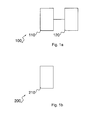
- Figure 1a shows an embodiment of an apparatus 100 being adapted for determining information on a common radio resource utilization.
- the apparatus 100 is adapted for determining information on a common radio resource utilization for a mobile transceiver communicating with a base station transceiver using a first frequency channel.
- the common radio resource utilization refers to a second frequency channel or frequency band, which may also be denoted as second frequency layer.
- the first and second frequency channels may be different from each other, preferably even nonoverlapping.
- the common radio resource utilization can be of a second frequency channel.
- the common radio resource utilization may determine a common use of radio resources in a second frequency channel, where, for example, certain sub-frames may be commonly used in all radio frames of the second frequency channel for a certain purpose as e.g.
- the apparatus comprises means 110 adapted for providing information on a radio resource utilization of an overlay base station transceiver serving a cell of an overlay network, the overlay base station transceiver being operative for communicating with the mobile transceiver using the second frequency channel and for using a repetitive radio frame pattern comprising a plurality of radio frames.
- the information on the radio resource utilization comprises information on a radio resource utilization for each of the plurality of radio frames in the radio frame pattern of the overlay base station transceiver.
- the apparatus 100 further comprises means 120 adapted for determining, based on a comparison of the information on the radio resource utilization for each of the plurality of radio frames in the radio frame pattern, the common radio resource utilization common among all of the plurality of radio frames in the radio frame pattern.
- Figure 1b shows an embodiment of an apparatus 200 being adapted for receiving information on a measurement configuration.
- the apparatus 200 is adapted for receiving information on a measurement configuration from a base station transceiver using a first frequency channel for communicating with a mobile transceiver apparatus, the mobile transceiver apparatus being adapted for communicating with an overlay base station transceiver using a second frequency channel.
- the apparatus 200 comprises means 210 adapted for determining information on a radio resource utilization of the overlay base station transceiver, the overlay base station transceiver using a repetitive radio frame pattern comprising a plurality of radio frames, the information on the measurement configuration comprising information on a common radio resource utilization common among all of the plurality of radio frames in the radio frame pattern, wherein the means 210 is adapted for determining is further adapted for determining the information on the radio resource utilization of the overlay base station transceiver based on the information on the common radio resource utilization.
- the apparatus 100 is to be understood as an apparatus which may be deployed in or coupled with a base station or a base station transceiver, in further embodiments it can also be coupled with a mobile transceiver or UE as will be detailed subsequently.
- Figure 2 shows a schematic representation of information related to radio resource utilization as well as common radio resource utilization according to embodiments.
- Figure 2 shows one radio frame 300 of a repetitive radio frame pattern 310, which comprises a plurality of radio frames.
- there are four subsequent (and different) radio frames in the radio frame pattern 310 which may all be represented or exemplified by radio frame 300 subsequently.
- each of the plurality of radio frames can be further subdivided in a plurality of sub-frames, where each sub-frame provides radio resources and wherein the information on the radio resource utilization indicates during which ones of the sub-frames at least some of the radio resources are suspended from transmission by the overlay base station transceiver.
- Radio resources may e.g.
- Figure 2 exemplarily illustrates one sub-frame 320 of the plurality of subframes within frame 300.
- a radio frame may have a duration of 10ms
- the radio frame pattern 310 may have a duration of 40ms, according to embodiments.
- Figure 2 may be interpreted as to illustrate an ABS pattern starting with sub-frame 320 of the radio frame 300.
- Such an ABS pattern could for example be utilized by an overlay base station transceiver in an overlay HetNet scenario, as has been explained in the introductory portion of this specification.
- the ABS pattern is illustrated by a shading 330 of the sub-frames, where the shading 330 may indicate an ABS frame and a non-shaded sub-frame 340 may indicate a non-ABS frame.
- the ABS pattern of Figure 2 may have a duration of 40ms and may extend across the four radio frames of the radio frame pattern 310. It is to be noted that this ABS-pattern is for exemplary purposes only and not to be interpreted in a limiting way. In embodiments any kind of pattern may be utilized within the scope of the appended claims.
- the UE is radio frame aligned to an overlay cell for inter-frequency measurement, rather than SFN or radio frame pattern aligned.
- Embodiments may therefore look for ABS or non-ABS sub-frames common among all 10ms portions or radio frames of the ABS pattern 310.
- embodiments may evaluate the ABS pattern (i.e. the pattern resulting from a sequence of shaded and non-shaded sub-frames 330, 340) on a radio frame basis of a neighbouring inter-frequency or overlay cell.
- the second and the ninth sub-frames 380 of any radio frame in the radio frame pattern 310 are always non-ABS sub-frames.
- a "1" in the binary sequence underneath the sequence 350 indicates a common ABS sub-frame, i.e. an ABS sub-frame which, in terms of its position within the frames, is common to all of the frames of the radio frame pattern 310.
- a "1" in the binary sequence underneath the sequence 360 may indicate a common non-ABS sub-frame, i.e.
- non-ABS sub-frame which, in terms of its position within the frames, is common to all of the frames of the radio frame pattern 310.
- Embodiments are, however, not limited to these binary indications, instead any indication may be used.
- the binary sequences can be used to signal the common radio resource utilization to a UE for inter-frequency measurement purposes.
- the common radio resource utilization may indicate, commonly for all radio frames in the radio frame pattern 310, during which ones of the sub-frames at least some of the radio resources are suspended from transmission or during which ones of the sub-frames 320 radio resources are not suspended for transmission by the overlay base station transceiver.
- Some embodiments may use a more compressed format for the indication, i.e. instead of the 10 bits also a shorter version may be used. For example, if it is known that the common radio resource utilization always indicates two common sub-frames, either ABS or none ABS, which may occur only in certain constellations, then less than 10bits may be utilized.
- the common radio resource utilization may comprise indications for a subset of sub-frames, the subset comprising fewer sub-frames than a radio frame in the radio frame pattern, for example when the indicated sub-frames are located symmetrically in the radio frame.
- inventions may comprise a base station transceiver apparatus comprising the apparatus 100 and further comprising signaling means adapted for signaling information on the common radio resource utilization to the mobile transceiver as part of information on a measurement configuration, particularly an inter-frequency measurement configuration for handover purposes.
- the base station transceiver may further comprise a receiving means adapted for receiving a measurement result from the mobile transceiver, the measurement result being based on the information on the common radio resource utilization.
- the base station transceiver apparatus can be further adapted for communicating in an LTE or LTE-A network, wherein the measurement configuration corresponds to an inter-frequency RRM measurement and the information on the common radio resource utilization corresponds to a common ABS pattern utilized by the overlay base station transceiver of an overlay HetNet, which can also be adapted for communicating in an LTE or LTE-A network.
- each of the plurality of radio frames in the radio frame pattern can be further subdivided in a plurality of sub-frames, where each sub-frame provides radio resources and wherein the information on the common radio resource utilization indicates during which ones of the sub-frames at least some of the radio resources are suspended (ABS sub-frame) from transmission by the overlay base station transceiver, and/or the information on the common radio resource utilization may indicate during which ones of the sub-frames radio resources are not suspended (non-ABS sub-frames) from transmission by the overlay base station transceiver.
- the information on the common radio resource utilization may comprise indications for a subset of sub-frames of a radio frame, the subset comprising fewer sub-frames than a radio frame in the radio frame pattern.
- the determining means 210 can be adapted for determining the information on the radio resource utilization of the overlay base station transceiver based on a repetition of the common radio resource utilization of one radio frame in the radio frame pattern in all radio frames of the radio frame pattern. Referring to the binary sequences underneath the sequences 350 and 360 in Figure 2 , it may easily be understood that the sequences 350 and 360 can be obtained by repeating the subsequences given for the first radio frame 300. A binary sequence for a single radio frame may therefore correspond to the information on the common radio resource utilization as it can be applied to any radio frame, or extended to the full length of the ABS or frame pattern 310, respectively.
- Embodiments may also provide a mobile transceiver apparatus comprising the apparatus 200 as described above and further comprising measuring means adapted for measuring signals of the second frequency channel based on the information on the measurement configuration and the information on the common radio resource utilization of the overlay base station transceiver to obtain a measurement result.
- the mobile transceiver station may further comprise a transmitting means adapted for transmitting the measurement result to the base station transceiver.
- the mobile transceiver apparatus can be further adapted for communicating in an LTE or LTE-A network, wherein the measurement configuration may correspond to an inter-frequency RRM measurement configuration and the information on the common radio resource utilization may correspond to a common ABS pattern utilized by the overlay base station transceiver, which can also be adapted for communicating in an LTE or LTE-A network.
- embodiments may use an optimized signaling, optimized with respect to the existing signaling for intra-frequency measurement and with respect to signaling an entire ABS pattern.
- Figure 3 shows another schematic representation of a signaling scheme according to embodiments.
- Figure 3 shows a message sequence chart for the signaling of the full ABS-pattern on the left hand side, where the signaling between a UE 400 and a base station transceiver, exemplified as eNB 410, is shown.
- a UE 420 may receive the common ABS pattern from an eNB 430.
- the common ABS pattern signaling needs only 10 bits while signaling the full pattern needs 40bits.
- the UE 420 may repeat the 10bit pattern to reconstruct the 40bit (or 40ms) ABS or non-ABS pattern.
- the UE can then reconstruct the new ABS pattern (or non-ABS pattern) based on the common ABS or non-ABS common among every 10ms portion 300 of the original ABS pattern 310 to measure the (overlay) cell in another frequency.
- the full signaling of the ABS pattern 310 may be received in a UE or a mobile transceiver.
- the mobile transceiver may comprise an apparatus 100 according to the above description and determine the common radio resource utilization from the information on the resource utilization, i.e. the full ABS pattern 310.
- the mobile transceiver may start the inter-frequency measurement on the desired ABS or non-ABS sub-frame on the frequency of the overlay transceiver base station.
- the signaling comprises the full ABS pattern, but the mobile transceiver station would still not have to be SFN aligned.
- Figure 4a illustrates a flow chart of an embodiment of a method for determining information on a common radio resource.
- the method for determining information on a common radio resource utilization for a mobile transceiver communicating with a base station transceiver using a first frequency channel, the common radio resource utilization referring to a second frequency channel comprises a step 500 of providing information on a radio resource utilization of an overlay base station transceiver, the overlay base station transceiver being operative for communicating with the mobile transceiver using the second frequency channel and for using a repetitive radio frame pattern comprising a plurality of radio frames, the information on the radio resource utilization comprises information on a radio resource utilization for each of the plurality of radio frames in the radio frame pattern.
- the method further comprises a step 510 of determining, based on a comparison of the information on the radio resource utilization for each of the plurality of radio frames in the radio frame pattern, the common radio resource utilization common among all of the plurality of radio frames in the radio frame pattern.
- the method may further comprise a step 520, the broken lines indicate the optional step 520 in Figure 4a , of signaling information on the common radio resource utilization to the mobile transceiver as part of the information on the measurement configuration.
- Figure 4b illustrates a flow chart of an embodiment of a method for receiving information on a measurement configuration.
- the method for receiving information on a measurement configuration from a base station transceiver using a first frequency channel for communicating with a mobile transceiver apparatus, the mobile transceiver apparatus being adapted for communicating with an overlay base station transceiver using a second frequency channel comprises a step 530 of determining information on a radio resource utilization of the overlay base station transceiver, the overlay base station transceiver using a repetitive radio frame pattern comprising a plurality of radio frames, the information on the measurement configuration comprises information on a common radio resource utilization common among all of the plurality of radio frames in the radio frame pattern, and determining the information on the radio resource utilization of the overlay base station transceiver based on the information on the common radio resource utilization.
- the method may comprise a further step 540, the broken lines indicating the optional step 540, of measuring the signals of the overlay base station transceiver based on the information on the measurement configuration and the radio resource utilization of the overlay base station transceiver to obtain a measurement result.
- embodiments may provide a computer program having a program code for performing one of the above described methods when the computer program is executed on a computer or processor.
- program storage devices e.g., digital data storage media, which are machine or computer readable and encode machine-executable or computer-executable programs of instructions, wherein said instructions perform some or all of the steps of said above-described methods.
- the program storage devices may be, e.g., digital memories, magnetic storage media such as a magnetic disks and magnetic tapes, hard drives, or optically readable digital data storage media.
- the embodiments are also intended to cover computers programmed to perform said steps of the above-described methods.
- any functional blocks labeled as "means adapted for providing”, “means adapted for determining”, “means adapted for signaling”, “means adapted for receiving”, “means adapted for measuring”, or “means adapted for transmitting”, may be provided through the use of dedicated hardware, as e.g. a processor, a controller, a transmitter or receiver, as well as hardware capable of executing software in association with appropriate software.
- dedicated hardware e.g. a processor, a controller, a transmitter or receiver
- the functions may be provided by a single dedicated processor, by a single shared processor, or by a plurality of individual processors, some of which may be shared.
- processor or “controller” should not be construed to refer exclusively to hardware capable of executing software, and may implicitly include, without limitation, digital signal processor (DSP) hardware, network processor, application specific integrated circuit (ASIC), field programmable gate array (FPGA), read only memory (ROM) for storing software, random access memory (RAM), and non-volatile storage.
- DSP digital signal processor
- ASIC application specific integrated circuit
- FPGA field programmable gate array
- ROM read only memory
- RAM random access memory
- non-volatile storage Other hardware, conventional and/or custom, may also be included.
- any block diagrams herein represent conceptual views of illustrative circuitry embodying the principles of the invention.
- any flow charts, flow diagrams, state transition diagrams, pseudo code, and the like represent various processes which may be substantially represented in computer readable medium and so executed by a computer or processor, whether or not such computer or processor is explicitly shown.
Landscapes
- Engineering & Computer Science (AREA)
- Computer Networks & Wireless Communication (AREA)
- Signal Processing (AREA)
- Mobile Radio Communication Systems (AREA)
Abstract
Description
- The present invention relates to wireless communications, more particularly but not exclusively to radio resource management and inter-frequency measurements in a mobile communication system.
- Nowadays mobile communication networks heterogeneous architectures become more and more important. Heterogeneous networks (HetNets for abbreviation) are networks which utilize cell types of different sizes, as for example macrocells, picocells, and femtocells. Such cells are established by base station transceivers for which their coverage areas are determined by their transmission power and interference condition. Picocells and femtocells are cells having a smaller coverage area than macrocells. In some network scenarios the small cells' coverage area can be surrounded by the coverage area of a macrocell. The small cells can be deployed to extend the capacity of the network. With regard to standardization, within the 3rd generation partnership project (3GPP for abbreviation), HetNets have been added to the scope of the Long Term Evolution-Advanced (LTE-A for abbreviation) work item. Since the cells or base stations in such networks may utilize the same frequency resources such architectures can suffer from interference created by the overlapping coverage areas of these cells. Therefore enhanced inter-cell interference coordination (ICIC for abbreviation) for co-channel HetNet deployment is one of the key techniques for LTE Release 10 (Rel-10 for abbreviation). Co-channel HetNets comprise macrocells and small cells operating on the same frequency channel. Such deployments present some specific interference scenarios for which ICIC techniques are utilized.
- In one example scenario, the small cells are picocells, which are open to users of the macrocell network. In order to ensure that such picocells carry a useful share of the total traffic load, user equipment (UE for abbreviation) or mobile transceivers may be programmed or configured to associate preferentially with the picocells rather than the macrocells, for example by biasing the signal-to-interference-and-noise ratio (SINR for abbreviation) threshold at which they will select a picocell to associate with. Under such conditions, UEs near the edge of a picocell's coverage area may suffer strong interference from one or more macrocells. In order to alleviate such interference, some subframes may be configured as "blank" or "almost blank" in a macrocell. A blank subframe may contain no transmission from the macrocell, while an "almost blank" subframe typically contains no data transmission and little or no control signaling transmission, but may contain reference signal transmissions in order to ensure backward compatibility with legacy terminals which expect to find the reference signals for measurements but are unaware of the configuration of almost blank subframes. Almost blank subframes may also contain synchronization signals, broadcast control information and/or paging signals. The utilization of "blank" or "almost blank" subframes enables reduced or even suppressed interference for the picocell within these subframes. Hence, "blank" or "almost blank" sub-frames may be regarded as sub-frames during which at least some radio resources are suspended from transmission.
- However, to make use of blank or almost blank subframes (ABSs for abbreviation) effectively (note that hereafter the term "ABS" is used, and should be understood to include both blank and almost blank subframes), signaling is needed from the macrocell to the picocell, e.g. across the corresponding backhaul interface, known in LTE as the "X2" interface. For LTE Release 10, it has been agreed that this X2 signaling will take the form of a coordination bitmap to indicate the ABS pattern (for example with each bit corresponding to one subframe in a series of subframes, with the value of the bit indicating whether the subframe is an ABS or not). Such signaling can help the picocell to schedule data transmissions in the picocell appropriately to avoid interference (e.g., by scheduling transmissions to UEs near the edge of the picocell during ABSs), and to signal to the UEs the subframes which should have low macrocellular interference and should therefore be used for measurements. Examples for such measurements are measurements for Radio Resource Management (RRM for abbreviation), which typically relate to handover, measurements for Radio Link Monitoring (RLM for abbreviation), which typically relate to detection of serving radio link failure, and measurements for Channel State Information (CSI for abbreviation), which typically relate to link adaptation on the serving radio link.
- In such an example scenario, Radio Resource Control (RRC for abbreviation) signaling can be utilized to indicate to the UEs the set of subframes which they should use for measurements (e.g., for RLM/RRM or CSI), where RRC is a signaling protocol standardized by 3GPP for control and configuration signaling.
- Another example scenario can arise with HetNets in which the small cells are femtocells, which operate on a Closed Subscriber Group (CSG for abbreviation) basis, and are therefore typically not open to users of the macrocellular network. In this case, the femtocells can cause strong interference to the macrocell UEs when these macrocell UEs come close to the femto base station transceivers, however, without having the possibility to associate with them. It may then be beneficial for the macrocells to indicate to their UEs the subframes in which they should make resource specific measurements, i.e. the subframes in which interference from one or more femtocells is reduced or absent. In the following to a base station transceiver may also be referred to as eNodeB (eNB as abbreviation) according to the 3GPP terminology.
- Another aspect of HetNets arises considering overlay cells, which operate at a different frequency channel or band and have an overlapping geographical coverage area. Such overlapping or overlay networks may be HetNets as well. In addition to the intra-frequency neighbouring cell RRM measurements as described above, inter-frequency neighbouring cell RRM measurements may be carried out by a UE, for example to determine or enable inter-frequency handover (HO for abbreviation).
- Inter-frequency handover, i.e. handover to an overlay cell or an overlay network, may require performing measurements on another cell in another frequency channel or band. Embodiments may be based on a finding that in a heterogeneous network scenario, e.g. a macrocell with pico- or femtocells therein, a UE may need to measure the macrocell in another frequency either using the non-ABS or ABS (ABS pattern is repeated every 40ms) of that macrocell for inter-frequency handover. Embodiments may be further based on the finding that such an inter-frequency handover measurement may depend on whether it is carried out in an ABS or in a non-ABS sub-frame and the UE should therefore be informed about an ABS pattern of an overlay cell.
- Embodiments may be based on a further finding that in order to measure an overlay macrocell signal quality on the non-ABS or ABS, the UE needs to be aligned to a system frame number (SFN for abbreviation) of the macrocell in the other frequency, as the ABS pattern is also aligned to the SFN. For intra-frequency handover and measurement, the ABS pattern is SFN aligned among the pico- and macro- intra-frequency-cells. This assumption may not apply to inter-frequency cells operating at different carrier frequencies.
- In other words, the macrocell using the other frequency channel or band communicates using a repetitive radio frame pattern, also referred to as system frames, which are aligned with the ABS pattern. Embodiments may be further based on the finding that a UE measuring the inter-frequency macrocell is only radio frame aligned rather than SFN aligned to the inter-frequency cell of the overlay network, which can either lead to a delay, as the UE may need to wait to get SFN aligned to determine the correct ABS-pattern or, if there is not enough time to wait for the SFN alignment, lead to disadvantageous measurement results as the UE would not know whether the measurement is taken during an ABS or a non-ABS-frame.
- Embodiments may be further based on a finding that, for example, in an LTE or LTE-A scenario, as the UE is radio frame aligned to the cell for measurement rather than SFN aligned, it is possible to look for common ABS or non-ABS sub-frames among every 10ms portion of the ABS pattern of the neighbouring inter-frequency cell, i.e. on a radio frame basis. The common ABS or non-ABS sub-frames can be signaled to the UE by the serving cell.
- Embodiments may provide an apparatus being adapted for determining information on a common radio resource utilization for a mobile transceiver communicating with a base station transceiver using a first frequency channel, the common radio resource utilization referring to a second frequency channel. In other words, the common radio resource utilization can be of a second frequency channel. The common radio resource utilization may determine a common use of radio resources in a second frequency channel, where, for example, certain sub-frames may be commonly used in all radio frames of the second frequency channel for a certain purpose as e.g. ABS or non-ABS. The apparatus comprises means adapted for providing information on a radio resource utilization of an overlay base station transceiver, the overlay base station transceiver being operative for communicating with the mobile transceiver using the second frequency channel and for using a repetitive radio frame pattern comprising a plurality of radio frames, the information on the radio resource utilization comprising information on a radio resource utilization for each of the plurality of radio frames in the radio frame pattern. The apparatus further comprises means adapted for determining, based on a comparison of the information on the radio resource utilization for each of the plurality of radio frames in the radio frame pattern, the common radio resource utilization common among all of the plurality of radio frames in the radio frame pattern.
- In embodiments each of the plurality of radio frames can be further subdivided in a plurality of sub-frames, where each sub-frame provides radio resources and wherein the information on the radio resource utilization indicates during which ones of the sub-frames at least some of the radio resources are suspended from transmission by the overlay base station transceiver.
- In embodiments the radio frame pattern may have a duration of 40ms, a radio frame may have a duration of 10ms, and a sub-frame may have a duration of 1ms. The common radio resource utilization may indicate, commonly for all radio frames in the radio frame pattern, during which ones of the sub-frames at least some of the radio resources are suspended from transmission or during which ones of the sub-frames radio resources are not suspended for transmission by the overlay base station transceiver. The common radio resource utilization may comprise indications for a subset of sub-frames, the subset comprising fewer sub-frames than a radio frame in the radio frame pattern.
- Embodiments may also provide a base station transceiver apparatus or a mobile transceiver apparatus comprising the above described apparatus and further comprising signaling means adapted for signaling information on the common radio resource utilization to the mobile transceiver as part of information on a measurement configuration. The base station transceiver may further comprise a receiving means adapted for receiving a measurement result from the mobile transceiver, the measurement result being based on the information on the common radio resource utilization.
- In some embodiments the base station transceiver apparatus can be adapted for communicating in an LTE or LTE-A network, wherein the measurement configuration can correspond to an inter-frequency RRM measurement configuration and the information on the common radio resource utilization may correspond to an ABS pattern common to all frames of the radio frame pattern or the system frame utilized by the overlay base station transceiver, which can also be adapted for communicating in an LTE or LTE-A network.
- Embodiments may further relate to an apparatus being adapted for receiving information on a measurement configuration from a base station transceiver using a first frequency channel for communicating with a mobile transceiver apparatus, the mobile transceiver apparatus being adapted for communicating with an overlay base station transceiver using a second frequency channel. The apparatus comprises means being adapted for determining information on a radio resource utilization of the overlay base station transceiver, the overlay base station transceiver using a repetitive radio frame pattern comprising a plurality of radio frames, the information on the measurement configuration comprising information on a common radio resource utilization common among all of the plurality of radio frames in the radio frame pattern, wherein the means adapted for determining is further adapted for determining the information on the radio resource utilization of the overlay base station transceiver based on the information on the common radio resource utilization.
- In embodiments each of the plurality of radio frames in the radio frame pattern may be further subdivided in a plurality of sub-frames, where each sub-frame provides radio resources and wherein the information on the common radio resource utilization indicates during which ones of the sub-frames at least some of the radio resources are suspended from transmission by the overlay base station transceiver, or wherein the information on the common radio resource utilization indicates during which ones of the sub-frames radio resources are not suspended from transmission by the overlay base station transceiver. The information on the common radio resource utilization may comprise indications for a subset of sub-frames of a radio frame, the subset comprising fewer sub-frames than a radio frame in the radio frame pattern.
- Again, in embodiments the radio frame pattern may have a duration of 40ms, a radio frame may have a duration of 10ms, and a sub-frame may have a duration of 1ms. The determining means can be adapted for determining the information on the radio resource utilization of the overlay base station transceiver based on a repetition of the common radio resource utilization of one radio frame in the radio frame pattern in all radio frames of the radio frame pattern.
- Accordingly, embodiments may relate to a mobile transceiver apparatus comprising the above described apparatus being adapted for receiving information on a measurement configuration from a base station transceiver, further comprising measuring means adapted for measuring signals of the second frequency channel based on the information on the measurement configuration and the information on the common radio resource utilization of the overlay base station transceiver to obtain a measurement result. The mobile transceiver apparatus may further comprise a transmitting means adapted for transmitting the measurement result to the base station transceiver.
- In embodiments the mobile transceiver apparatus can be adapted for communicating in an LTE or LTE-A network, wherein the measurement configuration may correspond to an inter-frequency RRM measurement configuration and the information on the common radio resource utilization may correspond to an ABS pattern common to all frames of the radio frame pattern or the system frame utilized by the overlay base station transceiver, which can also be adapted for communicating in an LTE or LTE-A network.
- Furthermore, embodiments may provide the corresponding methods. An embodiment may provide a method for determining information on a common radio resource utilization for a mobile transceiver communicating with a base station transceiver using a first frequency channel, the common radio resource utilization referring to a second frequency channel of an overlay network. In other words, the common radio resource utilization can be of a second frequency channel. The common radio resource utilization may determine a common use of radio resources in a second frequency channel, where, for example, certain sub-frames may be commonly used in all radio frames of the second frequency channel for a certain purpose as e.g. ABS or non-ABS. The method may comprise a step of providing information on a radio resource utilization of an overlay base station transceiver, the overlay base station transceiver being operative for communicating with the mobile transceiver using the second frequency channel and for using a repetitive radio frame pattern comprising a plurality of radio frames, the information on the radio resource utilization comprising information on a radio resource utilization for each of the plurality of radio frames in the radio frame pattern. The method may further comprise a step of determining, based on a comparison of the information on the radio resource utilization for each of the plurality of radio frames in the radio frame pattern, the common radio resource utilization common among all of the plurality of radio frames in the radio frame pattern. The method may further comprise a step of signaling information on the common radio resource utilization to the mobile transceiver as part of the information on the measurement configuration.
- Moreover, embodiments may provide a method for receiving information on a measurement configuration from a base station transceiver using a first frequency channel for communicating with a mobile transceiver apparatus, the mobile transceiver apparatus being adapted for communicating with an overlay base station transceiver of an overlay network using a second frequency channel. The method comprises a step of determining information on a radio resource utilization of the overlay base station transceiver, the overlay base station transceiver using a repetitive radio frame pattern comprising a plurality of radio frames, the information on the measurement configuration comprising information on a common radio resource utilization common among all of the plurality of radio frames in the radio frame pattern, and determining the information on the radio resource utilization of the overlay base station transceiver based on the information on the common radio resource utilization. The method may further comprise a step of measuring the signals of the overlay base station transceiver based on the information on the measurement configuration and the radio resource utilization of the overlay base station transceiver to obtain a measurement result.
- In embodiments computer programs, having a program code for performing one of the above-described methods when the computer program is executed on a computer or processor, can be provided.
- Some other features or aspects will be described using the following non-limiting embodiments of apparatuses and/or methods and/or computer programs by way of example only, and with reference to the accompanying figures, in which
-
Figure 1a shows an embodiment of an apparatus being adapted for determining information on a common radio resource utilization; -
Figure 1b shows an embodiment of an apparatus being adapted for receiving information on a measurement configuration; -
Figure 2 shows a schematic representation of information on radio resource utilization and common radio resource utilization in embodiments; -
Figure 3 shows another schematic representation of a signaling scheme in embodiments; -
Figure 4a illustrates a flow chart of an embodiment of a method for determining information on a common radio resource; and -
Figure 4b illustrates a flow chart of an embodiment of a method for receiving information on a measurement configuration. - The illustrative description of the embodiments will be given in details combined with the appended figures. For the ease of understanding, some technical terms are explained first:
- A picocell is a wireless communication system or base station typically covering a small area, such as in-building (offices, shopping malls, train stations, etc.), or more recently in-aircraft. A femtocell is a small cellular base station, typically designed for use in a home or small business. A macrocell is a cell in a mobile phone network that provides radio coverage served by a power cellular base station (tower). Generally, macrocells provide coverage larger than picocells and/or femtocells. The antennas for macrocells are mounted on ground-based masts, rooftops and other existing structures, at a height that may provide a clear view over the surrounding buildings and terrain. Macrocell base stations have power outputs of typically tens of watts.
- Heterogeneous networks may also comprise wireless networks using different access technologies. For example, a wireless network which provides a service through a wireless local area network (WLAN for abbreviation) and is able to maintain the service when switching to a cellular network is called a wireless heterogeneous network.
-
Figure 1a shows an embodiment of an apparatus 100 being adapted for determining information on a common radio resource utilization. The apparatus 100 is adapted for determining information on a common radio resource utilization for a mobile transceiver communicating with a base station transceiver using a first frequency channel. The common radio resource utilization refers to a second frequency channel or frequency band, which may also be denoted as second frequency layer. In some embodiments the first and second frequency channels may be different from each other, preferably even nonoverlapping. In other words, the common radio resource utilization can be of a second frequency channel. The common radio resource utilization may determine a common use of radio resources in a second frequency channel, where, for example, certain sub-frames may be commonly used in all radio frames of the second frequency channel for a certain purpose as e.g. ABS or non-ABS. The apparatus comprises means 110 adapted for providing information on a radio resource utilization of an overlay base station transceiver serving a cell of an overlay network, the overlay base station transceiver being operative for communicating with the mobile transceiver using the second frequency channel and for using a repetitive radio frame pattern comprising a plurality of radio frames. The information on the radio resource utilization comprises information on a radio resource utilization for each of the plurality of radio frames in the radio frame pattern of the overlay base station transceiver. The apparatus 100 further comprisesmeans 120 adapted for determining, based on a comparison of the information on the radio resource utilization for each of the plurality of radio frames in the radio frame pattern, the common radio resource utilization common among all of the plurality of radio frames in the radio frame pattern. - Accordingly,
Figure 1b shows an embodiment of an apparatus 200 being adapted for receiving information on a measurement configuration. The apparatus 200 is adapted for receiving information on a measurement configuration from a base station transceiver using a first frequency channel for communicating with a mobile transceiver apparatus, the mobile transceiver apparatus being adapted for communicating with an overlay base station transceiver using a second frequency channel. The apparatus 200 comprisesmeans 210 adapted for determining information on a radio resource utilization of the overlay base station transceiver, the overlay base station transceiver using a repetitive radio frame pattern comprising a plurality of radio frames, the information on the measurement configuration comprising information on a common radio resource utilization common among all of the plurality of radio frames in the radio frame pattern, wherein themeans 210 is adapted for determining is further adapted for determining the information on the radio resource utilization of the overlay base station transceiver based on the information on the common radio resource utilization. - In the following the apparatus 100 being adapted for determining information on a common radio resource utilization will be considered first. The apparatus 100 is to be understood as an apparatus which may be deployed in or coupled with a base station or a base station transceiver, in further embodiments it can also be coupled with a mobile transceiver or UE as will be detailed subsequently.
-
Figure 2 shows a schematic representation of information related to radio resource utilization as well as common radio resource utilization according to embodiments.Figure 2 shows oneradio frame 300 of a repetitiveradio frame pattern 310, which comprises a plurality of radio frames. In the embodiment illustrated inFigure 2 there are four subsequent (and different) radio frames in theradio frame pattern 310, which may all be represented or exemplified byradio frame 300 subsequently. In embodiments each of the plurality of radio frames can be further subdivided in a plurality of sub-frames, where each sub-frame provides radio resources and wherein the information on the radio resource utilization indicates during which ones of the sub-frames at least some of the radio resources are suspended from transmission by the overlay base station transceiver. Radio resources may e.g. be transmission time intervals, frequency sub-carriers, orthogonal coding schemes, etc. used for data, control signaling and/or reference signal transmissions.Figure 2 exemplarily illustrates onesub-frame 320 of the plurality of subframes withinframe 300. For example, there are ten sub-frames in a radio frame in the embodiment ofFigure 2 . Assuming a sub-frame duration of 1ms, a radio frame may have a duration of 10ms, and theradio frame pattern 310 may have a duration of 40ms, according to embodiments. - For some embodiments,
Figure 2 may be interpreted as to illustrate an ABS pattern starting withsub-frame 320 of theradio frame 300. Such an ABS pattern could for example be utilized by an overlay base station transceiver in an overlay HetNet scenario, as has been explained in the introductory portion of this specification. The ABS pattern is illustrated by ashading 330 of the sub-frames, where theshading 330 may indicate an ABS frame and anon-shaded sub-frame 340 may indicate a non-ABS frame. The ABS pattern ofFigure 2 may have a duration of 40ms and may extend across the four radio frames of theradio frame pattern 310. It is to be noted that this ABS-pattern is for exemplary purposes only and not to be interpreted in a limiting way. In embodiments any kind of pattern may be utilized within the scope of the appended claims. - In embodiments, for example in an LTE or LTE-A scenario, the UE is radio frame aligned to an overlay cell for inter-frequency measurement, rather than SFN or radio frame pattern aligned. Embodiments may therefore look for ABS or non-ABS sub-frames common among all 10ms portions or radio frames of the
ABS pattern 310. In other words, embodiments may evaluate the ABS pattern (i.e. the pattern resulting from a sequence of shaded andnon-shaded sub-frames 330, 340) on a radio frame basis of a neighbouring inter-frequency or overlay cell. - This is illustrated in
Figure 2 using the twosequences shading 330 provided insub-frame sequence 350, there is a repetitive pattern of ABS sub-frames common among all of the four radio frames of theradio frame pattern 300 depicted. Moreover, as illustrated by the non-shaded ornon-ABS sub-frames 340 in thesequence 360 there is also a repetitive pattern of non-ABS sub-frames common among all of the four radio frames depicted. As exemplified by thesub-frame sequence 350, the third and theeighth sub-frames 370 of any radio frame in theradio frame pattern 310 are always ABS sub-frames. As exemplified by thesub-frame sequence 360, the second and theninth sub-frames 380 of any radio frame in theradio frame pattern 310 are always non-ABS sub-frames. This is also indicated by the binary sequences underneath thefirst radio frame 300 of thesequences sequence 350 indicates a common ABS sub-frame, i.e. an ABS sub-frame which, in terms of its position within the frames, is common to all of the frames of theradio frame pattern 310. Accordingly, a "1" in the binary sequence underneath thesequence 360 may indicate a common non-ABS sub-frame, i.e. a non-ABS sub-frame which, in terms of its position within the frames, is common to all of the frames of theradio frame pattern 310. Embodiments are, however, not limited to these binary indications, instead any indication may be used. In the present embodiment the binary sequences can be used to signal the common radio resource utilization to a UE for inter-frequency measurement purposes. - In embodiments, the common radio resource utilization may indicate, commonly for all radio frames in the
radio frame pattern 310, during which ones of the sub-frames at least some of the radio resources are suspended from transmission or during which ones of thesub-frames 320 radio resources are not suspended for transmission by the overlay base station transceiver. Some embodiments may use a more compressed format for the indication, i.e. instead of the 10 bits also a shorter version may be used. For example, if it is known that the common radio resource utilization always indicates two common sub-frames, either ABS or none ABS, which may occur only in certain constellations, then less than 10bits may be utilized. In embodiments the common radio resource utilization may comprise indications for a subset of sub-frames, the subset comprising fewer sub-frames than a radio frame in the radio frame pattern, for example when the indicated sub-frames are located symmetrically in the radio frame. - The common ABS or non-ABS sub-frames can be signaled to the UE by the serving cell. Therefore, embodiments may comprise a base station transceiver apparatus comprising the apparatus 100 and further comprising signaling means adapted for signaling information on the common radio resource utilization to the mobile transceiver as part of information on a measurement configuration, particularly an inter-frequency measurement configuration for handover purposes. The base station transceiver may further comprise a receiving means adapted for receiving a measurement result from the mobile transceiver, the measurement result being based on the information on the common radio resource utilization.
- In embodiments the base station transceiver apparatus can be further adapted for communicating in an LTE or LTE-A network, wherein the measurement configuration corresponds to an inter-frequency RRM measurement and the information on the common radio resource utilization corresponds to a common ABS pattern utilized by the overlay base station transceiver of an overlay HetNet, which can also be adapted for communicating in an LTE or LTE-A network.
- In the following the apparatus 200 being adapted for receiving information on a measurement configuration will be considered further. As has been explained above, each of the plurality of radio frames in the radio frame pattern can be further subdivided in a plurality of sub-frames, where each sub-frame provides radio resources and wherein the information on the common radio resource utilization indicates during which ones of the sub-frames at least some of the radio resources are suspended (ABS sub-frame) from transmission by the overlay base station transceiver, and/or the information on the common radio resource utilization may indicate during which ones of the sub-frames radio resources are not suspended (non-ABS sub-frames) from transmission by the overlay base station transceiver. In line with the above, the information on the common radio resource utilization may comprise indications for a subset of sub-frames of a radio frame, the subset comprising fewer sub-frames than a radio frame in the radio frame pattern.
- In embodiments, the determining means 210 can be adapted for determining the information on the radio resource utilization of the overlay base station transceiver based on a repetition of the common radio resource utilization of one radio frame in the radio frame pattern in all radio frames of the radio frame pattern. Referring to the binary sequences underneath the
sequences Figure 2 , it may easily be understood that thesequences first radio frame 300. A binary sequence for a single radio frame may therefore correspond to the information on the common radio resource utilization as it can be applied to any radio frame, or extended to the full length of the ABS orframe pattern 310, respectively. - Embodiments may also provide a mobile transceiver apparatus comprising the apparatus 200 as described above and further comprising measuring means adapted for measuring signals of the second frequency channel based on the information on the measurement configuration and the information on the common radio resource utilization of the overlay base station transceiver to obtain a measurement result. The mobile transceiver station may further comprise a transmitting means adapted for transmitting the measurement result to the base station transceiver. The mobile transceiver apparatus can be further adapted for communicating in an LTE or LTE-A network, wherein the measurement configuration may correspond to an inter-frequency RRM measurement configuration and the information on the common radio resource utilization may correspond to a common ABS pattern utilized by the overlay base station transceiver, which can also be adapted for communicating in an LTE or LTE-A network.
- Moreover, embodiments may use an optimized signaling, optimized with respect to the existing signaling for intra-frequency measurement and with respect to signaling an entire ABS pattern.
-
Figure 3 shows another schematic representation of a signaling scheme according to embodiments. - For a better comparison,
Figure 3 shows a message sequence chart for the signaling of the full ABS-pattern on the left hand side, where the signaling between aUE 400 and a base station transceiver, exemplified aseNB 410, is shown. In an embodiment depicted on the right hand side ofFigure 3 aUE 420 may receive the common ABS pattern from aneNB 430. The common ABS pattern signaling needs only 10 bits while signaling the full pattern needs 40bits. According to the above description, theUE 420 may repeat the 10bit pattern to reconstruct the 40bit (or 40ms) ABS or non-ABS pattern. The UE can then reconstruct the new ABS pattern (or non-ABS pattern) based on the common ABS or non-ABS common among every10ms portion 300 of theoriginal ABS pattern 310 to measure the (overlay) cell in another frequency. - Note, that in some embodiments the full signaling of the
ABS pattern 310 may be received in a UE or a mobile transceiver. Although, no signaling reduction may be achieved in such an embodiment, the mobile transceiver may comprise an apparatus 100 according to the above description and determine the common radio resource utilization from the information on the resource utilization, i.e. thefull ABS pattern 310. Once the common radio resource utilization has been determined, e.g. in terms of common ABS and/or non-ABS sub-frames, the mobile transceiver may start the inter-frequency measurement on the desired ABS or non-ABS sub-frame on the frequency of the overlay transceiver base station. In such an embodiment the signaling comprises the full ABS pattern, but the mobile transceiver station would still not have to be SFN aligned. -
Figure 4a illustrates a flow chart of an embodiment of a method for determining information on a common radio resource. The method for determining information on a common radio resource utilization for a mobile transceiver communicating with a base station transceiver using a first frequency channel, the common radio resource utilization referring to a second frequency channel, comprises astep 500 of providing information on a radio resource utilization of an overlay base station transceiver, the overlay base station transceiver being operative for communicating with the mobile transceiver using the second frequency channel and for using a repetitive radio frame pattern comprising a plurality of radio frames, the information on the radio resource utilization comprises information on a radio resource utilization for each of the plurality of radio frames in the radio frame pattern. The method further comprises astep 510 of determining, based on a comparison of the information on the radio resource utilization for each of the plurality of radio frames in the radio frame pattern, the common radio resource utilization common among all of the plurality of radio frames in the radio frame pattern. The method may further comprise astep 520, the broken lines indicate theoptional step 520 inFigure 4a , of signaling information on the common radio resource utilization to the mobile transceiver as part of the information on the measurement configuration. -
Figure 4b illustrates a flow chart of an embodiment of a method for receiving information on a measurement configuration. The method for receiving information on a measurement configuration from a base station transceiver using a first frequency channel for communicating with a mobile transceiver apparatus, the mobile transceiver apparatus being adapted for communicating with an overlay base station transceiver using a second frequency channel, comprises astep 530 of determining information on a radio resource utilization of the overlay base station transceiver, the overlay base station transceiver using a repetitive radio frame pattern comprising a plurality of radio frames, the information on the measurement configuration comprises information on a common radio resource utilization common among all of the plurality of radio frames in the radio frame pattern, and determining the information on the radio resource utilization of the overlay base station transceiver based on the information on the common radio resource utilization. - The method may comprise a
further step 540, the broken lines indicating theoptional step 540, of measuring the signals of the overlay base station transceiver based on the information on the measurement configuration and the radio resource utilization of the overlay base station transceiver to obtain a measurement result. - Moreover, embodiments may provide a computer program having a program code for performing one of the above described methods when the computer program is executed on a computer or processor.
- A person of skill in the art would readily recognize that steps of various above-described methods can be performed by programmed computers. Herein, some embodiments are also intended to cover program storage devices, e.g., digital data storage media, which are machine or computer readable and encode machine-executable or computer-executable programs of instructions, wherein said instructions perform some or all of the steps of said above-described methods. The program storage devices may be, e.g., digital memories, magnetic storage media such as a magnetic disks and magnetic tapes, hard drives, or optically readable digital data storage media. The embodiments are also intended to cover computers programmed to perform said steps of the above-described methods.
- The description and drawings merely illustrate the principles of the invention. It will thus be appreciated that those skilled in the art will be able to devise various arrangements that, although not explicitly described or shown herein, embody the principles of the invention and are included within its spirit and scope. Furthermore, all examples recited herein are principally intended expressly to be only for pedagogical purposes to aid the reader in understanding the principles of the invention and the concepts contributed by the inventor(s) to furthering the art, and are to be construed as being without limitation to such specifically recited examples and conditions. Moreover, all statements herein reciting principles, aspects, and embodiments of the invention, as well as specific examples thereof, are intended to encompass equivalents thereof.
- The functions of the various elements shown in the figures, including any functional blocks labeled as "means adapted for providing", "means adapted for determining", "means adapted for signaling", "means adapted for receiving", "means adapted for measuring", or "means adapted for transmitting", may be provided through the use of dedicated hardware, as e.g. a processor, a controller, a transmitter or receiver, as well as hardware capable of executing software in association with appropriate software. When provided by a processor, the functions may be provided by a single dedicated processor, by a single shared processor, or by a plurality of individual processors, some of which may be shared. Moreover, explicit use of the term "processor" or "controller" should not be construed to refer exclusively to hardware capable of executing software, and may implicitly include, without limitation, digital signal processor (DSP) hardware, network processor, application specific integrated circuit (ASIC), field programmable gate array (FPGA), read only memory (ROM) for storing software, random access memory (RAM), and non-volatile storage. Other hardware, conventional and/or custom, may also be included.
- It should be appreciated by those skilled in the art that any block diagrams herein represent conceptual views of illustrative circuitry embodying the principles of the invention. Similarly, it will be appreciated that any flow charts, flow diagrams, state transition diagrams, pseudo code, and the like represent various processes which may be substantially represented in computer readable medium and so executed by a computer or processor, whether or not such computer or processor is explicitly shown.
Claims (15)
- An apparatus (100) being adapted for determining information on a common radio resource utilization for a mobile transceiver communicating with a base station transceiver using a first frequency channel, the common radio resource utilization referring to a second frequency channel, comprising
means (110) adapted for providing information on a radio resource utilization of an overlay base station transceiver, the overlay base station transceiver being operative for communicating with the mobile transceiver using the second frequency channel and for using a repetitive radio frame pattern comprising a plurality of radio frames, the information on the radio resource utilization comprising information on a radio resource utilization for each of the plurality of radio frames in the radio frame pattern; and
means (120) adapted for determining, based on a comparison of the information on the radio resource utilization for each of the plurality of radio frames in the radio frame pattern, the common radio resource utilization common among all of the plurality of radio frames in the radio frame pattern. - The apparatus (100) of claim 1, wherein each of the plurality of radio frames is further subdivided in a plurality of sub-frames, where each sub-frame provides radio resources and wherein the information on the radio resource utilization indicates during which ones of the sub-frames at least some of the radio resources are suspended from transmission by the overlay base station transceiver.
- The apparatus (100) of claim 2, wherein the radio frame pattern has a duration of 40ms, a radio frame has a duration of 10ms, and a sub-frame has a duration of 1ms.
- The apparatus (100) of claim 2, wherein the common radio resource utilization indicates, commonly for all radio frames in the radio frame pattern, during which ones of the sub-frames at least some of the radio resources are suspended from transmission or during which ones of the sub-frames radio resources are not suspended for transmission by the overlay base station transceiver and/or wherein the common radio resource utilization comprises indications for a subset of sub-frames, the subset comprising fewer sub-frames than a radio frame in the radio frame pattern.
- A base station transceiver apparatus comprising the apparatus (100) of claim 1, further comprising signaling means adapted for signaling information on the common radio resource utilization to the mobile transceiver as part of information on a measurement configuration, and further comprising a receiving means adapted for receiving a measurement result from the mobile transceiver, the measurement result being based on the information on the common radio resource utilization.
- The base station transceiver apparatus of claim 5 being adapted for communicating in an LTE or LTE-A network, wherein the measurement configuration corresponds to an inter-frequency RRM measurement and the information on the common radio resource utilization corresponds to a common ABS pattern utilized by the overlay base station transceiver, which is also adapted for communicating in an LTE or LTE-A network.
- An apparatus (200) being adapted for receiving information on a measurement configuration from a base station transceiver using a first frequency channel for communicating with a mobile transceiver apparatus, the mobile transceiver apparatus being adapted for communicating with an overlay base station transceiver using a second frequency channel, comprising
means (210) adapted for determining information on a radio resource utilization of the overlay base station transceiver, the overlay base station transceiver using a repetitive radio frame pattern comprising a plurality of radio frames, the information on the measurement configuration comprising information on a common radio resource utilization common among all of the plurality of radio frames in the radio frame pattern, wherein the determining means (210) is further adapted for determining the information on the radio resource utilization of the overlay base station transceiver based on the information on the common radio resource utilization. - The apparatus (200) of claim 7, wherein each of the plurality of radio frames in the radio frame pattern is further subdivided in a plurality of sub-frames, where each sub-frame provides radio resources and wherein the information on the common radio resource utilization indicates during which ones of the sub-frames at least some of the radio resources are suspended from transmission by the overlay base station transceiver, or wherein the information on the common radio resource utilization indicates during which ones of the sub-frames radio resources are not suspended from transmission by the overlay base station transceiver and/or wherein the information on the common radio resource utilization comprises indications for a subset of sub-frames of a radio frame, the subset comprising fewer sub-frames than a radio frame in the radio frame pattern.
- The apparatus (200) of claim 8, wherein the radio frame pattern has a duration of 40ms, a radio frame has a duration of 10ms, and a sub-frame has a duration of 1ms.
- The apparatus (200) of claim 8, wherein the determining means (210) is adapted for determining the information on the radio resource utilization of the overlay base station transceiver based on a repetition of the common radio resource utilization of one radio frame in the radio frame pattern in all radio frames of the radio frame pattern.
- A mobile transceiver apparatus comprising the apparatus (100) of claim1 and/or the apparatus (200) of claim 7, further comprising measuring means adapted for measuring signals of the second frequency channel based on the information on the measurement configuration and the information on the common radio resource utilization of the overlay base station transceiver to obtain a measurement result and further comprising a transmitting means adapted for transmitting the measurement result to the base station transceiver.
- The mobile transceiver apparatus of claim 11 being adapted for communicating in an LTE or LTE-A network, wherein the measurement configuration corresponds to an inter-frequency RRM measurement and the information on the common radio resource utilization corresponds to a common ABS pattern utilized by the overlay base station transceiver, which is also adapted for communicating in an LTE or LTE-A network.
- A method for determining information on a common radio resource utilization for a mobile transceiver communicating with a base station transceiver using a first frequency channel, the common radio resource utilization referring to a second frequency channel, comprising
providing (500) information on a radio resource utilization of an overlay base station transceiver, the overlay base station transceiver being operative for communicating with the mobile transceiver using the second frequency channel and for using a repetitive radio frame pattern comprising a plurality of radio frames, the information on the radio resource utilization comprising information on a radio resource utilization for each of the plurality of radio frames in the radio frame pattern; and
determining (510), based on a comparison of the information on the radio resource utilization for each of the plurality of radio frames in the radio frame pattern, the common radio resource utilization common among all of the plurality of radio frames in the radio frame pattern. - A method for receiving information on a measurement configuration from a base station transceiver using a first frequency channel for communicating with a mobile transceiver apparatus, the mobile transceiver apparatus being adapted for communicating with an overlay base station transceiver using a second frequency channel, comprising
determining (530) information on a radio resource utilization of the overlay base station transceiver, the overlay base station transceiver using a repetitive radio frame pattern comprising a plurality of radio frames, the information on the measurement configuration comprising information on a common radio resource utilization common among all of the plurality of radio frames in the radio frame pattern, and determining the information on the radio resource utilization of the overlay base station transceiver based on the information on the common radio resource utilization. - A computer program having a program code for performing the method of one of the claims 13 or 14 when the computer program is executed on a computer or processor.
Priority Applications (3)
| Application Number | Priority Date | Filing Date | Title |
|---|---|---|---|
| EP11290090.7A EP2490498B1 (en) | 2011-02-15 | 2011-02-15 | Apparatus, method and computer programs for determining and receiving measurement information |
| TW101102710A TWI481283B (en) | 2011-02-15 | 2012-01-20 | Apparatus, method and computer programs for determining and receiving measurement information |
| PCT/EP2012/051521 WO2012110308A1 (en) | 2011-02-15 | 2012-01-31 | Apparatus, method and computer programs for determining and receiving measurement information |
Applications Claiming Priority (1)
| Application Number | Priority Date | Filing Date | Title |
|---|---|---|---|
| EP11290090.7A EP2490498B1 (en) | 2011-02-15 | 2011-02-15 | Apparatus, method and computer programs for determining and receiving measurement information |
Publications (2)
| Publication Number | Publication Date |
|---|---|
| EP2490498A1 true EP2490498A1 (en) | 2012-08-22 |
| EP2490498B1 EP2490498B1 (en) | 2014-07-16 |
Family
ID=44076544
Family Applications (1)
| Application Number | Title | Priority Date | Filing Date |
|---|---|---|---|
| EP11290090.7A Not-in-force EP2490498B1 (en) | 2011-02-15 | 2011-02-15 | Apparatus, method and computer programs for determining and receiving measurement information |
Country Status (3)
| Country | Link |
|---|---|
| EP (1) | EP2490498B1 (en) |
| TW (1) | TWI481283B (en) |
| WO (1) | WO2012110308A1 (en) |
-
2011
- 2011-02-15 EP EP11290090.7A patent/EP2490498B1/en not_active Not-in-force
-
2012
- 2012-01-20 TW TW101102710A patent/TWI481283B/en not_active IP Right Cessation
- 2012-01-31 WO PCT/EP2012/051521 patent/WO2012110308A1/en not_active Ceased
Non-Patent Citations (3)
| Title |
|---|
| ALCATEL-LUCENT: "Signalling support for Almost Blank Subframe patterns", 3GPP DRAFT; R2-106449, 3RD GENERATION PARTNERSHIP PROJECT (3GPP), MOBILE COMPETENCE CENTRE ; 650, ROUTE DES LUCIOLES ; F-06921 SOPHIA-ANTIPOLIS CEDEX ; FRANCE, vol. RAN WG2, no. Jacksonville, USA; 20101115, 9 November 2010 (2010-11-09), XP050467151 * |
| INTEL CORPORATION: "Inter-frequency measurement restriction under eICIC", 3GPP DRAFT; R2-110172-EICIC-INTER-FREQ-MEAS-RESTRICTION, 3RD GENERATION PARTNERSHIP PROJECT (3GPP), MOBILE COMPETENCE CENTRE ; 650, ROUTE DES LUCIOLES ; F-06921 SOPHIA-ANTIPOLIS CEDEX ; FRANCE, vol. RAN WG2, no. Dublin, Ireland; 20110117, 11 January 2011 (2011-01-11), XP050474636 * |
| QUALCOMM INCORPORATED: "More on resource status report for eICIC", 3GPP DRAFT; R3-110163, 3RD GENERATION PARTNERSHIP PROJECT (3GPP), MOBILE COMPETENCE CENTRE ; 650, ROUTE DES LUCIOLES ; F-06921 SOPHIA-ANTIPOLIS CEDEX ; FRANCE, vol. RAN WG3, no. Dublin, Ireland; 20110117, 11 January 2011 (2011-01-11), XP050474877 * |
Also Published As
| Publication number | Publication date |
|---|---|
| EP2490498B1 (en) | 2014-07-16 |
| TWI481283B (en) | 2015-04-11 |
| TW201246994A (en) | 2012-11-16 |
| WO2012110308A1 (en) | 2012-08-23 |
Similar Documents
| Publication | Publication Date | Title |
|---|---|---|
| TWI451712B (en) | Method and device for measuring signal transmission | |
| TWI472256B (en) | Apparatus and method for scheduling a mobile terminal | |
| JP6127071B2 (en) | System and method for configuration of downlink control channel transmission in a wireless network | |
| CN107318125B (en) | Method and network node for configuring an ABS transmission mode and corresponding measurement mode | |
| JP5647676B2 (en) | Wireless communication system, high power base station, wireless terminal, low power base station, and wireless communication method | |
| US9681343B2 (en) | Apparatuses, methods and computer programs for a mobile transceiver and a base station transceiver | |
| US20150334731A1 (en) | Method for UE Pattern Indication and Measurement for Interference Coordination | |
| CN103220803A (en) | Cell reference signal interference elimination method | |
| JP2015015751A (en) | Base stations, radio terminal, and method | |
| JP5767738B2 (en) | Communication control method, base station, and wireless terminal | |
| EP2688352A1 (en) | Apparatus, method and computer programm for scheduling in a small cell base station transceiver | |
| EP2490497B1 (en) | A mobile and a base station transceiver, methods and computer programs for providing measurement configuration and measurement result | |
| US20150327182A1 (en) | Self-configuration of power control parameters in dense small cell deployments | |
| EP2490498B1 (en) | Apparatus, method and computer programs for determining and receiving measurement information | |
| EP2849509A1 (en) | Apparatuses, methods and computer programs for base station transceivers to communicate information related to suspended radio resources |
Legal Events
| Date | Code | Title | Description |
|---|---|---|---|
| PUAI | Public reference made under article 153(3) epc to a published international application that has entered the european phase |
Free format text: ORIGINAL CODE: 0009012 |
|
| 17P | Request for examination filed |
Effective date: 20110830 |
|
| AK | Designated contracting states |
Kind code of ref document: A1 Designated state(s): AL AT BE BG CH CY CZ DE DK EE ES FI FR GB GR HR HU IE IS IT LI LT LU LV MC MK MT NL NO PL PT RO RS SE SI SK SM TR |
|
| AX | Request for extension of the european patent |
Extension state: BA ME |
|
| RIC1 | Information provided on ipc code assigned before grant |
Ipc: H04W 16/32 20090101ALN20130304BHEP Ipc: H04W 24/10 20090101ALN20130304BHEP Ipc: H04W 84/04 20090101ALN20130304BHEP Ipc: H04W 72/04 20090101AFI20130304BHEP |
|
| 17Q | First examination report despatched |
Effective date: 20130416 |
|
| 111Z | Information provided on other rights and legal means of execution |
Free format text: AL AT BE BG CH CY CZ DE DK EE ES FI FR GB GR HR HU IE IS IT LI LT LU LV MC MK MT NL NO PL PT RO RS SE SI SK SM TR Effective date: 20130410 |
|
| RIC1 | Information provided on ipc code assigned before grant |
Ipc: H04W 16/32 20090101ALN20131203BHEP Ipc: H04W 72/04 20090101AFI20131203BHEP Ipc: H04W 84/04 20090101ALN20131203BHEP Ipc: H04W 24/10 20090101ALN20131203BHEP |
|
| RIC1 | Information provided on ipc code assigned before grant |
Ipc: H04W 24/10 20090101ALN20131218BHEP Ipc: H04W 84/04 20090101ALN20131218BHEP Ipc: H04W 72/04 20090101AFI20131218BHEP Ipc: H04W 16/32 20090101ALN20131218BHEP |
|
| GRAP | Despatch of communication of intention to grant a patent |
Free format text: ORIGINAL CODE: EPIDOSNIGR1 |
|
| GRAP | Despatch of communication of intention to grant a patent |
Free format text: ORIGINAL CODE: EPIDOSNIGR1 |
|
| INTG | Intention to grant announced |
Effective date: 20140127 |
|
| RIC1 | Information provided on ipc code assigned before grant |
Ipc: H04W 16/32 20090101ALN20140207BHEP Ipc: H04W 24/10 20090101ALN20140207BHEP Ipc: H04W 72/04 20090101AFI20140207BHEP Ipc: H04W 84/04 20090101ALN20140207BHEP |
|
| GRAP | Despatch of communication of intention to grant a patent |
Free format text: ORIGINAL CODE: EPIDOSNIGR1 |
|
| INTG | Intention to grant announced |
Effective date: 20140225 |
|
| INTG | Intention to grant announced |
Effective date: 20140327 |
|
| RIC1 | Information provided on ipc code assigned before grant |
Ipc: H04W 16/32 20090101ALN20140319BHEP Ipc: H04W 84/04 20090101ALN20140319BHEP Ipc: H04W 72/04 20090101AFI20140319BHEP Ipc: H04W 24/10 20090101ALN20140319BHEP |
|
| GRAS | Grant fee paid |
Free format text: ORIGINAL CODE: EPIDOSNIGR3 |
|
| GRAA | (expected) grant |
Free format text: ORIGINAL CODE: 0009210 |
|
| AK | Designated contracting states |
Kind code of ref document: B1 Designated state(s): AL AT BE BG CH CY CZ DE DK EE ES FI FR GB GR HR HU IE IS IT LI LT LU LV MC MK MT NL NO PL PT RO RS SE SI SK SM TR |
|
| REG | Reference to a national code |
Ref country code: GB Ref legal event code: FG4D |
|
| REG | Reference to a national code |
Ref country code: CH Ref legal event code: PCOW Free format text: NEW ADDRESS: 148/152 ROUTE DE LA REINE, 92100 BOULOGNE-BILLANCOURT (FR) Ref country code: CH Ref legal event code: EP |
|
| REG | Reference to a national code |
Ref country code: IE Ref legal event code: FG4D |
|
| REG | Reference to a national code |
Ref country code: AT Ref legal event code: REF Ref document number: 678276 Country of ref document: AT Kind code of ref document: T Effective date: 20140815 |
|
| RAP2 | Party data changed (patent owner data changed or rights of a patent transferred) |
Owner name: ALCATEL LUCENT |
|
| REG | Reference to a national code |
Ref country code: DE Ref legal event code: R096 Ref document number: 602011008375 Country of ref document: DE Effective date: 20140828 |
|
| REG | Reference to a national code |
Ref country code: NL Ref legal event code: VDEP Effective date: 20140716 |
|
| REG | Reference to a national code |
Ref country code: AT Ref legal event code: MK05 Ref document number: 678276 Country of ref document: AT Kind code of ref document: T Effective date: 20140716 |
|
| REG | Reference to a national code |
Ref country code: LT Ref legal event code: MG4D |
|
| PG25 | Lapsed in a contracting state [announced via postgrant information from national office to epo] |
Ref country code: BG Free format text: LAPSE BECAUSE OF FAILURE TO SUBMIT A TRANSLATION OF THE DESCRIPTION OR TO PAY THE FEE WITHIN THE PRESCRIBED TIME-LIMIT Effective date: 20141016 Ref country code: GR Free format text: LAPSE BECAUSE OF FAILURE TO SUBMIT A TRANSLATION OF THE DESCRIPTION OR TO PAY THE FEE WITHIN THE PRESCRIBED TIME-LIMIT Effective date: 20141017 Ref country code: FI Free format text: LAPSE BECAUSE OF FAILURE TO SUBMIT A TRANSLATION OF THE DESCRIPTION OR TO PAY THE FEE WITHIN THE PRESCRIBED TIME-LIMIT Effective date: 20140716 Ref country code: LT Free format text: LAPSE BECAUSE OF FAILURE TO SUBMIT A TRANSLATION OF THE DESCRIPTION OR TO PAY THE FEE WITHIN THE PRESCRIBED TIME-LIMIT Effective date: 20140716 Ref country code: SE Free format text: LAPSE BECAUSE OF FAILURE TO SUBMIT A TRANSLATION OF THE DESCRIPTION OR TO PAY THE FEE WITHIN THE PRESCRIBED TIME-LIMIT Effective date: 20140716 Ref country code: NO Free format text: LAPSE BECAUSE OF FAILURE TO SUBMIT A TRANSLATION OF THE DESCRIPTION OR TO PAY THE FEE WITHIN THE PRESCRIBED TIME-LIMIT Effective date: 20141016 Ref country code: ES Free format text: LAPSE BECAUSE OF FAILURE TO SUBMIT A TRANSLATION OF THE DESCRIPTION OR TO PAY THE FEE WITHIN THE PRESCRIBED TIME-LIMIT Effective date: 20140716 Ref country code: PT Free format text: LAPSE BECAUSE OF FAILURE TO SUBMIT A TRANSLATION OF THE DESCRIPTION OR TO PAY THE FEE WITHIN THE PRESCRIBED TIME-LIMIT Effective date: 20141117 |
|
| REG | Reference to a national code |
Ref country code: FR Ref legal event code: PLFP Year of fee payment: 5 |
|
| PG25 | Lapsed in a contracting state [announced via postgrant information from national office to epo] |
Ref country code: RS Free format text: LAPSE BECAUSE OF FAILURE TO SUBMIT A TRANSLATION OF THE DESCRIPTION OR TO PAY THE FEE WITHIN THE PRESCRIBED TIME-LIMIT Effective date: 20140716 Ref country code: IS Free format text: LAPSE BECAUSE OF FAILURE TO SUBMIT A TRANSLATION OF THE DESCRIPTION OR TO PAY THE FEE WITHIN THE PRESCRIBED TIME-LIMIT Effective date: 20141116 Ref country code: CY Free format text: LAPSE BECAUSE OF FAILURE TO SUBMIT A TRANSLATION OF THE DESCRIPTION OR TO PAY THE FEE WITHIN THE PRESCRIBED TIME-LIMIT Effective date: 20140716 Ref country code: NL Free format text: LAPSE BECAUSE OF FAILURE TO SUBMIT A TRANSLATION OF THE DESCRIPTION OR TO PAY THE FEE WITHIN THE PRESCRIBED TIME-LIMIT Effective date: 20140716 Ref country code: AT Free format text: LAPSE BECAUSE OF FAILURE TO SUBMIT A TRANSLATION OF THE DESCRIPTION OR TO PAY THE FEE WITHIN THE PRESCRIBED TIME-LIMIT Effective date: 20140716 Ref country code: HR Free format text: LAPSE BECAUSE OF FAILURE TO SUBMIT A TRANSLATION OF THE DESCRIPTION OR TO PAY THE FEE WITHIN THE PRESCRIBED TIME-LIMIT Effective date: 20140716 Ref country code: LV Free format text: LAPSE BECAUSE OF FAILURE TO SUBMIT A TRANSLATION OF THE DESCRIPTION OR TO PAY THE FEE WITHIN THE PRESCRIBED TIME-LIMIT Effective date: 20140716 Ref country code: PL Free format text: LAPSE BECAUSE OF FAILURE TO SUBMIT A TRANSLATION OF THE DESCRIPTION OR TO PAY THE FEE WITHIN THE PRESCRIBED TIME-LIMIT Effective date: 20140716 |
|
| REG | Reference to a national code |
Ref country code: DE Ref legal event code: R097 Ref document number: 602011008375 Country of ref document: DE |
|
| PG25 | Lapsed in a contracting state [announced via postgrant information from national office to epo] |
Ref country code: EE Free format text: LAPSE BECAUSE OF FAILURE TO SUBMIT A TRANSLATION OF THE DESCRIPTION OR TO PAY THE FEE WITHIN THE PRESCRIBED TIME-LIMIT Effective date: 20140716 Ref country code: DK Free format text: LAPSE BECAUSE OF FAILURE TO SUBMIT A TRANSLATION OF THE DESCRIPTION OR TO PAY THE FEE WITHIN THE PRESCRIBED TIME-LIMIT Effective date: 20140716 Ref country code: IT Free format text: LAPSE BECAUSE OF FAILURE TO SUBMIT A TRANSLATION OF THE DESCRIPTION OR TO PAY THE FEE WITHIN THE PRESCRIBED TIME-LIMIT Effective date: 20140716 Ref country code: RO Free format text: LAPSE BECAUSE OF FAILURE TO SUBMIT A TRANSLATION OF THE DESCRIPTION OR TO PAY THE FEE WITHIN THE PRESCRIBED TIME-LIMIT Effective date: 20140716 Ref country code: SK Free format text: LAPSE BECAUSE OF FAILURE TO SUBMIT A TRANSLATION OF THE DESCRIPTION OR TO PAY THE FEE WITHIN THE PRESCRIBED TIME-LIMIT Effective date: 20140716 Ref country code: CZ Free format text: LAPSE BECAUSE OF FAILURE TO SUBMIT A TRANSLATION OF THE DESCRIPTION OR TO PAY THE FEE WITHIN THE PRESCRIBED TIME-LIMIT Effective date: 20140716 |
|
| PLBE | No opposition filed within time limit |
Free format text: ORIGINAL CODE: 0009261 |
|
| STAA | Information on the status of an ep patent application or granted ep patent |
Free format text: STATUS: NO OPPOSITION FILED WITHIN TIME LIMIT |
|
| 26N | No opposition filed |
Effective date: 20150417 |
|
| PG25 | Lapsed in a contracting state [announced via postgrant information from national office to epo] |
Ref country code: BE Free format text: LAPSE BECAUSE OF NON-PAYMENT OF DUE FEES Effective date: 20150228 |
|
| PG25 | Lapsed in a contracting state [announced via postgrant information from national office to epo] |
Ref country code: LU Free format text: LAPSE BECAUSE OF FAILURE TO SUBMIT A TRANSLATION OF THE DESCRIPTION OR TO PAY THE FEE WITHIN THE PRESCRIBED TIME-LIMIT Effective date: 20150215 |
|
| REG | Reference to a national code |
Ref country code: CH Ref legal event code: PL |
|
| PG25 | Lapsed in a contracting state [announced via postgrant information from national office to epo] |
Ref country code: LI Free format text: LAPSE BECAUSE OF NON-PAYMENT OF DUE FEES Effective date: 20150228 Ref country code: MC Free format text: LAPSE BECAUSE OF FAILURE TO SUBMIT A TRANSLATION OF THE DESCRIPTION OR TO PAY THE FEE WITHIN THE PRESCRIBED TIME-LIMIT Effective date: 20140716 Ref country code: CH Free format text: LAPSE BECAUSE OF NON-PAYMENT OF DUE FEES Effective date: 20150228 |
|
| REG | Reference to a national code |
Ref country code: IE Ref legal event code: MM4A |
|
| PG25 | Lapsed in a contracting state [announced via postgrant information from national office to epo] |
Ref country code: SI Free format text: LAPSE BECAUSE OF FAILURE TO SUBMIT A TRANSLATION OF THE DESCRIPTION OR TO PAY THE FEE WITHIN THE PRESCRIBED TIME-LIMIT Effective date: 20140716 |
|
| PG25 | Lapsed in a contracting state [announced via postgrant information from national office to epo] |
Ref country code: IE Free format text: LAPSE BECAUSE OF NON-PAYMENT OF DUE FEES Effective date: 20150215 |
|
| REG | Reference to a national code |
Ref country code: FR Ref legal event code: PLFP Year of fee payment: 6 |
|
| PG25 | Lapsed in a contracting state [announced via postgrant information from national office to epo] |
Ref country code: BE Free format text: LAPSE BECAUSE OF FAILURE TO SUBMIT A TRANSLATION OF THE DESCRIPTION OR TO PAY THE FEE WITHIN THE PRESCRIBED TIME-LIMIT Effective date: 20140716 |
|
| PG25 | Lapsed in a contracting state [announced via postgrant information from national office to epo] |
Ref country code: MT Free format text: LAPSE BECAUSE OF FAILURE TO SUBMIT A TRANSLATION OF THE DESCRIPTION OR TO PAY THE FEE WITHIN THE PRESCRIBED TIME-LIMIT Effective date: 20140716 |
|
| REG | Reference to a national code |
Ref country code: FR Ref legal event code: PLFP Year of fee payment: 7 |
|
| PG25 | Lapsed in a contracting state [announced via postgrant information from national office to epo] |
Ref country code: HU Free format text: LAPSE BECAUSE OF FAILURE TO SUBMIT A TRANSLATION OF THE DESCRIPTION OR TO PAY THE FEE WITHIN THE PRESCRIBED TIME-LIMIT; INVALID AB INITIO Effective date: 20110215 Ref country code: SM Free format text: LAPSE BECAUSE OF FAILURE TO SUBMIT A TRANSLATION OF THE DESCRIPTION OR TO PAY THE FEE WITHIN THE PRESCRIBED TIME-LIMIT Effective date: 20140716 |
|
| PG25 | Lapsed in a contracting state [announced via postgrant information from national office to epo] |
Ref country code: TR Free format text: LAPSE BECAUSE OF FAILURE TO SUBMIT A TRANSLATION OF THE DESCRIPTION OR TO PAY THE FEE WITHIN THE PRESCRIBED TIME-LIMIT Effective date: 20140716 |
|
| REG | Reference to a national code |
Ref country code: FR Ref legal event code: PLFP Year of fee payment: 8 |
|
| PG25 | Lapsed in a contracting state [announced via postgrant information from national office to epo] |
Ref country code: MK Free format text: LAPSE BECAUSE OF FAILURE TO SUBMIT A TRANSLATION OF THE DESCRIPTION OR TO PAY THE FEE WITHIN THE PRESCRIBED TIME-LIMIT Effective date: 20140716 |
|
| PG25 | Lapsed in a contracting state [announced via postgrant information from national office to epo] |
Ref country code: AL Free format text: LAPSE BECAUSE OF FAILURE TO SUBMIT A TRANSLATION OF THE DESCRIPTION OR TO PAY THE FEE WITHIN THE PRESCRIBED TIME-LIMIT Effective date: 20140716 |
|
| PGFP | Annual fee paid to national office [announced via postgrant information from national office to epo] |
Ref country code: GB Payment date: 20211230 Year of fee payment: 12 |
|
| PGFP | Annual fee paid to national office [announced via postgrant information from national office to epo] |
Ref country code: DE Payment date: 20211230 Year of fee payment: 12 |
|
| PGFP | Annual fee paid to national office [announced via postgrant information from national office to epo] |
Ref country code: FR Payment date: 20220118 Year of fee payment: 12 |
|
| REG | Reference to a national code |
Ref country code: DE Ref legal event code: R119 Ref document number: 602011008375 Country of ref document: DE |
|
| GBPC | Gb: european patent ceased through non-payment of renewal fee |
Effective date: 20230215 |
|
| PG25 | Lapsed in a contracting state [announced via postgrant information from national office to epo] |
Ref country code: GB Free format text: LAPSE BECAUSE OF NON-PAYMENT OF DUE FEES Effective date: 20230215 |
|
| PG25 | Lapsed in a contracting state [announced via postgrant information from national office to epo] |
Ref country code: GB Free format text: LAPSE BECAUSE OF NON-PAYMENT OF DUE FEES Effective date: 20230215 Ref country code: FR Free format text: LAPSE BECAUSE OF NON-PAYMENT OF DUE FEES Effective date: 20230228 Ref country code: DE Free format text: LAPSE BECAUSE OF NON-PAYMENT OF DUE FEES Effective date: 20230901 |