EP2489660A1 - Methods for making central nervous system agents that are TRPV1 antagonists - Google Patents
Methods for making central nervous system agents that are TRPV1 antagonists Download PDFInfo
- Publication number
- EP2489660A1 EP2489660A1 EP12151035A EP12151035A EP2489660A1 EP 2489660 A1 EP2489660 A1 EP 2489660A1 EP 12151035 A EP12151035 A EP 12151035A EP 12151035 A EP12151035 A EP 12151035A EP 2489660 A1 EP2489660 A1 EP 2489660A1
- Authority
- EP
- European Patent Office
- Prior art keywords
- substituted
- group
- formula
- compound
- alkyl
- Prior art date
- Legal status (The legal status is an assumption and is not a legal conclusion. Google has not performed a legal analysis and makes no representation as to the accuracy of the status listed.)
- Withdrawn
Links
- 238000000034 method Methods 0.000 title claims abstract description 39
- 239000005557 antagonist Substances 0.000 title abstract description 4
- 102000003566 TRPV1 Human genes 0.000 title 1
- 101150016206 Trpv1 gene Proteins 0.000 title 1
- 229940125693 central nervous system agent Drugs 0.000 title 1
- 239000003576 central nervous system agent Substances 0.000 title 1
- 150000001875 compounds Chemical class 0.000 claims abstract description 120
- -1 amino, substituted amino, substituted sulfur Chemical class 0.000 claims description 304
- KDLHZDBZIXYQEI-UHFFFAOYSA-N Palladium Chemical compound [Pd] KDLHZDBZIXYQEI-UHFFFAOYSA-N 0.000 claims description 83
- 125000000217 alkyl group Chemical group 0.000 claims description 68
- 239000002585 base Substances 0.000 claims description 61
- 125000000623 heterocyclic group Chemical group 0.000 claims description 61
- 229910052739 hydrogen Inorganic materials 0.000 claims description 57
- 239000001257 hydrogen Substances 0.000 claims description 57
- 125000001072 heteroaryl group Chemical group 0.000 claims description 54
- 125000003118 aryl group Chemical group 0.000 claims description 53
- 239000002904 solvent Substances 0.000 claims description 50
- 229910052757 nitrogen Inorganic materials 0.000 claims description 49
- 229910052717 sulfur Inorganic materials 0.000 claims description 43
- 229910052760 oxygen Inorganic materials 0.000 claims description 42
- 229910052736 halogen Inorganic materials 0.000 claims description 37
- 150000002367 halogens Chemical class 0.000 claims description 36
- 150000002431 hydrogen Chemical class 0.000 claims description 36
- 239000003054 catalyst Substances 0.000 claims description 33
- 229910052763 palladium Inorganic materials 0.000 claims description 32
- 239000003446 ligand Substances 0.000 claims description 31
- 125000005842 heteroatom Chemical group 0.000 claims description 30
- 125000003545 alkoxy group Chemical group 0.000 claims description 28
- LWIHDJKSTIGBAC-UHFFFAOYSA-K tripotassium phosphate Chemical group [K+].[K+].[K+].[O-]P([O-])([O-])=O LWIHDJKSTIGBAC-UHFFFAOYSA-K 0.000 claims description 28
- 125000002887 hydroxy group Chemical group [H]O* 0.000 claims description 25
- 125000003107 substituted aryl group Chemical group 0.000 claims description 25
- 229910002666 PdCl2 Inorganic materials 0.000 claims description 22
- PIBWKRNGBLPSSY-UHFFFAOYSA-L palladium(II) chloride Chemical compound Cl[Pd]Cl PIBWKRNGBLPSSY-UHFFFAOYSA-L 0.000 claims description 22
- JGFZNNIVVJXRND-UHFFFAOYSA-N N,N-Diisopropylethylamine (DIPEA) Chemical group CCN(C(C)C)C(C)C JGFZNNIVVJXRND-UHFFFAOYSA-N 0.000 claims description 20
- 150000003839 salts Chemical class 0.000 claims description 19
- CYPYTURSJDMMMP-WVCUSYJESA-N (1e,4e)-1,5-diphenylpenta-1,4-dien-3-one;palladium Chemical group [Pd].[Pd].C=1C=CC=CC=1\C=C\C(=O)\C=C\C1=CC=CC=C1.C=1C=CC=CC=1\C=C\C(=O)\C=C\C1=CC=CC=C1.C=1C=CC=CC=1\C=C\C(=O)\C=C\C1=CC=CC=C1 CYPYTURSJDMMMP-WVCUSYJESA-N 0.000 claims description 16
- UFHFLCQGNIYNRP-UHFFFAOYSA-N Hydrogen Chemical compound [H][H] UFHFLCQGNIYNRP-UHFFFAOYSA-N 0.000 claims description 16
- LMBFAGIMSUYTBN-MPZNNTNKSA-N teixobactin Chemical compound C([C@H](C(=O)N[C@@H]([C@@H](C)CC)C(=O)N[C@@H](CO)C(=O)N[C@H](CCC(N)=O)C(=O)N[C@H]([C@@H](C)CC)C(=O)N[C@@H]([C@@H](C)CC)C(=O)N[C@@H](CO)C(=O)N[C@H]1C(N[C@@H](C)C(=O)N[C@@H](C[C@@H]2NC(=N)NC2)C(=O)N[C@H](C(=O)O[C@H]1C)[C@@H](C)CC)=O)NC)C1=CC=CC=C1 LMBFAGIMSUYTBN-MPZNNTNKSA-N 0.000 claims description 12
- KZPYGQFFRCFCPP-UHFFFAOYSA-N 1,1'-bis(diphenylphosphino)ferrocene Chemical compound [Fe+2].C1=CC=C[C-]1P(C=1C=CC=CC=1)C1=CC=CC=C1.C1=CC=C[C-]1P(C=1C=CC=CC=1)C1=CC=CC=C1 KZPYGQFFRCFCPP-UHFFFAOYSA-N 0.000 claims description 11
- 229910000404 tripotassium phosphate Inorganic materials 0.000 claims description 11
- 235000019798 tripotassium phosphate Nutrition 0.000 claims description 11
- 125000004209 (C1-C8) alkyl group Chemical group 0.000 claims description 10
- 125000004648 C2-C8 alkenyl group Chemical group 0.000 claims description 10
- 239000002253 acid Substances 0.000 claims description 10
- PXHVJJICTQNCMI-UHFFFAOYSA-N Nickel Chemical compound [Ni] PXHVJJICTQNCMI-UHFFFAOYSA-N 0.000 claims description 9
- 239000012458 free base Substances 0.000 claims description 9
- 125000002496 methyl group Chemical group [H]C([H])([H])* 0.000 claims description 9
- BDHFUVZGWQCTTF-UHFFFAOYSA-M sulfonate Chemical compound [O-]S(=O)=O BDHFUVZGWQCTTF-UHFFFAOYSA-M 0.000 claims description 9
- YMWUJEATGCHHMB-UHFFFAOYSA-N Dichloromethane Chemical compound ClCCl YMWUJEATGCHHMB-UHFFFAOYSA-N 0.000 claims description 8
- 229910000564 Raney nickel Inorganic materials 0.000 claims description 8
- RBYGDVHOECIAFC-UHFFFAOYSA-L acetonitrile;palladium(2+);dichloride Chemical compound [Cl-].[Cl-].[Pd+2].CC#N.CC#N RBYGDVHOECIAFC-UHFFFAOYSA-L 0.000 claims description 6
- 125000004435 hydrogen atom Chemical group [H]* 0.000 claims description 6
- JWUJQDFVADABEY-UHFFFAOYSA-N 2-methyltetrahydrofuran Chemical group CC1CCCO1 JWUJQDFVADABEY-UHFFFAOYSA-N 0.000 claims description 5
- 125000004649 C2-C8 alkynyl group Chemical group 0.000 claims description 5
- 150000001335 aliphatic alkanes Chemical class 0.000 claims description 5
- WXNOJTUTEXAZLD-UHFFFAOYSA-L benzonitrile;dichloropalladium Chemical compound Cl[Pd]Cl.N#CC1=CC=CC=C1.N#CC1=CC=CC=C1 WXNOJTUTEXAZLD-UHFFFAOYSA-L 0.000 claims description 5
- 229910052731 fluorine Inorganic materials 0.000 claims description 5
- 239000011737 fluorine Substances 0.000 claims description 5
- 125000001153 fluoro group Chemical group F* 0.000 claims description 5
- 238000011065 in-situ storage Methods 0.000 claims description 5
- 238000004519 manufacturing process Methods 0.000 claims description 4
- 230000008569 process Effects 0.000 abstract description 4
- 208000004454 Hyperalgesia Diseases 0.000 abstract description 3
- 206010037211 Psychomotor hyperactivity Diseases 0.000 abstract description 2
- 206010046543 Urinary incontinence Diseases 0.000 abstract description 2
- 230000002757 inflammatory effect Effects 0.000 abstract description 2
- 230000036407 pain Effects 0.000 abstract description 2
- OKKJLVBELUTLKV-UHFFFAOYSA-N Methanol Chemical compound OC OKKJLVBELUTLKV-UHFFFAOYSA-N 0.000 description 36
- IJGRMHOSHXDMSA-UHFFFAOYSA-N Atomic nitrogen Chemical compound N#N IJGRMHOSHXDMSA-UHFFFAOYSA-N 0.000 description 30
- IAZDPXIOMUYVGZ-UHFFFAOYSA-N Dimethylsulphoxide Chemical compound CS(C)=O IAZDPXIOMUYVGZ-UHFFFAOYSA-N 0.000 description 29
- YKPUWZUDDOIDPM-SOFGYWHQSA-N capsaicin Chemical compound COC1=CC(CNC(=O)CCCC\C=C\C(C)C)=CC=C1O YKPUWZUDDOIDPM-SOFGYWHQSA-N 0.000 description 26
- BWHMMNNQKKPAPP-UHFFFAOYSA-L potassium carbonate Chemical compound [K+].[K+].[O-]C([O-])=O BWHMMNNQKKPAPP-UHFFFAOYSA-L 0.000 description 26
- YXFVVABEGXRONW-UHFFFAOYSA-N Toluene Chemical compound CC1=CC=CC=C1 YXFVVABEGXRONW-UHFFFAOYSA-N 0.000 description 24
- 239000000203 mixture Substances 0.000 description 21
- XLYOFNOQVPJJNP-UHFFFAOYSA-N water Substances O XLYOFNOQVPJJNP-UHFFFAOYSA-N 0.000 description 19
- 125000002915 carbonyl group Chemical group [*:2]C([*:1])=O 0.000 description 18
- 125000004448 alkyl carbonyl group Chemical group 0.000 description 17
- 125000004093 cyano group Chemical group *C#N 0.000 description 16
- 125000000753 cycloalkyl group Chemical group 0.000 description 16
- CXNIUSPIQKWYAI-UHFFFAOYSA-N xantphos Chemical compound C=12OC3=C(P(C=4C=CC=CC=4)C=4C=CC=CC=4)C=CC=C3C(C)(C)C2=CC=CC=1P(C=1C=CC=CC=1)C1=CC=CC=C1 CXNIUSPIQKWYAI-UHFFFAOYSA-N 0.000 description 16
- HEMHJVSKTPXQMS-UHFFFAOYSA-M Sodium hydroxide Chemical compound [OH-].[Na+] HEMHJVSKTPXQMS-UHFFFAOYSA-M 0.000 description 15
- ZMANZCXQSJIPKH-UHFFFAOYSA-N Triethylamine Chemical compound CCN(CC)CC ZMANZCXQSJIPKH-UHFFFAOYSA-N 0.000 description 15
- CDBYLPFSWZWCQE-UHFFFAOYSA-L Sodium Carbonate Chemical compound [Na+].[Na+].[O-]C([O-])=O CDBYLPFSWZWCQE-UHFFFAOYSA-L 0.000 description 14
- XTHFKEDIFFGKHM-UHFFFAOYSA-N Dimethoxyethane Chemical compound COCCOC XTHFKEDIFFGKHM-UHFFFAOYSA-N 0.000 description 13
- 125000004432 carbon atom Chemical group C* 0.000 description 13
- 125000002485 formyl group Chemical group [H]C(*)=O 0.000 description 13
- 229910000027 potassium carbonate Inorganic materials 0.000 description 13
- 235000011181 potassium carbonates Nutrition 0.000 description 13
- 125000005078 alkoxycarbonylalkyl group Chemical group 0.000 description 12
- 125000005196 alkyl carbonyloxy group Chemical group 0.000 description 12
- 235000017663 capsaicin Nutrition 0.000 description 12
- 229960002504 capsaicin Drugs 0.000 description 12
- KRKNYBCHXYNGOX-UHFFFAOYSA-N citric acid Chemical compound OC(=O)CC(O)(C(O)=O)CC(O)=O KRKNYBCHXYNGOX-UHFFFAOYSA-N 0.000 description 12
- 125000000472 sulfonyl group Chemical group *S(*)(=O)=O 0.000 description 12
- ZMXDDKWLCZADIW-UHFFFAOYSA-N N,N-Dimethylformamide Chemical compound CN(C)C=O ZMXDDKWLCZADIW-UHFFFAOYSA-N 0.000 description 11
- NINIDFKCEFEMDL-UHFFFAOYSA-N Sulfur Chemical compound [S] NINIDFKCEFEMDL-UHFFFAOYSA-N 0.000 description 11
- 125000003710 aryl alkyl group Chemical group 0.000 description 11
- QVGXLLKOCUKJST-UHFFFAOYSA-N atomic oxygen Chemical compound [O] QVGXLLKOCUKJST-UHFFFAOYSA-N 0.000 description 11
- 239000001301 oxygen Substances 0.000 description 11
- 239000000243 solution Substances 0.000 description 11
- 239000011593 sulfur Substances 0.000 description 11
- IMNFDUFMRHMDMM-UHFFFAOYSA-N N-Heptane Chemical class CCCCCCC IMNFDUFMRHMDMM-UHFFFAOYSA-N 0.000 description 10
- HEDRZPFGACZZDS-MICDWDOJSA-N Trichloro(2H)methane Chemical compound [2H]C(Cl)(Cl)Cl HEDRZPFGACZZDS-MICDWDOJSA-N 0.000 description 10
- 125000004453 alkoxycarbonyl group Chemical group 0.000 description 10
- 125000004414 alkyl thio group Chemical group 0.000 description 10
- 125000005243 carbonyl alkyl group Chemical group 0.000 description 10
- 125000003178 carboxy group Chemical group [H]OC(*)=O 0.000 description 10
- 125000001997 phenyl group Chemical group [H]C1=C([H])C([H])=C(*)C([H])=C1[H] 0.000 description 10
- XEKOWRVHYACXOJ-UHFFFAOYSA-N Ethyl acetate Chemical compound CCOC(C)=O XEKOWRVHYACXOJ-UHFFFAOYSA-N 0.000 description 9
- 125000003342 alkenyl group Chemical group 0.000 description 9
- 125000004183 alkoxy alkyl group Chemical group 0.000 description 9
- 125000005083 alkoxyalkoxy group Chemical group 0.000 description 9
- 125000000304 alkynyl group Chemical group 0.000 description 9
- 125000004181 carboxyalkyl group Chemical group 0.000 description 9
- 125000004966 cyanoalkyl group Chemical group 0.000 description 9
- 125000004438 haloalkoxy group Chemical group 0.000 description 9
- 125000001188 haloalkyl group Chemical group 0.000 description 9
- 125000002768 hydroxyalkyl group Chemical group 0.000 description 9
- 125000000449 nitro group Chemical group [O-][N+](*)=O 0.000 description 9
- YJVFFLUZDVXJQI-UHFFFAOYSA-L palladium(ii) acetate Chemical compound [Pd+2].CC([O-])=O.CC([O-])=O YJVFFLUZDVXJQI-UHFFFAOYSA-L 0.000 description 9
- 125000001424 substituent group Chemical group 0.000 description 9
- 108091006146 Channels Proteins 0.000 description 8
- KFZMGEQAYNKOFK-UHFFFAOYSA-N Isopropanol Chemical compound CC(C)O KFZMGEQAYNKOFK-UHFFFAOYSA-N 0.000 description 8
- 125000005093 alkyl carbonyl alkyl group Chemical group 0.000 description 8
- 238000006243 chemical reaction Methods 0.000 description 8
- 125000004122 cyclic group Chemical group 0.000 description 8
- 125000004995 haloalkylthio group Chemical group 0.000 description 8
- 239000010410 layer Substances 0.000 description 8
- 125000005358 mercaptoalkyl group Chemical group 0.000 description 8
- 239000007787 solid Substances 0.000 description 8
- 125000003396 thiol group Chemical class [H]S* 0.000 description 8
- 238000005160 1H NMR spectroscopy Methods 0.000 description 7
- VEXZGXHMUGYJMC-UHFFFAOYSA-N Hydrochloric acid Chemical compound Cl VEXZGXHMUGYJMC-UHFFFAOYSA-N 0.000 description 7
- KDYFGRWQOYBRFD-UHFFFAOYSA-N Succinic acid Natural products OC(=O)CCC(O)=O KDYFGRWQOYBRFD-UHFFFAOYSA-N 0.000 description 7
- ORILYTVJVMAKLC-UHFFFAOYSA-N adamantane Chemical compound C1C(C2)CC3CC1CC2C3 ORILYTVJVMAKLC-UHFFFAOYSA-N 0.000 description 7
- 125000004390 alkyl sulfonyl group Chemical group 0.000 description 7
- 125000005110 aryl thio group Chemical group 0.000 description 7
- 125000002619 bicyclic group Chemical group 0.000 description 7
- FJDQFPXHSGXQBY-UHFFFAOYSA-L caesium carbonate Chemical compound [Cs+].[Cs+].[O-]C([O-])=O FJDQFPXHSGXQBY-UHFFFAOYSA-L 0.000 description 7
- 229910000024 caesium carbonate Inorganic materials 0.000 description 7
- 125000001316 cycloalkyl alkyl group Chemical group 0.000 description 7
- 125000004967 formylalkyl group Chemical group 0.000 description 7
- 150000002430 hydrocarbons Chemical class 0.000 description 7
- 125000004430 oxygen atom Chemical group O* 0.000 description 7
- 239000000047 product Substances 0.000 description 7
- 102000005962 receptors Human genes 0.000 description 7
- 108020003175 receptors Proteins 0.000 description 7
- 229910000029 sodium carbonate Inorganic materials 0.000 description 7
- 235000017550 sodium carbonate Nutrition 0.000 description 7
- WEVYAHXRMPXWCK-UHFFFAOYSA-N Acetonitrile Chemical compound CC#N WEVYAHXRMPXWCK-UHFFFAOYSA-N 0.000 description 6
- 0 CC(C)(C)CCc1c(C[N+]OC(CCCC(O)=*)=O)ccc(C(F)(F)F)c1 Chemical compound CC(C)(C)CCc1c(C[N+]OC(CCCC(O)=*)=O)ccc(C(F)(F)F)c1 0.000 description 6
- IAZDPXIOMUYVGZ-WFGJKAKNSA-N Dimethyl sulfoxide Chemical compound [2H]C([2H])([2H])S(=O)C([2H])([2H])[2H] IAZDPXIOMUYVGZ-WFGJKAKNSA-N 0.000 description 6
- 125000002947 alkylene group Chemical group 0.000 description 6
- 125000004104 aryloxy group Chemical group 0.000 description 6
- 229910052799 carbon Inorganic materials 0.000 description 6
- 229930195733 hydrocarbon Natural products 0.000 description 6
- 230000001473 noxious effect Effects 0.000 description 6
- SCVFZCLFOSHCOH-UHFFFAOYSA-M potassium acetate Chemical compound [K+].CC([O-])=O SCVFZCLFOSHCOH-UHFFFAOYSA-M 0.000 description 6
- 229940062627 tribasic potassium phosphate Drugs 0.000 description 6
- 238000001644 13C nuclear magnetic resonance spectroscopy Methods 0.000 description 5
- ZEMZPXWZVTUONV-UHFFFAOYSA-N 2-(2-dicyclohexylphosphanylphenyl)-n,n-dimethylaniline Chemical compound CN(C)C1=CC=CC=C1C1=CC=CC=C1P(C1CCCCC1)C1CCCCC1 ZEMZPXWZVTUONV-UHFFFAOYSA-N 0.000 description 5
- 239000004215 Carbon black (E152) Substances 0.000 description 5
- 125000004450 alkenylene group Chemical group 0.000 description 5
- 125000004419 alkynylene group Chemical group 0.000 description 5
- 125000002993 cycloalkylene group Chemical group 0.000 description 5
- 238000004128 high performance liquid chromatography Methods 0.000 description 5
- 125000004433 nitrogen atom Chemical group N* 0.000 description 5
- 239000002002 slurry Substances 0.000 description 5
- 235000011121 sodium hydroxide Nutrition 0.000 description 5
- GQHTUMJGOHRCHB-UHFFFAOYSA-N 2,3,4,6,7,8,9,10-octahydropyrimido[1,2-a]azepine Chemical compound C1CCCCN2CCCN=C21 GQHTUMJGOHRCHB-UHFFFAOYSA-N 0.000 description 4
- VHYFNPMBLIVWCW-UHFFFAOYSA-N 4-Dimethylaminopyridine Chemical compound CN(C)C1=CC=NC=C1 VHYFNPMBLIVWCW-UHFFFAOYSA-N 0.000 description 4
- QGZKDVFQNNGYKY-UHFFFAOYSA-N Ammonia Chemical compound N QGZKDVFQNNGYKY-UHFFFAOYSA-N 0.000 description 4
- OKKJLVBELUTLKV-MZCSYVLQSA-N Deuterated methanol Chemical compound [2H]OC([2H])([2H])[2H] OKKJLVBELUTLKV-MZCSYVLQSA-N 0.000 description 4
- 241001465754 Metazoa Species 0.000 description 4
- PCLIMKBDDGJMGD-UHFFFAOYSA-N N-bromosuccinimide Chemical compound BrN1C(=O)CCC1=O PCLIMKBDDGJMGD-UHFFFAOYSA-N 0.000 description 4
- JUJWROOIHBZHMG-UHFFFAOYSA-N Pyridine Chemical compound C1=CC=NC=C1 JUJWROOIHBZHMG-UHFFFAOYSA-N 0.000 description 4
- WYURNTSHIVDZCO-UHFFFAOYSA-N Tetrahydrofuran Chemical compound C1CCOC1 WYURNTSHIVDZCO-UHFFFAOYSA-N 0.000 description 4
- XSQUKJJJFZCRTK-UHFFFAOYSA-N Urea Chemical compound NC(N)=O XSQUKJJJFZCRTK-UHFFFAOYSA-N 0.000 description 4
- 230000004913 activation Effects 0.000 description 4
- WGQKYBSKWIADBV-UHFFFAOYSA-N benzylamine Chemical compound NCC1=CC=CC=C1 WGQKYBSKWIADBV-UHFFFAOYSA-N 0.000 description 4
- 235000013877 carbamide Nutrition 0.000 description 4
- MXFYYFVVIIWKFE-UHFFFAOYSA-N dicyclohexyl-[2-[2,6-di(propan-2-yloxy)phenyl]phenyl]phosphane Chemical compound CC(C)OC1=CC=CC(OC(C)C)=C1C1=CC=CC=C1P(C1CCCCC1)C1CCCCC1 MXFYYFVVIIWKFE-UHFFFAOYSA-N 0.000 description 4
- HDZGCSFEDULWCS-UHFFFAOYSA-N monomethylhydrazine Chemical compound CNN HDZGCSFEDULWCS-UHFFFAOYSA-N 0.000 description 4
- 239000012044 organic layer Substances 0.000 description 4
- 230000001953 sensory effect Effects 0.000 description 4
- MFRIHAYPQRLWNB-UHFFFAOYSA-N sodium tert-butoxide Chemical compound [Na+].CC(C)(C)[O-] MFRIHAYPQRLWNB-UHFFFAOYSA-N 0.000 description 4
- 238000003786 synthesis reaction Methods 0.000 description 4
- VZCYOOQTPOCHFL-UHFFFAOYSA-N trans-butenedioic acid Natural products OC(=O)C=CC(O)=O VZCYOOQTPOCHFL-UHFFFAOYSA-N 0.000 description 4
- UGOMMVLRQDMAQQ-UHFFFAOYSA-N xphos Chemical compound CC(C)C1=CC(C(C)C)=CC(C(C)C)=C1C1=CC=CC=C1P(C1CCCCC1)C1CCCCC1 UGOMMVLRQDMAQQ-UHFFFAOYSA-N 0.000 description 4
- ZYSQYUZASPKXSC-UHFFFAOYSA-N 1-methylindazol-4-amine;hydrochloride Chemical compound Cl.C1=CC=C2N(C)N=CC2=C1N ZYSQYUZASPKXSC-UHFFFAOYSA-N 0.000 description 3
- AEVHGLLZYVSGHL-UHFFFAOYSA-N 2,3-ditert-butyl-1-naphthalen-1-ylnaphthalene phosphane Chemical compound P.C1=CC=C2C(C=3C4=CC=CC=C4C=C(C=3C(C)(C)C)C(C)(C)C)=CC=CC2=C1 AEVHGLLZYVSGHL-UHFFFAOYSA-N 0.000 description 3
- PJNILWKRAKKEQM-UHFFFAOYSA-N 2-bromo-6-fluorobenzaldehyde Chemical compound FC1=CC=CC(Br)=C1C=O PJNILWKRAKKEQM-UHFFFAOYSA-N 0.000 description 3
- AQUSISHVASVOBL-UHFFFAOYSA-N 4-bromo-1-methylindazole Chemical compound C1=CC=C2N(C)N=CC2=C1Br AQUSISHVASVOBL-UHFFFAOYSA-N 0.000 description 3
- QTBSBXVTEAMEQO-UHFFFAOYSA-N Acetic acid Chemical compound CC(O)=O QTBSBXVTEAMEQO-UHFFFAOYSA-N 0.000 description 3
- VZCYOOQTPOCHFL-OWOJBTEDSA-N Fumaric acid Chemical compound OC(=O)\C=C\C(O)=O VZCYOOQTPOCHFL-OWOJBTEDSA-N 0.000 description 3
- KWYUFKZDYYNOTN-UHFFFAOYSA-M Potassium hydroxide Chemical compound [OH-].[K+] KWYUFKZDYYNOTN-UHFFFAOYSA-M 0.000 description 3
- UIIMBOGNXHQVGW-DEQYMQKBSA-M Sodium bicarbonate-14C Chemical compound [Na+].O[14C]([O-])=O UIIMBOGNXHQVGW-DEQYMQKBSA-M 0.000 description 3
- 102000011040 TRPV Cation Channels Human genes 0.000 description 3
- 108010062740 TRPV Cation Channels Proteins 0.000 description 3
- 125000005278 alkyl sulfonyloxy group Chemical group 0.000 description 3
- 150000001412 amines Chemical class 0.000 description 3
- JFDZBHWFFUWGJE-UHFFFAOYSA-N benzonitrile Chemical compound N#CC1=CC=CC=C1 JFDZBHWFFUWGJE-UHFFFAOYSA-N 0.000 description 3
- 230000015572 biosynthetic process Effects 0.000 description 3
- KDYFGRWQOYBRFD-NUQCWPJISA-N butanedioic acid Chemical compound O[14C](=O)CC[14C](O)=O KDYFGRWQOYBRFD-NUQCWPJISA-N 0.000 description 3
- DRCMAZOSEIMCHM-UHFFFAOYSA-N capsazepine Chemical compound C1C=2C=C(O)C(O)=CC=2CCCN1C(=S)NCCC1=CC=C(Cl)C=C1 DRCMAZOSEIMCHM-UHFFFAOYSA-N 0.000 description 3
- 150000001721 carbon Chemical group 0.000 description 3
- 150000001768 cations Chemical class 0.000 description 3
- ZPWVASYFFYYZEW-UHFFFAOYSA-L dipotassium hydrogen phosphate Chemical compound [K+].[K+].OP([O-])([O-])=O ZPWVASYFFYYZEW-UHFFFAOYSA-L 0.000 description 3
- 235000019797 dipotassium phosphate Nutrition 0.000 description 3
- 229910000396 dipotassium phosphate Inorganic materials 0.000 description 3
- BNIILDVGGAEEIG-UHFFFAOYSA-L disodium hydrogen phosphate Chemical compound [Na+].[Na+].OP([O-])([O-])=O BNIILDVGGAEEIG-UHFFFAOYSA-L 0.000 description 3
- 229910000397 disodium phosphate Inorganic materials 0.000 description 3
- 235000019800 disodium phosphate Nutrition 0.000 description 3
- 125000002541 furyl group Chemical group 0.000 description 3
- 230000028161 membrane depolarization Effects 0.000 description 3
- 125000002950 monocyclic group Chemical group 0.000 description 3
- 150000007524 organic acids Chemical class 0.000 description 3
- 235000011056 potassium acetate Nutrition 0.000 description 3
- 239000011736 potassium bicarbonate Substances 0.000 description 3
- 235000015497 potassium bicarbonate Nutrition 0.000 description 3
- 229910000028 potassium bicarbonate Inorganic materials 0.000 description 3
- TYJJADVDDVDEDZ-UHFFFAOYSA-M potassium hydrogencarbonate Chemical compound [K+].OC([O-])=O TYJJADVDDVDEDZ-UHFFFAOYSA-M 0.000 description 3
- 229940002612 prodrug Drugs 0.000 description 3
- 239000000651 prodrug Substances 0.000 description 3
- 238000000746 purification Methods 0.000 description 3
- 230000004044 response Effects 0.000 description 3
- 125000004434 sulfur atom Chemical group 0.000 description 3
- 125000001544 thienyl group Chemical group 0.000 description 3
- LMDZBCPBFSXMTL-UHFFFAOYSA-N 1-Ethyl-3-(3-dimethylaminopropyl)carbodiimide Substances CCN=C=NCCCN(C)C LMDZBCPBFSXMTL-UHFFFAOYSA-N 0.000 description 2
- OISVCGZHLKNMSJ-UHFFFAOYSA-N 2,6-dimethylpyridine Chemical compound CC1=CC=CC(C)=N1 OISVCGZHLKNMSJ-UHFFFAOYSA-N 0.000 description 2
- HZAXFHJVJLSVMW-UHFFFAOYSA-N 2-Aminoethan-1-ol Chemical compound NCCO HZAXFHJVJLSVMW-UHFFFAOYSA-N 0.000 description 2
- PPWNCLVNXGCGAF-UHFFFAOYSA-N 3,3-dimethylbut-1-yne Chemical group CC(C)(C)C#C PPWNCLVNXGCGAF-UHFFFAOYSA-N 0.000 description 2
- FPQQSJJWHUJYPU-UHFFFAOYSA-N 3-(dimethylamino)propyliminomethylidene-ethylazanium;chloride Chemical compound Cl.CCN=C=NCCCN(C)C FPQQSJJWHUJYPU-UHFFFAOYSA-N 0.000 description 2
- BVKZGUZCCUSVTD-UHFFFAOYSA-M Bicarbonate Chemical compound OC([O-])=O BVKZGUZCCUSVTD-UHFFFAOYSA-M 0.000 description 2
- OYPRJOBELJOOCE-UHFFFAOYSA-N Calcium Chemical compound [Ca] OYPRJOBELJOOCE-UHFFFAOYSA-N 0.000 description 2
- QOSSAOTZNIDXMA-UHFFFAOYSA-N Dicylcohexylcarbodiimide Chemical compound C1CCCCC1N=C=NC1CCCCC1 QOSSAOTZNIDXMA-UHFFFAOYSA-N 0.000 description 2
- ROSDSFDQCJNGOL-UHFFFAOYSA-N Dimethylamine Chemical compound CNC ROSDSFDQCJNGOL-UHFFFAOYSA-N 0.000 description 2
- QUSNBJAOOMFDIB-UHFFFAOYSA-N Ethylamine Chemical compound CCN QUSNBJAOOMFDIB-UHFFFAOYSA-N 0.000 description 2
- DGAQECJNVWCQMB-PUAWFVPOSA-M Ilexoside XXIX Chemical compound C[C@@H]1CC[C@@]2(CC[C@@]3(C(=CC[C@H]4[C@]3(CC[C@@H]5[C@@]4(CC[C@@H](C5(C)C)OS(=O)(=O)[O-])C)C)[C@@H]2[C@]1(C)O)C)C(=O)O[C@H]6[C@@H]([C@H]([C@@H]([C@H](O6)CO)O)O)O.[Na+] DGAQECJNVWCQMB-PUAWFVPOSA-M 0.000 description 2
- BZLVMXJERCGZMT-UHFFFAOYSA-N Methyl tert-butyl ether Chemical compound COC(C)(C)C BZLVMXJERCGZMT-UHFFFAOYSA-N 0.000 description 2
- BAVYZALUXZFZLV-UHFFFAOYSA-N Methylamine Chemical compound NC BAVYZALUXZFZLV-UHFFFAOYSA-N 0.000 description 2
- 241000699670 Mus sp. Species 0.000 description 2
- NBIIXXVUZAFLBC-UHFFFAOYSA-N Phosphoric acid Chemical compound OP(O)(O)=O NBIIXXVUZAFLBC-UHFFFAOYSA-N 0.000 description 2
- GLUUGHFHXGJENI-UHFFFAOYSA-N Piperazine Chemical compound C1CNCCN1 GLUUGHFHXGJENI-UHFFFAOYSA-N 0.000 description 2
- NQRYJNQNLNOLGT-UHFFFAOYSA-N Piperidine Chemical compound C1CCNCC1 NQRYJNQNLNOLGT-UHFFFAOYSA-N 0.000 description 2
- UIIMBOGNXHQVGW-UHFFFAOYSA-M Sodium bicarbonate Chemical compound [Na+].OC([O-])=O UIIMBOGNXHQVGW-UHFFFAOYSA-M 0.000 description 2
- FAPWRFPIFSIZLT-UHFFFAOYSA-M Sodium chloride Chemical compound [Na+].[Cl-] FAPWRFPIFSIZLT-UHFFFAOYSA-M 0.000 description 2
- QAOWNCQODCNURD-UHFFFAOYSA-N Sulfuric acid Chemical compound OS(O)(=O)=O QAOWNCQODCNURD-UHFFFAOYSA-N 0.000 description 2
- 208000026935 allergic disease Diseases 0.000 description 2
- 125000004202 aminomethyl group Chemical group [H]N([H])C([H])([H])* 0.000 description 2
- 125000004397 aminosulfonyl group Chemical group NS(=O)(=O)* 0.000 description 2
- 229910021529 ammonia Inorganic materials 0.000 description 2
- 230000008901 benefit Effects 0.000 description 2
- 125000003785 benzimidazolyl group Chemical group N1=C(NC2=C1C=CC=C2)* 0.000 description 2
- 125000000499 benzofuranyl group Chemical group O1C(=CC2=C1C=CC=C2)* 0.000 description 2
- 125000004196 benzothienyl group Chemical group S1C(=CC2=C1C=CC=C2)* 0.000 description 2
- 125000001797 benzyl group Chemical group [H]C1=C([H])C([H])=C(C([H])=C1[H])C([H])([H])* 0.000 description 2
- MUALRAIOVNYAIW-UHFFFAOYSA-N binap Chemical compound C1=CC=CC=C1P(C=1C(=C2C=CC=CC2=CC=1)C=1C2=CC=CC=C2C=CC=1P(C=1C=CC=CC=1)C=1C=CC=CC=1)C1=CC=CC=C1 MUALRAIOVNYAIW-UHFFFAOYSA-N 0.000 description 2
- PFYXSUNOLOJMDX-UHFFFAOYSA-N bis(2,5-dioxopyrrolidin-1-yl) carbonate Chemical compound O=C1CCC(=O)N1OC(=O)ON1C(=O)CCC1=O PFYXSUNOLOJMDX-UHFFFAOYSA-N 0.000 description 2
- 229910052794 bromium Inorganic materials 0.000 description 2
- 150000001649 bromium compounds Chemical class 0.000 description 2
- 229910052791 calcium Inorganic materials 0.000 description 2
- 239000011575 calcium Substances 0.000 description 2
- 239000004202 carbamide Substances 0.000 description 2
- 125000003917 carbamoyl group Chemical group [H]N([H])C(*)=O 0.000 description 2
- 239000011203 carbon fibre reinforced carbon Substances 0.000 description 2
- 229910052801 chlorine Inorganic materials 0.000 description 2
- 230000002860 competitive effect Effects 0.000 description 2
- 238000001816 cooling Methods 0.000 description 2
- 230000008878 coupling Effects 0.000 description 2
- 238000010168 coupling process Methods 0.000 description 2
- 238000005859 coupling reaction Methods 0.000 description 2
- UZVGSSNIUNSOFA-UHFFFAOYSA-N dibenzofuran-1-carboxylic acid Chemical group O1C2=CC=CC=C2C2=C1C=CC=C2C(=O)O UZVGSSNIUNSOFA-UHFFFAOYSA-N 0.000 description 2
- ZUOUZKKEUPVFJK-UHFFFAOYSA-N diphenyl Chemical group C1=CC=CC=C1C1=CC=CC=C1 ZUOUZKKEUPVFJK-UHFFFAOYSA-N 0.000 description 2
- SXZIXHOMFPUIRK-UHFFFAOYSA-N diphenylmethanimine Chemical compound C=1C=CC=CC=1C(=N)C1=CC=CC=C1 SXZIXHOMFPUIRK-UHFFFAOYSA-N 0.000 description 2
- NLFBCYMMUAKCPC-KQQUZDAGSA-N ethyl (e)-3-[3-amino-2-cyano-1-[(e)-3-ethoxy-3-oxoprop-1-enyl]sulfanyl-3-oxoprop-1-enyl]sulfanylprop-2-enoate Chemical compound CCOC(=O)\C=C\SC(=C(C#N)C(N)=O)S\C=C\C(=O)OCC NLFBCYMMUAKCPC-KQQUZDAGSA-N 0.000 description 2
- 125000001495 ethyl group Chemical group [H]C([H])([H])C([H])([H])* 0.000 description 2
- 239000000835 fiber Substances 0.000 description 2
- 125000005843 halogen group Chemical group 0.000 description 2
- GNOIPBMMFNIUFM-UHFFFAOYSA-N hexamethylphosphoric triamide Chemical compound CN(C)P(=O)(N(C)C)N(C)C GNOIPBMMFNIUFM-UHFFFAOYSA-N 0.000 description 2
- 125000002883 imidazolyl group Chemical group 0.000 description 2
- 125000003453 indazolyl group Chemical group N1N=C(C2=C1C=CC=C2)* 0.000 description 2
- 125000001041 indolyl group Chemical group 0.000 description 2
- 239000012442 inert solvent Substances 0.000 description 2
- 150000004694 iodide salts Chemical class 0.000 description 2
- 230000007794 irritation Effects 0.000 description 2
- 125000000904 isoindolyl group Chemical group C=1(NC=C2C=CC=CC12)* 0.000 description 2
- 238000002955 isolation Methods 0.000 description 2
- JMMWKPVZQRWMSS-UHFFFAOYSA-N isopropanol acetate Natural products CC(C)OC(C)=O JMMWKPVZQRWMSS-UHFFFAOYSA-N 0.000 description 2
- 229940011051 isopropyl acetate Drugs 0.000 description 2
- 125000002183 isoquinolinyl group Chemical group C1(=NC=CC2=CC=CC=C12)* 0.000 description 2
- 125000001786 isothiazolyl group Chemical group 0.000 description 2
- GWYFCOCPABKNJV-UHFFFAOYSA-N isovaleric acid Chemical compound CC(C)CC(O)=O GWYFCOCPABKNJV-UHFFFAOYSA-N 0.000 description 2
- 125000000842 isoxazolyl group Chemical group 0.000 description 2
- VZCYOOQTPOCHFL-UPHRSURJSA-N maleic acid Chemical compound OC(=O)\C=C/C(O)=O VZCYOOQTPOCHFL-UPHRSURJSA-N 0.000 description 2
- 239000000463 material Substances 0.000 description 2
- 150000007522 mineralic acids Chemical class 0.000 description 2
- 230000004048 modification Effects 0.000 description 2
- 238000012986 modification Methods 0.000 description 2
- 125000004593 naphthyridinyl group Chemical group N1=C(C=CC2=CC=CN=C12)* 0.000 description 2
- 235000005985 organic acids Nutrition 0.000 description 2
- 125000001715 oxadiazolyl group Chemical group 0.000 description 2
- 125000002971 oxazolyl group Chemical group 0.000 description 2
- 230000002093 peripheral effect Effects 0.000 description 2
- 125000003373 pyrazinyl group Chemical group 0.000 description 2
- 125000003226 pyrazolyl group Chemical group 0.000 description 2
- 125000002098 pyridazinyl group Chemical group 0.000 description 2
- UMJSCPRVCHMLSP-UHFFFAOYSA-N pyridine Natural products COC1=CC=CN=C1 UMJSCPRVCHMLSP-UHFFFAOYSA-N 0.000 description 2
- 125000004076 pyridyl group Chemical group 0.000 description 2
- 125000000714 pyrimidinyl group Chemical group 0.000 description 2
- 125000000168 pyrrolyl group Chemical group 0.000 description 2
- 125000002943 quinolinyl group Chemical group N1=C(C=CC2=CC=CC=C12)* 0.000 description 2
- 125000001567 quinoxalinyl group Chemical group N1=C(C=NC2=CC=CC=C12)* 0.000 description 2
- 239000011541 reaction mixture Substances 0.000 description 2
- 239000002464 receptor antagonist Substances 0.000 description 2
- 229940044551 receptor antagonist Drugs 0.000 description 2
- 229910052708 sodium Inorganic materials 0.000 description 2
- 239000011734 sodium Substances 0.000 description 2
- 239000007858 starting material Substances 0.000 description 2
- 239000000126 substance Substances 0.000 description 2
- 150000003890 succinate salts Chemical class 0.000 description 2
- 239000001384 succinic acid Substances 0.000 description 2
- 125000003831 tetrazolyl group Chemical group 0.000 description 2
- 125000001113 thiadiazolyl group Chemical group 0.000 description 2
- 125000000335 thiazolyl group Chemical group 0.000 description 2
- JOXIMZWYDAKGHI-UHFFFAOYSA-N toluene-4-sulfonic acid Chemical compound CC1=CC=C(S(O)(=O)=O)C=C1 JOXIMZWYDAKGHI-UHFFFAOYSA-N 0.000 description 2
- 230000001988 toxicity Effects 0.000 description 2
- 231100000419 toxicity Toxicity 0.000 description 2
- 125000004306 triazinyl group Chemical group 0.000 description 2
- 125000001425 triazolyl group Chemical group 0.000 description 2
- 125000002023 trifluoromethyl group Chemical group FC(F)(F)* 0.000 description 2
- GETQZCLCWQTVFV-UHFFFAOYSA-N trimethylamine Chemical compound CN(C)C GETQZCLCWQTVFV-UHFFFAOYSA-N 0.000 description 2
- LSPHULWDVZXLIL-UHFFFAOYSA-N (+/-)-Camphoric acid Chemical compound CC1(C)C(C(O)=O)CCC1(C)C(O)=O LSPHULWDVZXLIL-UHFFFAOYSA-N 0.000 description 1
- QDZOEBFLNHCSSF-PFFBOGFISA-N (2S)-2-[[(2R)-2-[[(2S)-1-[(2S)-6-amino-2-[[(2S)-1-[(2R)-2-amino-5-carbamimidamidopentanoyl]pyrrolidine-2-carbonyl]amino]hexanoyl]pyrrolidine-2-carbonyl]amino]-3-(1H-indol-3-yl)propanoyl]amino]-N-[(2R)-1-[[(2S)-1-[[(2R)-1-[[(2S)-1-[[(2S)-1-amino-4-methyl-1-oxopentan-2-yl]amino]-4-methyl-1-oxopentan-2-yl]amino]-3-(1H-indol-3-yl)-1-oxopropan-2-yl]amino]-1-oxo-3-phenylpropan-2-yl]amino]-3-(1H-indol-3-yl)-1-oxopropan-2-yl]pentanediamide Chemical compound C([C@@H](C(=O)N[C@H](CC=1C2=CC=CC=C2NC=1)C(=O)N[C@@H](CC(C)C)C(=O)N[C@@H](CC(C)C)C(N)=O)NC(=O)[C@@H](CC=1C2=CC=CC=C2NC=1)NC(=O)[C@H](CCC(N)=O)NC(=O)[C@@H](CC=1C2=CC=CC=C2NC=1)NC(=O)[C@H]1N(CCC1)C(=O)[C@H](CCCCN)NC(=O)[C@H]1N(CCC1)C(=O)[C@H](N)CCCNC(N)=N)C1=CC=CC=C1 QDZOEBFLNHCSSF-PFFBOGFISA-N 0.000 description 1
- 125000006570 (C5-C6) heteroaryl group Chemical group 0.000 description 1
- FIARMZDBEGVMLV-UHFFFAOYSA-N 1,1,2,2,2-pentafluoroethanolate Chemical group [O-]C(F)(F)C(F)(F)F FIARMZDBEGVMLV-UHFFFAOYSA-N 0.000 description 1
- CSNIZNHTOVFARY-UHFFFAOYSA-N 1,2-benzothiazole Chemical compound C1=CC=C2C=NSC2=C1 CSNIZNHTOVFARY-UHFFFAOYSA-N 0.000 description 1
- KTZQTRPPVKQPFO-UHFFFAOYSA-N 1,2-benzoxazole Chemical compound C1=CC=C2C=NOC2=C1 KTZQTRPPVKQPFO-UHFFFAOYSA-N 0.000 description 1
- BCMCBBGGLRIHSE-UHFFFAOYSA-N 1,3-benzoxazole Chemical compound C1=CC=C2OC=NC2=C1 BCMCBBGGLRIHSE-UHFFFAOYSA-N 0.000 description 1
- JPRPJUMQRZTTED-UHFFFAOYSA-N 1,3-dioxolanyl Chemical group [CH]1OCCO1 JPRPJUMQRZTTED-UHFFFAOYSA-N 0.000 description 1
- 125000004972 1-butynyl group Chemical group [H]C([H])([H])C([H])([H])C#C* 0.000 description 1
- VFWCMGCRMGJXDK-UHFFFAOYSA-N 1-chlorobutane Chemical class CCCCCl VFWCMGCRMGJXDK-UHFFFAOYSA-N 0.000 description 1
- VUQPJRPDRDVQMN-UHFFFAOYSA-N 1-chlorooctadecane Chemical class CCCCCCCCCCCCCCCCCCCl VUQPJRPDRDVQMN-UHFFFAOYSA-N 0.000 description 1
- WGSXKYXKAARAKD-UHFFFAOYSA-N 1-fluoro-3-isocyanato-5-(trifluoromethyl)benzene Chemical group FC1=CC(N=C=O)=CC(C(F)(F)F)=C1 WGSXKYXKAARAKD-UHFFFAOYSA-N 0.000 description 1
- 125000000530 1-propynyl group Chemical group [H]C([H])([H])C#C* 0.000 description 1
- BAXOFTOLAUCFNW-UHFFFAOYSA-N 1H-indazole Chemical compound C1=CC=C2C=NNC2=C1 BAXOFTOLAUCFNW-UHFFFAOYSA-N 0.000 description 1
- YBYIRNPNPLQARY-UHFFFAOYSA-N 1H-indene Natural products C1=CC=C2CC=CC2=C1 YBYIRNPNPLQARY-UHFFFAOYSA-N 0.000 description 1
- 125000003562 2,2-dimethylpentyl group Chemical group [H]C([H])([H])C([H])([H])C([H])([H])C(C([H])([H])[H])(C([H])([H])[H])C([H])([H])* 0.000 description 1
- 125000003660 2,3-dimethylpentyl group Chemical group [H]C([H])([H])C([H])([H])C([H])(C([H])([H])[H])C([H])(C([H])([H])[H])C([H])([H])* 0.000 description 1
- 125000004201 2,4-dichlorophenyl group Chemical group [H]C1=C([H])C(*)=C(Cl)C([H])=C1Cl 0.000 description 1
- 125000004215 2,4-difluorophenyl group Chemical group [H]C1=C([H])C(*)=C(F)C([H])=C1F 0.000 description 1
- FPZWZCWUIYYYBU-UHFFFAOYSA-N 2-(2-ethoxyethoxy)ethyl acetate Chemical group CCOCCOCCOC(C)=O FPZWZCWUIYYYBU-UHFFFAOYSA-N 0.000 description 1
- UXGVMFHEKMGWMA-UHFFFAOYSA-N 2-benzofuran Chemical compound C1=CC=CC2=COC=C21 UXGVMFHEKMGWMA-UHFFFAOYSA-N 0.000 description 1
- 125000000143 2-carboxyethyl group Chemical group [H]OC(=O)C([H])([H])C([H])([H])* 0.000 description 1
- 125000004777 2-fluoroethyl group Chemical group [H]C([H])(F)C([H])([H])* 0.000 description 1
- 125000000954 2-hydroxyethyl group Chemical group [H]C([*])([H])C([H])([H])O[H] 0.000 description 1
- 125000004200 2-methoxyethyl group Chemical group [H]C([H])([H])OC([H])([H])C([H])([H])* 0.000 description 1
- 125000006022 2-methyl-2-propenyl group Chemical group 0.000 description 1
- 229940080296 2-naphthalenesulfonate Drugs 0.000 description 1
- 125000000094 2-phenylethyl group Chemical group [H]C1=C([H])C([H])=C(C([H])=C1[H])C([H])([H])C([H])([H])* 0.000 description 1
- WMPPDTMATNBGJN-UHFFFAOYSA-N 2-phenylethylbromide Chemical class BrCCC1=CC=CC=C1 WMPPDTMATNBGJN-UHFFFAOYSA-N 0.000 description 1
- 125000003903 2-propenyl group Chemical group [H]C([*])([H])C([H])=C([H])[H] 0.000 description 1
- 125000001494 2-propynyl group Chemical group [H]C#CC([H])([H])* 0.000 description 1
- 125000004189 3,4-dichlorophenyl group Chemical group [H]C1=C([H])C(Cl)=C(Cl)C([H])=C1* 0.000 description 1
- BMYNFMYTOJXKLE-UHFFFAOYSA-N 3-azaniumyl-2-hydroxypropanoate Chemical compound NCC(O)C(O)=O BMYNFMYTOJXKLE-UHFFFAOYSA-N 0.000 description 1
- 125000004975 3-butenyl group Chemical group C(CC=C)* 0.000 description 1
- 125000000474 3-butynyl group Chemical group [H]C#CC([H])([H])C([H])([H])* 0.000 description 1
- 125000004179 3-chlorophenyl group Chemical group [H]C1=C([H])C(*)=C([H])C(Cl)=C1[H] 0.000 description 1
- 125000004180 3-fluorophenyl group Chemical group [H]C1=C([H])C(*)=C([H])C(F)=C1[H] 0.000 description 1
- QOXOZONBQWIKDA-UHFFFAOYSA-N 3-hydroxypropyl Chemical group [CH2]CCO QOXOZONBQWIKDA-UHFFFAOYSA-N 0.000 description 1
- 125000003469 3-methylhexyl group Chemical group [H]C([H])([H])C([H])([H])C([H])([H])C([H])(C([H])([H])[H])C([H])([H])C([H])([H])* 0.000 description 1
- XMIIGOLPHOKFCH-UHFFFAOYSA-M 3-phenylpropionate Chemical compound [O-]C(=O)CCC1=CC=CC=C1 XMIIGOLPHOKFCH-UHFFFAOYSA-M 0.000 description 1
- 125000006201 3-phenylpropyl group Chemical group [H]C1=C([H])C([H])=C(C([H])=C1[H])C([H])([H])C([H])([H])C([H])([H])* 0.000 description 1
- 125000004801 4-cyanophenyl group Chemical group [H]C1=C([H])C(C#N)=C([H])C([H])=C1* 0.000 description 1
- 229960000549 4-dimethylaminophenol Drugs 0.000 description 1
- 125000004860 4-ethylphenyl group Chemical group [H]C1=C([H])C(=C([H])C([H])=C1*)C([H])([H])C([H])([H])[H] 0.000 description 1
- 125000004861 4-isopropyl phenyl group Chemical group [H]C1=C([H])C(=C([H])C([H])=C1*)C([H])(C([H])([H])[H])C([H])([H])[H] 0.000 description 1
- 125000000590 4-methylphenyl group Chemical group [H]C1=C([H])C(=C([H])C([H])=C1*)C([H])([H])[H] 0.000 description 1
- 125000006043 5-hexenyl group Chemical group 0.000 description 1
- 125000004070 6 membered heterocyclic group Chemical group 0.000 description 1
- HXFLZWAZSSPLCO-UHFFFAOYSA-N 6,6-dimethylbicyclo[3.1.1]heptyl Chemical group C1[C-]2C([CH2+])([CH2-])[C+]1CCC2 HXFLZWAZSSPLCO-UHFFFAOYSA-N 0.000 description 1
- FHVDTGUDJYJELY-UHFFFAOYSA-N 6-{[2-carboxy-4,5-dihydroxy-6-(phosphanyloxy)oxan-3-yl]oxy}-4,5-dihydroxy-3-phosphanyloxane-2-carboxylic acid Chemical compound O1C(C(O)=O)C(P)C(O)C(O)C1OC1C(C(O)=O)OC(OP)C(O)C1O FHVDTGUDJYJELY-UHFFFAOYSA-N 0.000 description 1
- QTBSBXVTEAMEQO-UHFFFAOYSA-M Acetate Chemical compound CC([O-])=O QTBSBXVTEAMEQO-UHFFFAOYSA-M 0.000 description 1
- QGZKDVFQNNGYKY-UHFFFAOYSA-O Ammonium Chemical compound [NH4+] QGZKDVFQNNGYKY-UHFFFAOYSA-O 0.000 description 1
- FERIUCNNQQJTOY-UHFFFAOYSA-M Butyrate Chemical compound CCCC([O-])=O FERIUCNNQQJTOY-UHFFFAOYSA-M 0.000 description 1
- FERIUCNNQQJTOY-UHFFFAOYSA-N Butyric acid Natural products CCCC(O)=O FERIUCNNQQJTOY-UHFFFAOYSA-N 0.000 description 1
- MLAVOWRHMSLNNC-UHFFFAOYSA-N C1=CC=C2C(C=3C4=CC=CC=C4C=C(C=3C(C)(C)C)C(C)(C)C)=CC=CC2=C1 Chemical group C1=CC=C2C(C=3C4=CC=CC=C4C=C(C=3C(C)(C)C)C(C)(C)C)=CC=CC2=C1 MLAVOWRHMSLNNC-UHFFFAOYSA-N 0.000 description 1
- AFJYJOFIXPXQJW-UHFFFAOYSA-N CC(C)(C)CCc1cc(C(F)(F)F)ccc1CNC(NC1=C(C=NN2C)C2=CCC1)=O Chemical compound CC(C)(C)CCc1cc(C(F)(F)F)ccc1CNC(NC1=C(C=NN2C)C2=CCC1)=O AFJYJOFIXPXQJW-UHFFFAOYSA-N 0.000 description 1
- VKTOUYCQNRBRNI-UHFFFAOYSA-N CC(C1CC2)C(C(C)(C)C)=CC=C1C2NC(Nc1c(cn[nH]2)c2ccc1)=O Chemical compound CC(C1CC2)C(C(C)(C)C)=CC=C1C2NC(Nc1c(cn[nH]2)c2ccc1)=O VKTOUYCQNRBRNI-UHFFFAOYSA-N 0.000 description 1
- GAWIXWVDTYZWAW-UHFFFAOYSA-N C[CH]O Chemical group C[CH]O GAWIXWVDTYZWAW-UHFFFAOYSA-N 0.000 description 1
- 108090000932 Calcitonin Gene-Related Peptide Proteins 0.000 description 1
- 102100025588 Calcitonin gene-related peptide 1 Human genes 0.000 description 1
- BVKZGUZCCUSVTD-UHFFFAOYSA-L Carbonate Chemical compound [O-]C([O-])=O BVKZGUZCCUSVTD-UHFFFAOYSA-L 0.000 description 1
- KRKNYBCHXYNGOX-UHFFFAOYSA-K Citrate Chemical compound [O-]C(=O)CC(O)(CC([O-])=O)C([O-])=O KRKNYBCHXYNGOX-UHFFFAOYSA-K 0.000 description 1
- FEWJPZIEWOKRBE-JCYAYHJZSA-N Dextrotartaric acid Chemical compound OC(=O)[C@H](O)[C@@H](O)C(O)=O FEWJPZIEWOKRBE-JCYAYHJZSA-N 0.000 description 1
- PIICEJLVQHRZGT-UHFFFAOYSA-N Ethylenediamine Chemical compound NCCN PIICEJLVQHRZGT-UHFFFAOYSA-N 0.000 description 1
- IKYCZSUNGFRBJS-UHFFFAOYSA-N Euphorbia factor RL9 = U(1) = Resiniferatoxin Natural products COC1=CC(O)=CC(CC(=O)OCC=2CC3(O)C(=O)C(C)=CC3C34C(C)CC5(OC(O4)(CC=4C=CC=CC=4)OC5C3C=2)C(C)=C)=C1 IKYCZSUNGFRBJS-UHFFFAOYSA-N 0.000 description 1
- 208000035154 Hyperesthesia Diseases 0.000 description 1
- 206010021639 Incontinence Diseases 0.000 description 1
- 206010061218 Inflammation Diseases 0.000 description 1
- CKLJMWTZIZZHCS-REOHCLBHSA-N L-aspartic acid Chemical compound OC(=O)[C@@H](N)CC(O)=O CKLJMWTZIZZHCS-REOHCLBHSA-N 0.000 description 1
- WHUUTDBJXJRKMK-VKHMYHEASA-N L-glutamic acid Chemical compound OC(=O)[C@@H](N)CCC(O)=O WHUUTDBJXJRKMK-VKHMYHEASA-N 0.000 description 1
- JVTAAEKCZFNVCJ-UHFFFAOYSA-M Lactate Chemical compound CC(O)C([O-])=O JVTAAEKCZFNVCJ-UHFFFAOYSA-M 0.000 description 1
- 108090000543 Ligand-Gated Ion Channels Proteins 0.000 description 1
- 102000004086 Ligand-Gated Ion Channels Human genes 0.000 description 1
- WHXSMMKQMYFTQS-UHFFFAOYSA-N Lithium Chemical compound [Li] WHXSMMKQMYFTQS-UHFFFAOYSA-N 0.000 description 1
- FYYHWMGAXLPEAU-UHFFFAOYSA-N Magnesium Chemical compound [Mg] FYYHWMGAXLPEAU-UHFFFAOYSA-N 0.000 description 1
- AFVFQIVMOAPDHO-UHFFFAOYSA-N Methanesulfonic acid Chemical compound CS(O)(=O)=O AFVFQIVMOAPDHO-UHFFFAOYSA-N 0.000 description 1
- 241000699666 Mus <mouse, genus> Species 0.000 description 1
- 208000028389 Nerve injury Diseases 0.000 description 1
- PVNIIMVLHYAWGP-UHFFFAOYSA-N Niacin Chemical compound OC(=O)C1=CC=CN=C1 PVNIIMVLHYAWGP-UHFFFAOYSA-N 0.000 description 1
- MHABMANUFPZXEB-UHFFFAOYSA-N O-demethyl-aloesaponarin I Natural products O=C1C2=CC=CC(O)=C2C(=O)C2=C1C=C(O)C(C(O)=O)=C2C MHABMANUFPZXEB-UHFFFAOYSA-N 0.000 description 1
- MUBZPKHOEPUJKR-UHFFFAOYSA-N Oxalic acid Chemical compound OC(=O)C(O)=O MUBZPKHOEPUJKR-UHFFFAOYSA-N 0.000 description 1
- 229910019142 PO4 Inorganic materials 0.000 description 1
- ZLMJMSJWJFRBEC-UHFFFAOYSA-N Potassium Chemical compound [K] ZLMJMSJWJFRBEC-UHFFFAOYSA-N 0.000 description 1
- OFOBLEOULBTSOW-UHFFFAOYSA-N Propanedioic acid Natural products OC(=O)CC(O)=O OFOBLEOULBTSOW-UHFFFAOYSA-N 0.000 description 1
- XBDQKXXYIPTUBI-UHFFFAOYSA-M Propionate Chemical compound CCC([O-])=O XBDQKXXYIPTUBI-UHFFFAOYSA-M 0.000 description 1
- 239000007868 Raney catalyst Substances 0.000 description 1
- 206010070834 Sensitisation Diseases 0.000 description 1
- 102400000096 Substance P Human genes 0.000 description 1
- 101800003906 Substance P Proteins 0.000 description 1
- 102000003563 TRPV Human genes 0.000 description 1
- 108060008564 TRPV Proteins 0.000 description 1
- ZMZDMBWJUHKJPS-UHFFFAOYSA-M Thiocyanate anion Chemical compound [S-]C#N ZMZDMBWJUHKJPS-UHFFFAOYSA-M 0.000 description 1
- BFPLMTPHDFFMTG-UHFFFAOYSA-N [1,3]oxazolo[5,4-b]pyridine Chemical compound C1=CN=C2OC=NC2=C1 BFPLMTPHDFFMTG-UHFFFAOYSA-N 0.000 description 1
- PBCJIPOGFJYBJE-UHFFFAOYSA-N acetonitrile;hydrate Chemical compound O.CC#N PBCJIPOGFJYBJE-UHFFFAOYSA-N 0.000 description 1
- 125000001539 acetonyl group Chemical group [H]C([H])([H])C(=O)C([H])([H])* 0.000 description 1
- 125000002777 acetyl group Chemical group [H]C([H])([H])C(*)=O 0.000 description 1
- 230000002378 acidificating effect Effects 0.000 description 1
- 150000007513 acids Chemical class 0.000 description 1
- 125000000641 acridinyl group Chemical group C1(=CC=CC2=NC3=CC=CC=C3C=C12)* 0.000 description 1
- 230000036982 action potential Effects 0.000 description 1
- 230000001154 acute effect Effects 0.000 description 1
- 125000005073 adamantyl group Chemical group C12(CC3CC(CC(C1)C3)C2)* 0.000 description 1
- WNLRTRBMVRJNCN-UHFFFAOYSA-L adipate(2-) Chemical compound [O-]C(=O)CCCCC([O-])=O WNLRTRBMVRJNCN-UHFFFAOYSA-L 0.000 description 1
- 230000001476 alcoholic effect Effects 0.000 description 1
- 229940072056 alginate Drugs 0.000 description 1
- 235000010443 alginic acid Nutrition 0.000 description 1
- 229920000615 alginic acid Polymers 0.000 description 1
- 229910052783 alkali metal Inorganic materials 0.000 description 1
- 150000001340 alkali metals Chemical class 0.000 description 1
- 229910052784 alkaline earth metal Inorganic materials 0.000 description 1
- 150000001342 alkaline earth metals Chemical class 0.000 description 1
- 150000001345 alkine derivatives Chemical class 0.000 description 1
- 125000005138 alkoxysulfonyl group Chemical group 0.000 description 1
- 150000001350 alkyl halides Chemical class 0.000 description 1
- 125000006350 alkyl thio alkyl group Chemical group 0.000 description 1
- AWUCVROLDVIAJX-UHFFFAOYSA-N alpha-glycerophosphate Natural products OCC(O)COP(O)(O)=O AWUCVROLDVIAJX-UHFFFAOYSA-N 0.000 description 1
- AZDRQVAHHNSJOQ-UHFFFAOYSA-N alumane Chemical class [AlH3] AZDRQVAHHNSJOQ-UHFFFAOYSA-N 0.000 description 1
- 229910000147 aluminium phosphate Inorganic materials 0.000 description 1
- 230000036592 analgesia Effects 0.000 description 1
- 230000000202 analgesic effect Effects 0.000 description 1
- 239000000538 analytical sample Substances 0.000 description 1
- 238000010171 animal model Methods 0.000 description 1
- 239000000730 antalgic agent Substances 0.000 description 1
- 125000002178 anthracenyl group Chemical group C1(=CC=CC2=CC3=CC=CC=C3C=C12)* 0.000 description 1
- 230000003502 anti-nociceptive effect Effects 0.000 description 1
- 150000001500 aryl chlorides Chemical class 0.000 description 1
- 229940009098 aspartate Drugs 0.000 description 1
- 125000005334 azaindolyl group Chemical group N1N=C(C2=CC=CC=C12)* 0.000 description 1
- 125000003725 azepanyl group Chemical group 0.000 description 1
- 125000002393 azetidinyl group Chemical group 0.000 description 1
- 125000004069 aziridinyl group Chemical group 0.000 description 1
- 125000003828 azulenyl group Chemical group 0.000 description 1
- 230000006736 behavioral deficit Effects 0.000 description 1
- 229940077388 benzenesulfonate Drugs 0.000 description 1
- SRSXLGNVWSONIS-UHFFFAOYSA-M benzenesulfonate Chemical compound [O-]S(=O)(=O)C1=CC=CC=C1 SRSXLGNVWSONIS-UHFFFAOYSA-M 0.000 description 1
- DBFGMZALESGYRS-UHFFFAOYSA-N benzo[f][1]benzofuran Chemical compound C1=CC=C2C=C(OC=C3)C3=CC2=C1 DBFGMZALESGYRS-UHFFFAOYSA-N 0.000 description 1
- 229940050390 benzoate Drugs 0.000 description 1
- WPYMKLBDIGXBTP-UHFFFAOYSA-N benzoic acid Chemical compound OC(=O)C1=CC=CC=C1 WPYMKLBDIGXBTP-UHFFFAOYSA-N 0.000 description 1
- 125000004619 benzopyranyl group Chemical group O1C(C=CC2=C1C=CC=C2)* 0.000 description 1
- 125000001164 benzothiazolyl group Chemical group S1C(=NC2=C1C=CC=C2)* 0.000 description 1
- 125000004600 benzothiopyranyl group Chemical group S1C(C=CC2=C1C=CC=C2)* 0.000 description 1
- 125000003354 benzotriazolyl group Chemical group N1N=NC2=C1C=CC=C2* 0.000 description 1
- 125000004541 benzoxazolyl group Chemical group O1C(=NC2=C1C=CC=C2)* 0.000 description 1
- XKXHCNPAFAXVRZ-UHFFFAOYSA-N benzylazanium;chloride Chemical compound [Cl-].[NH3+]CC1=CC=CC=C1 XKXHCNPAFAXVRZ-UHFFFAOYSA-N 0.000 description 1
- XMIIGOLPHOKFCH-UHFFFAOYSA-N beta-phenylpropanoic acid Natural products OC(=O)CCC1=CC=CC=C1 XMIIGOLPHOKFCH-UHFFFAOYSA-N 0.000 description 1
- GPRLTFBKWDERLU-UHFFFAOYSA-N bicyclo[2.2.2]octane Chemical group C1CC2CCC1CC2 GPRLTFBKWDERLU-UHFFFAOYSA-N 0.000 description 1
- SHOMMGQAMRXRRK-UHFFFAOYSA-N bicyclo[3.1.1]heptane Chemical group C1C2CC1CCC2 SHOMMGQAMRXRRK-UHFFFAOYSA-N 0.000 description 1
- GNTFBMAGLFYMMZ-UHFFFAOYSA-N bicyclo[3.2.2]nonane Chemical group C1CC2CCC1CCC2 GNTFBMAGLFYMMZ-UHFFFAOYSA-N 0.000 description 1
- WNTGVOIBBXFMLR-UHFFFAOYSA-N bicyclo[3.3.1]nonane Chemical group C1CCC2CCCC1C2 WNTGVOIBBXFMLR-UHFFFAOYSA-N 0.000 description 1
- KVLCIHRZDOKRLK-UHFFFAOYSA-N bicyclo[4.2.1]nonane Chemical group C1C2CCC1CCCC2 KVLCIHRZDOKRLK-UHFFFAOYSA-N 0.000 description 1
- 230000005540 biological transmission Effects 0.000 description 1
- 235000010290 biphenyl Nutrition 0.000 description 1
- 239000012267 brine Substances 0.000 description 1
- MIOPJNTWMNEORI-UHFFFAOYSA-N camphorsulfonic acid Chemical compound C1CC2(CS(O)(=O)=O)C(=O)CC1C2(C)C MIOPJNTWMNEORI-UHFFFAOYSA-N 0.000 description 1
- 125000000609 carbazolyl group Chemical group C1(=CC=CC=2C3=CC=CC=C3NC12)* 0.000 description 1
- 125000004623 carbolinyl group Chemical group 0.000 description 1
- 150000001732 carboxylic acid derivatives Chemical class 0.000 description 1
- 125000002057 carboxymethyl group Chemical group [H]OC(=O)C([H])([H])[*] 0.000 description 1
- 235000010418 carrageenan Nutrition 0.000 description 1
- 239000000679 carrageenan Substances 0.000 description 1
- 229920001525 carrageenan Polymers 0.000 description 1
- 229940113118 carrageenan Drugs 0.000 description 1
- 210000004027 cell Anatomy 0.000 description 1
- 210000000170 cell membrane Anatomy 0.000 description 1
- 239000003153 chemical reaction reagent Substances 0.000 description 1
- 239000003795 chemical substances by application Substances 0.000 description 1
- 125000004218 chloromethyl group Chemical group [H]C([H])(Cl)* 0.000 description 1
- 125000000259 cinnolinyl group Chemical group N1=NC(=CC2=CC=CC=C12)* 0.000 description 1
- 229940001468 citrate Drugs 0.000 description 1
- 239000004020 conductor Substances 0.000 description 1
- 239000012043 crude product Substances 0.000 description 1
- 125000000392 cycloalkenyl group Chemical group 0.000 description 1
- 125000001995 cyclobutyl group Chemical group [H]C1([H])C([H])([H])C([H])(*)C1([H])[H] 0.000 description 1
- 125000000582 cycloheptyl group Chemical group [H]C1([H])C([H])([H])C([H])([H])C([H])([H])C([H])(*)C([H])([H])C1([H])[H] 0.000 description 1
- 125000000113 cyclohexyl group Chemical group [H]C1([H])C([H])([H])C([H])([H])C([H])(*)C([H])([H])C1([H])[H] 0.000 description 1
- 125000004210 cyclohexylmethyl group Chemical group [H]C([H])(*)C1([H])C([H])([H])C([H])([H])C([H])([H])C([H])([H])C1([H])[H] 0.000 description 1
- 125000000640 cyclooctyl group Chemical group [H]C1([H])C([H])([H])C([H])([H])C([H])([H])C([H])(*)C([H])([H])C([H])([H])C1([H])[H] 0.000 description 1
- 125000001511 cyclopentyl group Chemical group [H]C1([H])C([H])([H])C([H])([H])C([H])(*)C1([H])[H] 0.000 description 1
- 125000004851 cyclopentylmethyl group Chemical group C1(CCCC1)C* 0.000 description 1
- 125000001559 cyclopropyl group Chemical group [H]C1([H])C([H])([H])C1([H])* 0.000 description 1
- 125000004186 cyclopropylmethyl group Chemical group [H]C([H])(*)C1([H])C([H])([H])C1([H])[H] 0.000 description 1
- 125000002704 decyl group Chemical group [H]C([H])([H])C([H])([H])C([H])([H])C([H])([H])C([H])([H])C([H])([H])C([H])([H])C([H])([H])C([H])([H])C([H])([H])* 0.000 description 1
- 238000000586 desensitisation Methods 0.000 description 1
- 150000008050 dialkyl sulfates Chemical class 0.000 description 1
- 125000002576 diazepinyl group Chemical group N1N=C(C=CC=C1)* 0.000 description 1
- WMKGGPCROCCUDY-PHEQNACWSA-N dibenzylideneacetone Chemical compound C=1C=CC=CC=1\C=C\C(=O)\C=C\C1=CC=CC=C1 WMKGGPCROCCUDY-PHEQNACWSA-N 0.000 description 1
- ZBCBWPMODOFKDW-UHFFFAOYSA-N diethanolamine Chemical compound OCCNCCO ZBCBWPMODOFKDW-UHFFFAOYSA-N 0.000 description 1
- 125000004177 diethyl group Chemical group [H]C([H])([H])C([H])([H])* 0.000 description 1
- HPNMFZURTQLUMO-UHFFFAOYSA-N diethylamine Chemical compound CCNCC HPNMFZURTQLUMO-UHFFFAOYSA-N 0.000 description 1
- SPCNPOWOBZQWJK-UHFFFAOYSA-N dimethoxy-(2-propan-2-ylsulfanylethylsulfanyl)-sulfanylidene-$l^{5}-phosphane Chemical compound COP(=S)(OC)SCCSC(C)C SPCNPOWOBZQWJK-UHFFFAOYSA-N 0.000 description 1
- 125000000118 dimethyl group Chemical group [H]C([H])([H])* 0.000 description 1
- HPYNZHMRTTWQTB-UHFFFAOYSA-N dimethylpyridine Natural products CC1=CC=CN=C1C HPYNZHMRTTWQTB-UHFFFAOYSA-N 0.000 description 1
- 125000000532 dioxanyl group Chemical group 0.000 description 1
- GAFRWLVTHPVQGK-UHFFFAOYSA-N dipentyl sulfate Chemical class CCCCCOS(=O)(=O)OCCCCC GAFRWLVTHPVQGK-UHFFFAOYSA-N 0.000 description 1
- 208000037265 diseases, disorders, signs and symptoms Diseases 0.000 description 1
- 208000035475 disorder Diseases 0.000 description 1
- 125000005883 dithianyl group Chemical group 0.000 description 1
- 125000003438 dodecyl group Chemical group [H]C([H])([H])C([H])([H])C([H])([H])C([H])([H])C([H])([H])C([H])([H])C([H])([H])C([H])([H])C([H])([H])C([H])([H])C([H])([H])C([H])([H])* 0.000 description 1
- 230000000694 effects Effects 0.000 description 1
- 125000003754 ethoxycarbonyl group Chemical group C(=O)(OCC)* 0.000 description 1
- 125000000816 ethylene group Chemical group [H]C([H])([*:1])C([H])([H])[*:2] 0.000 description 1
- 125000006125 ethylsulfonyl group Chemical group 0.000 description 1
- 125000004705 ethylthio group Chemical group C(C)S* 0.000 description 1
- 230000000763 evoking effect Effects 0.000 description 1
- 238000010304 firing Methods 0.000 description 1
- 125000003983 fluorenyl group Chemical group C1(=CC=CC=2C3=CC=CC=C3CC12)* 0.000 description 1
- 238000009472 formulation Methods 0.000 description 1
- FATAVLOOLIRUNA-UHFFFAOYSA-N formylmethyl Chemical group [CH2]C=O FATAVLOOLIRUNA-UHFFFAOYSA-N 0.000 description 1
- 239000001530 fumaric acid Substances 0.000 description 1
- 230000006870 function Effects 0.000 description 1
- YRTCKZIKGWZNCU-UHFFFAOYSA-N furo[3,2-b]pyridine Chemical compound C1=CC=C2OC=CC2=N1 YRTCKZIKGWZNCU-UHFFFAOYSA-N 0.000 description 1
- 229930195712 glutamate Natural products 0.000 description 1
- 150000004820 halides Chemical class 0.000 description 1
- 238000010438 heat treatment Methods 0.000 description 1
- MNWFXJYAOYHMED-UHFFFAOYSA-N heptanoic acid Chemical compound CCCCCCC(O)=O MNWFXJYAOYHMED-UHFFFAOYSA-N 0.000 description 1
- IPCSVZSSVZVIGE-UHFFFAOYSA-N hexadecanoic acid Chemical compound CCCCCCCCCCCCCCCC(O)=O IPCSVZSSVZVIGE-UHFFFAOYSA-N 0.000 description 1
- FUZZWVXGSFPDMH-UHFFFAOYSA-N hexanoic acid Chemical compound CCCCCC(O)=O FUZZWVXGSFPDMH-UHFFFAOYSA-N 0.000 description 1
- 125000003707 hexyloxy group Chemical group [H]C([H])([H])C([H])([H])C([H])([H])C([H])([H])C([H])([H])C([H])([H])O* 0.000 description 1
- 150000002429 hydrazines Chemical class 0.000 description 1
- XMBWDFGMSWQBCA-UHFFFAOYSA-N hydrogen iodide Chemical compound I XMBWDFGMSWQBCA-UHFFFAOYSA-N 0.000 description 1
- ZMZDMBWJUHKJPS-UHFFFAOYSA-N hydrogen thiocyanate Natural products SC#N ZMZDMBWJUHKJPS-UHFFFAOYSA-N 0.000 description 1
- QAOWNCQODCNURD-UHFFFAOYSA-M hydrogensulfate Chemical compound OS([O-])(=O)=O QAOWNCQODCNURD-UHFFFAOYSA-M 0.000 description 1
- 230000007062 hydrolysis Effects 0.000 description 1
- 238000006460 hydrolysis reaction Methods 0.000 description 1
- XLYOFNOQVPJJNP-UHFFFAOYSA-M hydroxide Chemical compound [OH-] XLYOFNOQVPJJNP-UHFFFAOYSA-M 0.000 description 1
- 125000002632 imidazolidinyl group Chemical group 0.000 description 1
- 125000002636 imidazolinyl group Chemical group 0.000 description 1
- 125000003392 indanyl group Chemical group C1(CCC2=CC=CC=C12)* 0.000 description 1
- 125000003454 indenyl group Chemical group C1(C=CC2=CC=CC=C12)* 0.000 description 1
- 150000002473 indoazoles Chemical class 0.000 description 1
- 125000003406 indolizinyl group Chemical group C=1(C=CN2C=CC=CC12)* 0.000 description 1
- 230000004054 inflammatory process Effects 0.000 description 1
- 238000002347 injection Methods 0.000 description 1
- 239000007924 injection Substances 0.000 description 1
- 239000002198 insoluble material Substances 0.000 description 1
- 239000000543 intermediate Substances 0.000 description 1
- SUMDYPCJJOFFON-UHFFFAOYSA-N isethionic acid Chemical compound OCCS(O)(=O)=O SUMDYPCJJOFFON-UHFFFAOYSA-N 0.000 description 1
- 125000001977 isobenzofuranyl group Chemical group C=1(OC=C2C=CC=CC12)* 0.000 description 1
- 125000005990 isobenzothienyl group Chemical group 0.000 description 1
- 125000000959 isobutyl group Chemical group [H]C([H])([H])C([H])(C([H])([H])[H])C([H])([H])* 0.000 description 1
- 125000001972 isopentyl group Chemical group [H]C([H])([H])C([H])(C([H])([H])[H])C([H])([H])C([H])([H])* 0.000 description 1
- 125000001449 isopropyl group Chemical group [H]C([H])([H])C([H])(*)C([H])([H])[H] 0.000 description 1
- 125000004628 isothiazolidinyl group Chemical group S1N(CCC1)* 0.000 description 1
- 125000005969 isothiazolinyl group Chemical group 0.000 description 1
- 125000003965 isoxazolidinyl group Chemical group 0.000 description 1
- 125000003971 isoxazolinyl group Chemical group 0.000 description 1
- 238000011813 knockout mouse model Methods 0.000 description 1
- 229910052744 lithium Inorganic materials 0.000 description 1
- 230000005923 long-lasting effect Effects 0.000 description 1
- 125000000040 m-tolyl group Chemical group [H]C1=C([H])C(*)=C([H])C(=C1[H])C([H])([H])[H] 0.000 description 1
- 229910052749 magnesium Inorganic materials 0.000 description 1
- 239000011777 magnesium Substances 0.000 description 1
- 239000011976 maleic acid Substances 0.000 description 1
- 230000001404 mediated effect Effects 0.000 description 1
- 239000012528 membrane Substances 0.000 description 1
- 229910052751 metal Inorganic materials 0.000 description 1
- 239000002184 metal Substances 0.000 description 1
- 125000000956 methoxy group Chemical group [H]C([H])([H])O* 0.000 description 1
- 125000001160 methoxycarbonyl group Chemical group [H]C([H])([H])OC(*)=O 0.000 description 1
- 125000004184 methoxymethyl group Chemical group [H]C([H])([H])OC([H])([H])* 0.000 description 1
- 125000002816 methylsulfanyl group Chemical group [H]C([H])([H])S[*] 0.000 description 1
- 125000004170 methylsulfonyl group Chemical group [H]C([H])([H])S(*)(=O)=O 0.000 description 1
- 125000002757 morpholinyl group Chemical group 0.000 description 1
- 125000001421 myristyl group Chemical group [H]C([*])([H])C([H])([H])C([H])([H])C([H])([H])C([H])([H])C([H])([H])C([H])([H])C([H])([H])C([H])([H])C([H])([H])C([H])([H])C([H])([H])C([H])([H])C([H])([H])[H] 0.000 description 1
- 125000004108 n-butyl group Chemical group [H]C([H])([H])C([H])([H])C([H])([H])C([H])([H])* 0.000 description 1
- 125000003136 n-heptyl group Chemical group [H]C([H])([H])C([H])([H])C([H])([H])C([H])([H])C([H])([H])C([H])([H])C([H])([H])* 0.000 description 1
- 125000001280 n-hexyl group Chemical group C(CCCCC)* 0.000 description 1
- 125000000740 n-pentyl group Chemical group [H]C([H])([H])C([H])([H])C([H])([H])C([H])([H])C([H])([H])* 0.000 description 1
- KVBGVZZKJNLNJU-UHFFFAOYSA-M naphthalene-2-sulfonate Chemical compound C1=CC=CC2=CC(S(=O)(=O)[O-])=CC=C21 KVBGVZZKJNLNJU-UHFFFAOYSA-M 0.000 description 1
- 125000001624 naphthyl group Chemical group 0.000 description 1
- 125000001971 neopentyl group Chemical group [H]C([*])([H])C(C([H])([H])[H])(C([H])([H])[H])C([H])([H])[H] 0.000 description 1
- 210000005036 nerve Anatomy 0.000 description 1
- 230000008764 nerve damage Effects 0.000 description 1
- 210000002569 neuron Anatomy 0.000 description 1
- 230000008587 neuronal excitability Effects 0.000 description 1
- 235000001968 nicotinic acid Nutrition 0.000 description 1
- 239000011664 nicotinic acid Substances 0.000 description 1
- QJGQUHMNIGDVPM-UHFFFAOYSA-N nitrogen group Chemical group [N] QJGQUHMNIGDVPM-UHFFFAOYSA-N 0.000 description 1
- 210000000929 nociceptor Anatomy 0.000 description 1
- 108091008700 nociceptors Proteins 0.000 description 1
- 231100000252 nontoxic Toxicity 0.000 description 1
- 230000003000 nontoxic effect Effects 0.000 description 1
- UMRZSTCPUPJPOJ-KNVOCYPGSA-N norbornane Chemical group C1C[C@H]2CC[C@@H]1C2 UMRZSTCPUPJPOJ-KNVOCYPGSA-N 0.000 description 1
- 125000005963 oxadiazolidinyl group Chemical group 0.000 description 1
- 125000005882 oxadiazolinyl group Chemical group 0.000 description 1
- 125000000160 oxazolidinyl group Chemical group 0.000 description 1
- 125000005968 oxazolinyl group Chemical group 0.000 description 1
- 125000004043 oxo group Chemical group O=* 0.000 description 1
- 125000003854 p-chlorophenyl group Chemical group [H]C1=C([H])C(*)=C([H])C([H])=C1Cl 0.000 description 1
- 125000006340 pentafluoro ethyl group Chemical group FC(F)(F)C(F)(F)* 0.000 description 1
- JRKICGRDRMAZLK-UHFFFAOYSA-L peroxydisulfate Chemical compound [O-]S(=O)(=O)OOS([O-])(=O)=O JRKICGRDRMAZLK-UHFFFAOYSA-L 0.000 description 1
- 125000001791 phenazinyl group Chemical group C1(=CC=CC2=NC3=CC=CC=C3N=C12)* 0.000 description 1
- 125000001484 phenothiazinyl group Chemical group C1(=CC=CC=2SC3=CC=CC=C3NC12)* 0.000 description 1
- 125000001644 phenoxazinyl group Chemical group C1(=CC=CC=2OC3=CC=CC=C3NC12)* 0.000 description 1
- BSCCSDNZEIHXOK-UHFFFAOYSA-N phenyl carbamate Chemical compound NC(=O)OC1=CC=CC=C1 BSCCSDNZEIHXOK-UHFFFAOYSA-N 0.000 description 1
- 125000003356 phenylsulfanyl group Chemical group [*]SC1=C([H])C([H])=C([H])C([H])=C1[H] 0.000 description 1
- NBIIXXVUZAFLBC-UHFFFAOYSA-K phosphate Chemical compound [O-]P([O-])([O-])=O NBIIXXVUZAFLBC-UHFFFAOYSA-K 0.000 description 1
- 239000010452 phosphate Substances 0.000 description 1
- 125000004592 phthalazinyl group Chemical group C1(=NN=CC2=CC=CC=C12)* 0.000 description 1
- 229940075930 picrate Drugs 0.000 description 1
- OXNIZHLAWKMVMX-UHFFFAOYSA-M picrate anion Chemical compound [O-]C1=C([N+]([O-])=O)C=C([N+]([O-])=O)C=C1[N+]([O-])=O OXNIZHLAWKMVMX-UHFFFAOYSA-M 0.000 description 1
- 125000004193 piperazinyl group Chemical group 0.000 description 1
- 125000003386 piperidinyl group Chemical group 0.000 description 1
- 229950010765 pivalate Drugs 0.000 description 1
- IUGYQRQAERSCNH-UHFFFAOYSA-N pivalic acid Chemical compound CC(C)(C)C(O)=O IUGYQRQAERSCNH-UHFFFAOYSA-N 0.000 description 1
- 239000011148 porous material Substances 0.000 description 1
- 229910052700 potassium Inorganic materials 0.000 description 1
- 239000011591 potassium Substances 0.000 description 1
- 239000002244 precipitate Substances 0.000 description 1
- 238000002360 preparation method Methods 0.000 description 1
- 150000003141 primary amines Chemical class 0.000 description 1
- 102000004196 processed proteins & peptides Human genes 0.000 description 1
- 108090000765 processed proteins & peptides Proteins 0.000 description 1
- 230000002035 prolonged effect Effects 0.000 description 1
- UFUASNAHBMBJIX-UHFFFAOYSA-N propan-1-one Chemical group CC[C]=O UFUASNAHBMBJIX-UHFFFAOYSA-N 0.000 description 1
- 125000001436 propyl group Chemical group [H]C([*])([H])C([H])([H])C([H])([H])[H] 0.000 description 1
- 238000010926 purge Methods 0.000 description 1
- 125000004309 pyranyl group Chemical group O1C(C=CC=C1)* 0.000 description 1
- 125000003072 pyrazolidinyl group Chemical group 0.000 description 1
- 125000002755 pyrazolinyl group Chemical group 0.000 description 1
- 125000000719 pyrrolidinyl group Chemical group 0.000 description 1
- 125000001422 pyrrolinyl group Chemical group 0.000 description 1
- 125000002294 quinazolinyl group Chemical group N1=C(N=CC2=CC=CC=C12)* 0.000 description 1
- 239000000376 reactant Substances 0.000 description 1
- 238000001953 recrystallisation Methods 0.000 description 1
- DSDNAKHZNJAGHN-UHFFFAOYSA-N resinferatoxin Natural products C1=C(O)C(OC)=CC(CC(=O)OCC=2CC3(O)C(=O)C(C)=CC3C34C(C)CC5(OC(O4)(CC=4C=CC=CC=4)OC5C3C=2)C(C)=C)=C1 DSDNAKHZNJAGHN-UHFFFAOYSA-N 0.000 description 1
- DSDNAKHZNJAGHN-MXTYGGKSSA-N resiniferatoxin Chemical compound C1=C(O)C(OC)=CC(CC(=O)OCC=2C[C@]3(O)C(=O)C(C)=C[C@H]3[C@@]34[C@H](C)C[C@@]5(O[C@@](O4)(CC=4C=CC=CC=4)O[C@@H]5[C@@H]3C=2)C(C)=C)=C1 DSDNAKHZNJAGHN-MXTYGGKSSA-N 0.000 description 1
- 229940073454 resiniferatoxin Drugs 0.000 description 1
- 125000002914 sec-butyl group Chemical group [H]C([H])([H])C([H])([H])C([H])(*)C([H])([H])[H] 0.000 description 1
- 150000003335 secondary amines Chemical class 0.000 description 1
- 230000035807 sensation Effects 0.000 description 1
- 230000035945 sensitivity Effects 0.000 description 1
- 230000008313 sensitization Effects 0.000 description 1
- 210000001044 sensory neuron Anatomy 0.000 description 1
- 230000020341 sensory perception of pain Effects 0.000 description 1
- AWUCVROLDVIAJX-GSVOUGTGSA-N sn-glycerol 3-phosphate Chemical compound OC[C@@H](O)COP(O)(O)=O AWUCVROLDVIAJX-GSVOUGTGSA-N 0.000 description 1
- 229910000030 sodium bicarbonate Inorganic materials 0.000 description 1
- 239000011780 sodium chloride Substances 0.000 description 1
- HPALAKNZSZLMCH-UHFFFAOYSA-M sodium;chloride;hydrate Chemical compound O.[Na+].[Cl-] HPALAKNZSZLMCH-UHFFFAOYSA-M 0.000 description 1
- 210000000278 spinal cord Anatomy 0.000 description 1
- 210000003594 spinal ganglia Anatomy 0.000 description 1
- 230000000638 stimulation Effects 0.000 description 1
- 239000000758 substrate Substances 0.000 description 1
- KDYFGRWQOYBRFD-UHFFFAOYSA-L succinate(2-) Chemical compound [O-]C(=O)CCC([O-])=O KDYFGRWQOYBRFD-UHFFFAOYSA-L 0.000 description 1
- PXQLVRUNWNTZOS-UHFFFAOYSA-N sulfanyl Chemical compound [SH] PXQLVRUNWNTZOS-UHFFFAOYSA-N 0.000 description 1
- 208000024891 symptom Diseases 0.000 description 1
- 229940095064 tartrate Drugs 0.000 description 1
- 125000000999 tert-butyl group Chemical group [H]C([H])([H])C(*)(C([H])([H])[H])C([H])([H])[H] 0.000 description 1
- 125000005931 tert-butyloxycarbonyl group Chemical group [H]C([H])([H])C(OC(*)=O)(C([H])([H])[H])C([H])([H])[H] 0.000 description 1
- 150000003512 tertiary amines Chemical class 0.000 description 1
- CBXCPBUEXACCNR-UHFFFAOYSA-N tetraethylammonium Chemical compound CC[N+](CC)(CC)CC CBXCPBUEXACCNR-UHFFFAOYSA-N 0.000 description 1
- YLQBMQCUIZJEEH-UHFFFAOYSA-N tetrahydrofuran Natural products C=1C=COC=1 YLQBMQCUIZJEEH-UHFFFAOYSA-N 0.000 description 1
- 125000003718 tetrahydrofuranyl group Chemical group 0.000 description 1
- 125000003039 tetrahydroisoquinolinyl group Chemical group C1(NCCC2=CC=CC=C12)* 0.000 description 1
- 125000001712 tetrahydronaphthyl group Chemical group C1(CCCC2=CC=CC=C12)* 0.000 description 1
- 125000000147 tetrahydroquinolinyl group Chemical group N1(CCCC2=CC=CC=C12)* 0.000 description 1
- 125000005958 tetrahydrothienyl group Chemical group 0.000 description 1
- QEMXHQIAXOOASZ-UHFFFAOYSA-N tetramethylammonium Chemical compound C[N+](C)(C)C QEMXHQIAXOOASZ-UHFFFAOYSA-N 0.000 description 1
- 125000005247 tetrazinyl group Chemical group N1=NN=NC(=C1)* 0.000 description 1
- 125000005304 thiadiazolidinyl group Chemical group 0.000 description 1
- 125000005305 thiadiazolinyl group Chemical group 0.000 description 1
- 125000004627 thianthrenyl group Chemical group C1(=CC=CC=2SC3=CC=CC=C3SC12)* 0.000 description 1
- 125000001984 thiazolidinyl group Chemical group 0.000 description 1
- 125000002769 thiazolinyl group Chemical group 0.000 description 1
- 125000004568 thiomorpholinyl group Chemical group 0.000 description 1
- PCFIPYFVXDCWBW-UHFFFAOYSA-N tricyclo[3.3.1.03,7]nonane Chemical group C1C(C2)C3CC2CC1C3 PCFIPYFVXDCWBW-UHFFFAOYSA-N 0.000 description 1
- 125000005034 trifluormethylthio group Chemical group FC(S*)(F)F 0.000 description 1
- 125000005455 trithianyl group Chemical group 0.000 description 1
- ZDPHROOEEOARMN-UHFFFAOYSA-N undecanoic acid Chemical compound CCCCCCCCCCC(O)=O ZDPHROOEEOARMN-UHFFFAOYSA-N 0.000 description 1
- 150000003672 ureas Chemical class 0.000 description 1
- 125000000391 vinyl group Chemical group [H]C([*])=C([H])[H] 0.000 description 1
- 125000001834 xanthenyl group Chemical group C1=CC=CC=2OC3=CC=CC=C3C(C12)* 0.000 description 1
- UHVMMEOXYDMDKI-JKYCWFKZSA-L zinc;1-(5-cyanopyridin-2-yl)-3-[(1s,2s)-2-(6-fluoro-2-hydroxy-3-propanoylphenyl)cyclopropyl]urea;diacetate Chemical compound [Zn+2].CC([O-])=O.CC([O-])=O.CCC(=O)C1=CC=C(F)C([C@H]2[C@H](C2)NC(=O)NC=2N=CC(=CC=2)C#N)=C1O UHVMMEOXYDMDKI-JKYCWFKZSA-L 0.000 description 1
Classifications
-
- C—CHEMISTRY; METALLURGY
- C07—ORGANIC CHEMISTRY
- C07D—HETEROCYCLIC COMPOUNDS
- C07D231/00—Heterocyclic compounds containing 1,2-diazole or hydrogenated 1,2-diazole rings
- C07D231/54—Heterocyclic compounds containing 1,2-diazole or hydrogenated 1,2-diazole rings condensed with carbocyclic rings or ring systems
- C07D231/56—Benzopyrazoles; Hydrogenated benzopyrazoles
-
- A—HUMAN NECESSITIES
- A61—MEDICAL OR VETERINARY SCIENCE; HYGIENE
- A61P—SPECIFIC THERAPEUTIC ACTIVITY OF CHEMICAL COMPOUNDS OR MEDICINAL PREPARATIONS
- A61P13/00—Drugs for disorders of the urinary system
- A61P13/10—Drugs for disorders of the urinary system of the bladder
-
- A—HUMAN NECESSITIES
- A61—MEDICAL OR VETERINARY SCIENCE; HYGIENE
- A61P—SPECIFIC THERAPEUTIC ACTIVITY OF CHEMICAL COMPOUNDS OR MEDICINAL PREPARATIONS
- A61P25/00—Drugs for disorders of the nervous system
- A61P25/04—Centrally acting analgesics, e.g. opioids
-
- A—HUMAN NECESSITIES
- A61—MEDICAL OR VETERINARY SCIENCE; HYGIENE
- A61P—SPECIFIC THERAPEUTIC ACTIVITY OF CHEMICAL COMPOUNDS OR MEDICINAL PREPARATIONS
- A61P43/00—Drugs for specific purposes, not provided for in groups A61P1/00-A61P41/00
Definitions
- the present invention relates to methods of making compounds that are useful for treating disorders caused by or exacerbated by vanilloid receptor activity, such as pain, bladder overactivity, and urinary incontinence.
- Nociceptors are primary sensory afferent (C and A ⁇ fibers) neurons that are activated by a wide variety of noxious stimuli including chemical, mechanical, thermal, and proton (pH ⁇ 6) modalities.
- the lipophillic vanilloid, capsaicin activates primary sensory fibers via a specific cell surface capsaicin receptor, cloned as VR 1 .
- the intradermal administration of capsaicin is characterized by an initial burning or hot sensation followed by a prolonged period of analgesia.
- the analgesic component of VR 1 receptor activation is thought to be mediated by a capsaicin-induced desensitization of the primary sensory afferent terminal.
- capsaicin analogs as analgesic agents.
- capsazepine a capsaicin receptor antagonist can reduce inflammation-induced hyperalgesia in animal models.
- VR 1 receptors are also localized on sensory afferents which innervate the bladder. Capsaicin or resiniferatoxin has been shown to ameliorate incontinence symptoms upon injection into the bladder.
- the VR 1 receptor has been called a "polymodal detector" of noxious stimuli since it can be activated in several ways,
- the receptor channel is activated by capsaicin and other vanilloids and thus is classified as a ligand-gated ion channel.
- VR 1 receptor activation by capsaicin can be blocked by the competitive VR 1 receptor antagonist, capsazepine.
- the channel can also be activated by protons. Under mildly acidic conditions (pH 6-7), the affinity of capsaicin for the receptor is increased, whereas at pH less than 6, direct activation of the channel occurs. In addition, when membrane temperature reaches 43 °C, the channel is opened. Thus heat can directly gate the channel in the absence of ligand.
- the capsaicin analog, capsazepine which is a competitive antagonist of capsaicin, blocks activation of the channel in response to capsaicin, acid, or heat.
- the channel is a nonspecific cation conductor. Both extracellular sodium and calcium enter through the channel pore, resulting in cell membrane depolarization. This depolarization increases neuronal excitability, leading to action potential firing and transmission of a noxious nerve impulse to the spinal cord.
- depolarization of the peripheral terminal can lead to release of inflammatory peptides such as, but not limited to, substance P and CGRP, leading to enhanced peripheral sensitization of tissue.
- the invention is directed to methods of making compound of formula (II) or a salt thereof, comprising reacting a compound of formula (I) with a compound for formula (III) R 3 N 2 H 3 (III), wherein X 1 and X 2 are independently selected from the group consisting of: halogen, hydroxyl and alkoxy; wherein the compound of formula II includes at least one R 1 group; wherein R 1 may be present more than once on the indicated ring; wherein each R 1 is independently selected from the group consisting of: hydrogen, hydroxyl, alkoxy, amino, substituted amino, substituted sulfur, halogen, aryl, substituted aryl, heteroaryl, substituted heteroaryl, heterocyclic, substituted heterocyclic, C 1 -C 8 alkyl, C 2 -C 8 alkenyl, C 2 -C 8 alkynyl, substituted C 1 -C 8 alkyl, substituted C 2 -C 8 alkenyl, substituted -C 2 -C
- At least one of X 1 and X 2 is Br or Cl.
- R 3 is alkyl or hydrogen, and in yet other embodiments, at least one of X 1 and X 2 is Cl and R 3 is hydrogen or methyl.
- the compound of formula (I) is reacted with a compound of formula (III) in the presence of a base, such as potassium acetate, potassium carbonate, potassium bicarbonate, sodium carbonate, sodium bicarbonate, cesium carbonate, potassium phosphate tribasic, potassium phosphate dibasic, sodium phosphate dibasic, and excess compound of formula (III).
- a base such as potassium acetate, potassium carbonate, potassium bicarbonate, sodium carbonate, sodium bicarbonate, cesium carbonate, potassium phosphate tribasic, potassium phosphate dibasic, sodium phosphate dibasic, and excess compound of formula (III).
- the invention is directed to methods of making a compound of formula XXIV, or salt thereof, comprising: reacting a compound of formula XII, R 10 -CN (XII) or R 10 -NH 2 (XIIa) with hydrogen in the presence of Ra-Ni, and an acid HX, preferably succinic acid, to produce a compound of formula XIII or XIIIa, wherein preferably X - is reacting the freebase of compound of formula XIII or XIIIa with PhOCONH 2 in the presence of a first base and a first solvent, to produce a compound of formula IV, optionally, reacting a compound of formula XII or XIIa, R 10 -CN (XII) or R 10 -NH 2 (XIIa) with PhOCONH 2 in the presence of a first base and a first solvent, to produce a compound of formula IV, or further optionally reacting a compound of formula XII or XIIa
- X 2 is Cl
- R 3 is hydrogen or methyl
- R 10 is aryl or alkyl
- R 10 is a group of formula VIII or VIIIa
- the first base can be N,N-diisopropyl ethyl amine, and the second base can be potassium phosphate tribasic;
- the first solvent can be Me-THF, and the second solvent can be DME;
- the palladium catalyst is selected from the group consisting of: Pd 2 (dba) 3 , Pd 2 Cl 2 (dba), Pd(OAc) 2 , Pd(OTFA) 2 , PdCl 2 , PdCl 2 (CH 3 CN) 2 , and PdCl 2 (PhCN) 2 .
- the palladium catalyst is Pd 2 dba 3 .
- the ligand is selected from the group consisting of the compounds of formulas XXX, XXXI, XXXII, XXXIII, XXXIV, XXXV, XXXVI, XXXVII, XXXVIII, XXXIX, XL, VII:
- the ligand is a compound of formula VII.
- the invention is directed to methods of producing a compound of formula XXIII or XXIIIa or salt thereof, comprising reacting a compound of formula XX or XXa with a compound of formula XXII or XXIIa in the presence of a base, a solvent, a palladium catalyst, and a ligand of formula VII
- the base can be potassium phosphate tribasic, the solvent DME, and the palladium catalyst, Pd 2 dba 3 .
- the invention is directed to a compound of formula XIX or XIXa:
- the invention is directed to compounds of formula XX or XXa:
- the invention is directed to methods of making TRPV 1 antagonists that use novel syntheses, including the production of N-1 substituted indazoles, by reacting ortho-substituted aryl carboxaldehydes with hydrazine derivative. Furthermore, the invention is directed to methods of coupling aryl chlorides with ureas using specific catalysts in the reaction to generate N-aryl ureas. Previously, a different catalyst with a very specific substrate was used in aryl chloride-urea couplings ( Abad et al. (2005) Synthesis, 915 ).
- the invention is directed to the synthesis of a compound of formula II as described in Scheme 1.
- a compound of formula I is reacted with a compound of formula III in the presence of a base to produce a compound of formula II.
- the base can be any appropriate base, such as potassium acetate, potassium carbonate, potassium bicarbonate, sodium carbonate, sodium bicarbonate, cesium carbonate, potassium phosphate tribasic, potassium phosphate dibasic, sodium phosphate dibasic, or excess compound III itself, Any suitable temperature can be used, such as between approximately 50°C and 100 °C, and such as 50, 55, 60, 65, 70, 75, 80, 85, 90, 95 and 100 100 °C.
- the solvent can be any inert solvent, such as DMSO, toluene, DME, DMF, NP, DMAC, lutidine, isoproponal or other alcoholic solvents.
- the base is potassium carbonate
- the temperature is 70 °C
- the solvent is DMSO.
- the invention is directed to a process of making a compound of formula VI, wherein a compound of formula IV is reacted with a compound of formula V in the presence of a palladium catalyst, a base, a solvent, and a ligand, shown in Scheme 2:
- R 10 is a compound of formula VIII or VIIIa; in another embodiment, Q is a compound of formula XI or XIa. In yet another embodiment, R 10 is a compound of formulas VIII or VIIIa and Q is a compound of formula XI or XIa.
- the base can be any appropriate base, such as sodium tert-butoxide, sodium carbonate, cesium carbonate, tribasic potassium phosphate, sodium hydroxide and potassium carbonate.
- the base is tribasic potassium phosphate
- the solvent can be chosen from inert solvents, such as DMF, DME, toluene, and mixtures thereof In one embodiment, the solvent is DME.
- the reaction can be carried out at an appropriate temperature, from about 60 °C to about 100°C. In one embodiment, the reaction is carried out at about 85 °C, the base is potassium phosphate tribasic, and the solvent is DME.
- the palladium catalyst can be any suitable source for soluble palladium; for example, such as Pd 2 (dba) 3 , Pd 2 Cl 2 (dba), Pd(OAc) 2 , Pd(OTFA) 2 , PdCl 2 , PdCl 2 (CH 3 CN) 2 , or PdCl 2 (PhCN).
- the palladium catalyst is Pd 2 dba 3 ,
- the ligand can be precomplexed or added to the reaction mixture.
- the ligand can be chosen from electron-rich or bidentate classes including, but not limited to, those shown in Table 1, such as Xantphos (XXX), 3,5-bistrifluoromethyl-Xantphos (XXXI), PdCl 2 (dtbf) (XXXII), PdCl 2 (dppf), PdCl 2 (dppoCH 2 Cl 2 , Amphos (XXXIII), Adamantane (XXXIV), DavePhos (XXXV), Xphos (XXXVI), bis-tert-butyl-binaphthyl phosphine (XXXVII), RuPhos (XXXVIII), and the Bipyphos ligand of formula VII (disclosed in Singer et al. (2006) Tetrahedron Lett., 47(22):3727 ).
- the palladium catalyst is Pd 2 db
- the invention is directed to a process of making a compound of formula XXIV, as described in Scheme 3.
- Step A a compound of formula I is reacted with a compound of formula III in the presence of a solvent and a base to produce the compound of formula II.
- Step B a compound of the formula XII or XIIa is reacted with hydrogen in the presence of Ra-Ni followed by succinic acid, to produce a compound of formula XIII or XIIIa.
- Step 1 the freebase of the compound of formula XIII or XIIIa is reacted with PhOCONH 2 in the presence of a solvent and base to produce a compound of formula IV.
- the compound of formula IV, produced from Steps B and 1, and the compound of formula II, produced from Step A are reacted together in the presence of a palladium catalyst in the presence of a base, solvent, and ligand to produce the compound of formula XXIV or XXIVa.
- the base to freebase the amine for Step 1 can be any appropriate base, such as sodium carbonate, cesium carbonate, tribasic potassium phosphate or potassium carbonate.
- the base to freebase the amine for Step 1 is sodium hydroxide
- the base in Step I is N,N-diisopropyl ethyl amine
- the base in Step 2 is potassium phosphate tribasic
- the base in Step A is potassium carbonate
- the base in Step C is triethylamine (TEA).
- any suitable solvent for each particular step can be used.
- the solvent in Step A is DMSO
- the solvent in Step 1 is Me-THF
- the solvent in Step 2 is DME.
- the palladium catalyst for Step 2 can be any suitable one, such as Pd 2 (dba) 3 , Pd 2 Cl 2 (dba), Pd(OAc) 2 , Pd(OTFA) 2 , PdCl 2 , PdCl 2 (CH 3 CN) 2 , or PdCl 2 (PhCN) 2 .
- the palladium catalyst is Pd 2 dba 3
- the ligand can be precomplexed or added to the reaction mixture.
- the ligand can be chosen from electron-rich or bidentate classes including, but not limited to, those shown in Table 1, such as Xantphos (XXX), 3,5-bistrifluoromethyl-Xantphos (XXXI), PdCl 2 (dtbf) (XXXII), PdCl 2 (dppf), PdCl 2 (dppf)CH 2 Cl 2 , Amphos (XXXIII), Adamantane (XXXIV), DavePhos (XXXV), Xphos (XXXVI), bis-tert-butyl-binaphthyl phosphoine (XXXVII), RuPhos (XXXVIII), and the Bipyphos ligand of formula VII (disclosed in Singer et al.
- the palladium catalyst is Pd 2 dba 3 with Bipyphos ligand of formula VII.
- the steps can be carried out at an appropriate temperature for that step. In one embodiment, Step A is carried out at about 70 °C, Step B is carried out at about 50 °C, Step 1 is carried out at about 45 °C, and Step 2 is carried out at about 80 °C.
- the invention is directed to making a compound of formula XXIII or XXIIIa as shown in Scheme 4.
- a compound of formula XXI is reacted with MeN 2 H 3 in the presence of a solvent and in the presence of a base to produce the compound of formula XXII.
- Step C a compound of the formula XVII is reacted with t-butylacetylene in the presence of a palladium catalyst, a base, CuI, and Davephos to produce the compound of formula XVIII.
- Step B the compound of formula XVIII is reacted with hydrogen in the presence of Ra-Ni followed by succinic acid, to produce a compound of formula XIX.
- Step 1 the compound of formula XIX is reacted with PhOCONH 2 in the presence of a solvent and base to produce a compound of formula XX.
- Steps C, B and 1 the compound of formula XXII, produced from Step A, are reacted together in the presence of a palladium catalyst in the presence of a base, solvent, and catalyst. Similary compound XXIII may be made using starting materials as previously described.
- the base in Step C can be any appropriate base, such as sodium carbonate, cesium carbonate, tribasic potassium phosphate and potassium carbonate, or N,N-diisopropylethyl amine.
- the base is N,N-diisopropylethyl amine.
- Any suitable solvent can be used, such as DMF, DME, toluene, and mixtures thereof.
- the solvent is 2-methyl-THF.
- the reaction can be carried out from about 20 °C to about 130 °C. In one embodiment, the reaction is carried out at about 45 °C.
- the base can be any appropriate base, such as sodium carbonate, cesium carbonate, tribasic potassium phosphate, potassium carbonate, triethylamine, or N.N-diisopropylethyl gamine.
- the base in Step 1 is N,N-diisopropylethylamine
- the base in Step 2 is tribasic potassium phosphate
- the base in Step A is potassium carbonate.
- Any suitable solvent can be used for the particular step.
- the solvent in Step A is DMSO
- the solvent in Step 1 is Me-THF
- the solvent in Step 2 is DME.
- the palladium catalyst for Step 2 can be any suitable one, such as Pd 2 (dba) 3 , PdzCl 2 (dba), Pd(OAc) 2 , Pd(OTFA) 2 , PdCl 2 , PdCl 2 (CH 3 CN) 2 , or PdCl 2 (PhCN) 2 .
- the palladium catalyst is Pd 2 dba 3 .
- the steps can be carried out at an appropriate temperature for that step. In one embodiment, Step A is carried out at about 70 °C, Step C is carried out at about 65 °C, Step 1 is carried out at about 45 °C, and Step 2 is carried out at about 80 °C.
- the ligand can be any appropriate ligand, including Xantphos (XXX), 3,5-bistrifluoromethyl-Xantphos (XXXI), PdCl 2 (dtbf) (XXXII), PdCl 2 (dppf), PdCl 2 (dppf)CH 2 Cl 2 , Amphos (XXXIII), Adamantane (XXXIV), DavePhos (XXXV), Xphos (XXXVI), bis-tert-butyl-binaphthyl phosphine (XXXVII), RuPhos (XXXVIII), and the Bipyphos ligand of formula VII (disclosed in Singer et al. (2006) Tetrahedron Lett., 47(22):3727 ).
- the palladium catalyst is Pd 2 dba 3 with Bipyphos ligand of formula VII.
- the invention is directed to making a compound of formula XXIII as shown in Scheme 5.
- a compound of formula XXV (2-bromo-6-fluorobenzaldehyde) in a solvent, such as DMSO, is added to methylhydrazine (MeN 2 H 3 ) to produce the compound of formula XXVI.
- the compound of formula XXVII is then mixed with pyridine and disuccinimidyl carbonate (XXVIII) to produce a compound of formula XXIII.
- the palladium catalyst can be any suitable one, in one embodiment, the palladium catalyst is Pd 2 dba 3 .
- the ligand can be any appropriate ligand, including (XXXIV), DavePhos (XXXV), Xphos (XXXVI), bis-tert-butyl-binaphthyl phosphine (XXXVII), RuPhos (XXXVIII).
- reaction temperatures can be any appropriate ones; for example, when adding 2-bromo-6-fluorobenzaldehyde (XXV) in DMSO to methylhydrazine, the internal temperature can be maintained at less than approximately 35 °C, and then reacted at approximately 80 °C for a sufficient time to produce a compound of formula XXVI, after which the internal temperature can be adjusted to approximately 25 °C. When the aqueous layer is extracted, the temperature of the mixture can be maintained at less than approximately 40 °C.
- XXV 2-bromo-6-fluorobenzaldehyde
- the temperature at which the reagents are added can be, for example, room temperature, while the reaction is carried out, for example, at approximately 80-85 °C before cooling to approximately room temperature.
- the reactants can be added at an internal temperature of approximately 25° C or less, and reacted at approximately the same temperature.
- the compound of XXIII can then be dissolved, for example, at approximately 70 °C, then precipitated at approximately 65 °C -70 °C before cooling to approximately room temperature.
- compound XXIIIa may be manufactured using VIIIa and XXIV as the starting material.
- alkenyl as used herein, means a straight or branched chain hydrocarbon containing from 2 to 10 carbons and containing at least one carbon-carbon double bond formed by the removal of two hydrogens.
- Representative examples of alkenyl include, but are not limited to, ethenyl, 2-propenyl, 2-methyl-2-propenyl, 3-butenyl, 4-pentenyl, 5-hexenyl, 2-heptenyl, 2-methyl-1-heptenyl, and 3-decenyl.
- alkenylene means a divalent group derived from a straight or branched chain hydrocarbon of from 2 to 10 carbon atoms containing at least one double bond.
- alkoxy as used herein, means an alkyl group appended to the parent molecular moiety through an oxygen atom.
- Representative examples of alkoxy include, but are not limited to, methoxy, athoxy, propoxy, 2-propoxy, butoxy, tert-butoxy, pentyloxy, and hexyloxy.
- alkoxyalkoxy means an alkoxy group, as defined herein, appended to the parent molecular moiety through an alkoxy group, as defined herein.
- Representative examples of alkoxyalkoxy include, but are not limited to, methoxymethoxy, ethoxymethoxy and 2-ethoxyethoxy.
- alkoxyalkyl as used herein, means an alkoxy group, as defined herein, appended to the parent molecular moiety through an alkyl group, as defined herein.
- Representative examples of alkoxyalkyl include, but are not limited to, tert-butoxymethyl, 2-ethoxyethyl, 2-methoxyethyl, and methoxymethyl.
- alkoxycarbonyl as used herein, means an alkoxy group, as defined herein, appended to the parent molecular moiety through a carbonyl group, as defined herein.
- Representative examples of alkoxycarbonyl include, but are not limited to, methoxycarbonyl, ethoxycarbonyl, and tert-butoxycarbonyl.
- alkoxycarbonylalkyl as used herein, means an alkoxycarbonyl group, as defined herein, appended to the parent molecular moiety through an alkyl group, as defined herein.
- alkoxycarbonylalkyl include, but are not limited to, 3-methoxycarbonylpropyl, 4-ethoxycarbonylbutyl, and 2-tert-butoxycarbonylethyl.
- alkyl as used herein, means a straight or branched chain hydrocarbon containing from 1 to 10 carbon atoms.
- Representative examples of alkyl include, but are not limited to, methyl, ethyl, n-prapyl, iso-propyl, n-butyl, sec-butyl, iso-butyl, tert-butyl, n-pentyl, isopentyl, neopentyl, n-hexyl, 3-methylhexyl, 2,2-dimethylpentyl, 2,3-dimethylpentyl, n-heptyl, n-octyl, n-nonyl, and n-decyl.
- alkylcarbonyl as used herein, means an alkyl group, as defined herein, appended to the parent molecular moiety through a carbonyl group, as defined herein.
- Representative examples of alkylcarbonyl include, but are not limited to, acetyl, 1-oxopropyl, 2,2-dimethyl-1-oxopropyl, 1-oxobutyl, and 1-oxopentyl.
- alkylcarbonylalkyl as used herein, means an alkylcarbonyl group, as defined herein, appended to the parent molecular moiety through an alkyl group, as defined herein.
- Representative examples of alkylcarbonylalkyl include, but are not limited to, 2-oxopropyl, 3,3-dimethyl-2-oxopropyl, 3-oxobutyl, and 3-oxopentyl.
- alkylcarbonyloxy means an alkylcarbonyl group, as defined herein, appended to the parent molecular moiety through an oxygen atom.
- Representative examples of alkylcarbonyloxy include, but are not limited to, acetyloxy, ethylcarbonyloxy, and tert-butylcarbonyloxy.
- alkylene means a divalent group derived from a straight or branched chain hydrocarbon of from 1 to 10 carbon atoms.
- Representative examples of alkylene include, but are not limited to, -CH 2 -, -CH 2 CH 2 -, -CH 2 CH 2 CH 2 -, -CH 2 CH 2 CH 2 CH 2 -, -CH 2 CH(CH 3 )CH 2 -, and -(CH 2 ) p CH(R z )(CH 2 ) q -, wherein p and q are independently 0-4 and R z is selected from the group consisting of: aryl, cycloalkyl, and hydroxy.
- a preferred aryl group is phenyl.
- alkylsulfonyl means an alkyl group, as defined herein, appended to the parent molecular moiety through a sulfonyl group, as defined herein.
- Representative examples of alkylsulfonyl include, but are not limited to, methylsulfonyl and ethylsulfonyl.
- alkylthio as used herein, means an alkyl group, as defined herein, appended to the parent molecular moiety through a sulfur atom.
- Representative examples of alkylthio include, but are not limited, methylsulfanyl, ethylsulfanyl, tert-butylsulfanyl, and hexylsulfanyl.
- alkynyl as used herein, means a straight or branched chain hydrocarbon group containing from 2 to 10 carbon atoms and containing at least one carbon-carbon triple bond.
- Representative examples of alkynyl include, but are not limited, to acetylenyl, 1-propynyl, 2-propynyl, 3-butynyl, 2-pentynyl, and 1-butynyl.
- alkynylene means a divalent group derived from a straight or branched chain hydrocarbon of from 2 to 10 carbon atoms containing at least one triple bond.
- Representative examples of alkynylene include, but are not limited to, -C ⁇ C-, -CH 2 C ⁇ C-, -CH(CH 3 )CH 2 C ⁇ C-, -C ⁇ CCH 2 -, and -C ⁇ CCH(CH 3 )CH 2 -.
- aryl as used herein, means a phenyl group, or a bicyclic or a tricyclic fused ring system wherein one or more of the fused rings is a phenyl group.
- Bicyclic fused ring systems are exemplified by a phenyl group fused to a cycloalkyl group, as defined herein, or another phenyl group.
- Tricyclic fused ring systems are exemplified by a bicyclic fused ring system fused to a cycloalkyl group, as defined herein, or another phenyl group.
- aryl include, but are not limited to, anthracenyl, azulenyl, fluorenyl, indanyl, indenyl, naphthyl, phenyl and tetrahydronaphthyl.
- the aryl groups of this invention can be substituted with 1, 2, 3, 4 or 5 substituents independently selected from the group consisting of: alkenyl, alkoxy, alkoxyalkoxy, alkoxyalkyl, alkoxycarbonyl, alkoxycarbonylalkyl, alkyl, alkylcarbonyl, alkylcarbonylalky), alkylcarbonyloxy, alkylsulfonyl, alkylthio, alkynyl, carboxy, carboxyalkyl, cyano, cyanoalkyl, cycloalkyl, cycloalkylalkyl, ethylenedioxy, formyl, formylalkyl, haloalkoxy, haloalkyl, haloalkylthio, halogen, hydroxy, hydroxyalkyl, methylenedioxy, mercapto, mercaptoalkyl, nitro, -NZ C Z D , (NZ C Z D )alkyl,
- aryl groups of this invention can be further substituted with any one of an additional aryl, arylalkyl, aryloxy, arylthio, heterocycle, heterocyclealkyl, heterocycleoxy, or heteracyclethio group, as defined herein, wherein the additional aryl, arylalkyl, aryloxy, arylthio, heterocycle, heterocyclealkyl, heterocycleoxy, and heterocyclethio group can be substituted with 1, 2, 3, 4, or 5 substituents independently selected from the group consisting of: alkenyl, alkoxy, alkoxyalkoxy, alkoxyalkyl, alkoxycarbonyl, alkoxycarbonylalkyl, alkyl, alkylcarbonyl, alkylcarbonylalkyl, alkylcarbonyloxy, alkylsulfonyl, alkylthio, alkynyl, carboxy, carboxyalkyl, cyano, cyanoalkyl, cycloalkyl,
- Representative examples include, but are not limited to, 4-(2-azabicyclo[2.2.1]hept-2-yl)-2-(trifluoromethyl)phenyl, 4-(8-azabicyclo[3.2.1]oct-8-yl)-2-chlorophenyl, 4-(8-azabicyclo[3.2.1]oct-8-y))-3-chlorophenyl, 4-(8-azabicyclo[3.2.1]oct-8-yl)phenyl, 4-(8-azabicyclo[3.2.1]oct-9-yl)-3-(trifluoromethyl)phenyl, 4-(8-azabicyclo[3.2.1]oct-8-yl)-2-(trifluoromethyl)phenyl, 4-(8-azabicyclo[3.2.1]oct-8-yl)-3-fluorophenyl, 3-chloro-4-azepan-1-ylphenyl, 2-chloro-4-azepan-1-ylphenyl, 3,5-
- arylalkyl as used herein, means an aryl group, as defined herein, appended to the parent molecular moiety through an alkyl group, as defined herein.
- Representative examples of arylalkyl include, but are not limited to, benzyl, 2-phenylethyl, 3-phenylpropyl, and 2-naphth-2-ylethyl.
- aryloxy as used herein, means an aryl group, as defined herein, appended to the parent molecular moiety through an oxygen atom.
- Representative examples of aryloxy include, but are not limited to, phenoxy, naphthyloxy, 3-bromophenoxy, 4-chlorophenoxy, 4-methylphenoxy, and 3,5-dimethoxyphenoxy.
- arylthio as used herein, means an aryl group, as defined herein, appended to the parent molecular moiety through a sulfur atom.
- Representative examples of arylthio include, but are not limited to, phenylsulfanyl, naphth-2-ylsulfanyl, and 5-phenylhexylsulfanyl.
- carbonyl as used herein, means a -C(O)- group.
- carboxyalkyl as used herein, means a carboxy group, as defined herein, appended to the parent molecular moiety through an alkyl group, as defined herein.
- Representative examples of carboxyalkyl include, but are not limited to, carboxymethyl, 2-carboxyethyl, and 3-carboxypropyl.
- cyano as used herein, means a -CN group.
- cyanoalkyl as used herein, means a cyano group, as defined herein, appended to the parent molecular moiety through an alkyl group, as defined herein.
- Representative examples of cyanoalkyl include, but are not limited to, cyanomethyl, 2-cyanoyethyl, and 3-cyanopropyl.
- cycloalkyl as used herein, means a monocyclic, bicyclic, or tricyclic ring system.
- Monocyclic ring systems are exemplified by a saturated cyclic hydrocarbon group containing from 3 to 12 carbon atoms. Examples of monocyclic ring systems include cyclopropyl, cyclobutyl, cyclopentyl, cyclohexyl, cycloheptyl, and cyclooctyl.
- Bicyclic ring systems are exemplified by a bridged monocyclic ring system in which two non-adjacent carbon atoms of the monocyclic ring are linked by an alkylene bridge of between one and three additional carbon atoms.
- bicyclic ring systems include, but are not limited to, bicyclo[3.1.1]heptane, bicyclo[2.2.1]heptane, bicyclo[2.2.2]octane, bicyclo[3.2.2]nonane, bicyclo[3.3.1]nonane, and bicyclo[4.2.1]nonane.
- Tricyclic ring systems are exemplified by a bicyclic ring system in which two non-adjacent carbon atoms of the bicyclic ring are linked by a bond or an alkylene bridge of between one and three carbon atoms.
- tricyclic-ring systems include, but are not limited to, tricyclo[3.3.1.0 3,7 ]nonane and tricyclo[3.3.1.1 3,7 ]decane (adamantyl).
- the cycloalkyl groups of this invention can be substituted with 1, 2, 3, 4 or 5 substituents independently selected from the group consisting of: alkenyl, alkoxy, alkoxyalkoxy, alkoxyalkyl, alkoxycarbonyl, alkoxycarbonylalkyl, alkyl, alkylcarbonyl, alkylcarbonylalkyl, alkylcarbonyloxy, alkylsulfonyl, alkylthio, alkynyl, carboxy, carboxyalkyl, cyano, cyanoalkyl, formyl, haloalkoxy, haloalkyl, haloalkylthio, halogen, hydroxy, hydroxyalkyl, mercapto, mercaptoalkyl, nitro, -NZ C Z D , (NZ C Z D )alkyl, (NZ C Z D )carbonyl, (NZ C Z D )carbonylalkyl, (NZ C Z
- Representative examples include, but are not limited to, 6,6-dimethylbicyclo[3.1.1]heptyl, 6,6-dimethylbicyclo[3.1.1]hept-2-yl, 4-tert-butylcyclohexyl, and 4-(trifluoromethyl)cyclohexyl.
- cycloalkylalkyl as used herein, means a cycloalkyl group, as defined herein, appended to the parent molecular moiety through an alkyl group, as defined herein.
- Representative examples of cycloalkylalkyl include, but are not limited to, cyclopropylmethyl, 2-cyclobutylethyl, cyclopentylmethyl, cyclohexylmethyl, and 4-cycloheptylbutyl.
- cycloalkylene as used herein, means a divalent group derived from a cycloalkyl group, as defined herein.
- Representative examples of cycloalkylene include, but are not limited to
- ethylenedioxy means a -O(CH 2 ) 2 O- group wherein the oxygen atoms of the ethylenedioxy group are attached to the parent molecular moiety through one carbon atom forming a 5 membered ring or the oxygen atoms of the ethylenedioxy group are attached to the parent molecular moiety through two adjacent carbon atoms forming a six membered ring.
- formylalkyl as used herein, means a formyl group, as defined herein, appended to the parent molecular moiety through an alkyl group, as defined herein.
- Representative examples of formylalkyl include, but are not limited to, formylmethyl and 2-formylethyl.
- halo or "halogen” as used herein, means -Cl, -Br, -I or -F.
- haloalkoxy means at least one halogen, as defined herein, appended to the parent molecular moiety through an alkoxy group, as defined herein.
- Representative examples of haloalkoxy include, but are not limited to, chloromethoxy, 2-fluoroethoxy, trifluoromethoxy, 2-chloro-3-fluoropentyloxy, and pentafluoroethoxy.
- haloalkyl as used herein, means at least one halogen, as defined herein, appended to the parent molecular moiety through an alkyl group, as defined herein.
- Representative examples of haloalkyl include, but are not limited to, chloromethyl, 2-fluoroethyl, trifluoromethyl, pentafluoroethyl, and 2-chloro-3-fluoropentyl.
- haloalkylthio means at least one halogen, as defined herein, appended to the parent molecular moiety through an alkylthio group, as defined herein. Representative examples of haloalkylthio include, but are not limited to, trifluoromethylthio.
- heteroaryl means a monocyclic heteroaryl or a bicyclic heteroaryl.
- the monocyclic heteroaryl is a 5 or 6 membered ring that contains at least one heteroatom selected from the group consisting of: nitrogen, oxygen and sulfur.
- the 5 membered ring contains two double bonds and the 6 membered ring contains three double bonds.
- the 5 or 6 membered heteroaryl is connected to the parent molecular moiety through any carbon atom or any substitutable nitrogen atom contained within the heteroaryl, provided that proper valance is maintained.
- monocyclic heteroaryl include, but are not limited to, furyl, imidazolyl, isoxazolyl, isothiazolyl, oxadiazolyl, oxazolyl, pyridinyl, pyridazinyl, pyrimidinyl, pyrazinyl, pyrazolyl, pyrrolyl, tetrazolyl, thiadiazolyl, thiazolyl, thienyl, triazolyl, and triazinyl.
- the bicyclic heteroaryl consists of a monocyclic heteroaryl fused to a phenyl, or a monocyclic heteroaryl fused to a cycloalkyl, or a monocyclic heteroaryl fused to a cycloalkenyl, or a monocyclic heteroaryl fused to a monocyclic heteroaryl.
- the bicyclic heteroaryl is connected to the parent molecular moiety through any carbon atom or any substitutable nitrogen atom contained within the bicyclic heteroaryl, provided that proper valance is maintained.
- bicyclic heteroaryl include, but are not limited to, azaindolyl, benzimidazolyl, benzofuranyl, benzoxadiazolyl, benzoisoxazole, benzoisothiazole, benzooxazole, 1,3-benzothiazolyl, benzothiophenyl, cinnolinyl, furopyridine, indolyl, indazolyl, isobenzofuran, isoindolyl, isoquinolinyl, naphthyridinyl, oxazolopyridine, quinolinyl, quinoxalinyl and thienopyridinyl,
- heteroaryl groups of the invention are optionally substituted with 1, 2, 3 or 4 substituents independently selected from the group consisting of: alkenyl, alkoxy, alkoxyalkoxy, alkoxyalkyl, alkoxycarbonyl, alkoxycarbonylalkyl, alkoxysulfonyl, alkyl, alkylcarbonyl, alkylcarbonylalkyl, alkylcarbonyloxy, alkylthio, alkylthioalkyl, alkynyl, carboxy, carboxyalkyl, cyano, cyanoalkyl, formyl, haloalkoxy, haloalkyl, halogen, hydroxy, hydroxyalkyl, mercapto, nitro, -NZ 1 Z 2 and (NZ 3 Z 4 )carbonyl.
- Heteroaryl groups of the invention that are substituted with a hydroxyl group may be present as tautomers.
- the heteroaryl groups of the invention encompasses all
- heterocycle or “heterocyclic” as used herein, means a monocyclic, bicyclic, or tricyclic ring system.
- Monocyclic ring systems are exemplified by any 3- or 4-membered ring containing a heteroatom independently selected from the group consisting of: oxygen, nitrogen and sulfur; or a 5-, 6- or 7-membered ring containing one, two or three heteroatoms wherein the heteroatom are independently selected from the group consisting of: nitrogen, oxygen and sulfur.
- the 5-membered ring has from 0-2 double bonds and the 6- and 7-membered ring have from 0-3 double bonds.
- monocyclic ring systems include, but are not limited to, azetidinyl, azepanyl, aziridinyl, diazepinyl, 1,3-dioxolanyl, dioxanyl, dithianyl, furyl, imidazolyl, imidazolinyl, imidazolidinyl, isothiazolyl, isothiazolinyl, isothiazolidinyl, isoxazolyl, isoxazolinyl, isoxazolidinyl, morpholinyl, oxadiazolyl, oxadiazolinyl, oxadiazolidinyl, oxazolyl, oxazolinyl, oxazolidinyl, piperazinyl, piperidinyl, pyranyl, pyrazinyl, pyrazolyl, pyrazolinyl, pyrazolidinyl, pyridinyl,
- Bicyclic ring systems are exemplified by any of the above monocyclic ring systems fused to an aryl group as defined herein, a cycloalkyl group as defined herein, or another monocyclic ring system. Additionally, bicyclic ring systems are exemplified by a bridged monocyclic ring system in which two non-adjacent carbon atoms of the monocyclic ring system are linked by an alkylene group.
- bicyclic ring systems include, but are not limited to, 2-azabicyclo[2.2.1]heptyl, 8-azabicyclo[3.2.1]octyl, benzimidazolyl, benzodioxiny!, benzothiazolyl, benzothienyl, benzotriazolyl, benzoxazolyl, benzofuranyl, benzopyranyl, benzothiopyranyl, cinnoliny), indazolyl, indolyl, 2,3-dihydroindolyl, indolizinyl, naphthyridinyl, isobenzofuranyl, isobenzothienyl, isoindolyl, isoquinolinyl, phthalazinyl, pyranopyridinyl, quinolinyl, quinolizinyl, quinoxalinyl, quinazolinyl, tetrahydroisoquinolinyl, te
- Tricyclic rings systems are exemplified by any of the above bicyclic ring systems fused to an aryl group as defined herein, a cycloalkyl group as defined herein, or a monocyclic ring system.
- Representative examples of tricyclic ring systems include, but are not limited to, acridinyl, carbazolyl, carbolinyl, dibenzo[b,d]furanyl, dibenzo[b,d]thienyl, naphtho[2,3-b]furan, naphtho[2,3-b]thienyl, phenazinyl, phenothiazinyl, phenoxazinyl, thianthrenyl, thioxanthenyl and xanthenyl.
- heterocycles of this invention can be substituted with 1, 2, or 3 substituents independently selected from the group consisting of: alkenyl, alkoxy, alkoxyalkoxy, alkoxyalkyl, alkoxycarbonyl, alkoxycarbonylalkyl, alkyl, alkylcarbonyl, alkylcarbonylalkyl, alkylcarbonyloxy, alkylsulfonyl, alkylthio, alkynyl, arylalkyl, aiyloxy, arylthio, carboxy, carboxyalkyl, cyano, cyanoalkyl, cycloalkyl, cycloalkylalkyl, formyl, formylalkyl, haloalkoxy, haloalkyl, haloalkylthio, halogen, hydroxy, hydroxyalkyl, mercapto, mercaptoalkyl, nitro, oxo, -NZ C Z D , (N
- heterocycles of this invention can be further substituted with any one of an additional aryl, arylalkyl, aryloxy, arylthio, heterocycle, heterocyclealkyl, heterocycleoxy, or heterocyclethio group, as defined herein, wherein the additional aryl, arylalkyl, aryloxy, arylthio, heterocycle, heterocyclealkyl, heterocycleoxy, and heterocyclethio group can be substituted with 1, 2, or 3 substituents independently selected from the group consisting of: alkenyl, alkoxy, alkoxyalkoxy, alkoxyalkyl, alkoxycarbonyl, alkoxycarbonylalkyl, alkyl, alkylcarbonyl, alkylcarbonylalkyl, alkylcarbonyloxy, alkylsulfonyl, alkylthio, alkynyl, carboxy, carboxyalkyl, cyano, cyanoalkyl, cycloalkyl, cycloalkyl
- Representative examples include, but are not limited to, 2,6-dimethylmorpholinyl, 4-(3-chlorophenyl)-1-piperazinyl, 4-(3,4-dimethylphenyl)-1-piperazinyl, 4-(4-chlorophenyl)-1-piperazinyl, 4-(4-methylphenyl)-3-methyl-1-piperazinyl, 4-(2,3-dimethylphenyl)-1-piperazinyl, 4-(2,3-dichlorophenyl)-1-piperazinyl, 4-(3,4-dichlorophenyl)-1-piperazinyl, 4-[3-(trifluoromethyl)phenyl]-1-piperazinyl, 4-(4-bromophenyl)-1-piperazinyl, 4-[4-(trifluoromethyl)-2-pyridinyl)-1-piperazinyl, 2-oxo-1-pyrrolidinyl, 5-(trifluoromethyl)-2-pyr
- heterocyclealkyl as used herein, means a heterocycle, as defined herein, appended to the parent molecular moiety through an alkyl group, as defined herein.
- Representative examples of heterocyclealkyl include, but are not limited to, pyridin-3-ylmethyl and 2-pyrimidin-2-ylpropyl.
- heterocycleoxy means a heterocycle group, as defined herein, appended to the parent molecular moiety through an oxygen atom.
- Representative examples of hetarocycleoxy include, but are not limited to, pyridin-3-yloxy and quinolin-3-yloxy.
- heterocyclethio means a heterocycle group, as defined herein, appended to the parent molecular moiety through a sulfur atom.
- Representative examples of heterocyclethio include, but are not limited to, pyridin-3-ylsulfanyl and quinolin-3-ylsulfanyl.
- hydroxy as used herein, means an -OH group.
- hydroxyalkyl as used herein, means at least one hydroxy group, as defined herein, appended to the parent molecular moiety through an alkyl group, as defined herein.
- Representative examples of hydroxyalkyl include, but are not limited to, hydroxyethyl, 2-hydroxyethyl, 3-hydroxypropyl, 2,3-dihydroxypentyl, and 2-ethyl-4-hydroxyheptyl.
- mercapto as used herein, means a -SH group.
- mercaptoalkyl as used herein, means a mercapto group, as defined herein, appended to the parent molecular moiety through an alkyl group, as defined herein.
- Representative examples of mercaptoalkyl include, but are not limited to, 2-mercaptoethyl and 3-mercaptopropyl.
- methylenedioxy as used herein, means a -OCH 2 O- group wherein the oxygen atoms of the methylenedioxy are attached to the parent molecular moiety through two adjacent carbon atoms.
- nitro as used herein, means a -NO 2 group.
- -NZ A Z B means two groups, Z A and Z B , which are appended to the parent molecular moiety through a nitrogen atom.
- Z A and Z B are each independently selected from the group consisting of: hydrogen, alkyl, alkylcarbonyl, formyl, aryl and arylalkyl,
- Representative examples of -NZ A Z B include, but are not limited to, amino, methylamino, acetylamino, benzylamino, phenylamino, and acetylmethylamino.
- (NZ A Z B )alkyl as used herein, means a -NZ A Z B group, as defined herein, appended to the parent molecular moiety through an alkyl group, as defined herein.
- Representative examples of (NZ A Z B )alkyl include, but are not limited to, aminomethyl, 2-(methylamino)ethyl, 2-(dimethylamino)ethyl and (ethylmethylamino)methyl.
- (NZ A Z B )alkylcarbonyl as used herein, means a (NZ A Z B )alkyl group, as defined herein, appended to the parent molecular moiety through a carbonyl group, as defined herein.
- Representative examples of (NZ A Z B )alkylcarbonyl include, but are not limited to, dimethylaminomethylcarbonyl, 2-(dimethylamino)ethylcarbonyl, and (ethylmethylamino)methylcarbonyl.
- (NZ A Z B )carbonyl as used herein, means a -NZ A Z B group, as defined herein, appended to the parent molecular moiety through a carbonyl group, as defined herein.
- Representative examples of (NZ A Z B )carbonyl include, but are not limited to, aminocarbonyl, (methylamino)carbonyl, (dimethylamino)carbonyl and (ethylmethylamino)carbonyl.
- (NZ A Z R )carbonylalkyl as used herein, means a (NZ A Z B )carbony) group, as defined herein, appended to the parent molecular moiety through an alkyl group, as defined herein.
- Representative examples of (NZ A Z B )carbonylalkyl include, but are not limited to, (aminocarbonyl)methyl, 2-((methylamino)carbonyl)ethyl and ((dimethylamino)carbonyl)methyl.
- (NZ A Z B )sulfonyl as used herein, means a -NZ A Z B group, as defined herein, appended to the parent molecular moiety through a sulfonyl group, as defined herein.
- Representative examples of (NZ A Z B )sulfonyl include, but are not limited to, aminosulfonyl, (methylamino)sulfonyl, (dimethylamino)sulfonyl and (ethylmethylamino)sulfonyl.
- -NZ A Z B means two groups, Z A and Z B , which are appended to the parent molecular moiety through a nitrogen atom.
- Z A and Z B are each independently selected from the group consisting of: hydrogen, alkyl, alkylcarbonyl, formyl, aryl and arylalkyl.
- Representative examples of -NZ A Z B include, but are not limited to, amino, methylamino, acetylamino, benzylamino, phenylamino, and acetylmethylamino.
- -NZ C Z D means two groups, Z C and Z D , which are appended to the parent molecular moiety through a nitrogen atom.
- Z C and Z D are each independently selected from the group consisting of: hydrogen, alkyl, alkylcarbonyl, formyl, aryl and arylalkyl.
- Representative examples of -NZ C Z D include, but are not limited to, amino, methylamino, acetylamino, benzylamino, phenylamino, and acetylmethylamino.
- (NZ C Z D )alkyl as used herein, means a -NZ C Z D group, as defined herein, appended to the parent molecular moiety through an alkyl group, as defined herein.
- Representative examples of (NZ C Z D )alkyl include, but are not limited to, aminomethyl, 2-(methylamino)ethyl, 2-(dimethylamino)ethyl and (ethylmethylamino)methyl.
- (NZ C Z D )carbonyl as used herein, means a -NZ C Z D group, as defined herein, appended to the parent molecular moiety through a carbonyl group, as defined herein.
- Representative examples of (NZ C Z D )carbonyl include, but are not limited to, aminocarbonyl, (methylamino)carbonyl, (dimethylamino)carbonyl and (ethylmethylamino)carbonyl.
- (NZ C Z D )carbonylalkyl as used herein, means a (NZ C Z D )carbonyl group, as defined herein, appended to the parent molecular moiety through an alkyl group, as defined herein.
- Representative examples of (NZ C Z D )carbonylalkyl include, but are not limited to, (aminocarbonyl)methyl, 2-((methylamino)carbonyl)ethyl and ((dimethylamino)carbonyl)methyl.
- (NZ C Z D )sulfonyl as used herein, means a -NZ C Z D group, as defined herein, appended to the parent molecular moiety through a sulfonyl group, as defined herein.
- Representative examples of (NZ C Z D )sulfonyl include, but are not limited to, aminosulfonyl, (methylamino)sulfonyl, (dimethylamino)sulfonyl and (ethylmethylamino)sulfonyl,
- All hydrocarbons can be substituted with a heteroatom, such as O, S and N.
- sulfonyl as used herein, means a -S(O) 2 - group.
- the compounds of the present invention can be used in the form of pharmaceutically acceptable salts derived from inorganic or organic acids.
- pharmaceutically acceptable salt means those salts which are, within the scope of sound medical judgement, suitable for use in contact with the tissues of humans and lower animals without undue toxicity, irritation, allergic response and the like and are commensurate with a reasonable benefit/risk ratio.
- salts are well-known in the art. For example, S. M. Berge et al. describe pharmaceutically acceptable salts in detail in ( J. Pharmaceutical Sciences, 1977, 66: 1 et seq ).
- the salts can be prepared in situ during the final isolation and purification of the compounds of the invention or separately by reacting a free base function with a suitable organic acid.
- Representative acid addition salts include, but are not limited to acetate, adipate, alginate, citrate, aspartate, benzoate, benzenesulfonate, bisulfate, butyrate, camphorate, camphorsulfonate, digluconate, glycerophosphate, hemisulfate, heptanoate, hexanoate, fumarate, hydrochloride, hydrobramide, hydroiodide, 2-hydroxyethansulfonate (isothionate), lactate, maleate, methanesulfonate, nicotinate, 2-naphthalenesulfonate, oxalate, palmitoate, pectinate, persulfate, 3-phenylpropionate, picrate, pivalate, propionate, succinate, tartrate, thiocyanate, phosphate, glutamate, bicarbonate, p-toluenesulfonate and undecanoate.
- the basic nitrogen-containing groups can be quaternized with such agents as lower alkyl halides such as, but not limited to, methyl, ethyl, propyl, and butyl chlorides, bromides and iodides; dialkyl sulfates like dimethyl, diethyl, dibutyl and diamyl sulfates; long chain halides such as, but not limited to, decyl, lauryl, myristyl and stearyl chlorides, bromides and iodides; arylalkyl halides like benzyl and phenethyl bromides and others. Water or oil-soluble or dispersible products are thereby obtained.
- lower alkyl halides such as, but not limited to, methyl, ethyl, propyl, and butyl chlorides, bromides and iodides
- dialkyl sulfates like dimethyl, diethyl, dibutyl and diamyl
- acids which can be employed to form pharmaceutically acceptable acid addition salts include such inorganic acids as hydrochloric acid, hydrobromic acid, sulfuric acid, and phosphoric acid and such organic acids as acetic acid, fumaric acid, maleic acid, 4-methylbenzenesulfonic acid, succinic acid and citric acid.
- Basic addition salts can be prepared in situ during the final isolation and purification of compounds of this invention by reacting a carboxylic acid-containing moiety with a suitable base such as, but not limited to, the hydroxide, carbonate or bicarbonate of a pharmaceutically acceptable metal cation or with ammonia or an organic primary, secondary or tertiary amine.
- Pharmaceutically acceptable salts include, but are not limited to, cations based on alkali metals or alkaline earth metals such as, but not limited to, lithium, sodium, potassium, calcium, magnesium and aluminum salts and the like and nontoxic quaternary ammonia and amine cations including ammonium, tetramethylammonium, tetraethylammonium, methylamine, dimethylamine, trimethylamine, triethylamine, diethylamine, ethylamine and the like.
- Other representative organic amines useful for the formation of base addition salts include ethylenediamine, ethanolamine, diethanolamine, piperidine, piperazine and the like.
- prodrug or "prodrug,” as used herein, represents those prodrugs of the compounds of the present invention which are, within the scope of sound medical judgment, suitable for use in contact with the tissues of humans and lower animals without undue toxicity, irritation, allergic response, and the like, commensurate with a reasonable benefit/risk ratio, and effective for their intended use.
- Palladium acetate (82 mg, 2 % mol) and Xantphos (9,9-Dimethyl-4,5-bis(diphenylphosphino)xanthene; 287 mg, 3 % mol) were dissolved in toluene (10 mL) and mixed at room temperature for 5 min.
- the resulting solution was evacuated and purged with nitrogen two times, then mixed at room temperature for at least 15 min.
- NaOBu-t (1,9 g, 1.4 eq) was then added, and the mixture was evacuated and purged with nitrogen again.
- Benzonitrile (XVII) (36.2 g, 176 mmol) was then added, and the mixture was heated to 65 °C. 3,3-dimethylbutyne (23.7 g, 288 mmol) was then slowly added over 2 hours. The mixture was heated an additional 2 hours, and the heat removed. The mixture was diluted with isopropyl acetate (150 mL) and washed twice with water (150 mL) and twice with 10% aqueous citric acid (150 mL). The organics were diluted with methanol (40 mL), and the volume reduced in vacuo to 60 mL. This was repeated twice with 190 mL methanol, the residual material diluted to 250 g with methanol and used in the next step as a solution. An analytical sample was obtained by removing all the solvent in vacuo.
- urea of formula (XX) (20 g, 66.15 mmol), indazole of formula (XXII) (13.23 g, 79.38 mmol), potassium carbonate (21.04 g, 99.23 mmol), Pd 2 dba 3 (606 mg, 0.66 mmol), and (VII) (1.34 g, 2.65 mmol).
- DME dimethoxyethane
- the mixture was heated to 80°C for 18 hours, and additional Pd 2 dba 3 (150 mg, 0.33 mmol) and ligand (VII) (337 mg, 6.0 mmol) were added.
Landscapes
- Chemical & Material Sciences (AREA)
- Organic Chemistry (AREA)
- Health & Medical Sciences (AREA)
- General Health & Medical Sciences (AREA)
- Veterinary Medicine (AREA)
- General Chemical & Material Sciences (AREA)
- Medicinal Chemistry (AREA)
- Nuclear Medicine, Radiotherapy & Molecular Imaging (AREA)
- Bioinformatics & Cheminformatics (AREA)
- Pharmacology & Pharmacy (AREA)
- Life Sciences & Earth Sciences (AREA)
- Animal Behavior & Ethology (AREA)
- Engineering & Computer Science (AREA)
- Public Health (AREA)
- Chemical Kinetics & Catalysis (AREA)
- Pain & Pain Management (AREA)
- Biomedical Technology (AREA)
- Neurology (AREA)
- Neurosurgery (AREA)
- Urology & Nephrology (AREA)
- Plural Heterocyclic Compounds (AREA)
- Pharmaceuticals Containing Other Organic And Inorganic Compounds (AREA)
- Organic Low-Molecular-Weight Compounds And Preparation Thereof (AREA)
- Low-Molecular Organic Synthesis Reactions Using Catalysts (AREA)
Abstract
The invention discloses a process of making compounds of formula (XXIV): and methods of making the compounds, which are VR1 antagonists that are useful in treating pain, inflammatory thermal hyperalgesia, urinary incontinence and bladder overactivity.
Description
- Present application seeks priority from
U.S. Provisional application 61/038,212, filed on March 20, 2008 - The present invention relates to methods of making compounds that are useful for treating disorders caused by or exacerbated by vanilloid receptor activity, such as pain, bladder overactivity, and urinary incontinence.
- Nociceptors are primary sensory afferent (C and Aδ fibers) neurons that are activated by a wide variety of noxious stimuli including chemical, mechanical, thermal, and proton (pH < 6) modalities. The lipophillic vanilloid, capsaicin, activates primary sensory fibers via a specific cell surface capsaicin receptor, cloned as VR1. The intradermal administration of capsaicin is characterized by an initial burning or hot sensation followed by a prolonged period of analgesia. The analgesic component of VR1 receptor activation is thought to be mediated by a capsaicin-induced desensitization of the primary sensory afferent terminal. Thus, the long lasting anti-nociceptive effects of capsaicin has prompted the clinical use of capsaicin analogs as analgesic agents. Further, capsazepine, a capsaicin receptor antagonist can reduce inflammation-induced hyperalgesia in animal models. VR1 receptors are also localized on sensory afferents which innervate the bladder. Capsaicin or resiniferatoxin has been shown to ameliorate incontinence symptoms upon injection into the bladder.
- The VR1 receptor has been called a "polymodal detector" of noxious stimuli since it can be activated in several ways, The receptor channel is activated by capsaicin and other vanilloids and thus is classified as a ligand-gated ion channel. VR1 receptor activation by capsaicin can be blocked by the competitive VR1 receptor antagonist, capsazepine. The channel can also be activated by protons. Under mildly acidic conditions (pH 6-7), the affinity of capsaicin for the receptor is increased, whereas at pH less than 6, direct activation of the channel occurs. In addition, when membrane temperature reaches 43 °C, the channel is opened. Thus heat can directly gate the channel in the absence of ligand. The capsaicin analog, capsazepine, which is a competitive antagonist of capsaicin, blocks activation of the channel in response to capsaicin, acid, or heat.
- The channel is a nonspecific cation conductor. Both extracellular sodium and calcium enter through the channel pore, resulting in cell membrane depolarization. This depolarization increases neuronal excitability, leading to action potential firing and transmission of a noxious nerve impulse to the spinal cord. In addition, depolarization of the peripheral terminal can lead to release of inflammatory peptides such as, but not limited to, substance P and CGRP, leading to enhanced peripheral sensitization of tissue.
- Recently, two groups have reported the generation of a "knock-out" mouse lacking the VR1 receptor. Electrophysiological studies of sensory neurons (dorsal root ganglia) from these animals revealed a marked absence of responses evoked by noxious stimuli including capsaicin, heat, and reduced pH. These animals did not display any overt signs of behavioral impairment and showed no differences in responses to acute non-noxious thermal and mechanical stimulation relative to wild-type mice. The VR1 (-/-) mice also did not show reduced sensitivity to nerve injury-induced mechanical or thermal nociception. However, the VR1 knock-out mice were insensitive to the noxious effects of intradermal capsaicin, exposure to intense heat (50-55°C), and failed to develop thermal hyperalgesia following the intradermal administration of carrageenan.
- In a first aspect, the invention is directed to methods of making compound of formula (II)

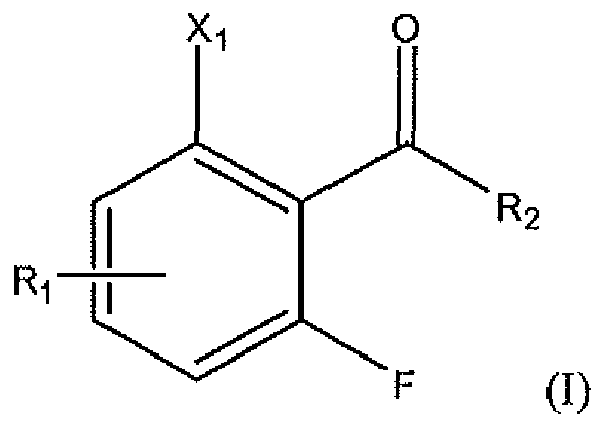
R3N2H3 (III),
wherein X1 and X2 are independently selected from the group consisting of: halogen, hydroxyl and alkoxy;
wherein the compound of formula II includes at least one R1 group;
wherein R1 may be present more than once on the indicated ring;
wherein each R1 is independently selected from the group consisting of: hydrogen, hydroxyl, alkoxy, amino, substituted amino, substituted sulfur, halogen, aryl, substituted aryl, heteroaryl, substituted heteroaryl, heterocyclic, substituted heterocyclic, C1-C8 alkyl, C2-C8 alkenyl, C2-C8 alkynyl, substituted C1-C8 alkyl, substituted C2-C8 alkenyl, substituted -C2-C8 alkynyl; -C3-C12 cycloalkyl, substituted -C3-C12 cycloalkyl, -C3-C12 cycloalkenyl, and substituted -C3-C12 cycloalkanyl; each containing 0, 1,2, or 3 heteroatoms selected from the group consisting of: O, S, and N;
R2 is selected from the group consisting of hydrogen, alkyl, and aryl;
R3 is selected from the group consisting of hydrogen, aryl, substituted aryl, heteroaryl, substituted heteroaryl, heterocyclic, substituted heterocyclic, -C1-C8 alkyl, -C2-C8 alkenyl, -C2-C8 alkynyl, substituted -C1-C8 alkyl, substituted -C2-C8 alkenyl, substituted -C2-C8 alkynyl; -C3-C12 cycloalkyl, substituted -C3-C12 cycloalkyl, -C3-C12 cycloalkenyl, and substituted -C3-C12 cycloalkenyl; each containing 0, 1, 2, or 3 heteroatoms selected from the group consisting of: O, S, and N. - In some embodiments, at least one of X1 and X2 is Br or Cl. In other embodiments, R3 is alkyl or hydrogen, and in yet other embodiments, at least one of X1 and X2 is Cl and R3 is hydrogen or methyl.
- In other embodiments, the compound of formula (I) is reacted with a compound of formula (III) in the presence of a base, such as potassium acetate, potassium carbonate, potassium bicarbonate, sodium carbonate, sodium bicarbonate, cesium carbonate, potassium phosphate tribasic, potassium phosphate dibasic, sodium phosphate dibasic, and excess compound of formula (III).
- In a second aspect, the invention is directed to methods of making a compound of formula XXIV,

reacting a compound of formula XII,
R10-CN (XII) or R10-NH2 (XIIa)
with hydrogen in the presence of Ra-Ni, and an acid HX, preferably succinic acid, to produce a compound of formula XIII or XIIIa,


R10-CN (XII) or R10-NH2 (XIIa)
with PhOCONH2 in the presence of a first base and a first solvent, to produce a compound of formula IV,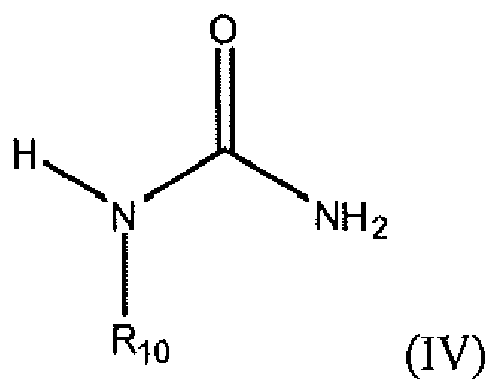
R10-CN (XII) or R10-NH2 (XIIa)
with hydrogen in the presence of Ra-Ni, and an acid HX, and PhOCONH2 in the presence of a first base and a first solvent, to produce a compound of formula IV,

wherein the compound of formula II includes at least one R1 group;
wherein R1 may be present more than once on the indicated ring;
wherein each wherein each R1 is independently selected from the group consisting of: hydrogen, hydroxy, alkoxy, amino, substituted amino, substituted sulfur, halogen, aryl, substituted aryl, heteroaryl, substituted heteroaryl, heterocyclic, substituted heterocyclic, C1-C8 alkyl, C2-C8 alkenyl, C2-C8 alkynyl, substituted C1-C8 alkyl, substituted C2-C8 alkenyl, substituted -C2-C8 alkynyl; -C3-C12 cycloalkyl, substituted -C3-C12 cycloalkyl, -C3-C12 cycloalkenyl, and substituted -C3-C12 cycloalkenyl; each containing 0, 1, 2, or 3 heteroatoms selected from the group consisting of: O, S, and N;
R2 is selected from the group consisting of hydrogen, alkyl, and aryl;
R3 is selected from the group consisting of: hydrogen, aryl, substituted aryl, heteroaryl, substituted heteroaryl, heterocyclic, substituted heterocyclic, -C1-C8 alkyl, -C2-C8 alkenyl, -C2-C8 alkynyl, substituted -C1-C8 alkyl, substituted -C2-C8 alkenyl, substituted -C2-C8 alkynyl; -C3-C12 cycloalkyl, substituted -C3-C12 cycloalkyl, -C3-C12 cycloalkenyl, and substituted -C3-C12 cycloalkenyl; each containing 0, 1, 2, or 3 heteroatoms selected from the group consisting of: O, S, and N; and
R10 is selected from the group consisting of: aryl, substituted aryl, heteroaryl, substituted heteroaryl, heterocyclic, substituted heterocyclic, -C1-C8 alkyl, -C2-C8 alkenyl, -C2-C8 alkynyl, substituted -C1-C8 alkyl, substituted -C2-C8 alkenyl, substituted -C2-C8 alkynyl; -C3-C12 cycloalkyl, substituted -C3-C12 cycloalkyl, -C3-C12 cycloalkenyl, and substituted -C3-C12 cycloalkenyl; each containing 0,1,2, or 3 heteroatoms selected from the group consisting of: O, S, and N. - In some embodiments, X2 is Cl, R3 is hydrogen or methyl, and R10 is aryl or alkyl; in yet other aspects, R10 is a group of formula VIII or VIIIa
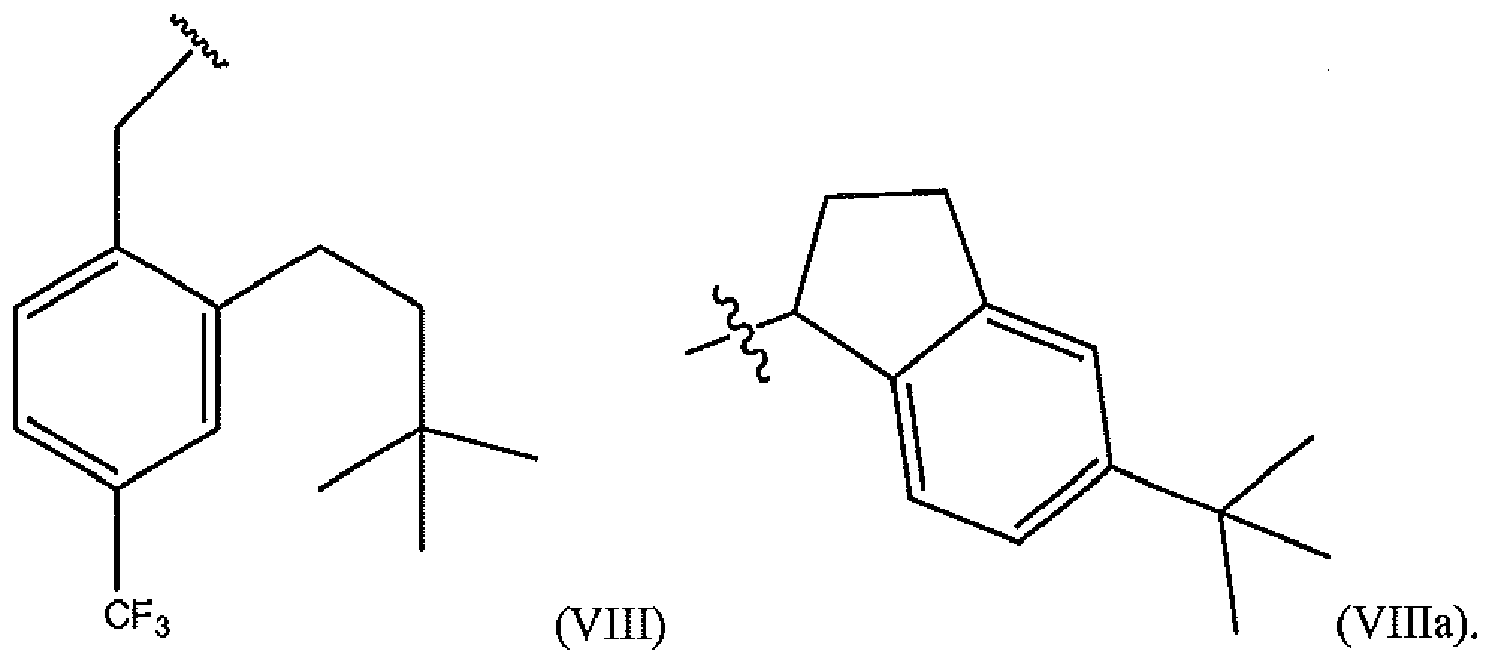
- The first base can be N,N-diisopropyl ethyl amine, and the second base can be potassium phosphate tribasic; the first solvent can be Me-THF, and the second solvent can be DME; and the palladium catalyst is selected from the group consisting of: Pd2(dba)3, Pd2Cl2(dba), Pd(OAc)2, Pd(OTFA)2, PdCl2, PdCl2(CH3CN)2, and PdCl2(PhCN)2. In some particular embodiments, the palladium catalyst is Pd2dba3.
- In some embodiments, the ligand is selected from the group consisting of the compounds of formulas XXX, XXXI, XXXII, XXXIII, XXXIV, XXXV, XXXVI, XXXVII, XXXVIII, XXXIX, XL, VII:


- PdCl2(dppf), and PdCl2(dppf)CH-2Cl2, In some aspects, the ligand is a compound of formula VII.
- In a third aspect, the invention is directed to methods of producing a compound of formula XXIII or XXIIIa


- The base can be potassium phosphate tribasic, the solvent DME, and the palladium catalyst, Pd2dba3.
- In a fourth aspect, the invention is directed to a compound of formula XIX or XIXa:

- In a fifth aspect, the invention is directed to compounds of formula XX or XXa:

- The invention is directed to methods of making TRPV 1 antagonists that use novel syntheses, including the production of N-1 substituted indazoles, by reacting ortho-substituted aryl carboxaldehydes with hydrazine derivative. Furthermore, the invention is directed to methods of coupling aryl chlorides with ureas using specific catalysts in the reaction to generate N-aryl ureas. Previously, a different catalyst with a very specific substrate was used in aryl chloride-urea couplings (Abad et al. (2005) Synthesis, 915).
- In a first embodiment, the invention is directed to the synthesis of a compound of formula II as described in Scheme 1. In general, a compound of formula I is reacted with a compound of formula III in the presence of a base to produce a compound of formula II.

- In Scheme 1:
- X1 is selected from the group consisting of: halogen, hydroxyl and alkoxy;
- X2 is selected from the group consisting of: halogen and sulfonate, wherein the sulfonate is independently substituted with fluorine or -C1-C8 fluarinated alkanes;
- R1 may be present more than once on the indicated ring;
- each R1 is independently selected from the group consisting of: hydrogen, hydroxyl, alkoxy, amino, substituted amino, substituted sulfur, oxygen, nitrogen, sulfur, halogen, aryl, substituted aryl, heteroaryl, substituted heteroaryl, heterocyclic, substituted heterocyclic, -C1-C8 alkyl, -C2-C8 alkenyl, -C2-C8 alkynyl, substituted -C1-C8 alkyl, substituted -C2-C8 alkenyl, substituted -C2-C8 alkynyl; -C3-C12 cycloalkyl, substituted -C3-C12 cycloalkyl, -C3-C12 cycloalkenyl, substituted -C3-C12 cycloalkenyl; each containing 0, 1, 2, or 3 heteroatoms selected from the group consisting of: O, S, and N; and -B-R7, where B is (CO), (CO)O, (CO)NR8, (SO), (SO2), (SO2)NR8; wherein R7 and R8 are independently selected from the group consisting of: hydrogen, oxygen, nitrogen, sulfur, halogen, aryl, substituted aryl, heteroaryl, substituted heteroaryl, heterocyclic, substituted heterocyclic, -C1-C8 alkyl, -C2-C8 alkenyl, -C2-C8 alkynyl, substituted -C1-C8 alkyl, substituted -C2-C8 alkenyl, substituted -C2-C8 alkynyl; -C3-C12 cycloalkyl, substituted -C3-C12 cycloalkyl, -C3-C12 cycloalkenyl, and substituted -C3-C12 cycloalkenyl; each containing 0, 1, 2, or 3 heteroatoms selected from the group consisting of: O, S, and N;
- alternatively, R1 is a group of formula IX:

- Z1 is selected from the group consisting of: O, NH, and S;
- Z2 is a bond or selected from the group consisting of: NH and O;
- L is selected from the group consisting of: bond, alkenylene, alkylene, alkynylene, cycloalkylene,

- m and n are each independently 0-6;
- RY is selected from the group consisting of: hydrogen and alkyl;
- R8a is selected from the group consisting of: hydrogen and alkyl;
- R8b is absent when X5 is N or R8b is selected from the group consisting of: hydrogen, alkoxy, alkoxycarbonylalkyl, alkyl, alkylcarbonyloxy, alkylsulfonyloxy, halogen, and hydroxy when X5 is C;
R2 is selected from the group consisting of: hydrogen, alkyl, and aryl; - R3 is selected from the group consisting of: hydrogen, aryl, substituted aryl, heteroaryl, substituted heteroaryl, heterocyclic, substituted heterocyclic, -C1-C8 alkyl, -C2-C8 alkenyl, -C2-C8 alkynyl, substituted -C1-C8 alkyl, substituted -C2-C8 alkenyl, substituted -C2-C8 alkynyl; -C3-C12 cycloalkyl, substituted -C3-C12 cycloalkyl, -C3-C12 cycloalkenyl, substituted -C3-C12 cycloalkenyl; each containing 0, 1, 2, or 3 heteroatoms selected from the group consisting of: O, S, and N; and -B-R7, where B is (CO), (CO)O, (CO)NR8, (SO), (SO2), (SO2)NR8; wherein R7 and R8 are independently selected from the group consisting of: hydrogen, oxygen, nitrogen, sulfur, halogen, aryl, substituted aryl, heteroaryl, substituted heteroaryl, heterocyclic, substituted heterocyclic, -C1-C8 alkyl, -C2-C8 alkenyl, -C2-C8 alkynyl, substituted -C1-C8 alkyl, substituted -C2-C8 alkenyl, substituted -C2-C8 alkynyl; -C8-C12 cycloalkyl, substituted -C3-C12 cycloalkyl, -C3-C12 cycloalkenyl, and substituted -C3-C12 cycloalkenyl; each containing 0, 1, 2, or 3 heteroatoms selected from the group consisting of: O, S, and N.
- The base can be any appropriate base, such as potassium acetate, potassium carbonate, potassium bicarbonate, sodium carbonate, sodium bicarbonate, cesium carbonate, potassium phosphate tribasic, potassium phosphate dibasic, sodium phosphate dibasic, or excess compound III itself, Any suitable temperature can be used, such as between approximately 50°C and 100 °C, and such as 50, 55, 60, 65, 70, 75, 80, 85, 90, 95 and 100 100 °C. The solvent can be any inert solvent, such as DMSO, toluene, DME, DMF, NP, DMAC, lutidine, isoproponal or other alcoholic solvents. In one embodiment, the base is potassium carbonate, the temperature is 70 °C, and the solvent is DMSO.
- In another embodiment, the invention is directed to a process of making a compound of formula VI, wherein a compound of formula IV is reacted with a compound of formula V in the presence of a palladium catalyst, a base, a solvent, and a ligand, shown in Scheme 2:
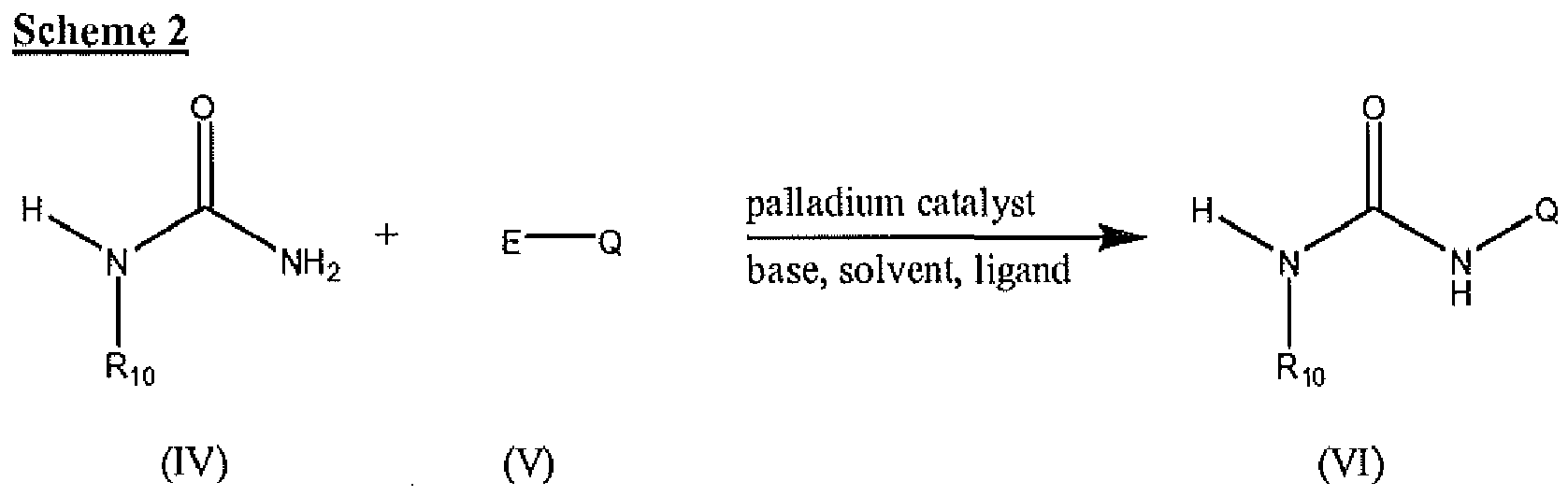
- In Scheme 2:
- R10 is selected from the group consisting of: alkyl, substituted aryl, heteroaryl, substituted heteroaryl, heterocyclic, substituted heterocyclic, -C1-C8 alkyl, -C2-C8 alkenyl, -C2-C8 alkynyl, substituted -C1-C8 alkyl, substituted -C2-C8 alkenyl, substituted -C2-C8 alkynyl; -C3-C12 cycloalkyl, substituted -C3-C12 cyclaalkyl, -C3-C12 cycloalkenyl, and substituted -C3-C12 cycloalkenyl; each containing 0, 1, 2, or 3 heteroatoms selected from the group consisting of: O, S, and N;
E is a halogen; - Q is selected from the group consisting of:
- an optionally substituted 6-membered heterocyclic ring, an optionally substituted 6-membered heteroaryl ring, and an optionally substituted fused bicyclic ring, wherein the optional substituents are independently selected from the group consisting of: hydrogen, oxygen, nitrogen, sulfur, halogen, aryl, substituted aryl, heteroaryl, substituted heteroaryl, heterocyclic, substituted heterocyclic, -C1-C8 alkyl, -C2-C8 alkenyl, -C2-C8 alkynyl,
- substituted -C1-C8 alkyl, substituted -C2-C8 alkenyl, substituted -C2-C8 alkynyl; -C3-C12 cycloalkyl, substituted -C3-C12 cycloalkyl, -C3-C12 cycloalkenyl, substituted -C3-C12 cycloalkenyl; each containing 0, 1, 2, or 3 heteroatoms selected from the group consisting of: O, S, and N; and -B-R7, where B is (CO), (CO)O, (CO)NR8, (SO), (SO2), (SO2)NR8; wherein R7 and R8 are independently selected from the group consisting of: hydrogen, oxygen, nitrogen, sulfur, halogen, aryl, substituted aryl, heteroaryl, substituted heteroaryl, heterocyclic, substituted heterocyclic, -C1-C8 alkyl, -C2-C8 alkenyl, -C2-C8 alkynyl, substituted -C1-C8 alkyl, substituted -C2-C8 alkenyl, substituted -C2-C8 alkynyl; -C3-C12 cycloalkyl, substituted -C3-C12 cycloalkyl, -C3-C12 cycloalkenyl, and substituted -C3-C12 cycloalkenyl; each containing 0, 1, 2, or 3 heteroatom selected from the group consisting of O, S, and N; alternatively, the optional substituents is a group of formula IX:

- Z1 is selected from the group consisting of: O, NH, and S;
- Z2 is a bond or selected from the group consisting of: NH and O;
- L is selected from the group consisting of: bond, alkenylene, alkylene, alkynylene, cycloalkylene,

- m and n are each independently 0-6;
- RY is selected from the group consisting of: hydrogen and alkyl;
- U8a is selected from the group consisting of: hydrogen and alkyl;
- R8b is absent when X5 is N or R8b is selected from the group consisting of: hydrogen, alkoxy, alkoxycarbonylalkyl, alkyl, alkylcarbonyloxy, alkylsulfonyloxy, halogen, and hydroxy when X5 is C;
- or alternatively, Q is a group of formula X:

- X1 is selected from the group consisting of: N and CR4;
- X2 is selected from the group consisting of: N and CR5;
- X3 is selected from the group consisting of: N, NR6, and CR6;
- wherein at least one of X1, X2, and X3, is N,
- In one embodiment, R10 is a compound of formula VIII or VIIIa; in another embodiment, Q is a compound of formula XI or XIa. In yet another embodiment, R10 is a compound of formulas VIII or VIIIa and Q is a compound of formula XI or XIa.


- The base can be any appropriate base, such as sodium tert-butoxide, sodium carbonate, cesium carbonate, tribasic potassium phosphate, sodium hydroxide and potassium carbonate. In one embodiment, the base is tribasic potassium phosphate, The solvent can be chosen from inert solvents, such as DMF, DME, toluene, and mixtures thereof In one embodiment, the solvent is DME. The reaction can be carried out at an appropriate temperature, from about 60 °C to about 100°C. In one embodiment, the reaction is carried out at about 85 °C, the base is potassium phosphate tribasic, and the solvent is DME.
- The palladium catalyst can be any suitable source for soluble palladium; for example, such as Pd2(dba)3, Pd2Cl2(dba), Pd(OAc)2, Pd(OTFA)2, PdCl2, PdCl2(CH3CN)2, or PdCl2(PhCN). In one embodiment, the palladium catalyst is Pd2dba3,
- The ligand can be precomplexed or added to the reaction mixture. The ligand can be chosen from electron-rich or bidentate classes including, but not limited to, those shown in Table 1, such as Xantphos (XXX), 3,5-bistrifluoromethyl-Xantphos (XXXI), PdCl2(dtbf) (XXXII), PdCl2(dppf), PdCl2(dppoCH2Cl2, Amphos (XXXIII), Adamantane (XXXIV), DavePhos (XXXV), Xphos (XXXVI), bis-tert-butyl-binaphthyl phosphine (XXXVII), RuPhos (XXXVIII), and the Bipyphos ligand of formula VII (disclosed in Singer et al. (2006) Tetrahedron Lett., 47(22):3727). In one embodiment, the palladium catalyst is Pd2dba3 with Bipyphos ligand of formula VII.
TABLE 1 Examples of ligands 


- In yet a further embodiment, the invention is directed to a process of making a compound of formula XXIV, as described in Scheme 3. In Step A, a compound of formula I is reacted with a compound of formula III in the presence of a solvent and a base to produce the compound of formula II. In a separate step, Step B, a compound of the formula XII or XIIa is reacted with hydrogen in the presence of Ra-Ni followed by succinic acid, to produce a compound of formula XIII or XIIIa. In Step 1, the freebase of the compound of formula XIII or XIIIa is reacted with PhOCONH2 in the presence of a solvent and base to produce a compound of formula IV. In a final step, the compound of formula IV, produced from Steps B and 1, and the compound of formula II, produced from Step A, are reacted together in the presence of a palladium catalyst in the presence of a base, solvent, and ligand to produce the compound of formula XXIV or XXIVa.


- In Scheme 3:
- X1 is selected from the group consisting of: halogen, hydroxyl and alkoxy;
- X2 is selected from the group consisting of: halogen and sulfonate, wherein the sulfonate is independently substituted with fluorine or -C1-C8 fluorinated alkanes;
- R1 may be present more than once on the indicated ring;
- each R1 is independently selected from the group consisting of: hydrogen, hydroxyl, alkoxy, amino, substituted amino, substituted sulfur, oxygen, nitrogen, sulfur, halogen, aryl, substituted aryl, heteroaryl, substituted heteroaryl, heterocyclic, substituted heterocyclic, -C1-C8 alkyl, -C2-C8 alkenyl, -C2-C8 alkynyl, substituted -C1-C8 alkyl, substituted -C2-C8 alkenyl, substituted -C2-C8 alkynyl; -C3-C12 cycloalkyl, substituted -C3-C12 cycloalkyl, -C3-C12 cycloalkenyl, substituted -C3-C12 cycloalkenyl; each containing 0, 1, 2, or 3 heteroatoms selected from the group consisting of: O, S, and N; and -B-R7, where B is (CO), (CO)O, (CO)NR8, (SO), (SO2), (SO2)NR8; wherein R7 and R8 are independently selected from the group consisting of: hydrogen, oxygen, nitrogen, sulfur, halogen, aryl, substituted aryl, heteroaryl, substituted heteroalyl, heterocyclic, substituted heterocyclic, -C1-C8 alkyl, -C2-C8 alkenyl, -C2-C8 alkynyl, substituted -C1-C8 alkyl, substituted -C2-C8 alkenyl, substituted -C2-C8 alkynyl; -C3-C12 cycloalkyl, substituted -C3-C12 cycloalkyl, -C3-C12 cycloalkenyl, and substituted -C3-C12 cycloalkenyl; each containing 0, 1, 2, or 3 heteroatoms selected from the group consisting of: O, S, and N;
- alternatively, R1 is a group of formula IX:

- Z1 is selected from the group consisting of: O, NH, and S;
- Z2 is a bond or selected from the group consisting of: NH and O;
- L is selected from the group consisting of: bond, alkenylene, alkylene, alkynylene, cycloalkylene,

- m and n are each independently 0-6;
- RY is selected from the group consisting of: hydrogen and alkyl;
- R8a is selected from the group consisting of: hydrogen and alkyl;
- R8b is absent when X5 is N or R8b is selected from the group consisting of; hydrogen, alkoxy, alkoxycarbonylalkyl, alkyl, alkylcarbonyloxy, alkylsulfonyloxy, halogen, and hydroxy when X5 is C;
R2 is selected from the group consisting of: hydrogen, alkyl, and aryl; - R3 is selected from the group consisting of: hydrogen, aryl, substituted aryl, heteroaryl, substituted heteroaryl, heterocyclic, substituted heterocyclic, -C1-C8 alkyl, -C2-C8 alkenyl, -C2-C8 alkynyl, substituted -C1-C8 alkyl, substituted -C2-C8 alkenyl, substituted -C2-C8 alkynyl; -C3-C12 cycloalkyl, substituted -C3-C12 cycloalkyl, -C3-C12 cycloalkenyl, substituted -C3-C12 cycloalkenyl; each containing 0, 1, 2, or 3 heteroatoms selected from the group consisting of: O, S, and N; and -B-R7, where B is (CO), (CO)O, (CO)NR8, (SO), (SO2), (SO2)NR8; wherein R7 and R8 are independently selected from the group consisting of: hydrogen, oxygen, nitrogen, sulfur, halogen, aryl, substituted aryl, heteroaryl, substituted heteroaryl, heterocyclic, substituted heterocyclic, -C1-C8 alkyl, -C2-C8 alkenyl, -C2-C8 alkynyl, substituted -C1-C8 alkyl, substituted -C2-C8 alkenyl, substituted -C2-C8 alkynyl; -C3-C12 cycloalkyl, substituted -C3-C12 cycloalkyl, -C3-C12 cycloalkenyl, and substituted -C3-C12 cycloalkenyl; each containing 0, 1, 2, or 3 heteroatoms selected from the group consisting of: O, S, and N;
- R10 is selected from the group consisting of: aryl, substituted aryl, heteroatyl, substituted heteroaryl, heterocyclic, substituted heterocyclic, -C1-C8 alkyl, -C2-C8 alkenyl, -C2-C8 alkynyl, substituted -C1-C8 alkyl, substituted -C2-C8 alkenyl, substituted -C2-C8 alkynyl; -C3-C12 cycloalkyl, substituted -C3-C12 cycloalkyl, -C3-C12 cycloalkenyl, and substituted -C3-C12 cycloalkenyl; each containing 0, 1, 2, or 3 heteroatoms selected from the group consisting of: O, S, and N. In one embodiment, R10 is a compound of formula VIII or VIIIa.

- The base to freebase the amine for Step 1 can be any appropriate base, such as sodium carbonate, cesium carbonate, tribasic potassium phosphate or potassium carbonate. In one embodiment, the base to freebase the amine for Step 1 is sodium hydroxide, the base in Step I is N,N-diisopropyl ethyl amine, the base in Step 2 is potassium phosphate tribasic, the base in Step A is potassium carbonate, the base in Step C is triethylamine (TEA).
- Any suitable solvent for each particular step can be used. In one embodiment, the solvent in Step A is DMSO, the solvent in Step 1 is Me-THF, and the solvent in Step 2 is DME. The palladium catalyst for Step 2 can be any suitable one, such as Pd2(dba)3, Pd2Cl2(dba), Pd(OAc)2, Pd(OTFA)2, PdCl2, PdCl2(CH3CN)2, or PdCl2(PhCN)2. In one embodiment, the palladium catalyst is Pd2dba3, The ligand can be precomplexed or added to the reaction mixture. The ligand can be chosen from electron-rich or bidentate classes including, but not limited to, those shown in Table 1, such as Xantphos (XXX), 3,5-bistrifluoromethyl-Xantphos (XXXI), PdCl2(dtbf) (XXXII), PdCl2(dppf), PdCl2(dppf)CH2Cl2, Amphos (XXXIII), Adamantane (XXXIV), DavePhos (XXXV), Xphos (XXXVI), bis-tert-butyl-binaphthyl phosphoine (XXXVII), RuPhos (XXXVIII), and the Bipyphos ligand of formula VII (disclosed in Singer et al. (2006) Tetrahedron Lett., 47(22):3727). In one embodiment, the palladium catalyst is Pd2dba3 with Bipyphos ligand of formula VII. The steps can be carried out at an appropriate temperature for that step. In one embodiment, Step A is carried out at about 70 °C, Step B is carried out at about 50 °C, Step 1 is carried out at about 45 °C, and Step 2 is carried out at about 80 °C.
- In another embodiment, the invention is directed to making a compound of formula XXIII or XXIIIa as shown in Scheme 4. Thus for example, in Step A, a compound of formula XXI is reacted with MeN2H3 in the presence of a solvent and in the presence of a base to produce the compound of formula XXII. In a separate step, Step C, a compound of the formula XVII is reacted with t-butylacetylene in the presence of a palladium catalyst, a base, CuI, and Davephos to produce the compound of formula XVIII. In Step B, the compound of formula XVIII is reacted with hydrogen in the presence of Ra-Ni followed by succinic acid, to produce a compound of formula XIX. In Step 1, the compound of formula XIX is reacted with PhOCONH2 in the presence of a solvent and base to produce a compound of formula XX. In a final step, the compound of formula XX, produced from Steps C, B and 1, and the compound of formula XXII, produced from Step A, are reacted together in the presence of a palladium catalyst in the presence of a base, solvent, and catalyst. Similary compound XXIII may be made using starting materials as previously described.
- The base in Step C can be any appropriate base, such as sodium carbonate, cesium carbonate, tribasic potassium phosphate and potassium carbonate, or N,N-diisopropylethyl amine. In one embodiment, the base is N,N-diisopropylethyl amine. Any suitable solvent can be used, such as DMF, DME, toluene, and mixtures thereof. In one embodiment, the solvent is 2-methyl-THF. The reaction can be carried out from about 20 °C to about 130 °C. In one embodiment, the reaction is carried out at about 45 °C.
- The base can be any appropriate base, such as sodium carbonate, cesium carbonate, tribasic potassium phosphate, potassium carbonate, triethylamine, or N.N-diisopropylethyl gamine. In one embodiment, the base in Step 1 is N,N-diisopropylethylamine, the base in Step 2 is tribasic potassium phosphate, and the base in Step A is potassium carbonate. Any suitable solvent can be used for the particular step. In one embodiment, the solvent in Step A is DMSO, the solvent in Step 1 is Me-THF and the solvent in Step 2 is DME.
- The palladium catalyst for Step 2 can be any suitable one, such as Pd2(dba)3, PdzCl2(dba), Pd(OAc)2, Pd(OTFA)2, PdCl2, PdCl2(CH3CN)2, or PdCl2(PhCN)2. In one embodiment, the palladium catalyst is Pd2dba3. The steps can be carried out at an appropriate temperature for that step. In one embodiment, Step A is carried out at about 70 °C, Step C is carried out at about 65 °C, Step 1 is carried out at about 45 °C, and Step 2 is carried out at about 80 °C. The ligand can be any appropriate ligand, including Xantphos (XXX), 3,5-bistrifluoromethyl-Xantphos (XXXI), PdCl2(dtbf) (XXXII), PdCl2(dppf), PdCl2(dppf)CH2Cl2, Amphos (XXXIII), Adamantane (XXXIV), DavePhos (XXXV), Xphos (XXXVI), bis-tert-butyl-binaphthyl phosphine (XXXVII), RuPhos (XXXVIII), and the Bipyphos ligand of formula VII (disclosed in Singer et al. (2006) Tetrahedron Lett., 47(22):3727). In one embodiment, the palladium catalyst is Pd2dba3 with Bipyphos ligand of formula VII.

- In another embodiment, the invention is directed to making a compound of formula XXIII as shown in Scheme 5. A compound of formula XXV (2-bromo-6-fluorobenzaldehyde) in a solvent, such as DMSO, is added to methylhydrazine (MeN2H3) to produce the compound of formula XXVI. The compound of formula XXVI is then mixed with palladium acetate (Pd(OAc)2), Xantphos and benzophenone imine (Ph2C=NH), followed by sodium tert-butoxide and then HCl to produce a compound of formula XXVII (1-methyl-4-aminoindazole hydrochloride). The compound of formula XXVII is then mixed with pyridine and disuccinimidyl carbonate (XXVIII) to produce a compound of formula XXIII.
- In addition to Pd(OAc)2, the palladium catalyst can be any suitable one, in one embodiment, the palladium catalyst is Pd2dba3. In addition to Xantphos, the ligand can be any appropriate ligand, including (XXXIV), DavePhos (XXXV), Xphos (XXXVI), bis-tert-butyl-binaphthyl phosphine (XXXVII), RuPhos (XXXVIII).
- Any suitable reaction temperatures can be any appropriate ones; for example, when adding 2-bromo-6-fluorobenzaldehyde (XXV) in DMSO to methylhydrazine, the internal temperature can be maintained at less than approximately 35 °C, and then reacted at approximately 80 °C for a sufficient time to produce a compound of formula XXVI, after which the internal temperature can be adjusted to approximately 25 °C. When the aqueous layer is extracted, the temperature of the mixture can be maintained at less than approximately 40 °C. When reacting a compound of formula XXVI to produce a compound of formula XXVII, the temperature at which the reagents are added can be, for example, room temperature, while the reaction is carried out, for example, at approximately 80-85 °C before cooling to approximately room temperature. When reacting a compound of formula XXVII to produce a compound of formula XXIII, the reactants can be added at an internal temperature of approximately 25° C or less, and reacted at approximately the same temperature. The compound of XXIII can then be dissolved, for example, at approximately 70 °C, then precipitated at approximately 65 °C -70 °C before cooling to approximately room temperature.
- Similarly compound XXIIIa may be manufactured using VIIIa and XXIV as the starting material.
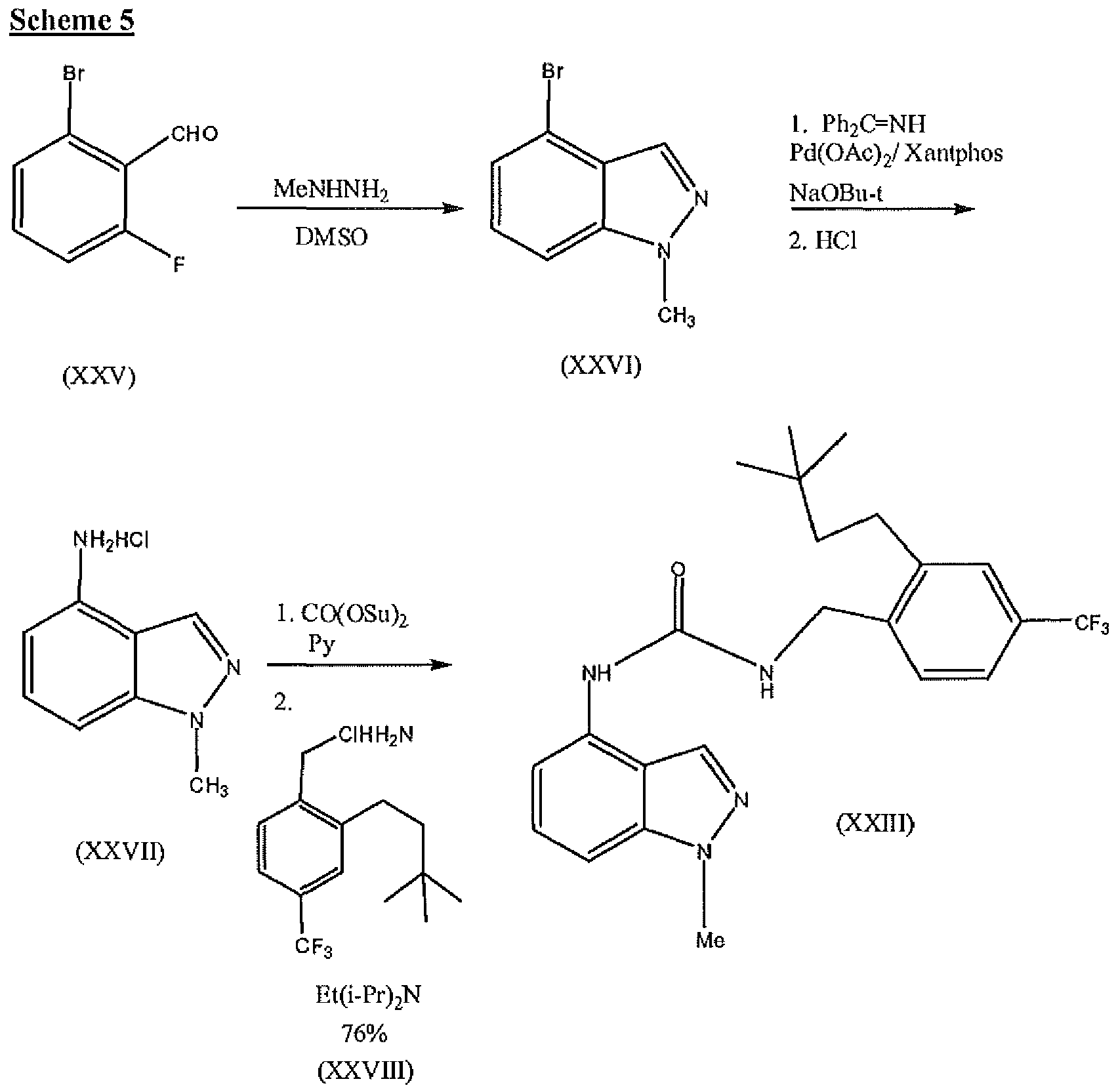
- As used throughout this specification and the appended claims, the following terms have the following meanings:
- The term "alkenyl" as used herein, means a straight or branched chain hydrocarbon containing from 2 to 10 carbons and containing at least one carbon-carbon double bond formed by the removal of two hydrogens. Representative examples of alkenyl include, but are not limited to, ethenyl, 2-propenyl, 2-methyl-2-propenyl, 3-butenyl, 4-pentenyl, 5-hexenyl, 2-heptenyl, 2-methyl-1-heptenyl, and 3-decenyl.
- The term "alkenylene" means a divalent group derived from a straight or branched chain hydrocarbon of from 2 to 10 carbon atoms containing at least one double bond. Representative examples of alkenylene include, but are not limited to, -CH=CH-, - CH=CH2CH2-, and -CH=C(CH3)CH2-.
- The term "alkoxy" as used herein, means an alkyl group appended to the parent molecular moiety through an oxygen atom. Representative examples of alkoxy include, but are not limited to, methoxy, athoxy, propoxy, 2-propoxy, butoxy, tert-butoxy, pentyloxy, and hexyloxy.
- The term "alkoxyalkoxy" as used herein, means an alkoxy group, as defined herein, appended to the parent molecular moiety through an alkoxy group, as defined herein. Representative examples of alkoxyalkoxy include, but are not limited to, methoxymethoxy, ethoxymethoxy and 2-ethoxyethoxy.
- The term "alkoxyalkyl" as used herein, means an alkoxy group, as defined herein, appended to the parent molecular moiety through an alkyl group, as defined herein. Representative examples of alkoxyalkyl include, but are not limited to, tert-butoxymethyl, 2-ethoxyethyl, 2-methoxyethyl, and methoxymethyl.
- The term "alkoxycarbonyl" as used herein, means an alkoxy group, as defined herein, appended to the parent molecular moiety through a carbonyl group, as defined herein. Representative examples of alkoxycarbonyl include, but are not limited to, methoxycarbonyl, ethoxycarbonyl, and tert-butoxycarbonyl.
- The term "alkoxycarbonylalkyl" as used herein, means an alkoxycarbonyl group, as defined herein, appended to the parent molecular moiety through an alkyl group, as defined herein. Representative examples of alkoxycarbonylalkyl include, but are not limited to, 3-methoxycarbonylpropyl, 4-ethoxycarbonylbutyl, and 2-tert-butoxycarbonylethyl.
- The term "alkyl" as used herein, means a straight or branched chain hydrocarbon containing from 1 to 10 carbon atoms. Representative examples of alkyl include, but are not limited to, methyl, ethyl, n-prapyl, iso-propyl, n-butyl, sec-butyl, iso-butyl, tert-butyl, n-pentyl, isopentyl, neopentyl, n-hexyl, 3-methylhexyl, 2,2-dimethylpentyl, 2,3-dimethylpentyl, n-heptyl, n-octyl, n-nonyl, and n-decyl.
- The term "alkylcarbonyl" as used herein, means an alkyl group, as defined herein, appended to the parent molecular moiety through a carbonyl group, as defined herein. Representative examples of alkylcarbonyl include, but are not limited to, acetyl, 1-oxopropyl, 2,2-dimethyl-1-oxopropyl, 1-oxobutyl, and 1-oxopentyl.
- The term "alkylcarbonylalkyl" as used herein, means an alkylcarbonyl group, as defined herein, appended to the parent molecular moiety through an alkyl group, as defined herein. Representative examples of alkylcarbonylalkyl include, but are not limited to, 2-oxopropyl, 3,3-dimethyl-2-oxopropyl, 3-oxobutyl, and 3-oxopentyl.
- The term "alkylcarbonyloxy" as used herein, means an alkylcarbonyl group, as defined herein, appended to the parent molecular moiety through an oxygen atom. Representative examples of alkylcarbonyloxy include, but are not limited to, acetyloxy, ethylcarbonyloxy, and tert-butylcarbonyloxy.
- The term "alkylene" means a divalent group derived from a straight or branched chain hydrocarbon of from 1 to 10 carbon atoms. Representative examples of alkylene include, but are not limited to, -CH2-, -CH2CH2-, -CH2CH2CH2-, -CH2CH2CH2CH2-, -CH2CH(CH3)CH2-, and -(CH2)pCH(Rz)(CH2)q-, wherein p and q are independently 0-4 and Rz is selected from the group consisting of: aryl, cycloalkyl, and hydroxy. A preferred aryl group is phenyl. The term "alkylsulfonyl" as used herein, means an alkyl group, as defined herein, appended to the parent molecular moiety through a sulfonyl group, as defined herein. Representative examples of alkylsulfonyl include, but are not limited to, methylsulfonyl and ethylsulfonyl. The term "alkylthio" as used herein, means an alkyl group, as defined herein, appended to the parent molecular moiety through a sulfur atom. Representative examples of alkylthio include, but are not limited, methylsulfanyl, ethylsulfanyl, tert-butylsulfanyl, and hexylsulfanyl.
- The term "alkynyl" as used herein, means a straight or branched chain hydrocarbon group containing from 2 to 10 carbon atoms and containing at least one carbon-carbon triple bond. Representative examples of alkynyl include, but are not limited, to acetylenyl, 1-propynyl, 2-propynyl, 3-butynyl, 2-pentynyl, and 1-butynyl.
- The term "alkynylene" means a divalent group derived from a straight or branched chain hydrocarbon of from 2 to 10 carbon atoms containing at least one triple bond. Representative examples of alkynylene include, but are not limited to, -C≡C-, -CH2C≡C-, -CH(CH3)CH2C≡C-, -C≡CCH2-, and -C≡CCH(CH3)CH2-.
- The term "aryl" as used herein, means a phenyl group, or a bicyclic or a tricyclic fused ring system wherein one or more of the fused rings is a phenyl group. Bicyclic fused ring systems are exemplified by a phenyl group fused to a cycloalkyl group, as defined herein, or another phenyl group. Tricyclic fused ring systems are exemplified by a bicyclic fused ring system fused to a cycloalkyl group, as defined herein, or another phenyl group. Representative examples of aryl include, but are not limited to, anthracenyl, azulenyl, fluorenyl, indanyl, indenyl, naphthyl, phenyl and tetrahydronaphthyl.
- The aryl groups of this invention can be substituted with 1, 2, 3, 4 or 5 substituents independently selected from the group consisting of: alkenyl, alkoxy, alkoxyalkoxy, alkoxyalkyl, alkoxycarbonyl, alkoxycarbonylalkyl, alkyl, alkylcarbonyl, alkylcarbonylalky), alkylcarbonyloxy, alkylsulfonyl, alkylthio, alkynyl, carboxy, carboxyalkyl, cyano, cyanoalkyl, cycloalkyl, cycloalkylalkyl, ethylenedioxy, formyl, formylalkyl, haloalkoxy, haloalkyl, haloalkylthio, halogen, hydroxy, hydroxyalkyl, methylenedioxy, mercapto, mercaptoalkyl, nitro, -NZCZD, (NZCZD)alkyl, (NZCZD)carbonyl, (NZCZD)carbonylalkyl, (NZCZD)sulfony), -NRAS(O)2RB, -S(O)2ORA and -S(O)2RA wherein RA and RB are as defined herein. The aryl groups of this invention can be further substituted with any one of an additional aryl, arylalkyl, aryloxy, arylthio, heterocycle, heterocyclealkyl, heterocycleoxy, or heteracyclethio group, as defined herein, wherein the additional aryl, arylalkyl, aryloxy, arylthio, heterocycle, heterocyclealkyl, heterocycleoxy, and heterocyclethio group can be substituted with 1, 2, 3, 4, or 5 substituents independently selected from the group consisting of: alkenyl, alkoxy, alkoxyalkoxy, alkoxyalkyl, alkoxycarbonyl, alkoxycarbonylalkyl, alkyl, alkylcarbonyl, alkylcarbonylalkyl, alkylcarbonyloxy, alkylsulfonyl, alkylthio, alkynyl, carboxy, carboxyalkyl, cyano, cyanoalkyl, cycloalkyl, cycloalkylalkyl, formyl, formylalkyl, haloalkoxy, haloalkyl, haloalkylthio, halogen, hydroxy, hydroxyalkyl, mercapto, mercaptoalkyl, nitro, -NZCZD, (NZCZD)alkyl, (NZCZD)carbonyl, (NZCZD)carbonylalkyl, (NZCZD)sulfonyl, -NRAS(O)2RB, -S(O)2ORA and -S(O)2RA wherein RA and RB are as defined herein. Representative examples include, but are not limited to, 4-(2-azabicyclo[2.2.1]hept-2-yl)-2-(trifluoromethyl)phenyl, 4-(8-azabicyclo[3.2.1]oct-8-yl)-2-chlorophenyl, 4-(8-azabicyclo[3.2.1]oct-8-y))-3-chlorophenyl, 4-(8-azabicyclo[3.2.1]oct-8-yl)phenyl, 4-(8-azabicyclo[3.2.1]oct-9-yl)-3-(trifluoromethyl)phenyl, 4-(8-azabicyclo[3.2.1]oct-8-yl)-2-(trifluoromethyl)phenyl, 4-(8-azabicyclo[3.2.1]oct-8-yl)-3-fluorophenyl, 3-chloro-4-azepan-1-ylphenyl, 2-chloro-4-azepan-1-ylphenyl, 3,5-difluoro-4-azepan-1-ylphenyl, 4-(8-azabicyclo[3.2.1]oct-8-yl)-3,5-difluorophenyl, 4-bromaphenyl, 3-chlorophenyl, 4-chlorophenyl, 3,4-dichlorophenyl, 2,3-dichlorophenyl, 2,4-dichlorophenyl, 3,5-dichlorophenyl, 3,4-difluorophenyl, 4-bromo-2-fluorophenyl, 4-chloro-2-fluorophenyl, 4-(tert-butyl)phenyl), 4-cyanophenyl, 4-ethylphenyl, 3-fluorophenyl, 2,4-difluorophenyl, 4-bromo-3-fluorophenyl, 2,3-difluoro-4-(trifluoromethyl)phenyl, 3-fluoro-4-(trifluoromethyl)phenyl, 3-fluoro-5-(trifluoromethyl)phenyl, 3-(trifluoromethyl)phenyl, 4-(trifluoromethyl)phenyl, 4-(trifluoromethoxy)phenyl, 3-(trifluoromethoxy)phenyl, 4-[(trifluoromethyl)thio]phenyl, 4-azepan-1-yl-3-(trifluoromethyl)phenyl, 4-azepan-1-yl-2-(trifluoromethyl)phenyl, 3-methylphenyl, 3,4-dimethylphenyl, 2,4-dimethylphenyl, 4-isopropylphenyl, 4-methylphenyl, 4-bromo-3-methylphenyl, 4-fluoro-3-(trifluoromethyl)phenyl, 3-chloro-4-fluorophenyl, 4-(1-pyrrolidinyl)phenyl, 4-(1-azepanyl)phenyl, 3-fluoro-4-(1-pyrrolidinyl)phenyl, 3-fluoro-4-(1-azepanyl)phenyl, 4-(1-azocanyl)phenyl, 4-(1-piperidinyl)phenyl, 3-fluoro-4-(1-piperidinyl)phenyl, 4-(2-pyridinyl)phenyl, 1,1'-biphenyl, 3-fluoro-4-(4-methyl-1-piperidinyl)phenyl, 4-(4-methyl-1-piperidinyl)phenyl, 4-(4-morpholinyl)phenyl, 4-(2,6-dimethyl-4-morpholinyl)phenyl, 4-(4-thiomorpholinyl)phenyl, 3,5-difluoro-4-(4-morpholinyl)phenyl, 3,5-bis(trifluoromethyl)phenyl, and 2,5-bis(trifluoromethyl)phenyl,
- The term "arylalkyl" as used herein, means an aryl group, as defined herein, appended to the parent molecular moiety through an alkyl group, as defined herein. Representative examples of arylalkyl include, but are not limited to, benzyl, 2-phenylethyl, 3-phenylpropyl, and 2-naphth-2-ylethyl.
- The term "aryloxy" as used herein, means an aryl group, as defined herein, appended to the parent molecular moiety through an oxygen atom. Representative examples of aryloxy include, but are not limited to, phenoxy, naphthyloxy, 3-bromophenoxy, 4-chlorophenoxy, 4-methylphenoxy, and 3,5-dimethoxyphenoxy.
- The term "arylthio" as used herein, means an aryl group, as defined herein, appended to the parent molecular moiety through a sulfur atom. Representative examples of arylthio include, but are not limited to, phenylsulfanyl, naphth-2-ylsulfanyl, and 5-phenylhexylsulfanyl.
- The term "carbonyl" as used herein, means a -C(O)- group.
- The term "carboxy" as used herein, means a -CO2H group.
- The term "carboxyalkyl" as used herein, means a carboxy group, as defined herein, appended to the parent molecular moiety through an alkyl group, as defined herein. Representative examples of carboxyalkyl include, but are not limited to, carboxymethyl, 2-carboxyethyl, and 3-carboxypropyl.
- The term "cyano" as used herein, means a -CN group.
- The term "cyanoalkyl" as used herein, means a cyano group, as defined herein, appended to the parent molecular moiety through an alkyl group, as defined herein. Representative examples of cyanoalkyl include, but are not limited to, cyanomethyl, 2-cyanoyethyl, and 3-cyanopropyl.
- The term "cycloalkyl" as used herein, means a monocyclic, bicyclic, or tricyclic ring system. Monocyclic ring systems are exemplified by a saturated cyclic hydrocarbon group containing from 3 to 12 carbon atoms. Examples of monocyclic ring systems include cyclopropyl, cyclobutyl, cyclopentyl, cyclohexyl, cycloheptyl, and cyclooctyl. Bicyclic ring systems are exemplified by a bridged monocyclic ring system in which two non-adjacent carbon atoms of the monocyclic ring are linked by an alkylene bridge of between one and three additional carbon atoms. Representative examples of bicyclic ring systems include, but are not limited to, bicyclo[3.1.1]heptane, bicyclo[2.2.1]heptane, bicyclo[2.2.2]octane, bicyclo[3.2.2]nonane, bicyclo[3.3.1]nonane, and bicyclo[4.2.1]nonane. Tricyclic ring systems are exemplified by a bicyclic ring system in which two non-adjacent carbon atoms of the bicyclic ring are linked by a bond or an alkylene bridge of between one and three carbon atoms. Representative examples of tricyclic-ring systems include, but are not limited to, tricyclo[3.3.1.03,7]nonane and tricyclo[3.3.1.13,7]decane (adamantyl).
- The cycloalkyl groups of this invention can be substituted with 1, 2, 3, 4 or 5 substituents independently selected from the group consisting of: alkenyl, alkoxy, alkoxyalkoxy, alkoxyalkyl, alkoxycarbonyl, alkoxycarbonylalkyl, alkyl, alkylcarbonyl, alkylcarbonylalkyl, alkylcarbonyloxy, alkylsulfonyl, alkylthio, alkynyl, carboxy, carboxyalkyl, cyano, cyanoalkyl, formyl, haloalkoxy, haloalkyl, haloalkylthio, halogen, hydroxy, hydroxyalkyl, mercapto, mercaptoalkyl, nitro, -NZCZD, (NZCZD)alkyl, (NZCZD)carbonyl, (NZCZD)carbonylalkyl, (NZCZD)sulfonyl, -NRAS(O)2RB, -S(O)2ORA, and -S(O)2RA wherein RA and RB are as defined herein. Representative examples include, but are not limited to, 6,6-dimethylbicyclo[3.1.1]heptyl, 6,6-dimethylbicyclo[3.1.1]hept-2-yl, 4-tert-butylcyclohexyl, and 4-(trifluoromethyl)cyclohexyl.
- The term "cycloalkylalkyl" as used herein, means a cycloalkyl group, as defined herein, appended to the parent molecular moiety through an alkyl group, as defined herein. Representative examples of cycloalkylalkyl include, but are not limited to, cyclopropylmethyl, 2-cyclobutylethyl, cyclopentylmethyl, cyclohexylmethyl, and 4-cycloheptylbutyl.
- The term "cycloalkylene" as used herein, means a divalent group derived from a cycloalkyl group, as defined herein. Representative examples of cycloalkylene include, but are not limited to

- The term "ethylenedioxy" as used herein, means a -O(CH2)2O- group wherein the oxygen atoms of the ethylenedioxy group are attached to the parent molecular moiety through one carbon atom forming a 5 membered ring or the oxygen atoms of the ethylenedioxy group are attached to the parent molecular moiety through two adjacent carbon atoms forming a six membered ring.
- The term "formyl" as used herein, means a -C(O)H group.
- The term "formylalkyl" as used herein, means a formyl group, as defined herein, appended to the parent molecular moiety through an alkyl group, as defined herein. Representative examples of formylalkyl include, but are not limited to, formylmethyl and 2-formylethyl. The term "halo" or "halogen" as used herein, means -Cl, -Br, -I or -F.
- The term "haloalkoxy" as used herein, means at least one halogen, as defined herein, appended to the parent molecular moiety through an alkoxy group, as defined herein. Representative examples of haloalkoxy include, but are not limited to, chloromethoxy, 2-fluoroethoxy, trifluoromethoxy, 2-chloro-3-fluoropentyloxy, and pentafluoroethoxy.
- The term "haloalkyl" as used herein, means at least one halogen, as defined herein, appended to the parent molecular moiety through an alkyl group, as defined herein. Representative examples of haloalkyl include, but are not limited to, chloromethyl, 2-fluoroethyl, trifluoromethyl, pentafluoroethyl, and 2-chloro-3-fluoropentyl.
- The term "haloalkylthio" as used herein, means at least one halogen, as defined herein, appended to the parent molecular moiety through an alkylthio group, as defined herein. Representative examples of haloalkylthio include, but are not limited to, trifluoromethylthio. The term "heteroaryl," means a monocyclic heteroaryl or a bicyclic heteroaryl. The monocyclic heteroaryl is a 5 or 6 membered ring that contains at least one heteroatom selected from the group consisting of: nitrogen, oxygen and sulfur. The 5 membered ring contains two double bonds and the 6 membered ring contains three double bonds. The 5 or 6 membered heteroaryl is connected to the parent molecular moiety through any carbon atom or any substitutable nitrogen atom contained within the heteroaryl, provided that proper valance is maintained. Representative examples of monocyclic heteroaryl include, but are not limited to, furyl, imidazolyl, isoxazolyl, isothiazolyl, oxadiazolyl, oxazolyl, pyridinyl, pyridazinyl, pyrimidinyl, pyrazinyl, pyrazolyl, pyrrolyl, tetrazolyl, thiadiazolyl, thiazolyl, thienyl, triazolyl, and triazinyl. The bicyclic heteroaryl consists of a monocyclic heteroaryl fused to a phenyl, or a monocyclic heteroaryl fused to a cycloalkyl, or a monocyclic heteroaryl fused to a cycloalkenyl, or a monocyclic heteroaryl fused to a monocyclic heteroaryl. The bicyclic heteroaryl is connected to the parent molecular moiety through any carbon atom or any substitutable nitrogen atom contained within the bicyclic heteroaryl, provided that proper valance is maintained. Representative examples of bicyclic heteroaryl include, but are not limited to, azaindolyl, benzimidazolyl, benzofuranyl, benzoxadiazolyl, benzoisoxazole, benzoisothiazole, benzooxazole, 1,3-benzothiazolyl, benzothiophenyl, cinnolinyl, furopyridine, indolyl, indazolyl, isobenzofuran, isoindolyl, isoquinolinyl, naphthyridinyl, oxazolopyridine, quinolinyl, quinoxalinyl and thienopyridinyl,
- The heteroaryl groups of the invention are optionally substituted with 1, 2, 3 or 4 substituents independently selected from the group consisting of: alkenyl, alkoxy, alkoxyalkoxy, alkoxyalkyl, alkoxycarbonyl, alkoxycarbonylalkyl, alkoxysulfonyl, alkyl, alkylcarbonyl, alkylcarbonylalkyl, alkylcarbonyloxy, alkylthio, alkylthioalkyl, alkynyl, carboxy, carboxyalkyl, cyano, cyanoalkyl, formyl, haloalkoxy, haloalkyl, halogen, hydroxy, hydroxyalkyl, mercapto, nitro, -NZ1Z2 and (NZ3Z4)carbonyl. Heteroaryl groups of the invention that are substituted with a hydroxyl group may be present as tautomers. The heteroaryl groups of the invention encompasses all tautomers including non-aromatic tautomers.
- The term "heterocycle" or "heterocyclic" as used herein, means a monocyclic, bicyclic, or tricyclic ring system. Monocyclic ring systems are exemplified by any 3- or 4-membered ring containing a heteroatom independently selected from the group consisting of: oxygen, nitrogen and sulfur; or a 5-, 6- or 7-membered ring containing one, two or three heteroatoms wherein the heteroatom are independently selected from the group consisting of: nitrogen, oxygen and sulfur. The 5-membered ring has from 0-2 double bonds and the 6- and 7-membered ring have from 0-3 double bonds. Representative examples of monocyclic ring systems include, but are not limited to, azetidinyl, azepanyl, aziridinyl, diazepinyl, 1,3-dioxolanyl, dioxanyl, dithianyl, furyl, imidazolyl, imidazolinyl, imidazolidinyl, isothiazolyl, isothiazolinyl, isothiazolidinyl, isoxazolyl, isoxazolinyl, isoxazolidinyl, morpholinyl, oxadiazolyl, oxadiazolinyl, oxadiazolidinyl, oxazolyl, oxazolinyl, oxazolidinyl, piperazinyl, piperidinyl, pyranyl, pyrazinyl, pyrazolyl, pyrazolinyl, pyrazolidinyl, pyridinyl, pyrimidinyl, pyridazinyl, pyrrolyl, pyrrolinyl, pyrrolidinyl, tetrahydrofuranyl, tetrahydrothienyl, tetrazinyl, tetrazolyl, thiadiazolyl, thiadiazolinyl, thiadiazolidinyl, thiazolyl, thiazolinyl, thiazolidinyl, thienyl, thiomorpholinyl, 1,1-dioxidothiomorpholinyl (thiomorpholine sulfone), thiopyranyl, triazinyl, triazolyl, and trithianyl. Bicyclic ring systems are exemplified by any of the above monocyclic ring systems fused to an aryl group as defined herein, a cycloalkyl group as defined herein, or another monocyclic ring system. Additionally, bicyclic ring systems are exemplified by a bridged monocyclic ring system in which two non-adjacent carbon atoms of the monocyclic ring system are linked by an alkylene group. Representative examples of bicyclic ring systems include, but are not limited to, 2-azabicyclo[2.2.1]heptyl, 8-azabicyclo[3.2.1]octyl, benzimidazolyl, benzodioxiny!, benzothiazolyl, benzothienyl, benzotriazolyl, benzoxazolyl, benzofuranyl, benzopyranyl, benzothiopyranyl, cinnoliny), indazolyl, indolyl, 2,3-dihydroindolyl, indolizinyl, naphthyridinyl, isobenzofuranyl, isobenzothienyl, isoindolyl, isoquinolinyl, phthalazinyl, pyranopyridinyl, quinolinyl, quinolizinyl, quinoxalinyl, quinazolinyl, tetrahydroisoquinolinyl, tetrahydroquinolinyl, and thiopyranopyndinyl. Tricyclic rings systems are exemplified by any of the above bicyclic ring systems fused to an aryl group as defined herein, a cycloalkyl group as defined herein, or a monocyclic ring system. Representative examples of tricyclic ring systems include, but are not limited to, acridinyl, carbazolyl, carbolinyl, dibenzo[b,d]furanyl, dibenzo[b,d]thienyl, naphtho[2,3-b]furan, naphtho[2,3-b]thienyl, phenazinyl, phenothiazinyl, phenoxazinyl, thianthrenyl, thioxanthenyl and xanthenyl.
- The heterocycles of this invention can be substituted with 1, 2, or 3 substituents independently selected from the group consisting of: alkenyl, alkoxy, alkoxyalkoxy, alkoxyalkyl, alkoxycarbonyl, alkoxycarbonylalkyl, alkyl, alkylcarbonyl, alkylcarbonylalkyl, alkylcarbonyloxy, alkylsulfonyl, alkylthio, alkynyl, arylalkyl, aiyloxy, arylthio, carboxy, carboxyalkyl, cyano, cyanoalkyl, cycloalkyl, cycloalkylalkyl, formyl, formylalkyl, haloalkoxy, haloalkyl, haloalkylthio, halogen, hydroxy, hydroxyalkyl, mercapto, mercaptoalkyl, nitro, oxo, -NZCZD, (NZCZD)alkyl, (NZCZD)carbonyl, (NZCZD)carbonylalkyl, (NZCZD)Sulfonyl, -NRAS(O)2RB, -S(O)2ORA and -S(O)2RA wherein RA and RB are as defined herein. The heterocycles of this invention can be further substituted with any one of an additional aryl, arylalkyl, aryloxy, arylthio, heterocycle, heterocyclealkyl, heterocycleoxy, or heterocyclethio group, as defined herein, wherein the additional aryl, arylalkyl, aryloxy, arylthio, heterocycle, heterocyclealkyl, heterocycleoxy, and heterocyclethio group can be substituted with 1, 2, or 3 substituents independently selected from the group consisting of: alkenyl, alkoxy, alkoxyalkoxy, alkoxyalkyl, alkoxycarbonyl, alkoxycarbonylalkyl, alkyl, alkylcarbonyl, alkylcarbonylalkyl, alkylcarbonyloxy, alkylsulfonyl, alkylthio, alkynyl, carboxy, carboxyalkyl, cyano, cyanoalkyl, cycloalkyl, cycloalkylalkyl, ethylenedioxy, formyl, formylalkyl, haloalkoxy, haloalkyl, haloalkylthio, halogen, hydroxy, hydroxyalkyl, mercapto, mercaptoalkyl, nitro, -NZCZD, (NZCZD)alky), (NZCZD)carbonyl, (NZCZD)carbonylalkyl, (NZCZD)sulfony), -NRAS(O)2RB, -S(O)2ORA and -S(O)2RA wherein RA and RB are as defined herein. Representative examples include, but are not limited to, 2,6-dimethylmorpholinyl, 4-(3-chlorophenyl)-1-piperazinyl, 4-(3,4-dimethylphenyl)-1-piperazinyl, 4-(4-chlorophenyl)-1-piperazinyl, 4-(4-methylphenyl)-3-methyl-1-piperazinyl, 4-(2,3-dimethylphenyl)-1-piperazinyl, 4-(2,3-dichlorophenyl)-1-piperazinyl, 4-(3,4-dichlorophenyl)-1-piperazinyl, 4-[3-(trifluoromethyl)phenyl]-1-piperazinyl, 4-(4-bromophenyl)-1-piperazinyl, 4-[4-(trifluoromethyl)-2-pyridinyl)-1-piperazinyl, 2-oxo-1-pyrrolidinyl, 5-(trifluoromethyl)-2-pyridinyl, 6-(trifluoromethyl)-3-pyridinyl.
- The term "heterocyclealkyl" as used herein, means a heterocycle, as defined herein, appended to the parent molecular moiety through an alkyl group, as defined herein. Representative examples of heterocyclealkyl include, but are not limited to, pyridin-3-ylmethyl and 2-pyrimidin-2-ylpropyl.
- The term "heterocycleoxy" as used herein, means a heterocycle group, as defined herein, appended to the parent molecular moiety through an oxygen atom. Representative examples of hetarocycleoxy include, but are not limited to, pyridin-3-yloxy and quinolin-3-yloxy.
- The term "heterocyclethio" as used herein, means a heterocycle group, as defined herein, appended to the parent molecular moiety through a sulfur atom. Representative examples of heterocyclethio include, but are not limited to, pyridin-3-ylsulfanyl and quinolin-3-ylsulfanyl. The term "hydroxy" as used herein, means an -OH group.
- The term "hydroxyalkyl" as used herein, means at least one hydroxy group, as defined herein, appended to the parent molecular moiety through an alkyl group, as defined herein. Representative examples of hydroxyalkyl include, but are not limited to, hydroxyethyl, 2-hydroxyethyl, 3-hydroxypropyl, 2,3-dihydroxypentyl, and 2-ethyl-4-hydroxyheptyl.
- The term "mercapto" as used herein, means a -SH group.
- The term "mercaptoalkyl" as used herein, means a mercapto group, as defined herein, appended to the parent molecular moiety through an alkyl group, as defined herein. Representative examples of mercaptoalkyl include, but are not limited to, 2-mercaptoethyl and 3-mercaptopropyl.
- The term "methylenedioxy" as used herein, means a -OCH2O- group wherein the oxygen atoms of the methylenedioxy are attached to the parent molecular moiety through two adjacent carbon atoms.
- The term "nitro" as used herein, means a -NO2 group.
- The term "-NZAZB" as used herein, means two groups, ZA and ZB, which are appended to the parent molecular moiety through a nitrogen atom. ZA and ZB are each independently selected from the group consisting of: hydrogen, alkyl, alkylcarbonyl, formyl, aryl and arylalkyl, Representative examples of -NZAZB include, but are not limited to, amino, methylamino, acetylamino, benzylamino, phenylamino, and acetylmethylamino.
- The term "(NZAZB)alkyl" as used herein, means a -NZAZB group, as defined herein, appended to the parent molecular moiety through an alkyl group, as defined herein. Representative examples of (NZAZB)alkyl include, but are not limited to, aminomethyl, 2-(methylamino)ethyl, 2-(dimethylamino)ethyl and (ethylmethylamino)methyl.
- The term "(NZAZB)alkylcarbonyl" as used herein, means a (NZAZB)alkyl group, as defined herein, appended to the parent molecular moiety through a carbonyl group, as defined herein. Representative examples of (NZAZB)alkylcarbonyl include, but are not limited to, dimethylaminomethylcarbonyl, 2-(dimethylamino)ethylcarbonyl, and (ethylmethylamino)methylcarbonyl.
- The term "(NZAZB)carbonyl" as used herein, means a -NZAZB group, as defined herein, appended to the parent molecular moiety through a carbonyl group, as defined herein. Representative examples of (NZAZB)carbonyl include, but are not limited to, aminocarbonyl, (methylamino)carbonyl, (dimethylamino)carbonyl and (ethylmethylamino)carbonyl.
- The term "(NZAZR)carbonylalkyl " as used herein, means a (NZAZB)carbony) group, as defined herein, appended to the parent molecular moiety through an alkyl group, as defined herein. Representative examples of (NZAZB)carbonylalkyl include, but are not limited to, (aminocarbonyl)methyl, 2-((methylamino)carbonyl)ethyl and ((dimethylamino)carbonyl)methyl.
- The term "(NZAZB)sulfonyl" as used herein, means a -NZAZB group, as defined herein, appended to the parent molecular moiety through a sulfonyl group, as defined herein. Representative examples of (NZAZB)sulfonyl include, but are not limited to, aminosulfonyl, (methylamino)sulfonyl, (dimethylamino)sulfonyl and (ethylmethylamino)sulfonyl.
- The term "-NZAZB" as used herein, means two groups, ZA and ZB, which are appended to the parent molecular moiety through a nitrogen atom. ZA and ZB are each independently selected from the group consisting of: hydrogen, alkyl, alkylcarbonyl, formyl, aryl and arylalkyl. Representative examples of -NZAZB include, but are not limited to, amino, methylamino, acetylamino, benzylamino, phenylamino, and acetylmethylamino.
- The term "-NZCZD" as used herein, means two groups, ZC and ZD, which are appended to the parent molecular moiety through a nitrogen atom. ZC and ZD are each independently selected from the group consisting of: hydrogen, alkyl, alkylcarbonyl, formyl, aryl and arylalkyl. Representative examples of -NZCZD include, but are not limited to, amino, methylamino, acetylamino, benzylamino, phenylamino, and acetylmethylamino.
- The term "(NZCZD)alkyl" as used herein, means a -NZCZD group, as defined herein, appended to the parent molecular moiety through an alkyl group, as defined herein. Representative examples of (NZCZD)alkyl include, but are not limited to, aminomethyl, 2-(methylamino)ethyl, 2-(dimethylamino)ethyl and (ethylmethylamino)methyl.
- The term "(NZCZD)carbonyl" as used herein, means a -NZCZD group, as defined herein, appended to the parent molecular moiety through a carbonyl group, as defined herein. Representative examples of (NZCZD)carbonyl include, but are not limited to, aminocarbonyl, (methylamino)carbonyl, (dimethylamino)carbonyl and (ethylmethylamino)carbonyl.
- The term "(NZCZD)carbonylalkyl " as used herein, means a (NZCZD)carbonyl group, as defined herein, appended to the parent molecular moiety through an alkyl group, as defined herein. Representative examples of (NZCZD)carbonylalkyl include, but are not limited to, (aminocarbonyl)methyl, 2-((methylamino)carbonyl)ethyl and ((dimethylamino)carbonyl)methyl.
- The term "(NZCZD)sulfonyl" as used herein, means a -NZCZD group, as defined herein, appended to the parent molecular moiety through a sulfonyl group, as defined herein. Representative examples of (NZCZD)sulfonyl include, but are not limited to, aminosulfonyl, (methylamino)sulfonyl, (dimethylamino)sulfonyl and (ethylmethylamino)sulfonyl,
- All hydrocarbons can be substituted with a heteroatom, such as O, S and N.
- The term "oxo" as used herein, means =O.
- The term "sulfonyl" as used herein, means a -S(O)2- group.
- The compounds of the present invention can be used in the form of pharmaceutically acceptable salts derived from inorganic or organic acids. The phrase "pharmaceutically acceptable salt" means those salts which are, within the scope of sound medical judgement, suitable for use in contact with the tissues of humans and lower animals without undue toxicity, irritation, allergic response and the like and are commensurate with a reasonable benefit/risk ratio.
- Pharmaceutically acceptable salts are well-known in the art. For example, S. M. Berge et al. describe pharmaceutically acceptable salts in detail in (J. Pharmaceutical Sciences, 1977, 66: 1 et seq). The salts can be prepared in situ during the final isolation and purification of the compounds of the invention or separately by reacting a free base function with a suitable organic acid. Representative acid addition salts include, but are not limited to acetate, adipate, alginate, citrate, aspartate, benzoate, benzenesulfonate, bisulfate, butyrate, camphorate, camphorsulfonate, digluconate, glycerophosphate, hemisulfate, heptanoate, hexanoate, fumarate, hydrochloride, hydrobramide, hydroiodide, 2-hydroxyethansulfonate (isothionate), lactate, maleate, methanesulfonate, nicotinate, 2-naphthalenesulfonate, oxalate, palmitoate, pectinate, persulfate, 3-phenylpropionate, picrate, pivalate, propionate, succinate, tartrate, thiocyanate, phosphate, glutamate, bicarbonate, p-toluenesulfonate and undecanoate. Also, the basic nitrogen-containing groups can be quaternized with such agents as lower alkyl halides such as, but not limited to, methyl, ethyl, propyl, and butyl chlorides, bromides and iodides; dialkyl sulfates like dimethyl, diethyl, dibutyl and diamyl sulfates; long chain halides such as, but not limited to, decyl, lauryl, myristyl and stearyl chlorides, bromides and iodides; arylalkyl halides like benzyl and phenethyl bromides and others. Water or oil-soluble or dispersible products are thereby obtained. Examples of acids which can be employed to form pharmaceutically acceptable acid addition salts include such inorganic acids as hydrochloric acid, hydrobromic acid, sulfuric acid, and phosphoric acid and such organic acids as acetic acid, fumaric acid, maleic acid, 4-methylbenzenesulfonic acid, succinic acid and citric acid. Basic addition salts can be prepared in situ during the final isolation and purification of compounds of this invention by reacting a carboxylic acid-containing moiety with a suitable base such as, but not limited to, the hydroxide, carbonate or bicarbonate of a pharmaceutically acceptable metal cation or with ammonia or an organic primary, secondary or tertiary amine. Pharmaceutically acceptable salts include, but are not limited to, cations based on alkali metals or alkaline earth metals such as, but not limited to, lithium, sodium, potassium, calcium, magnesium and aluminum salts and the like and nontoxic quaternary ammonia and amine cations including ammonium, tetramethylammonium, tetraethylammonium, methylamine, dimethylamine, trimethylamine, triethylamine, diethylamine, ethylamine and the like. Other representative organic amines useful for the formation of base addition salts include ethylenediamine, ethanolamine, diethanolamine, piperidine, piperazine and the like.
- The term "pharmaceutically acceptable prodrug" or "prodrug," as used herein, represents those prodrugs of the compounds of the present invention which are, within the scope of sound medical judgment, suitable for use in contact with the tissues of humans and lower animals without undue toxicity, irritation, allergic response, and the like, commensurate with a reasonable benefit/risk ratio, and effective for their intended use.
- Compounds of the present invention were named by ACD/ChemSketch version 5.0 (developed by Advanced Chemistry Development, Inc., Toronto, ON, Canada) or were given names which appeared to be consistent with ACD nomenclature.
- Abbreviations which have been used in the descriptions of the Schemes and the Examples that follow are: dba for dibenzylideneacetone; DBU for 1,8-diazabicyclo[5.4.0]undec-7-ene; BINAP for 2,2'-bis(diphenylphosphino)-1,1'-binaphthyl; DCC for 1,3-dicyclohexylcarbodiimide; DIEA for diisopropylethylamine; DMAP for 4-dimethylaminopyridine; DMF for N,N-dimethylformamide; DMSO for dimethylsulfoxide; EDCI or EDC for 1-ethyl-3-[3-(dimethylamino)propyl]-carbodiimide hydrochloride; HMPA for hexamethylphosphoramide; HPLC high pressure liquid chromatography; NBS for N-bromosuccinimide; Pd for palladium; Ph for phenyl; psi for pounds per square inch; and THF for tetrahydrofuran.
- The compounds and processes of the present invention will be better understood in connection with the following Examples. The following Examples are intended as an illustration of, and not a limitation upon, the scope of the invention as defined in the appended claims.
-

- A solution of crude 2-bromo-6-fluorobenzaldehyde (42 g, 0.2 mol) (XXV) in DMSO (44 mL) was added to methylhydrazine (63 g, 7 eq) while maintaining the internal temperature to less than 35 °C. The mixture was then heated to 80 °C for 22 hours, after which the internal temperature was adjusted to 25 °C. The mixture was diluted with water (160 mL) and heptanes (160 mL) while maintaining the internal temperature at less than 40 °C. The layers were separated, and the aqueous layer was extracted with heptanes (40 mL). Combined organic layers were washed with 10% citric acid (100 mL) and concentrated in vacuo. The product solidified on standing to give a yellowish solid (27.5 g, 70% yield) 1H NMR (CDCl3, 400 mHz): 8.04 (1H, s); 7.29 - 7,27 (2H, m); 7.12 - 7.10 (1H, m); 4.07 (3H, s).
-
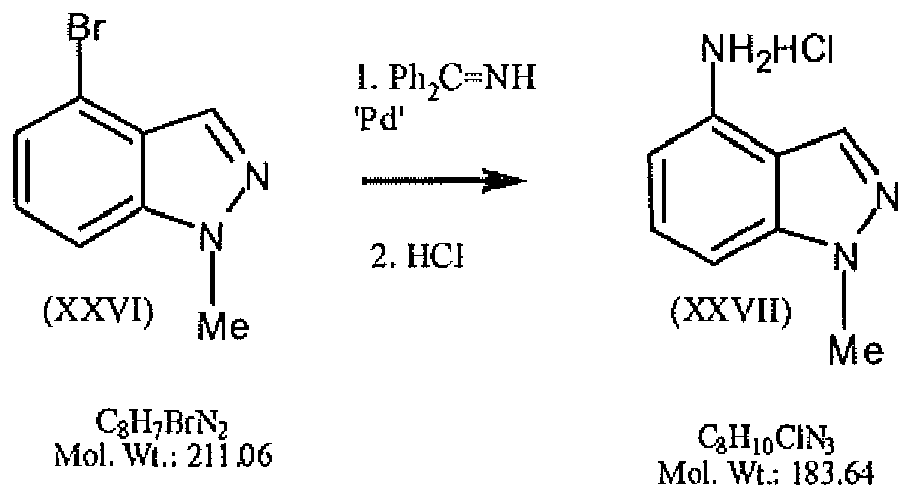
- Palladium acetate (82 mg, 2 % mol) and Xantphos (9,9-Dimethyl-4,5-bis(diphenylphosphino)xanthene; 287 mg, 3 % mol) were dissolved in toluene (10 mL) and mixed at room temperature for 5 min. To the resulting solution was added a solution of 4-bromo-1-methylindazole (3.68 g, 17.4 mmol) and benzophenone imine (3.0 g, 17,4 mmol) in toluene (30 m). The resulting solution was evacuated and purged with nitrogen two times, then mixed at room temperature for at least 15 min. NaOBu-t (1,9 g, 1.4 eq) was then added, and the mixture was evacuated and purged with nitrogen again.
- The mixture was heated to 80-85 °C for 2 hours (complete by HPLC). Then the mixture was cooled to room temperature and diluted with water (30 mL). The aqueous layer was separated and extracted with toluene (~ 20 mL). 6 N HCl (10 mL) was added to the combined organic layer. After 1 hour at room temperature (hydrolysis complete by HPLC), water (40 mL) was added to dissolve the solids. Toluene layer was discarded, and the aqueous layer filtered to remove some insoluble material. The pH of aqueous layer was adjusted to 14 with 50% NaOH and the product precipitated. The product was filtered and dissolved in acetonitrile (25 mL). Concentrated hydrochloric acid was added drop-wise to attain a pH 1. The precipitate was filtered, washed with water and dried to 2.55g (80%) of white solid.
- 1H NMR (DMSO-d6, 400 mHz): 10.6 (3H, br.s); 8.25 (1H, s); 7.59 (1H, d); 7.40 (1H, dd); 7.13 (1H, d); 4.06 (3H, s)
-

- Pyridine (8.0 g, 101 mmol, 2.07 eq) was added over approximately 5 minutes to a slurry of 1-methyl-4-aminoindazole hydrochloride (9.0 g, 49 mmol) and disuccinimidylcarbonate (13.2 g , 51.5 mmol, 1.05 eq) in acetonitrile (125 mL) while maintaining the internal temperature at less than 25° C. After 15 minutes, water (about 10 drops) was added. After 10 minutes, benzylamine hydrochloride (14.9 g, 1 eq) was added in one portion, followed by diisopropylethylamine (19.25 g, 0.15 m, 3 eq) over ~10 minutes while maintaining the internal temperature at less then 25 °C. After 30 minutes (complete reaction by HPLC), water (100 mL) was added slowly to precipitate the product, which was filtered, washed with 100 mL (1:1 ACN-water) and dried at 50 °C in vacuum. Product (18.7 g (85 % yield)) was obtained that had a pinkish color. The color was removed by recrystallization from ethyl acetate/heptanes.
- Crude product was dissolved in ethyl acetate (46 ml) at 70°C, then precipitated by slow addition of heptanes (184 mL) at 65 °C -70 °C. The mixture was cooled to room temperature, filtered, washed with 40 ml of 4:1 heptanes:ethyl acetate, and dried in vacuo.
- The following Examples refer in part to Scheme 4, reproduced below.

-

- To a flask was added Pd2dba3 (0.405 g), DavePhos (0.6884 g, 1.75 mmol), and CuI (0.1655 g). This was purged with nitrogen and degassed; triethylamine (100 mL) was then added.
- Benzonitrile (XVII) (36.2 g, 176 mmol) was then added, and the mixture was heated to 65 °C. 3,3-dimethylbutyne (23.7 g, 288 mmol) was then slowly added over 2 hours. The mixture was heated an additional 2 hours, and the heat removed. The mixture was diluted with isopropyl acetate (150 mL) and washed twice with water (150 mL) and twice with 10% aqueous citric acid (150 mL). The organics were diluted with methanol (40 mL), and the volume reduced in vacuo to 60 mL. This was repeated twice with 190 mL methanol, the residual material diluted to 250 g with methanol and used in the next step as a solution. An analytical sample was obtained by removing all the solvent in vacuo.
- 1H NMR (CDCl3, 400 mHz) 7.75 - 7.70 (m, 2H), 7.60-7,55 (m, 1H), 1,37 (s, 9H); 13C NMR (CDCl3, 100MHz) 132.6, 128.7, 128.6, 123.8, 123.7, 116.24, 107.96, 75.06, 30.73, 28.64.
-

- To a flask containing Raney Nickel (19 g) was added alkyne (XVIII) in methanol (134 g, 14.9 wt% (XVIII)), potassium hydroxide (0.2305 g), and additional methanol (44.3 g). The mixture was pressurized with hydrogen and agitated for 42 hours, The solution was filtered, and the cake washed with methanol (20 g). To the solution was added succinic acid (10.65 g, 1.2 equiv). The solution was reduced in vacuo to 100 mL, diluted with isopropanol (100 mL), and concentrated again to 100 mL. The slurry was filtered and the wet cake washed with isopropanol (120 mL). The cake was dried under vacuum at 35 °C to give a white solid. 1H NMR (CD3OD, 400 mHz) 7.60 - 7.55 (3H, m); 4.21 (2H, s); 2.78 - 2.74 (2H, m); 2.51 (4H, s); 1.49 - 1.45 (2H, m); 1.04 (9H, s); 13C NMR (CD3OD, 100MHz) 178.4, 144.0, 136.9, 132.0, 131.7, 130.0, 127.0, 123.9, 46.8, 40.6, 32.7, 31.6, 29.7, 29.1.
-

- To 14.0 g of succinate salt (XIX) was added toluene (150 mL), followed by 70 mL of 5% NaOH. The separated organic layer was washed twice with 5% NaHCO3 (50 mL) followed by 20% brine (50 mL), and then concentrated and chased with 2-methyl THF to give benzylamine free base. The yield of free base is typically 99.8%. To a slurry of phenyl carbamate (5.12 g, 1.07 eq) in 2-methyl THF (25 mL) was added N,N-di-isopropyl ethylamine (8.77 g, 2 equiv) and benzylamine/2-methyl THF solution (total solvent approximately 50 mL). The mixture was stirred at 45 °C overnight and cooled to 20 °C. Isopropyl acetate (55 mL) was added, and the organics then washed twice with 5% NaOH (50 mL each), followed three times by 20% NaCl (50 mL each). The organic layer was concentrated and chased with methanol to approximately 30 mL. To the residue was added 40 mL methanol. The resulting mixture was heated to 50-60 °C, and water (80 mL) was slowly added. The slurry was cooled to 20 °C, filtered and washed with 50% aqueous methanol followed by water. The wet cake was dried at 55 °C to give 18.8g of urea (XX) in 98% yield.
- 1H NMR (d6-DMSO, 400 mHz) 7.50 (1H, d, J=8.0Hz); 7.45 (1H, s); 7.40 (1H, d, J=8.1Hz); 6.42 (1H, t, J=5.7Hz); 5.57 (2H, s); 4.25 (2H, d, J=5,9Hz); 2.65 - 2.60 (2H, m); 1.41 - 1.37 (2H, m); 0.96 (9H, s); 13C NMR (d6-DMSO, 100MHz) 157.9, 142.4, 141.2, 127.5, 124.8, 121.9, 44.7, 39.9, 30.5, 29.1, 27.1. (85769-162)
-

- To a flask was added potassium carbonate (55.0 g, 0.4 mol, 2 equiv), formula XXI (32.1 g, 0.2 mol), and DMSO (317 g). At ambient temperature, methyl hydrazine (47.3 g, 1,03 mol, 5 equiv) was added. The mixture was then heated at 70 °C for 7 days. The mixture was cooled to ambient and diluted with water (250 mL) and methyl t-butyl ether (950 mL). The upper organics were separated, and the lower layer was re-extracted with methyl-t-butyl ether (910 mL). The combined organics were washed with 10% citric acid (125 mL), water (1250 mL) and concentrated to oil. To the oil was added water (125 mL). The resulting solid was filtered, washed with water and dried at 30 °C to yield 27.4 g of crude compound XXII. Purification of compound XXII: To a 0 to 5 °C solution of crude XXII (173 g) in methanol (260 mL), water (250 mL) was slowly added. The resulting solid was filtered and washed with 33% methanol/67% water (150 mL total) followed by water. 155 g of solid were recovered after diying at 30 °C.
- 1H NMR (CDCl3, 400 mHz) 8.03 (1H, s); 7.29 - 7.25 (1H, m); 7.26 (1H, s); 7.13 - 7.09 (1H, m); 4.06 (3H, s); 13C NMR (CDCl3, 100MHz) 140.4, 131.1, 126.5, 126.3, 122.9, 119.8, 107.3, 36.1.
-
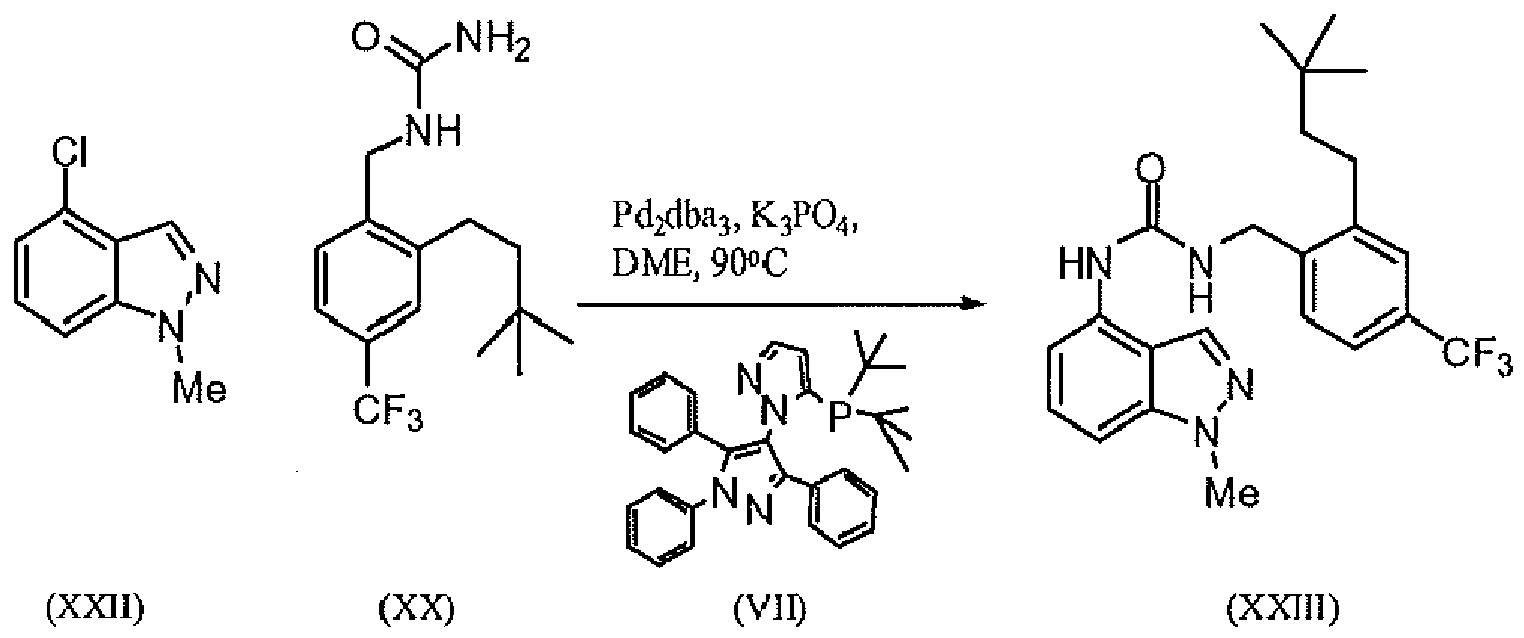
- To a flask was added urea of formula (XX) (20 g, 66.15 mmol), indazole of formula (XXII) (13.23 g, 79.38 mmol), potassium carbonate (21.04 g, 99.23 mmol), Pd2dba3 (606 mg, 0.66 mmol), and (VII) (1.34 g, 2.65 mmol). After purging with nitrogen, the mixture was diluted with purged dimethoxyethane (DME, 300 mL). The mixture was heated to 80°C for 18 hours, and additional Pd2dba3 (150 mg, 0.33 mmol) and ligand (VII) (337 mg, 6.0 mmol) were added. After an additional 1.5 hours of heating, the mixture was cooled to ambient, filtered, and concentrated to approximately 150 g. The residue was chased and distilled twice with isopropanol (2 x 500 mL). The remaining material was diluted to approximately 230 g with isopropanol and heated to 65°C. Water (182 g) was slowly added, and the solution cooled to 0 °C. The slurry was stirred at 0 °C for 1 hour, filtered, and the cake washed with 45% water/methanol (100 mL). The solids were dried at 40°C to give 24.0 g of product (XXIII).
- 1H NMR (d6-DMSO, 400 mHz) 8.83 (1H, s); 8.03 (1H, d, J=0.7Hz); 7.62 (1H, d, J=7.4Hz); 7.55-7.49 (3H, m), 7.23 (1H, dd, J=7.95, 7.95Hz); 7.13 (1H, d, J=8.4Hz); 6.81 (1H, dd, J=5.7, 5.7Hz); 4.44 (2H, d, J=5.6Hz); 3.98 (3H, s); 2.71 - 2.66 (2H, m); 1.46 - 1.41 (2H, m); 0.96 (9H, s); 13C NMR (d6-DMSO, 100MHz) 154.2, 141.5, 140.0, 132.4, 129.2, 127.9, 127.3, 126.6, 125.0, 122.1, 115.9, 114.9, 106.7, 102.2, 44.9, 40.0, 35.4, 30.5, 29.1, 27.2. (87909-45)
- It is understood that the foregoing detailed description and accompanying examples are merely illustrative and are not to be taken as limitations upon the scope of the invention, which is defined solely by the appended claims and their equivalents. Various changes and modifications to the disclosed embodiments will be apparent to those skilled in the art. Such changes and modifications, including without limitation those relating to the chemical structure, substituents, derivatives, intermediates, syntheses, formulations and/or methods of use of the invention, may be made without departing from the spirit and scope thereof.
- The present invention further refers to the following embodiments:
- 1. A method of making compound of formula (II)

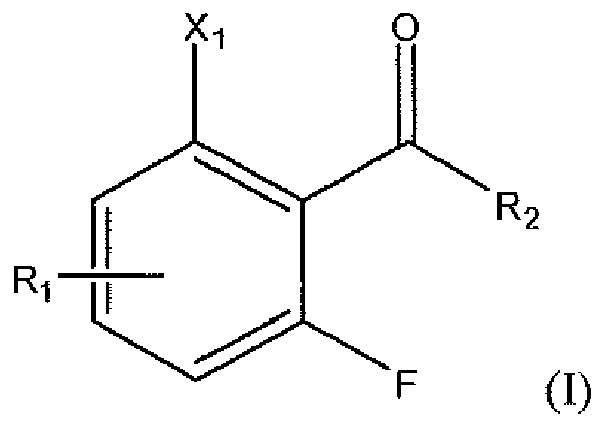
R3N2H3 (III),
wherein X1 and X2 are independently selected from the group consisting of: halogen, hydroxyl and alkoxy;
wherein the compound of formula II includes at least one R1 group;
wherein R1 may be present more than once on the indicated ring;
wherein each R1 is independently selected from the group consisting of: hydrogen, hydroxy, alkoxy, amino, substituted amino, substituted sulfur, halogen, aryl, substituted aryl, heteroaryl, substituted heteroaryl, heterocyclic, substituted heterocyclic, C1-C8 alkyl, C2-C8 alkenyl, C2-C8 alkynyl, substituted C1-C8 alkyl, substituted C2-C8 alkenyl, substituted -C2-C8 alkynyl; -C3-C12 cycloalkyl, substituted -C3-C12 cycloalkyl, -C3-C12 cycloalkenyl, and substituted -C3-C12 cycloalkenyl; each containing 0, 1, 2, or 3 heteroatoms selected from the group consisting of: O, S, and N;
R2 is selected from the group consisting of: hydrogen, alkyl, and aryl;
R3 is selected from the group consisting of: hydrogen, aryl, substituted aryl, heteroaryl, substituted heteroaryl, heterocyclic, substituted heterocyclic, -C1-C8 alkyl, -C2-C8 alkenyl, -C2-C8 alkynyl, substituted -C1-C8 alkyl, substituted -C2-C8 alkenyl, substituted -C2-C8 alkynyl; -C3-C12 cycloalkyl, substituted -C3-C12 cycloalkyl, -C3-C12 cycloalkenyl, and substituted -C3-C12 cycloalkenyl; each containing 0, 1, 2, or 3 heteroatoms selected from the group consisting of: O, S, and N. - 2. The method of 1, wherein at least one of X1 and X2 is Br or Cl.
- 3. The method of 1, wherein R3 is alkyl or hydrogen.
- 4. The method of 1, wherein at least one of X1 and X2 is Cl, and R3 is hydrogen or methyl.
- 5. The method of 1, wherein the reacting a compound of formula (I) with a compound of formula (III) further comprises reacting the compounds in the presence of a base.
- 6. The method of 5, wherein the base is selected from the group consisting of: potassium acetate, potassium carbonate, potassium bicarbonate, sodium carbonate, sodium bicarbonate, cesium carbonate, potassium phosphate tribasic, potassium phosphate dibasic, sodium phosphate dibasic, and excess compound III.
- 7. The method of 6, wherein the base is potassium carbonate.
- 8. A method of making a compound of formula XXIV,

reacting a compound of formula XII or XIIa,
R10-CN (XII) or R10-NH2 (XIIa)
with hydrogen in the presence of Ra-Ni, and then an acid HX, to produce a compound of formula XIII or XIIIa,

R10-CN (XII) or R10-NH2 (XIIa)
with PhOCONH2 in the presence of a first base and a first solvent, to produce a compound of formula IV,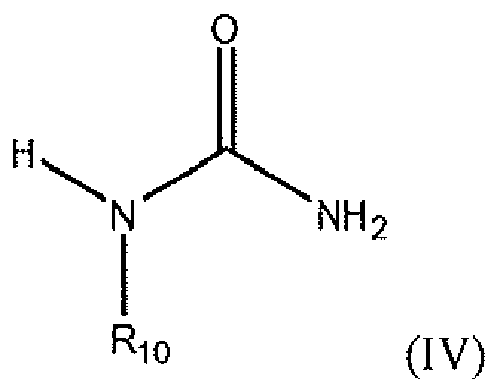
R10-CN (XII) or R10-NH2 (XIIa)
with hydrogen in the presence ofRa-Ni, and an acid HX, and PhOCONH2 in the presence of a first base and a first solvent, to produce a compound of formula IV,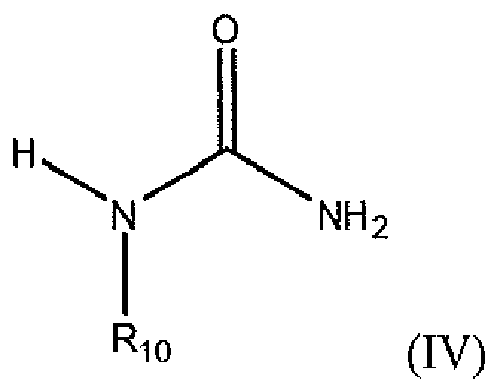

wherein X2 is selected from the group consisting of: halogen and sulfonate, wherein the sulfonate is independently substituted with fluorine or C1-C8 fluorinated alkanes;
wherein the compound of formula II includes at least one R1 group;
wherein R1 may be present more than once on the indicated ring;
wherein each wherein each R1 is independently selected from the group consisting of: hydrogen, hydroxy, alkoxy, amino, substituted amino, substituted sulfur, halogen, aryl, substituted aryl, heteroaryl, substituted heteroaryl, heterocyclic, substituted heterocyclic, C1-C8 alkyl, C2-C8 alkenyl, C2-C8 alkynyl, substituted C1-C8 alkyl, substituted C2-C8 alkenyl, substituted -C2-C8 alkynyl; -C3-C12 cycloalkyl, substituted -C3-C12 cycloalkyl, -C3-C12 cycloalkenyl, and substituted -C3-C12 cycloalkenyl; each containing 0, 1, 2, or 3 heteroatoms selected from the group consisting of: O, S, and N;
R2 is selected from the group consisting of: hydrogen, alkyl, and aryl;
R3 is selected from the group consisting of: hydrogen, aryl, substituted aryl, heteroaryl, substituted heteroaryl, heterocyclic, substituted heterocyclic, -C1-C8 alkyl, -C2-C8 alkenyl, -C2-C8 alkynyl, substituted -C1-C8 alkyl, substituted -C2-C8 alkenyl, substituted -C2-C8 alkynyl; -C3-C12 cycloalkyl, substituted -C3-C12 cycloalkyl, -C3-C12 cycloalkenyl, and substituted -C3-C12 cycloalkenyl; each containing 0, 1, 2, or 3 heteroatoms selected from the group consisting of: O, S, and N; and
R10 is selected from the group consisting of: aryl, substituted aryl, heteroaryl, substituted heteroaryl, heterocyclic, substituted heterocyclic, -C1-C8 alkyl, -C2-C8 alkenyl, -C2-C8 alkynyl, substituted -C1-C8 alkyl, substituted -C2-C8 alkenyl, substituted -C2-C8 alkynyl; -C3-C12 cycloalkyl, substituted -C3-C12 cycloalkyl, -C3-C12 cycloalkenyl, and substituted -C3-C12 cycloalkenyl; each containing 0, 1, 2, or 3 heteroatoms selected from the group consisting of: O, S, and N. - 9. The method of 8, wherein X2 is Cl, R3 is hydrogen or methyl, and R10 is aryl or alkyl.
- 10. The method of 8, wherein R10 is a group of formula VIII or VIIIa

- 11. The method of 8, wherein the first base is N,N-diisopropyl ethyl amine, and the second base is potassium phosphate tribasic.
- 12. The method of 8, wherein the first solvent is Me-THF, and the second solvent is DME.
- 13. The method of 8, wherein the palladium catalyst is selected from the group consisting of: Pd2(dba)3, Pd2Cl2(dba), Pd(OAc)2, Pd(OTFA)2, PdCl2, PdCl2(CH3CN)2, and PdCl2(PhCN)2.
- 14. The method of 13, wherein the palladium catalyst is Pd2dba3,
- 15. The method of 8, wherein the ligand is selected from the group consisting of the compounds of formulas XXX, XXXI, XXXII, XXXIII, XXXIV, XXXV, XXXVI, XXXVII, XXXVIII, XXXIX, XL, VII:


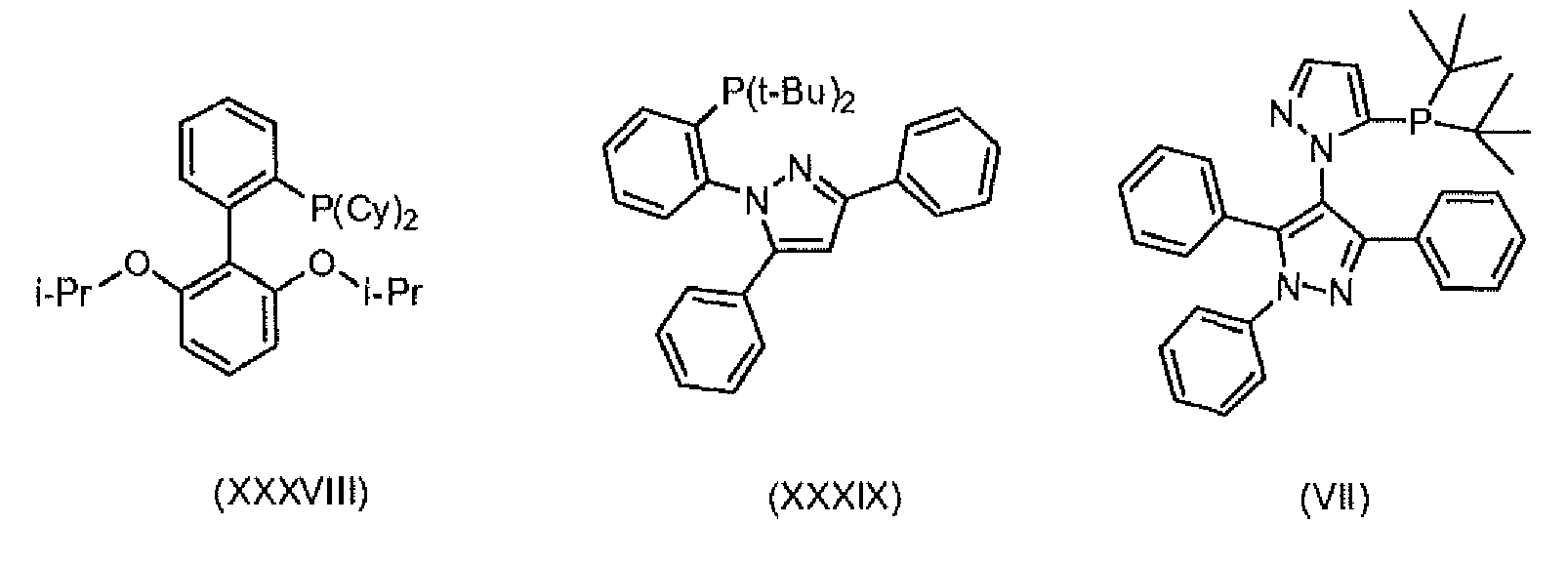
- 16. The method of 15, wherein the ligand is a compound of formula VII

- 17. A methods of producing a compound of formula XXIII or XXIIIa


- 18. The method of 17, wherein the base is potassium phosphate tribasic.
- 19. The method of 17, wherein the solvent is DME.
- 20. The method of 17, wherein the palladium catalyst is Pd2dba3.
- 21. A compound of formula XIX or XIXa:

- 22. A compound of formula XX or XXa:

Claims (10)
- A method of making a compound of formula XXIV,

reacting a compound of formula XII or XIIa,
R10-CN (XII) or R10-NH2 (XIIa)
with hydrogen in the present of Ra-Ni, and then an acid HX, to produce a compound of formula XIII or XIIIa,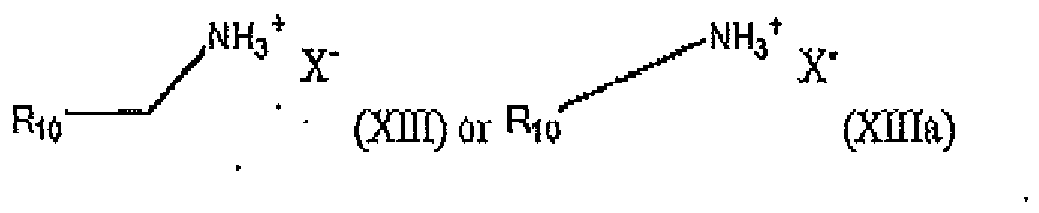

R10-CN (XII) or R10-NH2 (XIIa)
with PhOCONH2 in the presence of a first base and a first solvent to produce a compound of formula IV,
R10-CN (XII) or R10-NH2 (XIIa)
with hydrogen in the presence of Ra-Ni, and an acid HX, and PhOCONH2 in the presence of a first base and a first solvent, to produce a compound of formula IV.

wherein X2 is selected from the group consisting of halogen and suffocate, wherein the sulfonate is independently substituted with fluorine or C1-C8 fluorinated alkanes;
wherein the compound of formula II includes at least one R1 group;
wherein R1 may be present more than once on the indicated ring;
wherein each wherein each R1 is independently selected from the group consisting of: hydrogen, hydroxyl, alkoxy, amino, substituted amino, substituted sulfur, halogen, aryl, substituted aryl, heteroaryl, substituted heteroaryl, heterocyclic, substituted heterocyclic, C1-C8 alkyl, C2-C8 alkenyl, C2-C8 alkynyl, substituted C1-C8 alkyl, substituted C2-C8 alkenyl, substituted -C2-C8 alkynyl; -C3-C12 cycloalkyl, substituted -C3-C12 cycloalkyl, -C3-C12 cycloalkenyl, and substituted -C3-C12 cycloalkenyl; each containing 0, 1, 2, or 3 heteroatoms selected from the group consisting of: 0, S, and N;
R2 is selected from the group consisting of hydrogen, alkyl, and aryl;
R3 is selected from the group consisting of hydrogen, aryl, substituted aryl, heteroaryl, substituted heteroaryl, heterocyclic, substituted heterocyclic, -C1-C3 alkyl, -C2-C8 alkenyl, -C2-C8 alkynyl, substituted -C1-C8 alkyl, substituted -C2-C8 alkenyl, substituted -C2-C8 alkynyl; -C3-C12 cycloalkyl, substituted -C3-C12 cycloalkyl, -C3-C12 cycloalkenyl, and substituted -C3-C12 cycloalkenyl; each containing 0, 1, 2, or 3 heteroatoms selected from the group consisting of: O, S, and N; and
R10 is selected from the group consisting of: aryl, substituted aryl, heteroaryl, substituted heteroaryl, heterocyclic, substituted heterocyclic, -C1-C8 alkyl, -C2-C8 alkenyl, -C2-C8 alkynyl, substituted -C1-C8 alkyl, substituted -C2-C8 alkenyl, substituted -C2-C8 alkynyl; -C3-C12 cycloalkyl, substituted -C3-C12 cycloalkyl, -C3-C12 cycloalkenyl, and substituted -C3-C12 cycloalkenyl; each containing 0, 1, 2, or 3 heteroatoms selected from the group consisting of: O, S, and N. - The method of claim 1, wherein X2 is Cl, R3 is hydrogen or methyl, and R10 is ayl or alkyl
or wherein R10 is a group of formula VIII or VIIIa
- The method of claim 1, wherein the first base is N,N-diisopropyl ethyl amine, and the second base is potassium phosphate tribasic, or
wherein the first solvent is Me-THF, and the second solvent is DME. - The method of claim 1, wherein the palladium catalyst is selected from the group consisting of: Pd2(dba)3, Pd2Cl2(dba), Pd(OAC)2, Pd(OTFA)2, PdCl2, PdCl2(CH3CN)2, and PdCl2(PhCN)2.
- The method of claim 4 wherein the palladium catalyst is Pd2dba3.
- The method of claim 1, wherein the ligand is selected from the group consisting of the compounds of formulas XXX, XXXI, XXXII, XXXIII, XXXIV, XXXV, XXXVI, XXXVII, XXXVIII, XXXIX, XL, VII:


- The method of claim 6, wherein the ligand is a compound of formula VII

- A method of producing a compound of formula XXIII or XXIIIa


- The method of claim 8, wherein the base is potassium phosphate tribasic, or wherein the solvent is DME, or
wherein the palladium catalyst is Pd2dba3. - A compound selected from the group consisting of compounds of formula XIX, XIXa, XX and XXa:


Applications Claiming Priority (2)
| Application Number | Priority Date | Filing Date | Title |
|---|---|---|---|
| US3821208P | 2008-03-20 | 2008-03-20 | |
| EP09722850A EP2323989A4 (en) | 2008-03-20 | 2009-03-20 | Methods for making central nervous system agents that are trpv1 antagonists |
Related Parent Applications (1)
| Application Number | Title | Priority Date | Filing Date |
|---|---|---|---|
| EP09722850A Division EP2323989A4 (en) | 2008-03-20 | 2009-03-20 | Methods for making central nervous system agents that are trpv1 antagonists |
Publications (1)
| Publication Number | Publication Date |
|---|---|
| EP2489660A1 true EP2489660A1 (en) | 2012-08-22 |
Family
ID=41091550
Family Applications (2)
| Application Number | Title | Priority Date | Filing Date |
|---|---|---|---|
| EP09722850A Withdrawn EP2323989A4 (en) | 2008-03-20 | 2009-03-20 | Methods for making central nervous system agents that are trpv1 antagonists |
| EP12151035A Withdrawn EP2489660A1 (en) | 2008-03-20 | 2009-03-20 | Methods for making central nervous system agents that are TRPV1 antagonists |
Family Applications Before (1)
| Application Number | Title | Priority Date | Filing Date |
|---|---|---|---|
| EP09722850A Withdrawn EP2323989A4 (en) | 2008-03-20 | 2009-03-20 | Methods for making central nervous system agents that are trpv1 antagonists |
Country Status (7)
| Country | Link |
|---|---|
| US (1) | US8232411B2 (en) |
| EP (2) | EP2323989A4 (en) |
| JP (1) | JP2011515414A (en) |
| CN (1) | CN102036969A (en) |
| CA (1) | CA2719018A1 (en) |
| MX (1) | MX2010010262A (en) |
| WO (1) | WO2009117626A2 (en) |
Families Citing this family (5)
| Publication number | Priority date | Publication date | Assignee | Title |
|---|---|---|---|---|
| RS57569B1 (en) | 2013-03-13 | 2018-10-31 | Abbvie Inc | Processes for the preparation of an apoptosis-inducing agent |
| TW201613872A (en) * | 2014-07-18 | 2016-04-16 | Biogen Ma Inc | IRAK4 inhibiting agents |
| WO2018227517A1 (en) | 2017-06-16 | 2018-12-20 | Beiersdorf Daily Chemical (Wuhan) Co. Ltd. | A hair styling composition containing cymbidium grandiflorum flower extract |
| WO2018227516A1 (en) | 2017-06-16 | 2018-12-20 | Beiersdorf Daily Chemical (Wuhan) Co., Ltd. | A hair cleansing composition containing cymbidium grandiflorum flower extract |
| CN118748993A (en) | 2021-12-28 | 2024-10-08 | 日本新药株式会社 | Indazole compounds and drugs |
Citations (2)
| Publication number | Priority date | Publication date | Assignee | Title |
|---|---|---|---|---|
| WO2007121339A2 (en) * | 2006-04-14 | 2007-10-25 | Abbott Laboratories | Process for the preparation of indazolyl ureas that inhibit vanilloid subtype 1 (vr1) receptors |
| WO2008024945A1 (en) * | 2006-08-25 | 2008-02-28 | Abbott Laboratories | Indazole derivatives that inhibit trpv1 and uses thereof |
Family Cites Families (39)
| Publication number | Priority date | Publication date | Assignee | Title |
|---|---|---|---|---|
| FR1344579A (en) | 1961-11-23 | 1963-11-29 | Sandoz Sa | New indole derivatives and their preparation |
| US3647819A (en) * | 1969-09-19 | 1972-03-07 | Sterling Drug Inc | Indazolylphenylureas and indazolyl-phenylthioureas |
| US3711610A (en) * | 1971-06-01 | 1973-01-16 | Sterling Drug Inc | Anticoccidiosis method and compositions involving indazolylphenylureas and indazolylphenylthioureas |
| US3814711A (en) * | 1971-07-26 | 1974-06-04 | Mallinckrodt Chemical Works | 10-acetamido-s-triazolo-(3,4-a)-isoquinolines |
| NL7902993A (en) | 1978-04-24 | 1979-10-26 | Rhone Poulenc Ind | NEW ISOQUEINOLINE DERIVATIVES, THEIR PREPARATION AND PHARMACEUTICAL PREPARATIONS CONTAINING THE NEW ISOQUEINOLINE DERIVATIVES. |
| AU592765B2 (en) | 1984-08-15 | 1990-01-25 | Schering Aktiengesellschaft | New dopamine derivatives, process for their production, and their use as medicinal products |
| WO1991004027A1 (en) | 1989-09-15 | 1991-04-04 | Pfizer Inc. | New n-aryl and n-heteroarylamide and urea derivatives as inhibitors of acyl coenzyme a: cholesterol acyl transferase (acat) |
| US4958056A (en) * | 1990-01-16 | 1990-09-18 | C. M. Smillie & Company | Electrode holder |
| JPH05504968A (en) | 1990-03-07 | 1993-07-29 | ローン―プーラン・ロレ・ソシエテ・アノニム | Glycinamide derivatives, their production and pharmaceuticals containing them |
| US5362878A (en) * | 1991-03-21 | 1994-11-08 | Pfizer Inc. | Intermediates for making N-aryl and N-heteroarylamide and urea derivatives as inhibitors of acyl coenzyme A: cholesterol acyl transferase (ACAT) |
| US5444038A (en) * | 1992-03-09 | 1995-08-22 | Zeneca Limited | Arylindazoles and their use as herbicides |
| RU94046149A (en) * | 1992-05-28 | 1996-11-27 | Пфайзер Инк. (US) | Novel n-aryl- and n-heteroaryl-derivatives of urea as inhibitors of acylcoenzyme a:cholesterol acyltransferase, pharmaceutical composition, method of inhibition |
| US5374643A (en) | 1992-09-11 | 1994-12-20 | E. R. Squibb & Sons, Inc. | Aryl urea (thiourea) and cyanoguanidine derivatives |
| GB9307833D0 (en) * | 1993-04-15 | 1993-06-02 | Glaxo Inc | Modulators of cholecystokinin and gastrin |
| JP4129993B2 (en) | 1996-01-16 | 2008-08-06 | ブリストル―マイヤーズ・スクイブ・カンパニー | Conformationally restricted aromatic inhibitors and methods of microsomal triglyceride transfer protein |
| US5760246A (en) | 1996-12-17 | 1998-06-02 | Biller; Scott A. | Conformationally restricted aromatic inhibitors of microsomal triglyceride transfer protein and method |
| US6140368A (en) | 1997-05-05 | 2000-10-31 | The Regents Of The University Of California | Naphthols useful in antiviral methods |
| EP1154989B1 (en) | 1999-02-22 | 2005-12-14 | Pacific Corporation | Vanilloid analogues containing resiniferatoxin pharmacophores as potent vanilloid receptor agonists and analgesics, compositions and uses thereof |
| EP1177188B1 (en) * | 1999-05-12 | 2005-10-12 | Ortho-McNeil Pharmaceutical, Inc. | Pyrazole carboxamides useful for the treatment of obesity and other disorders |
| US6858577B1 (en) * | 1999-06-29 | 2005-02-22 | Ortho-Mcneil Pharmaceutical, Inc. | Indole peptidomimetics as thrombin receptor antagonists |
| YU54202A (en) * | 2000-01-18 | 2006-01-16 | Agouron Pharmaceuticals Inc. | Indazole compounds,pharmaceutical compositions,and methods for mediating or inhibiting cell proliferation |
| US7217722B2 (en) | 2000-02-01 | 2007-05-15 | Kirin Beer Kabushiki Kaisha | Nitrogen-containing compounds having kinase inhibitory activity and drugs containing the same |
| IL153884A0 (en) | 2000-07-20 | 2003-07-31 | Neurogen Corp | Capsaicin receptor ligands |
| WO2002083648A1 (en) * | 2001-04-16 | 2002-10-24 | Eisai Co., Ltd. | Novel 1h-indazole compound |
| EP1403255A4 (en) | 2001-06-12 | 2005-04-06 | Sumitomo Pharma | INHIBITORS OF RHO KINASE |
| JP2005501873A (en) | 2001-07-31 | 2005-01-20 | バイエル・ヘルスケア・アクチェンゲゼルシャフト | Amine derivatives |
| MY138086A (en) | 2001-09-13 | 2009-04-30 | Smithkline Beecham Plc | Novel urea derivative as vanilloid receptor-1 antagonist |
| JP2003192587A (en) | 2001-12-26 | 2003-07-09 | Bayer Ag | Urea derivative |
| WO2003055848A2 (en) | 2001-12-26 | 2003-07-10 | Bayer Healthcare Ag | Urea derivatives as vr1- antagonists |
| DE60325834D1 (en) | 2002-02-20 | 2009-03-05 | Abbott Lab | CONDENSED AZABICYCLIC COMPOUNDS AS INHIBITORS OF VANILLOID RECEPTOR 1 (VR1) |
| GB0206876D0 (en) | 2002-03-22 | 2002-05-01 | Merck Sharp & Dohme | Therapeutic agents |
| AU2003241453A1 (en) | 2002-05-17 | 2003-12-02 | Janssen Pharmaceutica N.V. | Aminotetralin-derived urea modulators of vanilloid vr1 receptor |
| US6933311B2 (en) * | 2003-02-11 | 2005-08-23 | Abbott Laboratories | Fused azabicyclic compounds that inhibit vanilloid receptor subtype 1 (VR1) receptor |
| US7375126B2 (en) * | 2003-06-12 | 2008-05-20 | Abbott Laboratories | Fused compounds that inhibit vanilloid receptor subtype 1 (VR1) receptor |
| US7015233B2 (en) * | 2003-06-12 | 2006-03-21 | Abbott Laboratories | Fused compounds that inhibit vanilloid subtype 1 (VR1) receptor |
| GB0322016D0 (en) | 2003-09-19 | 2003-10-22 | Merck Sharp & Dohme | New compounds |
| EP1745024B1 (en) * | 2004-05-08 | 2012-04-25 | Novartis International Pharmaceutical Ltd. | 1-aryl-4-substituted isoquinolines |
| JP5055263B2 (en) * | 2005-03-30 | 2012-10-24 | ダエウン ファーマシューティカル カンパニー リミテッド | Antifungal triazole derivatives |
| TW200815361A (en) * | 2005-10-20 | 2008-04-01 | Astrazeneca Ab | Chemical compounds |
-
2009
- 2009-03-20 US US12/407,857 patent/US8232411B2/en not_active Expired - Fee Related
- 2009-03-20 CN CN2009801186310A patent/CN102036969A/en active Pending
- 2009-03-20 WO PCT/US2009/037741 patent/WO2009117626A2/en not_active Ceased
- 2009-03-20 CA CA2719018A patent/CA2719018A1/en not_active Abandoned
- 2009-03-20 EP EP09722850A patent/EP2323989A4/en not_active Withdrawn
- 2009-03-20 JP JP2011500970A patent/JP2011515414A/en active Pending
- 2009-03-20 EP EP12151035A patent/EP2489660A1/en not_active Withdrawn
- 2009-03-20 MX MX2010010262A patent/MX2010010262A/en not_active Application Discontinuation
Patent Citations (2)
| Publication number | Priority date | Publication date | Assignee | Title |
|---|---|---|---|---|
| WO2007121339A2 (en) * | 2006-04-14 | 2007-10-25 | Abbott Laboratories | Process for the preparation of indazolyl ureas that inhibit vanilloid subtype 1 (vr1) receptors |
| WO2008024945A1 (en) * | 2006-08-25 | 2008-02-28 | Abbott Laboratories | Indazole derivatives that inhibit trpv1 and uses thereof |
Non-Patent Citations (3)
| Title |
|---|
| ABAD ET AL., SYNTHESIS, 2005, pages 915 |
| J. PHARMACEUTICAL SCIENCES, vol. 66, 1977, pages 1 |
| SINGER ET AL., TETRAHEDRON LETT., vol. 47, no. 22, 2006, pages 3727 |
Also Published As
| Publication number | Publication date |
|---|---|
| JP2011515414A (en) | 2011-05-19 |
| WO2009117626A3 (en) | 2009-12-23 |
| US8232411B2 (en) | 2012-07-31 |
| MX2010010262A (en) | 2010-12-06 |
| CN102036969A (en) | 2011-04-27 |
| WO2009117626A2 (en) | 2009-09-24 |
| US20100016611A1 (en) | 2010-01-21 |
| EP2323989A4 (en) | 2011-06-22 |
| CA2719018A1 (en) | 2009-09-24 |
| EP2323989A2 (en) | 2011-05-25 |
Similar Documents
| Publication | Publication Date | Title |
|---|---|---|
| US7335678B2 (en) | Fused azabicyclic compounds that inhibit vanilloid receptor subtype 1(VR1) receptor | |
| JP4614662B2 (en) | Fused azabicyclic compounds that inhibit vanilloid receptor subtype 1 (VR1) receptors | |
| ES2315704T3 (en) | FUSIONED AZABICICLIC COMPOUNDS THAT INHIBIT THE VAINYLLOID SUBTIPO 1 RECEIVER (VR1). | |
| CA2812223C (en) | Substituted pyrazolo-quinazoline derivatives as kinase inhibitors | |
| CN101484453B (en) | Derivatives of imidazo[1,2-α]pyridine-2-carboxamides, their preparation and their use in therapy | |
| US20060128710A1 (en) | Antagonists to the vanilloid receptor subtype 1 (VR1) and uses thereof | |
| EP2054390B1 (en) | Indazole derivatives that inhibit trpv1 and uses thereof | |
| US8232411B2 (en) | Methods for making central nervous system agents that are TRPV1 antagonists | |
| US20050113576A1 (en) | Fused azabicyclic compounds that inhibit vanilloid receptor subtype 1 (VR1) receptor | |
| JP4363530B2 (en) | Protein kinase inhibitor | |
| CN101484163A (en) | 2-Benzoyl-imidazopyridine derivatives, their preparation and their therapeutic use | |
| US20060160770A1 (en) | Method for the synthesis of 3-substituted indolizine and benzoindolizine compounds | |
| JP2009506008A (en) | p38MAP kinase inhibitor and method of using the same | |
| WO2005085206A1 (en) | Indazole derivatives and pharmaceutical compositions containing them | |
| WO2003076408A2 (en) | Indazole derivatives that are activators of soluble guanylate cyclase | |
| WO2024263753A1 (en) | Sulfoximine based stt3a/b modulators for the treatment of disease | |
| JP2012072145A (en) | Condensed aza bicyclic compound inhibiting vanilloid receptor subtype 1 (vr1) receptor | |
| HK1134433A (en) | Derivatives of 2-benzoyl-imidazopyridines, preparation method thereof and use of same in therapeutics | |
| HK1104288A1 (en) | 2h or 3h-benzo[e]indazol-1-yle carbamate derivatives, the preparation and therapeutic use thereof | |
| HK1104288B (en) | 2h or 3h-benzo[e]indazol-1-yle carbamate derivatives, the preparation and therapeutic use thereof |
Legal Events
| Date | Code | Title | Description |
|---|---|---|---|
| PUAI | Public reference made under article 153(3) epc to a published international application that has entered the european phase |
Free format text: ORIGINAL CODE: 0009012 |
|
| AC | Divisional application: reference to earlier application |
Ref document number: 2323989 Country of ref document: EP Kind code of ref document: P |
|
| AK | Designated contracting states |
Kind code of ref document: A1 Designated state(s): AT BE BG CH CY CZ DE DK EE ES FI FR GB GR HR HU IE IS IT LI LT LU LV MC MK MT NL NO PL PT RO SE SI SK TR |
|
| STAA | Information on the status of an ep patent application or granted ep patent |
Free format text: STATUS: THE APPLICATION IS DEEMED TO BE WITHDRAWN |
|
| 18D | Application deemed to be withdrawn |
Effective date: 20130223 |