EP2489654A1 - Cyclohexane compounds and their use as antibiotics - Google Patents
Cyclohexane compounds and their use as antibiotics Download PDFInfo
- Publication number
- EP2489654A1 EP2489654A1 EP10194929A EP10194929A EP2489654A1 EP 2489654 A1 EP2489654 A1 EP 2489654A1 EP 10194929 A EP10194929 A EP 10194929A EP 10194929 A EP10194929 A EP 10194929A EP 2489654 A1 EP2489654 A1 EP 2489654A1
- Authority
- EP
- European Patent Office
- Prior art keywords
- group
- alkyl
- hydrogen
- carbon atoms
- linear
- Prior art date
- Legal status (The legal status is an assumption and is not a legal conclusion. Google has not performed a legal analysis and makes no representation as to the accuracy of the status listed.)
- Withdrawn
Links
- 239000003242 anti bacterial agent Substances 0.000 title claims abstract description 13
- 125000000113 cyclohexyl group Chemical class [H]C1([H])C([H])([H])C([H])([H])C([H])(*)C([H])([H])C1([H])[H] 0.000 title claims description 34
- 229940088710 antibiotic agent Drugs 0.000 title description 3
- 150000001875 compounds Chemical class 0.000 claims abstract description 137
- 239000008194 pharmaceutical composition Substances 0.000 claims abstract description 19
- 230000003115 biocidal effect Effects 0.000 claims abstract description 16
- 208000035143 Bacterial infection Diseases 0.000 claims abstract description 11
- 208000022362 bacterial infectious disease Diseases 0.000 claims abstract description 11
- 229910052739 hydrogen Inorganic materials 0.000 claims description 143
- 239000001257 hydrogen Substances 0.000 claims description 111
- 125000005647 linker group Chemical group 0.000 claims description 94
- 125000002496 methyl group Chemical group [H]C([H])([H])* 0.000 claims description 89
- 239000002773 nucleotide Substances 0.000 claims description 74
- -1 C(O)OC1-C10-alkyl Chemical group 0.000 claims description 70
- 125000000008 (C1-C10) alkyl group Chemical group 0.000 claims description 67
- 150000002431 hydrogen Chemical class 0.000 claims description 66
- 125000000217 alkyl group Chemical group 0.000 claims description 65
- 150000001413 amino acids Chemical class 0.000 claims description 64
- 125000004432 carbon atom Chemical group C* 0.000 claims description 59
- 125000001797 benzyl group Chemical group [H]C1=C([H])C([H])=C(C([H])=C1[H])C([H])([H])* 0.000 claims description 58
- 125000001449 isopropyl group Chemical group [H]C([H])([H])C([H])(*)C([H])([H])[H] 0.000 claims description 47
- 125000003917 carbamoyl group Chemical group [H]N([H])C(*)=O 0.000 claims description 45
- 229920001223 polyethylene glycol Polymers 0.000 claims description 44
- 125000001495 ethyl group Chemical group [H]C([H])([H])C([H])([H])* 0.000 claims description 40
- MDFFNEOEWAXZRQ-UHFFFAOYSA-N aminyl Chemical compound [NH2] MDFFNEOEWAXZRQ-UHFFFAOYSA-N 0.000 claims description 39
- 150000003839 salts Chemical class 0.000 claims description 39
- ZRALSGWEFCBTJO-UHFFFAOYSA-N Guanidine Chemical compound NC(N)=N ZRALSGWEFCBTJO-UHFFFAOYSA-N 0.000 claims description 38
- 125000004123 n-propyl group Chemical group [H]C([H])([H])C([H])([H])C([H])([H])* 0.000 claims description 38
- 108090000765 processed proteins & peptides Proteins 0.000 claims description 37
- 125000001476 phosphono group Chemical group [H]OP(*)(=O)O[H] 0.000 claims description 36
- 150000002148 esters Chemical class 0.000 claims description 33
- 150000004677 hydrates Chemical class 0.000 claims description 30
- 239000012453 solvate Substances 0.000 claims description 30
- HBAQYPYDRFILMT-UHFFFAOYSA-N 8-[3-(1-cyclopropylpyrazol-4-yl)-1H-pyrazolo[4,3-d]pyrimidin-5-yl]-3-methyl-3,8-diazabicyclo[3.2.1]octan-2-one Chemical class C1(CC1)N1N=CC(=C1)C1=NNC2=C1N=C(N=C2)N1C2C(N(CC1CC2)C)=O HBAQYPYDRFILMT-UHFFFAOYSA-N 0.000 claims description 29
- 125000004169 (C1-C6) alkyl group Chemical group 0.000 claims description 28
- 125000003118 aryl group Chemical group 0.000 claims description 28
- 125000006273 (C1-C3) alkyl group Chemical group 0.000 claims description 26
- UFHFLCQGNIYNRP-UHFFFAOYSA-N Hydrogen Chemical compound [H][H] UFHFLCQGNIYNRP-UHFFFAOYSA-N 0.000 claims description 26
- 125000002777 acetyl group Chemical group [H]C([H])([H])C(*)=O 0.000 claims description 23
- 125000002887 hydroxy group Chemical group [H]O* 0.000 claims description 23
- 125000000041 C6-C10 aryl group Chemical group 0.000 claims description 22
- 125000006527 (C1-C5) alkyl group Chemical group 0.000 claims description 20
- RAXXELZNTBOGNW-UHFFFAOYSA-N imidazole Substances C1=CNC=N1 RAXXELZNTBOGNW-UHFFFAOYSA-N 0.000 claims description 20
- 125000004178 (C1-C4) alkyl group Chemical group 0.000 claims description 19
- CHJJGSNFBQVOTG-UHFFFAOYSA-N N-methyl-guanidine Natural products CNC(N)=N CHJJGSNFBQVOTG-UHFFFAOYSA-N 0.000 claims description 19
- 125000006297 carbonyl amino group Chemical group [H]N([*:2])C([*:1])=O 0.000 claims description 19
- SWSQBOPZIKWTGO-UHFFFAOYSA-N dimethylaminoamidine Natural products CN(C)C(N)=N SWSQBOPZIKWTGO-UHFFFAOYSA-N 0.000 claims description 19
- 125000000956 methoxy group Chemical group [H]C([H])([H])O* 0.000 claims description 19
- 229910052717 sulfur Inorganic materials 0.000 claims description 19
- 229910052760 oxygen Inorganic materials 0.000 claims description 18
- 125000006374 C2-C10 alkenyl group Chemical group 0.000 claims description 15
- LFQSCWFLJHTTHZ-UHFFFAOYSA-N Ethanol Chemical compound CCO LFQSCWFLJHTTHZ-UHFFFAOYSA-N 0.000 claims description 15
- 125000004191 (C1-C6) alkoxy group Chemical group 0.000 claims description 14
- 229920006395 saturated elastomer Polymers 0.000 claims description 13
- 238000000034 method Methods 0.000 claims description 12
- 238000002360 preparation method Methods 0.000 claims description 12
- XDTMQSROBMDMFD-UHFFFAOYSA-N Cyclohexane Chemical compound C1CCCCC1 XDTMQSROBMDMFD-UHFFFAOYSA-N 0.000 claims description 11
- 239000004480 active ingredient Substances 0.000 claims description 8
- 239000000539 dimer Substances 0.000 claims description 7
- 238000004519 manufacturing process Methods 0.000 claims description 7
- 238000011321 prophylaxis Methods 0.000 claims description 7
- 239000013638 trimer Substances 0.000 claims description 7
- 239000003814 drug Substances 0.000 claims description 6
- 125000002467 phosphate group Chemical group [H]OP(=O)(O[H])O[*] 0.000 claims description 6
- 230000001225 therapeutic effect Effects 0.000 claims description 6
- 230000009467 reduction Effects 0.000 claims description 5
- 125000003277 amino group Chemical group 0.000 claims description 4
- KXDHJXZQYSOELW-UHFFFAOYSA-N Carbamic acid Chemical group NC(O)=O KXDHJXZQYSOELW-UHFFFAOYSA-N 0.000 claims description 3
- 238000005904 alkaline hydrolysis reaction Methods 0.000 claims description 3
- 238000011282 treatment Methods 0.000 abstract description 7
- 125000001424 substituent group Chemical group 0.000 description 134
- 125000003729 nucleotide group Chemical group 0.000 description 61
- 229940024606 amino acid Drugs 0.000 description 57
- 235000001014 amino acid Nutrition 0.000 description 57
- DHMQDGOQFOQNFH-UHFFFAOYSA-N Glycine Chemical compound NCC(O)=O DHMQDGOQFOQNFH-UHFFFAOYSA-N 0.000 description 40
- 239000002202 Polyethylene glycol Substances 0.000 description 36
- 108020004422 Riboswitch Proteins 0.000 description 25
- OIRDTQYFTABQOQ-KQYNXXCUSA-N adenosine Chemical compound C1=NC=2C(N)=NC=NC=2N1[C@@H]1O[C@H](CO)[C@@H](O)[C@H]1O OIRDTQYFTABQOQ-KQYNXXCUSA-N 0.000 description 24
- 239000004471 Glycine Substances 0.000 description 20
- QNAYBMKLOCPYGJ-REOHCLBHSA-N L-alanine Chemical compound C[C@H](N)C(O)=O QNAYBMKLOCPYGJ-REOHCLBHSA-N 0.000 description 20
- 235000004279 alanine Nutrition 0.000 description 20
- 125000004435 hydrogen atom Chemical group [H]* 0.000 description 19
- UCMIRNVEIXFBKS-UHFFFAOYSA-N beta-alanine Chemical compound NCCC(O)=O UCMIRNVEIXFBKS-UHFFFAOYSA-N 0.000 description 18
- 125000003827 glycol group Chemical group 0.000 description 18
- 101150117187 glmS gene Proteins 0.000 description 17
- XHMJOUIAFHJHBW-VFUOTHLCSA-N glucosamine 6-phosphate Chemical compound N[C@H]1[C@H](O)O[C@H](COP(O)(O)=O)[C@H](O)[C@@H]1O XHMJOUIAFHJHBW-VFUOTHLCSA-N 0.000 description 16
- 239000000203 mixture Substances 0.000 description 15
- ROHFNLRQFUQHCH-YFKPBYRVSA-N L-leucine Chemical compound CC(C)C[C@H](N)C(O)=O ROHFNLRQFUQHCH-YFKPBYRVSA-N 0.000 description 14
- COLNVLDHVKWLRT-QMMMGPOBSA-N L-phenylalanine Chemical compound OC(=O)[C@@H](N)CC1=CC=CC=C1 COLNVLDHVKWLRT-QMMMGPOBSA-N 0.000 description 14
- KZSNJWFQEVHDMF-BYPYZUCNSA-N L-valine Chemical compound CC(C)[C@H](N)C(O)=O KZSNJWFQEVHDMF-BYPYZUCNSA-N 0.000 description 14
- ROHFNLRQFUQHCH-UHFFFAOYSA-N Leucine Natural products CC(C)CC(N)C(O)=O ROHFNLRQFUQHCH-UHFFFAOYSA-N 0.000 description 14
- KZSNJWFQEVHDMF-UHFFFAOYSA-N Valine Natural products CC(C)C(N)C(O)=O KZSNJWFQEVHDMF-UHFFFAOYSA-N 0.000 description 14
- COLNVLDHVKWLRT-UHFFFAOYSA-N phenylalanine Natural products OC(=O)C(N)CC1=CC=CC=C1 COLNVLDHVKWLRT-UHFFFAOYSA-N 0.000 description 14
- 239000004474 valine Substances 0.000 description 14
- ONIBWKKTOPOVIA-BYPYZUCNSA-N L-Proline Chemical compound OC(=O)[C@@H]1CCCN1 ONIBWKKTOPOVIA-BYPYZUCNSA-N 0.000 description 13
- AGPKZVBTJJNPAG-WHFBIAKZSA-N L-isoleucine Chemical compound CC[C@H](C)[C@H](N)C(O)=O AGPKZVBTJJNPAG-WHFBIAKZSA-N 0.000 description 13
- FFEARJCKVFRZRR-BYPYZUCNSA-N L-methionine Chemical compound CSCC[C@H](N)C(O)=O FFEARJCKVFRZRR-BYPYZUCNSA-N 0.000 description 13
- ONIBWKKTOPOVIA-UHFFFAOYSA-N Proline Natural products OC(=O)C1CCCN1 ONIBWKKTOPOVIA-UHFFFAOYSA-N 0.000 description 13
- AGPKZVBTJJNPAG-UHFFFAOYSA-N isoleucine Natural products CCC(C)C(N)C(O)=O AGPKZVBTJJNPAG-UHFFFAOYSA-N 0.000 description 13
- 229960000310 isoleucine Drugs 0.000 description 13
- 229930182817 methionine Natural products 0.000 description 13
- XLYOFNOQVPJJNP-UHFFFAOYSA-N water Substances O XLYOFNOQVPJJNP-UHFFFAOYSA-N 0.000 description 13
- 125000006724 (C1-C5) alkyl ester group Chemical group 0.000 description 12
- 239000002126 C01EB10 - Adenosine Substances 0.000 description 12
- NYHBQMYGNKIUIF-UUOKFMHZSA-N Guanosine Chemical compound C1=NC=2C(=O)NC(N)=NC=2N1[C@@H]1O[C@H](CO)[C@@H](O)[C@H]1O NYHBQMYGNKIUIF-UUOKFMHZSA-N 0.000 description 12
- HEMHJVSKTPXQMS-UHFFFAOYSA-M Sodium hydroxide Chemical compound [OH-].[Na+] HEMHJVSKTPXQMS-UHFFFAOYSA-M 0.000 description 12
- IQFYYKKMVGJFEH-XLPZGREQSA-N Thymidine Chemical compound O=C1NC(=O)C(C)=CN1[C@@H]1O[C@H](CO)[C@@H](O)C1 IQFYYKKMVGJFEH-XLPZGREQSA-N 0.000 description 12
- 229960005305 adenosine Drugs 0.000 description 12
- 238000003776 cleavage reaction Methods 0.000 description 12
- 230000000844 anti-bacterial effect Effects 0.000 description 9
- 229960002442 glucosamine Drugs 0.000 description 9
- 239000002207 metabolite Substances 0.000 description 9
- MSWZFWKMSRAUBD-IVMDWMLBSA-N 2-amino-2-deoxy-D-glucopyranose Chemical compound N[C@H]1C(O)O[C@H](CO)[C@@H](O)[C@@H]1O MSWZFWKMSRAUBD-IVMDWMLBSA-N 0.000 description 8
- KDXKERNSBIXSRK-UHFFFAOYSA-N Lysine Natural products NCCCCC(N)C(O)=O KDXKERNSBIXSRK-UHFFFAOYSA-N 0.000 description 8
- 239000004472 Lysine Substances 0.000 description 8
- 241000191967 Staphylococcus aureus Species 0.000 description 8
- MSWZFWKMSRAUBD-UHFFFAOYSA-N beta-D-galactosamine Natural products NC1C(O)OC(CO)C(O)C1O MSWZFWKMSRAUBD-UHFFFAOYSA-N 0.000 description 8
- 239000007788 liquid Substances 0.000 description 8
- MTCFGRXMJLQNBG-REOHCLBHSA-N (2S)-2-Amino-3-hydroxypropansäure Chemical compound OC[C@H](N)C(O)=O MTCFGRXMJLQNBG-REOHCLBHSA-N 0.000 description 7
- WEVYAHXRMPXWCK-UHFFFAOYSA-N Acetonitrile Chemical compound CC#N WEVYAHXRMPXWCK-UHFFFAOYSA-N 0.000 description 7
- 239000004475 Arginine Substances 0.000 description 7
- DCXYFEDJOCDNAF-UHFFFAOYSA-N Asparagine Natural products OC(=O)C(N)CC(N)=O DCXYFEDJOCDNAF-UHFFFAOYSA-N 0.000 description 7
- WHUUTDBJXJRKMK-UHFFFAOYSA-N Glutamic acid Natural products OC(=O)C(N)CCC(O)=O WHUUTDBJXJRKMK-UHFFFAOYSA-N 0.000 description 7
- XUJNEKJLAYXESH-REOHCLBHSA-N L-Cysteine Chemical compound SC[C@H](N)C(O)=O XUJNEKJLAYXESH-REOHCLBHSA-N 0.000 description 7
- ODKSFYDXXFIFQN-BYPYZUCNSA-P L-argininium(2+) Chemical compound NC(=[NH2+])NCCC[C@H]([NH3+])C(O)=O ODKSFYDXXFIFQN-BYPYZUCNSA-P 0.000 description 7
- DCXYFEDJOCDNAF-REOHCLBHSA-N L-asparagine Chemical compound OC(=O)[C@@H](N)CC(N)=O DCXYFEDJOCDNAF-REOHCLBHSA-N 0.000 description 7
- CKLJMWTZIZZHCS-REOHCLBHSA-N L-aspartic acid Chemical compound OC(=O)[C@@H](N)CC(O)=O CKLJMWTZIZZHCS-REOHCLBHSA-N 0.000 description 7
- WHUUTDBJXJRKMK-VKHMYHEASA-N L-glutamic acid Chemical compound OC(=O)[C@@H](N)CCC(O)=O WHUUTDBJXJRKMK-VKHMYHEASA-N 0.000 description 7
- ZDXPYRJPNDTMRX-VKHMYHEASA-N L-glutamine Chemical compound OC(=O)[C@@H](N)CCC(N)=O ZDXPYRJPNDTMRX-VKHMYHEASA-N 0.000 description 7
- HNDVDQJCIGZPNO-YFKPBYRVSA-N L-histidine Chemical compound OC(=O)[C@@H](N)CC1=CN=CN1 HNDVDQJCIGZPNO-YFKPBYRVSA-N 0.000 description 7
- KDXKERNSBIXSRK-YFKPBYRVSA-N L-lysine Chemical compound NCCCC[C@H](N)C(O)=O KDXKERNSBIXSRK-YFKPBYRVSA-N 0.000 description 7
- AYFVYJQAPQTCCC-GBXIJSLDSA-N L-threonine Chemical compound C[C@@H](O)[C@H](N)C(O)=O AYFVYJQAPQTCCC-GBXIJSLDSA-N 0.000 description 7
- QIVBCDIJIAJPQS-VIFPVBQESA-N L-tryptophane Chemical compound C1=CC=C2C(C[C@H](N)C(O)=O)=CNC2=C1 QIVBCDIJIAJPQS-VIFPVBQESA-N 0.000 description 7
- OUYCCCASQSFEME-QMMMGPOBSA-N L-tyrosine Chemical compound OC(=O)[C@@H](N)CC1=CC=C(O)C=C1 OUYCCCASQSFEME-QMMMGPOBSA-N 0.000 description 7
- MTCFGRXMJLQNBG-UHFFFAOYSA-N Serine Natural products OCC(N)C(O)=O MTCFGRXMJLQNBG-UHFFFAOYSA-N 0.000 description 7
- AYFVYJQAPQTCCC-UHFFFAOYSA-N Threonine Natural products CC(O)C(N)C(O)=O AYFVYJQAPQTCCC-UHFFFAOYSA-N 0.000 description 7
- 239000004473 Threonine Substances 0.000 description 7
- QIVBCDIJIAJPQS-UHFFFAOYSA-N Tryptophan Natural products C1=CC=C2C(CC(N)C(O)=O)=CNC2=C1 QIVBCDIJIAJPQS-UHFFFAOYSA-N 0.000 description 7
- ODKSFYDXXFIFQN-UHFFFAOYSA-N arginine Natural products OC(=O)C(N)CCCNC(N)=N ODKSFYDXXFIFQN-UHFFFAOYSA-N 0.000 description 7
- 235000009582 asparagine Nutrition 0.000 description 7
- 229960001230 asparagine Drugs 0.000 description 7
- 235000003704 aspartic acid Nutrition 0.000 description 7
- OQFSQFPPLPISGP-UHFFFAOYSA-N beta-carboxyaspartic acid Natural products OC(=O)C(N)C(C(O)=O)C(O)=O OQFSQFPPLPISGP-UHFFFAOYSA-N 0.000 description 7
- XUJNEKJLAYXESH-UHFFFAOYSA-N cysteine Natural products SCC(N)C(O)=O XUJNEKJLAYXESH-UHFFFAOYSA-N 0.000 description 7
- 235000018417 cysteine Nutrition 0.000 description 7
- 125000004185 ester group Chemical group 0.000 description 7
- 235000013922 glutamic acid Nutrition 0.000 description 7
- 239000004220 glutamic acid Substances 0.000 description 7
- ZDXPYRJPNDTMRX-UHFFFAOYSA-N glutamine Natural products OC(=O)C(N)CCC(N)=O ZDXPYRJPNDTMRX-UHFFFAOYSA-N 0.000 description 7
- HNDVDQJCIGZPNO-UHFFFAOYSA-N histidine Natural products OC(=O)C(N)CC1=CN=CN1 HNDVDQJCIGZPNO-UHFFFAOYSA-N 0.000 description 7
- 239000007787 solid Substances 0.000 description 7
- 239000000126 substance Substances 0.000 description 7
- OUYCCCASQSFEME-UHFFFAOYSA-N tyrosine Natural products OC(=O)C(N)CC1=CC=C(O)C=C1 OUYCCCASQSFEME-UHFFFAOYSA-N 0.000 description 7
- 125000000923 (C1-C30) alkyl group Chemical group 0.000 description 6
- 125000006755 (C2-C20) alkyl group Chemical group 0.000 description 6
- 125000006729 (C2-C5) alkenyl group Chemical group 0.000 description 6
- 108091032973 (ribonucleotides)n+m Proteins 0.000 description 6
- UHDGCWIWMRVCDJ-UHFFFAOYSA-N 1-beta-D-Xylofuranosyl-NH-Cytosine Natural products O=C1N=C(N)C=CN1C1C(O)C(O)C(CO)O1 UHDGCWIWMRVCDJ-UHFFFAOYSA-N 0.000 description 6
- DWRXFEITVBNRMK-UHFFFAOYSA-N Beta-D-1-Arabinofuranosylthymine Natural products O=C1NC(=O)C(C)=CN1C1C(O)C(O)C(CO)O1 DWRXFEITVBNRMK-UHFFFAOYSA-N 0.000 description 6
- MIKUYHXYGGJMLM-GIMIYPNGSA-N Crotonoside Natural products C1=NC2=C(N)NC(=O)N=C2N1[C@H]1O[C@@H](CO)[C@H](O)[C@@H]1O MIKUYHXYGGJMLM-GIMIYPNGSA-N 0.000 description 6
- UHDGCWIWMRVCDJ-PSQAKQOGSA-N Cytidine Natural products O=C1N=C(N)C=CN1[C@@H]1[C@@H](O)[C@@H](O)[C@H](CO)O1 UHDGCWIWMRVCDJ-PSQAKQOGSA-N 0.000 description 6
- NYHBQMYGNKIUIF-UHFFFAOYSA-N D-guanosine Natural products C1=2NC(N)=NC(=O)C=2N=CN1C1OC(CO)C(O)C1O NYHBQMYGNKIUIF-UHFFFAOYSA-N 0.000 description 6
- OKKJLVBELUTLKV-UHFFFAOYSA-N Methanol Chemical compound OC OKKJLVBELUTLKV-UHFFFAOYSA-N 0.000 description 6
- 125000002252 acyl group Chemical group 0.000 description 6
- IQFYYKKMVGJFEH-UHFFFAOYSA-N beta-L-thymidine Natural products O=C1NC(=O)C(C)=CN1C1OC(CO)C(O)C1 IQFYYKKMVGJFEH-UHFFFAOYSA-N 0.000 description 6
- 229940000635 beta-alanine Drugs 0.000 description 6
- 210000004027 cell Anatomy 0.000 description 6
- UHDGCWIWMRVCDJ-ZAKLUEHWSA-N cytidine Chemical compound O=C1N=C(N)C=CN1[C@H]1[C@H](O)[C@@H](O)[C@H](CO)O1 UHDGCWIWMRVCDJ-ZAKLUEHWSA-N 0.000 description 6
- 229940029575 guanosine Drugs 0.000 description 6
- 238000000338 in vitro Methods 0.000 description 6
- XHXFXVLFKHQFAL-UHFFFAOYSA-N phosphoryl trichloride Chemical compound ClP(Cl)(Cl)=O XHXFXVLFKHQFAL-UHFFFAOYSA-N 0.000 description 6
- 230000007017 scission Effects 0.000 description 6
- 229940104230 thymidine Drugs 0.000 description 6
- 230000004913 activation Effects 0.000 description 5
- 239000000969 carrier Substances 0.000 description 5
- 238000006243 chemical reaction Methods 0.000 description 5
- 231100000252 nontoxic Toxicity 0.000 description 5
- 230000003000 nontoxic effect Effects 0.000 description 5
- 239000000243 solution Substances 0.000 description 5
- FUOOLUPWFVMBKG-UHFFFAOYSA-N 2-Aminoisobutyric acid Chemical compound CC(C)(N)C(O)=O FUOOLUPWFVMBKG-UHFFFAOYSA-N 0.000 description 4
- IJGRMHOSHXDMSA-UHFFFAOYSA-N Atomic nitrogen Chemical compound N#N IJGRMHOSHXDMSA-UHFFFAOYSA-N 0.000 description 4
- XEKOWRVHYACXOJ-UHFFFAOYSA-N Ethyl acetate Chemical compound CCOC(C)=O XEKOWRVHYACXOJ-UHFFFAOYSA-N 0.000 description 4
- TWRXJAOTZQYOKJ-UHFFFAOYSA-L Magnesium chloride Chemical compound [Mg+2].[Cl-].[Cl-] TWRXJAOTZQYOKJ-UHFFFAOYSA-L 0.000 description 4
- JUJWROOIHBZHMG-UHFFFAOYSA-N Pyridine Chemical compound C1=CC=NC=C1 JUJWROOIHBZHMG-UHFFFAOYSA-N 0.000 description 4
- 230000009471 action Effects 0.000 description 4
- 230000001580 bacterial effect Effects 0.000 description 4
- 229910052799 carbon Inorganic materials 0.000 description 4
- 238000011534 incubation Methods 0.000 description 4
- 239000000843 powder Substances 0.000 description 4
- 238000000746 purification Methods 0.000 description 4
- 239000002904 solvent Substances 0.000 description 4
- 238000013518 transcription Methods 0.000 description 4
- 230000035897 transcription Effects 0.000 description 4
- OKTJSMMVPCPJKN-UHFFFAOYSA-N Carbon Chemical compound [C] OKTJSMMVPCPJKN-UHFFFAOYSA-N 0.000 description 3
- 102000004894 Glutamine-fructose-6-phosphate transaminase (isomerizing) Human genes 0.000 description 3
- 108090001031 Glutamine-fructose-6-phosphate transaminase (isomerizing) Proteins 0.000 description 3
- PEDCQBHIVMGVHV-UHFFFAOYSA-N Glycerine Chemical compound OCC(O)CO PEDCQBHIVMGVHV-UHFFFAOYSA-N 0.000 description 3
- KDLHZDBZIXYQEI-UHFFFAOYSA-N Palladium Chemical compound [Pd] KDLHZDBZIXYQEI-UHFFFAOYSA-N 0.000 description 3
- 239000002253 acid Substances 0.000 description 3
- 150000007513 acids Chemical class 0.000 description 3
- 150000001371 alpha-amino acids Chemical class 0.000 description 3
- 235000008206 alpha-amino acids Nutrition 0.000 description 3
- 239000000872 buffer Substances 0.000 description 3
- 238000005516 engineering process Methods 0.000 description 3
- 238000003818 flash chromatography Methods 0.000 description 3
- 239000000499 gel Substances 0.000 description 3
- 230000005764 inhibitory process Effects 0.000 description 3
- 230000007246 mechanism Effects 0.000 description 3
- 150000004712 monophosphates Chemical class 0.000 description 3
- 239000003921 oil Substances 0.000 description 3
- 238000007911 parenteral administration Methods 0.000 description 3
- 238000003752 polymerase chain reaction Methods 0.000 description 3
- 239000003755 preservative agent Substances 0.000 description 3
- 239000000651 prodrug Substances 0.000 description 3
- 229940002612 prodrug Drugs 0.000 description 3
- 239000003826 tablet Substances 0.000 description 3
- JKMHFZQWWAIEOD-UHFFFAOYSA-N 2-[4-(2-hydroxyethyl)piperazin-1-yl]ethanesulfonic acid Chemical compound OCC[NH+]1CCN(CCS([O-])(=O)=O)CC1 JKMHFZQWWAIEOD-UHFFFAOYSA-N 0.000 description 2
- KDCGOANMDULRCW-UHFFFAOYSA-N 7H-purine Chemical compound N1=CNC2=NC=NC2=C1 KDCGOANMDULRCW-UHFFFAOYSA-N 0.000 description 2
- 241000894006 Bacteria Species 0.000 description 2
- 0 CP(NC(*)*)(Oc1ccc(*)cc1)=O Chemical compound CP(NC(*)*)(Oc1ccc(*)cc1)=O 0.000 description 2
- CURLTUGMZLYLDI-UHFFFAOYSA-N Carbon dioxide Chemical compound O=C=O CURLTUGMZLYLDI-UHFFFAOYSA-N 0.000 description 2
- HEDRZPFGACZZDS-UHFFFAOYSA-N Chloroform Chemical compound ClC(Cl)Cl HEDRZPFGACZZDS-UHFFFAOYSA-N 0.000 description 2
- 108020004414 DNA Proteins 0.000 description 2
- RTZKZFJDLAIYFH-UHFFFAOYSA-N Diethyl ether Chemical compound CCOCC RTZKZFJDLAIYFH-UHFFFAOYSA-N 0.000 description 2
- ISWSIDIOOBJBQZ-UHFFFAOYSA-N Phenol Chemical compound OC1=CC=CC=C1 ISWSIDIOOBJBQZ-UHFFFAOYSA-N 0.000 description 2
- 229920002472 Starch Polymers 0.000 description 2
- 229930006000 Sucrose Natural products 0.000 description 2
- CZMRCDWAGMRECN-UGDNZRGBSA-N Sucrose Chemical compound O[C@H]1[C@H](O)[C@@H](CO)O[C@@]1(CO)O[C@@H]1[C@H](O)[C@@H](O)[C@H](O)[C@@H](CO)O1 CZMRCDWAGMRECN-UGDNZRGBSA-N 0.000 description 2
- 101710137500 T7 RNA polymerase Proteins 0.000 description 2
- GCWCTHQYELYNOQ-VOQCIKJUSA-N [(1r,2r,3r,4s,5s)-4-amino-2,3,5-trihydroxycyclohexyl]methyl dihydrogen phosphate Chemical compound N[C@H]1[C@@H](O)C[C@H](COP(O)(O)=O)[C@@H](O)[C@@H]1O GCWCTHQYELYNOQ-VOQCIKJUSA-N 0.000 description 2
- 230000003213 activating effect Effects 0.000 description 2
- 239000002671 adjuvant Substances 0.000 description 2
- 125000003342 alkenyl group Chemical group 0.000 description 2
- 125000003545 alkoxy group Chemical group 0.000 description 2
- 125000003710 aryl alkyl group Chemical group 0.000 description 2
- 238000003556 assay Methods 0.000 description 2
- 230000008901 benefit Effects 0.000 description 2
- 239000011230 binding agent Substances 0.000 description 2
- 230000033228 biological regulation Effects 0.000 description 2
- 230000015572 biosynthetic process Effects 0.000 description 2
- 239000002775 capsule Substances 0.000 description 2
- 239000003054 catalyst Substances 0.000 description 2
- 210000002421 cell wall Anatomy 0.000 description 2
- 150000001934 cyclohexanes Chemical class 0.000 description 2
- 230000001419 dependent effect Effects 0.000 description 2
- 239000003085 diluting agent Substances 0.000 description 2
- 238000010790 dilution Methods 0.000 description 2
- 239000012895 dilution Substances 0.000 description 2
- 239000006185 dispersion Substances 0.000 description 2
- 239000003937 drug carrier Substances 0.000 description 2
- 235000019439 ethyl acetate Nutrition 0.000 description 2
- 238000002474 experimental method Methods 0.000 description 2
- FVTCRASFADXXNN-SCRDCRAPSA-N flavin mononucleotide Chemical compound OP(=O)(O)OC[C@@H](O)[C@@H](O)[C@@H](O)CN1C=2C=C(C)C(C)=CC=2N=C2C1=NC(=O)NC2=O FVTCRASFADXXNN-SCRDCRAPSA-N 0.000 description 2
- 229940013640 flavin mononucleotide Drugs 0.000 description 2
- FVTCRASFADXXNN-UHFFFAOYSA-N flavin mononucleotide Natural products OP(=O)(O)OCC(O)C(O)C(O)CN1C=2C=C(C)C(C)=CC=2N=C2C1=NC(=O)NC2=O FVTCRASFADXXNN-UHFFFAOYSA-N 0.000 description 2
- 239000011768 flavin mononucleotide Substances 0.000 description 2
- 239000000796 flavoring agent Substances 0.000 description 2
- 235000013355 food flavoring agent Nutrition 0.000 description 2
- 238000004108 freeze drying Methods 0.000 description 2
- 239000004615 ingredient Substances 0.000 description 2
- 150000007529 inorganic bases Chemical class 0.000 description 2
- 125000000959 isobutyl group Chemical class [H]C([H])([H])C([H])(C([H])([H])[H])C([H])([H])* 0.000 description 2
- 239000000314 lubricant Substances 0.000 description 2
- 229910001629 magnesium chloride Inorganic materials 0.000 description 2
- HQKMJHAJHXVSDF-UHFFFAOYSA-L magnesium stearate Chemical compound [Mg+2].CCCCCCCCCCCCCCCCCC([O-])=O.CCCCCCCCCCCCCCCCCC([O-])=O HQKMJHAJHXVSDF-UHFFFAOYSA-L 0.000 description 2
- 238000012544 monitoring process Methods 0.000 description 2
- 229910052757 nitrogen Inorganic materials 0.000 description 2
- 235000019198 oils Nutrition 0.000 description 2
- 239000008188 pellet Substances 0.000 description 2
- 125000001997 phenyl group Chemical group [H]C1=C([H])C([H])=C(*)C([H])=C1[H] 0.000 description 2
- 230000026731 phosphorylation Effects 0.000 description 2
- 238000006366 phosphorylation reaction Methods 0.000 description 2
- 230000008569 process Effects 0.000 description 2
- UMJSCPRVCHMLSP-UHFFFAOYSA-N pyridine Natural products COC1=CC=CN=C1 UMJSCPRVCHMLSP-UHFFFAOYSA-N 0.000 description 2
- 238000004007 reversed phase HPLC Methods 0.000 description 2
- 235000019231 riboflavin-5'-phosphate Nutrition 0.000 description 2
- 238000012216 screening Methods 0.000 description 2
- 235000019698 starch Nutrition 0.000 description 2
- 239000005720 sucrose Substances 0.000 description 2
- 239000000725 suspension Substances 0.000 description 2
- 229960002363 thiamine pyrophosphate Drugs 0.000 description 2
- 235000008170 thiamine pyrophosphate Nutrition 0.000 description 2
- 239000011678 thiamine pyrophosphate Substances 0.000 description 2
- YXVCLPJQTZXJLH-UHFFFAOYSA-N thiamine(1+) diphosphate chloride Chemical compound [Cl-].CC1=C(CCOP(O)(=O)OP(O)(O)=O)SC=[N+]1CC1=CN=C(C)N=C1N YXVCLPJQTZXJLH-UHFFFAOYSA-N 0.000 description 2
- JOXIMZWYDAKGHI-UHFFFAOYSA-N toluene-4-sulfonic acid Chemical compound CC1=CC=C(S(O)(=O)=O)C=C1 JOXIMZWYDAKGHI-UHFFFAOYSA-N 0.000 description 2
- 230000000699 topical effect Effects 0.000 description 2
- RMZNXRYIFGTWPF-UHFFFAOYSA-N 2-nitrosoacetic acid Chemical compound OC(=O)CN=O RMZNXRYIFGTWPF-UHFFFAOYSA-N 0.000 description 1
- 125000003903 2-propenyl group Chemical group [H]C([*])([H])C([H])=C([H])[H] 0.000 description 1
- FWMNVWWHGCHHJJ-SKKKGAJSSA-N 4-amino-1-[(2r)-6-amino-2-[[(2r)-2-[[(2r)-2-[[(2r)-2-amino-3-phenylpropanoyl]amino]-3-phenylpropanoyl]amino]-4-methylpentanoyl]amino]hexanoyl]piperidine-4-carboxylic acid Chemical compound C([C@H](C(=O)N[C@H](CC(C)C)C(=O)N[C@H](CCCCN)C(=O)N1CCC(N)(CC1)C(O)=O)NC(=O)[C@H](N)CC=1C=CC=CC=1)C1=CC=CC=C1 FWMNVWWHGCHHJJ-SKKKGAJSSA-N 0.000 description 1
- 108020003589 5' Untranslated Regions Proteins 0.000 description 1
- 229920001817 Agar Polymers 0.000 description 1
- 108020004774 Alkaline Phosphatase Proteins 0.000 description 1
- 102000002260 Alkaline Phosphatase Human genes 0.000 description 1
- GUBGYTABKSRVRQ-XLOQQCSPSA-N Alpha-Lactose Chemical compound O[C@@H]1[C@@H](O)[C@@H](O)[C@@H](CO)O[C@H]1O[C@@H]1[C@@H](CO)O[C@H](O)[C@H](O)[C@H]1O GUBGYTABKSRVRQ-XLOQQCSPSA-N 0.000 description 1
- QGZKDVFQNNGYKY-UHFFFAOYSA-O Ammonium Chemical compound [NH4+] QGZKDVFQNNGYKY-UHFFFAOYSA-O 0.000 description 1
- 108091023037 Aptamer Proteins 0.000 description 1
- 108700003860 Bacterial Genes Proteins 0.000 description 1
- COVZYZSDYWQREU-UHFFFAOYSA-N Busulfan Chemical compound CS(=O)(=O)OCCCCOS(C)(=O)=O COVZYZSDYWQREU-UHFFFAOYSA-N 0.000 description 1
- OYPRJOBELJOOCE-UHFFFAOYSA-N Calcium Chemical compound [Ca] OYPRJOBELJOOCE-UHFFFAOYSA-N 0.000 description 1
- 108090000994 Catalytic RNA Proteins 0.000 description 1
- 102000053642 Catalytic RNA Human genes 0.000 description 1
- 239000004150 EU approved colour Substances 0.000 description 1
- 102000004190 Enzymes Human genes 0.000 description 1
- 108090000790 Enzymes Proteins 0.000 description 1
- 108090000371 Esterases Proteins 0.000 description 1
- 108010010803 Gelatin Proteins 0.000 description 1
- 229920002153 Hydroxypropyl cellulose Polymers 0.000 description 1
- GUBGYTABKSRVRQ-QKKXKWKRSA-N Lactose Natural products OC[C@H]1O[C@@H](O[C@H]2[C@H](O)[C@@H](O)C(O)O[C@@H]2CO)[C@H](O)[C@@H](O)[C@H]1O GUBGYTABKSRVRQ-QKKXKWKRSA-N 0.000 description 1
- 108091026898 Leader sequence (mRNA) Proteins 0.000 description 1
- 235000010643 Leucaena leucocephala Nutrition 0.000 description 1
- 240000007472 Leucaena leucocephala Species 0.000 description 1
- FYYHWMGAXLPEAU-UHFFFAOYSA-N Magnesium Chemical compound [Mg] FYYHWMGAXLPEAU-UHFFFAOYSA-N 0.000 description 1
- 229920000168 Microcrystalline cellulose Polymers 0.000 description 1
- 239000007832 Na2SO4 Substances 0.000 description 1
- 235000019483 Peanut oil Nutrition 0.000 description 1
- 108010002747 Pfu DNA polymerase Proteins 0.000 description 1
- 108010021757 Polynucleotide 5'-Hydroxyl-Kinase Proteins 0.000 description 1
- 102000008422 Polynucleotide 5'-hydroxyl-kinase Human genes 0.000 description 1
- ZLMJMSJWJFRBEC-UHFFFAOYSA-N Potassium Chemical compound [K] ZLMJMSJWJFRBEC-UHFFFAOYSA-N 0.000 description 1
- 229920002684 Sepharose Polymers 0.000 description 1
- VYPSYNLAJGMNEJ-UHFFFAOYSA-N Silicium dioxide Chemical compound O=[Si]=O VYPSYNLAJGMNEJ-UHFFFAOYSA-N 0.000 description 1
- PMZURENOXWZQFD-UHFFFAOYSA-L Sodium Sulfate Chemical compound [Na+].[Na+].[O-]S([O-])(=O)=O PMZURENOXWZQFD-UHFFFAOYSA-L 0.000 description 1
- VMHLLURERBWHNL-UHFFFAOYSA-M Sodium acetate Chemical compound [Na+].CC([O-])=O VMHLLURERBWHNL-UHFFFAOYSA-M 0.000 description 1
- 235000021355 Stearic acid Nutrition 0.000 description 1
- FEWJPZIEWOKRBE-UHFFFAOYSA-N Tartaric Acid Chemical class [H+].[H+].[O-]C(=O)C(O)C(O)C([O-])=O FEWJPZIEWOKRBE-UHFFFAOYSA-N 0.000 description 1
- 108010059993 Vancomycin Proteins 0.000 description 1
- AMZNDRADDDCGBD-QBROEMLDSA-N [(1r,2r,3r,4s,5s)-4-(benzylamino)-5-hydroxy-2,3-bis(phenylmethoxy)cyclohexyl]methyl dihydrogen phosphate Chemical compound O([C@@H]1[C@@H](COP(O)(O)=O)C[C@@H]([C@@H]([C@H]1OCC=1C=CC=CC=1)NCC=1C=CC=CC=1)O)CC1=CC=CC=C1 AMZNDRADDDCGBD-QBROEMLDSA-N 0.000 description 1
- 230000002378 acidificating effect Effects 0.000 description 1
- 239000000443 aerosol Substances 0.000 description 1
- 239000008272 agar Substances 0.000 description 1
- 235000010419 agar Nutrition 0.000 description 1
- 150000001298 alcohols Chemical class 0.000 description 1
- 125000005907 alkyl ester group Chemical group 0.000 description 1
- 125000000266 alpha-aminoacyl group Chemical group 0.000 description 1
- 150000001412 amines Chemical group 0.000 description 1
- 238000004458 analytical method Methods 0.000 description 1
- 238000000137 annealing Methods 0.000 description 1
- 230000000845 anti-microbial effect Effects 0.000 description 1
- 238000013459 approach Methods 0.000 description 1
- 239000007864 aqueous solution Substances 0.000 description 1
- 239000012298 atmosphere Substances 0.000 description 1
- 125000004429 atom Chemical group 0.000 description 1
- 235000015278 beef Nutrition 0.000 description 1
- WPYMKLBDIGXBTP-UHFFFAOYSA-N benzoic acid group Chemical group C(C1=CC=CC=C1)(=O)O WPYMKLBDIGXBTP-UHFFFAOYSA-N 0.000 description 1
- 125000004106 butoxy group Chemical group [*]OC([H])([H])C([H])([H])C(C([H])([H])[H])([H])[H] 0.000 description 1
- 125000000484 butyl group Chemical class [H]C([*])([H])C([H])([H])C([H])([H])C([H])([H])[H] 0.000 description 1
- 239000011575 calcium Substances 0.000 description 1
- 229910052791 calcium Inorganic materials 0.000 description 1
- OSGAYBCDTDRGGQ-UHFFFAOYSA-L calcium sulfate Chemical compound [Ca+2].[O-]S([O-])(=O)=O OSGAYBCDTDRGGQ-UHFFFAOYSA-L 0.000 description 1
- 244000309466 calf Species 0.000 description 1
- 229910002092 carbon dioxide Inorganic materials 0.000 description 1
- 239000001569 carbon dioxide Substances 0.000 description 1
- 125000003178 carboxy group Chemical group [H]OC(*)=O 0.000 description 1
- 108010079058 casein hydrolysate Proteins 0.000 description 1
- 238000009903 catalytic hydrogenation reaction Methods 0.000 description 1
- 210000000170 cell membrane Anatomy 0.000 description 1
- 230000008859 change Effects 0.000 description 1
- 239000003795 chemical substances by application Substances 0.000 description 1
- 238000004440 column chromatography Methods 0.000 description 1
- 238000013270 controlled release Methods 0.000 description 1
- 239000006071 cream Substances 0.000 description 1
- WZHCOOQXZCIUNC-UHFFFAOYSA-N cyclandelate Chemical compound C1C(C)(C)CC(C)CC1OC(=O)C(O)C1=CC=CC=C1 WZHCOOQXZCIUNC-UHFFFAOYSA-N 0.000 description 1
- 238000011161 development Methods 0.000 description 1
- IJKVHSBPTUYDLN-UHFFFAOYSA-N dihydroxy(oxo)silane Chemical compound O[Si](O)=O IJKVHSBPTUYDLN-UHFFFAOYSA-N 0.000 description 1
- 239000002552 dosage form Substances 0.000 description 1
- 238000010410 dusting Methods 0.000 description 1
- 230000002500 effect on skin Effects 0.000 description 1
- 230000000694 effects Effects 0.000 description 1
- 239000000839 emulsion Substances 0.000 description 1
- 230000002255 enzymatic effect Effects 0.000 description 1
- 235000019441 ethanol Nutrition 0.000 description 1
- 238000001704 evaporation Methods 0.000 description 1
- 230000008020 evaporation Effects 0.000 description 1
- 238000000605 extraction Methods 0.000 description 1
- 238000011049 filling Methods 0.000 description 1
- 238000001914 filtration Methods 0.000 description 1
- 238000009472 formulation Methods 0.000 description 1
- 125000000524 functional group Chemical group 0.000 description 1
- 239000007789 gas Substances 0.000 description 1
- 239000008273 gelatin Substances 0.000 description 1
- 229920000159 gelatin Polymers 0.000 description 1
- 235000019322 gelatine Nutrition 0.000 description 1
- 235000011852 gelatine desserts Nutrition 0.000 description 1
- 150000002334 glycols Chemical class 0.000 description 1
- 239000008187 granular material Substances 0.000 description 1
- 239000003979 granulating agent Substances 0.000 description 1
- 125000003187 heptyl group Chemical class [H]C([*])([H])C([H])([H])C([H])([H])C([H])([H])C([H])([H])C([H])([H])C([H])([H])[H] 0.000 description 1
- 125000004051 hexyl group Chemical class [H]C([H])([H])C([H])([H])C([H])([H])C([H])([H])C([H])([H])C([H])([H])* 0.000 description 1
- 239000001863 hydroxypropyl cellulose Substances 0.000 description 1
- 235000010977 hydroxypropyl cellulose Nutrition 0.000 description 1
- 238000001802 infusion Methods 0.000 description 1
- 230000002401 inhibitory effect Effects 0.000 description 1
- 210000000936 intestine Anatomy 0.000 description 1
- 238000007918 intramuscular administration Methods 0.000 description 1
- 238000001990 intravenous administration Methods 0.000 description 1
- 125000001972 isopentyl group Chemical group [H]C([H])([H])C([H])(C([H])([H])[H])C([H])([H])C([H])([H])* 0.000 description 1
- 239000008101 lactose Substances 0.000 description 1
- 235000014666 liquid concentrate Nutrition 0.000 description 1
- 239000012160 loading buffer Substances 0.000 description 1
- 239000006210 lotion Substances 0.000 description 1
- 239000011777 magnesium Substances 0.000 description 1
- 229910052749 magnesium Inorganic materials 0.000 description 1
- 235000019359 magnesium stearate Nutrition 0.000 description 1
- 230000000873 masking effect Effects 0.000 description 1
- 230000001404 mediated effect Effects 0.000 description 1
- 108020004999 messenger RNA Proteins 0.000 description 1
- 244000005700 microbiome Species 0.000 description 1
- 239000008108 microcrystalline cellulose Substances 0.000 description 1
- 235000019813 microcrystalline cellulose Nutrition 0.000 description 1
- 229940016286 microcrystalline cellulose Drugs 0.000 description 1
- 150000007522 mineralic acids Chemical class 0.000 description 1
- 125000001624 naphthyl group Chemical group 0.000 description 1
- 238000007344 nucleophilic reaction Methods 0.000 description 1
- 239000007764 o/w emulsion Substances 0.000 description 1
- QIQXTHQIDYTFRH-UHFFFAOYSA-N octadecanoic acid Chemical compound CCCCCCCCCCCCCCCCCC(O)=O QIQXTHQIDYTFRH-UHFFFAOYSA-N 0.000 description 1
- OQCDKBAXFALNLD-UHFFFAOYSA-N octadecanoic acid Natural products CCCCCCCC(C)CCCCCCCCC(O)=O OQCDKBAXFALNLD-UHFFFAOYSA-N 0.000 description 1
- 125000002347 octyl group Chemical class [H]C([*])([H])C([H])([H])C([H])([H])C([H])([H])C([H])([H])C([H])([H])C([H])([H])C([H])([H])[H] 0.000 description 1
- 239000002674 ointment Substances 0.000 description 1
- 239000004006 olive oil Substances 0.000 description 1
- 235000008390 olive oil Nutrition 0.000 description 1
- 229940006093 opthalmologic coloring agent diagnostic Drugs 0.000 description 1
- 230000003287 optical effect Effects 0.000 description 1
- 239000006186 oral dosage form Substances 0.000 description 1
- 150000007524 organic acids Chemical class 0.000 description 1
- 235000005985 organic acids Nutrition 0.000 description 1
- 150000007530 organic bases Chemical class 0.000 description 1
- 239000012044 organic layer Substances 0.000 description 1
- 239000000312 peanut oil Substances 0.000 description 1
- 239000001814 pectin Substances 0.000 description 1
- 235000010987 pectin Nutrition 0.000 description 1
- 229920001277 pectin Polymers 0.000 description 1
- 230000035515 penetration Effects 0.000 description 1
- 125000001147 pentyl group Chemical class C(CCCC)* 0.000 description 1
- 239000003208 petroleum Substances 0.000 description 1
- 239000000546 pharmaceutical excipient Substances 0.000 description 1
- 125000003884 phenylalkyl group Chemical group 0.000 description 1
- 125000000286 phenylethyl group Chemical group [H]C1=C([H])C([H])=C(C([H])=C1[H])C([H])([H])C([H])([H])* 0.000 description 1
- 239000011591 potassium Substances 0.000 description 1
- 229910052700 potassium Inorganic materials 0.000 description 1
- 235000014483 powder concentrate Nutrition 0.000 description 1
- 238000001556 precipitation Methods 0.000 description 1
- 230000002335 preservative effect Effects 0.000 description 1
- 150000003141 primary amines Chemical class 0.000 description 1
- 125000001436 propyl group Chemical class [H]C([*])([H])C([H])([H])C([H])([H])[H] 0.000 description 1
- 108090000623 proteins and genes Proteins 0.000 description 1
- 230000002285 radioactive effect Effects 0.000 description 1
- 238000010992 reflux Methods 0.000 description 1
- 108091092562 ribozyme Proteins 0.000 description 1
- 150000003335 secondary amines Chemical class 0.000 description 1
- 239000000741 silica gel Substances 0.000 description 1
- 229910002027 silica gel Inorganic materials 0.000 description 1
- 235000020374 simple syrup Nutrition 0.000 description 1
- 159000000000 sodium salts Chemical class 0.000 description 1
- 229910052938 sodium sulfate Inorganic materials 0.000 description 1
- 239000008107 starch Substances 0.000 description 1
- 239000008117 stearic acid Substances 0.000 description 1
- 238000007920 subcutaneous administration Methods 0.000 description 1
- 235000000346 sugar Nutrition 0.000 description 1
- 150000008163 sugars Chemical class 0.000 description 1
- 239000004094 surface-active agent Substances 0.000 description 1
- 208000024891 symptom Diseases 0.000 description 1
- 239000000454 talc Substances 0.000 description 1
- 229910052623 talc Inorganic materials 0.000 description 1
- 235000012222 talc Nutrition 0.000 description 1
- 230000008685 targeting Effects 0.000 description 1
- 235000002906 tartaric acid Nutrition 0.000 description 1
- 150000003512 tertiary amines Chemical class 0.000 description 1
- 239000002562 thickening agent Substances 0.000 description 1
- 238000011200 topical administration Methods 0.000 description 1
- 230000014621 translational initiation Effects 0.000 description 1
- MYPYJXKWCTUITO-LYRMYLQWSA-N vancomycin Chemical compound O([C@@H]1[C@@H](O)[C@H](O)[C@@H](CO)O[C@H]1OC1=C2C=C3C=C1OC1=CC=C(C=C1Cl)[C@@H](O)[C@H](C(N[C@@H](CC(N)=O)C(=O)N[C@H]3C(=O)N[C@H]1C(=O)N[C@H](C(N[C@@H](C3=CC(O)=CC(O)=C3C=3C(O)=CC=C1C=3)C(O)=O)=O)[C@H](O)C1=CC=C(C(=C1)Cl)O2)=O)NC(=O)[C@@H](CC(C)C)NC)[C@H]1C[C@](C)(N)[C@H](O)[C@H](C)O1 MYPYJXKWCTUITO-LYRMYLQWSA-N 0.000 description 1
- 229960003165 vancomycin Drugs 0.000 description 1
- MYPYJXKWCTUITO-UHFFFAOYSA-N vancomycin Natural products O1C(C(=C2)Cl)=CC=C2C(O)C(C(NC(C2=CC(O)=CC(O)=C2C=2C(O)=CC=C3C=2)C(O)=O)=O)NC(=O)C3NC(=O)C2NC(=O)C(CC(N)=O)NC(=O)C(NC(=O)C(CC(C)C)NC)C(O)C(C=C3Cl)=CC=C3OC3=CC2=CC1=C3OC1OC(CO)C(O)C(O)C1OC1CC(C)(N)C(O)C(C)O1 MYPYJXKWCTUITO-UHFFFAOYSA-N 0.000 description 1
- 238000010626 work up procedure Methods 0.000 description 1
Images


Classifications
-
- C—CHEMISTRY; METALLURGY
- C07—ORGANIC CHEMISTRY
- C07F—ACYCLIC, CARBOCYCLIC OR HETEROCYCLIC COMPOUNDS CONTAINING ELEMENTS OTHER THAN CARBON, HYDROGEN, HALOGEN, OXYGEN, NITROGEN, SULFUR, SELENIUM OR TELLURIUM
- C07F9/00—Compounds containing elements of Groups 5 or 15 of the Periodic Table
- C07F9/02—Phosphorus compounds
- C07F9/28—Phosphorus compounds with one or more P—C bonds
- C07F9/38—Phosphonic acids [RP(=O)(OH)2]; Thiophosphonic acids ; [RP(=X1)(X2H)2(X1, X2 are each independently O, S or Se)]
- C07F9/44—Amides thereof
-
- C—CHEMISTRY; METALLURGY
- C07—ORGANIC CHEMISTRY
- C07C—ACYCLIC OR CARBOCYCLIC COMPOUNDS
- C07C215/00—Compounds containing amino and hydroxy groups bound to the same carbon skeleton
- C07C215/42—Compounds containing amino and hydroxy groups bound to the same carbon skeleton having amino groups or hydroxy groups bound to carbon atoms of rings other than six-membered aromatic rings of the same carbon skeleton
-
- A—HUMAN NECESSITIES
- A61—MEDICAL OR VETERINARY SCIENCE; HYGIENE
- A61K—PREPARATIONS FOR MEDICAL, DENTAL OR TOILETRY PURPOSES
- A61K31/00—Medicinal preparations containing organic active ingredients
- A61K31/13—Amines
-
- A—HUMAN NECESSITIES
- A61—MEDICAL OR VETERINARY SCIENCE; HYGIENE
- A61K—PREPARATIONS FOR MEDICAL, DENTAL OR TOILETRY PURPOSES
- A61K31/00—Medicinal preparations containing organic active ingredients
- A61K31/66—Phosphorus compounds
-
- C—CHEMISTRY; METALLURGY
- C07—ORGANIC CHEMISTRY
- C07C—ACYCLIC OR CARBOCYCLIC COMPOUNDS
- C07C211/00—Compounds containing amino groups bound to a carbon skeleton
- C07C211/01—Compounds containing amino groups bound to a carbon skeleton having amino groups bound to acyclic carbon atoms
- C07C211/25—Compounds containing amino groups bound to a carbon skeleton having amino groups bound to acyclic carbon atoms of an unsaturated carbon skeleton containing rings other than six-membered aromatic rings
-
- C—CHEMISTRY; METALLURGY
- C07—ORGANIC CHEMISTRY
- C07C—ACYCLIC OR CARBOCYCLIC COMPOUNDS
- C07C215/00—Compounds containing amino and hydroxy groups bound to the same carbon skeleton
- C07C215/42—Compounds containing amino and hydroxy groups bound to the same carbon skeleton having amino groups or hydroxy groups bound to carbon atoms of rings other than six-membered aromatic rings of the same carbon skeleton
- C07C215/44—Compounds containing amino and hydroxy groups bound to the same carbon skeleton having amino groups or hydroxy groups bound to carbon atoms of rings other than six-membered aromatic rings of the same carbon skeleton bound to carbon atoms of the same ring or condensed ring system
-
- C—CHEMISTRY; METALLURGY
- C07—ORGANIC CHEMISTRY
- C07C—ACYCLIC OR CARBOCYCLIC COMPOUNDS
- C07C233/00—Carboxylic acid amides
- C07C233/01—Carboxylic acid amides having carbon atoms of carboxamide groups bound to hydrogen atoms or to acyclic carbon atoms
- C07C233/16—Carboxylic acid amides having carbon atoms of carboxamide groups bound to hydrogen atoms or to acyclic carbon atoms having the nitrogen atom of at least one of the carboxamide groups bound to a carbon atom of a hydrocarbon radical substituted by singly-bound oxygen atoms
- C07C233/23—Carboxylic acid amides having carbon atoms of carboxamide groups bound to hydrogen atoms or to acyclic carbon atoms having the nitrogen atom of at least one of the carboxamide groups bound to a carbon atom of a hydrocarbon radical substituted by singly-bound oxygen atoms with the substituted hydrocarbon radical bound to the nitrogen atom of the carboxamide group by a carbon atom of a ring other than a six-membered aromatic ring
-
- C—CHEMISTRY; METALLURGY
- C07—ORGANIC CHEMISTRY
- C07F—ACYCLIC, CARBOCYCLIC OR HETEROCYCLIC COMPOUNDS CONTAINING ELEMENTS OTHER THAN CARBON, HYDROGEN, HALOGEN, OXYGEN, NITROGEN, SULFUR, SELENIUM OR TELLURIUM
- C07F9/00—Compounds containing elements of Groups 5 or 15 of the Periodic Table
- C07F9/02—Phosphorus compounds
- C07F9/06—Phosphorus compounds without P—C bonds
- C07F9/08—Esters of oxyacids of phosphorus
- C07F9/09—Esters of phosphoric acids
- C07F9/117—Esters of phosphoric acids with cycloaliphatic alcohols
-
- C—CHEMISTRY; METALLURGY
- C07—ORGANIC CHEMISTRY
- C07F—ACYCLIC, CARBOCYCLIC OR HETEROCYCLIC COMPOUNDS CONTAINING ELEMENTS OTHER THAN CARBON, HYDROGEN, HALOGEN, OXYGEN, NITROGEN, SULFUR, SELENIUM OR TELLURIUM
- C07F9/00—Compounds containing elements of Groups 5 or 15 of the Periodic Table
- C07F9/02—Phosphorus compounds
- C07F9/28—Phosphorus compounds with one or more P—C bonds
- C07F9/50—Organo-phosphines
- C07F9/53—Organo-phosphine oxides; Organo-phosphine thioxides
- C07F9/5304—Acyclic saturated phosphine oxides or thioxides
-
- C—CHEMISTRY; METALLURGY
- C07—ORGANIC CHEMISTRY
- C07C—ACYCLIC OR CARBOCYCLIC COMPOUNDS
- C07C2601/00—Systems containing only non-condensed rings
- C07C2601/12—Systems containing only non-condensed rings with a six-membered ring
- C07C2601/14—The ring being saturated
Definitions
- the present invention relates to cyclohexane compounds according to general formula (I) and pharmaceutical compositions comprising compounds according to general formula (I).
- the present invention relates to the use of the compounds for the treatment of a bacterial infection, particularly for use as an antibiotic.
- MRSA multiresistant Staphylococcus aureus
- VISA / VRSA Vancomycin-Intermediate/Resistant Staphylococcus aureus
- Riboswitches have appeared as one of these new promising targets for antibacterial defence. Riboswitches, which regulate 2-4% of all bacterial genes, are found in the 5'-untranslated region (5' UTR) of bacterial mRNA and consist of an aptamer and an expression domain. Upon metabolite binding, a change in secondary structure leads to termination of transcription or inhibition of translation initiation. Amongst them the glmS riboswitch (glucosamine-6-phosphate synthetase riboswitch) which is predicted to exist in at least 18 Gram-positive organisms has an exceptional mechanism of regulation.
- glmS riboswitch glucosamine-6-phosphate synthetase riboswitch
- the glmS riboswitch binds glucosamine-6-phosphate to regulate glucosamine-6-phosphate synthetase (glmS) genes. Once glucosamine-6-phosphate binds, this riboswitch acts as a ribozyme, resulting in cleavage of the 5' end of the riboswitch.
- Antibiotic resistance creates a permanent need for new antibacterial targets.
- the object underlying the present invention was to provide compounds that are usable as antibiotic.
- the invention relates to a pharmaceutical composition
- a pharmaceutical composition comprising a compound according to the invention as an active ingredient, the use of a compound according to the invention in the treatment of a bacterial infection and a method for preparing such compounds.
- Preferred embodiments of compounds are given in the dependant claims.
- a compound according to the invention can exhibit an affinity to the glmS riboswitch (glucosamine-6-phosphate synthetase riboswitch) and is able to activate the glmS riboswitch.
- the compounds according to the invention can be useful as an antibacterial substance in the treatment of bacterial infection.
- the present invention therefore provides a novel approach to the treatment of bacterial infection.
- alkyl according to the invention is to be understood as meaning straight-chain or branched alkyl groups.
- C 1 -C 10 -alkyl refers to straight-chain or branched alkyl groups having 1 to 10 carbon atoms.
- Preferred C 1 -C 10 -alkyl groups are selected from the group comprising methyl, ethyl and the isomers of propyl, butyl, pentyl, hexyl, heptyl or octyl, such as, for example, isopropyl, isobutyl, tert.-butyl, sec.-butyl and/or isopentyl.
- C 1 -C 5 -alkyl groups selected from the group comprising methyl, ethyl and/or isopropyl.
- alkenyl according to the invention is to be understood as meaning straight-chain or branched alkyl groups having at least one or several double bonds.
- C 2 -C 10 -alkenyl refers to straight-chain or branched alkenyl groups having 2 to 10 carbon atoms and at least one or several double bonds.
- Preferred C 2 -C 10 -alkenyl groups are selected from the group comprising ethylen-1-yl, propen-1-yl, allyl, buten-1-yl, buten-2-yl and/or buten-3-yl.
- C 6 -C 10 -aryl is to be understood as meaning aromatic groups having 6 to 10 carbon atoms.
- the term “C 6 -C 10 -aryl” refers to carbocycles.
- Preferred C 6 -C 10 -aryl is selected from the group comprising phenyl or naphthyl.
- arylalkyl according to the invention unless specifically stated otherwise is to be understood as meaning a group which bonds by the respective last-mentioned group, referring to “arylalkyl” by the alkyl group.
- C 7 -C 14 -arylalkyl wherein the aryl group has 6 to 10 carbon atoms and the alkyl group has 1 to 4 carbon atoms preferably is a group phenylalkyl wherein the alkyl has 1 to 4 carbon atoms, more preferably selected from the group comprising benzyl, phenylethyl and/or phenylbutyl.
- alkyloxy according to the invention is to be understood as meaning an alkyl group connected to the oxy connecting atom unless specifically stated otherwise.
- C 1 -C 6 -alkyloxy refers to an alkyloxy group having 1 to 6 carbon atoms.
- C 1 -C 6 -alkyloxy groups are preferably selected from the group comprising methoxy, ethoxy, n-propoxy, isopropoxy and/or butoxy.
- amino acid according to the invention is to be understood as meaning alpha amino acids, molecules containing both amine and carboxyl functional groups attached to the same carbon, which is called the alpha-carbon.
- amino acid according to the invention is to be understood as being broadly defined to include any modified and unusual amino acid. Preferred amino acids are naturally occurring amino acids.
- Representative amino acids include, but are not limited to, the group comprising glycine, alanine, serine, threonine, arginine, lysine, aspartic acid, glutamic acid, asparagine, glutamine, phenylalanine, tyrosine, tryptophan, leucine, valine, isoleucine, cysteine, methionine, histidine and/or proline.
- the various alpha amino acids differ in which side chain is attached to their alpha carbon.
- side chains of amino acids is to be understood as meaning the groups attached to the alpha carbon of alpha-amino acids.
- side chains of glycine, alanine, valine, leucine and phenylalanine are hydrogen, methyl, iso-propyl, isobutyl and benzyl, respectively.
- the substituent A is selected from the group comprising S, NR 8 and/or CR 8 R 9 , wherein R 8 and R 9 are selected, the same or each independently of the other, from the group comprising hydrogen, C 1 -C 5 -alkyl, C 6 -C 10 -aryl, or C 2 -C 5 -alkenyl.
- the element A is a group -CH 2 - and the compound has the formula (III) as indicated below and/or racemates, enantiomers, diastereomers, solvates, hydrates, and pharmaceutically acceptable salts and/or esters thereof:
- the compound according to the formula (III) can exhibit a good affinity to the glmS riboswitch and can be particularly useful as an antibacterial substance in the treatment of bacterial infection.
- the substituent R 1 is a hydroxyl group.
- the substituent R 1 can be hydrogen.
- the substituent R 3 is a hydroxyl group.
- the substituent R 4 is a hydroxyl group.
- the substituents R 1 , R 3 and R 4 are OH.
- the substituent R 1 is hydrogen and the substituents R 3 and R 4 are OH.
- the substituents R 1 , R 3 and R 4 being a hydroxyl group can result in a substantial increase in activation of the glmS riboswitch by the compounds according to the invention.
- the substituent R 2 is selected from the group comprising hydrogen, C 1 -C 5 -alkyl preferably methyl, ethyl or n-propyl, benzyl, C 1 -C 5 -acyl preferably C(O)CH 3 , C(O)C 2 H 5 , C(O)n-propyl or C(O)iso-propyl, C 1 -C 5 -alkylester preferably OC(O)CH 3 , OC(O)C 2 H 5 , OC(O)n-propyl or OC(O)iso-propyl, C(O)NH 2 , NH 2 and/or S(O) 2 OH.
- the substituent R 2 is hydrogen. Further preferred, the substituent R 2 is selected from the group comprising C 1 -C 5 -alkyl preferably methyl, ethyl or n-propyl, benzyl, C 1 -C 5 -acyl preferably C(O)CH 3 , C(O)C 2 H 5 , C(O)n-propyl or C(O)iso-propyl, C 1 -C 5 -alkylester preferably OC(O)CH 3 , OC(O)C 2 H 5 , OC(O)n-propyl or OC(O)iso-propyl, C(O)NH 2 , NH 2 and/or S(O) 2 OH.
- C 1 -C 5 -alkyl preferably methyl, ethyl or n-propyl, benzyl, C 1 -C 5 -acyl preferably C(O)CH 3 , C(O)C 2 H 5 , C
- the substituent R 5 is selected from the group comprising hydrogen, P(O)(OH) 2 and/or aryloxy phosphoramidates according to formula (II) wherein R 6 is methyl, ethyl, isopropyl, cyclohexyl or benzyl, X is methoxy and R 7 is methyl or another side chain of an amino acid.
- the substituent R 5 is hydrogen.
- the substituent R 5 is P(O)(OH) 2 .
- the substituent R 5 is an aryloxy phosphoramidate according to formula (II).
- Preferred are aryloxy phosphoramidates wherein R 6 is methyl, ethyl, isopropyl, cyclohexyl or benzyl, X is methoxy and R 7 is methyl or another side chain of an amino acid.
- the therapeutic potential of antibacterial compounds can be effectively improved by prodrug technologies aimed at delivering the monophosphates into cells. Via prodrug technologies a prodrug is delivered into the cell, where it may then be further converted to the active species.
- an aryloxy phosphoramidate the charges of the phosphate group are fully masked which can provide an efficient passive cell-membrane penetration. Upon entering the cell, the masking groups are enzymatically cleaved to release the phosphorylated molecule.
- the substituent R 7 is a side chain of an amino acid.
- the substituent R 7 is a side chain of a naturally occurring amino acid selected from the group comprising glycine, alanine, serine, threonine, arginine, lysine, aspartic acid, glutamic acid, asparagine, glutamine, phenylalanine, tyrosine, tryptophan, leucine, valine, isoleucine, cysteine, methionine, histidine and/or proline, preferably alanine, phenylalanine, proline, valine, leucine, isoleucine, glycine, methionine, and ⁇ , ⁇ -dimethylglycine.
- the substituent R 7 is a linear or branched alkyl group of the type -C n H 2n -U-D wherein n is 1, 2, 3 or 4, U is selected from the group comprising O, CO, COO, CONH, S, guanidine and/or NH, and D is selected from the group comprising H and/or methyl; -CH 2 -C 6 H 4 -OH; -CH 2 - imidazole and/or -CH 2 -indole.
- the substituent R 7 is a side chain of an amino acid selected from the group comprising linear or branched C 1 -C 4 -alkyl.
- the substituent R 5 is selected from the group comprising hydrogen, P(O)(OH) 2 and/or aryloxy phosphoramidates according to formula (II) wherein R 6 is methyl, ethyl, isopropyl, cyclohexyl or benzyl, X is methoxy and R 7 is methyl.
- the compound is selected from the group comprising the formulas (1) and/or (2) as indicated below and/or racemates, enantiomers, diastereomers, solvates, hydrates, and pharmaceutically acceptable salts and/or esters thereof: wherein Ac is acetyl.
- the compounds according to formula (1) was capable of efficiently activating the glmS riboswitch.
- the compound according to formula (1) was able to activate the riboswitch in comparable levels to the natural metabolite glucosamine-6-phosphate (GlcN6P).
- the compounds represent promising candidates for the development of antibacterial compounds.
- the compounds described herein contain one or more asymmetric centres and may thus give rise to stereo isomers (configurational isomers).
- the present invention includes all such possible stereo isomers as well as their mixtures, and pharmaceutically acceptable salts thereof.
- the compound according to general formula (I) can be part of a dimer, trimer or oligomer, formed from one compound according to the invention and at least one other compound joined together via a linker linked to element A.
- the linker is selected from the group comprising nucleotide linkers, polyethylene glycols, peptide linkers and/or linear or branched, saturated or unsaturated C 1 -C 50 -alkyl.
- a nucleotide linker has a length in the range of ⁇ 1 nucleotide to ⁇ 30 nucleotides, preferred in the range of ⁇ 2 nucleotides to ⁇ 15 nucleotides, further preferred in the range of ⁇ 5 nucleotides to ⁇ 15 nucleotides, more preferred in the range of ⁇ 10 nucleotides to ⁇ 15 nucleotides, wherein the nucleotides are selected from the group comprising guanosine, cytidine, adenosine and/or thymidine.
- a preferred nucleotide is adenosine.
- Especially preferred linkers are Poly A-linkers.
- a polyethylene glycol linker comprises 1 to 15 polyethylene glycol units, preferred in the range of 1 to 10 polyethylene glycol units, more preferred in the range of 2 to 8 polyethylene glycol units.
- Preferred are linear polyethylene glycol (PEG) units HO-(CH 2 CH 2 O) n -H, wherein n is an integer in the range of 1 to 15, preferred in the range of 1 to 10, more preferred in the range of 2 to 8.
- the linker is a peptide linker, wherein the peptide linker preferably comprises amino acids selected from the group comprising glycine, alanine and/or ⁇ -alanine.
- the peptide linker comprises in the range of 2 to 4 amino acids.
- the peptide linker comprises ⁇ - ⁇ -alanine units.
- the peptide linker comprises in the range of 2 to 4 ⁇ -alanine units.
- the linker is a linear or branched, saturated or unsaturated C 1 -C 40 -alkyl group, preferred a C 1 -C 30 alkyl group, more preferred a C 2 -C 20 - alkyl group
- the linker is an alkyl group -(CH 2 ) n - wherein n is an integer in the range of 1 to 40, preferred in the range of 1 to 30, further preferred in the range of 2 to 20, more preferred in the range of 2 to 18, even more preferred n is 2, 6, 12 or 18.
- a further aspect of the present invention relates to a compound according to general formula (I) as given as follows and/or racemates, enantiomers, diastereomers, solvates, hydrates, and pharmaceutically acceptable salts and/or esters thereof: wherein:
- the substituent A is selected from the group comprising S, NR 8 and/or CR 8 R 9 , wherein R 8 and R 9 are selected, the same or each independently of the other, from the group comprising hydrogen, C 1 -C 5 -alkyl, C 6 -C 10 -aryl, or C 2 -C 5 -alkenyl.
- the element A is a group -CH 2 - and the compound has the formula (III) as indicated below and/or racemates, enantiomers, diastereomers, solvates, hydrates, and pharmaceutically acceptable salts and/or esters thereof:
- the substituent R 1 is a hydroxyl group.
- the substituent R 1 can be hydrogen.
- the substituent R 3 is a hydroxyl group.
- the substituent R 4 is a hydroxyl group.
- the substituents R 1 , R 3 and R 4 are OH.
- the substituent R 1 is hydrogen and the substituents R 3 and R 4 are OH.
- the substituent R 2 is selected from the group comprising hydrogen, C 1 -C 5 -alkyl preferably methyl, ethyl or n-propyl, benzyl, C 1 -C 5 -acyl preferably C(O)CH 3 , C(O)C 2 H 5 , C(O)n-propyl or C(O)iso-propyl, C 1 -C 5 -alkylester preferably OC(O)CH 3 , OC(O)C 2 H 5 , OC(O)n-propyl or OC(O)iso-propyl, C(O)NH 2 , NH 2 and/or S(O) 2 OH.
- the substituent R 2 is hydrogen. Further preferred, the substituent R 2 is selected from the group comprising C 1 -C 5 -alkyl preferably methyl, ethyl or n-propyl, benzyl, C 1 -C 5 -acyl preferably C(O)CH 3 , C(O)C 2 H 5 , C(O)n-propyl or C(O)iso-propyl, C 1 -C 5 -alkylester preferably OC(O)CH 3 , OC(O)C 2 H 5 , OC(O)n-propyl or OC(O)iso-propyl, C(O)NH 2 , NH 2 and/or S(O) 2 OH.
- C 1 -C 5 -alkyl preferably methyl, ethyl or n-propyl, benzyl, C 1 -C 5 -acyl preferably C(O)CH 3 , C(O)C 2 H 5 , C
- the substituent R 5 is selected from the group comprising hydrogen, P(O)(OH) 2 and/or aryloxy phosphoramidates according to formula (II) wherein R 6 is selected from the group comprising methyl, ethyl, isopropyl, cyclohexyl and benzyl, X is methoxy and R 7 is methyl or another side chain of an amino acid.
- the substituent R 5 is hydrogen.
- the substituent R 5 is P(O)(OH) 2 .
- the substituent R 5 is an aryloxy phosphoramidate according to formula (II).
- the substituent R 7 is a side chain of an amino acid.
- the substituent R 7 is a side chain of a naturally occurring amino acid selected from the group comprising glycine, alanine, serine, threonine, arginine, lysine, aspartic acid, glutamic acid, asparagine, glutamine, phenylalanine, tyrosine, tryptophan, leucine, valine, isoleucine, cysteine, methionine, histidine and/or proline, preferably alanine, phenylalanine, proline, valine, leucine, isoleucine, glycine, methionine, or ⁇ , ⁇ -dimethylglycine.
- the substituent R 7 is a linear or branched alkyl groups of the type -C n H 2n -U-D wherein n is 1, 2, 3 or 4, U is selected from the group comprising O, CO, COO, CONH, S, guanidine and/or NH, and D is selected from the group comprising H and/or methyl; -CH 2 -C 6 H 4 -OH; -CH 2 -imidazole and/or -CH 2 -indole.
- the substituent R 7 is a side chain of an amino acid selected from the group comprising hydrogen; linear or branched C 1 -C 4 -alkyl, most preferred methyl.
- the substituent R 5 is selected from the group comprising hydrogen, P(O)(OH) 2 and/or aryloxy phosphoramidates according to formula (II) wherein R 6 is methyl, ethyl, isopropyl, cyclohexyl or benzyl, X is methoxy and R 7 is methyl.
- the compound is selected from the group comprising the formulas (1), (2), (3) and/or (4) as indicated below and/or racemates, enantiomers, diastereomers, solvates, hydrates, and pharmaceutically acceptable salts and/or esters thereof: wherein Ac is acetyl.
- the compound according to general formula (I) can be part of a dimer, trimer or oligomer, formed from one compound according to the invention and at least one other compound joined together via a linker linked to element A.
- the linker is selected from the group comprising nucleotide linkers, polyethylene glycols, peptide linkers and/or linear or branched, saturated or unsaturated C 1 -C 50 -alkyl.
- a nucleotide linker has a length in the range of ⁇ 1 nucleotide to ⁇ 30 nucleotides, preferred in the range of ⁇ 2 nucleotides to ⁇ 15 nucleotides, further preferred in the range of ⁇ 5 nucleotides to ⁇ 15 nucleotides, more preferred in the range of ⁇ 10 nucleotides to ⁇ 15 nucleotides, wherein the nucleotides are selected from the group comprising guanosine, cytidine, adenosine and/or thymidine.
- a preferred nucleotide is adenosine.
- Especially preferred linkers are Poly A-linkers.
- a polyethylene glycol linker comprises 1 to 15 polyethylene glycol units, preferred in the range of 1 to 10 polyethylene glycol units, more preferred in the range of 2 to 8 polyethylene glycol units.
- Preferred are linear polyethylene glycol (PEG) units HO-(CH 2 CH 2 O) n -H, wherein n is an integer in the range of 1 to 15, preferred in the range of 1 to 10, more preferred in the range of 2 to 8.
- the linker is a peptide linker, wherein the peptide linker preferably comprises amino acids selected from the group comprising glycine, alanine and/or ⁇ -alanine.
- the peptide linker comprises in the range of 2 to 4 amino acids.
- the peptide linker comprises ⁇ - ⁇ -alanine units.
- the peptide linker comprises in the range of 2 to 4 ⁇ -alanine units.
- the linker is a linear or branched, saturated or unsaturated C 1 -C 40 -alkyl group, preferred a C 1 -C 30 alkyl group, more preferred a C 2 -C 20 - alkyl group
- the linker is an alkyl group -(CH 2 ) n - wherein n is an integer in the range of 1 to 40, preferred in the range of 1 to 30, further preferred in the range of 2 to 20, more preferred in the range of 2 to 18, even more preferred n is 2, 6, 12 or 18.
- a further aspect of the present invention relates to a compound according to general formula (I) as given as follows and/or racemates, enantiomers, diastereomers, solvates, hydrates, and pharmaceutically acceptable salts and/or esters thereof: wherein:
- prophylactic treatment is to be understood as meaning that the compositions according to the invention can be applied before symptoms of the bacterial infection are manifest.
- prophylactic treatment is to be understood as meaning a medical treatment. It can be preferred to use the compounds according to the invention in a prophylactic treatment.
- the compounds according to the general formula (I) can be effective against bacterial growth.
- the compounds according to formulas (1) and (3) were found to effectively inhibit the growth of Staphylococcus aureus.
- One particular advantage of the compounds according to the invention is that the compounds are especially usable as an antibiotic, particularly against the multiresistant Staphylococcus aureus strain.
- the substituent A is selected from the group comprising S, NR 8 and/or CR 8 R 9 , wherein R 8 and R 9 are selected, the same or each independently of the other, from the group comprising hydrogen, C 1 -C 5 -alkyl, C 6 -C 10 -aryl, or C 2 -C 5 -alkenyl.
- the element A is a group -CH 2 - and the compound has the formula (III) as indicated below and/or racemates, enantiomers, diastereomers, solvates, hydrates, and pharmaceutically acceptable salts and/or esters thereof:
- the substituent R 1 is a hydroxyl group.
- the substituent R 1 can be hydrogen.
- the substituent R 3 is a hydroxyl group.
- the substituent R 4 is a hydroxyl group.
- the substituents R 1 , R 3 and R 4 are OH.
- the substituent R 1 is hydrogen and the substituents R 3 and R 4 are OH.
- the substituent R 2 is selected from the group comprising hydrogen, C 1 -C 5 -alkyl preferably methyl, ethyl or n-propyl, benzyl, C 1 -C 5 -acyl preferably C(O)CH 3 , C(O)C 2 H 5 , C(O)n-propyl or C(O)iso-propyl, C 1 -C 5 -alkylester preferably OC(O)CH 3 , OC(O)C 2 H 5 , OC(O)n-propyl or OC(O)iso-propyl, C(O)NH 2 , NH 2 and/or S(O) 2 OH.
- the substituent R 2 is hydrogen. Further preferred, the substituent R 2 is selected from the group comprising C 1 -C 5 -alkyl preferably methyl, ethyl or n-propyl, benzyl, C 1 -C 5 -acyl preferably C(O)CH 3 , C(O)C 2 H 5 , C(O)n-propyl or C(O)iso-propyl, C 1 -C 5 -alkylester preferably OC(O)CH 3 , OC(O)C 2 H 5 , OC(O)n-propyl or OC(O)iso-propyl, C(O)NH 2 , NH 2 and/or S(O) 2 OH.
- C 1 -C 5 -alkyl preferably methyl, ethyl or n-propyl, benzyl, C 1 -C 5 -acyl preferably C(O)CH 3 , C(O)C 2 H 5 , C
- the substituent R 5 is selected from the group comprising hydrogen, P(O)(OH) 2 and/or aryloxy phosphoramidates according to formula (II) wherein R 6 is selected from the group comprising methyl, ethyl, isopropyl, cyclohexyl and benzyl, X is methoxy and R 7 is methyl or another side chain of an amino acid.
- the substituent R 5 is hydrogen.
- the substituent R 5 is P(O)(OH) 2 .
- the substituent R 5 is an aryloxy phosphoramidate according to formula (II).
- the substituent R 7 is a side chain of an amino acid.
- the substituent R 7 is a side chain of a naturally occurring amino acid selected from the group comprising glycine, alanine, serine, threonine, arginine, lysine, aspartic acid, glutamic acid, asparagine, glutamine, phenylalanine, tyrosine, tryptophan, leucine, valine, isoleucine, cysteine, methionine, histidine and/or proline, preferably alanine, phenylalanine, proline, valine, leucine, isoleucine, glycine, methionine, or ⁇ , ⁇ -dimethylglycine.
- the substituent R 7 is a linear or branched alkyl groups of the type -C n H 2n -U-D wherein n is 1, 2, 3 or 4, U is selected from the group comprising O, CO, COO, CONH, S, guanidine and/or NH, and D is selected from the group comprising H and/or methyl; -CH 2 -C 6 H 4 -OH; -CH 2 -imidazole and/or -CH 2 -indole.
- the substituent R 7 is a side chain of an amino acid selected from the group comprising hydrogen; linear or branched C 1 -C 4 -alkyl, most preferred methyl.
- the substituent R 5 is selected from the group comprising hydrogen, P(O)(OH) 2 and/or aryloxy phosphoramidates according to formula (II) wherein R 6 is methyl, ethyl, isopropyl, cyclohexyl or benzyl, X is methoxy and R 7 is methyl.
- the compound is selected from the group comprising the formulas (1), (2), (3) and/or (4) as indicated above and/or racemates, enantiomers, diastereomers, solvates, hydrates, and pharmaceutically acceptable salts and/or esters thereof.
- the compound according to general formula (I) can be part of a dimer, trimer or oligomer, formed from one compound according to the invention and at least one other compound joined together via a linker linked to element A.
- the linker is selected from the group comprising nucleotide linkers, polyethylene glycols, peptide linkers and/or linear or branched, saturated or unsaturated C 1 -C 50 -alkyl.
- a nucleotide linker has a length in the range of ⁇ 1 nucleotide to ⁇ 30 nucleotides, preferred in the range of ⁇ 2 nucleotides to ⁇ 15 nucleotides, further preferred in the range of ⁇ 5 nucleotides to ⁇ 15 nucleotides, more preferred in the range of ⁇ 10 nucleotides to ⁇ 15 nucleotides, wherein the nucleotides are selected from the group comprising guanosine, cytidine, adenosine and/or thymidine.
- a preferred nucleotide is adenosine.
- Especially preferred linkers are Poly A-linkers.
- a polyethylene glycol linker comprises 1 to 15 polyethylene glycol units, preferred in the range of 1 to 10 polyethylene glycol units, more preferred in the range of 2 to 8 polyethylene glycol units.
- Preferred are linear polyethylene glycol (PEG) units HO-(CH 2 CH 2 O) n -H, wherein n is an integer in the range of 1 to 15, preferred in the range of 1 to 10, more preferred in the range of 2 to 8.
- the linker is a peptide linker, wherein the peptide linker preferably comprises amino acids selected from the group comprising glycine, alanine and/or ⁇ -alanine.
- the peptide linker comprises in the range of 2 to 4 amino acids.
- the peptide linker comprises ⁇ - ⁇ -alanine units.
- the peptide linker comprises in the range of 2 to 4 ⁇ -alanine units.
- the linker is a linear or branched, saturated or unsaturated C 1 -C 40 -alkyl group, preferred a C 1 -C 30 alkyl group, more preferred a C 2 -C 20 - alkyl group
- the linker is an alkyl group -(CH 2 ) n - wherein n is an integer in the range of 1 to 40, preferred in the range of 1 to 30, further preferred in the range of 2 to 20, more preferred in the range of 2 to 18, even more preferred n is 2, 6, 12 or 18.
- a further aspect of the present invention relates to a pharmaceutical composition
- a pharmaceutical composition comprising as an active ingredient a compound according to general formula (I) as given as follows and/or racemates, enantiomers, diastereomers, solvates, hydrates, and pharmaceutically acceptable salts and/or esters thereof: wherein:
- the substituent A is selected from the group comprising S, NR 8 and/or CR 8 R 9 , wherein R 8 and R 9 are selected, the same or each independently of the other, from the group comprising hydrogen, C 1 -C 5 -alkyl, C 6 -C 10 -aryl, or C 2 -C 5 -alkenyl.
- the element A is a group -CH 2 - and the compound has the formula (III) as indicated below and/or racemates, enantiomers, diastereomers, solvates, hydrates, and pharmaceutically acceptable salts and/or esters thereof:
- the substituent R 1 is a hydroxyl group. Further, the substituent R 1 can be hydrogen.
- the substituent R 3 is a hydroxyl group.
- the substituent R 4 is a hydroxyl group.
- the substituents R 1 , R 3 and R 4 are OH.
- the substituent R 1 is hydrogen and the substituents R 3 and R 4 are OH.
- the substituent R 2 is selected from the group comprising hydrogen, C 1 -C 5 -alkyl preferably methyl, ethyl or n-propyl, benzyl, C 1 -C 5 -acyl preferably C(O)CH 3 , C(O)C 2 H 5 , C(O)n-propyl or C(O)iso-propyl, C 1 -C 5 -alkylester preferably OC(O)CH 3 , OC(O)C 2 H 5 , OC(O)n-propyl or OC(O)iso-propyl, C(O)NH 2 , NH 2 and/or S(O) 2 OH.
- the substituent R 2 is hydrogen. Further preferred, the substituent R 2 is selected from the group comprising C 1 -C 5 -alkyl preferably methyl, ethyl or n-propyl, benzyl, C 1 -C 5 -acyl preferably C(O)CH 3 , C(O)C 2 H 5 , C(O)n-propyl or C(O)iso-propyl, C 1 -C 5 -alkylester preferably OC(O)CH 3 , OC(O)C 2 H 5 , OC(O)n-propyl or OC(O)iso-propyl, C(O)NH 2 , NH 2 and/or S(O) 2 OH.
- C 1 -C 5 -alkyl preferably methyl, ethyl or n-propyl, benzyl, C 1 -C 5 -acyl preferably C(O)CH 3 , C(O)C 2 H 5 , C
- the substituent R 5 is selected from the group comprising hydrogen, P(O)(OH) 2 and/or aryloxy phosphoramidates according to formula (II) wherein R 6 is selected from the group comprising methyl, ethyl, isopropyl, cyclohexyl and benzyl, X is methoxy and R 7 is methyl or another side chain of an amino acid.
- the substituent R 5 is hydrogen.
- the substituent R 5 is P(O)(OH) 2 .
- the substituent R 5 is an aryloxy phosphoramidate according to formula (II).
- the substituent R 7 is a side chain of an amino acid.
- the substituent R 7 is a side chain of a naturally occurring amino acid selected from the group comprising glycine, alanine, serine, threonine, arginine, lysine, aspartic acid, glutamic acid, asparagine, glutamine, phenylalanine, tyrosine, tryptophan, leucine, valine, isoleucine, cysteine, methionine, histidine and/or proline, preferably alanine, phenylalanine, proline, valine, leucine, isoleucine, glycine, methionine, or ⁇ , ⁇ -dimethylglycine.
- the substituent R 7 is a linear or branched alkyl groups of the type -C n H 2n -U-D wherein n is 1, 2, 3 or 4, U is selected from the group comprising O, CO, COO, CONH, S, guanidine and/or NH, and D is selected from the group comprising H and/or methyl; -CH 2 -C 6 H 4 -OH; -CH 2 -imidazole and/or -CH 2 -indole.
- the substituent R 7 is a side chain of an amino acid selected from the group comprising hydrogen; linear or branched C 1 -C 4 -alkyl, most preferred methyl.
- the substituent R 5 is selected from the group comprising hydrogen, P(O)(OH) 2 and/or aryloxy phosphoramidates according to formula (II) wherein R 6 is methyl, ethyl, isopropyl, cyclohexyl or benzyl, X is methoxy and R 7 is methyl.
- the compound is selected from the group comprising the formulas (1), (2), (3) and/or (4) as indicated above and/or racemates, enantiomers, diastereomers, solvates, hydrates, and pharmaceutically acceptable salts and/or esters thereof.
- the compound according to general formula (I) can be part of a dimer, trimer or oligomer, formed from one compound according to the invention and at least one other compound joined together via a linker linked to element A.
- the linker is selected from the group comprising nucleotide linkers, polyethylene glycols, peptide linkers and/or linear or branched, saturated or unsaturated C 1 -C 50 -alkyl.
- a nucleotide linker has a length in the range of ⁇ 1 nucleotide to ⁇ 30 nucleotides, preferred in the range of ⁇ 2 nucleotides to ⁇ 15 nucleotides, further preferred in the range of ⁇ 5 nucleotides to ⁇ 15 nucleotides, more preferred in the range of ⁇ 10 nucleotides to ⁇ 15 nucleotides, wherein the nucleotides are selected from the group comprising guanosine, cytidine, adenosine and/or thymidine.
- a preferred nucleotide is adenosine.
- Especially preferred linkers are Poly A-linkers.
- a polyethylene glycol linker comprises 1 to 15 polyethylene glycol units, preferred in the range of 1 to 10 polyethylene glycol units, more preferred in the range of 2 to 8 polyethylene glycol units.
- Preferred are linear polyethylene glycol (PEG) units HO-(CH 2 CH 2 O) n -H, wherein n is an integer in the range of 1 to 15, preferred in the range of 1 to 10, more preferred in the range of 2 to 8.
- the linker is a peptide linker, wherein the peptide linker preferably comprises amino acids selected from the group comprising glycine, alanine and/or ⁇ -alanine.
- the peptide linker comprises in the range of 2 to 4 amino acids.
- the peptide linker comprises ⁇ - ⁇ -alanine units.
- the peptide linker comprises in the range of 2 to 4 ⁇ -alanine units.
- the linker is a linear or branched, saturated or unsaturated C 1 -C 40 -alkyl group, preferred a C 1 -C 30 alkyl group, more preferred a C 2 -C 20 - alkyl group
- the linker is an alkyl group -(CH 2 ) n - wherein n is an integer in the range of 1 to 40, preferred in the range of 1 to 30, further preferred in the range of 2 to 20, more preferred in the range of 2 to 18, even more preferred n is 2, 6, 12 or 18.
- the present invention also relates to an antibiotic comprising, as an active ingredient, a compound according to general formula (I) as given as follows and/or racemates, enantiomers, diastereomers, solvates, hydrates, and pharmaceutically acceptable salts and/or esters thereof: wherein:
- the substituent A is selected from the group comprising S, NR 8 and/or CR 8 R 9 , wherein R 8 and R 9 are selected, the same or each independently of the other, from the group comprising hydrogen, C 1 -C 5 -alkyl, C 6 -C 10 -aryl, or C 2 -C 5 -alkenyl.
- the element A is a group -CH 2 - and the compound has the formula (III) as indicated below and/or racemates, enantiomers, diastereomers, solvates, hydrates, and pharmaceutically acceptable salts and/or esters thereof:
- the substituent R 1 is a hydroxyl group. Further, the substituent R 1 can be hydrogen.
- the substituent R 3 is a hydroxyl group.
- the substituent R 4 is a hydroxyl group.
- the substituents R 1 , R 3 and R 4 are OH.
- the substituent R 1 is hydrogen and the substituents R 3 and R 4 are OH.
- the substituent R 2 is selected from the group comprising hydrogen, C 1 -C 5 -alkyl preferably methyl, ethyl or n-propyl, benzyl, C 1 -C 5 -acyl preferably C(O)CH 3 , C(O)C 2 H 5 , C(O)n-propyl or C(O)iso-propyl, C 1 -C 5 -alkylester preferably OC(O)CH 3 , OC(O)C 2 H 5 , OC(O)n-propyl or OC(O)iso-propyl, C(O)NH 2 , NH 2 and/or S(O) 2 OH.
- the substituent R 2 is hydrogen. Further preferred, the substituent R 2 is selected from the group comprising C 1 -C 5 -alkyl preferably methyl, ethyl or n-propyl, benzyl, C 1 -C 5 -acyl preferably C(O)CH 3 , C(O)C 2 H 5 , C(O)n-propyl or C(O)iso-propyl, C 1 -C 5 -alkylester preferably OC(O)CH 3 , OC(O)C 2 H 5 , OC(O)n-propyl or OC(O)iso-propyl, C(O)NH 2 , NH 2 and/or S(O) 2 OH.
- C 1 -C 5 -alkyl preferably methyl, ethyl or n-propyl, benzyl, C 1 -C 5 -acyl preferably C(O)CH 3 , C(O)C 2 H 5 , C
- the substituent R 5 is selected from the group comprising hydrogen, P(O)(OH) 2 and/or aryloxy phosphoramidates according to formula (II) wherein R 6 is selected from the group comprising methyl, ethyl, isopropyl, cyclohexyl and benzyl, X is methoxy and R 7 is methyl or another side chain of an amino acid.
- the substituent R 5 is hydrogen.
- the substituent R 5 is P(O)(OH) 2 .
- the substituent R 5 is an aryloxy phosphoramidate according to formula (II).
- the substituent R 7 is a side chain of an amino acid.
- the substituent R 7 is a side chain of a naturally occurring amino acid selected from the group comprising glycine, alanine, serine, threonine, arginine, lysine, aspartic acid, glutamic acid, asparagine, glutamine, phenylalanine, tyrosine, tryptophan, leucine, valine, isoleucine, cysteine, methionine, histidine and/or proline, preferably alanine, phenylalanine, proline, valine, leucine, isoleucine, glycine, methionine, or ⁇ ,a-dimethylglycine.
- the substituent R 7 is a linear or branched alkyl groups of the type -C n H 2n -U-D wherein n is 1, 2, 3 or 4, U is selected from the group comprising O, CO, COO, CONH, S, guanidine and/or NH, and D is selected from the group comprising H and/or methyl; -CH 2 -C 6 H 4 -OH; -CH 2 -imidazole and/or -CH 2 -indole.
- the substituent R 7 is a side chain of an amino acid selected from the group comprising hydrogen; linear or branched C 1 -C 4 -alkyl, most preferred methyl.
- the substituent R 5 is selected from the group comprising hydrogen, P(O)(OH) 2 and/or aryloxy phosphoramidates according to formula (II) wherein R 6 is methyl, ethyl, isopropyl, cyclohexyl or benzyl, X is methoxy and R 7 is methyl.
- the present invention relates to a pharmaceutical composition
- a pharmaceutical composition comprising as an active ingredient compounds according to the formulas (1), (2), (3) and/or (4) as indicated above and/or racemates, enantiomers, diastereomers, solvates, hydrates, and pharmaceutically acceptable salts and/or esters thereof.
- the compound according to general formula (I) can be part of a dimer, trimer or oligomer, formed from one compound according to the invention and at least one other compound joined together via a linker linked to element A.
- the linker is selected from the group comprising nucleotide linkers, polyethylene glycols, peptide linkers and/or linear or branched, saturated or unsaturated C 1 -C 50 -alkyl.
- a nucleotide linker has a length in the range of ⁇ 1 nucleotide to ⁇ 30 nucleotides, preferred in the range of ⁇ 2 nucleotides to ⁇ 15 nucleotides, further preferred in the range of ⁇ 5 nucleotides to ⁇ 15 nucleotides, more preferred in the range of ⁇ 10 nucleotides to ⁇ 15 nucleotides, wherein the nucleotides are selected from the group comprising guanosine, cytidine, adenosine and/or thymidine.
- a preferred nucleotide is adenosine.
- Especially preferred linkers are Poly A-linkers.
- a polyethylene glycol linker comprises 1 to 15 polyethylene glycol units, preferred in the range of 1 to 10 polyethylene glycol units, more preferred in the range of 2 to 8 polyethylene glycol units.
- Preferred are linear polyethylene glycol (PEG) units HO-(CH 2 CH 2 O) n -H, wherein n is an integer in the range of 1 to 15, preferred in the range of 1 to 10, more preferred in the range of 2 to 8.
- the linker is a peptide linker, wherein the peptide linker preferably comprises amino acids selected from the group comprising glycine, alanine and/or ⁇ -alanine.
- the peptide linker comprises in the range of 2 to 4 amino acids.
- the peptide linker comprises ⁇ - ⁇ -alanine units.
- the peptide linker comprises in the range of 2 to 4 ⁇ -alanine units.
- the linker is a linear or branched, saturated or unsaturated C 1 -C 40 -alkyl group, preferred a C 1 -C 30 alkyl group, more preferred a C 2 -C 20 - alkyl group
- the linker is an alkyl group -(CH 2 ) n - wherein n is an integer in the range of 1 to 40, preferred in the range of 1 to 30, further preferred in the range of 2 to 20, more preferred in the range of 2 to 18, even more preferred n is 2, 6, 12 or 18.
- the compounds and/or racemates, enantiomers, diastereomers, solvates, hydrates, and pharmaceutically acceptable salts and/or esters thereof can be included in pharmaceutical compositions in combination with one or more other therapeutically active compounds.
- the pharmaceutical composition particularly is usable as an antibiotic.
- the compounds according to the present invention are usable in form of solvates, hydrates, and pharmaceutically acceptable salts and/or esters thereof.
- compositions according to the present invention are pharmaceutically acceptable salts of the compounds according to the present invention.
- pharmaceutically acceptable salts refers to salts prepared from pharmaceutically acceptable non-toxic bases or acids.
- salts derived from inorganic bases include ammonium, calcium, magnesium, potassium and sodium salts.
- Salts derived from pharmaceutically acceptable organic non-toxic bases include salts of primary, secondary, and tertiary amines, as well as cyclic amines.
- the compound of the present invention When the compound of the present invention is basic, its corresponding salt can be conveniently prepared from pharmaceutically acceptable non-toxic acids, including inorganic and organic acids.
- Such acids include, for example, acetic, benzenesulfonic, benzoic, camphorsulfonic, citric, ethanesulfonic, fumaric, gluconic, glutamic, hydrobromic, hydrochloric, isethionic, lactic, maleic, malic, mandelic, methanesulfonic, mucic, nitric, pamoic, pantothenic, phosphoric, succinic, sulfuric, tartaric, p-toluenesulfonic acid and the like.
- Particularly preferred are citric, hydrobromic, hydrochloric, maleic, phosphoric, sulfuric, and tartaric acids.
- esters of the compounds according to the present invention are pharmaceutically acceptable esters of the compounds according to the present invention.
- pharmaceutically acceptable ester refers to esters prepared from pharmaceutically acceptable non-toxic ester groups. Most preferred the substituent R 2 is an acetyl group.
- the pharmaceutical composition comprises a compound according to the invention and/or racemates, enantiomers, diastereomers, solvates, hydrates, and pharmaceutically acceptable salts and/or esters thereof as an active ingredient, a pharmaceutically acceptable carrier and optionally other therapeutic ingredients or adjuvants.
- the pharmaceutical carrier can be, for example, a solid, liquid, or gas.
- Suitable carriers and adjuvants can be solid or liquid and correspond to the substances ordinarily employed in formulation technology for pharmaceutical formulations.
- solid carriers include lactose, terra alba, sucrose, talc, gelatin, agar, pectin, acacia, magnesium stearate, and stearic acid.
- liquid carriers are sugar syrup, peanut oil, olive oil, and water.
- gaseous carriers include carbon dioxide and nitrogen.
- compositions can be suitable for oral, dermal, rectal, topical, and parenteral administration.
- Parenteral administration includes subcutaneous, intramuscular, and intravenous administration.
- the pharmaceutical compositions may be conveniently presented in unit dosage form and prepared by any of the methods well known in the art of pharmacy.
- compositions of the present invention can be presented as discrete unit suitable for oral administration such as capsules, cachets or tablets each containing a predetermined amount of the active ingredient. Further, the compositions can be presented as a powder, as granules, as a solution, as a suspension in an aqueous liquid, as a non-aqueous liquid, as an oil-in-water emulsion or as a water-in-oil liquid emulsion. Further, the pharmaceutical composition may be administered by controlled release means and/or delivery devices.
- compositions for oral dosage form convenient pharmaceutical media may be employed.
- water, glycols, oils, alcohols, flavouring agents, preservatives, colouring agents and the like may be used to form oral liquid preparations such as solutions.
- Carriers such as starches, sugars, microcrystalline cellulose, diluents, granulating agents, lubricants, binders, disintegrating agents, and the like may be used to form oral solid preparations such as powders, capsules and tablets.
- tablets may be coated by standard aqueous or non aqueous techniques.
- compositions of the present invention suitable for parenteral administration may be prepared as solutions or suspensions of the active compounds in water.
- a suitable excipient can be included such as, for example, hydroxypropylcellulose.
- Dispersions can also be prepared in glycerol, liquid polyethylene glycols, and mixtures thereof in oils.
- Pharmaceutical compositions of the present invention suitable for injectable use include sterile aqueous solutions or dispersions. Further, a preservative can be included to prevent the growth of microorganisms.
- compositions of the present invention can be in a form suitable for topical use such as, for example, an aerosol, cream, ointment, lotion, dusting powder, or the like. Further, the compositions can be in a form suitable for use in transdermal devices. The pharmaceutical composition may also be prepared in powder or liquid concentrate form.
- the pharmaceutical composition of the present invention can include one or more additional carrier ingredients such as diluents, buffers, flavouring agents, binders, surface-active agents, thickeners, lubricants, preservatives and the like.
- the pharmaceutical composition may be produced under sterile conditions using standard pharmaceutical techniques well known to those skilled in the art.
- the present invention also relates to the use of a compound according to general formula (I) as given as follows and/or racemates, enantiomers, diastereomers, solvates, hydrates, and pharmaceutically acceptable salts and/or esters thereof: wherein:
- the present invention also relates to the use of a compound according to general formula (I) as given above for the manufacture of a medicament for the therapeutic and/or prophylactic treatment of a bacterial infection, particularly for the manufacture of an antibiotic.
- the compounds according to the invention are especially usable for the manufacture of an antibiotic, particularly against the multiresistant Staphylococcus aureus strain.
- the substituent A is selected from the group comprising S, NR 8 and/or CR 8 R 9 , wherein R 8 and R 9 are selected, the same or each independently of the other, from the group comprising hydrogen, C 1 -C 5 -alkyl, C 6 -C 10 -aryl, or C 2 -C 5 -alkenyl.
- the element A is a group -CH 2 - and the compound has the formula (III) as indicated below and/or racemates, enantiomers, diastereomers, solvates, hydrates, and pharmaceutically acceptable salts and/or esters thereof:
- the substituent R 1 is a hydroxyl group.
- the substituent R 1 can be hydrogen.
- the substituent R 3 is a hydroxyl group.
- the substituent R 4 is a hydroxyl group.
- the substituents R 1 , R 3 and R 4 are OH.
- the substituent R 1 is hydrogen and the substituents R 3 and R 4 are OH.
- the substituent R 2 is selected from the group comprising hydrogen, C 1 -C 5 -alkyl preferably methyl, ethyl or n-propyl, benzyl, C 1 -C 5 -acyl preferably C(O)CH 3 , C(O)C 2 H 5 , C(O)n-propyl or C(O)iso-propyl, C 1 -C 5 -alkylester preferably OC(O)CH 3 , OC(O)C 2 H 5 , OC(O)n-propyl or OC(O)iso-propyl, C(O)NH 2 , NH 2 and/or S(O) 2 OH.
- the substituent R 2 is hydrogen. Further preferred, the substituent R 2 is selected from the group comprising C 1 -C 5 -alkyl preferably methyl, ethyl or n-propyl, benzyl, C 1 -C 5 -acyl preferably C(O)CH 3 , C(O)C 2 H 5 , C(O)n-propyl or C(O)iso-propyl, C 1 -C 5 -alkylester preferably OC(O)CH 3 , OC(O)C 2 H 5 , OC(O)n-propyl or OC(O)iso-propyl, C(O)NH 2 , NH 2 and/or S(O) 2 OH.
- C 1 -C 5 -alkyl preferably methyl, ethyl or n-propyl, benzyl, C 1 -C 5 -acyl preferably C(O)CH 3 , C(O)C 2 H 5 , C
- the substituent R 5 is selected from the group comprising hydrogen, P(O)(OH) 2 and/or aryloxy phosphoramidates according to formula (II) wherein R 6 is selected from the group comprising methyl, ethyl, isopropyl, cyclohexyl and benzyl, X is methoxy and R 7 is methyl or another side chain of an amino acid.
- the substituent R 5 is hydrogen.
- the substituent R 5 is P(O)(OH) 2 .
- the substituent R 5 is an aryloxy phosphoramidate according to formula (II).
- the substituent R 7 is a side chain of an amino acid.
- the substituent R 7 is a side chain of a naturally occurring amino acid selected from the group comprising glycine, alanine, serine, threonine, arginine, lysine, aspartic acid, glutamic acid, asparagine, glutamine, phenylalanine, tyrosine, tryptophan, leucine, valine, isoleucine, cysteine, methionine, histidine and/or proline, preferably alanine, phenylalanine, proline, valine, leucine, isoleucine, glycine, methionine, or ⁇ ,a-dimethylglycine.
- the substituent R 7 is a linear or branched alkyl groups of the type -C n H 2n -U-D wherein n is 1, 2, 3 or 4, U is selected from the group comprising O, CO, COO, CONH, S, guanidine and/or NH, and D is selected from the group comprising H and/or methyl; -CH 2 -C 6 H 4 -OH; -CH 2 -imidazole and/or -CH 2 -indole.
- the substituent R 7 is a side chain of an amino acid selected from the group comprising hydrogen; linear or branched C 1 -C 4 -alkyl, most preferred methyl.
- the substituent R 5 is selected from the group comprising hydrogen, P(O)(OH) 2 and/or aryloxy phosphoramidates according to formula (II) wherein R 6 is methyl, ethyl, isopropyl, cyclohexyl or benzyl, X is methoxy and R 7 is methyl.
- the compound is selected from the group comprising the formulas (1), (2), (3) and/or (4) as indicated above and/or racemates, enantiomers, diastereomers, solvates, hydrates, and pharmaceutically acceptable salts and/or esters thereof.
- the compound according to general formula (I) can be part of a dimer, trimer or oligomer, formed from one compound according to the invention and at least one other compound joined together via a linker linked to element A.
- the linker is selected from the group comprising nucleotide linkers, polyethylene glycols, peptide linkers and/or linear or branched, saturated or unsaturated C 1 -C 50 -alkyl.
- a nucleotide linker has a length in the range of ⁇ 1 nucleotide to ⁇ 30 nucleotides, preferred in the range of ⁇ 2 nucleotides to ⁇ 15 nucleotides, further preferred in the range of ⁇ 5 nucleotides to ⁇ 15 nucleotides, more preferred in the range of ⁇ 10 nucleotides to ⁇ 15 nucleotides, wherein the nucleotides are selected from the group comprising guanosine, cytidine, adenosine and/or thymidine.
- a preferred nucleotide is adenosine.
- Especially preferred linkers are Poly A-linkers.
- a polyethylene glycol linker comprises 1 to 15 polyethylene glycol units, preferred in the range of 1 to 10 polyethylene glycol units, more preferred in the range of 2 to 8 polyethylene glycol units.
- Preferred are linear polyethylene glycol (PEG) units HO-(CH 2 CH 2 O) n -H, wherein n is an integer in the range of 1 to 15, preferred in the range of 1 to 10, more preferred in the range of 2 to 8.
- the linker is a peptide linker, wherein the peptide linker preferably comprises amino acids selected from the group comprising glycine, alanine and/or ⁇ -alanine.
- the peptide linker comprises in the range of 2 to 4 amino acids.
- the peptide linker comprises ⁇ - ⁇ -alanine units.
- the peptide linker comprises in the range of 2 to 4 ⁇ -alanine units.
- the linker is a linear or branched, saturated or unsaturated C 1 -C 40 -alkyl group, preferred a C 1 -C 30 alkyl group, more preferred a C 2 -C 20 - alkyl group
- the linker is an alkyl group -(CH 2 ) n - wherein n is an integer in the range of 1 to 40, preferred in the range of 1 to 30, further preferred in the range of 2 to 20, more preferred in the range of 2 to 18, even more preferred n is 2, 6, 12 or 18.
- the compounds of the present invention may be prepared using a variety of processes well known by a person skilled in the art.
- a further aspect of the present invention relates to a method for the preparation of phosphorylated compounds according to the invention.
- the compounds according to the invention wherein R 5 is P(O)(OH) 2 may be prepared by a method comprising the steps of:
- the cyclohexane according to formula (IV) may be prepared using processes well known by a person skilled in the art.
- the alkaline hydrolysis of the alkyl ester of the carbamate moiety to a 1-hydroxy-2-benzylamino moiety of step b) preferably is carried out in the presence of NaOH.
- a preferred solvent is a mixture of ethanol and NaOH, preferably a 1:1 mixture of ethanol and 2 N NaOH.
- a phosphate group is introduced to the primary hydroxyl group of the hydrolised cyclohexane of step b).
- the phosphorylation preferably is carried out using phosphoryl chloride (POCl 3 ), pyridine, and water in acetonitrile (CH 3 CN).
- step d) The reduction of the benzyl protecting groups to the respective alcohol and amine groups of the cyclohexane of step c) in step d) preferably is carried out by catalytic hydrogenation with palladium on carbon as a catalyst.
- a preferred solvent for the reduction is methanol.
- a phosphorylated cyclohexane is received, as for example the compound according to formula (1).
- Flash column chromatography was carried out using Merck silica gel 60 (40 - 63 ⁇ m). Pressure was achieved by nitrogen. The mobile phase, column diameter ( ⁇ ), filling level of silica gel, and volume of fractions was adjusted to experimental conditions.
- the compound according to formula (3) was prepared according to the procedure according to Miyamoto, M. et al., Tetrahedron Lett. 1992, 33, 3725-3728 .
- step 1.3 Preparation of (1 S ,2 S ,3 R ,4 R ,5 R )-3,4-di- O -benzyl-2-benzylamino-5-((phosphonooxy)methyl)-cyclohexane-1,3,4-triol
- step 1.4 Preparation of (1 S ,2 S ,3 R ,4 R ,5 R )-2-amino-5-((phosphonooxy)methyl)-cyclohexane-1,3,4-triol
- the glmS riboswitch DNA was amplified from genomic DNA of the S. aureus Mu50 strain (RKI Berlin) by standard Pfu polymerase chain reaction (PCR) using a 5' primer containing the T7 promoter (GAT AAT ACG ACT CAC TAT AGG GCA GTT AAA GCG CCT GTG CAA ATA, SEQ ID NO: 1) and a 3' primer (ATC TTA TTA ACT TTG TCC ATT AAG TCA CCC, SEQ ID NO: 2) (20 cycles, annealing temperature of 60°C, homemade Pfu enzyme).
- the resultant of a 100 ⁇ l PCR reaction was phenol/chloroform extracted and precipitated using 3M NaOAc pH 5.4 and ethanol.
- RNA polymerase-based transcription Pellets were resuspended in 10% ⁇ l diethylpyrocarbonate treated water (DEPC H 2 O) and used as template for T7 RNA polymerase-based transcription.
- the transcription reaction contained the following components (concentrations stated as final concentrations): transcription buffer 40mM Hepes KOH pH 7.9, 25mM MgCl 2 , 5mM DTT, 2.5mM of each NTP, 0.5 U/ ⁇ l RNasin (Promega), 1.5-3mM DNA template, 0.5U/ ⁇ l T7 RNA polymerase (homemade), DEPC H 2 O ad 100 ⁇ l. Incubation occurred at 37°C over night and was followed by RNA work-up using PAGE (10% PAA-gel) and standard gel extraction and RNA precipitation procedures.
- the S. aureus glmS riboswitch RNA was dephosphorylated on its 5' end using the calf intestine alkaline phosphatase (CIAP, Promega). Finally, 45pmol of dephosphorylated RNA were used for phosphorylation using gamma 32 P-ATP (10 mCi/ml NEN, Zaventem, Belgium) and the T4 polynucleotide kinase (NEB). After incubation at 37°C for 30 min the reaction was passed through a G25 sepharose column (GE Healthcare) which had been equilibrated with DEPC H 2 O before, to exclude unincorporated radioactive nucleotides. Eventually the RNA was PAGE purified and precipitated. The pellets were dissolved in an appropriate volume of DEPC H 2 O and stored at -20°C until use.
- cleavage buffer 50mM Hepes pH 7.5, 200mM KCl
- MgCl 2 10mM
- glucosamine-6-phosphate 200 ⁇ M
- glucosamine GlcN
- the compound according to formula (1) 200 ⁇ M
- the compound according to formula (3) 200 ⁇ M and 20 mM
- radioactively labelled RNA 20cps
- DEPC H 2 O ad 10 ⁇ l
- the cleavage reaction was then incubated at 37°C for 30 min and stopped by the addition of 5 ⁇ l sucrose PAGE loading buffer. Samples were loaded on thin 17% PAA gels and run at 400-600V for 2-4 hours. Irradiation of the phophorimager screen was performed over night at -80°C. The screens were read using a FujiFilm Phosphorlmager FLA 3000 and evaluated using AIDA software.
- the compound according to formula (1) (carba-GlcN6P) was shown to induce glmS-riboswitch self-cleavage very efficiently at a concentration of 200 ⁇ M to almost the same extent, as does the native metabolite glucosamine-6-phosphate (GlcN6P).
- Concentration dependent analysis revealed an EC50-value of 6.24 ⁇ 0.66 ⁇ M compared to 3.61 ⁇ 0.39 ⁇ M found for glucosamine-6-phosphate (GlcN6P).
- the compound according to formula (3) (carba-GlcN) also was able to induce glmS-riboswitch self-cleavage efficiently at a concentration of 200 ⁇ M and 20 mM.
- MIC minimal inhibitory concentration
- SG511 cells that had been grown to an optical density (OD 600 ) of 1 were diluted in 0.5x Mueller-Hinton media 1:10 000. From this dilution 100 ⁇ l were added to the already prepared plate leading to a final compound concentration of 80mM-0.04mM. After incubation for 10 min at RT and vivid shaking, the 96-well plate was transferred to a 37°C incubator. After 18-24h of incubation the plate was read at 600nm using a standard plate reader.
Landscapes
- Chemical & Material Sciences (AREA)
- Organic Chemistry (AREA)
- Health & Medical Sciences (AREA)
- General Health & Medical Sciences (AREA)
- Life Sciences & Earth Sciences (AREA)
- Molecular Biology (AREA)
- Biochemistry (AREA)
- Medicinal Chemistry (AREA)
- Pharmacology & Pharmacy (AREA)
- Epidemiology (AREA)
- Animal Behavior & Ethology (AREA)
- Public Health (AREA)
- Veterinary Medicine (AREA)
- Pharmaceuticals Containing Other Organic And Inorganic Compounds (AREA)
Abstract
The present invention relates to compounds according to general formula (I), pharmaceutical compositions comprising compounds according to general formula (I) and the use of the compounds for the treatment of a bacterial infection, particularly for use as an antibiotic.
Description
- The present invention relates to cyclohexane compounds according to general formula (I) and pharmaceutical compositions comprising compounds according to general formula (I). In particular, the present invention relates to the use of the compounds for the treatment of a bacterial infection, particularly for use as an antibiotic.
- Since the discovery of antibiotic substances and their use against microbes, bacteria have evolved to defend themselves by acquiring resistances. Especially in hospitals where bacteria are exposed to a wide array of antibacterial substances, strains arose that are multiresistant. A prominent example for this is the multiresistant Staphylococcus aureus (MRSA) against which vancomycin used to be a reliable cure, until the strains Vancomycin-Intermediate/Resistant Staphylococcus aureus (VISA / VRSA) started to appear, which are also resistant against this last defence.
- The mechanisms of resistance are usually tightly intertwined with the mode of action of the antibiotic. Therefore, the resistance against one representative of a certain antibiotics class yields to resistance against the entire group with the same mode of action. This is why it is not only necessary to have an ongoing search for new antibiotic substances, but to also find and use new antibacterial targets enforcing new mechanisms of action.
- In the past the mode of action for several antibacterial compounds was revealed to be inter alia the targeting of riboswitches. To date metabolite analogues have been described which modulate thiamine pyrophosphate (TPP), lysine, flavin mononucleotide (FMN) or purine riboswitches.
- Riboswitches have appeared as one of these new promising targets for antibacterial defence. Riboswitches, which regulate 2-4% of all bacterial genes, are found in the 5'-untranslated region (5' UTR) of bacterial mRNA and consist of an aptamer and an expression domain. Upon metabolite binding, a change in secondary structure leads to termination of transcription or inhibition of translation initiation. Amongst them the glmS riboswitch (glucosamine-6-phosphate synthetase riboswitch) which is predicted to exist in at least 18 Gram-positive organisms has an exceptional mechanism of regulation. The glmS riboswitch binds glucosamine-6-phosphate to regulate glucosamine-6-phosphate synthetase (glmS) genes. Once glucosamine-6-phosphate binds, this riboswitch acts as a ribozyme, resulting in cleavage of the 5' end of the riboswitch.
- Antibiotic resistance creates a permanent need for new antibacterial targets. Thus, it would be desirable to provide compounds that target the glmS riboswitch and exhibit antimicrobial activity.
- Therefore, the object underlying the present invention was to provide compounds that are usable as antibiotic.
- The problem is solved by a compound according to general formula (I) as given as follows and/or racemates, enantiomers, diastereomers, solvates, hydrates, and pharmaceutically acceptable salts and/or esters thereof:

- R1 is selected from the group comprising H, OH, SH and/or NH2;
- R2 is selected from the group comprising hydrogen, C1-C10-alkyl, C7-C14-arylalkyl wherein the aryl group has 6 to 10 carbon atoms and the alkyl group has 1 to 4 carbon atoms, C(O)C1-C10-alkyl, OC(O)C1-C10-alkyl, C(O)OC1-C10-alkyl, C(O)NH2, NH2 and/or S(O)2OH;
- R3 is selected from the group comprising OH, SH and/or NH2;
- R4 is selected from the group comprising OH, SH and/or NH2;
- R5 is selected from the group comprising hydrogen, P(O)(OH)2, S(O)2OH, P(S)(OH)2, P(O)OHSH, S(O)2SH and/or aryloxy phosphoramidates according to general formula (II)

- R6 is selected from the group comprising linear or branched C1-C6-alkyl, benzyl and/or cyclohexyl;
- R7 is a side chain of an amino acid selected from the group comprising hydrogen; linear or branched C1-C4-alkyl; linear or branched alkyl groups of the type -CnH2n-U-D wherein n is 1, 2, 3 or 4, U is selected from the group comprising O, CO, COO, CONH, S, guanidine and/or NH and D is selected from the group comprising H and/or C1-C3-alkyl; -CH2-C6H4-Y wherein Y is selected from the group comprising OH, SH, C1-C3-alkyl and/or NH2; -CH2-imidazole; -CH2-indole; -CH2-(furanyl-3-yl); -CH2-(pyridyl-3-yl) and/or -CH2-(imidazolyl-3-yl);
- X is selected from the group comprising Cl, Br, I, C1-C6-alkyl and/or C1-C6-alkoxy; A is selected from the group comprising S, NR8, C=CR8R9 and/or CR8R9, wherein
- R8, R9 is selected, the same or each independently of the other, from the group comprising hydrogen, C1-C10-alkyl, C2-C10-alkenyl, C6-C10-aryl, C7-C14-arylalkyl wherein the aryl group has 6 to 10 carbon atoms and the alkyl group has 1 to 4 carbon atoms, C(O)C1-C10-alkyl, C(O)OC1-C10-alkyl, C(O)NH2, NH2, S(O)2OH and/or a linker.
- Furthermore, the invention relates to a pharmaceutical composition comprising a compound according to the invention as an active ingredient, the use of a compound according to the invention in the treatment of a bacterial infection and a method for preparing such compounds. Preferred embodiments of compounds are given in the dependant claims.
- Surprisingly it was found that a compound according to the invention can exhibit an affinity to the glmS riboswitch (glucosamine-6-phosphate synthetase riboswitch) and is able to activate the glmS riboswitch. Beneficially, the compounds according to the invention can be useful as an antibacterial substance in the treatment of bacterial infection. The present invention therefore provides a novel approach to the treatment of bacterial infection.
- The term "alkyl" according to the invention is to be understood as meaning straight-chain or branched alkyl groups. The term "C1-C10-alkyl" as used herein refers to straight-chain or branched alkyl groups having 1 to 10 carbon atoms. Preferred C1-C10-alkyl groups are selected from the group comprising methyl, ethyl and the isomers of propyl, butyl, pentyl, hexyl, heptyl or octyl, such as, for example, isopropyl, isobutyl, tert.-butyl, sec.-butyl and/or isopentyl. Especially preferred are C1-C5-alkyl groups selected from the group comprising methyl, ethyl and/or isopropyl.
- The term "alkenyl" according to the invention is to be understood as meaning straight-chain or branched alkyl groups having at least one or several double bonds. The term "C2-C10-alkenyl" as used herein refers to straight-chain or branched alkenyl groups having 2 to 10 carbon atoms and at least one or several double bonds. Preferred C2-C10-alkenyl groups are selected from the group comprising ethylen-1-yl, propen-1-yl, allyl, buten-1-yl, buten-2-yl and/or buten-3-yl.
- The term "C6-C10-aryl" according to the invention is to be understood as meaning aromatic groups having 6 to 10 carbon atoms. Preferably, the term "C6-C10-aryl" refers to carbocycles. Preferred C6-C10-aryl is selected from the group comprising phenyl or naphthyl.
- The term "arylalkyl" according to the invention unless specifically stated otherwise is to be understood as meaning a group which bonds by the respective last-mentioned group, referring to "arylalkyl" by the alkyl group.
- The term "C7-C14-arylalkyl wherein the aryl group has 6 to 10 carbon atoms and the alkyl group has 1 to 4 carbon atoms" preferably is a group phenylalkyl wherein the alkyl has 1 to 4 carbon atoms, more preferably selected from the group comprising benzyl, phenylethyl and/or phenylbutyl.
- The term "alkyloxy" according to the invention is to be understood as meaning an alkyl group connected to the oxy connecting atom unless specifically stated otherwise. The term "C1-C6-alkyloxy" as used herein refers to an alkyloxy group having 1 to 6 carbon atoms. C1-C6-alkyloxy groups are preferably selected from the group comprising methoxy, ethoxy, n-propoxy, isopropoxy and/or butoxy.
- The term "amino acid" according to the invention is to be understood as meaning alpha amino acids, molecules containing both amine and carboxyl functional groups attached to the same carbon, which is called the alpha-carbon. The term "amino acid" according to the invention is to be understood as being broadly defined to include any modified and unusual amino acid. Preferred amino acids are naturally occurring amino acids. Representative amino acids include, but are not limited to, the group comprising glycine, alanine, serine, threonine, arginine, lysine, aspartic acid, glutamic acid, asparagine, glutamine, phenylalanine, tyrosine, tryptophan, leucine, valine, isoleucine, cysteine, methionine, histidine and/or proline. The various alpha amino acids differ in which side chain is attached to their alpha carbon.
- The term "side chains of amino acids" according to the invention is to be understood as meaning the groups attached to the alpha carbon of alpha-amino acids. For example the side chains of glycine, alanine, valine, leucine and phenylalanine are hydrogen, methyl, iso-propyl, isobutyl and benzyl, respectively.
- Preferably, the substituent A is selected from the group comprising S, NR8 and/or CR8R9, wherein R8 and R9 are selected, the same or each independently of the other, from the group comprising hydrogen, C1-C5-alkyl, C6-C10-aryl, or C2-C5-alkenyl.
- In a preferred embodiment, the element A is a group -CH2- and the compound has the formula (III) as indicated below and/or racemates, enantiomers, diastereomers, solvates, hydrates, and pharmaceutically acceptable salts and/or esters thereof:

- Advantageously, the compound according to the formula (III) can exhibit a good affinity to the glmS riboswitch and can be particularly useful as an antibacterial substance in the treatment of bacterial infection.
- Preferably, the substituent R1 is a hydroxyl group. Further, the substituent R1 can be hydrogen. Further preferred, the substituent R3 is a hydroxyl group. Further preferred, the substituent R4 is a hydroxyl group. In a preferred embodiment of the compound according to the invention the substituents R1, R3 and R4 are OH. In another preferred embodiment of the compound according to the invention the substituent R1 is hydrogen and the substituents R3 and R4 are OH.
- Advantageously, the substituents R1, R3 and R4 being a hydroxyl group can result in a substantial increase in activation of the glmS riboswitch by the compounds according to the invention.
- In a preferred embodiment, the substituent R2 is selected from the group comprising hydrogen, C1-C5-alkyl preferably methyl, ethyl or n-propyl, benzyl, C1-C5-acyl preferably C(O)CH3, C(O)C2H5, C(O)n-propyl or C(O)iso-propyl, C1-C5-alkylester preferably OC(O)CH3, OC(O)C2H5, OC(O)n-propyl or OC(O)iso-propyl, C(O)NH2, NH2 and/or S(O)2OH. Most preferred, the substituent R2 is hydrogen. Further preferred, the substituent R2 is selected from the group comprising C1-C5-alkyl preferably methyl, ethyl or n-propyl, benzyl, C1-C5-acyl preferably C(O)CH3, C(O)C2H5, C(O)n-propyl or C(O)iso-propyl, C1-C5-alkylester preferably OC(O)CH3, OC(O)C2H5, OC(O)n-propyl or OC(O)iso-propyl, C(O)NH2, NH2 and/or S(O)2OH. Preferred are small alkyl, acyl and ester groups selected from methyl, ethyl, C(O)CH3, C(O)C2H5, OC(O)CH3, OC(O)C2H5, and benzyl. It is also preferred that the substituent R2 is selected from C(O)NH2, NH2 or S(O)2OH. These substituents can show a good activity and activation of the glmS riboswitch.
- Preferably, the substituent R5 is selected from the group comprising hydrogen, P(O)(OH)2 and/or aryloxy phosphoramidates according to formula (II) wherein R6 is methyl, ethyl, isopropyl, cyclohexyl or benzyl, X is methoxy and R7 is methyl or another side chain of an amino acid. Preferably, the substituent R5 is hydrogen. Most preferred, the substituent R5 is P(O)(OH)2. Advantageously, in vitro screenings monitoring the ribozyme-catalyzed cleavage reaction showed that compounds wherein the substituent R5 is hydrogen or P(O)(OH)2 are capable of efficiently activating the glmS riboswitch.
- Further preferred, the substituent R5 is an aryloxy phosphoramidate according to formula (II). Preferred are aryloxy phosphoramidates wherein R6 is methyl, ethyl, isopropyl, cyclohexyl or benzyl, X is methoxy and R7 is methyl or another side chain of an amino acid. The therapeutic potential of antibacterial compounds can be effectively improved by prodrug technologies aimed at delivering the monophosphates into cells. Via prodrug technologies a prodrug is delivered into the cell, where it may then be further converted to the active species. By an aryloxy phosphoramidate the charges of the phosphate group are fully masked which can provide an efficient passive cell-membrane penetration. Upon entering the cell, the masking groups are enzymatically cleaved to release the phosphorylated molecule.
- Aryloxy phosphoramidates according to formula (II) wherein R6 is selected from the group comprising linear or branched C1-C6-alkyl, benzyl and/or cyclohexyl, and R7 is a side chain of an amino acid, and X is selected from the group comprising Cl, Br, I, C1-C6-alkyl and/or C1-C6-alkoxy are designed to deliver a monophosphate inside cells. Inside the cell, the monophosphate can be restored. Without being bound to a special theory, it is assumed that after enzymatic, for example by an esterase-mediated, cleavage of R6 an intermediate metabolite can be spontaneously converted into an amino acyl metabolite by liberating the phenyl ring through intramolecular nucleophilic reaction leaving only the remaining amino acid to be released from the phosphate group.
- The substituent R7 is a side chain of an amino acid. Preferably, the substituent R7 is a side chain of a naturally occurring amino acid selected from the group comprising glycine, alanine, serine, threonine, arginine, lysine, aspartic acid, glutamic acid, asparagine, glutamine, phenylalanine, tyrosine, tryptophan, leucine, valine, isoleucine, cysteine, methionine, histidine and/or proline, preferably alanine, phenylalanine, proline, valine, leucine, isoleucine, glycine, methionine, and α,α-dimethylglycine.
- In preferred embodiments the substituent R7 is a linear or branched alkyl group of the type -CnH2n-U-D wherein n is 1, 2, 3 or 4, U is selected from the group comprising O, CO, COO, CONH, S, guanidine and/or NH, and D is selected from the group comprising H and/or methyl; -CH2-C6H4-OH; -CH2- imidazole and/or -CH2-indole. Preferably, the substituent R7 is a side chain of an amino acid selected from the group comprising linear or branched C1-C4-alkyl.
- In a preferred embodiment, the substituent R5 is selected from the group comprising hydrogen, P(O)(OH)2 and/or aryloxy phosphoramidates according to formula (II) wherein R6 is methyl, ethyl, isopropyl, cyclohexyl or benzyl, X is methoxy and R7 is methyl.
- In especially preferred embodiments, the compound is selected from the group comprising the formulas (1) and/or (2) as indicated below and/or racemates, enantiomers, diastereomers, solvates, hydrates, and pharmaceutically acceptable salts and/or esters thereof:
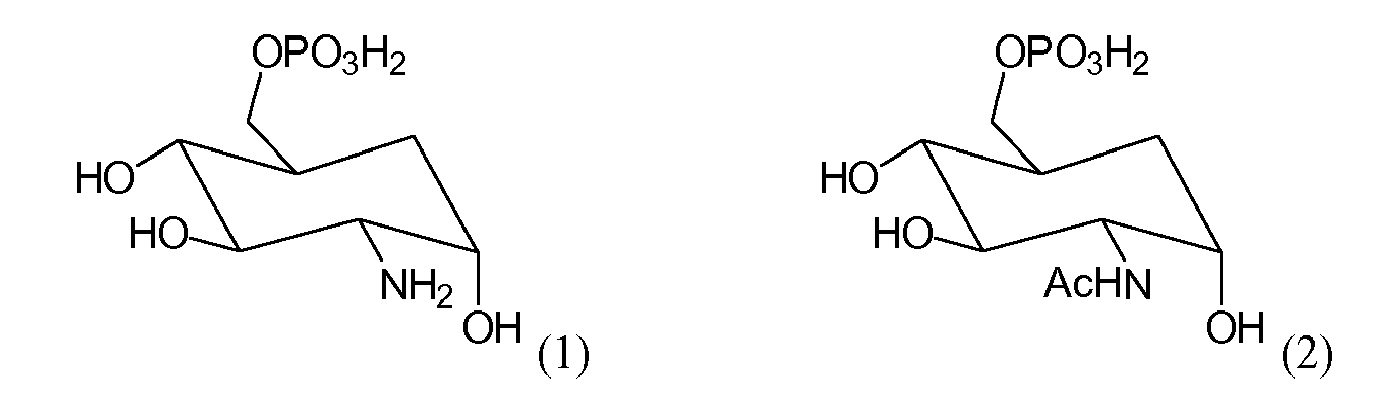
Ac is acetyl. - Advantageously, in vitro screenings monitoring the ribozyme-catalyzed cleavage reaction showed that particularly the compounds according to formula (1) was capable of efficiently activating the glmS riboswitch. Particularly, the compound according to formula (1) was able to activate the riboswitch in comparable levels to the natural metabolite glucosamine-6-phosphate (GlcN6P). Advantageously, the compounds represent promising candidates for the development of antibacterial compounds.
- The compounds described herein contain one or more asymmetric centres and may thus give rise to stereo isomers (configurational isomers). The present invention includes all such possible stereo isomers as well as their mixtures, and pharmaceutically acceptable salts thereof.
- Unless specifically stated otherwise, compounds, groups or substituents denoted with Arabic numerals and such compounds, groups or substituents denoted with Roman numerals differ from each other, that is, compounds, groups or substituents are different compounds, groups or substituents.
- Further preferred, the compound according to general formula (I) can be part of a dimer, trimer or oligomer, formed from one compound according to the invention and at least one other compound joined together via a linker linked to element A. Preferably the linker is selected from the group comprising nucleotide linkers, polyethylene glycols, peptide linkers and/or linear or branched, saturated or unsaturated C1-C50-alkyl.
- Preferably, a nucleotide linker has a length in the range of ≥ 1 nucleotide to ≤ 30 nucleotides, preferred in the range of ≥ 2 nucleotides to ≤ 15 nucleotides, further preferred in the range of ≥ 5 nucleotides to ≤ 15 nucleotides, more preferred in the range of ≥ 10 nucleotides to ≤ 15 nucleotides, wherein the nucleotides are selected from the group comprising guanosine, cytidine, adenosine and/or thymidine. A preferred nucleotide is adenosine. Especially preferred linkers are Poly A-linkers. Preferably, a polyethylene glycol linker comprises 1 to 15 polyethylene glycol units, preferred in the range of 1 to 10 polyethylene glycol units, more preferred in the range of 2 to 8 polyethylene glycol units. Preferred are linear polyethylene glycol (PEG) units HO-(CH2CH2O)n-H, wherein n is an integer in the range of 1 to 15, preferred in the range of 1 to 10, more preferred in the range of 2 to 8. In preferred embodiments the linker is a peptide linker, wherein the peptide linker preferably comprises amino acids selected from the group comprising glycine, alanine and/or β-alanine. Preferably, the peptide linker comprises in the range of 2 to 4 amino acids. Preferably, the peptide linker comprises β-β-alanine units. Preferably, the peptide linker comprises in the range of 2 to 4 β-alanine units. In preferred embodiments the linker is a linear or branched, saturated or unsaturated C1-C40-alkyl group, preferred a C1-C30 alkyl group, more preferred a C2-C20 - alkyl group Preferably, the linker is an alkyl group -(CH2)n- wherein n is an integer in the range of 1 to 40, preferred in the range of 1 to 30, further preferred in the range of 2 to 20, more preferred in the range of 2 to 18, even more preferred n is 2, 6, 12 or 18.
- A further aspect of the present invention relates to a compound according to general formula (I) as given as follows and/or racemates, enantiomers, diastereomers, solvates, hydrates, and pharmaceutically acceptable salts and/or esters thereof:

- R1 is selected from the group comprising H, OH, SH and/or NH2;
- R2 is selected from the group comprising hydrogen, C1-C10-alkyl, C7-C14-arylalkyl wherein the aryl group has 6 to 10 carbon atoms and the alkyl group has 1 to 4 carbon atoms, C(O)C1-C10-alkyl, OC(O)C1-C10-alkyl, C(O)OC1-C10-alkyl, C(O)NH2, NH2 and/or S(O)2OH;
- R3 is selected from the group comprising OH, SH and/or NH2;
- R4 is selected from the group comprising OH, SH and/or NH2;
- R5 is selected from the group comprising hydrogen, P(O)(OH)2, S(O)2OH, P(S)(OH)2, P(O)OHSH, S(O)2SH and/or aryloxy phosphoramidates according to general formula (II)

- R6 is selected from the group comprising linear or branched C1-C6-alkyl, benzyl and/or cyclohexyl;
- R7 is a side chain of an amino acid selected from the group comprising hydrogen; linear or branched C1-C4-alkyl; linear or branched alkyl groups of the type -CnH2n-U-D wherein n is 1, 2, 3 or 4, U is selected from the group comprising O, CO, COO, CONH, S, guanidine and/or NH and D is selected from the group comprising H and/or C1-C3-alkyl; -CH2-C6H4-Y wherein Y is selected from the group comprising OH, SH, C1-C3-alkyl and/or NH2; -CH2-imidazole; -CH2-indole; -CH2-(furanyl-3-yl); -CH2-(pyridyl-3-yl) and/or -CH2-(imidazolyl-3-yl); X is selected from the group comprising Cl, Br, I, C1-C6-alkyl and/or C1-C6-alkoxy;
- A is selected from the group comprising S, NR8, C=CR8R9 and/or CR8R9, wherein
- R8, R9 is selected, the same or each independently of the other, from the group comprising hydrogen, C1-C10-alkyl, C2-C10-alkenyl, C6-C10-aryl, C7-C14-arylalkyl wherein the aryl group has 6 to 10 carbon atoms and the alkyl group has 1 to 4 carbon atoms, C(O)C1-C10-alkyl, C(O)OC1-C10-alkyl, C(O)NH2, NH2, S(O)2OH and/or a linker,
- Preferably, the substituent A is selected from the group comprising S, NR8 and/or CR8R9, wherein R8 and R9 are selected, the same or each independently of the other, from the group comprising hydrogen, C1-C5-alkyl, C6-C10-aryl, or C2-C5-alkenyl. In a preferred embodiment, the element A is a group -CH2- and the compound has the formula (III) as indicated below and/or racemates, enantiomers, diastereomers, solvates, hydrates, and pharmaceutically acceptable salts and/or esters thereof:

- Preferably, the substituent R1 is a hydroxyl group. Further, the substituent R1 can be hydrogen. Further preferred, the substituent R3 is a hydroxyl group. Further preferred, the substituent R4 is a hydroxyl group. In a preferred embodiment of the compound according to the invention the substituents R1, R3 and R4 are OH. In another preferred embodiment of the compound according to the invention the substituent R1 is hydrogen and the substituents R3 and R4 are OH.
- In a preferred embodiment, the substituent R2 is selected from the group comprising hydrogen, C1-C5-alkyl preferably methyl, ethyl or n-propyl, benzyl, C1-C5-acyl preferably C(O)CH3, C(O)C2H5, C(O)n-propyl or C(O)iso-propyl, C1-C5-alkylester preferably OC(O)CH3, OC(O)C2H5, OC(O)n-propyl or OC(O)iso-propyl, C(O)NH2, NH2 and/or S(O)2OH. Most preferred, the substituent R2 is hydrogen. Further preferred, the substituent R2 is selected from the group comprising C1-C5-alkyl preferably methyl, ethyl or n-propyl, benzyl, C1-C5-acyl preferably C(O)CH3, C(O)C2H5, C(O)n-propyl or C(O)iso-propyl, C1-C5-alkylester preferably OC(O)CH3, OC(O)C2H5, OC(O)n-propyl or OC(O)iso-propyl, C(O)NH2, NH2 and/or S(O)2OH. Preferred are small alkyl, acyl and ester groups selected from methyl, ethyl, C(O)CH3, C(O)C2H5, OC(O)CH3, OC(O)C2H5, and benzyl. It is also preferred that the substituent R2 is selected from C(O)NH2, NH2 or S(O)2OH.
- Preferably, the substituent R5 is selected from the group comprising hydrogen, P(O)(OH)2 and/or aryloxy phosphoramidates according to formula (II) wherein R6 is selected from the group comprising methyl, ethyl, isopropyl, cyclohexyl and benzyl, X is methoxy and R7 is methyl or another side chain of an amino acid. Preferably, the substituent R5 is hydrogen. Most preferred, the substituent R5 is P(O)(OH)2. Further preferred, the substituent R5 is an aryloxy phosphoramidate according to formula (II). Preferred are aryloxy phosphoramidates wherein R6 is methyl, ethyl, isopropyl, cyclohexyl or benzyl, X is methoxy and R7 is methyl or another side chain of an amino acid.
- The substituent R7 is a side chain of an amino acid. Preferably, the substituent R7 is a side chain of a naturally occurring amino acid selected from the group comprising glycine, alanine, serine, threonine, arginine, lysine, aspartic acid, glutamic acid, asparagine, glutamine, phenylalanine, tyrosine, tryptophan, leucine, valine, isoleucine, cysteine, methionine, histidine and/or proline, preferably alanine, phenylalanine, proline, valine, leucine, isoleucine, glycine, methionine, or α,α-dimethylglycine. In preferred embodiments, the substituent R7 is a linear or branched alkyl groups of the type -CnH2n-U-D wherein n is 1, 2, 3 or 4, U is selected from the group comprising O, CO, COO, CONH, S, guanidine and/or NH, and D is selected from the group comprising H and/or methyl; -CH2-C6H4-OH; -CH2-imidazole and/or -CH2-indole. Preferably, the substituent R7 is a side chain of an amino acid selected from the group comprising hydrogen; linear or branched C1-C4-alkyl, most preferred methyl.
- In a preferred embodiment, the substituent R5 is selected from the group comprising hydrogen, P(O)(OH)2 and/or aryloxy phosphoramidates according to formula (II) wherein R6 is methyl, ethyl, isopropyl, cyclohexyl or benzyl, X is methoxy and R7 is methyl.
- In especially preferred embodiments, the compound is selected from the group comprising the formulas (1), (2), (3) and/or (4) as indicated below and/or racemates, enantiomers, diastereomers, solvates, hydrates, and pharmaceutically acceptable salts and/or esters thereof:


Ac is acetyl. - Further preferred, the compound according to general formula (I) can be part of a dimer, trimer or oligomer, formed from one compound according to the invention and at least one other compound joined together via a linker linked to element A. Preferably the linker is selected from the group comprising nucleotide linkers, polyethylene glycols, peptide linkers and/or linear or branched, saturated or unsaturated C1-C50-alkyl.
- Preferably, a nucleotide linker has a length in the range of ≥ 1 nucleotide to ≤ 30 nucleotides, preferred in the range of ≥ 2 nucleotides to ≤ 15 nucleotides, further preferred in the range of ≥ 5 nucleotides to ≤ 15 nucleotides, more preferred in the range of ≥ 10 nucleotides to ≤ 15 nucleotides, wherein the nucleotides are selected from the group comprising guanosine, cytidine, adenosine and/or thymidine. A preferred nucleotide is adenosine. Especially preferred linkers are Poly A-linkers. Preferably, a polyethylene glycol linker comprises 1 to 15 polyethylene glycol units, preferred in the range of 1 to 10 polyethylene glycol units, more preferred in the range of 2 to 8 polyethylene glycol units. Preferred are linear polyethylene glycol (PEG) units HO-(CH2CH2O)n-H, wherein n is an integer in the range of 1 to 15, preferred in the range of 1 to 10, more preferred in the range of 2 to 8. In preferred embodiments the linker is a peptide linker, wherein the peptide linker preferably comprises amino acids selected from the group comprising glycine, alanine and/or β-alanine. Preferably, the peptide linker comprises in the range of 2 to 4 amino acids. Preferably, the peptide linker comprises β-β-alanine units. Preferably, the peptide linker comprises in the range of 2 to 4 β-alanine units. In preferred embodiments the linker is a linear or branched, saturated or unsaturated C1-C40-alkyl group, preferred a C1-C30 alkyl group, more preferred a C2-C20 - alkyl group Preferably, the linker is an alkyl group -(CH2)n- wherein n is an integer in the range of 1 to 40, preferred in the range of 1 to 30, further preferred in the range of 2 to 20, more preferred in the range of 2 to 18, even more preferred n is 2, 6, 12 or 18.
- A further aspect of the present invention relates to a compound according to general formula (I) as given as follows and/or racemates, enantiomers, diastereomers, solvates, hydrates, and pharmaceutically acceptable salts and/or esters thereof:

- R1 is selected from the group comprising H, OH, SH and/or NH2;
- R2 is selected from the group comprising hydrogen, C1-C10-alkyl, C7-C14-arylalkyl wherein the aryl group has 6 to 10 carbon atoms and the alkyl group has 1 to 4 carbon atoms, C(O)C1-C10-alkyl, OC(O)C1-C10-alkyl, C(O)OC1-C10-alkyl, C(O)NH2, NH2 and/or S(O)2OH;
- R3 is selected from the group comprising OH, SH and/or NH2;
- R4 is selected from the group comprising OH, SH and/or NH2;
- R5 is selected from the group comprising hydrogen, P(O)(OH)2, S(O)2OH, P(S)(OH)2, P(O)OHSH, S(O)2SH and/or aryloxy phosphoramidates according to general formula (II)

- R6 is selected from the group comprising linear or branched C1-C6-alkyl, benzyl and/or cyclohexyl;
- R7 is a side chain of an amino acid selected from the group comprising hydrogen; linear or branched C1-C4-alkyl; linear or branched alkyl groups of the type -CnH2n-U-D wherein n is 1, 2, 3 or 4, U is selected from the group comprising O, CO, COO, CONH, S, guanidine and/or NH and D is selected from the group comprising H and/or C1-C3-alkyl; -CH2-C6H4-Y wherein Y is selected from the group comprising OH, SH, C1-C3-alkyl and/or NH2; -CH2-imidazole; -CH2-indole; -CH2-(furanyl-3-yl); -CH2-(pyridyl-3-yl) and/or -CH2-(imidazolyl-3-yl);
- X is selected from the group comprising Cl, Br, I, C1-C6-alkyl and/or C1-C6-alkoxy;
- A is selected from the group comprising S, NR8, C=CR8R9 and/or CR8R9, wherein
- R8, R9 is selected, the same or each independently of the other, from the group comprising hydrogen, C1-C10-alkyl, C2-C10-alkenyl, C6-C10-aryl, C7-C14-arylalkyl wherein the aryl group has 6 to 10 carbon atoms and the alkyl group has 1 to 4 carbon atoms, C(O)C1-C10-alkyl, C(O)OC1-C10-alkyl, C(O)NH2, NH2, S(O)2OH and/or a linker,
- The term "prophylactic treatment" according to the invention is to be understood as meaning that the compositions according to the invention can be applied before symptoms of the bacterial infection are manifest. Especially, the term "prophylactic treatment" is to be understood as meaning a medical treatment. It can be preferred to use the compounds according to the invention in a prophylactic treatment.
- Surprisingly it was found that the compounds according to the general formula (I) can be effective against bacterial growth. Especially, the compounds according to formulas (1) and (3) were found to effectively inhibit the growth of Staphylococcus aureus.
- One particular advantage of the compounds according to the invention is that the compounds are especially usable as an antibiotic, particularly against the multiresistant Staphylococcus aureus strain.
- Preferably, the substituent A is selected from the group comprising S, NR8 and/or CR8R9, wherein R8 and R9 are selected, the same or each independently of the other, from the group comprising hydrogen, C1-C5-alkyl, C6-C10-aryl, or C2-C5-alkenyl. In a preferred embodiment, the element A is a group -CH2- and the compound has the formula (III) as indicated below and/or racemates, enantiomers, diastereomers, solvates, hydrates, and pharmaceutically acceptable salts and/or esters thereof:

- Preferably, the substituent R1 is a hydroxyl group. Further, the substituent R1 can be hydrogen. Further preferred, the substituent R3 is a hydroxyl group. Further preferred, the substituent R4 is a hydroxyl group. In a preferred embodiment of the compound according to the invention the substituents R1, R3 and R4 are OH. In another preferred embodiment of the compound according to the invention the substituent R1 is hydrogen and the substituents R3 and R4 are OH.
- In a preferred embodiment, the substituent R2 is selected from the group comprising hydrogen, C1-C5-alkyl preferably methyl, ethyl or n-propyl, benzyl, C1-C5-acyl preferably C(O)CH3, C(O)C2H5, C(O)n-propyl or C(O)iso-propyl, C1-C5-alkylester preferably OC(O)CH3, OC(O)C2H5, OC(O)n-propyl or OC(O)iso-propyl, C(O)NH2, NH2 and/or S(O)2OH. Most preferred, the substituent R2 is hydrogen. Further preferred, the substituent R2 is selected from the group comprising C1-C5-alkyl preferably methyl, ethyl or n-propyl, benzyl, C1-C5-acyl preferably C(O)CH3, C(O)C2H5, C(O)n-propyl or C(O)iso-propyl, C1-C5-alkylester preferably OC(O)CH3, OC(O)C2H5, OC(O)n-propyl or OC(O)iso-propyl, C(O)NH2, NH2 and/or S(O)2OH. Preferred are small alkyl, acyl and ester groups selected from methyl, ethyl, C(O)CH3, C(O)C2H5, OC(O)CH3, OC(O)C2H5, and benzyl. It is also preferred that the substituent R2 is selected from C(O)NH2, NH2 or S(O)2OH.
- Preferably, the substituent R5 is selected from the group comprising hydrogen, P(O)(OH)2 and/or aryloxy phosphoramidates according to formula (II) wherein R6 is selected from the group comprising methyl, ethyl, isopropyl, cyclohexyl and benzyl, X is methoxy and R7 is methyl or another side chain of an amino acid. Preferably, the substituent R5 is hydrogen. Most preferred, the substituent R5 is P(O)(OH)2. Further preferred, the substituent R5 is an aryloxy phosphoramidate according to formula (II). Preferred are aryloxy phosphoramidates wherein R6 is methyl, ethyl, isopropyl, cyclohexyl or benzyl, X is methoxy and R7 is methyl or another side chain of an amino acid.
- The substituent R7 is a side chain of an amino acid. Preferably, the substituent R7 is a side chain of a naturally occurring amino acid selected from the group comprising glycine, alanine, serine, threonine, arginine, lysine, aspartic acid, glutamic acid, asparagine, glutamine, phenylalanine, tyrosine, tryptophan, leucine, valine, isoleucine, cysteine, methionine, histidine and/or proline, preferably alanine, phenylalanine, proline, valine, leucine, isoleucine, glycine, methionine, or α,α-dimethylglycine. In preferred embodiments, the substituent R7 is a linear or branched alkyl groups of the type -CnH2n-U-D wherein n is 1, 2, 3 or 4, U is selected from the group comprising O, CO, COO, CONH, S, guanidine and/or NH, and D is selected from the group comprising H and/or methyl; -CH2-C6H4-OH; -CH2-imidazole and/or -CH2-indole. Preferably, the substituent R7 is a side chain of an amino acid selected from the group comprising hydrogen; linear or branched C1-C4-alkyl, most preferred methyl.
- In a preferred embodiment, the substituent R5 is selected from the group comprising hydrogen, P(O)(OH)2 and/or aryloxy phosphoramidates according to formula (II) wherein R6 is methyl, ethyl, isopropyl, cyclohexyl or benzyl, X is methoxy and R7 is methyl.
- In especially preferred embodiments, the compound is selected from the group comprising the formulas (1), (2), (3) and/or (4) as indicated above and/or racemates, enantiomers, diastereomers, solvates, hydrates, and pharmaceutically acceptable salts and/or esters thereof.
- Further preferred, the compound according to general formula (I) can be part of a dimer, trimer or oligomer, formed from one compound according to the invention and at least one other compound joined together via a linker linked to element A. Preferably the linker is selected from the group comprising nucleotide linkers, polyethylene glycols, peptide linkers and/or linear or branched, saturated or unsaturated C1-C50-alkyl.
- Preferably, a nucleotide linker has a length in the range of ≥ 1 nucleotide to ≤ 30 nucleotides, preferred in the range of ≥ 2 nucleotides to ≤ 15 nucleotides, further preferred in the range of ≥ 5 nucleotides to ≤ 15 nucleotides, more preferred in the range of ≥ 10 nucleotides to ≤ 15 nucleotides, wherein the nucleotides are selected from the group comprising guanosine, cytidine, adenosine and/or thymidine. A preferred nucleotide is adenosine. Especially preferred linkers are Poly A-linkers. Preferably, a polyethylene glycol linker comprises 1 to 15 polyethylene glycol units, preferred in the range of 1 to 10 polyethylene glycol units, more preferred in the range of 2 to 8 polyethylene glycol units. Preferred are linear polyethylene glycol (PEG) units HO-(CH2CH2O)n-H, wherein n is an integer in the range of 1 to 15, preferred in the range of 1 to 10, more preferred in the range of 2 to 8. In preferred embodiments the linker is a peptide linker, wherein the peptide linker preferably comprises amino acids selected from the group comprising glycine, alanine and/or β-alanine. Preferably, the peptide linker comprises in the range of 2 to 4 amino acids. Preferably, the peptide linker comprises β-β-alanine units. Preferably, the peptide linker comprises in the range of 2 to 4 β-alanine units. In preferred embodiments the linker is a linear or branched, saturated or unsaturated C1-C40-alkyl group, preferred a C1-C30 alkyl group, more preferred a C2-C20 - alkyl group Preferably, the linker is an alkyl group -(CH2)n- wherein n is an integer in the range of 1 to 40, preferred in the range of 1 to 30, further preferred in the range of 2 to 20, more preferred in the range of 2 to 18, even more preferred n is 2, 6, 12 or 18.
- A further aspect of the present invention relates to a pharmaceutical composition comprising as an active ingredient a compound according to general formula (I) as given as follows and/or racemates, enantiomers, diastereomers, solvates, hydrates, and pharmaceutically acceptable salts and/or esters thereof:
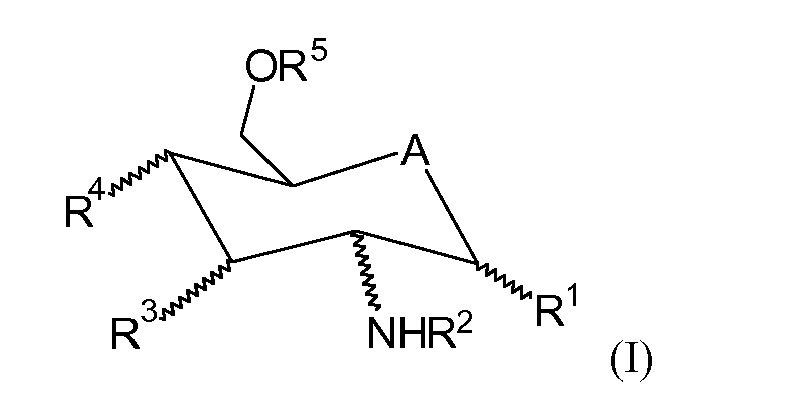
- R1 is selected from the group comprising H, OH, SH and/or NH2;
- R2 is selected from the group comprising hydrogen, C1-C10-alkyl, C7-C14-arylalkyl wherein the aryl group has 6 to 10 carbon atoms and the alkyl group has 1 to 4 carbon atoms, C(O)C1-C10-alkyl, OC(O)C1-C10-alkyl, C(O)OC1-C10-alkyl, C(O)NH2, NH2 and/or S(O)2OH;
- R3 is selected from the group comprising OH, SH and/or NH2;
- R4 is selected from the group comprising OH, SH and/or NH2;
- R5 is selected from the group comprising hydrogen, P(O)(OH)2, S(O)2OH, P(S)(OH)2, P(O)OHSH, S(O)2SH and/or aryloxy phosphoramidates according to general formula (II)

- R6 is selected from the group comprising linear or branched C1-C6-alkyl, benzyl and/or cyclohexyl;
- R7 is a side chain of an amino acid selected from the group comprising hydrogen; linear or branched C1-C4-alkyl; linear or branched alkyl groups of the type -CnH2n-U-D wherein n is 1, 2, 3 or 4, U is selected from the group comprising O, CO, COO, CONH, S, guanidine and/or NH and D is selected from the group comprising H and/or C1-C3-alkyl; -CH2-C6H4-Y wherein Y is selected from the group comprising OH, SH, C1-C3-alkyl and/or NH2; -CH2-imidazole; -CH2-indole; -CH2-(furanyl-3 -yl); -CH2-(pyridyl-3-yl) and/or -CH2-(imidazolyl-3-yl);
- X is selected from the group comprising Cl, Br, I, C1-C6-alkyl and/or C1-C6-alkoxy;
- A is selected from the group comprising S, NR8, C=CR8R9 and/or CR8R9, wherein
- R8, R9 is selected, the same or each independently of the other, from the group comprising hydrogen, C1-C10-alkyl, C2-C10-alkenyl, C6-C10-aryl, C7-C14-arylalkyl wherein the aryl group has 6 to 10 carbon atoms and the alkyl group has 1 to 4 carbon atoms, C(O)C1-C10-alkyl, C(O)OC1-C10-alkyl, C(O)NH2, NH2, S(O)2OH and/or a linker.
- Preferably, the substituent A is selected from the group comprising S, NR8 and/or CR8R9, wherein R8 and R9 are selected, the same or each independently of the other, from the group comprising hydrogen, C1-C5-alkyl, C6-C10-aryl, or C2-C5-alkenyl. In a preferred embodiment, the element A is a group -CH2- and the compound has the formula (III) as indicated below and/or racemates, enantiomers, diastereomers, solvates, hydrates, and pharmaceutically acceptable salts and/or esters thereof:

- In a preferred embodiment, the substituent R2 is selected from the group comprising hydrogen, C1-C5-alkyl preferably methyl, ethyl or n-propyl, benzyl, C1-C5-acyl preferably C(O)CH3, C(O)C2H5, C(O)n-propyl or C(O)iso-propyl, C1-C5-alkylester preferably OC(O)CH3, OC(O)C2H5, OC(O)n-propyl or OC(O)iso-propyl, C(O)NH2, NH2 and/or S(O)2OH. Most preferred, the substituent R2 is hydrogen. Further preferred, the substituent R2 is selected from the group comprising C1-C5-alkyl preferably methyl, ethyl or n-propyl, benzyl, C1-C5-acyl preferably C(O)CH3, C(O)C2H5, C(O)n-propyl or C(O)iso-propyl, C1-C5-alkylester preferably OC(O)CH3, OC(O)C2H5, OC(O)n-propyl or OC(O)iso-propyl, C(O)NH2, NH2 and/or S(O)2OH. Preferred are small alkyl, acyl and ester groups selected from methyl, ethyl, C(O)CH3, C(O)C2H5, OC(O)CH3, OC(O)C2H5, and benzyl. It is also preferred that the substituent R2 is selected from C(O)NH2, NH2 or S(O)2OH.
- Preferably, the substituent R5 is selected from the group comprising hydrogen, P(O)(OH)2 and/or aryloxy phosphoramidates according to formula (II) wherein R6 is selected from the group comprising methyl, ethyl, isopropyl, cyclohexyl and benzyl, X is methoxy and R7 is methyl or another side chain of an amino acid. Preferably, the substituent R5 is hydrogen. Most preferred, the substituent R5 is P(O)(OH)2. Further preferred, the substituent R5 is an aryloxy phosphoramidate according to formula (II). Preferred are aryloxy phosphoramidates wherein R6 is methyl, ethyl, isopropyl, cyclohexyl or benzyl, X is methoxy and R7 is methyl or another side chain of an amino acid.
- The substituent R7 is a side chain of an amino acid. Preferably, the substituent R7 is a side chain of a naturally occurring amino acid selected from the group comprising glycine, alanine, serine, threonine, arginine, lysine, aspartic acid, glutamic acid, asparagine, glutamine, phenylalanine, tyrosine, tryptophan, leucine, valine, isoleucine, cysteine, methionine, histidine and/or proline, preferably alanine, phenylalanine, proline, valine, leucine, isoleucine, glycine, methionine, or α,α-dimethylglycine. In preferred embodiments, the substituent R7 is a linear or branched alkyl groups of the type -CnH2n-U-D wherein n is 1, 2, 3 or 4, U is selected from the group comprising O, CO, COO, CONH, S, guanidine and/or NH, and D is selected from the group comprising H and/or methyl; -CH2-C6H4-OH; -CH2-imidazole and/or -CH2-indole. Preferably, the substituent R7 is a side chain of an amino acid selected from the group comprising hydrogen; linear or branched C1-C4-alkyl, most preferred methyl.
- In a preferred embodiment, the substituent R5 is selected from the group comprising hydrogen, P(O)(OH)2 and/or aryloxy phosphoramidates according to formula (II) wherein R6 is methyl, ethyl, isopropyl, cyclohexyl or benzyl, X is methoxy and R7 is methyl.
- In especially preferred embodiments, the compound is selected from the group comprising the formulas (1), (2), (3) and/or (4) as indicated above and/or racemates, enantiomers, diastereomers, solvates, hydrates, and pharmaceutically acceptable salts and/or esters thereof.
- Further preferred, the compound according to general formula (I) can be part of a dimer, trimer or oligomer, formed from one compound according to the invention and at least one other compound joined together via a linker linked to element A. Preferably the linker is selected from the group comprising nucleotide linkers, polyethylene glycols, peptide linkers and/or linear or branched, saturated or unsaturated C1-C50-alkyl.
- Preferably, a nucleotide linker has a length in the range of ≥ 1 nucleotide to ≤ 30 nucleotides, preferred in the range of ≥ 2 nucleotides to ≤ 15 nucleotides, further preferred in the range of ≥ 5 nucleotides to ≤ 15 nucleotides, more preferred in the range of ≥ 10 nucleotides to ≤ 15 nucleotides, wherein the nucleotides are selected from the group comprising guanosine, cytidine, adenosine and/or thymidine. A preferred nucleotide is adenosine. Especially preferred linkers are Poly A-linkers. Preferably, a polyethylene glycol linker comprises 1 to 15 polyethylene glycol units, preferred in the range of 1 to 10 polyethylene glycol units, more preferred in the range of 2 to 8 polyethylene glycol units. Preferred are linear polyethylene glycol (PEG) units HO-(CH2CH2O)n-H, wherein n is an integer in the range of 1 to 15, preferred in the range of 1 to 10, more preferred in the range of 2 to 8. In preferred embodiments the linker is a peptide linker, wherein the peptide linker preferably comprises amino acids selected from the group comprising glycine, alanine and/or β-alanine. Preferably, the peptide linker comprises in the range of 2 to 4 amino acids. Preferably, the peptide linker comprises β-β-alanine units. Preferably, the peptide linker comprises in the range of 2 to 4 β-alanine units. In preferred embodiments the linker is a linear or branched, saturated or unsaturated C1-C40-alkyl group, preferred a C1-C30 alkyl group, more preferred a C2-C20 - alkyl group Preferably, the linker is an alkyl group -(CH2)n- wherein n is an integer in the range of 1 to 40, preferred in the range of 1 to 30, further preferred in the range of 2 to 20, more preferred in the range of 2 to 18, even more preferred n is 2, 6, 12 or 18.
- The present invention also relates to an antibiotic comprising, as an active ingredient, a compound according to general formula (I) as given as follows and/or racemates, enantiomers, diastereomers, solvates, hydrates, and pharmaceutically acceptable salts and/or esters thereof:
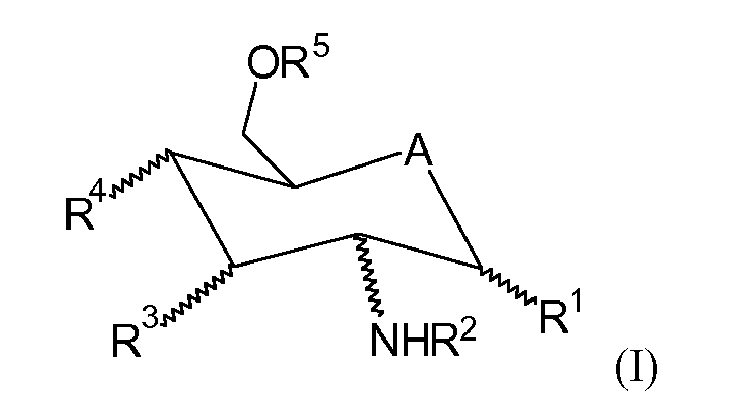
- R1 is selected from the group comprising H, OH, SH and/or NH2;
- R2 is selected from the group comprising hydrogen, C1-C10-alkyl, C7-C14-arylalkyl wherein the aryl group has 6 to 10 carbon atoms and the alkyl group has 1 to 4 carbon atoms, C(O)C1-C10-alkyl, OC(O)C1-C10-alkyl, C(O)OC1-C10-alkyl, C(O)NH2, NH2 and/or S(O)2OH;
- R3 is selected from the group comprising OH, SH and/or NH2;
- R4 is selected from the group comprising OH, SH and/or NH2;
- R5 is selected from the group comprising hydrogen, P(O)(OH)2, S(O)2OH, P(S)(OH)2, P(O)OHSH, S(O)2SH and/or aryloxy phosphoramidates according to general formula (II)

- R6 is selected from the group comprising linear or branched C1-C6-alkyl, benzyl and/or cyclohexyl;
- R7 is a side chain of an amino acid selected from the group comprising hydrogen; linear or branched C1-C4-alkyl; linear or branched alkyl groups of the type -CnH2n-U-D wherein n is 1, 2, 3 or 4, U is selected from the group comprising O, CO, COO, CONH, S, guanidine and/or NH and D is selected from the group comprising H and/or C1-C3-alkyl; -CH2-C6H4-Y wherein Y is selected from the group comprising OH, SH, C1-C3-alkyl and/or NH2; -CH2-imidazole; -CH2-indole; -CH2-(furanyl-3-yl); -CH2-(pyridyl-3-yl) and/or -CH2-(imidazolyl-3-yl);
- X is selected from the group comprising Cl, Br, I, C1-C6-alkyl and/or C1-C6-alkoxy;
- A is selected from the group comprising S, NR8, C=CR8R9 and/or CR8R9, wherein
- R8, R9 is selected, the same or each independently of the other, from the group comprising hydrogen, C1-C10-alkyl, C2-C10-alkenyl, C6-C10-aryl, C7-C14-arylalkyl wherein the aryl group has 6 to 10 carbon atoms and the alkyl group has 1 to 4 carbon atoms, C(O)C1-C10-alkyl, C(O)OC1-C10-alkyl, C(O)NH2, NH2, S(O)2OH and/or a linker.
- Preferably, the substituent A is selected from the group comprising S, NR8 and/or CR8R9, wherein R8 and R9 are selected, the same or each independently of the other, from the group comprising hydrogen, C1-C5-alkyl, C6-C10-aryl, or C2-C5-alkenyl. In a preferred embodiment, the element A is a group -CH2- and the compound has the formula (III) as indicated below and/or racemates, enantiomers, diastereomers, solvates, hydrates, and pharmaceutically acceptable salts and/or esters thereof:

- In a preferred embodiment, the substituent R2 is selected from the group comprising hydrogen, C1-C5-alkyl preferably methyl, ethyl or n-propyl, benzyl, C1-C5-acyl preferably C(O)CH3, C(O)C2H5, C(O)n-propyl or C(O)iso-propyl, C1-C5-alkylester preferably OC(O)CH3, OC(O)C2H5, OC(O)n-propyl or OC(O)iso-propyl, C(O)NH2, NH2 and/or S(O)2OH. Most preferred, the substituent R2 is hydrogen. Further preferred, the substituent R2 is selected from the group comprising C1-C5-alkyl preferably methyl, ethyl or n-propyl, benzyl, C1-C5-acyl preferably C(O)CH3, C(O)C2H5, C(O)n-propyl or C(O)iso-propyl, C1-C5-alkylester preferably OC(O)CH3, OC(O)C2H5, OC(O)n-propyl or OC(O)iso-propyl, C(O)NH2, NH2 and/or S(O)2OH. Preferred are small alkyl, acyl and ester groups selected from methyl, ethyl, C(O)CH3, C(O)C2H5, OC(O)CH3, OC(O)C2H5, and benzyl. It is also preferred that the substituent R2 is selected from C(O)NH2, NH2 or S(O)2OH.
- Preferably, the substituent R5 is selected from the group comprising hydrogen, P(O)(OH)2 and/or aryloxy phosphoramidates according to formula (II) wherein R6 is selected from the group comprising methyl, ethyl, isopropyl, cyclohexyl and benzyl, X is methoxy and R7 is methyl or another side chain of an amino acid. Preferably, the substituent R5 is hydrogen. Most preferred, the substituent R5 is P(O)(OH)2. Further preferred, the substituent R5 is an aryloxy phosphoramidate according to formula (II). Preferred are aryloxy phosphoramidates wherein R6 is methyl, ethyl, isopropyl, cyclohexyl or benzyl, X is methoxy and R7 is methyl or another side chain of an amino acid.
- The substituent R7 is a side chain of an amino acid. Preferably, the substituent R7 is a side chain of a naturally occurring amino acid selected from the group comprising glycine, alanine, serine, threonine, arginine, lysine, aspartic acid, glutamic acid, asparagine, glutamine, phenylalanine, tyrosine, tryptophan, leucine, valine, isoleucine, cysteine, methionine, histidine and/or proline, preferably alanine, phenylalanine, proline, valine, leucine, isoleucine, glycine, methionine, or α,a-dimethylglycine. In preferred embodiments, the substituent R7 is a linear or branched alkyl groups of the type -CnH2n-U-D wherein n is 1, 2, 3 or 4, U is selected from the group comprising O, CO, COO, CONH, S, guanidine and/or NH, and D is selected from the group comprising H and/or methyl; -CH2-C6H4-OH; -CH2-imidazole and/or -CH2-indole. Preferably, the substituent R7 is a side chain of an amino acid selected from the group comprising hydrogen; linear or branched C1-C4-alkyl, most preferred methyl.
- In a preferred embodiment, the substituent R5 is selected from the group comprising hydrogen, P(O)(OH)2 and/or aryloxy phosphoramidates according to formula (II) wherein R6 is methyl, ethyl, isopropyl, cyclohexyl or benzyl, X is methoxy and R7 is methyl.
- Preferably, the present invention relates to a pharmaceutical composition comprising as an active ingredient compounds according to the formulas (1), (2), (3) and/or (4) as indicated above and/or racemates, enantiomers, diastereomers, solvates, hydrates, and pharmaceutically acceptable salts and/or esters thereof.
- Further preferred, the compound according to general formula (I) can be part of a dimer, trimer or oligomer, formed from one compound according to the invention and at least one other compound joined together via a linker linked to element A. Preferably the linker is selected from the group comprising nucleotide linkers, polyethylene glycols, peptide linkers and/or linear or branched, saturated or unsaturated C1-C50-alkyl.
- Preferably, a nucleotide linker has a length in the range of ≥ 1 nucleotide to ≤ 30 nucleotides, preferred in the range of ≥ 2 nucleotides to ≤ 15 nucleotides, further preferred in the range of ≥ 5 nucleotides to ≤ 15 nucleotides, more preferred in the range of ≥ 10 nucleotides to ≤ 15 nucleotides, wherein the nucleotides are selected from the group comprising guanosine, cytidine, adenosine and/or thymidine. A preferred nucleotide is adenosine. Especially preferred linkers are Poly A-linkers. Preferably, a polyethylene glycol linker comprises 1 to 15 polyethylene glycol units, preferred in the range of 1 to 10 polyethylene glycol units, more preferred in the range of 2 to 8 polyethylene glycol units. Preferred are linear polyethylene glycol (PEG) units HO-(CH2CH2O)n-H, wherein n is an integer in the range of 1 to 15, preferred in the range of 1 to 10, more preferred in the range of 2 to 8. In preferred embodiments the linker is a peptide linker, wherein the peptide linker preferably comprises amino acids selected from the group comprising glycine, alanine and/or β-alanine. Preferably, the peptide linker comprises in the range of 2 to 4 amino acids. Preferably, the peptide linker comprises β-β-alanine units. Preferably, the peptide linker comprises in the range of 2 to 4 β-alanine units. In preferred embodiments the linker is a linear or branched, saturated or unsaturated C1-C40-alkyl group, preferred a C1-C30 alkyl group, more preferred a C2-C20 - alkyl group Preferably, the linker is an alkyl group -(CH2)n- wherein n is an integer in the range of 1 to 40, preferred in the range of 1 to 30, further preferred in the range of 2 to 20, more preferred in the range of 2 to 18, even more preferred n is 2, 6, 12 or 18.
- The compounds and/or racemates, enantiomers, diastereomers, solvates, hydrates, and pharmaceutically acceptable salts and/or esters thereof can be included in pharmaceutical compositions in combination with one or more other therapeutically active compounds. The pharmaceutical composition particularly is usable as an antibiotic.
- Further, the compounds according to the present invention are usable in form of solvates, hydrates, and pharmaceutically acceptable salts and/or esters thereof.
- Usable are pharmaceutically acceptable salts of the compounds according to the present invention. The term "pharmaceutically acceptable salts" refers to salts prepared from pharmaceutically acceptable non-toxic bases or acids.
- When the compound of the present invention is acidic, its corresponding salt can be conveniently prepared from pharmaceutically acceptable non-toxic bases, including inorganic bases and organic bases. Preferred salts derived from inorganic bases include ammonium, calcium, magnesium, potassium and sodium salts. Salts derived from pharmaceutically acceptable organic non-toxic bases include salts of primary, secondary, and tertiary amines, as well as cyclic amines.
- When the compound of the present invention is basic, its corresponding salt can be conveniently prepared from pharmaceutically acceptable non-toxic acids, including inorganic and organic acids. Such acids include, for example, acetic, benzenesulfonic, benzoic, camphorsulfonic, citric, ethanesulfonic, fumaric, gluconic, glutamic, hydrobromic, hydrochloric, isethionic, lactic, maleic, malic, mandelic, methanesulfonic, mucic, nitric, pamoic, pantothenic, phosphoric, succinic, sulfuric, tartaric, p-toluenesulfonic acid and the like. Particularly preferred are citric, hydrobromic, hydrochloric, maleic, phosphoric, sulfuric, and tartaric acids.
- Further usable are pharmaceutically acceptable esters of the compounds according to the present invention. The term "pharmaceutically acceptable ester" refers to esters prepared from pharmaceutically acceptable non-toxic ester groups. Most preferred the substituent R2 is an acetyl group.
- Preferably, the pharmaceutical composition comprises a compound according to the invention and/or racemates, enantiomers, diastereomers, solvates, hydrates, and pharmaceutically acceptable salts and/or esters thereof as an active ingredient, a pharmaceutically acceptable carrier and optionally other therapeutic ingredients or adjuvants.
- The pharmaceutical carrier can be, for example, a solid, liquid, or gas. Suitable carriers and adjuvants can be solid or liquid and correspond to the substances ordinarily employed in formulation technology for pharmaceutical formulations. Examples of solid carriers include lactose, terra alba, sucrose, talc, gelatin, agar, pectin, acacia, magnesium stearate, and stearic acid. Examples of liquid carriers are sugar syrup, peanut oil, olive oil, and water. Examples of gaseous carriers include carbon dioxide and nitrogen.
- The compositions can be suitable for oral, dermal, rectal, topical, and parenteral administration. Parenteral administration includes subcutaneous, intramuscular, and intravenous administration. The pharmaceutical compositions may be conveniently presented in unit dosage form and prepared by any of the methods well known in the art of pharmacy.
- The pharmaceutical composition of the present invention can be presented as discrete unit suitable for oral administration such as capsules, cachets or tablets each containing a predetermined amount of the active ingredient. Further, the compositions can be presented as a powder, as granules, as a solution, as a suspension in an aqueous liquid, as a non-aqueous liquid, as an oil-in-water emulsion or as a water-in-oil liquid emulsion. Further, the pharmaceutical composition may be administered by controlled release means and/or delivery devices.
- For compositions for oral dosage form, convenient pharmaceutical media may be employed. For example, water, glycols, oils, alcohols, flavouring agents, preservatives, colouring agents and the like may be used to form oral liquid preparations such as solutions. Carriers such as starches, sugars, microcrystalline cellulose, diluents, granulating agents, lubricants, binders, disintegrating agents, and the like may be used to form oral solid preparations such as powders, capsules and tablets. Optionally, tablets may be coated by standard aqueous or non aqueous techniques.
- Pharmaceutical compositions of the present invention suitable for parenteral administration may be prepared as solutions or suspensions of the active compounds in water. A suitable excipient can be included such as, for example, hydroxypropylcellulose. Dispersions can also be prepared in glycerol, liquid polyethylene glycols, and mixtures thereof in oils. Pharmaceutical compositions of the present invention suitable for injectable use include sterile aqueous solutions or dispersions. Further, a preservative can be included to prevent the growth of microorganisms.
- The pharmaceutical compositions of the present invention can be in a form suitable for topical use such as, for example, an aerosol, cream, ointment, lotion, dusting powder, or the like. Further, the compositions can be in a form suitable for use in transdermal devices. The pharmaceutical composition may also be prepared in powder or liquid concentrate form. The pharmaceutical composition of the present invention can include one or more additional carrier ingredients such as diluents, buffers, flavouring agents, binders, surface-active agents, thickeners, lubricants, preservatives and the like.
- The pharmaceutical composition may be produced under sterile conditions using standard pharmaceutical techniques well known to those skilled in the art.
- The present invention also relates to the use of a compound according to general formula (I) as given as follows and/or racemates, enantiomers, diastereomers, solvates, hydrates, and pharmaceutically acceptable salts and/or esters thereof:

- R1 is selected from the group comprising H, OH, SH and/or NH2;
- R2 is selected from the group comprising hydrogen, C1-C10-alkyl, C7-C14-arylalkyl wherein the aryl group has 6 to 10 carbon atoms and the alkyl group has 1 to 4 carbon atoms, C(O)C1-C10-alkyl, OC(O)C1-C10-alkyl, C(O)OC1-C10-alkyl, C(O)NH2, NH2 and/or S(O)2OH;
- R3 is selected from the group comprising OH, SH and/or NH2;
- R4 is selected from the group comprising OH, SH and/or NH2;
- R5 is selected from the group comprising hydrogen, P(O)(OH)2, S(O)2OH, P(S)(OH)2, P(O)OHSH, S(O)2SH and/or aryloxy phosphoramidates according to general formula (II)

- R6 is selected from the group comprising linear or branched C1-C6-alkyl, benzyl and/or cyclohexyl;
- R7 is a side chain of an amino acid selected from the group comprising hydrogen; linear or branched C1-C4-alkyl; linear or branched alkyl groups of the type -CnH2n-U-D wherein n is 1, 2, 3 or 4, U is selected from the group comprising O, CO, COO, CONH, S, guanidine and/or NH and D is selected from the group comprising H and/or C1-C3-alkyl; -CH2-C6H4-Y wherein Y is selected from the group comprising OH, SH, C1-C3-alkyl and/or NH2; -CH2-imidazole; -CH2-indole; -CH2-(furanyl-3-yl); -CH2-(pyridyl-3-yl) and/or -CH2-(imidazolyl-3-yl);
- X is selected from the group comprising Cl, Br, I, C1-C6-alkyl and/or C1-C6-alkoxy;
- A is selected from the group comprising S, NR8, C=CR8R9 and/or CR8R9, wherein
- R8, R9 is selected, the same or each independently of the other, from the group comprising hydrogen, C1-C10-alkyl, C2-C10-alkenyl, C6-C10-aryl, C7-C14-arylalkyl wherein the aryl group has 6 to 10 carbon atoms and the alkyl group has 1 to 4 carbon atoms, C(O)C1-C10-alkyl, C(O)OC1-C10-alkyl, C(O)NH2, NH2, S(O)2OH and/or a linker,
- The present invention also relates to the use of a compound according to general formula (I) as given above for the manufacture of a medicament for the therapeutic and/or prophylactic treatment of a bacterial infection, particularly for the manufacture of an antibiotic.
- It is a particular advantage of the compounds according to the invention is that the compounds are especially usable for the manufacture of an antibiotic, particularly against the multiresistant Staphylococcus aureus strain.
- Preferably, the substituent A is selected from the group comprising S, NR8 and/or CR8R9, wherein R8 and R9 are selected, the same or each independently of the other, from the group comprising hydrogen, C1-C5-alkyl, C6-C10-aryl, or C2-C5-alkenyl. In a preferred embodiment, the element A is a group -CH2- and the compound has the formula (III) as indicated below and/or racemates, enantiomers, diastereomers, solvates, hydrates, and pharmaceutically acceptable salts and/or esters thereof:

- Preferably, the substituent R1 is a hydroxyl group. Further, the substituent R1 can be hydrogen. Further preferred, the substituent R3 is a hydroxyl group. Further preferred, the substituent R4 is a hydroxyl group. In a preferred embodiment of the compound according to the invention the substituents R1, R3 and R4 are OH. In another preferred embodiment of the compound according to the invention the substituent R1 is hydrogen and the substituents R3 and R4 are OH.
- In a preferred embodiment, the substituent R2 is selected from the group comprising hydrogen, C1-C5-alkyl preferably methyl, ethyl or n-propyl, benzyl, C1-C5-acyl preferably C(O)CH3, C(O)C2H5, C(O)n-propyl or C(O)iso-propyl, C1-C5-alkylester preferably OC(O)CH3, OC(O)C2H5, OC(O)n-propyl or OC(O)iso-propyl, C(O)NH2, NH2 and/or S(O)2OH. Most preferred, the substituent R2 is hydrogen. Further preferred, the substituent R2 is selected from the group comprising C1-C5-alkyl preferably methyl, ethyl or n-propyl, benzyl, C1-C5-acyl preferably C(O)CH3, C(O)C2H5, C(O)n-propyl or C(O)iso-propyl, C1-C5-alkylester preferably OC(O)CH3, OC(O)C2H5, OC(O)n-propyl or OC(O)iso-propyl, C(O)NH2, NH2 and/or S(O)2OH. Preferred are small alkyl, acyl and ester groups selected from methyl, ethyl, C(O)CH3, C(O)C2H5, OC(O)CH3, OC(O)C2H5, and benzyl. It is also preferred that the substituent R2 is selected from C(O)NH2, NH2 or S(O)2OH.
- Preferably, the substituent R5 is selected from the group comprising hydrogen, P(O)(OH)2 and/or aryloxy phosphoramidates according to formula (II) wherein R6 is selected from the group comprising methyl, ethyl, isopropyl, cyclohexyl and benzyl, X is methoxy and R7 is methyl or another side chain of an amino acid. Preferably, the substituent R5 is hydrogen. Most preferred, the substituent R5 is P(O)(OH)2. Further preferred, the substituent R5 is an aryloxy phosphoramidate according to formula (II). Preferred are aryloxy phosphoramidates wherein R6 is methyl, ethyl, isopropyl, cyclohexyl or benzyl, X is methoxy and R7 is methyl or another side chain of an amino acid.
- The substituent R7 is a side chain of an amino acid. Preferably, the substituent R7 is a side chain of a naturally occurring amino acid selected from the group comprising glycine, alanine, serine, threonine, arginine, lysine, aspartic acid, glutamic acid, asparagine, glutamine, phenylalanine, tyrosine, tryptophan, leucine, valine, isoleucine, cysteine, methionine, histidine and/or proline, preferably alanine, phenylalanine, proline, valine, leucine, isoleucine, glycine, methionine, or α,a-dimethylglycine. In preferred embodiments, the substituent R7 is a linear or branched alkyl groups of the type -CnH2n-U-D wherein n is 1, 2, 3 or 4, U is selected from the group comprising O, CO, COO, CONH, S, guanidine and/or NH, and D is selected from the group comprising H and/or methyl; -CH2-C6H4-OH; -CH2-imidazole and/or -CH2-indole. Preferably, the substituent R7 is a side chain of an amino acid selected from the group comprising hydrogen; linear or branched C1-C4-alkyl, most preferred methyl.
- In a preferred embodiment, the substituent R5 is selected from the group comprising hydrogen, P(O)(OH)2 and/or aryloxy phosphoramidates according to formula (II) wherein R6 is methyl, ethyl, isopropyl, cyclohexyl or benzyl, X is methoxy and R7 is methyl.
- In especially preferred embodiments, the compound is selected from the group comprising the formulas (1), (2), (3) and/or (4) as indicated above and/or racemates, enantiomers, diastereomers, solvates, hydrates, and pharmaceutically acceptable salts and/or esters thereof.
- Further preferred, the compound according to general formula (I) can be part of a dimer, trimer or oligomer, formed from one compound according to the invention and at least one other compound joined together via a linker linked to element A. Preferably the linker is selected from the group comprising nucleotide linkers, polyethylene glycols, peptide linkers and/or linear or branched, saturated or unsaturated C1-C50-alkyl.
- Preferably, a nucleotide linker has a length in the range of ≥ 1 nucleotide to ≤ 30 nucleotides, preferred in the range of ≥ 2 nucleotides to ≤ 15 nucleotides, further preferred in the range of ≥ 5 nucleotides to ≤ 15 nucleotides, more preferred in the range of ≥ 10 nucleotides to ≤ 15 nucleotides, wherein the nucleotides are selected from the group comprising guanosine, cytidine, adenosine and/or thymidine. A preferred nucleotide is adenosine. Especially preferred linkers are Poly A-linkers. Preferably, a polyethylene glycol linker comprises 1 to 15 polyethylene glycol units, preferred in the range of 1 to 10 polyethylene glycol units, more preferred in the range of 2 to 8 polyethylene glycol units. Preferred are linear polyethylene glycol (PEG) units HO-(CH2CH2O)n-H, wherein n is an integer in the range of 1 to 15, preferred in the range of 1 to 10, more preferred in the range of 2 to 8. In preferred embodiments the linker is a peptide linker, wherein the peptide linker preferably comprises amino acids selected from the group comprising glycine, alanine and/or β-alanine. Preferably, the peptide linker comprises in the range of 2 to 4 amino acids. Preferably, the peptide linker comprises β-β-alanine units. Preferably, the peptide linker comprises in the range of 2 to 4 β-alanine units. In preferred embodiments the linker is a linear or branched, saturated or unsaturated C1-C40-alkyl group, preferred a C1-C30 alkyl group, more preferred a C2-C20 - alkyl group Preferably, the linker is an alkyl group -(CH2)n- wherein n is an integer in the range of 1 to 40, preferred in the range of 1 to 30, further preferred in the range of 2 to 20, more preferred in the range of 2 to 18, even more preferred n is 2, 6, 12 or 18.
- The compounds of the present invention may be prepared using a variety of processes well known by a person skilled in the art.
- A further aspect of the present invention relates to a method for the preparation of phosphorylated compounds according to the invention.
- In a preferred embodiment, the compounds according to the invention wherein R5 is P(O)(OH)2 may be prepared by a method comprising the steps of:
- a) Preparation of a cyclohexane according to formula (IV)

- b) Alkaline hydrolysis of the carbamate moiety to a 1-hydroxy-2-benzylamino moiety;
- c) Selective introduction of a phosphate group to the primary hydroxyl group of the hydrolised cyclohexane of step b);
- d) Reduction of the benzyl protecting groups to the respective alcohol and amine groups of the cyclohexane of step c).
- The cyclohexane according to formula (IV) may be prepared using processes well known by a person skilled in the art.
- The alkaline hydrolysis of the alkyl ester of the carbamate moiety to a 1-hydroxy-2-benzylamino moiety of step b) preferably is carried out in the presence of NaOH. A preferred solvent is a mixture of ethanol and NaOH, preferably a 1:1 mixture of ethanol and 2 N NaOH.
- In step c) a phosphate group is introduced to the primary hydroxyl group of the hydrolised cyclohexane of step b). The phosphorylation preferably is carried out using phosphoryl chloride (POCl3), pyridine, and water in acetonitrile (CH3CN).
- The reduction of the benzyl protecting groups to the respective alcohol and amine groups of the cyclohexane of step c) in step d) preferably is carried out by catalytic hydrogenation with palladium on carbon as a catalyst. A preferred solvent for the reduction is methanol.
- Upon reduction of the benzyl groups to the respective alcohol and amine groups of the cyclohexane of step c) after introduction of a phosphate group to the primary hydroxyl group of the hydrolised cyclohexane a phosphorylated cyclohexane is received, as for example the compound according to formula (1).
- The examples which follow serve to illustrate the invention in more detail but do not constitute a limitation thereof.
- The figures show:
- Figure 1
- in vitro activation of the self cleavage of the glmS riboswitch by the natural metabolite glucosamine-6-phosphate (GlcN6P), glucosamine (GlcN) and by the compound according to formula (1), Carba-glucosamine-6-phosphate (Carba-GlcN6P);
- Figure 2
- in vitro activation of the self cleavage of the glmS riboswitch by glucosamine-6-phosphate (GlcN6P), glucosamine (GlcN) and by the compound according to formula (3), Carba-glucosamine (Carba-GlcN);
- Figure 3
- Determination of the minimal concentration for the inhibition in Staphylococcus aureus SG511 for the compound according to formula (1), (Carba-GlcN6P), the compound according to formula (3) (Carba-GlcN), glucosamine-6-phosphate (GlcN6P), and glucosamine (GlcN).
- Unless stated otherwise, a purification of compounds was carried out using flash column chromatography, a variant of column chromatography. Flash column chromatography was carried out using Merck silica gel 60 (40 - 63 µm). Pressure was achieved by nitrogen. The mobile phase, column diameter (∅), filling level of silica gel, and volume of fractions was adjusted to experimental conditions.
- The solvents were distilled before used. Chemicals were purchased from Acros, Fluka, Merck, Sigma-Aldrich, Fisher Scientific and Glycon and used without further purification, unless stated otherwise.
- The compound according to formula (3) was prepared according to the procedure according to Miyamoto, M. et al., Tetrahedron Lett. 1992, 33, 3725-3728.
- Preparation of the compound according to formula (1) (1S,2S,3R,4R,5R)-2-amino-5-((phosphonooxy)methyl)-cyclohexane-1,3,4-triol
- (1S,2S,3R,4R,SR)-3,4-di-O-benzyl-2-benzylamino-1,2-N,O-carbonyl-5-hydroxymethyl-cyclohexane-1,3,4-triole was prepared according to the method of Barton et al., Tetrahedron 1990, 46, 215-230, in ten reaction steps.
- 580 mg of (1S,2S,3R,4R,SR)-3,4-di-O-benzyl-2-benzylamino-1,2-N,O-carbonyl-5-hydroxymethyl-cyclohexane-1,3,4-triole of step 1.1 (1.23 mmol) was dissolved in 30 mL EtOH/2N NaOH (1:1) and stirred for 14 h under reflux. The mixture was diluted with water and extracted with EtOAc (2 x 50 mL). The organic layer was dried (Na2SO4) and the solvent was evaporated. Purification by flash column chromatography (petroleum ether/EtOAc 1:1) yielded the titled compound (400 mg, 73 %) as a colorless solid.
- 160 µL POCl3 (1.74 mmol), 24 µL H2O (1.34 mmol), and 149 µL pyridine (1.85 mmol) were dissolved in acetonitrile (2 mL) and stirred for 10 min at 0 °C. 150 mg of the compound of step 1.2 (0.34 mmol) was added and the mixture was stirred for 8.5 h at 0 °C. 4 mL Water was added and the mixture was stirred for 1 h at room temperature followed by evaporation. Purification by reversed phase high performance liquid chromatography (RP HPLC) (semi-preparative column; 30-55 % in 10 min) followed by lyophilization yielded the titled compound (40 mg, 23 %) as a colorless solid.
- To a solution of 40 mg of the compound of step 1.3 (0.068 mmol) in MeOH (2 mL) was added 10 % Pd on carbon catalyst (10 mg) and the mixture was vigorously stirred under a hydrogen atmosphere (1 atm) at room temperature for 4 h. After filtration and lyophilization, the titled compound was obtained as a colorless solid (16 mg, 98 %).
- Determination of the in vitro activation of the self cleavage of the glmS riboswitch by the compounds according to formulas (1) and (3)
- The determination was performed using an in vitro preparation of the glmS riboswitch of Staphylococcus aureus SG511.
- The glmS riboswitch DNA was amplified from genomic DNA of the S. aureus Mu50 strain (RKI Berlin) by standard Pfu polymerase chain reaction (PCR) using a 5' primer containing the T7 promoter (GAT AAT ACG ACT CAC TAT AGG GCA GTT AAA GCG CCT GTG CAA ATA, SEQ ID NO: 1) and a 3' primer (ATC TTA TTA ACT TTG TCC ATT AAG TCA CCC, SEQ ID NO: 2) (20 cycles, annealing temperature of 60°C, homemade Pfu enzyme). The resultant of a 100µl PCR reaction was phenol/chloroform extracted and precipitated using 3M NaOAc pH 5.4 and ethanol. Pellets were resuspended in 10%µl diethylpyrocarbonate treated water (DEPC H2O) and used as template for T7 RNA polymerase-based transcription. The transcription reaction contained the following components (concentrations stated as final concentrations): transcription buffer 40mM Hepes KOH pH 7.9, 25mM MgCl2, 5mM DTT, 2.5mM of each NTP, 0.5 U/µl RNasin (Promega), 1.5-3mM DNA template, 0.5U/µl T7 RNA polymerase (homemade), DEPC H2O ad 100µl. Incubation occurred at 37°C over night and was followed by RNA work-up using PAGE (10% PAA-gel) and standard gel extraction and RNA precipitation procedures.
- Hereafter, the S. aureus glmS riboswitch RNA was dephosphorylated on its 5' end using the calf intestine alkaline phosphatase (CIAP, Promega). Finally, 45pmol of dephosphorylated RNA were used for phosphorylation using gamma 32P-ATP (10 mCi/ml NEN, Zaventem, Belgium) and the T4 polynucleotide kinase (NEB). After incubation at 37°C for 30 min the reaction was passed through a G25 sepharose column (GE Healthcare) which had been equilibrated with DEPC H2O before, to exclude unincorporated radioactive nucleotides. Eventually the RNA was PAGE purified and precipitated. The pellets were dissolved in an appropriate volume of DEPC H2O and stored at -20°C until use.
- For this assay the following components were mixed to yield the stated final concentrations: cleavage buffer (50mM Hepes pH 7.5, 200mM KCl), MgCl2 (10mM), glucosamine-6-phosphate (200µM), glucosamine (GlcN) (200µM), the compound according to formula (1) (200 µM) or the compound according to formula (3) (200 µM and 20 mM), radioactively labelled RNA (20cps) and DEPC H2O ad 10µl. Each reaction was prepared in a 1.5µl Eppendorf tube. RNA was added last, after having been heated to 85°C for 2min and slowly cooled-down to room temperature for 10min. The cleavage reaction was then incubated at 37°C for 30 min and stopped by the addition of 5µl sucrose PAGE loading buffer. Samples were loaded on thin 17% PAA gels and run at 400-600V for 2-4 hours. Irradiation of the phophorimager screen was performed over night at -80°C. The screens were read using a FujiFilm Phosphorlmager FLA 3000 and evaluated using AIDA software.
- As can be seen in
Fig. 1 , the compound according to formula (1) (carba-GlcN6P) was shown to induce glmS-riboswitch self-cleavage very efficiently at a concentration of 200 µM to almost the same extent, as does the native metabolite glucosamine-6-phosphate (GlcN6P). Concentration dependent analysis revealed an EC50-value of 6.24 ± 0.66 µM compared to 3.61 ± 0.39 µM found for glucosamine-6-phosphate (GlcN6P). As can be seen inFig. 2 , the compound according to formula (3) (carba-GlcN) also was able to induce glmS-riboswitch self-cleavage efficiently at a concentration of 200 µM and 20 mM. - Determination of the minimal concentration for the inhibition in Staphylococcus aureus SG511
- The determination of the minimal inhibitory concentration (MIC) of the compounds according to formula (1) (carba-GlcN6P) and formula (3) (carba-GlcN) was performed in clear, round bottom 96-well plates. For this 100µl of 0.5x Mueller-Hinton media (Oxoid, 300 gm/litre dehydrated infusion from beef, 17.5 gm/litre casein hydrolysate, 1.5 gm/litre starch, pH 7.3) were put into the 12 wells. To the first well 100µl of 320mM solution of carba-GlcN were added, mixed by pipetting and 100µl of this mixture were transferred into the next well etc., generating a sequence final dilutions from 160mM to 0.08mM. Finally, SG511 cells that had been grown to an optical density (OD600) of 1 were diluted in 0.5x Mueller-Hinton media 1:10 000. From this dilution 100µl were added to the already prepared plate leading to a final compound concentration of 80mM-0.04mM. After incubation for 10 min at RT and vivid shaking, the 96-well plate was transferred to a 37°C incubator. After 18-24h of incubation the plate was read at 600nm using a standard plate reader.
- As can be seen in
Fig. 3 , bacterial growth was inhibited by the compounds according to the invention. - These experiments show that the carba-analogues of GlcN6P according to formulas (1) and (3) can activate the glmS-riboswitch from S. aureus. Especially the compound according to formula (1) is able to activate the metabolite-dependent glmS-riboswitch from S. aureus with almost the same potency, as does the native metabolite.
- These experiments further show that since the glmS-riboswitch is involved in the regulation of early steps of cell wall biosynthesis and interference with cell wall biosynthesis represents a valuable strategy to inhibit bacterial growth, the compound according to the invention can serve as important lead structure for developing novel antibiotics.

Claims (14)
- A compound according to general formula (I) as given as follows and/or racemates, enantiomers, diastereomers, solvates, hydrates, and pharmaceutically acceptable salts and/or esters thereof:
 R1 is selected from the group comprising H, OH, SH and/or NH2;R2 is selected from the group comprising hydrogen, C1-C10-alkyl, C7-C14-arylalkyl wherein the aryl group has 6 to 10 carbon atoms and the alkyl group has 1 to 4 carbon atoms, C(O)C1-C10-alkyl, OC(O)C1-C10-alkyl, C(O)OC1-C10-alkyl, C(O)NH2, NH2 and/or S(O)2OH;R3 is selected from the group comprising OH, SH and/or NH2;R4 is selected from the group comprising OH, SH and/or NH2;R5 is selected from the group comprising hydrogen, P(O)(OH)2, S(O)2OH, P(S)(OH)2, P(O)OHSH, S(O)2SH and/or aryloxy phosphoramidates according to general formula (II)wherein:
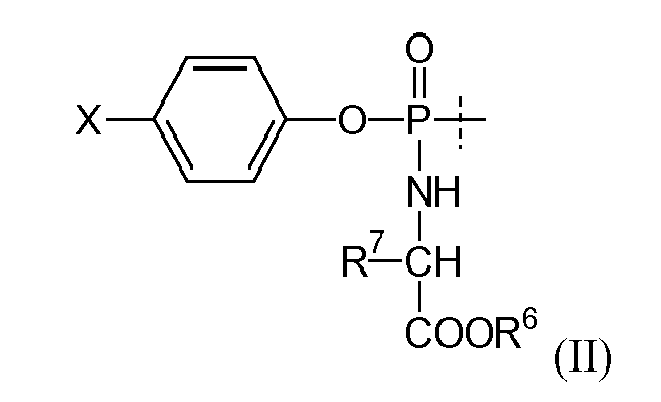 R6 is selected from the group comprising linear or branched C1-C6-alkyl, benzyl and/or cyclohexyl;R7 is a side chain of an amino acid selected from the group comprising hydrogen; linear or branched C1-C4-alkyl; linear or branched alkyl groups of the type -CnH2n-U-D
wherein n is 1, 2, 3 or 4, U is selected from the group comprising O, CO, COO, CONH, S, guanidine and/or NH and D is selected from the group comprising H and/or C1-C3-alkyl; -CH2-C6H4-Y wherein Y is selected from the group comprising OH, SH, C1-C3-alkyl and/or NH2; -CH2-imidazole; -CH2-indole; -CH2-(furanyl-3-yl); -CH2-(pyridyl-3-yl) and/or -CH2-(imidazolyl-3-yl);X is selected from the group comprising Cl, Br, I, C1-C6-alkyl and/or C1-C6-alkoxy;A is selected from the group comprising S, NR8, C=CR8R9 and/or CR8R9, whereinR8, R9 is selected, the same or each independently of the other, from the group comprising hydrogen, C1-C10-alkyl, C2-C10-alkenyl, C6-C10-aryl, C7-C14-arylalkyl wherein the aryl group has 6 to 10 carbon atoms and the alkyl group has 1 to 4 carbon atoms, C(O)C1-C10-alkyl, C(O)OC1-C10-alkyl, C(O)NH2, NH2, S(O)2OH and/or a linker. - The compound according to claim 1, characterized in that A is a group -CH2- and the compound has the formula (III) as indicated below and/or racemates, enantiomers, diastereomers, solvates, hydrates, and pharmaceutically acceptable salts and/or esters thereof:

- The compound according to claims 1 or 2, characterized in that R1, R3 and R4 are OH.
- The compound according to any one of the foregoing claims, characterized in that R2 is selected from the group comprising hydrogen, C1-C5-alkyl preferably methyl, ethyl or n-propyl, benzyl, C1-C5-acyl preferably C(O)CH3, C(O)C2H5, C(O)n-propyl or C(O)iso-propyl, C(O)NH2, NH2 and/or S(O)2OH, preferably hydrogen.
- The compound according to any one of the foregoing claims, characterized in that R5 is selected from the group comprising hydrogen, P(O)(OH)2 and/or aryloxy phosphoramidates according to general formula (II) wherein R6 is methyl, ethyl, isopropyl, cyclohexyl or benzyl, X is methoxy and R7 is methyl, preferably R5 is P(O)(OH)2.
- The compound according to any one of the foregoing claims, characterized in that the compound is selected from the group comprising the formulas (1) and/or (2) as indicated below and/or racemates, enantiomers, diastereomers, solvates, hydrates, and pharmaceutically acceptable salts and/or esters thereof:

Ac is acetyl. - The compound according to any one of the foregoing claims, wherein the compound according to general formula (I) is part of a dimer, trimer or oligomer, formed from one compound according to any one of the foregoing claims and at least one other compound joined together via a linker linked to element A, preferably a linker selected from the group comprising nucleotide linkers, polyethylene glycols, peptide linkers and/or linear or branched, saturated or unsaturated C1-C50-alkyl.
- The compound according to general formula (I) as given as follows and/or racemates, enantiomers, diastereomers, solvates, hydrates, and pharmaceutically acceptable salts and/or esters thereof:
 R1 is selected from the group comprising H, OH, SH and/or NH2;R2 is selected from the group comprising hydrogen, C1-C10-alkyl, C7-C14-arylalkyl wherein the aryl group has 6 to 10 carbon atoms and the alkyl group has 1 to 4 carbon atoms, C(O)C1-C10-alkyl, OC(O)C1-C10-alkyl, C(O)OC1-C10-alkyl, C(O)NH2, NH2 and/or S(O)2OH;R3 is selected from the group comprising OH, SH and/or NH2;R4 is selected from the group comprising OH, SH and/or NH2;R5 is selected from the group comprising hydrogen, P(O)(OH)2, S(O)2OH, P(S)(OH)2, P(O)OHSH, S(O)2SH and/or aryloxy phosphoramidates according to general formula (II)wherein:
 R6 is selected from the group comprising linear or branched C1-C6-alkyl, benzyl and/or cyclohexyl;R7 is a side chain of an amino acid selected from the group comprising hydrogen; linear or branched C1-C4-alkyl; linear or branched alkyl groups of the type -CnH2n-U-D wherein n is 1, 2, 3 or 4, U is selected from the group comprising O, CO, COO, CONH, S, guanidine and/or NH and D is selected from the group comprising H and/or C1-C3-alkyl; -CH2-C6H4-Y wherein Y is selected from the group comprising OH, SH, C1-C3-alkyl and/or NH2; -CH2-imidazole; -CH2-indole; -CH2-(furanyl-3-yl); -CH2-(pyridyl-3-yl) and/or -CH2-(imidazolyl-3-yl);X is selected from the group comprising Cl, Br, I, C1-C6-alkyl and/or C1-C6-alkoxy;A is selected from the group comprising S, NR8, C=CR8R9 and/or CR8R9, wherein R8, R9 is selected, the same or each independently of the other, from the group comprising hydrogen, C1-C10-alkyl, C2-C10-alkenyl, C6-C10-aryl, C7-C14-arylalkyl wherein the aryl group has 6 to 10 carbon atoms and the alkyl group has 1 to 4 carbon atoms, C(O)C1-C10-alkyl, C(O)OC1-C10-alkyl, C(O)NH2, NH2, S(O)2OH and/or a linker,for use as a medicament.
 - The compound according to general formula (I) as given as follows and/or racemates, enantiomers, diastereomers, solvates, hydrates, and pharmaceutically acceptable salts and/or esters thereof:
 R1 is selected from the group comprising H, OH, SH and/or NH2;R2 is selected from the group comprising hydrogen, C1-C10-alkyl, C7-C14-arylalkyl wherein the aryl group has 6 to 10 carbon atoms and the alkyl group has 1 to 4 carbon atoms, C(O)C1-C10-alkyl, OC(O)C1-C10-alkyl, C(O)OC1-C10-alkyl, C(O)NH2, NH2 and/or S(O)2OH;R3 is selected from the group comprising OH, SH and/or NH2;R4 is selected from the group comprising OH, SH and/or NH2;R5 is selected from the group comprising hydrogen, P(O)(OH)2, S(O)2OH, P(S)(OH)2, P(O)OHSH, S(O)2SH and/or aryloxy phosphoramidates according to general formula (II)wherein:
 R6 is selected from the group comprising linear or branched C1-C6-alkyl, benzyl and/or cyclohexyl;R7 is a side chain of an amino acid selected from the group comprising hydrogen; linear or branched C1-C4-alkyl; linear or branched alkyl groups of the type -CnH2n-U-D wherein n is 1, 2, 3 or 4, U is selected from the group comprising O, CO, COO, CONH, S, guanidine and/or NH and D is selected from the group comprising H and/or C1-C3-alkyl; -CH2-C6H4-Y wherein Y is selected from the group comprising OH, SH, C1-C3-alkyl and/or NH2; -CH2-imidazole; -CH2-indole; -CH2-(furanyl-3-yl); -CH2-(pyridyl-3-yl) and/or -CH2-(imidazolyl-3-yl);X is selected from the group comprising Cl, Br, I, C1-C6-alkyl and/or C1-C6-alkoxy;A is selected from the group comprising S, NR8, C=CR8R9 and/or CR8R9, whereinR8, R9 is selected, the same or each independently of the other, from the group comprising hydrogen, C1-C10-alkyl, C2-C10-alkenyl, C6-C10-aryl, C7-C14-arylalkyl wherein the aryl group has 6 to 10 carbon atoms and the alkyl group has 1 to 4 carbon atoms, C(O)C1-C10-alkyl, C(O)OC1-C10-alkyl, C(O)NH2, NH2, S(O)2OH and/or a linker,for use in the therapeutic and/or prophylactic treatment of a bacterial infection, particularly for use as an antibiotic.
 - A pharmaceutical composition comprising as an active ingredient a compound according to general formula (I) as given as follows and/or racemates, enantiomers, diastereomers, solvates, hydrates, and pharmaceutically acceptable salts and/or esters thereof:
 R1 is selected from the group comprising H, OH, SH and/or NH2;R2 is selected from the group comprising hydrogen, C1-C10-alkyl, C7-C14-arylalkyl wherein the aryl group has 6 to 10 carbon atoms and the alkyl group has 1 to 4 carbon atoms, C(O)C1-C10-alkyl, OC(O)C1-C10-alkyl, C(O)OC1-C10-alkyl, C(O)NH2, NH2 and/or S(O)2OH;R3 is selected from the group comprising OH, SH and/or NH2;R4 is selected from the group comprising OH, SH and/or NH2;R5 is selected from the group comprising hydrogen, P(O)(OH)2, S(O)2OH, P(S)(OH)2, P(O)OHSH, S(O)2SH and/or aryloxy phosphoramidates according to general formula (II)wherein:
 R6 is selected from the group comprising linear or branched C1-C6-alkyl, benzyl and/or cyclohexyl;R7 is a side chain of an amino acid selected from the group comprising hydrogen; linear or branched C1-C4-alkyl; linear or branched alkyl groups of the type -CnH2n-U-D wherein n is 1, 2, 3 or 4, U is selected from the group comprising 0, CO, COO, CONH, S, guanidine and/or NH and D is selected from the group comprising H and/or C1-C3-alkyl; -CH2-C6H4-Y wherein Y is selected from the group comprising OH, SH, C1-C3-alkyl and/or NH2; -CH2-imidazole; -CH2-indole; -CH2-(furanyl-3-yl); -CH2-(pyridyl-3-yl) and/or -CH2-(imidazolyl-3-yl);X is selected from the group comprising Cl, Br, I, C1-C6-alkyl and/or C1-C6-alkoxy;A is selected from the group comprising S, NR8, C=CR8R9 and/or CR8R9, whereinR8, R9 is selected, the same or each independently of the other, from the group comprising hydrogen, C1-C10-alkyl, C2-C10-alkenyl, C6-C10-aryl, C7-C14-arylalkyl wherein the aryl group has 6 to 10 carbon atoms and the alkyl group has 1 to 4 carbon atoms, C(O)C1-C10-alkyl, C(O)OC1-C10-alkyl, C(O)NH2, NH2, S(O)2OH and/or a linker.
 - Antibiotic comprising as an active ingredient a compound according to general formula (I) as given as follows and/or racemates, enantiomers, diastereomers, solvates, hydrates, and pharmaceutically acceptable salts and/or esters thereof:
 R1 is selected from the group comprising H, OH, SH and/or NH2;R2 is selected from the group comprising hydrogen, C1-C10-alkyl, C7-C14-arylalkyl wherein the aryl group has 6 to 10 carbon atoms and the alkyl group has 1 to 4 carbon atoms, C(O)C1-C10-alkyl, OC(O)C1-C10-alkyl, C(O)OC1-C10-alkyl, C(O)NH2, NH2 and/or S(O)2OH;R3 is selected from the group comprising OH, SH and/or NH2;R4 is selected from the group comprising OH, SH and/or NH2;R5 is selected from the group comprising hydrogen, P(O)(OH)2, S(O)2OH, P(S)(OH)2, P(O)OHSH, S(O)2SH and/or aryloxy phosphoramidates according to general formula (II)wherein:
 R6 is selected from the group comprising linear or branched C1-C6-alkyl, benzyl and/or cyclohexyl;R7 is a side chain of an amino acid selected from the group comprising hydrogen; linear or branched C1-C4-alkyl; linear or branched alkyl groups of the type -CnH2n-U-D wherein n is 1, 2, 3 or 4, U is selected from the group comprising O, CO, COO, CONH, S, guanidine and/or NH and D is selected from the group comprising H and/or C1-C3-alkyl; -CH2-C6H4-Y wherein Y is selected from the group comprising OH, SH, C1-C3-alkyl and/or NH2; -CH2-imidazole; -CH2-indole; -CH2-(furanyl-3-yl); -CH2-(pyridyl-3-yl) and/or -CH2-(imidazolyl-3-yl);X is selected from the group comprising Cl, Br, I, C1-C6-alkyl and/or C1-C6-alkoxy;A is selected from the group comprising S, NR8, C=CR8R9 and/or CR8R9, whereinR8, R9 is selected, the same or each independently of the other, from the group comprising hydrogen, C1-C10-alkyl, C2-C10-alkenyl, C6-C10-aryl, C7-C14-arylalkyl wherein the aryl group has 6 to 10 carbon atoms and the alkyl group has 1 to 4 carbon atoms, C(O)C1-C10-alkyl, C(O)OC1-C10-alkyl, C(O)NH2, NH2, S(O)2OH and/or a linker.
 - Use of a compound according to general formula (I) as given as follows and/or racemates, enantiomers, diastereomers, solvates, hydrates, and pharmaceutically acceptable salts and/or esters thereof:
 R1 is selected from the group comprising H, OH, SH and/or NH2;R2 is selected from the group comprising hydrogen, C1-C10-alkyl, C7-C14-arylalkyl wherein the aryl group has 6 to 10 carbon atoms and the alkyl group has 1 to 4 carbon atoms, C(O)C1-C10-alkyl, OC(O)C1-C10-alkyl, C(O)OC1-C10-alkyl, C(O)NH2, NH2 and/or S(O)2OH;R3 is selected from the group comprising OH, SH and/or NH2;R4 is selected from the group comprising OH, SH and/or NH2;R5 is selected from the group comprising hydrogen, P(O)(OH)2, S(O)2OH, P(S)(OH)2, P(O)OHSH, S(O)2SH and/or aryloxy phosphoramidates according to general formula (II)wherein:
 R6 is selected from the group comprising linear or branched C1-C6-alkyl, benzyl and/or cyclohexyl;R7 is a side chain of an amino acid selected from the group comprising hydrogen; linear or branched C1-C4-alkyl; linear or branched alkyl groups of the type -CnH2n-U-D wherein n is 1, 2, 3 or 4, U is selected from the group comprising O, CO, COO, CONH, S, guanidine and/or NH and D is selected from the group comprising H and/or C1-C3-alkyl; -CH2-C6H4-Y wherein Y is selected from the group comprising OH, SH, C1-C3-alkyl and/or NH2; -CH2-imidazole; -CH2-indole; -CH2-(furanyl-3-yl); -CH2-(pyridyl-3-yl) and/or -CH2-(imidazolyl-3-yl);X is selected from the group comprising Cl, Br, I, C1-C6-alkyl and/or C1-C6-alkoxy;A is selected from the group comprising S, NR8, C=CR8R9 and/or CR8R9, whereinR8, R9 is selected, the same or each independently of the other, from the group comprising hydrogen, C1-C10-alkyl, C2-C10-alkenyl, C6-C10-aryl, C7-C14-arylalkyl wherein the aryl group has 6 to 10 carbon atoms and the alkyl group has 1 to 4 carbon atoms, C(O)C1-C10-alkyl, C(O)OC1-C10-alkyl, C(O)NH2, NH2, S(O)2OH and/or a linker,for the manufacture of a medicament.
 - Use of a compound according to general formula (I) as given as follows and/or racemates, enantiomers, diastereomers, solvates, hydrates, and pharmaceutically acceptable salts and/or esters thereof:
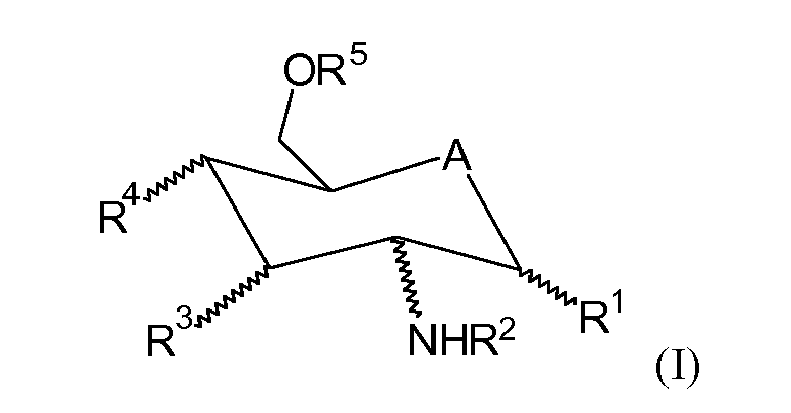 R1 is selected from the group comprising H, OH, SH and/or NH2;R2 is selected from the group comprising hydrogen, C1-C10-alkyl, C7-C14-arylalkyl wherein the aryl group has 6 to 10 carbon atoms and the alkyl group has 1 to 4 carbon atoms, C(O)C1-C10-alkyl, OC(O)C1-C10-alkyl, C(O)OC1-C10-alkyl, C(O)NH2, NH2 and/or S(O)2OH;R3 is selected from the group comprising OH, SH and/or NH2;R4 is selected from the group comprising OH, SH and/or NH2;R5 is selected from the group comprising hydrogen, P(O)(OH)2, S(O)2OH, P(S)(OH)2, P(O)OHSH, S(O)2SH and/or aryloxy phosphoramidates according to general formula (II)
R6 is selected from the group comprising linear or branched C1-C6-alkyl, benzyl and/or cyclohexyl;
R7 is a side chain of an amino acid selected from the group comprising hydrogen; linear or branched C1-C4-alkyl; linear or branched alkyl groups of the type -CnH2n-U-D wherein n is 1, 2, 3 or 4, U is selected from the group comprising O, CO, COO, CONH, S, guanidine and/or NH and D is selected from the group comprising H and/or C1-C3-alkyl; -CH2-C6H4-Y wherein Y is selected from the group comprising OH, SH, C1-C3-alkyl and/or NH2; -CH2-imidazole; -CH2-indole; -CH2-(furanyl-3-yl); -CH2-(pyridyl-3-yl) and/or -CH2-(imidazolyl-3-yl);
X is selected from the group comprising Cl, Br, I, C1-C6-alkyl and/or C1-C6-alkoxy;A is selected from the group comprising S, NR8, C=CR8R9 and/or CR8R9, whereinR8, R9 is selected, the same or each independently of the other, from the group comprising hydrogen, C1-C10-alkyl, C2-C10-alkenyl, C6-C10-aryl, C7-C14-arylalkyl wherein the aryl group has 6 to 10 carbon atoms and the alkyl group has 1 to 4 carbon atoms, C(O)C1-C10-alkyl, C(O)OC1-C10-alkyl, C(O)NH2, NH2, S(O)2OH and/or a linker,for the manufacture of a medicament for the therapeutic and/or prophylactic treatment of a bacterial infection, particularly for the manufacture of an antibiotic. - Method for preparing a compound according to any one of the foregoing claims wherein R5 is P(O)(OH)2 comprising the steps of:a) Preparation of a cyclohexane according to formula (IV)
 b) Alkaline hydrolysis of the carbamate moiety to a 1-hydroxy-2-benzylamino moiety;c) Selective introduction of a phosphate group to the primary hydroxyl group of the hydrolised cyclohexane of step b);d) Reduction of the benzyl protecting groups to the respective alcohol and amine groups of the cyclohexane of step c).
Priority Applications (4)
| Application Number | Priority Date | Filing Date | Title |
|---|---|---|---|
| EP10194929A EP2489654A1 (en) | 2010-12-14 | 2010-12-14 | Cyclohexane compounds and their use as antibiotics |
| EP11793835.7A EP2651878A1 (en) | 2010-12-14 | 2011-12-13 | Cyclohexane compounds and their use as antibiotics |
| US13/990,801 US8846645B2 (en) | 2010-12-14 | 2011-12-13 | Cyclohexane compounds and their use as antibiotics |
| PCT/EP2011/072597 WO2012080240A1 (en) | 2010-12-14 | 2011-12-13 | Cyclohexane compounds and their use as antibiotics |
Applications Claiming Priority (1)
| Application Number | Priority Date | Filing Date | Title |
|---|---|---|---|
| EP10194929A EP2489654A1 (en) | 2010-12-14 | 2010-12-14 | Cyclohexane compounds and their use as antibiotics |
Publications (1)
| Publication Number | Publication Date |
|---|---|
| EP2489654A1 true EP2489654A1 (en) | 2012-08-22 |
Family
ID=43828233
Family Applications (2)
| Application Number | Title | Priority Date | Filing Date |
|---|---|---|---|
| EP10194929A Withdrawn EP2489654A1 (en) | 2010-12-14 | 2010-12-14 | Cyclohexane compounds and their use as antibiotics |
| EP11793835.7A Withdrawn EP2651878A1 (en) | 2010-12-14 | 2011-12-13 | Cyclohexane compounds and their use as antibiotics |
Family Applications After (1)
| Application Number | Title | Priority Date | Filing Date |
|---|---|---|---|
| EP11793835.7A Withdrawn EP2651878A1 (en) | 2010-12-14 | 2011-12-13 | Cyclohexane compounds and their use as antibiotics |
Country Status (3)
| Country | Link |
|---|---|
| US (1) | US8846645B2 (en) |
| EP (2) | EP2489654A1 (en) |
| WO (1) | WO2012080240A1 (en) |
Cited By (1)
| Publication number | Priority date | Publication date | Assignee | Title |
|---|---|---|---|---|
| CN111748000A (en) * | 2019-03-29 | 2020-10-09 | 沈阳药科大学 | 3-Deoxy-5-hydroxy-1-amino carbon sugar compound and use thereof |
Families Citing this family (1)
| Publication number | Priority date | Publication date | Assignee | Title |
|---|---|---|---|---|
| CN107090506B (en) * | 2017-05-19 | 2021-02-23 | 鲁东大学 | Vancomycin nucleic acid dimer biosensor, preparation method and application thereof |
Citations (2)
| Publication number | Priority date | Publication date | Assignee | Title |
|---|---|---|---|---|
| US4871747A (en) * | 1985-12-20 | 1989-10-03 | Bayer Aktiengesellschaft | 3-Amino-4,5-dihydroxypiperidines, process for their preparation and their use |
| WO2006100586A1 (en) * | 2005-03-24 | 2006-09-28 | Technische Universität Graz | Glycosidase-inhibiting iminosugars |
-
2010
- 2010-12-14 EP EP10194929A patent/EP2489654A1/en not_active Withdrawn
-
2011
- 2011-12-13 WO PCT/EP2011/072597 patent/WO2012080240A1/en not_active Ceased
- 2011-12-13 EP EP11793835.7A patent/EP2651878A1/en not_active Withdrawn
- 2011-12-13 US US13/990,801 patent/US8846645B2/en not_active Expired - Fee Related
Patent Citations (2)
| Publication number | Priority date | Publication date | Assignee | Title |
|---|---|---|---|---|
| US4871747A (en) * | 1985-12-20 | 1989-10-03 | Bayer Aktiengesellschaft | 3-Amino-4,5-dihydroxypiperidines, process for their preparation and their use |
| WO2006100586A1 (en) * | 2005-03-24 | 2006-09-28 | Technische Universität Graz | Glycosidase-inhibiting iminosugars |
Non-Patent Citations (13)
| Title |
|---|
| AL-RAWI, SAMY ET AL: "Synthesis and Biochemical Properties of Reversible Inhibitors of UDP-N-Acetylglucosamine 2-Epimerase", ANGEWANDTE CHEMIE INTERNATIONAL EDITION, vol. 43, 2004, pages 4366 - 4370, XP002632724, DOI: 10.1002/anie.200453863 * |
| BARTON ET AL., TETRAHEDRON, vol. 46, 1990, pages 215 - 230 |
| BOGNAR R ET AL: "2-Acetamido-2-deoxy-5-thio-D-glucopyranose (5-thio-N-acetyl-D-glucosamine)", CARBOHYDRATE RESEARCH, vol. 90, no. 1, 16 March 1981 (1981-03-16), PERGAMON, GB, pages 138 - 143, XP026634856, ISSN: 0008-6215, [retrieved on 19810316], DOI: 10.1016/S0008-6215(00)85621-9 * |
| CHING-WEN HO ET AL: "Development of GlcNAc-Inspired Iminocyclitiols as Potent and Selective N-Acetyl-beta-Hexosaminidase Inhibitors", ACS CHEMICAL BIOLOGY, vol. 5, no. 5, 27 February 2010 (2010-02-27), pages 489 - 497, XP002632725, DOI: 10.1021/cb100011u * |
| GREIMEL P ET AL: "Fluorescent glycosidase inhibiting 1,5-dideoxy-1,5-iminoalditols", BIOORGANIC & MEDICINAL CHEMISTRY LETTERS, vol. 16, no. 8, 15 April 2006 (2006-04-15), PERGAMON, ELSEVIER SCIENCE, GB, pages 2067 - 2070, XP025106910, ISSN: 0960-894X, [retrieved on 20060415], DOI: 10.1016/J.BMCL.2006.01.095 * |
| KAJIHARA Y ET AL: "Galactosyl transfer ability of beta-(1->4)-galactosyltransferase toward 5a-carba-sugars", CARBOHYDRATE RESEARCH, vol. 323, no. 1-4, 12 January 1999 (1999-01-12), PERGAMON, GB, pages 44 - 48, XP004186498, ISSN: 0008-6215, DOI: 10.1016/S0008-6215(99)00258-X * |
| LE MERRER, YVES ET AL: "Synthesis of Azasugars as Potent Inhibitors of Glycosidases", BIOORGANIC & MEDICINAL CHEMISTRY, vol. 5, no. 3, 1997, pages 519 - 533, XP002632726 * |
| MIYAMOTO, M. ET AL., TETRAHEDRON LETT., vol. 33, 1992, pages 3725 - 3728 |
| OGAWA S ET AL: "Synthesis of dl-2-amino-2-deoxyvalidamine and its three diastereoisomers", CARBOHYDRATE RESEARCH, vol. 204, 5 September 1990 (1990-09-05), PERGAMON, GB, pages 51 - 64, XP026610232, ISSN: 0008-6215, [retrieved on 19900905], DOI: 10.1016/0008-6215(90)84020-U * |
| OGAWA, SEIICHIRO; TSUNODA, HIDETOSHI: "New Synthesis of 2-Amino-5a-carba-2-deoxy-alpha-DL-glucopyranose and Its Transformation ino Valienamine and Valiolamine Analogues", LIEBIGS ANNALEN DER CHEMIE, 1992, pages 637 - 641, XP002632722 * |
| RASSU GLORIA ET AL: "Variable Strategy toward Carbasugars and Relatives.6. Diastereoselective synthesis of 2-Deoxy-2-amino-5a-carba-beta-L-mannopyranuronic Acid and 2-Deoxy-2-amino-5a-carba-beta-L-mannopyranose", JOURNAL OF ORGANIC CHEMISTRY, vol. 69, 2004, pages 1625 - 1628, XP002632723 * |
| STEINER A J ET AL: "2-Acetamino-1,2-dideoxynojirimycin-lysine hybrids as hexosaminidase inhibitors", TETRAHEDRON ASYMMETRY, vol. 20, no. 6-8, 7 May 2009 (2009-05-07), PERGAMON PRESS LTD, OXFORD, GB, pages 832 - 835, XP026108719, ISSN: 0957-4166, [retrieved on 20090504], DOI: 10.1016/J.TETASY.2009.02.015 * |
| TANAHASHI E ET AL: "A facile synthesis of 2-acetamido-2-deoxy-5-thio-d-glucopyranose", CARBOHYDRATE RESEARCH, vol. 117, 16 June 1983 (1983-06-16), PERGAMON, GB, pages 304 - 308, XP026618390, ISSN: 0008-6215, [retrieved on 19830616], DOI: 10.1016/0008-6215(83)88098-7 * |
Cited By (2)
| Publication number | Priority date | Publication date | Assignee | Title |
|---|---|---|---|---|
| CN111748000A (en) * | 2019-03-29 | 2020-10-09 | 沈阳药科大学 | 3-Deoxy-5-hydroxy-1-amino carbon sugar compound and use thereof |
| CN111748000B (en) * | 2019-03-29 | 2022-05-20 | 沈阳药科大学 | 3-Deoxy-5-hydroxy-1-amino carbon sugar compound and use thereof |
Also Published As
| Publication number | Publication date |
|---|---|
| US20140066409A1 (en) | 2014-03-06 |
| WO2012080240A1 (en) | 2012-06-21 |
| US8846645B2 (en) | 2014-09-30 |
| EP2651878A1 (en) | 2013-10-23 |
Similar Documents
| Publication | Publication Date | Title |
|---|---|---|
| US10875885B2 (en) | β-d-2′-deoxy-2′-α-fluoro-2′-β-c-substituted-2-modified-n6-substituted purine nucleotides for HCV treatment | |
| WO2021007506A1 (en) | Compounds useful to treat influenza virus infections | |
| DK3112372T3 (en) | Pantothenate derivatives for the treatment of neurological disorders | |
| AU2002332640A1 (en) | Piperazinone compounds as anti-tumor and anti-cancer agents and methods of treatment | |
| EP1427418A2 (en) | Piperazinone compounds as anti-tumor and anti-cancer agents and methods of treatment | |
| US8846645B2 (en) | Cyclohexane compounds and their use as antibiotics | |
| US11241440B2 (en) | Dihydrooxadiazine compounds for treating infections and cancer | |
| CN101100474B (en) | Phosphate group-containing fluoroquinolone compound, its preparation method and its use in the preparation of medicines | |
| RU2678846C1 (en) | Method of synthesis 2-[3-(2-chlorethyl)-3-nitrosoureido]-1,3-propane-diol owned with antitumor activity | |
| GM et al. | UNIVERSITÄT KONSTANZ [DE/DE]; 78457 Konstanz (DE). | |
| Midrier et al. | Fosmidomycin analogues with N-hydroxyimidazole and N-hydroxyimidazolone as a chelating unit | |
| CA2953867A1 (en) | Pyridopyrazine compounds and their use in the treatment, amelioration or prevention of influenza | |
| US9162983B2 (en) | Reactivators of organophosphorous inhibited acetylcholinesterase | |
| AU2011311847B2 (en) | Method of preparation of antiviral compounds and useful intermediates thereof | |
| CN101220055B (en) | Method for preparing fluoroquinolone compounds containing phosphoric acid ester group | |
| WO2017100849A1 (en) | 6-oxopurine phosphoribosyl transferase inhibitors | |
| Wang et al. | Exploiting Substrate Diversity of NRPS Led to the Generation of New Sansanmycin Analogs | |
| Muvvala | Synthesis of bisubstrate analog inhibitors against aspartate semialdehyde dehydrogenase | |
| CN119080838A (en) | Antiviral drug and use thereof | |
| JP2004123710A (en) | Phosmidosine derivative and manufacturing method therefor | |
| HK1232544B (en) | Pantothenate derivatives for the treatment of neurologic disorders | |
| HK1232544A1 (en) | Pantothenate derivatives for the treatment of neurologic disorders | |
| HK1207863B (en) | Pantothenate derivatives for the treatment of neurologic disorders | |
| HK1102562A (en) | Phosphate-bearing prodrugs of sulfonyl hydrazines as hypoxia-selective antineoplastic agents | |
| HK40011503A (en) | Synthesis of polycyclic-carbamoylpyridone compounds |
Legal Events
| Date | Code | Title | Description |
|---|---|---|---|
| PUAI | Public reference made under article 153(3) epc to a published international application that has entered the european phase |
Free format text: ORIGINAL CODE: 0009012 |
|
| AK | Designated contracting states |
Kind code of ref document: A1 Designated state(s): AL AT BE BG CH CY CZ DE DK EE ES FI FR GB GR HR HU IE IS IT LI LT LU LV MC MK MT NL NO PL PT RO RS SE SI SK SM TR |
|
| AX | Request for extension of the european patent |
Extension state: BA ME |
|
| STAA | Information on the status of an ep patent application or granted ep patent |
Free format text: STATUS: THE APPLICATION IS DEEMED TO BE WITHDRAWN |
|
| 18D | Application deemed to be withdrawn |
Effective date: 20130223 |