EP2488477B1 - Process for producing methanol - Google Patents
Process for producing methanol Download PDFInfo
- Publication number
- EP2488477B1 EP2488477B1 EP10766105.0A EP10766105A EP2488477B1 EP 2488477 B1 EP2488477 B1 EP 2488477B1 EP 10766105 A EP10766105 A EP 10766105A EP 2488477 B1 EP2488477 B1 EP 2488477B1
- Authority
- EP
- European Patent Office
- Prior art keywords
- alkyl
- lewis
- lewis acid
- hydrogen
- process according
- Prior art date
- Legal status (The legal status is an assumption and is not a legal conclusion. Google has not performed a legal analysis and makes no representation as to the accuracy of the status listed.)
- Not-in-force
Links
- OKKJLVBELUTLKV-UHFFFAOYSA-N Methanol Chemical compound OC OKKJLVBELUTLKV-UHFFFAOYSA-N 0.000 title claims abstract description 80
- 238000000034 method Methods 0.000 title claims abstract description 50
- 230000008569 process Effects 0.000 title claims abstract description 33
- 150000007517 lewis acids Chemical class 0.000 claims abstract description 43
- 239000002841 Lewis acid Substances 0.000 claims abstract description 42
- 150000007527 lewis bases Chemical class 0.000 claims abstract description 36
- 229910052739 hydrogen Inorganic materials 0.000 claims abstract description 32
- 239000001257 hydrogen Substances 0.000 claims abstract description 32
- 239000002879 Lewis base Substances 0.000 claims abstract description 31
- 239000012014 frustrated Lewis pair Substances 0.000 claims abstract description 29
- UFHFLCQGNIYNRP-UHFFFAOYSA-N Hydrogen Chemical compound [H][H] UFHFLCQGNIYNRP-UHFFFAOYSA-N 0.000 claims abstract description 21
- 238000005984 hydrogenation reaction Methods 0.000 claims abstract description 11
- 238000004519 manufacturing process Methods 0.000 claims abstract description 9
- 238000010506 ionic fission reaction Methods 0.000 claims abstract description 5
- 125000000217 alkyl group Chemical group 0.000 claims description 57
- -1 nitro, hydroxyl Chemical group 0.000 claims description 46
- OBAJXDYVZBHCGT-UHFFFAOYSA-N tris(pentafluorophenyl)borane Chemical compound FC1=C(F)C(F)=C(F)C(F)=C1B(C=1C(=C(F)C(F)=C(F)C=1F)F)C1=C(F)C(F)=C(F)C(F)=C1F OBAJXDYVZBHCGT-UHFFFAOYSA-N 0.000 claims description 43
- RKMGAJGJIURJSJ-UHFFFAOYSA-N 2,2,6,6-tetramethylpiperidine Chemical compound CC1(C)CCCC(C)(C)N1 RKMGAJGJIURJSJ-UHFFFAOYSA-N 0.000 claims description 41
- 239000007787 solid Substances 0.000 claims description 32
- 125000001997 phenyl group Chemical group [H]C1=C([H])C([H])=C(*)C([H])=C1[H] 0.000 claims description 29
- OISVCGZHLKNMSJ-UHFFFAOYSA-N 2,6-dimethylpyridine Chemical compound CC1=CC=CC(C)=N1 OISVCGZHLKNMSJ-UHFFFAOYSA-N 0.000 claims description 28
- 125000005843 halogen group Chemical group 0.000 claims description 28
- 125000003545 alkoxy group Chemical group 0.000 claims description 26
- 125000005647 linker group Chemical group 0.000 claims description 20
- 125000001424 substituent group Chemical group 0.000 claims description 19
- 125000000623 heterocyclic group Chemical group 0.000 claims description 17
- 125000003118 aryl group Chemical group 0.000 claims description 16
- 125000004093 cyano group Chemical group *C#N 0.000 claims description 14
- 125000002496 methyl group Chemical group [H]C([H])([H])* 0.000 claims description 14
- 125000000999 tert-butyl group Chemical group [H]C([H])([H])C(*)(C([H])([H])[H])C([H])([H])[H] 0.000 claims description 13
- 150000001875 compounds Chemical class 0.000 claims description 12
- 125000001183 hydrocarbyl group Chemical group 0.000 claims description 11
- KTWOOEGAPBSYNW-UHFFFAOYSA-N ferrocene Chemical class [Fe+2].C=1C=C[CH-]C=1.C=1C=C[CH-]C=1 KTWOOEGAPBSYNW-UHFFFAOYSA-N 0.000 claims description 10
- 150000002431 hydrogen Chemical class 0.000 claims description 10
- 125000004452 carbocyclyl group Chemical group 0.000 claims description 9
- 125000000753 cycloalkyl group Chemical group 0.000 claims description 8
- 125000002023 trifluoromethyl group Chemical group FC(F)(F)* 0.000 claims description 7
- 229910052703 rhodium Inorganic materials 0.000 claims description 6
- 125000005037 alkyl phenyl group Chemical group 0.000 claims description 5
- 125000004429 atom Chemical group 0.000 claims description 5
- 229910052796 boron Inorganic materials 0.000 claims description 5
- 125000000524 functional group Chemical group 0.000 claims description 5
- 229910052760 oxygen Inorganic materials 0.000 claims description 5
- 229910052702 rhenium Inorganic materials 0.000 claims description 5
- ZOXJGFHDIHLPTG-UHFFFAOYSA-N Boron Chemical group [B] ZOXJGFHDIHLPTG-UHFFFAOYSA-N 0.000 claims description 4
- JUJWROOIHBZHMG-UHFFFAOYSA-N Pyridine Chemical group C1=CC=NC=C1 JUJWROOIHBZHMG-UHFFFAOYSA-N 0.000 claims description 4
- 229910052782 aluminium Chemical group 0.000 claims description 4
- 125000001153 fluoro group Chemical group F* 0.000 claims description 4
- 229910052698 phosphorus Inorganic materials 0.000 claims description 4
- ZYDUNXCLPOKBNQ-UHFFFAOYSA-N 2,2,6,6-tetramethyl-1,3-dihydropyridine Chemical compound CC1(C)CC=CC(C)(C)N1 ZYDUNXCLPOKBNQ-UHFFFAOYSA-N 0.000 claims description 3
- UWKQJZCTQGMHKD-UHFFFAOYSA-N 2,6-di-tert-butylpyridine Chemical compound CC(C)(C)C1=CC=CC(C(C)(C)C)=N1 UWKQJZCTQGMHKD-UHFFFAOYSA-N 0.000 claims description 3
- 125000002373 5 membered heterocyclic group Chemical group 0.000 claims description 3
- 125000004070 6 membered heterocyclic group Chemical group 0.000 claims description 3
- 239000004411 aluminium Chemical group 0.000 claims description 3
- XAGFODPZIPBFFR-UHFFFAOYSA-N aluminium Chemical group [Al] XAGFODPZIPBFFR-UHFFFAOYSA-N 0.000 claims description 3
- 125000005842 heteroatom Chemical group 0.000 claims description 3
- 125000004437 phosphorous atom Chemical group 0.000 claims description 3
- 238000002360 preparation method Methods 0.000 claims description 3
- 229910052717 sulfur Inorganic materials 0.000 claims description 3
- 125000003341 7 membered heterocyclic group Chemical group 0.000 claims description 2
- 229910052795 boron group element Inorganic materials 0.000 claims description 2
- UMJSCPRVCHMLSP-UHFFFAOYSA-N pyridine Natural products COC1=CC=CN=C1 UMJSCPRVCHMLSP-UHFFFAOYSA-N 0.000 claims description 2
- POHPFVPVRKJHCR-UHFFFAOYSA-N tris(2,3,4,5,6-pentafluorophenyl)alumane Chemical compound FC1=C(F)C(F)=C(F)C(F)=C1[Al](C=1C(=C(F)C(F)=C(F)C=1F)F)C1=C(F)C(F)=C(F)C(F)=C1F POHPFVPVRKJHCR-UHFFFAOYSA-N 0.000 claims description 2
- 229910002092 carbon dioxide Inorganic materials 0.000 description 83
- 238000006243 chemical reaction Methods 0.000 description 54
- YXFVVABEGXRONW-UHFFFAOYSA-N Toluene Chemical compound CC1=CC=CC=C1 YXFVVABEGXRONW-UHFFFAOYSA-N 0.000 description 49
- VLKZOEOYAKHREP-UHFFFAOYSA-N n-Hexane Chemical compound CCCCCC VLKZOEOYAKHREP-UHFFFAOYSA-N 0.000 description 37
- CURLTUGMZLYLDI-UHFFFAOYSA-N Carbon dioxide Chemical compound O=C=O CURLTUGMZLYLDI-UHFFFAOYSA-N 0.000 description 36
- IGWHDMPTQKSDTL-JXOAFFINSA-N TMP Chemical group O=C1NC(=O)C(C)=CN1[C@H]1[C@H](O)[C@H](O)[C@@H](COP(O)(O)=O)O1 IGWHDMPTQKSDTL-JXOAFFINSA-N 0.000 description 31
- 239000001569 carbon dioxide Substances 0.000 description 31
- 239000000243 solution Substances 0.000 description 29
- YMWUJEATGCHHMB-DICFDUPASA-N dichloromethane-d2 Chemical compound [2H]C([2H])(Cl)Cl YMWUJEATGCHHMB-DICFDUPASA-N 0.000 description 24
- 239000002904 solvent Substances 0.000 description 24
- OFBQJSOFQDEBGM-UHFFFAOYSA-N Pentane Chemical compound CCCCC OFBQJSOFQDEBGM-UHFFFAOYSA-N 0.000 description 22
- 230000015572 biosynthetic process Effects 0.000 description 22
- 238000004293 19F NMR spectroscopy Methods 0.000 description 18
- YMWUJEATGCHHMB-UHFFFAOYSA-N Dichloromethane Chemical compound ClCCl YMWUJEATGCHHMB-UHFFFAOYSA-N 0.000 description 18
- 238000004607 11B NMR spectroscopy Methods 0.000 description 17
- 238000005481 NMR spectroscopy Methods 0.000 description 15
- WACNXHCZHTVBJM-UHFFFAOYSA-N 1,2,3,4,5-pentafluorobenzene Chemical compound FC1=CC(F)=C(F)C(F)=C1F WACNXHCZHTVBJM-UHFFFAOYSA-N 0.000 description 14
- RTZKZFJDLAIYFH-UHFFFAOYSA-N Diethyl ether Chemical compound CCOCC RTZKZFJDLAIYFH-UHFFFAOYSA-N 0.000 description 14
- 241000894007 species Species 0.000 description 14
- 238000005160 1H NMR spectroscopy Methods 0.000 description 13
- 238000003786 synthesis reaction Methods 0.000 description 13
- 125000004432 carbon atom Chemical group C* 0.000 description 11
- 239000013078 crystal Substances 0.000 description 11
- 239000000047 product Substances 0.000 description 11
- IJGRMHOSHXDMSA-UHFFFAOYSA-N Atomic nitrogen Chemical compound N#N IJGRMHOSHXDMSA-UHFFFAOYSA-N 0.000 description 10
- 238000002474 experimental method Methods 0.000 description 10
- 238000010438 heat treatment Methods 0.000 description 9
- 238000001644 13C nuclear magnetic resonance spectroscopy Methods 0.000 description 8
- HEDRZPFGACZZDS-UHFFFAOYSA-N Chloroform Chemical compound ClC(Cl)Cl HEDRZPFGACZZDS-UHFFFAOYSA-N 0.000 description 8
- 125000001072 heteroaryl group Chemical group 0.000 description 8
- 150000004678 hydrides Chemical class 0.000 description 8
- 239000000203 mixture Substances 0.000 description 8
- 125000000449 nitro group Chemical group [O-][N+](*)=O 0.000 description 8
- 229910052757 nitrogen Inorganic materials 0.000 description 8
- 230000007246 mechanism Effects 0.000 description 7
- 125000000325 methylidene group Chemical group [H]C([H])=* 0.000 description 7
- 230000009467 reduction Effects 0.000 description 7
- 238000004009 13C{1H}-NMR spectroscopy Methods 0.000 description 6
- UORVGPXVDQYIDP-UHFFFAOYSA-N borane Chemical compound B UORVGPXVDQYIDP-UHFFFAOYSA-N 0.000 description 6
- 125000001495 ethyl group Chemical group [H]C([H])([H])C([H])([H])* 0.000 description 6
- 239000000543 intermediate Substances 0.000 description 6
- BDAGIHXWWSANSR-UHFFFAOYSA-N methanoic acid Natural products OC=O BDAGIHXWWSANSR-UHFFFAOYSA-N 0.000 description 6
- 238000001228 spectrum Methods 0.000 description 6
- 238000003756 stirring Methods 0.000 description 6
- 0 *c1cccc([Rh])n1 Chemical compound *c1cccc([Rh])n1 0.000 description 5
- OKTJSMMVPCPJKN-UHFFFAOYSA-N Carbon Chemical group [C] OKTJSMMVPCPJKN-UHFFFAOYSA-N 0.000 description 5
- 229910052799 carbon Inorganic materials 0.000 description 5
- 238000001035 drying Methods 0.000 description 5
- 125000002887 hydroxy group Chemical group [H]O* 0.000 description 5
- 125000000956 methoxy group Chemical group [H]C([H])([H])O* 0.000 description 5
- 239000002808 molecular sieve Substances 0.000 description 5
- URGAHOPLAPQHLN-UHFFFAOYSA-N sodium aluminosilicate Chemical compound [Na+].[Al+3].[O-][Si]([O-])=O.[O-][Si]([O-])=O URGAHOPLAPQHLN-UHFFFAOYSA-N 0.000 description 5
- 239000000126 substance Substances 0.000 description 5
- IAZDPXIOMUYVGZ-WFGJKAKNSA-N Dimethyl sulfoxide Chemical compound [2H]C([2H])([2H])S(=O)C([2H])([2H])[2H] IAZDPXIOMUYVGZ-WFGJKAKNSA-N 0.000 description 4
- BDAGIHXWWSANSR-UHFFFAOYSA-M Formate Chemical compound [O-]C=O BDAGIHXWWSANSR-UHFFFAOYSA-M 0.000 description 4
- 238000001460 carbon-13 nuclear magnetic resonance spectrum Methods 0.000 description 4
- 125000000058 cyclopentadienyl group Chemical group C1(=CC=CC1)* 0.000 description 4
- 238000000354 decomposition reaction Methods 0.000 description 4
- HPYNZHMRTTWQTB-UHFFFAOYSA-N dimethylpyridine Natural products CC1=CC=CN=C1C HPYNZHMRTTWQTB-UHFFFAOYSA-N 0.000 description 4
- 125000004435 hydrogen atom Chemical group [H]* 0.000 description 4
- 239000012299 nitrogen atmosphere Substances 0.000 description 4
- 238000000425 proton nuclear magnetic resonance spectrum Methods 0.000 description 4
- 229920006395 saturated elastomer Polymers 0.000 description 4
- QTBSBXVTEAMEQO-UHFFFAOYSA-N Acetic acid Chemical compound CC(O)=O QTBSBXVTEAMEQO-UHFFFAOYSA-N 0.000 description 3
- UHOVQNZJYSORNB-UHFFFAOYSA-N Benzene Chemical compound C1=CC=CC=C1 UHOVQNZJYSORNB-UHFFFAOYSA-N 0.000 description 3
- BTBUEUYNUDRHOZ-UHFFFAOYSA-N Borate Chemical compound [O-]B([O-])[O-] BTBUEUYNUDRHOZ-UHFFFAOYSA-N 0.000 description 3
- OAICVXFJPJFONN-UHFFFAOYSA-N Phosphorus Chemical compound [P] OAICVXFJPJFONN-UHFFFAOYSA-N 0.000 description 3
- VYPSYNLAJGMNEJ-UHFFFAOYSA-N Silicium dioxide Chemical compound O=[Si]=O VYPSYNLAJGMNEJ-UHFFFAOYSA-N 0.000 description 3
- 238000002441 X-ray diffraction Methods 0.000 description 3
- 230000004913 activation Effects 0.000 description 3
- 239000012298 atmosphere Substances 0.000 description 3
- 125000003785 benzimidazolyl group Chemical group N1=C(NC2=C1C=CC=C2)* 0.000 description 3
- 229910000085 borane Inorganic materials 0.000 description 3
- 239000006227 byproduct Substances 0.000 description 3
- 239000003054 catalyst Substances 0.000 description 3
- 238000006114 decarboxylation reaction Methods 0.000 description 3
- ZBCBWPMODOFKDW-UHFFFAOYSA-N diethanolamine Chemical group OCCNCCO ZBCBWPMODOFKDW-UHFFFAOYSA-N 0.000 description 3
- 238000009826 distribution Methods 0.000 description 3
- 238000000806 fluorine-19 nuclear magnetic resonance spectrum Methods 0.000 description 3
- WSFSSNUMVMOOMR-UHFFFAOYSA-N formaldehyde Natural products O=C WSFSSNUMVMOOMR-UHFFFAOYSA-N 0.000 description 3
- 229910052736 halogen Inorganic materials 0.000 description 3
- 150000002367 halogens Chemical class 0.000 description 3
- 125000002883 imidazolyl group Chemical group 0.000 description 3
- 238000002329 infrared spectrum Methods 0.000 description 3
- 230000010354 integration Effects 0.000 description 3
- 238000002955 isolation Methods 0.000 description 3
- GRVDJDISBSALJP-UHFFFAOYSA-N methyloxidanyl Chemical compound [O]C GRVDJDISBSALJP-UHFFFAOYSA-N 0.000 description 3
- 125000001624 naphthyl group Chemical group 0.000 description 3
- 125000000561 purinyl group Chemical group N1=C(N=C2N=CNC2=C1)* 0.000 description 3
- 125000003373 pyrazinyl group Chemical group 0.000 description 3
- 125000000168 pyrrolyl group Chemical group 0.000 description 3
- 125000002294 quinazolinyl group Chemical group N1=C(N=CC2=CC=CC=C12)* 0.000 description 3
- 238000001953 recrystallisation Methods 0.000 description 3
- 239000000523 sample Substances 0.000 description 3
- 230000003595 spectral effect Effects 0.000 description 3
- 238000006467 substitution reaction Methods 0.000 description 3
- CYRMSUTZVYGINF-UHFFFAOYSA-N trichlorofluoromethane Chemical compound FC(Cl)(Cl)Cl CYRMSUTZVYGINF-UHFFFAOYSA-N 0.000 description 3
- 229910015844 BCl3 Inorganic materials 0.000 description 2
- 238000005361 D2 NMR spectroscopy Methods 0.000 description 2
- 238000004252 FT/ICR mass spectrometry Methods 0.000 description 2
- MZRVEZGGRBJDDB-UHFFFAOYSA-N N-Butyllithium Chemical compound [Li]CCCC MZRVEZGGRBJDDB-UHFFFAOYSA-N 0.000 description 2
- XYFCBTPGUUZFHI-UHFFFAOYSA-N Phosphine Chemical compound P XYFCBTPGUUZFHI-UHFFFAOYSA-N 0.000 description 2
- FAPWRFPIFSIZLT-UHFFFAOYSA-M Sodium chloride Chemical compound [Na+].[Cl-] FAPWRFPIFSIZLT-UHFFFAOYSA-M 0.000 description 2
- NINIDFKCEFEMDL-UHFFFAOYSA-N Sulfur Chemical compound [S] NINIDFKCEFEMDL-UHFFFAOYSA-N 0.000 description 2
- 239000005864 Sulphur Substances 0.000 description 2
- 125000001931 aliphatic group Chemical group 0.000 description 2
- 150000001450 anions Chemical class 0.000 description 2
- QVGXLLKOCUKJST-UHFFFAOYSA-N atomic oxygen Chemical compound [O] QVGXLLKOCUKJST-UHFFFAOYSA-N 0.000 description 2
- 230000008901 benefit Effects 0.000 description 2
- UHOVQNZJYSORNB-MZWXYZOWSA-N benzene-d6 Chemical compound [2H]C1=C([2H])C([2H])=C([2H])C([2H])=C1[2H] UHOVQNZJYSORNB-MZWXYZOWSA-N 0.000 description 2
- 125000000499 benzofuranyl group Chemical group O1C(=CC2=C1C=CC=C2)* 0.000 description 2
- ILAHWRKJUDSMFH-UHFFFAOYSA-N boron tribromide Chemical compound BrB(Br)Br ILAHWRKJUDSMFH-UHFFFAOYSA-N 0.000 description 2
- 150000001642 boronic acid derivatives Chemical class 0.000 description 2
- 125000002915 carbonyl group Chemical group [*:2]C([*:1])=O 0.000 description 2
- 230000008859 change Effects 0.000 description 2
- 238000012512 characterization method Methods 0.000 description 2
- 239000007810 chemical reaction solvent Substances 0.000 description 2
- 229910052801 chlorine Inorganic materials 0.000 description 2
- 125000004230 chromenyl group Chemical group O1C(C=CC2=CC=CC=C12)* 0.000 description 2
- 229940125782 compound 2 Drugs 0.000 description 2
- 239000012043 crude product Substances 0.000 description 2
- 238000002425 crystallisation Methods 0.000 description 2
- 125000004122 cyclic group Chemical group 0.000 description 2
- 125000001995 cyclobutyl group Chemical group [H]C1([H])C([H])([H])C([H])(*)C1([H])[H] 0.000 description 2
- 125000000113 cyclohexyl group Chemical group [H]C1([H])C([H])([H])C([H])([H])C([H])(*)C([H])([H])C1([H])[H] 0.000 description 2
- 125000001511 cyclopentyl group Chemical group [H]C1([H])C([H])([H])C([H])([H])C([H])(*)C1([H])[H] 0.000 description 2
- 125000001559 cyclopropyl group Chemical group [H]C1([H])C([H])([H])C1([H])* 0.000 description 2
- 238000001514 detection method Methods 0.000 description 2
- GFKJMQOPKRDGGL-UHFFFAOYSA-N dibromoboron Chemical compound Br[B]Br GFKJMQOPKRDGGL-UHFFFAOYSA-N 0.000 description 2
- 238000004821 distillation Methods 0.000 description 2
- 230000000694 effects Effects 0.000 description 2
- 238000011156 evaluation Methods 0.000 description 2
- 238000001914 filtration Methods 0.000 description 2
- 229910052731 fluorine Inorganic materials 0.000 description 2
- 150000004675 formic acid derivatives Chemical class 0.000 description 2
- 239000002803 fossil fuel Substances 0.000 description 2
- 125000002541 furyl group Chemical group 0.000 description 2
- 239000007789 gas Substances 0.000 description 2
- 238000004817 gas chromatography Methods 0.000 description 2
- 239000011521 glass Substances 0.000 description 2
- 125000003453 indazolyl group Chemical group N1N=C(C2=C1C=CC=C2)* 0.000 description 2
- 125000001041 indolyl group Chemical group 0.000 description 2
- 229910003480 inorganic solid Inorganic materials 0.000 description 2
- 150000002500 ions Chemical class 0.000 description 2
- 125000000904 isoindolyl group Chemical group C=1(NC=C2C=CC=CC12)* 0.000 description 2
- 125000001449 isopropyl group Chemical group [H]C([H])([H])C([H])(*)C([H])([H])[H] 0.000 description 2
- 125000000842 isoxazolyl group Chemical group 0.000 description 2
- AMQDBUIQKQUCKY-UHFFFAOYSA-M magnesium;1,2,3,4,5-pentafluorobenzene-6-ide;bromide Chemical compound [Mg+2].[Br-].FC1=[C-]C(F)=C(F)C(F)=C1F AMQDBUIQKQUCKY-UHFFFAOYSA-M 0.000 description 2
- 238000004949 mass spectrometry Methods 0.000 description 2
- 239000000463 material Substances 0.000 description 2
- 238000005259 measurement Methods 0.000 description 2
- 239000012621 metal-organic framework Substances 0.000 description 2
- NBTOZLQBSIZIKS-UHFFFAOYSA-N methoxide Chemical compound [O-]C NBTOZLQBSIZIKS-UHFFFAOYSA-N 0.000 description 2
- 125000002950 monocyclic group Chemical group 0.000 description 2
- 125000004108 n-butyl group Chemical group [H]C([H])([H])C([H])([H])C([H])([H])C([H])([H])* 0.000 description 2
- 125000004433 nitrogen atom Chemical group N* 0.000 description 2
- 125000002868 norbornyl group Chemical group C12(CCC(CC1)C2)* 0.000 description 2
- 239000003921 oil Substances 0.000 description 2
- 229920000620 organic polymer Polymers 0.000 description 2
- 125000002971 oxazolyl group Chemical group 0.000 description 2
- 239000001301 oxygen Substances 0.000 description 2
- 125000001484 phenothiazinyl group Chemical group C1(=CC=CC=2SC3=CC=CC=C3NC12)* 0.000 description 2
- 239000011574 phosphorus Substances 0.000 description 2
- 125000004592 phthalazinyl group Chemical group C1(=NN=CC2=CC=CC=C12)* 0.000 description 2
- 239000000843 powder Substances 0.000 description 2
- 125000002924 primary amino group Chemical group [H]N([H])* 0.000 description 2
- 125000001436 propyl group Chemical group [H]C([*])([H])C([H])([H])C([H])([H])[H] 0.000 description 2
- 125000001042 pteridinyl group Chemical group N1=C(N=CC2=NC=CN=C12)* 0.000 description 2
- 238000000746 purification Methods 0.000 description 2
- 125000004076 pyridyl group Chemical group 0.000 description 2
- 125000000714 pyrimidinyl group Chemical group 0.000 description 2
- 125000000719 pyrrolidinyl group Chemical group 0.000 description 2
- 239000011541 reaction mixture Substances 0.000 description 2
- 230000002441 reversible effect Effects 0.000 description 2
- 125000006413 ring segment Chemical group 0.000 description 2
- 150000003839 salts Chemical class 0.000 description 2
- 125000002914 sec-butyl group Chemical group [H]C([H])([H])C([H])([H])C([H])(*)C([H])([H])[H] 0.000 description 2
- 150000003335 secondary amines Chemical class 0.000 description 2
- 238000010583 slow cooling Methods 0.000 description 2
- 239000007790 solid phase Substances 0.000 description 2
- 229910001220 stainless steel Inorganic materials 0.000 description 2
- 239000010935 stainless steel Substances 0.000 description 2
- 239000006228 supernatant Substances 0.000 description 2
- 150000003512 tertiary amines Chemical group 0.000 description 2
- 125000000335 thiazolyl group Chemical group 0.000 description 2
- 125000001544 thienyl group Chemical group 0.000 description 2
- FAQYAMRNWDIXMY-UHFFFAOYSA-N trichloroborane Chemical compound ClB(Cl)Cl FAQYAMRNWDIXMY-UHFFFAOYSA-N 0.000 description 2
- 238000005292 vacuum distillation Methods 0.000 description 2
- 125000004400 (C1-C12) alkyl group Chemical group 0.000 description 1
- XEKTVXADUPBFOA-UHFFFAOYSA-N 1-bromo-2,3,4,5,6-pentafluorobenzene Chemical compound FC1=C(F)C(F)=C(Br)C(F)=C1F XEKTVXADUPBFOA-UHFFFAOYSA-N 0.000 description 1
- 125000004974 2-butenyl group Chemical group C(C=CC)* 0.000 description 1
- 125000000069 2-butynyl group Chemical group [H]C([H])([H])C#CC([H])([H])* 0.000 description 1
- XWKFPIODWVPXLX-UHFFFAOYSA-N 2-methyl-5-methylpyridine Natural products CC1=CC=C(C)N=C1 XWKFPIODWVPXLX-UHFFFAOYSA-N 0.000 description 1
- 125000000850 2H-chromenyl group Chemical group O1C(C=CC2=CC=CC=C12)* 0.000 description 1
- OSWFIVFLDKOXQC-UHFFFAOYSA-N 4-(3-methoxyphenyl)aniline Chemical compound COC1=CC=CC(C=2C=CC(N)=CC=2)=C1 OSWFIVFLDKOXQC-UHFFFAOYSA-N 0.000 description 1
- 125000002471 4H-quinolizinyl group Chemical group C=1(C=CCN2C=CC=CC12)* 0.000 description 1
- 229910015845 BBr3 Inorganic materials 0.000 description 1
- KZMGYPLQYOPHEL-UHFFFAOYSA-N Boron trifluoride etherate Chemical compound FB(F)F.CCOCC KZMGYPLQYOPHEL-UHFFFAOYSA-N 0.000 description 1
- 229910021591 Copper(I) chloride Inorganic materials 0.000 description 1
- YZCKVEUIGOORGS-OUBTZVSYSA-N Deuterium Chemical compound [2H] YZCKVEUIGOORGS-OUBTZVSYSA-N 0.000 description 1
- VGGSQFUCUMXWEO-UHFFFAOYSA-N Ethene Chemical compound C=C VGGSQFUCUMXWEO-UHFFFAOYSA-N 0.000 description 1
- 239000005977 Ethylene Substances 0.000 description 1
- 238000005033 Fourier transform infrared spectroscopy Methods 0.000 description 1
- 238000004566 IR spectroscopy Methods 0.000 description 1
- 229920001410 Microfiber Polymers 0.000 description 1
- 238000012565 NMR experiment Methods 0.000 description 1
- NBIIXXVUZAFLBC-UHFFFAOYSA-N Phosphoric acid Chemical compound OP(O)(O)=O NBIIXXVUZAFLBC-UHFFFAOYSA-N 0.000 description 1
- XUIMIQQOPSSXEZ-UHFFFAOYSA-N Silicon Chemical compound [Si] XUIMIQQOPSSXEZ-UHFFFAOYSA-N 0.000 description 1
- 239000004809 Teflon Substances 0.000 description 1
- 229920006362 Teflon® Polymers 0.000 description 1
- 239000007983 Tris buffer Substances 0.000 description 1
- WKHWEDWQNRRHQT-UHFFFAOYSA-J [C+4].C(=O)[O-].C(=O)[O-].C(=O)[O-].C(=O)[O-] Chemical compound [C+4].C(=O)[O-].C(=O)[O-].C(=O)[O-].C(=O)[O-] WKHWEDWQNRRHQT-UHFFFAOYSA-J 0.000 description 1
- 238000010521 absorption reaction Methods 0.000 description 1
- DHKHKXVYLBGOIT-UHFFFAOYSA-N acetaldehyde Diethyl Acetal Natural products CCOC(C)OCC DHKHKXVYLBGOIT-UHFFFAOYSA-N 0.000 description 1
- 125000002777 acetyl group Chemical class [H]C([H])([H])C(*)=O 0.000 description 1
- 239000002253 acid Substances 0.000 description 1
- 125000000641 acridinyl group Chemical group C1(=CC=CC2=NC3=CC=CC=C3C=C12)* 0.000 description 1
- 230000006978 adaptation Effects 0.000 description 1
- 150000001299 aldehydes Chemical class 0.000 description 1
- 125000002723 alicyclic group Chemical group 0.000 description 1
- 150000001335 aliphatic alkanes Chemical class 0.000 description 1
- 150000001336 alkenes Chemical class 0.000 description 1
- 125000003342 alkenyl group Chemical group 0.000 description 1
- 125000002947 alkylene group Chemical group 0.000 description 1
- 125000000304 alkynyl group Chemical group 0.000 description 1
- PNEYBMLMFCGWSK-UHFFFAOYSA-N aluminium oxide Inorganic materials [O-2].[O-2].[O-2].[Al+3].[Al+3] PNEYBMLMFCGWSK-UHFFFAOYSA-N 0.000 description 1
- 150000001412 amines Chemical class 0.000 description 1
- 125000003277 amino group Chemical group 0.000 description 1
- 230000003466 anti-cipated effect Effects 0.000 description 1
- 150000004982 aromatic amines Chemical group 0.000 description 1
- 125000006615 aromatic heterocyclic group Chemical group 0.000 description 1
- 239000003849 aromatic solvent Substances 0.000 description 1
- 230000003190 augmentative effect Effects 0.000 description 1
- RWCCWEUUXYIKHB-UHFFFAOYSA-N benzophenone Chemical compound C=1C=CC=CC=1C(=O)C1=CC=CC=C1 RWCCWEUUXYIKHB-UHFFFAOYSA-N 0.000 description 1
- 239000012965 benzophenone Substances 0.000 description 1
- 125000004196 benzothienyl group Chemical group S1C(=CC2=C1C=CC=C2)* 0.000 description 1
- 230000005540 biological transmission Effects 0.000 description 1
- 238000001897 boron-11 nuclear magnetic resonance spectrum Methods 0.000 description 1
- BRTALTYTFFNPAC-UHFFFAOYSA-N boroxin Chemical compound B1OBOBO1 BRTALTYTFFNPAC-UHFFFAOYSA-N 0.000 description 1
- 229910052794 bromium Inorganic materials 0.000 description 1
- 125000000484 butyl group Chemical group [H]C([*])([H])C([H])([H])C([H])([H])C([H])([H])[H] 0.000 description 1
- 125000000609 carbazolyl group Chemical group C1(=CC=CC=2C3=CC=CC=C3NC12)* 0.000 description 1
- 125000002837 carbocyclic group Chemical group 0.000 description 1
- RBHJBMIOOPYDBQ-UHFFFAOYSA-N carbon dioxide;propan-2-one Chemical compound O=C=O.CC(C)=O RBHJBMIOOPYDBQ-UHFFFAOYSA-N 0.000 description 1
- 230000003197 catalytic effect Effects 0.000 description 1
- 238000009903 catalytic hydrogenation reaction Methods 0.000 description 1
- 150000001768 cations Chemical class 0.000 description 1
- 125000001309 chloro group Chemical group Cl* 0.000 description 1
- 125000003016 chromanyl group Chemical group O1C(CCC2=CC=CC=C12)* 0.000 description 1
- 125000000259 cinnolinyl group Chemical group N1=NC(=CC2=CC=CC=C12)* 0.000 description 1
- 238000003776 cleavage reaction Methods 0.000 description 1
- OXBLHERUFWYNTN-UHFFFAOYSA-M copper(I) chloride Chemical compound [Cu]Cl OXBLHERUFWYNTN-UHFFFAOYSA-M 0.000 description 1
- 238000012937 correction Methods 0.000 description 1
- 230000008878 coupling Effects 0.000 description 1
- 238000010168 coupling process Methods 0.000 description 1
- 238000005859 coupling reaction Methods 0.000 description 1
- MLUCVPSAIODCQM-NSCUHMNNSA-N crotonaldehyde Chemical compound C\C=C\C=O MLUCVPSAIODCQM-NSCUHMNNSA-N 0.000 description 1
- MLUCVPSAIODCQM-UHFFFAOYSA-N crotonaldehyde Natural products CC=CC=O MLUCVPSAIODCQM-UHFFFAOYSA-N 0.000 description 1
- 238000002447 crystallographic data Methods 0.000 description 1
- 230000001186 cumulative effect Effects 0.000 description 1
- 150000001924 cycloalkanes Chemical class 0.000 description 1
- 230000003247 decreasing effect Effects 0.000 description 1
- 230000007812 deficiency Effects 0.000 description 1
- 230000001419 dependent effect Effects 0.000 description 1
- 238000009795 derivation Methods 0.000 description 1
- 239000002274 desiccant Substances 0.000 description 1
- 239000011903 deuterated solvents Substances 0.000 description 1
- 229910052805 deuterium Inorganic materials 0.000 description 1
- 125000005509 dibenzothiophenyl group Chemical group 0.000 description 1
- 238000007323 disproportionation reaction Methods 0.000 description 1
- 238000010494 dissociation reaction Methods 0.000 description 1
- 230000005593 dissociations Effects 0.000 description 1
- 125000005303 dithiazolyl group Chemical group S1SNC(=C1)* 0.000 description 1
- 230000009977 dual effect Effects 0.000 description 1
- 230000005611 electricity Effects 0.000 description 1
- 239000012039 electrophile Substances 0.000 description 1
- 230000008030 elimination Effects 0.000 description 1
- 238000003379 elimination reaction Methods 0.000 description 1
- 238000005516 engineering process Methods 0.000 description 1
- 230000007613 environmental effect Effects 0.000 description 1
- 238000000605 extraction Methods 0.000 description 1
- 230000004992 fission Effects 0.000 description 1
- 235000019253 formic acid Nutrition 0.000 description 1
- 239000000446 fuel Substances 0.000 description 1
- 125000003838 furazanyl group Chemical group 0.000 description 1
- 239000011491 glass wool Substances 0.000 description 1
- 239000005431 greenhouse gas Substances 0.000 description 1
- 238000000227 grinding Methods 0.000 description 1
- 125000001475 halogen functional group Chemical group 0.000 description 1
- 125000000592 heterocycloalkyl group Chemical group 0.000 description 1
- 125000004051 hexyl group Chemical group [H]C([H])([H])C([H])([H])C([H])([H])C([H])([H])C([H])([H])C([H])([H])* 0.000 description 1
- 238000004896 high resolution mass spectrometry Methods 0.000 description 1
- 238000009905 homogeneous catalytic hydrogenation reaction Methods 0.000 description 1
- 239000008240 homogeneous mixture Substances 0.000 description 1
- 239000012456 homogeneous solution Substances 0.000 description 1
- 125000002632 imidazolidinyl group Chemical group 0.000 description 1
- 238000011065 in-situ storage Methods 0.000 description 1
- 125000003406 indolizinyl group Chemical group C=1(C=CN2C=CC=CC12)* 0.000 description 1
- 229910010272 inorganic material Inorganic materials 0.000 description 1
- 239000011147 inorganic material Substances 0.000 description 1
- 238000003780 insertion Methods 0.000 description 1
- 230000037431 insertion Effects 0.000 description 1
- 230000003993 interaction Effects 0.000 description 1
- 238000011835 investigation Methods 0.000 description 1
- 229910052740 iodine Inorganic materials 0.000 description 1
- 229910052742 iron Inorganic materials 0.000 description 1
- 125000001977 isobenzofuranyl group Chemical group C=1(OC=C2C=CC=CC12)* 0.000 description 1
- 125000003384 isochromanyl group Chemical group C1(OCCC2=CC=CC=C12)* 0.000 description 1
- 125000002183 isoquinolinyl group Chemical group C1(=NC=CC2=CC=CC=C12)* 0.000 description 1
- 125000005956 isoquinolyl group Chemical group 0.000 description 1
- 125000001786 isothiazolyl group Chemical group 0.000 description 1
- 238000001948 isotopic labelling Methods 0.000 description 1
- 238000002372 labelling Methods 0.000 description 1
- 239000007788 liquid Substances 0.000 description 1
- 239000011159 matrix material Substances 0.000 description 1
- QSHDDOUJBYECFT-UHFFFAOYSA-N mercury Chemical compound [Hg] QSHDDOUJBYECFT-UHFFFAOYSA-N 0.000 description 1
- 229910052753 mercury Inorganic materials 0.000 description 1
- 239000003863 metallic catalyst Substances 0.000 description 1
- HZVOZRGWRWCICA-UHFFFAOYSA-N methanediyl Chemical compound [CH2] HZVOZRGWRWCICA-UHFFFAOYSA-N 0.000 description 1
- WSFSSNUMVMOOMR-NJFSPNSNSA-N methanone Chemical compound O=[14CH2] WSFSSNUMVMOOMR-NJFSPNSNSA-N 0.000 description 1
- 239000003658 microfiber Substances 0.000 description 1
- 239000012229 microporous material Substances 0.000 description 1
- 125000002757 morpholinyl group Chemical group 0.000 description 1
- 125000004123 n-propyl group Chemical group [H]C([H])([H])C([H])([H])C([H])([H])* 0.000 description 1
- 125000004593 naphthyridinyl group Chemical group N1=C(C=CC2=CC=CN=C12)* 0.000 description 1
- 229910052755 nonmetal Inorganic materials 0.000 description 1
- 238000012587 nuclear overhauser effect experiment Methods 0.000 description 1
- 239000011368 organic material Substances 0.000 description 1
- 125000002524 organometallic group Chemical group 0.000 description 1
- 238000012856 packing Methods 0.000 description 1
- 238000005192 partition Methods 0.000 description 1
- 125000001147 pentyl group Chemical group C(CCCC)* 0.000 description 1
- 125000005327 perimidinyl group Chemical group N1C(=NC2=CC=CC3=CC=CC1=C23)* 0.000 description 1
- 125000004934 phenanthridinyl group Chemical group C1(=CC=CC2=NC=C3C=CC=CC3=C12)* 0.000 description 1
- 125000004625 phenanthrolinyl group Chemical group N1=C(C=CC2=CC=C3C=CC=NC3=C12)* 0.000 description 1
- 125000001791 phenazinyl group Chemical group C1(=CC=CC2=NC3=CC=CC=C3N=C12)* 0.000 description 1
- 125000001644 phenoxazinyl group Chemical group C1(=CC=CC=2OC3=CC=CC=C3NC12)* 0.000 description 1
- 229910000073 phosphorus hydride Inorganic materials 0.000 description 1
- 125000004193 piperazinyl group Chemical group 0.000 description 1
- 125000003386 piperidinyl group Chemical group 0.000 description 1
- 125000005936 piperidyl group Chemical group 0.000 description 1
- 239000004033 plastic Substances 0.000 description 1
- 230000003389 potentiating effect Effects 0.000 description 1
- 239000002244 precipitate Substances 0.000 description 1
- 239000002243 precursor Substances 0.000 description 1
- 230000005588 protonation Effects 0.000 description 1
- 125000004309 pyranyl group Chemical group O1C(C=CC=C1)* 0.000 description 1
- 125000003072 pyrazolidinyl group Chemical group 0.000 description 1
- 125000003226 pyrazolyl group Chemical group 0.000 description 1
- 125000002098 pyridazinyl group Chemical group 0.000 description 1
- 125000001422 pyrrolinyl group Chemical group 0.000 description 1
- 238000010791 quenching Methods 0.000 description 1
- 230000000171 quenching effect Effects 0.000 description 1
- 125000002943 quinolinyl group Chemical group N1=C(C=CC2=CC=CC=C12)* 0.000 description 1
- 125000005493 quinolyl group Chemical group 0.000 description 1
- 125000001567 quinoxalinyl group Chemical group N1=C(C=NC2=CC=CC=C12)* 0.000 description 1
- 230000005855 radiation Effects 0.000 description 1
- 239000012429 reaction media Substances 0.000 description 1
- 230000006798 recombination Effects 0.000 description 1
- 238000005215 recombination Methods 0.000 description 1
- 238000011160 research Methods 0.000 description 1
- 238000002390 rotary evaporation Methods 0.000 description 1
- 230000007017 scission Effects 0.000 description 1
- 229910052710 silicon Inorganic materials 0.000 description 1
- 239000010703 silicon Substances 0.000 description 1
- 229920002545 silicone oil Polymers 0.000 description 1
- 239000011780 sodium chloride Substances 0.000 description 1
- 230000003068 static effect Effects 0.000 description 1
- 238000003860 storage Methods 0.000 description 1
- 239000000758 substrate Substances 0.000 description 1
- 239000000725 suspension Substances 0.000 description 1
- 238000012360 testing method Methods 0.000 description 1
- 125000003718 tetrahydrofuranyl group Chemical group 0.000 description 1
- 125000003831 tetrazolyl group Chemical group 0.000 description 1
- 125000004627 thianthrenyl group Chemical group C1(=CC=CC=2SC3=CC=CC=C3SC12)* 0.000 description 1
- 125000005505 thiomorpholino group Chemical group 0.000 description 1
- 125000004568 thiomorpholinyl group Chemical group 0.000 description 1
- 230000001988 toxicity Effects 0.000 description 1
- 231100000419 toxicity Toxicity 0.000 description 1
- 229910052723 transition metal Inorganic materials 0.000 description 1
- 229910000314 transition metal oxide Inorganic materials 0.000 description 1
- 150000003624 transition metals Chemical class 0.000 description 1
- 125000004306 triazinyl group Chemical group 0.000 description 1
- 125000001425 triazolyl group Chemical group 0.000 description 1
- BWHDROKFUHTORW-UHFFFAOYSA-N tritert-butylphosphane Chemical compound CC(C)(C)P(C(C)(C)C)C(C)(C)C BWHDROKFUHTORW-UHFFFAOYSA-N 0.000 description 1
- 238000007514 turning Methods 0.000 description 1
- 230000007306 turnover Effects 0.000 description 1
- 238000002061 vacuum sublimation Methods 0.000 description 1
- 230000035899 viability Effects 0.000 description 1
- 238000010792 warming Methods 0.000 description 1
- 239000003643 water by type Substances 0.000 description 1
- 238000010626 work up procedure Methods 0.000 description 1
- 239000010457 zeolite Substances 0.000 description 1
- 125000004933 β-carbolinyl group Chemical group C1(=NC=CC=2C3=CC=CC=C3NC12)* 0.000 description 1
Images


Classifications
-
- C—CHEMISTRY; METALLURGY
- C07—ORGANIC CHEMISTRY
- C07C—ACYCLIC OR CARBOCYCLIC COMPOUNDS
- C07C29/00—Preparation of compounds having hydroxy or O-metal groups bound to a carbon atom not belonging to a six-membered aromatic ring
- C07C29/15—Preparation of compounds having hydroxy or O-metal groups bound to a carbon atom not belonging to a six-membered aromatic ring by reduction of oxides of carbon exclusively
- C07C29/151—Preparation of compounds having hydroxy or O-metal groups bound to a carbon atom not belonging to a six-membered aromatic ring by reduction of oxides of carbon exclusively with hydrogen or hydrogen-containing gases
- C07C29/153—Preparation of compounds having hydroxy or O-metal groups bound to a carbon atom not belonging to a six-membered aromatic ring by reduction of oxides of carbon exclusively with hydrogen or hydrogen-containing gases characterised by the catalyst used
-
- C—CHEMISTRY; METALLURGY
- C07—ORGANIC CHEMISTRY
- C07C—ACYCLIC OR CARBOCYCLIC COMPOUNDS
- C07C29/00—Preparation of compounds having hydroxy or O-metal groups bound to a carbon atom not belonging to a six-membered aromatic ring
- C07C29/15—Preparation of compounds having hydroxy or O-metal groups bound to a carbon atom not belonging to a six-membered aromatic ring by reduction of oxides of carbon exclusively
- C07C29/159—Preparation of compounds having hydroxy or O-metal groups bound to a carbon atom not belonging to a six-membered aromatic ring by reduction of oxides of carbon exclusively with reducing agents other than hydrogen or hydrogen-containing gases
Definitions
- This invention relates to a novel process for the production of methanol. More specifically, the present invention relates to a process of producing methanol by the hydrogenation of carbon dioxide (CO 2 ).
- Methanol is considered to be a valuable product because it can be safely stored and transported.
- world demand for methanol is currently increasing enormously because of its role as a precursor to many useful organic chemicals (e.g., formaldehyde, acetic acid); a substitute for traditional fossil fuels; and in the generation of electricity in fuel cells.
- transition metal oxide catalysts used in these hydrogenation reactions can be expensive, and their toxicity can also give rise to potential environmental and/or disposal problems.
- the present invention provides a process for the preparation of methanol comprising:
- the process of the present invention also avoids the use of metallic catalysts. Furthermore, the reaction can proceed at relatively low temperatures and pressures, and it is also specific for the production of methanol (i.e. no other C 1 by-products are formed).
- the process of the present invention makes use of the ability of a frustrated Lewis pair to heterolytically cleave hydrogen.
- Various researchers have shown that frustrated Lewis pairs can heterolytically activate hydrogen, [4] and that these systems can then be subsequently used in the metal-free catalytic hydrogenation of olefins and other organic substrates. [5]
- the present invention provides the use of a frustrated Lewis pair in a process as defined above.
- hydrocarbyl as used herein includes reference to moieties consisting exclusively of hydrogen and carbon atoms; such a moiety is typically an aliphatic moiety. The moiety may, for example, comprise 1, 2, 3, 4, 5, 6, 7, 8, 9, 10, 11 or 12 carbon atoms.
- hydrocarbyl groups include (1-6C)alkyl (e.g. C 1 , C 2 , C 3 or C 4 alkyl, for example methyl, ethyl, propyl, isopropyl, n-butyl, sec-butyl or tert-butyl); (2-6C)alkenyl (e.g. 2-butenyl); and (2-6C)alkynyl (e.g. 2-butynyl) and the like.
- alkyl as used herein include reference to a straight or branched chain alkyl moieties, typically having 1, 2, 3, 4, 5 or 6 carbon atoms. This term includes reference to groups such as methyl, ethyl, propyl (n-propyl or isopropyl), butyl (n-butyl, sec-butyl or tert-butyl), pentyl, hexyl and the like. In particular, an alkyl may have 1, 2, 3 or 4 carbon atoms.
- alkoxy as used herein include reference to -O-alkyl, wherein alkyl is straight or branched chain and comprises 1, 2, 3, 4, 5 or 6 carbon atoms. In one class of embodiments, alkoxy has 1, 2, 3 or 4 carbon atoms. This term includes reference to groups such as methoxy, ethoxy, propoxy, isopropoxy, butoxy, tert-butoxy, pentoxy, hexoxy and the like.
- carbocyclyl as used herein includes reference to a saturated (e.g. cycloalkyl) or unsaturated (e.g. aryl) ring moiety having 3, 4, 5, 6, 7, 8, 9 or 10 ring carbon atoms.
- carbocyclyl includes a 3- to 10-membered ring or ring system and, in particular, a 6-membered ring, which may be saturated or unsaturated.
- a carbocyclic moiety is, for example, selected from cyclopropyl, cyclobutyl, cyclopentyl, cyclohexyl, norbornyl, bicyclo[2.2.2]octyl, phenyl, naphthyl, and the like.
- cycloalkyl as used herein includes reference to an alicyclic moiety having 3, 4, 5, 6, 7 or 8 carbon atoms.
- the group may be a bridged or polycyclic ring system. More often cycloalkyl groups are monocyclic. This term includes reference to groups such as cyclopropyl, cyclobutyl, cyclopentyl, cyclohexyl, norbornyl, bicyclo[2.2.2]octyl and the like.
- aryl as used herein includes reference to an aromatic ring system comprising 6, 7, 8, 9 or 10 ring carbon atoms.
- Aryl is often phenyl but may be a polycyclic ring system, having two or more rings, at least one of which is aromatic. This term includes reference to groups such as phenyl, naphthyl and the like.
- heterocyclyl as used herein includes reference to a saturated (e.g. heterocycloalkyl) or unsaturated (e.g. heteroaryl) heterocyclic ring moiety having from 3, 4, 5, 6, 7, 8, 9 or 10 ring atoms, at least one of which is selected from nitrogen, oxygen, phosphorus, silicon and sulphur.
- heterocyclyl includes a 5- to 10-membered ring or ring system and more particularly a 5- or 6-membered ring, which may be saturated or unsaturated.
- a heterocyclic moiety is, for example, selected from imidazolyl, thienyl, furyl, tetrahydrofuryl, pyranyl, thiopyranyl, thianthrenyl, isobenzofuranyl, benzofuranyl, chromenyl, 2H-pyrrolyl, pyrrolyl, pyrrolinyl, pyrrolidinyl, imidazolyl, imidazolidinyl, benzimidazolyl, pyrazolyl, pyrazinyl, pyrazolidinyl, thiazolyl, isothiazolyl, dithiazolyl, oxazolyl, isoxazolyl, pyridyl, pyrazinyl, pyrimidinyl, piperidyl, piperazinyl, pyridazinyl, morpholinyl, thiomorpholinyl, especially thiomorpholino, indolizinyl, isoind
- heteroaryl as used herein includes reference to an aromatic heterocyclic ring system having 5, 6, 7, 8, 9 or 10 ring atoms, at least one of which is selected from nitrogen, oxygen and sulphur.
- the group may be a polycyclic ring system, having two or more rings, at least one of which is aromatic, but is more often monocyclic.
- This term includes reference to groups such as pyrimidinyl, furanyl, benzo[b]thiophenyl, thiophenyl, pyrrolyl, imidazolyl, pyrrolidinyl, pyridinyl, benzo[b]furanyl, pyrazinyl, purinyl, indolyl, benzimidazolyl, quinolinyl, phenothiazinyl, triazinyl, phthalazinyl, 2H-chromenyl, oxazolyl, isoxazolyl, thiazolyl, isoindolyl, indazolyl, purinyl, isoquinolinyl, quinazolinyl, pteridinyl and the like.
- halogen or "halo" as used herein includes reference to F, Cl, Br or I. In a particular, halogen may be F or Cl, of which F is more common.
- substituted as used herein in reference to a moiety means that one or more, especially up to 5, more especially 1, 2 or 3, of the hydrogen atoms in said moiety are replaced independently of each other by the corresponding number of the described substituents.
- optionally substituted as used herein means substituted or unsubstituted.
- substituents are only at positions where they are chemically possible, the person skilled in the art being able to decide (either experimentally or theoretically) without inappropriate effort whether a particular substitution is possible.
- amino or hydroxy groups with free hydrogen may be unstable if bound to carbon atoms with unsaturated (e.g. olefinic) bonds.
- substituents described herein may themselves be substituted by any substituent, subject to the aforementioned restriction to appropriate substitutions as recognised by the skilled man.
- the term "frustrated Lewis pair” is used herein to refer to a compound or mixture of compounds containing a Lewis acid and a Lewis base which, because of steric hindrance, cannot combine to form a strongly bound adduct, or may not in fact form any adduct at all.
- the frustrated Lewis pairs of the present invention must be capable of heterolytically cleaving hydrogen.
- optionally substituted ferrocene refers to two cyclopentadienyl rings with a central Fe atom.
- the rings may be substituted with hydrocarbyl, aryl, heterocyclyl etc, and/or may further comprise a (2-3C) bridge that links the two cyclopentadienyl rings, which may also be optionally substituted with (1-4C)alkyl.
- the N or P atom of a Lewis base as defined herein may be bonded to the cyclopentadienyl rings or the bridge group connecting the two cyclopentadienyl rings.
- the present invention provides a process for the preparation of methanol comprising:
- Any suitable frustrated Lewis pair that can heterolytically cleave hydrogen can be used in the process of the present invention.
- the Lewis acid and Lewis base are separate molecules that together form a frustrated Lewis pair.
- the Lewis acid and Lewis base may be separate moieties of the same molecule.
- the Lewis acid and Lewis base may be linked together to form a single molecule.
- the precise nature of the linker that connects the Lewis acid to the Lewis Base is not critical as long as the Lewis acid and Lewis base moieties can still perform their function by interacting with, and heterolytically cleaving, hydrogen.
- the frustrated Lewis pair is immobilised onto a suitable solid support (this could be a either an organic(polymer-based) or inorganic solid phase).
- a suitable solid support this could be a either an organic(polymer-based) or inorganic solid phase.
- the immobilisation on a solid support may be facilitated by covalently bonding to otherwise adhering the separate Lewis acid or Lewis base molecules to the solid support, or by linking a single molecule that comprises suitable Lewis acid and Lewis base moieties to the solid support.
- Lewis acids are of the structural formula I shown below: wherein:
- X is selected from boron or aluminium.
- X is boron
- X is aluminium
- Q 1 and Q 2 are each independently selected from C 1-12 alkyl, phenyl, naphthyl, heteroaryl, each of which is substituted by one or more substituent groups selected from halo, cyano, nitro, (1-6C)alkyl or (1-6C)alkoxy.
- Q 1 and Q 2 are each independently phenyl or pyrrolyl, each of which is substituted by one or more substituent groups selected from halo, cyano, nitro, (1-6C)alkyl or (1-6C) alkoxy.
- Q 1 and Q 2 are phenyl substituted by halo, cyano, nitro or (1-6C)alkoxy.
- Q 1 and Q 2 are each independently phenyl or heteroaryl substituted by an electron withdrawing substituent.
- Q 1 and Q 2 are each independently phenyl or heteroaryl substituted by three to five electron withdrawing substituents.
- Q 1 and Q 2 are each independently phenyl or heteroaryl substituted by one or more halo, cyano, nitro, or (1-6C) alkoxy groups.
- Q 1 and Q 2 are each independently phenyl or heteroaryl substituted by three to five halo, cyano, or nitro groups.
- L is any one of the groups defined herein for Q 1 or Q 2 .
- L is a linker group
- it may be any suitable linker group capable of connecting the boron atom of the Lewis acid to a solid support.
- it may be a functional group capable of reacting with a functional group on the solid support surface to form a covalent bond, or it may be a hydrocarbyl, carbocyclyl, heterocyclyl group which is substituted with a substituent comprising a suitable functional group.
- the solid this could be a either an organic(polymer-based) or inorganic solid phase.
- groups Q 1 , Q 2 and L are the same.
- the Lewis acid has the structural formula II shown below: wherein:
- R a , R b and R c are each electron withdrawing substituents.
- R a , R b and R c are each independently selected from halo, cyano, nitro, or (1-4C)alkoxy.
- R a , R b and R c are each independently selected from halo, cyano, nitro, (1-4C)alkyl, (1-4C)alkoxy, phenyl, or (1-2C)alkylphenyl.
- R a , R b and R c are each independently selected from halo, cyano, nitro, (1-4C)alkyl, or (1-4C)alkoxy.
- R a , R b and R c are each independently selected from chloro, fluoro or cyano.
- R a , R b and R c are each independently selected from fluoro or cyano.
- R a , R b and R c are each independently selected from fluoro or cyano.
- x, y and z are each independently selected from 1, 2, 3, 4 or 5. In a further embodiment, x, y and z are each independently selected from 3, 4 or 5. In a further embodiment, x, y and z are all 5.
- Lewis acids include B(C 6 F 5 ) 3 , B(C 6 Cl 5 ) 3 , B(C 6 F 5 )(C 6 Cl 5 ) 2 , B(C 6 F 5 ) 2 (C 6 Cl 5 ), Al(C 6 F 5 ) 3 , B(C 6 F 4 H) 3 , BCl(C 6 F 5 ) 2 , or [HB(C 6 F 5 ) 2 ] n where n is 1 or 2.
- Lewis acids of interest include C 6 F 5 ) 3 , B(C 6 Cl 5 ) 3 , B(C 6 F 5 )(C 6 Cl 5 ) 2 , and B(C 6 F 5 ) 2 (C 6 Cl 5 ).
- Any suitable Lewis base that can form a component of a frustrated Lewis pair that can cleave H 2 is encompassed by the present invention.
- the Lewis base is a secondary or tertiary amine group.
- there are no hydrogen atoms present on the ⁇ -carbon atoms i.e. the carbon atoms directly linked to the nitrogen atom of the amine group).
- the secondary or tertiary amine may be an aromatic or an aliphatic amine group.
- the Lewis base is an aromatic amine group of formula III shown below: wherein:
- R a and R b are selected from hydrocarbyl (especially (1-6C)alkyl, e.g. methyl or t-butyl), halo, hydroxyl, cyano, amino, NH(1-6C)alkyl, N[(1-6C)alkyl] 2 ,-S(O) r -(1-6C)alkyl (where r is 0, 1 or 2), carbocyclyl (e.g. phenyl), heterocyclyl, an optionally substituted ferrocene or (0-6C)alkyl- XQ 1 Q 2 .
- R a and R b are selected from (1-6C)alkyl or phenyl.
- R a and R b are selected from methyl, t-butyl or phenyl.
- R c and R d may be any suitable ring substituent, such as, for example, halo, nitro, cyano, amino, trifluoromethyl, (1-6C)alkyl, (1-6C)alkoxy, NH(1-6C)alkyl, N[(1-6C)alkyl] 2 , -S(O) r -(1-6C)alkyl (where r is 0, 1 or 2) or aryl (e.g. phenyl).
- ring substituent such as, for example, halo, nitro, cyano, amino, trifluoromethyl, (1-6C)alkyl, (1-6C)alkoxy, NH(1-6C)alkyl, N[(1-6C)alkyl] 2 , -S(O) r -(1-6C)alkyl (where r is 0, 1 or 2) or aryl (e.g. phenyl).
- w is 0.
- the Lewis base is 2,6-dimethylpyridine or 2,6-di-t-butylpyridine.
- the Lewis base is an aliphatic amine, particularly an aliphatic amine of the general formula IV shown below: wherein
- R g , R h , R i and R j are all hydrocarbyl, especially (1-6C)alkyl (e.g. methyl or t-butyl).
- R g , R h , R i and R j are all methyl.
- R e and R f are linked so that, together with the -C(R g R h )-N(R k )-C(R i R j )- group to which they are attached, they form a 5- or 6-membered heterocyclic ring, which optionally comprises one additional heteroatom selected from N, O or S.
- R e and R f are linked so that, together with the -C(R g R h )-N(R k )-C(R i R j )- group to which they are attached, they form a piperidine ring.
- R k is hydrogen or -(0-6C)alkyl-L-XQ 1 Q 2 .
- a suitable Lewis base is 2,2,6,6-tetramethylpiperidine.
- the Lewis base is a heterocyclic carbene of the general formula V: wherein:
- R m and R n are (3-6C)alkyl, e.g. t-butyl.
- R o and R p are both hydrogen.
- the Lewis base is a phosphorus containing compound of the general formula VI wherein:
- R x , R y and R z are each independently selected from (1-6C)alkyl, (e.g. ethyl, t-butyl) or phenyl, each of which is optionally substituted with halo, cyano, nitro, amino, (1-6C)alkyl or (1-6C)alkoxy or -XQ 1 Q 2 , where X, Q 1 and Q 2 are as defined hereinbefore, or an optionally substituted ferrocene.
- (1-6C)alkyl e.g. ethyl, t-butyl
- phenyl each of which is optionally substituted with halo, cyano, nitro, amino, (1-6C)alkyl or (1-6C)alkoxy or -XQ 1 Q 2 , where X, Q 1 and Q 2 are as defined hereinbefore, or an optionally substituted ferrocene.
- R x , R y and R z are each independently selected from (1-6C)alkyl, (e.g. ethyl, t-butyl) or phenyl, each of which is optionally substituted with halo, (1-6C)alkyl or (1-6C)alkoxy or -XQ 1 Q 2 , where X, Q 1 and Q 2 are as defined hereinbefore.
- R x , R y and R z are each independently selected from (1-6C)alkyl, (e.g. ethyl, t-butyl) or phenyl, each of which is optionally substituted with halo, (1-6C)alkyl or (1-6C)alkoxy or -B(C 6 F 5 ) 2 .
- R y and R z are each phenyl substituted with 1, 2 or 3 methyl and R x is ethyl, t-butyl or phenyl substituted with halo or B(C 6 F 5 ) 2 .
- R x , R y and R z are each independently selected from t-butyl or phenyl substituted with 1, 2 or 3 methyl.
- the Lewis bases reference is made to certain groups that may function as a linker to connect the Lewis base to a Lewis acid as defined herein to form a single molecule having a Lewis base moiety and a Lewis acid moiety.
- the nature of the linker group is not critical as long as the Lewis acid and base moieties are spatially positioned so that they can function as a frustrated Lewis pair and heterolytically cleave hydrogen.
- the linker may be an (1-6C)alkylene, e.g. methylene or ethylene, or (0-6C)alkylene-phenylene-, e.g. -CH 2 -phenylene-.
- frustrated Lewis pairs having Lewis acid and Lewis base moieties within the same molecule (and which can heterolytically cleave hydrogen) are shown below: Further particular examples of frustrated Lewis pairs are B(C 6 F 5 ) 3 with a Lewis base selected from:
- Suitable solvents include solvents that do not co-ordinate (i.e. they are non-polar). Examples include aromatic solvents such as toluene, alkanes such as hexane, and cycloalkanes.
- the reaction may be conducted at any suitable temperature ranging from room temperature upwards. Temperatures of 150°C or greater are generally preferred. A person skilled in the art will be able to select optimum temperatures for carrying out the reaction.
- the reaction may also be carried out at relative low pressure (e.g. 1 to 2 atmospheres).
- relative low pressure e.g. 1 to 2 atmospheres.
- a person skilled in the art would be readily able to optimize the pressures at which the reaction is performed.
- the process may be performed as a series of discrete steps in which intermediates formed during the process are individually formed and isolated or, more preferably, the reaction may be conducted in a single step.
- the methanol product formed by the process of the invention can conveniently collected by distillation.
- Figure 1 shows (a) a thermal ellipsoid plot of structure of one molecule in asymmetric unit of compound 2 ([TMPH] [HCO 2 B(C 6 F 5 ) 3 ). Hydrogen atoms on the TMP ring have been removed for clarity, thermal ellipsoids shown at 50 % probability.
- Figure 2 shows a 13 C NMR spectra of 2a after (a) 0 hr, (b) 24 hr and (c) 144 hr, at 160°C. * denotes peaks from solvent (C 7 D 8 ); insets enhance region of 13 CO 2 resonance.
- Example 1 A mechanistic evaluation of the hydrogenation of CO 2 to methanol
- Reaction solvents were dried using a MBraun SPS-800 solvent purification system and stored over K mirrors whilst NMR solvents were freeze-thaw degassed and stored over K (C 7 D 8 ) or molecular sieves (CD 2 Cl 2 , DMSO-d 6 ).
- H 2 (BOC) and CO 2 were dried via passage through a column of molecular sieves prior to use.
- TMP 2,2,6,6-tetramethylpiperidine
- HCO 2 H (95% wt.%), DCO 2 D (98% at.D) and H 13 CO 2 H (Goss Scientific, 99% at. 13 C).
- B(C 6 F 5 ) 3 (sublimed prior to use), [20] H 2 O.B(C 6 F 5 ) 3 , [17c] TMP- d 1 (N-D) [21] and 1 [7] were synthesised according to literature procedures.
- the first step in the reaction involves the heterolytic cleavage of H 2 using a frustrated Lewis pair.
- a suitable frustrated Lewis pair is 2,2,6,6-tetramethylpiperidine (TMP) and B(C 6 F 5 ) 3 .
- TMP 2,2,6,6-tetramethylpiperidine
- B(C 6 F 5 ) 3 The reaction of H 2 with an equimolar ratio of 2,2,6,6-tetramethylpiperidine (TMP) and B(C 6 F 5 ) 3 has been documented by Sumerin et al., to give the salt [TMPH][HB(C 6 F 5 ) 3 ] (1) (Scheme 1) in which the hydrogen molecule has undergone heterolytic fission. [7]
- Figure 2 shows the time dependence of the 13 C NMR of 2a on heating at 160 °C in toluene.
- High-resolution mass spectrometry (ESI, -ve mode) of an aliquot of the reaction mixture after 24 hr heating at 160°C offered great insight into the mechanism.
- the MS exhibited ions which could be assigned to the borate anions in 1 and 2 in addition to the H 2 O.B(C 6 F 5 ) 3 H-bonded anions of HOB(C 6 F 5 ) 3 , CH 3 OB(C 6 F 5 ) 3 , HCO 2 B(C 6 F 5 ) 3 .
- the species (C 6 F 5 ) 3 B(HCO 2 )B(C 6 F 5 ) 3 is also detected which could result from the reaction of HCO 2 B(C 6 F 5 ) 3 with free B(C 6 F 5 ) 3 .
- Reaction solvents (pentane, hexane, benzene, toluene, CH 2 Cl 2 ) were dried using an MBraun SPS-800 solvent purification system; the aliphatics and aromatics were stored over K mirrored ampoules. Et 2 O and THF were distilled from purple Na/benzophenone indicator. Dry solvents were stored in oven or flame-dried ampoules, sealed with a Rotaflo or Youngs' taps under nitrogen. H 2 gas (BOC) was dried via passage through a column of pre-activated 3 ⁇ molecular sieves.
- Deuterated NMR solvents were dried and freeze-thaw degassed over the appropriate drying agent: C 6 D 6 , C 7 D 8 (K); CD 2 Cl 2 (3 ⁇ molecular sieves) and purchased from Goss Scientific (99.6, 99.6 and 99.8% D respectively).
- BBr 3 99.9%
- BCl 3 1.0 M in hexanes
- BF 3 ⁇ OEt 2 C 6 Cl 6 (99.9%)
- C 6 F 5 Br 99%
- CuCl > 99%
- Mg turnings 99.5%
- n BuLi 2.5 M in hexanes
- 2,2,6,6-tetramethylpiperidine > 99%
- trans -crotonaldehyde > 99%
- IR spectra were recorded on a Nicolet MAGNA-IR 560 FT-IR spectrometer (range 4000-400 cm -1 , resolution 0.5 cm -1 ). Solution IR spectra were obtained in CH 2 Cl 2 solvent, using a KBr cell. Solutions were injected into the cell in the glovebox and the spectra recorded immediately. Mulled samples were prepared by grinding the material into a fine powder, mulling with Nujol and the paste administered to NaCl plates which were pressed together, placed in an air-tight holder and the spectra recorded immediately.
- Recrystallisation was performed using a minimum quantity of toluene at 100°C followed by rapid filtration through glass wool. Slow cooling to room temperature overnight led to the formation of pale yellow crystals of C-toluene. The toluene supernatant was siphoned off and the crystals washed with pentane (2 x 20 ml), followed by drying overnight under vacuum (1 x 10 -3 mbar) to remove toluene of crystallisation; yield 3.26 g (42.2%). X-ray quality crystals were produced by a second toluene recrystallisation.
- the Frustrated Lewis Pair systems of A-C TMP all homogenously reduce CO 2 with H 2 to deliver a yield of MeOH.
- the cumulative Lewis acidity and basicity have an observed effect on the degree of activation with the stability of the formed hydroxy species appearing to increase across the series.
- Hydroxy species [TMPH][C ⁇ OH] can be resolved in the 11 B NMR and reflects the robust nature of the Lewis Acid.
Landscapes
- Chemical & Material Sciences (AREA)
- Organic Chemistry (AREA)
- Chemical Kinetics & Catalysis (AREA)
- Organic Low-Molecular-Weight Compounds And Preparation Thereof (AREA)
Abstract
Description
- This invention relates to a novel process for the production of methanol. More specifically, the present invention relates to a process of producing methanol by the hydrogenation of carbon dioxide (CO2).
- The role of carbon dioxide as a greenhouse gas and its contribution to global warming is widely recognised by both scientists and governmental agencies. It is now imperative that new reactions and processes are discovered that can either efficiently store or utilise the abundant and renewable CO2 resource in an environmentally friendly manner. However, this presents a fundamental challenge because carbon dioxide is kinetically and thermodynamically stable.
- The storage of the non polar CO2 molecule in a solid form is difficult, but progress is being made using a range of high surface area macro and microporous materials, such as inorganic materials (e.g. alumina, silicas and zeolites), organic materials (e.g. activated carbons), as well as complex metal-organic frameworks (MOFs). [1] Arguably a more desirable outcome would be the low temperature conversion of CO2 into alternative chemicals useful for both energy production and as chemical feedstocks. Simultaneously this would have the additional benefit of reducing our requirements on fossil fuel reserves. Homogenous and heterogeneous processes have been developed that utilise CO2 to produce CO, formic acid and its derivatives.[2] However, these reactions are far from ideal, so further breakthrough technologies are required.
- There is particular interest in the reduction of CO2 by H2 to give renewable sources such as methanol. Methanol is considered to be a valuable product because it can be safely stored and transported. In addition, world demand for methanol is currently increasing enormously because of its role as a precursor to many useful organic chemicals (e.g., formaldehyde, acetic acid); a substitute for traditional fossil fuels; and in the generation of electricity in fuel cells.
- CO2 hydrogenation has been extensively developed using solid oxide catalysts, but was only first reported in homogeneous solution by Sasaki and co-workers using Ru3(CO)12-Kl mixtures.[3] However, these systems tend to give distributions of C1 products, namely CO, CH3OH and CH4.
- Furthermore, the transition metal oxide catalysts used in these hydrogenation reactions can be expensive, and their toxicity can also give rise to potential environmental and/or disposal problems.
- Accordingly, there is a need for improved processes for the manufacture methanol from CO2 which can: (i) provide the methanol in a pure form (i.e. without other C1 by-products); (ii) be operated at relatively low temperatures and pressures; and (iii) avoid the use of transition metal catalysts.
- In a first aspect, the present invention provides a process for the preparation of methanol comprising:
- (i) the heterolytic cleavage of hydrogen by a frustrated Lewis pair comprising a Lewis acid and a Lewis base; and
- (ii) the hydrogenation of CO2 with the heterolytically cleaved hydrogen formed in step (i) to form methanol.
- In addition to the obvious advantages associated with a process that utilises the abundant CO2 resource available, the process of the present invention also avoids the use of metallic catalysts. Furthermore, the reaction can proceed at relatively low temperatures and pressures, and it is also specific for the production of methanol (i.e. no other C1 by-products are formed).
- The process of the present invention makes use of the ability of a frustrated Lewis pair to heterolytically cleave hydrogen. Various researchers have shown that frustrated Lewis pairs can heterolytically activate hydrogen,[4] and that these systems can then be subsequently used in the metal-free catalytic hydrogenation of olefins and other organic substrates.[5]
- However, no one has used these systems to catalytically hydrogenate CO2 and thereby provide an advantageous method for the synthesis of methanol.
- In a further aspect, the present invention provides the use of a frustrated Lewis pair in a process as defined above.
- The term "hydrocarbyl" as used herein includes reference to moieties consisting exclusively of hydrogen and carbon atoms; such a moiety is typically an aliphatic moiety. The moiety may, for example, comprise 1, 2, 3, 4, 5, 6, 7, 8, 9, 10, 11 or 12 carbon atoms. Examples of hydrocarbyl groups include (1-6C)alkyl (e.g. C1, C2, C3 or C4 alkyl, for example methyl, ethyl, propyl, isopropyl, n-butyl, sec-butyl or tert-butyl); (2-6C)alkenyl (e.g. 2-butenyl); and (2-6C)alkynyl (e.g. 2-butynyl) and the like.
- The term "alkyl" as used herein include reference to a straight or branched chain alkyl moieties, typically having 1, 2, 3, 4, 5 or 6 carbon atoms. This term includes reference to groups such as methyl, ethyl, propyl (n-propyl or isopropyl), butyl (n-butyl, sec-butyl or tert-butyl), pentyl, hexyl and the like. In particular, an alkyl may have 1, 2, 3 or 4 carbon atoms.
- The term "alkoxy" as used herein include reference to -O-alkyl, wherein alkyl is straight or branched chain and comprises 1, 2, 3, 4, 5 or 6 carbon atoms. In one class of embodiments, alkoxy has 1, 2, 3 or 4 carbon atoms. This term includes reference to groups such as methoxy, ethoxy, propoxy, isopropoxy, butoxy, tert-butoxy, pentoxy, hexoxy and the like.
- The term "carbocyclyl" as used herein includes reference to a saturated (e.g. cycloalkyl) or unsaturated (e.g. aryl) ring moiety having 3, 4, 5, 6, 7, 8, 9 or 10 ring carbon atoms. In particular, carbocyclyl includes a 3- to 10-membered ring or ring system and, in particular, a 6-membered ring, which may be saturated or unsaturated. A carbocyclic moiety is, for example, selected from cyclopropyl, cyclobutyl, cyclopentyl, cyclohexyl, norbornyl, bicyclo[2.2.2]octyl, phenyl, naphthyl, and the like.
- The term "cycloalkyl" as used herein includes reference to an alicyclic moiety having 3, 4, 5, 6, 7 or 8 carbon atoms. The group may be a bridged or polycyclic ring system. More often cycloalkyl groups are monocyclic. This term includes reference to groups such as cyclopropyl, cyclobutyl, cyclopentyl, cyclohexyl, norbornyl, bicyclo[2.2.2]octyl and the like.
- The term "aryl" as used herein includes reference to an aromatic ring system comprising 6, 7, 8, 9 or 10 ring carbon atoms. Aryl is often phenyl but may be a polycyclic ring system, having two or more rings, at least one of which is aromatic. This term includes reference to groups such as phenyl, naphthyl and the like.
- The term "heterocyclyl" as used herein includes reference to a saturated (e.g. heterocycloalkyl) or unsaturated (e.g. heteroaryl) heterocyclic ring moiety having from 3, 4, 5, 6, 7, 8, 9 or 10 ring atoms, at least one of which is selected from nitrogen, oxygen, phosphorus, silicon and sulphur. In particular, heterocyclyl includes a 5- to 10-membered ring or ring system and more particularly a 5- or 6-membered ring, which may be saturated or unsaturated.
- A heterocyclic moiety is, for example, selected from imidazolyl, thienyl, furyl, tetrahydrofuryl, pyranyl, thiopyranyl, thianthrenyl, isobenzofuranyl, benzofuranyl, chromenyl, 2H-pyrrolyl, pyrrolyl, pyrrolinyl, pyrrolidinyl, imidazolyl, imidazolidinyl, benzimidazolyl, pyrazolyl, pyrazinyl, pyrazolidinyl, thiazolyl, isothiazolyl, dithiazolyl, oxazolyl, isoxazolyl, pyridyl, pyrazinyl, pyrimidinyl, piperidyl, piperazinyl, pyridazinyl, morpholinyl, thiomorpholinyl, especially thiomorpholino, indolizinyl, isoindolyl, 3H-indolyl, indolyl, benzimidazolyl, cumaryl, indazolyl, triazolyl, tetrazolyl, purinyl, 4H-quinolizinyl, isoquinolyl, quinolyl, tetrahydroquinolyl, tetrahydroisoquinolyl, decahydroquinolyl, octahydroisoquinolyl, benzofuranyl, dibenzofuranyl, benzothiophenyl, dibenzothiophenyl, phthalazinyl, naphthyridinyl, quinoxalyl, quinazolinyl, quinazolinyl, cinnolinyl, pteridinyl, carbazolyl, β-carbolinyl, phenanthridinyl, acridinyl, perimidinyl, phenanthrolinyl, furazanyl, phenazinyl, phenothiazinyl, phenoxazinyl, chromenyl, isochromanyl, chromanyl and the like.
- The term "heteroaryl" as used herein includes reference to an aromatic heterocyclic ring system having 5, 6, 7, 8, 9 or 10 ring atoms, at least one of which is selected from nitrogen, oxygen and sulphur. The group may be a polycyclic ring system, having two or more rings, at least one of which is aromatic, but is more often monocyclic. This term includes reference to groups such as pyrimidinyl, furanyl, benzo[b]thiophenyl, thiophenyl, pyrrolyl, imidazolyl, pyrrolidinyl, pyridinyl, benzo[b]furanyl, pyrazinyl, purinyl, indolyl, benzimidazolyl, quinolinyl, phenothiazinyl, triazinyl, phthalazinyl, 2H-chromenyl, oxazolyl, isoxazolyl, thiazolyl, isoindolyl, indazolyl, purinyl, isoquinolinyl, quinazolinyl, pteridinyl and the like.
- The term "halogen" or "halo" as used herein includes reference to F, Cl, Br or I. In a particular, halogen may be F or Cl, of which F is more common.
- The term "substituted" as used herein in reference to a moiety means that one or more, especially up to 5, more especially 1, 2 or 3, of the hydrogen atoms in said moiety are replaced independently of each other by the corresponding number of the described substituents. The term "optionally substituted" as used herein means substituted or unsubstituted.
- It will, of course, be understood that substituents are only at positions where they are chemically possible, the person skilled in the art being able to decide (either experimentally or theoretically) without inappropriate effort whether a particular substitution is possible. For example, amino or hydroxy groups with free hydrogen may be unstable if bound to carbon atoms with unsaturated (e.g. olefinic) bonds. Additionally, it will of course be understood that the substituents described herein may themselves be substituted by any substituent, subject to the aforementioned restriction to appropriate substitutions as recognised by the skilled man.
- The term "frustrated Lewis pair" is used herein to refer to a compound or mixture of compounds containing a Lewis acid and a Lewis base which, because of steric hindrance, cannot combine to form a strongly bound adduct, or may not in fact form any adduct at all. The frustrated Lewis pairs of the present invention must be capable of heterolytically cleaving hydrogen.
- The expression "optionally substituted ferrocene" used herein refers to two cyclopentadienyl rings with a central Fe atom. The rings may be substituted with hydrocarbyl, aryl, heterocyclyl etc, and/or may further comprise a (2-3C) bridge that links the two cyclopentadienyl rings, which may also be optionally substituted with (1-4C)alkyl. The N or P atom of a Lewis base as defined herein may be bonded to the cyclopentadienyl rings or the bridge group connecting the two cyclopentadienyl rings.
- As previously stated, the present invention provides a process for the preparation of methanol comprising:
- (i) the heterolytic cleavage of hydrogen by a frustrated Lewis pair; and
- (ii) the hydrogenation of CO2 with the heterolytically cleaved hydrogen formed in step (i) to yield the methanol product.
- Any suitable frustrated Lewis pair that can heterolytically cleave hydrogen can be used in the process of the present invention.
- In an embodiment of the invention, the Lewis acid and Lewis base are separate molecules that together form a frustrated Lewis pair.
- In an alternative embodiment, the Lewis acid and Lewis base may be separate moieties of the same molecule. In other words, the Lewis acid and Lewis base may be linked together to form a single molecule. The precise nature of the linker that connects the Lewis acid to the Lewis Base is not critical as long as the Lewis acid and Lewis base moieties can still perform their function by interacting with, and heterolytically cleaving, hydrogen.
- In a further embodiment, the frustrated Lewis pair is immobilised onto a suitable solid support (this could be a either an organic(polymer-based) or inorganic solid phase). The immobilisation on a solid support may be facilitated by covalently bonding to otherwise adhering the separate Lewis acid or Lewis base molecules to the solid support, or by linking a single molecule that comprises suitable Lewis acid and Lewis base moieties to the solid support.
- It will be appreciated that any suitable Lewis acid known in the art as a component of a frustrated Lewis pair which is capable of cleaving H2 is encompassed by the present invention.
- Particularly suitable Lewis acids are of the structural formula I shown below:

- X is a Group 13 element such as B or Al;
- Q1 and Q2 are each independently selected from hydrocarbyl, carbocyclyl, or heterocyclyl, each of which is optionally substituted with one or more substituents selected from halo, cyano, nitro, hydroxyl, (1-6C)alkyl, (3-6C)cycloalkyl, (1-6C)alkoxy, phenyl, (1-6C)alkylphenyl, heterocyclyl, (1-6C)alkylheterocyclyl, or a linker group which is capable of binding the X atom to a solid support; and
- L is hydrogen, halo, any one of the groups defined above for Q1 or Q2, or a linker group which is capable of binding the X atom to a solid support.
- In an embodiment, X is selected from boron or aluminium.
- In an embodiment, X is boron.
- In an embodiment, X is aluminium.
- In an embodiment, Q1 and Q2 are each independently selected from C1-12alkyl, phenyl, naphthyl, heteroaryl, each of which is substituted by one or more substituent groups selected from halo, cyano, nitro, (1-6C)alkyl or (1-6C)alkoxy.
- In a further embodiment, Q1 and Q2 are each independently phenyl or pyrrolyl, each of which is substituted by one or more substituent groups selected from halo, cyano, nitro, (1-6C)alkyl or (1-6C) alkoxy.
- In a further embodiment, Q1 and Q2 are phenyl substituted by halo, cyano, nitro or (1-6C)alkoxy.
- In a further embodiment, Q1 and Q2 are each independently phenyl or heteroaryl substituted by an electron withdrawing substituent.
- In a further embodiment, Q1 and Q2 are each independently phenyl or heteroaryl substituted by three to five electron withdrawing substituents.
- In a further embodiment, Q1 and Q2 are each independently phenyl or heteroaryl substituted by one or more halo, cyano, nitro, or (1-6C) alkoxy groups.
- In a further embodiment, Q1 and Q2 are each independently phenyl or heteroaryl substituted by three to five halo, cyano, or nitro groups.
- In an embodiment, L is any one of the groups defined herein for Q1 or Q2.
- When L is a linker group, it may be any suitable linker group capable of connecting the boron atom of the Lewis acid to a solid support. For example, it may be a functional group capable of reacting with a functional group on the solid support surface to form a covalent bond, or it may be a hydrocarbyl, carbocyclyl, heterocyclyl group which is substituted with a substituent comprising a suitable functional group. The solid this could be a either an organic(polymer-based) or inorganic solid phase.
- In a particular embodiment, groups Q1, Q2 and L are the same.
- In a further embodiment, the Lewis acid has the structural formula II shown below:
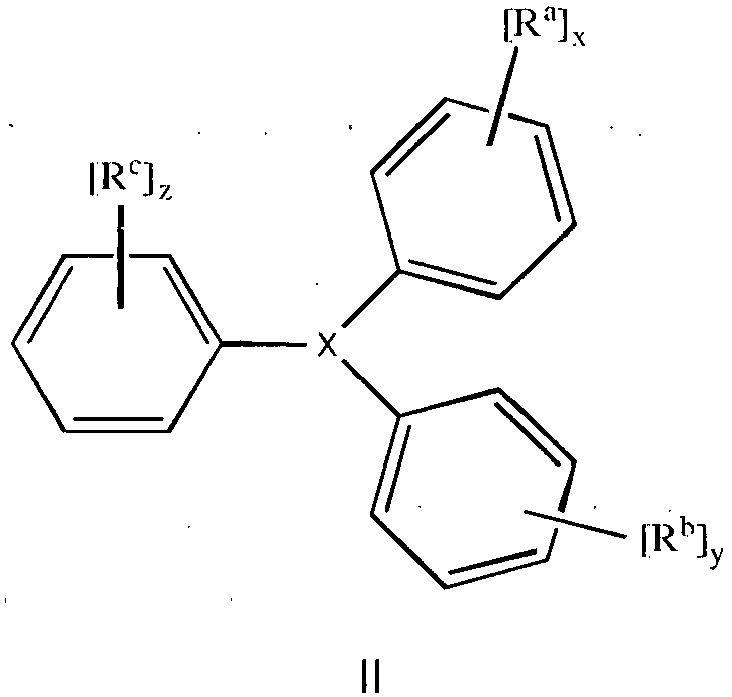
- X is as defined above;
- Ra, Rb and Rc are each independently selected from halo, cyano, nitro, hydroxy, amino, (1-6C)alkyl, (3-6C)cycloalkyl, (1-6C)alkoxy, phenyl, (1-6C)alkylphenyl; and
- x, y and z are each independently selected from 0, 1, 2, 3, 4 or 5.
- In an alternative embodiment, Ra, Rb and Rc are each electron withdrawing substituents.
- In an embodiment, Ra, Rb and Rc are each independently selected from halo, cyano, nitro, or (1-4C)alkoxy.
- In an embodiment, Ra, Rb and Rc are each independently selected from halo, cyano, nitro, (1-4C)alkyl, (1-4C)alkoxy, phenyl, or (1-2C)alkylphenyl.
- In an embodiment, Ra, Rb and Rc are each independently selected from halo, cyano, nitro, (1-4C)alkyl, or (1-4C)alkoxy.
- In a particular embodiment, Ra, Rb and Rc are each independently selected from chloro, fluoro or cyano.
- In a further embodiment, Ra, Rb and Rc are each independently selected from fluoro or cyano.
- In a further embodiment, Ra, Rb and Rc are each independently selected from fluoro or cyano.
- In a particular embodiment, x, y and z are each independently selected from 1, 2, 3, 4 or 5. In a further embodiment, x, y and z are each independently selected from 3, 4 or 5. In a further embodiment, x, y and z are all 5.
- Particular examples of suitable Lewis acids include B(C6F5)3, B(C6Cl5)3, B(C6F5)(C6Cl5)2, B(C6F5)2(C6Cl5), Al(C6F5)3, B(C6F4H)3, BCl(C6F5)2, or [HB(C6F5)2]n where n is 1 or 2.
- Particular Lewis acids of interest include C6F5)3, B(C6Cl5)3, B(C6F5)(C6Cl5)2, and B(C6F5)2(C6Cl5).
- Any suitable Lewis base that can form a component of a frustrated Lewis pair that can cleave H2 is encompassed by the present invention.
- In an embodiment, the Lewis base is a secondary or tertiary amine group. Suitably, there are no hydrogen atoms present on the α-carbon atoms (i.e. the carbon atoms directly linked to the nitrogen atom of the amine group). The secondary or tertiary amine may be an aromatic or an aliphatic amine group.
- In an embodiment, the Lewis base is an aromatic amine group of formula III shown below:

- Ra, Rb, Rc and Rd are each a substituent group other than hydrogen, or a linker group to connect the compound of Formula III to a Lewis acid (e.g. -XQ1Q2, where X, Q1 and Q2 are as defined hereinbefore) or a solid support; and
- w is 0, 1, 2 or 3.
- Suitably, Ra and Rb are selected from hydrocarbyl (especially (1-6C)alkyl, e.g. methyl or t-butyl), halo, hydroxyl, cyano, amino, NH(1-6C)alkyl, N[(1-6C)alkyl]2,-S(O)r-(1-6C)alkyl (where r is 0, 1 or 2), carbocyclyl (e.g. phenyl), heterocyclyl, an optionally substituted ferrocene or (0-6C)alkyl- XQ1Q2.
- Suitably, Ra and Rb are selected from (1-6C)alkyl or phenyl.
- In an embodiment, Ra and Rb are selected from methyl, t-butyl or phenyl.
- When present, Rc and Rd may be any suitable ring substituent, such as, for example, halo, nitro, cyano, amino, trifluoromethyl, (1-6C)alkyl, (1-6C)alkoxy, NH(1-6C)alkyl, N[(1-6C)alkyl]2, -S(O)r-(1-6C)alkyl (where r is 0, 1 or 2) or aryl (e.g. phenyl).
- Suitably, w is 0.
- In an embodiment, the Lewis base is 2,6-dimethylpyridine or 2,6-di-t-butylpyridine.
- In an alternative embodiment, the Lewis base is an aliphatic amine, particularly an aliphatic amine of the general formula IV shown below:

- Rg, Rh, Ri and Rj are each a substituent group other than hydrogen, or one Rg, Rh, Ri and Rj is a linker that connects the Lewis base to a Lewis acid (e.g. -XQ1Q2, where X, Q1 and Q2 are as defined herein before) or a solid support;
- Re and Rf are each independently (1-6C)alkyl which may be optionally substituted with halo, nitro, cyano, amino, trifluoromethyl, (1-6C)alkyl, (1-6C)alkoxy, or-S(O)r-(1-6C)alkyl (where r is 0, 1 or 2);
- or Re and Rf may be linked so that, together with the -C(RgRh)-N(Rk)-C(RiRj)- group to which they are attached, they form a 5, 6 or 7-membered heterocyclic ring, which optionally comprises one or two additional heteroatoms selected from N, O or S, and may be optionally substituted with one or more substituent groups selected from halo, nitro, cyano, amino, trifluoromethyl, (1-6C)alkyl, (1-6C)alkoxy, or -S(O)r-(1-6C)alkyl (where r is 0, 1 or 2) or a Lewis acid (e.g. -XQ1Q2, where X, Q1 and Q2 are as defined hereinbefore); and
- Rk is hydrogen, an optionally substituted ferrocene, or a linker that connects the Lewis base to a Lewis acid (e.g. -XQ1Q2, where X, Q1 and Q2 are as defined hereinbefore) or a solid support.
- In an embodiment, Rg, Rh, Ri and Rj are all hydrocarbyl, especially (1-6C)alkyl (e.g. methyl or t-butyl).
- In an embodiment, Rg, Rh, Ri and Rj are all methyl.
- In an embodiment, Re and Rf are linked so that, together with the -C(RgRh)-N(Rk)-C(RiRj)- group to which they are attached, they form a 5- or 6-membered heterocyclic ring, which optionally comprises one additional heteroatom selected from N, O or S.
- In an embodiment, Re and Rf are linked so that, together with the -C(RgRh)-N(Rk)-C(RiRj)- group to which they are attached, they form a piperidine ring.
- In an embodiment, Rk is hydrogen or -(0-6C)alkyl-L-XQ1Q2.
- A suitable Lewis base is 2,2,6,6-tetramethylpiperidine.
- In an alternative embodiment, the Lewis base is a heterocyclic carbene of the general formula V:

- Rm and Rn are selected from hydrogen or (1-6C)alkyl;
- Ro and Rp are both selected from hydrogen, halo, nitro, cyano, amino, trifluoromethyl, (1-6C)alkyl, (1-6C)alkoxy, NH(1-6C)alkyl, N[(1-6C)alkyl]2, -S(O)r-(1-6C)alkyl (where r is 0, 1 or 2) or aryl (e.g. phenyl)
- or one of Rm, Rn, Ro and Rp is a linker that connects the Lewis base to a Lewis acid (e.g. -XQ1Q2, where X, Q1 and Q2 are as defined hereinbefore) or a solid support.
- In an embodiment, Rm and Rn are (3-6C)alkyl, e.g. t-butyl.
- In an embodiment, Ro and Rp are both hydrogen.
- In an alternative embodiment, the Lewis base is a phosphorus containing compound of the general formula VI

- Rx, Ry and Rz are each independently selected from a hydrocarbyl (especially (1-6C)alkyl, e.g. methyl or t-butyl), carbocyclyl (e.g. phenyl), heterocyclyl, or an optionally substituted ferrocene group, each of which is optionally substituted with halo, cyano, nitro, amino, aryl, heterocyclyl, (1-6C)alkyl or (1-6C)alkoxy, an optionally substituted ferrocene or a Lewis acid (e.g. -XQ1Q2, where X, Q1 and Q2 are as defined hereinbefore);
- or one of Rx, Ry and Rz is a linker group that comprises a functional group capable of connecting the phosphorus atom to a solid support.
- In an embodiment, Rx, Ry and Rz are each independently selected from (1-6C)alkyl, (e.g. ethyl, t-butyl) or phenyl, each of which is optionally substituted with halo, cyano, nitro, amino, (1-6C)alkyl or (1-6C)alkoxy or -XQ1Q2, where X, Q1 and Q2 are as defined hereinbefore, or an optionally substituted ferrocene.
- In an embodiment, Rx, Ry and Rz are each independently selected from (1-6C)alkyl, (e.g. ethyl, t-butyl) or phenyl, each of which is optionally substituted with halo, (1-6C)alkyl or (1-6C)alkoxy or -XQ1Q2, where X, Q1 and Q2 are as defined hereinbefore.
- In an embodiment, Rx, Ry and Rz are each independently selected from (1-6C)alkyl, (e.g. ethyl, t-butyl) or phenyl, each of which is optionally substituted with halo, (1-6C)alkyl or (1-6C)alkoxy or -B(C6F5)2.
- In an embodiment, Ry and Rz are each phenyl substituted with 1, 2 or 3 methyl and Rx is ethyl, t-butyl or phenyl substituted with halo or B(C6F5)2.
- In an embodiment, Rx, Ry and Rz are each independently selected from t-butyl or phenyl substituted with 1, 2 or 3 methyl.
- In the above definition of the Lewis bases, reference is made to certain groups that may function as a linker to connect the Lewis base to a Lewis acid as defined herein to form a single molecule having a Lewis base moiety and a Lewis acid moiety. The nature of the linker group is not critical as long as the Lewis acid and base moieties are spatially positioned so that they can function as a frustrated Lewis pair and heterolytically cleave hydrogen. For example, the linker may be an (1-6C)alkylene, e.g. methylene or ethylene, or (0-6C)alkylene-phenylene-, e.g. -CH2-phenylene-.
- Particular examples of frustrated Lewis pairs having Lewis acid and Lewis base moieties within the same molecule (and which can heterolytically cleave hydrogen) are shown below:


- (i) 2,6-dimethylpyridine
- (ii) 2,6-di-t-butylpyridine
- (iii) 2,2,6,6-tetramethylpyridine
- (iv)

- (v) P(C6H4Me)3
- (vi) P(C6H2Me3)3
- (vii)
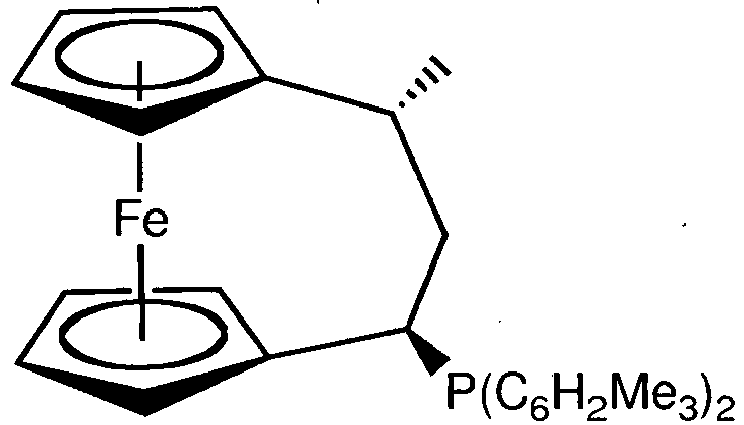
- (viii)

- The process of the present invention is carried out in the presence of a suitable solvent. Suitable solvents include solvents that do not co-ordinate (i.e. they are non-polar). Examples include aromatic solvents such as toluene, alkanes such as hexane, and cycloalkanes.
- The reaction may be conducted at any suitable temperature ranging from room temperature upwards. Temperatures of 150°C or greater are generally preferred. A person skilled in the art will be able to select optimum temperatures for carrying out the reaction.
- The reaction may also be carried out at relative low pressure (e.g. 1 to 2 atmospheres). A person skilled in the art would be readily able to optimize the pressures at which the reaction is performed.
- The process may be performed as a series of discrete steps in which intermediates formed during the process are individually formed and isolated or, more preferably, the reaction may be conducted in a single step.
- The methanol product formed by the process of the invention can conveniently collected by distillation.
-
Figure 1 shows (a) a thermal ellipsoid plot of structure of one molecule in asymmetric unit of compound 2 ([TMPH] [HCO2B(C6F5)3). Hydrogen atoms on the TMP ring have been removed for clarity, thermal ellipsoids shown at 50 % probability. Selected bond lengths (Å): B4-O3 1.546(3); C2-O3 1.288(3); C2-O1 1.236(3); C2-H21 0.986; intramolecular distances for the second equivalent are statistically indistinguishable; (b) a view showing the extended H-bonding motif; N38···O1 2.960(4)[2.857(4)] (H382···O1 2.04[1.99]); N38···O1' 2.853(4)[2.954(4)] (H381···O1 1.98[2.07]) analogous distances in the second equivalent shown in square brackets. -
Figure 2 shows a 13C NMR spectra of 2a after (a) 0 hr, (b) 24 hr and (c) 144 hr, at 160°C. * denotes peaks from solvent (C7D8); insets enhance region of 13CO2 resonance. - The invention will now be described in more detail in relation to the following illustrative example.
- Experiments were conducted on a dual-manifold gas inlet/vacuum line or in a glove-box under a nitrogen atmosphere, unless indicated otherwise.
- Reaction solvents were dried using a MBraun SPS-800 solvent purification system and stored over K mirrors whilst NMR solvents were freeze-thaw degassed and stored over K (C7D8) or molecular sieves (CD2Cl2, DMSO-d6).
- H2 (BOC) and CO2 (Sigma-Aldrich) were dried via passage through a column of molecular sieves prior to use.
- 2,2,6,6-tetramethylpiperidine (TMP, Sigma-Aldrich) was distilled and dried over 3 Ǻ molecular sieves.
- HCO2H (95% wt.%), DCO2D (98% at.D) and H13CO2H (Goss Scientific, 99% at.13C). B(C6F5)3 (sublimed prior to use),[20]H2O.B(C6F5)3,[17c] TMP-d 1 (N-D)[21] and 1 [7] were synthesised according to literature procedures.
- The following instrumentation was used: Varian Mercury VX-Works 300 MHz for 1H, 2H, 13C, 19F (ext. CFCl3 reference), 11B (ext. BF3.OEt2 reference) NMR spectroscopy; an Enraf-Nonius
FR590 - GC analysis was performed on a SGE BP1 (25 m, 0.53 I.D., 5 µm film) with 50°C hold (2.5 min) then 50°C min-1 ramp to 250°C method.
- A 250 ml Schlenk tube was charged with 1 (0.38 mmol, 0.250 g) and toluene (30 ml) was added. The solution was freeze-thaw degassed once with 12CO2 before heating to 100°C for 12 hr in a static atmosphere of 12CO2. The reaction was cooled, filtered and evaporated to give a white powder, which was washed with pentane (2 x 30 ml) before drying under vacuum. Yield 0.221 g (83 %).
- In air, H12CO2H (0.82 ml, 21.8 mmol) was added drop-wise to a stirred solution of TMP (4.00g, 28.3 mmol) in Et2O (100 ml). The thick white precipitate was filtered, washed with Et2O (3 x 50 ml) and dried (12 hr) under vacuum (10-3 mbar); yield of [TMPH][HCO2] 3.93 g (96 %), stored under N2. To this solid (0.98 mmol, 0.183 g) was added a solution of B(C6F5)3 (0.98 mmol, 0.500 g) in toluene (30 ml) at room temperature with stirring in a glove-box. The mixture was filtered and the solvent stripped under vacuum. The residue was washed with pentane (2 x 30 ml) and vacuum dried to give 0.641 g (94 %) of 2 as a white powdery solid.
- 1H NMR (C7D8, 300 MHz): δ 8.24 (sept, 1 H, JHF = 2 Hz, HCO2), δ 6.46 (br, 2H, NH2), δ 0.84 (m, 2H, CH2), δ 0.79 (m, 4H, CH2), δ 0.73 (s, 12H, CH3). 11B NMR (C7D8, 128 MHz): δ -2.41 (s, br). 13C{1H} NMR (C7D8; 75 MHz): δ 169.8 (s, HCO2), 148.6 (dm, 1JCF = 233 Hz, ortho-C6F5), δ 140.1 (dm, 1JCF = 244 Hz, para-C6F5), δ 137.4 (dm, 1JCF = 248 Hz, meta-C6F5), δ 57.6 (s, NC(CH3)2CH2), δ 34.7 (s, NC(CH3)2CH2), δ 27.0 (s, NC(CH3)2CH2), δ 15.7 (s, NC(CH3)2CH2CH2). Quaternary carbon of C6F5 ring was not observed.
- 19F NMR (C7D8, 282.2 MHz): δ -129.0 (dd, 6F, 3JFF = 24 Hz, 4JFF = 7.6 Hz, ortho-C6F5), δ -153.1 (t, 3F, 3JFF = 21 Hz, para-C6F5), δ -159.3 (m, 6F, meta-C6F5). HRMS (ES-, m/z): for H12CO2B(C6F5)3 Calcd: 556.9839. Found: 556.9831. R (Nujol, cm-1): 3042 (m), 1641 (s), 1602 (m), 1517 (m), 1309 (s), 1283 (m), 1232 (w), 1219 (w), 1097 (s), 974 (s), 904 (m), 785 (w), 769 (m), 677 (w), 613 (w). IR (CHCl3, cm-1): UC=O 1663. Anal. Calcd. for C28H21BF15NO2: C 48.06; H 3.03; N 2.00. Found: C 47.96; H 2.96; N 2.03.
- Method B using H13CO2H. Yield 94 %. 1H NMR (C7D8, 300 MHz): δ 8.24 (d, 1H, JHC = 210 Hz, H13CO2). 13C NMR (C7D8, 75 MHz): δ 169.9 (d, JHC = 210 Hz, H13CO2). HRMS (ES-, m/z): for H13CO2B(C6F5)3 Calcd: 557.9872. Found: 557.9863. IR (Nujol, cm-1): 3041 (m), 1646 (s), 1613 (m), 1518 (m), 1283 (m), 1097 (s), 974 (s), 901 (m), 785 (w), 769 (m), 693 (w), 612 (w). IR (CHCl3, cm-1): UC=O 1622
- Synthesis of [TMPD(ND2)][(D12CO2)B(C6F5)3] (2b): Method B using DCO2D. Yield 89 %. 2H NMR (C7H8, 46 MHz): δ 8.29 (s, br, 1D, DCO2), δ 6.24 (s, br, 2D, ND2), HRMS (ES-, m/z):for D12CO2B(C6F5)3 Calcd: 557.9902. Found: 557.9911. IR (Nujol, cm-1): 3080 (m), 1626 (s), 1517 (m), 1305 (m), 1283 (m), 1097 (s), 974 (s), 904 (m), 893 (w), 785 (w), 769 (m), 693 (w), 612 (w). IR (CHCl3, cm-1): UC=O 1644.
- 125 ml Schlenk tube was charged with H2O.B(C6F5)3 (0.63 mmol, 0.330 g) and CH2Cl2 (30 ml) was added. To this a solution of TMP (0.65 mmol, 0.092 g) in CH2Cl2 (10 ml) was added drop-wise with stirring. The mixture was then filtered through Celite, the filter pad washed with CH2Cl2 (10 ml) and the solvent reduced in volume to 10 ml before layering with pentane (50 ml). After 5 days the liquid was filtered off and the large colourless crystals washed with pentane (10 ml), followed by drying under vacuum. Yield 0.349 g (83 %). 1H NMR (CD2Cl2, 300 MHz): δ 7.15 (br, 2H, NH2), δ 2.42 (sept, 1H, JHF = 2.3 Hz, OH), δ 1.74 (m, 2H, CH2), δ 1.58 (m, 4H, CH2), δ 1.27 (s, 12H, CH3). 11B NMR (C7D8, 128 MHz): δ -3.72 (s, br). 13C{1H} NMR (CD2Cl2, 75 MHz): δ 148.2 (dm, 1JCF = 236 Hz, ortho-C6F5), δ 139.3 (dm, 1JCF = 247 Hz, para-C6F5), δ 137.2 (dm, 1JCF = 251 Hz, meta-C6F5), δ 58.0 (s, NC(CH3)2CH2), δ 36.1 (s, NC(CH3)2CH2), δ 27.6 (s, NC(CH3)2CH2), δ 16.3 (s, NC(CH3)2CH2CH2). Quaternary carbon of C6F5 ring was not observed.
- 19F NMR (CD2Cl2, 282.2 MHz): δ -130.9 (d, 6F, 3JFF = 18 Hz, ortho-C6F5), δ-156.2 (t, 3F, 3JFF = 21 Hz, para-C6F5), δ -160.8 (m, 6F, meta-C6F5). HRMS (ES-, mlz): for HOB(C6F5)3 Calcd: 528.9890. Found: 528.9887. IR (Nujol, cm-1): 3663 (m), 3270 (m), 3048 (m), 1646 (s), 1620 (m), 1518 (m), 1278 (m), 1229 (w), 1166 (w), 1086 (s), 971 (s), 946 (s), 814 (w), 771 (w), 682 (w), 671 (w), 624 (w), 603(w). Anal. Calcd. for C27H21BF15NO: C 48.31; H 3.15; N 2.09. Found: C 47.93; H 2.96; N 2.04.
- To a pale yellow solution of TMP (0.48 mmol, 0.069 g) and B(C6F5)3 (0.48 mmol, 0.250g) in toluene (20 ml) was added anhydrous MeOH (0.096 mmol, 40 µL) with stirring. The mixture was then filtered through Celite and the solvent stripped under vacuum. The residue was then washed with pentane (2 x 20 ml), taken up into CH2Cl2 (40 ml) and subsequently filtered before layering with pentane (100 ml). After 5 days the supernatant was siphoned off and the colourless crystals washed with pentane (10 ml), followed by drying under vacuum. Yield 0.264 g (79 %). 1H NMR (CD2Cl2, 300 MHz): δ 6.26 (br, 2H, NH2), δ 3.12 (s, 3H, CH3O), δ 1.77 (m, 2H, CH2), δ 1.68 (m, 4H, CH2), δ 1.41 (s, 12H, CH3). 11B NMR (CD2Cl2, 128 MHz): δ-2.28 (s).13C{1H} NMR (DMSO-d6, 75 MHz): δ 147.5 (dm, 1JCF = 236 Hz, ortho-C6F5), δ 137.5 (dm, 1JCF = 243 Hz, para-C6F5), δ 135.8 (dm, 1JCF = 255 Hz, meta-C6F5), δ 55.9 (s, CH3O), δ 51.6 (s, NC(CH3)2CH2), δ 34.3 (s, NC(CH3)2CH2), δ 26.8 (s, NC(CH3)2CH2), δ 15.7 (s, NC(CH3)2CH2CH2). Quaternary carbon of C6F5 ring was not observed. 19F NMR (CD2Cl2, 282.2 MHz): δ -129.3 (d, 6F, 3JFF = 20 Hz, ortho-C6F5), δ -156.5 (t, 3F, 3JFF = 20 Hz, para-C6F5), δ - 161.0 (m, 6F, meta-C6F5). HRMS (ES-, m/z): for CH3OB(C6F5)3 Calcd: 543.0046. Found: 543.0047. IR (Nujol, cm-1): 3248 (m), 3040 (m), 1645 (s), 1607 (m), 1517 (m), 1272 (m), 1230 (w), 1206 (w), 1090 (s), 974 (s), 917 (m), 808 (w), 765 (w), 694 (w), 667 (w), 622 (w). Anal. Calcd. for C28H23BF15NO: C 49.08; H 3.38; N 2.04. Found: C 48.97; H 3.34; N 2.04.
- [C6F5H]: 1H NMR (C7D8, 300 MHz): δ 5.80 (m, 1H). 19 F NMR (C7D8, 282.2 MHz): δ -134.2 (m, 2F, ortho-C6F5), δ -149.2 (t, 1 F, 3 J FF = 22 Hz, para-C6F5), δ -157.4 (m, 2F, meta-C6F5). MS (FI, m/z): for C6F5H Calcd 167.9998. Found: 167.9981.
[CH3OH]: 1H NMR (C7D8, 300 MHz): δ 3.03 (s, 3H) GC (FID): Ret. Time 1.67 min.
[CH3O(C6F5)2]: 1H NMR (C7D8, 300 MHz): δ 3.38 (s, 3H). 19F NMR (CD2Cl2, 282.2 MHz): δ - 127.6 (d, 4F, 3 J FF = 17 Hz, ortho-C6F5), δ -143.8 (t, 2F, 3 J FF = 20 Hz, para-C6F5), δ -155.9 (m, 4F, meta-C6F5). 11B NMR (C7D8, 128 MHz): δ 35.9 (br). MS (FI, m/z): for C13H3OBF10 Calcd 376.0117. Found: 376.0131.
[O3B3(C6F5)3]: 11 B NMR (C7D8, 128 MHz): δ 26.2 (br). MS (EI, m/z): for C18F15B3O3 Calcd: 581.9897. Found: 581.9702. -

- The first step in the reaction involves the heterolytic cleavage of H2 using a frustrated Lewis pair. A suitable frustrated Lewis pair is 2,2,6,6-tetramethylpiperidine (TMP) and B(C6F5)3. The reaction of H2 with an equimolar ratio of 2,2,6,6-tetramethylpiperidine (TMP) and B(C6F5)3 has been documented by Sumerin et al., to give the salt [TMPH][HB(C6F5)3] (1) (Scheme 1) in which the hydrogen molecule has undergone heterolytic fission.[7]
- The subsequent procedure involves the hydrogenation of CO2 using 1.
- The proposed mechanism by which the CO2 is hydrogenated has been investigated and it has been discovered that the admission of CO2 into a toluene solution of 1 at 100°C produces the unique formato-borate complex [TMPH][HCO2B(C6F5)3] (2) in quantitative yield (Scheme 1). The reaction can be conveniently monitored using solution 19F NMR.[8]
- The 1H NMR (C7D8) spectrum of 2 reveals a ca. 2 ppm downfield shift of the NH2 protons relative to 1 and also displays a septet resonance at 8.24 ppm (JHF = 2 Hz), consistent with a through-space interaction between the formate proton and each of the six ortho-F's of the B(C6F5)3 unit. This assignment was confirmed through selective heteronuclear 19F decoupling experiments.[9] 2 displays a carbonyl stretch at 1662 cm-1 in its IR spectrum (CHCl3).
- Single crystals suitable for X-ray diffraction were grown by slow-cooling of a toluene solution of 2 to -35°C, (
Figure 1 ).[10] While 2 exists as discrete ion-pairs, its B-O and C-O bond lengths more closely resemble the zwitterionic CO2 adducts of the phosphine-based FLPs tBu3P(CO2)B(C6F5)3 and cyclo-(Me3C6H2)2PCH2CH2B(C6F5)2(CO2) (B-O: 1.5474(15)/1.550(4); C=O: 1.2081 (15)/1.209(4); C-O: 1.2988(15)/1.284(4) Å, respectively),[6] rather than those found in [Me4N][(MeCO2)B(C6F5)3] (B-O: 1.514(2); C=O: 1.217(2); C-O: 1.324(2) Å).[11] The lengthening of the C=O bond observed for 2 is likely due to the participation of this group in H-bonding with two [TMPH] counterions, shown inFigure 1(b) . No close H-ortho-F contacts are observed in the solid-state and it is possible that the optimisation of N-H....O2CH hydrogen bonds dominates the crystal packing forces. - 2 may also be synthesised in high yield by the reaction of TMP and HCO2H to give [TMPH][HCO2], and then subsequent reaction with B(C6F5)3 (Scheme 1). This convenient protocol permits the regiospecific isotopic labelling of the formate moiety using H13CO2H to form [(C5Me4NH2)H13CO2B(C6F5)3] (2a) or DCO2D in conjunction with TMP-d 1 (N-D) to give [(C5Me4ND2)D12CO2B(C6F5)3] (2b), in an atom-economical manner.
- Heating a solution of 2 (C7D8) above 80°C in a sealed NMR tube under a N2 atmosphere revealed that the formate complex is in equilibrium with free CO2 (for 2a; 13CO2 δ = 124.9 ppm in 13C NMR) and 1; using 19F NMR we observed 2% of 2 has dissociated to give 1.[12]
- On heating 2a above 110°C the equilibrium becomes complicated by further reactions as judged by the 19F NMR; after 24 hr at 160°C the production of C6F5H and two new major species are evident, one of these displaying broad resonances overlaying those observed for the ortho- and para-F of 2a. The 1H NMR spectrum is much simpler, showing a broadening and decreased intensity of the formate septet, a multiplet at 5.80 ppm (C6F5H), and the appearance of a doublet centred at 3.39 ppm (JCH = 146 Hz), characteristic of an sp 3-hybridised carbon environment.
-
Figure 2 shows the time dependence of the 13C NMR of 2a on heating at 160 °C in toluene. The formate carbon resonance of 2a (δ = 169.9 ppm, JCH = 210 Hz) is seen to collapse into a broad doublet after 24 hr (δ = 174.5 ppm, JCH = 230 Hz) which is concomitant with the appearance of a quartet (δ = 56.8 ppm, JCH = 146 Hz) and 13CO2, the latter two being the only species (above natural abundance 13C) observable in the spectrum after 144 hr (Figure 2(c) ); this clearly demonstrates the almost quantitative conversion of the 13C label present in 2a. At this end-point of the reaction MS(FI) shows the homogeneous mixture to comprise of B(C6F5)3, TMP, C6F5H and 13CH3OB(C6F5)2 (11B NMR δ = 35.9 ppm),[13] all of which are supported by 1H, 19F, 13C and 11B NMR spectral data. Furthermore, use of deuterium-labelled 2b in this reaction gave C6F5D, CD3OB(C6F5)2 and N-deuterated TMP (2H NMR δ(ppm) = 5.81, 3.30 and 1.16 respectively) as the only products incorporating deuterium. Overall this reaction represents a disproportionation of HCO2 - into CO2 and CH3O-. - High-resolution mass spectrometry (ESI, -ve mode) of an aliquot of the reaction mixture after 24 hr heating at 160°C offered great insight into the mechanism. The MS exhibited ions which could be assigned to the borate anions in 1 and 2 in addition to the H2O.B(C6F5)3 H-bonded anions of HOB(C6F5)3, CH3OB(C6F5)3, HCO2B(C6F5)3. Curiously, the species (C6F5)3B(HCO2)B(C6F5)3 is also detected which could result from the reaction of HCO2 B(C6F5)3 with free B(C6F5)3.
- A proposed mechanism which takes into account all the experimental findings is shown in
Scheme 2. The establishment of equilibrium concentrations of CO2 and 1 from 2 is followed by reversible decomposition of the borohydride salt into free H2, TMP and B(C6F5)3; evidence for this process was established through 19F NMR in which a solution of 1, when heated to 160°C, shows the presence of 17% B(C6F5)3. Attack of this B(C6F5)3 upon the acyl oxygen atom of 2 produces an intermediate (Scheme 2, A) which is thought to be the origin of the broad doublet seen at 174.5 ppm in the 13C NMR spectrum; the downfield shift and line-shape corroborate an augmented electron deficiency due to the coordination of an additional bulky B(C6F5)3 molecule around a single carbon centre. Following this, hydride reduction of the activated formate A by an equivalent of 1 leads to the formaldehyde acetal (intermediate B) and B(C6F5)3. The instability of acetals in protic media towards an aldehyde and H2O is well-documented, [14] and in this instance the [TMPH] counterions may serve as H+ donors; cleavage of B to H2CO.B(C6F5)3 (intermediate C) and 3 is by analogy. C is expected to be a potent electrophile and in the presence of 1 undergoes a final hydride reduction to form 4. The absence of any reduction products between formate and methoxide indicates that the conversion of A to B is rate-determining, and is anticipated from the necessity of crowding three large B(C6F5)3 molecules around a hindered formate in the reduction step.
- To test the validity that 3 and 4 are formed in the reaction, these compounds were independently synthesised from either TMP and H2O.B(C6F5)3 [15] (1:1; 3) or 1 eq. of anhydrous MeOH added to an equimolar mixture of TMP and B(C6F5)3 (4). Heating a toluene solution (160°C) of the latter led to the rapid production of 1 eq. of C6F5H and CH3OB(C6F5)2, whilst that of the former was slower, proceeding to the boroxin [OB(C6F5)]3 [16] (presumably via HOB(C6F5)2); all of these are identified as products in the completed reaction using 1H, 19F, 11B NMR and MS (EI/FI).

- Since the only labile source of protons in the decomposition reactions of 3 and 4 is the TMPH cation, this suggests that recombination of the ion pairs to form TMP and ROH.B(C6F5)3 (R = CH3, H) must occur (Scheme 3); corroborating this hypothesis is the detection of H2O.B(C6F5)3 H-bonded with various anions in the MS(ES).[17] Whilst studies have shown that such adducts can dissociate to give ROH and free B(C6F5)3,[18] at these temperatures protonation of the ipso-C on the C6F5 rings appears to be faster (yielding ROB(C6F5)2 and C6F5H), which preclude any catalytic turnover.
- Finally, addition of one equivalent of CO2 to a 1:1 mixture of TMP/B(C6F5)3 (4 eq., excess, under H2 atmosphere) in C7D8 demonstrated quantitative conversion to CH3OB(C6F5)2 via 2, after 6 days at 160°C. Remarkably, vacuum distillation of the solvent (100°C) led to the isolation of CH3OH (17-25% yield based on 1H NMR integration against internal Cp2Fe, and GC analysis) as the sole C1 product, alongside C6F5H and TMP by-products. We expect that this results from the reaction of CH3OB(C6F5)2 with TMP or its conjugate acid.[19]
- In summary we have demonstrated the first example of the selective hydrogenation of CO2 to CH3OH, using an FLP-based non-metal protocol at low pressures (1-2 atm).
- All air and moisture sensitive compounds were manipulated under N2 using either a MBraun Unilab glovebox or using standard Schlenk line techniques on a dual manifold vacuum/nitrogen line. For the manipulation of moisture sensitive compounds, all glassware was heated to 170 °C before use. Solvents and solutions were transferred using a positive pressure of nitrogen through stainless steel or Teflon cannulae, or via plastic syringes for volumes less than 20 ml. Filtrations were performed using either glassware containing sintered glass frits or modified stainless steel cannulae fitted with glass microfibre filters.
- Reaction solvents (pentane, hexane, benzene, toluene, CH2Cl2) were dried using an MBraun SPS-800 solvent purification system; the aliphatics and aromatics were stored over K mirrored ampoules. Et2O and THF were distilled from purple Na/benzophenone indicator. Dry solvents were stored in oven or flame-dried ampoules, sealed with a Rotaflo or Youngs' taps under nitrogen. H2 gas (BOC) was dried via passage through a column of pre-activated 3Å molecular sieves.
- Deuterated NMR solvents were dried and freeze-thaw degassed over the appropriate drying agent: C6D6, C7D8 (K); CD2Cl2 (3Å molecular sieves) and purchased from Goss Scientific (99.6, 99.6 and 99.8% D respectively).
- BBr3 (99.9%), BCl3 (1.0 M in hexanes), BF3·OEt2, C6Cl6 (99.9%), C6F5Br (99%), CuCl (> 99%), Mg turnings (99.5%), nBuLi (2.5 M in hexanes), 2,2,6,6-tetramethylpiperidine (> 99%), trans-crotonaldehyde (> 99%) were purchased from Sigma Aldrich, 2,6-Lutidine (> 98%) from Alfa Aesar and H13CO2H (99%13C) from Goss Scientific; all were used as received. The following compounds were prepared according to literature procedures, or adaptations thereof: Zn(C6Cl5)2,1 CuC6F5,2 (C6F5)2BF·OEt2,3 (C6F5)BBr2, 4 and B(C6F5)3. B(C6Cl5)2F was prepared as for (C6F5)2BF·OEt2 using C6Cl5Li5 in place of C6F5MgBr;2 extraction and crystallisation using toluene gave pure material (19.8 %).
- Air sensitive samples were prepared under N2 atmosphere. Spectra were recorded on a 300 MHz Varian VX-Works spectrometer. The 1H and 13C chemical shifts, δ, in parts per million (ppm) are given relative to TMS (δ = 0) and referenced internally to the residual proton shift in the deuterated solvent employed. 11B, 19F and 31P chemical shifts were referenced externally to BF3·OEt2, CFCl3 and 85 % H3PO4 (δ = 0). Air sensitive samples were prepared inside a glovebox under nitrogen atmosphere in Youngs' adapted NMR tubes.
- Samples were recorded by Mr Colin Sparrow of the Chemistry Research Laboratory, University of Oxford, using a Bruker FT-ICR-MS Apex III spectrometer for EI measurements.
- IR spectra were recorded on a Nicolet MAGNA-IR 560 FT-IR spectrometer (range 4000-400 cm-1, resolution 0.5 cm-1). Solution IR spectra were obtained in CH2Cl2 solvent, using a KBr cell. Solutions were injected into the cell in the glovebox and the spectra recorded immediately. Mulled samples were prepared by grinding the material into a fine powder, mulling with Nujol and the paste administered to NaCl plates which were pressed together, placed in an air-tight holder and the spectra recorded immediately.
- Synthesis of C6Cl5Li adapted from a published literature method.22 A 250 ml Schlenk was charged with C6Cl6 (11.53 g 40.5 mmol) and left under vacuum for 20 minutes to remove any moisture. Following the addition of 150 ml Et2O, the cloudy solution was cooled to - 78°C using a dry ice acetone bath. With rapid stirring, (16.5 ml, 41.3 mmol, 2.5 M) nBuLi in hexane was added by means of a syringe. The contents were allowed to warm to -10°C until no insoluble C6Cl6 was visible, and an opaque solution of C6Cl5Li was amber in colour. The contents were later cooled to -78°C and stabilised by the addition of 150 ml hexane.
- A solution of C6F5MgBr in Et2O (50 ml, 40.5 mmol, 0.81 M) was added to a -30°C solution of BF3·OEt2 (2.49 ml, 20.25 mmol) in Et2O (80 ml). The resulting dark brown solution was then cooled to -78°C. With rapid stirring, a solution of C6Cl5Li (20.25 mmol) in Et2O/hexane was added and the contents slowly warmed to -10°C over the course of 1 hour. The solution was later warmed to room temperature and the crude product extracted with 150 ml hexane. Removal of the solvent gave a brownish oil found to be contaminated by small traces of B(C6F5)3 which was removed by vacuum sublimation at 100°C. Increasing the temperature to 125°C yielded analytically pure A as a white powdery solid (7.70 g, 12.9 mmol, 63.7%). Crystals suitable for X-ray diffraction were grown from a toluene solution slow cooled to -30°C.
13C{1H} NMR (CD2Cl2, 75 MHz): δ 149.7 (dm, 1JCF = 251 Hz, ortho-C6F5); δ 145.9 (dm, 1JCF = 262 Hz, para-C6F5); δ 141.0 (br, ipso-C6Cl5); δ 138.0 (dm, 1JCF = 249.5 Hz, meta-C6F5); δ 135.1 (s, para-C6Cl5); δ 132.3, 131.3 (both s, meta-C6Cl5 and ortho-C6Cl5); δ 112.2 (br, ipso-C6F5).
11B NMR (C7D8, 128 MHz): δ 63.6 (s, br)
19F NMR (C7D8, 282.2 MHz): δ -127.3 (d, 4F, 3 J FF = 22 Hz, ortho-C6F5), δ-141.0 (t, 2F, 3 J FF = 23 Hz, para-C6F5), δ -159.9 (m, 4F, meta-C6F5).
HRMS (EI, m/z): for BC18C15F10 Calcd: 591.8378. Found: 591.8376.
IR (Nujol, cm-1): 1700 (m), 1653 (m), 1646 (m), 1559 (m), 1549 (m), 1521 (s), 1507 (w), 1482 (s), 1437 (m), 1382 (m), 1336 (m), 1322 (m), 1235 (w), 1167 (m), 1142 (w), 1015 (w), 979 (s), 674 (m), 668 (m), 659 (w).
Anal. Calcd. for BC18C15F10: C 36.50; H 0.00; N 0.00. Found: C 36.49; H 0.00; N 0.00. - To a -78°C solution of (C6F5)BBr2 (4.70 g, 13.9 mmol) in hexane (20 ml), was added C6Cl5Li (27.80 mmol) in Et2O/hexane solution. The reaction mixture was gradually warmed to -10°C and left to stir for a further hour before being warmed to room temperature. The solvent was stripped under vacuum and the compound extracted using 100 ml CH2Cl2. The solvent was later removed by vacuum and the product filtered and recrystallised from 50 ml hexane. The resultant tan solid was washed with -78°C pentane (3 x 20 ml) and dried under vacuum to give a crude yield of 6.20 g (66%). Further recrystallisation from toluene (slow-cooled to -80°C) gave a microcrystalline solid, which was washed with pentane (3 x 20 ml) followed by drying under vacuum to leave spectroscopically pure B as an off-white powdery solid (3.81 g 40.4%).
13C{1H} NMR (CD2Cl2, 75 MHz): δ 149.0 (dm, 1JCF = 253 Hz, ortho-C6F5); δ 145.9 (dm, 1JCF: = 261 Hz, para-C6F5); δ 138.0 (dm, 1JCF = 251 Hz, meta-C6F5); δ 139.6 (br, ipso-C6Cl5); 136.6 (s, para-C6Cl5); δ 133.0 (s, meta-C6Cl5 and ortho-C6Cl5); δ 114.5 (br, ipso-C6F5).
11B NMR (C7D8, 128 MHz): δ 64.1 (s, br)
19F NMR (C7D8, 282.2 MHz): δ -127.2 (d, 2F, 3 J FF = 21 Hz, ortho-C6F5), δ-141.4 (t, 1F, 3 J FF = 21 Hz, para-C6F5), δ -159.7 (m, 2F, meta-C6F5).
HRMS (EI, m/z): for BC18Cl10F5 Calcd: 675.6844. Found: 675.6774.
IR (Nujol, cm-1): 1700 (m), 1653 (m), 1559 (m), 1540 (w), 1521 (m), 1507 (w), 1481 (s), 1465 (s), 1394 (m), 1332 (s), 1313 (s), 1237 (m), 1190 (w), 1147 (m), 1127 (w), 1104 (w), 973 (s), 876 (w), 668 (m), 642 (w).
Anal. Calcd. for BC18Cl10F5: C 32.16; H 0.00; N 0.00. Found: C 32.19; H 0.02; N 0.00. - To a -78°C solution of C6Cl5Li (31.20 mmol) in Et2O/hexane was added BCl3 (1.17 g, 10.0 mmol, 1.0 M) in hexane. The solution was allowed to warm to -10°C and stirred for an hour before the cloudy orange suspension was warmed to room temperature. The solvent was removed in vacuo and the subsequent work-up performed in air. After quenching the reaction by addition of 0.5 ml H2O, 250 ml of CH2Cl2 was used to extract the crude product, which was filtered through Celite and the filter pad washed with 100 ml further CH2Cl2. Solvent was removed using rotary evaporation, yielding an amber solid. Recrystallisation was performed using a minimum quantity of toluene at 100°C followed by rapid filtration through glass wool. Slow cooling to room temperature overnight led to the formation of pale yellow crystals of C-toluene. The toluene supernatant was siphoned off and the crystals washed with pentane (2 x 20 ml), followed by drying overnight under vacuum (1 x 10⁻³ mbar) to remove toluene of crystallisation; yield 3.26 g (42.2%). X-ray quality crystals were produced by a second toluene recrystallisation.
13C{1H} NMR (CD2Cl2, 75 MHz): δ 140.6 (br, ipso-C6Cl5); 136.7 (s, para-C6Cl5); δ 135.3, 133.0 (both s, meta-C6Cl5 and ortho-C6Cl5).
"B NMR (C7D8, 128 MHz): δ 65.6 (s, br)
HRMS (EI, m/z): for BC18Cl15 Calcd: 751.5337. Found: 757.5177.
IR (Nujol, cm-1): 1700 (m), 1684 (m), 1652 (m), 1558 (m), 1540 (m), 1507 (m), 1468 (s), 1334 (m), 1313 (m), 1232 (m), 1130 (w), 991 (w), 668 (m), 636 (w).
Anal. Calcd. for BC18Cl15 : C 28.74; H 0.00; N 0.00. Found: C 28.85; H 0.05; N 0.00. - Solid A (0.036 g, 0.061 mmol; Example 2) and TMP (0.0086 g, 0.061 mmol) were added to a Youngs' NMR tube and dissolved in C7D8. The sample was subjected to 3 freeze-pump-thaw cycles and backfilled with H2 at room temperature. The tube was then placed in an oil bath at 100°C for 12 hr. The procedure was then repeated for equivalent molar concentrations of (B)/ [TMP], (A)/[Lutidine (Lut)], and (B)/[Lutidine (Lut)].
- The reaction for the four frustrated Lewis pair combinations was monitored over several hours until no further changes in the 11B and 19F NMR signals were apparent; the NMR spectral data is shown in Table 1.
Table 1: 19F and 11B NMR spectral data for FLP reactions with H2 (100°C) FLP System Prior To H2 δ(19F NMR)/ppma δ(11B NMR)/ppmb Observed Hydrides o-F p-F m-F [TMP][A] [TMPH][HB(C6F5)3] -132.9 -162.7 -166.1 23.8 (d, 1JBH = 88Hz) [TMPH][H(A)] -132.3 -163.3 -166.5 18.7 (d, 1JBH = 85Hz) [TMPH][H(B)] -131.7 -162.7 -166.1 13.5 (d, 1JBH = 85Hz) [Lut][A] [LutH][H(A)] -132.3 -163.3 -166.5 18.7 (d, 1JBH = 85Hz) [LutH][HB(C6F5)2(Lut)] -135.5 -159.3 -164.6 7.4 (d, 1JBH = 100Hz) (LutH][HB(C6F5)3] -132.9 -162.7 -166.1 23.8 (d, 1JBH = 88 Hz) [LutH][H(A)] -132.3 -163.3 -166.5 18.7 (d, 1JBH = 85Hz) [TMP][B] [TMPH][H(B)] -131.7 -162.7 -166.1 13.5 (d, 1JBH = 85Hz) [Lut][B] [LutH][H(B)] -131.7 -162.7 -166.1 13.5 (d, 1JBH = 85Hz) aSolvent = C7D8: reference (external): CFCl3. b Solvent: C7D8 reference (external): BF3·OEt2 - Significant levels of free borane were detected in both the 11B and 19F NMR, demonstrating reversible activation for A and B in these FLP systems; this corroborates the Lewis acidity measurements for A, B and C which are shown to diminish with sequential C6Cl5 substitution. Detection of two additional hydride environments {[B]H- and HB(C6F5)3 -} for the [1][TMP]/H2 reaction reveals that a redistribution of aryl groups is occurring for this system under these conditions; a proposed mechanism for this exchange is shown in Scheme 5. The equilibrium is likely to swing in favour of HB(C6F5)3 -formation, since this is the hydride adduct of the strongest Lewis acid in the system; similar redistribution reactions have been observed for phenoxy-substituted boranes under FLP/H2 conditions.23

- An additional hydride signal is seen in the [Lut][A]/H2 experiment, downfield from the other tris(aryl)borohydride signals in the 11B NMR; it is proposed that this is due to the presence of the lutidine adduct of the intermediate HB(C6F5)2 shown in Scheme 5.
- In contrast with the A-derived FLP systems, only a single borohydride could be observed for [TMP][B] and [Lut][B]; the enhanced bulk of a (C6Cl5)3B(C6F5)- (Scheme 6) intermediate presumably prevents its formation and thus inhibits aryl scrambling.

- Formation of [C]H- from B(C6Cl5)3 could only be observed at temperatures above 120°C (11B NMR δ = -8.0 ppm) using TMP as the FLP partner, and was formed in much smaller amounts than in experiments involving A or B; unfortunately 19F NMR could not be used to determine the hydride to free borane ratio in this case.
- Due to the scrambling reactions observed for A, a quantitative treatment of the hydride conversion could not be obtained. For B, a conversion of 7.6 % [TMPH][H(B)] and 2.5 % [LutH][H(B)] were observed (using 19F NMR integration), reflecting the difference in Lewis basicity of TMP and Lutidine.
- Solid [TMPH][H13CO2·(A)] (0.033 g, 0.042 mmol) was added to a sealable Youngs' NMR tube and dissolved in C7D8. The sample was subjected to 3 freeze-pump-thaw cycles and backfilled with H2 at room temperature. The tube was then placed in a silicone oil bath held at 145°C and reaction monitored by NMR spectroscopy until no change was observed in the intensity ratio for the 13CO2:13CH3O resonances in the 13C NMR spectrum. The procedure was then repeated for equivalent molar solutions of [TMPH][H13CO2·(B)], [LutH][H13CO2·(A)] and [LutH][H13CO2·(B)].
- Admission of 12CO2 to each of the four FLP-H2 reactions resulted in the formation of formato(borate) species, which were observed as new sets of resonances in the 19F and 11B NMR spectra. In each case the reactions were observed to be a set of equilibria for H2 activation and 12CO2 insertion, which complicated the derivation of kinetic parameters for the latter reaction. Thus to investigate the reduction of CO2 with H2 in a quantitative manner, the use of pre-formed formato(borate) salts permit the use of a stoichiometric equivalent of 13CO2 to be delivered to the reaction medium; in addition the use of 13C-labelling provides an extra NMR probe using 13C NMR to study ensuing reactions. These compounds may be synthesised in a facile manner from the reaction of H13CO2H with the amine/pyridine and the respective borane24 (Scheme 7).

- The isolation and characterisation of (formato)borate complexes [TMPH][H13CO2(A)], [TMPH][H13CO2(B)], [LutH][H13CO2(A)] and [LutH][H13CO2(B)] were achieved in good yields. For the formate complexes of B the respective ortho- and meta-F resonances in the 19F NMR spectrum are split and indicate hindered rotation about the formate-B bond, a result of the increased size of B over A. Furthermore the 1H NMR spectrum for the HCO2 proton appears as a doublet of doublets (1 J CH = 210 Hz and J CF = 5.7 Hz) showing a long-range coupling to F on the C6F5 ring.25 For C no reaction was observed except at elevated temperatures (> 80°C), upon which decarboxylation to the FLP of C took place (presumably via H2 elimination from resultant [TMPH/LutH][CH]).
- Upon heating (H2 atmosphere, 1 bar at 298K, sealed tube) decarboxylation occurred readily as shown by a 13CO2 resonance (13C NMR δ = 124 ppm) and 19F signals for the borohydrides, confirming the viability of this method as an equivalent to introducing stoichiometric 13CO2. Raising the temperature above 130-135°C for the same experiments showed subsequent reduction chemistry as evidenced by the formation of 13C-coupled resonances centred around 3.3-3.6 ppm in the 1H NMR spectrum attributable to CH3O-B species; at 145°C the reactions were rapid and therefore this temperature was employed for all reactions. Interestingly, a repeat experiment for [TMPH][H13CO2(B(C6F5))3] led to completion after 24 hours in comparison with 5 days previously conducted at 160°C, and it is likely that this is closer to an optimum, indicative of a mechanism involving multiple temperature-dependent equilibria.
- Heating [TMPH][H13CO2(X)] (X = A, B) and [LutH][H13CO2(A)] over a period of 24 hours led to the production of three-coordinate methoxy (13CH3O-) species witnessed in the 19F, 1H and 13C NMR spectra. Treatment of [LutH][H13CO2(B)] under identical conditions led only to decarboxylation with concomitant formation of a mixture of [B]H- and (B).
- Reactions were monitored every 2 hours until no change in the intensity ratio for 13CO2 (δ = 124.9 ppm) and 13CH3O-B species (δ ∼ 57 ppm) by 13C NMR were observed. Termination occurred fastest (8 hours) in the case of [TMPH][H13CO2(A)] and [LutH][H13CO2(A)] with the formation of two 3-coordinate methoxy species (due to loss of C6F5H and C6Cl5H from prospective CH3OH-B(C6F5)2(C6Cl5) in the 19F and 1H NMR. Relative intensities for C6F5H and C6Cl5H were found to be in the ratio 3:1, reflecting the difference in stability and similar to that found for the decomposition experiment of A·H2O.
- For [TMPH][H13CO2(B)] termination was slower, occurring afters 12 hours, and also afforded two methoxy species (due to loss of C6F5H and C6Cl5H from prospective CH3OH·B(C6F5)(C6Cl5)2; however, the final C6F5H:C6Cl5H ratio approached unity. B and [B]H- are the principal F-containing species at this point of the reaction.
- For the TMP-based FLP systems a trend is seen whereby the percentage of 13CH3O-B increases across the series from A to B. Assuming the CO2 partition coefficient remains constant between the C7D8 solvent and headspace of the NMR tube (i.e. the amount of observable 13CO2 in solution is the same fraction of total 13CO2 in the reaction throughout each reaction studied) then the TMP formato complex of B exhibits a higher yield of methoxide than that found for B(C6F5)3. Unfortunately no free 13CH3OH could be isolated, and its formation may be inhibited by performing such an experiment in a closed system, such that decomposition is forced despite dissociation occurring.
Table 3: Relative distribution of the 13C tag after termination 13C Distribution / % Formato complex used 13CO2 13CH3O-B [TMPH][H13CO2B(C6F5)3] 73.4 26.6 [TMPH][H13CO2(1)] 34.3 65.7 [LutH][H13CO2(1)] 36.3 63.7 [TMPH][H13CO2(2)] 29.4 70.6 - Remarkably the highest conversion of 13CO2 to 13C-methoxide was seen for C (in situ reaction with [TMPH][13HCO2]; A strong resonance at 3.31 ppm (1JCH = 146 Hz, 13CH3OB(C6Cl5)2) was observed after heating for only 2 hours; after 12 hr only trace amounts of 13CO2 could be detected. For the first time a four-coordinate resonance corresponding to a hydroxy(borate) species was seen in the 11B NMR (δ = 2.2 ppm; [(C)OH]-), which can be generated independently through addition of H2O to the FLP of TMP and C. No peak was observed for the analogous methoxy(borate) [(C)OMe]- and it is assumed that such species will eventually decompose in this system if not removed by distillation, this will be the focus of future investigations. Indeed, C6Cl5H grows into the spectrum at approximately the same rate as the formation of 13CH3OB(C6Cl5)2 in the initial stages of reaction, and lends support to the proposed mechanism outlined in
Figure 1 .8. - For the TMP:C FLP system vacuum distillation of the solvent (100°C) led to isolation of TMP and 13CH3OH as the sole C1 product [45-52% yield, two runs; 1H NMR δ = 3.02 ppm; 1JCH = 145 Hz, 13C NMR = 49 ppm] ascertained by 1H NMR integration against internal Cp2Fe.
- The Frustrated Lewis Pair systems of A-C:TMP all homogenously reduce CO2 with H2 to deliver a yield of MeOH. The cumulative Lewis acidity and basicity have an observed effect on the degree of activation with the stability of the formed hydroxy species appearing to increase across the series. Hydroxy species [TMPH][C·OH] can be resolved in the 11B NMR and reflects the robust nature of the Lewis Acid.
-
- [1] a) K. B. Lee, M. G. Beaver, H.S. Caram, and S. Sircar, Ind. Eng. Chem. Res. 2008, 47, 8048-8062; b) A. Demessence, D. M. D'Alessandro, M. L Foo, J. R. Long, J. Am. Chem. Soc. 2008, 131, 8048-8062; c) A. J. Fletcher, E. J. Cussen, T.J. Prior, M.J. Rosseinsky C.J. Kepert, K. M. Thomas, J. Am. Chem. Soc. 2001, 123, 10001-10011; d) S. Surble, F. Millange, C. Serre, T. Duren, M. Latroche, S. Bourrelly, P.L. Llewellyn, G. Ferey, J. Am. Chem. Soc. 2006, 128, 14889-14896; e) R. Vaidhyanathan, S.S. Iremonger, K.W. Dawson, G. K. H Shimizu, Chem. Commun. 2009, 5230-5232.
- [2] P. G. Jessop, in Handbook of Homogeneous Hydrogenation, Vol. 1 (Eds: H. de Vries, K. Elsevier), WILEY-VCH, Weinheim, 2007, pp. 489-511. For reviews see: a) P. G. Jessop, T. Ikariya, R. Noyori, Chem. Rev. 1995, 95, 259-272; b) P. G. Jessop, F. Joo, C-C. Tai, Coord. Chem. Rev. 2004, 248, 2425-2442; c) T. Sakakura, J-C. Choi, H. Yasuda, Chem. Rev. 2007, 107, 2365-2387.
- [3] a) K. Tominaga, Y. Sasaki, T. Watanabe, M. Saito, Bull. Chem. Soc. Jpn. 1995, 68, 2837-42; b) K. Tominaga, Y. Sasaki, M. Kawai, T. Watanabe, M. Saito, J. Chem. Soc., Chem. Commun. 1993,629-31.
- [4] a) C. Jiang, O. Blacque, H. Berke, Organometallics 2009, 28, 5233-5239; b) D. Holschumacher, C. Taouss, T. Bannenberg, C. G. Hrib, C. G. Daniliuc, P. G. Jones, M. Tamm, Dalton Trans. 2009, 6927-6929; c) A. Ramos, A. J. Lough, D. W. Stephan, Chem. Commun. 2009, 1118-1120; d) V. Sumerin, F. Schulz, M. Atsumi, C. Wang, M. Nieger, M. Leskela, T. Repo, P. Pyykko, B. Rieger, J. Am Chem. Soc. 2008, 130, 14117-14119; e) G. C. Welch, D. W. Stephan, J. Am. Chem. Soc. 2007, 129,1880-1881; f) P. A. Chase, D. W. Stephan, Angew. Chem. 2008, 120, 7543-7547; Angew. Chem. Int. Ed. 2008, 47, 7433-7437; g) D. Holschumacher, T. Bannenberg, C. G. Hrib, P. G. Jones, M. Tamm, Angew. Chem. 2008, 120, 7538-7542; Angew. Chem. Int. Ed. 2008, 47, 7428-7432; h) D. P. Huber, G. Kehr, K. Bergander, R. Froehlich, G. Erker, S. Tanino, Y. Ohki, K. Tatsumi, Organometallics 2008, 27, 5279-5284; i) G. C. Welch, R. R. S. Juan, J. D. Masuda, D. W. Stephan, Science 2006, 314, 1124-1126. For a review see: A. L. Kenward, W. E. Piers, Angew. Chem. 2007, 120, 38-42; Angew. Chem. Int Ed. 2008, 47, 38-41.
- [5] a) K. V. Axenov, G. Kehr, R. Froehlich, G. Erker, Organometallics 2009, 28, 5148-5158; b) C. M. Moemming, S. Froemel, G. Kehr, R. Froehlich, S. Grimme, G. Erker, J. Am. Chem. Soc. 2009, 131,12280-12289; c) M. Dureen, D. W. Stephan, J. Am. Chem. Soc. 2009, 131, 8396-8397; d) M. Ullrich, K. S. -H. Kelvin, A. J. Lough, D. W. Stephan, Chem. Commun. 2009, 2335-2337; e) H. Wang, R. Froehlich, G. Kehr, G. Erker, Chem. Commun. 2008, 5966-5968; f) P. Spies, S. Schwendemann, S. Lange, G. Kehr, R. Froehlich, G. Erker, Angew. Chem. 2008, 120, 7654-7657; Angew. Chem. Int. Ed. 2008, 47, 7543-7546; g) J. S. J. McCahill, G. C. Welch, D. W. Stephan, Angew. Chem. 2007, 119, 8196-8199; Angew. Chem. Int. Ed. 2007, 46, 4968-4971; h) P.A. Chase, G. C. Welch, T. Jurca, D. W. Stephan, Angew. Chem. 2007, 119, 8196-8199; Angew. Chem. Int. Ed. 2007, 46, 8050-8053.
- [6] C. M. Momming, E. Otten, G. Kehr, R. Frohlich, S. Grimme, D. W. Stephan, G. Erker, Angew. Chem. 2009, 121, 6770-6773; Angew. Chem. Int. Ed. 2009, 48, 6643-6646.
- [7] V. Sumerin, F. Schulz, M. Nieger, M. Leskela, T. Repo, B. Rieger, Angew. Chem. 2008, 120, 6090-6092 ; Angew. Chem. Int. Ed. 2008, 47, 6001-6003.
- [8] a) Even at room temperature (CO2, 1 atm) this reaction proceeds to 18 % conversion in 12 hours; b) No indication of reaction of 1 with CO is observable at temperatures up to 130°C; c) Interestingly, the system [tBu3PH][BH(C6F5)3], [ref. 6(e)], does not react with CO2 under the conditions successful for 1.
- [9] A similar effect has been demonstrated by a 19F/1H NOE experiment: J. M. Blackwell, W. E. Piers, M. Parvez, Org. Lett. 2000, 2, 695-698.
- [10] The structure was solved by direct methods (SIR92) and refined by full-matrix least squares (CRYSTALS). CCDC-749113 contains the supplementary crystallographic data for this paper. These data can be obtained free of charge from The Cambridge Crystallographic Data Center via www.ccdc.cam.ac.uk/data_request/cif. Crystal data for compound 2: C28H21BF15NO2 , Mr = 699.26, crystal size (mm) = 0.06 x 0.10 x 0.10, triclinic, P-1, a = 11.6181(1), b = 14.9808(2), c = 17.5277(2) Å, α = 91.3525(5), β = 107.8912(6), γ = 100.6911 (6) °, V = 2842.13(6) Å3, Z = 4, ρ calcd = 1.634 g cm-3, µ = 0.169 mm-1, MoKα radiation (λ = 0.71073 Å), T = 150 K, 2θ max = 27.57°, 54455 measured reflections (12965 independent, R int = 0.068), absorption correction (semi-empirical from equivalents), transmission factors 0.94/0.99, R = 0.0393, wR = 0.0904 refined against |F 2|, GOF = 0.9374, [Δρ]max 0.44, [Δρ]min -0.41 e Å-3.
- [11] S. Mitu, M.C. Baird, Can. J. Chem. 2006, 84, 225.
- [12] a) Heating a solution of [TMPH][HCO2] in toluene alone results in no change, demonstrating the necessity of the borne adduct for further transformations; b) Keq = for 2 ⇔ 1 has not been determined due to the uncertainty in determining the partitioning of the CO2 between the liquid and gas phases.
- [13] a) D. Donghi, D. Maggioni, T. Beringhelli, G. D'Alfonso, P. Mercandelli, A. Sironi, Eur. J. Inorg. Chem. 2008, 1645-1653; b) S. P. Lewis, J. Chai, S. Collins, T. J. J Sciarone, L. D. Henderson, C. Fan, M. Parvez,; W. E. Piers, Organometallics 2009, 28, 249-263.
- [14] a) J. Jones, in Core Carbonyl Chemistry, 3rd Edn., (Eds: S. G. Davies), OUP, Oxford, 1997 ; b) M. B. Smith, J. March, in March's Advanced Organic Chemistry: Reactions, Mechanisms, and Stucture, 5th Edn., Wiley-Interscience, 2001, 465-468.
- [15] a) C. Bergquist, T. Fillebeen, M. M. Morlok, G. Parkin, J. Am. Chem. Soc. 2003, 125, 6189-6199; b) T. Beringhelli, D. Maggioni, G. D'Alfonso, ; c) L. H. Doerrer, M. L. H. Green, J. Chem. Soc., Dalton Trans. 1999, 24, 4325-4329.
- [16]H.-J. Frohn, N. Y. Adonin, V. V. Bardin, V. F. Starichenko, Z. Anorg. Allg. Chem. 2007, 628, 2827-2833.
- [17] a) A. Di Saverio, F. Focante, I. Camurati, L. Resconi, T. Beringhelli, G. D'Alfonso, D. Donghi, D. Maggioni, P. Mercandelli, A. Sironi, Inorg. Chem. 2005, 44, 5030-5041; b) A. A. Danopoulos, J. R. Galsworthy, M. L. H. Green, L. H. Doerrer, S. Cafferkey, M. B. Hursthouse, Chem. Commun. 1998, 22, 2529-2530.
- [18] C. Bergquist, B. M. Bridgewater, C. J. Harlan, J. R. Norton, R. A. Friesner, G. Parkin, J. Am. Chem. Soc. 2000, 122, 10581-10590.
- [19] NMR spectroscopy and mass spectrometry (EI) conducted on the residue after distillation to establish the identity of the B-containing products proved inconclusive, and is currently under investigation.
- [20] C. Wang, G. Erker, G. Kehr, K. Wedeking, R. Froehlich, Organometallics 2005, 24, 4760-4773.
- [21] L-L. Huang, M-H. Xu, G-Q. Lin, J. Am. Chem. Soc. 2006, 128, 5624-5625.
- [22] Rausch, M. D.; Tibbetts, F. E.; Gordon, H. B. J. Organomet. Chem. 1966, 5, 493.
- [23] Stephan, D. W.; Stewart, J. C.; Guerin, F.; Spence, R.; Xu, W.; Harrison, D. G. Organometallics 1999, 18, 1116.
- [24] Ashley, A. E.; Thompson, A. L.; O'Hare, D. Angew. Chem. Int. Ed. 2009, 48, 9839.
- [25] Blackwell, J. M.; Piers, W. E.; Parvez, M. Org. Lett. 2000, 2, 695.
Claims (13)
- A process for the preparation of methanol comprising:(i) the heterolytic cleavage of hydrogen by a frustrated Lewis pair comprising a Lewis acid and a Lewis base; and(ii) the hydrogenation of CO2 with the heterolytically cleaved hydrogen formed in step (i) to form methanol.
- A process according to claim 1, wherein the Lewis acid and Lewis base are separate molecules that together form the frustrated Lewis pair.
- A process according to claim 1, wherein the Lewis acid and Lewis base may be separate moieties of the same molecule.
- A process according to claim 1 or claim 2, wherein the Lewis acid is of the structural formula I shown below:
 X is a Group 13 element such as B or AI;Q1 and Q2 are each independently selected from hydrocarbyl, carbocyclyl, or heterocyclyl, each of which is optionally substituted with one or more substituents selected from halo, cyano, nitro, hydroxyl, (1-6C)alkyl, (3-6C)cycloalkyl, (1-6C)alkoxy, phenyl, (1-6C)alkylphenyl, heterocyclyl, (1-6C)alkylheterocyclyl or a linker group which is capable of binding the X atom to a solid support; andL is hydrogen, halo, any one of the groups defined above for Q1 or Q2, or a linker group which is capable of binding the X atom to a solid support.
 - A process according to claim 4, wherein X is boron or aluminium.
- A process according to claims 4 or 5, wherein the Lewis acid is of the formula II shown below
 X is as defined in claim 4 or 5;Ra, Rb and Rc are each independently selected from halo, cyano, nitro, amino, (1-6C)alkyl, (3-6C)cycloalkyl, (1-6C)alkoxy, phenyl, (1-6C)alkylphenyl; andx, y and z are each independently selected from 0, 1, 2, 3, 4 or 5.
 - A process according to claim 6, wherein Ra, Rb and Rc are each independently selected from fluoro or cyano.
- A process according to claim 1, wherein the Lewis acid is B(C6F5)3, B(C6Cl5)3, B(C6F5)(C6Cl5)2, B(C6F5)2(C6Cl5), Al(C6F5)3, B(C6F4H)3, BCl(C6F5)2, or [HB(C6F5)2]n, where n is 1 or 2.
- A process according to any one of claims 1 to 8, wherein the Lewis base is a compound of:(i) formula III
 Ra, Rb, Rc and Rd are each a substituent group other than hydrogen, or a linker group to connect the compound of Formula III to a Lewis acid (e.g. -XQ1Q2, where X, Q1 and Q2 are as defined hereinbefore) or a solid support; andw is 0, 1, 2 or 3;(ii) formula IV
 Rg, Rh, Ri and Rj are each a substituent group other than hydrogen, or one Rg, Rh, Ri and Rj is a linker that connects the Lewis base to a Lewis acid (e.g. - XQ1Q2, where X, Q1 and Q2 are as defined hereinbefore) or a solid support;Re and Rt are each independently (1-6C)alkyl which may be optionally substituted with halo, nitro, cyano, amino, trifluoromethyl, (1-6C)alkyl, (1-6C)alkoxy, or -S(O)r-(1-6C)alkyl (where r is 0, 1 or 2);or Re and Rf may be linked so that, together with the -C(RgRh)-N(Rk)-C(RiRj)-group to which they are attached, they form a 5, 6 or 7-membered heterocyclic ring, which optionally comprises one or two additional heteroatoms selected from N, O or S, and may be optionally substituted with one or more substituent groups selected from halo, nitro, cyano, amino, trifluoromethyl, (1-6C)alkyl, (1-6C)alkoxy, or -S(O)r-(1-6C)alkyl (where r is 0, 1 or 2) or a Lewis acid (e.g. -XQ1Q2, where X, Q1 and Q2 are as defined hereinbefore); andRk is hydrogen, an optionally substituted ferrocene, or a linker that connects the Lewis base to a Lewis acid (e.g. -XQ1Q2, where X, Q1 and Q2 are as defined hereinbefore) or a solid support;(iii) formula V
 Rm and Rn are selected from hydrogen or (1-6C)alkyl;Ro and Rp are both selected from hydrogen, halo, nitro, cyano, amino, trifluoromethyl, (1-6C)alkyl, (1-6C)alkoxy, NH(1-6C)alkyl, N[(1-6C)alkyl]2, -S(O)r-(1-6C)alkyl (where r is 0, 1 or 2) or aryl (e.g. phenyl);or one of Rm, Rn, Ro and Rp is a linker that connects the Lewis base to a Lewis acid (e.g. -XQ1Q2, where X, Q1 and Q2 are as defined hereinbefore) or a solid support; or(iv) formula Vi
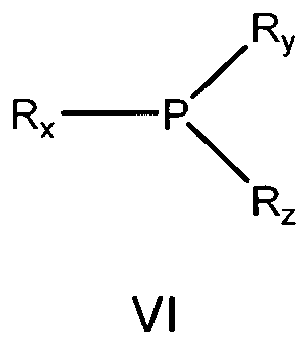 Rx, Ry and Rz are each independently selected from a hydrocarbyl (especially (1-6C)alkyl, e.g. methyl or t-butyl), carbocyclyl (e.g. phenyl), heterocyclyl, or an optionally substituted ferrocene group, each of which is optionally substituted with halo, cyano, nitro, amino, aryl, heterocyclyl, (1-6C)alkyl or (1-6C)alkoxy, an optionally substituted ferrocene or a Lewis acid (e.g. -XQ1Q2, where X, Q1 and Q2 are as defined hereinbefore);or one of Rx, Ry and Rz is a linker group that comprises a functional group capable of connecting the phosphorus atom to a solid support.
 - A process according to claim 1, wherein the frustrated Lewis pair is selected from:


- A process according to claim 1, wherein the frustrated Lewis pair comprises B(C6F5)3 as the Lewis acid and a Lewis base selected from:(i) 2,6-dimethylpyridine(ii) 2,6-di-t-butylpyridine(iii) 2,2,6,6-tetramethylpyridine(iv)
 (v) P(C6H4Me)3(vi) P(C6H2Me3)3(vii)
 (viii)
- A process according to claim 11, wherein the Lewis base is pyridine or 2,2,6,6-tetramethylpiperidine.
- The use of a frustrated Lewis pair in a process for the production of methanol according to any one of claims 1 to 12.
Applications Claiming Priority (2)
| Application Number | Priority Date | Filing Date | Title |
|---|---|---|---|
| GB0917999A GB0917999D0 (en) | 2009-10-14 | 2009-10-14 | Process for producing methanol |
| PCT/GB2010/051733 WO2011045605A1 (en) | 2009-10-14 | 2010-10-14 | Process for producing methanol |
Publications (2)
| Publication Number | Publication Date |
|---|---|
| EP2488477A1 EP2488477A1 (en) | 2012-08-22 |
| EP2488477B1 true EP2488477B1 (en) | 2013-12-04 |
Family
ID=41462327
Family Applications (1)
| Application Number | Title | Priority Date | Filing Date |
|---|---|---|---|
| EP10766105.0A Not-in-force EP2488477B1 (en) | 2009-10-14 | 2010-10-14 | Process for producing methanol |
Country Status (4)
| Country | Link |
|---|---|
| US (1) | US8933135B2 (en) |
| EP (1) | EP2488477B1 (en) |
| GB (1) | GB0917999D0 (en) |
| WO (1) | WO2011045605A1 (en) |
Families Citing this family (14)
| Publication number | Priority date | Publication date | Assignee | Title |
|---|---|---|---|---|
| GB201113904D0 (en) | 2011-08-12 | 2011-09-28 | Univ Cardiff | Method of making alcohols |
| US9624154B2 (en) | 2012-12-07 | 2017-04-18 | University Of Central Florida Research Foundation, Inc. | Heterogeneously catalyzed chemical reduction of carbon dioxide |
| WO2014089537A1 (en) | 2012-12-07 | 2014-06-12 | University Of Central Florida Research Foundation, Inc. | Heterogeneous metal-free catalyst |
| WO2016097734A1 (en) * | 2014-12-16 | 2016-06-23 | Isis Innovation Limited | Solid-phase catalysts comprising supported frustrated lewis pairs |
| FR3043402B1 (en) * | 2015-11-10 | 2019-10-04 | Commissariat A L'energie Atomique Et Aux Energies Alternatives | USE OF BORON FORMIATES FOR THE REDUCTION OF UNSATURATED ORGANIC FUNCTIONS |
| JP7079696B2 (en) * | 2018-08-29 | 2022-06-02 | 株式会社日本触媒 | Boron compounds and methods for producing hydrides, polymers and adducts using them. |
| CN109053785A (en) * | 2018-09-12 | 2018-12-21 | 南京大学 | One kind is for being catalyzed CO2Hydrogenation reaction prepares homogeneous catalyst and its preparation method and the application of formates |
| WO2020247335A1 (en) | 2019-06-04 | 2020-12-10 | Dow Silicones Corporation | BRIDGED FRUSTRATED LEWIS PAIRS AS THERMAL TRIGGER FOR REACTIONS BETWEEN Si-H AND ALPHA-BETA UNSATURATED ESTERS |
| CN113924344B (en) | 2019-06-04 | 2023-07-14 | 美国陶氏有机硅公司 | Bridging hindered Lewis pairs as thermal triggers for the reaction between Si-H and Si-O-Si |
| EP3980428B1 (en) | 2019-06-04 | 2023-04-26 | Dow Silicones Corporation | Thermally initiated acid catalyzed reaction between silyl hydride and alpha-beta unsaturated esters |
| WO2020247329A1 (en) | 2019-06-04 | 2020-12-10 | Dow Silicones Corporation | Thermally initiated acid catalyzed reaction between silyl hydride and siloxane |
| EP3980432B1 (en) | 2019-06-04 | 2023-04-26 | Dow Silicones Corporation | Bridged frustrated lewis pairs as thermal trigger for reactions between si-h and epoxide |
| CN113924330B (en) | 2019-06-04 | 2023-01-24 | 美国陶氏有机硅公司 | Thermally Initiated Acid-Catalyzed Reaction of Silyl Hydrides with Silyl Ethers and/or Silanols |
| KR20220016902A (en) | 2019-06-04 | 2022-02-10 | 다우 실리콘즈 코포레이션 | Bridged incomplete Lewis pairs as thermal triggers for the reaction of Si-H with Si-OR |
-
2009
- 2009-10-14 GB GB0917999A patent/GB0917999D0/en not_active Ceased
-
2010
- 2010-10-14 WO PCT/GB2010/051733 patent/WO2011045605A1/en not_active Ceased
- 2010-10-14 US US13/501,476 patent/US8933135B2/en not_active Expired - Fee Related
- 2010-10-14 EP EP10766105.0A patent/EP2488477B1/en not_active Not-in-force
Also Published As
| Publication number | Publication date |
|---|---|
| WO2011045605A1 (en) | 2011-04-21 |
| GB0917999D0 (en) | 2009-12-02 |
| US8933135B2 (en) | 2015-01-13 |
| EP2488477A1 (en) | 2012-08-22 |
| US20120283340A1 (en) | 2012-11-08 |
Similar Documents
| Publication | Publication Date | Title |
|---|---|---|
| US8933135B2 (en) | Process for producing methanol | |
| Kubas | Metal dihydrogen and σ-bond complexes: structure theory and reactivity | |
| Lemke et al. | Ruthenium/zirconium complexes containing C2 bridges with bond orders of 3, 2, and 1. Synthesis and structures of Cp (PMe3) 2RuCHnCHnZrClCp2 (n= 0, 1, 2) | |
| Sumerin et al. | Experimental and theoretical treatment of hydrogen splitting and storage in boron–nitrogen systems | |
| Shi et al. | Synthesis and Reactivity of Metal–Ligand Cooperative Bifunctional Ruthenium Hydride Complexes: Active Catalysts for β-Alkylation of Secondary Alcohols with Primary Alcohols | |
| WO2015149072A1 (en) | Metal-organic frameworks containing nitrogen-donor ligands for efficient catalytic organic transformations | |
| Zhou et al. | Rh-Catalyzed C–H bond alkylation of indoles with α, α-difluorovinyl tosylate via indolyl group migration | |
| KR20190058112A (en) | Hydrogenation catalyst and hydrogenation of carbon dioxide using the catalyst | |
| KR20160085701A (en) | Catalyst and process for the production of hydrogen from ammonia boranes | |
| WO2016097734A1 (en) | Solid-phase catalysts comprising supported frustrated lewis pairs | |
| Chen et al. | Catalytic method for the synthesis of deuterium-labeled N-heterocyclic carbenes enabled by a coordinatively unsaturated ruthenium N-heterocyclic carbene catalyst | |
| Darmandeh et al. | Synthesis, Isolation and Crystal Structures of the Metalated Ylides [Cy3P‐C‐SO2Tol] M (M= Li, Na, K) | |
| US20160002274A1 (en) | dppf-LIKE COMPOUNDS AND METHOD FO MANUFACTURE AND USE | |
| Beh et al. | Tandem deoxygenative hydrosilation of carbon dioxide with a cationic scandium hydridoborate and B (C 6 F 5) 3 | |
| Chen et al. | Pyrazole–pyridine–pyrazole (NNN) ruthenium (II) complex catalyzed acceptorless dehydrogenation of alcohols to aldehydes | |
| US20130209905A1 (en) | Process for the production of hydrogen | |
| Rakowski et al. | Low valent cobalt triisopropyl phosphite complexes. Characterization of a catalyst for the hydrogenation of. alpha.,. beta.-unsaturated ketones | |
| US20160376293A1 (en) | Nickel pre-catalysts and related compositions and methods | |
| Bleeke et al. | Pentadienyl-metal-phosphine chemistry. 5. The reaction chemistry of (. eta. 5-2, 4-dimethylpentadienyl) bis (trimethylphosphine) cobalt | |
| Kong et al. | Effects of additives on catalytic arene C–H activation: Study of Rh catalysts supported by bis-phosphine pincer ligands | |
| Goh et al. | Combining the Diaza‐Diels–Alder Reaction and Palladium‐Catalyzed Aminations to Prepare Amino‐Substituted Porphyrins | |
| US20170144884A1 (en) | Dihydrogen Production Process | |
| US20230241597A1 (en) | Platform for the recovery of transition metal catalysts | |
| CN105418663A (en) | Chiral boric acid derivative and preparation method and application thereof | |
| AU2018260727A1 (en) | Process for the preparation of deuterated ethanol from D2O |
Legal Events
| Date | Code | Title | Description |
|---|---|---|---|
| PUAI | Public reference made under article 153(3) epc to a published international application that has entered the european phase |
Free format text: ORIGINAL CODE: 0009012 |
|
| 17P | Request for examination filed |
Effective date: 20120330 |
|
| AK | Designated contracting states |
Kind code of ref document: A1 Designated state(s): AL AT BE BG CH CY CZ DE DK EE ES FI FR GB GR HR HU IE IS IT LI LT LU LV MC MK MT NL NO PL PT RO RS SE SI SK SM TR |
|
| DAX | Request for extension of the european patent (deleted) | ||
| GRAP | Despatch of communication of intention to grant a patent |
Free format text: ORIGINAL CODE: EPIDOSNIGR1 |
|
| INTG | Intention to grant announced |
Effective date: 20130613 |
|
| GRAS | Grant fee paid |
Free format text: ORIGINAL CODE: EPIDOSNIGR3 |
|
| GRAA | (expected) grant |
Free format text: ORIGINAL CODE: 0009210 |
|
| AK | Designated contracting states |
Kind code of ref document: B1 Designated state(s): AL AT BE BG CH CY CZ DE DK EE ES FI FR GB GR HR HU IE IS IT LI LT LU LV MC MK MT NL NO PL PT RO RS SE SI SK SM TR |
|
| REG | Reference to a national code |
Ref country code: GB Ref legal event code: FG4D |
|
| REG | Reference to a national code |
Ref country code: CH Ref legal event code: EP |
|
| REG | Reference to a national code |
Ref country code: AT Ref legal event code: REF Ref document number: 643479 Country of ref document: AT Kind code of ref document: T Effective date: 20140115 Ref country code: IE Ref legal event code: FG4D |
|
| REG | Reference to a national code |
Ref country code: DE Ref legal event code: R096 Ref document number: 602010012227 Country of ref document: DE Effective date: 20140130 |
|
| REG | Reference to a national code |
Ref country code: NL Ref legal event code: VDEP Effective date: 20131204 |
|
| REG | Reference to a national code |
Ref country code: AT Ref legal event code: MK05 Ref document number: 643479 Country of ref document: AT Kind code of ref document: T Effective date: 20131204 |
|
| PG25 | Lapsed in a contracting state [announced via postgrant information from national office to epo] |
Ref country code: LT Free format text: LAPSE BECAUSE OF FAILURE TO SUBMIT A TRANSLATION OF THE DESCRIPTION OR TO PAY THE FEE WITHIN THE PRESCRIBED TIME-LIMIT Effective date: 20131204 Ref country code: HR Free format text: LAPSE BECAUSE OF FAILURE TO SUBMIT A TRANSLATION OF THE DESCRIPTION OR TO PAY THE FEE WITHIN THE PRESCRIBED TIME-LIMIT Effective date: 20131204 Ref country code: NL Free format text: LAPSE BECAUSE OF FAILURE TO SUBMIT A TRANSLATION OF THE DESCRIPTION OR TO PAY THE FEE WITHIN THE PRESCRIBED TIME-LIMIT Effective date: 20131204 Ref country code: NO Free format text: LAPSE BECAUSE OF FAILURE TO SUBMIT A TRANSLATION OF THE DESCRIPTION OR TO PAY THE FEE WITHIN THE PRESCRIBED TIME-LIMIT Effective date: 20140304 Ref country code: FI Free format text: LAPSE BECAUSE OF FAILURE TO SUBMIT A TRANSLATION OF THE DESCRIPTION OR TO PAY THE FEE WITHIN THE PRESCRIBED TIME-LIMIT Effective date: 20131204 Ref country code: SE Free format text: LAPSE BECAUSE OF FAILURE TO SUBMIT A TRANSLATION OF THE DESCRIPTION OR TO PAY THE FEE WITHIN THE PRESCRIBED TIME-LIMIT Effective date: 20131204 |
|
| REG | Reference to a national code |
Ref country code: LT Ref legal event code: MG4D |
|
| PG25 | Lapsed in a contracting state [announced via postgrant information from national office to epo] |
Ref country code: LV Free format text: LAPSE BECAUSE OF FAILURE TO SUBMIT A TRANSLATION OF THE DESCRIPTION OR TO PAY THE FEE WITHIN THE PRESCRIBED TIME-LIMIT Effective date: 20131204 Ref country code: CY Free format text: LAPSE BECAUSE OF FAILURE TO SUBMIT A TRANSLATION OF THE DESCRIPTION OR TO PAY THE FEE WITHIN THE PRESCRIBED TIME-LIMIT Effective date: 20131204 Ref country code: RS Free format text: LAPSE BECAUSE OF FAILURE TO SUBMIT A TRANSLATION OF THE DESCRIPTION OR TO PAY THE FEE WITHIN THE PRESCRIBED TIME-LIMIT Effective date: 20131204 Ref country code: AT Free format text: LAPSE BECAUSE OF FAILURE TO SUBMIT A TRANSLATION OF THE DESCRIPTION OR TO PAY THE FEE WITHIN THE PRESCRIBED TIME-LIMIT Effective date: 20131204 |
|
| PG25 | Lapsed in a contracting state [announced via postgrant information from national office to epo] |
Ref country code: BE Free format text: LAPSE BECAUSE OF FAILURE TO SUBMIT A TRANSLATION OF THE DESCRIPTION OR TO PAY THE FEE WITHIN THE PRESCRIBED TIME-LIMIT Effective date: 20131204 Ref country code: IS Free format text: LAPSE BECAUSE OF FAILURE TO SUBMIT A TRANSLATION OF THE DESCRIPTION OR TO PAY THE FEE WITHIN THE PRESCRIBED TIME-LIMIT Effective date: 20140404 Ref country code: EE Free format text: LAPSE BECAUSE OF FAILURE TO SUBMIT A TRANSLATION OF THE DESCRIPTION OR TO PAY THE FEE WITHIN THE PRESCRIBED TIME-LIMIT Effective date: 20131204 |
|
| PG25 | Lapsed in a contracting state [announced via postgrant information from national office to epo] |
Ref country code: SK Free format text: LAPSE BECAUSE OF FAILURE TO SUBMIT A TRANSLATION OF THE DESCRIPTION OR TO PAY THE FEE WITHIN THE PRESCRIBED TIME-LIMIT Effective date: 20131204 Ref country code: ES Free format text: LAPSE BECAUSE OF FAILURE TO SUBMIT A TRANSLATION OF THE DESCRIPTION OR TO PAY THE FEE WITHIN THE PRESCRIBED TIME-LIMIT Effective date: 20131204 Ref country code: CZ Free format text: LAPSE BECAUSE OF FAILURE TO SUBMIT A TRANSLATION OF THE DESCRIPTION OR TO PAY THE FEE WITHIN THE PRESCRIBED TIME-LIMIT Effective date: 20131204 Ref country code: RO Free format text: LAPSE BECAUSE OF FAILURE TO SUBMIT A TRANSLATION OF THE DESCRIPTION OR TO PAY THE FEE WITHIN THE PRESCRIBED TIME-LIMIT Effective date: 20131204 Ref country code: PT Free format text: LAPSE BECAUSE OF FAILURE TO SUBMIT A TRANSLATION OF THE DESCRIPTION OR TO PAY THE FEE WITHIN THE PRESCRIBED TIME-LIMIT Effective date: 20140404 Ref country code: PL Free format text: LAPSE BECAUSE OF FAILURE TO SUBMIT A TRANSLATION OF THE DESCRIPTION OR TO PAY THE FEE WITHIN THE PRESCRIBED TIME-LIMIT Effective date: 20131204 |
|
| REG | Reference to a national code |
Ref country code: DE Ref legal event code: R097 Ref document number: 602010012227 Country of ref document: DE |
|
| PLBE | No opposition filed within time limit |
Free format text: ORIGINAL CODE: 0009261 |
|
| STAA | Information on the status of an ep patent application or granted ep patent |
Free format text: STATUS: NO OPPOSITION FILED WITHIN TIME LIMIT |
|
| PG25 | Lapsed in a contracting state [announced via postgrant information from national office to epo] |
Ref country code: DK Free format text: LAPSE BECAUSE OF FAILURE TO SUBMIT A TRANSLATION OF THE DESCRIPTION OR TO PAY THE FEE WITHIN THE PRESCRIBED TIME-LIMIT Effective date: 20131204 |
|
| 26N | No opposition filed |
Effective date: 20140905 |
|
| REG | Reference to a national code |
Ref country code: DE Ref legal event code: R097 Ref document number: 602010012227 Country of ref document: DE Effective date: 20140905 |
|
| PG25 | Lapsed in a contracting state [announced via postgrant information from national office to epo] |
Ref country code: SI Free format text: LAPSE BECAUSE OF FAILURE TO SUBMIT A TRANSLATION OF THE DESCRIPTION OR TO PAY THE FEE WITHIN THE PRESCRIBED TIME-LIMIT Effective date: 20131204 |
|
| PG25 | Lapsed in a contracting state [announced via postgrant information from national office to epo] |
Ref country code: MC Free format text: LAPSE BECAUSE OF FAILURE TO SUBMIT A TRANSLATION OF THE DESCRIPTION OR TO PAY THE FEE WITHIN THE PRESCRIBED TIME-LIMIT Effective date: 20131204 Ref country code: LU Free format text: LAPSE BECAUSE OF FAILURE TO SUBMIT A TRANSLATION OF THE DESCRIPTION OR TO PAY THE FEE WITHIN THE PRESCRIBED TIME-LIMIT Effective date: 20141014 |
|
| REG | Reference to a national code |
Ref country code: CH Ref legal event code: PL |
|
| REG | Reference to a national code |
Ref country code: IE Ref legal event code: MM4A |
|
| PG25 | Lapsed in a contracting state [announced via postgrant information from national office to epo] |
Ref country code: CH Free format text: LAPSE BECAUSE OF NON-PAYMENT OF DUE FEES Effective date: 20141031 Ref country code: LI Free format text: LAPSE BECAUSE OF NON-PAYMENT OF DUE FEES Effective date: 20141031 |
|
| PG25 | Lapsed in a contracting state [announced via postgrant information from national office to epo] |
Ref country code: IT Free format text: LAPSE BECAUSE OF FAILURE TO SUBMIT A TRANSLATION OF THE DESCRIPTION OR TO PAY THE FEE WITHIN THE PRESCRIBED TIME-LIMIT Effective date: 20131204 |
|
| REG | Reference to a national code |
Ref country code: FR Ref legal event code: PLFP Year of fee payment: 6 |
|
| PG25 | Lapsed in a contracting state [announced via postgrant information from national office to epo] |
Ref country code: IE Free format text: LAPSE BECAUSE OF NON-PAYMENT OF DUE FEES Effective date: 20141014 |
|
| PGFP | Annual fee paid to national office [announced via postgrant information from national office to epo] |
Ref country code: DE Payment date: 20151029 Year of fee payment: 6 Ref country code: GB Payment date: 20151030 Year of fee payment: 6 |
|
| PGFP | Annual fee paid to national office [announced via postgrant information from national office to epo] |
Ref country code: FR Payment date: 20151026 Year of fee payment: 6 |
|
| PG25 | Lapsed in a contracting state [announced via postgrant information from national office to epo] |
Ref country code: SM Free format text: LAPSE BECAUSE OF FAILURE TO SUBMIT A TRANSLATION OF THE DESCRIPTION OR TO PAY THE FEE WITHIN THE PRESCRIBED TIME-LIMIT Effective date: 20131204 |
|
| PG25 | Lapsed in a contracting state [announced via postgrant information from national office to epo] |
Ref country code: GR Free format text: LAPSE BECAUSE OF FAILURE TO SUBMIT A TRANSLATION OF THE DESCRIPTION OR TO PAY THE FEE WITHIN THE PRESCRIBED TIME-LIMIT Effective date: 20140305 Ref country code: BG Free format text: LAPSE BECAUSE OF FAILURE TO SUBMIT A TRANSLATION OF THE DESCRIPTION OR TO PAY THE FEE WITHIN THE PRESCRIBED TIME-LIMIT Effective date: 20131204 |
|
| PG25 | Lapsed in a contracting state [announced via postgrant information from national office to epo] |
Ref country code: TR Free format text: LAPSE BECAUSE OF FAILURE TO SUBMIT A TRANSLATION OF THE DESCRIPTION OR TO PAY THE FEE WITHIN THE PRESCRIBED TIME-LIMIT Effective date: 20131204 Ref country code: HU Free format text: LAPSE BECAUSE OF FAILURE TO SUBMIT A TRANSLATION OF THE DESCRIPTION OR TO PAY THE FEE WITHIN THE PRESCRIBED TIME-LIMIT; INVALID AB INITIO Effective date: 20101014 Ref country code: MT Free format text: LAPSE BECAUSE OF FAILURE TO SUBMIT A TRANSLATION OF THE DESCRIPTION OR TO PAY THE FEE WITHIN THE PRESCRIBED TIME-LIMIT Effective date: 20131204 |
|
| REG | Reference to a national code |
Ref country code: DE Ref legal event code: R082 Ref document number: 602010012227 Country of ref document: DE Representative=s name: PATENTANWAELTE GEYER, FEHNERS & PARTNER MBB, DE Ref country code: DE Ref legal event code: R081 Ref document number: 602010012227 Country of ref document: DE Owner name: OXFORD UNIVERSITY INNOVATION LIMITED, GB Free format text: FORMER OWNER: ISIS INNOVATION LTD., SUMMERTOWN, OXFORD, GB |
|
| REG | Reference to a national code |
Ref country code: DE Ref legal event code: R119 Ref document number: 602010012227 Country of ref document: DE |
|
| GBPC | Gb: european patent ceased through non-payment of renewal fee |
Effective date: 20161014 |
|
| REG | Reference to a national code |
Ref country code: FR Ref legal event code: ST Effective date: 20170630 |
|
| PG25 | Lapsed in a contracting state [announced via postgrant information from national office to epo] |
Ref country code: DE Free format text: LAPSE BECAUSE OF NON-PAYMENT OF DUE FEES Effective date: 20170503 Ref country code: GB Free format text: LAPSE BECAUSE OF NON-PAYMENT OF DUE FEES Effective date: 20161014 Ref country code: FR Free format text: LAPSE BECAUSE OF NON-PAYMENT OF DUE FEES Effective date: 20161102 |
|
| REG | Reference to a national code |
Ref country code: FR Ref legal event code: CA Effective date: 20170710 Ref country code: FR Ref legal event code: CD Owner name: ISIS INNOVATION LIMITED, GB Effective date: 20170710 |
|
| PG25 | Lapsed in a contracting state [announced via postgrant information from national office to epo] |
Ref country code: MK Free format text: LAPSE BECAUSE OF FAILURE TO SUBMIT A TRANSLATION OF THE DESCRIPTION OR TO PAY THE FEE WITHIN THE PRESCRIBED TIME-LIMIT Effective date: 20131204 |
|
| PG25 | Lapsed in a contracting state [announced via postgrant information from national office to epo] |
Ref country code: AL Free format text: LAPSE BECAUSE OF FAILURE TO SUBMIT A TRANSLATION OF THE DESCRIPTION OR TO PAY THE FEE WITHIN THE PRESCRIBED TIME-LIMIT Effective date: 20131204 |