EP2487960A2 - Path control management system and path control method using same - Google Patents
Path control management system and path control method using same Download PDFInfo
- Publication number
- EP2487960A2 EP2487960A2 EP10822264A EP10822264A EP2487960A2 EP 2487960 A2 EP2487960 A2 EP 2487960A2 EP 10822264 A EP10822264 A EP 10822264A EP 10822264 A EP10822264 A EP 10822264A EP 2487960 A2 EP2487960 A2 EP 2487960A2
- Authority
- EP
- European Patent Office
- Prior art keywords
- domain
- path
- connection
- information
- management system
- Prior art date
- Legal status (The legal status is an assumption and is not a legal conclusion. Google has not performed a legal analysis and makes no representation as to the accuracy of the status listed.)
- Withdrawn
Links
- 238000000034 method Methods 0.000 title claims description 100
- 238000010586 diagram Methods 0.000 description 12
- 230000011664 signaling Effects 0.000 description 9
- 238000004891 communication Methods 0.000 description 7
- 238000005516 engineering process Methods 0.000 description 2
- 238000012423 maintenance Methods 0.000 description 2
- 230000000694 effects Effects 0.000 description 1
- 230000007717 exclusion Effects 0.000 description 1
- 239000000284 extract Substances 0.000 description 1
- 238000012986 modification Methods 0.000 description 1
- 230000004048 modification Effects 0.000 description 1
Images



Classifications
-
- H—ELECTRICITY
- H04—ELECTRIC COMMUNICATION TECHNIQUE
- H04W—WIRELESS COMMUNICATION NETWORKS
- H04W40/00—Communication routing or communication path finding
- H04W40/02—Communication route or path selection, e.g. power-based or shortest path routing
Definitions
- the present invention relates to a path control management system and a method of setting a path using the same.
- a backbone network and a core network provide a path, and the path connects two network devices.
- a control method for connecting network device induces a permanent connection (PC), a switched connection (SC), and a soft permanent connection (SPC).
- the SC and SPC connection control methods use a signaling protocol of a control plane
- the PC connection control method uses a path control management system in a management plane.
- a path can be automatically set within a network.
- the backbone network and the core network use a PC connection control method of a management plane due to convenience of a manager and complexity of operation.
- control planar technology such as a network device and routing
- use of a connection control method using a signaling protocol of a control plane is increasing.
- a mutual interlock should be performed between networks having different connection control methods, i.e., between a network of a management plane having no control plane of an automatic connection method and a network of a control plane, and a connection between a network of a management plane and a network of a control plane should be set for mutual interlock between the network of a management plane and the network of a control plane.
- connection control between networks having different connection control methods a user manually directly transfers or inputs connection information to each network. Thereby, much time is required for setting a path between networks, and when a connection of many networks is controlled, a problem such as a service control error and mutual operation disagreement may occur due to increase in complexity of operation, and this causes increase of a sustain and maintenance cost.
- a control plane function should be upgraded in a network device and a network having no control plane and thus there is a problem that a cost thereof and operation difficulty very much increase.
- the present invention has been made in an effort to provide a path control management system and a method of setting a path using the same having advantages of reducing a time that is required for setting a path between networks or domains.
- An exemplary embodiment of the present invention provides a method of setting a path in a first path control management system of a first domain.
- the method includes: receiving connection information from a user; transmitting, when a destination node exists in a second domain that is different from the first domain among connection information, information of a first connection node in the first domain to connect to the second domain to a second path control management system of the second domain; receiving information of a second connection node in the second domain to connect to the first domain from the second path control management system; and controlling a connection between the first connection node and the second connection node.
- the path control management system includes a selection unit, a path calculator, and a path setting unit.
- the selection unit selects a connection control method for setting a path within the first domain.
- the path calculator calculates a path in the first domain using connection information from a user.
- the transmitting/receiving unit transmits information of a first connection node to connect to a second domain that is different from the first domain among paths in the first domain to a path control management system that manages the second domain and receives information of the second connection node to connect to the first domain among paths in the second domain from the path control management system of the second domain.
- the path setting unit sets the path in the first domain as the connection control method, receives a response by requesting path setting of the second domain to the path control management system of the second domain, and connects the first connection node and the second connection node.
- Yet another embodiment of the present invention provides a method of setting a path in a path control management system of a first domain of a plurality of different domains.
- the method includes: calculating a path in the first domain using connection information that is received from a user; receiving, when a destination node exists in a second domain that is different from the first domain among the connection information, information of a path in the second domain and information of a connection node in the second domain to connect to the first domain from a path control management system of the second domain; setting a path in the first domain with reference to information of a path in the first domain and a path in the second domain; setting a connection to a connection node in the second domain by provisioning a connection node in the first domain to connect to a connection node in the second domain with reference to the path in the first domain; requesting path setting in the second domain to the path control management system in the second domain; and receiving a response to path setting in the second domain from the path control management system in the second domain.
- a time period that is required for setting a path between different networks or different domains can be reduced. Further, a problem such as a service control error and mutual operation disagreement according to increase in complexity of a network can be solved, and thus a sustain and maintenance cost can be reduced and network extension can be provided.
- a path can be set with various methods of connection controls in a network within such a domain.
- a connection control method for setting a path in a communication network will be described with reference to FIGS. 1 and 2 .
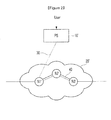
- FIG. 1 is a diagram illustrating a connection control method of a permanent connection (PC) method
- FIG. 2 is a diagram illustrating a connection control method of a soft permanent connection (SPC) method.
- a permanent connection (hereinafter, referred to as a "PC") is a method of setting a path in a network 20 using a provisioning system (hereinafter, referred to as a "PS") 10, which is a path control management system.
- PS provisioning system
- the PS 10 receives a service connection request from a user.
- the service connection request includes connection setting input information such as a start node, a destination node, bandwidth, and a restriction item.
- the PS 10 calculates a path using connection setting input information.
- the PS 10 sets a path by provisioning network nodes that are included in the calculated path through a provisioning interface 30 with reference to the calculated path information.
- provisioning includes a connection process or a connection release process to an adjacent network node.
- Such a PC method can be used in the network 20 that is formed with network nodes N1-N3 of a management plane having no control plane.
- soft permanent connection (hereinafter, referred to as "SPC") is a method of setting a path in a network 20' using a PS 10' and a signaling protocol 40 of a control plane.
- the PS 10' when a service connection request is received from a user, the PS 10' requests connection setting to an ingress node N1' corresponding to a start node based on connection setting input information of a service connection request.
- the ingress node N1' having received a request for connection setting requests path calculation to the PS 10'. Accordingly, the PS 10' calculates a path based on connection setting input information and transfers the calculated path information to the ingress node 10'.
- communication between the PS 10' and the ingress node N1' can be performed through a provisioning interface 30.
- the ingress node N1' having received path information from the PS 10' sets a path with an adjacent intermediate network node N2' using a signaling protocol of a control plane, and the intermediate network node N2' also sets a path with an adjacent egress node N3' using a signaling protocol of a control plane.
- a signaling protocol of a control plane for example a resource reservation protocol (RSVP) and a resource reservation protocol-traffic engineering (RSVP-TE) that supports a traffic engineering function may be used.
- RSVP resource reservation protocol
- RSVP-TE resource reservation protocol-traffic engineering
- the SPC method can be used in a network 20' that is formed with network nodes N1'-N3' having a control plane. Further, a PC method can be used by a user even in such a network 20'.
- the network 20' that is formed with the network nodes N1'- N3' having a control plane includes, for example, a generalized multi-protocol label switching (GMPLS) network.
- GPLS generalized multi-protocol label switching
- a communication network sets a path in a communication network using a PC method or an SPC method according to whether a control plane exists.
- a user passively transfers or inputs connection information between networks to each network or each domain, thereby setting a connection between networks or domains.
- a passive method requires much time for connection setting of a network node and aggravates complexity due to connection setting of network nodes when many connection networks exist, thereby increasing an operation cost.
- a network that receives a service connection request from a user is referred to as a local network
- a network other than a local network is referred to as a remote network.
- a PS of the local network is referred to as a local PS
- a PS of a remote network is referred to as a remote PS
- network nodes of a local network are referred to as a local node
- network nodes of a remote network are referred to as a remote node.
- an ingress node and an egress node in a local network among local nodes are referred to as a local ingress node and a local egress node, respectively, and an ingress node and an egress node in a remote network among remote nodes are referred to as a remote ingress node and a remote egress node, respectively.
- FIG. 3 is a diagram illustrating an interlock structure between networks corresponding to an example to which the present invention is applied
- FIG. 4 is a diagram illustrating an interlock structure between domains corresponding to another example to which the present invention is applied.
- FIGS. 5 to 7 are flowcharts illustrating a method of setting a path according to an exemplary embodiment of the present invention.
- a local PS 100a receives a service connection request from a user (S502).
- the service connection request includes connection setting input information.
- the local PS 100a extracts connection setting input information by analyzing a service connection request, thereby checking connection information, bandwidth, and a restriction item (S504).
- the connection information includes a start node and a destination node.
- the local PS 100a determines whether a destination node exists in a local network 200a (S506). If a destination node does not exist in a local network 200a, the local PS 100a determines that a destination node exists in a remote network 200b. For example, as shown in FIG. 3 , when the local network 200a including local nodes LN1-LN4 and the remote network 200b including remote nodes RN1-RN4 exist, if a start node is LN1 and a destination node is RN3, the local PS 100a determines that a destination node exists in the remote network 200b.
- the local PS 100a calculates a path in the local network 200a (S508).
- the local PS 100a requests path information in the remote network 200b while transferring a local egress node in the local network 200a, i.e., information of a connection local node to connect to the remote network 200b and connection setting input information from a user to the remote PS 100b with reference to the calculated path information (S510 and S512).
- information of a connection local node may be LN3.
- the remote PS 100b calculates a path in the remote network 200b using information of a connection local node and connection setting input information (S514).
- the remote PS 100b checks a remote ingress node, i.e., a connection remote node, to connect to the local network 100a with reference to the calculated path information, and transfers information of the connection remote node and path information that is calculated in the remote network 200b to the local PS 100a (S516).
- a remote ingress node i.e., a connection remote node
- information of the connection remote node may be RN1.
- the local PS 100a can request path information to a remote PS of a plurality of remote networks. Further, when receiving information of a connection remote node and path information from a remote PS of a plurality of remote networks, the local PS 100a can determine one remote network and connection remote node to connect among a plurality of remote networks using the received information.
- the local PS 100a sets a path in the local network 200a with reference to path information that is calculated in the local network 200a and path information that is calculated in the remote network 200b (S518). Thereafter, the local PS 100a requests path setting in the remote network 200b to the remote PS 100b while transferring path setting completion information in the local network 200a to the remote PS 100b (S520).
- the remote PS 100b When the remote PS 100b receives a request for setting a path from the local PS 100a, the remote PS 100b sets a path with reference to path information that is calculated in the remote network 200b (S522) and transfers path setting completion information in the remote network 200b to the local PS 100 (S524).
- the local PS 100a having received the path setting completion information in the remote network 200b provisions a connection local node (S526), and the local PS 100a transfers a provisioning result of a connection local node to the remote PS 100b. Accordingly, the remote PS 100b provisions a connection remote node (S528) and transfers a provisioning result of a connection remote node to the local PS 100a. Thereby, a connection between a connection local node and a connection remote node can be set. Resultantly, path setting between two networks can be complete.
- the local PS 100a may set a path LP1 in the local network 200a
- the remote PS 100b may set a path RP1 in the remote network 200b.
- information of a connection local node may be LN3, and information of a connection remote node may be RN1.
- path setting between two networks 200a and 200b can be complete.
- the local PS 100a determines whether a destination node exists in a domain (hereinafter, referred to as a "local domain") 210a in which the local PS 100a manages (S602).
- a start node is LN1 and a destination node is LN3'
- the local PS 100a determines that the destination node exists in another domain (hereinafter, referred to as a "remote domain") 210a' other than a local domain.
- a path between two domains 210a and 210a' can be set using the same method as a method of setting a path between two networks, which is described with reference to FIGS. 3 and 4 .
- the local PS 100a calculates a path in the local domain 210a (S604).
- the local PS 100a requests path information in the remote domain 210a' while transferring information of a local egress node in the local domain 210a, i.e., a connection local node, to connect to the remote domain 210a', and connection setting input information from a user with reference to the calculated path information to the local PS 100a' that manages the remote domain 210a' (S606 and S608).
- information of a connection local node of the local domain 210a may be LN3.
- the local PS 100a' calculates a path in the remote domain 210a' using information of a connection local node of the local domain 210a and connection setting input information (S610).
- the local PS 100a' checks an ingress node of the remote domain 210a', i.e., a connection local node of the remote domain 210a', to connect to the local domain 210a with reference to the calculated path information, and transfers information of a connection local node of the remote domain 210a' and path information that is calculated in the remote domain 210a' to the local PS 100a (S612).
- information of a connection local node of the remote domain 210a' may be LN1'.
- the local PS 100a sets a path in the local domain 210a with reference to path information that is calculated in the remote domain 210a' and path information that is calculated in the local domain 210a (S614), and transfers setting completion information of a path in the local domain 210a to the local PS 100a'.
- the local PS 100a provisions a connection local node of the local domain 210a using information of a connection local node of the remote domain 210a' (S616).
- the connection local node of the local domain 210a transfers provisioning result information to a connection local node of the remote domain 210a', and the local PS 100a simultaneously requests path setting in the remote domain 210a' to the local PS 100a' (S618).
- the local PS 100a' When the local PS 100a' receives a request for setting a path from the local PS 100a, the local PS 100a' sets a path with reference to path information that is calculated in the remote domain 210a' (S620) and provisions a connection local node of the remote domain 210a' (S622).
- connection local node of the remote domain 210a' transfers provisioning result information to a connection local node of the local domain 210a
- the local PS 100a' transfers setting completion information of a path in the remote domain 210a' to the local PS 100a.
- the local PS 100a may set a path LP1 in the local domain 210a
- the local PS 100a' may set a path LP2 in the remote domain 210a'.
- information of a connection local node of the local domain 210a may be LN3
- information of a connection local node of the remote domain 210a' may be LN1'. Therefore, two connection local nodes LN3 and LN1' can be connected by provisioning the connection local node LN3 and the connection local node LN1'.
- path setting between two domains 210a and 210a' is complete.
- the local PS 100a calculates a path in the local network 200a (S702) and sets a path in the local network 200a with reference to information of the calculated path (S704).
- FIG. 8 is a flowchart illustrating a method in which a local PS sets a path in a local network. The method can be equally applied to a remote network or a remote domain.
- the local PS 100a selects a connection control method using connection setting input information from a user and information about whether a control plane exists in the local network 200a (S802). In this case, if a control plane does not exist in the local network 200a, the local PS 100a selects a PC method as a connection control method, and if a control plane exists in the local network 200a, the local PS 100a selects a PC method or an SPC method as a connection control method.
- a path is set by provisioning a local node that is included in a calculated path (S806-S808).
- the local PS 100a requests connection setting to a local ingress node (e.g., IN1 of FIG. 3 ) (S810), and the local ingress node requests a path calculation to the local PS 100a. That is, if an SPC method is selected as a connection control method, the local PS 100a receives a path calculation request from a local ingress node and calculates an optimum path (S812-S814). Step S814 corresponds to step S508 of FIG. 5 .
- a local ingress node e.g., IN1 of FIG. 3
- the local PS 100a transfers the calculated path information to a local ingress node (S816).
- a local ingress node e.g., LN1 of FIG. 3
- a local node e.g., IN2 of FIG. 3
- a local egress node e.g., IN3 of FIG. 3
- a path can be set between different networks or different domains even without a passive input of a user.
- FIG. 9 is a diagram illustrating an interface that is used for setting a path between networks.
- an interface that is used for setting a path between the networks 200a and 200b includes an interface IF1/IF2 between a PS 100a/100b and network nodes LN1-LN4/RN1-RN4, an interface IF3 between the PSs 100a and 100b, and an interface IF4 between network nodes LN1-LN4 and RN1-RN4 between the networks 200a and 200b.
- the interface IF1/IF2 between the PS 100a/100b and network nodes LN1-LN4 and RN1-RN4 may include a provisioning interface that is shown in FIG. 1 .
- a message that is exchanged between the PS 100a/100b and the network nodes LN1-LN4/RN1-RN4 through the interface IF1/IF2 between the PS 100a/100b and the network nodes LN1-LN4/RN1-RN4 includes a message in which the PS 100a/100b requests path setting to an ingress node (e.g., LN1/RN1) corresponding to a start node, a message that requests a path calculation from an ingress node to the PS 100a/100b, a message in which the PS 100a/100b transfers path information to an ingress node after the PS 100a/100b calculates a path, and a message including whether setting success or setting failure in which an ingress node transfers to the PS 100a/100b after a path is set.
- an ingress node e.g., LN1/RN1
- a message that is exchanged between the PS 100a/100b and the network nodes LN1-LN4/RN1-RN4 through the interface IF1/IF2 between the PS 100a/100b and the network nodes LN1-LN4/RN1-RN4 includes messages that are exchanged in order to provision a network node that is included in a path after the PS 100a/100b calculates the path.
- a message that is exchanged through an interface IF3 between the PSs 100a and 100b includes a message that requests information of a path while the PS 100a transfers information of a connection local node to the PS 100b, a message that responds to the message, a message that transfers path setting completion information from the PS 100a to the PS 100b, and a message that transfers path setting completion information from the PS 100b to the PS 100a.
- a message that is exchanged through an interface IF4 between the network nodes LN1-LN4/RN1-RN4 between the networks 200a and 200b includes a message in which a connection local node (e.g., LN3 of FIG. 3 ) in the network 200a requests path setting to a connection remote node (e.g., RN1 of FIG. 3 ) in the network 200b and a response message to path setting from a connection remote node (e.g., RN1 of FIG. 3 ) in the network 200b to a connection local node (e.g., LN3 of FIG. 3 ) in the network 200a.
- a connection local node e.g., LN3 of FIG. 3
- FIG. 10 is a block diagram illustrating a path control management system according to an exemplary embodiment of the present invention.
- FIG. 10 for convenience of description, a path management system that is positioned at a local network will be described.
- a path control management system 100a includes a selection unit 110, a path calculator 120, a transmitting/receiving unit 130, and a path setting unit 140.
- the selection unit 110 selects a connection control method for setting a path in a local domain in which the path control management system 100a manages. In this case, as described above, the selection unit 110 selects an SP method or an SPC method according to whether a local network has a control plane.
- the path calculator 120 receives a service connection request from a user and calculates a path using connection setting input information of a service connection request. In the SPC method, the path calculator 120 receives a path calculation request from an ingress node of a local domain.
- the transmitting/receiving unit 130 transmits information of a connection node of a local domain to connect to another network or another domain to a path control management system of another network or another domain, and receives information of a connection node of another network or another domain to connect to a local domain from a path control management system of another network or another domain.
- the transmitting/receiving unit 130 transmits information of a path that is calculated in a local domain to a path control management system of another network or another domain, and receives information of a path that is calculated in another network or another domain from a path control management system of another network or another domain.
- the path setting unit 140 sets a path in a local domain using a connection control method that is selected by the selection unit 110.
- the path setting unit 140 can set a path in a local domain in consideration of information of a path that is calculated in another network or another domain.
- the path setting unit 140 controls a connection between a connection node of a local domain and a connection node of another network or another domain. That is, the path setting unit 140 provisions a connection node of a local domain.
- An exemplary embodiment of the present invention may not only be embodied through the above-described system and/or method, but may also embodied through a program that executes a function corresponding to a configuration of the exemplary embodiment of the present invention or through a recording medium on which the program is recorded, and can be easily embodied by a person of ordinary skill in the art from a description of the foregoing exemplary embodiment.
Landscapes
- Engineering & Computer Science (AREA)
- Computer Networks & Wireless Communication (AREA)
- Signal Processing (AREA)
- Data Exchanges In Wide-Area Networks (AREA)
Abstract
A first path control management system of a first domain calculates a path in the first domain and transmits information of a connection node in the first domain to connect to a second domain to a second path control management system of the second domain. The second path control management system of the second domain calculates a path in the second domain and transmits a connection node of the second domain to connect to the first domain to the first path control management system. The first path control management system of the first domain and the second path control management system of the second domain receive information of connection nodes of the second domain and the first domain, respectively, thereby connecting a path between the first domain and the second domain.
Description
- The present invention relates to a path control management system and a method of setting a path using the same.
- A backbone network and a core network provide a path, and the path connects two network devices. A control method for connecting network device induces a permanent connection (PC), a switched connection (SC), and a soft permanent connection (SPC). The SC and SPC connection control methods use a signaling protocol of a control plane, and the PC connection control method uses a path control management system in a management plane. When using a signaling protocol of a control plane, a path can be automatically set within a network.
- The backbone network and the core network use a PC connection control method of a management plane due to convenience of a manager and complexity of operation.
- However, currently, with the advance of control planar technology such as a network device and routing, in a network that is formed with a device using control planar technology, use of a connection control method using a signaling protocol of a control plane is increasing.
- Thereby, a mutual interlock should be performed between networks having different connection control methods, i.e., between a network of a management plane having no control plane of an automatic connection method and a network of a control plane, and a connection between a network of a management plane and a network of a control plane should be set for mutual interlock between the network of a management plane and the network of a control plane.
- For connection control between networks having different connection control methods, a user manually directly transfers or inputs connection information to each network. Thereby, much time is required for setting a path between networks, and when a connection of many networks is controlled, a problem such as a service control error and mutual operation disagreement may occur due to increase in complexity of operation, and this causes increase of a sustain and maintenance cost.
- Further, for mutual operation and interlock with a network of a control plane, a control plane function should be upgraded in a network device and a network having no control plane and thus there is a problem that a cost thereof and operation difficulty very much increase.
- The present invention has been made in an effort to provide a path control management system and a method of setting a path using the same having advantages of reducing a time that is required for setting a path between networks or domains.
- An exemplary embodiment of the present invention provides a method of setting a path in a first path control management system of a first domain. The method includes: receiving connection information from a user; transmitting, when a destination node exists in a second domain that is different from the first domain among connection information, information of a first connection node in the first domain to connect to the second domain to a second path control management system of the second domain; receiving information of a second connection node in the second domain to connect to the first domain from the second path control management system; and controlling a connection between the first connection node and the second connection node.
- Another embodiment of the present invention provides a path control management system that manages a first domain. The path control management system includes a selection unit, a path calculator, and a path setting unit. The selection unit selects a connection control method for setting a path within the first domain. The path calculator calculates a path in the first domain using connection information from a user. The transmitting/receiving unit transmits information of a first connection node to connect to a second domain that is different from the first domain among paths in the first domain to a path control management system that manages the second domain and receives information of the second connection node to connect to the first domain among paths in the second domain from the path control management system of the second domain. The path setting unit sets the path in the first domain as the connection control method, receives a response by requesting path setting of the second domain to the path control management system of the second domain, and connects the first connection node and the second connection node.
- Yet another embodiment of the present invention provides a method of setting a path in a path control management system of a first domain of a plurality of different domains. The method includes: calculating a path in the first domain using connection information that is received from a user; receiving, when a destination node exists in a second domain that is different from the first domain among the connection information, information of a path in the second domain and information of a connection node in the second domain to connect to the first domain from a path control management system of the second domain; setting a path in the first domain with reference to information of a path in the first domain and a path in the second domain; setting a connection to a connection node in the second domain by provisioning a connection node in the first domain to connect to a connection node in the second domain with reference to the path in the first domain; requesting path setting in the second domain to the path control management system in the second domain; and receiving a response to path setting in the second domain from the path control management system in the second domain.
- According to an exemplary embodiment of the present invention, by transmitting/receiving information of a connection node between path control management systems without a passive input of a user, a time period that is required for setting a path between different networks or different domains can be reduced. Further, a problem such as a service control error and mutual operation disagreement according to increase in complexity of a network can be solved, and thus a sustain and maintenance cost can be reduced and network extension can be provided.
-
-
FIG. 1 is a diagram illustrating a connection control method of a permanent connection (PC) method. -
FIG. 2 is a diagram illustrating a connection control method of a soft permanent connection (SPC) method. -
FIG. 3 is a diagram illustrating an interlock structure between networks corresponding to an example to which the present invention is applied. -
FIG. 4 is a diagram illustrating an interlock structure between domains corresponding to another example to which the present invention is applied. -
FIGS. 5 to 7 are flowcharts illustrating a method of setting a path according to an exemplary embodiment of the present invention. -
FIG. 8 is a flowchart illustrating a method in which a local PS sets a path in a local network. -
FIG. 9 is a diagram illustrating an interface that is used for setting a path between networks. -
FIG. 10 is a block diagram illustrating a path control management system according to an exemplary embodiment of the present invention. - In the following detailed description, only certain exemplary embodiments of the present invention have been shown and described, simply by way of illustration. As those skilled in the art would realize, the described embodiments may be modified in various different ways, all without departing from the spirit or scope of the present invention. Accordingly, the drawings and description are to be regarded as illustrative in nature and not restrictive. Like reference numerals designate like elements throughout the specification.
- In addition, in the entire specification, unless explicitly described to the contrary, the word "comprise" and variations such as "comprises" or "comprising" will be understood to imply the inclusion of stated elements but not the exclusion of any other elements.
- First, terms that are related to a connection control method for setting a path in a communication network are defined.
- An area in which a path control management system manages is referred to as a domain, a network node in which a path is started within a domain is referred to as an ingress node, and a network node in which a path terminates within a domain is referred to as an egress node. A path can be set with various methods of connection controls in a network within such a domain.
- A connection control method for setting a path in a communication network will be described with reference to
FIGS. 1 and2 . -
FIG. 1 is a diagram illustrating a connection control method of a permanent connection (PC) method, andFIG. 2 is a diagram illustrating a connection control method of a soft permanent connection (SPC) method. - Referring to
FIG. 1 , a permanent connection (hereinafter, referred to as a "PC") is a method of setting a path in anetwork 20 using a provisioning system (hereinafter, referred to as a "PS") 10, which is a path control management system. - Specifically, the
PS 10 receives a service connection request from a user. The service connection request includes connection setting input information such as a start node, a destination node, bandwidth, and a restriction item. Accordingly, thePS 10 calculates a path using connection setting input information. ThePS 10 sets a path by provisioning network nodes that are included in the calculated path through aprovisioning interface 30 with reference to the calculated path information. Here, provisioning includes a connection process or a connection release process to an adjacent network node. - Such a PC method can be used in the
network 20 that is formed with network nodes N1-N3 of a management plane having no control plane. - Alternatively, referring to
FIG. 2 , soft permanent connection (hereinafter, referred to as "SPC") is a method of setting a path in a network 20' using a PS 10' and asignaling protocol 40 of a control plane. - Specifically, when a service connection request is received from a user, the PS 10' requests connection setting to an ingress node N1' corresponding to a start node based on connection setting input information of a service connection request. The ingress node N1', having received a request for connection setting requests path calculation to the PS 10'. Accordingly, the PS 10' calculates a path based on connection setting input information and transfers the calculated path information to the ingress node 10'. In this case, communication between the PS 10' and the ingress node N1' can be performed through a
provisioning interface 30. - The ingress node N1', having received path information from the PS 10' sets a path with an adjacent intermediate network node N2' using a signaling protocol of a control plane, and the intermediate network node N2' also sets a path with an adjacent egress node N3' using a signaling protocol of a control plane. In this case, as a signaling protocol of a control plane, for example a resource reservation protocol (RSVP) and a resource reservation protocol-traffic engineering (RSVP-TE) that supports a traffic engineering function may be used.
- Because such an SPC method uses a signaling protocol of a control plane, the SPC method can be used in a network 20' that is formed with network nodes N1'-N3' having a control plane. Further, a PC method can be used by a user even in such a network 20'. The network 20' that is formed with the network nodes N1'- N3' having a control plane includes, for example, a generalized multi-protocol label switching (GMPLS) network.
- In this way, a communication network sets a path in a communication network using a PC method or an SPC method according to whether a control plane exists. However, there is a case of providing a service to a user through interlock of a communication network having different connection control methods, or a case of having the same connection control method, but providing a service to a user through interlock between different domains. In such a case, a user passively transfers or inputs connection information between networks to each network or each domain, thereby setting a connection between networks or domains. However, such a passive method requires much time for connection setting of a network node and aggravates complexity due to connection setting of network nodes when many connection networks exist, thereby increasing an operation cost.
- Hereinafter, a path setting method that can solve such a problem will be described in detail with reference to
FIGS. 3 to 10 . - Hereinafter, for convenience of description, a network that receives a service connection request from a user is referred to as a local network, and a network other than a local network is referred to as a remote network. A PS of the local network is referred to as a local PS, a PS of a remote network is referred to as a remote PS, network nodes of a local network are referred to as a local node, and network nodes of a remote network are referred to as a remote node. Further, an ingress node and an egress node in a local network among local nodes are referred to as a local ingress node and a local egress node, respectively, and an ingress node and an egress node in a remote network among remote nodes are referred to as a remote ingress node and a remote egress node, respectively.
-
FIG. 3 is a diagram illustrating an interlock structure between networks corresponding to an example to which the present invention is applied, andFIG. 4 is a diagram illustrating an interlock structure between domains corresponding to another example to which the present invention is applied.FIGS. 5 to 7 are flowcharts illustrating a method of setting a path according to an exemplary embodiment of the present invention. - Referring to
FIGS. 3 to 5 , alocal PS 100a receives a service connection request from a user (S502). The service connection request includes connection setting input information. - The
local PS 100a extracts connection setting input information by analyzing a service connection request, thereby checking connection information, bandwidth, and a restriction item (S504). Here, the connection information includes a start node and a destination node. - The
local PS 100a determines whether a destination node exists in alocal network 200a (S506). If a destination node does not exist in alocal network 200a, thelocal PS 100a determines that a destination node exists in aremote network 200b. For example, as shown inFIG. 3 , when thelocal network 200a including local nodes LN1-LN4 and theremote network 200b including remote nodes RN1-RN4 exist, if a start node is LN1 and a destination node is RN3, thelocal PS 100a determines that a destination node exists in theremote network 200b. - First, the
local PS 100a calculates a path in thelocal network 200a (S508). - Thereafter, the
local PS 100a requests path information in theremote network 200b while transferring a local egress node in thelocal network 200a, i.e., information of a connection local node to connect to theremote network 200b and connection setting input information from a user to theremote PS 100b with reference to the calculated path information (S510 and S512). InFIG. 3 , information of a connection local node may be LN3. - The
remote PS 100b calculates a path in theremote network 200b using information of a connection local node and connection setting input information (S514). - Thereafter, the
remote PS 100b checks a remote ingress node, i.e., a connection remote node, to connect to thelocal network 100a with reference to the calculated path information, and transfers information of the connection remote node and path information that is calculated in theremote network 200b to thelocal PS 100a (S516). InFIG. 3 , information of the connection remote node may be RN1. - In
FIG. 3 , only oneremote network 200b is illustrated, but a plurality of connectable remote networks may exist. In this way, when a plurality of remote networks exist, thelocal PS 100a can request path information to a remote PS of a plurality of remote networks. Further, when receiving information of a connection remote node and path information from a remote PS of a plurality of remote networks, thelocal PS 100a can determine one remote network and connection remote node to connect among a plurality of remote networks using the received information. - The
local PS 100a sets a path in thelocal network 200a with reference to path information that is calculated in thelocal network 200a and path information that is calculated in theremote network 200b (S518). Thereafter, thelocal PS 100a requests path setting in theremote network 200b to theremote PS 100b while transferring path setting completion information in thelocal network 200a to theremote PS 100b (S520). - When the
remote PS 100b receives a request for setting a path from thelocal PS 100a, theremote PS 100b sets a path with reference to path information that is calculated in theremote network 200b (S522) and transfers path setting completion information in theremote network 200b to the local PS 100 (S524). - The
local PS 100a, having received the path setting completion information in theremote network 200b provisions a connection local node (S526), and thelocal PS 100a transfers a provisioning result of a connection local node to theremote PS 100b. Accordingly, theremote PS 100b provisions a connection remote node (S528) and transfers a provisioning result of a connection remote node to thelocal PS 100a. Thereby, a connection between a connection local node and a connection remote node can be set. Resultantly, path setting between two networks can be complete. - For example, as shown in
FIG. 3 , thelocal PS 100a may set a path LP1 in thelocal network 200a, and theremote PS 100b may set a path RP1 in theremote network 200b. In this case, information of a connection local node may be LN3, and information of a connection remote node may be RN1. After a path LP1 is set in thelocal network 200a and a path RP1 is set in theremote network 200b, by provisioning the connection local node LN3 and the connection remote node RN1, while the connection local node LN3 and the connection remote node RN1 are connected, path setting between twonetworks - Referring to
FIG. 6 , when a destination node exists in thelocal network 200a, thelocal PS 100a determines whether a destination node exists in a domain (hereinafter, referred to as a "local domain") 210a in which thelocal PS 100a manages (S602). - For example, as shown in
FIG. 4 , when local nodes LN1-LN4 and LN1'-LN4' are included in thelocal network 200a, if a start node is LN1 and a destination node is LN3', thelocal PS 100a determines that the destination node exists in another domain (hereinafter, referred to as a "remote domain") 210a' other than a local domain. In this case, a path between twodomains FIGS. 3 and4 . - Specifically, the
local PS 100a calculates a path in thelocal domain 210a (S604). - Thereafter, the
local PS 100a requests path information in theremote domain 210a' while transferring information of a local egress node in thelocal domain 210a, i.e., a connection local node, to connect to theremote domain 210a', and connection setting input information from a user with reference to the calculated path information to thelocal PS 100a' that manages theremote domain 210a' (S606 and S608). InFIG. 4 , information of a connection local node of thelocal domain 210a may be LN3. - The
local PS 100a' calculates a path in theremote domain 210a' using information of a connection local node of thelocal domain 210a and connection setting input information (S610). - Thereafter, the
local PS 100a' checks an ingress node of theremote domain 210a', i.e., a connection local node of theremote domain 210a', to connect to thelocal domain 210a with reference to the calculated path information, and transfers information of a connection local node of theremote domain 210a' and path information that is calculated in theremote domain 210a' to thelocal PS 100a (S612). InFIG. 4 , information of a connection local node of theremote domain 210a' may be LN1'. - The
local PS 100a sets a path in thelocal domain 210a with reference to path information that is calculated in theremote domain 210a' and path information that is calculated in thelocal domain 210a (S614), and transfers setting completion information of a path in thelocal domain 210a to thelocal PS 100a'. - Further, the
local PS 100a provisions a connection local node of thelocal domain 210a using information of a connection local node of theremote domain 210a' (S616). The connection local node of thelocal domain 210a transfers provisioning result information to a connection local node of theremote domain 210a', and thelocal PS 100a simultaneously requests path setting in theremote domain 210a' to thelocal PS 100a' (S618). - When the
local PS 100a' receives a request for setting a path from thelocal PS 100a, thelocal PS 100a' sets a path with reference to path information that is calculated in theremote domain 210a' (S620) and provisions a connection local node of theremote domain 210a' (S622). - Accordingly, the connection local node of the
remote domain 210a' transfers provisioning result information to a connection local node of thelocal domain 210a, and thelocal PS 100a' transfers setting completion information of a path in theremote domain 210a' to thelocal PS 100a. - For example, as shown in
FIG. 4 , thelocal PS 100a may set a path LP1 in thelocal domain 210a, and thelocal PS 100a' may set a path LP2 in theremote domain 210a'. In this case, information of a connection local node of thelocal domain 210a may be LN3, and information of a connection local node of theremote domain 210a' may be LN1'. Therefore, two connection local nodes LN3 and LN1' can be connected by provisioning the connection local node LN3 and the connection local node LN1'. - That is, after the path LP1 is set in the
local domain 210a and the path LP2 is set in theremote domain 210a', while the connection local node LN3 and the connection local node LN1' are connected by provisioning the connection local node LN3 and the connection local node LN1', path setting between twodomains - Referring to
FIG.7 , when a destination node exists within thelocal domain 210a, thelocal PS 100a calculates a path in thelocal network 200a (S702) and sets a path in thelocal network 200a with reference to information of the calculated path (S704). - Next, a method of setting a path in
networks domains FIG. 8 . -
FIG. 8 is a flowchart illustrating a method in which a local PS sets a path in a local network. The method can be equally applied to a remote network or a remote domain. - Referring to
FIG. 8 , thelocal PS 100a selects a connection control method using connection setting input information from a user and information about whether a control plane exists in thelocal network 200a (S802). In this case, if a control plane does not exist in thelocal network 200a, thelocal PS 100a selects a PC method as a connection control method, and if a control plane exists in thelocal network 200a, thelocal PS 100a selects a PC method or an SPC method as a connection control method. - Referring to
FIG. 9 , if a PC method is selected as a connection control method (S804), as shown inFIG. 1 , a path is set by provisioning a local node that is included in a calculated path (S806-S808). - If an SPC method is selected as a connection control method, as shown in
FIG.2 , thelocal PS 100a requests connection setting to a local ingress node (e.g., IN1 ofFIG. 3 ) (S810), and the local ingress node requests a path calculation to thelocal PS 100a. That is, if an SPC method is selected as a connection control method, thelocal PS 100a receives a path calculation request from a local ingress node and calculates an optimum path (S812-S814). Step S814 corresponds to step S508 ofFIG. 5 . - The
local PS 100a transfers the calculated path information to a local ingress node (S816). Accordingly, a local ingress node (e.g., LN1 ofFIG. 3 ), a local node (e.g., IN2 ofFIG. 3 ), and a local egress node (e.g., IN3 ofFIG. 3 ) that are included in the calculated path each set a path using a signaling protocol of a control plane (S818). - In this way, according to an exemplary embodiment of the present invention, by transmitting/receiving termination information of a connection node through communication between PSs of different networks or between PSs of different domains, a path can be set between different networks or different domains even without a passive input of a user.
-
FIG. 9 is a diagram illustrating an interface that is used for setting a path between networks. - Referring to
FIG. 9 , an interface that is used for setting a path between thenetworks PS 100a/100b and network nodes LN1-LN4/RN1-RN4, an interface IF3 between the PSs 100a and 100b, and an interface IF4 between network nodes LN1-LN4 and RN1-RN4 between thenetworks PS 100a/100b and network nodes LN1-LN4 and RN1-RN4 may include a provisioning interface that is shown inFIG. 1 . - Referring to a description of
FIGS. 5 to 8 , in an SPC method, a message that is exchanged between thePS 100a/100b and the network nodes LN1-LN4/RN1-RN4 through the interface IF1/IF2 between thePS 100a/100b and the network nodes LN1-LN4/RN1-RN4 includes a message in which thePS 100a/100b requests path setting to an ingress node (e.g., LN1/RN1) corresponding to a start node, a message that requests a path calculation from an ingress node to thePS 100a/100b, a message in which thePS 100a/100b transfers path information to an ingress node after thePS 100a/100b calculates a path, and a message including whether setting success or setting failure in which an ingress node transfers to thePS 100a/100b after a path is set. - Further, in a PC method, a message that is exchanged between the
PS 100a/100b and the network nodes LN1-LN4/RN1-RN4 through the interface IF1/IF2 between thePS 100a/100b and the network nodes LN1-LN4/RN1-RN4 includes messages that are exchanged in order to provision a network node that is included in a path after thePS 100a/100b calculates the path. - A message that is exchanged through an interface IF3 between the PSs 100a and 100b includes a message that requests information of a path while the
PS 100a transfers information of a connection local node to thePS 100b, a message that responds to the message, a message that transfers path setting completion information from thePS 100a to thePS 100b, and a message that transfers path setting completion information from thePS 100b to thePS 100a. - A message that is exchanged through an interface IF4 between the network nodes LN1-LN4/RN1-RN4 between the
networks FIG. 3 ) in thenetwork 200a requests path setting to a connection remote node (e.g., RN1 ofFIG. 3 ) in thenetwork 200b and a response message to path setting from a connection remote node (e.g., RN1 ofFIG. 3 ) in thenetwork 200b to a connection local node (e.g., LN3 ofFIG. 3 ) in thenetwork 200a. - Next, a path control management system according to an exemplary embodiment of the present invention will be described in detail with reference to
FIG. 10 . -
FIG. 10 is a block diagram illustrating a path control management system according to an exemplary embodiment of the present invention. InFIG. 10 , for convenience of description, a path management system that is positioned at a local network will be described. - Referring to
FIG. 10 , a pathcontrol management system 100a includes aselection unit 110, apath calculator 120, a transmitting/receivingunit 130, and apath setting unit 140. - The
selection unit 110 selects a connection control method for setting a path in a local domain in which the pathcontrol management system 100a manages. In this case, as described above, theselection unit 110 selects an SP method or an SPC method according to whether a local network has a control plane. - The
path calculator 120 receives a service connection request from a user and calculates a path using connection setting input information of a service connection request. In the SPC method, thepath calculator 120 receives a path calculation request from an ingress node of a local domain. - When a destination node of connection setting input information exists in another network or another domain, the transmitting/receiving
unit 130 transmits information of a connection node of a local domain to connect to another network or another domain to a path control management system of another network or another domain, and receives information of a connection node of another network or another domain to connect to a local domain from a path control management system of another network or another domain. - Further, the transmitting/receiving
unit 130 transmits information of a path that is calculated in a local domain to a path control management system of another network or another domain, and receives information of a path that is calculated in another network or another domain from a path control management system of another network or another domain. - The
path setting unit 140 sets a path in a local domain using a connection control method that is selected by theselection unit 110. In this case, thepath setting unit 140 can set a path in a local domain in consideration of information of a path that is calculated in another network or another domain. - Further, the
path setting unit 140 controls a connection between a connection node of a local domain and a connection node of another network or another domain. That is, thepath setting unit 140 provisions a connection node of a local domain. - An exemplary embodiment of the present invention may not only be embodied through the above-described system and/or method, but may also embodied through a program that executes a function corresponding to a configuration of the exemplary embodiment of the present invention or through a recording medium on which the program is recorded, and can be easily embodied by a person of ordinary skill in the art from a description of the foregoing exemplary embodiment.
- While this invention has been described in connection with what is presently considered to be practical exemplary embodiments, it is to be understood that the invention is not limited to the disclosed embodiments, but, on the contrary, is intended to cover various modifications and equivalent arrangements included within the spirit and scope of the appended claims.
Claims (20)
- A method of setting a path in a first path control management system of a first domain, the method comprising:receiving connection information from a user;transmitting, when a destination node exists in a second domain that is different from the first domain among connection information, information of a first connection node in the first domain to connect to the second domain to a second path control management system of the second domain;receiving information of a second connection node in the second domain to connect to the first domain from the second path control management system; andcontrolling a connection between the first connection node and the second connection node.
- The method of claim 1, wherein the transmitting of information of a first connection node comprises
calculating a path in the first domain; and
checking the first connection node from the path. - The method of claim 2, wherein the controlling of a connection comprises:selecting a connection control method using information on whether a control plane exists in the first domain; andsetting the path in the first domain as the connection control method.
- The method of claim 3, wherein the selecting of the connection control method comprises selecting, if the control plane does not exist in the first domain, a permanent connection as the connection control method.
- The method of claim 3, wherein the selecting of the connection control method comprises selecting, if the control plane exists in the first domain, a permanent connection or a soft permanent connection as the connection control method.
- The method of claim 2, wherein the transmitting of information of the first connection node further comprises transmitting information of the path in the first domain to the second path control management system.
- The method of claim 3, wherein the receiving of information of the second connection node comprises:calculating, by the second path control management system, a path in the second domain; andchecking, by the second path control management system, the second connection node from a path in the second domain.
- The method of claim 7, wherein the first connection node is a node in which the path is terminated in the first domain, and the second connection node is a node in which the path is started in the second domain.
- The method of claim 8, wherein the receiving of information of a second connection node further comprises receiving information of the path in the second domain from the second path control management system, and
the setting of a path in the first domain comprises setting the path in the first domain using information of the path in the second domain. - The method of claim 8, wherein the controlling of a connection further comprises:selecting, by the second path control management system, a connection control method using information on whether a control plane exists in the second domain; andsetting, by the second path control management system, the path in the second domain as the connection control method.
- The method of claim 1, wherein a first network comprises the first domain, and a second network that is different from the first network comprises the second domain.
- The method of claim 1, wherein the first domain and the second domain are included in the same network.
- A path control management system that manages a first domain, comprising:a selection unit that selects a connection control method for setting a path within the first domain;a path calculator that calculates a path in the first domain using connection information from a user;a transmitting/receiving unit that transmits information of a first connection node to connect to a second domain that is different from the first domain among paths in the first domain to a path control management system that manages the second domain and that receives information of the second connection node to connect to the first domain among paths in the second domain from the path control management system of the second domain; anda path setting unit that sets the path in the first domain as the connection control method and that receives a response by requesting path setting of the second domain to the path control management system of the second domain and that connects the first connection node and the second connection node.
- The path control management system of claim 13, wherein the transmitting/receiving unit receives information of the path in the second domain from the second path control management system, and
the path setting unit sets a path in the first domain using information of a path in the first domain and information of a path in the second domain. - The path control management system of claim 13, wherein the transmitting/receiving unit transmits information of a path in the first domain to the second path control management system, and
the path in the second domain is set in consideration of information of the path in the first domain by the request of the path setting. - The path control management system of claim 13, wherein the selection unit selects a permanent connection or a soft permanent connection as the connection control method when a control plane exists in the first domain, and selects a permanent connection as the connection control method when a control plane does not exist in the first domain.
- The path control management system of claim 13, wherein a first network comprises the first domain, and a second network that is different from the first network comprises the second domain.
- A method of setting a path in a path control management system of a first domain of a plurality of different domains, the method comprising:calculating a path in the first domain using connection information that is received from a user;receiving, when a destination node exists in a second domain that is different from the first domain among the connection information, information of a path in the second domain and information of a connection node in the second domain to connect to the first domain from a path control management system of the second domain;setting a path in the first domain with reference to information of a path in the first domain and a path in the second domain;setting a connection to a connection node in the second domain by provisioning a connection node in the first domain to connect to a connection node in the second domain with reference to the path in the first domain;requesting path setting in the second domain to the path control management system in the second domain; andreceiving a response to path setting in the second domain from the path control management system in the second domain.
- The method of claim 18, wherein a first network comprises the first domain, and a second network that is different from the first network comprises the second domain.
- The method of claim 19, wherein the setting of the path comprises selecting a connection control method for setting the path.
Applications Claiming Priority (3)
| Application Number | Priority Date | Filing Date | Title |
|---|---|---|---|
| KR20090095767 | 2009-10-08 | ||
| KR1020100096478A KR20110038586A (en) | 2009-10-08 | 2010-10-04 | Path control management system and route setting method using the same |
| PCT/KR2010/006893 WO2011043619A2 (en) | 2009-10-08 | 2010-10-08 | Path control management system and path control method using same |
Publications (1)
| Publication Number | Publication Date |
|---|---|
| EP2487960A2 true EP2487960A2 (en) | 2012-08-15 |
Family
ID=44045625
Family Applications (1)
| Application Number | Title | Priority Date | Filing Date |
|---|---|---|---|
| EP10822264A Withdrawn EP2487960A2 (en) | 2009-10-08 | 2010-10-08 | Path control management system and path control method using same |
Country Status (4)
| Country | Link |
|---|---|
| US (1) | US20120201251A1 (en) |
| EP (1) | EP2487960A2 (en) |
| KR (1) | KR20110038586A (en) |
| WO (1) | WO2011043619A2 (en) |
Families Citing this family (6)
| Publication number | Priority date | Publication date | Assignee | Title |
|---|---|---|---|---|
| KR101930053B1 (en) * | 2011-12-15 | 2018-12-18 | 한국전자통신연구원 | Method and apparatus for path control based on path computation |
| US9554407B2 (en) * | 2013-05-20 | 2017-01-24 | Mediatek Inc. | Linking method between communication devices and related machine readable medium |
| US10453023B2 (en) | 2014-05-28 | 2019-10-22 | Fedex Corporate Services, Inc. | Methods and node apparatus for adaptive node communication within a wireless node network |
| KR101674177B1 (en) * | 2015-07-07 | 2016-11-09 | 주식회사 케이티 | Transport Software-Defined Network controller of providing E-LAN between multi-nodes and method thereof |
| CN108780538A (en) | 2016-03-23 | 2018-11-09 | 联邦快递服务公司 | Systems, devices and methods for self-adjusting broadcast settings of nodes in a network of wireless nodes |
| KR20180082693A (en) * | 2017-01-10 | 2018-07-19 | (주) 코콤 | Device for relaying an area outside the coverage area in a home area network and relay method thereof |
Family Cites Families (13)
| Publication number | Priority date | Publication date | Assignee | Title |
|---|---|---|---|---|
| KR100567332B1 (en) * | 2003-12-20 | 2006-04-04 | 한국전자통신연구원 | Automated convergence network connection provisioning and restoration system and method cooperating with control plane |
| KR100579131B1 (en) * | 2003-12-26 | 2006-05-12 | 한국전자통신연구원 | Call connection control method in next generation synchronous transmission system |
| CN1780251A (en) * | 2004-11-19 | 2006-05-31 | 华为技术有限公司 | Link recognition between domains based on automatic exchange light network |
| CN100417117C (en) * | 2005-06-15 | 2008-09-03 | 华为技术有限公司 | Recognition Method of Node Reachability in Automatic Switched Optical Network |
| EP1753198A1 (en) * | 2005-08-09 | 2007-02-14 | Alcatel | Voice over IP Network Architecture |
| CN1859369B (en) * | 2005-10-09 | 2010-07-14 | 华为技术有限公司 | Method and device for realizing network connection service establishment |
| CN100561962C (en) * | 2005-11-24 | 2009-11-18 | 华为技术有限公司 | Method and system for establishing network connection service based on directory service |
| JP2008028663A (en) * | 2006-07-20 | 2008-02-07 | Ntt Docomo Inc | Communication control method and communication control apparatus |
| JP4806774B2 (en) * | 2007-01-29 | 2011-11-02 | 国立大学法人九州大学 | Network system, information processing apparatus, information transfer method, program, and recording medium |
| US20090036128A1 (en) * | 2007-08-03 | 2009-02-05 | Newstep Networks Inc. | Method and system for dynamic call anchoring |
| US8270346B2 (en) * | 2008-04-21 | 2012-09-18 | Shoretel, Inc. | Dynamic call anchoring |
| US8547935B2 (en) * | 2008-09-30 | 2013-10-01 | Telefonaktiebolaget L M Ericsson (Publ) | Method and apparatus for SR-VCC revocation procedure |
| US20100215018A1 (en) * | 2009-02-26 | 2010-08-26 | Alcatel-Lucent Usa Inc. | Cs handover from ims femto to macro |
-
2010
- 2010-10-04 KR KR1020100096478A patent/KR20110038586A/en not_active Ceased
- 2010-10-08 EP EP10822264A patent/EP2487960A2/en not_active Withdrawn
- 2010-10-08 WO PCT/KR2010/006893 patent/WO2011043619A2/en not_active Ceased
- 2010-10-08 US US13/500,776 patent/US20120201251A1/en not_active Abandoned
Non-Patent Citations (1)
| Title |
|---|
| See references of WO2011043619A2 * |
Also Published As
| Publication number | Publication date |
|---|---|
| KR20110038586A (en) | 2011-04-14 |
| WO2011043619A2 (en) | 2011-04-14 |
| US20120201251A1 (en) | 2012-08-09 |
| WO2011043619A3 (en) | 2011-11-03 |
Similar Documents
| Publication | Publication Date | Title |
|---|---|---|
| US20120201251A1 (en) | Path control management system and method of setting path using the same | |
| RU2010148321A (en) | DECENTRALIZATION OF FUNCTIONAL CAPABILITIES OF A BASIC NETWORK | |
| CN102143138A (en) | Method and device for configuring virtual local area network (VLAN) in live migration process of virtual machine | |
| JP2007500955A (en) | Method for transition between fixed connection and destination selection connection in a transmission network | |
| US20130286890A1 (en) | Method and System for Implementing PW Control Bit Capability Negotiation | |
| EP2328307B1 (en) | Barrier boundary node and method for establishing connection between barrier bound ary nodes | |
| Giorgetti et al. | ONOS-controlled disaggregated optical networks | |
| US20140247712A1 (en) | Method of performing shared mesh protection switching | |
| CN101945308B (en) | Method and device for migrating service in automatic switched optical network | |
| CN101771560B (en) | Link restoring method, node device and network system | |
| WO2019134572A1 (en) | Sdn-based optical transport network protection recovery method and device, and storage medium | |
| US20220141123A1 (en) | Network device, network system, network connection method, and program | |
| CN113169939A (en) | Method, network device and system for establishing service path | |
| KR100832542B1 (en) | GPNP network system and its path and resource reservation method | |
| JP4463625B2 (en) | Path health check method | |
| KR102117497B1 (en) | Network infrastructure building system and network infrastructiure building method | |
| US7898938B2 (en) | Transmitting apparatus and transmitting method | |
| KR101434332B1 (en) | Method for controlling the establishment of a connection within a transport network | |
| CN109005473B (en) | A method, device and system for cooperative path selection | |
| KR20210021872A (en) | End-to-end Time Sensitive Networking system and method | |
| KR101586151B1 (en) | Method for reconnection between controllers and network apparatus | |
| JP4765978B2 (en) | Method and apparatus for relaying between optical burst switching networks by wavelength path | |
| EP2395773B1 (en) | Method and apparatus of sub-network connection protection (sncp) service migration | |
| Colmenero et al. | Deliverable D13. 2 Blueprint of Services and Research Plan for Future Work | |
| JP2008147925A (en) | Network bandwidth reservation method and communication apparatus for the method |
Legal Events
| Date | Code | Title | Description |
|---|---|---|---|
| PUAI | Public reference made under article 153(3) epc to a published international application that has entered the european phase |
Free format text: ORIGINAL CODE: 0009012 |
|
| 17P | Request for examination filed |
Effective date: 20120508 |
|
| AK | Designated contracting states |
Kind code of ref document: A2 Designated state(s): AL AT BE BG CH CY CZ DE DK EE ES FI FR GB GR HR HU IE IS IT LI LT LU LV MC MK MT NL NO PL PT RO RS SE SI SK SM TR |
|
| DAX | Request for extension of the european patent (deleted) | ||
| STAA | Information on the status of an ep patent application or granted ep patent |
Free format text: STATUS: THE APPLICATION HAS BEEN WITHDRAWN |
|
| 18W | Application withdrawn |
Effective date: 20140821 |