EP2487157A1 - Enantioselective synthesis method of 4-aminoalcoholquinoline derivatives and the use - Google Patents
Enantioselective synthesis method of 4-aminoalcoholquinoline derivatives and the use Download PDFInfo
- Publication number
- EP2487157A1 EP2487157A1 EP11154229A EP11154229A EP2487157A1 EP 2487157 A1 EP2487157 A1 EP 2487157A1 EP 11154229 A EP11154229 A EP 11154229A EP 11154229 A EP11154229 A EP 11154229A EP 2487157 A1 EP2487157 A1 EP 2487157A1
- Authority
- EP
- European Patent Office
- Prior art keywords
- trifluoromethyl
- bis
- quinolin
- ethanol
- diol
- Prior art date
- Legal status (The legal status is an assumption and is not a legal conclusion. Google has not performed a legal analysis and makes no representation as to the accuracy of the status listed.)
- Withdrawn
Links
- 238000001308 synthesis method Methods 0.000 title description 2
- 238000000034 method Methods 0.000 claims abstract description 41
- 230000015572 biosynthetic process Effects 0.000 claims abstract description 19
- 150000002924 oxiranes Chemical class 0.000 claims abstract description 14
- 150000001412 amines Chemical class 0.000 claims abstract description 9
- OKKJLVBELUTLKV-UHFFFAOYSA-N Methanol Chemical compound OC OKKJLVBELUTLKV-UHFFFAOYSA-N 0.000 claims description 108
- YMWUJEATGCHHMB-UHFFFAOYSA-N Dichloromethane Chemical compound ClCCl YMWUJEATGCHHMB-UHFFFAOYSA-N 0.000 claims description 81
- 150000001875 compounds Chemical class 0.000 claims description 39
- WRQUOKZRJAVFGC-UHFFFAOYSA-N 4-ethenyl-2,8-bis(trifluoromethyl)quinoline Chemical compound C1=CC=C(C(F)(F)F)C2=NC(C(F)(F)F)=CC(C=C)=C21 WRQUOKZRJAVFGC-UHFFFAOYSA-N 0.000 claims description 37
- RIOQSEWOXXDEQQ-UHFFFAOYSA-N triphenylphosphine Chemical compound C1=CC=CC=C1P(C=1C=CC=CC=1)C1=CC=CC=C1 RIOQSEWOXXDEQQ-UHFFFAOYSA-N 0.000 claims description 36
- WEVYAHXRMPXWCK-UHFFFAOYSA-N Acetonitrile Chemical compound CC#N WEVYAHXRMPXWCK-UHFFFAOYSA-N 0.000 claims description 27
- 230000008569 process Effects 0.000 claims description 26
- TXESDCWPNIYTRO-SECBINFHSA-N (1s)-1-[2,8-bis(trifluoromethyl)quinolin-4-yl]ethane-1,2-diol Chemical compound C1=CC=C2C([C@H](O)CO)=CC(C(F)(F)F)=NC2=C1C(F)(F)F TXESDCWPNIYTRO-SECBINFHSA-N 0.000 claims description 24
- TXESDCWPNIYTRO-VIFPVBQESA-N (1r)-1-[2,8-bis(trifluoromethyl)quinolin-4-yl]ethane-1,2-diol Chemical compound C1=CC=C2C([C@@H](O)CO)=CC(C(F)(F)F)=NC2=C1C(F)(F)F TXESDCWPNIYTRO-VIFPVBQESA-N 0.000 claims description 23
- LFQSCWFLJHTTHZ-UHFFFAOYSA-N Ethanol Chemical compound CCO LFQSCWFLJHTTHZ-UHFFFAOYSA-N 0.000 claims description 20
- DXALAFAFIXJDOS-UHFFFAOYSA-N 4-bromo-2,8-bis(trifluoromethyl)quinoline Chemical compound C1=CC=C(C(F)(F)F)C2=NC(C(F)(F)F)=CC(Br)=C21 DXALAFAFIXJDOS-UHFFFAOYSA-N 0.000 claims description 19
- 239000003054 catalyst Substances 0.000 claims description 19
- GLUUGHFHXGJENI-UHFFFAOYSA-N Piperazine Chemical group C1CNCCN1 GLUUGHFHXGJENI-UHFFFAOYSA-N 0.000 claims description 18
- 238000002360 preparation method Methods 0.000 claims description 18
- ZRNRGGNAVKYDQA-VIFPVBQESA-N 4-[(2r)-oxiran-2-yl]-2,8-bis(trifluoromethyl)quinoline Chemical compound C=12C=CC=C(C(F)(F)F)C2=NC(C(F)(F)F)=CC=1[C@@H]1CO1 ZRNRGGNAVKYDQA-VIFPVBQESA-N 0.000 claims description 17
- 125000001436 propyl group Chemical group [H]C([*])([H])C([H])([H])C([H])([H])[H] 0.000 claims description 16
- ZRNRGGNAVKYDQA-SECBINFHSA-N 4-[(2s)-oxiran-2-yl]-2,8-bis(trifluoromethyl)quinoline Chemical compound C=12C=CC=C(C(F)(F)F)C2=NC(C(F)(F)F)=CC=1[C@H]1CO1 ZRNRGGNAVKYDQA-SECBINFHSA-N 0.000 claims description 14
- -1 potassium vinyltrifluoroborate Chemical compound 0.000 claims description 13
- DKGAVHZHDRPRBM-UHFFFAOYSA-N Tert-Butanol Chemical compound CC(C)(C)O DKGAVHZHDRPRBM-UHFFFAOYSA-N 0.000 claims description 12
- 125000000217 alkyl group Chemical group 0.000 claims description 12
- 125000003118 aryl group Chemical group 0.000 claims description 12
- 125000006165 cyclic alkyl group Chemical group 0.000 claims description 12
- 125000004435 hydrogen atom Chemical group [H]* 0.000 claims description 12
- YUCBLVFHJWOYDN-HVLQGHBFSA-N 1,4-bis[(s)-[(2r,4s,5r)-5-ethyl-1-azabicyclo[2.2.2]octan-2-yl]-(6-methoxyquinolin-4-yl)methoxy]phthalazine Chemical compound C1=C(OC)C=C2C([C@H](OC=3C4=CC=CC=C4C(O[C@H]([C@@H]4N5CC[C@H]([C@H](C5)CC)C4)C=4C5=CC(OC)=CC=C5N=CC=4)=NN=3)[C@H]3C[C@@H]4CCN3C[C@@H]4CC)=CC=NC2=C1 YUCBLVFHJWOYDN-HVLQGHBFSA-N 0.000 claims description 11
- 239000003430 antimalarial agent Substances 0.000 claims description 11
- YUCBLVFHJWOYDN-PPIALRKJSA-N 4-[(r)-[(2r,4s,5r)-5-ethyl-1-azabicyclo[2.2.2]octan-2-yl]-(6-methoxyquinolin-4-yl)methoxy]-1-[(r)-[(2r,4r,5s)-5-ethyl-1-azabicyclo[2.2.2]octan-2-yl]-(6-methoxyquinolin-4-yl)methoxy]phthalazine Chemical compound C1=C(OC)C=C2C([C@@H](OC=3C4=CC=CC=C4C(O[C@@H]([C@@H]4N5CC[C@@H]([C@@H](C5)CC)C4)C=4C5=CC(OC)=CC=C5N=CC=4)=NN=3)[C@H]3C[C@@H]4CCN3C[C@@H]4CC)=CC=NC2=C1 YUCBLVFHJWOYDN-PPIALRKJSA-N 0.000 claims description 10
- XSXHWVKGUXMUQE-UHFFFAOYSA-N osmium dioxide Inorganic materials O=[Os]=O XSXHWVKGUXMUQE-UHFFFAOYSA-N 0.000 claims description 10
- NSQSXKXTVAETFT-MRXNPFEDSA-N (1s)-2-(benzylamino)-1-[2,8-bis(trifluoromethyl)quinolin-4-yl]ethanol Chemical compound C([C@@H](O)C=1C2=CC=CC(=C2N=C(C=1)C(F)(F)F)C(F)(F)F)NCC1=CC=CC=C1 NSQSXKXTVAETFT-MRXNPFEDSA-N 0.000 claims description 9
- 238000006256 asymmetric dihydroxylation reaction Methods 0.000 claims description 9
- 239000002904 solvent Substances 0.000 claims description 9
- JRMUNVKIHCOMHV-UHFFFAOYSA-M tetrabutylammonium bromide Chemical compound [Br-].CCCC[N+](CCCC)(CCCC)CCCC JRMUNVKIHCOMHV-UHFFFAOYSA-M 0.000 claims description 9
- JWGHJIKJZGXRNQ-HNNXBMFYSA-N (1r)-1-[2,8-bis(trifluoromethyl)quinolin-4-yl]-2-(hexylamino)ethanol Chemical compound C1=CC=C2C([C@@H](O)CNCCCCCC)=CC(C(F)(F)F)=NC2=C1C(F)(F)F JWGHJIKJZGXRNQ-HNNXBMFYSA-N 0.000 claims description 8
- ZUNMBCXPZDPUJT-AWEZNQCLSA-N (1r)-1-[2,8-bis(trifluoromethyl)quinolin-4-yl]-2-(pentylamino)ethanol Chemical compound C1=CC=C2C([C@@H](O)CNCCCCC)=CC(C(F)(F)F)=NC2=C1C(F)(F)F ZUNMBCXPZDPUJT-AWEZNQCLSA-N 0.000 claims description 8
- NSQSXKXTVAETFT-INIZCTEOSA-N (1r)-2-(benzylamino)-1-[2,8-bis(trifluoromethyl)quinolin-4-yl]ethanol Chemical compound C([C@H](O)C=1C2=CC=CC(=C2N=C(C=1)C(F)(F)F)C(F)(F)F)NCC1=CC=CC=C1 NSQSXKXTVAETFT-INIZCTEOSA-N 0.000 claims description 8
- ZUNMBCXPZDPUJT-CQSZACIVSA-N (1s)-1-[2,8-bis(trifluoromethyl)quinolin-4-yl]-2-(pentylamino)ethanol Chemical compound C1=CC=C2C([C@H](O)CNCCCCC)=CC(C(F)(F)F)=NC2=C1C(F)(F)F ZUNMBCXPZDPUJT-CQSZACIVSA-N 0.000 claims description 8
- KXDHJXZQYSOELW-UHFFFAOYSA-M Carbamate Chemical compound NC([O-])=O KXDHJXZQYSOELW-UHFFFAOYSA-M 0.000 claims description 8
- 125000004194 piperazin-1-yl group Chemical group [H]N1C([H])([H])C([H])([H])N(*)C([H])([H])C1([H])[H] 0.000 claims description 8
- 125000003386 piperidinyl group Chemical group 0.000 claims description 8
- 125000002924 primary amino group Chemical group [H]N([H])* 0.000 claims description 8
- 238000007363 ring formation reaction Methods 0.000 claims description 7
- 125000000623 heterocyclic group Chemical group 0.000 claims description 6
- 239000001257 hydrogen Substances 0.000 claims description 6
- 229910052739 hydrogen Inorganic materials 0.000 claims description 6
- 150000002500 ions Chemical class 0.000 claims description 6
- NQRYJNQNLNOLGT-UHFFFAOYSA-N tetrahydropyridine hydrochloride Chemical group C1CCNCC1 NQRYJNQNLNOLGT-UHFFFAOYSA-N 0.000 claims description 6
- FJDQFPXHSGXQBY-UHFFFAOYSA-L caesium carbonate Chemical compound [Cs+].[Cs+].[O-]C([O-])=O FJDQFPXHSGXQBY-UHFFFAOYSA-L 0.000 claims description 5
- JQKJEPJLCSCBGW-UHFFFAOYSA-N dibutoxy(ethenyl)borane Chemical compound CCCCOB(C=C)OCCCC JQKJEPJLCSCBGW-UHFFFAOYSA-N 0.000 claims description 5
- 238000010992 reflux Methods 0.000 claims description 5
- JWGHJIKJZGXRNQ-OAHLLOKOSA-N (1s)-1-[2,8-bis(trifluoromethyl)quinolin-4-yl]-2-(hexylamino)ethanol Chemical compound C1=CC=C2C([C@H](O)CNCCCCCC)=CC(C(F)(F)F)=NC2=C1C(F)(F)F JWGHJIKJZGXRNQ-OAHLLOKOSA-N 0.000 claims description 4
- LYCAIKOWRPUZTN-UHFFFAOYSA-N Ethylene glycol Chemical compound OCCO LYCAIKOWRPUZTN-UHFFFAOYSA-N 0.000 claims description 4
- 239000003242 anti bacterial agent Substances 0.000 claims description 4
- 230000001404 mediated effect Effects 0.000 claims description 4
- VAZHAININDSLSH-INIZCTEOSA-N (1r)-1-[2,8-bis(trifluoromethyl)quinolin-4-yl]-2-(heptylamino)ethanol Chemical compound C1=CC=C2C([C@@H](O)CNCCCCCCC)=CC(C(F)(F)F)=NC2=C1C(F)(F)F VAZHAININDSLSH-INIZCTEOSA-N 0.000 claims description 3
- IIKRMFPNBQNTRK-SFHVURJKSA-N (1r)-1-[2,8-bis(trifluoromethyl)quinolin-4-yl]-2-(nonylamino)ethanol Chemical compound C1=CC=C2C([C@@H](O)CNCCCCCCCCC)=CC(C(F)(F)F)=NC2=C1C(F)(F)F IIKRMFPNBQNTRK-SFHVURJKSA-N 0.000 claims description 3
- WXXZEDMYXFPFHE-KRWDZBQOSA-N (1r)-1-[2,8-bis(trifluoromethyl)quinolin-4-yl]-2-(octylamino)ethanol Chemical compound C1=CC=C2C([C@@H](O)CNCCCCCCCC)=CC(C(F)(F)F)=NC2=C1C(F)(F)F WXXZEDMYXFPFHE-KRWDZBQOSA-N 0.000 claims description 3
- VAZHAININDSLSH-MRXNPFEDSA-N (1s)-1-[2,8-bis(trifluoromethyl)quinolin-4-yl]-2-(heptylamino)ethanol Chemical compound C1=CC=C2C([C@H](O)CNCCCCCCC)=CC(C(F)(F)F)=NC2=C1C(F)(F)F VAZHAININDSLSH-MRXNPFEDSA-N 0.000 claims description 3
- IIKRMFPNBQNTRK-GOSISDBHSA-N (1s)-1-[2,8-bis(trifluoromethyl)quinolin-4-yl]-2-(nonylamino)ethanol Chemical compound C1=CC=C2C([C@H](O)CNCCCCCCCCC)=CC(C(F)(F)F)=NC2=C1C(F)(F)F IIKRMFPNBQNTRK-GOSISDBHSA-N 0.000 claims description 3
- WXXZEDMYXFPFHE-QGZVFWFLSA-N (1s)-1-[2,8-bis(trifluoromethyl)quinolin-4-yl]-2-(octylamino)ethanol Chemical compound C1=CC=C2C([C@H](O)CNCCCCCCCC)=CC(C(F)(F)F)=NC2=C1C(F)(F)F WXXZEDMYXFPFHE-QGZVFWFLSA-N 0.000 claims description 3
- KZPYGQFFRCFCPP-UHFFFAOYSA-N 1,1'-bis(diphenylphosphino)ferrocene Chemical compound [Fe+2].C1=CC=C[C-]1P(C=1C=CC=CC=1)C1=CC=CC=C1.C1=CC=C[C-]1P(C=1C=CC=CC=1)C1=CC=CC=C1 KZPYGQFFRCFCPP-UHFFFAOYSA-N 0.000 claims description 3
- IUCVYMZXACGJAT-UHFFFAOYSA-N 5-butylnonan-5-yl-chloro-methylsilane Chemical compound C(CCC)C([SiH](Cl)C)(CCCC)CCCC IUCVYMZXACGJAT-UHFFFAOYSA-N 0.000 claims description 3
- 229910002666 PdCl2 Inorganic materials 0.000 claims description 3
- 239000002253 acid Substances 0.000 claims description 3
- 239000000654 additive Substances 0.000 claims description 3
- 230000000996 additive effect Effects 0.000 claims description 3
- 229910000024 caesium carbonate Inorganic materials 0.000 claims description 3
- BADWIIDKTXQYLW-UHFFFAOYSA-N ethenylstannane Chemical compound [SnH3]C=C BADWIIDKTXQYLW-UHFFFAOYSA-N 0.000 claims description 3
- PIBWKRNGBLPSSY-UHFFFAOYSA-L palladium(II) chloride Chemical compound Cl[Pd]Cl PIBWKRNGBLPSSY-UHFFFAOYSA-L 0.000 claims description 3
- 238000007127 saponification reaction Methods 0.000 claims description 3
- 238000005809 transesterification reaction Methods 0.000 claims description 3
- BSCHIACBONPEOB-UHFFFAOYSA-N oxolane;hydrate Chemical compound O.C1CCOC1 BSCHIACBONPEOB-UHFFFAOYSA-N 0.000 claims description 2
- 239000008194 pharmaceutical composition Substances 0.000 claims description 2
- 150000003839 salts Chemical class 0.000 claims 1
- XEEQGYMUWCZPDN-DOMZBBRYSA-N (-)-(11S,2'R)-erythro-mefloquine Chemical class C([C@@H]1[C@@H](O)C=2C3=CC=CC(=C3N=C(C=2)C(F)(F)F)C(F)(F)F)CCCN1 XEEQGYMUWCZPDN-DOMZBBRYSA-N 0.000 abstract description 31
- 238000006243 chemical reaction Methods 0.000 abstract description 30
- 229960001962 mefloquine Drugs 0.000 abstract description 22
- 239000000203 mixture Substances 0.000 abstract description 19
- 238000003786 synthesis reaction Methods 0.000 abstract description 14
- 230000000078 anti-malarial effect Effects 0.000 abstract description 12
- WHTVZRBIWZFKQO-AWEZNQCLSA-N (S)-chloroquine Chemical class ClC1=CC=C2C(N[C@@H](C)CCCN(CC)CC)=CC=NC2=C1 WHTVZRBIWZFKQO-AWEZNQCLSA-N 0.000 abstract description 9
- 230000000694 effects Effects 0.000 abstract description 9
- 150000005011 4-aminoquinolines Chemical class 0.000 abstract description 8
- 238000007142 ring opening reaction Methods 0.000 abstract description 5
- 210000003169 central nervous system Anatomy 0.000 abstract description 4
- 102000009346 Adenosine receptors Human genes 0.000 abstract description 3
- 108050000203 Adenosine receptors Proteins 0.000 abstract description 3
- 230000003389 potentiating effect Effects 0.000 abstract description 2
- HEDRZPFGACZZDS-MICDWDOJSA-N Trichloro(2H)methane Chemical compound [2H]C(Cl)(Cl)Cl HEDRZPFGACZZDS-MICDWDOJSA-N 0.000 description 60
- 238000005160 1H NMR spectroscopy Methods 0.000 description 29
- IMNFDUFMRHMDMM-UHFFFAOYSA-N N-Heptane Chemical compound CCCCCCC IMNFDUFMRHMDMM-UHFFFAOYSA-N 0.000 description 28
- 238000001644 13C nuclear magnetic resonance spectroscopy Methods 0.000 description 24
- KDLHZDBZIXYQEI-UHFFFAOYSA-N palladium Substances [Pd] KDLHZDBZIXYQEI-UHFFFAOYSA-N 0.000 description 23
- XEKOWRVHYACXOJ-UHFFFAOYSA-N Ethyl acetate Chemical compound CCOC(C)=O XEKOWRVHYACXOJ-UHFFFAOYSA-N 0.000 description 20
- 238000004128 high performance liquid chromatography Methods 0.000 description 19
- 239000000243 solution Substances 0.000 description 18
- 238000004440 column chromatography Methods 0.000 description 17
- 239000007787 solid Substances 0.000 description 15
- YXFVVABEGXRONW-UHFFFAOYSA-N Toluene Chemical compound CC1=CC=CC=C1 YXFVVABEGXRONW-UHFFFAOYSA-N 0.000 description 14
- RTZKZFJDLAIYFH-UHFFFAOYSA-N Diethyl ether Chemical compound CCOCC RTZKZFJDLAIYFH-UHFFFAOYSA-N 0.000 description 13
- KFZMGEQAYNKOFK-UHFFFAOYSA-N Isopropanol Chemical compound CC(C)O KFZMGEQAYNKOFK-UHFFFAOYSA-N 0.000 description 13
- OKKJLVBELUTLKV-VMNATFBRSA-N methanol-d1 Chemical compound [2H]OC OKKJLVBELUTLKV-VMNATFBRSA-N 0.000 description 12
- BWHMMNNQKKPAPP-UHFFFAOYSA-L potassium carbonate Chemical compound [K+].[K+].[O-]C([O-])=O BWHMMNNQKKPAPP-UHFFFAOYSA-L 0.000 description 12
- 239000011734 sodium Substances 0.000 description 12
- 235000019439 ethyl acetate Nutrition 0.000 description 10
- 238000002290 gas chromatography-mass spectrometry Methods 0.000 description 10
- NOIWEHDTLCFLHV-UHFFFAOYSA-N 2-[2-(dimethylamino)-2-oxoethoxy]benzamide Chemical compound CN(C)C(=O)COC1=CC=CC=C1C(N)=O NOIWEHDTLCFLHV-UHFFFAOYSA-N 0.000 description 9
- XDTMQSROBMDMFD-UHFFFAOYSA-N Cyclohexane Chemical compound C1CCCCC1 XDTMQSROBMDMFD-UHFFFAOYSA-N 0.000 description 9
- IAZDPXIOMUYVGZ-UHFFFAOYSA-N Dimethylsulphoxide Chemical compound CS(C)=O IAZDPXIOMUYVGZ-UHFFFAOYSA-N 0.000 description 9
- 238000005481 NMR spectroscopy Methods 0.000 description 9
- HEMHJVSKTPXQMS-UHFFFAOYSA-M Sodium hydroxide Chemical compound [OH-].[Na+] HEMHJVSKTPXQMS-UHFFFAOYSA-M 0.000 description 9
- XLYOFNOQVPJJNP-UHFFFAOYSA-N water Substances O XLYOFNOQVPJJNP-UHFFFAOYSA-N 0.000 description 9
- ZMXDDKWLCZADIW-UHFFFAOYSA-N N,N-Dimethylformamide Chemical compound CN(C)C=O ZMXDDKWLCZADIW-UHFFFAOYSA-N 0.000 description 8
- DZGGGLJOCYPKHN-UHFFFAOYSA-N 4-ethenylquinoline Chemical compound C1=CC=C2C(C=C)=CC=NC2=C1 DZGGGLJOCYPKHN-UHFFFAOYSA-N 0.000 description 7
- VHUUQVKOLVNVRT-UHFFFAOYSA-N Ammonium hydroxide Chemical compound [NH4+].[OH-] VHUUQVKOLVNVRT-UHFFFAOYSA-N 0.000 description 7
- 229960003677 chloroquine Drugs 0.000 description 7
- WHTVZRBIWZFKQO-UHFFFAOYSA-N chloroquine Natural products ClC1=CC=C2C(NC(C)CCCN(CC)CC)=CC=NC2=C1 WHTVZRBIWZFKQO-UHFFFAOYSA-N 0.000 description 7
- 150000002009 diols Chemical class 0.000 description 7
- 239000000047 product Substances 0.000 description 7
- SUXIPCHEUMEUSV-UHFFFAOYSA-N 4-bromoquinoline Chemical compound C1=CC=C2C(Br)=CC=NC2=C1 SUXIPCHEUMEUSV-UHFFFAOYSA-N 0.000 description 6
- PMZURENOXWZQFD-UHFFFAOYSA-L Sodium Sulfate Chemical compound [Na+].[Na+].[O-]S([O-])(=O)=O PMZURENOXWZQFD-UHFFFAOYSA-L 0.000 description 6
- 239000002585 base Substances 0.000 description 6
- 150000002148 esters Chemical class 0.000 description 6
- JJYKJUXBWFATTE-UHFFFAOYSA-N mosher's acid Chemical class COC(C(O)=O)(C(F)(F)F)C1=CC=CC=C1 JJYKJUXBWFATTE-UHFFFAOYSA-N 0.000 description 6
- 229910000027 potassium carbonate Inorganic materials 0.000 description 6
- 239000011541 reaction mixture Substances 0.000 description 6
- JHTHOHAFULEMSB-AWEZNQCLSA-N (1r)-1-[2,8-bis(trifluoromethyl)quinolin-4-yl]-2-[tert-butyl(dimethyl)silyl]oxyethanol Chemical compound C1=CC=C2C([C@@H](O)CO[Si](C)(C)C(C)(C)C)=CC(C(F)(F)F)=NC2=C1C(F)(F)F JHTHOHAFULEMSB-AWEZNQCLSA-N 0.000 description 5
- YZZWYDORQMKYAS-AFMDSPMNSA-N (2R)-2-[2-[(1R)-1-[2,8-bis(trifluoromethyl)quinolin-4-yl]-2-[tert-butyl(dimethyl)silyl]oxyethyl]phenyl]-3,3,3-trifluoro-2-methoxypropanoic acid Chemical compound CC(C)(C)[Si](C)(C)OC[C@@H](C1=CC=CC=C1[C@@](C(=O)O)(C(F)(F)F)OC)C2=CC(=NC3=C2C=CC=C3C(F)(F)F)C(F)(F)F YZZWYDORQMKYAS-AFMDSPMNSA-N 0.000 description 5
- 239000007832 Na2SO4 Substances 0.000 description 5
- 241000223960 Plasmodium falciparum Species 0.000 description 5
- 230000000844 anti-bacterial effect Effects 0.000 description 5
- 239000007864 aqueous solution Substances 0.000 description 5
- 239000012300 argon atmosphere Substances 0.000 description 5
- 230000014759 maintenance of location Effects 0.000 description 5
- 238000005834 sharpless asymmetric dihydroxylation reaction Methods 0.000 description 5
- 229910052938 sodium sulfate Inorganic materials 0.000 description 5
- YZZWYDORQMKYAS-SIBVEZHUSA-N (2S)-2-[2-[(1R)-1-[2,8-bis(trifluoromethyl)quinolin-4-yl]-2-[tert-butyl(dimethyl)silyl]oxyethyl]phenyl]-3,3,3-trifluoro-2-methoxypropanoic acid Chemical compound CC(C)(C)[Si](C)(C)OC[C@@H](C1=CC=CC=C1[C@](C(=O)O)(C(F)(F)F)OC)C2=CC(=NC3=C2C=CC=C3C(F)(F)F)C(F)(F)F YZZWYDORQMKYAS-SIBVEZHUSA-N 0.000 description 4
- XKRFYHLGVUSROY-UHFFFAOYSA-N Argon Chemical compound [Ar] XKRFYHLGVUSROY-UHFFFAOYSA-N 0.000 description 4
- DSWLBXJJZWMOFW-UHFFFAOYSA-N [2,8-bis(trifluoromethyl)quinolin-4-yl] trifluoromethanesulfonate Chemical compound C1=CC=C(C(F)(F)F)C2=NC(C(F)(F)F)=CC(OS(=O)(=O)C(F)(F)F)=C21 DSWLBXJJZWMOFW-UHFFFAOYSA-N 0.000 description 4
- 238000004458 analytical method Methods 0.000 description 4
- 239000012230 colorless oil Substances 0.000 description 4
- 229940079593 drug Drugs 0.000 description 4
- 239000003814 drug Substances 0.000 description 4
- 239000001963 growth medium Substances 0.000 description 4
- 239000000543 intermediate Substances 0.000 description 4
- 230000007246 mechanism Effects 0.000 description 4
- HNQIVZYLYMDVSB-UHFFFAOYSA-N methanesulfonimidic acid Chemical compound CS(N)(=O)=O HNQIVZYLYMDVSB-UHFFFAOYSA-N 0.000 description 4
- 239000003921 oil Substances 0.000 description 4
- 238000001228 spectrum Methods 0.000 description 4
- 238000012360 testing method Methods 0.000 description 4
- JOXIMZWYDAKGHI-UHFFFAOYSA-N toluene-4-sulfonic acid Chemical compound CC1=CC=C(S(O)(=O)=O)C=C1 JOXIMZWYDAKGHI-UHFFFAOYSA-N 0.000 description 4
- XUGNJOCQALIQFG-UHFFFAOYSA-N 2-ethenylquinoline Chemical compound C1=CC=CC2=NC(C=C)=CC=C21 XUGNJOCQALIQFG-UHFFFAOYSA-N 0.000 description 3
- UHOVQNZJYSORNB-UHFFFAOYSA-N Benzene Chemical compound C1=CC=CC=C1 UHOVQNZJYSORNB-UHFFFAOYSA-N 0.000 description 3
- IAYPIBMASNFSPL-UHFFFAOYSA-N Ethylene oxide Chemical compound C1CO1 IAYPIBMASNFSPL-UHFFFAOYSA-N 0.000 description 3
- NFHFRUOZVGFOOS-UHFFFAOYSA-N Pd(PPh3)4 Substances [Pd].C1=CC=CC=C1P(C=1C=CC=CC=1)C1=CC=CC=C1.C1=CC=CC=C1P(C=1C=CC=CC=1)C1=CC=CC=C1.C1=CC=CC=C1P(C=1C=CC=CC=1)C1=CC=CC=C1.C1=CC=CC=C1P(C=1C=CC=CC=1)C1=CC=CC=C1 NFHFRUOZVGFOOS-UHFFFAOYSA-N 0.000 description 3
- 229910004161 SiNa Inorganic materials 0.000 description 3
- 238000006619 Stille reaction Methods 0.000 description 3
- 239000003153 chemical reaction reagent Substances 0.000 description 3
- 208000037265 diseases, disorders, signs and symptoms Diseases 0.000 description 3
- XQTWDDCIUJNLTR-CVHRZJFOSA-N doxycycline monohydrate Chemical compound O.O=C1C2=C(O)C=CC=C2[C@H](C)[C@@H]2C1=C(O)[C@]1(O)C(=O)C(C(N)=O)=C(O)[C@@H](N(C)C)[C@@H]1[C@H]2O XQTWDDCIUJNLTR-CVHRZJFOSA-N 0.000 description 3
- RAXXELZNTBOGNW-UHFFFAOYSA-N imidazole Natural products C1=CNC=N1 RAXXELZNTBOGNW-UHFFFAOYSA-N 0.000 description 3
- 201000004792 malaria Diseases 0.000 description 3
- 230000004048 modification Effects 0.000 description 3
- 238000012986 modification Methods 0.000 description 3
- 229910052763 palladium Inorganic materials 0.000 description 3
- 230000000707 stereoselective effect Effects 0.000 description 3
- 239000000758 substrate Substances 0.000 description 3
- 239000003039 volatile agent Substances 0.000 description 3
- 150000000180 1,2-diols Chemical class 0.000 description 2
- VEUMANXWQDHAJV-UHFFFAOYSA-N 2-[2-[(2-hydroxyphenyl)methylideneamino]ethyliminomethyl]phenol Chemical class OC1=CC=CC=C1C=NCCN=CC1=CC=CC=C1O VEUMANXWQDHAJV-UHFFFAOYSA-N 0.000 description 2
- VHYFNPMBLIVWCW-UHFFFAOYSA-N 4-Dimethylaminopyridine Chemical compound CN(C)C1=CC=NC=C1 VHYFNPMBLIVWCW-UHFFFAOYSA-N 0.000 description 2
- YYROPELSRYBVMQ-UHFFFAOYSA-N 4-toluenesulfonyl chloride Chemical compound CC1=CC=C(S(Cl)(=O)=O)C=C1 YYROPELSRYBVMQ-UHFFFAOYSA-N 0.000 description 2
- CSCPPACGZOOCGX-UHFFFAOYSA-N Acetone Chemical compound CC(C)=O CSCPPACGZOOCGX-UHFFFAOYSA-N 0.000 description 2
- IJGRMHOSHXDMSA-UHFFFAOYSA-N Atomic nitrogen Chemical compound N#N IJGRMHOSHXDMSA-UHFFFAOYSA-N 0.000 description 2
- 241000194032 Enterococcus faecalis Species 0.000 description 2
- 241000282414 Homo sapiens Species 0.000 description 2
- 101000841267 Homo sapiens Long chain 3-hydroxyacyl-CoA dehydrogenase Proteins 0.000 description 2
- WMFOQBRAJBCJND-UHFFFAOYSA-M Lithium hydroxide Chemical compound [Li+].[OH-] WMFOQBRAJBCJND-UHFFFAOYSA-M 0.000 description 2
- 102100029107 Long chain 3-hydroxyacyl-CoA dehydrogenase Human genes 0.000 description 2
- 206010029350 Neurotoxicity Diseases 0.000 description 2
- LOUPRKONTZGTKE-WZBLMQSHSA-N Quinine Chemical compound C([C@H]([C@H](C1)C=C)C2)C[N@@]1[C@@H]2[C@H](O)C1=CC=NC2=CC=C(OC)C=C21 LOUPRKONTZGTKE-WZBLMQSHSA-N 0.000 description 2
- SMWDFEZZVXVKRB-UHFFFAOYSA-N Quinoline Chemical compound N1=CC=CC2=CC=CC=C21 SMWDFEZZVXVKRB-UHFFFAOYSA-N 0.000 description 2
- 238000006069 Suzuki reaction reaction Methods 0.000 description 2
- 206010044221 Toxic encephalopathy Diseases 0.000 description 2
- ALIQIEYNTHMVCE-UHFFFAOYSA-N [2,8-bis(trifluoromethyl)quinolin-4-yl] 4-methylbenzenesulfonate Chemical compound C1=CC(C)=CC=C1S(=O)(=O)OC1=CC(C(F)(F)F)=NC2=C(C(F)(F)F)C=CC=C12 ALIQIEYNTHMVCE-UHFFFAOYSA-N 0.000 description 2
- OIRDTQYFTABQOQ-KQYNXXCUSA-N adenosine Chemical compound C1=NC=2C(N)=NC=NC=2N1[C@@H]1O[C@H](CO)[C@@H](O)[C@H]1O OIRDTQYFTABQOQ-KQYNXXCUSA-N 0.000 description 2
- 229910052786 argon Inorganic materials 0.000 description 2
- 238000003556 assay Methods 0.000 description 2
- 230000004071 biological effect Effects 0.000 description 2
- 230000008499 blood brain barrier function Effects 0.000 description 2
- 210000001218 blood-brain barrier Anatomy 0.000 description 2
- 239000012267 brine Substances 0.000 description 2
- 239000003795 chemical substances by application Substances 0.000 description 2
- 238000004296 chiral HPLC Methods 0.000 description 2
- 238000006880 cross-coupling reaction Methods 0.000 description 2
- 239000013078 crystal Substances 0.000 description 2
- 238000002447 crystallographic data Methods 0.000 description 2
- 230000005292 diamagnetic effect Effects 0.000 description 2
- 201000010099 disease Diseases 0.000 description 2
- 229960003722 doxycycline Drugs 0.000 description 2
- 238000003818 flash chromatography Methods 0.000 description 2
- 238000007429 general method Methods 0.000 description 2
- FDGQSTZJBFJUBT-UHFFFAOYSA-N hypoxanthine Chemical compound O=C1NC=NC2=C1NC=N2 FDGQSTZJBFJUBT-UHFFFAOYSA-N 0.000 description 2
- 230000002401 inhibitory effect Effects 0.000 description 2
- 230000005291 magnetic effect Effects 0.000 description 2
- 229960005329 mefloquine hydrochloride Drugs 0.000 description 2
- 230000002503 metabolic effect Effects 0.000 description 2
- 230000000926 neurological effect Effects 0.000 description 2
- 231100000228 neurotoxicity Toxicity 0.000 description 2
- 230000007135 neurotoxicity Effects 0.000 description 2
- 238000005580 one pot reaction Methods 0.000 description 2
- 239000012044 organic layer Substances 0.000 description 2
- 239000007800 oxidant agent Substances 0.000 description 2
- 230000001590 oxidative effect Effects 0.000 description 2
- 230000035699 permeability Effects 0.000 description 2
- 125000001997 phenyl group Chemical group [H]C1=C([H])C([H])=C(*)C([H])=C1[H] 0.000 description 2
- DHRLEVQXOMLTIM-UHFFFAOYSA-N phosphoric acid;trioxomolybdenum Chemical compound O=[Mo](=O)=O.O=[Mo](=O)=O.O=[Mo](=O)=O.O=[Mo](=O)=O.O=[Mo](=O)=O.O=[Mo](=O)=O.O=[Mo](=O)=O.O=[Mo](=O)=O.O=[Mo](=O)=O.O=[Mo](=O)=O.O=[Mo](=O)=O.O=[Mo](=O)=O.OP(O)(O)=O DHRLEVQXOMLTIM-UHFFFAOYSA-N 0.000 description 2
- UXCDUFKZSUBXGM-UHFFFAOYSA-N phosphoric tribromide Chemical compound BrP(Br)(Br)=O UXCDUFKZSUBXGM-UHFFFAOYSA-N 0.000 description 2
- 239000002243 precursor Substances 0.000 description 2
- 238000000425 proton nuclear magnetic resonance spectrum Methods 0.000 description 2
- 238000000746 purification Methods 0.000 description 2
- 125000002943 quinolinyl group Chemical group N1=C(C=CC2=CC=CC=C12)* 0.000 description 2
- 238000006798 ring closing metathesis reaction Methods 0.000 description 2
- HPALAKNZSZLMCH-UHFFFAOYSA-M sodium;chloride;hydrate Chemical compound O.[Na+].[Cl-] HPALAKNZSZLMCH-UHFFFAOYSA-M 0.000 description 2
- 239000007858 starting material Substances 0.000 description 2
- 239000000126 substance Substances 0.000 description 2
- 125000001424 substituent group Chemical group 0.000 description 2
- 238000004809 thin layer chromatography Methods 0.000 description 2
- QIWRFOJWQSSRJZ-UHFFFAOYSA-N tributyl(ethenyl)stannane Chemical compound CCCC[Sn](CCCC)(CCCC)C=C QIWRFOJWQSSRJZ-UHFFFAOYSA-N 0.000 description 2
- WJKHJLXJJJATHN-UHFFFAOYSA-N triflic anhydride Chemical compound FC(F)(F)S(=O)(=O)OS(=O)(=O)C(F)(F)F WJKHJLXJJJATHN-UHFFFAOYSA-N 0.000 description 2
- XEEQGYMUWCZPDN-SWLSCSKDSA-N (+)-(11R,2'S)-erythro-mefloquine Chemical compound C([C@H]1[C@H](O)C=2C3=CC=CC(=C3N=C(C=2)C(F)(F)F)C(F)(F)F)CCCN1 XEEQGYMUWCZPDN-SWLSCSKDSA-N 0.000 description 1
- ASQOQJYHIYYTEJ-GBESFXJTSA-N (1r,7s,9as)-7-decyl-2,3,4,6,7,8,9,9a-octahydro-1h-quinolizin-1-ol Chemical compound O[C@@H]1CCCN2C[C@@H](CCCCCCCCCC)CC[C@H]21 ASQOQJYHIYYTEJ-GBESFXJTSA-N 0.000 description 1
- JJYKJUXBWFATTE-SECBINFHSA-N (2r)-3,3,3-trifluoro-2-methoxy-2-phenylpropanoic acid Chemical compound CO[C@](C(O)=O)(C(F)(F)F)C1=CC=CC=C1 JJYKJUXBWFATTE-SECBINFHSA-N 0.000 description 1
- JJYKJUXBWFATTE-VIFPVBQESA-M (2s)-3,3,3-trifluoro-2-methoxy-2-phenylpropanoate Chemical compound CO[C@@](C([O-])=O)(C(F)(F)F)C1=CC=CC=C1 JJYKJUXBWFATTE-VIFPVBQESA-M 0.000 description 1
- VGNCBRNRHXEODV-XXVHXNRLSA-N (6r,7r)-1-[(4s,5r)-4-acetyloxy-5-methyl-3-methylidene-6-phenylhexyl]-6-dodecoxy-4,7-dihydroxy-2,8-dioxabicyclo[3.2.1]octane-3,4,5-tricarboxylic acid Chemical compound C([C@@H](C)[C@H](OC(C)=O)C(=C)CCC12[C@H](O)[C@H](C(O2)(C(O)=O)C(O)(C(O1)C(O)=O)C(O)=O)OCCCCCCCCCCCC)C1=CC=CC=C1 VGNCBRNRHXEODV-XXVHXNRLSA-N 0.000 description 1
- IGVKWAAPMVVTFX-BUHFOSPRSA-N (e)-octadec-5-en-7,9-diynoic acid Chemical compound CCCCCCCCC#CC#C\C=C\CCCC(O)=O IGVKWAAPMVVTFX-BUHFOSPRSA-N 0.000 description 1
- 0 *CCc1cc(C(F)(F)F)nc2c1cccc2C(F)(F)F Chemical compound *CCc1cc(C(F)(F)F)nc2c1cccc2C(F)(F)F 0.000 description 1
- HDPNBNXLBDFELL-UHFFFAOYSA-N 1,1,1-trimethoxyethane Chemical compound COC(C)(OC)OC HDPNBNXLBDFELL-UHFFFAOYSA-N 0.000 description 1
- LMDZBCPBFSXMTL-UHFFFAOYSA-N 1-Ethyl-3-(3-dimethylaminopropyl)carbodiimide Substances CCN=C=NCCCN(C)C LMDZBCPBFSXMTL-UHFFFAOYSA-N 0.000 description 1
- BMVXCPBXGZKUPN-UHFFFAOYSA-N 1-hexanamine Chemical compound CCCCCCN BMVXCPBXGZKUPN-UHFFFAOYSA-N 0.000 description 1
- VOAFCLPXNZIDFA-UHFFFAOYSA-N 1-quinolin-4-ylethane-1,1-diol Chemical compound C1=CC=C2C(C(O)(O)C)=CC=NC2=C1 VOAFCLPXNZIDFA-UHFFFAOYSA-N 0.000 description 1
- IGRCWJPBLWGNPX-UHFFFAOYSA-N 3-(2-chlorophenyl)-n-(4-chlorophenyl)-n,5-dimethyl-1,2-oxazole-4-carboxamide Chemical compound C=1C=C(Cl)C=CC=1N(C)C(=O)C1=C(C)ON=C1C1=CC=CC=C1Cl IGRCWJPBLWGNPX-UHFFFAOYSA-N 0.000 description 1
- FPQQSJJWHUJYPU-UHFFFAOYSA-N 3-(dimethylamino)propyliminomethylidene-ethylazanium;chloride Chemical compound Cl.CCN=C=NCCCN(C)C FPQQSJJWHUJYPU-UHFFFAOYSA-N 0.000 description 1
- ZRNRGGNAVKYDQA-UHFFFAOYSA-N 4-(oxiran-2-yl)-2,8-bis(trifluoromethyl)quinoline Chemical compound C=12C=CC=C(C(F)(F)F)C2=NC(C(F)(F)F)=CC=1C1CO1 ZRNRGGNAVKYDQA-UHFFFAOYSA-N 0.000 description 1
- 229960000549 4-dimethylaminophenol Drugs 0.000 description 1
- HMCAZOCOCDVFBU-UHFFFAOYSA-N 4-ethenyl-8-(trifluoromethyl)quinoline Chemical compound C1=CN=C2C(C(F)(F)F)=CC=CC2=C1C=C HMCAZOCOCDVFBU-UHFFFAOYSA-N 0.000 description 1
- HBAQYPYDRFILMT-UHFFFAOYSA-N 8-[3-(1-cyclopropylpyrazol-4-yl)-1H-pyrazolo[4,3-d]pyrimidin-5-yl]-3-methyl-3,8-diazabicyclo[3.2.1]octan-2-one Chemical class C1(CC1)N1N=CC(=C1)C1=NNC2=C1N=C(N=C2)N1C2C(N(CC1CC2)C)=O HBAQYPYDRFILMT-UHFFFAOYSA-N 0.000 description 1
- 208000024827 Alzheimer disease Diseases 0.000 description 1
- NLXLAEXVIDQMFP-UHFFFAOYSA-N Ammonia chloride Chemical compound [NH4+].[Cl-] NLXLAEXVIDQMFP-UHFFFAOYSA-N 0.000 description 1
- 208000019901 Anxiety disease Diseases 0.000 description 1
- 240000000011 Artemisia annua Species 0.000 description 1
- 241000894006 Bacteria Species 0.000 description 1
- 208000035143 Bacterial infection Diseases 0.000 description 1
- 238000006237 Beckmann rearrangement reaction Methods 0.000 description 1
- HILAYCZOJKXUJQ-PPZLUQPJSA-N C/C=C(/C(C=C)=CC(C(F)(F)F)=N1)\C1=C(/C)\C(F)(F)F Chemical compound C/C=C(/C(C=C)=CC(C(F)(F)F)=N1)\C1=C(/C)\C(F)(F)F HILAYCZOJKXUJQ-PPZLUQPJSA-N 0.000 description 1
- 239000002126 C01EB10 - Adenosine Substances 0.000 description 1
- OKTJSMMVPCPJKN-UHFFFAOYSA-N Carbon Chemical compound [C] OKTJSMMVPCPJKN-UHFFFAOYSA-N 0.000 description 1
- HWXMQNMPJULKCQ-UHFFFAOYSA-N Cc1cc(C(F)(F)F)nc2c1cccc2C(F)(F)F Chemical compound Cc1cc(C(F)(F)F)nc2c1cccc2C(F)(F)F HWXMQNMPJULKCQ-UHFFFAOYSA-N 0.000 description 1
- 235000001258 Cinchona calisaya Nutrition 0.000 description 1
- 241000588724 Escherichia coli Species 0.000 description 1
- 208000002476 Falciparum Malaria Diseases 0.000 description 1
- 208000033962 Fontaine progeroid syndrome Diseases 0.000 description 1
- FOHHNHSLJDZUGQ-VWLOTQADSA-N Halofantrine Chemical compound FC(F)(F)C1=CC=C2C([C@@H](O)CCN(CCCC)CCCC)=CC3=C(Cl)C=C(Cl)C=C3C2=C1 FOHHNHSLJDZUGQ-VWLOTQADSA-N 0.000 description 1
- 238000003692 Hiyama coupling reaction Methods 0.000 description 1
- 238000006716 Hiyama reaction Methods 0.000 description 1
- AVXURJPOCDRRFD-UHFFFAOYSA-N Hydroxylamine Chemical compound ON AVXURJPOCDRRFD-UHFFFAOYSA-N 0.000 description 1
- UGQMRVRMYYASKQ-UHFFFAOYSA-N Hypoxanthine nucleoside Natural products OC1C(O)C(CO)OC1N1C(NC=NC2=O)=C2N=C1 UGQMRVRMYYASKQ-UHFFFAOYSA-N 0.000 description 1
- 238000006469 Jacobsen epoxidation reaction Methods 0.000 description 1
- WESWYMRNZNDGBX-YLCXCWDSSA-N Mefloquine hydrochloride Chemical compound Cl.C([C@@H]1[C@@H](O)C=2C3=CC=CC(=C3N=C(C=2)C(F)(F)F)C(F)(F)F)CCCN1 WESWYMRNZNDGBX-YLCXCWDSSA-N 0.000 description 1
- AFVFQIVMOAPDHO-UHFFFAOYSA-N Methanesulfonic acid Chemical compound CS(O)(=O)=O AFVFQIVMOAPDHO-UHFFFAOYSA-N 0.000 description 1
- RJQXTJLFIWVMTO-TYNCELHUSA-N Methicillin Chemical compound COC1=CC=CC(OC)=C1C(=O)N[C@@H]1C(=O)N2[C@@H](C(O)=O)C(C)(C)S[C@@H]21 RJQXTJLFIWVMTO-TYNCELHUSA-N 0.000 description 1
- 208000016285 Movement disease Diseases 0.000 description 1
- 206010033664 Panic attack Diseases 0.000 description 1
- 208000018737 Parkinson disease Diseases 0.000 description 1
- 241000224016 Plasmodium Species 0.000 description 1
- 206010035500 Plasmodium falciparum infection Diseases 0.000 description 1
- 201000011336 Plasmodium falciparum malaria Diseases 0.000 description 1
- 208000028017 Psychotic disease Diseases 0.000 description 1
- VYPSYNLAJGMNEJ-UHFFFAOYSA-N Silicium dioxide Chemical compound O=[Si]=O VYPSYNLAJGMNEJ-UHFFFAOYSA-N 0.000 description 1
- 241000191967 Staphylococcus aureus Species 0.000 description 1
- 238000006161 Suzuki-Miyaura coupling reaction Methods 0.000 description 1
- BUDRHPWUUSCWLP-UHFFFAOYSA-N [2-(trifluoromethyl)quinolin-4-yl]methanol Chemical compound C1=CC=C2C(CO)=CC(C(F)(F)F)=NC2=C1 BUDRHPWUUSCWLP-UHFFFAOYSA-N 0.000 description 1
- 238000010521 absorption reaction Methods 0.000 description 1
- 230000009471 action Effects 0.000 description 1
- 230000004913 activation Effects 0.000 description 1
- 239000012190 activator Substances 0.000 description 1
- 229960005305 adenosine Drugs 0.000 description 1
- 125000003158 alcohol group Chemical group 0.000 description 1
- 150000001298 alcohols Chemical class 0.000 description 1
- 238000005575 aldol reaction Methods 0.000 description 1
- 150000001336 alkenes Chemical class 0.000 description 1
- 150000008064 anhydrides Chemical class 0.000 description 1
- 230000003466 anti-cipated effect Effects 0.000 description 1
- 230000003432 anti-folate effect Effects 0.000 description 1
- 229940124350 antibacterial drug Drugs 0.000 description 1
- 229940088710 antibiotic agent Drugs 0.000 description 1
- 238000009635 antibiotic susceptibility testing Methods 0.000 description 1
- 229940127074 antifolate Drugs 0.000 description 1
- 229940027991 antiseptic and disinfectant quinoline derivative Drugs 0.000 description 1
- 230000036506 anxiety Effects 0.000 description 1
- 238000013459 approach Methods 0.000 description 1
- BLUAFEHZUWYNDE-NNWCWBAJSA-N artemisinin Chemical compound C([C@](OO1)(C)O2)C[C@H]3[C@H](C)CC[C@@H]4[C@@]31[C@@H]2OC(=O)[C@@H]4C BLUAFEHZUWYNDE-NNWCWBAJSA-N 0.000 description 1
- 229960004191 artemisinin Drugs 0.000 description 1
- 229930101531 artemisinin Natural products 0.000 description 1
- 238000011914 asymmetric synthesis Methods 0.000 description 1
- KUCQYCKVKVOKAY-CTYIDZIISA-N atovaquone Chemical compound C1([C@H]2CC[C@@H](CC2)C2=C(C(C3=CC=CC=C3C2=O)=O)O)=CC=C(Cl)C=C1 KUCQYCKVKVOKAY-CTYIDZIISA-N 0.000 description 1
- 229960003159 atovaquone Drugs 0.000 description 1
- 230000001580 bacterial effect Effects 0.000 description 1
- 208000022362 bacterial infectious disease Diseases 0.000 description 1
- 230000008901 benefit Effects 0.000 description 1
- 230000000903 blocking effect Effects 0.000 description 1
- 239000008280 blood Substances 0.000 description 1
- 210000004369 blood Anatomy 0.000 description 1
- 229910052799 carbon Inorganic materials 0.000 description 1
- 125000004432 carbon atom Chemical group C* 0.000 description 1
- 150000001768 cations Chemical class 0.000 description 1
- IJOOHPMOJXWVHK-UHFFFAOYSA-N chlorotrimethylsilane Chemical compound C[Si](C)(C)Cl IJOOHPMOJXWVHK-UHFFFAOYSA-N 0.000 description 1
- LOUPRKONTZGTKE-UHFFFAOYSA-N cinchonine Natural products C1C(C(C2)C=C)CCN2C1C(O)C1=CC=NC2=CC=C(OC)C=C21 LOUPRKONTZGTKE-UHFFFAOYSA-N 0.000 description 1
- MYSWGUAQZAJSOK-UHFFFAOYSA-N ciprofloxacin Chemical compound C12=CC(N3CCNCC3)=C(F)C=C2C(=O)C(C(=O)O)=CN1C1CC1 MYSWGUAQZAJSOK-UHFFFAOYSA-N 0.000 description 1
- 229960003405 ciprofloxacin Drugs 0.000 description 1
- 230000008878 coupling Effects 0.000 description 1
- 239000007819 coupling partner Substances 0.000 description 1
- 238000010168 coupling process Methods 0.000 description 1
- 238000005859 coupling reaction Methods 0.000 description 1
- 238000002425 crystallisation Methods 0.000 description 1
- 230000008025 crystallization Effects 0.000 description 1
- QMNFFXRFOJIOKZ-UHFFFAOYSA-N cycloguanil Chemical compound CC1(C)N=C(N)N=C(N)N1C1=CC=C(Cl)C=C1 QMNFFXRFOJIOKZ-UHFFFAOYSA-N 0.000 description 1
- 230000034994 death Effects 0.000 description 1
- 231100000517 death Toxicity 0.000 description 1
- 239000011903 deuterated solvents Substances 0.000 description 1
- 150000004985 diamines Chemical class 0.000 description 1
- IJKVHSBPTUYDLN-UHFFFAOYSA-N dihydroxy(oxo)silane Chemical compound O[Si](O)=O IJKVHSBPTUYDLN-UHFFFAOYSA-N 0.000 description 1
- 238000010790 dilution Methods 0.000 description 1
- 239000012895 dilution Substances 0.000 description 1
- 208000035475 disorder Diseases 0.000 description 1
- 238000006073 displacement reaction Methods 0.000 description 1
- 238000004090 dissolution Methods 0.000 description 1
- 238000001035 drying Methods 0.000 description 1
- 239000012039 electrophile Substances 0.000 description 1
- 229940032049 enterococcus faecalis Drugs 0.000 description 1
- 238000006345 epimerization reaction Methods 0.000 description 1
- 238000006735 epoxidation reaction Methods 0.000 description 1
- NKSJNEHGWDZZQF-UHFFFAOYSA-N ethenyl(trimethoxy)silane Chemical compound CO[Si](OC)(OC)C=C NKSJNEHGWDZZQF-UHFFFAOYSA-N 0.000 description 1
- 239000000284 extract Substances 0.000 description 1
- 239000000706 filtrate Substances 0.000 description 1
- 239000004052 folic acid antagonist Substances 0.000 description 1
- 150000004820 halides Chemical class 0.000 description 1
- 229960003242 halofantrine Drugs 0.000 description 1
- 125000002887 hydroxy group Chemical group [H]O* 0.000 description 1
- 238000000338 in vitro Methods 0.000 description 1
- 238000001727 in vivo Methods 0.000 description 1
- 238000010348 incorporation Methods 0.000 description 1
- 238000011534 incubation Methods 0.000 description 1
- 238000002329 infrared spectrum Methods 0.000 description 1
- 150000007529 inorganic bases Chemical class 0.000 description 1
- 230000010354 integration Effects 0.000 description 1
- 238000002955 isolation Methods 0.000 description 1
- DYLGFOYVTXJFJP-MYYYXRDXSA-N lumefantrine Chemical compound C12=CC(Cl)=CC=C2C=2C(C(O)CN(CCCC)CCCC)=CC(Cl)=CC=2\C1=C/C1=CC=C(Cl)C=C1 DYLGFOYVTXJFJP-MYYYXRDXSA-N 0.000 description 1
- 229960004985 lumefantrine Drugs 0.000 description 1
- 229940001645 malarone Drugs 0.000 description 1
- 238000004519 manufacturing process Methods 0.000 description 1
- 238000001819 mass spectrum Methods 0.000 description 1
- HOSVRPJWWKEZBN-UHFFFAOYSA-N methanol;quinoline Chemical class OC.N1=CC=CC2=CC=CC=C21 HOSVRPJWWKEZBN-UHFFFAOYSA-N 0.000 description 1
- 125000001434 methanylylidene group Chemical group [H]C#[*] 0.000 description 1
- 229960003085 meticillin Drugs 0.000 description 1
- 238000012544 monitoring process Methods 0.000 description 1
- COCAUCFPFHUGAA-MGNBDDOMSA-N n-[3-[(1s,7s)-5-amino-4-thia-6-azabicyclo[5.1.0]oct-5-en-7-yl]-4-fluorophenyl]-5-chloropyridine-2-carboxamide Chemical compound C=1C=C(F)C([C@@]23N=C(SCC[C@@H]2C3)N)=CC=1NC(=O)C1=CC=C(Cl)C=N1 COCAUCFPFHUGAA-MGNBDDOMSA-N 0.000 description 1
- 239000013642 negative control Substances 0.000 description 1
- 231100000189 neurotoxic Toxicity 0.000 description 1
- 230000002887 neurotoxic effect Effects 0.000 description 1
- 229910052757 nitrogen Inorganic materials 0.000 description 1
- 239000012299 nitrogen atmosphere Substances 0.000 description 1
- 230000000269 nucleophilic effect Effects 0.000 description 1
- 230000003287 optical effect Effects 0.000 description 1
- 238000005457 optimization Methods 0.000 description 1
- 239000012074 organic phase Substances 0.000 description 1
- YJVFFLUZDVXJQI-UHFFFAOYSA-L palladium(ii) acetate Chemical compound [Pd+2].CC([O-])=O.CC([O-])=O YJVFFLUZDVXJQI-UHFFFAOYSA-L 0.000 description 1
- 238000010651 palladium-catalyzed cross coupling reaction Methods 0.000 description 1
- 208000019906 panic disease Diseases 0.000 description 1
- 244000045947 parasite Species 0.000 description 1
- 230000003071 parasitic effect Effects 0.000 description 1
- 230000037361 pathway Effects 0.000 description 1
- 230000035515 penetration Effects 0.000 description 1
- DPBLXKKOBLCELK-UHFFFAOYSA-N pentan-1-amine Chemical compound CCCCCN DPBLXKKOBLCELK-UHFFFAOYSA-N 0.000 description 1
- 150000003053 piperidines Chemical class 0.000 description 1
- 238000001556 precipitation Methods 0.000 description 1
- INDBQLZJXZLFIT-UHFFFAOYSA-N primaquine Chemical compound N1=CC=CC2=CC(OC)=CC(NC(C)CCCN)=C21 INDBQLZJXZLFIT-UHFFFAOYSA-N 0.000 description 1
- 229960005179 primaquine Drugs 0.000 description 1
- 150000003138 primary alcohols Chemical class 0.000 description 1
- 150000003141 primary amines Chemical class 0.000 description 1
- WKSAUQYGYAYLPV-UHFFFAOYSA-N pyrimethamine Chemical compound CCC1=NC(N)=NC(N)=C1C1=CC=C(Cl)C=C1 WKSAUQYGYAYLPV-UHFFFAOYSA-N 0.000 description 1
- 229960000611 pyrimethamine Drugs 0.000 description 1
- 229960000948 quinine Drugs 0.000 description 1
- PMZDQRJGMBOQBF-UHFFFAOYSA-N quinolin-4-ol Chemical compound C1=CC=C2C(O)=CC=NC2=C1 PMZDQRJGMBOQBF-UHFFFAOYSA-N 0.000 description 1
- XUJQPOQYRYZLOJ-UHFFFAOYSA-N quinolin-4-yl hydrogen sulfate Chemical compound C1=CC=C2C(OS(=O)(=O)O)=CC=NC2=C1 XUJQPOQYRYZLOJ-UHFFFAOYSA-N 0.000 description 1
- 102000005962 receptors Human genes 0.000 description 1
- 108020003175 receptors Proteins 0.000 description 1
- 229920006395 saturated elastomer Polymers 0.000 description 1
- 238000012216 screening Methods 0.000 description 1
- 150000003333 secondary alcohols Chemical group 0.000 description 1
- GEHJYWRUCIMESM-UHFFFAOYSA-L sodium sulfite Chemical compound [Na+].[Na+].[O-]S([O-])=O GEHJYWRUCIMESM-UHFFFAOYSA-L 0.000 description 1
- 241000894007 species Species 0.000 description 1
- 150000003456 sulfonamides Chemical class 0.000 description 1
- 150000003871 sulfonates Chemical class 0.000 description 1
- 239000000725 suspension Substances 0.000 description 1
- 208000024891 symptom Diseases 0.000 description 1
- BCNZYOJHNLTNEZ-UHFFFAOYSA-N tert-butyldimethylsilyl chloride Chemical compound CC(C)(C)[Si](C)(C)Cl BCNZYOJHNLTNEZ-UHFFFAOYSA-N 0.000 description 1
- CZDYPVPMEAXLPK-UHFFFAOYSA-N tetramethylsilane Chemical compound C[Si](C)(C)C CZDYPVPMEAXLPK-UHFFFAOYSA-N 0.000 description 1
- 125000005490 tosylate group Chemical group 0.000 description 1
- IEDVJHCEMCRBQM-UHFFFAOYSA-N trimethoprim Chemical compound COC1=C(OC)C(OC)=CC(CC=2C(=NC(N)=NC=2)N)=C1 IEDVJHCEMCRBQM-UHFFFAOYSA-N 0.000 description 1
- 229960001082 trimethoprim Drugs 0.000 description 1
- 201000008827 tuberculosis Diseases 0.000 description 1
- 229920002554 vinyl polymer Polymers 0.000 description 1
- 230000000007 visual effect Effects 0.000 description 1
- 238000010792 warming Methods 0.000 description 1
- 238000005406 washing Methods 0.000 description 1
- 239000003643 water by type Substances 0.000 description 1
- 230000003442 weekly effect Effects 0.000 description 1
Images


Classifications
-
- C—CHEMISTRY; METALLURGY
- C07—ORGANIC CHEMISTRY
- C07D—HETEROCYCLIC COMPOUNDS
- C07D215/00—Heterocyclic compounds containing quinoline or hydrogenated quinoline ring systems
- C07D215/02—Heterocyclic compounds containing quinoline or hydrogenated quinoline ring systems having no bond between the ring nitrogen atom and a non-ring member or having only hydrogen atoms or carbon atoms directly attached to the ring nitrogen atom
- C07D215/12—Heterocyclic compounds containing quinoline or hydrogenated quinoline ring systems having no bond between the ring nitrogen atom and a non-ring member or having only hydrogen atoms or carbon atoms directly attached to the ring nitrogen atom with substituted hydrocarbon radicals attached to ring carbon atoms
- C07D215/14—Radicals substituted by oxygen atoms
-
- A—HUMAN NECESSITIES
- A61—MEDICAL OR VETERINARY SCIENCE; HYGIENE
- A61P—SPECIFIC THERAPEUTIC ACTIVITY OF CHEMICAL COMPOUNDS OR MEDICINAL PREPARATIONS
- A61P33/00—Antiparasitic agents
- A61P33/02—Antiprotozoals, e.g. for leishmaniasis, trichomoniasis, toxoplasmosis
- A61P33/06—Antimalarials
-
- Y—GENERAL TAGGING OF NEW TECHNOLOGICAL DEVELOPMENTS; GENERAL TAGGING OF CROSS-SECTIONAL TECHNOLOGIES SPANNING OVER SEVERAL SECTIONS OF THE IPC; TECHNICAL SUBJECTS COVERED BY FORMER USPC CROSS-REFERENCE ART COLLECTIONS [XRACs] AND DIGESTS
- Y02—TECHNOLOGIES OR APPLICATIONS FOR MITIGATION OR ADAPTATION AGAINST CLIMATE CHANGE
- Y02A—TECHNOLOGIES FOR ADAPTATION TO CLIMATE CHANGE
- Y02A50/00—TECHNOLOGIES FOR ADAPTATION TO CLIMATE CHANGE in human health protection, e.g. against extreme weather
- Y02A50/30—Against vector-borne diseases, e.g. mosquito-borne, fly-borne, tick-borne or waterborne diseases whose impact is exacerbated by climate change
Definitions
- the present invention concerns a synthesis method of 4-aminoalcohol quinoline derivatives as well as the compound obtained by the method and the uses of such compounds. Parenthetical document references are listed on the end of the description.
- Human malaria is one of the most important diseases in the world, with a corresponding mortality of more than 1 million deaths per year [1] .
- Four species of Plasmodium are responsible for malaria in human beings and among these P . falciparum is the most dangerous.
- Antifolates pyrimethamine, trimethoprim, sulphonamides
- quinolin-containing drugs quinine, mefloquine, halofantrine, chloroquine and primaquine
- Newer antimalarial agents such as antibiotics (doxycycline), the hydroxynaphtoquinone derivatives (atovaquone, lumefantrine) and artemisinin (active principle of Artemesia annua ) were introduced during this period [3] .
- Mefloquine hydrochloride (Lariam®) is a highly active blood schizontocide against multi-drug resistant falciparum malaria strains. This quinoline methanol derivative presents two asymmetric carbon atoms. Karle et al, showed that the (+)-enantiomer of the mefloquine is more potent than the (-)-enantiomer by a factor of 1.69 (IC 50 values against Sierra Leone and Indochina P . falciparum strains) [5].
- mefloquine is commonly used clinically as a racemic mixture of ( ⁇ )-( R *, S *)- ⁇ -2-piperidinyl-2,8-bis(trifluoromethyl)-4-quinolinemethanol which consists of individual enantiomers (+)-(11 R ,12 S )-a-2-piperidinyl-2,8-bis(trifluoromethyl)-4-quinolinemethanol and (-)-(11 S ,12 R )- ⁇ -2-piperidinyl-2,8-bis(trifluoromethyl)-4-quinolinemethanol.
- Mefloquine remains the drug of choice for U.S. military deployments in such regions, primarily because its longer half-life (compared to those of Malarone or doxycycline) [6] allows weekly administration, thereby making compliance less problematic.
- CNS central nervous system
- Racemic mixtures of mefloquine analogs were synthesized and evaluated for other biological properties such as treatment of tuberculosis [13] , bacterial infections and, treatment of movement disorders (Parkinson's or Alzheimer's diseases) due to their binding affinity to adenosine A 2 receptor [14] .
- the purpose of the present invention is to propose a new enantioselective pathway to mefloquine amino-analogs allowing the access of new antimalarial compounds with a strong antimalarial activity as well as antibacterial activity and few neurological side effects.
- the invention further relates to a process for providing a compound of formula (II): Wherein:
- the present invention enables to provide an enantiopure, synthetic, and straightforward route to prepare 4-aminoquinolines derivatives through the enantiopur 4-oxirane synthesis.
- the preparation of (S) -or (R) - 4-(oxiran-2-yl)-2,8-bis(trifluoromethyl) quinoline is carried out from 4-vinylquinoline in two steps via a Sharpless asymmetric dihydroxylation with retention of configuration.
- the key-intermediate enantiopure 4-(oxiran-2-yl)-2,8-bis(trifluoromethyl) quinoline has been easily diversified, on position 4, through a regioselective S N 2 ring opening mechanism with various amines, to provide the corresponding enantiopure 4-aminoquinolines ( R ) or ( S ) with good yield. In consequent, the fabrication cost of the antimalarial and antibacterial drugs can be drastically reduced.
- the 2,8-bis(trifluoromethyl)-4-vinylquinoline is prepared by reacting a 4-bromo-2,8-bis(trifluoromethyl)quinoline with vinylstannane using the Pd(PPh 3 ) 2 Cl 2 as catalyst and tetrabutylammonium bromide as additive in reflux of dried acetonitrile.
- the yield and purity of 2,8-bis(trifluoromethyl)-4-vinylquinoline can be improved.
- the 2,8-bis(trifluoromethyl)-4-vinylquinoline is prepared by reacting 4-bromo-2,8-bis(trifluoromethyl)quinoline with dibutyl vinylboronate.
- the 2,8-bis(trifluoromethyl)-4-vinylquinoline is prepared by reacting 4-bromo-2,8-bis(trifluoromethyl)quinoline with dibutyl vinylboronate.
- the asymmetric dihydroxylation catalysts is one of AD-mix ⁇ and AD-mix ⁇
- the (S) -1-[2,8-bis(trifluoromethyl)quinolin-4-yl]ethane-1,2-diol is prepared by reacting said 2,8-bis(trifluoromethyl)-4-vinylquinoline with AD-mix ⁇ in a solution of t-BuOH/H 2 O at 0°C
- the (R) - 1-[2,8-bis(trifluoromethyl)qinolin-4-yl]ethane-1,2-diol is prepared by reacting said 2,8-bis(trifluoromethyl)-4-vinylquinoline with AD-mix ⁇ in a solution of t-BuOH/H 2 O at 0°C.
- K 2 OsO 2 (OH) 4 may be further added to prepare (S) -1-[2,8-bis(trifluoromethyl)quinolin-4-yl]ethane-1,2-diol and (R) - 1-[2,8-bis(trifluoromethyl)quinolin-4-yl]ethane-1,2-diol. Since both AD-mix ⁇ and AD-mix ⁇ are commercially available, the process can be easily realised.
- the invention further relates to the compound of compound of formula (I) or (II): Wherein:
- the formula (I) is one of (S) -2-(benzylamino)-1-(2,8-bis (trifluoromethyl)quinolin-4-yl)ethanol, (S) -ethyl-4-(4-(2-(2,8-bis(trifluoromethyl)quinolin-4-yl)-2-(hydroxyethyl)piperazin-1-yl)butanoate, (S) -1-(2,8-bis(trifluoromethyl)quinolin-4-yl)-2-(pentylamino)ethanol, (S) -1-(2,8-bis(trifluoromethyl)quinolin-4-yl)-2-(hexylamino) ethanol, (S) -1-(2,8-bis(trifluoromethyl)quinolin-4-yl)-2-(heptylamino)ethanol, (S) -1-(2,8-bis(trifluoromethyl)quinolin-4-yl)-2-(octy
- the formula (II) is one of (R) -2-(benzylamino)-1-(2,8-bis (trifluoromethyl)quinolin-4-yl)ethanol, (R) -ethyl-4-(4-(2-(2,8-bis(trifluoromethyl)quinolin-4-yl)-2-(hydroxyethyl)piperazin-1-yl)butanoate, (R) -1-(2,8-bis(trifluoromethyl)quinolin-4-yl)-2-(pentylamino)ethanol, (R) -1-(2,8-bis(trifluoromethyl)quinolin-4-yl)-2-(hexylamino) ethanol, (R) -1-(2,8-bis(trifluoromethyl)quinolin-4-yl)-2-(heptylamino)ethanol, (R) -1-(2,8-bis(trifluoromethyl)quinolin-4-yl)-2-(octy
- the invention further relates to the use of the compound (I) or (II) as an antimalarial agent.
- the invention relates also to the use of the compound (I) or (II) as an antibacterial agent.
- the present invention is also intended to provide a pharmaceutical composition comprising the compound of the formula (I) or (II). According to the present invention, compounds with excellent antimalarial activity and antibacterial activity can be obtained.
- the 4-vinylquinoline 3 has been prepared from the corresponding 4-bromoquinoline or 4-sulfoxyquinoline 6 (4-tosyloxy- or 4-trifluorooxy-quinoline) ( figure 3 ).
- the 4-bromoquinoline 6a is easily accessible by reaction of 4-hydroxyquinoline 5 with phosphorus oxybromide at 150 °C.
- Sulfonates 6b and 6c are prepared from the same alcohol 5 by action of triflic anhydride (50% yield) and p-toluenesulfonic acid (96% yield), respectively. These different precursors will be used as electrophile in transition-metal-catalyzed cross couplings (Hiyama, Stille and Suzuki reactions).
- the 4-bromoquinoline 6a was reacted with vinylstannane using the Pd(PPh 3 ) 2 Cl 2 as catalyst and tetrabutylammonium bromide as additive in reflux of dried acetonitrile (entry 1, table 1).
- the 4-vinyl product has been obtained in 46% yield with a purity of 98% determined by HPLC.
- the starting material was totally converted but the reaction suffered of instability of the catalyst, which was observable through the precipitation of black palladium over the course of the reaction.
- a yield increase of 20% was observed (entry 2).
- the vinylquinoline 3 easily prepared in good yield (82%) by a direct Suzuki-Miyaura cross-coupling reaction of 4-bromoquinoline 6a with dibutyl vinylboronate ( figure 4 ).
- This step has been performed in the presence of Pd(PPh 3 ) 4 as a catalyst and a 4 M aqueous solution of KOH solution [20] .
- the Suzuki-Miyaura-type reaction was expanded with potassium vinyltrifluoroborate and 4-bromoquinoline 6a as coupling partner by using PdCl 2 (dppf) ⁇ CH 2 Cl 2 as the catalyst, Cs 2 CO 3 as the base, and THF-H 2 O as the solvent system [21] . Consequently, this new palladium-catalyzed cross-coupling reaction led to the expected 4-vinylquinoline 3 with a 71 % yield (see figure 5 ).
- the cyclization can be obtained according to different literature procedures: (i) a base-mediated ring closure via selective hydroxyl activation, generally in a mesylate or tosylate form [22] , (ii) a formation of acetoxy halides and epoxide via the Sharpless acetoxonium ion [23] or (iii) a Mistunobu reaction [24] .
- the Sharpless asymmetric dihydroxylation method followed by a cyclization via Sharpless acetoxonium ion is chosen in the present invention.
- the inventors have developed the optimized conditions of the Sharpless asymmetric dihydroxylation starting from the 2,8-bis(trifluoromethyl)-4-vinylquinoline (3).
- the vinylquinoline 3 is put to react with commercially available AD-mix ⁇ or AD-mix ⁇ , in a solution of t -BuOH/H 2 O at 0°C, with eventual addition of K 2 OsO 2 (OH) 4 and MeSO 2 NH 2 (see table 2).
- AD-mix ⁇ or AD-mix ⁇ in a solution of t -BuOH/H 2 O at 0°C, with eventual addition of K 2 OsO 2 (OH) 4 and MeSO 2 NH 2 (see table 2).
- divers asymmetric dihydroxylation catalysts may be used in the place of the AD-mix as far as it fulfills the same role as the AD-mix.
- Table 2 Reagents and Conditions Used to Prepare Enantiopure Diol 4a and 4b .
- AD-mix ⁇ corresponds to 1.0 mol % of (DHQD) 2 -PHAL, 3 mmol of K 3 Fe(CN) 6 , 3 mmol of K 2 CO 3 , 0.4 mol % of K 2 OsO 2 (OH) 4 .
- f Configuration of the major enantiomer was determined by analyzing 1 H NMR spectra of the Mosher monoesters and/or with crystallographic epoxide spectra.
- the first assays of asymmetric dihydroxylation were carried out with 1.4 g of AD-mix ⁇ or ⁇ added to 1 equivalent of methylsulfonamide (entries 1, 2) as described by Kolb et al . [25]
- the corresponding oxiranes 4a or 4b were obtained with 40% yield average.
- quantities of AD-mix ⁇ have been increased: doubled (entry 3) or multiplied by four (entry 4).
- Addition of 1 mol % of K 2 OsO 2 (OH) 4 to 1.4 g of AD-mix increased significantly the yield (78% vs. 43% entries 5, 2).
- the ( S )-diol ([ ⁇ ] D 20 +62 (c 0.25; DCM)) was prepared from 1.4 g of AD-mix ⁇ in the presence of 1 mol % of oxidant K 2 OsO 2 (OH) 4 in 78% yield and 96% ee.
- the Mosher's MTPA (methoxy(trifluoromethyl)phenylacetyl) method is a well-known tool to determine the absolute configuration of chiral alcohols and primary amines since this process does not require crystallization of compounds [26] .
- the aromatic substituent phenyl group
- the proton NMR signals of the alcohol moiety facing the phenyl group on the preferred conformation are moved to a higher magnetic field (high field shift).
- ester ( S , X ) the protons of group R 1 feel a diamagnetic anisotropy effect, and hence their 1 H NMR signals show high-field shifts whereas R 2 does not ( figure 6 ).
- R 2 is above the benzene plane of the MTPA moiety, and hence the protons of group R 2 show high-field shifts.
- the corresponding Mosher's monoester 8 was prepared, from the diol 4a ( R ), using ( S )- ⁇ -methoxy- ⁇ -trifluoromethyl-phenylacetic acid or ( R )- ⁇ -methoxy-a-trifluoromethyl-phenylacetic acid.
- the alcohol 7 was obtained with a 39% yield after selective primary alcohol protection of compound 4a with t-butyldimethylsilylchloride in DMF, at room temperature.
- the key-intermediate 2 has been easily diversified, on position 4, through a regioselective S N 2 ring opening mechanism with various amines, to provide the corresponding enantiopure 4-aminoquinolines 1 a ( R ) or 1b ( S ) with good yield (35-96%) and ees generally superior to 92%.
- the antimalarial activity of these compounds will be tested in vitro and in vivo.
- High Performance Liquid Chromatography was carried out on a Schimadzu LC-20AD equipped with a Chiralpak IB column. Specific rotations were measured on a Jasco P1010 polarimeter. High-resolution mass spectra were obtained from a Micromass-Waters Q-TOF Ultima spectrometer. Infrared spectra were recorded with a Jasco FTIR-4200 and are reported using the frequency of absorption (cm -1 ).
- Gas Chromatography-Mass Spectrometry was carried out on a Schimadzu GCMS-QP2010S equipped with a SLB-5ms.
- Method B To a solution of 6a (1.16 mmol) in toluene/aqueous solution of KOH (4M) (9 mL; 8:1, v/v) was added dibutyl vinylboronate (1.28 mmol) and Pd(PPh 3 ) 4 (0.035 mmol), under under nitrogen. The reaction mixture was stirred at reflux during 24 h. The reaction was allowed to cool to room temperature, transferred to a separating funnel and then was washed with water (20 mL) and toluene (2 x 20 mL), the washings being added to the separating funnel.
- the product 4b was prepared starting from 3 (640 mg) to obtain 4b (558 mg, 78%, 97% ee) as a white solid.
- the product 8b was prepared starting from 7 (41 mg) to obtain 8b (30 mg, 49%, 98% ee) as a yellow oil.
- the product 2b was prepared starting from 4b (800 mg) to obtain 2b (437 mg, 57%, 96% ee) as a yellow solid.
- the Clones of W2 and 3D7 were grown. 96-well plates with the test molecules at the final concentrations of 40000, 400, 200.100, 50, 25, 12.5, 6.35, 3.13, 1.56 and 0.78 nM in the growth medium were prepared. Melfloquine (MQ) at the same concentrations and chloroquine (CQ) at the concentrations adapted to each clone were used as the Controls. 8 negative controls were distributed on each plate.
- MQ Melfloquine
- CQ chloroquine
- the molecules to be tested were diluted extemporaneously in the above preparation of the plates.
- the growth medium was deposited after drying plates. The study was initiated when the growth medium was at the ring stage and then stopped after 1 parasitic cycle (45h).
- the activity was revealed by incorporation by parasites of tritiated hypoxanthine present in the growth medium.
- the activity was calculated by using the Pk-Fit software on all the experimental points obtained for each molecule (except the highest concentration).
- the results shown in table 5 are expressed in nM and correspond to calculate a 50% inhibitory concentration followed by un certainty about the value expressed in percentage. Table 5.
- the excellent antimalarial properties can be observed in the compounds according to the present invention notably in the compounds having (S)- enantiomer structure (1f, 1h, 1i) compared to the controls (CQ, MQ).
- the compounds having (R)- enantiomer (1a, 1c, 1d) also show their excellent antimalarial property.
- MICs minimum inhibitory concentrations
- CLSI Clinical and Laboratory Standards Institute
- the different strains were seeded in 96-well plates at a rate of 10 5 -10 6 colonies forming units per ml per well in Mueller-Hinton adjusted for cations (Ca 2+ 25 mg / L and Mg 2+ 12.5 mg / L).
- the different molecules to be tested were diluted to half in series to obtain final concentrations in wells ranging from 0.0625 ⁇ g / mL to 128 ⁇ g/ mL.
Landscapes
- Organic Chemistry (AREA)
- Chemical & Material Sciences (AREA)
- Health & Medical Sciences (AREA)
- Tropical Medicine & Parasitology (AREA)
- Veterinary Medicine (AREA)
- Chemical Kinetics & Catalysis (AREA)
- Medicinal Chemistry (AREA)
- Nuclear Medicine, Radiotherapy & Molecular Imaging (AREA)
- General Chemical & Material Sciences (AREA)
- Pharmacology & Pharmacy (AREA)
- Life Sciences & Earth Sciences (AREA)
- Animal Behavior & Ethology (AREA)
- General Health & Medical Sciences (AREA)
- Public Health (AREA)
- Pharmaceuticals Containing Other Organic And Inorganic Compounds (AREA)
- Plural Heterocyclic Compounds (AREA)
Abstract
Mefloquine derivatives, contrary to chloroquine derivatives have not been widely studied to date. Consequently, mefloquine and its derivatives still remain very attractive synthetic targets. Although mefloquine is usually used clinically as a racemic mixture, some studies have shown that its (+)-enantiomer is more potent than the (-)-enantiomer. Moreover, the (-)-enantiomer is responsible for side effects due to reaction with the central nervous system adenosine receptors, while the (+)-enantiomer does no bind at this binding site. Recently, different libraries of racemate 4-aminoalcoholquinolines showed interesting anti-malarial activities. Herein, the present invention describes an enantiopure synthetic and straightforward route to prepare pure enantiomer 4-aminoalcoholquinoline derivatives through the 4-oxirane key-intermediate. A regioselective SN2 ring opening of this epoxide, by diverse amines, allows to obtain the corresponding (R) or (S) 4-aminoquinolines with good yields and enantiomeric excesses generally superior to 92%. The reported methodology appears suitable for the synthesis of a large number of pure enantiomer 4-aminoalcoholquinoline derivatives.
Description
- The present invention concerns a synthesis method of 4-aminoalcohol quinoline derivatives as well as the compound obtained by the method and the uses of such compounds. Parenthetical document references are listed on the end of the description.
- Human malaria is one of the most important diseases in the world, with a corresponding mortality of more than 1 million deaths per year[1]. Four species of Plasmodium are responsible for malaria in human beings and among these P. falciparum is the most dangerous.
- Antifolates (pyrimethamine, trimethoprim, sulphonamides) and quinolin-containing drugs (quinine, mefloquine, halofantrine, chloroquine and primaquine) are two principal classes of antimalarial drugs that have been developed during the past 50 years[2]. Newer antimalarial agents such as antibiotics (doxycycline), the hydroxynaphtoquinone derivatives (atovaquone, lumefantrine) and artemisinin (active principle of Artemesia annua) were introduced during this period[3]. Due to the efficiency decrease of classical medication towards the rapid extension of Plasmodium falciparum chloroquine-resistant strains, there is a need to develop new and effective antimalarial drugs [4]. Extensive work has been done to synthesize chloroquine analogs but much less in regard to mefloquine derivatives.
- Consequently, mefloquine and its derivatives still remain very attractive synthetic targets. Mefloquine hydrochloride (Lariam®) is a highly active blood schizontocide against multi-drug resistant falciparum malaria strains. This quinoline methanol derivative presents two asymmetric carbon atoms. Karle et al, showed that the (+)-enantiomer of the mefloquine is more potent than the (-)-enantiomer by a factor of 1.69 (IC50 values against Sierra Leone and Indochina P. falciparum strains)[5].
- However, mefloquine is commonly used clinically as a racemic mixture of (±)-(R*,S*)-α-2-piperidinyl-2,8-bis(trifluoromethyl)-4-quinolinemethanol which consists of individual enantiomers (+)-(11R,12S)-a-2-piperidinyl-2,8-bis(trifluoromethyl)-4-quinolinemethanol and (-)-(11S,12R)-α-2-piperidinyl-2,8-bis(trifluoromethyl)-4-quinolinemethanol. Mefloquine remains the drug of choice for U.S. military deployments in such regions, primarily because its longer half-life (compared to those of Malarone or doxycycline) [6] allows weekly administration, thereby making compliance less problematic.
- However, undesirable side effects on the central nervous system (CNS) have been associated with mefloquine use. These include disturbed sleep, heightened anxiety, panic attacks, depression and psychosis [7,8].
- It has been found that the (-)-enantiomer of mefloquine binds to CNS adenosine receptors, while the (+)-enantiomer is without significant activity at this binding site. Moreover, blocking of central adenosine receptors by the (-)-enantiomer is believed to result in neuropsychiatric symptoms associated with mefloquine [9]. Further evidence suggests that the neurotoxicity of mefloquine appears to be related to with the piperidine ring [10]. Previously, it was reported that the opening of the piperidine ring at the 4-position of the quinoline scaffold is associated with an improved potency and a selectivity relative to mefloquine.
- Recently, Dow et al. described the antimalarial potential together with the physicochemical properties of several libraries describing racemic mixtures of mefloquine non-piperidine analogs [11]. According to these authors, the mefloquine neurological effects could be limited by a lower permeability of the blood-brain barrier of new mefloquine analogs through physicochemical properties modifications. From their library, an active series of diamines has been identified showing a similar metabolic stability and a lower permeability than mefloquine. The main modification of the mefloquine derivatives concerns the 4-position of the quinoline scaffold to synthesize 4-aminoalcoholquinoline [11,12]. Racemic mixtures of mefloquine analogs were synthesized and evaluated for other biological properties such as treatment of tuberculosis [13], bacterial infections and, treatment of movement disorders (Parkinson's or Alzheimer's diseases) due to their binding affinity to adenosine A2 receptor [14].
- Several other approaches to reduce mefloquine neurotoxicity have been proposed: (i) reformulation of mefloquine as a pure isomer, and (ii) reengineering of mefloquine (based on physicochemical properties modifications) to obtain less neurotoxic derivatives still showing an antimalarial activity. In the continuation of the inventor's work concerning the synthesis of new antimalarial drugs, the asymmetric synthesis of enantiopure 4-aminoalcoholquinolines mefloquine analogs have been considered as an interesting goal. These compounds should present the physiochemical properties required to achieve a balance between potency, reduced blood-brain barrier penetration, and metabolic stability, However, until now, no enantioselective syntheses of mefloquine amino-analogs have been described,
- Consequently, the purpose of the present invention is to propose a new enantioselective pathway to mefloquine amino-analogs allowing the access of new antimalarial compounds with a strong antimalarial activity as well as antibacterial activity and few neurological side effects.
- To this end, there is provided a process for providing a compound of formula (I):

- Wherein:
- R1 and R2 are selected from a group consisting of a hydrogen atom, a chain alkyl group (C1-C9), a cyclic alkyl groups and aromatic groups; or
- NR1R2 forms together a piperazine or a piperidine substituted by at least one of a hydrogen, a chain alkyl group (C1-C9), a cyclic alkyl group, a chain containing an aromatic group and a chain containing a heterocyclic group, the process comprising steps of in the following order: preparation of 2,8-bis(trifluoromethyl)-4-vinylquinoline;
- preparation of (S)-1-[2,8-bis(trifluoromethyl)quinolin-4-yl]ethane-1,2-diol by adding an asymmetric dihydroxylation catalyst to the 2,8-bis(trifluoromethyl)-4-vinylquinoline;
- preparation of (S)-4-(oxiran-2-yl)-2,8-bis(trifluoromethyl) quinoline starting from the (S)-1-(2,8-bis(trifluoromethyl)quinolin-4-yl]ethane-1,2-diol; and
- adding an amine R1R2 to the (S)-4-(oxiran-2-yl)-2,8-bis(trifluoromethyl)quinoline.
- The invention further relates to a process for providing a compound of formula (II):

- R1 and R2 are selected from a group consisting of a hydrogen atom, a chain alkyl group (C1-C9), a cyclic alkyl groups and aromatic groups; or
- NR1R2 forms together a piperazine or a piperidine substituted by at least one of a hydrogen, a chain alkyl group (C1-C9), a cyclic alkyl group, a chain containing an aromatic group and a chain containing a heterocyclic group,
the process comprising steps of in the following order: - preparation of 2,8-bis(trifluoromethyl)-4-vinylquinoline;
- preparation of (R)-1-[2,8-bis(trifluoromethyl)quinolin-4-yl]ethane-1,2-diol by adding an asymmetric dihydroxylation catalyst to the 2,8-bis(trifluoromethyl)-4-vinylquinoline;
- preparation of (R)-4-(oxiran-2-yl)-2,8-bis(trifluoromethyl) quinoline starting from the (R)-1-[2,8-bis(trifluoromethyl)quinolin-4-yl]ethane-1,2-diol; and
- adding an amine R1R2NH to the (R)-4-(oxiran-2-yl)-2,8-bis(trifluoromethyl)quinoline.
- The present invention enables to provide an enantiopure, synthetic, and straightforward route to prepare 4-aminoquinolines derivatives through the enantiopur 4-oxirane synthesis. The preparation of (S)-or (R)- 4-(oxiran-2-yl)-2,8-bis(trifluoromethyl) quinoline is carried out from 4-vinylquinoline in two steps via a Sharpless asymmetric dihydroxylation with retention of configuration. The key-intermediate enantiopure 4-(oxiran-2-yl)-2,8-bis(trifluoromethyl) quinoline has been easily diversified, on
position 4, through aregioselective S N2 ring opening mechanism with various amines, to provide the corresponding enantiopure 4-aminoquinolines (R) or (S) with good yield. In consequent, the fabrication cost of the antimalarial and antibacterial drugs can be drastically reduced. - Preferably, the 2,8-bis(trifluoromethyl)-4-vinylquinoline is prepared by reacting a 4-bromo-2,8-bis(trifluoromethyl)quinoline with vinylstannane using the Pd(PPh3)2Cl2 as catalyst and tetrabutylammonium bromide as additive in reflux of dried acetonitrile. According to this feature, the yield and purity of 2,8-bis(trifluoromethyl)-4-vinylquinoline can be improved.
- Alternatively, the 2,8-bis(trifluoromethyl)-4-vinylquinoline is prepared by reacting 4-bromo-2,8-bis(trifluoromethyl)quinoline with dibutyl vinylboronate.
- Alternatively, the 2,8-bis(trifluoromethyl)-4-vinylquinoline is prepared by reacting 4-bromo-2,8-bis(trifluoromethyl)quinoline with dibutyl vinylboronate.
- Suitably, the asymmetric dihydroxylation catalysts is one of AD-mix α and AD-mix β, and the (S) -1-[2,8-bis(trifluoromethyl)quinolin-4-yl]ethane-1,2-diol is prepared by reacting said 2,8-bis(trifluoromethyl)-4-vinylquinoline with AD-mix α in a solution of t-BuOH/H2O at 0°C, and the (R) - 1-[2,8-bis(trifluoromethyl)qinolin-4-yl]ethane-1,2-diol is prepared by reacting said 2,8-bis(trifluoromethyl)-4-vinylquinoline with AD-mix β in a solution of t-BuOH/H2O at 0°C. K2OsO2(OH)4 may be further added to prepare (S)-1-[2,8-bis(trifluoromethyl)quinolin-4-yl]ethane-1,2-diol and (R) - 1-[2,8-bis(trifluoromethyl)quinolin-4-yl]ethane-1,2-diol. Since both AD-mix α and AD-mix β are commercially available, the process can be easily realised.
- Preferably yet, starting from (S)-1-[2,8-bis(trifluoromethyl)quinolin-4-yl]ethane-1,2-diol (4b) and, (S)-4-(oxiran-2-yl)-2,8-bis(trifluoromethyl) quinoline (2b) is prepared by a process comprising steps of:
- formation of the cyclic orthoester by acid catalyzed transesterification;
- generation of halohydrins ester via regioselective opening of acetoxonium ion by addition of tributyldimethylsilyl chloride; and
- cyclization to epoxide by base mediated saponification in methanol. This process may also be used to prepare (R)-4-(oxiran-2-yl)-2,8-bis(trifluoromethyl) quinoline (2a) starting from (R)-1-[2,8-bis(trifluoromethyl)quinolin-4-yl]ethane-1,2-diol (4a).
- The invention further relates to the compound of compound of formula (I) or (II):

- R1 and R2 are selected from a group consisting of a hydrogen atom, a chain alkyl group (C1-C9), a cyclic alkyl groups and aromatic groups; or
- NR1R2 forms together a piperazine or a piperidine substituted by at least one of a hydrogen, a chain alkyl group (C1-C9), a cyclic alkyl group, a chain containing an aromatic group and a chain containing a heterocyclic group. The advantage of the present invention lie in that, new antimalarial agents and antibacterial agents are obtained by providing enantiopure 4-aminoquinolines.
- Preferably, the formula (I) is one of (S)-2-(benzylamino)-1-(2,8-bis (trifluoromethyl)quinolin-4-yl)ethanol, (S)-ethyl-4-(4-(2-(2,8-bis(trifluoromethyl)quinolin-4-yl)-2-(hydroxyethyl)piperazin-1-yl)butanoate, (S)-1-(2,8-bis(trifluoromethyl)quinolin-4-yl)-2-(pentylamino)ethanol, (S)-1-(2,8-bis(trifluoromethyl)quinolin-4-yl)-2-(hexylamino) ethanol, (S)-1-(2,8-bis(trifluoromethyl)quinolin-4-yl)-2-(heptylamino)ethanol, (S)-1-(2,8-bis(trifluoromethyl)quinolin-4-yl)-2-(octylamino)ethanol, (S)-1-(2,8-bis(trifluoromethyl) quinolin-4-yl)-2-(nonylamino)ethanol (S)-1-(2,8-bis(trifluoromethyl)quinolin-4-yl)-2-(piperazine substituted)ethanol or (S)-tert-butyl-(3-(4-(3((2-(2,8-bis(trifluoromethyl) quinolin-4-yl)-2-(hydroxyethyl)amino)propyl)piperazin-1-yl)propyl)carbamate.
- Alternatively, the formula (II) is one of (R)-2-(benzylamino)-1-(2,8-bis (trifluoromethyl)quinolin-4-yl)ethanol, (R)-ethyl-4-(4-(2-(2,8-bis(trifluoromethyl)quinolin-4-yl)-2-(hydroxyethyl)piperazin-1-yl)butanoate, (R)-1-(2,8-bis(trifluoromethyl)quinolin-4-yl)-2-(pentylamino)ethanol, (R)-1-(2,8-bis(trifluoromethyl)quinolin-4-yl)-2-(hexylamino) ethanol, (R)-1-(2,8-bis(trifluoromethyl)quinolin-4-yl)-2-(heptylamino)ethanol, (R)-1-(2,8-bis(trifluoromethyl)quinolin-4-yl)-2-(octylamino)ethanol, (R)-1-(2,8-bis(trifluoromethyl) quinolin-4-yl)-2-(nonylamino)ethanol (R)-1-(2,8-bis(trifluoromethyl)quinolin-4-yl)-2-(piperazine substituted) ethanol or (R)-tert-butyl-(3-(4-(3((2-(2,8-bis(trifluoromethyl) quinolin-4-yl)-2-(hydroxyethyl)amino)propyl)piperazin-1-yl)propyl)carbamate.
- The invention further relates to the use of the compound (I) or (II) as an antimalarial agent.
- Alternatively, the invention relates also to the use of the compound (I) or (II) as an antibacterial agent.
- The present invention is also intended to provide a pharmaceutical composition comprising the compound of the formula (I) or (II). According to the present invention, compounds with excellent antimalarial activity and antibacterial activity can be obtained.
- The present invention will be described in further detail with reference to the accompanying drawings wherein:
-
Fig. 1 shows Mefloquine Enantiomer Structures; -
Fig. 2 shows a scheme of Retrosynthesis of (11R)- Enantiopure 4-Aminoalcoholquinoline 1; -
Fig. 3 shows a scheme of synthesis of 2, 8-trifluoromethyl-4-vinylquinoline 3. -
Fig. 4 shows a scheme of Suzuki Cross-Coupling; -
Fig. 5 shows a scheme of direct oxirane synthesis using the Chiral (salen)Mn(III) Complexes; -
Fig. 6 shows preferred Conformations of MTPA Esters; -
Fig.7 shows a scheme of reparation of Mosher'smonoester -
Fig. 8 shows 1H NMR Analysis of theDiastereomeric Esters -
Fig. 9 shows a scheme of one-pot Stereospecific Conversion of the 1,2-diol 4a intoEpoxyde 2a via a Chlorhydrine ester; and -
Fig. 10 shows a View of the Crystal Structure of (R)-2a with our Numbering Scheme, Displacement Ellipsoids Are Drawn at the 30% Probability Level. - Mefloquine and its synthesis were first described by Ohnmacht et al. [15] in 1971. In 1974, a more detailed account of the synthesis along with anti-malarial activity of the mefloquine isomers is given by Carroll and Blackwell [16]. More recently, Xie et al. reported a new and enantioselective synthesis of the (11R,12S)-mefloquine hydrochloride using a proline-catalyzed asymmetric direct aldol reaction and a Beckmann rearrangement as key steps. The experimental analysis confirmed the absolute configuration of (+)-mefloquine as (11R,12S) [17] (see
Figure 1 ). - During the synthesis of R- and S-
4aminoalcoholquinoline mefloquine analogs 1, the envisaged strategy involved enantiopure key intermediate 2 (4-oxirane) synthesis, (Figure 2 ). This enantioselective epoxide can be easily diversified onposition 4, through aregioselective S N2 ring opening mechanism. The preparation of 4-oxirane 2 was carried out from 4-vinylquinoline 3 either in one step by a Jacobsen epoxidation or in two steps via a Sharpless asymmetric dihydroxylation (diol 4). - The 4-
vinylquinoline 3 has been prepared from the corresponding 4-bromoquinoline or 4-sulfoxyquinoline 6 (4-tosyloxy- or 4-trifluorooxy-quinoline) (figure 3 ). The 4-bromoquinoline 6a is easily accessible by reaction of 4-hydroxyquinoline 5 with phosphorus oxybromide at 150 °C. Sulfonates same alcohol 5 by action of triflic anhydride (50% yield) and p-toluenesulfonic acid (96% yield), respectively. These different precursors will be used as electrophile in transition-metal-catalyzed cross couplings (Hiyama, Stille and Suzuki reactions). - Using the reaction conditions reported by literature, [18] a Hiyama coupling has been performed with vinyltrimethoxysilane and 2,8-trifluoromethyl-4-
bromoquinoline 6a on water using sodium hydroxide as the activator at 120 °C. Normally, this process should give good results in presence of low quantity of diacetate palladium (1 mol %). Unfortunately, in our case, 4-vinylquinoline 3 is formed in only 14% yield after 16 h of reaction. - To further reduce time reaction and to increase the yield, the Stille coupling reaction with vinyltributylstannane as a vinylating reagent has been investigated. In order to determine the optimal cross-coupling reaction conditions (solvents, catalysts, substrates and bases) a study has been carried out. The results are shown in Table 1. A first assay was performed by using the reaction conditions described by Comins et al. in 2005, slightly modified [19].
- The 4-
bromoquinoline 6a was reacted with vinylstannane using the Pd(PPh3)2Cl2 as catalyst and tetrabutylammonium bromide as additive in reflux of dried acetonitrile (entry 1, table 1). The 4-vinyl product has been obtained in 46% yield with a purity of 98% determined by HPLC. The starting material was totally converted but the reaction suffered of instability of the catalyst, which was observable through the precipitation of black palladium over the course of the reaction. Thus, when the same reaction was performed using oven dried glassware and distilled acetonitrile: a yield increase of 20% was observed (entry 2). The comparison between three solvents (dimethylformamide, toluene and acetonitrile) revealed that acetonitrile affords the best yields (entries 2-5). Without adding tetrabutylammonium bromide (TBAB), a 43% yield (vs. 65%) of the correspondingcross-coupled product 3 was obtained (entry 5). Indeed, TBAB is known to be able to stabilize colloidal palladium nanoparticules that act as catalysts.Table 1. Stille Coupling Conditions to Prepare Alkene 3.
Entry a Pd catalyst (mol %) TBAB (eq.) Base (eq.) Solvent b Yield (%) d Purity (%) e 1 Pd(PPh3)2Cl2 (10) 1 - MeCNc 46 98 2 Pd(PPh3)2Cl2 (10) 1 - MeCN 65 nd 3 Pd(PPh3)2Cl2 (10) 1 - Toluene 7 nd 4 Pd(PPh3)2Cl2 (10) 1 - DMF 13 nd 5 Pd(PPh3)2Cl2 (10) - - MeCN 43 99 6 Pd(PPh3)4(10) 1 2 MeCN 9 nd 7 Pd(PPhs)2Cl2 (10) + PPh3 (20) 1 - MeCN 16 96 8 Pd2(dba)3 (10) + PPh3 (20) 1 - MeCN 84 72 9 Pd(OAc)2(10) 1 - MeCN 60 83 10 Pd(PPh3)2Cl2 (10) 1 2 MeCN 75 100 11 Pd2(dba)3(10) 1 2 MeCN 88 68 12 Pd(PPh3)2Cl2 (5) 1 2 MeCN 48 96 a All reactions were performed with 1 eq. of 6a and 2 eq. of BusSnCH=CH2.
b Performed using dry solvents.
c Performed using a degassed solvent.
d yield obtained after flash chromatography.
e Determined by HPLC analysis. - Other Pd complexes tested as catalysts have been less effective than Pd(PPh3)2Cl2 (entries 8 and 9 of table 1). The addition of an inorganic base like K2CO3 increases reaction yield (
entries 10 vs. 2). The best yield with a satisfactory purity is obtained using Pd(PPh3)2Cl2, TBAB, distilled acetonitrile and K2CO3 (75%, entry 10). When 4-bromoquinoline was used in the place of 4-tosyloxy- and 4-trifluorooxyquinoline in the optimal conditions previously described, the yields increased in an important way by 42 and 60%, respectively. - The
vinylquinoline 3 easily prepared in good yield (82%) by a direct Suzuki-Miyaura cross-coupling reaction of 4-bromoquinoline 6a with dibutyl vinylboronate (figure 4 ). This step has been performed in the presence of Pd(PPh3)4 as a catalyst and a 4 M aqueous solution of KOH solution [20]. The Suzuki-Miyaura-type reaction was expanded with potassium vinyltrifluoroborate and 4-bromoquinoline 6a as coupling partner by using PdCl2(dppf)·CH2Cl2 as the catalyst, Cs2CO3 as the base, and THF-H2O as the solvent system [21]. Consequently, this new palladium-catalyzed cross-coupling reaction led to the expected 4-vinylquinoline 3 with a 71 % yield (seefigure 5 ). - After optimization of the 4-
vinylquinoline 3 preparation, a two step process synthesis based on an asymmetric dihydroxylation chemistry followed by a stereospecific cyclization is realized. Alternatively a direct asymmetric epoxidation using a chiral (salen)Mn catalyst may be used. - The cyclization can be obtained according to different literature procedures: (i) a base-mediated ring closure via selective hydroxyl activation, generally in a mesylate or tosylate form [22], (ii) a formation of acetoxy halides and epoxide via the Sharpless acetoxonium ion[23] or (iii) a Mistunobu reaction [24]. The Sharpless asymmetric dihydroxylation method followed by a cyclization via Sharpless acetoxonium ion is chosen in the present invention. The inventors have developed the optimized conditions of the Sharpless asymmetric dihydroxylation starting from the 2,8-bis(trifluoromethyl)-4-vinylquinoline (3).
- According to the final enantiomeric alcohol expected 4a (R) or 4b (S) the
vinylquinoline 3 is put to react with commercially available AD-mix α or AD-mix β, in a solution of t-BuOH/H2O at 0°C, with eventual addition of K2OsO2(OH)4 and MeSO2NH2 (see table 2). Alternatively, divers asymmetric dihydroxylation catalysts may be used in the place of the AD-mix as far as it fulfills the same role as the AD-mix.Table 2. Reagents and Conditions Used to Prepare Enantiopure Diol 4a and 4b.
Entry AD-mix (g) K2OsO2(OH)4 MeSO2NH2 Time (h) Yield (%) % ee c 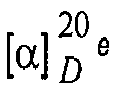
Diol (Absolute configuration) f 1 α (1.4) a - 1 mmol 26 37 nd d - - 2 β (1.4) b - 1 mmol 30 43 nd - - 3 α (2.5) - 1 mmol 28 36 nd - - 4 α (6.4) - 1 mmol 47 26 96 + 62 4b (S) 5 β (1.4) 1 mol % 1 mmol 24 78 98 - 52 4a (R) 6 β (1.4) 1 mol % - 19 68 97 - 52 4a (R) 7 α (1.4) 1 mol % - 18 78 96 + 62 4b (S) a 1 g of AD-mix a corresponds to 1.0 mol % of (DHQ)2-PHAL, 3 mmol of K3Fe(CN)6, 3 mmol of K2CO3, 0.4 mol % of K2OsO2(OH)4.
b 1 g of AD-mix β corresponds to 1.0 mol % of (DHQD)2-PHAL, 3 mmol of K3Fe(CN)6, 3 mmol of K2CO3, 0.4 mol % of K2OsO2(OH)4.
c Enantiomeric excesses were determined by HPLC (Chiralpak IB column, heptane/i-PrOH 90:10; 1mL/min, 210 nm) tr (R) = 26 min, t r (S) = 33 min;
d not determined.
e c 0.25, DCM.
f Configuration of the major enantiomer was determined by analyzing 1H NMR spectra of the Mosher monoesters and/or with crystallographic epoxide spectra. - The first assays of asymmetric dihydroxylation were carried out with 1.4 g of AD-mix α or β added to 1 equivalent of methylsulfonamide (
entries 1, 2) as described by Kolb et al. [25] Thecorresponding oxiranes 4a or 4b were obtained with 40% yield average. In order to increase the yield, quantities of AD-mix α have been increased: doubled (entry 3) or multiplied by four (entry 4). Addition of 1 mol % of K2OsO2(OH)4 to 1.4 g of AD-mix increased significantly the yield (78% vs. 43% entries 5, 2). - Furthermore, the inventors demonstrated that the presence of methylsulfonamide is not required for the advancement of the reaction (
entry 5, 6). Finally, the treatment ofvinylquinoline 3 with 1.4 g of AD-mix β in the presence of 1 mol % of oxidant K2OsO2(OH)4 provided the corresponding (R)-diol ([α]D20 -52 (c 0.25; DCM)) in 68% yield and 97% enantiomeric excess (ee). The (S)-diol ([α]D 20 +62 (c 0.25; DCM)) was prepared from 1.4 g of AD-mix α in the presence of 1 mol % of oxidant K2OsO2(OH)4 in 78% yield and 96% ee. - The Mosher's MTPA (methoxy(trifluoromethyl)phenylacetyl) method is a well-known tool to determine the absolute configuration of chiral alcohols and primary amines since this process does not require crystallization of compounds [26], In MTPA esters, the aromatic substituent (phenyl group) generates a diamagnetic anisotropy effect due to the ring current induced by the external magnetic field. The proton NMR signals of the alcohol moiety facing the phenyl group on the preferred conformation are moved to a higher magnetic field (high field shift). In ester (S,X), the protons of group R1 feel a diamagnetic anisotropy effect, and hence their 1H NMR signals show high-field shifts whereas R2 does not (
figure 6 ). Conversely, in the ester (R, X), R2 is above the benzene plane of the MTPA moiety, and hence the protons of group R2 show high-field shifts. The parameter Δδ reflecting the anisotropy is defined as Δδ = δ(S,X) - δ(R,X) (seefigure 6 ). - The corresponding Mosher's monoester 8 was prepared, from the
diol 4a (R), using (S)-α-methoxy-α-trifluoromethyl-phenylacetic acid or (R)-α-methoxy-a-trifluoromethyl-phenylacetic acid. To this purpose, thealcohol 7 was obtained with a 39% yield after selective primary alcohol protection ofcompound 4a with t-butyldimethylsilylchloride in DMF, at room temperature. Subsequently, the twodiastereomeric esters 8a (R,R) and 8b (S,R) were synthesized by reaction of 7 with the corresponding (R)- and (S)-Mosher's MTPA in dichloromethane with a 49% yield (seefigure 7 ). - 1H NMR analyses of the diastereomeric esters allowed us to establish without ambiguity the absolute configuration of the diols by combining the anisotropy effects discussed above with the definition of Δδ parameter. The MTPA moiety and the methine proton of the secondary alcohol moiety are placed in the up in the front side and in the rear side, respectively. The substituent R2 showing positive Δδ values is placed at the right side, while the substituent R1 showing negative Δδ values is at the left side. So, the absolute configuration (X=R) of our alcohol has been determined (
Figure 8 ). Concerning the epoxide formation by ring closure via Sharpless acetoxonium ion, we have chosen to use a "one-pot" method, previously describe by Sharpless for the stereospecific conversion of each R orS 1,2-diols into their corresponding epoxides[3]. This process involves three successive steps: (i) formation of the cyclic orthoester by acid catalyzed transesterification. (ii) generation of halohydrins ester via regioselective opening of acetoxonium ion by addition of tributyldimethylsilyl chloride and (iii) cyclization to epoxide by base mediated saponification in methanol. This conversion of thediol 4a to theoxirane 2a was accomplished with global retention of configuration because this process involves two successive inversions at the same stereocenter: (i) inversion at the halide receiving stereocenter at the time of halohydrins ester formation and (ii) second inversion at the halide center while cyclization to epoxide (seefigure 9 ). - All three operations have been carried out in one reaction vessel without isolation of any intermediates but each step was followed and validated by GCMS. Thus, the slightly modified Sharpless conditions applied to the conversion of
diols 4a and 4b give thecorresponding oxiranes 2a and 2b with retention of configuration according to optical rotation of each compound (Table 3).Table 3. Substrate Scope of Enantioselective Epoxydation 
4 2 Yield (%) ee (%) a 
Absolute configuration a a 68 92 -52 R b b 57 96 +45 S a Enantiomeric excess was determined by GC.
b c 0.25, MeOH.
c Absolute configuration was determined with crystallographic epoxide spectra. - In order to confirm the structure and the absolute configuration of the synthesized
quinoline epoxides 2, X-rays studies for the two derivatives were performed. Unfortunately, suitable crystals were only obtained for compound (-)-2a. Its molecular structure, depicted inFigure 10 , confirms the structure in the solid state as anticipated on the basis of IR and NMR data. Moreover, the configuration of (-)-2a was determined by observing and calculating the F(+)/F(-) ratios of Bijvoet pairs using the mean F value of each independent reflection.27 Based on these results, the absolute configuration at C-11 in (-)-2a is determined to be R. And consequently (-)-2a led us to consider that the (+)-enantiomer-2b should present the S-absolute configuration. Furthermore, these results indirectly confirm the stereochemistry of each R or S quinolin-4-yl-ethanediol precursors 4 (seefigure 10 ), - Finally, the treatment of
oxirane 2a or 2b with diverse amines, in aregioselective S N2 nucleophilic ring opening mechanism, provided the corresponding enantiopure 4-aminoquinolines 1a-e (R) or 1f-j (S) with good yield (35-96%) and ees generally superior to 92% (Table 4). No epimerization at the stereogenic carbon was observed, as determined by chiral HPLC analysis, using the opposite enantiomer as a standard.Table 4. (11R) pure 4-aminoquinolines derivatives synthesis by regioselective S N2 epoxyde opening.

Entry Substrate: RR1NH Product Yield (%) ee (%)a [α]D T Absolute configuration b t r c (min) 1 
1a 66 95 -34.5 d R 16.8 2 1f 89 98 +46.3 d S 18.9 3 
1b 35 89 -70.7 e R 9.0 4 1g 38 97 +78.2 e S 20.1 5 n-C5H11NH2 1c 88 94 -50.3 f R 21.5 6 1h 93 99 +49.8 f S 25.3 7 n-C6H13NH2 1d 88 94 -47.5 f R 18.5 8 1i 85 98 +54.0 f S 21.4 9 
1e 98 93 -49.6 e R 6.2 10 1j 82 92 +50.6 e S 7.2 a Enantiomeric excess was determined by Chiral HPLC.
b Absolute configuration was determined with epoxide crystallographic spectra.
c Retention time.
d c 0.25, DMSO.
e c 0.25, DCM.
f c 0.25, MeOH. - Previous work by Milner et al. [12] described an exploratory 4-alcoholquinolines library meant to provide early-lead racemate compounds. The present invention is intended to provide an enantiopure, synthetic, and straightforward route to prepare 4-aminoquinolines derivatives through the enantiopur 4-
oxirane 2 synthesis. The preparation of 2 was carried out from 4-vinylquinoline 3 in two steps via a Sharpless asymmetric dihydroxylation with retention of configuration. The key-intermediate 2 has been easily diversified, onposition 4, through aregioselective S N2 ring opening mechanism with various amines, to provide the corresponding enantiopure 4-aminoquinolines 1 a (R) or 1b (S) with good yield (35-96%) and ees generally superior to 92%. The antimalarial activity of these compounds will be tested in vitro and in vivo. - All starting materials and reagents were obtained from commercial suppliers and were used without further purification. Reactions requiring anhydrous conditions were performed under a blanket of argon. All solvents were purified via literature procedures or used without further purification. Flash column chromatography was carried out on Kielselgel 60 (40-63 µm) ASTM (Merck). Routine monitoring of reactions was performed using Merck silica gel 60 F254 plates, thin layer chromatography (TLC) and visualized under UV light (254 nm), with ethanolic phosphomolybdic acid (PMA). Nuclear magnetic resonance (NMR) spectra were recorded using Bruker 600 MHz NMR instrument (1H NMR at 600 MHz and 13C NMR at 150 MHz) and Bruker 300 MHz NMR instrument (1H NMR at 300 MHz and 13C NMR at 75 MHz). Chemical shifts are expressed in parts per million (δ, ppm) downfield from tetramethylsilane and are referenced to the deuterated solvent. 1H NMR and 13C NMR data were reported in the order of chemical shift, multiplicity (s = singlet, d = doublet, t = triplet, q = quartet, qt = quintuplet, m = multiplet), integration, coupling constants in hertz (Hz). High Performance Liquid Chromatography (HPLC) was carried out on a Schimadzu LC-20AD equipped with a Chiralpak IB column. Specific rotations were measured on a Jasco P1010 polarimeter. High-resolution mass spectra were obtained from a Micromass-Waters Q-TOF Ultima spectrometer. Infrared spectra were recorded with a Jasco FTIR-4200 and are reported using the frequency of absorption (cm-1). Gas Chromatography-Mass Spectrometry (GCMS) was carried out on a Schimadzu GCMS-QP2010S equipped with a SLB-5ms.
- Phosphorous oxybromide (4 g, 14.2 mmol), under argon atmosphere, was heated to 90 °C until complete dissolution of the solid. 5 (4.08 g, 14.2 mmol) was added to this hot solution and the bath temperature was increased to 150 °C. After 6 h, the resulting mixture was allowed to cool to room temperature. The reaction mixture was quenched by addition of ice-cold water and the precipitated formed was filtered and washed with water to afford the expected
compound 6a (4.70 g, 96%) as a white solid. R f 0.79 (cyclohexane/Et2O 5:1); mp: 60 °C; 1H NMR (300 MHz, CDCl3) δ 7.82 (t, J = 7.9 Hz, 1H), 8.11 (s, 1H), 8.22 (d, J = 7.3 Hz, 1H), 8.46 (d, J = 8.6 Hz, 1H), NMR data were in agreement with the lit.:[13]; 13C NMR (125 MHz, CDCl3) δ 120.9 (q, J = 276.0 Hz), 122.0 (q, J = 2.0 Hz), 123.6 (q, J = 273.8 Hz), 128.9, 129.4, 129.8 (q, J = 30.8 Hz), 130.5 (q, J = 5.3 Hz), 131.5, 138.5, 144.5, 148.6 (q, J = 36.1 Hz); IR Umax=1577, 1422, 1302, 1136, 1098, 1010, 876, 824 cm-1; GCMS (m/z): 343; HRMS calcd for C11H4BrF6NNa (M+Na)+365.9329, found 365.9346. - To a solution of 5 (1.5 g, 5.34 mmol) in toluene/aqueous solution of LiOH (5%, w/v) (22 mL; 1:1, v/v) was added dropwise anhydride triflique (1.1 mL, 6.41 mmol), at 0 °C. The resulting mixture was allowed to warm to room temperature and was stirred during 3 h. The reaction mixture was washed with water and the organic phase was dried over anhydrous sodium sulfate, and was concentrated under reduced pressure to afford 6b (1.12 g, 50 %) as a colorless oil. 1H NMR (300 MHz, CDCl3) δ 7.86 (s, 1H), 7.95 (t, J = 8.0 Hz, 1H), 8.34 (d, J = 7.8 Hz, 1H), 8.37 (d, J = 7.8 Hz, 1H); 13C NMR (75 MHz, CDCl3) δ 109.4 (q, J = 1.7 Hz), 118.9 (q, J = 320.5 Hz), 120.4 (q, J = 275.5 Hz), 122.0 (q, J = 273.6 Hz), 125.1, 129.1(q, J = 27.3 Hz), 129.4, 130.8 (q, J = 5.0 Hz), 145.6, 149.4 (q, J = 36.8 Hz), 154.0.
- To a solution of 5 (500 mg, 1.78 mmol) in acetone (4 mL) was added an aqueous solution of NaOH 2N until pH=11, and p-toluenesulfonyl chloride (680 mg, 3.56 mmol) at 0 °C. The reaction mixture was stirred overnight. After allowing warming to room temperature, the solvent was reduced under pressure. The resulting residue was washed with water and filtered to afford
compound 6c (746 mg, 96 %) as a white solid. mp: 107 °C; 1H NMR (300 MHz, CDCl3) δ 7.86 (s, 1H), 7.95 (t, J = 7.9 Hz, 1H), 8.34 (d, J = 7.8 Hz, 1H), 8.37 (d, J = 7.8 Hz, 1H); 13C NMR (75 MHz, CDCl3) δ 21.7, 109.4, 120.6 (q, J = 275.6 Hz), 123.2 (q, J = 273.8 Hz), 123.6, 126.1, 127.9, 130.0 (q, J = 5.2 Hz), 130.4, 131.4 (q, J = 3.9 Hz), 145,3, 147.0, 149.1 (q, J = 36.0 Hz), 154.6; HRMS calcd for C18H11F6NO3SNa (M+Na)+ 458.0262, found 458.0270. - Method A: To a solution of 6a (100 mg, 0.29 mmol), TBAB (93 mg, 0.29 mmol), K2CO3 (80 mg, 0.58 mmol), and Pd(PPh3)2Cl2 (20 mg, 10 mol %) in dry MeCN (580 µL), was added tributylvinyltin (102 µL, 0.35 mmol), under argon atmosphere. The tube was scelled and the mixture was stirred at 90 °C. After 4 h, the reaction was allowed to cool to room temperature then was filtered through a pad of celite and washed with MeCN. The filtrate was evaporated under reduced pressure and the residue was purified by column chromatography (cyclohexane/Et2O 5:1) to afford 3 (64 mg, 75%) as a white solid. R f 0.34 (cyclohexane/Et2O 5:1); mp: 76 °C; 1H NMR (300 MHz, CDCl3) δ 5.83 (dd, J = 11.1, 0.7 Hz, 1H), 6.09 (dd, J = 17.3, 0.7 Hz, 1H), 7.43 (dd, J = 17.3, 11.1 Hz, 1H), 7.72 (t, J = 7.9 Hz, 1H), 7.86 (s, 1H), 8.15 (d, J = 6.9 Hz, 1H), 8.33 (d, J = 8.6 Hz, 1H); 13C NMR (75 MHz, CDCl3) δ 114.1 (q, J = 2.1 Hz), 121.3 (q, J = 275.5 Hz), 123.2, 123.6 (q, J = 273.6 Hz), 127.0, 127.9, 127.8, 129.0 (q, J = 5.5 Hz), 129.2 (q, J = 30.5 Hz), 131.0, 144.0, 146.2, 148.4 (q, J = 35.6 Hz), NMR data were in agreement with the lit.: [12]; IR Umax= 1590, 1426, 1303, 1134, 1108, 888, 833 cm-1; GCMS (m/z): 291; HRMS calcd for C13H7F6NNa (M+Na)+314.0380, found 314.0390.
- Method B: To a solution of 6a (1.16 mmol) in toluene/aqueous solution of KOH (4M) (9 mL; 8:1, v/v) was added dibutyl vinylboronate (1.28 mmol) and Pd(PPh3)4 (0.035 mmol), under under nitrogen. The reaction mixture was stirred at reflux during 24 h. The reaction was allowed to cool to room temperature, transferred to a separating funnel and then was washed with water (20 mL) and toluene (2 x 20 mL), the washings being added to the separating funnel. The organic layer was separated, washed with an aqueous 1 M NaOH solution, then with a brine solution, dried over Na2SO4, and evaporated to dryness. The residue was purified by column chromatography (cyclohexane/ether 5:1) to afford 3 (82%) as a white solid.
- Method C: To a suspension of potassium vinyltrifluoroborate (1.16 mmol), cesium carbonate (3.5 mmol), PdCl2(dppf)·CH2Cl2 (0.116 mmol), and 6a (1.16 mmol) in THF (15 mL) was added water
- (1.5 mL), under a nitrogen atmosphere. The reaction mixture was stirred at reflux during 24 h. The reaction was allowed to cool to cool to room temperature, diluted with water (25 mL), and was extracted with diethyl ether (3 x 25 mL). The combined organic extracts were washed with brine and then dried over Na2SO4, filtered and was concentred in vacuo. The residue was purified by column chromatography (cyclohexane/ether 5:1) to afford 3 (71%) as a white solid.
- To a solution of AD-mix-β (4.8 g) and K2OsO2(OH)4 (12.7 mg, 1 mol %) in t-BuOH/H2O (34.4 mL; 1:1 v/v) was added 3 (1 g, 3.44 mmol) at 0 °C and stirred overnight. The reaction was quenched at 0 °C by addition of Na2SO3 (5.16 g), then was warmed to room temperature and stirred for 30 min. The reaction mixture was extracted with EtOAc, dried with anhydrous Na2SO4 and evaporated under reduced pressure. The residue was precipitated in cyclohexane, filtered on buchner to afford 4a (945 mg, 84%, GCMS: 100%, and 98% ee) as a white solid. HPLC analysis (Chiralpak IB column, heptane/i-PrOH, 95:5; flow 1.0 mL/min, tr (R) = 26.8 min, tr (S) = 32.9 min); [α]D 20 -52° (c 0.25, DCM); mp: 130-135 °C; 1H NMR (300 MHz, CDCl3) δ 3.77 (dd, J = 11.6, 4.2 Hz, 1H), 3.89 (dd, J = 11.6, 5.2 Hz, 1H), 5.62 (dd, J = 5.9, 4.4 Hz, 1H), 7.83 (t, J = 7.9 Hz, 1H), 8.15 (s, 1H), 8.23 (d, J = 7.2 Hz, 1H), 8.54 (d, J = 8.5 Hz, 1H); 13C NMR (75 MHz, CDCl3) δ 67.9, 71.7,116.3 (q, J = 2.1 Hz), 122.9 (q, J = 274.8 Hz), 125.1 (q, J = 272.8 Hz), 128.4, 129.3, 130.0 (q, J = 5.6 Hz), 130.1 (q, J = 29.7 Hz), 144.8, 149.2 (q, J = 34.9 Hz), 153.4; IR Umax= 3266, 2937, 1605, 1587, 1308, 1128, 1102, 838 cm-1; GCMS (m/z): 325; HRMS calcd for C13H9F6NO2Na (M+Na)+348.0435, found 348.0420.
- According to the same procedure that 4a, the product 4b was prepared starting from 3 (640 mg) to obtain 4b (558 mg, 78%, 97% ee) as a white solid. HPLC analysis (Chiralpak IB column, heptane/i-PrOH, 95:5; flow 1.0 mL/min, tr (R) = 26.8 min, tr (S) = 31.8 min); mp: 130-135 °C; [α]D20 +62 (c 0.25, DCM); 1H NMR (300 MHz, CDCl3) δ 3.77 (dd, J = 11.6, 4.2 Hz, 1H), 3.89 (dd, J = 11.6, 5.2 Hz, 1H), 5.62 (dd, J = 5.9, 4.4 Hz, 1H,), 7.83 (t, J = 7.9 Hz, 1H), 8.15 (s, 1H), 8.23 (d, J = 7.2 Hz, 1H), 8.54 (d, J = 8.5 Hz, 1H); 13C NMR (75 MHz, CDCl3) δ 67.9, 71.7, 116.3 (q, J = 2.1 Hz), 122.9 (q, J = 274.8 Hz), 125.1 (q, J = 272.8 Hz), 128.4, 129.3, 130.0 (q, 1H, J = 5.6 Hz), 130.1 (q, J = 29.7 Hz), 144.8, 149.2 (q, J = 34,9 Hz), 153,4; IR Umax= 3266, 2937, 1605, 1587, 1308, 1128, 1102, 838 cm-1; GCMS (m/z): 325; HRMS calcd for C13H9F6NO2Na (M+Na)+348.0435, found 348.0440.
- To a solution of 4a (140 mg, 0.43 mmol) in dry DMF (5 mL), under argon atmosphere, was added TDBMSCI (64.8 mg, 0.43 mmol), and imidazole (29.2 mg, 0.43 mmol). The mixture was stirred at room temperature for 24 h. The solution was concentrated under reduced pressure, and then the residue was dissolved in EtOAc and was washed with water, dried over Na2SO4, filtered and concentrated in vacuo. The residue was purified by column chromatography (DCM/MeOH 99:1) to afford 7 (74 mg, 39%, 99% ee) as a colorless oil. HPLC analysis (Chiralpak IB column, heptanes/i-PrOH 99:1; flow 1 mL/min, tr (R) = 13.9 min, tr (S) = 16.6 min); [α]D21 -41.1 (c 0.25, DCM); R f 0.88 (DCM/MeOH 99:1); 1H NMR (300 MHz, CDCl3) δ 0.03 (s, 3H), 0.06 (s, 3H), 0.90 (s, 9H), 3.67 (dd, J = 10.3, 7.4 Hz, 1H), 4.03 (dd, J = 10.3, 3.7 Hz, 1H), 5.57 (dd, J = 7.2, 3.4 Hz, 1H), 7.74 (t, J = 8.0 Hz, 1H), 8.10 (s, 1H), 8.15 (d, J = 7.2 Hz, 1H), 8.24 (d, J = 8.2 Hz, 1H); 13C NMR (75 MHz, CDCl3) 18.2, 25.8, 67.5, 70.3, 115.2 (q, J = 2.05 Hz), 121.3 (q, J = 275.1 Hz), 123.5 (q, J = 273.6 Hz), 126.8, 127.0, 127.2, 128.7 (q, J = 5.5 Hz), 129.2 (q, J = 32.7 Hz), 143.6, 148.5 (q, J = 36.8 Hz), 149.2; IR Umax= 2956, 2932, 2861, 1604, 1586, 1431, 1308, 1144, 1108, 837, 807 cm-1; HRMS calcd for C19H23F6NO2SiNa (M+Na)+ 462.1300, found 462.1320.
- To a solution of 7 (43 mg, 0,098 mmol) in dry DCM (1 mL), under argon atmosphere, was added at 0 °C (R)(+)-MTPA (27 mg, 0.12 mmol), EDCI (37.5 mg, 0.2 mmol), and DMAP (3.6 mg, 0.029 mmol). The mixture was stirred at room temperature for 24 h. The solution was concentrated under reduced pressure. The residue was purified by column chromatography (DCM/MeOH 99:1) to afford 8a (38 mg, 58%, 95% ee) as a yellow oil. The ee was determined by 1H NMR. [α]D 24 -19.2 (c 0.25, DCM); R f 0.82 (DCM/MeOH 99:1); 1H NMR (600 MHz, CDCl3) δ -0.044 (s, 3H), -0.041 (s, 3H), 0.81 (s, 9H), 3.65 (d, J = 0.68 Hz, 3H), 3.99 (dd, J = 11.4, 4.0 Hz, 1H), 4.05 (dd, J = 11.4, 6.8 Hz, 1H), 6.77 (dd, J = 6.8, 4.0 Hz, 1H), 7.49-7.36 (m, 5H), 7.57 (s, 1H), 7.77 (t, J = 7.9 Hz, 1H), 8.21 (d, J = 7.2 Hz), 8.32 (d, J = 8.4 Hz, 1H); 13C NMR (150 MHz, CDCl3) δ -5.6 (2C), 18.1, 25.6, 55.8, 65.1, 74.3, 115.4 (q, J = 1.8 Hz), 120.9 (q, J = 275.6 Hz), 123.2 (q, J = 288.7 Hz), 123.4 (q, J = 273.7 Hz), 126.4, 126.9 (3C), 127.7, 128.6, 129.1 (q, J = 5.1 Hz), 129.7 (q, J = 30.4 Hz), 130.1, 131.7, 143.8, 145.0, 148.2 (q, J = 35.5 Hz), 165.9; IR Umax= 2955, 2930, 2857, 1755, 1605, 1312, 1147, 1112, 1018, 837 cm-1; HRMS calcd for C29H30F9NO4SiNa (M+Na)+678.1698, found 678.1688.
- According to the same procedure that 8a, the
product 8b was prepared starting from 7 (41 mg) to obtain 8b (30 mg, 49%, 98% ee) as a yellow oil. The ee was determined by 1H NMR. [α]D 24 -36.7 (c 0.25, DCM); R f 0.82 (DCM/MeOH 99:1); 1H NMR (600 MHz, CDCl3) δ -0.12 (s, 3H), -0.11(s, 3H), 0.74 (s, 9H), 3.49 (d, J = 1.2 Hz, 3H), 3.98 (dd, J = 11.2, 4.6 Hz, 1H), 4.02 (dd, J = 11.1, 5.9 Hz, 1H), 6.80 (t, J = 5.19 Hz, 1H), 7.57-7.32 (m, 5H), 7.81-7.78 (m, 2H), 8.22 (d, J = 7.2 Hz, 1H), 8.37 (d, J = 8.5 Hz, 1H); 13C NMR (150 MHz, CDCl3) δ -5.9, -5.8, 18.0, 25.5, 55.3, 65.0, 73.9,115.8 (q, J = 1.9 Hz), 121.0 (q, J = 275.6 Hz), 123.3 (q, J = 289.0 Hz), 123.4 (q, J = 273.8 Hz), 126.5, 127.2, 127.4, 127.7, 128.6, 129.2 (q, J = 5.6 Hz), 129.7 (q, J = 30.7 Hz), 129.9, 131.4, 143.8, 145.4, 148.1 (q, J = 35.5 Hz), 165.9; IR Umax= 2955, 2930, 2857, 1755, 1605, 1312, 1147, 1112, 1018, 837 cm-1; HRMS calcd for C29H30F9NO4SiNa (M+Na)+ 678.1698, found 678.1688. - To a solution of 4a (800 mg, 0.62 mmol) in dry DCM (8.8 mL), under argon atmosphere, was added trimethylorthoacetate (236 µL, 1.85 mmol) and PTSA (5.3 mg, 0.031 mmol). The mixture was stirred for 4h at room temperature. The volatiles were removed in vacuo, and the flask pumped on high vacuum to remove excess MeOH. The residue was redissolved in dry DCM (8.8 mL), under argon, and was cooled to 0 °C. Trimethylsilyl chloride (234 µL, 1.85 mmol) was added dropwise. The reaction was warmed to room temperature and was stirred overnight. The volatiles were removed in vacuo, and the residue was redissolved in MeOH (8.8 mL). K2CO3 (254.8 mg, 1.85 mmol) was added, and the mixture was stirred for 5h. The reaction was poured onto saturated aqueous solution of NH4Cl, extracted with DCM. The organic layer was dried over anhydrous Na2SO4, filtered, and concentrated under reduced pressure. The crude was purified by column chromatography (cyclohexane/Et2O 1:1), to afford 2a (513 mg, 68%, 92% ee) as a yellow solid. HPLC analysis (Chiralpak IB column, heptane/i-PrOH, 99:1; flow 1.0 mL/min, tr (S) = 15.1 min, tr R) = 17.4 min); [α]D20 -52 (c 0.25, DCM); R f 0.36 (cyclohexane/Et2O 1:1); mp: 84 °C; 1H NMR (300 MHz, CDCl3) δ 2.83 (dd, J = 5.7, 2.5 Hz, 1H), 3.42 (dd, J = 5.7, 4.2 Hz, 1H), 4.55 (dd, J = 3.6, 2.7 Hz, 1H), 7.79 (t, J = 7.9 Hz, 1H), 7.81 (s, 1H), 8.20 (d, J = 7.2 Hz, 1H), 8.39 (d, J = 8.4 Hz, 1H); 13C NMR (150 MHz, CDCl3): 49.2, 50.8, 113.3 (q, J = 2.0 Hz), 121.1 (q, J = 275.5 Hz), 123.4 (q, J = 273.6 Hz), 127.0, 127.4, 127.6, 129.1 (q, J = 5.5 Hz), 129.4 (q, J = 30.5 Hz), 143.3, 146.8, 148.7 (q, J = 35.5 Hz), 149.5, NMR data were in agreement with the lit.:[12]; IR Umax= 1606, 1587, 1431, 1308, 1276, 1213, 1102, 1069, 895, 982, 822 cm-1; GCMS: 307; HRMS calcd for C13H7F6NONa (M+Na)+, 330.0330 found 330.0314.
- According to the same procedure that 2a, the product 2b was prepared starting from 4b (800 mg) to obtain 2b (437 mg, 57%, 96% ee) as a yellow solid. HPLC analysis (Chiralpak IB column, heptane/i-PrOH, 99:1; flow 1.0 mL/min, tr (S) = 14.9 min, tr(R) = 17.4 min); [α]D20 +45 (c 0.25, DCM); R f 0.36 (cyclohexane/Et2O 1:1); mp: 84 °C; 1H NMR (300 MHz, CDCl3) δ 2.83 (dd, J = 5.7, 2.5 Hz, 1H), 3.42 (dd, J = 5.7, 4.2 Hz, 1H), 4.55 (dd, J = 3.6, 2.7 Hz, 1H), 7.79 (m, 2H), 8.20 (d, J = 7.2 Hz, 1H), 8.39 (d, J = 8.4 Hz, 1H); 13C NMR (150 MHz, CDCl3): 49.2, 50.8, 113.3 (q, J = 2.0 Hz), 121.1 (q, J = 275.5 Hz), 123.4 (q, J = 273.6 Hz), 127.0, 127.4, 127.6, 129.1 (q, J = 5.5 Hz), 129.4 (q, J = 30.5 Hz), 143.3, 146.8, 148.7 (q, J = 35.5 Hz), 149.5, NMR data were in agreement with the lit.:[12]; IR Umax= 1606, 1587, 1431, 1308, 1276, 1213, 1102, 1069, 895, 982, 822 cm-1; GCMS: 307; HRMS calcd for C13H7F6NONa (M+Na)+, 330.0330 found 330.0314.
- To a solution of 2a or 2b (50 mg, 0.16 mmol) in i-PrOH (3.2 mL) was added the appropriate amine (0.81 mmol). The mixture was stirred for 24 h at 90 °C. The volatiles were removed in vacuo. The crude was then purified by column chromatography. In the following examples, only a part of the compounds according to the invention is presented. However, the invention is not limited to such compositions as far as the composition fall within the scope of the present claims.
- The crude was purified by column chromatography (EtOAc/MeOH/NH4OH 90:5:5), to afford 1a (44 mg, 66%, 95% ee) as a white solid. HPLC analysis (Chiralpak IB column, heptane/EtOH, 90:10; flow 0.5 mL/min, tr (R) = 16.8 min, tr (S) = 18.9 min); [α]D27 -34.5 (c 0.25, DMSO); R f 0.78 (EtOAc/MeOH/NH4OH 80:10:10); mp: 163 °C; 1H NMR (300 MHz, CDCl3) δ2.78 (dd, J = 12.4, 6.9 Hz, 1H), 2.88 (dd, J = 12.5, 3.9 Hz, 1H), 3.72, (s, 2H), 5.61 (m, 1H), 7.20 (m, 5H), 7.85 (t, J = 8.0 Hz, 1H), 8.12 (s, 1H), 8.32 (d, J = 7.3Hz, 1H), 8.55 (d, J = 8.6 Hz, 1H); 13C NMR (150 MHz, CDCl3) δ 52.3, 55.4, 68.1, 114.7, 121.5 (q, J = 275.4 Hz), 123.3 (q, J = 273.1 Hz), 126.4, 126.7, 126.9 (q, J = 28.5 Hz), 127.4, 127.7, 127.9, 129.1, 129.4 (q, J = 5.5 Hz), 140.5, 142.5, 146.6 (q, J = 34.1 Hz), 155.0; IR Umax= 1603, 1587, 1430, 1310, 1300, 1127, 1106, 903, 881, 835 cm-1; HRMS calcd for C20H17F6N2O (M+H)+ 415.1245, found 415.1265.
- The crude was purified by column chromatography (EtOAc/MeOH/NH4OH 90:5:5), to afford 1f (59 mg, 89%, 98% ee) as a white solid. HPLC analysis (Chiralpak IB column, heptane/EtOH, 90:10; flow 0.5 mL/min, tr (R) = 16.8 min, tr (S) = 18.9 min); [α]D27 +46.3 (c 0.25, DMSO); R f 0.78 (EtOAc/MeOH/NH4OH 80:10:10); mp: 163 °C; 1H NMR (300 MHz, CDCl3) δ 2.78 (dd, J = 12.4, 6.9 Hz, 1H), 2.88 (dd, J = 12.5, 3.9 Hz, 1H), 3.72, (s, 2H), 5.61 (m, 1H), 7.20 (m, 5H), 7.85 (t, J = 8.0 Hz, 1H), 8.12 (s, 1H), 8.32 (d, J = 7.3Hz, 1H), 8.55 (d, J = 8.6 Hz, 1H); 13C NMR (150 MHz, CDCl3) δ 52.3, 55.4, 68.1, 114.7, 121.5 (q, J = 275.4 Hz), 123.3 (q, J = 273.1 Hz), 126.4, 126.7, 126.9 (q, J = 28.5 Hz), 127.4, 127.7, 127.9, 129.1, 129.4 (q, J = 5.5 Hz), 140.5, 142.5, 146.6 (q, J = 34.1 Hz), 155.0; IR Umax= 1603, 1587, 1430, 1310, 1300, 1127, 1106, 903, 881, 835 cm-1; HRMS calcd for C20H17F6N2O (M+H)+415.1245, found 415.1265.
- The crude was purified by column chromatography (DCM/MeOH 90:10), to afford 1b (29 mg, 35%, 89% ee) as a yellow oil. HPLC analysis (Chiralpak IB column, heptanes/i-PrOH/EDA 90:10:0.1; flow 1 mL/min, tr (R) = 9.0 min, tr(S) = 20.6 min); [α]D 24 -70.7 (c 0.25, DCM); R f 0.43 (DCM/MeOH 90:10); 1H NMR (300 MHz, CDCl3) δ 1.26 (t, J = 7.1 Hz, 3H), 1.88-1.78 (m, 2H), 2.85-2.26 (m, 14H), 4.13 (q, J = 7.2 Hz, 2H), 5.54 (dd, J = 10.5, 3.2 Hz, 1H), 7.72 (t, J = 7.1 Hz, 1H), 8.12-8.14 (m, 2H); 13C NMR (150 MHz, CDCl3) δ14.2, 22.1,32.2, 53.0,57.5, 60.3, 64.5, 65.1,114.5 (q, J = 1.8 Hz), 121.2 (q, J = 275.6 Hz), 123.5 (q, J = 273.9), 126.6, 126.,7, 127.0, 128.7 (q, J = 5.2 Hz), 129.6 (q, J = 29.8Hz), 143.6, 148.7 (q, J = 34.9 Hz), 151.1, 173.5; IR Umax= 2941, 2818, 1731, 1604, 1585, 1430, 1308, 1140, 1108, 907 cm-1; HRMS calcd for C23H28F6N3O3 (M+H)+ 508.2035, found 508.2056.
- The crude was purified by column chromatography (DCM/MeOH 90:10), to afford 1g (31 mg, 38%, 97% ee) as a yellow oil. HPLC analysis (Chiralpak IB column, heptanes/ i-PrOH/EDA 90:10:0.1; flow 1 mL/min, tr (R) =9.1 min, tr (S) = 20.1 min); [α]D23 +78.2 (c 0.25, DCM); R f 0.43 (DCM/MeOH 90:10); 1H NMR (300 MHz, CDCl3) δ 1.26 (t, J = 7.1 Hz, 3H), 1.88-1.78 (m, 2H), 2.85-2.26 (m, 14H), 4.13 (q, J = 7.2 Hz, 2H), 5.54 (dd, J = 10.5, 3.2 Hz, 1H), 7.72 (t, J = 7.1 Hz, 1H), 8.12-8.14 (m, 2H); 13C NMR (150 MHz, CDCl3) δ 14.2, 22.1, 32.2, 53.0, 57.5, 60.3, 64.5, 65.1, 114.5 (q, J = 1.8 Hz), 121.2 (q, J = 275.6 Hz), 123.5 (q, J = 273.9), 126.6, 126.,7, 127.0, 128.7 (q, J = 5.2 Hz), 129.6 (q, J = 29.8Hz), 143.6, 148.7 (q, J = 34.9 Hz), 151.1, 173.5; IR Umax= 2941, 2818, 1731, 1604, 1585, 1430, 1308, 1140, 1108, 907 cm-1; HRMS calcd for C23H28F6N3O3 (M+H)+ 508.2035, found 508.2056.
- The crude was purified by column chromatography (DCM/MeOH 90:10), to afford 1c (56 mg, 88%, 94% ee) as a white solid. HPLC analysis (Chiralpak IB column, heptane/i-PrOH/EDA, 99:1:0.1; flow 1 mL/min, tr (R) = 21.5 min, tr (S) = 25.3 min); [α]D26 -50.3 (c 0.25, MeOH); Rf 0.53 (DCM/MeOH 90:10); mp: 120 °C; 1H NMR (300 MHz, MeOD) δ 0.92 (t, J = 6.5 Hz, 3H), 1.36-1.21 (m, 4H), 1.65-1.47 (m, 2H), 2.72-2.64 (m, 2H), 2.83 (dd, J = 12.30, 9.32 Hz, 1H), 2.99 (dd, J = 12.63, 2.20 Hz, 1H), 5.68 (dd, J = 9.0, 2.0 Hz, 1H), 7.87 (t, J = 7.9 Hz, 1Hz), 8.15 (s, 1H), 8.26 (d, J = 7.0 Hz, 1H), 8.53 (d, J = 8.6 Hz, 1H); 13C NMR (150 MHz, MeOD) δ 14.4, 23.6, 30.2, 30.6, 50.5, 57.2, 69.4, 115.7 (q, J = 1.96 Hz), 122.9 (q, J = 274.6 Hz), 125.1 (q, J = 272.6 Hz),128.0, 128.8, 129.1, 130.3 (q, J = 60.1 Hz), 130.3 (q, J = 5.7 Hz), 144.9, 149.4 (q, J = 34.8 Hz), 154.7; IR Umax= 2934, 2841, 2357, 1604, 1586, 1432, 1303, 1119, 1104, 889, 835 cm-1; HRMS calcd for C18H21F6N2O (M+H)+ 395.1558, found 395.1544.
- The crude was purified by column chromatography (DCM/MeOH 90:10), to afford 1h (56 mg, 93%, 99% ee) as a white solid. HPLC analysis (Chiralpak IB column, heptane/i-PrOH/EDA, 99:1:0.1; flow 1 mL/min, tr(R) = 22.2 min, tr(S) = 25.3 min); [α]D 26 +49.8 (c 0.25, MeOH); R f 0.53 (DCM/MeOH 90:10); mp: 120 °C; 1H NMR (300 MHz, MeOD) δ 0.92 (t, J = 6.5 Hz, 3H), 1.36-1.21 (m, 4H), 1.65-1.47 (m, 2H), 2.72-2.64 (m, 2H), 2.83 (dd, J = 12.30, 9.32 Hz, 1H), 2.99 (dd, J = 12.63, 2.20 Hz, 1H), 5.68 (dd, J = 9.0, 2.0 Hz, 1H), 7.87 (t, J = 7.9 Hz, 1Hz), 8.15 (s, 1H), 8.26 (d, J = 7.0 Hz, 1H), 8.53 (d, J = 8.6 Hz, 1H); 13C NMR (150 MHz, MeOD) δ 14.4, 23.6, 30.2, 30.6, 50.5, 57.2, 69.4, 115.7 (q, J = 1.96 Hz), 122.9 (q, J = 274.6 Hz), 125.1 (q, J = 272.6 Hz),128.0, 128.8, 129.1, 130.3 (q, J = 60.1 Hz), 130.3 (q, J = 5.7 Hz), 144.9, 149.4 (q, J = 34.8 Hz), 154.7; IR Umax= 2934, 2841, 2357, 1604, 1586, 1432, 1303, 1119, 1104, 889, 835 cm-1; HRMS calcd for C18H21F6N2O (M+H)+ 395.1558, found 395.1544.
- The crude was purified by column chromatography (DCM/MeOH, 90:10), to afford 1d (58 mg, 88%, 97% ee) as a white solide. HPLC analysis (Chiralpak IB column, heptane/i-PrOH/EDA, 99:1:0.1 ; flow 1 mL/min, tr (R) = 18.5 min, tr (S) = 21.4 min); [α]D26 -47.5 (c 0.25, MeOH); R r 0.58 (DCM/MeOH 90:10); mp: 108 °C; 1H NMR (600 MHz, MeOD) δ 0.91 (t, J = 6.9 Hz, 3H), 1.43-1.42 (m, 6H), 1.62-1.49 (m, 2H), 2.76-2.59 (m, 2H), 2.82 (dd, J = 12.6, 9.1 Hz, 1H), 2.99 (dd, J = 12.6, 2.9 Hz, 1H), 5.68 (dd, J = 9.0, 2.5 Hz, 1H), 7.88 (t, J = 7.2 Hz, 1H), 8.15 (s, 1H), 8.26 (d, J = 8.6 Hz, 1H), 8.53 (d, J = 8.6 Hz); 13C NMR (150 MHz, MeOD) δ 14.4, 23.7, 28.1, 30.5, 32.9, 50.5, 57.3, 69.4, 115.7 (q, J = 2.3 Hz), 122.9 (q, J = 274.4 Hz), 125.2 (q, J = 272.8 Hz), 128.0, 128.8, 129.1, 130.3 (q, J = 5.4 Hz), 130.3 (q, J = 30.3 Hz), 144.9, 149.4 (q, J = 35.8 Hz), 154.8; IR Umax= 2928, 2858, 1603, 1586, 1432, 1304, 1119, 1103, 886, 837 cm-1; HRMS calcd for C19H22F6N2O (M+H)+ 409.1726, found 409.1732.
- The crude was purified by column chromatography (DCM/MeOH, 90:10), to afford 1f (56mg, 85%, 97% ee) as a white solide. HPLC analysis (Chiralpak IB column, heptane/i-PrOH/EDA, 99:1:0.1 ; flow 1 mL/min, tr (R) = 19.1 min, tr(S) = 21.4 min); [α]D27 +54.0 (c 0.25, MeOH); R f 0.58 (DCM/MeOH 90:10); mp: 108 °C; 1H NMR (600 MHz, MeOD) δ 0.91 (t, J = 6.9 Hz, 3H), 1.43-1.42 (m, 6H), 1.62-1.49 (m, 2H), 2.76-2.59 (m, 2H), 2.82 (dd, J = 12.6, 9.1 Hz, 1H), 2.99 (dd, J = 12.6, 2.9 Hz, 1H), 5.68 (dd, J = 9.0, 2.5 Hz, 1H), 7.88 (t, J = 7.2 Hz, 1H), 8.15 (s, 1H), 8.26 (d, J = 8.6 Hz, 1H), 8.53 (d, J = 8.6 Hz); 13C NMR (150 MHz, MeOD) δ 14.4, 23.7, 28.1, 30.5, 32.9, 50.5, 57.3, 69.4, 115.7 (q, J = 2.3 Hz), 122.9 (q, J = 274.4 Hz), 125.2 (q, J = 272.8 Hz), 128.0, 128.8, 129.1, 130.3 (q, J = 5.4 Hz), 130.3 (q, J = 30.3 Hz), 144.9, 149.4 (q, J = 35.8 Hz), 154.8; IR Umax= 2928, 2858, 1603, 1586, 1432, 1304, 1119, 1103, 886, 837 cm-1; HRMS calcd for C19H22F6N2O (M+H)+ 409.1726, found 409.1732.
- The crude was purified by column chromatography (EtOAc/MeOH/NH4OH 80:10:10), to afford 1e (88mg, 90%, 93% ee) as a colorless oil. HPLC analysis (Chiralpak IB column, MtBE/EDA 100:0.3; flow 1 mL/min, tr (R) = 6.2 min, tr(S) = 7.2 min); [α]D24 -49.6 (c 0.25, DCM); R f 0.29 (EtOAc/MeOH/NH4O 80:10:10); 1H NMR (300 MHz, MeOD) δ 1.38 (s, 9H), 1.64-1.59 (m, 2H), 1.67 (dt, J = 13.40, 6.76 Hz, 2H), 2.51-2.24 (m, 12H), 2.85-2.57 (m, 2H), 2.72 (dd, J = 12.41, 9.11 Hz, 1H), 3.05 (dd, J = 12.51, 2.77 Hz, 1H), 3.11 (m, 1H), 5.52 (dd, J = 8.4, 2.1 Hz, 1H), 7.67 (t, J = 7.9 Hz, 1H), 8.11-8.09 (m, 2H), 8.23 (d, J = 8.5 Hz, 1H); 13C NMR (150 MHz, MeOD) δ 26.2, 26.5, 28.3, 39.8, 48.0, 52.8, 53.2, 55.8, 56.5, 56.6, 67.7, 78.8, 114.5 (q, J = 1.6 Hz), 121.2 (q, J = 275.6 Hz), 123.4 (q, J = 273.8 Hz), 126.5, 126.9, 127.0, 128.6 (q, J = 5.6 Hz), 129.3 (q, J = 29.9 Hz), 143.5, 148.4 (q, J = 35.5 Hz), 152.0, 156.1; IR Umax= 2940, 1433, 1307, 1132, 1104, 885, 838 cm-1; HRMS calcd for C28H40F6N5O3 (M+H)+608.3035, found 608.3035.
- The crude was purified by column chromatography (EtOAc/MeOH/NH4OH, 80:10:10), to afford 1j (96mg, 98%, 92% ee) as a colorless oil. HPLC analysis (Chiralpak IB column, MtBE/EDA 100:0.3; flow 1 mL/min, tr (R) = 6.2 min, tr(S) = 7.2 min); [α]D24 +50.6 (c 0.25, DCM); R f 0.29 (EtOAc/MeOH/NH4OH 80:10:10); 1H NMR (300 MHz, MeOD) δ 1.38 (s, 9H), 1.64-1.59 (m, 2H), 1.67 (dt, J = 13.40, 6.76 Hz, 2H), 2.51-2.24 (m, 12H), 2.85-2.57 (m, 2H), 2.72 (dd, J = 12.41, 9.11 Hz, 1H), 3.05 (dd, J = 12.51, 2.77 Hz, 1H), 3.11 (m, 1H), 5.52 (dd, J = 8.4, 2.1 Hz, 1H), 7.67 (t, J = 7.9 Hz, 1H), 8.11-8.09 (m, 2H), 8.23 (d, J = 8.5 Hz, 1H); 13C NMR (150 MHz, MeOD) δ 26.2, 26.5, 28.3, 39.8, 48.0, 52.8, 53.2, 55.8, 56.5, 56.6, 67.7, 78.8, 114.5 (q, J = 1.6 Hz), 121.2 (q, J = 275.6 Hz), 123.4 (q, J = 273.8 Hz), 126.5, 126.9, 127.0, 128.6 (q, J = 5.6 Hz), 129.3 (q, J = 29.9 Hz), 143.5, 148.4 (q, J = 35.5 Hz), 152.0, 156.1; IR Umax= 2940, 1433, 1307, 1132, 1104, 885, 838 cm-1; HRMS calcd for C28H40F6N5O3 (M+H)+ 608.3035, found 608.3035.
- Screenings of the compound according to the present invention (1f, 1h, 1i) and their isomers (1a, 1c, 1d)on strains of Plasmodium falciparum sensitive (3D7) and chloroquine resistant (W2) were realized.
- The Clones of W2 and 3D7 were grown. 96-well plates with the test molecules at the final concentrations of 40000, 400, 200.100, 50, 25, 12.5, 6.35, 3.13, 1.56 and 0.78 nM in the growth medium were prepared. Melfloquine (MQ) at the same concentrations and chloroquine (CQ) at the concentrations adapted to each clone were used as the Controls. 8 negative controls were distributed on each plate.
- Then, the molecules to be tested were diluted extemporaneously in the above preparation of the plates. The growth medium was deposited after drying plates. The study was initiated when the growth medium was at the ring stage and then stopped after 1 parasitic cycle (45h).
- The activity was revealed by incorporation by parasites of tritiated hypoxanthine present in the growth medium. The activity was calculated by using the Pk-Fit software on all the experimental points obtained for each molecule (except the highest concentration). The results shown in table 5 are expressed in nM and correspond to calculate a 50% inhibitory concentration followed by un certainty about the value expressed in percentage.
Table 5. The biological effect of the compounds on Plasmodium falciparum Compound W2 3D7 1 a 41.1 (23.4%) 104.5 (9.3%) 1f 19.1 (21.1%) 35.1 (10.1%) 1c 38.2 (9.5%) 74.7 (6.3%) 1h 6.98 (8.9%) 8.33 (5.3%) 1d 142 (7.9%) 205 (7.9%) 1i 9.40 (9.7%) 14.5 (8.5%) CQ 572 (19.5%) 32.5 (11.3%) MQ 26.5 (9.2%) 52.2 (8.0%) - The excellent antimalarial properties can be observed in the compounds according to the present invention notably in the compounds having (S)- enantiomer structure (1f, 1h, 1i) compared to the controls (CQ, MQ). The compounds having (R)- enantiomer (1a, 1c, 1d) also show their excellent antimalarial property.
- The minimum inhibitory concentrations (MICs) were determined according to the recommendations of the Clinical and Laboratory Standards Institute (CLSI)[27]. The different strains were seeded in 96-well plates at a rate of 105-106 colonies forming units per ml per well in Mueller-Hinton adjusted for cations (Ca2+ 25 mg / L and Mg2+ 12.5 mg / L). The different molecules to be tested were diluted to half in series to obtain final concentrations in wells ranging from 0.0625µg / mL to 128µg/ mL. After incubation for 18 to 24 h (48 h for Enterococcus faecalis) at 37°C, the MIC was determined as the product concentration of the first well with no visual signs of bacterial growth (no disorder in the well). The results are shown in table 6, according to which excellent antibacterial properties can be observed in the compounds according to the present invention.
Table6. The antibacterial effects of the compounds Produit S. aureus CIPa 103429 E. faecalis CIP 103214 E. coli DSMb 1103 P. aeruginosa DSM 1117 SAAM 12 SAAM 27 SAAM 51 SAAM 64 SAAM 69 SAAM 86 SAAM 95 SAAM 98 Méfloquine 16-32 16-32 64 >128 16 16 16 32 16 16 16 32 1a >128 >128 >128 >128 4 4 4 >128 8 8 4 >128 1f 4-8 8 >128 >128 4 4 4 >128 8 8 4 8 1h 16-32 16-32 16 >128 8 8 8 16 8 16 8 16 1c 16-32 16-32 32 >128 8 8 8 16 8 16 8 16 1i 4-8 4-8 >128 >128 2 2 2 4 4 8 2 8 1d 4-8 4-8 16 >128 4 4 4 4 4 4 4 4 Ciprofloxacine 0,25 0,125-2 0,0625 0,0625 32 32 >128 64 128 32 32 8 SAAM = Staphylococcus aureus Amiens (clinical strains resistant to methicillin)
a: Collection de l'institut Pasteur
b: Deutsche Sammlung von Mikroorganismen und Zellkulturen GmbH -
- 1 WHO, 2007. http://www.who.int/tdr/diseases/malaria/direction.htm.
- 2 Bhattacharjee, A. K.; Karle, J. M. J. Med. Chem. 2002, 39, 4622.
- 3 Go, M. L. Med. Res. Rev., 2003, 23, 456.
- 4 Biot, C.; Chibale, K. Infect. Disorders-Drug Targets 2006, 6, 173.
- 5 Karle, J. M.; Olmeda, R.; Gerena, L.; Milhous, W. K. Exp. Pharmacol. 1993, 76, 345.
- 6 Phillips-Howard, P. A. and Ter Kuile, F. O. Drug Saf. 1995, 370.
- 7 Weinke, T.; Trautmann, M.; Held, T.; Weber, G.; Eichenlaub, D.; Fleischer, K.; Kern, W.; Polhe, H. D. Am. J. Trop. Med. Hyg. 1991, 45, 86.
- 8 Van Riemsdijk, M. M.; Van Der Klauw, M. M.; Van Heest, J. A. ; Reedeker, F. R.; Ligthelm, R. J.; Herings, R. M.; Stricker, B. H. Eur. J. Clin. Pharmacol. 1997, 52, 1.
-
9
Shepherd, R. WO98/39003, 1998 - 10 Dow, G. S.; Heady, T. N.; Bhattarchargee, A. K.; Caridha, D.; Gerena, L.; Gettayacamin, M.; Lanteri, C. A.; Obaldia, N. III.; Roncal, N.; Shearer, T.; Smith, P. L.; Tungtaeng, A.; Wolf, L.; Cabezas, M.; Yourick, D.; Smith, K. S. Antimicrob. Agents Chemother. 2006, 50, 4132.
- 11 Milner, E.; McCalmont, W.; Bhonsle, J.; Caridha, D.; Cobar, J.; Gardner, S.; Gerena, L.; Goodine, D.; Lanteri, C.; Melendez, V.; Roncal, N.; Sousa, J.; Wipf, P.; Dow, G. S. Malaria Journal 2010, 9, 51.
- 12 (a) Milner, E.; McCalmont, W.; Bhonsle, J.; Caridha, D.; Carroll, D.; Gardner, S.; Gerena, L.; Gettayacamin, M.; Lanteri, C.; Luong, T.; Melendez, V.; Moon, J.; Ronca, N.; Sousa, J.; Tungtaeng, A.; Wipf, P.; Dow, G. S. Bioorg. Med. Chem. Lett. 2010, 20, 1347. (b) Dow, G. S.; Koenig, M. L.; Wolf, L.; Gerena, L.; Lopez-Sanchez, M.; Hudson, T. H.; Bhattacharjee, A. K. Anfimicrob. Agents Chemother. 2006, 50,4132.
- 13 (a) Jayaprakash, S.; Iso, Y.; Wan, B.; Franzblau, S. G.; Kozikowski, A. P. Chem, Med. Chem. 2006, 1, 593. (b) Mao, J.; Wang, Y.; Wan, B.; Kozikowski, A. P.; Franzblau, S. G. Chem. Med. Chem. 2007, 2, 1624. Mao, J.; Yuan, H.; Wang, Y.; Wan, B.; Pak, D.; He, R.; Franzblau, S. G. Bioorg. Med. Chem. Lett. 2010, 20, 1263. (c) Kunin, C. M.; Ellis, W. Y. Antimicrob. Agents Chemother. 2000, 44, 848. (d) Vidal-Aroca, F.; Meng, A.; Minz, T., Page M. G. P.; Dreier, J. J. Microb. Methods 2009, 79, 232.
- 14 (a)
Gillepsie, R. J.; Lerpiniere, J.; Giles, P. R.; Adams, D. R.; Stray Knutsen, L. J.; Cliffe, I. A.; US 6,608,085 B1, Aug. 19 2003 . (b) Gillespie, R. J.; Adams, D. R.; Bebbington, D.; Benwell, K.; Cliffe, Ian A.; Dawson, C. E.; Dourish, C. T.; Fletcher, A.; Gaur, S.; Giles, P. R.; Jordan, A. M., Knight, A. R.; Knutsen, L. J. S.; Lawrence, A.; Lerpiniere, J.; Misra, A.; Porter, R. H. P.; Pratt, R. M.; Shepherd, R.; Upton, R.; Ward, S. E.; Weissa S. M. and Williamson D. S. Bioorg. Med. Chem. Lett. 2008, 18, 2916. - 15 Lutz, R. E.; Patel, A. R.; Ohnmacht, C. J. J. Med. Chem, 1971, 14, 926.
- 16 Carroll, F. I.; Blackwell, J. T. J. Med. Chem. 1974, 17, 210.
- 17 Xie, Z.-X.; Zhang, L.-Z.; Ren, X.-J.; Tang, S.-Y.; Li, Y. Chin. J. Chem. 2008, 26, 1272.
- 18 Alacid, E.; Nájera C. J. Org. Chem. 2008, 73, 2315-2322.
- 19 Comins, D. L.; Nolan, J. M.; Bori, I. D. Tetrahedron Lett. 2005, 46, 6697.
- 20 (a) Miyaura, N.; Suzuki, A. Chem. Rev. 1995, 95, 2457-2483. (b) Satoh, M.; Miyaura, N.; Suzuki, A. Chem. Lett. 1986, 8, 1329. (c) Guillon, J.; Forfar, I.; Desplat, V.; Belisle-Fabre, S.; Thiolat, D.; Massip, S.; Carrie, H.; Mossalayi, M.; Jarry, C. J. Enz. Inhib. Med. Chem. 2007, 22, 541.
- 21 (a) Guillon, J.; Forfar, I.; Desplat, V.; Belisle-Fabre, S.; Thiolat, D.; Massip, S.; Carrie, H.; Mossalayi, M.; Jarry, C. J. Enz. Inhib. Med. Chem. 2007, 22, 541. (b) Molander, G. A.; Yun C. S.; Ribagorda, M.; Biolatto, B. J. Org. Chem. 2003, 68, 5534. (c) Molander, G. A.; Fumagalli, T. J. Org. Chem. 2006, 71,
- 5743. (d) Darses, S.; Genet, J.-P. Chem. Rev. 2008, 108, 288.
- 22 For review, see: Kolb, H. C.; VanNieuwenhze, M. S.; Sharpless, K. B. Chem. Rev. 1994, 94, 2483.
- 23 Kolb, H. C.; Sharpless, K. B. Tetrahedron 1992, 48, 10515.
- 24 Weissman, S. A.; Rossen, K.; Reider, P. J. Org. Lett. 2001, 16, 2513-2515.
- 25 Kolb, H. C.; VanNieuwenhze, M. S.; Sharpless, K. B. Chem. Rev. 1994, 94, 2483.
- 26 Crystallographic data for the structure reported in this paper have been deposited with the Cambridge Crystallographic Data Centre as supplementary publication no. CCDC-780365. Copies of the data can be obtained free of charge on application to CCDC, University Chemical Lab, 12 Union Road, Cambridge, CB2 1EZ, UK (Fax: int.code + 44-1223/336-033; E-mail: deposit@ccdc.cam.ac.uk.
- 27 CLSI M07-A8 Methods for dilution antimicrobial susceptibility tests for bacteria that grow aerobically; Approved standard - Eighth edition (2009)
Claims (17)
- A process for providing a compound of formula (I):
 - R1 and R2 are selected from a group consisting of a hydrogen atom, a chain alkyl group (C1-C9), a cyclic alkyl groups and aromatic groups; or- NR1R2 forms together a piperazine or a piperidine substituted by at least one of a hydrogen, a chain alkyl group (C1-C9), a cyclic alkyl group, a chain containing an aromatic group and a chain containing a heterocyclic group,the process comprising steps of in the following order:- preparation of 2,8-bis(trifluoromethyl)-4-vinylquinoline (3);- preparation of (S)-1-[2,8-bis(trifluoromethyl)quinolin-4-yl]ethane-1,2-diol (4b) by adding an asymmetric dihydroxylation catalyst to said 2,8-bis(trifluoromethyl)-4-vinylquinoline (3);- preparation of (S)-4-(oxiran-2-yl)-2,8-bis(trifluoromethyl) quinoline (2b) starting from said (S)-1-[2,8-bis(trifluoromethyl)quinolin-4-yl]ethane-1,2-diol (4b); and- adding an amine R1R2 to said (S)-4-(oxiran-2-yl)-2,8-bis(trifluoromethyl)quinoline (2b).
 - A process for providing a compound of formula (II):
 - R1 and R2 are selected from a group consisting of a hydrogen atom, a chain alkyl group (C1-C9), a cyclic alkyl groups and aromatic groups; or- NR1R2 forms together a piperazine or a piperidine substituted by at least one of a hydrogen, a chain alkyl group (C1-C9), a cyclic alkyl group, a chain containing an aromatic group and a chain containing a heterocyclic group,the process comprising steps of in the following order:- preparation of 2,8-bis(trifluoromethyl)-4-vinylquinoline (3);- preparation of (R)-1-[2,8-bis(trifluoromethyl)quinolin-4-yl]ethane-1,2-diol (4a) by adding an asymmetric dihydroxylation catalyst to said 2,8-bis(trifluoromethyl)-4-vinylquinoline (3);- preparation of (R)-4-(oxiran-2-yl)-2,8-bis(trifluoromethyl) quinoline (2a) starting from said (R)-1-[2,8-bis(trifluoromethyl)quinolin-4-yl]ethane-1,2-diol (4a); and- adding an amine R1R2NH to said (R)-4-(oxiran-2-yl)-2,8-bis(trifluoromethyl)quinoline (2a).
 - The process according to claim 1, wherein the compound of formula (I) is one of (S)-2-(benzylamino)-1-(2,8-bis(trifluoromethyl)quinolin-4-yl)ethanol, (S)-ethyl-4-(4-(2-(2,8-bis(trifluoromethyl)quinolin-4-yl)-2-(hydroxyethyl)piperazin-1-yl)butanoate, (S)-1-(2,8-bis(trifluoromethyl)quinolin-4-yl)-2-(pentylamino)ethanol, (S)-1-(2,8-bis(trifluoromethyl)quinolin-4-yl)-2-(hexylamino)ethanol, (S)-1-(2,8-bis(trifluoromethyl)quinolin-4-yl)-2-(heptylamino)ethanol, (S)-1-(2,8-bis(trifluoromethyl)quinolin-4-yl)-2-(octylamino)ethanol, (S)-1-(2,8-bis(trifluoromethyl)quinolin-4-yl)-2-(nonylamino)ethanol, (S)-1-(2,8-bis(trifluoromethyl)quinolin-4-yl)-2-(piperazine substituted)ethanol or (S)-tert-butyl-(3-(4-(3((2-(2,8-bis(trifluoromethyl)quinolin-4-yl)-2-(hydroxyethyl)amino)propyl)piperazin-1-yl)propyl)carbamate.
- The process according to claim 2, wherein the compound of formula (II) is one of (R)-2-(benzylamino)-1-(2,8-bis(trifluoromethyl)quinolin-4-yl)ethanol, (R)-ethyl-4-(4-(2-(2,8-bis(trifluoromethyl)quinolin-4-yl)-2-(hydroxyethyl)piperazin-1-yl)butanoate, (R)-1-(2,8-bis(trifluoromethyl)quinolin-4-yl)-2-(pentylamino)ethanol, (R)-1-(2,8-bis(trifluoromethyl)quinolin-4-yl)-2-(hexylamino)ethanol, (R)-1-(2,8-bis(trifluoromethyl)quinolin-4-yl)-2-(heptylamino)ethanol, (R)-1-(2,8-bis(trifluoromethyl)quinolin-4-yl)-2-(octylamino)ethanol, (R)-1-(2,8-bis(trifluoromethyl)quinolin-4-yl)-2-(nonylamino)ethanol (R)-1-(2,8-bis(trifluoromethyl)quinolin-4-yl)-2-(piperazine substituted) ethanol or (R)-tert-butyl-(3-(4-(3((2-(2,8-bis(trifluoromethyl)quinolin-4-yl)-2-(hydroxyethyl)amino)propyl)piperazin-1-yl)propyl)carbamate.
- The process according to claim 1 or 2 wherein said 2,8-bis(trifluoromethyl)-4-vinylquinoline (3) is prepared by reacting a 4-bromo-2,8-bis(trifluoromethyl)quinoline (6a) with vinylstannane using the Pd(PPh3)2Cl2 as - catalyst and tetrabutylammonium bromide as additive in reflux of dried acetonitrile.
- The process according to claim 1 or 2 wherein said 2,8-bis(trifluoromethyl)-4-vinylquinoline (3) is prepared by reacting 4-bromo-2,8-bis(trifluoromethyl)quinoline (6a) with dibutyl vinylboronate.
- The process according to claim 1 or 2 wherein said 2,8-bis(trifluoromethyl)-4-vinylquinoline (3) is prepared by reacting 4-bromo-2,8-bis(trifluoromethyl)quinoline (6a) with potassium vinyltrifluoroborate by using PdCl2(dppf) CH2Cl2 as the catalyst, Cs2CO3 as the base, and THF-H2O as the solvent system.
- The process according to any one of claims 1 to 7, wherein:said asymmetric dihydroxylation catalysts is one of AD-mix α and AD-mix β;said (S) -1-[2,8-bis(trifluoromethyl)quinolin-4-yl]ethane-1,2-diol (4b) is prepared by reacting said 2,8-bis(trifluoromethyl)-4-vinylquinoline (3) with AD-mix α in a solution of t-BuOH/H2O at 0°C; andsaid (R) -1-[2,8-bis(trifluoromethyl)qinolin-4-yl]ethane-1,2-diol (4a) is prepared by reacting said 2,8-bis(trifluoromethyl)-4-vinylquinoline (3) with AD-mix β in a solution of t-BuOH/H2O at 0°C.
- The process according to claim 8 wherein K2OsO2(OH)4 is further added to prepare said (S)-1-[2,8-bis(trifluoromethyl)quinolin-4-yl]ethane-1,2-diol (4b) and said (R) -1-[2,8-bis(trifluoromethyl)quinolin-4-yl]ethane-1,2-diol (4a).
- The process according to any one of claims 1 to 9, wherein starting from respectively (S)-1-[2,8-bis(trifluoromethyl)quinolin-4-yl]ethane-1,2-diol (4b) and (R)-1-[2,8-bis(trifluoromethyl)quinolin-4-yl]ethane-1,2-diol (4a), said respectively (S)-4-(oxiran-2-yl)-2,8-bis(trifluoromethyl) quinoline (2b) and (R)-4-(oxiran-2-yl)-2,8-bis(trifluoromethyl) quinoline (2a) are prepared by a process comprising steps of:- formation of the cyclic orthoester by acid catalyzed transesterification;- generation of halohydrins ester via regioselective opening of acetoxonium ion by addition of tributyldimethylsilyl chloride; and- cyclization to epoxide by base mediated saponification in methanol.
- The compound obtainable by the process according to claims 1 to 10.
- The enantiopure compound of formula (I) or (II):
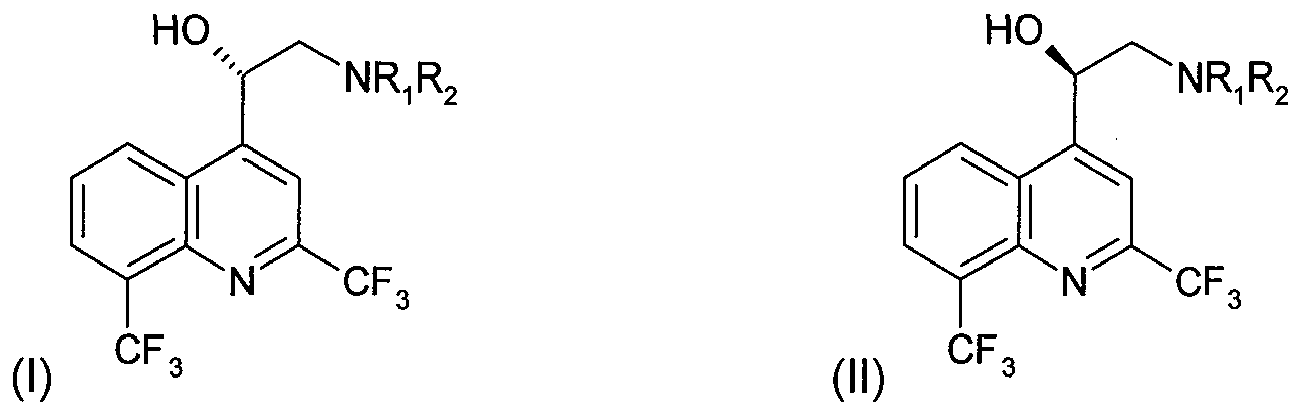 - R1 and R2 are selected from a group consisting of a hydrogen atom, a chain alkyl group (C1-C9), a cyclic alkyl groups and aromatic groups; or- NR1R2 forms together a piperazine or a piperidine substituted by at least one of a hydrogen, a chain alkyl group (C1-C9), a cyclic alkyl group, a chain containing an aromatic group and a chain containing a heterocyclic group.
 - The compound according to claim 12, wherein the compound of formula (I) is one of (S)-2-(benzylamino)-1-(2,8-bis(trifluoromethyl)quinolin-4-yl)ethanol, (S)-ethyl-4-(4-(2-(2,8-bis(trifluoromethyl)quinolin-4-yl)-2-(hydroxyethyl)piperazin-1-yl)butanoate, (S)-1-(2,8-bis(trifluoromethyl)quinolin-4-yl)-2-(pentylamino)ethanol, (S)-1-(2,8-bis(trifluoromethyl)quinolin-4-yl)-2-(hexylamino)ethanol, (S)-1-(2,8-bis(trifluoromethyl)quinolin-4-yl)-2-(heptylamino)ethanol, (S)-1-(2,8-bis(trifluoromethyl)quinolin-4-yl)-2-(octylamino)ethanol, (S)-1-(2,8-bis(trifluoromethyl)quinolin-4-yl)-2-(nonylamino)ethanol, (S)-1-(2,8-bis(trifluoromethyl)quinolin-4-yl)-2-(piperazine substituted)ethanol or (S)-tert-butyl-(3-(4-(3((2-(2,8-bis(trifluoromethyl)quinolin-4-yl)-2-(hydroxyethyl)amino)propyl)piperazin-1-yl)propyl)carbamate..
- The compound according to claim 12, wherein the compound of formula (II) is one of (R)-2-(benzylamino)-1-(2,8-bis(trifluoromethyl)quinolin-4-yl)ethanol, (R)-ethyl-4-(4-(2-(2,8-bis(trifluoromethyl)quinolin-4-yl)-2-(hydroxyethyl)piperazin-1-yl)butanoate, (R)-1-(2,8-bis(trifluoromethyl)quinolin-4-yl)-2-(pentylamino)ethanol, (R)-1-(2,8-bis(trifluoromethyl)quinolin-4-yl)-2-(hexylamino)ethanol, (R)-1-(2,8-bis(trifluoromethyl)quinolin-4-yl)-2-(heptylamino)ethanol, (R)-1-(2,8-bis(trifluoromethyl)quinolin-4-yl)-2-(octylamino)ethanol, (R)-1-(2,8-bis(trifluoromethyl)quinolin-4-yl)-2-(nonylamino)ethanol, (R)-1-(2,8-bis(trifluoromethyl)quinolin-4-yl)-2-(piperazine substituted) ethanol or (R)-tert-butyl-(3-(4-(3((2-(2,8-bis(trifluoromethyl)quinolin-4-yl)-2-(hydroxyethyl)amino)propyl)piperazin-1-yl)propyl)carbamate.
- The compound according to any one of claims 11 to 14, for the use as an antimalarial agent.
- The compound according to any one of claims 11 to 14, for the use as an antibacterial agent.
- A pharmaceutical composition comprising the compound according to any one of claims 11 to 14, and/or pharmaceutically acceptable salts thereof.
Priority Applications (2)
| Application Number | Priority Date | Filing Date | Title |
|---|---|---|---|
| EP11154229A EP2487157A1 (en) | 2011-02-11 | 2011-02-11 | Enantioselective synthesis method of 4-aminoalcoholquinoline derivatives and the use |
| PCT/EP2012/052240 WO2012107532A1 (en) | 2011-02-11 | 2012-02-09 | 4-aminoalcoholquinoline derivatives, enantioselective synthesis methods and the use thereof |
Applications Claiming Priority (1)
| Application Number | Priority Date | Filing Date | Title |
|---|---|---|---|
| EP11154229A EP2487157A1 (en) | 2011-02-11 | 2011-02-11 | Enantioselective synthesis method of 4-aminoalcoholquinoline derivatives and the use |
Publications (1)
| Publication Number | Publication Date |
|---|---|
| EP2487157A1 true EP2487157A1 (en) | 2012-08-15 |
Family
ID=43877055
Family Applications (1)
| Application Number | Title | Priority Date | Filing Date |
|---|---|---|---|
| EP11154229A Withdrawn EP2487157A1 (en) | 2011-02-11 | 2011-02-11 | Enantioselective synthesis method of 4-aminoalcoholquinoline derivatives and the use |
Country Status (2)
| Country | Link |
|---|---|
| EP (1) | EP2487157A1 (en) |
| WO (1) | WO2012107532A1 (en) |
Families Citing this family (1)
| Publication number | Priority date | Publication date | Assignee | Title |
|---|---|---|---|---|
| US11220482B2 (en) * | 2017-11-03 | 2022-01-11 | Universite Amiens Picardie Jules Verne | Aminopyridinemethanol compounds and their use |
Citations (5)
| Publication number | Priority date | Publication date | Assignee | Title |
|---|---|---|---|---|
| WO1998039003A1 (en) | 1997-03-07 | 1998-09-11 | Cerebrus Limited | Use of (+)mefloquine for the treatment of malaria |
| US6608085B1 (en) | 1998-09-04 | 2003-08-19 | Vernalis Research Limited | 4-quinolinemethanol derivatives as purine receptor antagonists (II) |
| WO2008060269A2 (en) * | 2005-10-28 | 2008-05-22 | The United States Of America, As Represented By The Secretary Of The Army | Quinoline methanol compounds for the treatment and prevention of parasitic infections |
| WO2010144101A1 (en) * | 2009-06-09 | 2010-12-16 | The United States Of America, As Represented By The Secretary Of The Army, On Behalf Of U.S. | Next generation quinoloine methanols |
| WO2010144434A1 (en) * | 2009-06-09 | 2010-12-16 | The United States Of America, As Represented By The Secretary Of The Army, On Behalf Of U.S. | Derivatives of mefloquine and associated methods for making and using |
-
2011
- 2011-02-11 EP EP11154229A patent/EP2487157A1/en not_active Withdrawn
-
2012
- 2012-02-09 WO PCT/EP2012/052240 patent/WO2012107532A1/en not_active Ceased
Patent Citations (5)
| Publication number | Priority date | Publication date | Assignee | Title |
|---|---|---|---|---|
| WO1998039003A1 (en) | 1997-03-07 | 1998-09-11 | Cerebrus Limited | Use of (+)mefloquine for the treatment of malaria |
| US6608085B1 (en) | 1998-09-04 | 2003-08-19 | Vernalis Research Limited | 4-quinolinemethanol derivatives as purine receptor antagonists (II) |
| WO2008060269A2 (en) * | 2005-10-28 | 2008-05-22 | The United States Of America, As Represented By The Secretary Of The Army | Quinoline methanol compounds for the treatment and prevention of parasitic infections |
| WO2010144101A1 (en) * | 2009-06-09 | 2010-12-16 | The United States Of America, As Represented By The Secretary Of The Army, On Behalf Of U.S. | Next generation quinoloine methanols |
| WO2010144434A1 (en) * | 2009-06-09 | 2010-12-16 | The United States Of America, As Represented By The Secretary Of The Army, On Behalf Of U.S. | Derivatives of mefloquine and associated methods for making and using |
Non-Patent Citations (40)
| Title |
|---|
| ALACID, E.; NAJERA C., J. ORG. CHEM., vol. 73, 2008, pages 2315 - 2322 |
| BHATTACHARJEE, A. K.; KARLE, J. M. J., MED. CHEM., vol. 39, 2002, pages 4622 |
| BIOT, C.; CHIBALE, K., INFECT. DISORDERS-DRUG TARGETS, vol. 6, 2006, pages 173 |
| BLUMBERGS P ET AL: "ANTIMALARIALS. 7. 2,8-BIS(TRIFLUOROMETHYL)-4-QUINOLINEMETHANOLS", JOURNAL OF MEDICINAL CHEMISTRY, AMERICAN CHEMICAL SOCIETY, WASHINGTON, US, vol. 18, no. 11, 1 January 1975 (1975-01-01), pages 1122 - 1126, XP000915125, ISSN: 0022-2623, DOI: 10.1021/JM00245A015 * |
| CARROLL, F. I.; BLACKWELL, J. T., J. MED. CHEM., vol. 17, 1974, pages 210 |
| COMINS D L ET AL: "Regioselective lithium-halogen exchange and palladium-catalyzed cross-coupling reactions of 2,4-dihaloquinolines", TETRAHEDRON LETTERS, ELSEVIER, AMSTERDAM, NL, vol. 46, no. 39, 26 September 2005 (2005-09-26), pages 6697 - 6699, XP025386480, ISSN: 0040-4039, [retrieved on 20050926], DOI: 10.1016/J.TETLET.2005.07.137 * |
| COMINS, D. L.; NOLAN, J. M.; BORI, I. D., TETRAHEDRON LETT., vol. 46, 2005, pages 6697 |
| DARSES J. AND GENET J-P.: "Potassium Organotrifluoroborates: New Perspectives in Organic Synthesis", CHEMICAL REVIEWS, vol. 108, 2008, pages 288 - 325, XP002634484 * |
| DARSES, S., GENET, J.-P. CHEM, REV., vol. 108, 2008, pages 288 |
| DOW, G. S.; HEADY, T. N.; BHATTARCHARGEE, A. K.; CARIDHA, D.; GERENA, L.; GETTAYACAMIN, M.; LANTERI, C. A.; OBALDIA, N. ILL.; RONC, ANTIMICROB. AGENTS CHEMOTHER., vol. 50, 2006, pages 4132 |
| DOW, G. S.; KOENIG, M. L.; WOLF, L.; GERENA, L.; LOPEZ-SANCHEZ, M.; HUDSON, T. H.; BHATTACHARJEE, A. K., ANFIMICROB. AGENTS CHEMOTHER., vol. 50, 2006, pages 4132 |
| GILLESPIE, R. J.; ADAMS, D. R.; BEBBINGTON, D.; BENWELL, K.; CLIFFE, IAN A.; DAWSON, C. E.; DOURISH, C. T.; FLETCHER, A.; GAUR, S., BIOORG. MED. CHEM. LETT., vol. 18, 2008, pages 2916 |
| GO, M. L., MED. RES. REV., vol. 23, 2003, pages 456 |
| GUILLON, J.; FORFAR, I.; DESPLAT, V.; BELISLE-FABRE, S.; THIOLAT, D.; MASSIP, S.; CARRIE, H.; MOSSALAYI, M.; JARRY, C. J., ENZ. INHIB. MED. CHEM., vol. 22, 2007, pages 541 |
| JAYAPRAKASH, S.; ISO, Y.; WAN, B.; FRANZBLAU, S. G.; KOZIKOWSKI, A. P., CHEM. MED. CHEM., vol. 1, 2006, pages 593 |
| KARLE, J. M.; OLMEDA, R.; GERENA, L.; MILHOUS, W. K., EXP. PHARMACOL., vol. 76, 1993, pages 345 |
| KOLB H C ET AL: "A Simplified Procedure for the Stereospecific Transformation of 1,2-Diols into Epoxides", TETRAHEDRON, ELSEVIER SCIENCE PUBLISHERS, AMSTERDAM, NL, vol. 48, no. 48, 1 January 1992 (1992-01-01), pages 10515 - 10530, XP002993847, ISSN: 0040-4020, DOI: 10.1016/S0040-4020(01)88349-6 * |
| KOLB H C ET AL: "CATALYTIC ASYMMETRIC DIHYDROXYLATION", CHEMICAL REVIEWS, ACS,WASHINGTON, DC, US, vol. 94, 1 January 1994 (1994-01-01), pages 2483 - 2547, XP000857717, ISSN: 0009-2665, DOI: 10.1021/CR00032A009 * |
| KOLB, H. C.; SHARPLESS, K. B., TETRAHEDRON, vol. 48, 1992, pages 10515 |
| KOLB, H. C.; VANNIEUWENHZE, M. S.; SHARPLESS, K. B., CHEM. REV., vol. 94, 1994, pages 2483 |
| KUNIN, C. M.; ELLIS, W. Y., ANTIMICROB. AGENTS CHEMOTHER., vol. 44, 2000, pages 848 |
| LUTZ, R. E.; PATEL, A. R.; OHNMACHT, C. J., J. MED. CHEM., vol. 14, 1971, pages 926 |
| MAO, J.; WANG, Y.; WAN, B.; KOZIKOWSKI, A. P.; FRANZBLAU, S. G., CHEM. MED. CHEM., vol. 2, 2007, pages 1624 |
| MAO, J.; YUAN, H.; WANG, Y.; WAN, B.; PAK, D.; HE, R.; FRANZBLAU, S. G., BIOORG. MED. CHEM. LEFF., vol. 20, 2010, pages 1263 |
| MAO, J.WANG, Y.WAN, B.KOZIKOWSKI, A. P.FRANZBLAU, S. G.: "Design, Symthesis, and Pharmacological Evaluation of Mefloquine-Based Ligands as Novel Antituberculosis Agents", CHEM. MED. CHEM., vol. 2, 2007, pages 1624 - 1630, XP002634483 * |
| MILNER E ET AL: "Structureactivity relationships amongst 4-position quinoline methanol antimalarials that inhibit the growth of drug sensitive and resistant strains of Plasmodium falciparum", BIOORGANIC & MEDICINAL CHEMISTRY LETTERS, PERGAMON, ELSEVIER SCIENCE, GB, vol. 20, no. 4, 15 February 2010 (2010-02-15), pages 1347 - 1351, XP026887067, ISSN: 0960-894X, [retrieved on 20100107], DOI: 10.1016/J.BMCL.2010.01.001 * |
| MILNER, E.; MCCALMONT, W.; BHONSLE, J.; CARIDHA, D.; CARROLL, D.; GARDNER, S.; GERENA, L.; GETTAYACAMIN, M.; LANTERI, C.; LUONG, T, BIOORG. MED. CHEM. LETT., vol. 20, 2010, pages 1347 |
| MILNER, E.; MCCALMONT, W.; BHONSLE, J.; CARIDHA, D.; COBAR, J.; GARDNER, S.; GERENA, L.; GOODINE, D.; LANTERI, C.; MELENDEZ, V., MALARIA JOURNAL, vol. 9, 2010, pages 51 |
| MIYAURA N ET AL: "PALLADIUM-CATALYZED CROSS-COUPLING REACTIONS OF ORGANOBORON COMPOUNDS", CHEMICAL REVIEWS, ACS,WASHINGTON, DC, US, vol. 95, no. 7, 1 January 1995 (1995-01-01), pages 2457 - 2483, XP000652239, ISSN: 0009-2665, DOI: 10.1021/CR00039A007 * |
| MIYAURA, N.; SUZUKI, A., CHEM. REV., vol. 95, 1995, pages 2457 - 2483 |
| MOLANDER, G. A.; FUMAGALLI, T. J., ORG. CHEM., vol. 71, 2006, pages 5743 |
| MOLANDER, G. A.; YUN C. S.; RIBAGORDA, M.; BIOLATTO, B. J., ORG. CHEM., vol. 68, 2003, pages 5534 |
| PHILLIPS-HOWARD, P. A.; TER KUILE, F. 0., DRUG SA£, vol. 370, 1995 |
| SATOH, M.; MIYAURA, N.; SUZUKI, A., CHEM. LETT., vol. 8, 1986, pages 1329 |
| VAN RIEMSDIJK, M. M.; VAN DER KLAUW, M. M.; VAN HEEST, J. A.; REEDEKER, F. R.; LIGTHELM, R. J.; HERINGS, R. M.; STRICKER, B. H., EUR. J. CLIN. PHARMACOL., vol. 52, 1997, pages 1 |
| VIDAL-AROCA, F.; MENG, A.; MINZ, T.; PAGE M. G. P.; DREIER, J. J., MICROB. METHODS, vol. 79, 2009, pages 232 |
| WEINKE, T.; TRAUTMANN, M.; HELD, T.; WEBER, G.; EICHENLAUB, D.; FLEISCHER, K.; KERN, W.; POLHE, H. D., AM. J. TROP. MED. HYG., vol. 45, 1991, pages 86 |
| WEISSMAN, S. A.; ROSSEN, K.; REIDER, P., J. ORG. LEFT., vol. 16, 2001, pages 2513 - 2515 |
| WHO, 2007, Retrieved from the Internet <URL:http://www.who.int/tdr/diseases/malaria/direction.htm> |
| XIE, Z.-X.; ZHANG, L.-Z.; REN, X.-J.; TANG, S.-Y.; LI, Y., CHIN. J. CHEM., vol. 26, 2008, pages 1272 |
Also Published As
| Publication number | Publication date |
|---|---|
| WO2012107532A1 (en) | 2012-08-16 |
Similar Documents
| Publication | Publication Date | Title |
|---|---|---|
| FI94341B (en) | Process for the preparation of therapeutically useful 5-phenyl-2-pyrimidinone derivatives | |
| CA2736097C (en) | Carbazole compounds for inhibition of nf-kb activity | |
| US20240217953A1 (en) | Bicyclic substituted aromatic carboxylic acid compounds | |
| CA3004372C (en) | Pyrimidine derivative and use thereof | |
| US6939977B2 (en) | Analgesic and immunomodulatory cannabinoids | |
| NZ533266A (en) | Acetylene derivatives having MGLUR 5 antagonistic activity | |
| KR20130126912A (en) | Drug derivatives | |
| US11273168B2 (en) | Methods of treating anxiety by administering a substituted quinolone | |
| US20070299091A1 (en) | Azaindole Carboxamides | |
| Bentzinger et al. | Enantiopure substituted pyridines as promising antimalarial drug candidates | |
| PL177140B1 (en) | Isoindoles and method of obtaining them | |
| US20090099364A1 (en) | Process for preparation of 1-(2s,3s)-2-benzhydryl-n-(5- tert-butyl-2-methoxybenzyl)quinuclidin-3-amine | |
| US20080188498A1 (en) | Pyridopyrimidinone compounds with antimalarial activity | |
| US20080275035A1 (en) | Nitroimidazole Compounds | |
| EP1860103B1 (en) | Anticancer compound, intermediate therefor, and processes for producing these | |
| Jonet et al. | First enantioselective synthesis of 4-aminoalcohol quinoline derivatives through a regioselective SN2 epoxide opening mechanism | |
| JPS58213788A (en) | Ampicillin and amoxicillin derivative having alpha-lactamase inhibitor | |
| US9428493B2 (en) | Schweinfurthin analogues | |
| JPH05221938A (en) | Substituted aminopropane, preparation thereof and use thereof | |
| WO2012107532A1 (en) | 4-aminoalcoholquinoline derivatives, enantioselective synthesis methods and the use thereof | |
| PT1904469E (en) | New pyrocatechin derivatives | |
| US20110207773A1 (en) | Novel phenyl-quinoline-carboxylic acid pyridine derivatives useful as modulators of nicotinic acetylcholine receptors | |
| CN109369606A (en) | A kind of preparation method of acetylated dibenzo-1,3-dioxane compound and its application as antibacterial drug | |
| US10617706B2 (en) | Compounds for cancer chemotherapeutic sensitization | |
| US7163957B2 (en) | 3-(Cyclopenten-1-yl)-benzyl-or 3-(cyclopenten-1-yl)-heteroarylmethyl-amine derivatives and use thereof as medicines for treating schizophrenia |
Legal Events
| Date | Code | Title | Description |
|---|---|---|---|
| PUAI | Public reference made under article 153(3) epc to a published international application that has entered the european phase |
Free format text: ORIGINAL CODE: 0009012 |
|
| AK | Designated contracting states |
Kind code of ref document: A1 Designated state(s): AL AT BE BG CH CY CZ DE DK EE ES FI FR GB GR HR HU IE IS IT LI LT LU LV MC MK MT NL NO PL PT RO RS SE SI SK SM TR |
|
| AX | Request for extension of the european patent |
Extension state: BA ME |
|
| STAA | Information on the status of an ep patent application or granted ep patent |
Free format text: STATUS: THE APPLICATION HAS BEEN WITHDRAWN |
|
| 18W | Application withdrawn |
Effective date: 20130205 |