EP2487153A1 - Substituted cyclopentanes having prostaglandin activity - Google Patents
Substituted cyclopentanes having prostaglandin activity Download PDFInfo
- Publication number
- EP2487153A1 EP2487153A1 EP12167472A EP12167472A EP2487153A1 EP 2487153 A1 EP2487153 A1 EP 2487153A1 EP 12167472 A EP12167472 A EP 12167472A EP 12167472 A EP12167472 A EP 12167472A EP 2487153 A1 EP2487153 A1 EP 2487153A1
- Authority
- EP
- European Patent Office
- Prior art keywords
- compound
- alkyl
- mmol
- formula
- represented
- Prior art date
- Legal status (The legal status is an assumption and is not a legal conclusion. Google has not performed a legal analysis and makes no representation as to the accuracy of the status listed.)
- Withdrawn
Links
- 150000003180 prostaglandins Chemical class 0.000 title description 6
- 150000001940 cyclopentanes Chemical class 0.000 title 1
- 210000004209 hair Anatomy 0.000 claims abstract description 14
- 150000001875 compounds Chemical class 0.000 claims description 69
- 125000004432 carbon atom Chemical group C* 0.000 claims description 17
- RTZKZFJDLAIYFH-UHFFFAOYSA-N Diethyl ether Chemical compound CCOCC RTZKZFJDLAIYFH-UHFFFAOYSA-N 0.000 claims description 12
- 125000004169 (C1-C6) alkyl group Chemical group 0.000 claims description 11
- 150000001408 amides Chemical class 0.000 claims description 9
- 150000002148 esters Chemical class 0.000 claims description 9
- 150000007524 organic acids Chemical group 0.000 claims description 9
- 125000003831 tetrazolyl group Chemical group 0.000 claims description 9
- 125000000524 functional group Chemical group 0.000 claims description 8
- 125000006577 C1-C6 hydroxyalkyl group Chemical group 0.000 claims description 7
- 125000002252 acyl group Chemical group 0.000 claims description 7
- 230000003648 hair appearance Effects 0.000 claims description 6
- 229910052717 sulfur Inorganic materials 0.000 claims description 6
- 125000004029 hydroxymethyl group Chemical group [H]OC([H])([H])* 0.000 claims description 5
- 229910052760 oxygen Inorganic materials 0.000 claims description 5
- 125000001475 halogen functional group Chemical group 0.000 claims 4
- 239000002537 cosmetic Substances 0.000 claims 1
- 238000002560 therapeutic procedure Methods 0.000 claims 1
- 229940006138 antiglaucoma drug and miotics prostaglandin analogues Drugs 0.000 abstract 1
- XEKOWRVHYACXOJ-UHFFFAOYSA-N Ethyl acetate Chemical compound CCOC(C)=O XEKOWRVHYACXOJ-UHFFFAOYSA-N 0.000 description 68
- OKKJLVBELUTLKV-UHFFFAOYSA-N Methanol Chemical compound OC OKKJLVBELUTLKV-UHFFFAOYSA-N 0.000 description 36
- HEDRZPFGACZZDS-MICDWDOJSA-N Trichloro(2H)methane Chemical compound [2H]C(Cl)(Cl)Cl HEDRZPFGACZZDS-MICDWDOJSA-N 0.000 description 30
- 235000019439 ethyl acetate Nutrition 0.000 description 27
- 239000000203 mixture Substances 0.000 description 26
- YMWUJEATGCHHMB-UHFFFAOYSA-N Dichloromethane Chemical compound ClCCl YMWUJEATGCHHMB-UHFFFAOYSA-N 0.000 description 23
- VLKZOEOYAKHREP-UHFFFAOYSA-N hexane Substances CCCCCC VLKZOEOYAKHREP-UHFFFAOYSA-N 0.000 description 23
- VYPSYNLAJGMNEJ-UHFFFAOYSA-N Silicium dioxide Chemical compound O=[Si]=O VYPSYNLAJGMNEJ-UHFFFAOYSA-N 0.000 description 20
- 239000000741 silica gel Substances 0.000 description 18
- 229910002027 silica gel Inorganic materials 0.000 description 18
- 239000000243 solution Substances 0.000 description 18
- 238000005160 1H NMR spectroscopy Methods 0.000 description 17
- 208000010412 Glaucoma Diseases 0.000 description 15
- 150000001299 aldehydes Chemical class 0.000 description 14
- 239000000047 product Substances 0.000 description 14
- 125000001183 hydrocarbyl group Chemical group 0.000 description 11
- 0 CC(CCCC(CCC1C(*C=C****)[C@@](*)CC1*)O*)O* Chemical compound CC(CCCC(CCC1C(*C=C****)[C@@](*)CC1*)O*)O* 0.000 description 10
- 150000003839 salts Chemical class 0.000 description 10
- 238000000034 method Methods 0.000 description 9
- NLXLAEXVIDQMFP-UHFFFAOYSA-N Ammonia chloride Chemical compound [NH4+].[Cl-] NLXLAEXVIDQMFP-UHFFFAOYSA-N 0.000 description 8
- 239000000706 filtrate Substances 0.000 description 8
- 241000124008 Mammalia Species 0.000 description 7
- 125000000217 alkyl group Chemical group 0.000 description 7
- 238000006243 chemical reaction Methods 0.000 description 7
- 239000003814 drug Substances 0.000 description 7
- 229940002612 prodrug Drugs 0.000 description 7
- 239000000651 prodrug Substances 0.000 description 7
- 239000007787 solid Substances 0.000 description 7
- 239000002904 solvent Substances 0.000 description 7
- WMFOQBRAJBCJND-UHFFFAOYSA-M Lithium hydroxide Chemical compound [Li+].[OH-] WMFOQBRAJBCJND-UHFFFAOYSA-M 0.000 description 6
- PMZURENOXWZQFD-UHFFFAOYSA-L Sodium Sulfate Chemical compound [Na+].[Na+].[O-]S([O-])(=O)=O PMZURENOXWZQFD-UHFFFAOYSA-L 0.000 description 6
- 239000012267 brine Substances 0.000 description 6
- 150000002009 diols Chemical class 0.000 description 6
- 125000005843 halogen group Chemical group 0.000 description 6
- HPALAKNZSZLMCH-UHFFFAOYSA-M sodium;chloride;hydrate Chemical compound O.[Na+].[Cl-] HPALAKNZSZLMCH-UHFFFAOYSA-M 0.000 description 6
- 238000011282 treatment Methods 0.000 description 6
- 239000002253 acid Substances 0.000 description 5
- 239000012043 crude product Substances 0.000 description 5
- XEYBRNLFEZDVAW-ARSRFYASSA-N dinoprostone Chemical compound CCCCC[C@H](O)\C=C\[C@H]1[C@H](O)CC(=O)[C@@H]1C\C=C/CCCC(O)=O XEYBRNLFEZDVAW-ARSRFYASSA-N 0.000 description 5
- 230000004410 intraocular pressure Effects 0.000 description 5
- 239000007858 starting material Substances 0.000 description 5
- LFQSCWFLJHTTHZ-UHFFFAOYSA-N Ethanol Chemical compound CCO LFQSCWFLJHTTHZ-UHFFFAOYSA-N 0.000 description 4
- VEXZGXHMUGYJMC-UHFFFAOYSA-N Hydrochloric acid Chemical compound Cl VEXZGXHMUGYJMC-UHFFFAOYSA-N 0.000 description 4
- 206010030043 Ocular hypertension Diseases 0.000 description 4
- 230000002378 acidificating effect Effects 0.000 description 4
- ZUOUZKKEUPVFJK-UHFFFAOYSA-N diphenyl Chemical group C1=CC=CC=C1C1=CC=CC=C1 ZUOUZKKEUPVFJK-UHFFFAOYSA-N 0.000 description 4
- KPUWHANPEXNPJT-UHFFFAOYSA-N disiloxane Chemical compound [SiH3]O[SiH3] KPUWHANPEXNPJT-UHFFFAOYSA-N 0.000 description 4
- 239000010410 layer Substances 0.000 description 4
- 238000004519 manufacturing process Methods 0.000 description 4
- 229940094443 oxytocics prostaglandins Drugs 0.000 description 4
- 239000011541 reaction mixture Substances 0.000 description 4
- 201000002862 Angle-Closure Glaucoma Diseases 0.000 description 3
- 206010030348 Open-Angle Glaucoma Diseases 0.000 description 3
- QOSMNYMQXIVWKY-UHFFFAOYSA-N Propyl levulinate Chemical compound CCCOC(=O)CCC(C)=O QOSMNYMQXIVWKY-UHFFFAOYSA-N 0.000 description 3
- YXFVVABEGXRONW-UHFFFAOYSA-N Toluene Chemical compound CC1=CC=CC=C1 YXFVVABEGXRONW-UHFFFAOYSA-N 0.000 description 3
- ZMANZCXQSJIPKH-UHFFFAOYSA-N Triethylamine Chemical compound CCN(CC)CC ZMANZCXQSJIPKH-UHFFFAOYSA-N 0.000 description 3
- 230000001154 acute effect Effects 0.000 description 3
- 235000019270 ammonium chloride Nutrition 0.000 description 3
- 238000004458 analytical method Methods 0.000 description 3
- 210000002159 anterior chamber Anatomy 0.000 description 3
- 210000001742 aqueous humor Anatomy 0.000 description 3
- 125000004429 atom Chemical group 0.000 description 3
- 239000013626 chemical specie Substances 0.000 description 3
- 238000011097 chromatography purification Methods 0.000 description 3
- 125000001495 ethyl group Chemical group [H]C([H])([H])C([H])([H])* 0.000 description 3
- 238000001914 filtration Methods 0.000 description 3
- 125000004435 hydrogen atom Chemical group [H]* 0.000 description 3
- 125000002887 hydroxy group Chemical group [H]O* 0.000 description 3
- 125000002496 methyl group Chemical group [H]C([H])([H])* 0.000 description 3
- 125000004430 oxygen atom Chemical group O* 0.000 description 3
- 125000001997 phenyl group Chemical group [H]C1=C([H])C([H])=C(*)C([H])=C1[H] 0.000 description 3
- 229920006395 saturated elastomer Polymers 0.000 description 3
- FPGGTKZVZWFYPV-UHFFFAOYSA-M tetrabutylammonium fluoride Chemical compound [F-].CCCC[N+](CCCC)(CCCC)CCCC FPGGTKZVZWFYPV-UHFFFAOYSA-M 0.000 description 3
- XLYOFNOQVPJJNP-UHFFFAOYSA-N water Substances O XLYOFNOQVPJJNP-UHFFFAOYSA-N 0.000 description 3
- IJGRMHOSHXDMSA-UHFFFAOYSA-N Atomic nitrogen Chemical compound N#N IJGRMHOSHXDMSA-UHFFFAOYSA-N 0.000 description 2
- LSNNMFCWUKXFEE-UHFFFAOYSA-M Bisulfite Chemical compound OS([O-])=O LSNNMFCWUKXFEE-UHFFFAOYSA-M 0.000 description 2
- 201000004569 Blindness Diseases 0.000 description 2
- OKTJSMMVPCPJKN-UHFFFAOYSA-N Carbon Chemical compound [C] OKTJSMMVPCPJKN-UHFFFAOYSA-N 0.000 description 2
- 208000002177 Cataract Diseases 0.000 description 2
- VEXZGXHMUGYJMC-UHFFFAOYSA-M Chloride anion Chemical compound [Cl-] VEXZGXHMUGYJMC-UHFFFAOYSA-M 0.000 description 2
- 206010020772 Hypertension Diseases 0.000 description 2
- AFVFQIVMOAPDHO-UHFFFAOYSA-N Methanesulfonic acid Chemical compound CS(O)(=O)=O AFVFQIVMOAPDHO-UHFFFAOYSA-N 0.000 description 2
- YNAVUWVOSKDBBP-UHFFFAOYSA-N Morpholine Chemical compound C1COCCN1 YNAVUWVOSKDBBP-UHFFFAOYSA-N 0.000 description 2
- 206010028980 Neoplasm Diseases 0.000 description 2
- KEAYESYHFKHZAL-UHFFFAOYSA-N Sodium Chemical compound [Na] KEAYESYHFKHZAL-UHFFFAOYSA-N 0.000 description 2
- VMHLLURERBWHNL-UHFFFAOYSA-M Sodium acetate Chemical compound [Na+].CC([O-])=O VMHLLURERBWHNL-UHFFFAOYSA-M 0.000 description 2
- XSTXAVWGXDQKEL-UHFFFAOYSA-N Trichloroethylene Chemical compound ClC=C(Cl)Cl XSTXAVWGXDQKEL-UHFFFAOYSA-N 0.000 description 2
- CSCPPACGZOOCGX-WFGJKAKNSA-N acetone d6 Chemical compound [2H]C([2H])([2H])C(=O)C([2H])([2H])[2H] CSCPPACGZOOCGX-WFGJKAKNSA-N 0.000 description 2
- 201000001326 acute closed-angle glaucoma Diseases 0.000 description 2
- 125000002723 alicyclic group Chemical group 0.000 description 2
- 125000003342 alkenyl group Chemical group 0.000 description 2
- 239000004305 biphenyl Chemical group 0.000 description 2
- 235000010290 biphenyl Nutrition 0.000 description 2
- 229910000085 borane Inorganic materials 0.000 description 2
- 125000000484 butyl group Chemical group [H]C([*])([H])C([H])([H])C([H])([H])C([H])([H])[H] 0.000 description 2
- 239000006227 byproduct Substances 0.000 description 2
- 229910052799 carbon Inorganic materials 0.000 description 2
- 150000001735 carboxylic acids Chemical class 0.000 description 2
- 238000001816 cooling Methods 0.000 description 2
- 125000000753 cycloalkyl group Chemical group 0.000 description 2
- 125000001511 cyclopentyl group Chemical group [H]C1([H])C([H])([H])C([H])([H])C([H])(*)C1([H])[H] 0.000 description 2
- 125000000118 dimethyl group Chemical group [H]C([H])([H])* 0.000 description 2
- 229940079593 drug Drugs 0.000 description 2
- 150000002066 eicosanoids Chemical class 0.000 description 2
- 238000003818 flash chromatography Methods 0.000 description 2
- BHEPBYXIRTUNPN-UHFFFAOYSA-N hydridophosphorus(.) (triplet) Chemical compound [PH] BHEPBYXIRTUNPN-UHFFFAOYSA-N 0.000 description 2
- 238000000338 in vitro Methods 0.000 description 2
- 125000001449 isopropyl group Chemical group [H]C([H])([H])C([H])(*)C([H])([H])[H] 0.000 description 2
- 238000004895 liquid chromatography mass spectrometry Methods 0.000 description 2
- 239000004533 oil dispersion Substances 0.000 description 2
- 125000001147 pentyl group Chemical group C(CCCC)* 0.000 description 2
- ABLZXFCXXLZCGV-UHFFFAOYSA-N phosphonic acid group Chemical group P(O)(O)=O ABLZXFCXXLZCGV-UHFFFAOYSA-N 0.000 description 2
- 201000006366 primary open angle glaucoma Diseases 0.000 description 2
- 125000001436 propyl group Chemical group [H]C([*])([H])C([H])([H])C([H])([H])[H] 0.000 description 2
- GMVPRGQOIOIIMI-DWKJAMRDSA-N prostaglandin E1 Chemical compound CCCCC[C@H](O)\C=C\[C@H]1[C@H](O)CC(=O)[C@@H]1CCCCCCC(O)=O GMVPRGQOIOIIMI-DWKJAMRDSA-N 0.000 description 2
- WGJJROVFWIXTPA-OALUTQOASA-N prostanoic acid Chemical class CCCCCCCC[C@H]1CCC[C@@H]1CCCCCCC(O)=O WGJJROVFWIXTPA-OALUTQOASA-N 0.000 description 2
- 238000000746 purification Methods 0.000 description 2
- ZDYVRSLAEXCVBX-UHFFFAOYSA-N pyridinium p-toluenesulfonate Chemical compound C1=CC=[NH+]C=C1.CC1=CC=C(S([O-])(=O)=O)C=C1 ZDYVRSLAEXCVBX-UHFFFAOYSA-N 0.000 description 2
- 239000001632 sodium acetate Substances 0.000 description 2
- 235000017281 sodium acetate Nutrition 0.000 description 2
- 239000012312 sodium hydride Substances 0.000 description 2
- 229910000104 sodium hydride Inorganic materials 0.000 description 2
- 125000001424 substituent group Chemical group 0.000 description 2
- 239000000725 suspension Substances 0.000 description 2
- 125000001981 tert-butyldimethylsilyl group Chemical group [H]C([H])([H])[Si]([H])(C([H])([H])[H])[*]C(C([H])([H])[H])(C([H])([H])[H])C([H])([H])[H] 0.000 description 2
- UORVGPXVDQYIDP-UHFFFAOYSA-N trihydridoboron Substances B UORVGPXVDQYIDP-UHFFFAOYSA-N 0.000 description 2
- 230000004393 visual impairment Effects 0.000 description 2
- PXGPLTODNUVGFL-BRIYLRKRSA-N (E,Z)-(1R,2R,3R,5S)-7-(3,5-Dihydroxy-2-((3S)-(3-hydroxy-1-octenyl))cyclopentyl)-5-heptenoic acid Chemical compound CCCCC[C@H](O)C=C[C@H]1[C@H](O)C[C@H](O)[C@@H]1CC=CCCCC(O)=O PXGPLTODNUVGFL-BRIYLRKRSA-N 0.000 description 1
- BXUHXMVABPDEHP-BOMADRPESA-N (z)-7-[(1r,2r,3r,5r)-5-chloro-2-[(e,3s,7r)-3,7-dihydroxyoct-1-enyl]-3-hydroxycyclopentyl]hept-5-enoic acid Chemical compound C[C@@H](O)CCC[C@H](O)\C=C\[C@H]1[C@H](O)C[C@@H](Cl)[C@@H]1C\C=C/CCCC(O)=O BXUHXMVABPDEHP-BOMADRPESA-N 0.000 description 1
- 238000001644 13C nuclear magnetic resonance spectroscopy Methods 0.000 description 1
- 125000000954 2-hydroxyethyl group Chemical group [H]C([*])([H])C([H])([H])O[H] 0.000 description 1
- PBXKZBRQCQEENQ-UZMOGYDDSA-N 7-[(1r,2r,3r,5r)-5-chloro-2-[(e,3s,7r)-3,7-dihydroxyoct-1-enyl]-3-hydroxycyclopentyl]heptanoic acid Chemical compound C[C@@H](O)CCC[C@H](O)\C=C\[C@H]1[C@H](O)C[C@@H](Cl)[C@@H]1CCCCCCC(O)=O PBXKZBRQCQEENQ-UZMOGYDDSA-N 0.000 description 1
- WEVYAHXRMPXWCK-UHFFFAOYSA-N Acetonitrile Chemical compound CC#N WEVYAHXRMPXWCK-UHFFFAOYSA-N 0.000 description 1
- OWPKGQPESHNVHP-IMMRQFGKSA-N C[C@H](CCC[C@@H](/C=C/C([C@@H](C/C=C\CCCC(C1)[O]11#CC1C)[C@H](C)C1)[C@@H]1S)O)O Chemical compound C[C@H](CCC[C@@H](/C=C/C([C@@H](C/C=C\CCCC(C1)[O]11#CC1C)[C@H](C)C1)[C@@H]1S)O)O OWPKGQPESHNVHP-IMMRQFGKSA-N 0.000 description 1
- 206010018325 Congenital glaucomas Diseases 0.000 description 1
- 206010012565 Developmental glaucoma Diseases 0.000 description 1
- 208000031969 Eye Hemorrhage Diseases 0.000 description 1
- UFHFLCQGNIYNRP-UHFFFAOYSA-N Hydrogen Chemical compound [H][H] UFHFLCQGNIYNRP-UHFFFAOYSA-N 0.000 description 1
- 206010067684 Iris bombe Diseases 0.000 description 1
- 241001465754 Metazoa Species 0.000 description 1
- 239000012359 Methanesulfonyl chloride Substances 0.000 description 1
- 206010068960 Narrow anterior chamber angle Diseases 0.000 description 1
- 208000022873 Ocular disease Diseases 0.000 description 1
- NINIDFKCEFEMDL-UHFFFAOYSA-N Sulfur Chemical compound [S] NINIDFKCEFEMDL-UHFFFAOYSA-N 0.000 description 1
- 206010046851 Uveitis Diseases 0.000 description 1
- 239000013543 active substance Substances 0.000 description 1
- YKIOKAURTKXMSB-UHFFFAOYSA-N adams's catalyst Chemical compound O=[Pt]=O YKIOKAURTKXMSB-UHFFFAOYSA-N 0.000 description 1
- 125000005907 alkyl ester group Chemical group 0.000 description 1
- 125000000304 alkynyl group Chemical group 0.000 description 1
- 150000001412 amines Chemical class 0.000 description 1
- 239000002220 antihypertensive agent Substances 0.000 description 1
- 239000007864 aqueous solution Substances 0.000 description 1
- 150000001732 carboxylic acid derivatives Chemical class 0.000 description 1
- 239000003054 catalyst Substances 0.000 description 1
- 201000005667 central retinal vein occlusion Diseases 0.000 description 1
- 150000005829 chemical entities Chemical class 0.000 description 1
- 201000005682 chronic closed-angle glaucoma Diseases 0.000 description 1
- 230000001684 chronic effect Effects 0.000 description 1
- 125000000392 cycloalkenyl group Chemical group 0.000 description 1
- 125000001995 cyclobutyl group Chemical group [H]C1([H])C([H])([H])C([H])(*)C1([H])[H] 0.000 description 1
- 125000000113 cyclohexyl group Chemical group [H]C1([H])C([H])([H])C([H])([H])C([H])(*)C([H])([H])C1([H])[H] 0.000 description 1
- 125000001559 cyclopropyl group Chemical group [H]C1([H])C([H])([H])C1([H])* 0.000 description 1
- 238000003745 diagnosis Methods 0.000 description 1
- 230000010339 dilation Effects 0.000 description 1
- 201000010099 disease Diseases 0.000 description 1
- 230000006806 disease prevention Effects 0.000 description 1
- 208000037265 diseases, disorders, signs and symptoms Diseases 0.000 description 1
- 239000006185 dispersion Substances 0.000 description 1
- 239000002552 dosage form Substances 0.000 description 1
- 238000012377 drug delivery Methods 0.000 description 1
- 238000009510 drug design Methods 0.000 description 1
- 239000000839 emulsion Substances 0.000 description 1
- 125000004185 ester group Chemical group 0.000 description 1
- 210000000416 exudates and transudate Anatomy 0.000 description 1
- 239000011521 glass Substances 0.000 description 1
- MNWFXJYAOYHMED-UHFFFAOYSA-N heptanoic acid Chemical compound CCCCCCC(O)=O MNWFXJYAOYHMED-UHFFFAOYSA-N 0.000 description 1
- 125000004051 hexyl group Chemical group [H]C([H])([H])C([H])([H])C([H])([H])C([H])([H])C([H])([H])C([H])([H])* 0.000 description 1
- 150000004677 hydrates Chemical class 0.000 description 1
- -1 hydride ion Chemical class 0.000 description 1
- 239000001257 hydrogen Substances 0.000 description 1
- 229910052739 hydrogen Inorganic materials 0.000 description 1
- 230000007062 hydrolysis Effects 0.000 description 1
- 238000006460 hydrolysis reaction Methods 0.000 description 1
- 125000002768 hydroxyalkyl group Chemical group 0.000 description 1
- 230000001631 hypertensive effect Effects 0.000 description 1
- 238000001727 in vivo Methods 0.000 description 1
- 208000027866 inflammatory disease Diseases 0.000 description 1
- 208000014674 injury Diseases 0.000 description 1
- 230000003993 interaction Effects 0.000 description 1
- 208000018769 loss of vision Diseases 0.000 description 1
- 231100000864 loss of vision Toxicity 0.000 description 1
- 238000007726 management method Methods 0.000 description 1
- QARBMVPHQWIHKH-UHFFFAOYSA-N methanesulfonyl chloride Chemical compound CS(Cl)(=O)=O QARBMVPHQWIHKH-UHFFFAOYSA-N 0.000 description 1
- 230000000116 mitigating effect Effects 0.000 description 1
- 125000004108 n-butyl group Chemical group [H]C([H])([H])C([H])([H])C([H])([H])C([H])([H])* 0.000 description 1
- 125000001280 n-hexyl group Chemical group C(CCCCC)* 0.000 description 1
- 125000000740 n-pentyl group Chemical group [H]C([H])([H])C([H])([H])C([H])([H])C([H])([H])C([H])([H])* 0.000 description 1
- 125000004123 n-propyl group Chemical group [H]C([H])([H])C([H])([H])C([H])([H])* 0.000 description 1
- 229910052757 nitrogen Inorganic materials 0.000 description 1
- 125000004433 nitrogen atom Chemical group N* 0.000 description 1
- 239000012044 organic layer Substances 0.000 description 1
- 239000002244 precipitate Substances 0.000 description 1
- 238000002360 preparation method Methods 0.000 description 1
- 230000002250 progressing effect Effects 0.000 description 1
- VOPZEYMGVHOKLJ-RSNHYIQPSA-N prop-2-enyl (z)-7-[(1r,2r,3r,5r)-2-[(e,3s,7r)-7-[tert-butyl(dimethyl)silyl]oxy-3-hydroxyoct-1-enyl]-5-chloro-3-(oxan-2-yloxy)cyclopentyl]hept-5-enoate Chemical compound C1[C@@H](Cl)[C@H](C\C=C/CCCC(=O)OCC=C)[C@@H](/C=C/[C@@H](O)CCC[C@@H](C)O[Si](C)(C)C(C)(C)C)[C@@H]1OC1OCCCC1 VOPZEYMGVHOKLJ-RSNHYIQPSA-N 0.000 description 1
- SWNGWFQRKMJAJE-XEXOEKHYSA-N prop-2-enyl (z)-7-[(1r,2r,3r,5r)-5-chloro-2-[(e,3s,7r)-3,7-dihydroxyoct-1-enyl]-3-(oxan-2-yloxy)cyclopentyl]hept-5-enoate Chemical compound C1[C@@H](Cl)[C@H](C\C=C/CCCC(=O)OCC=C)[C@@H](/C=C/[C@@H](O)CCC[C@H](O)C)[C@@H]1OC1OCCCC1 SWNGWFQRKMJAJE-XEXOEKHYSA-N 0.000 description 1
- WNTPGAPNVFVILN-QZSFTUMGSA-N prop-2-enyl (z)-7-[(1r,2r,3r,5r)-5-chloro-2-[(e,3s,7r)-3,7-dihydroxyoct-1-enyl]-3-hydroxycyclopentyl]hept-5-enoate Chemical compound C[C@@H](O)CCC[C@H](O)\C=C\[C@H]1[C@H](O)C[C@@H](Cl)[C@@H]1C\C=C/CCCC(=O)OCC=C WNTPGAPNVFVILN-QZSFTUMGSA-N 0.000 description 1
- AFVSLSAKWTXVFU-PZURGIOQSA-N prop-2-enyl (z)-7-[(1r,2r,3r,5r)-5-chloro-2-formyl-3-(oxan-2-yloxy)cyclopentyl]hept-5-enoate Chemical compound O=C[C@@H]1[C@@H](C\C=C/CCCC(=O)OCC=C)[C@H](Cl)C[C@H]1OC1OCCCC1 AFVSLSAKWTXVFU-PZURGIOQSA-N 0.000 description 1
- AFNQGLQUTUGTNH-BZQKHQMWSA-N prop-2-enyl (z)-7-[(1r,2s,3r,5r)-2-[[tert-butyl(dimethyl)silyl]oxymethyl]-5-chloro-3-(oxan-2-yloxy)cyclopentyl]hept-5-enoate Chemical compound C1[C@@H](Cl)[C@H](C\C=C/CCCC(=O)OCC=C)[C@@H](CO[Si](C)(C)C(C)(C)C)[C@@H]1OC1OCCCC1 AFNQGLQUTUGTNH-BZQKHQMWSA-N 0.000 description 1
- UPVNEPLEKYTKSC-PZURGIOQSA-N prop-2-enyl (z)-7-[(1r,2s,3r,5r)-5-chloro-2-(hydroxymethyl)-3-(oxan-2-yloxy)cyclopentyl]hept-5-enoate Chemical compound C1[C@@H](Cl)[C@H](C\C=C/CCCC(=O)OCC=C)[C@@H](CO)[C@@H]1OC1OCCCC1 UPVNEPLEKYTKSC-PZURGIOQSA-N 0.000 description 1
- QYVCENQTPVNJRU-HDVDXKJFSA-N propyl 7-[(1r,2r,3r,5r)-2-[(e,3s,7r)-7-[tert-butyl(dimethyl)silyl]oxy-3-hydroxyoct-1-enyl]-5-chloro-3-(oxan-2-yloxy)cyclopentyl]heptanoate Chemical compound CC(C)(C)[Si](C)(C)O[C@H](C)CCC[C@H](O)/C=C/[C@@H]1[C@@H](CCCCCCC(=O)OCCC)[C@H](Cl)C[C@H]1OC1OCCCC1 QYVCENQTPVNJRU-HDVDXKJFSA-N 0.000 description 1
- SGTBTXSZWVGSDS-LDMLUASCSA-N propyl 7-[(1r,2r,3r,5r)-5-chloro-2-[(e,3s,7r)-3,7-dihydroxyoct-1-enyl]-3-(oxan-2-yloxy)cyclopentyl]heptanoate Chemical compound C[C@@H](O)CCC[C@H](O)/C=C/[C@@H]1[C@@H](CCCCCCC(=O)OCCC)[C@H](Cl)C[C@H]1OC1OCCCC1 SGTBTXSZWVGSDS-LDMLUASCSA-N 0.000 description 1
- QSYBMZSGWULJGH-VWRKCHAESA-N propyl 7-[(1r,2r,3r,5r)-5-chloro-2-[(e,3s,7r)-3,7-dihydroxyoct-1-enyl]-3-hydroxycyclopentyl]heptanoate Chemical compound CCCOC(=O)CCCCCC[C@H]1[C@H](Cl)C[C@@H](O)[C@@H]1\C=C\[C@@H](O)CCC[C@@H](C)O QSYBMZSGWULJGH-VWRKCHAESA-N 0.000 description 1
- AQPNWGCQODYKER-RBTJGNDVSA-N propyl 7-[(1r,2r,3r,5r)-5-chloro-2-formyl-3-(oxan-2-yloxy)cyclopentyl]heptanoate Chemical compound O=C[C@@H]1[C@@H](CCCCCCC(=O)OCCC)[C@H](Cl)C[C@H]1OC1OCCCC1 AQPNWGCQODYKER-RBTJGNDVSA-N 0.000 description 1
- XAEKNFHALOLRCQ-RBTJGNDVSA-N propyl 7-[(1r,2s,3r,5r)-5-chloro-2-(hydroxymethyl)-3-(oxan-2-yloxy)cyclopentyl]heptanoate Chemical compound OC[C@@H]1[C@@H](CCCCCCC(=O)OCCC)[C@H](Cl)C[C@H]1OC1OCCCC1 XAEKNFHALOLRCQ-RBTJGNDVSA-N 0.000 description 1
- PXGPLTODNUVGFL-JZFBHDEDSA-N prostaglandin F2beta Chemical compound CCCCC[C@H](O)\C=C\[C@H]1[C@H](O)C[C@@H](O)[C@@H]1C\C=C/CCCC(O)=O PXGPLTODNUVGFL-JZFBHDEDSA-N 0.000 description 1
- 210000001747 pupil Anatomy 0.000 description 1
- 208000004644 retinal vein occlusion Diseases 0.000 description 1
- 239000012453 solvate Substances 0.000 description 1
- 238000003756 stirring Methods 0.000 description 1
- 239000000126 substance Substances 0.000 description 1
- 239000011593 sulfur Substances 0.000 description 1
- 125000004434 sulfur atom Chemical group 0.000 description 1
- 238000001356 surgical procedure Methods 0.000 description 1
- 238000010189 synthetic method Methods 0.000 description 1
- 125000000999 tert-butyl group Chemical group [H]C([H])([H])C(*)(C([H])([H])[H])C([H])([H])[H] 0.000 description 1
- NHGXDBSUJJNIRV-UHFFFAOYSA-M tetrabutylammonium chloride Chemical compound [Cl-].CCCC[N+](CCCC)(CCCC)CCCC NHGXDBSUJJNIRV-UHFFFAOYSA-M 0.000 description 1
- 210000001585 trabecular meshwork Anatomy 0.000 description 1
- 230000008733 trauma Effects 0.000 description 1
- ILWRPSCZWQJDMK-UHFFFAOYSA-N triethylazanium;chloride Chemical compound Cl.CCN(CC)CC ILWRPSCZWQJDMK-UHFFFAOYSA-N 0.000 description 1
Classifications
-
- C—CHEMISTRY; METALLURGY
- C07—ORGANIC CHEMISTRY
- C07C—ACYCLIC OR CARBOCYCLIC COMPOUNDS
- C07C405/00—Compounds containing a five-membered ring having two side-chains in ortho position to each other, and having oxygen atoms directly attached to the ring in ortho position to one of the side-chains, one side-chain containing, not directly attached to the ring, a carbon atom having three bonds to hetero atoms with at the most one bond to halogen, and the other side-chain having oxygen atoms attached in gamma-position to the ring, e.g. prostaglandins ; Analogues or derivatives thereof
-
- A—HUMAN NECESSITIES
- A61—MEDICAL OR VETERINARY SCIENCE; HYGIENE
- A61P—SPECIFIC THERAPEUTIC ACTIVITY OF CHEMICAL COMPOUNDS OR MEDICINAL PREPARATIONS
- A61P17/00—Drugs for dermatological disorders
- A61P17/14—Drugs for dermatological disorders for baldness or alopecia
-
- A—HUMAN NECESSITIES
- A61—MEDICAL OR VETERINARY SCIENCE; HYGIENE
- A61P—SPECIFIC THERAPEUTIC ACTIVITY OF CHEMICAL COMPOUNDS OR MEDICINAL PREPARATIONS
- A61P27/00—Drugs for disorders of the senses
- A61P27/02—Ophthalmic agents
-
- A—HUMAN NECESSITIES
- A61—MEDICAL OR VETERINARY SCIENCE; HYGIENE
- A61P—SPECIFIC THERAPEUTIC ACTIVITY OF CHEMICAL COMPOUNDS OR MEDICINAL PREPARATIONS
- A61P27/00—Drugs for disorders of the senses
- A61P27/02—Ophthalmic agents
- A61P27/06—Antiglaucoma agents or miotics
-
- C—CHEMISTRY; METALLURGY
- C07—ORGANIC CHEMISTRY
- C07C—ACYCLIC OR CARBOCYCLIC COMPOUNDS
- C07C405/00—Compounds containing a five-membered ring having two side-chains in ortho position to each other, and having oxygen atoms directly attached to the ring in ortho position to one of the side-chains, one side-chain containing, not directly attached to the ring, a carbon atom having three bonds to hetero atoms with at the most one bond to halogen, and the other side-chain having oxygen atoms attached in gamma-position to the ring, e.g. prostaglandins ; Analogues or derivatives thereof
- C07C405/0008—Analogues having the carboxyl group in the side-chains replaced by other functional groups
Definitions
- Ocular hypotensive agents are useful in the treatment of a number of various ocular hypertensive conditions, such as post-surgical and post-laser trabeculectomy ocular hypertensive episodes, glaucoma, and as presurgical adjuncts.
- Glaucoma is a disease of the eye characterized by increased intraocular pressure. On the basis of its etiology, glaucoma has been classified as primary or secondary. For example, primary glaucoma in adults (congenital glaucoma) may be either open-angle or acute or chronic angle-closure. Secondary glaucoma results from pre-existing ocular diseases such as uveitis, intraocular tumor or an enlarged cataract. Glaucoma occurs in about 2% of all persons over the age of 40 and may be asymptotic for years before progressing to rapid loss of vision.
- the underlying causes of primary glaucoma are not yet known.
- the increased intraocular tension is due to the obstruction of aqueous humor outflow.
- chronic open-angle glaucoma the anterior chamber and its anatomic structures appear normal, but drainage of the aqueous humor is impeded.
- acute or chronic angle-closure glaucoma the anterior chamber is shallow, the filtration angle is narrowed, and the iris may obstruct the trabecular meshwork at the entrance of the canal of Schlemm. Dilation of the pupil may push the root of the iris forward against the angle, and may produce pupilary block and thus precipitate an acute attack. Eyes with narrow anterior chamber angles are predisposed to acute angle-closure glaucoma attacks of various degrees of severity.
- Secondary glaucoma is caused by any interference with the flow of aqueous humor from the posterior chamber into the anterior chamber and subsequently, into the canal of Schlemm.
- Inflammatory disease of the anterior segment may prevent aqueous escape by causing complete posterior synechia in iris bombe, and may plug the drainage channel with exudates.
- Other common causes are intraocular tumors, enlarged cataracts, central retinal vein occlusion, trauma to the eye, operative procedures and intraocular hemorrhage.
- prostaglandins and prostamides have recently become the first line treatments of glaucoma.
- Certain eicosanoids and their derivatives are currently commercially available for use in glaucoma management.
- Eicosanoids and derivatives include numerous biologically important compounds such as prostaglandins and their derivatives.
- Prostaglandins can be described as derivatives of prostanoic acid which have the following structural formula:
- prostaglandins are known, depending on the structure and substituents carried on the alicyclic ring of the prostanoic acid skeleton. Further classification is based on the number of unsaturated bonds in the side chain indicated by numerical subscripts after the generic type of prostaglandin [e.g. prostaglandin E 1 (PGE 1 ), prostaglandin E 2 (PGE 2 )], and on the configuration of the substituents on the alicyclic ring indicated by ⁇ or ⁇ [e.g. prostaglandin F 2 ⁇ (PGF 2 ⁇ )].
- PGE 1 prostaglandin E 1
- PGE 2 prostaglandin E 2
- PPF 2 ⁇ prostaglandin F 2 ⁇
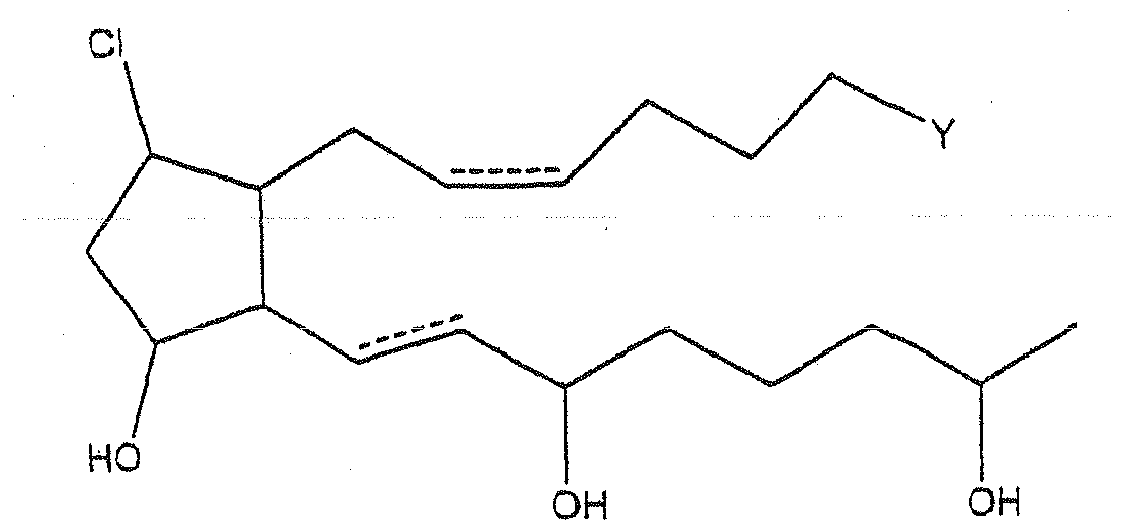
- Y has from 0 to 14 carbon atoms and is: an organic acid functional group, or an amide or ester thereof; hydroxymethyl or an ether thereof; or a tetrazolyl functional group;
- Z is halo, -OH, -OR, -SH, -CF 3 , or -CN; each R 1 is independently O, S, CH 2 , or if R 1 forms a double bond to another R 1 , then both are CH, provided that O-O, S-O, and O-S are not present, and each R is independently -H, C 1-6 alkyl, C 1-6 hydroxyalkyl, or C 1-6 acyl.
- These compounds are useful for reducing intraocular pressure. Reduction of intraocular pressure has been shown to delay or prevent the onset of primary open angle glaucoma, and to delay or prevent further vision loss in patients with primary open angle glaucoma. Thus, these compounds are also useful for treating glaucoma. These compounds are also useful for growing hair, including one or more of: increasing the number of individual hairs, increasing the length of individual hairs, and increasing the width or thickness of individual hairs. These compounds are also useful for improving the appearance of hair, including increasing its gloss, shine, or other properties related to the reflection or dispersion of light, as well as changing the color of hair, including changing hair from grey or white to the color the hair was before it turned grey or white, such as red, brown, or black.
- the compound could be dissolved or suspended in an aqueous solution or emulsion that is buffered to an appropriate pH, and administered topically to an eye of a mammal (see US 7,091,231 ).
- treat refers to the use of a compound, composition, therapeutically active agent, or drug in the diagnosis, cure, mitigation, treatment, or prevention of disease or other undesirable condition.
- reference to a compound should be construed broadly to include compounds, pharmaceutically acceptable salts, prodrugs, tautomers, alternate solid forms, non-covalent complexes, and combinations thereof, of a chemical entity of a depicted structure or chemical name.
- a pharmaceutically acceptable salt is any salt of the parent compound that is suitable for administration to an animal or human.
- a pharmaceutically acceptable salt also refers to any salt which may form in vivo as a result of administration of an acid, another salt, or a prodrug which is converted into an acid or salt.
- a salt comprises one or more ionic forms of the compound, such as a conjugate acid or base, associated with one or more corresponding counter-ions. Salts can form from or incorporate one or more deprotonated acidic groups (e.g. carboxylic acids), one or more protonated basic groups (e.g. amines), or both (e.g. zwitterions).
- a prodrug is a compound which is converted to a therapeutically active compound after administration. For example, conversion may occur by hydrolysis of an ester group or some other biologically labile group.
- Prodrug preparation is well known in the art. For example, " Prodrugs and Drug Delivery Systems," which is a chapter in Richard B. Silverman, Organic Chemistry of Drug Design and Drug Action, 2d Ed., Elsevier Academic Press: Amsterdam, 2004, pp. 496-557 , provides further detail on the subject. In particular, alkyl esters having such as methyl, ethyl, isopropyl, and the like are contemplated. Also contemplated are prodrugs containing a polar group such as hydroxyl or morpholine. Examples of such prodrugs include compounds containing the moieties -CO 2 (CH 2 ) 2 OH, and the like.
- Tautomers are isomers that are in rapid equilibrium with one another.
- tautomers may be related by transfer of a proton, hydrogen atom, or hydride ion.
- Alternate solid forms are different solid forms than those that may result from practicing the procedures described herein.
- alternate solid forms may be polymorphs, different kinds of amorphous solid forms, glasses, and the like.
- Non-covalent complexes are complexes that may form between the compound and one or more additional chemical species that do not involve a covalent bonding interaction between the compound and the additional chemical species. They may or may not have a specific ratio between the compound and the additional chemical species. Examples might include solvates, hydrates, charge transfer complexes, and the like.
- a dashed line represents the presence or absence of a bond.
- Y is an organic acid functional group, or an amide or ester thereof; or Y is hydroxymethyl or an ether thereof; or Y is a tetrazolyl functional group.
- Y is limited to from 0 to 14 carbon atoms, from 0 to 5 oxygen atoms, from 0 to 2 nitrogen atoms, from 0 to 2 sulfur atoms, from 0 to 1 phosphorous, and any necessary hydrogen atoms.
- organic acid functional group is an acidic functional group on an organic molecule. While not intending to be limiting, organic acid functional groups may comprise an oxide of carbon, sulfur, or phosphorous. Thus, while not intending to limit the scope of the invention in any way, in certain compounds Y is a carboxylic acid, sulfonic acid, or phosphonic acid functional group.
- Esters and amides of organic acid functional groups contain have a nitrogen or an oxygen atom directly attached to the acidic core atom, where the oxygen atom is not part of an -OH moiety.
- the acidic core atom is the atom that is bonded to -OH or -SH in the organic acid functional group.
- esters of amides of carboxylic acids, sulfonic acid, and phosphonic acid functional groups are depicted below.
- An amide may also have an -SO 2 - moiety.
- the amide - CONHSO 2 R 3 wherein R 3 is a hydrocarbyl of from 1 to 14 carbon atoms, is contemplated.
- R, R 1 , R 2 , and R 3 are hydrocarbyl subject to the constraint that Y may not have more than 14 carbon atoms.
- Hydrocarbyl is a moiety consisting of carbon and hydrogen, including, but not limited to:
- C 1-6 hydrocarbyl is hydrocarbyl having 1, 2, 3, 4, 5, or 6 carbon atoms.
- C 1-6 alkyl is alkyl having 1, 2, 3, 4, 5, or 6, carbon atoms such as methyl, ethyl, propyl isomers, butyl isomers, pentyl isomer, and hexyl isomers, etc.
- An unsubstituted tetrazolyl functional group has two tautomeric forms, which can rapidly interconvert in aqueous or biological media, and are thus equivalent to one another. These tautomers are shown below.
- R 2 is C 1 -C 6 alkyl, phenyl, or biphenyl
- other isomeric forms of the tetrazolyl functional group such as the one shown below are also possible, unsubstituted and hydrocarbyl substituted tetrazolyl up to C 14 are considered to be within the scope of the term "tetrazolyl.”
- Y is -CO 2 R 4 , -CONR 5 R 6 , -CON(CH 2 CH 2 OH) 2 , - CONH(CH 2 CH 2 OH), -CH 2 OH, -P(O)(OH) 2 , -CONHSO 2 R 4 , -SO 2 NR 5 R 6 , wherein R 4 , R 5 and R 6 are independently H, C 1 -C 6 alkyl, C 1-6 hydroxyalkyl, unsubstituted phenyl, or unsubstituted biphenyl, provided that Y has no more than 14 carbon atoms.
- Alk alkyl
- Z is halo, -OH, -OR, -SH, -CF 3 , or -CN.
- Each R 1 is independently O, S, CH 2 , or if R 1 forms a double bond to another R 1 , then both are CH, provided that O-O, S-O, and O-S are not present.
- the chain formed by the R 1 groups may be one of those shown below.
- Each R is independently -H, C 1-6 alkyl, C 1-6 hydroxyalkyl, or C 1-6 acyl.
- Hydroxyalkyl is alkyl having a hydroxyl attached. The hydroxyl could be attached at any position. C 1-6 hydroxyalkyl has from 1 to 6 carbon atoms.
- Acyl is wherein Rx is hydrocarbyl.
- C 1-6 acyl has from 1 to 6 carbon atoms.
- X is Cl
- Z is OH
- Z is OH
- Another embodiment is a compound represented by the formula wherein R 10 is H or C 1-6 alkyl.
- Another embodiment is a compound represented by the formula wherein a dashed line represents the presence or absence of a bond, and Y is CO 2 (CH 2 ) 2 OH or
- Another embodiment is method of reducing intraocular pressure comprising administering a compound disclosed herein to a mammal in need thereof.
- Another embodiment is a method of treating glaucoma or ocular hypertension comprising administering a compound disclosed herein to a mammal in need thereof.
- Another embodiment is a method of growing hair or improving the appearance of hair comprising administering a compound disclosed herein to a mammal in need thereof.
- Another embodiment is use of a compound disclosed herein in the manufacture of a medicament for the treatment of glaucoma or ocular hypertension.
- Another embodiment is use of a compound disclosed herein in the manufacture of a medicament for growing hair or improving the appearance of hair.
Landscapes
- Chemical & Material Sciences (AREA)
- Organic Chemistry (AREA)
- Health & Medical Sciences (AREA)
- Pharmacology & Pharmacy (AREA)
- Animal Behavior & Ethology (AREA)
- Chemical Kinetics & Catalysis (AREA)
- General Chemical & Material Sciences (AREA)
- Medicinal Chemistry (AREA)
- Nuclear Medicine, Radiotherapy & Molecular Imaging (AREA)
- Engineering & Computer Science (AREA)
- Ophthalmology & Optometry (AREA)
- Life Sciences & Earth Sciences (AREA)
- Bioinformatics & Cheminformatics (AREA)
- General Health & Medical Sciences (AREA)
- Public Health (AREA)
- Veterinary Medicine (AREA)
- Dermatology (AREA)
- Pharmaceuticals Containing Other Organic And Inorganic Compounds (AREA)
- Organic Low-Molecular-Weight Compounds And Preparation Thereof (AREA)
- Acyclic And Carbocyclic Compounds In Medicinal Compositions (AREA)
Abstract
Description
- This application claims the benefit of
U.S. Provisional patent application serial number 61/026,179 filed February 05, 2008 U.S. Non-Provisional patent application serial number 12/363,996 filed February 2, 2009 - Ocular hypotensive agents are useful in the treatment of a number of various ocular hypertensive conditions, such as post-surgical and post-laser trabeculectomy ocular hypertensive episodes, glaucoma, and as presurgical adjuncts.
- Glaucoma is a disease of the eye characterized by increased intraocular pressure. On the basis of its etiology, glaucoma has been classified as primary or secondary. For example, primary glaucoma in adults (congenital glaucoma) may be either open-angle or acute or chronic angle-closure. Secondary glaucoma results from pre-existing ocular diseases such as uveitis, intraocular tumor or an enlarged cataract. Glaucoma occurs in about 2% of all persons over the age of 40 and may be asymptotic for years before progressing to rapid loss of vision.
- The underlying causes of primary glaucoma are not yet known. The increased intraocular tension is due to the obstruction of aqueous humor outflow. In chronic open-angle glaucoma, the anterior chamber and its anatomic structures appear normal, but drainage of the aqueous humor is impeded. In acute or chronic angle-closure glaucoma, the anterior chamber is shallow, the filtration angle is narrowed, and the iris may obstruct the trabecular meshwork at the entrance of the canal of Schlemm. Dilation of the pupil may push the root of the iris forward against the angle, and may produce pupilary block and thus precipitate an acute attack. Eyes with narrow anterior chamber angles are predisposed to acute angle-closure glaucoma attacks of various degrees of severity.
- Secondary glaucoma is caused by any interference with the flow of aqueous humor from the posterior chamber into the anterior chamber and subsequently, into the canal of Schlemm. Inflammatory disease of the anterior segment may prevent aqueous escape by causing complete posterior synechia in iris bombe, and may plug the drainage channel with exudates. Other common causes are intraocular tumors, enlarged cataracts, central retinal vein occlusion, trauma to the eye, operative procedures and intraocular hemorrhage.
- In cases where surgery is not indicated, prostaglandins and prostamides have recently become the first line treatments of glaucoma. Certain eicosanoids and their derivatives are currently commercially available for use in glaucoma management. Eicosanoids and derivatives include numerous biologically important compounds such as prostaglandins and their derivatives. Prostaglandins can be described as derivatives of prostanoic acid which have the following structural formula:

- Various types of prostaglandins are known, depending on the structure and substituents carried on the alicyclic ring of the prostanoic acid skeleton. Further classification is based on the number of unsaturated bonds in the side chain indicated by numerical subscripts after the generic type of prostaglandin [e.g. prostaglandin E1 (PGE1), prostaglandin E2 (PGE2)], and on the configuration of the substituents on the alicyclic ring indicated by α or β [e.g. prostaglandin F2α (PGF2β)].
- Disclosed herein are compounds represented by the formula:

Y has from 0 to 14 carbon atoms and is: an organic acid functional group, or an amide or ester thereof; hydroxymethyl or an ether thereof; or a tetrazolyl functional group;
X is halo, =O, =S, -SH, -CF3, -CN, =CH2, =CHalkyl or =C(alkyl)2 having from 1 to 6 carbon atoms;
Z is halo, -OH, -OR, -SH, -CF3, or -CN;
each R1 is independently O, S, CH2, or if R1 forms a double bond to another R1, then both are CH, provided that O-O, S-O, and O-S are not present, and each R is independently -H, C1-6 alkyl, C1-6 hydroxyalkyl, or C1-6 acyl. - These compounds are useful for reducing intraocular pressure. Reduction of intraocular pressure has been shown to delay or prevent the onset of primary open angle glaucoma, and to delay or prevent further vision loss in patients with primary open angle glaucoma. Thus, these compounds are also useful for treating glaucoma. These compounds are also useful for growing hair, including one or more of: increasing the number of individual hairs, increasing the length of individual hairs, and increasing the width or thickness of individual hairs. These compounds are also useful for improving the appearance of hair, including increasing its gloss, shine, or other properties related to the reflection or dispersion of light, as well as changing the color of hair, including changing hair from grey or white to the color the hair was before it turned grey or white, such as red, brown, or black.
- Different types of suitable dosage forms and medicaments are well known in the art, and can be readily adapted for delivery of the compounds disclosed herein. For example, the compound could be dissolved or suspended in an aqueous solution or emulsion that is buffered to an appropriate pH, and administered topically to an eye of a mammal (see
US 7,091,231 ). - For the purposes of this disclosure, "treat," "treating," or "treatment" refer to the use of a compound, composition, therapeutically active agent, or drug in the diagnosis, cure, mitigation, treatment, or prevention of disease or other undesirable condition.
- Unless otherwise indicated, reference to a compound should be construed broadly to include compounds, pharmaceutically acceptable salts, prodrugs, tautomers, alternate solid forms, non-covalent complexes, and combinations thereof, of a chemical entity of a depicted structure or chemical name.
- A pharmaceutically acceptable salt is any salt of the parent compound that is suitable for administration to an animal or human. A pharmaceutically acceptable salt also refers to any salt which may form in vivo as a result of administration of an acid, another salt, or a prodrug which is converted into an acid or salt. A salt comprises one or more ionic forms of the compound, such as a conjugate acid or base, associated with one or more corresponding counter-ions. Salts can form from or incorporate one or more deprotonated acidic groups (e.g. carboxylic acids), one or more protonated basic groups (e.g. amines), or both (e.g. zwitterions).
- A prodrug is a compound which is converted to a therapeutically active compound after administration. For example, conversion may occur by hydrolysis of an ester group or some other biologically labile group. Prodrug preparation is well known in the art. For example, "Prodrugs and Drug Delivery Systems," which is a chapter in Richard B. Silverman, Organic Chemistry of Drug Design and Drug Action, 2d Ed., Elsevier Academic Press: Amsterdam, 2004, pp. 496-557, provides further detail on the subject. In particular, alkyl esters having such as methyl, ethyl, isopropyl, and the like are contemplated. Also contemplated are prodrugs containing a polar group such as hydroxyl or morpholine. Examples of such prodrugs include compounds containing the moieties -CO2(CH2)2OH,

- Tautomers are isomers that are in rapid equilibrium with one another. For example, tautomers may be related by transfer of a proton, hydrogen atom, or hydride ion.
- Unless stereochemistry is explicitly and unambiguously depicted, a structure is intended to include every possible stereoisomer, both pure or in any possible mixture.
- Alternate solid forms are different solid forms than those that may result from practicing the procedures described herein. For example, alternate solid forms may be polymorphs, different kinds of amorphous solid forms, glasses, and the like.
- Non-covalent complexes are complexes that may form between the compound and one or more additional chemical species that do not involve a covalent bonding interaction between the compound and the additional chemical species. They may or may not have a specific ratio between the compound and the additional chemical species. Examples might include solvates, hydrates, charge transfer complexes, and the like.
- A dashed line represents the presence or absence of a bond. Thus, compounds according the structural formulas below are contemplated.


- Y is an organic acid functional group, or an amide or ester thereof; or Y is hydroxymethyl or an ether thereof; or Y is a tetrazolyl functional group. For the purposes of this disclosure, Y is limited to from 0 to 14 carbon atoms, from 0 to 5 oxygen atoms, from 0 to 2 nitrogen atoms, from 0 to 2 sulfur atoms, from 0 to 1 phosphorous, and any necessary hydrogen atoms.
- An organic acid functional group is an acidic functional group on an organic molecule. While not intending to be limiting, organic acid functional groups may comprise an oxide of carbon, sulfur, or phosphorous. Thus, while not intending to limit the scope of the invention in any way, in certain compounds Y is a carboxylic acid, sulfonic acid, or phosphonic acid functional group.
- Esters and amides of organic acid functional groups contain have a nitrogen or an oxygen atom directly attached to the acidic core atom, where the oxygen atom is not part of an -OH moiety. The acidic core atom is the atom that is bonded to -OH or -SH in the organic acid functional group. For example, esters of amides of carboxylic acids, sulfonic acid, and phosphonic acid functional groups are depicted below.


- An amide may also have an -SO2- moiety. For example the amide - CONHSO2R3, wherein R3 is a hydrocarbyl of from 1 to 14 carbon atoms, is contemplated. R, R1, R2, and R3 are hydrocarbyl subject to the constraint that Y may not have more than 14 carbon atoms.
- Hydrocarbyl is a moiety consisting of carbon and hydrogen, including, but not limited to:
- a. alkyl, which is hydrocarbyl that contains no double or triple bonds, such as:
- • linear alkyl, , e.g. methyl, ethyl, n-propyl, n-butyl, n-pentyl, n-hexyl, etc.,
- • branched alkyl, e.g. iso-propyl, t-butyl and other branched butyl isomers, branched pentyl isomers, etc.,
- • cycloalkyl, e.g. cyclopropyl, cyclobutyl, cyclopentyl, cyclohexyl, etc.,
- • combinations of linear, branched, and/or cycloalkyl;
- b. alkenyl, which is hydrocarbyl having 1 or more double bonds, including linear, branched, or cycloalkenyl;
- c. alkynyl, which is hydrocarbyl having 1 or more triple bonds, including linear, branched, or cycloalkynyl;
- d. unsubstituted or hydrocarbyl substituted phenyl; and
- e. combinations of alkyl, alkenyl, and/or akynyl
- C1-6 hydrocarbyl is hydrocarbyl having 1, 2, 3, 4, 5, or 6 carbon atoms.
- C1-6 alkyl is alkyl having 1, 2, 3, 4, 5, or 6, carbon atoms such as methyl, ethyl, propyl isomers, butyl isomers, pentyl isomer, and hexyl isomers, etc.
- An unsubstituted tetrazolyl functional group has two tautomeric forms, which can rapidly interconvert in aqueous or biological media, and are thus equivalent to one another. These tautomers are shown below.
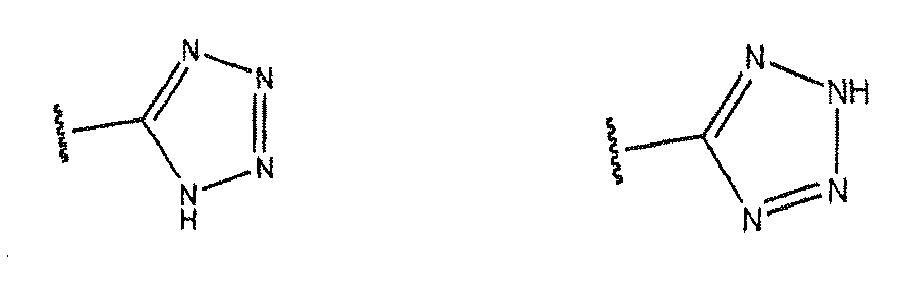
- Additionally, if R2 is C1-C6 alkyl, phenyl, or biphenyl, other isomeric forms of the tetrazolyl functional group such as the one shown below are also possible, unsubstituted and hydrocarbyl substituted tetrazolyl up to C14 are considered to be within the scope of the term "tetrazolyl."

- In one embodiment, Y is -CO2R4, -CONR5R6, -CON(CH2CH2OH)2, - CONH(CH2CH2OH), -CH2OH, -P(O)(OH)2, -CONHSO2R4, -SO2NR5R6,

- X is halo, =O, =S, -SH, -CF3, -CN, =CH2, =CHalkyl or =C(alkyl)2 having from 1 to 6 carbon atoms. Thus, compounds according to the structural formulas below are contemplated.


- Z is halo, -OH, -OR, -SH, -CF3, or -CN. Thus, compounds according to the structural formulas below are contemplated.


- Each R1 is independently O, S, CH2, or if R1 forms a double bond to another R1, then both are CH, provided that O-O, S-O, and O-S are not present. Thus, the chain formed by the R1 groups may be one of those shown below.





- Each R is independently -H, C1-6 alkyl, C1-6 hydroxyalkyl, or C1-6 acyl.
- Hydroxyalkyl is alkyl having a hydroxyl attached. The hydroxyl could be attached at any position. C1-6 hydroxyalkyl has from 1 to 6 carbon atoms.
- Acyl is

- Structural representations of useful embodiments are depicted below.


- In one embodiment, X is Cl.
- In another embodiment, Z is OH.
- In another embodiment, Z is OH.
- Another embodiment is a compound represented by the formula

- Another embodiment is a compound represented by the formula

- Another embodiment is a compound represented by the formula

- Another embodiment is a compound represented by the formula
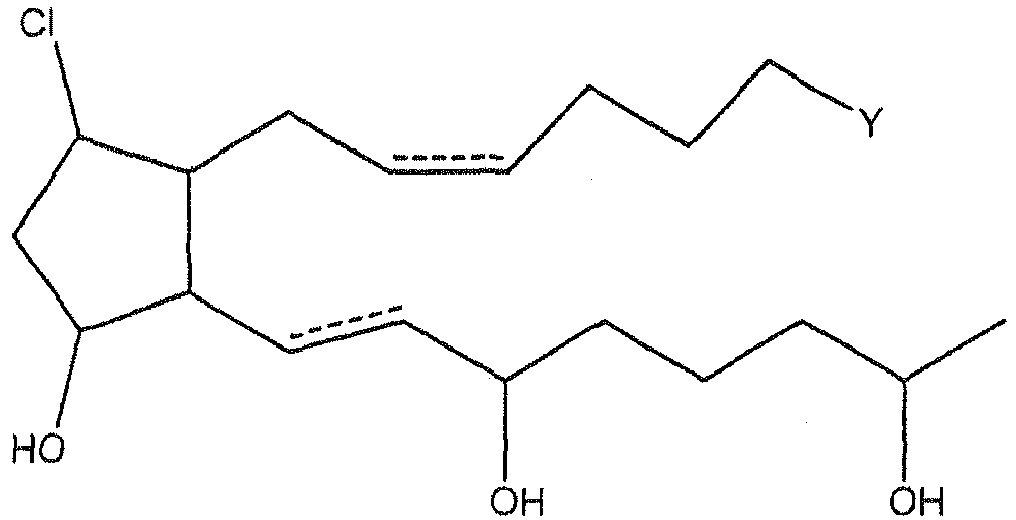
Y is CO2(CH2)2OH or
- Another embodiment is method of reducing intraocular pressure comprising administering a compound disclosed herein to a mammal in need thereof.
- Another embodiment is a method of treating glaucoma or ocular hypertension comprising administering a compound disclosed herein to a mammal in need thereof.
- Another embodiment is a method of growing hair or improving the appearance of hair comprising administering a compound disclosed herein to a mammal in need thereof.
- Another embodiment is use of a compound disclosed herein in the manufacture of a medicament for the treatment of glaucoma or ocular hypertension.
- Another embodiment is use of a compound disclosed herein in the manufacture of a medicament for growing hair or improving the appearance of hair.
- Other hypothetical examples of useful compounds are depicted below.



- (Z)-allyl 7-((1R,2S,3R,5S)-2-((tert-butyldimethylsilyloxy)methyl)-5-(methylsulfonyloxy)-3-(tetrahydro-2H-pyran-2-yloxy)cyclopentyl)hept-5-enoate (2).
- To a solution of silyl ether 1 (5 g, 10 mmol) and triethylamine (5 g, 49.5 mmol) in 40 mL of dichloromethane at 0 °C was added dropwise with rapid stirring, 2 mL (25.8 mmol)of mesyl chloride. After completion of addition the ice bath was removed and the reaction mixture was stirred at room temperature over 1 h. TLC analysis showed no starting material left (Rf=0.5 in 20%EtOAc-hexanes). The mixture was filtered through 50 g of silica gel and washed with 250 mL of 1:1 hexanes:EtOAc. The filtrate was concentrated in vacuo to yield 6.2 g (107% yield) of crude mesylate 2 containing some solvent and triethylamine hydrochloride. 1H NMR (CDCl3): 0.04(s, 6H), 0.87(s, 9H), 1.25(m,1H), 1.44-1.84(m, 9H), 1.85-2.38(m, 10H), 2.99(s, 1.3H), 3.03(s, 1.3H), 3.14(s, 1.7H), 3.48(m, 1H), 3.68(m, 2H), 3.85(m, 1.5H), 4.10(m, 0.6H), 4.20(m, 0.6H), 4.58(m, 3H), 5.06(m,1H), 5.26(m, 2H), 5.42(m, 2H), 5.91(m, 1H).
- (Z)-allyl 7-((1R,2S,3R,5R)-2-((tert-butyldimethylsilyloxy)methyl)-5-chloro-3-(tetrahydro-2H-pyran-2-yloxy)cyclopentyl)hept-5-enoate (3).
- A solution of 10 mmol of mesylate 2 and 11.15 g (40 mmol) of tetra-n-butylammonium chloride in 200 mL of toluene was stirred at 45 °C for 20 h, then 23 °C for 40 h. The reaction mixture was then diluted with ethyl acetate (250 mL) and transferred into a 1L size separatory funnel. The organic layer was washed with water (2x500 mL), brine (200 mL), dried over anhydrous sodium sulfate (100 g), and filtered. Concentration of the filtrate in vacuo gave 4.7 g of crude products. Flash column chromatographic purification (FCC) of the crude mixture on a 120 g size silica gel cartridge eluted with 5%EtOAc-95% hexanes (1.5L), 10%EtOAc-90% hexanes (500 mL), then straight ethyl acetate yielded 1.48 g (29%) of chloride 3; 1H NMR (CDCl3): 0.04 (s, 6H), 0.89 (s, 9H), 3.4-3.77 (m, 3H), 3.78-4.2 (m, 3H), 4.3-4.7 (m, 3H), 5.2-5.58 (m, 4H), 5.93 (m, 1H). Also obtained was 2.2 g of a more polar by-product. This by-product was further purified by FCC on 120 g of silica gel eluted with 20%EtOAc-80% hexanes then 1L 40%EtOAc-hexanes to yield 690 mg of desilylated chloride 3; 1H NMR (CDCl3): 1.42-1.98 (m, 12H), 2.0-2.48 (m, 8H), 3.45-4.44 (m, 6H), 4.54-4.76 (m, 3H), 5.20-5.55 (m, 4H), 5.91 (m, 1H).
- (Z)-allyl 7-((1R,2S,3R,5R)-5-chloro-2-(hydroxymethyl)-3-(tetrahydro-2H-pyran-2-yloxy)cyclopentyl)hept-5-enoate (4).
- A solution of 1.46 g (2.8 mmol) of silyl ether 3 in 10 mL of 1.0M TBAF/THF was stirred at 25 °C for 3 h. The THF solvent was then removed in vacuo and the residual oil was taken up in ethyl acetate (100 mL) and washed with 2x75 mL of saturated aqueous ammonium chloride, brine, and dried over anhydrous sodium sulfate (50 g). The mixture was then filtered and the filtrate was concentrated in vacuo to yield 1.18 g (quantitative yield) of alcohol 4 used in the next step without purification; 1H NMR (CDCl3): 1.42-1.98 (m, 12H), 2.0-2.48 (m, 8H), 3.45-4.44 (m, 6H), 4.54-4.76 (m, 3H), 5.20-5.55 (m, 4H), 5.91 (m, 1H).
- (Z)-allyl 7-((1R,2R,3R,5R)-5-chloro-2-formyl-3-(tetrahydro-2H-pyran-2-yloxy)cyclopentyl)hept-5-enoate (5).
- A solution of 690 mg (1.72 mmol) of alcohol 4 in 4 mL of dichloromethane was added via pipette to a mixture of PCC (650 mg, 3.0 mmol), sodium acetate (325 mg, 3.96 mmol), and Celite (1.23 g) in 7 mL of DCM. The pipette was rinsed with an additional 3 mL of DCM to complete the transfer. The mixture was stirred sealed at 25 °C for 3 h. The mixture was worked up by filtration through 25 g of silica gel and washed with 200 mL of 1:4 EA:hexanes. The filtrate was concentrated in vacuo to yield 500 mg (72% yield) of crude aldehyde 5 as an oil; 1H NMR (CDCl3): 1.45-1.85 (m, 10H), 2.04-3.00 (m, 10H), 3.51 (m, 1H), 3.81 (m, 1H), 4.07 (m, 1H), 4.59 (m, 4H), 5.26 (m, 1H), 5.45 (m, 1H), 5.92 (m, 1H), 9.75 (dd, J=2.1, 9 Hz, 1H).
- (Z)-allyl 7-((1R,2R,3R,5R)-2-((R,E)-8-(tert-butyldimethylsilyloxy)-7-methyl-3-oxooct-1-enyl)-5-chloro-3-(tetrahydro-2H-pyran-2-yloxy)cyclopentyl)hept-5-enoate (6).
- To a suspension of 56 mg (1.35 mmol) of sodium hydride (60 % oil dispersion) in 1 ml of THF at 0 °C was added a solution of dimethyl (6R)-6-{[tert-butyl(dimethyl)silyl]
- oxy}-2-oxoheptylphosphonate (550 mg, 1.57 mmol) in 1 mL THF. The mixture was stirred at 0 °C for 30 min before a solution of aldehyde 5 (500 mg, 1.25 mmol) in 1 ml of THF was added dropwise. The syringe containing the aldehyde 5 was rinsed with 2 mL of THF to complete the addition and the mixture was stirred at 25 °C for 3 h. The reaction was worked up with addition of saturated aqueous ammonium chloride (50 mL) and the aqueous layer was extracted with ethyl acetate (2x75 mL). The ethyl acetate layers were combined and washed with brine, dried over 30 g of anhydrous sodium sulfate, filtered and concentrated in vacuo to yield 920 mg of crude products. Flash chromatographic purification using a 40 g silica gel cartridge eluted with 10%EtOAc-hexanes yielded 490 mg (63%) of purified enone 6; 1H NMR (CDCl3): 0.04 (s, 6H), 0.88 (s, 9H), 1.12 (d, J=6 Hz, 3H), 1.36-1.80 (m, 13H), 1.98-2.42 (m, 9H), 2.54 (t, J=7.2 Hz, 2H), 3.44 (m, 1H), 3.78 (m, 2H), 3.90-4.30 (m, 2H), 4.57 (m, 3H), 5.20-5.52 (m, 4H), 5.91 (m, 1H), 6.14 (m, 1H), 6.74 (m, 1H). LC-MS 625.48 [M++CH3CN].
- (Z)-allyl 7-((1R,2R,3R,5R)-2-((3S,7R,E)-7-(tert-butyldimethylsilyloxy)-3-hydroxyoct-1-enyl)-5-chloro-3-(tetrahydro-2H-pyran-2-yloxy)cyclopentyl)hept-5-enoate (7).
- A solution of enone 6 (398 mg, 0.64 mmol) in 7 mL of dichloromethane was cooled to -20 °C and stirred rapidly while solid (R)-methylCBS-borane complex (290 mg, 1.0 mmol) was added in one portion. The resulting solution was stirred at -20 ° to -10 °C for 1 h. TLC analysis at this stage showed no starting material left and the reaction mixture was quenched with 2 mL of methanol, the cooling bath was removed and the mixture was stirred at 20 °C 60 min. The mixture was concentrated in vacuo to remove solvents and the residual products were purified by FCC on silica gel (40 g Silicycle cartridge) to yield 270 mg of (15S)-alcohol 7; 1H NMR (CDCl3): 0.03 (s, 6H), 0.87 (s, 9H), 1.10 (d, J= 6 Hz, 3H), 1.20-1.97 (m, 18H), 2.0-2.4 (m, 8H), 3.45 (m, 1H), 3.80 (m, 2H), 3.90-4.15 (m, 3H), 4.59 (m, 3H), 5.24-5.70 (m, 6H), 5.92 (m, 1H).
- (Z)-allyl 7-((1R,2R,3R,5R)-5-chloro-2-((3S,7R,E)-3,7-dihydroxyoct-1-enyl)-3-(tetrahydro-2H-pyran-2-yloxy)cyclopentyl)hept-5-enoate (8).
- A solution of silyl ether 7 (270 mg, 0.43 mmol) was stirred at 30 °C with 2 mL (2 mmol) of 1.0M TBAF/THF in a vial for 20 h. TLC indicated starting material was mostly desilylated and the reaction was concentrated in vacuo. The residual crude products were taken up in 50 mL of ethyl acetate and washed sequentially with saturated ammonium chloride (50 mL), brine (50 mL), and dried over 10 g of anhydrous sodium sulfate. The mixture was filtered and concentrated in vacuo. The residual products were purified by flash column chromatography on 20 g of silica gel eluted in 1:1 hexanes:EtOAc, then straight EtOAc. Combination of appropriate fractions and removal of the solvents yielded 175 mg (79%) of pure diol 8 as an oil; 1H NMR (CDCl3): 1.18(d, J=6Hz, 3H), 1.3 8-1.84(m, 13H), 1.91(m, 1H), 2.00-2.40(m, 11H), 3.47(m, 1H), 3.81(m, 2H), 3.99(m, 1H), 4.09(m, 2H), 4.54-4.72 (m, 3H), 5.21-5.66 (m, 6H), 5.92 (m,1H).
- (Z)-Allyl 7-((1R,2R,3R,5R)-5-chloro-2-((3S,7R,E)-3,7-dihydroxyoct-1-enyl)-3-hydroxycyclopentyl)hept-5-enoate (9).
- A 20 mL vial equipped with a magnetic stirbar was charged with 175 mg (0.34 mmol) of THP-ether 8 dissolved in 5 mL of methanol. To this was then added 300 mg (1.20 mmol) of pyridinium p-toluenesulfonate and the mixture was stirred at 22 °C over 7.5 h. The reaction was sampled by TLC (Rf of product was 0.6 in EtOAc) and worked up by concentration in vacuo to remove methanol. The residual products were taken up in ethyl acetate and filtered through a 22 g plug of silica gel, eluting the polar product away from the salts with ethyl acetate (350 mL). Concentration of the filtrate yielded 125 mg of product triol 9 as an oil; 1H NMR (CDCl3): 1.18(d, J=6.3hz, 3H), 1.34-1.62(m, 5H), 1.69(m, 2H), 1.84-2.38(m, 11H), 2.47 (br s, 1H), 3.53(br s, 1H), 3.70(br s, 1H), 3.79(br m, 1H), 3.99(m, 1H), 4.08(m, 2H), 4.57(m, 2H), 5.18-5.60(m, 6H), 5.91(m, 1H).
- (Z)-7-((1R,2R,3R,5R)-5-chloro-2-((3S,7R,E)-3,7-dihydroxyoct-1-enyl)-3-hydroxycyclopentyl)hept-5-enoic acid (10).
- A solution of 77 mg (0.18 mmol) of ester 9 in 1.4 mL of THF was hydrolyzed with 400 uL (0.18 mmol) of aqueous lithium hydroxide (0.5M) and 0.4 mL of methanol at 25 °C for 5 h. The mixture was acidified by addition of 200 uL of 1.0M hydrochloric acid and the residual water was removed in vacuo. The residual products were purified by FCC on 10 g of silica gel eluted with 100% EtOAc, 5% methanol:95% EtOAc, then 10% methanol:90% ethyl acetate. Isolated from appropriate fractions was 49 mg of free acid 10 as an oil (70% yield); 1H NMR (acetone-d6): 1.11(d, J=6.3 Hz, 3H), 1.45(m, 6H), 1.67(m, 2H), 1.91(m, 1H), 2.09-2.37(m, 8H), 2.86(br s, 4H), 3.71(m, 1H), 4.12(m, 3H), 5.54(m, 4H).
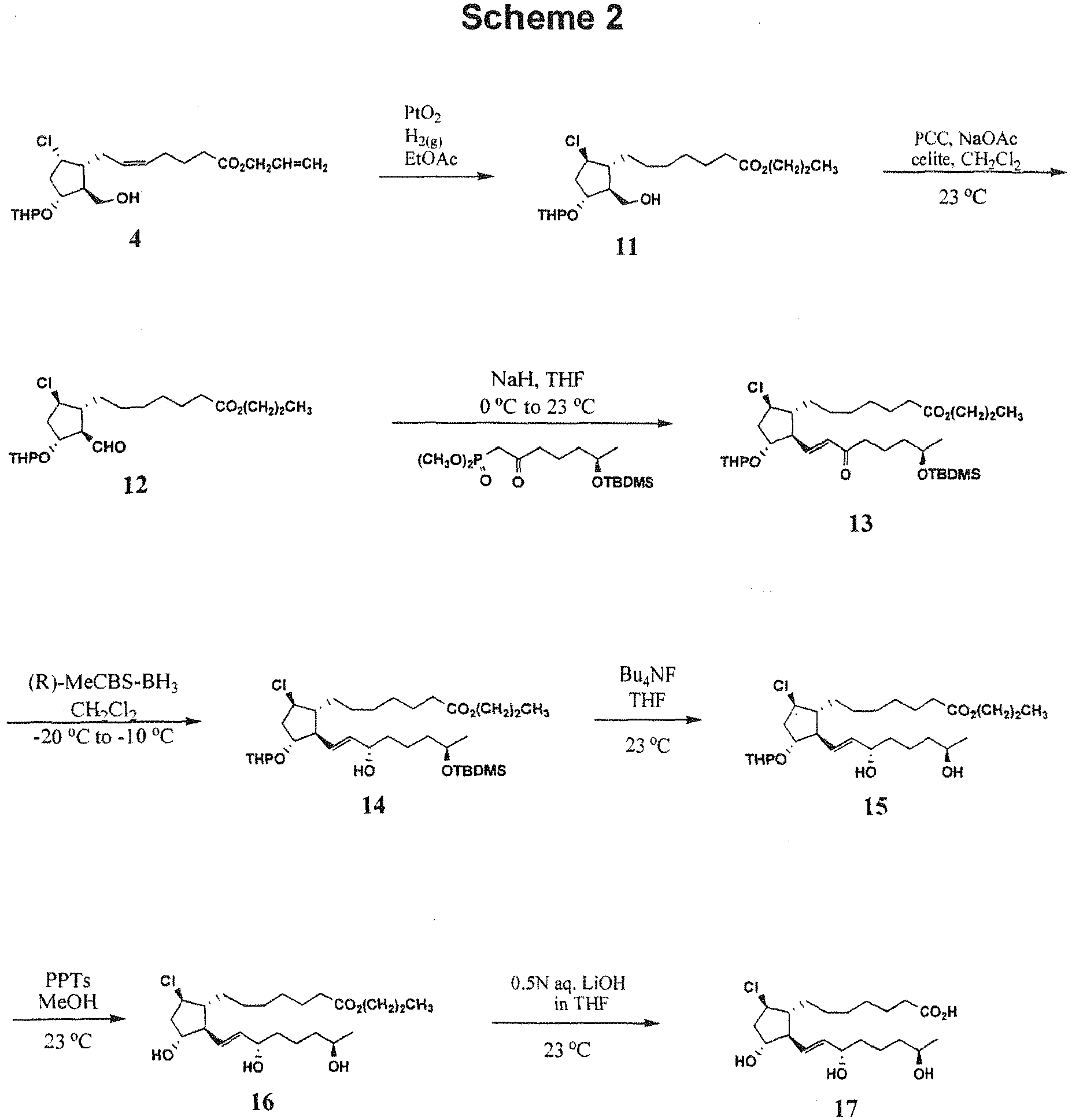
- Propyl 7-((1R,2S,3R,5R)-5-chloro-2-(hydroxymethyl)-3-(tetrahydro-2H-pyran-2-yloxy)cyclopentyl)heptanoate (11).
- A solution of I g (2.49 mmol) of alcohol 4 in 13 mL of EtOAc and Adam's catalyst (22 mg) was stirred under 30 psi of hydrogen gas in a Parr apparatus over 21 h. The mixture was then filtered to remove the catalyst through a plug of silica gel with EtOAc as solvent. The filtrate was then concentrated in vacuo to yield the propyl ester 11 (990 mg) as an oil; 1H NMR (CDCl3): 0.94(t, J=7.3 Hz, 3H), 1.20-1.94(m, 31H), 2.17(m, 2H), 2.32(m, 4H), 3.46-4.12(m, 8H),4.03(t, J=6.6 Hz, 2H), 4.13-4.38(m, 2H), 4.59(m, 1H), 4.73(m, 1H).
- Propyl 7-((1R,2R,3R,5R)-5-chloro-2-formyl-3-(tetrahydro-2H-pyran-2-yloxy)cyclopentyl)heptanoate (12).
- A solution of 700 mg (1.73 mmol) of alcohol 11 in 4 mL of dichloromethane was added via pipette to a mixture of PCC (700 mg, 3.23 mmol), sodium acetate (350 mg, 4.26 mmol), and Celite (1.3 g) in 7 mL of DCM. The pipette was rinsed with an additional 3 mL of DCM to complete the transfer. The mixture was stirred sealed at 30°C for 1.5 h. The mixture was worked up by filtration through 20 g of silica gel and washed with 200 mL of 1:4 EA:hexanes. The filtrate was concentrated in vacuo to yield 500 mg) of crude aldehyde 12. Further FCC purification on 10 g of silica gel yielded 380 mg of purified aldehyde 12 (54% yield) as an oil; 1H NMR (CDCl3): 0.93(t, J=7.2 Hz, 3H), 1.31(m, 10H), 1.42-1.90(m, 17H), 1.94-2.44(m, 4H), 2.28(t, J= 7.5 Hz, 2H), 2.52 (m, 1H), 2.68(m, 1H), 3.48(m, 2H), 3.81(m, 2H), 4.01(t, J= 6.6Hz, 3H), 4.06(m, 1H), 4.5-4.64(m, 2H), 9.75 (m, J=2.1, 9 Hz, 1H).
- Propyl 7-((1R,2R,3R,5R)-2-((RE)-7-(tert-butyldimethylsilyloxy)-3-oxooct-1-enyl)-5-chloro-3-(tetrahydro-2H-pyran-2-yloxy)cyclopentyl)heptanoate (13).
- To a suspension of 56 mg (1.35 mmol) of sodium hydride (60 % oil dispersion) in 1 ml of THF at 0 °C was added a solution of dimethyl (6R)-6-{[tert-butyl(dimethyl)silyl]
- oxy}-2-oxoheptylphosphonate (550 mg, 1.57 mmol) in 1 mL THF. The mixture was stirred at 0 °C for 30 min before a solution of aldehyde 12 (380 mg, 0.94 mmol) in 1 ml of THF was added dropwise. The syringe containing the aldehyde 12 was rinsed with 2 mL of THF to complete the addition and the mixture was stirred at 25 °C for 3 h. The reaction was worked up with addition of saturated aqueous ammonium chloride (50 mL) and the aqueous layer was extracted with ethyl acetate (2x75 mL). The ethyl acetate layers were combined and washed with brine, dried over 30 g of anhydrous sodium sulfate, filtered and concentrated in vacuo to yield 880 mg of crude products. Flash chromatographic purification using a 30 g silica gel cartridge eluted with 10%EtOAc-hexanes yielded 425 mg (71%) of purified enone 13; 1H NMR (CDCl3): 0.04 (s, 6H), 0.88 (s, 9H), 0.93 (t, J=7.5 Hz, 3H), 1.12(d, J=6.3 Hz, 3H), 1.22-1.84 (m, 24H), 1.97 (m, 1H), 2.19 (t, J=6.3 Hz, 1H), 2.24-2.58 (m, 6H), 3.45 (m, 1H), 3.79 (m, 2H), 4.02(m, 3H), 4.19(m, 1H), 4.57 (m, 1H), 6.14 (m, 1H), 6.75 (m, 1H).
- Propyl 7-((1R,2R,3R,5R)-2-((3S,7R,E)-7-(tert-butyldimethylsilyloxy)-3-hydroxyoct-1-enyl)-5-chloro-3-(tetrahydro-2H-pyran-2-yloxy)cyclopentyl)heptanoate (14).
- A solution of enone 13 (425 mg, 0.67 mmol) in 7 mL of dichloromethane was cooled to -30 °C and stirred rapidly while solid (R)-methylCBS-borane complex (350 mg, 1.20 mmol) was added in one portion. The resulting solution was stirred at -30 ° to -20 °C for 1 h. TLC analysis at this stage showed no starting material left and the reaction mixture was quenched with 2 mL of methanol, the cooling bath was removed and the mixture was stirred at 25 °C 60 min. The mixture was concentrated in vacuo to remove solvents and the residual products were purified by FCC on silica gel (40 g Silicycle cartridge, 500 mL of 10% EA-hexanes, then 500 mL of 20% EA-hexanes) to yield 316 mg (74% yield) of (15S)-alcohol 14; 1H NMR (CDCl3): 0.04(s, 6H), 0.87(s, 9H), 0.93(t, J=6Hz, 3H), 1.10(d, J=4.8Hz, 3H), 1.24-1.88(m, 24H), 2.10-2.32(m, 4H), 3.45(m, 1H), 3.80(m, 2H), 4.03(m, 4H), 4.61(dt, J=2.4, 14.4 Hz, 1H), 5.56(m, 2H).
- Propyl 7-((1R,2R,3R,5R)-5-chloro-2-((3S,7R,E)-3,7-dihydroxyoct-1-enyl)-3-(tetrahydro-2H-pyran-2-yloxy)cyclopentyl)heptanoate (15).
- A solution of silyl ether 14 (316 mg, 0.50 mmol) was stirred at 35 °C with 2 mL of 1.0M TBAF/THF in a vial for 9.5 h. TLC indicated starting material was mostly desilylated and the reaction was concentrated in vacuo. The residual crude products were taken up in 50 mL of ethyl acetate and washed sequentially with saturated ammonium chloride (50 mL), brine (50 mL), and dried over 10 g of anhydrous sodium sulfate. The mixture was filtered and concentrated in vacuo. The residual products were purified by flash column chromatography on 40 g of silica gel eluted in 1:1 hexanes:EtOAc, then straight EtOAc. Combination of appropriate fractions and removal of the solvents yielded 218 mg (84%) of diol 15 as an oil; 1H NMR (CDCl3): 0.94(t, J=7.5 Hz, 3H), 1.18(d, J=6.3Hz, 3H), 1.31(m, 6H), 1.42-1.90(m, 19H), 2.10-2.50(m, 7H), 3.48(m, 1H), 3.72-4.16(m, 7H), 4.64(dt, 1H), 5.57(m, 2H).
- Propyl 7-((1R,2R,3R,5R)-5-chloro-2-((3S,7R,E)-3,7-dihydroxyoct-1-enyl)-3-hydroxycyclopentyl)heptanoate (16).
- A 20 mL vial equipped with a magnetic stirbar was charged with 218 mg (0.42 mmol) of THP-ether 15 dissolved in 5 mL of methanol. To this was then added 350 mg (1.39 mmol) of pyridinium p-toluenesulfonate and the mixture was stirred at 25 °C over 8 h. The reaction was sampled by TLC (Rf of product was 0.5 in EtOAc) and worked up by concentration in vacuo to remove methanol. The residual products were taken up in ethyl acetate and filtered through 20 g of silica gel eluting with 300 mL of EtOAc. The filtrate was concentrated to yield 156 mg of products which were further purified by FCC through 25 g of silica gel, eluting with 1:1 EA-hexanes then 100% EA to yield 140 mg of product triol 16 as an oil; 1H NMR (CDCl3): 0.94(t, J= 7.2 Hz, 3H), 1.17(d, J=6Hz, 3H), 1.22-1.72(m, 18H), 1.91(m, 2H), 2.05-2.36(m, 4H), 3.30(br s, 1H), 3.78(m, 1H), 4.02(m, 5H), 4.5(m, 2H), 5.50(m, 2H). 13C NMR: 10.53, 21.52, 22.09, 23.74, 25.03, 26.83, 29.08, 29.49, 32.90, 34.42, 36.75, 38.52, 43.59, 53.53, 57.75, 60.98, 66.06, 67.50, 72.56, 74.98, 133.27, 135.79, 174.24.
- 7-((1R,2R,3R,5R)-5-chloro-2-((3S,7R,E)-3,7-dihydroxyoct-1-enyl)-3-hydroxycyclopentyl)heptanoic acid (17).
- A solution of 137 mg (0.31 mmol) of ester 16 in 2 mL of THF was hydrolyzed with 800 uL (0.40 mmol) of aqueous lithium hydroxide (0.5M) and 1 mL of methanol at 25 °C for 6 h. The mixture was acidified to pH 5-6 by addition of 400 uL of 1.0M hydrochloric acid and the residual water was removed in vacuo. The residual products were purified by FCC on 10 g of silica gel eluted with 8% methanol:92% EtOAc, then 10% methanol:90% ethyl acetate. Isolated from appropriate fractions was 110 mg of free acid 17 as an oil (88% yield); 1H NMR (acetone-d6): 1.13(d, J=6.3 Hz, 3H), 1.16-1.68(m, 13H), 1.86(m, 1H), 2.0-2.24(m, 3H), 2.29(t, J=7.5 Hz, 2H), 3.73(m, 1H), 4.09(m, 3H), 5.56(m, 2H). LC-MS 373.3 [M++1-H2O].
- United States Patent Application Serial No.
11/553,143, filed on October 26, 2006 Table 1 Compound EP2 EP4 EP1 EP3 DP2 TP cAMP Ca2+ signal Binding Ca2+ signal Binding EC50 (nM) % PGE2 EC50 (nM) %Inh EC50 (nM) % PGE2 EC50 (nM) % Inh EC50 (nM) EC50 (nM) EC50 (nM) EC50 (nM) EC50 (nM) 
0.03 107 4 99 25 107 46 81 885 13 6 1816 178 
1.47 100 109 78 1219 99 727 29 Table 2 EP2 EP4 AGN-# cAMP Ca2+ signal Binding Ca2+ signal Binding EP1 EP3 DP2 TP EC50 (nM) %PGE2 EC50 (nM) %Inh EC50 (nM) %PGE2 EC50 (nM) %Inh EC50 (nM) EC50 (nM) EC50 (nM) EC50 (nM) EC50 (nM) 
0.2 97 9 95 338 106 154 42 >10K 41 26 4900 34 
10 52 8307 37 >10K 1231 633 205 
14.5 87 413 67 3498 88 1304 15 >10K 223 123 631 
0.2 102 4 98 165 100 86 32 >10K 7 0.3 910 71 - 1. A compound represented by the formula:

Y has from 0 to 14 carbon atoms and is: an organic acid functional group, or an amide or ester thereof; hydroxymethyl or an ether thereof; or a tetrazolyl functional group; X is halo, =O, =S, -SH, -CF3, -CN, =CH2, =CHalkyl or =C(alkyl)2 having from 1 to 6 carbon atoms;
Z is halo, -OH, -OR, -SH, -CF3, or -CN;
each R1 is independently O, S, CH2, or if R1 forms a double bond to another R1, then both are CH, provided that O-O, S-O, and O-S are not present, and
each R is independently -H, C1-6 alkyl, C1-6 hydroxyalkyl, or C1-6 acyl. - 2. The compound of EM 1 wherein X is Cl or F.
- 3. The compound of EM 1 wherein Z is OH.
- 4. The compound of EM 2 wherein Z is OH.
- 5. The compound of EM 4 represented by the formula

- 6. The compound of EM 5 represented by the formula

- 7. The compound of EM 5 represented by the formula

- 8. A compound represented by the formula

Y is CO2(CH2)2OH or
- 9. A compound represented by the formula:


- 10. A method of reducing intraocular pressure comprising administering a compound according to any one of EMs 1-9 to a mammal in need thereof.
- 11. A method of treating glaucoma or ocular hypertension comprising administering a compound according to any one of EMs 1-9 to a mammal in need thereof.
- 12. A method of growing hair or improving the appearance of hair comprising administering a compound according to any one of EMs 1-9 to a mammal in need thereof.
- 13. Use of a compound according to any one of EMs 1-9 in the manufacture of a medicament for the treatment of glaucoma or ocular hypertension.
- 14. Use of a compound according to any one of the EMs 1-9 in the manufacture of a medicament for growing hair or improving the appearance of hair.
Claims (9)
- A compound represented by the formula:

Y has from 0 to 14 carbon atoms and is: an organic acid functional group, or an amide or ester thereof; hydroxymethyl or an ether thereof; or a tetrazolyl functional group;
X is halo, =O, =S, -SH, -CF3, -CN, =CH2, =CHalkyl or =C(alkyl)2 having from 1 to 6 carbon atoms;
Z is halo, -OH, -OR, -SH, -CF3, or -CN;
each R1 is independently O, S, CH2, or if R1 forms a double bond to another R1, then both are CH, provided that O-O, S-O, and O-S are not present, and
each R is independently -H, C1-6 alkyl, C1-6 hydroxyalkyl, or C1-6 acyl
for use in a therapeutic method for growing hair. - Cosmetic use of a compound represented by the formula:

Y has from 0 to 14 carbon atoms and is: an organic acid functional group, or an amide or ester thereof; hydroxymethyl or an ether thereof; or a tetrazolyl functional group;
X is halo, =O, =S, -SH, -CF3, -CN, =CH2, =CHalkyl or =C(alkyl)2 having from 1 to 6 carbon atoms;
Z is halo, -OH, -OR, -SH, -CF3, or -CN;
each R1 is independently O, S, CH2, or if R1 forms a double bond to another R1, then both are CH, provided that O-O, S-O, and O-S are not present, and
each R is independently -H, C1-6 alkyl, C1-6 hydroxyalkyl, or C1-6 acyl
for growing hair or improving the appearance of hair. - The compound for use according to claim 1 or use of a compound according to claim 2, wherein X is Cl or F.
- The compound for use according to claim 1 or use of a compound according to claim 2, wherein Z is OH.
- The compound for use according to claim 1 or use of a compound according to claim 2, wherein the compound is represented by formula:

- The compound for use according to claim 1 or use of a compound according to claim 2, wherein the compound is represented by the formula:

- The compound for use according to claim 1 or use of a compound according to claim 2, wherein the compound is represented by the formula:
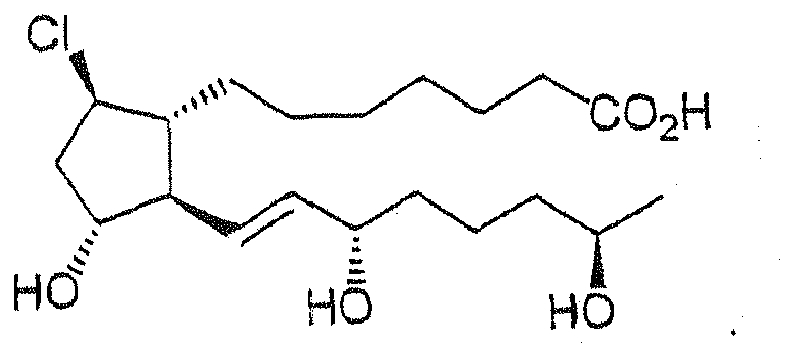
- The compound for use according to claim 1 or use of a compound according to claim 2, wherein the compound is represented by the formula:
Y is CO2(CH2)2OH or
- The compound for use according to claim 1 or use of a compound according to claim 2 wherein the compound is represented by the formula:


Applications Claiming Priority (3)
| Application Number | Priority Date | Filing Date | Title |
|---|---|---|---|
| US2617908P | 2008-02-05 | 2008-02-05 | |
| US12/363,996 US8455547B2 (en) | 2008-02-05 | 2009-02-02 | Substituted cyclopentanes having prostaglandin activity |
| EP09708693A EP2245005A1 (en) | 2008-02-05 | 2009-02-03 | Substituted cyclopentanes having prostaglandin activity |
Related Parent Applications (1)
| Application Number | Title | Priority Date | Filing Date |
|---|---|---|---|
| EP09708693.8 Division | 2009-02-03 |
Publications (1)
| Publication Number | Publication Date |
|---|---|
| EP2487153A1 true EP2487153A1 (en) | 2012-08-15 |
Family
ID=40932327
Family Applications (2)
| Application Number | Title | Priority Date | Filing Date |
|---|---|---|---|
| EP12167472A Withdrawn EP2487153A1 (en) | 2008-02-05 | 2009-02-03 | Substituted cyclopentanes having prostaglandin activity |
| EP09708693A Withdrawn EP2245005A1 (en) | 2008-02-05 | 2009-02-03 | Substituted cyclopentanes having prostaglandin activity |
Family Applications After (1)
| Application Number | Title | Priority Date | Filing Date |
|---|---|---|---|
| EP09708693A Withdrawn EP2245005A1 (en) | 2008-02-05 | 2009-02-03 | Substituted cyclopentanes having prostaglandin activity |
Country Status (12)
| Country | Link |
|---|---|
| US (1) | US8455547B2 (en) |
| EP (2) | EP2487153A1 (en) |
| JP (1) | JP5566912B2 (en) |
| KR (1) | KR20100119787A (en) |
| CN (1) | CN101959854A (en) |
| AU (1) | AU2009212570B2 (en) |
| BR (1) | BRPI0907913A2 (en) |
| CA (1) | CA2713958A1 (en) |
| IL (1) | IL207354A0 (en) |
| MX (1) | MX2010008589A (en) |
| RU (1) | RU2505530C2 (en) |
| WO (1) | WO2009100057A1 (en) |
Families Citing this family (2)
| Publication number | Priority date | Publication date | Assignee | Title |
|---|---|---|---|---|
| RU2418592C1 (en) * | 2010-04-19 | 2011-05-20 | Геннадий Васильевич Порядин | Method of treating arterial hypertension |
| US9315486B2 (en) | 2013-10-29 | 2016-04-19 | Allergan, Inc. | Therapeutic cyclopentanols, compositions thereof, and methods for use thereof |
Citations (7)
| Publication number | Priority date | Publication date | Assignee | Title |
|---|---|---|---|---|
| EP0116358A1 (en) * | 1983-02-12 | 1984-08-22 | Bayer Ag | Complexes of prostaglandins |
| WO1998033497A1 (en) * | 1997-02-04 | 1998-08-06 | Johnstone Murray A | Method of enhancing hair growth |
| WO2001074313A2 (en) * | 2000-03-31 | 2001-10-11 | The Procter & Gamble Company | Compositions and methods for treating hair loss using c16 - c20 aromatic tetrahydro prostaglandins |
| WO2005013928A1 (en) * | 2003-08-12 | 2005-02-17 | Sucampo Ag | Composition and method for promoting hair growth |
| US20050070516A1 (en) * | 1997-10-28 | 2005-03-31 | Vivus Inc. | As-needed administration of an androgenic agent to enhance female desire and responsiveness |
| WO2006063179A1 (en) * | 2004-12-10 | 2006-06-15 | Allergan, Inc. | 12-aryl prostaglandin analogs |
| WO2007060453A1 (en) * | 2005-11-26 | 2007-05-31 | Medical Research Council | Promoting wound healing by administering a prostaglandin e and granulocyte-macrophage colony stimulating factor |
Family Cites Families (11)
| Publication number | Priority date | Publication date | Assignee | Title |
|---|---|---|---|---|
| GB1388443A (en) * | 1971-06-11 | 1975-03-26 | Searle & Co | Selective reduction of 9,15-dioxoprostanoic acids |
| JPS55133354A (en) * | 1979-04-02 | 1980-10-17 | Upjohn Co | Prostaglandin derivatives |
| US4259516A (en) * | 1979-04-02 | 1981-03-31 | The Upjohn Company | 19-Hydroxy-inter-oxa-13,14-dihydro-PG1 compounds |
| DE3304864A1 (en) * | 1983-02-12 | 1984-08-16 | Bayer Ag, 5090 Leverkusen | Adsorbates of prostaglandins |
| SE9702681D0 (en) * | 1997-07-10 | 1997-07-10 | Pharmacia & Upjohn Ab | Method and composition for treatment of impotence |
| US5877211A (en) * | 1997-11-21 | 1999-03-02 | Allergan | EP2 receptor agonists as neuroprotective agents for the eye |
| US6410591B1 (en) * | 2001-05-08 | 2002-06-25 | Allergan Sales, Inc. | 3,7 or 3 and 7 thia or oxa prostanoic acid derivatives as agents for lowering intraocular pressure |
| JP5319065B2 (en) * | 2003-02-11 | 2013-10-16 | アラーガン インコーポレイテッド | 10,10-Dialkylprostanoic acid derivatives as intraocular pressure-lowering agents |
| ES2320770T3 (en) | 2004-05-26 | 2009-05-28 | Arturo Jimenez Bayardo | METHOD OF PREPARATION OF AN OPHTHALMIC SOLUTION OF LATANOPROST AND THE SOLUTION AS IS PRODUCED |
| US7476755B2 (en) * | 2006-05-04 | 2009-01-13 | Allergan, Inc. | Therapeutic compounds |
| HUE030850T2 (en) | 2006-06-16 | 2017-06-28 | Univ Pennsylvania | Prostaglandin d2 receptor antagonists for treating androgenetic alopecia |
-
2009
- 2009-02-02 US US12/363,996 patent/US8455547B2/en active Active
- 2009-02-03 KR KR1020107019695A patent/KR20100119787A/en not_active Ceased
- 2009-02-03 JP JP2010545948A patent/JP5566912B2/en not_active Expired - Fee Related
- 2009-02-03 BR BRPI0907913-0A patent/BRPI0907913A2/en not_active IP Right Cessation
- 2009-02-03 RU RU2010135795/04A patent/RU2505530C2/en not_active IP Right Cessation
- 2009-02-03 MX MX2010008589A patent/MX2010008589A/en active IP Right Grant
- 2009-02-03 WO PCT/US2009/032943 patent/WO2009100057A1/en not_active Ceased
- 2009-02-03 EP EP12167472A patent/EP2487153A1/en not_active Withdrawn
- 2009-02-03 EP EP09708693A patent/EP2245005A1/en not_active Withdrawn
- 2009-02-03 AU AU2009212570A patent/AU2009212570B2/en not_active Ceased
- 2009-02-03 CN CN2009801079234A patent/CN101959854A/en active Pending
- 2009-02-03 CA CA2713958A patent/CA2713958A1/en not_active Abandoned
-
2010
- 2010-08-02 IL IL207354A patent/IL207354A0/en unknown
Patent Citations (8)
| Publication number | Priority date | Publication date | Assignee | Title |
|---|---|---|---|---|
| EP0116358A1 (en) * | 1983-02-12 | 1984-08-22 | Bayer Ag | Complexes of prostaglandins |
| WO1998033497A1 (en) * | 1997-02-04 | 1998-08-06 | Johnstone Murray A | Method of enhancing hair growth |
| US20050070516A1 (en) * | 1997-10-28 | 2005-03-31 | Vivus Inc. | As-needed administration of an androgenic agent to enhance female desire and responsiveness |
| WO2001074313A2 (en) * | 2000-03-31 | 2001-10-11 | The Procter & Gamble Company | Compositions and methods for treating hair loss using c16 - c20 aromatic tetrahydro prostaglandins |
| WO2005013928A1 (en) * | 2003-08-12 | 2005-02-17 | Sucampo Ag | Composition and method for promoting hair growth |
| WO2006063179A1 (en) * | 2004-12-10 | 2006-06-15 | Allergan, Inc. | 12-aryl prostaglandin analogs |
| US7091231B2 (en) | 2004-12-10 | 2006-08-15 | Allergan, Inc. | 12-Aryl prostaglandin analogs |
| WO2007060453A1 (en) * | 2005-11-26 | 2007-05-31 | Medical Research Council | Promoting wound healing by administering a prostaglandin e and granulocyte-macrophage colony stimulating factor |
Non-Patent Citations (1)
| Title |
|---|
| RICHARD B. SILVERMAN: "Organic Chemistry of Drug Design and Drug Action", 2004, ELSEVIER ACADEMIC PRESS, article "Prodrugs and Drug Delivery Systems", pages: 496 - 557 |
Also Published As
| Publication number | Publication date |
|---|---|
| US8455547B2 (en) | 2013-06-04 |
| IL207354A0 (en) | 2010-12-30 |
| JP5566912B2 (en) | 2014-08-06 |
| WO2009100057A1 (en) | 2009-08-13 |
| MX2010008589A (en) | 2010-08-23 |
| KR20100119787A (en) | 2010-11-10 |
| BRPI0907913A2 (en) | 2015-07-28 |
| RU2010135795A (en) | 2012-03-20 |
| JP2011511081A (en) | 2011-04-07 |
| CA2713958A1 (en) | 2009-08-13 |
| CN101959854A (en) | 2011-01-26 |
| US20090197962A1 (en) | 2009-08-06 |
| AU2009212570A1 (en) | 2009-08-13 |
| AU2009212570B2 (en) | 2014-04-10 |
| RU2505530C2 (en) | 2014-01-27 |
| EP2245005A1 (en) | 2010-11-03 |
Similar Documents
| Publication | Publication Date | Title |
|---|---|---|
| US20070112058A1 (en) | Novel prostamides for the treatment of glaucoma and related diseases | |
| EP0660716A1 (en) | Non-acidic cyclopentane heptanoic acid, 2-cycloalkyl or arylalkyl derivatives as therapeutic agents | |
| US9890118B2 (en) | Prostamides for the treatment of glaucoma and related diseases | |
| EP2217581B1 (en) | Substituted cyclopentanes having prostaglandine activity | |
| EP0724567A1 (en) | 1,11-diesters of prostaglandin-f 2 alpha having a polar ester group at c-1 | |
| US8455547B2 (en) | Substituted cyclopentanes having prostaglandin activity | |
| US8546603B2 (en) | Substituted cyclopentanes having prostaglandin activity | |
| EP2240473A1 (en) | Substituted gamma lactams as therapeutic agents | |
| HK1181392A (en) | Substituted cyclopentanes having prostaglanding activity |
Legal Events
| Date | Code | Title | Description |
|---|---|---|---|
| PUAI | Public reference made under article 153(3) epc to a published international application that has entered the european phase |
Free format text: ORIGINAL CODE: 0009012 |
|
| 17P | Request for examination filed |
Effective date: 20120510 |
|
| AC | Divisional application: reference to earlier application |
Ref document number: 2245005 Country of ref document: EP Kind code of ref document: P |
|
| AK | Designated contracting states |
Kind code of ref document: A1 Designated state(s): AT BE BG CH CY CZ DE DK EE ES FI FR GB GR HR HU IE IS IT LI LT LU LV MC MK MT NL NO PL PT RO SE SI SK TR |
|
| 17Q | First examination report despatched |
Effective date: 20131007 |
|
| GRAP | Despatch of communication of intention to grant a patent |
Free format text: ORIGINAL CODE: EPIDOSNIGR1 |
|
| INTG | Intention to grant announced |
Effective date: 20140528 |
|
| RIN1 | Information on inventor provided before grant (corrected) |
Inventor name: BURK, ROBERT M. |
|
| GRAJ | Information related to disapproval of communication of intention to grant by the applicant or resumption of examination proceedings by the epo deleted |
Free format text: ORIGINAL CODE: EPIDOSDIGR1 |
|
| GRAP | Despatch of communication of intention to grant a patent |
Free format text: ORIGINAL CODE: EPIDOSNIGR1 |
|
| GRAP | Despatch of communication of intention to grant a patent |
Free format text: ORIGINAL CODE: EPIDOSNIGR1 |
|
| INTC | Intention to grant announced (deleted) | ||
| INTG | Intention to grant announced |
Effective date: 20141003 |
|
| STAA | Information on the status of an ep patent application or granted ep patent |
Free format text: STATUS: THE APPLICATION IS DEEMED TO BE WITHDRAWN |
|
| 18D | Application deemed to be withdrawn |
Effective date: 20150214 |