EP2486002B1 - Substituted heteroaryl- and aryl- cyclopropylamine acetamides and their use - Google Patents
Substituted heteroaryl- and aryl- cyclopropylamine acetamides and their use Download PDFInfo
- Publication number
- EP2486002B1 EP2486002B1 EP10720277.2A EP10720277A EP2486002B1 EP 2486002 B1 EP2486002 B1 EP 2486002B1 EP 10720277 A EP10720277 A EP 10720277A EP 2486002 B1 EP2486002 B1 EP 2486002B1
- Authority
- EP
- European Patent Office
- Prior art keywords
- trans
- compound
- cyclopropylamino
- phenyl
- pharmaceutically acceptable
- Prior art date
- Legal status (The legal status is an assumption and is not a legal conclusion. Google has not performed a legal analysis and makes no representation as to the accuracy of the status listed.)
- Not-in-force
Links
- 150000001875 compounds Chemical class 0.000 claims description 319
- -1 cyano, sulfonyl Chemical group 0.000 claims description 155
- 150000003839 salts Chemical class 0.000 claims description 140
- 125000003118 aryl group Chemical group 0.000 claims description 135
- 239000012453 solvate Substances 0.000 claims description 119
- 125000001188 haloalkyl group Chemical group 0.000 claims description 93
- 125000002102 aryl alkyloxo group Chemical group 0.000 claims description 91
- 125000003545 alkoxy group Chemical group 0.000 claims description 74
- 125000001424 substituent group Chemical group 0.000 claims description 71
- 125000004435 hydrogen atom Chemical group [H]* 0.000 claims description 69
- 206010028980 Neoplasm Diseases 0.000 claims description 68
- 125000001559 cyclopropyl group Chemical group [H]C1([H])C([H])([H])C1([H])* 0.000 claims description 66
- 201000011510 cancer Diseases 0.000 claims description 64
- 208000037265 diseases, disorders, signs and symptoms Diseases 0.000 claims description 64
- 125000001072 heteroaryl group Chemical group 0.000 claims description 59
- 125000001997 phenyl group Chemical group [H]C1=C([H])C([H])=C(*)C([H])=C1[H] 0.000 claims description 59
- 125000003710 aryl alkyl group Chemical group 0.000 claims description 55
- 125000004104 aryloxy group Chemical group 0.000 claims description 54
- 125000004432 carbon atom Chemical group C* 0.000 claims description 53
- 125000004093 cyano group Chemical group *C#N 0.000 claims description 52
- 125000000217 alkyl group Chemical group 0.000 claims description 48
- 239000001257 hydrogen Substances 0.000 claims description 48
- 229910052739 hydrogen Inorganic materials 0.000 claims description 48
- 125000004169 (C1-C6) alkyl group Chemical group 0.000 claims description 47
- 239000003937 drug carrier Substances 0.000 claims description 44
- 125000000623 heterocyclic group Chemical group 0.000 claims description 44
- 239000008194 pharmaceutical composition Substances 0.000 claims description 43
- 201000010099 disease Diseases 0.000 claims description 42
- 208000015122 neurodegenerative disease Diseases 0.000 claims description 41
- 238000000034 method Methods 0.000 claims description 40
- 125000000475 sulfinyl group Chemical group [*:2]S([*:1])=O 0.000 claims description 39
- 125000000753 cycloalkyl group Chemical group 0.000 claims description 37
- 125000004438 haloalkoxy group Chemical group 0.000 claims description 34
- 125000004076 pyridyl group Chemical group 0.000 claims description 33
- 230000004770 neurodegeneration Effects 0.000 claims description 31
- 238000011282 treatment Methods 0.000 claims description 27
- 239000003814 drug Substances 0.000 claims description 24
- 125000001544 thienyl group Chemical group 0.000 claims description 23
- 125000002496 methyl group Chemical group [H]C([H])([H])* 0.000 claims description 21
- 125000001797 benzyl group Chemical group [H]C1=C([H])C([H])=C(C([H])=C1[H])C([H])([H])* 0.000 claims description 19
- 125000000051 benzyloxy group Chemical group [H]C1=C([H])C([H])=C(C([H])=C1[H])C([H])([H])O* 0.000 claims description 19
- 150000003857 carboxamides Chemical class 0.000 claims description 18
- 208000018737 Parkinson disease Diseases 0.000 claims description 17
- 125000000714 pyrimidinyl group Chemical group 0.000 claims description 16
- 208000024827 Alzheimer disease Diseases 0.000 claims description 15
- 208000023105 Huntington disease Diseases 0.000 claims description 14
- 201000002832 Lewy body dementia Diseases 0.000 claims description 14
- 208000000236 Prostatic Neoplasms Diseases 0.000 claims description 14
- 230000002265 prevention Effects 0.000 claims description 14
- 206010058467 Lung neoplasm malignant Diseases 0.000 claims description 13
- 201000005202 lung cancer Diseases 0.000 claims description 13
- 208000020816 lung neoplasm Diseases 0.000 claims description 13
- 206010006187 Breast cancer Diseases 0.000 claims description 12
- 208000026310 Breast neoplasm Diseases 0.000 claims description 12
- 208000008839 Kidney Neoplasms Diseases 0.000 claims description 12
- 206010060862 Prostate cancer Diseases 0.000 claims description 12
- 208000024313 Testicular Neoplasms Diseases 0.000 claims description 12
- 208000003174 Brain Neoplasms Diseases 0.000 claims description 11
- 206010009944 Colon cancer Diseases 0.000 claims description 11
- 208000001333 Colorectal Neoplasms Diseases 0.000 claims description 11
- 206010067889 Dementia with Lewy bodies Diseases 0.000 claims description 11
- 201000011240 Frontotemporal dementia Diseases 0.000 claims description 11
- 206010038389 Renal cancer Diseases 0.000 claims description 11
- 206010057644 Testis cancer Diseases 0.000 claims description 11
- 208000030451 Vascular dementia disease Diseases 0.000 claims description 11
- 201000005787 hematologic cancer Diseases 0.000 claims description 11
- 208000024200 hematopoietic and lymphoid system neoplasm Diseases 0.000 claims description 11
- 201000010982 kidney cancer Diseases 0.000 claims description 11
- 201000003120 testicular cancer Diseases 0.000 claims description 11
- DLFVBJFMPXGRIB-UHFFFAOYSA-N Acetamide Chemical compound CC(N)=O DLFVBJFMPXGRIB-UHFFFAOYSA-N 0.000 claims description 8
- ABTXYWXKOKNICS-UYHISHBKSA-N (2s)-2-[[(1r,2s)-2-[4-[(4-fluorophenyl)methoxy]phenyl]cyclopropyl]amino]propanamide Chemical compound NC(=O)[C@H](C)N[C@@H]1C[C@H]1C(C=C1)=CC=C1OCC1=CC=C(F)C=C1 ABTXYWXKOKNICS-UYHISHBKSA-N 0.000 claims description 6
- LEHXGLLROPPOGS-JKSUJKDBSA-N 2-[[(1r,2s)-2-[4-[3-(trifluoromethyl)phenyl]phenyl]cyclopropyl]amino]acetamide Chemical compound NC(=O)CN[C@@H]1C[C@H]1C1=CC=C(C=2C=C(C=CC=2)C(F)(F)F)C=C1 LEHXGLLROPPOGS-JKSUJKDBSA-N 0.000 claims description 4
- APOMPTPXICXMOO-JEBQAFNWSA-N (2r)-2-[[(1r,2s)-2-(4-phenylmethoxyphenyl)cyclopropyl]amino]propanamide Chemical compound NC(=O)[C@@H](C)N[C@@H]1C[C@H]1C(C=C1)=CC=C1OCC1=CC=CC=C1 APOMPTPXICXMOO-JEBQAFNWSA-N 0.000 claims description 3
- NVVFCZQBYLEICT-OCBCSQNSSA-N (2r)-2-[[(1r,2s)-2-[4-[(3-fluorophenyl)methoxy]phenyl]cyclopropyl]amino]propanamide Chemical compound NC(=O)[C@@H](C)N[C@@H]1C[C@H]1C(C=C1)=CC=C1OCC1=CC=CC(F)=C1 NVVFCZQBYLEICT-OCBCSQNSSA-N 0.000 claims description 3
- ABTXYWXKOKNICS-OCBCSQNSSA-N (2r)-2-[[(1r,2s)-2-[4-[(4-fluorophenyl)methoxy]phenyl]cyclopropyl]amino]propanamide Chemical compound NC(=O)[C@@H](C)N[C@@H]1C[C@H]1C(C=C1)=CC=C1OCC1=CC=C(F)C=C1 ABTXYWXKOKNICS-OCBCSQNSSA-N 0.000 claims description 3
- APOMPTPXICXMOO-DOPJRALCSA-N (2s)-2-[[(1r,2s)-2-(4-phenylmethoxyphenyl)cyclopropyl]amino]propanamide Chemical compound NC(=O)[C@H](C)N[C@@H]1C[C@H]1C(C=C1)=CC=C1OCC1=CC=CC=C1 APOMPTPXICXMOO-DOPJRALCSA-N 0.000 claims description 3
- WCVHARMRIYMGHX-DLBZAZTESA-N 2-[[(1r,2s)-2-(4-phenylmethoxyphenyl)cyclopropyl]amino]acetamide Chemical compound NC(=O)CN[C@@H]1C[C@H]1C(C=C1)=CC=C1OCC1=CC=CC=C1 WCVHARMRIYMGHX-DLBZAZTESA-N 0.000 claims description 3
- VCGPAISREZMWLH-ZWKOTPCHSA-N 2-[[(1r,2s)-2-[4-(2-phenylethoxy)phenyl]cyclopropyl]amino]acetamide Chemical compound NC(=O)CN[C@@H]1C[C@H]1C(C=C1)=CC=C1OCCC1=CC=CC=C1 VCGPAISREZMWLH-ZWKOTPCHSA-N 0.000 claims description 3
- NDVQVPLAENEGQU-JKSUJKDBSA-N 2-[[(1r,2s)-2-[4-(3-chlorophenyl)phenyl]cyclopropyl]amino]acetamide Chemical compound NC(=O)CN[C@@H]1C[C@H]1C1=CC=C(C=2C=C(Cl)C=CC=2)C=C1 NDVQVPLAENEGQU-JKSUJKDBSA-N 0.000 claims description 3
- SGNPGQHSQGIFFF-DLBZAZTESA-N 2-[[(1r,2s)-2-[4-[(3,5-difluorophenyl)methoxy]phenyl]cyclopropyl]amino]acetamide Chemical compound NC(=O)CN[C@@H]1C[C@H]1C(C=C1)=CC=C1OCC1=CC(F)=CC(F)=C1 SGNPGQHSQGIFFF-DLBZAZTESA-N 0.000 claims description 3
- SGEFKOVEMXZOMH-DLBZAZTESA-N 2-[[(1r,2s)-2-[4-[(3-bromophenyl)methoxy]phenyl]cyclopropyl]amino]acetamide Chemical compound NC(=O)CN[C@@H]1C[C@H]1C(C=C1)=CC=C1OCC1=CC=CC(Br)=C1 SGEFKOVEMXZOMH-DLBZAZTESA-N 0.000 claims description 3
- UQVRJMRNLQCLSB-DZGCQCFKSA-N 2-[[(1r,2s)-2-[6-(4-chlorophenyl)pyridin-3-yl]cyclopropyl]amino]acetamide Chemical compound NC(=O)CN[C@@H]1C[C@H]1C1=CC=C(C=2C=CC(Cl)=CC=2)N=C1 UQVRJMRNLQCLSB-DZGCQCFKSA-N 0.000 claims description 3
- VYDKNHIJUCVRRW-RBBKRZOGSA-N 3-[5-[(1s,2r)-2-[(2-amino-2-oxoethyl)amino]cyclopropyl]-2-phenylmethoxyphenyl]benzamide Chemical compound NC(=O)CN[C@@H]1C[C@H]1C(C=C1C=2C=C(C=CC=2)C(N)=O)=CC=C1OCC1=CC=CC=C1 VYDKNHIJUCVRRW-RBBKRZOGSA-N 0.000 claims description 3
- ZXECAWNDYLRYOW-DLBZAZTESA-N 3-[[(1r,2s)-2-[4-(4-chlorophenyl)phenyl]cyclopropyl]amino]propanamide Chemical compound NC(=O)CCN[C@@H]1C[C@H]1C1=CC=C(C=2C=CC(Cl)=CC=2)C=C1 ZXECAWNDYLRYOW-DLBZAZTESA-N 0.000 claims description 3
- ITSUABQXFIKPSA-RBUKOAKNSA-N 3-[[(1r,2s)-2-[4-[(3-fluorophenyl)methoxy]phenyl]cyclopropyl]amino]-2,2-dimethylpropanamide Chemical compound NC(=O)C(C)(C)CN[C@@H]1C[C@H]1C(C=C1)=CC=C1OCC1=CC=CC(F)=C1 ITSUABQXFIKPSA-RBUKOAKNSA-N 0.000 claims description 3
- OISALKWUWHMLHG-WFELRXAXSA-N 4-[[(1r,2s)-2-[4-(4-chlorophenyl)phenyl]cyclopropyl]amino]-2-methylbutanamide Chemical compound NC(=O)C(C)CCN[C@@H]1C[C@H]1C1=CC=C(C=2C=CC(Cl)=CC=2)C=C1 OISALKWUWHMLHG-WFELRXAXSA-N 0.000 claims description 3
- VZZZTAIDPCIPHP-ZWKOTPCHSA-N 4-[[(1r,2s)-2-[4-(4-chlorophenyl)phenyl]cyclopropyl]amino]butanamide Chemical compound NC(=O)CCCN[C@@H]1C[C@H]1C1=CC=C(C=2C=CC(Cl)=CC=2)C=C1 VZZZTAIDPCIPHP-ZWKOTPCHSA-N 0.000 claims description 3
- DQQRSTTZOPQCJU-RBUKOAKNSA-N 4-[[(1r,2s)-2-[4-[(3-bromophenyl)methoxy]phenyl]cyclopropyl]amino]butanamide Chemical compound NC(=O)CCCN[C@@H]1C[C@H]1C(C=C1)=CC=C1OCC1=CC=CC(Br)=C1 DQQRSTTZOPQCJU-RBUKOAKNSA-N 0.000 claims description 3
- IWYGLFVIXZODJD-UKILVPOCSA-N 5-[[(1r,2s)-2-(3-phenyl-4-phenylmethoxyphenyl)cyclopropyl]amino]pentanamide Chemical compound NC(=O)CCCCN[C@@H]1C[C@H]1C(C=C1C=2C=CC=CC=2)=CC=C1OCC1=CC=CC=C1 IWYGLFVIXZODJD-UKILVPOCSA-N 0.000 claims description 3
- ODQFIZNXEQWUGG-OKQVYOHESA-N 5-[[(1r,2s)-2-[4-(4-chlorophenyl)phenyl]cyclopropyl]amino]-2-methylpentanamide Chemical compound NC(=O)C(C)CCCN[C@@H]1C[C@H]1C1=CC=C(C=2C=CC(Cl)=CC=2)C=C1 ODQFIZNXEQWUGG-OKQVYOHESA-N 0.000 claims description 3
- YAPPYIBFAQMSMX-VQTJNVASSA-N 5-[[(1r,2s)-2-[4-[(3-bromophenyl)methoxy]phenyl]cyclopropyl]amino]pentanamide Chemical compound NC(=O)CCCCN[C@@H]1C[C@H]1C(C=C1)=CC=C1OCC1=CC=CC(Br)=C1 YAPPYIBFAQMSMX-VQTJNVASSA-N 0.000 claims description 3
- AFONGWARYLSEOI-DLBZAZTESA-N 2-[[(1r,2s)-2-[4-[(3-chlorophenyl)methoxy]phenyl]cyclopropyl]amino]acetamide Chemical compound NC(=O)CN[C@@H]1C[C@H]1C(C=C1)=CC=C1OCC1=CC=CC(Cl)=C1 AFONGWARYLSEOI-DLBZAZTESA-N 0.000 claims description 2
- CJSIPTVNHODHQD-ZWKOTPCHSA-N 2-[[(1r,2s)-2-[4-[(3-cyanophenyl)methoxy]phenyl]cyclopropyl]amino]acetamide Chemical compound NC(=O)CN[C@@H]1C[C@H]1C(C=C1)=CC=C1OCC1=CC=CC(C#N)=C1 CJSIPTVNHODHQD-ZWKOTPCHSA-N 0.000 claims description 2
- NFKVZQWLPDLSIH-DLBZAZTESA-N 2-[[(1r,2s)-2-[4-[(3-fluorophenyl)methoxy]phenyl]cyclopropyl]amino]acetamide Chemical compound NC(=O)CN[C@@H]1C[C@H]1C(C=C1)=CC=C1OCC1=CC=CC(F)=C1 NFKVZQWLPDLSIH-DLBZAZTESA-N 0.000 claims description 2
- HJKGEBQIRPLRLZ-DLBZAZTESA-N 2-[[(1r,2s)-2-[4-[(4-chlorophenyl)methoxy]phenyl]cyclopropyl]amino]acetamide Chemical compound NC(=O)CN[C@@H]1C[C@H]1C(C=C1)=CC=C1OCC1=CC=C(Cl)C=C1 HJKGEBQIRPLRLZ-DLBZAZTESA-N 0.000 claims description 2
- ZVEHKGHBPGPSCC-ZWKOTPCHSA-N 2-[[(1r,2s)-2-[4-[(4-cyanophenyl)methoxy]phenyl]cyclopropyl]amino]acetamide Chemical compound NC(=O)CN[C@@H]1C[C@H]1C(C=C1)=CC=C1OCC1=CC=C(C#N)C=C1 ZVEHKGHBPGPSCC-ZWKOTPCHSA-N 0.000 claims description 2
- WWWZDFBHIZIAAB-DLBZAZTESA-N 2-[[(1r,2s)-2-[4-[(4-fluorophenyl)methoxy]phenyl]cyclopropyl]amino]acetamide Chemical compound NC(=O)CN[C@@H]1C[C@H]1C(C=C1)=CC=C1OCC1=CC=C(F)C=C1 WWWZDFBHIZIAAB-DLBZAZTESA-N 0.000 claims description 2
- MSNZVLSZWSGCMX-ZWKOTPCHSA-N 3-[[(1r,2s)-2-[4-[(3-bromophenyl)methoxy]phenyl]cyclopropyl]amino]propanamide Chemical compound NC(=O)CCN[C@@H]1C[C@H]1C(C=C1)=CC=C1OCC1=CC=CC(Br)=C1 MSNZVLSZWSGCMX-ZWKOTPCHSA-N 0.000 claims description 2
- SZNPWBGRIAZXTC-LADGPHEKSA-N 4-[[(1r,2s)-2-(3-phenyl-4-phenylmethoxyphenyl)cyclopropyl]amino]butanamide Chemical compound NC(=O)CCCN[C@@H]1C[C@H]1C(C=C1C=2C=CC=CC=2)=CC=C1OCC1=CC=CC=C1 SZNPWBGRIAZXTC-LADGPHEKSA-N 0.000 claims description 2
- WTFQYHAUFSNJFZ-NWDGAFQWSA-N 4-[[(1r,2s)-2-phenylcyclopropyl]amino]butanamide Chemical compound NC(=O)CCCN[C@@H]1C[C@H]1C1=CC=CC=C1 WTFQYHAUFSNJFZ-NWDGAFQWSA-N 0.000 claims description 2
- DGMNKZRIAYDYPG-RBUKOAKNSA-N 5-[[(1r,2s)-2-[4-(4-chlorophenyl)phenyl]cyclopropyl]amino]pentanamide Chemical compound NC(=O)CCCCN[C@@H]1C[C@H]1C1=CC=C(C=2C=CC(Cl)=CC=2)C=C1 DGMNKZRIAYDYPG-RBUKOAKNSA-N 0.000 claims description 2
- CGURKAFSSCAFHC-QWHCGFSZSA-N 5-[[(1r,2s)-2-phenylcyclopropyl]amino]pentanamide Chemical compound NC(=O)CCCCN[C@@H]1C[C@H]1C1=CC=CC=C1 CGURKAFSSCAFHC-QWHCGFSZSA-N 0.000 claims description 2
- 125000001475 halogen functional group Chemical group 0.000 claims 6
- 102000010909 Monoamine Oxidase Human genes 0.000 description 131
- 108010062431 Monoamine oxidase Proteins 0.000 description 131
- 235000002639 sodium chloride Nutrition 0.000 description 119
- 125000005843 halogen group Chemical group 0.000 description 91
- RTZKZFJDLAIYFH-UHFFFAOYSA-N Diethyl ether Chemical compound CCOCC RTZKZFJDLAIYFH-UHFFFAOYSA-N 0.000 description 54
- YMWUJEATGCHHMB-UHFFFAOYSA-N Dichloromethane Chemical compound ClCCl YMWUJEATGCHHMB-UHFFFAOYSA-N 0.000 description 48
- XEKOWRVHYACXOJ-UHFFFAOYSA-N Ethyl acetate Chemical compound CCOC(C)=O XEKOWRVHYACXOJ-UHFFFAOYSA-N 0.000 description 48
- OKKJLVBELUTLKV-UHFFFAOYSA-N Methanol Chemical compound OC OKKJLVBELUTLKV-UHFFFAOYSA-N 0.000 description 45
- 239000002904 solvent Substances 0.000 description 45
- 239000000203 mixture Substances 0.000 description 42
- 230000000694 effects Effects 0.000 description 40
- 239000003112 inhibitor Substances 0.000 description 38
- 238000006243 chemical reaction Methods 0.000 description 32
- ZMXDDKWLCZADIW-UHFFFAOYSA-N N,N-Dimethylformamide Chemical compound CN(C)C=O ZMXDDKWLCZADIW-UHFFFAOYSA-N 0.000 description 31
- WEVYAHXRMPXWCK-UHFFFAOYSA-N Acetonitrile Chemical compound CC#N WEVYAHXRMPXWCK-UHFFFAOYSA-N 0.000 description 30
- 230000015572 biosynthetic process Effects 0.000 description 30
- VLKZOEOYAKHREP-UHFFFAOYSA-N n-Hexane Chemical class CCCCCC VLKZOEOYAKHREP-UHFFFAOYSA-N 0.000 description 30
- 239000000243 solution Substances 0.000 description 28
- BWHMMNNQKKPAPP-UHFFFAOYSA-L potassium carbonate Chemical compound [K+].[K+].[O-]C([O-])=O BWHMMNNQKKPAPP-UHFFFAOYSA-L 0.000 description 26
- XLYOFNOQVPJJNP-UHFFFAOYSA-N water Substances O XLYOFNOQVPJJNP-UHFFFAOYSA-N 0.000 description 26
- 229910052757 nitrogen Inorganic materials 0.000 description 25
- CSCPPACGZOOCGX-UHFFFAOYSA-N Acetone Chemical compound CC(C)=O CSCPPACGZOOCGX-UHFFFAOYSA-N 0.000 description 24
- 235000019439 ethyl acetate Nutrition 0.000 description 24
- IAZDPXIOMUYVGZ-UHFFFAOYSA-N Dimethylsulphoxide Chemical compound CS(C)=O IAZDPXIOMUYVGZ-UHFFFAOYSA-N 0.000 description 22
- 208000035475 disorder Diseases 0.000 description 22
- VEXZGXHMUGYJMC-UHFFFAOYSA-N Hydrochloric acid Chemical compound Cl VEXZGXHMUGYJMC-UHFFFAOYSA-N 0.000 description 21
- HEMHJVSKTPXQMS-UHFFFAOYSA-M Sodium hydroxide Chemical compound [OH-].[Na+] HEMHJVSKTPXQMS-UHFFFAOYSA-M 0.000 description 21
- WYURNTSHIVDZCO-UHFFFAOYSA-N Tetrahydrofuran Chemical compound C1CCOC1 WYURNTSHIVDZCO-UHFFFAOYSA-N 0.000 description 21
- 230000000875 corresponding effect Effects 0.000 description 21
- 239000000543 intermediate Substances 0.000 description 21
- HEDRZPFGACZZDS-MICDWDOJSA-N Trichloro(2H)methane Chemical compound [2H]C(Cl)(Cl)Cl HEDRZPFGACZZDS-MICDWDOJSA-N 0.000 description 20
- 238000005160 1H NMR spectroscopy Methods 0.000 description 19
- 125000004433 nitrogen atom Chemical group N* 0.000 description 19
- VYPSYNLAJGMNEJ-UHFFFAOYSA-N Silicium dioxide Chemical compound O=[Si]=O VYPSYNLAJGMNEJ-UHFFFAOYSA-N 0.000 description 18
- 229940002612 prodrug Drugs 0.000 description 18
- 239000000651 prodrug Substances 0.000 description 18
- 208000024891 symptom Diseases 0.000 description 18
- ZMANZCXQSJIPKH-UHFFFAOYSA-N Triethylamine Chemical compound CCN(CC)CC ZMANZCXQSJIPKH-UHFFFAOYSA-N 0.000 description 16
- 239000007832 Na2SO4 Substances 0.000 description 15
- PMZURENOXWZQFD-UHFFFAOYSA-L Sodium Sulfate Chemical compound [Na+].[Na+].[O-]S([O-])(=O)=O PMZURENOXWZQFD-UHFFFAOYSA-L 0.000 description 15
- 239000002246 antineoplastic agent Substances 0.000 description 15
- 230000005764 inhibitory process Effects 0.000 description 15
- 229910052938 sodium sulfate Inorganic materials 0.000 description 15
- 239000007787 solid Substances 0.000 description 15
- PFKFTWBEEFSNDU-UHFFFAOYSA-N carbonyldiimidazole Chemical compound C1=CN=CN1C(=O)N1C=CN=C1 PFKFTWBEEFSNDU-UHFFFAOYSA-N 0.000 description 14
- 238000004440 column chromatography Methods 0.000 description 14
- 125000002541 furyl group Chemical group 0.000 description 14
- IQZZFVDIZRWADY-UHFFFAOYSA-N isocoumarin Chemical compound C1=CC=C2C(=O)OC=CC2=C1 IQZZFVDIZRWADY-UHFFFAOYSA-N 0.000 description 14
- 239000012044 organic layer Substances 0.000 description 14
- 229940041181 antineoplastic drug Drugs 0.000 description 13
- 239000002585 base Substances 0.000 description 13
- AOTWIFLKURJQGE-UHFFFAOYSA-N n-cyclopropylaniline Chemical class C1CC1NC1=CC=CC=C1 AOTWIFLKURJQGE-UHFFFAOYSA-N 0.000 description 13
- 229910000027 potassium carbonate Inorganic materials 0.000 description 13
- 239000000741 silica gel Substances 0.000 description 13
- 229910002027 silica gel Inorganic materials 0.000 description 13
- 239000012267 brine Substances 0.000 description 12
- 230000002401 inhibitory effect Effects 0.000 description 12
- HPALAKNZSZLMCH-UHFFFAOYSA-M sodium;chloride;hydrate Chemical compound O.[Na+].[Cl-] HPALAKNZSZLMCH-UHFFFAOYSA-M 0.000 description 12
- 125000003349 3-pyridyl group Chemical group N1=C([H])C([*])=C([H])C([H])=C1[H] 0.000 description 11
- 108010033040 Histones Proteins 0.000 description 11
- 239000007864 aqueous solution Substances 0.000 description 11
- 230000014509 gene expression Effects 0.000 description 11
- 230000003389 potentiating effect Effects 0.000 description 11
- OKKJLVBELUTLKV-MZCSYVLQSA-N Deuterated methanol Chemical compound [2H]OC([2H])([2H])[2H] OKKJLVBELUTLKV-MZCSYVLQSA-N 0.000 description 10
- 229940124639 Selective inhibitor Drugs 0.000 description 10
- 238000009472 formulation Methods 0.000 description 10
- 238000005804 alkylation reaction Methods 0.000 description 9
- 150000001408 amides Chemical class 0.000 description 9
- 125000004122 cyclic group Chemical group 0.000 description 9
- UAOMVDZJSHZZME-UHFFFAOYSA-N diisopropylamine Chemical compound CC(C)NC(C)C UAOMVDZJSHZZME-UHFFFAOYSA-N 0.000 description 9
- 229940079593 drug Drugs 0.000 description 9
- 108090000623 proteins and genes Proteins 0.000 description 9
- 125000006273 (C1-C3) alkyl group Chemical group 0.000 description 8
- IJGRMHOSHXDMSA-UHFFFAOYSA-N Atomic nitrogen Chemical compound N#N IJGRMHOSHXDMSA-UHFFFAOYSA-N 0.000 description 8
- IAZDPXIOMUYVGZ-WFGJKAKNSA-N Dimethyl sulfoxide Chemical compound [2H]C([2H])([2H])S(=O)C([2H])([2H])[2H] IAZDPXIOMUYVGZ-WFGJKAKNSA-N 0.000 description 8
- 102000004190 Enzymes Human genes 0.000 description 8
- 108090000790 Enzymes Proteins 0.000 description 8
- LFQSCWFLJHTTHZ-UHFFFAOYSA-N Ethanol Chemical compound CCO LFQSCWFLJHTTHZ-UHFFFAOYSA-N 0.000 description 8
- 239000002253 acid Substances 0.000 description 8
- 210000004027 cell Anatomy 0.000 description 8
- 238000010511 deprotection reaction Methods 0.000 description 8
- 229940088598 enzyme Drugs 0.000 description 8
- 125000002883 imidazolyl group Chemical group 0.000 description 8
- 235000018977 lysine Nutrition 0.000 description 8
- 230000002829 reductive effect Effects 0.000 description 8
- JUIKUQOUMZUFQT-UHFFFAOYSA-N 2-bromoacetamide Chemical compound NC(=O)CBr JUIKUQOUMZUFQT-UHFFFAOYSA-N 0.000 description 7
- 125000004105 2-pyridyl group Chemical group N1=C([*])C([H])=C([H])C([H])=C1[H] 0.000 description 7
- 125000000339 4-pyridyl group Chemical group N1=C([H])C([H])=C([*])C([H])=C1[H] 0.000 description 7
- 125000002471 4H-quinolizinyl group Chemical group C=1(C=CCN2C=CC=CC12)* 0.000 description 7
- 241001465754 Metazoa Species 0.000 description 7
- 230000029936 alkylation Effects 0.000 description 7
- 125000002178 anthracenyl group Chemical group C1(=CC=CC2=CC3=CC=CC=C3C=C12)* 0.000 description 7
- 230000000340 anti-metabolite Effects 0.000 description 7
- 229940100197 antimetabolite Drugs 0.000 description 7
- 239000002256 antimetabolite Substances 0.000 description 7
- 238000003556 assay Methods 0.000 description 7
- 125000003785 benzimidazolyl group Chemical group N1=C(NC2=C1C=CC=C2)* 0.000 description 7
- 239000002775 capsule Substances 0.000 description 7
- 125000000609 carbazolyl group Chemical group C1(=CC=CC=2C3=CC=CC=C3NC12)* 0.000 description 7
- 125000004230 chromenyl group Chemical group O1C(C=CC2=CC=CC=C12)* 0.000 description 7
- 125000000259 cinnolinyl group Chemical group N1=NC(=CC2=CC=CC=C12)* 0.000 description 7
- 125000003838 furazanyl group Chemical group 0.000 description 7
- 125000003453 indazolyl group Chemical group N1N=C(C2=C1C=CC=C2)* 0.000 description 7
- 125000003406 indolizinyl group Chemical group C=1(C=CN2C=CC=CC12)* 0.000 description 7
- 125000001041 indolyl group Chemical group 0.000 description 7
- 125000001977 isobenzofuranyl group Chemical group C=1(OC=C2C=CC=CC12)* 0.000 description 7
- 125000000904 isoindolyl group Chemical group C=1(NC=C2C=CC=CC12)* 0.000 description 7
- 125000005956 isoquinolyl group Chemical group 0.000 description 7
- 125000001786 isothiazolyl group Chemical group 0.000 description 7
- 125000000842 isoxazolyl group Chemical group 0.000 description 7
- QLPVTIQQFGWSQQ-UHFFFAOYSA-N kynuramine Chemical compound NCCC(=O)C1=CC=CC=C1N QLPVTIQQFGWSQQ-UHFFFAOYSA-N 0.000 description 7
- 125000001624 naphthyl group Chemical group 0.000 description 7
- 125000004593 naphthyridinyl group Chemical group N1=C(C=CC2=CC=CN=C12)* 0.000 description 7
- 125000005327 perimidinyl group Chemical group N1C(=NC2=CC=CC3=CC=CC1=C23)* 0.000 description 7
- 125000004934 phenanthridinyl group Chemical group C1(=CC=CC2=NC=C3C=CC=CC3=C12)* 0.000 description 7
- 125000004625 phenanthrolinyl group Chemical group N1=C(C=CC2=CC=C3C=CC=NC3=C12)* 0.000 description 7
- 125000001791 phenazinyl group Chemical group C1(=CC=CC2=NC3=CC=CC=C3N=C12)* 0.000 description 7
- 125000001484 phenothiazinyl group Chemical group C1(=CC=CC=2SC3=CC=CC=C3NC12)* 0.000 description 7
- 125000001644 phenoxazinyl group Chemical group C1(=CC=CC=2OC3=CC=CC=C3NC12)* 0.000 description 7
- 125000001042 pteridinyl group Chemical group N1=C(N=CC2=NC=CN=C12)* 0.000 description 7
- 125000000561 purinyl group Chemical group N1=C(N=C2N=CNC2=C1)* 0.000 description 7
- 125000003373 pyrazinyl group Chemical group 0.000 description 7
- 125000003226 pyrazolyl group Chemical group 0.000 description 7
- 125000002098 pyridazinyl group Chemical group 0.000 description 7
- NYJWYCAHJRGKMI-UHFFFAOYSA-N pyrido[1,2-a]pyrimidin-4-one Chemical compound C1=CC=CN2C(=O)C=CN=C21 NYJWYCAHJRGKMI-UHFFFAOYSA-N 0.000 description 7
- 125000000168 pyrrolyl group Chemical group 0.000 description 7
- 125000005493 quinolyl group Chemical group 0.000 description 7
- 229920006395 saturated elastomer Polymers 0.000 description 7
- 239000000725 suspension Substances 0.000 description 7
- 125000000999 tert-butyl group Chemical group [H]C([H])([H])C(*)(C([H])([H])[H])C([H])([H])[H] 0.000 description 7
- 125000004627 thianthrenyl group Chemical group C1(=CC=CC=2SC3=CC=CC=C3SC12)* 0.000 description 7
- 125000001834 xanthenyl group Chemical group C1=CC=CC=2OC3=CC=CC=C3C(C12)* 0.000 description 7
- 125000004933 β-carbolinyl group Chemical group C1(=NC=CC=2C3=CC=CC=C3NC12)* 0.000 description 7
- IGLYMJRIWWIQQE-QUOODJBBSA-N (1S,2R)-2-phenylcyclopropan-1-amine (1R,2S)-2-phenylcyclopropan-1-amine Chemical compound N[C@H]1C[C@@H]1C1=CC=CC=C1.N[C@@H]1C[C@H]1C1=CC=CC=C1 IGLYMJRIWWIQQE-QUOODJBBSA-N 0.000 description 6
- RNXYXIKLWRRZNU-UHFFFAOYSA-N Kynuramine Natural products NCCCC(=O)C1=CC=CC=N1 RNXYXIKLWRRZNU-UHFFFAOYSA-N 0.000 description 6
- KDXKERNSBIXSRK-UHFFFAOYSA-N Lysine Natural products NCCCCC(N)C(O)=O KDXKERNSBIXSRK-UHFFFAOYSA-N 0.000 description 6
- 239000004472 Lysine Substances 0.000 description 6
- JGFZNNIVVJXRND-UHFFFAOYSA-N N,N-Diisopropylethylamine (DIPEA) Chemical compound CCN(C(C)C)C(C)C JGFZNNIVVJXRND-UHFFFAOYSA-N 0.000 description 6
- PXIPVTKHYLBLMZ-UHFFFAOYSA-N Sodium azide Chemical compound [Na+].[N-]=[N+]=[N-] PXIPVTKHYLBLMZ-UHFFFAOYSA-N 0.000 description 6
- DKGAVHZHDRPRBM-UHFFFAOYSA-N Tert-Butanol Chemical compound CC(C)(C)O DKGAVHZHDRPRBM-UHFFFAOYSA-N 0.000 description 6
- 229940043355 kinase inhibitor Drugs 0.000 description 6
- 230000011987 methylation Effects 0.000 description 6
- 238000007069 methylation reaction Methods 0.000 description 6
- NFHFRUOZVGFOOS-UHFFFAOYSA-N palladium;triphenylphosphane Chemical compound [Pd].C1=CC=CC=C1P(C=1C=CC=CC=1)C1=CC=CC=C1.C1=CC=CC=C1P(C=1C=CC=CC=1)C1=CC=CC=C1.C1=CC=CC=C1P(C=1C=CC=CC=1)C1=CC=CC=C1.C1=CC=CC=C1P(C=1C=CC=CC=1)C1=CC=CC=C1 NFHFRUOZVGFOOS-UHFFFAOYSA-N 0.000 description 6
- 239000003757 phosphotransferase inhibitor Substances 0.000 description 6
- 125000002924 primary amino group Chemical group [H]N([H])* 0.000 description 6
- 210000002307 prostate Anatomy 0.000 description 6
- 235000018102 proteins Nutrition 0.000 description 6
- 102000004169 proteins and genes Human genes 0.000 description 6
- 230000004044 response Effects 0.000 description 6
- FVAUCKIRQBBSSJ-UHFFFAOYSA-M sodium iodide Chemical compound [Na+].[I-] FVAUCKIRQBBSSJ-UHFFFAOYSA-M 0.000 description 6
- 239000007858 starting material Substances 0.000 description 6
- 239000003826 tablet Substances 0.000 description 6
- 229960003741 tranylcypromine Drugs 0.000 description 6
- BPLKQGGAXWRFOE-UHFFFAOYSA-M trimethylsulfoxonium iodide Chemical compound [I-].C[S+](C)(C)=O BPLKQGGAXWRFOE-UHFFFAOYSA-M 0.000 description 6
- QGZKDVFQNNGYKY-UHFFFAOYSA-N Ammonia Chemical compound N QGZKDVFQNNGYKY-UHFFFAOYSA-N 0.000 description 5
- 101100444898 Mus musculus Egr1 gene Proteins 0.000 description 5
- NWIBSHFKIJFRCO-WUDYKRTCSA-N Mytomycin Chemical compound C1N2C(C(C(C)=C(N)C3=O)=O)=C3[C@@H](COC(N)=O)[C@@]2(OC)[C@@H]2[C@H]1N2 NWIBSHFKIJFRCO-WUDYKRTCSA-N 0.000 description 5
- BKPRVQDIOGQWTG-ICOOEGOYSA-N [(1s,2r)-2-phenylcyclopropyl]azanium;[(1r,2s)-2-phenylcyclopropyl]azanium;sulfate Chemical compound [O-]S([O-])(=O)=O.[NH3+][C@H]1C[C@@H]1C1=CC=CC=C1.[NH3+][C@@H]1C[C@H]1C1=CC=CC=C1 BKPRVQDIOGQWTG-ICOOEGOYSA-N 0.000 description 5
- 125000003277 amino group Chemical group 0.000 description 5
- 238000002474 experimental method Methods 0.000 description 5
- 239000000017 hydrogel Substances 0.000 description 5
- 230000004048 modification Effects 0.000 description 5
- 238000012986 modification Methods 0.000 description 5
- 230000000324 neuroprotective effect Effects 0.000 description 5
- LPNYRYFBWFDTMA-UHFFFAOYSA-N potassium tert-butoxide Chemical compound [K+].CC(C)(C)[O-] LPNYRYFBWFDTMA-UHFFFAOYSA-N 0.000 description 5
- PMZDQRJGMBOQBF-UHFFFAOYSA-N quinolin-4-ol Chemical compound C1=CC=C2C(O)=CC=NC2=C1 PMZDQRJGMBOQBF-UHFFFAOYSA-N 0.000 description 5
- 238000001959 radiotherapy Methods 0.000 description 5
- 239000011541 reaction mixture Substances 0.000 description 5
- 230000001105 regulatory effect Effects 0.000 description 5
- 238000006467 substitution reaction Methods 0.000 description 5
- 238000003786 synthesis reaction Methods 0.000 description 5
- 229940124597 therapeutic agent Drugs 0.000 description 5
- JOXIMZWYDAKGHI-UHFFFAOYSA-N toluene-4-sulfonic acid Chemical compound CC1=CC=C(S(O)(=O)=O)C=C1 JOXIMZWYDAKGHI-UHFFFAOYSA-N 0.000 description 5
- XRLLHILOPOQXRW-DTWKUNHWSA-N (1r,2s)-2-(4-bromophenyl)cyclopropan-1-amine Chemical compound N[C@@H]1C[C@H]1C1=CC=C(Br)C=C1 XRLLHILOPOQXRW-DTWKUNHWSA-N 0.000 description 4
- RGHHSNMVTDWUBI-UHFFFAOYSA-N 4-hydroxybenzaldehyde Chemical compound OC1=CC=C(C=O)C=C1 RGHHSNMVTDWUBI-UHFFFAOYSA-N 0.000 description 4
- TYNJQOJWNMZQFZ-UHFFFAOYSA-N 4-prop-2-enoxybenzaldehyde Chemical compound C=CCOC1=CC=C(C=O)C=C1 TYNJQOJWNMZQFZ-UHFFFAOYSA-N 0.000 description 4
- UHDGCWIWMRVCDJ-CCXZUQQUSA-N Cytarabine Chemical compound O=C1N=C(N)C=CN1[C@H]1[C@@H](O)[C@H](O)[C@@H](CO)O1 UHDGCWIWMRVCDJ-CCXZUQQUSA-N 0.000 description 4
- AOJJSUZBOXZQNB-TZSSRYMLSA-N Doxorubicin Chemical compound O([C@H]1C[C@@](O)(CC=2C(O)=C3C(=O)C=4C=CC=C(C=4C(=O)C3=C(O)C=21)OC)C(=O)CO)[C@H]1C[C@H](N)[C@H](O)[C@H](C)O1 AOJJSUZBOXZQNB-TZSSRYMLSA-N 0.000 description 4
- JUJWROOIHBZHMG-UHFFFAOYSA-N Pyridine Chemical group C1=CC=NC=C1 JUJWROOIHBZHMG-UHFFFAOYSA-N 0.000 description 4
- 239000004480 active ingredient Substances 0.000 description 4
- 210000004556 brain Anatomy 0.000 description 4
- 210000000481 breast Anatomy 0.000 description 4
- 229910052799 carbon Inorganic materials 0.000 description 4
- 125000003178 carboxy group Chemical group [H]OC(*)=O 0.000 description 4
- 239000003795 chemical substances by application Substances 0.000 description 4
- 238000005888 cyclopropanation reaction Methods 0.000 description 4
- YMGUBTXCNDTFJI-UHFFFAOYSA-M cyclopropanecarboxylate Chemical compound [O-]C(=O)C1CC1 YMGUBTXCNDTFJI-UHFFFAOYSA-M 0.000 description 4
- YMGUBTXCNDTFJI-UHFFFAOYSA-N cyclopropanecarboxylic acid Chemical compound OC(=O)C1CC1 YMGUBTXCNDTFJI-UHFFFAOYSA-N 0.000 description 4
- RZZFOJKGQIYSBE-UHFFFAOYSA-N cyclopropyl carbamate Chemical compound NC(=O)OC1CC1 RZZFOJKGQIYSBE-UHFFFAOYSA-N 0.000 description 4
- 150000002148 esters Chemical class 0.000 description 4
- 230000007062 hydrolysis Effects 0.000 description 4
- 238000006460 hydrolysis reaction Methods 0.000 description 4
- 238000001727 in vivo Methods 0.000 description 4
- 210000003734 kidney Anatomy 0.000 description 4
- 210000004072 lung Anatomy 0.000 description 4
- 239000000463 material Substances 0.000 description 4
- 229960004961 mechlorethamine Drugs 0.000 description 4
- HAWPXGHAZFHHAD-UHFFFAOYSA-N mechlorethamine Chemical class ClCCN(C)CCCl HAWPXGHAZFHHAD-UHFFFAOYSA-N 0.000 description 4
- GLVAUDGFNGKCSF-UHFFFAOYSA-N mercaptopurine Chemical compound S=C1NC=NC2=C1NC=N2 GLVAUDGFNGKCSF-UHFFFAOYSA-N 0.000 description 4
- GYQRSLLJINLUKG-UHFFFAOYSA-N n-diazoniocyclopropanecarboximidate Chemical compound [N-]=[N+]=NC(=O)C1CC1 GYQRSLLJINLUKG-UHFFFAOYSA-N 0.000 description 4
- 238000007833 oxidative deamination reaction Methods 0.000 description 4
- 229910052760 oxygen Inorganic materials 0.000 description 4
- 229940087824 parnate Drugs 0.000 description 4
- 230000001575 pathological effect Effects 0.000 description 4
- BASFCYQUMIYNBI-UHFFFAOYSA-N platinum Chemical compound [Pt] BASFCYQUMIYNBI-UHFFFAOYSA-N 0.000 description 4
- 229920001223 polyethylene glycol Polymers 0.000 description 4
- 239000000047 product Substances 0.000 description 4
- 230000005855 radiation Effects 0.000 description 4
- 150000003254 radicals Chemical class 0.000 description 4
- 229910000104 sodium hydride Inorganic materials 0.000 description 4
- 238000007920 subcutaneous administration Methods 0.000 description 4
- 239000000758 substrate Substances 0.000 description 4
- 230000004083 survival effect Effects 0.000 description 4
- DYHSDKLCOJIUFX-UHFFFAOYSA-N tert-butoxycarbonyl anhydride Chemical compound CC(C)(C)OC(=O)OC(=O)OC(C)(C)C DYHSDKLCOJIUFX-UHFFFAOYSA-N 0.000 description 4
- MFPWEWYKQYMWRO-UHFFFAOYSA-N tert-butyl carboxy carbonate Chemical compound CC(C)(C)OC(=O)OC(O)=O MFPWEWYKQYMWRO-UHFFFAOYSA-N 0.000 description 4
- ATYDSIJHMSGNKM-NWDGAFQWSA-N tert-butyl n-[(1r,2s)-2-(4-bromophenyl)cyclopropyl]carbamate Chemical compound CC(C)(C)OC(=O)N[C@@H]1C[C@H]1C1=CC=C(Br)C=C1 ATYDSIJHMSGNKM-NWDGAFQWSA-N 0.000 description 4
- UHGRVKQMNJTTRU-NWDGAFQWSA-N tert-butyl n-[(1r,2s)-2-(4-hydroxyphenyl)cyclopropyl]carbamate Chemical compound CC(C)(C)OC(=O)N[C@@H]1C[C@H]1C1=CC=C(O)C=C1 UHGRVKQMNJTTRU-NWDGAFQWSA-N 0.000 description 4
- 230000002381 testicular Effects 0.000 description 4
- YLQBMQCUIZJEEH-UHFFFAOYSA-N tetrahydrofuran Natural products C=1C=COC=1 YLQBMQCUIZJEEH-UHFFFAOYSA-N 0.000 description 4
- 230000001225 therapeutic effect Effects 0.000 description 4
- BIAAQBNMRITRDV-UHFFFAOYSA-N 1-(chloromethoxy)-2-methoxyethane Chemical compound COCCOCCl BIAAQBNMRITRDV-UHFFFAOYSA-N 0.000 description 3
- IDKKCALDRWYGNO-DTWKUNHWSA-N 1-bromo-4-[(1s,2r)-2-nitrocyclopropyl]benzene Chemical compound [O-][N+](=O)[C@@H]1C[C@H]1C1=CC=C(Br)C=C1 IDKKCALDRWYGNO-DTWKUNHWSA-N 0.000 description 3
- QCQCHGYLTSGIGX-GHXANHINSA-N 4-[[(3ar,5ar,5br,7ar,9s,11ar,11br,13as)-5a,5b,8,8,11a-pentamethyl-3a-[(5-methylpyridine-3-carbonyl)amino]-2-oxo-1-propan-2-yl-4,5,6,7,7a,9,10,11,11b,12,13,13a-dodecahydro-3h-cyclopenta[a]chrysen-9-yl]oxy]-2,2-dimethyl-4-oxobutanoic acid Chemical compound N([C@@]12CC[C@@]3(C)[C@]4(C)CC[C@H]5C(C)(C)[C@@H](OC(=O)CC(C)(C)C(O)=O)CC[C@]5(C)[C@H]4CC[C@@H]3C1=C(C(C2)=O)C(C)C)C(=O)C1=CN=CC(C)=C1 QCQCHGYLTSGIGX-GHXANHINSA-N 0.000 description 3
- 102100032187 Androgen receptor Human genes 0.000 description 3
- 108010006654 Bleomycin Proteins 0.000 description 3
- 101000687585 Caenorhabditis elegans REST corepressor spr-1 Proteins 0.000 description 3
- OKTJSMMVPCPJKN-UHFFFAOYSA-N Carbon Chemical group [C] OKTJSMMVPCPJKN-UHFFFAOYSA-N 0.000 description 3
- RGSFGYAAUTVSQA-UHFFFAOYSA-N Cyclopentane Chemical compound C1CCCC1 RGSFGYAAUTVSQA-UHFFFAOYSA-N 0.000 description 3
- 206010012289 Dementia Diseases 0.000 description 3
- 101000687583 Drosophila melanogaster REST corepressor Proteins 0.000 description 3
- 208000009829 Lewy Body Disease Diseases 0.000 description 3
- 241000124008 Mammalia Species 0.000 description 3
- 241000699666 Mus <mouse, genus> Species 0.000 description 3
- 229930012538 Paclitaxel Natural products 0.000 description 3
- 239000002202 Polyethylene glycol Substances 0.000 description 3
- DNIAPMSPPWPWGF-UHFFFAOYSA-N Propylene glycol Chemical compound CC(O)CO DNIAPMSPPWPWGF-UHFFFAOYSA-N 0.000 description 3
- KEAYESYHFKHZAL-UHFFFAOYSA-N Sodium Chemical compound [Na] KEAYESYHFKHZAL-UHFFFAOYSA-N 0.000 description 3
- JXLYSJRDGCGARV-WWYNWVTFSA-N Vinblastine Natural products O=C(O[C@H]1[C@](O)(C(=O)OC)[C@@H]2N(C)c3c(cc(c(OC)c3)[C@]3(C(=O)OC)c4[nH]c5c(c4CCN4C[C@](O)(CC)C[C@H](C3)C4)cccc5)[C@@]32[C@H]2[C@@]1(CC)C=CCN2CC3)C JXLYSJRDGCGARV-WWYNWVTFSA-N 0.000 description 3
- 239000008186 active pharmaceutical agent Substances 0.000 description 3
- 239000013543 active substance Substances 0.000 description 3
- 150000001299 aldehydes Chemical class 0.000 description 3
- 229940100198 alkylating agent Drugs 0.000 description 3
- 239000002168 alkylating agent Substances 0.000 description 3
- 229960000473 altretamine Drugs 0.000 description 3
- 108010080146 androgen receptors Proteins 0.000 description 3
- 239000003972 antineoplastic antibiotic Substances 0.000 description 3
- 230000008901 benefit Effects 0.000 description 3
- OYVAGSVQBOHSSS-UAPAGMARSA-O bleomycin A2 Chemical class N([C@H](C(=O)N[C@H](C)[C@@H](O)[C@H](C)C(=O)N[C@@H]([C@H](O)C)C(=O)NCCC=1SC=C(N=1)C=1SC=C(N=1)C(=O)NCCC[S+](C)C)[C@@H](O[C@H]1[C@H]([C@@H](O)[C@H](O)[C@H](CO)O1)O[C@@H]1[C@H]([C@@H](OC(N)=O)[C@H](O)[C@@H](CO)O1)O)C=1N=CNC=1)C(=O)C1=NC([C@H](CC(N)=O)NC[C@H](N)C(N)=O)=NC(N)=C1C OYVAGSVQBOHSSS-UAPAGMARSA-O 0.000 description 3
- 150000001642 boronic acid derivatives Chemical class 0.000 description 3
- 239000000872 buffer Substances 0.000 description 3
- 125000002837 carbocyclic group Chemical group 0.000 description 3
- 125000004452 carbocyclyl group Chemical group 0.000 description 3
- 239000003054 catalyst Substances 0.000 description 3
- ZAIPMKNFIOOWCQ-UEKVPHQBSA-N cephalexin Chemical compound C1([C@@H](N)C(=O)N[C@H]2[C@@H]3N(C2=O)C(=C(CS3)C)C(O)=O)=CC=CC=C1 ZAIPMKNFIOOWCQ-UEKVPHQBSA-N 0.000 description 3
- 239000003153 chemical reaction reagent Substances 0.000 description 3
- 239000012043 crude product Substances 0.000 description 3
- 229940127089 cytotoxic agent Drugs 0.000 description 3
- 239000002254 cytotoxic agent Substances 0.000 description 3
- 229940043279 diisopropylamine Drugs 0.000 description 3
- 239000003534 dna topoisomerase inhibitor Substances 0.000 description 3
- MNNPAUVLLOCDGB-JXMROGBWSA-N ethyl (e)-3-(4-prop-2-enoxyphenyl)prop-2-enoate Chemical compound CCOC(=O)\C=C\C1=CC=C(OCC=C)C=C1 MNNPAUVLLOCDGB-JXMROGBWSA-N 0.000 description 3
- RIFGWPKJUGCATF-UHFFFAOYSA-N ethyl chloroformate Chemical compound CCOC(Cl)=O RIFGWPKJUGCATF-UHFFFAOYSA-N 0.000 description 3
- 239000000796 flavoring agent Substances 0.000 description 3
- DMEGYFMYUHOHGS-UHFFFAOYSA-N heptamethylene Natural products C1CCCCCC1 DMEGYFMYUHOHGS-UHFFFAOYSA-N 0.000 description 3
- UUVWYPNAQBNQJQ-UHFFFAOYSA-N hexamethylmelamine Chemical compound CN(C)C1=NC(N(C)C)=NC(N(C)C)=N1 UUVWYPNAQBNQJQ-UHFFFAOYSA-N 0.000 description 3
- 229940121372 histone deacetylase inhibitor Drugs 0.000 description 3
- 239000003276 histone deacetylase inhibitor Substances 0.000 description 3
- 239000005457 ice water Substances 0.000 description 3
- 239000002502 liposome Substances 0.000 description 3
- 229960001924 melphalan Drugs 0.000 description 3
- SGDBTWWWUNNDEQ-LBPRGKRZSA-N melphalan Chemical compound OC(=O)[C@@H](N)CC1=CC=C(N(CCCl)CCCl)C=C1 SGDBTWWWUNNDEQ-LBPRGKRZSA-N 0.000 description 3
- YDCHPLOFQATIDS-UHFFFAOYSA-N methyl 2-bromoacetate Chemical compound COC(=O)CBr YDCHPLOFQATIDS-UHFFFAOYSA-N 0.000 description 3
- 229960004857 mitomycin Drugs 0.000 description 3
- 239000003921 oil Substances 0.000 description 3
- 235000019198 oils Nutrition 0.000 description 3
- 229960001592 paclitaxel Drugs 0.000 description 3
- 230000036961 partial effect Effects 0.000 description 3
- 230000004962 physiological condition Effects 0.000 description 3
- 229910052697 platinum Inorganic materials 0.000 description 3
- 229920000642 polymer Polymers 0.000 description 3
- RUOKEQAAGRXIBM-GFCCVEGCSA-N rasagiline Chemical compound C1=CC=C2[C@H](NCC#C)CCC2=C1 RUOKEQAAGRXIBM-GFCCVEGCSA-N 0.000 description 3
- 229960004641 rituximab Drugs 0.000 description 3
- 238000000926 separation method Methods 0.000 description 3
- 239000012312 sodium hydride Substances 0.000 description 3
- RCINICONZNJXQF-MZXODVADSA-N taxol Chemical compound O([C@@H]1[C@@]2(C[C@@H](C(C)=C(C2(C)C)[C@H](C([C@]2(C)[C@@H](O)C[C@H]3OC[C@]3([C@H]21)OC(C)=O)=O)OC(=O)C)OC(=O)[C@H](O)[C@@H](NC(=O)C=1C=CC=CC=1)C=1C=CC=CC=1)O)C(=O)C1=CC=CC=C1 RCINICONZNJXQF-MZXODVADSA-N 0.000 description 3
- 238000002560 therapeutic procedure Methods 0.000 description 3
- 238000011200 topical administration Methods 0.000 description 3
- 229940044693 topoisomerase inhibitor Drugs 0.000 description 3
- GGUBFICZYGKNTD-UHFFFAOYSA-N triethyl phosphonoacetate Chemical compound CCOC(=O)CP(=O)(OCC)OCC GGUBFICZYGKNTD-UHFFFAOYSA-N 0.000 description 3
- RIOQSEWOXXDEQQ-UHFFFAOYSA-N triphenylphosphine Chemical compound C1=CC=CC=C1P(C=1C=CC=CC=1)C1=CC=CC=C1 RIOQSEWOXXDEQQ-UHFFFAOYSA-N 0.000 description 3
- 239000011701 zinc Substances 0.000 description 3
- AELCINSCMGFISI-DTWKUNHWSA-N (1R,2S)-tranylcypromine Chemical compound N[C@@H]1C[C@H]1C1=CC=CC=C1 AELCINSCMGFISI-DTWKUNHWSA-N 0.000 description 2
- ZPEFMSTTZXJOTM-OULXEKPRSA-N (1R,2S)-tranylcypromine hydrochloride Chemical compound Cl.N[C@@H]1C[C@H]1C1=CC=CC=C1 ZPEFMSTTZXJOTM-OULXEKPRSA-N 0.000 description 2
- XQXNVLZRIWWINX-OULXEKPRSA-N (1r,2s)-2-(4-bromophenyl)cyclopropan-1-amine;hydrochloride Chemical compound Cl.N[C@@H]1C[C@H]1C1=CC=C(Br)C=C1 XQXNVLZRIWWINX-OULXEKPRSA-N 0.000 description 2
- 125000003161 (C1-C6) alkylene group Chemical group 0.000 description 2
- FDKXTQMXEQVLRF-ZHACJKMWSA-N (E)-dacarbazine Chemical compound CN(C)\N=N\c1[nH]cnc1C(N)=O FDKXTQMXEQVLRF-ZHACJKMWSA-N 0.000 description 2
- DGHHQBMTXTWTJV-BQAIUKQQSA-N 119413-54-6 Chemical compound Cl.C1=C(O)C(CN(C)C)=C2C=C(CN3C4=CC5=C(C3=O)COC(=O)[C@]5(O)CC)C4=NC2=C1 DGHHQBMTXTWTJV-BQAIUKQQSA-N 0.000 description 2
- ABEXEQSGABRUHS-UHFFFAOYSA-N 16-methylheptadecyl 16-methylheptadecanoate Chemical compound CC(C)CCCCCCCCCCCCCCCOC(=O)CCCCCCCCCCCCCCC(C)C ABEXEQSGABRUHS-UHFFFAOYSA-N 0.000 description 2
- KXUBTULMQMIDRK-VHSXEESVSA-N 2-[[(1r,2s)-2-(4-bromophenyl)cyclopropyl]amino]acetamide Chemical compound NC(=O)CN[C@@H]1C[C@H]1C1=CC=C(Br)C=C1 KXUBTULMQMIDRK-VHSXEESVSA-N 0.000 description 2
- SIQNZTIKBDVMRU-LEWJYISDSA-N 2-[[(1r,2s)-2-[4-[(4-cyanophenyl)methoxy]phenyl]cyclopropyl]-[(2-methylpropan-2-yl)oxycarbonyl]amino]acetic acid Chemical compound CC(C)(C)OC(=O)N(CC(O)=O)[C@@H]1C[C@H]1C(C=C1)=CC=C1OCC1=CC=C(C#N)C=C1 SIQNZTIKBDVMRU-LEWJYISDSA-N 0.000 description 2
- ZUDYMUHLZBHVHE-CJRXIRLBSA-N 2-[[(1r,2s)-2-[4-[(4-cyanophenyl)methoxy]phenyl]cyclopropyl]amino]acetamide;hydrochloride Chemical compound Cl.NC(=O)CN[C@@H]1C[C@H]1C(C=C1)=CC=C1OCC1=CC=C(C#N)C=C1 ZUDYMUHLZBHVHE-CJRXIRLBSA-N 0.000 description 2
- AUHYZQCEIVEMFH-UHFFFAOYSA-N 2-bromopropanamide Chemical compound CC(Br)C(N)=O AUHYZQCEIVEMFH-UHFFFAOYSA-N 0.000 description 2
- PIAOLBVUVDXHHL-UHFFFAOYSA-N 2-nitroethenylbenzene Chemical class [O-][N+](=O)C=CC1=CC=CC=C1 PIAOLBVUVDXHHL-UHFFFAOYSA-N 0.000 description 2
- NDMPLJNOPCLANR-UHFFFAOYSA-N 3,4-dihydroxy-15-(4-hydroxy-18-methoxycarbonyl-5,18-seco-ibogamin-18-yl)-16-methoxy-1-methyl-6,7-didehydro-aspidospermidine-3-carboxylic acid methyl ester Natural products C1C(CC)(O)CC(CC2(C(=O)OC)C=3C(=CC4=C(C56C(C(C(O)C7(CC)C=CCN(C67)CC5)(O)C(=O)OC)N4C)C=3)OC)CN1CCC1=C2NC2=CC=CC=C12 NDMPLJNOPCLANR-UHFFFAOYSA-N 0.000 description 2
- YDEGVVYTDPTEHY-DLBZAZTESA-N 4-[[4-[(1s,2r)-2-aminocyclopropyl]phenoxy]methyl]benzonitrile Chemical compound N[C@@H]1C[C@H]1C(C=C1)=CC=C1OCC1=CC=C(C#N)C=C1 YDEGVVYTDPTEHY-DLBZAZTESA-N 0.000 description 2
- TVZGACDUOSZQKY-LBPRGKRZSA-N 4-aminofolic acid Chemical compound C1=NC2=NC(N)=NC(N)=C2N=C1CNC1=CC=C(C(=O)N[C@@H](CCC(O)=O)C(O)=O)C=C1 TVZGACDUOSZQKY-LBPRGKRZSA-N 0.000 description 2
- MVZBYZAIKPPGSW-UHFFFAOYSA-N 4-bromobutan-1-amine Chemical compound NCCCCBr MVZBYZAIKPPGSW-UHFFFAOYSA-N 0.000 description 2
- STQGQHZAVUOBTE-UHFFFAOYSA-N 7-Cyan-hept-2t-en-4,6-diinsaeure Natural products C1=2C(O)=C3C(=O)C=4C(OC)=CC=CC=4C(=O)C3=C(O)C=2CC(O)(C(C)=O)CC1OC1CC(N)C(O)C(C)O1 STQGQHZAVUOBTE-UHFFFAOYSA-N 0.000 description 2
- KDCGOANMDULRCW-UHFFFAOYSA-N 7H-purine Chemical compound N1=CNC2=NC=NC2=C1 KDCGOANMDULRCW-UHFFFAOYSA-N 0.000 description 2
- XKRFYHLGVUSROY-UHFFFAOYSA-N Argon Chemical compound [Ar] XKRFYHLGVUSROY-UHFFFAOYSA-N 0.000 description 2
- CIWBSHSKHKDKBQ-JLAZNSOCSA-N Ascorbic acid Chemical compound OC[C@H](O)[C@H]1OC(=O)C(O)=C1O CIWBSHSKHKDKBQ-JLAZNSOCSA-N 0.000 description 2
- 125000005915 C6-C14 aryl group Chemical group 0.000 description 2
- KLWPJMFMVPTNCC-UHFFFAOYSA-N Camptothecin Natural products CCC1(O)C(=O)OCC2=C1C=C3C4Nc5ccccc5C=C4CN3C2=O KLWPJMFMVPTNCC-UHFFFAOYSA-N 0.000 description 2
- 241000282472 Canis lupus familiaris Species 0.000 description 2
- 241000282693 Cercopithecidae Species 0.000 description 2
- HEDRZPFGACZZDS-UHFFFAOYSA-N Chloroform Chemical compound ClC(Cl)Cl HEDRZPFGACZZDS-UHFFFAOYSA-N 0.000 description 2
- CMSMOCZEIVJLDB-UHFFFAOYSA-N Cyclophosphamide Chemical compound ClCCN(CCCl)P1(=O)NCCCO1 CMSMOCZEIVJLDB-UHFFFAOYSA-N 0.000 description 2
- 229940123780 DNA topoisomerase I inhibitor Drugs 0.000 description 2
- 229940124087 DNA topoisomerase II inhibitor Drugs 0.000 description 2
- 108010092160 Dactinomycin Proteins 0.000 description 2
- 101100477411 Dictyostelium discoideum set1 gene Proteins 0.000 description 2
- 241000255581 Drosophila <fruit fly, genus> Species 0.000 description 2
- 102000001301 EGF receptor Human genes 0.000 description 2
- 108060006698 EGF receptor Proteins 0.000 description 2
- 241000283073 Equus caballus Species 0.000 description 2
- 241000282326 Felis catus Species 0.000 description 2
- GHASVSINZRGABV-UHFFFAOYSA-N Fluorouracil Chemical compound FC1=CNC(=O)NC1=O GHASVSINZRGABV-UHFFFAOYSA-N 0.000 description 2
- WQZGKKKJIJFFOK-GASJEMHNSA-N Glucose Natural products OC[C@H]1OC(O)[C@H](O)[C@@H](O)[C@@H]1O WQZGKKKJIJFFOK-GASJEMHNSA-N 0.000 description 2
- PEDCQBHIVMGVHV-UHFFFAOYSA-N Glycerine Chemical compound OCC(O)CO PEDCQBHIVMGVHV-UHFFFAOYSA-N 0.000 description 2
- 241001191009 Gymnomyza Species 0.000 description 2
- 102000008157 Histone Demethylases Human genes 0.000 description 2
- 108010074870 Histone Demethylases Proteins 0.000 description 2
- 102000003964 Histone deacetylase Human genes 0.000 description 2
- 108090000353 Histone deacetylase Proteins 0.000 description 2
- 102000006947 Histones Human genes 0.000 description 2
- 101000615488 Homo sapiens Methyl-CpG-binding domain protein 2 Proteins 0.000 description 2
- 108010001336 Horseradish Peroxidase Proteins 0.000 description 2
- OAKJQQAXSVQMHS-UHFFFAOYSA-N Hydrazine Chemical compound NN OAKJQQAXSVQMHS-UHFFFAOYSA-N 0.000 description 2
- 108010021625 Immunoglobulin Fragments Proteins 0.000 description 2
- 102000008394 Immunoglobulin Fragments Human genes 0.000 description 2
- 108010050904 Interferons Proteins 0.000 description 2
- 102000014150 Interferons Human genes 0.000 description 2
- 241000764238 Isis Species 0.000 description 2
- FBOZXECLQNJBKD-ZDUSSCGKSA-N L-methotrexate Chemical compound C=1N=C2N=C(N)N=C(N)C2=NC=1CN(C)C1=CC=C(C(=O)N[C@@H](CCC(O)=O)C(O)=O)C=C1 FBOZXECLQNJBKD-ZDUSSCGKSA-N 0.000 description 2
- 239000012448 Lithium borohydride Substances 0.000 description 2
- WMFOQBRAJBCJND-UHFFFAOYSA-M Lithium hydroxide Chemical compound [Li+].[OH-] WMFOQBRAJBCJND-UHFFFAOYSA-M 0.000 description 2
- 102100021299 Methyl-CpG-binding domain protein 2 Human genes 0.000 description 2
- 229930192392 Mitomycin Natural products 0.000 description 2
- 229910019142 PO4 Inorganic materials 0.000 description 2
- 108010009341 Protein Serine-Threonine Kinases Proteins 0.000 description 2
- 102000009516 Protein Serine-Threonine Kinases Human genes 0.000 description 2
- 241000700159 Rattus Species 0.000 description 2
- FAPWRFPIFSIZLT-UHFFFAOYSA-M Sodium chloride Chemical compound [Na+].[Cl-] FAPWRFPIFSIZLT-UHFFFAOYSA-M 0.000 description 2
- NKANXQFJJICGDU-QPLCGJKRSA-N Tamoxifen Chemical compound C=1C=CC=CC=1C(/CC)=C(C=1C=CC(OCCN(C)C)=CC=1)/C1=CC=CC=C1 NKANXQFJJICGDU-QPLCGJKRSA-N 0.000 description 2
- FOCVUCIESVLUNU-UHFFFAOYSA-N Thiotepa Chemical compound C1CN1P(N1CC1)(=S)N1CC1 FOCVUCIESVLUNU-UHFFFAOYSA-N 0.000 description 2
- 239000000365 Topoisomerase I Inhibitor Substances 0.000 description 2
- 239000000317 Topoisomerase II Inhibitor Substances 0.000 description 2
- 102100024598 Tumor necrosis factor ligand superfamily member 10 Human genes 0.000 description 2
- 101710097160 Tumor necrosis factor ligand superfamily member 10 Proteins 0.000 description 2
- 108091008605 VEGF receptors Proteins 0.000 description 2
- 102000009484 Vascular Endothelial Growth Factor Receptors Human genes 0.000 description 2
- HCHKCACWOHOZIP-UHFFFAOYSA-N Zinc Chemical compound [Zn] HCHKCACWOHOZIP-UHFFFAOYSA-N 0.000 description 2
- 150000001242 acetic acid derivatives Chemical class 0.000 description 2
- 150000007513 acids Chemical class 0.000 description 2
- RJURFGZVJUQBHK-UHFFFAOYSA-N actinomycin D Natural products CC1OC(=O)C(C(C)C)N(C)C(=O)CN(C)C(=O)C2CCCN2C(=O)C(C(C)C)NC(=O)C1NC(=O)C1=C(N)C(=O)C(C)=C2OC(C(C)=CC=C3C(=O)NC4C(=O)NC(C(N5CCCC5C(=O)N(C)CC(=O)N(C)C(C(C)C)C(=O)OC4C)=O)C(C)C)=C3N=C21 RJURFGZVJUQBHK-UHFFFAOYSA-N 0.000 description 2
- 125000004423 acyloxy group Chemical group 0.000 description 2
- ORILYTVJVMAKLC-UHFFFAOYSA-N adamantane Chemical compound C1C(C2)CC3CC1CC2C3 ORILYTVJVMAKLC-UHFFFAOYSA-N 0.000 description 2
- 239000000443 aerosol Substances 0.000 description 2
- 150000001335 aliphatic alkanes Chemical class 0.000 description 2
- 150000001338 aliphatic hydrocarbons Chemical class 0.000 description 2
- 150000001347 alkyl bromides Chemical class 0.000 description 2
- BHELZAPQIKSEDF-UHFFFAOYSA-N allyl bromide Chemical compound BrCC=C BHELZAPQIKSEDF-UHFFFAOYSA-N 0.000 description 2
- 150000001412 amines Chemical class 0.000 description 2
- 235000001014 amino acid Nutrition 0.000 description 2
- 150000001413 amino acids Chemical class 0.000 description 2
- 229960003896 aminopterin Drugs 0.000 description 2
- 229910021529 ammonia Inorganic materials 0.000 description 2
- 229960001220 amsacrine Drugs 0.000 description 2
- XCPGHVQEEXUHNC-UHFFFAOYSA-N amsacrine Chemical compound COC1=CC(NS(C)(=O)=O)=CC=C1NC1=C(C=CC=C2)C2=NC2=CC=CC=C12 XCPGHVQEEXUHNC-UHFFFAOYSA-N 0.000 description 2
- 229940045799 anthracyclines and related substance Drugs 0.000 description 2
- 230000000118 anti-neoplastic effect Effects 0.000 description 2
- 239000003080 antimitotic agent Substances 0.000 description 2
- 229940034982 antineoplastic agent Drugs 0.000 description 2
- 238000013459 approach Methods 0.000 description 2
- VSRXQHXAPYXROS-UHFFFAOYSA-N azanide;cyclobutane-1,1-dicarboxylic acid;platinum(2+) Chemical compound [NH2-].[NH2-].[Pt+2].OC(=O)C1(C(O)=O)CCC1 VSRXQHXAPYXROS-UHFFFAOYSA-N 0.000 description 2
- WQZGKKKJIJFFOK-VFUOTHLCSA-N beta-D-glucose Chemical compound OC[C@H]1O[C@@H](O)[C@H](O)[C@@H](O)[C@@H]1O WQZGKKKJIJFFOK-VFUOTHLCSA-N 0.000 description 2
- 239000011230 binding agent Substances 0.000 description 2
- 238000004166 bioassay Methods 0.000 description 2
- 229960001561 bleomycin Drugs 0.000 description 2
- 125000001246 bromo group Chemical group Br* 0.000 description 2
- VSJKWCGYPAHWDS-FQEVSTJZSA-N camptothecin Chemical compound C1=CC=C2C=C(CN3C4=CC5=C(C3=O)COC(=O)[C@]5(O)CC)C4=NC2=C1 VSJKWCGYPAHWDS-FQEVSTJZSA-N 0.000 description 2
- 229940127093 camptothecin Drugs 0.000 description 2
- 229960004562 carboplatin Drugs 0.000 description 2
- 239000000969 carrier Substances 0.000 description 2
- 230000030833 cell death Effects 0.000 description 2
- 230000008859 change Effects 0.000 description 2
- HVYWMOMLDIMFJA-DPAQBDIFSA-N cholesterol Chemical compound C1C=C2C[C@@H](O)CC[C@]2(C)[C@@H]2[C@@H]1[C@@H]1CC[C@H]([C@H](C)CCCC(C)C)[C@@]1(C)CC2 HVYWMOMLDIMFJA-DPAQBDIFSA-N 0.000 description 2
- 150000001860 citric acid derivatives Chemical class 0.000 description 2
- 230000006999 cognitive decline Effects 0.000 description 2
- 208000010877 cognitive disease Diseases 0.000 description 2
- 239000003086 colorant Substances 0.000 description 2
- 239000012230 colorless oil Substances 0.000 description 2
- 238000007796 conventional method Methods 0.000 description 2
- 238000011262 co‐therapy Methods 0.000 description 2
- 238000002425 crystallisation Methods 0.000 description 2
- 230000008025 crystallization Effects 0.000 description 2
- MGNZXYYWBUKAII-UHFFFAOYSA-N cyclohexa-1,3-diene Chemical compound C1CC=CC=C1 MGNZXYYWBUKAII-UHFFFAOYSA-N 0.000 description 2
- LPIQUOYDBNQMRZ-UHFFFAOYSA-N cyclopentene Chemical compound C1CC=CC1 LPIQUOYDBNQMRZ-UHFFFAOYSA-N 0.000 description 2
- 229960004397 cyclophosphamide Drugs 0.000 description 2
- 229960000684 cytarabine Drugs 0.000 description 2
- 229960003901 dacarbazine Drugs 0.000 description 2
- STQGQHZAVUOBTE-VGBVRHCVSA-N daunorubicin Chemical compound O([C@H]1C[C@@](O)(CC=2C(O)=C3C(=O)C=4C=CC=C(C=4C(=O)C3=C(O)C=21)OC)C(C)=O)[C@H]1C[C@H](N)[C@H](O)[C@H](C)O1 STQGQHZAVUOBTE-VGBVRHCVSA-N 0.000 description 2
- 229960000975 daunorubicin Drugs 0.000 description 2
- 230000034994 death Effects 0.000 description 2
- 231100000517 death Toxicity 0.000 description 2
- 125000000118 dimethyl group Chemical group [H]C([H])([H])* 0.000 description 2
- VSJKWCGYPAHWDS-UHFFFAOYSA-N dl-camptothecin Natural products C1=CC=C2C=C(CN3C4=CC5=C(C3=O)COC(=O)C5(O)CC)C4=NC2=C1 VSJKWCGYPAHWDS-UHFFFAOYSA-N 0.000 description 2
- 229960004679 doxorubicin Drugs 0.000 description 2
- 230000002255 enzymatic effect Effects 0.000 description 2
- 229930013356 epothilone Natural products 0.000 description 2
- HESCAJZNRMSMJG-HGYUPSKWSA-N epothilone A Natural products O=C1[C@H](C)[C@H](O)[C@H](C)CCC[C@H]2O[C@H]2C[C@@H](/C(=C\c2nc(C)sc2)/C)OC(=O)C[C@H](O)C1(C)C HESCAJZNRMSMJG-HGYUPSKWSA-N 0.000 description 2
- HESCAJZNRMSMJG-KKQRBIROSA-N epothilone A Chemical class C/C([C@@H]1C[C@@H]2O[C@@H]2CCC[C@@H]([C@@H]([C@@H](C)C(=O)C(C)(C)[C@@H](O)CC(=O)O1)O)C)=C\C1=CSC(C)=N1 HESCAJZNRMSMJG-KKQRBIROSA-N 0.000 description 2
- 229960001842 estramustine Drugs 0.000 description 2
- FRPJXPJMRWBBIH-RBRWEJTLSA-N estramustine Chemical compound ClCCN(CCCl)C(=O)OC1=CC=C2[C@H]3CC[C@](C)([C@H](CC4)O)[C@@H]4[C@@H]3CCC2=C1 FRPJXPJMRWBBIH-RBRWEJTLSA-N 0.000 description 2
- 125000001495 ethyl group Chemical group [H]C([H])([H])C([H])([H])* 0.000 description 2
- 229960005420 etoposide Drugs 0.000 description 2
- VJJPUSNTGOMMGY-MRVIYFEKSA-N etoposide Chemical compound COC1=C(O)C(OC)=CC([C@@H]2C3=CC=4OCOC=4C=C3[C@@H](O[C@H]3[C@@H]([C@@H](O)[C@@H]4O[C@H](C)OC[C@H]4O3)O)[C@@H]3[C@@H]2C(OC3)=O)=C1 VJJPUSNTGOMMGY-MRVIYFEKSA-N 0.000 description 2
- LIQODXNTTZAGID-OCBXBXKTSA-N etoposide phosphate Chemical compound COC1=C(OP(O)(O)=O)C(OC)=CC([C@@H]2C3=CC=4OCOC=4C=C3[C@@H](O[C@H]3[C@@H]([C@@H](O)[C@@H]4O[C@H](C)OC[C@H]4O3)O)[C@@H]3[C@@H]2C(OC3)=O)=C1 LIQODXNTTZAGID-OCBXBXKTSA-N 0.000 description 2
- 229960000752 etoposide phosphate Drugs 0.000 description 2
- 238000001704 evaporation Methods 0.000 description 2
- 230000008020 evaporation Effects 0.000 description 2
- 230000005284 excitation Effects 0.000 description 2
- 239000000284 extract Substances 0.000 description 2
- 235000019634 flavors Nutrition 0.000 description 2
- 125000001153 fluoro group Chemical group F* 0.000 description 2
- 229960002949 fluorouracil Drugs 0.000 description 2
- 239000012458 free base Substances 0.000 description 2
- 125000000524 functional group Chemical group 0.000 description 2
- 239000007789 gas Substances 0.000 description 2
- 239000000499 gel Substances 0.000 description 2
- SDUQYLNIPVEERB-QPPQHZFASA-N gemcitabine Chemical compound O=C1N=C(N)C=CN1[C@H]1C(F)(F)[C@H](O)[C@@H](CO)O1 SDUQYLNIPVEERB-QPPQHZFASA-N 0.000 description 2
- 229960005277 gemcitabine Drugs 0.000 description 2
- 239000003102 growth factor Substances 0.000 description 2
- 230000036541 health Effects 0.000 description 2
- 125000002887 hydroxy group Chemical group [H]O* 0.000 description 2
- 238000005417 image-selected in vivo spectroscopy Methods 0.000 description 2
- 125000002632 imidazolidinyl group Chemical group 0.000 description 2
- 230000002779 inactivation Effects 0.000 description 2
- 238000002347 injection Methods 0.000 description 2
- 239000007924 injection Substances 0.000 description 2
- 150000007529 inorganic bases Chemical class 0.000 description 2
- 238000012739 integrated shape imaging system Methods 0.000 description 2
- QWXYZCJEXYQNEI-OSZHWHEXSA-N intermediate I Chemical compound COC(=O)[C@@]1(C=O)[C@H]2CC=[N+](C\C2=C\C)CCc2c1[nH]c1ccccc21 QWXYZCJEXYQNEI-OSZHWHEXSA-N 0.000 description 2
- GURKHSYORGJETM-WAQYZQTGSA-N irinotecan hydrochloride (anhydrous) Chemical compound Cl.C1=C2C(CC)=C3CN(C(C4=C([C@@](C(=O)OC4)(O)CC)C=4)=O)C=4C3=NC2=CC=C1OC(=O)N(CC1)CCC1N1CCCCC1 GURKHSYORGJETM-WAQYZQTGSA-N 0.000 description 2
- 230000002427 irreversible effect Effects 0.000 description 2
- FABUFPQFXZVHFB-CFWQTKTJSA-N ixabepilone Chemical compound C/C([C@@H]1C[C@@H]2O[C@]2(C)CCC[C@@H]([C@@H]([C@H](C)C(=O)C(C)(C)[C@H](O)CC(=O)N1)O)C)=C\C1=CSC(C)=N1 FABUFPQFXZVHFB-CFWQTKTJSA-N 0.000 description 2
- 229960002014 ixabepilone Drugs 0.000 description 2
- ATHLLZUXVPNPAW-UHFFFAOYSA-N lamellarin d Chemical compound C1=C(O)C(OC)=CC(C2=C3C4=CC(OC)=C(O)C=C4C=CN3C3=C2C=2C=C(OC)C(O)=CC=2OC3=O)=C1 ATHLLZUXVPNPAW-UHFFFAOYSA-N 0.000 description 2
- 230000000670 limiting effect Effects 0.000 description 2
- 150000002632 lipids Chemical class 0.000 description 2
- GLXDVVHUTZTUQK-UHFFFAOYSA-M lithium;hydroxide;hydrate Chemical compound [Li+].O.[OH-] GLXDVVHUTZTUQK-UHFFFAOYSA-M 0.000 description 2
- 239000000314 lubricant Substances 0.000 description 2
- 230000006216 lysine-methylation Effects 0.000 description 2
- 150000002669 lysines Chemical class 0.000 description 2
- HQKMJHAJHXVSDF-UHFFFAOYSA-L magnesium stearate Chemical compound [Mg+2].CCCCCCCCCCCCCCCCCC([O-])=O.CCCCCCCCCCCCCCCCCC([O-])=O HQKMJHAJHXVSDF-UHFFFAOYSA-L 0.000 description 2
- 229960001428 mercaptopurine Drugs 0.000 description 2
- 239000002207 metabolite Substances 0.000 description 2
- 229960000485 methotrexate Drugs 0.000 description 2
- RXAXWCIGZDENDD-RBUKOAKNSA-N methyl 2-[[(1R,2S)-2-[4-[(4-cyanophenyl)methoxy]phenyl]cyclopropyl]amino]acetate Chemical compound COC(CN[C@H]1[C@@H](C1)C1=CC=C(C=C1)OCC1=CC=C(C=C1)C#N)=O RXAXWCIGZDENDD-RBUKOAKNSA-N 0.000 description 2
- OSWPMRLSEDHDFF-UHFFFAOYSA-N methyl salicylate Chemical compound COC(=O)C1=CC=CC=C1O OSWPMRLSEDHDFF-UHFFFAOYSA-N 0.000 description 2
- 239000002480 mineral oil Substances 0.000 description 2
- 235000010446 mineral oil Nutrition 0.000 description 2
- 150000007522 mineralic acids Chemical class 0.000 description 2
- 239000002899 monoamine oxidase inhibitor Substances 0.000 description 2
- 230000001537 neural effect Effects 0.000 description 2
- 230000000626 neurodegenerative effect Effects 0.000 description 2
- 125000000449 nitro group Chemical group [O-][N+](*)=O 0.000 description 2
- QJGQUHMNIGDVPM-UHFFFAOYSA-N nitrogen group Chemical group [N] QJGQUHMNIGDVPM-UHFFFAOYSA-N 0.000 description 2
- OSTGTTZJOCZWJG-UHFFFAOYSA-N nitrosourea Chemical compound NC(=O)N=NO OSTGTTZJOCZWJG-UHFFFAOYSA-N 0.000 description 2
- 230000003287 optical effect Effects 0.000 description 2
- 150000007524 organic acids Chemical class 0.000 description 2
- BSCHIACBONPEOB-UHFFFAOYSA-N oxolane;hydrate Chemical compound O.C1CCOC1 BSCHIACBONPEOB-UHFFFAOYSA-N 0.000 description 2
- 230000035699 permeability Effects 0.000 description 2
- 239000000546 pharmaceutical excipient Substances 0.000 description 2
- 150000003013 phosphoric acid derivatives Chemical class 0.000 description 2
- 238000000554 physical therapy Methods 0.000 description 2
- 125000004193 piperazinyl group Chemical group 0.000 description 2
- 238000007745 plasma electrolytic oxidation reaction Methods 0.000 description 2
- YJGVMLPVUAXIQN-XVVDYKMHSA-N podophyllotoxin Chemical compound COC1=C(OC)C(OC)=CC([C@@H]2C3=CC=4OCOC=4C=C3[C@H](O)[C@@H]3[C@@H]2C(OC3)=O)=C1 YJGVMLPVUAXIQN-XVVDYKMHSA-N 0.000 description 2
- 229920000768 polyamine Polymers 0.000 description 2
- 230000008569 process Effects 0.000 description 2
- 108090000765 processed proteins & peptides Proteins 0.000 description 2
- 230000002062 proliferating effect Effects 0.000 description 2
- 125000003072 pyrazolidinyl group Chemical group 0.000 description 2
- 150000003230 pyrimidines Chemical class 0.000 description 2
- 125000000719 pyrrolidinyl group Chemical group 0.000 description 2
- 229960000245 rasagiline Drugs 0.000 description 2
- 102000005962 receptors Human genes 0.000 description 2
- 108020003175 receptors Proteins 0.000 description 2
- 238000011160 research Methods 0.000 description 2
- 208000002491 severe combined immunodeficiency Diseases 0.000 description 2
- 239000000377 silicon dioxide Substances 0.000 description 2
- 235000009518 sodium iodide Nutrition 0.000 description 2
- 235000011008 sodium phosphates Nutrition 0.000 description 2
- 238000003797 solvolysis reaction Methods 0.000 description 2
- 239000003381 stabilizer Substances 0.000 description 2
- 238000010561 standard procedure Methods 0.000 description 2
- 239000000126 substance Substances 0.000 description 2
- 125000001273 sulfonato group Chemical class [O-]S(*)(=O)=O 0.000 description 2
- 229910052717 sulfur Inorganic materials 0.000 description 2
- 238000013268 sustained release Methods 0.000 description 2
- 239000012730 sustained-release form Substances 0.000 description 2
- 235000019640 taste Nutrition 0.000 description 2
- 229960001674 tegafur Drugs 0.000 description 2
- WFWLQNSHRPWKFK-ZCFIWIBFSA-N tegafur Chemical compound O=C1NC(=O)C(F)=CN1[C@@H]1OCCC1 WFWLQNSHRPWKFK-ZCFIWIBFSA-N 0.000 description 2
- 229960001278 teniposide Drugs 0.000 description 2
- NRUKOCRGYNPUPR-QBPJDGROSA-N teniposide Chemical compound COC1=C(O)C(OC)=CC([C@@H]2C3=CC=4OCOC=4C=C3[C@@H](O[C@H]3[C@@H]([C@@H](O)[C@@H]4O[C@@H](OC[C@H]4O3)C=3SC=CC=3)O)[C@@H]3[C@@H]2C(OC3)=O)=C1 NRUKOCRGYNPUPR-QBPJDGROSA-N 0.000 description 2
- MAXZAGSHQXLFOE-LEWJYISDSA-N tert-butyl n-(2-amino-2-oxoethyl)-n-[(1r,2s)-2-[4-[(4-cyanophenyl)methoxy]phenyl]cyclopropyl]carbamate Chemical compound CC(C)(C)OC(=O)N(CC(N)=O)[C@@H]1C[C@H]1C(C=C1)=CC=C1OCC1=CC=C(C#N)C=C1 MAXZAGSHQXLFOE-LEWJYISDSA-N 0.000 description 2
- YETCRWYRDJTQCK-VQTJNVASSA-N tert-butyl n-[(1r,2s)-2-[4-[(4-cyanophenyl)methoxy]phenyl]cyclopropyl]carbamate Chemical compound CC(C)(C)OC(=O)N[C@@H]1C[C@H]1C(C=C1)=CC=C1OCC1=CC=C(C#N)C=C1 YETCRWYRDJTQCK-VQTJNVASSA-N 0.000 description 2
- 238000012360 testing method Methods 0.000 description 2
- 229960001196 thiotepa Drugs 0.000 description 2
- WYWHKKSPHMUBEB-UHFFFAOYSA-N tioguanine Chemical compound N1C(N)=NC(=S)C2=C1N=CN2 WYWHKKSPHMUBEB-UHFFFAOYSA-N 0.000 description 2
- 229960000303 topotecan Drugs 0.000 description 2
- 231100000419 toxicity Toxicity 0.000 description 2
- 230000001988 toxicity Effects 0.000 description 2
- APJYDQYYACXCRM-UHFFFAOYSA-N tryptamine Chemical compound C1=CC=C2C(CCN)=CNC2=C1 APJYDQYYACXCRM-UHFFFAOYSA-N 0.000 description 2
- 210000004881 tumor cell Anatomy 0.000 description 2
- 229940121358 tyrosine kinase inhibitor Drugs 0.000 description 2
- 239000005483 tyrosine kinase inhibitor Substances 0.000 description 2
- 229940124676 vascular endothelial growth factor receptor Drugs 0.000 description 2
- 229960003048 vinblastine Drugs 0.000 description 2
- JXLYSJRDGCGARV-XQKSVPLYSA-N vincaleukoblastine Chemical compound C([C@@H](C[C@]1(C(=O)OC)C=2C(=CC3=C([C@]45[C@H]([C@@]([C@H](OC(C)=O)[C@]6(CC)C=CCN([C@H]56)CC4)(O)C(=O)OC)N3C)C=2)OC)C[C@@](C2)(O)CC)N2CCC2=C1NC1=CC=CC=C21 JXLYSJRDGCGARV-XQKSVPLYSA-N 0.000 description 2
- OGWKCGZFUXNPDA-XQKSVPLYSA-N vincristine Chemical compound C([N@]1C[C@@H](C[C@]2(C(=O)OC)C=3C(=CC4=C([C@]56[C@H]([C@@]([C@H](OC(C)=O)[C@]7(CC)C=CCN([C@H]67)CC5)(O)C(=O)OC)N4C=O)C=3)OC)C[C@@](C1)(O)CC)CC1=C2NC2=CC=CC=C12 OGWKCGZFUXNPDA-XQKSVPLYSA-N 0.000 description 2
- 229960004528 vincristine Drugs 0.000 description 2
- OGWKCGZFUXNPDA-UHFFFAOYSA-N vincristine Natural products C1C(CC)(O)CC(CC2(C(=O)OC)C=3C(=CC4=C(C56C(C(C(OC(C)=O)C7(CC)C=CCN(C67)CC5)(O)C(=O)OC)N4C=O)C=3)OC)CN1CCC1=C2NC2=CC=CC=C12 OGWKCGZFUXNPDA-UHFFFAOYSA-N 0.000 description 2
- UGGWPQSBPIFKDZ-KOTLKJBCSA-N vindesine Chemical compound C([C@@H](C[C@]1(C(=O)OC)C=2C(=CC3=C([C@]45[C@H]([C@@]([C@H](O)[C@]6(CC)C=CCN([C@H]56)CC4)(O)C(N)=O)N3C)C=2)OC)C[C@@](C2)(O)CC)N2CCC2=C1N=C1[C]2C=CC=C1 UGGWPQSBPIFKDZ-KOTLKJBCSA-N 0.000 description 2
- 229960004355 vindesine Drugs 0.000 description 2
- 229910052725 zinc Inorganic materials 0.000 description 2
- FCCNKYGSMOSYPV-DEDISHTHSA-N (-)-Epothilone E Natural products O=C1[C@H](C)[C@H](O)[C@@H](C)CCC[C@H]2O[C@H]2C[C@@H](/C(=C\c2nc(CO)sc2)/C)OC(=O)C[C@H](O)C1(C)C FCCNKYGSMOSYPV-DEDISHTHSA-N 0.000 description 1
- UKIMCRYGLFQEOE-RLHMMOOASA-N (-)-Epothilone F Natural products O=C1[C@H](C)[C@H](O)[C@@H](C)CCC[C@@]2(C)O[C@H]2C[C@@H](/C(=C\c2nc(CO)sc2)/C)OC(=O)C[C@H](O)C1(C)C UKIMCRYGLFQEOE-RLHMMOOASA-N 0.000 description 1
- NNJPGOLRFBJNIW-HNNXBMFYSA-N (-)-demecolcine Chemical compound C1=C(OC)C(=O)C=C2[C@@H](NC)CCC3=CC(OC)=C(OC)C(OC)=C3C2=C1 NNJPGOLRFBJNIW-HNNXBMFYSA-N 0.000 description 1
- WSEUISQDHJZJKD-LSDHHAIUSA-N (1r,2s)-2-(4-phenylphenyl)cyclopropan-1-amine Chemical class N[C@@H]1C[C@H]1C1=CC=C(C=2C=CC=CC=2)C=C1 WSEUISQDHJZJKD-LSDHHAIUSA-N 0.000 description 1
- MTCFGRXMJLQNBG-REOHCLBHSA-N (2S)-2-Amino-3-hydroxypropansäure Chemical compound OC[C@H](N)C(O)=O MTCFGRXMJLQNBG-REOHCLBHSA-N 0.000 description 1
- MCEHFIXEKNKSRW-LBPRGKRZSA-N (2s)-2-[[3,5-dichloro-4-[(2,4-diaminopteridin-6-yl)methyl-methylamino]benzoyl]amino]pentanedioic acid Chemical compound C=1N=C2N=C(N)N=C(N)C2=NC=1CN(C)C1=C(Cl)C=C(C(=O)N[C@@H](CCC(O)=O)C(O)=O)C=C1Cl MCEHFIXEKNKSRW-LBPRGKRZSA-N 0.000 description 1
- VEEGZPWAAPPXRB-BJMVGYQFSA-N (3e)-3-(1h-imidazol-5-ylmethylidene)-1h-indol-2-one Chemical compound O=C1NC2=CC=CC=C2\C1=C/C1=CN=CN1 VEEGZPWAAPPXRB-BJMVGYQFSA-N 0.000 description 1
- YYGNTYWPHWGJRM-UHFFFAOYSA-N (6E,10E,14E,18E)-2,6,10,15,19,23-hexamethyltetracosa-2,6,10,14,18,22-hexaene Chemical compound CC(C)=CCCC(C)=CCCC(C)=CCCC=C(C)CCC=C(C)CCC=C(C)C YYGNTYWPHWGJRM-UHFFFAOYSA-N 0.000 description 1
- FPVKHBSQESCIEP-UHFFFAOYSA-N (8S)-3-(2-deoxy-beta-D-erythro-pentofuranosyl)-3,6,7,8-tetrahydroimidazo[4,5-d][1,3]diazepin-8-ol Natural products C1C(O)C(CO)OC1N1C(NC=NCC2O)=C2N=C1 FPVKHBSQESCIEP-UHFFFAOYSA-N 0.000 description 1
- 125000000027 (C1-C10) alkoxy group Chemical group 0.000 description 1
- 125000000008 (C1-C10) alkyl group Chemical group 0.000 description 1
- LKJPYSCBVHEWIU-KRWDZBQOSA-N (R)-bicalutamide Chemical compound C([C@@](O)(C)C(=O)NC=1C=C(C(C#N)=CC=1)C(F)(F)F)S(=O)(=O)C1=CC=C(F)C=C1 LKJPYSCBVHEWIU-KRWDZBQOSA-N 0.000 description 1
- RYHBNJHYFVUHQT-UHFFFAOYSA-N 1,4-Dioxane Chemical compound C1COCCO1 RYHBNJHYFVUHQT-UHFFFAOYSA-N 0.000 description 1
- HJTAZXHBEBIQQX-UHFFFAOYSA-N 1,5-bis(chloromethyl)naphthalene Chemical compound C1=CC=C2C(CCl)=CC=CC2=C1CCl HJTAZXHBEBIQQX-UHFFFAOYSA-N 0.000 description 1
- 102100025573 1-alkyl-2-acetylglycerophosphocholine esterase Human genes 0.000 description 1
- LSGVHLGCJIBLMB-AATRIKPKSA-N 1-bromo-4-[(e)-2-nitroethenyl]benzene Chemical compound [O-][N+](=O)\C=C\C1=CC=C(Br)C=C1 LSGVHLGCJIBLMB-AATRIKPKSA-N 0.000 description 1
- OYRBDGKUVUVWRI-UHFFFAOYSA-N 1-phenylcyclopropan-1-amine Chemical compound C=1C=CC=CC=1C1(N)CC1 OYRBDGKUVUVWRI-UHFFFAOYSA-N 0.000 description 1
- SXFWKZNLYYRHMK-UHFFFAOYSA-N 1h-indolo[7,6-f]quinoline Chemical class C1=CC=C2C3=C(NC=C4)C4=CC=C3C=CC2=N1 SXFWKZNLYYRHMK-UHFFFAOYSA-N 0.000 description 1
- HCSBTDBGTNZOAB-UHFFFAOYSA-N 2,3-dinitrobenzoic acid Chemical class OC(=O)C1=CC=CC([N+]([O-])=O)=C1[N+]([O-])=O HCSBTDBGTNZOAB-UHFFFAOYSA-N 0.000 description 1
- KUKSOKXQJLMXPP-QWHCGFSZSA-N 2-[(2-methylpropan-2-yl)oxycarbonyl-[(1r,2s)-2-phenylcyclopropyl]amino]acetic acid Chemical class CC(C)(C)OC(=O)N(CC(O)=O)[C@@H]1C[C@H]1C1=CC=CC=C1 KUKSOKXQJLMXPP-QWHCGFSZSA-N 0.000 description 1
- JKMHFZQWWAIEOD-UHFFFAOYSA-N 2-[4-(2-hydroxyethyl)piperazin-1-yl]ethanesulfonic acid Chemical compound OCC[NH+]1CCN(CCS([O-])(=O)=O)CC1 JKMHFZQWWAIEOD-UHFFFAOYSA-N 0.000 description 1
- QKQSYWBYCYKKHJ-JKSUJKDBSA-N 2-[[(1r,2s)-2-(4-phenylphenyl)cyclopropyl]amino]acetamide Chemical class NC(=O)CN[C@@H]1C[C@H]1C1=CC=C(C=2C=CC=CC=2)C=C1 QKQSYWBYCYKKHJ-JKSUJKDBSA-N 0.000 description 1
- KNSWLGJLVWTBJZ-MCJVGQIASA-N 2-[[(1r,2s)-2-[4-[(3-chlorophenyl)methoxy]phenyl]cyclopropyl]amino]acetamide;hydrochloride Chemical compound Cl.NC(=O)CN[C@@H]1C[C@H]1C(C=C1)=CC=C1OCC1=CC=CC(Cl)=C1 KNSWLGJLVWTBJZ-MCJVGQIASA-N 0.000 description 1
- NMEUPHMJMPEOGD-CJRXIRLBSA-N 2-[[(1r,2s)-2-[4-[(3-cyanophenyl)methoxy]phenyl]cyclopropyl]amino]acetamide;hydrochloride Chemical compound Cl.NC(=O)CN[C@@H]1C[C@H]1C(C=C1)=CC=C1OCC1=CC=CC(C#N)=C1 NMEUPHMJMPEOGD-CJRXIRLBSA-N 0.000 description 1
- MCORIJBGCBTZEV-MCJVGQIASA-N 2-[[(1r,2s)-2-[4-[(3-fluorophenyl)methoxy]phenyl]cyclopropyl]amino]acetamide;hydrochloride Chemical compound Cl.NC(=O)CN[C@@H]1C[C@H]1C(C=C1)=CC=C1OCC1=CC=CC(F)=C1 MCORIJBGCBTZEV-MCJVGQIASA-N 0.000 description 1
- KMLWEHINCSEGOB-MCJVGQIASA-N 2-[[(1r,2s)-2-[4-[(4-chlorophenyl)methoxy]phenyl]cyclopropyl]amino]acetamide;hydrochloride Chemical compound Cl.NC(=O)CN[C@@H]1C[C@H]1C(C=C1)=CC=C1OCC1=CC=C(Cl)C=C1 KMLWEHINCSEGOB-MCJVGQIASA-N 0.000 description 1
- JYXGVUANTVVQSH-MCJVGQIASA-N 2-[[(1r,2s)-2-[4-[(4-fluorophenyl)methoxy]phenyl]cyclopropyl]amino]acetamide;hydrochloride Chemical compound Cl.NC(=O)CN[C@@H]1C[C@H]1C(C=C1)=CC=C1OCC1=CC=C(F)C=C1 JYXGVUANTVVQSH-MCJVGQIASA-N 0.000 description 1
- KPXWPDFUIPOLRV-VHSXEESVSA-N 2-[[(1r,2s)-2-phenylcyclopropyl]amino]acetamide Chemical class NC(=O)CN[C@@H]1C[C@H]1C1=CC=CC=C1 KPXWPDFUIPOLRV-VHSXEESVSA-N 0.000 description 1
- IKCLCGXPQILATA-UHFFFAOYSA-N 2-chlorobenzoic acid Chemical class OC(=O)C1=CC=CC=C1Cl IKCLCGXPQILATA-UHFFFAOYSA-N 0.000 description 1
- 125000000094 2-phenylethyl group Chemical group [H]C1=C([H])C([H])=C(C([H])=C1[H])C([H])([H])C([H])([H])* 0.000 description 1
- 125000003903 2-propenyl group Chemical group [H]C([*])([H])C([H])=C([H])[H] 0.000 description 1
- 125000001494 2-propynyl group Chemical group [H]C#CC([H])([H])* 0.000 description 1
- UZFPOOOQHWICKY-UHFFFAOYSA-N 3-[13-[1-[1-[8,12-bis(2-carboxyethyl)-17-(1-hydroxyethyl)-3,7,13,18-tetramethyl-21,24-dihydroporphyrin-2-yl]ethoxy]ethyl]-18-(2-carboxyethyl)-8-(1-hydroxyethyl)-3,7,12,17-tetramethyl-22,23-dihydroporphyrin-2-yl]propanoic acid Chemical compound N1C(C=C2C(=C(CCC(O)=O)C(C=C3C(=C(C)C(C=C4N5)=N3)CCC(O)=O)=N2)C)=C(C)C(C(C)O)=C1C=C5C(C)=C4C(C)OC(C)C1=C(N2)C=C(N3)C(C)=C(C(O)C)C3=CC(C(C)=C3CCC(O)=O)=NC3=CC(C(CCC(O)=O)=C3C)=NC3=CC2=C1C UZFPOOOQHWICKY-UHFFFAOYSA-N 0.000 description 1
- DHUCNHAIHDIGED-CJRXIRLBSA-N 3-[[(1r,2s)-2-[4-[(3-bromophenyl)methoxy]phenyl]cyclopropyl]amino]propanamide;hydrochloride Chemical compound Cl.NC(=O)CCN[C@@H]1C[C@H]1C(C=C1)=CC=C1OCC1=CC=CC(Br)=C1 DHUCNHAIHDIGED-CJRXIRLBSA-N 0.000 description 1
- YUPVVZSYBUIDQR-UHFFFAOYSA-N 3-amino-1-(2-aminophenyl)propan-1-one;hydrobromide Chemical compound Br.NCCC(=O)C1=CC=CC=C1N YUPVVZSYBUIDQR-UHFFFAOYSA-N 0.000 description 1
- LYUQWQRTDLVQGA-UHFFFAOYSA-N 3-phenylpropylamine Chemical group NCCCC1=CC=CC=C1 LYUQWQRTDLVQGA-UHFFFAOYSA-N 0.000 description 1
- AOJJSUZBOXZQNB-VTZDEGQISA-N 4'-epidoxorubicin Chemical compound O([C@H]1C[C@@](O)(CC=2C(O)=C3C(=O)C=4C=CC=C(C=4C(=O)C3=C(O)C=21)OC)C(=O)CO)[C@H]1C[C@H](N)[C@@H](O)[C@H](C)O1 AOJJSUZBOXZQNB-VTZDEGQISA-N 0.000 description 1
- UMLFTCYAQPPZER-UHFFFAOYSA-N 4-(bromomethyl)benzonitrile Chemical compound BrCC1=CC=C(C#N)C=C1 UMLFTCYAQPPZER-UHFFFAOYSA-N 0.000 description 1
- XXJWYDDUDKYVKI-UHFFFAOYSA-N 4-[(4-fluoro-2-methyl-1H-indol-5-yl)oxy]-6-methoxy-7-[3-(1-pyrrolidinyl)propoxy]quinazoline Chemical compound COC1=CC2=C(OC=3C(=C4C=C(C)NC4=CC=3)F)N=CN=C2C=C1OCCCN1CCCC1 XXJWYDDUDKYVKI-UHFFFAOYSA-N 0.000 description 1
- VLOJNFSPITVFID-ZVWHLABXSA-N 4-[[(1r,2s)-2-phenylcyclopropyl]amino]butanamide;hydrochloride Chemical compound Cl.NC(=O)CCCN[C@@H]1C[C@H]1C1=CC=CC=C1 VLOJNFSPITVFID-ZVWHLABXSA-N 0.000 description 1
- GQGVBSHMRYHBTF-UOWFLXDJSA-N 4-amino-1-[(2r,4r,5r)-3,3-difluoro-4-hydroxy-5-(hydroxymethyl)oxolan-2-yl]-1,3,5-triazin-2-one Chemical compound O=C1N=C(N)N=CN1[C@H]1C(F)(F)[C@H](O)[C@@H](CO)O1 GQGVBSHMRYHBTF-UOWFLXDJSA-N 0.000 description 1
- 101710169336 5'-deoxyadenosine deaminase Proteins 0.000 description 1
- WBLQKAJWNWMXLC-GRTNUQQKSA-N 5-[[(1r,2s)-2-[4-(4-chlorophenyl)phenyl]cyclopropyl]amino]pentanamide;hydrochloride Chemical compound Cl.NC(=O)CCCCN[C@@H]1C[C@H]1C1=CC=C(C=2C=CC(Cl)=CC=2)C=C1 WBLQKAJWNWMXLC-GRTNUQQKSA-N 0.000 description 1
- SIQWVIGTZVCYHO-JHEYCYPBSA-N 5-[[(1r,2s)-2-phenylcyclopropyl]amino]pentanamide;hydrochloride Chemical compound Cl.NC(=O)CCCCN[C@@H]1C[C@H]1C1=CC=CC=C1 SIQWVIGTZVCYHO-JHEYCYPBSA-N 0.000 description 1
- IDPUKCWIGUEADI-UHFFFAOYSA-N 5-[bis(2-chloroethyl)amino]uracil Chemical compound ClCCN(CCCl)C1=CNC(=O)NC1=O IDPUKCWIGUEADI-UHFFFAOYSA-N 0.000 description 1
- XAUDJQYHKZQPEU-KVQBGUIXSA-N 5-aza-2'-deoxycytidine Chemical compound O=C1N=C(N)N=CN1[C@@H]1O[C@H](CO)[C@@H](O)C1 XAUDJQYHKZQPEU-KVQBGUIXSA-N 0.000 description 1
- FHVDTGUDJYJELY-UHFFFAOYSA-N 6-{[2-carboxy-4,5-dihydroxy-6-(phosphanyloxy)oxan-3-yl]oxy}-4,5-dihydroxy-3-phosphanyloxane-2-carboxylic acid Chemical compound O1C(C(O)=O)C(P)C(O)C(O)C1OC1C(C(O)=O)OC(OP)C(O)C1O FHVDTGUDJYJELY-UHFFFAOYSA-N 0.000 description 1
- LYHRBIAPWZFXBG-UHFFFAOYSA-N 7h-imidazo[4,5-e]tetrazine Chemical class N1=NNC2=NC=NC2=N1 LYHRBIAPWZFXBG-UHFFFAOYSA-N 0.000 description 1
- HBAQYPYDRFILMT-UHFFFAOYSA-N 8-[3-(1-cyclopropylpyrazol-4-yl)-1H-pyrazolo[4,3-d]pyrimidin-5-yl]-3-methyl-3,8-diazabicyclo[3.2.1]octan-2-one Chemical class C1(CC1)N1N=CC(=C1)C1=NNC2=C1N=C(N=C2)N1C2C(N(CC1CC2)C)=O HBAQYPYDRFILMT-UHFFFAOYSA-N 0.000 description 1
- ZGXJTSGNIOSYLO-UHFFFAOYSA-N 88755TAZ87 Chemical compound NCC(=O)CCC(O)=O ZGXJTSGNIOSYLO-UHFFFAOYSA-N 0.000 description 1
- SHGAZHPCJJPHSC-ZVCIMWCZSA-N 9-cis-retinoic acid Chemical compound OC(=O)/C=C(\C)/C=C/C=C(/C)\C=C\C1=C(C)CCCC1(C)C SHGAZHPCJJPHSC-ZVCIMWCZSA-N 0.000 description 1
- 208000024893 Acute lymphoblastic leukemia Diseases 0.000 description 1
- 102100036664 Adenosine deaminase Human genes 0.000 description 1
- 102000004400 Aminopeptidases Human genes 0.000 description 1
- 108090000915 Aminopeptidases Proteins 0.000 description 1
- USFZMSVCRYTOJT-UHFFFAOYSA-N Ammonium acetate Chemical compound N.CC(O)=O USFZMSVCRYTOJT-UHFFFAOYSA-N 0.000 description 1
- 239000005695 Ammonium acetate Substances 0.000 description 1
- 101001053401 Arabidopsis thaliana Acid beta-fructofuranosidase 3, vacuolar Proteins 0.000 description 1
- 229940122815 Aromatase inhibitor Drugs 0.000 description 1
- 108010024976 Asparaginase Proteins 0.000 description 1
- 241000416162 Astragalus gummifer Species 0.000 description 1
- NOWKCMXCCJGMRR-UHFFFAOYSA-N Aziridine Chemical compound C1CN1 NOWKCMXCCJGMRR-UHFFFAOYSA-N 0.000 description 1
- MLDQJTXFUGDVEO-UHFFFAOYSA-N BAY-43-9006 Chemical compound C1=NC(C(=O)NC)=CC(OC=2C=CC(NC(=O)NC=3C=C(C(Cl)=CC=3)C(F)(F)F)=CC=2)=C1 MLDQJTXFUGDVEO-UHFFFAOYSA-N 0.000 description 1
- 241000283690 Bos taurus Species 0.000 description 1
- 102000004219 Brain-derived neurotrophic factor Human genes 0.000 description 1
- 108090000715 Brain-derived neurotrophic factor Proteins 0.000 description 1
- COVZYZSDYWQREU-UHFFFAOYSA-N Busulfan Chemical compound CS(=O)(=O)OCCCCOS(C)(=O)=O COVZYZSDYWQREU-UHFFFAOYSA-N 0.000 description 1
- VSEIDZLLWQQJGK-CHOZPQDDSA-N CCC1=C(C)C2=N\C\1=C/C1=C(C)C(C(O)=O)=C(N1)\C(CC(=O)N[C@@H](CC(O)=O)C(O)=O)=C1/N=C(/C=C3\N/C(=C\2)C(C=C)=C3C)[C@@H](C)[C@@H]1CCC(O)=O Chemical compound CCC1=C(C)C2=N\C\1=C/C1=C(C)C(C(O)=O)=C(N1)\C(CC(=O)N[C@@H](CC(O)=O)C(O)=O)=C1/N=C(/C=C3\N/C(=C\2)C(C=C)=C3C)[C@@H](C)[C@@H]1CCC(O)=O VSEIDZLLWQQJGK-CHOZPQDDSA-N 0.000 description 1
- NVVFCZQBYLEICT-UWPQDFKNSA-N C[C@H](C(N)=O)N[C@@H](C1)C1c(cc1)ccc1OCc1cc(F)ccc1 Chemical compound C[C@H](C(N)=O)N[C@@H](C1)C1c(cc1)ccc1OCc1cc(F)ccc1 NVVFCZQBYLEICT-UWPQDFKNSA-N 0.000 description 1
- FVLVBPDQNARYJU-XAHDHGMMSA-N C[C@H]1CCC(CC1)NC(=O)N(CCCl)N=O Chemical compound C[C@H]1CCC(CC1)NC(=O)N(CCCl)N=O FVLVBPDQNARYJU-XAHDHGMMSA-N 0.000 description 1
- 241000282465 Canis Species 0.000 description 1
- GAGWJHPBXLXJQN-UORFTKCHSA-N Capecitabine Chemical compound C1=C(F)C(NC(=O)OCCCCC)=NC(=O)N1[C@H]1[C@H](O)[C@H](O)[C@@H](C)O1 GAGWJHPBXLXJQN-UORFTKCHSA-N 0.000 description 1
- GAGWJHPBXLXJQN-UHFFFAOYSA-N Capecitabine Natural products C1=C(F)C(NC(=O)OCCCCC)=NC(=O)N1C1C(O)C(O)C(C)O1 GAGWJHPBXLXJQN-UHFFFAOYSA-N 0.000 description 1
- SHHKQEUPHAENFK-UHFFFAOYSA-N Carboquone Chemical compound O=C1C(C)=C(N2CC2)C(=O)C(C(COC(N)=O)OC)=C1N1CC1 SHHKQEUPHAENFK-UHFFFAOYSA-N 0.000 description 1
- 208000005623 Carcinogenesis Diseases 0.000 description 1
- AOCCBINRVIKJHY-UHFFFAOYSA-N Carmofur Chemical compound CCCCCCNC(=O)N1C=C(F)C(=O)NC1=O AOCCBINRVIKJHY-UHFFFAOYSA-N 0.000 description 1
- DLGOEMSEDOSKAD-UHFFFAOYSA-N Carmustine Chemical compound ClCCNC(=O)N(N=O)CCCl DLGOEMSEDOSKAD-UHFFFAOYSA-N 0.000 description 1
- 102000011727 Caspases Human genes 0.000 description 1
- 108010076667 Caspases Proteins 0.000 description 1
- 241000700199 Cavia porcellus Species 0.000 description 1
- JWBOIMRXGHLCPP-UHFFFAOYSA-N Chloditan Chemical compound C=1C=CC=C(Cl)C=1C(C(Cl)Cl)C1=CC=C(Cl)C=C1 JWBOIMRXGHLCPP-UHFFFAOYSA-N 0.000 description 1
- 108010077544 Chromatin Proteins 0.000 description 1
- PTOAARAWEBMLNO-KVQBGUIXSA-N Cladribine Chemical compound C1=NC=2C(N)=NC(Cl)=NC=2N1[C@H]1C[C@H](O)[C@@H](CO)O1 PTOAARAWEBMLNO-KVQBGUIXSA-N 0.000 description 1
- 102000008186 Collagen Human genes 0.000 description 1
- 108010035532 Collagen Proteins 0.000 description 1
- 229920002261 Corn starch Polymers 0.000 description 1
- 241000699800 Cricetinae Species 0.000 description 1
- PMPVIKIVABFJJI-UHFFFAOYSA-N Cyclobutane Chemical compound C1CCC1 PMPVIKIVABFJJI-UHFFFAOYSA-N 0.000 description 1
- XDTMQSROBMDMFD-UHFFFAOYSA-N Cyclohexane Chemical compound C1CCCCC1 XDTMQSROBMDMFD-UHFFFAOYSA-N 0.000 description 1
- 108010037464 Cyclooxygenase 1 Proteins 0.000 description 1
- LVZWSLJZHVFIQJ-UHFFFAOYSA-N Cyclopropane Chemical compound C1CC1 LVZWSLJZHVFIQJ-UHFFFAOYSA-N 0.000 description 1
- 102100030497 Cytochrome c Human genes 0.000 description 1
- 108010075031 Cytochromes c Proteins 0.000 description 1
- 102000004127 Cytokines Human genes 0.000 description 1
- 108090000695 Cytokines Proteins 0.000 description 1
- FBPFZTCFMRRESA-FSIIMWSLSA-N D-Glucitol Natural products OC[C@H](O)[C@H](O)[C@@H](O)[C@H](O)CO FBPFZTCFMRRESA-FSIIMWSLSA-N 0.000 description 1
- FBPFZTCFMRRESA-JGWLITMVSA-N D-glucitol Chemical compound OC[C@H](O)[C@@H](O)[C@H](O)[C@H](O)CO FBPFZTCFMRRESA-JGWLITMVSA-N 0.000 description 1
- 108010009540 DNA (Cytosine-5-)-Methyltransferase 1 Proteins 0.000 description 1
- 102100036279 DNA (cytosine-5)-methyltransferase 1 Human genes 0.000 description 1
- 230000005778 DNA damage Effects 0.000 description 1
- 231100000277 DNA damage Toxicity 0.000 description 1
- ZBNZXTGUTAYRHI-UHFFFAOYSA-N Dasatinib Chemical compound C=1C(N2CCN(CCO)CC2)=NC(C)=NC=1NC(S1)=NC=C1C(=O)NC1=C(C)C=CC=C1Cl ZBNZXTGUTAYRHI-UHFFFAOYSA-N 0.000 description 1
- NNJPGOLRFBJNIW-UHFFFAOYSA-N Demecolcine Natural products C1=C(OC)C(=O)C=C2C(NC)CCC3=CC(OC)=C(OC)C(OC)=C3C2=C1 NNJPGOLRFBJNIW-UHFFFAOYSA-N 0.000 description 1
- 206010061818 Disease progression Diseases 0.000 description 1
- 101150114117 EGR1 gene Proteins 0.000 description 1
- XXPXYPLPSDPERN-UHFFFAOYSA-N Ecteinascidin 743 Natural products COc1cc2C(NCCc2cc1O)C(=O)OCC3N4C(O)C5Cc6cc(C)c(OC)c(O)c6C(C4C(S)c7c(OC(=O)C)c(C)c8OCOc8c37)N5C XXPXYPLPSDPERN-UHFFFAOYSA-N 0.000 description 1
- SAMRUMKYXPVKPA-VFKOLLTISA-N Enocitabine Chemical compound O=C1N=C(NC(=O)CCCCCCCCCCCCCCCCCCCCC)C=CN1[C@H]1[C@@H](O)[C@H](O)[C@@H](CO)O1 SAMRUMKYXPVKPA-VFKOLLTISA-N 0.000 description 1
- HTIJFSOGRVMCQR-UHFFFAOYSA-N Epirubicin Natural products COc1cccc2C(=O)c3c(O)c4CC(O)(CC(OC5CC(N)C(=O)C(C)O5)c4c(O)c3C(=O)c12)C(=O)CO HTIJFSOGRVMCQR-UHFFFAOYSA-N 0.000 description 1
- QXRSDHAAWVKZLJ-OXZHEXMSSA-N Epothilone B Natural products O=C1[C@H](C)[C@H](O)[C@@H](C)CCC[C@@]2(C)O[C@H]2C[C@@H](/C(=C\c2nc(C)sc2)/C)OC(=O)C[C@H](O)C1(C)C QXRSDHAAWVKZLJ-OXZHEXMSSA-N 0.000 description 1
- BEFZAMRWPCMWFJ-JRBBLYSQSA-N Epothilone C Natural products O=C1[C@H](C)[C@@H](O)[C@@H](C)CCC/C=C\C[C@@H](/C(=C\c2nc(C)sc2)/C)OC(=O)C[C@H](O)C1(C)C BEFZAMRWPCMWFJ-JRBBLYSQSA-N 0.000 description 1
- XOZIUKBZLSUILX-SDMHVBBESA-N Epothilone D Natural products O=C1[C@H](C)[C@@H](O)[C@@H](C)CCC/C(/C)=C/C[C@@H](/C(=C\c2nc(C)sc2)/C)OC(=O)C[C@H](O)C1(C)C XOZIUKBZLSUILX-SDMHVBBESA-N 0.000 description 1
- UKIMCRYGLFQEOE-UHFFFAOYSA-N Epothilone F Natural products O1C(=O)CC(O)C(C)(C)C(=O)C(C)C(O)C(C)CCCC2(C)OC2CC1C(C)=CC1=CSC(CO)=N1 UKIMCRYGLFQEOE-UHFFFAOYSA-N 0.000 description 1
- 108700039887 Essential Genes Proteins 0.000 description 1
- JIGUQPWFLRLWPJ-UHFFFAOYSA-N Ethyl acrylate Chemical class CCOC(=O)C=C JIGUQPWFLRLWPJ-UHFFFAOYSA-N 0.000 description 1
- 241000282324 Felis Species 0.000 description 1
- 102000018233 Fibroblast Growth Factor Human genes 0.000 description 1
- 108050007372 Fibroblast Growth Factor Proteins 0.000 description 1
- 108010010803 Gelatin Proteins 0.000 description 1
- 239000000579 Gonadotropin-Releasing Hormone Substances 0.000 description 1
- 241000282575 Gorilla Species 0.000 description 1
- 206010053759 Growth retardation Diseases 0.000 description 1
- 239000007995 HEPES buffer Substances 0.000 description 1
- 108010016918 Histone-Lysine N-Methyltransferase Proteins 0.000 description 1
- 102000000581 Histone-lysine N-methyltransferase Human genes 0.000 description 1
- 241000282412 Homo Species 0.000 description 1
- 101001121408 Homo sapiens L-amino-acid oxidase Proteins 0.000 description 1
- 101000827703 Homo sapiens Polyphosphoinositide phosphatase Proteins 0.000 description 1
- 238000006546 Horner-Wadsworth-Emmons reaction Methods 0.000 description 1
- 241000282620 Hylobates sp. Species 0.000 description 1
- XDXDZDZNSLXDNA-TZNDIEGXSA-N Idarubicin Chemical compound C1[C@H](N)[C@H](O)[C@H](C)O[C@H]1O[C@@H]1C2=C(O)C(C(=O)C3=CC=CC=C3C3=O)=C3C(O)=C2C[C@@](O)(C(C)=O)C1 XDXDZDZNSLXDNA-TZNDIEGXSA-N 0.000 description 1
- XDXDZDZNSLXDNA-UHFFFAOYSA-N Idarubicin Natural products C1C(N)C(O)C(C)OC1OC1C2=C(O)C(C(=O)C3=CC=CC=C3C3=O)=C3C(O)=C2CC(O)(C(C)=O)C1 XDXDZDZNSLXDNA-UHFFFAOYSA-N 0.000 description 1
- 102000015696 Interleukins Human genes 0.000 description 1
- 108010063738 Interleukins Proteins 0.000 description 1
- KFZMGEQAYNKOFK-UHFFFAOYSA-N Isopropanol Chemical compound CC(C)O KFZMGEQAYNKOFK-UHFFFAOYSA-N 0.000 description 1
- 102100026388 L-amino-acid oxidase Human genes 0.000 description 1
- FFEARJCKVFRZRR-BYPYZUCNSA-N L-methionine Chemical compound CSCC[C@H](N)C(O)=O FFEARJCKVFRZRR-BYPYZUCNSA-N 0.000 description 1
- AYFVYJQAPQTCCC-GBXIJSLDSA-N L-threonine Chemical compound C[C@@H](O)[C@H](N)C(O)=O AYFVYJQAPQTCCC-GBXIJSLDSA-N 0.000 description 1
- 239000005517 L01XE01 - Imatinib Substances 0.000 description 1
- 239000005411 L01XE02 - Gefitinib Substances 0.000 description 1
- 239000005551 L01XE03 - Erlotinib Substances 0.000 description 1
- 239000002147 L01XE04 - Sunitinib Substances 0.000 description 1
- 239000005511 L01XE05 - Sorafenib Substances 0.000 description 1
- 239000002067 L01XE06 - Dasatinib Substances 0.000 description 1
- 239000002136 L01XE07 - Lapatinib Substances 0.000 description 1
- 239000005536 L01XE08 - Nilotinib Substances 0.000 description 1
- 239000002118 L01XE12 - Vandetanib Substances 0.000 description 1
- 239000002145 L01XE14 - Bosutinib Substances 0.000 description 1
- UIARLYUEJFELEN-LROUJFHJSA-N LSM-1231 Chemical compound C12=C3N4C5=CC=CC=C5C3=C3C(=O)NCC3=C2C2=CC=CC=C2N1[C@]1(C)[C@](CO)(O)C[C@H]4O1 UIARLYUEJFELEN-LROUJFHJSA-N 0.000 description 1
- GUBGYTABKSRVRQ-QKKXKWKRSA-N Lactose Natural products OC[C@H]1O[C@@H](O[C@H]2[C@H](O)[C@@H](O)C(O)O[C@@H]2CO)[C@H](O)[C@@H](O)[C@H]1O GUBGYTABKSRVRQ-QKKXKWKRSA-N 0.000 description 1
- 239000004166 Lanolin Substances 0.000 description 1
- XNRVGTHNYCNCFF-UHFFFAOYSA-N Lapatinib ditosylate monohydrate Chemical compound O.CC1=CC=C(S(O)(=O)=O)C=C1.CC1=CC=C(S(O)(=O)=O)C=C1.O1C(CNCCS(=O)(=O)C)=CC=C1C1=CC=C(N=CN=C2NC=3C=C(Cl)C(OCC=4C=C(F)C=CC=4)=CC=3)C2=C1 XNRVGTHNYCNCFF-UHFFFAOYSA-N 0.000 description 1
- 108010000817 Leuprolide Proteins 0.000 description 1
- JXLYSJRDGCGARV-PJXZDTQASA-N Leurosidine Natural products O=C(O[C@H]1[C@](O)(C(=O)OC)[C@@H]2N(C)c3c(cc(c(OC)c3)[C@]3(C(=O)OC)c4[nH]c5c(c4CCN4C[C@@](O)(CC)C[C@H](C3)C4)cccc5)[C@@]32[C@H]2[C@@]1(CC)C=CCN2CC3)C JXLYSJRDGCGARV-PJXZDTQASA-N 0.000 description 1
- LPGWZGMPDKDHEP-HLTPFJCJSA-N Leurosine Chemical compound C([C@]1([C@@H]2O1)CC)N(CCC=1C3=CC=CC=C3NC=11)C[C@H]2C[C@]1(C(=O)OC)C1=CC([C@]23[C@H]([C@@]([C@H](OC(C)=O)[C@]4(CC)C=CCN([C@H]34)CC2)(O)C(=O)OC)N2C)=C2C=C1OC LPGWZGMPDKDHEP-HLTPFJCJSA-N 0.000 description 1
- LPGWZGMPDKDHEP-GKWAKPNHSA-N Leurosine Natural products O=C(O[C@H]1[C@](O)(C(=O)OC)[C@@H]2N(C)c3c(cc(c(OC)c3)[C@]3(C(=O)OC)c4[nH]c5c(c4CCN4C[C@]6(CC)O[C@@H]6[C@H](C3)C4)cccc5)[C@@]32[C@H]2[C@@]1(CC)C=CCN2CC3)C LPGWZGMPDKDHEP-GKWAKPNHSA-N 0.000 description 1
- GQYIWUVLTXOXAJ-UHFFFAOYSA-N Lomustine Chemical compound ClCCN(N=O)C(=O)NC1CCCCC1 GQYIWUVLTXOXAJ-UHFFFAOYSA-N 0.000 description 1
- 229940123628 Lysine (K)-specific demethylase 1A inhibitor Drugs 0.000 description 1
- 244000246386 Mentha pulegium Species 0.000 description 1
- 235000016257 Mentha pulegium Nutrition 0.000 description 1
- 235000004357 Mentha x piperita Nutrition 0.000 description 1
- 102000029749 Microtubule Human genes 0.000 description 1
- 108091022875 Microtubule Proteins 0.000 description 1
- VFKZTMPDYBFSTM-KVTDHHQDSA-N Mitobronitol Chemical compound BrC[C@@H](O)[C@@H](O)[C@H](O)[C@H](O)CBr VFKZTMPDYBFSTM-KVTDHHQDSA-N 0.000 description 1
- HRHKSTOGXBBQCB-UHFFFAOYSA-N Mitomycin E Natural products O=C1C(N)=C(C)C(=O)C2=C1C(COC(N)=O)C1(OC)C3N(C)C3CN12 HRHKSTOGXBBQCB-UHFFFAOYSA-N 0.000 description 1
- 241001529936 Murinae Species 0.000 description 1
- 241000699670 Mus sp. Species 0.000 description 1
- BKAYIFDRRZZKNF-VIFPVBQESA-N N-acetylcarnosine Chemical compound CC(=O)NCCC(=O)N[C@H](C(O)=O)CC1=CN=CN1 BKAYIFDRRZZKNF-VIFPVBQESA-N 0.000 description 1
- ZDZOTLJHXYCWBA-VCVYQWHSSA-N N-debenzoyl-N-(tert-butoxycarbonyl)-10-deacetyltaxol Chemical compound O([C@H]1[C@H]2[C@@](C([C@H](O)C3=C(C)[C@@H](OC(=O)[C@H](O)[C@@H](NC(=O)OC(C)(C)C)C=4C=CC=CC=4)C[C@]1(O)C3(C)C)=O)(C)[C@@H](O)C[C@H]1OC[C@]12OC(=O)C)C(=O)C1=CC=CC=C1 ZDZOTLJHXYCWBA-VCVYQWHSSA-N 0.000 description 1
- 150000001204 N-oxides Chemical class 0.000 description 1
- LYPFDBRUNKHDGX-SOGSVHMOSA-N N1C2=CC=C1\C(=C1\C=CC(=N1)\C(=C1\C=C/C(/N1)=C(/C1=N/C(/CC1)=C2/C1=CC(O)=CC=C1)C1=CC(O)=CC=C1)\C1=CC(O)=CC=C1)C1=CC(O)=CC=C1 Chemical compound N1C2=CC=C1\C(=C1\C=CC(=N1)\C(=C1\C=C/C(/N1)=C(/C1=N/C(/CC1)=C2/C1=CC(O)=CC=C1)C1=CC(O)=CC=C1)\C1=CC(O)=CC=C1)C1=CC(O)=CC=C1 LYPFDBRUNKHDGX-SOGSVHMOSA-N 0.000 description 1
- 108010025020 Nerve Growth Factor Proteins 0.000 description 1
- 102000007072 Nerve Growth Factors Human genes 0.000 description 1
- ILUJQPXNXACGAN-UHFFFAOYSA-N O-methylsalicylic acid Chemical class COC1=CC=CC=C1C(O)=O ILUJQPXNXACGAN-UHFFFAOYSA-N 0.000 description 1
- 235000019502 Orange oil Nutrition 0.000 description 1
- 241000283973 Oryctolagus cuniculus Species 0.000 description 1
- 102000004316 Oxidoreductases Human genes 0.000 description 1
- 108090000854 Oxidoreductases Proteins 0.000 description 1
- 108091008606 PDGF receptors Proteins 0.000 description 1
- 108091006006 PEGylated Proteins Proteins 0.000 description 1
- 241000282577 Pan troglodytes Species 0.000 description 1
- 241001504519 Papio ursinus Species 0.000 description 1
- DPWPWRLQFGFJFI-UHFFFAOYSA-N Pargyline Chemical compound C#CCN(C)CC1=CC=CC=C1 DPWPWRLQFGFJFI-UHFFFAOYSA-N 0.000 description 1
- 241001494479 Pecora Species 0.000 description 1
- 102100037209 Peroxisomal N(1)-acetyl-spermine/spermidine oxidase Human genes 0.000 description 1
- 239000004264 Petrolatum Substances 0.000 description 1
- IGVPBCZDHMIOJH-UHFFFAOYSA-N Phenyl butyrate Chemical class CCCC(=O)OC1=CC=CC=C1 IGVPBCZDHMIOJH-UHFFFAOYSA-N 0.000 description 1
- KMSKQZKKOZQFFG-HSUXVGOQSA-N Pirarubicin Chemical compound O([C@H]1[C@@H](N)C[C@@H](O[C@H]1C)O[C@H]1C[C@@](O)(CC=2C(O)=C3C(=O)C=4C=CC=C(C=4C(=O)C3=C(O)C=21)OC)C(=O)CO)[C@H]1CCCCO1 KMSKQZKKOZQFFG-HSUXVGOQSA-N 0.000 description 1
- 102000011653 Platelet-Derived Growth Factor Receptors Human genes 0.000 description 1
- 102100023591 Polyphosphoinositide phosphatase Human genes 0.000 description 1
- HFVNWDWLWUCIHC-GUPDPFMOSA-N Prednimustine Chemical compound O=C([C@@]1(O)CC[C@H]2[C@H]3[C@@H]([C@]4(C=CC(=O)C=C4CC3)C)[C@@H](O)C[C@@]21C)COC(=O)CCCC1=CC=C(N(CCCl)CCCl)C=C1 HFVNWDWLWUCIHC-GUPDPFMOSA-N 0.000 description 1
- 241000288906 Primates Species 0.000 description 1
- XBDQKXXYIPTUBI-UHFFFAOYSA-N Propionic acid Chemical class CCC(O)=O XBDQKXXYIPTUBI-UHFFFAOYSA-N 0.000 description 1
- 102100038277 Prostaglandin G/H synthase 1 Human genes 0.000 description 1
- 229940124158 Protease/peptidase inhibitor Drugs 0.000 description 1
- 229940079156 Proteasome inhibitor Drugs 0.000 description 1
- 108010029485 Protein Isoforms Proteins 0.000 description 1
- 102000001708 Protein Isoforms Human genes 0.000 description 1
- 102000004022 Protein-Tyrosine Kinases Human genes 0.000 description 1
- 108090000412 Protein-Tyrosine Kinases Proteins 0.000 description 1
- AHHFEZNOXOZZQA-ZEBDFXRSSA-N Ranimustine Chemical compound CO[C@H]1O[C@H](CNC(=O)N(CCCl)N=O)[C@@H](O)[C@H](O)[C@H]1O AHHFEZNOXOZZQA-ZEBDFXRSSA-N 0.000 description 1
- AUNGANRZJHBGPY-SCRDCRAPSA-N Riboflavin Chemical compound OC[C@@H](O)[C@@H](O)[C@@H](O)CN1C=2C=C(C)C(C)=CC=2N=C2C1=NC(=O)NC2=O AUNGANRZJHBGPY-SCRDCRAPSA-N 0.000 description 1
- 241000283984 Rodentia Species 0.000 description 1
- 101100012902 Saccharomyces cerevisiae (strain ATCC 204508 / S288c) FIG2 gene Proteins 0.000 description 1
- 101100233916 Saccharomyces cerevisiae (strain ATCC 204508 / S288c) KAR5 gene Proteins 0.000 description 1
- 235000019485 Safflower oil Nutrition 0.000 description 1
- 239000002262 Schiff base Substances 0.000 description 1
- 150000004753 Schiff bases Chemical class 0.000 description 1
- MTCFGRXMJLQNBG-UHFFFAOYSA-N Serine Natural products OCC(N)C(O)=O MTCFGRXMJLQNBG-UHFFFAOYSA-N 0.000 description 1
- 108020004459 Small interfering RNA Proteins 0.000 description 1
- 102000004584 Somatomedin Receptors Human genes 0.000 description 1
- 108010017622 Somatomedin Receptors Proteins 0.000 description 1
- 101000857870 Squalus acanthias Gonadoliberin Proteins 0.000 description 1
- 229920002472 Starch Polymers 0.000 description 1
- 241000187747 Streptomyces Species 0.000 description 1
- 229930006000 Sucrose Natural products 0.000 description 1
- CZMRCDWAGMRECN-UGDNZRGBSA-N Sucrose Chemical compound O[C@H]1[C@H](O)[C@@H](CO)O[C@@]1(CO)O[C@@H]1[C@H](O)[C@@H](O)[C@H](O)[C@@H](CO)O1 CZMRCDWAGMRECN-UGDNZRGBSA-N 0.000 description 1
- NINIDFKCEFEMDL-UHFFFAOYSA-N Sulfur Chemical group [S] NINIDFKCEFEMDL-UHFFFAOYSA-N 0.000 description 1
- QAOWNCQODCNURD-UHFFFAOYSA-N Sulfuric acid Chemical compound OS(O)(=O)=O QAOWNCQODCNURD-UHFFFAOYSA-N 0.000 description 1
- LSNNMFCWUKXFEE-UHFFFAOYSA-N Sulfurous acid Chemical class OS(O)=O LSNNMFCWUKXFEE-UHFFFAOYSA-N 0.000 description 1
- 241000282898 Sus scrofa Species 0.000 description 1
- NAVMQTYZDKMPEU-UHFFFAOYSA-N Targretin Chemical compound CC1=CC(C(CCC2(C)C)(C)C)=C2C=C1C(=C)C1=CC=C(C(O)=O)C=C1 NAVMQTYZDKMPEU-UHFFFAOYSA-N 0.000 description 1
- 229940123237 Taxane Drugs 0.000 description 1
- BPEGJWRSRHCHSN-UHFFFAOYSA-N Temozolomide Chemical compound O=C1N(C)N=NC2=C(C(N)=O)N=CN21 BPEGJWRSRHCHSN-UHFFFAOYSA-N 0.000 description 1
- BHEOSNUKNHRBNM-UHFFFAOYSA-N Tetramethylsqualene Natural products CC(=C)C(C)CCC(=C)C(C)CCC(C)=CCCC=C(C)CCC(C)C(=C)CCC(C)C(C)=C BHEOSNUKNHRBNM-UHFFFAOYSA-N 0.000 description 1
- AYFVYJQAPQTCCC-UHFFFAOYSA-N Threonine Natural products CC(O)C(N)C(O)=O AYFVYJQAPQTCCC-UHFFFAOYSA-N 0.000 description 1
- 239000004473 Threonine Substances 0.000 description 1
- IVTVGDXNLFLDRM-HNNXBMFYSA-N Tomudex Chemical compound C=1C=C2NC(C)=NC(=O)C2=CC=1CN(C)C1=CC=C(C(=O)N[C@@H](CCC(O)=O)C(O)=O)S1 IVTVGDXNLFLDRM-HNNXBMFYSA-N 0.000 description 1
- 229920001615 Tragacanth Polymers 0.000 description 1
- YCPOZVAOBBQLRI-WDSKDSINSA-N Treosulfan Chemical compound CS(=O)(=O)OC[C@H](O)[C@@H](O)COS(C)(=O)=O YCPOZVAOBBQLRI-WDSKDSINSA-N 0.000 description 1
- UMILHIMHKXVDGH-UHFFFAOYSA-N Triethylene glycol diglycidyl ether Chemical compound C1OC1COCCOCCOCCOCC1CO1 UMILHIMHKXVDGH-UHFFFAOYSA-N 0.000 description 1
- 102000044209 Tumor Suppressor Genes Human genes 0.000 description 1
- 108700025716 Tumor Suppressor Genes Proteins 0.000 description 1
- 208000035868 Vascular inflammations Diseases 0.000 description 1
- 241000251539 Vertebrata <Metazoa> Species 0.000 description 1
- 241000863480 Vinca Species 0.000 description 1
- 229940122803 Vinca alkaloid Drugs 0.000 description 1
- WOAORAPRPVIATR-UHFFFAOYSA-N [3-(trifluoromethyl)phenyl]boronic acid Chemical compound OB(O)C1=CC=CC(C(F)(F)F)=C1 WOAORAPRPVIATR-UHFFFAOYSA-N 0.000 description 1
- 210000003815 abdominal wall Anatomy 0.000 description 1
- 230000001594 aberrant effect Effects 0.000 description 1
- 238000010521 absorption reaction Methods 0.000 description 1
- JXLYSJRDGCGARV-KSNABSRWSA-N ac1l29ym Chemical compound C([C@H](C[C@]1(C(=O)OC)C=2C(=CC3=C([C@]45[C@H]([C@@]([C@H](OC(C)=O)[C@]6(CC)C=CCN([C@H]56)CC4)(O)C(=O)OC)N3C)C=2)OC)C[C@](C2)(O)CC)N2CCC2=C1NC1=CC=CC=C21 JXLYSJRDGCGARV-KSNABSRWSA-N 0.000 description 1
- 150000003869 acetamides Chemical class 0.000 description 1
- 230000021736 acetylation Effects 0.000 description 1
- 238000006640 acetylation reaction Methods 0.000 description 1
- 150000008065 acid anhydrides Chemical class 0.000 description 1
- 230000002378 acidificating effect Effects 0.000 description 1
- USZYSDMBJDPRIF-SVEJIMAYSA-N aclacinomycin A Chemical compound O([C@H]1[C@@H](O)C[C@@H](O[C@H]1C)O[C@H]1[C@H](C[C@@H](O[C@H]1C)O[C@H]1C[C@]([C@@H](C2=CC=3C(=O)C4=CC=CC(O)=C4C(=O)C=3C(O)=C21)C(=O)OC)(O)CC)N(C)C)[C@H]1CCC(=O)[C@H](C)O1 USZYSDMBJDPRIF-SVEJIMAYSA-N 0.000 description 1
- 229960004176 aclarubicin Drugs 0.000 description 1
- 150000001252 acrylic acid derivatives Chemical class 0.000 description 1
- 229930183665 actinomycin Natural products 0.000 description 1
- RJURFGZVJUQBHK-IIXSONLDSA-N actinomycin D Chemical compound C[C@H]1OC(=O)[C@H](C(C)C)N(C)C(=O)CN(C)C(=O)[C@@H]2CCCN2C(=O)[C@@H](C(C)C)NC(=O)[C@H]1NC(=O)C1=C(N)C(=O)C(C)=C2OC(C(C)=CC=C3C(=O)N[C@@H]4C(=O)N[C@@H](C(N5CCC[C@H]5C(=O)N(C)CC(=O)N(C)[C@@H](C(C)C)C(=O)O[C@@H]4C)=O)C(C)C)=C3N=C21 RJURFGZVJUQBHK-IIXSONLDSA-N 0.000 description 1
- 230000009471 action Effects 0.000 description 1
- 230000004913 activation Effects 0.000 description 1
- 150000001266 acyl halides Chemical class 0.000 description 1
- 229940060205 adagen Drugs 0.000 description 1
- 208000009956 adenocarcinoma Diseases 0.000 description 1
- 239000003470 adrenal cortex hormone Substances 0.000 description 1
- 230000002411 adverse Effects 0.000 description 1
- 239000000556 agonist Substances 0.000 description 1
- 229960000548 alemtuzumab Drugs 0.000 description 1
- 229940072056 alginate Drugs 0.000 description 1
- 235000010443 alginic acid Nutrition 0.000 description 1
- 229920000615 alginic acid Polymers 0.000 description 1
- 229960001445 alitretinoin Drugs 0.000 description 1
- 229930013930 alkaloid Natural products 0.000 description 1
- 150000003797 alkaloid derivatives Chemical class 0.000 description 1
- 150000005304 alkyl bromide derivatives Chemical class 0.000 description 1
- 150000008052 alkyl sulfonates Chemical class 0.000 description 1
- 125000002947 alkylene group Chemical group 0.000 description 1
- SHGAZHPCJJPHSC-YCNIQYBTSA-N all-trans-retinoic acid Chemical compound OC(=O)\C=C(/C)\C=C\C=C(/C)\C=C\C1=C(C)CCCC1(C)C SHGAZHPCJJPHSC-YCNIQYBTSA-N 0.000 description 1
- 230000004075 alteration Effects 0.000 description 1
- 229950010817 alvocidib Drugs 0.000 description 1
- BIIVYFLTOXDAOV-YVEFUNNKSA-N alvocidib Chemical compound O[C@@H]1CN(C)CC[C@@H]1C1=C(O)C=C(O)C2=C1OC(C=1C(=CC=CC=1)Cl)=CC2=O BIIVYFLTOXDAOV-YVEFUNNKSA-N 0.000 description 1
- 229960002749 aminolevulinic acid Drugs 0.000 description 1
- 229940043376 ammonium acetate Drugs 0.000 description 1
- 235000019257 ammonium acetate Nutrition 0.000 description 1
- 229960002550 amrubicin Drugs 0.000 description 1
- VJZITPJGSQKZMX-XDPRQOKASA-N amrubicin Chemical compound O([C@H]1C[C@](CC2=C(O)C=3C(=O)C4=CC=CC=C4C(=O)C=3C(O)=C21)(N)C(=O)C)[C@H]1C[C@H](O)[C@H](O)CO1 VJZITPJGSQKZMX-XDPRQOKASA-N 0.000 description 1
- 206010002026 amyotrophic lateral sclerosis Diseases 0.000 description 1
- 229960001694 anagrelide Drugs 0.000 description 1
- OTBXOEAOVRKTNQ-UHFFFAOYSA-N anagrelide Chemical compound N1=C2NC(=O)CN2CC2=C(Cl)C(Cl)=CC=C21 OTBXOEAOVRKTNQ-UHFFFAOYSA-N 0.000 description 1
- 239000003098 androgen Substances 0.000 description 1
- 239000004037 angiogenesis inhibitor Substances 0.000 description 1
- 229940121369 angiogenesis inhibitor Drugs 0.000 description 1
- 150000008064 anhydrides Chemical class 0.000 description 1
- 238000010171 animal model Methods 0.000 description 1
- RGHILYZRVFRRNK-UHFFFAOYSA-N anthracene-1,2-dione Chemical compound C1=CC=C2C=C(C(C(=O)C=C3)=O)C3=CC2=C1 RGHILYZRVFRRNK-UHFFFAOYSA-N 0.000 description 1
- 239000003242 anti bacterial agent Substances 0.000 description 1
- 230000002280 anti-androgenic effect Effects 0.000 description 1
- 230000000844 anti-bacterial effect Effects 0.000 description 1
- 230000001430 anti-depressive effect Effects 0.000 description 1
- 229940046836 anti-estrogen Drugs 0.000 description 1
- 230000001833 anti-estrogenic effect Effects 0.000 description 1
- 230000003388 anti-hormonal effect Effects 0.000 description 1
- 239000002260 anti-inflammatory agent Substances 0.000 description 1
- 230000002927 anti-mitotic effect Effects 0.000 description 1
- 230000001028 anti-proliverative effect Effects 0.000 description 1
- 239000000051 antiandrogen Substances 0.000 description 1
- 229940088710 antibiotic agent Drugs 0.000 description 1
- 238000009175 antibody therapy Methods 0.000 description 1
- 239000003529 anticholesteremic agent Substances 0.000 description 1
- 229940127226 anticholesterol agent Drugs 0.000 description 1
- 239000003146 anticoagulant agent Substances 0.000 description 1
- 239000000935 antidepressant agent Substances 0.000 description 1
- 229940005513 antidepressants Drugs 0.000 description 1
- 239000003429 antifungal agent Substances 0.000 description 1
- 229940121375 antifungal agent Drugs 0.000 description 1
- 229940127088 antihypertensive drug Drugs 0.000 description 1
- 229940082992 antihypertensives mao inhibitors Drugs 0.000 description 1
- 229940045696 antineoplastic drug podophyllotoxin derivative Drugs 0.000 description 1
- 229940045988 antineoplastic drug protein kinase inhibitors Drugs 0.000 description 1
- 239000003963 antioxidant agent Substances 0.000 description 1
- 235000006708 antioxidants Nutrition 0.000 description 1
- 229960004676 antithrombotic agent Drugs 0.000 description 1
- 239000003443 antiviral agent Substances 0.000 description 1
- 230000006217 arginine-methylation Effects 0.000 description 1
- 229910052786 argon Inorganic materials 0.000 description 1
- 239000003886 aromatase inhibitor Substances 0.000 description 1
- GOLCXWYRSKYTSP-UHFFFAOYSA-N arsenic trioxide Inorganic materials O1[As]2O[As]1O2 GOLCXWYRSKYTSP-UHFFFAOYSA-N 0.000 description 1
- 229960002594 arsenic trioxide Drugs 0.000 description 1
- 235000010323 ascorbic acid Nutrition 0.000 description 1
- 239000011668 ascorbic acid Substances 0.000 description 1
- 229960005070 ascorbic acid Drugs 0.000 description 1
- 239000012131 assay buffer Substances 0.000 description 1
- 238000003149 assay kit Methods 0.000 description 1
- QVGXLLKOCUKJST-UHFFFAOYSA-N atomic oxygen Chemical group [O] QVGXLLKOCUKJST-UHFFFAOYSA-N 0.000 description 1
- MOTJMGVDPWRKOC-QPVYNBJUSA-N atrasentan Chemical compound C1([C@H]2[C@@H]([C@H](CN2CC(=O)N(CCCC)CCCC)C=2C=C3OCOC3=CC=2)C(O)=O)=CC=C(OC)C=C1 MOTJMGVDPWRKOC-QPVYNBJUSA-N 0.000 description 1
- 229950010993 atrasentan Drugs 0.000 description 1
- 230000002238 attenuated effect Effects 0.000 description 1
- 229960003005 axitinib Drugs 0.000 description 1
- RITAVMQDGBJQJZ-FMIVXFBMSA-N axitinib Chemical compound CNC(=O)C1=CC=CC=C1SC1=CC=C(C(\C=C\C=2N=CC=CC=2)=NN2)C2=C1 RITAVMQDGBJQJZ-FMIVXFBMSA-N 0.000 description 1
- KLNFSAOEKUDMFA-UHFFFAOYSA-N azanide;2-hydroxyacetic acid;platinum(2+) Chemical compound [NH2-].[NH2-].[Pt+2].OCC(O)=O KLNFSAOEKUDMFA-UHFFFAOYSA-N 0.000 description 1
- 229960002170 azathioprine Drugs 0.000 description 1
- LMEKQMALGUDUQG-UHFFFAOYSA-N azathioprine Chemical compound CN1C=NC([N+]([O-])=O)=C1SC1=NC=NC2=C1NC=N2 LMEKQMALGUDUQG-UHFFFAOYSA-N 0.000 description 1
- 235000013871 bee wax Nutrition 0.000 description 1
- 239000012166 beeswax Substances 0.000 description 1
- 229940092738 beeswax Drugs 0.000 description 1
- LNHWXBUNXOXMRL-VWLOTQADSA-N belotecan Chemical compound C1=CC=C2C(CCNC(C)C)=C(CN3C4=CC5=C(C3=O)COC(=O)[C@]5(O)CC)C4=NC2=C1 LNHWXBUNXOXMRL-VWLOTQADSA-N 0.000 description 1
- 229950011276 belotecan Drugs 0.000 description 1
- 229960002707 bendamustine Drugs 0.000 description 1
- YTKUWDBFDASYHO-UHFFFAOYSA-N bendamustine Chemical compound ClCCN(CCCl)C1=CC=C2N(C)C(CCCC(O)=O)=NC2=C1 YTKUWDBFDASYHO-UHFFFAOYSA-N 0.000 description 1
- 230000009286 beneficial effect Effects 0.000 description 1
- 150000001558 benzoic acid derivatives Chemical class 0.000 description 1
- 229960000397 bevacizumab Drugs 0.000 description 1
- 229960002938 bexarotene Drugs 0.000 description 1
- 229960000997 bicalutamide Drugs 0.000 description 1
- 125000002619 bicyclic group Chemical group 0.000 description 1
- 229920000249 biocompatible polymer Polymers 0.000 description 1
- QAOWNCQODCNURD-UHFFFAOYSA-M bisulphate group Chemical group S([O-])(O)(=O)=O QAOWNCQODCNURD-UHFFFAOYSA-M 0.000 description 1
- 230000037396 body weight Effects 0.000 description 1
- GXJABQQUPOEUTA-RDJZCZTQSA-N bortezomib Chemical compound C([C@@H](C(=O)N[C@@H](CC(C)C)B(O)O)NC(=O)C=1N=CC=NC=1)C1=CC=CC=C1 GXJABQQUPOEUTA-RDJZCZTQSA-N 0.000 description 1
- 229960001467 bortezomib Drugs 0.000 description 1
- UBPYILGKFZZVDX-UHFFFAOYSA-N bosutinib Chemical compound C1=C(Cl)C(OC)=CC(NC=2C3=CC(OC)=C(OCCCN4CCN(C)CC4)C=C3N=CC=2C#N)=C1Cl UBPYILGKFZZVDX-UHFFFAOYSA-N 0.000 description 1
- 229960003736 bosutinib Drugs 0.000 description 1
- 150000001649 bromium compounds Chemical class 0.000 description 1
- 229960002092 busulfan Drugs 0.000 description 1
- DNSISZSEWVHGLH-UHFFFAOYSA-N butanamide Chemical compound CCCC(N)=O DNSISZSEWVHGLH-UHFFFAOYSA-N 0.000 description 1
- 230000036952 cancer formation Effects 0.000 description 1
- 229960004117 capecitabine Drugs 0.000 description 1
- 150000001721 carbon Chemical group 0.000 description 1
- 150000004649 carbonic acid derivatives Chemical class 0.000 description 1
- 229960002115 carboquone Drugs 0.000 description 1
- 231100000504 carcinogenesis Toxicity 0.000 description 1
- 229940082638 cardiac stimulant phosphodiesterase inhibitors Drugs 0.000 description 1
- 239000002327 cardiovascular agent Substances 0.000 description 1
- 229940125692 cardiovascular agent Drugs 0.000 description 1
- XREUEWVEMYWFFA-CSKJXFQVSA-N carminomycin Chemical compound C1[C@H](N)[C@H](O)[C@H](C)O[C@H]1O[C@@H]1C2=C(O)C(C(=O)C3=C(O)C=CC=C3C3=O)=C3C(O)=C2C[C@@](O)(C(C)=O)C1 XREUEWVEMYWFFA-CSKJXFQVSA-N 0.000 description 1
- 229930188550 carminomycin Natural products 0.000 description 1
- XREUEWVEMYWFFA-UHFFFAOYSA-N carminomycin I Natural products C1C(N)C(O)C(C)OC1OC1C2=C(O)C(C(=O)C3=C(O)C=CC=C3C3=O)=C3C(O)=C2CC(O)(C(C)=O)C1 XREUEWVEMYWFFA-UHFFFAOYSA-N 0.000 description 1
- 229960003261 carmofur Drugs 0.000 description 1
- 229960005243 carmustine Drugs 0.000 description 1
- 229950001725 carubicin Drugs 0.000 description 1
- 230000003197 catalytic effect Effects 0.000 description 1
- 229960002412 cediranib Drugs 0.000 description 1
- 229960000590 celecoxib Drugs 0.000 description 1
- RZEKVGVHFLEQIL-UHFFFAOYSA-N celecoxib Chemical compound C1=CC(C)=CC=C1C1=CC(C(F)(F)F)=NN1C1=CC=C(S(N)(=O)=O)C=C1 RZEKVGVHFLEQIL-UHFFFAOYSA-N 0.000 description 1
- 230000025084 cell cycle arrest Effects 0.000 description 1
- 230000004663 cell proliferation Effects 0.000 description 1
- 239000001913 cellulose Substances 0.000 description 1
- 229920002678 cellulose Polymers 0.000 description 1
- 210000003169 central nervous system Anatomy 0.000 description 1
- YMNCVRSYJBNGLD-KURKYZTESA-N cephalotaxine Chemical compound C([C@@]12C=C([C@H]([C@H]2C2=C3)O)OC)CCN1CCC2=CC1=C3OCO1 YMNCVRSYJBNGLD-KURKYZTESA-N 0.000 description 1
- 229960005395 cetuximab Drugs 0.000 description 1
- 229940112822 chewing gum Drugs 0.000 description 1
- 235000015218 chewing gum Nutrition 0.000 description 1
- 238000010568 chiral column chromatography Methods 0.000 description 1
- 229960004630 chlorambucil Drugs 0.000 description 1
- JCKYGMPEJWAADB-UHFFFAOYSA-N chlorambucil Chemical compound OC(=O)CCCC1=CC=C(N(CCCl)CCCl)C=C1 JCKYGMPEJWAADB-UHFFFAOYSA-N 0.000 description 1
- 150000001805 chlorine compounds Chemical class 0.000 description 1
- 125000001309 chloro group Chemical group Cl* 0.000 description 1
- 235000012000 cholesterol Nutrition 0.000 description 1
- 125000003016 chromanyl group Chemical group O1C(CCC2=CC=CC=C12)* 0.000 description 1
- 210000003483 chromatin Anatomy 0.000 description 1
- 229960004316 cisplatin Drugs 0.000 description 1
- DQLATGHUWYMOKM-UHFFFAOYSA-L cisplatin Chemical compound N[Pt](N)(Cl)Cl DQLATGHUWYMOKM-UHFFFAOYSA-L 0.000 description 1
- 229960002436 cladribine Drugs 0.000 description 1
- WDDPHFBMKLOVOX-AYQXTPAHSA-N clofarabine Chemical compound C1=NC=2C(N)=NC(Cl)=NC=2N1[C@@H]1O[C@H](CO)[C@@H](O)[C@@H]1F WDDPHFBMKLOVOX-AYQXTPAHSA-N 0.000 description 1
- 229960000928 clofarabine Drugs 0.000 description 1
- 238000000576 coating method Methods 0.000 description 1
- 229910052681 coesite Inorganic materials 0.000 description 1
- 229920001436 collagen Polymers 0.000 description 1
- 239000007891 compressed tablet Substances 0.000 description 1
- 238000013270 controlled release Methods 0.000 description 1
- 235000005687 corn oil Nutrition 0.000 description 1
- 239000002285 corn oil Substances 0.000 description 1
- 239000008120 corn starch Substances 0.000 description 1
- 230000002596 correlated effect Effects 0.000 description 1
- 239000006071 cream Substances 0.000 description 1
- 229910052906 cristobalite Inorganic materials 0.000 description 1
- 238000004132 cross linking Methods 0.000 description 1
- 238000009109 curative therapy Methods 0.000 description 1
- 150000001925 cycloalkenes Chemical class 0.000 description 1
- 125000001995 cyclobutyl group Chemical group [H]C1([H])C([H])([H])C([H])(*)C1([H])[H] 0.000 description 1
- CHVJITGCYZJHLR-UHFFFAOYSA-N cyclohepta-1,3,5-triene Chemical compound C1C=CC=CC=C1 CHVJITGCYZJHLR-UHFFFAOYSA-N 0.000 description 1
- 125000000582 cycloheptyl group Chemical group [H]C1([H])C([H])([H])C([H])([H])C([H])([H])C([H])(*)C([H])([H])C1([H])[H] 0.000 description 1
- 125000000113 cyclohexyl group Chemical group [H]C1([H])C([H])([H])C([H])([H])C([H])(*)C([H])([H])C1([H])[H] 0.000 description 1
- 239000003260 cyclooxygenase 1 inhibitor Substances 0.000 description 1
- 239000003255 cyclooxygenase 2 inhibitor Substances 0.000 description 1
- 125000001511 cyclopentyl group Chemical group [H]C1([H])C([H])([H])C([H])([H])C([H])(*)C1([H])[H] 0.000 description 1
- 125000006317 cyclopropyl amino group Chemical group 0.000 description 1
- 239000000824 cytostatic agent Substances 0.000 description 1
- 231100000433 cytotoxic Toxicity 0.000 description 1
- 230000001472 cytotoxic effect Effects 0.000 description 1
- 229960000640 dactinomycin Drugs 0.000 description 1
- 229960002448 dasatinib Drugs 0.000 description 1
- 230000002498 deadly effect Effects 0.000 description 1
- 230000009615 deamination Effects 0.000 description 1
- 238000006481 deamination reaction Methods 0.000 description 1
- 125000005534 decanoate group Chemical class 0.000 description 1
- 229960003603 decitabine Drugs 0.000 description 1
- 230000007423 decrease Effects 0.000 description 1
- 230000003247 decreasing effect Effects 0.000 description 1
- 230000007812 deficiency Effects 0.000 description 1
- 230000003111 delayed effect Effects 0.000 description 1
- 229960005052 demecolcine Drugs 0.000 description 1
- 230000017858 demethylation Effects 0.000 description 1
- 238000010520 demethylation reaction Methods 0.000 description 1
- 230000001419 dependent effect Effects 0.000 description 1
- 238000013461 design Methods 0.000 description 1
- BEFZAMRWPCMWFJ-UHFFFAOYSA-N desoxyepothilone A Natural products O1C(=O)CC(O)C(C)(C)C(=O)C(C)C(O)C(C)CCCC=CCC1C(C)=CC1=CSC(C)=N1 BEFZAMRWPCMWFJ-UHFFFAOYSA-N 0.000 description 1
- XOZIUKBZLSUILX-UHFFFAOYSA-N desoxyepothilone B Natural products O1C(=O)CC(O)C(C)(C)C(=O)C(C)C(O)C(C)CCCC(C)=CCC1C(C)=CC1=CSC(C)=N1 XOZIUKBZLSUILX-UHFFFAOYSA-N 0.000 description 1
- 230000006866 deterioration Effects 0.000 description 1
- 239000008121 dextrose Substances 0.000 description 1
- 238000003745 diagnosis Methods 0.000 description 1
- 235000014113 dietary fatty acids Nutrition 0.000 description 1
- 239000003085 diluting agent Substances 0.000 description 1
- 125000000532 dioxanyl group Chemical group 0.000 description 1
- 125000005879 dioxolanyl group Chemical group 0.000 description 1
- 235000011180 diphosphates Nutrition 0.000 description 1
- 230000008034 disappearance Effects 0.000 description 1
- 230000005750 disease progression Effects 0.000 description 1
- 238000009826 distribution Methods 0.000 description 1
- 229960003668 docetaxel Drugs 0.000 description 1
- PRAKJMSDJKAYCZ-UHFFFAOYSA-N dodecahydrosqualene Natural products CC(C)CCCC(C)CCCC(C)CCCCC(C)CCCC(C)CCCC(C)C PRAKJMSDJKAYCZ-UHFFFAOYSA-N 0.000 description 1
- 239000002552 dosage form Substances 0.000 description 1
- 239000006196 drop Substances 0.000 description 1
- 239000000428 dust Substances 0.000 description 1
- 229960001776 edrecolomab Drugs 0.000 description 1
- BNFRJXLZYUTIII-UHFFFAOYSA-N efaproxiral Chemical compound CC1=CC(C)=CC(NC(=O)CC=2C=CC(OC(C)(C)C(O)=O)=CC=2)=C1 BNFRJXLZYUTIII-UHFFFAOYSA-N 0.000 description 1
- 229960000925 efaproxiral Drugs 0.000 description 1
- BKJIXTWSNXCKJH-UHFFFAOYSA-N elesclomol Chemical compound C=1C=CC=CC=1C(=S)N(C)NC(=O)CC(=O)NN(C)C(=S)C1=CC=CC=C1 BKJIXTWSNXCKJH-UHFFFAOYSA-N 0.000 description 1
- 229950003247 elesclomol Drugs 0.000 description 1
- MGQRRMONVLMKJL-KWJIQSIXSA-N elsamitrucin Chemical compound O1[C@H](C)[C@H](O)[C@H](OC)[C@@H](N)[C@H]1O[C@@H]1[C@](O)(C)[C@@H](O)[C@@H](C)O[C@H]1OC1=CC=CC2=C(O)C(C(O3)=O)=C4C5=C3C=CC(C)=C5C(=O)OC4=C12 MGQRRMONVLMKJL-KWJIQSIXSA-N 0.000 description 1
- 229950002339 elsamitrucin Drugs 0.000 description 1
- 229950011487 enocitabine Drugs 0.000 description 1
- 238000006911 enzymatic reaction Methods 0.000 description 1
- YJGVMLPVUAXIQN-UHFFFAOYSA-N epipodophyllotoxin Natural products COC1=C(OC)C(OC)=CC(C2C3=CC=4OCOC=4C=C3C(O)C3C2C(OC3)=O)=C1 YJGVMLPVUAXIQN-UHFFFAOYSA-N 0.000 description 1
- 229960001904 epirubicin Drugs 0.000 description 1
- QXRSDHAAWVKZLJ-PVYNADRNSA-N epothilone B Chemical compound C/C([C@@H]1C[C@@H]2O[C@]2(C)CCC[C@@H]([C@@H]([C@@H](C)C(=O)C(C)(C)[C@@H](O)CC(=O)O1)O)C)=C\C1=CSC(C)=N1 QXRSDHAAWVKZLJ-PVYNADRNSA-N 0.000 description 1
- 150000003885 epothilone B derivatives Chemical class 0.000 description 1
- BEFZAMRWPCMWFJ-QJKGZULSSA-N epothilone C Chemical compound O1C(=O)C[C@H](O)C(C)(C)C(=O)[C@H](C)[C@@H](O)[C@@H](C)CCC\C=C/C[C@H]1C(\C)=C\C1=CSC(C)=N1 BEFZAMRWPCMWFJ-QJKGZULSSA-N 0.000 description 1
- XOZIUKBZLSUILX-GIQCAXHBSA-N epothilone D Chemical compound O1C(=O)C[C@H](O)C(C)(C)C(=O)[C@H](C)[C@@H](O)[C@@H](C)CCC\C(C)=C/C[C@H]1C(\C)=C\C1=CSC(C)=N1 XOZIUKBZLSUILX-GIQCAXHBSA-N 0.000 description 1
- FCCNKYGSMOSYPV-UHFFFAOYSA-N epothilone E Natural products O1C(=O)CC(O)C(C)(C)C(=O)C(C)C(O)C(C)CCCC2OC2CC1C(C)=CC1=CSC(CO)=N1 FCCNKYGSMOSYPV-UHFFFAOYSA-N 0.000 description 1
- 150000003883 epothilone derivatives Chemical class 0.000 description 1
- FCCNKYGSMOSYPV-OKOHHBBGSA-N epothilone e Chemical compound C/C([C@@H]1C[C@@H]2O[C@@H]2CCC[C@@H]([C@@H]([C@@H](C)C(=O)C(C)(C)[C@@H](O)CC(=O)O1)O)C)=C\C1=CSC(CO)=N1 FCCNKYGSMOSYPV-OKOHHBBGSA-N 0.000 description 1
- UKIMCRYGLFQEOE-RGJAOAFDSA-N epothilone f Chemical compound C/C([C@@H]1C[C@@H]2O[C@]2(C)CCC[C@@H]([C@@H]([C@@H](C)C(=O)C(C)(C)[C@@H](O)CC(=O)O1)O)C)=C\C1=CSC(CO)=N1 UKIMCRYGLFQEOE-RGJAOAFDSA-N 0.000 description 1
- 229960001433 erlotinib Drugs 0.000 description 1
- AAKJLRGGTJKAMG-UHFFFAOYSA-N erlotinib Chemical compound C=12C=C(OCCOC)C(OCCOC)=CC2=NC=NC=1NC1=CC=CC(C#C)=C1 AAKJLRGGTJKAMG-UHFFFAOYSA-N 0.000 description 1
- HCZKYJDFEPMADG-UHFFFAOYSA-N erythro-nordihydroguaiaretic acid Natural products C=1C=C(O)C(O)=CC=1CC(C)C(C)CC1=CC=C(O)C(O)=C1 HCZKYJDFEPMADG-UHFFFAOYSA-N 0.000 description 1
- 229940011871 estrogen Drugs 0.000 description 1
- 239000000262 estrogen Substances 0.000 description 1
- 239000000328 estrogen antagonist Substances 0.000 description 1
- 150000002170 ethers Chemical class 0.000 description 1
- HHFAWKCIHAUFRX-UHFFFAOYSA-N ethoxide Chemical compound CC[O-] HHFAWKCIHAUFRX-UHFFFAOYSA-N 0.000 description 1
- 125000004494 ethyl ester group Chemical group 0.000 description 1
- 229960005237 etoglucid Drugs 0.000 description 1
- 230000029142 excretion Effects 0.000 description 1
- 239000000194 fatty acid Substances 0.000 description 1
- 229930195729 fatty acid Natural products 0.000 description 1
- 150000004665 fatty acids Chemical class 0.000 description 1
- 239000010685 fatty oil Substances 0.000 description 1
- 229940126864 fibroblast growth factor Drugs 0.000 description 1
- 239000000945 filler Substances 0.000 description 1
- 239000000706 filtrate Substances 0.000 description 1
- 229960000961 floxuridine Drugs 0.000 description 1
- ODKNJVUHOIMIIZ-RRKCRQDMSA-N floxuridine Chemical compound C1[C@H](O)[C@@H](CO)O[C@H]1N1C(=O)NC(=O)C(F)=C1 ODKNJVUHOIMIIZ-RRKCRQDMSA-N 0.000 description 1
- 229960000390 fludarabine Drugs 0.000 description 1
- GIUYCYHIANZCFB-FJFJXFQQSA-N fludarabine phosphate Chemical compound C1=NC=2C(N)=NC(F)=NC=2N1[C@@H]1O[C@H](COP(O)(O)=O)[C@@H](O)[C@@H]1O GIUYCYHIANZCFB-FJFJXFQQSA-N 0.000 description 1
- 239000007850 fluorescent dye Substances 0.000 description 1
- MKXKFYHWDHIYRV-UHFFFAOYSA-N flutamide Chemical compound CC(C)C(=O)NC1=CC=C([N+]([O-])=O)C(C(F)(F)F)=C1 MKXKFYHWDHIYRV-UHFFFAOYSA-N 0.000 description 1
- 229960002074 flutamide Drugs 0.000 description 1
- 239000006260 foam Substances 0.000 description 1
- 150000002224 folic acids Chemical class 0.000 description 1
- 235000013355 food flavoring agent Nutrition 0.000 description 1
- 235000003599 food sweetener Nutrition 0.000 description 1
- 150000004675 formic acid derivatives Chemical class 0.000 description 1
- 229960004783 fotemustine Drugs 0.000 description 1
- YAKWPXVTIGTRJH-UHFFFAOYSA-N fotemustine Chemical compound CCOP(=O)(OCC)C(C)NC(=O)N(CCCl)N=O YAKWPXVTIGTRJH-UHFFFAOYSA-N 0.000 description 1
- 238000001640 fractional crystallisation Methods 0.000 description 1
- VZCYOOQTPOCHFL-OWOJBTEDSA-L fumarate(2-) Chemical class [O-]C(=O)\C=C\C([O-])=O VZCYOOQTPOCHFL-OWOJBTEDSA-L 0.000 description 1
- 230000006870 function Effects 0.000 description 1
- ZZUFCTLCJUWOSV-UHFFFAOYSA-N furosemide Chemical compound C1=C(Cl)C(S(=O)(=O)N)=CC(C(O)=O)=C1NCC1=CC=CO1 ZZUFCTLCJUWOSV-UHFFFAOYSA-N 0.000 description 1
- 229940083124 ganglion-blocking antiadrenergic secondary and tertiary amines Drugs 0.000 description 1
- 230000002496 gastric effect Effects 0.000 description 1
- 229960002584 gefitinib Drugs 0.000 description 1
- XGALLCVXEZPNRQ-UHFFFAOYSA-N gefitinib Chemical compound C=12C=C(OCCCN3CCOCC3)C(OC)=CC2=NC=NC=1NC1=CC=C(F)C(Cl)=C1 XGALLCVXEZPNRQ-UHFFFAOYSA-N 0.000 description 1
- 239000008273 gelatin Substances 0.000 description 1
- 229920000159 gelatin Polymers 0.000 description 1
- 239000007903 gelatin capsule Substances 0.000 description 1
- 235000019322 gelatine Nutrition 0.000 description 1
- 235000011852 gelatine desserts Nutrition 0.000 description 1
- 229960000578 gemtuzumab Drugs 0.000 description 1
- 230000002068 genetic effect Effects 0.000 description 1
- 239000008103 glucose Substances 0.000 description 1
- 229960001031 glucose Drugs 0.000 description 1
- 235000011187 glycerol Nutrition 0.000 description 1
- XLXSAKCOAKORKW-AQJXLSMYSA-N gonadorelin Chemical compound C([C@@H](C(=O)NCC(=O)N[C@@H](CC(C)C)C(=O)N[C@@H](CCCNC(N)=N)C(=O)N1[C@@H](CCC1)C(=O)NCC(N)=O)NC(=O)[C@H](CO)NC(=O)[C@H](CC=1C2=CC=CC=C2NC=1)NC(=O)[C@H](CC=1N=CNC=1)NC(=O)[C@H]1NC(=O)CC1)C1=CC=C(O)C=C1 XLXSAKCOAKORKW-AQJXLSMYSA-N 0.000 description 1
- 229940035638 gonadotropin-releasing hormone Drugs 0.000 description 1
- 230000012010 growth Effects 0.000 description 1
- 239000003966 growth inhibitor Substances 0.000 description 1
- 229940093915 gynecological organic acid Drugs 0.000 description 1
- 230000003394 haemopoietic effect Effects 0.000 description 1
- 150000004820 halides Chemical class 0.000 description 1
- 230000035876 healing Effects 0.000 description 1
- 208000002672 hepatitis B Diseases 0.000 description 1
- MNWFXJYAOYHMED-UHFFFAOYSA-N heptanoic acid Chemical class CCCCCCC(O)=O MNWFXJYAOYHMED-UHFFFAOYSA-N 0.000 description 1
- 229940022353 herceptin Drugs 0.000 description 1
- 125000005842 heteroatom Chemical group 0.000 description 1
- KKLGDUSGQMHBPB-UHFFFAOYSA-N hex-2-ynedioic acid Chemical class OC(=O)CCC#CC(O)=O KKLGDUSGQMHBPB-UHFFFAOYSA-N 0.000 description 1
- 125000004051 hexyl group Chemical group [H]C([H])([H])C([H])([H])C([H])([H])C([H])([H])C([H])([H])C([H])([H])* 0.000 description 1
- 229920006158 high molecular weight polymer Polymers 0.000 description 1
- 230000006195 histone acetylation Effects 0.000 description 1
- 230000003054 hormonal effect Effects 0.000 description 1
- 239000005556 hormone Substances 0.000 description 1
- 235000001050 hortel pimenta Nutrition 0.000 description 1
- 210000005260 human cell Anatomy 0.000 description 1
- 239000003906 humectant Substances 0.000 description 1
- 150000004677 hydrates Chemical class 0.000 description 1
- 150000002430 hydrocarbons Chemical group 0.000 description 1
- 150000003840 hydrochlorides Chemical class 0.000 description 1
- 230000003463 hyperproliferative effect Effects 0.000 description 1
- 229960000908 idarubicin Drugs 0.000 description 1
- 229960001101 ifosfamide Drugs 0.000 description 1
- HOMGKSMUEGBAAB-UHFFFAOYSA-N ifosfamide Chemical compound ClCCNP1(=O)OCCCN1CCCl HOMGKSMUEGBAAB-UHFFFAOYSA-N 0.000 description 1
- KTUFNOKKBVMGRW-UHFFFAOYSA-N imatinib Chemical compound C1CN(C)CCN1CC1=CC=C(C(=O)NC=2C=C(NC=3N=C(C=CN=3)C=3C=NC=CC=3)C(C)=CC=2)C=C1 KTUFNOKKBVMGRW-UHFFFAOYSA-N 0.000 description 1
- 229960002411 imatinib Drugs 0.000 description 1
- 125000002636 imidazolinyl group Chemical group 0.000 description 1
- 230000002163 immunogen Effects 0.000 description 1
- 230000005847 immunogenicity Effects 0.000 description 1
- 239000000367 immunologic factor Substances 0.000 description 1
- 239000007943 implant Substances 0.000 description 1
- 238000002513 implantation Methods 0.000 description 1
- 238000000338 in vitro Methods 0.000 description 1
- 238000011534 incubation Methods 0.000 description 1
- 125000003387 indolinyl group Chemical group N1(CCC2=CC=CC=C12)* 0.000 description 1
- 238000001802 infusion Methods 0.000 description 1
- 229910052500 inorganic mineral Inorganic materials 0.000 description 1
- 229940079322 interferon Drugs 0.000 description 1
- 229940047124 interferons Drugs 0.000 description 1
- 229940047122 interleukins Drugs 0.000 description 1
- 238000001361 intraarterial administration Methods 0.000 description 1
- 238000007918 intramuscular administration Methods 0.000 description 1
- 238000007912 intraperitoneal administration Methods 0.000 description 1
- 238000007913 intrathecal administration Methods 0.000 description 1
- 238000001990 intravenous administration Methods 0.000 description 1
- 150000004694 iodide salts Chemical class 0.000 description 1
- 125000002346 iodo group Chemical group I* 0.000 description 1
- 229960004768 irinotecan Drugs 0.000 description 1
- 229950005254 irofulven Drugs 0.000 description 1
- NICJCIQSJJKZAH-AWEZNQCLSA-N irofulven Chemical compound O=C([C@@]1(O)C)C2=CC(C)=C(CO)C2=C(C)C21CC2 NICJCIQSJJKZAH-AWEZNQCLSA-N 0.000 description 1
- KQNPFQTWMSNSAP-UHFFFAOYSA-N isobutyric acid Chemical class CC(C)C(O)=O KQNPFQTWMSNSAP-UHFFFAOYSA-N 0.000 description 1
- 125000003384 isochromanyl group Chemical group C1(OCCC2=CC=CC=C12)* 0.000 description 1
- 125000004594 isoindolinyl group Chemical group C1(NCC2=CC=CC=C12)* 0.000 description 1
- 150000003893 lactate salts Chemical class 0.000 description 1
- 239000008101 lactose Substances 0.000 description 1
- 235000019388 lanolin Nutrition 0.000 description 1
- 229940039717 lanolin Drugs 0.000 description 1
- 229960004891 lapatinib Drugs 0.000 description 1
- 229950005692 larotaxel Drugs 0.000 description 1
- SEFGUGYLLVNFIJ-QDRLFVHASA-N larotaxel dihydrate Chemical compound O.O.O([C@@H]1[C@@]2(C[C@@H](C(C)=C(C2(C)C)[C@H](C([C@@]23[C@H]1[C@@]1(CO[C@@H]1C[C@@H]2C3)OC(C)=O)=O)OC(=O)C)OC(=O)[C@H](O)[C@@H](NC(=O)OC(C)(C)C)C=1C=CC=CC=1)O)C(=O)C1=CC=CC=C1 SEFGUGYLLVNFIJ-QDRLFVHASA-N 0.000 description 1
- 229950001845 lestaurtinib Drugs 0.000 description 1
- 231100000518 lethal Toxicity 0.000 description 1
- 230000001665 lethal effect Effects 0.000 description 1
- GFIJNRVAKGFPGQ-LIJARHBVSA-N leuprolide Chemical compound CCNC(=O)[C@@H]1CCCN1C(=O)[C@H](CCCNC(N)=N)NC(=O)[C@H](CC(C)C)NC(=O)[C@@H](CC(C)C)NC(=O)[C@@H](NC(=O)[C@H](CO)NC(=O)[C@H](CC=1C2=CC=CC=C2NC=1)NC(=O)[C@H](CC=1N=CNC=1)NC(=O)[C@H]1NC(=O)CC1)CC1=CC=C(O)C=C1 GFIJNRVAKGFPGQ-LIJARHBVSA-N 0.000 description 1
- 229960004338 leuprorelin Drugs 0.000 description 1
- 125000005647 linker group Chemical group 0.000 description 1
- 239000007788 liquid Substances 0.000 description 1
- 229960002247 lomustine Drugs 0.000 description 1
- 229960003538 lonidamine Drugs 0.000 description 1
- WDRYRZXSPDWGEB-UHFFFAOYSA-N lonidamine Chemical compound C12=CC=CC=C2C(C(=O)O)=NN1CC1=CC=C(Cl)C=C1Cl WDRYRZXSPDWGEB-UHFFFAOYSA-N 0.000 description 1
- 239000006210 lotion Substances 0.000 description 1
- FBQPGGIHOFZRGH-UHFFFAOYSA-N lucanthone Chemical compound S1C2=CC=CC=C2C(=O)C2=C1C(C)=CC=C2NCCN(CC)CC FBQPGGIHOFZRGH-UHFFFAOYSA-N 0.000 description 1
- 229950005239 lucanthone Drugs 0.000 description 1
- 235000019359 magnesium stearate Nutrition 0.000 description 1
- 150000002688 maleic acid derivatives Chemical class 0.000 description 1
- 150000002690 malonic acid derivatives Chemical class 0.000 description 1
- UUVIQYKKKBJYJT-ZYUZMQFOSA-N mannosulfan Chemical compound CS(=O)(=O)OC[C@@H](OS(C)(=O)=O)[C@@H](O)[C@H](O)[C@H](OS(C)(=O)=O)COS(C)(=O)=O UUVIQYKKKBJYJT-ZYUZMQFOSA-N 0.000 description 1
- 229960000733 mannosulfan Drugs 0.000 description 1
- 238000004519 manufacturing process Methods 0.000 description 1
- 239000003550 marker Substances 0.000 description 1
- 241001515942 marmosets Species 0.000 description 1
- 229960003951 masoprocol Drugs 0.000 description 1
- HCZKYJDFEPMADG-TXEJJXNPSA-N masoprocol Chemical compound C([C@H](C)[C@H](C)CC=1C=C(O)C(O)=CC=1)C1=CC=C(O)C(O)=C1 HCZKYJDFEPMADG-TXEJJXNPSA-N 0.000 description 1
- 230000037353 metabolic pathway Effects 0.000 description 1
- 230000004060 metabolic process Effects 0.000 description 1
- 229910052751 metal Inorganic materials 0.000 description 1
- 239000002184 metal Substances 0.000 description 1
- 125000005341 metaphosphate group Chemical group 0.000 description 1
- AFVFQIVMOAPDHO-UHFFFAOYSA-M methanesulfonate group Chemical class CS(=O)(=O)[O-] AFVFQIVMOAPDHO-UHFFFAOYSA-M 0.000 description 1
- GRWIABMEEKERFV-UHFFFAOYSA-N methanol;oxolane Chemical compound OC.C1CCOC1 GRWIABMEEKERFV-UHFFFAOYSA-N 0.000 description 1
- 229930182817 methionine Natural products 0.000 description 1
- FBOZXECLQNJBKD-UHFFFAOYSA-N methotrexate Chemical compound C=1N=C2N=C(N)N=C(N)C2=NC=1CN(C)C1=CC=C(C(=O)NC(CCC(O)=O)C(O)=O)C=C1 FBOZXECLQNJBKD-UHFFFAOYSA-N 0.000 description 1
- NBTOZLQBSIZIKS-UHFFFAOYSA-N methoxide Chemical compound [O-]C NBTOZLQBSIZIKS-UHFFFAOYSA-N 0.000 description 1
- CQLIRBAILAOGPM-WDEREUQCSA-N methyl 2-[[(1r,2s)-2-phenylcyclopropyl]amino]acetate Chemical class COC(=O)CN[C@@H]1C[C@H]1C1=CC=CC=C1 CQLIRBAILAOGPM-WDEREUQCSA-N 0.000 description 1
- YUUAYBAIHCDHHD-UHFFFAOYSA-N methyl 5-aminolevulinate Chemical compound COC(=O)CCC(=O)CN YUUAYBAIHCDHHD-UHFFFAOYSA-N 0.000 description 1
- KXKVLQRXCPHEJC-UHFFFAOYSA-N methyl acetate Chemical class COC(C)=O KXKVLQRXCPHEJC-UHFFFAOYSA-N 0.000 description 1
- 229960005033 methyl aminolevulinate Drugs 0.000 description 1
- QPJVMBTYPHYUOC-UHFFFAOYSA-N methyl benzoate Chemical class COC(=O)C1=CC=CC=C1 QPJVMBTYPHYUOC-UHFFFAOYSA-N 0.000 description 1
- 150000004702 methyl esters Chemical class 0.000 description 1
- 235000010270 methyl p-hydroxybenzoate Nutrition 0.000 description 1
- 229960001047 methyl salicylate Drugs 0.000 description 1
- HRHKSTOGXBBQCB-VFWICMBZSA-N methylmitomycin Chemical compound O=C1C(N)=C(C)C(=O)C2=C1[C@@H](COC(N)=O)[C@@]1(OC)[C@H]3N(C)[C@H]3CN12 HRHKSTOGXBBQCB-VFWICMBZSA-N 0.000 description 1
- 239000000693 micelle Substances 0.000 description 1
- 239000003094 microcapsule Substances 0.000 description 1
- 210000004688 microtubule Anatomy 0.000 description 1
- 235000010755 mineral Nutrition 0.000 description 1
- 239000011707 mineral Substances 0.000 description 1
- 229940042472 mineral oil Drugs 0.000 description 1
- CFCUWKMKBJTWLW-BKHRDMLASA-N mithramycin Chemical compound O([C@@H]1C[C@@H](O[C@H](C)[C@H]1O)OC=1C=C2C=C3C[C@H]([C@@H](C(=O)C3=C(O)C2=C(O)C=1C)O[C@@H]1O[C@H](C)[C@@H](O)[C@H](O[C@@H]2O[C@H](C)[C@H](O)[C@H](O[C@@H]3O[C@H](C)[C@@H](O)[C@@](C)(O)C3)C2)C1)[C@H](OC)C(=O)[C@@H](O)[C@@H](C)O)[C@H]1C[C@@H](O)[C@H](O)[C@@H](C)O1 CFCUWKMKBJTWLW-BKHRDMLASA-N 0.000 description 1
- 229960005485 mitobronitol Drugs 0.000 description 1
- 230000002438 mitochondrial effect Effects 0.000 description 1
- 210000001700 mitochondrial membrane Anatomy 0.000 description 1
- 229960003539 mitoguazone Drugs 0.000 description 1
- MXWHMTNPTTVWDM-NXOFHUPFSA-N mitoguazone Chemical compound NC(N)=N\N=C(/C)\C=N\N=C(N)N MXWHMTNPTTVWDM-NXOFHUPFSA-N 0.000 description 1
- 229960000350 mitotane Drugs 0.000 description 1
- 229960001156 mitoxantrone Drugs 0.000 description 1
- KKZJGLLVHKMTCM-UHFFFAOYSA-N mitoxantrone Chemical compound O=C1C2=C(O)C=CC(O)=C2C(=O)C2=C1C(NCCNCCO)=CC=C2NCCNCCO KKZJGLLVHKMTCM-UHFFFAOYSA-N 0.000 description 1
- 238000012544 monitoring process Methods 0.000 description 1
- 125000002950 monocyclic group Chemical group 0.000 description 1
- 125000002757 morpholinyl group Chemical group 0.000 description 1
- 208000005264 motor neuron disease Diseases 0.000 description 1
- 239000002088 nanocapsule Substances 0.000 description 1
- PSZYNBSKGUBXEH-UHFFFAOYSA-N naphthalene-1-sulfonic acid Chemical class C1=CC=C2C(S(=O)(=O)O)=CC=CC2=C1 PSZYNBSKGUBXEH-UHFFFAOYSA-N 0.000 description 1
- KVBGVZZKJNLNJU-UHFFFAOYSA-N naphthalene-2-sulfonic acid Chemical class C1=CC=CC2=CC(S(=O)(=O)O)=CC=C21 KVBGVZZKJNLNJU-UHFFFAOYSA-N 0.000 description 1
- 125000004923 naphthylmethyl group Chemical group C1(=CC=CC2=CC=CC=C12)C* 0.000 description 1
- 229950007221 nedaplatin Drugs 0.000 description 1
- 210000002569 neuron Anatomy 0.000 description 1
- 239000003900 neurotrophic factor Substances 0.000 description 1
- 239000002547 new drug Substances 0.000 description 1
- HHZIURLSWUIHRB-UHFFFAOYSA-N nilotinib Chemical compound C1=NC(C)=CN1C1=CC(NC(=O)C=2C=C(NC=3N=C(C=CN=3)C=3C=NC=CC=3)C(C)=CC=2)=CC(C(F)(F)F)=C1 HHZIURLSWUIHRB-UHFFFAOYSA-N 0.000 description 1
- 229960001346 nilotinib Drugs 0.000 description 1
- 229960001420 nimustine Drugs 0.000 description 1
- VFEDRRNHLBGPNN-UHFFFAOYSA-N nimustine Chemical compound CC1=NC=C(CNC(=O)N(CCCl)N=O)C(N)=N1 VFEDRRNHLBGPNN-UHFFFAOYSA-N 0.000 description 1
- 229910000069 nitrogen hydride Inorganic materials 0.000 description 1
- LYGJENNIWJXYER-UHFFFAOYSA-N nitromethane Chemical compound C[N+]([O-])=O LYGJENNIWJXYER-UHFFFAOYSA-N 0.000 description 1
- 208000002154 non-small cell lung carcinoma Diseases 0.000 description 1
- 239000000346 nonvolatile oil Substances 0.000 description 1
- 239000002777 nucleoside Substances 0.000 description 1
- 125000003835 nucleoside group Chemical group 0.000 description 1
- 229960000435 oblimersen Drugs 0.000 description 1
- MIMNFCVQODTQDP-NDLVEFNKSA-N oblimersen Chemical compound O=C1NC(=O)C(C)=CN1[C@@H]1O[C@H](COP(S)(=O)O[C@@H]2[C@H](O[C@H](C2)N2C3=NC=NC(N)=C3N=C2)COP(O)(=S)O[C@@H]2[C@H](O[C@H](C2)N2C(N=C(N)C=C2)=O)COP(O)(=S)O[C@@H]2[C@H](O[C@H](C2)N2C(N=C(N)C=C2)=O)COP(O)(=S)O[C@@H]2[C@H](O[C@H](C2)N2C3=C(C(NC(N)=N3)=O)N=C2)COP(O)(=S)O[C@@H]2[C@H](O[C@H](C2)N2C(N=C(N)C=C2)=O)COP(O)(=S)O[C@@H]2[C@H](O[C@H](C2)N2C3=C(C(NC(N)=N3)=O)N=C2)COP(O)(=S)O[C@@H]2[C@H](O[C@H](C2)N2C(NC(=O)C(C)=C2)=O)COP(O)(=S)O[C@@H]2[C@H](O[C@H](C2)N2C3=C(C(NC(N)=N3)=O)N=C2)COP(O)(=S)O[C@@H]2[C@H](O[C@H](C2)N2C(N=C(N)C=C2)=O)COP(O)(=S)O[C@@H]2[C@H](O[C@H](C2)N2C3=C(C(NC(N)=N3)=O)N=C2)COP(O)(=S)O[C@@H]2[C@H](O[C@H](C2)N2C3=NC=NC(N)=C3N=C2)COP(O)(=S)O[C@@H]2[C@H](O[C@H](C2)N2C(N=C(N)C=C2)=O)COP(O)(=S)O[C@@H]2[C@H](O[C@H](C2)N2C(N=C(N)C=C2)=O)COP(O)(=S)O[C@@H]2[C@H](O[C@H](C2)N2C(N=C(N)C=C2)=O)COP(O)(=S)O[C@@H]2[C@H](O[C@H](C2)N2C(NC(=O)C(C)=C2)=O)COP(O)(=S)O[C@@H]2[C@H](O[C@H](C2)N2C(N=C(N)C=C2)=O)COP(O)(=S)O[C@@H]2[C@H](O[C@H](C2)N2C(NC(=O)C(C)=C2)=O)CO)[C@@H](O)C1 MIMNFCVQODTQDP-NDLVEFNKSA-N 0.000 description 1
- WWZKQHOCKIZLMA-UHFFFAOYSA-M octanoate Chemical class CCCCCCCC([O-])=O WWZKQHOCKIZLMA-UHFFFAOYSA-M 0.000 description 1
- 239000002674 ointment Substances 0.000 description 1
- 239000004006 olive oil Substances 0.000 description 1
- 235000008390 olive oil Nutrition 0.000 description 1
- 229940005619 omacetaxine Drugs 0.000 description 1
- 239000010502 orange oil Substances 0.000 description 1
- 235000005985 organic acids Nutrition 0.000 description 1
- 150000007530 organic bases Chemical class 0.000 description 1
- 239000003960 organic solvent Substances 0.000 description 1
- BWKDAMBGCPRVPI-ZQRPHVBESA-N ortataxel Chemical compound O([C@@H]1[C@]23OC(=O)O[C@H]2[C@@H](C(=C([C@@H](OC(C)=O)C(=O)[C@]2(C)[C@@H](O)C[C@H]4OC[C@]4([C@H]21)OC(C)=O)C3(C)C)C)OC(=O)[C@H](O)[C@@H](NC(=O)OC(C)(C)C)CC(C)C)C(=O)C1=CC=CC=C1 BWKDAMBGCPRVPI-ZQRPHVBESA-N 0.000 description 1
- 229950001094 ortataxel Drugs 0.000 description 1
- 150000003891 oxalate salts Chemical class 0.000 description 1
- 229960001756 oxaliplatin Drugs 0.000 description 1
- DWAFYCQODLXJNR-BNTLRKBRSA-L oxaliplatin Chemical compound O1C(=O)C(=O)O[Pt]11N[C@@H]2CCCC[C@H]2N1 DWAFYCQODLXJNR-BNTLRKBRSA-L 0.000 description 1
- 230000003647 oxidation Effects 0.000 description 1
- 238000007254 oxidation reaction Methods 0.000 description 1
- 230000036542 oxidative stress Effects 0.000 description 1
- 239000001301 oxygen Substances 0.000 description 1
- 239000006174 pH buffer Substances 0.000 description 1
- 238000002638 palliative care Methods 0.000 description 1
- 229960001972 panitumumab Drugs 0.000 description 1
- 229960001779 pargyline Drugs 0.000 description 1
- 239000006072 paste Substances 0.000 description 1
- 108010001564 pegaspargase Proteins 0.000 description 1
- 108010092851 peginterferon alfa-2b Proteins 0.000 description 1
- 229940106366 pegintron Drugs 0.000 description 1
- 229960005079 pemetrexed Drugs 0.000 description 1
- QOFFJEBXNKRSPX-ZDUSSCGKSA-N pemetrexed Chemical compound C1=N[C]2NC(N)=NC(=O)C2=C1CCC1=CC=C(C(=O)N[C@@H](CCC(O)=O)C(O)=O)C=C1 QOFFJEBXNKRSPX-ZDUSSCGKSA-N 0.000 description 1
- 229960002340 pentostatin Drugs 0.000 description 1
- FPVKHBSQESCIEP-JQCXWYLXSA-N pentostatin Chemical compound C1[C@H](O)[C@@H](CO)O[C@H]1N1C(N=CNC[C@H]2O)=C2N=C1 FPVKHBSQESCIEP-JQCXWYLXSA-N 0.000 description 1
- 239000000137 peptide hydrolase inhibitor Substances 0.000 description 1
- 102000013415 peroxidase activity proteins Human genes 0.000 description 1
- 108040007629 peroxidase activity proteins Proteins 0.000 description 1
- 150000002978 peroxides Chemical class 0.000 description 1
- 229940066842 petrolatum Drugs 0.000 description 1
- 235000019271 petrolatum Nutrition 0.000 description 1
- 239000000825 pharmaceutical preparation Substances 0.000 description 1
- 229940127557 pharmaceutical product Drugs 0.000 description 1
- DYUMLJSJISTVPV-UHFFFAOYSA-N phenyl propanoate Chemical class CCC(=O)OC1=CC=CC=C1 DYUMLJSJISTVPV-UHFFFAOYSA-N 0.000 description 1
- WVDDGKGOMKODPV-ZQBYOMGUSA-N phenyl(114C)methanol Chemical compound O[14CH2]C1=CC=CC=C1 WVDDGKGOMKODPV-ZQBYOMGUSA-N 0.000 description 1
- WLJVXDMOQOGPHL-UHFFFAOYSA-N phenylacetic acid Chemical class OC(=O)CC1=CC=CC=C1 WLJVXDMOQOGPHL-UHFFFAOYSA-N 0.000 description 1
- 235000021317 phosphate Nutrition 0.000 description 1
- 239000002571 phosphodiesterase inhibitor Substances 0.000 description 1
- 150000003904 phospholipids Chemical class 0.000 description 1
- 150000003014 phosphoric acid esters Chemical class 0.000 description 1
- 125000005498 phthalate group Chemical class 0.000 description 1
- 238000000053 physical method Methods 0.000 description 1
- 239000002504 physiological saline solution Substances 0.000 description 1
- 125000003386 piperidinyl group Chemical group 0.000 description 1
- 229960001221 pirarubicin Drugs 0.000 description 1
- 229960004403 pixantrone Drugs 0.000 description 1
- PEZPMAYDXJQYRV-UHFFFAOYSA-N pixantrone Chemical compound O=C1C2=CN=CC=C2C(=O)C2=C1C(NCCN)=CC=C2NCCN PEZPMAYDXJQYRV-UHFFFAOYSA-N 0.000 description 1
- 229960003171 plicamycin Drugs 0.000 description 1
- 229960001237 podophyllotoxin Drugs 0.000 description 1
- YVCVYCSAAZQOJI-UHFFFAOYSA-N podophyllotoxin Natural products COC1=C(O)C(OC)=CC(C2C3=CC=4OCOC=4C=C3C(O)C3C2C(OC3)=O)=C1 YVCVYCSAAZQOJI-UHFFFAOYSA-N 0.000 description 1
- 239000003600 podophyllotoxin derivative Substances 0.000 description 1
- 108010089000 polyamine oxidase Proteins 0.000 description 1
- 238000010837 poor prognosis Methods 0.000 description 1
- 229960004293 porfimer sodium Drugs 0.000 description 1
- 229950004406 porfiromycin Drugs 0.000 description 1
- 239000000843 powder Substances 0.000 description 1
- 229960004694 prednimustine Drugs 0.000 description 1
- 238000002360 preparation method Methods 0.000 description 1
- 238000002953 preparative HPLC Methods 0.000 description 1
- 150000003141 primary amines Chemical class 0.000 description 1
- CPTBDICYNRMXFX-UHFFFAOYSA-N procarbazine Chemical compound CNNCC1=CC=C(C(=O)NC(C)C)C=C1 CPTBDICYNRMXFX-UHFFFAOYSA-N 0.000 description 1
- 229960000624 procarbazine Drugs 0.000 description 1
- 238000004393 prognosis Methods 0.000 description 1
- KCXFHTAICRTXLI-UHFFFAOYSA-N propane-1-sulfonic acid Chemical class CCCS(O)(=O)=O KCXFHTAICRTXLI-UHFFFAOYSA-N 0.000 description 1
- UORVCLMRJXCDCP-UHFFFAOYSA-N propynoic acid Chemical class OC(=O)C#C UORVCLMRJXCDCP-UHFFFAOYSA-N 0.000 description 1
- 239000002599 prostaglandin synthase inhibitor Substances 0.000 description 1
- 239000003207 proteasome inhibitor Substances 0.000 description 1
- 239000003909 protein kinase inhibitor Substances 0.000 description 1
- 150000003195 pteridines Chemical class 0.000 description 1
- 230000005180 public health Effects 0.000 description 1
- 230000002685 pulmonary effect Effects 0.000 description 1
- 150000003212 purines Chemical class 0.000 description 1
- 125000004309 pyranyl group Chemical group O1C(C=CC=C1)* 0.000 description 1
- 125000002755 pyrazolinyl group Chemical group 0.000 description 1
- 125000004621 quinuclidinyl group Chemical group N12C(CC(CC1)CC2)* 0.000 description 1
- 230000003439 radiotherapeutic effect Effects 0.000 description 1
- 229960004432 raltitrexed Drugs 0.000 description 1
- 229960002185 ranimustine Drugs 0.000 description 1
- 239000011535 reaction buffer Substances 0.000 description 1
- 238000010992 reflux Methods 0.000 description 1
- 230000014493 regulation of gene expression Effects 0.000 description 1
- 238000009877 rendering Methods 0.000 description 1
- 230000003252 repetitive effect Effects 0.000 description 1
- 238000009256 replacement therapy Methods 0.000 description 1
- HSSLDCABUXLXKM-UHFFFAOYSA-N resorufin Chemical compound C1=CC(=O)C=C2OC3=CC(O)=CC=C3N=C21 HSSLDCABUXLXKM-UHFFFAOYSA-N 0.000 description 1
- 206010039073 rheumatoid arthritis Diseases 0.000 description 1
- VHXNKPBCCMUMSW-FQEVSTJZSA-N rubitecan Chemical compound C1=CC([N+]([O-])=O)=C2C=C(CN3C4=CC5=C(C3=O)COC(=O)[C@]5(O)CC)C4=NC2=C1 VHXNKPBCCMUMSW-FQEVSTJZSA-N 0.000 description 1
- 229950009213 rubitecan Drugs 0.000 description 1
- CVHZOJJKTDOEJC-UHFFFAOYSA-N saccharin Chemical compound C1=CC=C2C(=O)NS(=O)(=O)C2=C1 CVHZOJJKTDOEJC-UHFFFAOYSA-N 0.000 description 1
- 229940081974 saccharin Drugs 0.000 description 1
- 235000019204 saccharin Nutrition 0.000 description 1
- 239000000901 saccharin and its Na,K and Ca salt Substances 0.000 description 1
- 239000003813 safflower oil Substances 0.000 description 1
- 235000005713 safflower oil Nutrition 0.000 description 1
- YGSDEFSMJLZEOE-UHFFFAOYSA-N salicylic acid Chemical class OC(=O)C1=CC=CC=C1O YGSDEFSMJLZEOE-UHFFFAOYSA-N 0.000 description 1
- 229950006896 sapacitabine Drugs 0.000 description 1
- LBGFKUUHOPIEMA-PEARBKPGSA-N sapacitabine Chemical compound O=C1N=C(NC(=O)CCCCCCCCCCCCCCC)C=CN1[C@H]1[C@@H](C#N)[C@H](O)[C@@H](CO)O1 LBGFKUUHOPIEMA-PEARBKPGSA-N 0.000 description 1
- 229960005399 satraplatin Drugs 0.000 description 1
- 190014017285 satraplatin Chemical compound 0.000 description 1
- 238000007423 screening assay Methods 0.000 description 1
- CXMXRPHRNRROMY-UHFFFAOYSA-N sebacic acid Chemical class OC(=O)CCCCCCCCC(O)=O CXMXRPHRNRROMY-UHFFFAOYSA-N 0.000 description 1
- BTIHMVBBUGXLCJ-OAHLLOKOSA-N seliciclib Chemical compound C=12N=CN(C(C)C)C2=NC(N[C@@H](CO)CC)=NC=1NCC1=CC=CC=C1 BTIHMVBBUGXLCJ-OAHLLOKOSA-N 0.000 description 1
- 229950000055 seliciclib Drugs 0.000 description 1
- 229950003647 semaxanib Drugs 0.000 description 1
- WUWDLXZGHZSWQZ-WQLSENKSSA-N semaxanib Chemical compound N1C(C)=CC(C)=C1\C=C/1C2=CC=CC=C2NC\1=O WUWDLXZGHZSWQZ-WQLSENKSSA-N 0.000 description 1
- 229960003440 semustine Drugs 0.000 description 1
- 230000035945 sensitivity Effects 0.000 description 1
- 235000012239 silicon dioxide Nutrition 0.000 description 1
- 235000011091 sodium acetates Nutrition 0.000 description 1
- WBHQBSYUUJJSRZ-UHFFFAOYSA-M sodium bisulfate Chemical compound [Na+].OS([O-])(=O)=O WBHQBSYUUJJSRZ-UHFFFAOYSA-M 0.000 description 1
- 229910000342 sodium bisulfate Inorganic materials 0.000 description 1
- 239000011780 sodium chloride Substances 0.000 description 1
- 235000011083 sodium citrates Nutrition 0.000 description 1
- 239000001488 sodium phosphate Substances 0.000 description 1
- 229910000162 sodium phosphate Inorganic materials 0.000 description 1
- 229940075620 somatostatin analogue Drugs 0.000 description 1
- 229960003787 sorafenib Drugs 0.000 description 1
- 239000000600 sorbitol Substances 0.000 description 1
- 229960002920 sorbitol Drugs 0.000 description 1
- 235000010356 sorbitol Nutrition 0.000 description 1
- 239000007921 spray Substances 0.000 description 1
- 229940031439 squalene Drugs 0.000 description 1
- TUHBEKDERLKLEC-UHFFFAOYSA-N squalene Natural products CC(=CCCC(=CCCC(=CCCC=C(/C)CCC=C(/C)CC=C(C)C)C)C)C TUHBEKDERLKLEC-UHFFFAOYSA-N 0.000 description 1
- 230000000087 stabilizing effect Effects 0.000 description 1
- 238000012289 standard assay Methods 0.000 description 1
- 239000008107 starch Substances 0.000 description 1
- 235000019698 starch Nutrition 0.000 description 1
- 239000008223 sterile water Substances 0.000 description 1
- 229910052682 stishovite Inorganic materials 0.000 description 1
- 229960001052 streptozocin Drugs 0.000 description 1
- ZSJLQEPLLKMAKR-GKHCUFPYSA-N streptozocin Chemical compound O=NN(C)C(=O)N[C@H]1[C@@H](O)O[C@H](CO)[C@@H](O)[C@@H]1O ZSJLQEPLLKMAKR-GKHCUFPYSA-N 0.000 description 1
- TYFQFVWCELRYAO-UHFFFAOYSA-N suberic acid Chemical class OC(=O)CCCCCCC(O)=O TYFQFVWCELRYAO-UHFFFAOYSA-N 0.000 description 1
- 150000003900 succinic acid esters Chemical class 0.000 description 1
- 239000005720 sucrose Substances 0.000 description 1
- 229960004793 sucrose Drugs 0.000 description 1
- LSNNMFCWUKXFEE-UHFFFAOYSA-L sulfite Chemical class [O-]S([O-])=O LSNNMFCWUKXFEE-UHFFFAOYSA-L 0.000 description 1
- 125000000472 sulfonyl group Chemical group *S(*)(=O)=O 0.000 description 1
- 150000003467 sulfuric acid derivatives Chemical class 0.000 description 1
- WINHZLLDWRZWRT-ATVHPVEESA-N sunitinib Chemical compound CCN(CC)CCNC(=O)C1=C(C)NC(\C=C/2C3=CC(F)=CC=C3NC\2=O)=C1C WINHZLLDWRZWRT-ATVHPVEESA-N 0.000 description 1
- 229960001796 sunitinib Drugs 0.000 description 1
- 239000004094 surface-active agent Substances 0.000 description 1
- 238000001356 surgical procedure Methods 0.000 description 1
- 230000002459 sustained effect Effects 0.000 description 1
- 239000003765 sweetening agent Substances 0.000 description 1
- 235000020357 syrup Nutrition 0.000 description 1
- 239000006188 syrup Substances 0.000 description 1
- 229950010924 talaporfin Drugs 0.000 description 1
- 229960001603 tamoxifen Drugs 0.000 description 1
- 150000003892 tartrate salts Chemical class 0.000 description 1
- DKPFODGZWDEEBT-QFIAKTPHSA-N taxane Chemical class C([C@]1(C)CCC[C@@H](C)[C@H]1C1)C[C@H]2[C@H](C)CC[C@@H]1C2(C)C DKPFODGZWDEEBT-QFIAKTPHSA-N 0.000 description 1
- 229960002197 temoporfin Drugs 0.000 description 1
- 229960004964 temozolomide Drugs 0.000 description 1
- 230000002123 temporal effect Effects 0.000 description 1
- NFMTWEFPGKEYBY-ZWKOTPCHSA-N tert-butyl n-[(1r,2s)-2-(4-phenylphenyl)cyclopropyl]carbamate Chemical class CC(C)(C)OC(=O)N[C@@H]1C[C@H]1C1=CC=C(C=2C=CC=CC=2)C=C1 NFMTWEFPGKEYBY-ZWKOTPCHSA-N 0.000 description 1
- 150000003512 tertiary amines Chemical class 0.000 description 1
- MODVSQKJJIBWPZ-VLLPJHQWSA-N tesetaxel Chemical compound O([C@H]1[C@@H]2[C@]3(OC(C)=O)CO[C@@H]3CC[C@@]2(C)[C@H]2[C@@H](C3=C(C)[C@@H](OC(=O)[C@H](O)[C@@H](NC(=O)OC(C)(C)C)C=4C(=CC=CN=4)F)C[C@]1(O)C3(C)C)O[C@H](O2)CN(C)C)C(=O)C1=CC=CC=C1 MODVSQKJJIBWPZ-VLLPJHQWSA-N 0.000 description 1
- 229950009016 tesetaxel Drugs 0.000 description 1
- 210000001550 testis Anatomy 0.000 description 1
- 229960005353 testolactone Drugs 0.000 description 1
- BPEWUONYVDABNZ-DZBHQSCQSA-N testolactone Chemical compound O=C1C=C[C@]2(C)[C@H]3CC[C@](C)(OC(=O)CC4)[C@@H]4[C@@H]3CCC2=C1 BPEWUONYVDABNZ-DZBHQSCQSA-N 0.000 description 1
- 125000003718 tetrahydrofuranyl group Chemical group 0.000 description 1
- 239000002562 thickening agent Substances 0.000 description 1
- 125000005505 thiomorpholino group Chemical group 0.000 description 1
- 229960003723 tiazofurine Drugs 0.000 description 1
- FVRDYQYEVDDKCR-DBRKOABJSA-N tiazofurine Chemical compound NC(=O)C1=CSC([C@H]2[C@@H]([C@H](O)[C@@H](CO)O2)O)=N1 FVRDYQYEVDDKCR-DBRKOABJSA-N 0.000 description 1
- 229960003087 tioguanine Drugs 0.000 description 1
- PLHJCIYEEKOWNM-HHHXNRCGSA-N tipifarnib Chemical compound CN1C=NC=C1[C@](N)(C=1C=C2C(C=3C=C(Cl)C=CC=3)=CC(=O)N(C)C2=CC=1)C1=CC=C(Cl)C=C1 PLHJCIYEEKOWNM-HHHXNRCGSA-N 0.000 description 1
- 229950009158 tipifarnib Drugs 0.000 description 1
- 210000001519 tissue Anatomy 0.000 description 1
- 230000000699 topical effect Effects 0.000 description 1
- 229960005267 tositumomab Drugs 0.000 description 1
- PKVRCIRHQMSYJX-AIFWHQITSA-N trabectedin Chemical compound C([C@@]1(C(OC2)=O)NCCC3=C1C=C(C(=C3)O)OC)S[C@@H]1C3=C(OC(C)=O)C(C)=C4OCOC4=C3[C@H]2N2[C@@H](O)[C@H](CC=3C4=C(O)C(OC)=C(C)C=3)N(C)[C@H]4[C@@H]21 PKVRCIRHQMSYJX-AIFWHQITSA-N 0.000 description 1
- 229960000977 trabectedin Drugs 0.000 description 1
- 230000001052 transient effect Effects 0.000 description 1
- 229960000575 trastuzumab Drugs 0.000 description 1
- 229960003181 treosulfan Drugs 0.000 description 1
- IUCJMVBFZDHPDX-UHFFFAOYSA-N tretamine Chemical compound C1CN1C1=NC(N2CC2)=NC(N2CC2)=N1 IUCJMVBFZDHPDX-UHFFFAOYSA-N 0.000 description 1
- 229950001353 tretamine Drugs 0.000 description 1
- 229960001727 tretinoin Drugs 0.000 description 1
- AYNNSCRYTDRFCP-UHFFFAOYSA-N triazene Chemical compound NN=N AYNNSCRYTDRFCP-UHFFFAOYSA-N 0.000 description 1
- PXSOHRWMIRDKMP-UHFFFAOYSA-N triaziquone Chemical compound O=C1C(N2CC2)=C(N2CC2)C(=O)C=C1N1CC1 PXSOHRWMIRDKMP-UHFFFAOYSA-N 0.000 description 1
- 229960004560 triaziquone Drugs 0.000 description 1
- 229910052905 tridymite Inorganic materials 0.000 description 1
- NOYPYLRCIDNJJB-UHFFFAOYSA-N trimetrexate Chemical compound COC1=C(OC)C(OC)=CC(NCC=2C(=C3C(N)=NC(N)=NC3=CC=2)C)=C1 NOYPYLRCIDNJJB-UHFFFAOYSA-N 0.000 description 1
- 229960001099 trimetrexate Drugs 0.000 description 1
- 190014017283 triplatin tetranitrate Chemical compound 0.000 description 1
- 229950002860 triplatin tetranitrate Drugs 0.000 description 1
- RYFMWSXOAZQYPI-UHFFFAOYSA-K trisodium phosphate Chemical compound [Na+].[Na+].[Na+].[O-]P([O-])([O-])=O RYFMWSXOAZQYPI-UHFFFAOYSA-K 0.000 description 1
- 229960000875 trofosfamide Drugs 0.000 description 1
- UMKFEPPTGMDVMI-UHFFFAOYSA-N trofosfamide Chemical compound ClCCN(CCCl)P1(=O)OCCCN1CCCl UMKFEPPTGMDVMI-UHFFFAOYSA-N 0.000 description 1
- 230000005747 tumor angiogenesis Effects 0.000 description 1
- 230000004614 tumor growth Effects 0.000 description 1
- 150000004917 tyrosine kinase inhibitor derivatives Chemical class 0.000 description 1
- 229960001055 uracil mustard Drugs 0.000 description 1
- 229960000653 valrubicin Drugs 0.000 description 1
- ZOCKGBMQLCSHFP-KQRAQHLDSA-N valrubicin Chemical compound O([C@H]1C[C@](CC2=C(O)C=3C(=O)C4=CC=CC(OC)=C4C(=O)C=3C(O)=C21)(O)C(=O)COC(=O)CCCC)[C@H]1C[C@H](NC(=O)C(F)(F)F)[C@H](O)[C@H](C)O1 ZOCKGBMQLCSHFP-KQRAQHLDSA-N 0.000 description 1
- 229960000241 vandetanib Drugs 0.000 description 1
- UHTHHESEBZOYNR-UHFFFAOYSA-N vandetanib Chemical compound COC1=CC(C(/N=CN2)=N/C=3C(=CC(Br)=CC=3)F)=C2C=C1OCC1CCN(C)CC1 UHTHHESEBZOYNR-UHFFFAOYSA-N 0.000 description 1
- 235000015112 vegetable and seed oil Nutrition 0.000 description 1
- 239000008158 vegetable oil Substances 0.000 description 1
- 239000003981 vehicle Substances 0.000 description 1
- 229960003895 verteporfin Drugs 0.000 description 1
- ZQFGRJWRSLZCSQ-ZSFNYQMMSA-N verteporfin Chemical compound C=1C([C@@]2([C@H](C(=O)OC)C(=CC=C22)C(=O)OC)C)=NC2=CC(C(=C2C=C)C)=NC2=CC(C(=C2CCC(O)=O)C)=NC2=CC2=NC=1C(C)=C2CCC(=O)OC ZQFGRJWRSLZCSQ-ZSFNYQMMSA-N 0.000 description 1
- 230000035899 viability Effects 0.000 description 1
- NMDYYWFGPIMTKO-HBVLKOHWSA-N vinflunine Chemical compound C([C@@](C1=C(C2=CC=CC=C2N1)C1)(C2=C(OC)C=C3N(C)[C@@H]4[C@@]5(C3=C2)CCN2CC=C[C@]([C@@H]52)([C@H]([C@]4(O)C(=O)OC)OC(C)=O)CC)C(=O)OC)[C@H]2C[C@@H](C(C)(F)F)CN1C2 NMDYYWFGPIMTKO-HBVLKOHWSA-N 0.000 description 1
- 229960000922 vinflunine Drugs 0.000 description 1
- GBABOYUKABKIAF-GHYRFKGUSA-N vinorelbine Chemical compound C1N(CC=2C3=CC=CC=C3NC=22)CC(CC)=C[C@H]1C[C@]2(C(=O)OC)C1=CC([C@]23[C@H]([C@]([C@H](OC(C)=O)[C@]4(CC)C=CCN([C@H]34)CC2)(O)C(=O)OC)N2C)=C2C=C1OC GBABOYUKABKIAF-GHYRFKGUSA-N 0.000 description 1
- 229960002066 vinorelbine Drugs 0.000 description 1
- 229960000237 vorinostat Drugs 0.000 description 1
- WAEXFXRVDQXREF-UHFFFAOYSA-N vorinostat Chemical compound ONC(=O)CCCCCCC(=O)NC1=CC=CC=C1 WAEXFXRVDQXREF-UHFFFAOYSA-N 0.000 description 1
- 235000012431 wafers Nutrition 0.000 description 1
- 238000005406 washing Methods 0.000 description 1
- 239000000230 xanthan gum Substances 0.000 description 1
- 235000010493 xanthan gum Nutrition 0.000 description 1
- 229920001285 xanthan gum Polymers 0.000 description 1
- 229940082509 xanthan gum Drugs 0.000 description 1
- GDJZZWYLFXAGFH-UHFFFAOYSA-M xylenesulfonate group Chemical group C1(C(C=CC=C1)C)(C)S(=O)(=O)[O-] GDJZZWYLFXAGFH-UHFFFAOYSA-M 0.000 description 1
- 229960000641 zorubicin Drugs 0.000 description 1
- FBTUMDXHSRTGRV-ALTNURHMSA-N zorubicin Chemical compound O([C@H]1C[C@@](O)(CC=2C(O)=C3C(=O)C=4C=CC=C(C=4C(=O)C3=C(O)C=21)OC)C(\C)=N\NC(=O)C=1C=CC=CC=1)[C@H]1C[C@H](N)[C@H](O)[C@H](C)O1 FBTUMDXHSRTGRV-ALTNURHMSA-N 0.000 description 1
Images


Classifications
-
- C—CHEMISTRY; METALLURGY
- C07—ORGANIC CHEMISTRY
- C07C—ACYCLIC OR CARBOCYCLIC COMPOUNDS
- C07C237/00—Carboxylic acid amides, the carbon skeleton of the acid part being further substituted by amino groups
- C07C237/02—Carboxylic acid amides, the carbon skeleton of the acid part being further substituted by amino groups having the carbon atoms of the carboxamide groups bound to acyclic carbon atoms of the carbon skeleton
- C07C237/04—Carboxylic acid amides, the carbon skeleton of the acid part being further substituted by amino groups having the carbon atoms of the carboxamide groups bound to acyclic carbon atoms of the carbon skeleton the carbon skeleton being acyclic and saturated
- C07C237/06—Carboxylic acid amides, the carbon skeleton of the acid part being further substituted by amino groups having the carbon atoms of the carboxamide groups bound to acyclic carbon atoms of the carbon skeleton the carbon skeleton being acyclic and saturated having the nitrogen atoms of the carboxamide groups bound to hydrogen atoms or to acyclic carbon atoms
-
- A—HUMAN NECESSITIES
- A61—MEDICAL OR VETERINARY SCIENCE; HYGIENE
- A61P—SPECIFIC THERAPEUTIC ACTIVITY OF CHEMICAL COMPOUNDS OR MEDICINAL PREPARATIONS
- A61P25/00—Drugs for disorders of the nervous system
- A61P25/14—Drugs for disorders of the nervous system for treating abnormal movements, e.g. chorea, dyskinesia
- A61P25/16—Anti-Parkinson drugs
-
- A—HUMAN NECESSITIES
- A61—MEDICAL OR VETERINARY SCIENCE; HYGIENE
- A61P—SPECIFIC THERAPEUTIC ACTIVITY OF CHEMICAL COMPOUNDS OR MEDICINAL PREPARATIONS
- A61P25/00—Drugs for disorders of the nervous system
- A61P25/28—Drugs for disorders of the nervous system for treating neurodegenerative disorders of the central nervous system, e.g. nootropic agents, cognition enhancers, drugs for treating Alzheimer's disease or other forms of dementia
-
- A—HUMAN NECESSITIES
- A61—MEDICAL OR VETERINARY SCIENCE; HYGIENE
- A61P—SPECIFIC THERAPEUTIC ACTIVITY OF CHEMICAL COMPOUNDS OR MEDICINAL PREPARATIONS
- A61P35/00—Antineoplastic agents
-
- C—CHEMISTRY; METALLURGY
- C07—ORGANIC CHEMISTRY
- C07C—ACYCLIC OR CARBOCYCLIC COMPOUNDS
- C07C255/00—Carboxylic acid nitriles
- C07C255/49—Carboxylic acid nitriles having cyano groups bound to carbon atoms of six-membered aromatic rings of a carbon skeleton
- C07C255/54—Carboxylic acid nitriles having cyano groups bound to carbon atoms of six-membered aromatic rings of a carbon skeleton containing cyano groups and etherified hydroxy groups bound to the carbon skeleton
-
- C—CHEMISTRY; METALLURGY
- C07—ORGANIC CHEMISTRY
- C07D—HETEROCYCLIC COMPOUNDS
- C07D213/00—Heterocyclic compounds containing six-membered rings, not condensed with other rings, with one nitrogen atom as the only ring hetero atom and three or more double bonds between ring members or between ring members and non-ring members
- C07D213/02—Heterocyclic compounds containing six-membered rings, not condensed with other rings, with one nitrogen atom as the only ring hetero atom and three or more double bonds between ring members or between ring members and non-ring members having three double bonds between ring members or between ring members and non-ring members
- C07D213/04—Heterocyclic compounds containing six-membered rings, not condensed with other rings, with one nitrogen atom as the only ring hetero atom and three or more double bonds between ring members or between ring members and non-ring members having three double bonds between ring members or between ring members and non-ring members having no bond between the ring nitrogen atom and a non-ring member or having only hydrogen or carbon atoms directly attached to the ring nitrogen atom
- C07D213/24—Heterocyclic compounds containing six-membered rings, not condensed with other rings, with one nitrogen atom as the only ring hetero atom and three or more double bonds between ring members or between ring members and non-ring members having three double bonds between ring members or between ring members and non-ring members having no bond between the ring nitrogen atom and a non-ring member or having only hydrogen or carbon atoms directly attached to the ring nitrogen atom with substituted hydrocarbon radicals attached to ring carbon atoms
- C07D213/36—Radicals substituted by singly-bound nitrogen atoms
-
- C—CHEMISTRY; METALLURGY
- C07—ORGANIC CHEMISTRY
- C07C—ACYCLIC OR CARBOCYCLIC COMPOUNDS
- C07C2601/00—Systems containing only non-condensed rings
- C07C2601/02—Systems containing only non-condensed rings with a three-membered ring
Definitions
- the invention relates to compounds and their use in therapy.
- Cancer is prevalent: there were about 3.2 million cancer cases diagnosed (53% men, 47% women) and 1.7 million deaths from cancer (56% men, 44% women) in Europe ( Ferlay et al. (2007) Ann. Oncol. 18(3):581-92 ). In the United States, the probability of developing invasive cancer is 38% for females and 46% for males that live to be 70 years old and older. In the US about 1.4 million new cases of cancer are expected for 2006. Although the five year survival rate for cancer is now 65%, up from about 50% in the mid-nineteen seventies, cancer is deadly. It is estimated that 565,000 people in the United States will die from cancer in 2006 ( American Cancer Society, Surveillance Research, 2006 ). Despite tremendous advances in cancer treatment and diagnosis, cancer remains a major public health concern. Accordingly, there is a need for new therapeutics with activity in cancer.
- Alzheimer's disease is the largest neurodegenerative disease; disease modifying drugs have long been sought, but to-date, none have been identified.
- Other neurodegenerative conditions include Parkinson's disease, Huntington's disease, Lewy Body dementia, and which are all characterized by disease progression which robs the patients of their ability to perform normal daily activities, eventually leading to death.
- Histone deacetylase inhibitors which alter the histone acetylation profile of chromatin.
- Histone deacetylase inhibitors like SAHA, TSA, and many others have been shown to alter gene expression in various in vitro and in vivo animal models.
- Another modification that is involved in regulating gene expression is histone methylation.
- Histones can be subject to numerous modifications including lysine and arginine methylation. The methylation status of histone lysines has recently been shown to be important in dynamically regulating gene expression.
- LSD1 Lysine Specific Demethylase-1
- dLSD1 inactivation resulted in elevated expression of a subset of genes, including neuronal genes in non-neuronal cells analogous to the functions of LSD1 in human cells.
- dLsd1 is not an essential gene, but animal viability is strongly reduced in mutant animals in a gender specific manner ( Destefano et al. (2007) Curr Biol. 17(9):808-12 ).
- Mouse homozygous LSD1 knock-outs were embryonic lethal.
- LSD1 has a fair degree of structural similarity, and amino acid identity/homology to polyamine oxidases and monoamine oxidases, all of which (i.e., MAO-A, MAO-B and LSD1) are flavin dependent amine oxidases which catalyze the oxidation of nitrogen-hydrogen bonds and/or nitrogen carbon bonds. Recent experiments with LSD1 have shown that it is involved in diverse processes such as carcinogenesis ( Kahl et al. (2006) Cancer Res. 66:1341-11347 ) and vascular inflammation ( Reddy et al. (2008) Circ. Res. 103:615 ).
- LSD1 is also involved in regulating the methylation of lysines of some proteins which are not histones, like P53 and DNMT1 which both have critical roles in cancer ( Huang et al. (2007) Nature 449:105-108 and Wang et al. (2009) Nature Genetics 41(1):125-129 ).
- LSD1 expression is correlated with prostate cancer aggressiveness.
- Metzger et al. ((2005) Nature 15;437(7057):436-9 ) reported that LSD1 modulation by siRNA and pargyline regulates androgen receptor (AR) and may have therapeutic potential in cancers where AR plays a role, like prostate, testis, and brain cancers.
- AR androgen receptor
- the phenylcyclopropylamines have been the subject of many studies designed to elucidate a SAR for MAO inhibition.
- Kaiser et al. ((1962) J. Med. Chem. 5:1243-1265 );
- Zirkle et al. ((1962) J. Med. Chem. 1265-1284 ; US patent nos. 3,365,458 ; 3,471,522 ; 3,532,749 ) have disclosed the synthesis and activity of a number of phenylcyclopropylamine related compounds.
- Zirkle et al. ((1962) J. Med. Chem.
- MAO inhibitors are clinically approved for treating depression and the neurodegenerative disease Parkinson's disease. Some studies report neuroprotective effects for MAO-B inhibitors. Rasagiline (N-propargyl-1R-aminoindan) is a highly potent, irreversible monoamine oxidase (MAO)-B that was shown to have neuroprotective properties in various models. Studies have indicated that Rasagiline and other propargyl containing MAO-B inhibitors effect mitochondrial permeability, cytochrome c release, caspase activation, and additionally increase the levels of important neurotrophic factors like BDNF ( Bar-Am et al. FASEB J. 2005 Nov;19(13):1899-901 ; Weinreb et al.
- BDNF Bar-Am et al. FASEB J. 2005 Nov;19(13):1899-901 ; Weinreb et al.
- MAO-B inhibitors are being investigated for their neuroprotective properties in neurodegenerative diseases like Alzheimer's disease, dementia, Lewy Body diseases, and motor neuron diseases such as ALS.
- the present invention relates to the identification of compounds and their use in treating and/or preventing diseases.
- the present invention provides a compound of Formula (I) or a pharmaceutically acceptable salt or solvate thereof, pharmaceutical compositions comprising a compound of Formula (I) or a pharmaceutically acceptable salt or solvate thereof, and a pharmaceutically acceptable carrier, and their uses for treating diseases.
- One use of the compound of Formula (I) is for treating neurodegenerative disorders.
- Another use for the compound of Formula (I) is to inhibit LSD1. Additionally it has been found that the compounds of the invention selectively inhibit MAO-B as compared to MAO-A.
- Compounds of Formula (I) have monoamine oxidase B inhibition activity and therefore can be used to treat diseases like Parkinson's disease as well as other neurodegenerative conditions, and depression.
- Compounds of Formula (I) have LSD1 inhibition activity and therefore can be used to treat diseases like cancer.
- the invention is defined by the appended claims.
- the invention provides a pharmaceutical composition
- a pharmaceutical composition comprising a compound of Formula (I) or a pharmaceutically acceptable salt or solvate thereof as defined above (or a compound of Formula (II) or a pharmaceutically acceptable salt or solvate thereof as defined above) and a pharmaceutically acceptable carrier.
- the invention provides a composition comprising a compound of Formula (I) or a pharmaceutically acceptable salt or solvate thereof and a pharmaceutically acceptable carrier (or, accordingly, a composition comprising a compound of Formula (II) or a pharmaceutically acceptable salt or solvate thereof and a pharmaceutically acceptable carrier) for use in a method of treating and/or preventing a disease or condition, the method comprising administering, to a subject/patient (preferably, a human) in need of treatment or prevention, a therapeutically effective amount of said composition.
- a subject/patient preferably, a human
- This aspect can be formulated as a compound of Formula (I) for use as a medicament (or accordingly, a compound of Formula (II) for use as a medicament).
- a method of inhibiting LSD1 and/or MAO-B activity comprising administering, to a subject/patient (preferably, a human) in need of treatment, an amount of a composition comprising a compound of Formula (I) or a pharmaceutically acceptable salt or solvate thereof and a pharmaceutically acceptable carrier (or, accordingly, a composition comprising a compound of Formula (II) or a pharmaceutically acceptable salt or solvate thereof and a pharmaceutically acceptable carrier), in an amount sufficient to inhibit LSD1 and MAO-B activity.
- This aspect can be formulated as a compound of Formula (I) or a pharmaceutically acceptable salt or solvate thereof (or, accordingly, a compound of Formula (II) or a pharmaceutically acceptable salt or solvate thereof) as an inhibitor of LSD1 and/or MAO-B activity.
- the present invention provides a compound of Formula (I) or a pharmaceutically acceptable salt or solvate thereof (or accordingly, a compound of Formula (II) or a pharmaceutically acceptable salt or solvate thereof) for use in the treatment and/or prevention of a neurodegenerative disease, depression and/or cancer.
- the neurodegenerative disease is chosen from Parkinson's disease, Alzheimer's disease, Dementia with Lewy Bodies, Frontotemporal Dementia, Vascular Dementia, and Huntington disease.
- the cancer is chosen from prostate, breast, colorectal, lung, brain, testicular, kidney and blood cancer.
- a method of inhibiting monoamine oxidase B activity comprising administering, to a subject/patient (preferably, a human) in need of treatment, an amount of a pharmaceutical composition comprising a compound of Formula (I) or a pharmaceutically acceptable salt or solvate thereof, and a pharmaceutically acceptable carrier (or, accordingly, a pharmaceutical composition comprising a compound of Formula (II) or a pharmaceutically acceptable salt or solvate thereof, and a pharmaceutically acceptable carrier) sufficient to inhibit monoamine oxidase B activity.
- the present invention provides a compound of Formula (I) or a pharmaceutically acceptable salt or solvate thereof (or, accordingly, a compound of Formula (II) or a pharmaceutically acceptable salt or solvate thereof) for use in treating and/or preventing a neurodegenerative disease and/or depression.
- the neurodegenerative disease is chosen from Parkinson's disease, Alzheimer's disease, Dementia with Lewy Bodies, Frontotemporal Dementia, Vascular Dementia, and Huntington disease.
- the invention provides a pharmaceutical composition comprising a compound of Formula (I) or a pharmaceutically acceptable salt or solvate thereof, and a pharmaceutically acceptable carrier (or, accordingly, a pharmaceutical composition comprising a compound of Formula (II) or a pharmaceutically acceptable salt or solvate thereof, and a pharmaceutically acceptable carrier) for use in a method of treating and/or preventing a neurodegenerative disease or disorder, the method comprising administering, to a subject/patient (preferably, a human) in need of treatment or prevention, a therapeutically effective amount of said pharmaceutical composition.
- a subject/patient preferably, a human
- This aspect can be formulated as a compound of Formula (I) or a pharmaceutically acceptable salt or solvate thereof (or, accordingly, a compound of Formula (II) or a pharmaceutically acceptable salt or solvate thereof), for use in treating and/or preventing a neurodegenerative disorder or condition.
- the neurodegenerative disorder or condition is chosen from Parkinson's disease, Alzheimer's disease, Dementia with Lewy Bodies, Frontotemporal Dementia, Vascular Dementia, and Huntington disease.
- a method of inhibiting LSD1 activity comprising administering, to a subject/patient (preferably, a human) in need of treatment, an amount of a pharmaceutical composition comprising a compound of Formula (I) or a pharmaceutically acceptable salt or solvate thereof, and a pharmaceutically acceptable carrier (or, accordingly, a pharmaceutical composition comprising a compound of Formula (II) or a pharmaceutically acceptable salt or solvate thereof, and a pharmaceutically acceptable carrier) sufficient to inhibit LSD1 activity.
- This aspect can be formulated as a compound of Formula (I) for inhibiting LSD1 for treating and/or preventing cancer.
- This aspect can be also formulated as the use of a compound of Formula (I) for the manufacture of a medicament for the treatment and/or prevention of cancer by inhibiting LSD1.
- the present invention provides a compound of Formula (I) or a pharmaceutically acceptable salt or solvate thereof (or, accordingly, a compound of Formula (II) or a pharmaceutically acceptable salt or solvate thereof) for use in the treatment and/or prevention of cancer.
- the invention also relates to a pharmaceutical composition comprising a compound of Formula (I) or a pharmaceutically acceptable salt or solvate thereof and a pharmaceutically acceptable carrier (or, accordingly, a pharmaceutical composition comprising a compound of Formula (II) or a pharmaceutically acceptable salt or solvate thereof and a pharmaceutically acceptable carrier) for use in the treatment and/or prevention of cancer.
- the invention encompasses a pharmaceutical composition comprising a compound of Formula (I) or a pharmaceutically acceptable salt or solvate thereof, and a pharmaceutically acceptable carrier (or, accordingly, a compound of Formula (II) or a pharmaceutically acceptable salt or solvate thereof, and a pharmaceutically acceptable carrier) for use in a method of treating and/or preventing cancer, the method comprising administering, to a subject/patient (preferably, a human) in need of treatment or prevention, a therapeutically effective amount of said pharmaceutical composition.
- the cancer is chosen from prostate, breast, colorectal, lung, brain, testicular, kidney and blood cancer.
- the cancer is prostate cancer.
- the cancer is breast cancer.
- the cancer is colorectal cancer.
- the cancer is lung cancer.
- the cancer is testicular cancer.
- the cancer is blood cancer.
- the cancer is kidney cancer.
- the invention provides a pharmaceutical composition
- a pharmaceutical composition comprising a compound of Formula (I) or a pharmaceutically acceptable salt or solvate thereof (or accordingly, a compound of Formula (II) or a pharmaceutically acceptable salt or solvate thereof), which is a selective inhibitor of LSD1 and MAO-B as compared to MAO-A, and a pharmaceutically acceptable carrier.
- LSD1/MAO-B selective inhibitors have Ki values for LSD1 and MAO-B which are at least 2-fold lower than the Ki value for MAO-A.
- the LSD1 Ki value is at least 5-fold lower than the Ki value for MAO-A.
- the MAO-B Ki value is at least 5-fold lower than the Ki value for MAO-A.
- the LSD1 and MAO-B Ki values are at least 5-fold lower than the Ki value for MAO-A.
- the LSD1 Ki value is at least 10-fold lower than the Ki value for MAO-A. In one aspect of this embodiment, the MAO-B Ki value is at least 10-fold lower than the Ki value for MAO-A. In one aspect of this embodiment, the LSD1 and MAO-B Ki values are at least 10-fold lower than the Ki value for MAO-A.
- the present invention relates to the identification of compounds and their use in treating and preventing diseases.
- the present invention provides a compound of Formula (I), pharmaceutical compositions comprising a compound of Formula (I) or a pharmaceutically acceptable salt or solvate thereof, and a pharmaceutically acceptable carrier, and their uses for treating diseases.
- One use of the compounds of Formula (I) is for treating neurodegenerative disease and/or depression.
- Many compounds of the invention inhibit monoamine oxidase B selectively as compared to monoamine oxidase A, and can therefore be used for diseases in which monoamine oxidase B inhibition is useful.
- many of the compounds of Formula (I) are at least 5-10 fold more potent for inhibiting MAO-B as compared to MAO-A.
- substituted aryl- and heteroarylcyclopropylamine derivatives of Formula (I) and, in particular, substituted aryl- and heteroarylcyclopropylamine acetamides of Formula (II) are unexpectedly potent inhibitors of two biologically relevant targets, LSD1 and MAO-B.
- the compounds of Formula (I) as shown in the Examples, inhibit LSD1 and MAO-B to a greater extent than MAO-A.
- the Examples described herein show that compounds of Formula (I) have values for LSD1 inhibition under 1 micromolar (see Table 1) which makes them about at least 40-50-fold more potent than tranylcypromine for LSD1 inhibition.
- Some compounds of the invention are LSD1 selective inhibitors which inhibit LSD1 to greater extent than MAO-A and MAO-B.
- the invention provides a compound of Formula (I) or a pharmaceutically acceptable salt or solvate thereof, wherein:
- the invention provides a compound of Formula (I) or a pharmaceutically acceptable salt or solvate thereof, wherein:
- the invention provides a compound of Formula (I) or a pharmaceutically acceptable salt or solvate thereof, wherein:
- the invention provides a compound of Formula (I) or a pharmaceutically acceptable salt or solvate thereof, wherein:
- the invention provides a compound of Formula (I) or a pharmaceutically acceptable salt or solvate thereof, wherein:
- the invention provides a compound of Formula (I) or a pharmaceutically acceptable salt or solvate thereof, wherein:
- the invention provides a compound of Formula (I) or a pharmaceutically acceptable salt or solvate thereof, wherein:
- the invention provides a compound of Formula (I) or a pharmaceutically acceptable salt or solvate thereof, wherein:
- the invention provides a compound of Formula (I) or a pharmaceutically acceptable salt or solvate thereof, wherein:
- the invention provides a compound of Formula (I) wherein:
- the invention provides a compound of Formula (I) or a pharmaceutically acceptable salt or solvate thereof, wherein:
- the invention provides a compound of Formula (I) or a pharmaceutically acceptable salt or solvate thereof, wherein: each (A'), if present, is independently chosen from aryl, arylalkoxy, arylalkyl, heterocyclyl, aryloxy, halo, alkoxy, haloalkyl, cycloalkyl, haloalkoxy, and cyano, wherein each (A') is substituted with 3 substituents independently chosen from halo, haloalkyl, aryl, arylalkoxy, alkyl, alkoxy, cyano, sulfonyl, sulfinyl, and carboxamide; and X, (A), (B), (Z), and (L) have the meanings defined above in respect of the compound of Formula (I), including the above embodiments of the first aspect.
- the invention provides a compound of Formula (I) or a pharmaceutically acceptable salt or solvate thereof: (A') X -(A)-(B)-(Z)-(L)-C(-O)NH 2 (I) wherein (A'), X, (A), (B), (Z), and (L) have the meanings or preferred meanings defined in the following: (A) is heteroaryl or aryl.
- Said heteroaryl is preferably chosen from thienyl (thiophenyl), benzo[b]thienyl, naphtho[2,3-b]thienyl, thianthrenyl, furyl (furanyl), isobenzofuranyl, chromenyl, xanthenyl, phenoxanthiinyl, pyrrolyl, including without limitation 2H-pyrrolyl, imidazolyl, pyrazolyl, pyridyl (pyridinyl), including without limitation 2-pyridyl, 3-pyridyl, and 4-pyridyl, pyrazinyl, pyrimidinyl, pyridazinyl, indolizinyl, isoindolyl, 3H-indolyl, indolyl, indazolyl, purinyl, 4H-quinolizinyl, isoquinolyl, quinolyl, phthalzinyl, naphthyridin
- said heteroaryl is chosen from pyridyl, pyrimidinyl, and thiophenyl. Even more preferably, said heteroaryl is pyridyl. Still even more preferably, said heteroaryl is pyridin-3-yl (i.e., said heteroaryl is a pyridine group which is attached via its 3-position to the cyclopropyl ring (B)).
- Said aryl is preferably chosen from phenyl, naphthalenyl, and anthracenyl. More preferably, said aryl is phenyl.
- (A) is aryl. More preferably, (A) is phenyl, naphthalenyl, or anthracenyl. Even more preferably, (A) is phenyl.
- Each (A'), if present, is independently chosen from aryl, arylalkoxy, arylalkyl, heterocyclyl, aryloxy, halo, alkoxy, haloalkyl, cycloalkyl, haloalkoxy, and cyano; preferably, each (A'), if present, is independently chosen from aryl, arylalkoxy, arylalkyl, and aryloxy; more preferably, each (A'), if present, is independently chosen from phenyl, benzyl, and benzyloxy.
- each (A') is substituted with 0, 1, 2 or 3 substituents (preferably, 0, 1, or 2 substituents; more preferably, 0 or 1 substituent) independently chosen from halo, haloalkyl, aryl, arylalkoxy, alkyl, alkoxy, cyano, sulfonyl, sulfinyl, and carboxamide.
- substituents are independently chosen from halo, haloalkyl, aryl, arylalkoxy, alkyl, alkoxy, cyano, sulfonyl, and sulfinyl; more preferably, said substituents are independently chosen from halo, haloalkyl, and cyano.
- each (A'), if present, is independently chosen from aryl, arylalkoxy, arylalkyl, and aryloxy, wherein said aryl, arylalkoxy, arylalkyl, or aryloxy has 0 or 1 substituent chosen from halo, haloalkyl, and cyano. More preferably, each (A'), if present, is independently chosen from phenyl, benzyl, and benzyloxy, wherein said phenyl, benzyl, or benzyloxy has 0 or 1 substituent chosen from halo, haloalkyl, and cyano.
- (A') is covalently bonded to (A) in the para position in respect of the cyclopropyl ring (B).
- X is 0, 1, 2, or 3.
- X is 1, 2, or 3. More preferably, X is 1 or 2. Even more preferably, X is 1.
- (B) is a cyclopropyl ring, wherein (A) and (Z) are covalently bonded to different carbon atoms of (B).
- (A) and (Z) are in the trans orientation with respect to the cyclopropyl ring (B).
- (L) is -(CH 2 ) m CR 1 R 2 - wherein m is 0, 1, 2, 3, 4, 5, or 6 and wherein R 1 and R 2 are each independently hydrogen or C 1 -C 6 alkyl.
- the (L) group may be, e.g., -(CH 2 ) 2 C(C 1 -C 3 alkyl)(C 1 -C 3 alkyl)-, -(CH 2 ) 3 C(C 1 -C 3 alkyl)(C 1 -C 3 alkyl)-, -(CH 2 ) 3 CH(CH 2 CH 3 )-, -(CH 2 ) 2 C(CH 3 ) 2 -, -(CH 2 ) 3 C(CH 3 ) 2 -, -(CH 2 ) 3 CH(CH 3 )-, -(CH 2 ) 2 CH(CH 3 )-, -(CH 2 ) 3 C(CH 3 ) 2 -, -(CH 2 ) 3 CH(CH 2 CH 3 )-, or -(CH 2 ) 2 CH(CH 2 CH 3 )-.
- m is 0, 1, 2, or 3.
- (L) may, e.g., also preferably be a linear C 1 -C 6 alkylene, such as -CH 2 -, -(CH 2 ) 2 -, -(CH 2 ) 3 -, -(CH 2 ) 4 -, -(CH 2 ) 5 -, or -(CH 2 ) 6 -.
- (L) is -CR 1 R 2 -, wherein R 1 and R 2 are each independently hydrogen or C 1 -C 6 alkyl. Accordingly, (L) may, e.g., be -CH 2 -, -CH(CH 3 )- or -C(CH 3 ) 2 -. Even more preferably, (L) is -CHR 1 -, wherein R 1 is hydrogen or C 1 -C 6 alkyl (i.e., R 2 is hydrogen). Even more preferably, (L) is -CHR 1 -, wherein R 1 is C 1 -C 6 alkyl.
- the invention also provides the compound of formula (I) as described and defined herein above or a pharmaceutically acceptable salt or solvate thereof for use as a medicament.
- the invention encompasses a pharmaceutical composition comprising the compound of formula (I) as described and defined herein above or a pharmaceutically acceptable salt or solvate thereof, and a pharmaceutically acceptable carrier.
- the invention further relates to the compound of formula (I) as described and defined herein above or a pharmaceutically acceptable salt or solvate thereof for use in treating and/or preventing cancer.
- Said cancer is preferably chosen from prostate cancer, breast cancer, colorectal cancer, lung cancer, brain cancer, testicular cancer, kidney cancer, and blood cancer.
- the invention relates to the compound of formula (I) as described and defined herein above or a pharmaceutically acceptable salt or solvate thereof for use in treating and/or preventing a neurodegenerative disease/disorder or depression.
- Said neurodegenerative disease is preferably chosen from Parkinson's disease, Alzheimer's disease, dementia with Lewy bodies, frontotemporal dementia, vascular dementia, and Huntington disease.
- Said aryl is preferably chosen from phenyl, naphthalenyl, and anthracenyl. More preferably, said aryl is phenyl.
- (A) is heteroaryl. More preferably, (A) is chosen from thienyl (thiophenyl), benzo[b]thienyl, naphtho[2,3-b]thienyl, thianthrenyl, furyl (furanyl), isobenzofuranyl, chromenyl, xanthenyl, phenoxanthiinyl, pyrrolyl, including without limitation 2H-pyrrolyl, imidazolyl, pyrazolyl, pyridyl (pyridinyl), including without limitation 2-pyridyl, 3-pyridyl, and 4-pyridyl, pyrazinyl, pyrimidinyl, pyridazinyl, indolizinyl, isoindolyl, 3H-indolyl, indolyl, indazolyl, purinyl, 4H-quinolizinyl, isoquinolyl, quinolyl, quinolyl
- (A) is chosen from pyridyl, pyrimidinyl, and thiophenyl. Yet even more preferably, (A) is a pyridyl group. Yet still even more preferably, (A) is a pyridyl group wherein the cyclopropyl ring (B) is at the 3 position with respect to the ring nitrogen (which is position 1) of the pyridyl group.
- Each (A'), if present, is independently chosen from aryl, arylalkoxy, arylalkyl, heterocyclyl, aryloxy, halo, alkoxy, haloalkyl, cycloalkyl, haloalkoxy, and cyano; preferably, each (A'), if present, is independently chosen from aryl, arylalkoxy, arylalkyl, and aryloxy; more preferably, each (A'), if present, is independently chosen from phenyl, benzyl, and benzyloxy.
- each (A') is substituted with 0, 1, 2 or 3 substituents (preferably, 0, 1, or 2 substituents; more preferably, 0 or 1 substituent) independently chosen from halo, haloalkyl, aryl, arylalkoxy, alkyl, alkoxy, cyano, sulfonyl, sulfinyl, and carboxamide.
- substituents are independently chosen from halo, haloalkyl, aryl, arylalkoxy, alkyl, alkoxy, cyano, sulfonyl, and sulfinyl; more preferably, said substituents are independently chosen from halo, haloalkyl, and cyano.
- each (A'), if present, is independently chosen from aryl, arylalkoxy, arylalkyl, and aryloxy, wherein said aryl, arylalkoxy, arylalkyl, or aryloxy has 0 or 1 substituent chosen from halo, haloalkyl, and cyano. More preferably, each (A'), if present, is independently chosen from phenyl, benzyl, and benzyloxy, wherein said phenyl, benzyl, or benzyloxy has 0 or 1 substituent chosen from halo, haloalkyl, and cyano.
- (A') is covalently bonded to (A) in the para position in respect of the cyclopropyl ring (B).
- X is 0, 1, 2, or 3.
- X is 1, 2, or 3. More preferably, X is 1 or 2. Even more preferably, X is 1.
- (B) is a cyclopropyl ring, wherein (A) and (Z) are covalently bonded to different carbon atoms of (B).
- (A) and (Z) are in the trans orientation with respect to the cyclopropyl ring (B).
- (L) is -(CH 2 ) m CR 1 R 2 - wherein m is 0, 1, 2, 3, 4, 5, or 6 and wherein R 1 and R 2 are each independently hydrogen or C 1 -C 6 alkyl.
- the (L) group may be, e.g., -(CH 2 ) 2 C(C 1 -C 3 alkyl)(C 1 -C 3 alkyl)-, -(CH 2 ) 3 C(C 1 -C 3 alkyl)(C 1 -C 3 alkyl)-, -(CH 2 ) 3 CH(CH 2 CH 3 )-, -(CH 2 ) 2 C(CH 3 ) 2 -, -(CH 2 ) 3 C(CH 3 ) 2 -, -(CH 2 ) 3 CH(CH 3 )-, -(CH 2 ) 2 CH(CH 3 )-, -(CH 2 ) 3 C(CH 3 ) 2 -, -(CH 2 ) 3 CH(CH 2 CH 3 )-, or -(CH 2 ) 2 CH(CH 2 CH 3 )-.
- m is 0, 1, 2, or 3.
- (L) may, e.g., also preferably be a linear C 1 -C 6 alkylene, such as -CH 2 -, -(CH 2 ) 2 -, -(CH 2 ) 3 -, -(CH 2 ) 4 -, -(CH 2 ) 5 -, or -(CH 2 ) 6 -.
- (L) is -CR 1 R 2 -, wherein R 1 and R 2 are each independently hydrogen or C 1 -C 6 alkyl. Accordingly, (L) may, e.g., be -CH 2 -, -CH(CH 3 )- or -C(CH 3 ) 2 -. Even more preferably, (L) is -CHR 1 -, wherein R 1 is hydrogen or C 1 -C 6 alkyl (i.e., R 2 is hydrogen). Even more preferably, (L) is -CHR 1 -, wherein R 1 is C 1 -C 6 alkyl.
- the invention also provides the compound of formula (I) as described and defined herein above or a pharmaceutically acceptable salt or solvate thereof for use as a medicament.
- the invention encompasses a pharmaceutical composition comprising the compound of formula (I) as described and defined herein above or a pharmaceutically acceptable salt or solvate thereof, and a pharmaceutically acceptable carrier.
- the invention further relates to the compound of formula (I) as described and defined herein above or a pharmaceutically acceptable salt or solvate thereof for use in treating and/or preventing cancer.
- Said cancer is preferably chosen from prostate cancer, breast cancer, colorectal cancer, lung cancer, brain cancer, testicular cancer, kidney cancer, and blood cancer.
- the invention relates to the compound of formula (I) as described and defined herein above or a pharmaceutically acceptable salt or solvate thereof for use in treating and/or preventing a neurodegenerative disease/disorder or depression.
- Said neurodegenerative disease is preferably chosen from Parkinson's disease, Alzheimer's disease, dementia with Lewy bodies, frontotemporal dementia, vascular dementia, and Huntington disease.
- the compound of Formula (I) is a compound of Formula (II).
- the invention provides a compound of Formula (II) or a pharmaceutically acceptable salt or solvate thereof, wherein:
- the invention provides a compound of Formula (II) or a pharmaceutically acceptable salt or solvate thereof, wherein:
- the invention provides a compound of Formula (II) or a pharmaceutically acceptable salt or solvate thereof, wherein:
- the invention provides a compound of Formula (II) or a pharmaceutically acceptable salt or solvate thereof, wherein:
- the invention provides a compound of Formula (II) or a pharmaceutically acceptable salt or solvate thereof, wherein:
- the invention provides a compound of Formula (II) or a pharmaceutically acceptable salt or solvate thereof, wherein: R 1 is a C 1 -C 6 alkyl group;
- the invention provides a compound of Formula (II) or a pharmaceutically acceptable salt or solvate thereof, wherein:
- the invention provides a compound of Formula (II) or a pharmaceutically acceptable salt or solvate thereof, wherein:
- the invention provides a compound of Formula (II) or a pharmaceutically acceptable salt or solvate thereof, wherein:
- the invention provides a compound of Formula (II) wherein:
- the invention provides a compound of Formula (II) or a pharmaceutically acceptable salt or solvate thereof, wherein:
- the invention provides a pharmaceutical composition
- a pharmaceutical composition comprising a compound of Formula (II) as defined above or a pharmaceutically acceptable salt or solvate thereof and a pharmaceutically acceptable carrier.
- R 1 is a methyl group.
- R 1 is an ethyl group.
- Said aryl is preferably chosen from phenyl, naphthalenyl, and anthracenyl. More preferably, said aryl is phenyl.
- (A) is aryl. More preferably, (A) is phenyl, naphthalenyl, or anthracenyl. Even more preferably, (A) is phenyl.
- Each (A'), if present, is independently chosen from aryl, arylalkoxy, arylalkyl, heterocyclyl, aryloxy, halo, alkoxy, haloalkyl, cycloalkyl, haloalkoxy, and cyano; preferably, each (A'), if present, is independently chosen from aryl, arylalkoxy, arylalkyl, and aryloxy; more preferably, each (A'), if present, is independently chosen from phenyl, benzyl, and benzyloxy.
- each (A') is substituted with 0, 1, 2 or 3 substituents (preferably, 0, 1, or 2 substituents; more preferably, 0 or 1 substituent) independently chosen from halo, haloalkyl, aryl, arylalkoxy, alkyl, alkoxy, cyano, sulfonyl, sulfinyl, and carboxamide.
- substituents are independently chosen from halo, haloalkyl, aryl, arylalkoxy, alkyl, alkoxy, cyano, sulfonyl, and sulfinyl; more preferably, said substituents are independently chosen from halo, haloalkyl, and cyano.
- each (A'), if present, is independently chosen from aryl, arylalkoxy, arylalkyl, and aryloxy, wherein said aryl, arylalkoxy, arylalkyl, or aryloxy has 0 or 1 substituent chosen from halo, haloalkyl, and cyano. More preferably, each (A'), if present, is independently chosen from phenyl, benzyl, and benzyloxy, wherein said phenyl, benzyl, or benzyloxy has 0 or 1 substituent chosen from halo, haloalkyl, and cyano.
- (A') is covalently bonded to (A) in the para position in respect of the cyclopropyl ring (B).
- X is 0, 1, 2, or 3.
- X is 1, 2, or 3. More preferably, X is 1 or 2. Even more preferably, X is 1.
- (B) is a cyclopropyl ring, wherein (A) and (Z) are covalently bonded to different carbon atoms of (B).
- (A) and (Z) are in the trans orientation with respect to the cyclopropyl ring (B).
- R 1 is hydrogen or C 1 -C 6 alkyl. Preferably, R 1 is hydrogen or methyl. If R 1 is hydrogen or methyl, then X is not 0.
- the invention also provides the compound of formula (II) as described and defined herein above or a pharmaceutically acceptable salt or solvate thereof for use as a medicament.
- the invention encompasses a pharmaceutical composition comprising the compound of formula (II) as described and defined herein above or a pharmaceutically acceptable salt or solvate thereof, and a pharmaceutically acceptable carrier.
- the invention further relates to the compound of formula (II) as described and defined herein above or a pharmaceutically acceptable salt or solvate thereof for use in treating and/or preventing cancer.
- Said cancer is preferably chosen from prostate cancer, breast cancer, colorectal cancer, lung cancer, brain cancer, testicular cancer, kidney cancer, and blood cancer.
- the invention relates to the compound of formula (II) as described and defined herein above or a pharmaceutically acceptable salt or solvate thereof for use in treating and/or preventing a neurodegenerative disease/disorder or depression.
- Said neurodegenerative disease is preferably chosen from Parkinson's disease, Alzheimer's disease, dementia with Lewy bodies, frontotemporal dementia, vascular dementia, and Huntington disease.
- Said heteroaryl is preferably chosen from thienyl (thiophenyl), benzo[b]thienyl, naphtho[2,3-b]thienyl, thianthrenyl, furyl (furanyl), isobenzofuranyl, chromenyl, xanthenyl, phenoxanthiinyl, pyrrolyl, including without limitation 2H-pyrrolyl, imidazolyl, pyrazolyl, pyridyl (pyridinyl), including without limitation 2-pyridyl, 3-pyridyl, and 4-pyridyl, pyrazinyl, pyrimidinyl, pyridazinyl, indolizinyl, isoindolyl, 3H-indolyl, indolyl, indazolyl, purinyl, 4H-quinolizinyl, isoquinolyl, quinolyl, phthalzinyl, naphthyridin
- said heteroaryl is chosen from pyridyl, pyrimidinyl, and thiophenyl. Even more preferably, said heteroaryl is pyridyl. Still even more preferably, said heteroaryl is pyridin-3-yl (i.e., said heteroaryl is a pyridine group which is attached via its 3-position to the cyclopropyl ring (B)).
- Said aryl is preferably chosen from phenyl, naphthalenyl, and anthracenyl. More preferably, said aryl is phenyl.
- (A) is heteroaryl. More preferably, (A) is chosen from thienyl (thiophenyl), benzo[b]thienyl, naphtho[2,3-b]thienyl, thianthrenyl, furyl (furanyl), isobenzofuranyl, chromenyl, xanthenyl, phenoxanthiinyl, pyrrolyl, including without limitation 2H-pyrrolyl, imidazolyl, pyrazolyl, pyridyl (pyridinyl), including without limitation 2-pyridyl, 3-pyridyl, and 4-pyridyl, pyrazinyl, pyrimidinyl, pyridazinyl, indolizinyl, isoindolyl, 3H-indolyl, indolyl, indazolyl, purinyl, 4H-quinolizinyl, isoquinolyl, quinolyl, quinolyl
- (A) is chosen from pyridyl, pyrimidinyl, and thiophenyl. Yet even more preferably, (A) is a pyridyl group. Yet still even more preferably, (A) is a pyridyl group wherein the cyclopropyl ring (B) is at the 3 position with respect to the ring nitrogen (which is position 1) of the pyridyl group.
- Each (A'), if present, is independently chosen from aryl, arylalkoxy, arylalkyl, heterocyclyl, aryloxy, halo, alkoxy, haloalkyl, cycloalkyl, haloalkoxy, and cyano; preferably, each (A'), if present, is independently chosen from aryl, arylalkoxy, arylalkyl, and aryloxy; more preferably, each (A'), if present, is independently chosen from phenyl, benzyl, and benzyloxy.
- each (A') is substituted with 0, 1, 2 or 3 substituents (preferably, 0, 1, or 2 substituents; more preferably, 0 or 1 substituent) independently chosen from halo, haloalkyl, aryl, arylalkoxy, alkyl, alkoxy, cyano, sulfonyl, sulfinyl, and carboxamide.
- substituents are independently chosen from halo, haloalkyl, aryl, arylalkoxy, alkyl, alkoxy, cyano, sulfonyl, and sulfinyl; more preferably, said substituents are independently chosen from halo, haloalkyl, and cyano.
- each (A'), if present, is independently chosen from aryl, arylalkoxy, arylalkyl, and aryloxy, wherein said aryl, arylalkoxy, arylalkyl, or aryloxy has 0 or 1 substituent chosen from halo, haloalkyl, and cyano. More preferably, each (A'), if present, is independently chosen from phenyl, benzyl, and benzyloxy, wherein said phenyl, benzyl, or benzyloxy has 0 or 1 substituent chosen from halo, haloalkyl, and cyano.
- (A') is covalently bonded to (A) in the para position in respect of the cyclopropyl ring (B).
- X is 0, 1, 2, or 3.
- X is 1, 2, or 3. More preferably, X is 1 or 2. Even more preferably, X is 1.
- (B) is a cyclopropyl ring, wherein (A) and (Z) are covalently bonded to different carbon atoms of (B).
- (A) and (Z) are in the trans orientation with respect to the cyclopropyl ring (B).
- R 1 is hydrogen or C 1 -C 6 alkyl. Preferably, R 1 is hydrogen or methyl. If R 1 is hydrogen or methyl, then X is not 0.
- the invention also provides the compound of formula (II) as described and defined herein above or a pharmaceutically acceptable salt or solvate thereof for use as a medicament.
- the invention encompasses a pharmaceutical composition comprising the compound of formula (II) as described and defined herein above or a pharmaceutically acceptable salt or solvate thereof, and a pharmaceutically acceptable carrier.
- the invention further relates to the compound of formula (II) as described and defined herein above or a pharmaceutically acceptable salt or solvate thereof for use in treating and/or preventing cancer.
- Said cancer is preferably chosen from prostate cancer, breast cancer, colorectal cancer, lung cancer, brain cancer, testicular cancer, kidney cancer, and blood cancer.
- the invention relates to the compound of formula (II) as described and defined herein above or a pharmaceutically acceptable salt or solvate thereof for use in treating and/or preventing a neurodegenerative disease/disorder or depression.
- Said neurodegenerative disease is preferably chosen from Parkinson's disease, Alzheimer's disease, dementia with Lewy bodies, frontotemporal dementia, vascular dementia, and Huntington disease.
- the invention provides a compound of Formula (I) or a compound of Formula (II), which compound is chosen from 2-((trans)-2-(4-(4-cyanobenzyloxy)phenyl)cyclopropylamino)acetamide, 2-((trans)-2-(4-(3-cyanobenzyloxy)phenyl)cyclopropylamino)acetamide, 2-((trans)-2-(4-(benzyloxy)phenyl)cyclopropylamino)acetamide, 2-((trans)-2-(4-(4-fluorobenzyloxy)phenyl)cyclopropylamino)acetamide, 2-((trans)-2-(4-(3-fluorobenzyloxy)phenyl)cyclopropylamino)acetamide, 2-((trans)-2-(4-(3-chlorobenzyloxy)phenyl)cyclopropylamino)acetamide, 2-((trans)-2-(4-(3-
- the invention provides a compound of Formula (I) or a compound of Formula (II) which compound is chosen from 2-((trans)-2-(6-(4-chlorophenyl)pyridin-3-yl)cyclopropylamino)acetamide, (R)-2-((trans)-2-(4-(3-fluorobenzyloxy)phenyl)cyclopropylamino)propanamide, (S)-2-((trans)-2-(4-(4-fluorobenzyloxy)phenyl)cyclopropylamino)propanamide, (R)-2-((trans)-2-(4-(4-fluorobenzyloxy)phenyl)cyclopropylamino)propanamide, (S)-2-((trans)-2-(4-(4-fluorobenzyloxy)phenyl)cyclopropylamino)propanamide, (R)-2-((trans)-2-(4-(4-fluorobenzyloxy
- the invention provides a compound of Formula (I) or a compound of Formula (II) which compound is chosen from 5'-((trans)-2-(2-amino-2-oxoethylamino)cyclopropyl)-2'-(benzyloxy)biphenyl-3-carboxamide, 5-((trans)-2-(4'-chlorobiphenyl-4-yl)cyclopropylamino)pentanamide, 3-((trans)-2-(4-(3-bromobenzyloxy)phenyl)cyclopropylamino)propanamide, 4-((trans)-2-phenylcyclopropylamino)butanamide, and 5-((trans)-2-phenylcyclopropylamino)pentanamide, or a pharmaceutically acceptable salt or solvate thereof.
- the invention provides a compound of Formula (I) which compound is chosen from 5-((trans)-2-(4'-chlorobiphenyl-4-yl)cyclopropylamino)-2-methylpentanamide, 4-((trans)-2-(4'-chlorobiphenyl-4-yl)cyclopropylamino)-2-methylbutanamide, 3-((trans)-2-(4-(3-fluorobenzyloxy)phenyl)cyclopropylamino)-2,2-dimethylpropanamide, 3-((trans)-2-(4'-chlorobiphenyl-4-yl)cyclopropylamino)propanamide, 4-((trans)-2-(4'-chlorobiphenyl-4-yl)cyclopropylamino)butanamide, 4-((trans)-2-(4-(3-bromobenzyloxy)phenyl)cyclopropylamino)butanamide, 5-((trans)-2-(4'-chlorobiphen
- the compounds having a general Formula (I) or (II) are potent inhibitors of LSD1.
- Many of the compounds of the invention are potent inhibitors of LSD1 and MAO-B as compared to MAO-A as illustrated in the examples.
- the general structure of compounds of Formula (II) can be depicted as below wherein:
- the invention provides a pharmaceutical composition
- a pharmaceutical composition comprising a compound as defined immediately above or a pharmaceutically acceptable salt thereof and a pharmaceutically acceptable carrier.
- the invention provides a composition comprising a compound of Formula (I) or a pharmaceutically acceptable salt or solvate thereof and a pharmaceutically acceptable carrier (or, accordingly, a composition comprising a compound of Formula (II) or a pharmaceutically acceptable salt or solvate thereof and a pharmaceutically acceptable carrier) for use in a method of treating and/or preventing a disease or condition, the method comprising administering, to a subject/patient (preferably, a human) in need of treatment, a therapeutically effectively amount of said composition.
- This aspect can be formulated as a compound of Formula (I) or a pharmaceutically acceptable salt or solvate thereof (or, accordingly, a compound of Formula (II) or a pharmaceutically acceptable salt or solvate thereof) for use as a medicament.
- a method of inhibiting LSD1 and/or MAO-B activity comprising administering, to a subject/patient (preferably, a human) in need of treatment, an amount of a composition comprising a compound of Formula (I) or a pharmaceutically acceptable salt or solvate thereof and a pharmaceutically acceptable carrier (or, accordingly, a composition comprising a compound of Formula (II) or a pharmaceutically acceptable salt or solvate thereof and a pharmaceutically acceptable carrier), in an amount sufficient to inhibit LSD1 and MAO-B activity.
- This aspect can be formulated as a compound of Formula (I) (or, accordingly, a compound of Formula (II)) as a inhibitor of LSD1 and/or MAO-B activity.
- the present invention provides a compound of Formula (I) (or, accordingly, a compound of Formula (II)) for use in the treatment and/or prevention of a neurodegenerative disease, depression and/or cancer.
- the neurodegenerative disease is chosen from Parkinson's disease, Alzheimer's disease, Dementia with Lewy Bodies, Frontotemporal Dementia, Vascular Dementia, and Huntington disease.
- the cancer is chosen from prostate, breast, colorectal, lung, brain, testicular, kidney and blood cancer.
- a method of inhibiting monoamine oxidase B activity comprising administering, to a subject/patient (preferably, a human) in need of treatment, an amount of a pharmaceutical composition comprising a compound of Formula (I) or a pharmaceutically acceptable salt or solvate thereof, and a pharmaceutically acceptable carrier (or, accordingly, a composition comprising a compound of Formula (II) or a pharmaceutically acceptable salt or solvate thereof and a pharmaceutically acceptable carrier) sufficient to inhibit monoamine oxidase B activity.
- the present invention provides a compound of Formula (I) (or, accordingly, a compound of Formula (II)) for use in treating and/or preventing a neurodegenerative disease and/or depression.
- the neurodegenerative disease is chosen from Parkinson's disease, Alzheimer's disease, Dementia with Lewy Bodies, Frontotemporal Dementia, Vascular Dementia, and Huntington disease.
- the invention provides a pharmaceutical composition comprising a compound of Formula (I) or a pharmaceutically acceptable salt thereof, and a pharmaceutically acceptable carrier (or, accordingly, a pharmaceutical composition comprising a compound of Formula (II) or a pharmaceutically acceptable salt or solvate thereof and a pharmaceutically acceptable carrier) for use in a method of treating and/or preventing a neurodegenerative disease or disorder, the method comprising administering, to a subject/patient (preferably, a human) in need of treatment, a therapeutically effectively amount of said pharmaceutical composition.
- a subject/patient preferably, a human
- This aspect can be formulated as a compound of Formula (I) or a pharmaceutically acceptable salt or solvate thereof (or, accordingly, a compound of Formula (II) or a pharmaceutically acceptable salt or solvate thereof), for use in treating and/or preventing a neurodegenerative disorder or condition.
- a method of inhibiting LSD1 activity comprising administering, to a subject/patient (preferably, a human) in need of treatment, an amount of a pharmaceutical composition comprising a compound of Formula (I) or a pharmaceutically acceptable salt or solvate thereof, and a pharmaceutically acceptable carrier (or, accordingly, a pharmaceutical composition comprising a compound of Formula (II) or a pharmaceutically acceptable salt or solvate thereof and a pharmaceutically acceptable carrier) sufficient to inhibit LSD1 activity.
- This aspect can be formulated as a compound of Formula (I) (or, accordingly, a compound of Formula (II) for inhibiting LSD1 for treating and/or preventing cancer.
- the present invention provides a compound of Formula (I) or a pharmaceutically acceptable salt or solvate thereof (or, accordingly, a compound of Formula (II) or a pharmaceutically acceptable salt or solvate thereof) for use in the treatment and/or prevention of cancer.
- the cancer is chosen from prostate, breast, colorectal, lung, brain, testicular, kidney and blood cancer.
- the cancer is prostate cancer.
- the cancer is breast cancer.
- the cancer is colorectal cancer.
- the cancer is lung cancer.
- the cancer is testicular cancer.
- the cancer is blood cancer.
- the cancer is kidney cancer.
- the invention provides a pharmaceutical composition
- a pharmaceutical composition comprising a compound of Formula (I) or a pharmaceutically acceptable salt or solvate thereof (or, accordingly, a compound of Formula (II) or a pharmaceutically acceptable salt or solvate thereof), which is a selective inhibitor of LSD1 and MAO-B as compared to MAO-A, and a pharmaceutically acceptable carrier.
- the invention provides a pharmaceutical composition
- a pharmaceutical composition comprising a compound of Formula (I) or a pharmaceutically acceptable salt or solvate thereof (or, accordingly, a compound of Formula (II) or a pharmaceutically acceptable salt or solvate thereof), which is a selective inhibitor of LSD1 and MAO-B, and a pharmaceutically acceptable carrier.
- the invention provides a compound of Formula (I) as defined above in any of the embodiments and aspects described above (or, accordingly, a compound of Formula (II) as defined above in any of the embodiments and aspects described above) for use in a method of treating or preventing a neurodegenerative disease or disorder, the method comprising administering to a subject/patient (preferably, a human) a therapeutically effective amount of said compound.
- a subject/patient preferably, a human
- the neurodegenerative disease or disorder is chosen from Parkinson's disease, Alzheimer's disease, Dementia with Lewy Bodies, Frontotemporal Dementia, Vascular Dementia, and Huntington disease.
- LSD1/MAO-B selective inhibitors have Ki values for LSD1 and MAO-B which are at least 2-fold lower than the Ki value for MAO-A.
- the LSD1 Ki value is at least 5-fold lower than the Ki value for MAO-A.
- the MAO-B Ki value is at least 5-fold lower than the Ki value for MAO-A.
- the LSD1 and MAO-B Ki values are at least 5-fold lower than the Ki value for MAO-A.
- the LSD1 Ki value is at least 10-fold lower than the Ki value for MAO-A. In one aspect of this embodiment, the MAO-B Ki value is at least 10-fold lower than the Ki value for MAO-A. In one aspect of this embodiment, the LSD1 and MAO-B Ki values are at least 10-fold lower than the Ki value for MAO-A.
- group -(CH 2 ) m CR 1 R 2 - refers to either one of the following groups:
- alkyl refers to a saturated aliphatic hydrocarbon including straight chain and/or branched chain groups having from 1 to 20 carbon atoms (whenever it appears herein, a numerical range such as “1 to 20” refers to each integer in the given range; e.g ., "1 to 20 carbon atoms” means that the alkyl group may consist of 1 carbon atom, 2 carbon atoms, 3 carbon atoms, etc. up to and including 20 carbon atoms).
- the "alkyl” has from 1 to 10 carbon atoms. More preferably, it is a lower alkyl having from 1 to 6 carbon atoms, and even more preferably 1 to 4 carbon atoms.
- alkylene refers to an alkanediyl group including straight chain and/or branched chain groups, i.e. to a divalent radical of an alkane, where an alkane is a saturated aliphatic hydrocarbon including straight chain and/or branched chain groups.
- halo refers to chloro, fluoro, bromo, and iodo.
- hydro refers to a hydrogen atom (-H group).
- alkoxy refers to an -O-alkyl group, wherein “alkyl” has the meaning provided above.
- Lower alkoxy refers to -O-lower alkyl groups, having the term “lower alkyl” the same meaning as above.
- haloalkyl refers to an alkyl group substituted with 1 to 6 halo groups.
- haloalkyl is a -CX 3 group wherein X is a halo group.
- the halo groups can be independently selected.
- haloalkyl is a -CF 3 group.
- haloalkoxy refers to an alkoxy group substituted with 1 to 6 halo groups.
- haloalkyl is a -OCX 3 group wherein X is a halo group.
- the halo groups can be independently selected.
- the halo is fluoro.
- the term "carbocycle”, “carbocyclic” or “carbocyclyl” means a radical derived from one of the known all carbon ring or ring systems having ring or 2-4 fused rings ( i.e., rings which share an adjacent pair of ring carbon atoms) which are saturated or partially unsaturated.
- the "carbocycle”, “carbocyclic” or “carbocyclyl” is part of a fused ring system each one of the rings forming said ring system is saturated or partially insaturated, and has 5-7 carbon atoms.
- Examples, without limitation, of "carbocycle”, “carbocyclic” or “carbocyclyl” groups are cycloalkyls such as cyclopropane, cyclobutane, cyclopentane, cyclohexane, adamantane, cycloheptane and cycloalkenes such as cycloheptatriene, cyclopentene, and cyclohexadiene.
- cycloalkyl refers to a cyclic saturated aliphatic (i.e., non-aromatic) hydrocarbon group which does not comprise any carbon-to-carbon double bond or any carbon-to-carbon triple bond.
- the cycloalkyl has 3 to 7 carbon atoms.
- Non-limiting examples of cycloalkyl groups are cyclopropyl, cyclobutyl, cyclopentyl, cyclohexyl or cycloheptyl.
- heterocyclyl refers to a known saturated, partially saturated, or unsaturated 3-7 membered monocyclic ring, or known 7-10 membered bicyclic ring system, which consists of carbon atoms and from one to four heteroatoms independently selected from the group consisting of O, N, and S, wherein the nitrogen and sulfur heteroatoms can be optionally oxidized, the nitrogen can be optionally quaternized, and including any bicyclic group in which any of the above-defined heterocyclic rings is fused to a benzene ring, and wherein the heterocyclic ring can be substituted on carbon or on a nitrogen atom if the resulting compound is stable.
- Non-limiting examples of saturated or partially saturated heterocyclic groups include tetrahydrofuranyl, pyranyl, piperidinyl, piperazinyl, pyrrolidinyl, imidazolidinyl, imidazolinyl, indolinyl, isoindolinyl, quinuclidinyl, morpholinyl, isochromanyl, chromanyl, pyrazolidinyl, pyrazolinyl, tetronoyl and tetramoyl groups.
- heterocyclyls or “heterocyclic” rings also include, but are not limited to, morpholino, piperidyl, piperazinyl, pyrrolidinyl, thiomorpholino, homopiperazinyl, imidazolyl, imidazolidinyl, pyrazolidinyl, dioxanyl and dioxolanyl.
- Heterocyclyl can include heteroaryls when the pi-electron system of a heterocyclyl is completely conjugated (e.g., unsaturated).
- aryl is a radical derived from one of the known aromatic all carbon ring or ring systems having 2 to 4 fused rings, wherein each ring has from 5-6 carbon atoms. Examples, without limitation, of aryl groups are phenyl, naphthalenyl and anthracenyl.
- aryloxy refers to an -O-aryl, as defined herein.
- heteroaryl refers to a radical derived from one of the known aromatic rings or ring systems having from 2 to 4 fused rings, wherein at least one of the rings forming said ring system is aromatic (preferably, each one of the rings forming said ring system is aromatic), and has 5-6 members, being each member independently selected from C, CH, N, O, S, being at least one of the members of the ring or ring system an N, O, or S.
- heteroaryl groups include thienyl (thiophenyl), benzo[b]thienyl, naphtho[2,3-b]thienyl, thianthrenyl, furyl (furanyl), isobenzofuranyl, chromenyl, xanthenyl, phenoxanthiinyl, pyrrolyl, including without limitation 2H-pyrrolyl, imidazolyl, pyrazolyl, pyridyl (pyridinyl), including without limitation 2-pyridyl, 3-pyridyl, and 4-pyridyl, pyrazinyl, pyrimidinyl, pyridazinyl, indolizinyl, isoindolyl, 3H-indolyl, indolyl, indazolyl, purinyl, 4H-quinolizinyl, isoquinolyl, quinolyl, phthalzinyl, naphthyridiny
- nitrogen ring atom may be in the form of an N-oxide, e.g ., a pyridyl N-oxide, pyrazinyl N-oxide and pyrimidinyl N-oxide.
- arylalkyl refers to any of the C 1-10 alkyl groups substituted by any of the above-mentioned C 6-14 aryl groups as defined above.
- Non-limiting examples of arylalkyl group include benzyl, phenethyl, and naphthylmethyl.
- arylalkoxy refers to any of the C 1-10 alkoxy groups substituted by any of the aryl groups as defined above.
- arylalkoxy groups include benzyloxy and phenethyloxy.
- aryloxy refers to oxygen substituted by any of the C 6-14 aryl groups defined above.
- preventing an increase in a symptom refers to both not allowing a symptom to increase or worsen, as well as reducing the rate of increase in the symptom.
- a symptom can be measured as the amount of particular disease marker, i.e ., a protein.
- the symptom can be cognitive decline.
- Preventing an increase means that the amount of symptom (e.g., protein or cognitive decline) does not increase or that the rate at which it increases is reduced.
- treating a disease or disorder refers to a slowing of or a reversal of the progress of the disease. Treating a disease or disorder includes treating a symptom and/or reducing the symptoms of the disease.
- Treatment of a disorder or disease implies that a disorder or disease is suspected or has been diagnosed in a patient/subject.
- a patient/subject suspected of suffering from a disorder or disease typically shows specific clinical and/or pathological symptoms which a skilled person can easily attribute to a specific pathological condition (i.e., diagnose a disorder or disease).
- Treatment of a disorder or disease may, for example, lead to a halt in the progression of the disorder or disease (e.g., no deterioration of symptoms) or a delay in the progression of the disorder or disease (in case the halt in progression is of a transient nature only).
- Treatment of a disorder or disease may also lead to a partial response (e.g., amelioration of symptoms) or complete response (e.g., disappearance of symptoms) of the subject/patient suffering from the disorder or disease.
- “Amelioration" of a disorder or disease may, for example, lead to a halt in the progression of the disorder or disease or a delay in the progression of the disorder or disease. Such a partial or complete response may be followed by a relapse. It is to be understood that a subject/patient may experience a broad range of responses to a treatment (e.g., the exemplary responses as described herein above).
- Treatment of a disorder or disease may, inter alia, comprise curative treatment (preferably leading to a complete response and eventually to healing of the disorder or disease) and palliative treatment (including symptomatic relief).
- preventing a disease or disorder refers to a slowing of the disease or of the onset of the disease or the symptoms thereof. Preventing a disease or disorder can include stopping the onset of the disease or symptoms thereof.
- unit dosage form refers to a physically discrete unit, such as a capsule or tablet suitable as a unitary dosage for a human patient.
- Each unit contains a predetermined quantity of a compound of Formula (I), which was discovered or believed to produce the desired pharmacokinetic profile which yields the desired therapeutic effect.
- the dosage unit is composed of a compound of Formula (I) in association with at least one pharmaceutically acceptable carrier, salt, excipient, or combination thereof.
- a patient/subject suspected of being prone to suffer from a disorder or disease as defined herein may, in particular, benefit from a prevention of the disorder or disease.
- the subject/patient may have a susceptibility or predisposition for a disorder or disease, including but not limited to hereditary predisposition.
- a predisposition can be determined by standard assays, using, for example, genetic markers or phenotypic indicators.
- a disorder or disease to be prevented in accordance with the present invention has not been diagnosed or cannot be diagnosed in the patient/subject (for example, the patient/subject does not show any clinical or pathological symptoms).
- the term "prevention" comprises the use of compounds of the present invention before any clinical and/or pathological symptoms are diagnosed or determined or can be diagnosed or determined by the attending physician.
- a 40 mg dose of a compound of Formula (I) refers to, in the case of a twice-daily dosage regimen, a situation where the individual takes 40 mg of a compound of Formula (I) twice a day, e.g ., 40 mg in the morning and 40 mg in the evening.
- the 40 mg of a compound of Formula (I) dose can be divided into two or more dosage units, e.g ., two 20 mg dosage units of a compound of Formula (I) in tablet form or two 20 mg dosage units of a compound of Formula (I) in capsule form.
- a "pharmaceutically acceptable prodrug” is a compound that may be converted under physiological conditions or by solvolysis to the specified compound or to a pharmaceutically acceptable salt of such compound.
- prodrugs of the compounds described and defined herein in particular prodrugs of the compounds of Formula (I) or (II).
- Prodrugs of the compounds of Formula (I) or (II) are derivatives which have chemically or metabolically cleavable groups and become, by solvolysis or under physiological conditions, the compounds of the present invention which are pharmaceutically active in vivo.
- Prodrugs of compounds of Formula (I) or (II) according to the present invention may be formed in a conventional manner with a functional group of the compounds such as with an amino, hydroxy or carboxy group.
- prodrug derivative form often offers advantages of solubility, tissue compatibility or delayed release in a mammalian organism (see, Bundgaard, H., Design of Prodrugs, pp. 7-9, 21-24, Elsevier, Amsterdam 1985 ).
- Prodrugs include acid derivatives well known to the person skilled in the art, such as, for example, esters prepared by reaction of the parent acidic compound with a suitable alcohol, or amides prepared by reaction of the parent acid compound with a suitable amine.
- an ester derivative prepared by reacting the carboxyl group with a suitable alcohol or an amide derivative prepared by reacting the carboxyl group with a suitable amine is exemplified as a prodrug.
- An especially preferred ester derivative as a prodrug is methylester, ethylester, n-propylester, isopropylester, n-butylester, isobutylester, tert-butylester, morpholinoethylester, N,N-diethylglycolamidoester or ⁇ -acetoxyethylester.
- a compound employed in the present invention has a hydroxy group
- an acyloxy derivative prepared by reacting the hydroxyl group with a suitable acylhalide or a suitable acid anhydride is exemplified as a prodrug.
- an amide derivative prepared by reacting the amino group with a suitable acid halide or a suitable mixed anhydride is exemplified as a prodrug.
- a "pharmaceutically active metabolite” is intended to mean a pharmacologically active product produced through metabolism in the body of a specified compound or salt thereof. Metabolites of a compound may be identified using routine techniques known in the art and their activities determined using tests such as those described herein.
- a "pharmaceutically acceptable salt” is intended to mean a salt that retains the biological effectiveness of the free acids and bases of the specified compound and that is not biologically or otherwise undesirable.
- a compound for use in the invention may possess a sufficiently acidic, a sufficiently basic, or both functional groups, and accordingly react with any of a number of inorganic or organic bases, and inorganic and organic acids, to form a pharmaceutically acceptable salt.
- Exemplary pharmaceutically acceptable salts include those salts prepared by reaction of the compounds of the present invention with a mineral or organic acid or an inorganic base, such as salts including sulfates, pyrosulfates, bisulfates, sulfites, bisulfites, phosphates, monohydrophosphates, dihydrophosphates, metaphosphates, pyrophosphates, chlorides, bromides, iodides, acetates, propionates, decanoates, caprylates, acrylates, formates, isobutyrates, caproates, heptanoates, propiolates, oxalates, malonates, succinates, suberates, sebacates, fumarates, maleates, butyne-1,4 dioates, hexyne-1,6-dioates, benzoates, chlorobenzoates, methylbenzoates, dinitrobenzoates, hydroxybenzoates, methoxybenzoates,
- a "pharmaceutically acceptable carrier” refers to a non-API (API refers to Active Pharmaceutical Ingredient) substances such as disintegrators, binders, fillers, and lubricants used in formulating pharmaceutical products. They are generally safe for administering to humans according to established governmental standards, including those promulgated by the United States Food and Drug Administration and the European Medical Agency.
- the present invention also embraces solid forms of the compounds of Formula (I) or (II) in any solvated form, including e.g. solvates with water, for example hydrates, or with organic solvents such as, e.g., methanol, ethanol or acetonitrile, i.e. as a methanolate, ethanolate or acetonitrilate, respectively; or in the form of any polymorph.
- solvates with water, for example hydrates, or with organic solvents such as, e.g., methanol, ethanol or acetonitrile, i.e. as a methanolate, ethanolate or acetonitrilate, respectively; or in the form of any polymorph.
- the compounds of Formula (I) or (II) can contain asymmetric carbon atoms and can therefore exist in racemic and optically active forms.
- optical isomers or enantiomers, racemates, tautomers, and diastereomers are also encompassed in the compounds of Formula (I) or (II).
- the methods of the present invention include the use of all such isomers and mixtures thereof. Methods of separation of enantiomeric and diastereomeric mixtures are well known to one skilled in the art.
- racemic forms can be resolved by physical methods, such as, e.g., fractional crystallization, separation or crystallization of diastereomeric derivatives or separation by chiral column chromatography.
- the individual optical isomers can be obtained from the racemates using conventional methods, such as, e.g., salt formation with an optically active acid followed by crystallization.
- the present invention encompasses any isolated racemic or optically active form of compounds described in Formula (I) or (II), or any mixture thereof.
- the compounds of the invention have a trans configuration around the cyclopropyl ring as in trans-phenylcyclopropylamine.
- the compounds of the invention have a cis configuration around the cyclopropyl ring as in cis-phenylcyclopropylamine.
- the compounds of Formula (I) or (II) have the trans configuration.
- compounds according to Formula (I) can be effective at an amount of from about 0.01 ⁇ g/kg to about 100 mg/kg per day based on total body weight.
- the active ingredient may be administered at once, or may be divided into a number of smaller doses to be administered at predetermined intervals of time.
- the suitable dosage unit for each administration can be, e.g., from about 1 ⁇ g to about 2000 mg, preferably from about 5 ⁇ g to about 1000 mg.
- the therapeutically effective amount for each active compound can vary with factors including but not limited to the activity of the compound used, stability of the active compound in the subject's/patient's body, the severity of the conditions to be alleviated, the total weight of the subject/patient treated, the route of administration, the ease of absorption, distribution, and excretion of the active compound by the body, the age and sensitivity of the subject/patient to be treated, and the like, as will be apparent to a skilled artisan.
- the amount of administration can be adjusted as the various factors change over time.
- the active compounds can be incorporated into a formulation that includes pharmaceutically acceptable carriers such as binders (e.g ., gelatin, cellulose, gum tragacanth), excipients (e.g ., starch, lactose), lubricants (e.g ., magnesium stearate, silicon dioxide), disintegrating agents (e.g ., alginate, Primogel, and corn starch), and sweetening or flavoring agents (e.g ., glucose, sucrose, saccharin, methyl salicylate, and peppermint).
- the formulation can be orally delivered in the form of enclosed gelatin capsules or compressed tablets.
- Capsules and tablets can be prepared in any conventional techniques.
- the capsules and tablets can also be coated with various coatings known in the art to modify the flavors, tastes, colors, and shapes of the capsules and tablets.
- liquid carriers such as fatty oil can also be included in capsules.
- Suitable oral formulations can also be in the form of suspension, syrup, chewing gum, wafer, elixir, and the like. If desired, conventional agents for modifying flavors, tastes, colors, and shapes of the special forms can also be included.
- the active compounds can be dissolved in an acceptable lipophilic vegetable oil vehicle such as olive oil, corn oil and safflower oil.
- the active compounds can also be administered parenterally in the form of solution or suspension, or in lyophilized form capable of conversion into a solution or suspension form before use.
- diluents or pharmaceutically acceptable carriers such as sterile water and physiological saline buffer can be used.
- Other conventional solvents, pH buffers, stabilizers, anti-bacteria agents, surfactants, and antioxidants can all be included.
- useful components include sodium chloride, acetates, citrates or phosphates buffers, glycerin, dextrose, fixed oils, methyl parabens, polyethylene glycol, propylene glycol, sodium bisulfate, benzyl alcohol, ascorbic acid, and the like.
- the parenteral formulations can be stored in any conventional containers such as vials and ampoules.
- Topical administration examples include nasal, bucal, mucosal, rectal, or vaginal applications.
- the active compounds can be formulated into lotions, creams, ointments, gels, powders, pastes, sprays, suspensions, drops and aerosols.
- one or more thickening agents, humectants, and stabilizing agents can be included in the formulations. Examples of such agents include, but are not limited to, polyethylene glycol, sorbitol, xanthan gum, petrolatum, beeswax, or mineral oil, lanolin, squalene, and the like.
- a special form of topical administration is delivery by a transdermal patch.
- Subcutaneous implantation for sustained release of the active compounds may also be a suitable route of administration. This entails surgical procedures for implanting an active compound in any suitable formulation into a subcutaneous space, e.g ., beneath the anterior abdominal wall. See, e.g ., Wilson et al. (1984) J. Clin. Psych. 45:242-247 .
- Hydrogels can be used as a carrier for the sustained release of the active compounds. Hydrogels are generally known in the art.
- hydrogels are typically made by crosslinking high molecular weight biocompatible polymers into a network, which swells in water to form a gel like material.
- hydrogels are biodegradable or biosorbable.
- hydrogels made of polyethylene glycols, collagen, or poly(glycolic-co-L-lactic acid) may be useful. See, e.g ., Phillips et al. (1984) J. Pharmaceut. Sci., 73: 1718-1720 .
- the compounds of Formula (I) or (II) or the pharmaceutical compositions comprising a compound of Formula (I) or (II) and a pharmaceutically acceptable carrier may be administered to a subject by any convenient route of administration, whether systemically/peripherally or at the site of desired action, including but not limited to one or more of: oral (e.g. as a tablet, capsule, or as an ingestible solution), topical (e.g., transdermal, intranasal, ocular, buccal, and sublingual), parenteral (e. g., using injection techniques or infusion techniques, and including, for example, by injection, e.g.
- oral e.g. as a tablet, capsule, or as an ingestible solution
- topical e.g., transdermal, intranasal, ocular, buccal, and sublingual
- parenteral e. g., using injection techniques or infusion techniques, and including, for example, by injection, e.g.
- implant of a depot for example, subcutaneously or intramuscularly
- pulmonary e.g., by inhalation or insufflation therapy using, e.g., an aerosol, e.g. through mouth or nose
- the active compounds can also be conjugated, to a water soluble non-immunogenic non-peptidic high molecular weight polymer to form a polymer conjugate.
- an active compound is covalently linked to polyethylene glycol to form a conjugate.
- a conjugate exhibits improved solubility, stability, and reduced toxicity and immunogenicity.
- the active compound in the conjugate can have a longer half-life in the body, and exhibit better efficacy. See generally, Burnham (1994) Am. J. Hosp. Pharm. 15:210-218 .
- PEGylated proteins are currently being used in protein replacement therapies and for other therapeutic uses.
- PEGylated interferon PEG-INTRON A®
- PEGylated adenosine deaminase ADAGEN®
- SCIDS severe combined immunodeficiency disease
- PEGylated L-asparaginase ONCAPSPAR®
- ALL acute lymphoblastic leukemia
- Controlled release of an active compound can also be achieved by incorporating the active ingredient into microcapsules, nanocapsules, or hydrogels generally known in the art.
- Other pharmaceutically acceptable prodrugs of the compounds of this invention include, but are not limited to, esters, carbonates, thiocarbonates, N-acyl derivatives, N-acyloxyalkyl derivatives, quaternary derivatives of tertiary amines, N-Mannich bases, Schiff bases, amino acid conjugates, phosphate esters, metal salts and sulfonate esters.
- Liposomes can also be used as carriers for the active compounds of the present invention.
- Liposomes are micelles made of various lipids such as cholesterol, phospholipids, fatty acids, and derivatives thereof. Various modified lipids can also be used. Liposomes can reduce the toxicity of the active compounds, and increase their stability. Methods for preparing liposomal suspensions containing active ingredients therein are generally known in the art. See, e.g ., U.S. Patent No. 4,522,81 1 ; Prescott, Ed., Methods in Cell Biology, Volume XIV, Academic Press, New York, N. Y. (1976 ).
- the active compounds can also be administered in combination with another active agent that synergistically treats or prevents the same symptoms or is effective for another disease or symptom in the subject/patient treated so long as the other active agent does not interfere with or adversely affect the effects of the active compounds of this invention.
- additional active agents include but are not limited to anti-inflammation agents, antiviral agents, antibiotics, antifungal agents, antithrombotic agents, cardiovascular drugs, cholesterol lowering agents, anti-cancer drugs, hypertension drugs, and the like.
- antineoplastic agents that can be used in combination with the compounds and methods of the present invention include, in general, and as appropriate, alkylating agents, anti-metabolites, epidophyllotoxins, antineoplastic enzymes, topoisomerase inhibitors, procarbazines, mitoxantrones, platinum coordination complexes, biological response modifiers and growth inhibitors, hormonal/anti-hormonal therapeutic agents and haematopoietic growth factors.
- Exemplary classes of antineoplastic include the anthracyclines, vinca drugs, mitomycins, bleomycins, cytotoxic nucleosides, epothilones, discodermolides, pteridines, diynenes and podophyllotoxins.
- Particularly useful members of those classes include, for example, carminomycin, daunorubicin, aminopterin, methotrexate, methopterin, dichloromethotrexate, mitomycin C, porfiromycin, 5- fluorouracil, 6-mercaptopurine, gemcitabine, cytosine arabinoside, podophyllotoxin or podophyllotoxin derivatives such as etoposide, etoposide phosphate or teniposide, melphalan, vinblastine, vincristine, leurosidine, vindesine, leurosine, paclitaxel and the like.
- antineoplastic agents include estramustine, carboplatin, cyclophosphamide, bleomycin, gemcitibine, ifosamide, melphalan, hexamethyl melamine, thiotepa, cytarabin, idatrexate, trimetrexate, dacarbazine, L-asparaginase, camptothecin, CPT-11, topotecan, ara-C, bicalutamide, flutamide, leuprolide, pyridobenzoindole derivatives, interferons and interleukins.
- the compound of the present invention in particular the compound of Formula (I) or (II), can be used in combination with other therapeutic agents.
- the dose of each compound may differ from that when the compound is used alone.
- the combination of a compound of this invention with (an) other drug(s) may comprise the administration of the drug(s) with the compound of the invention.
- Such an administration may comprise simultaneous/concomitant administration. However, sequential/separate administration is also envisaged.
- the second therapeutic agent to be administered in combination with the compound of the present invention is an anticancer drug.
- the anticancer drug to be administered in combination with the compound of the invention may be: a tumor angiogenesis inhibitor (for example, a protease inhibitor, an epidermal growth factor receptor kinase inhibitor, or a vascular endothelial growth factor receptor kinase inhibitor); a cytotoxic drug (for example, an antimetabolite, such as purine and pyrimidine analogue antimetabolites); an antimitotic agent (for example, a microtubule stabilizing drug or an antimitotic alkaloid); a platinum coordination complex; an anti-tumor antibiotic; an alkylating agent (for example, a nitrogen mustard or a nitrosourea); an endocrine agent (for example, an adrenocorticosteroid, an androgen, an anti-androgen, an estrogen, an anti-estrogen, an aromatase inhibitor, a gonadotropin-
- An alkylating agent which can be used as an anticancer drug in combination with a compound of the present invention may be, for example, a nitrogen mustard (such as cyclophosphamide, mechlorethamine (chlormethine), uramustine, melphalan, chlorambucil, ifosfamide, bendamustine, or trofosfamide), a nitrosourea (such as carmustine, streptozocin, fotemustine, lomustine, nimustine, prednimustine, ranimustine, or semustine), an alkyl sulfonate (such as busulfan, mannosulfan, or treosulfan), an aziridine (such as hexamethylmelamine (altretamine), triethylenemelamine, ThioTEPA (N,N'N'-triethylenethiophosphoramide), carboquone, or triaziquone), a hydrazine (such as procarbazine),
- a platinum coordination complex which can be used as an anticancer drug in combination with a compound of the present invention may be, for example, cisplatin, carboplatin, nedaplatin, oxaliplatin, satraplatin, or triplatin tetranitrate.
- a cytotoxic drug which can be used as an anticancer drug in combination with a compound of the present invention may be, for example, an antimetabolite, including folic acid analogue antimetabolites (such as aminopterin, methotrexate, pemetrexed, or raltitrexed), purine analogue antimetabolites (such as cladribine, clofarabine, fludarabine, 6-mercaptopurine (including its prodrug form azathioprine), pentostatin, or 6-thioguanine), and pyrimidine analogue antimetabolites (such as cytarabine, decitabine, 5-fluorouracil (including its prodrug forms capecitabine and tegafur), floxuridine, gemcitabine, enocitabine, or sapacitabine).
- folic acid analogue antimetabolites such as aminopterin, methotrexate, pemetrexed, or raltitrexed
- An antimitotic agent which can be used as an anticancer drug in combination with a compound of the present invention may be, for example, a taxane (such as docetaxel, larotaxel, ortataxel, paclitaxel/taxol, or tesetaxel), a Vinca alkaloid (such as vinblastine, vincristine, vinflunine, vindesine, or vinorelbine), an epothilone (such as epothilone A, epothilone B, epothilone C, epothilone D, epothilone E, or epothilone F) or an epothilone B analogue (such as ixabepilone/azaepothilone B).
- a taxane such as docetaxel, larotaxel, ortataxel, paclitaxel/taxol, or tesetaxel
- a Vinca alkaloid such as vinblastine
- An anti-tumor antibiotic which can be used as an anticancer drug in combination with a compound of the present invention may be, for example, an anthracycline (such as aclarubicin, daunorubicin, doxorubicin, epirubicin, idarubicin, amrubicin, pirarubicin, valrubicin, or zorubicin), an anthracenedione (such as mitoxantrone, or pixantrone) or an anti-tumor antibiotic isolated from Streptomyces (such as actinomycin (including actinomycin D), bleomycin, mitomycin (including mitomycin C), or plicamycin).
- an anthracycline such as aclarubicin, daunorubicin, doxorubicin, epirubicin, idarubicin, amrubicin, pirarubicin, valrubicin, or zorubicin
- a tyrosine kinase inhibitor which can be used as an anticancer drug in combination with a compound of the present invention may be, for example, axitinib, bosutinib, cediranib, dasatinib, erlotinib, gefitinib, imatinib, lapatinib, lestaurtinib, nilotinib, semaxanib, sorafenib, sunitinib, or vandetanib.
- a topoisomerase-inhibitor which can be used as an anticancer drug in combination with a compound of the present invention may be, for example, a topoisomerase I inhibitor (such as irinotecan, topotecan, camptothecin, belotecan, rubitecan, or lamellarin D) or a topoisomerase II inhibitor (such as amsacrine, etoposide, etoposide phosphate, teniposide, or doxorubicin).
- a topoisomerase I inhibitor such as irinotecan, topotecan, camptothecin, belotecan, rubitecan, or lamellarin D
- a topoisomerase II inhibitor such as amsacrine, etoposide, etoposide phosphate, teniposide, or doxorubicin.
- anticancer drugs may be used in combination with a compound of the present invention.
- the anticancer drugs may comprise biological or chemical molecules, like TNF-related apoptosis-inducing ligand (TRAIL), tamoxifen, amsacrine, bexarotene, estramustine, irofulven, trabectedin, cetuximab, panitumumab, tositumomab, alemtuzumab, bevacizumab, edrecolomab, gemtuzumab, alvocidib, seliciclib, aminolevulinic acid, methyl aminolevulinate, efaproxiral, porfimer sodium, talaporfin, temoporfin, verteporfin, alitretinoin, tretinoin, anagrelide, arsenic trioxide, atrasentan, bortezomib, carmofur, cele
- biological drugs like antibodies, antibody fragments, antibody constructs (for example, single-chain constructs), and/or modified antibodies (like CDR-grafted antibodies, humanized antibodies, "full humanized” antibodies, etc.) directed against cancer or tumor markers/factors/cytokines involved in proliferative diseases can be employed in co-therapy approaches with the compounds of the invention.
- biological molecules are anti-HER2 antibodies (e.g. trastuzumab, Herceptin®), anti-CD20 antibodies (e.g.
- the combinations referred to above may conveniently be presented for use in the form of a pharmaceutical formulation.
- the individual components of such combinations may be administered either sequentially or simultaneously/concomitantly in separate or combined pharmaceutical formulations by any convenient route.
- administration is sequential, either the present compound or the second therapeutic agent may be administered first.
- administration is simultaneous, the combination may be administered either in the same or different pharmaceutical composition.
- the two compounds When combined in the same formulation it will be appreciated that the two compounds must be stable and compatible with each other and the other components of the formulation.
- they may be provided in any convenient formulation, conveniently in such manner as are known for such compounds in the art.
- the compounds of the present invention are administered in combination with physical therapy, such as radiotherapy.
- Radiotherapy may commence before, after, or simultaneously with administration of the compounds.
- radiotherapy may commence 1 to 10 minutes, 1 to 10 hours or 24 to 72 hours after administration of the compounds.
- these time frames are not to be construed as limiting.
- the subject is exposed to radiation, preferably gamma radiation, whereby the radiation may be provided in a single dose or in multiple doses that are administered over several hours, days and/or weeks.
- Gamma radiation may be delivered according to standard radiotherapeutic protocols using standard dosages and regimens.
- the compounds of the present invention may be used to render cells, in particular undesired proliferative/hyperproliferative cells like cancer or tumor cells, more susceptible to such a physical therapy, e.g. radiotherapy.
- the present invention relates to a compound of Formula (I) or (II) or a pharmaceutically acceptable salt or solvate thereof, or a pharmaceutical composition comprising any of the aforementioned entities in combination with a pharmaceutically acceptable carrier, for use in the treatment or prevention of cancer, whereby the compound or the pharmaceutical composition is to be administered in combination with an anti-proliferative drug, an anticancer drug, a cytostatic drug, a cytotoxic drug and/or radiotherapy.
- the "subject" or “patient”, such as the subject/patient in need of treatment or prevention may be an animal, a vertebrate animal, a mammal, a rodent (e.g. a guinea pig, a hamster, a rat, a mouse), a murine (e.g. a mouse), a canine (e.g. a dog), a feline (e.g. a cat), an equine (e.g. a horse), a primate, a simian (e.g. a monkey or ape), a monkey (e.g. a marmoset, a baboon), an ape (e. g.
- a rodent e.g. a guinea pig, a hamster, a rat, a mouse
- a murine e.g. a mouse
- a canine e.g. a dog
- a feline e.g.
- the subject/patient is a mammal. More preferably, the subject/patient is a human.
- Such bromoalkylamides can be synthesized by a person of ordinary skill in the art of organic synthesis using standard procedures.
- Such bromoalkylamides can be synthesized by a person of ordinary skill in the art of organic synthesis using standard procedures.
- the program used to generate the names corresponding to the structures in the Example compounds below was MDL ISIS Draw 2.5 (using the ACD/Name for ISIS Draw add-in) or Chemdraw (ChemBioDraw Ultra version 11.0.1 by CambridgeSoft).
- This program named the molecules as the (1S,2R) configuration due to the configuration of the input structure and the "trans" term has been substituted in the place of the (1S,2R) term specified by the program.
- the structures depicted below for the Example compounds below are shown as having one particular stereochemical configuration around the cyclopropyl carbon atoms of the phenylcyclopropylamine core (1S, 2R).
- the invention relates to compounds of Formula (I) and those of the examples that have specific stereochemical configurations around the cyclopropyl ring e.g., trans ((1R, 2S) and (1S, 2R)) and cis (1R, 2R) and (1S, 2S).
- a preferred stereochemical configuration around the cyclopropyl ring of phenylcyclopropylamine is trans.
- the compounds of the examples can also be synthesized or provided in a salt form.
- the skilled artisan is aware and capable of making salt forms and/or converting salt forms of the compounds of the invention, e.g., compounds of Formula (I) and those of the Examples.
- the compounds of Formula (I) and the Examples can be more stable as salt forms as compared to free base.
- Trimethylsulfoxonium iodide (0.62 g, 2.82 mmol) was added in portions to a solution of t -BuOK (0.32 g, 2.82 mmol) in dry DMSO (5 mL). After 10 min a solution of 1-bromo-4-[(trans)-2-nitrovinyl]benzene (0.53 g, 2.35 mmol) in DMSO (5 mL) was transferred via canula and the mixture was stirred at room temperature for 6 h. The reaction was poured over water (10 mL) and extracted with Et 2 O (3x10 mL); the organic layers were washed with brine (2x15 mL), dried over anhydrous Na 2 SO 4 and filtered.
- Boc 2 O (1.65 equiv) was added to a solution of (trans)-2-(4-bromophenyl)cyclopropanamine (Intermediate B; 1 equiv.) and Et 3 N (1.65 equiv) in THF and stirred for 3 h. After removal of the solvent, the crude residue was dissolved in EtOAc and consecutively washed with water and HCl (10% aqueous solution) and brine.
- Trimethylsulfoxonium iodide (3.98 g, 18.08 mmol) was added in small portions to a suspension of NaH [0.72 g (60% in mineral oil), 18.08 mmol] in dry DMSO (20 mL). The mixture was stirred until gas evolution ceased and a clear solution was formed (1.5 h). Then, a solution of ethyl (E)-ethyl 3-(4-(allyloxy)phenyl)acrylate (Intermediate E, 4.00 g, 17.22 mmol) in DMSO (10 mL) was trasferred via cannula and the reaction was stirred for additional 1 h.
- the solvent was removed by rotatory evaporation and the residue was dissolved in CH 2 Cl 2 (20 mL); the organic layer was consecutively washed with a mixture of water (200 mL) and HCl (10% aqueous solution, 10 mL) and a mixture of water (200 mL) and NaOH (10% aqueous solution, 10 mL). The organic layer was dried over anhydrous Na 2 SO 4 and filtered.
- LiBH4 (0.34 g, 15.54 mmol) was added to a solution of Pd(PPh 3 ) 4 (0.15 g, 0.13 mmol) and tert-butyl (trans)-2-[4-(allyloxy)phenyl]cyclopropylcarbamate (Intermediate I, 0.75 g, 2.59 mmol) in dry THF (20 mL) and stirred at room temperature for 1 h. After removal of the solvent, the residue was dissolved in EtOAc (25 mL), acidified with HCl (10% aqueous solution, 2 mL), and washed with water (25 mL) and brine (25 mL). The organic layer was dried over anhydrous Na 2 SO 4 and filtered.
- tert- butyl (trans)-2- ⁇ 4-[(4-cyanobenzyl)oxy]phenyl ⁇ cyclopropylcarbamate (0.31 g, 0.85 mmol) was dissolved in a mixture of 1,4-dioxane/H 2 SO 4 (15 mL, 10:1, v/v) and stirred at room temperature for 45 min.
- the reaction mixture was poured into water (15 mL), basified by addition of 15 mL of aqueous NaOH (10%) and extracted with EtOAc (2x15 mL); the organic layers were washed with brine (20 mL), dried over anhydrous Na 2 SO 4 and filtered.
- N,N'-Carbonyldiimidazole (27 mg, 0.17 mmol) was added to a solution of [(tert-butoxycarbonyl) ⁇ (trans)-2- ⁇ 4-[(4-cyanobenzyl)oxy]phenyl ⁇ cyclopropyl ⁇ amino]acetic acid (50 mg, 0.12 mmol) in dry CH 2 Cl 2 (3 mL) at 0 °C (ice-water bath). The solution was stirred for 40 min at room temperature and cooled again at 0 °C; NH 3 (25% aqueous solution, 0.05 mL, 0.60 mmol) was added and the reaction was allowed to reach room temperature and stirred for additional 1.5 h.
- the compounds of the examples can also be synthesized or provided in a salt form.
- the skilled artisan is aware and capable of making salt forms and/or converting salt forms of the compounds of the invention including those of the Examples.
- the compounds of the invention, including those of the Examples can be more stable as salt forms as compared to free base.
- the compounds of the invention can be tested for their ability to inhibit LSD1.
- the ability of the compounds of the invention to inhibit LSD1 can be tested as follows. Human recombinant LSD1 protein was purchased from BPS Bioscience Inc. In order to monitor LSD1 enzymatic activity and/or its inhibition rate by our inhibitor(s) of interest, di-methylated H3-K4 peptide (Millipore) was chosen as a substrate. The demethylase activity was estimated, under aerobic conditions, by measuring the release of H 2 O 2 produced during the catalytic process, using the Amplex® Red peroxide/peroxidase-coupled assay kit (Invitrogen).
- Amplex® Red reagent and horseradish peroxidase (HPR) solution were added to the reaction according to the recommendations provided by the supplier (Invitrogen), and left to incubate for 30 extra minutes at room temperature in the dark.
- a 1 ⁇ M H 2 O 2 solution was used as a control of the kit efficiency.
- the maximum demethylase activity of LSD1 was obtained in the absence of inhibitor and corrected for background fluorescence in the absence of LSD1.
- the Ki (IC 50 ) of each inhibitor was estimated at half of the maximum activity.
- MAO-A and MAO-B Human recombinant monoamine oxidase proteins MAO-A and MAO-B were purchased from Sigma Aldrich. MAOs catalyze the oxidative deamination of primary, secondary and tertiary amines. In order to monitor MAO enzymatic activities and/or their inhibition rate by inhibitor(s) of interest, a fluorescent-based (inhibitor)-screening assay was set up. 3-(2-Aminophenyl)-3-oxopropanamine (kynuramine dihydrobromide, Sigma Aldrich), a non fluorescent compound was chosen as a substrate. Kynuramine is a non-specific substrate for both MAOs activities. While undergoing oxidative deamination by MAO activities, kynuramine is converted into 4-hydroxyquinoline (4-HQ), a resulting fluorescent product.
- 3-(2-Aminophenyl)-3-oxopropanamine kynuramine dihydrobromide, Sigma Aldrich
- the monoamine oxidase activity was estimated by measuring the conversion of kynuramine into 4-hydroxyquinoline. Assays were conducted in 96-well black plates with clear bottom (Coming) in a final volume of 100 ⁇ L. The assay buffer was 100 mM HEPES, pH 7.5. Each experiment was performed in triplicate within the same experiment.
- the compounds of Examples were found to have Ki (IC50) values for MAO-A which are greater than the Ki values for LSD1 and MAO-B.
- the Ki values for MAO-A range from I-III, whereas the MAO-B Ki values are in the IV-V range and the LSD1 Ki values are in the V-VI range.
- Trans-2-phenylcyclopropylamine was found to have a Ki for MAO-A of about 2 ⁇ M and a Ki of about 0.6 ⁇ M for MAO-B and from about 15-35 ⁇ M for LSD1 in these assays described herein.
- the invention therefore provides inhibitors selective for LSD1 and MAO-B as compared to MAO-A.
- LSD1/MAO-B selective inhibitors have Ki values for LSD1 which are at least 2-fold lower than the Ki value for MAO-A.
- Example of LSD1/MAO-B selective inhibitor are shown in Table 1 which shows Ki values for LSD1 and MAO-B which are about 5 to 10-fold lower than their Ki values for MAO-A.
- LSD1 selective inhibitors may be selective LSD1 inhibitors in that they are better inhibitors of LSD1 than both MAO-A and MAO-B.
- LSD1 selective inhibitors have Ki values for LSD1 which are at least 2-fold lower than the Ki value for MAO-A and MAO-B.
- LSD1 selective inhibitors have Ki values for LSD1 which are at least 5-fold lower than the Ki value for MAO-A and MAO-B.
- the compounds of the invention inhibit two biologically relevant targets, LSD1 and MAO-B.
- MAO-B inhbitors are clinically used for depression and Parkinson's disease.
- MAO-B inhibitors have been shown to possess neuroprotective properties.
- LSD1 has been shown to be part of a protein complex (REST/CoREST) involved in regulating gene expression in cancer and neurodegeneration. Without being bound by theory, it is the inventor's belief that inhibition of both targets LSD1 and MAO-B will be beneficial for neurodegeneration.
- LSD1 is known to regulate global levels of H3K4me2, H3K4me1, and Histone H3K9me2 (Histone-3 Lysine 4 dimethyl, histone-3 lysine 4 monomethyl, and histone-3 lysine 9 dimethyl). Inhibitors of LSD1 have been shown in the literature to increases global levels of H3K4me2 and H3K4me1. Studies in lung cancer, prostate, and kidney cancers have shown that lower global levels of H3K4me2 and/or H3K9me2 are signifigantly associated with poorer prognosis (e.g., survival). See e.g., Seligson et al. (2009) Am. J. Path. 174:1619-28 . Seligson et al.
- the Examples show compounds which selectively inhibit LSD1 and MAO-B compared to MAO-A. It is contemplated that some compounds of the invention inhibit LSD1 selectively e.g., inhibit LSD1 to a greater extent than MAO-A and MAO-B.
- LSD1 selectively e.g., inhibit LSD1 to a greater extent than MAO-A and MAO-B.
- the inventors have discovered unexpectedly a new class of aryl- and heteroarylcyclopropylamine (e.g., phenylcyclopropylamine) containing amine oxidase inhibitors with activity against biologically relevant targets in CNS conditions (neurodegeneration), depression, and cancer.
Landscapes
- Chemical & Material Sciences (AREA)
- Organic Chemistry (AREA)
- Health & Medical Sciences (AREA)
- Engineering & Computer Science (AREA)
- Neurosurgery (AREA)
- Neurology (AREA)
- Biomedical Technology (AREA)
- Bioinformatics & Cheminformatics (AREA)
- Nuclear Medicine, Radiotherapy & Molecular Imaging (AREA)
- Medicinal Chemistry (AREA)
- General Health & Medical Sciences (AREA)
- Public Health (AREA)
- Veterinary Medicine (AREA)
- Life Sciences & Earth Sciences (AREA)
- Pharmacology & Pharmacy (AREA)
- Animal Behavior & Ethology (AREA)
- General Chemical & Material Sciences (AREA)
- Chemical Kinetics & Catalysis (AREA)
- Psychology (AREA)
- Hospice & Palliative Care (AREA)
- Psychiatry (AREA)
- Acyclic And Carbocyclic Compounds In Medicinal Compositions (AREA)
- Organic Low-Molecular-Weight Compounds And Preparation Thereof (AREA)
Description
- The invention relates to compounds and their use in therapy.
- Cancer is prevalent: there were about 3.2 million cancer cases diagnosed (53% men, 47% women) and 1.7 million deaths from cancer (56% men, 44% women) in Europe (Ferlay et al. (2007) Ann. Oncol. 18(3):581-92). In the United States, the probability of developing invasive cancer is 38% for females and 46% for males that live to be 70 years old and older. In the US about 1.4 million new cases of cancer are expected for 2006. Although the five year survival rate for cancer is now 65%, up from about 50% in the mid-nineteen seventies, cancer is deadly. It is estimated that 565,000 people in the United States will die from cancer in 2006 (American Cancer Society, Surveillance Research, 2006). Despite tremendous advances in cancer treatment and diagnosis, cancer remains a major public health concern. Accordingly, there is a need for new therapeutics with activity in cancer.
- Another health crisis is facing industrialized nations. As the population in these countries age, neurodegenerative diseases are affecting more and more people, posing a tremendous economic burden to national health systems. Alzheimer's disease is the largest neurodegenerative disease; disease modifying drugs have long been sought, but to-date, none have been identified. Other neurodegenerative conditions include Parkinson's disease, Huntington's disease, Lewy Body dementia, and which are all characterized by disease progression which robs the patients of their ability to perform normal daily activities, eventually leading to death.
- One similar characteristic amongst many cancers and neurodegenerative diseases is aberrant gene expression. A number of compounds have been shown to alter gene expression, including histone deacetylase inhibitors which alter the histone acetylation profile of chromatin. Histone deacetylase inhibitors like SAHA, TSA, and many others have been shown to alter gene expression in various in vitro and in vivo animal models. Another modification that is involved in regulating gene expression is histone methylation. Histones can be subject to numerous modifications including lysine and arginine methylation. The methylation status of histone lysines has recently been shown to be important in dynamically regulating gene expression.
- A group of enzymes known as histone lysine methyl transferases and histone lysine demethylases are involved in histone lysine modifications. One particular human histone lysine demethylase enzyme called Lysine Specific Demethylase-1 (LSD1) was recently discovered (Shi et al. (2004) Cell 119:941) to be involved in this crucial histone modification. Inactivation of LSD1 in Drosophila (dLSD1) strongly affects the global level of mono and dimethyl-H3-K4 methylation but not methyl-H3K9 while the levels of some other histone methylation and acetylation marks remained the same. dLSD1 inactivation resulted in elevated expression of a subset of genes, including neuronal genes in non-neuronal cells analogous to the functions of LSD1 in human cells. In Drosophila, dLsd1 is not an essential gene, but animal viability is strongly reduced in mutant animals in a gender specific manner (Destefano et al. (2007) Curr Biol. 17(9):808-12). Mouse homozygous LSD1 knock-outs were embryonic lethal.
- LSD1 has a fair degree of structural similarity, and amino acid identity/homology to polyamine oxidases and monoamine oxidases, all of which (i.e., MAO-A, MAO-B and LSD1) are flavin dependent amine oxidases which catalyze the oxidation of nitrogen-hydrogen bonds and/or nitrogen carbon bonds. Recent experiments with LSD1 have shown that it is involved in diverse processes such as carcinogenesis (Kahl et al. (2006) Cancer Res. 66:1341-11347) and vascular inflammation (Reddy et al. (2008) Circ. Res. 103:615). It was found that a commercially available antidepressant, Parnate®, which targets monoamine oxidase (MAO), also inhibits LSD1 at clinically relevant concentrations (Lee et al. (2006) Chem. Biol. 13:563-567). Schmidt et al. found "IC50 values for 2-PCPA of 20.7 ± 2.1 µM for LSD1, 2.3 ± 0.2 µM for MAO A, and 0.95 ± 0.07 µM for MAO B." See Schmidt et al. (2007) Biochemistry 46(14)4408-4416. Thus, Parnate (2-PCPA) is a better inhibitor of MAO-A and MAO-B as compared to LSD1. Schmidt et al. note that the inhibition constants for irreversible inhibitors of LSD1 like parnate can greatly depend on assay conditions. Additionally, derivatives of Parnate also can inhibit LSD1 (Gooden et al. (2008) Bioorg. Med. Chem. Let. 18:3047-3051). Another class of compounds was recently disclosed to inhibit LSD1 activity: polyamines (Huang et al. (2007) PNAS 104:8023-8028). These polyamines inhibit LSD1 modestly and were shown to cause the re-expression of genes aberrantly silenced in cancer cells.
- LSD1 is also involved in regulating the methylation of lysines of some proteins which are not histones, like P53 and DNMT1 which both have critical roles in cancer (Huang et al. (2007) Nature 449:105-108 and Wang et al. (2009) Nature Genetics 41(1):125-129).
- Lee et al. ((2006) Chem. Biol. 13:563-567) reported that tranylcypromine inhibits histone H3K4 demethylation and can derepress Egr1 gene expression in some cancer lines. A body of evidence is accumulating that Egr-1 is a tumor suppressor gene in many contexts. Calogero et al. ((2004) Cancer Cell International 4:1) reported that Egr-1 is downregulated in brain cancers and exogenous expression of Egr-1 resulted in growth arrest and eventual cell death in primary cancer cell lines. Lucerna et al. ((2006) Cancer Research 66, 6708-6713) showed that sustained expression of Egr-1 causes antiangiogeneic effects and inhibits tumor growth in some models. Ferraro et al. ((2005) J Clin Oncol. Mar 20;23(9):1921-6) reported that Egr-1 is downregulated in lung cancer patients with a higher risk of recurrence and may be more resistant to therapy. Scoumanne et al. ((2007) J Biol Chem. May 25;282(21):15471-5) observed that LSD1 is required for cell proliferation. They found that deficiency in LSD1 leads to a partial cell cycle arrest in G2/M and sensitizes cells to growth suppression induced by DNA damage. Kahl et al. ((2006) Cancer Res. 66(23):11341-7) found that LSD1 expression is correlated with prostate cancer aggressiveness. Metzger et al. ((2005) Nature 15;437(7057):436-9) reported that LSD1 modulation by siRNA and pargyline regulates androgen receptor (AR) and may have therapeutic potential in cancers where AR plays a role, like prostate, testis, and brain cancers. Thus, a body of evidence has implicated LSD1 in a number of cancers, which suggests that LSD1 is a therapeutic target for cancer.
- The phenylcyclopropylamines have been the subject of many studies designed to elucidate a SAR for MAO inhibition. Kaiser et al. ((1962) J. Med. Chem. 5:1243-1265); Zirkle et al. ((1962) J. Med. Chem. 1265-1284;
US patent nos. 3,365,458 ;3,471,522 ;3,532,749 ) have disclosed the synthesis and activity of a number of phenylcyclopropylamine related compounds. Zirkle et al. ((1962) J. Med. Chem. 1265-1284) reported that mono- and disubstitution of the amino group of trans-2-phenylcyclopropylamine with methyl decreases the activity only slightly whereas monosubstitution with larger groups like alkyl and araalkyl groups results in considerable loss of activity in the tryptamine potentiation assay for MAO activity. Studies have also been conducted with phenylcyclopropylamine related compounds to determine selectivity for MAO-A versus MAO-B since MAO-A inhibitors can cause dangerous side-effects (see e.g., Yoshida et al. (2004) Bioorg. Med Chem. 12(10):2645-2652; Hruschka et al. (2008) Biorg Med Chem. (16):7148-7166; Folks et al. (1983) J. Clin. Psychopharmacol. (3)249; and Youdim et al. (1983) Mod. Probl. Pharmacopsychiatry (19):63). Other phenylcyclopropylamine type compounds are disclosed in Bolesov et al. ((1974) Zhurnal Organicheskoi Khimii 10:8 1661-1669), Russian Patent No.230169 WO 2009/117515 . Gooden et al. ((2008) Bioorg. Med. Chem. Let. 18:3047-3051) describe the synthesis of phenylcyclopropylamines derivatives and analogs as well as their activity against MAO-A, MAO-B, and LSD1. - MAO inhibitors are clinically approved for treating depression and the neurodegenerative disease Parkinson's disease. Some studies report neuroprotective effects for MAO-B inhibitors. Rasagiline (N-propargyl-1R-aminoindan) is a highly potent, irreversible monoamine oxidase (MAO)-B that was shown to have neuroprotective properties in various models. Studies have indicated that Rasagiline and other propargyl containing MAO-B inhibitors effect mitochondrial permeability, cytochrome c release, caspase activation, and additionally increase the levels of important neurotrophic factors like BDNF (Bar-Am et al. FASEB J. 2005 Nov;19(13):1899-901; Weinreb et al. Ann N Y Acad Sci. 2005 Aug;1053:348-55; Weinreb et al. J Neural Transm Suppl. 2006;(70):457-65). Han et al. (2009) Eur J Pharmacol. 604(1-3):36-44 show that tranylcypromine attenuated the MPP(+)-induced cell death that may be associated with mitochondrial membrane permeability change and oxidative stress. Thus, MAO-B inhibitors are being investigated for their neuroprotective properties in neurodegenerative diseases like Alzheimer's disease, dementia, Lewy Body diseases, and motor neuron diseases such as ALS.
- Interestingly, recovering of learning and memory is associated with changes in histone marks. Fischer et al. (2007) Nature 447, 178-182 show that learning and memory is associated with increases in H3K4me2 levels. LSD1, which is involved in regulating H3K4 methylation levels, has been shown to be part of the REST/CoREST complex involved in regulation of gene expression. Imbalances and/or alterations to the complex and/or members of the complex have been associated with numerous neurogenerative conditions like Huntington Disease, Parkinson's Disease, and Alzheimer's disease. Furthermore, several HDAC isoforms are part of the REST/CoREST complex. Interestingly, HDAC inibitors have been shown to have neuroprotective effects in many model systems.
- In view of the lack of adequate treatments for conditions such as neurodegenerative disorders like Alzheimer's disease, Parkinson's disease, Lewy Body Dementia, Huntington's disease, Dementia, and Frontal Temporal Dementia there is a desperate need for new drugs and drugs that work by inhibiting novel targets. Additionally, new methods and compounds are needed for treating cancer.
- The present invention relates to the identification of compounds and their use in treating and/or preventing diseases. The present invention provides a compound of Formula (I) or a pharmaceutically acceptable salt or solvate thereof, pharmaceutical compositions comprising a compound of Formula (I) or a pharmaceutically acceptable salt or solvate thereof, and a pharmaceutically acceptable carrier, and their uses for treating diseases. One use of the compound of Formula (I) is for treating neurodegenerative disorders. Another use for the compound of Formula (I) is to inhibit LSD1. Additionally it has been found that the compounds of the invention selectively inhibit MAO-B as compared to MAO-A. Compounds of Formula (I) have monoamine oxidase B inhibition activity and therefore can be used to treat diseases like Parkinson's disease as well as other neurodegenerative conditions, and depression. Compounds of Formula (I) have LSD1 inhibition activity and therefore can be used to treat diseases like cancer. The invention is defined by the appended claims.
- In one aspect, the invention provides a compound of Formula (I) or a pharmaceutically acceptable salt or solvate thereof:
(A')X-(A)-(B)-(Z)-(L)-C(=O)NH2 (I)
wherein: - (A) is heteroaryl or aryl;
- each (A'), if present, is independently chosen from aryl, arylalkoxy, arylalkyl, heterocyclyl, aryloxy, halo, alkoxy, haloalkyl, cycloalkyl, haloalkoxy, and cyano, wherein each (A') is substituted with 0, 1, 2 or 3 substituents independently chosen from halo, haloalkyl, aryl, arylalkoxy, alkyl, alkoxy, cyano, sulfonyl, sulfinyl, and carboxamide;
- X is 0, 1, 2, or 3;
- (B) is a cyclopropyl ring, wherein (A) and (Z) are covalently bonded to different carbon atoms of (B);
- (Z) is -NH-; and
- (L) is -(CH2)mCR1R2- wherein m is 0, 1, 2, 3, 4, 5, or 6 and wherein R1 and R2 are each independently hydrogen or C1-C6 alkyl;
- provided that, if (L) is -CH2- or -CH(CH3)-, then X is not 0.
- In a preferred embodiment of this aspect, the compound of Formula (I) is a compound of Formula (II). Accordingly, the invention provides a compound of Formula (II) or a pharmaceutically acceptable salt or solvate thereof:
(A')X-(A)-(B)-(Z)-CHR1C(=O)NH2 (II)
wherein: - (A) is heteroaryl or aryl covalently bonded to (B) and to (A'), if present;
- Each (A'), if present, is independently chosen from aryl, arylalkoxy, arylalkyl, heterocyclyl, aryloxy, halo, alkoxy, haloalkyl, cycloalkyl, haloalkoxy, and cyano, wherein each (A') is substituted with 0, 1, or 2 substituents independently chosen from halo, haloalkyl, aryl, arylalkoxy, alkyl, alkoxy, cyano, sulfonyl, and sulfinyl;
- X is 0, 1, 2, or 3;
- (B) is a cyclopropyl ring which is covalently bonded to (A) and to (Z), wherein
- (A) and (Z) are covalently bonded to different carbon atoms of (B);
- (Z) is -NH-; accordingly, (Z) is a nitrogen atom covalently bonded to (B), to a hydrogen atom, and to -CHR1C(=O)NH2; and R1 is a hydrogen atom or a C1-C6 alkyl group; provided that, if R1 is hydrogen or methyl, then X is not 0.
- In a further preferred embodiment of this aspect, the invention provides a compound of Formula (II) or a pharmaceutically acceptable salt or solvate thereof:
(A')X-(A)-(B)-(Z)-CHR1C(=O)NH2 (II)
wherein: - (A) is heteroaryl or aryl covalently bonded to (B) and to (A'), if present;
- Each (A'), if present, is independently chosen from aryl, arylalkoxy, arylalkyl, heterocyclyl, aryloxy, halo, alkoxy, haloalkyl, cycloalkyl, haloalkoxy, and cyano, wherein each (A') is substituted with 0, 1, or 2 substituents independently chosen from halo, haloalkyl, aryl, arylalkoxy, alkyl, alkoxy, cyano, sulfonyl, and sulfinyl;
- X is 1, 2, or 3;
- (B) is a cyclopropyl ring which is covalently bonded to (A) and to (Z), wherein
- (A) and (Z) are covalently bonded to different carbon atoms of (B);
- (Z) is -NH-; accordingly (Z) is a nitrogen atom covalently bonded to (B), to a hydrogen atom, and to -CHR1C(=O)NH2; and R1 is a hydrogen atom or a C1-C6 alkyl group.
- In a second aspect, the invention provides a pharmaceutical composition comprising a compound of Formula (I) or a pharmaceutically acceptable salt or solvate thereof as defined above (or a compound of Formula (II) or a pharmaceutically acceptable salt or solvate thereof as defined above) and a pharmaceutically acceptable carrier.
- In a third aspect, the invention provides a composition comprising a compound of Formula (I) or a pharmaceutically acceptable salt or solvate thereof and a pharmaceutically acceptable carrier (or, accordingly, a composition comprising a compound of Formula (II) or a pharmaceutically acceptable salt or solvate thereof and a pharmaceutically acceptable carrier) for use in a method of treating and/or preventing a disease or condition, the method comprising administering, to a subject/patient (preferably, a human) in need of treatment or prevention, a therapeutically effective amount of said composition. This aspect can be formulated as a compound of Formula (I) for use as a medicament (or accordingly, a compound of Formula (II) for use as a medicament).
- In a fourth aspect, disclosed herein is a method of inhibiting LSD1 and/or MAO-B activity comprising administering, to a subject/patient (preferably, a human) in need of treatment, an amount of a composition comprising a compound of Formula (I) or a pharmaceutically acceptable salt or solvate thereof and a pharmaceutically acceptable carrier (or, accordingly, a composition comprising a compound of Formula (II) or a pharmaceutically acceptable salt or solvate thereof and a pharmaceutically acceptable carrier), in an amount sufficient to inhibit LSD1 and MAO-B activity. This aspect can be formulated as a compound of Formula (I) or a pharmaceutically acceptable salt or solvate thereof (or, accordingly, a compound of Formula (II) or a pharmaceutically acceptable salt or solvate thereof) as an inhibitor of LSD1 and/or MAO-B activity.
- In accordance with this aspect, the present invention provides a compound of Formula (I) or a pharmaceutically acceptable salt or solvate thereof (or accordingly, a compound of Formula (II) or a pharmaceutically acceptable salt or solvate thereof) for use in the treatment and/or prevention of a neurodegenerative disease, depression and/or cancer. Preferably, the neurodegenerative disease is chosen from Parkinson's disease, Alzheimer's disease, Dementia with Lewy Bodies, Frontotemporal Dementia, Vascular Dementia, and Huntington disease. Preferably, the cancer is chosen from prostate, breast, colorectal, lung, brain, testicular, kidney and blood cancer.
- In a fifth aspect, disclosed herein is a method of inhibiting monoamine oxidase B activity comprising administering, to a subject/patient (preferably, a human) in need of treatment, an amount of a pharmaceutical composition comprising a compound of Formula (I) or a pharmaceutically acceptable salt or solvate thereof, and a pharmaceutically acceptable carrier (or, accordingly, a pharmaceutical composition comprising a compound of Formula (II) or a pharmaceutically acceptable salt or solvate thereof, and a pharmaceutically acceptable carrier) sufficient to inhibit monoamine oxidase B activity.
- In accordance with this aspect, the present invention provides a compound of Formula (I) or a pharmaceutically acceptable salt or solvate thereof (or, accordingly, a compound of Formula (II) or a pharmaceutically acceptable salt or solvate thereof) for use in treating and/or preventing a neurodegenerative disease and/or depression. Preferably, the neurodegenerative disease is chosen from Parkinson's disease, Alzheimer's disease, Dementia with Lewy Bodies, Frontotemporal Dementia, Vascular Dementia, and Huntington disease.
- In a sixth aspect, the invention provides a pharmaceutical composition comprising a compound of Formula (I) or a pharmaceutically acceptable salt or solvate thereof, and a pharmaceutically acceptable carrier (or, accordingly, a pharmaceutical composition comprising a compound of Formula (II) or a pharmaceutically acceptable salt or solvate thereof, and a pharmaceutically acceptable carrier) for use in a method of treating and/or preventing a neurodegenerative disease or disorder, the method comprising administering, to a subject/patient (preferably, a human) in need of treatment or prevention, a therapeutically effective amount of said pharmaceutical composition. This aspect can be formulated as a compound of Formula (I) or a pharmaceutically acceptable salt or solvate thereof (or, accordingly, a compound of Formula (II) or a pharmaceutically acceptable salt or solvate thereof), for use in treating and/or preventing a neurodegenerative disorder or condition. Preferably, the neurodegenerative disorder or condition is chosen from Parkinson's disease, Alzheimer's disease, Dementia with Lewy Bodies, Frontotemporal Dementia, Vascular Dementia, and Huntington disease.
- In a seventh aspect, disclosed herein is a method of inhibiting LSD1 activity comprising administering, to a subject/patient (preferably, a human) in need of treatment, an amount of a pharmaceutical composition comprising a compound of Formula (I) or a pharmaceutically acceptable salt or solvate thereof, and a pharmaceutically acceptable carrier (or, accordingly, a pharmaceutical composition comprising a compound of Formula (II) or a pharmaceutically acceptable salt or solvate thereof, and a pharmaceutically acceptable carrier) sufficient to inhibit LSD1 activity. This aspect can be formulated as a compound of Formula (I) for inhibiting LSD1 for treating and/or preventing cancer. This aspect can be also formulated as the use of a compound of Formula (I) for the manufacture of a medicament for the treatment and/or prevention of cancer by inhibiting LSD1.
- In accordance with this aspect, the present invention provides a compound of Formula (I) or a pharmaceutically acceptable salt or solvate thereof (or, accordingly, a compound of Formula (II) or a pharmaceutically acceptable salt or solvate thereof) for use in the treatment and/or prevention of cancer. The invention also relates to a pharmaceutical composition comprising a compound of Formula (I) or a pharmaceutically acceptable salt or solvate thereof and a pharmaceutically acceptable carrier (or, accordingly, a pharmaceutical composition comprising a compound of Formula (II) or a pharmaceutically acceptable salt or solvate thereof and a pharmaceutically acceptable carrier) for use in the treatment and/or prevention of cancer. Furthermore, the invention encompasses a pharmaceutical composition comprising a compound of Formula (I) or a pharmaceutically acceptable salt or solvate thereof, and a pharmaceutically acceptable carrier (or, accordingly, a compound of Formula (II) or a pharmaceutically acceptable salt or solvate thereof, and a pharmaceutically acceptable carrier) for use in a method of treating and/or preventing cancer, the method comprising administering, to a subject/patient (preferably, a human) in need of treatment or prevention, a therapeutically effective amount of said pharmaceutical composition. Preferably, the cancer is chosen from prostate, breast, colorectal, lung, brain, testicular, kidney and blood cancer. In one embodiment, the cancer is prostate cancer. In another embodiment, the cancer is breast cancer. In another embodiment, the cancer is colorectal cancer. In another embodiment, the cancer is lung cancer. In another embodiment, the cancer is testicular cancer. In another embodiment, the cancer is blood cancer. In another embodiment, the cancer is kidney cancer.
- The invention provides a pharmaceutical composition comprising a compound of Formula (I) or a pharmaceutically acceptable salt or solvate thereof (or accordingly, a compound of Formula (II) or a pharmaceutically acceptable salt or solvate thereof), which is a selective inhibitor of LSD1 and MAO-B as compared to MAO-A, and a pharmaceutically acceptable carrier.
- The inventors have found compounds of Formula (I) (and compounds of Formula (II)) unexpectedly inhibit LSD1 and/or MAO-B, and many of which are potent inhibitors of both enzymes. LSD1/MAO-B selective inhibitors have Ki values for LSD1 and MAO-B which are at least 2-fold lower than the Ki value for MAO-A. In one aspect of this embodiment, the LSD1 Ki value is at least 5-fold lower than the Ki value for MAO-A. In one aspect of this embodiment, the MAO-B Ki value is at least 5-fold lower than the Ki value for MAO-A. In one aspect of this embodiment, the LSD1 and MAO-B Ki values are at least 5-fold lower than the Ki value for MAO-A. In one aspect of this embodiment, the LSD1 Ki value is at least 10-fold lower than the Ki value for MAO-A. In one aspect of this embodiment, the MAO-B Ki value is at least 10-fold lower than the Ki value for MAO-A. In one aspect of this embodiment, the LSD1 and MAO-B Ki values are at least 10-fold lower than the Ki value for MAO-A.
- Unless otherwise defined, all technical and scientific terms used herein have the same meaning as commonly understood by one of ordinary skill in the art to which this invention pertains. Although methods and materials similar or equivalent to those described herein can be used in the practice or testing of the present invention, suitable methods and materials are described below. In case of conflict, the present specification, including definitions, will control. In addition, the materials, methods, and examples are illustrative only and not intended to be limiting.
- Other features and advantages of the invention will be apparent from the following detailed description, and from the claims.
- The present invention relates to the identification of compounds and their use in treating and preventing diseases. The present invention provides a compound of Formula (I), pharmaceutical compositions comprising a compound of Formula (I) or a pharmaceutically acceptable salt or solvate thereof, and a pharmaceutically acceptable carrier, and their uses for treating diseases. One use of the compounds of Formula (I) is for treating neurodegenerative disease and/or depression. Many compounds of the invention inhibit monoamine oxidase B selectively as compared to monoamine oxidase A, and can therefore be used for diseases in which monoamine oxidase B inhibition is useful. For example, many of the compounds of Formula (I) are at least 5-10 fold more potent for inhibiting MAO-B as compared to MAO-A. The inventors have elucidated that substituted aryl- and heteroarylcyclopropylamine derivatives of Formula (I) and, in particular, substituted aryl- and heteroarylcyclopropylamine acetamides of Formula (II) are unexpectedly potent inhibitors of two biologically relevant targets, LSD1 and MAO-B. Furthermore, the compounds of Formula (I), as shown in the Examples, inhibit LSD1 and MAO-B to a greater extent than MAO-A. The Examples described herein show that compounds of Formula (I) have values for LSD1 inhibition under 1 micromolar (see Table 1) which makes them about at least 40-50-fold more potent than tranylcypromine for LSD1 inhibition. Some compounds of the invention are LSD1 selective inhibitors which inhibit LSD1 to greater extent than MAO-A and MAO-B.
- In a first aspect, the invention provides a compound of Formula (I) or a pharmaceutically acceptable salt or solvate thereof:
(A')X-(A)-(B)-(Z)-(L)-C(=O)NH2 (I)
- (A) is heteroaryl or aryl.
- Each (A'), if present, is independently chosen from aryl, arylalkoxy, arylalkyl, heterocyclyl, aryloxy, halo, alkoxy, haloalkyl, cycloalkyl, haloalkoxy, and cyano, wherein each (A') is substituted with 0, 1, 2 or 3 substituents independently chosen from halo, haloalkyl, aryl, arylalkoxy, alkyl, alkoxy, cyano, sulfonyl, sulfinyl, and carboxamide.
- X is 0, 1, 2, or 3.
- (B) is a cyclopropyl ring, wherein (A) and (Z) are covalently bonded to different carbon atoms of (B).
- (Z) is -NH-.
- (L) is -(CH2)mCR1R2- wherein m is 0, 1, 2, 3, 4, 5, or 6 and wherein R1 and R2 are each independently hydrogen or C1-C6 alkyl. If (L) is -CH2- or -CH(CH3)-, then X is not 0.
- In one embodiment of this first aspect, the invention provides a compound of Formula (I) or a pharmaceutically acceptable salt or solvate thereof, wherein:
- (A) is aryl;
- each (A'), if present, is independently chosen from aryl, arylalkoxy, arylalkyl, heterocyclyl, aryloxy, halo, alkoxy, haloalkyl, cycloalkyl, haloalkoxy, and cyano, wherein each (A') is substituted with 0, 1, 2, or 3 substituents independently chosen from halo, haloalkyl, aryl, arylalkoxy, alkyl, alkoxy, cyano, sulfonyl, sulfinyl, and carboxamide;
- X is 0, 1, 2, or 3;
- (B) is a cyclopropyl ring which is covalently bonded to (A) and to (Z), wherein
- (A) and (Z) are covalently bonded to different carbon atoms of (B);
- (Z) is -NH-; and
- (L) is -(CH2)mCR1R2- wherein m is 0, 1, 2, 3, 4, 5, or 6 and wherein R1 and R2 are each independently hydrogen or C1-C6 alkyl; if (L) is -CH2- or -CH(CH3)-, then X is not 0.
- In one embodiment of this first aspect, the invention provides a compound of Formula (I) or a pharmaceutically acceptable salt or solvate thereof, wherein:
- (A) is phenyl;
- each (A'), if present, is independently chosen from aryl, arylalkoxy, arylalkyl, heterocyclyl, aryloxy, halo, alkoxy, haloalkyl, cycloalkyl, haloalkoxy, and cyano, wherein each (A') is substituted with 0, 1, 2, or 3 substituents independently chosen from halo, haloalkyl, aryl, arylalkoxy, alkyl, alkoxy, cyano, sulfonyl, sulfinyl, and carboxamide;
- X is 0, 1, 2, or 3;
- (B) is a cyclopropyl ring which is covalently bonded to (A) and to (Z), wherein
- (A) and (Z) are covalently bonded to different carbon atoms of (B);
- (Z) is -NH-; and
- (L) is -(CH2)mCR1R2- wherein m is 0, 1, 2, 3, 4, 5, or 6 and wherein R1 and R2 are each independently hydrogen or C1-C6 alkyl; if (L) is -CH2- or -CH(CH3)-, then X is not 0.
- In one embodiment of this first aspect, the invention provides a compound of Formula (I) or a pharmaceutically acceptable salt or solvate thereof, wherein:
- X is 1 or 2;
- (A) is heteroaryl or aryl covalently bonded to (B) and to (A'), if present;
- each (A') is independently chosen from aryl, arylalkoxy, arylalkyl, heterocyclyl, aryloxy, halo, alkoxy, haloalkyl, cycloalkyl, haloalkoxy, and cyano, wherein each (A') is substituted with 0, 1, 2, or 3 substituents independently chosen from halo, haloalkyl, aryl, arylalkoxy, alkyl, alkoxy, cyano, sulfonyl, sulfinyl, and carboxamide;
- (B) is a cyclopropyl ring which is covalently bonded to (A) and to (Z), wherein
- (A) and (Z) are covalently bonded to different carbon atoms of (B);
- (Z) is -NH-; and
- (L) is -(CH2)mCR1R2- wherein m is 0, 1, 2, 3, 4, 5, or 6 and wherein R1 and R2 are each independently hydrogen or C1-C6 alkyl; if (L) is -CH2- or -CH(CH3)-, then X is not 0.
- In one embodiment of this first aspect, the invention provides a compound of Formula (I) or a pharmaceutically acceptable salt or solvate thereof, wherein:
- X is 1;
- (A') is chosen from aryl, arylalkoxy, arylalkyl, and aryloxy, wherein said aryl, arylalkoxy, arylalkyl, or aryloxy has 0 or 1 substituent chosen from halo,
- haloalkyl, and cyano;
- (A) is heteroaryl or aryl covalently bonded to (B) and to (A');
- (B) is a cyclopropyl ring which is covalently bonded to (A) and to (Z), wherein
- (A) and (Z) are covalently bonded to different carbon atoms of (B);
- (Z) is -NH-; and
- (L) is -(CH2)mCR1R2- wherein m is 0, 1, 2, 3, 4, 5, or 6 and wherein R1 and R2 are each independently hydrogen or C1-C6 alkyl; if (L) is -CH2- or -CH(CH3)-, then X is not 0.
- In one embodiment of this first aspect, the invention provides a compound of Formula (I) or a pharmaceutically acceptable salt or solvate thereof, wherein:
- X is 1;
- (A') is chosen from phenyl, benzyl, and benzyloxy, wherein said phenyl, benzyl, or benzyloxy has 0 or 1 substituent chosen from halo, haloalkyl, and cyano;
- (A) is heteroaryl or aryl covalently bonded to (B) and to (A');
- (B) is a cyclopropyl ring which is covalently bonded to (A) and to (Z), wherein
- (A) and (Z) are covalently bonded to different carbon atoms of (B);
- (Z) is -NH-; and
- (L) is -(CH2)mCR1R2- wherein m is 0, 1, 2, 3, 4, 5, or 6 and wherein R1 and R2 are each independently hydrogen or C1-C6 alkyl; if (L) is -CH2- or -CH(CH3)-, then X is not 0.
- In one embodiment of this first aspect, the invention provides a compound of Formula (I) or a pharmaceutically acceptable salt or solvate thereof, wherein:
- (L) is -CR1R2-, wherein R1 and R2 are each independently hydrogen or C1-C6 alkyl;
- (A) is heteroaryl or aryl covalently bonded to (B) and to (A'), if present;
- each (A'), if present, is independently chosen from aryl, arylalkoxy, arylalkyl, heterocyclyl, aryloxy, halo, alkoxy, haloalkyl, cycloalkyl, haloalkoxy, and cyano, wherein each (A') is substituted with 0, 1, 2, or 3 substituents independently chosen from halo, haloalkyl, aryl, arylalkoxy, alkyl, alkoxy, cyano, sulfonyl, sulfinyl, and carboxamide;
- X is 0, 1,2, or 3;
- (B) is a cyclopropyl ring which is covalently bonded to (A) and to (Z), wherein
- (A) and (Z) are covalently bonded to different carbon atoms of (B);
- (Z) is -NH-;
- provided that, if (L) is -CH2- or -CH(CH3)-, then X is not 0.
- In one embodiment of this first aspect, the invention provides a compound of Formula (I) or a pharmaceutically acceptable salt or solvate thereof, wherein:
- (L) is -CH2-;
- (A) is heteroaryl or aryl covalently bonded to (B) and to (A'), if present;
- each (A'), if present, is independently chosen from aryl, arylalkoxy, arylalkyl, heterocyclyl, aryloxy, halo, alkoxy, haloalkyl, cycloalkyl, haloalkoxy, and cyano, wherein each (A') is substituted with 0, 1, 2, or 3 substituents independently chosen from halo, haloalkyl, aryl, arylalkoxy, alkyl, alkoxy, cyano, sulfonyl, sulfinyl, and carboxamide;
- X is 1, 2, or 3;
- (B) is a cyclopropyl ring which is covalently bonded to (A) and to (Z), wherein
- (A) and (Z) are covalently bonded to different carbon atoms of (B);
- (Z) is -NH-.
- In one embodiment of this first aspect, the invention provides a compound of Formula (I) or a pharmaceutically acceptable salt or solvate thereof, wherein:
- (A) is heteroaryl covalently bonded to (B) and to (A'), if present;
- each (A'), if present, is independently chosen from aryl, arylalkoxy, arylalkyl, heterocyclyl, aryloxy, halo, alkoxy, haloalkyl, cycloalkyl, haloalkoxy, and cyano, wherein each (A') is substituted with 0, 1, 2, or 3 substituents independently chosen from halo, haloalkyl, aryl, arylalkoxy, alkyl, alkoxy, cyano, sulfonyl, sulfinyl, and carboxamide;
- X is 0, 1, 2, or 3;
- (B) is a cyclopropyl ring which is covalently bonded to (A) and to (Z), wherein
- (A) and (Z) are covalently bonded to different carbon atoms of (B);
- (Z) is -NH-; and
- (L) is -(CH2)mCR1R2- wherein m is 0, 1, 2, 3, 4, 5, or 6 and wherein R1 and R2 are each independently hydrogen or C1-C6 alkyl; if (L) is -CH2- or -CH(CH3)-, then X is not 0.
- In one embodiment of the first aspect, the invention provides a compound of Formula (I) or a pharmaceutically acceptable salt or solvate thereof, wherein:
- (A) is heteroaryl covalently bonded to (B) and to (A'), if present, wherein said heteroaryl is chosen from pyridyl, pyrimidinyl, and thiophenyl;
- each (A'), if present, is independently chosen from aryl, arylalkoxy, arylalkyl, heterocyclyl, aryloxy, halo, alkoxy, haloalkyl, cycloalkyl, haloalkoxy, and cyano, wherein each (A') is substituted with 0, 1, 2, or 3 substituents independently chosen from halo, haloalkyl, aryl, arylalkoxy, alkyl, alkoxy, cyano, sulfonyl, sulfinyl, and carboxamide;
- X is 0, 1, 2, or 3;
- (B) is a cyclopropyl ring which is covalently bonded to (A) and to (Z), wherein
- (A) and (Z) are covalently bonded to different carbon atoms of (B);
- (Z) is -NH-; and
- (L) is -(CH2)mCR1R2- wherein m is 0, 1, 2, 3, 4, 5, or 6 and wherein R1 and R2 are each independently hydrogen or C1-C6 alkyl; if (L) is -CH2- or -CH(CH3)-, then X is not 0.
- In one embodiment of the first aspect, the invention provides a compound of Formula (I) wherein:
- (B) is a cyclopropyl ring which is covalently bonded to (A) and to (Z), wherein
- (A) and (Z) are covalently bonded to different carbon atoms of (B), and wherein
- (A) and (Z) are in the trans orientation with respect to the cyclopropyl ring (B);
- (A) is heteroaryl or aryl covalently bonded to (B) and to (A'), if present;
- Each (A'), if present, is independently chosen from aryl, arylalkoxy, arylalkyl, heterocyclyl, aryloxy, halo, alkoxy, haloalkyl, cycloalkyl, haloalkoxy, and cyano, wherein each (A') is substituted with 0, 1, 2, or 3 substituents independently chosen from halo, haloalkyl, aryl, arylalkoxy, alkyl, alkoxy, cyano, sulfonyl, sulfinyl, and carboxamide;
- X is 0, 1, 2, or 3;
- (B) is a cyclopropyl ring which is covalently bonded to (A) and to (Z), wherein
- (A) and (Z) are covalently bonded to different carbon atoms of (B);
- (Z) is -NH-; and
- (L) is -(CH2)mCR1R2- wherein m is 0, 1, 2, 3, 4, 5, or 6 and wherein R1 and R2 are each independently hydrogen or C1-C6 alkyl; if (L) is -CH2- or -CH(CH3)-, then X is not 0.
- In one embodiment of the first aspect, the invention provides a compound of Formula (I) or a pharmaceutically acceptable salt or solvate thereof, wherein:
- X is 1;
- (A) is phenyl;
- (A') is covalently bonded to (A) in the para position in respect of the cyclopropyl ring (B), i.e., (A') is para to the cyclopropyl ring (B) substituting the (A) phenyl, and (A') is chosen from aryl, arylalkoxy, arylalkyl, heterocyclyl, aryloxy, halo, alkoxy, haloalkyl, cycloalkyl, haloalkoxy, and cyano, wherein (A') is substituted with 0, 1, 2, or 3 substituents independently chosen from halo, haloalkyl, aryl, arylalkoxy, alkyl, alkoxy, cyano, sulfonyl, sulfinyl, and carboxamide;
- (B) is a cyclopropyl ring which is covalently bonded to (A) and to (Z), wherein
- (A) and (Z) are covalently bonded to different carbon atoms of (B);
- (Z) is -NH-; and
- (L) is -(CH2)mCR1R2- wherein m is 0, 1, 2, 3, 4, 5, or 6 and wherein R1 and R2 are each independently hydrogen or C1-C6 alkyl.
- In one embodiment of the first aspect, the invention provides a compound of Formula (I) or a pharmaceutically acceptable salt or solvate thereof, wherein: each (A'), if present, is independently chosen from aryl, arylalkoxy, arylalkyl, heterocyclyl, aryloxy, halo, alkoxy, haloalkyl, cycloalkyl, haloalkoxy, and cyano, wherein each (A') is substituted with 3 substituents independently chosen from halo, haloalkyl, aryl, arylalkoxy, alkyl, alkoxy, cyano, sulfonyl, sulfinyl, and carboxamide; and
X, (A), (B), (Z), and (L) have the meanings defined above in respect of the compound of Formula (I), including the above embodiments of the first aspect. - In one specific embodiment of the first aspect, the invention provides a compound of Formula (I) or a pharmaceutically acceptable salt or solvate thereof:
(A')X-(A)-(B)-(Z)-(L)-C(-O)NH2 (I)
wherein (A'), X, (A), (B), (Z), and (L) have the meanings or preferred meanings defined in the following:
(A) is heteroaryl or aryl. - Said heteroaryl is preferably chosen from thienyl (thiophenyl), benzo[b]thienyl, naphtho[2,3-b]thienyl, thianthrenyl, furyl (furanyl), isobenzofuranyl, chromenyl, xanthenyl, phenoxanthiinyl, pyrrolyl, including without limitation 2H-pyrrolyl, imidazolyl, pyrazolyl, pyridyl (pyridinyl), including without limitation 2-pyridyl, 3-pyridyl, and 4-pyridyl, pyrazinyl, pyrimidinyl, pyridazinyl, indolizinyl, isoindolyl, 3H-indolyl, indolyl, indazolyl, purinyl, 4H-quinolizinyl, isoquinolyl, quinolyl, phthalzinyl, naphthyridinyl, quinozalinyl, cinnolinyl, pteridinyl, carbazolyl, beta-carbolinyl, phenanthridinyl, acrindinyl, perimidinyl, phenanthrolinyl, phenazinyl, isothiazolyl, phenothiazinyl, isoxazolyl, furazanyl, phenoxazinyl, isocoumarin, pyrido[1,2-a]pyrimidin-4-one, pyrazolo[1,5-a]pyrimidinyl, including without limitation pyrazolo[1,5-a]pyrimidin-3-yl, 1,2-benzoisoxazol-3-yl, benzimidazolyl, 2-oxindolyl, and 2-oxobenzimidazolyl. More preferably, said heteroaryl is chosen from pyridyl, pyrimidinyl, and thiophenyl. Even more preferably, said heteroaryl is pyridyl. Still even more preferably, said heteroaryl is pyridin-3-yl (i.e., said heteroaryl is a pyridine group which is attached via its 3-position to the cyclopropyl ring (B)).
- Said aryl is preferably chosen from phenyl, naphthalenyl, and anthracenyl. More preferably, said aryl is phenyl.
- Preferably, (A) is aryl. More preferably, (A) is phenyl, naphthalenyl, or anthracenyl. Even more preferably, (A) is phenyl.
- Each (A'), if present, is independently chosen from aryl, arylalkoxy, arylalkyl, heterocyclyl, aryloxy, halo, alkoxy, haloalkyl, cycloalkyl, haloalkoxy, and cyano; preferably, each (A'), if present, is independently chosen from aryl, arylalkoxy, arylalkyl, and aryloxy; more preferably, each (A'), if present, is independently chosen from phenyl, benzyl, and benzyloxy.
- Furthermore, each (A') is substituted with 0, 1, 2 or 3 substituents (preferably, 0, 1, or 2 substituents; more preferably, 0 or 1 substituent) independently chosen from halo, haloalkyl, aryl, arylalkoxy, alkyl, alkoxy, cyano, sulfonyl, sulfinyl, and carboxamide. Preferably, said substituents are independently chosen from halo, haloalkyl, aryl, arylalkoxy, alkyl, alkoxy, cyano, sulfonyl, and sulfinyl; more preferably, said substituents are independently chosen from halo, haloalkyl, and cyano.
- Preferably, each (A'), if present, is independently chosen from aryl, arylalkoxy, arylalkyl, and aryloxy, wherein said aryl, arylalkoxy, arylalkyl, or aryloxy has 0 or 1 substituent chosen from halo, haloalkyl, and cyano. More preferably, each (A'), if present, is independently chosen from phenyl, benzyl, and benzyloxy, wherein said phenyl, benzyl, or benzyloxy has 0 or 1 substituent chosen from halo, haloalkyl, and cyano.
- It is preferred that (A') is covalently bonded to (A) in the para position in respect of the cyclopropyl ring (B).
- X is 0, 1, 2, or 3.
- Preferably, X is 1, 2, or 3. More preferably, X is 1 or 2. Even more preferably, X is 1.
- (B) is a cyclopropyl ring, wherein (A) and (Z) are covalently bonded to different carbon atoms of (B).
- It is preferred that (A) and (Z) are in the trans orientation with respect to the cyclopropyl ring (B).
- (Z) is -NH-.
- (L) is -(CH2)mCR1R2- wherein m is 0, 1, 2, 3, 4, 5, or 6 and wherein R1 and R2 are each independently hydrogen or C1-C6 alkyl.
- It is preferred that said (L) in the position alpha to the -C(=O)NH2 group is substituted (corresponding to R1 and R2) with one or two C1-C6 alkyl groups, more preferably with one or two C1-C3 alkyl groups (i.e., it is preferred that R1 and R2 are each independently C1-C6 alkyl; more preferably, R1 and R2 are each independently C1-C3 alkyl). Accordingly, the (L) group may be, e.g., -(CH2)2C(C1-C3 alkyl)(C1-C3 alkyl)-, -(CH2)3C(C1-C3 alkyl)(C1-C3 alkyl)-, -(CH2)3CH(CH2CH3)-, -(CH2)2C(CH3)2-, -(CH2)3C(CH3)2-, -(CH2)3CH(CH3)-, -(CH2)2CH(CH3)-, -(CH2)3C(CH3)2-, -(CH2)3CH(CH2CH3)-, or -(CH2)2CH(CH2CH3)-. Preferably m is 0, 1, 2, or 3.
- (L) may, e.g., also preferably be a linear C1-C6 alkylene, such as -CH2-, -(CH2)2-, -(CH2)3-, -(CH2)4-, -(CH2)5-, or -(CH2)6-.
- More preferably, (L) is -CR1R2-, wherein R1 and R2 are each independently hydrogen or C1-C6alkyl. Accordingly, (L) may, e.g., be -CH2-, -CH(CH3)- or -C(CH3)2-. Even more preferably, (L) is -CHR1-, wherein R1 is hydrogen or C1-C6alkyl (i.e., R2 is hydrogen). Even more preferably, (L) is -CHR1-, wherein R1 is C1-C6alkyl.
- If (L) is -CH2- or -CH(CH3)-, then X is not 0.
- In accordance with this specific embodiment, the invention also provides the compound of formula (I) as described and defined herein above or a pharmaceutically acceptable salt or solvate thereof for use as a medicament. Accordingly, the invention encompasses a pharmaceutical composition comprising the compound of formula (I) as described and defined herein above or a pharmaceutically acceptable salt or solvate thereof, and a pharmaceutically acceptable carrier. The invention further relates to the compound of formula (I) as described and defined herein above or a pharmaceutically acceptable salt or solvate thereof for use in treating and/or preventing cancer. Said cancer is preferably chosen from prostate cancer, breast cancer, colorectal cancer, lung cancer, brain cancer, testicular cancer, kidney cancer, and blood cancer. Moreover, the invention relates to the compound of formula (I) as described and defined herein above or a pharmaceutically acceptable salt or solvate thereof for use in treating and/or preventing a neurodegenerative disease/disorder or depression. Said neurodegenerative disease is preferably chosen from Parkinson's disease, Alzheimer's disease, dementia with Lewy bodies, frontotemporal dementia, vascular dementia, and Huntington disease.
- In a further specific embodiment of the first aspect, the invention provides a compound of Formula (I) or a pharmaceutically acceptable salt or solvate thereof:
(A')X-(A)-(B)-(Z)-(L)-C(=O)NH2 (I)
wherein (A'), X, (A), (B), (Z), and (L) have the meanings or preferred meanings defined in the following: - (A) is heteroaryl or aryl.
- Said heteroaryl is preferably chosen from thienyl (thiophenyl), benzo[b]thienyl, naphtho[2,3-b]thienyl, thianthrenyl, furyl (furanyl), isobenzofuranyl, chromenyl, xanthenyl, phenoxanthiinyl, pyrrolyl, including without limitation 2H-pyrrolyl, imidazolyl, pyrazolyl, pyridyl (pyridinyl), including without limitation 2-pyridyl, 3-pyridyl, and 4-pyridyl, pyrazinyl, pyrimidinyl, pyridazinyl, indolizinyl, isoindolyl, 3H-indolyl, indolyl, indazolyl, purinyl, 4H-quinolizinyl, isoquinolyl, quinolyl, phthalzinyl, naphthyridinyl, quinozalinyl, cinnolinyl, pteridinyl, carbazolyl, beta-carbolinyl, phenanthridinyl, acrindinyl, perimidinyl, phenanthrolinyl, phenazinyl, isothiazolyl, phenothiazinyl, isoxazolyl, furazanyl, phenoxazinyl, isocoumarin, pyrido[1,2-a]pyrimidin-4-one, pyrazolo[1,5-a]pyrimidinyl, including without limitation pyrazolo[1,5-a]pyrimidin-3-yl, 1,2-benzoisoxazol-3-yl, benzimidazolyl, 2-oxindolyl, and 2-oxobenzimidazolyl. More preferably, said heteroaryl is chosen from pyridyl, pyrimidinyl, and thiophenyl. Even more preferably, said heteroaryl is pyridyl. Still even more preferably, said heteroaryl is pyridin-3-yl (i.e., said heteroaryl is a pyridine group which is attached via its 3-position to the cyclopropyl ring (B)).
- Said aryl is preferably chosen from phenyl, naphthalenyl, and anthracenyl. More preferably, said aryl is phenyl.
- Preferably, (A) is heteroaryl. More preferably, (A) is chosen from thienyl (thiophenyl), benzo[b]thienyl, naphtho[2,3-b]thienyl, thianthrenyl, furyl (furanyl), isobenzofuranyl, chromenyl, xanthenyl, phenoxanthiinyl, pyrrolyl, including without limitation 2H-pyrrolyl, imidazolyl, pyrazolyl, pyridyl (pyridinyl), including without limitation 2-pyridyl, 3-pyridyl, and 4-pyridyl, pyrazinyl, pyrimidinyl, pyridazinyl, indolizinyl, isoindolyl, 3H-indolyl, indolyl, indazolyl, purinyl, 4H-quinolizinyl, isoquinolyl, quinolyl, phthalzinyl, naphthyridinyl, quinozalinyl, cinnolinyl, pteridinyl, carbazolyl, beta-carbolinyl, phenanthridinyl, acrindinyl, perimidinyl, phenanthrolinyl, phenazinyl, isothiazolyl, phenothiazinyl, isoxazolyl, furazanyl, phenoxazinyl, isocoumarin, pyrido[1,2-a]pyrimidin-4-one, pyrazolo[1,5-a]pyrimidinyl, including without limitation pyrazolo[1,5-a]pyrimidin-3-yl, 1,2-benzoisoxazol-3-yl, benzimidazolyl, 2-oxindolyl, and 2-oxobenzimidazolyl. Even more preferably, (A) is chosen from pyridyl, pyrimidinyl, and thiophenyl. Yet even more preferably, (A) is a pyridyl group. Yet still even more preferably, (A) is a pyridyl group wherein the cyclopropyl ring (B) is at the 3 position with respect to the ring nitrogen (which is position 1) of the pyridyl group.
- Each (A'), if present, is independently chosen from aryl, arylalkoxy, arylalkyl, heterocyclyl, aryloxy, halo, alkoxy, haloalkyl, cycloalkyl, haloalkoxy, and cyano; preferably, each (A'), if present, is independently chosen from aryl, arylalkoxy, arylalkyl, and aryloxy; more preferably, each (A'), if present, is independently chosen from phenyl, benzyl, and benzyloxy.
- Furthermore, each (A') is substituted with 0, 1, 2 or 3 substituents (preferably, 0, 1, or 2 substituents; more preferably, 0 or 1 substituent) independently chosen from halo, haloalkyl, aryl, arylalkoxy, alkyl, alkoxy, cyano, sulfonyl, sulfinyl, and carboxamide. Preferably, said substituents are independently chosen from halo, haloalkyl, aryl, arylalkoxy, alkyl, alkoxy, cyano, sulfonyl, and sulfinyl; more preferably, said substituents are independently chosen from halo, haloalkyl, and cyano.
- Preferably, each (A'), if present, is independently chosen from aryl, arylalkoxy, arylalkyl, and aryloxy, wherein said aryl, arylalkoxy, arylalkyl, or aryloxy has 0 or 1 substituent chosen from halo, haloalkyl, and cyano. More preferably, each (A'), if present, is independently chosen from phenyl, benzyl, and benzyloxy, wherein said phenyl, benzyl, or benzyloxy has 0 or 1 substituent chosen from halo, haloalkyl, and cyano.
- It is preferred that (A') is covalently bonded to (A) in the para position in respect of the cyclopropyl ring (B).
- X is 0, 1, 2, or 3.
- Preferably, X is 1, 2, or 3. More preferably, X is 1 or 2. Even more preferably, X is 1.
- (B) is a cyclopropyl ring, wherein (A) and (Z) are covalently bonded to different carbon atoms of (B).
- It is preferred that (A) and (Z) are in the trans orientation with respect to the cyclopropyl ring (B).
- (Z) is -NH-.
- (L) is -(CH2)mCR1R2- wherein m is 0, 1, 2, 3, 4, 5, or 6 and wherein R1 and R2 are each independently hydrogen or C1-C6 alkyl.
- It is preferred that said (L) in the position alpha to the -C(=O)NH2 group is substituted (corresponding to R1 and R2) with one or two C1-C6 alkyl groups, more preferably with one or two C1-C3 alkyl groups (i.e., it is preferred that R1 and R2 are each independently C1-C6 alkyl; more preferably, R1 and R2 are each independently C1-C3 alkyl). Accordingly, the (L) group may be, e.g., -(CH2)2C(C1-C3 alkyl)(C1-C3 alkyl)-, -(CH2)3C(C1-C3 alkyl)(C1-C3 alkyl)-, -(CH2)3CH(CH2CH3)-, -(CH2)2C(CH3)2-, -(CH2)3C(CH3)2-, -(CH2)3CH(CH3)-, -(CH2)2CH(CH3)-, -(CH2)3C(CH3)2-, -(CH2)3CH(CH2CH3)-, or -(CH2)2CH(CH2CH3)-. Preferably m is 0, 1, 2, or 3.
- (L) may, e.g., also preferably be a linear C1-C6 alkylene, such as -CH2-, -(CH2)2-, -(CH2)3-, -(CH2)4-, -(CH2)5-, or -(CH2)6-.
- More preferably, (L) is -CR1R2-, wherein R1 and R2 are each independently hydrogen or C1-C6 alkyl. Accordingly, (L) may, e.g., be -CH2-, -CH(CH3)- or -C(CH3)2-. Even more preferably, (L) is -CHR1-, wherein R1 is hydrogen or C1-C6 alkyl (i.e., R2 is hydrogen). Even more preferably, (L) is -CHR1-, wherein R1 is C1-C6 alkyl.
- If (L) is -CH2- or -CH(CH3)-, then X is not 0.
- In accordance with this specific embodiment, the invention also provides the compound of formula (I) as described and defined herein above or a pharmaceutically acceptable salt or solvate thereof for use as a medicament. Accordingly, the invention encompasses a pharmaceutical composition comprising the compound of formula (I) as described and defined herein above or a pharmaceutically acceptable salt or solvate thereof, and a pharmaceutically acceptable carrier. The invention further relates to the compound of formula (I) as described and defined herein above or a pharmaceutically acceptable salt or solvate thereof for use in treating and/or preventing cancer. Said cancer is preferably chosen from prostate cancer, breast cancer, colorectal cancer, lung cancer, brain cancer, testicular cancer, kidney cancer, and blood cancer. Moreover, the invention relates to the compound of formula (I) as described and defined herein above or a pharmaceutically acceptable salt or solvate thereof for use in treating and/or preventing a neurodegenerative disease/disorder or depression. Said neurodegenerative disease is preferably chosen from Parkinson's disease, Alzheimer's disease, dementia with Lewy bodies, frontotemporal dementia, vascular dementia, and Huntington disease.
- In one embodiment of this first aspect, the compound of Formula (I) is a compound of Formula (II).
- Accordingly, the invention provides a compound of Formula (II) or a pharmaceutically acceptable salt or solvate thereof:
(A')x-(A)-(B)-(Z)-CHR1C(=O)NH2 (II)
wherein: - (A) is heteroaryl or aryl covalently bonded to (B) and to (A'), if present;
- Each (A'), if present, is independently chosen from aryl, arylalkoxy, arylalkyl, heterocyclyl, aryloxy, halo, alkoxy, haloalkyl, cycloalkyl, haloalkoxy, and cyano, wherein each (A') is substituted with 0, 1, or 2 substituents independently chosen from halo, haloalkyl, aryl, arylalkoxy, alkyl, alkoxy, cyano, sulfonyl, and sulfinyl;
- X is 0, 1, 2, or 3;
- (B) is a cyclopropyl ring which is covalently bonded to (A) and to (Z), wherein
- (A) and (Z) are covalently bonded to different carbon atoms of (B);
- (Z) is -NH-; accordingly (Z) is a nitrogen atom covalently bonded to (B), to a hydrogen atom, and to -CHR1C(=O)NH2; and R1 is a hydrogen or a C1-C6 alkyl group, provided that, if R1 is hydrogen or methyl, then X is not 0. In a related aspect, the invention provides a pharmaceutical composition comprising a compound of Formula (II) as defined above or a pharmaceutically acceptable salt or solvate thereof and a pharmaceutically acceptable carrier.
- In one embodiment of this first aspect, the invention provides a compound of Formula (II) or a pharmaceutically acceptable salt or solvate thereof, wherein:
- (A) is aryl;
- each (A'), if present, is independently chosen from aryl, arylalkoxy, arylalkyl, heterocyclyl, aryloxy, halo, alkoxy, haloalkyl, cycloalkyl, haloalkoxy, and cyano, wherein each (A') is substituted with 0, 1, or 2 substituents independently chosen from halo, haloalkyl, aryl, arylalkoxy, alkyl, alkoxy, cyano, sulfonyl, and sulfinyl;
- X is 0, 1, 2, or 3;
- (B) is a cyclopropyl ring which is covalently bonded to (A) and to (Z), wherein
- (A) and (Z) are covalently bonded to different carbon atoms of (B);
- (Z) is -NH-; accordingly, (Z) is a nitrogen atom covalently bonded to (B), to a hydrogen atom, and to -CHR1C(=O)NH2; and
- R1 is a hydrogen or a C1-C6 alkyl group, provided that, when R1 is -H or methyl, then X is not 0.
- In one embodiment of this first aspect, the invention provides a compound of Formula (II) or a pharmaceutically acceptable salt or solvate thereof, wherein:
- (A) is phenyl;
- each (A'), if present, is independently chosen from aryl, arylalkoxy, arylalkyl, heterocyclyl, aryloxy, halo, alkoxy, haloalkyl, cycloalkyl, haloalkoxy, and cyano, wherein each (A') is substituted with 0, 1, or 2 substituents independently chosen from halo, haloalkyl, aryl, arylalkoxy, alkyl, alkoxy, cyano, sulfonyl, and sulfinyl;
- X is 0, 1, 2, or 3;
- (B) is a cyclopropyl ring which is covalently bonded to (A) and to (Z), wherein
- (A) and (Z) are covalently bonded to different carbon atoms of (B);
- (Z) is -NH-; accordingly, (Z) is a nitrogen atom covalently bonded to (B), to a hydrogen atom, and to -CHR1C(=O)NH2; and
- R1 is a hydrogen or a C1-C6 alkyl group, provided that, when R1 is -H or methyl, then X is not 0.
- In one embodiment of this first aspect, the invention provides a compound of Formula (II) or a pharmaceutically acceptable salt or solvate thereof, wherein:
- X is 1 or 2;
- (A) is heteroaryl or aryl covalently bonded to (B) and to (A'), if present;
- Each (A') is independently chosen from aryl, arylalkoxy, arylalkyl, heterocyclyl, aryloxy, halo, alkoxy, haloalkyl, cycloalkyl, haloalkoxy, and cyano, wherein each (A') is substituted with 0, 1, or 2 substituents independently chosen from halo, haloalkyl, aryl, arylalkoxy, alkyl, alkoxy, cyano, sulfonyl, and sulfinyl;
- (B) is a cyclopropyl ring which is covalently bonded to (A) and to (Z), wherein
- (A) and (Z) are covalently bonded to different carbon atoms of (B);
- (Z) is -NH-; accordingly, (Z) is a nitrogen atom covalently bonded to (B), to a hydrogen atom, and to -CHR1C(=O)NH2; and
- R1 is a hydrogen or a C1-C6 alkyl group.
- In one embodiment of this first aspect, the invention provides a compound of Formula (II) or a pharmaceutically acceptable salt or solvate thereof, wherein:
- X is 1;
- (A') is chosen from aryl, arylalkoxy, arylalkyl, and aryloxy, wherein said aryl, arylalkoxy, arylalkyl, or aryloxy has 0 or 1 substituent chosen from halo, haloalkyl, and cyano;
- (A) is heteroaryl or aryl covalently bonded to (B) and to (A');
- (B) is a cyclopropyl ring which is covalently bonded to (A) and to (Z), wherein
- (A) and (Z) are covalently bonded to different carbon atoms of (B);
- (Z) is -NH-; accordingly (Z) is a nitrogen atom covalently bonded to (B), to a hydrogen atom, and to -CHR1C(=O)NH2; and
- R1 is a hydrogen or a C1-C6 alkyl group.
- In one embodiment of this first aspect, the invention provides a compound of Formula (II) or a pharmaceutically acceptable salt or solvate thereof, wherein:
- X is 1;
- (A') is chosen from phenyl, benzyl, and benzyloxy, wherein said phenyl, benzyl, or benzyloxy has 0 or 1 substituent chosen from halo, haloalkyl, and cyano;
- (A) is heteroaryl or aryl covalently bonded to (B) and to (A');
- (B) is a cyclopropyl ring which is covalently bonded to (A) and to (Z), wherein
- (A) and (Z) are covalently bonded to different carbon atoms of (B);
- (Z) is -NH-; accordingly (Z) is a nitrogen atom covalently bonded to (B), to a hydrogen atom, and to -CHR1C(=O)NH2; and
- R1 is a hydrogen or a C1-C6 alkyl group.
- In one embodiment of this first aspect, the invention provides a compound of Formula (II) or a pharmaceutically acceptable salt or solvate thereof, wherein: R1 is a C1-C6 alkyl group;
- (A) is heteroaryl or aryl covalently bonded to (B) and to (A'), if present;
- Each (A'), if present, is independently chosen from aryl, arylalkoxy, arylalkyl, heterocyclyl, aryloxy, halo, alkoxy, haloalkyl, cycloalkyl, haloalkoxy, and cyano, wherein each (A') is substituted with 0, 1, or 2 substituents independently chosen from halo, haloalkyl, aryl, arylalkoxy, alkyl, alkoxy, cyano, sulfonyl, and sulfinyl;
- X is 0, 1, 2, or 3;
- (B) is a cyclopropyl ring which is covalently bonded to (A) and to (Z), wherein
- (A) and (Z) are covalently bonded to different carbon atoms of (B);
- (Z) is -NH-; accordingly (Z) is a nitrogen atom covalently bonded to (B), to a hydrogen atom, and to -CHR1C(=O)NH2, provided that when R1 is methyl then X is not 0.
- In one embodiment of this first aspect, the invention provides a compound of Formula (II) or a pharmaceutically acceptable salt or solvate thereof, wherein:
- R1 is a hydrogen;
- (A) is heteroaryl or aryl covalently bonded to (B) and to (A'), if present;
- each (A'), if present, is independently chosen from aryl, arylalkoxy, arylalkyl, heterocyclyl, aryloxy, halo, alkoxy, haloalkyl, cycloalkyl, haloalkoxy, and cyano, wherein each (A') is substituted with 0, 1, or 2 substituents independently chosen from halo, haloalkyl, aryl, arylalkoxy, alkyl, alkoxy, cyano, sulfonyl, and sulfinyl;
- X is 1, 2, or 3;
- (B) is a cyclopropyl ring which is covalently bonded to (A) and to (Z), wherein
- (A) and (Z) are covalently bonded to different carbon atoms of (B);
- (Z) is -NH-; accordingly (Z) is a nitrogen atom covalently bonded to (B), to a hydrogen atom, and to -CHR1C(=O)NH2; and
- R1 is a hydrogen.
- In one embodiment of this first aspect, the invention provides a compound of Formula (II) or a pharmaceutically acceptable salt or solvate thereof, wherein:
- (A) is heteroaryl covalently bonded to (B) and to (A'), if present;
- each (A'), if present, is independently chosen from aryl, arylalkoxy, arylalkyl, heterocyclyl, aryloxy, halo, alkoxy, haloalkyl, cycloalkyl, haloalkoxy, and cyano, wherein each (A') is substituted with 0, 1, or 2 substituents independently chosen from halo, haloalkyl, aryl, arylalkoxy, alkyl, alkoxy, cyano, sulfonyl, and sulfinyl;
- X is 0, 1, 2, or 3;
- (B) is a cyclopropyl ring which is covalently bonded to (A) and to (Z), wherein
- (A) and (Z) are covalently bonded to different carbon atoms of (B);
- (Z) is -NH-; accordingly (Z) is a nitrogen atom covalently bonded to (B), to a hydrogen atom, and to -CHR1C(=O)NH2; and
- R1 is a hydrogen or a C1-C6 alkyl group, provided that, when R1 is -H or methyl, then X is not 0.
- In one embodiment of the first aspect, the invention provides a compound of Formula (II) or a pharmaceutically acceptable salt or solvate thereof, wherein:
- (A) is heteroaryl covalently bonded to (B) and to (A'), if present, wherein said heteroaryl is chosen from pyridyl, pyrimidinyl, and thiophenyl;
- each (A'), if present, is independently chosen from aryl, arylalkoxy, arylalkyl, heterocyclyl, aryloxy, halo, alkoxy, haloalkyl, cycloalkyl, haloalkoxy, and cyano, wherein each (A') is substituted with 0, 1, or 2 substituents independently chosen from halo, haloalkyl, aryl, arylalkoxy, alkyl, alkoxy, cyano, sulfonyl, and sulfinyl;
- X is 0, 1, 2, or 3;
- (B) is a cyclopropyl ring which is covalently bonded to (A) and to (Z), wherein
- (A) and (Z) are covalently bonded to different carbon atoms of (B);
- (Z) is -NH-; accordingly (Z) is a nitrogen atom covalently bonded to (B), to a hydrogen atom, and to -CHR1C(=O)NH2; and
- R1 is a hydrogen or a C1-C6 alkyl group, provided that, when R1 is -H or methyl, then X is not 0.
- In one embodiment of the first aspect, the invention provides a compound of Formula (II) wherein:
- (B) is a cyclopropyl ring which is covalently bonded to (A) and to (Z), wherein
- (A) and (Z) are covalently bonded to different carbon atoms of (B), and wherein
- (A) and (Z) are in the trans orientation with respect to the cyclopropyl ring (B);
- (A) is heteroaryl or aryl covalently bonded to (B) and to (A'), if present;
- Each (A'), if present, is independently chosen from aryl, arylalkoxy, arylalkyl, heterocyclyl, aryloxy, halo, alkoxy, haloalkyl, cycloalkyl, haloalkoxy, and cyano, wherein each (A') is substituted with 0, 1, or 2 substituents independently chosen from halo, haloalkyl, aryl, arylalkoxy, alkyl, alkoxy, cyano, sulfonyl, and sulfinyl;
- X is 0, 1, 2, or 3;
- (B) is a cyclopropyl ring which is covalently bonded to (A) and to (Z), wherein
- (A) and (Z) are covalently bonded to different carbon atoms of (B);
- (Z) is -NH-; accordingly (Z) is a nitrogen atom covalently bonded to (B), to a hydrogen atom, and to -CHR1C(=O)NH2; and
- R1 is a hydrogen or a C1-C6 alkyl group, provided that, when R1 is -H or methyl, then X is not 0.
- In one embodiment of the first aspect, the invention provides a compound of Formula (II) or a pharmaceutically acceptable salt or solvate thereof, wherein:
- X is 1;
- (A) is phenyl;
- (A') is covalently bonded to (A) in the para position in respect of the cyclopropyl ring (B), i.e., (A') is para to the cyclopropyl ring (B) substituting the (A) phenyl, and (A') is chosen from aryl, arylalkoxy, arylalkyl, heterocyclyl, aryloxy, halo, alkoxy, haloalkyl, cycloalkyl, haloalkoxy, and cyano, wherein (A') is substituted with 0, 1, or 2 substituents independently chosen from halo, haloalkyl, aryl, arylalkoxy, alkyl, alkoxy, cyano, sulfonyl, and sulfinyl;
- (B) is a cyclopropyl ring which is covalently bonded to (A) and to (Z), wherein
- (A) and (Z) are covalently bonded to different carbon atoms of (B);
- (Z) is -NH-; accordingly, (Z) is a nitrogen atom covalently bonded to (B), to a hydrogen atom, and to -CHR1C(=O)NH2; and
- R1 is a hydrogen or a C1-C6 alkyl group.
- The invention further provides a compound of Formula (II) or a pharmaceutically acceptable salt or solvate thereof:
(A')X-(A)-(B)-(Z)-CHR1C(=O)NH2 (II)
wherein: - (A) is heteroaryl or aryl covalently bonded to (B) and to (A'), if present;
- Each (A'), if present, is independently chosen from aryl, arylalkoxy, arylalkyl, heterocyclyl, aryloxy, halo, alkoxy, haloalkyl, cycloalkyl, haloalkoxy, and cyano, wherein each (A') is substituted with 0, 1, or 2 substituents independently chosen from halo, haloalkyl, aryl, arylalkoxy, alkyl, alkoxy, cyano, sulfonyl, and sulfinyl;
- X is 1, 2, or 3;
- (B) is a cyclopropyl ring which is covalently bonded to (A) and to (Z), wherein
- (A) and (Z) are covalently bonded to different carbon atoms of (B);
- (Z) is -NH-; accordingly (Z) is a nitrogen atom covalently bonded to (B), to a hydrogen atom, and to -CHR1C(=O)NH2; and
- R1 is a C1-C6 alkyl group.
- In a related aspect, the invention provides a pharmaceutical composition comprising a compound of Formula (II) as defined above or a pharmaceutically acceptable salt or solvate thereof and a pharmaceutically acceptable carrier. In one subembodiment, preferably R1 is a methyl group. In another subembodiment, preferably R1 is an ethyl group.
- In one specific embodiment of the first aspect, the invention provides a compound of Formula (II) or a pharmaceutically acceptable salt or solvate thereof:
(A')x-(A)-(B)-(Z)-CHR1C(=O)NH2 (II)
wherein (A'), X, (A), (B), (Z), and R1 have the meanings or preferred meanings defined in the following: - (A) is heteroaryl or aryl.
- Said heteroaryl is preferably chosen from thienyl (thiophenyl), benzo[b]thienyl, naphtho[2,3-b]thienyl, thianthrenyl, furyl (furanyl), isobenzofuranyl, chromenyl, xanthenyl, phenoxanthiinyl, pyrrolyl, including without limitation 2H-pyrrolyl, imidazolyl, pyrazolyl, pyridyl (pyridinyl), including without limitation 2-pyridyl, 3-pyridyl, and 4-pyridyl, pyrazinyl, pyrimidinyl, pyridazinyl, indolizinyl, isoindolyl, 3H-indolyl, indolyl, indazolyl, purinyl, 4H-quinolizinyl, isoquinolyl, quinolyl, phthalzinyl, naphthyridinyl, quinozalinyl, cinnolinyl, pteridinyl, carbazolyl, beta-carbolinyl, phenanthridinyl, acrindinyl, perimidinyl, phenanthrolinyl, phenazinyl, isothiazolyl, phenothiazinyl, isoxazolyl, furazanyl, phenoxazinyl, isocoumarin, pyrido[1,2-a]pyrimidin-4-one, pyrazolo[1,5-a]pyrimidinyl, including without limitation pyrazolo[1,5-a]pyrimidin-3-yl, 1,2-benzoisoxazol-3-yl, benzimidazolyl, 2-oxindolyl, and 2-oxobenzimidazolyl. More preferably, said heteroaryl is chosen from pyridyl, pyrimidinyl, and thiophenyl. Even more preferably, said heteroaryl is pyridyl. Still even more preferably, said heteroaryl is pyridin-3-yl (i.e., said heteroaryl is a pyridine group which is attached via its 3-position to the cyclopropyl ring (B)).
- Said aryl is preferably chosen from phenyl, naphthalenyl, and anthracenyl. More preferably, said aryl is phenyl.
- Preferably, (A) is aryl. More preferably, (A) is phenyl, naphthalenyl, or anthracenyl. Even more preferably, (A) is phenyl.
- Each (A'), if present, is independently chosen from aryl, arylalkoxy, arylalkyl, heterocyclyl, aryloxy, halo, alkoxy, haloalkyl, cycloalkyl, haloalkoxy, and cyano; preferably, each (A'), if present, is independently chosen from aryl, arylalkoxy, arylalkyl, and aryloxy; more preferably, each (A'), if present, is independently chosen from phenyl, benzyl, and benzyloxy.
- Furthermore, each (A') is substituted with 0, 1, 2 or 3 substituents (preferably, 0, 1, or 2 substituents; more preferably, 0 or 1 substituent) independently chosen from halo, haloalkyl, aryl, arylalkoxy, alkyl, alkoxy, cyano, sulfonyl, sulfinyl, and carboxamide. Preferably, said substituents are independently chosen from halo, haloalkyl, aryl, arylalkoxy, alkyl, alkoxy, cyano, sulfonyl, and sulfinyl; more preferably, said substituents are independently chosen from halo, haloalkyl, and cyano.
- Preferably, each (A'), if present, is independently chosen from aryl, arylalkoxy, arylalkyl, and aryloxy, wherein said aryl, arylalkoxy, arylalkyl, or aryloxy has 0 or 1 substituent chosen from halo, haloalkyl, and cyano. More preferably, each (A'), if present, is independently chosen from phenyl, benzyl, and benzyloxy, wherein said phenyl, benzyl, or benzyloxy has 0 or 1 substituent chosen from halo, haloalkyl, and cyano.
- It is preferred that (A') is covalently bonded to (A) in the para position in respect of the cyclopropyl ring (B).
- X is 0, 1, 2, or 3.
- Preferably, X is 1, 2, or 3. More preferably, X is 1 or 2. Even more preferably, X is 1.
- (B) is a cyclopropyl ring, wherein (A) and (Z) are covalently bonded to different carbon atoms of (B).
- It is preferred that (A) and (Z) are in the trans orientation with respect to the cyclopropyl ring (B).
- (Z) is -NH-.
- R1 is hydrogen or C1-C6 alkyl. Preferably, R1 is hydrogen or methyl. If R1 is hydrogen or methyl, then X is not 0.
- In accordance with this specific embodiment, the invention also provides the compound of formula (II) as described and defined herein above or a pharmaceutically acceptable salt or solvate thereof for use as a medicament. Accordingly, the invention encompasses a pharmaceutical composition comprising the compound of formula (II) as described and defined herein above or a pharmaceutically acceptable salt or solvate thereof, and a pharmaceutically acceptable carrier. The invention further relates to the compound of formula (II) as described and defined herein above or a pharmaceutically acceptable salt or solvate thereof for use in treating and/or preventing cancer. Said cancer is preferably chosen from prostate cancer, breast cancer, colorectal cancer, lung cancer, brain cancer, testicular cancer, kidney cancer, and blood cancer. Moreover, the invention relates to the compound of formula (II) as described and defined herein above or a pharmaceutically acceptable salt or solvate thereof for use in treating and/or preventing a neurodegenerative disease/disorder or depression. Said neurodegenerative disease is preferably chosen from Parkinson's disease, Alzheimer's disease, dementia with Lewy bodies, frontotemporal dementia, vascular dementia, and Huntington disease.
- In a further specific embodiment of the first aspect, the invention provides a compound of Formula (II) or a pharmaceutically acceptable salt or solvate thereof:
(A')X-(A)-(B)-(Z)-CHR1C(=O)NH2 (II)
wherein (A'), X, (A), (B), (Z), and R1 have the meanings or preferred meanings defined in the following:
(A) is heteroaryl or aryl. - Said heteroaryl is preferably chosen from thienyl (thiophenyl), benzo[b]thienyl, naphtho[2,3-b]thienyl, thianthrenyl, furyl (furanyl), isobenzofuranyl, chromenyl, xanthenyl, phenoxanthiinyl, pyrrolyl, including without limitation 2H-pyrrolyl, imidazolyl, pyrazolyl, pyridyl (pyridinyl), including without limitation 2-pyridyl, 3-pyridyl, and 4-pyridyl, pyrazinyl, pyrimidinyl, pyridazinyl, indolizinyl, isoindolyl, 3H-indolyl, indolyl, indazolyl, purinyl, 4H-quinolizinyl, isoquinolyl, quinolyl, phthalzinyl, naphthyridinyl, quinozalinyl, cinnolinyl, pteridinyl, carbazolyl, beta-carbolinyl, phenanthridinyl, acrindinyl, perimidinyl, phenanthrolinyl, phenazinyl, isothiazolyl, phenothiazinyl, isoxazolyl, furazanyl, phenoxazinyl, isocoumarin, pyrido[1,2-a]pyrimidin-4-one, pyrazolo[1,5-a]pyrimidinyl, including without limitation pyrazolo[1,5-a]pyrimidin-3-yl, 1,2-benzoisoxazol-3-yl, benzimidazolyl, 2-oxindolyl, and 2-oxobenzimidazolyl. More preferably, said heteroaryl is chosen from pyridyl, pyrimidinyl, and thiophenyl. Even more preferably, said heteroaryl is pyridyl. Still even more preferably, said heteroaryl is pyridin-3-yl (i.e., said heteroaryl is a pyridine group which is attached via its 3-position to the cyclopropyl ring (B)).
- Said aryl is preferably chosen from phenyl, naphthalenyl, and anthracenyl. More preferably, said aryl is phenyl.
- Preferably, (A) is heteroaryl. More preferably, (A) is chosen from thienyl (thiophenyl), benzo[b]thienyl, naphtho[2,3-b]thienyl, thianthrenyl, furyl (furanyl), isobenzofuranyl, chromenyl, xanthenyl, phenoxanthiinyl, pyrrolyl, including without limitation 2H-pyrrolyl, imidazolyl, pyrazolyl, pyridyl (pyridinyl), including without limitation 2-pyridyl, 3-pyridyl, and 4-pyridyl, pyrazinyl, pyrimidinyl, pyridazinyl, indolizinyl, isoindolyl, 3H-indolyl, indolyl, indazolyl, purinyl, 4H-quinolizinyl, isoquinolyl, quinolyl, phthalzinyl, naphthyridinyl, quinozalinyl, cinnolinyl, pteridinyl, carbazolyl, beta-carbolinyl, phenanthridinyl, acrindinyl, perimidinyl, phenanthrolinyl, phenazinyl, isothiazolyl, phenothiazinyl, isoxazolyl, furazanyl, phenoxazinyl, isocoumarin, pyrido[1,2-a]pyrimidin-4-one, pyrazolo[1,5-a]pyrimidinyl, including without limitation pyrazolo[1,5-a]pyrimidin-3-yl, 1,2-benzoisoxazol-3-yl, benzimidazolyl, 2-oxindolyl, and 2-oxobenzimidazolyl. Even more preferably, (A) is chosen from pyridyl, pyrimidinyl, and thiophenyl. Yet even more preferably, (A) is a pyridyl group. Yet still even more preferably, (A) is a pyridyl group wherein the cyclopropyl ring (B) is at the 3 position with respect to the ring nitrogen (which is position 1) of the pyridyl group.
- Each (A'), if present, is independently chosen from aryl, arylalkoxy, arylalkyl, heterocyclyl, aryloxy, halo, alkoxy, haloalkyl, cycloalkyl, haloalkoxy, and cyano; preferably, each (A'), if present, is independently chosen from aryl, arylalkoxy, arylalkyl, and aryloxy; more preferably, each (A'), if present, is independently chosen from phenyl, benzyl, and benzyloxy.
- Furthermore, each (A') is substituted with 0, 1, 2 or 3 substituents (preferably, 0, 1, or 2 substituents; more preferably, 0 or 1 substituent) independently chosen from halo, haloalkyl, aryl, arylalkoxy, alkyl, alkoxy, cyano, sulfonyl, sulfinyl, and carboxamide. Preferably, said substituents are independently chosen from halo, haloalkyl, aryl, arylalkoxy, alkyl, alkoxy, cyano, sulfonyl, and sulfinyl; more preferably, said substituents are independently chosen from halo, haloalkyl, and cyano.
- Preferably, each (A'), if present, is independently chosen from aryl, arylalkoxy, arylalkyl, and aryloxy, wherein said aryl, arylalkoxy, arylalkyl, or aryloxy has 0 or 1 substituent chosen from halo, haloalkyl, and cyano. More preferably, each (A'), if present, is independently chosen from phenyl, benzyl, and benzyloxy, wherein said phenyl, benzyl, or benzyloxy has 0 or 1 substituent chosen from halo, haloalkyl, and cyano.
- It is preferred that (A') is covalently bonded to (A) in the para position in respect of the cyclopropyl ring (B).
- X is 0, 1, 2, or 3.
- Preferably, X is 1, 2, or 3. More preferably, X is 1 or 2. Even more preferably, X is 1.
- (B) is a cyclopropyl ring, wherein (A) and (Z) are covalently bonded to different carbon atoms of (B).
- It is preferred that (A) and (Z) are in the trans orientation with respect to the cyclopropyl ring (B).
- (Z) is -NH-.
- R1 is hydrogen or C1-C6 alkyl. Preferably, R1 is hydrogen or methyl. If R1 is hydrogen or methyl, then X is not 0.
- In accordance with this specific embodiment, the invention also provides the compound of formula (II) as described and defined herein above or a pharmaceutically acceptable salt or solvate thereof for use as a medicament. Accordingly, the invention encompasses a pharmaceutical composition comprising the compound of formula (II) as described and defined herein above or a pharmaceutically acceptable salt or solvate thereof, and a pharmaceutically acceptable carrier. The invention further relates to the compound of formula (II) as described and defined herein above or a pharmaceutically acceptable salt or solvate thereof for use in treating and/or preventing cancer. Said cancer is preferably chosen from prostate cancer, breast cancer, colorectal cancer, lung cancer, brain cancer, testicular cancer, kidney cancer, and blood cancer. Moreover, the invention relates to the compound of formula (II) as described and defined herein above or a pharmaceutically acceptable salt or solvate thereof for use in treating and/or preventing a neurodegenerative disease/disorder or depression. Said neurodegenerative disease is preferably chosen from Parkinson's disease, Alzheimer's disease, dementia with Lewy bodies, frontotemporal dementia, vascular dementia, and Huntington disease.
- In one embodiment of the first aspect, the invention provides a compound of Formula (I) or a compound of Formula (II), which compound is chosen from 2-((trans)-2-(4-(4-cyanobenzyloxy)phenyl)cyclopropylamino)acetamide, 2-((trans)-2-(4-(3-cyanobenzyloxy)phenyl)cyclopropylamino)acetamide, 2-((trans)-2-(4-(benzyloxy)phenyl)cyclopropylamino)acetamide, 2-((trans)-2-(4-(4-fluorobenzyloxy)phenyl)cyclopropylamino)acetamide, 2-((trans)-2-(4-(3-fluorobenzyloxy)phenyl)cyclopropylamino)acetamide, 2-((trans)-2-(4-(3-chlorobenzyloxy)phenyl)cyclopropylamino)acetamide, 2-((trans)-2-(4-(4-chlorobenzyloxy)phenyl)cyclopropylamino)acetamide, 2-((trans)-2-(4-(3-bromobenzyloxy)phenyl)cyclopropylamino)acetamide, 2-((trans)-2-(4-(3,5-difluorobenzyloxy)phenyl)cyclopropylamino)acetamide, 2-((trans)-2-(4-phenethoxyphenyl)cyclopropylamino)acetamide, 2-((trans)-2-(3'-(trifluoromethyl)biphenyl-4-yl)cyclopropylamino) acetamide, and 2-((trans)-2-(3'-chlorobiphenyl-4-yl)cyclopropylamino)acetamide, or a pharmaceutically acceptable salt or solvate thereof.
- In one embodiment of the first aspect, the invention provides a compound of Formula (I) or a compound of Formula (II) which compound is chosen from 2-((trans)-2-(6-(4-chlorophenyl)pyridin-3-yl)cyclopropylamino)acetamide, (R)-2-((trans)-2-(4-(3-fluorobenzyloxy)phenyl)cyclopropylamino)propanamide, (S)-2-((trans)-2-(4-(4-fluorobenzyloxy)phenyl)cyclopropylamino)propanamide, (R)-2-((trans)-2-(4-(4-fluorobenzyloxy)phenyl)cyclopropylamino)propanamide, (S)-2-((trans)-2-(4-(4-fluorobenzyloxy)phenyl)cyclopropylamino)propanamide, (R)-2-((trans)-2-(4-(benzyloxy)phenyl)cyclopropylamino)propanamide, (S)-2-((trans)-2-(4-(benzyloxy)phenyl)cyclopropylamino)propanamide, and 2-(2-[1,1';4',1"]Terphenyl-4"-yl-cyclopropylamino)acetamide, or a pharmaceutically acceptable salt or solvate thereof.
- In one embodiment of the first aspect, the invention provides a compound of Formula (I) or a compound of Formula (II) which compound is chosen from 5'-((trans)-2-(2-amino-2-oxoethylamino)cyclopropyl)-2'-(benzyloxy)biphenyl-3-carboxamide, 5-((trans)-2-(4'-chlorobiphenyl-4-yl)cyclopropylamino)pentanamide, 3-((trans)-2-(4-(3-bromobenzyloxy)phenyl)cyclopropylamino)propanamide, 4-((trans)-2-phenylcyclopropylamino)butanamide, and 5-((trans)-2-phenylcyclopropylamino)pentanamide, or a pharmaceutically acceptable salt or solvate thereof.
- In one embodiment of the first aspect, the invention provides a compound of Formula (I) which compound is chosen from 5-((trans)-2-(4'-chlorobiphenyl-4-yl)cyclopropylamino)-2-methylpentanamide, 4-((trans)-2-(4'-chlorobiphenyl-4-yl)cyclopropylamino)-2-methylbutanamide, 3-((trans)-2-(4-(3-fluorobenzyloxy)phenyl)cyclopropylamino)-2,2-dimethylpropanamide, 3-((trans)-2-(4'-chlorobiphenyl-4-yl)cyclopropylamino)propanamide, 4-((trans)-2-(4'-chlorobiphenyl-4-yl)cyclopropylamino)butanamide, 4-((trans)-2-(4-(3-bromobenzyloxy)phenyl)cyclopropylamino)butanamide, 5-((trans)-2-(4-(3-bromobenzyloxy)phenyl)cyclopropylamino)pentanamide, 5-((trans)-2-(6-(benzyloxy)biphenyl-3-yl)cyclopropylamino)pentanamide, and 4-((trans)-2-(6-(benzyloxy)biphenyl-3-yl)cyclopropylamino)butanamide, or a pharmaceutically acceptable salt or solvate thereof.
- Thus, the inventors have shown that the compounds having a general Formula (I) or (II) are potent inhibitors of LSD1. Many of the compounds of the invention are potent inhibitors of LSD1 and MAO-B as compared to MAO-A as illustrated in the examples. The general structure of compounds of Formula (II) can be depicted as below

- (A) is heteroaryl or aryl covalently bonded to (B) and to (A'), if present;
- Each (A'), if present, is independently chosen from aryl, arylalkoxy, arylalkyl, heterocyclyl, aryloxy, halo, alkoxy, haloalkyl, cycloalkyl, haloalkoxy, and cyano, wherein each (A') is substituted with 0, 1, or 2 substituents independently chosen from halo, haloalkyl, aryl, arylalkoxy, alkyl, alkoxy, cyano, sulfonyl, and sulfinyl;
- X is 0, 1, 2, or 3;
- (B) is a cyclopropyl ring which is covalently bonded to (A) and to (Z), wherein
- (A) and (Z) are covalently bonded to different carbon atoms of (B);
- (Z) is -NH-; accordingly, Z is a nitrogen atom covalently bonded to (B), to a hydrogen atom, and to -CHR1C(=O)NH2; and
- R1 is a hydrogen or a C1-C6 alkyl group, provided that, when R1 is -H or methyl, then X is not 0.
- In a preferred aspect, the invention provides a compound of Formula (II) or a pharmaceutically acceptable salt thereof:
(A')X-(A)-(B)-(Z)-CHR1C(=O)NH2 (II)
wherein: - (A) is heteroaryl or aryl covalently bonded to (B) and to (A');
- Each (A') is independently chosen from aryl, arylalkoxy, arylalkyl, heterocyclyl, aryloxy, halo, alkoxy, haloalkyl, cycloalkyl, haloalkoxy, and cyano, wherein each (A') is substituted with 0, 1, or 2 substituents independently chosen from halo, haloalkyl, aryl, arylalkoxy, alkyl, alkoxy, cyano, sulfonyl, and sulfinyl;
- X is 1, 2, or 3;
- (B) is a cyclopropyl ring which is covalently bonded to (A) and to (Z), wherein
- (A) and (Z) are covalently bonded to different carbon atoms of (B);
- (Z) is -NH-; accordingly, (Z) is a nitrogen atom covalently bonded to (B), to a hydrogen atom, and to -CHR1C(=O)NH2; and
- R1 is a hydrogen atom or a C1-C6 alkyl group.
- Another preferred subgroup of compounds of Forumla (II) is defined as follows:
(A')X-(A'-(B)-(Z)-CHR1C(=O)NH2 (II)
wherein: - (A) is phenyl covalently bonded to (B) and to (A');
- each (A') is independently chosen from aryl, arylalkoxy, arylalkyl, heterocyclyl, and aryloxy, wherein each (A') is further substituted with 0, 1, or 2 substituents independently chosen from halo, haloalkyl, alkyl, alkoxy, cyano, sulfonyl, and sulfinyl;
- X is 1, 2, or 3;
- (B) is a cyclopropyl ring which is covalently bonded to (A) and to (Z), wherein
- (A) and (Z) are covalently bonded to different carbon atoms of (B);
- (Z) is -NH-; accordingly, Z is a nitrogen atom covalently bonded to (B), to a hydrogen atom, and to -CHR1C(=O)NH2; and
- R1 is a hydrogen.
- In a second aspect, the invention provides a pharmaceutical composition comprising a compound as defined immediately above or a pharmaceutically acceptable salt thereof and a pharmaceutically acceptable carrier.
- In a third aspect, the invention provides a composition comprising a compound of Formula (I) or a pharmaceutically acceptable salt or solvate thereof and a pharmaceutically acceptable carrier (or, accordingly, a composition comprising a compound of Formula (II) or a pharmaceutically acceptable salt or solvate thereof and a pharmaceutically acceptable carrier) for use in a method of treating and/or preventing a disease or condition, the method comprising administering, to a subject/patient (preferably, a human) in need of treatment, a therapeutically effectively amount of said composition. This aspect can be formulated as a compound of Formula (I) or a pharmaceutically acceptable salt or solvate thereof (or, accordingly, a compound of Formula (II) or a pharmaceutically acceptable salt or solvate thereof) for use as a medicament.
- In a fourth aspect, disclosed herein is a method of inhibiting LSD1 and/or MAO-B activity comprising administering, to a subject/patient (preferably, a human) in need of treatment, an amount of a composition comprising a compound of Formula (I) or a pharmaceutically acceptable salt or solvate thereof and a pharmaceutically acceptable carrier (or, accordingly, a composition comprising a compound of Formula (II) or a pharmaceutically acceptable salt or solvate thereof and a pharmaceutically acceptable carrier), in an amount sufficient to inhibit LSD1 and MAO-B activity. This aspect can be formulated as a compound of Formula (I) (or, accordingly, a compound of Formula (II)) as a inhibitor of LSD1 and/or MAO-B activity.
- In accordance with this aspect, the present invention provides a compound of Formula (I) (or, accordingly, a compound of Formula (II)) for use in the treatment and/or prevention of a neurodegenerative disease, depression and/or cancer. Preferably, the neurodegenerative disease is chosen from Parkinson's disease, Alzheimer's disease, Dementia with Lewy Bodies, Frontotemporal Dementia, Vascular Dementia, and Huntington disease. Preferably, the cancer is chosen from prostate, breast, colorectal, lung, brain, testicular, kidney and blood cancer.
- In a fifth aspect, disclosed herein is a method of inhibiting monoamine oxidase B activity comprising administering, to a subject/patient (preferably, a human) in need of treatment, an amount of a pharmaceutical composition comprising a compound of Formula (I) or a pharmaceutically acceptable salt or solvate thereof, and a pharmaceutically acceptable carrier (or, accordingly, a composition comprising a compound of Formula (II) or a pharmaceutically acceptable salt or solvate thereof and a pharmaceutically acceptable carrier) sufficient to inhibit monoamine oxidase B activity.
- In accordance with this aspect, the present invention provides a compound of Formula (I) (or, accordingly, a compound of Formula (II)) for use in treating and/or preventing a neurodegenerative disease and/or depression. Preferably, the neurodegenerative disease is chosen from Parkinson's disease, Alzheimer's disease, Dementia with Lewy Bodies, Frontotemporal Dementia, Vascular Dementia, and Huntington disease.
- In a sixth aspect, the invention provides a pharmaceutical composition comprising a compound of Formula (I) or a pharmaceutically acceptable salt thereof, and a pharmaceutically acceptable carrier (or, accordingly, a pharmaceutical composition comprising a compound of Formula (II) or a pharmaceutically acceptable salt or solvate thereof and a pharmaceutically acceptable carrier) for use in a method of treating and/or preventing a neurodegenerative disease or disorder, the method comprising administering, to a subject/patient (preferably, a human) in need of treatment, a therapeutically effectively amount of said pharmaceutical composition. This aspect can be formulated as a compound of Formula (I) or a pharmaceutically acceptable salt or solvate thereof (or, accordingly, a compound of Formula (II) or a pharmaceutically acceptable salt or solvate thereof), for use in treating and/or preventing a neurodegenerative disorder or condition.
- In a seventh aspect, disclosed herein is a method of inhibiting LSD1 activity comprising administering, to a subject/patient (preferably, a human) in need of treatment, an amount of a pharmaceutical composition comprising a compound of Formula (I) or a pharmaceutically acceptable salt or solvate thereof, and a pharmaceutically acceptable carrier (or, accordingly, a pharmaceutical composition comprising a compound of Formula (II) or a pharmaceutically acceptable salt or solvate thereof and a pharmaceutically acceptable carrier) sufficient to inhibit LSD1 activity. This aspect can be formulated as a compound of Formula (I) (or, accordingly, a compound of Formula (II) for inhibiting LSD1 for treating and/or preventing cancer.
- In accordance with this aspect, the present invention provides a compound of Formula (I) or a pharmaceutically acceptable salt or solvate thereof (or, accordingly, a compound of Formula (II) or a pharmaceutically acceptable salt or solvate thereof) for use in the treatment and/or prevention of cancer. Preferably, the cancer is chosen from prostate, breast, colorectal, lung, brain, testicular, kidney and blood cancer. In one embodiment, the cancer is prostate cancer. In another embodiment, the cancer is breast cancer. In another embodiment, the cancer is colorectal cancer. In another embodiment, the cancer is lung cancer. In another embodiment, the cancer is testicular cancer. In another embodiment, the cancer is blood cancer. In another embodiment, the cancer is kidney cancer.
- The invention provides a pharmaceutical composition comprising a compound of Formula (I) or a pharmaceutically acceptable salt or solvate thereof (or, accordingly, a compound of Formula (II) or a pharmaceutically acceptable salt or solvate thereof), which is a selective inhibitor of LSD1 and MAO-B as compared to MAO-A, and a pharmaceutically acceptable carrier.
- The invention provides a pharmaceutical composition comprising a compound of Formula (I) or a pharmaceutically acceptable salt or solvate thereof (or, accordingly, a compound of Formula (II) or a pharmaceutically acceptable salt or solvate thereof), which is a selective inhibitor of LSD1 and MAO-B, and a pharmaceutically acceptable carrier.
- Thus the invention provides a compound of Formula (I) as defined above in any of the embodiments and aspects described above (or, accordingly, a compound of Formula (II) as defined above in any of the embodiments and aspects described above) for use in a method of treating or preventing a neurodegenerative disease or disorder, the method comprising administering to a subject/patient (preferably, a human) a therapeutically effective amount of said compound. Preferably the neurodegenerative disease or disorder is chosen from Parkinson's disease, Alzheimer's disease, Dementia with Lewy Bodies, Frontotemporal Dementia, Vascular Dementia, and Huntington disease.
- The inventors have found compounds of Formula (I) (and compounds of Formula (II)) unexpectedly inhibit LSD1 and MAO-B, and are potent inhibitors of both enzymes. LSD1/MAO-B selective inhibitors have Ki values for LSD1 and MAO-B which are at least 2-fold lower than the Ki value for MAO-A. In one aspect of this embodiment, the LSD1 Ki value is at least 5-fold lower than the Ki value for MAO-A. In one aspect of this embodiment, the MAO-B Ki value is at least 5-fold lower than the Ki value for MAO-A. In one aspect of this embodiment, the LSD1 and MAO-B Ki values are at least 5-fold lower than the Ki value for MAO-A. In one aspect of this embodiment, the LSD1 Ki value is at least 10-fold lower than the Ki value for MAO-A. In one aspect of this embodiment, the MAO-B Ki value is at least 10-fold lower than the Ki value for MAO-A. In one aspect of this embodiment, the LSD1 and MAO-B Ki values are at least 10-fold lower than the Ki value for MAO-A.
- It is to be understood that, if a group is defined to have 0 substituents selected from a number of substituents, then the respective group is not substituted with any substituent from this number of substituents but instead is substituted with hydrogen.
- It is further to be understood that the group -(CH2)mCR1R2-, as described and defined herein, refers to either one of the following groups:

- As used herein, the term "alkyl" refers to a saturated aliphatic hydrocarbon including straight chain and/or branched chain groups having from 1 to 20 carbon atoms (whenever it appears herein, a numerical range such as "1 to 20" refers to each integer in the given range; e.g., "1 to 20 carbon atoms" means that the alkyl group may consist of 1 carbon atom, 2 carbon atoms, 3 carbon atoms, etc. up to and including 20 carbon atoms). Preferably, the "alkyl" has from 1 to 10 carbon atoms. More preferably, it is a lower alkyl having from 1 to 6 carbon atoms, and even more preferably 1 to 4 carbon atoms.
- As used herein, the term "alkylene" refers to an alkanediyl group including straight chain and/or branched chain groups, i.e. to a divalent radical of an alkane, where an alkane is a saturated aliphatic hydrocarbon including straight chain and/or branched chain groups.
- As used herein, the term "halo" refers to chloro, fluoro, bromo, and iodo.
- As used herein, the term "hydro" refers to a hydrogen atom (-H group).
- As used herein, the term "alkoxy" refers to an -O-alkyl group, wherein "alkyl" has the meaning provided above. Lower alkoxy refers to -O-lower alkyl groups, having the term "lower alkyl" the same meaning as above.
- As used herein, the term "haloalkyl" refers to an alkyl group substituted with 1 to 6 halo groups. In a specific embodiment, haloalkyl is a -CX3 group wherein X is a halo group. The halo groups can be independently selected. In a more specific embodiment, haloalkyl is a -CF3 group.
- As used herein, the term "haloalkoxy" refers to an alkoxy group substituted with 1 to 6 halo groups. In a specific embodiment, haloalkyl is a -OCX3 group wherein X is a halo group. The halo groups can be independently selected. Preferably the halo is fluoro.
- As used herein, the term "cyano" refers to a -C=N group.
- As used herein, the term "sulfinyl" refers to a -S(=O)R" group, with R" being a C1-C6 alkyl group.
- As used herein, the term "sulfonyl" refers to a -S(=O)2R" group, with R" as defined herein.
- As used herein, the term "carbocycle", "carbocyclic" or "carbocyclyl" means a radical derived from one of the known all carbon ring or ring systems having ring or 2-4 fused rings (i.e., rings which share an adjacent pair of ring carbon atoms) which are saturated or partially unsaturated. When the "carbocycle", "carbocyclic" or "carbocyclyl" is part of a fused ring system each one of the rings forming said ring system is saturated or partially insaturated, and has 5-7 carbon atoms. Examples, without limitation, of "carbocycle", "carbocyclic" or "carbocyclyl" groups are cycloalkyls such as cyclopropane, cyclobutane, cyclopentane, cyclohexane, adamantane, cycloheptane and cycloalkenes such as cycloheptatriene, cyclopentene, and cyclohexadiene.
- As used herein, the term "cycloalkyl" refers to a cyclic saturated aliphatic (i.e., non-aromatic) hydrocarbon group which does not comprise any carbon-to-carbon double bond or any carbon-to-carbon triple bond. Preferably, the cycloalkyl has 3 to 7 carbon atoms. Non-limiting examples of cycloalkyl groups are cyclopropyl, cyclobutyl, cyclopentyl, cyclohexyl or cycloheptyl.
- As used herein, the term "heterocyclyl", "heterocyclyl" or heterocyclic" refers to a known saturated, partially saturated, or unsaturated 3-7 membered monocyclic ring, or known 7-10 membered bicyclic ring system, which consists of carbon atoms and from one to four heteroatoms independently selected from the group consisting of O, N, and S, wherein the nitrogen and sulfur heteroatoms can be optionally oxidized, the nitrogen can be optionally quaternized, and including any bicyclic group in which any of the above-defined heterocyclic rings is fused to a benzene ring, and wherein the heterocyclic ring can be substituted on carbon or on a nitrogen atom if the resulting compound is stable. Non-limiting examples of saturated or partially saturated heterocyclic groups include tetrahydrofuranyl, pyranyl, piperidinyl, piperazinyl, pyrrolidinyl, imidazolidinyl, imidazolinyl, indolinyl, isoindolinyl, quinuclidinyl, morpholinyl, isochromanyl, chromanyl, pyrazolidinyl, pyrazolinyl, tetronoyl and tetramoyl groups. Example of "heterocyclyls" or "heterocyclic" rings also include, but are not limited to, morpholino, piperidyl, piperazinyl, pyrrolidinyl, thiomorpholino, homopiperazinyl, imidazolyl, imidazolidinyl, pyrazolidinyl, dioxanyl and dioxolanyl. "Heterocyclyl" can include heteroaryls when the pi-electron system of a heterocyclyl is completely conjugated (e.g., unsaturated).
- As used herein, the term "aryl" is a radical derived from one of the known aromatic all carbon ring or ring systems having 2 to 4 fused rings, wherein each ring has from 5-6 carbon atoms. Examples, without limitation, of aryl groups are phenyl, naphthalenyl and anthracenyl.
- As used herein, the term "aryloxy" refers to an -O-aryl, as defined herein.
- As used herein, the term "heteroaryl" refers to a radical derived from one of the known aromatic rings or ring systems having from 2 to 4 fused rings, wherein at least one of the rings forming said ring system is aromatic (preferably, each one of the rings forming said ring system is aromatic), and has 5-6 members, being each member independently selected from C, CH, N, O, S, being at least one of the members of the ring or ring system an N, O, or S. Non-limiting examples of heteroaryl groups include thienyl (thiophenyl), benzo[b]thienyl, naphtho[2,3-b]thienyl, thianthrenyl, furyl (furanyl), isobenzofuranyl, chromenyl, xanthenyl, phenoxanthiinyl, pyrrolyl, including without limitation 2H-pyrrolyl, imidazolyl, pyrazolyl, pyridyl (pyridinyl), including without limitation 2-pyridyl, 3-pyridyl, and 4-pyridyl, pyrazinyl, pyrimidinyl, pyridazinyl, indolizinyl, isoindolyl, 3H-indolyl, indolyl, indazolyl, purinyl, 4H-quinolizinyl, isoquinolyl, quinolyl, phthalzinyl, naphthyridinyl, quinozalinyl, cinnolinyl, pteridinyl, carbazolyl, beta-carbolinyl, phenanthridinyl, acrindinyl, perimidinyl, phenanthrolinyl, phenazinyl, isothiazolyl, phenothiazinyl, isoxazolyl, furazanyl, phenoxazinyl, isocoumarin, pyrido[1,2-a]pyrimidin-4-one, pyrazolo[1,5-a]pyrimidinyl, including without limitation pyrazolo[1,5-a]pyrimidin-3-yl, 1,2-benzoisoxazol-3-yl, benzimidazolyl, 2-oxindolyl and 2-oxobenzimidazolyl. When the heteroaryl group contains a nitrogen ring atom, such nitrogen ring atom may be in the form of an N-oxide, e.g., a pyridyl N-oxide, pyrazinyl N-oxide and pyrimidinyl N-oxide.
- As used herein, the term "arylalkyl" refers to any of the C1-10 alkyl groups substituted by any of the above-mentioned C6-14 aryl groups as defined above. Non-limiting examples of arylalkyl group include benzyl, phenethyl, and naphthylmethyl.
- As used herein, the term "arylalkoxy" refers to any of the C1-10 alkoxy groups substituted by any of the aryl groups as defined above. Examples of arylalkoxy groups include benzyloxy and phenethyloxy.
- As used herein, the term "aryloxy" refers to oxygen substituted by any of the C6-14 aryl groups defined above.
- As used herein, the term "carboxamide" refers to a group -C(=O)-NH2.
- As used herein, the term "preventing an increase in a symptom" refers to both not allowing a symptom to increase or worsen, as well as reducing the rate of increase in the symptom. For example, a symptom can be measured as the amount of particular disease marker, i.e., a protein. In another example the symptom can be cognitive decline. Preventing an increase, according to the definition provided herein, means that the amount of symptom (e.g., protein or cognitive decline) does not increase or that the rate at which it increases is reduced.
- As used herein, the term "treating a disease or disorder" refers to a slowing of or a reversal of the progress of the disease. Treating a disease or disorder includes treating a symptom and/or reducing the symptoms of the disease.
- "Treatment of a disorder or disease" implies that a disorder or disease is suspected or has been diagnosed in a patient/subject. A patient/subject suspected of suffering from a disorder or disease typically shows specific clinical and/or pathological symptoms which a skilled person can easily attribute to a specific pathological condition (i.e., diagnose a disorder or disease).
- "Treatment of a disorder or disease" may, for example, lead to a halt in the progression of the disorder or disease (e.g., no deterioration of symptoms) or a delay in the progression of the disorder or disease (in case the halt in progression is of a transient nature only). "Treatment of a disorder or disease" may also lead to a partial response (e.g., amelioration of symptoms) or complete response (e.g., disappearance of symptoms) of the subject/patient suffering from the disorder or disease. "Amelioration" of a disorder or disease may, for example, lead to a halt in the progression of the disorder or disease or a delay in the progression of the disorder or disease. Such a partial or complete response may be followed by a relapse. It is to be understood that a subject/patient may experience a broad range of responses to a treatment (e.g., the exemplary responses as described herein above).
- Treatment of a disorder or disease may, inter alia, comprise curative treatment (preferably leading to a complete response and eventually to healing of the disorder or disease) and palliative treatment (including symptomatic relief).
- As used herein, the term "preventing a disease or disorder" refers to a slowing of the disease or of the onset of the disease or the symptoms thereof. Preventing a disease or disorder can include stopping the onset of the disease or symptoms thereof.
- As used herein, the term "unit dosage form" refers to a physically discrete unit, such as a capsule or tablet suitable as a unitary dosage for a human patient. Each unit contains a predetermined quantity of a compound of Formula (I), which was discovered or believed to produce the desired pharmacokinetic profile which yields the desired therapeutic effect. The dosage unit is composed of a compound of Formula (I) in association with at least one pharmaceutically acceptable carrier, salt, excipient, or combination thereof.
- For example, a patient/subject suspected of being prone to suffer from a disorder or disease as defined herein may, in particular, benefit from a prevention of the disorder or disease. The subject/patient may have a susceptibility or predisposition for a disorder or disease, including but not limited to hereditary predisposition. Such a predisposition can be determined by standard assays, using, for example, genetic markers or phenotypic indicators. It is to be understood that a disorder or disease to be prevented in accordance with the present invention has not been diagnosed or cannot be diagnosed in the patient/subject (for example, the patient/subject does not show any clinical or pathological symptoms). Thus, the term "prevention" comprises the use of compounds of the present invention before any clinical and/or pathological symptoms are diagnosed or determined or can be diagnosed or determined by the attending physician.
- As used herein, the term "dose" or "dosage" refers the amount of active ingredient that an individual takes or is administered at one time. For example, a 40 mg dose of a compound of Formula (I) refers to, in the case of a twice-daily dosage regimen, a situation where the individual takes 40 mg of a compound of Formula (I) twice a day, e.g., 40 mg in the morning and 40 mg in the evening. The 40 mg of a compound of Formula (I) dose can be divided into two or more dosage units, e.g., two 20 mg dosage units of a compound of Formula (I) in tablet form or two 20 mg dosage units of a compound of Formula (I) in capsule form.
- As used herein, a "pharmaceutically acceptable prodrug" is a compound that may be converted under physiological conditions or by solvolysis to the specified compound or to a pharmaceutically acceptable salt of such compound.
- The present disclosure also describes pharmaceutically acceptable prodrugs of the compounds described and defined herein, in particular prodrugs of the compounds of Formula (I) or (II). Prodrugs of the compounds of Formula (I) or (II) are derivatives which have chemically or metabolically cleavable groups and become, by solvolysis or under physiological conditions, the compounds of the present invention which are pharmaceutically active in vivo. Prodrugs of compounds of Formula (I) or (II) according to the present invention may be formed in a conventional manner with a functional group of the compounds such as with an amino, hydroxy or carboxy group. The prodrug derivative form often offers advantages of solubility, tissue compatibility or delayed release in a mammalian organism (see, Bundgaard, H., Design of Prodrugs, pp. 7-9, 21-24, Elsevier, Amsterdam 1985). Prodrugs include acid derivatives well known to the person skilled in the art, such as, for example, esters prepared by reaction of the parent acidic compound with a suitable alcohol, or amides prepared by reaction of the parent acid compound with a suitable amine. When a compound employed in the present invention has a carboxyl group, an ester derivative prepared by reacting the carboxyl group with a suitable alcohol or an amide derivative prepared by reacting the carboxyl group with a suitable amine is exemplified as a prodrug. An especially preferred ester derivative as a prodrug is methylester, ethylester, n-propylester, isopropylester, n-butylester, isobutylester, tert-butylester, morpholinoethylester, N,N-diethylglycolamidoester or α-acetoxyethylester. When a compound employed in the present invention has a hydroxy group, an acyloxy derivative prepared by reacting the hydroxyl group with a suitable acylhalide or a suitable acid anhydride is exemplified as a prodrug. An especially preferred acyloxy derivative as a prodrug is -OC(=O)-CH3, -OC(=O)-C2H5, -OC(=O)-(tert-Bu),-OC(=O)-C15H31, -OC(=O)-(m-COONa-Ph), -OC(=O)-CH2CH2COONa,-O(C=O)-CH(NH2)CH3 or -OC(=O)-CH2-N(CH3)2. When a compound employed in the present invention has an amino group, an amide derivative prepared by reacting the amino group with a suitable acid halide or a suitable mixed anhydride is exemplified as a prodrug. An especially preferred amide derivative as a prodrug is -NHC(=O)-(CH2)2OCH3 or -NHC(=O)-CH(NH2)CH3.
- As used herein, a "pharmaceutically active metabolite" is intended to mean a pharmacologically active product produced through metabolism in the body of a specified compound or salt thereof. Metabolites of a compound may be identified using routine techniques known in the art and their activities determined using tests such as those described herein.
- As used herein, a "pharmaceutically acceptable salt" is intended to mean a salt that retains the biological effectiveness of the free acids and bases of the specified compound and that is not biologically or otherwise undesirable. A compound for use in the invention may possess a sufficiently acidic, a sufficiently basic, or both functional groups, and accordingly react with any of a number of inorganic or organic bases, and inorganic and organic acids, to form a pharmaceutically acceptable salt. Exemplary pharmaceutically acceptable salts include those salts prepared by reaction of the compounds of the present invention with a mineral or organic acid or an inorganic base, such as salts including sulfates, pyrosulfates, bisulfates, sulfites, bisulfites, phosphates, monohydrophosphates, dihydrophosphates, metaphosphates, pyrophosphates, chlorides, bromides, iodides, acetates, propionates, decanoates, caprylates, acrylates, formates, isobutyrates, caproates, heptanoates, propiolates, oxalates, malonates, succinates, suberates, sebacates, fumarates, maleates, butyne-1,4 dioates, hexyne-1,6-dioates, benzoates, chlorobenzoates, methylbenzoates, dinitrobenzoates, hydroxybenzoates, methoxybenzoates, phthalates, sulfonates, xylenesulfonates, phenylacetates, phenylpropionates, phenylbutyrates, citrates, lactates, gamma-hydroxybutyrates, glycollates, tartrates, methane-sulfonates, propanesulfonates, naphthalene-1-sulfonates, naphthalene-2-sulfonates, and mandelates.
- As used herein, a "pharmaceutically acceptable carrier" refers to a non-API (API refers to Active Pharmaceutical Ingredient) substances such as disintegrators, binders, fillers, and lubricants used in formulating pharmaceutical products. They are generally safe for administering to humans according to established governmental standards, including those promulgated by the United States Food and Drug Administration and the European Medical Agency.
- The present invention also embraces solid forms of the compounds of Formula (I) or (II) in any solvated form, including e.g. solvates with water, for example hydrates, or with organic solvents such as, e.g., methanol, ethanol or acetonitrile, i.e. as a methanolate, ethanolate or acetonitrilate, respectively; or in the form of any polymorph.
- As is understood by the skilled artisan, certain variables in the list of substituents are repetitive (different name for the same substituent), generic to other terms in the list, and/or partially overlap in content with other terms. In the compounds of the invention, the skilled artisan recognizes that substituents may be attached to the remainder of the molecule via a number of positions and the preferred positions are as illustrated in the Examples.
- Additionally, the compounds of Formula (I) or (II) can contain asymmetric carbon atoms and can therefore exist in racemic and optically active forms. Thus, optical isomers or enantiomers, racemates, tautomers, and diastereomers are also encompassed in the compounds of Formula (I) or (II). The methods of the present invention include the use of all such isomers and mixtures thereof. Methods of separation of enantiomeric and diastereomeric mixtures are well known to one skilled in the art. Furthermore, racemic forms can be resolved by physical methods, such as, e.g., fractional crystallization, separation or crystallization of diastereomeric derivatives or separation by chiral column chromatography. The individual optical isomers can be obtained from the racemates using conventional methods, such as, e.g., salt formation with an optically active acid followed by crystallization. The present invention encompasses any isolated racemic or optically active form of compounds described in Formula (I) or (II), or any mixture thereof. In one aspect, the compounds of the invention have a trans configuration around the cyclopropyl ring as in trans-phenylcyclopropylamine. In one aspect, the compounds of the invention have a cis configuration around the cyclopropyl ring as in cis-phenylcyclopropylamine. In a preferred aspect, the compounds of Formula (I) or (II) have the trans configuration.
- Typically, compounds according to Formula (I) can be effective at an amount of from about 0.01 µg/kg to about 100 mg/kg per day based on total body weight. The active ingredient may be administered at once, or may be divided into a number of smaller doses to be administered at predetermined intervals of time. The suitable dosage unit for each administration can be, e.g., from about 1 µg to about 2000 mg, preferably from about 5 µg to about 1000 mg.
- It should be understood that the dosage ranges set forth above are exemplary only and are not intended to limit the scope of this invention. The therapeutically effective amount for each active compound can vary with factors including but not limited to the activity of the compound used, stability of the active compound in the subject's/patient's body, the severity of the conditions to be alleviated, the total weight of the subject/patient treated, the route of administration, the ease of absorption, distribution, and excretion of the active compound by the body, the age and sensitivity of the subject/patient to be treated, and the like, as will be apparent to a skilled artisan. The amount of administration can be adjusted as the various factors change over time.
- For oral delivery, the active compounds can be incorporated into a formulation that includes pharmaceutically acceptable carriers such as binders (e.g., gelatin, cellulose, gum tragacanth), excipients (e.g., starch, lactose), lubricants (e.g., magnesium stearate, silicon dioxide), disintegrating agents (e.g., alginate, Primogel, and corn starch), and sweetening or flavoring agents (e.g., glucose, sucrose, saccharin, methyl salicylate, and peppermint). The formulation can be orally delivered in the form of enclosed gelatin capsules or compressed tablets. Capsules and tablets can be prepared in any conventional techniques. The capsules and tablets can also be coated with various coatings known in the art to modify the flavors, tastes, colors, and shapes of the capsules and tablets. In addition, liquid carriers such as fatty oil can also be included in capsules.
- Suitable oral formulations can also be in the form of suspension, syrup, chewing gum, wafer, elixir, and the like. If desired, conventional agents for modifying flavors, tastes, colors, and shapes of the special forms can also be included. In addition, for convenient administration by enteral feeding tube in patients unable to swallow, the active compounds can be dissolved in an acceptable lipophilic vegetable oil vehicle such as olive oil, corn oil and safflower oil.
- The active compounds can also be administered parenterally in the form of solution or suspension, or in lyophilized form capable of conversion into a solution or suspension form before use. In such formulations, diluents or pharmaceutically acceptable carriers such as sterile water and physiological saline buffer can be used. Other conventional solvents, pH buffers, stabilizers, anti-bacteria agents, surfactants, and antioxidants can all be included. For example, useful components include sodium chloride, acetates, citrates or phosphates buffers, glycerin, dextrose, fixed oils, methyl parabens, polyethylene glycol, propylene glycol, sodium bisulfate, benzyl alcohol, ascorbic acid, and the like. The parenteral formulations can be stored in any conventional containers such as vials and ampoules.
- Routes of topical administration include nasal, bucal, mucosal, rectal, or vaginal applications. For topical administration, the active compounds can be formulated into lotions, creams, ointments, gels, powders, pastes, sprays, suspensions, drops and aerosols. Thus, one or more thickening agents, humectants, and stabilizing agents can be included in the formulations. Examples of such agents include, but are not limited to, polyethylene glycol, sorbitol, xanthan gum, petrolatum, beeswax, or mineral oil, lanolin, squalene, and the like. A special form of topical administration is delivery by a transdermal patch. Methods for preparing transdermal patches are disclosed, e.g., in Brown, et al. (1988) Ann. Rev. Med. 39:221-229. Subcutaneous implantation for sustained release of the active compounds may also be a suitable route of administration. This entails surgical procedures for implanting an active compound in any suitable formulation into a subcutaneous space, e.g., beneath the anterior abdominal wall. See, e.g., Wilson et al. (1984) J. Clin. Psych. 45:242-247. Hydrogels can be used as a carrier for the sustained release of the active compounds. Hydrogels are generally known in the art. They are typically made by crosslinking high molecular weight biocompatible polymers into a network, which swells in water to form a gel like material. Preferably, hydrogels are biodegradable or biosorbable. For purposes of this invention, hydrogels made of polyethylene glycols, collagen, or poly(glycolic-co-L-lactic acid) may be useful. See, e.g., Phillips et al. (1984) J. Pharmaceut. Sci., 73: 1718-1720.
- Accordingly, the compounds of Formula (I) or (II) or the pharmaceutical compositions comprising a compound of Formula (I) or (II) and a pharmaceutically acceptable carrier may be administered to a subject by any convenient route of administration, whether systemically/peripherally or at the site of desired action, including but not limited to one or more of: oral (e.g. as a tablet, capsule, or as an ingestible solution), topical (e.g., transdermal, intranasal, ocular, buccal, and sublingual), parenteral (e. g., using injection techniques or infusion techniques, and including, for example, by injection, e.g. subcutaneous, intradermal, intramuscular, intravenous, intraarterial, intracardiac, intrathecal, intraspinal, intracapsular, subcapsular, intraorbital, intraperitoneal, intratracheal, subcuticular, intraarticular, subarachnoid, or intrasternal by, e.g., implant of a depot, for example, subcutaneously or intramuscularly), pulmonary (e.g., by inhalation or insufflation therapy using, e.g., an aerosol, e.g. through mouth or nose), gastrointestinal, intrauterine, intraocular, subcutaneous, ophthalmic (including intravitreal or intracameral), rectal, and vaginal.
- The active compounds can also be conjugated, to a water soluble non-immunogenic non-peptidic high molecular weight polymer to form a polymer conjugate. For example, an active compound is covalently linked to polyethylene glycol to form a conjugate. Typically, such a conjugate exhibits improved solubility, stability, and reduced toxicity and immunogenicity. Thus, when administered to a patient, the active compound in the conjugate can have a longer half-life in the body, and exhibit better efficacy. See generally, Burnham (1994) Am. J. Hosp. Pharm. 15:210-218. PEGylated proteins are currently being used in protein replacement therapies and for other therapeutic uses. For example, PEGylated interferon (PEG-INTRON A®) is clinically used for treating Hepatitis B. PEGylated adenosine deaminase (ADAGEN®) is being used to treat severe combined immunodeficiency disease (SCIDS). PEGylated L-asparaginase (ONCAPSPAR®) is being used to treat acute lymphoblastic leukemia (ALL). It is preferred that the covalent linkage between the polymer and the active compound and/or the polymer itself is hydrolytically degradable under physiological conditions. Such conjugates known as "prodrugs" can readily release the active compound inside the body. Controlled release of an active compound can also be achieved by incorporating the active ingredient into microcapsules, nanocapsules, or hydrogels generally known in the art. Other pharmaceutically acceptable prodrugs of the compounds of this invention include, but are not limited to, esters, carbonates, thiocarbonates, N-acyl derivatives, N-acyloxyalkyl derivatives, quaternary derivatives of tertiary amines, N-Mannich bases, Schiff bases, amino acid conjugates, phosphate esters, metal salts and sulfonate esters.
- Liposomes can also be used as carriers for the active compounds of the present invention. Liposomes are micelles made of various lipids such as cholesterol, phospholipids, fatty acids, and derivatives thereof. Various modified lipids can also be used. Liposomes can reduce the toxicity of the active compounds, and increase their stability. Methods for preparing liposomal suspensions containing active ingredients therein are generally known in the art. See, e.g.,
U.S. Patent No. 4,522,81 1 ; Prescott, Ed., Methods in Cell Biology, Volume XIV, Academic Press, New York, N. Y. (1976). - The active compounds can also be administered in combination with another active agent that synergistically treats or prevents the same symptoms or is effective for another disease or symptom in the subject/patient treated so long as the other active agent does not interfere with or adversely affect the effects of the active compounds of this invention. Such other active agents include but are not limited to anti-inflammation agents, antiviral agents, antibiotics, antifungal agents, antithrombotic agents, cardiovascular drugs, cholesterol lowering agents, anti-cancer drugs, hypertension drugs, and the like.
- Examples of antineoplastic agents that can be used in combination with the compounds and methods of the present invention include, in general, and as appropriate, alkylating agents, anti-metabolites, epidophyllotoxins, antineoplastic enzymes, topoisomerase inhibitors, procarbazines, mitoxantrones, platinum coordination complexes, biological response modifiers and growth inhibitors, hormonal/anti-hormonal therapeutic agents and haematopoietic growth factors. Exemplary classes of antineoplastic include the anthracyclines, vinca drugs, mitomycins, bleomycins, cytotoxic nucleosides, epothilones, discodermolides, pteridines, diynenes and podophyllotoxins. Particularly useful members of those classes include, for example, carminomycin, daunorubicin, aminopterin, methotrexate, methopterin, dichloromethotrexate, mitomycin C, porfiromycin, 5- fluorouracil, 6-mercaptopurine, gemcitabine, cytosine arabinoside, podophyllotoxin or podophyllotoxin derivatives such as etoposide, etoposide phosphate or teniposide, melphalan, vinblastine, vincristine, leurosidine, vindesine, leurosine, paclitaxel and the like. Other useful antineoplastic agents include estramustine, carboplatin, cyclophosphamide, bleomycin, gemcitibine, ifosamide, melphalan, hexamethyl melamine, thiotepa, cytarabin, idatrexate, trimetrexate, dacarbazine, L-asparaginase, camptothecin, CPT-11, topotecan, ara-C, bicalutamide, flutamide, leuprolide, pyridobenzoindole derivatives, interferons and interleukins.
- Thus, in one embodiment the compound of the present invention, in particular the compound of Formula (I) or (II), can be used in combination with other therapeutic agents. When the compound is used in combination with a second therapeutic agent active against the same disease, the dose of each compound may differ from that when the compound is used alone. The combination of a compound of this invention with (an) other drug(s) may comprise the administration of the drug(s) with the compound of the invention. Such an administration may comprise simultaneous/concomitant administration. However, sequential/separate administration is also envisaged.
- Preferably, the second therapeutic agent to be administered in combination with the compound of the present invention is an anticancer drug. The anticancer drug to be administered in combination with the compound of the invention may be: a tumor angiogenesis inhibitor (for example, a protease inhibitor, an epidermal growth factor receptor kinase inhibitor, or a vascular endothelial growth factor receptor kinase inhibitor); a cytotoxic drug (for example, an antimetabolite, such as purine and pyrimidine analogue antimetabolites); an antimitotic agent (for example, a microtubule stabilizing drug or an antimitotic alkaloid); a platinum coordination complex; an anti-tumor antibiotic; an alkylating agent (for example, a nitrogen mustard or a nitrosourea); an endocrine agent (for example, an adrenocorticosteroid, an androgen, an anti-androgen, an estrogen, an anti-estrogen, an aromatase inhibitor, a gonadotropin-releasing hormone agonist, or a somatostatin analogue); or a compound that targets an enzyme or receptor that is overexpressed and/or otherwise involved in a specific metabolic pathway that is misregulated in the tumor cell (for example, ATP and GTP phosphodiesterase inhibitors, histone deacetylase inhibitors, protein kinase inhibitors (such as serine, threonine and tyrosine kinase inhibitors (for example, Abelson protein tyrosine kinase)) and the various growth factors, their receptors and kinase inhibitors therefor (such as epidermal growth factor receptor kinase inhibitors, vascular endothelial growth factor receptor kinase inhibitors, fibroblast growth factor inhibitors, insulin-like growth factor receptor inhibitors and platelet-derived growth factor receptor kinase inhibitors)); methionine; aminopeptidase inhibitors; proteasome inhibitors; cyclooxygenase inhibitors (for example, cyclooxygenase-1 or cyclooxygenase-2 inhibitors); or topoisomerase inhibitors (for example, topoisomerase I inhibitors or topoisomerase II inhibitors).
- An alkylating agent which can be used as an anticancer drug in combination with a compound of the present invention may be, for example, a nitrogen mustard (such as cyclophosphamide, mechlorethamine (chlormethine), uramustine, melphalan, chlorambucil, ifosfamide, bendamustine, or trofosfamide), a nitrosourea (such as carmustine, streptozocin, fotemustine, lomustine, nimustine, prednimustine, ranimustine, or semustine), an alkyl sulfonate (such as busulfan, mannosulfan, or treosulfan), an aziridine (such as hexamethylmelamine (altretamine), triethylenemelamine, ThioTEPA (N,N'N'-triethylenethiophosphoramide), carboquone, or triaziquone), a hydrazine (such as procarbazine), a triazene (such as dacarbazine), or an imidazotetrazines (such as temozolomide).
- A platinum coordination complex which can be used as an anticancer drug in combination with a compound of the present invention may be, for example, cisplatin, carboplatin, nedaplatin, oxaliplatin, satraplatin, or triplatin tetranitrate.
- A cytotoxic drug which can be used as an anticancer drug in combination with a compound of the present invention may be, for example, an antimetabolite, including folic acid analogue antimetabolites (such as aminopterin, methotrexate, pemetrexed, or raltitrexed), purine analogue antimetabolites (such as cladribine, clofarabine, fludarabine, 6-mercaptopurine (including its prodrug form azathioprine), pentostatin, or 6-thioguanine), and pyrimidine analogue antimetabolites (such as cytarabine, decitabine, 5-fluorouracil (including its prodrug forms capecitabine and tegafur), floxuridine, gemcitabine, enocitabine, or sapacitabine).
- An antimitotic agent which can be used as an anticancer drug in combination with a compound of the present invention may be, for example, a taxane (such as docetaxel, larotaxel, ortataxel, paclitaxel/taxol, or tesetaxel), a Vinca alkaloid (such as vinblastine, vincristine, vinflunine, vindesine, or vinorelbine), an epothilone (such as epothilone A, epothilone B, epothilone C, epothilone D, epothilone E, or epothilone F) or an epothilone B analogue (such as ixabepilone/azaepothilone B).
- An anti-tumor antibiotic which can be used as an anticancer drug in combination with a compound of the present invention may be, for example, an anthracycline (such as aclarubicin, daunorubicin, doxorubicin, epirubicin, idarubicin, amrubicin, pirarubicin, valrubicin, or zorubicin), an anthracenedione (such as mitoxantrone, or pixantrone) or an anti-tumor antibiotic isolated from Streptomyces (such as actinomycin (including actinomycin D), bleomycin, mitomycin (including mitomycin C), or plicamycin).
- A tyrosine kinase inhibitor which can be used as an anticancer drug in combination with a compound of the present invention may be, for example, axitinib, bosutinib, cediranib, dasatinib, erlotinib, gefitinib, imatinib, lapatinib, lestaurtinib, nilotinib, semaxanib, sorafenib, sunitinib, or vandetanib.
- A topoisomerase-inhibitor which can be used as an anticancer drug in combination with a compound of the present invention may be, for example, a topoisomerase I inhibitor (such as irinotecan, topotecan, camptothecin, belotecan, rubitecan, or lamellarin D) or a topoisomerase II inhibitor (such as amsacrine, etoposide, etoposide phosphate, teniposide, or doxorubicin).
- Further anticancer drugs may be used in combination with a compound of the present invention. The anticancer drugs may comprise biological or chemical molecules, like TNF-related apoptosis-inducing ligand (TRAIL), tamoxifen, amsacrine, bexarotene, estramustine, irofulven, trabectedin, cetuximab, panitumumab, tositumomab, alemtuzumab, bevacizumab, edrecolomab, gemtuzumab, alvocidib, seliciclib, aminolevulinic acid, methyl aminolevulinate, efaproxiral, porfimer sodium, talaporfin, temoporfin, verteporfin, alitretinoin, tretinoin, anagrelide, arsenic trioxide, atrasentan, bortezomib, carmofur, celecoxib, demecolcine, elesclomol, elsamitrucin, etoglucid, lonidamine, lucanthone, masoprocol, mitobronitol, mitoguazone, mitotane, oblimersen, omacetaxine, sitimagene, ceradenovec, tegafur, testolactone, tiazofurine, tipifarnib, and vorinostat.
- Also biological drugs, like antibodies, antibody fragments, antibody constructs (for example, single-chain constructs), and/or modified antibodies (like CDR-grafted antibodies, humanized antibodies, "full humanized" antibodies, etc.) directed against cancer or tumor markers/factors/cytokines involved in proliferative diseases can be employed in co-therapy approaches with the compounds of the invention. Examples of such biological molecules are anti-HER2 antibodies (e.g. trastuzumab, Herceptin®), anti-CD20 antibodies (e.g. Rituximab, Rituxan®, MabThera®, Reditux®), anti-CD 19/CD3 constructs (see, e.g.,
EP-A-1 071 752 ) and anti-TNF antibodies (see, e.g., Taylor PC. Antibody therapy for rheumatoid arthritis. Curr Opin Pharmacol. 2003. 3(3):323-328). Further antibodies, antibody fragments, antibody constructs and/or modified antibodies to be used in co-therapy approaches with the compounds of the invention can be found in Taylor PC. Curr Opin Pharmacol. 2003. 3(3):323-328; Roxana A. Maedica. 2006. 1(1):63-65. - The combinations referred to above may conveniently be presented for use in the form of a pharmaceutical formulation. The individual components of such combinations may be administered either sequentially or simultaneously/concomitantly in separate or combined pharmaceutical formulations by any convenient route. When administration is sequential, either the present compound or the second therapeutic agent may be administered first. When administration is simultaneous, the combination may be administered either in the same or different pharmaceutical composition. When combined in the same formulation it will be appreciated that the two compounds must be stable and compatible with each other and the other components of the formulation. When formulated separately they may be provided in any convenient formulation, conveniently in such manner as are known for such compounds in the art.
- In another embodiment, the compounds of the present invention, in particular the compounds of Formula (I) or (II), are administered in combination with physical therapy, such as radiotherapy. Radiotherapy may commence before, after, or simultaneously with administration of the compounds. For example, radiotherapy may commence 1 to 10 minutes, 1 to 10 hours or 24 to 72 hours after administration of the compounds. Yet, these time frames are not to be construed as limiting. The subject is exposed to radiation, preferably gamma radiation, whereby the radiation may be provided in a single dose or in multiple doses that are administered over several hours, days and/or weeks. Gamma radiation may be delivered according to standard radiotherapeutic protocols using standard dosages and regimens. Without being bound by theory, the compounds of the present invention may be used to render cells, in particular undesired proliferative/hyperproliferative cells like cancer or tumor cells, more susceptible to such a physical therapy, e.g. radiotherapy.
- Accordingly, the present invention relates to a compound of Formula (I) or (II) or a pharmaceutically acceptable salt or solvate thereof, or a pharmaceutical composition comprising any of the aforementioned entities in combination with a pharmaceutically acceptable carrier, for use in the treatment or prevention of cancer, whereby the compound or the pharmaceutical composition is to be administered in combination with an anti-proliferative drug, an anticancer drug, a cytostatic drug, a cytotoxic drug and/or radiotherapy.
- In the context of the present invention, the "subject" or "patient", such as the subject/patient in need of treatment or prevention, may be an animal, a vertebrate animal, a mammal, a rodent (e.g. a guinea pig, a hamster, a rat, a mouse), a murine (e.g. a mouse), a canine (e.g. a dog), a feline (e.g. a cat), an equine (e.g. a horse), a primate, a simian (e.g. a monkey or ape), a monkey (e.g. a marmoset, a baboon), an ape (e. g. gorilla, chimpanzee, orangutang, gibbon), or a human. The meaning of the terms "animal", "mammal", etc. is well known in the art and can, for example, be deduced from Wehner und Gehring (1995; Thieme Verlag). In the context of this invention, it is particularly envisaged that animals are to be treated which are economically, agronomically or scientifically important. Scientifically important organisms include, but are not limited to, mice, rats, and rabbits. Non-limiting examples of agronomically important animals are sheep, cattle and pig, while, for example, cats and dogs may be considered as economically important animals. Preferably, the subject/patient is a mammal. More preferably, the subject/patient is a human.
- The compounds of the invention described above, in particular the compounds of Formula (I) and the compounds of Formula (II), can be synthesized by the general route described in the Scheme 1 (
FIG1 ), Scheme 2 (FIG2 ), Scheme 3 (FIG3 ), Scheme 4 (FIG4 ) and Scheme 5 (FIG5 ). - Scheme 1 (see
Figure 1 ) where CDI (N,N'-carbonyldiimidazole), DCM (dichloromethane), DIPEA (Diisopropylamine), DMSO (Dimethyl sulfoxide), THF (Tetrahydrofurane). Commercially available nitrostyrenes of formula (I**) have been subjected to a cyclopropanation reaction using trimethylsulfoxonium iodide and potassium tertbutylate. The nitro group of the resulted nitrocyclopropyl derivatives of formula (II) (including trans ((1S, 2R), (1R, 2S)) version as well the individual diastereoisomers corresponding to (1S, 2R) and (1R, 2S) can be used) has been then reduced using zinc in hydrochloric acid to afford the cyclopropylamino derivatives of formula (III). Note that the nitrostyrenes of Formula (I**) in the synthetic scheme are different than the compounds of Formula (I) of the invention (that is to say that the compounds of the invention of Formula (I) do not encompass the nitrosyrene starting material described inScheme 1 as Formula (I**)). These compounds of formula (III) react with methyl 2-bromoacetate in acetonitrile using diisopropylamine as a base to get the methyl 2-((trans)-2-phenylcyclopropylamino)acetate derivatives of formula (IV). Hydrolysis of these compounds with LiOH.H2O using THF-H2O as a solvent and later reaction with t-Butyl Dicarbonate at room temperature leads to 2-(tert-butoxycarbonyl((trans)-2-phenylcyclopropyl)amino)acetic acid derivatives of formula (V). The reaction of the acid first with N,N'-carbonyldiimidazole in dichloromethane and later addition of ammonia leads to the corresponding amide that reacts with hydrochloric acid 2M in diethyl ether using diethyl ether as a solvent resulting in the formation of the corresponding hydrochloride salt of the 2-((trans)-2-phenylcyclopropylamino)acetamide derivatives of formula (VI), which are subject of the present invention as defined above. - Scheme 2 (
Figure 2 ) wherein CDI (N,N'-carbonyldiimidazole), DCM (dichloromethane), DIPEA (Diisopropylamine), DMF (N,N-Dimethylformamide), DMSO (Dimethyl sulfoxide), THF (Tetrahydrofuran). - The reaction of 4-hydroxybenzaldehyde of formula (VII) with allyl bromide in acetone, using K2CO3 as a base leads to the formation of 4-(allyloxy)benzaldehyde of formula (VIII). This product reacts with ethyl 2-(diethoxyphosphoryl)acetate and potassium tert-butoxide in tetrahydrofurane at 0°C to get (E)-ethyl 3-(4-(allyloxy)phenyl)acrylate of formula (IX) which is subjected to cyclopropanation reaction using trimethylsulfoxonium iodide and sodium hydride in dimethyl sulfoxide as a solvent leading to (trans)-ethyl 2-(4-(allyloxy)phenyl)cyclopropanecarboxylate of formula (X) (being trans ((1S, 2R), (1R, 2S)) mixture although the individual diastereoisomers corresponding to (1S, 2R) and (1R, 2S) can be used). Hydrolysis to the corresponding (trans)-2-(4-(allyloxy)phenyl)cyclopropanecarboxylic acid of formula (XI) was performed using
NaOH 6N in THF-MeOH. The reaction, first with ethyl chloroformate and triethylamine in acetone and later with sodium azide in water leads to the formation of (trans)-2-(4-(allyloxy)phenyl)cyclopropanecarbonyl azide of formula (XII). Reaction with tert-butanol results in the formation of tert-butyl (trans)-2-(4-(allyloxy)phenyl)cyclopropylcarbamate of formula (XIII). Deprotection of the allyl group with tetrakis(triphenylphospine)palladium(0) and lithium borohydride in tetrahydrofuran leads to tert-butyl (trans)-2-(4-hydroxyphenyl)cyclopropylcarbamate of formula (XIV). Alkylation with commercially available alkyl bromides of formula (XV) using sodium iodide, potassium carbonate as a base and N,N-dimethylformamide as a solvent, results in the formation of the corresponding ether derivatives of formula (XVI). Deprotection of the Boc-group using HCl 2M in diethyl ether using diethyl ether as a solvent leads to the formation of the corresponding hydrochloride salts of the derivatives of formula (III) (-O-R). Alkylation with commercially available methyl 2-bromoacetate using potassium carbonate as a base and N,N-dimethylformamide as a solvent results in the formation of the methyl acetate derivatives of formula (IV) (-O-R). First step of hydrolysis to the corresponding acid derivative was performed using LiOH monohydrated in THF-H2O and later reaction with t-Butyl Dicarbonate at room temperature leads to the Boc-protected derivatives of formula (V) (-O-R). Reaction of the acid with N,N'-carbonyldiimidazole in dichloromethane and later addition of ammonia results in the formation of the amide derivatives of formula (XVII). Final Boc-deprotection using HCl 2M in diethyl ether using diethyl ether as a solvent leads to the formation of the corresponding hydrochloride salt of the amide derivatives of formula (VI) (-O-R), which are also subjects of the present invention. - Scheme 3 (
Figure 3 ) where ACN (acetonitrile), DMF (N,N-Dimethylformamide), THF (tetrahydrofuran). - The reaction of intermediate B, (trans)-2-(4-bromophenyl)cyclopropanamine, of formula (III-Br) (including trans ((IS, 2R), (1R, 2S)) version as well the individual diastereoisomers corresponding to (1S, 2R) and (1R, 2S) can be used) with t-Butyl dicarbonate at room temperature using triethylamine as a base and tetrahydrofurane as a solvent leads to tert-butyl (trans)-2-(4-bromophenyl)cyclopropylcarbamate of formula (XVIII). Reaction with commercially available boronic acid derivatives of formula (XIX) using acetonitrile and water as a solvent, potassium carbonate as a base and Tetrakis(triphenylphospine) Paladium (0) as a catalyst leads to the formation of tert-butyl (trans)-2-(biphenyl-4-yl)cyclopropylcarbamate derivatives of formula (XX). Deprotection of the Boc-group using HCl 2M in diethyl ether using diethyl ether as a solvent leads to the formation of the corresponding hydrochloride salt of the (trans)-2-(biphenyl-4-yl)cyclopropanamine derivatives of formula (III) (-Benzyl-R). Alkylation of these compounds with commercially available 2-bromoacetamide using potassium carbonate as a base and N,N-dimethylformamide as a solvent results in the formation of the 2-((trans)-2-(biphenyl-4-yl)cyclopropylamino)acetamide derivatives of formula (VI) (-Benzyl-R), which are also subjects of the present invention.
- Scheme 4 (
Figure 4 ) where DMF (N,N-Dimethylformamide), DMSO (Dimethyl sulfoxide), MEM-Cl (methoxyethoxymethyl chloride), p-TsOH (p-Toluenesulfonic acid), THF (Tetrahydrofuran). - The reaction of commercially available aldehydes of formula (XX) with methoxyethoxymethyl chloride in acetone using potassium carbonate as a base leads to the formation of aldehyde derivatives of formula (XXI). This product reacts with nitromethane and ammonium acetate in tetrahydrofuran to give the nitrovinyl derivative of formula (XXII). Cyclopropanation reaction using trimethylsulfoxonium iodide and sodium hydride in dimethyl sulfoxide as a solvent leads to the formation of (trans)-nitrocyclopropane derivatives of formula (XXIII) (being trans ((IS, 2R), (1R, 2S)) mixture although the individual diastereoisomers corresponding to (1S, 2R) and (1R, 2S) can be used). The nitro group has been then reduced using zinc in hydrochloric acid to afford the (trans)-cyclopropylamino derivatives of formula (XXIV). Deprotection using p-toluenesulfonic acid in ethanol leads to the formation of derivatives of formula (XXV). Reaction with t-butyl dicarbonate in tetrahydrofuran using triethylamine as a base leads to tert-butyl (trans)-cyclopropylcarbamate derivatives of formula (XXVI). Alkylation with commercially available alkyl bromide derivatives of formula (XV) using potassium carbonate as a base and N,N-dimethylformamide as a solvent results in the formation of derivatives of formula (XXVII). Boc-deprotection using HCl 2M in diethyl ether using diethyl ether as a solvent leads to the formation of the (trans)-cyclopropylamino derivatives of formula (XVIII). Alkylation of these compounds with 2-bromoacetamide derivatives of formula (XXIX) results in the formation of derivatives of formula (XXX), which are also subjects of the present invention. The skilled artisan recognizes that other bromoacetamide (bromoalkylamides) derivatives, analogs, or homologs can be used in place of those of Formula (XXIX) in the corresponding alkylation reaction to give compounds of the invention having different (L) groups. For example bromopropaneamide (e.g., BrCH2CH2C(=O)NH2) can be used to give compounds of the invention having -CH2CH2- linker attached to the -C(=O)NH2 moiety, or bromobutylamide (e.g., BrCH2CH2CH2C(=O)NH2) or other amides (e.g., BrCH2CH2CH(CH3)C(=O)NH2, BrCH2CH2C(CH3)2C(=O)NH2, BrCH(CH3)C(=O)NH2, and BrC(CH3)2C(=O)NH2)). Such bromoalkylamides can be synthesized by a person of ordinary skill in the art of organic synthesis using standard procedures.
- Scheme 5 (
Figure 5 ) where ACN (acetonitrile), DMSO (Dimethyl sulfoxide), THF (Tetrahydrofuran). - Commercially available aldehydes of formula (XXXI) have been subjected to a Horner-Wadsworth-Emmons reaction using triethyl phosphono acetate and potassium tert-butoxide in tetrahydrofuran at 0°C to get the ethyl acrylate derivative of formula (XXXII) which is subjected to a cyclopropanation reaction using trimethylsulfoxonium iodide and sodium hydride in dimethyl sulfoxide as a solvent leading to (trans)-ethyl cyclopropanecarboxylate derivatives of formula (XXXIII) (being trans ((IS, 2R), (1R, 2S)) mixture although the individual diastereoisomers corresponding to (1S, 2R) and (1R, 2S) can be used). Hydrolysis to the corresponding (trans)-cyclopropanecarboxylic acid derivatives of formula (XXXIV) was performed using NaOH in MeOH. The reaction, first with ethyl chloroformate and triethylamine in acetone and later with sodium azide in water leads to the formation of (trans)-cyclopropanecarbonyl azide derivatives of formula (XXXV). Reaction with tert-butanol results in the formation of tert-butyl (trans)-cyclopropylcarbamate derivatives of formula (XXXVI).
- Reaction with commercially available boronic acid derivatives of formula (XXXVII) using acetonitrile and water as a solvent, potassium carbonate as a base and Tetrakis(triphenylphospine) Paladium (0) as a catalyst leads to the formation of tert-butyl (trans)-cyclopropylcarbamate derivatives of formula (XXXVIII). Deprotection of the Boc-group using HCl 2M in diethyl ether using diethyl ether as a solvent leads to the formation of the (trans)-cyclopropanamine derivatives of formula (XXXIX). Alkylation of these compounds with 2-bromoacetamide derivatives of formula (XXIX) (e.g., R2 is a C1 to C6 alkyl) results in the formation of derivatives of formula (XL), which are also subjects of the present invention. The skilled artisan recognizes that other bromoacetamide (bromoalkylamides) derivatives, analogs, or homologs can be used in place of those of Formula (XXIX) in the corresponding alkylation reaction to give compounds of the invention having different (L) groups. For example bromopropaneamide (e.g., BrCH2CH2C(=O)NH2) can be used to give compounds of the invention having -CH2CH2- linker attached to the -C(=O)NH2 moiety, or bromobutylamide (e.g., BrCH2CH2CH2C(=O)NH2) or other amides (e.g., BrCH2CH2CH(CH3)C(=O)NH2, BrCH2CH2C(CH3)2C(=O)NH2, BrCH(CH3)C(=O)NH2, and BrC(CH3)2C(=O)NH2)). Such bromoalkylamides can be synthesized by a person of ordinary skill in the art of organic synthesis using standard procedures.
- Alternatively, deprotection of the Boc-group using HCl 2M in diethyl ether using diethyl ether as a solvent leads to the formation of the (trans)-cyclopropanamine derivatives of formula (XLI). Alkylation of these compounds with 2-bromoacetamide derivatives of formula (XXIX) results in the formation of derivatives of formula (XLII). The reaction with commercially available boronic acid derivatives of formula (XXXVII) using acetonitrile and water as a solvent, potassium carbonate as a base and Tetrakis(triphenylphospine) Paladium (0) as a catalyst also leads to the formation of derivatives of formula (XL), which are also subjects of the present invention.
- The program used to generate the names corresponding to the structures in the Example compounds below was MDL ISIS Draw 2.5 (using the ACD/Name for ISIS Draw add-in) or Chemdraw (ChemBioDraw Ultra version 11.0.1 by CambridgeSoft). This program named the molecules as the (1S,2R) configuration due to the configuration of the input structure and the "trans" term has been substituted in the place of the (1S,2R) term specified by the program. The structures depicted below for the Example compounds below are shown as having one particular stereochemical configuration around the cyclopropyl carbon atoms of the phenylcyclopropylamine core (1S, 2R). All the compounds synthesized in the Examples are mixtures having both configurations (1R, 2S) and (1S, 2R), that is to say they are "trans" in respect to the cycloproyl ring of the cyclopropyl ring system. This is due to the fact the phenylcyclopropylamine starting material used is "trans". It is contemplated that the cis configuration starting material or the individual diastereomers could be used as starting material, all of which are either commercially or synthetically available. Thus, the invention relates to compounds of Formula (I) and those of the examples that have specific stereochemical configurations around the cyclopropyl ring e.g., trans ((1R, 2S) and (1S, 2R)) and cis (1R, 2R) and (1S, 2S). A preferred stereochemical configuration around the cyclopropyl ring of phenylcyclopropylamine is trans.
- The compounds of the examples can also be synthesized or provided in a salt form. The skilled artisan is aware and capable of making salt forms and/or converting salt forms of the compounds of the invention, e.g., compounds of Formula (I) and those of the Examples. In some cases the compounds of Formula (I) and the Examples can be more stable as salt forms as compared to free base.
- In reference to the synthetic schemes described herein the following intermediates (and analogous intermediates or derivatives thereof) can be made using the following procedures.
-

- Trimethylsulfoxonium iodide (0.62 g, 2.82 mmol) was added in portions to a solution of t-BuOK (0.32 g, 2.82 mmol) in dry DMSO (5 mL). After 10 min a solution of 1-bromo-4-[(trans)-2-nitrovinyl]benzene (0.53 g, 2.35 mmol) in DMSO (5 mL) was transferred via canula and the mixture was stirred at room temperature for 6 h. The reaction was poured over water (10 mL) and extracted with Et2O (3x10 mL); the organic layers were washed with brine (2x15 mL), dried over anhydrous Na2SO4 and filtered. After removal of the solvent, the residual oil was purified by column chromatography on silica gel (5% EtOAc/hexanes) affording 0.15 g of 1-bromo-4-[(trans)-2-nitrocyclopropyl]benzene [27% yield].
-

- Zn dust (1.97 g, 30 mol) was added in small portions, over a period of 30 min, to a vigorously stirred solution of 1-bromo-4-[(trans)-2-nitrocyclopropyl]benzene (Intermediate A, 0.73 g, 3.0 mmol) in i-PrOH (25 mL) and HCl (11 mL of aqueous solution 2.7 N, 30 mmol). After 17 h the mixture was filtered through a pad of celite, that was washed with 10 mL of methanol. The filtrate was concentrated and 10 mL of water were added, washing with CH2Cl2 (3x15 mL). The organic layers were dried over anhydrous Na2SO4 and filtered. After removal of the solvent, the crude product was purified by column chromatography on silica gel (10% MeOH/CH2Cl2) affording 0.06 g of (trans)-2-(4-bromophenyl)cyclopropanamine [white solid, 10 % yield].
1HNMR (CD3OD): 1.45 (m, 2H), 2.61 (m, 1H), 2.86 (m, 1H), 6.98 (d, 2H), 7.11 (d, 2H). MS (M+H) : 211.9 -

- Boc2O (1.65 equiv) was added to a solution of (trans)-2-(4-bromophenyl)cyclopropanamine (Intermediate B; 1 equiv.) and Et3N (1.65 equiv) in THF and stirred for 3 h. After removal of the solvent, the crude residue was dissolved in EtOAc and consecutively washed with water and HCl (10% aqueous solution) and brine. The organic layer was dried over anhydrous Na2SO4 and filtered; after removal of the solvent, the residue was purified by column chromatography on silica gel (10-20% EtOAc/Hexanes), affording tert-butyl (trans)-2-(4-bromophenyl)cyclopropylcarbamate (Yield 85%)
-

- A solution of allyl bromide (5.94 mL, 68.78 mmol) in acetone (20 mL) was added, over a period of 20 min, to a mixture of 4-hydroxybenzaldehyde (8.00 g, 65.50 mmol) and K2CO3 (9.96 g, 72.06 mmol) in acetone (100 mL) cooled at 0 °C. The mixture was allowed to reach room temperature and stirred for 60 h. After removal of the solvent, the crude residue was dissolved in EtOAc (100 mL) and washed twice with a mixture of water (100 mL) and NaOH (10% aqueous solution, 10 mL). The organic layer was dried over anhydrous Na2SO4 and filtered. After removal of the solvent, 10.00 g of 4-(allyloxy)benzaldehyde were obtained [Rf= 0.5 (10% EtOAc/Hexanes), pale brown oil, 94% yield]
-

- t-BuOK (4.57 g, 40.7 mmol) was added in small portions to a solution of triethyl phosphonoacetate (8.10 mL, 40.7 mmol) and 4-(allyloxy)benzaldehyde (Intermediate D, 6.00 g, 37.0 mmol) in THF (100 mL) cooled at 0 °C, leading to the formation of a viscous mixture. After 30 min, water (20 mL) was added and the solvent was removed by rotatory evaporation. The crude residue was dissolved in EtOAc (100 mL) and washed with water (2x100 mL); the organic layer was dried over anhydrous Na2SO4 and filtered. After removal of the solvent, the residue was purified by column chromatography on silica gel (7% EtOAc/Hexanes), affording 7.76 g of (E)-ethyl 3-(4-(allyloxy)phenyl)acrylate [Rf= 0.4 (10% EtOAc/Hexanes), colorless oil, 90% yield].
-

- Trimethylsulfoxonium iodide (3.98 g, 18.08 mmol) was added in small portions to a suspension of NaH [0.72 g (60% in mineral oil), 18.08 mmol] in dry DMSO (20 mL). The mixture was stirred until gas evolution ceased and a clear solution was formed (1.5 h). Then, a solution of ethyl (E)-ethyl 3-(4-(allyloxy)phenyl)acrylate (Intermediate E, 4.00 g, 17.22 mmol) in DMSO (10 mL) was trasferred via cannula and the reaction was stirred for additional 1 h. The mixture was poured into brine (150 mL) and extrated with Et2O (100 mL); the organic layer was washed with brine (150 mL), dried over anhydrous Na2SO4 and filtered. Removal of the solvent afforded a yellowish solid, that was purified by column chromatography on silica gel (10% EtOAc/Hexanes), affording 1.96 g of (trans)-ethyl 2-(4-(allyloxy)phenyl)cyclopropanecarboxylate [Rf= 0.4 (10% EtOAc/Hexanes), white solid, 46% yield].
-

- NaOH (6 N aqueous solution, 10 mL) was added to a solution of (trans)-ethyl 2-(4-(allyloxy)phenyl)cyclopropanecarboxylate (Intermediate F, 11.15 g, 45.27 mmol) in methanol (30 mL) and THF (25 mL) and stirred at room temperature for 18 h. After removal of the solvent, the residue was dissolved in CH2Cl2 (200 mL), acidified with HCl (10% aqueous solution, 30 mL), and washed with brine (2x200 mL). The organic layer was dried over anhydrous Na2SO4 and filtered. Removal of the solvent afforded 9.13 g of (trans)-2-[4-(allyloxy)phenyl]cyclopropanecarboxylic acid [Rf= 0.25 (5% MeOH/ CH2Cl2), white solid, 92% yield]
-

- Ethyl chloroformate (2.72 mL, 28.52 mmol) was added to a solution of Et3N (4.24 mL, 30.42 mmol) and (trans)-2-[4-(allyloxy)phenyl]cyclopropanecarboxylic acid (Intermediate G, 4.15 g, 19.01 mmol) in dry acetone (50 mL) cooled at -10 °C, forming a white solid. After 1h, a solution of NaN3 (2.23 g, 34.23 mmol) in water (10 mL) was added to the reaction and stirred for additional 30 min. The solvent was removed by rotatory evaporation and the residue was dissolved in CH2Cl2 (20 mL); the organic layer was consecutively washed with a mixture of water (200 mL) and HCl (10% aqueous solution, 10 mL) and a mixture of water (200 mL) and NaOH (10% aqueous solution, 10 mL). The organic layer was dried over anhydrous Na2SO4 and filtered. After removal of the solvent, the residue was purified by column chromatography on silica gel (10% EtOAc/Hexanes), affording 4.10 g of (trans)-2-[4-(allyloxy)phenyl]cyclopropanecarbonyl azide [Rf= 0.75 (20% EtOAc/Hexanes), white solid, 89% yield].
- 1H-NMR (CDCl3, 250 MHz, δ): 7.05-6.96 (m, 2H, ArH); 6.87-6.78 (m, 2H, ArH); 6.12-5.95 (m, 1H, CH); 5.44-5.22 (m, 2H, CH2); 4.54-4.46 (m, 2H, CH2); 2.65-2.53 (m, 1H, CH); 1.88-1.76 (m, 1H, CH); 1.73-1.63 (m, 1H, CH2);1.47-1.36 (m, 1H, CH2).
-

- A solution of (trans)-2-[4-(allyloxy)phenyl]cyclopropanecarbonyl azide (Intermediate H, 1.80 g, 7.40 mmol) in t-BuOH (20 mL) was heated at 75 °C for 20 h. After removal of the solvent, the residue was purified by column chromatography on silica gel (5%-15% EtOAc/Hexanes), affording 1.60 g of tert-butyl (trans)-2-[4-(allyloxy)phenyl]cyclopropylcarbamate [Rf= 0.5 (20% EtOAc/Hexanes), white solid, 75% yield].
- 1H-NMR (CDCl3, 250 MHz, δ): 7.11-7.02 (m, 2H, ArH); 6.86-6.78 (m, 2H, ArH); 6.14-5.95 (m, 1H, CH); 5.46-5.33 (m, 1H, CH2); 5.32-5.23 (m, 1H, CH2); 4.86 (br s, 1H, NHBoc); 4.54-4.46 (m, 2H, CH2); 2.65 (br s, 1H, CH); 2.04-1.93 (m, 1H, CH); 1.45 (s, 9H, 3xCH3); 1.13-1.03 (m, 2H, CH2).
-

- LiBH4 (0.34 g, 15.54 mmol) was added to a solution of Pd(PPh3)4 (0.15 g, 0.13 mmol) and tert-butyl (trans)-2-[4-(allyloxy)phenyl]cyclopropylcarbamate (Intermediate I, 0.75 g, 2.59 mmol) in dry THF (20 mL) and stirred at room temperature for 1 h. After removal of the solvent, the residue was dissolved in EtOAc (25 mL), acidified with HCl (10% aqueous solution, 2 mL), and washed with water (25 mL) and brine (25 mL). The organic layer was dried over anhydrous Na2SO4 and filtered. After removal of the solvent, the residue was purified by column chromatography on silica gel (10%-20% EtOAc/Hexanes), affording 0.58 g of tert-butyl (trans)-2-(4-hydroxyphenyl)cyclopropylcarbamate [Rf= 0.3 (30% EtOAc/Hexanes), pale yellow foam, 90% yield].
- 1H-NMR (CDCl3, 250 MHz, δ): 6.93 (d, J= 8.0 Hz, 2H, ArH); 6.69 (d, J= 8.0 Hz, 2H, ArH); 6.46 (br s, 1H, OH); 4.90 (br s, 1H, NHBoc); 2.66 (br s, 1H, CH); 1.99-1.94 (m, 1H, CH); 1.46 (s, 9H, 3xCH3); 1.10-1.02 (m, 2H, CH2).
-

- 4-(bromomethyl)benzonitrile (0.47 g, 2.40 mmol) was added to a mixture of Intermediate J, tert-butyl (trans)-2-(4-hydroxyphenyl)cyclopropylcarbamate, (0.50 g, 2.00 mmol), K2CO3 (0.42 g, 3.00 mmol) and NaI (0.03 g, 0.20 mmol) in acetone (15 mL) and stirred at room temperature for 3 d. After removal of the solvent, the crude residue was dissolved in EtOAc (30 mL) and washed with brine (2x25 mL). The organic layer was dried over anhydrous Na2SO4 and filtered. After removal of the solvent, the residue was purified by column chromatography on silica gel (5%-50% EtOAc/Hexanes), affording 0.52 g of tert-butyl (trans)-2-{4-[(4-cyanobenzyl)oxy]phenyl}cyclopropylcarbamate [Rf= 0.2 (30% EtOAc/Hexanes), pale yellow solid, 71% yield].
- tert-butyl (trans)-2-{4-[(4-cyanobenzyl)oxy]phenyl}cyclopropylcarbamate (0.31 g, 0.85 mmol) was dissolved in a mixture of 1,4-dioxane/H2SO4 (15 mL, 10:1, v/v) and stirred at room temperature for 45 min. The reaction mixture was poured into water (15 mL), basified by addition of 15 mL of aqueous NaOH (10%) and extracted with EtOAc (2x15 mL); the organic layers were washed with brine (20 mL), dried over anhydrous Na2SO4 and filtered. After removal of the solvent, the crude residue was purified by column chromatography on silica gel (0%-3% MeOH/CH2Cl2) to afford 0.19 g of 4-({4-[(trans)-2-aminocyclopropyl]phenoxy}methyl)benzonitrile [Rf= 0.2 (5% MeOH/CH2Cl2), beige solid, 85% yield].
- 1H-NMR (CD3OD, 250 MHz, δ): 7.73 (d, J= 8.3 Hz, 2H, ArH); 7.61 (d, J= 8.3 Hz, 2H, ArH); 6.97 (d, J= 8.6 Hz, 2H, ArH); 6.87 (d, J= 8.6 Hz, 2H, ArH); 5.14 (s, 2H, CH2); 2.42-2.33 (m, 1H, CH); 1.86-1.75 (m, 1H, CH); 0.97-0.83 (m, 2H, CH2).
- A solution of methyl bromoacetate (0.08 mL, 0.91 mmol) in CH3CN (6 mL) was added, over a period of 15 min, to a solution of 4-({4-[(trans)-2-aminocyclopropyl]phenoxy}methyl)benzonitrile (0.22 g, 0.82 mmol) and DIPEA (0.28 mL, 1.64 mmol) in CH3CN (8 mL) at -10 °C. The reaction was allowed to reach room temperature and stirred for 22 h. After removal of the solvent, the crude residue was purified by column chromatography on silica gel (2-5% MeOH/CH2Cl2) affording 0.12 g of methyl [((trans)-2-{4-[(4-cyanobenzyl)oxy]phenyl}cyclopropyl)amino]acetate [Rf= 0.5 (5% MeOH/CH2Cl2), pale yellow oil, 44% yield].
- A solution of LiOH.H2O (19 mg, 0.44 mmol) in water (2 mL) was added to a solution of methyl [((trans)-2-{4-[(4-cyanobenzyl)oxy]phenyl}cyclopropyl)amino]acetate (123 mg, 0.37 mmol) in THF (5 mL) and stirred at room temperature until completion of the reaction (TLC monitoring, 1 h). Di-tert-butyl dicarbonate (113 mg, 0.52 mmol) was added and the reaction mixture was stirred for additional 2 h. After removal of the solvent, the residue was dissolved in EtOAc (20 mL) and washed with brine (20 mL) and HCl (10% aqueous solution, 5 mL). The organic layer was dried over anhydrous Na2SO4 and filtered. After removal of the solvent, the crude product was purified by column chromatography on silica gel (5% MeOH/CH2Cl2) affording 100 mg of [(tert-butoxycarbonyl) {(trans)-2-{4-[(4-cyanobenzyl)oxy]phenyl}cyclopropyl}amino]acetic acid [Rf=0.3 (5% MeOH/CH2Cl2), orange oil, 64% yield].
- N,N'-Carbonyldiimidazole (27 mg, 0.17 mmol) was added to a solution of [(tert-butoxycarbonyl) {(trans)-2-{4-[(4-cyanobenzyl)oxy]phenyl}cyclopropyl}amino]acetic acid (50 mg, 0.12 mmol) in dry CH2Cl2 (3 mL) at 0 °C (ice-water bath). The solution was stirred for 40 min at room temperature and cooled again at 0 °C; NH3 (25% aqueous solution, 0.05 mL, 0.60 mmol) was added and the reaction was allowed to reach room temperature and stirred for additional 1.5 h. The mixture was diluted with CH2Cl2 (20 mL) and washed with brine (10 mL) and HCl (10% aqueous solution, 1 mL). The organic layer was dried over anhydrous Na2SO4 and filtered. After removal of the solvent, the crude product was purified by column chromatography on silica gel (5% MeOH/CH2Cl2) affording 38 mg of tert-butyl 2-amino-2-oxoethyl[(trans)-2-{4-[(4-cyanobenzyl)oxy]phenyl}cyclopropyl]carbamate [Rf= 0.6 (10% MeOH/CH2Cl2), colorless oil, 76% yield].
- HCl (2 M ethereal solution, 1 mL, 2 mmol) was added to a flask containing tert-butyl 2-amino-2-oxoethyl[(trans)-2-{4-[(4-cyanobenzyl)oxy]phenyl}cyclopropyl]carbamate (36 mg, 0.09 mmol) and the mixture was stirred at room temperature for 24 h. After removal of the solvent, the solid was washed with Et2O (2x2 mL) and vacuum dried, rendering 29 mg of 2-[((trans)-2-{4-[(4-cyanobenzyl)oxy]phenyl}cyclopropyl)amino] acetamide hydrochloride salt (white solid, 100% yield).
- 1H-NMR (CD3OD) δ (ppm): 1.31 (q, 1H), 1,44 (m, 1H), 2.47 (m, 1H), 2,89 (m, 1H), 3.98 (s, 2H), 5.18 (s, 2H), 6.96 (d, 2H), 7.13 (d, 2H), 7.62 (d, 2H), 7.76 (d, 2H). MS (M+H) : 322.5
- The following compounds can be synthesized following the method described for Example 1 using the corresponding commercially available alkyl bromides.
-

- 1HNMR (CD3OD) δ (ppm): 1.32 (q, 1H), 1,44 (m, 1H), 2.46 (m, 1H), 2,88 (m, 1H), 3.96 (s, 2H), 5.15 (s, 2H), 6.96 (d, 2H), 7.12 (d, 2H), 7.58 (d, 1H), 7.68 (d, 1H), 7.74 (d, 1H), 7.80 (s, 1H). MS (M+H) : 322.5
-

- 1H-NMR (CDCl3) δ (ppm): 0.93 (m, 1H), 1.04 (m, 1H), 1.91 (m, 1H), 2.38 (m, 1H), 3.42 (s, 2H), 5.04 (s, 2H), 6.89 (d, 2H), 6.98 (d, 2H), 7.40 (m, 5H). MS (M+H) : 297.2
-

- 1H-NMR (DMSO-d6) δ (ppm): 1.18 (q, 1H), 1.44 (quin, 1H), 2.84 (m, 1H), 3.80 (s, 2H), 5.04 (s, 2H), 6.91 (d, 2H), 7.09 (d, 2H), 7.22 (t, 2H), 7.47 (t, 2H), 7.60 (s, 1H), 7.89(s, 1H), 9.42 (br, 1H). MS (M+H) : 315.3
-

- 1HNMR (CD3OD) δ (ppm): 0.82 (m, 1H), 1.20 (m, 2H), 1.38 (m, 1H), 2.33 (m, 1H), 2.82 (m, 1H), 3.87 (s, 2H), 4.98 (s, 2H), 6.85 (d, 2H), 6.93 (m, 1H), 7.02 (d, 2H), 7.11 (t, 2H), 7.29 (q, 1H). MS (M+H) : 315.3
-

- 1H-NMR (DMSO-d6) δ (ppm): 1.18 (q, 1H), 1.44 (quin, 1H), 2.84 (m, 1H), 3.84 (s, 2H), 5.11(s, 2H), 6.96 (d, 2H), 7.13 (d, 2H), 7.40 (s, 3H), 7.49 (s, 1H), 7.60 (s, 1H), 7.78 (s, 1H), 9.40 (br, 1H). MS (M+H) : 331.2
-

- 1H-NMR (DMSO-d6) δ (ppm): 1.18 (q, 1H), 1.44 (quin, 1H), 2.84 (m, 1H), 3.84 (s, 2H), 5.11(s, 2H), 6.96 (d, 2H), 7.13 (d, 2H), 7.40 (s, 4H), 7.60 (s, 1H), 7.78 (s, 1H), 9.49 (br, 1H). MS (M+H) : 331.2
-

- 1H-NMR (CDCl3) δ (ppm): 0.96 (q, 1H), 1.04 (quin, 1H), 1.91 (m, 1H), 2.39 (m, 1H), 3.42 (s, 2H), 5.41 (s, 2H), 6.85 (d, 2H), 6.96 (d, 2H), 7.23 (d, 1H), 7.33 (d, 1H), 7.44 (d, 1H), 7.58 (s, 1H). MS (M+H) : 375.0 // 377.0
-

- 1H-NMR (CDCl3) δ (ppm): 0.95 (q, 1H), 1.04 (quin, 1H), 1.92 (m, 1H), 2.39 (m, 1H), 3.42 (s, 2H), 5.01 (s, 2H), 5.38 (br, 1H), 6.74 (t, 2H), 6.84 (d, 2H), 6.96 (t, 3H). MS (M+H) : 333.1
-

- 1H-NMR (CDCl3) δ (ppm): 0.94 (q, 1H), 1.03 (quin, 1H), 1.90 (m, 1H), 2.38 (m, 1H), 3.08 (t, 2H), 3.41 (s, 2H), 4.14 (t, 2H), 5.36 (br, 1H), 6.79 (d, 2H), 6.94 (d, 2H), 7.30 (m, 5H). MS (M+H) : 311.1
-
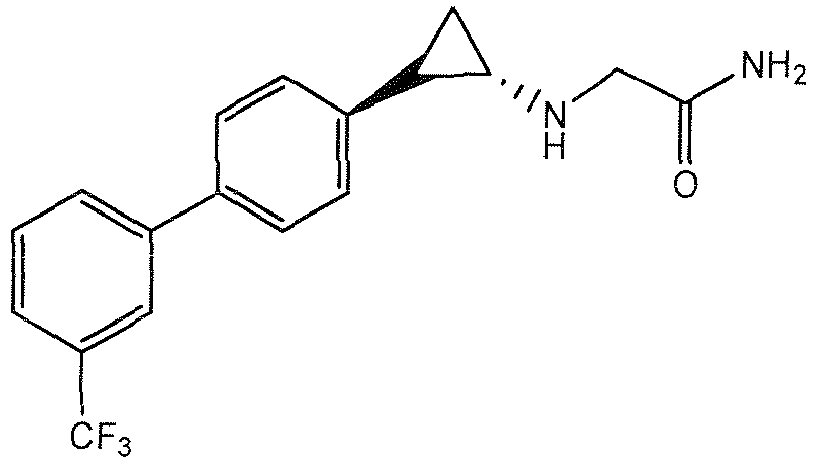
- To a solution of tert-butyl (trans)-2-(4-bromophenyl)cyclopropylcarbamate (Intermediate C, 5 g) in diethyl ether (50 mL) HCl in diethyl ether (50 mL) was added at 0 °C and stirred at RT for 16 h. After completion, the solvent was evaporated and the residue was triturated with diethyl ether (2 x 10 mL) to give (trans)-2-(4-bromophenyl) cyclopropanamine hydrochloride (3 g, 76 % yield) as a white solid.
1H-NMR (400 MHz, CDCl3) δ: 1.22 (m, 1H), 1.42 (m, 1H), 2.34 (m, 1H), 2.80 (m, 1H), 7.14 (d, 2H), 7.48 (d, 2H), 8.65-8.43 (brs, 3H). - To a suspension of K2CO3 (3.48 g, 25.4 mmol, 2.1 equiv) in dry DMF (30 mL) a solution of (trans)-2-(4-bromophenyl) cyclopropanamine hydrochloride (3 g, 12.09 mmol, 1 equiv) in dry DMF (6 mL) was added at 0°C and stirred for 10 min, then 2-bromoacetamide (1.82 g, 13.3 mmol, 1.1 equiv) was added and stirred at RT for 2 h. After completion, the reaction mixture was poured into ice water (50 mL) and extracted with EtOAc (2 x 50 mL). The combined extracts were washed with water (2 x 50 mL), brine (50 mL), dried over anhydrous Na2SO4, filtered and evaporated. The crude residue was purified by column chromatography (SiO2) using MeOH:CHCl3 (3: 97) to get 2-((trans)-2-(4-bromophenyl) cyclopropylamino) acetamide (1 g, 31 % yield) as a white solid. 1HNMR (400 MHz, CDCl3) δ: 0.98 (m, 1H), 1.1 (m, 1H), 1.91 (m, 1H), 2.42 (m, 1H), 3.41 (s, 2H), 5.45 (m, 1H), 6.68 (m, 1H), 6.9 (d, 2H), 7.37 (d, 2H). Mass (M+H): 268.9.
- A solution of 2-((trans)-2-(4-bromophenyl) cyclopropylamino) acetamide (100 mg, 0.37 mmol, 1 equiv), 3-trifluoro methyl benzene boronic acid (84 mg, 0.44 mmol1.2 equiv), K2CO3 (152 mg, 1.11 mmol, 3 equiv) in CH3CN + H2O (4:1) (2 mL) was degassed for 30 min with Argon gas, then Pd(PPh3)4 (0.1 equiv) was added and the reaction mixture was heated at reflux temp. for 2 h. After completion, the reaction mixture was poured into ice water (10 mL), extracted with EtOAc (2 x 10 mL). The combined extracts were washed with water (10 mL), brine (10 mL), dried over anhydrous Na2SO4, filtered and evaporated. The crude residue was purified by prep HPLC to give 2-((trans)-2-(3'-(trifluoromethyl) biphenyl-4-yl) cyclopropylamino) acetamide (100 mg, 80 % yield) as a white solid.
- 1H-NMR (CDCl3) δ (ppm): 1.07 (q, 1H), 1.15 (quin, 1H), 2.01 (m, 1H), 2.51 (m, 1H), 3.45 (s, 2H), 5.50 (br, 1H), 6.74 (br, 1H), 7.12 (d, 2H), 7.48 (d, 2H), 7.56 (m, 2H), 7.73 (d, 1H), 7.79 (s, 1H). MS (M+H): 335.0.
- The following examples have been synthesized using the procedure described for Example 11, employing the corresponding starting materials.
-

- 1H-NMR (DMSO-d6) δ (ppm): 0.98 (q, 1H), 1.06 (quin, 1H), 1.90 (m, 1H), 2.35 (m, 1H), 2.85 (br, 1H), 3.15 (s, 2H), 7.03 (s, 1H), 7.14 (d, 2H), 7.28 (s, 1H), 7.38 (t, 1H), 7.48 (t, 2H), 7.58 (d, 2H), 7.70 (d, 2H), 7.73 (s, 4H). MS (M+H) : 343.2
- The following compounds can be synthesized following the methodology described in Scheme IV.
-

-

-

-

-

-

- The following compounds can be synthesized following the methodology described in Scheme V.
-

-
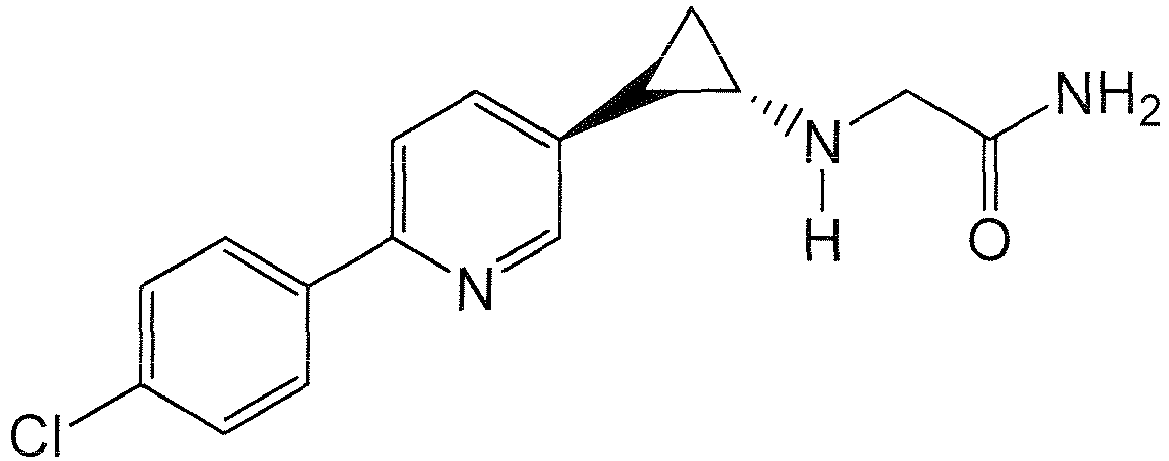
-

-

-

-

-

- Other compounds similar to those of Examples 1-25, as illustrated below, that can be synthesized using the synthetic protocols or variations thereof as described herein using the appropriate reagents and starting materials, as readily recognized by the skilled artisan include, but are not limited to:
-

-

-

-
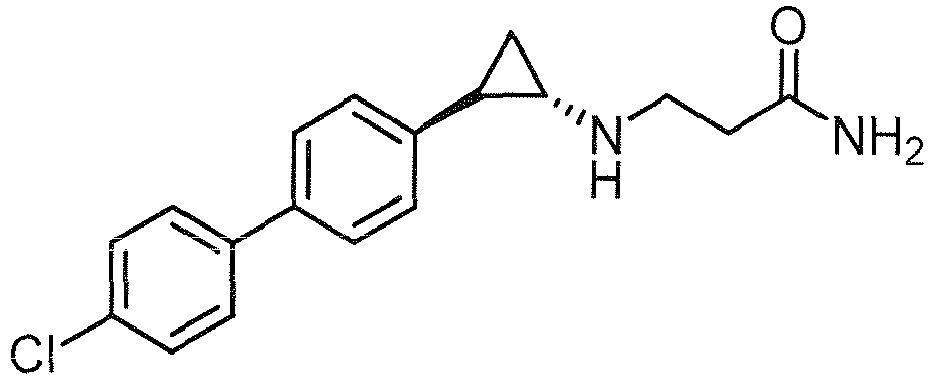
-

-

-

-

-

- The compounds of the examples can also be synthesized or provided in a salt form. The skilled artisan is aware and capable of making salt forms and/or converting salt forms of the compounds of the invention including those of the Examples. In some cases the compounds of the invention, including those of the Examples can be more stable as salt forms as compared to free base.
- The compounds of the invention can be tested for their ability to inhibit LSD1. The ability of the compounds of the invention to inhibit LSD1 can be tested as follows. Human recombinant LSD1 protein was purchased from BPS Bioscience Inc. In order to monitor LSD1 enzymatic activity and/or its inhibition rate by our inhibitor(s) of interest, di-methylated H3-K4 peptide (Millipore) was chosen as a substrate. The demethylase activity was estimated, under aerobic conditions, by measuring the release of H2O2 produced during the catalytic process, using the Amplex® Red peroxide/peroxidase-coupled assay kit (Invitrogen).
- Briefly, a fixed amount of LSD1 was incubated on ice for 15 minutes, in the absence and/or in the presence of various concentrations of inhibitor (e.g., from 0 to 75 µM, depending on the inhibitor strength). Tranylcypromine (Biomol International) was used as a control for inhibition. Within the experiment, each concentration of inhibitor was tested in triplicate. After leaving the enzyme interacting with the inhibitor, 12.5 µM of di-methylated H3-K4 peptide was added to each reaction and the experiment was left for 1 hour at 37°C in the dark. The enzymatic reactions were set up in a 50 mM sodium phosphate, pH 7.4 buffer. At the end of the incubation, Amplex® Red reagent and horseradish peroxidase (HPR) solution were added to the reaction according to the recommendations provided by the supplier (Invitrogen), and left to incubate for 30 extra minutes at room temperature in the dark. A 1 µM H2O2 solution was used as a control of the kit efficiency. The conversion of the Amplex® Red reagent to resorufin due to the presence of H2O2 in the assay, was monitored by fluorescence (excitation at 540 nm, emission at 590 nm) using a microplate reader (Infinite 200, Tecan). Arbitrary units were used to measure level of H2O2 produced in the absence and/or in the presence of inhibitor.
- The maximum demethylase activity of LSD1 was obtained in the absence of inhibitor and corrected for background fluorescence in the absence of LSD1. The Ki (IC50) of each inhibitor was estimated at half of the maximum activity.
- The results presented in Table 1 below show the results of the LSD1 inhibition studies for a number of the Example compounds. Parnate (2-trans phenylcyclopropylamine) was found to have a Ki (IC50) of from about 15 to 35 micromolar depending on the enzyme preparation. The studies show that the compounds of the invention have unexpectedly potent LSD1 inhibition.
- Human recombinant monoamine oxidase proteins MAO-A and MAO-B were purchased from Sigma Aldrich. MAOs catalyze the oxidative deamination of primary, secondary and tertiary amines. In order to monitor MAO enzymatic activities and/or their inhibition rate by inhibitor(s) of interest, a fluorescent-based (inhibitor)-screening assay was set up. 3-(2-Aminophenyl)-3-oxopropanamine (kynuramine dihydrobromide, Sigma Aldrich), a non fluorescent compound was chosen as a substrate. Kynuramine is a non-specific substrate for both MAOs activities. While undergoing oxidative deamination by MAO activities, kynuramine is converted into 4-hydroxyquinoline (4-HQ), a resulting fluorescent product.
- The monoamine oxidase activity was estimated by measuring the conversion of kynuramine into 4-hydroxyquinoline. Assays were conducted in 96-well black plates with clear bottom (Coming) in a final volume of 100 µL. The assay buffer was 100 mM HEPES, pH 7.5. Each experiment was performed in triplicate within the same experiment.
- Briefly, a fixed amount of MAO (0.25 µg for MAO-A and 0.5 µg for MAO-B) was incubated on ice for 15 minutes in the reaction buffer, in the absence and/or in the presence of various concentrations of inhibitor (e.g., from 0 to 50 µM, depending on the inhibitor strength. Tranylcypromine (Biomol International) was used as a control for inhibition.
- After leaving the enzyme(s) interacting with the inhibitor, 60 to 90 µM of kynuramine was added to each reaction for MAO-B and MAO-A assay respectively, and the reaction was left for 1 hour at 37°C in the dark. The oxidative deamination of the substrate was stopped by adding 50 µL (v/v) of
NaOH 2N. The conversion of kynuramine to 4-hydroxyquinoline, was monitored by fluorescence (excitation at 320 nm, emission at 360 nm) using a microplate reader (Infinite 200, Tecan). Arbitrary units were used to measure levels of fluorescence produced in the absence and/or in the presence of inhibitor. - The maximum of oxidative deamination activity was obtained by measuring the amount of 4-hydroxyquinoline formed from kynuramine deamination in the absence of inhibitor and corrected for background fluorescence in the absence of MAO enzymes. The Ki of each inhibitor was measure at Vmax/2.
Table 1: Summary of Data from MAO-A, MAO-B, and LSD1 Inhibition Studies Example Compound MAO-A (Ki) MAO-B (Ki) LSD1 (Ki) 1 III V VI 2 IV V VI 3 III V V 4 II V V 5 III V VI 6 I V VI 7 II V V 8 III V VI 9 III V VI 10 III V VI 11 III V V 12 I V V 19 III III V, VI 20 IV IV VI - The ranges for the Ki (IC50) value reported in Table 1 are for MAO-A, MAO-B, and LSD1 are - I = much greater than 40 µM; II = greater than 40 µM; III = between 5 µM and 40 µM; IV between 0.5 µM and 5 µM; V between 0.1 µM and 0.5 µM; VI between 0.01 µM and 0.1 µM. The compounds of Examples were found to have Ki (IC50) values for MAO-A which are greater than the Ki values for LSD1 and MAO-B. The Ki values for MAO-A range from I-III, whereas the MAO-B Ki values are in the IV-V range and the LSD1 Ki values are in the V-VI range. Trans-2-phenylcyclopropylamine (tranylcypromine) was found to have a Ki for MAO-A of about 2 µM and a Ki of about 0.6 µM for MAO-B and from about 15-35 µM for LSD1 in these assays described herein. The invention therefore provides inhibitors selective for LSD1 and MAO-B as compared to MAO-A. Preferably, LSD1/MAO-B selective inhibitors have Ki values for LSD1 which are at least 2-fold lower than the Ki value for MAO-A. Example of LSD1/MAO-B selective inhibitor are shown in Table 1 which shows Ki values for LSD1 and MAO-B which are about 5 to 10-fold lower than their Ki values for MAO-A.
- It is contemplated that some compounds of the invention may be selective LSD1 inhibitors in that they are better inhibitors of LSD1 than both MAO-A and MAO-B. Preferably LSD1 selective inhibitors have Ki values for LSD1 which are at least 2-fold lower than the Ki value for MAO-A and MAO-B. Even more preferably LSD1 selective inhibitors have Ki values for LSD1 which are at least 5-fold lower than the Ki value for MAO-A and MAO-B.
- Without being bound by theory, it is the inventor's belief that compounds of the invention that have substitutions in the linker (L) alpha to the -C(=O)NH2 group have improved stability in vivo. Thus, compounds of the invention of Formula (A')x-(A)-(B)-(Z)-(CH2)mCR1R2-C(=O)NH2 wherein R1, R2 or both are C1-C6 alkyl groups are expected to have better in vivo stability and cleared less rapidly.
- Thus, the compounds of the invention inhibit two biologically relevant targets, LSD1 and MAO-B. MAO-B inhbitors are clinically used for depression and Parkinson's disease. MAO-B inhibitors have been shown to possess neuroprotective properties. In addition, LSD1 has been shown to be part of a protein complex (REST/CoREST) involved in regulating gene expression in cancer and neurodegeneration. Without being bound by theory, it is the inventor's belief that inhibition of both targets LSD1 and MAO-B will be beneficial for neurodegeneration.
- LSD1 is known to regulate global levels of H3K4me2, H3K4me1, and Histone H3K9me2 (Histone-3
Lysine 4 dimethyl, histone-3lysine 4 monomethyl, and histone-3 lysine 9 dimethyl). Inhibitors of LSD1 have been shown in the literature to increases global levels of H3K4me2 and H3K4me1. Studies in lung cancer, prostate, and kidney cancers have shown that lower global levels of H3K4me2 and/or H3K9me2 are signifigantly associated with poorer prognosis (e.g., survival). See e.g., Seligson et al. (2009) Am. J. Path. 174:1619-28. Seligson et al. (2005) Nature 435:1262-1266. Elsheikh et al. Canc. Res. (2009) 69:3802-3809 showed that low levels of H3K4me2 is associated with poor prognosis in Breast cancer. Barlesi et al. ((2007) J Clin Oncol; 25:4358-4364 showed that in NSCLC, nonadenocarcinoma patienst with high levels of H3K4me2 had a median survival of 147 months whereas adenocarcinoma patients with low H3K9acetylation levels had a median survival of 10 months. Thus, LSD1 and histone lysine methylation levels have been shown to be involved in a number of different cancers. - Previous studies reported in the literature indicated that substitutions on the amine group of phenylcyclopropylamines reduced the ability of the compound to inhibit monoamine oxidases, which have significant structural homology to LSD1. For example, Zirkle et al. ((1962) J. Med. Chem. 1265-1284) found that a methyl substituent on the amine group decreased activity slightly whereas substitution with larger alkyl groups and groups bearing ring ring system like aralkyls reduced MAO activity substantially. Furthermore, as a general trend, substitutions on the phenyl ring of phenylcyclopropylamine were shown to be less active compounds. McCafferty et al. found that replacement of the phenyl group of phenylcyclopropylamine with a larger group like napthyl reduced inhibitory activity. The inventors of the instant invention have unexpectedly found that ring bearing substitutions on the phenyl group of the phenylcyclopropyl amine core of Formula (I) produce potent LSD1/MAO-B inhibitors. Furthermore, the inventors found that the acetamide (-CH2(C=O)NH2) moiety gives compounds that inhibit both LSD1 and MAO-B potently. The results of the instant invention show that further modifications to the phenylpropylamine core as described herein can result in potent LSD1 /MAO-B inhibitors. The Examples show compounds which selectively inhibit LSD1 and MAO-B compared to MAO-A. It is contemplated that some compounds of the invention inhibit LSD1 selectively e.g., inhibit LSD1 to a greater extent than MAO-A and MAO-B. Thus, the inventors have discovered unexpectedly a new class of aryl- and heteroarylcyclopropylamine (e.g., phenylcyclopropylamine) containing amine oxidase inhibitors with activity against biologically relevant targets in CNS conditions (neurodegeneration), depression, and cancer.
Claims (16)
- A compound of Formula (I)
(A')x-(A)-(B)-(Z)-(L)-C(=O)NH2 (I)
or a pharmaceutically acceptable salt or solvate thereof, wherein:(A) is heteroaryl or aryl;each (A'), if present, is independently chosen from aryl, arylalkoxy, arylalkyl, heterocyclyl, aryloxy, halo, alkoxy, haloalkyl, cycloalkyl, haloalkoxy, and cyano, wherein each (A') is substituted with 0, 1, 2 or 3 substituents independently chosen from halo, haloalkyl, aryl, arylalkoxy, alkyl, alkoxy, cyano, sulfonyl, sulfinyl, and carboxamide;X is 0, 1, 2, or 3;(B) is a cyclopropyl ring, wherein (A) and (Z) are covalently bonded to different carbon atoms of (B);(Z) is -NH-; and(L) is -(CH2)mCR1R2-, wherein m is 0, 1, 2, 3, 4, 5, or 6, and wherein R1 and R2 are each independently hydrogen or C1-C6 alkyl;provided that, if (L) is -CH2- or -CH(CH3)-, then X is not 0. - The compound of claim 1 or a pharmaceutically acceptable salt or solvate thereof, wherein (L) is -CR1R2-, wherein R1 and R2 are each independently hydrogen or C1-C6 alkyl.
- The compound of claim 1, wherein said compound is a compound of Formula (II)
(A')x-(A)-(B)-(Z)-CHR1C(=O)NH2 (II)
or a pharmaceutically acceptable salt or solvate thereof,
wherein:(A) is heteroaryl or aryl;each (A'), if present, is independently chosen from aryl, arylalkoxy, arylalkyl, heterocyclyl, aryloxy, halo, alkoxy, haloalkyl, cycloalkyl, haloalkoxy, and cyano, wherein each (A') is substituted with 0, 1, or 2 substituents independently chosen from halo, haloalkyl, aryl, arylalkoxy, alkyl, alkoxy, cyano, sulfonyl, and sulfinyl;X is 0, 1, 2, or 3;(B) is a cyclopropyl ring, wherein (A) and (Z) are covalently bonded to different carbon atoms of (B);(Z) is -NH-; andR1 is hydrogen or C1-C6 alkyl;provided that, if R1 is hydrogen or methyl, then X is not 0. - The compound of any one of claims 1-3 or a pharmaceutically acceptable salt or solvate thereof, wherein (A) is phenyl.
- The compound of any one of claims 1-3 or a pharmaceutically acceptable salt or solvate thereof, wherein (A) is a heteroaryl chosen from pyridyl, pyrimidinyl, and thiophenyl.
- The compound of any one of the claims 1-5 or a pharmaceutically acceptable salt or solvate thereof, wherein X is 1 or 2.
- The compound of any one of the claims 1-6 or a pharmaceutically acceptable salt or solvate thereof, wherein X is 1 and (A') is chosen from aryl, arylalkoxy, arylalkyl, and aryloxy, wherein said aryl, arylalkoxy, arylalkyl, or aryloxy has 0 or 1 substituent chosen from halo, haloalkyl, and cyano, and wherein preferably X is 1 and (A') is chosen from phenyl, benzyl, and benzyloxy, wherein said phenyl, benzyl, or benzyloxy has 0 or 1 substituent chosen from halo, haloalkyl, and cyano.
- The compound of any one of the claims 1-7 or a pharmaceutically acceptable salt or solvate thereof, wherein (A) and (Z) are in the trans orientation with respect to the cyclopropyl ring (B).
- The compound of claim 1, wherein said compound is chosen from
2-((trans)-2-(4-(4-cyanobenzyloxy)phenyl)cyclopropylamino)acetamide,
2-((trans)-2-(4-(3-cyanobenzyloxy)phenyl)cyclopropylamino)acetamide,
2-((trans)-2-(4-(benzyloxy)phenyl)cyclopropylamino)acetamide,
2-((trans)-2-(4-(4-fluorobenzyloxy)phenyl)cyclopropylamino)acetamide,
2-((trans)-2-(4-(3-fluorobenzyloxy)phenyl)cyclopropylamino)acetamide,
2-((trans)-2-(4-(3-chlorobenzyloxy)phenyl)cyclopropylamino)acetamide,
2-((trans)-2-(4-(4-chlorobenzyloxy)phenyl)cyclopropylamino)acetamide,
2-((trans)-2-(4-(3-bromobenzyloxy)phenyl)cyclopropylamino)acetamide,
2-((trans)-2-(4-(3,5-difluorobenzyloxy)phenyl)cyclopropylamino)acetamide,
2-((trans)-2-(4-phenethoxyphenyl)cyclopropylamino)acetamide,
2-((trans)-2-(3'-(trifluoromethyl)biphenyl-4-yl)cyclopropylamino)acetamide,
2-((trans)-2-(3'-chlorobiphenyl-4-yl)cyclopropylamino)acetamide,
2-((trans)-2-(6-(4-chlorophenyl)pyridin-3-yl)cyclopropylamino)acetamide,
(R)-2-((trans)-2-(4-(3-fluorobenzyloxy)phenyl)cyclopropylamino)propanamide,
(S)-2-((trans)-2-(4-(4-fluorobenzyloxy)phenyl)cyclopropylamino)propanamide,
(R)-2-((trans)-2-(4-(4-fluorobenzyloxy)phenyl)cyclopropylamino)propanamide,
(S)-2-((trans)-2-(4-(4-fluorobenzyloxy)phenyl)cyclopropylamino)propanamide,
(R)-2-((trans)-2-(4-(benzyloxy)phenyl)cyclopropylamino)propanamide,
(S)-2-((trans)-2-(4-(benzyloxy)phenyl) cyclopropylamino)propanamide,
2-(2-[1,1';4',1"]Terphenyl-4"-yl-cyclopropylamino)acetamide, 5'-((trans)-2-(2-amino-2-oxoethylamino)cyclopropyl)-2'-(benzyloxy)biphenyl-3-carboxamide,
5-((trans)-2-(4'-chlorobiphenyl-4-yl)cyclopropylamino)pentanamide,
3-((trans)-2-(4-(3-bromobenzyloxy)phenyl)cyclopropylamino)propanamide,
4-((trans)-2-phenylcyclopropylamino)butanamide,
5-((trans)-2-phenylcyclopropylamino)pentanamide,
5-((trans)-2-(4'-chlorobiphenyl-4-yl)cyclopropylamino)-2-methylpentanamide,
4-((trans)-2-(4'-chlorobiphenyl-4-yl)cyclopropylamino)-2-methylbutanamide,
3-((trans)-2-(4-(3-fluorobenzyloxy)phenyl)cyclopropylamino)-2,2-dimethylpropanamide,
3-((trans)-2-(4'-chlorobiphenyl-4-yl)cyclopropylamino)propanamide,
4-((trans)-2-(4'-chlorobiphenyl-4-yl)cyclopropylamino)butanamide,
4-((trans)-2-(4-(3-bromobenzyloxy)phenyl)cyclopropylamino)butanamide,
5-((trans)-2-(4-(3-bromobenzyloxy)phenyl)cyclopropylamino)pentanamide,
5-((trans)-2-(6-(benzyloxy)biphenyl-3-yl)cyclopropylamino)pentanamide, and
4-((trans)-2-(6-(benzyloxy)biphenyl-3-yl)cyclopropylamino)butanamide,
or a pharmaceutically acceptable salt or solvate thereof. - A pharmaceutical composition comprising the compound of any one of the claims 1-9 or a pharmaceutically acceptable salt or solvate thereof, and a pharmaceutically acceptable carrier.
- The compound of any one of the claims 1-9 or a pharmaceutically acceptable salt or solvate thereof for use as a medicament.
- The compound of any one of the claims 1-9 or a pharmaceutically acceptable salt or solvate thereof or the pharmaceutical composition of claim 10 for use in treating and/or preventing cancer.
- The compound of any one of the claims 1-9 or a pharmaceutically acceptable salt or solvate thereof or the pharmaceutical composition of claim 10 for use in treating and/or preventing a neurodegenerative disease.
- The compound of any one of the claims 1-9 or a pharmaceutically acceptable salt or solvate thereof or the pharmaceutical composition of claim 10 for use in a method of treating and/or preventing a disease or condition, the method comprising administering, to a subject in need of treatment or prevention, a therapeutically effective amount of said compound or said pharmaceutical composition.
- The compound of claim 12 or the pharmaceutical composition of claim 12, wherein said cancer is chosen from prostate cancer, breast cancer, colorectal cancer, lung cancer, brain cancer, testicular cancer, kidney cancer, and blood cancer.
- The compound of claim 13 or the pharmaceutical composition of claim 13, wherein said neurodegenerative disease is chosen from Parkinson's disease, Alzheimer's disease, dementia with Lewy bodies, frontotemporal dementia, vascular dementia, and Huntington disease.
Priority Applications (1)
| Application Number | Priority Date | Filing Date | Title |
|---|---|---|---|
| EP10720277.2A EP2486002B1 (en) | 2009-10-09 | 2010-04-19 | Substituted heteroaryl- and aryl- cyclopropylamine acetamides and their use |
Applications Claiming Priority (3)
| Application Number | Priority Date | Filing Date | Title |
|---|---|---|---|
| EP09172705 | 2009-10-09 | ||
| EP10720277.2A EP2486002B1 (en) | 2009-10-09 | 2010-04-19 | Substituted heteroaryl- and aryl- cyclopropylamine acetamides and their use |
| PCT/EP2010/055103 WO2011042217A1 (en) | 2009-10-09 | 2010-04-19 | Substituted heteroaryl- and aryl- cyclopropylamine acetamides and their use |
Publications (2)
| Publication Number | Publication Date |
|---|---|
| EP2486002A1 EP2486002A1 (en) | 2012-08-15 |
| EP2486002B1 true EP2486002B1 (en) | 2019-03-27 |
Family
ID=41664887
Family Applications (1)
| Application Number | Title | Priority Date | Filing Date |
|---|---|---|---|
| EP10720277.2A Not-in-force EP2486002B1 (en) | 2009-10-09 | 2010-04-19 | Substituted heteroaryl- and aryl- cyclopropylamine acetamides and their use |
Country Status (3)
| Country | Link |
|---|---|
| US (1) | US8946296B2 (en) |
| EP (1) | EP2486002B1 (en) |
| WO (1) | WO2011042217A1 (en) |
Families Citing this family (64)
| Publication number | Priority date | Publication date | Assignee | Title |
|---|---|---|---|---|
| WO2010043721A1 (en) | 2008-10-17 | 2010-04-22 | Oryzon Genomics, S.A. | Oxidase inhibitors and their use |
| US8993808B2 (en) | 2009-01-21 | 2015-03-31 | Oryzon Genomics, S.A. | Phenylcyclopropylamine derivatives and their medical use |
| US8859555B2 (en) | 2009-09-25 | 2014-10-14 | Oryzon Genomics S.A. | Lysine Specific Demethylase-1 inhibitors and their use |
| EP2486002B1 (en) | 2009-10-09 | 2019-03-27 | Oryzon Genomics, S.A. | Substituted heteroaryl- and aryl- cyclopropylamine acetamides and their use |
| WO2011106573A2 (en) | 2010-02-24 | 2011-09-01 | Oryzon Genomics, S.A. | Lysine demethylase inhibitors for diseases and disorders associated with hepadnaviridae |
| US9616058B2 (en) | 2010-02-24 | 2017-04-11 | Oryzon Genomics, S.A. | Potent selective LSD1 inhibitors and dual LSD1/MAO-B inhibitors for antiviral use |
| MX2012012111A (en) | 2010-04-19 | 2013-05-30 | Oryzon Genomics Sa | Lysine specific demethylase-1 inhibitors and their use. |
| SI2598482T1 (en) | 2010-07-29 | 2018-09-28 | Oryzon Genomics, S.A. | Arylcyclopropylamine based demethylase inhibitors of lsd1 and their medical use |
| WO2012013727A1 (en) | 2010-07-29 | 2012-02-02 | Oryzon Genomics S.A. | Cyclopropylamine derivatives useful as lsd1 inhibitors |
| US20130303545A1 (en) | 2010-09-30 | 2013-11-14 | Tamara Maes | Cyclopropylamine derivatives useful as lsd1 inhibitors |
| WO2012045883A1 (en) * | 2010-10-08 | 2012-04-12 | Oryzon Genomics S.A. | Cyclopropylamine inhibitors of oxidases |
| WO2012072713A2 (en) | 2010-11-30 | 2012-06-07 | Oryzon Genomics, S.A. | Lysine demethylase inhibitors for diseases and disorders associated with flaviviridae |
| WO2012107498A1 (en) | 2011-02-08 | 2012-08-16 | Oryzon Genomics S.A. | Lysine demethylase inhibitors for myeloproliferative disorders |
| WO2012107499A1 (en) | 2011-02-08 | 2012-08-16 | Oryzon Genomics S.A. | Lysine demethylase inhibitors for myeloproliferative or lymphoproliferative diseases or disorders |
| CA2831143C (en) | 2011-03-25 | 2019-05-21 | Glaxosmithkline Intellectual Property Development Limited | Cyclopropylamines as lsd1 inhibitors |
| US20140296255A1 (en) | 2011-05-19 | 2014-10-02 | Oryzong Genomics, S.A. | Lysine demethylase inhibitors for thrombosis and cardiovascular diseases |
| EP2741741A2 (en) | 2011-05-19 | 2014-06-18 | Oryzon Genomics, S.A. | Lysine demethylase inhibitors for inflammatory diseases or conditions |
| UA114406C2 (en) | 2011-08-09 | 2017-06-12 | Такеда Фармасьютікал Компані Лімітед | CYCLOPROPANAMINE DERIVATIVES AS LSD1 INHIBITORS |
| CN107266345B (en) | 2011-10-20 | 2021-08-17 | 奥瑞泽恩基因组学股份有限公司 | (hetero) arylcyclopropylamine compounds as LSD1 inhibitors |
| RS58475B1 (en) | 2011-10-20 | 2019-04-30 | Oryzon Genomics Sa | (hetero)aryl cyclopropylamine compounds as lsd1 inhibitors |
| US9751885B2 (en) | 2012-10-12 | 2017-09-05 | Takeda Pharmaceutical Company Limited | Cyclopropanamine compound and use thereof |
| EP2740474A1 (en) | 2012-12-05 | 2014-06-11 | Instituto Europeo di Oncologia S.r.l. | Cyclopropylamine derivatives useful as inhibitors of histone demethylases kdm1a |
| AU2014306149B2 (en) | 2013-08-06 | 2019-09-19 | Imago Biosciences Inc. | KDM1A inhibitors for the treatment of disease |
| KR102421235B1 (en) | 2014-02-13 | 2022-07-15 | 인사이트 코포레이션 | Cyclopropylamines as lsd1 inhibitors |
| EP3392244A1 (en) | 2014-02-13 | 2018-10-24 | Incyte Corporation | Cyclopropylamines as lsd1 inhibitors |
| US9527835B2 (en) | 2014-02-13 | 2016-12-27 | Incyte Corporation | Cyclopropylamines as LSD1 inhibitors |
| NZ723203A (en) | 2014-02-13 | 2020-08-28 | Incyte Corp | Cyclopropylamines as lsd1 inhibitors |
| JP2017508798A (en) | 2014-03-07 | 2017-03-30 | ザ ジョンズ ホプキンス ユニバーシティ | Inhibitors of histone lysine specific demethylase (LSD1) and histone deacetylase (HDAC) |
| JP6783224B2 (en) | 2014-04-04 | 2020-11-11 | デル マー ファーマシューティカルズ | Use of dianehydrogalactitol and its analogs or derivatives to treat non-small cell lung cancer and ovarian cancer |
| SG11201608340UA (en) | 2014-04-11 | 2016-11-29 | Takeda Pharmaceuticals Co | Cyclopropanamine compound and use thereof |
| US9695180B2 (en) | 2014-07-10 | 2017-07-04 | Incyte Corporation | Substituted imidazo[1,2-a]pyrazines as LSD1 inhibitors |
| US9758523B2 (en) | 2014-07-10 | 2017-09-12 | Incyte Corporation | Triazolopyridines and triazolopyrazines as LSD1 inhibitors |
| WO2016007722A1 (en) | 2014-07-10 | 2016-01-14 | Incyte Corporation | Triazolopyridines and triazolopyrazines as lsd1 inhibitors |
| WO2016007731A1 (en) | 2014-07-10 | 2016-01-14 | Incyte Corporation | Imidazopyridines and imidazopyrazines as lsd1 inhibitors |
| KR102626978B1 (en) | 2015-02-12 | 2024-01-18 | 이마고 바이오사이언시즈 인코포레이티드 | Kdm1a inhibitors for the treatment of disease |
| UA122688C2 (en) | 2015-04-03 | 2020-12-28 | Інсайт Корпорейшн | HETEROCYCLIC COMPOUNDS AS LSD1 INHIBITORS |
| EP3090998A1 (en) | 2015-05-06 | 2016-11-09 | F. Hoffmann-La Roche AG | Solid forms |
| AU2016275702A1 (en) | 2015-06-12 | 2017-12-21 | Oryzon Genomics, S.A. | Biomarkers associated with LSD1 inhibitors and uses thereof |
| WO2017013061A1 (en) | 2015-07-17 | 2017-01-26 | Oryzon Genomics, S.A. | Biomarkers associated with lsd1 inhibitors and uses thereof |
| JP7427363B2 (en) | 2015-08-12 | 2024-02-05 | インサイト・ホールディングス・コーポレイション | LSD1 inhibitor salt |
| US10059668B2 (en) | 2015-11-05 | 2018-08-28 | Mirati Therapeutics, Inc. | LSD1 inhibitors |
| SG11201805645QA (en) | 2015-12-29 | 2018-07-30 | Mirati Therapeutics Inc | Lsd1 inhibitors |
| BR112018013074A2 (en) | 2015-12-30 | 2018-12-11 | Novartis Ag | immune effector cell therapies with enhanced efficacy |
| ES3057783T3 (en) | 2016-03-15 | 2026-03-04 | Oryzon Genomics Sa | Combinations of lsd1 inhibitors for use in the treatment of neoplastic diseases |
| US11013698B2 (en) | 2016-03-15 | 2021-05-25 | Oryzon Genomics S.A. | Combinations of LSD1 inhibitors for the treatment of hematological malignancies |
| WO2017158136A1 (en) | 2016-03-16 | 2017-09-21 | Oryzon Genomics, S.A. | Methods to determine kdm1a target engagement and chemoprobes useful therefor |
| US10166221B2 (en) | 2016-04-22 | 2019-01-01 | Incyte Corporation | Formulations of an LSD1 inhibitor |
| PL3307267T3 (en) | 2016-06-10 | 2019-10-31 | Oryzon Genomics Sa | Multiple sclerosis treatment |
| US11390590B2 (en) | 2016-08-16 | 2022-07-19 | Imago Biosciences, Inc. | Methods and processes for the preparation of KDM1A inhibitors |
| WO2018083189A1 (en) | 2016-11-03 | 2018-05-11 | Oryzon Genomics, S.A. | Biomarkers for determining responsiveness to lsd1 inhibitors |
| SI3661510T1 (en) | 2017-08-03 | 2025-03-31 | Oryzon Genomics, S.A. | Methods of treating behavior alterations |
| CN108912029B (en) * | 2017-08-25 | 2021-10-01 | 广东东阳光药业有限公司 | Nitrogen-containing heterocyclic amide derivatives and uses thereof |
| WO2019068326A1 (en) | 2017-10-05 | 2019-04-11 | Université D'aix-Marseille | Lsd1 inhibitors for the treatment and prevention of cardiomyopathies |
| KR102684364B1 (en) | 2018-05-11 | 2024-07-11 | 이마고 바이오사이언시즈 인코포레이티드 | KDM1A inhibitors for the treatment of diseases |
| WO2020047198A1 (en) | 2018-08-31 | 2020-03-05 | Incyte Corporation | Salts of an lsd1 inhibitor and processes for preparing the same |
| US20220151999A1 (en) | 2019-03-20 | 2022-05-19 | Oryzon Genomics, S.A. | Methods of treating attention deficit hyperactivity disorder using kdm1a inhibitors such as the compound vafidemstat |
| US20220151998A1 (en) | 2019-03-20 | 2022-05-19 | Oryzon Genomics, S.A. | Methods of treating borderline personality disorder |
| JP2022546908A (en) | 2019-07-05 | 2022-11-10 | オリゾン・ゲノミクス・ソシエダッド・アノニマ | Biomarkers and methods for personalized treatment of small cell lung cancer using KDM1A inhibitors |
| EP3964204A1 (en) | 2020-09-08 | 2022-03-09 | Université d'Aix-Marseille | Lsd1 inhibitors for use in the treatment and prevention of fibrosis of tissues |
| CA3231846A1 (en) | 2021-04-08 | 2022-10-13 | Tamara Maes | Combinations of lsd1 inhibitors for treating myeloid cancers |
| CN119497613A (en) | 2022-05-09 | 2025-02-21 | 奥莱松基因组股份有限公司 | Methods of treating NF1-mutated tumors using LSD1 inhibitors |
| EP4522136A1 (en) | 2022-05-09 | 2025-03-19 | Oryzon Genomics, S.A. | Methods of treating malignant peripheral nerve sheath tumor (mpnst) using lsd1 inhibitors |
| WO2024110649A1 (en) | 2022-11-24 | 2024-05-30 | Oryzon Genomics, S.A. | Combinations of lsd1 inhibitors and menin inhibitors for treating cancer |
| CN120919117A (en) * | 2025-09-24 | 2025-11-11 | 中山大学 | Application of tetra-substituted pyrrole derivative in preparation of products for treating neurodegenerative diseases |
Family Cites Families (126)
| Publication number | Priority date | Publication date | Assignee | Title |
|---|---|---|---|---|
| US3106578A (en) | 1960-09-16 | 1963-10-08 | Smith Kline French Lab | Nu-phenethyl-2-phenylcyclopropylamine derivatives |
| US3365458A (en) | 1964-06-23 | 1968-01-23 | Aldrich Chem Co Inc | N-aryl-n'-cyclopropyl-ethylene diamine derivatives |
| US3532749A (en) | 1965-05-11 | 1970-10-06 | Aldrich Chem Co Inc | N'-propargyl-n**2-cyclopropyl-ethylenediamines and the salts thereof |
| US3471522A (en) | 1967-09-29 | 1969-10-07 | Aldrich Chem Co Inc | N-cyclopropyl-n'-furfuryl-n'-methyl ethylene diamines |
| US3532712A (en) | 1967-09-29 | 1970-10-06 | Aldrich Chem Co Inc | N'-cyclopropyl ethylenediamine derivatives |
| US3654306A (en) | 1970-01-26 | 1972-04-04 | Robins Co Inc A H | 5-azaspiro(2.4)heptane-4 6-diones |
| US3758684A (en) | 1971-09-07 | 1973-09-11 | Burroughs Wellcome Co | Treating dna virus infections with amino purine derivatives |
| US4530901A (en) | 1980-01-08 | 1985-07-23 | Biogen N.V. | Recombinant DNA molecules and their use in producing human interferon-like polypeptides |
| DD230169A3 (en) | 1981-08-10 | 1985-11-27 | Bruss Polt I | DEVICE FOR DETERMINING THE CURING TERM OF CASTORS |
| US4409243A (en) | 1981-11-09 | 1983-10-11 | Julian Lieb | Treatment of auto-immune and inflammatory diseases |
| US4522811A (en) | 1982-07-08 | 1985-06-11 | Syntex (U.S.A.) Inc. | Serial injection of muramyldipeptides and liposomes enhances the anti-infective activity of muramyldipeptides |
| GB9311282D0 (en) | 1993-06-01 | 1993-07-21 | Rhone Poulenc Rorer Ltd | New compositions of matter |
| EP1203761B1 (en) | 1994-10-21 | 2005-01-19 | Nps Pharmaceuticals, Inc. | Calcium receptor-active compounds |
| US5652258A (en) | 1995-05-30 | 1997-07-29 | Gliatech, Inc. | 2-(4-imidazoyl) cyclopropyl derivatives |
| US20040132820A1 (en) | 1996-02-15 | 2004-07-08 | Jean Gosselin | Agents with leukotriene B4-like antiviral (DNA) and anti-neoplastic activities |
| GB9615730D0 (en) | 1996-07-26 | 1996-09-04 | Medical Res Council | Anti-viral agent 1 |
| US5961987A (en) | 1996-10-31 | 1999-10-05 | University Of Iowa Research Foundation | Ocular protein stimulants |
| DE19647615A1 (en) | 1996-11-18 | 1998-05-20 | Bayer Ag | Process for the preparation of cyclopropylamines |
| TW530058B (en) | 1997-07-22 | 2003-05-01 | Astra Pharma Prod | Triazolo [4,5-d]pyrimidine compounos and their use and process for preparation |
| SE9702772D0 (en) | 1997-07-22 | 1997-07-22 | Astra Pharma Prod | Novel compounds |
| WO1999031072A1 (en) | 1997-12-18 | 1999-06-24 | E.I. Du Pont De Nemours And Company | Cyclohexylamine arthropodicides and fungicides |
| US6809120B1 (en) | 1998-01-13 | 2004-10-26 | University Of Saskatchewan Technologies Inc. | Composition containing propargylamine for enhancing cancer therapy |
| KR100508289B1 (en) | 1998-04-21 | 2005-08-17 | 마이크로메트 에이지 | Cd19×cd3 specific polypeptides and uses thereof |
| SE9802206D0 (en) | 1998-06-22 | 1998-06-22 | Astra Pharma Inc | Novel compounds |
| TWI229674B (en) | 1998-12-04 | 2005-03-21 | Astra Pharma Prod | Novel triazolo[4,5-d]pyrimidine compounds, pharmaceutical composition containing the same, their process for preparation and uses |
| SI1283839T1 (en) | 2000-05-26 | 2005-08-31 | Schering Corp | |
| JP2001354563A (en) | 2000-06-09 | 2001-12-25 | Sankyo Co Ltd | Medicine comprising substituted benzylamines |
| US8519005B2 (en) | 2000-07-27 | 2013-08-27 | Thomas N. Thomas | Compositions and methods to prevent toxicity of antiinflammatory agents and enhance their efficacy |
| EP1193268A1 (en) | 2000-09-27 | 2002-04-03 | Applied Research Systems ARS Holding N.V. | Pharmaceutically active sulfonamide derivatives bearing both lipophilic and ionisable moieties as inhibitors of protein Junkinases |
| EP1373203A1 (en) | 2001-03-29 | 2004-01-02 | Bristol-Myers Squibb Company | Cyclopropylindole derivatives as selective serotonin reuptake inhibitors |
| DE10123163A1 (en) | 2001-05-09 | 2003-01-16 | Gruenenthal Gmbh | Substituted cyclohexane-1,4-diamine derivatives |
| US20030008844A1 (en) | 2001-05-17 | 2003-01-09 | Keryx Biopharmaceuticals, Inc. | Use of sulodexide for the treatment of inflammatory bowel disease |
| EP1499598A1 (en) | 2002-04-18 | 2005-01-26 | Ucb, S.A. | Chemical compounds with dual activity, processes for their preparation and pharmaceutical compositions |
| CA2484209C (en) | 2002-05-03 | 2013-06-11 | Exelixis, Inc. | Protein kinase modulators and methods of use |
| US7704995B2 (en) | 2002-05-03 | 2010-04-27 | Exelixis, Inc. | Protein kinase modulators and methods of use |
| AU2003273179A1 (en) | 2002-05-10 | 2003-12-12 | Bristol-Myers Squibb Company | 1,1-disubstituted cycloalkyl derivatives as factor xa inhibitors |
| US20040033986A1 (en) | 2002-05-17 | 2004-02-19 | Protopopova Marina Nikolaevna | Anti tubercular drug: compositions and methods |
| US6951961B2 (en) | 2002-05-17 | 2005-10-04 | Marina Nikolaevna Protopopova | Methods of use and compositions for the diagnosis and treatment of infectious disease |
| US7456222B2 (en) | 2002-05-17 | 2008-11-25 | Sequella, Inc. | Anti tubercular drug: compositions and methods |
| WO2004032827A2 (en) | 2002-05-20 | 2004-04-22 | Bristol-Myers Squibb Company | Hepatitis c virus inhibitors |
| US7611704B2 (en) | 2002-07-15 | 2009-11-03 | Board Of Regents, The University Of Texas System | Compositions and methods for treating viral infections using antibodies and immunoconjugates to aminophospholipids |
| SE0202539D0 (en) | 2002-08-27 | 2002-08-27 | Astrazeneca Ab | Compounds |
| AU2003296993A1 (en) | 2002-12-13 | 2004-07-09 | Smithkline Beecham Corporation | Cyclopropyl compounds as ccr5 antagonists |
| SG159388A1 (en) | 2003-01-08 | 2010-03-30 | Chiron Corp | Antibacterial agents |
| US7223785B2 (en) | 2003-01-22 | 2007-05-29 | Boehringer Ingelheim International Gmbh | Viral polymerase inhibitors |
| GB0303439D0 (en) | 2003-02-14 | 2003-03-19 | Pfizer Ltd | Antiparasitic terpene alkaloids |
| US7186832B2 (en) | 2003-02-20 | 2007-03-06 | Sugen Inc. | Use of 8-amino-aryl-substituted imidazopyrazines as kinase inhibitors |
| US7135575B2 (en) | 2003-03-03 | 2006-11-14 | Array Biopharma, Inc. | P38 inhibitors and methods of use thereof |
| JP4679514B2 (en) | 2003-04-24 | 2011-04-27 | メルク・シャープ・エンド・ドーム・コーポレイション | Inhibitor of Akt activity |
| EP1644320B1 (en) | 2003-07-03 | 2008-01-16 | Eli Lilly And Company | Indane derivates as muscarinic receptor agonists |
| MXPA06002853A (en) | 2003-09-11 | 2006-06-14 | Kemia Inc | Cytokine inhibitors. |
| US7705052B2 (en) | 2003-09-12 | 2010-04-27 | Merck Serono Sa | Sulfonamide derivatives for the treatment of diabetes |
| CN1897950A (en) | 2003-10-14 | 2007-01-17 | 惠氏公司 | Fused aryl and heteroaryl derivatives and methods of use |
| WO2005041971A1 (en) | 2003-10-21 | 2005-05-12 | Merck & Co., Inc. | Triazolo-pyridazine compounds and derivatives thereof useful in the treatment of neuropathic pain |
| US7026339B2 (en) | 2003-11-07 | 2006-04-11 | Fan Yang | Inhibitors of HCV NS5B polymerase |
| EA010568B1 (en) | 2003-12-15 | 2008-10-30 | Ньюрокрайн Байосайнсиз Инк. | 2,6 bisheteroaryl-4-aminopyrimidines as adenosine receptor antagonists |
| CA2549660A1 (en) | 2003-12-15 | 2005-06-30 | Japan Tobacco Inc. | Cyclopropane compounds and pharmaceutical use thereof |
| KR20060109937A (en) | 2003-12-15 | 2006-10-23 | 니뽄 다바코 산교 가부시키가이샤 | N-substituted-N-sulfonylaminocyclopropane compounds and pharmaceutical uses thereof |
| US7399825B2 (en) | 2003-12-24 | 2008-07-15 | Lipps Binie V | Synthetic peptide, inhibitor to DNA viruses |
| MXPA06012449A (en) | 2004-04-26 | 2007-01-17 | Pfizer | Inhibitors of the hiv integrase enzyme. |
| US20090275099A1 (en) | 2004-04-27 | 2009-11-05 | Regents Of The University Of Michigan | Methods and compositions for treating diseases and conditions associated with mitochondrial function |
| DE102004057594A1 (en) | 2004-11-29 | 2006-06-08 | Boehringer Ingelheim Pharma Gmbh & Co. Kg | Substitute pteridine for the treatment of inflammatory diseases |
| EP1833981B1 (en) | 2004-12-16 | 2012-04-18 | President and Fellows of Harvard College | Histone demethylation mediated by the nuclear amine oxidase homolog lsd1 |
| DK1704859T3 (en) | 2005-02-18 | 2010-11-22 | Universitaetsklinikum Freiburg | Control of androgen receptor-dependent gene expression by inhibiting the amine oxidase activity of lysine-specific demethylase (LSD1) |
| US20060275366A1 (en) | 2005-06-02 | 2006-12-07 | Schering Corporation | Controlled-release formulation |
| WO2007002220A2 (en) | 2005-06-21 | 2007-01-04 | Bristol-Myers Squibb Company | Aminoacetamide acyl guanidines as beta-secretase inhibitors |
| EP1741708A1 (en) | 2005-06-28 | 2007-01-10 | Sanofi-Aventis Deutschland GmbH | Heteroaryl-substituted amides comprising an unsaturated or cyclic linker group, and their use as pharmaceuticals |
| JP5249028B2 (en) | 2005-07-25 | 2013-07-31 | インターミューン・インコーポレーテッド | Novel macrocyclic inhibitor of hepatitis C virus replication |
| KR20080088570A (en) | 2005-08-10 | 2008-10-02 | 더 존스 홉킨스 유니버시티 | Polyamines useful as antiparasitic and anticancer agents and as lysine-specific dimethylase inhibitors |
| WO2007025144A1 (en) | 2005-08-24 | 2007-03-01 | University Of Illinois - Chicago | 5-ht2c receptor agonists as anorectic agents |
| GB0517740D0 (en) * | 2005-08-31 | 2005-10-12 | Novartis Ag | Organic compounds |
| TW200745067A (en) | 2006-03-14 | 2007-12-16 | Astrazeneca Ab | Novel compounds |
| KR101380139B1 (en) | 2006-05-18 | 2014-04-01 | 신젠타 리미티드 | Novel microbiocides |
| US8198301B2 (en) | 2006-07-05 | 2012-06-12 | Hesheng Zhang | Quinazoline and quinoline derivatives as irreversibe protein tyrosine kinase inhibitors |
| CA2658484A1 (en) | 2006-07-20 | 2008-01-24 | Vical Incorporated | Compositions and methods for vaccinating against hsv-2 |
| US20080161324A1 (en) | 2006-09-14 | 2008-07-03 | Johansen Lisa M | Compositions and methods for treatment of viral diseases |
| EP2142287A4 (en) | 2007-04-13 | 2012-05-23 | Univ Johns Hopkins | INHIBITORS OF LYSINE-SPECIFIC DEM ETHYLASE |
| US7906513B2 (en) | 2007-04-26 | 2011-03-15 | Enanta Pharmaceuticals, Inc. | Hydrazide-containing hepatitis C serine protease inhibitors |
| RU2479580C2 (en) | 2007-06-27 | 2013-04-20 | Астразенека Аб | Pyrazinone derivatives and use thereof in treatment of lung diseases |
| US20120121540A1 (en) | 2007-08-10 | 2012-05-17 | Franz Ulrich Schmitz | Certain Nitrogen Containing Bicyclic Chemical Entities For Treating Viral Infections |
| DK2203431T3 (en) | 2007-09-17 | 2011-11-21 | Abbott Lab | Anti-infectious pyrimidines and their applications |
| US20100016262A1 (en) | 2007-10-18 | 2010-01-21 | Yale University | Compositions and methods for reducing hepatotoxicity associated with drug administration and treating non-alcoholic fatty liver disease, non-alcoholic steatohepatitis and associated cirrhosis |
| US8299123B2 (en) | 2007-10-19 | 2012-10-30 | Boehringer Ingelheim International Gmbh | CCR10 antagonists |
| KR20100109934A (en) | 2007-12-26 | 2010-10-11 | 시오노기세야쿠 가부시키가이샤 | Glycosylated glycopeptide antibiotic derivative |
| WO2009109991A2 (en) | 2008-01-23 | 2009-09-11 | Sun Pharma Advanced Research Company Ltd., | Novel hydrazide containing tyrosine kinase inhibitors |
| NZ586831A (en) | 2008-01-28 | 2012-02-24 | Janssen Pharmaceutica Nv | 6-substituted-thio-2-amino-quinoline derivatives useful as inhibitors of beta-secretase (bace) |
| JP5746612B2 (en) | 2008-03-19 | 2015-07-08 | オーリムメッド・ファルマ・インコーポレーテッド | New compounds effective in the treatment of central nervous system diseases and disorders |
| KR20120075500A (en) | 2008-03-27 | 2012-07-06 | 그뤼넨탈 게엠베하 | Substituted 4-aminocyclohexane derivatives |
| JP5705720B2 (en) | 2008-04-16 | 2015-04-22 | ポートラ ファーマシューティカルズ, インコーポレイテッド | 2,6-Diamino-pyrimidin-5-yl-carboxamide as SYK or JAK kinase inhibitor |
| EP2303889A1 (en) | 2008-06-18 | 2011-04-06 | F. Hoffmann-La Roche AG | Halo-substituted pyrimidodiazepines as plkl inhibitors |
| EP2317992A2 (en) | 2008-07-24 | 2011-05-11 | The United States Of America, As Represented By The Secretary, Department Of Health And Human Services | Preventing or treating viral infection using an inhibitor of the lsd1 protein, a mao inhibitor or an inhibitor of lsd1 and a mao inhibitor |
| CA2732320C (en) | 2008-08-01 | 2017-08-29 | The United States Of America, As Represented By The Secretary, Department Of Health And Human Services | A3 adenosine receptor antagonists and partial agonists |
| US8048887B2 (en) | 2008-09-11 | 2011-11-01 | Bristol-Myers Squibb Company | Compounds for the treatment of hepatitis C |
| WO2010043721A1 (en) | 2008-10-17 | 2010-04-22 | Oryzon Genomics, S.A. | Oxidase inhibitors and their use |
| US8993808B2 (en) | 2009-01-21 | 2015-03-31 | Oryzon Genomics, S.A. | Phenylcyclopropylamine derivatives and their medical use |
| US8299100B2 (en) | 2009-01-23 | 2012-10-30 | Northwestern University | Potent and selective neuronal nitric oxide synthase inhibitors with improved membrane permeability |
| ES2606717T3 (en) | 2009-02-27 | 2017-03-27 | Enanta Pharmaceuticals, Inc. | Hepatitis C virus inhibitors |
| BRPI1010600A2 (en) | 2009-05-15 | 2016-03-15 | Novartis Ag | aryl pyridine as aldosterone synthase inhibitors |
| US8389580B2 (en) | 2009-06-02 | 2013-03-05 | Duke University | Arylcyclopropylamines and methods of use |
| EP2258865A1 (en) | 2009-06-05 | 2010-12-08 | Universitätsklinikum Freiburg | Lysine-specific demethylase 1 (LSD1) is a biomarker for breast cancer |
| WO2010143582A1 (en) | 2009-06-11 | 2010-12-16 | 公立大学法人名古屋市立大学 | Phenylcyclopropylamine derivatives and lsd1 inhibitors |
| US9708255B2 (en) | 2009-08-18 | 2017-07-18 | Robert A. Casero | (bis)urea and (bis)thiourea compounds as epigenic modulators of lysine-specific demethylase 1 and methods of treating disorders |
| EP2475254A4 (en) | 2009-09-11 | 2013-05-22 | Enanta Pharm Inc | INHIBITORS OF HEPATITIS C VIRUS |
| US8859555B2 (en) | 2009-09-25 | 2014-10-14 | Oryzon Genomics S.A. | Lysine Specific Demethylase-1 inhibitors and their use |
| EP2486002B1 (en) | 2009-10-09 | 2019-03-27 | Oryzon Genomics, S.A. | Substituted heteroaryl- and aryl- cyclopropylamine acetamides and their use |
| WO2011057262A2 (en) | 2009-11-09 | 2011-05-12 | Evolva Inc. | Treatment of infections with tp receptor antagonists |
| WO2011106573A2 (en) | 2010-02-24 | 2011-09-01 | Oryzon Genomics, S.A. | Lysine demethylase inhibitors for diseases and disorders associated with hepadnaviridae |
| US9616058B2 (en) | 2010-02-24 | 2017-04-11 | Oryzon Genomics, S.A. | Potent selective LSD1 inhibitors and dual LSD1/MAO-B inhibitors for antiviral use |
| WO2011113005A2 (en) | 2010-03-12 | 2011-09-15 | The Johns Hopkins University | Compositions and methods for combinations of oligoamines with 2-difluoromethylornithine (dfmo) |
| MX2012012111A (en) | 2010-04-19 | 2013-05-30 | Oryzon Genomics Sa | Lysine specific demethylase-1 inhibitors and their use. |
| US20130150577A1 (en) | 2010-04-20 | 2013-06-13 | Actavis Group Ptc Ehf | Novel process for preparing phenylcyclopropylamine derivatives using novel intermediates |
| AU2011244478B2 (en) | 2010-04-20 | 2014-07-17 | Fondazione IEO-CCM | Tranylcypromine derivatives as inhibitors of histone demethylase LSD1 and/or LSD2 |
| US20130165696A1 (en) | 2010-06-30 | 2013-06-27 | Actavis Group Ptc Ehf | Novel processes for the preparation of phenylcyclopropylamine derivatives and use thereof for preparing ticagrelor |
| WO2012013727A1 (en) | 2010-07-29 | 2012-02-02 | Oryzon Genomics S.A. | Cyclopropylamine derivatives useful as lsd1 inhibitors |
| SI2598482T1 (en) | 2010-07-29 | 2018-09-28 | Oryzon Genomics, S.A. | Arylcyclopropylamine based demethylase inhibitors of lsd1 and their medical use |
| US9527805B2 (en) | 2010-09-10 | 2016-12-27 | Robert A. Casero | Small molecules as epigenetic modulators of lysine-specific demethylase 1 and methods of treating disorders |
| US20130303545A1 (en) | 2010-09-30 | 2013-11-14 | Tamara Maes | Cyclopropylamine derivatives useful as lsd1 inhibitors |
| WO2012045883A1 (en) | 2010-10-08 | 2012-04-12 | Oryzon Genomics S.A. | Cyclopropylamine inhibitors of oxidases |
| WO2012072713A2 (en) | 2010-11-30 | 2012-06-07 | Oryzon Genomics, S.A. | Lysine demethylase inhibitors for diseases and disorders associated with flaviviridae |
| WO2012107498A1 (en) | 2011-02-08 | 2012-08-16 | Oryzon Genomics S.A. | Lysine demethylase inhibitors for myeloproliferative disorders |
| WO2012107499A1 (en) | 2011-02-08 | 2012-08-16 | Oryzon Genomics S.A. | Lysine demethylase inhibitors for myeloproliferative or lymphoproliferative diseases or disorders |
| CA2831143C (en) | 2011-03-25 | 2019-05-21 | Glaxosmithkline Intellectual Property Development Limited | Cyclopropylamines as lsd1 inhibitors |
| US20140296255A1 (en) | 2011-05-19 | 2014-10-02 | Oryzong Genomics, S.A. | Lysine demethylase inhibitors for thrombosis and cardiovascular diseases |
| EP2741741A2 (en) | 2011-05-19 | 2014-06-18 | Oryzon Genomics, S.A. | Lysine demethylase inhibitors for inflammatory diseases or conditions |
| RS58475B1 (en) | 2011-10-20 | 2019-04-30 | Oryzon Genomics Sa | (hetero)aryl cyclopropylamine compounds as lsd1 inhibitors |
| CN107266345B (en) | 2011-10-20 | 2021-08-17 | 奥瑞泽恩基因组学股份有限公司 | (hetero) arylcyclopropylamine compounds as LSD1 inhibitors |
-
2010
- 2010-04-19 EP EP10720277.2A patent/EP2486002B1/en not_active Not-in-force
- 2010-04-19 WO PCT/EP2010/055103 patent/WO2011042217A1/en not_active Ceased
- 2010-04-19 US US13/500,687 patent/US8946296B2/en not_active Expired - Fee Related
Non-Patent Citations (1)
| Title |
|---|
| None * |
Also Published As
| Publication number | Publication date |
|---|---|
| WO2011042217A1 (en) | 2011-04-14 |
| US8946296B2 (en) | 2015-02-03 |
| US20120264823A1 (en) | 2012-10-18 |
| EP2486002A1 (en) | 2012-08-15 |
Similar Documents
| Publication | Publication Date | Title |
|---|---|---|
| US8946296B2 (en) | Substituted heteroaryl- and aryl-cyclopropylamine acetamides and their use | |
| EP2480528B1 (en) | Lysine specific demethylase-1 inhibitors and their use | |
| US10202330B2 (en) | Lysine specific demethylase-1 inhibitors and their use | |
| US8524717B2 (en) | Oxidase inhibitors and their use | |
| EP2389362B1 (en) | Phenylcyclopropylamine derivatives and their medical use |
Legal Events
| Date | Code | Title | Description |
|---|---|---|---|
| PUAI | Public reference made under article 153(3) epc to a published international application that has entered the european phase |
Free format text: ORIGINAL CODE: 0009012 |
|
| 17P | Request for examination filed |
Effective date: 20120508 |
|
| AK | Designated contracting states |
Kind code of ref document: A1 Designated state(s): AT BE BG CH CY CZ DE DK EE ES FI FR GB GR HR HU IE IS IT LI LT LU LV MC MK MT NL NO PL PT RO SE SI SK SM TR |
|
| DAX | Request for extension of the european patent (deleted) | ||
| 17Q | First examination report despatched |
Effective date: 20160617 |
|
| STAA | Information on the status of an ep patent application or granted ep patent |
Free format text: STATUS: EXAMINATION IS IN PROGRESS |
|
| GRAP | Despatch of communication of intention to grant a patent |
Free format text: ORIGINAL CODE: EPIDOSNIGR1 |
|
| STAA | Information on the status of an ep patent application or granted ep patent |
Free format text: STATUS: GRANT OF PATENT IS INTENDED |
|
| INTG | Intention to grant announced |
Effective date: 20170706 |
|
| GRAJ | Information related to disapproval of communication of intention to grant by the applicant or resumption of examination proceedings by the epo deleted |
Free format text: ORIGINAL CODE: EPIDOSDIGR1 |
|
| STAA | Information on the status of an ep patent application or granted ep patent |
Free format text: STATUS: EXAMINATION IS IN PROGRESS |
|
| GRAP | Despatch of communication of intention to grant a patent |
Free format text: ORIGINAL CODE: EPIDOSNIGR1 |
|
| STAA | Information on the status of an ep patent application or granted ep patent |
Free format text: STATUS: GRANT OF PATENT IS INTENDED |
|
| INTC | Intention to grant announced (deleted) | ||
| INTG | Intention to grant announced |
Effective date: 20171222 |
|
| RAP1 | Party data changed (applicant data changed or rights of an application transferred) |
Owner name: ORYZON GENOMICS, S.A. |
|
| GRAJ | Information related to disapproval of communication of intention to grant by the applicant or resumption of examination proceedings by the epo deleted |
Free format text: ORIGINAL CODE: EPIDOSDIGR1 |
|
| STAA | Information on the status of an ep patent application or granted ep patent |
Free format text: STATUS: EXAMINATION IS IN PROGRESS |
|
| GRAP | Despatch of communication of intention to grant a patent |
Free format text: ORIGINAL CODE: EPIDOSNIGR1 |
|
| STAA | Information on the status of an ep patent application or granted ep patent |
Free format text: STATUS: GRANT OF PATENT IS INTENDED |
|
| INTC | Intention to grant announced (deleted) | ||
| INTG | Intention to grant announced |
Effective date: 20180606 |
|
| GRAS | Grant fee paid |
Free format text: ORIGINAL CODE: EPIDOSNIGR3 |
|
| GRAA | (expected) grant |
Free format text: ORIGINAL CODE: 0009210 |
|
| STAA | Information on the status of an ep patent application or granted ep patent |
Free format text: STATUS: THE PATENT HAS BEEN GRANTED |
|
| AK | Designated contracting states |
Kind code of ref document: B1 Designated state(s): AT BE BG CH CY CZ DE DK EE ES FI FR GB GR HR HU IE IS IT LI LT LU LV MC MK MT NL NO PL PT RO SE SI SK SM TR |
|
| REG | Reference to a national code |
Ref country code: GB Ref legal event code: FG4D |
|
| REG | Reference to a national code |
Ref country code: CH Ref legal event code: EP |
|
| REG | Reference to a national code |
Ref country code: AT Ref legal event code: REF Ref document number: 1112891 Country of ref document: AT Kind code of ref document: T Effective date: 20190415 |
|
| REG | Reference to a national code |
Ref country code: IE Ref legal event code: FG4D |
|
| REG | Reference to a national code |
Ref country code: DE Ref legal event code: R096 Ref document number: 602010057814 Country of ref document: DE |
|
| REG | Reference to a national code |
Ref country code: CH Ref legal event code: NV Representative=s name: VALIPAT S.A. C/O BOVARD SA NEUCHATEL, CH |
|
| REG | Reference to a national code |
Ref country code: NL Ref legal event code: FP |
|
| PG25 | Lapsed in a contracting state [announced via postgrant information from national office to epo] |
Ref country code: LT Free format text: LAPSE BECAUSE OF FAILURE TO SUBMIT A TRANSLATION OF THE DESCRIPTION OR TO PAY THE FEE WITHIN THE PRESCRIBED TIME-LIMIT Effective date: 20190327 Ref country code: NO Free format text: LAPSE BECAUSE OF FAILURE TO SUBMIT A TRANSLATION OF THE DESCRIPTION OR TO PAY THE FEE WITHIN THE PRESCRIBED TIME-LIMIT Effective date: 20190627 Ref country code: SE Free format text: LAPSE BECAUSE OF FAILURE TO SUBMIT A TRANSLATION OF THE DESCRIPTION OR TO PAY THE FEE WITHIN THE PRESCRIBED TIME-LIMIT Effective date: 20190327 Ref country code: FI Free format text: LAPSE BECAUSE OF FAILURE TO SUBMIT A TRANSLATION OF THE DESCRIPTION OR TO PAY THE FEE WITHIN THE PRESCRIBED TIME-LIMIT Effective date: 20190327 |
|
| PG25 | Lapsed in a contracting state [announced via postgrant information from national office to epo] |
Ref country code: LV Free format text: LAPSE BECAUSE OF FAILURE TO SUBMIT A TRANSLATION OF THE DESCRIPTION OR TO PAY THE FEE WITHIN THE PRESCRIBED TIME-LIMIT Effective date: 20190327 Ref country code: HR Free format text: LAPSE BECAUSE OF FAILURE TO SUBMIT A TRANSLATION OF THE DESCRIPTION OR TO PAY THE FEE WITHIN THE PRESCRIBED TIME-LIMIT Effective date: 20190327 Ref country code: BG Free format text: LAPSE BECAUSE OF FAILURE TO SUBMIT A TRANSLATION OF THE DESCRIPTION OR TO PAY THE FEE WITHIN THE PRESCRIBED TIME-LIMIT Effective date: 20190627 |
|
| REG | Reference to a national code |
Ref country code: AT Ref legal event code: MK05 Ref document number: 1112891 Country of ref document: AT Kind code of ref document: T Effective date: 20190327 |
|
| PG25 | Lapsed in a contracting state [announced via postgrant information from national office to epo] |
Ref country code: PT Free format text: LAPSE BECAUSE OF FAILURE TO SUBMIT A TRANSLATION OF THE DESCRIPTION OR TO PAY THE FEE WITHIN THE PRESCRIBED TIME-LIMIT Effective date: 20190727 Ref country code: ES Free format text: LAPSE BECAUSE OF FAILURE TO SUBMIT A TRANSLATION OF THE DESCRIPTION OR TO PAY THE FEE WITHIN THE PRESCRIBED TIME-LIMIT Effective date: 20190327 Ref country code: CZ Free format text: LAPSE BECAUSE OF FAILURE TO SUBMIT A TRANSLATION OF THE DESCRIPTION OR TO PAY THE FEE WITHIN THE PRESCRIBED TIME-LIMIT Effective date: 20190327 Ref country code: RO Free format text: LAPSE BECAUSE OF FAILURE TO SUBMIT A TRANSLATION OF THE DESCRIPTION OR TO PAY THE FEE WITHIN THE PRESCRIBED TIME-LIMIT Effective date: 20190327 Ref country code: EE Free format text: LAPSE BECAUSE OF FAILURE TO SUBMIT A TRANSLATION OF THE DESCRIPTION OR TO PAY THE FEE WITHIN THE PRESCRIBED TIME-LIMIT Effective date: 20190327 Ref country code: IT Free format text: LAPSE BECAUSE OF FAILURE TO SUBMIT A TRANSLATION OF THE DESCRIPTION OR TO PAY THE FEE WITHIN THE PRESCRIBED TIME-LIMIT Effective date: 20190327 Ref country code: SK Free format text: LAPSE BECAUSE OF FAILURE TO SUBMIT A TRANSLATION OF THE DESCRIPTION OR TO PAY THE FEE WITHIN THE PRESCRIBED TIME-LIMIT Effective date: 20190327 |
|
| PG25 | Lapsed in a contracting state [announced via postgrant information from national office to epo] |
Ref country code: PL Free format text: LAPSE BECAUSE OF FAILURE TO SUBMIT A TRANSLATION OF THE DESCRIPTION OR TO PAY THE FEE WITHIN THE PRESCRIBED TIME-LIMIT Effective date: 20190327 Ref country code: SM Free format text: LAPSE BECAUSE OF FAILURE TO SUBMIT A TRANSLATION OF THE DESCRIPTION OR TO PAY THE FEE WITHIN THE PRESCRIBED TIME-LIMIT Effective date: 20190327 |
|
| REG | Reference to a national code |
Ref country code: BE Ref legal event code: MM Effective date: 20190430 |
|
| PG25 | Lapsed in a contracting state [announced via postgrant information from national office to epo] |
Ref country code: AT Free format text: LAPSE BECAUSE OF FAILURE TO SUBMIT A TRANSLATION OF THE DESCRIPTION OR TO PAY THE FEE WITHIN THE PRESCRIBED TIME-LIMIT Effective date: 20190327 Ref country code: LU Free format text: LAPSE BECAUSE OF NON-PAYMENT OF DUE FEES Effective date: 20190419 Ref country code: IS Free format text: LAPSE BECAUSE OF FAILURE TO SUBMIT A TRANSLATION OF THE DESCRIPTION OR TO PAY THE FEE WITHIN THE PRESCRIBED TIME-LIMIT Effective date: 20190727 |
|
| REG | Reference to a national code |
Ref country code: DE Ref legal event code: R097 Ref document number: 602010057814 Country of ref document: DE |
|
| PG25 | Lapsed in a contracting state [announced via postgrant information from national office to epo] |
Ref country code: MC Free format text: LAPSE BECAUSE OF FAILURE TO SUBMIT A TRANSLATION OF THE DESCRIPTION OR TO PAY THE FEE WITHIN THE PRESCRIBED TIME-LIMIT Effective date: 20190327 Ref country code: DK Free format text: LAPSE BECAUSE OF FAILURE TO SUBMIT A TRANSLATION OF THE DESCRIPTION OR TO PAY THE FEE WITHIN THE PRESCRIBED TIME-LIMIT Effective date: 20190327 |
|
| PLBE | No opposition filed within time limit |
Free format text: ORIGINAL CODE: 0009261 |
|
| STAA | Information on the status of an ep patent application or granted ep patent |
Free format text: STATUS: NO OPPOSITION FILED WITHIN TIME LIMIT |
|
| PG25 | Lapsed in a contracting state [announced via postgrant information from national office to epo] |
Ref country code: SI Free format text: LAPSE BECAUSE OF FAILURE TO SUBMIT A TRANSLATION OF THE DESCRIPTION OR TO PAY THE FEE WITHIN THE PRESCRIBED TIME-LIMIT Effective date: 20190327 Ref country code: BE Free format text: LAPSE BECAUSE OF NON-PAYMENT OF DUE FEES Effective date: 20190430 |
|
| 26N | No opposition filed |
Effective date: 20200103 |
|
| PG25 | Lapsed in a contracting state [announced via postgrant information from national office to epo] |
Ref country code: TR Free format text: LAPSE BECAUSE OF FAILURE TO SUBMIT A TRANSLATION OF THE DESCRIPTION OR TO PAY THE FEE WITHIN THE PRESCRIBED TIME-LIMIT Effective date: 20190327 |
|
| PG25 | Lapsed in a contracting state [announced via postgrant information from national office to epo] |
Ref country code: IE Free format text: LAPSE BECAUSE OF NON-PAYMENT OF DUE FEES Effective date: 20190419 |
|
| PG25 | Lapsed in a contracting state [announced via postgrant information from national office to epo] |
Ref country code: CY Free format text: LAPSE BECAUSE OF FAILURE TO SUBMIT A TRANSLATION OF THE DESCRIPTION OR TO PAY THE FEE WITHIN THE PRESCRIBED TIME-LIMIT Effective date: 20190327 |
|
| PG25 | Lapsed in a contracting state [announced via postgrant information from national office to epo] |
Ref country code: GR Free format text: LAPSE BECAUSE OF FAILURE TO SUBMIT A TRANSLATION OF THE DESCRIPTION OR TO PAY THE FEE WITHIN THE PRESCRIBED TIME-LIMIT Effective date: 20190327 |
|
| PG25 | Lapsed in a contracting state [announced via postgrant information from national office to epo] |
Ref country code: MT Free format text: LAPSE BECAUSE OF FAILURE TO SUBMIT A TRANSLATION OF THE DESCRIPTION OR TO PAY THE FEE WITHIN THE PRESCRIBED TIME-LIMIT Effective date: 20190327 Ref country code: HU Free format text: LAPSE BECAUSE OF FAILURE TO SUBMIT A TRANSLATION OF THE DESCRIPTION OR TO PAY THE FEE WITHIN THE PRESCRIBED TIME-LIMIT; INVALID AB INITIO Effective date: 20100419 |
|
| PGFP | Annual fee paid to national office [announced via postgrant information from national office to epo] |
Ref country code: DE Payment date: 20210430 Year of fee payment: 12 Ref country code: FR Payment date: 20210412 Year of fee payment: 12 |
|
| PGFP | Annual fee paid to national office [announced via postgrant information from national office to epo] |
Ref country code: GB Payment date: 20210428 Year of fee payment: 12 Ref country code: CH Payment date: 20210428 Year of fee payment: 12 |
|
| PGFP | Annual fee paid to national office [announced via postgrant information from national office to epo] |
Ref country code: NL Payment date: 20210413 Year of fee payment: 12 |
|
| PG25 | Lapsed in a contracting state [announced via postgrant information from national office to epo] |
Ref country code: MK Free format text: LAPSE BECAUSE OF FAILURE TO SUBMIT A TRANSLATION OF THE DESCRIPTION OR TO PAY THE FEE WITHIN THE PRESCRIBED TIME-LIMIT Effective date: 20190327 |
|
| REG | Reference to a national code |
Ref country code: DE Ref legal event code: R119 Ref document number: 602010057814 Country of ref document: DE |
|
| REG | Reference to a national code |
Ref country code: CH Ref legal event code: PL |
|
| REG | Reference to a national code |
Ref country code: NL Ref legal event code: MM Effective date: 20220501 |
|
| GBPC | Gb: european patent ceased through non-payment of renewal fee |
Effective date: 20220419 |
|
| PG25 | Lapsed in a contracting state [announced via postgrant information from national office to epo] |
Ref country code: NL Free format text: LAPSE BECAUSE OF NON-PAYMENT OF DUE FEES Effective date: 20220501 Ref country code: LI Free format text: LAPSE BECAUSE OF NON-PAYMENT OF DUE FEES Effective date: 20220430 Ref country code: GB Free format text: LAPSE BECAUSE OF NON-PAYMENT OF DUE FEES Effective date: 20220419 Ref country code: FR Free format text: LAPSE BECAUSE OF NON-PAYMENT OF DUE FEES Effective date: 20220430 Ref country code: DE Free format text: LAPSE BECAUSE OF NON-PAYMENT OF DUE FEES Effective date: 20221103 Ref country code: CH Free format text: LAPSE BECAUSE OF NON-PAYMENT OF DUE FEES Effective date: 20220430 |