EP2485728B1 - Wnt pathway antagonists - Google Patents
Wnt pathway antagonists Download PDFInfo
- Publication number
- EP2485728B1 EP2485728B1 EP10768182.7A EP10768182A EP2485728B1 EP 2485728 B1 EP2485728 B1 EP 2485728B1 EP 10768182 A EP10768182 A EP 10768182A EP 2485728 B1 EP2485728 B1 EP 2485728B1
- Authority
- EP
- European Patent Office
- Prior art keywords
- mmol
- trans
- branched
- compounds
- linear
- Prior art date
- Legal status (The legal status is an assumption and is not a legal conclusion. Google has not performed a legal analysis and makes no representation as to the accuracy of the status listed.)
- Active
Links
- 108050003627 Wnt Proteins 0.000 title description 23
- 102000013814 Wnt Human genes 0.000 title description 22
- 230000037361 pathway Effects 0.000 title description 13
- 239000005557 antagonist Substances 0.000 title 1
- 150000001875 compounds Chemical class 0.000 claims description 169
- 239000000203 mixture Substances 0.000 claims description 87
- -1 oxalkyl Chemical group 0.000 claims description 19
- 125000004122 cyclic group Chemical group 0.000 claims description 15
- 229910052799 carbon Inorganic materials 0.000 claims description 13
- 125000001495 ethyl group Chemical group [H]C([H])([H])C([H])([H])* 0.000 claims description 13
- 125000001309 chloro group Chemical group Cl* 0.000 claims description 12
- 125000000956 methoxy group Chemical group [H]C([H])([H])O* 0.000 claims description 12
- 125000002496 methyl group Chemical group [H]C([H])([H])* 0.000 claims description 12
- 206010028980 Neoplasm Diseases 0.000 claims description 11
- 229910052731 fluorine Inorganic materials 0.000 claims description 11
- 125000004435 hydrogen atom Chemical group [H]* 0.000 claims description 11
- 229910052739 hydrogen Inorganic materials 0.000 claims description 10
- 125000004043 oxo group Chemical group O=* 0.000 claims description 10
- 125000004453 alkoxycarbonyl group Chemical group 0.000 claims description 9
- 125000006165 cyclic alkyl group Chemical group 0.000 claims description 8
- 125000001072 heteroaryl group Chemical group 0.000 claims description 8
- 239000001257 hydrogen Substances 0.000 claims description 8
- OKTJSMMVPCPJKN-UHFFFAOYSA-N Carbon Chemical compound [C] OKTJSMMVPCPJKN-UHFFFAOYSA-N 0.000 claims description 7
- 125000004457 alkyl amino carbonyl group Chemical group 0.000 claims description 7
- 201000011510 cancer Diseases 0.000 claims description 7
- 125000001153 fluoro group Chemical group F* 0.000 claims description 7
- 125000006273 (C1-C3) alkyl group Chemical group 0.000 claims description 6
- 125000003545 alkoxy group Chemical group 0.000 claims description 6
- 125000003118 aryl group Chemical group 0.000 claims description 6
- 150000001721 carbon Chemical group 0.000 claims description 6
- 150000003839 salts Chemical class 0.000 claims description 6
- 208000005017 glioblastoma Diseases 0.000 claims description 5
- 125000004169 (C1-C6) alkyl group Chemical group 0.000 claims description 4
- 125000004448 alkyl carbonyl group Chemical group 0.000 claims description 4
- 125000001797 benzyl group Chemical group [H]C1=C([H])C([H])=C(C([H])=C1[H])C([H])([H])* 0.000 claims description 4
- 125000004916 (C1-C6) alkylcarbonyl group Chemical group 0.000 claims description 3
- 206010006187 Breast cancer Diseases 0.000 claims description 3
- 208000026310 Breast neoplasm Diseases 0.000 claims description 3
- 208000029664 classic familial adenomatous polyposis Diseases 0.000 claims description 3
- 125000000753 cycloalkyl group Chemical group 0.000 claims description 3
- 125000004178 (C1-C4) alkyl group Chemical group 0.000 claims description 2
- 206010004146 Basal cell carcinoma Diseases 0.000 claims description 2
- 206010009944 Colon cancer Diseases 0.000 claims description 2
- 201000006107 Familial adenomatous polyposis Diseases 0.000 claims description 2
- 208000000172 Medulloblastoma Diseases 0.000 claims description 2
- 208000005718 Stomach Neoplasms Diseases 0.000 claims description 2
- 239000003814 drug Substances 0.000 claims description 2
- 239000003937 drug carrier Substances 0.000 claims description 2
- 206010017758 gastric cancer Diseases 0.000 claims description 2
- 206010073071 hepatocellular carcinoma Diseases 0.000 claims description 2
- 208000032839 leukemia Diseases 0.000 claims description 2
- 201000001441 melanoma Diseases 0.000 claims description 2
- 239000008194 pharmaceutical composition Substances 0.000 claims description 2
- 239000000546 pharmaceutical excipient Substances 0.000 claims description 2
- 238000002360 preparation method Methods 0.000 claims description 2
- 201000011549 stomach cancer Diseases 0.000 claims description 2
- 206010058467 Lung neoplasm malignant Diseases 0.000 claims 1
- 206010061902 Pancreatic neoplasm Diseases 0.000 claims 1
- 208000029742 colonic neoplasm Diseases 0.000 claims 1
- 208000014018 liver neoplasm Diseases 0.000 claims 1
- 201000005202 lung cancer Diseases 0.000 claims 1
- 208000020816 lung neoplasm Diseases 0.000 claims 1
- 208000015486 malignant pancreatic neoplasm Diseases 0.000 claims 1
- 201000008026 nephroblastoma Diseases 0.000 claims 1
- 201000002528 pancreatic cancer Diseases 0.000 claims 1
- 208000008443 pancreatic carcinoma Diseases 0.000 claims 1
- 238000000034 method Methods 0.000 description 113
- 239000000243 solution Substances 0.000 description 100
- 230000002829 reductive effect Effects 0.000 description 75
- 239000002904 solvent Substances 0.000 description 67
- 229910001868 water Inorganic materials 0.000 description 59
- OKKJLVBELUTLKV-UHFFFAOYSA-N Methanol Chemical compound OC OKKJLVBELUTLKV-UHFFFAOYSA-N 0.000 description 58
- XLYOFNOQVPJJNP-UHFFFAOYSA-N water Substances O XLYOFNOQVPJJNP-UHFFFAOYSA-N 0.000 description 58
- VYPSYNLAJGMNEJ-UHFFFAOYSA-N Silicium dioxide Chemical compound O=[Si]=O VYPSYNLAJGMNEJ-UHFFFAOYSA-N 0.000 description 49
- 238000006243 chemical reaction Methods 0.000 description 46
- 0 C*(C=NC1C=CC=CC11)C1=* Chemical compound C*(C=NC1C=CC=CC11)C1=* 0.000 description 43
- HEDRZPFGACZZDS-MICDWDOJSA-N Trichloro(2H)methane Chemical compound [2H]C(Cl)(Cl)Cl HEDRZPFGACZZDS-MICDWDOJSA-N 0.000 description 40
- WEVYAHXRMPXWCK-UHFFFAOYSA-N Acetonitrile Chemical compound CC#N WEVYAHXRMPXWCK-UHFFFAOYSA-N 0.000 description 38
- ZMANZCXQSJIPKH-UHFFFAOYSA-N Triethylamine Chemical compound CCN(CC)CC ZMANZCXQSJIPKH-UHFFFAOYSA-N 0.000 description 37
- PFKFTWBEEFSNDU-UHFFFAOYSA-N carbonyldiimidazole Chemical compound C1=CN=CN1C(=O)N1C=CN=C1 PFKFTWBEEFSNDU-UHFFFAOYSA-N 0.000 description 37
- 238000005160 1H NMR spectroscopy Methods 0.000 description 34
- 239000003643 water by type Substances 0.000 description 34
- HEMHJVSKTPXQMS-UHFFFAOYSA-M Sodium hydroxide Chemical compound [OH-].[Na+] HEMHJVSKTPXQMS-UHFFFAOYSA-M 0.000 description 30
- CDBYLPFSWZWCQE-UHFFFAOYSA-L Sodium Carbonate Chemical compound [Na+].[Na+].[O-]C([O-])=O CDBYLPFSWZWCQE-UHFFFAOYSA-L 0.000 description 29
- XEKOWRVHYACXOJ-UHFFFAOYSA-N Ethyl acetate Chemical compound CCOC(C)=O XEKOWRVHYACXOJ-UHFFFAOYSA-N 0.000 description 28
- 150000007513 acids Chemical class 0.000 description 23
- 210000004027 cell Anatomy 0.000 description 23
- 239000000377 silicon dioxide Substances 0.000 description 23
- BDAGIHXWWSANSR-UHFFFAOYSA-N methanoic acid Natural products OC=O BDAGIHXWWSANSR-UHFFFAOYSA-N 0.000 description 22
- 150000001412 amines Chemical class 0.000 description 21
- XKRFYHLGVUSROY-UHFFFAOYSA-N Argon Chemical compound [Ar] XKRFYHLGVUSROY-UHFFFAOYSA-N 0.000 description 20
- 239000007832 Na2SO4 Substances 0.000 description 20
- PMZURENOXWZQFD-UHFFFAOYSA-L Sodium Sulfate Chemical compound [Na+].[Na+].[O-]S([O-])(=O)=O PMZURENOXWZQFD-UHFFFAOYSA-L 0.000 description 20
- 239000012074 organic phase Substances 0.000 description 20
- 229910052938 sodium sulfate Inorganic materials 0.000 description 20
- 238000003756 stirring Methods 0.000 description 19
- 239000002253 acid Substances 0.000 description 18
- 239000012043 crude product Substances 0.000 description 16
- 239000011541 reaction mixture Substances 0.000 description 16
- IAZDPXIOMUYVGZ-UHFFFAOYSA-N Dimethylsulphoxide Chemical compound CS(C)=O IAZDPXIOMUYVGZ-UHFFFAOYSA-N 0.000 description 15
- 108060000903 Beta-catenin Proteins 0.000 description 14
- IXCSERBJSXMMFS-UHFFFAOYSA-N hydrogen chloride Substances Cl.Cl IXCSERBJSXMMFS-UHFFFAOYSA-N 0.000 description 14
- 229910000041 hydrogen chloride Inorganic materials 0.000 description 14
- 239000012044 organic layer Substances 0.000 description 14
- 229910000029 sodium carbonate Inorganic materials 0.000 description 14
- 239000007787 solid Substances 0.000 description 14
- 239000000543 intermediate Substances 0.000 description 13
- 239000000047 product Substances 0.000 description 13
- 102000015735 Beta-catenin Human genes 0.000 description 12
- IAZDPXIOMUYVGZ-WFGJKAKNSA-N Dimethyl sulfoxide Chemical compound [2H]C([2H])([2H])S(=O)C([2H])([2H])[2H] IAZDPXIOMUYVGZ-WFGJKAKNSA-N 0.000 description 12
- WMFOQBRAJBCJND-UHFFFAOYSA-M Lithium hydroxide Chemical compound [Li+].[OH-] WMFOQBRAJBCJND-UHFFFAOYSA-M 0.000 description 12
- 239000003480 eluent Substances 0.000 description 12
- BWHMMNNQKKPAPP-UHFFFAOYSA-L potassium carbonate Chemical compound [K+].[K+].[O-]C([O-])=O BWHMMNNQKKPAPP-UHFFFAOYSA-L 0.000 description 12
- OSWFIVFLDKOXQC-UHFFFAOYSA-N 4-(3-methoxyphenyl)aniline Chemical compound COC1=CC=CC(C=2C=CC(N)=CC=2)=C1 OSWFIVFLDKOXQC-UHFFFAOYSA-N 0.000 description 11
- 239000005089 Luciferase Substances 0.000 description 11
- UIIMBOGNXHQVGW-UHFFFAOYSA-M Sodium bicarbonate Chemical compound [Na+].OC([O-])=O UIIMBOGNXHQVGW-UHFFFAOYSA-M 0.000 description 11
- 235000019439 ethyl acetate Nutrition 0.000 description 11
- 235000019253 formic acid Nutrition 0.000 description 11
- 239000002244 precipitate Substances 0.000 description 11
- QGZKDVFQNNGYKY-UHFFFAOYSA-N Ammonia Chemical compound N QGZKDVFQNNGYKY-UHFFFAOYSA-N 0.000 description 10
- 108060001084 Luciferase Proteins 0.000 description 10
- 229910052786 argon Inorganic materials 0.000 description 10
- 238000003556 assay Methods 0.000 description 10
- DTQVDTLACAAQTR-UHFFFAOYSA-N trifluoroacetic acid Substances OC(=O)C(F)(F)F DTQVDTLACAAQTR-UHFFFAOYSA-N 0.000 description 10
- QTBSBXVTEAMEQO-UHFFFAOYSA-N Acetic acid Chemical compound CC(O)=O QTBSBXVTEAMEQO-UHFFFAOYSA-N 0.000 description 9
- CSCPPACGZOOCGX-UHFFFAOYSA-N Acetone Chemical compound CC(C)=O CSCPPACGZOOCGX-UHFFFAOYSA-N 0.000 description 9
- 239000007821 HATU Substances 0.000 description 9
- KRKNYBCHXYNGOX-UHFFFAOYSA-N citric acid Chemical compound OC(=O)CC(O)(C(O)=O)CC(O)=O KRKNYBCHXYNGOX-UHFFFAOYSA-N 0.000 description 9
- 238000001514 detection method Methods 0.000 description 9
- 238000002953 preparative HPLC Methods 0.000 description 9
- 229940086542 triethylamine Drugs 0.000 description 9
- UCPYLLCMEDAXFR-UHFFFAOYSA-N triphosgene Chemical compound ClC(Cl)(Cl)OC(=O)OC(Cl)(Cl)Cl UCPYLLCMEDAXFR-UHFFFAOYSA-N 0.000 description 9
- RYHBNJHYFVUHQT-UHFFFAOYSA-N 1,4-Dioxane Chemical compound C1COCCO1 RYHBNJHYFVUHQT-UHFFFAOYSA-N 0.000 description 8
- RTZKZFJDLAIYFH-UHFFFAOYSA-N Diethyl ether Chemical compound CCOCC RTZKZFJDLAIYFH-UHFFFAOYSA-N 0.000 description 8
- YNAVUWVOSKDBBP-UHFFFAOYSA-N Morpholine Chemical compound C1COCCN1 YNAVUWVOSKDBBP-UHFFFAOYSA-N 0.000 description 8
- 150000001408 amides Chemical class 0.000 description 8
- 150000008064 anhydrides Chemical class 0.000 description 8
- 239000007822 coupling agent Substances 0.000 description 8
- 238000000589 high-performance liquid chromatography-mass spectrometry Methods 0.000 description 8
- 238000000825 ultraviolet detection Methods 0.000 description 8
- KDLHZDBZIXYQEI-UHFFFAOYSA-N Palladium on carbon Substances [Pd] KDLHZDBZIXYQEI-UHFFFAOYSA-N 0.000 description 7
- 102000000479 TCF Transcription Factors Human genes 0.000 description 7
- 108010016283 TCF Transcription Factors Proteins 0.000 description 7
- 230000008878 coupling Effects 0.000 description 7
- 238000010168 coupling process Methods 0.000 description 7
- 238000005859 coupling reaction Methods 0.000 description 7
- NSIXHHAVJIMVTD-UHFFFAOYSA-N methyl 4-(aminomethyl)cyclohexane-1-carboxylate Chemical compound COC(=O)C1CCC(CN)CC1 NSIXHHAVJIMVTD-UHFFFAOYSA-N 0.000 description 7
- 108090000623 proteins and genes Proteins 0.000 description 7
- 239000012047 saturated solution Substances 0.000 description 7
- 229920001817 Agar Polymers 0.000 description 6
- XDTMQSROBMDMFD-UHFFFAOYSA-N Cyclohexane Chemical compound C1CCCCC1 XDTMQSROBMDMFD-UHFFFAOYSA-N 0.000 description 6
- JGFZNNIVVJXRND-UHFFFAOYSA-N N,N-Diisopropylethylamine (DIPEA) Chemical compound CCN(C(C)C)C(C)C JGFZNNIVVJXRND-UHFFFAOYSA-N 0.000 description 6
- 239000008272 agar Substances 0.000 description 6
- 239000003153 chemical reaction reagent Substances 0.000 description 6
- 239000003795 chemical substances by application Substances 0.000 description 6
- 238000004440 column chromatography Methods 0.000 description 6
- 238000003818 flash chromatography Methods 0.000 description 6
- 238000009472 formulation Methods 0.000 description 6
- 229910000027 potassium carbonate Inorganic materials 0.000 description 6
- NLXLAEXVIDQMFP-UHFFFAOYSA-N Ammonia chloride Chemical class [NH4+].[Cl-] NLXLAEXVIDQMFP-UHFFFAOYSA-N 0.000 description 5
- NSIXHHAVJIMVTD-ZKCHVHJHSA-N COC(=O)[C@H]1CC[C@H](CN)CC1 Chemical compound COC(=O)[C@H]1CC[C@H](CN)CC1 NSIXHHAVJIMVTD-ZKCHVHJHSA-N 0.000 description 5
- QAOWNCQODCNURD-UHFFFAOYSA-N Sulfuric acid Chemical compound OS(O)(=O)=O QAOWNCQODCNURD-UHFFFAOYSA-N 0.000 description 5
- 229910021529 ammonia Inorganic materials 0.000 description 5
- 239000012267 brine Substances 0.000 description 5
- 239000013058 crude material Substances 0.000 description 5
- 150000004985 diamines Chemical class 0.000 description 5
- 208000037265 diseases, disorders, signs and symptoms Diseases 0.000 description 5
- INQOMBQAUSQDDS-UHFFFAOYSA-N iodomethane Chemical compound IC INQOMBQAUSQDDS-UHFFFAOYSA-N 0.000 description 5
- 229910000030 sodium bicarbonate Inorganic materials 0.000 description 5
- HPALAKNZSZLMCH-UHFFFAOYSA-M sodium;chloride;hydrate Chemical compound O.[Na+].[Cl-] HPALAKNZSZLMCH-UHFFFAOYSA-M 0.000 description 5
- AKHSBAVQPIRVAG-UHFFFAOYSA-N 4h-isochromene-1,3-dione Chemical class C1=CC=C2C(=O)OC(=O)CC2=C1 AKHSBAVQPIRVAG-UHFFFAOYSA-N 0.000 description 4
- 102000051172 Axin Human genes 0.000 description 4
- 108700012045 Axin Proteins 0.000 description 4
- JBKJEHMGJRLKLU-SHTZXODSSA-N O=C([C@H]1CC[C@@H](CC1)CN1C(=O)NC2=CC=C(C=C21)OC)N1CCOCC1 Chemical compound O=C([C@H]1CC[C@@H](CC1)CN1C(=O)NC2=CC=C(C=C21)OC)N1CCOCC1 JBKJEHMGJRLKLU-SHTZXODSSA-N 0.000 description 4
- 150000001299 aldehydes Chemical class 0.000 description 4
- 125000000217 alkyl group Chemical group 0.000 description 4
- 230000029936 alkylation Effects 0.000 description 4
- 238000005804 alkylation reaction Methods 0.000 description 4
- 230000015572 biosynthetic process Effects 0.000 description 4
- 201000010099 disease Diseases 0.000 description 4
- 230000000694 effects Effects 0.000 description 4
- 239000003112 inhibitor Substances 0.000 description 4
- 239000010410 layer Substances 0.000 description 4
- 239000002480 mineral oil Substances 0.000 description 4
- 235000010446 mineral oil Nutrition 0.000 description 4
- 230000035772 mutation Effects 0.000 description 4
- 230000000144 pharmacologic effect Effects 0.000 description 4
- 239000012071 phase Substances 0.000 description 4
- 238000000746 purification Methods 0.000 description 4
- GZRKXKUVVPSREJ-UHFFFAOYSA-N pyridinylpiperazine Chemical compound C1CNCCN1C1=CC=CC=N1 GZRKXKUVVPSREJ-UHFFFAOYSA-N 0.000 description 4
- 238000006268 reductive amination reaction Methods 0.000 description 4
- 238000010992 reflux Methods 0.000 description 4
- 238000000926 separation method Methods 0.000 description 4
- 238000010561 standard procedure Methods 0.000 description 4
- DYHSDKLCOJIUFX-UHFFFAOYSA-N tert-butoxycarbonyl anhydride Chemical compound CC(C)(C)OC(=O)OC(=O)OC(C)(C)C DYHSDKLCOJIUFX-UHFFFAOYSA-N 0.000 description 4
- CWXPZXBSDSIRCS-UHFFFAOYSA-N tert-butyl piperazine-1-carboxylate Chemical compound CC(C)(C)OC(=O)N1CCNCC1 CWXPZXBSDSIRCS-UHFFFAOYSA-N 0.000 description 4
- FYSNRJHAOHDILO-UHFFFAOYSA-N thionyl chloride Chemical compound ClS(Cl)=O FYSNRJHAOHDILO-UHFFFAOYSA-N 0.000 description 4
- 238000004704 ultra performance liquid chromatography Methods 0.000 description 4
- YXWDYGRUWKXTQH-UHFFFAOYSA-N 1-[4-[4-(aminomethyl)cyclohexanecarbonyl]piperazin-1-yl]-2-methylpropan-1-one Chemical compound C1CN(C(=O)C(C)C)CCN1C(=O)C1CCC(CN)CC1 YXWDYGRUWKXTQH-UHFFFAOYSA-N 0.000 description 3
- PWKNBLFSJAVFAB-UHFFFAOYSA-N 1-fluoro-2-nitrobenzene Chemical compound [O-][N+](=O)C1=CC=CC=C1F PWKNBLFSJAVFAB-UHFFFAOYSA-N 0.000 description 3
- SLAMLWHELXOEJZ-UHFFFAOYSA-N 2-nitrobenzoic acid Chemical compound OC(=O)C1=CC=CC=C1[N+]([O-])=O SLAMLWHELXOEJZ-UHFFFAOYSA-N 0.000 description 3
- UIFZDUQNWZFYBG-UHFFFAOYSA-N 3-[[4-(piperazine-1-carbonyl)cyclohexyl]methyl]-1h-quinazoline-2,4-dione Chemical compound C1CC(CN2C(C3=CC=CC=C3NC2=O)=O)CCC1C(=O)N1CCNCC1 UIFZDUQNWZFYBG-UHFFFAOYSA-N 0.000 description 3
- BJRMLGGFJHBGRX-UHFFFAOYSA-N 3-[[4-[4-(oxolane-2-carbonyl)piperazine-1-carbonyl]cyclohexyl]methyl]-1h-quinazoline-2,4-dione Chemical compound C1CN(C(=O)C2CCC(CN3C(C4=CC=CC=C4NC3=O)=O)CC2)CCN1C(=O)C1CCCO1 BJRMLGGFJHBGRX-UHFFFAOYSA-N 0.000 description 3
- UBGPKXCDBYKGFU-UHFFFAOYSA-N 4-[(2,4-dioxo-1h-quinazolin-3-yl)methyl]cyclohexane-1-carboxylic acid Chemical compound C1CC(C(=O)O)CCC1CN1C(=O)C2=CC=CC=C2NC1=O UBGPKXCDBYKGFU-UHFFFAOYSA-N 0.000 description 3
- OVBASCHJYLLPEF-UHFFFAOYSA-N 4-[(2,5-dioxo-1,3-dihydro-1,4-benzodiazepin-4-yl)methyl]cyclohexane-1-carboxylic acid Chemical compound C1CC(C(=O)O)CCC1CN1C(=O)C2=CC=CC=C2NC(=O)C1 OVBASCHJYLLPEF-UHFFFAOYSA-N 0.000 description 3
- 101150030271 AXIN1 gene Proteins 0.000 description 3
- BONRFOVWRPQHCV-HDJSIYSDSA-N C1C[C@@H](C(=O)OC)CC[C@@H]1CN1C(=O)C2=CC=CC=C2N(C)C(=O)C1 Chemical compound C1C[C@@H](C(=O)OC)CC[C@@H]1CN1C(=O)C2=CC=CC=C2N(C)C(=O)C1 BONRFOVWRPQHCV-HDJSIYSDSA-N 0.000 description 3
- 102000008122 Casein Kinase I Human genes 0.000 description 3
- 108010049812 Casein Kinase I Proteins 0.000 description 3
- 108090000331 Firefly luciferases Proteins 0.000 description 3
- 102000002254 Glycogen Synthase Kinase 3 Human genes 0.000 description 3
- 108010014905 Glycogen Synthase Kinase 3 Proteins 0.000 description 3
- UFHFLCQGNIYNRP-UHFFFAOYSA-N Hydrogen Chemical compound [H][H] UFHFLCQGNIYNRP-UHFFFAOYSA-N 0.000 description 3
- 241000254158 Lampyridae Species 0.000 description 3
- 108010052090 Renilla Luciferases Proteins 0.000 description 3
- YXFVVABEGXRONW-UHFFFAOYSA-N Toluene Chemical compound CC1=CC=CC=C1 YXFVVABEGXRONW-UHFFFAOYSA-N 0.000 description 3
- GYDJEQRTZSCIOI-UHFFFAOYSA-N Tranexamic acid Chemical compound NCC1CCC(C(O)=O)CC1 GYDJEQRTZSCIOI-UHFFFAOYSA-N 0.000 description 3
- 238000004458 analytical method Methods 0.000 description 3
- 150000001448 anilines Chemical class 0.000 description 3
- 229910052681 coesite Inorganic materials 0.000 description 3
- 229910052906 cristobalite Inorganic materials 0.000 description 3
- 230000001086 cytosolic effect Effects 0.000 description 3
- 230000018109 developmental process Effects 0.000 description 3
- 238000010790 dilution Methods 0.000 description 3
- 239000012895 dilution Substances 0.000 description 3
- 238000001914 filtration Methods 0.000 description 3
- 230000009036 growth inhibition Effects 0.000 description 3
- 238000005984 hydrogenation reaction Methods 0.000 description 3
- 238000004895 liquid chromatography mass spectrometry Methods 0.000 description 3
- YIOZSDQZKFERKL-UHFFFAOYSA-N methyl 4-[(2,4-dioxo-1h-quinazolin-3-yl)methyl]cyclohexane-1-carboxylate Chemical compound C1CC(C(=O)OC)CCC1CN1C(=O)C2=CC=CC=C2NC1=O YIOZSDQZKFERKL-UHFFFAOYSA-N 0.000 description 3
- IMMQXSDDLWWQBE-UHFFFAOYSA-N methyl 4-[[(2-nitrobenzoyl)amino]methyl]cyclohexane-1-carboxylate Chemical compound C1CC(C(=O)OC)CCC1CNC(=O)C1=CC=CC=C1[N+]([O-])=O IMMQXSDDLWWQBE-UHFFFAOYSA-N 0.000 description 3
- VLKZOEOYAKHREP-UHFFFAOYSA-N n-Hexane Chemical compound CCCCCC VLKZOEOYAKHREP-UHFFFAOYSA-N 0.000 description 3
- 150000002828 nitro derivatives Chemical class 0.000 description 3
- 239000000651 prodrug Substances 0.000 description 3
- 229940002612 prodrug Drugs 0.000 description 3
- 230000009467 reduction Effects 0.000 description 3
- 238000006722 reduction reaction Methods 0.000 description 3
- 239000000523 sample Substances 0.000 description 3
- 229910052682 stishovite Inorganic materials 0.000 description 3
- 238000004809 thin layer chromatography Methods 0.000 description 3
- 229910052905 tridymite Inorganic materials 0.000 description 3
- 238000005406 washing Methods 0.000 description 3
- VGDWUKLXZJLYHM-UHFFFAOYSA-N 2-amino-5-methoxy-n-[[4-[4-(2-methylpropanoyl)piperazine-1-carbonyl]cyclohexyl]methyl]benzamide Chemical compound COC1=CC=C(N)C(C(=O)NCC2CCC(CC2)C(=O)N2CCN(CC2)C(=O)C(C)C)=C1 VGDWUKLXZJLYHM-UHFFFAOYSA-N 0.000 description 2
- SYZRZLUNWVNNNV-UHFFFAOYSA-N 2-bromoacetyl chloride Chemical compound ClC(=O)CBr SYZRZLUNWVNNNV-UHFFFAOYSA-N 0.000 description 2
- JPULDXYXDMNTNT-UHFFFAOYSA-N 2-methyl-1-piperazin-1-ylpropan-1-one Chemical compound CC(C)C(=O)N1CCNCC1 JPULDXYXDMNTNT-UHFFFAOYSA-N 0.000 description 2
- HLDMOJJCVKZWBH-UHFFFAOYSA-N 3-[[4-(4-acetylpiperazine-1-carbonyl)cyclohexyl]methyl]-5-methoxy-1-methylbenzimidazol-2-one Chemical compound C12=CC(OC)=CC=C2N(C)C(=O)N1CC(CC1)CCC1C(=O)N1CCN(C(C)=O)CC1 HLDMOJJCVKZWBH-UHFFFAOYSA-N 0.000 description 2
- PSGASDJUCYTRAD-UHFFFAOYSA-N 3-chloro-2-nitropyridine Chemical class [O-][N+](=O)C1=NC=CC=C1Cl PSGASDJUCYTRAD-UHFFFAOYSA-N 0.000 description 2
- GQIHRPGYJRZMPM-UHFFFAOYSA-N 4-[(1,3-dioxo-4h-isoquinolin-2-yl)methyl]cyclohexane-1-carboxylic acid Chemical compound C1CC(C(=O)O)CCC1CN1C(=O)C2=CC=CC=C2CC1=O GQIHRPGYJRZMPM-UHFFFAOYSA-N 0.000 description 2
- NITCVGBJLHXPKF-UHFFFAOYSA-N 4-[(1-methyl-2,4-dioxoquinazolin-3-yl)methyl]cyclohexane-1-carboxylic acid Chemical compound O=C1N(C)C2=CC=CC=C2C(=O)N1CC1CCC(C(O)=O)CC1 NITCVGBJLHXPKF-UHFFFAOYSA-N 0.000 description 2
- CMKIKIKQJSWRQP-UHFFFAOYSA-N 4-[[[2-[2-[carboxy(methyl)amino]phenyl]acetyl]amino]methyl]cyclohexane-1-carboxylic acid Chemical compound OC(=O)N(C)C1=CC=CC=C1CC(=O)NCC1CCC(C(O)=O)CC1 CMKIKIKQJSWRQP-UHFFFAOYSA-N 0.000 description 2
- GXOWNXNFTCRGLT-UHFFFAOYSA-N 5-methoxy-1-methyl-3-[[4-(piperazine-1-carbonyl)cyclohexyl]methyl]benzimidazol-2-one Chemical compound C12=CC(OC)=CC=C2N(C)C(=O)N1CC(CC1)CCC1C(=O)N1CCNCC1 GXOWNXNFTCRGLT-UHFFFAOYSA-N 0.000 description 2
- JFAFNQOODJCVGT-UHFFFAOYSA-N 6-methoxy-1h-3,1-benzoxazine-2,4-dione Chemical compound N1C(=O)OC(=O)C2=CC(OC)=CC=C21 JFAFNQOODJCVGT-UHFFFAOYSA-N 0.000 description 2
- IJGRMHOSHXDMSA-UHFFFAOYSA-N Atomic nitrogen Chemical compound N#N IJGRMHOSHXDMSA-UHFFFAOYSA-N 0.000 description 2
- IZYFNLIRDSUDQX-XYPYZODXSA-N C12=CC(OC)=CC=C2NC(=O)N1C[C@H]1CC[C@H](C(O)=O)CC1 Chemical compound C12=CC(OC)=CC=C2NC(=O)N1C[C@H]1CC[C@H](C(O)=O)CC1 IZYFNLIRDSUDQX-XYPYZODXSA-N 0.000 description 2
- HPNAFHNDLYZBFU-JOCQHMNTSA-N C1C(=O)N(C)C2=CC=CC=C2C(=O)N1C[C@H]1CC[C@H](C(O)=O)CC1 Chemical compound C1C(=O)N(C)C2=CC=CC=C2C(=O)N1C[C@H]1CC[C@H](C(O)=O)CC1 HPNAFHNDLYZBFU-JOCQHMNTSA-N 0.000 description 2
- HYACMJBXKNSQFI-LFKXIUMZSA-N C1CN(C(=O)C(C)C)CCN1C(=O)[C@@H]1CC[C@@H](CNC(=O)CC(N)C=2C=CC=CC=2)CC1 Chemical compound C1CN(C(=O)C(C)C)CCN1C(=O)[C@@H]1CC[C@@H](CNC(=O)CC(N)C=2C=CC=CC=2)CC1 HYACMJBXKNSQFI-LFKXIUMZSA-N 0.000 description 2
- SLTPXRYXPDTGHE-WGSAOQKQSA-N C1CN(C(=O)CCC)CCN1C(=O)[C@@H]1CC[C@@H](CN2C(C3=CC=CC=C3N(C)C2=O)=O)CC1 Chemical compound C1CN(C(=O)CCC)CCN1C(=O)[C@@H]1CC[C@@H](CN2C(C3=CC=CC=C3N(C)C2=O)=O)CC1 SLTPXRYXPDTGHE-WGSAOQKQSA-N 0.000 description 2
- DKZNEKIHGOUTTL-IYARVYRRSA-N C1CN(C(=O)OC(C)(C)C)CCN1C(=O)[C@@H]1CC[C@@H](CN2C(C3=CC=CC=C3NC2=O)=O)CC1 Chemical compound C1CN(C(=O)OC(C)(C)C)CCN1C(=O)[C@@H]1CC[C@@H](CN2C(C3=CC=CC=C3NC2=O)=O)CC1 DKZNEKIHGOUTTL-IYARVYRRSA-N 0.000 description 2
- ADSUMVMTBMTEBE-IYARVYRRSA-N C1CN(C(=O)[C@@H]2CC[C@@H](CN3C(NC4=CC=CC=C4C3)=O)CC2)CCN1C(=O)C1CC1 Chemical compound C1CN(C(=O)[C@@H]2CC[C@@H](CN3C(NC4=CC=CC=C4C3)=O)CC2)CCN1C(=O)C1CC1 ADSUMVMTBMTEBE-IYARVYRRSA-N 0.000 description 2
- FAJUNKUVLQRWFG-MQMHXKEQSA-N C1C[C@@H](C(=O)O)CC[C@@H]1CN1C(=O)NC2=CC=CC=C2CC1 Chemical compound C1C[C@@H](C(=O)O)CC[C@@H]1CN1C(=O)NC2=CC=CC=C2CC1 FAJUNKUVLQRWFG-MQMHXKEQSA-N 0.000 description 2
- FWEYXEHXGUNHBL-HAQNSBGRSA-N C1C[C@@H](C(=O)OC)CC[C@@H]1CN1C(=O)N(C)C2=CC=C(C(F)(F)F)C=C21 Chemical compound C1C[C@@H](C(=O)OC)CC[C@@H]1CN1C(=O)N(C)C2=CC=C(C(F)(F)F)C=C21 FWEYXEHXGUNHBL-HAQNSBGRSA-N 0.000 description 2
- OFRHBHDFUOWJLT-XYPYZODXSA-N C1C[C@@H](C(=O)OC)CC[C@@H]1CN1C(=O)NC2=CC=C(C(F)(F)F)C=C21 Chemical compound C1C[C@@H](C(=O)OC)CC[C@@H]1CN1C(=O)NC2=CC=C(C(F)(F)F)C=C21 OFRHBHDFUOWJLT-XYPYZODXSA-N 0.000 description 2
- ACYQLDGQFZHSEM-CTYIDZIISA-N C1C[C@@H](C(=O)OC)CC[C@@H]1CN1C(=O)NC2=CC=CC=C2CC1 Chemical compound C1C[C@@H](C(=O)OC)CC[C@@H]1CN1C(=O)NC2=CC=CC=C2CC1 ACYQLDGQFZHSEM-CTYIDZIISA-N 0.000 description 2
- RSIOYINDWXZYEA-JOCQHMNTSA-N C1C[C@@H](C(=O)OC)CC[C@@H]1CNC(=O)CC1=CC=CC=C1[N+]([O-])=O Chemical compound C1C[C@@H](C(=O)OC)CC[C@@H]1CNC(=O)CC1=CC=CC=C1[N+]([O-])=O RSIOYINDWXZYEA-JOCQHMNTSA-N 0.000 description 2
- FWMMLACLMSEMGF-XYPYZODXSA-N C1C[C@@H](C(=O)OC)CC[C@@H]1CNC1=CC(C(F)(F)F)=CC=C1[N+]([O-])=O Chemical compound C1C[C@@H](C(=O)OC)CC[C@@H]1CNC1=CC(C(F)(F)F)=CC=C1[N+]([O-])=O FWMMLACLMSEMGF-XYPYZODXSA-N 0.000 description 2
- PZPSRTWFJCGJLP-KMMPGQJCSA-N Cl.COC(=O)[C@H]1CC[C@H](CN)CC1 Chemical compound Cl.COC(=O)[C@H]1CC[C@H](CN)CC1 PZPSRTWFJCGJLP-KMMPGQJCSA-N 0.000 description 2
- YKPCJKHJWCSGKU-MEMLXQNLSA-N Cn1c2ccccc2c(=O)n(C[C@H]2CC[C@@H](CC2)C(=O)N2CCN(CC2)c2ccccc2)c1=O Chemical compound Cn1c2ccccc2c(=O)n(C[C@H]2CC[C@@H](CC2)C(=O)N2CCN(CC2)c2ccccc2)c1=O YKPCJKHJWCSGKU-MEMLXQNLSA-N 0.000 description 2
- OKKJLVBELUTLKV-MZCSYVLQSA-N Deuterated methanol Chemical compound [2H]OC([2H])([2H])[2H] OKKJLVBELUTLKV-MZCSYVLQSA-N 0.000 description 2
- 241000255581 Drosophila <fruit fly, genus> Species 0.000 description 2
- LFQSCWFLJHTTHZ-UHFFFAOYSA-N Ethanol Chemical compound CCO LFQSCWFLJHTTHZ-UHFFFAOYSA-N 0.000 description 2
- 241000282412 Homo Species 0.000 description 2
- 102000004857 Lymphoid enhancer-binding factor 1 Human genes 0.000 description 2
- 108090001093 Lymphoid enhancer-binding factor 1 Proteins 0.000 description 2
- 239000012901 Milli-Q water Substances 0.000 description 2
- 241001421711 Mithras Species 0.000 description 2
- FXHOOIRPVKKKFG-UHFFFAOYSA-N N,N-Dimethylacetamide Chemical compound CN(C)C(C)=O FXHOOIRPVKKKFG-UHFFFAOYSA-N 0.000 description 2
- LKEWHBOQDCMTFN-WKILWMFISA-N NC1=CC=C(Cl)C=C1NC[C@@H]1CC[C@@H](C(=O)N2CCN(CC2)C(=O)C2CC2)CC1 Chemical compound NC1=CC=C(Cl)C=C1NC[C@@H]1CC[C@@H](C(=O)N2CCN(CC2)C(=O)C2CC2)CC1 LKEWHBOQDCMTFN-WKILWMFISA-N 0.000 description 2
- IBGHOMSGCCBGFP-IYARVYRRSA-N NC1=CC=CC=C1CNC[C@@H]1CC[C@@H](C(=O)N2CCN(CC2)C(=O)C2CC2)CC1 Chemical compound NC1=CC=CC=C1CNC[C@@H]1CC[C@@H](C(=O)N2CCN(CC2)C(=O)C2CC2)CC1 IBGHOMSGCCBGFP-IYARVYRRSA-N 0.000 description 2
- SMGCOPYLRMVWOX-MXVIHJGJSA-N O=C([C@@H]1CC[C@@H](CN2C(C3=CC=CC=C3NC(=O)C2)=O)CC1)N(CC1)CCN1C1=CC=CC=N1 Chemical compound O=C([C@@H]1CC[C@@H](CN2C(C3=CC=CC=C3NC(=O)C2)=O)CC1)N(CC1)CCN1C1=CC=CC=N1 SMGCOPYLRMVWOX-MXVIHJGJSA-N 0.000 description 2
- OVKYBFGEVVERDX-MEMLXQNLSA-N O=C([C@H]1CC[C@@H](CC1)CN1C(=O)C2=CC=CC=C2N(C(C1)=O)C)N(CC1)CCN1C1=CC=CC=N1 Chemical compound O=C([C@H]1CC[C@@H](CC1)CN1C(=O)C2=CC=CC=C2N(C(C1)=O)C)N(CC1)CCN1C1=CC=CC=N1 OVKYBFGEVVERDX-MEMLXQNLSA-N 0.000 description 2
- HXWLMCKRLFMYLK-WKILWMFISA-N O=C([C@H]1CC[C@@H](CC1)CN1C(=O)C2=CC=CC=C2N(C1=O)C)N1CCNCC1 Chemical compound O=C([C@H]1CC[C@@H](CC1)CN1C(=O)C2=CC=CC=C2N(C1=O)C)N1CCNCC1 HXWLMCKRLFMYLK-WKILWMFISA-N 0.000 description 2
- SNLNMZFLCQNZHC-MEMLXQNLSA-N O=C([C@H]1CC[C@@H](CC1)CN1C(=O)CC2=CC=CC=C2N(C1=O)C)N(CC1)CCN1C1=CC=CC=N1 Chemical compound O=C([C@H]1CC[C@@H](CC1)CN1C(=O)CC2=CC=CC=C2N(C1=O)C)N(CC1)CCN1C1=CC=CC=N1 SNLNMZFLCQNZHC-MEMLXQNLSA-N 0.000 description 2
- QWNWDVCUYMOKPI-WGSAOQKQSA-N O=C([C@H]1CC[C@@H](CC1)CN1C(=O)N(C)C2=CC=C(C=C21)OC)N1CCN(C(=O)OC(C)(C)C)CC1 Chemical compound O=C([C@H]1CC[C@@H](CC1)CN1C(=O)N(C)C2=CC=C(C=C21)OC)N1CCN(C(=O)OC(C)(C)C)CC1 QWNWDVCUYMOKPI-WGSAOQKQSA-N 0.000 description 2
- MZXYIZUHVGVTBQ-WKILWMFISA-N O=C([C@H]1CC[C@@H](CC1)CN1C(=O)NC2=CC=C(C=C21)Cl)N(CC1)CCN1C(=O)C1CC1 Chemical compound O=C([C@H]1CC[C@@H](CC1)CN1C(=O)NC2=CC=C(C=C21)Cl)N(CC1)CCN1C(=O)C1CC1 MZXYIZUHVGVTBQ-WKILWMFISA-N 0.000 description 2
- DIZWFJKMNNXGJA-SHTZXODSSA-N O=C([C@H]1CC[C@@H](CC1)CN1C2=CC(=CC=C2N(C1=O)C)C(F)(F)F)N1CCOCC1 Chemical compound O=C([C@H]1CC[C@@H](CC1)CN1C2=CC(=CC=C2N(C1=O)C)C(F)(F)F)N1CCOCC1 DIZWFJKMNNXGJA-SHTZXODSSA-N 0.000 description 2
- 108700020796 Oncogene Proteins 0.000 description 2
- 241000242739 Renilla Species 0.000 description 2
- 229910006124 SOCl2 Inorganic materials 0.000 description 2
- 108010084455 Zeocin Proteins 0.000 description 2
- AVQZBRZQTFJILS-IYARVYRRSA-N [O-][N+](=O)C1=CC=CC=C1CNC[C@@H]1CC[C@@H](C(=O)N2CCN(CC2)C(=O)C2CC2)CC1 Chemical compound [O-][N+](=O)C1=CC=CC=C1CNC[C@@H]1CC[C@@H](C(=O)N2CCN(CC2)C(=O)C2CC2)CC1 AVQZBRZQTFJILS-IYARVYRRSA-N 0.000 description 2
- 150000001263 acyl chlorides Chemical class 0.000 description 2
- 239000002168 alkylating agent Substances 0.000 description 2
- 229940100198 alkylating agent Drugs 0.000 description 2
- 238000010171 animal model Methods 0.000 description 2
- 239000008346 aqueous phase Substances 0.000 description 2
- 230000015556 catabolic process Effects 0.000 description 2
- 238000006731 degradation reaction Methods 0.000 description 2
- 238000011161 development Methods 0.000 description 2
- WGLUMOCWFMKWIL-UHFFFAOYSA-N dichloromethane;methanol Chemical compound OC.ClCCl WGLUMOCWFMKWIL-UHFFFAOYSA-N 0.000 description 2
- 239000002552 dosage form Substances 0.000 description 2
- 230000013020 embryo development Effects 0.000 description 2
- 238000011067 equilibration Methods 0.000 description 2
- 238000010931 ester hydrolysis Methods 0.000 description 2
- 150000002148 esters Chemical class 0.000 description 2
- 238000001704 evaporation Methods 0.000 description 2
- 230000008020 evaporation Effects 0.000 description 2
- 230000007062 hydrolysis Effects 0.000 description 2
- 238000006460 hydrolysis reaction Methods 0.000 description 2
- 238000000338 in vitro Methods 0.000 description 2
- 238000005040 ion trap Methods 0.000 description 2
- 239000012948 isocyanate Substances 0.000 description 2
- 150000002513 isocyanates Chemical class 0.000 description 2
- 239000003446 ligand Substances 0.000 description 2
- 238000003670 luciferase enzyme activity assay Methods 0.000 description 2
- 230000001404 mediated effect Effects 0.000 description 2
- CCERJNPNQBOFIM-UHFFFAOYSA-N methyl 4-[(1-methyl-2,4-dioxo-5h-1,3-benzodiazepin-3-yl)methyl]cyclohexane-1-carboxylate Chemical compound C1CC(C(=O)OC)CCC1CN1C(=O)N(C)C2=CC=CC=C2CC1=O CCERJNPNQBOFIM-UHFFFAOYSA-N 0.000 description 2
- QSOFKAZNSNAADJ-UHFFFAOYSA-N methyl 4-[(2,4-dioxo-1,5-dihydro-1,3-benzodiazepin-3-yl)methyl]cyclohexane-1-carboxylate Chemical compound C1CC(C(=O)OC)CCC1CN1C(=O)NC2=CC=CC=C2CC1=O QSOFKAZNSNAADJ-UHFFFAOYSA-N 0.000 description 2
- PTQHHIAHTKGHLD-UHFFFAOYSA-N methyl 4-[(2-amino-5-methoxyanilino)methyl]cyclohexane-1-carboxylate Chemical compound C1CC(C(=O)OC)CCC1CNC1=CC(OC)=CC=C1N PTQHHIAHTKGHLD-UHFFFAOYSA-N 0.000 description 2
- GKFXKAXOEFDQEA-UHFFFAOYSA-N methyl 4-[[(2-aminobenzoyl)amino]methyl]cyclohexane-1-carboxylate Chemical compound C1CC(C(=O)OC)CCC1CNC(=O)C1=CC=CC=C1N GKFXKAXOEFDQEA-UHFFFAOYSA-N 0.000 description 2
- KFTYMJBEAWDHBZ-UHFFFAOYSA-N methyl 4-[[2-(2-aminophenyl)ethylamino]methyl]cyclohexane-1-carboxylate Chemical compound C1CC(C(=O)OC)CCC1CNCCC1=CC=CC=C1N KFTYMJBEAWDHBZ-UHFFFAOYSA-N 0.000 description 2
- YPRHOBDMZVSDES-UHFFFAOYSA-N methyl 4-[[2-(2-nitrophenyl)ethylamino]methyl]cyclohexane-1-carboxylate Chemical compound C1CC(C(=O)OC)CCC1CNCCC1=CC=CC=C1[N+]([O-])=O YPRHOBDMZVSDES-UHFFFAOYSA-N 0.000 description 2
- LCECKCMXHHDTAV-UHFFFAOYSA-N methyl 4-[[[2-(2-aminophenyl)acetyl]amino]methyl]cyclohexane-1-carboxylate Chemical compound C1CC(C(=O)OC)CCC1CNC(=O)CC1=CC=CC=C1N LCECKCMXHHDTAV-UHFFFAOYSA-N 0.000 description 2
- 230000004048 modification Effects 0.000 description 2
- 238000012986 modification Methods 0.000 description 2
- 238000010534 nucleophilic substitution reaction Methods 0.000 description 2
- CWCMIVBLVUHDHK-ZSNHEYEWSA-N phleomycin D1 Chemical compound N([C@H](C(=O)N[C@H](C)[C@@H](O)[C@H](C)C(=O)N[C@@H]([C@H](O)C)C(=O)NCCC=1SC[C@@H](N=1)C=1SC=C(N=1)C(=O)NCCCCNC(N)=N)[C@@H](O[C@H]1[C@H]([C@@H](O)[C@H](O)[C@H](CO)O1)O[C@@H]1[C@H]([C@@H](OC(N)=O)[C@H](O)[C@@H](CO)O1)O)C=1N=CNC=1)C(=O)C1=NC([C@H](CC(N)=O)NC[C@H](N)C(N)=O)=NC(N)=C1C CWCMIVBLVUHDHK-ZSNHEYEWSA-N 0.000 description 2
- 239000013612 plasmid Substances 0.000 description 2
- 238000007747 plating Methods 0.000 description 2
- 125000006239 protecting group Chemical group 0.000 description 2
- 235000018102 proteins Nutrition 0.000 description 2
- 102000004169 proteins and genes Human genes 0.000 description 2
- 238000003908 quality control method Methods 0.000 description 2
- 238000007363 ring formation reaction Methods 0.000 description 2
- 230000011664 signaling Effects 0.000 description 2
- 239000000741 silica gel Substances 0.000 description 2
- 229910002027 silica gel Inorganic materials 0.000 description 2
- 239000000725 suspension Substances 0.000 description 2
- 238000004885 tandem mass spectrometry Methods 0.000 description 2
- COSODIHUIXDDAM-UHFFFAOYSA-N tert-butyl n-[3-[[4-[4-(2-methylpropanoyl)piperazine-1-carbonyl]cyclohexyl]methylamino]-3-oxo-1-phenylpropyl]carbamate Chemical compound C1CN(C(=O)C(C)C)CCN1C(=O)C1CCC(CNC(=O)CC(NC(=O)OC(C)(C)C)C=2C=CC=CC=2)CC1 COSODIHUIXDDAM-UHFFFAOYSA-N 0.000 description 2
- UJJLJRQIPMGXEZ-UHFFFAOYSA-N tetrahydro-2-furoic acid Chemical compound OC(=O)C1CCCO1 UJJLJRQIPMGXEZ-UHFFFAOYSA-N 0.000 description 2
- AQRLNPVMDITEJU-UHFFFAOYSA-N triethylsilane Chemical compound CC[SiH](CC)CC AQRLNPVMDITEJU-UHFFFAOYSA-N 0.000 description 2
- 239000013598 vector Substances 0.000 description 2
- WMUZDBZPDLHUMW-UHFFFAOYSA-N (2-nitrophenyl)acetic acid Chemical compound OC(=O)CC1=CC=CC=C1[N+]([O-])=O WMUZDBZPDLHUMW-UHFFFAOYSA-N 0.000 description 1
- FNHHVPPSBFQMEL-KQHDFZBMSA-N (3S)-5-N-[(1S,5R)-3-hydroxy-6-bicyclo[3.1.0]hexanyl]-7-N,3-dimethyl-3-phenyl-2H-1-benzofuran-5,7-dicarboxamide Chemical compound CNC(=O)c1cc(cc2c1OC[C@@]2(C)c1ccccc1)C(=O)NC1[C@H]2CC(O)C[C@@H]12 FNHHVPPSBFQMEL-KQHDFZBMSA-N 0.000 description 1
- HUWSZNZAROKDRZ-RRLWZMAJSA-N (3r,4r)-3-azaniumyl-5-[[(2s,3r)-1-[(2s)-2,3-dicarboxypyrrolidin-1-yl]-3-methyl-1-oxopentan-2-yl]amino]-5-oxo-4-sulfanylpentane-1-sulfonate Chemical compound OS(=O)(=O)CC[C@@H](N)[C@@H](S)C(=O)N[C@@H]([C@H](C)CC)C(=O)N1CCC(C(O)=O)[C@H]1C(O)=O HUWSZNZAROKDRZ-RRLWZMAJSA-N 0.000 description 1
- DIOOSUUGLJQHEO-SAPNQHFASA-N (4e)-4-hydroxyimino-1-piperidin-1-yl-2-(piperidin-1-ylmethyl)pentan-3-one Chemical compound C1CCCCN1CC(C(=O)C(=N/O)/C)CN1CCCCC1 DIOOSUUGLJQHEO-SAPNQHFASA-N 0.000 description 1
- MRBFGEHILMYPTF-UHFFFAOYSA-N 1-(2-Pyrimidyl)piperazine Chemical compound C1CNCCN1C1=NC=CC=N1 MRBFGEHILMYPTF-UHFFFAOYSA-N 0.000 description 1
- PKDPUENCROCRCH-UHFFFAOYSA-N 1-piperazin-1-ylethanone Chemical compound CC(=O)N1CCNCC1 PKDPUENCROCRCH-UHFFFAOYSA-N 0.000 description 1
- OVSKIKFHRZPJSS-UHFFFAOYSA-N 2,4-D Chemical compound OC(=O)COC1=CC=C(Cl)C=C1Cl OVSKIKFHRZPJSS-UHFFFAOYSA-N 0.000 description 1
- PFURPHRKGDQJMN-UHFFFAOYSA-N 2-(2-nitrophenyl)acetaldehyde Chemical compound [O-][N+](=O)C1=CC=CC=C1CC=O PFURPHRKGDQJMN-UHFFFAOYSA-N 0.000 description 1
- UMKSAURFQFUULT-UHFFFAOYSA-N 2-Amino-5-methoxybenzoic acid Chemical compound COC1=CC=C(N)C(C(O)=O)=C1 UMKSAURFQFUULT-UHFFFAOYSA-N 0.000 description 1
- ZNJRONVKWRHYBF-UHFFFAOYSA-N 2-[2-[2-(1-azatricyclo[7.3.1.05,13]trideca-5,7,9(13)-trien-7-yl)ethenyl]-6-methylpyran-4-ylidene]propanedinitrile Chemical compound O1C(C)=CC(=C(C#N)C#N)C=C1C=CC1=CC(CCCN2CCC3)=C2C3=C1 ZNJRONVKWRHYBF-UHFFFAOYSA-N 0.000 description 1
- OBWDPLOCTVOTMA-UHFFFAOYSA-N 2-fluoro-1-nitro-4-(trifluoromethyl)benzene Chemical compound [O-][N+](=O)C1=CC=C(C(F)(F)F)C=C1F OBWDPLOCTVOTMA-UHFFFAOYSA-N 0.000 description 1
- PLEJCMKVJYUUBA-UHFFFAOYSA-N 2-fluoro-4-methoxy-1-nitrobenzene Chemical compound COC1=CC=C([N+]([O-])=O)C(F)=C1 PLEJCMKVJYUUBA-UHFFFAOYSA-N 0.000 description 1
- LFOIDLOIBZFWDO-UHFFFAOYSA-N 2-methoxy-6-[6-methoxy-4-[(3-phenylmethoxyphenyl)methoxy]-1-benzofuran-2-yl]imidazo[2,1-b][1,3,4]thiadiazole Chemical compound N1=C2SC(OC)=NN2C=C1C(OC1=CC(OC)=C2)=CC1=C2OCC(C=1)=CC=CC=1OCC1=CC=CC=C1 LFOIDLOIBZFWDO-UHFFFAOYSA-N 0.000 description 1
- DGMOBVGABMBZSB-UHFFFAOYSA-N 2-methylpropanoyl chloride Chemical compound CC(C)C(Cl)=O DGMOBVGABMBZSB-UHFFFAOYSA-N 0.000 description 1
- CMWKITSNTDAEDT-UHFFFAOYSA-N 2-nitrobenzaldehyde Chemical compound [O-][N+](=O)C1=CC=CC=C1C=O CMWKITSNTDAEDT-UHFFFAOYSA-N 0.000 description 1
- CGCWRLDEYHZQCW-UHFFFAOYSA-N 2-nitrophenylpyruvic acid Chemical compound OC(=O)C(=O)CC1=CC=CC=C1[N+]([O-])=O CGCWRLDEYHZQCW-UHFFFAOYSA-N 0.000 description 1
- JTNQFJPZRTURSI-UHFFFAOYSA-N 3-[(2-methylpropan-2-yl)oxycarbonylamino]-3-phenylpropanoic acid Chemical compound CC(C)(C)OC(=O)NC(CC(O)=O)C1=CC=CC=C1 JTNQFJPZRTURSI-UHFFFAOYSA-N 0.000 description 1
- OIDXQLUDNCSYAE-UHFFFAOYSA-N 3-[[4-(4-pyrimidin-2-ylpiperazine-1-carbonyl)cyclohexyl]methyl]-1h-quinazoline-2,4-dione Chemical compound C1CC(CN2C(C3=CC=CC=C3NC2=O)=O)CCC1C(=O)N(CC1)CCN1C1=NC=CC=N1 OIDXQLUDNCSYAE-UHFFFAOYSA-N 0.000 description 1
- UJOYFRCOTPUKAK-UHFFFAOYSA-N 3-ammonio-3-phenylpropanoate Chemical compound [O-]C(=O)CC([NH3+])C1=CC=CC=C1 UJOYFRCOTPUKAK-UHFFFAOYSA-N 0.000 description 1
- AZEKNJGFCSHZID-UHFFFAOYSA-N 4-[[(2-methylpropan-2-yl)oxycarbonylamino]methyl]cyclohexane-1-carboxylic acid Chemical compound CC(C)(C)OC(=O)NCC1CCC(C(O)=O)CC1 AZEKNJGFCSHZID-UHFFFAOYSA-N 0.000 description 1
- QGMGHALXLXKCBD-UHFFFAOYSA-N 4-amino-n-(2-aminophenyl)benzamide Chemical compound C1=CC(N)=CC=C1C(=O)NC1=CC=CC=C1N QGMGHALXLXKCBD-UHFFFAOYSA-N 0.000 description 1
- PTCPUGKKWNMITF-UHFFFAOYSA-N 4-chloro-2-fluoro-1-nitrobenzene Chemical compound [O-][N+](=O)C1=CC=C(Cl)C=C1F PTCPUGKKWNMITF-UHFFFAOYSA-N 0.000 description 1
- BOKVEJHMZHXYLC-UHFFFAOYSA-N 6-methoxy-3-[[4-[4-(2-methylpropanoyl)piperazine-1-carbonyl]cyclohexyl]methyl]-1h-quinazoline-2,4-dione Chemical compound O=C1C2=CC(OC)=CC=C2NC(=O)N1CC(CC1)CCC1C(=O)N1CCN(C(=O)C(C)C)CC1 BOKVEJHMZHXYLC-UHFFFAOYSA-N 0.000 description 1
- 108700028369 Alleles Proteins 0.000 description 1
- VHUUQVKOLVNVRT-UHFFFAOYSA-N Ammonium hydroxide Chemical compound [NH4+].[OH-] VHUUQVKOLVNVRT-UHFFFAOYSA-N 0.000 description 1
- MDAUHCMJESRMKO-HAQNSBGRSA-N C12=CC(OC)=CC=C2N(C)C(=O)N1C[C@H]1CC[C@H](C(O)=O)CC1 Chemical compound C12=CC(OC)=CC=C2N(C)C(=O)N1C[C@H]1CC[C@H](C(O)=O)CC1 MDAUHCMJESRMKO-HAQNSBGRSA-N 0.000 description 1
- CBTLTHNUFAXDBE-UHFFFAOYSA-N C12=CC=3OCOC=3C=C2C23CCN(C)C3CCC3C2OC1O3 Chemical compound C12=CC=3OCOC=3C=C2C23CCN(C)C3CCC3C2OC1O3 CBTLTHNUFAXDBE-UHFFFAOYSA-N 0.000 description 1
- YDFACWYBUCCAIM-LFKXIUMZSA-N C1CN(C(=O)C(C)C)CCN1C(=O)[C@@H]1CC[C@@H](CN2C(NC(CC2=O)C=2C=CC=CC=2)=O)CC1 Chemical compound C1CN(C(=O)C(C)C)CCN1C(=O)[C@@H]1CC[C@@H](CN2C(NC(CC2=O)C=2C=CC=CC=2)=O)CC1 YDFACWYBUCCAIM-LFKXIUMZSA-N 0.000 description 1
- MRIAOSPYLQAJRM-IYARVYRRSA-N C1CN(C(=O)C)CCN1C(=O)[C@@H]1CC[C@@H](CN2C(C3=CC=CC=C3CC2=O)=O)CC1 Chemical compound C1CN(C(=O)C)CCN1C(=O)[C@@H]1CC[C@@H](CN2C(C3=CC=CC=C3CC2=O)=O)CC1 MRIAOSPYLQAJRM-IYARVYRRSA-N 0.000 description 1
- ZNTVSUABGICOQY-JOCQHMNTSA-N C1C[C@@H](C(=O)OC)CC[C@@H]1CN1C(=O)C2=CC=CC=C2CC1=O Chemical compound C1C[C@@H](C(=O)OC)CC[C@@H]1CN1C(=O)C2=CC=CC=C2CC1=O ZNTVSUABGICOQY-JOCQHMNTSA-N 0.000 description 1
- SVBDHHHKUNRZAO-HAQNSBGRSA-N C1C[C@@H](C(=O)OC)CC[C@@H]1CN1C(=O)NC2=CC=C(OC)C=C21 Chemical compound C1C[C@@H](C(=O)OC)CC[C@@H]1CN1C(=O)NC2=CC=C(OC)C=C21 SVBDHHHKUNRZAO-HAQNSBGRSA-N 0.000 description 1
- HZADMKRCUIHWPK-JOCQHMNTSA-N C1C[C@@H](CN)CC[C@@H]1C(=O)N1CCN(C(=O)C2CC2)CC1 Chemical compound C1C[C@@H](CN)CC[C@@H]1C(=O)N1CCN(C(=O)C2CC2)CC1 HZADMKRCUIHWPK-JOCQHMNTSA-N 0.000 description 1
- JKDPVHZQGFNVEW-UHFFFAOYSA-N C=C(CC1)CCC1c1cccc(Cl)c1 Chemical compound C=C(CC1)CCC1c1cccc(Cl)c1 JKDPVHZQGFNVEW-UHFFFAOYSA-N 0.000 description 1
- UBXTVMUUBWYDIL-UHFFFAOYSA-N CC(C(C(C)=C)=O)C(c1ccccc1C)=O Chemical compound CC(C(C(C)=C)=O)C(c1ccccc1C)=O UBXTVMUUBWYDIL-UHFFFAOYSA-N 0.000 description 1
- MISMMPQORRDESF-UHFFFAOYSA-N CC(C(CC(CC1)CCC1C(C(CC1)CCN1c1cc(Cl)ccc1)=O)C1)C=Cc2ccccc2C1=O Chemical compound CC(C(CC(CC1)CCC1C(C(CC1)CCN1c1cc(Cl)ccc1)=O)C1)C=Cc2ccccc2C1=O MISMMPQORRDESF-UHFFFAOYSA-N 0.000 description 1
- NOCFPBGVTVNSDV-UHFFFAOYSA-N CC(C(c1ccccc1C(C)=O)=C)=O Chemical compound CC(C(c1ccccc1C(C)=O)=C)=O NOCFPBGVTVNSDV-UHFFFAOYSA-N 0.000 description 1
- DEBAVNZCWICJAY-OELIVCOFSA-N CC(C)(C)OC(=O)NC(CC(O)=O)C1=CC=CC=C1.C1CN(C(=O)C(C)C)CCN1C(=O)[C@@H]1CC[C@@H](CN2C(NC(CC2=O)C=2C=CC=CC=2)=O)CC1 Chemical compound CC(C)(C)OC(=O)NC(CC(O)=O)C1=CC=CC=C1.C1CN(C(=O)C(C)C)CCN1C(=O)[C@@H]1CC[C@@H](CN2C(NC(CC2=O)C=2C=CC=CC=2)=O)CC1 DEBAVNZCWICJAY-OELIVCOFSA-N 0.000 description 1
- DKZNEKIHGOUTTL-UHFFFAOYSA-N CC(C)(C)OC(N(CC1)CCN1C(C1CCC(CN(C(c(cccc2)c2N2)=O)C2=O)CC1)=O)=O Chemical compound CC(C)(C)OC(N(CC1)CCN1C(C1CCC(CN(C(c(cccc2)c2N2)=O)C2=O)CC1)=O)=O DKZNEKIHGOUTTL-UHFFFAOYSA-N 0.000 description 1
- LZWQXDYCHYSYCP-UHFFFAOYSA-N CC(CC1)CCC1C(C(CC1)CCN1c1ccccc1)=O Chemical compound CC(CC1)CCC1C(C(CC1)CCN1c1ccccc1)=O LZWQXDYCHYSYCP-UHFFFAOYSA-N 0.000 description 1
- WPMKLOWQWIDOJN-UHFFFAOYSA-N CC(CC1)CCC1C(C)=C Chemical compound CC(CC1)CCC1C(C)=C WPMKLOWQWIDOJN-UHFFFAOYSA-N 0.000 description 1
- HTAYNGUDHFAFFQ-UHFFFAOYSA-N CC(CC1)CCC1C(C)=O Chemical compound CC(CC1)CCC1C(C)=O HTAYNGUDHFAFFQ-UHFFFAOYSA-N 0.000 description 1
- BGSMWPCUYRBLGG-UHFFFAOYSA-N CC(CC1)CCC1C(Nc1ccccc1)=O Chemical compound CC(CC1)CCC1C(Nc1ccccc1)=O BGSMWPCUYRBLGG-UHFFFAOYSA-N 0.000 description 1
- KSMALUVKNKZUEZ-GJTSMBTKSA-N CC(O)=O.C1C[C@@H](C(=O)OC)CC[C@@H]1CNC(=O)C1=CC=CC=C1N Chemical compound CC(O)=O.C1C[C@@H](C(=O)OC)CC[C@@H]1CNC(=O)C1=CC=CC=C1N KSMALUVKNKZUEZ-GJTSMBTKSA-N 0.000 description 1
- JGSKQDOWKQRXQZ-UHFFFAOYSA-N CCC(C)C(N(CC1)CCN1C(C1CCC(CN(c2cc(Cl)ccc2N2)C2=O)CC1)=O)=O Chemical compound CCC(C)C(N(CC1)CCN1C(C1CCC(CN(c2cc(Cl)ccc2N2)C2=O)CC1)=O)=O JGSKQDOWKQRXQZ-UHFFFAOYSA-N 0.000 description 1
- CYISMTMRBPPERU-UHFFFAOYSA-N CCC1CCC(C)CC1 Chemical compound CCC1CCC(C)CC1 CYISMTMRBPPERU-UHFFFAOYSA-N 0.000 description 1
- GEKMZCAEWJPVJB-UHFFFAOYSA-N CCCC(N(CC1)CCN1C(Nc(cc(cc1)Cl)c1N)=O)=O Chemical compound CCCC(N(CC1)CCN1C(Nc(cc(cc1)Cl)c1N)=O)=O GEKMZCAEWJPVJB-UHFFFAOYSA-N 0.000 description 1
- RXJRVEXRZGNKMN-QAQDUYKDSA-N CN(c(c(C(N1C[C@H](CC2)CC[C@@H]2C(N(CC2)CCN2C(CO)=O)=O)=O)c2)ccc2OC=[IH])C1=O Chemical compound CN(c(c(C(N1C[C@H](CC2)CC[C@@H]2C(N(CC2)CCN2C(CO)=O)=O)=O)c2)ccc2OC=[IH])C1=O RXJRVEXRZGNKMN-QAQDUYKDSA-N 0.000 description 1
- PYBJVWLQWKXKQQ-JTKSQVOZSA-N COC1=CCC(CN(CC2)CCN2C([C@H]2CC[C@H](CN(C(c3ccccc3N3)=O)C3=O)CC2)=O)C=C1 Chemical compound COC1=CCC(CN(CC2)CCN2C([C@H]2CC[C@H](CN(C(c3ccccc3N3)=O)C3=O)CC2)=O)C=C1 PYBJVWLQWKXKQQ-JTKSQVOZSA-N 0.000 description 1
- OYPRJOBELJOOCE-UHFFFAOYSA-N Calcium Chemical compound [Ca] OYPRJOBELJOOCE-UHFFFAOYSA-N 0.000 description 1
- GVIPGCCOGCJLQE-JOCQHMNTSA-N Cc(cc1NC[C@H](CC2)CC[C@@H]2C(OC)=O)ccc1[N+]([O-])=O Chemical compound Cc(cc1NC[C@H](CC2)CC[C@@H]2C(OC)=O)ccc1[N+]([O-])=O GVIPGCCOGCJLQE-JOCQHMNTSA-N 0.000 description 1
- VGCXGMAHQTYDJK-UHFFFAOYSA-N Chloroacetyl chloride Chemical compound ClCC(Cl)=O VGCXGMAHQTYDJK-UHFFFAOYSA-N 0.000 description 1
- 108020004705 Codon Proteins 0.000 description 1
- 208000001333 Colorectal Neoplasms Diseases 0.000 description 1
- OPFTUNCRGUEPRZ-QLFBSQMISA-N Cyclohexane Natural products CC(=C)[C@@H]1CC[C@@](C)(C=C)[C@H](C(C)=C)C1 OPFTUNCRGUEPRZ-QLFBSQMISA-N 0.000 description 1
- KDXKERNSBIXSRK-RXMQYKEDSA-N D-lysine Chemical compound NCCCC[C@@H](N)C(O)=O KDXKERNSBIXSRK-RXMQYKEDSA-N 0.000 description 1
- 108020004414 DNA Proteins 0.000 description 1
- ZAFNJMIOTHYJRJ-UHFFFAOYSA-N Diisopropyl ether Chemical compound CC(C)OC(C)C ZAFNJMIOTHYJRJ-UHFFFAOYSA-N 0.000 description 1
- 102000017944 Dishevelled Human genes 0.000 description 1
- 108050007016 Dishevelled Proteins 0.000 description 1
- 108700030338 Drosophila wg Proteins 0.000 description 1
- 238000003718 Dual-Luciferase Reporter Assay System Methods 0.000 description 1
- 102000004190 Enzymes Human genes 0.000 description 1
- 108090000790 Enzymes Proteins 0.000 description 1
- 101710181403 Frizzled Proteins 0.000 description 1
- 102000005698 Frizzled receptors Human genes 0.000 description 1
- 108010045438 Frizzled receptors Proteins 0.000 description 1
- 101001043594 Homo sapiens Low-density lipoprotein receptor-related protein 5 Proteins 0.000 description 1
- 101710092857 Integrator complex subunit 1 Proteins 0.000 description 1
- 102100024061 Integrator complex subunit 1 Human genes 0.000 description 1
- 102100021926 Low-density lipoprotein receptor-related protein 5 Human genes 0.000 description 1
- 241000124008 Mammalia Species 0.000 description 1
- 241001465754 Metazoa Species 0.000 description 1
- 208000034578 Multiple myelomas Diseases 0.000 description 1
- 241000699670 Mus sp. Species 0.000 description 1
- 238000005481 NMR spectroscopy Methods 0.000 description 1
- 229910004878 Na2S2O4 Inorganic materials 0.000 description 1
- 108700019961 Neoplasm Genes Proteins 0.000 description 1
- 102000048850 Neoplasm Genes Human genes 0.000 description 1
- ADSUMVMTBMTEBE-UHFFFAOYSA-N O=C(C1CC1)N(CC1)CCN1C(C1CCC(CN(Cc(cccc2)c2N2)C2=O)CC1)=O Chemical compound O=C(C1CC1)N(CC1)CCN1C(C1CCC(CN(Cc(cccc2)c2N2)C2=O)CC1)=O ADSUMVMTBMTEBE-UHFFFAOYSA-N 0.000 description 1
- JEKHZLRHHDSHOG-IWZNKUOBSA-N O=C(C1CC1)N(CC1)CCN1C([C@H]1CC[C@H](CC(Cc(c(N2)c3)ccc3Cl)C2=O)CC1)=O Chemical compound O=C(C1CC1)N(CC1)CCN1C([C@H]1CC[C@H](CC(Cc(c(N2)c3)ccc3Cl)C2=O)CC1)=O JEKHZLRHHDSHOG-IWZNKUOBSA-N 0.000 description 1
- KDZWGSRRQCNASM-QAQDUYKDSA-N O=C(C1CC1)N(CC1)CCN1C([C@H]1CC[C@H](CN(C(c(cccc2)c2N2C(F)F)=O)C2=O)CC1)=O Chemical compound O=C(C1CC1)N(CC1)CCN1C([C@H]1CC[C@H](CN(C(c(cccc2)c2N2C(F)F)=O)C2=O)CC1)=O KDZWGSRRQCNASM-QAQDUYKDSA-N 0.000 description 1
- DQKFRYRZLUIJBA-UAPYVXQJSA-N O=C(C1CCC1)N(CC1)CCN1C([C@H]1CC[C@H](CN(C(c2ccccc2N2)=O)C2=O)CC1)=O Chemical compound O=C(C1CCC1)N(CC1)CCN1C([C@H]1CC[C@H](CN(C(c2ccccc2N2)=O)C2=O)CC1)=O DQKFRYRZLUIJBA-UAPYVXQJSA-N 0.000 description 1
- WOCPMLZHYYRTHT-AQYVVDRMSA-N O=C([C@@H]1CC[C@@H](CN2C(NC3=CC=CC=C3CC2)=O)CC1)N(CC1)CCN1C1=CC=CC=N1 Chemical compound O=C([C@@H]1CC[C@@H](CN2C(NC3=CC=CC=C3CC2)=O)CC1)N(CC1)CCN1C1=CC=CC=N1 WOCPMLZHYYRTHT-AQYVVDRMSA-N 0.000 description 1
- UDMVOCDSZIKXFT-WKILWMFISA-N O=C([C@H]1CC[C@@H](CC1)CN1C(=O)N(C)C2=CC=C(C=C21)OC)N1CCOCC1 Chemical compound O=C([C@H]1CC[C@@H](CC1)CN1C(=O)N(C)C2=CC=C(C=C21)OC)N1CCOCC1 UDMVOCDSZIKXFT-WKILWMFISA-N 0.000 description 1
- UIFZDUQNWZFYBG-SHTZXODSSA-N O=C([C@H]1CC[C@H](CN(C(c2ccccc2N2)=O)C2=O)CC1)N1CCNCC1 Chemical compound O=C([C@H]1CC[C@H](CN(C(c2ccccc2N2)=O)C2=O)CC1)N1CCNCC1 UIFZDUQNWZFYBG-SHTZXODSSA-N 0.000 description 1
- ZQNYANRBRXOJDC-XYPYZODXSA-N O=C1N(C)C2=CC=C(C(F)(F)F)C=C2N1C[C@H]1CC[C@H](C(O)=O)CC1 Chemical compound O=C1N(C)C2=CC=C(C(F)(F)F)C=C2N1C[C@H]1CC[C@H](C(O)=O)CC1 ZQNYANRBRXOJDC-XYPYZODXSA-N 0.000 description 1
- OVBASCHJYLLPEF-HAQNSBGRSA-N OC([C@H]1CC[C@H](CN(CC(Nc2ccccc22)=O)C2=O)CC1)=O Chemical compound OC([C@H]1CC[C@H](CN(CC(Nc2ccccc22)=O)C2=O)CC1)=O OVBASCHJYLLPEF-HAQNSBGRSA-N 0.000 description 1
- 206010035226 Plasma cell myeloma Diseases 0.000 description 1
- 101710184528 Scaffolding protein Proteins 0.000 description 1
- 102000040945 Transcription factor Human genes 0.000 description 1
- 108091023040 Transcription factor Proteins 0.000 description 1
- 108010040002 Tumor Suppressor Proteins Proteins 0.000 description 1
- 102000001742 Tumor Suppressor Proteins Human genes 0.000 description 1
- 102000006275 Ubiquitin-Protein Ligases Human genes 0.000 description 1
- 108010083111 Ubiquitin-Protein Ligases Proteins 0.000 description 1
- 230000004156 Wnt signaling pathway Effects 0.000 description 1
- 108700020987 Wnt-1 Proteins 0.000 description 1
- 102000052547 Wnt-1 Human genes 0.000 description 1
- CFBFZQXXKKQRMQ-WKILWMFISA-N [O-][N+](=O)C1=CC=C(Cl)C=C1NC[C@@H]1CC[C@@H](C(=O)N2CCN(CC2)C(=O)C2CC2)CC1 Chemical compound [O-][N+](=O)C1=CC=C(Cl)C=C1NC[C@@H]1CC[C@@H](C(=O)N2CCN(CC2)C(=O)C2CC2)CC1 CFBFZQXXKKQRMQ-WKILWMFISA-N 0.000 description 1
- 159000000021 acetate salts Chemical class 0.000 description 1
- WETWJCDKMRHUPV-UHFFFAOYSA-N acetyl chloride Chemical compound CC(Cl)=O WETWJCDKMRHUPV-UHFFFAOYSA-N 0.000 description 1
- 239000012346 acetyl chloride Substances 0.000 description 1
- 230000002378 acidificating effect Effects 0.000 description 1
- 230000009471 action Effects 0.000 description 1
- 239000013543 active substance Substances 0.000 description 1
- 125000001931 aliphatic group Chemical group 0.000 description 1
- 230000002152 alkylating effect Effects 0.000 description 1
- 235000019270 ammonium chloride Nutrition 0.000 description 1
- 239000000908 ammonium hydroxide Substances 0.000 description 1
- 230000003305 autocrine Effects 0.000 description 1
- 230000009286 beneficial effect Effects 0.000 description 1
- 230000008901 benefit Effects 0.000 description 1
- 150000001576 beta-amino acids Chemical class 0.000 description 1
- 238000010256 biochemical assay Methods 0.000 description 1
- 230000004071 biological effect Effects 0.000 description 1
- 230000031018 biological processes and functions Effects 0.000 description 1
- 210000004369 blood Anatomy 0.000 description 1
- 239000008280 blood Substances 0.000 description 1
- 230000037396 body weight Effects 0.000 description 1
- 230000037182 bone density Effects 0.000 description 1
- 230000004641 brain development Effects 0.000 description 1
- 210000000481 breast Anatomy 0.000 description 1
- DVECBJCOGJRVPX-UHFFFAOYSA-N butyryl chloride Chemical compound CCCC(Cl)=O DVECBJCOGJRVPX-UHFFFAOYSA-N 0.000 description 1
- 239000011575 calcium Substances 0.000 description 1
- 229910052791 calcium Inorganic materials 0.000 description 1
- 238000004113 cell culture Methods 0.000 description 1
- 230000010261 cell growth Effects 0.000 description 1
- 239000001913 cellulose Substances 0.000 description 1
- 229920002678 cellulose Polymers 0.000 description 1
- 230000003081 coactivator Effects 0.000 description 1
- 239000002299 complementary DNA Substances 0.000 description 1
- 229940125898 compound 5 Drugs 0.000 description 1
- 230000006552 constitutive activation Effects 0.000 description 1
- 238000002425 crystallisation Methods 0.000 description 1
- 230000008025 crystallization Effects 0.000 description 1
- 208000035250 cutaneous malignant susceptibility to 1 melanoma Diseases 0.000 description 1
- WACQKHWOTAEEFS-UHFFFAOYSA-N cyclohexane;ethyl acetate Chemical compound CCOC(C)=O.C1CCCCC1 WACQKHWOTAEEFS-UHFFFAOYSA-N 0.000 description 1
- ZQWPRMPSCMSAJU-UHFFFAOYSA-N cyclohexanecarboxylic acid methyl ester Natural products COC(=O)C1CCCCC1 ZQWPRMPSCMSAJU-UHFFFAOYSA-N 0.000 description 1
- 125000000113 cyclohexyl group Chemical group [H]C1([H])C([H])([H])C([H])([H])C([H])(*)C([H])([H])C1([H])[H] 0.000 description 1
- 230000009089 cytolysis Effects 0.000 description 1
- 230000006378 damage Effects 0.000 description 1
- 238000012217 deletion Methods 0.000 description 1
- 230000037430 deletion Effects 0.000 description 1
- 230000001419 dependent effect Effects 0.000 description 1
- 238000010511 deprotection reaction Methods 0.000 description 1
- 229960004132 diethyl ether Drugs 0.000 description 1
- 230000004069 differentiation Effects 0.000 description 1
- 229940113088 dimethylacetamide Drugs 0.000 description 1
- 208000035475 disorder Diseases 0.000 description 1
- 230000009977 dual effect Effects 0.000 description 1
- 230000008030 elimination Effects 0.000 description 1
- 238000003379 elimination reaction Methods 0.000 description 1
- 230000020619 endoderm development Effects 0.000 description 1
- 230000032050 esterification Effects 0.000 description 1
- 238000005886 esterification reaction Methods 0.000 description 1
- 150000002170 ethers Chemical class 0.000 description 1
- RIFGWPKJUGCATF-UHFFFAOYSA-N ethyl chloroformate Chemical compound CCOC(Cl)=O RIFGWPKJUGCATF-UHFFFAOYSA-N 0.000 description 1
- 239000013604 expression vector Substances 0.000 description 1
- 230000002349 favourable effect Effects 0.000 description 1
- 239000000706 filtrate Substances 0.000 description 1
- 230000004907 flux Effects 0.000 description 1
- 230000014509 gene expression Effects 0.000 description 1
- 230000002068 genetic effect Effects 0.000 description 1
- 239000011521 glass Substances 0.000 description 1
- 239000003102 growth factor Substances 0.000 description 1
- 231100000844 hepatocellular carcinoma Toxicity 0.000 description 1
- 230000013632 homeostatic process Effects 0.000 description 1
- 150000002431 hydrogen Chemical class 0.000 description 1
- PZPSRTWFJCGJLP-UHFFFAOYSA-N hydron;methyl 4-(aminomethyl)cyclohexane-1-carboxylate;chloride Chemical compound Cl.COC(=O)C1CCC(CN)CC1 PZPSRTWFJCGJLP-UHFFFAOYSA-N 0.000 description 1
- 238000003384 imaging method Methods 0.000 description 1
- 150000002460 imidazoles Chemical class 0.000 description 1
- 239000012535 impurity Substances 0.000 description 1
- 238000001727 in vivo Methods 0.000 description 1
- 230000002401 inhibitory effect Effects 0.000 description 1
- 238000003780 insertion Methods 0.000 description 1
- 230000037431 insertion Effects 0.000 description 1
- 230000004068 intracellular signaling Effects 0.000 description 1
- 238000007918 intramuscular administration Methods 0.000 description 1
- 238000001990 intravenous administration Methods 0.000 description 1
- VYFOAVADNIHPTR-UHFFFAOYSA-N isatoic anhydride Chemical compound NC1=CC=CC=C1CO VYFOAVADNIHPTR-UHFFFAOYSA-N 0.000 description 1
- 230000024631 kidney morphogenesis Effects 0.000 description 1
- 239000006193 liquid solution Substances 0.000 description 1
- 210000004072 lung Anatomy 0.000 description 1
- 239000012139 lysis buffer Substances 0.000 description 1
- 230000014759 maintenance of location Effects 0.000 description 1
- 239000000463 material Substances 0.000 description 1
- 230000007246 mechanism Effects 0.000 description 1
- QSHDDOUJBYECFT-UHFFFAOYSA-N mercury Chemical compound [Hg] QSHDDOUJBYECFT-UHFFFAOYSA-N 0.000 description 1
- 229910052753 mercury Inorganic materials 0.000 description 1
- 230000001394 metastastic effect Effects 0.000 description 1
- 206010061289 metastatic neoplasm Diseases 0.000 description 1
- IOPGBMKOESYTLB-UHFFFAOYSA-N methyl 4-[(5-methoxy-2-nitroanilino)methyl]cyclohexane-1-carboxylate Chemical compound C1CC(C(=O)OC)CCC1CNC1=CC(OC)=CC=C1[N+]([O-])=O IOPGBMKOESYTLB-UHFFFAOYSA-N 0.000 description 1
- 239000013642 negative control Substances 0.000 description 1
- 210000000933 neural crest Anatomy 0.000 description 1
- FEMOMIGRRWSMCU-UHFFFAOYSA-N ninhydrin Chemical compound C1=CC=C2C(=O)C(O)(O)C(=O)C2=C1 FEMOMIGRRWSMCU-UHFFFAOYSA-N 0.000 description 1
- 125000000449 nitro group Chemical group [O-][N+](*)=O 0.000 description 1
- 150000005338 nitrobenzoic acids Chemical class 0.000 description 1
- 229910052757 nitrogen Inorganic materials 0.000 description 1
- 239000012299 nitrogen atmosphere Substances 0.000 description 1
- 238000000655 nuclear magnetic resonance spectrum Methods 0.000 description 1
- 238000005580 one pot reaction Methods 0.000 description 1
- 210000000056 organ Anatomy 0.000 description 1
- 239000003960 organic solvent Substances 0.000 description 1
- 229910052763 palladium Inorganic materials 0.000 description 1
- YJVFFLUZDVXJQI-UHFFFAOYSA-L palladium(ii) acetate Chemical compound [Pd+2].CC([O-])=O.CC([O-])=O YJVFFLUZDVXJQI-UHFFFAOYSA-L 0.000 description 1
- 230000003076 paracrine Effects 0.000 description 1
- YZTJYBJCZXZGCT-UHFFFAOYSA-N phenylpiperazine Chemical compound C1CNCCN1C1=CC=CC=C1 YZTJYBJCZXZGCT-UHFFFAOYSA-N 0.000 description 1
- 230000026731 phosphorylation Effects 0.000 description 1
- 238000006366 phosphorylation reaction Methods 0.000 description 1
- 239000004033 plastic Substances 0.000 description 1
- 239000012286 potassium permanganate Substances 0.000 description 1
- 238000001556 precipitation Methods 0.000 description 1
- 230000003449 preventive effect Effects 0.000 description 1
- 125000002924 primary amino group Chemical group [H]N([H])* 0.000 description 1
- 230000008569 process Effects 0.000 description 1
- OVARTBFNCCXQKS-UHFFFAOYSA-N propan-2-one;hydrate Chemical compound O.CC(C)=O OVARTBFNCCXQKS-UHFFFAOYSA-N 0.000 description 1
- 230000017854 proteolysis Effects 0.000 description 1
- 230000004063 proteosomal degradation Effects 0.000 description 1
- 238000011002 quantification Methods 0.000 description 1
- 108020003175 receptors Proteins 0.000 description 1
- 102000005962 receptors Human genes 0.000 description 1
- 230000000306 recurrent effect Effects 0.000 description 1
- 238000009877 rendering Methods 0.000 description 1
- 108091008146 restriction endonucleases Proteins 0.000 description 1
- 230000011218 segmentation Effects 0.000 description 1
- 230000020509 sex determination Effects 0.000 description 1
- 235000012239 silicon dioxide Nutrition 0.000 description 1
- 150000003384 small molecules Chemical class 0.000 description 1
- 235000017550 sodium carbonate Nutrition 0.000 description 1
- JVBXVOWTABLYPX-UHFFFAOYSA-L sodium dithionite Chemical compound [Na+].[Na+].[O-]S(=O)S([O-])=O JVBXVOWTABLYPX-UHFFFAOYSA-L 0.000 description 1
- 235000011152 sodium sulphate Nutrition 0.000 description 1
- 239000012321 sodium triacetoxyborohydride Substances 0.000 description 1
- 239000011343 solid material Substances 0.000 description 1
- 230000007480 spreading Effects 0.000 description 1
- 238000010186 staining Methods 0.000 description 1
- 239000011550 stock solution Substances 0.000 description 1
- 238000007920 subcutaneous administration Methods 0.000 description 1
- 125000001424 substituent group Chemical group 0.000 description 1
- 238000006467 substitution reaction Methods 0.000 description 1
- 239000000829 suppository Substances 0.000 description 1
- 208000024891 symptom Diseases 0.000 description 1
- 208000011580 syndromic disease Diseases 0.000 description 1
- 238000001308 synthesis method Methods 0.000 description 1
- 238000003786 synthesis reaction Methods 0.000 description 1
- LZWHFSAJCZFROC-DQEYMECFSA-N tert-butyl (2s)-2-[4-[[(2s)-3-methyl-1-oxo-1-(4-propan-2-ylanilino)butan-2-yl]carbamoyl]piperidine-1-carbonyl]pyrrolidine-1-carboxylate Chemical compound N([C@@H](C(C)C)C(=O)NC=1C=CC(=CC=1)C(C)C)C(=O)C(CC1)CCN1C(=O)[C@@H]1CCCN1C(=O)OC(C)(C)C LZWHFSAJCZFROC-DQEYMECFSA-N 0.000 description 1
- AYEBHLTYUBFHEW-UHFFFAOYSA-N tert-butyl 4-(2-methylpropanoyl)piperazine-1-carboxylate Chemical compound CC(C)C(=O)N1CCN(C(=O)OC(C)(C)C)CC1 AYEBHLTYUBFHEW-UHFFFAOYSA-N 0.000 description 1
- PAQHQIWYAMBUFP-UHFFFAOYSA-N tert-butyl n-[[4-[4-(2-methylpropanoyl)piperazine-1-carbonyl]cyclohexyl]methyl]carbamate Chemical compound C1CN(C(=O)C(C)C)CCN1C(=O)C1CCC(CNC(=O)OC(C)(C)C)CC1 PAQHQIWYAMBUFP-UHFFFAOYSA-N 0.000 description 1
- 238000012360 testing method Methods 0.000 description 1
- 230000001225 therapeutic effect Effects 0.000 description 1
- 210000001519 tissue Anatomy 0.000 description 1
- JOXIMZWYDAKGHI-UHFFFAOYSA-N toluene-4-sulfonic acid Chemical compound CC1=CC=C(S(O)(=O)=O)C=C1 JOXIMZWYDAKGHI-UHFFFAOYSA-N 0.000 description 1
- 230000001988 toxicity Effects 0.000 description 1
- 231100000419 toxicity Toxicity 0.000 description 1
- GYDJEQRTZSCIOI-LJGSYFOKSA-N tranexamic acid Chemical compound NC[C@H]1CC[C@H](C(O)=O)CC1 GYDJEQRTZSCIOI-LJGSYFOKSA-N 0.000 description 1
- 238000013518 transcription Methods 0.000 description 1
- 230000035897 transcription Effects 0.000 description 1
- RTKIYFITIVXBLE-QEQCGCAPSA-N trichostatin A Chemical compound ONC(=O)/C=C/C(/C)=C/[C@@H](C)C(=O)C1=CC=C(N(C)C)C=C1 RTKIYFITIVXBLE-QEQCGCAPSA-N 0.000 description 1
- 238000001665 trituration Methods 0.000 description 1
- 210000004881 tumor cell Anatomy 0.000 description 1
- 230000034512 ubiquitination Effects 0.000 description 1
- 238000010798 ubiquitination Methods 0.000 description 1
- 239000003981 vehicle Substances 0.000 description 1
- 238000012800 visualization Methods 0.000 description 1
Classifications
-
- C—CHEMISTRY; METALLURGY
- C07—ORGANIC CHEMISTRY
- C07D—HETEROCYCLIC COMPOUNDS
- C07D217/00—Heterocyclic compounds containing isoquinoline or hydrogenated isoquinoline ring systems
- C07D217/12—Heterocyclic compounds containing isoquinoline or hydrogenated isoquinoline ring systems with radicals, substituted by hetero atoms, attached to carbon atoms of the nitrogen-containing ring
- C07D217/14—Heterocyclic compounds containing isoquinoline or hydrogenated isoquinoline ring systems with radicals, substituted by hetero atoms, attached to carbon atoms of the nitrogen-containing ring other than aralkyl radicals
-
- A—HUMAN NECESSITIES
- A61—MEDICAL OR VETERINARY SCIENCE; HYGIENE
- A61P—SPECIFIC THERAPEUTIC ACTIVITY OF CHEMICAL COMPOUNDS OR MEDICINAL PREPARATIONS
- A61P35/00—Antineoplastic agents
-
- A—HUMAN NECESSITIES
- A61—MEDICAL OR VETERINARY SCIENCE; HYGIENE
- A61P—SPECIFIC THERAPEUTIC ACTIVITY OF CHEMICAL COMPOUNDS OR MEDICINAL PREPARATIONS
- A61P35/00—Antineoplastic agents
- A61P35/02—Antineoplastic agents specific for leukemia
-
- A—HUMAN NECESSITIES
- A61—MEDICAL OR VETERINARY SCIENCE; HYGIENE
- A61P—SPECIFIC THERAPEUTIC ACTIVITY OF CHEMICAL COMPOUNDS OR MEDICINAL PREPARATIONS
- A61P35/00—Antineoplastic agents
- A61P35/04—Antineoplastic agents specific for metastasis
-
- C—CHEMISTRY; METALLURGY
- C07—ORGANIC CHEMISTRY
- C07D—HETEROCYCLIC COMPOUNDS
- C07D235/00—Heterocyclic compounds containing 1,3-diazole or hydrogenated 1,3-diazole rings, condensed with other rings
- C07D235/02—Heterocyclic compounds containing 1,3-diazole or hydrogenated 1,3-diazole rings, condensed with other rings condensed with carbocyclic rings or ring systems
- C07D235/04—Benzimidazoles; Hydrogenated benzimidazoles
- C07D235/24—Benzimidazoles; Hydrogenated benzimidazoles with hetero atoms or with carbon atoms having three bonds to hetero atoms with at the most one bond to halogen, e.g. ester or nitrile radicals, directly attached in position 2
- C07D235/26—Oxygen atoms
-
- C—CHEMISTRY; METALLURGY
- C07—ORGANIC CHEMISTRY
- C07D—HETEROCYCLIC COMPOUNDS
- C07D239/00—Heterocyclic compounds containing 1,3-diazine or hydrogenated 1,3-diazine rings
- C07D239/02—Heterocyclic compounds containing 1,3-diazine or hydrogenated 1,3-diazine rings not condensed with other rings
- C07D239/20—Heterocyclic compounds containing 1,3-diazine or hydrogenated 1,3-diazine rings not condensed with other rings having two double bonds between ring members or between ring members and non-ring members
- C07D239/22—Heterocyclic compounds containing 1,3-diazine or hydrogenated 1,3-diazine rings not condensed with other rings having two double bonds between ring members or between ring members and non-ring members with hetero atoms directly attached to ring carbon atoms
-
- C—CHEMISTRY; METALLURGY
- C07—ORGANIC CHEMISTRY
- C07D—HETEROCYCLIC COMPOUNDS
- C07D239/00—Heterocyclic compounds containing 1,3-diazine or hydrogenated 1,3-diazine rings
- C07D239/70—Heterocyclic compounds containing 1,3-diazine or hydrogenated 1,3-diazine rings condensed with carbocyclic rings or ring systems
- C07D239/72—Quinazolines; Hydrogenated quinazolines
- C07D239/78—Quinazolines; Hydrogenated quinazolines with hetero atoms directly attached in position 2
- C07D239/80—Oxygen atoms
-
- C—CHEMISTRY; METALLURGY
- C07—ORGANIC CHEMISTRY
- C07D—HETEROCYCLIC COMPOUNDS
- C07D239/00—Heterocyclic compounds containing 1,3-diazine or hydrogenated 1,3-diazine rings
- C07D239/70—Heterocyclic compounds containing 1,3-diazine or hydrogenated 1,3-diazine rings condensed with carbocyclic rings or ring systems
- C07D239/72—Quinazolines; Hydrogenated quinazolines
- C07D239/95—Quinazolines; Hydrogenated quinazolines with hetero atoms directly attached in positions 2 and 4
- C07D239/96—Two oxygen atoms
-
- C—CHEMISTRY; METALLURGY
- C07—ORGANIC CHEMISTRY
- C07D—HETEROCYCLIC COMPOUNDS
- C07D243/00—Heterocyclic compounds containing seven-membered rings having two nitrogen atoms as the only ring hetero atoms
- C07D243/06—Heterocyclic compounds containing seven-membered rings having two nitrogen atoms as the only ring hetero atoms having the nitrogen atoms in positions 1 and 4
- C07D243/10—Heterocyclic compounds containing seven-membered rings having two nitrogen atoms as the only ring hetero atoms having the nitrogen atoms in positions 1 and 4 condensed with carbocyclic rings or ring systems
-
- C—CHEMISTRY; METALLURGY
- C07—ORGANIC CHEMISTRY
- C07D—HETEROCYCLIC COMPOUNDS
- C07D401/00—Heterocyclic compounds containing two or more hetero rings, having nitrogen atoms as the only ring hetero atoms, at least one ring being a six-membered ring with only one nitrogen atom
- C07D401/02—Heterocyclic compounds containing two or more hetero rings, having nitrogen atoms as the only ring hetero atoms, at least one ring being a six-membered ring with only one nitrogen atom containing two hetero rings
- C07D401/12—Heterocyclic compounds containing two or more hetero rings, having nitrogen atoms as the only ring hetero atoms, at least one ring being a six-membered ring with only one nitrogen atom containing two hetero rings linked by a chain containing hetero atoms as chain links
-
- C—CHEMISTRY; METALLURGY
- C07—ORGANIC CHEMISTRY
- C07D—HETEROCYCLIC COMPOUNDS
- C07D403/00—Heterocyclic compounds containing two or more hetero rings, having nitrogen atoms as the only ring hetero atoms, not provided for by group C07D401/00
- C07D403/02—Heterocyclic compounds containing two or more hetero rings, having nitrogen atoms as the only ring hetero atoms, not provided for by group C07D401/00 containing two hetero rings
- C07D403/12—Heterocyclic compounds containing two or more hetero rings, having nitrogen atoms as the only ring hetero atoms, not provided for by group C07D401/00 containing two hetero rings linked by a chain containing hetero atoms as chain links
-
- C—CHEMISTRY; METALLURGY
- C07—ORGANIC CHEMISTRY
- C07D—HETEROCYCLIC COMPOUNDS
- C07D405/00—Heterocyclic compounds containing both one or more hetero rings having oxygen atoms as the only ring hetero atoms, and one or more rings having nitrogen as the only ring hetero atom
- C07D405/02—Heterocyclic compounds containing both one or more hetero rings having oxygen atoms as the only ring hetero atoms, and one or more rings having nitrogen as the only ring hetero atom containing two hetero rings
- C07D405/12—Heterocyclic compounds containing both one or more hetero rings having oxygen atoms as the only ring hetero atoms, and one or more rings having nitrogen as the only ring hetero atom containing two hetero rings linked by a chain containing hetero atoms as chain links
-
- C—CHEMISTRY; METALLURGY
- C07—ORGANIC CHEMISTRY
- C07D—HETEROCYCLIC COMPOUNDS
- C07D407/00—Heterocyclic compounds containing two or more hetero rings, at least one ring having oxygen atoms as the only ring hetero atoms, not provided for by group C07D405/00
- C07D407/02—Heterocyclic compounds containing two or more hetero rings, at least one ring having oxygen atoms as the only ring hetero atoms, not provided for by group C07D405/00 containing two hetero rings
- C07D407/12—Heterocyclic compounds containing two or more hetero rings, at least one ring having oxygen atoms as the only ring hetero atoms, not provided for by group C07D405/00 containing two hetero rings linked by a chain containing hetero atoms as chain links
-
- C—CHEMISTRY; METALLURGY
- C07—ORGANIC CHEMISTRY
- C07D—HETEROCYCLIC COMPOUNDS
- C07D409/00—Heterocyclic compounds containing two or more hetero rings, at least one ring having sulfur atoms as the only ring hetero atoms
- C07D409/02—Heterocyclic compounds containing two or more hetero rings, at least one ring having sulfur atoms as the only ring hetero atoms containing two hetero rings
- C07D409/12—Heterocyclic compounds containing two or more hetero rings, at least one ring having sulfur atoms as the only ring hetero atoms containing two hetero rings linked by a chain containing hetero atoms as chain links
-
- C—CHEMISTRY; METALLURGY
- C07—ORGANIC CHEMISTRY
- C07D—HETEROCYCLIC COMPOUNDS
- C07D413/00—Heterocyclic compounds containing two or more hetero rings, at least one ring having nitrogen and oxygen atoms as the only ring hetero atoms
- C07D413/02—Heterocyclic compounds containing two or more hetero rings, at least one ring having nitrogen and oxygen atoms as the only ring hetero atoms containing two hetero rings
- C07D413/08—Heterocyclic compounds containing two or more hetero rings, at least one ring having nitrogen and oxygen atoms as the only ring hetero atoms containing two hetero rings linked by a carbon chain containing alicyclic rings
-
- C—CHEMISTRY; METALLURGY
- C07—ORGANIC CHEMISTRY
- C07D—HETEROCYCLIC COMPOUNDS
- C07D417/00—Heterocyclic compounds containing two or more hetero rings, at least one ring having nitrogen and sulfur atoms as the only ring hetero atoms, not provided for by group C07D415/00
- C07D417/02—Heterocyclic compounds containing two or more hetero rings, at least one ring having nitrogen and sulfur atoms as the only ring hetero atoms, not provided for by group C07D415/00 containing two hetero rings
- C07D417/12—Heterocyclic compounds containing two or more hetero rings, at least one ring having nitrogen and sulfur atoms as the only ring hetero atoms, not provided for by group C07D415/00 containing two hetero rings linked by a chain containing hetero atoms as chain links
-
- C—CHEMISTRY; METALLURGY
- C07—ORGANIC CHEMISTRY
- C07D—HETEROCYCLIC COMPOUNDS
- C07D471/00—Heterocyclic compounds containing nitrogen atoms as the only ring hetero atoms in the condensed system, at least one ring being a six-membered ring with one nitrogen atom, not provided for by groups C07D451/00 - C07D463/00
- C07D471/02—Heterocyclic compounds containing nitrogen atoms as the only ring hetero atoms in the condensed system, at least one ring being a six-membered ring with one nitrogen atom, not provided for by groups C07D451/00 - C07D463/00 in which the condensed system contains two hetero rings
- C07D471/04—Ortho-condensed systems
Definitions
- the present invention relates to compounds, some of which are novel, having inhibitory effect on the Wnt pathway, and to their pharmaceutical uses.
- the Wnt gene family encodes a large class of secreted proteins related to the Int1/Wntl1proto-oncogene and Drosophila wingless ("Wg"), a Drosophila Wnt1 homologue ( Cadigan et al. (1997) Genes & Development 11:3286-3305 ). Wnts are expressed in a variety of tissues and organs and are required for developmental processes, including segmentation in Drosophila; endoderm development in C. elegans; and establishment of limb polarity, neural crest differentiation, kidney morphogenesis, sex determination, and brain development in mammals ( Parr, et al. (1994) Curr. Opinion Genetics & Devel. 4:523-528 ).
- the Wnt pathway is a master regulator in animal development, both during embryogenesis and in the mature organism ( Eastman, et al. (1999) Curr Opin Cell BioI 11: 233-240 ; Peifer, et al. (2000) Science 287: 1606-1609 ).
- Wnt ligands bind to their Frizzled receptor of a family of 10 reported Frizzled (“Fz") seven transmembrane domain receptors ( Bhanot et al. (1996) Nature 382:225-230 ). So doing, they activate the cytoplasmic protein Dishevelled (Dvl-1, 2 and 3 in humans and mice) ( Boutros, et al. (1999) Mech Dev 83: 27-37 ) and phosphorylate LRP5l6 .
- Frizzled Frizzled
- TCF T cell factor
- LEF1 lymphoid enhancer-binding factor-1
- cytoplasmic ⁇ -catenin protein is constantly degraded by the action of the Axin complex, which is composed of the scaffolding protein Axin, the tumor suppressor adenomatous polyposis coli gene product (APC), casein kinase 1 (CK1), and glycogen synthase kinase 3 (GSK3).
- Axin complex which is composed of the scaffolding protein Axin, the tumor suppressor adenomatous polyposis coli gene product (APC), casein kinase 1 (CK1), and glycogen synthase kinase 3 (GSK3).
- Axin complex which is composed of the scaffolding protein Axin, the tumor suppressor adenomatous polyposis coli gene product (APC), casein kinase 1 (CK1), and glycogen synthase kinase 3 (GSK3).
- CK1 and GSK3 sequentially phosphorylate the amino terminal region of ⁇ -catenin, resulting in
- T cell factor/lymphoid enhancer factor TNF/LEF
- i 0.
- Z is a C 3 -C 6 iso- or cycloalkyl group; a linear, cyclic or branched C 1 -C 6 alkylcarbonyl, oxaalkylcarbonyl, alkyloxycarbonyl, alkylaminocarbonyl or oxaalkylaminocarbonyl.
- Z is a C 3 -C 6 iso- or cycloalkyl group; a linear, cyclic or branched C 1 -C 6 alkylcarbonyl, oxaalkylcarbonyl, alkyloxycarbonyl, alkylaminocarbonyl or oxaalkylaminocarbonyl.
- Preferred compounds under this particular embodiment are those in which i is 1; R 1 is a linear or branched C 1 -C 3 alkyloxy group; R 2 is either H or a linear, branched or cyclic C 1 -C 4 alkyl group; R 3 taken together with the carbon atom to which it is attached, forms an oxo group;
- T is either H or a linear, cyclic or branched C 1 -C 3 alkyl group
- Z is a linear,branched or cyclic C 1 -C 6 alkylcarbonyl, oxalkylcarbonyl alkyloxycarbonyl group; and wherein any carbon-bound hydrogen atom may optionally be substituted with a fluorine atom.
- the 54 compounds listed below are most preferred:
- Anhydrides of the general structure 2 are either commercially available or can be synthesized from the appropriately substituted anilines 1 by reaction with either CDI (1,1-carbonyldiimidazole), triphosgene (Bis(trichloromethyl) carbonate) or ethyl chloroformate similarly to previously reported method (see for example N.A. Abood et al. Bioorg. Med. Chem. Lett., 7, 16, 2105-2108, 1997 ). Anhydrides 2 can be reacted with 4-aminomethyl-cyclohexanecarboxylic methyl ester in presence of a base to give compounds 5 .
- 4-aminomethylcyclohexane carboxylic methyl ester can be synthesized from the corresponding acid in analogy to the reported methods (see for example WO07064273 ).
- Compoundsof the general fomula 5 may also be synthesized starting from the corresponding nitro benzoic acid 3 which are either commercially available or can be obtained by fuctionalization of commercially available nitrobenzoic acids.
- Compounds of the general formula 5 can be reacted with CDI or triphosgene to give compounds of the formula 6 which can be hydrolyzed to the corresponding acids 7 using standard procedures. These acids can then be reacted with an amine in presence of an appropriate coupling agent such as CDI, HATU to give compounds 8 .
- Compounds 8 can eventually be alkylated in presence of a strong base to give compounds 11 .
- Compounds 11 can also be obtained alkylating the intermediates 6 to give intermediates 9 which can then be hydrolyzed to the corresponding acids 10 and then coupled with an amine to give the compounds 11 .
- Acids of the general formulae 7 or 10 synthesised according to scheme 1 method A can be reacted with a mono protected diamine. Subsequent removal of the protecting group can then give compounds 19 or 21 .
- Compounds of the general formula Ib can then be obtained by direct reaction of intermediates 19 or 21 with acyl chlorides or anhydrides in presence of a base or by reaction with acids in presence of standard coupling agents known to those skilled in the art. Alternatively the amine intermediates 19 or 21 may be functionalized by other methods know to those skilled in the art such as reductive amination, alkylation, Buchwald coupling, aromatic nucleophilic substitution or direct reaction with isocyanate.
- compounds of the formula 40 can be obtained starting from compounds 37 which can be alkylated to give intermediates 41 . Hydrolysis of the acid and then coupling with an amine gives compound 40 .
- compounds of the structure 40 can be obtained starting from the amines 15 .
- the nitro compounds 43 can be reduced to the corresponding dianiline and then reacted with CDI or triphogene to give the imidazoles 44 .
- Reaction of substituted fluoronitrobenzene with 4-aminomethyl-cyclohexanecarboxylic methyl ester gives compound 54 , which can be reduced under standard conditions.
- Acids 58 can react with amines in presence of coupling agents to give amides 59 .
- Reaction of and acid of the general formula 60 with 4-aminomethyl-cyclohexanecarboxylic methyl ester gives 61 , which can be reduced under standard conditions.
- Reacting an acid of the generic formula 66 with morpholine gives an intermediate 67 that can be converted to the aldehydes 68 (see for example Stamos, I. K. et al. Tetrahedron Lett., 23, 4, 459, 1982 ).
- Reductive amination of the resultant aldehydes with 4-aminomethyl-cyclohexanecarboxylic methyl ester gives nitro amines 69 , which can be reduced under standard conditions.
- Acids 72 reacts with amines in presence of a coupling agent to give amides 73 .
- intermediate 74 Reaction of intermediate acid 42 (described in Method G) with a mono protected diamine and subsequent removal of the protecting group gives intermediate 74 .
- Compounds 75 can then be obtained by reaction of 74 with acyl chlorides or acids in presence of standard coupling agents. known to those skilled in the art.
- the amine intermediate 74 may be functionalized by other methods know to those skilled in the art such as reductive amination, alkylation, Buchwald coupling, aromatic nucleophilic substitution or direct reaction with isocyanate
- the pharmacological activity of the exemplary compounds of the invention was first demonstrated in vitro in a Wnt reporter assay.
- a Wnt-responsive Luciferase (TCF-Luciferase (Firefly) and a Wnt-independent (Renilla Luciferase (TA-Renilla) reporter plasmid (alone and in combination) were stably transfected in DBTRG-05MG glioblastoma cell line (ATCC) which according to the Wellcome Trust Sanger Institute Database showed no mutations involving APC, Axin and/or ⁇ -catenin genes and then considered to have an intact Wnt pathway cascade.
- TCF-Luciferase Three copies of a 4x TCF responsive elements were cloned into the pcDNA3.1/Zeo(+) vector (Invitrogen) after deletion of the constitutive CMV promoter and the insertion of the Firefly Luciferase from Promega (phFL-TK) to measure the activity of the Wnt/ ⁇ -catenin pathway. The resulting plasmid was sequenced for quality control.
- TA-Renilla Both vectors (pCDNA3.1/Hygro(-) from Invitrogen) and phRL-TK were digested with restriction enzymes Mlu1 and BamH1 and ligated by T4-Ligase to form the final construct, containing the full length cDNA for hRL (human codons optimized Renilla Luciferase) with in 5' the TA-minimal promoter and the backbone of the mammalian expression vector pCDNA3.1/Hygro(-) in which the constitutive CMV promoter was ablated. The construct was fully sequenced for quality control and used as internal control for cell number and toxicity.
- Cells were grown in 20 ⁇ g/ml Zeocin and 20 ⁇ g/ml Zeocin plus 30 ⁇ g/ml Hygromicin respectively. The cells were plated at a density of 6500 cells/well in poly-D-lysine pre-treated 96 well-plates.
- IC50 determination 36 hours after plating cells were incubated with 8-points (60 ⁇ M-40 ⁇ M-20 ⁇ M-10 ⁇ M-5 ⁇ M-1.66 ⁇ M-0.55 ⁇ M-0.185 ⁇ M) dilutions compound (0.6% DMSO (v/v)). Each compound was tested in triplicate in single plate. Luciferase detection was done with Dual-Luciferase Reporter Assay System (Promega). 24 hours after compound addition, media was removed and 30 ⁇ l of 1x lysis buffer was added to each well for 30 minutes.
- Dual-Glo Luciferase reagent Promega
- Luciferase was detected for 1 second using Mithras LB940 instrument.
- Firefly luciferase quantification 45 ⁇ l of Dual Stop & Glo reagent (Promega) were added to each well and Firefly Renilla was detected using the same parameters described before.
- a secondary screen using a luciferase biochemical assay enabled the identification of compounds acting directly on the enzyme (luciferase modulators and /or quenchers) rather than true inhibitors of the Wnt pathway.
- Luciferase assay Quantilum recombinant Luciferase (Promega) was diluted 10 6 -fold in 1X Cell Culture Lysis Reagent (Promega) containing 1 mg/ml acetylated BSA. Five microliters of compound dilution (10 ⁇ M final) was then mixed with 35 ⁇ l of diluted Quantilum recombinant Luciferase in a 96-well white plate. To each well 20 ⁇ l of LAR1 (Luciferase assay reagent from Promega) were added and luciferase was detected for 1 second with Mithras LB940 instrument. Each compound was tested in single data point on two different copy cell plates. Data were expressed as% of negative control (DMSO).
- DMSO negative control
- the pharmacological activity of the compounds of the invention may be tested in vitro for growth inhibition against tumour cell lines.
- Such cell lines may, for example be representative of glioblastoma (such as DBTRG-05MG), or colorectal (for example DLD-1, HCT116) cancer.
- DBTRG-05MG glioblastoma
- colorectal for example DLD-1, HCT116
- the different genetic background of the cancer cell will facilitate to understand to which level of the pathway the compounds work. If the cells harbour a truncated APC allele, the destruction complex activity is affected; if cells carry a gain of function mutation in the ⁇ -catenin gene, which prevents ⁇ -catenin protein degradation, this leads to constitutive activation of downstream genes.
- Such assays include the so called soft agar assay ( Freedman et al., Cell 3 (1974), 355-359 and Macpherson et al., Virology 23 (1964), pp. 291-294 ) whereby the growth inhibition does not depend from adhesion of the cells to the plastic material of the well where the assay takes place.
- DBTRG cells were seeded into a 24-well format in the presence of carrier alone or compound (0.6% DMSO (v/v)). Each well is composed of two agar layers: the bottom layer consists of 0.6% Agar while the top has 0.35% Agar plus cells and compound. Cells (2500 per well) were incubated with 7 points dilution compound the day of the plating and the colonies were scored 3 weeks later after o/n staining with MTT solution. Imaging and counting of the colonies was done with the GelCount TM instrument (Oxford Optronix, UK). For IC50 determination the data were expressed as% of control, values were calculated using XLFit version 4.2, with a four parameters sigmoid function (XLFit model 205).
- the pharmacological activity of the compounds of the invention may further be tested in vivo in animal models mimicking the disease. These animal models may include those where the cancerous cells are implanted subcutaneously or orthotopically.
- Compounds under formula I are formulated preferably in admixture with a pharmaceutically acceptable carrier, excipient or the like.
- a pharmaceutically acceptable carrier excipient or the like.
- the pro-drug form of the compounds are preferred.
- ester and ether derivatives as well as various salt forms of the present compounds.
- One of ordinary skill in the art will recognize how to readily modify the present compounds to pro-drug forms to facilitate delivery of active compounds to a targeted site within the host organism or patient. The routineer also will take advantage of favourable pharmacokinetic parameters of the pro-drug forms, where applicable, in delivering the present compounds to a targeted site within the host organism or patient to maximize the intended effect of the compound.
- composition or formulation to be administered will, in any event, contain a quantity of the active compound in an amount effective to alleviate the symptoms of the subject being treated.
- a daily dose is from about 0.05 mg/kg to about 100 mg/kg of body weight.
- the amount of active compound administered will, of course, be dependent on the subject and disease state being treated, the severity of the affliction, the manner and schedule of administration and the judgment of the prescribing physician.
- a prophylactically or preventive effective amount of the compositions according to the present invention falls within the same concentration range as set forth above for therapeutically effective amounts and is usually the same as a therapeutically effective amount.
- one or more compounds of formula (I) are administered in combination with one or more other pharmaceutically active agents.
- the phrase "in combination”, as used herein, refers to agents that are simultaneously administered to a subject. It will be appreciated that two or more agents are considered to be administered "in combination" whenever a subject is simultaneously exposed to both (or more) of the agents. Each of the two or more agents may be administered according to a different schedule; it is not required that individual doses of different agents be administered at the same time, or in the same composition.
- Analytical UPLC -MS were run using a Acquity Waters UPLC with equipped with a Waters SQD (ES ionization) and Waters Acquity PDA detector, using a column BEH C18 1,7 ⁇ m, 2,1 x 5.00. Temperature: 40°C.UV Detection at 215 nm and 254. ESI+ detection in the 80-1000 m/z range Gradient 0.1%ammonia/water and acetonitrile with a gradient 85/15 to 5/95 flow: 0.8 ml/min over 3min.
- Analytical UPLC -MS were run using a Acquity Waters UPLC with equipped with a Waters SQD (ES ionization) and Waters Acquity PDA detector, using a column BEH C 18 1,7 ⁇ m, 2,1 x 5.00. Temperature: 40°C. UV Detection at 215 nm and 254. ESI+ detection in the 80-1000 m/z range. Gradient 0.1% formic acid/water and 0.1% formic acid/ CH3CN with a gradient 95/5 to 5/95 flow: 0.6 ml/min.
- Analytical HPLC-MS were run using an Agilent 1100 equipped with a Bruker ion-trap Esquire 3000+ with ESI with a Supelco Discovery Column: 150 x 4.6, 5 ⁇ m. Partitioned after UV detector (50% to MS ESI).Temperature: 40°C. UV Detection at 215 nm with reference at 500 nm (40 nm bandwith). ESI+ detection in the 50-1000 m/z range with alternating MS/MS Gradient: Phase A: Milli-Q water containing 0.05% (v/v) TFA. Phase B: Acetonitrile (LC-MS grade) containing 0.05% TFA. Flow: 1 mL/min Gradient: from 20% B to 90% B in 15 min, washing at 100% B for 1 min, equilibration at 20% B in the next 4 min.
- Analytical HPLC-MS were run using an Agilent 1100 equiped with a Bruker ion-trap Esquire 3000+ with ESI with a Supelco Discovery Column: 150 x 4.6, 5 ⁇ m. Partitioned after UV detector (50% to MS ESI).Temperature: 40°C. UV Detection at 215 nm with reference at 500 nm (40 nm bandwith). ESI+ detection in the 50-1000 m/z range with alternating MS/MS. Gradient: Phase A: Milli-Q water containing 0.05% (v/v) TFA. Phase B: Acetonitrile (LC-MS grade) containing 0.05% TFA. Flow: 1 mL/min, partitioned after UV detector (50% to MS ESI). Gradient: from 5% B to 50% B in 15 min, washing at 100% B for 1 min, equilibration at 5% B in the next 4 min.
- Preparative HPLC was run using a Waters 2767 system with a binary gradient Module Waters 2525 pump and coupled to a Waters Micromass ZQ25 (ES) or Waters 2487 DAD, using a Gemini NX C18 5 ⁇ m, 100 x 21.2. Gradient 0.1% formic acid/water and 0.1% formic acid/methanol flow: 40 ml/min.
- Preparative HPLC was run using a Waters 2767 system with a binary gradient Module Waters 2525 pump and coupled to a Waters Micromass ZQ 25 (ES) or Waters 2487 DAD, using a X-Bridge C18 5 ⁇ m 19 x 150. Gradient 0.1 % ammonia/water and methanol flow: 17 ml/min.
- Preparative HPLC was run using a Waters 2767 system with a binary gradient Module Waters 2525 pump and coupled to a Waters MS3100 SQ or Waters 2487 DAD, using a X-Bridge C18 5 ⁇ m 19 x 150. Gradient 0.1% formic acid/water and 0.1%formic acid/ methanol flow: 17 ml/min.
- Preparative HPLC was run using a Waters 2767 system and coupled to a Waters Micromass ZQ 25 (ES), using a X-Terra C18 5 ⁇ m 19 x 100. Gradient 0.1% ammonia/water and acetonitrile flow: 20 ml/min.
- Preparative HPLC was run using a Waters 2767 system and coupled to a Waters Micromass ZQ 25 (ES), using a X-Terra C18 5 ⁇ m 19 x 100 0.1% trifluoroacetic acid/water and 0.1% trifluoroacetic acid/ acetonitrile flow: 20 ml/min.
- trans -4-(2,4-Dioxo-1,4-dihydro-2H-quinazolin-3-ylmethyl)-cyclohexane carboxylic acid methyl ester (1.5 g, 4.7 mmol) was dissolved in dry THF (20 ml) under nitrogen atmosphere. NaH (0.125 g, 5.2 mmol 60% in mineral oil) was added at 0°C. The reaction mixture was allowed to reach ambient temperature and then CH 3 I (324 ⁇ L, 5.2 mmol) was added. The reaction mixture was left stirring at room temperature for 24 hours, few drops of water were added and the solvent was removed under reduced pressure. The residue was suspended in water and 112 mg of NaOH were added. The mixture was heated at 100 °C for 30 minutes.
- trans -4-(1-trans-4-(1-methyl-2,4-dioxo-1,4-dihydro-2H-quinazolin-3-ylmethyl)-cyclohexanecarboxylic acid (65 mg, 0.2 mmol) was dissolved in 5 ml of DCM.
- HATU 80 mg, 0.2 mmol
- Phenyl piperazine 35 mg, 0.2 mmol
- 2 ml of a 0.4 M solution of Na 2 CO 3 were added and the mixture was shaken for 10 minutes. The organic solution was separated, the solvent was removed under reduced pressure and the crude purified by preparative HPLC (method a).
- trans -4-[(2-Amino-5-methoxy-phenylamino)-methyl]-cyclohexane carboxylic acid methyl ester (5.4 g, 18.5 mmol) was dissolved in 40 ml of anhydrous THF. 1,1-carbonyldilmidazole (8.9 g, 55.5 mmol) was added and the mixture was stirred for 22 hours. Few drops of water were added and the solvent was removed under reduced pressure and the crude was dissolved in DCM (100 ml) and washed with H 2 O, a citric acid solution (2x70 ml) and H 2 O. The organic phase was separated, dried over Na 2 SO 4 , filtered and the solvent was removed under reduced pressure.
- the MeOH was evaporated under reduced pressure and 20 ml of DCM and 5 ml of a saturated solution of Na 2 CO 3 were added. The organic phase was separated and the solvent removed. The crude material was dissolved in THF (40 ml) and 1,1-carbonyldiimidazole (1.62 g, 10 mmol) was added. The mixture was stirred at room temperature overnight. The solvent was evaporated and the crude dissolved in DCM (20 ml). The organic solution was washed with 10 ml of 1M HCl and the solvent removed under reduced pressure. The titled compound was purified by silica column using ethyl acetate cyclohexane 1:1 as eluent.
- trans -4-(3-Methyl-2-oxo-6-trifluoromethyl-2,3-dihydro-benzoimidazol-1-ylmethyl) cyclohexanecarboxylic acid (78 mg, 0.22 mmol), HATU (100 mg, 0.26 mmol), morpholine (23 mg, 0.26 mmol) and triethyl amine (0.04 ml, 0.26 mmol) were dissolved in DMSO and the mixture were shaken overnight. 3 ml of a saturated solution of ammonium chloride and 2 ml of DCM were added and the organic layer was separated and washed with water.
- trans -4-(1,3-Dioxo-3,4-dihydro-1H-isoquinolin-2-ylmethyl)-cyclo hexanecarboxylic acid (100 mg, 0.33 mmol) was dissolved in N,N-dimethyl acetamide (3mL), HATU (125 mg, 0.33 mmol) and diisopropyl ethylamine (0.06mL, 0.33 mmol) were added and the mixture was left stirring for 1h. Then 1-acetylpiperazine (128 mg, 0.3 mmol) was added and the reaction stirred for 18 hours.
- CDI (0.18 mmol, 0.03 g) was added to a solution of trans-4-(2,5-Dioxo- 1,2,3,5 tetrahydrobenzo[e][1,4]diazepin-4-ylmethyl)-cyclohexanecarboxylic acid (0.16 mmol, 0.05 g) in dry DCM (1 mL) under argon. After 1h at room temperature, 1-Pyridin-2-yl-piperazine (0.24 mmol, 35 ⁇ L) was added and the reaction mixture was left stirring at room temperature under argon overnight.
- CDI (27.6mmol, 4.47g) was added portion wise to a stirring solution of o-nitrophenyl acetic acid (27.6 mmol, 5.00 g) in ethyl acetate (20 mL) at room temperature. The mixture was left stirring for 1h and then was sequentially added of a solution of 4-Aminomethyl-cyclohexanecarboxylic acid methyl ester hydrogen chloride salt in ethyl acetate (20 mL), triethyl amine (72.5 mmol, 10 mL), DCM (5mL) and acetone (5 mL). The final mixture was stirred at room temperature overnight.
- reaction mixture was filtered through a paper filter, the filtered solution was washed with a (1N) NaOH (2x15 mL) and then with brine, the organic phase was dried over anhydrous Na 2 SO 4 , the solvent was removed under reduced pressure to obtain the titled compound. (8.2 g, 90%).
- Triphosgene (1.3 mmol, 0.39 g) was added portion wise to a solution of trans-4- ⁇ [2-(2-amino-phenyl)-acetylamino]-methyl ⁇ -cyclohexanecarboxylic acid methyl ester (2.6 mmol, 0.75 g) in dry CH 3 CN (20 mL) under argon at 0°C. Then the mixture was heated at 80°C for 1h with microwave irradiation.
- Triethyl amine (0.39 ml, 2.77 mmol) was added to solution of HATU (1.05 g, 2.77 mmol) and trans -4-(6-Methoxy-3-methyl-2-oxo-2,3-dihydro-benzoimidazol-l-ylmethyl)-cyclohexanecarboxylic acid (0.8g, 2.5 mmol) in DMF (15ml). The mixture was stirred at room temperature for 20 minutes and then tert-butyl-1-piperazinecarboxylate (0.47 g, 2.52 mmol) was added. The mixture was stirred at room temperature overnight, the solvent was removed under reduced pressure and the crude product was dissolved in DCM (50 ml).
- Trifluoro acetic acid (8 ml) was added to a solution of trans-4-[4-(6- Methoxy-3-methyl-2-oxo-2,3-dihydro-benzoimidazol-1-ylmethyl)-cyclohexanecarbonyl]-piperazine-1-carboxylic acid tert-butyl ester in DCM (19 ml). The solution was stirred at room temperature overnight and then 10 ml of water were added. The mixture was concentrated under reduced pressure and DCM (20 ml) were added.
- Examples 1-211 display an IC 50 value in the above described reporter assay falling between 0.3 and 30 ⁇ M. In the renilla read out, Examples 1-211 showed a negligible effect. Moreover, selected representative compounds were assessed not to be inhibitors of the luciferase enzyme. Examples 3;5;10;18;20;21;26;27;29;37;47;48;56;57;58;59;60;66;71;75;77;78;79;80;92;99;109; 116;122;135;136;146;169 and 175 display and IC50 value ranging from 0.9 uM to 30 uM in the soft agar assay.
Landscapes
- Chemical & Material Sciences (AREA)
- Organic Chemistry (AREA)
- Health & Medical Sciences (AREA)
- Life Sciences & Earth Sciences (AREA)
- General Chemical & Material Sciences (AREA)
- Medicinal Chemistry (AREA)
- Nuclear Medicine, Radiotherapy & Molecular Imaging (AREA)
- Pharmacology & Pharmacy (AREA)
- Chemical Kinetics & Catalysis (AREA)
- Animal Behavior & Ethology (AREA)
- General Health & Medical Sciences (AREA)
- Public Health (AREA)
- Veterinary Medicine (AREA)
- Oncology (AREA)
- Hematology (AREA)
- Pharmaceuticals Containing Other Organic And Inorganic Compounds (AREA)
Description
- The present invention relates to compounds, some of which are novel, having inhibitory effect on the Wnt pathway, and to their pharmaceutical uses.
- The Wnt gene family encodes a large class of secreted proteins related to the Int1/Wntl1proto-oncogene and Drosophila wingless ("Wg"), a Drosophila Wnt1 homologue (Cadigan et al. (1997) Genes & Development 11:3286-3305). Wnts are expressed in a variety of tissues and organs and are required for developmental processes, including segmentation in Drosophila; endoderm development in C. elegans; and establishment of limb polarity, neural crest differentiation, kidney morphogenesis, sex determination, and brain development in mammals (Parr, et al. (1994) Curr. Opinion Genetics & Devel. 4:523-528). The Wnt pathway is a master regulator in animal development, both during embryogenesis and in the mature organism (Eastman, et al. (1999) Curr Opin Cell BioI 11: 233-240; Peifer, et al. (2000) Science 287: 1606-1609). The variety of biological processes to which they take part during embryonic development and adult homeostasis is paralleled by the diversification within genomes into Wnt orthologues (19 identified Wnts in humans) and by the capacity to activate at least three intracellular signalling pathways (Moon et al., 2002; Nelson and Nusse, 2004; Seto and Bellen, 2004), the calcium-mediated and planar polarity pathways (Strutt,2003; Veeman et al., 2003; Kuhl, 2004) and the canonical Wnt -β-catenin pathway. In the canonical Wnt pathway, Wnt ligands bind to their Frizzled receptor of a family of 10 reported Frizzled ("Fz") seven transmembrane domain receptors (Bhanot et al. (1996) Nature 382:225-230). So doing, they activate the cytoplasmic protein Dishevelled (Dvl-1, 2 and 3 in humans and mice) (Boutros, et al. (1999) Mech Dev 83: 27-37) and phosphorylate LRP5l6. A signal is thereby generated which prevents the phosphorylation and degradation of Armadillol/ β-catenin, in turn leading to an increase in cytoplasmic β-catenin (Perrimon (1994) Cell 76:781-784). This β-catenin translocates to the nucleus where it binds TCF (T cell factor) transcription factors (also known as lymphoid enhancer-binding factor-1 (LEF1)), serving as a coactivator of TCF/LEF-induced transcription (Bienz, et al. (2000) Cell 103: 311-320; Polakis, et al. (2000) and finally leading to the increased gene expression of Wnt target genes. In the absence of Wnt, cytoplasmic β-catenin protein is constantly degraded by the action of the Axin complex, which is composed of the scaffolding protein Axin, the tumor suppressor adenomatous polyposis coli gene product (APC), casein kinase 1 (CK1), and glycogen synthase kinase 3 (GSK3). CK1 and GSK3 sequentially phosphorylate the amino terminal region of β-catenin, resulting in β-catenin recognition by β-Trcp, an E3 ubiquitin ligase subunit, and subsequent β-catenin ubiquitination and proteasomal degradation (He et al., 2004). This continual elimination of β-catenin prevents β-catenin from reaching the nucleus, and Wnt target genes are thereby repressed by the DNA-bound T cell factor/lymphoid enhancer factor (TCF/LEF) family of proteins.
- An increasing number of studies suggest how Wnt signalling related disorders can be initiated not only by mutations involving APC or Axin proteins (e.g., colorectal cancer), responsible for β-catenin degradation but also by alternative mechanisms. Hyperactivating mutations at the LRP5 co-receptor level are associated with high bone-density familial autosomal dominant syndrome (Boyden et al., N Engl J Med. 2002; 346(20):1513-21). Autocrine Wnt signaling mediated by specific Wnt ligands was in fact linked to lung (Akiri et al. Oncogene 2009 28(21):2163-72), breast (Schlange et al., Breast Cancer Res. 2007;9(5):R63 and Matsudaet al., Breast Cancer Res. 2009;11(3):R32) and pancreatic (Nawroth et al., PLoS One. 2007 Apr 25;2(4):e392) tumors, but also malignant melanoma cells spreading (O'Connell et al., J Biol Chem. 2009 Aug 20., Epub ahead of print). Wnt signals form a class of paracrine growth factors act to influence multiple myeloma cell growth (Derksen et al., PNAS. 2004;101(16):6122-7). The metastatic process, an ominous feature of most malignant tumors represents an additional area of intervention for Wnt inhibitors (Nguyen et al., Cell. 2009;138(1):51-62) or tumor recurrence in glioblastoma patients (Sakarlassen et al., PNAS 2006, 103 (44) 16466) where different pathways seem to rule primary versus recurrent tumors. Moreover, there is strong evidence of the Wnt pathway involvement in cancers such as gastric cancer (Taniguchi et al, Oncogene. 2005 Nov 24;24(53):7946-52), medulloblastoma (Vibhakar et al., Neuro Oncol. 2007 Apr;9(2):135-44), glioblastoma (Pu et al., Cancer Gene Ther. 2009 (4):351-61), hepatocellular carcinomas (Colnot et al., Proc Natl Acad Sci USA. 2004 Dec 7;101 (49):17216-2), basal cell carcinoma (Yang et al., Nat Genet. 2008 Sep;40(9):1130-5), leukaemia (Staal, Blood, 109, 12, 5073-5074, 2007; Tickenbrock et al., Int. J. Oncol., 33,1215-1221, 2008; Zhao, Cancer Cell, 12, 528-541,2007), Wilm's tumours (Rivera et al., Science, 315,642-645, 2007 and Major et al., Science, 316,1043-1046, 2007) and Familial Adenomatous Polyposis (Kinzler et al., Science 253,661-665, 1991 and Nishisho et al., Science 253,665-669, 1991).
- The 41 compounds listed below that fall under the scope of the present invention are known.





- However, none of these 41 compounds listed above are known to possess biological activity that would render them suitable for pharmacological applications.
- In the following description the symbol • indicates the rest of the molecule to which the relevant substituent is attached.
- According to a first aspect of the present invention, there is provided a compound of formula (I),


- R1 is Cl, F, OH, C1-C3 alkyl, oxalkyl, alkyloxy, oxalkyloxy;
- i equals 0, 1 or 2;
- R2 is hydrogen or C1-C4 linear, branched or cyclic alkyl group;
- R3 may be H; a C1-C3 linear, branched or cyclic alkyl group; or R3, taken together with the carbon atom to which it is attached, may form an oxo group;
- Z is a linear, cyclic or branched C1-C6 alkyl group; a linear, cyclic or branched C1-C8 alkylcarbonyl, oxaalkylcarbonyl, alkyloxycarbonyl, alkylaminocarbonyl or oxaalkylaminocarbonyl; Ar2; C(O)-Ar2; a benzyl or C1-C3alkylphenyl optionally substituted with one or more methyl, ethyl, methoxy or chloro groups;
- Ar1 is a 5 to 10 membered heteroaromatic ring optionally substituted with one or more methyl, ethyl, methoxy or chloro groups;
- Ar2 is 5 to 6 membered aromatic or heteroaromatic ring optionally substituted with one or more methyl, ethyl, methoxy or chloro groups;
- T may be H; a C1-C3 linear, branched or cyclic alkyl; or T, taken together with the -CH- group to which it is attached, may form an oxo group;
- According to another aspect of the present invention, there is provided a compound of formula (I)


- R1 is Cl, F, OH, C1-C3 alkyl, oxalkyl, alkyloxy, oxalkyloxy;
- i equals 0, 1 or 2;
- R2 is hydrogen or C1-C4 linear, branched or cyclic alkyl group;
- R3 may be H; a C1-C3 linear branched or cyclic alkyl group; or R3, taken together with the carbon atom to which it is attached, may form an oxo group;
- Z is a linear, cyclic or branched C1-C6 alkyl group; a linear, cyclic or branched C1-C8 alkylcarbonyl, oxaalkylcarbonyl, alkyloxycarbonyl, alkylaminocarbonyl or oxaalkylaminocarbonyl; Ar2; C(O)-Ar2; a benzyl or C1-C3alkylphenyl optionally substituted with one or more methyl, ethyl, methoxy or chloro groups;
- Ar1 is a 5 to 10 membered heteroaromatic ring optionally substituted with one or more methyl, ethyl, methoxy or chloro groups;
- Ar2 is 5 to 6 membered aromatic or heteroaromatic ring optionally substituted with one or more methyl, ethyl, methoxy or chloro groups;
- T may be H; a C1-C3 linear, branched or cyclic alkyl; or T, taken together with the -CH- group to which it is attached, may form an oxo group;
- wherein any carbon-bound hydrogen atom may optionally be substituted with a fluorine atom; salts, stereoisomers and stereoisomeric mixture thereof, for use in the preparation of a medicament, in particular for the treatment of cancer.
- Compounds falling under formula I above can exist in stereoisomeric forms and mixtures that are characterised by the relative substitution at the cyclohexyl moiety. Amongst these, preferred compound are the trans isomers falling under formulae (Ia) and (Ib)

- Wherein the

- In a particular embodiment i is 0.
- In a preferred embodiment,

- In yet another embodiment,

- And in a further, particular embodiment


- Preferred compounds under this particular embodiment are those in which i is 1; R1 is a linear or branched C1-C3 alkyloxy group; R2 is either H or a linear, branched or cyclic C1-C4 alkyl group; R3 taken together with the carbon atom to which it is attached, forms an oxo group;

- T is either H or a linear, cyclic or branched C1-C3 alkyl group; Z is a linear,branched or cyclic C1-C6 alkylcarbonyl, oxalkylcarbonyl alkyloxycarbonyl group; and wherein any carbon-bound hydrogen atom may optionally be substituted with a fluorine atom.
The 54 compounds listed below are most preferred:

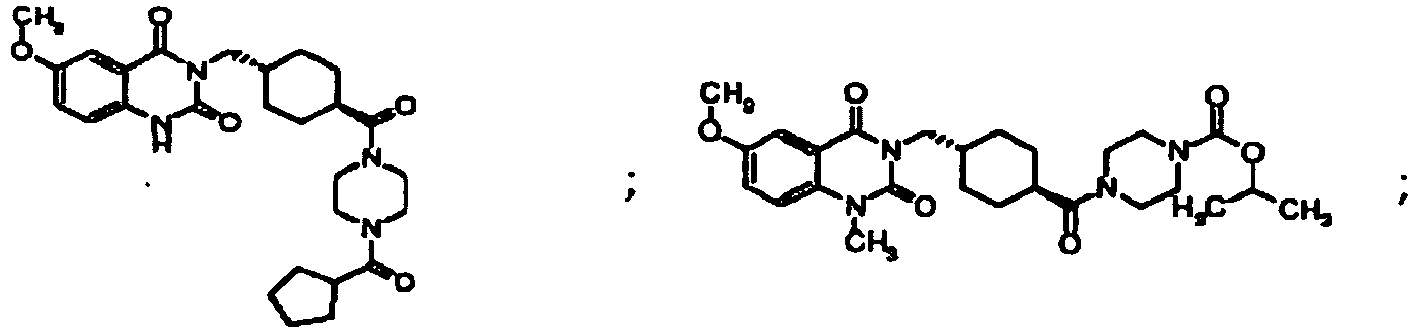




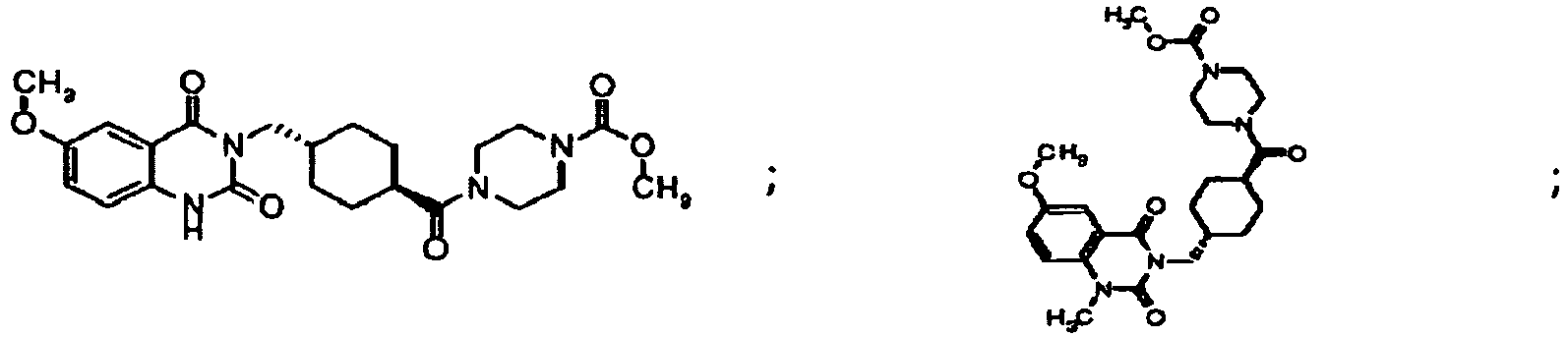





- When not commercially available, and depending on the exact nature of the compound, compounds of the invention may be obtained under general schemes 1-13, wherein R1, R2, R3, Y, T, Z, n and i are as defined in formula (I).
- Compounds of formula Ia, can be prepared according to Scheme 1 Method A.


- Anhydrides of the general structure 2 are either commercially available or can be synthesized from the appropriately substituted anilines 1 by reaction with either CDI (1,1-carbonyldiimidazole), triphosgene (Bis(trichloromethyl) carbonate) or ethyl chloroformate similarly to previously reported method (see for example N.A. Abood et al. Bioorg. Med. Chem. Lett., 7, 16, 2105-2108, 1997). Anhydrides 2 can be reacted with 4-aminomethyl-cyclohexanecarboxylic methyl ester in presence of a base to give compounds 5. 4-aminomethylcyclohexane carboxylic methyl ester can be synthesized from the corresponding acid in analogy to the reported methods (see for example
WO07064273 - Compounds 11 can also be obtained alkylating the intermediates 6 to give intermediates 9 which can then be hydrolyzed to the corresponding acids 10 and then coupled with an amine to give the compounds 11.
- Compounds of formula Ia can also be prepared according to method B reported in Scheme 2. In this method the N-protection of the 4-aminomethyl-cyclohexanecarboxylic acid 12 is followed by an amide coupling to obtain compounds 14 and deprotection to give amines of the general formula 15. Amines 15 can be reacted with isatoic anhydrides 2 to give the intermediate amides 16 which as described above can then be converted to compounds of the formula 17 by cyclisation with CDI and then eventually alkylated to give compounds of the formula 18.

- Compounds of formula Ib, can be prepared according to method C reported in Scheme 3.

- Acids of the general formulae 7 or 10 synthesised according to scheme 1 method A can be reacted with a mono protected diamine. Subsequent removal of the protecting group can then give compounds 19 or 21. Compounds of the general formula Ib can then be obtained by direct reaction of intermediates 19 or 21 with acyl chlorides or anhydrides in presence of a base or by reaction with acids in presence of standard coupling agents known to those skilled in the art. Alternatively the amine intermediates 19 or 21 may be functionalized by other methods know to those skilled in the art such as reductive amination, alkylation, Buchwald coupling, aromatic nucleophilic substitution or direct reaction with isocyanate. Compounds of the formula Ib where R2=H can eventually be alkylated using a suitable alkylating agent and strong base such as NaH to give compounds where R2 = alkyl.

- Compounds of formula Ic be prepared according to method D reported in Scheme 4.
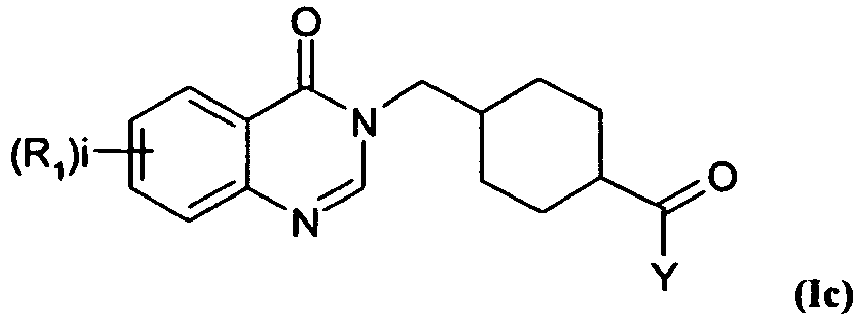
- Reaction of compounds of the general formula 5 with formic acid at high temperature gives compounds of the formula 23. Ester hydrolysis gives compounds 24 which can react with an amine in presence of an appropriate coupling agent to give compounds of the general fomula 25.
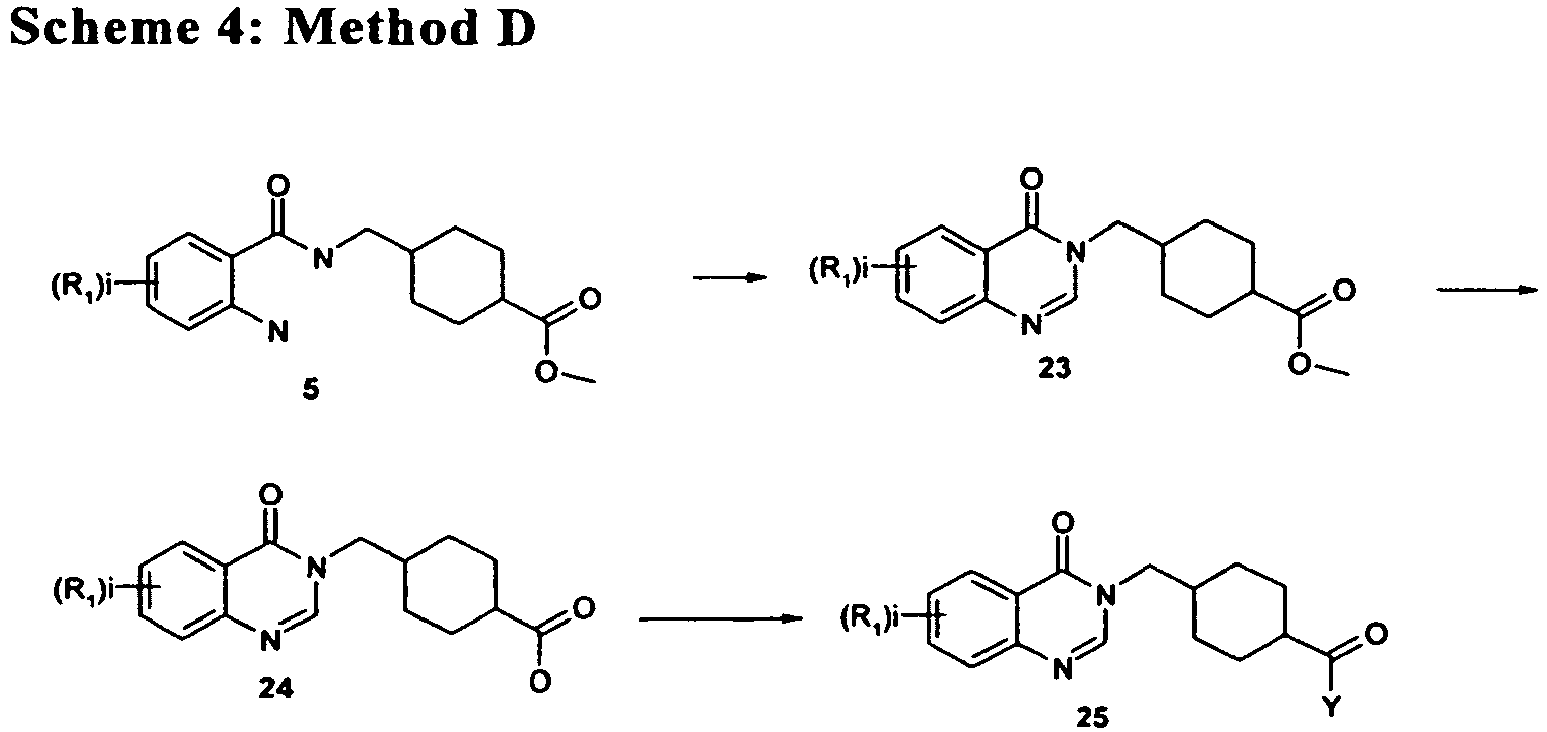
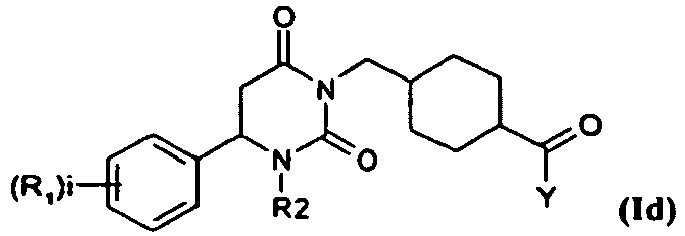
- Reaction of an appropriately substituted N-protected β-amino acid and compounds of the general formula 15 where Y is defined in formula I using standard coupling agents gives compounds of the formula 26, which can then be deprotected and reacted with CDI to give compounds of the formula 28. Compounds of the formula can be then be alkylated using standard methods to give compounds 29 where R2 = Alkyl

- Compounds of formula Ie can be prepared according to method F reported in Scheme 6.

- Reductive amination reaction between compound of the structure 15 with a properly substituted nitro aryl compound 30, gives compounds 31. Reduction of the nitro group using standard procedures gives anilines 32 which can be reacted with CDI to afford compounds of the general structure 33. Compounds 33 can be eventually alkylated to yield compounds of the structure 34.

- Compounds of formula If can be prepared according to method G reported in Scheme 7.

- Reaction of 4-aminomethyl-cyclohexanecarboxylic methyl ester with the appropriate nitro-fluoro-benzene or substituted chloro nitro pyridines gives compounds of the general formula 35 which can then be reduced to the dianilines 36 using standard reduction procedures. Substituted fluoro-nitro-benzenes or chloro-nitro-pyridines are commercially available or have been described in the literature or can be synthesised using standard procedures. Cyclization of 36 with CDI or triphosgene affords compounds of general formula 37. Compounds of this type 37 can then be hydrolysed to corresponding acid 38 and coupled with an amine to give compounds of the general formula 39. Compounds 40 can then be obtained by alkylation of the analogous compound of the formula 39.
- Alternatively compounds of the formula 40 can be obtained starting from compounds 37 which can be alkylated to give intermediates 41. Hydrolysis of the acid and then coupling with an amine gives compound 40.
- In addition compounds of the structure 40 can be obtained starting from the amines 15. The nitro compounds 43 can be reduced to the corresponding dianiline and then reacted with CDI or triphogene to give the imidazoles 44. Compounds where R2 = alkyl such as 40 can then be obtained by alkylation using a suitable alkylating agent and a strong base.

- Compounds of formula Ig can be prepared according to method H reported in Scheme 8.

- Reaction of homophthalic anhydrides 45 with 4-aminomethyl-cyclohexanecarboxylic methyl ester in acetic acid at reflux temperature gives compounds 46. Ester hydrolysis and amide coupling gives compounds of the general structure 48.

- Compounds of formula Ih can be prepared according to method I reported in Scheme 9.

- Reaction of compound 5 with bromoacetyl chloride and further cyclization in presence of a base gives intermediates of the formula 49, which can be alkylated and esterified in one pot to give intermediates such as 50. Direct coupling of acids 49 with an amine gives the compounds 53 where R2=H. Alternatively hydrolysis of the ester 50 and coupling with an amine affords compounds 52 where R2= alkyl

- Compounds of formula Ii can be prepared according to method L reported in Scheme 10.


- Reaction of substituted fluoronitrobenzene with 4-aminomethyl-cyclohexanecarboxylic methyl ester gives compound 54, which can be reduced under standard conditions. Compounds of the general structure 55 can then react with bromoacetyl chloride and then with a base to give 57, which can be alkylated and hydrolyzed (or directly hydrolyzed, R2=H). Acids 58 can react with amines in presence of coupling agents to give amides 59.
- Compounds of formula Il can be prepared according to method M reported in Scheme 11.


- Reaction of and acid of the general formula 60 with 4-aminomethyl-cyclohexanecarboxylic methyl ester gives 61, which can be reduced under standard conditions. Anilines 62 are cyclised with CDI or triphosgene to give compounds 63. These can be alkylated and hydrolyzed (or eventually directly hydrolyzed, R2=H) to give acid 64, which can react with amines in presence of a coupling agent affording amides 65.
- Compounds of formula Im can be prepared according to method N reported in Scheme 12.

- Reacting an acid of the generic formula 66 with morpholine gives an intermediate 67 that can be converted to the aldehydes 68 (see for example Stamos, I. K. et al. Tetrahedron Lett., 23, 4, 459, 1982). Reductive amination of the resultant aldehydes with 4-aminomethyl-cyclohexanecarboxylic methyl ester gives nitro amines 69, which can be reduced under standard conditions. Diamine 70 can then be cyclised in presence of CDI affording compound 71, which can be alkylated and then hydrolised (or eventually directly hydrolised, R2=H). Acids 72 reacts with amines in presence of a coupling agent to give amides 73.

- Compounds of formula In can be prepared according to method T reported in Scheme 13.

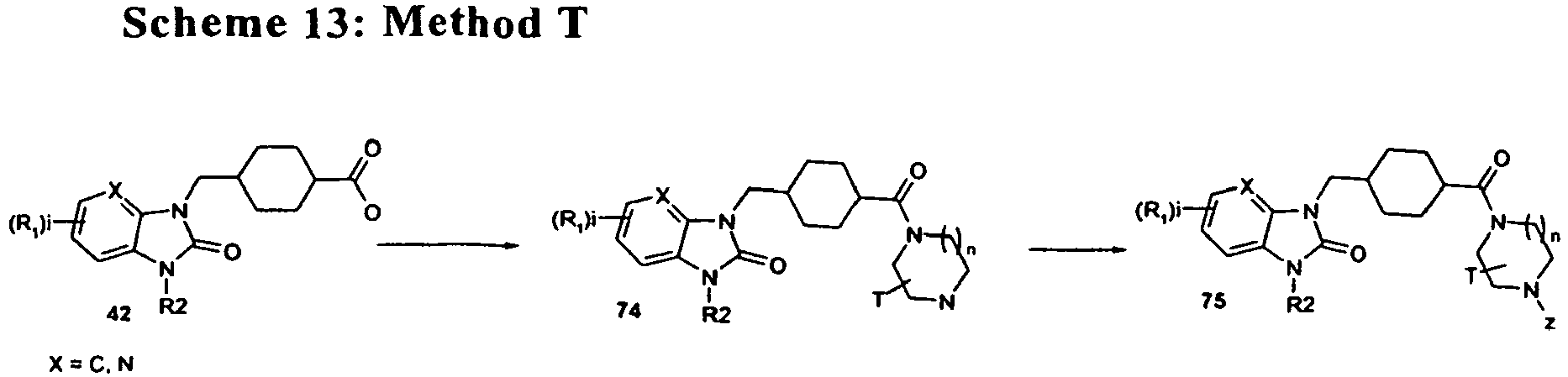
- Reaction of intermediate acid 42 (described in Method G) with a mono protected diamine and subsequent removal of the protecting group gives intermediate 74. Compounds 75 can then be obtained by reaction of 74 with acyl chlorides or acids in presence of standard coupling agents. known to those skilled in the art. Alternatively the amine intermediate 74 may be functionalized by other methods know to those skilled in the art such as reductive amination, alkylation, Buchwald coupling, aromatic nucleophilic substitution or direct reaction with isocyanate
- The pharmacological activity of the exemplary compounds of the invention was first demonstrated in vitro in a Wnt reporter assay.
- A Wnt-responsive Luciferase (TCF-Luciferase (Firefly) and a Wnt-independent (Renilla Luciferase (TA-Renilla) reporter plasmid (alone and in combination) were stably transfected in DBTRG-05MG glioblastoma cell line (ATCC) which according to the Wellcome Trust Sanger Institute Database showed no mutations involving APC, Axin and/or β-catenin genes and then considered to have an intact Wnt pathway cascade.
- TCF-Luciferase: Three copies of a 4x TCF responsive elements were cloned into the pcDNA3.1/Zeo(+) vector (Invitrogen) after deletion of the constitutive CMV promoter and the insertion of the Firefly Luciferase from Promega (phFL-TK) to measure the activity of the Wnt/β-catenin pathway. The resulting plasmid was sequenced for quality control.
- TA-Renilla: Both vectors (pCDNA3.1/Hygro(-) from Invitrogen) and phRL-TK were digested with restriction enzymes Mlu1 and BamH1 and ligated by T4-Ligase to form the final construct, containing the full length cDNA for hRL (human codons optimized Renilla Luciferase) with in 5' the TA-minimal promoter and the backbone of the mammalian expression vector pCDNA3.1/Hygro(-) in which the constitutive CMV promoter was ablated. The construct was fully sequenced for quality control and used as internal control for cell number and toxicity.
- Cells were grown in 20 µg/ml Zeocin and 20 µg/ml Zeocin plus 30 µg/ml Hygromicin respectively. The cells were plated at a density of 6500 cells/well in poly-D-lysine pre-treated 96 well-plates.
- IC50 determination: 36 hours after plating cells were incubated with 8-points (60 µM-40 µM-20 µM-10 µM-5 µM-1.66 µM-0.55 µM-0.185 µM) dilutions compound (0.6% DMSO (v/v)). Each compound was tested in triplicate in single plate. Luciferase detection was done with Dual-Luciferase Reporter Assay System (Promega). 24 hours after compound addition, media was removed and 30 µl of 1x lysis buffer was added to each well for 30 minutes. To each well 45 µl of Dual-Glo Luciferase reagent (Promega) were added and after 1 second delay Luciferase was detected for 1 second using Mithras LB940 instrument. After Firefly luciferase quantification 45 µl of Dual Stop & Glo reagent (Promega) were added to each well and Firefly Renilla was detected using the same parameters described before.
- Data were expressed as% of control for Firefly and Renilla luciferase independently; values were calculated using XLFit version 4.2, with a four parameters sigmoid function (XLFit model 205).
- A secondary screen using a luciferase biochemical assay enabled the identification of compounds acting directly on the enzyme (luciferase modulators and /or quenchers) rather than true inhibitors of the Wnt pathway.
- Luciferase assay: Quantilum recombinant Luciferase (Promega) was diluted 106-fold in 1X Cell Culture Lysis Reagent (Promega) containing 1 mg/ml acetylated BSA. Five microliters of compound dilution (10 µM final) was then mixed with 35 µl of diluted Quantilum recombinant Luciferase in a 96-well white plate. To each well 20 µl of LAR1 (Luciferase assay reagent from Promega) were added and luciferase was detected for 1 second with Mithras LB940 instrument. Each compound was tested in single data point on two different copy cell plates. Data were expressed as% of negative control (DMSO).
- The pharmacological activity of the compounds of the invention may be tested in vitro for growth inhibition against tumour cell lines. Such cell lines may, for example be representative of glioblastoma (such as DBTRG-05MG), or colorectal (for example DLD-1, HCT116) cancer. The different genetic background of the cancer cell will facilitate to understand to which level of the pathway the compounds work. If the cells harbour a truncated APC allele, the destruction complex activity is affected; if cells carry a gain of function mutation in the β-catenin gene, which prevents β-catenin protein degradation, this leads to constitutive activation of downstream genes. There are many assays available for testing the growth inhibition. Such assays include the so called soft agar assay (Freedman et al., Cell 3 (1974), 355-359 and Macpherson et al., Virology 23 (1964), pp. 291-294) whereby the growth inhibition does not depend from adhesion of the cells to the plastic material of the well where the assay takes place.
- DBTRG cells were seeded into a 24-well format in the presence of carrier alone or compound (0.6% DMSO (v/v)). Each well is composed of two agar layers: the bottom layer consists of 0.6% Agar while the top has 0.35% Agar plus cells and compound. Cells (2500 per well) were incubated with 7 points dilution compound the day of the plating and the colonies were scored 3 weeks later after o/n staining with MTT solution. Imaging and counting of the colonies was done with the GelCount™ instrument (Oxford Optronix, UK). For IC50 determination the data were expressed as% of control, values were calculated using XLFit version 4.2, with a four parameters sigmoid function (XLFit model 205).
- The pharmacological activity of the compounds of the invention may further be tested in vivo in animal models mimicking the disease. These animal models may include those where the cancerous cells are implanted subcutaneously or orthotopically.
- Compounds under formula I are formulated preferably in admixture with a pharmaceutically acceptable carrier, excipient or the like. In general, it is preferable to administer the pharmaceutical composition in orally-administrable form, but certain formulations may be administered via a parenteral, intravenous, intramuscular, transdermal, buccal, subcutaneous, suppository, nasal or other route.
- One of ordinary skill in the art may modify the formulations within the teachings of the specification to provide numerous formulations for a particular route of administration without rendering the compositions of the present invention unstable or compromising their therapeutic activity. In particular, the modification of the present compounds to render them more soluble in water or other vehicle, for example, may be easily accomplished by minor modifications (salt formulation, esterification, etc.) which are well within the ordinary skill in the art. It is also well within the routineer's skill to modify the route of administration and dosage regimen of a particular compound in order to manage the pharmacokinetics of the present compounds for maximum beneficial effect in patients.
- In certain pharmaceutical dosage forms, the pro-drug form of the compounds, especially including ester and ether derivatives, as well as various salt forms of the present compounds, are preferred. One of ordinary skill in the art will recognize how to readily modify the present compounds to pro-drug forms to facilitate delivery of active compounds to a targeted site within the host organism or patient. The routineer also will take advantage of favourable pharmacokinetic parameters of the pro-drug forms, where applicable, in delivering the present compounds to a targeted site within the host organism or patient to maximize the intended effect of the compound.
- Actual methods of preparing such dosage forms are known, or will be apparent, to those skilled in this art; for example, see Remington's Pharmaceutical Sciences, Mack Publishing Company, Easton, Pennsylvania, 15th Edition, 1975. The composition or formulation to be administered will, in any event, contain a quantity of the active compound in an amount effective to alleviate the symptoms of the subject being treated.
- While human dosage levels have yet to be optimized for the compounds of the invention, generally, a daily dose is from about 0.05 mg/kg to about 100 mg/kg of body weight. The amount of active compound administered will, of course, be dependent on the subject and disease state being treated, the severity of the affliction, the manner and schedule of administration and the judgment of the prescribing physician.
- For purposes of the present invention, a prophylactically or preventive effective amount of the compositions according to the present invention (i. e., an amount which substantially reduces the risk that a patient will either succumb to a disease state or condition or that the disease state or condition will worsen) falls within the same concentration range as set forth above for therapeutically effective amounts and is usually the same as a therapeutically effective amount.
- In some embodiments of the present invention, one or more compounds of formula (I) are administered in combination with one or more other pharmaceutically active agents. The phrase "in combination", as used herein, refers to agents that are simultaneously administered to a subject. It will be appreciated that two or more agents are considered to be administered "in combination" whenever a subject is simultaneously exposed to both (or more) of the agents. Each of the two or more agents may be administered according to a different schedule; it is not required that individual doses of different agents be administered at the same time, or in the same composition.
- Rather, so long as both (or more) agents remain in the subject's body, they are considered to be administered "in combination".
- All reagents and solvents were obtained commercially. Air and moisture sensitive liquid solutions were transferred via syringe. The course of reactions was followed by thin-layer chromatography (TLC) and/or liquid chromatography-mass spectrometry (HPLC-MS or UPLC-Ms). TLC analyses were performed on silica (Merck 60 F254) and spots revealed by UV visualisation at 254 nm and KMnO4 or ninhydrin stain. Purifications by column chromatography were performed using silica cartridges isolute flash Si or silica (Merck 60) or with flash purification instruments from Biotage. Compounds purities were above 90%.
- All nuclear magnetic resonance spectra were recorded using a Varian Mercury Plus 400 MHz spectrometer equipped with a PFG ATB Broadband probe or a Bruker Avance AV 600 System 600 MHz equipped with a BBO probe or Bruker Avance AV 400 System (400.13 MHz for 1H) equipped with BBI a probe
- Anaytical HPLC-MS were run using a Waters 2795 separation module equipped with a Waters Micromass ZQ (ES ionisation) and Waters PDA 2996, using a Gemini NH C18 3.0 µm 2.00 x 50 mm column. Temperature: 40°C. UV Detection at 215 nm and 254. ESI+ detection in the 80-1000 m/z range. Gradient: 0.1%formic acid/water and 0.1% formic acid/acetonitrile with gradient 95/5 to 5/95 flow 1.0ml/min over 10 minutes.
- Anaytical HPLC-MS were run using a Waters 2795 separation module equipped with a Waters Micromass ZQ (ES ionisation) and Waters PDA 2996, using a Gemini NH C18 3.0 µm 2.00 x 50 mm column. Temperature: 40°C. UV Detection at 215 nm and 254. ESI+ detection in the 80-1000 m/z range. Gradient: 0.1%formic acid/water and 0.1% formic acid/acetonitrile with gradient 95/5 to 5/95 flow 1.0ml/min over 5 minutes.
- Anaytical HPLC-MS were run using a Waters 2795 separation module equipped with a Waters Micromass ZQ (ES ionisation) and Waters PDA 2996, using a X-Bridge C18 3.5 µm 2.10 x 50 mm column. Temperature: 40°C.UV Detection at 215 nm and 254. ESI+ detection in the 80-1000 m/z range Gradient: 0.1% ammonia/water and acetonitrile with gradient 85715 to 95/5 flow 0.8 ml/min over 10 minutes.
- Anaytical HPLC-MS were run using a Waters 2795 separation module equipped with a Waters Micromass ZQ (ES ionisation) and Waters PDA 2996, using a X-Bridge C18 3.5 µm 2.10 x 50 mm column. Temperature: 40°C.UV Detection at 215 nm and 254. ESI+ detection in the 80-1000 m/z range Gradient: 0.1% ammonia/water and acetonitrile with gradient 85715 to 95/5 flow 0.8 ml/min over 5 minutes.
- Analytical UPLC -MS were run using a Acquity Waters UPLC with equipped with a Waters SQD (ES ionization) and Waters Acquity PDA detector, using a column BEH C18 1,7 µm, 2,1 x 5.00. Temperature: 40°C.UV Detection at 215 nm and 254. ESI+ detection in the 80-1000 m/z range Gradient 0.1%ammonia/water and acetonitrile with a gradient 85/15 to 5/95 flow: 0.8 ml/min over 3min.
- Analytical UPLC -MS were run using a Acquity Waters UPLC with equipped with a Waters SQD (ES ionization) and Waters Acquity PDA detector, using a column BEH C 18 1,7 µm, 2,1 x 5.00. Temperature: 40°C. UV Detection at 215 nm and 254. ESI+ detection in the 80-1000 m/z range. Gradient 0.1% formic acid/water and 0.1% formic acid/ CH3CN with a gradient 95/5 to 5/95 flow: 0.6 ml/min.
- Analytical HPLC-MS:were run using an Agilent 1100 equipped with a Bruker ion-trap Esquire 3000+ with ESI with a Supelco Discovery Column: 150 x 4.6, 5 µm. Partitioned after UV detector (50% to MS ESI).Temperature: 40°C. UV Detection at 215 nm with reference at 500 nm (40 nm bandwith). ESI+ detection in the 50-1000 m/z range with alternating MS/MS Gradient: Phase A: Milli-Q water containing 0.05% (v/v) TFA. Phase B: Acetonitrile (LC-MS grade) containing 0.05% TFA. Flow: 1 mL/min Gradient: from 20% B to 90% B in 15 min, washing at 100% B for 1 min, equilibration at 20% B in the next 4 min.
- Analytical HPLC-MS:were run using an Agilent 1100 equiped with a Bruker ion-trap Esquire 3000+ with ESI with a Supelco Discovery Column: 150 x 4.6, 5 µm. Partitioned after UV detector (50% to MS ESI).Temperature: 40°C. UV Detection at 215 nm with reference at 500 nm (40 nm bandwith). ESI+ detection in the 50-1000 m/z range with alternating MS/MS. Gradient: Phase A: Milli-Q water containing 0.05% (v/v) TFA. Phase B: Acetonitrile (LC-MS grade) containing 0.05% TFA. Flow: 1 mL/min, partitioned after UV detector (50% to MS ESI). Gradient: from 5% B to 50% B in 15 min, washing at 100% B for 1 min, equilibration at 5% B in the next 4 min.
- Preparative HPLC was run using a Waters 2767 system with a binary gradient Module Waters 2525 pump and coupled to a Waters Micromass ZQ25 (ES) or Waters 2487 DAD, using a Gemini NX C18 5 µm, 100 x 21.2. Gradient 0.1% formic acid/water and 0.1% formic acid/methanol flow: 40 ml/min.
- Preparative HPLC was run using a Waters 2767 system with a binary gradient Module Waters 2525 pump and coupled to a Waters Micromass ZQ 25 (ES) or Waters 2487 DAD, using a X-Bridge C18 5 µm 19 x 150. Gradient 0.1 % ammonia/water and methanol flow: 17 ml/min.
- Preparative HPLC was run using a Waters 2767 system with a binary gradient Module Waters 2525 pump and coupled to a Waters MS3100 SQ or Waters 2487 DAD, using a X-Bridge C18 5 µm 19 x 150. Gradient 0.1% formic acid/water and 0.1%formic acid/ methanol flow: 17 ml/min.
- Preparative HPLC was run using a Waters 2767 system and coupled to a Waters Micromass ZQ 25 (ES), using a X-Terra C18 5 µm 19 x 100. Gradient 0.1% ammonia/water and acetonitrile flow: 20 ml/min.
- Preparative HPLC was run using a Waters 2767 system and coupled to a Waters Micromass ZQ 25 (ES), using a X-Terra C18 5 µm 19 x 100 0.1% trifluoroacetic acid/water and 0.1% trifluoroacetic acid/ acetonitrile flow: 20 ml/min.
-

- To a solution of trans-4-Aminomethyl-cyclohexanecarboxylic acid methyl ester (21.7 g, 127 mmol) in CH3CN (500 mL), K2CO3 (35g, 254 mmol) and isatoic anhydride (20.7 g, 127 mmol) were added. The reaction was stirred at 70°C overnight. The mixture was concentrated under reduced pressure and the residue was washed with 200 mL of H2O and the solid obtained was filtered. The titled compound (31.1 g, quantitative yield) was obtained as a white solid.
C16H22N2O3 Mass (calculated) [290.37]; found [M+H+]= 291.4
Lc RT=1.83 (method b) -

- A solution of 2-nitrobenzoic acid (1.8 g, 10.7 mmol,) in SOCl2 (25 mL) was heated under reflux for 1h. After reaction completion, the solvent was removed under reduced pressure and the crude product was diluted with toluene and concentrated again to dryness. The crude product was diluted in Et2O (8mL) and added at 0°C to a mixure of trans-4-aminomethyl-cyclohexanecarboxylic acid methyl ester hydrogen chloride salt with H2O (5 mL), acetone (25 mL), Et2O (25 mL) and TEA (5 mL). The mixture was stirred for 30 minutes and finally the solvent was removed under reduced pressure. The crude was diluted in DCM (50 mL) and washed with a saturated solution of NaHCO3 (2x50mL) and then with NaOH 1M (1x50mL). The organic layer was dried over Na2SO4, and then the solvent removed under reduced pressure. Finally, the crude product was purified by flash chromatography on silica (1:1 ethyl acetate-petrolium ether) to obtain the titled compound (1.8 g, yield 52%).
C16H20N2O5 Mass (calculated) [320.14]; found [M+H]+=321
Lc RT=1.88 (method b)
1H-NMR(CDCl3): 1.04 (2H, q); 1.44 (2H, q); 1.66 (1H, m); 1.98 (2H, d); 2.08 (2H, d); 2.29 (1H, t); 3.37 (2H, t); 5.89 (1H, broad m); 7.52 (1H, d); 7.57 (1H, t); 7.70 (1H, t); 8.08 (1H, d). -

- A solution 0.01 M of trans-4-[(2-Nitro-benzoylamino)-methyl]-cyclohexanecarboxylic acid methyl ester (1.8g) in MeOH (550mL) with ~1% of glacial AcOH (5.5mL) was submitted to continuous flow rate hydrogenation by H-Cube (ThalesNano®) using a 10% Pd/C cartridge (small cartridge, full hydrogen mode, flowrate of 1mL/min). Finally, the solvent was removed under reduced pressure to obtain the titled compound as acetate salt (1.9 g, quantitative yield).
C16H22N2O3 Mass (calculated) [290.16]; found [M+H]+=291
Lc RT=1.07 (method b)
1H-NMR(CDCl3): 1.10 (2H, q); 1.47 (2H, q); 1.51 (1H, m); 1.89 (2H,d); 2.03 (2H, d); 2.27 (1H, t,); 3.28 (2H, t); 3.32 (3H, S); 6.21 (1H, broad m); 6.75 (1H, t); 6.78 (1H, d); 7.23 (1H, t); 7.26 (1H, d). -

- To a solution of 1,1-carbonyldiimidazole (17 g, 103.5 mmol) in THF (200mL), trans-4-[(2-Amino-benzoylamino)-methyl]-cyclohexanecarboxylic acid methyl ester (15 g, 51.72 mmmol) was added and the reaction was heated to reflux temperature for 16 hours. The mixture was allowed to cool down to room temperature and the solvent was removed under reduced pressure. The residue was washed with 100mL of H2O and the precipitate was filtered. The tiled compound (15.9 g, yield 97%) was obtained as a white solid.
C17H20N2O4 Mass (calculated) [316.36]; found [M+H+]=317
Lc RT=1.97 (method b) -

- To a solution of trans-4-(2,4-Dioxo-1,4-dihydro-2H-quinazolin-3-ylmethyl)-cyclohexanecarboxylic acid methyl ester (15 g, 51.7 mmol) in a mixture of THF (240 mL) and H2O (60mL), LiOH was added and the reaction was heated at 85°C for 16 hours. The mixture was allowed to cool down to room temperature and the solvent removed under reduced pressure. The residue was dissolved in 100mL of H2O and the solution acidified to pH 3. The precipitate formed was filtered and washed with 100 mL of CH3CN. The titled compound (11.9 g, 79%) was obtained as a white solid.
C16H18N2O4 Mass (calculated) [302.33]; found [M+H+]=303
Lc RT=1.65 (method b)
1H-NMR (d6-DMSO): 0.98 (2H, m); 1.95 (2H, m); 1.66 (5H, m); 1.85 (2H,m); 2.08 (1H, m); 3.74 (2H, d, J=7.0 Hz); 7.17 (2H, m); 7.63 (1H, m); 7.90 (1H, m). -

- To a solution of trans-4-(2,4-Dioxo-1,4-dihydro-2H-quinazolin-3-ylmethyl)-cyclohexanecarboxylic acid (100 mg, 0.33 mmol) in DMF(2 mL), diisopropylethylamine (58 µL, 0.33 mmol) and HATU (126 mg, 0.33mmol) were added. The mixture was left 6 hours stirring at room temperature and then 1-(2-pyrimidyl)piperazine was added. After 16 hours at room temperature the solvent was removed under reduced pressure; the residue was dissolved in 2 mL of DCM and washed with 2 mL of 0.4N Na2CO3 solution. The organic layer was separated, dried over Na2SO4 and the solvent removed under reduced pressure. The titled compound (58 mg, yield 39%) was purified by precipitation from methanol.
C24H28N6O3 Mass (calculated) [448.5]; found [M+H+]=449.4
Lc RT=2.85 (method a)
1H-NMR (d6-DMSO): 1.1 (2H, m); 1.27 (2H, m); 1.65 (4H, m); 1.72 (1H, m); 2.58 (1H, m); 3.51 (4H, m); 3.68 (4H, m); 3.77 (2H, d, J= 7.1 Hz); 6.63 (1H, t, J=4.7 Hz); 7.17 (2H, m); 7.63 (1H, m); 7.90 (1H, m); 8.36 (2H, d, J= 4.7 Hz); 11.41 (1H,s). -

- trans-4-(2,4-Dioxo-1,4-dihydro-2H-quinazolin-3-ylmethyl)-cyclohexane carboxylic acid methyl ester (1.5 g, 4.7 mmol) was dissolved in dry THF (20 ml) under nitrogen atmosphere. NaH (0.125 g, 5.2 mmol 60% in mineral oil) was added at 0°C. The reaction mixture was allowed to reach ambient temperature and then CH3I (324 µL, 5.2 mmol) was added. The reaction mixture was left stirring at room temperature for 24 hours, few drops of water were added and the solvent was removed under reduced pressure. The residue was suspended in water and 112 mg of NaOH were added. The mixture was heated at 100 °C for 30 minutes. The solution was allowed to reach room temperature and acidified to pH 3 with HCl 6N with the formation of a white precipitate which was isolated by filtration. (1.0 g, yield 66%)
C17H20N2O4 Mass (calculated) [316.3]; found [M+H+]=317.3
Lc RT=3.47 (method b) -

- trans-4-(1-trans-4-(1-methyl-2,4-dioxo-1,4-dihydro-2H-quinazolin-3-ylmethyl)-cyclohexanecarboxylic acid (65 mg, 0.2 mmol) was dissolved in 5 ml of DCM. HATU (80 mg, 0.2 mmol) was added and the mixture was stirred for half hour. Phenyl piperazine (35 mg, 0.2 mmol) was added and the mixture was stirred for the week-end. 2 ml of a 0.4 M solution of Na2CO3 were added and the mixture was shaken for 10 minutes. The organic solution was separated, the solvent was removed under reduced pressure and the crude purified by preparative HPLC (method a). The isolated compound was further purified by triturating with Et2O in order to remove some aliphatic impurities. 12 mg (yield 13%) of the titled compound were isolated.
C27H32N4O3 Mass (calculated) [460.6]; found [M+H+]=461.6
Lc RT=3.83 (method a)
1H-NMR(d6-DMSO): 1.07-1.16 (2H, s); 1.22-1.31 (4H, m); 1.62-1.67 (4H, m), 1.72-1.73 (1H, m), 2.55-2.61 (1H, m), 3.04-3.10 (4H, m), 3.50 (3H, s), 3.54-3.61 (4H, m), 3.81 (2H, d, J= 8.2 Hz), 6.78 (1H, t, J= 8 Hz), 6.92 (2H, d, J= 8.2 Hz), 7.18-7.22 (2H, m) 7.28 (1H, t, J=8 Hz), 7.43 (1H, d, J= 8 Hz), 7.74-7.78 (1H, m), 8.03 (1H, dd, J= 8 Hz, 2 Hz). -

- To a solution of trans-4-aminomethyl-cyclohexanecarboxylic (5.0 g, 31.8 mmol) in H2O (30 mL) and dioxane (30 mL) NaOH was added (2.5 g, 63.7 mmol). The mixture was cooled down to 0°C and di-tert-butyl dicarbonate (10.4 g, 48 mmol) was added. The reaction was allowed to warm up to room temperature. After 4 hours the reaction was completed and the solvent was removed under reduced pressure. The residue was diluted with 50 mL of H2O and acidified with 6N HCl to pH3. The precipitate formed was filtered and washed with cyclohexane. The titled compound (8.1 g, quantitative yield) was obtained as a white solid.
1H-NMR(d6-DMSO): 0.84 (2H, m); 1.22 (2H, m); 1.35 (9H, s); 1.67 (2H,m); 1.85 (2H, m); 2.07 (1H, m), 2.73 (2H, t, J=6.4 Hz); 6.78 (1H, m). -

- To a solution of tert-butyl-1-piperazinecarboxylate (5.0 g, 26.8 mmol) in DCM (100 mL) triethylamine (5.6 mL, 40.3 mmol) was added, the mixture was cooled down to 0°C and isobutyryl chloride (4.2 mL, 40.3 mmol) was added. The reaction was allowed to warm up to room temperature and after 3 hours the reaction was complete. The mixture was washed with 50 mL of 0.4M Na2CO3 solution and then with 50 mL of saturated NH4Cl solution. The organic phase was dried over Na2SO4, filtered and the solvent removed under reduced pressure, affording 7.0 g of 4-isobutyryl-piperazine-l-carboxylic acid tert-butyl ester. The product was dissolved in 100mL of DCM. H2SO4 (2.91 mL, 54.7 mmol) was added and the reaction left stirring for 16 hours. The precipitate formed was filtered affording 6.7 g of the titled compound (96%, yield)
1H-NMR(d6-DMSO): 0.97 (6H, d, J=6.72); 2.86 (1H, m,); 3.08 (4H, m); 3.65 (4H, m); 8.78 (2H, bs). -

- To a solution of trans-4-(tert-Butoxycarbonylamino-methyl)-cyclohexanecarboxylic acid (8.5 g, 32.8 mmol) in DCM (100 mL) 1,1-carbonyldiimidazole (4.87g, 30.1 mmol) was added and the reaction was left stirring for 2 hours. Then isobutyryl-piperazine (6.95 g, 27.3 mmol) was also added and the reaction was left stirring for 16h at room temperature. The mixture was diluted with 50 mL of H2O, the organic phase collected and the solvent removed under reduced pressure. The residue was washed with 1N NaOH solution and the precipitate was filtered, affording 8.7g (21.9 mmol) of [4-(4-Isobutyryl-piperazine-1-carbonyl)-cyclohexylmethyl]-carbamic acid tert-butyl ester. The product obtained was dissolved in 100 mL of DCM and H2SO4 (2.92 mL, 54.9 mmol) was added. The reaction was stirred for 18 hours and the mixture was washed with 50 mL of 15% NaOH solution, the organic phase was collected and concentrated under reduced pressure. 3.85g of the titled product were obtained (yield = 48%).
C16H29N3O2 Mass (calculated) [295.4]; found [M+H+]=296.9
Lc RT=1.10 (method b) -

- To a solution of 2-amino-5-methoxy-benzoic acid (1.2 g, 7 mmol) in anhydrous THF (50 mL) triethylamine (1.0 mL, 7 mmol) was added and the mixture was cooled down to 0°C. Then triphosgene (2.0 g, 7 mmol) was added portion wise and the reaction allowed to reach room temperature and left stirring for 18 hours. 1mL of H2O was carefully added to the mixture and the solvent was removed under reduced pressure. The residue was precipitated from H2O, affording 1.3 g of the titled compound (96% yield).
1H-NMR (d6-DMSO): 3.78 (3H, s); 7.09 (1H, d, J=8.9 Hz); 7.31 (1H, d, J=2.9 Hz); 7.35 (1H, dd, J1= 2.9 Hz, J2= 8.8 Hz); 11. 5 9 (1 H, s). -

- To a solution of 6-Methoxy-1H-benzo[d][1,3]oxazine-2,4-dione (96 mg, 0.5 mmol) in CH3CN (5 mL) K2CO3 (140mg, 1 mmol) and 1-[trans-4-(4-Aminomethyl-cyclohexanecarbonyl)-piperazin-1-yl]-2-methyl-propan-1-one (148 mg, 0.5 mmol) were added and the reaction was heated at 50°C for 16h. The solvent was removed under reduced pressure, 5 mL of 0.4M Na2CO3 solution were added and the mixture was stirred for 1h. Then 5 mL of DCM were added, the organic phase collected, dried over Na2SO4 and the solvent removed under reduced pressure. 156 mg of the titled product were obtained (yield = 68%).
C24H36N4O4 Mass (calculated) [444.6]; found [M+H+]=445.3
Lc RT=3.55 (method a) -

- A solution of 2-amino-N-[trans-4-(4-isobutyryl-piperazine-1-carbonyl)-cyclohexylmethyl]-5-methoxy-benzamide (156 mg, 0.35 mmol) and 1,1-carbonyldiimidazole (130mg, 0.8mmol) in THF (4 mL) was irradiated with microwave at 150°C (250W) for 20 minutes. The desired product precipitated from the reaction mixture and was filtered. 85 mg of the titled compound were obtained (yield 52%).
C25H34N4O5 Mass (calculated) [470.6]; found [M+H+]= 471.2
Lc RT=5.37 (method a)
1H-NMR(d6-DMSO): 0.97 (6H, d, J=6.6 Hz), 1.09 (2H, m), 1.24 (2H, m), 1.62 (4H, m), 1.72 (1H, m), 2.53 (1H, m), 2.83 (1H, sett, J= 6.6 Hz), 3.43 (8H, m), 3.76 (2H, d, J=6.72 Hz), 3.77 (3H, s), 7.11 (1H, d, J=8.84 Hz), 7.28 (1H, dd, J1=8.84 Hz), 7.33 (1H, d, J=2.96), 11.28 (1H, s). -

- To a solution of trans-4-(2,4-Dioxo-1,4-dihydro-2H-quinazolin-3-ylmethyl)-cyclohexanecarboxylic acid (1.5 g, 4.96 mmol) in dimethylacetamide (10 mL), HATU (1.88 g, 4.96 mmol) and triethylamine (0.76 mL, 5.45 mmol) were added and the mixture left stirring at room temperature for 1 hour. Then tert-butyl-1-piperazinecarboxylate (0.92 g, 4.96 mmol) was added and the reaction left stirring for 18h at room temperature. The solvent was removed under reduced pressure and the residue was washed with a 0.4M Na2CO3 solution. The titled compound was obtained as a white solid (2.3 g, quantitative yield).
C25H34N4O5 Mass (calculated) [470.6]; found [M+H+]=471.3
Lc RT=3.52 (method b) -

- To a solution of 4-[trans-4-(2,4-Dioxo-1,4-dihydro-2H-quinazolin-3-ylmethyl) cyclohexanecarbonyl]-piperazine-1-carboxylic acid tert-butyl ester (1.16 g, 2.5 mmol) in DCM (10 mL) H2SO4 (0.26 mL, 5 mmol) was added and the reaction was stirred at room temperature for 18 hours. The reaction mixture was washed with 10 mL of 0.4 M solution Na2CO3 and the organic phase was collected and concentrated under reduced pressure. 0.57 g of the titled compound were obtained (yield 63%).
C20H26N4O3 Mass (calculated) [370.5]; found [M+H+]=371.2
Lc RT=1.63 (method b) -

- To a suspension of tetrahydro-2-furoic acid (38 mg, 0.32 mmol) in DCM (3 mL) 1,1-carbonyldiimidazole (52 mg, 0.32 mmol) was added and the mixture was stirred for 6 hours at room temperature. Then 3-[trans-4-(piperazine-1-carbonyl)-cyclohexylmethyl]-1H-quinazoline-2,4-dione (100 mg, 0.27 mmol) was added and the reaction left stirring for 18 hours. The mixture was washed with 0.4 M Na2CO3 solution and the organic phase collected and concentrated under reduced pressure. The crude was purified by silica column eluting with DCM:MeOH (98:2). 70 mg of the titled compound were obtained (yield 55%).
C25H32N4O5 Mass (calculated) [468.6]; found [M+H+]= 469.3
Lc RT=4.65 (method a)
1H-NMR(d6-DMSO): 1.09 (2H, m), 1.24 (2H, m), 1.64 (7H, m), 1.97 (2H, m), 2.53 (1H, m), 3.43 (8H, m), 3.76 (2H, d, J=6.7 Hz), 3.74 (4H, m), 4.63 (1H, m), 7.16 (2H, m), 7.62 (1H, m), 7.90 (1H, m), 11.3 8 (1H, s). -

- trans-4-(1-Methyl-2,4-dioxo-1,4-dihydro-2H-quinazolin-3-ylmethyl)-cyclohexanecarboxylic acid (1.0 g, 3,2 mmol), DIPEA (560 µL, 3.2 mmol), HATU (1.2 g, 0.32 mmol) were dissolved in 20 ml of DMF. The mixture was stirred at room temperature for 2 hours and then 14 ml of the solution were transferred in a different flask. To this solution Boc-piperazine (411 mg, 2.2 mmol) was added and the mixture was stirred at room temperature for 18 hours. The solvent was removed under reduced pressure and the residue dissolved in DCM and washed with 0.4 M solution of Na2CO3. The organic phase was separated and the solvent removed under reduced pressure to give 900 mg of crude boc protected intermediate. The compound was dissolved in 10 ml of DCM, 255 µL of H2SO4 were added and the mixture was left stirring at room temperature for 18 hours. The solution was washed with a solution of NaOH (10% W/W), the organic phase was separated and concentrated under reduced pressure to give 570 mg (yield 80%) of the titled compound.
C21H28N4O3 Mass (calculated) [384.5]; found [M+H+]= 385.3
Lc RT=1.82 (method b) -

- 100 mg (0.26 mmol) of 1-Methyl-3-[trans-4-(piperazine-1-carbonyl)-cyclohexylmethyl]-1H-quinazoline-2,4-dione was dissolved in DCM (3 ml). 75 µL (0.52 mmol) of Et3N and then 41 µL (0.39 mmol) of butyryl chloride were added and the mixture was stirred at room temperature overnight. The solution was washed with a 0.4 M solution of Na2CO3, the organic phase was separated and dried over Na2SO4. The solvent was removed under reduced pressure and the crude material purified by column chromatography using acetone as eluent. In total 28 mg (yield 24%) of the titled compound were isolated.
C25H34N4O4 Mass (calculated) [454.6]; found [M+H+]= 455.2
Lc RT=5.5 (method a)
1H-NMR(d6-DMSO): 0.86 (3H, t, J = 7 Hz), 1.05-1.14 (2H, m), 1.20-1.29 (2h, m), 1.46-1.51 (2H, m), 1.62-1.64 (4H, m), 1.72 (1H, m), 2.26 (1H, m), 2.54 (1H, m), 3.31-3.48 (8H, m), 3.81 (2H, d, 7 Hz), 7.28 (1H, t, J= 7 Hz), 7.42 (1H, d, J= 8 Hz), 7.75 (1H, m), 8.02 (1H, m). -

- To a solution of 3-Amino-3-phenyl-propionic acid (1.0 g, 6.06 mmol) in dioxane (10 mL) and H2O (10 mL), NaOH (0.48 g, 12.12 mmol) and di-tert-butyl dicarbonate (1.98g, 9.09 mmol) were added and the reaction was vigorously stirred for 18 at room temperature. The solvents were removed under reduced pressure, the residue was dissolved in 20 mL of H2O and the product precipitated adding 6N HCl solution up to pH 3. The solid was filtered and washed with cyclohexane. The titled compound was obtained as a white solid (1.54 g, 95%)
C14H19NO4 Mass (calculated) [265.3]; found [M+H+]= 266.0
Lc RT=3.07 (method b) -

- To a solution of 3-tert-Butoxycarbonylamino-3-phenyl-propionic acid (0.43g, 1.63 mmol) in DCM (20 mL), 1,1-carbonyldiimidazole (0.24 g, 1.48 mmol) was added and the reaction was stirred for 2 hours at room temperature. Then 1-[trans-4-(4-Aminomethyl-cyclohexanecarbonyl)-piperazin-1-yl]-2-methyl-propan-1-one (0.40 g, 1.36 mmol) was added and the mixture was left for 18 hours at room temperature. The mixture was diluted with 10 mL of 0.4 M Na2CO3, the organic phase was collected and the solvent removed under reduced pressure. The residue was washed with 20 mL solution of NH4Cl and the precipitate filtered. The titled compound was isolated as a white solid (0.65 g, 88% yield).
C30H46N4O5 Mass (calculated) [542.7]; found [M+H+]= 543.4
Lc RT=3.37 (method b) -

- To a solution of (2-{[trans-4-(4-Isobutyryl-piperazine-1-carbonyl)-cyclohexylmethyl]-carbamoyl}-1-phenyl-ethyl)-carbamic acid tert-butyl ester (0.65 g, 1.21 mmol) in DCM (20 mL), H2SO4 (0.16 mL, 3.02 mmol) was added and the reaction was left stirring at room temperature for 18 hours. The mixture was diluted with 20 mL of NaOH 2N solution and the aqueous phase was concentrated under reduced pressure to give a white solid. The titled compound was extracted with EtOH. The solvent was removed under reduced pressure affording 0.13 g of the titled compound (24% yield).
C25H38N4O3 Mass (calculated) [442.6]; found [M+H+]= 443.3
Lc RT=1.87 (method b) -

- A solution of 3-amino-N-[trans-4-(4-isobutyryl-piperazine-1-carbonyl)-cyclohexylmethyl]-3-phenyl-propionamide (0.13 g, 0.29 mmol) and 1,1-carbonyldiimidazole (0.10g, 0.58 mmol) in CH3CN was irradiated with microwave at 100°C (250 watt) for 10 minutes. The solvent was removed under reduced pressure and the residue was washed with H2O and then with diethylether, affording 31 mg of the titled compound (22% yield).
C26H36N4O4 Mass (calculated) [468.6]; found [M+H+]= 469.3
Lc RT=4.93 (methd a)
1H-NMR(d6-DMSO):1.00 (2H, m), 1.07 (6H, d, J=6.8 Hz), 1.46 (2H, m), 1.68 (4H, m), 2.34 (1H, m), 2.68-2.94 (3H, m), 3.41 (4H, m), 3.55 (4H, m), 3.63 (2H, m), 4.62 (1H, m), 5.37 (1H, s), 7.24-7.37 (5H, m). -

- A solution of 2-nitrobenzaldehyde (214 mg, 1.42 mmol) and (4-aminomethyl-cyclohexyl)-(trans-4-cyclopropanecarbonyl-piperazin-1-yl)-methanone (500 mg, 1.71 mmol) in DCM (10 mL) was stirred at room temperature for 6 hours. NaBH(OAc)3 (900 mg, 4.27 mmol) was added and the reaction was stirred for 18 hours. The mixture was washed with 10 mL of H2O and the organic phase recovered and concentrated under reduced pressure to give 272 mg of the titled compound (yield 45%).
C23H32N4O4 Mass (calculated) [428.5]; found [M+H+]= 429.3
Lc RT=1.68 (methd b) -

- (4-Cyclopropanecarbonyl-piperazin-1-yl)-{trans-4-[(2-nitro-benzylamino)-methyl]-cyclohexyl} methanone (272 mg, 0.63 mmol) and Pd(OAc)2 (7 mg, 0.03 mmol) were weighed into a flask and flushed with nitrogen for 5 minutes. THF (10 mL) was added, followed by a solution of KF (73 mg, 1.26 mmol in 1.2 ml of H2O). Then triethylsilane (0.40 mL, 2.52 mmol) was added drop wise and the reaction was left stirring for 3h at room temperature. The mixture was filtered on a celite bed to remove palladium and the solution was concentrated under reduced pressure. The residue was suspended in DCM (4 mL) and washed with H2O (4 mL). The organic phase was collected and concentrated, the crude product was purified by SiO2 column, eluting with AcOEt:MeOH 80:20, affording 146 mg of the titled compoundt (57% yield).
C23H34N4O2 Mass (calculated) [398.5]; found [M+H+]= 399.2
Lc RT=1.70 (methd b) -

- A solution of {4-[(2-Amino-benzylamino)-methyl]-cyclohexyl}-(trans-4-cyclopropanecarbonyl-piperazin-1-yl)-methanone (146 mg, 0.37 mmol) and 1,1-carbonyldiimidazole (120mg, 0.74 mmol) in CH3CN (5 mL) was irradiated with microwave for 10 minutes at 100°C (200 watt). When the reaction was allowed to cool down to room temperature the product precipitated from the mixture. The solid was filtered and washed with 2mL of H2O, obtaining 51 mg of the titled compound (33% yield).
C24H32N4O3 Mass (calculated) [424.6]; found [M+H+]= 425.3
Lc RT= 4.98 (10 min method)
1H-NMR(d6-DMSO): 0.70 (4H, m), 1.02 (2H, m), 1.31 (2H, m) 1.66 (5H, m), 1.94 (1H, m), 2.54 (1H, m), 3.15 (2H, d, J= 7.64 Hz), 3.34-3.73 (8H, m), 4.37 (2H, s), 6.74 (1H, m), 6.83 (1H, m), 7.08 (2H, m), 9.08 (1H, s). -

- K2CO3 (9.04 g, 65.5 mmol) was added to a solution of 2-Fluoro-4-methoxy-1-nitro-benzene (5.6 g, 32.7 mmol) in DMF (20 ml). The mixture was stirred at room temperature for 30 minutes and then trans-4-Aminomethyl-cyclohexanecarboxylic acid methyl ester (5.60 g, 32.7 mmol) was added. The reaction mixture was heated for 2 hours at 50°C and then at room temperature overnight. The solvent was removed under reduced pressure and the crude product dissolved in DCM (150 ml) and washed with water (2 X 150 ml) and then with a solution of citric acid (2X150 ml). The organic solution was dried over Na2SO4, filtered and the solvent removed by evaporation to give 9.6 g of the titled compound.
C16H22N2O5 Mass (calculated) [322.4]; found [M+H+]= 322.3
Lc RT= 1.72 (method e) -

- trans-4-[(5-Methoxy-2-nitro-phenylamino)-methyl] cyclohexane carboxylic acid methyl ester (800 mg, 2.48 mmol) was dissolved in 10 ml of EtAc mixed with 80 mg of Pd/C (10%, wet) and transferred in a Eyela reactor. The mixture was left overnight under 5 bar of hydrogen, then the solution was filtered through cellulose and the solvent removed under reduced pressure to give the titled compound as a brown solid. (700 mg, yield = 96%)
C16H24N2O3 Mass (calculated) [292.4]; found [M+H+]= 293.4
Lc RT= 1.08 (method e) -

- trans-4-[(2-Amino-5-methoxy-phenylamino)-methyl]-cyclohexane carboxylic acid methyl ester (5.4 g, 18.5 mmol) was dissolved in 40 ml of anhydrous THF. 1,1-carbonyldilmidazole (8.9 g, 55.5 mmol) was added and the mixture was stirred for 22 hours. Few drops of water were added and the solvent was removed under reduced pressure and the crude was dissolved in DCM (100 ml) and washed with H2O, a citric acid solution (2x70 ml) and H2O. The organic phase was separated, dried over Na2SO4, filtered and the solvent was removed under reduced pressure. The crude material was filtered through a silica pad using EtAc/cyclohexane and then EtAc as eluent. The solvent was evaporated and the crude was purified by silica column using EtAc/hexane as eluent. In total 3.2 g of the titled compound were obtained (yield= 54%)
C17H22N2O4 Mass (calculated) [318.4]; found [M+H+]= 319.3
Lc RT= 1.24 (method e) -

- A solution of LiOH (24 mg, 2.4 mmol) in water (1 ml) was added to a solution of trans-4-(6-methoxy-2-oxo-2,3-dihydro-benzoimidazol-1-ylmethyl)-cyclohexanecarboxylic acid (260 mg, 0.8 mmol) in THF(2 ml). The mixture was stirred at room temperature for six hours and then 5 ml of H2O were added. The THF was evaporated under reduced pressure. The pH was adjusted to 4 using HCl 6M with the formation of a precipitate which was then isolated by filtration and washed with DCM. In total 230 mg (yield 92%) of the title compound were isolated
C16H20N2O4 Mass (calculated) [304.3]; found [M-H+]= 303.3
Lc RT= 0.16 (method e)
1HNMR (CD3OD): 1.14 (2H, m), 1.36 (2H, m), 1.76 (2H, m), 1.85 (1H, m), 1.99 (2H, m), 2.24 (1H, m), 3.70 (2H, d, J=7.3), 3.80 (3H, s), 6.65 (1H, dd, J=8.5, j=2.4), 6.73 (1H, d, J=2.3), 6.95 (1H, d, J=8.5). -

- A mixture of 6-Methoxy-1-[trans-4-(morpholine-4-carbonyl)-cyclohexylmethyl]-1,3-dihydro-benzoimidazol-2-one (100 mg, 0.33 mmol), triethyl amine (55 µL, 0.39 mmol), HATU (150 mg, 0.39 mmol) and morpholine (34 µL, 0.39 mmol) in DCM 2 ml was stirred for 4 hours. The solution was washed with saturated Na2CO3 solution (2 ml) and then with H2O (2 ml). The organic layer was separated and the solvent removed under reduced pressure. The crude material was purified by column chromatography using EtAc/MeOH (95:5) as eluent. Further purification by trituration with MeOH gave the title compound. (101 mg, yield 82%).
C20H27N3O4 Mass (calculated) [373.5]; found [M+H+]= 374.3
Lc RT= 0.88 (method e)
1HNMR (CDCl3): 1.15 (2H, m), 1.55 (2H, m), 1.75-1.87 (4H, m), 1.93 (1H, m), 2.41 (1H, m), 3.48 (2H, m), 3.60 (2H, m), 3.64-3.67 (4H, m), 3.70 (2H, d, J=7.2), 3.82 (3H, s), 6.56 (1H, d, J=2.4), 6.63 (1H, dd, J=8.5, j=2.4), 6.96 (1H, d, J=8.5), 8.76 (1H, bs). -

- NaH (60% in mineral oil, 12 mg, 0.3 mmol) was added to a solution of 6-Methoxy-1-[trans-4-(morpholine-4-carbonyl)-cyclohexylmethyl]-1,3-dihydro-benzoimidazol-2-one (56 mg, 0.15 mmol) in DMF (1.5 ml). MeI (19 µL, 0.3 mmol) was added and the mixture was stirred at room temperature for six hours. The solvent was evaporated, the crude was dissolved in 2 ml of DCM and the solution was washed with H2O. The organic layer was separated and the solvent was removed under reduced pressure. The crude material was purified by column chromatography with EtAc/ MeOH (9/1) as eluent. 45 mg (yield 78%) of the title compound were isolated.
C21H29N3O4 Mass (calculated) [387.5]; found [M+H+]= 388.5
Lc RT= 1.13 (method e)
1HNMR (CDCl3): 1.05 (2H, m), 1.44 (2H, m), 1.62-1.76 (4H, m), 1.82 (1H, m), 2.31 (1H, m), 3.30 (3H, s), 3.39 (2H, m), 3.51 (2H, m), 3.55-3.57 (4H, m), 3.61 (2H, d, J=7.1), 3.74 (3H, s), 6.48 (1H, d, J=2.3), 6.56 (1H, dd, J=8.5, J=2.3 Hz), 6.77 (1 H, d, J=8.5 Hz). -

- K2CO3 (1.6 g, 11.7 mmol), 2-Fluoro-1-nitro-4-trifluoromethyl-benzene (1.22 g, 5.8 mmol) and trans-4-Aminomethyl-cyclohexanecarboxylic acid methyl ester (1.00 g, 5.84 mmol) were dissolved in DMF (10 ml). The mixture was stirred at 50 °C overnight. The solvent was removed under reduced pressure and the crude product dissolved in DCM (15 ml) and washed with water (20 ml) and then with a solution of citric acid (1M, 5ml). The organic solution was dried over Na2SO4, filtered and the solvent removed by evaporation to give solid material. This was washed with cyclohexane and then with isopropyl ether and purified by silica column using DCM/cyclo hexane (1:1) as eluent. 1.8 g (yield 86%) of the title compound were isolated.
C16H19F3N2O4 Mass (calculated) [360.34]; found [M+H+]= 361.4
Lc RT= 1.13 (method e)
1HNMR (CDCl3): 1.12 (2H, m), 1.50 (2H, m), 1.71 (1H, m), 1.98 (2H, m), 2.08 (2H, m), 2.29 (1H, m), 3.20 (2H, dd, J=6.6 Hz, J=5.4 Hz), 3.68 (3H, s), 6.84 (1H, d, J=8.9 Hz), 7.07 (1H, s), 8.16 (1, bs), 8.27 (1H, d, J=8.9 Hz). -

- trans 4-[(2-Nitro-5-trifluoromethyl-phenylamino)-methyl]-cyclohexane carboxylic acid methyl ester (1.8 g, 5.0 mmol) was dissolved in 35 ml of a mixture 4:1 of dioxane and 25% ammonium hydroxide. Na2S2O4 (2.6 g, 15.0 mmol) was added and the mixture was stirred at 50 °C for 4 hours. The solvent was evaporated and the crude dissolved in 20 ml MeOH. 4 ml of concentrated (37%) HCl and 10 ml of water were added and the mixture was stirred at 50 °C for three hours and then at room temperature overnight. The MeOH was evaporated under reduced pressure and 20 ml of DCM and 5 ml of a saturated solution of Na2CO3 were added. The organic phase was separated and the solvent removed. The crude material was dissolved in THF (40 ml) and 1,1-carbonyldiimidazole (1.62 g, 10 mmol) was added. The mixture was stirred at room temperature overnight. The solvent was evaporated and the crude dissolved in DCM (20 ml). The organic solution was washed with 10 ml of 1M HCl and the solvent removed under reduced pressure. The titled compound was purified by silica column using ethyl acetate cyclohexane 1:1 as eluent. 0.87 g (yield 49%) of the titled compound were isolated.
C17H19F3N2O3 Mass (calculated) [356.35]; found [M+H+]= 357.2 Lc RT= 1.48 (method e)
1HNMR (CDCl3): 1.08 (2H, m), 1.35 (2H, m), 1.77 (2H, m), 1.83 (1H, m), 1.96 (2H, m), 2.21 (1H, m), 3.59 (3H, s), 3.70 (2H, d, J=7.3), 7.10-7.12 (2H, m), 7.31 (1H, d, J=7.4), 9.67 (1H, bs). -

- trans-4-(2-Oxo-6-trifluoromethyl-2,3-dihydro-benzoimidazol-1-ylmethyl)-cyclohexanecarboxylic acid methyl ester (0.87 mg, 2.44 mmol) was dissolved in anhydrous DMF. NaH (1.95 g, 4.9 mmol, 60% in mineral oil) and MeI (0.30 ml, 4.9 mmol) were added and the mixture was stirred at room temperature for two days. H2O was added and the solvents were evaporated. The crude was dissolved in DCM (15 ml) and washed with H2O (10 ml). The organic layer was dried over Na2SO4, filtered and the solvent removed to give 0.93 g (yield quantitative) of the titled compound.
C18H21F3N2O3 Mass (calculated) [370.37]; found [M-H+]= 369.3
Lc RT= 1.58 (method e)
1HNMR (CDCl3): 1.12 (2H, m), 1.39 (2H, m), 1.80 (2H, m), 1.86 (1H, m), 2.00 (2H, m), 2.26 (1H, m), 3.44 (3H, s), 3.64 (3H, s), 3.73 (2H, d, J=7.3 Hz), 7.02 (1H, d, J=8.2 Hz), 7.16 (1H, s), 7.3 8 (1H, d, J=8.2 Hz). -

- trans-4-(3-Methyl-2-oxo-6-trifluoromethyl-2,3-dihydro-benzoimidazol-1-ylmethyl) cyclohexanecarboxylic acid methyl ester (0.93 g, 2.44 mmol) were dissolved in THF/H2O (9ml, 2/1). LiOH (129 mg, 5.4 mmol) was added and the mixture stirred at room temperature over night. The THF was evaporated with the formation of a white solid which was collected by filtration. 0.82 g (yield 94%) of the titled compound were isolated.
C17H19F3N2O3 Mass (calculated) [356.35]; found [M-H+]= 355.2 -

- trans-4-(3-Methyl-2-oxo-6-trifluoromethyl-2,3-dihydro-benzoimidazol-1-ylmethyl) cyclohexanecarboxylic acid (78 mg, 0.22 mmol), HATU (100 mg, 0.26 mmol), morpholine (23 mg, 0.26 mmol) and triethyl amine (0.04 ml, 0.26 mmol) were dissolved in DMSO and the mixture were shaken overnight. 3 ml of a saturated solution of ammonium chloride and 2 ml of DCM were added and the organic layer was separated and washed with water. The organic solvent was evaporated and the crude was purified by silica column using ethyl acetate as eluent. 25 mg (yield 27%) of the titled compound were isolated.
C21H26F3N3O3 Mass (calculated) [425.45]; found [M+H+]= 426.4
Lc RT= 1.36 (method f)
1HNMR (CDCl3): 1.14 (2H, m), 1.56 (2H, m), 1.76-1.84 (4H, m), 1.92 (1H, m), 2.42 (1H, m), 3.45 (3H, s), 3.48 (2H, m), 3.59 (2H, m), 3.64-3.66 (4H, m), 3.76 (2H, d, J=7.2 Hz), 7.03 (1H, d, J=8.2 Hz), 7.17 (1H, s), 7.39 (1H, d, J=8.2Hz) -

- To a solution of (trans-4-aminomethyl-cyclohexyl)-(4-cyclopropanecarbonyl-piperazin-1-yl)-methanone (600 mg, 2.1 mmol) in DMF (5mL) K2CO3 (565 mg, 4.1 mmol) and 4-chloro-2-fluoronitrobenzene (360mg, 2.1 mmol) were added and the mixture was heated at 90°C for 4 hours. Then the solvent was removed under reduced pressure and the residue was washed with 7 mL of H2O and the precipitate was filtered affording 788 mg of the titled compound (78% yield).
C22H29ClN4O4 Mass (calculated) [448]; found [M+H+]= 449
Lc RT= 3.75 (method b) -

- {4-[trans-(5-Chloro-2-nitro-phenylamino)-methyl]-cyclohexyl}-(4-cyclopropane carbonyl-piperazin-1-yl)-methanone (500mg, 1.11 mmol) was dissolved in a mixture of ethyl acetate (45mL) and methanol (5mL) and reduced in continuous flow with H-Cube using a Ni-Raney cartridge (Flow: 1mL/minute; Temperature: 40°C; H2 pressure: full H2). After one cycle the reduction was complete and solvent removal from the reaction mixture to give 448mg of the titled compound (96% yield).
C22H31ClN4O2 Mass (calculated) [418]; found [M+H+]= 419
Lc RT= 3.03 (5 min method). -

- A solution of {trans-4-[(2-Amino-5-chloro-phenylamino)-methyl]-cyclohexyl}-(4-cyclopropane carbonyl-piperazin-1-yl)-methanone (448 mg, 1.07 mmol), triethylamine (0.45mL, 3.22 mmol) in DCM (10 mL) was cooled at 0°C. Triphosgene (104mg, 0.35 mmol) was added and the reaction was allowed to warm up to room temperature and left stirring for 18 hours. The reaction was diluted with 0.4 M Na2CO3 solution, the organic phase collected and the solvent removed under reduced pressure. The crude product was purified by SiO2 column eluting with ethylacectate-methanol (9:1), affording 230 mg of the pure product (49% yield).
C23H29ClN4O3 Mass (calculated) [444.97]; found [M+H+]= 445.2
Lc RT= 5.53 (10 min method)
1H-NMR(CDCl3): 0.74 (2H,m), 0.94 (2H, m), 1.09 (2H, m), 1.52 (2H, m) 1.65 (1H, m), 1.73 (4H, m) 1.86 (1H, m) 1.94 (1H, m), 2.39 (1H, m), 3.43 (2H,m), 3.59 (6H, m), 3.62 (2H, d, J=7.16 Hz), 6.89 (1H, d, J=1.92 Hz), 6.89 (1H, d, J=8.28 Hz), 6.97 (1H, dd, J1=1.92 Hz, J2= 8.28 Hz), 8.21 (1H, s). -

- To solution of trans-4-Aminomethyl-cyclohexanecarboxylic acid methyl ester (3.0g, 17.5 mmol) in 50 mL of CH3COOH homophthalic anhydride (2.8g, 17.5 mmol) was added and the mixture was stirred at 100°C for 18 hours. The reaction was allowed to cool down to room temperature and 100 mL of H2O were added. The precipitate formed was filtered, washed with H2O and dried under reduced pressure, affording 2.2 g of the titled compound (40% yield)
C18H21NO4 Mass (calculated) [315.4]; found [M+H+]= 316.3
Lc RT= 3.48 (method b) -

- trans-4-(1,3-Dioxo-3,4-dihydro-1H-isoquinolin-2-ylmethyl)-cyclo hexanecarboxylic acid methyl ester (2.2 g, 6.98 mmol) was dissolved in 20 mL of methanol, 5 mL of 15% NaOH solution were added and the mixture heated at 40°C for 4 hours. The reaction was allowed to cool down to room temperature and the mixture neutralized with 2N HCl solution and extracted with DCM. The organic phase was dried over Na2SO4 and the solvent removed under reduced pressure. The residue was crystallized from a mixture of acetone-H2O (1:1), affording 700mg of the desired product (33% yield).
C17H19NO4 Mass (calculated) [301.4]; found [M-H+]= 300.5
Lc RT= 3.17 (method b) -

- trans-4-(1,3-Dioxo-3,4-dihydro-1H-isoquinolin-2-ylmethyl)-cyclo hexanecarboxylic acid (100 mg, 0.33 mmol) was dissolved in N,N-dimethyl acetamide (3mL), HATU (125 mg, 0.33 mmol) and diisopropyl ethylamine (0.06mL, 0.33 mmol) were added and the mixture was left stirring for 1h. Then 1-acetylpiperazine (128 mg, 0.3 mmol) was added and the reaction stirred for 18 hours. The solvent was removed under reduced pressure and the residue was dissolved in 2mL of DCM and and washed with 2mL of 0.4M Na2CO3 solution. The organic phase was collected and the solvent removed under reduced pressure. The crude was purified by SiO2 column, eluting with DCM-MeOH (97:3) and the fractions containing the desired product collected and further purified by prep HPLC. 42 mg of the title product were obtained (31% yield).
C23H29N3O4 Mass (calculated) [411.5]; found [M+H+]= 412.4
Lc RT= 4.78 (method a)
1H-NMR(CDCl3): 1.06 (2H,m), 1.23 (2H, m), 1.63 (5H, m), 2.88 (3H, s) 2.53 (1H, m), 3.29 (8H, m), 3.73 (2H, d, J=6.72 Hz), 4.15 (2H, s), 7.37 (1H, m), 7.45 (1H, m), 7.64 (1H, m), 8.03 (1H, m). -

- A solution of chloroacetyl chloride (470µL) in dry DCM (6mL) was added dropwise to a stirred solution of trans-4-[(2-Amino-benzoylamino)-methyl]-cyclohexanecarboxylic acid methyl ester acetate (3 mmol, 0.850 g) and TEA (9 mmol, 1.2mL) in dry DCM (44mL) under argon at 0°C. The mixure was allowed to reach room temperature within 30 minutes. After reaction completion, the reaction mixture was poured into 2N HCl solution (10mL) and extracted with DCM (3x40mL). The organic layer was washed with a saturated solution of NaHCO3 (1x30mL) and brine (2x30mL). Finally, the solvent was removed under reduced pressure. NaH (60% on mineral oil 13.5mmol), 0.54g) was added to a solution of the crude product in dry DMF (11mL) and the mixture was heated at 80°C for 4h, then the reaction mixure was allowed to reach room temperature. A saturated ammonium chloride solution (10 mL) was added to the mixture and the final mixture was washed with DCM (2x20 mL) and then the mixture was acidified with (2 N) HCl and extracted with DCM (3x10 mL). The organic layer was washed with brine (2x 10 mL) dried over Na2SO4 anhydrous, concentrated under reduced pressure and filtrate on silica pad. The silica pad was washed 3 times with a DCM-MeOH 95-5 all the washings were collected together and the solvent was removed under reduced pressure to afford the titled compound (0.49 g, yield 57%).
C17H20N2O4 Mass (calculated) [316.14]; found [M+H]+=317.3
LC RT=1.28 (method i)
1H-NMR(CDCl3): 1.09 (2H, q); 1.46 (2H, q); 1.80 (2H, d); 2.30 (1H,t); 3.57 (2H, d); 3.91 (2H, s); 7.00 (1H, d); 7.32 (1H, t); 7.48 (1H, t); 7.97 (1H, d); 8.64 (1H, s). -

- CDI (0.18 mmol, 0.03 g) was added to a solution of trans-4-(2,5-Dioxo-1,2,3,5 tetrahydrobenzo[e][1,4]diazepin-4-ylmethyl)-cyclohexanecarboxylic acid (0.16 mmol, 0.05 g) in dry DCM (1 mL) under argon. After 1h at room temperature, 1-Pyridin-2-yl-piperazine (0.24 mmol, 35 µL) was added and the reaction mixture was left stirring at room temperature under argon overnight. The DCM solution was washed with water, the solvent was removed under reduced pressure and the crude purified by column chromatography on silica gel using DCM/MeOH 95/5 as eluent to give 45 mg (yield 59%) of the titled compound.
C26H31N5O3; Mass calculated [461.24]; found [M+H]+= 462 m/z;
LC-RT = 8.9 (method g) -

- A stirred solution of trans-4-(2,5-Dioxo-1,2,3,5-tetrahydro-benzo[e][1,4]diazepin-4-ylmethyl)-cyclohexanecarboxylic acid (0.54 mmol, 0.17 g) in DMF dry (4ml) under argon was sequentially added MeI (5.4mmol, 0.34mL) and Na2CO3 (3.2mmol, 0.34g). The mixture was irradiated in the microwave at 100°C for 1.5h. After reaction completion the mixtures was diluted with DCM (5mL) and washed with water (2x10mL). The organic phase was dried over Na2SO4 anhydrous and the solved was removed under reduced pressure. Finally, the crude product was purified by flash chromatography on silica (AcOEt-ETP gradient from 20:80 to 50:50) to obtain titled compound (0.09 g, yield 50%).
C19H24N2O4 Mass (calculated) [344.17]; found [M+H]+=345.4
LC RT=1.79 (method i)
1H-NMR(CDCl3): 1.11 (2H, q); 1.47 (2H, q); 1.81 (1H, d); 2.01 (2H,t); 2.28 (1H, t); 3.41 (3H, s); 3.57 (2H, d); 3.74 (3H, s); 4.01 (1H, d); 7.23 (1H, d); 7.33(1H, t); 7.54 (1H, t); 7.89 (1H, d). -

- LiOH (0.77mmol, 0.02g) was added to a solution of trans-4-(1-Methyl-2,5-dioxo-1,2,3,5-tetrahydro-benzo[e][1,4]diazepin-4-ylmethyl)-cyclohexane carboxylic acid methyl ester (0.64mmol, 0.22g) in 1:1 dioxane/water (16mL) at 0°C. After 1h at 0°C the ice bath was removed and the mixture was allowed to reach room temperature. The reaction mixture was washed with DCM (1x20mL). To the aqueous layer HCl 2N was added until acid pH, then extract with DCM (3x15mL). The organic layer was washed with brine dried over Na2SO4 anhydrous and the solvent was removed under reduced pressure to obtain the titled compound (0.18g, yield 85%).
C18H22N2O4 Mass (calculated) [330.16]; found [M+H]+=331.3
LC RT=1.41 (method i)
1H-NMR(CDCl3): 1.42 (2H, q); 1.52 (2H, q); 1.77 (2H, t); 2.08 (2H,t); 2.32 (1H, t); 3.41 (3H, s); 3.57 (2H, d); 4.08 (1H, d); 4.01 (1H, d); 7.21 (1H, d); 7.30(1H, t); 7.54 (1H, t); 7.91 (1H, d). -

- Solid CDI (0.18 mmol, 0.03 g) was added to a solution of trans-4-(1-Methyl-2,5-dioxo-1,2,3,5-tetrahydro-benzo[e][1,4]diazepin-4-ylmethyl)-cyclo hexanecarboxylic acid (0.16 mmol, 0.05 g) in dry DCM (mL) under argon. After 1h at room temperature, 1-Pyridin-2-yl-piperazine (0.22 mmol, 32 µL) was added and the reaction mixture was left stirring at room temperature under argon overnight. The solvent was removed under reduced pressure and the crude purified by column chromatography on silica gel using DCM/MeOH 95/5 as eluent to give 42 mg (yield 59%) of the titled compound
C27H33N5O3; Mass calculated [475.26]; found [M+H]+= 476.2
LC-RT = 9.8 (method h) -

- CDI (27.6mmol, 4.47g) was added portion wise to a stirring solution of o-nitrophenyl acetic acid (27.6 mmol, 5.00 g) in ethyl acetate (20 mL) at room temperature. The mixture was left stirring for 1h and then was sequentially added of a solution of 4-Aminomethyl-cyclohexanecarboxylic acid methyl ester hydrogen chloride salt in ethyl acetate (20 mL), triethyl amine (72.5 mmol, 10 mL), DCM (5mL) and acetone (5 mL). The final mixture was stirred at room temperature overnight. The reaction mixture was filtered through a paper filter, the filtered solution was washed with a (1N) NaOH (2x15 mL) and then with brine, the organic phase was dried over anhydrous Na2SO4, the solvent was removed under reduced pressure to obtain the titled compound. (8.2 g, 90%).
C17H22N2O5 Mass (calculated) [334.17]; found [M+H]+=335.4
LC RT=1.96 (method i)
1H-NMR(CDCl3): 0.98 (2H, q); 1.47 (2H, q); 1.49 (2H, t); 1.78 (2H, d); 2.01 (2H, d); 2.19 (1H, t); 3.13 (2H, t); 3.65 (3H, s); 3.83 (2H, s); 5.96 (1H, d); 7.30(1H, broad); 7.49(1H, t); 7.51 (1H, d);); 7.64(1H, t); 803 (1H, d). -

- A solution of trans-4-{[2-(2-Nitro-phenyl)-acetylamino]-methyl}-cyclohexanecarboxylic acid methyl ester (4 g) in MeOH (600 mL) was submitted to continuous flow rate hydrogenation by H-Cube (ThalesNano®) using a 10% Pd/C cartridge (small cartridge, full hydrogen mode, flux 0.6ml/min, P=1 atm). Finally, the solvent was removed under reduced pressure to obtain the titled compound (3.64 g, quantitative yield).
C17H24N2O3 Mass (calculated) [304.18]; found [M+H]+=305.4
LC RT=1.34 (method i)
1H-NMR(CDCl3): 0.91 (2H, q); 1.41 (2H, q); 1.71 (2H, d); 1.97 (2H, d); 2.19 (1H, t); 3.06 (2H, t); 3.49 (2H, s); 3.67 (3H, s); 5.75 (1H, broad); 6.74 (1H, d); 6.76(1H, d); 7.04(1H, d); 7.13 (1H, t). -

C18H22N2O4 Mass (calculated) [330.16]; found [M+H]+=331.5
LC RT=1.95 (method i)
1H-NMR(CDCl3): 0.98 (2H, q); 1.29 (2H, q); 1.54 (1H, d); 1.57 (1H, d); 1.89 (2H, d); 2.16 (1H, t); 3.64 (3H, s); 3.73 (2H, d); 3.78 (2H, s); 7.06 (1H, d); 7.25(1H, t); 7.32(2H, d); 7.78 (1H, s). -

- To a stirred solution of trans-4-(2,4-Dioxo-1,2,4,5-tetrahydro-benzo[d][1,3]diazepin-3-ylmethyl)-cyclohexanecarboxylic acid methyl ester (1 mmol, 0.35g) in DMF dry (6 mL) under argon was sequentially added K2CO3 (1.6 mmol, 0.22 g) and MeI (2.2 mmol, 140 µL). The mixture was stirred at room temperature overnight. Then H2O (10 mL) was added and the solution was loaded on a C18 cartridge, wash with water (3x5 mL) and then the desired product was eluted with MeOH. The solvent was removed under reduced pressure to give the pure titled compound (0.29 g, yield 80%).
C19H24N2O4 Mass (calculated) [344.17]; found [M+H]+=345.4
LC RT=2.15 (method i)
1H-NMR (CDCl3): 0.82 (2H, q); 1.27 (2H, q); 1.41 (1H, d); 1.49 (2H, t); 1.87 (2H, d); 3.53 (3H, s); 3.61 (3H, s); 3.82 (2H, t); 7.27 (2H, m); 7.32 (1H, d); 7.43 (1H, t). -

- LiOH (1.3mmol), 0.03g) was added to a solution of trans-4-(1-Methyl-2,4-dioxo-1,2,4,5-tetrahydro-benzo[d][1,3]diazepin-3-ylmethyl)-cyclohexane carboxylic acid methyl ester (0.84 mmol, 0.29 g) in dioxane (3 mL) and water (3 mL) at 0°C. The mixture was stirred at 0°C for 2h. The reaction mixture was washed with DCM, then HCl (1N) was added until reached pH 1, then extract with DCM (3x10 mL) and AcOEt (3x10 mL). The organic layers were washed with brine (2x10 mL) dried over Na2SO4 collected together and concentrated under reduced pressure to give the title compound in quantitative yield (0.29 g).
C18H24N2O5 Mass (calculated) [348.17]; found [M+H]+=349.4
LC RT=1.36 (method i)
1H-NMR(DMSO): 0.82 (2H, q); 1.15 (2H, q); 1.56 (2H, d); 1.85 (2H, d); 2.09 (1H, t); 2.82 (2H, t); 3.00 (3H, s); 3.17 (2H, d); 5.37 (1H, broad); 7.20-7.40 (4H, m). -

- A solution of trans-4-({2-[2-(Carboxy-methyl-amino)-phenyl]-acetylamino}-methyl)-cyclohexanecarboxylic acid (0.14 mmol, 0.05 g) in SOCl2 (0.8 mL) was heated under reflux for 1,5 hours. The solvent was removed under reduced pressure and the residue was put under vacuum overnight. Then crude product was diluted with 5 ml of dry DCM. 1 ml of this stock solution was transferred in a glass vial. 39 µL (0.27 mmol) of 1-Pyridin-2-yl-piperazine were added and the reaction mixture was left stirring at room temperature under argon over night. The solvent was removed under vacuum and the crude purified by preparative HPLC (Method d) to give 26 mg of the titled compound (yield 39%).
C27H33N5O3; Mass calculated [475.26]; found [M+H]+= 476 m/z;
LC-RT = 11.5 (method h), -

- To a solution of 2-Nitrophenylpyruvic acid (1.3 g, 6.22 mmol) in dry dioxane 12mL was added morpholine (1.5 ml, 17.23 mmol) and a catalytical quantity of p-TSA. Then the resulting mixture was firstly sonicated and then heated in microwave conditions at 120°C for 30min. Dioxane was evaporated at reduced pressure and the crude vigourously stirred in 1/1 EtOAc/H2O (10mL) overnight. The organic layer was separated and the aqueous phase washed with EtOAc (X 2). The combined organic layer was dried over Na2SO4 anhydrous and solvent was removed at reduced pressure. Finally, the crude product was purified by flash chromatography on silica (ETP to 1:1 ETP/EtOAc) to obtain the titled compound (3,34 g, yield 64%).
LC RT= 1.63 (method i)
1H-NMR(CDCl3): 4.12(2H, s); 7.35(1H, d); 7.50(1H, m); 7.64(1H, m); 8.14(1H, d); 9.84(1H, s). -

- A solution of (2-Nitro-phenyl)-acetaldehyde (1 g, 5.98 mmol), trans-4-Aminomethyl cyclohexanecarboxylic acid methyl ester hydrogen chloride salt (1.37 g, 6.58 mmol) and TEA (0.92 mL, 6.58 mmol) in dry DCM was stirred at room temperature for 2.5h. Sodium triacetoxy borohydride (2.53 g, 11.96 mmol) was added and the mixture stirred at room temperature for 25 min. Then (2N) HCl was added until acidic pH and the aqueous layer extracted with DCM. The organic layer was washed with a saturated solution of NaHCO3 and dried over Na2SO4 anhydrous and then evaporated to afford crude product. Finally, the crude product was purified by flash chromatography on silica (ETP/EtOAc 9/1 → 0/1) to obtain the titled compound (0,51 g, yield: 27%).
C17H24N2O4 Mass calculated [320.17]; found [M+H+]=321
LC RT= 1.56 (method i)
1H-NMR(CDCl3): 0.95 (2H, m); 1.45 (3H, m); 1.85 (2H, d); 1.95 (2H, d); 2.25 (1H, m); 2.50(2H, dd). 2.90 (2H, m); 3.07 (2H, m); 3.64 (3H, s); 7.35 (2H, m); 7.50 (1H, m); 7.90 (1H, d). -

- A solution 0.01 M of trans-4-{[2-(2-Nitro-phenyl)-ethylamino]-methyl}-cyclohexanecarboxylic acid methyl ester (2 g, 6.25 mmol) in MeOH (625 mL) with ~1% of glacial AcOH (6.25 mL) was submitted to continuous flow rate hydrogenation by H-Cube (ThalesNano®) using a 10% Pd/C cartridge (small type cartridge, full hydrogen mode, flowrate of 1mL/min). Finally, the solvent was removed under reduced pressure to obtain the titles compound (3.07 g, quantitative yield).
C17H26N2O4 Mass calculated [290.20]; found [M+H+]=291
LC RT = 1.12 (method i) -

- To a solution of trans-4-{[2-(2-Amino-phenyl)-ethylamino]-methyl}-cyclohexanecarboxylic acid methyl ester (2.99 g, 7.97 mmol) in CH3CN (100 mL) at 0°C under argon was added portion wise triphosgene (1.53 g, 5.15 mmol) over 30 min. The reaction mixture was stirred at 0°C for 30 min, warmed to room temperature and stirred additionally for 7h. Then an excess of TEA was added and a precipitate was formed. Solvent was removed under reduced pressure and the crude product purified by flash chromatography on silica to afford the titled compound (4.3g, yield 59%).
C18H24N2O3Mass calculated [316.18]; found [M+H+]= 317
LC RT=2.16 (method i) -

- To a solution of trans-4-(2-oxo-1,2,4,5-tetrahydro-benzo[d][1,3]diazepin-3-ylmethyl)-cyclohexanecarboxylic acid methyl ester (0.3 g, 0.95 mmol) in dioxane (7mL) at 0°C was added a 2N solution of LiOH. The reaction mixture was stirred at 0°C for 20 min, allowed to reach ambient temperature and stirred additionally for 2h. Then a 1N solution of HCl was added until acid pH. and the mixture was extracted with EtOAc, The organic layer was dried over Na2SO4 and solvent removed under reduced pressure to afford the titled compound (0.3g, 96%).
C17H22N2O3 calculated [302.4] found [M+H+]=303.4
LC RT= 1.75 (method i)
1H-NMR(d6-DMSO): 0.90(2H, m); 1.20(2H, m); 1.55(1H, m); 1.61(2H, d); 1.83(2H, d); 2.07(1H, m). 2.90 (2H, m); 3.12(2H, d); 3.40 (2H, m); 6.77 (1H, m); 7.00 (3H, m); 8.40 (1H, s). -

- To a suspension of trans-4-(2-oxo-1,2,4,5-tetrahydro-benzo[d][1,3]diazepin-3-ylmethyl)-cyclohexanecarboxylic acid (52 mg, 0.17 mmol) in dry DCM (2mL) was added CDI (50 mg, 0.31 mmol). The resulting mixture was stirred at room temperature for 2 h, then 1-Pyridin-2-yl-piperazine (44 µL, 0.56 mmol) was added. The reaction mixture was stirred at room temperature for 1.5 h. Then solvent was removed under reduced pressure and crude was purified by crystallization from acetonitrile.
C26H33N5O2; Mass calculated [447.26]; found [M+H]+= 448 m/z;
LC-RT = 6.1 min (method g) -

- Triethyl amine (0.39 ml, 2.77 mmol) was added to solution of HATU (1.05 g, 2.77 mmol) and trans-4-(6-Methoxy-3-methyl-2-oxo-2,3-dihydro-benzoimidazol-l-ylmethyl)-cyclohexanecarboxylic acid (0.8g, 2.5 mmol) in DMF (15ml). The mixture was stirred at room temperature for 20 minutes and then tert-butyl-1-piperazinecarboxylate (0.47 g, 2.52 mmol) was added. The mixture was stirred at room temperature overnight, the solvent was removed under reduced pressure and the crude product was dissolved in DCM (50 ml). The organic solution was washed with HCl 1M (2X40 ml) and then with a saturated solution of NaHCO3. The organic solution was dried over Na2SO4, filtered and the solvent removed. Purification by silica column using cyclohexane/EtOAc (8/1) as eluent gave the titled compound (960 mg, 78%).
C26H38N4O5; Mass calculated [486.62]; found [M+H]+= 487.4 m/z;
LC-RT = 1.46 min (method f) -

- Trifluoro acetic acid (8 ml) was added to a solution of trans-4-[4-(6-Methoxy-3-methyl-2-oxo-2,3-dihydro-benzoimidazol-1-ylmethyl)-cyclohexanecarbonyl]-piperazine-1-carboxylic acid tert-butyl ester in DCM (19 ml). The solution was stirred at room temperature overnight and then 10 ml of water were added. The mixture was concentrated under reduced pressure and DCM (20 ml) were added. The organic solution was washed with a saturated solution of NaHCO3 (2X20ml), dried over Na2SO4, filtered and the solvent evaporated to give the titled compound
C21H30N4O3; Mass calculated [386.50]; found [M+H]+= 387.2 m/z;
LC-RT = 0.88 min (method f) -

- 5-Methoxy-1-methyl-3-[trans-4-(piperazine-1-carbonyl)-cyclohexylmethyl]-1,3-dihydro-benzoimidazol-2-one (85 mg, 0.22 mmol) was dissolved in anhydrous DCM (4 ml). Triethyl amine (0.12 ml, 0.66 mmol) and acetyl chloride (0.02 ml, 0.26 mmol) were added and the mixture was stirred at room temperature overnight. The solution was washed with saturated NaHCO3 the organic phase was concentrated and the crude product purified on silica column using EtOAc as eluent to give the titled compound (60 mg, 64%).
C23H32N4O4; Mass calculated [428.54] ; found [M+H]+= 429.4 m/z;
LC-RT = 1.07 min (method f)
1H-NMR(CDCl3): 1.08-1.20 (2H, m), 1.49-1.58 (2H, m), 1.64-1.90 (5H, m), 2.1 (3h, s), 2.36-2.49 (1H, m), 3.38 (3H,s), 3.44-3.50 (4H, m), 3.53-3.64 (4H, m), 3.70 (2h, d, J= 8 Hz), 3.85 (3H, s), 6.57 (1H, d, J= 2 Hz), 6.64 (1H, dd, J= 8 Hz, J= 2 Hz), 6.85 (1H, d, J= 8 Hz) - Examples 18-211 listed in table 1 (where * = commercial and ** = Not applicable) were made or purchased according to the method of column 3 and characterised by NMR (data not shown), and HPLC-MS (columns 4, 6, 7 and 8).
Example Structure Synthesis method Retention time Expected MW Found MW (M+1) Purity Analytical Method 18 
c* ** 446.6 ** ** ** 19 
c* ** 444.6 ** ** ** 20 
c* ** 464.5 ** ** ** 21 
A1 3.2 476.6 477.6 93 a 22 
c* ** 371.4 ** ** ** 23 
c* ** 378.4 ** ** ** 24 
A1 1.9 460.6 461.6 100 a 25 
A1 2.2 495.0 496.0 100 a 26 
A1 3.9 481.0 482.0 95 a 27 
A1 2.8 446.9 447.9 97 a 28 
c* ** 476.6 ** ** ** 29 
C1 3.1 466.6 467.6 91 a 30 
C1 2.7 440.5 441.5 95 a 31 
C1 2.3 442.5 443.5 95 a 32 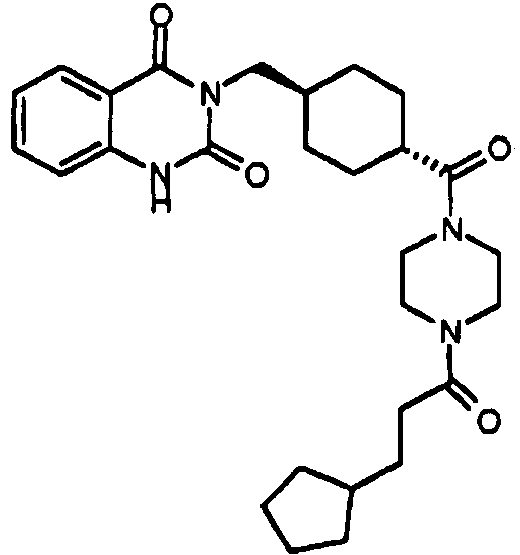
C1 3.6 494.6 495.6 95 a 33 
C1 2.3 412.5 413.5 91 a 34 
C1 2.9 469.6 470.6 95 a 35 
C1 3.0 454.6 455.6 95 a 36 
C1 2.6 465.5 466.5 97 a 37 
C1 2.9 480.6 481.6 98 a 38 
C1 1.9 490.6 491.6 98 a 39 
C1 2.0 490.6 491.6 98 a 40 
C1 1.9 464.6 465.6 94 a 41 
A1 1.5 412.5 413.5 98 a 42 
A1 2.8 467.6 468.6 96 a 43 
A1 3.2 447.0 448.0 93 a 44 
E 6.0 474.6 475.6 96 a 45 
F 6.3 432.6 433.6 95 a 46 
F 6.6 446.6 447.6 95 a 47 
C1 5.3 438.5 439.5 97 a 48 
C1 5.2 464.5 465.5 99 a 49 
A1 5.8 434.5 435.5 96 a 50 
A1 3.5 474.6 475.6 97 a 51 
B 5.5 475.0 476.0 90 a 52 
C2 4.8 426.5 427.5 94 a 53 
C2 4.8 456.5 457.5 97 a 54 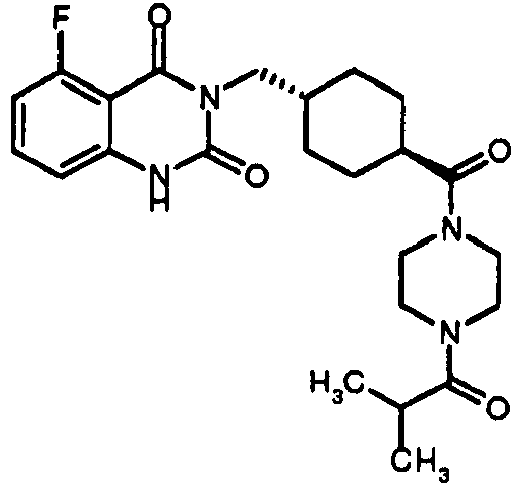
B 5.0 458.5 459.5 92 a 55 
B 4.8 470.6 471.6 94 a 56 
C2 5.3 452.6 453.6 90 a 57 
A1 5.4 448.5 449.5 98 a 58 
G3 5.1 412.5 413.5 98 a 59 
C1 6.4 494.6 495.6 95 a 60 
C1 5.4 452.6 453.6 90 a 61 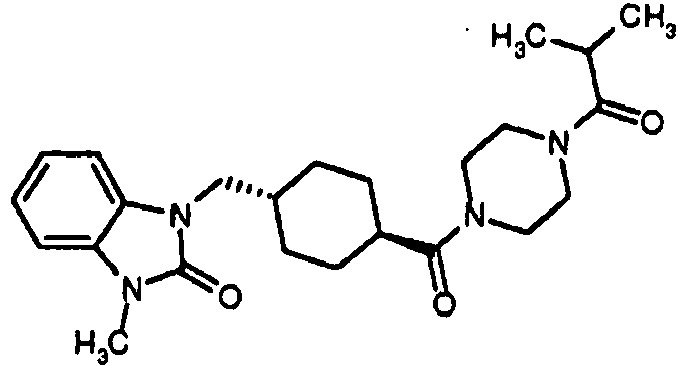
G3 5.4 426.6 427.6 97 a 62 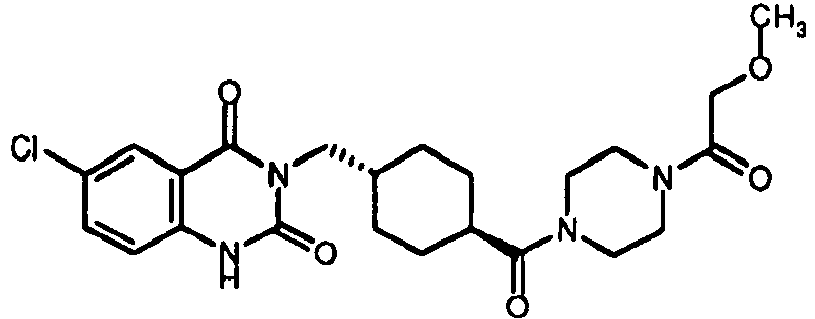
C1 5.4 477.0 478.0 90 a 63 
C1 5.9 473.0 474.0 94 a 64 
C2 6.3 494.6 495.6 95 a 65 
C1 5.9 496.6 497.6 93 a 66 
C1 5.1 486.6 487.6 97 a 67 
F 5.5 438.6 439.6 90 a 68 
F 6.2 466.6 467.6 97 a 69 
F 5.1 442.6 443.6 92 a 70 
A1 6.5 428.5 429.5 95 a 71 
F 4.9 454.6 455.6 99 a 72 
F 5.7 452.6 453.6 98 a 73 
B 6.0 492.6 493.6 93 a 74 
G3 4.8 410.5 411.5 98 a 75 
C1 5.3 468.6 469.6 91 a 76 
C2 6.2 510.6 511.6 96 a 77 
C1 4.8 472.5 473.5 97 a 78 
C1 5.4 482.6 483.6 94 a 79 
B 5.2 484.6 485.6 95 a 80 
G3 5.2 424.5 425.5 98 a 81 
C1 5.0 482.6 483.6 90 a 82 
B 5.3 456.5 457.5 97 a 83 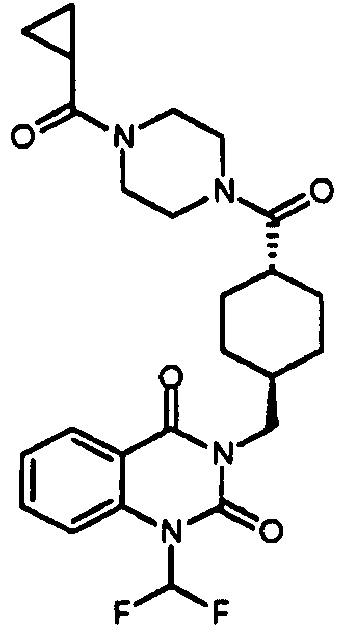
B 5.9 488.5 489.5 98 a 84 
B 6.2 522.7 523.7 96 a 85 
F 5.6 459.0 460.0 99 a 86 
B 4.8 428.5 429.5 91 a 87 
B 5.0 442.5 443.5 91 a 88 
B 4.99 472.5 473 91 a 89 
A1 5.05 401.5 402 94 a 90 
A1 5.2 415.5 416 95 a 91 
A1 5.94 478.5 479 95 a 92 
B 5.17 442.5 443 94 a 93 
B 1.09 456.5 457 100 a 94 
B 5.4 486.6 487 95 a 95 
G3 1.08 424.5 423 98 e 96 
A1 5.95 488.6 489 94 e 97 
A1 5.69 504.5 505 93 e 98 
A1 6.09 478.5 479 99 e 99 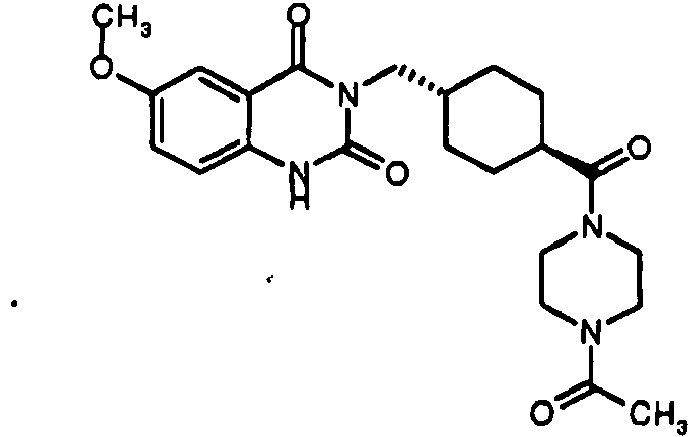
A1 5.04 442.5 443 94 e 100 
C1 1.3 498.6 499 100 e 101 
C1 1.14 484.6 483 97 e 102 
C1 0.97 495.5 494 95 e 103 
C1 1.29 486.6 487 98 e 104 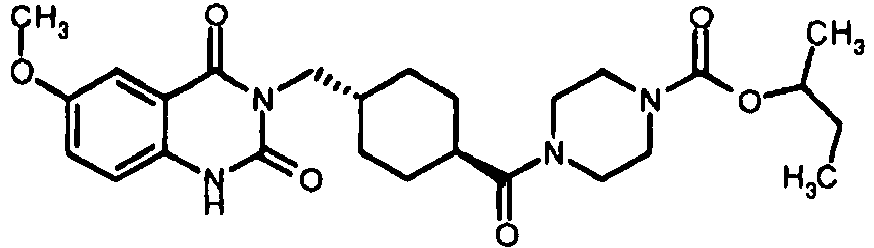
C1 1.45 500.6 501 96 e 105 
B 1.05 468.5 467 98 e 106 
B 1.11 482.6 481 96 e 107 
A1 1.37 458.5 457 93 e 108 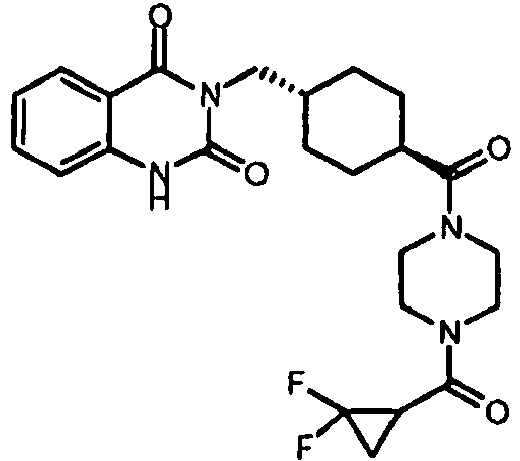
A1 1.27 474.5 473 98 e 109 
C1 0.9 498.6 499 98 e 110 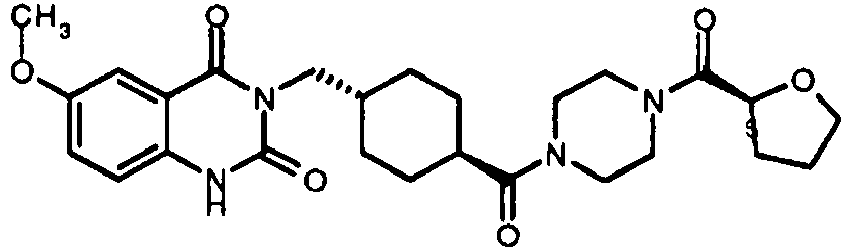
C1 0.9 498.6 499 98 e 111 
G3 5.42 445.0 445 96 e 112 
G3 1.26 478.5 477 100 e 113 
A1 1.01 408.5 409 100 e 114 
A1 1.21 462.5 463 100 e 115 
C1 0.85 508.6 509 95 e 116 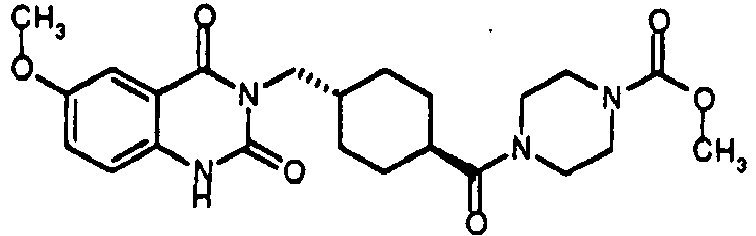
C1 1 458.5 457 100 e 117 
C1 0.87 506.6 507 96 e 118 
N 11 407.5 408 96 g 119 
M 10.9 435.5 436 91 g 120 
M 10 421.5 422 96 g 121 
A2 1.42 497.6 498 95 e 122 
C2 1.03 522.6 523 100 e 123 
B 1.37 498.6 499 100 e 124 
B 1.52 512.6 513 100 e 125 
B 1.68 514.6 515 100 e 126 
C1 1.03 482.6 481 100 e 127 
C1 0.87 486.6 485 97 e 128 
C2 1.12 512.6 513 100 e 129 
C2 1.33 496.6 497 92 e 130 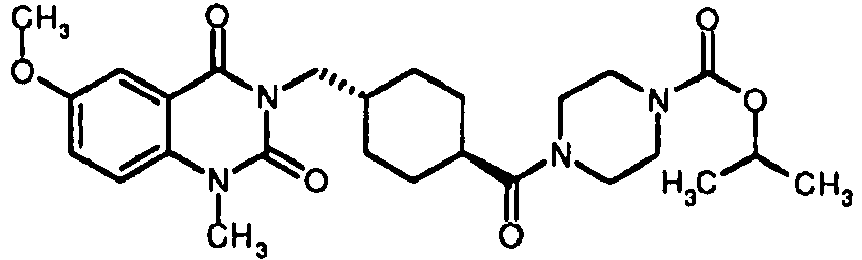
C2 1.52 500.6 501 97 e 131 
C2 1.12 512.6 513 92 e 132 
B 1.28 482.6 483 95 e 133 
B 0.89 486.6 487 100 e 134 
G1 1.14 440.5 439 98 e 135 
G1 1.34 454.6 455 92 e 136 
C2 1.03 456.5 457 100 e 137 
C2 1.09 500.6 501 100 e 138 
B 1.27 496.6 497 100 e 139 
A1 1.02 477.6 478 100 e 140 
A1 1.56 507.6 508 100 e 141 
A2 1.25 514.6 515 100 e 142 
A2 1.11 500.6 501 97 e 143 
A1 1.14 454.6 455 97 e 144 
B 1.11 500.6 501 100 e 145 
B 0.89 500.6 501 100 e 146 
B 1.2 509.6 510 100 e 147 
B 1.06 520.6 521 100 e 148 
A2 1.55 436.5 437 100 e 149 
A2 1.11 500.6 501 100 e 150 
A2 1.28 496.6 497 100 e 151 
A2 1.11 500.6 501 100 e 152 
A1 1.06 482.6 483 100 e 153 
A2 1.22 422.5 423 100 e 154 
A2 1.38 452.5 453 100 f 155 
A2 1.7 482.5 483 95 f 156 
A2 1.28 496.6 497 100 f 157 
A1 1.07 482.6 483 100 f 158 
G3 0.96 441.5 442 95 f 159 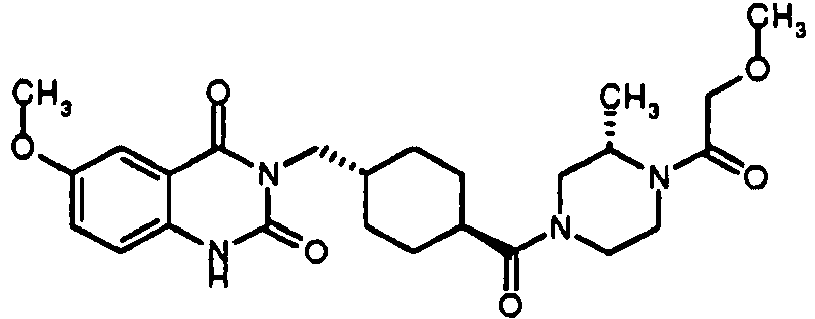
A1 0.89 486.6 487 100 e 160 
G1 0.77 400.5 401 96 f 161 
A1 1.2 482.6 481 95 f 162 
A1 1.23 484.6 485 95 f 163 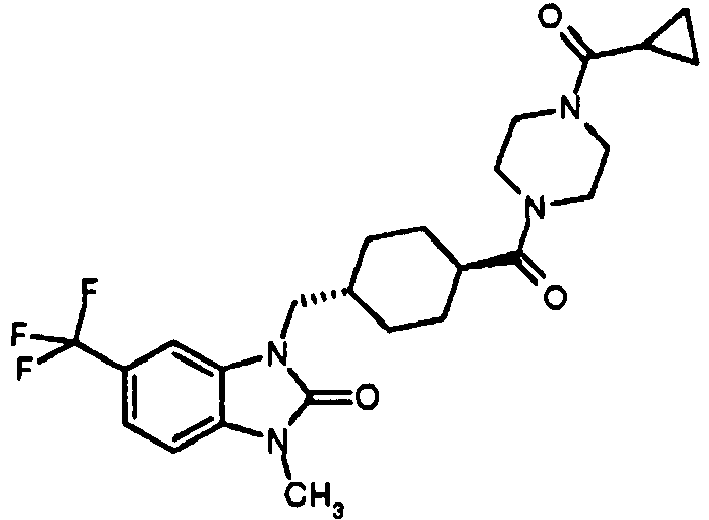
G2 1.37 492.5 493 100 f 164 
G2 1.31 391.9 392 100 f 165 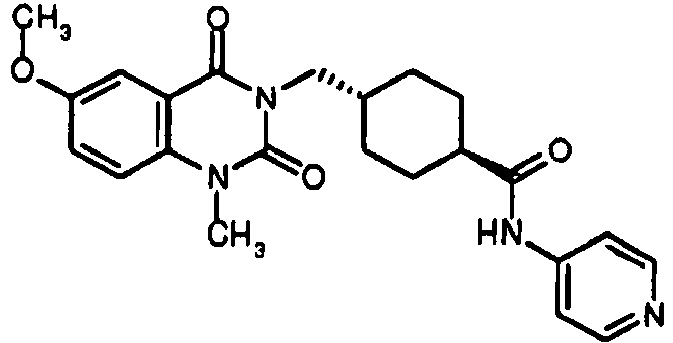
A2 1.25 422.5 423 100 f 166 
G2 1.17 455.6 456 95 f 167 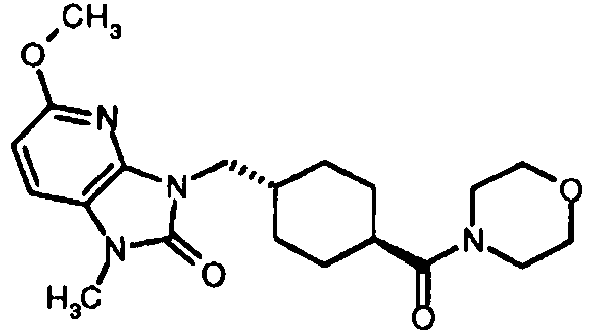
G2 1.95 388.5 389 95 f 168 
G2 1.32 459.0 459 100 f 169 
G2 1.09 439.6 440 90 f 170 
G2 1.25 452.5 453 100 f 171 
C2 1.09 508.6 509 100 f 172 
A2 1.17 436.5 437 100 f 173 
A2 1.36 440.5 441 100 f 174 
A2 1.36 440.5 441 100 f 175 
C2 1.26 472.5 473 96 f 176 
C2 1.35 486.6 487 100 f 177 
A2 1.28 452.5 453 98 f 178 
F 1.17 469.6 470 95 f 179 
A1 1.33 492.5 493 100 f 180 
G2 1.19 432.9 433 95 f 181 
G2 1.29 391.9 392 98 f 182 
G2 1.21 444.5 445 97 f 183 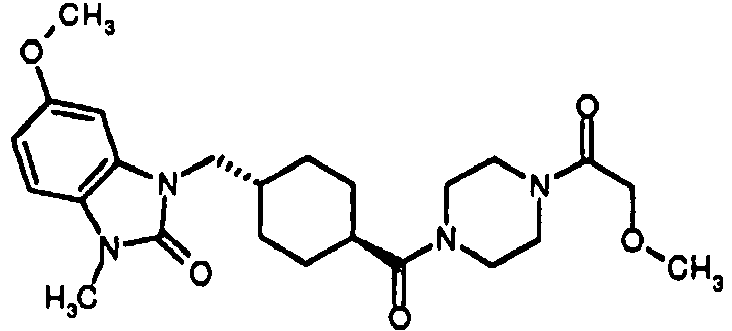
T 1.08 458.6 459 100 f 184 
T 1.21 456.6 457 97 f 185 
T 2.02 494.6 495 100 f 186 
G2 1.25 421.9 422 95 f 187 
A2 2.98 472.5 473 100 f 188 
A2 1.14 472.5 473 100 f 189 
A2 1.49 488.5 489 100 f 190 
A2 1.02 461.5 462 99 f 191 
A2 1.52 451.5 452 100 f 192 
T 1.12 484.6 485 96 f 193 
A2 1.31 412.4 413 100 f 194 
A2 1.39 476.5 477 100 f 195 
A2 1.02 491.6 492 100 f 196 
A2 2.95 436.5 437 100 c 197 
A2 1.12 505.6 506 100 f 198 
C2 1.25 500.6 501 97 f 199 
C2 1.52 524.7 525 100 f 200 
C2 1.24 470.6 471 100 f 201 
A2 1.72 472.5 473 100 f 202 
G2 1.28 466.5 98 98 f 203 
T 1.13 429.5 430 100 f 204 
T 0.99 443.5 444 100 f 205 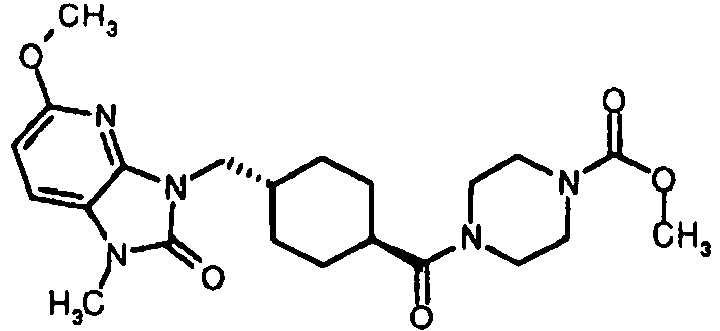
T 1.22 445.5 446 100 f 206 
C2 1.1 536.6 537 98 f 207 
T 0.98 413.5 414 95 f 208 
T 1.07 459.5 460 95 f 209 
T 1.47 424.5 425 97 f 210 
G2 1.18 508.6 509 100 f 211 
G2 1.04 494.6 495 100 f - Examples 1-211 display an IC50 value in the above described reporter assay falling between 0.3 and 30 µM. In the renilla read out, Examples 1-211 showed a negligible effect. Moreover, selected representative compounds were assessed not to be inhibitors of the luciferase enzyme. Examples 3;5;10;18;20;21;26;27;29;37;47;48;56;57;58;59;60;66;71;75;77;78;79;80;92;99;109; 116;122;135;136;146;169 and 175 display and IC50 value ranging from 0.9 uM to 30 uM in the soft agar assay.


Claims (10)
- A compound of formula (I),

 R1 is Cl, F, OH, C1-C3 alkyl, oxalkyl, alkyloxy, oxalkyloxy;i equals 0, 1 or 2;R2 is hydrogen or C1-C4 linear, branched or cyclic alkyl group;R3 may be H; a C1-C3 linear, branched or cyclic alkyl group; or R3, taken together with the carbon atom to which it is attached, may form an oxo group;Z is a linear, cyclic or branched C1-C6 alkyl group; a linear, cyclic or branched C1-C8 alkylcarbonyl, oxaalkylcarbonyl, alkyloxycarbonyl, alkylaminocarbonyl or oxaalkylaminocarbonyl; Ar2; C(O)-Ar2; a benzyl or C1-C3alkylphenyl optionally substituted with one or more methyl, ethyl, methoxy or chloro groups;Ar1 is a 5 to 10 membered heteroaromatic ring optionally substituted with one or more methyl, ethyl, methoxy or chloro groups;Ar2 is 5 to 6 membered aromatic or heteroaromatic ring optionally substituted with one or more methyl, ethyl, methoxy or chloro groups;T may be H; a C1-C3 linear, branched or cyclic alkyl; or T, taken together with the -CH- group to which it is attached, may form an oxo group;wherein any carbon-bound hydrogen atom may optionally be substituted with a fluorine atom; salts, stereoisomers and stereoisomeric mixture thereof, with the exception of






- A compound of formula (I)

 R1 is Cl, F, OH, C1-C3 alkyl, oxalkyl, alkyloxy, oxalkyloxy;i equals 0, 1 or 2;R2 is hydrogen or C1-C4 linear, branched or cyclic alkyl group;R3 may be H; a C1-C3 linear branched or cyclic alkyl group; or R3, taken together with the carbon atom to which it is attached, may form an oxo group;Z is a linear, cyclic or branched C1-C6 alkyl group; a linear, cyclic or branched C1-C8 alkylcarbonyl, oxaalkylcarbonyl, alkyloxycarbonyl, alkylaminocarbonyl or oxaalkylaminocarbonyl; Ar2; C(O)-Ar2; a benzyl or C1-C3alkylphenyl optionally substituted with one or more methyl, ethyl, methoxy or chloro groups;Ar1 is a 5 to 10 membered heteroaromatic ring optionally substituted with one or more methyl, ethyl, methoxy or chloro groups;Ar2 is 5 to 6 membered aromatic or heteroaromatic ring optionally substituted with one or more methyl, ethyl, methoxy or chloro groups;T may be H; a C1-C3 linear, branched or cyclic alkyl; or T, taken together with the -CH- group to which it is attached, may form an oxo group;wherein any carbon-bound hydrogen atom may optionally be substituted with a fluorine atom; salts, stereoisomers and stereoisomeric mixture thereof, for use in the preparation of a medicament, in particular for the treatment of cancer.
 - The compounds of claims 1 and 2 wherein i is 0.
- The compounds of claims 1 and 2 wherein •—Y is
 Z is a C3-C6 iso- or cycloalkyl group; a linear,cyclic or branched C1-C6 alkylcarbonyl, oxaalkylcarbonyl, alkyloxycarbonyl, alkylaminocarbonyl or oxaalkylaminocarbonyl, and wherein T is as defined in claim 1.
 - The compounds of claims 1 and 2 where

- The compounds of claims 4 and 5 where

- The compounds of claim 6, wherein i is 1; R1 is a linear or branched C1-C3 alkyloxy group; R2 is either H or a linear, branched or cyclic C1-C4 alkyl group; R3 taken together with the carbon atom to which it is attached, forms an oxo group;

- The compounds of claim 7 selected from the list of


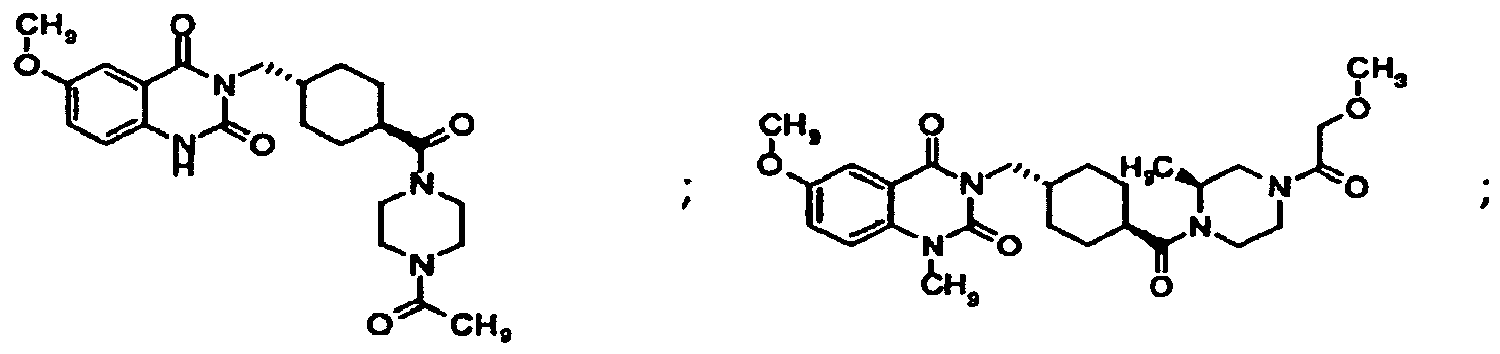





- The compounds of claims 2 to 8 for use in the treatment of a cancer selected from the list of lung cancer; colon cancer; pancreatic cancer; breast cancer; melanoma; glioblastoma; medulloblastoma; gastric cancer; hepatocellular cancer; basal cell carcinoma;leukemia; Wilm's tumour and Familial Adenomatous Polyposis.
- Pharmaceutical compositions containing a compound according to claim 2 in admixture with a pharmaceutically acceptable carrier or excipient.
Priority Applications (1)
| Application Number | Priority Date | Filing Date | Title |
|---|---|---|---|
| EP10768182.7A EP2485728B1 (en) | 2009-10-07 | 2010-10-06 | Wnt pathway antagonists |
Applications Claiming Priority (3)
| Application Number | Priority Date | Filing Date | Title |
|---|---|---|---|
| EP09172403 | 2009-10-07 | ||
| EP10768182.7A EP2485728B1 (en) | 2009-10-07 | 2010-10-06 | Wnt pathway antagonists |
| PCT/EP2010/006055 WO2011042145A1 (en) | 2009-10-07 | 2010-10-06 | Wnt pathway antagonists |
Publications (2)
| Publication Number | Publication Date |
|---|---|
| EP2485728A1 EP2485728A1 (en) | 2012-08-15 |
| EP2485728B1 true EP2485728B1 (en) | 2013-07-10 |
Family
ID=43301895
Family Applications (1)
| Application Number | Title | Priority Date | Filing Date |
|---|---|---|---|
| EP10768182.7A Active EP2485728B1 (en) | 2009-10-07 | 2010-10-06 | Wnt pathway antagonists |
Country Status (5)
| Country | Link |
|---|---|
| US (1) | US8865704B2 (en) |
| EP (1) | EP2485728B1 (en) |
| AR (1) | AR078549A1 (en) |
| TW (1) | TW201118081A (en) |
| WO (1) | WO2011042145A1 (en) |
Cited By (1)
| Publication number | Priority date | Publication date | Assignee | Title |
|---|---|---|---|---|
| US10875848B2 (en) | 2018-10-10 | 2020-12-29 | Forma Therapeutics, Inc. | Inhibiting fatty acid synthase (FASN) |
Families Citing this family (13)
| Publication number | Priority date | Publication date | Assignee | Title |
|---|---|---|---|---|
| EP2694482A1 (en) * | 2011-04-04 | 2014-02-12 | Siena Biotech S.p.A. | Wnt pathway antagonists |
| WO2013177349A2 (en) * | 2012-05-25 | 2013-11-28 | Glaxosmithkline Llc | Quinazolinediones as tankyrase inhibitors |
| US20140221335A1 (en) | 2013-02-06 | 2014-08-07 | Boehringer Ingelheim International Gmbh | Substituted bicyclic dihydropyrimidinones and their use as inhibitors of neutrophil elastase activity |
| US9115093B2 (en) | 2013-03-04 | 2015-08-25 | Boehringer Ingelheim International Gmbh | Substituted bicyclic dihydropyrimidinones and their use as inhibitors of neutrophil elastase activity |
| HRP20191860T1 (en) | 2013-03-13 | 2019-12-27 | Forma Therapeutics, Inc. | 2-hydroxy-1-{4-[(4-phenylphenyl)carbonyl]piperazin-1-yl}ethan-1-one derivatives and related compounds as fatty acid synthase (fasn) inhibitors for the treatment of cancer |
| JP6522502B2 (en) | 2013-07-29 | 2019-05-29 | 協和発酵キリン株式会社 | Wnt signal inhibitor |
| GB201322334D0 (en) * | 2013-12-17 | 2014-01-29 | Agency Science Tech & Res | Maleimide derivatives as modulators of WNT pathway |
| US9475779B2 (en) | 2014-07-31 | 2016-10-25 | Boehringer Ingelheim International Gmbh | Substituted bicyclic dihydropyrimidinones and their use as inhibitors of neutrophil elastase activity |
| US9657015B2 (en) | 2014-07-31 | 2017-05-23 | Boehringer Ingelheim International Gmbh | Substituted bicyclic dihydropyrimidinones and their use as inhibitors of neutrophil elastase activity |
| CN105693634B (en) * | 2016-03-17 | 2018-12-11 | 清华大学 | Compound and application thereof |
| US10669242B2 (en) * | 2016-06-10 | 2020-06-02 | Venenum Biodesign, LLC | Clostridium difficile toxin inhibitors |
| WO2020092395A1 (en) | 2018-10-29 | 2020-05-07 | Forma Therapeutics, Inc. | SOLID FORMS OF (4-(2-FLUORO-4-(1-METHYL-1 H-BENZO[d]IMIDAZOL-5-YL)BENZOYL) PIPERAZIN-1-YL)(1-HYDROXYCYCLOPROPYL)METHANONE |
| WO2022086892A1 (en) * | 2020-10-21 | 2022-04-28 | Calithera Biosciences, Inc. | Interleukin 4 (il4)-induced gene 1 inhibitors and methods of use thereof |
Family Cites Families (4)
| Publication number | Priority date | Publication date | Assignee | Title |
|---|---|---|---|---|
| JP2008524246A (en) | 2004-12-16 | 2008-07-10 | タケダ サン ディエゴ インコーポレイテッド | Histone deacetylase inhibitor |
| WO2006122319A2 (en) * | 2005-05-11 | 2006-11-16 | Takeda San Diego, Inc. | Histone deacetylase inhibitors |
| WO2007064273A1 (en) | 2005-11-29 | 2007-06-07 | Astrazeneca Ab | Phenyl urea derivatives |
| US8642660B2 (en) * | 2007-12-21 | 2014-02-04 | The University Of Rochester | Method for altering the lifespan of eukaryotic organisms |
-
2010
- 2010-10-06 US US13/500,582 patent/US8865704B2/en not_active Expired - Fee Related
- 2010-10-06 WO PCT/EP2010/006055 patent/WO2011042145A1/en not_active Ceased
- 2010-10-06 EP EP10768182.7A patent/EP2485728B1/en active Active
- 2010-10-06 TW TW099133987A patent/TW201118081A/en unknown
- 2010-10-07 AR ARP100103647A patent/AR078549A1/en not_active Application Discontinuation
Cited By (2)
| Publication number | Priority date | Publication date | Assignee | Title |
|---|---|---|---|---|
| US10875848B2 (en) | 2018-10-10 | 2020-12-29 | Forma Therapeutics, Inc. | Inhibiting fatty acid synthase (FASN) |
| US11299484B2 (en) | 2018-10-10 | 2022-04-12 | Forma Therapeutics, Inc. | Inhibiting fatty acid synthase (FASN) |
Also Published As
| Publication number | Publication date |
|---|---|
| EP2485728A1 (en) | 2012-08-15 |
| TW201118081A (en) | 2011-06-01 |
| AR078549A1 (en) | 2011-11-16 |
| US20120196851A1 (en) | 2012-08-02 |
| US8865704B2 (en) | 2014-10-21 |
| WO2011042145A1 (en) | 2011-04-14 |
Similar Documents
| Publication | Publication Date | Title |
|---|---|---|
| US8865704B2 (en) | Wnt pathway antagonists | |
| EP1296982B1 (en) | 1-(heteroaryl-phenyl)-condensed pyrazol derivatives as factor xa inhibitors | |
| DE69431974T2 (en) | Benzamide derivatives and their use as vasopressin antagonists | |
| CA2441313C (en) | New spirotricyclic derivatives and their use as phosphodiesterase-7 inhibitors | |
| CA2376957A1 (en) | Src kinase inhibitor compounds | |
| RS51483B (en) | 4-ANILOXOQINOLINE-3-CARBOXamide KAO INHIBITOR CSF-1R Kinase | |
| MX2010009445A (en) | Protein kinase modulators. | |
| CA2832305A1 (en) | Wnt pathway antagonists | |
| CA2129214A1 (en) | 1-benzenesulfonyl-1,3-dihydro-2h-benzimidazol-2-one derivatives | |
| AU2002304800A1 (en) | New spirotricyclic derivatives and their use as phosphodiesterase-7 inhibitors | |
| WO2005007099A2 (en) | Pkb inhibitors as anti-tumor agents | |
| CN101558049B (en) | Substituted pyrazole and triazole compounds as KSP inhibitors | |
| JP5746821B2 (en) | Pyrazolylbenzimidazole derivatives, compositions containing them and their use | |
| EP2358703B1 (en) | Tetrasubstituted pyridazines hedgehog pathway antagonists | |
| AU2007319061A1 (en) | Heterocyclyc sulfonamides having Edg-I antagonistic activity | |
| US5521175A (en) | Benzodiazepine derivatives | |
| HRP970415A2 (en) | Substituted pyrroles | |
| WO1999011632A1 (en) | 6,7-asymmetrically disubstituted quinoxalinecarboxylic acid deri vatives, addition salts thereof, and processes for the preparation of both | |
| EP1501807A1 (en) | Sulfonylquinoxalone acetamide derivatives and related compounds as bradykinin antagonists | |
| CN102134234B (en) | Indazole urea compound and preparation method and pharmaceutical application thereof | |
| EP1523473B1 (en) | Indoline derivatives substituted in position 6, production and use thereof as medicaments | |
| WO2012109100A1 (en) | Substituted benzimdazole derivatives useful as trpm8 receptor modulators | |
| CZ286764B6 (en) | 5-Heterocyclo-1,5-benzodiazepine derivatives, process of their preparation and pharmaceutical preparation containing thereof | |
| CN109251204A (en) | PARP inhibitor, its preparation method and medical usage containing phthalazines -1 (2H) -one structure | |
| HRP20020536A2 (en) | Substituted pyrroles |
Legal Events
| Date | Code | Title | Description |
|---|---|---|---|
| PUAI | Public reference made under article 153(3) epc to a published international application that has entered the european phase |
Free format text: ORIGINAL CODE: 0009012 |
|
| 17P | Request for examination filed |
Effective date: 20120424 |
|
| AK | Designated contracting states |
Kind code of ref document: A1 Designated state(s): AL AT BE BG CH CY CZ DE DK EE ES FI FR GB GR HR HU IE IS IT LI LT LU LV MC MK MT NL NO PL PT RO RS SE SI SK SM TR |
|
| AX | Request for extension of the european patent |
Extension state: BA ME |
|
| REG | Reference to a national code |
Ref country code: DE Ref legal event code: R079 Ref document number: 602010008503 Country of ref document: DE Free format text: PREVIOUS MAIN CLASS: A61K0031416600 Ipc: C07D0217140000 |
|
| GRAP | Despatch of communication of intention to grant a patent |
Free format text: ORIGINAL CODE: EPIDOSNIGR1 |
|
| RIC1 | Information provided on ipc code assigned before grant |
Ipc: C07D 239/80 20060101ALI20130125BHEP Ipc: C07D 413/08 20060101ALI20130125BHEP Ipc: C07D 243/10 20060101ALI20130125BHEP Ipc: C07D 403/12 20060101ALI20130125BHEP Ipc: C07D 407/12 20060101ALI20130125BHEP Ipc: C07D 401/12 20060101ALI20130125BHEP Ipc: C07D 239/96 20060101ALI20130125BHEP Ipc: C07D 417/12 20060101ALI20130125BHEP Ipc: C07D 409/12 20060101ALI20130125BHEP Ipc: C07D 471/04 20060101ALI20130125BHEP Ipc: C07D 235/26 20060101ALI20130125BHEP Ipc: C07D 217/14 20060101AFI20130125BHEP Ipc: C07D 405/12 20060101ALI20130125BHEP Ipc: C07D 239/22 20060101ALI20130125BHEP |
|
| GRAS | Grant fee paid |
Free format text: ORIGINAL CODE: EPIDOSNIGR3 |
|
| GRAA | (expected) grant |
Free format text: ORIGINAL CODE: 0009210 |
|
| AK | Designated contracting states |
Kind code of ref document: B1 Designated state(s): AL AT BE BG CH CY CZ DE DK EE ES FI FR GB GR HR HU IE IS IT LI LT LU LV MC MK MT NL NO PL PT RO RS SE SI SK SM TR |
|
| AX | Request for extension of the european patent |
Extension state: BA ME |
|
| RAP1 | Party data changed (applicant data changed or rights of an application transferred) |
Owner name: SIENA BIOTECH S.P.A. |
|
| REG | Reference to a national code |
Ref country code: GB Ref legal event code: FG4D |
|
| REG | Reference to a national code |
Ref country code: AT Ref legal event code: REF Ref document number: 620916 Country of ref document: AT Kind code of ref document: T Effective date: 20130715 Ref country code: CH Ref legal event code: EP |
|
| REG | Reference to a national code |
Ref country code: IE Ref legal event code: FG4D |
|
| REG | Reference to a national code |
Ref country code: DE Ref legal event code: R096 Ref document number: 602010008503 Country of ref document: DE Effective date: 20130905 |
|
| PG25 | Lapsed in a contracting state [announced via postgrant information from national office to epo] |
Ref country code: SI Free format text: LAPSE BECAUSE OF FAILURE TO SUBMIT A TRANSLATION OF THE DESCRIPTION OR TO PAY THE FEE WITHIN THE PRESCRIBED TIME-LIMIT Effective date: 20130710 |
|
| REG | Reference to a national code |
Ref country code: AT Ref legal event code: MK05 Ref document number: 620916 Country of ref document: AT Kind code of ref document: T Effective date: 20130710 |
|
| REG | Reference to a national code |
Ref country code: NL Ref legal event code: VDEP Effective date: 20130710 |
|
| REG | Reference to a national code |
Ref country code: LT Ref legal event code: MG4D |
|
| PG25 | Lapsed in a contracting state [announced via postgrant information from national office to epo] |
Ref country code: NO Free format text: LAPSE BECAUSE OF FAILURE TO SUBMIT A TRANSLATION OF THE DESCRIPTION OR TO PAY THE FEE WITHIN THE PRESCRIBED TIME-LIMIT Effective date: 20131010 Ref country code: PT Free format text: LAPSE BECAUSE OF FAILURE TO SUBMIT A TRANSLATION OF THE DESCRIPTION OR TO PAY THE FEE WITHIN THE PRESCRIBED TIME-LIMIT Effective date: 20131111 Ref country code: CY Free format text: LAPSE BECAUSE OF FAILURE TO SUBMIT A TRANSLATION OF THE DESCRIPTION OR TO PAY THE FEE WITHIN THE PRESCRIBED TIME-LIMIT Effective date: 20130904 Ref country code: IS Free format text: LAPSE BECAUSE OF FAILURE TO SUBMIT A TRANSLATION OF THE DESCRIPTION OR TO PAY THE FEE WITHIN THE PRESCRIBED TIME-LIMIT Effective date: 20131110 Ref country code: HR Free format text: LAPSE BECAUSE OF FAILURE TO SUBMIT A TRANSLATION OF THE DESCRIPTION OR TO PAY THE FEE WITHIN THE PRESCRIBED TIME-LIMIT Effective date: 20130710 Ref country code: AT Free format text: LAPSE BECAUSE OF FAILURE TO SUBMIT A TRANSLATION OF THE DESCRIPTION OR TO PAY THE FEE WITHIN THE PRESCRIBED TIME-LIMIT Effective date: 20130710 Ref country code: LT Free format text: LAPSE BECAUSE OF FAILURE TO SUBMIT A TRANSLATION OF THE DESCRIPTION OR TO PAY THE FEE WITHIN THE PRESCRIBED TIME-LIMIT Effective date: 20130710 Ref country code: SE Free format text: LAPSE BECAUSE OF FAILURE TO SUBMIT A TRANSLATION OF THE DESCRIPTION OR TO PAY THE FEE WITHIN THE PRESCRIBED TIME-LIMIT Effective date: 20130710 Ref country code: BE Free format text: LAPSE BECAUSE OF FAILURE TO SUBMIT A TRANSLATION OF THE DESCRIPTION OR TO PAY THE FEE WITHIN THE PRESCRIBED TIME-LIMIT Effective date: 20130710 |
|
| PG25 | Lapsed in a contracting state [announced via postgrant information from national office to epo] |
Ref country code: PL Free format text: LAPSE BECAUSE OF FAILURE TO SUBMIT A TRANSLATION OF THE DESCRIPTION OR TO PAY THE FEE WITHIN THE PRESCRIBED TIME-LIMIT Effective date: 20130710 Ref country code: NL Free format text: LAPSE BECAUSE OF FAILURE TO SUBMIT A TRANSLATION OF THE DESCRIPTION OR TO PAY THE FEE WITHIN THE PRESCRIBED TIME-LIMIT Effective date: 20130710 Ref country code: ES Free format text: LAPSE BECAUSE OF FAILURE TO SUBMIT A TRANSLATION OF THE DESCRIPTION OR TO PAY THE FEE WITHIN THE PRESCRIBED TIME-LIMIT Effective date: 20131021 Ref country code: LV Free format text: LAPSE BECAUSE OF FAILURE TO SUBMIT A TRANSLATION OF THE DESCRIPTION OR TO PAY THE FEE WITHIN THE PRESCRIBED TIME-LIMIT Effective date: 20130710 Ref country code: FI Free format text: LAPSE BECAUSE OF FAILURE TO SUBMIT A TRANSLATION OF THE DESCRIPTION OR TO PAY THE FEE WITHIN THE PRESCRIBED TIME-LIMIT Effective date: 20130710 Ref country code: GR Free format text: LAPSE BECAUSE OF FAILURE TO SUBMIT A TRANSLATION OF THE DESCRIPTION OR TO PAY THE FEE WITHIN THE PRESCRIBED TIME-LIMIT Effective date: 20131011 |
|
| PG25 | Lapsed in a contracting state [announced via postgrant information from national office to epo] |
Ref country code: CY Free format text: LAPSE BECAUSE OF FAILURE TO SUBMIT A TRANSLATION OF THE DESCRIPTION OR TO PAY THE FEE WITHIN THE PRESCRIBED TIME-LIMIT Effective date: 20130710 |
|
| PG25 | Lapsed in a contracting state [announced via postgrant information from national office to epo] |
Ref country code: EE Free format text: LAPSE BECAUSE OF FAILURE TO SUBMIT A TRANSLATION OF THE DESCRIPTION OR TO PAY THE FEE WITHIN THE PRESCRIBED TIME-LIMIT Effective date: 20130710 Ref country code: SK Free format text: LAPSE BECAUSE OF FAILURE TO SUBMIT A TRANSLATION OF THE DESCRIPTION OR TO PAY THE FEE WITHIN THE PRESCRIBED TIME-LIMIT Effective date: 20130710 Ref country code: DK Free format text: LAPSE BECAUSE OF FAILURE TO SUBMIT A TRANSLATION OF THE DESCRIPTION OR TO PAY THE FEE WITHIN THE PRESCRIBED TIME-LIMIT Effective date: 20130710 Ref country code: RO Free format text: LAPSE BECAUSE OF FAILURE TO SUBMIT A TRANSLATION OF THE DESCRIPTION OR TO PAY THE FEE WITHIN THE PRESCRIBED TIME-LIMIT Effective date: 20130710 Ref country code: CZ Free format text: LAPSE BECAUSE OF FAILURE TO SUBMIT A TRANSLATION OF THE DESCRIPTION OR TO PAY THE FEE WITHIN THE PRESCRIBED TIME-LIMIT Effective date: 20130710 |
|
| PLBE | No opposition filed within time limit |
Free format text: ORIGINAL CODE: 0009261 |
|
| STAA | Information on the status of an ep patent application or granted ep patent |
Free format text: STATUS: NO OPPOSITION FILED WITHIN TIME LIMIT |
|
| PG25 | Lapsed in a contracting state [announced via postgrant information from national office to epo] |
Ref country code: MC Free format text: LAPSE BECAUSE OF FAILURE TO SUBMIT A TRANSLATION OF THE DESCRIPTION OR TO PAY THE FEE WITHIN THE PRESCRIBED TIME-LIMIT Effective date: 20130710 |
|
| 26N | No opposition filed |
Effective date: 20140411 |
|
| REG | Reference to a national code |
Ref country code: DE Ref legal event code: R097 Ref document number: 602010008503 Country of ref document: DE Effective date: 20140411 |
|
| REG | Reference to a national code |
Ref country code: IE Ref legal event code: MM4A |
|
| PG25 | Lapsed in a contracting state [announced via postgrant information from national office to epo] |
Ref country code: IE Free format text: LAPSE BECAUSE OF NON-PAYMENT OF DUE FEES Effective date: 20131006 |
|
| PGFP | Annual fee paid to national office [announced via postgrant information from national office to epo] |
Ref country code: FR Payment date: 20141031 Year of fee payment: 5 Ref country code: DE Payment date: 20141125 Year of fee payment: 5 Ref country code: GB Payment date: 20141031 Year of fee payment: 5 |
|
| PGFP | Annual fee paid to national office [announced via postgrant information from national office to epo] |
Ref country code: IT Payment date: 20141029 Year of fee payment: 5 |
|
| PG25 | Lapsed in a contracting state [announced via postgrant information from national office to epo] |
Ref country code: SM Free format text: LAPSE BECAUSE OF FAILURE TO SUBMIT A TRANSLATION OF THE DESCRIPTION OR TO PAY THE FEE WITHIN THE PRESCRIBED TIME-LIMIT Effective date: 20130710 |
|
| REG | Reference to a national code |
Ref country code: CH Ref legal event code: PL |
|
| PG25 | Lapsed in a contracting state [announced via postgrant information from national office to epo] |
Ref country code: CH Free format text: LAPSE BECAUSE OF NON-PAYMENT OF DUE FEES Effective date: 20141031 Ref country code: HU Free format text: LAPSE BECAUSE OF FAILURE TO SUBMIT A TRANSLATION OF THE DESCRIPTION OR TO PAY THE FEE WITHIN THE PRESCRIBED TIME-LIMIT; INVALID AB INITIO Effective date: 20101006 Ref country code: MK Free format text: LAPSE BECAUSE OF FAILURE TO SUBMIT A TRANSLATION OF THE DESCRIPTION OR TO PAY THE FEE WITHIN THE PRESCRIBED TIME-LIMIT Effective date: 20130710 Ref country code: BG Free format text: LAPSE BECAUSE OF FAILURE TO SUBMIT A TRANSLATION OF THE DESCRIPTION OR TO PAY THE FEE WITHIN THE PRESCRIBED TIME-LIMIT Effective date: 20130710 Ref country code: LI Free format text: LAPSE BECAUSE OF NON-PAYMENT OF DUE FEES Effective date: 20141031 Ref country code: LU Free format text: LAPSE BECAUSE OF NON-PAYMENT OF DUE FEES Effective date: 20131006 Ref country code: RS Free format text: LAPSE BECAUSE OF FAILURE TO SUBMIT A TRANSLATION OF THE DESCRIPTION OR TO PAY THE FEE WITHIN THE PRESCRIBED TIME-LIMIT Effective date: 20131010 |
|
| PG25 | Lapsed in a contracting state [announced via postgrant information from national office to epo] |
Ref country code: MT Free format text: LAPSE BECAUSE OF FAILURE TO SUBMIT A TRANSLATION OF THE DESCRIPTION OR TO PAY THE FEE WITHIN THE PRESCRIBED TIME-LIMIT Effective date: 20130710 |
|
| REG | Reference to a national code |
Ref country code: DE Ref legal event code: R119 Ref document number: 602010008503 Country of ref document: DE |
|
| GBPC | Gb: european patent ceased through non-payment of renewal fee |
Effective date: 20151006 |
|
| PG25 | Lapsed in a contracting state [announced via postgrant information from national office to epo] |
Ref country code: TR Free format text: LAPSE BECAUSE OF FAILURE TO SUBMIT A TRANSLATION OF THE DESCRIPTION OR TO PAY THE FEE WITHIN THE PRESCRIBED TIME-LIMIT Effective date: 20130710 Ref country code: DE Free format text: LAPSE BECAUSE OF NON-PAYMENT OF DUE FEES Effective date: 20160503 Ref country code: IT Free format text: LAPSE BECAUSE OF NON-PAYMENT OF DUE FEES Effective date: 20151006 Ref country code: GB Free format text: LAPSE BECAUSE OF NON-PAYMENT OF DUE FEES Effective date: 20151006 |
|
| REG | Reference to a national code |
Ref country code: FR Ref legal event code: ST Effective date: 20160630 |
|
| PG25 | Lapsed in a contracting state [announced via postgrant information from national office to epo] |
Ref country code: FR Free format text: LAPSE BECAUSE OF NON-PAYMENT OF DUE FEES Effective date: 20151102 |
|
| PG25 | Lapsed in a contracting state [announced via postgrant information from national office to epo] |
Ref country code: AL Free format text: LAPSE BECAUSE OF FAILURE TO SUBMIT A TRANSLATION OF THE DESCRIPTION OR TO PAY THE FEE WITHIN THE PRESCRIBED TIME-LIMIT Effective date: 20130710 |