EP2485428A2 - Efficient, remote, private tree-based classification using cryptographic techniques - Google Patents
Efficient, remote, private tree-based classification using cryptographic techniques Download PDFInfo
- Publication number
- EP2485428A2 EP2485428A2 EP12153505A EP12153505A EP2485428A2 EP 2485428 A2 EP2485428 A2 EP 2485428A2 EP 12153505 A EP12153505 A EP 12153505A EP 12153505 A EP12153505 A EP 12153505A EP 2485428 A2 EP2485428 A2 EP 2485428A2
- Authority
- EP
- European Patent Office
- Prior art keywords
- classifier
- user
- classification
- tree
- node
- Prior art date
- Legal status (The legal status is an assumption and is not a legal conclusion. Google has not performed a legal analysis and makes no representation as to the accuracy of the status listed.)
- Withdrawn
Links
- 238000000034 method Methods 0.000 title claims abstract description 42
- 238000011156 evaluation Methods 0.000 claims description 20
- 239000000654 additive Substances 0.000 claims description 16
- 230000000996 additive effect Effects 0.000 claims description 16
- 238000012545 processing Methods 0.000 description 56
- 239000013598 vector Substances 0.000 description 51
- 230000006870 function Effects 0.000 description 31
- 238000013459 approach Methods 0.000 description 24
- 238000003066 decision tree Methods 0.000 description 18
- 230000008569 process Effects 0.000 description 18
- 238000004422 calculation algorithm Methods 0.000 description 12
- 238000010586 diagram Methods 0.000 description 11
- 238000012546 transfer Methods 0.000 description 9
- 238000004891 communication Methods 0.000 description 8
- 230000015654 memory Effects 0.000 description 8
- 241000153282 Theope Species 0.000 description 6
- 230000000295 complement effect Effects 0.000 description 5
- 238000007418 data mining Methods 0.000 description 4
- 239000011159 matrix material Substances 0.000 description 4
- 230000003287 optical effect Effects 0.000 description 4
- 238000007635 classification algorithm Methods 0.000 description 3
- CDBYLPFSWZWCQE-UHFFFAOYSA-L Sodium Carbonate Chemical compound [Na+].[Na+].[O-]C([O-])=O CDBYLPFSWZWCQE-UHFFFAOYSA-L 0.000 description 2
- 238000004590 computer program Methods 0.000 description 2
- 238000013500 data storage Methods 0.000 description 2
- 230000007246 mechanism Effects 0.000 description 2
- 230000001537 neural effect Effects 0.000 description 2
- 238000011160 research Methods 0.000 description 2
- 230000003068 static effect Effects 0.000 description 2
- 230000009471 action Effects 0.000 description 1
- 230000004075 alteration Effects 0.000 description 1
- 230000005540 biological transmission Effects 0.000 description 1
- 230000008859 change Effects 0.000 description 1
- 239000002131 composite material Substances 0.000 description 1
- 238000010276 construction Methods 0.000 description 1
- 230000001186 cumulative effect Effects 0.000 description 1
- 125000004122 cyclic group Chemical group 0.000 description 1
- 238000013461 design Methods 0.000 description 1
- 230000003993 interaction Effects 0.000 description 1
- 238000012886 linear function Methods 0.000 description 1
- 239000004973 liquid crystal related substance Substances 0.000 description 1
- 238000005065 mining Methods 0.000 description 1
- 238000012986 modification Methods 0.000 description 1
- 230000004048 modification Effects 0.000 description 1
- 238000003909 pattern recognition Methods 0.000 description 1
- 239000000126 substance Substances 0.000 description 1
- 238000012549 training Methods 0.000 description 1
Images




Classifications
-
- H—ELECTRICITY
- H04—ELECTRIC COMMUNICATION TECHNIQUE
- H04L—TRANSMISSION OF DIGITAL INFORMATION, e.g. TELEGRAPHIC COMMUNICATION
- H04L9/00—Cryptographic mechanisms or cryptographic arrangements for secret or secure communications; Network security protocols
- H04L9/008—Cryptographic mechanisms or cryptographic arrangements for secret or secure communications; Network security protocols involving homomorphic encryption
-
- H—ELECTRICITY
- H04—ELECTRIC COMMUNICATION TECHNIQUE
- H04L—TRANSMISSION OF DIGITAL INFORMATION, e.g. TELEGRAPHIC COMMUNICATION
- H04L2209/00—Additional information or applications relating to cryptographic mechanisms or cryptographic arrangements for secret or secure communication H04L9/00
- H04L2209/50—Oblivious transfer
Definitions
- Embodiments of the present invention relate to the field of classifiers and their use in classification; more particularly, embodiments of the present invention relate to pairing tree-based classification and data observation methods, including embodiments using secure and oblivious processing.
- the cloud computing model has attracted many businesses mainly due to its zero capital investment, flexibility as well as reduced operational cost.
- the model has changed the way companies do business into a utility model where one pays as per the usage.
- Computing as a service (CaaS) is an emerging branch of cloud computing where companies can utilize computational power and processing logics without needing to have licensed software copies, own processing logics and computing hardware setup in-house.
- One type of computation is that in a candidate for use in this way is tree-based classification. With the exponential growth of data, there is a real need to perform pattern recognition and mining on large data sets.
- a user has a set of images (X).
- the user may want to classify the images in order to determine whether they contain, for example, faces.
- the user does not have the resources and/or expertise to run a classification algorithm to classify them. Therefore, it wants to delegate the classification task f to a remote classifier (server in the cloud) and obtain the decision f (x) where x ⁇ X.
- server in the cloud
- OT 1 2 In 1-out-of-2 Oblivious Transfer ( OT 1 2 ), one party, the sender , has input composed of two strings ( M 0 , M 1 ), and the input of a second party, the chooser, is a bit ⁇ . The chooser should learn M ⁇ and nothing regarding M 1- ⁇ while the sender should gain no information about ⁇ .
- 1-out-of- N OT is an extension of OT 1 2 where the chooser learns one M i (1 ⁇ i ⁇ N ) and nothing else.
- k -out-of- N OT is a generalization of OT 1 N . For more information, see M. O.
- Rabin "How to Exchange Secrets with Oblivious Transfer,” Cryptology ePrint Archive, Report 2005/187,2005, http://eprint.iacr.org/ ; S. Even, et al., "A Randomized Protocol for Signing Contracts," Commun. ACM, 28(6):637-647, 1985 ; and M. Naor et al., "Efficient Oblivious Transfer Protocols," In SODA '01: Proceedings of the twelfth annual ACM SIAM symposium on Discrete algorithms, pages 448-457, Philadelphia, PA, USA, 2001, Society for Industrial and Applied Mathematics .
- An OPE protocol has two parties, the sender who has a polynomial f over some finite field + p and the receiver has an input x ⁇ + p . At the end of the protocol, the receiver learns f (x) and nothing else, and the sender learns nothing.
- M. Naor, et al. "Oblivious Transfer and Polynomial Evaluation," In STOC '99: Proceedings of the thirtyfirst annual ACM symposium on Theory of computing, pages 245-254, New York, NY, USA, 1999 . ACM; H.-D. Li, et al., "Oblivious Polynomial Evaluation,” J. Comput. Sci. Technol., 19(4):550-554, 2004 ; M.
- An asymmetric cryptosystem - which consists of key generation, encryption (E) and decryption ( ⁇ ) functions - is homomorphic if for any given public key and any two plaintext messages m 1 , m 2 in the plaintext space, the following encryption relationship holds: where is a binary operator. If the operator is addition, the cryptosystem is additive homomorphic (e.g., P. Paillier, "Public-Key Cryptosystems Based On Composite Degree Residuosity Classes," In EUROCRYPT'99: Proceedings of the 17th international conference on Theory and application of cryptographic techniques, pages 223-238, Berlin, Heidelberg, 1999 ,
- multiplicative homomorphic e.g., T. El Gamal, "A Public Key Cryptosystem and a Signature Scheme Based On Discrete Logarithms," In Proceedings of CRYPTO 84 on Advances in cryptology, pages 10-18, New York, NY, USA, 1985. Springer-Verlag New York, Inc. ).
- the chooser's input is ⁇ ⁇ 0, 1, and the sender's input is two strings M 0 , M 1 .
- the chooser's output is M ⁇ .
- the protocol operates over a group ⁇ q of prime order and g is a generator of the group.
- the construction uses a function H that is modeled as a random oracle, i.e. chosen as a truly random function available to any participant and usually implemented as a hash function such as SHA.
- the sender needs to compute three exponentiations (one of them can be precomputed before the protocol begins) and the chooser needs to compute two exponentiations (one of them can be precomputed).
- q is a n -bit prime number
- the communication complexity is 2 n (from chooser) + n + 2 log 2
- the complexity is 5 n if messages are elements of ⁇ q and one random value r is used.
- the polynomials are over a finite field + q where q is a an l-bit prime number.
- the dominant operation in this protocol is the OT 1 2 operations.
- the complexity is d l times that of OT 1 2 . (Five exponentiation and three inverse operations per OT 1 2 ).
- the protocol using additive homomorphic encryption (HE) is as follows:
- the dominant operation in this protocol is the HE operations.
- the complexity is 2 d l times that of encryption (i.e., one exponentiation per encryption).
- the number of exponentiations in the second approach is reduced by half.
- the communication complexity in the second approach is reduced by two thirds.
- Additional techniques related to those described above include privacy preserving data mining (PPDM).
- PPDM privacy preserving data mining
- the main focus has been to collectively learn a predictive model while addressing privacy and security concerns.
- the final goal of both branches is to train a predictive model, but the two branches make different assumptions and have different settings.
- the first category perturbed input problem
- the second category private party input problem
- the input data from different parties could be either horizontally or vertically partitioned.
- horizontally partitioned data each party has complete data sets for all the features under consideration.
- vertically partitioned data each party does not have complete data sets for the features under consideration, i.e., each has partial input data to construct complete data sets.
- each party knows only their data, vertically or horizontally partitioned, and the trained predictive model.
- the user that owns the input data, adds "noise” (e.g., generalization, distortion, etc.) to the data before the data mining process and then use reconstruction techniques to recover the original cumulative distribution (not the original values).
- the noise hides the data from the classifier.
- the predictive model has some amount of false positives as well as negatives due to the noise.
- the model can classify non-perturbed data.
- the user is given the predictive model to locally run the classification algorithm. While such an approach preserve the privacy of the user inputs, it fails to protect the predictive model.
- the method comprises performing tree-based classification of a user input by a classifier with a classification tree at a first location, including exchanging data with a second location, different from the first location, to obtain the user input and provide results of classification to a user using singly homomorphic encryption so that the user input is not revealed to the classifier, the classification tree is not revealed to the user and the classifier's output is not revealed to the classifier.
- tree-based classification is combined with a homomorphic encryption based novel oblivious polynomial evaluation protocol that is much more efficient than the existing protocols.
- new protocols are constructed and practical cryptographic techniques are used, thereby allowing performance of certain arithmetic operations on encrypted data.
- Techniques described herein may be used in a service model.
- the present invention also relates to apparatus for performing the operations herein.
- This apparatus may be specially constructed for the required purposes, or it may comprise a general purpose computer selectively activated or reconfigured by a computer program stored in the computer.
- a computer program may be stored in a computer readable storage medium, such as, but is not limited to, any type of disk including floppy disks, optical disks, CD-ROMs, and magnetic-optical disks, read-only memories (ROMs), random access memories (RAMs), PROMS, EEPROMs, magnetic or optical cards, or any type of media suitable for storing electronic instructions, and each coupled to a computer system bus.
- a machine-readable medium includes any mechanism for storing or transmitting information in a form readable by a machine (e.g., a computer).
- a machine-readable medium includes read only memory ("ROM”); random access memory (“RAM”); magnetic disk storage media; optical storage media; flash memory devices; etc.
- Table 1 summarizes all the symbols and notations used herein. Notation Description x User's single input X User's set of inputs y Classifier's feature vector at each internal node of the classification tree. For ID3, there is only one none-zero element, for the general case, there can be more than one non-zero element.
- the focus is on privately classifying input data based on a tree with branching factor set to 2 as it involves only single variable linear decisions. Then the techniques are extended to multivariate decision trees.
- the following are the privacy and security requirements.
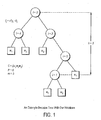
- FIG. 1 An example of a classification tree is shown in Figure 1 .
- OT 1 2 is used for the evaluation of internal nodes of the tree.
- additive homomorphic encryption is used for the evaluation of the internal nodes of the tree. Both of these approaches use additive homomorphic encryption for the evaluation of the class label.
- the first is referred to as the OT based approach and the latter is referred to as the HE based approach.
- FIG. 2 is a flow diagram of one embodiment of a process for processing data using either of the two approaches.
- the process is performed by processing logic that may comprise hardware (circuitry, dedicated logic, etc.), software (such as is run on a general purpose computer system or a dedicated machine), or a combination of both.
- the processing logic is part of a classifier.
- the process comprises processing logic performing tree-based classification of a user input by a classifier with a classification tree at a first location, which includes processing logic exchanging data with a second location, different from the first location, to obtain the user input and provide results of classification to a user using singly homomorphic encryption so that the user input is not revealed to the classifier and the classification tree is not revealed to the user (processing block 201).
- the singly homomorphic encryption uses a bit-wise polynomial representation of inputs and weights for classification.
- the polynomial representation represents polynomials as sums.
- the singly homomorphic encryption comprises additive homomorphic encryption.
- the singly homomorphic encryption comprises homomorphic encryption based oblivious polynomial evaluation protocol.
- the user and the classifier executes an OPE protocol for each node in the classification tree.
- the classifier chooses nodes uniformly at random so that the user does not learns the relative location of the nodes in the classification tree.
- the nodes in the classification tree are indexed from 1 to m in some deterministic but random order.
- the splitting rule f i at each node i be of the form x t y i ⁇ i where ⁇ i is the threshold value.
- the function f is given before the use of this technique.
- the particular functions are implemented in nodes in the decision tree.
- the tree was trained ahead of time.
- the class of functions are "linear functions" or "dot product functions.” These are most widely used in decision trees.
- the function f i may be defined as:
- the user executes m OPE protocols with the classifier where the user learns either 0 or 1 for each node index i (i.e. the output of f i and nothing else), and the classifier learns nothing about the user's input and the output. Finally, the user constructs a bit vector Z of all the outputs and executes another protocol with the classifier to obliviously learn the class label.
- E is the additive homomorphic encryption and 1 ⁇ i ⁇ m .
- each path corresponds to a leaf node and its related class.
- the user has the private key.
- the classifier chooses a random number r ⁇ ⁇ p .
- the classifier For each node in the path t with index j , the classifier picks Z'[j] or Z"[j] depending on the classification decision and computes (Z'[ j ]) r or (Z"[ j ]) r . The classifier multiplies the computed values for all the indexes along each path (from root to leaf node)]. This value is referred to herein as u t .
- the classifier may introduce fake nodes to further hide the classification tree at the expense of additional computational and communication cost.
- the following shows a high level complexity analysis of the internal nodes in the classification tree.
- n features m internal nodes.
- the protocol for the complete OT based approach operates over a finite field + p of prime order and the attribute values are of l-bits (0 - 2 l ).
- Figure 3 illustrates pseudo code of one embodiment of an algorithm performed at the classifier. Such pseudo is well understood to those skilled in the art.
- Figure 4 is a flow diagram of one embodiment of a process for classifying data using a linear classification tree (e.g., decision tree).
- the process is performed by processing logic that may comprise hardware (circuitry, dedicated logic, etc.), software (such as is run on a general purpose computer system or a dedicated machine), or a combination of both.
- the processing logic may be part of a classifier.
- the processing logic may execute instructions that implement the pseudo code described in Figure 3 .
- the process begins by processing logic receiving first encrypted input data (processing block 401).
- the first encrypted input data comprises input data that has been bit-wise encrypted using an additive homomorphic cryptosystem.
- processing logic computes a function with a classifier, using the first encrypted data, for each node of a classification tree (processing block 402).
- the classification tree comprises a decision tree.
- the decision tree is a multivariate tree having one or more multiple-feature splits.
- the decision tree is unbalanced.
- the decision tree includes one or more 1-of-2 splits.
- the function represents a splitting rule.
- processing logic After computing the function for each node on a classification tree, processing logic sends second encrypted data that comprises an encrypted version of results of computing the function for said each node (processing block 403).
- processing logic receives first and second encrypted vectors (processing block 404).
- the first encrypted vector contains an encrypted version of a vector containing a classification decision at each node in the classification tree
- the second encrypted vector contains a complementary of the vector containing a classification decision at each node in the classification tree
- a complementary binary vector is where each "0" entry is replaced by a "1" and each "1" is replaced by a "0”.
- the first and second encrypted vectors are P-dimensional encrypted binary vectors.
- the order of encrypted data associated with each node in the second encrypted data is not indicative of node location in the classification tree.
- the classification decision comprises a splitting decision.
- processing logic selects a value from either the first and second encrypted vectors based on the classification decision at said each node, and computes a vector of values based on the value using values selected from the first and second encrypted vectors (processing block 405).
- computing the vector of values is performed using a number of nodes in a path, a class label associated with a node in the path, the vector of values and an encryption function.
- the encryption function may be the same homomorphic encryption function used to encrypt the vector of values (e.g., the Paillier homomorphic cryptosystem).
- processing logic sends the vector of values from which a corresponding class assigned to a node in the classification tree can be obtained (processing block 406).
- the high-level technique is that the user bit-wise encrypt the input data x using an additive homomorphic cryptosystem and the classifier uses these encrypted values to compute x t y i - ⁇ i over the encrypted data for each node i.
- the user decrypts these encrypted values to decide the splitting decision at each node.
- the amount of work by the user to evaluate the internal nodes is independent of the number of nodes m in the classification tree, which greatly reduces the computational cost at the user.
- the user computes the v ij values as in the OPE protocol and then encrypts each v ij value using an additive homomorphic cryptosystem that the user initiates (i.e., the user has the private key).
- the user sends the n ⁇ l encrypted v ij 's to the classifier.
- the classifier picks the correct encrypted v ij 's based on the non-zero bit position of the element and multiplies them together in order to compute encrypted x t y.
- the classifier subtracts the threshold value ⁇ i by multiplying it with the encrypted additive inverse of ⁇ i .
- the classifier For each node i , the classifier performs the above computation and prepares a vector of m encrypted elements. The user decrypts this vector and computes a bit vector Z indicating the splitting decision at each node. The remaining interactions between the user and the classifier are similar to that OT approach described above. Notice that this approach rely only on the availability of an additive homomorphic cryptosystem.
- Figure 5 is pseudo code for one embodiment of an algorithm of the operations performed by the user when using the classifier.
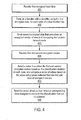
- Figure 6 is a flow diagram of one embodiment of a process for classifying data using a linear classification tree (e.g., decision tree).
- the process is performed by processing logic that may comprise hardware (circuitry, dedicated logic, etc.), software (such as is run on a general purpose computer system or a dedicated machine), or a combination of both.
- the processing logic is part of a client that is communicating with the classifier (or a device or service that is accessing and/or using the classifier).
- the processing logic may execute instructions that implement the pseudo code described in Figure 5 .
- the process begins by processing logic performing bit-wise encryption of input data using additive homomorphic cryptosystem to create encrypted input data (processing block 601). Processing logic sends this information to a classifier.
- processing logic receives, from the classifier, a vector containing results of evaluating a classification decision at each node of a classification tree using the input data (processing block 602).
- processing logic uses data in the vector to create first and second encrypted vectors, where the first encrypted vector containing an encrypted version of a vector containing a classification decision at each node in the classification tree and the second encrypted vector containing a complementary of the vector containing a classification decision at each node in the classification tree (processing block 603) and sends the first and second encrypted vectors to the classifier (processing block 604).
- processing logic receives an encrypted class label from the classifier, where the encrypted class label was computed by the classifier using the first and second encrypted vectors (processing block 605). From this information, processing logic detects the class label for the input data (processing block 606).
- Figure 7 is pseudo code for one embodiment of an algorithm performed at a classifier for evaluating the splitting rule at each internal node.
- Figure 8 is a flow diagram of one embodiment of a process for splitting rule evaluation at a classifier that performs classification using a classification tree (e.g., decision tree).
- the process is performed by processing logic that may comprise hardware (circuitry, dedicated logic, etc.), software (such as is run on a general purpose computer system or a dedicated machine), or a combination of both.
- the processing logic is part of the classifier.
- the processing logic may execute instructions that implement the pseudo code described in Figure 7 .
- the process begins by processing logic receiving encrypted input data generated by encrypting input data using an additive homomorphic cryptosystem (processing block 801).
- processing logic evaluates a classification decision at each node of a classification tree, by, at least, computing a function over the encrypted data for each node in the classification tree, creating an output vector having a plurality of elements using results of computing the function for said each node, and sending the output vector to the user (processing block 802).
- the classification tree comprises a decision tree.
- the decision tree is a multivariate tree having one or more multiple-feature splits.
- the decision tree is unbalanced.
- the decision tree includes one or more 1-of-2 splits.
- the classification decision comprises a splitting decision.
- the function represents a splitting rule.
- processing receives first and second encrypted vectors from the user, where the first encrypted vector contains an encrypted version of a vector containing a classification decision at each node in the classification tree and the second encrypted vector contains a complementary of the vector containing a classification decision at each node in the classification tree (processing block 803).
- processing logic for each node in a path in the classification tree, selects a value from either the first and second encrypted vectors based on the classification decision at said each node, and computes a vector of values based on the value (processing block 804).
- processing logic sends the vector of values from which a corresponding class assigned to a mode in the classification tree can be obtained (processing block 805).
- the user For the evaluation of internal nodes, the user performs n l homomorphic encryption operations. For each internal node, the classifier performs one homomorphic encryption operations and n + 1 modular multiplications in the worst case. Overall, the classifier performs m encryptions and ( n + 1) m modular multiplications to evaluate the internal nodes. For the evaluation of the leaf nodes, the user performs m decryptions and 2 m encryptions and the classifier performs ( h + 1) P modular multiplications and P encryptions. Overall, the user sends n l + 2 m ciphertexts and the classifier m + P ciphertexts.
- the modular multiplication takes O (log n ) and the modular exponentiation takes O ( n log n ) under the modulus n .
- the overall communication complexity is O (( n l + 2 n + m + P ) log p 2 ) bits.
- each y i has one or more non-zero elements. While there is no change to the complexity at the user, the computational complexity at classifier increases. For each node, in the worst case, the classifier needs to perform computations O ( n ) times the uni-variate case.
- a function is constructed to decide the final output and use OPE.
- the function be g .
- the function g follows the following input Table 2. (Note that the table can be further simplified.)
- the objective is to obliviously evaluate the satisfiability of a split at a node in the classification tree.
- the threshold is based on the design of the classifier, which is standard in the art.
- V (in this case, it is a vector, as the degree of f is 1)
- the user also computes the following random value matrix R where each value is bounded by q / d l, that is 128/7, and has a one-to-one correspondence to the values in V.
- R 11 16 1 12 3 5 2 .
- the classifier gets either r ij or v ij + r ij for each coefficient i depending on the value of the j th bit of the coefficient.
- the classifier first constructs the coefficient bit matrix C where c ij is the value of the j th bit of the coefficient i .
- C 1 0 1 0 0 0 0 0 0
- the classifier picks v ij and r ij values for those two positions and only v ij for other positions in M.
- V 1 2 4 8 16 32 64
- R 13 11 2 13 5 4 1 .
- the value 83 does not indicate anything about the satisfiability to the classifier.
- the sum of random values can be greater than the output of the classifier and in this case, the user's input does not satisfy the splitting rule even if the classifiers output is less than 128.
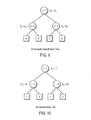
- Figure 10 shows the simple classification tree under consideration. Referring to Figure 10 , there are three components x 1 , x 2 , x 3 .
- the two class labels A and B are encoded as 1 and 2 respectively.
- the splitting rule output is a binary value where 1 indicates that the user's input satisfies the classification rule of the form x i > ⁇ i .
- the functions are formed as a collection of degree one functions.
- g be the decision function as described above.
- the classifier gets the following values for each internal node:
- the OPE protocol at each node ensures that the classifier does not learn x and the splitting decision, and that the user does not learn the splitting rule.
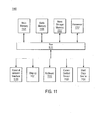
- FIG 11 is a block diagram of an exemplary computer system that may perform one or more of the operations described herein.
- computer system 1100 may comprise an exemplary client or server computer system.
- Computer system 1100 comprises a communication mechanism or bus 1111 for communicating information, and a processor 1112 coupled with bus 1111 for processing information.
- Processor 1112 includes a microprocessor, but is not limited to a microprocessor, such as, for example, PentiumTM, PowerPCTM, AlphaTM, etc.
- System 1100 further comprises a random access memory (RAM), or other dynamic storage device 1104 (referred to as main memory) coupled to bus 1111 for storing information and instructions to be executed by processor 1112.
- main memory 1104 also may be used for storing temporary variables or other intermediate information during execution of instructions by processor 1112.
- Computer system 1100 also comprises a read only memory (ROM) and/or other static storage device 1106 coupled to bus 1111 for storing static information and instructions for processor 1112, and a data storage device 1107, such as a magnetic disk or optical disk and its corresponding disk drive.
- ROM read only memory
- Data storage device 1107 is coupled to bus 1111 for storing information and instructions. The instructions may be used to perform operations described above.
- Computer system 1100 may further be coupled to a display device 1121, such as a cathode ray tube (CRT) or liquid crystal display (LCD), coupled to bus 1111 for displaying information to a computer user.
- a display device 1121 such as a cathode ray tube (CRT) or liquid crystal display (LCD)
- An alphanumeric input device 1122 may also be coupled to bus 1111 for communicating information and command selections to processor 1112.
- cursor control 1123 such as a mouse, trackball, trackpad, stylus, or cursor direction keys, coupled to bus 1111 for communicating direction information and command selections to processor 1112, and for controlling cursor movement on display 1121.
- bus 1111 Another device that may be coupled to bus 1111 is hard copy device 1124, which may be used for marking information on a medium such as paper, film, or similar types of media.
- hard copy device 1124 Another device that may be coupled to bus 1111 is a wired/wireless communication capability 1125 to communication to a phone or handheld palm device.
Landscapes
- Engineering & Computer Science (AREA)
- Computer Security & Cryptography (AREA)
- Computer Networks & Wireless Communication (AREA)
- Signal Processing (AREA)
- Information Retrieval, Db Structures And Fs Structures Therefor (AREA)
- Management, Administration, Business Operations System, And Electronic Commerce (AREA)
Abstract

Description
- Embodiments of the present invention relate to the field of classifiers and their use in classification; more particularly, embodiments of the present invention relate to pairing tree-based classification and data observation methods, including embodiments using secure and oblivious processing.
- The cloud computing model has attracted many businesses mainly due to its zero capital investment, flexibility as well as reduced operational cost. The model has changed the way companies do business into a utility model where one pays as per the usage. Computing as a service (CaaS) is an emerging branch of cloud computing where companies can utilize computational power and processing logics without needing to have licensed software copies, own processing logics and computing hardware setup in-house. One type of computation is that in a candidate for use in this way is tree-based classification. With the exponential growth of data, there is a real need to perform pattern recognition and mining on large data sets.
- Even though CaaS provides many benefits, security and privacy concerns have still been the main factors keeping many companies from moving to the cloud. It is challenging to secure the input data since users need to allow the service provider to perform computations over the data without revealing them. Classification as a service has the added challenge of securing the classifier and the training set the service provider uses to train the tree.
- Consider the following scenario. A user (client) has a set of images (X). The user may want to classify the images in order to determine whether they contain, for example, faces. The user does not have the resources and/or expertise to run a classification algorithm to classify them. Therefore, it wants to delegate the classification task f to a remote classifier (server in the cloud) and obtain the decision f(x) where x ∈ X. The following are the security and privacy requirements.
- 1. The user does not want to reveal the images (x values) to the classifier.
- 2. The classifier does not want to reveal its classification algorithm f to the user, other than the information that can be inferred from f(x).
- 3. The user does not want the classifier to learn the classification decision f(x).
- Below is a short description of some of the computational primitives that are well-known in the art.
- In 1-out-of-2 Oblivious Transfer (OT 1 2), one party, the sender, has input composed of two strings (M 0, M 1), and the input of a second party, the chooser, is a bit σ. The chooser should learn M σ and nothing regarding M 1-σ while the sender should gain no information about σ. 1-out-of-N OT is an extension of OT1 2 where the chooser learns one Mi (1 ≤ i ≤ N) and nothing else. k-out-of-N OT is a generalization of OT1 N . For more information, see M. O. Rabin, "How to Exchange Secrets with Oblivious Transfer," Cryptology ePrint Archive, Report 2005/187,2005, http://eprint.iacr.org/; S. Even, et al., "A Randomized Protocol for Signing Contracts," Commun. ACM, 28(6):637-647, 1985; and M. Naor et al., "Efficient Oblivious Transfer Protocols," In SODA '01: Proceedings of the twelfth annual ACM SIAM symposium on Discrete algorithms, pages 448-457, Philadelphia, PA, USA, 2001, Society for Industrial and Applied Mathematics.
- An OPE protocol has two parties, the sender who has a polynomial f over some finite field + p and the receiver has an input x ∈ + p . At the end of the protocol, the receiver learns f(x) and nothing else, and the sender learns nothing. For more information on OPE, see M. Naor, et al., "Oblivious Transfer and Polynomial Evaluation," In STOC '99: Proceedings of the thirtyfirst annual ACM symposium on Theory of computing, pages 245-254, New York, NY, USA, 1999. ACM; H.-D. Li, et al., "Oblivious Polynomial Evaluation," J. Comput. Sci. Technol., 19(4):550-554, 2004; M. Naor, et al., "Oblivious Polynomial Evaluation," SIAM J. Comput.; 35(5):1254-1281, 2006; and Y.-C. Chang, et al., "Oblivious Polynomial Evaluation and Oblivious Neural Learning, Theor. Comput. Sci., 341(1):39-54, 2005.
- An asymmetric cryptosystem - which consists of key generation, encryption (E) and decryption (Δ) functions - is homomorphic if for any given public key and any two plaintext messages m1, m2 in the plaintext space, the following encryption relationship holds:
 is a binary operator. If the operator is addition, the cryptosystem is additive homomorphic (e.g., P. Paillier, "Public-Key Cryptosystems Based On Composite Degree Residuosity Classes," In EUROCRYPT'99: Proceedings of the 17th international conference on Theory and application of cryptographic techniques, pages 223-238, Berlin, Heidelberg, 1999,
- Springer-Verlag) and if the operator is multiplication, the cryptosystem is multiplicative homomorphic (e.g., T. El Gamal, "A Public Key Cryptosystem and a Signature Scheme Based On Discrete Logarithms," In Proceedings of CRYPTO 84 on Advances in cryptology, pages 10-18, New York, NY, USA, 1985. Springer-Verlag New York, Inc.).
- All known OT protocols require public key cryptography (PKC). PKC involves modular exponentiation. Hence, the computation overhead is more demanding than its communication overhead. Herein, implementations of OT 1 2 and OT 1 N are described which closely follows the protocols proposed by Naor and Pinkas, "Efficient Oblivious Transfer Protocols," In SODA '01: Proceedings of the twelfth annual ACM-SLAM symposium on Discrete algorithms, pages 448-457, Philadelphia, PA, USA, 2001. Society for Industrial and Applied Mathematics.
- The chooser's input is σ ∈ 0, 1, and the sender's input is two strings M 0, M 1. The chooser's output is M σ. The protocol operates over a group · q of prime order and g is a generator of the group. The construction uses a function H that is modeled as a random oracle, i.e. chosen as a truly random function available to any participant and usually implemented as a hash function such as SHA.
-
- 1. The sender chooses a random element rs ∈ · q and publishes it.
- 2. The chooser picks a random rc ∈ · q and sets the public keys PK σ = gr
σ and PK 1-σ = rs /PKσ and sends PK 0 to the sender. - 3. The sender computes PK 1 = rs /PK 0 and chooses randoms r 1, r 2 ∈ · q . It encrypts M 0 by E 0 as the tuple


- 4. The chooser computes

- The same r = r 1 = r 2 can be used to provide the same level of privacy and security. With the same r, the sender needs to compute three exponentiations (one of them can be precomputed before the protocol begins) and the chooser needs to compute two exponentiations (one of them can be precomputed). Assuming q is a n-bit prime number, the communication complexity is 2n (from chooser) +n + 2 log2 |M| (from sender). The complexity is 5n if messages are elements of · q and one random value r is used.
- The OPE protocol introduced by Chang and Lu, "Oblivious Polynomial Evaluation and Oblivious Neural Learning," Theor. Comput. Sci., 341(1):39-54, 2005, employs OT 1 2.
- The polynomials are over a finite field + q where q is a an ℓ-bit prime number. The receiver has the input x * ∈ + q and the sender has the polynomial of degree d,

- Each coefficient ai is represented as follows:

- For each i ∈ [1, d] and each j ∈ [1,ℓ], the receiver computes the value v ij as follows:

- Notice that for each i ∈ [1, d] the following holds:

- The protocol using OT 1 2:
- 1. The receiver prepares dℓ pairs of (rij , vij + rij ) where each rij is chosen uniformly at random from + q .
- 2. For each pair of (rij, vij + rij), the sender runs an OT 1 2 with the receiver to get rij if aij = 0 and vij + rij otherwise.
- 3. The sender computes the sum of a 0 and the output of the dℓ OT 1 2 protocols which is equal to

- The dominant operation in this protocol is the OT 1 2 operations. The complexity is dℓ times that of OT 1 2. (Five exponentiation and three inverse operations per OT 1 2).
- The protocol using additive homomorphic encryption (HE) is as follows:
- 1. The receiver prepares dℓ values of E(vij ).
- 2. For each value of E ij , the sender picks 1 if aij = 0 and E(vij) otherwise.
- 3. The sender computes the sum of a 0 and the output of the dℓ encrypted values which is equal to

- The dominant operation in this protocol is the HE operations. The complexity is 2dℓ times that of encryption (i.e., one exponentiation per encryption). Compared to the first protocol, the number of exponentiations in the second approach is reduced by half. Compared to the first protocol and assuming that the ciphertext space is same as the plaintext space, the communication complexity in the second approach is reduced by two thirds.
- Additional techniques related to those described above include privacy preserving data mining (PPDM). In PPDM research, the main focus has been to collectively learn a predictive model while addressing privacy and security concerns. In such research, there are two main branches of problems. The final goal of both branches is to train a predictive model, but the two branches make different assumptions and have different settings. The first category (perturbed input problem) addresses the problem of keeping the input to the data mining party, i.e., the classifier, private and creating the predictive model. The second category (private party input problem) address the following problem: there are several parties having input data and they collectively want to create a predictive model while each party keeping their input data private for the other involving parties.
- In the private party input problem, the input data from different parties could be either horizontally or vertically partitioned. With horizontally partitioned data, each party has complete data sets for all the features under consideration. In contrast, with vertically partitioned data, each party does not have complete data sets for the features under consideration, i.e., each has partial input data to construct complete data sets. In the ideal situation, at the end of the data mining procedure, each party knows only their data, vertically or horizontally partitioned, and the trained predictive model.
- In the perturbed input problem, as the name suggests, the user, that owns the input data, adds "noise" (e.g., generalization, distortion, etc.) to the data before the data mining process and then use reconstruction techniques to recover the original cumulative distribution (not the original values). The noise hides the data from the classifier. However, it is difficult to quantify the level of privacy and security that such a method provides. Further, the predictive model has some amount of false positives as well as negatives due to the noise. After learning the predictive model from the perturbed data, the model can classify non-perturbed data. In order to protect user inputs, the user is given the predictive model to locally run the classification algorithm. While such an approach preserve the privacy of the user inputs, it fails to protect the predictive model.
- A method and apparatus are disclosed herein for classification, In one embodiment, the method comprises performing tree-based classification of a user input by a classifier with a classification tree at a first location, including exchanging data with a second location, different from the first location, to obtain the user input and provide results of classification to a user using singly homomorphic encryption so that the user input is not revealed to the classifier, the classification tree is not revealed to the user and the classifier's output is not revealed to the classifier.
- The present invention will be understood more fully from the detailed description given below and from the accompanying drawings of various embodiments of the invention, which, however, should not be taken to limit the invention to the specific embodiments, but are for explanation and understanding only.
-
Figure 1 illustrates an example decision tree with notations used herein. -
Figure 2 is a flow diagram of one embodiment of a process for processing data using approaches described herein. -
Figure 3 illustrates pseudo code of one embodiment of an algorithm performed at the classifier. -
Figure 4 is a flow diagram of one embodiment of a process for classifying data using a linear classification tree. -
Figure 5 is pseudo code for one embodiment of an algorithm of the operations performed by the user when using the classifier. -
Figure 6 is a flow diagram of one embodiment of a process for classifying data using a linear classification tree. -
Figure 7 is pseudo code for one embodiment of an algorithm performed at a classifier for evaluating the splitting rule at each internal node. -
Figure 8 is a flow diagram of one embodiment of a process for splitting rule evaluation at a classifier that performs classification using a classification tree. -
Figure 9 illustrates an example classification tree with notations used herein. -
Figure 10 illustrates an instance of the classification tree inFigure 9 . -
Figure 11 is a block diagram of a computer system. - The following discloses novel approaches to perform oblivious tree-based classification. One approach is based on the oblivious transfer protocol whereas another approach is based on an additive homomorphic cryptosystem. In one embodiment, tree-based classification is combined with a homomorphic encryption based novel oblivious polynomial evaluation protocol that is much more efficient than the existing protocols. In one embodiment, new protocols are constructed and practical cryptographic techniques are used, thereby allowing performance of certain arithmetic operations on encrypted data.
- Techniques described herein may be used in a service model.
- In the following description, numerous details are set forth to provide a more thorough explanation of the present invention. It will be apparent, however, to one skilled in the art, that the present invention may be practiced without these specific details. In other instances, well-known structures and devices are shown in block diagram form, rather than in detail, in order to avoid obscuring the present invention.
- Some portions of the detailed descriptions which follow are presented in terms of algorithms and symbolic representations of operations on data bits within a computer memory. These algorithmic descriptions and representations are the means used by those skilled in the data processing arts to most effectively convey the substance of their work to others skilled in the art. An algorithm is here, and generally, conceived to be a self-consistent sequence of steps leading to a desired result. The steps are those requiring physical manipulations of physical quantities. Usually, though not necessarily, these quantities take the form of electrical or magnetic signals capable of being stored, transferred, combined, compared, and otherwise manipulated. It has proven convenient at times, principally for reasons of common usage, to refer to these signals as bits, values, elements, symbols, characters, terms, numbers, or the like.
- It should be borne in mind, however, that all of these and similar terms are to be associated with the appropriate physical quantities and are merely convenient labels applied to these quantities. Unless specifically stated otherwise as apparent from the following discussion, it is appreciated that throughout the description, discussions utilizing terms such as "processing" or "computing" or "calculating" or "determining" or "displaying" or the like, refer to the action and processes of a computer system, or similar electronic computing device, that manipulates and transforms data represented as physical (electronic) quantities within the computer system's registers and memories into other data similarly represented as physical quantities within the computer system memories or registers or other such information storage, transmission or display devices.
- The present invention also relates to apparatus for performing the operations herein. This apparatus may be specially constructed for the required purposes, or it may comprise a general purpose computer selectively activated or reconfigured by a computer program stored in the computer. Such a computer program may be stored in a computer readable storage medium, such as, but is not limited to, any type of disk including floppy disks, optical disks, CD-ROMs, and magnetic-optical disks, read-only memories (ROMs), random access memories (RAMs), PROMS, EEPROMs, magnetic or optical cards, or any type of media suitable for storing electronic instructions, and each coupled to a computer system bus.
- The algorithms and displays presented herein are not inherently related to any particular computer or other apparatus. Various general purpose systems may be used with programs in accordance with the teachings herein, or it may prove convenient to construct more specialized apparatus to perform the required method steps. The required structure for a variety of these systems will appear from the description below. In addition, the present invention is not described with reference to any particular programming language. It will be appreciated that a variety of programming languages may be used to implement the teachings of the invention as described herein.
- A machine-readable medium includes any mechanism for storing or transmitting information in a form readable by a machine (e.g., a computer). For example, a machine-readable medium includes read only memory ("ROM"); random access memory ("RAM"); magnetic disk storage media; optical storage media; flash memory devices; etc.
- Table 1 summarizes all the symbols and notations used herein.
Notation Description x User's single input X User's set of inputs y Classifier's feature vector at each internal node of the classification tree. For ID3, there is only one none-zero element, for the general case, there can be more than one non-zero element. n The number of elements in x and y m The number of internal nodes C The set of class labels vij The value of (j - 1) th position of the ith coefficient of a polynomial Γ The matrix of all vij values P The number of paths (= the number of leaf nodes) in the decision tree ε Encryption function Z User's output vector of binary values at each node Z' Encrypted vector of Z, i.e., ε(Z[i]) for i=1, 2, ..., n Z" Encrypted vector of the complement of Z, i.e., ε(1 - Z[i]) for i = 1, 2, ..., n V The classifier's encrypted final output vector for i = 1, 2, ..., n h The height of the classification tree, i.e., the number of layers fi The (binary) splitting rule as function at the node i θi The threshold value at the node i where the splitting rule looks like fi = xtyi -θ i . O Encrypted output of all the splitting rules p The prime order of the finite field +p l The bit length of the size of the elements in x, y and of θ. fi 's are evaluated over a finite field whose length of the prime order is no more than l. - Initially, the focus is on privately classifying input data based on a tree with branching factor set to 2 as it involves only single variable linear decisions. Then the techniques are extended to multivariate decision trees.
- The following is assumed:
- The classification tree is already learned.
- The branching factor is 2.
- The number of categories and class labels are public.
- There are two parties. The user, who has a private input vector x = (x 1, x 2, ..., xn )t and the classifier, who has a trained classification tree. The user wants to find the class label of her input out of all possible class labels C = {w 1,w 2,..., wt }. The following are the privacy and security requirements.
- 1. The user does not want to reveal x to the classifier.
- 2. The classifier does not want to reveal the classification tree to the user, specifically the decision computed by the tree.
- 3. The user does not want to reveal the class label for her input to the classifier.
- An example of a classification tree is shown in
Figure 1 . - Multiple approaches are proposed herein. In one embodiment, OT 1 2 is used for the evaluation of internal nodes of the tree. In another embodiment, additive homomorphic encryption is used for the evaluation of the internal nodes of the tree. Both of these approaches use additive homomorphic encryption for the evaluation of the class label. For purposes herein, the first is referred to as the OT based approach and the latter is referred to as the HE based approach.
-
Figure 2 is a flow diagram of one embodiment of a process for processing data using either of the two approaches. The process is performed by processing logic that may comprise hardware (circuitry, dedicated logic, etc.), software (such as is run on a general purpose computer system or a dedicated machine), or a combination of both. In one embodiment, the processing logic is part of a classifier. - Referring to
Figure 2 , the process comprises processing logic performing tree-based classification of a user input by a classifier with a classification tree at a first location, which includes processing logic exchanging data with a second location, different from the first location, to obtain the user input and provide results of classification to a user using singly homomorphic encryption so that the user input is not revealed to the classifier and the classification tree is not revealed to the user (processing block 201). In one embodiment, the singly homomorphic encryption uses a bit-wise polynomial representation of inputs and weights for classification. In one embodiment, the polynomial representation represents polynomials as sums. In one embodiment, the singly homomorphic encryption comprises additive homomorphic encryption. In one embodiment, the singly homomorphic encryption comprises homomorphic encryption based oblivious polynomial evaluation protocol. - The user and the classifier executes an OPE protocol for each node in the classification tree. The classifier chooses nodes uniformly at random so that the user does not learns the relative location of the nodes in the classification tree. Let, without loss of generality, the nodes in the classification tree are indexed from 1 to m in some deterministic but random order. Let the n dimensional feature vector at node i be yi = {y 1, y 2, ..., yn }. Let the splitting rule f i at each node i be of the form x t y i ≤θ i where θ i is the threshold value. In one embodiment, the function f is given before the use of this technique. It could be a classifier of a face, of marks on a form on a page, etc. In one embodiment, the particular functions are implemented in nodes in the decision tree. The tree was trained ahead of time. In one embodiment, the class of functions are "linear functions" or "dot product functions." These are most widely used in decision trees.
- One can represent the splitting rule at node i using a randomized function fi (x, y i , θ i ) → {0, 1} where 1 indicates that the splitting rule is satisfied (i.e., "yes"). The function fi may be defined as:
      fi(x, yi, θi) = {
       1 if xtyi-θi<=0
      0 otherwise
       }


where E is the additive homomorphic encryption and 1 ≤ i ≤ m. Note that each path corresponds to a leaf node and its related class. The user has the private key. The classifier chooses a random number r ∈ · p .

where h is the number of internal nodes in the path (i.e., the tree height), wt is the class label associated with the leaf node of path t and 1 ≤ t ≤ P, performing P separate multiplications. The classifier creates the vector V = {v 1, v 2, ... , vP }. When the user decrypts each element in V, there will be only one element in the domain of the class values and thus the user obtains the corresponding class for her input x.

and at the classifier is

- For the
node 1, y 1 = {1, 0, 0}, f 1(x, y 1, θ1) = r 1 x 1-r 1θ1. - For the
node 2, y 2 = {0, 1, 0}, f 2(x, y 2, θ2) = r 2 x 2-r 2θ2. - For the
node 3, y3 = {0, 1, 0}, f 3(x, y 3, θ3) = r 3 x 2 - r 3θ3·
| z1 | z2 | z3 | Class | |
| 1 | 1 | N/ | A | |
| 1 | 0 | N/A | B | |
| 0 | N/A | 1 | A | |
| 0 | N/A | 0 | |

- p = 3 83 (a 9-bit prime)
- g = 379 (a generator of the multiplicative cyclic group
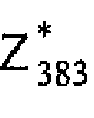
- q = 128 (For the comparison protocol to work, q <p/2. The length of q, ℓ = 7 bits)
- f(x) = 5x (The degree d = 1)


where zi is the satisfiability of the rule at node i.
- Assume that the user's input is x = {15, 50, 25}. Using the same public parameters as above, the user computes V and R as follows:


- For the
node 1,
- For the
node 2,
- For the
node 3,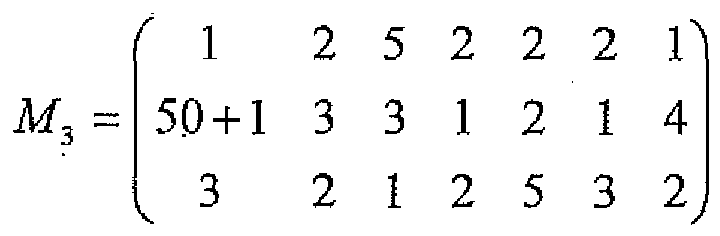


Claims (6)
- A method comprising:performing tree-based classification of a user input by a classifier with a classification tree at a first location, including exchanging data with a second location, different from the first location, to obtain the user input and provide results of classification to a user using singly homomorphic encryption so that the user input is not revealed to the classifier, the classification tree is not revealed to the user and the classifier's output is not revealed to the classifier.
- The method defined in Claim 1, characterized in that the singly homomorphic encryption uses a bit-wise polynomial representation of inputs for classification.
- The method defined in Claim 2, characterized in that the polynomial representation represents polynomials as sums.
- The method defined in Claim 1, characterized in that the singly homomorphic encryption comprises additive homomorphic encryption.
- The method defined in Claim 1, characterized in that the singly homomorphic encryption comprises homomorphic encryption based oblivious polynomial evaluation protocol.
- A computer readable medium having computer readable code stored thereon, which, when executed by a system, causes the system to:perform tree-based classification of a user input by a classifier with a classification tree at a first location, including exchanging data with a second location, different from the first location, to obtain the user input and provide results of classification to a user using singly homomorphic encryption so that the user input is not revealed to the classifier, the classification tree is not revealed to the user and the classifier's output is not revealed to the classifier.
Applications Claiming Priority (1)
| Application Number | Priority Date | Filing Date | Title |
|---|---|---|---|
| US13/020,708 US9002007B2 (en) | 2011-02-03 | 2011-02-03 | Efficient, remote, private tree-based classification using cryptographic techniques |
Publications (2)
| Publication Number | Publication Date |
|---|---|
| EP2485428A2 true EP2485428A2 (en) | 2012-08-08 |
| EP2485428A3 EP2485428A3 (en) | 2014-04-30 |
Family
ID=45607601
Family Applications (1)
| Application Number | Title | Priority Date | Filing Date |
|---|---|---|---|
| EP12153505.8A Withdrawn EP2485428A3 (en) | 2011-02-03 | 2012-02-01 | Efficient, remote, private tree-based classification using cryptographic techniques |
Country Status (3)
| Country | Link |
|---|---|
| US (1) | US9002007B2 (en) |
| EP (1) | EP2485428A3 (en) |
| JP (1) | JP5957918B2 (en) |
Cited By (6)
| Publication number | Priority date | Publication date | Assignee | Title |
|---|---|---|---|---|
| WO2016089710A1 (en) * | 2014-12-02 | 2016-06-09 | Microsoft Technology Licensing, Llc | Secure computer evaluation of decision trees |
| US9825758B2 (en) | 2014-12-02 | 2017-11-21 | Microsoft Technology Licensing, Llc | Secure computer evaluation of k-nearest neighbor models |
| CN108833077A (en) * | 2018-07-02 | 2018-11-16 | 西安电子科技大学 | Outer packet classifier encipher-decipher method based on homomorphism OU password |
| CN109359588A (en) * | 2018-10-15 | 2019-02-19 | 电子科技大学 | A Novel Privacy-Preserving Non-Interactive K-Nearest Neighbor Classification Method |
| CN110222527A (en) * | 2019-05-22 | 2019-09-10 | 暨南大学 | A kind of method for secret protection |
| CN110427969A (en) * | 2019-07-01 | 2019-11-08 | 阿里巴巴集团控股有限公司 | Data processing method, device and electronic device |
Families Citing this family (42)
| Publication number | Priority date | Publication date | Assignee | Title |
|---|---|---|---|---|
| US8660968B2 (en) * | 2011-05-25 | 2014-02-25 | Azure Vault Ltd. | Remote chemical assay classification |
| US20130097417A1 (en) * | 2011-10-13 | 2013-04-18 | Microsoft Corporation | Secure private computation services |
| US9197613B2 (en) * | 2011-12-20 | 2015-11-24 | Industrial Technology Research Institute | Document processing method and system |
| US8880867B2 (en) * | 2012-04-12 | 2014-11-04 | Sap Ag | Fault-tolerant privacy-preserving statistics |
| US20160213323A1 (en) * | 2015-01-23 | 2016-07-28 | Hello Inc. | Room monitoring methods |
| US20160192876A1 (en) * | 2015-01-02 | 2016-07-07 | Hello Inc. | Room monitoring device and sleep analysis |
| JP6244728B2 (en) * | 2013-08-07 | 2017-12-13 | 富士通株式会社 | Information processing method and program |
| US9524392B2 (en) * | 2013-11-30 | 2016-12-20 | Microsoft Technology Licensing, Llc | Encrypting genomic data for storage and genomic computations |
| US11012939B2 (en) | 2014-01-08 | 2021-05-18 | Huawei Technologies Co., Ltd. | System and method for always on connections in wireless communications system |
| US9946970B2 (en) | 2014-11-07 | 2018-04-17 | Microsoft Technology Licensing, Llc | Neural networks for encrypted data |
| JP6381128B2 (en) * | 2015-02-05 | 2018-08-29 | 国立研究開発法人産業技術総合研究所 | SEARCH SYSTEM, CLIENT, SERVER, SEARCH PROGRAM, AND SEARCH METHOD |
| US10819506B2 (en) * | 2015-10-07 | 2020-10-27 | Nec Corporation | Method for storing a data file |
| US10153894B2 (en) | 2015-11-05 | 2018-12-11 | Microsoft Technology Licensing, Llc | Homomorphic encryption with optimized encoding |
| US10075289B2 (en) | 2015-11-05 | 2018-09-11 | Microsoft Technology Licensing, Llc | Homomorphic encryption with optimized parameter selection |
| US9900147B2 (en) | 2015-12-18 | 2018-02-20 | Microsoft Technology Licensing, Llc | Homomorphic encryption with optimized homomorphic operations |
| US10296709B2 (en) | 2016-06-10 | 2019-05-21 | Microsoft Technology Licensing, Llc | Privacy-preserving genomic prediction |
| FR3060165B1 (en) * | 2016-12-09 | 2019-05-24 | Commissariat A L'energie Atomique Et Aux Energies Alternatives | SECURE CLASSIFICATION METHOD USING TRANSCHIFFREMENT OPERATION |
| US10903976B2 (en) | 2017-01-20 | 2021-01-26 | Enveil, Inc. | End-to-end secure operations using a query matrix |
| US11777729B2 (en) | 2017-01-20 | 2023-10-03 | Enveil, Inc. | Secure analytics using term generation and homomorphic encryption |
| US11507683B2 (en) | 2017-01-20 | 2022-11-22 | Enveil, Inc. | Query processing with adaptive risk decisioning |
| US10972251B2 (en) | 2017-01-20 | 2021-04-06 | Enveil, Inc. | Secure web browsing via homomorphic encryption |
| US10873568B2 (en) | 2017-01-20 | 2020-12-22 | Enveil, Inc. | Secure analytics using homomorphic and injective format-preserving encryption and an encrypted analytics matrix |
| US11196541B2 (en) | 2017-01-20 | 2021-12-07 | Enveil, Inc. | Secure machine learning analytics using homomorphic encryption |
| US10536437B2 (en) | 2017-01-31 | 2020-01-14 | Hewlett Packard Enterprise Development Lp | Performing privacy-preserving multi-party analytics on vertically partitioned local data |
| US10565524B2 (en) * | 2017-01-31 | 2020-02-18 | Hewlett Packard Enterprise Development Lp | Performing privacy-preserving multi-party analytics on horizontally partitioned local data |
| US10111615B2 (en) | 2017-03-11 | 2018-10-30 | Fitbit, Inc. | Sleep scoring based on physiological information |
| US10198399B1 (en) * | 2018-03-06 | 2019-02-05 | KenSci Inc. | Cryptographically secure machine learning |
| JP6904916B2 (en) * | 2018-03-23 | 2021-07-21 | Kddi株式会社 | Information processing method and information processing system |
| JP6917942B2 (en) * | 2018-04-11 | 2021-08-11 | 株式会社日立製作所 | Data analysis server, data analysis system, and data analysis method |
| US10902133B2 (en) | 2018-10-25 | 2021-01-26 | Enveil, Inc. | Computational operations in enclave computing environments |
| US10817262B2 (en) | 2018-11-08 | 2020-10-27 | Enveil, Inc. | Reduced and pipelined hardware architecture for Montgomery Modular Multiplication |
| WO2020100118A1 (en) | 2018-11-15 | 2020-05-22 | Ravel Technologies SARL | Cryptographic anonymization for zero-knowledge advertising methods, apparatus, and system |
| FR3097353B1 (en) * | 2019-06-12 | 2021-07-02 | Commissariat Energie Atomique | COLLABORATIVE LEARNING METHOD OF AN ARTIFICIAL NEURON NETWORK WITHOUT DISCLOSURE OF LEARNING DATA |
| US10778410B2 (en) | 2019-06-18 | 2020-09-15 | Alibaba Group Holding Limited | Homomorphic data encryption method and apparatus for implementing privacy protection |
| US11750362B2 (en) * | 2019-09-17 | 2023-09-05 | Sap Se | Private decision tree evaluation using an arithmetic circuit |
| US11271958B2 (en) * | 2019-09-20 | 2022-03-08 | International Business Machines Corporation | Efficient unsupervised anomaly detection on homomorphically encrypted data |
| CN111143862B (en) * | 2019-12-13 | 2021-07-09 | 支付宝(杭州)信息技术有限公司 | Data processing method, query method, device, electronic device and system |
| US12099997B1 (en) | 2020-01-31 | 2024-09-24 | Steven Mark Hoffberg | Tokenized fungible liabilities |
| WO2021161069A1 (en) * | 2020-02-12 | 2021-08-19 | Telefonaktiebolaget Lm Ericsson (Publ) | Method and system for privacy preserving information exchange |
| US11601258B2 (en) | 2020-10-08 | 2023-03-07 | Enveil, Inc. | Selector derived encryption systems and methods |
| CN113807537B (en) * | 2021-04-06 | 2023-12-05 | 京东科技控股股份有限公司 | Data processing method and device for multi-source data, electronic equipment and storage medium |
| KR102615381B1 (en) * | 2021-08-24 | 2023-12-19 | 서울대학교산학협력단 | Method for privacy preserving using homomorphic encryption with private variables and apparatus theroef |
Family Cites Families (12)
| Publication number | Priority date | Publication date | Assignee | Title |
|---|---|---|---|---|
| US4200770A (en) * | 1977-09-06 | 1980-04-29 | Stanford University | Cryptographic apparatus and method |
| US6167392A (en) * | 1997-10-09 | 2000-12-26 | Telcordia Technologies, Inc. | Method and apparatus for private information retrieval from a single electronic storage device |
| US7472105B2 (en) * | 2004-10-19 | 2008-12-30 | Palo Alto Research Center Incorporated | System and method for providing private inference control |
| US7577252B2 (en) | 2004-12-06 | 2009-08-18 | Mitsubishi Electric Research Laboratories, Inc. | Method for secure object detection in images |
| US7391905B2 (en) | 2004-12-06 | 2008-06-24 | Mitsubishi Electric Research Laboratories | Method for secure component labeling in images |
| US8291237B2 (en) * | 2005-03-01 | 2012-10-16 | The Regents Of The University Of California | Method for private keyword search on streaming data |
| US7526084B2 (en) | 2005-09-02 | 2009-04-28 | Mitsubishi Electric Research Laboratories, Inc. | Secure classifying of data with Gaussian distributions |
| US8467530B2 (en) * | 2005-10-05 | 2013-06-18 | Kabushiki Kaisha Toshiba | System and method for encrypting and decrypting document reproductions |
| US7657028B2 (en) | 2005-10-07 | 2010-02-02 | Mitsubishi Electric Research Laboratories, Inc. | Method for classifying private information securely |
| US7685115B2 (en) | 2006-07-21 | 2010-03-23 | Mitsubishi Electronic Research Laboratories, Inc. | Method for classifying private data using secure classifiers |
| WO2010135316A1 (en) * | 2009-05-18 | 2010-11-25 | Telcordia Technologies, Inc. | A privacy architecture for distributed data mining based on zero-knowledge collections of databases |
| US8861716B2 (en) * | 2010-03-30 | 2014-10-14 | International Business Machines Corporation | Efficient homomorphic encryption scheme for bilinear forms |
-
2011
- 2011-02-03 US US13/020,708 patent/US9002007B2/en not_active Expired - Fee Related
-
2012
- 2012-02-01 EP EP12153505.8A patent/EP2485428A3/en not_active Withdrawn
- 2012-02-02 JP JP2012021045A patent/JP5957918B2/en not_active Expired - Fee Related
Non-Patent Citations (3)
| Title |
|---|
| BARNI M ET AL: "Efficient privacy-preserving classification of ECG signals", INFORMATION FORENSICS AND SECURITY, 2009. WIFS 2009. FIRST IEEE INTERNATIONAL WORKSHOP ON, IEEE, PISCATAWAY, NJ, USA, 6 December 2009 (2009-12-06), pages 91-95, XP031615135, ISBN: 978-1-4244-5279-8 * |
| JUSTIN BRICKELL ET AL: "Privacy-preserving remote diagnostics", PROCEEDINGS OF THE 14TH ACM CONFERENCE ON COMPUTER AND COMMUNICATIONS SECURITY , CCS '07, 1 January 2007 (2007-01-01), page 498, XP055107514, New York, New York, USA DOI: 10.1145/1315245.1315307 ISBN: 978-1-59-593703-2 * |
| Moni Naor ET AL: "Oblivious Polynomial Evaluation", , 15 March 2005 (2005-03-15), XP055108652, Retrieved from the Internet: URL:http://www.wisdom.weizmann.ac.il/~naor/PAPERS/ope.pdf [retrieved on 2014-03-18] * |
Cited By (8)
| Publication number | Priority date | Publication date | Assignee | Title |
|---|---|---|---|---|
| WO2016089710A1 (en) * | 2014-12-02 | 2016-06-09 | Microsoft Technology Licensing, Llc | Secure computer evaluation of decision trees |
| US9787647B2 (en) | 2014-12-02 | 2017-10-10 | Microsoft Technology Licensing, Llc | Secure computer evaluation of decision trees |
| US9825758B2 (en) | 2014-12-02 | 2017-11-21 | Microsoft Technology Licensing, Llc | Secure computer evaluation of k-nearest neighbor models |
| CN108833077A (en) * | 2018-07-02 | 2018-11-16 | 西安电子科技大学 | Outer packet classifier encipher-decipher method based on homomorphism OU password |
| CN109359588A (en) * | 2018-10-15 | 2019-02-19 | 电子科技大学 | A Novel Privacy-Preserving Non-Interactive K-Nearest Neighbor Classification Method |
| CN109359588B (en) * | 2018-10-15 | 2021-02-09 | 电子科技大学 | Novel privacy protection non-interactive K nearest neighbor classification method |
| CN110222527A (en) * | 2019-05-22 | 2019-09-10 | 暨南大学 | A kind of method for secret protection |
| CN110427969A (en) * | 2019-07-01 | 2019-11-08 | 阿里巴巴集团控股有限公司 | Data processing method, device and electronic device |
Also Published As
| Publication number | Publication date |
|---|---|
| JP5957918B2 (en) | 2016-07-27 |
| EP2485428A3 (en) | 2014-04-30 |
| JP2012163960A (en) | 2012-08-30 |
| US20120201378A1 (en) | 2012-08-09 |
| US9002007B2 (en) | 2015-04-07 |
Similar Documents
| Publication | Publication Date | Title |
|---|---|---|
| US9002007B2 (en) | Efficient, remote, private tree-based classification using cryptographic techniques | |
| EP3506550B1 (en) | Providing security against user collusion in data analytics using random group selection | |
| Liu et al. | An efficient privacy-preserving outsourced calculation toolkit with multiple keys | |
| Cheon et al. | A hybrid scheme of public-key encryption and somewhat homomorphic encryption | |
| Laur et al. | Cryptographically private support vector machines | |
| EP1379024B1 (en) | Method and apparatus for generating a cryptographic key | |
| Biksham et al. | Homomorphic encryption techniques for securing data in cloud computing: A survey | |
| Veugen | Encrypted integer division and secure comparison | |
| Jarrous et al. | Secure hamming distance based computation and its applications | |
| CN111259440B (en) | A privacy-preserving decision tree classification method for cloud outsourcing data | |
| Hada | Secure obfuscation for encrypted signatures | |
| Vergnaud | Efficient and secure generalized pattern matching via fast fourier transform | |
| Aljamaly et al. | Undirected complete graph to design new public key cryptosystem | |
| Hohenberger et al. | Securely obfuscating re-encryption | |
| Rajesh et al. | A multi-stage partial homomorphic encryption scheme for secure data processing in cloud computing | |
| Guo et al. | Efficient and privacy-preserving federated learning based on full homomorphic encryption | |
| Hematpour et al. | Presence of dynamics of quantum dots in the digital signature using DNA alphabet and chaotic S-box | |
| Ogura | On Multivariate Public-key Cryptosystems | |
| Herbert et al. | Design and implementation of low-depth pairing-based homomorphic encryption scheme | |
| Laud et al. | Universally composable privacy preserving finite automata execution with low online and offline complexity | |
| Garg | Candidate Multilinear Maps | |
| CN116405184A (en) | Fast Training and Lightweight Prediction Method of Multiparty Privacy Preserving Naive Bayesian Model | |
| Tekin | Homomorphic encryption: A comprehensive study of types, techniques, and real-world applications | |
| CN114297671A (en) | Homomorphic encryption method and application thereof in privacy protection classifier | |
| Zhao et al. | New assumptions and efficient cryptosystems from the e-th power residue symbol |
Legal Events
| Date | Code | Title | Description |
|---|---|---|---|
| PUAI | Public reference made under article 153(3) epc to a published international application that has entered the european phase |
Free format text: ORIGINAL CODE: 0009012 |
|
| 17P | Request for examination filed |
Effective date: 20120201 |
|
| AK | Designated contracting states |
Kind code of ref document: A2 Designated state(s): AL AT BE BG CH CY CZ DE DK EE ES FI FR GB GR HR HU IE IS IT LI LT LU LV MC MK MT NL NO PL PT RO RS SE SI SK SM TR |
|
| AX | Request for extension of the european patent |
Extension state: BA ME |
|
| PUAL | Search report despatched |
Free format text: ORIGINAL CODE: 0009013 |
|
| AK | Designated contracting states |
Kind code of ref document: A3 Designated state(s): AL AT BE BG CH CY CZ DE DK EE ES FI FR GB GR HR HU IE IS IT LI LT LU LV MC MK MT NL NO PL PT RO RS SE SI SK SM TR |
|
| AX | Request for extension of the european patent |
Extension state: BA ME |
|
| RIC1 | Information provided on ipc code assigned before grant |
Ipc: H04L 9/00 20060101AFI20140321BHEP |
|
| STAA | Information on the status of an ep patent application or granted ep patent |
Free format text: STATUS: THE APPLICATION IS DEEMED TO BE WITHDRAWN |
|
| 18D | Application deemed to be withdrawn |
Effective date: 20141031 |