EP2484773A2 - Process for producing anthocyanins - Google Patents
Process for producing anthocyanins Download PDFInfo
- Publication number
- EP2484773A2 EP2484773A2 EP12158662A EP12158662A EP2484773A2 EP 2484773 A2 EP2484773 A2 EP 2484773A2 EP 12158662 A EP12158662 A EP 12158662A EP 12158662 A EP12158662 A EP 12158662A EP 2484773 A2 EP2484773 A2 EP 2484773A2
- Authority
- EP
- European Patent Office
- Prior art keywords
- coli
- recombinant
- naringenin
- flavonoid
- acid
- Prior art date
- Legal status (The legal status is an assumption and is not a legal conclusion. Google has not performed a legal analysis and makes no representation as to the accuracy of the status listed.)
- Withdrawn
Links
- 238000000034 method Methods 0.000 title claims abstract description 54
- 229930002877 anthocyanin Natural products 0.000 title claims description 41
- 235000010208 anthocyanin Nutrition 0.000 title claims description 41
- 239000004410 anthocyanin Substances 0.000 title claims description 41
- 150000004636 anthocyanins Chemical class 0.000 title claims description 41
- 108090000623 proteins and genes Proteins 0.000 claims abstract description 117
- 229930003935 flavonoid Natural products 0.000 claims abstract description 111
- 235000017173 flavonoids Nutrition 0.000 claims abstract description 111
- 150000002215 flavonoids Chemical class 0.000 claims abstract description 105
- 239000000758 substrate Substances 0.000 claims abstract description 69
- 102000004190 Enzymes Human genes 0.000 claims abstract description 53
- 108090000790 Enzymes Proteins 0.000 claims abstract description 52
- 241000588724 Escherichia coli Species 0.000 claims description 107
- 229930003949 flavanone Natural products 0.000 claims description 86
- 235000011981 flavanones Nutrition 0.000 claims description 86
- 108010044229 Dihydroflavanol 4-reductase Proteins 0.000 claims description 66
- 230000015572 biosynthetic process Effects 0.000 claims description 62
- ZONYXWQDUYMKFB-UHFFFAOYSA-N SJ000286395 Natural products O1C2=CC=CC=C2C(=O)CC1C1=CC=CC=C1 ZONYXWQDUYMKFB-UHFFFAOYSA-N 0.000 claims description 57
- 150000002208 flavanones Chemical class 0.000 claims description 30
- 108010031387 anthocyanidin synthase Proteins 0.000 claims description 28
- 240000007377 Petunia x hybrida Species 0.000 claims description 23
- 238000003786 synthesis reaction Methods 0.000 claims description 23
- 101000807292 Arabidopsis thaliana Flavonol 3-O-glucosyltransferase Proteins 0.000 claims description 14
- 101000672025 Medicago truncatula Flavonoid 3-O-glucosyltransferase Proteins 0.000 claims description 13
- ABVCUBUIXWJYSE-GQUPQBGVSA-O pelargonidin 3-O-beta-D-glucoside Chemical compound O[C@@H]1[C@@H](O)[C@H](O)[C@@H](CO)O[C@H]1OC1=CC2=C(O)C=C(O)C=C2[O+]=C1C1=CC=C(O)C=C1 ABVCUBUIXWJYSE-GQUPQBGVSA-O 0.000 claims description 11
- 108010018087 Flavanone 3-dioxygenase Proteins 0.000 claims description 10
- 150000007523 nucleic acids Chemical class 0.000 claims description 9
- 108020004707 nucleic acids Proteins 0.000 claims description 8
- 102000039446 nucleic acids Human genes 0.000 claims description 8
- RKWHWFONKJEUEF-GQUPQBGVSA-O Cyanidin 3-O-glucoside Natural products O[C@@H]1[C@@H](O)[C@H](O)[C@@H](CO)O[C@H]1OC1=CC2=C(O)C=C(O)C=C2[O+]=C1C1=CC=C(O)C(O)=C1 RKWHWFONKJEUEF-GQUPQBGVSA-O 0.000 claims description 6
- YTMNONATNXDQJF-UBNZBFALSA-N chrysanthemin Chemical compound [Cl-].O[C@@H]1[C@@H](O)[C@H](O)[C@@H](CO)O[C@H]1OC1=CC2=C(O)C=C(O)C=C2[O+]=C1C1=CC=C(O)C(O)=C1 YTMNONATNXDQJF-UBNZBFALSA-N 0.000 claims description 6
- 238000012258 culturing Methods 0.000 claims description 4
- 238000004519 manufacturing process Methods 0.000 abstract description 63
- 238000006243 chemical reaction Methods 0.000 abstract description 37
- 230000014509 gene expression Effects 0.000 abstract description 35
- 229930015704 phenylpropanoid Natural products 0.000 abstract description 32
- 230000012010 growth Effects 0.000 abstract description 25
- 230000006696 biosynthetic metabolic pathway Effects 0.000 abstract description 21
- 239000000203 mixture Substances 0.000 abstract description 16
- 230000000813 microbial effect Effects 0.000 abstract description 10
- 125000001474 phenylpropanoid group Chemical group 0.000 abstract description 4
- 239000013612 plasmid Substances 0.000 description 108
- 239000013598 vector Substances 0.000 description 101
- NGSWKAQJJWESNS-UHFFFAOYSA-N 4-coumaric acid Chemical compound OC(=O)C=CC1=CC=C(O)C=C1 NGSWKAQJJWESNS-UHFFFAOYSA-N 0.000 description 98
- QAIPRVGONGVQAS-DUXPYHPUSA-N trans-caffeic acid Chemical compound OC(=O)\C=C\C1=CC=C(O)C(O)=C1 QAIPRVGONGVQAS-DUXPYHPUSA-N 0.000 description 92
- FTVWIRXFELQLPI-ZDUSSCGKSA-N (S)-naringenin Chemical compound C1=CC(O)=CC=C1[C@H]1OC2=CC(O)=CC(O)=C2C(=O)C1 FTVWIRXFELQLPI-ZDUSSCGKSA-N 0.000 description 84
- 229940117954 naringenin Drugs 0.000 description 83
- WGEYAGZBLYNDFV-UHFFFAOYSA-N naringenin Natural products C1(=O)C2=C(O)C=C(O)C=C2OC(C1)C1=CC=C(CC1)O WGEYAGZBLYNDFV-UHFFFAOYSA-N 0.000 description 77
- 235000007625 naringenin Nutrition 0.000 description 76
- SBHXYTNGIZCORC-UHFFFAOYSA-N eriodyctiol Natural products O1C2=CC(O)=CC(O)=C2C(=O)CC1C1=CC=C(O)C(O)=C1 SBHXYTNGIZCORC-UHFFFAOYSA-N 0.000 description 67
- SBHXYTNGIZCORC-ZDUSSCGKSA-N eriodictyol Chemical compound C1([C@@H]2CC(=O)C3=C(O)C=C(C=C3O2)O)=CC=C(O)C(O)=C1 SBHXYTNGIZCORC-ZDUSSCGKSA-N 0.000 description 65
- MWDZOUNAPSSOEL-UHFFFAOYSA-N kaempferol Natural products OC1=C(C(=O)c2cc(O)cc(O)c2O1)c3ccc(O)cc3 MWDZOUNAPSSOEL-UHFFFAOYSA-N 0.000 description 64
- 241000196324 Embryophyta Species 0.000 description 61
- 239000002609 medium Substances 0.000 description 60
- 229930003944 flavone Natural products 0.000 description 59
- 235000011949 flavones Nutrition 0.000 description 59
- WEVYAHXRMPXWCK-UHFFFAOYSA-N Acetonitrile Chemical compound CC#N WEVYAHXRMPXWCK-UHFFFAOYSA-N 0.000 description 54
- 210000004027 cell Anatomy 0.000 description 54
- 238000004128 high performance liquid chromatography Methods 0.000 description 54
- 238000000855 fermentation Methods 0.000 description 53
- 230000004151 fermentation Effects 0.000 description 53
- 238000003752 polymerase chain reaction Methods 0.000 description 53
- MZSGWZGPESCJAN-MOBFUUNNSA-N Melitric acid A Natural products O([C@@H](C(=O)O)Cc1cc(O)c(O)cc1)C(=O)/C=C/c1cc(O)c(O/C(/C(=O)O)=C/c2cc(O)c(O)cc2)cc1 MZSGWZGPESCJAN-MOBFUUNNSA-N 0.000 description 52
- TUJPOVKMHCLXEL-UHFFFAOYSA-N eriodictyol Natural products C1C(=O)C2=CC(O)=CC(O)=C2OC1C1=CC=C(O)C(O)=C1 TUJPOVKMHCLXEL-UHFFFAOYSA-N 0.000 description 52
- 235000011797 eriodictyol Nutrition 0.000 description 52
- 150000002207 flavanone derivatives Chemical class 0.000 description 52
- KZNIFHPLKGYRTM-UHFFFAOYSA-N apigenin Chemical compound C1=CC(O)=CC=C1C1=CC(=O)C2=C(O)C=C(O)C=C2O1 KZNIFHPLKGYRTM-UHFFFAOYSA-N 0.000 description 50
- XADJWCRESPGUTB-UHFFFAOYSA-N apigenin Natural products C1=CC(O)=CC=C1C1=CC(=O)C2=CC(O)=C(O)C=C2O1 XADJWCRESPGUTB-UHFFFAOYSA-N 0.000 description 50
- 235000008714 apigenin Nutrition 0.000 description 50
- 229940117893 apigenin Drugs 0.000 description 50
- 240000004808 Saccharomyces cerevisiae Species 0.000 description 49
- 235000014680 Saccharomyces cerevisiae Nutrition 0.000 description 49
- NGSWKAQJJWESNS-ZZXKWVIFSA-M 4-Hydroxycinnamate Natural products OC1=CC=C(\C=C\C([O-])=O)C=C1 NGSWKAQJJWESNS-ZZXKWVIFSA-M 0.000 description 48
- DFYRUELUNQRZTB-UHFFFAOYSA-N Acetovanillone Natural products COC1=CC(C(C)=O)=CC=C1O DFYRUELUNQRZTB-UHFFFAOYSA-N 0.000 description 48
- 239000002299 complementary DNA Substances 0.000 description 48
- ACEAELOMUCBPJP-UHFFFAOYSA-N (E)-3,4,5-trihydroxycinnamic acid Natural products OC(=O)C=CC1=CC(O)=C(O)C(O)=C1 ACEAELOMUCBPJP-UHFFFAOYSA-N 0.000 description 46
- -1 4-coumaroyl Chemical group 0.000 description 46
- 235000004883 caffeic acid Nutrition 0.000 description 46
- 229940074360 caffeic acid Drugs 0.000 description 46
- QAIPRVGONGVQAS-UHFFFAOYSA-N cis-caffeic acid Natural products OC(=O)C=CC1=CC=C(O)C(O)=C1 QAIPRVGONGVQAS-UHFFFAOYSA-N 0.000 description 46
- PADQINQHPQKXNL-LSDHHAIUSA-N (+)-dihydrokaempferol Chemical compound C1([C@@H]2[C@H](C(C3=C(O)C=C(O)C=C3O2)=O)O)=CC=C(O)C=C1 PADQINQHPQKXNL-LSDHHAIUSA-N 0.000 description 45
- RTIXKCRFFJGDFG-UHFFFAOYSA-N chrysin Chemical compound C=1C(O)=CC(O)=C(C(C=2)=O)C=1OC=2C1=CC=CC=C1 RTIXKCRFFJGDFG-UHFFFAOYSA-N 0.000 description 45
- XEKOWRVHYACXOJ-UHFFFAOYSA-N Ethyl acetate Chemical compound CCOC(C)=O XEKOWRVHYACXOJ-UHFFFAOYSA-N 0.000 description 39
- WBYWAXJHAXSJNI-VOTSOKGWSA-M .beta-Phenylacrylic acid Natural products [O-]C(=O)\C=C\C1=CC=CC=C1 WBYWAXJHAXSJNI-VOTSOKGWSA-M 0.000 description 36
- WBYWAXJHAXSJNI-SREVYHEPSA-N Cinnamic acid Chemical compound OC(=O)\C=C/C1=CC=CC=C1 WBYWAXJHAXSJNI-SREVYHEPSA-N 0.000 description 36
- 229930016911 cinnamic acid Natural products 0.000 description 36
- 235000013985 cinnamic acid Nutrition 0.000 description 36
- WBYWAXJHAXSJNI-UHFFFAOYSA-N methyl p-hydroxycinnamate Natural products OC(=O)C=CC1=CC=CC=C1 WBYWAXJHAXSJNI-UHFFFAOYSA-N 0.000 description 36
- 239000000047 product Substances 0.000 description 36
- 150000002212 flavone derivatives Chemical class 0.000 description 34
- HVQAJTFOCKOKIN-UHFFFAOYSA-N flavonol Natural products O1C2=CC=CC=C2C(=O)C(O)=C1C1=CC=CC=C1 HVQAJTFOCKOKIN-UHFFFAOYSA-N 0.000 description 34
- 235000011957 flavonols Nutrition 0.000 description 34
- IYRMWMYZSQPJKC-UHFFFAOYSA-N kaempferol Chemical compound C1=CC(O)=CC=C1C1=C(O)C(=O)C2=C(O)C=C(O)C=C2O1 IYRMWMYZSQPJKC-UHFFFAOYSA-N 0.000 description 34
- GAMYVSCDDLXAQW-AOIWZFSPSA-N Thermopsosid Natural products O(C)c1c(O)ccc(C=2Oc3c(c(O)cc(O[C@H]4[C@H](O)[C@@H](O)[C@H](O)[C@H](CO)O4)c3)C(=O)C=2)c1 GAMYVSCDDLXAQW-AOIWZFSPSA-N 0.000 description 33
- RSYUFYQTACJFML-DZGCQCFKSA-N afzelechin Chemical compound C1([C@H]2OC3=CC(O)=CC(O)=C3C[C@@H]2O)=CC=C(O)C=C1 RSYUFYQTACJFML-DZGCQCFKSA-N 0.000 description 33
- IQPNAANSBPBGFQ-UHFFFAOYSA-N luteolin Chemical compound C=1C(O)=CC(O)=C(C(C=2)=O)C=1OC=2C1=CC=C(O)C(O)=C1 IQPNAANSBPBGFQ-UHFFFAOYSA-N 0.000 description 33
- VHBFFQKBGNRLFZ-UHFFFAOYSA-N vitamin p Natural products O1C2=CC=CC=C2C(=O)C=C1C1=CC=CC=C1 VHBFFQKBGNRLFZ-UHFFFAOYSA-N 0.000 description 33
- CXQWRCVTCMQVQX-LSDHHAIUSA-N (+)-taxifolin Chemical compound C1([C@@H]2[C@H](C(C3=C(O)C=C(O)C=C3O2)=O)O)=CC=C(O)C(O)=C1 CXQWRCVTCMQVQX-LSDHHAIUSA-N 0.000 description 32
- LRDGATPGVJTWLJ-UHFFFAOYSA-N luteolin Natural products OC1=CC(O)=CC(C=2OC3=CC(O)=CC(O)=C3C(=O)C=2)=C1 LRDGATPGVJTWLJ-UHFFFAOYSA-N 0.000 description 32
- 235000009498 luteolin Nutrition 0.000 description 32
- 239000002243 precursor Substances 0.000 description 31
- REFJWTPEDVJJIY-UHFFFAOYSA-N Quercetin Chemical compound C=1C(O)=CC(O)=C(C(C=2O)=O)C=1OC=2C1=CC=C(O)C(O)=C1 REFJWTPEDVJJIY-UHFFFAOYSA-N 0.000 description 30
- 150000001875 compounds Chemical class 0.000 description 30
- RAYJUFCFJUVJBB-UHFFFAOYSA-N dihydrokaempferol Natural products OC1Oc2c(O)cc(O)cc2C(=O)C1c3ccc(O)cc3 RAYJUFCFJUVJBB-UHFFFAOYSA-N 0.000 description 30
- 108090001036 flavone synthase I Proteins 0.000 description 29
- 108010004539 Chalcone isomerase Proteins 0.000 description 28
- XCGZWJIXHMSSQC-UHFFFAOYSA-N dihydroquercetin Natural products OC1=CC2OC(=C(O)C(=O)C2C(O)=C1)c1ccc(O)c(O)c1 XCGZWJIXHMSSQC-UHFFFAOYSA-N 0.000 description 27
- YEDFEBOUHSBQBT-UHFFFAOYSA-N 2,3-dihydroflavon-3-ol Chemical class O1C2=CC=CC=C2C(=O)C(O)C1C1=CC=CC=C1 YEDFEBOUHSBQBT-UHFFFAOYSA-N 0.000 description 26
- 101100459905 Saccharomyces cerevisiae (strain ATCC 204508 / S288c) NCP1 gene Proteins 0.000 description 26
- 239000002253 acid Substances 0.000 description 26
- 101150046305 cpr-1 gene Proteins 0.000 description 26
- 238000002474 experimental method Methods 0.000 description 26
- 108010060641 flavanone synthetase Proteins 0.000 description 26
- 150000002213 flavones Chemical class 0.000 description 26
- 230000014759 maintenance of location Effects 0.000 description 25
- URFCJEUYXNAHFI-ZDUSSCGKSA-N pinocembrin Chemical compound C1([C@@H]2CC(=O)C3=C(O)C=C(C=C3O2)O)=CC=CC=C1 URFCJEUYXNAHFI-ZDUSSCGKSA-N 0.000 description 24
- FGUBFGWYEYFGRK-HNNXBMFYSA-N Pinocembrin Natural products Cc1cc(C)c2C(=O)C[C@H](Oc2c1)c3ccccc3 FGUBFGWYEYFGRK-HNNXBMFYSA-N 0.000 description 23
- 108010091111 cytochrome P-450 CYP93B1 (Glycyrrhiza echinata) Proteins 0.000 description 23
- KCFYHBSOLOXZIF-UHFFFAOYSA-N dihydrochrysin Natural products COC1=C(O)C(OC)=CC(C2OC3=CC(O)=CC(O)=C3C(=O)C2)=C1 KCFYHBSOLOXZIF-UHFFFAOYSA-N 0.000 description 23
- 230000000694 effects Effects 0.000 description 23
- 239000000463 material Substances 0.000 description 23
- 101000702488 Rattus norvegicus High affinity cationic amino acid transporter 1 Proteins 0.000 description 22
- 238000010367 cloning Methods 0.000 description 22
- PFTAWBLQPZVEMU-DZGCQCFKSA-N (+)-catechin Chemical compound C1([C@H]2OC3=CC(O)=CC(O)=C3C[C@@H]2O)=CC=C(O)C(O)=C1 PFTAWBLQPZVEMU-DZGCQCFKSA-N 0.000 description 20
- 108020004414 DNA Proteins 0.000 description 20
- RSYUFYQTACJFML-UKRRQHHQSA-N Epiafzelechin Natural products C1([C@H]2OC3=CC(O)=CC(O)=C3C[C@H]2O)=CC=C(O)C=C1 RSYUFYQTACJFML-UKRRQHHQSA-N 0.000 description 19
- 150000002216 flavonol derivatives Chemical class 0.000 description 19
- 235000011197 perejil Nutrition 0.000 description 19
- 229930013915 (+)-catechin Natural products 0.000 description 18
- 235000007219 (+)-catechin Nutrition 0.000 description 18
- 244000209526 Anthurium andraeanum Species 0.000 description 18
- OKKJLVBELUTLKV-UHFFFAOYSA-N Methanol Chemical compound OC OKKJLVBELUTLKV-UHFFFAOYSA-N 0.000 description 18
- SWAJPHCXKPCPQZ-UHFFFAOYSA-N 7-hydroxyflavanone Chemical compound O1C2=CC(O)=CC=C2C(=O)CC1C1=CC=CC=C1 SWAJPHCXKPCPQZ-UHFFFAOYSA-N 0.000 description 17
- UBSCDKPKWHYZNX-UHFFFAOYSA-N Demethoxycapillarisin Natural products C1=CC(O)=CC=C1OC1=CC(=O)C2=C(O)C=C(O)C=C2O1 UBSCDKPKWHYZNX-UHFFFAOYSA-N 0.000 description 17
- 244000062780 Petroselinum sativum Species 0.000 description 17
- 238000002835 absorbance Methods 0.000 description 17
- 229910052799 carbon Inorganic materials 0.000 description 17
- 239000000284 extract Substances 0.000 description 17
- 235000008777 kaempferol Nutrition 0.000 description 17
- UXOUKMQIEVGVLY-UHFFFAOYSA-N morin Natural products OC1=CC(O)=CC(C2=C(C(=O)C3=C(O)C=C(O)C=C3O2)O)=C1 UXOUKMQIEVGVLY-UHFFFAOYSA-N 0.000 description 17
- 102000004169 proteins and genes Human genes 0.000 description 17
- 238000003757 reverse transcription PCR Methods 0.000 description 17
- 239000000126 substance Substances 0.000 description 17
- OKTJSMMVPCPJKN-UHFFFAOYSA-N Carbon Chemical compound [C] OKTJSMMVPCPJKN-UHFFFAOYSA-N 0.000 description 16
- 101150094690 GAL1 gene Proteins 0.000 description 16
- 102100028501 Galanin peptides Human genes 0.000 description 16
- 101100121078 Homo sapiens GAL gene Proteins 0.000 description 16
- VEVZSMAEJFVWIL-UHFFFAOYSA-O cyanidin cation Chemical compound [O+]=1C2=CC(O)=CC(O)=C2C=C(O)C=1C1=CC=C(O)C(O)=C1 VEVZSMAEJFVWIL-UHFFFAOYSA-O 0.000 description 16
- 230000002441 reversible effect Effects 0.000 description 16
- XLYOFNOQVPJJNP-UHFFFAOYSA-N water Substances O XLYOFNOQVPJJNP-UHFFFAOYSA-N 0.000 description 16
- 240000009164 Petroselinum crispum Species 0.000 description 15
- 101000946120 Petunia hybrida Chalcone-flavanone isomerase A Proteins 0.000 description 15
- 101000943737 Pseudoalteromonas piscicida Chitinase A Proteins 0.000 description 15
- ZVOLCUVKHLEPEV-UHFFFAOYSA-N Quercetagetin Natural products C1=C(O)C(O)=CC=C1C1=C(O)C(=O)C2=C(O)C(O)=C(O)C=C2O1 ZVOLCUVKHLEPEV-UHFFFAOYSA-N 0.000 description 15
- HWTZYBCRDDUBJY-UHFFFAOYSA-N Rhynchosin Natural products C1=C(O)C(O)=CC=C1C1=C(O)C(=O)C2=CC(O)=C(O)C=C2O1 HWTZYBCRDDUBJY-UHFFFAOYSA-N 0.000 description 15
- 230000001939 inductive effect Effects 0.000 description 15
- 229930027917 kanamycin Natural products 0.000 description 15
- 229960000318 kanamycin Drugs 0.000 description 15
- SBUJHOSQTJFQJX-NOAMYHISSA-N kanamycin Chemical compound O[C@@H]1[C@@H](O)[C@H](O)[C@@H](CN)O[C@@H]1O[C@H]1[C@H](O)[C@@H](O[C@@H]2[C@@H]([C@@H](N)[C@H](O)[C@@H](CO)O2)O)[C@H](N)C[C@@H]1N SBUJHOSQTJFQJX-NOAMYHISSA-N 0.000 description 15
- 229930182823 kanamycin A Natural products 0.000 description 15
- 235000005875 quercetin Nutrition 0.000 description 15
- 229960001285 quercetin Drugs 0.000 description 15
- IAZDPXIOMUYVGZ-UHFFFAOYSA-N Dimethylsulphoxide Chemical compound CS(C)=O IAZDPXIOMUYVGZ-UHFFFAOYSA-N 0.000 description 14
- 244000081841 Malus domestica Species 0.000 description 14
- 229930014669 anthocyanidin Natural products 0.000 description 14
- 235000008758 anthocyanidins Nutrition 0.000 description 14
- UCSJYZPVAKXKNQ-HZYVHMACSA-N streptomycin Chemical compound CN[C@H]1[C@H](O)[C@@H](O)[C@H](CO)O[C@H]1O[C@@H]1[C@](C=O)(O)[C@H](C)O[C@H]1O[C@@H]1[C@@H](NC(N)=N)[C@H](O)[C@@H](NC(N)=N)[C@H](O)[C@H]1O UCSJYZPVAKXKNQ-HZYVHMACSA-N 0.000 description 14
- 238000004458 analytical method Methods 0.000 description 13
- 150000005836 flavan-4-ols Chemical class 0.000 description 13
- 239000006151 minimal media Substances 0.000 description 13
- KSEBMYQBYZTDHS-HWKANZROSA-M (E)-Ferulic acid Natural products COC1=CC(\C=C\C([O-])=O)=CC=C1O KSEBMYQBYZTDHS-HWKANZROSA-M 0.000 description 12
- 240000009088 Fragaria x ananassa Species 0.000 description 12
- 235000011430 Malus pumila Nutrition 0.000 description 12
- KSEBMYQBYZTDHS-HWKANZROSA-N ferulic acid Chemical compound COC1=CC(\C=C\C(O)=O)=CC=C1O KSEBMYQBYZTDHS-HWKANZROSA-N 0.000 description 12
- 235000001785 ferulic acid Nutrition 0.000 description 12
- 229940114124 ferulic acid Drugs 0.000 description 12
- KSEBMYQBYZTDHS-UHFFFAOYSA-N ferulic acid Natural products COC1=CC(C=CC(O)=O)=CC=C1O KSEBMYQBYZTDHS-UHFFFAOYSA-N 0.000 description 12
- NWKFECICNXDNOQ-UHFFFAOYSA-N flavylium Chemical class C1=CC=CC=C1C1=CC=C(C=CC=C2)C2=[O+]1 NWKFECICNXDNOQ-UHFFFAOYSA-N 0.000 description 12
- 238000011534 incubation Methods 0.000 description 12
- 239000007788 liquid Substances 0.000 description 12
- 108091008146 restriction endonucleases Proteins 0.000 description 12
- 239000006228 supernatant Substances 0.000 description 12
- QURCVMIEKCOAJU-UHFFFAOYSA-N trans-isoferulic acid Natural products COC1=CC=C(C=CC(O)=O)C=C1O QURCVMIEKCOAJU-UHFFFAOYSA-N 0.000 description 12
- NYCXYKOXLNBYID-UHFFFAOYSA-N 5,7-Dihydroxychromone Natural products O1C=CC(=O)C=2C1=CC(O)=CC=2O NYCXYKOXLNBYID-UHFFFAOYSA-N 0.000 description 11
- 102000004316 Oxidoreductases Human genes 0.000 description 11
- 108090000854 Oxidoreductases Proteins 0.000 description 11
- 235000015838 chrysin Nutrition 0.000 description 11
- 229940043370 chrysin Drugs 0.000 description 11
- 239000013599 cloning vector Substances 0.000 description 11
- JPMYFOBNRRGFNO-UHFFFAOYSA-N genkwanin Chemical compound C=1C(OC)=CC(O)=C(C(C=2)=O)C=1OC=2C1=CC=C(O)C=C1 JPMYFOBNRRGFNO-UHFFFAOYSA-N 0.000 description 11
- 238000000338 in vitro Methods 0.000 description 11
- 239000002207 metabolite Substances 0.000 description 11
- 150000002995 phenylpropanoid derivatives Chemical class 0.000 description 11
- 235000018102 proteins Nutrition 0.000 description 11
- KJXSIXMJHKAJOD-LSDHHAIUSA-N (+)-dihydromyricetin Chemical compound C1([C@@H]2[C@H](C(C3=C(O)C=C(O)C=C3O2)=O)O)=CC(O)=C(O)C(O)=C1 KJXSIXMJHKAJOD-LSDHHAIUSA-N 0.000 description 10
- 108010076511 Flavonol synthase Proteins 0.000 description 10
- WQZGKKKJIJFFOK-GASJEMHNSA-N Glucose Natural products OC[C@H]1OC(O)[C@H](O)[C@@H](O)[C@@H]1O WQZGKKKJIJFFOK-GASJEMHNSA-N 0.000 description 10
- 241000207890 Ipomoea purpurea Species 0.000 description 10
- 101710124958 Naringenin,2-oxoglutarate 3-dioxygenase Proteins 0.000 description 10
- 101150053185 P450 gene Proteins 0.000 description 10
- VYPSYNLAJGMNEJ-UHFFFAOYSA-N Silicium dioxide Chemical compound O=[Si]=O VYPSYNLAJGMNEJ-UHFFFAOYSA-N 0.000 description 10
- 238000010276 construction Methods 0.000 description 10
- 238000000605 extraction Methods 0.000 description 10
- 229930182497 flavan-3-ol Natural products 0.000 description 10
- 150000007946 flavonol Chemical class 0.000 description 10
- 229940086558 leucocyanidin Drugs 0.000 description 10
- BDAGIHXWWSANSR-UHFFFAOYSA-N methanoic acid Natural products OC=O BDAGIHXWWSANSR-UHFFFAOYSA-N 0.000 description 10
- 230000009466 transformation Effects 0.000 description 10
- QTBSBXVTEAMEQO-UHFFFAOYSA-N Acetic acid Chemical compound CC(O)=O QTBSBXVTEAMEQO-UHFFFAOYSA-N 0.000 description 9
- 240000001829 Catharanthus roseus Species 0.000 description 9
- 108020004705 Codon Proteins 0.000 description 9
- 240000007218 Ipomoea hederacea Species 0.000 description 9
- MUPFEKGTMRGPLJ-RMMQSMQOSA-N Raffinose Natural products O(C[C@H]1[C@@H](O)[C@H](O)[C@@H](O)[C@@H](O[C@@]2(CO)[C@H](O)[C@@H](O)[C@@H](CO)O2)O1)[C@@H]1[C@H](O)[C@@H](O)[C@@H](O)[C@@H](CO)O1 MUPFEKGTMRGPLJ-RMMQSMQOSA-N 0.000 description 9
- 244000154511 Rosa hybrid cultivar Species 0.000 description 9
- MUPFEKGTMRGPLJ-UHFFFAOYSA-N UNPD196149 Natural products OC1C(O)C(CO)OC1(CO)OC1C(O)C(O)C(O)C(COC2C(C(O)C(O)C(CO)O2)O)O1 MUPFEKGTMRGPLJ-UHFFFAOYSA-N 0.000 description 9
- 229960000723 ampicillin Drugs 0.000 description 9
- AVKUERGKIZMTKX-NJBDSQKTSA-N ampicillin Chemical compound C1([C@@H](N)C(=O)N[C@H]2[C@H]3SC([C@@H](N3C2=O)C(O)=O)(C)C)=CC=CC=C1 AVKUERGKIZMTKX-NJBDSQKTSA-N 0.000 description 9
- 239000003242 anti bacterial agent Substances 0.000 description 9
- 230000001580 bacterial effect Effects 0.000 description 9
- WQZGKKKJIJFFOK-VFUOTHLCSA-N beta-D-glucose Chemical compound OC[C@H]1O[C@@H](O)[C@H](O)[C@@H](O)[C@@H]1O WQZGKKKJIJFFOK-VFUOTHLCSA-N 0.000 description 9
- 238000005119 centrifugation Methods 0.000 description 9
- 229930182830 galactose Natural products 0.000 description 9
- 239000008103 glucose Substances 0.000 description 9
- CAHGSEFWVUVGGL-UBNZBFALSA-N pelargonidin 3-O-beta-D-glucoside chloride Chemical compound [Cl-].O[C@@H]1[C@@H](O)[C@H](O)[C@@H](CO)O[C@H]1OC1=CC2=C(O)C=C(O)C=C2[O+]=C1C1=CC=C(O)C=C1 CAHGSEFWVUVGGL-UBNZBFALSA-N 0.000 description 9
- 239000012071 phase Substances 0.000 description 9
- MUPFEKGTMRGPLJ-ZQSKZDJDSA-N raffinose Chemical compound O[C@H]1[C@H](O)[C@@H](CO)O[C@@]1(CO)O[C@@H]1[C@H](O)[C@@H](O)[C@H](O)[C@@H](CO[C@@H]2[C@@H]([C@@H](O)[C@@H](O)[C@@H](CO)O2)O)O1 MUPFEKGTMRGPLJ-ZQSKZDJDSA-N 0.000 description 9
- NJWJQMLMBXIOJW-UHFFFAOYSA-N (2S)-3',5,7-trihydroxyflavanone Natural products OC1=CC=CC(C2OC3=CC(O)=CC(O)=C3C(=O)C2)=C1 NJWJQMLMBXIOJW-UHFFFAOYSA-N 0.000 description 8
- QTBSBXVTEAMEQO-UHFFFAOYSA-M Acetate Chemical compound CC([O-])=O QTBSBXVTEAMEQO-UHFFFAOYSA-M 0.000 description 8
- 241000207875 Antirrhinum Species 0.000 description 8
- SDTOABMYDICPQU-UHFFFAOYSA-N Genkwanin Natural products C=1C(C)=CC(O)=C(C(C=2)=O)C=1OC=2C1=CC=C(O)C=C1 SDTOABMYDICPQU-UHFFFAOYSA-N 0.000 description 8
- DZUKXCCSULKRJA-UHFFFAOYSA-N Isopratol Natural products C=1C(OC)=CC=C(C(C=2)=O)C=1OC=2C1=CC=C(O)C=C1 DZUKXCCSULKRJA-UHFFFAOYSA-N 0.000 description 8
- 235000002770 Petroselinum crispum Nutrition 0.000 description 8
- 102000007056 Recombinant Fusion Proteins Human genes 0.000 description 8
- 108010008281 Recombinant Fusion Proteins Proteins 0.000 description 8
- 108091081024 Start codon Proteins 0.000 description 8
- 229940088710 antibiotic agent Drugs 0.000 description 8
- 238000003556 assay Methods 0.000 description 8
- 235000007336 cyanidin Nutrition 0.000 description 8
- 150000002206 flavan-3-ols Chemical class 0.000 description 8
- 239000012634 fragment Substances 0.000 description 8
- 108091008053 gene clusters Proteins 0.000 description 8
- 239000000543 intermediate Substances 0.000 description 8
- BAUYGSIQEAFULO-UHFFFAOYSA-L iron(2+) sulfate (anhydrous) Chemical compound [Fe+2].[O-]S([O-])(=O)=O BAUYGSIQEAFULO-UHFFFAOYSA-L 0.000 description 8
- 229910000359 iron(II) sulfate Inorganic materials 0.000 description 8
- 230000037361 pathway Effects 0.000 description 8
- 239000007320 rich medium Substances 0.000 description 8
- 238000012807 shake-flask culturing Methods 0.000 description 8
- 239000002904 solvent Substances 0.000 description 8
- 238000011144 upstream manufacturing Methods 0.000 description 8
- 150000001413 amino acids Chemical class 0.000 description 7
- 244000005700 microbiome Species 0.000 description 7
- HKUHOPQRJKPJCJ-UHFFFAOYSA-N pelargonidin Natural products OC1=Cc2c(O)cc(O)cc2OC1c1ccc(O)cc1 HKUHOPQRJKPJCJ-UHFFFAOYSA-N 0.000 description 7
- 235000006251 pelargonidin Nutrition 0.000 description 7
- YPVZJXMTXCOTJN-UHFFFAOYSA-N pelargonidin chloride Chemical compound [Cl-].C1=CC(O)=CC=C1C(C(=C1)O)=[O+]C2=C1C(O)=CC(O)=C2 YPVZJXMTXCOTJN-UHFFFAOYSA-N 0.000 description 7
- 238000002360 preparation method Methods 0.000 description 7
- 229960005322 streptomycin Drugs 0.000 description 7
- 238000004809 thin layer chromatography Methods 0.000 description 7
- 108091032973 (ribonucleotides)n+m Proteins 0.000 description 6
- DMZOKBALNZWDKI-JBNLOVLYSA-N 4-Coumaroyl-CoA Natural products S(C(=O)/C=C/c1ccc(O)cc1)CCNC(=O)CCNC(=O)[C@@H](O)C(CO[P@@](=O)(O[P@@](=O)(OC[C@H]1[C@@H](OP(=O)(O)O)[C@@H](O)[C@@H](n2c3ncnc(N)c3nc2)O1)O)O)(C)C DMZOKBALNZWDKI-JBNLOVLYSA-N 0.000 description 6
- 241001312221 Anthurium Species 0.000 description 6
- 241000219195 Arabidopsis thaliana Species 0.000 description 6
- IJGRMHOSHXDMSA-UHFFFAOYSA-N Atomic nitrogen Chemical compound N#N IJGRMHOSHXDMSA-UHFFFAOYSA-N 0.000 description 6
- 101150082479 GAL gene Proteins 0.000 description 6
- 108010074633 Mixed Function Oxygenases Proteins 0.000 description 6
- 102000008109 Mixed Function Oxygenases Human genes 0.000 description 6
- 101100273253 Rhizopus niveus RNAP gene Proteins 0.000 description 6
- 239000006227 byproduct Substances 0.000 description 6
- 238000010828 elution Methods 0.000 description 6
- VCCRNZQBSJXYJD-UHFFFAOYSA-N galangin Chemical compound C=1C(O)=CC(O)=C(C(C=2O)=O)C=1OC=2C1=CC=CC=C1 VCCRNZQBSJXYJD-UHFFFAOYSA-N 0.000 description 6
- 239000001963 growth medium Substances 0.000 description 6
- FTODBIPDTXRIGS-UHFFFAOYSA-N homoeriodictyol Natural products C1=C(O)C(OC)=CC(C2OC3=CC(O)=CC(O)=C3C(=O)C2)=C1 FTODBIPDTXRIGS-UHFFFAOYSA-N 0.000 description 6
- 230000001965 increasing effect Effects 0.000 description 6
- 239000000411 inducer Substances 0.000 description 6
- PHTQWCKDNZKARW-UHFFFAOYSA-N isoamylol Chemical compound CC(C)CCO PHTQWCKDNZKARW-UHFFFAOYSA-N 0.000 description 6
- BASFCYQUMIYNBI-UHFFFAOYSA-N platinum Chemical compound [Pt] BASFCYQUMIYNBI-UHFFFAOYSA-N 0.000 description 6
- 230000009467 reduction Effects 0.000 description 6
- 238000010561 standard procedure Methods 0.000 description 6
- KPGXRSRHYNQIFN-UHFFFAOYSA-N 2-oxoglutaric acid Chemical class OC(=O)CCC(=O)C(O)=O KPGXRSRHYNQIFN-UHFFFAOYSA-N 0.000 description 5
- OSWFIVFLDKOXQC-UHFFFAOYSA-N 4-(3-methoxyphenyl)aniline Chemical compound COC1=CC=CC(C=2C=CC(N)=CC=2)=C1 OSWFIVFLDKOXQC-UHFFFAOYSA-N 0.000 description 5
- SWAJPHCXKPCPQZ-AWEZNQCLSA-N 7-Hydroxyflavanone Natural products C1([C@@H]2CC(=O)C3=CC=C(C=C3O2)O)=CC=CC=C1 SWAJPHCXKPCPQZ-AWEZNQCLSA-N 0.000 description 5
- 241000894006 Bacteria Species 0.000 description 5
- 101710108306 Bifunctional dihydroflavonol 4-reductase/flavanone 4-reductase Proteins 0.000 description 5
- 102000012410 DNA Ligases Human genes 0.000 description 5
- 108010061982 DNA Ligases Proteins 0.000 description 5
- 241000935908 Dianthus gratianopolitanus Species 0.000 description 5
- 101710170824 Dihydroflavonol 4-reductase Proteins 0.000 description 5
- 241000672609 Escherichia coli BL21 Species 0.000 description 5
- 235000011363 Fragaria x ananassa Nutrition 0.000 description 5
- 108030005163 Leucoanthocyanidin reductases Proteins 0.000 description 5
- FSVMLWOLZHGCQX-UHFFFAOYSA-N Leucopelargonidin Chemical compound OC1C(O)C2=C(O)C=C(O)C=C2OC1C1=CC=C(O)C=C1 FSVMLWOLZHGCQX-UHFFFAOYSA-N 0.000 description 5
- 102000003960 Ligases Human genes 0.000 description 5
- 108090000364 Ligases Proteins 0.000 description 5
- 240000004658 Medicago sativa Species 0.000 description 5
- 108091028043 Nucleic acid sequence Proteins 0.000 description 5
- 235000001014 amino acid Nutrition 0.000 description 5
- 230000008901 benefit Effects 0.000 description 5
- 238000011088 calibration curve Methods 0.000 description 5
- 239000007795 chemical reaction product Substances 0.000 description 5
- KQILIWXGGKGKNX-UHFFFAOYSA-N dihydromyricetin Natural products OC1C(=C(Oc2cc(O)cc(O)c12)c3cc(O)c(O)c(O)c3)O KQILIWXGGKGKNX-UHFFFAOYSA-N 0.000 description 5
- 235000013399 edible fruits Nutrition 0.000 description 5
- 235000019253 formic acid Nutrition 0.000 description 5
- ADFCQWZHKCXPAJ-UHFFFAOYSA-N indofine Natural products C1=CC(O)=CC=C1C1CC2=CC=C(O)C=C2OC1 ADFCQWZHKCXPAJ-UHFFFAOYSA-N 0.000 description 5
- 238000004895 liquid chromatography mass spectrometry Methods 0.000 description 5
- 238000012544 monitoring process Methods 0.000 description 5
- 230000035772 mutation Effects 0.000 description 5
- 239000002773 nucleotide Substances 0.000 description 5
- 125000003729 nucleotide group Chemical group 0.000 description 5
- SUYJZKRQHBQNCA-UHFFFAOYSA-N pinobanksin Natural products O1C2=CC(O)=CC(O)=C2C(=O)C(O)C1C1=CC=CC=C1 SUYJZKRQHBQNCA-UHFFFAOYSA-N 0.000 description 5
- 238000012163 sequencing technique Methods 0.000 description 5
- 239000000243 solution Substances 0.000 description 5
- ZONYXWQDUYMKFB-HNNXBMFYSA-N (2S)-flavanone Chemical compound C1([C@@H]2CC(C3=CC=CC=C3O2)=O)=CC=CC=C1 ZONYXWQDUYMKFB-HNNXBMFYSA-N 0.000 description 4
- VHMZOJZWCDPECI-UHFFFAOYSA-N 1-phenyl-3-(2,3,4,5-tetrahydroxyphenyl)prop-2-en-1-one Chemical compound OC1=C(O)C(O)=CC(C=CC(=O)C=2C=CC=CC=2)=C1O VHMZOJZWCDPECI-UHFFFAOYSA-N 0.000 description 4
- QENJLXATANVWMR-UHFFFAOYSA-N 2-[(3-amino-3-imino-2-methylpropanethioyl)amino]acetic acid Chemical compound NC(=N)C(C)C(=S)NCC(O)=O QENJLXATANVWMR-UHFFFAOYSA-N 0.000 description 4
- IAFBOKYTDSDNHV-UHFFFAOYSA-N 5,7-dimethoxy-2-phenyl-3,4-dihydro-2H-1-benzopyran-4-one Chemical compound O1C2=CC(OC)=CC(OC)=C2C(=O)CC1C1=CC=CC=C1 IAFBOKYTDSDNHV-UHFFFAOYSA-N 0.000 description 4
- HEDRZPFGACZZDS-UHFFFAOYSA-N Chloroform Chemical compound ClC(Cl)Cl HEDRZPFGACZZDS-UHFFFAOYSA-N 0.000 description 4
- 101150042939 FLS1 gene Proteins 0.000 description 4
- 235000016623 Fragaria vesca Nutrition 0.000 description 4
- 239000006137 Luria-Bertani broth Substances 0.000 description 4
- 238000002123 RNA extraction Methods 0.000 description 4
- 238000011530 RNeasy Mini Kit Methods 0.000 description 4
- FAPWRFPIFSIZLT-UHFFFAOYSA-M Sodium chloride Chemical compound [Na+].[Cl-] FAPWRFPIFSIZLT-UHFFFAOYSA-M 0.000 description 4
- XJLXINKUBYWONI-DQQFMEOOSA-N [[(2r,3r,4r,5r)-5-(6-aminopurin-9-yl)-3-hydroxy-4-phosphonooxyoxolan-2-yl]methoxy-hydroxyphosphoryl] [(2s,3r,4s,5s)-5-(3-carbamoylpyridin-1-ium-1-yl)-3,4-dihydroxyoxolan-2-yl]methyl phosphate Chemical compound NC(=O)C1=CC=C[N+]([C@@H]2[C@H]([C@@H](O)[C@H](COP([O-])(=O)OP(O)(=O)OC[C@@H]3[C@H]([C@@H](OP(O)(O)=O)[C@@H](O3)N3C4=NC=NC(N)=C4N=C3)O)O2)O)=C1 XJLXINKUBYWONI-DQQFMEOOSA-N 0.000 description 4
- 238000000862 absorption spectrum Methods 0.000 description 4
- WQZGKKKJIJFFOK-PHYPRBDBSA-N alpha-D-galactose Chemical compound OC[C@H]1O[C@H](O)[C@H](O)[C@@H](O)[C@H]1O WQZGKKKJIJFFOK-PHYPRBDBSA-N 0.000 description 4
- 150000001453 anthocyanidins Chemical class 0.000 description 4
- 230000003115 biocidal effect Effects 0.000 description 4
- 230000001851 biosynthetic effect Effects 0.000 description 4
- 230000010261 cell growth Effects 0.000 description 4
- 238000003776 cleavage reaction Methods 0.000 description 4
- WBCMGDNFDRNGGZ-ACNVUDSMSA-N coumarate Natural products COC(=O)C1=CO[C@H](O[C@H]2O[C@H](CO)[C@@H](O)[C@H](O)[C@H]2O)[C@H]3[C@@H]1C=C[C@]34OC(=O)C(=C4)[C@H](C)OC(=O)C=Cc5ccc(O)cc5 WBCMGDNFDRNGGZ-ACNVUDSMSA-N 0.000 description 4
- 235000013305 food Nutrition 0.000 description 4
- FTODBIPDTXRIGS-ZDUSSCGKSA-N homoeriodictyol Chemical compound C1=C(O)C(OC)=CC([C@H]2OC3=CC(O)=CC(O)=C3C(=O)C2)=C1 FTODBIPDTXRIGS-ZDUSSCGKSA-N 0.000 description 4
- 210000003000 inclusion body Anatomy 0.000 description 4
- 150000002500 ions Chemical class 0.000 description 4
- 239000003550 marker Substances 0.000 description 4
- 230000003228 microsomal effect Effects 0.000 description 4
- 229930027945 nicotinamide-adenine dinucleotide Natural products 0.000 description 4
- 239000000843 powder Substances 0.000 description 4
- 238000011160 research Methods 0.000 description 4
- 238000004007 reversed phase HPLC Methods 0.000 description 4
- 150000003839 salts Chemical class 0.000 description 4
- 230000007017 scission Effects 0.000 description 4
- 238000002415 sodium dodecyl sulfate polyacrylamide gel electrophoresis Methods 0.000 description 4
- 241000894007 species Species 0.000 description 4
- 238000012360 testing method Methods 0.000 description 4
- 102000002260 Alkaline Phosphatase Human genes 0.000 description 3
- 108020004774 Alkaline Phosphatase Proteins 0.000 description 3
- 241001573881 Corolla Species 0.000 description 3
- 240000006446 Desmodium uncinatum Species 0.000 description 3
- OEIJRRGCTVHYTH-UHFFFAOYSA-N Favan-3-ol Chemical compound OC1CC2=CC=CC=C2OC1C1=CC=CC=C1 OEIJRRGCTVHYTH-UHFFFAOYSA-N 0.000 description 3
- CITFYDYEWQIEPX-UHFFFAOYSA-N Flavanol Natural products O1C2=CC(OCC=C(C)C)=CC(O)=C2C(=O)C(O)C1C1=CC=C(O)C=C1 CITFYDYEWQIEPX-UHFFFAOYSA-N 0.000 description 3
- FSVMLWOLZHGCQX-SOUVJXGZSA-N Leucopelargonidin Natural products C1([C@H]2OC3=CC(O)=CC(O)=C3[C@H](O)[C@@H]2O)=CC=C(O)C=C1 FSVMLWOLZHGCQX-SOUVJXGZSA-N 0.000 description 3
- 235000010624 Medicago sativa Nutrition 0.000 description 3
- 230000035508 accumulation Effects 0.000 description 3
- 238000009825 accumulation Methods 0.000 description 3
- 230000009471 action Effects 0.000 description 3
- 230000003078 antioxidant effect Effects 0.000 description 3
- 244000309466 calf Species 0.000 description 3
- 238000012512 characterization method Methods 0.000 description 3
- 238000004587 chromatography analysis Methods 0.000 description 3
- 230000007423 decrease Effects 0.000 description 3
- 230000001419 dependent effect Effects 0.000 description 3
- 238000005516 engineering process Methods 0.000 description 3
- 239000013604 expression vector Substances 0.000 description 3
- CIPSYTVGZURWPT-UHFFFAOYSA-N galangin Natural products OC1=C(Oc2cc(O)c(O)cc2C1=O)c3ccccc3 CIPSYTVGZURWPT-UHFFFAOYSA-N 0.000 description 3
- 230000006698 induction Effects 0.000 description 3
- 238000003780 insertion Methods 0.000 description 3
- 230000037431 insertion Effects 0.000 description 3
- 210000000936 intestine Anatomy 0.000 description 3
- XIXADJRWDQXREU-UHFFFAOYSA-M lithium acetate Chemical compound [Li+].CC([O-])=O XIXADJRWDQXREU-UHFFFAOYSA-M 0.000 description 3
- 238000010369 molecular cloning Methods 0.000 description 3
- 229910052757 nitrogen Inorganic materials 0.000 description 3
- 239000012044 organic layer Substances 0.000 description 3
- 229910052697 platinum Inorganic materials 0.000 description 3
- 235000010378 sodium ascorbate Nutrition 0.000 description 3
- PPASLZSBLFJQEF-RKJRWTFHSA-M sodium ascorbate Substances [Na+].OC[C@@H](O)[C@H]1OC(=O)C(O)=C1[O-] PPASLZSBLFJQEF-RKJRWTFHSA-M 0.000 description 3
- 229960005055 sodium ascorbate Drugs 0.000 description 3
- PPASLZSBLFJQEF-RXSVEWSESA-M sodium-L-ascorbate Chemical compound [Na+].OC[C@H](O)[C@H]1OC(=O)C(O)=C1[O-] PPASLZSBLFJQEF-RXSVEWSESA-M 0.000 description 3
- 238000000527 sonication Methods 0.000 description 3
- 210000005253 yeast cell Anatomy 0.000 description 3
- YBJHBAHKTGYVGT-ZKWXMUAHSA-N (+)-Biotin Chemical compound N1C(=O)N[C@@H]2[C@H](CCCCC(=O)O)SC[C@@H]21 YBJHBAHKTGYVGT-ZKWXMUAHSA-N 0.000 description 2
- SBZWTSHAFILOTE-SOUVJXGZSA-N (2R,3S,4S)-leucocyanidin Chemical compound C1([C@H]2OC3=CC(O)=CC(O)=C3[C@H](O)[C@@H]2O)=CC=C(O)C(O)=C1 SBZWTSHAFILOTE-SOUVJXGZSA-N 0.000 description 2
- 239000001100 (2S)-5,7-dihydroxy-2-(3-hydroxy-4-methoxyphenyl)chroman-4-one Substances 0.000 description 2
- GPKJNSIFVWMEEI-UHFFFAOYSA-N 17-bromo-2,5,8,11,14-pentaoxabicyclo[13.4.0]nonadeca-1(15),16,18-triene Chemical compound O1CCOCCOCCOCCOC2=CC(Br)=CC=C21 GPKJNSIFVWMEEI-UHFFFAOYSA-N 0.000 description 2
- 238000005160 1H NMR spectroscopy Methods 0.000 description 2
- HYGKYXGLJBDJOX-UHFFFAOYSA-N 2-(3,4-dihydroxyphenyl)-5,7-dihydroxychromen-4-one;2-phenylchromen-4-one Chemical compound O1C2=CC=CC=C2C(=O)C=C1C1=CC=CC=C1.C=1C(O)=CC(O)=C(C(C=2)=O)C=1OC=2C1=CC=C(O)C(O)=C1 HYGKYXGLJBDJOX-UHFFFAOYSA-N 0.000 description 2
- FOHXFLPXBUAOJM-OWORMUAASA-N 5,7-dihydroxy-3-[(3r,4s,5s,6r)-3,4,5-trihydroxy-6-(hydroxymethyl)oxan-2-yl]oxy-2-(3,4,5-trihydroxyphenyl)chromen-4-one Chemical compound O[C@@H]1[C@@H](O)[C@H](O)[C@@H](CO)OC1OC1=C(C=2C=C(O)C(O)=C(O)C=2)OC2=CC(O)=CC(O)=C2C1=O FOHXFLPXBUAOJM-OWORMUAASA-N 0.000 description 2
- 101000893516 Arabidopsis thaliana Flavonol synthase/flavanone 3-hydroxylase Proteins 0.000 description 2
- DQFBYFPFKXHELB-UHFFFAOYSA-N Chalcone Natural products C=1C=CC=CC=1C(=O)C=CC1=CC=CC=C1 DQFBYFPFKXHELB-UHFFFAOYSA-N 0.000 description 2
- 208000017667 Chronic Disease Diseases 0.000 description 2
- GCPYCNBGGPHOBD-UHFFFAOYSA-N Delphinidin Natural products OC1=Cc2c(O)cc(O)cc2OC1=C3C=C(O)C(=O)C(=C3)O GCPYCNBGGPHOBD-UHFFFAOYSA-N 0.000 description 2
- 244000171281 Desmodium limense Species 0.000 description 2
- 230000005526 G1 to G0 transition Effects 0.000 description 2
- NTYJJOPFIAHURM-UHFFFAOYSA-N Histamine Chemical compound NCCC1=CN=CN1 NTYJJOPFIAHURM-UHFFFAOYSA-N 0.000 description 2
- FOHXFLPXBUAOJM-UHFFFAOYSA-N Isomyricitrin Natural products OC1C(O)C(O)C(CO)OC1OC1=C(C=2C=C(O)C(O)=C(O)C=2)OC2=CC(O)=CC(O)=C2C1=O FOHXFLPXBUAOJM-UHFFFAOYSA-N 0.000 description 2
- ROHFNLRQFUQHCH-YFKPBYRVSA-N L-leucine Chemical compound CC(C)C[C@H](N)C(O)=O ROHFNLRQFUQHCH-YFKPBYRVSA-N 0.000 description 2
- COLNVLDHVKWLRT-QMMMGPOBSA-N L-phenylalanine Chemical compound OC(=O)[C@@H](N)CC1=CC=CC=C1 COLNVLDHVKWLRT-QMMMGPOBSA-N 0.000 description 2
- QIVBCDIJIAJPQS-VIFPVBQESA-N L-tryptophane Chemical compound C1=CC=C2C(C[C@H](N)C(O)=O)=CNC2=C1 QIVBCDIJIAJPQS-VIFPVBQESA-N 0.000 description 2
- ROHFNLRQFUQHCH-UHFFFAOYSA-N Leucine Natural products CC(C)CC(N)C(O)=O ROHFNLRQFUQHCH-UHFFFAOYSA-N 0.000 description 2
- HMXJLDJMSRBOCV-UHFFFAOYSA-N Leucocyanidin Natural products OC1C(OC2C(O)C(Oc3cc(O)cc(O)c23)c4ccc(O)c(O)c4)c5c(O)cc(O)cc5OC1c6ccc(O)c(O)c6 HMXJLDJMSRBOCV-UHFFFAOYSA-N 0.000 description 2
- 241000234435 Lilium Species 0.000 description 2
- CSNNHWWHGAXBCP-UHFFFAOYSA-L Magnesium sulfate Chemical compound [Mg+2].[O-][S+2]([O-])([O-])[O-] CSNNHWWHGAXBCP-UHFFFAOYSA-L 0.000 description 2
- LTYOQGRJFJAKNA-KKIMTKSISA-N Malonyl CoA Natural products S(C(=O)CC(=O)O)CCNC(=O)CCNC(=O)[C@@H](O)C(CO[P@](=O)(O[P@](=O)(OC[C@H]1[C@@H](OP(=O)(O)O)[C@@H](O)[C@@H](n2c3ncnc(N)c3nc2)O1)O)O)(C)C LTYOQGRJFJAKNA-KKIMTKSISA-N 0.000 description 2
- 235000015103 Malus silvestris Nutrition 0.000 description 2
- 235000017587 Medicago sativa ssp. sativa Nutrition 0.000 description 2
- 244000246386 Mentha pulegium Species 0.000 description 2
- 235000016257 Mentha pulegium Nutrition 0.000 description 2
- 235000004357 Mentha x piperita Nutrition 0.000 description 2
- 101100301239 Myxococcus xanthus recA1 gene Proteins 0.000 description 2
- 235000002315 Rosa hybrid cultivar Nutrition 0.000 description 2
- 235000012377 Salvia columbariae var. columbariae Nutrition 0.000 description 2
- 240000005481 Salvia hispanica Species 0.000 description 2
- 235000001498 Salvia hispanica Nutrition 0.000 description 2
- 108010006785 Taq Polymerase Proteins 0.000 description 2
- QIVBCDIJIAJPQS-UHFFFAOYSA-N Tryptophan Natural products C1=CC=C2C(CC(N)C(O)=O)=CNC2=C1 QIVBCDIJIAJPQS-UHFFFAOYSA-N 0.000 description 2
- 230000006750 UV protection Effects 0.000 description 2
- ISAKRJDGNUQOIC-UHFFFAOYSA-N Uracil Chemical compound O=C1C=CNC(=O)N1 ISAKRJDGNUQOIC-UHFFFAOYSA-N 0.000 description 2
- 241000795442 Uranoscopus chinensis Species 0.000 description 2
- CSCPPACGZOOCGX-WFGJKAKNSA-N acetone d6 Chemical compound [2H]C([2H])([2H])C(=O)C([2H])([2H])[2H] CSCPPACGZOOCGX-WFGJKAKNSA-N 0.000 description 2
- PBCJIPOGFJYBJE-UHFFFAOYSA-N acetonitrile;hydrate Chemical compound O.CC#N PBCJIPOGFJYBJE-UHFFFAOYSA-N 0.000 description 2
- 230000003321 amplification Effects 0.000 description 2
- 230000036983 biotransformation Effects 0.000 description 2
- 239000000872 buffer Substances 0.000 description 2
- ADRVNXBAWSRFAJ-UHFFFAOYSA-N catechin Natural products OC1Cc2cc(O)cc(O)c2OC1c3ccc(O)c(O)c3 ADRVNXBAWSRFAJ-UHFFFAOYSA-N 0.000 description 2
- 235000005487 catechin Nutrition 0.000 description 2
- 235000005513 chalcones Nutrition 0.000 description 2
- 235000014167 chia Nutrition 0.000 description 2
- 229950001002 cianidanol Drugs 0.000 description 2
- 239000003086 colorant Substances 0.000 description 2
- 229920002770 condensed tannin Polymers 0.000 description 2
- 239000000287 crude extract Substances 0.000 description 2
- 239000012228 culture supernatant Substances 0.000 description 2
- 235000007242 delphinidin Nutrition 0.000 description 2
- FFNDMZIBVDSQFI-UHFFFAOYSA-N delphinidin chloride Chemical compound [Cl-].[O+]=1C2=CC(O)=CC(O)=C2C=C(O)C=1C1=CC(O)=C(O)C(O)=C1 FFNDMZIBVDSQFI-UHFFFAOYSA-N 0.000 description 2
- 238000001514 detection method Methods 0.000 description 2
- 239000010432 diamond Substances 0.000 description 2
- 238000004520 electroporation Methods 0.000 description 2
- 230000002255 enzymatic effect Effects 0.000 description 2
- 238000006911 enzymatic reaction Methods 0.000 description 2
- 108020001507 fusion proteins Proteins 0.000 description 2
- 102000037865 fusion proteins Human genes 0.000 description 2
- 101150045500 galK gene Proteins 0.000 description 2
- 101150041954 galU gene Proteins 0.000 description 2
- 230000009036 growth inhibition Effects 0.000 description 2
- 101150096208 gtaB gene Proteins 0.000 description 2
- 238000003306 harvesting Methods 0.000 description 2
- AIONOLUJZLIMTK-AWEZNQCLSA-N hesperetin Chemical compound C1=C(O)C(OC)=CC=C1[C@H]1OC2=CC(O)=CC(O)=C2C(=O)C1 AIONOLUJZLIMTK-AWEZNQCLSA-N 0.000 description 2
- AIONOLUJZLIMTK-UHFFFAOYSA-N hesperetin Natural products C1=C(O)C(OC)=CC=C1C1OC2=CC(O)=CC(O)=C2C(=O)C1 AIONOLUJZLIMTK-UHFFFAOYSA-N 0.000 description 2
- 235000010209 hesperetin Nutrition 0.000 description 2
- 229960001587 hesperetin Drugs 0.000 description 2
- 235000001050 hortel pimenta Nutrition 0.000 description 2
- 125000002887 hydroxy group Chemical group [H]O* 0.000 description 2
- 230000002401 inhibitory effect Effects 0.000 description 2
- 230000005764 inhibitory process Effects 0.000 description 2
- 239000002054 inoculum Substances 0.000 description 2
- 230000003834 intracellular effect Effects 0.000 description 2
- 238000002955 isolation Methods 0.000 description 2
- BPHPUYQFMNQIOC-NXRLNHOXSA-N isopropyl beta-D-thiogalactopyranoside Chemical compound CC(C)S[C@@H]1O[C@H](CO)[C@H](O)[C@H](O)[C@H]1O BPHPUYQFMNQIOC-NXRLNHOXSA-N 0.000 description 2
- 101150109249 lacI gene Proteins 0.000 description 2
- SBZWTSHAFILOTE-UHFFFAOYSA-N leucocianidol Natural products OC1C(O)C2=C(O)C=C(O)C=C2OC1C1=CC=C(O)C(O)=C1 SBZWTSHAFILOTE-UHFFFAOYSA-N 0.000 description 2
- 238000010841 mRNA extraction Methods 0.000 description 2
- LTYOQGRJFJAKNA-DVVLENMVSA-N malonyl-CoA Chemical compound O[C@@H]1[C@H](OP(O)(O)=O)[C@@H](COP(O)(=O)OP(O)(=O)OCC(C)(C)[C@@H](O)C(=O)NCCC(=O)NCCSC(=O)CC(O)=O)O[C@H]1N1C2=NC=NC(N)=C2N=C1 LTYOQGRJFJAKNA-DVVLENMVSA-N 0.000 description 2
- KZMACGJDUUWFCH-UHFFFAOYSA-O malvidin Chemical compound COC1=C(O)C(OC)=CC(C=2C(=CC=3C(O)=CC(O)=CC=3[O+]=2)O)=C1 KZMACGJDUUWFCH-UHFFFAOYSA-O 0.000 description 2
- 238000013507 mapping Methods 0.000 description 2
- 238000004949 mass spectrometry Methods 0.000 description 2
- 101150023497 mcrA gene Proteins 0.000 description 2
- 239000012528 membrane Substances 0.000 description 2
- 230000037353 metabolic pathway Effects 0.000 description 2
- 238000002156 mixing Methods 0.000 description 2
- 238000012986 modification Methods 0.000 description 2
- 230000004048 modification Effects 0.000 description 2
- 238000003199 nucleic acid amplification method Methods 0.000 description 2
- 101150012154 nupG gene Proteins 0.000 description 2
- 150000002894 organic compounds Chemical class 0.000 description 2
- 239000012074 organic phase Substances 0.000 description 2
- 239000008188 pellet Substances 0.000 description 2
- 125000001997 phenyl group Chemical group [H]C1=C([H])C([H])=C(*)C([H])=C1[H] 0.000 description 2
- COLNVLDHVKWLRT-UHFFFAOYSA-N phenylalanine Natural products OC(=O)C(N)CC1=CC=CC=C1 COLNVLDHVKWLRT-UHFFFAOYSA-N 0.000 description 2
- SUYJZKRQHBQNCA-LSDHHAIUSA-N pinobanksin Chemical compound C1([C@@H]2[C@H](C(C3=C(O)C=C(O)C=C3O2)=O)O)=CC=CC=C1 SUYJZKRQHBQNCA-LSDHHAIUSA-N 0.000 description 2
- 150000008442 polyphenolic compounds Chemical class 0.000 description 2
- 238000011002 quantification Methods 0.000 description 2
- 239000011541 reaction mixture Substances 0.000 description 2
- 230000006798 recombination Effects 0.000 description 2
- 238000005215 recombination Methods 0.000 description 2
- 238000010839 reverse transcription Methods 0.000 description 2
- 238000002390 rotary evaporation Methods 0.000 description 2
- 101150098466 rpsL gene Proteins 0.000 description 2
- 238000011218 seed culture Methods 0.000 description 2
- 238000004885 tandem mass spectrometry Methods 0.000 description 2
- DMZOKBALNZWDKI-MATMFAIHSA-N trans-4-coumaroyl-CoA Chemical compound O=C([C@H](O)C(C)(COP(O)(=O)OP(O)(=O)OC[C@@H]1[C@H]([C@@H](O)[C@@H](O1)N1C2=NC=NC(N)=C2N=C1)OP(O)(O)=O)C)NCCC(=O)NCCSC(=O)\C=C\C1=CC=C(O)C=C1 DMZOKBALNZWDKI-MATMFAIHSA-N 0.000 description 2
- 230000014616 translation Effects 0.000 description 2
- 238000002371 ultraviolet--visible spectrum Methods 0.000 description 2
- XMOCLSLCDHWDHP-SWLSCSKDSA-N (+)-Epigallocatechin Natural products C1([C@H]2OC3=CC(O)=CC(O)=C3C[C@@H]2O)=CC(O)=C(O)C(O)=C1 XMOCLSLCDHWDHP-SWLSCSKDSA-N 0.000 description 1
- PFTAWBLQPZVEMU-ZFWWWQNUSA-N (+)-epicatechin Natural products C1([C@@H]2OC3=CC(O)=CC(O)=C3C[C@@H]2O)=CC=C(O)C(O)=C1 PFTAWBLQPZVEMU-ZFWWWQNUSA-N 0.000 description 1
- PFTAWBLQPZVEMU-UKRRQHHQSA-N (-)-epicatechin Chemical compound C1([C@H]2OC3=CC(O)=CC(O)=C3C[C@H]2O)=CC=C(O)C(O)=C1 PFTAWBLQPZVEMU-UKRRQHHQSA-N 0.000 description 1
- ZEACOKJOQLAYTD-SOUVJXGZSA-N (2R,3S,4S)-leucodelphinidin Chemical compound C1([C@H]2OC3=CC(O)=CC(O)=C3[C@H](O)[C@@H]2O)=CC(O)=C(O)C(O)=C1 ZEACOKJOQLAYTD-SOUVJXGZSA-N 0.000 description 1
- MTCFGRXMJLQNBG-REOHCLBHSA-N (2S)-2-Amino-3-hydroxypropansäure Chemical compound OC[C@H](N)C(O)=O MTCFGRXMJLQNBG-REOHCLBHSA-N 0.000 description 1
- FTVWIRXFELQLPI-CYBMUJFWSA-N (R)-naringenin Chemical compound C1=CC(O)=CC=C1[C@@H]1OC2=CC(O)=CC(O)=C2C(=O)C1 FTVWIRXFELQLPI-CYBMUJFWSA-N 0.000 description 1
- MNASTKGEDQSOIX-UHFFFAOYSA-N 2,3,3,5,6-pentahydroxy-2-phenylchromen-4-one;2-phenyl-2,3-dihydrochromen-4-one Chemical compound O1C2=CC=CC=C2C(=O)CC1C1=CC=CC=C1.OC1(O)C(=O)C2=C(O)C(O)=CC=C2OC1(O)C1=CC=CC=C1 MNASTKGEDQSOIX-UHFFFAOYSA-N 0.000 description 1
- 101710145473 2-oxoglutarate-dependent dioxygenase Proteins 0.000 description 1
- YTMFRMLVZQOBDR-UHFFFAOYSA-N 2-phenyl-3,4-dihydro-2h-chromen-4-ol Chemical compound O1C2=CC=CC=C2C(O)CC1C1=CC=CC=C1 YTMFRMLVZQOBDR-UHFFFAOYSA-N 0.000 description 1
- YTAQZPGBTPDBPW-UHFFFAOYSA-N 2-phenylchromene-3,4-dione Chemical compound O1C2=CC=CC=C2C(=O)C(=O)C1C1=CC=CC=C1 YTAQZPGBTPDBPW-UHFFFAOYSA-N 0.000 description 1
- ZPSJGADGUYYRKE-UHFFFAOYSA-N 2H-pyran-2-one Chemical compound O=C1C=CC=CO1 ZPSJGADGUYYRKE-UHFFFAOYSA-N 0.000 description 1
- FSYDWKPCKNCRDI-ABLWVSNPSA-N 3-deoxyleucocyanidin Chemical compound C1([C@@H]2CC(C3=C(O)C=C(O)C=C3O2)O)=CC=C(O)C(O)=C1 FSYDWKPCKNCRDI-ABLWVSNPSA-N 0.000 description 1
- LJRJVRHPATULNP-UHFFFAOYSA-N 3-hydroxy-2-phenylchromen-4-one;3,5,7-trihydroxy-2-(4-hydroxyphenyl)chromen-4-one Chemical compound O1C2=CC=CC=C2C(=O)C(O)=C1C1=CC=CC=C1.C1=CC(O)=CC=C1C1=C(O)C(=O)C2=C(O)C=C(O)C=C2O1 LJRJVRHPATULNP-UHFFFAOYSA-N 0.000 description 1
- 101150033839 4 gene Proteins 0.000 description 1
- 229940093681 4-coumaric acid Drugs 0.000 description 1
- 229920001817 Agar Polymers 0.000 description 1
- 108030001829 Anthocyanidin 3-O-glucosyltransferases Proteins 0.000 description 1
- 240000001436 Antirrhinum majus Species 0.000 description 1
- RPKUCYSGAXIESU-CHWSQXEVSA-N Apiferol Natural products O[C@H]1c2c(O)cc(O)cc2O[C@@H](c2ccc(O)cc2)C1 RPKUCYSGAXIESU-CHWSQXEVSA-N 0.000 description 1
- 240000007087 Apium graveolens Species 0.000 description 1
- 235000015849 Apium graveolens Dulce Group Nutrition 0.000 description 1
- 235000010591 Appio Nutrition 0.000 description 1
- 241000972773 Aulopiformes Species 0.000 description 1
- 238000009020 BCA Protein Assay Kit Methods 0.000 description 1
- 239000002028 Biomass Substances 0.000 description 1
- 241000130699 Branchiostoma japonicum Species 0.000 description 1
- 206010006187 Breast cancer Diseases 0.000 description 1
- 208000026310 Breast neoplasm Diseases 0.000 description 1
- 101100148606 Caenorhabditis elegans pst-1 gene Proteins 0.000 description 1
- UXVMQQNJUSDDNG-UHFFFAOYSA-L Calcium chloride Chemical compound [Cl-].[Cl-].[Ca+2] UXVMQQNJUSDDNG-UHFFFAOYSA-L 0.000 description 1
- 240000004160 Capsicum annuum Species 0.000 description 1
- 235000008534 Capsicum annuum var annuum Nutrition 0.000 description 1
- 235000007862 Capsicum baccatum Nutrition 0.000 description 1
- 208000024172 Cardiovascular disease Diseases 0.000 description 1
- 102000005870 Coenzyme A Ligases Human genes 0.000 description 1
- 102100036576 Coiled-coil domain-containing protein 174 Human genes 0.000 description 1
- 108020004635 Complementary DNA Proteins 0.000 description 1
- 101150002919 DFR gene Proteins 0.000 description 1
- 238000007400 DNA extraction Methods 0.000 description 1
- OIZFQAFWYYKPMR-PEVLUNPASA-N Delphinidin 3-O-glucoside Natural products O([C@H]1[C@H](O)[C@@H](O)[C@H](O)[C@@H](CO)O1)C=1[C-](c2cc(O)c(O)c(O)c2)[O+]c2c(c(O)cc(O)c2)C=1 OIZFQAFWYYKPMR-PEVLUNPASA-N 0.000 description 1
- 240000006497 Dianthus caryophyllus Species 0.000 description 1
- 235000009355 Dianthus caryophyllus Nutrition 0.000 description 1
- CWYNVVGOOAEACU-UHFFFAOYSA-N Fe2+ Chemical compound [Fe+2] CWYNVVGOOAEACU-UHFFFAOYSA-N 0.000 description 1
- 101710130467 Flavone synthase Proteins 0.000 description 1
- 244000068988 Glycine max Species 0.000 description 1
- 235000010469 Glycine max Nutrition 0.000 description 1
- 101710196315 High affinity copper uptake protein 1 Proteins 0.000 description 1
- 239000007836 KH2PO4 Substances 0.000 description 1
- XMOCLSLCDHWDHP-UHFFFAOYSA-N L-Epigallocatechin Natural products OC1CC2=C(O)C=C(O)C=C2OC1C1=CC(O)=C(O)C(O)=C1 XMOCLSLCDHWDHP-UHFFFAOYSA-N 0.000 description 1
- QNAYBMKLOCPYGJ-REOHCLBHSA-N L-alanine Chemical compound C[C@H](N)C(O)=O QNAYBMKLOCPYGJ-REOHCLBHSA-N 0.000 description 1
- ZEACOKJOQLAYTD-UHFFFAOYSA-N Leucoanthocyanidin Natural products OC1C(O)C2=C(O)C=C(O)C=C2OC1C1=CC(O)=C(O)C(O)=C1 ZEACOKJOQLAYTD-UHFFFAOYSA-N 0.000 description 1
- ZEACOKJOQLAYTD-ZNMIVQPWSA-N Leucodelphinidin Natural products O[C@H]1[C@H](c2cc(O)c(O)c(O)c2)Oc2c([C@@H]1O)c(O)cc(O)c2 ZEACOKJOQLAYTD-ZNMIVQPWSA-N 0.000 description 1
- WHXSMMKQMYFTQS-UHFFFAOYSA-N Lithium Chemical compound [Li] WHXSMMKQMYFTQS-UHFFFAOYSA-N 0.000 description 1
- 108010011449 Long-chain-fatty-acid-CoA ligase Proteins 0.000 description 1
- 235000007688 Lycopersicon esculentum Nutrition 0.000 description 1
- 241000220225 Malus Species 0.000 description 1
- 241001479543 Mentha x piperita Species 0.000 description 1
- 101150008132 NDE1 gene Proteins 0.000 description 1
- 206010028980 Neoplasm Diseases 0.000 description 1
- 108700026244 Open Reading Frames Proteins 0.000 description 1
- 108090000417 Oxygenases Proteins 0.000 description 1
- 102000004020 Oxygenases Human genes 0.000 description 1
- 238000010222 PCR analysis Methods 0.000 description 1
- 101150116824 PGGHG gene Proteins 0.000 description 1
- 229910019142 PO4 Inorganic materials 0.000 description 1
- 239000001888 Peptone Substances 0.000 description 1
- 108010080698 Peptones Proteins 0.000 description 1
- 101100383799 Petunia hybrida CHSJ gene Proteins 0.000 description 1
- 108091081062 Repeated sequence (DNA) Proteins 0.000 description 1
- MTCFGRXMJLQNBG-UHFFFAOYSA-N Serine Natural products OCC(N)C(O)=O MTCFGRXMJLQNBG-UHFFFAOYSA-N 0.000 description 1
- 240000003768 Solanum lycopersicum Species 0.000 description 1
- 241000192581 Synechocystis sp. Species 0.000 description 1
- 108700005078 Synthetic Genes Proteins 0.000 description 1
- JZRWCGZRTZMZEH-UHFFFAOYSA-N Thiamine Natural products CC1=C(CCO)SC=[N+]1CC1=CN=C(C)N=C1N JZRWCGZRTZMZEH-UHFFFAOYSA-N 0.000 description 1
- 240000002657 Thymus vulgaris Species 0.000 description 1
- 235000007303 Thymus vulgaris Nutrition 0.000 description 1
- 108010036937 Trans-cinnamate 4-monooxygenase Proteins 0.000 description 1
- 108091023045 Untranslated Region Proteins 0.000 description 1
- 101150067314 aadA gene Proteins 0.000 description 1
- 230000006978 adaptation Effects 0.000 description 1
- 230000002411 adverse Effects 0.000 description 1
- 239000008272 agar Substances 0.000 description 1
- 235000004279 alanine Nutrition 0.000 description 1
- 230000033115 angiogenesis Effects 0.000 description 1
- 230000000049 anti-anxiety effect Effects 0.000 description 1
- 230000001833 anti-estrogenic effect Effects 0.000 description 1
- 239000002518 antifoaming agent Substances 0.000 description 1
- 239000004599 antimicrobial Substances 0.000 description 1
- RPKUCYSGAXIESU-UHFFFAOYSA-N apiforol Chemical compound O1C2=CC(O)=CC(O)=C2C(O)CC1C1=CC=C(O)C=C1 RPKUCYSGAXIESU-UHFFFAOYSA-N 0.000 description 1
- 150000001471 apigenin Chemical class 0.000 description 1
- 230000006907 apoptotic process Effects 0.000 description 1
- 238000013459 approach Methods 0.000 description 1
- 125000003118 aryl group Chemical group 0.000 description 1
- 239000011324 bead Substances 0.000 description 1
- 230000004071 biological effect Effects 0.000 description 1
- 230000033228 biological regulation Effects 0.000 description 1
- 229960002685 biotin Drugs 0.000 description 1
- 235000020958 biotin Nutrition 0.000 description 1
- 239000011616 biotin Substances 0.000 description 1
- 101150049515 bla gene Proteins 0.000 description 1
- 239000001110 calcium chloride Substances 0.000 description 1
- 229910001628 calcium chloride Inorganic materials 0.000 description 1
- 201000011510 cancer Diseases 0.000 description 1
- 229940041514 candida albicans extract Drugs 0.000 description 1
- 239000001728 capsicum frutescens Substances 0.000 description 1
- 238000004113 cell culture Methods 0.000 description 1
- 239000013592 cell lysate Substances 0.000 description 1
- 239000001913 cellulose Substances 0.000 description 1
- 229920002678 cellulose Polymers 0.000 description 1
- 150000001789 chalcones Chemical class 0.000 description 1
- 238000007385 chemical modification Methods 0.000 description 1
- 150000001851 cinnamic acid derivatives Chemical class 0.000 description 1
- 230000002860 competitive effect Effects 0.000 description 1
- 238000006482 condensation reaction Methods 0.000 description 1
- 235000009508 confectionery Nutrition 0.000 description 1
- 238000011109 contamination Methods 0.000 description 1
- 230000007123 defense Effects 0.000 description 1
- 230000002939 deleterious effect Effects 0.000 description 1
- XENHPQQLDPAYIJ-PEVLUNPASA-O delphinidin 3-O-beta-D-glucoside Chemical compound O[C@@H]1[C@@H](O)[C@H](O)[C@@H](CO)O[C@H]1OC1=CC2=C(O)C=C(O)C=C2[O+]=C1C1=CC(O)=C(O)C(O)=C1 XENHPQQLDPAYIJ-PEVLUNPASA-O 0.000 description 1
- 238000013461 design Methods 0.000 description 1
- 238000011161 development Methods 0.000 description 1
- 239000008121 dextrose Substances 0.000 description 1
- 229910003460 diamond Inorganic materials 0.000 description 1
- 235000005911 diet Nutrition 0.000 description 1
- 230000037213 diet Effects 0.000 description 1
- 238000009792 diffusion process Methods 0.000 description 1
- 125000000118 dimethyl group Chemical group [H]C([H])([H])* 0.000 description 1
- ZPWVASYFFYYZEW-UHFFFAOYSA-L dipotassium hydrogen phosphate Chemical compound [K+].[K+].OP([O-])([O-])=O ZPWVASYFFYYZEW-UHFFFAOYSA-L 0.000 description 1
- 229910000396 dipotassium phosphate Inorganic materials 0.000 description 1
- 238000009826 distribution Methods 0.000 description 1
- VHJLVAABSRFDPM-QWWZWVQMSA-N dithiothreitol Chemical compound SC[C@@H](O)[C@H](O)CS VHJLVAABSRFDPM-QWWZWVQMSA-N 0.000 description 1
- 231100000673 dose–response relationship Toxicity 0.000 description 1
- 239000000975 dye Substances 0.000 description 1
- 239000003480 eluent Substances 0.000 description 1
- XMOCLSLCDHWDHP-IUODEOHRSA-N epi-Gallocatechin Chemical compound C1([C@H]2OC3=CC(O)=CC(O)=C3C[C@H]2O)=CC(O)=C(O)C(O)=C1 XMOCLSLCDHWDHP-IUODEOHRSA-N 0.000 description 1
- LPTRNLNOHUVQMS-UHFFFAOYSA-N epicatechin Natural products Cc1cc(O)cc2OC(C(O)Cc12)c1ccc(O)c(O)c1 LPTRNLNOHUVQMS-UHFFFAOYSA-N 0.000 description 1
- 235000012734 epicatechin Nutrition 0.000 description 1
- DZYNKLUGCOSVKS-UHFFFAOYSA-N epigallocatechin Natural products OC1Cc2cc(O)cc(O)c2OC1c3cc(O)c(O)c(O)c3 DZYNKLUGCOSVKS-UHFFFAOYSA-N 0.000 description 1
- 150000002138 eriodictyol Chemical class 0.000 description 1
- 238000003810 ethyl acetate extraction Methods 0.000 description 1
- 239000011790 ferrous sulphate Substances 0.000 description 1
- 235000003891 ferrous sulphate Nutrition 0.000 description 1
- 230000035558 fertility Effects 0.000 description 1
- 235000011987 flavanols Nutrition 0.000 description 1
- 235000002864 food coloring agent Nutrition 0.000 description 1
- 235000012055 fruits and vegetables Nutrition 0.000 description 1
- 230000006870 function Effects 0.000 description 1
- 230000004927 fusion Effects 0.000 description 1
- 238000012215 gene cloning Methods 0.000 description 1
- 230000002068 genetic effect Effects 0.000 description 1
- 239000011521 glass Substances 0.000 description 1
- 125000002791 glucosyl group Chemical group C1([C@H](O)[C@@H](O)[C@H](O)[C@H](O1)CO)* 0.000 description 1
- 230000036541 health Effects 0.000 description 1
- 230000007407 health benefit Effects 0.000 description 1
- 230000004217 heart function Effects 0.000 description 1
- 125000000623 heterocyclic group Chemical group 0.000 description 1
- 229960001340 histamine Drugs 0.000 description 1
- FUKUFMFMCZIRNT-UHFFFAOYSA-N hydron;methanol;chloride Chemical compound Cl.OC FUKUFMFMCZIRNT-UHFFFAOYSA-N 0.000 description 1
- 238000003384 imaging method Methods 0.000 description 1
- 230000006872 improvement Effects 0.000 description 1
- 238000000099 in vitro assay Methods 0.000 description 1
- 238000001727 in vivo Methods 0.000 description 1
- 238000010348 incorporation Methods 0.000 description 1
- 239000003112 inhibitor Substances 0.000 description 1
- 238000002347 injection Methods 0.000 description 1
- 239000007924 injection Substances 0.000 description 1
- 230000007154 intracellular accumulation Effects 0.000 description 1
- 238000011835 investigation Methods 0.000 description 1
- 208000028867 ischemia Diseases 0.000 description 1
- 238000006317 isomerization reaction Methods 0.000 description 1
- 125000001449 isopropyl group Chemical group [H]C([H])([H])C([H])(*)C([H])([H])[H] 0.000 description 1
- 230000000670 limiting effect Effects 0.000 description 1
- 150000002659 luteolin Chemical class 0.000 description 1
- 229910052943 magnesium sulfate Inorganic materials 0.000 description 1
- 238000012423 maintenance Methods 0.000 description 1
- 235000009584 malvidin Nutrition 0.000 description 1
- 238000005259 measurement Methods 0.000 description 1
- 238000009629 microbiological culture Methods 0.000 description 1
- 229910000402 monopotassium phosphate Inorganic materials 0.000 description 1
- GXPTVXHTZZVLMQ-GCGJSEPQSA-N myrtillin Natural products O[C@H]1O[C@@H](OCC2=C(OC3=CC(=O)C=C(O)C3=C2)c4cc(O)c(O)c(O)c4)[C@H](O)[C@@H](O)[C@@H]1O GXPTVXHTZZVLMQ-GCGJSEPQSA-N 0.000 description 1
- 150000002794 naringenin Chemical class 0.000 description 1
- 239000006225 natural substrate Substances 0.000 description 1
- 101150093139 ompT gene Proteins 0.000 description 1
- 239000003960 organic solvent Substances 0.000 description 1
- 230000002018 overexpression Effects 0.000 description 1
- 230000036542 oxidative stress Effects 0.000 description 1
- 230000001575 pathological effect Effects 0.000 description 1
- 229930015721 peonidin Natural products 0.000 description 1
- 235000006404 peonidin Nutrition 0.000 description 1
- OGBSHLKSHNAPEW-UHFFFAOYSA-N peonidin chloride Chemical compound [Cl-].C1=C(O)C(OC)=CC(C=2C(=CC=3C(O)=CC(O)=CC=3[O+]=2)O)=C1 OGBSHLKSHNAPEW-UHFFFAOYSA-N 0.000 description 1
- 235000019319 peptone Nutrition 0.000 description 1
- 229930015717 petunidin Natural products 0.000 description 1
- 235000006384 petunidin Nutrition 0.000 description 1
- QULMBDNPZCFSPR-UHFFFAOYSA-N petunidin chloride Chemical compound [Cl-].OC1=C(O)C(OC)=CC(C=2C(=CC=3C(O)=CC(O)=CC=3[O+]=2)O)=C1 QULMBDNPZCFSPR-UHFFFAOYSA-N 0.000 description 1
- 230000000144 pharmacologic effect Effects 0.000 description 1
- ISWSIDIOOBJBQZ-UHFFFAOYSA-N phenol group Chemical group C1(=CC=CC=C1)O ISWSIDIOOBJBQZ-UHFFFAOYSA-N 0.000 description 1
- NBIIXXVUZAFLBC-UHFFFAOYSA-K phosphate Chemical compound [O-]P([O-])([O-])=O NBIIXXVUZAFLBC-UHFFFAOYSA-K 0.000 description 1
- 239000010452 phosphate Substances 0.000 description 1
- 230000007180 physiological regulation Effects 0.000 description 1
- 235000017807 phytochemicals Nutrition 0.000 description 1
- 239000000049 pigment Substances 0.000 description 1
- 239000004069 plant analysis Substances 0.000 description 1
- 229930000223 plant secondary metabolite Natural products 0.000 description 1
- 230000027086 plasmid maintenance Effects 0.000 description 1
- 235000013824 polyphenols Nutrition 0.000 description 1
- GNSKLFRGEWLPPA-UHFFFAOYSA-M potassium dihydrogen phosphate Chemical compound [K+].OP(O)([O-])=O GNSKLFRGEWLPPA-UHFFFAOYSA-M 0.000 description 1
- 230000002265 prevention Effects 0.000 description 1
- 238000000746 purification Methods 0.000 description 1
- 238000009790 rate-determining step (RDS) Methods 0.000 description 1
- 230000007115 recruitment Effects 0.000 description 1
- 230000002829 reductive effect Effects 0.000 description 1
- 230000010076 replication Effects 0.000 description 1
- 235000019515 salmon Nutrition 0.000 description 1
- 238000000926 separation method Methods 0.000 description 1
- 230000035939 shock Effects 0.000 description 1
- 239000013605 shuttle vector Substances 0.000 description 1
- 230000011664 signaling Effects 0.000 description 1
- 239000011780 sodium chloride Substances 0.000 description 1
- 238000012421 spiking Methods 0.000 description 1
- 239000012086 standard solution Substances 0.000 description 1
- 239000007858 starting material Substances 0.000 description 1
- 230000000707 stereoselective effect Effects 0.000 description 1
- 239000011550 stock solution Substances 0.000 description 1
- 230000000153 supplemental effect Effects 0.000 description 1
- 230000009469 supplementation Effects 0.000 description 1
- DKVBOUDTNWVDEP-NJCHZNEYSA-N teicoplanin aglycone Chemical group N([C@H](C(N[C@@H](C1=CC(O)=CC(O)=C1C=1C(O)=CC=C2C=1)C(O)=O)=O)[C@H](O)C1=CC=C(C(=C1)Cl)OC=1C=C3C=C(C=1O)OC1=CC=C(C=C1Cl)C[C@H](C(=O)N1)NC([C@H](N)C=4C=C(O5)C(O)=CC=4)=O)C(=O)[C@@H]2NC(=O)[C@@H]3NC(=O)[C@@H]1C1=CC5=CC(O)=C1 DKVBOUDTNWVDEP-NJCHZNEYSA-N 0.000 description 1
- 235000019157 thiamine Nutrition 0.000 description 1
- KYMBYSLLVAOCFI-UHFFFAOYSA-N thiamine Chemical compound CC1=C(CCO)SCN1CC1=CN=C(C)N=C1N KYMBYSLLVAOCFI-UHFFFAOYSA-N 0.000 description 1
- 229960003495 thiamine Drugs 0.000 description 1
- 239000011721 thiamine Substances 0.000 description 1
- 239000001585 thymus vulgaris Substances 0.000 description 1
- 231100000331 toxic Toxicity 0.000 description 1
- 230000002588 toxic effect Effects 0.000 description 1
- 231100000027 toxicology Toxicity 0.000 description 1
- NGSWKAQJJWESNS-ZZXKWVIFSA-N trans-4-coumaric acid Chemical compound OC(=O)\C=C\C1=CC=C(O)C=C1 NGSWKAQJJWESNS-ZZXKWVIFSA-N 0.000 description 1
- DQFBYFPFKXHELB-VAWYXSNFSA-N trans-chalcone Chemical compound C=1C=CC=CC=1C(=O)\C=C\C1=CC=CC=C1 DQFBYFPFKXHELB-VAWYXSNFSA-N 0.000 description 1
- 238000013518 transcription Methods 0.000 description 1
- 230000035897 transcription Effects 0.000 description 1
- 238000013519 translation Methods 0.000 description 1
- 229940035893 uracil Drugs 0.000 description 1
- 239000011534 wash buffer Substances 0.000 description 1
- 239000012138 yeast extract Substances 0.000 description 1
Images


Classifications
-
- C—CHEMISTRY; METALLURGY
- C12—BIOCHEMISTRY; BEER; SPIRITS; WINE; VINEGAR; MICROBIOLOGY; ENZYMOLOGY; MUTATION OR GENETIC ENGINEERING
- C12N—MICROORGANISMS OR ENZYMES; COMPOSITIONS THEREOF; PROPAGATING, PRESERVING, OR MAINTAINING MICROORGANISMS; MUTATION OR GENETIC ENGINEERING; CULTURE MEDIA
- C12N9/00—Enzymes; Proenzymes; Compositions thereof; Processes for preparing, activating, inhibiting, separating or purifying enzymes
- C12N9/0004—Oxidoreductases (1.)
- C12N9/0006—Oxidoreductases (1.) acting on CH-OH groups as donors (1.1)
-
- C—CHEMISTRY; METALLURGY
- C12—BIOCHEMISTRY; BEER; SPIRITS; WINE; VINEGAR; MICROBIOLOGY; ENZYMOLOGY; MUTATION OR GENETIC ENGINEERING
- C12N—MICROORGANISMS OR ENZYMES; COMPOSITIONS THEREOF; PROPAGATING, PRESERVING, OR MAINTAINING MICROORGANISMS; MUTATION OR GENETIC ENGINEERING; CULTURE MEDIA
- C12N9/00—Enzymes; Proenzymes; Compositions thereof; Processes for preparing, activating, inhibiting, separating or purifying enzymes
- C12N9/10—Transferases (2.)
- C12N9/1025—Acyltransferases (2.3)
- C12N9/1029—Acyltransferases (2.3) transferring groups other than amino-acyl groups (2.3.1)
- C12N9/1037—Naringenin-chalcone synthase (2.3.1.74), i.e. chalcone synthase
-
- C—CHEMISTRY; METALLURGY
- C12—BIOCHEMISTRY; BEER; SPIRITS; WINE; VINEGAR; MICROBIOLOGY; ENZYMOLOGY; MUTATION OR GENETIC ENGINEERING
- C12N—MICROORGANISMS OR ENZYMES; COMPOSITIONS THEREOF; PROPAGATING, PRESERVING, OR MAINTAINING MICROORGANISMS; MUTATION OR GENETIC ENGINEERING; CULTURE MEDIA
- C12N9/00—Enzymes; Proenzymes; Compositions thereof; Processes for preparing, activating, inhibiting, separating or purifying enzymes
- C12N9/90—Isomerases (5.)
-
- C—CHEMISTRY; METALLURGY
- C12—BIOCHEMISTRY; BEER; SPIRITS; WINE; VINEGAR; MICROBIOLOGY; ENZYMOLOGY; MUTATION OR GENETIC ENGINEERING
- C12P—FERMENTATION OR ENZYME-USING PROCESSES TO SYNTHESISE A DESIRED CHEMICAL COMPOUND OR COMPOSITION OR TO SEPARATE OPTICAL ISOMERS FROM A RACEMIC MIXTURE
- C12P17/00—Preparation of heterocyclic carbon compounds with only O, N, S, Se or Te as ring hetero atoms
- C12P17/02—Oxygen as only ring hetero atoms
- C12P17/06—Oxygen as only ring hetero atoms containing a six-membered hetero ring, e.g. fluorescein
-
- C—CHEMISTRY; METALLURGY
- C12—BIOCHEMISTRY; BEER; SPIRITS; WINE; VINEGAR; MICROBIOLOGY; ENZYMOLOGY; MUTATION OR GENETIC ENGINEERING
- C12Y—ENZYMES
- C12Y101/00—Oxidoreductases acting on the CH-OH group of donors (1.1)
- C12Y101/01—Oxidoreductases acting on the CH-OH group of donors (1.1) with NAD+ or NADP+ as acceptor (1.1.1)
- C12Y101/01219—Dihydrokaempferol 4-reductase (1.1.1.219), i.e. dihydroflavonol-4-reductase
-
- C—CHEMISTRY; METALLURGY
- C12—BIOCHEMISTRY; BEER; SPIRITS; WINE; VINEGAR; MICROBIOLOGY; ENZYMOLOGY; MUTATION OR GENETIC ENGINEERING
- C12Y—ENZYMES
- C12Y203/00—Acyltransferases (2.3)
- C12Y203/01—Acyltransferases (2.3) transferring groups other than amino-acyl groups (2.3.1)
- C12Y203/01074—Naringenin-chalcone synthase (2.3.1.74), i.e. chalcone synthase
-
- C—CHEMISTRY; METALLURGY
- C12—BIOCHEMISTRY; BEER; SPIRITS; WINE; VINEGAR; MICROBIOLOGY; ENZYMOLOGY; MUTATION OR GENETIC ENGINEERING
- C12Y—ENZYMES
- C12Y505/00—Intramolecular lyases (5.5)
- C12Y505/01—Intramolecular lyases (5.5.1)
- C12Y505/01006—Chalcone isomerase (5.5.1.6)
Definitions
- Flavonoids are a diverse family of plant polyphenolic substances.
- the basic structure of a flavonoid molecule consists of three phenolic rings referred to as A, B and C rings ( Figure 1 ). They are derived from a combination of metabolites synthesized from phenylalanine and acetic acid. These compounds include several major subgroups that are found in most higher plants, such as chalcones, flavanones, flavones, flavonols, flavan-3-ols, flavan-4-ols, dihydroflavonols, anthocyanin, proanthocyanidins and condensed tannins.
- Flavonoids have key roles in signaling between plants and microbes, in male fertility of some species, in defense as antimicrobial agents and in UV protection ( Winkel-Shirley, 2001, PlantPhy,siol., 126(2): 485-493 ). A general biosynthetic pathway for the flavonoids is shown in Figure 1 .
- Flavanones are the common precursors of a wide variety of flavonoids. Their demonstrated anti-oxidant properties and health benefits for a wide array of human pathological conditions have generated a significant research interest in this general area.
- Flavones are comprised of two benzene rings linked through a heterocyclic pyrone ( Middleton et al., Pharmacol. Rev. 52:673-751, 2000 ). Flavones, such as chrysin, apigenin and luteolin, exhibit an array of pharmacological properties, including anti-anxiety effects ( Viola et al., 1995, Planta Med., 61:213-216 ; Wolfinan et al., Pharmacol. Biochem. 47:1-4, 1994 ; Wolfman et al., 1995, J. Neurochem. 65:S167 ), improvement of cardiac function after ischemia ( Lebeau, 2001. Bioorg. Med. Chem. Lett.
- Flavones occur only in a relatively small food group that includes parsley, thyme, celery and sweet red pepper ( Ross et al, 2002, Annu. Rev. Nutr. 22:19-34 ).
- Flavone and flavanone biosynthesis starts with the conversion of cinnamic acid to p- coumaric acid by a P450 monooxygenase, cinnamate 4-hydroxylase (C4H).
- C4H monooxygenase
- p -Coumaric acid is then converted to 4-coumaroyl-CoA by 4-coumaroyl:CoA ligase (4CL).
- CHS chalcone synthase
- CHS chalcone synthase
- chalcone isomerase performs the stereospecific isomerization reaction of tetrahydroxychalcone to (2 S )-flavanone, which is the branch point precursor of many important downstream flavonoids, including flavones.
- a membrane bound cytochromic P450-monooxygenase, flavone synthase II (FSII) catalyzes the biosynthesis of flavones from (2 S )-flavanones.
- this reaction is performed by the soluble flavone synthase I (FSI) ( Figure 1 ) ( Lukacin et al., 2001, Arch. Biochem. Biophys. 393:177-83 ; Martens et al., 2001, Photochemistry 58:43-46 ).
- flavonols are regarded as the most ancient and wide spread (Stafford, 1991). In recent years, their antioxidant activity has attracted much attention due to their potential in the prevention of oxidative stress-related chronic diseases. In that respect, numerous studies have revealed the diverse biological effects of flavonols in such areas as apoptosis induction, antimutagenesis, histamine-release inhibition and angiogenesis inhibition (Formica, et al., 1995; Lambert, et al., 2005; Lamson, et al., 2000).
- (2S)- flavanones are formed as described above. Natural (2 R , 3 R )-trans-dihydroflavonols are subsequently formed from (2 S )-flavanones by the action of flavanone 3 ⁇ -hydroxylase (FHT). Finally flavonol synthase (FLS), a 2-oxoglutarate-dependent dioxygenase, catalyzes the desaturation of dihydroflavonois to flavonols.
- FLS flavonol synthase
- anthocyanins are the largest water-soluble group, found in most fruits, flower petals and leaves. The colors range from salmon pink, scarlet and magenta, to violet, purple and blue. These ubiquitous compounds are beautiful in that they can exist in many structural forms, both simple and complex, governed by physiological regulations and chemical modifications which have profound effects on their stabilities and colors. Anthocyanins play important roles such as recruitment of pollinators and seed dispersers, and UV protection. Initial interest in the practical application of these rightly colored anthocyanins has stemmed from their potential as replacements for banned dyes, because they have no apparent adverse effects to human health ( Brouillard, 1982, Anthocyanins as Food Colors, Academic Press, Inc, New Yor, NY ).
- anthocyanidins Six major classes of anthocyanidins (the aglycon forms of anthocyanins) exist: pelargonidin, cyanidin, delphinidin, peonidin, malvidin and petunidin.
- the basic structure of an anthocyanin is a glycosylated form of polyhydroxy and polymethoxy derivatives of 2-phenylbenzopyrylium or flavylium salts.
- Biosynthesis of anthocyanins proceeds via the pathway chalcone ⁇ flavanone ⁇ dihydroflavonols ⁇ anthocyanidin ⁇ anthocyanin ( Figure 1 ). Flavanone is synthesized as described above.
- Dihydroflavonols are subsequently formed from flavanone by the action of flavanone 3-hydroxylase (FHT).
- dihydroflavonol 4-reductase DFR reduces the colorless dihydroflavonols, either dihydrokaempferol (DHK), dihydroquercetin (DHQ) or dihydromyricetin (DHM), to their respective 3;4- cis -leucoanthocyanidins in an NADPH-dependent reaction.
- the three substrates of DFR are very similar in structure, differing only in the number of additional hydroxyl groups on the ⁇ phenyl ring, which are not subject to this enzymatic reaction.
- the colorless, unstable leucoanthocyanidins are the immediate precursors of the first colored metabolite in the biosynthetic pathway, anthocyanidins.
- This 2-oxoglutarate-dependent reaction is catalyzed by anthocyanidin synthase (ANS).
- ANS anthocyanidin synthase
- anthocyanidin 3-glucosides are the first stable colored metabolites from this pathway that are detectable in plants and are derived from anthocyanidins through the action of the enzyme UDP-glucose:flavonoid 3-O-glucosyltransferase (3-GT).
- UDP-glucose:flavonoid 3-O-glucosyltransferase (3-GT) UDP-glucose:flavonoid 3-O-glucosyltransferase
- the method comprises the steps of introducing a set of genes into a heterologous-host cell, allowing growth of the cells in as suitable medium such that the expression of the genes results in production of enzymes.
- the enzymes act on the substrate(s) to produce the desired flavonoids.
- flavonoids include flavones, flavan-3-ols, flavan-4-ols, flavonols and anthocyanins, and intermediates in the synthesis of the above compounds.
- Such intermediates include dihydroflavonols, leucoanthocyanidins and anthocyanidins.
- a method for production of flavonoids in microbial host which have been transfected with a set of genes comprising genes which encode for enzymes for the biosynthetic pathway of various flavonoids.
- the method comprises the steps of transfecting microbial host cells with a set of genes, culturing the host cells in a suitable growth medium allowing the expression of the genes, providing a suitable substrate to the host cells such that the enzymes produced by the expression of the genes can act upon the substrate effecting the production of the desired flavonoid.
- the flavonoid produced can then be purified by routine methods.
- host cells into which have been introduced a set of genes as described herein.
- the set of genes encode for enzymes for the synthesis of various flavonoids from specific substrates. When these substrates are provided to the host cells expressing the introduced genes, the synthesis of the desired flavonoids occurs. The flavonoids can then be isolated by routine methods.
- This invention provides compositions and methods for the production of flavonoids in a non-plant host cell by introducing a set of heterologous genes into the host cells such that when, a substrate is provided to the host cell the synthesis of the desired flavonoid is carried out in the host cell.
- the set of genes comprises genes encoding for the enzymes required for conversion of the particular substrate to the desired flavonoid.
- Figure 1 shows the pathway for the biosynthesis of various flavonoids,
- the set of genes can be selected based upon the substrate to be provided to the host cell and upon the desired end product flavonoid.
- the host cells most convenient for the production of flavonoids include bacteria and yeast.
- An example of bacterial cells suitable for this purpose is Escherichia coli:
- An example of yeast cells suitable for this invention is Saccharomyces cerevisiae.
- Introducing a set of genes into a cell can be achieved using a variety of techniques known to those skilled in the art, such as by transformation of the cell with a vector which comprises more than one inserted gene or by transformation with multiple vectors that each comprise one or more inserted gene.
- vectors which are capable of propagation in microorganisms and which are adapted for expressing more than one inserted gene can be prepared using standard molecular biological techniques or purchased commercially. Further, such vectors can be prepared for use in introducing a group of genes into a variety of microorganisms, such as bacteria or yeasts.
- the vectors may be a plasmid, phagemid, a phage, or a cosmid.
- a commercially available vector suitable for expressing more than one inserted gene can be prepared and used for transformation of bacteria.
- An example of a vector suitable for expressing more than one gene is the pRSFDuetTM vector, which is part of the Duet series of gene expression vectors (available from Novagen®). The pRSFDuetTM.
- the pRSFDuetTM vector is designed to co-express two target proteins via the insertion of their respective coding sequences into two multiple cloning sites (MC S ), each of which is driven by a T7 promoter
- the pRSFDuetTM vector also carries, kanamycin resistance marker, and can be transformed into the same cell with pETDuetTM-1, pACYCDuetTM-1, and/or pCDFDuetTM-1, each of which carries an antibiotic resistance marker other than kanamycin resistance.
- a composition comprising one or more nucleic acids which encode a set of genes sufficient to direct the biosynthesis of plant specific flavonoids can be introduced into a cell using any one or a combination of the vectors, such as the Duet series of vectors, into which the genes have been inserted.
- the vectors such as the Duet series of vectors
- preparations of vectors suitable for similar applications in eukaryotic microorganisms, such as in yeast cells can be carried out using standard molecular biological techniques with appropriate adaptation of eukaryotic specific vector components, such as promoters, origins of replication and selectable markers.
- Introducing a group of genes into a cell by transformation with an appropriate vector(s) can be achieved using well known techniques.
- yeast can be transformed using the lithium acetate procedure or by electroporation
- transformation of bacteria can be achieved using techniques such as electroporation or by incubation of transformation competent cells with the vector(s) or by heat shock.
- the set of genes for introduction into a host cell are selected depending upon the flavonoid to be synthesized and upon the substrate to be provided to the host cell.
- the substrate should be such that it is transported into the host cell.
- the genes encoding the following enzymes would be introduced into the host cell: coumarate 4-hydroxylase (C4H), 4-coumaroyl-CoA ligase (4CL), Chalcone synthase (CHS), Chalcone isomerase (CHI),, Flavonoid 3'5' hydroxylase (F3'5'H), Flavanone 3-hydroxylase (FHT), Dihydroflavonol 4-reductase (DFR), Anthocyanidin synthase (ANS) and UDP-glucose:flavonoid 3-O-glucosyltransferase (3-GT).
- C4H 4-coumaroyl-CoA ligase
- CHS Chalcone synthase
- CHI Chalcone isomerase
- FHT Flavo
- the enzyme that uses the desired flavonoid as a substrate can be eliminated from the cassette.
- the enzyme that uses the desired flavonoid as a substrate can be eliminated from the cassette.
- the enzyme that uses the desired flavonoid as a substrate can be eliminated from the cassette.
- the enzyme that uses the desired flavonoid as a substrate can be eliminated from the cassette.
- the enzyme that uses the desired flavonoid as a substrate can be eliminated from the cassette.
- the enzyme that uses the desired flavonoid as a substrate can be eliminated from the cassette.
- the enzyme that uses the desired flavonoid as a substrate can be eliminated from the cassette.
- the enzyme that uses the desired flavonoid as a substrate can be eliminated from the cassette.
- the enzyme that uses the desired flavonoid as a substrate can be eliminated from the cassette.
- the enzyme that uses the desired flavonoid as a substrate can be eliminated from the cassette.
- the enzyme that uses the desired flavonoid as a substrate can be eliminated from the cassette.
- a set of genes encoding for C4H, 4CL, CHS, CHI, F3H, FHT and flavonol synthase can be used.
- the set of genes encoding for: C4H, 4CL, CHS, CHI, F3H, FHT, DFR and ANS can be used. From the general biosynthetic pathway shown in Figure 1 , the set of genes required for the synthesis of desired flavonoids can be identified and used as described herein. If the substrate provided to the host cells is different than a phenylpropanoid, the genes for enzymes upstream of the substrate need not be used.
- a set of genes will include C4H, 4CL, CHS, CHI and Flavone Synthase I (FSI) or Flavone Synthase II (FSII).
- FSI Flavone Synthase I
- FSII Flavone Synthase II
- the set of genes required are FHT, F3'5'H, DFR, ANS and 3-GT.
- the set of enzymes can also include Coumarate 4-hydroxylase (C4H) and/or 4 coumaroyl-CoA ligase (4CL).
- the genes for the particular enzymes can be obtained from different plan sources.
- plant sources include, but are not limited to, Petroselinum crispum, Arabidopsis thaliana, Medicago sativa, soybean, Petunia; Petunia hybrida, Catharanthus roseus, snapdragon, Malus domestica, Lilium hybrida, Carot, Ipomoea purpurea, Ipomoea nil, Anthurium andraeaum, strawberry, Rosa hybrida, Dianthus gratianopolitanus and Desmodium uncinatum.
- the present invention provides compositions and methods for the production of dihydroflavanols, anthocyanidin and anthocyanins from a flavanone substrate in a microbial species through the heterologous expression of genes which encode for the enzymes involved in the conversion.
- a method is provided for production of pelargonidin 3-O-glucoside from a microbial species through the heterologous expression of the genes encoding FHT ( MdF3H ) from Malus domestica, DFR ( dfr ) from Dianthus gratianopolitanus or Anthurium andraeanum, ANS ( MdANS ) from Malus domestica and 3-GT ( PGT8 ) from Petunia x hybrida.
- anthocyanin molecule being synthesized through microbial fermentation.
- the same set of enzymes can be used to provide another anthocyanin, cyanidin 3-O-glucoside, from the precursor flavanone eriodictyol and to provide another anthocyanin, myricetin 3-O-glucoside from the precursor flavanone pentahydroxyflavanone.
- the insertion of a fifth enzyme in the previous gene cluster, flavonoid 3'5'-hydroxylase allows the conversion of the precursor flavanone naringenin to both cyanidin 3-O-glucoside and myricetin 3-O-glucoside.
- the method further comprises introducing genes for the conversion of phenylproponoids to flavanones.
- the genes required for this portion of the pathway encode for the enzymes CH4, 4CL, CHS and CHI
- the gene cluster includes genes encoding for the enzymes for the entire pathway from phenylpropanoids to various flavonoids including flavones, flavanones, flavan-4-ols, dihydroflavonols, flavonols, leucoanthocyanidins, flavan-3-ols, anthocyanidins and anthocyanins.
- the present invention also provides compositions for production of dihydroflavonols, anthocyanidins and anthocyanins in microbial species.
- a set of genes that expresses the four genes of the lower anthocyanin biosynthesis pathway which converts the flavanone naringenin to one of the first stable, colored anthocyanins, namely pelargonidin 3-O-glucoside.
- a different promoter and ribosome binding site is used for each gene.
- DFR dianthus gratianopolitanus
- the structural gene for DFR from Dianthus gratianopolitanus results in the expression of an enzyme which is highly efficient with respect to the substrate dihydrokaempferol.
- other DFR genes which code for enzymes which have similar substrate specificity can be used as well, provided that the gene is expressed in the host.
- the DFR gene from Dianthus caryophyllus may also be used based on the high degree of amino acid similarity in the substrate specificity region with the DFR from Dianthus gratianopolitanus.
- different genes can be used from other sources in the biosynthetic pathway of the flavonoids.
- the gene for one member of each enzyme class may be from a variety of plant sources.
- the genes should be expressible in the host cells and their products should have a substrate specificity which includes the product which is one step upstream in the conversion of flavanone to anthocyanin.
- E. Colil S. cerevisiae does not produce flavonoids in its natural (wildtype) form.
- a desired flavonoid can be produced by developing the right gene clusters (metabolic pathways) in E. Colil S. cerevisiae in a very pure form-meaning with no other anthocyanin contamination. That advantage dramatically reduces the cost associated with flavonoid purification from plants.
- Another advantage is that E. coli / S. cerevisiae replicates fast and grows much better than plants. In that respect, a recombinant E. Coli / S. cerevisiae strain carrying the particular flavonoid biosynthesis pathway can produce more product than a plant.
- a yet another advantage is that microbial fermentation is the established way of producing chemicals in the biotech industry. There are several reasons for that, the main ones being that bacteria and yeast can grow very well in a control (fermentation) environment and their genetic toolbox in very well established. Therefore, this technology of producing flavonoids from recombinant microorganisms will be much more attractive to biotech industries than current technologies..
- This example describes the synthesis of anthocyanins by the expression of four plant derived genes in E. coli.
- the genes are involved in the lower anthocyanin biosynthetic pathway.
- An artificial gene cluster was constructed that contains the four genes of the lower anthocyanin biosynthesis pathway which converts the flavanone naringenin to one of the first colored and stable anthocyanins in this pathway, namely pelargonidin 3-O-glucoside.
- E. coli TOP10F purchased from Invitrogen
- E. coli JM109 was used for shake-flask experiments.
- Plasmids pTrcHis2-TOPO Invitrogen
- Plasmids pK184 were used for cloning purposes.
- Callistephin chloride pelletargonidin 3-O-glucoside chloride
- ExtraSynthase France
- DNA manipulations All DNA manipulations were performed according to standard procedures. Restriction enzymes, Calf Intestine Alkaline Phosphatase, and T4 DNA ligase were purchased from New England Biolabs and Promega.
- Plasmid pDGFA184 was constructed through two rounds of PCR for each one of the four genes cloned, as depicted in Figure 2 .
- each of the four structural genes was isolated either from a plasmid provided or from total RNA, as previously described. After adding an A-overhang to the PCR products using Taq polymerase (Fisher Scientific), each structural gene was individually cloned under the strong trc promoter, by T/A cloning using pTrcHis2-TOPO as cloning vector.
- the trc promoter is a hybrid E. coli promoter, which is induced by isopropyl ⁇ -thiogalactosidase (IPTG).
- the dfr cDNA together with the trc promoter and the ribosome binding site (RBS)- was first isolated by PCR, using a beginning primer hybridizing to a vector DNA region that lies upstream the trc promoter and an end primer hybridizing to the vector DNA region immediately after the stop codon.
- Two restriction sites, Pst I and Dra I were introduced in the beginning primer and a Hind III restriction site in the end primer.
- the resulting PCR fragment was digested with Pst I and Hind III and inserted into the low-copy number vector pK184 digested with the same enzymes, yielding plasmid pD184.
- the PGT8 cDNA was isolated together with the trc promoter and ribosome-binding site using a beginning primer hybridizing upstream the trc promoter and carrying the restriction site Pst I while the end primer, designed immediately downstream from the stop codon, contained the restriction site Dra I.
- the amplified PCR fragment was, digested with Pst I and Dra I and inserted into Vector pD184 digested with the same enzymes. This resulted in the construction of vector pDG184.
- the MdF3H cDNA was isolated together with the trc promoter and the ribosome binding site with a beginning primer carrying restriction sites Kpn I and EcoR V and an end primer carrying restriction site Sal I.
- the resulting PCR fragment was digested with Kpn I and Sal I and inserted into vector pDG184 digested with the same enzymes, resulting in vector pDGF184.
- the MdANS cDNA was isolated together with the trc promoter and ribosome binding site using a beginning primer carrying the restriction site Kpn I and an end primer carrying restriction site EcoR V.
- the resulting PCR fragment was digested with Kpn I and EcoR V and inserted into vector pDGF184 digested with the same enzymes. This resulted in the final vector pDGFA184.
- Table 1 contains all the PCR primer sequences used for the first and second rounds of PCR.
- the reaction mixture was incubated at 30°C for 30 min, and the reaction was terminated by extraction with 400 ⁇ l ethyl acetate.
- the extract was dried by speed vacuum and then dissolved in 3 ⁇ l dimethyl sulfoxide-27 ⁇ l water-1 ⁇ l concentrated HCl.
- the products were analyzed by HPLC using an Agilent 1100 series instrument and a reverse-phase ZORBAX SB C18 column (4.6 by 150 mm) maintained at 25°C.
- the compounds produced were separated by elution with an acetonitrilewater gradient, both containing 0.1% formic acid, at a flow rate of 1.0 ml/min.
- the HPLC conditions were as follows: 10 to 40% acetonitrile for 10 min and 40 to 10% acetonitrile for an additional 5 min.
- the A515 of pelargonidin and cyanidin was monitored.
- the retention times under these HPLC conditions for the standard authentic samples are as follows: Naringenin: 11.7; Eriodictyol: 10.7; cis-Dihydrokaempferol: 9.7; trans-Dihydrokaempferol:10.1; cis-Dihydroquecertin: 8.3; trans-Dihydroquecertin: 8.4; Kaempferol: 11.9; Quecertin: 10.8; cis-leucocyanidin: 3.9; trans-leucocyanidin:4.8; Pelargonidin:7.8; Cyanidin: 6.T; Pelargonidin 3-O-glucoside (callistephin chloride): 5.1; Cyanidin 3-O-glucoside (kuromanin chloride)
- E . coli JM109 harboring plasmid pDGFA184 or plasmid pK184 (control) was pre-inoculated in Luria-Bertani (LB) liquid medium (3 ml) containing 50 ⁇ lg/ml kanamycin at 37°C overnight with shaking. The following day, 1ml of preinoculum was added to 200 ml LB liquid medium (also containing kanamycin 50 ⁇ lg/ml) and the culture was left to grow at 37°C with shaking until OD 600 reached approximately 0.6. At that point IPTG was added to the culture to a final concentration of 1mM and the culture was incubated at room temperature (with shaking) for 5 hours.
- LB Luria-Bertani
- the cells were harvested by centrifugation, washed twice with Washing Buffer (0.9% NaCl) and resuspended in Sonication Buffer (phosphate 20mM, NaCl 50mM, dithiothreitol 1mM, pH 7.0). Cell disruption was done by sonication and soluble protein was obtained by centrifugation. Total protein was estimated using the BCA assay (Pierce Chemicals) and analyzed by sodium dodecyl sulfate polyacrylamide gel electrophoresis (SDS-PAGE) according to standard procedures.
- E. coli shake-flask experiments The identification of compounds produced from recombinant E. coli strain JM109 carrying plasmid pDGFA184 was done in a similar way to what has already been described in the literature Hwang et al., 2003, Appl. Environ Microbiol., 69:2699-2706 ). More specifically, 3 ml of Luria-Broth rich medium containing 50ug/ml kanamycin was inoculated with the recombinant strain and was incubated at 37°C with vigorous shaking.
- Flavonoid extraction After the shake flask experiments had been completed the supernatant was separated from the cells by centrifugation. Flavonoids were extracted from the supernatants with an equal volume (approximately 200ml) of either isoamyl alcohol or ethyl acetate for 2h at room temperature. The organic layer was evaporated to dryness by lyophlization and the resulting orange powder was dissolved in 2ml methanol.
- the compounds produced were separated by HPLC using a reverse phase YMC-ODS-A312 column (diameter, 6 mm 3 ⁇ 150mm) with CH 3 OH-CH 3 COOH-H 2 O (20:15:65) as eluent at a flow rate of 1.0ml/min at 40°C.
- Anthocyanins were detected and quantified by monitoring absorbance at 520mm.
- the quantitative calibration curves were obtained with standard anthocyanin (callistephin chloride).
- LC-MS The LC-MS analysis was performed using a Thermo Finnigan LCQ Advantage and the same YMC-ODS-A312 column previously used for HPLC analysis.
- Dried fermentation extract or standard powder was first dissolved in methanol and then diluted with water containing 0.1% formic acid and 80% acetonitrile before injection to the LC/MS. Separation was performed using an acetonitrile-water gradient, both containing 0.1% formic acid, and a flow rate of 0.2ml/min.
- the gradient program on the system was as following: 0-20min, 11.75%-18.5% B; 20-25min, 18.5%-20.75% B; 25-35min, 20.75%-23% B; 35-42min, 23% B; 42-43min, 23%-50% B; 43-48min, 50%B; 48-52min, 50%-95% B; 52-109min, 95% B; 109-110 min, 95%-11.75%B; 110-120min, 11.75% B.
- MS/MS was run for m/z 433 at 35% relative energy. The samples were quantified using the fragment at m/z
- naringenin in the medium results in E. coli growth reduction.
- naringenin has an inhibitory effect on E. coli specific growth rates: the Maximum specific growth rate dropped from 0.20 h -1 for E. coli JM109 grown in M9 minimal medium with no naringenin, to 0.14 h -1 for JM109 grown in the presence of 1mM naringenin.
- ANS is a member of the nonheme ferrous and 2-oxoglutarate-dependent oxygenase family with wide substrate specificity.
- a total ion chromatograph was obtained for a sample of the standard callistephin chloride dissolved in methanol ( Figure 5 ).
- Naringenin was purchased from Sigma-Aldrich (St. Louis, MO). Eriodictyol, dihydroquercetin, kaempferol and quercetin were purchased from Indofine (Hillsborough, NJ). DNA manipulation . All DNA manipulations were performed according to standard procedures ( Sambrook et al.. 1989, Molecular cloning: a laboratory manual, 2nd ed. Cold Spring Harbor Laboratory Press, New York, NY ). Restriction enzymes, Calf Intestine Alkaline Phosphatase, and T4 DNA ligase were purchased from New England Biolabs and Promega. Reverse Transcription Polymerase Chain Reactions.
- RT-PCR RT-PCR
- MdF3H cDNA from Malus domestica was a kind gift from Dr Chikako Honda (National Institute of Fruit and Tree Science, Japan).
- FLS 1 cDNA from Arabidopsis thaliana was isolated by high-fidelity PCR from EST clone RAFL09-32-C09, identified through homology search performed at The Institute for Genomic Research A. thaliana database (www.tigr.org/tdb/e2k1/athl1 ) and purchased from RIKEN BioResource Center (Tsukuba, Japan).
- CHI-A and chs cDNA from Petunia x hybrida and Pc4cL-2 from Petroselinum crispum were amplified based on DNA sequences available in GenBank (accession numbers AF233638 for chs, X14589 for CHI-A and X13325 for Pc4cL-2). More specifically, the Qiagen RNeasy MiniKit was used for total RNA isolation from P. x hybrida corolla or P. crispum young leaves. All primer sequences used are presented in Table 3. In all cases, the absence of undesired mutations introduced during PCR was verified by direct nucleotide sequencing.
- Plasmid pCDF-PC4CL2 containing Pc4cL-2 cDNA under the T7 promoter was constructed by subcloning Pc4cL2 between EcoR V and Kpn I in vector pCDFDuet-1.
- Plasmid pET-CHS-CHI harboring CHI-A and chs, each under the T7 promoter, was constructed by subcloning chs between EcoR V and Kpn I and CHI-A between BamH I and Pst I sequentially in vector pETDuet-1.
- Plasmid pRSF-FLS1-F3H carrying FLS1 and MdF3H, each under the T7 promoter was constructed by subcloning FLS1 between EcoR V and Kpn I, and MdF3H between BamH I and Sal I sequentially in vector pRSFDuet-1.
- the overall cloning strategy is outlined in Figure 6 .
- Growth Curves In order to investigate the effect of Phenylpropanoid acids on E. coli growth, E. coli BL21Star was inoculated in 3ml M9 liquid minimum medium and was left to grow at 37 °C overnight (preinoculum).
- the precursor substrate was then added to the culture to a final concentration of 0.20 mM (cinnamic acid, p -coumaric acid, caffeic acid) or 0.25 mM (pinocembrin, naringenin, eriodictyol) and the culture was left to grow at 30 °C for 65 hours with vigorous shaking. Flavonoid extraction . After completion of the shake flask experiments, flavonoids were extracted directly from the culture broth with an equal volume (approximately 50ml) of ethyl acetate for 30 seconds at room temperature with vigorous shaking.
- the HPLC conditions were as follows: 10 to 40% for 10min, 40 to 60% for 5min and 60 to 10% for 2min.
- the retention times under these conditions for the standard authentic samples are as follows: Pinocembrin - 16.36; Naringenin - -12.819; Eriodictyol -11.084; Dihydrokaempferol - 0.702; Dihydroquecertin - 8.172; Kaempferol - 13.061; and Quecertin - 11.278.
- Flavanones and dihydroflavonols were detected and quantified by monitoring absorbance at 290nm. Kaempferol and quercetin were detected and quantified at 360nm. Calibration curves were obtained with authentic flavanone, dihydroflavonol and flavonol solutions of various concentrations.
- Phenylpropanoid acids reduce E . coli growth .
- concentrations of phenylpropanoid acids resulted in E . coli growth inhibition: For example, in the case of p- coumaric acid in M9 rich medium, the growth rate dropped from 0.28 h -1 (control, 0 mM) to 0.18 h -1 (2 mM).
- coli by first designing a gene cluster in vector pRSFDuet-1 that would allow flavanones, such as the monohydroxylated naringenin, dihydroxylated eriodictyol, and unhydroxylated pinocembrin to be converted to their respective flavonols, kaempferol, quercetin and galangin.
- the pRSFDuet-1 vector is a high copy number E. coli vector (above 100) that is based on the RSF1030 replicon and it encodes two separate multiple cloning sites (MCS) each of which is preceded by a T7 promoter.
- the cDNA for MdF3H encoding for FHT from Malus domestica was inserted in the first MCS and the cDNA for FLS1, encoding for FLS from Arabidopsis thaliana ( Pelletier et al., :1997, Plant Physiol 113 (4), 1437-1445 ) was inserted in the second ( Figure 6 ).
- Shake flask cultures were first carried out in M9 minimal medium supplemented with the flavanones pinocembrin, naringenin or eriodictyol at a final concentration of 0.25 mM.
- the various polyphenolic compounds produced after 65 h cultivation period were extracted from the fermentation broth using ethyl acetate and were identified by retention time and UV absorption spectra.
- Approximately 90 % of naringenin was consumed and was converted to the corresponding flavonol kaempferol (45 mg/lt) and dihydroflavonol dihydrokaempferol (15 mg/lt) ( Figure 8A, 8B, 8C, 8D ).
- the flavonol quercetin was produced at a concentration of 20.1 mg/lt while the intermediate dihydroflavonol dihydroquercetin accumulated at a concentration of 44 mg/lt ( Figure 8E, 8F, 8G, 8H ).
- the unhydroxylated flavanone pinocembrin was not converted to its corresponding dihydrohyflavonol (pinobanksin) or flavonol (galangin), providing direct evidence that the presence of at least one hydroxyl group on the B aromatic ring is necessary in order for bioconversion to occur.
- Table 4 Production (mg/liter) in M9 Production mg/liter in LB Flavanone Dihydroflavonol Flavonol Dihydroflavonol Flavonol Naringenin 15 45.1 10.85 4.83 Eriodictyol 44 20.1 18.77 2.31
- Vector pCDFDuet-1 is based on the CloDF13 E. coli replicon, has a copy number of 20-40 and uses the aadA gene encoding for streptomycin resistance as a selection marker.
- Vector pETDuet-1 is a medium copy number vector ( ⁇ 40) based on the ColE1 replicon that uses the bla gene encoding for ampicillin resistance as a selection marker.
- Both vectors can co-replicate with each other and together with the pRSFDuet-1 vector (kanamycin resistance) previously used for the MdF3H and FLS1 cloning.
- Each gene was placed individually under a strong T7 promoter and ribosome binding site, generating vectors pCDF-PC4CL2 and pET-CHS-CHI that were cotransformed with plasmid pRSF-FLS1-F3H into E. coli strain BL21 Star. Due to different antibiotic resistances and compatible replicons, all three recombinant plasmids could be selected and co-exist in E. coli cells.
- Flavonol biosynthesis was first performed by culturing the recombinant BL21Star strain in M9 minimal medium with glucose as carbon source. Phenylpropanoid acids were added to the culture to a final concentration of 0.20 mM. Flavonoid compounds were extracted and identified as described above. When p -coumaric acid was used as a precursor metabolite, the compounds produced were naringenin (0.074 mg/lt), dihydrokaempferol (0.643 mg/lt) and kaempferol (0.286 mg/lt) ( Figure 9A, 9B, 9C, 9D ).
- flavonol biosynthesis Because of the intringuing result obtained when caffeic acid was used as the precursor metabolite, we tested flavonol biosynthesis starting from low concentrations of flavanones and using the BL21 Star strain carrying plasmid pRSF-FLS1-F3H. Neither dihydroflavonols nor flavonols could be detected when the precursor flavanones (naringenin or eriodictyol) were present at low concentrations, ranging from 25 ⁇ g/lt to 100 ⁇ g/lt
- This example describes the biosynthesis of milligram quantities of flavanone substances from S. cerevisiae recombinant strain for the first time. This has been achieved using a plant-derived gene cluster that proved to be stable in yeast despite the presence of repeated DNA sequences ( GAL1 promoter).
- Plant material bacterial strain, yeast strains, plasmids and chemicals. Parsley seeds were purchased from Stokes Seeds (Buffalo, NY) while petunia plants were purchased from local nurseries.
- S. cerevisiae strain INVSC1 MAT ⁇ his3D1 leu2 trp1-289 ura3-52
- E. coli TOP10F' was used for plasmid construction and maintenance. S .
- p -Coumaric acid, cinnamic acid, caffeic acid and ferulic acid were purchased from MP Biomedicals Inc.. Naringenin was purchased from Sigma-Aldrich (St. Louis, MO) and eriodictyol, homoeriodictyol and pinocembrin were purchased from Indofine (Hillsborough, NJ). DNA Manipulations. All DNA manipulations were performed according to standard prodedures.
- RT-PCR Reverse Transcription Polymerase Chain Reactions
- PCR Polymerase Chain Reactions
- thaliana database www.tigr.org/tdb/e2k1/ath1 and purchased from RIKEN BioResource Center (Tsukuba, Japan).
- CHI-A and chs cDNA from Petunia x hybrida and Pc4cL-2 from parsley ( Petroselinum c rispum ) were amplified based on DNA sequences available in GenBank (accession numbers AF233638 for chs, X14589 for CHI-A and X13225 for Pc4cL-2). More specifically, the Qiagen RNeasy MiniKit was used for total RNA isolation from P. x hybrida corolla or P. crispum young leaves.
- Plasmid Ycc4c181 Plasmid Ycc4c181 was constructed through two rounds of PCR for each of the four genes cloned, as depicted in Figure 10 . In the first round of PCR, each of the four structural genes (from the start codon ATG to the stop codon) was amplified either from a plasmid provided or from total RNA.
- each structural gene was individually cloned under the strong GAL1 promoter by T/A cloning using pYES2.1/V5-His-TOPO vector.
- the GAL1 promoter is a strong yeast promoter induced by galactose.
- the chs cDNA together with the GAL1 promoter was amplified by high fidelity PCR, using a forward primer hybridizing to a vector DNA region that lies upstream of the GAL1 promoter and a reverse primer that hybridizes at the end of the cloned cDNA.
- a Hind III restriction site was introduced in the forward primer and a Pst I restriction site was introduced in the reverse primer.
- the resulting PCR fragement was digested with Hind III and Pst I and inserted into yeast vector YEpLac181 digested with the same enzymes, yielding plasmid Yc181.
- the C4H cDNA was amplified together with the GAL1 promoter using a forward primer hybridizing upstream of the GAL1 promoter and carrying the Pst I restriction site while the reverse primer contained the restriction site Xba I.
- the PCR fragment was digested with Pst I and Xba I and inserted into plasmid Yc181 digested with the same enzymes, yielding plasmid Ycc181.
- the Pc4cL-2 cDNA together with the GAL1 promoter was amplified by PCR using a forward primer carrying the restiction site Xba I and a reverse primer carrying restriction site Kpn I.
- the amplified PCR fragment was digested with Xba I and Kpn I and inserted into plasmid Ycc181, resulting in plasmid Ycc4-181.
- CHI-A cDNA was isolated together with the GAL1 promoter by using a forward primer carrying restriction site KpnI and a reverse primer carrying restriction site EcoR I, the resulting PCR product was digested with Kpn I and EcoR I and inserted into plasmid Ycc4-181 digested with the same enzymes, which resulted in the final construct Ycc4c181. All the primer sequences used for the first and second round of PCR are listed in the Table 6.
- each gene is first cloned separately under a species-specific promoter (in the present case, the strong S . cerevisiae GAL1 promoter).
- each gene is amplified together with the promoter and cloned using restriction digests to the plasmid of choice (in the present case S . cerevisiae plasmid YEplac181) ( Figure 10 ).
- Cinnamic acid was provided in a total of 5 increments to the culture. We followed this feeding strategy because preliminary data demonstrated that high concentrations of cinnamic acid (above 0.5 mM) in the medium resulted in significant cell growth arrest. In all cases, after 65 hours of fermentation, only trace amounts of cinnamic acid were detected in the culture.
- This example demonstrates the synthesis of afzelechin from p -coumaric acid or (2 S )-naringenin in E. coli.
- the set of genes encoding for plant enzymes 4CL, CHI, CHS, FHT, DFR and LAR were used for conversion of p -coumaric acid into afzelechin.
- a set of genes encoding for plant enzymes FHT, DFR and LAR were used for conversion of (2S)-naringenin into afzelechin.
- E. coli TOP10F' (Invitrogen, Carlsbad, USA) was used for DNA manipulations while E. coli BL21Star or Rosetta were used for shake-flask experiments.
- Plasmids pTrcHis2-TOPO Invitrogen
- pETDuet-1 pCDFDuet-1
- pCOLADuet-1 Novagen
- p -Coumaic acid and LB media was obtained from MP Biomedicals. (2. R / S )-Naringenin was purchased from Sigma-Aldrich (St. Louis, USA). Isopropyl-[beta]-D-Thiogalactoside (IPTG) was obtained from Fisher Scientific. M9 minimal media salts was obtained from Becton, Dickinson and Company. FeSO 4 *7H 2 O was obtained from EM Science.
- Plasmid pET-CSCI harboring chi and chs was constructed by subcloning chs between EcoR V and Kpn I and CHI-A between BamH I and Pst I sequentially in vector pETDuet-1.
- Plasmid pCDF-F containing mdf3h cDNA was constructed by subcloning Mdf3h between EcoR I and SalI sequentially into vector pCDFDuet-1.
- Plasmid pCDF-4F containing Pc4cL-2 and Mdf3h cDNA was constructed by subcloning Pc4cL2 between EcoR V and Kpn I into vector pCDF-F.
- Plasmid pCOLA-DL carrying dfr and lar was constructed by subcloning dfr between EcoR V and Kpn I and lar between EcoR I and Not I sequentially into vector pCOLADuet-1. Each gene was cloned under its own T7 promoters provided on each Duet vector. The gene constructs are presented in Figure 13 .
- Cultures were grown in an incubator at 37°C until OD 600 reaches, about 0.6. Gene expression was induced by 1mM ITPG and the cultures were grown at 27°C with horizontal shaking for 4 hours. p -Coumaric acid dissolved in DMSO was added to a final concentration of 0.5 mM. FeSO 4 was added to a final concentration of 0.1mM. The cultures were incubated at 27°C for 72 hours.
- Afzelechin eluted at 6.15 minutes. Using the same HPLC gradient, afzelechin where purified on a ZORBAX SC-C18 column (9.4x250mm) but at a flow rate of 5mL/min. Absorbance at 280 nm was monitored in all cases.
- Table 8 Substrate Cofactor Afzelechin Concentration (mg/L) 0.5mM Coumaric acid 0.1mM FeSO4 0.042 ⁇ 0.003 0.2mM (2R/ S )-Naringenin 0.1mM FeSO4 0.739 ⁇ 0.056 Table 1: Concentration of afzelechin in fermentation broth produced from different substrates
- Escherichia coli containing plasmids encoding plant enzymes (4CL, CHI, CHS, FHT, DFR and LAR) converted p -coumaric acid into afzelechin at a production,concentration of about 0.042mg/L.
- Production intermediates and by-products produced include (2 S )-naringenin, dihydrokaempferol, cis -leucopelargonidin and trans- leucopelargonidin.
- Escherichia coli containing plasmids encoding plant enzymes (FHT, DFR and LAR) converted (2 S )-naringenin into afzelechin at a production concentration of about 0.739mg/L (Table 8).
- Production intermediates and by-products produced include dihydrokaempferol, cis- leucopelargonidin and trans- leucopelargonidin
- This example demonstrates the synthesis of another flavan-3-ol, (+)-catechin, from caffeic acid or (2 S )-eriodictyol in E . coli.
- the set of genes encoding for 4CL, CHI, CHS, FHT, DFR and LAR were used for synthesis of (+)-catechin from caffeic acid and a set of genes encoding FHT, DFR and LAR were used for synthesis of (+)-catechin from (2 S )-eriodictyol.
- E. coli TOP10F' (Invitrogen, Carlsbad, USA) was used for DNA manipulations while E . coli BL21Star or Rosetta were used for shake-flask experiments. Plasmids pTrcHis2-TOPO (Invitrogen), pETDuet-1, pCDFDuet-1 and pCOLADuet-1 (Novagen) were used for cloning purposes. Genes . 4-Coumaroyl CoA-ligase (Pc4cL-2 a.k.a. 4CL) was cloned from Petroselinum crispum (parsley).
- Chalcone synthase was cloned from Petunia hybrida (petunia).
- Chalcone isomerase (CHI) was cloned from Medicago sativa (alfalfa).
- Flavanone 3 ⁇ -hydroxylase (FHT a.k.a. F3H) was cloned from Malus Domestica (apple tree).
- Dihydroflavonol 4-reductase (DFR) was cloned from Anthurium andraeanum (flamingo flower).
- Leucoanthocyanidin reductase (LAR) was cloned from Desmodium uncinatum (spanish clover), a gift from Anthony R.
- Ashton International patent WO 2002-AU179 .
- Chemicals Caffeic acid and LB media were obtained from MP Biomedicals. (2 S )-Eriodictyol was purchased from Indofine. Authentic (+)-catechin was obtained from TCI America. Isopropyl-[beta]-D-Thiogalactoside (IPTG) was obtained from Fisher Scientific. M9 minimal media salts was obtained from Becton, Dickinson and Company. Construction of E . coli plasmids.
- Plasmid pET-CSCI harboring chi and chs was constructed by subcloning chs between EcoR V and Kpn I and CHI-A between BamH I and Pst I sequentially in vector pETDuet- 1 .
- Plasmid pCDF-F containing mdf3h cDNA was constructed by subcloning Mdf3h between EcoR I and SalI sequentially into vector pCDFDuet-1.
- Plasmid pCDF-4F containing Pc4cL-2 and mdf3h cDNA was constructed by subcloning Pc4cL2 between EcoR V and Kpn I into vector pCDF-F.
- Plasmid pCOLA-DL carrying dfr and lar was constructed by subcloning dfr between EcoR V and Kpn I and lar between EcoR I and Not I sequentially into vector pCOLADuet- 1 . Each gene was cloned under its own T7 promoters provided on each Duet vector. The gene constructs are presented in Figure 15 .
- (+)-Catechin eluted at 5.01 minutes.
- (+)-catechin where purified on a ZORBAX SC-C18 column (9.4x250mm) but at a flow rate of 5mL/min. Absorbance at 280 nm was monitored in all cases.
- Table 9 Substrate Catechin Concentration (mg/L) 0.5mM Caffeic acid 0.088 ⁇ 0.004 0.2mM (2 S )-Eriodictyol 8.802 ⁇ 0.179
- Table 1 Concentration of (+)-catechin in fermentation broth produced from different substrates
- Escherichia coli containing plasmids encoding plant enzymes (FHT, DFR and LAR) converted (2 S) -eriodictyol into (+)-catechin at a production concentration of about 8.802mg/L.
- Production intermediates and by-products produced include dihydroquercetin, cis- leucocyanidin and trans -leucocyanidin.
- This example describes the biosynthesis of flavones in E. coli.
- Luria Broth (LB), Terrific Broth (TB), YPD (10g/L yeast extract, 20g/L peptone, 20g/L dextrose) or M9 minimal media (1X M9 salts, 0.4% glucose, 6 nM thiamine, 0.1 ⁇ M biotin, 1 ⁇ M MgSO 4 , 0.1 ⁇ M CaCl 2 ) was used throughout.
- Ampicillin 100 ⁇ g/mL
- kanamycin 50 ⁇ g/mL
- streptomycin 50 ⁇ g/mL
- Cinnamic acid, p -coumaric acid and caffeic acid were purchased from MP Biomedicals Inc. (Irvine, CA).
- Naringenin was purchased from Sigma-Aldrich (St. Louis, MO). Ferulic acid, eriodictyol, apigenin, luteolin and genkwanin were purchased from Indofine (Hillsborough, NJ). Plant materials . Plants were purchased from local nurseries, and sun exposed for a few hours before various plant materials were collected. For mRNA extraction, young leaves of flat leaved parsley and peppermint, and flower petals of Petunia x hybrida were used. Plant material was quickly frozen with liquid nitrogen and stored at -80°C until use. Bacterial plasmids, and strains . E. coli TOP 10F' (Invitrogen) was used for transformation of cloning reactions and plasmid maintenance, while E.
- coli strain BL21 Star was used for fermentations (Invitrogen).
- Three co-replicable vectors were used for the construction of the flavone biosynthetic pathway: the high copy number vector pRSFDuet-1 (copy number: ⁇ 100), the medium copy number vector pETDuet-1 ( ⁇ 40), and the low copy number vector pCDFDuet-1 ( ⁇ 20) (Novagen).
- vector pCRT7/CT was used for T/A cloning of PCR amplified DNA (Invitrogen). All strains and plasmids used in this example are shwon in Table 10. Table 10 Strain or plasmid Genotype or properties E.
- RNA from plant materials was isolated using RNeasy Plant Mini Kit (Qiagen) according to manufacturer's instructions.
- cDNA was obtained and amplified by Reverse Transcription- PCR (RT-PCR) using SuperScrip TM One-Step RT-PCR with Platinium ® Taq (Invitrogen) and based on DNA sequence information available in GenBank. All primer sequences used for cDNA amplification are listed in Table 11.
- chsA-F - BamHI GGGGG GATCC G GATG GTGACAGTCGAGGAGTATCGTA (SEQ ID NO:49).
- chsA -R PstI CCC CTGCAG CC TTA AGTAGCAACACTGTGGAGGACA (SEQ ID NO:50) chiA -F - EcoRV GGG GATATC GG ATG TCTCCTCCAGTGTCCGTTACTA (SEQ ID NO:51) chiA -R - KpnI CCCC GGTACC CC CTA GACTCCAATCACTGGAATAGTAG (SEQ ID NO:52) OMT -F - EcoRI CCT GAATTC GG ATG GCACCGGAAGAAGATTCACTAG (SEQ ID NO:53) OMT -R - PstI CAAA CTGCAG CC TCA GGGATAGGCCTCAATGACCG (SEQ ID NO:54) Underlining indicates restriction enzyme cleavage sites, corresponding to the primer description.
- PcFSI cDNA was cloned into vector pCRT7/CT, yielding plasmid pCRT7-FSI.
- plasmid pET-CHI-CHS was constructed by first subcloning chiA between EcoR V and KpnI , and then chsA between BamHI and PstI in vector pETDuet-1, yielding plasmid pET-CHI-CHS.
- OMT1A was cloned into pCDFDuet-1 between EcoRI and PstI sites, yielding plasmid pCDF-OMT.
- successful gene cloning was verified by restriction mapping and the absence of undesired mutations introduced during PCR was verified by direct nucleotide sequencing.
- Protein expression and fermentation The expression of parsley FSI in E. coli was investigated in vivo . For that purpose, recombinant BL21Star carrying plasmid pCRT7-FSI plasmid was cultured in 3 ml liquid LB with ampicillin (pre-inoculum) overnight at 37°C with shaking.
- the pre-inoculum culture was used to seed a fresh 50 ml LB culture to an initial absorbance at 600 nm (Ab (600) of 0.05, that was then left to grow at 37°C until Ab (600) reached 0.6.
- the inducer IPTG was added to the culture to a final concentration of 1 mM, and incubation continued at 30°C in order to minimize probable inclusion body formation of the recombinant protein.
- 0.05 mM of naringenin or eriodictyol was added to the culture and incubation proceeded for another 24 hours.
- E. coli strain BL21Star was transformed with different combinations of plasmids. Co-transformation of pRSF-4CL-FSI along with pET-CHI-CHS was performed for production of unmodified flavones. For methylated flavones, BL21Star was co-tranformed with pRSF-4CL-FSI, pET-CHI-CHS, and pCDF-OMT.
- a 3-mL LB overnight pre-innoculum was prepared using the recombinant strains. The next day, a 1 mL portion of the pre-innoculum was used to start a 50 mL fresh LB culture, supplemented with appropriate antibiotics. The culture was grown at 37°C with shaking, until Ab (600) reached 0.6. At that point, the expression of the recombinant genes was induced with 2 mM IPTG, and incubation continued at 30°C for 4 more hours.
- Flavonoids and phenylpropanoid acids were analyzed by High Performance Liquid Chromatography (HPLC), using an Agilent 1100 series instrument and a reverse phase ZORBAX SB-C18 column (4.6 ⁇ 150mm), maintained at 25 °C. The compounds were separated by elution with an acetonitrile/water gradient, at a flow rate of 1.0 ml/min.
- HPLC conditions were as follows: 20 to 27% (volume percentage of acetonitrile) for 45min, and 27 to 95% (volume percentage of acetonitrile) for 30sec.
- the retention times under these conditions for the standard authentic samples are: caffeic acid, 2.7 min; p-coumaric acid, 4.7 min; eriodictyol, 18.4 min; luteolin, 20.8 min; naringenin, 30.9 min; apigenin, 33.2 min; genkwanin, 46.7 min.
- Flavanones were detected and quantified by monitoring absorbance at 290nm. Flavones were detected and quantified at 340 nm. Calibration curves were obtained with authentic flavanone and flavone solutions of various concentrations.
- FSI cDNA was PCR amplified and cloned under the strong T7 promoter (plasmid pCRT7-FSI).
- Recombinant E. coli BL21 Star carrying pCRT7-FSI was grown in the presence of 0.05 mM of the dihydroxylated flavanone (2 S )-eriodictyol to test for the biosynthesis of the corresponding flavone (luteolin) upon induction with 0.1 mM IPTG.
- 2 S dihydroxylated flavanone
- Biotransformation experiments with the recombinant strains were carried out in M9 minimal medium with various phenylpropanoid acids (cinnamic acid, p -coumaric acid, caffeic acid, ferulic acid) used as precursor metabolites. After 24 hours, the fermentation products were analyzed using HPLC and were compared with authentic compounds ( Figure 19a ). As shown in Figures 19b and 19c when p -coumaric acid or caffeic acid was fed to the recombinant culture, apigenin or luteolin was produced after 24 hours.
- the flavanone precursor of apigenin, (2S)-naringenin accumulated only in trace amounts, while the flavanone precursor of luteolin (2S)-eriodictyol, was not detected in the medium. Feeding ferulic acid and cinnamic acid to the recombinant culture did not result in flavone production (results not shown).
- apigenin is produced in the highest quantity/cell count in rich LB medium within 20 hours and it is 1.6 times higher compared to M9 minimal medium.
- Intracellular accumulation of flavones We monitored the accumulation of flavones (in particular, apigenin) both intracellularly and extracellularly as a function of time and using M9 minimal medium.
- the expression of the flavone biosynthetic network had no effect on E. coli growth and most of the produced apigenin had accumulated within 18h after the beginning of the fermentation.
- significant amount of apigenin was present in the cell extract that accounted for approximately 25% of the total apigenin production ( Figure 21 ).
- This example demonstrates the synthesis of flavones in yeast.
- Cinnamic acid, p-coumaric acid and caffeic acid were purchased from MP Biomedicals Inc. (Irvine, CA). Naringenin was purchased from Sigma-Aldrich (St. Louis, MO). Ferulic acid, eriodictyol, apigenin, and luteolin were purchased from Indofine (Hillsborough, NJ). Flavonoids from plants were extracted according to standard procedures ( Harbone, 1998, Phytochemical Methods, A Guide to Modern Technologies, of Plant Analysis, 3rd ed., Springer ). Luria Broth (LB) rich medium was purchased from Sigma-Aldrich. YPD S.
- cerevisiae rich medium and SC minimal selection medium with glucose or raffinose and galactose were prepared ( Guthrie et al., 1991, Method Enzymol, Academic Press, San Diego, CA ).
- Minimal medium with acetate (MA) was prepared according to Verduyn et al., (1992, Yeast, 8:501-517 ) without the antifoaming agent BDH Strains, plasmids and plant materials . All strains and plasmids used are presented in Table 12. Plants were purchased from local nurseries, and sun exposed for a few hours before materials were collected.
- PCR Polymerase Chain Reactions
- Flavone synthase I PcFSI cDNA from parsley
- flavone synthase II AFNS2 cDNA from snapdragon
- C. roseus P450 reductase cpr cDNA from snapdragon
- C. roseus P450 reductase cpr cDNA from snapdragon
- C. roseus P450 reductase cpr cDNA S. cerevisiae P450 reductase CPR1 cDNA
- GenBank accession numbers AY230247, AB028151, X69791 and D13788 respectively.
- the Qiagen RNeasy MiniKit was used for total RNA isolation from plants or yeast. All amplified genes were initially cloned in S.
- yeast cerevisiae vector pYES2.1/V5-His-TOPO using T/A cloning, according to manufacturer's instructions (Invitrogen), yielding plasmids pYES-FSI, pYES-FSII, pYES-CPR and pYES-CPR1. Transformation of yeast was carried out using the lithium acetate method. In all cases, the absence of undesired mutations introduced during PCR was verified by direct nucleotide sequencing. All primer sequences used are presented in Table 13.
- the flavone biosynthetic genes were introduced in yeast using two co-replicable shuttle vectors YEplac181 and YCplac22, that carry the LEU2 and TRP1 markers respectively, to allow selection of transformants by growth in minimal medium lacking leucine and tryptophan.
- Plasmid Ycc4c181 derived from plasmid YEplac181 and carrying cDNA for C4H from Arabidopsis thaliana , Pc4cL-2 from parsley, CHI-A and chs from Petunia x hybrida.
- Plasmid YC-FSI was constructed by amplifying the PcFSI DNA together with the GAL1 promoter from plasmid pYES-FSI using a forward primer hybridizing to a vector DNA region that lies upstream of the GAL1 promoter and a reverse primer that hybridizes at the end of the cloned cDNA. The GAL1-PcFSI fusion was then inserted into vector YCplac22 between Hind III and Kpn I yielding plasmid YC-FSI. Plasmid YC-FSII was constructed with a similar approach by inserting GAL1-AFNS2 into vector YCplac22 between restriction sites BamHI and Kpn I.
- the overnight culture was used to inoculate 250 mL SC-Ura-minimal medium with raffinose to an initial absorbance at 600 nm (Ab 600 ) of 0.2.
- Ab 600 600 nm
- sterile galactose was added into the culture to a final concentration of 2% to induce protein expression.
- recombinant yeast cells were harvested and used for microsomal protein preparation.
- the BCA protein assay kit (Pierce Chemicals, Rockford, IL) was used for protein quantification.
- an individual recombinant yeast colony was grown overnight in 10-mL liquid SC-Leu-Tr p - containing glucose at 30°C with shaking, The following day, a portion of this culture was used to seed the main culture of SC-Leu-Tr p- containing galactose and raffinose or MA-Leu-Tr p - containing galactose and acetate to an Ab 600 of 0.4.
- phenylpropanoid acid cinnamic acid, p -coumaric acid, caffeic acid, ferulic acid
- INV-4G+FSI phenylpropanoid acid
- FeSO 4 2-oxoglutaric acid
- sodium ascorbate were added to a final concentration of 0.5 mM.
- Plasmid stability was checked by isolation from the recombinant strains using Zymoprep I (Zymo Research, Orange, CA) every 24 hours, and subsequently used for restriction mapping and PCR analysis. Analytical methods .
- Flavonoids and phenylpropanoid acids were analyzed by HPLC, using an Agilent 1100 series instrument and a reverse phase ZORBAX SB-C18 column (4.6 ⁇ 150mm), maintained at 25°C. The compounds were separated by elution with an acetonitrile/water gradient, at a flow rate of 1.0 ml/min.
- the HPLC conditions were as follows (profile 1): 20 to 27% for 45min, and 27 to 95% for 30sec (volumetric percentage of acetonitrile).
- Flavanones were detected and quantified by monitoring absorbance at 290nm. Flavones were detected and quantified at 340 nm. Calibration curves were obtained with authentic flavanone and flavone solutions of various concentrations.
- S. cerevisiae strain INVSc1 carrying Ycc4c181 was transformed with YC-FSI, YC-FSII, or YC-FSII+CPR1, generating recombinant strains INV-4G+FSI, INV-4G+FSII and INV-4G+FSII+CPR1 respectively.
- YC-FSII YC-FSII+CPR1
- the recombinant yeast strains were grown in MA-Leu-Tr p -minimal medium with acetate as sole carbon source.
- the fermentation resulted in a general increase in flavonoid production ( Figures 23A, 23B ). More specifically, in the case of INV-4G+FSI, flavone and flavanone concentration per cell count increased 3-fold and 1.5-fold respectively when MA-Leu-Tr p -minimal medium with acetate as carbon source rather than SC minimal medium with raffinose as carbon source was utilized.
- yeast recombinant strains provided an opportunity to further investigate the two alternative routes for flavone biosynthesis.
- C4H another membrane bound protein in the pathway
- p -coumaric acid instead of cinnamic acid was fed to yeast strains INV-4G-FSI and INV- 4G-FSII+CPR1 in SC-Leu-Tr p- minimal medium.
- naringenin accumulated about six times lower in the yeast strain expressing FSI (2.4 mg/L) that produced more apigenin (3 mg/L) than in the strain expressing FSII (14 mg/L) that produced 2 mg/L of apigenin ( Figure 4A, 4B ).
- Feeding experiments with caffeic acid as the phenylpropanoid precursor resulted in similar amounts of luteolin and eriodictyol biosynthesis in both INV-4G+FSI (1.8 mg/L luteolin; 12 mg/L eriodictyol) and INV- 4G+FSII+CPR1 (1 mg/L luteolin; 13 mg/L eriodictyol) ( Figure 24C, 24D ).
- INV-4G+FSI produced more apigenin than INV- 4G+FSII+CPR1
- recombinant yeast strain carrying only the four flavanone biosynthetic genes INV-4G was created by simultaneously inserting YP-4G and empty YCplac22 plasmid. INV-4G was then tested for the ability to generate naringenin from coumaric acid, in the presence of apigenin. As shown in Figure 25A , INV-4G produced naringenin with varying efficiency when apigenin was added into the culture medium.
- naringenin production decrease did not result from lower biomass production, as all cultures displayed similar growth profiles (results not shown).
- This example describes the production of flavan-4-ols.
- Plant tissues used for DNA extraction included red spathe and red spadix from Anthurium andraeanum, flower petals from Rosa hybrida cv. "minirose”, petals from Litium hybrid cv. "Star Gazer”, flowers and fruits (at various growth stages) from strawberry ( Fragaria ananassa ) and tomato young leaves. Plant material was quickly frozen in liquid nitrogen after harvesting and stored in -70°C until further use. DFR cDNA of common morning glory ( Ipomoea purpurea ) line KK/FP-39 and Ipomoea nil were kind gifts from Dr. Shigeru Iiida, National Institute for Basic Biology, Japan.
- [ 14 C]-labeled flavonoids used in the present study were synthesized as described in(Fischer et al. 1988 ) using different recombinant proteins obtained by heterologous expression of the cDNA clones in yeast. Products were analyzed using thin layer chromatography (TLC).
- RNA from plant material was isolated using RNeasy Plant Mini Kit (Qiagen, USA) according to manufacturer's instructions. Reverse transcription and end-to-end PCR of DFR structural genes were performed using Superscript TM One-Step RT-PCR with Platinum ® Taq (Invitrogen, USA). DFR genes from A. thaliana, I nil and I. purpurea were amplified from cDNA clones using Expand High Fidelity Plus PCR System (Roche, Germany). The primer set for each plant DFR is listed in Table 17. The accession numbers used for PCR primer design were: AY232494 for A. andraeanum, D85102 for R. hybrida, AB058641 for L. hybrid, AF029685 for F.
- Vector pTrcHis2-TOPO was transformed into E. coli strain TOP10F' (Invitrogen). Individual colonies were grown overnight in 3-mL Luria-Broth (LB) cultures with 100 ⁇ g/mL Ampicillin. The seed culture was used the following day to start a 50-mL main culture with an initial absorbance at 600 nm (A 600 ) of 0.05. The main culture was left to grow at 37 °C until A 600 reached 0.5-0.8. At that point, the inducer IPTG (isopropyl ⁇ -thiogalactoside) at a final concentration of 2 mM was added and the culture was left to grow for 4 hours at 30°C. Cells were harvested by centrifugation, resuspended in 5 mL of buffer (0.1 M K 2 HPO 4 /KH 2 PO 4 , pH 6.5), and lysed by either sonication or glass beads.
- buffer 0.1 M K 2 HPO 4 /KH 2 PO 4 , pH 6.5
- TLC Thin Layer Chromatography
- the R f ( ⁇ 100) values for various flavonoids are DHK : 68; DHQ: 35; DHM: 11; NAR: 93; ERI: 61; LPg: 18; LCy: 8; LDp: 14; Apf: 45; Ltf: 18.
- HPLC High Performance Liquid Chromatography
- IPTG and flavanone substrates were added at a final concentration of 2 mM and 0.4 mg/mL respectively, and incubation procceeded at 30 °C for 24 hours before harvesting. Flavonoid products in the culture supernatant were extracted twice with an equal volume of ethyl acetate. The organic solvent was collected and evaporated using a rotary evaporator, and the residue was dissolved in water.
- HPLC HPLC 1100 series instrument with a diode array detector.
- HPLC was carried out using a reverse phase ZORBAX SB-C18 column (diameter 4.6 minx 150mm) using an acetonitrile (solvent A) and water (solvent B) gradient at a flow rate of 1 ml/min.
- the HPLC program conditions used were as follows: 10% to 40% A (0-10 min), 40% to 60% A (10-15 min), 60% A (15-20 min). Absorbance at 280 nm was monitored in all cases.
- PCR products were cloned into the pTrcHis2-TOPO E. coli expression vector and sequenced in both directions.
- 6 and 31 amino acids were different compared to the sequences of cvs. "Acapulco” and cv. "Montreux” respectively.
- amino acid sequence of DFR isolated from I. purpurea one amino acid difference at position 234 was identified compared to the sequence available in GenBank (for line KK/F P -39).
- Recombinant Anthurium demonstrated maximum in vitro activities towards dihydroflavonols and flavanones at pH values close to normal (6-7) ( Fig. 26A ). This was the optimum pH region for the other DFR enzymes as well. The optimal temperature conditions for all substrates was within the region of 25-30 °C ( Fig. 26B ).
- ERI served as a universal substrate for all DFR enzymes, as LTf, the product of ERI reduction, was detected in all assays.
- APf was only detected in reactions with recombinant DFR enzymes that were also able to efficiently reduce DHK, namely from A. andraeanum, I. nil, R. hybrid, and F. ananassa ( Fig. 27 ).
- these assays indicated that flavanones were not as efficiently accepted as dihydroflavonols by DFR enzymes (enzyme activities presented in Table 18). They also demonstrate that FNR activity is a global DFR property.
- the first peaks to elute were compared to flavan-4-ol standards with 2,4- cis stereocenters, and were determined to be 2,4- cis -flavan-4-ol and 2,4- cis -7-hydroxyflavan-4-ol, respectively.
Landscapes
- Chemical & Material Sciences (AREA)
- Organic Chemistry (AREA)
- Life Sciences & Earth Sciences (AREA)
- Health & Medical Sciences (AREA)
- Engineering & Computer Science (AREA)
- Zoology (AREA)
- Wood Science & Technology (AREA)
- Genetics & Genomics (AREA)
- Bioinformatics & Cheminformatics (AREA)
- General Health & Medical Sciences (AREA)
- Biochemistry (AREA)
- General Engineering & Computer Science (AREA)
- Microbiology (AREA)
- Biotechnology (AREA)
- Biomedical Technology (AREA)
- Molecular Biology (AREA)
- Medicinal Chemistry (AREA)
- Chemical Kinetics & Catalysis (AREA)
- General Chemical & Material Sciences (AREA)
- Micro-Organisms Or Cultivation Processes Thereof (AREA)
- Preparation Of Compounds By Using Micro-Organisms (AREA)
- Pharmaceuticals Containing Other Organic And Inorganic Compounds (AREA)
Abstract
Description
- This application claims priority to
U.S. provisional application no. 60/586,903, filed on July 10, 2004 - This work was supported by Government funding under grant no. BES-0331404 from the National Science Foundation. The Government has certain rights in the invention.
- Flavonoids are a diverse family of plant polyphenolic substances. The basic structure of a flavonoid molecule, consists of three phenolic rings referred to as A, B and C rings (
Figure 1 ). They are derived from a combination of metabolites synthesized from phenylalanine and acetic acid. These compounds include several major subgroups that are found in most higher plants, such as chalcones, flavanones, flavones, flavonols, flavan-3-ols, flavan-4-ols, dihydroflavonols, anthocyanin, proanthocyanidins and condensed tannins. Flavonoids have key roles in signaling between plants and microbes, in male fertility of some species, in defense as antimicrobial agents and in UV protection (Winkel-Shirley, 2001, PlantPhy,siol., 126(2): 485-493). A general biosynthetic pathway for the flavonoids is shown inFigure 1 . - Flavanones are the common precursors of a wide variety of flavonoids. Their demonstrated anti-oxidant properties and health benefits for a wide array of human pathological conditions have generated a significant research interest in this general area.
- Flavones are comprised of two benzene rings linked through a heterocyclic pyrone (Middleton et al., Pharmacol. Rev. 52:673-751, 2000). Flavones, such as chrysin, apigenin and luteolin, exhibit an array of pharmacological properties, including anti-anxiety effects (Viola et al., 1995, Planta Med., 61:213-216; Wolfinan et al., Pharmacol. Biochem. 47:1-4, 1994; Wolfman et al., 1995, J. Neurochem. 65:S167), improvement of cardiac function after ischemia (Lebeau, 2001. Bioorg. Med. Chem. Lett. 11:23-27; Rump et al, 1994, Gen. Pharmacol. 25:1137-1142; Schussler et al., 1995, Gen. Pharmacol. 26:1565-1570) and anti-estrogenic effects in breast cancer cell cultures (Miksicek, 1995. P. soc. Exp. Biol. Med. 208:44-50). Flavones occur only in a relatively small food group that includes parsley, thyme, celery and sweet red pepper (Ross et al, 2002, Annu. Rev. Nutr. 22:19-34).
- Flavone and flavanone biosynthesis starts with the conversion of cinnamic acid to p-coumaric acid by a P450 monooxygenase, cinnamate 4-hydroxylase (C4H). p-Coumaric acid is then converted to 4-coumaroyl-CoA by 4-coumaroyl:CoA ligase (4CL). Next, chalcone synthase (CHS) catalyzes a condensation reaction of 4-coumaroyl-CoA with three molecules of malonyl-CoA to form tetrahydroxychalcone. Following this reaction, chalcone isomerase (CHI) performs the stereospecific isomerization reaction of tetrahydroxychalcone to (2S)-flavanone, which is the branch point precursor of many important downstream flavonoids, including flavones. In most cases, a membrane bound cytochromic P450-monooxygenase, flavone synthase II (FSII), catalyzes the biosynthesis of flavones from (2S)-flavanones. However, in certain species of Apiceae, this reaction is performed by the soluble flavone synthase I (FSI) (
Figure 1 ) (Lukacin et al., 2001, Arch. Biochem. Biophys. 393:177-83; Martens et al., 2001, Photochemistry 58:43-46). - Among all flavonoid molecules, flavonols, are regarded as the most ancient and wide spread (Stafford, 1991). In recent years, their antioxidant activity has attracted much attention due to their potential in the prevention of oxidative stress-related chronic diseases. In that respect, numerous studies have revealed the diverse biological effects of flavonols in such areas as apoptosis induction, antimutagenesis, histamine-release inhibition and angiogenesis inhibition (Formica, et al., 1995; Lambert, et al., 2005; Lamson, et al., 2000).
- In the biosynthesis of flavonols, (2S)-flavanones are formed as described above. Natural (2R, 3R)-trans-dihydroflavonols are subsequently formed from (2S)-flavanones by the action of
flavanone 3 β-hydroxylase (FHT). Finally flavonol synthase (FLS), a 2-oxoglutarate-dependent dioxygenase, catalyzes the desaturation of dihydroflavonois to flavonols. - Among the natural pigments in plants, anthocyanins are the largest water-soluble group, found in most fruits, flower petals and leaves. The colors range from salmon pink, scarlet and magenta, to violet, purple and blue. These ubiquitous compounds are fascinating in that they can exist in many structural forms, both simple and complex, governed by physiological regulations and chemical modifications which have profound effects on their stabilities and colors. Anthocyanins play important roles such as recruitment of pollinators and seed dispersers, and UV protection. Initial interest in the practical application of these rightly colored anthocyanins has stemmed from their potential as replacements for banned dyes, because they have no apparent adverse effects to human health (Brouillard, 1982, Anthocyanins as Food Colors, Academic Press, Inc, New Yor, NY). Recently, however, much attention has been drawn to flavonoid-derived, plant products (including anthocyanins) due to their general antioxidant properties (Kahkonen et al., 2003, J. Agric. Food Chem., 51:628-633; Noda et al., 2000, Toxicology, 148:119-123; Satue-Gracia et al., 1997, J. Agric. Food Chem., 145: 3362-3367) and a consistent association between the consumption of diets rich in fruits and vegetables and a lower risk for chronic diseases, including cancer and cardiovascular disease (Hannum, 2004, Crit. Rev. Food Sci. Nutr.,44:1-17; Middleton et al., 2000, Pharmocolo. Rev., 52:673-751). As a result, anthocyanins are becoming attractive targets for fermentation production from well-characterized microbial hosts, such as Escherichia coli.
- Six major classes of anthocyanidins (the aglycon forms of anthocyanins) exist: pelargonidin, cyanidin, delphinidin, peonidin, malvidin and petunidin. The basic structure of an anthocyanin is a glycosylated form of polyhydroxy and polymethoxy derivatives of 2-phenylbenzopyrylium or flavylium salts. Biosynthesis of anthocyanins proceeds via the pathway chalcone → flavanone → dihydroflavonols → anthocyanidin → anthocyanin (
Figure 1 ). Flavanone is synthesized as described above. Dihydroflavonols are subsequently formed from flavanone by the action of flavanone 3-hydroxylase (FHT). In the next step, dihydroflavonol 4-reductase DFR) reduces the colorless dihydroflavonols, either dihydrokaempferol (DHK), dihydroquercetin (DHQ) or dihydromyricetin (DHM), to their respective 3;4-cis-leucoanthocyanidins in an NADPH-dependent reaction. The three substrates of DFR are very similar in structure, differing only in the number of additional hydroxyl groups on the β phenyl ring, which are not subject to this enzymatic reaction. DFRs from many plant species (but not all) investigated so far can utilize all three substrates. The colorless, unstable leucoanthocyanidins are the immediate precursors of the first colored metabolite in the biosynthetic pathway, anthocyanidins. This 2-oxoglutarate-dependent reaction is catalyzed by anthocyanidin synthase (ANS). Anthocyanidins are hardly detected in plant tissues, due to their instability. Instead, anthocyanidin 3-glucosides are the first stable colored metabolites from this pathway that are detectable in plants and are derived from anthocyanidins through the action of the enzyme UDP-glucose:flavonoid 3-O-glucosyltransferase (3-GT). The cDNA sequences of a large number of enzymes involved in the anthocyanin biosynthesis pathway from various plant species are now available. - Although attempts have been made to synthesize flavonoids in non-plant systems, a satisfactory system has not been developed. Recently, Hwang et. al. demonstrated the synthesis of plant-specific flavanones for the first time in E. coli, by expressing three genes from heterologous sources that convert phenylalanine to tetrahydroxychalcone. However, the end product (a flavanone) was produced by raising the pH to 9 which spontaneously converted tetrahydroxychalcone to the natural flavanone (2S)-naringenin and its unnatural epimer (2R)-naringenin (hwang et al., 2003, Appl. Environ. Microbiol: 69:2699-2706). Further, so far, no microbial or yeast production has been demonstrated for anthocyanins.
- Thus, despite the realization of a need for systems to produce flavonoids in heterologous systems, and the elucidation of cDNA sequences of a large number of enzymes involved in the biosynthetic pathway for flavonoids from various plants, a suitable system and method for the synthesis of variety of flavonoids in microbial systems has not been developed. Therefore, there continues to be a need for the development of methods and systems which can produce usable quantities of flavonoids that can meet the increasing need for those compounds without the need for chemical conversion.
- In the present invention are provided methods and compositions for production of flavonoids in microbial hosts. The method comprises the steps of introducing a set of genes into a heterologous-host cell, allowing growth of the cells in as suitable medium such that the expression of the genes results in production of enzymes. When specific substrate(s) is/are provided to the transformed cell, the enzymes act on the substrate(s) to produce the desired flavonoids.
- In one embodiment is presented a set of genes which encodes for enzymes which can convert substrates belonging to the general category of phenylpropanoids and result in the production of flavanones.
- In another embodiment is presented a set of genes which encodes for enzymes which can convert flavanones to a variety of other flavonoids. These flavonoids include flavones, flavan-3-ols, flavan-4-ols, flavonols and anthocyanins, and intermediates in the synthesis of the above compounds. Such intermediates include dihydroflavonols, leucoanthocyanidins and anthocyanidins.
- In another embodiment is presented a set of genes which encode for enzymes which can convert the phenylpropanoids to a flavonoid selected from the group consisting of flavanones, flavones, flavonols, dihydroflavonols, flavan-3-ols, flavan-4-ols, anthocyanins and anthocyanidins.
- In another embodiment is provided a method for production of flavonoids in microbial host which have been transfected with a set of genes comprising genes which encode for enzymes for the biosynthetic pathway of various flavonoids. The method comprises the steps of transfecting microbial host cells with a set of genes, culturing the host cells in a suitable growth medium allowing the expression of the genes, providing a suitable substrate to the host cells such that the enzymes produced by the expression of the genes can act upon the substrate effecting the production of the desired flavonoid. The flavonoid produced can then be purified by routine methods.
- In another embodiment are provided host cells into which have been introduced a set of genes as described herein. The set of genes encode for enzymes for the synthesis of various flavonoids from specific substrates. When these substrates are provided to the host cells expressing the introduced genes, the synthesis of the desired flavonoids occurs. The flavonoids can then be isolated by routine methods.
-
-
Figure 1 : Flavonoid biosynthetic pathway in plants. The following abbreviations are used: C4H, coumarate 4-hydroxylase; 4CL, 4-coumaroyl-CoA ligase, CHS, chalcone synthase; FSI, Flavone Synthase; CHI, chalcone isomerase; F3'H and FHT, flavanone 3-hydroxylase; F3'5'H, Flavonoid 3'5'hydroxylase; DFR, dihydroflavonol 4-reductase; FNR, flavanone reductase; FLS, flavonol synthase; LAR, Leucoanthocyanidin reductase ; ANS, anthocyanidin synthase; 3-GT, UDP-glucose:flavonoid 3-O-glucosyltransferase;. -
Figure 2 : Schematic representation of the strategy used for constructing vector pDGFA184. The following abbreviations are used for restriction enzymes: P, Pst I; H, Hind III; D, Dra I; S, Sal I; K, Kpn I; E, EcoR V. The trc promoter and the ribosome binding site (RBS) sequences are derived from vector pTrcHis2-TOPO. -
Figure 3 : Effect of different concentrations of naringenin on the growth profile of E. coli strain JM109 carrying empty vector pK184. -
Figure 4 : HPLC analysis of shake flask supernatants of recombinant JM109 carrying, plasmid pDGFA184 performed as described in Materials and Methods. A, pelargonidin 3-D-glucoside (peak 1) produced from the recombinant strain when fed with naringenin; B, standard callistephin chloride (peak 1); C, shake flask supernatant of JM109 carrying empty vector pK184 fed with naringenin (control); D, dihydrokaempferol (peak 2) produced from the recombinant strain when fed with naringenin; E, standard dihydrokaempferol (peak 2); F; side products kaempferol (peak 3) produced from the recombinant strain fed with naringenin; remaining starting material naringenin (peak 4) is shown; G, standard kaempferol (peak 3); H, cyanidin 3-O-glucoside (peak 5) produced from the recombinant strain fed with eriodictyol; I, standard kuromanin chloride (peak 5); J, shake flask supernatants of JM109 carrying empty vector pK184 fed with eriodictyol (control); K, dihydroquercetin (peak 6) produced from the recombinant strain fed with eriodictyol; L, standard dihydroquercetin (peak 6); M, side product quercetin (peak 7) produced by the recombinant strain fed with eriodictyol; N, standard quercetin (peak 7) -
Figure 5 : Ion chromatographs of the compounds produced by E. coli JM109 harboring pDGFA184 (top) and standard callistephin chloride (bottom). -
Figure 6 : Schematic representation of the strategy used for constructing vectors pCDF-PC4CL2, pET-CHS-CHI and pRSF-FLS1-F3H. The following abbreviations are used for restriction enzymes: E, EcoR V; K, Kpn I; B, BamH I; P, Pst I; S, Sal I. PCR and RT-PCR primer sequences used are presented in Table 4. -
Figure 7 : Effect of different concentrations of cinnamic acid and p-caumaric acid on the growth profile of E. coli. (A) BL21* grown in M9 minimal medium and in the presence of various cinnamic acid concentrations. (B) BL21* grown in M9 minimal medium and in the presence of various p-coumaric acid concentrations. (C) BL21* grown in LB minimal medium and in the presence of various cinnamic acid concentrations. (D) BL21* grown in LB rich medium and in the presence of various p-coumaric acid concentrations. -
Figure 8 : HPLC analysis of shake flask supernatants of recombinant BL21* carrying plasmid pRSF-FLS1-F3H. (A), kaempferol (1), produced from the recombinant strain when fed with naringenin; (B), standard kaempferol (1); (C), dihydrokaempferol (3), produced from the recombinant strain when fed with naringenin (3); (D), standard dihydrokaempferol (2); (E), quercetin (4), and dihydroquercetin (5) produced from the recombinant strain when fed with eriodictyol; (F), standard quercetin (4); (G), dihydroquercetin (5), produced from the recombinant strain when fed with eriodictyol (6); (H), standard dihydroquercetin (5). -
Figure 9 : HPLC analysis of shake flask supernatants of recombinant BL21* carrying plasmids pRSF-ELS1-F3H, pET-CHS-CHI and pCDF-PC4CL2 and performed. (A), kaempferol (1), produced from the recombinant strain when fed with p-coumaric acid; (B), naringenin (2), and dihydrokaempferol (3) produced from the recombinant strain when fed with p-coumaric acid; (C), standard dihydrokaempferol (3); (D), standard naringenin (2); (E), eriodictyol (4) produced from the recombinant strain when fed with caffeic acid; (F), standard eriodictyol (4); (G), pinocembrin (5); produced from the recombinant strain when fed with cinnamic acid; (H), standard pinocembrin (5). -
Figure 10 : Schematic representation of the cloning strategy used for assembling plasmid Ycc4c181. The following abbreviations are used for restriction enzymes: H, Hind III; P, Pst I; X, Xha I; K, Kpn I; E, EcoR I. By performing a first round of PCR or RT-PCR, each of the four genes C4H, Pc4CL-2 chs, and CHI-A was placed under the yeast GAL1 promoter derived from cloning vector pYES2.1/V5-His-TOPO. In a second round of PCR, each gene was amplified together with the GAL1 promoter and placed sequentially into yeast cloning vector YEplac181. PCR and RT-PCR primer sequences used are presented in Table 6. -
Figure 11 : Reverse phase HPLC analysis of shake flask culture carried out as described under "Materials and Methods". A and D; shake flask culture of recombinant Sacchromyces cerevisiae carrying plasmid Ycc4c181 fed with cinnamic acid; B, standard naringenin; E, standard pinocembrin; C and F, shake flask supernatant of INVSC1 carrying empty vector YEpLac181 fed with cinnamic acid (control); 1, naringenin; 2, pinocembrin. -
Figure 12 : Reverse phase HPLC analysis of shake flask culture carried out as described under "Materials and Methods". A; shake flask culture of recombinant Saccharomyces cerevisiae carrying plasmid Ycc4c181 fed with p-coumaric acid; B, standard naringenin; C, shake flask supernatant of INVSC1 carrying empty vector YEpLac181 fed with p-coumaric acid (control); D, shake flask culture of recombinant Saccharomyces cerevisiae carrying plasmid Ycc4c fed with caffeic acid; E, standard eriodictyol; F, shake flask supernatant of INVSC1 carrying empty vector YEpLac181 fed with ferulic acid (control); 1, naringenin; 2, eriodictyol. -
Figure 13 : Cloning strategy of plasmids constructed for the production of afzelechin in E. coli. -
Figure 14a : HPLC graph of fermentation extract for the production of afzelechin from p-coumaric acid using BL21Star e. coli with vectors pET-CSCI, pCDF-4F and pCOLA-DL, Retention times: afzelechin 6.140 mins, p-coumaric acid at 7.428 mins, dihydrokaempferol at 9.635 mins, (2S)-naringenin at 12.736 mins. -
Figure.14b : HPLC graph of fermentation extract for the control experiment with p-coumaric acid using BL21 Star e. coli with empty vectors pETDuet-1, pCDFDuet-1 and pCOLADuet-1. Retention times: p-coumaric acid at 7.458 mins. -
Figure 14c : HPLC graph of fermentation extract for the production of afzelechin from (2S)-naringenin using BL21Star e. coli with vectors pCDF-F and pCOLA-DL. Retention times: cis-leucopelargonidin at 4.896 mins, trans-leucopelargonidin at 5.772 mins, afzelechin at 6.174 mins, dihydrokaempferol at 9.674 mins, (2R/S)-naringenin at 12.786 mins. -
Figure 14d : HPLC graph of fermentation extract for the control experiment with (2R/S)-naringenin using BL21 Star e. coli with empty vectors pCDFDuet-1 and pCOLADuet-1. Retention times: (2R/S)-naringenin at 12.767 mins. -
Figure 15 : Cloning strategy of plasmids constructed for the production of (+)-catechin in E. coli. -
Figure 16a : HPLC graph of fermentation extract for the production of(+)-catechin from caffeic acid using BL21 Star e. coli with vectors pET-CSCI, pCDF-4F and pCOLA-DL. Retention times: (+)-catechin at 4.966 mins, caffeic acid at 5.867 mins, dihydroquercetin at 8.185 mins, (2S)-eriodictyol at 11.068 mins. -
Figure 16b : HPLC graph.of fermentation extract for the control experiment with caffeic acid using BL21Star e. coli with empty vectors pETDuet-1, pCDFDuet-1 and pCOLADuet-1. Retention times: Caffeic acid at 5.887 mins. -
Figure 16c : HPLC graph of fermentation extract for the production of (+)-catechin from (2S)-Eriodictyol using BL21Star e. coli with vectors pCDF-F and pCOLA-DL. Retention times: cis-leucocyanidin at 3.786 mins, trans-leucocyanidin at 4.655 mins, (+)-catechin at 4.984 mins, dihydroquercetin at 8.196 mins, (2S)-eriodictyol at 11.059 mins. -
Figure 16d : HPLC graph of fermentation extract for the control experiment with (2S)-eriodictyol using BL21Star e. coli With empty vectors pCDFDuet-1 and pCOLADuet-1. Retention times: (2S)-eriodctyol at 11.048 mins. -
Figure 16e : HPLC graph of authentic standard of (+)-catechin. Retention times: (+)-catechin at 4.965 mins. -
Figure 17 : Schematic representation of the strategy used for constructing plasmids expressing the flavone biosynthetic enzymes. PCR and RT-PCR primer sequences used are presented in Table 11 -
Figure 18 : HPLC analysis of extracts from shake flask supernatants of recombinant BL21 Star carrying plasmid pCRT7-FSI and performed - (a), luteolin (2), produced from the recombinant strain when fed with eriodictyol (1); (b), control experiment with BL21Star carrying empty vector pCRT7/CT and fed with eriodictyol (1); (c), standard luteolin (2). -
Figure 19 : HPLC analysis of extracts from shake flask supernatants of recombinant BL21 Star carrying various plasmid combinations. Cultures were grown in M9 minimal medium. (a) authentic compounds caffeic acid (1), p-coumaric acid (2), eriodictyol (3), luteolin (4), naringenin (5); apigenin (6) and genkwanin (7); (b) apigenin (6) produced when recombinant BL21Star carrying plasmids pRSF-4CL-FSI and pET-CHI-CHS was fed with p-coumaric acid; (c) luteolin (4) produced when recombinant BL21 Star carrying plasmids pRSF-4CL-FSI and pET-CHI-CHS was fed with caffeic acid; (d) genkwanin (7) and apigenin. (6) produced when recombinant BL21Star carrying plasmids pRSF-4CL-FSI, pET-CHI-CHS and pCDF-OMT was fed with p-coumaric acid. Inlets present the UV/Vis spectra of the compounds corresponding to the indicated HPLC peaks. Absorbance maxima of apigenin, naringenin, genkwanin, luteolin and eriodictyol are 266nm and 36nm, 288nm, 268nm and 330nm, 266nm and 348nm, 286mn respectively. -
Figure 20 : Apigenin concentration/ cell count in extracts from culture supernatant of recombinant BL21 Star carrying plasmids pRSF-4CL-FSI and pET-CHI-CHS and grown in various rich and minimal media -
Figure 21 : Growth profile and apigenin production of E. coli BL21Star carrying empty vectors pRSFDuet-1 and pETDuet-1 (control) or recombinant BL21Star carrying plasmids pRSF-4CL-FSI and pET-CHI-CHS and grown in M9 minimal medium in the presence of pcoumaric acid. Empty circles and triangles correspond to growth of control and recombinant BL21 Star respectively. Black diamonds, black squares and black circles correspond to intracellular, extracellular and total amount of apigenin respectively. Data points are mean values calculated from measurements taken from three independent cultures. -
Figure 22 : HPLC analysis of recombinant strains INV-4G+FSI or INV-4G+FS2+CPR1 fermentation. A. Standard compounds separated according to HPLC-profile 1: cinnamic acid (1), p-coumaric acid (2), caffeic acid (3), pinocembrin (4), naringenin (5), eriodictyol (6), chrysin (7), apigenin (8), luteolin (9); B. Apigenin and naringenin produced from the recombinant strains when fed with p-coumaric acid; C. Luteolin and eriodictyol produced from the recombinant strains when fed with caffeic acid; D. UV-absorbance spectra of authentic compounds; E. Standard compounds separated according toHPLC profile 2; F. Chrysin, apigenin, pinocembrin and naringenin produced from recombinant strain INV-4G+FSI fed with cinnamic acid. The insets show the UV-Vis spectra of flavonoid substances produced from the recombinant strains superimposed with that of the authentic compounds. -
Figure 23 : Flavonoid production by recombinant yeast strains. A. Recombinant yeast strains grown in SC-Leu-Trp- minimal medium with raffinose as carbon source; B. Recombinant yeast strains grown in MA-LeuTrp' minimal medium with acetate as carbon source. Grey bars: INV-4G+FSI; white bars: INV-4G+FSII; black bars: INV-4G+FSII+CPR1. Products were extracted from culture media after-46-hour fermentation at 30°C. Chrysin, apigenin, pinocembrin, and naringenin were simultaneously derived from cinnamic acid. Caffeic acid supplementation resulted in eriodictyol and luteolin. -
Figure 24 : Flavone and flavanone bio synthesis from two yeast recombinant strains. A. apigenin from p-coumaric acid; B. naringenin from p-coumaric acid; C. luteolin from caffeic acid; D. eriodictyol from caffeic acid. Open circle: INV-4G+FSI. Closed circle: INV-4G+FSII+CPR1. All fermentations were carried out in SC-Leu-Trp- minimal medium with raffinose as carbon source. -
Figure 25 : Flavanone production by yeast recombinant strain INV-4G. (A); naringenin produced from p-coumaric acid in the presence of varying concentrations of apigenin. (B); eriodictyol produced from caffeic acid in the presence of varying concentrations of luteolin. Square: 1mg/L of flavone; triangle: 3mg/L of flavone; diamond: 10mg/L of flavone; circle: control (no flavone). -
Figure 26 : The reaction dependency of Anthurium DFR on pH and temperature. A) Temperature profile, B) pH profile. Substrates: DHK (open triangle); NAR (closed triangle); DHQ (open circle); ERI (closed circle). -
Figure 27 : TLC analysis of in vitro reactions of various recombinant DFRs: 1. A. andraeanum, 2. A. thaliana, 3. I. nil, 4. I. purpurea, 5. L. hybrid, 6. R. hybrida, 7. F. ananassa, 8. control: crude extract of E. coli harboring empty vector pTrcHis2. -
Figure 28 : HPLC analysis at 290 nm of fermentation extracts from recombinant E. coli culture expressing Anthurium DFR. Fermentation was performed using LB medium supplemented with various flavanones. A)Standard compound 2,4-cis-flavan-4-ol (1a). B) Recombinant E. coli produced 2,4-cis-flavan-4-ol (1a) and 2,4-trans-flavan-4-ol (1b) using flavanone (2) as the substrate. C) No fermentation product using E. coli harboring empty pTrcHis2 vector when flavanone (2) was provided. D)Standard compound 2,4-cis-7-hydroxyflavan-4-ol (3 a). E) Recombinant E. coli produced 2,4-cis-7-hydroxyflavan-4-ol (3 a) and ,4-trans-7-hydroxyflavan-4-ol (3b) using 7-hydroxyflavanone (4) as the substrate. F) No fermentation product using E. coli harboring empty pTrcHis2 vector when 7-hydroxyflavanone (4) was provided. - This invention provides compositions and methods for the production of flavonoids in a non-plant host cell by introducing a set of heterologous genes into the host cells such that when, a substrate is provided to the host cell the synthesis of the desired flavonoid is carried out in the host cell. The set of genes comprises genes encoding for the enzymes required for conversion of the particular substrate to the desired flavonoid.
-
Figure 1 shows the pathway for the biosynthesis of various flavonoids, The set of genes can be selected based upon the substrate to be provided to the host cell and upon the desired end product flavonoid. - The host cells most convenient for the production of flavonoids include bacteria and yeast. An example of bacterial cells suitable for this purpose is Escherichia coli: An example of yeast cells suitable for this invention is Saccharomyces cerevisiae.
- Introducing a set of genes into a cell can be achieved using a variety of techniques known to those skilled in the art, such as by transformation of the cell with a vector which comprises more than one inserted gene or by transformation with multiple vectors that each comprise one or more inserted gene. In this regard, vectors which are capable of propagation in microorganisms and which are adapted for expressing more than one inserted gene can be prepared using standard molecular biological techniques or purchased commercially. Further, such vectors can be prepared for use in introducing a group of genes into a variety of microorganisms, such as bacteria or yeasts. The vectors may be a plasmid, phagemid, a phage, or a cosmid.
- In one embodiment, a commercially available vector suitable for expressing more than one inserted gene can be prepared and used for transformation of bacteria. An example of a vector suitable for expressing more than one gene is the pRSFDuet™ vector, which is part of the Duet series of gene expression vectors (available from Novagen®). The pRSFDuet™. vector is designed to co-express two target proteins via the insertion of their respective coding sequences into two multiple cloning sites (MCS), each of which is driven by a T7 promoter The pRSFDuet™ vector also carries, kanamycin resistance marker, and can be transformed into the same cell with pETDuet™-1, pACYCDuet™-1, and/or pCDFDuet™-1, each of which carries an antibiotic resistance marker other than kanamycin resistance.
- Thus, in one embodiment, a composition comprising one or more nucleic acids which encode a set of genes sufficient to direct the biosynthesis of plant specific flavonoids can be introduced into a cell using any one or a combination of the vectors, such as the Duet series of vectors, into which the genes have been inserted. It will also be recognized by those skilled in the art that preparations of vectors suitable for similar applications in eukaryotic microorganisms, such as in yeast cells, can be carried out using standard molecular biological techniques with appropriate adaptation of eukaryotic specific vector components, such as promoters, origins of replication and selectable markers.
- Introducing a group of genes into a cell by transformation with an appropriate vector(s) can be achieved using well known techniques. For example, yeast can be transformed using the lithium acetate procedure or by electroporation, while transformation of bacteria can be achieved using techniques such as electroporation or by incubation of transformation competent cells with the vector(s) or by heat shock.
- The set of genes for introduction into a host cell are selected depending upon the flavonoid to be synthesized and upon the substrate to be provided to the host cell. The substrate should be such that it is transported into the host cell. As an illustration, for the synthesis of anthocyanins from the phenylpropanoid malonyl CoA, the genes encoding the following enzymes would be introduced into the host cell: coumarate 4-hydroxylase (C4H), 4-coumaroyl-CoA ligase (4CL), Chalcone synthase (CHS), Chalcone isomerase (CHI),, Flavonoid 3'5' hydroxylase (F3'5'H), Flavanone 3-hydroxylase (FHT), Dihydroflavonol 4-reductase (DFR), Anthocyanidin synthase (ANS) and UDP-glucose:flavonoid 3-O-glucosyltransferase (3-GT). If synthesis of flavonoids upstream of anthocyanin is desired, the enzyme that uses the desired flavonoid as a substrate can be eliminated from the cassette. For example, if the synthesis of only flavanones is required, only genes encoding for C4H, 4CL, CHS and CHI need be included in the cassette. If a flavan-3-ol is desired, a set of genes encoding for C4H, 4CL, CHS, CHI, F3H, FHT, DFR and Leucoanthocyanidin reductase (LAR) can be used. If a flavanol is desired, a set of genes encoding for C4H, 4CL, CHS, CHI, F3H, FHT and flavonol synthase (FLS) can be used. If a anthocyanadin is desired, the set of genes encoding for: C4H, 4CL, CHS, CHI, F3H, FHT, DFR and ANS can be used. From the general biosynthetic pathway shown in
Figure 1 , the set of genes required for the synthesis of desired flavonoids can be identified and used as described herein. If the substrate provided to the host cells is different than a phenylpropanoid, the genes for enzymes upstream of the substrate need not be used. If a flavone is desired, a set of genes will include C4H, 4CL, CHS, CHI and Flavone Synthase I (FSI) or Flavone Synthase II (FSII). For example, if naringenin (flananone) will be used as a substrate, and the desired flavonoid to be synthesized is an anthocyanin, the set of genes required are FHT, F3'5'H, DFR, ANS and 3-GT. - If the substrate to be provided is cinnamic acid or p-coumaric acid, the set of enzymes can also include Coumarate 4-hydroxylase (C4H) and/or 4 coumaroyl-CoA ligase (4CL).
- The genes for the particular enzymes can be obtained from different plan sources. Such plant sources include, but are not limited to, Petroselinum crispum, Arabidopsis thaliana, Medicago sativa, soybean, Petunia; Petunia hybrida, Catharanthus roseus, snapdragon, Malus domestica, Lilium hybrida, Carot, Ipomoea purpurea, Ipomoea nil, Anthurium andraeaum, strawberry, Rosa hybrida, Dianthus gratianopolitanus and Desmodium uncinatum.
- In embodiment, the present invention provides compositions and methods for the production of dihydroflavanols, anthocyanidin and anthocyanins from a flavanone substrate in a microbial species through the heterologous expression of genes which encode for the enzymes involved in the conversion. In this embodiment, a method is provided for production of pelargonidin 3-O-glucoside from a microbial species through the heterologous expression of the genes encoding FHT (MdF3H) from Malus domestica, DFR (dfr) from Dianthus gratianopolitanus or Anthurium andraeanum, ANS (MdANS) from Malus domestica and 3-GT (PGT8) from Petunia x hybrida. We believe this is the first instance of an anthocyanin molecule being synthesized through microbial fermentation. The same set of enzymes can be used to provide another anthocyanin, cyanidin 3-O-glucoside, from the precursor flavanone eriodictyol and to provide another anthocyanin, myricetin 3-O-glucoside from the precursor flavanone pentahydroxyflavanone. Alternatively, the insertion of a fifth enzyme in the previous gene cluster, flavonoid 3'5'-hydroxylase, allows the conversion of the precursor flavanone naringenin to both cyanidin 3-O-glucoside and myricetin 3-O-glucoside.
- In another embodiment the method further comprises introducing genes for the conversion of phenylproponoids to flavanones. The genes required for this portion of the pathway encode for the enzymes CH4, 4CL, CHS and CHI
- In another embodiment, the gene cluster includes genes encoding for the enzymes for the entire pathway from phenylpropanoids to various flavonoids including flavones, flavanones, flavan-4-ols, dihydroflavonols, flavonols, leucoanthocyanidins, flavan-3-ols, anthocyanidins and anthocyanins.
- The present invention also provides compositions for production of dihydroflavonols, anthocyanidins and anthocyanins in microbial species. For example, in one embodiment is provided a set of genes that expresses the four genes of the lower anthocyanin biosynthesis pathway which converts the flavanone naringenin to one of the first stable, colored anthocyanins, namely pelargonidin 3-O-glucoside. In a one embodiment, a different promoter and ribosome binding site is used for each gene.
- One criterion for gene selection and combination is the substrate specificity of the proteins produced. For instance, the structural gene for DFR from Dianthus gratianopolitanus results in the expression of an enzyme which is highly efficient with respect to the substrate dihydrokaempferol. However, other DFR genes which code for enzymes which have similar substrate specificity can be used as well, provided that the gene is expressed in the host. For example, the DFR gene from Dianthus caryophyllus may also be used based on the high degree of amino acid similarity in the substrate specificity region with the DFR from Dianthus gratianopolitanus. Similarly, different genes can be used from other sources in the biosynthetic pathway of the flavonoids.
- In general, the gene for one member of each enzyme class (flavanone 3-hydroxylase, flavonoid 3'5'-hydroxylase, dihydroflavanol 4-reductase, anthocyanidin synthase and 3-O-glucosyltransferase) may be from a variety of plant sources. However, the genes should be expressible in the host cells and their products should have a substrate specificity which includes the product which is one step upstream in the conversion of flavanone to anthocyanin.
- The advantages of the present invention include the following: E. Colil S. cerevisiae does not produce flavonoids in its natural (wildtype) form. As a result, a desired flavonoid can be produced by developing the right gene clusters (metabolic pathways) in E. Colil S. cerevisiae in a very pure form-meaning with no other anthocyanin contamination. That advantage dramatically reduces the cost associated with flavonoid purification from plants. Another advantage is that E. coli/ S. cerevisiae replicates fast and grows much better than plants. In that respect, a recombinant E. Coli/ S. cerevisiae strain carrying the particular flavonoid biosynthesis pathway can produce more product than a plant. A yet another advantage is that microbial fermentation is the established way of producing chemicals in the biotech industry. There are several reasons for that, the main ones being that bacteria and yeast can grow very well in a control (fermentation) environment and their genetic toolbox in very well established. Therefore, this technology of producing flavonoids from recombinant microorganisms will be much more attractive to biotech industries than current technologies..
- The invention is described further through the allowing, examples which are intended to be illustrative and not limiting in any way.
- This example describes the synthesis of anthocyanins by the expression of four plant derived genes in E. coli. The genes are involved in the lower anthocyanin biosynthetic pathway. An artificial gene cluster was constructed that contains the four genes of the lower anthocyanin biosynthesis pathway which converts the flavanone naringenin to one of the first colored and stable anthocyanins in this pathway, namely pelargonidin 3-O-glucoside. A set of genes encoding FHT (MdF3H) from Malus domestica, DFR (dfr) from Dianthus gratianopolitanus or Anthurium andraeanum, ANS (MdANS) from Malus domestica and 3-GT (PGT8) from Petunia x hybrida was used. We also demonstrate that naringenin, utilized as the starting substrate for the production of pelargonidin 3-O-glucoside, was efficiently transported into E. coli without significant toxic effects to the cell.
- Bacterial strains, plasmids and culture conditions. E. coli TOP10F, purchased from Invitrogen, was used for DNA manipulations while E. coli JM109 was used for shake-flask experiments. Plasmids pTrcHis2-TOPO (Invitrogen) and pK184 were used for cloning purposes.
Callistephin chloride (pelargonidin 3-O-glucoside chloride) standard was purchased from ExtraSynthase (France).
DNA manipulations. All DNA manipulations were performed according to standard procedures. Restriction enzymes, Calf Intestine Alkaline Phosphatase, and T4 DNA ligase were purchased from New England Biolabs and Promega. All PCR and RT-PCR reactions were performed using Roche's Expand High Fidelity PCR system. MdF3H and MdANS cDNA from Malus domestica was a kind gift from Dr Chikako Honda (National Institute of Fruit and Tree Science, Japan), while Diathus gratianopolitanus cDNA was a kind gift from Dr Nobuhiro Kita (Kanagawa Institute of Agricultural Science, Japan). PGT8 cDNA from Petunia x hybrida was isolated in our lab based on DNA sequence already published (GenBank accession number AB027454). More specifically, the Qiagen RNeasy MiniKit was used for total RNA isolation from Petunia x hybrida corolla, while reverse transcription for the cDNA generation was performed using Superscript II (Invitrogen). In all cases, after PCR or RT-PCR amplifications, the absence of undesired mutations introduced during PCR was verified by direct nucleotide sequencing.
Construction of plasmid pDGFA184. Plasmid pDGFA184 was constructed through two rounds of PCR for each one of the four genes cloned, as depicted inFigure 2 . In the first round of PCR, each of the four structural genes (from the start codon ATG to the stop codon) was isolated either from a plasmid provided or from total RNA, as previously described. After adding an A-overhang to the PCR products using Taq polymerase (Fisher Scientific), each structural gene was individually cloned under the strong trc promoter, by T/A cloning using pTrcHis2-TOPO as cloning vector. The trc promoter is a hybrid E. coli promoter, which is induced by isopropyl β-thiogalactosidase (IPTG). - In the second round of cloning, the dfr cDNA together with the trc promoter and the ribosome binding site (RBS)-was first isolated by PCR, using a beginning primer hybridizing to a vector DNA region that lies upstream the trc promoter and an end primer hybridizing to the vector DNA region immediately after the stop codon. Two restriction sites, Pst I and Dra I were introduced in the beginning primer and a Hind III restriction site in the end primer. The resulting PCR fragment was digested with Pst I and Hind III and inserted into the low-copy number vector pK184 digested with the same enzymes, yielding plasmid pD184. Similarly, the PGT8 cDNA was isolated together with the trc promoter and ribosome-binding site using a beginning primer hybridizing upstream the trc promoter and carrying the restriction site Pst I while the end primer, designed immediately downstream from the stop codon, contained the restriction site Dra I. The amplified PCR fragment was, digested with Pst I and Dra I and inserted into Vector pD184 digested with the same enzymes. This resulted in the construction of vector pDG184. Next the MdF3H cDNA was isolated together with the trc promoter and the ribosome binding site with a beginning primer carrying restriction sites Kpn I and EcoR V and an end primer carrying restriction site Sal I. The resulting PCR fragment was digested with Kpn I and Sal I and inserted into vector pDG184 digested with the same enzymes, resulting in vector pDGF184. Finally, the MdANS cDNA was isolated together with the trc promoter and ribosome binding site using a beginning primer carrying the restriction site Kpn I and an end primer carrying restriction site EcoR V. The resulting PCR fragment was digested with Kpn I and EcoR V and inserted into vector pDGF184 digested with the same enzymes. This resulted in the final vector pDGFA184. Table 1 contains all the PCR primer sequences used for the first and second rounds of PCR.
Table 1 primer Sequence (5'-3') Start codon Stop codon DFR-F GATGGTTTCTAGTACAATTAACGAG - (SEQ ID NO:1) DFR DFR-R CTAAGCAGATCCATTTTCATGATG- (SEQIDNO:2) DFR 3GT-F CATGACTACTTCTCAACTTCACATTGC - (SEQIDNO:3) 3GT 3GT-R TCAAGTAAGCTTGTGACATTTAACTAGCTC- (SEQ ID NO:4) 3GT F3H-F ATGGCTCCTCCTGCTACTACGC-(SEQ ID NO:5) F3H F3H-R CTAAGCAAATATGTCGTCCG- (SEQ ID NO:6) F3H ANS-F ATGGTGAGCTCTGATTCAGTGA- (SEQ ID NO:7) ANS ANS-R TCACTTGGGGAGCAAAGCCTCT-(SEQ ID NO:8) ANS DFR-F-Pst I-Dra I 
DFR-R-I-Hind III 
DFR 3GT-F-Pst I GGGGCTGCAGCCGACATCATAACGGTTCTG- (SEQ ID NO:11) 3GT-R-Dra I 
3GT F3H-F-Kpn I-EcoR I 
F3H-R-Sal I 
F3H ANS-F-Kpn I 
ANS-R-EcoR I 
ANS aUnderlining indicates restriction enzyme cleavage sites. Boldface indicates start codon and italics indicate stop codon. - Assay of ANS enzymatic activity. Recombinant E. coli TOP 10F carrying MdANS cDNA cloned into the pTrcHis2-TOPO vector was grown, induced, and lysed as described in the previous section, except that ampicillin (100 µg/ml) was used for antibiotic selection. The standard mixture for the ANS reaction (200 µl) was prepared by mixing 10 µl of 15 mM cis- or trans-leucoanthocyanidin, 4 µl of 500 mM sodium ascorbate, 2 µl of 500 mM ferrous sulfate, and 2 µl of 500 mM 2-oxoglutaric acid with 100 to 500 µg of total protein preparation. The reaction mixture was incubated at 30°C for 30 min, and the reaction was terminated by extraction with 400 µl ethyl acetate. The extract was dried by speed vacuum and then dissolved in 3 µl dimethyl sulfoxide-27 µl water-1 µl concentrated HCl. The products were analyzed by HPLC using an Agilent 1100 series instrument and a reverse-phase ZORBAX SB C18 column (4.6 by 150 mm) maintained at 25°C. The compounds produced were separated by elution with an acetonitrilewater gradient, both containing 0.1% formic acid, at a flow rate of 1.0 ml/min. The HPLC conditions were as follows: 10 to 40% acetonitrile for 10 min and 40 to 10% acetonitrile for an additional 5 min. The A515 of pelargonidin and cyanidin was monitored. The retention times under these HPLC conditions for the standard authentic samples are as follows: Naringenin: 11.7; Eriodictyol: 10.7; cis-Dihydrokaempferol: 9.7; trans-Dihydrokaempferol:10.1; cis-Dihydroquecertin: 8.3; trans-Dihydroquecertin: 8.4; Kaempferol: 11.9; Quecertin: 10.8; cis-leucocyanidin: 3.9; trans-leucocyanidin:4.8; Pelargonidin:7.8; Cyanidin: 6.T; Pelargonidin 3-O-glucoside (callistephin chloride): 5.1; Cyanidin 3-O-glucoside (kuromanin chloride): 4.4. Retention times were estimated according to the reverse-phase HPLC conditions described in this example
- Recombinant Protein Expression. E. coli JM109 harboring plasmid pDGFA184 or plasmid pK184 (control) was pre-inoculated in Luria-Bertani (LB) liquid medium (3 ml) containing 50 µlg/ml kanamycin at 37°C overnight with shaking. The following day, 1ml of preinoculum was added to 200 ml LB liquid medium (also containing
kanamycin 50 µlg/ml) and the culture was left to grow at 37°C with shaking until OD600 reached approximately 0.6. At that point IPTG was added to the culture to a final concentration of 1mM and the culture was incubated at room temperature (with shaking) for 5 hours. The cells were harvested by centrifugation, washed twice with Washing Buffer (0.9% NaCl) and resuspended in Sonication Buffer (phosphate 20mM, NaCl 50mM, dithiothreitol 1mM, pH 7.0). Cell disruption was done by sonication and soluble protein was obtained by centrifugation. Total protein was estimated using the BCA assay (Pierce Chemicals) and analyzed by sodium dodecyl sulfate polyacrylamide gel electrophoresis (SDS-PAGE) according to standard procedures. - E. coli shake-flask experiments. The identification of compounds produced from recombinant E. coli strain JM109 carrying plasmid pDGFA184 was done in a similar way to what has already been described in the literature Hwang et al., 2003, Appl. Environ Microbiol., 69:2699-2706). More specifically, 3 ml of Luria-Broth rich medium containing 50ug/ml kanamycin was inoculated with the recombinant strain and was incubated at 37°C with vigorous shaking. The next day, 200ml of LB containing 50 µg/ml kanamycin was inoculated with 1ml of overnight culture and the culture was incubated at 37°C with vigorous shaking at 300 rpm to an OD600 of approximately 0.6. Next, the inducer IPTG was added to the culture to a final concentration of 1 mM. In order to avoid the formation of inclusion bodies, after the addition of the inducer the culture was incubated at room temperature with vigorous shaking overnight. Next day the cells were harvested by centrifugation and washed twice with M9 minimal medium. The pellets were then resuspended in 200ml M9 minimal medium containing 50 µg/ml kanamycin, 1mM IPTG and various concentrations of naringenin. In order to measure growth curves, the culture were left to grow at room temperature with vigorous shaking until late stationary phase was reached. For flavonoid extraction experiments, the cultures were left to grow at room temperature for 65h, again with horizontal vigorous shaking.
- Flavonoid extraction. After the shake flask experiments had been completed the supernatant was separated from the cells by centrifugation. Flavonoids were extracted from the supernatants with an equal volume (approximately 200ml) of either isoamyl alcohol or ethyl acetate for 2h at room temperature. The organic layer was evaporated to dryness by lyophlization and the resulting orange powder was dissolved in 2ml methanol. The compounds produced were separated by HPLC using a reverse phase YMC-ODS-A312 column (diameter, 6
mm 3 × 150mm) with CH3OH-CH3COOH-H2O (20:15:65) as eluent at a flow rate of 1.0ml/min at 40°C. Anthocyanins were detected and quantified by monitoring absorbance at 520mm. The quantitative calibration curves were obtained with standard anthocyanin (callistephin chloride). LC-MS. The LC-MS analysis was performed using a Thermo Finnigan LCQ Advantage and the same YMC-ODS-A312 column previously used for HPLC analysis. Dried fermentation extract or standard powder was first dissolved in methanol and then diluted with water containing 0.1% formic acid and 80% acetonitrile before injection to the LC/MS. Separation was performed using an acetonitrile-water gradient, both containing 0.1% formic acid, and a flow rate of 0.2ml/min. The gradient program on the system was as following: 0-20min, 11.75%-18.5% B; 20-25min, 18.5%-20.75% B; 25-35min, 20.75%-23% B; 35-42min, 23% B; 42-43min, 23%-50% B; 43-48min, 50%B; 48-52min, 50%-95% B; 52-109min, 95% B; 109-110 min, 95%-11.75%B; 110-120min, 11.75% B. MS/MS was run for m/z 433 at 35% relative energy. The samples were quantified using the fragment at m/z - We tested the effect of naringenin on E. coli growth by incubating cultures of JM109 carrying plasmid pK184 in M9 minimal medium (50 µg/ml kanamycin) in the presence of different concentrations of naringenin (0.1mM, 0.3mM, 0.5mM and 1mM). As shown in
Figure 3 , naringenin has an inhibitory effect on E. coli specific growth rates: the Maximum specific growth rate dropped from 0.20 h-1 for E. coli JM109 grown in M9 minimal medium with no naringenin, to 0.14 h-1 for JM109 grown in the presence of 1mM naringenin. A similar reduction was observed for the final cell mass: after 13h of growth, OD600 reached 1.2 for the control experiment (no naringenin), while OD600 dropped to 1.0 for E. coli grown in the presence of 1mM naringenin. This reduction in absorbance was also translated in decrease of the final dry cell weight concentration, which dropped from 0.586 mg/ml in the control (no naringenin) to 0.492 mg/ml in the presence of 1mM naringenin in the minimal medium; both after 13h cell growth. This 16% reduction in the final dry cell weight (also observed in the final absorbance)-suggests that naringenin can enter E. coli probably by diffusion and it appears to have an inhibitory effect on cell growth. - ANS is a member of the nonheme ferrous and 2-oxoglutarate-dependent oxygenase family with wide substrate specificity. We performed the in vitro ANS assay using (2R,3S,4S)-cisleucocyanidin, (2R,3S,4R)-trans-leucocyauidin, (2R,3S,4S)-cisleucopelargonidin, and (2R,3S,4R)-trans-leucopelargonidin. All compounds were accepted as substrates, with the unnatural trans-leucoanthocyanidins catalyzed more efficiently than the natural cis epimers. HPLC analysis of the in vitro ANS reaction indicated that dihydroquercetin and quercetin (in the case of leucocyanidin as the substrate) or dihydrokaempferol and kaempferol (in the case of leucopelargonidin) were the major products; only 1% of the final ANS products corresponded to cyanidin or pelargonidin. The majority of the product, 82%, corresponded to dihydroflavonols (dihydrokaempferol or dihydroquercetin), while the rest corresponded to flavonols (kaempferol or quercetin). This result was consistent, regardless of the leucopelargonidin epimer used as a substrate. Theobserved product distributions from M. domestica ANS incubations are presented in Table 2. The reaction products were quantified by integrating peak area in the HPLC profiles and comparing them with standard curves of authentic samples. Cyanidin was monitored at 515 nm and querceptin at 360 nm, and dihydroquerceptin (DHQ) at 290 nm. Results shown are the averages of two independent experiments.
Table 2 Substrate % cis DHQ % trans DHQ % Cyanidin % Querceptin (2R,3S,4S)-cis LCD 56 26 1 17 (2R,3S,4S)- trans LCD 40 42 1 17 - All four genes were placed individually under the control of the strong trc promoter in the low copy number E. coli vector pK184. We chose a low copy number vector in order to avoid the likely high transcription and translation levels from higher copy number plasmids that might have deleterious effects to the cell. A ribosome binding site, AGAGG and a reinitiation ribosome binding site AAGGAG located after a minicistron sequence, both derived from cloning vector pTrcHis2-TOPO, were present 46bp and 16bp respectively from the start codon of each gene. Even though the same untranslated region was present in front of each one of the four genes, no recombination events were observed and the vectors proved stable in E. coli JM109 even in the absence of antibiotic in the medium and after 13 hours of growth.
- For the purpose of assessing the expression levels of the recombinant proteins, we grew the recombinant E. coli cultures at sub-optimal (room) temperature in order to avoid inclusion body formation. When the total protein was analyzed on SDS-PAGE, an apparently increased level of protein production was evident in the region of 40kDa (where ANS with a molecular weight of 40,470, DFR with a molecular weight of 39,417 and FHT with a molecular weight of 41,137 migrate) while protein expression was less evident in the region of 50kDa (where 3-GT with a molecular weight of 49,706 migrates). No proteins of similar sizes on SDS-PAGE were observed for a control strain carrying the empty vector pK184. The recombinant proteins were also detected in the insoluble fraction (data not shown), providing evidence for the formation of inclusion bodies. This result is different from what has been reported previously for the flavanone biosynthetic pathway heterologously expressed in E. coli (Hwang et a., 2003, (Hwang et al., 2003, Appl. Environ. Microbiol. 69: 2699-1706), where recombinant protein expression was not evident for all the heterologous enzymes.
- Analysis of fermentation products. After the shake flask cultures were harvested, the culture broth and the cells were separated by centrifugation and various polyphenolic compounds were extracted from the fermentation broth using isoamyl alcohol or ethyl acetate.
- We first performed HPLC analysis of the fermentation broth, obtained both from the recombinant and control cultures. For detection, we monitored absorbance at 520nm (
Figure 4 ). Only one compound appeared to be present, with the same retention time as the standard sample of callistephin chloride. The compounds were further analyzed using LC-MS. - A total ion chromatograph was obtained for a sample of the standard callistephin chloride dissolved in methanol (
Figure 5 ). A major peak with m/z ratio of 433, the molecular weight of pelargonidin 3-O-glucoside, was obtained with a retention time of 26.97min. A peak with the same retention time and m/z ratio was obtained in the total ion chromatograph of the fermentation extract, also dissolved in methanol. Spiking of callistephin standards of various concentrations in the fermentation extract and MS/MS analysis of the 433 ions at 35% relative energy gave us a pelargonidin-3-O-glucoside concentration of 9.8 µg/l, (extraction using isoamyl alcohol) and a concentration of 3.1 µg/l (extraction using ethyl acetate). - The HPLC and LC-MS results indicate that pelargonidin 3-O-glucoside was successfully produced through the heterologous expression of plant enzymes in E. coli.
- In this example, we demonstrate the biosynthesis of plant specific flavonols from a bacterial species for the first time. This was achieved through the expression of gene clusters from heterologous plant sources in E. coli that allow the biosynthesis of flavanone precursor metabolites without the need of a chemical conversion. Using these gene clusters, the biosynthesis of the flavanone eriodictyol from E. coli. was also achieved.
- Plant material, bacterial strains, plasmids and culture conditions. Parsley seeds were purchased from Stokes Seeds (Buffalo, NY) while petunia plants were purchased from local nurseries. E. coli TOP10 (Invitrogen, Carlsbad, CA) was used for DNA manipulations while E. coli BL21Star (Promega) was used for shake-flask experiments. Plasmids pETDuet-1, pGDFDuet-1 and pRSFDuet-1 (Novagen) were used for cloning purposes.
Chemicals. Cinnamic acid, p-coumaric acid and caffeic acid were purchased from MP Biomedicals Inc. (Irvine, CA). Naringenin was purchased from Sigma-Aldrich (St. Louis, MO). Eriodictyol, dihydroquercetin, kaempferol and quercetin were purchased from Indofine (Hillsborough, NJ).
DNA manipulation. All DNA manipulations were performed according to standard procedures (Sambrook et al.. 1989, Molecular cloning: a laboratory manual, 2nd ed. Cold Spring Harbor Laboratory Press, New York, NY). Restriction enzymes, Calf Intestine Alkaline Phosphatase, and T4 DNA ligase were purchased from New England Biolabs and Promega. Reverse Transcription Polymerase Chain Reactions. (RT-PCR) were performed by using the Superscript One-Step kit from Invitrogen. PCR reactions were performed using Roche's Expand High Fidelity PCR system. MdF3H cDNA from Malus domestica was a kind gift from Dr Chikako Honda (National Institute of Fruit and Tree Science, Japan).FLS 1 cDNA from Arabidopsis thaliana was isolated by high-fidelity PCR from EST clone RAFL09-32-C09, identified through homology search performed at The Institute for Genomic Research A. thaliana database (www.tigr.org/tdb/e2k1/athl1) and purchased from RIKEN BioResource Center (Tsukuba, Japan). CHI-A and chs cDNA from Petunia x hybrida and Pc4cL-2 from Petroselinum crispum were amplified based on DNA sequences available in GenBank (accession numbers AF233638 for chs, X14589 for CHI-A and X13325 for Pc4cL-2). More specifically, the Qiagen RNeasy MiniKit was used for total RNA isolation from P. x hybrida corolla or P. crispum young leaves. All primer sequences used are presented in Table 3. In all cases, the absence of undesired mutations introduced during PCR was verified by direct nucleotide sequencing.Table 3 Primer Sequence (5'-3')a Pc4cL2-F GGGGGGGATATCGGATGGGAGACTGTGTAGCACCCAAAG (SEQ ID NO:17) Pc4cL2-R CCCCCCGGTACCCCTTATTTGGGAAGATCACCGGATGCT (SEQ ID NO:18) CHS-F GGGGGGATCCGGATGGTGACAGTCGAGGAGTATCGTA (SEQ ID NO:19) CHS-R CCCCCTGCAGCCTTAAGTAGCAACACTGTGGAGGACA (SEQ ID NO:20) CHI-A-F GGGGGATATCGGATGTCTCCTCCAGTGTCCGTTACTA (SEQ ID NO:21) CHI-B-R CCCCGGTACCCCCTAGACTCCAATCACTGGAATAGTAG (SEQ ID NO:22) F3H-F GGGGGGGGATCCGGATGGCTCCTCCTGCTACTACGCTGA (SEQ ID NO:23) F3H-R CCCCCCGTCGACCCCTAAGCAAATATGTCGTCCGCTGGC (SEQ ID NO:24) FLS-F GGGGGGGATATC ATGGAGGTCGAAAGAGTCCAAGAC (SEQ ID NO:25) FLS-R CCCCCCGGTACC TCAATCCAGAGGAAGTTTATTGAGCTTGCGG (SEQ ID NO:26) aUnderlining indicates restriction enzyme cleavage sites. Boldface indicates start codon and italics indicate stop codon Figure 6 .
Growth Curves. In order to investigate the effect of Phenylpropanoid acids on E. coli growth, E. coli BL21Star was inoculated in 3ml M9 liquid minimum medium and was left to grow at 37 °C overnight (preinoculum). The following day, 1 ml from the preinoculum was transferred to either 50 ml M9 minimal or Luria-Bertani (LB) rich liquid medium and p-coumaric acid, caffeic acid or cinnamic acid were added in the culture at different final concentrations (0mM, 0.2 mM, 0.5 mM, 1mM and 2mM). Cell growth was monitored by measuring the absorbance at 600 nm (A600).
Shake flask cultures. Recombinant E. coli BL21Star harboring plasmids pCDF-PC4CL2, pET-CHS-CHI and pRSF-FLS1-F3H or the control strain carrying empty vectors pCDFDuet-1, pETDuet-1 and pRSFDuet-1, were pre-inoculated in LB liquid medium (3ml) containing 30 µg/ml kanamycin, 50 µg/ml ampicillin and 50 µg/ml streptomycin and were grown at 37 °C overnight with shaking. The following day, 1ml of preinoculum was added to 50 ml LB or M9 liquid medium (also containing the same concentration of the three antibiotics) and the culture was left to grow at 37 °C with shaking until A600 reached approximately 0.6. At that point the inducer isopropyl β-thiogalactoside (IPTG) was added to the culture to a final concentration of 1mM and the culture was incubated at 30 °C for another 3 hours. The precursor substrate was then added to the culture to a final concentration of 0.20 mM (cinnamic acid, p-coumaric acid, caffeic acid) or 0.25 mM (pinocembrin, naringenin, eriodictyol) and the culture was left to grow at 30 °C for 65 hours with vigorous shaking.
Flavonoid extraction. After completion of the shake flask experiments, flavonoids were extracted directly from the culture broth with an equal volume (approximately 50ml) of ethyl acetate for 30 seconds at room temperature with vigorous shaking. After centrifugation at 1,800xg for 20mins, the organic layer was collected and evaporated to dryness by rotary evaporation and the resulting powder was dissolved in 0.1ml of dimethyl sulfoxide (DMSO). Finally, water was added to a final volume of 1ml.
HPLC analysis. Flavonoids and Phenylpropanoid acids were analyzed by High Performance Liquid Chromatography (HPLC), using an Agilent 1100 series instrument and a reverse phase ZORBAX SB-C18 column (4.6×150mm) maintained at 25 °C. The compounds were separated by elution with an acetonitrile/water gradient, at a flow rate of 1.0ml/min. The HPLC conditions were as follows: 10 to 40% for 10min, 40 to 60% for 5min and 60 to 10% for 2min. The retention times under these conditions for the standard authentic samples are as follows: Pinocembrin - 16.36; Naringenin - -12.819; Eriodictyol -11.084; Dihydrokaempferol - 0.702; Dihydroquecertin - 8.172; Kaempferol - 13.061; and Quecertin - 11.278. Flavanones and dihydroflavonols were detected and quantified by monitoring absorbance at 290nm. Kaempferol and quercetin were detected and quantified at 360nm. Calibration curves were obtained with authentic flavanone, dihydroflavonol and flavonol solutions of various concentrations. - Phenylpropanoid acids reduce E. coli growth. We tested the effect of both p-coumaric acid and cinnamic acid on E. coli growth by incubating BL21Star in M9 minimum medium and LB rich medium in the presence of different concentration of these compounds (0mM, 0.05mM, 0.1mM, 0.15mM, 0.2mM, 1mM, and 2mM). As shown in
Figure 7 , increased concentrations of phenylpropanoid acids resulted in E. coli growth inhibition: For example, in the case of p-coumaric acid in M9 rich medium, the growth rate dropped from 0.28 h-1 (control, 0 mM) to 0.18 h-1 (2 mM). Similarly, for cinnamic acid the growth rate dropped from 0.27 h-1 (control, 0 mM) to 0.17 h-1 (2 mM) in M9 minimal medium. These results indicate that E. coli growth is inhibited in the presence of flavanones.
Exploring flavonol biosynthesis in E. coli. We accomplished the biosynthesis of flavonols in E. coli by first designing a gene cluster in vector pRSFDuet-1 that would allow flavanones, such as the monohydroxylated naringenin, dihydroxylated eriodictyol, and unhydroxylated pinocembrin to be converted to their respective flavonols, kaempferol, quercetin and galangin. The pRSFDuet-1 vector is a high copy number E. coli vector (above 100) that is based on the RSF1030 replicon and it encodes two separate multiple cloning sites (MCS) each of which is preceded by a T7 promoter. The cDNA for MdF3H encoding for FHT from Malus domestica (Honda et al., 2002, Plant Physiol Biochem 40 (11), 955-962) was inserted in the first MCS and the cDNA for FLS1, encoding for FLS from Arabidopsis thaliana (Pelletier et al., :1997, Plant Physiol 113 (4), 1437-1445) was inserted in the second (Figure 6 ). - Shake flask cultures were first carried out in M9 minimal medium supplemented with the flavanones pinocembrin, naringenin or eriodictyol at a final concentration of 0.25 mM. The various polyphenolic compounds produced after 65 h cultivation period were extracted from the fermentation broth using ethyl acetate and were identified by retention time and UV absorption spectra. Approximately 90 % of naringenin was consumed and was converted to the corresponding flavonol kaempferol (45 mg/lt) and dihydroflavonol dihydrokaempferol (15 mg/lt) (
Figure 8A, 8B, 8C, 8D ). When eriodictyol was used as a substrate, the flavonol quercetin was produced at a concentration of 20.1 mg/lt while the intermediate dihydroflavonol dihydroquercetin accumulated at a concentration of 44 mg/lt (Figure 8E, 8F, 8G, 8H ). Finally, the unhydroxylated flavanone pinocembrin was not converted to its corresponding dihydrohyflavonol (pinobanksin) or flavonol (galangin), providing direct evidence that the presence of at least one hydroxyl group on the B aromatic ring is necessary in order for bioconversion to occur. - We also tested flavonol production in LB rich medium. Contrary to our expectations, a significant reduction in the amounts of flavonols and dihydroflavonols produced was observed. In the case of naringenin, the concentration of kaempferol in the medium dropped to 4.83 mg/l and the concentration of the intermediate dihydrokaempferol dropped to 10.85 mg/lt. In the case of eriodictyol, the concentration of quercetin produced dropped to 2.31 mg/lt while the concentration of accumulated dihydroquercetin dropped to 18.77 mg/lt. It is therefore very likely that LB contains molecules that inhibit FHT, FLS or both.
- For the shake flask experiments, cultures were grown in either M9 minimal medium with glucose as carbon source or LB rich medium, and were fed with flavanone precursors (naringenin or eriodictyol). Dihydrokaempferol and kaempferol are the dihydroflavonol and flavonol compounds formed when naringenin is used as the starting flavanone. Dihydroquercetin and quercetin are the dihydroflavonol and flavonol compounds formed when eriodictyol is used as the starting flavanone. Values presented are the averages obtained from two independent experiments. The results of production of plant-specific dihydroflavonols and flavonols by recombinant E. coli BL21Star harboring plasmid pRSF-FLS1-F3H are summarized in Table 4.
Table 4 Production (mg/liter) in M9 Production mg/liter in LB Flavanone Dihydroflavonol Flavonol Dihydroflavonol Flavonol Naringenin 15 45.1 10.85 4.83 Eriodictyol 44 20.1 18.77 2.31 - In an effort to engineer the biosynthesis of flavonols directly from their precursor phenylpropanoid acids without the need for a step of chemical conversion, we used the following strategy.
- Three genes of heterologous plant origins, namely Pc4cL-2 encoding for 4-coumarate:coenzyme A ligase (4CL) from Petroselinum crispum (parsley) (Lozoya et al., 1988. Eur J Biochem 176 (3), 661-667), CHI-A encoding for CHI from Petunia Vantunen et al., 1989, Plant Mol Biol 12 (5), 539-551; Vantunen et al., 1988, EMBO J., 7 (5), 1257-1263) and chs encoding for CHS also from Petunia were isolated and cloned into the E. coli vectors pCDFDuet-1 (Pc4cL-2) and pETDuet-1 (CHI-A and chs) (
Figure 6 ).. Vector pCDFDuet-1 is based on the CloDF13 E. coli replicon, has a copy number of 20-40 and uses the aadA gene encoding for streptomycin resistance as a selection marker. Vector pETDuet-1 is a medium copy number vector (~40) based on the ColE1 replicon that uses the bla gene encoding for ampicillin resistance as a selection marker. Both vectors can co-replicate with each other and together with the pRSFDuet-1 vector (kanamycin resistance) previously used for the MdF3H and FLS1 cloning. Each gene was placed individually under a strong T7 promoter and ribosome binding site, generating vectors pCDF-PC4CL2 and pET-CHS-CHI that were cotransformed with plasmid pRSF-FLS1-F3H into E. coli strain BL21 Star. Due to different antibiotic resistances and compatible replicons, all three recombinant plasmids could be selected and co-exist in E. coli cells. - Flavonol biosynthesis was first performed by culturing the recombinant BL21Star strain in M9 minimal medium with glucose as carbon source. Phenylpropanoid acids were added to the culture to a final concentration of 0.20 mM. Flavonoid compounds were extracted and identified as described above. When p-coumaric acid was used as a precursor metabolite, the compounds produced were naringenin (0.074 mg/lt), dihydrokaempferol (0.643 mg/lt) and kaempferol (0.286 mg/lt) (
Figure 9A, 9B, 9C, 9D ). Surprisingly, when caffeic acid was used as a precursor metabolite the only flavonoid compound identified was the corresponding flavanone eriodictyol at a concentration of 22 µg/lt (Figure 9E, 9F ). No dihydroquercetin or quercetin was produced. However, quercetin biosynthesis has been achieved by functionally expressing a P450 monooxygenase, F3'5' H (flavonoid 3'5'-hydroxylase) from Catharanthus roseus in E. coli. Functional expression has been achieved by creating a fusion protein between the P450 monooxygenase and the P450 reductase CPR from C. roseus. The fusion protein was then cloned on a medium or low copy number vector. Finally, when cinnamic acid was used as a precursor metabolite, only the corresponding flavanone pinocembrin was detected in the medium at a concentration of 199 µg/lt (Figure 9G, 9H ). No pinobanksin or galangin accumulated, in accordance with our previous results that demonstrated that pinocembrin could not be accepted as a substrate by FHT andFLS 1. - Because of the intringuing result obtained when caffeic acid was used as the precursor metabolite, we tested flavonol biosynthesis starting from low concentrations of flavanones and using the BL21 Star strain carrying plasmid pRSF-FLS1-F3H. Neither dihydroflavonols nor flavonols could be detected when the precursor flavanones (naringenin or eriodictyol) were present at low concentrations, ranging from 25 µg/lt to 100 µg/lt
- We also performed the shake flask experiments in LB medium, under the same conditions as described for the M9 medium. When p-coumaric acid was used as a precursor, naringenin (0.39mg/lt) and dihydrokaempferol (1.29mg/lt) accumulated in the fermentation broth but no kaempferol was produced. When caffeic acid was used as a precursor, eriodictyol accumulated at a lower concentration compared to the M9 medium (7.5 µg/lt), while no dihydroquercetin or quercetin was detected. Finally, when cinnamic acid was used, pinocembrin accumulated at a concentration of 0.245 mg/lt and no dihydroflavonol or flavonol was detected.
- The results of our shake flask experiments are presented in Table 5.
Table 5 Production in M9 (µg/liter) Production in LB (µg/liter) Flavanone Dihydroflavonol flavonol Flavanone Dihydroflavonol flavonol Caffeic acid 22.1 0 0 7.5 0 0 Cinnamic acid 199 0 0 245 0 0 p-coumaric acid 74 643 286 390 1290 0 - This example describes the biosynthesis of milligram quantities of flavanone substances from S. cerevisiae recombinant strain for the first time. This has been achieved using a plant-derived gene cluster that proved to be stable in yeast despite the presence of repeated DNA sequences (GAL1 promoter).
- Plant material, bacterial strain, yeast strains, plasmids and chemicals. Parsley seeds were purchased from Stokes Seeds (Buffalo, NY) while petunia plants were purchased from local nurseries. S. cerevisiae strain INVSC1 (MATα his3D1 leu2 trp1-289 ura3-52) (Invitrogen, Carlsbad, CA) was employed for yeast transformation and shake flask experiments. E. coli TOP10F' (Invitrogen) was used for plasmid construction and maintenance. S. cerevisiae plasmids pYES2.1/V5-His-TOPO (Invitrogen) and YEp1ac181 (American Type Culture Collection, Manassas, VA) were used for cloning purposes. p-Coumaric acid, cinnamic acid, caffeic acid and ferulic acid were purchased from MP Biomedicals Inc.. Naringenin was purchased from Sigma-Aldrich (St. Louis, MO) and eriodictyol, homoeriodictyol and pinocembrin were purchased from Indofine (Hillsborough, NJ).
DNA Manipulations. All DNA manipulations were performed according to standard prodedures. Restriction enzymes, Calf Intestine Alkaline Phosphatase and T4 DNA ligase were purchased from New England Biolabs and Promega. All Reverse Transcription Polymerase Chain Reactions (RT-PCR) were performed using Superscript One-step w/ platinum Taq kit (Invitrogen). All Polymerase Chain Reactions (PCR) were performed using Roche's Expand High Fidelity PCR system. C4H cDNA from Arabidopsis thaliana was isolated by high-fidelity PCR from EST clone RAFL06-11-J16, identified though homology search performed at The Institute for Genomic Research A. thaliana database (www.tigr.org/tdb/e2k1/ath1) and purchased from RIKEN BioResource Center (Tsukuba, Japan). CHI-A and chs cDNA from Petunia x hybrida and Pc4cL-2 from parsley (Petroselinum crispum) were amplified based on DNA sequences available in GenBank (accession numbers AF233638 for chs, X14589 for CHI-A and X13225 for Pc4cL-2). More specifically, the Qiagen RNeasy MiniKit was used for total RNA isolation from P. x hybrida corolla or P. crispum young leaves. In all cases, the absence of undesired mutations introduced during PCR was verified by direct nucleotide sequencing. Transformation of yeast was carried out using the lithium acetate method.
Construction of Plasmid Ycc4c181. Plasmid Ycc4c181 was constructed through two rounds of PCR for each of the four genes cloned, as depicted inFigure 10 . In the first round of PCR, each of the four structural genes (from the start codon ATG to the stop codon) was amplified either from a plasmid provided or from total RNA. After adding an A-overhang to the PCR products using Taq polymerase (Fisher Scientific, USA), each structural gene was individually cloned under the strong GAL1 promoter by T/A cloning using pYES2.1/V5-His-TOPO vector. The GAL1 promoter is a strong yeast promoter induced by galactose. - In the second round of cloning, the chs cDNA together with the GAL1 promoter was amplified by high fidelity PCR, using a forward primer hybridizing to a vector DNA region that lies upstream of the GAL1 promoter and a reverse primer that hybridizes at the end of the cloned cDNA. A Hind III restriction site was introduced in the forward primer and a Pst I restriction site was introduced in the reverse primer. The resulting PCR fragement was digested with Hind III and Pst I and inserted into yeast vector YEpLac181 digested with the same enzymes, yielding plasmid Yc181. Similarly, the C4H cDNA was amplified together with the GAL1 promoter using a forward primer hybridizing upstream of the GAL1 promoter and carrying the Pst I restriction site while the reverse primer contained the restriction site Xba I. The PCR fragment was digested with Pst I and Xba I and inserted into plasmid Yc181 digested with the same enzymes, yielding plasmid Ycc181. Next the Pc4cL-2 cDNA together with the GAL1 promoter was amplified by PCR using a forward primer carrying the restiction site Xba I and a reverse primer carrying restriction site Kpn I. The amplified PCR fragment was digested with Xba I and Kpn I and inserted into plasmid Ycc181, resulting in plasmid Ycc4-181. Finally, CHI-A cDNA was isolated together with the GAL1 promoter by using a forward primer carrying restriction site KpnI and a reverse primer carrying restriction site EcoR I, the resulting PCR product was digested with Kpn I and EcoR I and inserted into plasmid Ycc4-181 digested with the same enzymes, which resulted in the final construct Ycc4c181. All the primer sequences used for the first and second round of PCR are listed in the Table 6.
Table 6 Primer Sequence (5'-3')a C4H-F ATGGACCTCCTCTTGCTGGAGAAGT - (SEQ ID NO:27) C4H-R TTAACAGTTCCTTGGTTTCATAACGATTATGGAGTGG (SEQ ID NO:28) Pc4cL2-F ATGGGAGACTGTGTAGCACCCAAAG - (SEQ ID NO:29) Pc4cL2-R TTATTTGGGAAGATCACCGGATGC - (SEQ ID NO:30) CHS-F ATGGTGACAGTCGAGGAGTATCGTA - (SEQ ID NO:31) CHS-R TTAAGTAGCAACACTGTGGAGGACA - (SEQ ID NO:32) CHI-A-F ATGTCTCCTCCAGTGTCCGTTACTA - (SEQ ID NO:33) CHI-A-R CTAGACTCCAATCACTGGAATAGTAGATTTCTCGG (SEQ ID NO:34) gal1C4H-F GGGGCTGCAGACGGATTAGAAGCCGCCGAG - (SEQ ID NO:35) gal1C4H-R 
gal1Pc4cL2-F GGGGTCTAGAACGGATTAGAAGCCGCCGAG - (SEQ ID NO:37) gal1Pc4cL2-R CCCCGGTACCTTATTTGGGAAGATCACCGGATGC (SEQ ID NO:38) gal1CHS-F GGGGAAGCTTACGGATTAGAAGCCGCCGAG - (SEQ ID NO:39) gal1CHS-R CCCCCTGCAG TTAAGTAGCAACACTGTGGAGGACA (SEQ ID NO:40) gal1CHI-A-F GGGGGGTACCACGGATTAGAAGCCGCCGAG - (SEQ ID NO:41) gal1CHI-A-R 
aUnderlining indicates restriction enzyme cleavage sites, corresponding to the primer description. Boldface indicates start codon and italics indicate stop codon.
Flavonoid extraction. After completion of the shake flask experiments, flavonoid substances were extracted from the culture with an equal volume (approximately 50ml) of ethyl acetate for around 30 seconds at room temperature with vigorous shaking. After another centrigugation at 4000xg for 20 min, the organic layer was collected and evaporated to dryness by rotary evaporation and the resulting powder was dissolved in 0.2 ml DMSO and water to a final volume of 1ml.
HPLC analysis. The products were analyzed by High Performance Liquid Chromatography (HPLC), using an Agilent 1100 series instrument and a reverse phase ZORBAX SB-C18 column (4.6×150mm) maintained at 25 °C. The compounds produced were separated by elution with an acetonitrile/water gradient, at a flow rate of 1.0 ml/min. The HPLC conditions were as follows: 10 to 40% for 10min, 40 to 60% for 5min and 60 to 10% for 2min. The retention times under these HPLC conditions for the standard authentic samples are as follows: Pinocembrin - 16.3; Naringenin-12.8; Eriodictyol -11.1; and Homoeriodictyol -12.9. Flavanones were detected and quantified by monitoring absorbance at 290nm. The quantitative calibration curves were obtained with standard solutions of authentic flavanone compounds. Retention times were estimated according to the reverse-phase HPLC conditions describe herein. - We designed a gene cluster in vector YEplac181 that would allow the conversion of phenylpropanoid acids to flavanones in S. cerevisiae. For this purpose, four structural genes of plant origin, namely C4H cDNA from Arabidopsis thaliana, Pc4cL-2 from Petroselinum crispum, CHI-A and chs cDNA from Petunia x hybrida were chosen to be heterologously expressed in yeast. All enzymes used in the present study have previously been expressed successfully in E. coli except for C4H.
- For cloning the four-gene cluster in yeast, we followed a cloning strategy similar to that in E. coli. In the first step each gene is first cloned separately under a species-specific promoter (in the present case, the strong S. cerevisiae GAL1 promoter). In the second step, each gene is amplified together with the promoter and cloned using restriction digests to the plasmid of choice (in the present case S. cerevisiae plasmid YEplac181) (
Figure 10 ). - We tested the stability of plasmid Ycc4c181 carrying the four-gene cluster by growing the recombinant yeast strain for a maximum of 65 h at 30°C in minimal medium. Culture samples were taken every 24 h, and after plasmid isolation the presence of each one of the four genes, together with the GAL1 promoter was tested by restriction digests and PCR reactions. No recombination events that would lead to loss of gene(s) or promoters were observed during the 65 h time frame.
Exploring flavanone biosynthesis in S. cerevisiae. We first tested the ability of the recombinant yeast strain to synthesize flavanone compounds by feeding it with cinnamic acid, which is the natural substrate of C4H, the first-step in the 4-gene metabolic pathway we constructed. - Cinnamic acid was provided in a total of 5 increments to the culture. We followed this feeding strategy because preliminary data demonstrated that high concentrations of cinnamic acid (above 0.5 mM) in the medium resulted in significant cell growth arrest. In all cases, after 65 hours of fermentation, only trace amounts of cinnamic acid were detected in the culture.
- With cinnamic acid as the precursor metabolite and galactose as the sole carbon source and inducer, large amount of the corresponding unhydroxylated flavanone pinocembrin accumulated in the medium (
Figure 11D, 11E, 11F ). However, only a relatively small amount of naringenin was detected (Figure 11A, 11B, 11 C ). Shake flask results are summarized in Table 7 and demonstrate that, although C4H was functionally expressed in yeast, it is still a rate limiting-step enzyme in the four-enzyme hybrid pathway. It is also indicative of the parsley 4CL versatile substrate activity. Overall, these results demonstrate the feasibility of flavanone biosynthesis in yeast.Table 7 Production (mg/liter) Pinocembrin Naringenin Eriodictyol homoeriodictyol Cinnamic acid 16.3 0.192 N/A N/A 4-coumaric acid N/A 28.3 N/A N/A Caffeic acid N/A N/A 6.5 N/A Ferulic acid N/A N/A N/ A 0 aCultures were grown in SC-Leu minimal medium with galactose as carbon source - Feeding of the culture with either of the three precursor phenylpropanoid acids was performed as previously described for cinnamic acid, since they all demonstrated growth inhibition. Flavanone compounds were identified by comparison of the retention time and UV profile with those of authentic standards and literature data.
- As summarized in Table 7, in the case of p-coumaric acid, a large amount of naringenin accumulated in the culture (
Figure 12A, 12B, 12C ). Similarly, when caffeic acid was used as a precursor, natural (2S)-eriodictyol was produced at significant amounts (Figure 12D, 12E, 12F ). This is the first time eriodictyol biosynthesis has been achieved through microbial fermentation. Finally, ferulic acid failed to be metabolized by the recombinant yeast strain and no homoeriodictyol biosynthesis was observed. - This example demonstrates the synthesis of afzelechin from p-coumaric acid or (2S)-naringenin in E. coli. The set of genes encoding for plant enzymes 4CL, CHI, CHS, FHT, DFR and LAR were used were used for conversion of p-coumaric acid into afzelechin. A set of genes encoding for plant enzymes FHT, DFR and LAR were used for conversion of (2S)-naringenin into afzelechin.
- Bacterial strains, plasmids and culture conditions. E. coli TOP10F' (Invitrogen, Carlsbad, USA) was used for DNA manipulations while E. coli BL21Star or Rosetta were used for shake-flask experiments. Plasmids pTrcHis2-TOPO (Invitrogen), pETDuet-1, pCDFDuet-1 and pCOLADuet-1 (Novagen) were used for cloning purposes.
- 4-Coumaroyl CoA-ligase (Pc4cL-2 a.k.a. 4CL) was cloned from Petroselinum crispum (parsley). Chalcone synthase (CHS) was cloned from Petunia hybrida (petunia). Chalcone isomerase (CHI) was cloned from Medicago sativa (alfalfa). Flavanone 3β-hydroxylase (FHT a.k.a. F3H) was cloned from Malus. Domestica (apple tree). Dihydroflavonol 4-reductase (DFR) was cloned from Anthurium andraeanum (flamingo flower). Leucoanthocyanidin reductase (LAR) was cloned from Desmodium uncinatum (spanish clover), a gift from Anthony R Ashton (International patent
WO 2002-AU179 - p-Coumaic acid and LB media was obtained from MP Biomedicals. (2.R/S)-Naringenin was purchased from Sigma-Aldrich (St. Louis, USA). Isopropyl-[beta]-D-Thiogalactoside (IPTG) was obtained from Fisher Scientific. M9 minimal media salts was obtained from Becton, Dickinson and Company. FeSO4*7H2O was obtained from EM Science.
- Plasmid pET-CSCI harboring chi and chs was constructed by subcloning chs between EcoR V and Kpn I and CHI-A between BamH I and Pst I sequentially in vector pETDuet-1. Plasmid pCDF-F containing mdf3h cDNA was constructed by subcloning Mdf3h between EcoR I and SalI sequentially into vector pCDFDuet-1. Plasmid pCDF-4F containing Pc4cL-2 and Mdf3h cDNA was constructed by subcloning Pc4cL2 between EcoR V and Kpn I into vector pCDF-F. Plasmid pCOLA-DL carrying dfr and lar was constructed by subcloning dfr between EcoR V and Kpn I and lar between EcoR I and Not I sequentially into vector pCOLADuet-1. Each gene was cloned under its own T7 promoters provided on each Duet vector. The gene constructs are presented in
Figure 13 . - Batch fermentations were prepared to determine the overall production of flavonoid compounds using commercially available p-coumaric acid. An overnight preinnoculums of recombinant E. coli BL21Star (Invitrogen) carrying vectors pET-CSCI, pCDF-4F and pCOLA-DL in LB or M9 minimal media. Antibiotics were added according to manufactures' instructions (50ug/mL ampicillin, 50ug/mL streptomycin and 30ug/mL kanamycin). The next day, 4mL of the preinnoculum was used to seed 76 mL LB or M9 minimal media cultures in 250mL flasks. Cultures were grown in an incubator at 37°C until OD600 reaches, about 0.6. Gene expression was induced by 1mM ITPG and the cultures were grown at 27°C with horizontal shaking for 4 hours. p-Coumaric acid dissolved in DMSO was added to a final concentration of 0.5 mM. FeSO4 was added to a final concentration of 0.1mM. The cultures were incubated at 27°C for 72 hours.
- Batch fermentations were prepared to determine the overall production of flavonoid compounds using commercially available (2R/S)-naringenin. An overnight preinnoculums of recombinant E. coli BL21 Star (Invitrogen) carrying vectors pCDF-F and pCOLA-DL in LB or M9 minimal media. Antibiotics were added according to manufacturer's instructions (50ug/mL streptomycin and 30ug/mL kanamycin). The next day, 4mL of the preinnoculum was used to seed 76 mL LB or M9 minimal media cultures. The culture was grown in an incubator at 37°C until OD600 reaches about 0.6. Gene expression was induced by 1mM ITPG and the cultures were grown at 27°C with horizontal shaking for 4 hours. (2R/S)-Naringenin dissolved in DMSO was added to a final concentration of 0.2mM. FeSO4 was added to a final concentration of 0.1mM. The cultures were incubated at 27°C for 72 hours.
- 15mL of each culture was extracted with 25mL ethyl acetate, dried using a rotary evaporator, and the residue was re-dissolved in 200uL of acetonitrile. 25uL samples were analyzed by HPLC using an Agilent HPLC 1100 series instrument with a diode array detector. HPLC was carried out using a reverse phase ZORBAX SB-C18 column (4.6×150mm) and an acetonitrile (solvent A) and water (solvent B) gradient (both solvents contain 0.1 % formic acid), at a flow rate of 1ml/min. The HPLC program conditions used were as follows: 10% to 40% A (0-10mins) and 40% to 60% A (10-15mins). Afzelechin eluted at 6.15 minutes. Using the same HPLC gradient, afzelechin where purified on a ZORBAX SC-C18 column (9.4x250mm) but at a flow rate of 5mL/min. Absorbance at 280 nm was monitored in all cases.
Table 8 Substrate Cofactor Afzelechin Concentration (mg/L) 0.5mM Coumaric acid 0.1mM FeSO4 0.042 ± 0.003 0.2mM (2R/S)-Naringenin 0.1mM FeSO4 0.739 ± 0.056 - Escherichia coli containing plasmids encoding plant enzymes (4CL, CHI, CHS, FHT, DFR and LAR) converted p-coumaric acid into afzelechin at a production,concentration of about 0.042mg/L. Production intermediates and by-products produced include (2S)-naringenin, dihydrokaempferol, cis-leucopelargonidin and trans- leucopelargonidin.
- Escherichia coli, containing plasmids encoding plant enzymes (FHT, DFR and LAR) converted (2S)-naringenin into afzelechin at a production concentration of about 0.739mg/L (Table 8). Production intermediates and by-products produced include dihydrokaempferol, cis-leucopelargonidin and trans- leucopelargonidin
- As shown in
Figures 14 a-d , synthesized afzelechin eluted at about 6.15 mins. SeeFigures 14a-d . UV Maximum at 273nm in methanol. Mass Spectroscopy (Low resolution negative ionization): 273.1 m/z (expected 273.3 m/z). - 1H NMR data were obtained in acetone-d6 (TMS as reference) using a 400 MHz Varian instrument.
- (+)-Afzelechin 1H NMR (400 MHz, acetone-d6): δ 2.54 (dd, J = 8.8, 16.4 Hz, H2-4-Ha), δ 2.95 (dd, J = 5.6, 16.0 Hz, H2-4-Hb), δ 4.07 (ddd, J = 5.6, 7.8, 8.5 Hz, H-3), 34.60 (d, J = 8.0 Hz, H-2), δ5.88 (s, H-8), δ6.03 (s, H-6), δ6.83 (d, J = 8.4 Hz; H-3',5'), δ7.26 (d, J = 8.4 Hz, H-2',6').
-
- Forward primer: CCCAAGAATTCCGATGGCCCTTATGACG - (SEQ ID NO:43)
- Reverse primer: GGGAAGTCGACCGCTAGCCCATAGCTGAAATTGG - (SEQ ID NO:44)
- This example demonstrates the synthesis of another flavan-3-ol, (+)-catechin, from caffeic acid or (2S)-eriodictyol in E. coli. The set of genes encoding for 4CL, CHI, CHS, FHT, DFR and LAR were used for synthesis of (+)-catechin from caffeic acid and a set of genes encoding FHT, DFR and LAR were used for synthesis of (+)-catechin from (2S)-eriodictyol.
- Bacterial strains, plasmids and culture conditions. E. coli TOP10F' (Invitrogen, Carlsbad, USA) was used for DNA manipulations while E. coli BL21Star or Rosetta were used for shake-flask experiments. Plasmids pTrcHis2-TOPO (Invitrogen), pETDuet-1, pCDFDuet-1 and pCOLADuet-1 (Novagen) were used for cloning purposes.
Genes. 4-Coumaroyl CoA-ligase (Pc4cL-2 a.k.a. 4CL) was cloned from Petroselinum crispum (parsley). Chalcone synthase (CHS) was cloned from Petunia hybrida (petunia). Chalcone isomerase (CHI) was cloned from Medicago sativa (alfalfa). Flavanone 3β-hydroxylase (FHT a.k.a. F3H) was cloned from Malus Domestica (apple tree). Dihydroflavonol 4-reductase (DFR) was cloned from Anthurium andraeanum (flamingo flower). Leucoanthocyanidin reductase (LAR) was cloned from Desmodium uncinatum (spanish clover), a gift from Anthony R. Ashton (International patentWO 2002-AU179
Chemicals. Caffeic acid and LB media were obtained from MP Biomedicals. (2S)-Eriodictyol was purchased from Indofine. Authentic (+)-catechin was obtained from TCI America. Isopropyl-[beta]-D-Thiogalactoside (IPTG) was obtained from Fisher Scientific. M9 minimal media salts was obtained from Becton, Dickinson and Company.
Construction of E. coli plasmids. Plasmid pET-CSCI harboring chi and chs was constructed by subcloning chs between EcoR V and Kpn I and CHI-A between BamH I and Pst I sequentially in vector pETDuet-1. Plasmid pCDF-F containing mdf3h cDNA was constructed by subcloning Mdf3h between EcoR I and SalI sequentially into vector pCDFDuet-1. Plasmid pCDF-4F containing Pc4cL-2 and mdf3h cDNA was constructed by subcloning Pc4cL2 between EcoR V and Kpn I into vector pCDF-F. Plasmid pCOLA-DL carrying dfr and lar was constructed by subcloning dfr between EcoR V and Kpn I and lar between EcoR I and Not I sequentially into vector pCOLADuet-1. Each gene was cloned under its own T7 promoters provided on each Duet vector. The gene constructs are presented inFigure 15 . - Batch fermentations were prepared to determine the overall production of flavonoid compounds using commercially available caffeic acid. An overnight preinnoculum of recombinant E. coli BL21 Star was prepared carrying vectors pET-CSCI, pCDF-4F and pCOLA-DL in LB or M9 minimal media. Antibiotics were added according to manufacturer's instructions (50ug/mL ampicillin, 50ug/mL streptomycin and 30ug/mL kanamycin). The next day, 4mL of the preinnoculum was used to seed 76 mL LB or M9 minimal media cultures in 250mL flasks. Cultures were grown in an incubator at 37°C until OD600 reaches about 0.6. Gene expression was induced by 1mM ITPG and the cultures were grown at 27°C with horizontal shaking for 4 hours. Caffeic acid dissolved in DMSO was added to a final concentration of 0.5 mM. The cultures were incubated at 27°C for 72 hours.
- Batch fermentations were prepared to determine the overall production of flavonoid compounds using commercially available (2S)-eriodictyol. An overnight preinnoculums of recombinant E. coli BL21Star (Invitrogen) was prepared carrying vectors pCDF-F and pCOLA-DL in LB or M9 minimal media. Antibiotics were added according to manufacturer's instructions. (50ug/mL streptomycin and 30ug/mL kanamycin). The next day, 4mL of the preinnoculum was used to seed 76 mL LB or M9 minimal media cultures. The culture was grown in an incubator at 37°C until OD600 reaches about 0.6. Gene expression was induced by 1mM ITPG and the cultures were grown at 27°C with horizontal shaking for 4 hours. (2S)-Eriodictyol dissolved in DMSO was added to a final concentration of 0.2mM. The cultures were incubated at 27°C for 72 hours.
- 154mL of each culture was extracted with 25mL ethyl acetate, dried using a rotary evaporator, and the residue was re-dissolved in 200uL of acetonitrile. 25uL samples were analyzed by HPLC using an Agilent HPLC 1100 series instrument with a diode array detector. HPLC was carried out using a reverse phase ZORBAX SB-C18 column (4.6x 150mm) and an acetonitrile (solvent A) and water (solvent B) gradient (both solvents contain 0.1% formic acid), at a flow rate of 1ml/min. The HPLC program conditions used were as follows: 10% to 40% A (0-10mins) and 40% to 60% A (10-15mins). (+)-Catechin eluted at 5.01 minutes. Using the same HPLC gradient, (+)-catechin where purified on a ZORBAX SC-C18 column (9.4x250mm) but at a flow rate of 5mL/min. Absorbance at 280 nm was monitored in all cases.
Table 9 Substrate Catechin Concentration (mg/L) 0.5mM Caffeic acid 0.088 ± 0.004 0.2mM (2S)-Eriodictyol 8.802 ± 0.179 - Escherichia coli containing plasmids encoding plant enzymes (4CL, CHI, CHS, FHT, DFR and LAR) converted caffeic acid into (+)-catechin at a production concentration of about 0.088mg/L (Table 9). Production intermediates and by-products produced included (2S)-eriodictyol, dihydroquercetin, cis-leucocyanidin and trans-leucocyanidin.
- Escherichia coli containing plasmids encoding plant enzymes (FHT, DFR and LAR) converted (2S)-eriodictyol into (+)-catechin at a production concentration of about 8.802mg/L. Production intermediates and by-products produced include dihydroquercetin, cis-leucocyanidin and trans-leucocyanidin.
- As shown in
Figures 16a-e , synthesized (+)-catechin eluted at the same time as authentic (+)-catechin. The UV Maximum was at 279nm in methanol. Mass Spectroscopy (Low resolution negative ionization): 289.5 m/z (expected 289.3 m/z) - Primers used to clone LAR were the same as in Example 4.
- This example describes the biosynthesis of flavones in E. coli.
- Chemicals and media. Luria Broth (LB), Terrific Broth (TB), YPD (10g/L yeast extract, 20g/L peptone, 20g/L dextrose) or M9 minimal media (1X M9 salts, 0.4% glucose, 6 nM thiamine, 0.1 µM biotin, 1 µM MgSO4, 0.1 µM CaCl2) was used throughout. Ampicillin (100 µg/mL), kanamycin (50 µg/mL), and streptomycin (50 µg/mL) or combinations of these antibiotics were used when necessary. Cinnamic acid, p-coumaric acid and caffeic acid were purchased from MP Biomedicals Inc. (Irvine, CA). Naringenin was purchased from Sigma-Aldrich (St. Louis, MO). Ferulic acid, eriodictyol, apigenin, luteolin and genkwanin were purchased from Indofine (Hillsborough, NJ).
Plant materials. Plants were purchased from local nurseries, and sun exposed for a few hours before various plant materials were collected. For mRNA extraction, young leaves of flat leaved parsley and peppermint, and flower petals of Petunia x hybrida were used. Plant material was quickly frozen with liquid nitrogen and stored at -80°C until use. Bacterial plasmids, and strains. E. coli TOP 10F' (Invitrogen) was used for transformation of cloning reactions and plasmid maintenance, while E. coli strain BL21 Star was used for fermentations (Invitrogen). Three co-replicable vectors were used for the construction of the flavone biosynthetic pathway: the high copy number vector pRSFDuet-1 (copy number: ∼100), the medium copy number vector pETDuet-1 (∼40), and the low copy number vector pCDFDuet-1 (∼20) (Novagen). Additionally, vector pCRT7/CT was used for T/A cloning of PCR amplified DNA (Invitrogen). All strains and plasmids used in this example are shwon in Table 10.Table 10 Strain or plasmid Genotype or properties E. coli TOP 10F'(Invitrogen) F' {lacIq, Tn10(TetR)} mcrA (mrr-hsdRMS-mcrBC) 80lacZM15 lacX74 recA1 araD139 (ara-leu)7697 galU galK rpsL (StrR) endA1 nupG E. coli BL21Star (Invitrogen) F- ompT hsdSB (rB-mB-) gal dcm rnel31 (DE3) pCRT7/CT (Invitrogen) T/A cloning vector, AmpR pRSFDuet-1 Cloning vector, KmR pETDuet-1 Cloning vector, AmpR pCDFDuet-1 Cloning Vecotr, SmR pCRT7-FSI T7 RNAP[a] inducible FSI from P. crispum pRSF-4CL T7 RNAP[a]inducible 4CL from P. crispum pRSF-4CL-FSI T7 RNAP[a] inducible 4CL and FSI from P.crispum pET-CHI T7 RNAP[a] inducible CHI from P. hybrida pET-CHI-CHS T7 RNAP[a] inducible CHI and CHS from P.hybrida pCDF-OMT T7 RNAP[a] inducible OMT1A from M. piperita Table 11 Primer Sequence (5'-3')a Pc4cL-2-F - EcoR1 CCGGAATTCGGGATGGGAGACTGTGTAGCACCCAAG (SEQ ID NO:45) Pc4cL-2-R - SalI CCCGTCGACCCCTTATTTGGGAAGATCACCGGATGC (SEQ ID NO:46) PcFSI-F - NdeI GTTCCATATGCCC ATGGCTCCTACAACAATAACCGC (SEQ ID NO:47) PcFSI-R - KpnI CCTTGGTACCCGGCTAAGCTAAATTTTCATCTGCACTC (SEQ ID NO:48). chsA-F - BamHI GGGGGGATCCGGATGGTGACAGTCGAGGAGTATCGTA (SEQ ID NO:49). chsA-R PstI CCCCTGCAGCCTTAAGTAGCAACACTGTGGAGGACA (SEQ ID NO:50) chiA-F - EcoRV GGGGATATCGGATGTCTCCTCCAGTGTCCGTTACTA (SEQ ID NO:51) chiA-R -KpnI CCCCGGTACCCCCTAGACTCCAATCACTGGAATAGTAG (SEQ ID NO:52) OMT-F - EcoRI CCTGAATTCGGATGGCACCGGAAGAAGATTCACTAG (SEQ ID NO:53) OMT-R -PstI CAAACTGCAGCCTCAGGGATAGGCCTCAATGACCG (SEQ ID NO:54) - In order to assess the functional expression of FSI in E. coli, PcFSI cDNA was cloned into vector pCRT7/CT, yielding plasmid pCRT7-FSI.
- For construction of the flavone biosynthetic pathway (
Figure 17 ), the PCR product of Pc4CL-2 was cloned into pRSFDuet-1 between EcoRI and SalI sites, yielding plasmid pRSF-4CL. Subsequently, PcFSI was cloned into pRSF-4CL between Nde1 and Kpn1, resulting in plasmid pRSF-4CL-FSI. Similarly, plasmid pET-CHI-CHS was constructed by first subcloning chiA between EcoR V and KpnI, and then chsA between BamHI and PstI in vector pETDuet-1, yielding plasmid pET-CHI-CHS. OMT1A was cloned into pCDFDuet-1 between EcoRI and PstI sites, yielding plasmid pCDF-OMT. In all cases, successful gene cloning was verified by restriction mapping and the absence of undesired mutations introduced during PCR was verified by direct nucleotide sequencing.
Protein expression and fermentation. The expression of parsley FSI in E. coli was investigated in vivo. For that purpose, recombinant BL21Star carrying plasmid pCRT7-FSI plasmid was cultured in 3 ml liquid LB with ampicillin (pre-inoculum) overnight at 37°C with shaking. The following day, the pre-inoculum culture was used to seed a fresh 50 ml LB culture to an initial absorbance at 600 nm (Ab(600) of 0.05, that was then left to grow at 37°C until Ab(600) reached 0.6. At that point, the inducer IPTG was added to the culture to a final concentration of 1 mM, and incubation continued at 30°C in order to minimize probable inclusion body formation of the recombinant protein. After 4 hours, 0.05 mM of naringenin or eriodictyol was added to the culture and incubation proceeded for another 24 hours. - In order to obtain different flavone products from phenylpropanoid acids, E. coli strain BL21Star was transformed with different combinations of plasmids. Co-transformation of pRSF-4CL-FSI along with pET-CHI-CHS was performed for production of unmodified flavones. For methylated flavones, BL21Star was co-tranformed with pRSF-4CL-FSI, pET-CHI-CHS, and pCDF-OMT.
- For fermentation purposes, a 3-mL LB overnight pre-innoculum was prepared using the recombinant strains. The next day, a 1 mL portion of the pre-innoculum was used to start a 50 mL fresh LB culture, supplemented with appropriate antibiotics. The culture was grown at 37°C with shaking, until Ab(600) reached 0.6. At that point, the expression of the recombinant genes was induced with 2 mM IPTG, and incubation continued at 30°C for 4 more hours. At the end of the incubation period, 1 mL of the induced culture was added to a fresh 49 mL M9 minimal medium or LB or TB or YPD, that also contained the appropriate antibiotics, 1mM IPTG, 0.5 mM of 2-oxoglutaric acid, 0.5 mM FeSO4, 0.5 mM sodium ascorbate and 0.05 mM precursor phenylpropanoid acids. The culture was then incubated at 30°C with shaking (300 rpm) for 24 hours.
Analytical methods. The culture broth and the bacterial pellets were analyzed separately for flavonoid production. Cells were collected by centrifugation, washed twice in 0.9% NaCl solution and extracted for 1 hour in MeOH-HCl (v/v, 10:1) in an ultrasonic bath. An equal amount of ethyl acetate was then added to the culture broth or cell lysate, followed by vigorous mixing. The organic phase was separated by centrifugation, decanted, and evaporated under vacuum to dryness. Acetonitrile/water mixture (v/v, 1:3) was then added to dissolve the organic compounds. - Flavonoids and phenylpropanoid acids were analyzed by High Performance Liquid Chromatography (HPLC), using an Agilent 1100 series instrument and a reverse phase ZORBAX SB-C18 column (4.6×150mm), maintained at 25 °C. The compounds were separated by elution with an acetonitrile/water gradient, at a flow rate of 1.0 ml/min. The HPLC conditions were as follows: 20 to 27% (volume percentage of acetonitrile) for 45min, and 27 to 95% (volume percentage of acetonitrile) for 30sec. The retention times under these conditions for the standard authentic samples are: caffeic acid, 2.7 min; p-coumaric acid, 4.7 min; eriodictyol, 18.4 min; luteolin, 20.8 min; naringenin, 30.9 min; apigenin, 33.2 min; genkwanin, 46.7 min. Flavanones were detected and quantified by monitoring absorbance at 290nm. Flavones were detected and quantified at 340 nm. Calibration curves were obtained with authentic flavanone and flavone solutions of various concentrations.
- Expression of FSI in E. coli. In order to express FSI in E. coli, FSI cDNA was PCR amplified and cloned under the strong T7 promoter (plasmid pCRT7-FSI). Recombinant E. coli BL21 Star carrying pCRT7-FSI was grown in the presence of 0.05 mM of the dihydroxylated flavanone (2S)-eriodictyol to test for the biosynthesis of the corresponding flavone (luteolin) upon induction with 0.1 mM IPTG. As shown in
Figure 18a , the fermentation of the recombinant E. coli generated the flavone luteolin which was identified by matching the retention time and the UV absorbance spectra of the authentic compound (Figure 18c ; control experiment in presented inFigure 18b ). Similar results were obtained when the recombinant strain was grown in the presence of the monohydroxylated flavanone naringenin, producing, the corresponding flavone apigenin (results not shown). Overall, these results demonstrated the functional expression of parsley FSI in E. coli.
Recombinant E. coli generates flavone derivatives from phenylpropanoid acids. With the purpose of producing flavones from their precursor phenylpropanoid compounds, we constructed the flavone biosynthetic pathway in E. coli using five heterologous genes of plant origin. These genes included Pc4CL-2 (Lozoya et al., 1988. Eur J Biochem 176 (3), 661-667) and PcFSI (Martens et al., 2001, Phytochemistry, 58:43-46) from parsley, chsA and chiA from petunia (Vantunen et al., 1989, Plant Mol Biol 12 (5), 539-551; Vantunen et al.,1988, EMBO J., 7 (5), 1257-1263) and OMT1A from peppermint (Willits et al., 2004, Photochemistry, 65:31-41. - All genes were cloned under the strong T7 inducible phage promoter. Two different combinations of the five genes were used in order to produce unmodified or methylated flavone molecules: in order to produce unmodified flavones, pRSF-4CL-FSI, and pET-CHI-CHS plasmids were employed; for methylated flavone biosynthesis, in addition to the two plasmids, pCDF-OMT plasmid was also transformed.
- Biotransformation experiments with the recombinant strains were carried out in M9 minimal medium with various phenylpropanoid acids (cinnamic acid, p-coumaric acid, caffeic acid, ferulic acid) used as precursor metabolites. After 24 hours, the fermentation products were analyzed using HPLC and were compared with authentic compounds (
Figure 19a ). As shown inFigures 19b and 19c when p-coumaric acid or caffeic acid was fed to the recombinant culture, apigenin or luteolin was produced after 24 hours. The flavanone precursor of apigenin, (2S)-naringenin, accumulated only in trace amounts, while the flavanone precursor of luteolin (2S)-eriodictyol, was not detected in the medium. Feeding ferulic acid and cinnamic acid to the recombinant culture did not result in flavone production (results not shown). - When recombinant E. coli carrying all three plasmids was fed with coumaric acid, methylated apigenin (genkwanin) was synthesized after 24 hours (
Figure 19d ). However, when the same recombinant culture was fed with caffeic acid, methylated luteolin could not be detected. Overall, after 24 hour fermentation, the recombinant E. coli generated 415 µg/L apigenin, 10 µg/L luteolin, and 208 µg/L genkwanin in minimal media. This corresponds to a 2.9% conversion of p-coumaric acid to apigenin, 1.4% conversion of p-coumaric acid to genkwanin and a 0.066% conversion of caffeic acid to luteolin. - In addition to M9 minimal medium, we also tested other media commonly used for microbial cultures, such as minimal salt media, LB, TB, and YPD. As shown in
Figure 20 , apigenin is produced in the highest quantity/cell count in rich LB medium within 20 hours and it is 1.6 times higher compared to M9 minimal medium.
Intracellular accumulation of flavones. We monitored the accumulation of flavones (in particular, apigenin) both intracellularly and extracellularly as a function of time and using M9 minimal medium. As shown inFigure 21 , the expression of the flavone biosynthetic network had no effect on E. coli growth and most of the produced apigenin had accumulated within 18h after the beginning of the fermentation. Surprisingly, significant amount of apigenin was present in the cell extract that accounted for approximately 25% of the total apigenin production (Figure 21 ). - This example demonstrates the synthesis of flavones in yeast.
- Chemicals and media. Cinnamic acid, p-coumaric acid and caffeic acid were purchased from MP Biomedicals Inc. (Irvine, CA). Naringenin was purchased from Sigma-Aldrich (St. Louis, MO). Ferulic acid, eriodictyol, apigenin, and luteolin were purchased from Indofine (Hillsborough, NJ). Flavonoids from plants were extracted according to standard procedures (Harbone, 1998, Phytochemical Methods, A Guide to Modern Technologies, of Plant Analysis, 3rd ed., Springer). Luria Broth (LB) rich medium was purchased from Sigma-Aldrich. YPD S. cerevisiae rich medium and SC minimal selection medium with glucose or raffinose and galactose, were prepared (Guthrie et al., 1991, Method Enzymol, Academic Press, San Diego, CA). Minimal medium with acetate (MA) was prepared according to Verduyn et al., (1992, Yeast, 8:501-517) without the antifoaming agent BDH
Strains, plasmids and plant materials. All strains and plasmids used are presented in Table 12. Plants were purchased from local nurseries, and sun exposed for a few hours before materials were collected. For mRNA extraction, leaflets of flat leaved Petroselinum crispum (parsley) and flower petals of Antirrhinum majus cv. Montego Yellow (snapdragon) and Catharanthus roseus (Madagascar periwinkle) were used. Plant materials were quickly frozen with liquid nitrogen and stored at -80°C until use.Table 12 Strain or plasmid Genotype or properties E. coli TOP 10F'(Invitrogen) F'{lacI q, Tn10(TetR)} mcrA (mrr-hsdRMS-mcrBC) 80lacZM15 lacX74 recA1 araD139 (ara-leu)7697 galU galK rpsL (StrR) endA1 nupG S. cerevisiae INVSc1 (Invitrogen) MATa his3D1 leu2 trp1-289 ura3-52 pYES2.1/V5-His-TOPO (Invitrogen) T/A cloning vector, URA3, ApR YEplac181 (ATCC) Cloning vector, LEU2, AmpR YCplac22 (ATCC) Cloning vector, TRP1, AmpR Ycc4.c181 Gal inducible C4H, Pc4CL-2, chs, CHI-A pYES-FSI Gal inducible PcFSI from parsley pYES-FSII Gal inducible AFNS2 from snapdragon pYES-CPR Gal inducible cpr from C. roseus pYES-CPR1 Gal inducible CPR1 from S. cerevisiae YC-FSI Gal inducible PcFSI from parsley YC-FSII Gal inducible AFNS2 from snapdragon YC-FSII+CPR1 Gal inducible AFNS2 from snapdragon, CPR1 from S. cerevisiae Table 13 Primer Sequence (5'-3')a PcFSI-F ATGGCTCCTACAACAATAACCGC - (SEQ ID NO:55) PcFSI-R CTAAGCTAAATTTTCATCTGCACTC - (SEQ ID NO:56) AFNS2-F ATGTCTACACTTGTCTACAGCACAC - (SEQ ID NO:57) AFNS2-R TCACGGTCCGGAGACAACGACCG - (SEQ ID NO:58) CPR1-F ATGCCGTTTGGAATAGACAACAC - (SEQ ID NO:59) CPR1-R TTACCAGACATCTTCTTGGTATC - (SEQ ID NO:60) CPR-F ATGGATTCTAGCTCGGAGAAGTT - (SEQ ID NO:61) CPR-R TCACCAGACATCTCGGAGATACCTTC - (SEQ ID NO:62) Gal1FSI-F(HindIII) GGAAAAAGCTTGGGACGGATTAGAAGCCGCCGAGCGG (SEQ ID NO:63) Gal1FSI-R(KpnI) GGAAAGGTACCGGGCTAAGCTAAATTTTCATCTGCACTC(SEQ ID NO:64) Gal1FSII-F(BamHI/XhaI) 
Gal1FSII-R(KpnI/SacI) 
Gal1CPR1(Pst1) GGAAACTGCAGGGGACGGATTAGAAGCCGCCGAGCGG (SEQ ID NO:67) Gal1CPR1(SalI) GGAAAGTCGACGGGTTACCAGACATCTTCTTGGTATCTAC (SEQ ID NO:68) - Plasmid Ycc4c181, derived from plasmid YEplac181 and carrying cDNA for C4H from Arabidopsis thaliana, Pc4cL-2 from parsley, CHI-A and chs from Petunia x hybrida.
- Plasmid YC-FSI was constructed by amplifying the PcFSI DNA together with the GAL1 promoter from plasmid pYES-FSI using a forward primer hybridizing to a vector DNA region that lies upstream of the GAL1 promoter and a reverse primer that hybridizes at the end of the cloned cDNA. The GAL1-PcFSI fusion was then inserted into vector YCplac22 between Hind III and Kpn I yielding plasmid YC-FSI. Plasmid YC-FSII was constructed with a similar approach by inserting GAL1-AFNS2 into vector YCplac22 between restriction sites BamHI and Kpn I. Insertion of GAL1-CPR1 between restriction sites Pst I and Sal I of vector YCplac22 and GAL1-AFNS2 between Sac I and Xba I yielded plasmid YC-FSII+CPR1.
In vitro FSII assay. Yeast recombinant strains harboring pYES-FSII, pYES-CPR1, pYES-CPR were cultivated in liquid SC minimal medium lacking uracil (SC-Ura-) with glucose as carbon source overnight at 30°C. For protein expression, the overnight culture was used to inoculate 250 mL SC-Ura-minimal medium with raffinose to an initial absorbance at 600 nm (Ab600) of 0.2. When the culture reached an Ab600 of 0.8, sterile galactose was added into the culture to a final concentration of 2% to induce protein expression. After 24 hour incubation at 30°C, recombinant yeast cells were harvested and used for microsomal protein preparation. The BCA protein assay kit (Pierce Chemicals, Rockford, IL) was used for protein quantification. In vitro apigenin synthesis was performed in 100 µl reaction mixtures containing 0.1 αmol of naringenin substrate, NADPH at a final concentration of 1.5mM, 20 αg microsomal preparation of AFNS2, and 50 αg microsomal preparation of the P450 reductase (either C. roseus CPR or yeast CPR1). The reaction was initiated with the addition of freshly prepared NADPH solution, and proceeded at 25°C for 2 hours. The reaction products were extracted with an equal volume of ethyl acetate twice and evaporated to dryness under vacuum. Acetonitrile/water (v/v, 1:3) was then added to dissolve the organic compounds for High Performance Liquid Chromatography (HPLC) analysis.
Heterologous expression and fermentation. In order to assemble the two different flavone biosynthetic pathways, recombinant INVSc1 carrying, plasmid Ycc4c181G was transformed with YC-FSI, YC-FSII or YC-FSII+CTR1 separately, yielding recombinant strains INV-4G+FSI, INV-4G+FSII, and INV-4G+FSII+CPR1. Yeast colonies harboring both plasmids were selected upon growth on SC agar plates lacking leucine and tryptophan (SC-Leu-Trp-). For flavone fermentation purposes, an individual recombinant yeast colony was grown overnight in 10-mL liquid SC-Leu-Trp- containing glucose at 30°C with shaking, The following day, a portion of this culture was used to seed the main culture of SC-Leu-Trp-containing galactose and raffinose or MA-Leu-Trp- containing galactose and acetate to an Ab600 of 0.4. 0.5 mM of phenylpropanoid acid (cinnamic acid, p-coumaric acid, caffeic acid, ferulic acid) was then added to the main culture, and incubation was carried out at 30°C with horizontal shaking,for a maximum of 92 hours.
For fermentation of INV-4G+FSI, FeSO4, 2-oxoglutaric acid, and sodium ascorbate were added to a final concentration of 0.5 mM. Plasmid stability was checked by isolation from the recombinant strains using Zymoprep I (Zymo Research, Orange, CA) every 24 hours, and subsequently used for restriction mapping and PCR analysis.
Analytical methods. Flavonoids and phenylpropanoid acids were analyzed by HPLC, using an Agilent 1100 series instrument and a reverse phase ZORBAX SB-C18 column (4.6×150mm), maintained at 25°C. The compounds were separated by elution with an acetonitrile/water gradient, at a flow rate of 1.0 ml/min. The HPLC conditions were as follows (profile 1): 20 to 27% for 45min, and 27 to 95% for 30sec (volumetric percentage of acetonitrile). The retention times under these conditions for the standard authentic compounds are: caffeic acid; 2.7min; p-coumaric acid, 4.7min; eriodictyol, 18.4min; luteolin, 20.8min; naringenin, 30.9min; apigenin, 33.2min. Cinnamic acid, pinocembrin and chrysin were separated by elution with an acetonitrile/water gradient, at a flow rate of 1.0 ml/min and under the following conditions (profile 2): 10 to 40% for 10min, 40 to 60% for 5min, and 60 to 10% for 2min. The retention times for cinnamic acid, chrysin and pinocembrin are 12.1 min, 16.0 min and 16.3min, respectively. Flavanones were detected and quantified by monitoring absorbance at 290nm. Flavones were detected and quantified at 340 nm. Calibration curves were obtained with authentic flavanone and flavone solutions of various concentrations. - In order to explore this possibility in the case of AFNS2 and in order to select the most effective P450 reductase, we investigated the role of C. roseus P450 reductase CPR and S. cerevisiae P450 reductase CPR1 in optimizing AFNS2 activity in vitro. For this purpose, microsomal proteins of recombinant yeast individually expressing AFNS2, CPR1, and CPR were prepared. The activity of AFNS2 was investigated by quantifying the conversion of naringenin to apigenin in the presence of NADPH, and either CPR1 or CPR preparation. An approximately two-fold increase in the amount of naringenin produced was observed when either reductase enzyme preparation was provided compared to the control (no reductase) (Table 14)..
However, the conversion of naringenin into apigenin by AFNS2 was 30% higher in the presence of CPR1 than when CPR was used. Based on these results, we concluded that overexpression of yeast CPR1 enhances the performance of AFNS2 more efficiently, and CPR1 was chosen for further investigation.Table 14 Incubation time (hour) Amount of apigenin produced (nmoles) Ratio AFNS2 AFNS2+CrRed AFNS2+ScRed (a) (b) 0.5 0.05 0.12 0.13 2.40 2.60 1 0.19 0.23 0.35 1.21 1.84 2 0.28 0.40 0.53 1.43 1.89 - S. cerevisiae strain INVSc1 carrying Ycc4c181 was transformed with YC-FSI, YC-FSII, or YC-FSII+CPR1, generating recombinant strains INV-4G+FSI, INV-4G+FSII and INV-4G+FSII+CPR1 respectively. We investigated the ability of these three recombinant strains to produce flavones when phenylpropanoid acid precursors were supplemented in the SC-Leu-Trp- culture media. The expression of the recombinant proteins was induced with galactose, and glucose was replaced with raffinose as carbon source because raffinose, unlike glucose, does not repress the GAL1 promoter (9). After 46 hours, the fermentation products were extracted from the culture media, and analyzed using HPLC. The identity of the flavonoid products was determined by co-chromatography, matching UV-absorbance spectra (
Figure 22D ) and retention time with authentic standard compounds (Figure 22A, 22E ). In general, flavonoid accumulation occurred mostly in culture media with intracellular flavonoid accumulation accounting for less than 10% of the overall flavonoid production. All recombinant strains produced the flavone apigenin (Figure 22B ), when the non-hydroxylated cinnamic acid was utilized as the precursor phenylpropanoid acid. Additionally all recombinant strains were able to metabolize caffeic acid to its corresponding flavone luteolin and corresponding flavanone eriodictyol (Figure 22C ). Chrysin however was only detected in INV-4G+FSI cultures (Figure 22F ). The flavanones pinocembrin (non-hydroxylated) and naringenin (monohydroxylated)-were produced by all strains. Incorporation of CPR1 into the flavone biosynthetic pathway with AFNS2 (strain INV-4G+FSII+CPR1) resulted in apigenin and luteolin production increase of 62% and 11% respectively, when compared to that of INV-4G-FSII (Table 15). Supplemental feeding of ferulic acid did not result in flavanone or flavone production (results not shown).Table 15 Production(µgL-1Ab600 -1) INV-4G+FSI INV-4G+FSII INV-4G+FSII+CPR1 Chrysin 24.2 ± 2.2 0 0 Apigenin 22.6 ± 4.5 28.6 ± 6.9 46.4 ± 7.3 Luteolin 92.8 ± 44.5 148.4 ± 41.7 164.9 ± 19.4 Pinodembrin 6.6 ± 0.5 70.3 ± 19.1 87.3 ± 19.1 Naringenin 3.7 ± 2.0 4.4 ± 2.2 8.4 ± 2.2 Eriodictyol 5-35.7 ± 108.1 500.4 ± 132.1 357.5 ± 11.3 - The recombinant yeast strains were grown in MA-Leu-Trp-minimal medium with acetate as sole carbon source. The fermentation resulted in a general increase in flavonoid production (
Figures 23A, 23B ). More specifically, in the case of INV-4G+FSI, flavone and flavanone concentration per cell count increased 3-fold and 1.5-fold respectively when MA-Leu-Trp-minimal medium with acetate as carbon source rather than SC minimal medium with raffinose as carbon source was utilized. In the case of INV- 4G+FSII+CPR1, fermentation in MA media increased flavone and flavanone concentration per cell count 1.2-folds and 1.4-folds respectively compared to SC minimal medium with raffinose. The flavone and flavanone concentrations per cell count obtained with acetate as carbon source are presented in Table 16.Table 16 Production(µgL-1Ab600 -1) INV-4G+FSI INV-4G+FSII INV-4G+FSII+CPR1 Chrysin 148.8 ± 34.0 0 0 Apigenin 33.2 ± 2.5 47.6 ± 4.4 56.6 ± 17.0 Luteolin 210.5 ± 60.1 160.7 ± 4.1 191.0 ± 29.6 Pinocembrin 213.3 ± 20.5 221.3 ± 33.6 193.9 ± 59.6 Naringenin 9.8 ± 3.3 10.6 ± 2.9 9.0 ± 1.2 Eriodictyol 576.2 ± 27.8 752.2 ± 82.6 423.3 ± 111.2 - Overall, these results demonstrate that acetate is a better carbon source for flavonoid biosynthesis purposes and that flavone production from recombinant yeast can be a competitive alternative to the current method of plant extraction. To further confirm this, we extracted apigenin and luteolin from parsley leaves (where flavones are produced via the FSI route) and snapdragon petals (where flavones are produced via the FSII route). Approximately 3 mg of apigenin and 0.01 mg of luteolin per mg of leaves were extracted from parsley and 0.2 µg of apigenin and 0.05 µg of luteolin per mg of petals were extracted from snapdragon. In both cases, no chrysin was identified.
Regulation of flavanone biosynthesis by flavones. The yeast recombinant strains provided an opportunity to further investigate the two alternative routes for flavone biosynthesis. In order to bypass C4H (another membrane bound protein in the pathway) p-coumaric acid, instead of cinnamic acid was fed to yeast strains INV-4G-FSI and INV- 4G-FSII+CPR1 in SC-Leu-Trp-minimal medium. One interesting observation was that naringenin accumulated about six times lower in the yeast strain expressing FSI (2.4 mg/L) that produced more apigenin (3 mg/L) than in the strain expressing FSII (14 mg/L) that produced 2 mg/L of apigenin (Figure 4A, 4B ). Feeding experiments with caffeic acid as the phenylpropanoid precursor resulted in similar amounts of luteolin and eriodictyol biosynthesis in both INV-4G+FSI (1.8 mg/L luteolin; 12 mg/L eriodictyol) and INV- 4G+FSII+CPR1 (1 mg/L luteolin; 13 mg/L eriodictyol) (Figure 24C, 24D ). - Considering that INV-4G+FSI produced more apigenin than INV- 4G+FSII+CPR1, we tested the possibility that flavanone biosynthesis is feedback- inhibited by apigenin. For this purpose, recombinant yeast strain carrying only the four flavanone biosynthetic genes (INV-4G) was created by simultaneously inserting YP-4G and empty YCplac22 plasmid. INV-4G was then tested for the ability to generate naringenin from coumaric acid, in the presence of apigenin. As shown in
Figure 25A , INV-4G produced naringenin with varying efficiency when apigenin was added into the culture medium. In the presence of 1 mg/L apigenin, the production of naringenin at stationary phase was reduced by 14%. A more prominent effect was observed in the presence of 3 mg/L and 10 mg/L apigenin, which accounted for approximately 60% and 85% production decline. It is important to note that in all cases, naringenin production decrease did not result from lower biomass production, as all cultures displayed similar growth profiles (results not shown). - The efficiency of eriodictyol production from caffeic acid by INV-4G in the presence of varying luteolin concentrations was also tested. Unlike apigenin, luteolin did not regulate (feedback inhibited) flavanone biosynthesis in yeast (
Figure 25B ). Overall, these data indicated that apigenin acts as a feed-back inhibitor of its own biosynthesis in a dose dependent manner. - This example describes the production of flavan-4-ols.
- Plant tissues used for DNA extraction included red spathe and red spadix from Anthurium andraeanum, flower petals from Rosa hybrida cv. "minirose", petals from Litium hybrid cv. "Star Gazer", flowers and fruits (at various growth stages) from strawberry (Fragaria ananassa) and tomato young leaves. Plant material was quickly frozen in liquid nitrogen after harvesting and stored in -70°C until further use. DFR cDNA of common morning glory (Ipomoea purpurea) line KK/FP-39 and Ipomoea nil were kind gifts from Dr. Shigeru Iiida, National Institute for Basic Biology, Japan.
- [14C]-labeled flavonoids used in the present study were synthesized as described in(Fischer et al. 1988) using different recombinant proteins obtained by heterologous expression of the cDNA clones in yeast. Products were analyzed using thin layer chromatography (TLC).
- Total RNA from plant material was isolated using RNeasy Plant Mini Kit (Qiagen, USA) according to manufacturer's instructions. Reverse transcription and end-to-end PCR of DFR structural genes were performed using Superscript™ One-Step RT-PCR with Platinum® Taq (Invitrogen, USA). DFR genes from A. thaliana, I nil and I. purpurea were amplified from cDNA clones using Expand High FidelityPlus PCR System (Roche, Germany). The primer set for each plant DFR is listed in Table 17. The accession numbers used for PCR primer design were: AY232494 for A. andraeanum, D85102 for R. hybrida, AB058641 for L. hybrid, AF029685 for F. ananassa, AB033294 for A. thaliana, AB018438 for I. purpurea and AB006792 for I. nil. In all cases, the PCR product was cloned into TOPO T/A cloning vector pTrcHis2-TOPO (Invitrogen), under the strong, IPTG-induced trc promoter. All cloned dfr cDNAs were directly sequenced.
Table 17 Primer Forward Sequence (5'-3')a Reverse Sequence (5'-3')b A. andraeanum ATGATGCACAAGGGCACCGTGTG (SEQ II NO:69) TCAATGGCCGTTGTCTTGCCCGGTG (SEQ ID NO:70) A. thaliana ATGGTTAGTCAGAAAGAGACCGTG (SEQ ID NO:71) CTAGGCACACATCTGTTGTGCTAGC (SEQ ID NO:72) B. japonicum ATGAGCATTGTTCTGGTCACGG (SEQ ID NO:73) TCACGCCCTGACCAGGCCAAG (SEQ ID NO:74) F. ananassa ATGGGGTTGGGAGCAGAATCC (SEQ ID NO:75) CTAACCAGCCCTGCGCTTTTCAG (SEQ ID NO:76) I. nil ATGGTGGACGGTAATCATCCTC (SEQ ID NO:77) TCAAGCTTTTAAGGGCACTACC (SEQ ID NO:78) I. purpurea ATGGTGGACGGTAATCATCCTC (SEQ ID NO:79) TCAAGCTTTTAAGGGCACTACC (SEQ ID NO:80) L. hybrid ATGGAGAATGCGAAAGGACCCG (SEQ ID NO:81) TTACTGAAGAGCAACGGAGACTTG (SEQ ID NO:82) R. hybrida ATGGCATCGGAATCCGAGTCCGTT (SEQ ID NO:83) TTAGCCTGTGACTTTGACACGGACG (SEQ ID NO:84) Synechocystis sp. PCC 6803 ATGGAGGTCAATCACTGGATAGCC (SEQ ID NO:85) TTATTGGGTCTTAACGTAGCCATGG (SEQ ID NO:86) - Vector pTrcHis2-TOPO, either empty (control) or harboring the various cDNA sequences, was transformed into E. coli strain TOP10F' (Invitrogen). Individual colonies were grown overnight in 3-mL Luria-Broth (LB) cultures with 100 µg/mL Ampicillin. The seed culture was used the following day to start a 50-mL main culture with an initial absorbance at 600 nm (A600) of 0.05. The main culture was left to grow at 37 °C until A600 reached 0.5-0.8. At that point, the inducer IPTG (isopropyl β-thiogalactoside) at a final concentration of 2 mM was added and the culture was left to grow for 4 hours at 30°C. Cells were harvested by centrifugation, resuspended in 5 mL of buffer (0.1 M K2HPO4/KH2PO4, pH 6.5), and lysed by either sonication or glass beads.
- In vitro DFR and FNR enzymatic reactions were performed using 186 Bq of radiolabeled substrate and incubation was performed at 30 °C for 30 min - 1 hour for DFR tests, and 30 min - 2.5 hours for FNR tests. Ethyl acetate extraction was performed (twice) at the end of the incubation period, with 100 µL ethyl acetate. The organic phase was analyzed on a precoated TLC cellulose plate (Merck, Germany). The products, leucoanthocyanins and flavan-4-ols were separated from the respective substrates, dihydroflavonols and flavanones by chromatography in chloroform:acetic acid:water (10:9:1) system. The detection and quantification of radioactivity was performed using
Fuji BAS 1000 Bio-Imaging Analyzer. Protein content was determined using Lowry procedure with crystalline BSA as a standard. In vitro reaction products were identified by a previously published Rf values from in vitro reactions using heterologously expressed DFR proteins from Malus domestica (Punyasiri, et al., 2004, Arch. Biochem. Biophys., 431:22-30). Using TLC chromatography with chloroform:acetic acid: water (10:9:1), the Rf (×100) values for various flavonoids are DHK : 68; DHQ: 35; DHM: 11; NAR: 93; ERI: 61; LPg: 18; LCy: 8; LDp: 14; Apf: 45; Ltf: 18. - Shake-flask experiments were performed to test for the flavanone reductase activity of A. andraeanum DFR towards various commercially available flavanones, such as flavanone, 7-hydroxyflavanone, hesperetin, 5,7-dimethoxyflavanone, NAR and ERI. Seed cultures of recombinant E. coli harboring Anthurium DFR were grown in LB with100 µg/mL ampicillin. After 24 hours, the preinoculum was used to seed a 50-mL main culture which was incubated at 37 °C until A600 reached 0.5. IPTG and flavanone substrates were added at a final concentration of 2 mM and 0.4 mg/mL respectively, and incubation procceeded at 30 °C for 24 hours before harvesting. Flavonoid products in the culture supernatant were extracted twice with an equal volume of ethyl acetate. The organic solvent was collected and evaporated using a rotary evaporator, and the residue was dissolved in water.
- The products were analyzed by HPLC using an Agilent HPLC 1100 series instrument with a diode array detector. HPLC was carried out using a reverse phase ZORBAX SB-C18 column (diameter 4.6 minx 150mm) using an acetonitrile (solvent A) and water (solvent B) gradient at a flow rate of 1 ml/min. The HPLC program conditions used were as follows: 10% to 40% A (0-10 min), 40% to 60% A (10-15 min), 60% A (15-20 min). Absorbance at 280 nm was monitored in all cases. Retention times of the flavan-4-ols were compared to authentic 2,4-cis-flavan-4-ol and 2,4-cis-7-hydroxyflavan-4-ol standards prepared as previously described (Pouget et al., 2000, Tetrahedron, 56:6047-6052). The UV maximum for the various flavan-4-ols synthesized were: 276 nm for 2,4-cis-flavan-4-ol; 275 nm for 2,4-trans-flavan-4-ol; 281 nm for 2,4-cis-7-hydroxyflavan-4-ol; and 279 nm for 2,4-trans-7-hydroxyfravan-4-ol.
- We amplified full-length cDNA of various plant DFR open reading frames by PCR and RT-PCR using sequence information available in Genbank. In the case of A. andraeanum, the RT-PCR produced a cDNA fragment corresponding to dfr using RNA extracted from either the red spathe.or the red spadix as template. In the case of strawberry, dfr cDNA was amplified only from RNA isolated from fruit (at all different developmental stages examined) but not from flower.
- The PCR products were cloned into the pTrcHis2-TOPO E. coli expression vector and sequenced in both directions. In the case of the amino acid sequence of DFR from Lilium hybrid cv. "Star Gazer", 6 and 31 amino acids were different compared to the sequences of cvs. "Acapulco" and cv. "Montreux" respectively. In the case of the amino acid sequence of DFR isolated from I. purpurea one amino acid difference at position 234 was identified compared to the sequence available in GenBank (for line KK/FP-39).
- Recombinant Anthurium demonstrated maximum in vitro activities towards dihydroflavonols and flavanones at pH values close to normal (6-7) (
Fig. 26A ). This was the optimum pH region for the other DFR enzymes as well. The optimal temperature conditions for all substrates was within the region of 25-30 °C (Fig. 26B ). - The in vitro reactions were performed using the optimal conditions (pH 6.5, 30°C). For each substrate tested, all reactions with recombinant DFRs resulted in a single product, identified with known Rf values as indicated in Section 2.5. No products were formed when using crude extract from E. coli harboring empty vector. DHQ and DHM were accepted as substrates by all seven recombinant enzymes, however, only the recombinant DFR enzymes derived from A. andraeanum, A. thaliana, I. nil, R. hybrida, and F. ananassa were able to catalyze the formation of LPg (Table 18). Recombinant DFRs from A. andraeanum and strawberry utilized DHK very efficiently while recombinant DFRs from A. thaliana, I. nil, and R. hybrida showed significantly lower activity for DHK. In addition, no LPg could be detected in assays using DFR from I. purpurea and L. hybrid even when the reaction period was extended and the amount of protein was increased up to 100 µg. In all cases, substrate specificity appeared to be independent of temperature or pH changes. Interestingly enough, the two DFR recombinant enzymes with the highest specific activities towards DHK, namely the A. andraeanum and F. ananassa, had the amino acid serine and alanine, respectively at position 133 (numbering of amino acid is based on Anthurium DFR sequence) (
Fig. 4 ). - The specific activities of the recombinant enzymes towards DHK and DHQ are summarized in Table 18.
Table 18 Specific activity (pkatal/mg) Recombinant DFR DHK DHQ DHM NAR ERI A.andraeanum 21 1.4 1.4 0.7 0.8 A.thaliana 0.002 1.3 1.0 0 0.6 I.nil 0.3 1.3 1.5 0.3 0.6 I.purpurea 0 1.2 1.5 0 0.6 L.hybrid 0 1.3 1.2 0 0.6 R.hybrida 0.4 1.0 1.3 0.4 0.7 F.ananassa 14 1.2 1.4 0.5 0.6 - All functionally expressed recombinant DFR enzymes also demonstrated FNR activities. ERI served as a universal substrate for all DFR enzymes, as LTf, the product of ERI reduction, was detected in all assays. However, when NAR was used as the substrate, APf was only detected in reactions with recombinant DFR enzymes that were also able to efficiently reduce DHK, namely from A. andraeanum, I. nil, R. hybrid, and F. ananassa (
Fig. 27 ). Overall, these assays indicated that flavanones were not as efficiently accepted as dihydroflavonols by DFR enzymes (enzyme activities presented in Table 18). They also demonstrate that FNR activity is a global DFR property. - Besides NAR and ERI, four other commercially available flavanones were tested as substrates using the recombinant A. andraeanum DFR enzyme. The biotransformation assay was chosen for that purpose, since these flavanones cannot be synthesized as radio-isotopomers. The recombinant E. coli strains were able to reduce the unsubstituted flavanone as well as 7-hydroxyflavanone to the corresponding flavan-4-ols, but not hesperetin or 5,7- dimethoxyflavanone. HPLC analysis also showed two product peaks eluting closely together when the recombinant culture was fed with either flavanone or 7-hydroxyflavanone (
Fig. 28 ). The first peaks to elute were compared to flavan-4-ol standards with 2,4-cis stereocenters, and were determined to be 2,4-cis-flavan-4-ol and 2,4-cis-7-hydroxyflavan-4-ol, respectively. The second peaks to elute, the major enzymatic products, shared nearly identical UV profiles to the 2,4-cis flavan-4-ols but they were presumed to be the 2,4-trans diastereomers. - While this invention has been illustrated by the examples presented herein, routine ! modifications will be apprent to those skilled in the art. Such modifications are intended to be within the scope of the invention.
- The aspects of the invention also include the following clauses.
-
Clause 1. A method of producing flavonoids in a host cell comprising the steps of:- a) introducing into the host cell an exogenous nucleic acid comprising a set of genes encoding for one or more enzymes sufficient to direct the synthesis of a desired flavonoid from a substrate;
- b) providing the substrate to the cells;
- c) culturing the cell under conditions permitting the synthesis of the flavonoids by the cells; and
- d) isolating said flavonoids from said cell,
wherein the flavonoids are selected from the group consisting of flavanones, flavones, flavonols, dihydroflavonols, flavan-3-ols, flavan-4-ols, flavan-3,4,-diols, anthocyanins and anthocyanidins.
-
Clause 2. The method ofclause 1, wherein the flavonoid produced is a flavanone. -
Clause 3. The method ofclause 1, wherein the flavonoid produced is a flavone. -
Clause 4. The method ofclause 1, wherein the flavonoid produced is a flavonol. -
Clause 5. The method ofclause 1, wherein the flavonoid produced is a dihydroflavonol. -
Clause 6. The method ofclause 1, wherein the flavonoid produced is a flavan-3-ols. -
Clause 7. The method ofclause 1, wherein the flavonoid produced is a flavan-4-ols. -
Clause 8. The method ofclause 1, wherein the flavonoid produced is a flavan-3,4,-diol. -
Clause 9. The method ofclause 1, wherein the flavonoid produced is an anthocyanin. -
Clause 10. The method ofclause 1, wherein the flavonoid produced is a- anthocyanidin. -
Clause 11. The method ofclause 1, wherein the substrate is a phenylpropanoid. -
Clause 12. The method ofclause 1, wherein the substrate is a flavonone and the flavonoid produced is selected from the group consisting of flavones, flavonols, dihydroflavonols, flavan-3-ols, flavan-4-ols, flavan-3,4,-diols, anthocyanins and anthocyanidins. -
Clause 13. The method ofclause 1, wherein the flavonoid is selected from the group consisting of apigenin, chrysin, luteolin, pinocembrin, naringenin, eriodictyol, apiferol, luteoferol, dihydroquerceptin, dihydromyrecetin, dihydrokaempferol, kaempferol, querceptin, myrecetin, leucopergonidin, leucocyanidin, leucodelphinidin, afzelechin, catechin, gallocatechin, epiafzelechin, epicatechin, epigallacotechin, pelargonidin, cyanidin, dephinidin, pelargonidin 3-O-glucoside, cyanidin 3-O-glucoside, delphinidin 3-O-glucoside,pelargonidin 3,5-O-glucoside,cyanidin 3,5-O-glucoside anddelphinidin 3,5-O-glucoside. -
Clause 14. A composition comprising one or more vectors, said one or more vectors comprising nucleic acid sequences encoding enzymes sufficient to direct the synthesis of a flavonoid selected from the group consisting of flavanones, flavones, flavonols, dihydroflavonols, flavan-3-ols, flavan-3,4,-diols, anthocyanins and anthocyanidins from a substrate selected from the group consisting of a phenylpropanoid or a compound which is downstream of phenylpropanoid in the biosynthetic pathway for the synthesis of the flavonoid from phenylpropanoid. -
Clause 15. The composition ofclause 14, wherein the nucleic acid molecules encode for coumarate 4-hydroxylase (C4H), 4-coumaroyl-CoA ligase (4CL), Chalcone synthase (CHSJ, Chalcone isomerase (CHI), , Flavonoid 3'5' hydroxylase (F3'5'H), Flavanone 3 - hydroxylase (FHT), Dihydroflavonol 4-reductase (DFR), Anthocyanidin synthase (ANS) and optionally UDP-glucose:flavonoid 3-O-glucosyltransferase (3-GT). -
Clause 16. The composition ofclause 15, wherein the nucleic acid molecules encode for C4H, 4CL, CHS and CHI. - Clause 17. The composition of
clause 14, wherein the nucleic acid molecules encode for C4H, 4CL, CHS, CHI, F3H, FHT, DFR and Leucoanthocyanidin reductase (LAR). -
Clause 18. The composition ofclause 14, wherein the nucleic acid molecules encode for C4H, 4CL, CHS, CHI, F3H, FHT and flavonol synthase (FLS). - Clause 19. The composition of
clause 15, wherein the nucleic acid molecules encode for FHT, F3'5'H, DFR, ANS and 3-GT. -
Clause 20. A host cell transformed with the composition ofclause 10

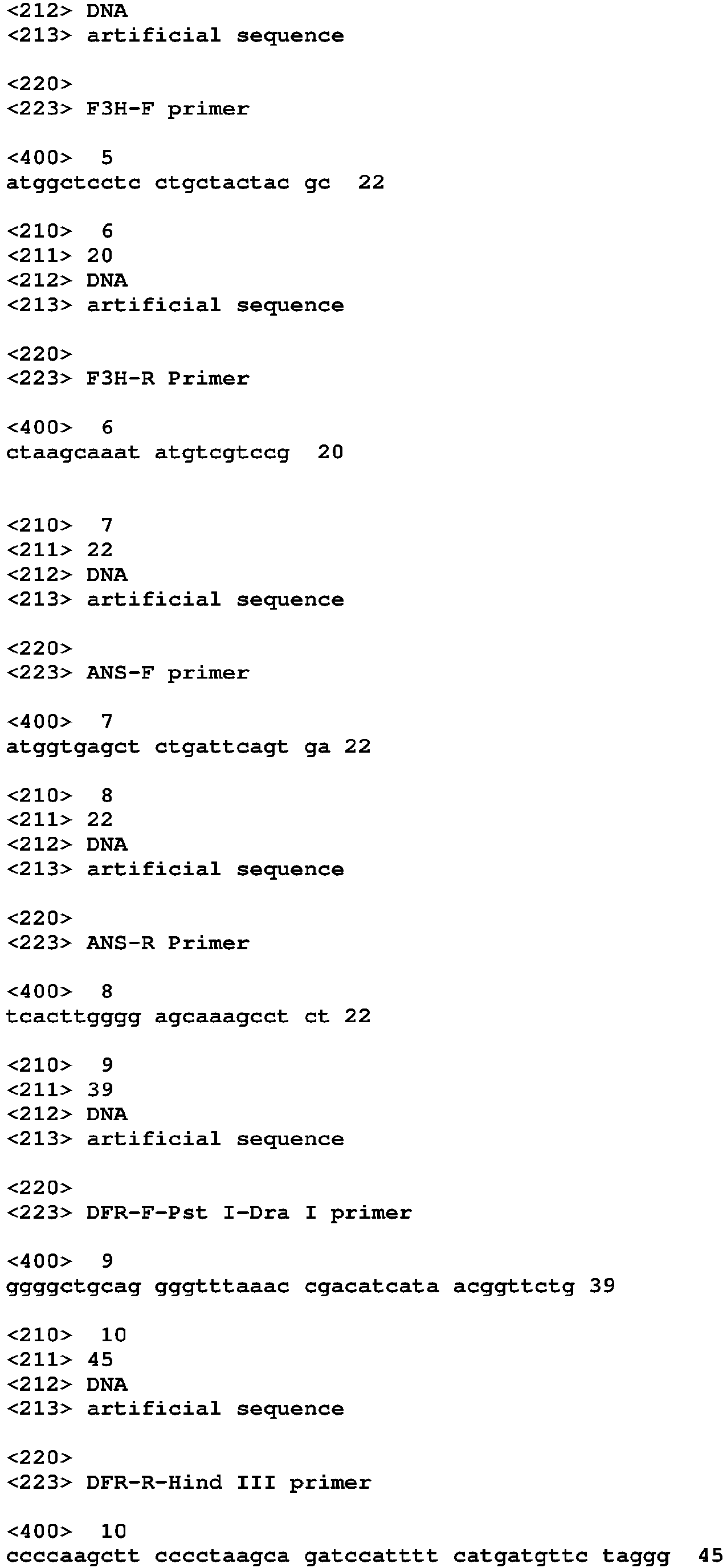


Claims (4)
- A method of producing a flavonoid in a host cell comprising the steps of:a) introducing into the host cell an exogenous nucleic acid comprising a set of genes encoding for enzymes sufficient to direct the synthesis of a desired flavonoid from a substrate, wherein the set of genes comprises Flavanone 3-hydroxylase (FHT), Dihydroflavonol 4-reductase (DFR), Anthocyanidin synthase (ANS) and Petunia x hybrida UDP-glucose:flavonoid 3-O-glucosyltransferase (3-GT);b) providing the substrate to the cells, wherein the substrate is a flavanone;c) culturing the cell under conditions permitting the synthesis of the flavonoid by the cells, wherein the flavonoid is an anthocyanin.
- The method of claim 1, further comprising isolating said flavonoids from said cell.
- The method of claim 1 or claim 2, wherein the flavonoid is selected from the group consisting of pelargonidin 3-O-glucoside and cyanidin 3-O-glucoside, and a combination thereof.
- The method of claim 1, wherein the host cell is E. coli.
Applications Claiming Priority (2)
| Application Number | Priority Date | Filing Date | Title |
|---|---|---|---|
| US58690304P | 2004-07-10 | 2004-07-10 | |
| EP05789029A EP1778850A4 (en) | 2004-07-10 | 2005-07-11 | PREPARATION OF FLAVONOIDS ON THE BASIS OF RECOMBINANT MICROORGANISMS |
Related Parent Applications (2)
| Application Number | Title | Priority Date | Filing Date |
|---|---|---|---|
| EP05789029.5 Division | 2005-07-11 | ||
| EP05789029A Division EP1778850A4 (en) | 2004-07-10 | 2005-07-11 | PREPARATION OF FLAVONOIDS ON THE BASIS OF RECOMBINANT MICROORGANISMS |
Publications (2)
| Publication Number | Publication Date |
|---|---|
| EP2484773A2 true EP2484773A2 (en) | 2012-08-08 |
| EP2484773A3 EP2484773A3 (en) | 2015-01-21 |
Family
ID=35785790
Family Applications (2)
| Application Number | Title | Priority Date | Filing Date |
|---|---|---|---|
| EP05789029A Withdrawn EP1778850A4 (en) | 2004-07-10 | 2005-07-11 | PREPARATION OF FLAVONOIDS ON THE BASIS OF RECOMBINANT MICROORGANISMS |
| EP12158662.2A Withdrawn EP2484773A3 (en) | 2004-07-10 | 2005-07-11 | Process for producing anthocyanins |
Family Applications Before (1)
| Application Number | Title | Priority Date | Filing Date |
|---|---|---|---|
| EP05789029A Withdrawn EP1778850A4 (en) | 2004-07-10 | 2005-07-11 | PREPARATION OF FLAVONOIDS ON THE BASIS OF RECOMBINANT MICROORGANISMS |
Country Status (5)
| Country | Link |
|---|---|
| US (2) | US7338791B2 (en) |
| EP (2) | EP1778850A4 (en) |
| JP (1) | JP2008505657A (en) |
| CA (1) | CA2573490A1 (en) |
| WO (1) | WO2006010117A2 (en) |
Cited By (3)
| Publication number | Priority date | Publication date | Assignee | Title |
|---|---|---|---|---|
| CN107164459A (en) * | 2016-12-07 | 2017-09-15 | 中国农业科学院茶叶研究所 | It is a kind of to identify and the functional label for screening high-catechin index tea tree and its application |
| CN111943996A (en) * | 2019-05-15 | 2020-11-17 | 中国科学院天津工业生物技术研究所 | Trachelospermi analogue, genetic engineering bacterium for producing same and application thereof |
| CN112725256A (en) * | 2021-02-22 | 2021-04-30 | 湖南省农产品加工研究所 | Recombinant escherichia coli and method for biosynthesizing diosmetin by using recombinant escherichia coli |
Families Citing this family (40)
| Publication number | Priority date | Publication date | Assignee | Title |
|---|---|---|---|---|
| US7604968B2 (en) | 2004-03-01 | 2009-10-20 | Regents Of The University Of Minnesota | Microorganisms for the recombinant production of resveratrol and other flavonoids |
| JP2008505657A (en) | 2004-07-10 | 2008-02-28 | ザ リサーチ ファウンデイション オブ ステイト ユニバーシティー オブ ニューヨーク | Production of flavonoids by recombinant microorganisms |
| KR100771435B1 (en) | 2006-11-10 | 2007-10-31 | 대한민국 | Novel flavonol biosynthesis genes, proteins encoded thereby and expression vectors comprising the same |
| CN102093330B (en) * | 2010-12-30 | 2013-03-20 | 张家界茅岩莓有限公司 | Method for semi-synthesizing (+)- epigallocatechin by utilizing dihydromyricetin |
| CN102578094B (en) * | 2011-01-13 | 2013-06-12 | 中国中化股份有限公司 | Use of (+)- epiafzelechin as pesticide |
| KR101412655B1 (en) * | 2011-06-01 | 2014-06-26 | 가부시키가이샤 쓰무라 | Fp creation method, creation program, creation device, and fp |
| CN103764828A (en) * | 2011-06-21 | 2014-04-30 | 艾威艾基克斯有限公司 | metabolic evolution method |
| CN102584766A (en) * | 2011-12-31 | 2012-07-18 | 郁建平 | Method for simultaneously separating dihydromyricetin and myricetin from ampelopsis plant |
| CN103360360A (en) * | 2012-04-10 | 2013-10-23 | 肖竹平 | Method for preparing (+)-gallocatechin on basis of dihydromyricetin |
| DE102012213492A1 (en) | 2012-07-31 | 2014-02-06 | Symrise Ag | Process for the biotechnological production of dihydrochalcones |
| CA2904650C (en) | 2013-03-15 | 2016-07-12 | Mars, Incorporated | Method of isolating blue anthocyanin fractions |
| CN105283179A (en) * | 2013-04-04 | 2016-01-27 | 斯法尔制药私人有限公司 | Novel analogues of epicatechin and related polyphenols |
| CN103756982B (en) * | 2013-12-16 | 2015-10-28 | 上海交通大学 | Tulipa fosteriana flavonol synthase TfFLS protein and encoding gene thereof |
| CN105087453B (en) * | 2014-05-05 | 2019-09-13 | 中国医学科学院药物研究所 | Genetically engineered bacteria for biocatalytic glucuronidation of flavonoids |
| CN105087454B (en) * | 2014-05-05 | 2019-10-01 | 中国医学科学院药物研究所 | Genetic engineering bacterium for biocatalysis flavone compound glucuronidation |
| ES2647883T3 (en) | 2014-07-01 | 2017-12-27 | Symrise Ag | Procedure for the biotechnological preparation of flavanone glycoside dihydrochalcones |
| CN104151374B (en) * | 2014-07-16 | 2016-05-11 | 南京农业大学 | Preparation method and the application of a kind of the Kunlun blood chrysanthemum chalcone compounds |
| EP3002335A1 (en) | 2014-10-03 | 2016-04-06 | Symrise AG | Process for the biotechnological production of flavonoids |
| US10750761B2 (en) | 2015-06-30 | 2020-08-25 | Mars, Incorporated | Colorant compositions and methods of use thereof |
| WO2017050853A1 (en) * | 2015-09-24 | 2017-03-30 | Evolva Sa | Production of anthocyanin from simple sugars |
| US10954543B2 (en) | 2015-11-02 | 2021-03-23 | Rensselaer Polytechnic Institute | Microbial polycultures and methods of use thereof |
| US10898465B2 (en) | 2016-06-21 | 2021-01-26 | Epirium Bio Inc. | Utility of (+) epicatechin and their analogs |
| CN106635892A (en) * | 2016-11-28 | 2017-05-10 | 无锡新和源发酵技术研究院有限公司 | Method for biologically synthesizing natural aromadendrin by escherichia coli through utilizing naringenin |
| CN109206496B (en) * | 2018-11-19 | 2020-11-17 | 中国科学院植物研究所 | Application of protein GhFLS1 in regulation and control of plant heat resistance |
| EP3906301A1 (en) * | 2019-01-06 | 2021-11-10 | Barrit Sarl | Recombinant host cells with improved production of tetraketide derivatives |
| JP6635535B1 (en) * | 2019-06-26 | 2020-01-29 | 東洋インキScホールディングス株式会社 | Escherichia coli expressing EFP protein and method for producing flavonoid compound using the same |
| KR20220081975A (en) | 2019-10-14 | 2022-06-16 | 코나겐 인크. | Biosynthesis of eriodictyol |
| CN111518818B (en) * | 2020-03-26 | 2021-11-30 | 浙江大学 | Hydroxylase gene participating in myricetin biosynthesis and application thereof |
| CN111999411B (en) * | 2020-09-01 | 2022-08-09 | 山东省农业科学院农业质量标准与检测技术研究所 | High performance liquid chromatography detection method for cyanidin and 3 kinds of anthocyanin in fruits and vegetables |
| CN112391360B (en) * | 2020-11-04 | 2022-09-06 | 江南大学 | Flavone 3 beta-hydroxylase reductase mutant and application thereof |
| CN112458065B (en) * | 2020-11-04 | 2022-08-02 | 江南大学 | Flavonoid 3-hydroxylase derived from milk thistle and its application |
| US11905544B2 (en) | 2020-12-17 | 2024-02-20 | Debut Biotechnology, Inc. | Dehydratase variants with improved specific activity for the production of pyruvate from glycerate |
| EP4323528A4 (en) | 2021-04-13 | 2025-07-09 | Debut Biotechnology Inc | FLAVONOID AND ANTHOCYANIN BIOPRODUCTION USING MICROORGANISM HOSTS |
| CN113308506B (en) * | 2021-05-28 | 2023-03-21 | 华南理工大学 | Method for synthesizing dihydromyricetin-7-glucoside through biocatalysis |
| CN113846026B (en) * | 2021-09-22 | 2023-10-27 | 江南大学 | Saccharomyces cerevisiae strain for synthesizing afoamin and catechin and its application |
| CN113846116B (en) * | 2021-09-27 | 2023-08-25 | 江南大学 | Method for improving anthocyanin synthesis efficiency in saccharomyces cerevisiae |
| CN114480532A (en) * | 2022-01-26 | 2022-05-13 | 北京理工大学 | Application of strain CH18 in preparation of anthocyanin and other flavonoid compounds |
| CN114940982B (en) * | 2022-06-08 | 2023-01-03 | 百事基材料(青岛)股份有限公司 | Apigenin prepared from genetically engineered bacteria and application thereof in polyester fiber manufacturing |
| CN116948998B (en) * | 2023-08-15 | 2024-07-23 | 西南大学 | Flavanone C ring cleavage reductase CsFCR, encoding gene and application thereof |
| CN120330281A (en) * | 2025-04-28 | 2025-07-18 | 西藏自治区农牧科学院农业研究所 | A highland barley flavonoid compound glycosyltransferase gene and its use |
Citations (1)
| Publication number | Priority date | Publication date | Assignee | Title |
|---|---|---|---|---|
| WO2006010117A2 (en) | 2004-07-10 | 2006-01-26 | The Research Foundation Of State University Of New York | Production of flavonoids by recombinant microorganisms |
Family Cites Families (4)
| Publication number | Priority date | Publication date | Assignee | Title |
|---|---|---|---|---|
| US6521433B1 (en) * | 1997-09-17 | 2003-02-18 | E. I. Du Pont De Nemours And Company | cDNA sequences from plants that encode activities associated with isoflavone biosynthesis |
| DE19918365A1 (en) * | 1999-04-22 | 2000-10-26 | Stefan Martens | New nucleic acid encoding flavone synthase II, useful e.g. for producing transgenic plants with altered flower color or flavone content |
| WO2002086110A2 (en) * | 2001-04-20 | 2002-10-31 | Technische Universität München | Flavone synthase i enzymes and the use thereof |
| US7604968B2 (en) * | 2004-03-01 | 2009-10-20 | Regents Of The University Of Minnesota | Microorganisms for the recombinant production of resveratrol and other flavonoids |
-
2005
- 2005-07-11 JP JP2007521533A patent/JP2008505657A/en active Pending
- 2005-07-11 CA CA002573490A patent/CA2573490A1/en not_active Abandoned
- 2005-07-11 US US11/178,912 patent/US7338791B2/en not_active Expired - Fee Related
- 2005-07-11 EP EP05789029A patent/EP1778850A4/en not_active Withdrawn
- 2005-07-11 WO PCT/US2005/024525 patent/WO2006010117A2/en not_active Ceased
- 2005-07-11 EP EP12158662.2A patent/EP2484773A3/en not_active Withdrawn
-
2008
- 2008-03-03 US US12/074,332 patent/US7807422B2/en not_active Expired - Lifetime
Patent Citations (1)
| Publication number | Priority date | Publication date | Assignee | Title |
|---|---|---|---|---|
| WO2006010117A2 (en) | 2004-07-10 | 2006-01-26 | The Research Foundation Of State University Of New York | Production of flavonoids by recombinant microorganisms |
Non-Patent Citations (34)
| Title |
|---|
| BROUILLARD: "Anthocyanins as Food Colors", 1982, ACADEMIC PRESS, INC |
| GUTHRIE ET AL.: "Method Enzymol", 1991, ACADEMIC PRESS |
| HANNUM, CRIT. REV. FOOD SCI. NUTR., vol. 44, 2004, pages 1 - 17 |
| HARBONE: "Phytochemical Methods, A Guide to Modem Technologies, of Plant Analysis", 1998, SPRINGER |
| HONDA ET AL., PLANT PHYSIOL BIOCHEM, vol. 40, no. 11, 2002, pages 955 - 962 |
| HWANG ET AL., APPL. ENVIRON MICROBIOL., vol. 69, 2003, pages 2699 - 2706 |
| HWANG ET AL., APPL. ENVIRON. MICROBIOL, vol. 69, 2003, pages 2699 - 2706 |
| HWANG ET AL., APPL. ENVIRON. MICROBIOL., vol. 69, 2003, pages 2699 - 1706 |
| KAHKONEN ET AL., J. AGRIC. FOOD CHEM., vol. 51, 2003, pages 628 - 633 |
| LEBEAU, BIOORG. MED. CHEM. LETT., vol. 11, 2001, pages 23 - 27 |
| LOZBYA ET AL., EUR JBIOCHEM, vol. 176, no. 3, 1988, pages 661 - 667 |
| LOZOYA ET AL., EUR JBIOCHEM, vol. 176, no. 3, 1988, pages 661 - 667 |
| LUKACIN ET AL., ARCH. BIOCHEM. BIOPHYS., vol. 393, 2001, pages 177 - 183 |
| MARTENS ET AL., PHYTOCHEMISTRY, vol. 58, 2001, pages 43 - 46 |
| MIDDLETON ET AL., PHARMACOL. REV., vol. 52, 2000, pages 673 - 751 |
| MIDDLETON ET AL., PHARMOCOLO. REV., vol. 52, 2000, pages 673 - 751 |
| MIKSICEK, P. SOC. EXP. BIOL. MED., vol. 208, 1995, pages 44 - 50 |
| NODA ET AL., TOXICOLOGY, vol. 148, 2000, pages 119 - 123 |
| PELLETIER ET AL., PLANT PHYSIOL, vol. 113, no. 4, 1997, pages 1437 - 1445 |
| POUGET ET AL., TETRAHEDRON, vol. 56, 2000, pages 6047 - 6052 |
| PUNYASIRI ET AL., ARCH. BIOCHEM. BIOPHYS., vol. 431, 2004, pages 22 - 30 |
| ROSS ET AL., ANNU. REV. NUTR., vol. 22, 2002, pages 19 - 34 |
| RUMP ET AL., GEN. PHARMACOL., vol. 25, 1994, pages 1137 - 1142 |
| SAMBROOK ET AL.: "Molecular cloning: a laboratory manual", 1989, COLD SPRING HARBOR LABORATORY PRESS |
| SATUE-GRACIA ET AL., J. AGRIC. FOOD CHERN., vol. 145, 1997, pages 3362 - 3367 |
| SCHUSSLER ET AL., GEN. PHARMACOL., vol. 26, 1995, pages 1565 - 1570 |
| VANTUNEN ET AL., EMBO J., vol. 7, no. 5, 1988, pages 1257 - 1263 |
| VANTUNEN ET AL., PLANT MOL BIOL, vol. 12, no. 5, 1989, pages 539 - 551 |
| VERDUYN ET AL., YEAST, vol. 8, 1992, pages 501 - 517 |
| VIOLA ET AL., PLANTA MED., vol. 61, 1995, pages 213 - 216 |
| WILLITS ET AL., PHYTOCHEMISTRY, vol. 65, 2004, pages 31 - 41 |
| WINKEL-SHIRLEY, PLANT PHYSIOL., vol. 126, no. 2, 2001, pages 485 - 493 |
| WOLFINAN ET AL., J. NEUROCHEM., vol. 65, 1995, pages S167 |
| WOLFINAN ET AL., PHARMACOL. BIOCHEM., vol. 47, 1994, pages 1 - 4 |
Cited By (5)
| Publication number | Priority date | Publication date | Assignee | Title |
|---|---|---|---|---|
| CN107164459A (en) * | 2016-12-07 | 2017-09-15 | 中国农业科学院茶叶研究所 | It is a kind of to identify and the functional label for screening high-catechin index tea tree and its application |
| CN107164459B (en) * | 2016-12-07 | 2020-07-07 | 中国农业科学院茶叶研究所 | Functional marker for identifying and screening tea trees with high catechin indexes and application of functional marker |
| CN111943996A (en) * | 2019-05-15 | 2020-11-17 | 中国科学院天津工业生物技术研究所 | Trachelospermi analogue, genetic engineering bacterium for producing same and application thereof |
| CN111943996B (en) * | 2019-05-15 | 2022-03-08 | 中国科学院天津工业生物技术研究所 | Trachelospermi analogue, genetic engineering bacterium for producing same and application thereof |
| CN112725256A (en) * | 2021-02-22 | 2021-04-30 | 湖南省农产品加工研究所 | Recombinant escherichia coli and method for biosynthesizing diosmetin by using recombinant escherichia coli |
Also Published As
| Publication number | Publication date |
|---|---|
| US7338791B2 (en) | 2008-03-04 |
| WO2006010117A2 (en) | 2006-01-26 |
| US7807422B2 (en) | 2010-10-05 |
| US20060019334A1 (en) | 2006-01-26 |
| US20090239272A1 (en) | 2009-09-24 |
| JP2008505657A (en) | 2008-02-28 |
| EP2484773A3 (en) | 2015-01-21 |
| EP1778850A2 (en) | 2007-05-02 |
| EP1778850A4 (en) | 2011-09-21 |
| WO2006010117A3 (en) | 2006-06-22 |
| CA2573490A1 (en) | 2006-01-26 |
Similar Documents
| Publication | Publication Date | Title |
|---|---|---|
| US7807422B2 (en) | Production of flavonoids by recombinant microorganisms | |
| EP2742131B1 (en) | Methods and materials for recombinant production of saffron compounds | |
| Yan et al. | Metabolic engineering of anthocyanin biosynthesis in Escherichia coli | |
| Pierrel et al. | Catalytic properties of the plant cytochrome P450 CYP73 expressed in yeast: substrate specificity of a cinnamate hydroxylase | |
| Ebel et al. | Biosynthesis | |
| Eichenberger et al. | De novo biosynthesis of anthocyanins in Saccharomyces cerevisiae | |
| Leonard et al. | Expression of a soluble flavone synthase allows the biosynthesis of phytoestrogen derivatives in Escherichia coli | |
| Wang et al. | Functional analysis of flavonoid 3′, 5′-hydroxylase from tea plant (Camellia sinensis): critical role in the accumulation of catechins | |
| Kim et al. | Regiospecific methylation of naringenin to ponciretin by soybean O-methyltransferase expressed in Escherichia coli | |
| Oudin et al. | The iridoid pathway in Catharanthus roseus alkaloid biosynthesis | |
| Yamazaki et al. | Diverse chalcone synthase superfamily enzymes from the most primitive vascular plant, Psilotum nudum | |
| Park et al. | Engineering of plant-specific phenylpropanoids biosynthesis in Streptomyces venezuelae | |
| WO2020141230A1 (en) | Recombinant host cells with improved production of tetraketide derivatives | |
| US20180371513A1 (en) | Production of Anthocyanin from Simple Sugars | |
| Yan et al. | Biosynthesis of 5‐deoxyflavanones in microorganisms | |
| Ren et al. | A highly versatile fungal glucosyltransferase for specific production of quercetin-7-O-β-D-glucoside and quercetin-3-O-β-D-glucoside in different hosts | |
| Hu et al. | Functional characterization of key enzymes involved in the biosynthesis of distinctive flavonoids and stilbenoids in Morus notabilis | |
| KR101187595B1 (en) | Production of flavonoids by recombinant microorganisms | |
| Grisebach | Selected topics in flavonoid biosynthesis | |
| Shibuya | Probing the deoxyflavonoid biosynthesis: naringenin chalcone is a substrate for the reductase synthesizing isoliquiritigenin | |
| Fujino et al. | cDNA cloning and characterization of chalcone isomerase-fold proteins from snapdragon (Antirrhinum majus L.) flowers | |
| ES2357241T3 (en) | HYDROXYLASE TRITERPEN. | |
| Dewick | The biosynthesis of shikimate metabolites | |
| Ayabe et al. | Cloning of cDNAs encoding P450s in flavonoid/isoflavonoid pathway from elicited leguminous cell cultures | |
| Sung et al. | Optimization of rhamnetin production in Escherichia coli. |
Legal Events
| Date | Code | Title | Description |
|---|---|---|---|
| PUAI | Public reference made under article 153(3) epc to a published international application that has entered the european phase |
Free format text: ORIGINAL CODE: 0009012 |
|
| 17P | Request for examination filed |
Effective date: 20120308 |
|
| AC | Divisional application: reference to earlier application |
Ref document number: 1778850 Country of ref document: EP Kind code of ref document: P |
|
| AK | Designated contracting states |
Kind code of ref document: A2 Designated state(s): AT BE BG CH CY CZ DE DK EE ES FI FR GB GR HU IE IS IT LI LT LU LV MC NL PL PT RO SE SI SK TR |
|
| RIN1 | Information on inventor provided before grant (corrected) |
Inventor name: CHEMLER, JOSEPH Inventor name: KOFFAS, MATTHEOS Inventor name: LEONARD, EFFENDI Inventor name: YAN, YAJUN |
|
| PUAL | Search report despatched |
Free format text: ORIGINAL CODE: 0009013 |
|
| AK | Designated contracting states |
Kind code of ref document: A3 Designated state(s): AT BE BG CH CY CZ DE DK EE ES FI FR GB GR HU IE IS IT LI LT LU LV MC NL PL PT RO SE SI SK TR |
|
| RIC1 | Information provided on ipc code assigned before grant |
Ipc: C12N 9/02 20060101ALI20141215BHEP Ipc: C12N 9/04 20060101ALI20141215BHEP Ipc: C12N 15/70 20060101ALI20141215BHEP Ipc: C12N 9/10 20060101ALI20141215BHEP Ipc: C12P 19/60 20060101AFI20141215BHEP |
|
| STAA | Information on the status of an ep patent application or granted ep patent |
Free format text: STATUS: THE APPLICATION IS DEEMED TO BE WITHDRAWN |
|
| 18D | Application deemed to be withdrawn |
Effective date: 20150203 |