EP2482062A1 - Method for analyzing and identifying edible oils, particularly extra-virgin olive oil - Google Patents
Method for analyzing and identifying edible oils, particularly extra-virgin olive oil Download PDFInfo
- Publication number
- EP2482062A1 EP2482062A1 EP12152697A EP12152697A EP2482062A1 EP 2482062 A1 EP2482062 A1 EP 2482062A1 EP 12152697 A EP12152697 A EP 12152697A EP 12152697 A EP12152697 A EP 12152697A EP 2482062 A1 EP2482062 A1 EP 2482062A1
- Authority
- EP
- European Patent Office
- Prior art keywords
- oil
- sample
- oils
- protocol
- cooling
- Prior art date
- Legal status (The legal status is an assumption and is not a legal conclusion. Google has not performed a legal analysis and makes no representation as to the accuracy of the status listed.)
- Withdrawn
Links
- 238000000034 method Methods 0.000 title claims abstract description 49
- 239000008157 edible vegetable oil Substances 0.000 title claims abstract description 8
- 239000010462 extra virgin olive oil Substances 0.000 title description 5
- 235000021010 extra-virgin olive oil Nutrition 0.000 title description 5
- 239000003921 oil Substances 0.000 claims abstract description 140
- 238000001757 thermogravimetry curve Methods 0.000 claims abstract description 58
- 239000000203 mixture Substances 0.000 claims abstract description 26
- 238000001816 cooling Methods 0.000 claims abstract description 25
- 238000002844 melting Methods 0.000 claims abstract description 25
- 230000008018 melting Effects 0.000 claims abstract description 24
- 238000010438 heat treatment Methods 0.000 claims abstract description 19
- 238000007711 solidification Methods 0.000 claims abstract description 14
- 230000008023 solidification Effects 0.000 claims abstract description 14
- 239000007791 liquid phase Substances 0.000 claims abstract description 4
- 238000004458 analytical method Methods 0.000 claims description 25
- 235000019628 coolness Nutrition 0.000 claims description 3
- 235000019198 oils Nutrition 0.000 description 124
- 238000004519 manufacturing process Methods 0.000 description 17
- 238000012360 testing method Methods 0.000 description 17
- 238000013507 mapping Methods 0.000 description 12
- 239000012071 phase Substances 0.000 description 10
- 239000000126 substance Substances 0.000 description 9
- 239000004006 olive oil Substances 0.000 description 8
- 230000007704 transition Effects 0.000 description 8
- 239000007787 solid Substances 0.000 description 7
- 239000007788 liquid Substances 0.000 description 6
- 235000008390 olive oil Nutrition 0.000 description 6
- 238000007707 calorimetry Methods 0.000 description 5
- 230000008569 process Effects 0.000 description 5
- 238000011160 research Methods 0.000 description 5
- 238000007792 addition Methods 0.000 description 4
- KEMQGTRYUADPNZ-UHFFFAOYSA-N heptadecanoic acid Chemical compound CCCCCCCCCCCCCCCCC(O)=O KEMQGTRYUADPNZ-UHFFFAOYSA-N 0.000 description 4
- 238000002156 mixing Methods 0.000 description 4
- 150000003626 triacylglycerols Chemical class 0.000 description 4
- 238000012512 characterization method Methods 0.000 description 3
- 239000013078 crystal Substances 0.000 description 3
- 238000002425 crystallisation Methods 0.000 description 3
- 230000008025 crystallization Effects 0.000 description 3
- 235000013399 edible fruits Nutrition 0.000 description 3
- 238000005259 measurement Methods 0.000 description 3
- 239000000155 melt Substances 0.000 description 3
- LQJBNNIYVWPHFW-UHFFFAOYSA-N 20:1omega9c fatty acid Natural products CCCCCCCCCCC=CCCCCCCCC(O)=O LQJBNNIYVWPHFW-UHFFFAOYSA-N 0.000 description 2
- ZQPPMHVWECSIRJ-UHFFFAOYSA-N Oleic acid Natural products CCCCCCCCC=CCCCCCCCC(O)=O ZQPPMHVWECSIRJ-UHFFFAOYSA-N 0.000 description 2
- 230000008859 change Effects 0.000 description 2
- 230000000295 complement effect Effects 0.000 description 2
- 230000003247 decreasing effect Effects 0.000 description 2
- UKMSUNONTOPOIO-UHFFFAOYSA-N docosanoic acid Chemical compound CCCCCCCCCCCCCCCCCCCCCC(O)=O UKMSUNONTOPOIO-UHFFFAOYSA-N 0.000 description 2
- 230000000694 effects Effects 0.000 description 2
- ZQPPMHVWECSIRJ-MDZDMXLPSA-N elaidic acid Chemical compound CCCCCCCC\C=C\CCCCCCCC(O)=O ZQPPMHVWECSIRJ-MDZDMXLPSA-N 0.000 description 2
- 230000008014 freezing Effects 0.000 description 2
- 238000007710 freezing Methods 0.000 description 2
- IPCSVZSSVZVIGE-UHFFFAOYSA-N hexadecanoic acid Chemical compound CCCCCCCCCCCCCCCC(O)=O IPCSVZSSVZVIGE-UHFFFAOYSA-N 0.000 description 2
- 230000003993 interaction Effects 0.000 description 2
- QXJSBBXBKPUZAA-UHFFFAOYSA-N isooleic acid Natural products CCCCCCCC=CCCCCCCCCC(O)=O QXJSBBXBKPUZAA-UHFFFAOYSA-N 0.000 description 2
- 238000010309 melting process Methods 0.000 description 2
- 230000006911 nucleation Effects 0.000 description 2
- 238000010899 nucleation Methods 0.000 description 2
- 238000004806 packaging method and process Methods 0.000 description 2
- SECPZKHBENQXJG-FPLPWBNLSA-N palmitoleic acid Chemical compound CCCCCC\C=C/CCCCCCCC(O)=O SECPZKHBENQXJG-FPLPWBNLSA-N 0.000 description 2
- 230000001737 promoting effect Effects 0.000 description 2
- 230000005070 ripening Effects 0.000 description 2
- 230000009897 systematic effect Effects 0.000 description 2
- 230000009466 transformation Effects 0.000 description 2
- 230000000007 visual effect Effects 0.000 description 2
- BITHHVVYSMSWAG-KTKRTIGZSA-N (11Z)-icos-11-enoic acid Chemical compound CCCCCCCC\C=C/CCCCCCCCCC(O)=O BITHHVVYSMSWAG-KTKRTIGZSA-N 0.000 description 1
- WRIDQFICGBMAFQ-UHFFFAOYSA-N (E)-8-Octadecenoic acid Natural products CCCCCCCCCC=CCCCCCCC(O)=O WRIDQFICGBMAFQ-UHFFFAOYSA-N 0.000 description 1
- QSBYPNXLFMSGKH-UHFFFAOYSA-N 9-Heptadecensaeure Natural products CCCCCCCC=CCCCCCCCC(O)=O QSBYPNXLFMSGKH-UHFFFAOYSA-N 0.000 description 1
- 235000003276 Apios tuberosa Nutrition 0.000 description 1
- 244000105624 Arachis hypogaea Species 0.000 description 1
- 235000010777 Arachis hypogaea Nutrition 0.000 description 1
- 235000010744 Arachis villosulicarpa Nutrition 0.000 description 1
- 235000021357 Behenic acid Nutrition 0.000 description 1
- 244000020551 Helianthus annuus Species 0.000 description 1
- 235000003222 Helianthus annuus Nutrition 0.000 description 1
- 235000021353 Lignoceric acid Nutrition 0.000 description 1
- CQXMAMUUWHYSIY-UHFFFAOYSA-N Lignoceric acid Natural products CCCCCCCCCCCCCCCCCCCCCCCC(=O)OCCC1=CC=C(O)C=C1 CQXMAMUUWHYSIY-UHFFFAOYSA-N 0.000 description 1
- OYHQOLUKZRVURQ-HZJYTTRNSA-N Linoleic acid Chemical compound CCCCC\C=C/C\C=C/CCCCCCCC(O)=O OYHQOLUKZRVURQ-HZJYTTRNSA-N 0.000 description 1
- 238000005481 NMR spectroscopy Methods 0.000 description 1
- 240000007817 Olea europaea Species 0.000 description 1
- 239000005642 Oleic acid Substances 0.000 description 1
- 235000021314 Palmitic acid Nutrition 0.000 description 1
- 235000021319 Palmitoleic acid Nutrition 0.000 description 1
- 235000021355 Stearic acid Nutrition 0.000 description 1
- 239000002253 acid Substances 0.000 description 1
- DTOSIQBPPRVQHS-PDBXOOCHSA-N alpha-linolenic acid Chemical compound CC\C=C/C\C=C/C\C=C/CCCCCCCC(O)=O DTOSIQBPPRVQHS-PDBXOOCHSA-N 0.000 description 1
- 235000020661 alpha-linolenic acid Nutrition 0.000 description 1
- QVGXLLKOCUKJST-UHFFFAOYSA-N atomic oxygen Chemical compound [O] QVGXLLKOCUKJST-UHFFFAOYSA-N 0.000 description 1
- 229940116226 behenic acid Drugs 0.000 description 1
- 230000008901 benefit Effects 0.000 description 1
- SECPZKHBENQXJG-UHFFFAOYSA-N cis-palmitoleic acid Natural products CCCCCCC=CCCCCCCCC(O)=O SECPZKHBENQXJG-UHFFFAOYSA-N 0.000 description 1
- 238000004737 colorimetric analysis Methods 0.000 description 1
- 230000001276 controlling effect Effects 0.000 description 1
- 230000002596 correlated effect Effects 0.000 description 1
- 230000000875 corresponding effect Effects 0.000 description 1
- 230000008878 coupling Effects 0.000 description 1
- 238000010168 coupling process Methods 0.000 description 1
- 238000005859 coupling reaction Methods 0.000 description 1
- 229940108623 eicosenoic acid Drugs 0.000 description 1
- BITHHVVYSMSWAG-UHFFFAOYSA-N eicosenoic acid Natural products CCCCCCCCC=CCCCCCCCCCC(O)=O BITHHVVYSMSWAG-UHFFFAOYSA-N 0.000 description 1
- FARYTWBWLZAXNK-WAYWQWQTSA-N ethyl (z)-3-(methylamino)but-2-enoate Chemical compound CCOC(=O)\C=C(\C)NC FARYTWBWLZAXNK-WAYWQWQTSA-N 0.000 description 1
- 235000019197 fats Nutrition 0.000 description 1
- 238000001914 filtration Methods 0.000 description 1
- 235000013305 food Nutrition 0.000 description 1
- 230000004345 fruit ripening Effects 0.000 description 1
- VKOBVWXKNCXXDE-UHFFFAOYSA-N icosanoic acid Chemical compound CCCCCCCCCCCCCCCCCCCC(O)=O VKOBVWXKNCXXDE-UHFFFAOYSA-N 0.000 description 1
- 235000020778 linoleic acid Nutrition 0.000 description 1
- OYHQOLUKZRVURQ-IXWMQOLASA-N linoleic acid Natural products CCCCC\C=C/C\C=C\CCCCCCCC(O)=O OYHQOLUKZRVURQ-IXWMQOLASA-N 0.000 description 1
- 229960004488 linolenic acid Drugs 0.000 description 1
- KQQKGWQCNNTQJW-UHFFFAOYSA-N linolenic acid Natural products CC=CCCC=CCC=CCCCCCCCC(O)=O KQQKGWQCNNTQJW-UHFFFAOYSA-N 0.000 description 1
- 239000011159 matrix material Substances 0.000 description 1
- 239000002480 mineral oil Substances 0.000 description 1
- 230000004001 molecular interaction Effects 0.000 description 1
- WQEPLUUGTLDZJY-UHFFFAOYSA-N n-Pentadecanoic acid Natural products CCCCCCCCCCCCCCC(O)=O WQEPLUUGTLDZJY-UHFFFAOYSA-N 0.000 description 1
- QIQXTHQIDYTFRH-UHFFFAOYSA-N octadecanoic acid Chemical compound CCCCCCCCCCCCCCCCCC(O)=O QIQXTHQIDYTFRH-UHFFFAOYSA-N 0.000 description 1
- OQCDKBAXFALNLD-UHFFFAOYSA-N octadecanoic acid Natural products CCCCCCCC(C)CCCCCCCCC(O)=O OQCDKBAXFALNLD-UHFFFAOYSA-N 0.000 description 1
- ZQPPMHVWECSIRJ-KTKRTIGZSA-N oleic acid group Chemical group C(CCCCCCC\C=C/CCCCCCCC)(=O)O ZQPPMHVWECSIRJ-KTKRTIGZSA-N 0.000 description 1
- 238000011017 operating method Methods 0.000 description 1
- 230000003647 oxidation Effects 0.000 description 1
- 238000007254 oxidation reaction Methods 0.000 description 1
- 229910052760 oxygen Inorganic materials 0.000 description 1
- 239000001301 oxygen Substances 0.000 description 1
- 150000002978 peroxides Chemical class 0.000 description 1
- 238000000053 physical method Methods 0.000 description 1
- 238000003825 pressing Methods 0.000 description 1
- 238000003908 quality control method Methods 0.000 description 1
- 230000000306 recurrent effect Effects 0.000 description 1
- 239000010464 refined olive oil Substances 0.000 description 1
- 238000007670 refining Methods 0.000 description 1
- 230000001105 regulatory effect Effects 0.000 description 1
- 239000007790 solid phase Substances 0.000 description 1
- 238000012306 spectroscopic technique Methods 0.000 description 1
- 230000007480 spreading Effects 0.000 description 1
- 238000003892 spreading Methods 0.000 description 1
- 238000007619 statistical method Methods 0.000 description 1
- 239000008117 stearic acid Substances 0.000 description 1
- UFTFJSFQGQCHQW-UHFFFAOYSA-N triformin Chemical compound O=COCC(OC=O)COC=O UFTFJSFQGQCHQW-UHFFFAOYSA-N 0.000 description 1
Images


Classifications
-
- G—PHYSICS
- G01—MEASURING; TESTING
- G01N—INVESTIGATING OR ANALYSING MATERIALS BY DETERMINING THEIR CHEMICAL OR PHYSICAL PROPERTIES
- G01N25/00—Investigating or analyzing materials by the use of thermal means
- G01N25/20—Investigating or analyzing materials by the use of thermal means by investigating the development of heat, i.e. calorimetry, e.g. by measuring specific heat, by measuring thermal conductivity
- G01N25/48—Investigating or analyzing materials by the use of thermal means by investigating the development of heat, i.e. calorimetry, e.g. by measuring specific heat, by measuring thermal conductivity on solution, sorption, or a chemical reaction not involving combustion or catalytic oxidation
- G01N25/4846—Investigating or analyzing materials by the use of thermal means by investigating the development of heat, i.e. calorimetry, e.g. by measuring specific heat, by measuring thermal conductivity on solution, sorption, or a chemical reaction not involving combustion or catalytic oxidation for a motionless, e.g. solid sample
- G01N25/4866—Investigating or analyzing materials by the use of thermal means by investigating the development of heat, i.e. calorimetry, e.g. by measuring specific heat, by measuring thermal conductivity on solution, sorption, or a chemical reaction not involving combustion or catalytic oxidation for a motionless, e.g. solid sample by using a differential method
-
- G—PHYSICS
- G01—MEASURING; TESTING
- G01N—INVESTIGATING OR ANALYSING MATERIALS BY DETERMINING THEIR CHEMICAL OR PHYSICAL PROPERTIES
- G01N25/00—Investigating or analyzing materials by the use of thermal means
- G01N25/20—Investigating or analyzing materials by the use of thermal means by investigating the development of heat, i.e. calorimetry, e.g. by measuring specific heat, by measuring thermal conductivity
- G01N25/48—Investigating or analyzing materials by the use of thermal means by investigating the development of heat, i.e. calorimetry, e.g. by measuring specific heat, by measuring thermal conductivity on solution, sorption, or a chemical reaction not involving combustion or catalytic oxidation
- G01N25/4806—Details not adapted to a particular type of sample
- G01N25/4826—Details not adapted to a particular type of sample concerning the heating or cooling arrangements
- G01N25/4833—Details not adapted to a particular type of sample concerning the heating or cooling arrangements specially adapted for temperature scanning
-
- G—PHYSICS
- G01—MEASURING; TESTING
- G01N—INVESTIGATING OR ANALYSING MATERIALS BY DETERMINING THEIR CHEMICAL OR PHYSICAL PROPERTIES
- G01N33/00—Investigating or analysing materials by specific methods not covered by groups G01N1/00 - G01N31/00
- G01N33/02—Food
- G01N33/03—Edible oils or edible fats
Definitions
- the present invention relates to a method for analysing and identifying edible oils, particularly extra-virgin oil, provided with the aim of determining the provenance of the oil itself and the oil belonging to a group of oils identified by the provenance based upon a map of the places of the oil origin.
- Such method is then suitable to be used for safeguarding the user as to the controlled origin guarantee and to the repression of possible commercial frauds with particular reference to the extra-virgin oil field.
- This method is further suitable to be implemented with low cost and with a simple operating procedure. With this method it is possible creating an identity card of calorimetric type of the oil and implementing a method for mapping the productions and the repression of the commercial frauds.
- the most frequent frauds implement by adding fewer expensive oils, such as: groundnut; oleic high sunflower; refined, deodorized, etc., olive oil, in percentages even higher than 20-30% in volume.
- the peculiarity of the present analysis method consists in using a time-temperature protocol for scanning differential calorimeter and places in the field of the thermodynamics of fat substances, with particular reference to the analysis of phase transitions of a complex sample under metastable conditions, wherein a suitable definition of the physical conditions, before and after the calorimetric measurement, constitutes a pre-requisite necessary to obtain reproducible data, then data usable for identifying and diagnostic purposes.
- the present invention can be applied particularly to the olive oil field, as it takes into consideration the peculiarities of the commercial chain and the needs of the various operators.
- a preferential application field of the method according to the present invention is the search for and the study of the extra-virgin oil, with reference even to statistics and market analysis, in relation to the olive oil field, and to the quality control and to the repression of frauds.
- the extra-virgin olive oil the Italian one in particular, has an undoubted name and recognition for its quality, the abundance of varietal types and the consequent range of organoleptic features, which allow couplings and specific culinary uses thereof.
- the historic-cultural, artistic and landscape resources are resorted to, associated to the description of the product and of the producing firm.
- the phase transitions of the edible oils have been for some time considered by the researchers for the complexity of oils, both in liquid phase and in solid phase.
- the liquid oil is composed by a plurality of triglycerides and organic polar and not polar molecules.
- the solid oil additionally is formed by polymorphic crystals which, upon varying the temperature, undergo solid-solid transactions, before melting.
- the spreading of the temperature scanning differential calorimetry (DSC) has made to increase the number of publications on the matter and has underlined the calorimetry potentiality for the study of the oils.
- the applications shown in literature mainly relate to high temperatures, for industrial applications, such as food frying and the oxidation processes.
- Olive oils and the mixtures thereof with oils of raw and refined seeds were studied in a systematic way, by using different calorimetric protocols for the different edible oils and the different purposes of the performed researches, with particular attention to the conditions providing greater sensibility and reproducibility of the results. This allowed to study the effects of the small variations in the chemical composition onto the oil freezing and melting curves.
- thermogram variations were observed caused by: i) physical methods in the production phase (filtration, squeezing method); ii) chemical methods (refining); iii) addition of oils of different type (mixtures of extra-virgin oil + oil of various seeds; extra-virgin oil + refined kernel oil); extra-virgin + refined olive oil; iv) exposition to the light and oxygen.
- the calorimetric analysis has shown to be able to distinguish between extra-virgin oils obtained from different cultivar and even from the same cultivar, even if the fruits have a different ripening levels or come from geographic areas with different pedoclimatic features.
- thermogram is strictly connected to the molecular composition of the oil sample; ii) given the oil complexity, it is practically impossible reducing the whole thermogram of an oil (freezing and melting) with corrective interventions aimed at the sample, then the thermogram represents a kind of digital footprint of the oil.
- the aim of the analysis and identification method according to the invention relates to:
- thermogram which is at the same time sufficiently detailed, that is able to identify univocally an oil, and repeatable.
- thermograms which are obtained are not sufficiently representative of the huge complexity of the oil composition, particularly if one relates to the extra-virgin olive oil.
- the solution idea consists in providing to the analysis and identification methods a peculiar heating and cooling protocol so as to exploit different types of phase transition with the aim of obtaining most representative thermograms.
- the main advantage of the present invention consists in providing a method able to allow in a simple way to identify an oil based upon easily processable data.
- phase transitions are particularly sensible to the chemical composition of oils and to the variations thereof.
- the involved processes reflect the oil chemical composition through the interactions between the triglycerides and with the multiplicity of molecules constituting the minority component, regulating the nucleation and growth of the polymorphous crystals.
- thermogram integrated with the chemical-physical analyses and the organoleptic test according to the existing law can be actually considered as identifying a particular extra-virgin oil, with its qualities and geographical provenance.
- the sample is kept at 50°C for 3 minutes; then it is cooled at a constant speed of 20° C/min until -30°C. It is kept at this temperature for 10 minutes, then it is heated at the speed of 5°C/min until 8°C.
- the sample is kept for 1 min. at this temperature, then it is cooled again at the speed of 20°C/min until -30°C. This temperature is kept for 5 min, then it is heated until 20°C, at the speed of 5°C/min.
- the temperature of 20°C is kept for 3 min.
- the whole test period of time is 45.5 min.
- the pieces of information which can be obtained by interrupting the protocol after isotherm at 8°C generally are sufficient.
- the test time reduces to less than 30 min.
- This protocol allows observing, during the first cooling, the OEVO solidification from metastable state of the liquid phase.
- the molecular interactions determine the nucleation process and the growth kinetics of the polymorphs of triglycerides.
- the subsequent melting curve in fact, has very different features from the previous one. It has to be underlined that the protocol object of the invention differentiates from what reported in literature, not so much for the cooling and heating speed, as for the sequence of two crystallization-melting cycles of the sample planned to "question" the sample under different but complementary thermodynamic conditions, in order to obtain a kind of "photo” from two different angulations.
- thermogram instrumental reproducibility provides the same descriptive parameters. It can neither be compared to the sequence of two cycles different for scanning speed and/or duration of the isotherms as in such case data would be obtained, hardly usable for a better sample characterization. In fact, the thermograms related to the first and second cycle would result to be decorrelated thermodynamically.
- protocol object of the present invention it is possible obtaining in an advantageous and new way a wide set of parameters for further distinguishing an oil from another one with the aim of tracing and identifying the extra-virgin olive oil.
- thermogram shows the effects of the interactions of the triglycerides therebetween and with the OEVO minority components, amplified by the sequence:
- the two coolings take place at the same constant speed and this is valid even for heatings, in order to obtain complementary and reproducible data.
- the absolute value of the cooling speed is higher than the absolute value of the heating speed, in order to grow the details of the melting process.
- the first cooling is preceded by an isotherm with higher temperature than room temperature, whereas the coolings quickly reach sensibly low temperatures, thereat the liquid oil is metastable.
- the second cooling takes place once the first heating is interrupted at +8°C and it is followed y a short isotherm at the sample temperature.
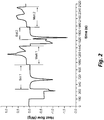
- Figure 2 shows the thermogram obtained by applying the protocol of figure 1 .
- the sample undergoes transitions from polymorphous phases to other phases, stable at higher temperature (mainly from ⁇ ' phases to ⁇ phases) and the subsequent melting of most solid portion.
- the resulting melting curve is characterized by a first peak of complex shape, ending at about 0°C.
- a second peak of smaller height follows, which at +8°C is near its own maximum value, to designate that the endothermic melting process is almost finished.
- the second cooling and the fourth isotherm there is the solidification from germ of the partially melt oil.
- the nature of the so-grown crystalline polymorphs is shown with greater details by the thermogram registered during the second heating leading to the whole melting of the sample: the first melting peak is substantially different from the one of the first melting, whereas the second peak shows the presence of two well distinct processes.
- the conformity test is based upon the comparison of the thermogram of the sample subjected to test with that shown onto the identity document of the original oil, kept in the data bank.
- thermogram resulting from the two different solidification/melting cycles includes a wide number of details identifying the oil and, furthermore, it is enriched with details which are hardly parameterizable, but very useful for the conformity test.
- the guarantee offered by the identity document concretizes through a test based upon the visual comparison of the oil thermogram onto the shelf to the one reported onto the identity document: thermograms which can be overlapped in every detail means that the product contained in the packaging on sale is identical to the original oil.
- the method for mapping the productions applies to the thermograms in data bank, obtained with the protocol of figure 1 .
- a software is used which considers the parameters characterizing the oil solidification and melting (typically 14 parameters: 5 for the 2 solidifications and 9 for the 2 meltings) to select the similar oils, produced in a same geographical area, homogeneous for pedoclimatic conditions and cultivar types.
- a suitable software can extract from the data bank the certified oils, of a certain year, produced in the area and having the values of the calorimetric parameters comprised in a range fixed based upon considerations of merit, both scientific (standard deviation of the measurement, intrinsic reproducibility of the processes), and productive one, based upon the descriptive data in memory (collection method, pressing, quality and fruit ripening, percentage of the cultivar composing the blend, etc).
- thermograms of the above-mentioned oils will represent the oil reference "photo" for the area identity document.
- chemical-physical and organoleptic features, shown on the area identity document will be the arithmetical averages of the data bank values for the selected oils.
- the area identity documents will be kept in a bank of the production maps.
- the mapping of the products, repeated for subsequent years, will allow calculating the fluctuations of the area identity document and defining quantity criteria for the oil geographical origin test.
- mapping method object of the present invention, an application thereof to an area in Toscana is shown, therefrom 5 oils derive, certainly a not sufficient number for a realistic mapping.
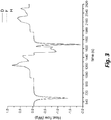
- Figure 3 shows the thermograms of 3 out of 5 oils, certified by a Consortium with protected geographical indication, produced in the area comprised between three adjacent areas.
- the 3 oils result to have similar thermograms, whereas the other 2 oils show some differences (see figure 4 ).
- the three similar oils most likely derive from olivegroves with the same pedoclimatic features and made with the same cultivar used in practically equal percentages.
- the average thermogram of such oils is calculated and an uncertainty group is associated to such thermogram, therefore a thick curve is obtained.
- the curve thickness represents the measurement error (for example the SD calculated by reproducibility test) and the supposable fluctuation of the varietal composition, in case of blend, the change in the ripening level of fruits, etc.
- a curve is obtained the thickness thereof defines the tolerance range for attributing the origin, to be defined with a systematic research and significant statistics, based upon oils with sure origin and composition.
- the average value of the chemical-physical and organoleptic parameters of the oils used to calculate the average thermogram is associated to the average thermogram.
- Table 1 shows the chemical analyses of the 3 oils of figure 3 and the average to be attributed to the representative oil in the area identity document.
- the thick curve shown in figure 4 shows the production map of the area considered in the present example.
- the thermograms of the two oils not selected for the mapping are shown too.
- thermograms thereof are not comprised within the tolerance range. Therefore, they have different origin or they are obtained with fruits of different cultivar.
- the method proposes especially for protecting typical productions of high quality and it can be well applied to oils produced with defined varietal types. In case of monovarietal oils the mapping results easier and more effective and the thickness of the area thermogram is certainly reduced.
- the production map covers areas with decreasing extension, therefore the definition thereof has to take into consideration the local productive realities, the commercial politics and the purposes which the mapping itself pursue.
- the area maps obviously change, year after year, even not substantially.
- An analysis of the maps of the several years could be used to deepen the knowledge of productions, in particular of those of greater quality.
- the described method was tested in the field; the considered blend was formed by six different oils and the related thermogram had been obtained from each one thereof.
- the sample of the blend oil provided by the firm gave a thermogram practically coincident with that of the sample obtained in laboratory by mixing the six oils in the same volume percentage.
- the application of this method provides a real guarantee for tracing the commercial oils, to protect the consumer.
- the present invention implements and applies to the olive oil field through the identity document issued by a System which provides a Manager; a calorimetric laboratory, the sample bank and the related data bank.
- the document is issued to the oil packed and put on the market, according to specific procedures for each chain subject (producer, oil mill, packager, distributor, protection body, etc.). It is devised with format and contents suitable to the commercial and economical needs of the chain.
- a possible operating articulation of said structure is the following:
- the leaflet placed in a suitable place, accompanies each package of the product put onto the market ( figure 6 ).
- the document includes the oil traditional chemical-physical describers and the organoleptic analysis, provided by the existing law and/or by the protection specifications. These describers are part of the parameters existing in data bank, wherein all pieces of information considered useful for a complete characterization of the product, even for the purpose of research, statistical analyses of the productions and of the market, are kept.
Landscapes
- Chemical & Material Sciences (AREA)
- Engineering & Computer Science (AREA)
- Health & Medical Sciences (AREA)
- Life Sciences & Earth Sciences (AREA)
- Biochemistry (AREA)
- Physics & Mathematics (AREA)
- Analytical Chemistry (AREA)
- General Health & Medical Sciences (AREA)
- General Physics & Mathematics (AREA)
- Immunology (AREA)
- Pathology (AREA)
- Food Science & Technology (AREA)
- Chemical Kinetics & Catalysis (AREA)
- Combustion & Propulsion (AREA)
- Medicinal Chemistry (AREA)
- Fats And Perfumes (AREA)
- Edible Oils And Fats (AREA)
Abstract
A method for analysing and identifying edible oils, particularly extra-virgin oil, can be easily and quickly put into practice and it provides, in a differential calorimeter with temperature scanning, that an oil sample is subjected to a time-temperature protocol, wherein it is provided: a first cooling determining a first solidification of the oil from metastable status of the liquid phase; a first heating determining a partial melting of the oil, so as to leave in the oil residual crystalline structures, therefore in the subsequent cooling the sample solidifies due to the growing of such forms; a second cooling determining a second solidification due to the growing of said residual crystalline structures; a second heating determining the complete melting, the above-mentioned protocol determining a representative thermogram of said sample, which can be compared by means of graphical overlapping with other thermograms in order to determine the matching of the provenance and/or the composition of an additional oil sample.
Description
- The present invention relates to a method for analysing and identifying edible oils, particularly extra-virgin oil, provided with the aim of determining the provenance of the oil itself and the oil belonging to a group of oils identified by the provenance based upon a map of the places of the oil origin.
- Such method is then suitable to be used for safeguarding the user as to the controlled origin guarantee and to the repression of possible commercial frauds with particular reference to the extra-virgin oil field.
- This method is further suitable to be implemented with low cost and with a simple operating procedure. With this method it is possible creating an identity card of calorimetric type of the oil and implementing a method for mapping the productions and the repression of the commercial frauds.
- The most frequent frauds implement by adding fewer expensive oils, such as: groundnut; oleic high sunflower; refined, deodorized, etc., olive oil, in percentages even higher than 20-30% in volume.
- The chemical analyses generally are able to reveal such frauds. In some cases (addition of refined kernel) more sensible and expensive techniques are necessary, such as the nuclear magnetic resonance, which allows detecting additions higher than 8-10%. The calorimetry, certainly easier and less expensive technique, showed a greater sensibility for addition percentages of 3-5%.
- Currently, the main problem in the field of frauds is the presence on the market of oils with false provenance declaration which can be revealed only with the above-mentioned complex analyses.
- The peculiarity of the present analysis method consists in using a time-temperature protocol for scanning differential calorimeter and places in the field of the thermodynamics of fat substances, with particular reference to the analysis of phase transitions of a complex sample under metastable conditions, wherein a suitable definition of the physical conditions, before and after the calorimetric measurement, constitutes a pre-requisite necessary to obtain reproducible data, then data usable for identifying and diagnostic purposes.
- The present invention can be applied particularly to the olive oil field, as it takes into consideration the peculiarities of the commercial chain and the needs of the various operators.
- Specifically, a preferential application field of the method according to the present invention is the search for and the study of the extra-virgin oil, with reference even to statistics and market analysis, in relation to the olive oil field, and to the quality control and to the repression of frauds.
- The state of the art, as to the scientific knowledge therefrom the invention derives and the specific problems of the oil field which the invention contributes to solve, are treated hereinafter.
- The extra-virgin olive oil, the Italian one in particular, has an undoubted name and recognition for its quality, the abundance of varietal types and the consequent range of organoleptic features, which allow couplings and specific culinary uses thereof.
- To put the extra-virgin oil on the market, the historic-cultural, artistic and landscape resources are resorted to, associated to the description of the product and of the producing firm.
- Not last for advertisement effectiveness, the recall to the healthy properties of the extra-virgin oils, especially considered in USA and in Northern Europe.
- The ways and means for promoting oil on the market, however, are in continuous evolution. The advertisement onto the printed paper is being ever more replaced by the one by internet, wherein the sites dedicated to the olive oil and the portals for the on-line market are growing. Generally, the oil quality is certified at the origin through chemical analyses and judgements of panels of tasters, according to criteria defined by international rules (for example the European regulation) and by the disciplines of the protection consortia.
- Nevertheless, the extra-virgin oil market suffers from the poor trust of the consumer who is alerted by recurrent frauds and doubtful for the difficulty of sure controls at the various levels of the industrial and commercial chain. This situation penalizes the producers of high quality oil who, to face the production costs, must go on the market with a considerably higher price than that which the large-scale distributors propose for a product which is only legally defined olive extra-virgin oil.
- Furthermore, with the increasing globalization of the markets, the problem of protecting the local productions and the need for fighting the frauds related to the origin of the marketed products increase.
- In the light of what above, for several years attempts have been pursuing for creating an oil identity card based upon spectroscopic techniques, but up to now, no results are available in the commercial practice which are easy to be used by the producer and the consumer.
- The calorimetry of oils is widely reported in literature, but such technique has never been used to implement an identity card and a conformity and origin card, applicable in the olive oil industry and commerce.
- To this purpose, the phase transitions of the edible oils have been for some time considered by the researchers for the complexity of oils, both in liquid phase and in solid phase. The liquid oil is composed by a plurality of triglycerides and organic polar and not polar molecules. The solid oil additionally is formed by polymorphic crystals which, upon varying the temperature, undergo solid-solid transactions, before melting. The spreading of the temperature scanning differential calorimetry (DSC) has made to increase the number of publications on the matter and has underlined the calorimetry potentiality for the study of the oils. The applications shown in literature mainly relate to high temperatures, for industrial applications, such as food frying and the oxidation processes.
- Olive oils and the mixtures thereof with oils of raw and refined seeds were studied in a systematic way, by using different calorimetric protocols for the different edible oils and the different purposes of the performed researches, with particular attention to the conditions providing greater sensibility and reproducibility of the results. This allowed to study the effects of the small variations in the chemical composition onto the oil freezing and melting curves.
- In particular, the thermogram variations were observed caused by: i) physical methods in the production phase (filtration, squeezing method); ii) chemical methods (refining); iii) addition of oils of different type (mixtures of extra-virgin oil + oil of various seeds; extra-virgin oil + refined kernel oil); extra-virgin + refined olive oil; iv) exposition to the light and oxygen.
- The calorimetric analysis has shown to be able to distinguish between extra-virgin oils obtained from different cultivar and even from the same cultivar, even if the fruits have a different ripening levels or come from geographic areas with different pedoclimatic features.
- Some of these results have been confirmed by researchers of other laboratories, in Italy and abroad.
- From the researches it has resulted that: i) the thermogram is strictly connected to the molecular composition of the oil sample; ii) given the oil complexity, it is practically impossible reducing the whole thermogram of an oil (freezing and melting) with corrective interventions aimed at the sample, then the thermogram represents a kind of digital footprint of the oil. Generally, the aim of the analysis and identification method according to the invention relates to:
- ● a time-temperature protocol to be used on DSC calorimeter, able to provide, for a given oil sample, the thermogram necessary for: (i) the issue of the identity card of the extra-virgin oil, (ii) the conformity calorimetric test, (iii) the procedure for mapping the productions;
- ● a method for implementing the mapping of the production by means of a suitable software, by using the calorimetric parameters of a statistically significant number of extra-virgin oils, with certain geographical origin, measured by the thermogram obtained with the protocol of the preceding item, and kept in a data bank;
- ● a method for issueing an identity card to a blend oil obtained by mixing oils from different OEVO lots (blend), commercialized directly by packagers or packaged on behalf of third parties.
- In the light of what above mentioned, the known calorimetric methods do not allow implementing a thermogram which is at the same time sufficiently detailed, that is able to identify univocally an oil, and repeatable.
- For example, in the article Calorimetry for fast Authentication of Edible Oils published on International Journal of Thermophysics; Journal of Thermophysical Properties and Thermophysics and its Applications dated 30 June 2009 of the same inventors, a calorimetric method is described using two distinct identical cycles, with much higher maximum temperatures than the melting/solidification area and much lower minimum temperatures than the same area. The thermograms which are obtained are not sufficiently representative of the huge complexity of the oil composition, particularly if one relates to the extra-virgin olive oil.
- In the light of what above, the technical problem underlying the present invention consists in obviating the drawbacks mentioned by referring to the state of the art.
- The solution idea consists in providing to the analysis and identification methods a peculiar heating and cooling protocol so as to exploit different types of phase transition with the aim of obtaining most representative thermograms.
- Such technical problem, related to the simple identification of oils and particularly, but not exclusively, extra-vergin olive oils of quality, is then solved by an analysis and identification method as defined in the annexed
claim 1. - The main advantage of the present invention consists in providing a method able to allow in a simple way to identify an oil based upon easily processable data.
- The present invention will be described hereinafter by way of example and not for limitative purpose, by referring to the enclosed figures wherein:
- ●
figure 1 shows the time-temperature protocol to be applied to a sample of extra-virgin olive oil in the method according to the invention; - ●
figure 2 shows the thermogram obtained by applying the protocol offigure 1 for said oil sample; - ●
figure 3 shows three distinct thermograms of oils coming from neighbouring geographic areas in an area taken into consideration; - ●
figure 4 shows a thermogram constituted by a thick curve representing a production map of the area considered infigure 3 and the thermograms of the two oils not selected for the mapping - ●
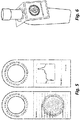
figure 5 shows an example of document or identity card to be connected to a specific oil, bearing a thermogram identifying the oil itself; and - ●
figure 6 illustrates an oil bottle with the document offigure 5 as collar. - ● The time-temperature protocol for DSC calorimeter according to the present invention allows obtaining the oil crystallization and melting thermogram under two basically different thermodynamic conditions, both significant for the oil characterization and experimentally reproducible.
- On this matter, it has been shown that the phase transitions are particularly sensible to the chemical composition of oils and to the variations thereof. The involved processes, in fact, reflect the oil chemical composition through the interactions between the triglycerides and with the multiplicity of molecules constituting the minority component, regulating the nucleation and growth of the polymorphous crystals.
- Therefore, the thermogram, integrated with the chemical-physical analyses and the organoleptic test according to the existing law can be actually considered as identifying a particular extra-virgin oil, with its qualities and geographical provenance.
- According to the protocol in
figure 1 the sample is kept at 50°C for 3 minutes; then it is cooled at a constant speed of 20° C/min until -30°C. It is kept at this temperature for 10 minutes, then it is heated at the speed of 5°C/min until 8°C. The sample is kept for 1 min. at this temperature, then it is cooled again at the speed of 20°C/min until -30°C. This temperature is kept for 5 min, then it is heated until 20°C, at the speed of 5°C/min. The temperature of 20°C is kept for 3 min. - The whole test period of time is 45.5 min.
- For particular applications, such as the conformity test of an oil lot with the sample analysed at the origin, the pieces of information which can be obtained by interrupting the protocol after isotherm at 8°C generally are sufficient. In such case the test time reduces to less than 30 min.
- This protocol allows observing, during the first cooling, the OEVO solidification from metastable state of the liquid phase. The molecular interactions determine the nucleation process and the growth kinetics of the polymorphs of triglycerides.
- In the second cooling of +8°C, in the melt oil there are residual crystalline structures of type β, therefore the sample solidifies mainly by growth of such shapes.
- Upon decreasing the temperature and during the isotherm a -30°C, solid-solid transitions and growth of structures β', stable at low temperatures, intervene. This second oil solidification, then, produces, a polymorphous crystalline sample different from the one obtained in the first cooling, but correlated thereto, as depending from the nature and quantity of residual structures existing in the melt at +8°C, inserted in the same triglyceride matrix.
- The subsequent melting curve, in fact, has very different features from the previous one. It has to be underlined that the protocol object of the invention differentiates from what reported in literature, not so much for the cooling and heating speed, as for the sequence of two crystallization-melting cycles of the sample planned to "question" the sample under different but complementary thermodynamic conditions, in order to obtain a kind of "photo" from two different angulations.
- Therefore the invention cannot be compared to the simple repetition of the same cycle, which would impose the whole melting and the return to + 50°C before starting the second cycle. This type of protocol, used for testing the thermogram instrumental reproducibility provides the same descriptive parameters. It can neither be compared to the sequence of two cycles different for scanning speed and/or duration of the isotherms as in such case data would be obtained, hardly usable for a better sample characterization. In fact, the thermograms related to the first and second cycle would result to be decorrelated thermodynamically.
- Therefore, with the protocol object of the present invention it is possible obtaining in an advantageous and new way a wide set of parameters for further distinguishing an oil from another one with the aim of tracing and identifying the extra-virgin olive oil.
- The so-obtained thermogram shows the effects of the interactions of the triglycerides therebetween and with the OEVO minority components, amplified by the sequence:
- 1. solidification from homogeneous liquid
- 2. uncompleted melting of the solid
- 3. solidification in presence of crystalline germ in the melt
- 4. complete melting.
- More generally, in the method according to the invention the two coolings take place at the same constant speed and this is valid even for heatings, in order to obtain complementary and reproducible data.
- Furthermore, the absolute value of the cooling speed is higher than the absolute value of the heating speed, in order to grow the details of the melting process.
- In order to guarantee a convenient homogeneity of the liquid oil, the first cooling is preceded by an isotherm with higher temperature than room temperature, whereas the coolings quickly reach sensibly low temperatures, thereat the liquid oil is metastable. The second cooling takes place once the first heating is interrupted at +8°C and it is followed y a short isotherm at the sample temperature.
-
Figure 2 shows the thermogram obtained by applying the protocol offigure 1 . - During the first cooling it is observed that the heat flow accompanying a first transition, in a temperature range analogous to that wherein the "cerous transition" of the mineral oils is observed, then the isotherm crystallization at -30°C from metastable liquid. The isotherm duration at -30°C is so as to allow the complete solidification of the oil samples.
- During the first heating, the sample undergoes transitions from polymorphous phases to other phases, stable at higher temperature (mainly from β' phases to β phases) and the subsequent melting of most solid portion. The resulting melting curve is characterized by a first peak of complex shape, ending at about 0°C. A second peak of smaller height follows, which at +8°C is near its own maximum value, to designate that the endothermic melting process is almost finished. During the second cooling and the fourth isotherm there is the solidification from germ of the partially melt oil. The nature of the so-grown crystalline polymorphs is shown with greater details by the thermogram registered during the second heating leading to the whole melting of the sample: the first melting peak is substantially different from the one of the first melting, whereas the second peak shows the presence of two well distinct processes.
- As "identifying photo" of the sample, to be shown in the data bank and in the documents to identify the oil, the whole curve in
figure 2 or part of the same is meant. - The conformity test is based upon the comparison of the thermogram of the sample subjected to test with that shown onto the identity document of the original oil, kept in the data bank.
- It mainly reduces to a visual and direct comparison, which avoids the use of complex mathematical analyses, not suitable to the needs of the field operators, apart from being little comprehensible for a public of not experts, such as the one thereto one has to revert in a wide programme for promoting the oil on the markets.
- In literature time-temperature protocols without the isotherm at -30°C are reported, then based upon temperature scannings in cooling and/or heating. To the research purpose scannings in cooling at 10°C/min until -30°C have been used, followed, after an isotherm at this temperature, by the heating at the same speed until +50°C. For applications of industrial and commercial type this protocol has been considered inadequate.
- The descriptive parameters of each single thermogram, obtained with the protocol of
figure 1 object of the present patent, in fact, identify in a reproducible way and with greater detail and thus advantageous for the applications the crystallization of the oil sample under different thermodinamic conditions and the subsequent transformation and melting of the polymorphous crystals, grown during the isotherms at -30°C. - The transformation and melting peaks, in fact, are better solved, thanks to the less heating speed of the sample (5°C/min.). The polycrystalline structure of the solid grown from metastable liquid is different from that of the solid grown from germ, as it is clearly shown by the two melting curves. The thermogram resulting from the two different solidification/melting cycles includes a wide number of details identifying the oil and, furthermore, it is enriched with details which are hardly parameterizable, but very useful for the conformity test. The guarantee offered by the identity document, in fact, concretizes through a test based upon the visual comparison of the oil thermogram onto the shelf to the one reported onto the identity document: thermograms which can be overlapped in every detail means that the product contained in the packaging on sale is identical to the original oil.
- The method for mapping the productions applies to the thermograms in data bank, obtained with the protocol of
figure 1 . A software is used which considers the parameters characterizing the oil solidification and melting (typically 14 parameters: 5 for the 2 solidifications and 9 for the 2 meltings) to select the similar oils, produced in a same geographical area, homogeneous for pedoclimatic conditions and cultivar types. A suitable software can extract from the data bank the certified oils, of a certain year, produced in the area and having the values of the calorimetric parameters comprised in a range fixed based upon considerations of merit, both scientific (standard deviation of the measurement, intrinsic reproducibility of the processes), and productive one, based upon the descriptive data in memory (collection method, pressing, quality and fruit ripening, percentage of the cultivar composing the blend, etc). - After having verified that the so-selected oils have similar chemical and organoleptic analyses, it is useful considering the average of the thermograms of the above-mentioned oils as the thermogram of the typical oil of that area. It will represent the oil reference "photo" for the area identity document. Its chemical-physical and organoleptic features, shown on the area identity document, will be the arithmetical averages of the data bank values for the selected oils.
- The area identity documents will be kept in a bank of the production maps. The mapping of the products, repeated for subsequent years, will allow calculating the fluctuations of the area identity document and defining quantity criteria for the oil geographical origin test.
- By only way of example of the mapping method, object of the present invention, an application thereof to an area in Toscana is shown, therefrom 5 oils derive, certainly a not sufficient number for a realistic mapping.
-
Figure 3 shows the thermograms of 3 out of 5 oils, certified by a Consortium with protected geographical indication, produced in the area comprised between three adjacent areas. The 3 oils result to have similar thermograms, whereas the other 2 oils show some differences (seefigure 4 ). The three similar oils most likely derive from olivegroves with the same pedoclimatic features and made with the same cultivar used in practically equal percentages. - According to the mapping method, the average thermogram of such oils is calculated and an uncertainty group is associated to such thermogram, therefore a thick curve is obtained. The curve thickness represents the measurement error (for example the SD calculated by reproducibility test) and the supposable fluctuation of the varietal composition, in case of blend, the change in the ripening level of fruits, etc. In other words, a curve is obtained the thickness thereof defines the tolerance range for attributing the origin, to be defined with a systematic research and significant statistics, based upon oils with sure origin and composition.
- In order to obtain the area identity document, to be meant as area production map, the average value of the chemical-physical and organoleptic parameters of the oils used to calculate the average thermogram is associated to the average thermogram. Table 1 shows the chemical analyses of the 3 oils of
figure 3 and the average to be attributed to the representative oil in the area identity document.Table 1 0469 0443 0429 AVERAGE Acidity 0.18 0.26 0.28 0.24 Number of peroxides 7.6 7.9 10.1 8.53 UV analysis K232 2.06 1.91 2.17 2.05 K270 0.19 0.12 0.13 0.15 DeltaK 0.002 0.001 -0.001 0.00 Mirystic Acid 0.01 0.01 0.01 0.01 Palmitic Acid 13.7 13.3 13.8 13.60 Palmitoleic Acid 1.2 1.1 1.2 1.17 Heptadecanoic Acid 0.1 0.1 0.1 0.10 Heptadecanoic Acid 0.1 0.1 0.1 0.10 Stearic Acid 1.9 1.8 1.9 1.87 Oleic Acid 74.1 74.7 73.9 74.23 Linoleic Acid 7.6 7.5 7.6 7.57 Linolenic Acid 0.7 0.7 0.7 0.70 Arachic Acid 0.3 0.3 0.3 0.30 Eicosenoic Acid 0.3 0.3 0.3 0.30 Behenic Acid 0.1 0.1 0.1 0.10 Lignoceric Acid 0.1 0.1 0.1 0.10 Elaidic Acid 0.02 0.02 0.03 0.02 18:2 + 18:3 0.01 0.01 0.01 0.01 - The thick curve shown in
figure 4 shows the production map of the area considered in the present example. The thermograms of the two oils not selected for the mapping are shown too. - These two oils are clearly out of the area production map, as the thermograms thereof are not comprised within the tolerance range. Therefore, they have different origin or they are obtained with fruits of different cultivar.
- The method proposes especially for protecting typical productions of high quality and it can be well applied to oils produced with defined varietal types. In case of monovarietal oils the mapping results easier and more effective and the thickness of the area thermogram is certainly reduced.
- In each case, by restricting the tolerance range, the production map covers areas with decreasing extension, therefore the definition thereof has to take into consideration the local productive realities, the commercial politics and the purposes which the mapping itself pursue.
- The area maps obviously change, year after year, even not substantially. An analysis of the maps of the several years could be used to deepen the knowledge of productions, in particular of those of greater quality.
- The issue of the identity card document for blend oil could take place as follows.
- In the industrial practice, apart from the producer which packages or makes to package his/her own product, the oil mill, the intermediate and the packager operate. The packager and the intermediate purchase oil lots from the producers and/or oil mills, they stow them in silos inside their own factories. With the available oil the packager creates the blend oil to be bottled, by mixing, according to company criteria or at customers' request, the several types of oil existing in the firm. The issue of the identity document to the resulting extra-virgin oil, put on the market by this way, blend requests a procedure which has to be advantageous for the packager and a real guarantee for the consumer purchasing the product from the shelf.
- By taking into consideration the current commercial practice, the following method has been devised:
- 1) The identity document is issued to each lot purchased in the following manner: the oil sample taken and analysed by the packager is subjected to calorimetric test in the purchase phase, according to the above protocol. Upon the lot delivery, the test is repeated for controlling the conformity of the same to the previously analysed sample. This to protect the packager. The identity control system keeps the oils subjected to test in a sample bank.
- 2) When the packager create the blend oil with the oils equipped with thermogram, he/she communicates to the System Manager the blend composition, that is the volume percentages, of oils taken from the various silos and mixed for the bottling.
- 3) The producer sends a bottle of the resulting blend oil to the Manager who proceeds with the colorimetric test. The Manager compares the resulting thermogram to that of the blend oil obtained in laboratory, by mixing the components kept in the Sample Bank in the same percentages declared by the packager.
- 4) If the two thermograms coincide, then the Manager issues the identity document for the blend oil, in a number of examples equal to the number of the bottles resulting from the lot of oil to be commercialized.
- The described method was tested in the field; the considered blend was formed by six different oils and the related thermogram had been obtained from each one thereof. The sample of the blend oil provided by the firm gave a thermogram practically coincident with that of the sample obtained in laboratory by mixing the six oils in the same volume percentage.
- The application of this method provides a real guarantee for tracing the commercial oils, to protect the consumer.
- The present invention implements and applies to the olive oil field through the identity document issued by a System which provides a Manager; a calorimetric laboratory, the sample bank and the related data bank.
- The document is issued to the oil packed and put on the market, according to specific procedures for each chain subject (producer, oil mill, packager, distributor, protection body, etc.). It is devised with format and contents suitable to the commercial and economical needs of the chain.
- By way of example, a possible operating articulation of said structure is the following:
- ● the Manager assigns a code to the oil sample received from the operator and he/she sends it to the calorimetric laboratory which performs the thermogram thereof; a portion of the sample is transferred in specific containers, identified too by the assigned code, which will be kept in the sample bank; the thermogram is inserted in the data bank, together with the parameters describing the sample;
- ● the Manager enters the thermogram codified in the data bank, he/she translates the code and he/she assigns it to the oil sample, now clearly connected to its owner; each subsequent test of conformity of an oil to the original one can be requested to the Manager, who will proceed in comparing the thermogram of the subjected sample to that existing in the data bank;
- ● alternatively, the applicant can be addressed to the nearest reliable calorimetric laboratory in order to obtain the thermogram according to the protocol provided by the Manager and proceed with the comparison to that of the original one;
- ● in case of contestation or a product near the expiry, the test will be performed even onto the original oil sample kept in the sample bank, which is the twin being same age of the marketed product.
- ● The identity document is here described, by only way of example, as a leaflet with four pages (
figure 5 ): - ● the front, with the System mark, the indication of the subject belonging to the production chain and the code identifying the identity card corresponding to the packaging;
- ● the first inner page, with the chemical-physical and organoleptic parameters of the oil, the references of the chain subject, the reference of the examined lot;
- ● the second inner page, with the "identifying photo", that is the oil thermogram;
- ● the back page, with the issue data and the instructions for using the document, the addresses of the Manager (postal, e-mail, internet addresses) for information and complaints.
- The leaflet, placed in a suitable place, accompanies each package of the product put onto the market (
figure 6 ). - The document includes the oil traditional chemical-physical describers and the organoleptic analysis, provided by the existing law and/or by the protection specifications. These describers are part of the parameters existing in data bank, wherein all pieces of information considered useful for a complete characterization of the product, even for the purpose of research, statistical analyses of the productions and of the market, are kept.
- To the above-described method for analysing and identifying edible oils, a person skilled in the art, in order to meet contingent needs, could bring several variants, still within the protection scope defined by the enclosed claims.
Claims (9)
- A method for analysing and identifying edible oils, particularly extra-virgin oil, wherein an oil sample is subjected, in a differential calorimeter with temperature scanning, to a time-temperature protocol, providing:● a first cooling determining a first solidification of the oils from metastable status of the liquid phase;● a first heating determining a partial melting of the oil, so as to leave in the oil residual crystalline structures, therefore in the subsequent cooling the sample solidifies due to the growing of such forms;● a second cooling determining a second solidification due to the growing of said residual crystalline structures; and● a second heating determining a complete melting,the above-mentioned protocol determining a representative thermogram of said sample, comparable by means of graphical overlapping with other thermograms in order to determine the matching of the provenance and/or the composition of an additional oil sample.
- The analysis and identification method according to claim 1, wherein said protocol provides:● a first isotherm at 50°C for 3 minutes;● a first cooling at constant speed of 20° C/min until -30°C;● a second isotherm at -30°C for 10 minutes;● a first heating at constant speed of 5°C/min until 8°C;● a third isotherm at 8°C for 1 min;● a second cooling at the constant speed of 20°C/min until -30°C;● a fourth isotherm at -30°C for 5 min;● a second heating at the constant speed of 5°C/min until 20°C; and● a final isotherm at 20°C for 3 min.
- The analysis and identification method according to claim 1, wherein in said protocol the two coolings take place at the same constant speed.
- The analysis and identification method according to claim 1, wherein in said protocol the two heatings take place at the same constant speed.
- The analysis and identification method according to claim 1, wherein in said protocol the absolute value of the cooling speed is greater than the absolute value of the heating speed.
- The analysis and identification method according to claim 1, wherein in said protocol the first heating and the second cooling are separated by an isotherm comprised between 6° and 10°C.
- The analysis and identification method according to anyone of the preceding claims, wherein a data bank is constituted with the thermograms obtained by a plurality of sample oils.
- The analysis and identification method according to claim 7, wherein the thermograms of the oils coming from neighbouring growing areas are used to produce an average thermogram with a thickness so as to contain said thermograms and to represent the oils coming from a determined geographical area.
- The analysis and identification method according to claim 7, wherein the oil is sold accompanied by an identification document showing its characteristic thermogram, which can be checked by means of said data bank.
Applications Claiming Priority (1)
| Application Number | Priority Date | Filing Date | Title |
|---|---|---|---|
| ITRM2011A000038A IT1404225B1 (en) | 2011-01-28 | 2011-01-28 | METHOD OF ANALYSIS AND IDENTIFICATION FOR FOOD OILS, IN PARTICULAR EXTRA-VIRGIN OLIVE OIL |
Publications (1)
| Publication Number | Publication Date |
|---|---|
| EP2482062A1 true EP2482062A1 (en) | 2012-08-01 |
Family
ID=43975567
Family Applications (1)
| Application Number | Title | Priority Date | Filing Date |
|---|---|---|---|
| EP12152697A Withdrawn EP2482062A1 (en) | 2011-01-28 | 2012-01-26 | Method for analyzing and identifying edible oils, particularly extra-virgin olive oil |
Country Status (2)
| Country | Link |
|---|---|
| EP (1) | EP2482062A1 (en) |
| IT (1) | IT1404225B1 (en) |
Cited By (3)
| Publication number | Priority date | Publication date | Assignee | Title |
|---|---|---|---|---|
| CN105548252A (en) * | 2016-01-26 | 2016-05-04 | 宝鸡文理学院 | Method for identifying edible oil |
| CN108103156A (en) * | 2018-02-08 | 2018-06-01 | 苏州百源基因技术有限公司 | For detecting the specific primer of sunflower DNA and probe and real-time fluorescence quantitative PCR kit |
| WO2021051847A1 (en) * | 2019-09-19 | 2021-03-25 | 江苏厚生新能源科技有限公司 | Method for utilizing dsc to detect oil content of lithium-ion battery separator |
-
2011
- 2011-01-28 IT ITRM2011A000038A patent/IT1404225B1/en active
-
2012
- 2012-01-26 EP EP12152697A patent/EP2482062A1/en not_active Withdrawn
Non-Patent Citations (5)
| Title |
|---|
| ANGIULI M ET AL: "On testing quality and traceability of virgin olive oil by calorimetry", JOURNAL OF THERMAL ANALYSIS AND CALORIMETRY, KLUWER ACADEMIC PUBLISHERS, DO, vol. 84, no. 1, 1 April 2006 (2006-04-01), pages 105 - 112, XP019255936, ISSN: 1572-8943 * |
| CHIAVARO E ET AL: "Differential scanning calorimetry: A potential tool for discrimination of olive oil commercial categories", ANALYTICA CHIMICA ACTA, ELSEVIER, AMSTERDAM, NL, vol. 625, no. 2, 12 September 2008 (2008-09-12), pages 215 - 226, XP024098543, ISSN: 0003-2670, [retrieved on 20080729], DOI: 10.1016/J.ACA.2008.07.031 * |
| DYSZEL ET AL: "A rapid screening technique for vegetable oil identity by sub-ambient DSC", THERMOCHIMICA ACTA, ELSEVIER SCIENCE PUBLISHERS, AMSTERDAM, NL, vol. 57, no. 2, 1 September 1982 (1982-09-01), pages 209 - 221, XP026568293, ISSN: 0040-6031, [retrieved on 19820901], DOI: 10.1016/0040-6031(82)80060-9 * |
| FERRARI ET AL: "Promoting calorimetry for olive oil authentication", THERMOCHIMICA ACTA, ELSEVIER SCIENCE PUBLISHERS, AMSTERDAM, NL, vol. 459, no. 1-2, 11 June 2007 (2007-06-11), pages 58 - 63, XP022112553, ISSN: 0040-6031, DOI: 10.1016/J.TCA.2007.04.002 * |
| MARCO ANGIULI ET AL: "Calorimetry for Fast Authentication of Edible Oils", INTERNATIONAL JOURNAL OF THERMOPHYSICS ; JOURNAL OF THERMOPHYSICAL PROPERTIES AND THERMOPHYSICS AND ITS APPLICATIONS, KLUWER ACADEMIC PUBLISHERS-CONSULTANTS BUREAU, NE, vol. 30, no. 3, 30 June 2009 (2009-06-30), pages 1014 - 1024, XP019729984, ISSN: 1572-9567, DOI: 10.1007/S10765-009-0592-4 * |
Cited By (4)
| Publication number | Priority date | Publication date | Assignee | Title |
|---|---|---|---|---|
| CN105548252A (en) * | 2016-01-26 | 2016-05-04 | 宝鸡文理学院 | Method for identifying edible oil |
| CN108103156A (en) * | 2018-02-08 | 2018-06-01 | 苏州百源基因技术有限公司 | For detecting the specific primer of sunflower DNA and probe and real-time fluorescence quantitative PCR kit |
| WO2021051847A1 (en) * | 2019-09-19 | 2021-03-25 | 江苏厚生新能源科技有限公司 | Method for utilizing dsc to detect oil content of lithium-ion battery separator |
| US11131641B2 (en) * | 2019-09-19 | 2021-09-28 | Jiangsu Horizon New Energy Tech Co., Ltd. | Method for measuring oil content of lithium battery separator by using DSC |
Also Published As
| Publication number | Publication date |
|---|---|
| IT1404225B1 (en) | 2013-11-15 |
| ITRM20110038A1 (en) | 2012-07-29 |
Similar Documents
| Publication | Publication Date | Title |
|---|---|---|
| Jafari et al. | Detection of adulteration in Iranian olive oils using instrumental (GC, NMR, DSC) methods | |
| Řezanka et al. | Characterization of fatty acids and triacylglycerols in vegetable oils by gas chromatography and statistical analysis | |
| Karoui et al. | The potential of combined infrared and fluorescence spectroscopies as a method of determination of the geographic origin of Emmental cheeses | |
| Vera-Gutiérrez et al. | Effect of processing technology and sugarcane varieties on the quality properties of unrefined non-centrifugal sugar | |
| Marikkar et al. | Detection of lard and randomized lard as adulterants in refined‐bleached‐deodorized palm oil by differential scanning calorimetry | |
| Dolatowska-Żebrowska et al. | Characterization of thermal properties of goat milk fat and goat milk chocolate by using DSC, PDSC and TGA methods: K. Dolatowska-Żebrowska et al. | |
| Amrutha Kala | Detection of possible adulteration in commercial ghee samples using low‐resolution gas chromatography triglyceride profiles | |
| Upadhyay et al. | Detection of adulteration by caprine body fat and mixtures of caprine body fat and groundnut oil in bovine and buffalo ghee using differential scanning calorimetry | |
| Popa et al. | Rapid adulteration detection of cold pressed oils with their refined versions by UV–Vis spectroscopy | |
| Clercq et al. | Influence of cocoa butter diacylglycerols on migration induced fat bloom in filled chocolates | |
| Laddomada et al. | Application of a simplified calorimetric assay for the evaluation of extra virgin olive oil quality | |
| Pereira et al. | Seed oil detection in extra virgin olive oil by differential scanning calorimetry: LH Pereira | |
| Zarringhalami et al. | Enzymatically modified tea seed oil as cocoa butter replacer in dark chocolate | |
| Huang et al. | Discrimination on potential adulteration of extra virgin olive oils consumed in China by differential scanning calorimeter combined with dimensionality reduction classification techniques | |
| Martín Carratalá et al. | New contribution to the chemometric characterization of almond cultivars on the basis of their fatty acid profiles | |
| Peri | Quality excellence in extra virgin olive oils | |
| Roy et al. | A novel technique for detection of vanaspati (hydrogenated fat) in cow ghee (clarified butter fat) using flash gas chromatography electronic nose combined with chemometrics | |
| Angiuli et al. | On testing quality and traceability of virgin olive oil by calorimetry | |
| ITRM20110038A1 (en) | METHOD OF ANALYSIS AND IDENTIFICATION FOR FOOD OILS, IN PARTICULAR EXTRA-VIRGIN OLIVE OIL | |
| Li et al. | Study of assessment of green tea’grades in GC‐MS determination of aromatic components based on principal component analysis (PCA) | |
| Hartmann et al. | Thermo-physical parameters applied for instrumental profiling and statistical evaluation of German Emmental cheese | |
| Hsieh et al. | Rapid detection of bovine adipose tissue using lateral flow strip assay | |
| Rachana et al. | Variation in grainy texture of commercial ghee in relation to laboratory ghee and its blends | |
| Chiavaro et al. | Application of a multidisciplinary approach for the evaluation of traceability of extra virgin olive oil | |
| Sánchez‐Rodríguez et al. | Improving the prediction of the fatty acid profile of olive oils by considering statistically relevant harvests and agro‐climatic variables |
Legal Events
| Date | Code | Title | Description |
|---|---|---|---|
| PUAI | Public reference made under article 153(3) epc to a published international application that has entered the european phase |
Free format text: ORIGINAL CODE: 0009012 |
|
| AK | Designated contracting states |
Kind code of ref document: A1 Designated state(s): AL AT BE BG CH CY CZ DE DK EE ES FI FR GB GR HR HU IE IS IT LI LT LU LV MC MK MT NL NO PL PT RO RS SE SI SK SM TR |
|
| AX | Request for extension of the european patent |
Extension state: BA ME |
|
| STAA | Information on the status of an ep patent application or granted ep patent |
Free format text: STATUS: THE APPLICATION IS DEEMED TO BE WITHDRAWN |
|
| 18D | Application deemed to be withdrawn |
Effective date: 20130202 |