EP2479914A1 - Method and transmitter element for transmitting channel information for link adaption, method and receiver element for receiving the channel information - Google Patents
Method and transmitter element for transmitting channel information for link adaption, method and receiver element for receiving the channel information Download PDFInfo
- Publication number
- EP2479914A1 EP2479914A1 EP11290037A EP11290037A EP2479914A1 EP 2479914 A1 EP2479914 A1 EP 2479914A1 EP 11290037 A EP11290037 A EP 11290037A EP 11290037 A EP11290037 A EP 11290037A EP 2479914 A1 EP2479914 A1 EP 2479914A1
- Authority
- EP
- European Patent Office
- Prior art keywords
- channel information
- information
- coding
- level
- channel
- Prior art date
- Legal status (The legal status is an assumption and is not a legal conclusion. Google has not performed a legal analysis and makes no representation as to the accuracy of the status listed.)
- Granted
Links
Images


Classifications
-
- H—ELECTRICITY
- H04—ELECTRIC COMMUNICATION TECHNIQUE
- H04L—TRANSMISSION OF DIGITAL INFORMATION, e.g. TELEGRAPHIC COMMUNICATION
- H04L5/00—Arrangements affording multiple use of the transmission path
- H04L5/003—Arrangements for allocating sub-channels of the transmission path
- H04L5/0053—Allocation of signalling, i.e. of overhead other than pilot signals
- H04L5/0057—Physical resource allocation for CQI
-
- H—ELECTRICITY
- H04—ELECTRIC COMMUNICATION TECHNIQUE
- H04L—TRANSMISSION OF DIGITAL INFORMATION, e.g. TELEGRAPHIC COMMUNICATION
- H04L1/00—Arrangements for detecting or preventing errors in the information received
- H04L1/0001—Systems modifying transmission characteristics according to link quality, e.g. power backoff
- H04L1/0023—Systems modifying transmission characteristics according to link quality, e.g. power backoff characterised by the signalling
- H04L1/0026—Transmission of channel quality indication
-
- H—ELECTRICITY
- H04—ELECTRIC COMMUNICATION TECHNIQUE
- H04L—TRANSMISSION OF DIGITAL INFORMATION, e.g. TELEGRAPHIC COMMUNICATION
- H04L1/00—Arrangements for detecting or preventing errors in the information received
- H04L1/004—Arrangements for detecting or preventing errors in the information received by using forward error control
- H04L1/0056—Systems characterized by the type of code used
- H04L1/007—Unequal error protection
Definitions
- the present invention refers to a method and a transmitter element for transmitting channel information for link adaptation of a radio channel in a wireless network. Furthermore, the present invention refers to a method and a receiver element for receiving the channel information.
- Base stations of cellular communication networks known in the art are arranged for adapting a transmission mode for data transmission to a particular mobile terminal registered with that base station, with this adaptation depending on a current state of a radio channel between the base station and the terminal. Adapting the data transmission to the state of the channel is often referred to as link adaptation.
- the object of the present invention is to provide methods for transmitting and receiving the channel information as well as a transmitter element and a receiver element that allow for reliably and efficiently transfer the channel information between different network nodes, such as a terminal and a base station, of a wireless network.
- a method for transmitting channel information for link adaptation of a radio channel in a wireless network comprising encoding the channel information using multi-level coding, said multi-level coding comprising combining multiple bit sequences, each bit sequence corresponding to a coding level of said multi-level coding and assigning one of said coding levels to at least a part of the channel information such that the at least a part of the channel information corresponds to the bit sequence of that coding level.
- the wireless network may be a cellular network such as the Universal Mobile Telecommunication System (UMTS), the Long Term Evolution (LTE) system, the LTE-Advanced system, or the Worldwide Interoperability for Microwave Access (WiMAX) system or a non-cellular network such as Wireless Local Area Networks (WLANs) or Wireless Sensor Networks (WSNs) following the IEEE 802.11 or 802.15 standard family, respectively.
- UMTS Universal Mobile Telecommunication System
- LTE Long Term Evolution
- WiMAX Worldwide Interoperability for Microwave Access
- WLANs Wireless Local Area Networks
- WSNs Wireless Sensor Networks
- the channel information describes momentary characteristics of the channel.
- the channel information is also referred to as Channel State Information (CSI).
- the channel information may comprise Channel Quality Indicator (CQI).
- CQI Channel Quality Indicator
- the terminal estimates the quality of the channel, determines the CQI depending on the estimated quality, and transmits the CQI to the base station.
- the channel information may comprise a Precoding Matrix Indicator (PMI).
- the terminal may communicate the PMI to the base station.
- the base station may determine precoding weights or a precoding matrix depending on the PMI received from the terminal and adapt downlink data transmissions to that terminal according to the precoding weights or precoding matrix. A similar procedure is needed in any wireless system when reciprocal wireless channels cannot be assumed.
- each coding level corresponds to a level of a detection probability of the bit sequence of that coding level.
- the detection probability is the probability that the bit sequence is correctly detected by a receiver, provided that transmission errors may occur when transmitting the channel information over the radio channel.
- the method may be executed by a terminal of the wireless network, i.e. the method may be a method for operating a terminal of the wireless network.
- Assigning the at least a part of the channel information to the predefined coding level allows for controlling the detection probability, i.e. a quality of the transmission of the channel information. Choosing an appropriate coding level therefore reduces the risk of distorting the channel information while transferring it, e.g. from a terminal of the network to a base station of the network, and thus improves the reliability of the transmission of the channel information. Choosing an appropriate coding level also allows to prioritise channel information of different relevance. For instance, a robust coding level (i.e., high detection rate) can be assigned to essential channel information while a less-robust coding level is chosen for channel information that is less important.
- a robust coding level i.e., high detection rate
- the method comprises classifying the channel information by subdividing it into multiple parts of channel information according to an importance of these parts of channel information for the link adaptation and assigning one of said coding levels to at least one part of said multiple parts.
- Said multiple parts may differ from each other regarding their importance with respect to link adaptation. For instance, a part of the link information that is important for the link adaptation to work correctly may be assigned to a coding level having a rather high detection probability. This part of the channel information will be transmitted very reliably. The important part of the channel information being transmitted reliably leads to a reliable link adaptation.
- the method comprises assigning multiple coding levels to multiple parts of the channel information, a detection probability of the coding level assigned to at least one of said multiple parts being higher than the detection probability of the coding level assigned to any further part of said multiple parts having a lower importance with respect to link adaptation than said at least one part.
- the parts of the channel information are prioritised by assigning to them different coding levels having different detection probability levels.
- Important parts have a high detection probability and can be regenerated by a receiver even in case of high noise or strong interference on the radio channel. Less important parts have a lower detection probability than the important parts. Consequently, a receiver may not be able to detect the less important parts in all situations.
- the at least one coding level is assigned statically to at least one part of channel information.
- the at least one coding level is assigned dynamically to the at least one part of channel information according to a momentary importance of these parts of channel information for the link adaptation.
- Dynamic assignments mean that the assignment of the coding level is automatically changed during the operation of the wireless network. Such dynamic changes may be performed at different time-scale depending on how the importance of the parts of the channel information is signalled. This can be done at different layers of control signalling, e.g. MAC-layer control signalling or Radio link control signalling.
- Static assignments mean that the importance is temporarily constant. Changes can be made e.g. via setting operation and maintenance parameters of the network.
- a first part of said multiple parts of channel information comprises wideband information related to the whole radio channel and a second part of said multiple parts of channel information comprises sub-band information related to a sub-band of the radio channel, the first part is of higher importance for the link adaptation than the second part.
- a coding level having a rather high detection probability level is assigned to the wideband information and a coding level having a rather low detection probability level is assigned to the sub-band information, said low detection probability level being less then the detection probability level assigned to the wideband information.
- the importance of the wideband channel information compared to the importance of the sub-band channel information may be time-variant. For instance, when frequency-selective resource allocation is performed in a frequency-selective environment, the wideband channel information is less effective for link adaptation than the sub-band information. In such cases, a coding level having a higher detection probability may be dynamically assigned to sub-band information while wideband information receives a coding level of lower detection probability. When the user leaves the frequency-selective environment, its channel flattens. Then, the importance of sub-band channel information decreases. A dynamic embodiment of the invention may reflect this by reversing the above allocation of coding levels.
- the channel information comprises coarse information and refining information for refining the coarse information, the coarse information corresponding to a part of said multiple parts of channel information that has a higher importance with respect to link adaptation than a further part of said multiple parts corresponding to the refining information.
- the coarse information is coarse precoding vector information that characterizes a coarse precoding vector and the refining information is refining precoding information for determining a fine-grained precoding vector based on the coarse precoding vector.
- the precoding vector may comprise preferred precoding weights used by a network element of the network, e.g. a base station, for precoding a signal to be transmitted over the radio channel.
- the coarse precoding vector information may be an index for selecting a preferred precoding vector stored in a predefined codebook having multiple precoding vectors.
- the method transmits channel information only.
- the method comprises transmitting payload data using said multi-level coding and assigning different coding levels to the payload data and to the at least one part of the channel information.
- at least one coding level may be assigned to the payload and at least one different coding level may be assigned to the channel information.
- the payload data may correspond to one of said multiple bit sequences corresponding to a certain coding level.
- the payload data may be data received from higher protocol layers or to be forwarded to the higher protocol layer and/or control data unrelated to channel information.
- a first coding level is assigned to the whole channel information and a second coding level is assigned to the payload information.
- the assignment of the coding levels to the channel information and/or to the payload may be static. A coding level having a higher detection probability may be assigned to the channel information while a coding level with lower detection probability is assigned to the payload data. In situations where reliable transmission of the payload is more important than reliable transmission of the channel information, the coding level assigned to the channel information may have a lower detection probability than the coding level assigned to the payload data. This assignment may be reversed in situations where reliable transmission of the payload is less important than reliable transmission of the channel information.
- the coding levels are assigned dynamically to the payload data and to the at least a part of the channel information, i.e. the assignment of the coding level to the bit sequences is changed dynamically.
- This adaptation may be done with respect to the stability of the wireless channel.
- the channel is temporally unstable (e.g., at high user speed) the channel information is highly time variant and, thus, of lower importance than with temporally stable channels.
- One embodiment may reflect this as follows. For fast users (i.e., unstable channels), at least one coding level with high detection probability is assigned to data while at least one coding level with lower detection rate is assigned to channel information. This assignment is reversed when the channel stability improves (e.g., with slower users).
- the multi-level coding is a hierarchical modulation.
- a method for receiving channel information for link adaptation of a radio channel in a wireless network comprising decoding the channel information using multi-level decoding, said multi-level decoding comprising detecting multiple bit sequences, each bit sequence corresponding to a coding level of said multi-level decoding and determining at least a part of the channel information depending on the bit sequence corresponding to a predefined coding level.
- the channel information is subdivided into multiple parts of channel information according to an importance of these parts of channel information for the link adaptation and a first part of said multiple parts of channel information comprises wideband information related to the whole radio channel and a second part of said multiple parts of channel information comprises sub-band information related to a sub-band of the radio channel, the first part having a higher importance with respect to link adaptation than the second part.
- the channel information is subdivided into multiple parts of channel information according to an importance of these parts of channel information for the link adaptation and wherein the channel information comprises coarse information, preferably coarse precoding vector information, and refining information for refining the coarse information that characterizes a coarse precoding vector, preferably refining precoding information for determining a fine-grained precoding vector based on the coarse precoding vector, the coarse information corresponding to a part of said multiple parts of channel information that has a higher importance with respect to the link adaptation than a further part of said multiple parts corresponding to the refining information.
- the channel information comprises coarse information, preferably coarse precoding vector information, and refining information for refining the coarse information that characterizes a coarse precoding vector, preferably refining precoding information for determining a fine-grained precoding vector based on the coarse precoding vector, the coarse information corresponding to a part of said multiple parts of channel information that has a higher importance with respect to the link adaptation than a further part of said multiple parts corresponding to the
- the method comprises receiving payload data using said multi-level coding, the payload data being assigned to a different coding level than the at least one part of the channel information.
- a transmitter element for transmitting channel information for link adaptation of a radio channel of a wireless network is provided, the transmitter element being configured for encoding the channel information using multi-level coding, said multi-level coding comprising combining multiple bit sequences, each bit sequence corresponding to a coding level of said multi-level coding and assigning one of said coding levels to at least a part of the channel information such that the at least a part of the channel information corresponds to the bit sequence of that coding level.
- the transmitter is configured for executing a method for transmitting channel information according to the present invention.
- a receiver element for receiving channel information for link adaptation of a radio channel of a wireless network is provided, the receiver element being arranged for decoding the channel information using multi-level decoding, said multi-level decoding comprising detecting multiple bit sequences, each bit sequence corresponding to a coding level of said multi-level decoding and determining at least a part of the channel information depending on the bit sequence corresponding to a predefined coding level.
- the receiver element is configured for executing a method according to the present invention.
- Figure 1 shows a wireless communication network 11 comprising a terminal 13 and a base station 15.
- the network 11 is a LTE or LTE-Advanced communication system.
- the terminal is also referred to as User Equipment (UE) and the base station is also referred to as enhanced NodeB (eNodeB).
- UE User Equipment
- eNodeB enhanced NodeB
- the present invention is not limited to LTE or LTE-Advanced.
- the network 11 is a part of an access network of UMTS or WiMAX or even a part of a WLAN or WSN.
- the terminal 13 comprises a first transceiver 17 having a channel encoder and/or modulator 19, further referred to as encoder 19, and a transmitter 21, an output of the channel encoder 19 being connected to an input of the transmitter 21 and an output of the transmitter 21 being coupled with an antenna of the terminal 13.
- the base station has a second transceiver 23 comprising a receiver 25 and a channel decoder and/or demodulator 27, further referred to as decoder 27.
- the receiver 25 is coupled with an antenna of the base station 15 and an output of the receiver 25 is connected to an input of the channel decoder 27.
- the first transceiver, an uplink radio channel 29 and the second transceiver 23 are part of an uplink transmission line 31.
- the second transceiver 23 has a transmitter for transmitting over a downlink radio channel 33 to a receiver of the first transceiver 17.
- both the transmitter of the second transceiver 23 and the receiver of the first transceiver 17 are not shown.
- channel information CI is encoded and/or modulated by the encoder 19.
- the encoder 19 generates a signal s that is transmitted over the uplink radio channel 29 by the transmitter 21.
- the signal s may comprise a codeword c generated by the encoder 19 and comprising the channel information CI.
- the receiver 25 receives the transmitted signal and forwards the received signal s' comprising a received codeword c' to the decoder 27.
- the decoder 27 regenerates the channel information CI.
- the channel information CI is often referred to as Channel State Information (CSI).
- the channel information may comprise a Precoding Matrix Indicator (PMI), which may have a size of 2 bits, and/or Channel Quality Information (CQI), which may have a size of 5 bits.
- PMI Precoding Matrix Indicator
- CQI Channel Quality Information
- the CQI typically not only contains a property of the radio channel (channel gain) but also the level of received noise and interference, so it is also related to the SINR (signal to interference plus noise ratio).
- the codeword c may have a size of about 1000 to 2000 bits.
- the codeword c is transmitted over a radio frame comprising 14 Orthogonal Frequency-division multiplexing (OFDM) symbols, while the transmission of the whole codeword takes one millisecond.
- OFDM Orthogonal Frequency-division multiplexing
- the codeword may be transmitted within a frame that has a duration of 20 milliseconds.
- the channel information CI may be used by the base station 15 for link adaptation of transmissions over the downlink radio channel 33.
- the terminal 13 determines the channel information CI depending on a measured channel quality of the downlink radio channel 33 and communicates the channel information CI to the base station 15. Then the base station 15 may adapt the downlink transmission e.g. by selecting a precoding matrix according to the PMI received from the terminal 13 and/or selecting a modulation and/or coding scheme depending on the CQI received from the terminal 13.
- Transmitting channel information is particularly effective in systems where characteristics of the uplink radio channel 29 and the downlink radio channel 33 differ from each other, such as systems using Frequency Division Multiplexing (FDD).
- FDD Frequency Division Multiplexing
- the present invention is not limited to FDD systems; it can also be used in connection with systems using Time Division Duplexing (TDD) under non-reciprocal channel conditions. Even with TDD or other duplexing schemes such conditions may be caused by fast fading or by interference.
- TDD Time Division Duplexing
- the signal s and the codeword c comprise the channel information CI only, i.e. only the channel information CI is encoded by the encoder 19.
- a data sequence d is transmitted over the transmission line 31 together with the channel information CI.
- the encoder 19 not only encodes the channel information CI but also the data sequence d.
- the signal s and the codeword c comprise both channel information CI and payload data represented by the data sequence d.
- the decoder 27 regenerates the channel information CI and the data sequence d.
- FIG. 2 shows a first preferred embodiment of the transmission line 31 in more detail.
- the transmission line 31 has a transmitter element 35 comprising the encoder 19.
- the encoder 19 comprises a prioritizing element 37 and a mapper 39.
- the transmission line 31 has a receiver element 41 comprising the decoder 27.
- the uplink radio channel 29 is arranged between the transmitter element 35 and the receiver element 41.
- the channel information CI corresponding to the downlink channel is transmitted in uplink direction, i.e. over the uplink radio channel 29, because many wireless networks require that the channel information CI be transmitted from the terminal 13 to the base station 15.
- the transmission is performed in the downlink direction, i.e.
- the downlink radio channel 33 is arranged between the transmitter element 35 and the receiver element 41 in order to characterize the uplink channel.
- the transmitter element 35 is a part of the terminal 13 and the receiver element 41 is a part of the base station 15.
- the base station 30 comprises the transmitter element 35 and the terminal comprises the receiver element 41.
- the channel information CI is subdivided into multiple parts ci 1 , ci 2 of channel information.
- the individual parts ci 1 , ci 2 are fed into the prioritizing element 37.
- the prioritizing element 37 classifies the channel information CI by assigning coding level 0,..., n of a multi-level code to them.
- the coding levels 0, ..., n are assigned to the parts ci 1 , ci 2 according to an importance of these parts ci 1 , ci 2 for the link adaptation performed by the base station 15.
- the prioritizing element 37 For each coding level 0, ..., n, the prioritizing element 37, generates a bit sequence c 1 , c 2 , ..., c n .
- Each generated bit sequence c 1 , c 2 , ... , c n corresponds to the part ci 1 , ci 2 of channel information CI to which the coding level of that bit sequence c 1 , c 2 , ..., c n has been assigned.
- Each coding-level 0, ..., n corresponds to a detection probability level p 1 , p 2 , ..., p n .
- the channel information CI may be subdivided such that part ci i is more important with respect to link adaptation than part cij if and only if i ⁇ j.
- the coding level i may be assigned to the part ci i such that the part ci i corresponds to the bit sequence c i .
- the mapper 39 maps the bit sequences c 1 , c 2 , ..., c n of channel information CI to modulation symbols such that the above-mentioned condition regarding the detection probability levels p 1 , p 2 , ..., p n holds. Thereby, the mapper 39 generates mapping information m, e.g. a mapping table. A radio signal is generated depending on the mapping information m and transmitted over the uplink radio channel 29 to the receiving element 41.
- the decoder 27 decodes the received signal and regenerates the bit sequences c 1 , c 2 , ..., c n and the parts ci 1 , ci 2 of the channel information CI.
- the regenerated bit sequences are referred to as c' 1 , c' 2 , c' n .
- the decoder 27 may not be able to regenerate the bit sequences c 1 , c 2 ,..., c n of channel information CI correctly.
- the performance of link adaptation is not heavily degraded in case of strong noise and/or heavy interference during the transmission of CI via the uplink radio channel 29. Because merely the important parts of the channel information CI have a high detection probability level and the remaining parts have a comparatively low detection probability level, the channel information CI is transmitted efficiently, i.e. with low consumption of radio transmission resources of the uplink radio channel 29.
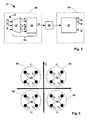
- Figure 3 shows an exemplary mapping of two bit sequences c1, c2 to a 16-QAM symbol constellation using hierarchical modulation.
- hierarchical modulation with two coding levels is used.
- the present invention is neither limited to hierarchical modulation being a special type of multi-level coding nor to a certain number of coding levels.
- the present invention may be applied with any type of multi-level Forward-Error-Correction (FEC) code.
- FEC Forward-Error-Correction
- a first bit sequence c 1 having the highest priority is mapped to outer symbols 43 of the hierarchical modulation scheme.
- a second bit sequence c 2 having a low priority is mapped to inner symbols 45.
- more than two hierarchy levels of the hierarchical modulation is used and more than two bit sequences c 1 , c 2 may be provided.
- a high priority having a high detection probability level is assigned to wideband channel information about the downlink radio channel 33.
- the wideband information is, thus, a first part ci 1 of the channel information CI.
- the wideband information is related to the whole radio channel.
- a lower priority having a lower detection probability level is assigned to sub-band information that is specific to a certain sub-band of that radio channel. That is, the sub-band information is a second part ci 2 of the channel information CI.
- the channel information may comprise a Precoding Matrix Indicator (PMI) and/or a Channel Quality Indicator (CQI).
- PMI Precoding Matrix Indicator
- CQI Channel Quality Indicator
- Both the PMI and the CQI may be related to the whole channel (wideband PMI, wideband CQI) or to a certain sub-band of the channel (sub-band PMI, sub-band CQI).
- An exemplary mapping of these parts of the channel information CI to the bit sequences is shown in the table below. part of CI bit sequence detection probability level PMI CQI ci 1 c 1 p 1 (high) wideband PMI wideband CQI ci 2 c 2 p 2 (low) sub-band PMI sub-band CQI
- link adaptation in the form of closed-loop Multiple Input Multiple Output is performed for downlink transmissions over the downlink radio channel 33.
- MIMO Multiple Input Multiple Output
- a preferred precoding weight at least for the whole frequency band (i.e. wideband PMI), giving some rough information on the radio channel 33.
- channel quality information at least averaged over the whole band (wideband CQI) may be transmitted in order to allow the base station 15 to select an appropriate modulation and coding scheme and to decide on scheduling priorities.
- this wideband information represents the minimum amount of required information for performing closed-loop MIMO, the wideband information is transmitted with a high detection probability level over the uplink radio channel 29.
- this kind of information may be mapped to the outer symbol hierarchy (outer symbols 43).
- the refinement of the wideband information may be used for frequency selective optimization of the MIMO transmission. This refinement is transmitted using the lower coding-level corresponding to a lower detection probability level.
- radio transmission resources are grouped into time-frequency blocks, so called Physical Resource Blocks (PRBs).
- PRBs Physical Resource Blocks
- a set of the consecutive PRBs corresponds to a sub-band of the downlink radio channel 33.
- the sub-band PMI and/or the sub-band CQI may give additional information about the downlink radio channel 33 related to one or more sub-bands, i.e. one or more sets of PRBs.
- the sub-band information being less important refining information is preferably transmitted in the inner symbol hierarchy (inner symbols 45) when using hierarchical modulation.
- This sub-band information (sub-band PMI, sub-band CQI) may be represented as differential information (delta-CQI, delta-PMI) indicating a difference with respect to the wideband information.
- the channel information CI may comprise at least one PMI in the form of an index of a precoding vector stored in a predefined codebook.
- the coding-levels may be assigned to coarse-grained and fine-grained precoding vectors, respectively.
- an index to a vector stored in a coarse codebook may be assigned to a coding-level having a high detection probability level.
- a coding level having a lower detection probability may be used for transmission of refinement information which may be relative to the coarse codebook.
- FIG. 4 shows a vector space of precoding vectors.
- Coarse precoding vectors 51 stored in a coarse codebook span a first complex hypersphere 53.
- these codebook vectors represent points on the complex hypersphere.
- the coarse codebook can be formed by Grasmannian line packings on the complex hypersphere 53.
- the coarse codebook has four precoding vectors 51.
- the PMI transmitted with a detection probability comprises two bits to identify one of these four coarse precoding vectors 51.
- the coarse precoding vector 51a has been selected by the PMI transmitted over the transmission line 31.
- Refinement information transmitted using the coding-level having a lower detection probability characterizes a differential vector 55 that may be used to determine a resulting precoding vector 57 depending on the selected coarse precoding vector 51a.
- multi-differential vectors 55 may be stored in a refining codebook and the refining information may comprise an index to one of these differential vectors 55.
- the differential vectors 55 refine the coarse codebook, e.g. by pointing to values at the border or inside a spherical cap around each individual coarse precoding vector.
- the refining information comprises two bits for selecting one of these differential vectors 55 as a selected differential vector 55a.
- the resulting precoding vector 57 is determined depending on the selected coarse precoding vector 51a and the selected differential vector 55a, e.g. by adding the selected coarse precoding vector 51a and the selected differential vector 55a.
- the decoder 27 may not be able to decode the refining information for selecting a differential vector 55.
- the coarse information having a high detection probability, can be decoded anyway. Therefore link adaptation may be performed based on the coarse information represented by the selected coarse precoding vector 51a. Refining information is optional in the sense that link adaptation is still working comparatively good when relying merely on the coarse information.
- the bit sequence c 1 corresponding to the coarse preceding vector information may be mapped to the outer symbols 43 and the bit sequence c 2 corresponding to refinement information may be mapped to the inner symbols 45 (cf. Figure 3 ).
- more than four coding-levels are used.
- an additional hierarchy-level may be added to refine the precoding vector 57 even further.
- the channel information CI is combined with a data sequence d (cf. Figure 2 ).
- a data sequence d (cf. Figure 2 ).
- an index to a coarse precoding vector 51 of a coarse codebook and the data sequence d are transmitted simultaneously using the encoder 19.
- a coding level having a high detection probability level p 1 is assigned to the channel information (e.g. the coarse precoding vector).
- a coding level having a low detection probability level p 2 ⁇ p 1 is assigned to the payload sequence d. part of information bit sequence detection probability level content ci 1 c 1 p 1 (high) coarse precoding vector d c 2 p 2 (low) payload
- the bit sequence c 1 corresponding to the coarse precoding vector information may be mapped to the outer symbols 43 and the bit sequence c 2 corresponding to the payload sequence d may be mapped to the inner symbols 45 (cf. Figure 3 ).
- This mapping may be reversed when CI is less important than data, e.g. when the wireless channel is temporally not stable and accurate CI measurements are not likely. In these cases, d is mapped to c 1 and ci 1 to c 2 . Even an adaptation between alternative mappings is possible if the channel stability changes, e.g. a moving user slows down, thus, getting a temporally more stable channel.
- the assignment of coding levels to the bit sequences c 1 , c 2 shown above may be reversed dynamically when data transmission over the uplink radio channel 31 is more important than a performance of link adaptation of the downlink radio channel 33.
- the channel information CI and the data sequence d may be prioritized dynamically while operating the transmission line 31. For instance, a framing scheme may be established, with the mapping shown in the table above is used occasionally to provide accurate channel information CI, while it is reversed for most of the transmission time in order to prioritize the transmission of the data sequence d.
- Transmitting the channel information CI and the data sequence d simultaneously using the same encoder 19 allows to regenerate the channel information CI and the data sequence d from one codeword received by the decoder 27 at the same time.
- Such simultaneous reception reduces a latency of the transmission of the channel information CI.
- the risk of faulty link adaptation due to the use of channel information CI that is outdated because of time-variant shadowing, fading, and/or interference of the downlink channel 29 is reduced.
- the above embodiments use two coding-levels only.
- the hierarchical modulation is an exemplary type of multi-level coding.
- more than two coding-levels are used and other types of multi-level coding, in particular multi-level forward-error-correction codes (FEC-codes), are applied.
- FEC-codes multi-level forward-error-correction codes
- the above-described embodiments may be combined with each other. For instance, when using three levels, an index to a coarse precoding vector 51, an index to a differential vector 55, and the data sequence d may be transmitted simultaneously.
- the data sequence d may also be transmitted simultaneously with the wideband PMI, with the wideband CQI, with the sub-band PMI, and/or with the sub-band CQI.
- wideband information, sub-band information, an index to a coarse precoding vector 51, and/or refinement information relative to the coarse precoding vector 51 may be transmitted simultaneously using different coding levels.
- using multi-level coding allows for reliably transmit important parts of the channel information and transmit refining channel information CI with little additional overhead. Moreover, it enables to dynamically adapt the detection probability of different parts of CI to the current channel situation.
- the refining information and/or the sub-band information may be embedded in the symbol and/or code space for transmitting the wideband information and/or the coarse information so that no additional multiple access resources in the uplink must be allocated by a scheduler of the base station 13. Switching between different modes for reporting the channel information, e.g. switching between different mappings of the parts c 1 , c 2 , ..., c n of channel information CI and the data sequence d to the coding levels may be performed without additional control signaling. Furthermore, the refined channel information (sub-band information and/or refining information) can be transmitted without an additional delay reducing the overall latency of the link adaptation. Therefore, channel information may be transmitted more accurately and/or reliably by using multi-level coding.
- any functional blocks labelled as 'processors' may be provided through the use of dedicated hardware as well as hardware capable of executing software in association with appropriate software.
- the functions may be provided by a single dedicated processor, by a single shared processor, or by a plurality of individual processors, some of which may be shared.
- explicit use of the term 'processor' or 'controller' should not be construed to refer exclusively to hardware capable of executing software, and may implicitly include, without limitation, digital signal processor (DSP) hardware, network processor, application specific integrated circuit (ASIC), field programmable gate array (FPGA), read only memory (ROM) for storing software, random access memory (RAM), and non volatile storage.
- DSP digital signal processor
- ASIC application specific integrated circuit
- FPGA field programmable gate array
- ROM read only memory
- RAM random access memory
- any switches shown in the FIGS. are conceptual only. Their function may be carried out through the operation of program logic, through dedicated logic, through the interaction of program control and dedicated logic, or even manually, the particular technique being selectable by the implementer as more specifically understood from the context.
- any block diagrams herein represent conceptual views of illustrative circuitry embodying the principles of the invention.
- any flow charts, flow diagrams, state transition diagrams, pseudo code, and the like represent various processes which may be substantially represented in computer readable medium and so executed by a computer or processor, whether or not such computer or processor is explicitly shown.
- program storage devices e.g., digital data storage media, which are machine or computer readable and encode machine-executable or computer-executable programs of instructions, wherein said instructions perform some or all of the steps of said above-described methods.
- the program storage devices may be, e.g., digital memories, magnetic storage media such as a magnetic disks and magnetic tapes, hard drives, or optically readable digital data storage media.
- the embodiments are also intended to cover computers programmed to perform said steps of the above-described methods.
Landscapes
- Engineering & Computer Science (AREA)
- Signal Processing (AREA)
- Computer Networks & Wireless Communication (AREA)
- Quality & Reliability (AREA)
- Mobile Radio Communication Systems (AREA)
- Digital Transmission Methods That Use Modulated Carrier Waves (AREA)
- Detection And Prevention Of Errors In Transmission (AREA)
- Radio Transmission System (AREA)
Abstract
Description
- The present invention refers to a method and a transmitter element for transmitting channel information for link adaptation of a radio channel in a wireless network. Furthermore, the present invention refers to a method and a receiver element for receiving the channel information.
- Base stations of cellular communication networks known in the art are arranged for adapting a transmission mode for data transmission to a particular mobile terminal registered with that base station, with this adaptation depending on a current state of a radio channel between the base station and the terminal. Adapting the data transmission to the state of the channel is often referred to as link adaptation.
- It is known to transfer channel information describing the current state of the radio channel from the individual terminals to the base station. However this transfer of channel information consumes transmission resources. Moreover, transmission errors may occur when transferring the channel information to the base station, which may lead to a mismatch between the actual channel state and the channel state represented by the channel information received by the base station.
- The object of the present invention is to provide methods for transmitting and receiving the channel information as well as a transmitter element and a receiver element that allow for reliably and efficiently transfer the channel information between different network nodes, such as a terminal and a base station, of a wireless network.
- According to an embodiment of the present invention, a method for transmitting channel information for link adaptation of a radio channel in a wireless network is provided, the method comprising encoding the channel information using multi-level coding, said multi-level coding comprising combining multiple bit sequences, each bit sequence corresponding to a coding level of said multi-level coding and assigning one of said coding levels to at least a part of the channel information such that the at least a part of the channel information corresponds to the bit sequence of that coding level.
- The method can be applied to any type of wireless networks. For example, the wireless network may be a cellular network such as the Universal Mobile Telecommunication System (UMTS), the Long Term Evolution (LTE) system, the LTE-Advanced system, or the Worldwide Interoperability for Microwave Access (WiMAX) system or a non-cellular network such as Wireless Local Area Networks (WLANs) or Wireless Sensor Networks (WSNs) following the IEEE 802.11 or 802.15 standard family, respectively.
- The channel information describes momentary characteristics of the channel. In LTE, the channel information is also referred to as Channel State Information (CSI). The channel information may comprise Channel Quality Indicator (CQI). In LTE, the terminal estimates the quality of the channel, determines the CQI depending on the estimated quality, and transmits the CQI to the base station. Furthermore, the channel information may comprise a Precoding Matrix Indicator (PMI). The terminal may communicate the PMI to the base station. The base station may determine precoding weights or a precoding matrix depending on the PMI received from the terminal and adapt downlink data transmissions to that terminal according to the precoding weights or precoding matrix. A similar procedure is needed in any wireless system when reciprocal wireless channels cannot be assumed.
- Preferably, each coding level corresponds to a level of a detection probability of the bit sequence of that coding level. The detection probability is the probability that the bit sequence is correctly detected by a receiver, provided that transmission errors may occur when transmitting the channel information over the radio channel. The method may be executed by a terminal of the wireless network, i.e. the method may be a method for operating a terminal of the wireless network.
- Assigning the at least a part of the channel information to the predefined coding level allows for controlling the detection probability, i.e. a quality of the transmission of the channel information. Choosing an appropriate coding level therefore reduces the risk of distorting the channel information while transferring it, e.g. from a terminal of the network to a base station of the network, and thus improves the reliability of the transmission of the channel information. Choosing an appropriate coding level also allows to prioritise channel information of different relevance. For instance, a robust coding level (i.e., high detection rate) can be assigned to essential channel information while a less-robust coding level is chosen for channel information that is less important.
- In an embodiment, the method comprises classifying the channel information by subdividing it into multiple parts of channel information according to an importance of these parts of channel information for the link adaptation and assigning one of said coding levels to at least one part of said multiple parts. Said multiple parts may differ from each other regarding their importance with respect to link adaptation. For instance, a part of the link information that is important for the link adaptation to work correctly may be assigned to a coding level having a rather high detection probability. This part of the channel information will be transmitted very reliably. The important part of the channel information being transmitted reliably leads to a reliable link adaptation.
- Preferably, the method comprises assigning multiple coding levels to multiple parts of the channel information, a detection probability of the coding level assigned to at least one of said multiple parts being higher than the detection probability of the coding level assigned to any further part of said multiple parts having a lower importance with respect to link adaptation than said at least one part. In other words, the parts of the channel information are prioritised by assigning to them different coding levels having different detection probability levels. Important parts have a high detection probability and can be regenerated by a receiver even in case of high noise or strong interference on the radio channel. Less important parts have a lower detection probability than the important parts. Consequently, a receiver may not be able to detect the less important parts in all situations. However, transmitting the less important parts using a coding level with lower detection probability consumes less transmission resources and still improves the overall channel information in many cases. Following this so-called "best effort" principle, the important parts of the channel information can be transmitted reliably without affecting the efficiency of the transmission of the whole channel information.
- In one embodiment, the at least one coding level is assigned statically to at least one part of channel information. However, in another embodiment, the at least one coding level is assigned dynamically to the at least one part of channel information according to a momentary importance of these parts of channel information for the link adaptation.
- Dynamic assignments mean that the assignment of the coding level is automatically changed during the operation of the wireless network. Such dynamic changes may be performed at different time-scale depending on how the importance of the parts of the channel information is signalled. This can be done at different layers of control signalling, e.g. MAC-layer control signalling or Radio link control signalling.
- Static assignments mean that the importance is temporarily constant. Changes can be made e.g. via setting operation and maintenance parameters of the network.
- In an embodiment, a first part of said multiple parts of channel information comprises wideband information related to the whole radio channel and a second part of said multiple parts of channel information comprises sub-band information related to a sub-band of the radio channel, the first part is of higher importance for the link adaptation than the second part. Preferably, a coding level having a rather high detection probability level is assigned to the wideband information and a coding level having a rather low detection probability level is assigned to the sub-band information, said low detection probability level being less then the detection probability level assigned to the wideband information.
- The importance of the wideband channel information compared to the importance of the sub-band channel information may be time-variant. For instance, when frequency-selective resource allocation is performed in a frequency-selective environment, the wideband channel information is less effective for link adaptation than the sub-band information. In such cases, a coding level having a higher detection probability may be dynamically assigned to sub-band information while wideband information receives a coding level of lower detection probability. When the user leaves the frequency-selective environment, its channel flattens. Then, the importance of sub-band channel information decreases. A dynamic embodiment of the invention may reflect this by reversing the above allocation of coding levels.
- According to another embodiment, the channel information comprises coarse information and refining information for refining the coarse information, the coarse information corresponding to a part of said multiple parts of channel information that has a higher importance with respect to link adaptation than a further part of said multiple parts corresponding to the refining information. For instance, the coarse information is coarse precoding vector information that characterizes a coarse precoding vector and the refining information is refining precoding information for determining a fine-grained precoding vector based on the coarse precoding vector. The precoding vector may comprise preferred precoding weights used by a network element of the network, e.g. a base station, for precoding a signal to be transmitted over the radio channel. For instance, the coarse precoding vector information may be an index for selecting a preferred precoding vector stored in a predefined codebook having multiple precoding vectors.
- In the previous embodiments, the method transmits channel information only. In another embodiment, the method comprises transmitting payload data using said multi-level coding and assigning different coding levels to the payload data and to the at least one part of the channel information. In other words, at least one coding level may be assigned to the payload and at least one different coding level may be assigned to the channel information. The payload data may correspond to one of said multiple bit sequences corresponding to a certain coding level. The payload data may be data received from higher protocol layers or to be forwarded to the higher protocol layer and/or control data unrelated to channel information. In an exemplary embodiment, a first coding level is assigned to the whole channel information and a second coding level is assigned to the payload information.
- The assignment of the coding levels to the channel information and/or to the payload may be static. A coding level having a higher detection probability may be assigned to the channel information while a coding level with lower detection probability is assigned to the payload data. In situations where reliable transmission of the payload is more important than reliable transmission of the channel information, the coding level assigned to the channel information may have a lower detection probability than the coding level assigned to the payload data. This assignment may be reversed in situations where reliable transmission of the payload is less important than reliable transmission of the channel information.
- Instead of statically assigning the coding levels to the bit sequences, e.g. the channel information and the payload data, in an embodiment, the coding levels are assigned dynamically to the payload data and to the at least a part of the channel information, i.e. the assignment of the coding level to the bit sequences is changed dynamically. This adaptation may be done with respect to the stability of the wireless channel. When the channel is temporally unstable (e.g., at high user speed) the channel information is highly time variant and, thus, of lower importance than with temporally stable channels. One embodiment may reflect this as follows. For fast users (i.e., unstable channels), at least one coding level with high detection probability is assigned to data while at least one coding level with lower detection rate is assigned to channel information. This assignment is reversed when the channel stability improves (e.g., with slower users).
- In a preferred embodiment, the multi-level coding is a hierarchical modulation.
- According to another preferred embodiment of the present invention, a method for receiving channel information for link adaptation of a radio channel in a wireless network is provided, the method comprising decoding the channel information using multi-level decoding, said multi-level decoding comprising detecting multiple bit sequences, each bit sequence corresponding to a coding level of said multi-level decoding and determining at least a part of the channel information depending on the bit sequence corresponding to a predefined coding level.
- In an embodiment, the channel information is subdivided into multiple parts of channel information according to an importance of these parts of channel information for the link adaptation and a first part of said multiple parts of channel information comprises wideband information related to the whole radio channel and a second part of said multiple parts of channel information comprises sub-band information related to a sub-band of the radio channel, the first part having a higher importance with respect to link adaptation than the second part.
- Preferably, the channel information is subdivided into multiple parts of channel information according to an importance of these parts of channel information for the link adaptation and wherein the channel information comprises coarse information, preferably coarse precoding vector information, and refining information for refining the coarse information that characterizes a coarse precoding vector, preferably refining precoding information for determining a fine-grained precoding vector based on the coarse precoding vector, the coarse information corresponding to a part of said multiple parts of channel information that has a higher importance with respect to the link adaptation than a further part of said multiple parts corresponding to the refining information.
- In an embodiment, the method comprises receiving payload data using said multi-level coding, the payload data being assigned to a different coding level than the at least one part of the channel information.
- According to yet another preferred embodiment of the present invention, a transmitter element for transmitting channel information for link adaptation of a radio channel of a wireless network is provided, the transmitter element being configured for encoding the channel information using multi-level coding, said multi-level coding comprising combining multiple bit sequences, each bit sequence corresponding to a coding level of said multi-level coding and assigning one of said coding levels to at least a part of the channel information such that the at least a part of the channel information corresponds to the bit sequence of that coding level.
- Preferably, the transmitter is configured for executing a method for transmitting channel information according to the present invention.
- According to still another preferred embodiment of the present invention, a receiver element for receiving channel information for link adaptation of a radio channel of a wireless network is provided, the receiver element being arranged for decoding the channel information using multi-level decoding, said multi-level decoding comprising detecting multiple bit sequences, each bit sequence corresponding to a coding level of said multi-level decoding and determining at least a part of the channel information depending on the bit sequence corresponding to a predefined coding level.
- Preferably, the receiver element is configured for executing a method according to the present invention.
- Preferred embodiments and further advantages of the present invention are shown in the Figures and described in detail hereinafter.
- Figure 1
- shows a wireless communication network comprising a terminal and base station;
- Figure 2
- shows a block diagram of a radio transmission line of the network of
Figure 1 ; - Figure 3
- shows a 16-QAM constellation of a hierarchical modulation scheme; and
- Figure 4
- shows a diagram of coarse precoding vectors and differential refining vectors.
- The description and drawings merely illustrate the principles of the invention. It will thus be appreciated that those skilled in the art will be able to devise various arrangements that, although not explicitly described or shown herein, embody the principles of the invention and are included within its spirit and scope. Furthermore, all examples recited herein are principally intended expressly to be only for pedagogical purposes to aid the reader in understanding the principles of the invention and the concepts contributed by the inventor(s) to furthering the art, and are to be construed as being without limitation to such specifically recited examples and conditions. Moreover, all statements herein reciting principles, aspects, and embodiments of the invention, as well as specific examples thereof, are intended to encompass equivalents thereof.
-
Figure 1 shows awireless communication network 11 comprising a terminal 13 and abase station 15. In the shown embodiment, thenetwork 11 is a LTE or LTE-Advanced communication system. In LTE or LTE-Advanced, the terminal is also referred to as User Equipment (UE) and the base station is also referred to as enhanced NodeB (eNodeB). However, the present invention is not limited to LTE or LTE-Advanced. In another embodiment, thenetwork 11 is a part of an access network of UMTS or WiMAX or even a part of a WLAN or WSN. - The terminal 13 comprises a
first transceiver 17 having a channel encoder and/ormodulator 19, further referred to asencoder 19, and atransmitter 21, an output of thechannel encoder 19 being connected to an input of thetransmitter 21 and an output of thetransmitter 21 being coupled with an antenna of the terminal 13. - The base station has a
second transceiver 23 comprising areceiver 25 and a channel decoder and/ordemodulator 27, further referred to asdecoder 27. Thereceiver 25 is coupled with an antenna of thebase station 15 and an output of thereceiver 25 is connected to an input of thechannel decoder 27. - The first transceiver, an
uplink radio channel 29 and thesecond transceiver 23 are part of anuplink transmission line 31. Thesecond transceiver 23 has a transmitter for transmitting over adownlink radio channel 33 to a receiver of thefirst transceiver 17. For the sake of simplicity, both the transmitter of thesecond transceiver 23 and the receiver of thefirst transceiver 17 are not shown. - When operating the
network 11, channel information CI is encoded and/or modulated by theencoder 19. Theencoder 19 generates a signal s that is transmitted over theuplink radio channel 29 by thetransmitter 21. The signal s may comprise a codeword c generated by theencoder 19 and comprising the channel information CI. Thereceiver 25 receives the transmitted signal and forwards the received signal s' comprising a received codeword c' to thedecoder 27. Thedecoder 27 regenerates the channel information CI. - The channel information CI is often referred to as Channel State Information (CSI). In LTE, the channel information may comprise a Precoding Matrix Indicator (PMI), which may have a size of 2 bits, and/or Channel Quality Information (CQI), which may have a size of 5 bits. The CQI typically not only contains a property of the radio channel (channel gain) but also the level of received noise and interference, so it is also related to the SINR (signal to interference plus noise ratio). The codeword c may have a size of about 1000 to 2000 bits. Here, the codeword c is transmitted over a radio frame comprising 14 Orthogonal Frequency-division multiplexing (OFDM) symbols, while the transmission of the whole codeword takes one millisecond. With WiMAX, the codeword may be transmitted within a frame that has a duration of 20 milliseconds. The channel information CI may be used by the
base station 15 for link adaptation of transmissions over thedownlink radio channel 33. The terminal 13 determines the channel information CI depending on a measured channel quality of thedownlink radio channel 33 and communicates the channel information CI to thebase station 15. Then thebase station 15 may adapt the downlink transmission e.g. by selecting a precoding matrix according to the PMI received from the terminal 13 and/or selecting a modulation and/or coding scheme depending on the CQI received from the terminal 13. Transmitting channel information is particularly effective in systems where characteristics of theuplink radio channel 29 and thedownlink radio channel 33 differ from each other, such as systems using Frequency Division Multiplexing (FDD). However, the present invention is not limited to FDD systems; it can also be used in connection with systems using Time Division Duplexing (TDD) under non-reciprocal channel conditions. Even with TDD or other duplexing schemes such conditions may be caused by fast fading or by interference. - In an embodiment, the signal s and the codeword c comprise the channel information CI only, i.e. only the channel information CI is encoded by the
encoder 19. In another embodiment, a data sequence d is transmitted over thetransmission line 31 together with the channel information CI. In this embodiment, theencoder 19 not only encodes the channel information CI but also the data sequence d. As a result, the signal s and the codeword c comprise both channel information CI and payload data represented by the data sequence d. In this embodiment, thedecoder 27 regenerates the channel information CI and the data sequence d. -
Figure 2 shows a first preferred embodiment of thetransmission line 31 in more detail. Thetransmission line 31 has atransmitter element 35 comprising theencoder 19. Theencoder 19 comprises a prioritizingelement 37 and amapper 39. Furthermore, thetransmission line 31 has areceiver element 41 comprising thedecoder 27. Theuplink radio channel 29 is arranged between thetransmitter element 35 and thereceiver element 41. In this embodiment, the channel information CI corresponding to the downlink channel is transmitted in uplink direction, i.e. over theuplink radio channel 29, because many wireless networks require that the channel information CI be transmitted from the terminal 13 to thebase station 15. However, in another embodiment, the transmission is performed in the downlink direction, i.e. thedownlink radio channel 33 is arranged between thetransmitter element 35 and thereceiver element 41 in order to characterize the uplink channel. In the shown embodiment, thetransmitter element 35 is a part of the terminal 13 and thereceiver element 41 is a part of thebase station 15. In another embodiment, the base station 30 comprises thetransmitter element 35 and the terminal comprises thereceiver element 41. - When operating the
transmission line 31, the channel information CI is subdivided into multiple parts ci1, ci2 of channel information. The individual parts ci1, ci2 are fed into the prioritizingelement 37. The prioritizingelement 37 classifies the channel information CI by assigning coding level 0,..., n of a multi-level code to them. The coding levels 0, ..., n are assigned to the parts ci1, ci2 according to an importance of these parts ci1, ci2 for the link adaptation performed by thebase station 15. For each coding level 0, ..., n, the prioritizingelement 37, generates a bit sequence c1, c2, ..., cn. Each generated bit sequence c1, c2, ... , cn corresponds to the part ci1, ci2 of channel information CI to which the coding level of that bit sequence c1, c2, ..., cn has been assigned. Each coding-level 0, ..., n corresponds to a detection probability level p1, p2, ..., pn. In the shown embodiment, a part cii, i=1, ..., n of channel information CI having a given index i has a higher detection probability level pi than any other part pj with j > i. If pi is the detection probability level of the bit sequence ci, then the condition p1 > p2 > ... > pn holds. - In an embodiment, the channel information CI may be subdivided such that part cii is more important with respect to link adaptation than part cij if and only if i < j. In this embodiment, the coding level i may be assigned to the part cii such that the part cii corresponds to the bit sequence ci.
- The
mapper 39 maps the bit sequences c1, c2, ..., cn of channel information CI to modulation symbols such that the above-mentioned condition regarding the detection probability levels p1, p2, ..., pn holds. Thereby, themapper 39 generates mapping information m, e.g. a mapping table. A radio signal is generated depending on the mapping information m and transmitted over theuplink radio channel 29 to the receivingelement 41. - The
decoder 27 decodes the received signal and regenerates the bit sequences c1, c2, ..., cn and the parts ci1, ci2 of the channel information CI. The regenerated bit sequences are referred to as c'1, c'2, c'n. In case of transmission errors, thedecoder 27 may not be able to regenerate the bit sequences c1, c2,..., cn of channel information CI correctly. The probability that a certain bit sequence ci is regenerated correctly, ci=c'i, is characterized by the detection probability level pi of that bit sequence ci of channel information CI. In the shown embodiment the bit sequence c1 is therefore transmitted more reliably than the other bit sequences c2, ..., cn. Therefore, the prioritizingelement 37 is configured such that the bit sequences c1, c2,..., cn having a low index i=1, ..., n comprise more important parts ci1, ci2 channel information CI than those bit sequences c1, c2, ..., cn which have a rather high index j < i. This has the effect that the important parts of the channel information CI are regenerated quite reliably by thedecoder 27 and thus the probability of transmission errors can be kept low for those important parts of the CI, even in the presence of fading, noise and interference. - As a consequence, the performance of link adaptation is not heavily degraded in case of strong noise and/or heavy interference during the transmission of CI via the
uplink radio channel 29. Because merely the important parts of the channel information CI have a high detection probability level and the remaining parts have a comparatively low detection probability level, the channel information CI is transmitted efficiently, i.e. with low consumption of radio transmission resources of theuplink radio channel 29. -
Figure 3 shows an exemplary mapping of two bit sequences c1, c2 to a 16-QAM symbol constellation using hierarchical modulation. InFigure 3 , hierarchical modulation with two coding levels is used. However, the present invention is neither limited to hierarchical modulation being a special type of multi-level coding nor to a certain number of coding levels. The present invention may be applied with any type of multi-level Forward-Error-Correction (FEC) code. - A first bit sequence c1 having the highest priority is mapped to
outer symbols 43 of the hierarchical modulation scheme. A second bit sequence c2 having a low priority is mapped toinner symbols 45. In another embodiment, more than two hierarchy levels of the hierarchical modulation is used and more than two bit sequences c1, c2 may be provided. - In the first embodiment, a high priority having a high detection probability level is assigned to wideband channel information about the
downlink radio channel 33. The wideband information is, thus, a first part ci1 of the channel information CI. The wideband information is related to the whole radio channel. A lower priority having a lower detection probability level is assigned to sub-band information that is specific to a certain sub-band of that radio channel. That is, the sub-band information is a second part ci2 of the channel information CI. The channel information may comprise a Precoding Matrix Indicator (PMI) and/or a Channel Quality Indicator (CQI). Both the PMI and the CQI may be related to the whole channel (wideband PMI, wideband CQI) or to a certain sub-band of the channel (sub-band PMI, sub-band CQI). An exemplary mapping of these parts of the channel information CI to the bit sequences is shown in the table below.part of CI bit sequence detection probability level PMI CQI ci1 c1 p1 (high) wideband PMI wideband CQI ci2 c2 p2 (low) sub-band PMI sub-band CQI - In an embodiment, link adaptation in the form of closed-loop Multiple Input Multiple Output (MIMO) is performed for downlink transmissions over the
downlink radio channel 33. For correct closed-loop MIMO operation it is important to know a preferred precoding weight at least for the whole frequency band (i.e. wideband PMI), giving some rough information on theradio channel 33. Additionally, channel quality information, at least averaged over the whole band (wideband CQI) may be transmitted in order to allow thebase station 15 to select an appropriate modulation and coding scheme and to decide on scheduling priorities. As this wideband information represents the minimum amount of required information for performing closed-loop MIMO, the wideband information is transmitted with a high detection probability level over theuplink radio channel 29. When using hierarchical modulation as shown inFigure 3 , this kind of information may be mapped to the outer symbol hierarchy (outer symbols 43). - The refinement of the wideband information may be used for frequency selective optimization of the MIMO transmission. This refinement is transmitted using the lower coding-level corresponding to a lower detection probability level. When using LTE, radio transmission resources are grouped into time-frequency blocks, so called Physical Resource Blocks (PRBs). A set of the consecutive PRBs corresponds to a sub-band of the
downlink radio channel 33. The sub-band PMI and/or the sub-band CQI may give additional information about thedownlink radio channel 33 related to one or more sub-bands, i.e. one or more sets of PRBs. The sub-band information being less important refining information is preferably transmitted in the inner symbol hierarchy (inner symbols 45) when using hierarchical modulation. This sub-band information (sub-band PMI, sub-band CQI) may be represented as differential information (delta-CQI, delta-PMI) indicating a difference with respect to the wideband information. - According to a second exemplary embodiment, the channel information CI may comprise at least one PMI in the form of an index of a precoding vector stored in a predefined codebook. The coding-levels may be assigned to coarse-grained and fine-grained precoding vectors, respectively. As shown in the table below, an index to a vector stored in a coarse codebook may be assigned to a coding-level having a high detection probability level. A coding level having a lower detection probability may be used for transmission of refinement information which may be relative to the coarse codebook.
part of CI bit sequence detection probability level precoding information (PMI) ci1 c1 p1 (high) coarse precoding vector ci2 c2 p2 (low) refinement information, relative to coarse precoding vector - This approach is illustrated in
Figure 4 . The diagram ofFigure 4 shows a vector space of precoding vectors.Coarse precoding vectors 51 stored in a coarse codebook span a firstcomplex hypersphere 53. Usually, these codebook vectors represent points on the complex hypersphere. The coarse codebook can be formed by Grasmannian line packings on thecomplex hypersphere 53. In the shown embodiment, the coarse codebook has fourprecoding vectors 51. Thus, the PMI transmitted with a detection probability comprises two bits to identify one of these fourcoarse precoding vectors 51. InFigure 4 , thecoarse precoding vector 51a has been selected by the PMI transmitted over thetransmission line 31. - Refinement information transmitted using the coding-level having a lower detection probability characterizes a
differential vector 55 that may be used to determine a resultingprecoding vector 57 depending on the selectedcoarse precoding vector 51a. In the shown embodiment,multi-differential vectors 55 may be stored in a refining codebook and the refining information may comprise an index to one of thesedifferential vectors 55. As shown inFigure 4 , thedifferential vectors 55 refine the coarse codebook, e.g. by pointing to values at the border or inside a spherical cap around each individual coarse precoding vector. - In the shown embodiment, four
differential vectors 55 are stored in the refining codebook. Thus, the refining information comprises two bits for selecting one of thesedifferential vectors 55 as a selecteddifferential vector 55a. The resultingprecoding vector 57 is determined depending on the selectedcoarse precoding vector 51a and the selecteddifferential vector 55a, e.g. by adding the selectedcoarse precoding vector 51a and the selecteddifferential vector 55a. - In case of transmission errors, the
decoder 27 may not be able to decode the refining information for selecting adifferential vector 55. However, the coarse information, having a high detection probability, can be decoded anyway. Therefore link adaptation may be performed based on the coarse information represented by the selectedcoarse precoding vector 51a. Refining information is optional in the sense that link adaptation is still working comparatively good when relying merely on the coarse information. When using hierarchical modulation, the bit sequence c1 corresponding to the coarse preceding vector information may be mapped to theouter symbols 43 and the bit sequence c2 corresponding to refinement information may be mapped to the inner symbols 45 (cf.Figure 3 ). - In another embodiment, more than four coding-levels are used. In particular, an additional hierarchy-level may be added to refine the
precoding vector 57 even further. - According to a third embodiment, the channel information CI is combined with a data sequence d (cf.
Figure 2 ). According to an exemplary assignment of the coding-levels to the data sequence d and the channel information CI shown below, an index to acoarse precoding vector 51 of a coarse codebook and the data sequence d are transmitted simultaneously using theencoder 19. A coding level having a high detection probability level p1 is assigned to the channel information (e.g. the coarse precoding vector). A coding level having a low detection probability level p2 < p1 is assigned to the payload sequence d.part of information bit sequence detection probability level content ci1 c1 p1 (high) coarse precoding vector d c2 p2 (low) payload - When using hierarchical modulation, the bit sequence c1 corresponding to the coarse precoding vector information may be mapped to the
outer symbols 43 and the bit sequence c2 corresponding to the payload sequence d may be mapped to the inner symbols 45 (cf.Figure 3 ). This mapping may be reversed when CI is less important than data, e.g. when the wireless channel is temporally not stable and accurate CI measurements are not likely. In these cases, d is mapped to c1 and ci1 to c2. Even an adaptation between alternative mappings is possible if the channel stability changes, e.g. a moving user slows down, thus, getting a temporally more stable channel. - In an embodiment, the assignment of coding levels to the bit sequences c1, c2 shown above may be reversed dynamically when data transmission over the
uplink radio channel 31 is more important than a performance of link adaptation of thedownlink radio channel 33. By repeatedly or periodically switching these two mappings, the channel information CI and the data sequence d may be prioritized dynamically while operating thetransmission line 31. For instance, a framing scheme may be established, with the mapping shown in the table above is used occasionally to provide accurate channel information CI, while it is reversed for most of the transmission time in order to prioritize the transmission of the data sequence d. - Transmitting the channel information CI and the data sequence d simultaneously using the
same encoder 19 allows to regenerate the channel information CI and the data sequence d from one codeword received by thedecoder 27 at the same time. Such simultaneous reception reduces a latency of the transmission of the channel information CI. As a consequence, the risk of faulty link adaptation due to the use of channel information CI that is outdated because of time-variant shadowing, fading, and/or interference of thedownlink channel 29 is reduced. - For the sake of simple illustration, the above embodiments use two coding-levels only. The hierarchical modulation is an exemplary type of multi-level coding. In other embodiments, more than two coding-levels are used and other types of multi-level coding, in particular multi-level forward-error-correction codes (FEC-codes), are applied. Furthermore, the above-described embodiments may be combined with each other. For instance, when using three levels, an index to a
coarse precoding vector 51, an index to adifferential vector 55, and the data sequence d may be transmitted simultaneously. The data sequence d may also be transmitted simultaneously with the wideband PMI, with the wideband CQI, with the sub-band PMI, and/or with the sub-band CQI. Furthermore, wideband information, sub-band information, an index to acoarse precoding vector 51, and/or refinement information relative to thecoarse precoding vector 51 may be transmitted simultaneously using different coding levels. - To sum up, using multi-level coding allows for reliably transmit important parts of the channel information and transmit refining channel information CI with little additional overhead. Moreover, it enables to dynamically adapt the detection probability of different parts of CI to the current channel situation. The refining information and/or the sub-band information may be embedded in the symbol and/or code space for transmitting the wideband information and/or the coarse information so that no additional multiple access resources in the uplink must be allocated by a scheduler of the
base station 13. Switching between different modes for reporting the channel information, e.g. switching between different mappings of the parts c1, c2, ..., cn of channel information CI and the data sequence d to the coding levels may be performed without additional control signaling. Furthermore, the refined channel information (sub-band information and/or refining information) can be transmitted without an additional delay reducing the overall latency of the link adaptation. Therefore, channel information may be transmitted more accurately and/or reliably by using multi-level coding. - The functions of the various elements shown in the Figures, including any functional blocks labelled as 'processors', may be provided through the use of dedicated hardware as well as hardware capable of executing software in association with appropriate software. When provided by a processor, the functions may be provided by a single dedicated processor, by a single shared processor, or by a plurality of individual processors, some of which may be shared. Moreover, explicit use of the term 'processor' or 'controller' should not be construed to refer exclusively to hardware capable of executing software, and may implicitly include, without limitation, digital signal processor (DSP) hardware, network processor, application specific integrated circuit (ASIC), field programmable gate array (FPGA), read only memory (ROM) for storing software, random access memory (RAM), and non volatile storage. Other hardware, conventional and/or custom, may also be included. Similarly, any switches shown in the FIGS. are conceptual only. Their function may be carried out through the operation of program logic, through dedicated logic, through the interaction of program control and dedicated logic, or even manually, the particular technique being selectable by the implementer as more specifically understood from the context.
- It should be appreciated by those skilled in the art that any block diagrams herein represent conceptual views of illustrative circuitry embodying the principles of the invention. Similarly, it will be appreciated that any flow charts, flow diagrams, state transition diagrams, pseudo code, and the like represent various processes which may be substantially represented in computer readable medium and so executed by a computer or processor, whether or not such computer or processor is explicitly shown.
- A person of skill in the art would readily recognize that steps of various above-described methods can be performed by programmed computers. Herein, some embodiments are also intended to cover program storage devices, e.g., digital data storage media, which are machine or computer readable and encode machine-executable or computer-executable programs of instructions, wherein said instructions perform some or all of the steps of said above-described methods. The program storage devices may be, e.g., digital memories, magnetic storage media such as a magnetic disks and magnetic tapes, hard drives, or optically readable digital data storage media. The embodiments are also intended to cover computers programmed to perform said steps of the above-described methods.
Claims (16)
- Method for transmitting channel information (CI) for link adaptation of a radio channel (33) of a wireless network (11), the method comprising- encoding (19) the channel information (CI) using multi-level coding, said multi-level coding (19) comprising combining multiple bit sequences (c1, c2, ... , cn), each bit sequence (c1 c2, ..., cn, d) corresponding to a coding level (1, ..., n) of said multi-level coding (19) and- assigning (37) one of said coding levels (1, ..., n) to at least a part (ci1, ci2) of the channel information (CI) such that the at least a part (ci1, ci2) of the channel information (CI) corresponds to the bit sequence (c1, c2 , ..., cn) of that coding level (1, ..., n).
- Method according to claim 1, wherein the method comprises subdividing (37) the channel information (CI) into multiple parts (ci1, ci2) of channel information (CI) according to an importance of these parts (ci1, ci2) of channel information (CI) for the link adaptation and assigning one of said coding levels (1, ..., n) to at least one part of said multiple parts (ci1, ci2).
- Method according to claim 2, wherein the method comprises assigning multiple coding levels (1, ..., n) to multiple parts (ci1, ci2) of the channel information (CI), a detection probability (p1, p2, ..., pn) of the coding level (1, ..., n) assigned to at least one of said multiple parts (ci1, ci2) being higher than the detection probability (p1, p2, ..., pn) of the coding level (1, ..., n) assigned to any further part (ci1, ci2) of said multiple parts having a lower importance with respect to link adaptation than said at least one part (c1, c2, ... , cn).
- Method according to claim 2 or 3, wherein the at least one coding level (1, ..., n) is assigned dynamically to the at least one part of channel information (CI) according to a momentary importance of these parts (ci1, ci2) of channel information (CI) for the link adaptation.
- Method according to one of claims 2 to 4, wherein a first part (ci1) of said multiple parts (ci1, ci2) of channel information (CI) comprises wideband information related to the whole radio channel (33) and a second part (ci2) of said multiple parts (ci1, ci2) of channel information (CI) comprises sub-band information related to at least one sub-band of the radio channel (CI), the first part (ci1) having a higher importance with respect to the link adaptation than the second part (ci2).
- Method according to one of claims 2 to 5, wherein the channel information (CI) comprises coarse information, preferably coarse precoding vector information characterising a coarse precoding vector (51a), and refining information for refining the coarse information, preferably refining precoding information for determining a fine-grained precoding vector (55a) based on the coarse precoding vector (51a), the coarse information corresponding to a part (ci1) of said multiple parts (ci1, ci2) of channel information (CI) that has a higher importance than a further part (ci2) of said multiple parts (ci1, ci2) corresponding to the refining information.
- Method according to one of the precedent claims, wherein the method comprises transmitting payload data (d) using said multi-level coding (19) and assigning different coding levels (1,..., n) to the payload data (d) and to the at least a part (ci1, ci2) of the channel information (CI).
- Method according to claim 7, wherein the coding levels (1,..., n) are assigned dynamically to the payload data and to the at least a part of the channel information (CI).
- Method for receiving channel information (CI) for link adaptation of a radio channel (33) of a wireless network (11), the method comprising- decoding (27) the channel information (CI) using multi-level decoding (27), said multi-level decoding (27) comprising detecting multiple bit sequences (c1, c2, ..., cn, d), each bit sequence (c1, c2, ... , cn, d) corresponding to a coding level (1, ..., n) of said multi-level decoding (27) and- determining at least a part (ci1, ci2) of the channel information (CI) depending on the bit sequence (c1, c2, ..., cn) corresponding to a predefined coding level (1, ..., n).
- Method according to claim 9, wherein the channel information (CI) is subdivided into multiple parts (ci1, ci2) of channel information (CI) according to an importance of these parts (ci1, ci2) of channel information (CI) for the link adaptation and wherein a first part (ci1) of said multiple parts (ci1, ci2) of channel information (CI) comprises wideband information related to the whole radio channel (33) and a second part (ci2) of said multiple parts (ci1, ci2) of channel information (CI) comprises sub-band information related to one or more sub-bands of the radio channel (33), the first part (ci1) having a higher importance with respect to link adaptation than the second part (ci2).
- Method according to claim 9 or 10, wherein the channel information (CI) is subdivided into multiple parts (ci1, ci2) of channel information (CI) according to an importance of these parts (ci1, ci2) of channel information (CI) for the link adaptation and wherein the channel information (CI) comprises coarse information, preferably coarse precoding vector information characterising a coarse precoding vector (51a), and refining information for refining the coarse information, preferably refining precoding information for determining a fine-grained precoding vector (55a) based on the coarse precoding vector (51a), the coarse information corresponding to a part (ci1) of said multiple parts (ci1, ci2) of channel information (CI) that has a higher importance than a further part (c2) of said multiple parts (ci1, ci2) corresponding to the refining information.
- Method according to one of claims 9 to 11, wherein the method comprises receiving payload data (d) using said multi-level decoding (27), different coding levels (1, ..., n) being assigned to the payload data (d) and to the at least one part (ci1, ci2) of the channel information (CI).
- Transmitter element (35) for transmitting channel information (CI) for link adaptation of a radio channel (33) of a wireless network (11), the transmitter element being arranged for- encoding (19) the channel information (CI) using multi-level coding (19), said multi-level coding (19) comprising combining multiple bit sequences (c1, c2, ..., cn, d), each bit sequence (c1, c2, ..., cn, d) corresponding to a coding level (1, ..., n) of said multi-level coding (17) and- assigning (37) one of said coding levels (1, ..., n) to at least a part (ci1, ci2) of the channel information (CI) such that the at least a part (ci1, ci2) of the channel information (CI) corresponds to the bit sequence (c1, c2, ..., cn) of that coding level (1, ..., n).
- Transmitter (35) element according to claim 13, wherein the transmitter element (35) is configured for executing a method according to one of claims 1 to 8.
- Receiver element (41) for receiving channel information (CI) for link adaptation of a radio channel (33) of a wireless network (11), the receiver element (41) being arranged for- decoding (27) the channel information using multi-level decoding, said multi-level decoding (27) comprising detecting multiple bit sequences (c1, c2, ... , cn), each bit sequence corresponding to a coding level (1, ..., n) of said multi-level decoding (27) and- determining at least a part (ci1, ci2) of the channel information (c1, c2, ..., cn) depending on the bit sequence (c1, c2, ..., cn) corresponding to a predefined coding level (1, ..., n).
- Receiver element (41) according to claim 15, wherein the receiver element (41) is configured for executing a method according to one of claims 9 or 11.
Priority Applications (8)
| Application Number | Priority Date | Filing Date | Title |
|---|---|---|---|
| EP11290037.8A EP2479914B1 (en) | 2011-01-21 | 2011-01-21 | Method and transmitter element for transmitting channel information for link adaption, method and receiver element for receiving the channel information |
| US13/980,423 US9231746B2 (en) | 2011-01-21 | 2011-12-16 | Method and transmitter element for transmitting channel information for link adaptation, method and receiver element for receiving the channel information |
| KR1020137021934A KR20130118375A (en) | 2011-01-21 | 2011-12-16 | Method and transmitter element for transmitting channel information for link adaptation, method and receiver element for receiving the channel information |
| PCT/EP2011/073059 WO2012097935A1 (en) | 2011-01-21 | 2011-12-16 | Method and transmitter element for transmitting channel information for link adaptation, method and receiver element for receiving the channel information |
| BR112013018272-5A BR112013018272B1 (en) | 2011-01-21 | 2011-12-16 | METHOD AND TRANSMITTER ELEMENT TO TRANSMIT CHANNEL INFORMATION AND METHOD AND RECEIVER ELEMENT TO RECEIVE CHANNEL INFORMATION |
| CN2011800656227A CN103329468A (en) | 2011-01-21 | 2011-12-16 | Method and transmitter element for transmitting channel information for link adaptation, method and receiver element for receiving the channel information |
| JP2013549746A JP5785270B2 (en) | 2011-01-21 | 2011-12-16 | Method and transmitter element for transmitting channel information for link adaptation, method and receiver element for receiving channel information |
| TW100148651A TWI475838B (en) | 2011-01-21 | 2011-12-26 | Method and transmitter element for transmitting channel information for link adaptation, method and receiver element for receiving the channel information |
Applications Claiming Priority (1)
| Application Number | Priority Date | Filing Date | Title |
|---|---|---|---|
| EP11290037.8A EP2479914B1 (en) | 2011-01-21 | 2011-01-21 | Method and transmitter element for transmitting channel information for link adaption, method and receiver element for receiving the channel information |
Publications (2)
| Publication Number | Publication Date |
|---|---|
| EP2479914A1 true EP2479914A1 (en) | 2012-07-25 |
| EP2479914B1 EP2479914B1 (en) | 2015-03-04 |
Family
ID=44144702
Family Applications (1)
| Application Number | Title | Priority Date | Filing Date |
|---|---|---|---|
| EP11290037.8A Active EP2479914B1 (en) | 2011-01-21 | 2011-01-21 | Method and transmitter element for transmitting channel information for link adaption, method and receiver element for receiving the channel information |
Country Status (8)
| Country | Link |
|---|---|
| US (1) | US9231746B2 (en) |
| EP (1) | EP2479914B1 (en) |
| JP (1) | JP5785270B2 (en) |
| KR (1) | KR20130118375A (en) |
| CN (1) | CN103329468A (en) |
| BR (1) | BR112013018272B1 (en) |
| TW (1) | TWI475838B (en) |
| WO (1) | WO2012097935A1 (en) |
Cited By (2)
| Publication number | Priority date | Publication date | Assignee | Title |
|---|---|---|---|---|
| US20210288695A1 (en) * | 2010-11-05 | 2021-09-16 | Sony Group Corporation | Method and device for feeding back downlink channel feedback information, and method and device for user pairing |
| US20250008411A1 (en) * | 2019-05-02 | 2025-01-02 | Nokia Technologies Oy | Integration of communication network in time sensitive networking system |
Families Citing this family (9)
| Publication number | Priority date | Publication date | Assignee | Title |
|---|---|---|---|---|
| EP2424139A4 (en) | 2009-04-24 | 2016-05-18 | Lg Electronics Inc | METHOD AND APPARATUS FOR TRANSMITTING AND RECEIVING CONTROL SIGNAL FOR MERGING CARRIERS DURING TRANSMISSION |
| EP2479914B1 (en) * | 2011-01-21 | 2015-03-04 | Alcatel Lucent | Method and transmitter element for transmitting channel information for link adaption, method and receiver element for receiving the channel information |
| US10841037B2 (en) * | 2013-01-22 | 2020-11-17 | Qualcomm Incorporated | Managing interference in a network |
| US9392549B2 (en) * | 2013-06-11 | 2016-07-12 | Broadcom Corporation | Reducing precoder signaling overhead for MIMO communication system |
| US10374836B2 (en) * | 2015-10-28 | 2019-08-06 | Huawei Technologies Canada Co., Ltd. | Method and apparatus for downlink channel estimation in massive MIMO |
| CN109075900B (en) * | 2016-04-12 | 2020-10-23 | 华为技术有限公司 | Method and apparatus for signal spreading and multiplexing |
| KR102338687B1 (en) * | 2017-07-20 | 2021-12-10 | 에스케이텔레콤 주식회사 | Receiving method of channel status information for fast link adaptation and apparatus thereof |
| CN112586074B (en) * | 2018-08-21 | 2024-11-15 | 苹果公司 | Transmission bandwidth indication for wideband transmission in New Radio (NR) systems operating on unlicensed spectrum |
| US12155482B2 (en) * | 2022-04-15 | 2024-11-26 | Nokia Solutions And Networks Oy | Hierarchical deep channel coding |
Citations (1)
| Publication number | Priority date | Publication date | Assignee | Title |
|---|---|---|---|---|
| US20090199055A1 (en) * | 2008-01-24 | 2009-08-06 | Runhua Chen | Interleaver Design with Unequal Error Protection for Control Information |
Family Cites Families (16)
| Publication number | Priority date | Publication date | Assignee | Title |
|---|---|---|---|---|
| US9173175B2 (en) * | 2000-11-16 | 2015-10-27 | Sony Corporation | Information processing apparatus and communication apparatus |
| US6785341B2 (en) * | 2001-05-11 | 2004-08-31 | Qualcomm Incorporated | Method and apparatus for processing data in a multiple-input multiple-output (MIMO) communication system utilizing channel state information |
| KR100630143B1 (en) * | 2002-09-30 | 2006-09-29 | 삼성전자주식회사 | Method and apparatus for receiving shuffling data in communication system |
| JP2007525661A (en) * | 2003-12-12 | 2007-09-06 | セントルイス ユニバーシティー | Biosensors for detection of large molecules and other analytes |
| US7593339B2 (en) * | 2004-07-12 | 2009-09-22 | Qualcomm Incorporated | Rate control for packet-based wireless communication |
| EP1905159A2 (en) * | 2005-07-20 | 2008-04-02 | Nokia Corporation | Adaptive multilevel block coded modulation for ofdm systems |
| US7593384B2 (en) * | 2005-12-15 | 2009-09-22 | Telefonaktiebolaget Lm Ericsson (Publ) | Efficient channel quality reporting and link adaptation for multi-carrier broadband wireless communication |
| US8464120B2 (en) | 2006-10-18 | 2013-06-11 | Panasonic Corporation | Method and system for data transmission in a multiple input multiple output (MIMO) system including unbalanced lifting of a parity check matrix prior to encoding input data streams |
| DK2143225T3 (en) * | 2007-04-30 | 2018-05-28 | Interdigital Tech Corp | Feedback signal signaling error detection and check in MIMO wireless communication systems |
| JP5129323B2 (en) * | 2007-06-08 | 2013-01-30 | クゥアルコム・インコーポレイテッド | Hierarchical modulation on communication channels in single carrier frequency division multiple access |
| US8548512B2 (en) * | 2008-01-08 | 2013-10-01 | Ntt Docomo, Inc. | Method for reporting channel quality information via uplink, and base station and user device adapted for the method |
| US20110255467A1 (en) * | 2008-02-07 | 2011-10-20 | Peter Larsson | Method and system of radio communications with various resolution levels of signal modulation depending on propagation conditions |
| CN101594198A (en) * | 2008-05-27 | 2009-12-02 | 北京银易通网络科技有限公司 | A kind of based on the radio channel state wireless channel state estimation |
| US8983397B2 (en) * | 2008-10-10 | 2015-03-17 | Qualcomm Incorporated | Method and apparatus for channel feedback by multiple description coding in a wireless communication system |
| EP2359514B1 (en) * | 2008-10-27 | 2014-12-03 | Telefonaktiebolaget L M Ericsson (publ) | Techniques for data transmission using high-order modulation |
| EP2479914B1 (en) * | 2011-01-21 | 2015-03-04 | Alcatel Lucent | Method and transmitter element for transmitting channel information for link adaption, method and receiver element for receiving the channel information |
-
2011
- 2011-01-21 EP EP11290037.8A patent/EP2479914B1/en active Active
- 2011-12-16 CN CN2011800656227A patent/CN103329468A/en active Pending
- 2011-12-16 BR BR112013018272-5A patent/BR112013018272B1/en active IP Right Grant
- 2011-12-16 KR KR1020137021934A patent/KR20130118375A/en not_active Ceased
- 2011-12-16 WO PCT/EP2011/073059 patent/WO2012097935A1/en not_active Ceased
- 2011-12-16 JP JP2013549746A patent/JP5785270B2/en not_active Expired - Fee Related
- 2011-12-16 US US13/980,423 patent/US9231746B2/en active Active
- 2011-12-26 TW TW100148651A patent/TWI475838B/en not_active IP Right Cessation
Patent Citations (1)
| Publication number | Priority date | Publication date | Assignee | Title |
|---|---|---|---|---|
| US20090199055A1 (en) * | 2008-01-24 | 2009-08-06 | Runhua Chen | Interleaver Design with Unequal Error Protection for Control Information |
Non-Patent Citations (1)
| Title |
|---|
| INTERDIGITAL: "FEC Coding of type-B CQI / PCI information", 3GPP DRAFT; R1-070493, 3RD GENERATION PARTNERSHIP PROJECT (3GPP), MOBILE COMPETENCE CENTRE ; 650, ROUTE DES LUCIOLES ; F-06921 SOPHIA-ANTIPOLIS CEDEX ; FRANCE, vol. RAN WG1, no. Sorrento, Italy; 20070110, 10 January 2007 (2007-01-10), XP050104523 * |
Cited By (3)
| Publication number | Priority date | Publication date | Assignee | Title |
|---|---|---|---|---|
| US20210288695A1 (en) * | 2010-11-05 | 2021-09-16 | Sony Group Corporation | Method and device for feeding back downlink channel feedback information, and method and device for user pairing |
| US20250008411A1 (en) * | 2019-05-02 | 2025-01-02 | Nokia Technologies Oy | Integration of communication network in time sensitive networking system |
| US12432119B2 (en) * | 2019-05-02 | 2025-09-30 | Nokia Technologies Oy | Integration of communication network in time sensitive networking system |
Also Published As
| Publication number | Publication date |
|---|---|
| TWI475838B (en) | 2015-03-01 |
| EP2479914B1 (en) | 2015-03-04 |
| JP5785270B2 (en) | 2015-09-24 |
| TW201301804A (en) | 2013-01-01 |
| US20130301599A1 (en) | 2013-11-14 |
| CN103329468A (en) | 2013-09-25 |
| WO2012097935A1 (en) | 2012-07-26 |
| BR112013018272B1 (en) | 2021-12-21 |
| US9231746B2 (en) | 2016-01-05 |
| KR20130118375A (en) | 2013-10-29 |
| JP2014510432A (en) | 2014-04-24 |
| BR112013018272A2 (en) | 2016-11-16 |
Similar Documents
| Publication | Publication Date | Title |
|---|---|---|
| EP2479914B1 (en) | Method and transmitter element for transmitting channel information for link adaption, method and receiver element for receiving the channel information | |
| US12021785B2 (en) | Feedback information processing method, device and system | |
| US10079665B2 (en) | System and method for link adaptation for low cost user equipments | |
| EP3042520B1 (en) | A method for the measurement and reporting of channel quality, modulation and channel coding information, and corresponding apparatus | |
| EP3047586B1 (en) | Network node, user equipment and methods for obtaining a modulation and coding scheme | |
| KR102728948B1 (en) | Method for managing wireless front-end beams for 5G terminals | |
| US20180091959A1 (en) | Adaptive modulation order for multi-user superposition transmissions with non-aligned resources | |
| WO2015062557A1 (en) | Method for channel quality report | |
| US9693346B2 (en) | Method for communicating in a mobile network | |
| US20200015125A1 (en) | Methods of electronic communication device and network node, electronic communication device, network node, and computer programs | |
| WO2011046574A2 (en) | Selective transmission of power decision pilot in a wireless communication system | |
| CN115001637B (en) | Control channel transmission, detection method, device and equipment, storage medium | |
| CN116830503A (en) | Methods, wireless devices and network nodes for efficient use of downlink transmission resources |
Legal Events
| Date | Code | Title | Description |
|---|---|---|---|
| PUAI | Public reference made under article 153(3) epc to a published international application that has entered the european phase |
Free format text: ORIGINAL CODE: 0009012 |
|
| 17P | Request for examination filed |
Effective date: 20120131 |
|
| AK | Designated contracting states |
Kind code of ref document: A1 Designated state(s): AL AT BE BG CH CY CZ DE DK EE ES FI FR GB GR HR HU IE IS IT LI LT LU LV MC MK MT NL NO PL PT RO RS SE SI SK SM TR |
|
| AX | Request for extension of the european patent |
Extension state: BA ME |
|
| 111Z | Information provided on other rights and legal means of execution |
Free format text: AL AT BE BG CH CY CZ DE DK EE ES FI FR GB GR HR HU IE IS IT LI LT LU LV MC MK MT NL NO PL PT RO RS SE SI SK SM TR Effective date: 20130410 |
|
| RAP1 | Party data changed (applicant data changed or rights of an application transferred) |
Owner name: ALCATEL LUCENT |
|
| RIC1 | Information provided on ipc code assigned before grant |
Ipc: H04L 5/00 20060101ALI20140905BHEP Ipc: H04L 1/00 20060101AFI20140905BHEP |
|
| GRAP | Despatch of communication of intention to grant a patent |
Free format text: ORIGINAL CODE: EPIDOSNIGR1 |
|
| INTG | Intention to grant announced |
Effective date: 20141017 |
|
| RIN1 | Information on inventor provided before grant (corrected) |
Inventor name: VALENTIN, STEFAN Inventor name: WILD, THORSTEN Inventor name: SANTOS, ANDRE F.D. |
|
| D11X | Information provided on other rights and legal means of execution (deleted) | ||
| GRAS | Grant fee paid |
Free format text: ORIGINAL CODE: EPIDOSNIGR3 |
|
| GRAA | (expected) grant |
Free format text: ORIGINAL CODE: 0009210 |
|
| AK | Designated contracting states |
Kind code of ref document: B1 Designated state(s): AL AT BE BG CH CY CZ DE DK EE ES FI FR GB GR HR HU IE IS IT LI LT LU LV MC MK MT NL NO PL PT RO RS SE SI SK SM TR |
|
| REG | Reference to a national code |
Ref country code: GB Ref legal event code: FG4D |
|
| REG | Reference to a national code |
Ref country code: CH Ref legal event code: EP |
|
| REG | Reference to a national code |
Ref country code: IE Ref legal event code: FG4D |
|
| REG | Reference to a national code |
Ref country code: AT Ref legal event code: REF Ref document number: 714660 Country of ref document: AT Kind code of ref document: T Effective date: 20150415 |
|
| REG | Reference to a national code |
Ref country code: DE Ref legal event code: R096 Ref document number: 602011014292 Country of ref document: DE Effective date: 20150416 |
|
| REG | Reference to a national code |
Ref country code: AT Ref legal event code: MK05 Ref document number: 714660 Country of ref document: AT Kind code of ref document: T Effective date: 20150304 Ref country code: NL Ref legal event code: VDEP Effective date: 20150304 |
|
| PG25 | Lapsed in a contracting state [announced via postgrant information from national office to epo] |
Ref country code: HR Free format text: LAPSE BECAUSE OF FAILURE TO SUBMIT A TRANSLATION OF THE DESCRIPTION OR TO PAY THE FEE WITHIN THE PRESCRIBED TIME-LIMIT Effective date: 20150304 Ref country code: SE Free format text: LAPSE BECAUSE OF FAILURE TO SUBMIT A TRANSLATION OF THE DESCRIPTION OR TO PAY THE FEE WITHIN THE PRESCRIBED TIME-LIMIT Effective date: 20150304 Ref country code: LT Free format text: LAPSE BECAUSE OF FAILURE TO SUBMIT A TRANSLATION OF THE DESCRIPTION OR TO PAY THE FEE WITHIN THE PRESCRIBED TIME-LIMIT Effective date: 20150304 Ref country code: ES Free format text: LAPSE BECAUSE OF FAILURE TO SUBMIT A TRANSLATION OF THE DESCRIPTION OR TO PAY THE FEE WITHIN THE PRESCRIBED TIME-LIMIT Effective date: 20150304 Ref country code: NO Free format text: LAPSE BECAUSE OF FAILURE TO SUBMIT A TRANSLATION OF THE DESCRIPTION OR TO PAY THE FEE WITHIN THE PRESCRIBED TIME-LIMIT Effective date: 20150604 Ref country code: FI Free format text: LAPSE BECAUSE OF FAILURE TO SUBMIT A TRANSLATION OF THE DESCRIPTION OR TO PAY THE FEE WITHIN THE PRESCRIBED TIME-LIMIT Effective date: 20150304 |
|
| REG | Reference to a national code |
Ref country code: LT Ref legal event code: MG4D |
|
| PG25 | Lapsed in a contracting state [announced via postgrant information from national office to epo] |
Ref country code: RS Free format text: LAPSE BECAUSE OF FAILURE TO SUBMIT A TRANSLATION OF THE DESCRIPTION OR TO PAY THE FEE WITHIN THE PRESCRIBED TIME-LIMIT Effective date: 20150304 Ref country code: AT Free format text: LAPSE BECAUSE OF FAILURE TO SUBMIT A TRANSLATION OF THE DESCRIPTION OR TO PAY THE FEE WITHIN THE PRESCRIBED TIME-LIMIT Effective date: 20150304 Ref country code: GR Free format text: LAPSE BECAUSE OF FAILURE TO SUBMIT A TRANSLATION OF THE DESCRIPTION OR TO PAY THE FEE WITHIN THE PRESCRIBED TIME-LIMIT Effective date: 20150605 Ref country code: LV Free format text: LAPSE BECAUSE OF FAILURE TO SUBMIT A TRANSLATION OF THE DESCRIPTION OR TO PAY THE FEE WITHIN THE PRESCRIBED TIME-LIMIT Effective date: 20150304 |
|
| PG25 | Lapsed in a contracting state [announced via postgrant information from national office to epo] |
Ref country code: NL Free format text: LAPSE BECAUSE OF FAILURE TO SUBMIT A TRANSLATION OF THE DESCRIPTION OR TO PAY THE FEE WITHIN THE PRESCRIBED TIME-LIMIT Effective date: 20150304 |
|
| PG25 | Lapsed in a contracting state [announced via postgrant information from national office to epo] |
Ref country code: SK Free format text: LAPSE BECAUSE OF FAILURE TO SUBMIT A TRANSLATION OF THE DESCRIPTION OR TO PAY THE FEE WITHIN THE PRESCRIBED TIME-LIMIT Effective date: 20150304 Ref country code: EE Free format text: LAPSE BECAUSE OF FAILURE TO SUBMIT A TRANSLATION OF THE DESCRIPTION OR TO PAY THE FEE WITHIN THE PRESCRIBED TIME-LIMIT Effective date: 20150304 Ref country code: PT Free format text: LAPSE BECAUSE OF FAILURE TO SUBMIT A TRANSLATION OF THE DESCRIPTION OR TO PAY THE FEE WITHIN THE PRESCRIBED TIME-LIMIT Effective date: 20150706 Ref country code: RO Free format text: LAPSE BECAUSE OF FAILURE TO SUBMIT A TRANSLATION OF THE DESCRIPTION OR TO PAY THE FEE WITHIN THE PRESCRIBED TIME-LIMIT Effective date: 20150304 Ref country code: CZ Free format text: LAPSE BECAUSE OF FAILURE TO SUBMIT A TRANSLATION OF THE DESCRIPTION OR TO PAY THE FEE WITHIN THE PRESCRIBED TIME-LIMIT Effective date: 20150304 |
|
| PG25 | Lapsed in a contracting state [announced via postgrant information from national office to epo] |
Ref country code: PL Free format text: LAPSE BECAUSE OF FAILURE TO SUBMIT A TRANSLATION OF THE DESCRIPTION OR TO PAY THE FEE WITHIN THE PRESCRIBED TIME-LIMIT Effective date: 20150304 Ref country code: IS Free format text: LAPSE BECAUSE OF FAILURE TO SUBMIT A TRANSLATION OF THE DESCRIPTION OR TO PAY THE FEE WITHIN THE PRESCRIBED TIME-LIMIT Effective date: 20150704 |
|
| REG | Reference to a national code |
Ref country code: DE Ref legal event code: R097 Ref document number: 602011014292 Country of ref document: DE |
|
| PG25 | Lapsed in a contracting state [announced via postgrant information from national office to epo] |
Ref country code: IT Free format text: LAPSE BECAUSE OF FAILURE TO SUBMIT A TRANSLATION OF THE DESCRIPTION OR TO PAY THE FEE WITHIN THE PRESCRIBED TIME-LIMIT Effective date: 20150304 |
|
| PLBE | No opposition filed within time limit |
Free format text: ORIGINAL CODE: 0009261 |
|
| STAA | Information on the status of an ep patent application or granted ep patent |
Free format text: STATUS: NO OPPOSITION FILED WITHIN TIME LIMIT |
|
| REG | Reference to a national code |
Ref country code: FR Ref legal event code: PLFP Year of fee payment: 6 |
|
| PG25 | Lapsed in a contracting state [announced via postgrant information from national office to epo] |
Ref country code: DK Free format text: LAPSE BECAUSE OF FAILURE TO SUBMIT A TRANSLATION OF THE DESCRIPTION OR TO PAY THE FEE WITHIN THE PRESCRIBED TIME-LIMIT Effective date: 20150304 |
|
| 26N | No opposition filed |
Effective date: 20151207 |
|
| PG25 | Lapsed in a contracting state [announced via postgrant information from national office to epo] |
Ref country code: SI Free format text: LAPSE BECAUSE OF FAILURE TO SUBMIT A TRANSLATION OF THE DESCRIPTION OR TO PAY THE FEE WITHIN THE PRESCRIBED TIME-LIMIT Effective date: 20150304 |
|
| PG25 | Lapsed in a contracting state [announced via postgrant information from national office to epo] |
Ref country code: BE Free format text: LAPSE BECAUSE OF NON-PAYMENT OF DUE FEES Effective date: 20160131 |
|
| PG25 | Lapsed in a contracting state [announced via postgrant information from national office to epo] |
Ref country code: BE Free format text: LAPSE BECAUSE OF FAILURE TO SUBMIT A TRANSLATION OF THE DESCRIPTION OR TO PAY THE FEE WITHIN THE PRESCRIBED TIME-LIMIT Effective date: 20150304 Ref country code: LU Free format text: LAPSE BECAUSE OF FAILURE TO SUBMIT A TRANSLATION OF THE DESCRIPTION OR TO PAY THE FEE WITHIN THE PRESCRIBED TIME-LIMIT Effective date: 20160121 |
|
| REG | Reference to a national code |
Ref country code: CH Ref legal event code: PL |
|
| PG25 | Lapsed in a contracting state [announced via postgrant information from national office to epo] |
Ref country code: MC Free format text: LAPSE BECAUSE OF FAILURE TO SUBMIT A TRANSLATION OF THE DESCRIPTION OR TO PAY THE FEE WITHIN THE PRESCRIBED TIME-LIMIT Effective date: 20150304 |
|
| PG25 | Lapsed in a contracting state [announced via postgrant information from national office to epo] |
Ref country code: LI Free format text: LAPSE BECAUSE OF NON-PAYMENT OF DUE FEES Effective date: 20160131 Ref country code: CH Free format text: LAPSE BECAUSE OF NON-PAYMENT OF DUE FEES Effective date: 20160131 |
|
| REG | Reference to a national code |
Ref country code: IE Ref legal event code: MM4A |
|
| REG | Reference to a national code |
Ref country code: FR Ref legal event code: PLFP Year of fee payment: 7 |
|
| PG25 | Lapsed in a contracting state [announced via postgrant information from national office to epo] |
Ref country code: IE Free format text: LAPSE BECAUSE OF NON-PAYMENT OF DUE FEES Effective date: 20160121 |
|
| PG25 | Lapsed in a contracting state [announced via postgrant information from national office to epo] |
Ref country code: MT Free format text: LAPSE BECAUSE OF FAILURE TO SUBMIT A TRANSLATION OF THE DESCRIPTION OR TO PAY THE FEE WITHIN THE PRESCRIBED TIME-LIMIT Effective date: 20150304 |
|
| REG | Reference to a national code |
Ref country code: FR Ref legal event code: PLFP Year of fee payment: 8 |
|
| PG25 | Lapsed in a contracting state [announced via postgrant information from national office to epo] |
Ref country code: CY Free format text: LAPSE BECAUSE OF FAILURE TO SUBMIT A TRANSLATION OF THE DESCRIPTION OR TO PAY THE FEE WITHIN THE PRESCRIBED TIME-LIMIT Effective date: 20150304 Ref country code: SM Free format text: LAPSE BECAUSE OF FAILURE TO SUBMIT A TRANSLATION OF THE DESCRIPTION OR TO PAY THE FEE WITHIN THE PRESCRIBED TIME-LIMIT Effective date: 20150304 Ref country code: HU Free format text: LAPSE BECAUSE OF FAILURE TO SUBMIT A TRANSLATION OF THE DESCRIPTION OR TO PAY THE FEE WITHIN THE PRESCRIBED TIME-LIMIT; INVALID AB INITIO Effective date: 20110121 |
|
| PG25 | Lapsed in a contracting state [announced via postgrant information from national office to epo] |
Ref country code: MT Free format text: LAPSE BECAUSE OF FAILURE TO SUBMIT A TRANSLATION OF THE DESCRIPTION OR TO PAY THE FEE WITHIN THE PRESCRIBED TIME-LIMIT Effective date: 20160131 Ref country code: TR Free format text: LAPSE BECAUSE OF FAILURE TO SUBMIT A TRANSLATION OF THE DESCRIPTION OR TO PAY THE FEE WITHIN THE PRESCRIBED TIME-LIMIT Effective date: 20150304 Ref country code: MK Free format text: LAPSE BECAUSE OF FAILURE TO SUBMIT A TRANSLATION OF THE DESCRIPTION OR TO PAY THE FEE WITHIN THE PRESCRIBED TIME-LIMIT Effective date: 20150304 |
|
| PG25 | Lapsed in a contracting state [announced via postgrant information from national office to epo] |
Ref country code: BG Free format text: LAPSE BECAUSE OF FAILURE TO SUBMIT A TRANSLATION OF THE DESCRIPTION OR TO PAY THE FEE WITHIN THE PRESCRIBED TIME-LIMIT Effective date: 20150304 |
|
| PG25 | Lapsed in a contracting state [announced via postgrant information from national office to epo] |
Ref country code: AL Free format text: LAPSE BECAUSE OF FAILURE TO SUBMIT A TRANSLATION OF THE DESCRIPTION OR TO PAY THE FEE WITHIN THE PRESCRIBED TIME-LIMIT Effective date: 20150304 |
|
| REG | Reference to a national code |
Ref country code: DE Ref legal event code: R082 Ref document number: 602011014292 Country of ref document: DE Representative=s name: METACOM LEGAL RECHTSANWAELTE, DE Ref country code: DE Ref legal event code: R082 Ref document number: 602011014292 Country of ref document: DE Representative=s name: METACOM LEGAL, DE Ref country code: DE Ref legal event code: R082 Ref document number: 602011014292 Country of ref document: DE Representative=s name: BARKHOFF REIMANN VOSSIUS, DE Ref country code: DE Ref legal event code: R081 Ref document number: 602011014292 Country of ref document: DE Owner name: WSOU INVESTMENTS, LLC, LOS ANGELES, US Free format text: FORMER OWNER: ALCATEL LUCENT, BOULOGNE BILLANCOURT, FR |
|
| REG | Reference to a national code |
Ref country code: GB Ref legal event code: 732E Free format text: REGISTERED BETWEEN 20201203 AND 20201209 |
|
| REG | Reference to a national code |
Ref country code: DE Ref legal event code: R082 Ref document number: 602011014292 Country of ref document: DE Representative=s name: METACOM LEGAL RECHTSANWAELTE, DE Ref country code: DE Ref legal event code: R082 Ref document number: 602011014292 Country of ref document: DE Representative=s name: METACOM LEGAL, DE Ref country code: DE Ref legal event code: R082 Ref document number: 602011014292 Country of ref document: DE Representative=s name: METACOM LEGAL NAGEL MARKOWSKY VOSSIUS RECHTSAN, DE |
|
| P01 | Opt-out of the competence of the unified patent court (upc) registered |
Effective date: 20230606 |
|
| PGFP | Annual fee paid to national office [announced via postgrant information from national office to epo] |
Ref country code: DE Payment date: 20250627 Year of fee payment: 15 |
|
| PGFP | Annual fee paid to national office [announced via postgrant information from national office to epo] |
Ref country code: GB Payment date: 20250627 Year of fee payment: 15 |
|
| PGFP | Annual fee paid to national office [announced via postgrant information from national office to epo] |
Ref country code: FR Payment date: 20250625 Year of fee payment: 15 |