EP2479174A1 - 6-amino quinazoline or 3-cyano quinoline derivatives, preparation methods and pharmaceutical uses thereof - Google Patents
6-amino quinazoline or 3-cyano quinoline derivatives, preparation methods and pharmaceutical uses thereof Download PDFInfo
- Publication number
- EP2479174A1 EP2479174A1 EP10814867A EP10814867A EP2479174A1 EP 2479174 A1 EP2479174 A1 EP 2479174A1 EP 10814867 A EP10814867 A EP 10814867A EP 10814867 A EP10814867 A EP 10814867A EP 2479174 A1 EP2479174 A1 EP 2479174A1
- Authority
- EP
- European Patent Office
- Prior art keywords
- group
- compounds
- alkoxyl
- formula
- pharmaceutically acceptable
- Prior art date
- Legal status (The legal status is an assumption and is not a legal conclusion. Google has not performed a legal analysis and makes no representation as to the accuracy of the status listed.)
- Granted
Links
- 0 *c(cc(c1c2)nc*(*)c1N*)c2N Chemical compound *c(cc(c1c2)nc*(*)c1N*)c2N 0.000 description 4
- SADXACCFNXBCFY-ZRDIBKRKSA-N CCOc(c(NC(/C=C/C1N(C)CCC1)=O)cc1c2Nc(cc3Cl)ccc3OCc3ccccn3)cc1ncc2C#N Chemical compound CCOc(c(NC(/C=C/C1N(C)CCC1)=O)cc1c2Nc(cc3Cl)ccc3OCc3ccccn3)cc1ncc2C#N SADXACCFNXBCFY-ZRDIBKRKSA-N 0.000 description 1
- MGJMZWXLGRKRAN-XLGCXCGNSA-N CCOc(c(NC(/C=C/[C@H](C1)N(C)C[C@@H]1O)=O)cc1c2Nc(cc3Cl)ccc3OCc3ccccn3)cc1ncc2C#N Chemical compound CCOc(c(NC(/C=C/[C@H](C1)N(C)C[C@@H]1O)=O)cc1c2Nc(cc3Cl)ccc3OCc3ccccn3)cc1ncc2C#N MGJMZWXLGRKRAN-XLGCXCGNSA-N 0.000 description 1
- SCHWFDQDPVFFHZ-UHFFFAOYSA-N CN1C(COCC(CCC2)N(C)C2C=O)CCCC1 Chemical compound CN1C(COCC(CCC2)N(C)C2C=O)CCCC1 SCHWFDQDPVFFHZ-UHFFFAOYSA-N 0.000 description 1
Classifications
-
- A—HUMAN NECESSITIES
- A61—MEDICAL OR VETERINARY SCIENCE; HYGIENE
- A61K—PREPARATIONS FOR MEDICAL, DENTAL OR TOILETRY PURPOSES
- A61K31/00—Medicinal preparations containing organic active ingredients
- A61K31/33—Heterocyclic compounds
- A61K31/395—Heterocyclic compounds having nitrogen as a ring hetero atom, e.g. guanethidine or rifamycins
- A61K31/435—Heterocyclic compounds having nitrogen as a ring hetero atom, e.g. guanethidine or rifamycins having six-membered rings with one nitrogen as the only ring hetero atom
- A61K31/47—Quinolines; Isoquinolines
- A61K31/4709—Non-condensed quinolines and containing further heterocyclic rings
-
- C—CHEMISTRY; METALLURGY
- C07—ORGANIC CHEMISTRY
- C07D—HETEROCYCLIC COMPOUNDS
- C07D401/00—Heterocyclic compounds containing two or more hetero rings, having nitrogen atoms as the only ring hetero atoms, at least one ring being a six-membered ring with only one nitrogen atom
- C07D401/14—Heterocyclic compounds containing two or more hetero rings, having nitrogen atoms as the only ring hetero atoms, at least one ring being a six-membered ring with only one nitrogen atom containing three or more hetero rings
-
- A—HUMAN NECESSITIES
- A61—MEDICAL OR VETERINARY SCIENCE; HYGIENE
- A61K—PREPARATIONS FOR MEDICAL, DENTAL OR TOILETRY PURPOSES
- A61K31/00—Medicinal preparations containing organic active ingredients
- A61K31/33—Heterocyclic compounds
- A61K31/395—Heterocyclic compounds having nitrogen as a ring hetero atom, e.g. guanethidine or rifamycins
- A61K31/435—Heterocyclic compounds having nitrogen as a ring hetero atom, e.g. guanethidine or rifamycins having six-membered rings with one nitrogen as the only ring hetero atom
- A61K31/47—Quinolines; Isoquinolines
- A61K31/472—Non-condensed isoquinolines, e.g. papaverine
- A61K31/4725—Non-condensed isoquinolines, e.g. papaverine containing further heterocyclic rings
-
- A—HUMAN NECESSITIES
- A61—MEDICAL OR VETERINARY SCIENCE; HYGIENE
- A61P—SPECIFIC THERAPEUTIC ACTIVITY OF CHEMICAL COMPOUNDS OR MEDICINAL PREPARATIONS
- A61P35/00—Antineoplastic agents
-
- A—HUMAN NECESSITIES
- A61—MEDICAL OR VETERINARY SCIENCE; HYGIENE
- A61P—SPECIFIC THERAPEUTIC ACTIVITY OF CHEMICAL COMPOUNDS OR MEDICINAL PREPARATIONS
- A61P43/00—Drugs for specific purposes, not provided for in groups A61P1/00-A61P41/00
-
- C—CHEMISTRY; METALLURGY
- C07—ORGANIC CHEMISTRY
- C07D—HETEROCYCLIC COMPOUNDS
- C07D401/00—Heterocyclic compounds containing two or more hetero rings, having nitrogen atoms as the only ring hetero atoms, at least one ring being a six-membered ring with only one nitrogen atom
- C07D401/02—Heterocyclic compounds containing two or more hetero rings, having nitrogen atoms as the only ring hetero atoms, at least one ring being a six-membered ring with only one nitrogen atom containing two hetero rings
- C07D401/12—Heterocyclic compounds containing two or more hetero rings, having nitrogen atoms as the only ring hetero atoms, at least one ring being a six-membered ring with only one nitrogen atom containing two hetero rings linked by a chain containing hetero atoms as chain links
-
- C—CHEMISTRY; METALLURGY
- C07—ORGANIC CHEMISTRY
- C07D—HETEROCYCLIC COMPOUNDS
- C07D403/00—Heterocyclic compounds containing two or more hetero rings, having nitrogen atoms as the only ring hetero atoms, not provided for by group C07D401/00
- C07D403/02—Heterocyclic compounds containing two or more hetero rings, having nitrogen atoms as the only ring hetero atoms, not provided for by group C07D401/00 containing two hetero rings
- C07D403/12—Heterocyclic compounds containing two or more hetero rings, having nitrogen atoms as the only ring hetero atoms, not provided for by group C07D401/00 containing two hetero rings linked by a chain containing hetero atoms as chain links
-
- C—CHEMISTRY; METALLURGY
- C07—ORGANIC CHEMISTRY
- C07D—HETEROCYCLIC COMPOUNDS
- C07D403/00—Heterocyclic compounds containing two or more hetero rings, having nitrogen atoms as the only ring hetero atoms, not provided for by group C07D401/00
- C07D403/14—Heterocyclic compounds containing two or more hetero rings, having nitrogen atoms as the only ring hetero atoms, not provided for by group C07D401/00 containing three or more hetero rings
-
- C—CHEMISTRY; METALLURGY
- C07—ORGANIC CHEMISTRY
- C07F—ACYCLIC, CARBOCYCLIC OR HETEROCYCLIC COMPOUNDS CONTAINING ELEMENTS OTHER THAN CARBON, HYDROGEN, HALOGEN, OXYGEN, NITROGEN, SULFUR, SELENIUM OR TELLURIUM
- C07F9/00—Compounds containing elements of Groups 5 or 15 of the Periodic Table
- C07F9/02—Phosphorus compounds
- C07F9/547—Heterocyclic compounds, e.g. containing phosphorus as a ring hetero atom
- C07F9/553—Heterocyclic compounds, e.g. containing phosphorus as a ring hetero atom having one nitrogen atom as the only ring hetero atom
- C07F9/576—Six-membered rings
- C07F9/60—Quinoline or hydrogenated quinoline ring systems
-
- C—CHEMISTRY; METALLURGY
- C07—ORGANIC CHEMISTRY
- C07F—ACYCLIC, CARBOCYCLIC OR HETEROCYCLIC COMPOUNDS CONTAINING ELEMENTS OTHER THAN CARBON, HYDROGEN, HALOGEN, OXYGEN, NITROGEN, SULFUR, SELENIUM OR TELLURIUM
- C07F9/00—Compounds containing elements of Groups 5 or 15 of the Periodic Table
- C07F9/02—Phosphorus compounds
- C07F9/547—Heterocyclic compounds, e.g. containing phosphorus as a ring hetero atom
- C07F9/645—Heterocyclic compounds, e.g. containing phosphorus as a ring hetero atom having two nitrogen atoms as the only ring hetero atoms
- C07F9/6509—Six-membered rings
- C07F9/6512—Six-membered rings having the nitrogen atoms in positions 1 and 3
- C07F9/65128—Six-membered rings having the nitrogen atoms in positions 1 and 3 condensed with carbocyclic rings or carbocyclic ring systems
Definitions
- the present invention relates to novel 6-amino quinazoline or 3-cyano quinoline derivatives, the preparation methods thereof, pharmaceutical compositions containing such derivatives and the use of such derivatives as therapeutic agents, particularly as protein kinase inhibitors.
- Signal transduction is a fundamental mechanism whereby extracellular stimuli are relayed to the interior of cells. These signals regulate a wide variety of physical responses in the cell including proliferation, differentiation and apoptosis. Many of these signal transduction processes utilize the reversible phosphorylation process of proteins involving specific protein kinases and phosphatases.
- PKs protein tyrosine kinases
- PTKs protein tyrosine kinases
- STKs serine-threonine kinases
- PTKs can phosphorylate tyrosine residue on a protein.
- STKs can phosphorylate serine or/and threonine residue.
- Tyrosine kinases can be divided into either the receptor-type (receptor tyrosine kinase, RTKs) or the non-receptor type (non-receptor tyrosine kinase). Now about 90 tyrosine kinases have been identified in the human genome, of which about 60 belong to the receptor type and about 30 belong to the non-receptor type.
- the Receptor Tyrosine Kinases (RTKs) family includes: (1) the EGF family of receptor tyrosine kinases such as the EGFR, HER-2, HER-3 and HER-4; (2) the insulin family of receptor tyrosine kinases such as the insulin receptor (IR) and insulin-like growth factor-I receptor (IGF-IR) and insulin-related receptor (IRR); (3) the Class III family of receptor tyrosine kinases such as the platelet-derived growth factor (PDGF) receptor tyrosine kinases, the stem cell factor receptor tyrosine kinase SCF RTK (commonly known as c-Kit), the fms-related tyrosine kinase 3 (Flt3) receptor tyrosine kinase and the colony-stimulating factor 1 receptor (CSF-1R) tyrosine kinase and the like.
- EGF EGF family of receptor tyrosine kinases
- hepatocyte growth factor receptor(HGFR)c-Met and vascular endothelial growth factor (VEGFR) belong to RTKs family. They play critical role in the control of cell growth and differentiation and are key mediators of cellular signals leading to the production of cytokines such as growth factors ( Schlessinger and Ullrich, Neuron 1992, 9, 383 ).
- EGFR(ErbB, HER) play critical role in the control of cell proliferation and growth.
- RTKs consist of an extracellular glycosylated ligand binding domain, a transmembrane domain and an intracellular cytoplasm catalytic domain.
- the enzymatic activity of receptor tyrosine kinases can be stimulated by ligand-mediated homodimerization or heterodimerization. Dimerization results in phosphorylation of tyrosine residues on the receptors in catalytic domain, produces a future binding site.
- MAP kinase microtubule associated protein kinase
- PI3 kinase phosphatidylinositol3-kinase
- the platelet derived growth factor receptor (PDGFR) group which includes c-Kit and Fms-like tyrosine kinase 3 (FLT-3), has structure and activation process as same as those of EGFR family. They transmit signals through dimerization, subsequently regulate physical responses in the cell proliferation, differentiation, motility, and vascular growth. Therefore members of this family are closely related with the cancer initiation and development.
- the expression pattern of c-Kit has been studied e.g. in a panel of different primary solid tumors.
- c-Kit A high expression of c-Kit could be found inter alia in small cell bronchial carcinoma, testicular intraepithelial neoplasias, melanomas, mamma carcinomas, neuroblastomas, especially in gastrointestinal stromal tumors (GIST) [ see Weber et al., J. Clin. Oncol. 22(14S), 9642 (2004 )]. Most (50 to 80%) of GISTS occour through c-Kit gene mutations. Mutations can make c-Kit has continuing activatoin of receptor tyrosine kinases, leading to a high cell division rate and possibly genomic instability. Thus cancer is induced.
- GIST gastrointestinal stromal tumors
- VEGFR vascular endothelial growth factor receptor
- VEGFR is closely involved with angiogenesis.
- VEGF can activate related signaling pathways to promote angiogenesis by binding with VEGFR.
- VEGF can induce endothelial cell proliferation and migration which subsequently leads to the formation of capillary tubes that promote the formation of the hyperpermeable, immature vascular network which nourishs cancer growth.
- VEGFR and VEGF may promote tumor growth directly by pro-survival effects in tumor cells.
- VEGFR is highly expressed in a variety of solid malignant tumors, such as lung carcinomas, breast carcinomas, ovarian carcinoma, pancreatic cancer and melanoma. Therefore, the development of tumors can be inhibited by inhibiting VEGFR activation. That is beneficial in the treatment of cancer.
- HGF hepatocyte growth factor
- c-Met hepatocyte growth factor receptor
- Non-receptor Tyrosine Kinases (abbreviated as "NRTKs” or “CTKs”) is the protein tyrosine kinases in cytoplasm. Comparing to RTKs, CTKs are lack of an extracellular function domain and a transmembrane domain. The Tyrosine Kinases activation of CTKs is also closely involved with cancer. A more detailed discription of CTKs is provided in Bolen, 1993, Oncogen 8: 2025-2031 .
- Genomic instability leads to changing or losing biological function of key regulting proteins, then interferencing or damaging the signal transduction pathways, and the aberrant signal pathways could't regulate and control cell cycle progress and apoptosis normally, while cancer cell can continue to live and proliferate in the state of genetic damage.
- PKs including the above discussed RTKs and cytoplasm PTKs (CTKs) are closely involved with oncogenesis and cancer growth, and became the important target for treating cancer.
- novel compounds having anti-tumor cell proliferative activities. These compounds are expected to inhibit one or more RTKs, CTKs or STKs, and are useful for treating or ameliorating RTKs, CTKs or STKs mediated, angiogenesis mediated physiological disorders with cell over-proliferation.
- the present invention is directed to provide 6-amino quinazoline or 3-cyano quinoline derivatives of formula (I), and tautomers, enantiomers, diastereomers, racemates and pharmaceutically acceptable salts thereof, and metabolites, precursor or prodrug thereof, wherein:
- the compounds of formula (I) or tautomers, racemates, enantiomers, diastereomers, and mixtures thereof, and pharmaceutically acceptable salts thereof include the compounds of formula (II) or tautomers, racemates, enantiomers, diastereomers, and mixtures thereof, and pharmaceutically acceptable salts thereof: wherein:
- the compounds of the present invention include, but not limited to the following: Example No. Structure and Name 1 ( E )-N-[4-[[3-Chloro-4-(2-pyridylmethoxy)phenyl]amino]-3-cyano-7 -ethoxy-6-quinolyl]-3-[(2 S )-1-methylpyrrolidin-2-yl]prop-2-enamide 2 ( E )-N-[4-[[3-Chloro-4-(2-pyridylmethoxy)phenyl]amino]-3-cyano-7 -ethoxy-6-quinolyl]-3-[(2 S )-pyrrolidin-2-yl]prop-2-enamide 3 ( E )-N-[4-[[3-Chloro-4-(2-pyridylmethoxy)phenyl]amino]-3-cyano-7-ethoxy -6-quinolyl]-3-[(2 S ,4 R )-4-hydroxy-1-methyl-pyr
- this invention relates to compounds having the following formula (IA) as intermediates in the synthesis of compounds of formula (I): wherein:
- this invention relates to a preparation process of the compound of formula (IA), comprising the following steps of: converting the compounds of formula (IA_1) to the compounds of formula (IA); wherein A, R 1 , R 2 and R 3 are defined as those in formula (IA).
- this invention relates to a preparation process of the compounds of formula (I) or pharmaceutically acceptable salts thereof, comprising the following steps of: reacting the phosphate compounds of formula (IA) with the compounds of formula (IB) to obtain the compounds of formula (I); wherein A, B, n, R 1 to R 9 are defined as those in formula (I).
- this invention relates to a preparation process of compounds of formula (II) or pharmaceutically acceptable salts thereof, comprising the following steps of:
- This invention relates to the compounds of formula (I) or tautomers, racemates, enantiomers, diastereomers, and mixtures thereof, and pharmaceutically acceptable salts thereof, for use as receptor tyrosine kinase inhibitors inhibiting VEGFR, EGFR, HER-2, HER-3, HER-4, c-Met, Jak3 or mixtures thereof.
- This invention relates to a use of the compounds of formula (I) or tautomers, racemates, enantiomers, diastereomers, and mixtures thereof, and pharmaceutically acceptable salts thereof, in the preparation of receptor tyrosine kinase selected from the group consisting of VEGFR, EGFR, HER-2, HER-3, HER-4, c-Met, Jak3 or mixtures thereof inhibitors.
- This invention relates to a use of the compounds of formula (I) or tautomers, racemates, enantiomers, diastereomers, and mixtures thereof, and pharmaceutically acceptable salts thereof, in the preparation of a medicament for the treatment of protein kinases related diseases, wherein said protein kinases are selected from the group consisting of receptor tyrosine kinase, non-receptor tyrosine kinase or serine-threonine kinases; wherein the receptor tyrosine kinase are selected from the group consisting of VEGFR, EGFR, HER-2, HER-3, HER-4, c-Met, Jak3 or mixtures thereof.
- this invention relates to the compounds of formula (I) or tautomers, racemates, enantiomers, diastereomers, and mixtures thereof, and pharmaceutically acceptable salts thereof, for use as a medicament for the treatment of protein kinases related diseases, wherein said protein kinases are selected from the group consisting of receptor tyrosine kinase, non-receptor tyrosine kinase or serine-threonine kinases; wherein the receptor tyrosine kinase are selected from the group consisting of VEGFR, EGFR, HER-2, HER-3, HER-4, c-Met, Jak3 or mixtures thereof.
- this invention relates to a use of the compounds of formula (I) or tautomers, racemates, enantiomers, diastereomers, and mixtures thereof, and pharmaceutically acceptable salts thereof, in the preparation of a medicament for the treatment of cancer, wherein said cancer is selected from the group consisting of lung cancer, breast cancer, squamous cell carcinoma or stomach cancer.
- this invention relates to the compounds of formula (I) or tautomers, racemates, enantiomers, diastereomers, and mixtures thereof, and pharmaceutically acceptable salts thereof, for use as a medicament for the treatment of cancer.
- the present invention relates to a pharmaceutical composition
- a pharmaceutical composition comprising a therapeutically effective amount of the compounds of formula (I), or tautomers, racemates, enantiomers, diastereomers, and mixtures therof, and pharmaceutically acceptable salts thereof or prodrugs thereof, and pharmaceutically acceptable carriers or excipients.
- the present invention also relates to a use of said pharmaceutical composition in the preparation of a medicament for the treatment of protein kinases related diseases, wherein said protein kinases are receptor tyrosine kinases selected from the group consisting of VEGFR, EGFR, HER-2, HER-3, HER-4, c-Met, Jak3 or mixtures thereof.
- the present invention relates to a use of said pharmaceutical composition in the preparation of a medicament for the treatment of cancer, wherein said cancer is selected from the group consisting of lung cancer, breast cancer, squamous cell carcinoma or stomach cancer.
- this invention relates to a preparation process of said pharmaceutical composition, comprising the step of combining the compounds of formula (I), or tautomers, racemates, enantiomers, diastereomers, and mixtures therof, and pharmaceutically acceptable salts thereof or prodrugs thereof with the pharmaceutically acceptable carriers or diluent agents.
- the present invention relates to a method of regulating the catalytic activity of protein kineses, comprising contacting the protein kinases with the compounds of formula (I), or tautomers, racemates, enantiomers, diastereomers, and mixtures therof, and pharmaceutically acceptable salts thereof; wherein the protein kineses are receptor tyrosine kinases selected from the group consisting of VEGFR, EGFR, HER-2, HER-3, HER-4, c-Met, Jak3 or mixtures thereof.
- the present invention relates to a method for the treatment of cancer, comprising administrating alone or co-administrating with other drugs to the subject in need thereof a therapeutically effective amount of the compounds of formula ( I ), or tautomers, racemates, enantiomers, diastereomers, and mixturse therof, and pharmaceutically acceptable salts thereof, wherein the co-administrated drugs are antitumor drugs selected from the group consisting of Trastuzumab, Herceptin, Cetuximab, Lapatinib, neratinib, Letrozole, Capecitabine, Topotecan, Docetaxel, and so on.
- Alkyl refers to a saturated aliphatic hydrocarbon group including C 1 -C 20 straight chain and branched chain groups.
- an alkyl group is an alkyl having 1 to 12 carbon atoms.
- Representative examples include, but are not limited to methyl, ethyl, n-propyl, isopropyl, n-butyl, isobutyl, tert-butyl, sec-butyl, n-pentyl, 1,1-dimethyl propyl, 1,2-dimethyl propyl, 2,2-dimethyl propyl, 1-ethyl propyl, 2-methylbutyl, 3-methylbutyl, n-hexyl, 1-ethyl-2-methylpropyl, 1,1,2-trimethylpropyl, 1,1-dimethylbutyl, 1,2-dimethylbutyl, 2,2-dimethylbutyl, 1,3-dimethylbutyl, 2-ethylbutyl, 2-methylpentyl,
- an alkyl group is a lower alkyl having 1 to 6 carbon atoms.
- Representative examples include, but are not limited to methyl, ethyl, n-propyl, isopropyl, n-butyl, isobutyl, tert-butyl, sec-butyl, n-pentyl, 1,1-dimethylpropyl, 1,2-dimethylpropyl, 2,2-dimethylpropyl, 1-ethylpropyl, 2-methylbutyl, 3-methylbutyl, n-hexyl, 1-ethyl-2-methylpropyl, 1,1,2-trimethylpropyl, 1,1-dimethylbutyl, 1,2-dimethylbutyl, 2,2-dimethylbutyl, 1,3-dimethylbutyl, 2-ethylbutyl, 2-methylpentyl, 3-methylpentyl, 4-methylpentyl, 2,3-dimethylbutyl and etc.
- the alkyl group
- the substituent group(s) is preferably one or more groups independently selected from the group consisting of alkyl, alkenyl, alkynyl, alkoxyl, alkylsulfo, alkylamino, halogen, thiol, hydroxyl, nitro, cyano, cycloalkyl, heterocyclic alkyl, aryl, heteroaryl, cycloalkoxyl, heterocylic alkoxyl, cycloalkylthio, heterocylic alkylthio, carbonyl, carboxy or carboxylic ester.
- Cycloalkyl refers to saturated and/or partially unsaturated monocyclic or polycyclic hydrocarbon group and have 3 to 20 carbon atoms.
- a cycloalkyl group is a cycloalkyl having 3 to 12 carbon atoms. More preferably a cycloalkyl group is a cycloalkyl having 3 to 10 carbon atoms.
- monocyclic cycloalkyl include, but are not limited to cyclopropyl, cyclobutyl, cyclopentyl, cyclopentenyl, cyclohexyl, cyclohexenyl, cyclohexadienyl, cycloheptyl, cycloheptatrienyl, cyclooctyl and etc.
- Polycyclic cycloalkyl includes the cycloalkyl having spiro ring, fused ring and bridged ring.
- Spiro Cycloalkyl refers to 5 to 20 membered polycyclic hydrocarbon group with rings connected through one common carbon atom (called as spiro atom), wherein one or more rings may contain one or more double bonds, but none of the rings has a completely conjugated pi-electron system.
- a spiro cycloalkyl is 6 to 14 membered, more preferably is 7 to 10 membered.
- spiro cycloalkyl is divided into monocyclic spiro ring, bicyclic sipro ring or multicyclic spiro ring, preferably refers to monocyclic spiro ring or bicyclic sipro ring.
- spiro cycloalkyl is 4-membered/4-membered, 4-membered/5-membered, 4-membered/6-membered, 5-membered/5-membered, or 5-membered/6-membered monocyclic spiro ring.
- Representative examples of spiro cycloalkyl include, but are not limited to the following groups :
- fused Cycloalkyl refers to 5 to 20 membered polycyclic hydrocarbon group, wherein each ring in the system shares an adjacent pair of carbon atoms with other ring, wherein one or more rings may contain one or more double bonds, but none of the rings has a completely conjugated pi-electron system.
- a fused cycloalkyl group is 6 to 14 membered, more preferably is 7 to 10 membered.
- fused cycloalkyl is divided into fused bicyclic ring, tricyclic ring, tetracyclic ring or multicyclic ring, preferably refers to fused bicyclic ring or tricyclic ring. More preferably fused cycloalkyl is 5-membered/5-membered, or 5-membered/6-membered fused bicyclic ring.
- Representative examples of fused cycloalkyl include, but are not limited to the following groups:
- Bridged Cycloalkyl refers to 5 to 20 membered polycyclic hydrocarbon group, wherein every two rings in the system share with two disconnected carbon atoms. The said rings could have one or more double bonds but have no completely conjugated pi-electron system.
- a bridged cycloalkyl is 6 to 14 membered, more preferably is 7 to 10 membered.
- bridged cycloalkyl is divided into bridged bicyclic ring, tricyclic ring, tetracyclic ring or multicyclic ring, preferably refers to bicyclic ring, tricyclic ring or tetracyclic ring bridged cycloalkyl, more preferably refers to bicyclic ring or tricyclic ring bridged cycloalkyl.
- Representative examples of bridged cycloalkyl include, but are not limited to the following groups: The said cycloalkyl can be fused to aryl, heteroaryl or heterocyclic alkyl, wherein the ring connected with parent structure is cycloalkyl.
- bridged cycloalkyl include, but are not limited to indanylacetic, tetrahydronaphthalene, 6,7,8,9-tetrahydro-5H-benzo[7]annulene and so on. Said cycloalkyl may be substituted or unsubstituted.
- the substituent group(s) is preferably one or more groups independently selected from the group consisting of alkyl, alkenyl, alkynyl, alkoxyl, alkylsulfo, alkylamino, halogen, thiol, hydroxyl, nitro, cyano, cycloalkyl, heterocyclic alkyl, aryl, heteroaryl, cycloalkoxyl, heterocylic alkoxyl, cycloalkylthio, heterocylic alkylthio, carbonyl, carboxy or carboxylic ester.
- Aryl refers to a 6 to 14 membered all-carbon monocyclic ring or a multicyclic fused ring (a "fused" ring system means that each ring in the system shares an adjacent pair of carbon atoms with other ring in the system) group, and has a completely conjugated pi-electron system.
- aryl is 6 to 10 membered, such as phenyl and naphthyl.
- the said aryl can be fused to heteroaryl, heterocyclic alkyl or cycloalkyl, wherein the ring connected with parent structure is aryl.
- Representative examples of aryl include, but are not limited to the following groups: Said aryl may be substituted or unsubstituted.
- the substituent group(s) is preferably one or more groups independently selected from the group consisting of alkyl, alkenyl, alkynyl, alkyxoyl, alkylsulfo, alkylamino, halogen, thiol, hydroxyl, nitro, cyano, cycloalkyl, heterocyclic alkyl, aryl, heteroaryl, cycloalkoxyl, heterocylic alkoxyl, cycloalkylthio, heterocylic alkylthio, carbonyl, carboxy or carboxylic ester.
- Heteroaryl refers to an 5-14 membered aryl having 1 to 4 heteroatoms selected from the group consisting of O, S, and N as ring atoms, the remaining ring atoms being C.
- said ring is 6 or 10 membered ring.
- said heteroaryl is 5 or 6 membered ring. Examples of heteroaryl groups are furan, thiophene, pyridine, pyrrole, N-alkyl pyrrole, pyrimidine, pyrazine, imidazole, tetrazolyl, and so on.
- the said heteroaryl can be fused to aryl, heterocyclic alkyl or cycloalkyl, wherein the ring connected with parent structure is heteroaryl.
- Representative examples of bridged cycloalkyl include, but are not limited to the following groups: Said heteroaryl may be substituted or unsubstituted.
- the substituent group(s) is preferably one or more groups independently selected from the group consisting of alkyl, alkenyl, alkynyl, alkxoyl, alkylsulfo, alkylamino, halogen, thiol, hydroxyl, nitro, cyano, cycloalkyl, heterocyclic alkyl, aryl, heteroaryl, cycloalkoxyl, heterocylic alkoxyl, cycloalkylthio, heterocylic alkylthio, carbonyl, carboxy or carboxylic ester.
- Heterocyclic alkyl refers to 3 to 20 membered saturated and/or partially unsaturated monocyclic or polycyclic hydrocarbon group having one or more heteroatoms selected from the group consisting of N, O, or S(O)n (wherein n is 0,1 or 2) as ring atoms, but excluding -O-O-, -O-S- or -S-S- in the ring, the remaining ring atoms being C.
- heterocyclic alkyl is 3 to 12 membered having 1 to 4 said heteroatoms; more preferably, is 3 to 10 membered.
- monocyclic heterocyclic alkyl include, but are not limited to pyrrolidyl, piperidyl, piperazinyl, morpholinyl, sulfo-morpholinyl, homopiperazinyl and so on.
- Polycyclic heterocyclic alkyl includes the heterocyclic alkyl having spiro ring, fused ring and bridged ring.
- Spiro Heterocyclic alkyl refers to 5 to 20 membered polycyclic heterocyclic alkyl group with rings connected through one common carbon atom (called as spiro atom), wherein said rings have one or more heteroatoms selected from the group consisting of N, O, or S(O)p (wherein p is 0,1 or 2) as ring atoms, the remaining ring atoms being C, wherein one or more rings may contain one or more double bonds, but none of the rings has a completely conjugated pi-electron system.
- an spiro heterocyclic alkyl is 6 to 14 membered, more preferably is 7 to 10 membered.
- spiro heterocyclic alkyl is divided into monocyclic spiro heterocyclic alkyl, bicyclic sipro heterocyclic alkyl or multicyclic spiro heterocyclic alkyl, preferably refers to monocyclic spiro heterocyclic alkyl or bicyclic sipro heterocyclic alkyl. More preferably spiro heterocyclic alkyl is 4-membered/4-membered, 4-membered/5-membered, 4-membered/6-membered, 5-membered/5-membered, or 5-membered/6-membered monocyclic spiro heterocyclic alkyl.
- Representative examples of spiro heterocyclic alkyl include, but are not limited to the following groups:
- Fused Heterocyclic alkyl refers to 5 to 20 membered polycyclic heterocyclic alkyl group, wherein each ring in the system shares an adjacent pair of carbon atoms with other ring, wherein one or more rings may contain one or more double bonds, but none of the rings has a completely conjugated pi-electron system, and wherein said rings have one or more heteroatoms selected from the group consisting of N, O, or S(O)p (wherein p is 0,1 or 2) as ring atoms, the remaining ring atoms being C.
- an fused Heterocyclic alkyl is 6 to 14 membered, more preferably is 7 to 10 membered.
- fused heterocyclic alkyl is divided into fused bicyclic ring, tricyclic ring, tetracyclic ring or multicyclic ring, preferably refers to fused bicyclic ring or tricyclic ring. More preferably fused Heterocyclic alkyl is 5-membered/5-membered, or 5-membered/6-membered fused bicyclic ring. Representative examples of fused heterocyclic alkyl include, but are not limited to the following groups:
- Bridged Heterocyclic alkyl refers to 5 to 14 membered polycyclic heterocyclic alkyl group, wherein every two rings in the system share with two disconnected carbon atoms, said rings could have one or more double bonds but have no completely conjugated pi-electron system, said rings have one or more heteroatoms selected from the group consisting of N, O, and S (O)p (wherein p is 0,1 or 2) as ring atoms, the remaining ring atoms being C.
- an bridged heterocyclic alkyl is 6 to 14 membered, more preferably is 7 to 10 membered.
- bridged heterocyclic alkyl is divided into bridged bicyclic ring, tricyclic ring, tetracyclic ring or multicyclic ring, preferably refers to bicyclic ring, tricyclic ring or tetracyclic ring bridged heterocyclic alkyl, more preferably refers to bicyclic ring or tricyclic ring bridged heterocyclic alkyl.
- Representative examples of bridged heterocyclic alkyl include, but are not limited to the following groups: The said heterocyclic alkyl can be fused to aryl, heterocyclic alkyl or cycloalkyl, wherein the ring connected with parent structure is heterocyclic alkyl.
- heterocyclic alkyl include, but are not limited to the following groups: Said heterocyclic alkyl may be substituted or unsubstituted. When substituted, the substituent group(s) is preferably one or more groups independently selected from the group consisting of alkyl, alkenyl, alkynyl, alkoxyl, alkylsulfo, alkylamino, halogen, thiol, hydroxyl, nitro, cyano, cycloalkyl, heterocyclic alkyl, aryl, heteroaryl, cycloalkoxyl, heterocylic alkoxyl, cycloalkylthio, heterocylic cycloalkylthio, carbonyl, carboxy or carboxylic ester.
- the substituent group(s) is preferably one or more groups independently selected from the group consisting of alkyl, alkenyl, alkynyl, alkoxyl, alkylsulfo, alkylamino, halogen,
- Alkoxyl refers to both an -O-(alkyl) and an -O-(unsubstituted cycloalkyl) group, wherein alkyl as defined above. Representative examples include, but are not limited to, methoxyl, ethoxyl, propoxyl, butoxyl, cyclopropoxyl, cyclobutoxyl, cyclopentyloxyl, cyclohexyloxyl, and the like. Said alkoxyl may be substituted or unsubstituted.
- the substituent group(s) is preferably one or more groups independently selected from the group consisting of alkyl, alkenyl, alkynyl, alkoxyl, alkylsulfo, alkylamino, halogen, thiol, hydroxyl, nitro, cyano, cycloalkyl, heterocyclic alkyl, aryl, heteroaryl, cycloalkoxyl, heterocylic alkoxyl, cycloalkylthio, heterocylic cycloalkylthio, carbonyl, carboxy or carboxylic ester.
- Hydrophill refers to an -OH group.
- Hydroalkyl refers to - alkyl -OH, wherein alkyl as defined above.
- Halo refers to fluoro, chloro, bromo, or iodo, preferably fluoro or chloro.
- Niro refers to -NO 2 .
- Cyano refers to -CN.
- Amino refers to -NH 2 .
- heterocycle group optionally further substituted by an alkyl group means that the alkyl may or may not be present, and the description includes situations where the heterocycle group is substituted by an alkyl group and situations where the heterocyclo group is not substituted by the alkyl group.
- a “pharmaceutical composition” refers to a mixture of one or more of the compounds described herein, or physiologically/pharmaceutically acceptable salts or prodrugs thereof, with other chemical components, such as physiologically/pharmaceutically acceptable carriers and excipients.
- the purpose of a pharmaceutical composition is to facilitate administration of a compound to an organism, benefit intaking of active ingredient more effectively.
- a preparation process of the compounds of formula (I) or pharmaceutically acceptable salts thereof according to this invention comprising the following steps of:
- a preparation process of the compounds of formula (II) or pharmaceutically acceptable salts thereof according to this invention comprising the following steps of: reacting the compounds of the formula (IA) with Lithium bis(trimethylsilyl)amide in a dry ice bath, then heating the reaction solution to room temperature and reacting it with the compounds of formula (IB) via witting reaction to obtain the compounds of formula (II); Wherein A, n, R 1 ⁇ R and R 8 ⁇ R 9 are as defined in formula (II).
- MS was determined on a FINNIGAN LCQ Ad (ESI) mass spectrometer (Thermo, Model: Finnigan LCQ advantage MAX).
- HPLC HPLC was determined on an Agilent 1200DAD high pressure liquid chromatography spectrometer (Sunfire C18 150 ⁇ 4.6 mm chromatographic column) and a Waters 2695-2996 high pressure liquid chromatography spectrometer (Gimini C18 150x4.6 mm chromatographic column).
- IC 50 was determined on a NovoStar ELIASA (BMG Co. German).
- the thin-layer silica gel used Yantai Huanghai HSGF254 or Qingdao GF254 silica gel plate was 0.15 mm to 0.2 mm, and the dimension of the plates used in product purification was 0.4 mm to 0.5 mm.
- Alkaline alumina column chromatography generally used GuoYao FCP200 to 300 mesh alkaline alumina as carrier.
- the starting materials of the present invention are known or purchased from ABCR GmbH & Co. KG, Acros Organics, Aldrich Chemical Company, Accela ChemBio Inc, Darui Finechemical Co., Ltd and so on, or they can be prepared by the conventional synthesis methods in the prior art.
- argon atmosphere or “nitrogen atmosphere” refers to that a reaction flask is equipped with a balloon filled about 1 L nitrogen.
- hydrogen atmosphere refers to that a reaction flask is equipped with a balloon filled about 1 L hydrogen.
- solution used in examples refers to an aqueous solution.
- reaction temperature was room temperature.
- the reactions process of the examples was monitored by thin layer chromatography (TLC).
- TLC thin layer chromatography
- the developing solvent system comprised dichloromethane and methanol system, hexane and ethyl acetate system, petroleum ether and ethyl acetate system, and acetone. The ratio of the volume of the solvent was adjusted according to the polarity of the compounds.
- the elution system of column chromatography and the developing solvent system of thin layer chromatography comprised: A: dichloromethane and methanol system, B: hexane and ethyl acetate system, C: dichloromethane and acetone system.
- A dichloromethane and methanol system
- B hexane and ethyl acetate system
- C dichloromethane and acetone system.
- the ratio of the volume of the solvent was adjusted according to the polarity of the compounds, and sometimes a basic agent such as triethylamine or an acidic agent such as acetic acid was also added.
- Oxalyl chloride (1.1 mL, 13.02 mmol) was dissolved in dimethylsulfoxide (1.9 mL, 26.04 mmol) in a dry ice bath. After 30 minutes, a solution of [(2S)-1-methylpyrrolidin-2-yl]methanol 1a (1 g, 8.68 mmol) in dichloromethane (25 mL) was added dropwise. Then the mixture was stirred at -30°C for 45 minutes, followed by dropwise addition of triethylamine (6.15 g, 60.77 mmol). The mixture was warmed up to room temperature and stirred for 12 hours.
- N,N'-Carbonyldiimidazole (487 mg, 3 mmol) was dissolved in 4 mL of tetrahydrofuran. The mixture was heated to 40°C in an oil bath, a solution of diethylphosphonoacetic acid (588 mg, 3 mmol) in tetrahydrofuran (4 mL) was added dropwise to the mixture, and stirred for 30 minutes to the next step.
- 6-Amino-4-[[3-chloro-4-(2-pyridylmethoxy)phenyl]amino]-7-ethoxy-quinoline-3-c arbonitrile 1c (446 mg, 1 mmol, prepared by the well-known method: patent application WO2005028443 ) was dissolved in 4 mL of tetrahydrofuran at 40°C, followed by dropwise addition of the above reaction solution. After stirring for 12 hours, the reaction mixture was concentrated under reduced pressure and extracted with dichloromethane (50 mL ⁇ 3).
- N-[4-[[3-Chloro-4-(2-pyridylmethoxy)phenyl]amino]-3-cyano-7-ethoxy-6-quinolyl ]-2-diethoxyphosphoryl-acetamide 1d (50 mg, 0.08 mmol) was dissolved in 2 mL of tetrahydrofuran at -78°C, followed by dropwise addition of a solution of lithium bis(trimethylsilyl)amide (1 M) in toluene (80 ⁇ L, 0.08 mmol). After the mixture was stirred for 45 minutes, (2 S )-1-methylpyrrolidine-2-carbaldehyde 1b (20 mg, 0.17 mmol) was added.
- reaction mixture After stirring for another 1 hour, the reaction mixture was warmed up to room temperature and stirred for 12 hours. The reaction mixture was added with 1 mL of water and 1 mL of methanol, then the organic extracts were extracted with dichloromethane (50 mL ⁇ 3).
- Oxalyl chloride (3.2 mL, 0.04 mol) and dimethyl sulfoxide (4.3 mL, 0.06 mol) were dissolved in 100 mL of dichloromethane in a dry ice bath. After stirring for 30 minutes, a solution of tert -butyl (2 S )-2-(hydroxymethyl)pyrrolidine-1-carboxylate 2b (2 g, 0.01 mol) in 20 mL of dichloromethane was added dropwise. The reaction mixture was stirred for 45 minutes, and triethylamine (7.08 g, 0.07 mol) was added dropwise. After stirring for another 1 hours at 0°C, the reaction mixture was added with 500 mL of dichloromethane.
- N-[4-[[3-Chloro-4-(2-pyridylmethoxy)phenyl]amino]-3-cyano-7-ethoxy-6-quinolyl ]-2-diethoxyphosphoryl-acetamide 1d (156 mg, 0.25 mmol) was dissolved in 3 mL of tetrahydrofuran in a dry ice bath, followed by dropwise addition of a solution of lithium bis(trimethylsilyl)amide (1 M) in toluene (375 ⁇ L, 0.38 mmol).
- Methyl (2 S ,4 R )-4-hydroxypyrrolidine-2-carboxylate 3a (5.53 g, 38 mmol) was dissolved in 80 mL of methanol in an ice-water bath, followed by addition of 40% formaldehyde solution (31 mL, 380 mmol) and sodium cyanoborohydride (12 g, 190 mmol) in batches. The reaction mixture was stirred for 0.5 hours, then warmed up to room temperature and stirred for 3 hours. The mixture was quenched with 40 mL of water, concentrated under reduced pressure and extracted with dichloromethane (80 mL ⁇ 3).
- Methyl (2 S ,4 R )-4-( tert -butyl(dimethyl)silyl)oxy-1-methyl-pyrrolidine-2-carboxylate Methyl (2 S ,4 R )-4-hydroxy-1-methyl-pyrrolidine-2-carboxylate 3b (6 g, 37 mmol) was dissolved in 100 mL of dichloromethane, followed by addition of imidazole (7.70 g, 113 mmol) and tert -butyl dimethylchlorosilane (6.80 g, 45 mmol) successively.
- Methyl(2 S ,4 R )-4-( tert -butyl(dimethyl)silyl)oxy-1-methyl-pyrrolidine-2-carboxylate 3c (2.50 g, 9.10 mmol) was dissolved in 50 mL of dichloromethane in an ice-water bath. Diisobutyl aluminium hydride (18 mL, 18 mmol) was added dropwise slowly, and the mixture was stirred for 6 hours. The reaction mixture was quenched with 1 mL of methanol, diluted with 200 mL of dichloromethane, added with anhydrous sodium sulfate, and stirred for 30 minutes.
- reaction mixture was added with triethylamine (510 ⁇ L, 3.67 mmol), and stirred for 10 minutes, then warmed up to room temperature and stirred for 1 hour.
- the reaction mixture was diluted with 100 mL of dichloromethane, washed with saturated sodium bicarbonate (20 mL), saturated ammonium chloride (20 mL) and saturated brine (20 mL) successively, dried over anhydrous sodium sulfate, filtered and concentrated under reduced pressure to obtain the title compound (2 S ,4 R )-4-(tert-butyl(dimethyl)silyl)oxy-1-methyl-pyrrolidine-2-carbaldehyde 3e (320 mg) crude product as a yellow oil, which was directly used in the next step.
- N-[4-[[3-Chloro-4-(2-pyridylmethoxy)phenyl]amino]-3-cyano-7-ethoxy-6-quinolyl ]-2-diethoxyphosphoryl-acetamide 1d (418 mg, 0.67 mmol) was dissolved in 2.5 mL of tetrahydrofuran in a dry ice bath, followed by dropwise addition of a solution of lithium bis(trimethylsilyl)amide (1 M) in toluene (1 mL, 1 mmol).
- 6-Nitro-3 H -quinazolin-4-one 4a (18.88 g, 99.40 mmol) was dissolved in phosphoricchloride (31.03 g, 149 mmol). The mixture was warmed up to 160°C, and stirred for 3 hours. The reaction mixture was added to 250 mL of n -hexane while hot, stirred and a lot of the solid was precipitated from the solution, filtered, the filter cake was washed with n -hexane, dried under vacuum to obtain the title compound 4-chloro-6-nitro-quinazoline 4b (18.14g, yield 87.2%) as a yellow solid.
- Diethylphosphonoacetic acid (1.04 g, 5.30 mmol) was dissolved in 10 mL of dichloromethane in an ice-water bath, followed by addition of oxalyl chloride (1.34 g, 10 mmol) and 1 drop of N,N-dimethylformamide. After stirring for 1 hour, the mixture was warmed up to room temperature and stirred for another 1 hour, concentrated under reduced pressure, and added with 10 mL of tetrahydrofuran to the next step.
- N4-[3-chloro-4-(2-pyridylmethoxy)phenyl]quinazoline-4,6-diamine 4e (1 g, 2.65 mmol) was dissolved in N,N-diisopropylethylamine (1.03 g, 7.94 mmol), followed by dropwise addition of the above reaction solution. The mixture was warmed up to room temperature and stirred for 1 hour. The reaction mixture was concentrated under reduced pressure and extracted with dichloromethane (50 mL ⁇ 3).
- N-[4-[[3-Chloro-4-(2-pyridylmethoxy)phenyl]amino]quinazolin-6-yl]-2-diethoxyp hosphoryl-acetamide 4f (277 mg, 0.50 mmol) was dissolved in 2.5 mL of tetrahydrofuran in a dry ice bath, followed by dropwise addition of a solution of lithium bis(trimethylsilyl)amide (1 M) in toluene (750 ⁇ L, 0.75 mmol).
- reaction mixture was washed with water (20 mL) and saturated brine (10 mL) successively.
- the combined organic extracts were dried over anhydrous sodium sulfate, filtered and concentrated under reduced pressure and the resulting residue was purified by alkaline alumina column chromatography with elution system A to obtain the title compound (2 R )-1-methylpyrrolidine-2-carbaldehyde 5c (300 mg) as a yellow solid, which was directly used in the next step without purification.
- N-[4-[[3-Chloro-4-(2-pyridylmethoxy)phenyl]amino]-3-cyano-7-ethoxy-6-quinolyl]-2-diethoxyphosphoryl-acetamide 1d (250 mg, 0.40 mmol) was dissolved in 10 mL of dry tetrahydrofuran in a dry ice bath, followed by dropwise addition of a solution of lithium bis(trimethylsilyl)amide (1 M) in toluene (440 ⁇ L, 0.44 mmol).
- reaction mixture was stirred for 30 minutes, added dropwise with a solution of (2 R )-1-methylpyrrolidine-2-carbaldehyde 5c (90 mg, 0.80 mmol) in 5 mL of tetrahydrofuran, and stirred for 30 minutes, then warmed up to room temperature and stirred for 12 hours.
- N-[4-[[3-Chloro-4-(2-pyridylmethoxy)phenyl]amino]-3-cyano-7-ethoxy-6-quinolyl ]-2-diethoxyphosphoryl-acetamide 1d (300 mg, 0.48 mmol) was dissolved in 10 mL of tetrahydrofuran in a dry ice bath, followed by dropwise addition of a solution of lithium bis(trimethylsilyl)amide (1 M) in toluene (530 ⁇ L, 0.53 mmol). After stirring for 30 minutes, a solution of 1-methylpiperidine-2-carbaldehyde 6b (120 mg, 0.96 mmol) in 5 mL of tetrahydrofuran was added dropwise.
- reaction mixture was stirred for another 30 minutes, then warmed up to room temperature and stirred for 12 hours.
- the reaction mixture was concentrated under reduced pressure and the resulting residue was purified by silica gel column chromatography with elution system A to obtain the title compound ( E )-N-[4-[[3-chloro-4-(2-pyridylmethoxy)phenyl]amino]-3-cyano-7-ethoxy-6-quinolyl]-3-(1-methyl-2-piperidyl)prop-2-enamide 6 (14 mg, yield 4.9%) as a yellow solid.
- N, N'-Carbonyldiimidazole (292 mg, 1.80 mmol) was dissolved in 4 mL of tetrahydrofuran. The mixture was heated to 50°C in an oil bath, a solution of diethylphosphonoacetic acid (353 mg, 1.8 mmol) in 3 mL of tetrahydrofuran was added dropwise, and stirred for 1.5 hours to the next step.
- N4-(3-Chloro-4-fluoro-phenyl)-7-ethoxy-quinazoline-4,6-diamine 7a (200 mg, 0.60 mmol, prepared by the well-known method: patent application WO2005028443 ) was dissolved in 10 mL of tetrahydrofuran, followed by dropwise addition of the above reaction solution at 50°C. After stirring for 3 hours at 40°C, the reaction mixture was concentrated under reduced pressure and extracted with dichloromethane (50 mL ⁇ 3).
- N-[4-[(3-Chloro-4-fluoro-phenyl)amino]-7-ethoxy-quinazolin-6-yl]-2-diethoxypho sphoryl-acetamide 7b (100 mg, 0.20 mmol) was dissolved in 10 mL of tetrahydrofuran. The mixture was cooled to -78 °C in a dry ice bath, followed by dropwise addition of a solution of lithium bis(trimethylsilyl)amide (1 M) in toluene (400 ⁇ L, 0.40 mmol), and the mixture was stirred for 45 minutes, added with (2 S )-1-methylpyrrolidine-2-carbaldehyde 1b (100 mg, 0.85 mmol).
- 2-methoxyethanol 152 mg, 2 mmol was dissolved in 30 mL of dimethyl sulfoxide in an ice-water bath, followed by addition of 60% sodium hydride (80 mg, 2 mmol). The mixture was warmed up to 40°C and stirred for 2 hours, then N-(3-chloro-4-fluoro-phenyl)-7-fluoro-6-nitro-quinazolin-4-amine 8a (336 mg, 1 mmol) was added. The reaction mixture was stirred for 4 hours at 40°C, then warmed up to 50°C and stirred for 12 hours.
- N-(3-Chloro-4-fluoro-phenyl)-7-(2-methoxyethoxy)-6-nitro-quinazolin-4-amine 8b (392 mg, 1 mmol) and iron powder (392 mg, 7 mmol) were dissolved in 20 mL of acetic acid. The reaction mixture was heated to reflux for 4 hours, concentrated under reduced pressure. The residue was added with 100 mL of saturated sodium bicarbonate, extracted with dichloromethane (100 mL ⁇ 3).
- N, N'-Carbonyldiimidazole (292 mg, 1.80 mmol) was dissolved in 4 mL of tetrahydrofuran. The mixture was heated to 50°C in an oil bath, a solution of diethylphosphonoacetic acid (353 mg, 1.8 mmol) in 3 mL of tetrahydrofuran was added dropwise, and stirred for 1.5 hours to the next step.
- N4-(3-Chloro-4-fluoro-phenyl)-7-(2-methoxyethoxy)quinazoline-4,6-diamine 8c (200 mg, 0.55 mmol) was dissolved in 10 mL of tetrahydrofuran, followed by dropwise addition of the above reaction solution at 50°C. After stirring for 3 hours at 40°C, the reaction mixture was concentrated under reduced pressure and extracted with dichloromethane (50 mL ⁇ 3).
- N-[4-[(3-Chloro-4-fluoro-phenyl)amino]-7-(2-methoxyethoxy)quinazolin-6-yl]-2-d iethoxyphosphoryl-acetamide 8d (200 mg, 0.37 mmol) was dissolved in 10 mL of tetrahydrofuran. The mixture was cooled to -78 °C in a dry ice bath. Under argon, a solution of lithium bis(trimethylsilyl)amide (1 M) in toluene (740 ⁇ L, 0.74 mmol) was added dropwise.
- N-[4-[(3-Chloro-4-fluoro-phenyl)amino]-7-ethoxy-quinazolin-6-yl]-2-diethoxypho sphoryl-acetamide 7b (300 mg, 0.59 mmol) was dissolved in 10 mL of tetrahydrofuran. The mixture was cooled to -78 °C in a dry ice bath. Under argon, a solution of lithium bis(trimethylsilyl)amide (1 M) in toluene (1.2 mL, 1.18 mmol) was added dropwise.
- Methyl pyrrolidine-2-carboxylate 10b crude product (5 g) was dissolved in 100 mL of methanol. The solution was cooled to 0 ⁇ 5°C in an ice-water bath, followed by addition of 13 mL of 40% formaldehyde. The reaction mixture was warmed up to room temperature and stirred for 2 hours, then cooled to 0 ⁇ 5°C in an ice-water bath, and sodium cyanoborohydride (5.45g, 87.20 mmol) was added in batches. The reaction mixture was warmed up to room temperature and stirred for 24 hours. The mixture was concentrated under reduced pressure and added with 5 mL of water, extracted with dichloromethane (5 mL ⁇ 3).
- N-[4-[[3-Chloro-4-(2-pyridylmethoxy)phenyl]amino]-3-cyano-7-ethoxy-6-quinolyl ]-2-diethoxyphosphoryl-acetamide 1d (3 g, 4.40 mmol) was dissolved in 30 mL of tetrahydrofuran in a dry ice bath, followed by dropwise addition of a solution of lithium bis(trimethylsilyl)amide (1 M) in toluene (9.6 mL, 8.80 mmol).
- EXAMPLE 1 EGFR Cell Proliferation Inhibition Assay
- the following in vitro assay is to determine the activity of the compounds of the invention for inhibiting the proliferation of human epidermoid carcinoma A431 cells, which has high expression of EGFR.
- the following in vitro assay is to determine the activity of the tested compounds for inhibiting the proliferation of cancer cells, which has high expression of EGFR.
- the activity is represented by the IC 50 value.
- the general procedures of the assay are given as follows: The cancer cells A431 that highly expressing EGFR (Institute of biochemistry and cell biology) were chosen and seeded to 96-well cell culture plate at a suitable concentration (e.g., 5000 cells/mL medium). The cells then were incubated in carbon dioxide (CO 2 ) incubator until they reached 85% confluency. Then, the cell culture medium was replaced by fresh one with tested compounds added in it at serial concentrations (general 6 to 7 concentrations). Then the cells were put back to the incubator and cultured continuously. 72 hours later, the activity of the tested compounds for inhibiting the cell proliferation was determined by using Sulforhodamine B (SRB) method. IC 50 value on tested cells are calculated by the data of inhibition rates of serial concentrations of the tested compounds.
- SRB Sulforho
- the in vitro EGFR kinase activity was tested by the following assay.
- the following assay may be used to determine the activity of the compounds of the invention for inhibiting EGFR kinase activity.
- the half maximal inhibitory concentration IC 50 (the concentration of the tested compound showing 50% inhibition of the enzyme activity) of each compound was determined by incubating several different concentrations of the tested compounds with a specific enzyme and substrate.
- EGFR kinase used in this assay is a human-derived recombinant protein (Cell signaling technology, #7908), which was reacted with peptide substrate and different concentrations of tested compounds in a buffer solution containing 60 mM HEPES (pH7.5), 5 mM MgCl 2 , 5 mM MnCl 2 , 3 ⁇ M Na 3 VO 4 , 1.25 M DTT (1000x) and 20 ⁇ M ATP at 25°C, for 45 minutes.
- the EGFR kinase activity was determined by using a Time- Resolved fluorescence method.
- Test Example 1 the pharmacokinetics assay of the compounds of Example 1 and Example 5 of the present invention
- Example 1 and Example 5 of the present invention were administrated intragastrically to rats to determine the drug concentration in plasma at different time points by LC/MS/MS method.
- the pharmacokinetic behavior of the compounds of the present invention was studied and evaluated in rats.
- rat plasmas taken at various time points after administration were mixed with 50 ⁇ L of standard series solution to obtain plasma concentration of 50.0, 100, 200, 500, 1000, 2000, 5000 ng/mL.
- 150 ⁇ L methanol was added and then the mixture was mixed for 3 minute using a vortexer and centrifuged for 10 minutes at 13,500 rpm. 10 ⁇ L of the supernatant was analyzed by LC-MS/MS.
- the main pharmacokinetic parameters were caculated by DAS 2.0 software.
- Pharmacokinetic Parameters of the compounds of the present invention were shown as follows: Pharmacokinetics Assay (25mg/kg) Number Plasma Conc. Area Under Curve Half-Life Mean Residence Time Clearance Apparent Distribution Volume Cmax ( ⁇ g/mL) AUC ( ⁇ g/mL*h) t1/2 (h) MRT (h) CL/F (1/h/kg) Vz/F (1/kg) Example 1 4.48 ⁇ 1.88 52.58 ⁇ 38.96 4.04 ⁇ 1.39 7.78 ⁇ 1.89 0.76 ⁇ 0.53 3.71 ⁇ 1.68 Example 5 6.47 ⁇ 1.81 52.81 ⁇ 23.59 3.4 ⁇ 0.45 7.66 ⁇ 0.75 0.53 ⁇ 0.18 2.6 ⁇ 0.94 Conclusion: the compounds of the present invention had good absorption in pharmacokinetics and the pharmacokinetic characteristics improved obviously.
- the therapeutic effect of the compound of Example 1 against xenografts of Calu-3 human lung cancer in nude mice was estimated.
- the compound of Example 1 markedly inhibited the growth of Calu-3 human lung cancer, and the tested mice were well tolerant.
- Example 1 The therapeutic effects of the compounds of Example 1 and Example 5 against xenografts of Calu-3 human lung cancer in nude mice was estimated and compared.
- Drugs Name and batch of drugs the compounds of Example 1 and Example 5
- Example 1 The compounds of Example 1 and Example 5 were prepared to corresponding concentration by using distilled water containing 0.1% Tween-80.
- mice 6 to 7 weeks old, ⁇ , purchased from Slaccas Experimental Animal LTD., CO.
- mice were hypodermic inoculated Calu-3 human lung cancer cell. After tumors grew to 150-250 mm 3 , mice were randomly divided into teams (d0).
- the volume of tumors and the weigh of the mice were measured and recorded for 2-3 times per week.
- V 1/2 ⁇ a ⁇ b 2 , a: length of tumor, b: width of tumor.
- the compound of Example 1 markedly inhibited the growth of Calu-3 human lung cancer.
- Low dose (100 mg/kg) of the compound of Example 1 reduced 2/6 of the tumor volume, high dose (200 mg/kg) of the compound of Example 1 reduced 1/6 of the tumor volume and completely degrade other 1/6 of the tumor.
- Low dose (100 mg/kg) of the compound of Example 5 reduced 3/6 of the tumor volume, high dose (200 mg/kg) of the compound of Example 5 reduced 4/6 of the tumor volume.
- the mice were well tolerant to the compounds of Example 1 and Example 5 according to the present administration protocol.
Landscapes
- Chemical & Material Sciences (AREA)
- Organic Chemistry (AREA)
- Health & Medical Sciences (AREA)
- Life Sciences & Earth Sciences (AREA)
- General Health & Medical Sciences (AREA)
- Medicinal Chemistry (AREA)
- Pharmacology & Pharmacy (AREA)
- Animal Behavior & Ethology (AREA)
- Public Health (AREA)
- Veterinary Medicine (AREA)
- Biochemistry (AREA)
- Molecular Biology (AREA)
- Epidemiology (AREA)
- Chemical Kinetics & Catalysis (AREA)
- General Chemical & Material Sciences (AREA)
- Nuclear Medicine, Radiotherapy & Molecular Imaging (AREA)
- Engineering & Computer Science (AREA)
- Bioinformatics & Cheminformatics (AREA)
- Pharmaceuticals Containing Other Organic And Inorganic Compounds (AREA)
- Plural Heterocyclic Compounds (AREA)
Abstract
Description
- The present invention relates to novel 6-amino quinazoline or 3-cyano quinoline derivatives, the preparation methods thereof, pharmaceutical compositions containing such derivatives and the use of such derivatives as therapeutic agents, particularly as protein kinase inhibitors.
- Signal transduction is a fundamental mechanism whereby extracellular stimuli are relayed to the interior of cells. These signals regulate a wide variety of physical responses in the cell including proliferation, differentiation and apoptosis. Many of these signal transduction processes utilize the reversible phosphorylation process of proteins involving specific protein kinases and phosphatases.
- There are two classes of protein kinases (PKs): the protein tyrosine kinases (PTKs) and the serine-threonine kinases (STKs). PTKs can phosphorylate tyrosine residue on a protein. STKs can phosphorylate serine or/and threonine residue. Tyrosine kinases can be divided into either the receptor-type (receptor tyrosine kinase, RTKs) or the non-receptor type (non-receptor tyrosine kinase). Now about 90 tyrosine kinases have been identified in the human genome, of which about 60 belong to the receptor type and about 30 belong to the non-receptor type.
- The Receptor Tyrosine Kinases (RTKs) family includes: (1) the EGF family of receptor tyrosine kinases such as the EGFR, HER-2, HER-3 and HER-4; (2) the insulin family of receptor tyrosine kinases such as the insulin receptor (IR) and insulin-like growth factor-I receptor (IGF-IR) and insulin-related receptor (IRR); (3) the Class III family of receptor tyrosine kinases such as the platelet-derived growth factor (PDGF) receptor tyrosine kinases, the stem cell factor receptor tyrosine kinase SCF RTK (commonly known as c-Kit), the fms-related tyrosine kinase 3 (Flt3) receptor tyrosine kinase and the colony-stimulating factor 1 receptor (CSF-1R) tyrosine kinase and the like. Otherwise, hepatocyte growth factor receptor(HGFR)c-Met and vascular endothelial growth factor (VEGFR) belong to RTKs family. They play critical role in the control of cell growth and differentiation and are key mediators of cellular signals leading to the production of cytokines such as growth factors (Schlessinger and Ullrich, Neuron 1992, 9, 383).
- EGFR(ErbB, HER) play critical role in the control of cell proliferation and growth. These RTKs consist of an extracellular glycosylated ligand binding domain, a transmembrane domain and an intracellular cytoplasm catalytic domain. The enzymatic activity of receptor tyrosine kinases can be stimulated by ligand-mediated homodimerization or heterodimerization. Dimerization results in phosphorylation of tyrosine residues on the receptors in catalytic domain, produces a future binding site. This is followed by the activation of intracellular signaling pathways such as those involving the microtubule associated protein kinase (MAP kinase) and the phosphatidylinositol3-kinase (PI3 kinase). Activation of these pathways has been shown to lead to cell proliferation and the inhibition of apoptosis. It has been identified that such mutated and overexpressed forms of tyrosine kinases, like EGFR, HER-2, are present in a large proportion of common human cancers such as breast cancer, prostate cancer, non-small cell lung cancer, oesophageal cancer, ovarian cancer and pancreatic cancer and the like. Prevalence and relevance of tyrosine kinases is confirmed in the oncogenesis and cancer growth.
- As the Class III family of receptor tyrosine kinases, the platelet derived growth factor receptor (PDGFR) group, which includes c-Kit and Fms-like tyrosine kinase 3 (FLT-3), has structure and activation process as same as those of EGFR family. They transmit signals through dimerization, subsequently regulate physical responses in the cell proliferation, differentiation, motility, and vascular growth. Therefore members of this family are closely related with the cancer initiation and development. The expression pattern of c-Kit has been studied e.g. in a panel of different primary solid tumors. A high expression of c-Kit could be found inter alia in small cell bronchial carcinoma, testicular intraepithelial neoplasias, melanomas, mamma carcinomas, neuroblastomas, especially in gastrointestinal stromal tumors (GIST) [ see Weber et al., J. Clin. Oncol. 22(14S), 9642 (2004)]. Most (50 to 80%) of GISTS occour through c-Kit gene mutations. Mutations can make c-Kit has continuing activatoin of receptor tyrosine kinases, leading to a high cell division rate and possibly genomic instability. Thus cancer is induced.
- Another important member of receptor tyrosine kinases is the vascular endothelial growth factor receptor (VEGFR). VEGFR is closely involved with angiogenesis. VEGF can activate related signaling pathways to promote angiogenesis by binding with VEGFR. Recent evidence indicates that VEGF can induce endothelial cell proliferation and migration which subsequently leads to the formation of capillary tubes that promote the formation of the hyperpermeable, immature vascular network which nourishs cancer growth. In addition to its angiogenic activity, VEGFR and VEGF may promote tumor growth directly by pro-survival effects in tumor cells. It was observed that VEGFR is highly expressed in a variety of solid malignant tumors, such as lung carcinomas, breast carcinomas, ovarian carcinoma, pancreatic cancer and melanoma. Therefore, the development of tumors can be inhibited by inhibiting VEGFR activation. That is beneficial in the treatment of cancer.
- As one member of the RTKs, the hepatocyte growth factor (HGF) receptor (c-Met or HGFR) has been shown in many human cancers to be involved in oncogenesis, tumor invasion and metastasis, as well as enhanced cell motility (see, Ma, P.C. et al. (2003b). Cancer Metastasis Rev, 22, 309-25; Maulik, G. et al. (2002b). Cytokine Growth Factor Rev, 13, 41-59).
- As another member of PTKs, Non-receptor Tyrosine Kinases (abbreviated as "NRTKs" or "CTKs") is the protein tyrosine kinases in cytoplasm. Comparing to RTKs, CTKs are lack of an extracellular function domain and a transmembrane domain. The Tyrosine Kinases activation of CTKs is also closely involved with cancer. A more detailed discription of CTKs is provided in Bolen, 1993, Oncogen 8: 2025-2031.
- Two main characteristics of cancer are genomic instability and uncontrolled signal pathways for regulating cell cycle and proliferation. Genomic instability leads to changing or losing biological function of key regulting proteins, then interferencing or damaging the signal transduction pathways, and the aberrant signal pathways couldn't regulate and control cell cycle progress and apoptosis normally, while cancer cell can continue to live and proliferate in the state of genetic damage. As the foundation to achieve these regulating progress, PKs including the above discussed RTKs and cytoplasm PTKs (CTKs) are closely involved with oncogenesis and cancer growth, and became the important target for treating cancer.
- There is expected to synthetize novel compounds having anti-tumor cell proliferative activities. These compounds are expected to inhibit one or more RTKs, CTKs or STKs, and are useful for treating or ameliorating RTKs, CTKs or STKs mediated, angiogenesis mediated physiological disorders with cell over-proliferation.
- Up to now, a series of literatures about protein kinase inhibitors have been disclosed, such as
WO00/18761A1 WO2003089439A1 ,WO2005028443A1 ,WO2007055514A1 . They disclosed quinoline or quinazoline derivatives, the use and the preparation thereof. Hwei-Ru Tsou et al. in J.Med.Chem. 48,1107-1131 (2005), also disclosed quinoline derivatives as protein kinase inhibitors. - Although some protein kinase inhibitors for treating cancers have been disclosed, it still need to develop new compounds which have better curative effect and pharmacokinetic absorption. After continuous efforts, the inventor provides new compounds of fomula (I) in the present invention, and discovers that these compounds have shown better efficiency and function.
- In order to overcome the deficiency of the prior art, the present invention is directed to provide 6-amino quinazoline or 3-cyano quinoline derivatives of formula (I), and tautomers, enantiomers, diastereomers, racemates and pharmaceutically acceptable salts thereof, and metabolites, precursor or prodrug thereof,

- A is selected from the group consisting of carbon atom or nitrogen atom;
when A is carbon atom, R1 is selected from the group consisting of hydrogen or alkoxyl; wherein said alkoxyl is optionally further substituted by one or more groups selected from the group consisting of halogen or alkoxyl; R2 is cyano;
when A is nitrogen atom, R1 is selected from the group consisting of hydrogen or alkoxyl; wherein said alkoxyl is optionally further substituted by one or more groups selected from the group consisting of halogen or alkoxyl; R2 is absent; - R3 is a radical having the following fomula:
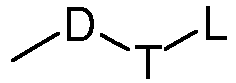
wherein:- D is selected from the group consisting of aryl or heteroaryl, wherein said aryl or heteroaryl is each independently optionally further substituted by one or more groups selected from the group consisting of halogen, alkyl or trifluoromethyl;
- T is selected from the group consisting of -(CH2)r-, -O(CH2)r-, -NH(CH2)r- or -S(CH2)r-;
- L is selected from the group consisting of aryl or heteroaryl, wherein said aryl or heteroaryl is each independently optionally further substituted by one or more groups selected from the group consisting of halogen or alkyl;
- R4 and R5 are each independently selected from the group consisting of hydrogen, alkyl, alkoxyl, hydroxyl, hydroxyalkyl, halogen, carbonyl, amino, cyano, nitro, carboxy or carboxylic ester;
- B is selected from the group consisting of carbon atom, oxygen atom or S(O)r;
when B is carbon atom, R6 and R7 are each independently selected from the group consisting of hydrogen, alkyl, alkoxyl, hydroxyl, hydroxyalkyl, halogen, carbonyl, amino, cyano, nitro, carboxy or carboxylic ester;
when B is oxygen atom or S(O)r, R6 and R7 are absent; - R8 is selected from the group consisting of hydrogen or alkyl;
- R9 is selected from the group consisting of hydrogen, alkyl, cycloalkyl, aryl, carboxy or carboxylic ester;
- r is 0, 1, or 2; and
- n is 1, 2, 3, 4, or 5.
- Preferably, the compounds of formula (I) or tautomers, racemates, enantiomers, diastereomers, and mixtures thereof, and pharmaceutically acceptable salts thereof, wherein A is carbon atom, R1 is alkoxyl; R2 is cyano.
- Preferably, the compounds of formula (I) or tautomers, racemates, enantiomers, diastereomers, and mixtures thereof, and pharmaceutically acceptable salts thereof, wherein A is nitrogen atom, R1 is hydrogen; R2 is absent.
- Preferably, the compounds of formula (I) or tautomers, racemates, enantiomers, diastereomers, and mixtures thereof, and pharmaceutically acceptable salts thereof, wherein n is 2.
- Preferably, the compounds of formula (I) or tautomers, racemates, enantiomers, diastereomers, and mixtures thereof, and pharmaceutically acceptable salts thereof, include the compounds of formula (II) or tautomers, racemates, enantiomers, diastereomers, and mixtures thereof, and pharmaceutically acceptable salts thereof:

- A is selected from the group consisting of carbon atom or nitrogen atom;
when A is carbon atom, R1 is selected from the group consisting of hydrogen or alkoxyl; wherein said alkoxyl is optionally further substituted by one or more groups selected from the group consisting of halogen or alkoxyl; R2 is cyano;
when A is nitrogen atom, R1 is selected from the group consisting of hydrogen or alkoxyl; wherein said alkoxyl is optionally further substituted by one or more groups selected from the group consisting of halogen or alkoxyl; R2 is absent; - R3 is a radical having the following fomula:

wherein:- D is selected from the group consisting of aryl or heteroaryl, wherein said aryl or heteroaryl is each independently optionally further substituted by one or more groups selected from the group consisting of halogen, alkyl and trifluoromethyl;
- T is selected from the group consisting of -(CH2)r-, -O(CH2)r-, -NH(CH2)r- or -S(O)r(CH2)r-;
- L is selected from the group consisting of aryl or heteroaryl, wherein said aryl or heteroaryl is each independently optionally further substituted by one or more groups selected from the group consisting of halogen or alkyl;
- R4 and R5 are each independently selected from the group consisting of hydrogen, alkyl, alkoxyl, hydroxyl, hydroxyalkyl, halogen, carbonyl, amino, cyano, nitro, carboxy or carboxylic ester;
- R8 is selected from the group consisting of hydrogen or alkyl;
- R9 is selected from the group consisting of hydrogen, alkyl, aryl, carboxy or carboxylic ester;
- r is 0, 1, or 2; and
- n is 1, 2, 3, 4, or 5.
- Preferably, the compounds of formula (II) or tautomers, racemates, enantiomers, diastereomers, and mixtures thereof, and pharmaceutically acceptable salts thereof, wherein A is carbon atom, R1 is alkoxyl; R2 is cyano.
- Preferably, the compounds of formula (II) or tautomers, racemates, enantiomers, diastereomers, and mixtures thereof, and pharmaceutically acceptable salts thereof, wherein A is nitrogen atom, R1 is hydrogen; R2 is absent.
- Preferably, the compounds of formula (II) or tautomers, racemates, enantiomers, diastereomers, and mixtures thereof, and pharmaceutically acceptable salts thereof, wherein n is 2.
- The compounds of the present invention include, but not limited to the following:
Example No. Structure and Name 1 
(E)-N-[4-[[3-Chloro-4-(2-pyridylmethoxy)phenyl]amino]-3-cyano-7 -ethoxy-6-quinolyl]-3-[(2S)-1-methylpyrrolidin-2-yl]prop-2-enamide 2 
(E)-N-[4-[[3-Chloro-4-(2-pyridylmethoxy)phenyl]amino]-3-cyano-7 -ethoxy-6-quinolyl]-3-[(2S)-pyrrolidin-2-yl]prop-2-enamide 3 
(E)-N-[4-[[3-Chloro-4-(2-pyridylmethoxy)phenyl]amino]-3-cyano-7-ethoxy -6-quinolyl]-3-[(2S,4R)-4-hydroxy-1-methyl-pyrrolidin-2-yl]prop-2-enamide 4 
(E)-N-[4-[[3-Chloro-4-(2-pyridylmethoxy)phenyl]amino]quinazolin-6-yl] -3-[(2S)-1-methylpyrrolidin-2-yl]prop-2-enamide 5 
(E)-N-[4-[[3-Chloro-4-(2-pyridylmethoxy)phenyl]amino]-3-cyano-7 -ethoxy-6-quinolyl]-3-[(2R)-1-methylpyrrolidin-2-yl]prop-2-enamide 6 
(E)-N-[4-[[3-Chloro-4-(2-pyridylmethoxy)phenyl]amino]-3-cyano-7 -ethoxy-6-quinolyl]-3-(1-methyl-2-piperidyl)prop-2-enamide 7 
(E)-N-[4-[(3-Chloro-4-fluoro-phenyl)amino]-7-ethoxy-quinazolin-6-yl] -3-[(2S)-1-methylpyrrolidin-2-yl]prop-2-enamide 8 
(E)-N-[4-[(3-Chloro-4-fluoro-phenyl)amino]-7-(2-methoxyethoxy)quinazolin -6-yl]-3-[(2R)-1-methylpyrrolidin-2-yl]prop-2-enamide 9 
(E)-N-[4-[(3-Chloro-4-fluoro-phenyl)amino]-7-ethoxy-quinazolin-6-yl]-3 -[(2R)-1-methylpyrrolidin-2-yl]prop-2-enamide 10 
(E)-N-[4-[[3-Chloro-4-(2-pyridylmethoxy)phenyl]amino]-3-cyano-7-ethoxy -6-quinolyl]-3-(1-methylpyrrolidin-2-yl)prop-2-enamide - In another aspect, this invention relates to compounds having the following formula (IA) as intermediates in the synthesis of compounds of formula (I):

- A is selected from the group consisting of carbon atom or nitrogen atom;
when A is carbon atom, R1 is selected from the group consisting of hydrogen or alkoxyl; wherein said alkoxyl is optionally further substituted by one or more groups selected from the group consisting of halogen or alkoxyl; R2 is cyano;
when A is nitrogen atom, R1 is selected from the group consisting of hydrogen or alkoxyl; wherein said alkoxyl is optionally further substituted by one or more groups selected from the group consisting of halogen or alkoxyl; R2 is absent; - R3 is a radical having the following fomula:

- D is selected from the group consisting of aryl or heteroaryl, wherein said aryl or heteroaryl is each independently optionally further substituted by one or more groups selected from the group consisting of halogen, alkyl or trifluoromethyl;
- T is selected from the group consisting of -(CH2)r-, -O(CH2)r-, -NH(CH2)r- or -S(O)r(CH2)r-;
- L is selected from the group consisting of aryl or heteroaryl, wherein said aryl or heteroaryl is each independently optionally further substituted by one or more groups selected from the group consisting of halogen or alkyl;
- r is 0, 1, or 2.
- In another aspect, this invention relates to a preparation process of the compound of formula (IA), comprising the following steps of:
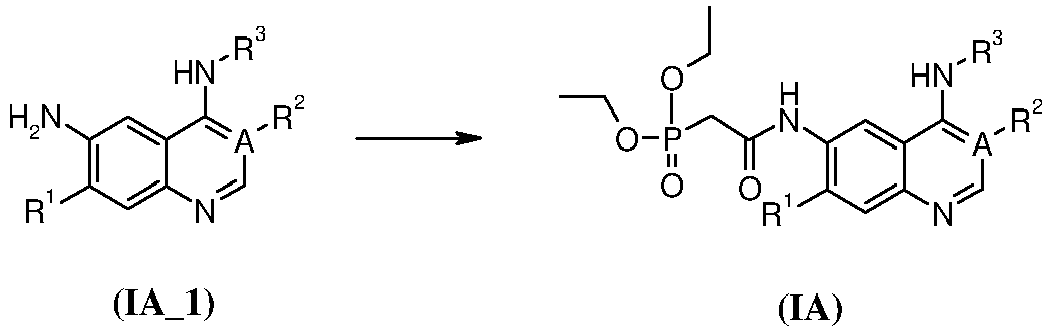
wherein A, R1, R2 and R3 are defined as those in formula (IA). - In another aspect, this invention relates to a preparation process of the compounds of formula (I) or pharmaceutically acceptable salts thereof, comprising the following steps of:

- In another aspect, this invention relates to a preparation process of compounds of formula (II) or pharmaceutically acceptable salts thereof, comprising the following steps of:
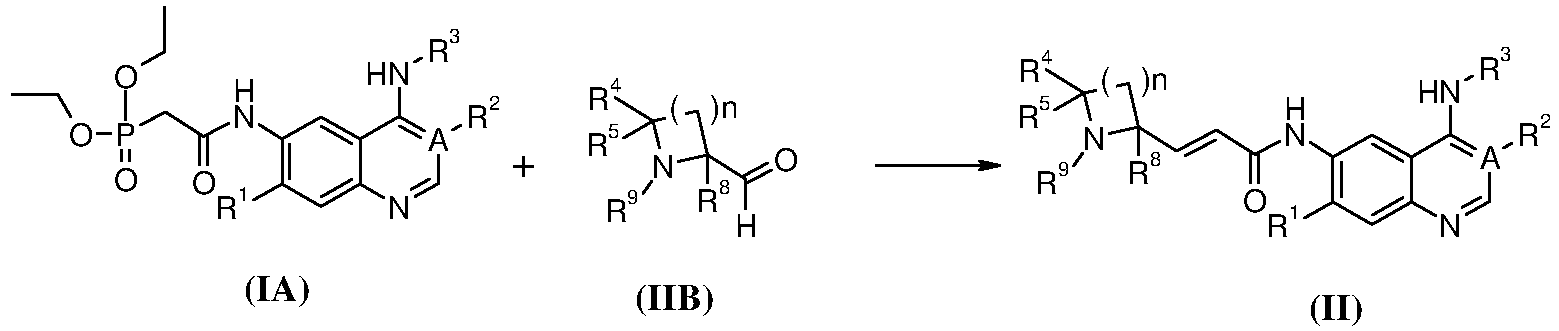
- Reacting the compounds of formula (IA) with the compounds of formula (IB) to obtain the compounds of formula (II); wherein A, n, R1 to R5, R8 and R9 are defined as those in formula (II).
- This invention relates to the compounds of formula (I) or tautomers, racemates, enantiomers, diastereomers, and mixtures thereof, and pharmaceutically acceptable salts thereof, for use as receptor tyrosine kinase inhibitors inhibiting VEGFR, EGFR, HER-2, HER-3, HER-4, c-Met, Jak3 or mixtures thereof.
- This invention relates to a use of the compounds of formula (I) or tautomers, racemates, enantiomers, diastereomers, and mixtures thereof, and pharmaceutically acceptable salts thereof, in the preparation of receptor tyrosine kinase selected from the group consisting of VEGFR, EGFR, HER-2, HER-3, HER-4, c-Met, Jak3 or mixtures thereof inhibitors.
- This invention relates to a use of the compounds of formula (I) or tautomers, racemates, enantiomers, diastereomers, and mixtures thereof, and pharmaceutically acceptable salts thereof, in the preparation of a medicament for the treatment of protein kinases related diseases, wherein said protein kinases are selected from the group consisting of receptor tyrosine kinase, non-receptor tyrosine kinase or serine-threonine kinases; wherein the receptor tyrosine kinase are selected from the group consisting of VEGFR, EGFR, HER-2, HER-3, HER-4, c-Met, Jak3 or mixtures thereof.
- In still another aspect, this invention relates to the compounds of formula (I) or tautomers, racemates, enantiomers, diastereomers, and mixtures thereof, and pharmaceutically acceptable salts thereof, for use as a medicament for the treatment of protein kinases related diseases, wherein said protein kinases are selected from the group consisting of receptor tyrosine kinase, non-receptor tyrosine kinase or serine-threonine kinases; wherein the receptor tyrosine kinase are selected from the group consisting of VEGFR, EGFR, HER-2, HER-3, HER-4, c-Met, Jak3 or mixtures thereof.
- In still another aspect, this invention relates to a use of the compounds of formula (I) or tautomers, racemates, enantiomers, diastereomers, and mixtures thereof, and pharmaceutically acceptable salts thereof, in the preparation of a medicament for the treatment of cancer, wherein said cancer is selected from the group consisting of lung cancer, breast cancer, squamous cell carcinoma or stomach cancer.
- In still another aspect, this invention relates to the compounds of formula (I) or tautomers, racemates, enantiomers, diastereomers, and mixtures thereof, and pharmaceutically acceptable salts thereof, for use as a medicament for the treatment of cancer.
- In still another aspect, the present invention relates to a pharmaceutical composition comprising a therapeutically effective amount of the compounds of formula (I), or tautomers, racemates, enantiomers, diastereomers, and mixtures therof, and pharmaceutically acceptable salts thereof or prodrugs thereof, and pharmaceutically acceptable carriers or excipients. And the present invention also relates to a use of said pharmaceutical composition in the preparation of a medicament for the treatment of protein kinases related diseases, wherein said protein kinases are receptor tyrosine kinases selected from the group consisting of VEGFR, EGFR, HER-2, HER-3, HER-4, c-Met, Jak3 or mixtures thereof. Further the present invention relates to a use of said pharmaceutical composition in the preparation of a medicament for the treatment of cancer, wherein said cancer is selected from the group consisting of lung cancer, breast cancer, squamous cell carcinoma or stomach cancer.
- In another aspect, this invention relates to a preparation process of said pharmaceutical composition, comprising the step of combining the compounds of formula (I), or tautomers, racemates, enantiomers, diastereomers, and mixtures therof, and pharmaceutically acceptable salts thereof or prodrugs thereof with the pharmaceutically acceptable carriers or diluent agents.
- In another aspect, the present invention relates to a method of regulating the catalytic activity of protein kineses, comprising contacting the protein kinases with the compounds of formula (I), or tautomers, racemates, enantiomers, diastereomers, and mixtures therof, and pharmaceutically acceptable salts thereof; wherein the protein kineses are receptor tyrosine kinases selected from the group consisting of VEGFR, EGFR, HER-2, HER-3, HER-4, c-Met, Jak3 or mixtures thereof.
- In another aspect, the present invention relates to a method for the treatment of cancer, comprising administrating alone or co-administrating with other drugs to the subject in need thereof a therapeutically effective amount of the compounds of formula ( I ), or tautomers, racemates, enantiomers, diastereomers, and mixturse therof, and pharmaceutically acceptable salts thereof, wherein the co-administrated drugs are antitumor drugs selected from the group consisting of Trastuzumab, Herceptin, Cetuximab, Lapatinib, neratinib, Letrozole, Capecitabine, Topotecan, Docetaxel, and so on.
- Unless otherwise stated, the following terms used in the specification and claims have the meanings discussed below.
- "Alkyl" refers to a saturated aliphatic hydrocarbon group including C1-C20 straight chain and branched chain groups. Preferably an alkyl group is an alkyl having 1 to 12 carbon atoms. Representative examples include, but are not limited to methyl, ethyl, n-propyl, isopropyl, n-butyl, isobutyl, tert-butyl, sec-butyl, n-pentyl, 1,1-dimethyl propyl, 1,2-dimethyl propyl, 2,2-dimethyl propyl, 1-ethyl propyl, 2-methylbutyl, 3-methylbutyl, n-hexyl, 1-ethyl-2-methylpropyl, 1,1,2-trimethylpropyl, 1,1-dimethylbutyl, 1,2-dimethylbutyl, 2,2-dimethylbutyl, 1,3-dimethylbutyl, 2-ethylbutyl, 2-methylpentyl, 3-methylpentyl, 4-methylpentyl, 2,3-dimethylbutyl, n-heptyl, 2-methylhexyl, 3-methylhexyl, 4-methylhexyl, 5-methylhexyl, 2,3-dimethylpentyl, 2,4-dimethylpentyl, 2,2-dimethylpentyl, 3,3-dimethylpentyl, 2-ethylpentyl, 3-ethylpentyl, n-octyl, 2,3-dimethylhexyl, 2,4-dimethylhexyl, 2,5-dimethylhexyl, 2,2-dimethylhexyl, 3,3-dimethylhexyl, 4,4-dimethylhexyl, 2-ethylhexyl, 3-ethylhexyl, 4-ethylhexyl, 2-methyl-2-ethylpentyl, 2-methyl-3-ethylpentyl, n-nonyl, 2-methyl-2-ethylhexyl, 2-methyl-3-ethylhexyl, 2,2-diethylpentyl, n-decyl, 3,3-diethylhexyl, 2,2-diethylhexyl, and the isomers of branched chain thereof. More preferably an alkyl group is a lower alkyl having 1 to 6 carbon atoms. Representative examples include, but are not limited to methyl, ethyl, n-propyl, isopropyl, n-butyl, isobutyl, tert-butyl, sec-butyl, n-pentyl, 1,1-dimethylpropyl, 1,2-dimethylpropyl, 2,2-dimethylpropyl, 1-ethylpropyl, 2-methylbutyl, 3-methylbutyl, n-hexyl, 1-ethyl-2-methylpropyl, 1,1,2-trimethylpropyl, 1,1-dimethylbutyl, 1,2-dimethylbutyl, 2,2-dimethylbutyl, 1,3-dimethylbutyl, 2-ethylbutyl, 2-methylpentyl, 3-methylpentyl, 4-methylpentyl, 2,3-dimethylbutyl and etc.The alkyl group may be substituted or unsubstituted. When substituted, the substituent group(s) is preferably one or more groups independently selected from the group consisting of alkyl, alkenyl, alkynyl, alkoxyl, alkylsulfo, alkylamino, halogen, thiol, hydroxyl, nitro, cyano, cycloalkyl, heterocyclic alkyl, aryl, heteroaryl, cycloalkoxyl, heterocylic alkoxyl, cycloalkylthio, heterocylic alkylthio, carbonyl, carboxy or carboxylic ester.
- "Cycloalkyl" refers to saturated and/or partially unsaturated monocyclic or polycyclic hydrocarbon group and have 3 to 20 carbon atoms. Preferably a cycloalkyl group is a cycloalkyl having 3 to 12 carbon atoms. More preferably a cycloalkyl group is a cycloalkyl having 3 to 10 carbon atoms. Representative examples of monocyclic cycloalkyl include, but are not limited to cyclopropyl, cyclobutyl, cyclopentyl, cyclopentenyl, cyclohexyl, cyclohexenyl, cyclohexadienyl, cycloheptyl, cycloheptatrienyl, cyclooctyl and etc. Polycyclic cycloalkyl includes the cycloalkyl having spiro ring, fused ring and bridged ring.
- "Spiro Cycloalkyl" refers to 5 to 20 membered polycyclic hydrocarbon group with rings connected through one common carbon atom (called as spiro atom), wherein one or more rings may contain one or more double bonds, but none of the rings has a completely conjugated pi-electron system. Preferably a spiro cycloalkyl is 6 to 14 membered, more preferably is 7 to 10 membered. According to the number of the common spiro atom, spiro cycloalkyl is divided into monocyclic spiro ring, bicyclic sipro ring or multicyclic spiro ring, preferably refers to monocyclic spiro ring or bicyclic sipro ring. More preferably spiro cycloalkyl is 4-membered/4-membered, 4-membered/5-membered, 4-membered/6-membered, 5-membered/5-membered, or 5-membered/6-membered monocyclic spiro ring. Representative examples of spiro cycloalkyl include, but are not limited to the following groups :

- "Fused Cycloalkyl" refers to 5 to 20 membered polycyclic hydrocarbon group, wherein each ring in the system shares an adjacent pair of carbon atoms with other ring, wherein one or more rings may contain one or more double bonds, but none of the rings has a completely conjugated pi-electron system. Preferably a fused cycloalkyl group is 6 to 14 membered, more preferably is 7 to 10 membered. According to the number of membered ring, fused cycloalkyl is divided into fused bicyclic ring, tricyclic ring, tetracyclic ring or multicyclic ring, preferably refers to fused bicyclic ring or tricyclic ring. More preferably fused cycloalkyl is 5-membered/5-membered, or 5-membered/6-membered fused bicyclic ring. Representative examples of fused cycloalkyl include, but are not limited to the following groups:

- "Bridged Cycloalkyl" refers to 5 to 20 membered polycyclic hydrocarbon group, wherein every two rings in the system share with two disconnected carbon atoms. The said rings could have one or more double bonds but have no completely conjugated pi-electron system. Preferably a bridged cycloalkyl is 6 to 14 membered, more preferably is 7 to 10 membered. According to the number of membered ring, bridged cycloalkyl is divided into bridged bicyclic ring, tricyclic ring, tetracyclic ring or multicyclic ring, preferably refers to bicyclic ring, tricyclic ring or tetracyclic ring bridged cycloalkyl, more preferably refers to bicyclic ring or tricyclic ring bridged cycloalkyl. Representative examples of bridged cycloalkyl include, but are not limited to the following groups:


- "Aryl" refers to a 6 to 14 membered all-carbon monocyclic ring or a multicyclic fused ring (a "fused" ring system means that each ring in the system shares an adjacent pair of carbon atoms with other ring in the system) group, and has a completely conjugated pi-electron system. Preferably aryl is 6 to 10 membered, such as phenyl and naphthyl. The said aryl can be fused to heteroaryl, heterocyclic alkyl or cycloalkyl, wherein the ring connected with parent structure is aryl. Representative examples of aryl include, but are not limited to the following groups:


- "Heteroaryl" refers to an 5-14 membered aryl having 1 to 4 heteroatoms selected from the group consisting of O, S, and N as ring atoms, the remaining ring atoms being C. Preferably, said ring is 6 or 10 membered ring. Preferably, said heteroaryl is 5 or 6 membered ring. Examples of heteroaryl groups are furan, thiophene, pyridine, pyrrole, N-alkyl pyrrole, pyrimidine, pyrazine, imidazole, tetrazolyl, and so on. The said heteroaryl can be fused to aryl, heterocyclic alkyl or cycloalkyl, wherein the ring connected with parent structure is heteroaryl. Representative examples of bridged cycloalkyl include, but are not limited to the following groups:


- "Heterocyclic alkyl " refers to 3 to 20 membered saturated and/or partially unsaturated monocyclic or polycyclic hydrocarbon group having one or more heteroatoms selected from the group consisting of N, O, or S(O)n (wherein n is 0,1 or 2) as ring atoms, but excluding -O-O-, -O-S- or -S-S- in the ring, the remaining ring atoms being C. Preferably, heterocyclic alkyl is 3 to 12 membered having 1 to 4 said heteroatoms; more preferably, is 3 to 10 membered. Representative examples of monocyclic heterocyclic alkyl include, but are not limited to pyrrolidyl, piperidyl, piperazinyl, morpholinyl, sulfo-morpholinyl, homopiperazinyl and so on. Polycyclic heterocyclic alkyl includes the heterocyclic alkyl having spiro ring, fused ring and bridged ring.
- "Spiro Heterocyclic alkyl " refers to 5 to 20 membered polycyclic heterocyclic alkyl group with rings connected through one common carbon atom (called as spiro atom), wherein said rings have one or more heteroatoms selected from the group consisting of N, O, or S(O)p (wherein p is 0,1 or 2) as ring atoms, the remaining ring atoms being C, wherein one or more rings may contain one or more double bonds, but none of the rings has a completely conjugated pi-electron system. Preferably an spiro heterocyclic alkyl is 6 to 14 membered, more preferably is 7 to 10 membered. According to the number of common atom, spiro heterocyclic alkyl is divided into monocyclic spiro heterocyclic alkyl, bicyclic sipro heterocyclic alkyl or multicyclic spiro heterocyclic alkyl, preferably refers to monocyclic spiro heterocyclic alkyl or bicyclic sipro heterocyclic alkyl. More preferably spiro heterocyclic alkyl is 4-membered/4-membered, 4-membered/5-membered, 4-membered/6-membered, 5-membered/5-membered, or 5-membered/6-membered monocyclic spiro heterocyclic alkyl. Representative examples of spiro heterocyclic alkyl include, but are not limited to the following groups:

- "Fused Heterocyclic alkyl " refers to 5 to 20 membered polycyclic heterocyclic alkyl group, wherein each ring in the system shares an adjacent pair of carbon atoms with other ring, wherein one or more rings may contain one or more double bonds, but none of the rings has a completely conjugated pi-electron system, and wherein said rings have one or more heteroatoms selected from the group consisting of N, O, or S(O)p (wherein p is 0,1 or 2) as ring atoms, the remaining ring atoms being C. Preferably an fused Heterocyclic alkyl is 6 to 14 membered, more preferably is 7 to 10 membered. According to the number of membered ring, fused heterocyclic alkyl is divided into fused bicyclic ring, tricyclic ring, tetracyclic ring or multicyclic ring, preferably refers to fused bicyclic ring or tricyclic ring. More preferably fused Heterocyclic alkyl is 5-membered/5-membered, or 5-membered/6-membered fused bicyclic ring. Representative examples of fused heterocyclic alkyl include, but are not limited to the following groups:


- "Bridged Heterocyclic alkyl " refers to 5 to 14 membered polycyclic heterocyclic alkyl group, wherein every two rings in the system share with two disconnected carbon atoms, said rings could have one or more double bonds but have no completely conjugated pi-electron system, said rings have one or more heteroatoms selected from the group consisting of N, O, and S (O)p (wherein p is 0,1 or 2) as ring atoms, the remaining ring atoms being C. Preferably an bridged heterocyclic alkyl is 6 to 14 membered, more preferably is 7 to 10 membered. According to the number of membered ring, bridged heterocyclic alkyl is divided into bridged bicyclic ring, tricyclic ring, tetracyclic ring or multicyclic ring, preferably refers to bicyclic ring, tricyclic ring or tetracyclic ring bridged heterocyclic alkyl, more preferably refers to bicyclic ring or tricyclic ring bridged heterocyclic alkyl. Representative examples of bridged heterocyclic alkyl include, but are not limited to the following groups:


- "Alkoxyl" refers to both an -O-(alkyl) and an -O-(unsubstituted cycloalkyl) group, wherein alkyl as defined above. Representative examples include, but are not limited to, methoxyl, ethoxyl, propoxyl, butoxyl, cyclopropoxyl, cyclobutoxyl, cyclopentyloxyl, cyclohexyloxyl, and the like. Said alkoxyl may be substituted or unsubstituted. When substituted, the substituent group(s) is preferably one or more groups independently selected from the group consisting of alkyl, alkenyl, alkynyl, alkoxyl, alkylsulfo, alkylamino, halogen, thiol, hydroxyl, nitro, cyano, cycloalkyl, heterocyclic alkyl, aryl, heteroaryl, cycloalkoxyl, heterocylic alkoxyl, cycloalkylthio, heterocylic cycloalkylthio, carbonyl, carboxy or carboxylic ester.
- "Hydroxyl" refers to an -OH group.
- "Hydroxyalkyl" refers to - alkyl -OH, wherein alkyl as defined above.
- "Halo" refers to fluoro, chloro, bromo, or iodo, preferably fluoro or chloro.
- "Carbonyl" refers to -C(=O)-.
- "Nitro" refers to -NO2.
- "Cyano" refers to -CN.
- "Amino" refers to -NH2.
- "Carboxy" refers to -C(=O)OH.
- "Carboxylic ester" refers to -C(=O)O-alkyl.
- "Optional" or "optionally" means that the subsequently described event or circumstance may or may not occur, and that the description includes instances where the event or circumstance may or may not occur. For example, "heterocycle group optionally further substituted by an alkyl group" means that the alkyl may or may not be present, and the description includes situations where the heterocycle group is substituted by an alkyl group and situations where the heterocyclo group is not substituted by the alkyl group.
- A "pharmaceutical composition" refers to a mixture of one or more of the compounds described herein, or physiologically/pharmaceutically acceptable salts or prodrugs thereof, with other chemical components, such as physiologically/pharmaceutically acceptable carriers and excipients. The purpose of a pharmaceutical composition is to facilitate administration of a compound to an organism, benefit intaking of active ingredient more effectively.
- In order to complete the purpose of the invention, the invention applies the following technical solution:
- A preparation process of the compounds of formula (I) or pharmaceutically acceptable salts thereof according to this invention, comprising the following steps of:

- Reacting the compounds of formula (IA-1) with diethylphosphonoacetic acid to obtain the compounds of formula (IA) in the presence of a condensation agent; in a dry ice bath, reacting the compounds of formula (IA) with Lithium bis(trimethylsilyl)amide, heating the reaction solution to room temperature and reacting it with the compounds of formula (IB) via witting reaction to obtain the compounds of formula (I);
Wherein A, B, n and R1 to R9 are as defined in formula (I). - A preparation process of the compounds of formula (II) or pharmaceutically acceptable salts thereof according to this invention, comprising the following steps of:

Wherein A, n, R1∼R and R8∼R9 are as defined in formula (II). - The present invention is further described by the following Examples which are not intended to limit the scope of the invention.
- The structures of all compounds were identified by nuclear magnetic resonance (1H NMR) and/or mass spectrometry (MS). 1H NMR chemical shifts were recorded as ppm (10-6). 1H NMR was performed on a Bruker AVANCE-400 spectrometer. The appropriate solvents included deuterated-methanol (CD3OD), deuterated-chloroform (CDCl3) and deuterated-dimethyl sulfoxide (DMSO-d6) with tetramethylsilane (TMS) as the internal standard.
- MS was determined on a FINNIGAN LCQ Ad (ESI) mass spectrometer (Thermo, Model: Finnigan LCQ advantage MAX).
- HPLC was determined on an Agilent 1200DAD high pressure liquid chromatography spectrometer (Sunfire C18 150×4.6 mm chromatographic column) and a Waters 2695-2996 high pressure liquid chromatography spectrometer (Gimini C18 150x4.6 mm chromatographic column).
- IC50 was determined on a NovoStar ELIASA (BMG Co. German).
- The thin-layer silica gel used Yantai Huanghai HSGF254 or Qingdao GF254 silica gel plate. The dimension of the plates used in TLC was 0.15 mm to 0.2 mm, and the dimension of the plates used in product purification was 0.4 mm to 0.5 mm.
- Column chromatography generally used Yantai Huanghai 200 to 300 mesh silica gel as carrier.
- Alkaline alumina column chromatography generally used GuoYao FCP200 to 300 mesh alkaline alumina as carrier.
- The starting materials of the present invention are known or purchased from ABCR GmbH & Co. KG, Acros Organics, Aldrich Chemical Company, Accela ChemBio Inc, Darui Finechemical Co., Ltd and so on, or they can be prepared by the conventional synthesis methods in the prior art.
- Unless otherwise stated, the following reactions were placed under nitrogen atmosphere or argon atmosphere.
- The term "argon atmosphere" or "nitrogen atmosphere" refers to that a reaction flask is equipped with a balloon filled about 1 L nitrogen.
- The term "hydrogen atmosphere" refers to that a reaction flask is equipped with a balloon filled about 1 L hydrogen.
- Pressured hydrogenation reactions were performed with a Parr 3916EKX hydrogenation spectrometer and a QL-500 hydrogen generator or a HC2-SS hydrogenation spectrometer.
- In hydrogenation reactions, the reaction system was generally vacuumed and filled with hydrogen, repeat the above operation three times.
- Unless otherwise stated, the solution used in examples refers to an aqueous solution.
- Unless otherwise stated, the reaction temperature was room temperature.
- Room temperature was the most ambient reaction temperature, which was 20°C-30°C.
- The reactions process of the examples was monitored by thin layer chromatography (TLC). The developing solvent system comprised dichloromethane and methanol system, hexane and ethyl acetate system, petroleum ether and ethyl acetate system, and acetone. The ratio of the volume of the solvent was adjusted according to the polarity of the compounds.
- The elution system of column chromatography and the developing solvent system of thin layer chromatography comprised: A: dichloromethane and methanol system, B: hexane and ethyl acetate system, C: dichloromethane and acetone system. The ratio of the volume of the solvent was adjusted according to the polarity of the compounds, and sometimes a basic agent such as triethylamine or an acidic agent such as acetic acid was also added.
-


- Oxalyl chloride (1.1 mL, 13.02 mmol) was dissolved in dimethylsulfoxide (1.9 mL, 26.04 mmol) in a dry ice bath. After 30 minutes, a solution of [(2S)-1-methylpyrrolidin-2-yl]methanol 1a (1 g, 8.68 mmol) in dichloromethane (25 mL) was added dropwise. Then the mixture was stirred at -30°C for 45 minutes, followed by dropwise addition of triethylamine (6.15 g, 60.77 mmol). The mixture was warmed up to room temperature and stirred for 12 hours. The reaction mixture was added with 250 mL of dichloromethane, washed with saturated sodium bicarbonate (100 mL), saturated ammonium chloride (100 mL) and saturated brine (100 mL) successively. The combined organic extracts were dried over anhydrous sodium sulfate, filtered and concentrated under reduced pressure and the resulting residue was purified by alkaline alumina column chromatography with elution system A to obtain the title compound (2S)-1-methylpyrrolidine-2-carbaldehyde 1b (308 mg, yield 31.4%) as a light yellow oil.
- N,N'-Carbonyldiimidazole (487 mg, 3 mmol) was dissolved in 4 mL of tetrahydrofuran. The mixture was heated to 40°C in an oil bath, a solution of diethylphosphonoacetic acid (588 mg, 3 mmol) in tetrahydrofuran (4 mL) was added dropwise to the mixture, and stirred for 30 minutes to the next step.
- 6-Amino-4-[[3-chloro-4-(2-pyridylmethoxy)phenyl]amino]-7-ethoxy-quinoline-3-c arbonitrile 1c (446 mg, 1 mmol, prepared by the well-known method: patent application
WO2005028443 ) was dissolved in 4 mL of tetrahydrofuran at 40°C, followed by dropwise addition of the above reaction solution. After stirring for 12 hours, the reaction mixture was concentrated under reduced pressure and extracted with dichloromethane (50 mL×3). The combined organic extracts were washed with saturated brine (30 mL×2), dried over anhydrous sodium sulfate, filtered and concentrated under reduced pressure and the resulting residue was purified by silica gel column chromatography with elution system A to obtain the title compound N-[4-[[3-chloro-4-(2-pyridylmethoxy)phenyl]amino]-3-cyano-7-ethoxy-6-quinolyl]-2-diethoxyphosphorylacetamide 1d (624 mg, yield 99.9%) as a light yellow solid.
MS m/z (ESI): 624 [M+1] - N-[4-[[3-Chloro-4-(2-pyridylmethoxy)phenyl]amino]-3-cyano-7-ethoxy-6-quinolyl ]-2-diethoxyphosphoryl-acetamide 1d (50 mg, 0.08 mmol) was dissolved in 2 mL of tetrahydrofuran at -78°C, followed by dropwise addition of a solution of lithium bis(trimethylsilyl)amide (1 M) in toluene (80 µL, 0.08 mmol). After the mixture was stirred for 45 minutes, (2S)-1-methylpyrrolidine-2-carbaldehyde 1b (20 mg, 0.17 mmol) was added. After stirring for another 1 hour, the reaction mixture was warmed up to room temperature and stirred for 12 hours. The reaction mixture was added with 1 mL of water and 1 mL of methanol, then the organic extracts were extracted with dichloromethane (50 mL×3). The combined organic extracts were washed with saturated brine (30 mL×2), dried over anhydrous sodium sulfate, filtered and concentrated under reduced pressure and the resulting residue was purified by silica gel column chromatography with elution system A to obtain the title compound (E)-N-[4-[[3-chloro-4-(2-pyridylmethoxy)phenyl]amino]-3-cyano-7-ethoxy-6-quinolyl] -3-[(2S)-1-methylpyrrolidin-2-yl]prop-2-enamide 1 (25 mg, yield 53.5%) as a yellow solid.
MS m/z (ESI): 583 [M+1]
1H NMR (400 MHz, DMSO-d6 ): δ 9.63 (s, 2H), 8.95 (s, 1H), 8.60 (d, 1H), 8.48 (s, 1H), 7.89 (t, 1H), 7.59 (d, 1H), 7.37 (m, 3H), 7.27-7.20 (m, 2H), 6.80-6.60 (m, 2H), 5.29 (s, 2H), 4.34 (dd, 2H), 2.33-2.24 (m, 3H), 2.23-2.15 (m, 2H), 1.99-1.88 (m, 3H), 1.80-1.78 (m, 2H), 1.49 (t, 3H) -


- [(2S)-Pyrrolidin-2-yl]methanol 2a (5.06 g, 0.05 mmol) and triethylamine (10.12 g, 0.10 mmol) were dissolved in 100 mL of dichloromethane in an ice-water bath. The reaction mixture was added with di-tert-butyl pyrocarbonate (16.37 g, 0.08 mmol) in batches and stirred at room temperature for 12 hours. The reaction mixture was concentrated under reduced pressure, extracted with ethyl acetate (50 mL×3). The combined organic extracts were washed with saturated brine (30 mL×2), dried over anhydrous sodium sulfate, filtered and concentrated under reduced pressure to obtain the title compound tert-butyl (2S)-2-(hydroxymethyl)pyrrolidine-1-carboxylate 2b (10 g, yield 99.9%) as a light yellow oil.
- Oxalyl chloride (3.2 mL, 0.04 mol) and dimethyl sulfoxide (4.3 mL, 0.06 mol) were dissolved in 100 mL of dichloromethane in a dry ice bath. After stirring for 30 minutes, a solution of tert-butyl (2S)-2-(hydroxymethyl)pyrrolidine-1-carboxylate 2b (2 g, 0.01 mol) in 20 mL of dichloromethane was added dropwise. The reaction mixture was stirred for 45 minutes, and triethylamine (7.08 g, 0.07 mol) was added dropwise. After stirring for another 1 hours at 0°C, the reaction mixture was added with 500 mL of dichloromethane. The combined organic layers were washed with saturated brine (100 mL×2), dried over anhydrous sodium sulfate, filtered and concentrated under reduced pressure and the resulting residue was purified by silica gel column chromatography with elution system A to obtain the title compound tert-butyl (2S)-2-formylpyrrolidine-1-carboxylate 2c (1.10 g, yield 55.4%) as a light yellow oil.
- N-[4-[[3-Chloro-4-(2-pyridylmethoxy)phenyl]amino]-3-cyano-7-ethoxy-6-quinolyl ]-2-diethoxyphosphoryl-acetamide 1d (156 mg, 0.25 mmol) was dissolved in 3 mL of tetrahydrofuran in a dry ice bath, followed by dropwise addition of a solution of lithium bis(trimethylsilyl)amide (1 M) in toluene (375 µL, 0.38 mmol). After the reaction mixture was stirred for 45 minutes, a solution of tert-butyl (2S)-2-formylpyrrolidine-1-carboxylate 2c (100 mg, 0.50 mmol) in 2 mL of tetrahydrofuran was added. The reaction mixture was stirred for another 1 hour, then warmed up to room temperature and stirred for 12 hours. The reaction mixture was concentrated under reduced pressure and the resulting residue was purified by silica gel column chromatography with elution system A to obtain the title compound tert-butyl (2S)-2-[(E)-3-[[4-[[3-chloro-4-(2-pyridylmethoxy)phenyl]amino]-3-cyano-7-ethoxy-6 -quinolyl]amino]-3-oxo-prop-1-enyl]pyrrolidine-1-carboxylate 2d (161 mg, yield 96.2%) as a light yellow solid.
MS m/z (ESI): 669 [M+1] - tert-Butyl (2S)-2-[(E)-3-[[4-[[3-chloro-4-(2-pyridylmethoxy)phenyl]amino]-3-cyano-7-ethoxy-6-quinolyl]amino]-3-oxo-prop-1-enyl]pyrrolidine-1-carboxylate 2d (161 mg, 0.24 mmol) was dissolved in a solution of hydrogen chloride (2M) in 25 mL of 1,4-dioxane. After stirring for 12 hours, the reaction mixture was concentrated under reduced pressure and extracted with dichloromethane (50 mL×3). The combined organic extracts were washed with saturated brine (30 mL×2), dried over anhydrous sodium sulfate, filtered and concentrated under reduced pressure and the resulting residue was purified by silica gel column chromatography with elution system A to obtain the title compound (E)-N-[4-[[3-chloro-4-(2-pyridylmethoxy)phenyl]amino] -3-cyano-7-ethoxy-6-quinolyl]-3-[(2S)-pyrrolidin-2-yl]prop-2-enamide 2 (20 mg, yield 14.6%) as a yellow solid.
MS m/z (ESI): 569.4 [M+1]
1H NMR (400M Hz, DMSO-d6 ): δ10.01(s, 1H), 9.76 (s, 1H), 9.71 (s, 2H), 9.40 (s, 1H), 8.92 (s, 1H), 8.61(s, 1H), 8.60 (s, 1H), 7.90 (t, 1H), 7.60 (d, 1H), 7.58-7.41 (s, 2H), 7.39-7.38 (m, 2H), 6.95 (dd, 1H), 6.79 (d, 1H), 5.29 (s, 1H), 4.35 (t, 2H), 4.21-4.20 (m, 1H), 3.23-3.22 (m, 3H), 2.21-2.20 (m, 1H), 2.039-1.94 (m,1H), 1.84-1.76 (m, 1H),1.49 (t, 3H) -


- Methyl (2S,4R)-4-hydroxypyrrolidine-2-carboxylate 3a (5.53 g, 38 mmol) was dissolved in 80 mL of methanol in an ice-water bath, followed by addition of 40% formaldehyde solution (31 mL, 380 mmol) and sodium cyanoborohydride (12 g, 190 mmol) in batches. The reaction mixture was stirred for 0.5 hours, then warmed up to room temperature and stirred for 3 hours. The mixture was quenched with 40 mL of water, concentrated under reduced pressure and extracted with dichloromethane (80 mL×3). The combined organic extracts were washed with saturated brine (30 mL×2), dried over anhydrous sodium sulfate and filtered. The filtrate was concentrated under reduced pressure to obtain the title compound methyl (2S,4R)-4-hydroxy-1-methyl-pyrrolidine-2-carboxylate 3b crude product as a colourless oil, which was directly used in the next step.
- Methyl (2S,4R)-4-(tert-butyl(dimethyl)silyl)oxy-1-methyl-pyrrolidine-2-carboxylate Methyl (2S,4R)-4-hydroxy-1-methyl-pyrrolidine-2-carboxylate 3b (6 g, 37 mmol) was dissolved in 100 mL of dichloromethane, followed by addition of imidazole (7.70 g, 113 mmol) and tert-butyl dimethylchlorosilane (6.80 g, 45 mmol) successively. After stirring for 12 hours, the reaction mixture was diluted with 100 mL of dichloromethane, washed with water (50 mL) and saturated brine (50 mL) successively, dried over anhydrous sodium sulfate, filtered and concentrated under reduced pressure and the resulting residue was purified by silica gel column chromatography with elution system A to obtain the title compound methyl (2S,4R)-4-(tert-butyl(dimethyl)silyl)oxy-1-methyl-pyrrolidine-2-carboxylate 3c crude product as a colourless oi, which was directly used in the next step without purification.
MS m/z (ESI): 274[M+1] - Methyl(2S,4R)-4-(tert-butyl(dimethyl)silyl)oxy-1-methyl-pyrrolidine-2-carboxylate 3c (2.50 g, 9.10 mmol) was dissolved in 50 mL of dichloromethane in an ice-water bath. Diisobutyl aluminium hydride (18 mL, 18 mmol) was added dropwise slowly, and the mixture was stirred for 6 hours. The reaction mixture was quenched with 1 mL of methanol, diluted with 200 mL of dichloromethane, added with anhydrous sodium sulfate, and stirred for 30 minutes. The reaction mixture was filtered and concentrated under reduced pressure and the resulting residue was purified by alkaline alumina column chromatography with elution system A to obtain the title compound [(2S,4R)-4-(tert-butyl(dimethyl)silyl)oxy-1-methyl-pyrrolidin-2-yl]methanol 3d (570 mg, yield 50.0%) as a yellow oil.
MS m/z (ESI): 246 [M+1] - Dimethyl sulfoxide (174 µL, 2.45 mmol) was dissolved in 20 mL of dichloromethane in a dry ice bath. After the system temperature was stable, oxalyl chloride (156 µL, 1.80 mmol) was added dropwise slowly. After stirring for 30 minutes, a solution of [(2S,4R)-4-(tert-butyl(dimethyl)silyl)oxy-1-methyl-pyrrolidin-2-yl]methanol 3d (300 mg, 1.20 mmol) in 2 mL of dichloromethane was added dropwise. After stirring for 45 minutes, the reaction mixture was added with triethylamine (510 µL, 3.67 mmol), and stirred for 10 minutes, then warmed up to room temperature and stirred for 1 hour. The reaction mixture was diluted with 100 mL of dichloromethane, washed with saturated sodium bicarbonate (20 mL), saturated ammonium chloride (20 mL) and saturated brine (20 mL) successively, dried over anhydrous sodium sulfate, filtered and concentrated under reduced pressure to obtain the title compound (2S,4R)-4-(tert-butyl(dimethyl)silyl)oxy-1-methyl-pyrrolidine-2-carbaldehyde 3e (320 mg) crude product as a yellow oil, which was directly used in the next step.
- N-[4-[[3-Chloro-4-(2-pyridylmethoxy)phenyl]amino]-3-cyano-7-ethoxy-6-quinolyl ]-2-diethoxyphosphoryl-acetamide 1d (418 mg, 0.67 mmol) was dissolved in 2.5 mL of tetrahydrofuran in a dry ice bath, followed by dropwise addition of a solution of lithium bis(trimethylsilyl)amide (1 M) in toluene (1 mL, 1 mmol). After the mixture was stirred for 45 minutes, a solution of (2S,4R)-4-(tert-butyl(dimethyl)silyl)oxy-1-methyl-pyrrolidine-2-carbaldehyde 3e (326 mg, 1.34 mmol) in 2.5 mL of tetrahydrofuran was added, and stirred for another 1 hour, then warmed up to room temperature and stirred for 12 hours. The reaction mixture was concentrated under reduced pressure and the resulting residue was purified by silica gel column chromatography with elution system A to obtain the title compound (E)-3-[(2S,4R)-4-(tert-butyl(dimethyl)silyl)oxy-1-methyl-pyrrolidin-2-yl]-N-[4-[[3-chloro-4-(2-pyridylmethoxy)phenyl]amino]-3-cyano-7-ethoxy-6-quinolyl]prop-2-enamide 3f (292 mg, yield 61.2%) as a yellow solid.
MS m/z (ESI): 713 [M+1] - (E)-3-[(2S,4R)-4-(tert-Butyl(dimethyl)silyl)oxy-1-methyl-pyrrolidin-2-yl]-N-[4-[[3-chloro-4-(2-pyridylmethoxy)phenyl]amino]-3-cyano-7-ethoxy-6-quinolyl]prop-2-enami de 3f (50 mg, 0.07 mmol) and tetrabutyl ammonium fluoride (51 mg, 0.21 mmol) were dissolved in 5 mL of tetrahydrofuran, and the mixture was stirred for 12 hours. The reaction mixture was added with 1 mL of water, concentrated under reduced pressure and extracted with dichloromethane (50 mL×3). The combined organic extracts were washed with saturated brine (30 mL×2), dried over anhydrous sodium sulfate, filtered and concentrated under reduced pressure and the resulting residue was purified by silica gel column chromatography with elution system A to obtain the title compound (E)-N-[4-[[3-chloro-4-(2-pyridylmethoxy)phenyl]amino]-3-cyano-7-ethoxy-6-quinolyl] -3-[(2S,4R)-4-hydroxy-1-methyl-pyrrolidin-2-yl]prop-2-enamide 3 (17 mg, yield 40.4%) as a yellow solid.
MS m/z (ESI): 599.4 [M+1]
1H NMR (400M Hz, DMSO-d6 ): δ 9.63 (s, 1H), 9.52 (s, 1H), 8.97 (s, 1H), 8.61-8.60 (m, 1H), 8.48 (s, 1H), 7.904-7.862 (m, 1H), 7.60 (d, 1H), 7.41-7.36 (m, 3H), 7.28-7.20 (m, 2H), 6.76 (dd, 1H), 6.61 (d, 1H), 5.29 (s, 2H), 4.82 (s, 1H), 4.35-4.29 (m, 2H), 4.21 (d, 1H), 3.42-3.38 (m, 2H), 3.36-3.33 (m, 3H), 2.93 (d, 1H), 2.41-2.37 (m, 1H), 2.20-2.18 (m, 1H), 1.49 (t, 3H) -


- 6-Nitro-3H-quinazolin-4-one 4a (18.88 g, 99.40 mmol) was dissolved in phosphoricchloride (31.03 g, 149 mmol). The mixture was warmed up to 160°C, and stirred for 3 hours. The reaction mixture was added to 250 mL of n-hexane while hot, stirred and a lot of the solid was precipitated from the solution, filtered, the filter cake was washed with n-hexane, dried under vacuum to obtain the title compound 4-chloro-6-nitro-quinazoline 4b (18.14g, yield 87.2%) as a yellow solid.
- N-[3-Chloro-4-(2-pyridylmethoxy)phenyl]-6-nitro-quinazolin-4-amine 4-Chloro-6-nitro-quinazoline 4b crude product (6.06 g, 28.90 mmol) was dissolved in 100 mL of isopropanol, followed by addition of 3-chloro-4-(2-pyridylmethoxy)aniline 4c (7.47 g, 31.8 mmol). The reaction mixture was heated to reflux for 5 hours. The mixture was cooled to room temperature, the solid was precipitated, filtered and the filter cake was washed with ethyl acetate, saturated brine (50 mL) and water (150 mL) successively, dried under vacuum to obtain the title compound N-[3-chloro-4-(2-pyridylmethoxy)phenyl]-6-nitro-quinazolin-4-amine 4d (8.38 g, yield 74.8%) as a yellow solid.
MS m/z (ESI): 319 [M+1] - N4-[3-Chloro-4-(2-pyridylmethoxy)phenyl]quinazoline-4,6-diamine N-[3-Chloro-4-(2-pyridylmethoxy)phenyl]-6-nitro-quinazolin-4-amine 4d (4.07g, 10 mmol) and concentrated hydrochloric acid (2 mL, 24 mmol) were dissolved in 130 mL of the solvent mixture of 95% ethanol and water (V/V = 10/3), followed by addition of iron powder (11.17 g, 200 mmol). The reaction mixture was heated to reflux for 2 hours, filtered while hot and the filtrate was concentrated under reduced pressure to remove ethanol.The resulting residue was adjusted to pH >7 with ammonium hydroxide, filtered and the filter cake was dried under vacuum, purified by silica gel column chromatography with elution system A to obtain the title compound N4-[3-chloro-4-(2-pyridylmethoxy)phenyl]quinazoline-4,6-diamine 4e (2.04 g, yield 54.1%) as a white solid.
MS m/z (ESI): 378 [M+1] - Diethylphosphonoacetic acid (1.04 g, 5.30 mmol) was dissolved in 10 mL of dichloromethane in an ice-water bath, followed by addition of oxalyl chloride (1.34 g, 10 mmol) and 1 drop of N,N-dimethylformamide. After stirring for 1 hour, the mixture was warmed up to room temperature and stirred for another 1 hour, concentrated under reduced pressure, and added with 10 mL of tetrahydrofuran to the next step.
- N4-[3-chloro-4-(2-pyridylmethoxy)phenyl]quinazoline-4,6-diamine 4e (1 g, 2.65 mmol) was dissolved in N,N-diisopropylethylamine (1.03 g, 7.94 mmol), followed by dropwise addition of the above reaction solution. The mixture was warmed up to room temperature and stirred for 1 hour. The reaction mixture was concentrated under reduced pressure and extracted with dichloromethane (50 mL×3). The combined organic extracts were washed with saturated brine (30 mL×2), dried over anhydrous sodium sulfate, filtered and concentrated under reduced pressure and the resulting residue was purified by silica gel column chromatography with elution system A to obtain the title compound N-[4-[[3-chloro-4-(2-pyridylmethoxy)phenyl]amino] quinazolin-6-yl]-2-diethoxyphosphoryl-acetamide 4f (671 mg, yield 45.7%) as a brown solid.
MS m/z (ESI): 556 [M+1] - N-[4-[[3-Chloro-4-(2-pyridylmethoxy)phenyl]amino]quinazolin-6-yl]-2-diethoxyp hosphoryl-acetamide 4f (277 mg, 0.50 mmol) was dissolved in 2.5 mL of tetrahydrofuran in a dry ice bath, followed by dropwise addition of a solution of lithium bis(trimethylsilyl)amide (1 M) in toluene (750 µL, 0.75 mmol). After stirring for 45 minutes, the reaction mixture was added with (2S)-1-methylpyrrolidine-2-carbaldehyde 1b (113 mg, 2 mmol), and stirred for 1 hour, then warmed up to room temperature and stirred for 12 hours. The reaction mixture was concentrated under reduced pressure and the resulting residue was purified by silica gel column chromatography with elution system A to obtain the title compound (E)-N-[4-[[3-chloro-4-(2-pyridylmethoxy)phenyl]amino]quinazolin-6-yl]-3-[(2S)-1-methylpyrrolidin-2-yl]prop-2-enamide 4 (85 mg, yield 33.0%) as a yellow solid.
MS m/z (ESI): 515.3 [M+1]
1H NMR (400 MHz, DMSO-d6 ): δ 10.47 (s, 1H), 9.82 (s, 1H), 8.79 (s,1H), 8.61 (d, 1H), 8.52 (s, 1H), 8.00 (s, 1H), 7.91-7.89 (m, 2H), 7.78-7.69 (m, 2H), 7.61 (d, 1H), 7.38 (d, 1H), 7.28 (d, 1H), 6.78-6.72 (m, 1H), 6.47 (d, 1H), 5.30 (s, 2H), 3.14-3.00 (m, 2H), 3.001 (s, 1H), 2.31 (m, 4H), 2.10-2.07 (m, 1H), 1.81 (m, 2H), 1.63 (m, 1H) -


- Lithium aluminium hydride (230 mg, 6 mmol) and N-tert-butoxycarbonyl-L-prolinol 5a (400 mg, 2 mmol) were dissolved in 10 mL of dry tetrahydrofuran in an ice-water bath in batches. After no gas was released obviously, the reaction mixture was heated to reflux for 2 hours. The reaction mixture was added dropwise with 5 mL of methanol in an ice-water bath, followed by addition of 5 mL of water, dried over anhydrous magnesium sulfate, filtered and concentrated under reduced pressure to obtain the title compound [(2R)-1-methylpyrrolidin-2-yl]methanol 5b (221 mg, yield 77.0%) as a colourless oil.
MS m/z (ESI): 116 [M+1] - Dimethyl sulfoxide (820 µL, 11.46 mmol) was dissolved in 5 mL of dichloromethane in a dry ice bath, followed by dropwise slowly addition of oxalyl chloride (968 mg, 7.64 mmol). After stirring for 45 minutes, a solution of [(2R)-1-methylpyrrolidin-2-yl]methanol 5b (220 mg, 1.91 mmol) in 2 mL of dichloromethane was added to the solution. The reaction mixture was stirred for 45 minutes, and triethylamine (1.9 mL, 13.37 mmol) were added. The reaction mixture was stirred for 10 minutes, then warmed up to room temperature and stirred for 1 hour. The reaction mixture was washed with water (20 mL) and saturated brine (10 mL) successively. The combined organic extracts were dried over anhydrous sodium sulfate, filtered and concentrated under reduced pressure and the resulting residue was purified by alkaline alumina column chromatography with elution system A to obtain the title compound (2R)-1-methylpyrrolidine-2-carbaldehyde 5c (300 mg) as a yellow solid, which was directly used in the next step without purification.
- N-[4-[[3-Chloro-4-(2-pyridylmethoxy)phenyl]amino]-3-cyano-7-ethoxy-6-quinolyl]-2-diethoxyphosphoryl-acetamide 1d (250 mg, 0.40 mmol) was dissolved in 10 mL of dry tetrahydrofuran in a dry ice bath, followed by dropwise addition of a solution of lithium bis(trimethylsilyl)amide (1 M) in toluene (440 µL, 0.44 mmol). The reaction mixture was stirred for 30 minutes, added dropwise with a solution of (2R)-1-methylpyrrolidine-2-carbaldehyde 5c (90 mg, 0.80 mmol) in 5 mL of tetrahydrofuran, and stirred for 30 minutes, then warmed up to room temperature and stirred for 12 hours. The reaction mixture was concentrated under reduced pressure and the resulting residue was purified by silica gel column chromatography with elution system A to obtain the title compound (E)-N-[4-[[3-chloro-4-(2-pyridylmethoxy)phenyl]amino]-3-cyano-7-ethoxy-6-quinolyl]-3-[(2R)-1-methylpyrrolidin-2-yl]prop-2-enamide 5 (46 mg, yield 19.7%) as a yellow solid.
MS m/z (ESI): 583.4 [M+1]
1H NMR (400 MHz, DMSO-d6 ): δ 9.16 (s, 1H), 8.63 (d, 1H), 8.56 (s, 1H), 8.26 (s, 1H), 7.83-7.80 (dd, 1H), 7.76-7.50 (m, 2H), 7.57-7.56 (m,1H), 7.40 (s, 1H), 7.38(s, 1H), 7.19 (d, 1H), 7.06-7.03 (m, 2H), 6.34-6.31 (d, 1H), 5.35 (s, 2H), 4.39 (m, 2H), 4.27-4.26 (m, 1H), 3.32 (m, 1H), 3.10 (m, 1H), 2.73 (s, 3H), 2.37-2.36 (m, 2H), 2.07-2.01 (m, 2H), 1.64 (t,3H) -


- Dimethyl sulfoxide (3.3 mL, 46 mmol) was dissolved in 15 mL of dichloromethane in a dry ice bath, followed by dropwise slowly addition of oxalyl chloride (2.6 mL, 31 mmol). After stirring for 45 minutes, a solution of (1-methyl-2-piperidyl)methanol 6a (1 g, 7.74 mmol) in 5 mL of dichloromethane was added dropwise to the solution. The reaction mixture was stirred for 45 minutes, then added with triethylamine (7.2 mL, 52 mmol), and stirred for 10 minutes, then warmed up to room temperature and stirred for 1 hour. The reaction mixture was washed with water (20 mL) and saturated brine (20 mL) successively. The combined organic extracts were dried over anhydrous sodium sulfate, filtered and concentrated under reduced pressure then the resulting residue was purified by alkaline alumina column chromatography with elution system A to obtain the title compound 1-methylpiperidine-2-carbaldehyde 6b (300 mg, yield 31.0%) as a brown oil, which was directly used in the next step without purification.
- N-[4-[[3-Chloro-4-(2-pyridylmethoxy)phenyl]amino]-3-cyano-7-ethoxy-6-quinolyl ]-2-diethoxyphosphoryl-acetamide 1d (300 mg, 0.48 mmol) was dissolved in 10 mL of tetrahydrofuran in a dry ice bath, followed by dropwise addition of a solution of lithium bis(trimethylsilyl)amide (1 M) in toluene (530 µL, 0.53 mmol). After stirring for 30 minutes, a solution of 1-methylpiperidine-2-carbaldehyde 6b (120 mg, 0.96 mmol) in 5 mL of tetrahydrofuran was added dropwise. The reaction mixture was stirred for another 30 minutes, then warmed up to room temperature and stirred for 12 hours. The reaction mixture was concentrated under reduced pressure and the resulting residue was purified by silica gel column chromatography with elution system A to obtain the title compound (E)-N-[4-[[3-chloro-4-(2-pyridylmethoxy)phenyl]amino]-3-cyano-7-ethoxy-6-quinolyl]-3-(1-methyl-2-piperidyl)prop-2-enamide 6 (14 mg, yield 4.9%) as a yellow solid.
MS m/z (ESI): 597.3 [M+1]
1H NMR (400 MHz, DMSO-d6 ): δ 9.09 (s, 1H), 8.63 (d, 1H), 8.51(s, 1H), 7.83-7.79 (m, 2H), 7.58-7.56 (m, 1H), 7.30-7.27 (m, 3H), 7.14-7.12 (m, 2H), 7.04 (d, 1H), 6.69-6.66 (m, 1H), 5.32 (s, 2H), 4.32-4.29 (m, 2H), 4.27-4.24 (m, 2H), 3.60-3.40 (m, 2H), 2.71 (s, 3H), 2.05-1.72 (m, 6H), 1.62 (t, 3H) -

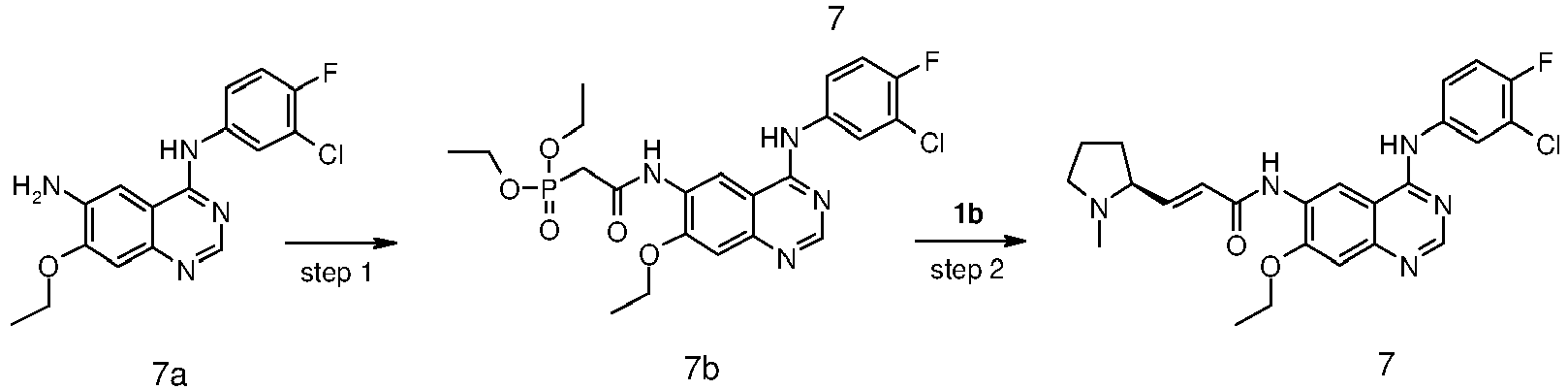
- N, N'-Carbonyldiimidazole (292 mg, 1.80 mmol) was dissolved in 4 mL of tetrahydrofuran. The mixture was heated to 50°C in an oil bath, a solution of diethylphosphonoacetic acid (353 mg, 1.8 mmol) in 3 mL of tetrahydrofuran was added dropwise, and stirred for 1.5 hours to the next step.
- N4-(3-Chloro-4-fluoro-phenyl)-7-ethoxy-quinazoline-4,6-diamine 7a (200 mg, 0.60 mmol, prepared by the well-known method: patent application
WO2005028443 ) was dissolved in 10 mL of tetrahydrofuran, followed by dropwise addition of the above reaction solution at 50°C. After stirring for 3 hours at 40°C, the reaction mixture was concentrated under reduced pressure and extracted with dichloromethane (50 mL×3). The combined organic extracts were washed with saturated brine (50 mL×2), dried over anhydrous sodium sulfate, filtered and concentrated under reduced pressure and the resulting residue was purified by silica gel column chromatography with elution system A to obtain the title compound N-[4-[(3-chloro-4-fluoro-phenyl)amino]-7-ethoxy-quinazolin-6-yl]-2-diethoxyphosphoryl-acetamide 7b (100 mg, yield 33.3%) as a light yellow solid.
MS m/z (ESI): 511.1 [M+1] - N-[4-[(3-Chloro-4-fluoro-phenyl)amino]-7-ethoxy-quinazolin-6-yl]-2-diethoxypho sphoryl-acetamide 7b (100 mg, 0.20 mmol) was dissolved in 10 mL of tetrahydrofuran. The mixture was cooled to -78 °C in a dry ice bath, followed by dropwise addition of a solution of lithium bis(trimethylsilyl)amide (1 M) in toluene (400 µL, 0.40 mmol), and the mixture was stirred for 45 minutes, added with (2S)-1-methylpyrrolidine-2-carbaldehyde 1b (100 mg, 0.85 mmol). After stirring for another 1 hour, the reaction mixture was warmed up to room temperature and stirred for 12 hours. The reaction mixture was added with water (1 mL) and methanol (1 mL), extracted with dichloromethane (100 mL×3). The combined organic extracts were washed with saturated brine (30 mL×2), dried over anhydrous sodium sulfate, filtered and the filtrate was concentrated under reduced pressure, then the resulting residue was purified by silica gel column chromatography with elution system A to obtain the title compound (E)-N-[4-[(3-chloro-4-fluoro-phenyl)amino]-7-ethoxy-quinazolin-6-yl]-3-[(2S)-1-methylpyrrolidin-2-yl]prop-2-enamide 7 (60 mg, yield 65.2%) as a yellow solid.
MS m/z (ESI): 470.2 [M+1]
1H NMR (400 MHz, DMSO-d6): δ 9.78 (s, 1H), 9.53 (s, 1H), 8.91 (s, 1H), 8.52 (s, 1H), 8.13-8.15 (m, 1H), 7.79-7.81 (m, 1H), 7.39-7.43 (m,1H), 7.26 (s,1H), 6.67-6.69 (m,2H), 4.26-4.31 (m,2H), 4.09-4.10 (m,1H), 3.17-3.15 (m,2H), 3.08-3.04 (m,1H), 2.77-2.79 (m,1H), 2.87-2.82 (m,1H), 2.23 (s,3H), 1.74-1.76 (m,1H), 1.47 (m,3H) -


- 2-methoxyethanol (152 mg, 2 mmol) was dissolved in 30 mL of dimethyl sulfoxide in an ice-water bath, followed by addition of 60% sodium hydride (80 mg, 2 mmol). The mixture was warmed up to 40°C and stirred for 2 hours, then N-(3-chloro-4-fluoro-phenyl)-7-fluoro-6-nitro-quinazolin-4-amine 8a (336 mg, 1 mmol) was added. The reaction mixture was stirred for 4 hours at 40°C, then warmed up to 50°C and stirred for 12 hours. The reaction mixture was added with water (20 mL), filtered and the filter cake was washed with water (50 mL), dried under vacuum to obtain the title compound N-(3-chloro-4-fluoro-phenyl)-7-(2-methoxyethoxy)-6-nitro-quinazolin-4-amine 8b (392 mg, yield 100%) as a yellow solid, which was directly used in the next step.
MS m/z (ESI): 393.0 [M+1] - N-(3-Chloro-4-fluoro-phenyl)-7-(2-methoxyethoxy)-6-nitro-quinazolin-4-amine 8b (392 mg, 1 mmol) and iron powder (392 mg, 7 mmol) were dissolved in 20 mL of acetic acid. The reaction mixture was heated to reflux for 4 hours, concentrated under reduced pressure. The residue was added with 100 mL of saturated sodium bicarbonate, extracted with dichloromethane (100 mL×3). The combined organic extracts were washed with saturated brine (50 mL×2), dried over anhydrous sodium sulfate, filtered and concentrated under reduced pressure to obtain the title compound N4-(3-chloro-4-fluoro-phenyl)-7-(2-methoxyethoxy)quinazoline-4,6-diamine 8c (200 mg, yield 55.2%) as a light yellow solid.
MS m/z (ESI): 363.1 [M+1] - N, N'-Carbonyldiimidazole (292 mg, 1.80 mmol) was dissolved in 4 mL of tetrahydrofuran. The mixture was heated to 50°C in an oil bath, a solution of diethylphosphonoacetic acid (353 mg, 1.8 mmol) in 3 mL of tetrahydrofuran was added dropwise, and stirred for 1.5 hours to the next step.
- N4-(3-Chloro-4-fluoro-phenyl)-7-(2-methoxyethoxy)quinazoline-4,6-diamine 8c (200 mg, 0.55 mmol) was dissolved in 10 mL of tetrahydrofuran, followed by dropwise addition of the above reaction solution at 50°C. After stirring for 3 hours at 40°C, the reaction mixture was concentrated under reduced pressure and extracted with dichloromethane (50 mL×3). The combined organic extracts were washed with saturated brine (50 mL×2), dried over anhydrous sodium sulfate, filtered and concentrated under reduced pressure and the resulting residue was purified by silica gel column chromatography with elution system A to obtain the title compound N-[4-[(3-chloro-4-fluoro-phenyl)amino]-7-(2-methoxyethoxy)quinazolin-6-yl]-2-diethoxyphosphoryl-acetamide 8d (150 mg, yield 50.5%) as a light yellow solid.
MS m/z (ESI): 541.2 [M+1] - N-[4-[(3-Chloro-4-fluoro-phenyl)amino]-7-(2-methoxyethoxy)quinazolin-6-yl]-2-d iethoxyphosphoryl-acetamide 8d (200 mg, 0.37 mmol) was dissolved in 10 mL of tetrahydrofuran. The mixture was cooled to -78 °C in a dry ice bath. Under argon, a solution of lithium bis(trimethylsilyl)amide (1 M) in toluene (740 µL, 0.74 mmol) was added dropwise. After stirring for 30 minutes, (2R)-1-methylpyrrolidine-2-carbaldehyde 5c (84 mg, 0.74 mmol) was added to the reaction solution. The reaction mixture was stirred for another 1 hour, then warmed up to room temperature and stirred for 12 hours. The reaction mixture was concentrated, added with 10 mL of water, extracted with dichloromethane (25 mL×3). The combined organic extracts were washed with saturated brine (30 mL×2), dried over anhydrous sodium sulfate, filtered and concentrated under reduced pressure and the resulting residue was purified by silica gel column chromatography with elution system A to obtain the title compound (E)-N-[4-[(3-chloro-4-fluoro-phenyl)amino]-7-(2-methoxyethoxy)quinazolin-6-yl]-3-[(2R)-1-methylpyrrolidin-2-yl]prop-2-enamide 8 (100 mg, yield 54.2%) as a yellow solid.
MS m/z (ESI): 500.2 [M+1]
1H NMR(400 MHz, DMSO-d6 ): δ 9.82 (s, 1H), 9.58 (s, 1H), 8.89 (s, 1H), 8.53 (s, 1H), 8.12-8.13 (m, 1H),7.79-7.81 (m, 1H),7.40-7.44 (m, 1H), 7.32 (s, 1H), 6.57-6.75 (m, 2H), 4.36-4.37 (m, 2H), 3.80-3.81 (m, 2H), 3.35-3.32 (m, 4H), 3.15-3.13 (m, 1H), 2.5(s, 3H), 2.40-2.31 (m, 2H), 2.08 (m, 1H), 1.90-1.81(m, 1H), 1.70-1.64 (m, 1H) -
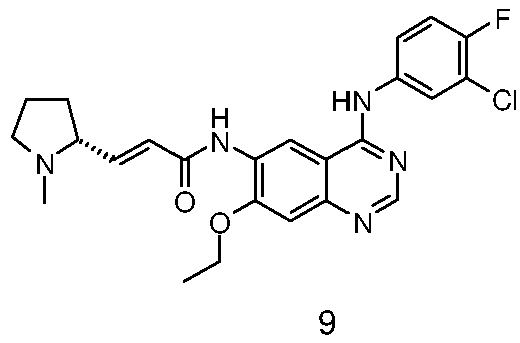

- N-[4-[(3-Chloro-4-fluoro-phenyl)amino]-7-ethoxy-quinazolin-6-yl]-2-diethoxypho sphoryl-acetamide 7b (300 mg, 0.59 mmol) was dissolved in 10 mL of tetrahydrofuran. The mixture was cooled to -78 °C in a dry ice bath. Under argon, a solution of lithium bis(trimethylsilyl)amide (1 M) in toluene (1.2 mL, 1.18 mmol) was added dropwise. After the mixture was stirred for 30 minutes, (2R)-1-methylpyrrolidine-2-carbaldehyde 5c (133 mg, 1.18 mmol) was added, and the mixture was stirred for another 1 hour, then warm up to room temperature and stirred for 12 hours. The reaction mixture was concentrated, added with 10 mL of water, extracted with dichloromethane (25 mL×3). The combined organic extracts were washed with saturated brine (30 mL×2), dried over anhydrous sodium sulfate, filtered and concentrated under reduced pressure and the resulting residue was purified by silica gel column chromatography with elution system A to obtain the title compound (E)-N-[4-[(3-chloro-4-fluoro-phenyl)amino]-7-ethoxy-quinazolin-6-yl]-3-[(2R)-1-methylpyrrolidin-2-yl]prop-2-enamide 9 (130 mg, yield 47.3%) as a yellow solid.
MS m/z (ESI): 470.2 [M+1]
1H NMR (400 MHz, DMSO-d6 ): δ 9.79 (s, 1H), 9.53 (s, 1H), 8.93 (s, 1H), 8.53 (s, 1H), 8.12-8.15 (m, 1H), 7.79-7.83 (m, 1H), 7.40-7.45 (m, 1H), 7.27 (s, 1H), 6.67-6.73 (m, 1H), 6.56-6.60 (m, 1H), 4.27-4.32 (m, 2H), 4.09-4.10 (m, 1H), 3.17 (m, 2H), 3.04 (m, 1H), 2.77-2.79 (m, 1H), 2.18-2.16 (m, 1H), 2.21 (s, 3H), 1.74-1.76 (m, 1H), 1.47 (t, 3H) -


- 7 mL of thionyl chloride was dissolved in 50 mL of methanol in an ice-water bath, followed by addition of pyrrolidine-2-carboxylic acid 10a (5 g, 43.40 mmol). The mixture was warmed up to room temperature and stirred for 24 hours. The mixture was concentrated under reduced pressure to obtain methyl pyrrolidine-2-carboxylate 10b (10 g) crude product as a white solid, which was directly used in the next step without purification.
MS m/z (ESI): 130.1 [M+1] - Methyl pyrrolidine-2-carboxylate 10b crude product (5 g) was dissolved in 100 mL of methanol. The solution was cooled to 0∼5°C in an ice-water bath, followed by addition of 13 mL of 40% formaldehyde. The reaction mixture was warmed up to room temperature and stirred for 2 hours, then cooled to 0∼5°C in an ice-water bath, and sodium cyanoborohydride (5.45g, 87.20 mmol) was added in batches. The reaction mixture was warmed up to room temperature and stirred for 24 hours. The mixture was concentrated under reduced pressure and added with 5 mL of water, extracted with dichloromethane (5 mL×3). The combined organic extracts were dried over anhydrous sodium sulfate, filtered and concentrated under reduced pressure to obtain methyl 1-methylpyrrolidine-2-carboxylate 10c (4.7 g, yield 70.1) crude product as a brown oil.
MS m/z (ESI): 144.1 [M+1] - Diisobutyl aluminium hydride (60 mL, 66 mmol) was added dropwise to a solution of methyl 1-methylpyrrolidine-2-carboxylate 10c (4.7 g, 33 mmol) in 50 mL of dichloromethane. The reaction mixture was stirred for 6 hours in an ice-water bath, followed by addition of 10 mL of methanol. The reaction mixture was concentrated under reduced pressure to obtain the title compound (1-methylpyrrolidin-2-yl)methanol 10d (1.8 g, yield 47.4%) as a brown oil.
- Dimethyl sulfoxide (2.2 mL, 31.20 mmol) was dissolved in 20 mL of dichloromethane in a dry ice-acetone bath, followed by addition of oxalyl chloride (2 mL, 23.40 mmol). After stirring for 45 minutes at -18°C, (1-methylpyrrolidin-2-yl)methanol 10d (1.8 g, 15.60 mmol) was added. After stirring for another 45 minutes, triethylamine (6.5 mL, 46.80 mmol) was added. The reaction mixture was warmed up to room temperature and stirred for 1 hour. The reaction mixture was washed with saturated brine (50 mL), dried over anhydrous sodium sulfate, filtered and concentrated under reduced pressure and the resulting residue was purified by alkaline alumina column chromatography with elution system A to obtain 1-methylpyrrolidine-2-carbaldehyde 10e (1 g, yield 56.8%) as a brown oil.
- N-[4-[[3-Chloro-4-(2-pyridylmethoxy)phenyl]amino]-3-cyano-7-ethoxy-6-quinolyl ]-2-diethoxyphosphoryl-acetamide 1d (3 g, 4.40 mmol) was dissolved in 30 mL of tetrahydrofuran in a dry ice bath, followed by dropwise addition of a solution of lithium bis(trimethylsilyl)amide (1 M) in toluene (9.6 mL, 8.80 mmol). After the mixture was stirred for 30 minutes, a solution of 1-methylpyrrolidine-2-carbaldehyde 10e (1 g, 8.80 mmol) in 5 mL of tetrahydrofuran was added dropwise. The reaction mixture was stirred for another 30 minutes, then warmed up to room temperature and stirred for 24 hours. The reaction mixture was concentrated under reduced pressure and the resulting residue was purified by silica gel column chromatography with elution system A to obtain the title compound (E)-N-[4-[[3-chloro-4-(2-pyridylmethoxy)phenyl]amino]-3-cyano-7-ethoxy-6-quinolyl]-3-(1-methylpyrrolidin-2-yl)prop-2-enamide 10 (500 mg, yield 20.8%) as a yellow solid.
MS m/z (ESI): 583.2 [M+1]
1H NMR (400 MHz, DMSO-d6 ): δ 11.59 (s, 1H), 11.28 (s, 1H), 9.19 (s,1H), 9.05 (s, 1H), 8.71 (d, 1H), 8.09-8.07 (m, 1H), 7.74-7.68 (m, 3H), 7.56-7.55 (m, 1H), 7.45-7.37 (m, 2H), 7.04-7.00 (m, 1H), 6.88-6.84 (m, 1H), 5.43 (s, 2H), 4.38 (dd, 2H), 4.10 (m, 2H), 3.63-3.60 (m, 1H), 3.13-3.08 (m, 1H), 2.73-2.72 (m, 3H), 2.31-2.29 (m, 1H), 2.08-2.02 (m, 2H), 1.53 (t, 3H) - The following in vitro assay is to determine the activity of the compounds of the invention for inhibiting the proliferation of human epidermoid carcinoma A431 cells, which has high expression of EGFR.
- The following in vitro assay is to determine the activity of the tested compounds for inhibiting the proliferation of cancer cells, which has high expression of EGFR. The activity is represented by the IC50 value. The general procedures of the assay are given as follows: The cancer cells A431 that highly expressing EGFR (Institute of biochemistry and cell biology) were chosen and seeded to 96-well cell culture plate at a suitable concentration (e.g., 5000 cells/mL medium). The cells then were incubated in carbon dioxide (CO2) incubator until they reached 85% confluency. Then, the cell culture medium was replaced by fresh one with tested compounds added in it at serial concentrations (general 6 to 7 concentrations). Then the cells were put back to the incubator and cultured continuously. 72 hours later, the activity of the tested compounds for inhibiting the cell proliferation was determined by using Sulforhodamine B (SRB) method. IC50 value on tested cells are calculated by the data of inhibition rates of serial concentrations of the tested compounds.
- The biological activity of the compounds of the invention was tested by using the assay described above. The IC50 values were measured and showed in table below:
Example No. IC50 (EGFR/A431)(µM) 1 0.022 2 0.003 3 0.036 5 0.045 9 0.008 - The in vitro EGFR kinase activity was tested by the following assay.
- The following assay may be used to determine the activity of the compounds of the invention for inhibiting EGFR kinase activity. The half maximal inhibitory concentration IC50 (the concentration of the tested compound showing 50% inhibition of the enzyme activity) of each compound was determined by incubating several different concentrations of the tested compounds with a specific enzyme and substrate. EGFR kinase used in this assay is a human-derived recombinant protein (Cell signaling technology, #7908), which was reacted with peptide substrate and different concentrations of tested compounds in a buffer solution containing 60 mM HEPES (pH7.5), 5 mM MgCl2, 5 mM MnCl2, 3 µM Na3VO4, 1.25 M DTT (1000x) and 20 µM ATP at 25°C, for 45 minutes. The EGFR kinase activity was determined by using a Time- Resolved fluorescence method.
- The biological activity of the compounds of the invention was tested by using the assay described above. The IC50 values were measured and showed in table below:
Example No. IC50 (EGFR/BIO) (µM) 1 0.048 2 0.006 3 0.059 5 0.013 7 0.004 8 0.002 9 0.002 - Test Example 1: the pharmacokinetics assay of the compounds of Example 1 and Example 5 of the present invention
- The compounds of Example 1 and Example 5 of the present invention were administrated intragastrically to rats to determine the drug concentration in plasma at different time points by LC/MS/MS method. The pharmacokinetic behavior of the compounds of the present invention was studied and evaluated in rats.
- Compounds of Example 1 and Example 5
- 8 healthy adult SD rats, male and female in half, were purchased from SINO-BRITSH SIPPR/BK LAB. ANIMAL LTD., CO, License number: SCXK (Shanghai) 2003-0002
- The right amount of compounds were weighted and grinded with 0.5% Sodium Carboxymethyl cellulose uniformly, suspended them with 1% tween 80 to 2.5 mg/mL of suspension before use.
- 8 Healthy adult adult SD rats, male and female in half, after an overnight fast, were administered intragastrically at a dose of 25.0 mg / kg, at a volume of 10 mL/kg.
- 8 Healthy adult adult SD rats, male and female in half, were divided into 2 groups. After an overnight fast, the rats were administered intragastrically at a dose of 25.0 mg /kg. Blood samples (0.2 mL) were taken from orbital sinus at pre administration and at 0.5, 1.0, 2.0, 3.0, 4.0, 5.0, 7.0, 9.0, 12.0, 24.0 and 30.0 hours post administration, which were stored in heparinized tubes and centrifuged for 10 minutes at 3,500 rpm. The plasma samples were stored at -20 °C until analysis. The rats were fed 2 hours after administration.
- 50 µL of rat plasmas taken at various time points after administration were mixed with 50 µL of standard series solution to obtain plasma concentration of 50.0, 100, 200, 500, 1000, 2000, 5000 ng/mL. 150 µL methanol was added and then the mixture was mixed for 3 minute using a vortexer and centrifuged for 10 minutes at 13,500 rpm. 10 µL of the supernatant was analyzed by LC-MS/MS. The main pharmacokinetic parameters were caculated by DAS 2.0 software.
- Pharmacokinetic Parameters of the compounds of the present invention were shown as follows:
Pharmacokinetics Assay (25mg/kg) Number Plasma Conc. Area Under Curve Half-Life Mean Residence Time Clearance Apparent Distribution Volume Cmax (µg/mL) AUC (µg/mL*h) t1/2 (h) MRT (h) CL/F (1/h/kg) Vz/F (1/kg) Example 1 4.48±1.88 52.58±38.96 4.04±1.39 7.78±1.89 0.76±0.53 3.71±1.68 Example 5 6.47±1.81 52.81±23.59 3.4±0.45 7.66±0.75 0.53±0.18 2.6±0.94 - The therapeutic effect of the compound of Example 1 against xenografts of Calu-3 human lung cancer in nude mice was estimated. The compound of Example 1 markedly inhibited the growth of Calu-3 human lung cancer, and the tested mice were well tolerant.
- The therapeutic effects of the compounds of Example 1 and Example 5 against xenografts of Calu-3 human lung cancer in nude mice was estimated and compared.
- Drugs Name and batch of drugs: the compounds of Example 1 and Example 5
- Preparation method: The compounds of Example 1 and Example 5 were prepared to corresponding concentration by using distilled water containing 0.1% Tween-80.
- BALB/cA-nude mice, 6 to 7 weeks old, ♀, purchased from Slaccas Experimental Animal LTD., CO.
- Certificate No.: SCXK 2007 - 0005. Environment: SPF level.
- Nude mice were hypodermic inoculated Calu-3 human lung cancer cell. After tumors grew to 150-250 mm3, mice were randomly divided into teams (d0).
- The volume of tumors and the weigh of the mice were measured and recorded for 2-3 times per week.
- The calculation formula of the volume of tumor (V) is: V = 1/2×a×b2, a: length of tumor, b: width of tumor.
- The compound of Example 1 markedly inhibited the growth of Calu-3 human lung cancer. Low dose (100 mg/kg) of the compound of Example 1 reduced 2/6 of the tumor volume, high dose (200 mg/kg) of the compound of Example 1 reduced 1/6 of the tumor volume and completely degrade other 1/6 of the tumor. Low dose (100 mg/kg) of the compound of Example 5 reduced 3/6 of the tumor volume, high dose (200 mg/kg) of the compound of Example 5 reduced 4/6 of the tumor volume. Moreover, the mice were well tolerant to the compounds of Example 1 and Example 5 according to the present administration protocol.
Claims (22)
- Compounds of formula (I), or tautomers, racemates, enantiomers, diastereoisomers, and mixtures thereof, and pharmaceutically acceptable salts thereof:
 A is selected from the group consisting of carbon atom or nitrogen atom;
when A is carbon atom, R1 is selected from the group consisting of hydrogen or alkoxyl; wherein said alkoxyl is optionally further substituted by one or more groups selected from the group consisting of halogen or alkoxyl; R2 is cyano;
when A is nitrogen atom, R1 is selected from the group consisting of hydrogen or alkoxyl; wherein said alkoxyl is optionally further substituted by one or more groups selected from the group consisting of halogen or alkoxyl; R2 is absent;R3 is a radical having the following fomula:
wherein:D is selected from the group consisting of aryl or heteroaryl, wherein said aryl or heteroaryl is each independently optionally further substituted by one or more groups selected from the group consisting of halogen, alkyl or trifluoromethyl;T is selected from the group consisting of -(CH2)r-, -O(CH2)r-, -NH(CH2)r- or -S(O)r(CH2)r-;L is selected from the group consisting of aryl or heteroaryl, wherein said aryl or heteroaryl is each independently optionally further substituted by one or more groups selected from the group consisting of halogen or alkyl;R4 and R5 are each independently selected from the group consisting of hydrogen, alkyl, alkoxyl, hydroxyl, hydroxyalkyl, halogen, carbonyl, amino, cyano, nitro, carboxy or carboxylic ester;B is selected from the group consisting of carbon atom, oxygen atom or S(O)r;
when B is carbon atom, R6 and R7 are each independently selected from the group consisting of hydrogen, alkyl, alkoxyl, hydroxyl, hydroxyalkyl, halogen, carbonyl, amino, cyano, nitro, carboxy or carboxylic ester;
when B is oxygen atom or S(O)r, R6 and R7 are absent;R8 is selected from the group consisting of hydrogen or alkyl;R9 is selected from the group consisting of hydrogen, alkyl, aryl, carboxy or carboxylic ester;r is 0, 1, or 2; andn is 1, 2, 3, 4, or 5. - The compounds according to claim 1, or tautomers, racemates, enantiomers, diastereoisomers, and mixtures thereof, and pharmaceutically acceptable salts thereof , wherein A is carbon atom, R1 is alkoxyl; R2 is cyano.
- The compounds according to claim 1, or tautomers, racemates, enantiomers, diastereoisomers, and mixtures thereof, and pharmaceutically acceptable salts thereof, wherein A is nitrogen atom, R1 is hydrogen; R2 is absent.
- The compounds according to any one of claims 1 to 3, or tautomers, racemates, enantiomers, diastereoisomers, and mixtures thereof, and pharmaceutically acceptable salts thereof, wherein n is 2.
- The compounds according to claim 1, or tautomers, racemates, enantiomers, diastereoisomers, and mixtures thereof, and pharmaceutically acceptable salts thereof, including the compounds having the following formula (II) and tautomers, racemates, enantiomers, diastereomers, and mixtures thereof, and pharmaceutically acceptable salts thereof:
 A is selected from the group consisting of carbon atom or nitrogen atom;
when A is carbon atom, R1 is selected from the group consisting of hydrogen or alkoxyl; wherein said alkoxyl is optionally further substituted by one or more groups selected from the group consisting of halogen or alkoxyl; R2 is cyano;
when A is nitrogen atom, R1 is selected from the group consisting of hydrogen or alkoxyl; wherein said alkoxyl is optionally further substituted by one or more groups selected from the group consisting of halogen or alkoxyl; R2 is absent;R3 is a radical having the following fomula:
wherein:D is selected from the group consisting of aryl or heteroaryl, wherein said aryl or heteroaryl is each independently optionally further substituted by one or more groups selected from the group consisting of halogen, alkyl or trifluoromethyl;T is selected from the group consisting of -(CH2)r-, -O(CH2)r-, -NH(CH2)r- or -S(O)r(CH2)r-;L is selected from the group consisting of aryl or heteroaryl, wherein said aryl or heteroaryl is each independently optionally further substituted by one or more groups selected from the group consisting of halogen or alkyl;R4 and R5 are each independently selected from the group consisting of hydrogen, alkyl, alkoxyl, hydroxyl, hydroxyalkyl, halogen, carbonyl, amino, cyano, nitro, carboxy or carboxylic ester;R8 is selected from the group consisting of hydrogen or alkyl;R9 is selected from the group consisting of hydrogen, alkyl, aryl, carboxy or carboxylic ester;r is 0, 1, or 2; andn is 1, 2, 3, 4, or 5. - The compounds according to claim 5, or tautomers, racemates, enantiomers, diastereoisomers, and mixtures thereof, and pharmaceutically acceptable salts thereof, wherein A is carbon atom; R1 is alkoxyl; R2 is cyano.
- The compounds according to claim 5, or tautomers, racemates, enantiomers, diastereoisomers, and mixtures thereof, and pharmaceutically acceptable salts thereof, wherein A is nitrogen atom; R1 is hydrogen; R2 is absent.
- The compounds according to any one of claims 5 to 7, or tautomers, racemates, enantiomers, diastereoisomers, and mixtures thereof, and pharmaceutically acceptable salts thereof, wherein n is 2.
- The compounds according to claim 1, or tautomers, racemates, enantiomers, diastereoisomers, and mixtures thereof, and pharmaceutically acceptable salts thereof, wherein the compounds are selected from the group consisting of:



- Compounds of formula (IA),
 A is selected from the group consisting of carbon atom or nitrogen atom;
when A is carbon atom, R1 is selected from the group consisting of hydrogen or alkoxyl; wherein said alkoxyl is optionally further substituted by one or more groups selected from the group consisting of halogen or alkoxyl; R2 is cyano;
when A is nitrogen atom, R1 is selected from the group consisting of hydrogen or alkoxyl; wherein said alkoxyl is optionally further substituted by one or more groups selected from the group consisting of halogen or alkoxyl; R2 is absent;R3 is a radical having the following fomula:
wherein:D is selected from the group consisting of aryl or heteroaryl, wherein said aryl or heteroaryl is each independently optionally further substituted by one or more groups selected from the group consisting of halogen, alkyl or trifluoromethyl;T is selected from the group consisting of -(CH2)r-, -O(CH2)r-, -NH(CH2)r- or -S(O)r(CH2)r-;L is selected from the group consisting of aryl or heteroaryl, wherein said aryl or heteroaryl is each independently optionally further substituted by one or more groups selected from the group consisting of halogen or alkyl; andr is 0, 1, or 2. - A preparation process of the compounds of formula (IA) according to claim 10, comprising the following steps of:

- A preparation process of the compounds of formula (I) according to claim 1, comprising the following steps of:

- A preparation process of the compounds of formula (II) according to claim 5, comprising the following steps of:

- A pharmaceutical composition comprising a therapeutically effective amount of the compounds according to any one of claims 1 to 9, or tautomers, racemates, enantiomers, diastereomers, and mixtures thereof, and pharmaceutically acceptable salts thereof, and pharmaceutically acceptable carriers.
- A preparation process of the pharmaceutical composition according to claim 14, comprising combining the compounds of formula (I) according to claim 1, or tautomers, racemates, enantiomers, diastereomers, and mixtures therof, and pharmaceutically acceptable salts thereof with the pharmaceutically acceptable carriers or diluent agents.
- A method of regulating the catalytic activity of protein kineses, comprising contacting said protein kinases with the compounds of formula (I) according to any one of claims 1 to 9, or tautomers, racemates, enantiomers, diastereomers, and mixtures therof, and pharmaceutically acceptable salts thereof; wherein said protein kineses are selected from the group consisting of EGFR receptor tyrosine kinases or HER-2 receptor tyrosine kinases.
- A use of the compounds of formula (I) according to any one of claims 1 to 9, or tautomers, racemates, enantiomers, diastereomers, and mixtures therof, and pharmaceutically acceptable salts thereof, or a use of the pharmaceutical composition according to claim 14 in the preparation of a medicament for the treatment of protein kineses related diseases; wherein said protein kineses are selected from the group consisting of EGFR receptor tyrosine kinases or HER-2 receptor tyrosine kinases.
- The compounds of formula (I) according to any one of claims 1 to 9, tautomers, racemates, enantiomers, diastereomers, and mixtures therof, and pharmaceutically acceptable salts thereof, or the pharmaceutical composition according to claim 14 for use as a medicament for the treatment of protein kineses related diseases; wherein said protein kineses are selected from the group consisting of EGFR receptor tyrosine kinases or HER-2 receptor tyrosine kinases.
- A use of the compounds of formula (I) according to any one of claims 1 to 9, or tautomers, racemates, enantiomers, diastereomers, and mixtures therof, and pharmaceutically acceptable salts thereof, or a use of the pharmaceutical composition according to claim 14 in the preparation of a EGFR receptor tyrosine kinases inhibitor or a HER-2 receptor tyrosine kinases inhibitor.
- A use of the compounds of formula (I) according to any one of claims 1 to 9, or tautomers, racemates, enantiomers, diastereomers, and mixtures therof, and pharmaceutically acceptable salts thereof, or a use of the pharmaceutical composition according to claim 14 in the preparation of a medicament for the treatment of cancer; wherein said cancer is selected from the group consisting of lung cancer, breast cancer, squamous cell carcinoma or stomach cancer.
- A method for the treatment of cancer, comprising administrating to the subject in need thereof a therapeutically effective amount of the compounds of formula (I) according to any one of claims 1 to 9, or tautomers, racemates, enantiomers, diastereomers, and mixture therofs, and pharmaceutically acceptable salts thereof.
- The compounds of formula (I) according to any one of claims 1 to 9, or tautomers, racemates, enantiomers, diastereomers, and mixtures therof, and pharmaceutically acceptable salts thereof for use as a medicament for the treatment of cancer.
Priority Applications (3)
| Application Number | Priority Date | Filing Date | Title |
|---|---|---|---|
| SI201031574T SI2479174T1 (en) | 2009-09-14 | 2010-08-26 | 6-amino quinazoline or 3-cyano quinoline derivatives, preparation methods and pharmaceutical uses thereof |
| PL10814867T PL2479174T3 (en) | 2009-09-14 | 2010-08-26 | 6-amino quinazoline or 3-cyano quinoline derivatives, preparation methods and pharmaceutical uses thereof |
| HRP20171748TT HRP20171748T1 (en) | 2009-09-14 | 2010-08-26 | 6-AMINO QUINAZOLINE OR 3-CYAN DERIVATIVES OF QUINOLINE, PREPARATION AND PHARMACEUTICAL USE |
Applications Claiming Priority (2)
| Application Number | Priority Date | Filing Date | Title |
|---|---|---|---|
| CN2009101958233A CN102020639A (en) | 2009-09-14 | 2009-09-14 | 6-amido quinazoline or 3-cyano quinoline derivative, preparation method thereof and application of derivative to medicament |
| PCT/CN2010/001293 WO2011029265A1 (en) | 2009-09-14 | 2010-08-26 | 6-amino quinazoline or 3-cyano quinoline derivatives, preparation methods and pharmaceutical uses thereof |
Publications (3)
| Publication Number | Publication Date |
|---|---|
| EP2479174A1 true EP2479174A1 (en) | 2012-07-25 |
| EP2479174A4 EP2479174A4 (en) | 2013-04-17 |
| EP2479174B1 EP2479174B1 (en) | 2017-10-18 |
Family
ID=43731939
Family Applications (1)
| Application Number | Title | Priority Date | Filing Date |
|---|---|---|---|
| EP10814867.7A Active EP2479174B1 (en) | 2009-09-14 | 2010-08-26 | 6-amino quinazoline or 3-cyano quinoline derivatives, preparation methods and pharmaceutical uses thereof |
Country Status (20)
| Country | Link |
|---|---|
| US (2) | US8901140B2 (en) |
| EP (1) | EP2479174B1 (en) |
| JP (1) | JP5684811B2 (en) |
| KR (1) | KR101738191B1 (en) |
| CN (2) | CN102020639A (en) |
| AU (1) | AU2010292790B2 (en) |
| BR (1) | BR112012005760A2 (en) |
| CA (1) | CA2774099C (en) |
| DK (1) | DK2479174T3 (en) |
| ES (1) | ES2647829T3 (en) |
| HR (1) | HRP20171748T1 (en) |
| HU (1) | HUE035873T2 (en) |
| LT (1) | LT2479174T (en) |
| MX (1) | MX2012002875A (en) |
| NO (1) | NO2479174T3 (en) |
| PL (1) | PL2479174T3 (en) |
| PT (1) | PT2479174T (en) |
| RU (1) | RU2536102C2 (en) |
| SI (1) | SI2479174T1 (en) |
| WO (1) | WO2011029265A1 (en) |
Families Citing this family (38)
| Publication number | Priority date | Publication date | Assignee | Title |
|---|---|---|---|---|
| CN102020639A (en) | 2009-09-14 | 2011-04-20 | 上海恒瑞医药有限公司 | 6-amido quinazoline or 3-cyano quinoline derivative, preparation method thereof and application of derivative to medicament |
| CN102675287A (en) * | 2011-03-11 | 2012-09-19 | 江苏恒瑞医药股份有限公司 | Pharmaceutically acceptable salts of (E)-N-(4-((3-chloro-4-(2-pyridyl methoxy) phenyl) amino)-3-cyano-7-ethyoxyl-6-quinolyl)-3-((2R)-1-methyl pyrrolidine-2-propyl)-2-acrylamide, preparation method and application of salts in medicines |
| CN103717590B (en) * | 2011-05-17 | 2016-05-11 | 江苏康缘药业股份有限公司 | Quinazoline-7-ether compounds and methods of use |
| JP6437820B2 (en) * | 2011-07-27 | 2018-12-12 | シャンハイ ファーマシューティカルズ ホールディング カンパニー,リミティド | Quinazoline derivative, production method thereof, intermediate, composition and application thereof |
| WO2013131424A1 (en) * | 2012-03-09 | 2013-09-12 | 上海恒瑞医药有限公司 | 4-quinazoline amine derivative and application thereof |
| CN103539783A (en) * | 2012-07-12 | 2014-01-29 | 江苏恒瑞医药股份有限公司 | I-type crystal of dimaleate of tyrosine kinase inhibitor and preparation method thereof |
| CN103588755B (en) * | 2012-08-17 | 2016-06-22 | 正大天晴药业集团股份有限公司 | The preparation method of Neratinib |
| CN103965120B (en) * | 2013-01-25 | 2016-08-17 | 上海医药集团股份有限公司 | Quinoline and quinazoline derivant, preparation method, intermediate, compositions and application |
| TWI609012B (en) | 2013-04-28 | 2017-12-21 | 廣東東陽光藥業有限公司 | Aminoquinazoline derivatives and their salts and methods of use thereof |
| WO2015085654A1 (en) | 2013-12-12 | 2015-06-18 | 天津合美医药科技有限公司 | Quinazoline derivative |
| CN106068262B (en) * | 2014-04-11 | 2019-10-29 | 海思科医药集团股份有限公司 | Quinazoline derivant and preparation method thereof and application in medicine |
| CN107405345A (en) | 2016-01-27 | 2017-11-28 | 江苏恒瑞医药股份有限公司 | A kind of preparation method of the pharmaceutical composition containing quinoline derivative or its salt |
| TWI726978B (en) | 2016-01-27 | 2021-05-11 | 大陸商江蘇恆瑞醫藥股份有限公司 | A pharmaceutical composition comprising quinoline derivatives or salt thereof |
| WO2017129094A1 (en) * | 2016-01-28 | 2017-08-03 | 江苏恒瑞医药股份有限公司 | Use of egfr/her2 receptor tyrosine kinase inhibitor in preparing drugs for treating cancers induced by her2 mutation |
| CN105777604A (en) * | 2016-04-14 | 2016-07-20 | 上海凯宝药业股份有限公司 | N-methyl-trans-4-hydroxy-L-proline crystal compound and preparing method thereof |
| ES2903416T3 (en) | 2016-04-28 | 2022-04-01 | Jiangsu Hengrui Medicine Co | Preparation method of a tyrosine kinase inhibitor and a derivative thereof |
| CN106008471B (en) * | 2016-05-25 | 2019-09-03 | 江苏医诺万细胞诊疗有限公司 | A kind of synthetic method of quinazoline compounds |
| EP3517529B1 (en) | 2016-09-23 | 2022-03-23 | Shanghai Pharmaceuticals Holding Co., Ltd. | Salt of quinazoline derivative, preparation method therefor and application thereof |
| CN108289885B (en) * | 2016-09-23 | 2020-10-20 | 江苏恒瑞医药股份有限公司 | Use of tyrosine kinase inhibitor in preparation of medicine for treating cancer |
| CN106565692A (en) * | 2016-11-03 | 2017-04-19 | 常茂生物化学工程股份有限公司 | Improving method of afatinib synthesis technology |
| US20190358212A1 (en) * | 2017-01-22 | 2019-11-28 | Jiangsu Hengrui Medicine Co., Ltd. | Uses of egfr/her2 inhibitor combined with pyrimidine-type anti-metabolic drug |
| CN109963846A (en) * | 2017-08-07 | 2019-07-02 | 江苏恒瑞医药股份有限公司 | Crystal form of dimaleate salt of tyrosine kinase inhibitor and preparation method thereof |
| JP7333313B2 (en) * | 2017-09-01 | 2023-08-24 | シャンハイ ファーマシューティカルズ ホールディング カンパニー,リミティド | Nitrogen-containing heterocyclic compounds, methods of preparation, intermediates, compositions and uses |
| WO2019076316A1 (en) * | 2017-10-18 | 2019-04-25 | 江苏恒瑞医药股份有限公司 | Preparation method for tyrosine kinase inhibitor and intermediate thereof |
| KR20200078561A (en) * | 2017-10-24 | 2020-07-01 | 지앙수 헨그루이 메디슨 컴퍼니 리미티드 | Pharmaceutical composition containing quinoline derivative |
| WO2019080889A1 (en) * | 2017-10-26 | 2019-05-02 | 江苏恒瑞医药股份有限公司 | Anti-csf-1r antibody, antigen-binding fragment thereof and pharmaceutical use thereof |
| CN108314639B (en) * | 2018-05-09 | 2019-04-30 | 山东铂源药业有限公司 | Compound (E) -3-(1- methylpyrrolidin- 2- yl)-acrylic acid hydrochloride and synthetic method |
| US10857146B2 (en) | 2018-08-21 | 2020-12-08 | Jiangsu Hengrui Medicine Co., Ltd. | Method for preventing or treating tumor diseases with a combination of tyrosine kinase inhibitor and CDK4/6 inhibitor |
| CN110960529A (en) * | 2018-09-30 | 2020-04-07 | 江苏恒瑞医药股份有限公司 | Tyrosine kinase inhibitor bulk drug with reduced toxic impurity content |
| BR112021007477A2 (en) | 2018-10-22 | 2021-07-27 | Jiangsu Hengrui Medicine Co., Ltd. | crystalline form of tyrosine kinase inhibitor maleate and method of preparation thereof |
| US20220040324A1 (en) | 2018-12-21 | 2022-02-10 | Daiichi Sankyo Company, Limited | Combination of antibody-drug conjugate and kinase inhibitor |
| CN112279838B (en) | 2020-10-29 | 2021-07-13 | 苏州富士莱医药股份有限公司 | A kind of preparation method of pyrotinib |
| CN112625025B (en) * | 2020-12-31 | 2022-03-29 | 河南省医药科学研究院 | Pyridyl-substituted quinoline derivatives and preparation method and use thereof |
| CN112694439B (en) * | 2020-12-31 | 2022-08-30 | 河南省医药科学研究院 | Phenyl acrylamide quinoline derivative and preparation method and application thereof |
| CN112759583B (en) * | 2020-12-31 | 2022-10-11 | 河南省医药科学研究院 | Quinoline derivative containing furyl and preparation method and application thereof |
| CN115109036B (en) | 2021-03-19 | 2024-06-11 | 北京赛特明强医药科技有限公司 | Quinazoline compound, composition and application thereof |
| TW202330040A (en) * | 2021-10-14 | 2023-08-01 | 大陸商江蘇恆瑞醫藥股份有限公司 | Use of anti-her2 antibody drug conjugate and tyrosine kinase inhibitor in the preparation of drugs for treating tumors |
| EP4682143A1 (en) * | 2023-03-10 | 2026-01-21 | Convalife Pharmaceuticals Co., Ltd. | Pharmaceutical composition containing egfr inhibitor, and preparation method therefor and use thereof |
Family Cites Families (11)
| Publication number | Priority date | Publication date | Assignee | Title |
|---|---|---|---|---|
| UA73073C2 (en) | 1997-04-03 | 2005-06-15 | Уайт Холдінгз Корпорейшн | Substituted 3-cyan chinolines |
| ATE255575T1 (en) | 1998-09-29 | 2003-12-15 | Wyeth Corp | SUBSTITUTED 3-CYANOCINOLINES AS PROTEIN TYROSINE KINASE INHIBITORS |
| WO2001077104A1 (en) * | 2000-04-08 | 2001-10-18 | Boehringer Ingelheim Pharma Gmbh & Co. Kg | Bicyclic heterocylces, medicaments containing said compounds, the use thereof and method for producing them |
| US7019012B2 (en) | 2000-12-20 | 2006-03-28 | Boehringer Ingelheim International Pharma Gmbh & Co. Kg | Quinazoline derivatives and pharmaceutical compositions containing them |
| DE10217689A1 (en) * | 2002-04-19 | 2003-11-13 | Boehringer Ingelheim Pharma | Bicyclic heterocycles, medicaments containing these compounds, their use and processes for their preparation |
| US20040044014A1 (en) * | 2002-04-19 | 2004-03-04 | Boehringer Ingelheim Pharma Gmbh & Co. Kg | Bicyclic heterocycles, pharmaceutical compositions containing these compounds, their use and processes for the preparation thereof |
| DE10307165A1 (en) * | 2003-02-20 | 2004-09-02 | Boehringer Ingelheim Pharma Gmbh & Co. Kg | Bicyclic heterocycles, medicaments containing these compounds, their use and processes for their preparation |
| US7399865B2 (en) | 2003-09-15 | 2008-07-15 | Wyeth | Protein tyrosine kinase enzyme inhibitors |
| KR100832594B1 (en) | 2005-11-08 | 2008-05-27 | 한미약품 주식회사 | Quinazoline derivatives as an multiplex inhibitor and method for the preparation thereof |
| CN101824029A (en) * | 2009-03-05 | 2010-09-08 | 厦门艾德生物医药科技有限公司 | Tyrosine kinase irreversible inhibitor and medicine composition and application thereof |
| CN102020639A (en) | 2009-09-14 | 2011-04-20 | 上海恒瑞医药有限公司 | 6-amido quinazoline or 3-cyano quinoline derivative, preparation method thereof and application of derivative to medicament |
-
2009
- 2009-09-14 CN CN2009101958233A patent/CN102020639A/en active Pending
-
2010
- 2010-08-26 ES ES10814867.7T patent/ES2647829T3/en active Active
- 2010-08-26 KR KR1020127009554A patent/KR101738191B1/en active Active
- 2010-08-26 NO NO10814867A patent/NO2479174T3/no unknown
- 2010-08-26 SI SI201031574T patent/SI2479174T1/en unknown
- 2010-08-26 CN CN201080030048.7A patent/CN102471312B/en active Active
- 2010-08-26 PT PT108148677T patent/PT2479174T/en unknown
- 2010-08-26 WO PCT/CN2010/001293 patent/WO2011029265A1/en not_active Ceased
- 2010-08-26 DK DK10814867.7T patent/DK2479174T3/en active
- 2010-08-26 US US13/395,892 patent/US8901140B2/en active Active
- 2010-08-26 PL PL10814867T patent/PL2479174T3/en unknown
- 2010-08-26 CA CA2774099A patent/CA2774099C/en active Active
- 2010-08-26 BR BR112012005760A patent/BR112012005760A2/en not_active Application Discontinuation
- 2010-08-26 JP JP2012528211A patent/JP5684811B2/en active Active
- 2010-08-26 RU RU2012110882/04A patent/RU2536102C2/en active
- 2010-08-26 LT LTEP10814867.7T patent/LT2479174T/en unknown
- 2010-08-26 AU AU2010292790A patent/AU2010292790B2/en active Active
- 2010-08-26 HR HRP20171748TT patent/HRP20171748T1/en unknown
- 2010-08-26 HU HUE10814867A patent/HUE035873T2/en unknown
- 2010-08-26 EP EP10814867.7A patent/EP2479174B1/en active Active
- 2010-08-26 MX MX2012002875A patent/MX2012002875A/en active IP Right Grant
-
2014
- 2014-12-01 US US14/556,792 patent/US9358227B2/en active Active
Also Published As
| Publication number | Publication date |
|---|---|
| US20150126550A1 (en) | 2015-05-07 |
| HK1163081A1 (en) | 2012-09-07 |
| AU2010292790B2 (en) | 2015-03-26 |
| DK2479174T3 (en) | 2017-11-27 |
| MX2012002875A (en) | 2012-04-20 |
| AU2010292790A1 (en) | 2012-05-10 |
| NO2479174T3 (en) | 2018-03-17 |
| WO2011029265A1 (en) | 2011-03-17 |
| PT2479174T (en) | 2017-11-20 |
| CA2774099A1 (en) | 2011-03-17 |
| JP5684811B2 (en) | 2015-03-18 |
| CN102471312B (en) | 2014-06-18 |
| SI2479174T1 (en) | 2017-12-29 |
| LT2479174T (en) | 2017-11-27 |
| CA2774099C (en) | 2017-07-04 |
| US9358227B2 (en) | 2016-06-07 |
| CN102020639A (en) | 2011-04-20 |
| RU2012110882A (en) | 2013-11-10 |
| EP2479174A4 (en) | 2013-04-17 |
| JP2013504521A (en) | 2013-02-07 |
| ES2647829T3 (en) | 2017-12-26 |
| US8901140B2 (en) | 2014-12-02 |
| HRP20171748T1 (en) | 2017-12-29 |
| PL2479174T3 (en) | 2018-02-28 |
| BR112012005760A2 (en) | 2016-02-16 |
| CN102471312A (en) | 2012-05-23 |
| US20120165352A1 (en) | 2012-06-28 |
| HUE035873T2 (en) | 2018-05-28 |
| EP2479174B1 (en) | 2017-10-18 |
| RU2536102C2 (en) | 2014-12-20 |
| KR20120081142A (en) | 2012-07-18 |
| KR101738191B1 (en) | 2017-05-19 |
Similar Documents
| Publication | Publication Date | Title |
|---|---|---|
| EP2479174B1 (en) | 6-amino quinazoline or 3-cyano quinoline derivatives, preparation methods and pharmaceutical uses thereof | |
| JP6067725B2 (en) | Quinolines as FGFR kinase modulators | |
| JP6139527B2 (en) | Bicyclic heteroaromatic compounds | |
| JP6026427B2 (en) | Substituted 6,6-fused nitrogen heterocyclic compounds and uses thereof | |
| WO2021037018A1 (en) | Dihydroquinazoline or tetrahydroquinazoline compound and intermediates, preparation methods and use thereof | |
| CN103153982A (en) | 4-(1H-Indol-3-yl) -pyrimidines as ALK inhibitors | |
| CN113366008B (en) | A kind of CD73 inhibitor, its preparation method and application | |
| JP2013535491A (en) | Phthalazinone ketone derivative, its production method and pharmaceutical use | |
| EA024729B1 (en) | Kinase inhibitors | |
| JP2016534027A (en) | Ketone derivatives of pyridine, processes for their preparation, and their pharmaceutical applications | |
| CN104507926A (en) | Serine/threonine kinase inhibitors | |
| CN106187915A (en) | There is inhibitor of ALK Yu EGFR double activity and its preparation method and application | |
| JP2009528338A (en) | Quinoline derivatives for treating cancer | |
| EP3969450B1 (en) | Quinazoline-2,4-dione derivatives as parp inhibitors | |
| TWI524893B (en) | 6-amino quinazoline or 3-cyano quinoline derivatives, preparation process and pharmaceutical use thereof | |
| CN115073439B (en) | A kind of pyrimidine compound and its medicinal use | |
| HK1163081B (en) | 6-amino quinazoline or 3-cyano quinoline derivatives, preparation methods and pharmaceutical uses thereof | |
| JP2022548055A (en) | Substituted imidazoquinoxaline compounds and their applications | |
| HK40062378B (en) | Quinazoline-2,4-dione derivatives as parp inhibitors | |
| HK40062378A (en) | Quinazoline-2,4-dione derivatives as parp inhibitors | |
| HK40052933B (en) | Cd73 inhibitor, preparation method therefor and application thereof |
Legal Events
| Date | Code | Title | Description |
|---|---|---|---|
| PUAI | Public reference made under article 153(3) epc to a published international application that has entered the european phase |
Free format text: ORIGINAL CODE: 0009012 |
|
| 17P | Request for examination filed |
Effective date: 20120320 |
|
| AK | Designated contracting states |
Kind code of ref document: A1 Designated state(s): AL AT BE BG CH CY CZ DE DK EE ES FI FR GB GR HR HU IE IS IT LI LT LU LV MC MK MT NL NO PL PT RO SE SI SK SM TR |
|
| DAX | Request for extension of the european patent (deleted) | ||
| A4 | Supplementary search report drawn up and despatched |
Effective date: 20130314 |
|
| RIC1 | Information provided on ipc code assigned before grant |
Ipc: C07D 403/12 20060101ALI20130308BHEP Ipc: A61K 31/4709 20060101ALI20130308BHEP Ipc: A61P 43/00 20060101ALI20130308BHEP Ipc: A61K 31/517 20060101ALI20130308BHEP Ipc: C07D 401/12 20060101AFI20130308BHEP Ipc: A61P 35/00 20060101ALI20130308BHEP Ipc: C07D 403/14 20060101ALI20130308BHEP Ipc: C07D 401/14 20060101ALI20130308BHEP Ipc: C07F 9/6558 20060101ALI20130308BHEP |
|
| REG | Reference to a national code |
Ref country code: DE Ref legal event code: R079 Ref document number: 602010046089 Country of ref document: DE Free format text: PREVIOUS MAIN CLASS: C07D0401120000 Ipc: C07F0009600000 |
|
| RIC1 | Information provided on ipc code assigned before grant |
Ipc: C07F 9/6512 20060101ALI20170412BHEP Ipc: C07D 403/12 20060101ALI20170412BHEP Ipc: C07D 403/14 20060101ALI20170412BHEP Ipc: C07D 401/14 20060101ALI20170412BHEP Ipc: C07D 401/12 20060101ALI20170412BHEP Ipc: A61K 31/4709 20060101ALI20170412BHEP Ipc: C07F 9/60 20060101AFI20170412BHEP |
|
| GRAP | Despatch of communication of intention to grant a patent |
Free format text: ORIGINAL CODE: EPIDOSNIGR1 |
|
| INTG | Intention to grant announced |
Effective date: 20170630 |
|
| GRAS | Grant fee paid |
Free format text: ORIGINAL CODE: EPIDOSNIGR3 |
|
| GRAA | (expected) grant |
Free format text: ORIGINAL CODE: 0009210 |
|
| AK | Designated contracting states |
Kind code of ref document: B1 Designated state(s): AL AT BE BG CH CY CZ DE DK EE ES FI FR GB GR HR HU IE IS IT LI LT LU LV MC MK MT NL NO PL PT RO SE SI SK SM TR |
|
| REG | Reference to a national code |
Ref country code: GB Ref legal event code: FG4D |
|
| REG | Reference to a national code |
Ref country code: CH Ref legal event code: EP |
|
| REG | Reference to a national code |
Ref country code: HR Ref legal event code: TUEP Ref document number: P20171748 Country of ref document: HR |
|
| REG | Reference to a national code |
Ref country code: AT Ref legal event code: REF Ref document number: 937853 Country of ref document: AT Kind code of ref document: T Effective date: 20171115 Ref country code: IE Ref legal event code: FG4D |
|
| REG | Reference to a national code |
Ref country code: PT Ref legal event code: SC4A Ref document number: 2479174 Country of ref document: PT Date of ref document: 20171120 Kind code of ref document: T Free format text: AVAILABILITY OF NATIONAL TRANSLATION Effective date: 20171113 |
|
| REG | Reference to a national code |
Ref country code: DE Ref legal event code: R096 Ref document number: 602010046089 Country of ref document: DE |
|
| REG | Reference to a national code |
Ref country code: DK Ref legal event code: T3 Effective date: 20171122 |
|
| REG | Reference to a national code |
Ref country code: SE Ref legal event code: TRGR |
|
| REG | Reference to a national code |
Ref country code: ES Ref legal event code: FG2A Ref document number: 2647829 Country of ref document: ES Kind code of ref document: T3 Effective date: 20171226 |
|
| REG | Reference to a national code |
Ref country code: HR Ref legal event code: T1PR Ref document number: P20171748 Country of ref document: HR |
|
| REG | Reference to a national code |
Ref country code: NL Ref legal event code: FP |
|
| REG | Reference to a national code |
Ref country code: NO Ref legal event code: T2 Effective date: 20171018 |
|
| REG | Reference to a national code |
Ref country code: GR Ref legal event code: EP Ref document number: 20170403090 Country of ref document: GR Effective date: 20180420 |
|
| REG | Reference to a national code |
Ref country code: HU Ref legal event code: AG4A Ref document number: E035873 Country of ref document: HU |
|
| PG25 | Lapsed in a contracting state [announced via postgrant information from national office to epo] |
Ref country code: BG Free format text: LAPSE BECAUSE OF FAILURE TO SUBMIT A TRANSLATION OF THE DESCRIPTION OR TO PAY THE FEE WITHIN THE PRESCRIBED TIME-LIMIT Effective date: 20180118 |
|
| REG | Reference to a national code |
Ref country code: DE Ref legal event code: R097 Ref document number: 602010046089 Country of ref document: DE |
|
| PG25 | Lapsed in a contracting state [announced via postgrant information from national office to epo] |
Ref country code: EE Free format text: LAPSE BECAUSE OF FAILURE TO SUBMIT A TRANSLATION OF THE DESCRIPTION OR TO PAY THE FEE WITHIN THE PRESCRIBED TIME-LIMIT Effective date: 20171018 Ref country code: SK Free format text: LAPSE BECAUSE OF FAILURE TO SUBMIT A TRANSLATION OF THE DESCRIPTION OR TO PAY THE FEE WITHIN THE PRESCRIBED TIME-LIMIT Effective date: 20171018 |
|
| REG | Reference to a national code |
Ref country code: FR Ref legal event code: PLFP Year of fee payment: 9 |
|
| PLBE | No opposition filed within time limit |
Free format text: ORIGINAL CODE: 0009261 |
|
| STAA | Information on the status of an ep patent application or granted ep patent |
Free format text: STATUS: NO OPPOSITION FILED WITHIN TIME LIMIT |
|
| PG25 | Lapsed in a contracting state [announced via postgrant information from national office to epo] |
Ref country code: SM Free format text: LAPSE BECAUSE OF FAILURE TO SUBMIT A TRANSLATION OF THE DESCRIPTION OR TO PAY THE FEE WITHIN THE PRESCRIBED TIME-LIMIT Effective date: 20171018 Ref country code: RO Free format text: LAPSE BECAUSE OF FAILURE TO SUBMIT A TRANSLATION OF THE DESCRIPTION OR TO PAY THE FEE WITHIN THE PRESCRIBED TIME-LIMIT Effective date: 20171018 |
|
| 26N | No opposition filed |
Effective date: 20180719 |
|
| REG | Reference to a national code |
Ref country code: HR Ref legal event code: ODRP Ref document number: P20171748 Country of ref document: HR Payment date: 20190808 Year of fee payment: 10 |
|
| REG | Reference to a national code |
Ref country code: AT Ref legal event code: UEP Ref document number: 937853 Country of ref document: AT Kind code of ref document: T Effective date: 20171018 |
|
| PG25 | Lapsed in a contracting state [announced via postgrant information from national office to epo] |
Ref country code: CY Free format text: LAPSE BECAUSE OF FAILURE TO SUBMIT A TRANSLATION OF THE DESCRIPTION OR TO PAY THE FEE WITHIN THE PRESCRIBED TIME-LIMIT Effective date: 20171018 |
|
| PG25 | Lapsed in a contracting state [announced via postgrant information from national office to epo] |
Ref country code: AL Free format text: LAPSE BECAUSE OF FAILURE TO SUBMIT A TRANSLATION OF THE DESCRIPTION OR TO PAY THE FEE WITHIN THE PRESCRIBED TIME-LIMIT Effective date: 20171018 |
|
| REG | Reference to a national code |
Ref country code: HR Ref legal event code: ODRP Ref document number: P20171748 Country of ref document: HR Payment date: 20200807 Year of fee payment: 11 |
|
| REG | Reference to a national code |
Ref country code: HR Ref legal event code: ODRP Ref document number: P20171748 Country of ref document: HR Payment date: 20210813 Year of fee payment: 12 |
|
| REG | Reference to a national code |
Ref country code: HR Ref legal event code: ODRP Ref document number: P20171748 Country of ref document: HR Payment date: 20220715 Year of fee payment: 13 |
|
| PGFP | Annual fee paid to national office [announced via postgrant information from national office to epo] |
Ref country code: NO Payment date: 20220725 Year of fee payment: 13 Ref country code: LU Payment date: 20220725 Year of fee payment: 13 Ref country code: LT Payment date: 20220729 Year of fee payment: 13 Ref country code: HR Payment date: 20220715 Year of fee payment: 13 Ref country code: FI Payment date: 20220718 Year of fee payment: 13 Ref country code: CZ Payment date: 20220720 Year of fee payment: 13 |
|
| PGFP | Annual fee paid to national office [announced via postgrant information from national office to epo] |
Ref country code: SI Payment date: 20220718 Year of fee payment: 13 Ref country code: MC Payment date: 20220720 Year of fee payment: 13 Ref country code: LV Payment date: 20220801 Year of fee payment: 13 Ref country code: IS Payment date: 20220713 Year of fee payment: 13 Ref country code: HU Payment date: 20220717 Year of fee payment: 13 |
|
| PGFP | Annual fee paid to national office [announced via postgrant information from national office to epo] |
Ref country code: MT Payment date: 20220721 Year of fee payment: 13 Ref country code: MK Payment date: 20220722 Year of fee payment: 13 |
|
| REG | Reference to a national code |
Ref country code: HR Ref legal event code: PBON Ref document number: P20171748 Country of ref document: HR Effective date: 20230826 |
|
| PG25 | Lapsed in a contracting state [announced via postgrant information from national office to epo] |
Ref country code: MC Free format text: LAPSE BECAUSE OF NON-PAYMENT OF DUE FEES Effective date: 20230831 |
|
| REG | Reference to a national code |
Ref country code: LT Ref legal event code: MM4D Effective date: 20230826 |
|
| PG25 | Lapsed in a contracting state [announced via postgrant information from national office to epo] |
Ref country code: MC Free format text: LAPSE BECAUSE OF NON-PAYMENT OF DUE FEES Effective date: 20230831 |
|
| PG25 | Lapsed in a contracting state [announced via postgrant information from national office to epo] |
Ref country code: LT Free format text: LAPSE BECAUSE OF NON-PAYMENT OF DUE FEES Effective date: 20230826 |
|
| PG25 | Lapsed in a contracting state [announced via postgrant information from national office to epo] |
Ref country code: LU Free format text: LAPSE BECAUSE OF NON-PAYMENT OF DUE FEES Effective date: 20230826 |
|
| PG25 | Lapsed in a contracting state [announced via postgrant information from national office to epo] |
Ref country code: LU Free format text: LAPSE BECAUSE OF NON-PAYMENT OF DUE FEES Effective date: 20230826 Ref country code: LT Free format text: LAPSE BECAUSE OF NON-PAYMENT OF DUE FEES Effective date: 20230826 Ref country code: HU Free format text: LAPSE BECAUSE OF NON-PAYMENT OF DUE FEES Effective date: 20230827 Ref country code: FI Free format text: LAPSE BECAUSE OF NON-PAYMENT OF DUE FEES Effective date: 20230826 Ref country code: CZ Free format text: LAPSE BECAUSE OF NON-PAYMENT OF DUE FEES Effective date: 20230826 |
|
| PG25 | Lapsed in a contracting state [announced via postgrant information from national office to epo] |
Ref country code: SI Free format text: LAPSE BECAUSE OF NON-PAYMENT OF DUE FEES Effective date: 20230827 |
|
| PG25 | Lapsed in a contracting state [announced via postgrant information from national office to epo] |
Ref country code: SI Free format text: LAPSE BECAUSE OF NON-PAYMENT OF DUE FEES Effective date: 20230827 Ref country code: NO Free format text: LAPSE BECAUSE OF NON-PAYMENT OF DUE FEES Effective date: 20230831 Ref country code: LV Free format text: LAPSE BECAUSE OF NON-PAYMENT OF DUE FEES Effective date: 20230826 Ref country code: HR Free format text: LAPSE BECAUSE OF NON-PAYMENT OF DUE FEES Effective date: 20230826 |
|
| REG | Reference to a national code |
Ref country code: SI Ref legal event code: KO00 Effective date: 20240520 |
|
| PGFP | Annual fee paid to national office [announced via postgrant information from national office to epo] |
Ref country code: NL Payment date: 20250724 Year of fee payment: 16 |
|
| PGFP | Annual fee paid to national office [announced via postgrant information from national office to epo] |
Ref country code: ES Payment date: 20250908 Year of fee payment: 16 Ref country code: PT Payment date: 20250718 Year of fee payment: 16 |
|
| PGFP | Annual fee paid to national office [announced via postgrant information from national office to epo] |
Ref country code: DK Payment date: 20250729 Year of fee payment: 16 Ref country code: DE Payment date: 20250812 Year of fee payment: 16 |
|
| PGFP | Annual fee paid to national office [announced via postgrant information from national office to epo] |
Ref country code: GR Payment date: 20250729 Year of fee payment: 16 |
|
| PGFP | Annual fee paid to national office [announced via postgrant information from national office to epo] |
Ref country code: PL Payment date: 20250725 Year of fee payment: 16 Ref country code: IT Payment date: 20250808 Year of fee payment: 16 Ref country code: TR Payment date: 20250813 Year of fee payment: 16 |
|
| PG25 | Lapsed in a contracting state [announced via postgrant information from national office to epo] |
Ref country code: IS Free format text: LAPSE BECAUSE OF NON-PAYMENT OF DUE FEES Effective date: 20240305 |
|
| PGFP | Annual fee paid to national office [announced via postgrant information from national office to epo] |
Ref country code: BE Payment date: 20250826 Year of fee payment: 16 Ref country code: GB Payment date: 20250826 Year of fee payment: 16 |
|
| PGFP | Annual fee paid to national office [announced via postgrant information from national office to epo] |
Ref country code: FR Payment date: 20250828 Year of fee payment: 16 Ref country code: AT Payment date: 20250722 Year of fee payment: 16 |
|
| PGFP | Annual fee paid to national office [announced via postgrant information from national office to epo] |
Ref country code: CH Payment date: 20250901 Year of fee payment: 16 Ref country code: SE Payment date: 20250826 Year of fee payment: 16 |
|
| PGFP | Annual fee paid to national office [announced via postgrant information from national office to epo] |
Ref country code: IE Payment date: 20250728 Year of fee payment: 16 |