EP2478835B1 - Signal extracting apparatus, method and computer program - Google Patents
Signal extracting apparatus, method and computer program Download PDFInfo
- Publication number
- EP2478835B1 EP2478835B1 EP10816898.0A EP10816898A EP2478835B1 EP 2478835 B1 EP2478835 B1 EP 2478835B1 EP 10816898 A EP10816898 A EP 10816898A EP 2478835 B1 EP2478835 B1 EP 2478835B1
- Authority
- EP
- European Patent Office
- Prior art keywords
- signal
- series
- time
- signals
- independent
- Prior art date
- Legal status (The legal status is an assumption and is not a legal conclusion. Google has not performed a legal analysis and makes no representation as to the accuracy of the status listed.)
- Active
Links
Images


Classifications
-
- A—HUMAN NECESSITIES
- A61—MEDICAL OR VETERINARY SCIENCE; HYGIENE
- A61B—DIAGNOSIS; SURGERY; IDENTIFICATION
- A61B5/00—Measuring for diagnostic purposes; Identification of persons
- A61B5/24—Detecting, measuring or recording bioelectric or biomagnetic signals of the body or parts thereof
- A61B5/316—Modalities, i.e. specific diagnostic methods
- A61B5/318—Heart-related electrical modalities, e.g. electrocardiography [ECG]
- A61B5/344—Foetal cardiography
-
- A—HUMAN NECESSITIES
- A61—MEDICAL OR VETERINARY SCIENCE; HYGIENE
- A61B—DIAGNOSIS; SURGERY; IDENTIFICATION
- A61B5/00—Measuring for diagnostic purposes; Identification of persons
- A61B5/02—Detecting, measuring or recording for evaluating the cardiovascular system, e.g. pulse, heart rate, blood pressure or blood flow
- A61B5/024—Measuring pulse rate or heart rate
- A61B5/02411—Measuring pulse rate or heart rate of foetuses
-
- A—HUMAN NECESSITIES
- A61—MEDICAL OR VETERINARY SCIENCE; HYGIENE
- A61B—DIAGNOSIS; SURGERY; IDENTIFICATION
- A61B5/00—Measuring for diagnostic purposes; Identification of persons
- A61B5/43—Detecting, measuring or recording for evaluating the reproductive systems
- A61B5/4306—Detecting, measuring or recording for evaluating the reproductive systems for evaluating the female reproductive systems, e.g. gynaecological evaluations
- A61B5/4343—Pregnancy and labour monitoring, e.g. for labour onset detection
- A61B5/4362—Assessing foetal parameters
-
- A—HUMAN NECESSITIES
- A61—MEDICAL OR VETERINARY SCIENCE; HYGIENE
- A61B—DIAGNOSIS; SURGERY; IDENTIFICATION
- A61B7/00—Instruments for auscultation
-
- A—HUMAN NECESSITIES
- A61—MEDICAL OR VETERINARY SCIENCE; HYGIENE
- A61B—DIAGNOSIS; SURGERY; IDENTIFICATION
- A61B7/00—Instruments for auscultation
- A61B7/02—Stethoscopes
- A61B7/04—Electric stethoscopes
Definitions
- the present invention relates to the technique for extracting target signals from time-series signals, and more specifically, to signal extraction using the independent component analysis with reference.
- a conventional fetal phonocardiogram basically monitors faint pulses emanating from a fetal heart using a microphone placed on a maternal body surface, and therefore the measurement is limited to be conducted in a resting environment with lower ambient noises for only a short time period, so that the technique hardly gains the attention these days and is considered to be an insufficient technique.
- the advantages such as the feasibility with very low cost and the high safeness because fetal heart sound is obtained outside of a maternal body, it may be made to an effective technique that can easily monitor a fetal condition at home if the technique is provided to enable long-term monitoring even in a high-noise environment.
- the independent component analysis has been established as a novel method of signal analysis that can extract target signals even in a high-noise environment where signals are feebler than noises.
- This is a method of signal analysis to separate signals based on a difference in probability distribution of the target signals using a plurality of measured signals, and offers incomparable characteristics that it can extract the target signals while preserving overall frequency components.
- a measured signal may often be a single signal such as in the case of the fetal phonocardiogram, so that the development of independent component analysis for a single measured signal has been expected.
- Non-Patent Document 1 As the independent component analysis for a single measured signal, a method of embedding the measured signals in a time-delay coordinate system has been proposed (see Non-Patent Document 1 below).
- X x 1 , x 2 , x 3 , ⁇ , x n x 1 ⁇ ⁇ , x 2 ⁇ ⁇ , x 3 ⁇ ⁇ , ⁇ , x n ⁇ ⁇ x 1 ⁇ 2 ⁇ , x 2 ⁇ 2 ⁇ , x 3 ⁇ 2 ⁇ , ⁇ , x n ⁇ 2 ⁇ ⁇ x 1 ⁇ m ⁇ 1 , x 2 ⁇ m ⁇ 1 ⁇ , x 3 ⁇ m ⁇ 1 ⁇ , ⁇ , x n ⁇ m ⁇ 1 ⁇ 1 ⁇
- Non-Patent Document 3 As disclosed in Non-Patent Document 3 below, this method has a disadvantage that the independent component analysis involves addition/subtraction within each row and therefore the mixture of time is caused, leading to randomness in time coordinates of the obtained analysis results. Although various attempts have been made to overcome this problem, a fundamental solution has not been found.
- Patent Document 1 the inventors of the present invention have been studied on the independent component analysis with reference for searching target signals based on reference signals in the independent component analysis.
- the present invention is directed to provide the extraction of target signals from a limited number of time-series signals.
- the present invention provides a signal extracting apparatus and method, as claimed.
- the signal extracting apparatus is constructed using computer hardware with a memory device or a processing unit (in many cases, also with an input device, an output device, or the like).
- the computer hardware may be constructed by a single device or a plurality of devices communicable with each other. This computer hardware achieves the signal extraction processing in many cases by causing the processing unit to execute a computer program (software) which is to be stored in the memory device, so as to control data communication between the memory device and the processing unit or data processing by the processing unit.
- the signal extraction processing can also be performed by implementing a portion of a signal extraction circuit or the entire circuit in a hardware form in the computer hardware.
- the signal input unit inputs the time-series signals.
- the input time-series signals are stored in the memory device.
- temporally continuous analog signals analog data
- time-series signals time-series data
- temporally discrete digital signals digital data
- the time-series signals are those containing a plurality of temporal elements, where the respective elements are arranged in temporal order by storing them in temporal order or relating them to time. There are one or more time-series signals to be input.
- An example where a plurality of signals are input includes an aspect to input one or more time-series signals considered to contain a sufficient number of target signals, or an aspect to use the time-series signals considered to contain a sufficient level of noises that are desirably removed from these time-series signals.
- the generating unit is a configuration to pre-process the signals prior to the processing of the independent component analysis with reference.
- the generating unit generates a plurality of time-series signals in a short temporal range (referred to as the short time-series signals) from the time-series signals. Although all the elements in the temporal range may be taken out in generating the short time-series signals, the elements may be discretely taken out in accordance with a setup rule.
- the processing of the generating unit includes generation of two or more short time-series signals where the selected elements have different but partially overlapping temporal ranges with each other. This processing is performed, for example, by shifting the temporal ranges (e.g.
- T1 to T2 the elements to be selected by a certain time interval ⁇ T (i.e. by selecting specific short time-series signals from the elements contained in the temporal range of time T1 to T2, selecting the second short time-series signals from the elements contained in the temporal range of T1 + ⁇ T to T2 + ⁇ T, and selecting the third short time-series signals from the elements contained in the temporal range of T1 + 2 ⁇ T to T2 + 2 ⁇ T).
- ⁇ T i.e. by selecting specific short time-series signals from the elements contained in the temporal range of time T1 to T2, selecting the second short time-series signals from the elements contained in the temporal range of T1 + ⁇ T to T2 + ⁇ T, and selecting the third short time-series signals from the elements contained in the temporal range of T1 + 2 ⁇ T to T2 + 2 ⁇ T).
- the reference signal creating unit creates the reference signal indicating the temporal characteristic of the independent signal to be extracted.
- An example of the temporal characteristic can include timing when peak or zero value appears, a shape of the peak, a pattern having appropriate frequency or a frequency band, and the like.
- the ICA-R unit performs the independent component analysis with reference for a plurality of the short time-series signals generated by the generating unit, based on the reference signal to extract the independent signal.
- the independent component analysis is the analysis to evaluate a certain independency between the signals (e.g. statistical independency) and extract a plurality of independent signals (which are also the time-series signals).
- the independent component analysis with reference is, upon extracting the independent signals, to define the characteristics to which one or more independent signals should correspond through the reference signals.
- Various ways of defining the characteristics are possible, including an aspect to define a threshold that should be exceeded by a degree of correlation between a reference signal and an independent signal.
- a plurality of independent signals to be extracted are partially or wholly stored or output, and utilized in the analysis of computer users or the like.
- this signal extracting apparatus corresponds to the generation of a plurality of short time-series signals (which can be considered to be measured data derived from a pseudo multichannel) from the input time-series signals to perform the independent component analysis with reference.
- a plurality of short time-series signals temporally overlap with each other, the temporal characteristics of the independent signals can be understood because part or all of these signals are extracted utilizing the characteristics in the timing-axis direction based on the reference signals.
- the columns may be interchanged and the timing at which each independent component is extracted may vary due to the extraction results of the independent components
- the independent component analysis with reference the independent components are extracted based on the reference signals and thus the mixture of time can be reduced.
- the independent signal to be extracted contains a signal that is considered to be autoregressive
- the generating unit generates a plurality of the short time-series signals having different but partially overlapping temporal ranges so that one or more short time-series signals are dependent on one or more other short time-series signals when interpreted based on the autoregressive relationship.
- Autoregressive means that a value of a signal at certain time can be described linearly using a value of the signal at certain previous time. In other words, a value of a signal at certain time can be described linearly using a value of the signal at certain following time.
- a constant term or an error term may be contained therein.
- the signals considered to be autoregressive are not required to be describable as an autoregressive model in a mathematically strict sense, and it may be sufficient to be the autoregressive model in an approximate sense. Types of signals that are analyzed by applying the autoregressive model would often be regarded to be autoregressive.
- the generating unit generates m short time-series signals having n elements to generate a matrix X of elements n x m
- a single time-series signal is input by the signal input unit. According to this aspect, when only a single time-series signal obtained by a single sensor is input, a plurality of independent signals contained in the time-series signal can also be extracted.
- the reference signal creating unit uses a temporal filter to generate, from the time-series signal, the reference signal indicating the temporal characteristics of the independent component to be extracted.
- the time-series signal is obtained by diagnosis of a living body, and the independent signal to be extracted includes a biosignal.
- the independent signal to be extracted includes a signal regarding fetal heart sound.
- Each aspect of the present invention can be described as the invention of a method of performing each processing, the invention of a program to cause a computer to perform the processing for each step, or the invention of a storage medium in which the program is recorded.
- target signals can be extracted properly from one or more measured signals even in a high-noise environment.
- fetal heart sound extracting apparatus when applied to fetal monitoring, it can provide a fetal heart sound extracting apparatus which is able to stably separate fetal heart sound.
- a signal extracting apparatus is characterized by including: a single-signal measuring unit to measure a measured signal as a single time-series signal containing a target signal obtained by measurement by a single channel; a reference signal creating unit to create a reference signal from the measured signal obtained by the single-signal measuring unit; a central processing unit; a memory device connected to the central processing unit; and a main processing unit to perform independent component analysis with reference for a single measured signal by capturing the reference signal obtained by the reference signal creating unit and providing timing-axis information to the measured signal in a reference system to extract an independent component.
- Fig. 1 shows a schematic block diagram of a fetal heart sound extracting apparatus illustrating an embodiment of the present invention
- Fig. 2 shows a schematic block diagram of a main processing unit of the fetal heart sound extracting apparatus.
- reference numeral 1 denotes a fetal heart sound measuring unit to measure biosignals.
- Measured signals (x: x 1 , x 2 , x 3 , ..., x N ) obtained by a measuring apparatus placed on a body surface of a maternal body B conceiving a fetal A is input to a reference signal creating unit 2 which generates signals obtained through a frequency band-pass filter of a frequency band containing as many target signals as possible in order to extract the target signals, or signals such as functions of timing at which the target signals are produced as reference signals r in order to extract periodic signals such as fetal phonocardiogram.
- the reference signals r are created while a timing-axis is set to the present time.
- the apparatus in Fig. 1 is also provided with a central processing unit 3, and a memory device 4 connected to the central processing unit 3 and embedded with read only memory (ROM) for writing an operating program or reference values of computation results or random access memory (RAM) for storing various data.
- ROM read only memory
- RAM random access memory
- main processing unit 5 is configured to output an output signal So and return the signal back to the reference signal creating unit 2, so as to confirm if the delay time is not shifted.
- input and output ports of the respective units are omitted.
- the main processing unit 5 includes an embedding dimensional space generating unit 5a to generate multi-dimensional time-series, and an independent component analysis with reference (ICA-R) unit 5b for performing the independent component analysis with reference to compute a separation matrix W and independent component time-series Y from an initial matrix W 0 obtained by the separation matrix initial value processing unit 6.
- the separation matrix W calculated at this point is input to the separation matrix initial value processing unit 6, and if a correlation coefficient between the independent component time-series Y and the reference signal r of the target signal such as the fetal heart sound is 0.7 or above, then input to the ICA-R unit 5b of the main processing unit 5 as the initial matrix W 0 for iterative estimation used in the main processing unit 5.
- the correlation coefficient mentioned above is an arbitrary unit and ranges from -1 to 1.
- x n is measured data from time n to time n+N-1 as described by Formula 2.
- S n 1 is independent components intended for the extraction
- S n 2 is other independent components
- ⁇ and ⁇ are mixing ratios of these independent components.
- the number of measured data having the embedding dimension N to be prepared must be equal or more than the product of the order of the autoregressive model (the number of elements at other timings than the time at which the elements are described) and the number of independent components to be extracted. For example, if the order of the autoregressive model of the target signal is the fourth order and three target signals including the noise are to be separated, the required number of measured data would be 12.
- the order of the target signals is the fourth order for simplicity of explanation.
- the mixing ratio of the true independent components (here, S n i , S n ⁇ 1 i , S n ⁇ 2 i , S n ⁇ 3 i ) of each column of n-4-1 and thereafter of the matrix X varies in each column.
- the timing-axis information is provided for an algorithm in a reference system, so that the independent components are extracted in combination therewith and the mixture of time can be reduced in the independent component analysis with reference.
- the ICA-R unit 5b uses the iterative estimation to estimate the separation matrix W to separate the signals into the independent components by the independent component analysis with reference.
- a unit matrix is usually used as the initial matrix W 0 .
- using the separation matrix W as the result of the same processing performed previously instead of using the unit matrix as the initial matrix W 0 can accelerate the convergence of the iterative estimation (for example, the time period can be reduced to approximately one-third for the iterative estimation), so that such a manner of iteration is utilized.
- the separation matrix initial value processing unit 6 verifies whether the separation matrix W as the result of the same processing performed previously and stored in the memory device 4 is effective as the separation matrix, based on the degree of the correlation coefficient, then determines if the separation of the fetal heart sound is possible to a certain degree when the separation matrix W is applied to the matrix X of m x n obtained using the time delay from the measured signal x. If the correlation coefficient between the separation matrix W and the reference signal equals to or greater than a given value (e.g. 0.7), the matrix is returned as the initial matrix W 0 to the ICA-R unit 5b of the main processing unit 5 to perform the independent component analysis with reference. That is, in the case where the signals obtained by the main processing unit 5 are identified and the analysis is performed iteratively, the main processing unit 5 receives the return signals that serve to cut down the time period of analysis compared to the previous analysis.
- a given value e.g. 0.7
- Fig. 3 shows a graph of an example in which fetal heart sound data is actually analyzed from phonocardiogram data illustrating an embodiment of the present invention.
- Fig. 3(a) shows a measured signal
- Fig. 3(b) shows a fluctuation component of maternal breathing
- Fig. 3(c) shows a fetal heart sound component
- Fig. 3(d) shows a fetal breathing component.
- the reference signal is created under the condition that the embedding dimension is a 30th dimension and the delay time ⁇ is 1 ms, using the matrix W 0 as a 30th-order unit square matrix and band-pass filters of frequencies of 0.1 to 1 Hz, 1 to 5 Hz, and 100 to 498 Hz.
- This analysis is effective in any signal analyses other than the fetal heart sound analysis.
- it is suitable for separation of nonlinear time-series, such as chaos and a fractal signal. It is also effective in the case where noises are higher than signals.
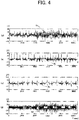
- Fig. 4 shows a graph of an example in which a maternal electromyogram is separated from electrocardiogram data.
- a measured signal 8a contains a large amount of electromyogram components in the later part, concealing the most amount of fetal electrocardiogram components.
- Fig. 4(b) shows an extracted fetal electrocardiogram component 8b
- Fig. 4(c) shows a maternal electrocardiogram component 8c
- Fig. 4(d) shows a maternal electromyogram component 8d. It can be found from these figures that the fetal electrocardiogram component 8b can be extracted, which is mostly concealed by the maternal electromyogram component 8d.
- the reference signal is created under the condition that the embedding dimension is a 12th dimension, the delay time ⁇ is 1 ms, and the sampling time period is 5000 ms, using the band-pass filters (temporal filters) of frequencies of 1 Hz and lower, 1 to 70 Hz, and 70 Hz and higher.
- the present invention is applicable to various fields such as analysis of fetal heart sound data, separation of maternal electromyogram from electrocardiogram data, and the like.
- the fetal heart sound extracting apparatus of the present invention can be utilized broadly as an inexpensive portable fetal monitoring apparatus.
- the target signal extracting apparatus of the present invention is applicable, for example, as a tool that allows proper extraction of target signals even when applied for fetal heart sound containing high noises as compared to the target signals.
Landscapes
- Health & Medical Sciences (AREA)
- Life Sciences & Earth Sciences (AREA)
- Medical Informatics (AREA)
- Veterinary Medicine (AREA)
- Public Health (AREA)
- Physics & Mathematics (AREA)
- General Health & Medical Sciences (AREA)
- Animal Behavior & Ethology (AREA)
- Heart & Thoracic Surgery (AREA)
- Engineering & Computer Science (AREA)
- Biomedical Technology (AREA)
- Surgery (AREA)
- Molecular Biology (AREA)
- Cardiology (AREA)
- Pathology (AREA)
- Biophysics (AREA)
- Gynecology & Obstetrics (AREA)
- Pregnancy & Childbirth (AREA)
- Acoustics & Sound (AREA)
- Reproductive Health (AREA)
- Pediatric Medicine (AREA)
- Physiology (AREA)
- Measuring Pulse, Heart Rate, Blood Pressure Or Blood Flow (AREA)
- Measurement And Recording Of Electrical Phenomena And Electrical Characteristics Of The Living Body (AREA)
Description
- The present invention relates to the technique for extracting target signals from time-series signals, and more specifically, to signal extraction using the independent component analysis with reference.
- A conventional fetal phonocardiogram basically monitors faint pulses emanating from a fetal heart using a microphone placed on a maternal body surface, and therefore the measurement is limited to be conducted in a resting environment with lower ambient noises for only a short time period, so that the technique hardly gains the attention these days and is considered to be an insufficient technique. However, with the advantages such as the feasibility with very low cost and the high safeness because fetal heart sound is obtained outside of a maternal body, it may be made to an effective technique that can easily monitor a fetal condition at home if the technique is provided to enable long-term monitoring even in a high-noise environment.
- Meanwhile, the independent component analysis has been established as a novel method of signal analysis that can extract target signals even in a high-noise environment where signals are feebler than noises. This is a method of signal analysis to separate signals based on a difference in probability distribution of the target signals using a plurality of measured signals, and offers incomparable characteristics that it can extract the target signals while preserving overall frequency components. In actual data, however, a measured signal may often be a single signal such as in the case of the fetal phonocardiogram, so that the development of independent component analysis for a single measured signal has been expected.
- As the independent component analysis for a single measured signal, a method of embedding the measured signals in a time-delay coordinate system has been proposed (see Non-Patent
Document 1 below). - This is the method of converting singular value decomposition in the time-delay coordinate system (see Non-Patent
Document 2 below) to the independent component analysis. Specifically, given that measured data x = (x1, x2, x3, ..., xN), m-dimensional data as described by Formula 1 is created using the time delay from x, and the singular value decomposition or the independent component analysis is conducted therefor to extract the target signals.
- However, as disclosed in
Non-Patent Document 3 below, this method has a disadvantage that the independent component analysis involves addition/subtraction within each row and therefore the mixture of time is caused, leading to randomness in time coordinates of the obtained analysis results. Although various attempts have been made to overcome this problem, a fundamental solution has not been found. - As disclosed in
Patent Document 1 below, for example, the inventors of the present invention have been studied on the independent component analysis with reference for searching target signals based on reference signals in the independent component analysis. -
- Patent Document 1:
JP 2006-204759 A - Non-Patent Document 1: A. Jimenez-Gonzalez and C. J. James, "Extracting sources from noisy abdominal phonograms: a single-channel blind source separation method", Med Biol Eng Comput, Vol. 47, pp. 655-664 (2009)
- Non-Patent Document 2: D. S. Broomhead and Gregory P. King, "Extracting Qualitative Dynamics from Experimental Data", Physica D, Vol. 20, pp. 217-236 (1986)
- Non-Patent Document 3: Yoshitaka KIMURA, Toshiaki HATAYA, Takuya ITO, Hiroshi TISAKA, Nobuo YAEGASHI, Mitsuyuki NAKAO, "Theoretical problems of the single-channel independent component analysis", Proceedings of the 24th Symposium on Biological and Physiological Engineering (2009)
- Non-patent Document 4: James C. J et al., "Mapping Scalp Topographies of Rhythmic EEG Activity using Temporal Decorrelation based Constrained ICA", Annual International Conference of the IEEE Engineering in Medicine and Biology Society, IEEE Engineering in Medicine and Biology Society, Annual Conference 2004, .
- As described above, there has been a problem in that the conventional analysis of fetal heart sound signals does not allow stable monitoring in a high-noise environment. In addition, independent component separation from a single measured signal was impossible.
- The present invention is directed to provide the extraction of target signals from a limited number of time-series signals.
- The present invention provides a signal extracting apparatus and method, as claimed.
- The signal extracting apparatus is constructed using computer hardware with a memory device or a processing unit (in many cases, also with an input device, an output device, or the like). The computer hardware may be constructed by a single device or a plurality of devices communicable with each other. This computer hardware achieves the signal extraction processing in many cases by causing the processing unit to execute a computer program (software) which is to be stored in the memory device, so as to control data communication between the memory device and the processing unit or data processing by the processing unit. The signal extraction processing can also be performed by implementing a portion of a signal extraction circuit or the entire circuit in a hardware form in the computer hardware.
- The signal input unit inputs the time-series signals. Typically, the input time-series signals are stored in the memory device. Although it is possible to use temporally continuous analog signals (analog data) as the time-series signals (time-series data), it is desirable to use temporally discrete digital signals (digital data) in consideration of easiness of the signal processing. The time-series signals are those containing a plurality of temporal elements, where the respective elements are arranged in temporal order by storing them in temporal order or relating them to time. There are one or more time-series signals to be input. An example where a plurality of signals are input includes an aspect to input one or more time-series signals considered to contain a sufficient number of target signals, or an aspect to use the time-series signals considered to contain a sufficient level of noises that are desirably removed from these time-series signals.
- The generating unit is a configuration to pre-process the signals prior to the processing of the independent component analysis with reference. The generating unit generates a plurality of time-series signals in a short temporal range (referred to as the short time-series signals) from the time-series signals. Although all the elements in the temporal range may be taken out in generating the short time-series signals, the elements may be discretely taken out in accordance with a setup rule. The processing of the generating unit includes generation of two or more short time-series signals where the selected elements have different but partially overlapping temporal ranges with each other. This processing is performed, for example, by shifting the temporal ranges (e.g. from T1 to T2) of the elements to be selected by a certain time interval ΔT (i.e. by selecting specific short time-series signals from the elements contained in the temporal range of time T1 to T2, selecting the second short time-series signals from the elements contained in the temporal range of T1 + ΔT to T2 + ΔT, and selecting the third short time-series signals from the elements contained in the temporal range of T1 + 2ΔT to T2 + 2ΔT).
- The reference signal creating unit creates the reference signal indicating the temporal characteristic of the independent signal to be extracted. An example of the temporal characteristic can include timing when peak or zero value appears, a shape of the peak, a pattern having appropriate frequency or a frequency band, and the like.
- The ICA-R unit performs the independent component analysis with reference for a plurality of the short time-series signals generated by the generating unit, based on the reference signal to extract the independent signal. The independent component analysis is the analysis to evaluate a certain independency between the signals (e.g. statistical independency) and extract a plurality of independent signals (which are also the time-series signals). In addition, the independent component analysis with reference is, upon extracting the independent signals, to define the characteristics to which one or more independent signals should correspond through the reference signals. Various ways of defining the characteristics are possible, including an aspect to define a threshold that should be exceeded by a degree of correlation between a reference signal and an independent signal. Typically, a plurality of independent signals to be extracted are partially or wholly stored or output, and utilized in the analysis of computer users or the like.
- The operation of this signal extracting apparatus corresponds to the generation of a plurality of short time-series signals (which can be considered to be measured data derived from a pseudo multichannel) from the input time-series signals to perform the independent component analysis with reference. As such, more number of the independent signals than the number of initially input time-series signals can be separated and extracted. Although a plurality of short time-series signals temporally overlap with each other, the temporal characteristics of the independent signals can be understood because part or all of these signals are extracted utilizing the characteristics in the timing-axis direction based on the reference signals. That is, while in the standard independent component analysis the columns may be interchanged and the timing at which each independent component is extracted may vary due to the extraction results of the independent components, in the independent component analysis with reference the independent components are extracted based on the reference signals and thus the mixture of time can be reduced.
- In an aspect of the signal extracting apparatus of the present invention, the independent signal to be extracted contains a signal that is considered to be autoregressive, and the generating unit generates a plurality of the short time-series signals having different but partially overlapping temporal ranges so that one or more short time-series signals are dependent on one or more other short time-series signals when interpreted based on the autoregressive relationship.
- Autoregressive means that a value of a signal at certain time can be described linearly using a value of the signal at certain previous time. In other words, a value of a signal at certain time can be described linearly using a value of the signal at certain following time. In addition, a constant term or an error term may be contained therein. The signals considered to be autoregressive are not required to be describable as an autoregressive model in a mathematically strict sense, and it may be sufficient to be the autoregressive model in an approximate sense. Types of signals that are analyzed by applying the autoregressive model would often be regarded to be autoregressive. If such an autoregressive characteristic is provided and more short time-series signals are created than the number of orders of autoregression (the number of timings to be dependent), these signals present dependent information. As illustrated in the embodiments, however, the independent component analysis can be performed in such cases as well.
- In an aspect of the signal extracting apparatus of the present invention, the generating unit generates m short time-series signals having n elements to generate a matrix X of elements n x m, and the ICA-R unit performs the independent component analysis with reference for the matrix X to calculate an independent component matrix Y of elements m x n having a plurality of independent signals as the elements and a matrix W of elements m x m in a matrix algebra relationship of Y = WX.
- In an aspect of the signal extracting apparatus of the present invention, a single time-series signal is input by the signal input unit. According to this aspect, when only a single time-series signal obtained by a single sensor is input, a plurality of independent signals contained in the time-series signal can also be extracted.
- In an aspect of the signal extracting apparatus of the present invention, the reference signal creating unit uses a temporal filter to generate, from the time-series signal, the reference signal indicating the temporal characteristics of the independent component to be extracted.
- In an aspect of the signal extracting apparatus of the present invention, the time-series signal is obtained by diagnosis of a living body, and the independent signal to be extracted includes a biosignal.
- In an aspect of the signal extracting apparatus of the present invention, the independent signal to be extracted includes a signal regarding fetal heart sound.
- In the present invention, any of the aspects [1] to [9] below is also possible.
- [1] A signal extracting apparatus including: a single-signal input unit to input a single time-series signal; a reference signal creating unit to create a reference signal; and a main processing unit to perform independent component analysis with reference for a single measured signal by capturing the reference signal obtained by the reference signal creating unit and providing timing-axis information for an algorithm in a reference system to extract an independent component.
- [2] The signal extracting apparatus according to [1] above including a separation matrix initial value processing unit that identifies an output signal obtained by the main processing unit to allow the subsequent analyses to be performed in a shorter time period.
- [3] The signal extracting apparatus according to [1] above, wherein the reference signal creating unit creates one or more reference signals preserving temporal information from the time-series signal obtained by the single-signal input unit using one or more band-pass filters.
- [4] The signal extracting apparatus according to [3] above, wherein the main processing unit includes an embedding dimensional space generating unit to generate an embedding dimensional space made from time delay from the time-series signal obtained by the single-signal input unit and an independent component analysis with reference (ICA-R) unit to perform independent component analysis with reference by capturing the reference signal obtained by the reference signal creating unit.
- [5] The signal extracting apparatus according to [4] above, wherein the embedding dimensional space generating unit extracts, from the time-series signals of which the time-series starts at the present time, time-series before 1-n at a τ time interval, then extracts similarly the time-series before 1-n that starts at point back to τ time before, subsequently extracts similarly the time-series before 1-n that starts at the point back to 2τ time before, and further subsequently extracts the time-series before 1-n that starts at the point back to mτ time before to generate a matrix X of m x n having these time-series as row vectors.
- [6] The signal extracting apparatus according to [5] above, wherein the main processing unit uses the reference signal obtained by the reference signal creating unit to calculate an independent component matrix Y of m x n and a matrix W of m x m that extracts the independent component from the matrix X by the independent component analysis with reference.
- [7] The signal extracting apparatus according to [1] above, wherein the time-series signal is a biosignal.
- [8] The signal extracting apparatus according to [7] above, wherein the target signal extracted from the biosignal is fetal heart sound.
- [9] The signal extracting apparatus according to [7] above, wherein the target signal extracted from the biosignal is maternal heart sound, a maternal breathing component, a fetal breathing component, fetal electrocardiogram, maternal electrocardiogram, or maternal electromyogram.
- Each aspect of the present invention can be described as the invention of a method of performing each processing, the invention of a program to cause a computer to perform the processing for each step, or the invention of a storage medium in which the program is recorded.
- According to the present invention, target signals can be extracted properly from one or more measured signals even in a high-noise environment.
- Also, when applied to fetal monitoring, it can provide a fetal heart sound extracting apparatus which is able to stably separate fetal heart sound.
-
-
Fig. 1 shows a schematic block diagram of a fetal heart sound extracting apparatus illustrating an embodiment of the present invention; -
Fig. 2 shows a schematic block diagram of a main processing unit of the fetal heart sound extracting apparatus illustrating an embodiment of the present invention; -
Fig. 3 shows a graph of an example in which fetal heart sound data is actually analyzed from phonocardiogram data, illustrating an embodiment of the present invention; and -
Fig. 4 shows a graph of an example in which maternal electromyogram is separated from electrocardiogram data, illustrating an embodiment of the present invention. - A signal extracting apparatus according to the present invention is characterized by including: a single-signal measuring unit to measure a measured signal as a single time-series signal containing a target signal obtained by measurement by a single channel; a reference signal creating unit to create a reference signal from the measured signal obtained by the single-signal measuring unit; a central processing unit; a memory device connected to the central processing unit; and a main processing unit to perform independent component analysis with reference for a single measured signal by capturing the reference signal obtained by the reference signal creating unit and providing timing-axis information to the measured signal in a reference system to extract an independent component.
- Hereinbelow, embodiments of the present invention will be described in reference to the drawings.
-
Fig. 1 shows a schematic block diagram of a fetal heart sound extracting apparatus illustrating an embodiment of the present invention, andFig. 2 shows a schematic block diagram of a main processing unit of the fetal heart sound extracting apparatus. - In
Fig. 1 ,reference numeral 1 denotes a fetal heart sound measuring unit to measure biosignals. Measured signals (x: x1, x2, x3, ..., xN) obtained by a measuring apparatus placed on a body surface of a maternal body B conceiving a fetal A is input to a referencesignal creating unit 2 which generates signals obtained through a frequency band-pass filter of a frequency band containing as many target signals as possible in order to extract the target signals, or signals such as functions of timing at which the target signals are produced as reference signals r in order to extract periodic signals such as fetal phonocardiogram. Here the reference signals r are created while a timing-axis is set to the present time. The apparatus inFig. 1 is also provided with acentral processing unit 3, and a memory device 4 connected to thecentral processing unit 3 and embedded with read only memory (ROM) for writing an operating program or reference values of computation results or random access memory (RAM) for storing various data. There are further provided amain processing unit 5, a separation matrix initialvalue processing unit 6, and aresult display unit 7 of themain processing unit 5. Themain processing unit 5 is configured to output an output signal So and return the signal back to the referencesignal creating unit 2, so as to confirm if the delay time is not shifted. In these figures, input and output ports of the respective units are omitted. - Next, in
Fig. 2 , themain processing unit 5 includes an embedding dimensionalspace generating unit 5a to generate multi-dimensional time-series, and an independent component analysis with reference (ICA-R)unit 5b for performing the independent component analysis with reference to compute a separation matrix W and independent component time-series Y from an initial matrix W0 obtained by the separation matrix initialvalue processing unit 6. The separation matrix W calculated at this point is input to the separation matrix initialvalue processing unit 6, and if a correlation coefficient between the independent component time-series Y and the reference signal r of the target signal such as the fetal heart sound is 0.7 or above, then input to the ICA-R unit 5b of themain processing unit 5 as the initial matrix W0 for iterative estimation used in themain processing unit 5. The correlation coefficient mentioned above is an arbitrary unit and ranges from -1 to 1. - Now, the principle to extract the signals in an embedding dimension N according to the single-signal independent component analysis for a single signal of the present invention will be described. That is, a method of separating the signals with different model orders containing noise signals when the autoregressive model is created by the autoregressive (AR) model method will be described.

x n is measured data from time n to time n+N-1 as described byFormula 2. Also,

- Now, consider the matrix X as described by
Formula 3 formed by the measured signals in the embedding space (embedding dimension N).
- Assumed that all the target signals are autoregressive (general Markov signals) and the order of each independent component including the noise components is different from each other. The number of measured data having the embedding dimension N to be prepared must be equal or more than the product of the order of the autoregressive model (the number of elements at other timings than the time at which the elements are described) and the number of independent components to be extracted. For example, if the order of the autoregressive model of the target signal is the fourth order and three target signals including the noise are to be separated, the required number of measured data would be 12. Hereafter, the explanation is made assuming that the order of the target signals is the fourth order for simplicity of explanation. Assuming that it can be described by

- Here, a factor to specify the timing can be inserted.
- Then, using a companion matrix A as described by Formula 4,

Formula 5 using a noise term


Formula 5 is applied to each column of n-4-1 and thereafter of the matrix X, the formula is similarly effective for different orders as well when i=2. Thus, the mixing ratio of the true independent components (here,
- Therefore, each column contains independent information and thus the target signals can be extracted successively using the independent component analysis for Y = WX, as shown in
Fig. 2 . - According to the present invention, the timing-axis information is provided for an algorithm in a reference system, so that the independent components are extracted in combination therewith and the mixture of time can be reduced in the independent component analysis with reference.
- Referring again to
Figs. 1 and 2 , the ICA-R unit 5b uses the iterative estimation to estimate the separation matrix W to separate the signals into the independent components by the independent component analysis with reference. At this point, a unit matrix is usually used as the initial matrix W0. However, there is an advantage that, after the same computation is performed using another data, using the separation matrix W as the result of the same processing performed previously instead of using the unit matrix as the initial matrix W0 can accelerate the convergence of the iterative estimation (for example, the time period can be reduced to approximately one-third for the iterative estimation), so that such a manner of iteration is utilized. - The separation matrix initial
value processing unit 6 verifies whether the separation matrix W as the result of the same processing performed previously and stored in the memory device 4 is effective as the separation matrix, based on the degree of the correlation coefficient, then determines if the separation of the fetal heart sound is possible to a certain degree when the separation matrix W is applied to the matrix X of m x n obtained using the time delay from the measured signal x. If the correlation coefficient between the separation matrix W and the reference signal equals to or greater than a given value (e.g. 0.7), the matrix is returned as the initial matrix W0 to the ICA-R unit 5b of themain processing unit 5 to perform the independent component analysis with reference. That is, in the case where the signals obtained by themain processing unit 5 are identified and the analysis is performed iteratively, themain processing unit 5 receives the return signals that serve to cut down the time period of analysis compared to the previous analysis. -
Fig. 3 shows a graph of an example in which fetal heart sound data is actually analyzed from phonocardiogram data illustrating an embodiment of the present invention. In this figure,Fig. 3(a) shows a measured signal,Fig. 3(b) shows a fluctuation component of maternal breathing,Fig. 3(c) shows a fetal heart sound component, andFig. 3(d) shows a fetal breathing component. - It can be seen that a fluctuation component of
maternal breathing 7b, a fetal heart sound component 7c, and afetal breathing component 7d are separated properly from each other. It can also be seen that, when considering a descending section (expiration section) of the fluctuation component ofmaternal breathing 7b, timing deviation among the respective independent components is not found unlike the case disclosed inNon-Patent Document 1, and the independent components are extracted while preserving the temporal consistency. In this example, the reference signal is created under the condition that the embedding dimension is a 30th dimension and the delay time τ is 1 ms, using the matrix W0 as a 30th-order unit square matrix and band-pass filters of frequencies of 0.1 to 1 Hz, 1 to 5 Hz, and 100 to 498 Hz. - This analysis is effective in any signal analyses other than the fetal heart sound analysis. In particular, it is suitable for separation of nonlinear time-series, such as chaos and a fractal signal. It is also effective in the case where noises are higher than signals.
-
Fig. 4 shows a graph of an example in which a maternal electromyogram is separated from electrocardiogram data. InFig. 4(a) , a measured signal 8a contains a large amount of electromyogram components in the later part, concealing the most amount of fetal electrocardiogram components.Fig. 4(b) shows an extractedfetal electrocardiogram component 8b,Fig. 4(c) shows amaternal electrocardiogram component 8c, andFig. 4(d) shows amaternal electromyogram component 8d. It can be found from these figures that thefetal electrocardiogram component 8b can be extracted, which is mostly concealed by thematernal electromyogram component 8d. In this example, the reference signal is created under the condition that the embedding dimension is a 12th dimension, the delay time τ is 1 ms, and the sampling time period is 5000 ms, using the band-pass filters (temporal filters) of frequencies of 1 Hz and lower, 1 to 70 Hz, and 70 Hz and higher. - As described above, the present invention is applicable to various fields such as analysis of fetal heart sound data, separation of maternal electromyogram from electrocardiogram data, and the like.
- In addition, the fetal heart sound extracting apparatus of the present invention can be utilized broadly as an inexpensive portable fetal monitoring apparatus.
- Although the embodiments above are described mainly in terms of the fetal heart sound extracting apparatus, the present invention is not limited thereto and applicable to the following as well.
-
- (1) Neural function analysis by separation of neural pulses;
- (2) Biological function analysis based on fluctuation analysis of fluctuation in cardiac rate or blood pressure;
- (3) Cellular function estimation based on fluctuation analysis of measured signals of single-molecule movement;
- (4) Method of removing noises for picked-up images obtained by a solid-state imaging sensor such as CCD and CMOS;
- (5) Method of removing noises for a television set such as a satellite television set;
- (6) Method of removing noises for a recording/reproducing apparatus of video signals or audio signals;
- (7) Method of removing noise components from transmission signals for various digital circuits such as a plant control apparatus; and
- (8) Method of removing noise components in signals obtained from various sensors such as an optical sensor, a magnetic sensor, and a gas sensor.
- The target signal extracting apparatus of the present invention is applicable, for example, as a tool that allows proper extraction of target signals even when applied for fetal heart sound containing high noises as compared to the target signals.
Claims (8)
- A signal extracting apparatus for extracting an independent signal from a single time series signal, comprising:a signal input unit configured to input a single time-series signal obtained by a single sensor in which elements of the signal are arranged in temporal order;a generating unit (5a) configured to generate a plurality of short time-series signals by selecting the elements from the time-series signal, wherein the generation unit is configured to generate from the time-series signal two or more short time-series signals where the selected elements have different but partially overlapping temporal ranges with each other;a reference signal creating unit (2) configured to create a reference signal indicating a temporal characteristic of an independent signal to be extracted; andan independent component analysis with reference (ICA-R) unit (5b) configured to perform independent component analysis with reference for the plurality of the short time-series signals generated by the generating unit based on the reference signal, to extract the independent signal.
- The signal extracting apparatus according to claim 1, whereinthe independent signal to be extracted contains a signal that is considered to be autoregressive, andthe generating unit (5a) is configured to generate a plurality of the short time-series signals having different but partially overlapping temporal ranges so that one or more short time-series signals are dependent on one or more other short time-series signals when interpreted based on the autoregressive relationship.
- The signal extracting apparatus according to claim 1, whereinthe generating unit (5a) is configured to generate m short time-series signals having n elements to generate a matrix X of elements n x m, andthe ICA-R unit (5b) is configured to perform the independent component analysis with reference for the matrix X to calculate an independent component matrix Y of elements m x n having a plurality of independent signals as the elements and a matrix W of elements m x m in a matrix algebra relationship of Y = WX.
- The signal extracting apparatus according to claim 1, wherein the reference signal creating unit (2) is configured to use a temporal filter to generate, from the time-series signal, the reference signal indicating the temporal characteristics of the independent component to be extracted.
- The signal extracting apparatus according to claim 1, wherein the apparatus is configured to obtain the time-series signal by diagnosis of a living body, and the independent signal to be extracted includes a biosignal.
- The signal extracting apparatus according to claim 5, wherein the independent signal to be extracted includes a signal regarding fetal heart sound.
- A signal extracting method for a computer, comprising the steps of, using a computer:inputting a single time-series signal which has been obtained by a single sensor in which elements of the signal are arranged in temporal order;generating a plurality of short time-series signals by selecting the elements from the time-series signal, wherein the time-series signal generates two or more short time-series signals where the selected elements have different but partially overlapping temporal ranges with each other;creating a reference signal indicating a temporal characteristic of an independent signal to be extracted; andperforming independent component analysis with reference for a plurality of the short time-series signals generated at the generating step based on the reference signal to extract the independent signal.
- A computer readable medium comprising instructions for performing the method of claim 7 when executed in a computer.
Applications Claiming Priority (2)
| Application Number | Priority Date | Filing Date | Title |
|---|---|---|---|
| JP2009216716 | 2009-09-18 | ||
| PCT/JP2010/005687 WO2011033784A1 (en) | 2009-09-18 | 2010-09-17 | Signal extracting apparatus |
Publications (3)
| Publication Number | Publication Date |
|---|---|
| EP2478835A1 EP2478835A1 (en) | 2012-07-25 |
| EP2478835A4 EP2478835A4 (en) | 2016-01-06 |
| EP2478835B1 true EP2478835B1 (en) | 2018-01-10 |
Family
ID=43758398
Family Applications (1)
| Application Number | Title | Priority Date | Filing Date |
|---|---|---|---|
| EP10816898.0A Active EP2478835B1 (en) | 2009-09-18 | 2010-09-17 | Signal extracting apparatus, method and computer program |
Country Status (4)
| Country | Link |
|---|---|
| US (1) | US8808192B2 (en) |
| EP (1) | EP2478835B1 (en) |
| JP (1) | JP5769309B2 (en) |
| WO (1) | WO2011033784A1 (en) |
Families Citing this family (30)
| Publication number | Priority date | Publication date | Assignee | Title |
|---|---|---|---|---|
| CN103845079B (en) * | 2014-02-14 | 2015-12-30 | 广东工业大学 | A kind of detection method of the Doppler's fetal heart sound instantaneous heart rate based on blind separation |
| US9895110B2 (en) * | 2014-09-11 | 2018-02-20 | Industrial Technology Research Institute | Exercise physiological sensing system, motion artifact suppression processing method and device |
| CN104382614A (en) * | 2014-12-09 | 2015-03-04 | 重庆邮电大学 | Heart and lung sound signal separation method and device based on fast ICA (independent component analysis) |
| WO2016170435A2 (en) * | 2015-03-16 | 2016-10-27 | Nuvo Group Ltd. | Continuous non-invasive monitoring of a pregnant human subject |
| US10404299B1 (en) | 2016-03-07 | 2019-09-03 | Hrl Laboratories, Llc | System for parallelized cognitive signal denoising |
| US10484043B1 (en) | 2015-03-19 | 2019-11-19 | Hrl Laboratories, Llc | Adaptive blind source separator for ultra-wide bandwidth signal tracking |
| US11037057B1 (en) * | 2017-05-03 | 2021-06-15 | Hrl Laboratories, Llc | Cognitive signal processor |
| US10712425B1 (en) * | 2015-03-19 | 2020-07-14 | Hrl Laboratories, Llc | Cognitive denoising of nonstationary signals using time varying reservoir computer |
| US9749007B1 (en) * | 2015-03-19 | 2017-08-29 | Hrl Laboratories, Llc | Cognitive blind source separator |
| US10128820B2 (en) * | 2015-03-19 | 2018-11-13 | Hrl Laboratories, Llc | Cognitive signal processor for simultaneous denoising and blind source separation |
| US10720949B1 (en) * | 2015-03-19 | 2020-07-21 | Hrl Laboratories, Llc | Real-time time-difference-of-arrival (TDOA) estimation via multi-input cognitive signal processor |
| US10153806B1 (en) * | 2015-03-19 | 2018-12-11 | Hrl Laboratories, Llc | Cognitive architecture for wideband, low-power, real-time signal denoising |
| US10380062B1 (en) * | 2015-03-19 | 2019-08-13 | Hrl Laboratories, Llc | Efficient cognitive signal denoising with sparse output layers |
| US10162378B1 (en) * | 2015-03-19 | 2018-12-25 | Hrl Laboratories, Llc | Neuromorphic processor for wideband signal analysis |
| WO2016157457A1 (en) * | 2015-03-31 | 2016-10-06 | 国立大学法人東北大学 | Image processing device, image processing method, and image processing program |
| WO2016173639A1 (en) * | 2015-04-29 | 2016-11-03 | Brainlab Ag | Detection of the heartbeat in cranial accelerometer data using independent component analysis |
| US10783430B2 (en) | 2016-09-26 | 2020-09-22 | The Boeing Company | Signal removal to examine a spectrum of another signal |
| US10921422B2 (en) | 2017-10-25 | 2021-02-16 | The Boeing Company | Below-noise after transmit (BAT) Chirp Radar |
| CN112020323B (en) * | 2018-04-23 | 2023-06-13 | 夏普株式会社 | Data analysis device |
| US11002819B2 (en) | 2018-04-24 | 2021-05-11 | The Boeing Company | Angular resolution of targets using separate radar receivers |
| JP6649982B2 (en) * | 2018-05-10 | 2020-02-19 | アトムメディカル株式会社 | Fetal ECG signal processing method and fetal ECG signal processing device |
| US11531639B2 (en) | 2018-07-26 | 2022-12-20 | The Boeing Company | Pipelined cognitive signal processor |
| CN111160317B (en) * | 2020-01-06 | 2023-03-28 | 西南电子技术研究所(中国电子科技集团公司第十研究所) | Weak signal blind extraction method |
| US12566244B1 (en) * | 2020-07-13 | 2026-03-03 | Hrl Laboratories, Llc | System and method for real-time radar range-doppler map learning |
| US11863221B1 (en) | 2020-07-14 | 2024-01-02 | Hrl Laboratories, Llc | Low size, weight and power (swap) efficient hardware implementation of a wide instantaneous bandwidth neuromorphic adaptive core (NeurACore) |
| US12499355B1 (en) | 2020-07-13 | 2025-12-16 | Hrl Laboratories, Llc | Complex neuromorphic adaptive core (neuracore) and physics enhanced neuromorphic adaptive controller |
| US12057989B1 (en) * | 2020-07-14 | 2024-08-06 | Hrl Laboratories, Llc | Ultra-wide instantaneous bandwidth complex neuromorphic adaptive core processor |
| KR102241799B1 (en) * | 2020-08-06 | 2021-04-19 | 주식회사 에이티센스 | Method and electronic apparatus for providing classfication data of ecg detection signal |
| JP2023110421A (en) * | 2022-01-28 | 2023-08-09 | 日本光電工業株式会社 | Biological information processing method, biological information processing device, program and storage medium |
| CN114403831B (en) * | 2022-03-25 | 2022-06-14 | 广东玖智科技有限公司 | PPG waveform pulse extraction method and device |
Family Cites Families (5)
| Publication number | Priority date | Publication date | Assignee | Title |
|---|---|---|---|---|
| US20060161071A1 (en) * | 1997-01-27 | 2006-07-20 | Lynn Lawrence A | Time series objectification system and method |
| US7314451B2 (en) * | 2005-04-25 | 2008-01-01 | Earlysense Ltd. | Techniques for prediction and monitoring of clinical episodes |
| JP4590554B2 (en) | 2005-01-31 | 2010-12-01 | 国立大学法人東北大学 | ECG signal processing method and ECG signal processing apparatus |
| WO2009110051A1 (en) * | 2008-03-03 | 2009-09-11 | 株式会社 東北テクノアーチ | On-line vital signal processing method effective during fetal movement and its apparatus |
| JP5161671B2 (en) * | 2008-06-25 | 2013-03-13 | 国立大学法人東北大学 | Biological condition evaluation apparatus and biological evaluation signal calculation method |
-
2010
- 2010-09-17 JP JP2011531797A patent/JP5769309B2/en not_active Expired - Fee Related
- 2010-09-17 WO PCT/JP2010/005687 patent/WO2011033784A1/en not_active Ceased
- 2010-09-17 US US13/496,586 patent/US8808192B2/en active Active
- 2010-09-17 EP EP10816898.0A patent/EP2478835B1/en active Active
Non-Patent Citations (1)
| Title |
|---|
| None * |
Also Published As
| Publication number | Publication date |
|---|---|
| WO2011033784A1 (en) | 2011-03-24 |
| EP2478835A1 (en) | 2012-07-25 |
| EP2478835A4 (en) | 2016-01-06 |
| JPWO2011033784A1 (en) | 2013-02-07 |
| JP5769309B2 (en) | 2015-08-26 |
| US20120232418A1 (en) | 2012-09-13 |
| US8808192B2 (en) | 2014-08-19 |
Similar Documents
| Publication | Publication Date | Title |
|---|---|---|
| US8808192B2 (en) | Signal extracting apparatus | |
| Ramdani et al. | On the use of sample entropy to analyze human postural sway data | |
| EP1804652B1 (en) | A method and system for managing physiological system | |
| CN110236573B (en) | Psychological stress state detection method and related device | |
| James et al. | Extracting multisource brain activity from a single electromagnetic channel | |
| Panigrahy et al. | Extraction of fetal ECG signal by an improved method using extended Kalman smoother framework from single channel abdominal ECG signal | |
| Kumar et al. | Design of efficient fractional operator for ECG signal detection in implantable cardiac pacemaker systems | |
| JP2007522536A (en) | Dynamic blind signal separation | |
| NL2002510C2 (en) | Extrapolating ica knowledge from one epoch to another for improved fetal ecg separation. | |
| Revach et al. | HKF: Hierarchical Kalman filtering with online learned evolution priors for adaptive ECG denoising | |
| CN117752336B (en) | Training method of human factor intelligent physiological state recognition model, physiological state recognition method, device and equipment | |
| Zhang et al. | A fast adaptive LPCA method for fetal ECG extraction based on multichannel signals | |
| WO2009110051A1 (en) | On-line vital signal processing method effective during fetal movement and its apparatus | |
| Vulaj et al. | A tool for ECG signal analysis using standard and optimized Hermite transform | |
| Phaudphut et al. | A parallel probabilistic neural network ECG recognition architecture over GPU platforms | |
| KR20150097167A (en) | An electrocardiogram (ecg) sensor and a method of operating the same | |
| Hornero et al. | Nonlinear analysis of time series generated by schizophrenic patients | |
| Augustyniak | A robust heartbeat detector not depending on ECG sampling rate | |
| Castiglioni | Levinson-durbin algorithm | |
| RU2359606C2 (en) | Method of determning cardio cycle beginning | |
| US8457723B2 (en) | Heart rate detection in high noise conditions | |
| KR20170054030A (en) | Method and apparatus of extracting feature of biomedical signal | |
| Gbaoui et al. | Estimation of central blood pressure waveform from femoral blood pressure waveform by blind sources separation | |
| Farhadi et al. | Realtime heart rate monitoring using photoplethysmographic (ppg) signals during intensive physical exercises | |
| Usman et al. | A study of heartbeat sound separation using independent component analysis technique |
Legal Events
| Date | Code | Title | Description |
|---|---|---|---|
| PUAI | Public reference made under article 153(3) epc to a published international application that has entered the european phase |
Free format text: ORIGINAL CODE: 0009012 |
|
| 17P | Request for examination filed |
Effective date: 20120316 |
|
| AK | Designated contracting states |
Kind code of ref document: A1 Designated state(s): AL AT BE BG CH CY CZ DE DK EE ES FI FR GB GR HR HU IE IS IT LI LT LU LV MC MK MT NL NO PL PT RO SE SI SK SM TR |
|
| DAX | Request for extension of the european patent (deleted) | ||
| RA4 | Supplementary search report drawn up and despatched (corrected) |
Effective date: 20151207 |
|
| RIC1 | Information provided on ipc code assigned before grant |
Ipc: A61B 5/0452 20060101ALI20151130BHEP Ipc: A61B 5/025 20060101AFI20151130BHEP Ipc: A61B 5/0444 20060101ALI20151130BHEP Ipc: A61B 7/04 20060101ALI20151130BHEP |
|
| 17Q | First examination report despatched |
Effective date: 20161115 |
|
| GRAP | Despatch of communication of intention to grant a patent |
Free format text: ORIGINAL CODE: EPIDOSNIGR1 |
|
| INTG | Intention to grant announced |
Effective date: 20170712 |
|
| GRAJ | Information related to disapproval of communication of intention to grant by the applicant or resumption of examination proceedings by the epo deleted |
Free format text: ORIGINAL CODE: EPIDOSDIGR1 |
|
| GRAR | Information related to intention to grant a patent recorded |
Free format text: ORIGINAL CODE: EPIDOSNIGR71 |
|
| GRAS | Grant fee paid |
Free format text: ORIGINAL CODE: EPIDOSNIGR3 |
|
| GRAA | (expected) grant |
Free format text: ORIGINAL CODE: 0009210 |
|
| INTC | Intention to grant announced (deleted) | ||
| AK | Designated contracting states |
Kind code of ref document: B1 Designated state(s): AL AT BE BG CH CY CZ DE DK EE ES FI FR GB GR HR HU IE IS IT LI LT LU LV MC MK MT NL NO PL PT RO SE SI SK SM TR |
|
| INTG | Intention to grant announced |
Effective date: 20171204 |
|
| REG | Reference to a national code |
Ref country code: GB Ref legal event code: FG4D |
|
| REG | Reference to a national code |
Ref country code: CH Ref legal event code: EP Ref country code: AT Ref legal event code: REF Ref document number: 961503 Country of ref document: AT Kind code of ref document: T Effective date: 20180115 |
|
| REG | Reference to a national code |
Ref country code: IE Ref legal event code: FG4D |
|
| REG | Reference to a national code |
Ref country code: DE Ref legal event code: R096 Ref document number: 602010048020 Country of ref document: DE |
|
| REG | Reference to a national code |
Ref country code: NL Ref legal event code: MP Effective date: 20180110 |
|
| REG | Reference to a national code |
Ref country code: AT Ref legal event code: MK05 Ref document number: 961503 Country of ref document: AT Kind code of ref document: T Effective date: 20180110 |
|
| PG25 | Lapsed in a contracting state [announced via postgrant information from national office to epo] |
Ref country code: NL Free format text: LAPSE BECAUSE OF FAILURE TO SUBMIT A TRANSLATION OF THE DESCRIPTION OR TO PAY THE FEE WITHIN THE PRESCRIBED TIME-LIMIT Effective date: 20180110 |
|
| PG25 | Lapsed in a contracting state [announced via postgrant information from national office to epo] |
Ref country code: ES Free format text: LAPSE BECAUSE OF FAILURE TO SUBMIT A TRANSLATION OF THE DESCRIPTION OR TO PAY THE FEE WITHIN THE PRESCRIBED TIME-LIMIT Effective date: 20180110 Ref country code: NO Free format text: LAPSE BECAUSE OF FAILURE TO SUBMIT A TRANSLATION OF THE DESCRIPTION OR TO PAY THE FEE WITHIN THE PRESCRIBED TIME-LIMIT Effective date: 20180410 Ref country code: HR Free format text: LAPSE BECAUSE OF FAILURE TO SUBMIT A TRANSLATION OF THE DESCRIPTION OR TO PAY THE FEE WITHIN THE PRESCRIBED TIME-LIMIT Effective date: 20180110 Ref country code: FI Free format text: LAPSE BECAUSE OF FAILURE TO SUBMIT A TRANSLATION OF THE DESCRIPTION OR TO PAY THE FEE WITHIN THE PRESCRIBED TIME-LIMIT Effective date: 20180110 Ref country code: LT Free format text: LAPSE BECAUSE OF FAILURE TO SUBMIT A TRANSLATION OF THE DESCRIPTION OR TO PAY THE FEE WITHIN THE PRESCRIBED TIME-LIMIT Effective date: 20180110 Ref country code: CY Free format text: LAPSE BECAUSE OF FAILURE TO SUBMIT A TRANSLATION OF THE DESCRIPTION OR TO PAY THE FEE WITHIN THE PRESCRIBED TIME-LIMIT Effective date: 20180110 |
|
| REG | Reference to a national code |
Ref country code: FR Ref legal event code: PLFP Year of fee payment: 9 |
|
| PG25 | Lapsed in a contracting state [announced via postgrant information from national office to epo] |
Ref country code: BG Free format text: LAPSE BECAUSE OF FAILURE TO SUBMIT A TRANSLATION OF THE DESCRIPTION OR TO PAY THE FEE WITHIN THE PRESCRIBED TIME-LIMIT Effective date: 20180410 Ref country code: GR Free format text: LAPSE BECAUSE OF FAILURE TO SUBMIT A TRANSLATION OF THE DESCRIPTION OR TO PAY THE FEE WITHIN THE PRESCRIBED TIME-LIMIT Effective date: 20180411 Ref country code: LV Free format text: LAPSE BECAUSE OF FAILURE TO SUBMIT A TRANSLATION OF THE DESCRIPTION OR TO PAY THE FEE WITHIN THE PRESCRIBED TIME-LIMIT Effective date: 20180110 Ref country code: SE Free format text: LAPSE BECAUSE OF FAILURE TO SUBMIT A TRANSLATION OF THE DESCRIPTION OR TO PAY THE FEE WITHIN THE PRESCRIBED TIME-LIMIT Effective date: 20180110 Ref country code: IS Free format text: LAPSE BECAUSE OF FAILURE TO SUBMIT A TRANSLATION OF THE DESCRIPTION OR TO PAY THE FEE WITHIN THE PRESCRIBED TIME-LIMIT Effective date: 20180510 Ref country code: PL Free format text: LAPSE BECAUSE OF FAILURE TO SUBMIT A TRANSLATION OF THE DESCRIPTION OR TO PAY THE FEE WITHIN THE PRESCRIBED TIME-LIMIT Effective date: 20180110 Ref country code: AT Free format text: LAPSE BECAUSE OF FAILURE TO SUBMIT A TRANSLATION OF THE DESCRIPTION OR TO PAY THE FEE WITHIN THE PRESCRIBED TIME-LIMIT Effective date: 20180110 |
|
| REG | Reference to a national code |
Ref country code: DE Ref legal event code: R097 Ref document number: 602010048020 Country of ref document: DE |
|
| PG25 | Lapsed in a contracting state [announced via postgrant information from national office to epo] |
Ref country code: RO Free format text: LAPSE BECAUSE OF FAILURE TO SUBMIT A TRANSLATION OF THE DESCRIPTION OR TO PAY THE FEE WITHIN THE PRESCRIBED TIME-LIMIT Effective date: 20180110 Ref country code: EE Free format text: LAPSE BECAUSE OF FAILURE TO SUBMIT A TRANSLATION OF THE DESCRIPTION OR TO PAY THE FEE WITHIN THE PRESCRIBED TIME-LIMIT Effective date: 20180110 Ref country code: IT Free format text: LAPSE BECAUSE OF FAILURE TO SUBMIT A TRANSLATION OF THE DESCRIPTION OR TO PAY THE FEE WITHIN THE PRESCRIBED TIME-LIMIT Effective date: 20180110 Ref country code: AL Free format text: LAPSE BECAUSE OF FAILURE TO SUBMIT A TRANSLATION OF THE DESCRIPTION OR TO PAY THE FEE WITHIN THE PRESCRIBED TIME-LIMIT Effective date: 20180110 |
|
| PLBE | No opposition filed within time limit |
Free format text: ORIGINAL CODE: 0009261 |
|
| STAA | Information on the status of an ep patent application or granted ep patent |
Free format text: STATUS: NO OPPOSITION FILED WITHIN TIME LIMIT |
|
| PG25 | Lapsed in a contracting state [announced via postgrant information from national office to epo] |
Ref country code: CZ Free format text: LAPSE BECAUSE OF FAILURE TO SUBMIT A TRANSLATION OF THE DESCRIPTION OR TO PAY THE FEE WITHIN THE PRESCRIBED TIME-LIMIT Effective date: 20180110 Ref country code: SK Free format text: LAPSE BECAUSE OF FAILURE TO SUBMIT A TRANSLATION OF THE DESCRIPTION OR TO PAY THE FEE WITHIN THE PRESCRIBED TIME-LIMIT Effective date: 20180110 Ref country code: SM Free format text: LAPSE BECAUSE OF FAILURE TO SUBMIT A TRANSLATION OF THE DESCRIPTION OR TO PAY THE FEE WITHIN THE PRESCRIBED TIME-LIMIT Effective date: 20180110 Ref country code: DK Free format text: LAPSE BECAUSE OF FAILURE TO SUBMIT A TRANSLATION OF THE DESCRIPTION OR TO PAY THE FEE WITHIN THE PRESCRIBED TIME-LIMIT Effective date: 20180110 |
|
| 26N | No opposition filed |
Effective date: 20181011 |
|
| PG25 | Lapsed in a contracting state [announced via postgrant information from national office to epo] |
Ref country code: SI Free format text: LAPSE BECAUSE OF FAILURE TO SUBMIT A TRANSLATION OF THE DESCRIPTION OR TO PAY THE FEE WITHIN THE PRESCRIBED TIME-LIMIT Effective date: 20180110 |
|
| PG25 | Lapsed in a contracting state [announced via postgrant information from national office to epo] |
Ref country code: MC Free format text: LAPSE BECAUSE OF FAILURE TO SUBMIT A TRANSLATION OF THE DESCRIPTION OR TO PAY THE FEE WITHIN THE PRESCRIBED TIME-LIMIT Effective date: 20180110 |
|
| REG | Reference to a national code |
Ref country code: CH Ref legal event code: PL |
|
| REG | Reference to a national code |
Ref country code: BE Ref legal event code: MM Effective date: 20180930 |
|
| REG | Reference to a national code |
Ref country code: IE Ref legal event code: MM4A |
|
| PG25 | Lapsed in a contracting state [announced via postgrant information from national office to epo] |
Ref country code: LU Free format text: LAPSE BECAUSE OF NON-PAYMENT OF DUE FEES Effective date: 20180917 |
|
| PG25 | Lapsed in a contracting state [announced via postgrant information from national office to epo] |
Ref country code: IE Free format text: LAPSE BECAUSE OF NON-PAYMENT OF DUE FEES Effective date: 20180917 |
|
| PG25 | Lapsed in a contracting state [announced via postgrant information from national office to epo] |
Ref country code: BE Free format text: LAPSE BECAUSE OF NON-PAYMENT OF DUE FEES Effective date: 20180930 Ref country code: LI Free format text: LAPSE BECAUSE OF NON-PAYMENT OF DUE FEES Effective date: 20180930 Ref country code: CH Free format text: LAPSE BECAUSE OF NON-PAYMENT OF DUE FEES Effective date: 20180930 |
|
| PG25 | Lapsed in a contracting state [announced via postgrant information from national office to epo] |
Ref country code: MT Free format text: LAPSE BECAUSE OF NON-PAYMENT OF DUE FEES Effective date: 20180917 |
|
| PG25 | Lapsed in a contracting state [announced via postgrant information from national office to epo] |
Ref country code: TR Free format text: LAPSE BECAUSE OF FAILURE TO SUBMIT A TRANSLATION OF THE DESCRIPTION OR TO PAY THE FEE WITHIN THE PRESCRIBED TIME-LIMIT Effective date: 20180110 |
|
| PG25 | Lapsed in a contracting state [announced via postgrant information from national office to epo] |
Ref country code: HU Free format text: LAPSE BECAUSE OF FAILURE TO SUBMIT A TRANSLATION OF THE DESCRIPTION OR TO PAY THE FEE WITHIN THE PRESCRIBED TIME-LIMIT; INVALID AB INITIO Effective date: 20100917 Ref country code: PT Free format text: LAPSE BECAUSE OF FAILURE TO SUBMIT A TRANSLATION OF THE DESCRIPTION OR TO PAY THE FEE WITHIN THE PRESCRIBED TIME-LIMIT Effective date: 20180110 |
|
| PG25 | Lapsed in a contracting state [announced via postgrant information from national office to epo] |
Ref country code: MK Free format text: LAPSE BECAUSE OF NON-PAYMENT OF DUE FEES Effective date: 20180110 |
|
| PGFP | Annual fee paid to national office [announced via postgrant information from national office to epo] |
Ref country code: FR Payment date: 20220808 Year of fee payment: 13 |
|
| PG25 | Lapsed in a contracting state [announced via postgrant information from national office to epo] |
Ref country code: FR Free format text: LAPSE BECAUSE OF NON-PAYMENT OF DUE FEES Effective date: 20230930 |
|
| PGFP | Annual fee paid to national office [announced via postgrant information from national office to epo] |
Ref country code: DE Payment date: 20250730 Year of fee payment: 16 |
|
| PGFP | Annual fee paid to national office [announced via postgrant information from national office to epo] |
Ref country code: GB Payment date: 20250731 Year of fee payment: 16 |