EP2478067B1 - Electroluminescent materials and devices - Google Patents
Electroluminescent materials and devices Download PDFInfo
- Publication number
- EP2478067B1 EP2478067B1 EP10766246.2A EP10766246A EP2478067B1 EP 2478067 B1 EP2478067 B1 EP 2478067B1 EP 10766246 A EP10766246 A EP 10766246A EP 2478067 B1 EP2478067 B1 EP 2478067B1
- Authority
- EP
- European Patent Office
- Prior art keywords
- polymer according
- electroluminescent polymer
- electroluminescent
- repeat units
- polymer
- Prior art date
- Legal status (The legal status is an assumption and is not a legal conclusion. Google has not performed a legal analysis and makes no representation as to the accuracy of the status listed.)
- Not-in-force
Links
- 0 CC*c1c(*c2c(*)c(*C)c(*)c(*)c2*2)c2c(*)c(*)c1CC Chemical compound CC*c1c(*c2c(*)c(*C)c(*)c(*)c2*2)c2c(*)c(*)c1CC 0.000 description 1
Images



Classifications
-
- C—CHEMISTRY; METALLURGY
- C09—DYES; PAINTS; POLISHES; NATURAL RESINS; ADHESIVES; COMPOSITIONS NOT OTHERWISE PROVIDED FOR; APPLICATIONS OF MATERIALS NOT OTHERWISE PROVIDED FOR
- C09K—MATERIALS FOR MISCELLANEOUS APPLICATIONS, NOT PROVIDED FOR ELSEWHERE
- C09K11/00—Luminescent materials, e.g. electroluminescent or chemiluminescent
- C09K11/06—Luminescent materials, e.g. electroluminescent or chemiluminescent containing organic luminescent materials
-
- C—CHEMISTRY; METALLURGY
- C08—ORGANIC MACROMOLECULAR COMPOUNDS; THEIR PREPARATION OR CHEMICAL WORKING-UP; COMPOSITIONS BASED THEREON
- C08G—MACROMOLECULAR COMPOUNDS OBTAINED OTHERWISE THAN BY REACTIONS ONLY INVOLVING UNSATURATED CARBON-TO-CARBON BONDS
- C08G61/00—Macromolecular compounds obtained by reactions forming a carbon-to-carbon link in the main chain of the macromolecule
- C08G61/12—Macromolecular compounds containing atoms other than carbon in the main chain of the macromolecule
- C08G61/122—Macromolecular compounds containing atoms other than carbon in the main chain of the macromolecule derived from five- or six-membered heterocyclic compounds, other than imides
- C08G61/123—Macromolecular compounds containing atoms other than carbon in the main chain of the macromolecule derived from five- or six-membered heterocyclic compounds, other than imides derived from five-membered heterocyclic compounds
- C08G61/126—Macromolecular compounds containing atoms other than carbon in the main chain of the macromolecule derived from five- or six-membered heterocyclic compounds, other than imides derived from five-membered heterocyclic compounds with a five-membered ring containing one sulfur atom in the ring
-
- C—CHEMISTRY; METALLURGY
- C08—ORGANIC MACROMOLECULAR COMPOUNDS; THEIR PREPARATION OR CHEMICAL WORKING-UP; COMPOSITIONS BASED THEREON
- C08G—MACROMOLECULAR COMPOUNDS OBTAINED OTHERWISE THAN BY REACTIONS ONLY INVOLVING UNSATURATED CARBON-TO-CARBON BONDS
- C08G61/00—Macromolecular compounds obtained by reactions forming a carbon-to-carbon link in the main chain of the macromolecule
- C08G61/12—Macromolecular compounds containing atoms other than carbon in the main chain of the macromolecule
-
- C—CHEMISTRY; METALLURGY
- C09—DYES; PAINTS; POLISHES; NATURAL RESINS; ADHESIVES; COMPOSITIONS NOT OTHERWISE PROVIDED FOR; APPLICATIONS OF MATERIALS NOT OTHERWISE PROVIDED FOR
- C09B—ORGANIC DYES OR CLOSELY-RELATED COMPOUNDS FOR PRODUCING DYES, e.g. PIGMENTS; MORDANTS; LAKES
- C09B57/00—Other synthetic dyes of known constitution
- C09B57/10—Metal complexes of organic compounds not being dyes in uncomplexed form
-
- C—CHEMISTRY; METALLURGY
- C09—DYES; PAINTS; POLISHES; NATURAL RESINS; ADHESIVES; COMPOSITIONS NOT OTHERWISE PROVIDED FOR; APPLICATIONS OF MATERIALS NOT OTHERWISE PROVIDED FOR
- C09B—ORGANIC DYES OR CLOSELY-RELATED COMPOUNDS FOR PRODUCING DYES, e.g. PIGMENTS; MORDANTS; LAKES
- C09B69/00—Dyes not provided for by a single group of this subclass
- C09B69/10—Polymeric dyes; Reaction products of dyes with monomers or with macromolecular compounds
- C09B69/105—Polymeric dyes; Reaction products of dyes with monomers or with macromolecular compounds containing a methine or polymethine dye
-
- C—CHEMISTRY; METALLURGY
- C09—DYES; PAINTS; POLISHES; NATURAL RESINS; ADHESIVES; COMPOSITIONS NOT OTHERWISE PROVIDED FOR; APPLICATIONS OF MATERIALS NOT OTHERWISE PROVIDED FOR
- C09B—ORGANIC DYES OR CLOSELY-RELATED COMPOUNDS FOR PRODUCING DYES, e.g. PIGMENTS; MORDANTS; LAKES
- C09B69/00—Dyes not provided for by a single group of this subclass
- C09B69/10—Polymeric dyes; Reaction products of dyes with monomers or with macromolecular compounds
- C09B69/109—Polymeric dyes; Reaction products of dyes with monomers or with macromolecular compounds containing other specific dyes
-
- H—ELECTRICITY
- H05—ELECTRIC TECHNIQUES NOT OTHERWISE PROVIDED FOR
- H05B—ELECTRIC HEATING; ELECTRIC LIGHT SOURCES NOT OTHERWISE PROVIDED FOR; CIRCUIT ARRANGEMENTS FOR ELECTRIC LIGHT SOURCES, IN GENERAL
- H05B33/00—Electroluminescent light sources
- H05B33/12—Light sources with substantially two-dimensional [2D] radiating surfaces
- H05B33/14—Light sources with substantially two-dimensional [2D] radiating surfaces characterised by the chemical or physical composition or the arrangement of the electroluminescent material, or by the simultaneous addition of the electroluminescent material in or onto the light source
-
- H—ELECTRICITY
- H10—SEMICONDUCTOR DEVICES; ELECTRIC SOLID-STATE DEVICES NOT OTHERWISE PROVIDED FOR
- H10K—ORGANIC ELECTRIC SOLID-STATE DEVICES
- H10K50/00—Organic light-emitting devices
- H10K50/10—OLEDs or polymer light-emitting diodes [PLED]
- H10K50/11—OLEDs or polymer light-emitting diodes [PLED] characterised by the electroluminescent [EL] layers
-
- H—ELECTRICITY
- H10—SEMICONDUCTOR DEVICES; ELECTRIC SOLID-STATE DEVICES NOT OTHERWISE PROVIDED FOR
- H10K—ORGANIC ELECTRIC SOLID-STATE DEVICES
- H10K50/00—Organic light-emitting devices
- H10K50/10—OLEDs or polymer light-emitting diodes [PLED]
- H10K50/14—Carrier transporting layers
-
- H—ELECTRICITY
- H10—SEMICONDUCTOR DEVICES; ELECTRIC SOLID-STATE DEVICES NOT OTHERWISE PROVIDED FOR
- H10K—ORGANIC ELECTRIC SOLID-STATE DEVICES
- H10K85/00—Organic materials used in the body or electrodes of devices covered by this subclass
- H10K85/10—Organic polymers or oligomers
- H10K85/111—Organic polymers or oligomers comprising aromatic, heteroaromatic, or aryl chains, e.g. polyaniline, polyphenylene or polyphenylene vinylene
- H10K85/113—Heteroaromatic compounds comprising sulfur or selene, e.g. polythiophene
-
- H—ELECTRICITY
- H10—SEMICONDUCTOR DEVICES; ELECTRIC SOLID-STATE DEVICES NOT OTHERWISE PROVIDED FOR
- H10K—ORGANIC ELECTRIC SOLID-STATE DEVICES
- H10K85/00—Organic materials used in the body or electrodes of devices covered by this subclass
- H10K85/10—Organic polymers or oligomers
- H10K85/111—Organic polymers or oligomers comprising aromatic, heteroaromatic, or aryl chains, e.g. polyaniline, polyphenylene or polyphenylene vinylene
- H10K85/115—Polyfluorene; Derivatives thereof
-
- H—ELECTRICITY
- H10—SEMICONDUCTOR DEVICES; ELECTRIC SOLID-STATE DEVICES NOT OTHERWISE PROVIDED FOR
- H10K—ORGANIC ELECTRIC SOLID-STATE DEVICES
- H10K85/00—Organic materials used in the body or electrodes of devices covered by this subclass
- H10K85/10—Organic polymers or oligomers
- H10K85/151—Copolymers
-
- H—ELECTRICITY
- H10—SEMICONDUCTOR DEVICES; ELECTRIC SOLID-STATE DEVICES NOT OTHERWISE PROVIDED FOR
- H10K—ORGANIC ELECTRIC SOLID-STATE DEVICES
- H10K85/00—Organic materials used in the body or electrodes of devices covered by this subclass
- H10K85/30—Coordination compounds
- H10K85/341—Transition metal complexes, e.g. Ru(II)polypyridine complexes
- H10K85/342—Transition metal complexes, e.g. Ru(II)polypyridine complexes comprising iridium
-
- C—CHEMISTRY; METALLURGY
- C08—ORGANIC MACROMOLECULAR COMPOUNDS; THEIR PREPARATION OR CHEMICAL WORKING-UP; COMPOSITIONS BASED THEREON
- C08G—MACROMOLECULAR COMPOUNDS OBTAINED OTHERWISE THAN BY REACTIONS ONLY INVOLVING UNSATURATED CARBON-TO-CARBON BONDS
- C08G2261/00—Macromolecular compounds obtained by reactions forming a carbon-to-carbon link in the main chain of the macromolecule
- C08G2261/10—Definition of the polymer structure
- C08G2261/12—Copolymers
- C08G2261/124—Copolymers alternating
-
- C—CHEMISTRY; METALLURGY
- C08—ORGANIC MACROMOLECULAR COMPOUNDS; THEIR PREPARATION OR CHEMICAL WORKING-UP; COMPOSITIONS BASED THEREON
- C08G—MACROMOLECULAR COMPOUNDS OBTAINED OTHERWISE THAN BY REACTIONS ONLY INVOLVING UNSATURATED CARBON-TO-CARBON BONDS
- C08G2261/00—Macromolecular compounds obtained by reactions forming a carbon-to-carbon link in the main chain of the macromolecule
- C08G2261/30—Monomer units or repeat units incorporating structural elements in the main chain
- C08G2261/31—Monomer units or repeat units incorporating structural elements in the main chain incorporating aromatic structural elements in the main chain
- C08G2261/314—Condensed aromatic systems, e.g. perylene, anthracene or pyrene
- C08G2261/3142—Condensed aromatic systems, e.g. perylene, anthracene or pyrene fluorene-based, e.g. fluorene, indenofluorene, or spirobifluorene
-
- C—CHEMISTRY; METALLURGY
- C08—ORGANIC MACROMOLECULAR COMPOUNDS; THEIR PREPARATION OR CHEMICAL WORKING-UP; COMPOSITIONS BASED THEREON
- C08G—MACROMOLECULAR COMPOUNDS OBTAINED OTHERWISE THAN BY REACTIONS ONLY INVOLVING UNSATURATED CARBON-TO-CARBON BONDS
- C08G2261/00—Macromolecular compounds obtained by reactions forming a carbon-to-carbon link in the main chain of the macromolecule
- C08G2261/30—Monomer units or repeat units incorporating structural elements in the main chain
- C08G2261/34—Monomer units or repeat units incorporating structural elements in the main chain incorporating partially-aromatic structural elements in the main chain
- C08G2261/344—Monomer units or repeat units incorporating structural elements in the main chain incorporating partially-aromatic structural elements in the main chain containing heteroatoms
-
- C—CHEMISTRY; METALLURGY
- C08—ORGANIC MACROMOLECULAR COMPOUNDS; THEIR PREPARATION OR CHEMICAL WORKING-UP; COMPOSITIONS BASED THEREON
- C08G—MACROMOLECULAR COMPOUNDS OBTAINED OTHERWISE THAN BY REACTIONS ONLY INVOLVING UNSATURATED CARBON-TO-CARBON BONDS
- C08G2261/00—Macromolecular compounds obtained by reactions forming a carbon-to-carbon link in the main chain of the macromolecule
- C08G2261/40—Polymerisation processes
- C08G2261/41—Organometallic coupling reactions
- C08G2261/411—Suzuki reactions
-
- C—CHEMISTRY; METALLURGY
- C08—ORGANIC MACROMOLECULAR COMPOUNDS; THEIR PREPARATION OR CHEMICAL WORKING-UP; COMPOSITIONS BASED THEREON
- C08G—MACROMOLECULAR COMPOUNDS OBTAINED OTHERWISE THAN BY REACTIONS ONLY INVOLVING UNSATURATED CARBON-TO-CARBON BONDS
- C08G2261/00—Macromolecular compounds obtained by reactions forming a carbon-to-carbon link in the main chain of the macromolecule
- C08G2261/50—Physical properties
- C08G2261/52—Luminescence
- C08G2261/522—Luminescence fluorescent
- C08G2261/5222—Luminescence fluorescent electrofluorescent
-
- C—CHEMISTRY; METALLURGY
- C08—ORGANIC MACROMOLECULAR COMPOUNDS; THEIR PREPARATION OR CHEMICAL WORKING-UP; COMPOSITIONS BASED THEREON
- C08G—MACROMOLECULAR COMPOUNDS OBTAINED OTHERWISE THAN BY REACTIONS ONLY INVOLVING UNSATURATED CARBON-TO-CARBON BONDS
- C08G2261/00—Macromolecular compounds obtained by reactions forming a carbon-to-carbon link in the main chain of the macromolecule
- C08G2261/50—Physical properties
- C08G2261/52—Luminescence
- C08G2261/524—Luminescence phosphorescent
- C08G2261/5242—Luminescence phosphorescent electrophosphorescent
-
- C—CHEMISTRY; METALLURGY
- C08—ORGANIC MACROMOLECULAR COMPOUNDS; THEIR PREPARATION OR CHEMICAL WORKING-UP; COMPOSITIONS BASED THEREON
- C08G—MACROMOLECULAR COMPOUNDS OBTAINED OTHERWISE THAN BY REACTIONS ONLY INVOLVING UNSATURATED CARBON-TO-CARBON BONDS
- C08G2261/00—Macromolecular compounds obtained by reactions forming a carbon-to-carbon link in the main chain of the macromolecule
- C08G2261/90—Applications
- C08G2261/95—Use in organic luminescent diodes
-
- C—CHEMISTRY; METALLURGY
- C09—DYES; PAINTS; POLISHES; NATURAL RESINS; ADHESIVES; COMPOSITIONS NOT OTHERWISE PROVIDED FOR; APPLICATIONS OF MATERIALS NOT OTHERWISE PROVIDED FOR
- C09K—MATERIALS FOR MISCELLANEOUS APPLICATIONS, NOT PROVIDED FOR ELSEWHERE
- C09K2211/00—Chemical nature of organic luminescent or tenebrescent compounds
- C09K2211/14—Macromolecular compounds
- C09K2211/1408—Carbocyclic compounds
- C09K2211/1416—Condensed systems
-
- C—CHEMISTRY; METALLURGY
- C09—DYES; PAINTS; POLISHES; NATURAL RESINS; ADHESIVES; COMPOSITIONS NOT OTHERWISE PROVIDED FOR; APPLICATIONS OF MATERIALS NOT OTHERWISE PROVIDED FOR
- C09K—MATERIALS FOR MISCELLANEOUS APPLICATIONS, NOT PROVIDED FOR ELSEWHERE
- C09K2211/00—Chemical nature of organic luminescent or tenebrescent compounds
- C09K2211/14—Macromolecular compounds
- C09K2211/1441—Heterocyclic
- C09K2211/1458—Heterocyclic containing sulfur as the only heteroatom
-
- H—ELECTRICITY
- H10—SEMICONDUCTOR DEVICES; ELECTRIC SOLID-STATE DEVICES NOT OTHERWISE PROVIDED FOR
- H10K—ORGANIC ELECTRIC SOLID-STATE DEVICES
- H10K2101/00—Properties of the organic materials covered by group H10K85/00
- H10K2101/10—Triplet emission
Definitions
- the present invention relates to electroluminescent materials and devices.
- Electroluminescence is a phenomenon whereby materials emit light in response to an electric current passed therethrough. This phenomenon is exploited, inter alia , in the manufacture and operation of organic light emitting diodes (OLEDs).
- OLEDs typically include an organic semiconducting material which comprises an organic small molecule and/or a polymer (e.g. an oligomer).
- a thin film comprising an organic light emitting material is sandwiched between an anode and a cathode.
- HOMO highest occupied molecular orbital
- LUMO lowest unoccupied molecular orbital
- a multi-layered device is usually employed.
- Such devices incorporate layers of charge transporting material such as an electron transport material and/or a hole transporting material to affect the injection of charges into the light emitting material resulting in enhanced light emission.
- charge transporting material such as an electron transport material and/or a hole transporting material to affect the injection of charges into the light emitting material resulting in enhanced light emission.
- a number of materials have been described for use as electron and hole transporting materials ( Kulkarni et al. Chem. Mater. 2004, 16: 4556 - 4573 ; Yan et al . Appl. Phys. Lett. 2004, 84: 3873 - 3875 ).
- WOLEDs White organic light emitting devices
- LCDs liquid crystal displays
- SSL solid-state lighting
- WO 2007/132236 A1 discloses electroluminescent polymers, their synthesis and their use in optical devices. WO 2007/132236 A1 thereby discusses a number of approaches that have been described for achieving white emission from WOLEDs, such as using multi-layer device structures to get white light emission at the same time from two or more active layers which each emit a different colour light ( Burrows et al. Appl . Phys. Lett. 1998, 73: 435 - 437 ; D'Andrade et al . Adv. Mater. 2002, 14: 147 - 151 ; Lee et al . Mater. Sci. Eng. , B, 2002, 95:24 - 28 ; Huang et al . Appl.
- D1 provides in this context fluorene based copolymers or co-oligomers of (I) Dibenzothiophene-S,S-dioxide and (II) fluorene.
- a single layer structure WOLED is desirable since they lend themselves more readily to large scale production and low-cost manufacturing.
- the single layer fluorescent or phosphorescent doped WOLEDs that have been described above suffer from a number of drawbacks including variations in the CIE (Commission Internationale de l'Eclairage) co-ordinates of colour emission depending upon the applied bias voltage, rendering them less preferable for LCD backlight and other illumination purposes.
- CIE Commission Internationale de l'Eclairage
- PF polyfluorenes
- properties of PFs which render them suitable for electroluminescent applications include bright blue emission, high hole mobility, excellent thermal and chemical/electrochemical stability and easy tuneable properties through chemical modifications and co-polymerisations.
- the mobility and injection of electrons are much lower than that of holes in these materials, resulting in a greatly unbalanced transport of positive and negative carriers.
- This poor charge balance in the electroluminescent material leads to overall low efficiency of OLED devices based on PFs.
- a further problem inherent to PF materials is the formation of fluorene defects as a result of thermal-, photo-, or electrical degradation, which is frequently encountered in these materials, resulting in low emission bands.
- PFs and indeed other conjugated polymer systems, may be synthesised by a number of methods, but are commonly made by one of the Suzuki polymerisation method or the Yamamoto polymerisation method. Each of these methods ensures a coupling of the conjugation systems of the monomer units.
- Suzuki polymerisation effects the coupling of an aryl- or vinyl-boronic acid or ester with an aryl or vinyl halide to form a conjugated system.
- the reaction is catalysed by a palladium (0) complex such as tetrakis(triphenylphosphine)palladium(0) and is described in several review papers (such as Suzuki, A. J. Organometallic Chem. 1999, 576, 147-168 ).
- Yamamoto polymerisation effects the coupling of aryl- or vinyl-magnesium halides with aryl- or vinyl-halides to form a conjugated system.
- the reaction is catalysed by nickel complexes and was first described by Yamamoto et al in Bull Chem. Soc. Jpn., 1978, 51, 2091 . Its use in polymerisation for organic semiconductors is described in Yamamoto T. Prog. Polym. Sci., 1993, 17, 1153-1205 .
- Fluorene-based copolymers incorporating electron-deficient thiophene-S, S-dioxide moieties have been tested and did not demonstrate improved performance of LED over conventional PF homopolymers, showing low to moderate external EL efficiencies of 10 -3 to 0.14% ( Charas et al . Chem. Commun. 2001, 1216 : Charas et al., J. Mater. Chem. 2002, 12:3523 ; Pasini et al., J. Mater. Chem. 2003, 13:807 ; Destri et al., Synth. Metals, 2003, 138, 289 ).
- the invention provides an electroluminescent polymer according to claim 1 comprising a first repeat unit comprising the structure: where R 1 to R 6 are the same or different and comprise H or optionally substituted C 1 to C 26 straight or branched alkyl, alkenyl or alkynyl chains, alkoxy group; and wherein at least one of R 1 and R 2 and at least one of R 3 and R 4 is not H, where X is SO 2 and where Y is not present.
- the inventors have found that the inclusion of at least one substituent group at R 1 or R 2 and at least one substituent group at R 3 or R 4 provides sufficient steric effect to twist the first repeat unit with respect to the remainder of the polymer backbone. It is proposed that this twisting may cause a drop in the conjugation and increases the band gap of the material, thereby offering a deep blue emission spectrum.
- the inventors have surprisingly found that upon the inclusion of at least one substituent group at R 1 or R 2 and at least one substituent group or R 3 or R 4 , an increase in emission efficiency is observed.
- R 5 and/or R 6 are H.
- At least three (e.g. all) of R 1 to R 4 are not H.
- R 1 to R 4 if not H, comprise C 1 to C 10 straight or branched alkyl alkenyl or alkynyl chains.
- the first repeat unit comprises the structure: where in particular R 1 and R 3 are H and R 2 and R 4 are C 6 H 13 .
- the polymer comprises a second repeat unit comprising an organic semiconducting moiety.
- the second repeat unit comprises the structure: where Roland R 12 are the same or different and may comprise H or an optionally substituted C 1 to C 20 straight, branched or cyclic alkyl, alkenyl or alkynyl chain, aryl group, alkoxy group, amino, amido or hydroxyl groups.
- R 11 and R 12 are both C 8 H 17 .
- the presence of the first repeat units considerably increases the solubility of the electroluminescent polymer which facilitates better solution processing, such as spin-coating and thus represents an important advantage. Further, also the formation of electroluminescent polymers having a high content of the first repeat unit is possible.
- the ratio of the number y of the first repeat units to the number x of the second repeat units is preferably at least 15:85, more preferably 30:70 and in particular 50:50.
- R 4 and R 5 comprise C 1 to C 10 unsubstituted straight alkyl chains.
- the second repeat unit is incorporated into the polymer backbone by para-coupling or meta-coupling.
- a fluorene-based copolymer or oligomer comprising one or more first repeat units comprising the structure:
- the copolymer or oligomer according to the first or second aspects further comprises at least one alkyne group.
- the at least one alkyne group can be situated between a first repeat unit and a second repeat unit or between two second repeat units.
- the polymer may comprise a third repeat unit comprising an electron transport moiety.
- the electron transport moiety preferably comprises a structure selected from the group:
- the polymer comprises a fourth different repeat unit comprising a hole transport moiety.
- the hole transport moiety preferably comprises a structure selected from the group: where R 13 and R 14 may be the same or different and may comprise H or C 1 to C 10 (e.g. C 1 or C 5 ) optionally substituted, straight, branched or cyclic alkyl, alkenyl or alkynyl groups, nitro, amino, amido, halo, alkoxy, hydroxyl, thiol or thioalkyl and where Ar 7 to Ar 10 comprise optionally substituted aryl groups.
- R 13 and R 14 may be the same or different and may comprise H or C 1 to C 10 (e.g. C 1 or C 5 ) optionally substituted, straight, branched or cyclic alkyl, alkenyl or alkynyl groups, nitro, amino, amido, halo, alkoxy, hydroxyl, thiol or thioalkyl and where Ar 7 to Ar 10 comprise optionally substituted aryl groups.
- the polymer comprises a block copolymer, regular or alternating copolymer or a random copolymer, including the first repeat unit and one, some or all of the second, third and fourth repeat units.
- the copolymer is a random copolymer.
- random copolymer denotes a copolymer consisting of macromolecules in which the probability of finding a given monomeric unit at any given site in the chain is independent of the nature of the adjacent units.
- regular copolymer denotes a copolymer comprising a sequence of regularly alternating repeating units.
- block copolymer denotes a copolymer where each repeat unit is arranged to be adjacent at least one identical repeat unit.
- the polymer further comprises one or more red and/or green emitting repeat units.
- the red and/or green emitting repeat units comprise phosphorescent emitters, such as those selected from complexes of the form IrL 3 or IrL 2 X, where where R 31 to R 34 may be the same or different and may comprise H or C 1 to C 10 (e.g. C 1 or C 5 ) optionally substituted, straight, branched or cyclic alkyl, alkenyl or alkynyl groups, nitro, amino, amido, halo, alkoxy, hydroxyl, thiol or thioalkyl; or complexes of the form:
- the polymer may comprise colour dopants, such as those selected from the group: where R 21 and R 30 may be the same or different and may comprise H or C 1 to C 10 ( e.g. C 1 or C 5 ) optionally substituted, straight, branched or cyclic alkyl, alkenyl or alkynyl groups, nitro, amino, amido, halo, alkoxy, hydroxyl, thiol or thioalkyl and where X 1 and X 2 may comprise S or C 2 H 4 .
- R 21 and R 30 may be the same or different and may comprise H or C 1 to C 10 ( e.g. C 1 or C 5 ) optionally substituted, straight, branched or cyclic alkyl, alkenyl or alkynyl groups, nitro, amino, amido, halo, alkoxy, hydroxyl, thiol or thioalkyl and where X 1 and X 2 may comprise S or C 2 H 4 .
- the copolymer or oligomer according to the first or second aspects further comprises at least one alkyne group.
- the at least one alkyne group can be situated between a first repeat unit and a second repeat unit or between two second repeat units.
- the optionally first repeat units comprise approximately 2 - 50 mole percent of the polymer.
- the first repeat units comprise approximately 10 - 35 mole percent of the polymer.
- the first repeat units comprise approximately 20 - 30 mole percent of the polymer.
- At least a portion of the first repeat units functions as a blue emitting moiety.
- At least a portion of the first repeat units functions as an electron transporting moiety.
- At least a portion of the first repeat units functions as a high energy triplet host in the presence of one or more phosphorescent emitters (e.g. if the polymer comprises or is co-deposited with one or more phosphorescent emitters).
- the first repeat units and the second repeat units are preferably selected such that they allow charge transfer therebetween in the excited state.
- the second repeat units may be substituted at any suitable position with any suitable functional group which results in a functionally equivalent molecule according to the present invention.
- the second repeat units when the second repeat units are substituted, they may be substituted at any suitable position with alkyl groups.
- the second repeat units when substituted, they may be substituted at any suitable position by pendent moieties.
- the second repeat units when substituted, they may be substituted at any suitable position by spiro units.
- an optical device comprising a polymer as described above.
- the triplet energy of the inventive electroluminescent polymer increases as the percentage of the first repeat unit increases. It is in particular possible to from a polymer which has sufficiently high triplet energy to host, e.g., a green phosphorescent iridium guest emitter.
- the optical device additionally comprises a red and/or green phosphorescent emitter.
- the optical device is an organic light emitting device whereby the polymer makes up at least part of an emissive layer.
- the organic light emitting device comprises first and second electrodes and the emissive layer is formed between the first and second electrodes.
- the organic light emitting device comprises at least one further layer, e.g. a hole injection layer or an electron injection layer.
- the copolymers of the invention are prepared by Suzuki polymerisation.
- the copolymers of the invention can be prepared by any suitable polymerization method, such as Yamomoto polymerization.
- the inventors have advantageously established that simple OLED devices incorporating fluorene-based copolymers containing substituted dibenzothiophene-S,S-dioxide demonstrate improved electron transport and light emission over previously reported PF homopolymer devices resulting in improved external quantum efficiencies.
- the substituted dibenzothiophene-S,S-dioxide moiety also acts as an electron transporting moiety and in combination with the fluorene copolymer functions as a light emission moiety.
- the market for an alternative substantially white light source can be at least partially satisfied by a device comprising a light emitting surface incorporating a fluorene-based copolymer incorporating dibenzothiophene-S,S-dioxide units as described in the first or second aspects above.
- a further advantage of the present invention derives from the increased solubility of the first repeat group afforded by the one or more substitutions. This facilitates better solution processing, such as spin-coating, of the polymer and thus allows a cost efficient production of OLED devices.
- Random fluorene-dibenzothiophene-S, S-dioxide copolymers were synthesised by palladium-catalyzed Suzuki cross- coupling copolymerisation of 9, 9-dioctylfluorene comonomers and substituted dibromodibenzothiophene-S,S-dioxides as demonstrated in the examples below.
- Dibenzothiophene (Aldrich or Alfa Aesar) (195 mmol) was dissolved in a 1:1 mixture of chloroform and acetic acid (both Fisher) (total 400 ml) under a protective atmosphere of argon and cooled in an ice bath.
- Bromine (Aldrich) (468 mol) in chloroform (25 ml) was added dropwise and the mixture was stirred overnight slowly rising to room temperature.
- the mixture was poured into methanol (Fisher) (500 ml) to precipitate the dibromodibenzothiophene product which was filtered and washed with methanol.
- the dibromodibenzothiophene (29.3 mmol) was dissolved in tetrahydrofuran (THF) (Fisher) (200 ml) under a protective atmosphere of argon and cooled in a dry ice/acetone bath.
- n-Hexyllithium (Aldrich) (64.4 mmol) was added slowly and the solution was stirred for 3 h.
- the aqueous layer was extracted with diethyl ether (Fisher) and the combined organics were washed with water, dried, filtered and concentrated to yield an oil which was dissolved in acetic acid (Fisher) (50 ml).
- Hydrogen peroxide (Aldrich) (15 ml) was carefully.added and the solution stirred at 140 °C for 2 h before a further 10 ml of peroxide was added and the solution was stirred at 140 °C overnight. Cooling water was added and the aqueous layer was extracted with chloroform. The organics were washed with water, dried, filtered and concentrated to yield an oil which was dissolved in ethanol. The flask was placed in the freezer overnight to crystallise the sulfone product.
- NBS N-bromosuccinimide
- the polymer was redissolved in toluene (20 ml) and a solution of N,N-diethyldithiocarbamic acid sodium salt (15 ml) was added and the mixture was stirred at 65°C for 16 h. The layers were separated and the aqueous layer was extracted with toluene. The combined organic layers were washed with dilute HCl solution, sodium acetate solution and twice with water before being passed through a celite 545 plug to yield a clear yellow solution. The solution was concentrated until it became viscous and was then added dropwise to methanol (350 ml) to precipitate the polymer as off-white fibres which were isolated by filtration and washed with methanol and acetone, 420 mg. Gel permeation chromatography against polystyrene showed an M n of 11,191 and an M w of 29,849.
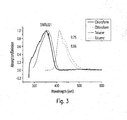
- Photoluminescence of Polymer 1 was measured in a fluorometer in solution in toluene and in chloroform (emission peaks at around 410 nm). The results are displayed graphically in Figure 3 .
- the increased solubility due to alkylation of monomer 1 also enables the synthesis of copolymers with a higher content of dibenzothiophene-S,S-dioxide-3,7-diyl units than is the case for conventional copolymers.
- the polymer was redissolved in toluene (20 ml) and a solution of N,N-diethyldithiocarbamic acid sodium salt (15 ml) was added and the mixture was stirred at 65°C for 16 h. The layers were separated and the aqueous layer was extracted with toluene. The combined organic layers were washed with dilute HCl solution, sodium acetate solution and twice with water before being passed through a celite 545 plug to yield a clear yellow solution. The solution was concentrated until it became viscous and was then added dropwise to methanol (350 ml) to precipitate the polymer as off-white fibres which were isolated by filtration and washed with methanol and acetone, 503 mg. Gel permeation chromatography against polystyrene showed an M n of 6,597 and an M w of 14,791.
- Photoluminescence of Polymer 2 was measured in a fluorometer in solution in toluene and in chloroform (emission peaks at around 410 nm and 415 nm respectively) and as a thin film on a quartz substrate, excited at 320 nm (emission at around 425 nm). The results are displayed graphically in Figures 4a (solution) and 4b (film).
- the increased solubiltiy of monomer 1 also increases the solubility of the whole electroluminescent polymer which facilitates better solution processing, such as spin-coating and thus represents an important advantage.
- the formation of OLED devises is therefore significantly improved.
- An electroluminescent device was fabricated using a 1.1nm thick glass substrate coated with patterned indium tin oxide to give a sheet resistance of 15ohm/sq.
- the substrate was cleaned with detergent, deionized water, acetone and isopropanol successively in an ultrasonic bath, followed by UV ozone treatment for 10 minutes.
- PEDOT poly(3,4-ethylenedioxythiophene) poly(styrenesulfonate)
- Example 3 The method of Example 3 was repeated, replacing Polymer 1 with Polymer 2, to give four devices of 4mm x 5mm on a single substrate.
- Example 4 The method of Example 4 was repeated, however Polymer 2 was co-deposited with 10 w/w% of a green phosphorescent iridium complex as shown below, to give four devices of 4mm x 5mm on a single substrate.
- the substrates of Examples 3, 4 and 5 were each placed in a sample holder where pins made electrical contact to the ITO anodes and barium/aluminium cathodes.
- the sample holder was mounted in an integrating sphere.
- the individual devices on each substrate could be selected via switches on the sample holder.
- Electroluminescence was measured using an Ocean Optics USB4000 CCD connected to the sphere with a fibre optic cable.
- the power supply and CCD were both controlled by a personal computer.
- the voltage applied to the device was increased in uniform steps and the current and electroluminescence spectrum measured at each step. These values were then used to calculate quantities such as current density, external quantum efficiency, optical power output, wall plug efficiency, luminance, luminous efficacy, brightness and CIE co-ordinates.
- Example 3 (containing Polymer 1) offers a powerful peak electroluminescent emission at around 425 nm (measured at 7V, 48mA/cm 2 , 202cd/m 2 ), thereby giving a very deep blue emission, without detrimental effect on the device's on-voltage or brightness.
- Figure 10 shows overlaid electroluminescent output of devices according to Examples 4 and 5, with Polymer 2 acting as a blue emitter at 425 nm (and with CIE coordinates 0.18, 0.15) in Example 4 (at 7V, 6.4mA/cm 2 , 23cd/m 2 ) and as a high energy triplet host in Example 5, which emits at around 530 nm (at 8V, 6.7mA/cm 2 , 283cd/m 2 and with CIE coordinates 0.35, 0.62).
- the phosphorescent nature of the iridium complex provides higher quantum efficiencies and additionally shifts the emission from blue to green, where the human eye is more sensitive. In this way, an extremely efficient OLED device emitting green light is obtained.
- FIGs 8 and 9 which display data for the device of Example 4 (containing Polymer 2), show that the device operates well within accepted ranges of voltages.
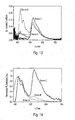
- Figures 11 and 12 which display data for the device of Example 5 (containing Polymer 2 and the iridium complex), show that the device also operates well within accepted ranges of voltages.
- FIGS 13 and 14 show electroluminescence spectra and photoluminescence measurements from three different devices A, B and C with the following structures: glass/ITO (150 nm)/PEDOT:PSS (50 nm)/LEP/Ba (4 nm)/Al (100 nm), wherein in the polymer of Device A the percentage of monomer 1 is 15%, Device B comprises the Polymer 1 of Example 1 (the percentage of monomer 1 being 30%) and Device C comprises the Polymer 2 of Example 2 (the percentage of monomer 1 being 50%), each polymer being blended with 3% of said green phosphorescent iridium complex.
- the ratio of green to blue emission is reduced in the photoluminescence measurements relative to the EL measurements. Indeed, blue fluorescence from the host polymer is observed from all the materials, whereas in EL measurements emission from the material of Device C is absent. This provides evidence that under electrical operation excitons are formed on the green phosphorescent iridium complex by direct charge trapping. Although a so-called Dexter energy transfer of triplet excitons cannot be ruled out, this would not reduce the fluorescence from the host polymer.
- the triplet energy of the green phosphorescent iridium complex (or any other phosphorescent guest material) is higher than that of the host polymer, then green emission from the phosphorescent guest will be reduced. Dexter transfer to the phosphorescent complex will be unlikely, and any excitons forming on the phosphorescent complex by direct charge trapping may transfer to the lower energy triplet on the host polymer. In this series of devices A, B and C, emission from the phosphorescent guest becomes more intense as the amount of monomer 1 in the host polymer increases. It is clear that the higher triplet energy is preventing energy transfer to the host. The results show thus convincingly that these polymers can serve as hosts for phosphorescent materials. In particular, the triplet energy of Polymer 2 is sufficiently high enough to serve as a host for green phosphorescent materials.
Landscapes
- Chemical & Material Sciences (AREA)
- Organic Chemistry (AREA)
- Engineering & Computer Science (AREA)
- Materials Engineering (AREA)
- Medicinal Chemistry (AREA)
- Chemical Kinetics & Catalysis (AREA)
- Health & Medical Sciences (AREA)
- Polymers & Plastics (AREA)
- Physics & Mathematics (AREA)
- Optics & Photonics (AREA)
- Crystallography & Structural Chemistry (AREA)
- Inorganic Chemistry (AREA)
- Polyoxymethylene Polymers And Polymers With Carbon-To-Carbon Bonds (AREA)
- Electroluminescent Light Sources (AREA)
Description
- The present invention relates to electroluminescent materials and devices.
- Electroluminescence is a phenomenon whereby materials emit light in response to an electric current passed therethrough. This phenomenon is exploited, inter alia, in the manufacture and operation of organic light emitting diodes (OLEDs). OLEDs typically include an organic semiconducting material which comprises an organic small molecule and/or a polymer (e.g. an oligomer).
- In a simple OLED configuration, a thin film comprising an organic light emitting material is sandwiched between an anode and a cathode. When a bias voltage is applied across the device, holes are injected into the highest occupied molecular orbital (HOMO) of the light emitting material and electrons are injected into the lowest unoccupied molecular orbital (LUMO). When the electrons and holes recombine, an exciton is formed which is able to decay radiatively, resulting in the emission of light. The colour of the light produced is dependent on the HOMO- LUMO bandgap of the material.
- However, in order to improve stability and enhance device efficiency (photons of light emitted per injected charge) a multi-layered device is usually employed. Such devices incorporate layers of charge transporting material such as an electron transport material and/or a hole transporting material to affect the injection of charges into the light emitting material resulting in enhanced light emission. A number of materials have been described for use as electron and hole transporting materials (Kulkarni et al. Chem. Mater. 2004, 16: 4556 - 4573; Yan et al . Appl. Phys. Lett. 2004, 84: 3873 - 3875).
- White organic light emitting devices (WOLEDs) have attracted increasing interest in recent years as their potential applications to full colour displays with the help of colour filters, in backlights for liquid crystal displays (LCDs) and in solid-state lighting (SSL) devices become apparent. Consequently, an efficient single-component OLED capable of white light emission is highly desirable.
- A number of approaches have been described for achieving white emission from WOLEDs, such as using multi-layer device structures to get white light emission at the same time from two or more active layers which each emit a different colour light (Burrows et al. Appl . Phys. Lett. 1998, 73: 435 - 437; D'Andrade et al . Adv. Mater. 2002, 14: 147 - 151; Lee et al . Mater. Sci. Eng. , B, 2002, 95:24 - 28; Huang et al . Appl. Phys. Lett. 2002, 80: 2782 - 2784), devices comprising single-layers into which different fluorescent or phosphorescent dopants are dispersed into a host polymer (where a dopant is an impurity element added in low concentrations to alter the optical/electrical properties of a semiconductor material) (Kido et al. Appl. Phys. Lett. 1995, 67; 2281 - 2283; Mazzeo et al . , Synth Met. 2003, 139:675 - 677) or pixelated structures in which the three Red, Green and Blue active layers are patterned as a matrix array using precise shadow masking (Kido et al. Appl. Phys. Lett. 1995, 67; 2281 - 2283). However, the high band gap required for blue emissions has ensured that the production of efficient, long-lasting blue emitters has proved challenging.
-
WO 2007/132236 A1 discloses electroluminescent polymers, their synthesis and their use in optical devices.WO 2007/132236 A1 thereby discusses a number of approaches that have been described for achieving white emission from WOLEDs, such as using multi-layer device structures to get white light emission at the same time from two or more active layers which each emit a different colour light (Burrows et al. Appl . Phys. Lett. 1998, 73: 435 - 437; D'Andrade et al . Adv. Mater. 2002, 14: 147 - 151; Lee et al . Mater. Sci. Eng. , B, 2002, 95:24 - 28; Huang et al . Appl. Phys. Lett. 2002, 80: 2782 - 2784), devices comprising single-layers into which different fluorescent or phosphorescent dopants are dispersed into a host polymer (where a dopant is an impurity element added in low concentrations to alter the optical/electrical properties of a semi-conductor material) (Kido et al. Appl. Phys. Lett. 1995, 67; 2281 - 2283; Mazzeo et al . , Synth Met. 2003, 139:675 - 677) or pixelated structures in which the three Red, Green and Blue active layers are patterned as a matrix array using precise shadow masking (Kido et al. Appl. Phys. Lett. 1995, 67; 2281 - 2283). D1 provides in this context fluorene based copolymers or co-oligomers of (I) Dibenzothiophene-S,S-dioxide and (II) fluorene. - A single layer structure WOLED is desirable since they lend themselves more readily to large scale production and low-cost manufacturing. However, the single layer fluorescent or phosphorescent doped WOLEDs that have been described above suffer from a number of drawbacks including variations in the CIE (Commission Internationale de l'Eclairage) co-ordinates of colour emission depending upon the applied bias voltage, rendering them less preferable for LCD backlight and other illumination purposes.
- Over the last decade polyfluorenes (PF) have emerged as effective electroluminescent materials in the class of semiconductive organic conjugated polymers. Properties of PFs which render them suitable for electroluminescent applications include bright blue emission, high hole mobility, excellent thermal and chemical/electrochemical stability and easy tuneable properties through chemical modifications and co-polymerisations. However, the mobility and injection of electrons are much lower than that of holes in these materials, resulting in a greatly unbalanced transport of positive and negative carriers. This poor charge balance in the electroluminescent material leads to overall low efficiency of OLED devices based on PFs. A further problem inherent to PF materials is the formation of fluorene defects as a result of thermal-, photo-, or electrical degradation, which is frequently encountered in these materials, resulting in low emission bands.
- Many different approaches have been used to mitigate these problems; among them is the introduction of either electron donor or electron acceptor moieties into the homopolymers (in the backbone, as side-chains or endcaps). In OLEDs, the introduction of such electron donor or electron deficient moieties represents an efficient way to modify the HOMO-LUMO levels of the polymers thus allowing improved electron/hole mobility of the material, decreased barriers of charge injection into the electroluminescent layer, and tuning of the colour emission, i.e. by reducing the LUMO energy at the interface of the electrode and the polymer it is possible to increase electron injection to balance the charges in the device and improve efficiency.
- PFs, and indeed other conjugated polymer systems, may be synthesised by a number of methods, but are commonly made by one of the Suzuki polymerisation method or the Yamamoto polymerisation method. Each of these methods ensures a coupling of the conjugation systems of the monomer units.
- Suzuki polymerisation effects the coupling of an aryl- or vinyl-boronic acid or ester with an aryl or vinyl halide to form a conjugated system. The reaction is catalysed by a palladium (0) complex such as tetrakis(triphenylphosphine)palladium(0) and is described in several review papers (such as Suzuki, A. J. Organometallic Chem. 1999, 576, 147-168).
- Its use in polymerisation for organic semiconductors is described in Sakamoto J. et al., Macrol. Rapid Commun., 2009, 30, 653-687.
- Yamamoto polymerisation effects the coupling of aryl- or vinyl-magnesium halides with aryl- or vinyl-halides to form a conjugated system. The reaction is catalysed by nickel complexes and was first described by Yamamoto et al in Bull Chem. Soc. Jpn., 1978, 51, 2091. Its use in polymerisation for organic semiconductors is described in Yamamoto T. Prog. Polym. Sci., 1993, 17, 1153-1205.
- Fluorene-based copolymers incorporating electron-deficient thiophene-S, S-dioxide moieties have been tested and did not demonstrate improved performance of LED over conventional PF homopolymers, showing low to moderate external EL efficiencies of 10-3 to 0.14% (Charas et al . Chem. Commun. 2001, 1216: Charas et al., J. Mater. Chem. 2002, 12:3523; Pasini et al., J. Mater. Chem. 2003, 13:807; Destri et al., Synth. Metals, 2003, 138, 289). Therefore, typically it is not expected that incorporation of a thiophene-S,S-dioxide moiety into a fluorene-based copolymer would be beneficial. In fact it is expected, and reported, that quenching of the emission occurs resulting in overall poor efficiency of OLED devices incorporating these materials.
- Regular and random fluorene copolymers containing dibenzothiophene-2, 8-diyl (Yang et al. J. Mater. Chem. 2003, 13:1351 - 1356; Nemoto et al. J. Polym. Sex. A:Polym. Chem. 2003, 41:1521 - 1526) and PPV copolymers containing dibenzothiophene-S, S-dioxide-2, 8-diyl (Wang et al. Thin Solid Films 2003, 424:186 - 190; Wang et al . Synth. Metals 2003, 132:191 - 195) moieties in the main chain have been reported, which again showed from moderate to very low efficiency in OLED.
- Again, these results would indicate that fluorene-based copolymers incorporating thiophene-S,S-dioxide units as conjugated polymers would lead to poor efficiencies in OLED.
- In a first aspect, the invention provides an electroluminescent polymer according to
claim 1 comprising a first repeat unit comprising the structure:
- Without wishing to be bound by any particular theory, the inventors have found that the inclusion of at least one substituent group at R1 or R2 and at least one substituent group at R3 or R4 provides sufficient steric effect to twist the first repeat unit with respect to the remainder of the polymer backbone. It is proposed that this twisting may cause a drop in the conjugation and increases the band gap of the material, thereby offering a deep blue emission spectrum.
- Moreover, the inventors have surprisingly found that upon the inclusion of at least one substituent group at R1 or R2 and at least one substituent group or R3 or R4, an increase in emission efficiency is observed.
- When referring to para-coupling and meta-coupling the ring structures are numbered such that
carbon 1 is the carbon next to the atom or group of atoms with greatest molecular weight.Position 2 is "ortho",position 3 is "meta", andposition 4 is "para". - Preferably R5 and/or R6 are H.
- Preferably, at least three (e.g. all) of R1 to R4 are not H.
- Preferably, R1 to R4, if not H, comprise C1 to C10 straight or branched alkyl alkenyl or alkynyl chains.
- Preferably, the first repeat unit comprises the structure:

- Preferably, the polymer comprises a second repeat unit comprising an organic semiconducting moiety.
- Preferably, the second repeat unit comprises the structure:

- Preferably, R11 and R12 are both C8H17.
- It was also found that the presence of the first repeat units considerably increases the solubility of the electroluminescent polymer which facilitates better solution processing, such as spin-coating and thus represents an important advantage. Further, also the formation of electroluminescent polymers having a high content of the first repeat unit is possible.
- Accordingly, the ratio of the number y of the first repeat units to the number x of the second repeat units is preferably at least 15:85, more preferably 30:70 and in particular 50:50.
- Preferably, R4 and R5 comprise C1 to C10 unsubstituted straight alkyl chains.
- Preferably, the second repeat unit is incorporated into the polymer backbone by para-coupling or meta-coupling.
- According to a further aspect of the invention there is provided a fluorene-based copolymer or oligomer comprising one or more first repeat units comprising the structure:

- Optionally, the copolymer or oligomer according to the first or second aspects further comprises at least one alkyne group. The at least one alkyne group can be situated between a first repeat unit and a second repeat unit or between two second repeat units.
- In certain embodiments, the polymer may comprise a third repeat unit

- where R15 to R20 may be the same or different and may comprise H or C1 to C10 (e.g. C1 or C5) optionally substituted, straight, branched or cyclic alkyl, alkenyl or alkynyl groups, nitro, amino, amido, halo, alkoxy, hydroxyl, thiol or thioalkyl; where Q1 to Q4 may be the same or different and may comprise N or CH and where Z may comprise O, NR or S.
- Preferably, the polymer comprises a fourth different repeat unit comprising a hole transport moiety.
- Preferably, the hole transport moiety preferably comprises a structure selected from the group:

- Preferably, the polymer comprises a block copolymer, regular or alternating copolymer or a random copolymer, including the first repeat unit and one, some or all of the second, third and fourth repeat units.
- Preferably, the copolymer is a random copolymer. The term "random copolymer" denotes a copolymer consisting of macromolecules in which the probability of finding a given monomeric unit at any given site in the chain is independent of the nature of the adjacent units.
- The term "regular copolymer" denotes a copolymer comprising a sequence of regularly alternating repeating units.
- The term "block copolymer" denotes a copolymer where each repeat unit is arranged to be adjacent at least one identical repeat unit.
- In some embodiments the polymer further comprises one or more red and/or green emitting repeat units. Preferably the red and/or green emitting repeat units comprise phosphorescent emitters, such as those selected from complexes of the form IrL3 or IrL2X, where


- Alternatively or additionally, the polymer may comprise colour dopants, such as those selected from the group:

- Optionally, the copolymer or oligomer according to the first or second aspects further comprises at least one alkyne group. The at least one alkyne group can be situated between a first repeat unit and a second repeat unit or between two second repeat units.
- Preferably, the optionally first repeat units comprise approximately 2 - 50 mole percent of the polymer.
- More preferably, the first repeat units comprise approximately 10 - 35 mole percent of the polymer.
- More preferably, the first repeat units comprise approximately 20 - 30 mole percent of the polymer.
- Preferably, at least a portion of the first repeat units functions as a blue emitting moiety.
- Preferably, at least a portion of the first repeat units functions as an electron transporting moiety.
- Preferably, at least a portion of the first repeat units functions as a high energy triplet host in the presence of one or more phosphorescent emitters (e.g. if the polymer comprises or is co-deposited with one or more phosphorescent emitters).
- The first repeat units and the second repeat units are preferably selected such that they allow charge transfer therebetween in the excited state.
- Preferably, the polymer is capable of emitting light close to white point as determined in the CIE (x,y = 0.33, 0.33).
- The second repeat units may be substituted at any suitable position with any suitable functional group which results in a functionally equivalent molecule according to the present invention.
- Preferably, when the second repeat units are substituted, they may be substituted at any suitable position with alkyl groups.
- Optionally, when the second repeat units are substituted, they may be substituted at any suitable position by pendent moieties.
- Optionally, when the second repeat units are substituted, they may be substituted at any suitable position by spiro units.
- According to a third aspect of the invention there is provided an optical device comprising a polymer as described above.
- Another important result found by the inventors is that the triplet energy of the inventive electroluminescent polymer increases as the percentage of the first repeat unit increases. It is in particular possible to from a polymer which has sufficiently high triplet energy to host, e.g., a green phosphorescent iridium guest emitter.
- Accordingly, in a preferred embodiment of the present invention, the optical device additionally comprises a red and/or green phosphorescent emitter.
- Preferably, the optical device is an organic light emitting device whereby the polymer makes up at least part of an emissive layer.
- Preferably, the organic light emitting device comprises first and second electrodes and the emissive layer is formed between the first and second electrodes.
- Optionally, the organic light emitting device comprises at least one further layer, e.g. a hole injection layer or an electron injection layer.
- Preferably, the copolymers of the invention are prepared by Suzuki polymerisation.
- Optionally, the copolymers of the invention can be prepared by any suitable polymerization method, such as Yamomoto polymerization.
- The inventors have advantageously established that simple OLED devices incorporating fluorene-based copolymers containing substituted dibenzothiophene-S,S-dioxide demonstrate improved electron transport and light emission over previously reported PF homopolymer devices resulting in improved external quantum efficiencies. The substituted dibenzothiophene-S,S-dioxide moiety also acts as an electron transporting moiety and in combination with the fluorene copolymer functions as a light emission moiety.
- This is surprising as whilst thiophene dioxides are known as electron transport materials, heteroatoms are known not to be highly emissive due to quenching of the excited states. Therefore it would not be expected that the incorporation of substituted dibenzothiophene-S,S-dioxide into a fluorene-based copolymer would be highly emissive.
- Accordingly, by virtue of this invention, the market for an alternative substantially white light source can be at least partially satisfied by a device comprising a light emitting surface incorporating a fluorene-based copolymer incorporating dibenzothiophene-S,S-dioxide units as described in the first or second aspects above.
- As already mentioned above, a further advantage of the present invention derives from the increased solubility of the first repeat group afforded by the one or more substitutions. This facilitates better solution processing, such as spin-coating, of the polymer and thus allows a cost efficient production of OLED devices.
- Embodiments of the present invention shall now be described in more detail with reference to the following drawings.
-
Figure 1 shows a synthesis of a monomer for forming a polymer according to the present invention; -
Figure 2 shows a synthesis of a polymer according to the present invention; -
Figure 3 shows photoluminescence data for thePolymer 1; -
Figure 4 shows photoluminescence data for thePolymer 2; -
Figure 5 shows readings for brightness against current density for a device according to Example 3; -
Figure 6 shows readings for electroluminescent power against electroluminescent wavelength for a device according to Example 3; -
Figure 7 shows current density against voltage for a device according to Example 3; -
Figure 8 shows readings for brightness against current density for a device according to Example 4; -
Figure 9 shows current density against voltage for a device according to Example 4; -
Figure 10 shows readings for electroluminescent intensity against electroluminescent wavelength for a device according to Example 4 and a device according to Example 5; -
Figure 11 shows readings for brightness against current density for a device according to Example 5; -
Figure 12 shows current density against voltage for a device according to Example 5; -
Figure 13 shows electroluminescence spectra from three different inventive devices; -
Figure 14 shows corresponding photoluminescence measurements of the three devices. - Random fluorene-dibenzothiophene-S, S-dioxide copolymers were synthesised by palladium-catalyzed Suzuki cross- coupling copolymerisation of 9, 9-dioctylfluorene comonomers and substituted dibromodibenzothiophene-S,S-dioxides as demonstrated in the examples below.
- Dibenzothiophene (Aldrich or Alfa Aesar) (195 mmol) was dissolved in a 1:1 mixture of chloroform and acetic acid (both Fisher) (total 400 ml) under a protective atmosphere of argon and cooled in an ice bath. Bromine (Aldrich) (468 mol) in chloroform (25 ml) was added dropwise and the mixture was stirred overnight slowly rising to room temperature. The mixture was poured into methanol (Fisher) (500 ml) to precipitate the dibromodibenzothiophene product which was filtered and washed with methanol.
- The dibromodibenzothiophene (29.3 mmol) was dissolved in tetrahydrofuran (THF) (Fisher) (200 ml) under a protective atmosphere of argon and cooled in a dry ice/acetone bath. n-Hexyllithium (Aldrich) (64.4 mmol) was added slowly and the solution was stirred for 3 h. Bromohexane (Aldrich) (71.2 mmol) was added and the solution was allowed to warm to room temperature. overnight. The aqueous layer was extracted with diethyl ether (Fisher) and the combined organics were washed with water, dried, filtered and concentrated to yield an oil which was dissolved in acetic acid (Fisher) (50 ml). Hydrogen peroxide (Aldrich) (15 ml) was carefully.added and the solution stirred at 140 °C for 2 h before a further 10 ml of peroxide was added and the solution was stirred at 140 °C overnight. Cooling water was added and the aqueous layer was extracted with chloroform. The organics were washed with water, dried, filtered and concentrated to yield an oil which was dissolved in ethanol. The flask was placed in the freezer overnight to crystallise the sulfone product.
- The sulfone (13 mmol) was dissolved in H2SO4 (Fisher) (300 ml) and heated to 70 °C with protection from light. N-bromosuccinimide (NBS) (Aldrich) (29 mmol) was added in portions and the mixture stirred at 70 °C overnight. Analysis showed the presence of both monobromo and dibromo products so a further portion of NBS (5.6 mmol) was added and stirring continued overnight. Cooling water was added and the aqueous layer was extracted with chloroform and the organics were washed with water, dried, filtered and concentrated to yield an oil which was purified on silica eluting with DCM (Fisher):Petroleum ether 40-60 (Fisher) 1:1. The resulting solid was crystallised from ethanol.
- A flask was charged with 9,9-dioctylfluorene-2,7-diboronic acid bis(1,3-propanediol) ester (400.0 mg, 99.50%, 0.713 mmol), 2,7-dibromo-9,9-dioctylfluorene (157.6 mg, 99.95%, 0.287 mmol), 3,7-dibromo-2,8-dihexyldibenzothiophene-S,S-dioxode (235.0 mg, 98.7%, 0.428 mmol) and toluene (16 m). The mixture was degassed for 15 min before bis[(tri-ortho-tolyl)phosphine]palladiumdichloride (11 mg, 1 mol%) was added and degassing continued for 15 min before a degassed 20% wt. solution of tetraethylammonium hydroxide in water (4 ml) was added and the mixture was vigorously stirred at 115°C with protection from light for 18 h.
- Bromobenzene (0.1 ml) was added and stirring continued at 115°C for 1 h before benzeneboronic acid (100 mg) was added and stirring continued at 115°C for 1 h. After cooling, the grey mixture was added slowly to 300 ml of methanol to precipitate the crude polymer as grey fibres. The fibres were filtered and washed with methanol, water and more methanol.
- The polymer was redissolved in toluene (20 ml) and a solution of N,N-diethyldithiocarbamic acid sodium salt (15 ml) was added and the mixture was stirred at 65°C for 16 h. The layers were separated and the aqueous layer was extracted with toluene. The combined organic layers were washed with dilute HCl solution, sodium acetate solution and twice with water before being passed through a celite 545 plug to yield a clear yellow solution. The solution was concentrated until it became viscous and was then added dropwise to methanol (350 ml) to precipitate the polymer as off-white fibres which were isolated by filtration and washed with methanol and acetone, 420 mg. Gel permeation chromatography against polystyrene showed an Mn of 11,191 and an Mw of 29,849.
- Photoluminescence of
Polymer 1 was measured in a fluorometer in solution in toluene and in chloroform (emission peaks at around 410 nm).The results are displayed graphically inFigure 3 . - As will be shown in the following, the increased solubility due to alkylation of
monomer 1 also enables the synthesis of copolymers with a higher content of dibenzothiophene-S,S-dioxide-3,7-diyl units than is the case for conventional copolymers. - A flask was charged with 9,9-dioctylfluorene-2,7-diboronic acid bis(1,3-propanediol) ester (400.0 mg, 99.50%, 0.713 mmol) and 3,7-dibromo-2,8-dihexyldibenzothiophene-S,S-dioxode (391.4 mg, 98.7%, 0.713 mmol) and toluene (16 m). The mixture was degassed for 15 min before bis[(tri-ortho-tolyl)phosphine]palladiumdichloride (11 mg, 1 mol%) was added and degassing continued for 15 min before a degassed 20% wt. solution of tetraethylammonium hydroxide in water (4 ml) was added and the mixture was vigorously stirred at 115°C with protection from light for 18 h. Bromobenzene (0.1 ml) was added and stirring continued at 115°C for 1 h before benzeneboronic acid (100 mg) was added and stirring continued at 115°C for 1 h. After cooling, the grey mixture was added slowly to 300 ml of methanol to precipitate the crude polymer as grey fibres. The fibres were filtered and washed with methanol, water and more methanol.
- The polymer was redissolved in toluene (20 ml) and a solution of N,N-diethyldithiocarbamic acid sodium salt (15 ml) was added and the mixture was stirred at 65°C for 16 h. The layers were separated and the aqueous layer was extracted with toluene. The combined organic layers were washed with dilute HCl solution, sodium acetate solution and twice with water before being passed through a celite 545 plug to yield a clear yellow solution. The solution was concentrated until it became viscous and was then added dropwise to methanol (350 ml) to precipitate the polymer as off-white fibres which were isolated by filtration and washed with methanol and acetone, 503 mg. Gel permeation chromatography against polystyrene showed an Mn of 6,597 and an Mw of 14,791.
- The increased solubiltiy of
monomer 1 thus allowed to formation of an alternating copolymer where each dioctylfluorene unit is adjoined by two dihexyldibenzothiophene-S,S-dioxide-3,7-diyl units. - Photoluminescence of
Polymer 2 was measured in a fluorometer in solution in toluene and in chloroform (emission peaks at around 410 nm and 415 nm respectively) and as a thin film on a quartz substrate, excited at 320 nm (emission at around 425 nm). The results are displayed graphically inFigures 4a (solution) and 4b (film). - The increased solubiltiy of
monomer 1 also increases the solubility of the whole electroluminescent polymer which facilitates better solution processing, such as spin-coating and thus represents an important advantage. The formation of OLED devises is therefore significantly improved. - Electronic devices were fabricated using
Polymer 1 andPolymer 2. - An electroluminescent device was fabricated using a 1.1nm thick glass substrate coated with patterned indium tin oxide to give a sheet resistance of 15ohm/sq. The substrate was cleaned with detergent, deionized water, acetone and isopropanol successively in an ultrasonic bath, followed by UV ozone treatment for 10 minutes.
- An approximately 50nm-thick layer of poly(3,4-ethylenedioxythiophene) poly(styrenesulfonate) (PEDOT) was spin coated first and then dried for 10 minutes on a hot-plate at 150°
C. Polymer 1 was dissolved in toluene and spincoated onto the PEDOT layer to give a layer approximately 65nm thick. A 4nm thick layer of barium and then at least 100nm of aluminium were evaporated through a mask onto the polymer layer in a vacuum of approximately 1x10⁻⁶ mBar. - Four devices of 4mm x 5mm were obtained on a single substrate. The devices were sealed by using a UV curable epoxy resin to fix a piece of glass over the device area.
- The method of Example 3 was repeated, replacing
Polymer 1 withPolymer 2, to give four devices of 4mm x 5mm on a single substrate. - The method of Example 4 was repeated, however
Polymer 2 was co-deposited with 10 w/w% of a green phosphorescent iridium complex as shown below, to give four devices of 4mm x 5mm on a single substrate.
- The substrates of Examples 3, 4 and 5 were each placed in a sample holder where pins made electrical contact to the ITO anodes and barium/aluminium cathodes. The sample holder was mounted in an integrating sphere. The individual devices on each substrate could be selected via switches on the sample holder.
- An Agilent 6632B power supply was used to drive the devices. Electroluminescence was measured using an Ocean Optics USB4000 CCD connected to the sphere with a fibre optic cable. The power supply and CCD were both controlled by a personal computer.
- The voltage applied to the device was increased in uniform steps and the current and electroluminescence spectrum measured at each step. These values were then used to calculate quantities such as current density, external quantum efficiency, optical power output, wall plug efficiency, luminance, luminous efficacy, brightness and CIE co-ordinates.
- The results of some of these tests are shown in
Figures 6 to 11 . - As
Figures 5 to 7 demonstrate, the device of Example 3 (containing Polymer 1) offers a powerful peak electroluminescent emission at around 425 nm (measured at 7V, 48mA/cm2, 202cd/m2), thereby giving a very deep blue emission, without detrimental effect on the device's on-voltage or brightness. -
Figure 10 shows overlaid electroluminescent output of devices according to Examples 4 and 5, withPolymer 2 acting as a blue emitter at 425 nm (and with CIE coordinates 0.18, 0.15) in Example 4 (at 7V, 6.4mA/cm2, 23cd/m2) and as a high energy triplet host in Example 5, which emits at around 530 nm (at 8V, 6.7mA/cm2, 283cd/m2 and with CIE coordinates 0.35, 0.62). The phosphorescent nature of the iridium complex provides higher quantum efficiencies and additionally shifts the emission from blue to green, where the human eye is more sensitive. In this way, an extremely efficient OLED device emitting green light is obtained. -
Figures 8 and9 , which display data for the device of Example 4 (containing Polymer 2), show that the device operates well within accepted ranges of voltages. -
Figures 11 and 12 , which display data for the device of Example 5 (containingPolymer 2 and the iridium complex), show that the device also operates well within accepted ranges of voltages. - The suitability of the inventive copolymers for hosting green phosphorescent materials results from the fact that the triplet energy of these new copolymers increases as the percentage of the dihexyldibenzothiophene-S,S-dioxide-3,7-diyl units increases. This can be seen from
Figures 13 and 14 which show electroluminescence spectra and photoluminescence measurements from three different devices A, B and C with the following structures: glass/ITO (150 nm)/PEDOT:PSS (50 nm)/LEP/Ba (4 nm)/Al (100 nm), wherein in the polymer of Device A the percentage ofmonomer 1 is 15%, Device B comprises thePolymer 1 of Example 1 (the percentage ofmonomer 1 being 30%) and Device C comprises thePolymer 2 of Example 2 (the percentage ofmonomer 1 being 50%), each polymer being blended with 3% of said green phosphorescent iridium complex. - The ratio of green to blue emission is reduced in the photoluminescence measurements relative to the EL measurements. Indeed, blue fluorescence from the host polymer is observed from all the materials, whereas in EL measurements emission from the material of Device C is absent. This provides evidence that under electrical operation excitons are formed on the green phosphorescent iridium complex by direct charge trapping. Although a so-called Dexter energy transfer of triplet excitons cannot be ruled out, this would not reduce the fluorescence from the host polymer.
- If the triplet energy of the green phosphorescent iridium complex (or any other phosphorescent guest material) is higher than that of the host polymer, then green emission from the phosphorescent guest will be reduced. Dexter transfer to the phosphorescent complex will be unlikely, and any excitons forming on the phosphorescent complex by direct charge trapping may transfer to the lower energy triplet on the host polymer. In this series of devices A, B and C, emission from the phosphorescent guest becomes more intense as the amount of
monomer 1 in the host polymer increases. It is clear that the higher triplet energy is preventing energy transfer to the host. The results show thus convincingly that these polymers can serve as hosts for phosphorescent materials. In particular, the triplet energy ofPolymer 2 is sufficiently high enough to serve as a host for green phosphorescent materials. - No doubt many other effective alternatives will occur to the skilled person. It will be understood that the invention is not limited to the described embodiments and encompasses modifications apparent to those skilled in the art lying within the scope of the claims appended hereto.
Claims (20)
- An electroluminescent polymer comprising a first repeat unit comprising the structure:

- An electroluminescent polymer according to Claim 1, wherein R5 and/or R6 are H.
- An electroluminescent polymer according to any of Claims 1 or 2, wherein at least three of R1 to R4 are not H.
- An electroluminescent polymer according to any preceding Claim, wherein R1 to R4, if not H, comprise C1 to C10 straight or branched alkyl alkenyl or alkynyl chains.
- An electroluminescent polymer according to any preceding Claim, wherein the first repeat unit comprises the structure:

- An electroluminescent polymer according to any preceding Claim, wherein the polymer comprises a second repeat unit comprising an organic semiconducting moiety, and wherein the second repeat unit preferably comprises the structure:

R11 and R12 being in particular C8H17. - An electroluminescent polymer according to Claim 6, wherein the ratio of the number (y) of the first repeat units to the number (x) of the second repeat units is at least 15:85, preferably 30:70 and in particular 50:50.
- An electroluminescent polymer according to Claim 6 or 7, wherein R4 and R5 comprise C1 to C10 unsubstituted straight alkyl chains.
- An electroluminescent polymer according to any of Claims 6 to 8, wherein the second repeat unit is incorporated into the polymer backbone by para-coupling or meta-coupling.
- An electroluminescent polymer according to any preceding Claim, further comprising at least one alkyne group,
wherein the at least one alkyne group preferably can be situated between a first repeat unit and a second repeat unit or between two second repeat units. - An electroluminescent polymer according to any preceding Claim, wherein the polymer comprises a third repeat unit comprising an electron transport moiety,
and wherein preferably the polymer comprises a fourth different repeat unit comprising a hole transport moiety. - An electroluminescent polymer according to any preceding Claim, wherein the polymer comprises a block copolymer, regular or alternating copolymer or a random copolymer.
- An electroluminescent polymer according to any preceding Claim, further comprising one or more red and/or green emitting repeat units,
wherein the red and/or green emitting repeat units preferably comprise phosphorescent emitters. - An electroluminescent polymer according to any preceding Claim, wherein first repeat units comprise approximately 2 - 50 mole percent of the polymer, e.g. 10 - 35 mole percent or 20 - 30 mole percent of the polymer.
- An electroluminescent polymer according to any preceding Claim, wherein at least a portion of the first repeat units functions as a blue emitting moiety.
- An electroluminescent polymer according to any preceding Claim, wherein at least a portion of the first repeat units functions as an electron transporting moiety.
- An electroluminescent polymer according to any preceding Claim, wherein at least a portion of the first repeat units functions as a high energy triplet host in the presence of one or more phosphorescent emitters, e.g. if the polymer comprises one or more phosphorescent emitters.
- An electroluminescent polymer according to any preceding Claim, wherein the first repeat units and the second repeat units are selected such that they allow charge transfer therebetween in the excited state.
- An electroluminescent polymer according to any preceding Claim, wherein the polymer is capable of emitting light close to white point (x,y = 0.33, 0.33).
- An optical device comprising a polymer according to any preceding Claim, said optical device preferably comprising a red and/or green phosphorescent emitter.
Priority Applications (1)
| Application Number | Priority Date | Filing Date | Title |
|---|---|---|---|
| EP12190102.9A EP2554626B1 (en) | 2009-09-18 | 2010-09-17 | Electroluminescent materials and devices |
Applications Claiming Priority (2)
| Application Number | Priority Date | Filing Date | Title |
|---|---|---|---|
| GB0916395A GB2473816A (en) | 2009-09-18 | 2009-09-18 | Electroluminescent materials and devices |
| PCT/EP2010/063721 WO2011033078A1 (en) | 2009-09-18 | 2010-09-17 | Electroluminescent materials and devices |
Related Child Applications (2)
| Application Number | Title | Priority Date | Filing Date |
|---|---|---|---|
| EP12190102.9A Division-Into EP2554626B1 (en) | 2009-09-18 | 2010-09-17 | Electroluminescent materials and devices |
| EP12190102.9A Division EP2554626B1 (en) | 2009-09-18 | 2010-09-17 | Electroluminescent materials and devices |
Publications (2)
| Publication Number | Publication Date |
|---|---|
| EP2478067A1 EP2478067A1 (en) | 2012-07-25 |
| EP2478067B1 true EP2478067B1 (en) | 2015-06-24 |
Family
ID=41277928
Family Applications (2)
| Application Number | Title | Priority Date | Filing Date |
|---|---|---|---|
| EP12190102.9A Not-in-force EP2554626B1 (en) | 2009-09-18 | 2010-09-17 | Electroluminescent materials and devices |
| EP10766246.2A Not-in-force EP2478067B1 (en) | 2009-09-18 | 2010-09-17 | Electroluminescent materials and devices |
Family Applications Before (1)
| Application Number | Title | Priority Date | Filing Date |
|---|---|---|---|
| EP12190102.9A Not-in-force EP2554626B1 (en) | 2009-09-18 | 2010-09-17 | Electroluminescent materials and devices |
Country Status (6)
| Country | Link |
|---|---|
| EP (2) | EP2554626B1 (en) |
| JP (1) | JP5771612B2 (en) |
| KR (1) | KR101773212B1 (en) |
| CN (1) | CN102648267B (en) |
| GB (1) | GB2473816A (en) |
| WO (1) | WO2011033078A1 (en) |
Families Citing this family (8)
| Publication number | Priority date | Publication date | Assignee | Title |
|---|---|---|---|---|
| CN103382248A (en) * | 2012-05-04 | 2013-11-06 | 海洋王照明科技股份有限公司 | Dioxodibenzothiophene-based copolymer, preparation method thereof and polymer light emitting diode |
| CN104004165B (en) * | 2014-05-07 | 2016-08-24 | 华南理工大学 | Electron donor polymer and application thereof containing S, S-dioxo-dibenzothiophene unit |
| CN105693749A (en) * | 2016-03-09 | 2016-06-22 | 中节能万润股份有限公司 | Organic optoelectronic material containing phenothiazine structure and application of organic optoelectronic material |
| CN106220645B (en) * | 2016-04-25 | 2018-08-14 | 中节能万润股份有限公司 | Compound based on monosubstituted-9-fluorenone and application thereof |
| CN107068878B (en) * | 2016-04-25 | 2019-02-22 | 中节能万润股份有限公司 | An organic electroluminescent device containing a monosubstituted-9-fluorenone compound and its application |
| KR102196872B1 (en) * | 2016-11-10 | 2020-12-30 | 창춘 인스티튜트 오브 어플라이드 케미스트리 차이니즈 아카데미 오브 사이언스 | Poly(spirobifluorene) and organic electroluminescent device |
| CN106565960A (en) * | 2016-11-11 | 2017-04-19 | 华南理工大学 | Block copolymer luminescent material containing dibenzothiophene-S,S-dioxide, preparation method and application thereof |
| CN113493564B (en) * | 2020-04-07 | 2023-05-02 | 中国科学院长春应用化学研究所 | Organic polymer luminescent material with D-sigma-A structure, and preparation method and application thereof |
Family Cites Families (12)
| Publication number | Priority date | Publication date | Assignee | Title |
|---|---|---|---|---|
| KR0176336B1 (en) * | 1996-12-31 | 1999-04-01 | 박원훈 | Floren-based Alternating Copolymer Containing Acetylene Group and Electroluminescent Device Using the Same |
| SG128438A1 (en) * | 2002-03-15 | 2007-01-30 | Sumitomo Chemical Co | Polymer compound and polymer light emitting deviceusing the same |
| CN1528760A (en) * | 2003-09-29 | 2004-09-15 | 上海交通大学 | Monomer containing dibenzothiophene dioxide group and preparation method thereof |
| KR100679724B1 (en) * | 2004-10-13 | 2007-02-07 | 주식회사 두산 | Color-emitting compound for electroluminescent device and organic electroluminescent device comprising same |
| US20060094859A1 (en) * | 2004-11-03 | 2006-05-04 | Marrocco Matthew L Iii | Class of bridged biphenylene polymers |
| GB0609673D0 (en) * | 2006-05-16 | 2006-06-28 | Univ Durham | Novel light emitting polymeric compositions and uses thereof |
| JP5162856B2 (en) * | 2006-07-31 | 2013-03-13 | 住友化学株式会社 | Polymer light-emitting device, organic transistor and composition useful for them |
| CN101542770B (en) * | 2006-09-21 | 2012-05-30 | 巴斯夫欧洲公司 | OLED display with extended lifetime |
| JP5090746B2 (en) | 2007-01-19 | 2012-12-05 | 株式会社ツジデン | Carbazole-based random copolymer |
| JP5804703B2 (en) * | 2007-07-05 | 2015-11-04 | ビーエーエスエフ ソシエタス・ヨーロピアBasf Se | Organic light emitting diode comprising at least one disilyl compound selected from disilylcarbazole, disilyldibenzofuran, disilyldibenzothiophene, disilyldibenzophosphole, disilyldibenzothiophene S-oxide and disilyldibenzothiophene S, S-dioxide |
| EP2020424B1 (en) * | 2007-08-01 | 2012-11-28 | Imec | Functionalization of poly(arylene-vinylene) polymers for electronic devices |
| CN101255336B (en) * | 2007-11-06 | 2011-04-27 | 华南理工大学 | Electroluminescent spectrum-stable blue fluorene-based polymers as well as preparation method and uses thereof |
-
2009
- 2009-09-18 GB GB0916395A patent/GB2473816A/en not_active Withdrawn
-
2010
- 2010-09-17 WO PCT/EP2010/063721 patent/WO2011033078A1/en not_active Ceased
- 2010-09-17 EP EP12190102.9A patent/EP2554626B1/en not_active Not-in-force
- 2010-09-17 CN CN201080041141.8A patent/CN102648267B/en not_active Expired - Fee Related
- 2010-09-17 KR KR1020127009798A patent/KR101773212B1/en not_active Expired - Fee Related
- 2010-09-17 JP JP2012529288A patent/JP5771612B2/en not_active Expired - Fee Related
- 2010-09-17 EP EP10766246.2A patent/EP2478067B1/en not_active Not-in-force
Also Published As
| Publication number | Publication date |
|---|---|
| GB0916395D0 (en) | 2009-10-28 |
| KR101773212B1 (en) | 2017-09-12 |
| CN102648267B (en) | 2014-08-13 |
| KR20120104184A (en) | 2012-09-20 |
| JP2013505567A (en) | 2013-02-14 |
| GB2473816A (en) | 2011-03-30 |
| EP2554626A3 (en) | 2013-11-13 |
| WO2011033078A1 (en) | 2011-03-24 |
| EP2478067A1 (en) | 2012-07-25 |
| CN102648267A (en) | 2012-08-22 |
| EP2554626A2 (en) | 2013-02-06 |
| EP2554626B1 (en) | 2015-08-19 |
| JP5771612B2 (en) | 2015-09-02 |
Similar Documents
| Publication | Publication Date | Title |
|---|---|---|
| EP2554626B1 (en) | Electroluminescent materials and devices | |
| JP5610382B2 (en) | Light emitting element | |
| JP6225120B2 (en) | polymer | |
| CN102395646B (en) | Organic Light Emitting Materials and Devices | |
| KR20110043791A (en) | Luminescent Materials and Devices | |
| KR20080111968A (en) | Electroluminescent molecule containing fluorine group and electroluminescent device using same | |
| TW201326141A (en) | Compounds, devices and methods of making same | |
| KR20170048424A (en) | Organic light-emitting composition, device and method | |
| US9136477B2 (en) | Light emissive device | |
| WO2006062323A1 (en) | Electroluminescent polymer having 9-fluoren-2-yl-9-aryl-2,7-fluorenyl unit and electroluminescent device manufactured using the same | |
| US8916677B2 (en) | Monomer, polymerization method, and polymer | |
| Ye et al. | Highly efficient non-doped single-layer blue organic light-emitting diodes based on light-emitting conjugated polymers containing trifluoren-2-ylamine and dibenzothiophene-S, S-dioxide | |
| US10403823B2 (en) | Polymer and organic light emitting device | |
| KR100835685B1 (en) | Blue light emitting polymer, method for manufacturing the same, and polymer organic electroluminescent device employing the same | |
| GB2481227A (en) | An organic electroluminescent device comprising a plasticiser | |
| US10870726B2 (en) | Polymer | |
| GB2473815A (en) | Electroluminescent material and devices | |
| HK1128359B (en) | Light emissive device | |
| JP2017019996A (en) | Polymer and organic light-emitting device |
Legal Events
| Date | Code | Title | Description |
|---|---|---|---|
| PUAI | Public reference made under article 153(3) epc to a published international application that has entered the european phase |
Free format text: ORIGINAL CODE: 0009012 |
|
| 17P | Request for examination filed |
Effective date: 20120418 |
|
| AK | Designated contracting states |
Kind code of ref document: A1 Designated state(s): AL AT BE BG CH CY CZ DE DK EE ES FI FR GB GR HR HU IE IS IT LI LT LU LV MC MK MT NL NO PL PT RO SE SI SK SM TR |
|
| DAX | Request for extension of the european patent (deleted) | ||
| 17Q | First examination report despatched |
Effective date: 20140402 |
|
| GRAP | Despatch of communication of intention to grant a patent |
Free format text: ORIGINAL CODE: EPIDOSNIGR1 |
|
| RIC1 | Information provided on ipc code assigned before grant |
Ipc: H01L 51/50 20060101ALN20150115BHEP Ipc: C09K 11/06 20060101AFI20150115BHEP Ipc: C09B 57/10 20060101ALI20150115BHEP Ipc: C08G 61/12 20060101ALI20150115BHEP Ipc: C09B 69/10 20060101ALI20150115BHEP |
|
| INTG | Intention to grant announced |
Effective date: 20150130 |
|
| GRAS | Grant fee paid |
Free format text: ORIGINAL CODE: EPIDOSNIGR3 |
|
| GRAA | (expected) grant |
Free format text: ORIGINAL CODE: 0009210 |
|
| AK | Designated contracting states |
Kind code of ref document: B1 Designated state(s): AL AT BE BG CH CY CZ DE DK EE ES FI FR GB GR HR HU IE IS IT LI LT LU LV MC MK MT NL NO PL PT RO SE SI SK SM TR |
|
| REG | Reference to a national code |
Ref country code: GB Ref legal event code: FG4D |
|
| REG | Reference to a national code |
Ref country code: CH Ref legal event code: EP |
|
| REG | Reference to a national code |
Ref country code: AT Ref legal event code: REF Ref document number: 732887 Country of ref document: AT Kind code of ref document: T Effective date: 20150715 |
|
| REG | Reference to a national code |
Ref country code: IE Ref legal event code: FG4D |
|
| REG | Reference to a national code |
Ref country code: DE Ref legal event code: R096 Ref document number: 602010025449 Country of ref document: DE |
|
| REG | Reference to a national code |
Ref country code: FR Ref legal event code: PLFP Year of fee payment: 6 |
|
| PG25 | Lapsed in a contracting state [announced via postgrant information from national office to epo] |
Ref country code: HR Free format text: LAPSE BECAUSE OF FAILURE TO SUBMIT A TRANSLATION OF THE DESCRIPTION OR TO PAY THE FEE WITHIN THE PRESCRIBED TIME-LIMIT Effective date: 20150624 Ref country code: LT Free format text: LAPSE BECAUSE OF FAILURE TO SUBMIT A TRANSLATION OF THE DESCRIPTION OR TO PAY THE FEE WITHIN THE PRESCRIBED TIME-LIMIT Effective date: 20150624 Ref country code: NO Free format text: LAPSE BECAUSE OF FAILURE TO SUBMIT A TRANSLATION OF THE DESCRIPTION OR TO PAY THE FEE WITHIN THE PRESCRIBED TIME-LIMIT Effective date: 20150924 Ref country code: FI Free format text: LAPSE BECAUSE OF FAILURE TO SUBMIT A TRANSLATION OF THE DESCRIPTION OR TO PAY THE FEE WITHIN THE PRESCRIBED TIME-LIMIT Effective date: 20150624 |
|
| REG | Reference to a national code |
Ref country code: LT Ref legal event code: MG4D |
|
| PG25 | Lapsed in a contracting state [announced via postgrant information from national office to epo] |
Ref country code: BG Free format text: LAPSE BECAUSE OF FAILURE TO SUBMIT A TRANSLATION OF THE DESCRIPTION OR TO PAY THE FEE WITHIN THE PRESCRIBED TIME-LIMIT Effective date: 20150924 Ref country code: LV Free format text: LAPSE BECAUSE OF FAILURE TO SUBMIT A TRANSLATION OF THE DESCRIPTION OR TO PAY THE FEE WITHIN THE PRESCRIBED TIME-LIMIT Effective date: 20150624 Ref country code: GR Free format text: LAPSE BECAUSE OF FAILURE TO SUBMIT A TRANSLATION OF THE DESCRIPTION OR TO PAY THE FEE WITHIN THE PRESCRIBED TIME-LIMIT Effective date: 20150925 |
|
| REG | Reference to a national code |
Ref country code: NL Ref legal event code: MP Effective date: 20150624 |
|
| PG25 | Lapsed in a contracting state [announced via postgrant information from national office to epo] |
Ref country code: EE Free format text: LAPSE BECAUSE OF FAILURE TO SUBMIT A TRANSLATION OF THE DESCRIPTION OR TO PAY THE FEE WITHIN THE PRESCRIBED TIME-LIMIT Effective date: 20150624 |
|
| PG25 | Lapsed in a contracting state [announced via postgrant information from national office to epo] |
Ref country code: PT Free format text: LAPSE BECAUSE OF FAILURE TO SUBMIT A TRANSLATION OF THE DESCRIPTION OR TO PAY THE FEE WITHIN THE PRESCRIBED TIME-LIMIT Effective date: 20151026 Ref country code: ES Free format text: LAPSE BECAUSE OF FAILURE TO SUBMIT A TRANSLATION OF THE DESCRIPTION OR TO PAY THE FEE WITHIN THE PRESCRIBED TIME-LIMIT Effective date: 20150624 Ref country code: IS Free format text: LAPSE BECAUSE OF FAILURE TO SUBMIT A TRANSLATION OF THE DESCRIPTION OR TO PAY THE FEE WITHIN THE PRESCRIBED TIME-LIMIT Effective date: 20151024 Ref country code: CZ Free format text: LAPSE BECAUSE OF FAILURE TO SUBMIT A TRANSLATION OF THE DESCRIPTION OR TO PAY THE FEE WITHIN THE PRESCRIBED TIME-LIMIT Effective date: 20150624 Ref country code: RO Free format text: LAPSE BECAUSE OF NON-PAYMENT OF DUE FEES Effective date: 20150624 Ref country code: PL Free format text: LAPSE BECAUSE OF FAILURE TO SUBMIT A TRANSLATION OF THE DESCRIPTION OR TO PAY THE FEE WITHIN THE PRESCRIBED TIME-LIMIT Effective date: 20150624 Ref country code: SK Free format text: LAPSE BECAUSE OF FAILURE TO SUBMIT A TRANSLATION OF THE DESCRIPTION OR TO PAY THE FEE WITHIN THE PRESCRIBED TIME-LIMIT Effective date: 20150624 |
|
| REG | Reference to a national code |
Ref country code: DE Ref legal event code: R097 Ref document number: 602010025449 Country of ref document: DE |
|
| REG | Reference to a national code |
Ref country code: AT Ref legal event code: UEP Ref document number: 732887 Country of ref document: AT Kind code of ref document: T Effective date: 20150624 |
|
| PG25 | Lapsed in a contracting state [announced via postgrant information from national office to epo] |
Ref country code: IT Free format text: LAPSE BECAUSE OF FAILURE TO SUBMIT A TRANSLATION OF THE DESCRIPTION OR TO PAY THE FEE WITHIN THE PRESCRIBED TIME-LIMIT Effective date: 20150624 Ref country code: MC Free format text: LAPSE BECAUSE OF FAILURE TO SUBMIT A TRANSLATION OF THE DESCRIPTION OR TO PAY THE FEE WITHIN THE PRESCRIBED TIME-LIMIT Effective date: 20150624 Ref country code: LU Free format text: LAPSE BECAUSE OF FAILURE TO SUBMIT A TRANSLATION OF THE DESCRIPTION OR TO PAY THE FEE WITHIN THE PRESCRIBED TIME-LIMIT Effective date: 20150917 Ref country code: DK Free format text: LAPSE BECAUSE OF FAILURE TO SUBMIT A TRANSLATION OF THE DESCRIPTION OR TO PAY THE FEE WITHIN THE PRESCRIBED TIME-LIMIT Effective date: 20150624 |
|
| PLBE | No opposition filed within time limit |
Free format text: ORIGINAL CODE: 0009261 |
|
| REG | Reference to a national code |
Ref country code: CH Ref legal event code: PL |
|
| STAA | Information on the status of an ep patent application or granted ep patent |
Free format text: STATUS: NO OPPOSITION FILED WITHIN TIME LIMIT |
|
| 26N | No opposition filed |
Effective date: 20160329 |
|
| REG | Reference to a national code |
Ref country code: IE Ref legal event code: MM4A |
|
| PG25 | Lapsed in a contracting state [announced via postgrant information from national office to epo] |
Ref country code: IE Free format text: LAPSE BECAUSE OF NON-PAYMENT OF DUE FEES Effective date: 20150917 Ref country code: CH Free format text: LAPSE BECAUSE OF NON-PAYMENT OF DUE FEES Effective date: 20150930 Ref country code: LI Free format text: LAPSE BECAUSE OF NON-PAYMENT OF DUE FEES Effective date: 20150930 |
|
| PG25 | Lapsed in a contracting state [announced via postgrant information from national office to epo] |
Ref country code: SI Free format text: LAPSE BECAUSE OF FAILURE TO SUBMIT A TRANSLATION OF THE DESCRIPTION OR TO PAY THE FEE WITHIN THE PRESCRIBED TIME-LIMIT Effective date: 20150624 |
|
| REG | Reference to a national code |
Ref country code: FR Ref legal event code: PLFP Year of fee payment: 7 |
|
| PG25 | Lapsed in a contracting state [announced via postgrant information from national office to epo] |
Ref country code: BE Free format text: LAPSE BECAUSE OF FAILURE TO SUBMIT A TRANSLATION OF THE DESCRIPTION OR TO PAY THE FEE WITHIN THE PRESCRIBED TIME-LIMIT Effective date: 20150624 |
|
| PG25 | Lapsed in a contracting state [announced via postgrant information from national office to epo] |
Ref country code: MT Free format text: LAPSE BECAUSE OF FAILURE TO SUBMIT A TRANSLATION OF THE DESCRIPTION OR TO PAY THE FEE WITHIN THE PRESCRIBED TIME-LIMIT Effective date: 20150624 |
|
| PG25 | Lapsed in a contracting state [announced via postgrant information from national office to epo] |
Ref country code: SM Free format text: LAPSE BECAUSE OF FAILURE TO SUBMIT A TRANSLATION OF THE DESCRIPTION OR TO PAY THE FEE WITHIN THE PRESCRIBED TIME-LIMIT Effective date: 20150624 Ref country code: HU Free format text: LAPSE BECAUSE OF FAILURE TO SUBMIT A TRANSLATION OF THE DESCRIPTION OR TO PAY THE FEE WITHIN THE PRESCRIBED TIME-LIMIT; INVALID AB INITIO Effective date: 20100917 |
|
| PG25 | Lapsed in a contracting state [announced via postgrant information from national office to epo] |
Ref country code: SE Free format text: LAPSE BECAUSE OF FAILURE TO SUBMIT A TRANSLATION OF THE DESCRIPTION OR TO PAY THE FEE WITHIN THE PRESCRIBED TIME-LIMIT Effective date: 20150624 Ref country code: CY Free format text: LAPSE BECAUSE OF FAILURE TO SUBMIT A TRANSLATION OF THE DESCRIPTION OR TO PAY THE FEE WITHIN THE PRESCRIBED TIME-LIMIT Effective date: 20150624 Ref country code: NL Free format text: LAPSE BECAUSE OF FAILURE TO SUBMIT A TRANSLATION OF THE DESCRIPTION OR TO PAY THE FEE WITHIN THE PRESCRIBED TIME-LIMIT Effective date: 20150624 |
|
| PG25 | Lapsed in a contracting state [announced via postgrant information from national office to epo] |
Ref country code: TR Free format text: LAPSE BECAUSE OF FAILURE TO SUBMIT A TRANSLATION OF THE DESCRIPTION OR TO PAY THE FEE WITHIN THE PRESCRIBED TIME-LIMIT Effective date: 20150624 |
|
| REG | Reference to a national code |
Ref country code: FR Ref legal event code: PLFP Year of fee payment: 8 |
|
| PGFP | Annual fee paid to national office [announced via postgrant information from national office to epo] |
Ref country code: AT Payment date: 20170928 Year of fee payment: 8 |
|
| PG25 | Lapsed in a contracting state [announced via postgrant information from national office to epo] |
Ref country code: MK Free format text: LAPSE BECAUSE OF FAILURE TO SUBMIT A TRANSLATION OF THE DESCRIPTION OR TO PAY THE FEE WITHIN THE PRESCRIBED TIME-LIMIT Effective date: 20150624 |
|
| REG | Reference to a national code |
Ref country code: FR Ref legal event code: PLFP Year of fee payment: 9 |
|
| PG25 | Lapsed in a contracting state [announced via postgrant information from national office to epo] |
Ref country code: AL Free format text: LAPSE BECAUSE OF FAILURE TO SUBMIT A TRANSLATION OF THE DESCRIPTION OR TO PAY THE FEE WITHIN THE PRESCRIBED TIME-LIMIT Effective date: 20150624 |
|
| PGFP | Annual fee paid to national office [announced via postgrant information from national office to epo] |
Ref country code: FR Payment date: 20180928 Year of fee payment: 9 |
|
| PGFP | Annual fee paid to national office [announced via postgrant information from national office to epo] |
Ref country code: GB Payment date: 20180928 Year of fee payment: 9 |
|
| REG | Reference to a national code |
Ref country code: AT Ref legal event code: MM01 Ref document number: 732887 Country of ref document: AT Kind code of ref document: T Effective date: 20180917 |
|
| REG | Reference to a national code |
Ref country code: DE Ref legal event code: R084 Ref document number: 602010025449 Country of ref document: DE |
|
| PG25 | Lapsed in a contracting state [announced via postgrant information from national office to epo] |
Ref country code: AT Free format text: LAPSE BECAUSE OF NON-PAYMENT OF DUE FEES Effective date: 20180917 |
|
| GBPC | Gb: european patent ceased through non-payment of renewal fee |
Effective date: 20190917 |
|
| PG25 | Lapsed in a contracting state [announced via postgrant information from national office to epo] |
Ref country code: GB Free format text: LAPSE BECAUSE OF NON-PAYMENT OF DUE FEES Effective date: 20190917 Ref country code: FR Free format text: LAPSE BECAUSE OF NON-PAYMENT OF DUE FEES Effective date: 20190930 |
|
| PGFP | Annual fee paid to national office [announced via postgrant information from national office to epo] |
Ref country code: DE Payment date: 20200928 Year of fee payment: 11 |
|
| REG | Reference to a national code |
Ref country code: DE Ref legal event code: R119 Ref document number: 602010025449 Country of ref document: DE |
|
| PG25 | Lapsed in a contracting state [announced via postgrant information from national office to epo] |
Ref country code: DE Free format text: LAPSE BECAUSE OF NON-PAYMENT OF DUE FEES Effective date: 20220401 |