EP2477992B1 - Processes for the preparation of darunavir and the amorphous form thereof - Google Patents
Processes for the preparation of darunavir and the amorphous form thereof Download PDFInfo
- Publication number
- EP2477992B1 EP2477992B1 EP10795061.0A EP10795061A EP2477992B1 EP 2477992 B1 EP2477992 B1 EP 2477992B1 EP 10795061 A EP10795061 A EP 10795061A EP 2477992 B1 EP2477992 B1 EP 2477992B1
- Authority
- EP
- European Patent Office
- Prior art keywords
- darunavir
- solvent
- formula
- compound
- amorphous
- Prior art date
- Legal status (The legal status is an assumption and is not a legal conclusion. Google has not performed a legal analysis and makes no representation as to the accuracy of the status listed.)
- Not-in-force
Links
- KVRMKKDJTOAQPP-UHFFFAOYSA-N CC(C)C[N-]CC(C(Cc1cccc([O]=S(c(cc2)ccc2N)=O)c1)NC(OC1C(CCO2)C2OC1)=O)O Chemical compound CC(C)C[N-]CC(C(Cc1cccc([O]=S(c(cc2)ccc2N)=O)c1)NC(OC1C(CCO2)C2OC1)=O)O KVRMKKDJTOAQPP-UHFFFAOYSA-N 0.000 description 1
Images
Classifications
-
- C—CHEMISTRY; METALLURGY
- C07—ORGANIC CHEMISTRY
- C07D—HETEROCYCLIC COMPOUNDS
- C07D493/00—Heterocyclic compounds containing oxygen atoms as the only ring hetero atoms in the condensed system
- C07D493/02—Heterocyclic compounds containing oxygen atoms as the only ring hetero atoms in the condensed system in which the condensed system contains two hetero rings
- C07D493/04—Ortho-condensed systems
-
- A—HUMAN NECESSITIES
- A61—MEDICAL OR VETERINARY SCIENCE; HYGIENE
- A61P—SPECIFIC THERAPEUTIC ACTIVITY OF CHEMICAL COMPOUNDS OR MEDICINAL PREPARATIONS
- A61P31/00—Antiinfectives, i.e. antibiotics, antiseptics, chemotherapeutics
- A61P31/12—Antivirals
-
- A—HUMAN NECESSITIES
- A61—MEDICAL OR VETERINARY SCIENCE; HYGIENE
- A61P—SPECIFIC THERAPEUTIC ACTIVITY OF CHEMICAL COMPOUNDS OR MEDICINAL PREPARATIONS
- A61P31/00—Antiinfectives, i.e. antibiotics, antiseptics, chemotherapeutics
- A61P31/12—Antivirals
- A61P31/14—Antivirals for RNA viruses
- A61P31/18—Antivirals for RNA viruses for HIV
-
- Y—GENERAL TAGGING OF NEW TECHNOLOGICAL DEVELOPMENTS; GENERAL TAGGING OF CROSS-SECTIONAL TECHNOLOGIES SPANNING OVER SEVERAL SECTIONS OF THE IPC; TECHNICAL SUBJECTS COVERED BY FORMER USPC CROSS-REFERENCE ART COLLECTIONS [XRACs] AND DIGESTS
- Y10—TECHNICAL SUBJECTS COVERED BY FORMER USPC
- Y10T—TECHNICAL SUBJECTS COVERED BY FORMER US CLASSIFICATION
- Y10T428/00—Stock material or miscellaneous articles
- Y10T428/29—Coated or structually defined flake, particle, cell, strand, strand portion, rod, filament, macroscopic fiber or mass thereof
- Y10T428/2982—Particulate matter [e.g., sphere, flake, etc.]
Definitions
- the present invention relates to an improved process for the preparation of amorphous Darunavir, being substantially free of difuranyl impurity of formula (1).
- the present invention also discloses a pharmaceutical composition of Darunavir, solvates or pharmaceutically acceptable salts having the difuranyl impurity of formula (1) less than 0.1 %.
- Darunavir brand name is PREZISTA, formerly known as TMC114, which is used to treat HIV infection. It is a protease inhibitor developed by pharmaceutical company Tibotec. Darunavir is a second-generation protease inhibitor (PIs), designed specifically to overcome problems with the older agents in this class, such as indinavir.
- PIs protease inhibitor
- Darunavir Ethanolate has the chemical name: [(1 S ,2 R )-3-[[(4-aminophenyl) sulfonyl](2-methylpropyl)amino]-2-hydroxy-1-(phenylmethyl)propyl]carbamic acid (3 R , 3a S , 6a R )-hexahydrofuro[2,3-b]furan-3-yl ester monoethanolate and has the following structural formula:
- US 20050250845 disclosed the various solvates of Darunavir including ethanolate and method for their preparation as well as their use as a medicament.
- the same application disclosed the amorphous Darunavir by Raman spectra without process details.
- WO 2005063770 discloses process for the preparation of Darunavir ethanolate, wherein 2 R -hydroxy-3-[[(4-aminophenyl)sulfonyl](2-methylpropyl)amino]-1 S -(phenylmethyl)propyl amine (4) is reacted with (3 R , 3a S , 6a R )-hexahydrofuro[2,3-b]furan-3-ol in the presence of N , N '-disuccinimidyl carbonate, triethylamine, 41% methylamine in ethanol in a mixture of ethyl acetate and acetonitrile followed by workup and crystallization from ethanol to get Darunavir ethanolate (Scheme B).
- the main aspect, the present invention is to provides an improved process for the preparation of amorphous Darunavir having said difuranyl impurity in an amount of less than 0.1%.
- the present invention discloses a process for the preparation of Darunavir which comprises,
- the present invention discloses amorphous Darunavir, having particle size D 50 is less than 60 micrometers and D 90 less than 200 micrometers.
- the present invention discloses Darunavir, having the purity more than 99.5% and difuranyl impurity less than 0.10%.
- the present invention discloses an improved process for the preparation of amorphous Darunavir comprising the steps of:
- the present invention discloses an improved process for the preparation of amorphous Darunavir comprising the steps of;
- the present invention discloses a process for preparation of amorphous Darunavir by forming a melt by heating the Darunavir followed by fast cooling the melt to form amorphous Darunavir.
- the present invention discloses a process for the preparation of amorphous Darunavir comprising the steps of;
- the present invention discloses a process for preparation of amorphous Darunavir, which comprises:
- the present invention discloses a pharmaceutical composition
- a pharmaceutical composition comprising Darunavir or solvate or pharmaceutically acceptable salt and at least one pharmaceutically acceptable carrier
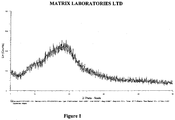
- FIG. 1 is a representative X-ray diffraction pattern of amorphous form of Darunavir
- the present invention relates to an improved process for the preparation of amorphous Darunavir substantially free of difuranyl impurity of formula (1).
- crushed used in the present invention may be understood as grinding, breaking, pressing or compressing.
- sustained used in the present invention may be understood as slurring, partial dissolving, dissolving, contacting or treating.
- substantially used in the present invention is Darunavir having difuranyl impurity is less than 0.1%, more preferably less than 0.05%.
- amorphous Darunavir having the difuranyl impurity less than 0.1% is prepared by the process comprising the steps of:
- compound of formula 2 is reacted with isobutylamine under reflux temperature and then excess isobutylamine is removed under reduced pressure.
- the obtained residue is dissolved in a solvent and reacted with p-nitrobenzenesulfonyl chloride in the presence of a base at reflux temperature.
- the compound of formula 3 is isolated by filtration and further subjected to recrystallisation to obtain pure compound of formula 3.
- the solvent used in step a) is selected from methylene dichloride, chloroform, N, N- dimethylformamide, dimethyl sulfoxide, N -methyl-2-pyrrolidinone, ethyl acetate, dimethylacetamide or mixture thereof.
- the base used in step a) is selected from alkyl amines like ammonia, methylamine, ethylamine, dimethylamine, diethylamine, triethylamine, N , N -diisopropylethylamine and aromatic amines like, N , N -dimethylaniline, N , N -dimethylaminopyridine or mixture thereof.
- the solvent used for recrystallisation of compound 3 is selected from the methanol, ethanol, isopropyl alcohol, ethyl acetate, isopropyl acetate or mixture thereof.
- the protecting group in step a) is selected from t-butoxy-carbonyl (Boc), benzyloxycarbonyl (Cbz), trityl (Trt), 9-fluoroenylmethoxycarbonyl (Fmoc), 2- (4-biphenylyl)propyl(2)oxycarbonyl (Bpoc), 2-phenylpropyl(2)oxycarbonyl (Poc), 2-(4-xenyl)isopropoxycarbonyl, isopropoxycarbonyl, 1, I-diphenylethyl (I)oxycarbonyl, 1, 1-diphenylpropyl(I)oxycarbonyl, 2-(3,5-dimethoxyphenyl)-propyl(2)-oxycarbonyl (Ddz), 2-(p-5-toluyl)propyl(2)oxycarbonyl, 1-methylcycl-opentanyloxycarbonyl, cyclohcxanyloxy-carbonyl, 1-methylcyclohcxanyloxo carbony
- the reduction is carried out by dissolving the compound of formula 3 in a solvent, optionally containing triethanolamine and reducing with metallic reducing reagents, optionally, under hydrogen atmosphere.
- the obtained product is subjected to hydrolysis with an acid in same solvent followed by recrystallisation to isolate a compound of formula 4.
- the compound of formula 3 is dissolved in a solvent selected from methanol, ethanol, isopropyl alcohol, ethyl acetate or mixture thereof.
- the reduction was carried out at the temperature in the range of 30-55°C.
- the reducing agent suitable for reduction of the nitro moiety is selected from borane complexes such as diborane, sodium borohydride, lithium borohydride, sodium borohydride-LiCl, aluminum lithium hydride, or diisobutylaluminium hydride; metals such as iron, zinc, tin and the like; and transition metals such as palladium-carbon, platinum oxide, Raney-nickel, rhodium, ruthenium and the like.
- borane complexes such as diborane, sodium borohydride, lithium borohydride, sodium borohydride-LiCl, aluminum lithium hydride, or diisobutylaluminium hydride
- metals such as iron, zinc, tin and the like
- transition metals such as palladium-carbon, platinum oxide, Raney-nickel, rhodium, ruthenium and the like.
- ammonium formate, sodium dihydrogenphosphate, hydrazine may be used
- the reagent for the hydrolysis is selected from inorganic acids such as hydrochloric acid, nitric acid, sulfuric acid and phosphoric acid; organic acids such as acetic acid, trifluoroacetic acid methanesulfonic acid and p-toluenesulfonic acid; Lewis acids such as boron trifluoride; acidic cationic ion-exchange resins such as Dowex SOWTM.
- inorganic acids such as hydrochloric acid, nitric acid, sulfuric acid and phosphoric acid
- organic acids such as acetic acid, trifluoroacetic acid methanesulfonic acid and p-toluenesulfonic acid
- Lewis acids such as boron trifluoride
- acidic cationic ion-exchange resins such as Dowex SOWTM.
- the solvent used for the recrystallisation of compound of formula 4 is selected from methanol, ethanol, isopropyl alcohol, ethyl acetate or mixture thereof.
- a solution of compound of formula 4 in an organic solvent is added slowly to a solution of compound of formula 5 in same organic solvent at -5°C to 5°C and maintained at ambient temperature for 4-10 h. to get crude Darunavir.
- the obtained crude Darunavir is optionally converted to its solvate followed by recrystallisation in a solvent.
- the Darunavir solvate is further converted to amorphous Darunavir by dissolving in an organic solvent and evaporating the solvent by using known techniques.
- the compound of formula 5 is generated by activating (3 R , 3a S , 6a R )-hexahydrofuro [2, 3- b ] furan-3-ol (5a) with coupling agents which may undergo carbamoylation with compound of formula 4.
- the compound of formula 5a is activated with the coupling agent preferably occurs before the coupling with compound of formula 4 and is additional advantage to be a one-pot procedure, since isolation of the activated intermediate is not necessary.
- Examples of coupling agents used in carbamoylation reactions are carbonates such as bis-(4-nitrophenyl) carbonate, disuccinimidyl carbonate (DSC), carbonyl diimidazole (CDI).
- Other coupling agents include chloroformates, such as p-nitrophenylcbloroformate, phosgenes such as phosgene or triphosgene.
- the solvent used in the step d) to prepare a solution of compound of formula 4 is N -methyl-2-pyrrolidinone (NMPO).
- the solvent used to prepare Darunavir solvate is selected from methanol, ethanol, isopropyl alcohol, n-propanol, n-butanol, ethyl acetate, tetrahydrofuran, methyl ethyl ketone, methyl t-butyl ether, diisopropyl ether or mixtures thereof.
- the solvent used for recrystallisation Darunavir solvate is selected from methanol, ethanol, isopropyl alcohol, n-propanol, n-butanol, ethyl acetate, tetrahydrofuran, methyl ethyl ketone, methyl t-butyl ether, diisopropyl ether or mixtures thereof.
- the organic solvent used to dissolve Darunavir or Darunavir solvate to prepare amorphous Darunavir is selected from dichloromethane, chloroform, carbon tetrachloride, dichloroethane, tetrahydrofuran, ethyl acetate or mixture thereof.
- the technique to evaporate the solvent is selected from distillation, evaporation, spray drying, freeze drying, lyophilisation or agitated thin film drier (ATFD).
- amorphous Darunavir having the difuranyl impurity of formula (1) less than 0.1% is prepared by the process comprising the steps of:
- compound of formula 6 is reacted with isobutylamine in a solvent or mixture thereof in the presence of base at reflux temperature and then excess isobutylamine is removed under reduced pressure to obtain compound of formula 7.
- the solvent used in the step a) is selected from water, methylenedichloride, methanol, ethanol, 3-propanol, n-butanol, 2-butanol, ethyl acetate, isopropyl acetate, toluene, N, N- dimethylformamide, N , N -dimethylacetamide, N -methyl-2-pyrrolidinone (NMPO), dimethyl sulfoxide or mixture thereof.
- the base used in the step a) is selected from sodium hydroxide, potassium hydroxide, lithium hydroxide, sodium carbonate, potassium carbonate, lithium carbonate, sodium bicarbonate, potassium bicarbonate or lithium bicarbonate.
- the leaving group in the present invention is selected from chloro, bromo, iodo or cyano.
- the obtained compound of formula 7 is reacted with p-nitrobenzenesulfonyl chloride in an organic solvent in the presence of a base at reflux temperature to obtain compound of formula 3. Further, the compound of formula 3 is subjected to recrystallisation to obtain pure product.
- the solvent used in step b) is selected from methylene dichloride, toluene, N, N- dimethylformamide, dimethyl sulfoxide, N -methyl-2 pyrrolidinone, ethyl acetate, dimethylacetamide or mixture thereof.
- the base used in step b) is selected from alkyl amines like ammonia, methylamine, ethylamine, dimethylamine, diethylamine, triethylamine, N , N -diisopropylethylamine and aromatic amines like, N , N -dimethylaniline, N , N -dimethylaminopyridine or mixture thereof.
- the solvent used to recrystallisation the compound of step b) is selected from the methanol, ethanol, isopropyl alcohol, ethyl acetate, isopropyl acetate or mixture thereof.
- the reduction is carried out by dissolving the compound of formula 3 in a solvent, optionally containing triethanolamine and reducing with metallic reducing reagents, optionally, under hydrogen atmosphere.
- the obtained product is subjected to hydrolysis with an acid in same solvent followed by recrystallisation to isolate a compound of formula 4.
- the compound of formula 3 is dissolved in a solvent selected from methanol, ethanol, isopropyl alcohol, ethyl acetate or mixture thereof.
- the reduction was carried out at the temperature in the range of 30-55°C.
- the reducing agent suitable for reduction of the nitro moiety is selected from borane complexes such as diborane, sodium borohydride, lithium borohydride, sodium borohydride-LiCl, aluminum lithium hydride, or diisobutylaluminium hydride; metals such as iron, zinc, tin and the like; and transition metals such as palladium-carbon, platinum oxide, Raney-nickel, rhodium, ruthenium and the like.
- borane complexes such as diborane, sodium borohydride, lithium borohydride, sodium borohydride-LiCl, aluminum lithium hydride, or diisobutylaluminium hydride
- metals such as iron, zinc, tin and the like
- transition metals such as palladium-carbon, platinum oxide, Raney-nickel, rhodium, ruthenium and the like.
- ammonium formate, sodium dihydrogenphosphate, hydrazine may be used
- the reagent for the hydrolysis is selected from inorganic acids such as hydrochloric acid (commercially pure or laboratory grade), nitric acid, sulfuric acid and phosphoric acid; organic acids such as acetic acid, trifluoroacetic acid methanesulfonic acid and p-toluenesulfonic acid; Lewis acids such as boron trifluoride; acidic cationic ion-exchange resins such as Dowex SOWTM.
- inorganic acids such as hydrochloric acid (commercially pure or laboratory grade), nitric acid, sulfuric acid and phosphoric acid
- organic acids such as acetic acid, trifluoroacetic acid methanesulfonic acid and p-toluenesulfonic acid
- Lewis acids such as boron trifluoride
- acidic cationic ion-exchange resins such as Dowex SOWTM.
- the solvent used for the recrystallisation of compound of formula 4 is selected from methanol, ethanol, isopropyl alcohol, ethyl acetate or mixture thereof.
- compound of formula 4 is condensed with compound of formula 5 in N-methyl-2-pyrrolidinone at - 10°C to 40°C and maintained at ambient temperature for 4-10 h. to get crude Darunavir.
- the obtained crude Darunavir is optionally converted to its solvate followed by recrystallisation from an organic solvent.
- the Darunavir solvate is further converted to amorphous Darunavir by dissolving in an organic solvent and evaporating the solvent by using known techniques.
- the compound of formula 5 is generated by activating (3 R , 3a S , 6a R )-hexahydrofuro [2, 3-b] furan-3-ol (5a) with coupling agents which may undergo carbamoylation with compound of formula 4.
- the compound of formula 5a is activated with the coupling agent preferably occurs before the coupling with compound of formula 4 and is additional advantage to be a one-pot procedure, since isolation of the activated intermediate is not necessary.
- Examples of coupling agents used in carbamoylation reactions are carbonates such as bis-(4-nitrophenyl) carbonate, disuccinimidyl carbonate (DSC), carbonyl diimidazole (CDI).
- Other coupling agents include chloroformates, such as p-nitrophenylcbloroformate, phosgenes such as phosgene or triphosgene.
- the solvent used to prepare Darunavir solvate is selected from methanol, ethanol, isopropyl alcohol, n-propanol, n-butanol, ethyl acetate, tetrahydrofuran, methyl ethyl ketone, methyl t-butyl ether, diisopropyl ether or mixtures thereof.
- the solvent used for recrystallisation Darunavir solvate is selected from methanol, ethanol, isopropyl alcohol, n-propanol, n-butanol, ethyl acetate, tetrahydrofuran, methyl ethyl ketone, methyl t-butyl ether, diisopropyl ether or mixtures thereof.
- the organic solvent used to dissolve Darunavir or Darunavir solvate to prepare amorphous Darunavir is selected from dichloromethane, chloroform, carbon tetrachloride, dichloroethane, tetrahydrofuran, ethyl acetate or mixture thereof.
- the technique to evaporate the solvent is selected from distillation, evaporation, spray drying, freeze drying, lyophilisation or agitated thin film drier (ATFD).
- the present invention provide a process for the preparation of the Darunavir having the difuranyl impurity of formula (1) less than 0.1% is prepared by coupling the compound of formula 4 with (3 R , 3a S , 6a R )-hexahydrofuro[2,3- b ]furan-3-ol derivative (5) in N -methyl-2-pyrrolidinone (NMPO).
- NMPO N -methyl-2-pyrrolidinone
- compound of formula 4 in N-methyl-2-pyrrolidinone is added slowly to a solution of compound of formula 5 in same organic solvent at -5°C to 5°C and maintained at ambient temperature for 4-10 h. to get Darunavir.
- the compound of formula 5 is generated by activating (3 R , 3a S , 6a R )-hexahydrofuro [2, 3- b ] furan-3-ol (5a) with coupling agents which may undergo carbamoylation with compound of formula 4.
- the compound of formula 5a is activated with the coupling agent preferably occurs before the coupling with compound of formula 4 and is additional advantage to be a one-pot procedure, since isolation of the activated intermediate is not necessary.
- Examples of coupling agents used in carbamoylation reactions are carbonates such as bis-(4-nitrophenyl) carbonate, disuccinimidyl carbonate (DSC), carbonyl diimidazole (CDI).
- Other coupling agents include chloroformates, such as p-nitrophenylcbloroformate, phosgenes such as phosgene or triphosgene.
- the present invention discloses a process for the preparation of amorphous Darunavir comprising the steps of:
- Darunavir is dissolved in a solvent such as dichloromethane, chloroform, carbon tetrachloride, dichloroethane, tetrahydrofuran, methanol, ethanol, isopropyl alcohol, acetonitrile, ethyl acetate or mixtures thereof and then solvent is removed by conventional techniques such as distillation, evaporation, spray drying, freeze drying, lyophilisation or agitated thin film drier (ATFD) and thus isolating amorphous Darunavir.
- a solvent such as dichloromethane, chloroform, carbon tetrachloride, dichloroethane, tetrahydrofuran, methanol, ethanol, isopropyl alcohol, acetonitrile, ethyl acetate or mixtures thereof.
- solvent such as dichloromethane, chloroform, carbon tetrachloride, dichloroethane, tetrahydrofuran,
- the present invention discloses a process for the preparation of amorphous Darunavir comprising the steps of:
- Darunavir is dissolved in a solvent such as ethyl acetate, isopropyl acetate, methyl acetate, acetone or tetrahydrofuran, then heated the solution to 35-50°C and maintained at the same temperature for about 1 h.
- the solvent is removed by distillation, followed by addition of hydrocarbon solvent selected from n-hexane, n-heptane, cyclohexane, diethyl ether, petroleum ether, methyl tert-butyl ether, octane or toluene and the obtain solid is filtered to get amorphous form of Darunavir.
- the present invention discloses a process for preparation of amorphous Darunavir comprising the steps of:
- Darunavir is heated to 110-120°C to form a melt and maintained the melt for 3-5h. at the same temperature under vacuum.
- the melt was cooled to 25-35°C to form glass type crystals.
- the obtained glass type crystals were crushed to obtain amorphous Darunavir.
- the present invention discloses a process for the preparation of amorphous Darunavir comprising the steps of:
- Darunavir is suspended in a solvent such as glycerol then heated to 80-130°C preferably 80-120°C and maintained under vacuum for about 1hr.
- the resultant solution was cooled to an ambient temperature and added anti-solvent selected from water, n-hexane, n-heptane, cyclohexane, diethyl ether, petroleum ether, methyl tert-butyl ether, octane or toluene and the obtained solide is filtered to get amorphous Darunavir.
- Darunavir used as input in the above processes may be in the form of hydrate, anhydrous or solvate such as ethanol solvate, methanol solvate, isopropanol solvate, acetone solvate or solvated hydrate.
- the present invention discloses Darunavir ethanolate obtained from the present process have the purity more than 99.5% and difuranyl impurity is less than 0.08%.
- the present invention discloses amorphous Darunavir obtained from the present process have the purity more than 99.5% and difuranyl impurity is less than 0.08%.
- the present invention discloses amorphous Darunavir, having particle size D 50 is less than 60 micrometers and D 90 less than 200 micrometers.
- the present invention discloses a pharmaceutical composition of Darunavir, solvates or its pharmaceutically acceptable salts having difuranyl impurity is less than 0.1 %.
- the present invention discloses a process for preparation of amorphous Darunavir, which comprises:
- Darunavir is dissolved in a solvent, pharmaceutically acceptable carrier like povidone is added and removed the solvent by distillation, filtration, freez drying of azitated thin film drier.
- the present invention discloses a pharmaceutical composition
- a pharmaceutical composition comprising Darunavir or solvate or pharmaceutically acceptable salt and at least one pharmaceutically acceptable carrier.
- compositions comprising the Darunavir prepared as per the present invention can be made by conventional methods, for instance, compression or granulation of above Darunavir with pharmaceutically acceptable excipients.
- the composition can be in the form of tablets, capsules, caplets etc.
- the X-ray diffraction patterns of said polymorphs of the invention were measured on Bruker D8 Discover powder diffractometer equipped with goniometer of ⁇ / ⁇ configuration and LynxEye detector.
- the Cu-anode X-ray tube was operated at 40kV and 30mA. The experiments were conducted over the 2 ⁇ range of 2.0°-50.0°, 0.030° step size and 50 seconds step time.
- the resultant compound of formula 7 was dissolved in methylene dichloride (1200 mL), triethylamine (50 g, 0.495 mol) was added and heated to reflux. A solution of p-nitrobenzenesulfonyl chloride (93.0g, 0.42 mol) in methylene chloride (300 mL) was added slowly to the reaction mixture at reflux temperature. After reaction complies by HPLC, water (500 mL) was charged to the reaction mixture. The two layers were separated and methylene dichloride was distilled under atmospheric pressure. Finally, methylene dichloride traces were removed by co-distillation with isopropyl alcohol.
- the compound of formula 3a (100 g), 10% palladium carbon (10 g) and triethanolamine (2g) were suspended in methanol and then hydrogenated at 40 - 45°C for 2 h. After completion of the reaction (TLC monitoring), filtered the reaction mass to remove palladium carbon. cp. HCl (62 mL) was added to the filtrate, heated to reflux and maintained for 2 h. The reaction mass was cooled to ambient temperature, pH of the reaction mass was adjusted to 6.0 - 7.0 with 20% sodium hydroxide solution. Methanol was distilled off under vacuum at below 50°C.
- the resultant residue was dissolved in a mixture of isopropyl alcohol (300 mL) and purified water (600 mL) and pH was further adjusted to 9.0 - 10.0 with 20% sodium hydroxide solution at ambient temperature.
- the reaction mass was maintained for 10 h, cooled to 0 - 5°C, filtered and washed with purified water.
- the wet cake was suspended in isopropyl alcohol (350 mL), heated to reflux, and maintained for 30 min.
- the reaction mass was cooled to 2 - 4°C, maintained for 1 h., filtered and washed with isopropyl alcohol.
- the wet product was air dried to obtain the compound of formula 4 in 71.3 g (yield-95%) with HPLC purity of 99.76%.
- the wet compound was dried at 45°C to obtain the in 124.3 g (yield-82.5%).
- the obtained Darunavir ethanolate had purity of 99.79% on area by HPLC and contained 0.08% on area by HPLC of the difuranyl impurity.
- Darunavir Ethanolate 200 gm was dissolved in Methylene chloride (1000 ml) and solvent was evaporated by applying vacuum followed by isolation of amorphous Darunavir as a solid as such or by charging n-Heptane or Isopropyl ether.
- Darunavir Ethanolate (10 g) was dissolved in ethyl acetate (50 mL). The solution was heated to 40 - 45°C and maintained for 30 min. Ethyl acetate was distilled off under vacuum completely to get residue in the form of semisolid. n-Heptane (50 mL) was added to the residue and stirred for 30 min. at ambient temperature. The separated solid was filtered, washed the wet cake with n-heptane (5 mL) and dried at 40 - 45°C under vacuum to get 8.0 g of amorphous Darunavir.
- Darunavir Ethanolate (10 g) was placed into a dry round bottom flask and heated to 110 - 120°C to melt and maintained under vacuum for 4 h. The reaction mass was slowly cooled to 25 - 35°C. The obtained glass type crystal was broken into powder to afford 8.5 g of amorphous Darunavir.
- Darunavir Ethanolate (5.0 g) was suspended into glycerol (25 g), heated to 110 - 120°C under vacuum and maintained for 30min. Water (50 mL) was added to the cooled reaction mass at 25 - 35°C under stirring and the obtained suspension was stirred for 30 min at 25 - 35°C. The separated solid was filtered and dried at 40 - 45°C under vacuum to yield 3.5 g of amorphous Darunavir.
Landscapes
- Organic Chemistry (AREA)
- Chemical & Material Sciences (AREA)
- Health & Medical Sciences (AREA)
- Life Sciences & Earth Sciences (AREA)
- Virology (AREA)
- Medicinal Chemistry (AREA)
- Public Health (AREA)
- Animal Behavior & Ethology (AREA)
- Pharmacology & Pharmacy (AREA)
- Nuclear Medicine, Radiotherapy & Molecular Imaging (AREA)
- Oncology (AREA)
- Communicable Diseases (AREA)
- General Chemical & Material Sciences (AREA)
- General Health & Medical Sciences (AREA)
- Chemical Kinetics & Catalysis (AREA)
- Veterinary Medicine (AREA)
- AIDS & HIV (AREA)
- Tropical Medicine & Parasitology (AREA)
- Molecular Biology (AREA)
- Pharmaceuticals Containing Other Organic And Inorganic Compounds (AREA)
- Heterocyclic Carbon Compounds Containing A Hetero Ring Having Oxygen Or Sulfur (AREA)
- Nitrogen And Oxygen Or Sulfur-Condensed Heterocyclic Ring Systems (AREA)
- Nitrogen Condensed Heterocyclic Rings (AREA)
Description
- The present invention relates to an improved process for the preparation of amorphous Darunavir, being substantially free of difuranyl impurity of formula (1).
- Further, the present invention also discloses a pharmaceutical composition of Darunavir, solvates or pharmaceutically acceptable salts having the difuranyl impurity of formula (1) less than 0.1 %.
- Darunavir brand name is PREZISTA, formerly known as TMC114, which is used to treat HIV infection. It is a protease inhibitor developed by pharmaceutical company Tibotec. Darunavir is a second-generation protease inhibitor (PIs), designed specifically to overcome problems with the older agents in this class, such as indinavir.
- Darunavir Ethanolate, has the chemical name: [(1S,2R)-3-[[(4-aminophenyl) sulfonyl](2-methylpropyl)amino]-2-hydroxy-1-(phenylmethyl)propyl]carbamic acid (3R, 3aS, 6aR)-hexahydrofuro[2,3-b]furan-3-yl ester monoethanolate and has the following structural formula:

- Darunavir and its process are first disclosed in
US 6248775 , wherein 2R-hydroxy-3-[[(4-aminophenyl)sulfonyl](2-methylpropyl)amino]-1S(phenylmethyl) propylamine (4) is reacted with (3R, 3aS, 6aR)-hexahydrofuro[2,3-b]furan-3-ol in anhydrous acetonitrile in the presence of N, N'-disuccinimidyl carbonate, anhydrous pyridine at ambient temperature followed by workup to get Darunavir (Scheme A).
-
US 20050250845 disclosed the various solvates of Darunavir including ethanolate and method for their preparation as well as their use as a medicament. The same application disclosed the amorphous Darunavir by Raman spectra without process details. -
WO 2005063770 discloses process for the preparation of Darunavir ethanolate, wherein 2R-hydroxy-3-[[(4-aminophenyl)sulfonyl](2-methylpropyl)amino]-1S-(phenylmethyl)propyl amine (4) is reacted with (3R, 3aS, 6aR)-hexahydrofuro[2,3-b]furan-3-ol in the presence of N, N'-disuccinimidyl carbonate, triethylamine, 41% methylamine in ethanol in a mixture of ethyl acetate and acetonitrile followed by workup and crystallization from ethanol to get Darunavir ethanolate (Scheme B).
- In the prior art process, compound of formula 4 condensed with (3R, 3aS, 6aR)-hexahydrofuro[2,3-b]furan-3-ol in large excess of solvent or solvent mixture containing large excess of base or mixture of bases to get Darunavir. Further, the obtained products by the processes described in the prior art are not satisfactory, from purity point of view. We have repeated the Darunavir synthetic procedures as described in the prior art and found that relatively large amounts of impurities were obtained along with Darunavir (Table-1) which need repeated crystallizations in different solvents to get desired quality of the final product resulting in poor yields. Among other impurities, the carbonic acid [(1R,2S)-1-{((4-amino-benzenesulfonyl)-isobutyl-amino)-methyl}-2-((3R,3aS,6aR)-hexahydro-furo[2,3-b]furan-3-yloxycarbonylamino)-3-phenyl-propylester (3R,3aS,6aR)-hexahydro-furo[2,3-b]furan-3-yl ester (difuranyl impurity of formula 1) is identified.

- However, a need still remains for an improved and commercially viable process for preparing pure crystalline or amorphous Darunavir that should solve the aforesaid problems associated with processes described in the prior art, which will be suitable for large-scale preparation, in terms of simplicity, yield and purity of the product. The inventors of the present invention also developed a novel process for amorphous Darunavir, which is feasible at large scale.
- The main aspect, the present invention is to provides an improved process for the preparation of amorphous Darunavir having said difuranyl impurity in an amount of less than 0.1%.
- In another aspect, the present invention discloses a process for the preparation of Darunavir which comprises,
- a) reacting 4-amino-N-(2R, 3S) (3-amino-2-hydroxy-4-phenylbutyl)-N-isobutyl-benzenesulfonamide (4) with (3R, 3aS, 6aR)-hexahydrofuro[2,3-b]furan-3-ol derivative (5) in N-methyl-2-pyrrolidinone (NMPO) solvent, and
- b) isolating Darunavir.
- In another aspect, the present invention discloses amorphous Darunavir, having particle size D50 is less than 60 micrometers and D90 less than 200 micrometers.
- In another aspect, the present invention discloses Darunavir, having the purity more than 99.5% and difuranyl impurity less than 0.10%.
- In another aspect, the present invention discloses an improved process for the preparation of amorphous Darunavir comprising the steps of:
- a) dissolving Darunavir or Darunavir solvate in an organic solvent, and
- b) removing the solvent to obtain amorphous form of Darunavir.
- In another aspect, the present invention discloses an improved process for the preparation of amorphous Darunavir comprising the steps of;
- a) dissolving Darunavir in an organic solvent,
- b) removing the solvent,
- c) adding hydrocarbon solvent, and
- d) isolating amorphous form of Darunavir.
- In another aspect, the present invention discloses a process for preparation of amorphous Darunavir by forming a melt by heating the Darunavir followed by fast cooling the melt to form amorphous Darunavir.
- In another aspect, the present invention discloses a process for the preparation of amorphous Darunavir comprising the steps of;
- a) suspending Darunavir in an organic solvent,
- b) adding an anti-solvent, and
- c) isolating amorphous Darunavir.
- In yet another aspect, the present invention discloses a process for preparation of amorphous Darunavir, which comprises:
- a) providing a solution, suspension or dispersion of Darunavir or Darunavir solvate, either alone or in combination with one or more pharmaceutically acceptable carriers, in a solvent; and
- b) removing solvent from the solution to provide the desired amorphous Darunavir.
- In yet another aspect, the present invention discloses a pharmaceutical composition comprising Darunavir or solvate or pharmaceutically acceptable salt and at least one pharmaceutically acceptable carrier
-
FIG. 1 is a representative X-ray diffraction pattern of amorphous form of Darunavir - The present invention relates to an improved process for the preparation of amorphous Darunavir substantially free of difuranyl impurity of formula (1).
- The term "crushed" used in the present invention may be understood as grinding, breaking, pressing or compressing.
- The term "suspending" used in the present invention may be understood as slurring, partial dissolving, dissolving, contacting or treating.
- The term "substantially" used in the present invention is Darunavir having difuranyl impurity is less than 0.1%, more preferably less than 0.05%.
- In one embodiment, amorphous Darunavir having the difuranyl impurity less than 0.1% is prepared by the process comprising the steps of:
- a) reacting isobutylamine with protected (2S,3S)-1,2-epoxy-3-amino-4-phenylbutane (2), followed by with p-nitrobenzenesulfonyl chloride in a solvent in the presence of a base to obtain corresponding protected N-((2R, 3S)-3-amino-2-hydroxy-4-phenylbutyl)-N-isobutyl-4-nitro-benzenesulfonamide (3),

- b) reducing the compound of formula 3, followed by hydrolyzing to obtain a compound of formula 4,

- c) coupling the compound of formula 4 with (3R, 3aS, 6aR)-hexahydrofuro[2,3-b]furan-3-ol derivative (5) in N-methyl-2-pyrrolidone (NMPO) to obtain Darunavir,

- d) optionally converting the Darunavir to Darunavir solvate,

- e) dissolving the Darunavir or Darunavir solvate in a solvent, and
- f) isolating the amorphous Darunavir.

- According to the present invention, compound of
formula 2 is reacted with isobutylamine under reflux temperature and then excess isobutylamine is removed under reduced pressure. The obtained residue is dissolved in a solvent and reacted with p-nitrobenzenesulfonyl chloride in the presence of a base at reflux temperature. The compound of formula 3 is isolated by filtration and further subjected to recrystallisation to obtain pure compound of formula 3. - The solvent used in step a) is selected from methylene dichloride, chloroform, N, N-dimethylformamide, dimethyl sulfoxide, N-methyl-2-pyrrolidinone, ethyl acetate, dimethylacetamide or mixture thereof.
- The base used in step a) is selected from alkyl amines like ammonia, methylamine, ethylamine, dimethylamine, diethylamine, triethylamine, N, N-diisopropylethylamine and aromatic amines like, N, N-dimethylaniline, N, N-dimethylaminopyridine or mixture thereof.
- The solvent used for recrystallisation of compound 3 is selected from the methanol, ethanol, isopropyl alcohol, ethyl acetate, isopropyl acetate or mixture thereof.
- The protecting group in step a) is selected from t-butoxy-carbonyl (Boc), benzyloxycarbonyl (Cbz), trityl (Trt), 9-fluoroenylmethoxycarbonyl (Fmoc), 2- (4-biphenylyl)propyl(2)oxycarbonyl (Bpoc), 2-phenylpropyl(2)oxycarbonyl (Poc), 2-(4-xenyl)isopropoxycarbonyl, isopropoxycarbonyl, 1, I-diphenylethyl (I)oxycarbonyl, 1, 1-diphenylpropyl(I)oxycarbonyl, 2-(3,5-dimethoxyphenyl)-propyl(2)-oxycarbonyl (Ddz), 2-(p-5-toluyl)propyl(2)oxycarbonyl, 1-methylcycl-opentanyloxycarbonyl, cyclohcxanyloxy-carbonyl, 1-methylcyclohcxanyloxo carbonyl, 2-mcthylcyclohexanyloxycarbonyl, ethoxycarbonyl, 2-(4-toluylsulfonyl)ethoxycarbonyl, 2-(methylsulfonyl)ethoxycarbonyl, 2-(triphenyl- phosphino)ethoxycarbonyl, 2-(trimethylsilyl)ethoxycarbonyl, allyloxycarbonyl, 1-prop-I-enyloxyearbonyl, 5-benzisoxalylmethoxycarbonyl, 4-acetoxybenzyloxycarbonyl, 2, 2, 2-trichloroethoxycarbonyl, tribromoethoxycarbonyl, 2-ethyl(2) propoxycarbonyl, cyclopropyhnethoxycarbonyl, isobornyloxycarbonyl, 1-piperidyloxycarbonyl, 4-phenylbenzyloxycarbonyl, 2-methylbenzyloxycarbonyl, α-2, 4, 5,-tetramethylbenzyloxy-carbonyl (Tmz), 4-methoxybenzyloxycarbonyl, 4-fluorobenzyloxycarbonyl, 4-chlorobenzyl oxycarbonyl, 3-chlorobenzyloxycarbonyl, 2-chlorobenzyloxycarbonyl, dichlorobenzyloxycarbonyl, 4-bromo-benzyloxycarbonyl, ortho-bromobenzyloxycarbonyl, 3-bromo-benzyloxycarbonyl, 4-nitrobenzyloxycarbonyl, 4-cyanobenzyloxycarbonyl, 4-(decyloxy)-benzyloxycarbonyl, and the like ; the benzoylmethylsulfonyl group, dithiasuccionyl (Dts) group, the 2-(nitro)phenylsulfenyl group (Nps), the diphenylphosphine oxide group.
- According to the present invention, the reduction is carried out by dissolving the compound of formula 3 in a solvent, optionally containing triethanolamine and reducing with metallic reducing reagents, optionally, under hydrogen atmosphere. The obtained product is subjected to hydrolysis with an acid in same solvent followed by recrystallisation to isolate a compound of formula 4.
- The compound of formula 3 is dissolved in a solvent selected from methanol, ethanol, isopropyl alcohol, ethyl acetate or mixture thereof. The reduction was carried out at the temperature in the range of 30-55°C.
- The reducing agent suitable for reduction of the nitro moiety is selected from borane complexes such as diborane, sodium borohydride, lithium borohydride, sodium borohydride-LiCl, aluminum lithium hydride, or diisobutylaluminium hydride; metals such as iron, zinc, tin and the like; and transition metals such as palladium-carbon, platinum oxide, Raney-nickel, rhodium, ruthenium and the like. When catalytic reduction is applied, ammonium formate, sodium dihydrogenphosphate, hydrazine may be used as the hydrogen source.
- The reagent for the hydrolysis is selected from inorganic acids such as hydrochloric acid, nitric acid, sulfuric acid and phosphoric acid; organic acids such as acetic acid, trifluoroacetic acid methanesulfonic acid and p-toluenesulfonic acid; Lewis acids such as boron trifluoride; acidic cationic ion-exchange resins such as Dowex SOWTM.
- The solvent used for the recrystallisation of compound of formula 4 is selected from methanol, ethanol, isopropyl alcohol, ethyl acetate or mixture thereof.
- According to the present invention, a solution of compound of formula 4 in an organic solvent is added slowly to a solution of compound of formula 5 in same organic solvent at -5°C to 5°C and maintained at ambient temperature for 4-10 h. to get crude Darunavir. The obtained crude Darunavir is optionally converted to its solvate followed by recrystallisation in a solvent. The Darunavir solvate is further converted to amorphous Darunavir by dissolving in an organic solvent and evaporating the solvent by using known techniques.
- The compound of formula 5 is generated by activating (3R, 3aS, 6aR)-hexahydrofuro [2, 3-b] furan-3-ol (5a) with coupling agents which may undergo carbamoylation with compound of formula 4. The compound of formula 5a is activated with the coupling agent preferably occurs before the coupling with compound of formula 4 and is additional advantage to be a one-pot procedure, since isolation of the activated intermediate is not necessary. Examples of coupling agents used in carbamoylation reactions are carbonates such as bis-(4-nitrophenyl) carbonate, disuccinimidyl carbonate (DSC), carbonyl diimidazole (CDI). Other coupling agents include chloroformates, such as p-nitrophenylcbloroformate, phosgenes such as phosgene or triphosgene.
- The solvent used in the step d) to prepare a solution of compound of formula 4 is N-methyl-2-pyrrolidinone (NMPO).
- The solvent used to prepare Darunavir solvate is selected from methanol, ethanol, isopropyl alcohol, n-propanol, n-butanol, ethyl acetate, tetrahydrofuran, methyl ethyl ketone, methyl t-butyl ether, diisopropyl ether or mixtures thereof.
- The solvent used for recrystallisation Darunavir solvate is selected from methanol, ethanol, isopropyl alcohol, n-propanol, n-butanol, ethyl acetate, tetrahydrofuran, methyl ethyl ketone, methyl t-butyl ether, diisopropyl ether or mixtures thereof.
- The organic solvent used to dissolve Darunavir or Darunavir solvate to prepare amorphous Darunavir is selected from dichloromethane, chloroform, carbon tetrachloride, dichloroethane, tetrahydrofuran, ethyl acetate or mixture thereof. The technique to evaporate the solvent is selected from distillation, evaporation, spray drying, freeze drying, lyophilisation or agitated thin film drier (ATFD).
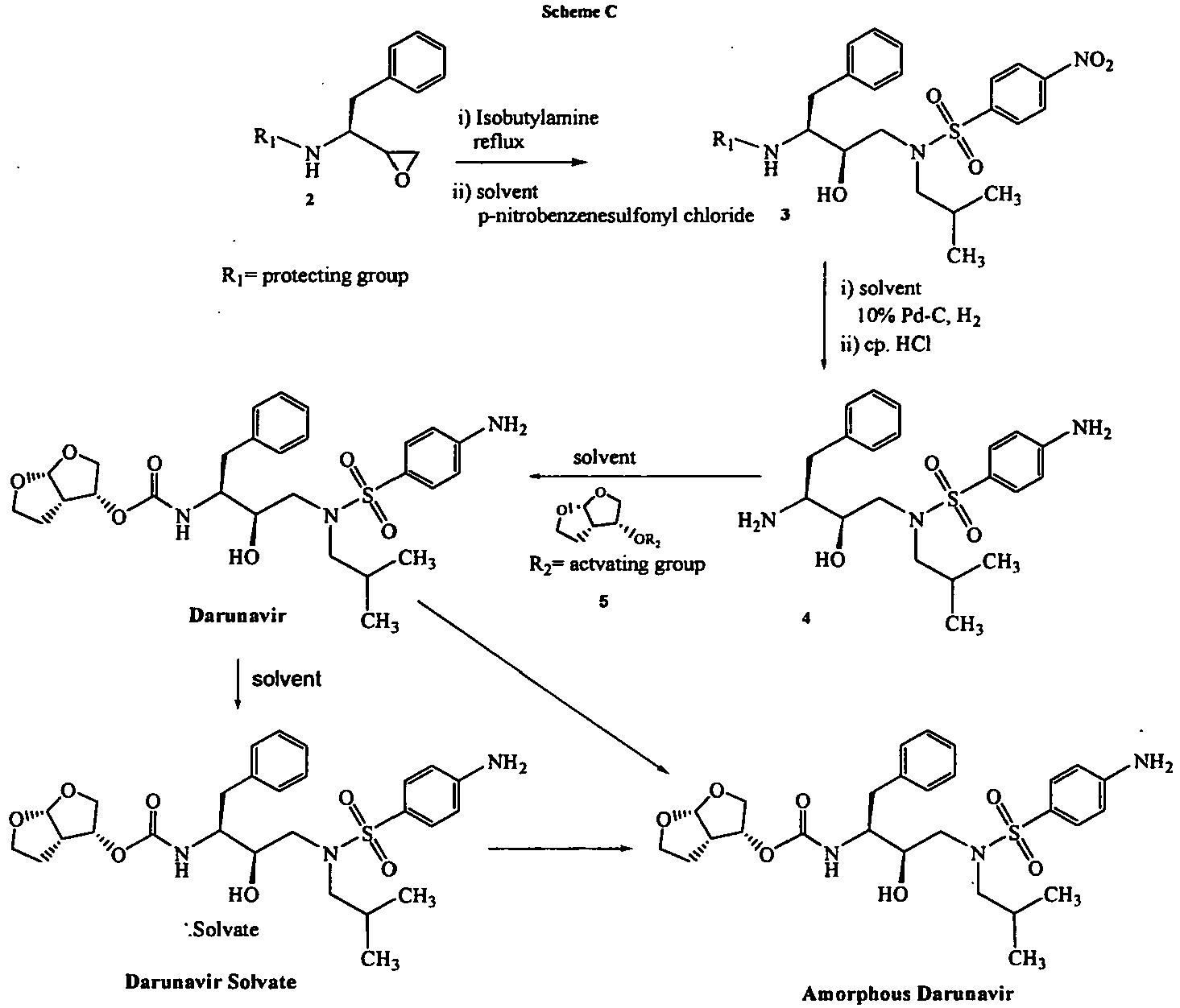
- The reactions involved in the present invention are depicted Scheme C:
- In another embodiment, amorphous Darunavir having the difuranyl impurity of formula (1) less than 0.1% is prepared by the process comprising the steps of:
- a) reacting compound of formula 6 with isobutylamine in presence of base to obtain compound of formula 7,

- b) reacting the compound of formula 7 with p-nitrobenzenesulfonyl chloride in an organic solvent in the presence of a base to obtain corresponding protected N-((2R, 3S)-3-amino-2-hydroxy-4-phenylbutyl)-N-isobutyl-4-nitrobenzenesulfonamide (3),

- c) reducing the compound of formula 3 to obtain a compound of formula 4,

- d) coupling the compound of formula 4 with (3R, 3aS, 6aR)-hexahydrofuro[2,3-b]furan-3-ol derivative (5) in N-methyl-2-pyrrolidinone to obtain Darunavir,

- e) optionally converting the Darunavir to Darunavir solvate,

- f) dissolving the Darunavir or Darunavir solvate in a solvent, and
- g) isolating the amorphous Darunavir.
- According to the present invention, compound of formula 6 is reacted with isobutylamine in a solvent or mixture thereof in the presence of base at reflux temperature and then excess isobutylamine is removed under reduced pressure to obtain compound of formula 7.
- The solvent used in the step a) is selected from water, methylenedichloride, methanol, ethanol, 3-propanol, n-butanol, 2-butanol, ethyl acetate, isopropyl acetate, toluene, N, N-dimethylformamide, N, N-dimethylacetamide, N-methyl-2-pyrrolidinone (NMPO), dimethyl sulfoxide or mixture thereof.
- The base used in the step a) is selected from sodium hydroxide, potassium hydroxide, lithium hydroxide, sodium carbonate, potassium carbonate, lithium carbonate, sodium bicarbonate, potassium bicarbonate or lithium bicarbonate.
- The leaving group in the present invention is selected from chloro, bromo, iodo or cyano.
- The obtained compound of formula 7 is reacted with p-nitrobenzenesulfonyl chloride in an organic solvent in the presence of a base at reflux temperature to obtain compound of formula 3. Further, the compound of formula 3 is subjected to recrystallisation to obtain pure product.
- The solvent used in step b) is selected from methylene dichloride, toluene, N, N-dimethylformamide, dimethyl sulfoxide, N-methyl-2 pyrrolidinone, ethyl acetate, dimethylacetamide or mixture thereof.
- The base used in step b) is selected from alkyl amines like ammonia, methylamine, ethylamine, dimethylamine, diethylamine, triethylamine, N, N-diisopropylethylamine and aromatic amines like, N, N-dimethylaniline, N, N-dimethylaminopyridine or mixture thereof.
- The solvent used to recrystallisation the compound of step b) is selected from the methanol, ethanol, isopropyl alcohol, ethyl acetate, isopropyl acetate or mixture thereof.
- According to the present invention, the reduction is carried out by dissolving the compound of formula 3 in a solvent, optionally containing triethanolamine and reducing with metallic reducing reagents, optionally, under hydrogen atmosphere. The obtained product is subjected to hydrolysis with an acid in same solvent followed by recrystallisation to isolate a compound of formula 4.
- The compound of formula 3 is dissolved in a solvent selected from methanol, ethanol, isopropyl alcohol, ethyl acetate or mixture thereof. The reduction was carried out at the temperature in the range of 30-55°C.
- The reducing agent suitable for reduction of the nitro moiety is selected from borane complexes such as diborane, sodium borohydride, lithium borohydride, sodium borohydride-LiCl, aluminum lithium hydride, or diisobutylaluminium hydride; metals such as iron, zinc, tin and the like; and transition metals such as palladium-carbon, platinum oxide, Raney-nickel, rhodium, ruthenium and the like. When catalytic reduction is applied, ammonium formate, sodium dihydrogenphosphate, hydrazine may be used as the hydrogen source.
- The reagent for the hydrolysis is selected from inorganic acids such as hydrochloric acid (commercially pure or laboratory grade), nitric acid, sulfuric acid and phosphoric acid; organic acids such as acetic acid, trifluoroacetic acid methanesulfonic acid and p-toluenesulfonic acid; Lewis acids such as boron trifluoride; acidic cationic ion-exchange resins such as Dowex SOWTM.
- The solvent used for the recrystallisation of compound of formula 4 is selected from methanol, ethanol, isopropyl alcohol, ethyl acetate or mixture thereof.
- According to the present invention, compound of formula 4 is condensed with compound of formula 5 in N-methyl-2-pyrrolidinone at - 10°C to 40°C and maintained at ambient temperature for 4-10 h. to get crude Darunavir. The obtained crude Darunavir is optionally converted to its solvate followed by recrystallisation from an organic solvent. The Darunavir solvate is further converted to amorphous Darunavir by dissolving in an organic solvent and evaporating the solvent by using known techniques.
- The compound of formula 5 is generated by activating (3R, 3aS, 6aR)-hexahydrofuro [2, 3-b] furan-3-ol (5a) with coupling agents which may undergo carbamoylation with compound of formula 4. The compound of formula 5a is activated with the coupling agent preferably occurs before the coupling with compound of formula 4 and is additional advantage to be a one-pot procedure, since isolation of the activated intermediate is not necessary. Examples of coupling agents used in carbamoylation reactions are carbonates such as bis-(4-nitrophenyl) carbonate, disuccinimidyl carbonate (DSC), carbonyl diimidazole (CDI). Other coupling agents include chloroformates, such as p-nitrophenylcbloroformate, phosgenes such as phosgene or triphosgene.
- The solvent used to prepare Darunavir solvate is selected from methanol, ethanol, isopropyl alcohol, n-propanol, n-butanol, ethyl acetate, tetrahydrofuran, methyl ethyl ketone, methyl t-butyl ether, diisopropyl ether or mixtures thereof.
- The solvent used for recrystallisation Darunavir solvate is selected from methanol, ethanol, isopropyl alcohol, n-propanol, n-butanol, ethyl acetate, tetrahydrofuran, methyl ethyl ketone, methyl t-butyl ether, diisopropyl ether or mixtures thereof.
- The organic solvent used to dissolve Darunavir or Darunavir solvate to prepare amorphous Darunavir is selected from dichloromethane, chloroform, carbon tetrachloride, dichloroethane, tetrahydrofuran, ethyl acetate or mixture thereof. The technique to evaporate the solvent is selected from distillation, evaporation, spray drying, freeze drying, lyophilisation or agitated thin film drier (ATFD).
- In another embodiment, the present invention provide a process for the preparation of the Darunavir having the difuranyl impurity of formula (1) less than 0.1% is prepared by coupling the compound of formula 4 with (3R, 3aS, 6aR)-hexahydrofuro[2,3-b]furan-3-ol derivative (5) in N-methyl-2-pyrrolidinone (NMPO).

- According to the present invention, compound of formula 4 in N-methyl-2-pyrrolidinone is added slowly to a solution of compound of formula 5 in same organic solvent at -5°C to 5°C and maintained at ambient temperature for 4-10 h. to get Darunavir.
- The compound of formula 5 is generated by activating (3R, 3aS, 6aR)-hexahydrofuro [2, 3-b] furan-3-ol (5a) with coupling agents which may undergo carbamoylation with compound of formula 4. The compound of formula 5a is activated with the coupling agent preferably occurs before the coupling with compound of formula 4 and is additional advantage to be a one-pot procedure, since isolation of the activated intermediate is not necessary. Examples of coupling agents used in carbamoylation reactions are carbonates such as bis-(4-nitrophenyl) carbonate, disuccinimidyl carbonate (DSC), carbonyl diimidazole (CDI). Other coupling agents include chloroformates, such as p-nitrophenylcbloroformate, phosgenes such as phosgene or triphosgene.
- In another embodiment, the present invention discloses a process for the preparation of amorphous Darunavir comprising the steps of:
- a) dissolving Darunavir in a solvent, and
- b) isolating amorphous Darunavir.
- According to the present disclosure Darunavir is dissolved in a solvent such as dichloromethane, chloroform, carbon tetrachloride, dichloroethane, tetrahydrofuran, methanol, ethanol, isopropyl alcohol, acetonitrile, ethyl acetate or mixtures thereof and then solvent is removed by conventional techniques such as distillation, evaporation, spray drying, freeze drying, lyophilisation or agitated thin film drier (ATFD) and thus isolating amorphous Darunavir.
- In another embodiment, the present invention discloses a process for the preparation of amorphous Darunavir comprising the steps of:
- a) dissolving Darunavir in a solvent,
- b) removing the solvent,
- c) adding hydrocarbon solvent, and
- d) isolating amorphous Darunavir.
- According to the present disclosure Darunavir is dissolved in a solvent such as ethyl acetate, isopropyl acetate, methyl acetate, acetone or tetrahydrofuran, then heated the solution to 35-50°C and maintained at the same temperature for about 1 h. The solvent is removed by distillation, followed by addition of hydrocarbon solvent selected from n-hexane, n-heptane, cyclohexane, diethyl ether, petroleum ether, methyl tert-butyl ether, octane or toluene and the obtain solid is filtered to get amorphous form of Darunavir.
- In another embodiment, the present invention discloses a process for preparation of amorphous Darunavir comprising the steps of:
- a) heating the Darunavir to higher temperature to form melt,
- b) cooling the melt, and
- c) isolating the amorphous Darunavir.
- According to the present disclosure Darunavir is heated to 110-120°C to form a melt and maintained the melt for 3-5h. at the same temperature under vacuum. The melt was cooled to 25-35°C to form glass type crystals. The obtained glass type crystals were crushed to obtain amorphous Darunavir.
- In another embodiment, the present invention discloses a process for the preparation of amorphous Darunavir comprising the steps of:
- a) suspending Darunavir in a solvent,
- b) heating the reaction mass to higher temperatures,
- c) cooling the reaction mass,
- d) adding an anti-solvent, and
- e) isolating amorphous Darunavir.
- According to the present disclosre Darunavir is suspended in a solvent such as glycerol then heated to 80-130°C preferably 80-120°C and maintained under vacuum for about 1hr. The resultant solution was cooled to an ambient temperature and added anti-solvent selected from water, n-hexane, n-heptane, cyclohexane, diethyl ether, petroleum ether, methyl tert-butyl ether, octane or toluene and the obtained solide is filtered to get amorphous Darunavir.
- According to the present disclosure Darunavir used as input in the above processes may be in the form of hydrate, anhydrous or solvate such as ethanol solvate, methanol solvate, isopropanol solvate, acetone solvate or solvated hydrate.
- In another embodiment, the present invention discloses Darunavir ethanolate obtained from the present process have the purity more than 99.5% and difuranyl impurity is less than 0.08%.
- In another embodiment, the present invention discloses amorphous Darunavir obtained from the present process have the purity more than 99.5% and difuranyl impurity is less than 0.08%.
- In another embodiment, the present invention discloses amorphous Darunavir, having particle size D50 is less than 60 micrometers and D90 less than 200 micrometers.
- In another embodiment, the present invention discloses a pharmaceutical composition of Darunavir, solvates or its pharmaceutically acceptable salts having difuranyl impurity is less than 0.1 %.
- In another embodiment, the present invention discloses a process for preparation of amorphous Darunavir, which comprises:
- a) providing a solution, suspension or dispersion of Darunavir or Darunavir solvate, either alone or in combination with one or more pharmaceutically acceptable carriers, in a solvent; and
- b) removing solvent from the solution to provide the desired amorphous Darunavir.
- According to the present disclosure Darunavir is dissolved in a solvent, pharmaceutically acceptable carrier like povidone is added and removed the solvent by distillation, filtration, freez drying of azitated thin film drier.
- In another embodiment, the present invention discloses a pharmaceutical composition comprising Darunavir or solvate or pharmaceutically acceptable salt and at least one pharmaceutically acceptable carrier.
- Darunavir was prepared by the processes given in the prior art and the results are provided in Table 1. The obtained product is of low quality and poor yield.
Table 1 Solvent Complex (mode of addition) Base Temp. difuranyl Imp. addition maintain Acetonitrile Single lot TEA 25°C 25 - 30°C 0.58% Acetonitrile Single lot TEA 25°C 40-45°C 1.07% Acetonitrile Single lot TEA 25°C 70 - 75°C 1.16% Acetonitrile 60 min. TEA 25°C 25 - 30°C 0.64% Acetonitrile 120 min. TEA 25-30°C 25-30°C 0.41% Acetonitrile 120 min. TEA 25-30°C 40 - 45°C 0.92% Acetonitrile 90 min. TEA 40- 45°C 40 - 45°C 0.52% Acetonitrile 180 min. - 0-5°C 25-30°C 0.88% Toluene 60 min. TEA 0-5°C 25-30°C 0.98% - The experimental results of some reactions including a reaction in N-methyl-2-pyrrolidinone according to the present invention are given in Table 2.
Table-2 Solvent Complex (mode of addition) Base Temp. difuranyl Imp. addition maintain THF 60 min. 4-DMAP 25-30°C 25-30°C 0.88% DMF 120 min. - -4 to 0°C 25-30°C 0.10% NMPO 60 min. 4-DMAP 25-30°C 25-30°C 0.08% NMPO 90 min. - -4 to 0°C 25-30°C 0.08% NMPO 120 min. - -4 to 0°C 25-30°C 0.07% NMPO 150 min. - -4 to 0°C 25-30°C 0.06% NMPO 150 min. - -10 to 7°C 25-30°C 0.07% - Compositions comprising the Darunavir prepared as per the present invention can be made by conventional methods, for instance, compression or granulation of above Darunavir with pharmaceutically acceptable excipients. The composition can be in the form of tablets, capsules, caplets etc.
- Darunavir prepared by the present process has overcome the difficulties in the prior art and has the following advantages:
- a) process is simple to operate;
- b) process results in improved yield and quality;
- c) process results in Darunavir with difuranyl impurity in less than 0.1 % by HPLC.
- The following examples are provided for illustrative purposes only and are not intended to limit the scope of the invention in any way.
- The X-ray diffraction patterns of said polymorphs of the invention were measured on Bruker D8 Discover powder diffractometer equipped with goniometer of θ/θ configuration and LynxEye detector. The Cu-anode X-ray tube was operated at 40kV and 30mA. The experiments were conducted over the 2θ range of 2.0°-50.0°, 0.030° step size and 50 seconds step time.
- Examples not falling under the appended claims are to be regarded as reference examples only.
- A solution of (2S, 3S)-1, 2-epoxy-3-(butoxycarbonyl)amino-4-phenylbutane (2a, 100 g, 0.380 mol) of) in isobutylamine (150 g, 2.05 mol) of) was heated under and maintained for 3 h. After completion of the reaction, excess of isobutylamine was removed under reduced pressure. Isobutylamine traces were removed by flushing with methylene dichloride. The resultant solid was dissolved in methylene dichloride (1200 mL), triethylamine (50 g, 0.495 mol) was added and heated to reflux. A solution of p-nitrobenzenesulfonyl chloride (93.0g, 0.42 mol) in methylene chloride (300 mL) was added slowly to the reaction mixture at reflux temperature. After reaction complies by HPLC, water (500 mL) was charged to the reaction mixture. The two layers were separated and methylene dichloride was distilled under atmospheric pressure. Finally, methylene dichloride traces were removed by co-distillation with isopropyl alcohol. Isopropyl alcohol (1000 mL) was added to the mass, heated to reflux and maintained for 60 min. The reaction mass was cooled to 30 - 35°C, filtered and washed with isopropyl alcohol. The product obtained was dried at 70-75°C to get the compound of formula 3a in 184 g (yield -92.88%) with HPLC purity of 99.26%.
- A mixture of [N-(t-butoxycarbonyl)L-phenylalanine]chlorohydrine (6, 114 g, 0.38 mol), isobutylamine (28.5, 0.39 mol) and a solution of sodium bicarbonate (33.6 g, 0.4 mol in 100 mL) in methylene chloride (500 mL g) is heated at a gentle reflux for 5 h. Water (1000 g) is added and excess isobutyl amine is removed by distillation under nitrogen at an internal reaction temperature of 70° C. Additional water (500 g) is added and the product is isolated by filtration and dried. Finally, Isobutylamine traces were removed by flushing with methylene dichloride to get compound of formula 7. The resultant compound of formula 7 was dissolved in methylene dichloride (1200 mL), triethylamine (50 g, 0.495 mol) was added and heated to reflux. A solution of p-nitrobenzenesulfonyl chloride (93.0g, 0.42 mol) in methylene chloride (300 mL) was added slowly to the reaction mixture at reflux temperature. After reaction complies by HPLC, water (500 mL) was charged to the reaction mixture. The two layers were separated and methylene dichloride was distilled under atmospheric pressure. Finally, methylene dichloride traces were removed by co-distillation with isopropyl alcohol. Isopropyl alcohol (1000 mL) was added to the mass, heated to reflux and maintained for 60 min. The reaction mass was cooled to 30 - 35°C, filtered and washed with isopropyl alcohol. The product obtained was dried at 70-75°C to get the compound of formula 3a in 188 g with HPLC purity of 99.3%.
- The compound of formula 3a (100 g), 10% palladium carbon (10 g) and triethanolamine (2g) were suspended in methanol and then hydrogenated at 40 - 45°C for 2 h. After completion of the reaction (TLC monitoring), filtered the reaction mass to remove palladium carbon. cp. HCl (62 mL) was added to the filtrate, heated to reflux and maintained for 2 h. The reaction mass was cooled to ambient temperature, pH of the reaction mass was adjusted to 6.0 - 7.0 with 20% sodium hydroxide solution. Methanol was distilled off under vacuum at below 50°C. The resultant residue was dissolved in a mixture of isopropyl alcohol (300 mL) and purified water (600 mL) and pH was further adjusted to 9.0 - 10.0 with 20% sodium hydroxide solution at ambient temperature. The reaction mass was maintained for 10 h, cooled to 0 - 5°C, filtered and washed with purified water. The wet cake was suspended in isopropyl alcohol (350 mL), heated to reflux, and maintained for 30 min. The reaction mass was cooled to 2 - 4°C, maintained for 1 h., filtered and washed with isopropyl alcohol. The wet product was air dried to obtain the compound of formula 4 in 71.3 g (yield-95%) with HPLC purity of 99.76%.
- A solution of (3R,3aS,6aR)-hexahydrofuro[2,3-b]furan-3-yl 4-nitrophenyl carbonate (5b, 75.4 g) in N-methyl-2-pyrrolidinone (300 mL) was added to a pre-cooled (-2 ± 2°C) solution of the compound of formula 4 (100 g) in N-methyl-2-pyrrolidinone (200 mL) at -4 to 0°C over a period of 2 h. The temperature of the reaction mass was slowly raised to 25 - 30°C and maintained for 8 h. After completion of the reaction (TLC monitoring), ethyl acetate (1000 mL) and purified water (500 mL) were added to the reaction mass. The layers were separated; organic layer was washed with sodium carbonate solution (2 X 500 mL) followed by sodium chloride solution. The organic layer was concentrated; ethanol (300 mL) was added, heated to 45 - 50°C, maintained for 1 h, filtered and washed with ethanol. The wet compound was taken into a mixture of ethyl acetate-ethanol (7:93, 600 mL), heated to reflux, charcoal was added and filtered. The resultant filtrate was cooled to 0 - 5°C, filtered the separated solid and washed with ethanol. The wet compound was dried at 45°C to obtain the in 124.3 g (yield-82.5%). The obtained Darunavir ethanolate had purity of 99.79% on area by HPLC and contained 0.08% on area by HPLC of the difuranyl impurity.
- A solution of Darunavir ethanolate (200 g) in dichloromethane (10 L) was taken into ATFD Feed tank. The solvent was evaporated by fed the solution slowly to the ATFD Vessel (feed rate 5 L /h) at 36 - 40°C and high vacuum (580 mm/Hg) over 2 h and then flushed with dichloromethane (3 L). The material is collected in the material collector in 160g with the HPLC Purity of 99.60% and particle size D50 of approximately 50 micrometers and D90 of approximately 100 to 180 micrometers.
- Darunavir Ethanolate (200 gm) was dissolved in Methylene chloride (1000 ml) and solvent was evaporated by applying vacuum followed by isolation of amorphous Darunavir as a solid as such or by charging n-Heptane or Isopropyl ether.
- Darunavir Ethanolate (10 g) was dissolved in ethyl acetate (50 mL). The solution was heated to 40 - 45°C and maintained for 30 min. Ethyl acetate was distilled off under vacuum completely to get residue in the form of semisolid. n-Heptane (50 mL) was added to the residue and stirred for 30 min. at ambient temperature. The separated solid was filtered, washed the wet cake with n-heptane (5 mL) and dried at 40 - 45°C under vacuum to get 8.0 g of amorphous Darunavir.
- Darunavir Ethanolate (10 g) was placed into a dry round bottom flask and heated to 110 - 120°C to melt and maintained under vacuum for 4 h. The reaction mass was slowly cooled to 25 - 35°C. The obtained glass type crystal was broken into powder to afford 8.5 g of amorphous Darunavir.
- Darunavir Ethanolate (5.0 g) was suspended into glycerol (25 g), heated to 110 - 120°C under vacuum and maintained for 30min. Water (50 mL) was added to the cooled reaction mass at 25 - 35°C under stirring and the obtained suspension was stirred for 30 min at 25 - 35°C. The separated solid was filtered and dried at 40 - 45°C under vacuum to yield 3.5 g of amorphous Darunavir.
- Carbonic acid [(1R,2S)-1-{((4-amino-benzenesulfonyl)-isobutyl-amino)-methyl}-2-((3R,3aS,6aR)-hexahydro-furo[2,3-b]furan-3-yloxycarbonylamino)-3-phenyl-propylester (3R,3aS,6aR)-hexahydro-furo[2,3-b]furan-3-yl ester (difuranyl impurity, 1).
- The difuranyl impurity (1) isolated from the mother liquor by preparative HPLC using a mixture of formic acid-water (1:99) as eluent. The 1H-NMR, 13C-NMR and mass spectral data complies with proposed structure.

- 1H-NMR (DMSO-d 6, 300 MHz, ppm) - δ 0.79 (d, J=6.6 Hz, 6H, 15 & 15'), 1.14-1.20 (m, 1H, 20Ha), 1.34-1.42 (m, 1H, 20Hb), 1.75-1.85 (m, 2H, 20'Ha & 14), 1.94-2.01(m, 1H, 20'Hb), 2.54-2.64 (m, 2H, 8Ha & 13Ha), 2.74-2.89 (m, 3H, 8Hb, 13Hb & 19), 3.00-3.11 (m, 2H, 5Ha & 19'), 3.34-3.39 (m, 1H, 5Hb), 3.54-2.63 (m, 3H, 21 Ha & 17Ha), 3.65-3.74 (m, 3H, 21'Ha, 21Hb &17Hb), 3.81-3.89 (m, 2H, 21'Hb & 17'Ha), 3.94-4.04 (m, 2H, 7 & 17'Hb), 4.81-4.88 (m, 1H, 6), 4.92-4.96 (m, 1H, 18'), 5.03-5.10 (m, 1H, 18), 5.11 (d, J=5.4 Hz, 1 H, 22'), 5.61 (d, J=5.1 Hz, 1H. 22), 6.03 (brs, 2H, NH2, D2O exchangeable), 6.63 (d, J=8.7 Hz, 2H, 2 & 2'), 7.15-7.28 (m, 5H, 10H, 10'H, 11H, 11' & 12), 7.40 (d, J=8.7 Hz, 2H, 3 & 3'), 7.55 (d, J=9.3 Hz, 1 H, NH, D2O exchangeable).
- "H-NMR (DMSO-d 6, 75 MHz, ppm)- δ 19.56 & 19.81 (15C & 15'C), 25.42 (20'C), 25.47 (20C), 26.28 (14C), 35.14 (8C), 44.45(19'C), 45.01 (19C), 49.21 (5C), 53.39 (7C), 57.55 (13C), 68.70 (21'C), 68.74 (21C), 69.95 (17'C), 70.20(17C), 72.65 (6C), 76.27 (18C), 79.59 (18'C), 108.70 (22'C), 108.75 (22C), 112.69 (2C), 122.56 (4C), 126.12 (12C), 128.04 (11C & 11'C), 129.03 (10C & 10'C), 129.08 (3C), 138.03 (9C), 152.99 (1C), 153.55 (16'C), 155.32 (16C).
- DIP MS: m/z (%) 1108 [M+H]+, 1131 [M+Na]+
-
S. No. Ingredients mg/tablet %w/w 1 Darunavir 600.00 46.15 2 Microcrystalline cellulose 630.00 48.46 3 Crospovidone 50.00 3.85 4 Colloidal silicon dioxide 10.00 0.77 5 Magnesium stearate 10.00 0.77 Tablet weight 1300.00 100.00 6 Opadry™ 30.00 -- -
- 1. Sift Darunavir, Microcrystalline cellulose, Crospovidone, Colloidal silicone dioxide and blend in blender
- 2. Sift Magnesium stearate and blend adding to Step 1
- 3. Compress the
step 2 blend to tablets - 4. Coat the core tablets using Opadry.
-
- 1. Compact Darunavir and Microcrystalline cellulose using Roller compactor
- 2. Mill the compacts using suitable screen to get granules
- 3. Sift Crospovidone and Colloidal silicone dioxide and blend along with Step2 granules.
- 4. Sift Magnesium stearate and blend adding to Step 3
- 5. Compress the step 4 blend to tablets
- 6. Coat the core tablets using Opadry.
-
S. No. Ingredients mg/tablet %w/w 1 Darunavir 600.00 46.15 2 Microcrystalline cellulose 580.00 44.61 3 Crospovidone 50.00 3.85 4 Polyvinyl pyrrolidone 50.00 3.85 5 IPA: Water Qs Qs 5 Colloidal silicon dioxide 10.00 0.77 6 Magnesium stearate 10.00 0.77 Tablet weight 1300.00 100.00 7 Opadry™ 30.00 -- -
- 1. Sift and mix Darunavir and Microcrystalline cellulose
- 2. Prepare PVP solution by stirring IPA / water and PVP
- 3. Granulate Step 1 ingredients using PVP solution
- 4. Dry the granules and mill to get granules
- 5. Sift Crospovidone and Colloidal silicone dioxide and blend along with Step4 granules.
- 6. Sift Magnesium stearate and blend adding to Step 5
- 7. Compress the step 4 blend to tablets.
- 8. Coat the core tablets using Opadry.
-
S. No. Ingredients mg/tablet %w/w Intra Granular 1 Darunavir 600.00 50.42 2 Microcrystalline cellulose 135.00 11.34 3 Crospovidone 55.00 4.62 4 Sodium starch glycolate 65.00 5.46 5 Colloidal silicon dioxide 40.00 3.36 6 Hypromellose 25.00 2.10 7 Water Qs Qs Extra Granular 8 Microcrystalline cellulose 125.00 10.50 9 Crospovidone 45.00 3.78 10 Sodium starch glycolate 65.00 5.46 11 Colloidal silicon dioxide 20.00 1.68 12 Magnesium stearate 15.00 1.26 Tablet weight 1190.00 100.00 13 Opadry™ 30.00 -- -
- 1. Sift and mix Darunavir, Microcrystalline cellulose, Crospovidone, Sodium Starch glycolate and Colloidal silicondioxide (intra granular part).
- 2. Prepare Hypromellose solution by dissolving in water using stirrer.
- 3. Granulate Step 1 ingredients using Hypromellose solution
- 4. Dry the granules and mill to get granules
- 5. Sift microcrystalline cellulose, Crospovidone, Sodium Starch glycolate and Colloidal silicon dioxide (extra granular part) and blend along with Step 4 granules.
- 6. Sift Magnesium stearate and add to Step 5 blend and mix it.
- 7. Compress the step 6 blend to tablets.
- 8. Coat the core tablets using Opadry.
Claims (4)
- A process for the preparation of amorphous Darunavir containing less than 0.1% of the difuranyl impurity of formula 1
 a) coupling the compound of formula 4 with (3R,3aS,6aR)hexahydrofuro[2,3-b]furan- 3-ol derivative (5) in N-methyl-2-pyrrolidinone (NMPO) to obtain Darunavir;
 b) dissolving the Darunavir in a solvent; andc) isolating amorphous Darunavir by agitated thin film drying (ATFD).
 - A process according to claim 1 further comprising the conversion of the Darunavir from Step a) to Darunavir alcohol solvate

- The process according to claim 2, wherein the solvate is formed with methanol, ethanol, isopropyl alcohol, n-propanol, n-butanol, or mixtures thereof.
- The process according to claim 1 or claim 2, wherein the solvent used in step b) is selected from the group consisting of dichloromethane, chloroform, carbon tetrachloride, dichloroethane, tetrahydrofuran, methanol, ethanol, isopropyl alcohol, acetonitrile, ethyl acetate and mixtures thereof.
Priority Applications (3)
| Application Number | Priority Date | Filing Date | Title |
|---|---|---|---|
| SI201031422A SI2477992T1 (en) | 2009-09-17 | 2010-09-16 | Processes for the preparation of darunavir and the amorphous form thereof |
| PL10795061T PL2477992T3 (en) | 2009-09-17 | 2010-09-16 | Processes for the preparation of darunavir and the amorphous form thereof |
| HRP20170392TT HRP20170392T1 (en) | 2009-09-17 | 2010-09-16 | PROCEDURE FOR PREPARATION OF DARUNAVIR AND ITS AMORPHIC FORM |
Applications Claiming Priority (4)
| Application Number | Priority Date | Filing Date | Title |
|---|---|---|---|
| IN2257CH2009 | 2009-09-17 | ||
| IN54CH2010 | 2010-01-08 | ||
| IN939CH2010 | 2010-04-05 | ||
| PCT/IN2010/000625 WO2011048604A2 (en) | 2009-09-17 | 2010-09-16 | An improved process for the preparation of darunavir |
Publications (2)
| Publication Number | Publication Date |
|---|---|
| EP2477992A2 EP2477992A2 (en) | 2012-07-25 |
| EP2477992B1 true EP2477992B1 (en) | 2016-12-14 |
Family
ID=43501151
Family Applications (1)
| Application Number | Title | Priority Date | Filing Date |
|---|---|---|---|
| EP10795061.0A Not-in-force EP2477992B1 (en) | 2009-09-17 | 2010-09-16 | Processes for the preparation of darunavir and the amorphous form thereof |
Country Status (10)
| Country | Link |
|---|---|
| US (1) | US8703980B2 (en) |
| EP (1) | EP2477992B1 (en) |
| CA (1) | CA2776807C (en) |
| DK (1) | DK2477992T3 (en) |
| ES (1) | ES2619562T3 (en) |
| HR (1) | HRP20170392T1 (en) |
| PL (1) | PL2477992T3 (en) |
| PT (1) | PT2477992T (en) |
| SI (1) | SI2477992T1 (en) |
| WO (1) | WO2011048604A2 (en) |
Cited By (2)
| Publication number | Priority date | Publication date | Assignee | Title |
|---|---|---|---|---|
| CN107021919A (en) * | 2016-01-29 | 2017-08-08 | 上海医药工业研究院 | A kind of atazanavir bulk drug impurity or its salt, its preparation method and application |
| CN108822123A (en) * | 2018-09-06 | 2018-11-16 | 南通雅本化学有限公司 | A kind of preparation method of darunavir |
Families Citing this family (21)
| Publication number | Priority date | Publication date | Assignee | Title |
|---|---|---|---|---|
| US8921415B2 (en) | 2009-01-29 | 2014-12-30 | Mapi Pharma Ltd. | Polymorphs of darunavir |
| US20120035142A1 (en) * | 2009-01-29 | 2012-02-09 | Mapi Pharma Limited | Polymorphs of darunavir |
| WO2011051978A2 (en) | 2009-10-30 | 2011-05-05 | Lupin Limited | A novel process for preparation of darunavir and darunavir ethanolate of fine particle size |
| AU2010340799B2 (en) * | 2010-01-05 | 2015-06-11 | Cipla Limited | Darunavir polymorph and process for preparation thereof |
| EP2528923B1 (en) | 2010-01-28 | 2014-07-30 | Mapi Pharma Limited | Process for the preparation of darunavir and darunavir intermediates |
| WO2012107889A1 (en) * | 2011-02-10 | 2012-08-16 | Ranbaxy Laboratories Limited | Process for the preparation of amorphous darunavir |
| HUE030341T2 (en) * | 2011-07-07 | 2017-05-29 | Janssen Sciences Ireland Uc | Darunavir formulations |
| SI2729130T1 (en) * | 2011-07-07 | 2018-03-30 | Janssen Sciences Ireland Uc | Darunavir combination formulations |
| WO2013011485A1 (en) | 2011-07-20 | 2013-01-24 | Ranbaxy Laboratories Limited | Process for the preparation of sulfonamides useful as retroviral protease inhibitors |
| WO2013114382A1 (en) * | 2011-12-05 | 2013-08-08 | Mylan Laboratories Ltd | Crystalline darunavir |
| WO2013189049A1 (en) * | 2012-06-20 | 2013-12-27 | 上海迪赛诺药业有限公司 | Process for preparing darunavir amorphous material |
| CN103509031B (en) * | 2012-06-20 | 2016-04-27 | 上海迪赛诺药业有限公司 | Prepare the method for Prezista amorphous substance |
| ES2848216T3 (en) | 2012-07-24 | 2021-08-05 | Laurus Labs Ltd | A process for the preparation of Darunavir |
| US20160075643A1 (en) * | 2014-09-16 | 2016-03-17 | Zcl Chemicals Limited | Novel process to prepare intermediates of hiv-protease inhibitors thereof |
| CN106854212A (en) * | 2015-12-08 | 2017-06-16 | 浙江九洲药业股份有限公司 | A kind of unformed preparation method of Prezista |
| CN107235987A (en) * | 2016-03-28 | 2017-10-10 | 浙江九洲药业股份有限公司 | A kind of DRV Methanol Solvate and its production and use |
| WO2018015929A1 (en) * | 2016-07-22 | 2018-01-25 | Granules India Limited | A novel process for the preparation of hiv protease inhibitor and intermediates thereof |
| US10407438B2 (en) | 2016-10-27 | 2019-09-10 | Gilead Sciences, Inc. | Crystalline forms of darunavir |
| CN108794498A (en) * | 2017-05-03 | 2018-11-13 | 江苏瑞科医药科技有限公司 | A kind of unformed preparation method of Prezista |
| CN111039951A (en) * | 2019-12-16 | 2020-04-21 | 上海雅本化学有限公司 | Preparation method of darunavir |
| CN118026896A (en) * | 2020-12-30 | 2024-05-14 | 上海飞腾医药科技有限公司 | Growth method of anti-HIV drug intermediate crystal and obtained crystal |
Citations (3)
| Publication number | Priority date | Publication date | Assignee | Title |
|---|---|---|---|---|
| WO2005063770A1 (en) * | 2003-12-23 | 2005-07-14 | Tibotec Pharmaceuticals Ltd. | Process for the preparation of (3r,3as,6ar)-hexahydrofuro [2,3-b] furan-3-yl (1s,2r)-3-[[(4-aminophenyl) sulfonyl] (isobutyl) amino]-1-benzyl-2-hydroxypropylcarbamate |
| US20080014263A1 (en) * | 2006-07-17 | 2008-01-17 | Glenmark Pharmaceuticals Limited | Amorphous eprosartan mesylate and process for the preparation thereof |
| US20080014280A1 (en) * | 2006-07-17 | 2008-01-17 | Glenmark Pharmaceuticals Limited | Amorphous pregabalin and process for the preparation thereof |
Family Cites Families (4)
| Publication number | Priority date | Publication date | Assignee | Title |
|---|---|---|---|---|
| US5968942A (en) | 1992-08-25 | 1999-10-19 | G. D. Searle & Co. | α- and β-amino acid hydroxyethylamino sulfonamides useful as retroviral protease inhibitors |
| ES2503551T5 (en) * | 2002-05-16 | 2021-10-28 | Janssen Sciences Ireland Unlimited Co | Pseudopolymorphic forms of an HIV protease inhibitor |
| US20120035142A1 (en) | 2009-01-29 | 2012-02-09 | Mapi Pharma Limited | Polymorphs of darunavir |
| WO2011017395A1 (en) * | 2009-08-04 | 2011-02-10 | Glaxosmithkline Llc | Chemical compounds |
-
2010
- 2010-09-16 WO PCT/IN2010/000625 patent/WO2011048604A2/en not_active Ceased
- 2010-09-16 DK DK10795061.0T patent/DK2477992T3/en active
- 2010-09-16 EP EP10795061.0A patent/EP2477992B1/en not_active Not-in-force
- 2010-09-16 PT PT107950610T patent/PT2477992T/en unknown
- 2010-09-16 HR HRP20170392TT patent/HRP20170392T1/en unknown
- 2010-09-16 SI SI201031422A patent/SI2477992T1/en unknown
- 2010-09-16 CA CA2776807A patent/CA2776807C/en not_active Expired - Fee Related
- 2010-09-16 US US13/496,642 patent/US8703980B2/en active Active
- 2010-09-16 PL PL10795061T patent/PL2477992T3/en unknown
- 2010-09-16 ES ES10795061.0T patent/ES2619562T3/en active Active
Patent Citations (3)
| Publication number | Priority date | Publication date | Assignee | Title |
|---|---|---|---|---|
| WO2005063770A1 (en) * | 2003-12-23 | 2005-07-14 | Tibotec Pharmaceuticals Ltd. | Process for the preparation of (3r,3as,6ar)-hexahydrofuro [2,3-b] furan-3-yl (1s,2r)-3-[[(4-aminophenyl) sulfonyl] (isobutyl) amino]-1-benzyl-2-hydroxypropylcarbamate |
| US20080014263A1 (en) * | 2006-07-17 | 2008-01-17 | Glenmark Pharmaceuticals Limited | Amorphous eprosartan mesylate and process for the preparation thereof |
| US20080014280A1 (en) * | 2006-07-17 | 2008-01-17 | Glenmark Pharmaceuticals Limited | Amorphous pregabalin and process for the preparation thereof |
Cited By (2)
| Publication number | Priority date | Publication date | Assignee | Title |
|---|---|---|---|---|
| CN107021919A (en) * | 2016-01-29 | 2017-08-08 | 上海医药工业研究院 | A kind of atazanavir bulk drug impurity or its salt, its preparation method and application |
| CN108822123A (en) * | 2018-09-06 | 2018-11-16 | 南通雅本化学有限公司 | A kind of preparation method of darunavir |
Also Published As
| Publication number | Publication date |
|---|---|
| WO2011048604A2 (en) | 2011-04-28 |
| EP2477992A2 (en) | 2012-07-25 |
| CA2776807A1 (en) | 2011-04-28 |
| CA2776807C (en) | 2018-10-16 |
| HRP20170392T1 (en) | 2017-06-02 |
| US20120251826A1 (en) | 2012-10-04 |
| DK2477992T3 (en) | 2017-03-27 |
| ES2619562T3 (en) | 2017-06-26 |
| US8703980B2 (en) | 2014-04-22 |
| PL2477992T3 (en) | 2017-07-31 |
| WO2011048604A3 (en) | 2011-09-09 |
| PT2477992T (en) | 2017-03-20 |
| SI2477992T1 (en) | 2017-05-31 |
Similar Documents
| Publication | Publication Date | Title |
|---|---|---|
| DK2477992T3 (en) | PROCEDURES FOR PREPARING DARUNAVIR AND ITS AMORPHIC FORM | |
| US11040956B2 (en) | Synthesis of omecamtiv mecarbil | |
| CA2859743A1 (en) | Novel processes for preparing triazolo[4,5-d]pyrimidine derivatives and intermediates thereof | |
| EP3766869B1 (en) | Simple preparation method for avibactam | |
| US10544157B2 (en) | Process for preparation of Darunavir | |
| CN1898248B (en) | Process for the preparation of (3r,3as,6ar)-hexahydrofuro [2,3-b] furan-3-yl (1s,2r)-3-[[(4-aminophenyl) sulfonyl] (isobutyl) amino]-1-benzyl-2-hydroxypropylcarbamate | |
| US11926633B2 (en) | Synthesis methods for upadacitinib and intermediate thereof | |
| WO2014147640A2 (en) | Process for the preparation of anagliptin | |
| WO2014020462A1 (en) | Improved process for preparation of vildagliptin intermediate | |
| CN119954802A (en) | Compound Preparation Method | |
| CZ299193B6 (en) | Process for preparing HIV protease inhibitors | |
| WO2018015929A1 (en) | A novel process for the preparation of hiv protease inhibitor and intermediates thereof | |
| US20160340327A1 (en) | Process for preparing amorphous cabazitaxel | |
| US20110281928A1 (en) | Process for the preparation of zofenopril and its pharmaceutically acceptable salts thereof | |
| CN119859139A (en) | Solid form of An Luoti% dihydrochloride and method for producing same | |
| CN111606929B (en) | Preparation method of Degatinib | |
| CN111560021B (en) | Degaitinib intermediate and preparation method thereof | |
| US8124776B2 (en) | Process and intermediates for preparing arzoxifene | |
| KR101184433B1 (en) | Method for manufacturing olmesartan cilexetil having crystal form | |
| US20080242861A1 (en) | Synthesis of amino-protected cyclohexane-1,4-diyldimethanamine and its derivatives | |
| EP3157907B1 (en) | Process for the preparation of triazolo[4,5-d]pyrimidine cyclopentane compounds | |
| CN118255769A (en) | A method for preparing a stereoisomer and an intermediate | |
| CN119768406A (en) | Process for the preparation of substituted pyrrolopyrimidines and intermediates | |
| HK1259825B (en) | Synthesis of indazoles | |
| HK1259825A1 (en) | Synthesis of indazoles |
Legal Events
| Date | Code | Title | Description |
|---|---|---|---|
| PUAI | Public reference made under article 153(3) epc to a published international application that has entered the european phase |
Free format text: ORIGINAL CODE: 0009012 |
|
| 17P | Request for examination filed |
Effective date: 20120410 |
|
| AK | Designated contracting states |
Kind code of ref document: A2 Designated state(s): AL AT BE BG CH CY CZ DE DK EE ES FI FR GB GR HR HU IE IS IT LI LT LU LV MC MK MT NL NO PL PT RO SE SI SK SM TR |
|
| DAX | Request for extension of the european patent (deleted) | ||
| 17Q | First examination report despatched |
Effective date: 20140206 |
|
| TPAC | Observations filed by third parties |
Free format text: ORIGINAL CODE: EPIDOSNTIPA |
|
| TPAA | Information related to observations by third parties modified |
Free format text: ORIGINAL CODE: EPIDOSCTIPA |
|
| GRAP | Despatch of communication of intention to grant a patent |
Free format text: ORIGINAL CODE: EPIDOSNIGR1 |
|
| GRAJ | Information related to disapproval of communication of intention to grant by the applicant or resumption of examination proceedings by the epo deleted |
Free format text: ORIGINAL CODE: EPIDOSDIGR1 |
|
| GRAP | Despatch of communication of intention to grant a patent |
Free format text: ORIGINAL CODE: EPIDOSNIGR1 |
|
| INTG | Intention to grant announced |
Effective date: 20160623 |
|
| INTG | Intention to grant announced |
Effective date: 20160701 |
|
| GRAS | Grant fee paid |
Free format text: ORIGINAL CODE: EPIDOSNIGR3 |
|
| GRAA | (expected) grant |
Free format text: ORIGINAL CODE: 0009210 |
|
| AK | Designated contracting states |
Kind code of ref document: B1 Designated state(s): AL AT BE BG CH CY CZ DE DK EE ES FI FR GB GR HR HU IE IS IT LI LT LU LV MC MK MT NL NO PL PT RO SE SI SK SM TR |
|
| REG | Reference to a national code |
Ref country code: GB Ref legal event code: FG4D |
|
| REG | Reference to a national code |
Ref country code: CH Ref legal event code: EP |
|
| REG | Reference to a national code |
Ref country code: IE Ref legal event code: FG4D |
|
| REG | Reference to a national code |
Ref country code: AT Ref legal event code: REF Ref document number: 853467 Country of ref document: AT Kind code of ref document: T Effective date: 20170115 |
|
| REG | Reference to a national code |
Ref country code: DE Ref legal event code: R096 Ref document number: 602010038852 Country of ref document: DE |
|
| PG25 | Lapsed in a contracting state [announced via postgrant information from national office to epo] |
Ref country code: LV Free format text: LAPSE BECAUSE OF FAILURE TO SUBMIT A TRANSLATION OF THE DESCRIPTION OR TO PAY THE FEE WITHIN THE PRESCRIBED TIME-LIMIT Effective date: 20161214 |
|
| REG | Reference to a national code |
Ref country code: HR Ref legal event code: TUEP Ref document number: P20170392 Country of ref document: HR |
|
| REG | Reference to a national code |
Ref country code: RO Ref legal event code: EPE |
|
| REG | Reference to a national code |
Ref country code: CH Ref legal event code: NV Representative=s name: MICHELI AND CIE SA, CH |
|
| REG | Reference to a national code |
Ref country code: PT Ref legal event code: SC4A Ref document number: 2477992 Country of ref document: PT Date of ref document: 20170320 Kind code of ref document: T Free format text: AVAILABILITY OF NATIONAL TRANSLATION Effective date: 20170313 |
|
| REG | Reference to a national code |
Ref country code: DK Ref legal event code: T3 Effective date: 20170322 |
|
| REG | Reference to a national code |
Ref country code: NL Ref legal event code: FP |
|
| REG | Reference to a national code |
Ref country code: SE Ref legal event code: TRGR |
|
| REG | Reference to a national code |
Ref country code: LT Ref legal event code: MG4D |
|
| PG25 | Lapsed in a contracting state [announced via postgrant information from national office to epo] |
Ref country code: LT Free format text: LAPSE BECAUSE OF FAILURE TO SUBMIT A TRANSLATION OF THE DESCRIPTION OR TO PAY THE FEE WITHIN THE PRESCRIBED TIME-LIMIT Effective date: 20161214 |
|
| REG | Reference to a national code |
Ref country code: EE Ref legal event code: FG4A Ref document number: E013438 Country of ref document: EE Effective date: 20170314 Ref country code: NO Ref legal event code: T2 Effective date: 20161214 |
|
| REG | Reference to a national code |
Ref country code: HR Ref legal event code: T1PR Ref document number: P20170392 Country of ref document: HR |
|
| REG | Reference to a national code |
Ref country code: ES Ref legal event code: FG2A Ref document number: 2619562 Country of ref document: ES Kind code of ref document: T3 Effective date: 20170626 |
|
| PG25 | Lapsed in a contracting state [announced via postgrant information from national office to epo] |
Ref country code: SK Free format text: LAPSE BECAUSE OF FAILURE TO SUBMIT A TRANSLATION OF THE DESCRIPTION OR TO PAY THE FEE WITHIN THE PRESCRIBED TIME-LIMIT Effective date: 20161214 Ref country code: IS Free format text: LAPSE BECAUSE OF FAILURE TO SUBMIT A TRANSLATION OF THE DESCRIPTION OR TO PAY THE FEE WITHIN THE PRESCRIBED TIME-LIMIT Effective date: 20170414 |
|
| REG | Reference to a national code |
Ref country code: GR Ref legal event code: EP Ref document number: 20170400772 Country of ref document: GR Effective date: 20170804 |
|
| PG25 | Lapsed in a contracting state [announced via postgrant information from national office to epo] |
Ref country code: SM Free format text: LAPSE BECAUSE OF FAILURE TO SUBMIT A TRANSLATION OF THE DESCRIPTION OR TO PAY THE FEE WITHIN THE PRESCRIBED TIME-LIMIT Effective date: 20161214 |
|
| REG | Reference to a national code |
Ref country code: DE Ref legal event code: R097 Ref document number: 602010038852 Country of ref document: DE |
|
| REG | Reference to a national code |
Ref country code: FR Ref legal event code: PLFP Year of fee payment: 8 |
|
| PLBE | No opposition filed within time limit |
Free format text: ORIGINAL CODE: 0009261 |
|
| STAA | Information on the status of an ep patent application or granted ep patent |
Free format text: STATUS: NO OPPOSITION FILED WITHIN TIME LIMIT |
|
| 26N | No opposition filed |
Effective date: 20170915 |
|
| PG25 | Lapsed in a contracting state [announced via postgrant information from national office to epo] |
Ref country code: MC Free format text: LAPSE BECAUSE OF FAILURE TO SUBMIT A TRANSLATION OF THE DESCRIPTION OR TO PAY THE FEE WITHIN THE PRESCRIBED TIME-LIMIT Effective date: 20161214 |
|
| PG25 | Lapsed in a contracting state [announced via postgrant information from national office to epo] |
Ref country code: LU Free format text: LAPSE BECAUSE OF NON-PAYMENT OF DUE FEES Effective date: 20170916 |
|
| REG | Reference to a national code |
Ref country code: FR Ref legal event code: PLFP Year of fee payment: 9 |
|
| PG25 | Lapsed in a contracting state [announced via postgrant information from national office to epo] |
Ref country code: MT Free format text: LAPSE BECAUSE OF NON-PAYMENT OF DUE FEES Effective date: 20170916 |
|
| REG | Reference to a national code |
Ref country code: AT Ref legal event code: UEP Ref document number: 853467 Country of ref document: AT Kind code of ref document: T Effective date: 20161214 |
|
| PG25 | Lapsed in a contracting state [announced via postgrant information from national office to epo] |
Ref country code: HU Free format text: LAPSE BECAUSE OF FAILURE TO SUBMIT A TRANSLATION OF THE DESCRIPTION OR TO PAY THE FEE WITHIN THE PRESCRIBED TIME-LIMIT; INVALID AB INITIO Effective date: 20100916 |
|
| REG | Reference to a national code |
Ref country code: HR Ref legal event code: ODRP Ref document number: P20170392 Country of ref document: HR Payment date: 20190821 Year of fee payment: 10 |
|
| PG25 | Lapsed in a contracting state [announced via postgrant information from national office to epo] |
Ref country code: CY Free format text: LAPSE BECAUSE OF NON-PAYMENT OF DUE FEES Effective date: 20161214 |
|
| PG25 | Lapsed in a contracting state [announced via postgrant information from national office to epo] |
Ref country code: MK Free format text: LAPSE BECAUSE OF FAILURE TO SUBMIT A TRANSLATION OF THE DESCRIPTION OR TO PAY THE FEE WITHIN THE PRESCRIBED TIME-LIMIT Effective date: 20161214 |
|
| PG25 | Lapsed in a contracting state [announced via postgrant information from national office to epo] |
Ref country code: TR Free format text: LAPSE BECAUSE OF FAILURE TO SUBMIT A TRANSLATION OF THE DESCRIPTION OR TO PAY THE FEE WITHIN THE PRESCRIBED TIME-LIMIT Effective date: 20161214 |
|
| PG25 | Lapsed in a contracting state [announced via postgrant information from national office to epo] |
Ref country code: AL Free format text: LAPSE BECAUSE OF FAILURE TO SUBMIT A TRANSLATION OF THE DESCRIPTION OR TO PAY THE FEE WITHIN THE PRESCRIBED TIME-LIMIT Effective date: 20161214 |
|
| REG | Reference to a national code |
Ref country code: HR Ref legal event code: ODRP Ref document number: P20170392 Country of ref document: HR Payment date: 20200903 Year of fee payment: 11 |
|
| PGFP | Annual fee paid to national office [announced via postgrant information from national office to epo] |
Ref country code: GB Payment date: 20200909 Year of fee payment: 11 Ref country code: DK Payment date: 20200916 Year of fee payment: 11 Ref country code: NL Payment date: 20200911 Year of fee payment: 11 Ref country code: FR Payment date: 20200910 Year of fee payment: 11 Ref country code: DE Payment date: 20200908 Year of fee payment: 11 |
|
| PGFP | Annual fee paid to national office [announced via postgrant information from national office to epo] |
Ref country code: CH Payment date: 20200914 Year of fee payment: 11 Ref country code: SE Payment date: 20200915 Year of fee payment: 11 Ref country code: BE Payment date: 20200907 Year of fee payment: 11 |
|
| PGFP | Annual fee paid to national office [announced via postgrant information from national office to epo] |
Ref country code: ES Payment date: 20201015 Year of fee payment: 11 |
|
| REG | Reference to a national code |
Ref country code: HR Ref legal event code: ODRP Ref document number: P20170392 Country of ref document: HR Payment date: 20210903 Year of fee payment: 12 |
|
| PGFP | Annual fee paid to national office [announced via postgrant information from national office to epo] |
Ref country code: IE Payment date: 20210917 Year of fee payment: 12 Ref country code: HR Payment date: 20210903 Year of fee payment: 12 Ref country code: IT Payment date: 20210922 Year of fee payment: 12 Ref country code: BG Payment date: 20210921 Year of fee payment: 12 Ref country code: CZ Payment date: 20210916 Year of fee payment: 12 Ref country code: EE Payment date: 20210921 Year of fee payment: 12 Ref country code: FI Payment date: 20210917 Year of fee payment: 12 Ref country code: AT Payment date: 20210917 Year of fee payment: 12 |
|
| PGFP | Annual fee paid to national office [announced via postgrant information from national office to epo] |
Ref country code: NO Payment date: 20210917 Year of fee payment: 12 Ref country code: PL Payment date: 20210906 Year of fee payment: 12 Ref country code: GR Payment date: 20210921 Year of fee payment: 12 Ref country code: RO Payment date: 20210909 Year of fee payment: 12 Ref country code: SI Payment date: 20210902 Year of fee payment: 12 |
|
| PGFP | Annual fee paid to national office [announced via postgrant information from national office to epo] |
Ref country code: PT Payment date: 20210902 Year of fee payment: 12 |
|
| REG | Reference to a national code |
Ref country code: DE Ref legal event code: R119 Ref document number: 602010038852 Country of ref document: DE |
|
| REG | Reference to a national code |
Ref country code: CH Ref legal event code: PL |
|
| REG | Reference to a national code |
Ref country code: DK Ref legal event code: EBP Effective date: 20210930 |
|
| REG | Reference to a national code |
Ref country code: SE Ref legal event code: EUG |
|
| REG | Reference to a national code |
Ref country code: NL Ref legal event code: MM Effective date: 20211001 |
|
| REG | Reference to a national code |
Ref country code: BE Ref legal event code: MM Effective date: 20210930 |
|
| GBPC | Gb: european patent ceased through non-payment of renewal fee |
Effective date: 20210916 |
|
| PG25 | Lapsed in a contracting state [announced via postgrant information from national office to epo] |
Ref country code: NL Free format text: LAPSE BECAUSE OF NON-PAYMENT OF DUE FEES Effective date: 20211001 |
|
| PG25 | Lapsed in a contracting state [announced via postgrant information from national office to epo] |
Ref country code: SE Free format text: LAPSE BECAUSE OF NON-PAYMENT OF DUE FEES Effective date: 20210917 Ref country code: GB Free format text: LAPSE BECAUSE OF NON-PAYMENT OF DUE FEES Effective date: 20210916 Ref country code: FR Free format text: LAPSE BECAUSE OF NON-PAYMENT OF DUE FEES Effective date: 20210930 Ref country code: DE Free format text: LAPSE BECAUSE OF NON-PAYMENT OF DUE FEES Effective date: 20220401 Ref country code: BE Free format text: LAPSE BECAUSE OF NON-PAYMENT OF DUE FEES Effective date: 20210930 |
|
| PG25 | Lapsed in a contracting state [announced via postgrant information from national office to epo] |
Ref country code: LI Free format text: LAPSE BECAUSE OF NON-PAYMENT OF DUE FEES Effective date: 20210930 Ref country code: CH Free format text: LAPSE BECAUSE OF NON-PAYMENT OF DUE FEES Effective date: 20210930 |
|
| PG25 | Lapsed in a contracting state [announced via postgrant information from national office to epo] |
Ref country code: DK Free format text: LAPSE BECAUSE OF NON-PAYMENT OF DUE FEES Effective date: 20210930 |
|
| REG | Reference to a national code |
Ref country code: ES Ref legal event code: FD2A Effective date: 20221102 |
|
| PG25 | Lapsed in a contracting state [announced via postgrant information from national office to epo] |
Ref country code: ES Free format text: LAPSE BECAUSE OF NON-PAYMENT OF DUE FEES Effective date: 20210917 |
|
| REG | Reference to a national code |
Ref country code: HR Ref legal event code: PBON Ref document number: P20170392 Country of ref document: HR Effective date: 20220916 |
|
| REG | Reference to a national code |
Ref country code: EE Ref legal event code: MM4A Ref document number: E013438 Country of ref document: EE Effective date: 20220930 |
|
| REG | Reference to a national code |
Ref country code: NO Ref legal event code: MMEP |
|
| PG25 | Lapsed in a contracting state [announced via postgrant information from national office to epo] |
Ref country code: RO Free format text: LAPSE BECAUSE OF NON-PAYMENT OF DUE FEES Effective date: 20220916 Ref country code: PT Free format text: LAPSE BECAUSE OF NON-PAYMENT OF DUE FEES Effective date: 20230316 Ref country code: FI Free format text: LAPSE BECAUSE OF NON-PAYMENT OF DUE FEES Effective date: 20220916 Ref country code: CZ Free format text: LAPSE BECAUSE OF NON-PAYMENT OF DUE FEES Effective date: 20220916 |
|
| REG | Reference to a national code |
Ref country code: AT Ref legal event code: MM01 Ref document number: 853467 Country of ref document: AT Kind code of ref document: T Effective date: 20220916 |
|
| REG | Reference to a national code |
Ref country code: SI Ref legal event code: KO00 Effective date: 20230517 |
|
| PG25 | Lapsed in a contracting state [announced via postgrant information from national office to epo] |
Ref country code: NO Free format text: LAPSE BECAUSE OF NON-PAYMENT OF DUE FEES Effective date: 20220930 Ref country code: IE Free format text: LAPSE BECAUSE OF NON-PAYMENT OF DUE FEES Effective date: 20220916 Ref country code: HR Free format text: LAPSE BECAUSE OF NON-PAYMENT OF DUE FEES Effective date: 20220916 Ref country code: EE Free format text: LAPSE BECAUSE OF NON-PAYMENT OF DUE FEES Effective date: 20220930 Ref country code: AT Free format text: LAPSE BECAUSE OF NON-PAYMENT OF DUE FEES Effective date: 20220916 |
|
| PG25 | Lapsed in a contracting state [announced via postgrant information from national office to epo] |
Ref country code: SI Free format text: LAPSE BECAUSE OF NON-PAYMENT OF DUE FEES Effective date: 20220917 Ref country code: GR Free format text: LAPSE BECAUSE OF NON-PAYMENT OF DUE FEES Effective date: 20230406 |
|
| PG25 | Lapsed in a contracting state [announced via postgrant information from national office to epo] |
Ref country code: IT Free format text: LAPSE BECAUSE OF NON-PAYMENT OF DUE FEES Effective date: 20220916 |
|
| PG25 | Lapsed in a contracting state [announced via postgrant information from national office to epo] |
Ref country code: PL Free format text: LAPSE BECAUSE OF NON-PAYMENT OF DUE FEES Effective date: 20220916 |
|
| PG25 | Lapsed in a contracting state [announced via postgrant information from national office to epo] |
Ref country code: BG Free format text: LAPSE BECAUSE OF NON-PAYMENT OF DUE FEES Effective date: 20220916 |