EP2477406A1 - A method and a system for determining a video frame type - Google Patents
A method and a system for determining a video frame type Download PDFInfo
- Publication number
- EP2477406A1 EP2477406A1 EP11000274A EP11000274A EP2477406A1 EP 2477406 A1 EP2477406 A1 EP 2477406A1 EP 11000274 A EP11000274 A EP 11000274A EP 11000274 A EP11000274 A EP 11000274A EP 2477406 A1 EP2477406 A1 EP 2477406A1
- Authority
- EP
- European Patent Office
- Prior art keywords
- spectrum
- horizontal
- vertical
- frame
- video frame
- Prior art date
- Legal status (The legal status is an assumption and is not a legal conclusion. Google has not performed a legal analysis and makes no representation as to the accuracy of the status listed.)
- Granted
Links
- 238000000034 method Methods 0.000 title claims abstract description 27
- 238000001228 spectrum Methods 0.000 claims abstract description 81
- 230000000737 periodic effect Effects 0.000 claims abstract description 22
- 239000011159 matrix material Substances 0.000 claims abstract description 17
- 239000013598 vector Substances 0.000 claims description 59
- 238000004590 computer program Methods 0.000 claims description 6
- 230000015654 memory Effects 0.000 description 4
- 238000004422 calculation algorithm Methods 0.000 description 2
- 238000004364 calculation method Methods 0.000 description 1
- 230000001413 cellular effect Effects 0.000 description 1
- 238000002474 experimental method Methods 0.000 description 1
- 230000006870 function Effects 0.000 description 1
- 238000012986 modification Methods 0.000 description 1
- 230000004048 modification Effects 0.000 description 1
Images





Classifications
-
- H—ELECTRICITY
- H04—ELECTRIC COMMUNICATION TECHNIQUE
- H04N—PICTORIAL COMMUNICATION, e.g. TELEVISION
- H04N13/00—Stereoscopic video systems; Multi-view video systems; Details thereof
- H04N13/10—Processing, recording or transmission of stereoscopic or multi-view image signals
- H04N13/106—Processing image signals
- H04N13/161—Encoding, multiplexing or demultiplexing different image signal components
-
- H—ELECTRICITY
- H04—ELECTRIC COMMUNICATION TECHNIQUE
- H04N—PICTORIAL COMMUNICATION, e.g. TELEVISION
- H04N2213/00—Details of stereoscopic systems
- H04N2213/007—Aspects relating to detection of stereoscopic image format, e.g. for adaptation to the display format
Definitions
- the present invention relates to determining video frame type, in particular distinguishing between a two-dimensional (2D) and three-dimensional (3D) video frames.
- Stereoscopic video displays can be used to display both 2D and 3D video signals, by processing the frames of the signals depending on the type of signal.
- the type of the signal can be specified manually by the user, which can be troublesome for inexperienced users.
- the type of signal can be also specified by supplementary data included in the signal itself or by a supplementary signal, which requires the video display unit to be able to decode and recognize the supplementary data or the supplementary signal.
- a US patent application US2009/0009508 presents an apparatus and a method for driving a 2D/3D switchable display, which includes an image mode determination unit determining whether input image signals of continuous frames are in a 2D mode or 3D mode.
- the 3D mode is recognized by determining a syntax indicating a stereo or a multiview image included in the header information of the input image signal.
- the image mode can be determined based on the presence of a stereo sync signal. Therefore, the mode determination requires data or signals supplementary to the basic image data.
- a PCT patent application W02010/014973 presents a method and an apparatus for encoding or tagging a video frame which provide a way to indicate, to a receiver, whether the video content is 3-D content or 2-D content, by replacing lines of at least one video frame in a 3-D content with a specific color or pattern. Therefore, the method is useful only for receivers, which are able to recognize the specific color or patterns as an indication of a 3-D content.
- the display lacks the functionality of decoding supplementary data included in the signal or is not able to decode supplementary signals describing the video type, or the video signal contains only basic image contents without the image type indicated, the signal must be recognized in an alternative way.
- the aim of the present invention is to provide a method for determining the video frame type by analyzing video signals having no or unknown indication of video frame type.
- the object of the invention is a computer-implemented method for determining a video frame type, characterized in that it comprises the steps of receiving a video frame matrix describing the contents of the video frame, calculating a two-dimensional Fourier Transform spectrum of the contents of the video frame matrix, determining whether the spectrum is periodic with a period equal to 2 in a horizontal and/or vertical direction, classifying the video frame as a horizontal LR-type stereoscopic frame if the spectrum is determined as periodic in the horizontal direction and/or classifying the video frame as a vertical TB-type stereoscopic frame if the spectrum is determined as periodic in the vertical direction and classifying the video frame as a mono frame otherwise.
- the horizontal periodicity of the spectrum can be determined as a horizontal periodicity coefficient by calculating a horizontal cepstrum vector of the spectrum and dividing the highest quefrency coefficient of the horizontal cepstrum vector by an average value of the horizontal cepstrum vector and/or the vertical periodicity of the spectrum is determined as a vertical periodicity coefficient by calculating a vertical cepstrum vector of the spectrum and dividing the highest quefrency coefficient of the vertical cepstrum vector by an average value of the vertical cepstrum vector.
- the horizontal cepstrum vector can be calculated for the part of the two-dimensional Fourier Transform spectrum corresponding to vertical frequency equal to zero and/or the vertical cepstrum vector is calculated for the part of the two-dimensional Fourier Transform spectrum corresponding to horizontal frequency equal to zero.
- the horizontal cepstrum vector and/or the vertical cepstrum vector can be calculated for frequencies below a limit frequency lower than the highest frequency of spectrum.
- the spectrum can be determined as periodic if the periodicity coefficient is higher than a periodicity threshold.
- the object of the invention is also a computer program comprising program code means for performing all the steps of the computer-implemented method of the invention when said program is run on a computer, as well as a computer readable medium storing computer-executable instructions performing all the steps of the computer-implemented method of the invention when executed on a computer.
- Another object of the invention is a system for determining a video frame type, which comprises a frame reader configured to receive a video frame matrix describing contents of the video frame, a Fourier Transform calculator configured to calculate a two-dimensional Fourier Transform spectrum of the contents of the video frame matrix, at least one periodicity analyzer configured to determine a periodicity of the spectrum in a horizontal and/or vertical direction, a video frame classifier configured to classify the video frame as a horizontal LR-type stereoscopic frame if the spectrum is determined as periodic in the horizontal direction, and/or classifying the video frame as a vertical TB-type stereoscopic frame if the spectrum is determined as periodic in the vertical direction and classifying the video frame as a mono frame otherwise.
- the system may further comprise at least one cepstrum vector calculator configured to determine a horizontal periodicity coefficient by calculating a horizontal cepstrum vector of the spectrum and dividing the highest quefrency coefficient of the horizontal cepstrum vector by an average value of the horizontal cepstrum vector and/or to determine a vertical periodicity coefficient by calculating a vertical cepstrum vector of the spectrum and dividing the highest quefrency coefficient of the vertical cepstrum vector by an average value of the vertical cepstrum vector
- the first cepstrum vector calculator can be configured to calculate the horizontal cepstrum vector for the part of the two-dimensional Fourier Transform spectrum corresponding to vertical frequency equal to zero and the second cepstrum vector calculator is configured to calculate the vertical cepstrum vector for the part of the two-dimensional Fourier Transform spectrum corresponding to horizontal frequency equal to zero.
- the cepstrum vector calculators can be configured to calculate the horizontal cepstrum vector and/or the vertical cepstrum vector for frequencies below a limit frequency lower than the highest frequency of the spectrum.
- At least one periodicity analyzer can be configured to determine the spectrum as periodic if the periodicity coefficient is higher than a periodicity threshold.
- Figs. 1A-1D show examples of typical 2D video frames.
- the frame may comprise only an active image region 111 as shown in Fig. 1A .
- the 2D frame may further comprise a non-active image region 110, such as bars of a uniform color, e.g. black, at the top and bottom edges of the frame as shown in Fig. 1B or bars at the top, bottom, left and right edges of the frame as shown in Fig. 1C or bars at the left and right edges of the frame as shown in Fig. 1D .
- a uniform color e.g. black
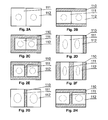
- Figs. 2A-2H show examples of typical 3D video frames of a Left-Right (LR) type.
- Such frame as shown in Fig. 2A , comprises two active image regions 111, 112, which define the content to be displayed for the left and right eye.
- the active regions 111, 112 may be scaled-down in the horizontal direction in order to fit into dimensions of a standardized 2D frame.
- a 3D frame may also contain non-active image regions 110, such as bars of a uniform color, e.g. black, at the top and bottom edges of the frame as shown in Fig. 2B , at the top, bottom, left and right edges of the frame as shown in Fig. 2C , at the left and right edges of the frame as shown in Fig.
- Figs. 3A-3H show examples of typical 3D video frames of a Top-Bottom (TB) type.
- Such frame as shown in Fig. 3A , comprises two active image regions 111, 112, which define the content to be displayed for the left (e.g. the top region) and the right (e.g. the bottom region) eye.
- the active regions 111, 112 may be scaled-down in the vertical direction in order to fit into dimensions of a standard 2D frame.
- a 3D frame may also contain non-active image regions 110, such as: bars of a uniform color, e.g. black, at the left and right edges of the frame as shown in Fig. 3B , at the top, bottom, left and right edges of the frame as shown in Fig.
- the most probable non-active regions 110 may form bars at the top, bottom, left, right, horizontal centre and vertical centre of the frame, as shown in Fig. 4 .
- Fig. 5 shows the structure of a system for determining video frame type according to the invention.
- the system may comprise a frame compactor 201 configured to extract from the input video frames data representing an active region and discard the data representing the non-active region of the frame, according to the procedure shown in Fig. 6 , and possibly to reduce the amount of data by scaling-down and/or discarding the color information.
- the compactor may increase the accuracy of operation of the frame type detector.
- the reduced frame representation is passed to a buffer 202, from which it is collected by a frame type detector 203 operating according to the procedure shown in Fig.
- the frame type detector 203 provides an output specifying the type of the frame: that the frame is a 2D or a 3D frame, wherein for 3D frames the detector may indicate the type of frame as an LR frame or a TB frame.
- the system may be adapted to distinguish only between mono frames and one type of 3D frames, i.e. LR-type or TB-type frames.
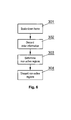
- Fig. 6 shows the procedure of operation of the frame compactor 201.
- the received input frame may be reduced for easier analysis, by scaling it down, i.e. reducing the size of the frame.
- the color information can be discarded, either by converting the frame contents into a grayscale or selecting contents of only one color channel.
- the frame is analyzed to detect the non-active regions, preferably in areas indicated in Fig. 4 , namely in the bars located at the top, bottom, left, right, horizontal centre and vertical centre of the frame. The contents of the detected non-active regions are discarded in step 304 so as to generate a frame containing only data of active regions, as shown in Fig. 1A , 2A or 3A .
- the processing of a frame by the frame compactor 201 may be initiated after a change of the video input signal, for example a change of a channel in a television decoder, in order to determine the type of the new signal.
- the frame compactor 201 may be operated continuously, in order to detect change of type of the received signal, for example to detect a 2D commercial break in a 3D video film.
- the frame compactor 201 may receive the frames with a specific frequency, preferably lower than the frame display rate, such as 2 frames per second, in order to minimize the computational load of the signal receiver.
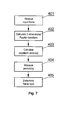
- Fig. 7 shows the procedure of operation of the frame type detector 203.
- the input frame is received in step 401 as a matrix describing its contents (pixel values).
- the frame can be optionally (further to, or instead of step 301 and operation of the frame compactor 201) compacted to reduce parallaxes between the left and right-eye part of the image and to reduce high-frequency components.
- the image can be compacted to a size of at least one of its sides being a power of 2.
- step 403 the horizontal and/or vertical cepstrum vectors of the two-dimensional Fourier spectrum X mn are calculated.
- the odd frequencies calculated in the spectrum will be substantially close to zero, and the even frequencies will be substantially non-zero, that is there will be even harmonics present in the spectrum, because the base image repeats with a constant period equal to half of the image size.
- the spectrum itself has a strong periodic component. This component corresponds to the highest distinctive quefrency in the cepstrum. Therefore, if one side of the input image (e.g. the left or the top part) is similar to the other one (the right or the bottom part, respectively), there will be a highly distinguishable peak in the calculated cepstrum at the highest quefrency.
- the limiting frequency ⁇ is preferably lower than the highest frequency of the spectrum, for example equal to half of the highest frequency of the spectrum and equal to a power of 2 in order to facilitate calculation of the Fourier transform.
- a two-dimensional spectrum matrix X mn is created in step 402, but for processing in step 403 only horizontal and vertical vectors of this matrix are used, namely a horizontal vector X (1,1... ⁇ ) and a vertical vector X (1... ⁇ ,1) . Only the absolute values of the vectors are needed for analysis.
- step 404 the periodicity of the spectrum is measured, i.e. it is checked whether the spectrum is substantially periodic with a period equal to 2.
- the value of the highest quefrency coefficients of the cepstrum ( H ⁇ /2 , V ⁇ /2 ) are compared with an average value of the cepstrum.
- the first coefficients of the cepstrum relate to an average value of the spectrum.
- the last coefficients may be high for a stereoscopic signal. Therefore, these coefficients should not be taken into account when calculating an average value for comparison with the value of the highest quefrency coefficient.
- h ⁇ H ⁇ / 2 H ⁇ , for H ⁇ ⁇ 0 NaN , otherwise
- v ⁇ H ⁇ / 2 V ⁇ , for V ⁇ ⁇ 0 NaN , otherwise
- the measure is identified as "not a number" (NaN) if the average coefficient value is zero. In that case, the image type is undefined.
- the frame type is determined in step 405.
- a predefined periodicity threshold ⁇ for example 2 (i.e. the value of the highest quefrency coefficient is at least 2 times higher than the average)
- the image has no periodicity and the signal is classified as a mono signal.
- the signal type is determined according to the higher of the coefficients.
- a soft-decision algorithm can be used to determine a probability of a frame type depending on the value of the measures of periodicity.
- the two-dimensional spectrum X mn can be calculated in step 402 using a transform of which every second base function has a periodicity equal to N/2, wherein N is the image size.
- the cepstrum vectors H, V calculated in step 403 are used to analyze whether the spectrum of step 402 is periodic with a period equal to 2 and therefore transforms such as DCT (Discrete Cosine Transform) can be used for this purpose as well.
- DCT Discrete Cosine Transform
- Figs. 8A-8D show exemplary data plots for a mono frame.
- Fig. 8A shows a plot of row values, wherein there is no relationship between the left and the right side of the frame.
- Fig. 8B shows an amplitude spectrum.
- Fig. 8C shows a logarithm of the amplitude spectrum.
- Figs. 9A-9D show exemplary data plots for a 3D LR-type frame.
- Fig. 8A shows a plot of row values, wherein there is a visible relationship between the left and right side of the frame.
- Fig. 9B shows an amplitude spectrum. It should be noted that as the left side is not perfectly equal to the right side of the frame, the odd spectrum coefficients have a small, non-zero magnitude.
- Fig. 9C shows a logarithm of the amplitude spectrum.
- Fig. 10 shows an embodiment of a system for determining a video frame type according to the invention.
- the system comprises a frame reader 501 configured to receive a video frame matrix describing contents of the video frame.
- a Fourier Transform calculator 502 is configured to calculate a two-dimensional Fourier Transform spectrum (X mn ) of the contents of the video frame matrix, in a way equivalent to that described with reference to step 402.
- the spectrum is next processed by at least one cepstrum vector calculator 503, 504, one for a horizontal and the other for a vertical direction of the spectrum, configured to calculate a cepstrum vector (H 1... ⁇ , V 1... ⁇ ) for respectively the horizontal and the vertical direction of the two-dimensional Fourier Transform spectrum (X mn ), in a way equivalent to step 403.
- the calculated cepstra are analyzed by periodicity analyzers 505, 506 in order to determine a periodicity of the horizontal spectrum and of the vertical spectrum, in a way equivalent to step 404.
- the outputs of the analyzers 505, 506 are processed by a video frame classifier 507 configured to classify the video frame as a horizontal LR-type stereoscopic frame if the horizontal spectrum is determined as periodic and/or classifying the video frame as a vertical TB-type stereoscopic frame if the vertical spectrum is determined as periodic and classifying the video frame as a mono frame otherwise, in a way equivalent to step 405.
- a video frame classifier 507 configured to classify the video frame as a horizontal LR-type stereoscopic frame if the horizontal spectrum is determined as periodic and/or classifying the video frame as a vertical TB-type stereoscopic frame if the vertical spectrum is determined as periodic and classifying the video frame as a mono frame otherwise, in a way equivalent to step 405.
- the frame type detector 203 can form a part of a multi-component system, in which a plurality of different frame type detectors are used, each configured to analyze the frame using a different algorithm configured to output a type coefficient indicative of a probability that the frame is of a 2D or 3D type, wherein the type coefficients from the frame type detectors are received by a controller configured to generate a predicted frame type indicator based on the received type coefficients.
- the determined frame type can be used to select the method of processing the signal to be displayed.
- the determined frame type can be used to select the method of processing the signal to be passed to a display unit, for example converting a 2D signal to a 3D format in case the display unit is set to receive 3D video signals.
- the aforementioned system and method for determining video frame type may be performed and/or controlled by one or more computer programs.
- Such computer programs are typically executed by utilizing the computing resources of a processing unit which can be embedded within various video signal receivers, such as personal computers, personal digital assistants, cellular telephones, receivers and decoders of digital television, video display units or the like.
- the computer programs can be stored in a non-volatile memory, for example a flash memory or in a volatile memory, for example RAM and are executed by the processing unit.
- These memories are exemplary recording media for storing computer programs comprising computer-executable instructions performing all the steps of the computer-implemented method according the technical concept presented herein.
Landscapes
- Engineering & Computer Science (AREA)
- Multimedia (AREA)
- Signal Processing (AREA)
- Testing, Inspecting, Measuring Of Stereoscopic Televisions And Televisions (AREA)
Abstract
Description
- The present invention relates to determining video frame type, in particular distinguishing between a two-dimensional (2D) and three-dimensional (3D) video frames.
- Stereoscopic video displays can be used to display both 2D and 3D video signals, by processing the frames of the signals depending on the type of signal. The type of the signal can be specified manually by the user, which can be troublesome for inexperienced users. The type of signal can be also specified by supplementary data included in the signal itself or by a supplementary signal, which requires the video display unit to be able to decode and recognize the supplementary data or the supplementary signal.
- A US patent application
US2009/0009508 presents an apparatus and a method for driving a 2D/3D switchable display, which includes an image mode determination unit determining whether input image signals of continuous frames are in a 2D mode or 3D mode. The 3D mode is recognized by determining a syntax indicating a stereo or a multiview image included in the header information of the input image signal. Alternatively, the image mode can be determined based on the presence of a stereo sync signal. Therefore, the mode determination requires data or signals supplementary to the basic image data. - A
PCT patent application W02010/014973 presents a method and an apparatus for encoding or tagging a video frame which provide a way to indicate, to a receiver, whether the video content is 3-D content or 2-D content, by replacing lines of at least one video frame in a 3-D content with a specific color or pattern. Therefore, the method is useful only for receivers, which are able to recognize the specific color or patterns as an indication of a 3-D content. - In case the display lacks the functionality of decoding supplementary data included in the signal or is not able to decode supplementary signals describing the video type, or the video signal contains only basic image contents without the image type indicated, the signal must be recognized in an alternative way.
- The aim of the present invention is to provide a method for determining the video frame type by analyzing video signals having no or unknown indication of video frame type.
- The object of the invention is a computer-implemented method for determining a video frame type, characterized in that it comprises the steps of receiving a video frame matrix describing the contents of the video frame, calculating a two-dimensional Fourier Transform spectrum of the contents of the video frame matrix, determining whether the spectrum is periodic with a period equal to 2 in a horizontal and/or vertical direction, classifying the video frame as a horizontal LR-type stereoscopic frame if the spectrum is determined as periodic in the horizontal direction and/or classifying the video frame as a vertical TB-type stereoscopic frame if the spectrum is determined as periodic in the vertical direction and classifying the video frame as a mono frame otherwise.
- The horizontal periodicity of the spectrum can be determined as a horizontal periodicity coefficient by calculating a horizontal cepstrum vector of the spectrum and dividing the highest quefrency coefficient of the horizontal cepstrum vector by an average value of the horizontal cepstrum vector and/or the vertical periodicity of the spectrum is determined as a vertical periodicity coefficient by calculating a vertical cepstrum vector of the spectrum and dividing the highest quefrency coefficient of the vertical cepstrum vector by an average value of the vertical cepstrum vector.
- The horizontal cepstrum vector can be calculated for the part of the two-dimensional Fourier Transform spectrum corresponding to vertical frequency equal to zero and/or the vertical cepstrum vector is calculated for the part of the two-dimensional Fourier Transform spectrum corresponding to horizontal frequency equal to zero.
- The horizontal cepstrum vector and/or the vertical cepstrum vector can be calculated for frequencies below a limit frequency lower than the highest frequency of spectrum.
- The spectrum can be determined as periodic if the periodicity coefficient is higher than a periodicity threshold.
- The object of the invention is also a computer program comprising program code means for performing all the steps of the computer-implemented method of the invention when said program is run on a computer, as well as a computer readable medium storing computer-executable instructions performing all the steps of the computer-implemented method of the invention when executed on a computer.
- Another object of the invention is a system for determining a video frame type, which comprises a frame reader configured to receive a video frame matrix describing contents of the video frame, a Fourier Transform calculator configured to calculate a two-dimensional Fourier Transform spectrum of the contents of the video frame matrix, at least one periodicity analyzer configured to determine a periodicity of the spectrum in a horizontal and/or vertical direction, a video frame classifier configured to classify the video frame as a horizontal LR-type stereoscopic frame if the spectrum is determined as periodic in the horizontal direction, and/or classifying the video frame as a vertical TB-type stereoscopic frame if the spectrum is determined as periodic in the vertical direction and classifying the video frame as a mono frame otherwise.
- The system may further comprise at least one cepstrum vector calculator configured to determine a horizontal periodicity coefficient by calculating a horizontal cepstrum vector of the spectrum and dividing the highest quefrency coefficient of the horizontal cepstrum vector by an average value of the horizontal cepstrum vector and/or to determine a vertical periodicity coefficient by calculating a vertical cepstrum vector of the spectrum and dividing the highest quefrency coefficient of the vertical cepstrum vector by an average value of the vertical cepstrum vector
- The first cepstrum vector calculator can be configured to calculate the horizontal cepstrum vector for the part of the two-dimensional Fourier Transform spectrum corresponding to vertical frequency equal to zero and the second cepstrum vector calculator is configured to calculate the vertical cepstrum vector for the part of the two-dimensional Fourier Transform spectrum corresponding to horizontal frequency equal to zero.
- The cepstrum vector calculators can be configured to calculate the horizontal cepstrum vector and/or the vertical cepstrum vector for frequencies below a limit frequency lower than the highest frequency of the spectrum.
- At least one periodicity analyzer can be configured to determine the spectrum as periodic if the periodicity coefficient is higher than a periodicity threshold.
- The present invention will be shown by means of an exemplary embodiment on a drawing, in which:
-
Figs. 1A-1D show examples of typical 2D video frames. -
Figs. 2A-2H show examples of typical 3D video frames of an Left-Right (LR) type. -
Figs. 3A-3H show examples of typical 3D video frames of a Top-Bottom (TB) type. -
Fig. 4 shows the common non-active image regions of a video frame. -
Fig. 5 shows the structure of a system for determining video frame type. -
Fig. 6 shows the procedure of operation of a frame compactor. -
Fig. 7 shows the procedure of operation of a frame type detector. -
Figs. 8A-8D show exemplary data plots for a mono frame. -
Figs. 9A-9D show exemplary data plots for a 3D LR-type frame. -
Fig. 10 shows an embodiment of a system for determining a video frame type according to the invention. -
Figs. 1A-1D show examples of typical 2D video frames. The frame may comprise only anactive image region 111 as shown inFig. 1A . Alternatively, the 2D frame may further comprise anon-active image region 110, such as bars of a uniform color, e.g. black, at the top and bottom edges of the frame as shown inFig. 1B or bars at the top, bottom, left and right edges of the frame as shown inFig. 1C or bars at the left and right edges of the frame as shown inFig. 1D . -
Figs. 2A-2H show examples of typical 3D video frames of a Left-Right (LR) type. Such frame, as shown inFig. 2A , comprises twoactive image regions active regions non-active image regions 110, such as bars of a uniform color, e.g. black, at the top and bottom edges of the frame as shown inFig. 2B , at the top, bottom, left and right edges of the frame as shown inFig. 2C , at the left and right edges of the frame as shown inFig. 2D , at the top, bottom, left and right edges of the frame and between the active regions as shown inFig. 2E , at the left and right edges of the frame and between the active regions as shown inFig. 2F , between the active regions as shown inFig. 2G or at the top and bottom edges of the frame and between the active regions as shown inFig. 2H . -
Figs. 3A-3H show examples of typical 3D video frames of a Top-Bottom (TB) type. Such frame, as shown inFig. 3A , comprises twoactive image regions active regions non-active image regions 110, such as: bars of a uniform color, e.g. black, at the left and right edges of the frame as shown inFig. 3B , at the top, bottom, left and right edges of the frame as shown inFig. 3C , at the top and bottom edges of the frame as shown inFig. 3D , at the top, bottom, left and right edges of the frame and between the active regions as shown inFig. 3E , at the top and bottom edges of the frame and between the active regions as shown inFig. 3F , between the active regions as shown inFig. 3G or at the left and right edges of the frame and between the active regions as shown inFig. 3H . - Therefore, for any 2D or 3D video frame, the most probable
non-active regions 110 may form bars at the top, bottom, left, right, horizontal centre and vertical centre of the frame, as shown inFig. 4 . -
Fig. 5 shows the structure of a system for determining video frame type according to the invention. The system may comprise aframe compactor 201 configured to extract from the input video frames data representing an active region and discard the data representing the non-active region of the frame, according to the procedure shown inFig. 6 , and possibly to reduce the amount of data by scaling-down and/or discarding the color information. The compactor may increase the accuracy of operation of the frame type detector. The reduced frame representation is passed to abuffer 202, from which it is collected by aframe type detector 203 operating according to the procedure shown inFig. 7 Theframe type detector 203 provides an output specifying the type of the frame: that the frame is a 2D or a 3D frame, wherein for 3D frames the detector may indicate the type of frame as an LR frame or a TB frame. In a simple embodiment, the system may be adapted to distinguish only between mono frames and one type of 3D frames, i.e. LR-type or TB-type frames. -
Fig. 6 shows the procedure of operation of theframe compactor 201. Instep 301, the received input frame may be reduced for easier analysis, by scaling it down, i.e. reducing the size of the frame. Next, instep 302 the color information can be discarded, either by converting the frame contents into a grayscale or selecting contents of only one color channel. Next, instep 303 the frame is analyzed to detect the non-active regions, preferably in areas indicated inFig. 4 , namely in the bars located at the top, bottom, left, right, horizontal centre and vertical centre of the frame. The contents of the detected non-active regions are discarded instep 304 so as to generate a frame containing only data of active regions, as shown inFig. 1A ,2A or3A . The processing of a frame by theframe compactor 201 may be initiated after a change of the video input signal, for example a change of a channel in a television decoder, in order to determine the type of the new signal. Alternatively, theframe compactor 201 may be operated continuously, in order to detect change of type of the received signal, for example to detect a 2D commercial break in a 3D video film. In such a case, theframe compactor 201 may receive the frames with a specific frequency, preferably lower than the frame display rate, such as 2 frames per second, in order to minimize the computational load of the signal receiver. -
Fig. 7 shows the procedure of operation of theframe type detector 203. The input frame is received instep 401 as a matrix describing its contents (pixel values). The frame can be optionally (further to, or instead ofstep 301 and operation of the frame compactor 201) compacted to reduce parallaxes between the left and right-eye part of the image and to reduce high-frequency components. In order to facilitate further computations of Fourier transform, e.g. by Fast Fourier Transform method, the image can be compacted to a size of at least one of its sides being a power of 2. - Next, a two-dimensional Fourier transform is calculated for the downscaled image in
step 402, for example a 2-dimensional forward Discrete Fourier Transform, given by an equation:


wherein
A is the input image
u, v are the frequency indices
m,n are the indices of pixel positions
N is the size of the X matrix (assuming the X matrix is square) - In
step 403, the horizontal and/or vertical cepstrum vectors of the two-dimensional Fourier spectrum Xmn are calculated. The cepstrum is the result of taking the Fourier transform of the log spectrum as if it were a signal, according to the equation:

wherein
H1...µ is the horizontal cepstrum vector
Vi...µ is the vertical cepstrum vector
µ is a limit frequency
ε is a small non-zero constant - In case the system adapted to distinguish only between mono frames and one type of 3D frames, i.e. LR-type or TB-type frames, then only the horizontal or vertical cepstrum vector is calculated.
- If the input image is stereoscopic, the odd frequencies calculated in the spectrum will be substantially close to zero, and the even frequencies will be substantially non-zero, that is there will be even harmonics present in the spectrum, because the base image repeats with a constant period equal to half of the image size. As every second frequency in the spectrum is substantially zero, the spectrum itself has a strong periodic component. This component corresponds to the highest distinctive quefrency in the cepstrum. Therefore, if one side of the input image (e.g. the left or the top part) is similar to the other one (the right or the bottom part, respectively), there will be a highly distinguishable peak in the calculated cepstrum at the highest quefrency.
- For the purposes of the present invention, in order to solve the problem of distinguishing between monoscopic and stereoscopic images (of the LR or TB type), only the horizontal and vertical periodicity of the spectrum is under concern, therefore it is not necessary to compute the whole two-dimensional cepstrum. Instead, it is enough to compute a horizontal cepstrum H for the part of the spectrum corresponding to vertical frequency equal to zero, and a vertical cepstrum V for the part of spectrum corresponding to horizontal frequency equal to zero. Therefore, a two-dimensional problem is reduced to two one-dimensional problems.
- Furthermore, experiments have shown, that in most images the higher frequencies carry much less power than the lower frequencies, therefore the periodicity of the spectrum is much more expressed for lower frequencies, where the even frequencies are more likely to differ much from zero. This fact can be utilized by taking cepstrum from only some range of frequencies, i.e. frequencies lower than a limit frequency µ. The limiting frequency µ is preferably lower than the highest frequency of the spectrum, for example equal to half of the highest frequency of the spectrum and equal to a power of 2 in order to facilitate calculation of the Fourier transform.
- For discrete signals, a two-dimensional spectrum matrix Xmn is created in
step 402, but for processing instep 403 only horizontal and vertical vectors of this matrix are used, namely a horizontal vector X(1,1...µ) and a vertical vector X(1... µ,1). Only the absolute values of the vectors are needed for analysis. - A small constant ε is added to avoid risk of a logarithm of zero.
- Next, in
step 404 the periodicity of the spectrum is measured, i.e. it is checked whether the spectrum is substantially periodic with a period equal to 2. The value of the highest quefrency coefficients of the cepstrum (H µ/2, V µ/2) are compared with an average value of the cepstrum. The average values Ĥ and V̂ can be computed using the equations:

wherein
s, e are respectively the starting and ending coefficients selected so as not to take into account respectively the first and the last coefficients of the cepstrum. The first coefficients of the cepstrum relate to an average value of the spectrum. In turn, the last coefficients may be high for a stereoscopic signal. Therefore, these coefficients should not be taken into account when calculating an average value for comparison with the value of the highest quefrency coefficient. - The measures of the horizontal and vertical periodicity of the spectrum, respectively h and v, are calculated as periodicity coefficients in
step 404 by equations:
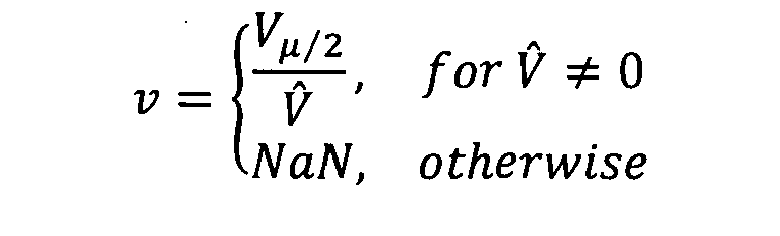
- The measure is identified as "not a number" (NaN) if the average coefficient value is zero. In that case, the image type is undefined.
- Next, the frame type is determined in
step 405. In case one of the periodicity coefficients h, v is greater than a predefined periodicity threshold θ, for example 2 (i.e. the value of the highest quefrency coefficient is at least 2 times higher than the average), this indicated a strong periodicity of the spectrum and the signal is defined as a stereoscopic signal of a LR-type or TB-type. Otherwise, the image has no periodicity and the signal is classified as a mono signal. In case both the vertical and horizontal coefficients are higher than the predefined periodicity threshold θ, the signal type is determined according to the higher of the coefficients. - Alternatively, a soft-decision algorithm can be used to determine a probability of a frame type depending on the value of the measures of periodicity.
- Various Fourier-related transforms can be used instead of the DFT transforms mentioned in the embodiment described above. The two-dimensional spectrum Xmn can be calculated in
step 402 using a transform of which every second base function has a periodicity equal to N/2, wherein N is the image size. The cepstrum vectors H, V calculated instep 403 are used to analyze whether the spectrum ofstep 402 is periodic with a period equal to 2 and therefore transforms such as DCT (Discrete Cosine Transform) can be used for this purpose as well. -
Figs. 8A-8D show exemplary data plots for a mono frame.Fig. 8A shows a plot of row values, wherein there is no relationship between the left and the right side of the frame.Fig. 8B shows an amplitude spectrum.Fig. 8C shows a logarithm of the amplitude spectrum.Fig. 8D shows the cepstrum. As shown inFig. 8D , the value of the highest quefrency coefficient (µ/2 = 16) is not higher than the average value. -
Figs. 9A-9D show exemplary data plots for a 3D LR-type frame.Fig. 8A shows a plot of row values, wherein there is a visible relationship between the left and right side of the frame.Fig. 9B shows an amplitude spectrum. It should be noted that as the left side is not perfectly equal to the right side of the frame, the odd spectrum coefficients have a small, non-zero magnitude.Fig. 9C shows a logarithm of the amplitude spectrum.Fig. 9D shows the cepstrum. As shown inFig. 9D , the value of the highest quefrency coefficient (µ/2 = 16) is noticeably higher than the average value. - Data plots for a 3D TB-type frame, calculated for column values, will be equivalent to the data plots of
Figs. 9A-9D . -
Fig. 10 shows an embodiment of a system for determining a video frame type according to the invention. The system comprises aframe reader 501 configured to receive a video frame matrix describing contents of the video frame. AFourier Transform calculator 502 is configured to calculate a two-dimensional Fourier Transform spectrum (Xmn) of the contents of the video frame matrix, in a way equivalent to that described with reference to step 402. The spectrum is next processed by at least onecepstrum vector calculator periodicity analyzers analyzers video frame classifier 507 configured to classify the video frame as a horizontal LR-type stereoscopic frame if the horizontal spectrum is determined as periodic and/or classifying the video frame as a vertical TB-type stereoscopic frame if the vertical spectrum is determined as periodic and classifying the video frame as a mono frame otherwise, in a way equivalent to step 405. - The
frame type detector 203 can form a part of a multi-component system, in which a plurality of different frame type detectors are used, each configured to analyze the frame using a different algorithm configured to output a type coefficient indicative of a probability that the frame is of a 2D or 3D type, wherein the type coefficients from the frame type detectors are received by a controller configured to generate a predicted frame type indicator based on the received type coefficients. - In case the system according to the invention is embedded in a video display unit, the determined frame type can be used to select the method of processing the signal to be displayed. In case the system according to the invention is embedded in a video decoder, such as a television set-top box, the determined frame type can be used to select the method of processing the signal to be passed to a display unit, for example converting a 2D signal to a 3D format in case the display unit is set to receive 3D video signals.
- It can be easily recognized, by one skilled in the art, that the aforementioned system and method for determining video frame type may be performed and/or controlled by one or more computer programs. Such computer programs are typically executed by utilizing the computing resources of a processing unit which can be embedded within various video signal receivers, such as personal computers, personal digital assistants, cellular telephones, receivers and decoders of digital television, video display units or the like. The computer programs can be stored in a non-volatile memory, for example a flash memory or in a volatile memory, for example RAM and are executed by the processing unit. These memories are exemplary recording media for storing computer programs comprising computer-executable instructions performing all the steps of the computer-implemented method according the technical concept presented herein.
- While the invention presented herein has been depicted, described, and has been defined with reference to particular preferred embodiments, such references and examples of implementation in the foregoing specification do not imply any limitation on the invention. It will, however, be evident that various modifications and changes may be made thereto without departing from the broader scope of the technical concept. The presented preferred embodiments are exemplary only, and are not exhaustive of the scope of the technical concept presented herein. Accordingly, the scope of protection is not limited to the preferred embodiments described in the specification, but is only limited by the claims that follow.
Claims (12)
Priority Applications (1)
| Application Number | Priority Date | Filing Date | Title |
|---|---|---|---|
| EP11000274.8A EP2477406B1 (en) | 2011-01-14 | 2011-01-14 | A method and a system for determining a video frame type |
Applications Claiming Priority (1)
| Application Number | Priority Date | Filing Date | Title |
|---|---|---|---|
| EP11000274.8A EP2477406B1 (en) | 2011-01-14 | 2011-01-14 | A method and a system for determining a video frame type |
Publications (2)
| Publication Number | Publication Date |
|---|---|
| EP2477406A1 true EP2477406A1 (en) | 2012-07-18 |
| EP2477406B1 EP2477406B1 (en) | 2015-07-08 |
Family
ID=43602922
Family Applications (1)
| Application Number | Title | Priority Date | Filing Date |
|---|---|---|---|
| EP11000274.8A Active EP2477406B1 (en) | 2011-01-14 | 2011-01-14 | A method and a system for determining a video frame type |
Country Status (1)
| Country | Link |
|---|---|
| EP (1) | EP2477406B1 (en) |
Cited By (1)
| Publication number | Priority date | Publication date | Assignee | Title |
|---|---|---|---|---|
| EP2963924A1 (en) * | 2014-07-01 | 2016-01-06 | Advanced Digital Broadcast S.A. | A method and a system for determining a video frame type |
Citations (3)
| Publication number | Priority date | Publication date | Assignee | Title |
|---|---|---|---|---|
| US20020163595A1 (en) * | 1999-08-11 | 2002-11-07 | Adams Dale R. | Interlace motion artifact detection using vertical frequency detection and analysis |
| US20090009508A1 (en) | 2007-07-06 | 2009-01-08 | Samsung Electronics Co., Ltd. | Apparatus and method for driving 2d/3d switchable display |
| WO2010014973A1 (en) | 2008-08-01 | 2010-02-04 | Real D | Method and apparatus to mark and identify stereoscopic video frames |
-
2011
- 2011-01-14 EP EP11000274.8A patent/EP2477406B1/en active Active
Patent Citations (3)
| Publication number | Priority date | Publication date | Assignee | Title |
|---|---|---|---|---|
| US20020163595A1 (en) * | 1999-08-11 | 2002-11-07 | Adams Dale R. | Interlace motion artifact detection using vertical frequency detection and analysis |
| US20090009508A1 (en) | 2007-07-06 | 2009-01-08 | Samsung Electronics Co., Ltd. | Apparatus and method for driving 2d/3d switchable display |
| WO2010014973A1 (en) | 2008-08-01 | 2010-02-04 | Real D | Method and apparatus to mark and identify stereoscopic video frames |
Non-Patent Citations (1)
| Title |
|---|
| TAO ZHANG: "3D Image format identification by image difference", MULTIMEDIA AND EXPO (ICME), 2010 IEEE INTERNATIONAL CONFERENCE ON, IEEE, PISCATAWAY, NJ, USA, 19 July 2010 (2010-07-19), pages 1415 - 1420, XP031761509, ISBN: 978-1-4244-7491-2 * |
Cited By (1)
| Publication number | Priority date | Publication date | Assignee | Title |
|---|---|---|---|---|
| EP2963924A1 (en) * | 2014-07-01 | 2016-01-06 | Advanced Digital Broadcast S.A. | A method and a system for determining a video frame type |
Also Published As
| Publication number | Publication date |
|---|---|
| EP2477406B1 (en) | 2015-07-08 |
Similar Documents
| Publication | Publication Date | Title |
|---|---|---|
| CN102461185B (en) | Method and device for automatic conversion of 3D video | |
| US8553029B2 (en) | Method and apparatus for determining two- or three-dimensional display mode of image sequence | |
| CN101980545B (en) | Method for automatically detecting 3DTV video program format | |
| US9185400B2 (en) | Method and a system for determining a video frame type | |
| US20080192822A1 (en) | Complexity-based adaptive preprocessing for multiple-pass video compression | |
| EP3457689A1 (en) | New planar prediction mode | |
| CN103037217B (en) | The image detected in interpolated image damages | |
| EP2486732B1 (en) | Method and device for calculating blur in video images | |
| US9288464B2 (en) | Method for scaling channel of an image | |
| US20130108184A1 (en) | Method and apparatus for encoding images using template matching and method and apparatus for decoding images | |
| CN103582900A (en) | Method and device for retargeting 3D content | |
| US20140333720A1 (en) | Subtitle detection for stereoscopic video contents | |
| EP2792144B1 (en) | Method and apparatus for video quality measurement | |
| EP2477406B1 (en) | A method and a system for determining a video frame type | |
| EP2426931A1 (en) | A method and a system for determining a video frame type | |
| US10096116B2 (en) | Method and apparatus for segmentation of 3D image data | |
| KR101085949B1 (en) | Lung sorting device and method | |
| EP2477407B1 (en) | A method and a system for determining a video frame type | |
| EP2963924B1 (en) | A method and a system for determining a video frame type | |
| KR20110077825A (en) | Block boundary detection method and apparatus | |
| WO2017113735A1 (en) | Video format distinguishing method and system | |
| EP2599311B1 (en) | Block compression artifact detection in digital video signals | |
| EP2658259A1 (en) | Tiling or blockiness detection based on spectral power signature | |
| RU2577486C2 (en) | Method for automatic retrieval of key frame indices for video data extension | |
| US8503823B2 (en) | Method, device and display system for converting an image according to detected word areas |
Legal Events
| Date | Code | Title | Description |
|---|---|---|---|
| PUAI | Public reference made under article 153(3) epc to a published international application that has entered the european phase |
Free format text: ORIGINAL CODE: 0009012 |
|
| AK | Designated contracting states |
Kind code of ref document: A1 Designated state(s): AL AT BE BG CH CY CZ DE DK EE ES FI FR GB GR HR HU IE IS IT LI LT LU LV MC MK MT NL NO PL PT RO RS SE SI SK SM TR |
|
| AX | Request for extension of the european patent |
Extension state: BA ME |
|
| 17P | Request for examination filed |
Effective date: 20121212 |
|
| 17Q | First examination report despatched |
Effective date: 20140325 |
|
| GRAP | Despatch of communication of intention to grant a patent |
Free format text: ORIGINAL CODE: EPIDOSNIGR1 |
|
| INTG | Intention to grant announced |
Effective date: 20150306 |
|
| GRAS | Grant fee paid |
Free format text: ORIGINAL CODE: EPIDOSNIGR3 |
|
| GRAA | (expected) grant |
Free format text: ORIGINAL CODE: 0009210 |
|
| AK | Designated contracting states |
Kind code of ref document: B1 Designated state(s): AL AT BE BG CH CY CZ DE DK EE ES FI FR GB GR HR HU IE IS IT LI LT LU LV MC MK MT NL NO PL PT RO RS SE SI SK SM TR |
|
| REG | Reference to a national code |
Ref country code: GB Ref legal event code: FG4D |
|
| REG | Reference to a national code |
Ref country code: AT Ref legal event code: REF Ref document number: 736164 Country of ref document: AT Kind code of ref document: T Effective date: 20150715 Ref country code: CH Ref legal event code: EP |
|
| REG | Reference to a national code |
Ref country code: IE Ref legal event code: FG4D |
|
| REG | Reference to a national code |
Ref country code: DE Ref legal event code: R096 Ref document number: 602011017593 Country of ref document: DE |
|
| REG | Reference to a national code |
Ref country code: AT Ref legal event code: MK05 Ref document number: 736164 Country of ref document: AT Kind code of ref document: T Effective date: 20150708 |
|
| REG | Reference to a national code |
Ref country code: NL Ref legal event code: MP Effective date: 20150708 |
|
| REG | Reference to a national code |
Ref country code: LT Ref legal event code: MG4D |
|
| REG | Reference to a national code |
Ref country code: FR Ref legal event code: PLFP Year of fee payment: 6 |
|
| PG25 | Lapsed in a contracting state [announced via postgrant information from national office to epo] |
Ref country code: NO Free format text: LAPSE BECAUSE OF FAILURE TO SUBMIT A TRANSLATION OF THE DESCRIPTION OR TO PAY THE FEE WITHIN THE PRESCRIBED TIME-LIMIT Effective date: 20151008 Ref country code: GR Free format text: LAPSE BECAUSE OF FAILURE TO SUBMIT A TRANSLATION OF THE DESCRIPTION OR TO PAY THE FEE WITHIN THE PRESCRIBED TIME-LIMIT Effective date: 20151009 Ref country code: FI Free format text: LAPSE BECAUSE OF FAILURE TO SUBMIT A TRANSLATION OF THE DESCRIPTION OR TO PAY THE FEE WITHIN THE PRESCRIBED TIME-LIMIT Effective date: 20150708 Ref country code: LV Free format text: LAPSE BECAUSE OF FAILURE TO SUBMIT A TRANSLATION OF THE DESCRIPTION OR TO PAY THE FEE WITHIN THE PRESCRIBED TIME-LIMIT Effective date: 20150708 Ref country code: LT Free format text: LAPSE BECAUSE OF FAILURE TO SUBMIT A TRANSLATION OF THE DESCRIPTION OR TO PAY THE FEE WITHIN THE PRESCRIBED TIME-LIMIT Effective date: 20150708 |
|
| PG25 | Lapsed in a contracting state [announced via postgrant information from national office to epo] |
Ref country code: PT Free format text: LAPSE BECAUSE OF FAILURE TO SUBMIT A TRANSLATION OF THE DESCRIPTION OR TO PAY THE FEE WITHIN THE PRESCRIBED TIME-LIMIT Effective date: 20151109 Ref country code: PL Free format text: LAPSE BECAUSE OF FAILURE TO SUBMIT A TRANSLATION OF THE DESCRIPTION OR TO PAY THE FEE WITHIN THE PRESCRIBED TIME-LIMIT Effective date: 20150708 Ref country code: ES Free format text: LAPSE BECAUSE OF FAILURE TO SUBMIT A TRANSLATION OF THE DESCRIPTION OR TO PAY THE FEE WITHIN THE PRESCRIBED TIME-LIMIT Effective date: 20150708 Ref country code: AT Free format text: LAPSE BECAUSE OF FAILURE TO SUBMIT A TRANSLATION OF THE DESCRIPTION OR TO PAY THE FEE WITHIN THE PRESCRIBED TIME-LIMIT Effective date: 20150708 Ref country code: SE Free format text: LAPSE BECAUSE OF FAILURE TO SUBMIT A TRANSLATION OF THE DESCRIPTION OR TO PAY THE FEE WITHIN THE PRESCRIBED TIME-LIMIT Effective date: 20150708 Ref country code: HR Free format text: LAPSE BECAUSE OF FAILURE TO SUBMIT A TRANSLATION OF THE DESCRIPTION OR TO PAY THE FEE WITHIN THE PRESCRIBED TIME-LIMIT Effective date: 20150708 Ref country code: IS Free format text: LAPSE BECAUSE OF FAILURE TO SUBMIT A TRANSLATION OF THE DESCRIPTION OR TO PAY THE FEE WITHIN THE PRESCRIBED TIME-LIMIT Effective date: 20151108 Ref country code: RS Free format text: LAPSE BECAUSE OF FAILURE TO SUBMIT A TRANSLATION OF THE DESCRIPTION OR TO PAY THE FEE WITHIN THE PRESCRIBED TIME-LIMIT Effective date: 20150708 |
|
| REG | Reference to a national code |
Ref country code: DE Ref legal event code: R097 Ref document number: 602011017593 Country of ref document: DE |
|
| PG25 | Lapsed in a contracting state [announced via postgrant information from national office to epo] |
Ref country code: IT Free format text: LAPSE BECAUSE OF FAILURE TO SUBMIT A TRANSLATION OF THE DESCRIPTION OR TO PAY THE FEE WITHIN THE PRESCRIBED TIME-LIMIT Effective date: 20150708 Ref country code: SK Free format text: LAPSE BECAUSE OF FAILURE TO SUBMIT A TRANSLATION OF THE DESCRIPTION OR TO PAY THE FEE WITHIN THE PRESCRIBED TIME-LIMIT Effective date: 20150708 Ref country code: DK Free format text: LAPSE BECAUSE OF FAILURE TO SUBMIT A TRANSLATION OF THE DESCRIPTION OR TO PAY THE FEE WITHIN THE PRESCRIBED TIME-LIMIT Effective date: 20150708 Ref country code: EE Free format text: LAPSE BECAUSE OF FAILURE TO SUBMIT A TRANSLATION OF THE DESCRIPTION OR TO PAY THE FEE WITHIN THE PRESCRIBED TIME-LIMIT Effective date: 20150708 Ref country code: CZ Free format text: LAPSE BECAUSE OF FAILURE TO SUBMIT A TRANSLATION OF THE DESCRIPTION OR TO PAY THE FEE WITHIN THE PRESCRIBED TIME-LIMIT Effective date: 20150708 |
|
| PLBE | No opposition filed within time limit |
Free format text: ORIGINAL CODE: 0009261 |
|
| STAA | Information on the status of an ep patent application or granted ep patent |
Free format text: STATUS: NO OPPOSITION FILED WITHIN TIME LIMIT |
|
| PG25 | Lapsed in a contracting state [announced via postgrant information from national office to epo] |
Ref country code: RO Free format text: LAPSE BECAUSE OF FAILURE TO SUBMIT A TRANSLATION OF THE DESCRIPTION OR TO PAY THE FEE WITHIN THE PRESCRIBED TIME-LIMIT Effective date: 20150708 Ref country code: BE Free format text: LAPSE BECAUSE OF NON-PAYMENT OF DUE FEES Effective date: 20160131 |
|
| 26N | No opposition filed |
Effective date: 20160411 |
|
| PG25 | Lapsed in a contracting state [announced via postgrant information from national office to epo] |
Ref country code: LU Free format text: LAPSE BECAUSE OF FAILURE TO SUBMIT A TRANSLATION OF THE DESCRIPTION OR TO PAY THE FEE WITHIN THE PRESCRIBED TIME-LIMIT Effective date: 20160114 Ref country code: SI Free format text: LAPSE BECAUSE OF FAILURE TO SUBMIT A TRANSLATION OF THE DESCRIPTION OR TO PAY THE FEE WITHIN THE PRESCRIBED TIME-LIMIT Effective date: 20150708 |
|
| REG | Reference to a national code |
Ref country code: CH Ref legal event code: PL |
|
| PG25 | Lapsed in a contracting state [announced via postgrant information from national office to epo] |
Ref country code: MC Free format text: LAPSE BECAUSE OF FAILURE TO SUBMIT A TRANSLATION OF THE DESCRIPTION OR TO PAY THE FEE WITHIN THE PRESCRIBED TIME-LIMIT Effective date: 20150708 |
|
| PG25 | Lapsed in a contracting state [announced via postgrant information from national office to epo] |
Ref country code: CH Free format text: LAPSE BECAUSE OF NON-PAYMENT OF DUE FEES Effective date: 20160131 Ref country code: LI Free format text: LAPSE BECAUSE OF NON-PAYMENT OF DUE FEES Effective date: 20160131 |
|
| REG | Reference to a national code |
Ref country code: IE Ref legal event code: MM4A |
|
| PG25 | Lapsed in a contracting state [announced via postgrant information from national office to epo] |
Ref country code: BE Free format text: LAPSE BECAUSE OF FAILURE TO SUBMIT A TRANSLATION OF THE DESCRIPTION OR TO PAY THE FEE WITHIN THE PRESCRIBED TIME-LIMIT Effective date: 20150708 |
|
| REG | Reference to a national code |
Ref country code: FR Ref legal event code: PLFP Year of fee payment: 7 |
|
| PG25 | Lapsed in a contracting state [announced via postgrant information from national office to epo] |
Ref country code: IE Free format text: LAPSE BECAUSE OF NON-PAYMENT OF DUE FEES Effective date: 20160114 |
|
| PG25 | Lapsed in a contracting state [announced via postgrant information from national office to epo] |
Ref country code: NL Free format text: LAPSE BECAUSE OF FAILURE TO SUBMIT A TRANSLATION OF THE DESCRIPTION OR TO PAY THE FEE WITHIN THE PRESCRIBED TIME-LIMIT Effective date: 20150708 |
|
| PG25 | Lapsed in a contracting state [announced via postgrant information from national office to epo] |
Ref country code: MT Free format text: LAPSE BECAUSE OF FAILURE TO SUBMIT A TRANSLATION OF THE DESCRIPTION OR TO PAY THE FEE WITHIN THE PRESCRIBED TIME-LIMIT Effective date: 20150708 |
|
| REG | Reference to a national code |
Ref country code: FR Ref legal event code: PLFP Year of fee payment: 8 |
|
| PG25 | Lapsed in a contracting state [announced via postgrant information from national office to epo] |
Ref country code: SM Free format text: LAPSE BECAUSE OF FAILURE TO SUBMIT A TRANSLATION OF THE DESCRIPTION OR TO PAY THE FEE WITHIN THE PRESCRIBED TIME-LIMIT Effective date: 20150708 Ref country code: CY Free format text: LAPSE BECAUSE OF FAILURE TO SUBMIT A TRANSLATION OF THE DESCRIPTION OR TO PAY THE FEE WITHIN THE PRESCRIBED TIME-LIMIT Effective date: 20150708 Ref country code: HU Free format text: LAPSE BECAUSE OF FAILURE TO SUBMIT A TRANSLATION OF THE DESCRIPTION OR TO PAY THE FEE WITHIN THE PRESCRIBED TIME-LIMIT; INVALID AB INITIO Effective date: 20110114 |
|
| PG25 | Lapsed in a contracting state [announced via postgrant information from national office to epo] |
Ref country code: MK Free format text: LAPSE BECAUSE OF FAILURE TO SUBMIT A TRANSLATION OF THE DESCRIPTION OR TO PAY THE FEE WITHIN THE PRESCRIBED TIME-LIMIT Effective date: 20150708 Ref country code: TR Free format text: LAPSE BECAUSE OF FAILURE TO SUBMIT A TRANSLATION OF THE DESCRIPTION OR TO PAY THE FEE WITHIN THE PRESCRIBED TIME-LIMIT Effective date: 20150708 Ref country code: MT Free format text: LAPSE BECAUSE OF FAILURE TO SUBMIT A TRANSLATION OF THE DESCRIPTION OR TO PAY THE FEE WITHIN THE PRESCRIBED TIME-LIMIT Effective date: 20160131 |
|
| PG25 | Lapsed in a contracting state [announced via postgrant information from national office to epo] |
Ref country code: BG Free format text: LAPSE BECAUSE OF FAILURE TO SUBMIT A TRANSLATION OF THE DESCRIPTION OR TO PAY THE FEE WITHIN THE PRESCRIBED TIME-LIMIT Effective date: 20150708 |
|
| PG25 | Lapsed in a contracting state [announced via postgrant information from national office to epo] |
Ref country code: AL Free format text: LAPSE BECAUSE OF FAILURE TO SUBMIT A TRANSLATION OF THE DESCRIPTION OR TO PAY THE FEE WITHIN THE PRESCRIBED TIME-LIMIT Effective date: 20150708 |
|
| PGFP | Annual fee paid to national office [announced via postgrant information from national office to epo] |
Ref country code: DE Payment date: 20250129 Year of fee payment: 15 |
|
| PGFP | Annual fee paid to national office [announced via postgrant information from national office to epo] |
Ref country code: FR Payment date: 20250127 Year of fee payment: 15 |
|
| PGFP | Annual fee paid to national office [announced via postgrant information from national office to epo] |
Ref country code: GB Payment date: 20250127 Year of fee payment: 15 |