EP2477144A1 - Online continual automated planning framework based on timelines - Google Patents
Online continual automated planning framework based on timelines Download PDFInfo
- Publication number
- EP2477144A1 EP2477144A1 EP12151210A EP12151210A EP2477144A1 EP 2477144 A1 EP2477144 A1 EP 2477144A1 EP 12151210 A EP12151210 A EP 12151210A EP 12151210 A EP12151210 A EP 12151210A EP 2477144 A1 EP2477144 A1 EP 2477144A1
- Authority
- EP
- European Patent Office
- Prior art keywords
- plan
- timelines
- actions
- tokens
- variable
- Prior art date
- Legal status (The legal status is an assumption and is not a legal conclusion. Google has not performed a legal analysis and makes no representation as to the accuracy of the status listed.)
- Ceased
Links
Images




Classifications
-
- G—PHYSICS
- G06—COMPUTING OR CALCULATING; COUNTING
- G06Q—INFORMATION AND COMMUNICATION TECHNOLOGY [ICT] SPECIALLY ADAPTED FOR ADMINISTRATIVE, COMMERCIAL, FINANCIAL, MANAGERIAL OR SUPERVISORY PURPOSES; SYSTEMS OR METHODS SPECIALLY ADAPTED FOR ADMINISTRATIVE, COMMERCIAL, FINANCIAL, MANAGERIAL OR SUPERVISORY PURPOSES, NOT OTHERWISE PROVIDED FOR
- G06Q10/00—Administration; Management
- G06Q10/06—Resources, workflows, human or project management; Enterprise or organisation planning; Enterprise or organisation modelling
- G06Q10/063—Operations research, analysis or management
- G06Q10/0631—Resource planning, allocation, distributing or scheduling for enterprises or organisations
Definitions
- This disclosure relates generally to a method and system for timeline-based planning and scheduling. More specifically the disclosure relates to the on-line state-space planning of operations and actions in order to achieve pre-defined goals.
- Planning is directed to the problem of finding a sequential or parallel sequence of actions that when executed from a known initial state achieves all pre-defined goals.
- methods of planning used in various applications, e.g. academic planners that are normally offline and deterministic planners where relevant planning data is known.
- the input to a deterministic planning system consists of a set of variables, a set of actions, the initial state, and the desired goal condition. Each action is represented by its lists of conditions and effects. Conditions are constraints on variables that need to be satisfied for the action to be executed.
- the planner finds a logically consistent sequence of actions (a plan) that connects the initial state to the goal state.
- the planner does not account for issues such as: (1) if variables are affected by actions outside of the planner's control (e.g., by actions from another plan being executed); (2) how variables may change values during the planning time needed to find the plan; and (3) new goals arriving in real-time. These issues are associated with online planning, where the planner must account for the passing of time.
- An online planning system and method that represents real-time status of variables in an environment for which a plan is being developed in the form of consistent timelines.
- the timelines are continually maintained by capturing how different variables change their values over time.
- a consistent plan is built and maintained by adding tokens to affected timelines, wherein each token represents different execution condition or effects of actions affecting the variable represented by that timeline.
- Figure 1 is a schematic diagram of the components, inputs, and outputs of a continual online planner
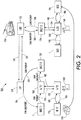
- Figure 2 is a schematic diagram of the steps required to move a package from one location to another;
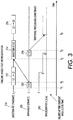
- Figure 3 provides timelines for several variables modified in the example depicted in Figure 2 ;
- Figure 4 is a flow diagram modeling how the planner operates on timelines
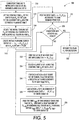
- Figure 5 is a flow diagram describing how the forward state space planner determines a plan
- Figure 6 provides three timelines representing three variables in three iterations of the forward state space planner searching for a valid plan
- Figure 7 is a flow diagram describing how a partial order planner determines a plan
- Figure 8 provides three timelines representing three variables in three iterations of the partial order planner determining a valid plan.
- Figure 1 outlines the overall framework of a continual online planner with the core planning component 20 within the planner 22.
- the core planning component 20 receives problem specifications 14 and online messages 18 as input.
- a Planning component 24 and a Replanning component 28 that can call different planning algorithms 40, 44, search algorithms 48, and reasoning engines 50, 54.
- the output from the core planning component 20 is sent to a controller 60 and/or visualizer 64, where the controller can send signals to cause the plan to be implemented.
- the planner 22 is suitably embodied as operating within a digital processing device or system, such as an illustrative computer 70, executing suitable software, firmware, or other instructions.
- the digital processing device includes suitable user interfacing components such as to receive the on-line messages 18 and to output instructions/data to controller 60, visualizer 64 - in the case of the illustrative computer 70, these include an illustrative display device 74 providing visual output (and, if embodied as a "touch screen", optionally also providing for user input), an illustrative keyboard 74, and an illustrative mouse 76 (or a trackball, track pad, or other pointing device).
- the planner system can be embodied by another digital processing device such as a network server, a personal data assistant (PDA), a laptop or notebook computer, a tablet device such as an iPad (available from Apple Corporation, Cupertino, CA, USA), or so forth.
- PDA personal data assistant
- tablet device such as an iPad (available from Apple Corporation, Cupertino, CA, USA), or so forth.
- wireless connectivity is suitably used.
- the planner 22 may be embodied by a storage medium storing instructions executable by a digital processing device to implement the valuation system.
- the storage medium may be a hard disk (not shown) of the computer 70 or some other magnetic storage medium, or an optical disk or other optical storage medium, or random access memory (RAM, not illustrated) of the computer 70 or FLASH memory or some other electronic storage medium, or so forth.
- FIG. 2 presents an environment 100 in which an example planning scenario is illustrated to show the different possible variables and interrelations between the variables to which the concepts of the present application may be applied.
- a package 110 is located at B 1 1 112 and needs to be to delivered to B 2 2 190 using first crane 120 located at LC 1 2 122.
- Solid arrow lines 102 show the path of the package 110.
- the package 110 is first moved using the first crane 120 to location LC 1 1 130 and then to Belt 2 132.
- the package 110 is then transported by overhead vehicle ( OHV ) 150 from L 0 1 154 to L 0 2 152.
- the package 110 is next transferred onto Belt 3 170 and from Beit 3 170 by second crane 180 located at LC 2 1 182 to location B 2 2 190.
- OHV overhead vehicle
- Timelines for several variables modified in the example depicted in Figure 2 are displayed in Figure 3 .
- a binary variable is a special case of a discrete multi-value variable ( i.e. , with only two values).
- other variables may be included in the timeline set managed by a planner.
- Each timeline for a variable ⁇ consists of a value c ⁇ ⁇ D ( ⁇ ), with D ( ⁇ ) being the value domain of ⁇ which contains all possible values of v.
- the timeline for v consists of the current value of ⁇ at the current wall-clock time t c and a set of tokens representing future events affecting the value of ⁇ . The tokens are added due to actions in the plans found for previous goals.
- Each token tk is represented by:
- tokens represent conditions and changes caused by actions
- tokens caused by load action need to finish before the tokens added by the move action. Therefore, there are temporal ordering relations between the tokens. In a valid plan, temporal relations between all tokens within a timeline and between timelines for all variables are consistent.
- a valid plan must achieve the desired goal or set of goals.
- a consistent timeline for ⁇ g achieves the desired goal, if at the end of the timeline the end value of the last token matches x .
- the timeline achieves g at some point in time if there exist a token T such that the end value of T matches x .
- a consistent timeline for ⁇ g satisfies g then we say that set of timelines TL for all variables satisfy G or TL
- G .
- Figure 4 demonstrates, by flow 400, how the general planning algorithm operates on timelines.
- the planner takes as an input 410 a consistent timeline set TL, representing all changes happening from the current wall-clock time to all state variables, and a goal set G .
- the planner attempts to find a plan P such that (1) adding T(P) to TL does not cause any inconsistency, (2) achieves all goals, and (3) is executable (i.e., all tokens caused by this plan should be able to start after the wall-clock time when the plan is found) 424.
- the planner starts with an empty plan 412 and continually generates revisions until a valid plan is found. It does so by maintaining a queue (SQ) of plan states, each containing a potential incomplete plan P and the corresponding timeline containing tokens representing actions in P.
- SQL queue
- SQ is initialized with an empty plan and the current timelines at the planning time 412.
- the new states combining newly generated plans P' and timelines TL' are, in 422, put back into the state queue SQ and the process is repeated back to 414.
- the planner starts with a consistent timeline set and needs to find a plan that does not cause any inconsistencies, achieve the stated goals and is executable. Therefore, after initialization (lines 1-7), the planner starts with the empty plan set and keeps revising the plan until achieving the noted objectives (lines 8-11).
- the planner tries to find the best plan by maintaining a set of generated states (which is composed of a plan P and the timelines which resulted from adding tokens caused by P, to the original timelines), and at each step the process picks the best from the generated set to check for being a valid plan. Thus, if a generated plan is a valid one, it may not be returned unless it is better than other generated plans.
- P is executed (line 12) and its effect is incorporated in the continually maintained timelines (line 13).
- FSS planners search for a plan by moving forward through time.
- FSS planners start with an empty plan and gradually add actions at some fixed wall-clock time to the end of the currently expanding partial plan. This process is repeated until the final sequence of actions satisfies the defined goals.
- all actions in the partial plans and the tokens introduced by them are constrained to happen at some fixed wall-clock time. This set of constraints and the fact that FSS planners move forward, therefore not considering actions happening before a given time-stamp, simplifies plan state representation and reduces the branching factor compared to other algorithms.
- a flow diagram 500 representing the operations performed by the FSS planner is shown in Figure 5 . Similar to the planner described in figure 4 , the FSS planner begins with an empty plan 510 and takes as an input a consistent timeline set and a goal set. Unlike the planner in figure 4 , the FSS planner must account for the time taken to find a plan, given that searching begins from current wall-clock time t c , but the plan will not be executed until the plan is found at a later wall-clock time t B > t c . To account for this time delay the algorithm uses two estimations: expected amount of total planning time T p and the expected time to conduct one planning step T g .
- the planner also "freezes" all tokens in all timelines before t p any removes them from the initial timeline set 514. This step simplifies the token and timeline representation and also reduces their sizes.
- it systematically searches for the final plan by maintaining a queue SQ of plan states, each containing a potential incomplete plan P and the corresponding timeline containing tokens representing actions in P. SQ is initialized with an empty plan at time t p and the simplified timelines 516.
- the planner selects a subset of promising actions 524, removing irrelevant actions (i.e., actions that do not lead towards a goal).
- irrelevant actions i.e., actions that do not lead towards a goal.
- There are several methods to implement this step the simplest approaches being selecting all applicable actions or selecting only a single best action according to a heuristic function.
- tokens are then created to represent the conditions and effects of action a and are added to the timeline set for the plan 526.
- the actions are added to the plan at the wall-clock time t a found in the previous step and the resulting state containing the newly created timelines and plan are added to the state queue (SQ) 528.
- SQ state queue
- the time-stamp is moved forward 530.
- the function sets a newer lower-bound on the future action execution time, which: (1) limits the branching factor; (2) simplifies the timelines by removing all tokens before the new time-stamp; and (3) reduces the interactions between tokens and future actions, leading to shorter heuristic computation time. Then the process moves from 530 back to 520.
- the FSS planning algorithm may not return the plan in which all actions start at the earliest possible time.
- Figure 6 shows several steps leading to the determination of the final plan. Displaying all the steps the planner goes through to determine the final plan in Figure 2 is too complicated. Therefore, we will assume a simpler goal of moving the package from B 11 to the OHV.
- Timelines for only three variables are shown, ⁇ 1 , ⁇ 2 , and ⁇ 3 representing the locations of the package, Crane1 and OHV respectively.
- tokens represented by solid rectangles 640 are from a previous online planning period. Tokens created during the current planning process should not overlap with tokens from previous planning periods.
- partial-order planner implemented on a timeline according to the present disclosure. It is to be noted here that while this disclosure uses the term partial-order planner and such a term is used in the literature, there are significant differences, particularly as this partial-order-planner is designed to operate on timelines. It is noted an FSS planner finds a plan by moving forward through a sequence of consistent timelines until a given timeline set satisfies all goals. Conversely, a partial order planner searches backward from the goals. The partial order planner creates special tokens representing the goals and has an objective of creating enough tokens through adding actions to plan to support all in the set of unsupported tokens, which initially contains only special goal tokens.
- the partial order planner may start with an inconsistent timeline set and systematically refine it until it becomes consistent. Instead of finding Applicable actions as in the FSS planner, the partial order finds Relevant actions. Relevant actions are those actions that can contribute tokens that support currently un-supported tokens.
- the flow diagram 700 in Figure 7 shows the steps performed by the partial order planner in determining a consistent plan.
- the partial order planner takes as an input a consistent timeline and goal set.
- the planner starts with an empty plan 710 and adds special tokens representing the goals to the end of the timeline 714.
- it systematically searches for the final plan by maintaining a queue SQ of plan states, each containing a potential incomplete plan P and the corresponding timeline containing tokens representing actions in P.
- SQ is initialized with an empty plan at time t p and the simplified timelines 716.
- the state contains a consistent plan P s , then it is returned for execution. If the state is consistent 720, then the temporal order between actions in the plan are setup 732. The execution time for all actions in the plan is determined such that all actions are consistent with the temporal constraints 734. Finally, the plan is executed 736. If, in 720, the state picked doesn't contain a consistent plan, the planner identifies all relevant actions in the plan that contribute tokens that support currently unsupported tokens 722. A subset of promising actions from these relevant actions are chosen 724. For each new action, tokens corresponding to that action's conditions and effects are then added to the timelines 726. New actions are then added to the plan and the state set is updated 728, and the process is repeated from 718. There is no fixed starting time for all actions and tokens in the partial order planner, because their start/end times are represented by floating time points.
- the main loop of the POP algorithm uses a search to find the plan (lines 6-16) which is similar to Algorithm 1 and Algorithm 2. However, particular differences between this POP algorithm and the FSS algorithm are:
- Figure 8 shows several steps 802, 804, 806 of the partial order planner in finding the plan with the same set of actions as the FSS algorithm shown in Figure 6 .
- Timelines for three variables are shown, ⁇ 1 810, ⁇ 2 820, and ⁇ 3 830 representing the locations of the package, Crane 1 and OHV respectively.
- tokens represented by solid rectangles 840 are from a previous online planning period.
- the action Unload ( PBeit 2) 852 is added which causes two tokens 818, 822 to be added to the timeline. Appropriate temporal orderings are also added between related time points.
- the partial order planner continues to add actions to support un-supported tokens until the timelines are consistent and the final plan is found. In the final plan 806 three additional actions 854, 856, 858 have been added since step 804, creating four additional actions 824, 826, 828, 832.
- the partial order planner and FSS planner include various attributes.
- the fixed-time and the association of a time-stamp for each search state during the planning process of the FSS planner leads to:
- Attributes of the POP-style algorithm include:
- the foregoing has described a timeline-based planning approach that operates by maintaining timelines that capture how the values of system variables change over time.
- the planner builds and maintains consistent plans by adding tokens to affected timelines, each token representing different types of operation and/or change affecting the variable represented by that timeline.
- the application supports many types of variables and various operations on those variables through different tokens, all of which can be shared between different planning episodes for different goals.
- the overall framework is designed to allow multiple planning algorithms to be used for a given task.
- different planning algorithms can call different search algorithms and constraint solvers (e.g., temporal reasoning, uncertainty reasoning, etc.) to solve the planning or replanning tasks.
- a timeline-based continual on-line planning and scheduling method for determination of a sequence of actions that when executed from a known initial state achieves all pre-defined goals.
- the method is performed by a planner residing within a computer control system having a memory storage.
- the planner builds and maintains a consistent valid plan by adding tokens to affected timelines.
- the plan is defined by a sequence of actions and each timeline represents a variable. All variables and their values represent a state and each timeline comprises the current value of the variable and a set of tokens representing constraints and changes on the value of that variable over time.
- a token represents a condition or effect of an action affecting the variable and tokens are added to timelines due to actions in the plan that affect the value of different variables.
- Each token has an earliest time point and a latest time point that the action can occur.
- the planner takes as an input a goal set and a consistent set of timelines representing all operations occurring after the current wall-clock time that affect any state variables.
Landscapes
- Business, Economics & Management (AREA)
- Human Resources & Organizations (AREA)
- Engineering & Computer Science (AREA)
- Strategic Management (AREA)
- Entrepreneurship & Innovation (AREA)
- Economics (AREA)
- Operations Research (AREA)
- Game Theory and Decision Science (AREA)
- Development Economics (AREA)
- Marketing (AREA)
- Educational Administration (AREA)
- Quality & Reliability (AREA)
- Tourism & Hospitality (AREA)
- Physics & Mathematics (AREA)
- General Business, Economics & Management (AREA)
- General Physics & Mathematics (AREA)
- Theoretical Computer Science (AREA)
- Management, Administration, Business Operations System, And Electronic Commerce (AREA)
Abstract
An online planning system and method represents variables in an environment for which a plan is being developed in the form of timelines. The timelines are continually maintained by capturing how different ones of the variables change their values over time. The plan being a consistent plan built and maintained by adding tokens to affected timelines, wherein each token represents different types of actions affecting the variable represented by that timeline.
Description
- This disclosure relates generally to a method and system for timeline-based planning and scheduling. More specifically the disclosure relates to the on-line state-space planning of operations and actions in order to achieve pre-defined goals.
- Planning is directed to the problem of finding a sequential or parallel sequence of actions that when executed from a known initial state achieves all pre-defined goals. There are many different methods of planning used in various applications, e.g. academic planners that are normally offline and deterministic planners where relevant planning data is known. The input to a deterministic planning system consists of a set of variables, a set of actions, the initial state, and the desired goal condition. Each action is represented by its lists of conditions and effects. Conditions are constraints on variables that need to be satisfied for the action to be executed. The planner finds a logically consistent sequence of actions (a plan) that connects the initial state to the goal state. The planner does not account for issues such as: (1) if variables are affected by actions outside of the planner's control (e.g., by actions from another plan being executed); (2) how variables may change values during the planning time needed to find the plan; and (3) new goals arriving in real-time. These issues are associated with online planning, where the planner must account for the passing of time.
- In continual on-line planning, goals and system (or world) state are continually updated over time to account for plan executions of previously planned for goals that overlap with the planning process. Current online planners known in the art use domain-specific guidance techniques to guide the planner, making it time-consuming to adapt to new applications. These limitations make it difficult to develop a traditional action-based general-purpose planning heuristic to guide the search for a plan.
- An online planning system and method that represents real-time status of variables in an environment for which a plan is being developed in the form of consistent timelines. The timelines are continually maintained by capturing how different variables change their values over time. A consistent plan is built and maintained by adding tokens to affected timelines, wherein each token represents different execution condition or effects of actions affecting the variable represented by that timeline.
-
Figure 1 is a schematic diagram of the components, inputs, and outputs of a continual online planner; -
Figure 2 is a schematic diagram of the steps required to move a package from one location to another; -
Figure 3 provides timelines for several variables modified in the example depicted inFigure 2 ; -
Figure 4 is a flow diagram modeling how the planner operates on timelines; -
Figure 5 is a flow diagram describing how the forward state space planner determines a plan; -
Figure 6 provides three timelines representing three variables in three iterations of the forward state space planner searching for a valid plan; -
Figure 7 is a flow diagram describing how a partial order planner determines a plan; -
Figure 8 provides three timelines representing three variables in three iterations of the partial order planner determining a valid plan. -
Figure 1 outlines the overall framework of a continual online planner with thecore planning component 20 within theplanner 22. Thecore planning component 20 receivesproblem specifications 14 and online messages 18 as input. For thecore planning component 20, there are two main components, aPlanning component 24 and aReplanning component 28 that can calldifferent planning algorithms search algorithms 48, andreasoning engines core planning component 20 is sent to acontroller 60 and/orvisualizer 64, where the controller can send signals to cause the plan to be implemented. - The
planner 22 is suitably embodied as operating within a digital processing device or system, such as an illustrative computer 70, executing suitable software, firmware, or other instructions. The digital processing device includes suitable user interfacing components such as to receive the on-line messages 18 and to output instructions/data to controller 60, visualizer 64 - in the case of the illustrative computer 70, these include anillustrative display device 74 providing visual output (and, if embodied as a "touch screen", optionally also providing for user input), anillustrative keyboard 74, and an illustrative mouse 76 (or a trackball, track pad, or other pointing device). Instead of the illustrative computer 70, the planner system can be embodied by another digital processing device such as a network server, a personal data assistant (PDA), a laptop or notebook computer, a tablet device such as an iPad (available from Apple Corporation, Cupertino, CA, USA), or so forth. In a portable system, wireless connectivity is suitably used. - It is also to be appreciated that the
planner 22 may be embodied by a storage medium storing instructions executable by a digital processing device to implement the valuation system. By way of illustrative example, the storage medium may be a hard disk (not shown) of the computer 70 or some other magnetic storage medium, or an optical disk or other optical storage medium, or random access memory (RAM, not illustrated) of the computer 70 or FLASH memory or some other electronic storage medium, or so forth. -
Figure 2 presents anenvironment 100 in which an example planning scenario is illustrated to show the different possible variables and interrelations between the variables to which the concepts of the present application may be applied. In theenvironment 100, apackage 110 is located at B11 112 and needs to be to delivered toB 2 2 190 usingfirst crane 120 located at LC12 122.Solid arrow lines 102 show the path of thepackage 110. Thepackage 110 is first moved using thefirst crane 120 to location LC11 130 and then toBelt 2 132. Thepackage 110 is then transported by overhead vehicle (OHV ) 150 fromL 0 1 154 toL 0 2 152. Thepackage 110 is next transferred onto Belt 3 170 and from Beit 3 170 bysecond crane 180 located at LC21 182 to location B22 190. Note that there are actions represented bysolid lines 104 belonging to the final plan that are not represented by the path of the package, such as moving theOHV 150 fromL 0 2 152 toL 0 1 154 and the second crane fromLC 2 1 182 toBelt 3 170. The remainingdotted lines 106 represent available actions that are not part of the described path. - Timelines for several variables modified in the example depicted in
Figure 2 are displayed inFigure 3 . The variables represented are: (1) a multi-value (discrete) variable ν1 = LaeationOf(Package) 210 representing the location of Package; (2) a binary variable ν2 = Available(Crane1) 220 representing if Crane1 is carrying a package; (3) a continuous variable ν3 = Space(Belt2) 230 representing the available/empty space in Belt2. It is to be understood a binary variable is a special case of a discrete multi-value variable (i.e., with only two values). Also, while only three types of variables are described above, other variables may be included in the timeline set managed by a planner. - Each timeline for a variable ν consists of a value c ν ∈ D(ν), with D(ν) being the value domain of ν which contains all possible values of v. The timeline for v consists of the current value of ν at the current wall-clock time tc and a set of tokens representing future events affecting the value of ν. The tokens are added due to actions in the plans found for previous goals. The three
tokens Figure 3 in the timeline for ν1 = LocationOf(Package) 210 represent the following ordered events: (1) the value of ν1 changing from the current value ν1 = L 1 to ν1 =L 2 212; (2) maintaining the value ν1 = L 2 for acertain duration 214 defined by the start and end time points of the token; and (3) changing the value from ν1 = L 2 to ν1 = L 3 during 216. The twotokens - Each token tk is represented by:
- (i) Start and end time points start(tk ) and end(tk ).
- (ii) A start value νs (or bounds on start value [lb ; ub ] with lb ≤ ub for continuous variables).
- (iii) A start condition (e.g., ν = νs) specifying the condition that needs to be satisfied by the token (e.g. =. ≠,>, <, ≥,≤, NONE).
- (iv) A change operation <operator, value> (e.g., ν = ν + 5 or ν ← x specifying how the variable value changed within the token duration. Some change operators are: :=, +=, -=, x=, /=, CHANGE, USE, MAINTAIN. The variable value at the end of the token is calculated based on the start value and the change operation. Alternatively, the start and end values can be represented explicitly and the change operation calculated based on the start and end values.
- Given that tokens represent conditions and changes caused by actions, there can be temporal relations between tokens that represent either: (1) an execution condition or effect of the same action a ; or (2) a condition or effect of actions that are related to one another. For example, before moving the package from L 1 to L 2 using Crane1, it first needs to be loaded. Thus, tokens caused by load action need to finish before the tokens added by the move action. Therefore, there are temporal ordering relations between the tokens. In a valid plan, temporal relations between all tokens within a timeline and between timelines for all variables are consistent.
- The set of timelines for all variables is consistent if each timeline is:
- (i) value consistent. A timeline is value consistent if consecutive tokens on the same timeline make up a consistent sequence of changes, i.e. the end value of a given token matches with the start value of the next token. In matching, we generally mean equal, however for continuous variables that are represented by a [lb, ub] interval, matching means that the two intervals overlap. If a given token tk 's start value is not matched by a previous token's end value, we say that tk is not supported. A timeline is consistent when all tokens in that timeline are supported.
- (ii) temporal consistent, Tokens that are added to the timeline should not cause temporal inconsistency. One example of temporal inconsistency is that two temporal orderings: t 1 < t 2 and t 2 < t 1 are both deducible from the same network.
- A valid plan must achieve the desired goal or set of goals. For a given goal g= 〈ν g ,x〉 (i.e., ν g =x ), a consistent timeline for ν g achieves the desired goal, if at the end of the timeline the end value of the last token matches x . Alternatively, we say that the timeline achieves g at some point in time if there exist a token T such that the end value of T matches x . For a given goal set G , if for all g ∈ G a consistent timeline for ν g satisfies g then we say that set of timelines TL for all variables satisfy G or TL |=G.
-
Figure 4 demonstrates, byflow 400, how the general planning algorithm operates on timelines. Some notations used inFigure 4 , and subsequentFigures 5 and7 , are: - (i) For a given action a , T(a) denotes the set of tokens caused buy a
- (ii) For an action set A, T(A) is the set of tokens caused by all actions in A. Similarly, T(P) is the set of tokens caused by all actions in the plan P .
- (iii) For each time point tp (e.g., a token's start/end timepoint), let est(tp) and lst(tp) represent the earliest and latest possible times that tp can occur.
- The planner takes as an input 410 a consistent timeline set TL, representing all changes happening from the current wall-clock time to all state variables, and a goal set G . The planner attempts to find a plan P such that (1) adding T(P) to TL does not cause any inconsistency, (2) achieves all goals, and (3) is executable (i.e., all tokens caused by this plan should be able to start after the wall-clock time when the plan is found) 424. To achieve this, the planner starts with an
empty plan 412 and continually generates revisions until a valid plan is found. It does so by maintaining a queue (SQ) of plan states, each containing a potential incomplete plan P and the corresponding timeline containing tokens representing actions in P. SQ is initialized with an empty plan and the current timelines at theplanning time 412. The planner then picks the best state s = <TLs,Ps> from the queue according to the objective function of the planning process in 414. If, in 416, the state contains a consistent plan Ps, then it is returned forexecution 424. If not, then the planner will create zero or more revisions P' of the partial plan Ps in 418. It also generates the corresponding timeline set TL' for each new P' in 420. The new states combining newly generated plans P' and timelines TL' are, in 422, put back into the state queue SQ and the process is repeated back to 414. - The concepts of the above described
Figure 4 are expanded upon in connection withAlgorithm 1 below. Where, as discussed above, the planner starts with a consistent timeline set and needs to find a plan that does not cause any inconsistencies, achieve the stated goals and is executable. Therefore, after initialization (lines 1-7), the planner starts with the empty plan set and keeps revising the plan until achieving the noted objectives (lines 8-11). The planner tries to find the best plan by maintaining a set of generated states (which is composed of a plan P and the timelines which resulted from adding tokens caused by P, to the original timelines), and at each step the process picks the best from the generated set to check for being a valid plan. Thus, if a generated plan is a valid one, it may not be returned unless it is better than other generated plans. When the best plan P is found, P is executed (line 12) and its effect is incorporated in the continually maintained timelines (line 13). - It is to be understood that the above algorithm is sufficiently general to capture both systematic and local-search style planning for different plan representations, and for different planners that can handle different sets of variables and constraints. In that regard, the specific revising of P; determining what is the best plan; and the representation of the plan during the planning process can and will vary dependent upon particular implementations. So, in one embodiment, for example, "best" is understood to be the plan that meets more of the predetermined criteria (e.g. shortest execution time, lowest total execution cost) than other potential plans.

- Turning now to implementing forward state-space (FSS) planners on a timeline, it is understood FSS planners search for a plan by moving forward through time. FSS planners start with an empty plan and gradually add actions at some fixed wall-clock time to the end of the currently expanding partial plan. This process is repeated until the final sequence of actions satisfies the defined goals. Thus, during the planning process, all actions in the partial plans and the tokens introduced by them are constrained to happen at some fixed wall-clock time. This set of constraints and the fact that FSS planners move forward, therefore not considering actions happening before a given time-stamp, simplifies plan state representation and reduces the branching factor compared to other algorithms.
- A flow diagram 500 representing the operations performed by the FSS planner is shown in
Figure 5 . Similar to the planner described infigure 4 , the FSS planner begins with anempty plan 510 and takes as an input a consistent timeline set and a goal set. Unlike the planner infigure 4 , the FSS planner must account for the time taken to find a plan, given that searching begins from current wall-clock time tc , but the plan will not be executed until the plan is found at a later wall-clock time tB > tc. To account for this time delay the algorithm uses two estimations: expected amount of total planning time T p and the expected time to conduct one planning step T g . To start the planning process, the planner moves to the expected time at which the planner can start to execute the eventually found plan: tp = tc +T p 512. The planner also "freezes" all tokens in all timelines before tp any removes them from the initial timeline set 514. This step simplifies the token and timeline representation and also reduces their sizes. Like the planner inFigure 4 , it systematically searches for the final plan by maintaining a queue SQ of plan states, each containing a potential incomplete plan P and the corresponding timeline containing tokens representing actions in P. SQ is initialized with an empty plan at time tp and thesimplified timelines 516. The planner then picks the best state s = <TLs,Ps,ts> from the queue according to the objective function of the planning process in 518. If, in 520, the state contains a consistent plan Ps, then it is returned forexecution 532. If not, the planner then finds actions that are candidates to extend the current plan Ps leading from the initial state to s using the following procedure: For each action a, the FSS planner moves forward in time from the current state's time stamp ts until it find an earliest time ta ≥ tc that if a executes at ta then all new tokens added will not make the timelines inconsistent. Any action ta for which there is a consistent execution time ta, the action is added to an action (or candidate) set 522. - Next, the planner selects a subset of
promising actions 524, removing irrelevant actions (i.e., actions that do not lead towards a goal). There are several methods to implement this step, the simplest approaches being selecting all applicable actions or selecting only a single best action according to a heuristic function. For each action a in the candidate set, tokens are then created to represent the conditions and effects of action a and are added to the timeline set for theplan 526. The actions are added to the plan at the wall-clock time ta found in the previous step and the resulting state containing the newly created timelines and plan are added to the state queue (SQ) 528. - Next, to create one additional resulting state, the time-stamp is moved forward 530. This is a special action that helps to move the state time-stamp forward closer to the goal. When moving the time-stamp forward, the function sets a newer lower-bound on the future action execution time, which: (1) limits the branching factor; (2) simplifies the timelines by removing all tokens before the new time-stamp; and (3) reduces the interactions between tokens and future actions, leading to shorter heuristic computation time. Then the process moves from 530 back to 520.
- Given that the plan returned by the FSS algorithm has all actions and tokens tied to some fixed wall-clock times, the FSS planning algorithm may not return the plan in which all actions start at the earliest possible time. As an optional step, it is possible to convert from the "fixed-time" plan into a plan with temporal ordering between tokens and actions 562. This can be accomplished using an extension of the approach specified in Do, M., & Kambhampati, S., "Improving the Temporal Flexibility of Position Constrained Metric Temporal Plans", on Proceeding of the 13th International Conference on Automated Planning and Scheduling (ICAPS), 2003.
- Turning to
Algorithm 2 below, the above concepts are detailed in pseudocode. InAlgorithm 2, it may be seen that lines 8-21 mimic the main steps ingeneral Algorithm 1 that use a best-first-search framework (with lines 20-21 providing the being option of converting from fixed-time tokens to tokens with temporal constraints. Corresponding to the discussion ofFigure 5 andAlgorithm 2, the successor generating routines are restated in the following functions: - (i) Applicable (lines 25-30): for the current state s, this function finds actions that are candidates to extend the current plan Ps leading from the initial state to s. For each action a, the FSS planner moves forward in time from the current state's time stamp ts until it finds an earliest time ta ≥ tc that if a executes at ta then all new tokens added will not make the timelines inconsistent. Any action ta has a consistent execution time ta is added to the candidate set.
- (ii) Apply (lines 33-37): the planner only selects a subset of candidate actions (line 17) because normally there can be many applicable but irrelevant actions (i.e., do not lead to some good directions toward goals). It then generates successors by creating tokens related to an action's conditions and effects and adds them to the current tokens. Also the action at the wall-clock time ta found in the previous step is added to the overall plan leading to the new state.
- (iii) AdvanceTime (lines 39-44): this is a special action that helps move the state time-stamp forward (i.e., closer to the goal). When moving the time-stamp forward, it basically sets the newer lower-bound on the future action execution time and thus: (1) limits the branching factors; (2) simplifies the timelines (i.e., removes all tokens finished before the new time-stamp); and (3) reduces the interactions between tokens and future actions, leading to a shorter heuristic computation time.
- Going back to the example shown in
Figure 2 ,Figure 6 shows several steps leading to the determination of the final plan. Displaying all the steps the planner goes through to determine the final plan inFigure 2 is too complicated. Therefore, we will assume a simpler goal of moving the package from B11 to the OHV. Timelines for only three variables are shown, ν1, ν2, and ν3 representing the locations of the package, Crane1 and OHV respectively. In the timelines forν 1 610,ν 2 620, andν 3 630, tokens represented bysolid rectangles 640 are from a previous online planning period. Tokens created during the current planning process should not overlap with tokens from previous planning periods. We start by setting the start time equal to tc +t p 602, and the planner begins by adding an action of loading the package intoCrane 1 612 at that time instance. This action addition creates two fixed-time tokens ν 1 610 andν 2 620. We then apply the AdvanceTime action several times to reacht 1 604 and apply the second action to move the OHV toL0 1 614, which adds onetoken 654 to the timeline ofν 3 630. After several steps of adding regular actions (e.g., Move (Crane ; LC11) 616; Unload(P;Beit 2) 618) andseveral AdvanceTime actions 606, we apply the action of loading the package intoOHV 622. At this time, all timelines are consistent and all goals are achieved so planning is terminated. - Attention is now turned to a partial-order planner, implemented on a timeline according to the present disclosure. It is to be noted here that while this disclosure uses the term partial-order planner and such a term is used in the literature, there are significant differences, particularly as this partial-order-planner is designed to operate on timelines. It is noted an FSS planner finds a plan by moving forward through a sequence of consistent timelines until a given timeline set satisfies all goals. Conversely, a partial order planner searches backward from the goals. The partial order planner creates special tokens representing the goals and has an objective of creating enough tokens through adding actions to plan to support all in the set of unsupported tokens, which initially contains only special goal tokens. So the partial order planner may start with an inconsistent timeline set and systematically refine it until it becomes consistent. Instead of finding Applicable actions as in the FSS planner, the partial order finds Relevant actions. Relevant actions are those actions that can contribute tokens that support currently un-supported tokens.
- The flow diagram 700 in
Figure 7 shows the steps performed by the partial order planner in determining a consistent plan. The partial order planner takes as an input a consistent timeline and goal set. The planner starts with anempty plan 710 and adds special tokens representing the goals to the end of thetimeline 714. Like the planner inFigure 4 , it systematically searches for the final plan by maintaining a queue SQ of plan states, each containing a potential incomplete plan P and the corresponding timeline containing tokens representing actions in P. SQ is initialized with an empty plan at time tp and thesimplified timelines 716. The planner then picks the best state s = <TLs, Ps,> from the queue according to the objective function of the planning process in 718. If the state contains a consistent plan Ps, then it is returned for execution. If the state is consistent 720, then the temporal order between actions in the plan aresetup 732. The execution time for all actions in the plan is determined such that all actions are consistent with thetemporal constraints 734. Finally, the plan is executed 736. If, in 720, the state picked doesn't contain a consistent plan, the planner identifies all relevant actions in the plan that contribute tokens that support currentlyunsupported tokens 722. A subset of promising actions from these relevant actions are chosen 724. For each new action, tokens corresponding to that action's conditions and effects are then added to thetimelines 726. New actions are then added to the plan and the state set is updated 728, and the process is repeated from 718. There is no fixed starting time for all actions and tokens in the partial order planner, because their start/end times are represented by floating time points. - Further describing the above flow diagram, shown below is the pseudocode of
Algorithm 3 corresponding to the described partial order planning (POP) algorithm. - The main loop of the POP algorithm uses a search to find the plan (lines 6-16) which is similar to
Algorithm 1 andAlgorithm 2. However, particular differences between this POP algorithm and the FSS algorithm are: - (i) Given that the algorithm doesn't find fixed-time plan (with all actions associated with some wall-clock time), there is no need to estimate planning time T p or expansion time T e.
- (ii) The planner searches backward from the goals. For that, it creates special tokens representing the goals (line 3-5) and the planner's objective is to create enough tokens through action addition so that those goal tokens are all eventually supported.
- (iii) Instead of finding Applicable actions as in the FSS algorithm, we go backward and find Relevant actions, which can contribute some tokens that can support some currently un-supported tokens (
line 14, 22-27). - (iv) There is two-level branching: (1) over actions that are deemed relevant; and (2) over token ordering where the new tokens introduced by the newly added actions can be added in the respective timelines.
- (v) There is no fixed starting time for all actions and tokens but their start/end times are represented by floating time points. There is thus no need for an optional post-processing process to convert from a fixed-time to flexible time plan as in the FSS algorithm.
-
Figure 8 showsseveral steps Figure 6 . Timelines for three variables are shown,ν 1 810,ν 2 820, andν 3 830 representing the locations of the package, Crane1 and OHV respectively. In the timelines forν 1 810,ν 2 820, andν 3 830, tokens represented bysolid rectangles 840 are from a previous online planning period. The planner starts by creating a special token ν1 = In(OHV) 812 at the end of the timeline forν 1 810. The action Load(P,OHV) 850 is then added to the plan because it adds a token that support ν1 = In(OHV) 812, which was previously unsupported. Load(P,OHV) 850 causes twotokens next step 806 the action Unload(PBeit2) 852 is added which causes twotokens final plan 806 threeadditional actions step 804, creating fouradditional actions - The partial order planner and FSS planner include various attributes. The fixed-time and the association of a time-stamp for each search state during the planning process of the FSS planner leads to:
- (i) Smaller state representation: (1) any token ends before the time-stamp can be removed from consideration; (2) no order between different tokens needs to be stored, as they are implied by the fixed start/end time of all tokens.
- (ii) Lower branching factor: each applicable action generate exactly one successor,
- Attributes of the POP-style algorithm include:
- (i) Does not require the estimation of the expected total planning time and expected expansion time.
- (ii) Allows branching rules that do not rule out any valid solutions.
- The foregoing has described a timeline-based planning approach that operates by maintaining timelines that capture how the values of system variables change over time. The planner builds and maintains consistent plans by adding tokens to affected timelines, each token representing different types of operation and/or change affecting the variable represented by that timeline. The application supports many types of variables and various operations on those variables through different tokens, all of which can be shared between different planning episodes for different goals. Given that different planning algorithms are more suitable for different applications, the overall framework is designed to allow multiple planning algorithms to be used for a given task. In turn, different planning algorithms can call different search algorithms and constraint solvers (e.g., temporal reasoning, uncertainty reasoning, etc.) to solve the planning or replanning tasks.
- The disclosed embodiments provide examples of improved solutions to the problems noted in the above Background discussion and the art cited therein. There is shown in these examples an improved online continual automated planning framework based on timelines. In one embodiment, a timeline-based continual on-line planning and scheduling method for determination of a sequence of actions that when executed from a known initial state achieves all pre-defined goals. The method is performed by a planner residing within a computer control system having a memory storage. The planner builds and maintains a consistent valid plan by adding tokens to affected timelines. The plan is defined by a sequence of actions and each timeline represents a variable. All variables and their values represent a state and each timeline comprises the current value of the variable and a set of tokens representing constraints and changes on the value of that variable over time. A token represents a condition or effect of an action affecting the variable and tokens are added to timelines due to actions in the plan that affect the value of different variables. Each token has an earliest time point and a latest time point that the action can occur. The planner takes as an input a goal set and a consistent set of timelines representing all operations occurring after the current wall-clock time that affect any state variables.


Claims (14)
- A timeline-based continual on-line planning and scheduling method for determination of a sequence of actions that when executed from a known initial state achieves all pre-defined goals, the method being performed by a planner residing within a computer control system having a memory storage, the method comprising:building and maintaining a consistent valid plan by adding tokens to affected timelines, wherein:the plan is defined by a sequence of actions;each timeline represents a variable;each variable has a value that changes over time;each timeline comprises the current value of the variable and a set of tokens, each token representing an condition or effect of an action affecting the variable and the adding of tokens to timelines due to actions in the plan that affect the value of the variable.
- The method of claim 1, wherein each token has an earliest time point and a latest time point
- The method of claim 1 or claim 2, wherein the planner takes as an input a goal set and a consistent set of timelines representing all operations occurring after the current wall-clock time that affect any state variables.
- The method of any of the preceding claims, wherein the plan is valid if:the plan achieves the desired goal or set of goals, wherein:the plan represented by the set of timelines achieves the desired goal if at the end the timelines the end value of the last token matches the goal; andthe set of goals is achieved when for all goals in the goal set the end value of the last token of a timeline representing the goal variable satisfies the goal;all tokens caused by the actions in the plan are able to start after the wall-clock time when the plan is found; andadding all tokens caused by the plan does not cause any inconsistencies, wherein the plan is consistent if the set of timelines for all variables are:value consistent, wherein the timeline is value consistent if consecutive tokens on the same timeline make up a consistent sequence of changes, wherein the end value of a given token matches with the start value of the next token; andtemporal consistent, wherein the timeline is temporal consistent if all tokens that are added to the timeline do not cause the value of a variable to conflict the value of the same variable in another timeline.
- The method of any of the preceding claims, wherein:each token is represented by a start time point and an end time point, a start value of the variable for discrete or continuous variables or an upper and lower bounds on the start value for continuous variables, and a change operation specifying how the variable value changes during the token duration;there is a temporal relation between tokens that represent a condition to or effect of the same action or represent a condition to or effect of actions that are related to one another, wherein related actions are actions that are dependent upon the results of one another.
- The method of any of the preceding claims, wherein the planner determines a plan by starting with an empty plan, the empty plan is inputted into the core planning component, wherein the core planning component:adds or replace actions to the inputted plan to create the set of plans;generates and maintains the state for each plan in the set of plans, wherein each state is composed of the actions of the plan and the timelines resulting from adding tokens caused by the actions to the original timelines;removing inconsistent plans;choosing the best plan from the set of states and associated plan;checking the best plan and associated state space for validity;if the best plan is invalid, the best plan and associated state space is inputted into the core planning component and the process repeated until a valid plan is reached;if the best plan is valid, then the best plan is executed and its effects are incorporated into the continually maintained timelines.
- An apparatus comprising:a digital processing device configured to perform a timeline-based continual on-line planning and scheduling method for determination of a sequence of actions that when executed from a known initial state achieves all pre-defined goals, wherein the method is performed by a planner residing within a computer control system having a memory storage, wherein the planner builds and maintains a consistent valid plan by adding tokens to affected timelines, wherein:the plan is defined by a sequence of actions;each timeline represents a variable;each variable has state that change over time;each timeline comprises the current value of the variable and a set of tokens;wherein a token represents an action affecting the variable and tokens are added to timelines due to actions in the plan that affect the value of the variable;each token has an earliest time point and a latest time point that the action can occur; andthe planner takes as an input a goal set and a consistent set of timelines representing all operations occurring after the current wall-clock time that affect any state variables.
- Apparatus according to claim 7 adapted to carry out a method according to any of claims 1 to 6.
- An online planning method comprising:representing variables in an environment for which a plan is being developed in the form of a sequence of actions and the corresponding timelines representing the plan's effects on the world state;continually maintaining the timelines that capture how different ones of the variables change their values over time; andbuilding and maintaining consistent plans by adding tokens to affected timelines, wherein each token represents different types of cosnstraints and effects actions affecting the variable represented by that timeline.
- The method of claim 9, wherein each timeline represents at least a distinct variable of the variables.
- The method according to claim 9 or claim 10, wherein each variable has a state that changes over time.
- The method according to any of claims 9 to 11, wherein each timeline comprises the current value of the variable it is representing and a set of tokens representing constraints and changes on variable value at different times.
- The method according to any of claims 9 to 12, wherein each token has an earliest time point and a latest time point that the action can occur.
- The method according to any of claims 9 to 13, wherein the plan is formed using as an input a goal set and a consistent set of timelines representing all operations occurring after a current wall-clock time that affects any state of the variables.
Applications Claiming Priority (1)
| Application Number | Priority Date | Filing Date | Title |
|---|---|---|---|
| US13/007,790 US20120185286A1 (en) | 2011-01-17 | 2011-01-17 | Online continual automated planning framework based on timelines |
Publications (1)
| Publication Number | Publication Date |
|---|---|
| EP2477144A1 true EP2477144A1 (en) | 2012-07-18 |
Family
ID=45463496
Family Applications (1)
| Application Number | Title | Priority Date | Filing Date |
|---|---|---|---|
| EP12151210A Ceased EP2477144A1 (en) | 2011-01-17 | 2012-01-16 | Online continual automated planning framework based on timelines |
Country Status (3)
| Country | Link |
|---|---|
| US (1) | US20120185286A1 (en) |
| EP (1) | EP2477144A1 (en) |
| JP (1) | JP2012150800A (en) |
Families Citing this family (4)
| Publication number | Priority date | Publication date | Assignee | Title |
|---|---|---|---|---|
| EP3794528A4 (en) | 2018-05-12 | 2022-01-26 | Services Pétroliers Schlumberger | SEISMIC DATA INTERPRETATION SYSTEM |
| US12147920B2 (en) | 2018-12-04 | 2024-11-19 | Schlumberger Technology Corporation | Multi-domain planning and execution |
| US20200175444A1 (en) * | 2018-12-04 | 2020-06-04 | Schlumberger Technology Corporation | Multi-domain planning and execution |
| US12524716B2 (en) | 2018-05-15 | 2026-01-13 | Schlumberger Technology Corporation | Operations management network system and method |
Family Cites Families (25)
| Publication number | Priority date | Publication date | Assignee | Title |
|---|---|---|---|---|
| US4832204A (en) * | 1986-07-11 | 1989-05-23 | Roadway Package System, Inc. | Package handling and sorting system |
| US5020304A (en) * | 1989-11-08 | 1991-06-04 | Tetra Pak Holdings & Finance S.A. | Method and apparatus for loading and stacking crates |
| US6216109B1 (en) * | 1994-10-11 | 2001-04-10 | Peoplesoft, Inc. | Iterative repair optimization with particular application to scheduling for integrated capacity and inventory planning |
| WO1997012311A2 (en) * | 1995-09-15 | 1997-04-03 | Cable & Wireless, Inc. | System and method for quality management |
| US20020014533A1 (en) * | 1995-12-18 | 2002-02-07 | Xiaxun Zhu | Automated object dimensioning system employing contour tracing, vertice detection, and forner point detection and reduction methods on 2-d range data maps |
| US6705526B1 (en) * | 1995-12-18 | 2004-03-16 | Metrologic Instruments, Inc. | Automated method of and system for dimensioning objects transported through a work environment using contour tracing, vertice detection, corner point detection, and corner point reduction methods on two-dimensional range data maps captured by an amplitude modulated laser scanning beam |
| US6415196B1 (en) * | 1997-08-28 | 2002-07-02 | Manugistics, Inc. | Manufacturing scheduling process with improved modeling, scheduling and editing capabilities for solving finite capacity planning problems |
| US6115646A (en) * | 1997-12-18 | 2000-09-05 | Nortel Networks Limited | Dynamic and generic process automation system |
| JPH11235648A (en) * | 1998-02-17 | 1999-08-31 | Toshiba Corp | Manufacturing plan management device, manufacturing plan management method, and computer-readable recording medium storing manufacturing plan management program |
| US6233493B1 (en) * | 1998-09-16 | 2001-05-15 | I2 Technologies, Inc. | Computer-implemented product development planning method |
| US6519571B1 (en) * | 1999-05-27 | 2003-02-11 | Accenture Llp | Dynamic customer profile management |
| US7161688B1 (en) * | 1999-08-31 | 2007-01-09 | Brett Bonner | Mass scanning and dimensioning system |
| US7680720B1 (en) * | 2000-05-26 | 2010-03-16 | Intuit Inc. | Managing changes among multiple life cycle plans |
| US7039697B2 (en) * | 2000-11-01 | 2006-05-02 | Snapnames.Com Inc. | Registry-integrated internet domain name acquisition system |
| ES2259337T3 (en) * | 2000-12-11 | 2006-10-01 | United Parcel Service Of America, Inc. | COMPRESSION DEVICE USED FOR SMART PRINTING OF A LABEL AND THE PRECARGA OF A PACKAGE. |
| US6785586B1 (en) * | 2001-02-23 | 2004-08-31 | Advanced Micro Devices, Inc. | Method and apparatus for adaptively scheduling tool maintenance |
| US6999829B2 (en) * | 2001-12-26 | 2006-02-14 | Abb Inc. | Real time asset optimization |
| US20030233569A1 (en) * | 2002-01-22 | 2003-12-18 | Geib Christopher W. | Recognition plan/goal abandonment |
| US20040138933A1 (en) * | 2003-01-09 | 2004-07-15 | Lacomb Christina A. | Development of a model for integration into a business intelligence system |
| DE10317855A1 (en) * | 2003-04-16 | 2004-11-18 | Rkb Reparatur- Und Karosseriebau Gmbh | Method and device for distributing parcels or the like. Goods to be transported |
| US7139629B2 (en) * | 2003-04-28 | 2006-11-21 | Palo Alto Research Center Incorporated | Planning and scheduling for failure recovery system and method |
| US6895292B2 (en) * | 2003-04-28 | 2005-05-17 | Palo Alto Research Center Inc. | Predictive and preemptive planning and scheduling for different job priorities system and method |
| US20060044307A1 (en) * | 2004-08-24 | 2006-03-02 | Kyuman Song | System and method for visually representing project metrics on 3-dimensional building models |
| US20060173785A1 (en) * | 2005-01-07 | 2006-08-03 | Hassan Behbehani | Interactive agenda for personal and groups activities and projects management |
| US20100299177A1 (en) * | 2009-05-22 | 2010-11-25 | Disney Enterprises, Inc. | Dynamic bus dispatching and labor assignment system |
-
2011
- 2011-01-17 US US13/007,790 patent/US20120185286A1/en not_active Abandoned
-
2012
- 2012-01-10 JP JP2012002415A patent/JP2012150800A/en not_active Withdrawn
- 2012-01-16 EP EP12151210A patent/EP2477144A1/en not_active Ceased
Non-Patent Citations (1)
| Title |
|---|
| The claimed subject matter, with due regard to the description and drawings, relates inter alia to processes comprised in the list of subject matter and activities excluded from patentability under Art. 52(2) and (3) EPC. The Applicant is advised that in accordance with the established practice of the EPO no search need be performed in respect of those aspects of the invention. The only identifiable technical aspects of the claimed invention relate to the use of conventional, general purpose data processing technology for processing data of an inherently non-technical nature. The information technology employed is considered to have been generally known as it was widely available to everyone at the date of filing/priority of the present application. The notoriety of such prior art cannot reasonably be contested. Accordingly, no documentary evidence is considered required, as the technical aspects identified in the present application (Art. 92 EPC) are considered part of the common gene * |
Also Published As
| Publication number | Publication date |
|---|---|
| JP2012150800A (en) | 2012-08-09 |
| US20120185286A1 (en) | 2012-07-19 |
Similar Documents
| Publication | Publication Date | Title |
|---|---|---|
| US12099927B2 (en) | Asynchronous neural network training | |
| Rostami et al. | New strategies for stochastic resource-constrained project scheduling | |
| EP3446260B1 (en) | Memory-efficient backpropagation through time | |
| Meyer et al. | Automated service composition using heuristic search | |
| Bülbül et al. | A linear programming-based method for job shop scheduling | |
| Briskorn et al. | Exact algorithms for inventory constrained scheduling on a single machine | |
| Creemers et al. | Scheduling Markovian PERT networks to maximize the net present value | |
| Rei et al. | Tree search for the stacking problem | |
| Giran et al. | Resource constrained project scheduling by harmony search algorithm | |
| US20120185286A1 (en) | Online continual automated planning framework based on timelines | |
| Yu et al. | Combined Petri net modelling and AI-based heuristic hybrid search for flexible manufacturing systems—part II. Heuristic hybrid search | |
| Anderson et al. | Studying lean-kanban approach using software process simulation | |
| Nilsson et al. | Incremental dynamic controllability in cubic worst-case time | |
| Jensen et al. | Real-time strategy synthesis for timed-arc Petri net games via discretization | |
| Kucharska et al. | Extended learning method for designation of co-operation | |
| Dohn et al. | Optimising the slab yard planning and crane scheduling problem using a two-stage heuristic | |
| US10649993B2 (en) | Continuous caster scheduling with template driven search | |
| Bendavid et al. | Setting gates for activities in the stochastic project scheduling problem through the cross entropy methodology | |
| EP2479717A1 (en) | Forward state-space planning framework based on timelines | |
| US11138351B2 (en) | Estimated distance calculator, estimated distance calculation method, estimated distance calculation program, and automated planner | |
| EP2477145A1 (en) | Partial-order planning framework based on timelines | |
| US20120072227A1 (en) | Automatically generating high quality soa design from business process maps based on specified quality goals | |
| US20160004982A1 (en) | Method and system for estimating the progress and completion of a project based on a bayesian network | |
| CN113705850B (en) | Order distribution method, device, readable storage medium and electronic device | |
| CN115640359A (en) | A control method, device, electronic equipment and storage medium for message synchronization |
Legal Events
| Date | Code | Title | Description |
|---|---|---|---|
| PUAI | Public reference made under article 153(3) epc to a published international application that has entered the european phase |
Free format text: ORIGINAL CODE: 0009012 |
|
| AK | Designated contracting states |
Kind code of ref document: A1 Designated state(s): AL AT BE BG CH CY CZ DE DK EE ES FI FR GB GR HR HU IE IS IT LI LT LU LV MC MK MT NL NO PL PT RO RS SE SI SK SM TR |
|
| AX | Request for extension of the european patent |
Extension state: BA ME |
|
| 17P | Request for examination filed |
Effective date: 20130118 |
|
| 17Q | First examination report despatched |
Effective date: 20130220 |
|
| STAA | Information on the status of an ep patent application or granted ep patent |
Free format text: STATUS: THE APPLICATION HAS BEEN REFUSED |
|
| 18R | Application refused |
Effective date: 20140710 |