EP2473512B1 - Photochemical process for producing artemisinin - Google Patents
Photochemical process for producing artemisinin Download PDFInfo
- Publication number
- EP2473512B1 EP2473512B1 EP10751915.9A EP10751915A EP2473512B1 EP 2473512 B1 EP2473512 B1 EP 2473512B1 EP 10751915 A EP10751915 A EP 10751915A EP 2473512 B1 EP2473512 B1 EP 2473512B1
- Authority
- EP
- European Patent Office
- Prior art keywords
- formula
- group
- alkyl group
- mixture
- artemisinin
- Prior art date
- Legal status (The legal status is an assumption and is not a legal conclusion. Google has not performed a legal analysis and makes no representation as to the accuracy of the status listed.)
- Active
Links
- ACVBZXOVQRBXTB-XPSJOHQASA-N C[C@H]([C@H]1[C@H]2C=C(C)CC[C@H]2[C@H](C)CC1)C(OC(OCc1ccccc1)=O)=O Chemical compound C[C@H]([C@H]1[C@H]2C=C(C)CC[C@H]2[C@H](C)CC1)C(OC(OCc1ccccc1)=O)=O ACVBZXOVQRBXTB-XPSJOHQASA-N 0.000 description 1
Classifications
-
- C—CHEMISTRY; METALLURGY
- C07—ORGANIC CHEMISTRY
- C07C—ACYCLIC OR CARBOCYCLIC COMPOUNDS
- C07C51/00—Preparation of carboxylic acids or their salts, halides or anhydrides
- C07C51/347—Preparation of carboxylic acids or their salts, halides or anhydrides by reactions not involving formation of carboxyl groups
- C07C51/36—Preparation of carboxylic acids or their salts, halides or anhydrides by reactions not involving formation of carboxyl groups by hydrogenation of carbon-to-carbon unsaturated bonds
-
- C—CHEMISTRY; METALLURGY
- C07—ORGANIC CHEMISTRY
- C07C—ACYCLIC OR CARBOCYCLIC COMPOUNDS
- C07C69/00—Esters of carboxylic acids; Esters of carbonic or haloformic acids
- C07C69/96—Esters of carbonic or haloformic acids
-
- B—PERFORMING OPERATIONS; TRANSPORTING
- B01—PHYSICAL OR CHEMICAL PROCESSES OR APPARATUS IN GENERAL
- B01J—CHEMICAL OR PHYSICAL PROCESSES, e.g. CATALYSIS OR COLLOID CHEMISTRY; THEIR RELEVANT APPARATUS
- B01J19/00—Chemical, physical or physico-chemical processes in general; Their relevant apparatus
- B01J19/08—Processes employing the direct application of electric or wave energy, or particle radiation; Apparatus therefor
- B01J19/12—Processes employing the direct application of electric or wave energy, or particle radiation; Apparatus therefor employing electromagnetic waves
- B01J19/122—Incoherent waves
- B01J19/127—Sunlight; Visible light
-
- C—CHEMISTRY; METALLURGY
- C07—ORGANIC CHEMISTRY
- C07C—ACYCLIC OR CARBOCYCLIC COMPOUNDS
- C07C68/00—Preparation of esters of carbonic or haloformic acids
- C07C68/02—Preparation of esters of carbonic or haloformic acids from phosgene or haloformates
-
- C—CHEMISTRY; METALLURGY
- C07—ORGANIC CHEMISTRY
- C07D—HETEROCYCLIC COMPOUNDS
- C07D493/00—Heterocyclic compounds containing oxygen atoms as the only ring hetero atoms in the condensed system
- C07D493/12—Heterocyclic compounds containing oxygen atoms as the only ring hetero atoms in the condensed system in which the condensed system contains three hetero rings
- C07D493/18—Bridged systems
-
- C—CHEMISTRY; METALLURGY
- C07—ORGANIC CHEMISTRY
- C07D—HETEROCYCLIC COMPOUNDS
- C07D493/00—Heterocyclic compounds containing oxygen atoms as the only ring hetero atoms in the condensed system
- C07D493/22—Heterocyclic compounds containing oxygen atoms as the only ring hetero atoms in the condensed system in which the condensed system contains four or more hetero rings
-
- C—CHEMISTRY; METALLURGY
- C07—ORGANIC CHEMISTRY
- C07C—ACYCLIC OR CARBOCYCLIC COMPOUNDS
- C07C2602/00—Systems containing two condensed rings
- C07C2602/02—Systems containing two condensed rings the rings having only two atoms in common
- C07C2602/14—All rings being cycloaliphatic
- C07C2602/26—All rings being cycloaliphatic the ring system containing ten carbon atoms
- C07C2602/28—Hydrogenated naphthalenes
-
- Y—GENERAL TAGGING OF NEW TECHNOLOGICAL DEVELOPMENTS; GENERAL TAGGING OF CROSS-SECTIONAL TECHNOLOGIES SPANNING OVER SEVERAL SECTIONS OF THE IPC; TECHNICAL SUBJECTS COVERED BY FORMER USPC CROSS-REFERENCE ART COLLECTIONS [XRACs] AND DIGESTS
- Y02—TECHNOLOGIES OR APPLICATIONS FOR MITIGATION OR ADAPTATION AGAINST CLIMATE CHANGE
- Y02A—TECHNOLOGIES FOR ADAPTATION TO CLIMATE CHANGE
- Y02A50/00—TECHNOLOGIES FOR ADAPTATION TO CLIMATE CHANGE in human health protection, e.g. against extreme weather
- Y02A50/30—Against vector-borne diseases, e.g. mosquito-borne, fly-borne, tick-borne or waterborne diseases whose impact is exacerbated by climate change
Definitions
- the inventors provide a new photochemical process for preparing artemisinin as well as certain dihydroartemisinic acid derivatives useful for preparing artemisinin.
- Artemisinin a therapeutically active component of the traditional Chinese drug Qinghao ( Artemisia annua L.), is a sesquiterpenoid lactone bearing a peroxy group.
- the chemical structure of artemisinin is shown in the following formula (A):
- Artemisinin not only has an excellent antimalarial effect, but has also an effective anti-parasitic activity towards other parasites such as Schistosoma japonicum etc. Moreover artemisinin has been found to be immunosuppressive, and was once used in a clinical trial for treating lupus erythematosus with promising results. With the extension of related research work, it has been found that artesunate, a derivative of artemisinin, has a stronger immunosuppressive activity than artemisinin. It may achieve better therapeutic effects in the treatment of lupus erythematosus and some skin diseases.
- artemisinin or its derivatives may play a role in the treatment of cancer.
- Artemisinin is thus a useful compound, and a need exists for an easy process for the preparation thereof.
- DHAA dihydroartemisinic acids
- B dihydroartemisinic acids
- DHAA derivatives in particular esters thereof
- Tetrahedron 2002 (58), 909-923 dihydroartemisinic acids
- DHAA derivatives are used in a method comprising, among other steps, their photooxidation with a photosensitizer. Further transformations occur, in order to provide artemisinin.
- allylic hydroperoxides obtained after the photooxidation undergo rearrangement in a polar aprotic solvent.
- a diastereoisomer of DHAA is represented by formula (B1)
- a DHAA derivative of formula (Ia) in which X and Y are as defined above, is used in the above process.
- the diastereoisomer which does not have the stereochemistry of formula (Ia) can be separated from the reaction mixture after recovering artemisinin, by usual purification means, such as, for example, crystallization and filtering, while simultaneously separating any undesired by-product which may be present.
- separation of the diastereoisomers can be performed prior to subjecting the reaction mixture to photooxidation, so that only the diastereoisomer of formula (Ia) is involved in the subsequent process steps.
- organic solvent means an organic compound, i.e. comprising at least one carbon atom, used for solvating other substances.
- Organic solvents include protic solvents and aprotic solvents, and may be polar or non polar.
- a C 1 -C 12 alkyl group which is linear or branched can be selected, for example, from methyl, ethyl, propyl, isopropyl, butyl, isobutyl, sec-butyl, tert-butyl, pentyl, isopentyl, sec-pentyl, tert-pentyl, neopentyl, hexyl, isohexyl, sec-hexyl, tert-hexyl, heptyl, octyl, nonyl, decyl, undecyl and dodecyl.
- C 1 -C 6 alkyl groups which are linear or branched can be selected.
- a C 3 -C 10 cycloalkyl group denotes a carbocyclic group which may comprise one or two rings, such as, for example, cyclopropyl, cyclobutyl, cyclopentyl or cyclohexyl.
- a C 2 -C 12 alkenyl group denotes a linear or branched hydrocarbon group containing one or more unsaturated bonds such as, for example, ethenyl or vinyl, propenyl or allyl, 1-propenyl, n-butenyl, i-butenyl, 3-methylbut-2-enyl, n-pentenyl, hexenyl, heptenyl, octenyl, decenyl.
- C 2 -C 4 alkenyl groups which are linear or branched can be selected.
- a cycloalkylalkyl group denotes a group where cycloalkyl and alkyl are as defined above, such as, for example, cyclopropylmethyl, cyclobutylmethyl, cyclopentylmethyl, cyclohexylmethyl, cycloheptylmethyl, cyclopropylethyl or cyclohexylethyl.
- a C 5 -C 14 aryl group denotes an unsaturated carbocyclic group comprising one or two rings, such as, for example, phenyl, naphthyl, indenyl or anthracenyl. In some embodiments, the C 5 -C 14 aryl group is phenyl.
- arylalkyl denotes a carbocyclic group where aryl and alkyl are as defined above, such as, for example, benzyl, phenylethyl, 2-phenylethyl or naphthylmethyl. In some embodiments, the arylalkyl is benzyl.
- a C 5 -C 14 heteroaryl group denotes an aromatic carbocyclic group comprising one, two or three rings, or a carbocyclic group comprising two rings where one ring is aromatic and the other is completely hydrogenated, or a carbocyclic group comprising three rings where at least one ring is aromatic and the other ring(s) is (are) completely hydrogenated, said carbocyclic ring comprising one or more heteroatoms, identical or different, selected from oxygen and nitrogen atoms, such as, for example, furyl, pyrrolyl, oxazolyl, oxadiazolyl, isoxazolyl, imidazolyl, pyrazolyl, pyridyl, pyrimidinyl, pyridazinyl, pyrazinyl, tetrazolyl, benzofuranyl, indolyl, purinyl, quinolyl, isoquinolyl, chromanyl and naphthyridinyl.
- heteroarylalkyl group denotes a group where heteroaryl and alkyl are as defined above.
- Halogens can be selected from fluorine, chlorine, bromine and iodine atoms.
- the at least one organic solvent used in the process described herein can be, for example, selected from:
- dichloromethane is used, in particular for safety reasons.
- a mixture of organic solvents is used.
- the at least one organic solvent is used in a ratio of about 4 to 20 volumes with respect to the dihydroartemisinic acid derivative of formula (I) or (Ia).
- a photosensitizer is any donor molecule D that, when electronically excited by light - D* - may transfer its energy to an acceptor molecule A (for example, ground state oxygen).
- the donor molecule D* is deactivated and the excited state of the acceptor molecule (for example, singlet state oxygen) is produced : A*.
- Sensitizers are generally dyes, which absorb the visible light (see " Photochemical Technology” page22-23 from A. M. Braun, M.-T. Maurette et E. Oliveros edition John Wiley and Sons , and " March's Advanced Organic Chemistry" page 316, Fifth Edition M.B. Smith and J. March Wiley ). D -------------------------> D* D* + A ----------------------> D + A*----------------> D + A*
- the photosensitizer is selected from Rose bengal, tetraphenylporphyrin (TPP), tetraphenylporphyrin derivatives (TPP derivatives) such as, for example, metalloporphyrin, tetramethylthionine chloride (methylene blue), and toluidine blue.
- Rose bengal or TPP is used.
- the photosensitizer can be used, for instance, in a molar ratio in the range of about 0.000001 to 1 equivalent with respect to the dihydroartemisinic acid derivative of formula (I) or (Ia), such as from 0.000004 to 0.0002 equivalents with respect to the dihydroartemisinic acid derivative of formula (I) or (Ia).
- the light source can consist of any light source capable of emitting photons at the absorption wavelength of the photosensitizer.
- a light source can be, for example, selected from a halogen lamp, a mercury or nitrogen lamp, where mercury or nitrogen may be doped, a laser lamp, a diode lamp and natural light.
- halogen or mercury lamps are used.
- the mixture comprises at least an acid catalyst, for example (i) at least a protic acid, such as, for example, triflic acid, acetic acid and trifluoroacetic acid, and/or (ii) at least a Lewis acid, such as, for instance FeCl 3 , Ln(OTf) 3 , AlCl 3 , SnCl 4 , TiCl 4 or ZnCl 2 .
- a protic acid such as, for example, triflic acid, acetic acid and trifluoroacetic acid
- a Lewis acid such as, for instance FeCl 3 , Ln(OTf) 3 , AlCl 3 , SnCl 4 , TiCl 4 or ZnCl 2 .
- trifluoroacetic acid is used.
- the acid catalyst may be present in an amount of from 0.5 to 2 equivalents) per equivalent of compound of formula (I) or (Ia).
- the process described herein may comprise the steps of:
- Ambient temperature is understood as being in the range of about 18 to 25 ° C.
- Ranges are understood to include all points between and including the specified endpoints. For example, a temperature range of about 15 to 25°C includes each and every temperature between about 15 °C and about 25 °C. Likewise a range of time of 1 to 3 hours includes each and every time point between 1 and 3 hours.
- reaction conditions are as follows:
- the reaction mixture is maintained at ambient temperature for a period of 3 to 24 h. In some embodiments the time period is 3 to 12 hours. The time period may depend on the strength-power of light source, the amount of photosensitizer, and/or on the bubbling conditions.
- the acid catalyst is a protic acid which can be selected from the above-mentioned group. In some embodiments, the acid catalyst is trifluoroacetic acid.
- the reaction mixture is treated with charcoal.
- Artemisinin can be recovered in the final step by various means known to one of skill in the art. In some embodiments artemisinin can be recovered by crystallization and filtering.
- artemisinin is recovered in the final step by precipitation and isolation in a solvent/alcohol mixture.
- the solvent/alcohol mixture is an alkane/alcohol mixture.
- the solvent is selected from n-heptane, n-hexane, cyclohexane, n-pentane, and CMC, and the alcohol is selected from ethanol and isopropanol.
- the ratio of alkane to alcohol is 10:1 (volume alkane/volume alcohol).
- an additional purification step can be performed in order to increase the purity of artemisinin.
- the recovered artemisinin may be precipitated in an appropriate solvent, such as, for instance, heptane (for example n-heptane), hexane (for example n-hexane or cyclohexane), pentane (for example n-pentane), and CMC and recrystallized in an alcohol/water mixture.
- the alcohol/water mixture is ethanol/water or ispropanol/water.
- Artemisinin thus obtained has a high purity grade and the recrystallization yield is higher than 90%.
- the compounds of formula (I) are the diastereoisomers represented by formula (Ia) where X and Y are as defined above.
- the compounds of formula (I) or (Ia) can be prepared, for instance by esterification of dihydroartemisinic acid with, for example, a haloformate of formula Y-X-C(O)-hal, where hal is chlorine, fluorine or bromine and X and Y are as defined above, according to usual methods.
- the step of preparing the compound of formula (I) or (Ia) can be combined to the subsequent steps of preparing artemisinin, without isolating the compound of formula (I) or (Ia) as an intermediate compound.
- examples 1 to 10 relate to the preparation of dihydroartemisinic acid derivatives of formula (I) or (Ia)
- examples 11-13 relate to the preparation of artemisinin starting from a dihydroartemisinic acid derivative of formula (I) or (Ia).
- the mixture is then washed twice with water (2 x 100 mL) and dried over MgSO 4 .
- the product can be used as such.
- the mixture is then washed twice with water (2 x 100 mL) and dried over MgSO 4 .
- the product can be used as such.
- the mixture is then washed twice with water (2 x 100 mL) and dried over MgSO 4 .
- the product can be used as such.
- the mixture is then washed twice with water (2 x 100 mL) and dried over MgSO 4 .
- the product can be used as such.
- the mixture is then washed twice with water (2 x 100 mL) and dried over MgSO 4 .
- the product can be used as such.
- the mixture is then washed twice with water (2 x 100 mL) and dried over MgSO 4 .
- the solution is then concentrated to dryness at reduced pressure and 6.85 g of an oily residue are obtained. This represents a crude yield of 90.8%.
- the product can be used as such.
- the mixture is then washed twice with water (2 x 100 mL) and dried over MgSO 4 .
- the product can be used as such.
- the mixture is then washed twice with water (2 x 100 mL) and dried over MgSO 4 .
- the product can be used as such.
- the mixture is then washed twice with water (2 x 100 mL) and dried over MgSO 4 .
- the product can be used as such.
- the mixture is then washed twice with water (2 x 100 mL) and dried over MgSO 4 .
- the product can be used as such.
- the mixture is then cooled down to -10°C and air oroxygen is bubbled through the mixture (40-50 mL/min.) under stirring at 300-400 rpm. After 30 min., trifluoroacetic acid (TFA, 0.5 eq.) is added and a halogen lamp is switched on.
- TFA trifluoroacetic acid
- the mixture is stirred overnight ( ⁇ 19h) at -10°C ard then warmed up to 10°C (60 min.) and stirred at 10°C during 60 min.
- the mixture is then warmed up to 20°C in about 60 min. and then the air introduction is stopped, the lamp switched off and the mixture stirred at 20°C during 2h.
- reaction mixture is treated by addition of 20 mL of water then 20 mL of a solution of aqueous saturated NaHCO 3 .
- the resulting mixture was then left for decantation and the two layers were separated.
- the organic layer is then loaded back in the vessel and washed again by addition of 20 mL of water then 20 mL of a solution of aqueous saturated NaHCO 3 . After decantation and layers separation, the organic layer is washed with 20 ml of water.
- the organic layer is then concentrated under progressive vacuum at 30°C using a rotary evaporator.
- the dry product crystallizes at room temperature.
- 12 mL of n-heptane are added and the mixture is stirred during 1 h at 20°C.
- the reaction mixture is then filtrated under Buchner funnel (n°3).
- the wet solid is then washed first with 8 mL and then with 12 mL of n-heptane.
- the wet solid is then dried under vacuum at 40°C overnight ( ⁇ 15h).
- an additional recrystallization step in an ethanol/water mixture (70/30) can be performed on the solid product precipitated in n-heptane.
- the artemisinin thus obtained has an excellent purity and a recrystallization yield higher than 90%.
- the mixture is then cooled down to -10°C and air oroxygen is bubbled through the mixture (260-300 mL/min.) under stirring at 200 rpm. After 30 min., the mercury lamp is switched on and trifluoroacetic acid (TFA, 0.5 eq.) is added.
- TFA trifluoroacetic acid
- the mixture is stirred for 7 hours at -10°C and the air introduction is stopped, the lamp switched off.
- the reaction mixture is then warmed up to 20°C over30 min. and stirred at 20°C during 2 hours.
- reaction mixture is treated by addition of 200 mL of water then 200 mL of a solution of aqueous saturated NaHCO 3 .
- the resulting mixture was then left for decantation and the two layers were separated.
- the organic layer is then loaded back in the vessel and washed again by addition of 200 mL of water then 200 mL of a solution of aqueous saturated NaHCO 3 . After decantation and layers separation, the organic layer is washed with 200 ml of water.
- reaction mixture is then filtrated under Buchner funnel (n°3).
- the wet solid is then washed twice with 200 mL of n-heptane.
- the wet solid is then dried under vacuum at 40°C overnight ( ⁇ 15h).
- the mixture is then cooled down to -10°C and air oroxygen is bubbled through the mixture (900 mL/min.) under stirring. After 30 min., the mercury lamp is switched on and trifluoroacetic acid (TFA, 0.5 eq.) is added.
- TFA trifluoroacetic acid
- the mixture is stirred overnight at -10°C.
- the reaction mixture is then warmed up to 20°C over 40 min and the air introduction isstopped, and the lamp switched off.
- reaction mixture is treated by addition of 650 mL of water then 1300 mL of a solution of aqueous saturated NaHCO 3 .
- the resulting mixture was then left for decantation and the two layers were separated.
- the organic layer is then loaded back in the vessel and washed again by addition of 650 mL of water then 650 mL of a solution of aqueous saturated NaHCO 3 . After decantation and layers separation, the organic layer is finally washed with 1300 ml of water.
- the organic layer is then concentrated under progressive vacuum at 30°C and 1950 mL of n-heptane was added. The concentration is pursued at constant volume to remove residual dichloromethane. 195 mL of ethyl alcohol was then added. The resulting mixture is stirred during 1 hour at 50°C. The reaction mixture is cooled to 20°C in 2 hour and is stirredat 20°C during 1 hour.
- reaction mixture is then filtrated under Buchner funnel (n°3).
- the wet solid is then washed twice with 1300 mL of n-heptane.
- the wet solid is then dried under vacuum at 40 °C.
Landscapes
- Chemical & Material Sciences (AREA)
- Organic Chemistry (AREA)
- Chemical Kinetics & Catalysis (AREA)
- General Health & Medical Sciences (AREA)
- Toxicology (AREA)
- Physics & Mathematics (AREA)
- Health & Medical Sciences (AREA)
- Electromagnetism (AREA)
- Engineering & Computer Science (AREA)
- Oil, Petroleum & Natural Gas (AREA)
- Heterocyclic Carbon Compounds Containing A Hetero Ring Having Oxygen Or Sulfur (AREA)
- Organic Low-Molecular-Weight Compounds And Preparation Thereof (AREA)
- Low-Molecular Organic Synthesis Reactions Using Catalysts (AREA)
- Laminated Bodies (AREA)
Description
- This application claims benefit of priority under 35 U.S.C. § 119 to European Patent Application No.
09305805.5, filed September 1, 2009 - The inventors provide a new photochemical process for preparing artemisinin as well as certain dihydroartemisinic acid derivatives useful for preparing artemisinin.
- Artemisinin, a therapeutically active component of the traditional Chinese drug Qinghao (Artemisia annua L.), is a sesquiterpenoid lactone bearing a peroxy group. The chemical structure of artemisinin is shown in the following formula (A):

- Artemisinin not only has an excellent antimalarial effect, but has also an effective anti-parasitic activity towards other parasites such as Schistosoma japonicum etc. Moreover artemisinin has been found to be immunosuppressive, and was once used in a clinical trial for treating lupus erythematosus with promising results. With the extension of related research work, it has been found that artesunate, a derivative of artemisinin, has a stronger immunosuppressive activity than artemisinin. It may achieve better therapeutic effects in the treatment of lupus erythematosus and some skin diseases.
- From some studies, it appears that artemisinin or its derivatives may play a role in the treatment of cancer.
- Artemisinin is thus a useful compound, and a need exists for an easy process for the preparation thereof.
- Different synthetic pathways are disclosed in the literature, where dihydroartemisinic acids (DHAA) of formula (B)

- A diastereoisomer of DHAA is represented by formula (B1)

- A process where photochemical oxidation is used at an early stage to obtain a synthetic intermediate (compound 4) of artemisinin in the 3rd step of a process comprising 16 steps is disclosed in Tetrahedron Letters, 1993 (34), 4435-4438. This document also discloses methyl esters of DHAA used at the end of the process.
- However, the prior synthetic processes starting from DHAA or methyl esters of DHAA have, in particular, the following drawbacks:
- the preparation of DHAA ester with classical methods is less effective or needs the use of costly or unsafe reagents;
- the artemisinin finally obtained from DHAA or esters thereof is not stable because of the presence in the medium of by-products obtained through secondary reactions, such as ring opening, when carrying out the process; and
- the yield of artemisinin obtained is low.
- Also, the methods disclosed in the literature involve numerous steps which may render them inapplicable to industrial scale.
- It has now been found that, by using dihydroartemisinic acid derivatives where the carboxylic acid function is activated through specific activating groups, it may be possible to obtain artemisinin by a one-pot photochemical process with a high yield, while significantly lowering the production costs.
- It has been found that the use of these activating groups and of specifically designed reaction parameters may provide one or more of the following advantages:
- the use of activated derivatives of DHAA as starting material may limit the formation of undesired by-products through interfering reactions, such as lactonisation;
- the kinetics of the reaction may be increased when using these activated derivatives where activating groups are better leaving groups, in comparison to DHAA or esters thereof; and
- preparation of activated derivatives of DHAA may be a one step simple and quantitative procedure.
- In order to achieve a suitable process for preparing artemisinin, prior art processes have been studied to analyse and quantify the undesired by-products obtained, in particular as regards the kinetics of their formation, in order to prevent their appearance and to favour the formation of artemisinin.
- In this study, it was found that it was possible to control the formation of the different reaction intermediates by having the temperature gradually raised during the process. The starting product was converted into a first synthetic intermediate at a low temperature (below 0°C), which then underwent aconversion into a second synthetic intermediate at 0°C. Raising the temperature up in a subsequent step allowed complete transformation of this second synthetic intermediate into artemisinin.
- It was thus found that it was possible to optimize the process by using designed temperature levels in order to limit the formation of undesired by-products and to increase the yield in artemisinin.
- This study made it possible to design a specific process for preparing artemisinin by combining reaction parameters such as, for example, temperature, time and sequence of synthetic steps ("one-pot" process).
- Also, by adequately combining the reaction parameters, it is now possible to perform a "one pot" reaction process for obtaining artemisinin where two subsequent oxidation steps are linked together, which was not taught or suggested in the prior art.
- Provided are a process, compounds and uses as defined in claims 1-18. Provided is a process for preparing artemisinin, comprising the steps of:
- preparing a mixture comprising
- (i) a dihydroartemisinic acid (DHAA) derivative of formula (I)
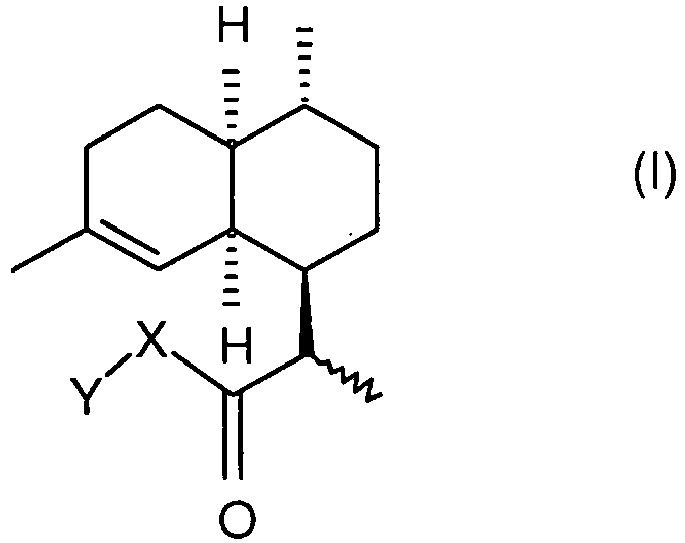
- X is O;
- Y represents a group of formula (II)

- (ii) at least one organic solvent and (iii) a photosensitizer selected from Rose bengal, tetraphenylporphyrin (TPP) and tetraphenylporphyrin derivatives (TPP derivatives),
- (i) a dihydroartemisinic acid (DHAA) derivative of formula (I)
- subjecting said mixture to photooxidation by means of a light source, and
- recovering the artemisinin thus obtained.
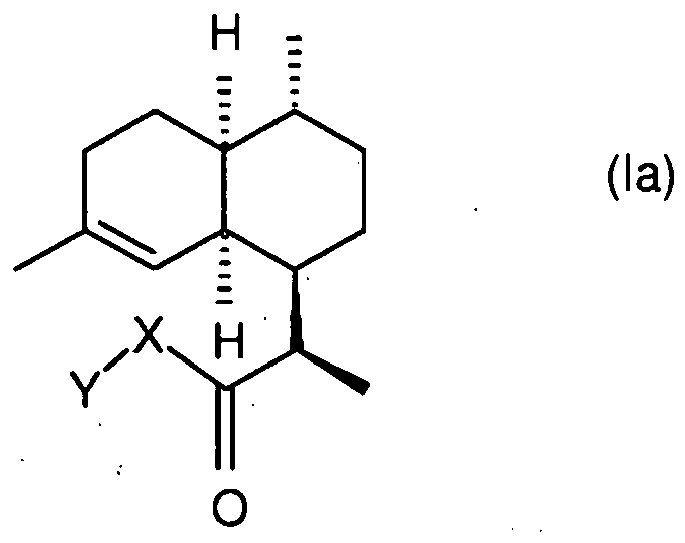
- In some embodiments, a DHAA derivative of formula (Ia)

- When a compound of formula (I) under racemic form is used in the above process, the diastereoisomer which does not have the stereochemistry of formula (Ia) can be separated from the reaction mixture after recovering artemisinin, by usual purification means, such as, for example, crystallization and filtering, while simultaneously separating any undesired by-product which may be present.
- Alternatively, separation of the diastereoisomers can be performed prior to subjecting the reaction mixture to photooxidation, so that only the diastereoisomer of formula (Ia) is involved in the subsequent process steps.
- According to the present description, organic solvent means an organic compound, i.e. comprising at least one carbon atom, used for solvating other substances.
- Organic solvents include protic solvents and aprotic solvents, and may be polar or non polar.
- Examples of suitable organic solvents are given here below.
- A C1-C12 alkyl group which is linear or branched can be selected, for example, from methyl, ethyl, propyl, isopropyl, butyl, isobutyl, sec-butyl, tert-butyl, pentyl, isopentyl, sec-pentyl, tert-pentyl, neopentyl, hexyl, isohexyl, sec-hexyl, tert-hexyl, heptyl, octyl, nonyl, decyl, undecyl and dodecyl. In some embodiments, C1-C6 alkyl groups which are linear or branched can be selected.
- A C3-C10 cycloalkyl group denotes a carbocyclic group which may comprise one or two rings, such as, for example, cyclopropyl, cyclobutyl, cyclopentyl or cyclohexyl.
- A C2-C12 alkenyl group denotes a linear or branched hydrocarbon group containing one or more unsaturated bonds such as, for example, ethenyl or vinyl, propenyl or allyl, 1-propenyl, n-butenyl, i-butenyl, 3-methylbut-2-enyl, n-pentenyl, hexenyl, heptenyl, octenyl, decenyl. In some embodiments, C2-C4 alkenyl groups which are linear or branched can be selected.
- A cycloalkylalkyl group denotes a group where cycloalkyl and alkyl are as defined above, such as, for example, cyclopropylmethyl, cyclobutylmethyl, cyclopentylmethyl, cyclohexylmethyl, cycloheptylmethyl, cyclopropylethyl or cyclohexylethyl.
- A C5-C14 aryl group denotes an unsaturated carbocyclic group comprising one or two rings, such as, for example, phenyl, naphthyl, indenyl or anthracenyl. In some embodiments, the C5-C14 aryl group is phenyl.
- An arylalkyl denotes a carbocyclic group where aryl and alkyl are as defined above, such as, for example, benzyl, phenylethyl, 2-phenylethyl or naphthylmethyl. In some embodiments, the arylalkyl is benzyl.
- A C5-C14 heteroaryl group denotes an aromatic carbocyclic group comprising one, two or three rings, or a carbocyclic group comprising two rings where one ring is aromatic and the other is completely hydrogenated, or a carbocyclic group comprising three rings where at least one ring is aromatic and the other ring(s) is (are) completely hydrogenated, said carbocyclic ring comprising one or more heteroatoms, identical or different, selected from oxygen and nitrogen atoms, such as, for example, furyl, pyrrolyl, oxazolyl, oxadiazolyl, isoxazolyl, imidazolyl, pyrazolyl, pyridyl, pyrimidinyl, pyridazinyl, pyrazinyl, tetrazolyl, benzofuranyl, indolyl, purinyl, quinolyl, isoquinolyl, chromanyl and naphthyridinyl.
- An heteroarylalkyl group denotes a group where heteroaryl and alkyl are as defined above.
- Halogens can be selected from fluorine, chlorine, bromine and iodine atoms.
- The at least one organic solvent used in the process described herein can be, for example, selected from:
- alcohols, such as methanol, ethanol, isopropanol, butanol, 1,2-butanediol, 1-3-butanediol, glycol, etc.;
- chlorinated solvents, such as dichloromethane, chloroform, dichloroethane, monochlorobenzene, dichlorobenzene, orthodichlorobenzene, etc.;
- ketones, such as acetone, butanone, methylethylketone (MEK), methylisobutylketone (MiBK), methylisopropylketone (MiPK), cyclohexanone, etc.;
- sulfoxides, such as dimethylsulfoxide, etc.;
- sulfones, such as, sulfolane, etc.;
- nitriles, such as acetonitrile, etc.;
- N,N-disubstituted amines, such as dimethylformamide, etc.;
- esters, such as ethylacetate, isopropylacetate, etc.;
- nitrogenated heterocycles, such as pyridine, etc.;
- ethers, such as diethylether, methyl tert-butylether (MTBE), methylcyclopentylether, tetrahydrofuran, 2-methyltetrahydrofuran, dimethoxyethane (glyme), diglyme, triglyme, etc.;
- alkanes, such as n-heptane, n-hexane, cyclohexane, n-pentane, CMC (mixture of cyclohexane and methylcyclohexane), etc.;
- aromatic solvents such as, for example, anisole or toluene, etc.;
- and mixtures thereof.
- In some embodiments, dichloromethane is used, in particular for safety reasons. In some embodiments, a mixture of organic solvents is used.
- The above list is not exhaustive, and a person skilled in the field is able to select an appropriate organic solvent or mixture of organic solvents on the basis of his general knowledge.
- In some embodiments, the at least one organic solvent is used in a ratio of about 4 to 20 volumes with respect to the dihydroartemisinic acid derivative of formula (I) or (Ia).
- A photosensitizer is any donor molecule D that, when electronically excited by light - D* - may transfer its energy to an acceptor molecule A (for example, ground state oxygen). In the course of such a process, the donor molecule D* is deactivated and the excited state of the acceptor molecule (for example, singlet state oxygen) is produced : A*. Sensitizers are generally dyes, which absorb the visible light (see " Photochemical Technology" page22-23 from A. M. Braun, M.-T. Maurette et E. Oliveros edition John Wiley and Sons , and " March's Advanced Organic Chemistry" page 316, Fifth Edition M.B. Smith and J. March Wiley ).
D -------------------------> D*
D* + A -------------------> D + A*
- The photosensitizer is selected from Rose bengal, tetraphenylporphyrin (TPP), tetraphenylporphyrin derivatives (TPP derivatives) such as, for example, metalloporphyrin, tetramethylthionine chloride (methylene blue), and toluidine blue. In some embodiments, Rose bengal or TPP is used. The photosensitizer can be used, for instance, in a molar ratio in the range of about 0.000001 to 1 equivalent with respect to the dihydroartemisinic acid derivative of formula (I) or (Ia), such as from 0.000004 to 0.0002 equivalents with respect to the dihydroartemisinic acid derivative of formula (I) or (Ia).
- The light source can consist of any light source capable of emitting photons at the absorption wavelength of the photosensitizer. Such a light source can be, for example, selected from a halogen lamp, a mercury or nitrogen lamp, where mercury or nitrogen may be doped, a laser lamp, a diode lamp and natural light.
- In some embodiments, halogen or mercury lamps are used.
- The above list is not exhaustive, and a person skilled in the field is able to select an appropriate lamp on the basis of his general knowledge.
- In some embodiments, the mixture comprises at least an acid catalyst, for example (i) at least a protic acid, such as, for example, triflic acid, acetic acid and trifluoroacetic acid, and/or (ii) at least a Lewis acid, such as, for instance FeCl3, Ln(OTf)3, AlCl3, SnCl4, TiCl4 or ZnCl2. In some embodiments, trifluoroacetic acid is used. In some embodiments, the acid catalyst may be present in an amount of from 0.5 to 2 equivalents) per equivalent of compound of formula (I) or (Ia).
- In some embodiments, the process described herein may comprise the steps of:
- preparing a mixture comprising (i) a dihydroartemisinic acid derivative of formula (I) or (Ia) as defined above, (ii) at least one organic solvent and (iii) a photosensitizer at ambient temperature,
- cooling the reaction mixture to a temperature in the range of about -78°C toambient temperature with air or oxygen bubbling into it,
- adding a catalytic amount of an acid catalyst,
- switching the light source on,
- maintaining the reaction mixture at the same temperature for 12 h to 24 h,
- warming up the reaction mixture to a temperature in the range of about 5 to 15°C for 2 to 4 hours, and then to a higher temperature in the range of about 15 to 25°C for 1 to 3 hours,
- stopping the reaction by means such as sequentially, in either sequence, or concurrently switching the light source off and stopping the air or oxygen bubbling, followed by adding a quencher at ambient temperatures,
- maintaining the reaction mixture at a temperature in the range of about 15°C to 25°C for 1 to 3 hours, and
- recovering artemisinin.
- Ambient temperature is understood as being in the range of about 18 to 25 ° C.
- Ranges are understood to include all points between and including the specified endpoints. For example, a temperature range of about 15 to 25°C includes each and every temperature between about 15 °C and about 25 °C. Likewise a range of time of 1 to 3 hours includes each and every time point between 1 and 3 hours.
- In some embodiments, the reaction conditions are as follows:
- the first cooling step is carried out at a temperature between -5°C and -20°C, for example -10°C;
- during the warming up step, the reaction mixture is warmed up to 10°C for 2h, and then to ambient temperature, such as at 20°C for 1 hour, and/or
- after stopping the reaction, the reaction mixture is maintained at ambient temperature, such as at 20°C for 2h.
- In some embodiments after adding a catalytic amount of an acid catalyst and switching the.light source on, the reaction mixture is maintained at ambient temperature for a period of 3 to 24 h. In some embodiments the time period is 3 to 12 hours. The time period may depend on the strength-power of light source, the amount of photosensitizer, and/or on the bubbling conditions.
- In some embodiments, the acid catalyst is a protic acid which can be selected from the above-mentioned group. In some embodiments, the acid catalyst is trifluoroacetic acid.
- In some embodiments before recovering artemisinin, the reaction mixture is treated with charcoal.
- Artemisinin can be recovered in the final step by various means known to one of skill in the art. In some embodiments artemisinin can be recovered by crystallization and filtering.
- In some embodiments artemisinin is recovered in the final step by precipitation and isolation in a solvent/alcohol mixture. In some embodiments the solvent/alcohol mixture is an alkane/alcohol mixture. In some embodiments the solvent is selected from n-heptane, n-hexane, cyclohexane, n-pentane, and CMC, and the alcohol is selected from ethanol and isopropanol. In some embodiments the ratio of alkane to alcohol is 10:1 (volume alkane/volume alcohol).
- Optionally, an additional purification step can be performed in order to increase the purity of artemisinin. For instance, the recovered artemisinin may be precipitated in an appropriate solvent, such as, for instance, heptane (for example n-heptane), hexane (for example n-hexane or cyclohexane), pentane (for example n-pentane), and CMC and recrystallized in an alcohol/water mixture. In some embodiments the alcohol/water mixture is ethanol/water or ispropanol/water.
- Artemisinin thus obtained has a high purity grade and the recrystallization yield is higher than 90%.
- Also provided are compounds of formula (I)
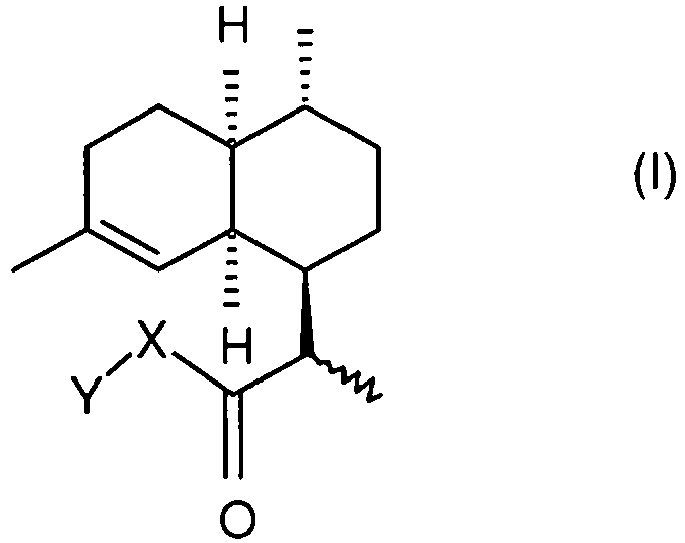
- X is O;
- Y represents a group of formula (II)

- In some embodiments, the compounds of formula (I) are the diastereoisomers represented by formula (Ia)

- The compounds of formula (I) or (Ia) can be prepared, for instance by esterification of dihydroartemisinic acid with, for example, a haloformate of formula Y-X-C(O)-hal, where hal is chlorine, fluorine or bromine and X and Y are as defined above, according to usual methods.
- In some embodiments, the step of preparing the compound of formula (I) or (Ia) can be combined to the subsequent steps of preparing artemisinin, without isolating the compound of formula (I) or (Ia) as an intermediate compound.
- Also provided is the use of the compounds of formula (I) or (Ia), as defined above, for preparing artemisinin.
- The working examples set forth below illustrate the process and compounds according to the invention, but in no way limit the scope of the invention.
- In the following experimental part, examples 1 to 10 relate to the preparation of dihydroartemisinic acid derivatives of formula (I) or (Ia), and examples 11-13 relate to the preparation of artemisinin starting from a dihydroartemisinic acid derivative of formula (I) or (Ia).
-

- 2.08 g (0.022 mol) of methyl chloroformate are added dropwise within 5 min. to a stirred solution of 5.04 g (0.021 mol) of DHAA and 2.43 g (0.024 mol) of triethylamine (Et3N) in 25 mL toluene in an ice bath. After addition, stirring is continued for 20-30 min.
- The mixture is then washed twice with water (2 x 100 mL) and dried over MgSO4. The solution is then concentrated to dryness at reduced pressure and 5.18 g of an oily residue are obtained (crude yield = 83.2 %). The product can be used as such.
-

- 4.72 g (0.022 mol) of 2,2,2-trichloroethyl chloroformate are added dropwise within 5 min. to a stirred solution of 5.07 g (0.021 mol) of DHAA and 2.43 g (0.024 mol) of Et3N in 25 mL toluene in an ice bath. After addition, stirring is continued for 20-30 min.
- The mixture is then washed twice with water (2 x 100 mL) and dried over MgSO4. The solution is then concentrated to dryness at reduced pressure and 8.39 g of an oily residue are obtained (crude yield = 96.3%). The product can be used as such.
-

- 2.27 g (0.021 mol) of ethyl chloroformate are added dropwise within 5 min. to a stirred solution of 5.11 g (0.022 mol) of DHAA enriched in majority isomer and 3.42 g (0.025 mol) of K2CO3 in 25 mL toluene in an ice bath. After addition, stirring is continued for 20-30 min.
- The mixture is then washed twice with water (2 x 100 mL) and dried over MgSO4. The solution is then concentrated to dryness at reduced pressure and 5.57 g of an oily residue are obtained (crude yield = 85.4 %). The product can be used as such.
- 1H NMR (CDCl3, ppm): 5.08 (1 H, s), 4.33 (2H, q, J = 7.1 Hz), 2.58 (1 H, m), 2.50 (1 H, s), 1.95 (1 H, m), 1.92 (1 H, m), 1.82 (1 H, m), 1.69 (1H, m), 1,64 (3H, s), 1.63 (2H, m), 1.54 (1H, m), 1.47 (1 H, m), 1.37 (3H, t, J = 7.1 Hz), 1.27 (1 H, m), 1.24 (3H, d, J = 7.0 Hz), 1.14 (1 H, qd, J1 = 12.7Hz, J2 = 3.2Hz), 0.98 (1 H, qd, J1 = 12.7 Hz, J2 = 3.2Hz), 0.87 (3H, d, J = 6.6Hz).;
13C NMR (CDCl3, ppm): 14.0, 14.7, 19.7, 23.8, 25.7, 26.6, 27.3, 27.6, 35.1, 36.3, 41.7, 42.6, 43.7, 65.6, 118.9, 136.4, 149.3, 171.6;
MS : 308;
IR (cm-1) : 2924, 1816 and 1749, 1154, 997. -

- 2.27 g (0.021 mol) of ethyl chloroformate are added dropwise within 5 min. to a stirred solution of 5.11 g (0.022 mol) of the racemic DHAA and 2.45 g (0.024 mol) of N-methylmorpholine in 25 mL of toluene in an ice bath. After addition, stirring is continued for 20-30 min.
- The mixture is then washed twice with water (2 x 100 mL) and dried over MgSO4. The solution is then concentrated to dryness at reduced pressure and 6.11 g of an oily residue are obtained (crude yield = 93.6 %). The product can be used as such.
-

- 3.64 g (0.021 mol) of benzyl chloroformate are added dropwise within 5 min. to a stirred solution of 5.08 g (0.021 mol) of DHAA and 3.31 g (0.024 mol) of K2CO3 in 25 mL of dichloromethane in an ice bath. After addition, stirring is continued for 20-30 min.
- The mixture is then washed twice with water (2 x 100 mL) and dried over MgSO4. The solution is then concentrated to dryness at reduced pressure and 7.63 g of an oily residue are obtained (crude yield = 97.4 %). The product can be used as such.
-

- 3.48 g (0.022 mol) of phenyl chloroformate are added dropwise within 5 min. to a stirred solution of 5.08 g (0.021 mol) DHAA and 3.36 g (0.024 mol) of K2CO3 in 25 mL of dichloromethane in an ice bath. After addition, stirring is continued for 20-30 min.
- The mixture is then washed twice with water (2 x 100 mL) and dried over MgSO4. The solution is then concentrated to dryness at reduced pressure and 6.85 g of an oily residue are obtained. This represents a crude yield of 90.8%. The product can be used as such.
-

- 3.02 g (0.021 mol) of 1-chloroethyl chloroformate are added dropwise within 5 min. to a stirred solution of 5.03 g (0.021 mol) of DHAA and 3.44 g (0.025 mol) of K2CO3 in 25 mL) of dichloromethane in an ice bath. After addition, stirring is continued for 20-30 min.
- The mixture is then washed twice with water (2 x 100 mL) and dried over MgSO4. The solution is then concentrated to dryness at reduced pressure and 5.84 g of an oily residue are obtained (crude yield = 80.5 %). The product can be used as such.
-

- 2.62 g (0.021 mol) of propyl chloroformate are added dropwise within 5 min. to a stirred solution of 5.02 g (0.021 mol) DHAA and 4.22 g (0.031 mol) of K2CO3 in 25 mL dichloromethane in an ice bath. After addition, stirring is continued for 20-30 min.
- The mixture is then washed twice with water (2 x 100 mL) and dried over MgSO4. The solution is then concentrated to dryness at reduced pressure and 6.53 g of an oily residue are obtained (crude yield = 95.7 %). The product can be used as such.
-

- 5.08 g (0.021 mol) of 2,2,2-trichloro-1,1-dimethylethyl chloroformate is added dropwise within 5 min. to a stirred solution of 5.04 g (0.021 mol) DHAA and 3.85 g (0.028 mol) K2CO3 in 25 mL dichloromethane in an ice bath. After addition, stirring is continued for 20-30 min.
- The mixture is then washed twice with water (2 x 100 mL) and dried over MgSO4. The solution is then concentrated to dryness at reduced pressure and 8.52 g of an oily residue are obtained (crude yield = 91.3 %). The product can be used as such.
-

- 3.04 g (0.021 mol) of 2-chloroethyl chloroformate are added dropwise within 5 min. to a stirred solution of 5.01 g (0.021 mol) of DHAA and 4.04 g (0.029 mol) of K2CO3 in 25 mL of dichloromethane in an ice bath. After addition, stirring is continued for 20-30 min.
- The mixture is then washed twice with water (2 x 100 mL) and dried over MgSO4. The solution is then concentrated to dryness at reduced pressure and 6.78 g of an oily residue are obtained (crude yield = 93.5 %). The product can be used as such.
- An amount of 4 g of the dihydroartemisinic acid (DHAA) derivative of formula (I) or (Ia) prepared in examples 1 to 10 above (1 eq.), 0.01 eq. of tetraphenylporphyrin and 80 mL of methylene chloride are introduced at 20°C in a clean 0.2 liter reactor.
- The mixture is then cooled down to -10°C and air oroxygen is bubbled through the mixture (40-50 mL/min.) under stirring at 300-400 rpm. After 30 min., trifluoroacetic acid (TFA, 0.5 eq.) is added and a halogen lamp is switched on.
- The mixture is stirred overnight (∼19h) at -10°C ard then warmed up to 10°C (60 min.) and stirred at 10°C during 60 min.
- The mixture is then warmed up to 20°C in about 60 min. and then the air introduction is stopped, the lamp switched off and the mixture stirred at 20°C during 2h.
- Then, the reaction mixture is treated by addition of 20 mL of water then 20 mL of a solution of aqueous saturated NaHCO3. The resulting mixture was then left for decantation and the two layers were separated. The organic layer is then loaded back in the vessel and washed again by addition of 20 mL of water then 20 mL of a solution of aqueous saturated NaHCO3. After decantation and layers separation, the organic layer is washed with 20 ml of water.
- After decantation, the organic layer is then concentrated under progressive vacuum at 30°C using a rotary evaporator. The dry product crystallizes at room temperature. Then 12 mL of n-heptane are added and the mixture is stirred during 1 h at 20°C.
- The reaction mixture is then filtrated under Buchner funnel (n°3). The wet solid is then washed first with 8 mL and then with 12 mL of n-heptane.
- The wet solid is then dried under vacuum at 40°C overnight (∼15h).
- Crude artemisinin is obtained with good titrated yield (62% ti/ti).
- If desired, an additional recrystallization step in an ethanol/water mixture (70/30) can be performed on the solid product precipitated in n-heptane. The artemisinin thus obtained has an excellent purity and a recrystallization yield higher than 90%.
- A solution of mixed carbonate derivative of formula (I) or (Ia) prepared in example 3 above (100 g, 1 eq.) in dichloromethane (550 mL), and 0.00031 eq. of tetraphenylporphyrin are introduced at 20°C in a clean reactor.
- The mixture is then cooled down to -10°C and air oroxygen is bubbled through the mixture (260-300 mL/min.) under stirring at 200 rpm. After 30 min., the mercury lamp is switched on and trifluoroacetic acid (TFA, 0.5 eq.) is added.
- The mixture is stirred for 7 hours at -10°C and the air introduction is stopped, the lamp switched off.
- The reaction mixture is then warmed up to 20°C over30 min. and stirred at 20°C during 2 hours.
- Then, the reaction mixture is treated by addition of 200 mL of water then 200 mL of a solution of aqueous saturated NaHCO3. The resulting mixture was then left for decantation and the two layers were separated. The organic layer is then loaded back in the vessel and washed again by addition of 200 mL of water then 200 mL of a solution of aqueous saturated NaHCO3. After decantation and layers separation, the organic layer is washed with 200 ml of water.
- After decantation, organic layer is then concentrated under progressive vacuum at 30°C using a rotary evaporator. The dry product crystallizes at room temperature. Then 300 mL of n-heptane and 30 mL of ethyl alcohol are added. The resulting mixture is stirred during 1 hour at 50°C.The reaction mixture is cooled to 20°C in 1 hour and is stirred at 20°C during 30 minutes.
- The reaction mixture is then filtrated under Buchner funnel (n°3). The wet solid is then washed twice with 200 mL of n-heptane.
- The wet solid is then dried under vacuum at 40°C overnight (∼15h).
- The yield of highly pure artemisinin obtained is 51 % without the additional recrystallization step of Example 11.
- A solution of mixed carbonate derivative of formula (I) or (Ia) prepared in example 3 above (650 g - 93% assay, 1 eq.) in dichloromethane (4 L), and 0.00027 eq. of tetraphenylporphyrin are introduced at 20°Cin a clean reactor.
- The mixture is then cooled down to -10°C and air oroxygen is bubbled through the mixture (900 mL/min.) under stirring. After 30 min., the mercury lamp is switched on and trifluoroacetic acid (TFA, 0.5 eq.) is added.
- The mixture is stirred overnight at -10°C. The reaction mixture is then warmed up to 20°C over 40 min and the air introduction isstopped, and the lamp switched off.
- Then, the reaction mixture is treated by addition of 650 mL of water then 1300 mL of a solution of aqueous saturated NaHCO3. The resulting mixture was then left for decantation and the two layers were separated. The organic layer is then loaded back in the vessel and washed again by addition of 650 mL of water then 650 mL of a solution of aqueous saturated NaHCO3. After decantation and layers separation, the organic layer is finally washed with 1300 ml of water.
- After decantation, the organic layer is then concentrated under progressive vacuum at 30°C and 1950 mL of n-heptane was added.The concentration is pursued at constant volume to remove residual dichloromethane. 195 mL of ethyl alcohol was then added. The resulting mixture is stirred during 1 hour at 50°C. The reaction mixture is cooled to 20°C in 2 hour and is stirredat 20°C during 1 hour.
- The reaction mixture is then filtrated under Buchner funnel (n°3). The wet solid is then washed twice with 1300 mL of n-heptane.
- The wet solid is then dried under vacuum at 40 °C.
- The yield of highly pure artemisinin obtained is 56 % without the additional recrystallization step of Example 11.
- The titrated yields of crude artemisinin obtained by using the activated DHAA derivatives (examples 1 to 10) are summarized in Table 1 below.
TABLE 1: Example No Name Yields (%ti/ti) 1 (3R)-dihydroarteannuin B acid, methyl mixed carbonate 62.2 2 (3R)-dihydroarteannuin B acid, 2,2,2-trichloroethyl mixed carbonate 58.7 3 (3R)-dihydroarteannuin B acid ethyl mixed carbonate) 62 5 (3R)-dihydroarteannuin B acid benzyl mixed carbonate 59.2 6 (3R)-dihydroarteannuin B acid phenyl mixed carbonate 58.4 8 (3R)-dihydroarteannuin B acid propyl mixed carbonate 54.5 10 (3R)-dihydroarteannuin B acid 2-chloroethyl mixed carbonate 54.9 - The results show that the yields in artemisinin obtained by using the activated DHAA derivatives according to the present process are significantly higher than those obtained in the literature when using DHAA methyl esters in the prior art processes, such as described in Tetrahedron Lett. 1993, 4435-4438, which discloses that the yield of artemisinin obtained amounts at most to 30%.
Claims (18)
- A process for preparing artemisinin, comprising the steps of:- preparing a mixture comprising(i) a dihydroartemisinic acid derivative of 5 formula (I)
 - X is O;- Y represents a group of formula (II)
 (ii) at least one organic solvent and (iii) a photosensitizer selected from Rose bengal, tetraphenylporphyrin (TPP) and tetraphenylporphyrin derivatives (TPP derivatives);- subjecting said mixture to photooxidation by means of a light source, and- recovering the artemisinin thus obtained.
 - The process of claim 1, characterized in that the dihydroartemisinic acid derivative has the formula (Ia)
- The process according to claim 1 or 2, characterized in that the at least one organic solvent is selected from the group consisting of alcohols, chlorinated solvents, ketones, sulfoxides, nitriles, N,N-disubstituted amines, esters, nitrogenated heterocycles, ethers, alkanes, aromatic solvents, and mixtures thereof.
- The process according to any one of claims 1 to 3, characterized in that the at least one organic solvent is dichloromethane.
- The process according to any one of claims 1 to 4, characterized in that the organic solvent comprises a polar solvent, and the polar solvent is used in a ratio of about 4 to 20 volumes with respect to the dihydroartemisinic acid derivative of formula (I) or (Ia).
- The process according to any one of claims 1 to 5, characterized in that the mixture comprises an acid catalyst.
- The process according to any one of claims 1 to 6, characterized in that it comprises the steps of:- preparing a mixture comprising (i) a dihydroartemisinic acid derivative of formula (I) or (Ia) as defined in claim 1 or 2, (ii) at least one organic solvent, and (iii) a photosensitizer at ambient temperature,- cooling the reaction mixture to a temperature in the range of about -78°C to ambient temperature with air or oxygen bubbling into it,- adding a catalytic amount of an acid catalyst,- switching the light source on,- maintaining the reaction mixture at the same temperature for 3 h to 24 h,- warming up the reaction mixture to a temperature in the range of about 5 to 15°C for 2 to 4 hours, and then to a higher temperature in the range of about 15 to 25°C for 1 to 3 hours,- stopping the reaction by means such as sequentially, in either sequence, or concurrently switching the light source off and stopping the air or oxygen bubbling, followed by adding a quencher at ambient temperatures,- maintaining the reaction mixture at a temperature in the range of about 15°C to 25°C for 1 to 3 hours, and- recovering the artemisinin thus obtained.
- The process according to claim 7, characterized in that the acid catalyst is chosen amongst protic acids and/or Lewis acids, such as amongst protic acids, such as trifluoroacetic acid.
- The process according to any one of claims 7 to 8, characterized in that:- the first cooling step is carried out at a temperature between -5°C and - 20°C, for example -10°C;- during the warming up step, the reaction mixture is warmed up to 10°C for 2h, and then to ambient temperature, such as 20°C for 1 hour, and/or- after stopping the reaction, the reaction mixture is maintained at ambient temperature, such as 20°C for 2h.
- Compounds of formula (I)
 - X is O;- Y represents a group of formula (II)
- A compound of formula (I) according to claim 10, which is the
diastereoisomer of formula (Ia)
- The use of a compound of formula (I) or (Ia)
 - X is O;- Y represents a group of formula (II)
- The use according to claim 12, characterized in that the compound of formula (I) or (Ia) is mixed with at least one organic solvent.
- The use according to claim 13, characterized in that the at least one organic solvent is selected from the group consisting of alcohols, chlorinated solvents, ketones, sulfoxides, nitriles, N,N-disubstituted amines, esters, nitrogenated heterocycles, ethers, alkanes, aromatic solvents, and mixtures thereof.
- The use according to claim 13 or 14, characterized in that the at least one organic solvent is dichloromethane.
- The use according to any one of claims 13 to 15, characterized in that the organic solvent comprises a polar solvent, and the polar solvent is used in a ratio of about 4 to 20 volumes with respect to the dihydroartemisinic acid derivative of formula (I) or (Ia).
- The use according to any one of claims 12 to 16, characterized in that the mixture comprises an acid catalyst.
- The use according to claim 17, characterized in that the acid catalyst is chosen amongst protic acids and/or Lewis acids, such as amongst protic acids, such as trifluoroacetic acid.
Priority Applications (4)
| Application Number | Priority Date | Filing Date | Title |
|---|---|---|---|
| PL10751915T PL2473512T3 (en) | 2009-09-01 | 2010-09-01 | Photochemical process for producing artemisinin |
| SI201031120A SI2473512T1 (en) | 2009-09-01 | 2010-09-01 | Photochemical process for producing artemisinin |
| EP10751915.9A EP2473512B1 (en) | 2009-09-01 | 2010-09-01 | Photochemical process for producing artemisinin |
| CY20161100071T CY1121969T1 (en) | 2009-09-01 | 2016-01-27 | PHOTOCHEMICAL METHOD FOR THE PRODUCTION OF ARTEMISIN |
Applications Claiming Priority (3)
| Application Number | Priority Date | Filing Date | Title |
|---|---|---|---|
| EP09305805A EP2289897A1 (en) | 2009-09-01 | 2009-09-01 | Photochemical process for producing artemisinin |
| PCT/EP2010/062811 WO2011026865A1 (en) | 2009-09-01 | 2010-09-01 | Photochemical process for producing artemisinin |
| EP10751915.9A EP2473512B1 (en) | 2009-09-01 | 2010-09-01 | Photochemical process for producing artemisinin |
Publications (2)
| Publication Number | Publication Date |
|---|---|
| EP2473512A1 EP2473512A1 (en) | 2012-07-11 |
| EP2473512B1 true EP2473512B1 (en) | 2015-11-11 |
Family
ID=41557558
Family Applications (2)
| Application Number | Title | Priority Date | Filing Date |
|---|---|---|---|
| EP09305805A Withdrawn EP2289897A1 (en) | 2009-09-01 | 2009-09-01 | Photochemical process for producing artemisinin |
| EP10751915.9A Active EP2473512B1 (en) | 2009-09-01 | 2010-09-01 | Photochemical process for producing artemisinin |
Family Applications Before (1)
| Application Number | Title | Priority Date | Filing Date |
|---|---|---|---|
| EP09305805A Withdrawn EP2289897A1 (en) | 2009-09-01 | 2009-09-01 | Photochemical process for producing artemisinin |
Country Status (24)
| Country | Link |
|---|---|
| US (2) | US8507697B2 (en) |
| EP (2) | EP2289897A1 (en) |
| JP (1) | JP5719366B2 (en) |
| KR (1) | KR101787777B1 (en) |
| CN (1) | CN102596967B (en) |
| AP (1) | AP2988A (en) |
| AU (2) | AU2010291253B2 (en) |
| BR (1) | BR112012004702B1 (en) |
| CA (1) | CA2772264C (en) |
| CL (1) | CL2012000554A1 (en) |
| CO (1) | CO6511258A2 (en) |
| CY (1) | CY1121969T1 (en) |
| EA (1) | EA021181B1 (en) |
| ES (1) | ES2561080T3 (en) |
| HU (1) | HUE027477T2 (en) |
| IL (1) | IL218346A0 (en) |
| MA (1) | MA33596B1 (en) |
| MX (1) | MX358030B (en) |
| MY (1) | MY155962A (en) |
| NZ (1) | NZ598878A (en) |
| PL (1) | PL2473512T3 (en) |
| SG (1) | SG178600A1 (en) |
| SI (1) | SI2473512T1 (en) |
| WO (1) | WO2011026865A1 (en) |
Families Citing this family (6)
| Publication number | Priority date | Publication date | Assignee | Title |
|---|---|---|---|---|
| EP2289897A1 (en) * | 2009-09-01 | 2011-03-02 | Sanofi-Aventis | Photochemical process for producing artemisinin |
| EP2751113B1 (en) * | 2011-08-29 | 2017-07-05 | Max-Planck-Gesellschaft zur Förderung der Wissenschaften e.V. | Method and device for the synthesis of artemisinin |
| CN103788110B (en) * | 2013-11-28 | 2015-10-28 | 湖南科源生物制品有限公司 | A kind of take arteannuinic acid as the method that Artemisinin prepared by raw material |
| CN110327984B (en) * | 2019-07-12 | 2022-04-22 | 西北工业大学 | Pt @ PCN-224 photocatalyst for preparing artemisinin from dihydroarteannuic acid and preparation method thereof |
| CN110590802B (en) * | 2019-09-18 | 2021-02-02 | 浙江海正药业股份有限公司 | Chemical semi-synthesis method of artemisinin |
| CN116606303A (en) * | 2023-05-10 | 2023-08-18 | 中科苏州药物研究院 | New process for preparing artemisinin and photoreactor used by process |
Family Cites Families (12)
| Publication number | Priority date | Publication date | Assignee | Title |
|---|---|---|---|---|
| US5002582A (en) | 1982-09-29 | 1991-03-26 | Bio-Metric Systems, Inc. | Preparation of polymeric surfaces via covalently attaching polymers |
| CN1023603C (en) * | 1990-01-12 | 1994-01-26 | 中国科学院上海有机化学研究所 | Method for synthesizing artemisinin from artemisinic acid |
| US4992561A (en) | 1990-05-11 | 1991-02-12 | The United States Of America As Represented By The Secretary Of The Army | Simple conversion of artemisinic acid into artemisinin |
| CN1034017C (en) * | 1993-03-25 | 1997-02-12 | 中国科学院上海有机化学研究所 | 4-place substituted analog of artemisinin |
| IN184682B (en) | 1995-12-29 | 2000-09-23 | Council Scient Ind Res | |
| JP3148136B2 (en) | 1996-12-26 | 2001-03-19 | 高砂香料工業株式会社 | Novel chiral diphosphine compound, intermediate for producing the same, transition metal complex having the diphosphine compound as a ligand, and asymmetric hydrogenation catalyst containing the complex |
| US5995084A (en) * | 1997-01-17 | 1999-11-30 | Tritech Microelectronics, Ltd. | Touchpad pen-input and mouse controller |
| IN188174B (en) | 1997-03-17 | 2002-08-31 | Council Scient Ind Res | |
| JP3549390B2 (en) | 1998-03-23 | 2004-08-04 | 高砂香料工業株式会社 | Ruthenium-phosphine complex and method for producing the same |
| US20060270863A1 (en) | 2005-05-27 | 2006-11-30 | Amyris Biotechnologies | Conversion of amorpha-4,11-diene to artemisinin and artemisinin precursors |
| WO2009088404A1 (en) | 2007-12-30 | 2009-07-16 | Amyris Biotechnologies, Inc. | Processes for the preparation of artemisinin an its precursors |
| EP2289897A1 (en) * | 2009-09-01 | 2011-03-02 | Sanofi-Aventis | Photochemical process for producing artemisinin |
-
2009
- 2009-09-01 EP EP09305805A patent/EP2289897A1/en not_active Withdrawn
-
2010
- 2010-09-01 MX MX2012002652A patent/MX358030B/en active IP Right Grant
- 2010-09-01 EP EP10751915.9A patent/EP2473512B1/en active Active
- 2010-09-01 SI SI201031120A patent/SI2473512T1/en unknown
- 2010-09-01 CA CA2772264A patent/CA2772264C/en active Active
- 2010-09-01 NZ NZ598878A patent/NZ598878A/en not_active IP Right Cessation
- 2010-09-01 US US12/873,925 patent/US8507697B2/en active Active
- 2010-09-01 EA EA201270343A patent/EA021181B1/en not_active IP Right Cessation
- 2010-09-01 AP AP2012006186A patent/AP2988A/en active
- 2010-09-01 HU HUE10751915A patent/HUE027477T2/en unknown
- 2010-09-01 PL PL10751915T patent/PL2473512T3/en unknown
- 2010-09-01 BR BR112012004702-7A patent/BR112012004702B1/en not_active IP Right Cessation
- 2010-09-01 CN CN201080049390.1A patent/CN102596967B/en active Active
- 2010-09-01 AU AU2010291253A patent/AU2010291253B2/en active Active
- 2010-09-01 JP JP2012526082A patent/JP5719366B2/en active Active
- 2010-09-01 ES ES10751915.9T patent/ES2561080T3/en active Active
- 2010-09-01 KR KR1020127008220A patent/KR101787777B1/en not_active Expired - Fee Related
- 2010-09-01 SG SG2012014114A patent/SG178600A1/en unknown
- 2010-09-01 WO PCT/EP2010/062811 patent/WO2011026865A1/en not_active Ceased
- 2010-09-01 MY MYPI2012000913A patent/MY155962A/en unknown
-
2012
- 2012-02-27 IL IL218346A patent/IL218346A0/en active IP Right Grant
- 2012-02-29 CL CL2012000554A patent/CL2012000554A1/en unknown
- 2012-03-21 MA MA34707A patent/MA33596B1/en unknown
- 2012-03-22 CO CO12048458A patent/CO6511258A2/en active IP Right Grant
-
2013
- 2013-07-12 US US13/940,316 patent/US20130299338A1/en not_active Abandoned
-
2016
- 2016-01-27 CY CY20161100071T patent/CY1121969T1/en unknown
- 2016-06-16 AU AU2016204057A patent/AU2016204057B2/en active Active
Also Published As
Similar Documents
| Publication | Publication Date | Title |
|---|---|---|
| AU2016204057B2 (en) | Photochemical process for producing artemisinin | |
| US11767292B2 (en) | Process for making beta 3 agonists and intermediates | |
| Norris et al. | Structural diversity and chemical synthesis of peroxide and peroxide-derived polyketide metabolites from marine sponges | |
| CN106977415A (en) | One planting sand storehouse must be bent intermediate and preparation method thereof | |
| WO2018203346A1 (en) | γ-SPIROKETAL- γ –LACTONES AND PHARMACEUTICAL COMPOSITION CONTAINING SAME AND PROCESS FOR PREPARATION THEREOF | |
| HK1171740B (en) | Photochemical process for producing artemisinin | |
| JP2009073739A (en) | Method for producing highly pure optically active 1-aryl-1,3-propanediol acceptable as medicine intermediate | |
| BG63541B1 (en) | Compounds and methods for the preparation of substituted 4-phenyl-4-cyanocyclohexanoic acids | |
| CN1365278A (en) | Water soluble trioxanes as potent and safe anti-malarial agents | |
| WO2001098307A1 (en) | Carbamate and thiocarbamate podophyllotoxin derivatives, preparation method and pharmaceutical compositions containing them | |
| JPWO2006070671A1 (en) | 12-substituted mutilin derivatives | |
| CN1314675C (en) | Taxol derivatives | |
| Saegusa et al. | Bromocyclization of Unsaturated Thioester and Access to Functionalized Sulfur-heterocycles | |
| EP1370541B1 (en) | Method of preparation of paclitaxel (taxol) using 3-(alk-2-ynyloxy) carbonyl-5-oxazolidine carboxylic acid | |
| Koo | The rearrangement and nucleophilic addition of donor-acceptor cyclobutane: Novel methodologies to access δ-lactones and ring-opened products | |
| Kelebekli et al. | A novel and stereospecific synthesis of aminocyclitol: N-tosyldihydroconduramine E2 | |
| CN111620781A (en) | Alpha-alkyl phenylacetic acid compound with high optical activity and preparation method and application thereof | |
| Gonzales et al. | A study of the intramolecular cyclization reactions of some derivatives of 3-arylsulfonyl cycloalkanols | |
| WO2011061675A1 (en) | Process for enantioselective preparation of nitroketone, an intermediate of protease inhibitors | |
| RU2565755C2 (en) | Method of obtaining photosensitisers based on chlorin e6 | |
| CN113527231A (en) | Synthetic method of heterocyclic substituted coelenterazine compounds | |
| JPH02111732A (en) | Optically active (+)-dicyclopentadiene derivative and production thereof | |
| JP2013040133A (en) | TERTIARY AND QUATERNARY α-TRIFLUOROMETHYL KETONE DERIVATIVE AND METHOD OF PRODUCING THE SAME |
Legal Events
| Date | Code | Title | Description |
|---|---|---|---|
| PUAI | Public reference made under article 153(3) epc to a published international application that has entered the european phase |
Free format text: ORIGINAL CODE: 0009012 |
|
| 17P | Request for examination filed |
Effective date: 20120328 |
|
| AK | Designated contracting states |
Kind code of ref document: A1 Designated state(s): AL AT BE BG CH CY CZ DE DK EE ES FI FR GB GR HR HU IE IS IT LI LT LU LV MC MK MT NL NO PL PT RO SE SI SK SM TR |
|
| AX | Request for extension of the european patent |
Extension state: BA ME RS |
|
| 17Q | First examination report despatched |
Effective date: 20130208 |
|
| REG | Reference to a national code |
Ref country code: HK Ref legal event code: DE Ref document number: 1171740 Country of ref document: HK |
|
| GRAP | Despatch of communication of intention to grant a patent |
Free format text: ORIGINAL CODE: EPIDOSNIGR1 |
|
| INTG | Intention to grant announced |
Effective date: 20150601 |
|
| GRAS | Grant fee paid |
Free format text: ORIGINAL CODE: EPIDOSNIGR3 |
|
| GRAA | (expected) grant |
Free format text: ORIGINAL CODE: 0009210 |
|
| AK | Designated contracting states |
Kind code of ref document: B1 Designated state(s): AL AT BE BG CH CY CZ DE DK EE ES FI FR GB GR HR HU IE IS IT LI LT LU LV MC MK MT NL NO PL PT RO SE SI SK SM TR |
|
| AX | Request for extension of the european patent |
Extension state: BA ME RS |
|
| REG | Reference to a national code |
Ref country code: GB Ref legal event code: FG4D |
|
| REG | Reference to a national code |
Ref country code: CH Ref legal event code: EP |
|
| REG | Reference to a national code |
Ref country code: IE Ref legal event code: FG4D |
|
| REG | Reference to a national code |
Ref country code: AT Ref legal event code: REF Ref document number: 760389 Country of ref document: AT Kind code of ref document: T Effective date: 20151215 |
|
| REG | Reference to a national code |
Ref country code: DE Ref legal event code: R096 Ref document number: 602010029008 Country of ref document: DE |
|
| REG | Reference to a national code |
Ref country code: CH Ref legal event code: NV Representative=s name: ARNOLD AND SIEDSMA AG, CH |
|
| REG | Reference to a national code |
Ref country code: RO Ref legal event code: EPE |
|
| REG | Reference to a national code |
Ref country code: ES Ref legal event code: FG2A Ref document number: 2561080 Country of ref document: ES Kind code of ref document: T3 Effective date: 20160224 |
|
| REG | Reference to a national code |
Ref country code: NL Ref legal event code: FP |
|
| REG | Reference to a national code |
Ref country code: LT Ref legal event code: MG4D |
|
| PG25 | Lapsed in a contracting state [announced via postgrant information from national office to epo] |
Ref country code: IS Free format text: LAPSE BECAUSE OF FAILURE TO SUBMIT A TRANSLATION OF THE DESCRIPTION OR TO PAY THE FEE WITHIN THE PRESCRIBED TIME-LIMIT Effective date: 20160311 Ref country code: NO Free format text: LAPSE BECAUSE OF FAILURE TO SUBMIT A TRANSLATION OF THE DESCRIPTION OR TO PAY THE FEE WITHIN THE PRESCRIBED TIME-LIMIT Effective date: 20160211 Ref country code: LT Free format text: LAPSE BECAUSE OF FAILURE TO SUBMIT A TRANSLATION OF THE DESCRIPTION OR TO PAY THE FEE WITHIN THE PRESCRIBED TIME-LIMIT Effective date: 20151111 Ref country code: HR Free format text: LAPSE BECAUSE OF FAILURE TO SUBMIT A TRANSLATION OF THE DESCRIPTION OR TO PAY THE FEE WITHIN THE PRESCRIBED TIME-LIMIT Effective date: 20151111 |
|
| PG25 | Lapsed in a contracting state [announced via postgrant information from national office to epo] |
Ref country code: FI Free format text: LAPSE BECAUSE OF FAILURE TO SUBMIT A TRANSLATION OF THE DESCRIPTION OR TO PAY THE FEE WITHIN THE PRESCRIBED TIME-LIMIT Effective date: 20151111 Ref country code: PT Free format text: LAPSE BECAUSE OF FAILURE TO SUBMIT A TRANSLATION OF THE DESCRIPTION OR TO PAY THE FEE WITHIN THE PRESCRIBED TIME-LIMIT Effective date: 20160311 Ref country code: SE Free format text: LAPSE BECAUSE OF FAILURE TO SUBMIT A TRANSLATION OF THE DESCRIPTION OR TO PAY THE FEE WITHIN THE PRESCRIBED TIME-LIMIT Effective date: 20151111 Ref country code: LV Free format text: LAPSE BECAUSE OF FAILURE TO SUBMIT A TRANSLATION OF THE DESCRIPTION OR TO PAY THE FEE WITHIN THE PRESCRIBED TIME-LIMIT Effective date: 20151111 Ref country code: GR Free format text: LAPSE BECAUSE OF FAILURE TO SUBMIT A TRANSLATION OF THE DESCRIPTION OR TO PAY THE FEE WITHIN THE PRESCRIBED TIME-LIMIT Effective date: 20160212 |
|
| REG | Reference to a national code |
Ref country code: DE Ref legal event code: R097 Ref document number: 602010029008 Country of ref document: DE |
|
| REG | Reference to a national code |
Ref country code: FR Ref legal event code: PLFP Year of fee payment: 7 |
|
| PG25 | Lapsed in a contracting state [announced via postgrant information from national office to epo] |
Ref country code: SM Free format text: LAPSE BECAUSE OF FAILURE TO SUBMIT A TRANSLATION OF THE DESCRIPTION OR TO PAY THE FEE WITHIN THE PRESCRIBED TIME-LIMIT Effective date: 20151111 Ref country code: DK Free format text: LAPSE BECAUSE OF FAILURE TO SUBMIT A TRANSLATION OF THE DESCRIPTION OR TO PAY THE FEE WITHIN THE PRESCRIBED TIME-LIMIT Effective date: 20151111 Ref country code: EE Free format text: LAPSE BECAUSE OF FAILURE TO SUBMIT A TRANSLATION OF THE DESCRIPTION OR TO PAY THE FEE WITHIN THE PRESCRIBED TIME-LIMIT Effective date: 20151111 Ref country code: SK Free format text: LAPSE BECAUSE OF FAILURE TO SUBMIT A TRANSLATION OF THE DESCRIPTION OR TO PAY THE FEE WITHIN THE PRESCRIBED TIME-LIMIT Effective date: 20151111 |
|
| PLBE | No opposition filed within time limit |
Free format text: ORIGINAL CODE: 0009261 |
|
| STAA | Information on the status of an ep patent application or granted ep patent |
Free format text: STATUS: NO OPPOSITION FILED WITHIN TIME LIMIT |
|
| REG | Reference to a national code |
Ref country code: HU Ref legal event code: AG4A Ref document number: E027477 Country of ref document: HU |
|
| REG | Reference to a national code |
Ref country code: HK Ref legal event code: GR Ref document number: 1171740 Country of ref document: HK |
|
| 26N | No opposition filed |
Effective date: 20160812 |
|
| REG | Reference to a national code |
Ref country code: FR Ref legal event code: PLFP Year of fee payment: 8 |
|
| PG25 | Lapsed in a contracting state [announced via postgrant information from national office to epo] |
Ref country code: LU Free format text: LAPSE BECAUSE OF NON-PAYMENT OF DUE FEES Effective date: 20160901 |
|
| REG | Reference to a national code |
Ref country code: AT Ref legal event code: UEP Ref document number: 760389 Country of ref document: AT Kind code of ref document: T Effective date: 20151111 |
|
| PG25 | Lapsed in a contracting state [announced via postgrant information from national office to epo] |
Ref country code: MK Free format text: LAPSE BECAUSE OF FAILURE TO SUBMIT A TRANSLATION OF THE DESCRIPTION OR TO PAY THE FEE WITHIN THE PRESCRIBED TIME-LIMIT Effective date: 20151111 |
|
| REG | Reference to a national code |
Ref country code: FR Ref legal event code: PLFP Year of fee payment: 9 |
|
| PG25 | Lapsed in a contracting state [announced via postgrant information from national office to epo] |
Ref country code: AL Free format text: LAPSE BECAUSE OF FAILURE TO SUBMIT A TRANSLATION OF THE DESCRIPTION OR TO PAY THE FEE WITHIN THE PRESCRIBED TIME-LIMIT Effective date: 20151111 |
|
| REG | Reference to a national code |
Ref country code: CH Ref legal event code: PUE Owner name: HUVEPHARMA ITALIA S.R.L., IT Free format text: FORMER OWNER: SANOFI, FR |
|
| REG | Reference to a national code |
Ref country code: ES Ref legal event code: PC2A Owner name: HUVEPHARMA ITALIA S.R.L. Effective date: 20190724 |
|
| REG | Reference to a national code |
Ref country code: NL Ref legal event code: PD Owner name: HUVEPHARMA ITALIA S.R.L.; IT Free format text: DETAILS ASSIGNMENT: CHANGE OF OWNER(S), ASSIGNMENT; FORMER OWNER NAME: SANOFI Effective date: 20190717 |
|
| REG | Reference to a national code |
Ref country code: DE Ref legal event code: R082 Ref document number: 602010029008 Country of ref document: DE Representative=s name: LAVOIX MUNICH, DE Ref country code: DE Ref legal event code: R081 Ref document number: 602010029008 Country of ref document: DE Owner name: HUVEPHARMA ITALIA S.R.L., IT Free format text: FORMER OWNER: SANOFI, PARIS, FR |
|
| REG | Reference to a national code |
Ref country code: BE Ref legal event code: PD Owner name: HUVEPHARMA ITALIA S.R.L.; IT Free format text: DETAILS ASSIGNMENT: CHANGE OF OWNER(S), CESSION; FORMER OWNER NAME: SANOFI Effective date: 20190711 Ref country code: BE Ref legal event code: FP Effective date: 20160128 |
|
| REG | Reference to a national code |
Ref country code: HU Ref legal event code: GB9C Owner name: HUVEPHARMA ITALIA S.R.L., IT Free format text: FORMER OWNER(S): SANOFI, FR |
|
| REG | Reference to a national code |
Ref country code: GB Ref legal event code: 732E Free format text: REGISTERED BETWEEN 20190912 AND 20190918 |
|
| PGFP | Annual fee paid to national office [announced via postgrant information from national office to epo] |
Ref country code: PL Payment date: 20240618 Year of fee payment: 15 |
|
| PGFP | Annual fee paid to national office [announced via postgrant information from national office to epo] |
Ref country code: NL Payment date: 20240712 Year of fee payment: 15 |
|
| PGFP | Annual fee paid to national office [announced via postgrant information from national office to epo] |
Ref country code: BG Payment date: 20240717 Year of fee payment: 15 |
|
| PGFP | Annual fee paid to national office [announced via postgrant information from national office to epo] |
Ref country code: MC Payment date: 20240923 Year of fee payment: 15 Ref country code: IE Payment date: 20240702 Year of fee payment: 15 |
|
| PGFP | Annual fee paid to national office [announced via postgrant information from national office to epo] |
Ref country code: BE Payment date: 20240703 Year of fee payment: 15 |
|
| PGFP | Annual fee paid to national office [announced via postgrant information from national office to epo] |
Ref country code: CZ Payment date: 20240819 Year of fee payment: 15 |
|
| PGFP | Annual fee paid to national office [announced via postgrant information from national office to epo] |
Ref country code: AT Payment date: 20240827 Year of fee payment: 15 |
|
| PGFP | Annual fee paid to national office [announced via postgrant information from national office to epo] |
Ref country code: HU Payment date: 20240729 Year of fee payment: 15 Ref country code: SI Payment date: 20240724 Year of fee payment: 15 |
|
| PGFP | Annual fee paid to national office [announced via postgrant information from national office to epo] |
Ref country code: RO Payment date: 20240726 Year of fee payment: 15 |
|
| PGFP | Annual fee paid to national office [announced via postgrant information from national office to epo] |
Ref country code: TR Payment date: 20240821 Year of fee payment: 15 Ref country code: MT Payment date: 20240923 Year of fee payment: 15 |
|
| PGFP | Annual fee paid to national office [announced via postgrant information from national office to epo] |
Ref country code: CY Payment date: 20240807 Year of fee payment: 15 |
|
| PGFP | Annual fee paid to national office [announced via postgrant information from national office to epo] |
Ref country code: CH Payment date: 20241001 Year of fee payment: 15 |
|
| PGFP | Annual fee paid to national office [announced via postgrant information from national office to epo] |
Ref country code: DE Payment date: 20250702 Year of fee payment: 16 |
|
| PGFP | Annual fee paid to national office [announced via postgrant information from national office to epo] |
Ref country code: IT Payment date: 20250616 Year of fee payment: 16 |
|
| PGFP | Annual fee paid to national office [announced via postgrant information from national office to epo] |
Ref country code: GB Payment date: 20250703 Year of fee payment: 16 |
|
| PGFP | Annual fee paid to national office [announced via postgrant information from national office to epo] |
Ref country code: FR Payment date: 20250703 Year of fee payment: 16 |
|
| PGFP | Annual fee paid to national office [announced via postgrant information from national office to epo] |
Ref country code: ES Payment date: 20251016 Year of fee payment: 16 |
|
| PG25 | Lapsed in a contracting state [announced via postgrant information from national office to epo] |
Ref country code: RO Free format text: LAPSE BECAUSE OF NON-PAYMENT OF DUE FEES Effective date: 20250901 |
|
| PG25 | Lapsed in a contracting state [announced via postgrant information from national office to epo] |
Ref country code: CZ Free format text: LAPSE BECAUSE OF NON-PAYMENT OF DUE FEES Effective date: 20250901 |
|
| PG25 | Lapsed in a contracting state [announced via postgrant information from national office to epo] |
Ref country code: CY Free format text: LAPSE BECAUSE OF NON-PAYMENT OF DUE FEES Effective date: 20250901 |
|
| REG | Reference to a national code |
Ref country code: CH Ref legal event code: H13 Free format text: ST27 STATUS EVENT CODE: U-0-0-H10-H13 (AS PROVIDED BY THE NATIONAL OFFICE) Effective date: 20260425 |
|
| PG25 | Lapsed in a contracting state [announced via postgrant information from national office to epo] |
Ref country code: BG Free format text: LAPSE BECAUSE OF NON-PAYMENT OF DUE FEES Effective date: 20250901 |
|
| REG | Reference to a national code |
Ref country code: NL Ref legal event code: MM Effective date: 20251001 |
|
| REG | Reference to a national code |
Ref country code: AT Ref legal event code: MM01 Ref document number: 760389 Country of ref document: AT Kind code of ref document: T Effective date: 20250901 |
|
| REG | Reference to a national code |
Ref country code: BE Ref legal event code: MM Effective date: 20250930 |
|
| PG25 | Lapsed in a contracting state [announced via postgrant information from national office to epo] |
Ref country code: HU Free format text: LAPSE BECAUSE OF NON-PAYMENT OF DUE FEES Effective date: 20250902 |
|
| PG25 | Lapsed in a contracting state [announced via postgrant information from national office to epo] |
Ref country code: NL Free format text: LAPSE BECAUSE OF NON-PAYMENT OF DUE FEES Effective date: 20251001 |
|
| PG25 | Lapsed in a contracting state [announced via postgrant information from national office to epo] |
Ref country code: MC Free format text: LAPSE BECAUSE OF NON-PAYMENT OF DUE FEES Effective date: 20250930 |
|
| PG25 | Lapsed in a contracting state [announced via postgrant information from national office to epo] |
Ref country code: AT Free format text: LAPSE BECAUSE OF NON-PAYMENT OF DUE FEES Effective date: 20250901 |
|
| PG25 | Lapsed in a contracting state [announced via postgrant information from national office to epo] |
Ref country code: CH Free format text: LAPSE BECAUSE OF NON-PAYMENT OF DUE FEES Effective date: 20250930 Ref country code: IE Free format text: LAPSE BECAUSE OF NON-PAYMENT OF DUE FEES Effective date: 20250901 Ref country code: BE Free format text: LAPSE BECAUSE OF NON-PAYMENT OF DUE FEES Effective date: 20250930 |