EP2472387A1 - Information processor and information processing method - Google Patents
Information processor and information processing method Download PDFInfo
- Publication number
- EP2472387A1 EP2472387A1 EP10811394A EP10811394A EP2472387A1 EP 2472387 A1 EP2472387 A1 EP 2472387A1 EP 10811394 A EP10811394 A EP 10811394A EP 10811394 A EP10811394 A EP 10811394A EP 2472387 A1 EP2472387 A1 EP 2472387A1
- Authority
- EP
- European Patent Office
- Prior art keywords
- storage
- access
- time
- accessing
- information processing
- Prior art date
- Legal status (The legal status is an assumption and is not a legal conclusion. Google has not performed a legal analysis and makes no representation as to the accuracy of the status listed.)
- Granted
Links
Images




Classifications
-
- G—PHYSICS
- G06—COMPUTING OR CALCULATING; COUNTING
- G06F—ELECTRIC DIGITAL DATA PROCESSING
- G06F3/00—Input arrangements for transferring data to be processed into a form capable of being handled by the computer; Output arrangements for transferring data from processing unit to output unit, e.g. interface arrangements
- G06F3/06—Digital input from, or digital output to, record carriers, e.g. RAID, emulated record carriers or networked record carriers
- G06F3/0601—Interfaces specially adapted for storage systems
- G06F3/0602—Interfaces specially adapted for storage systems specifically adapted to achieve a particular effect
- G06F3/0604—Improving or facilitating administration, e.g. storage management
- G06F3/0607—Improving or facilitating administration, e.g. storage management by facilitating the process of upgrading existing storage systems, e.g. for improving compatibility between host and storage device
-
- A—HUMAN NECESSITIES
- A63—SPORTS; GAMES; AMUSEMENTS
- A63F—CARD, BOARD, OR ROULETTE GAMES; INDOOR GAMES USING SMALL MOVING PLAYING BODIES; VIDEO GAMES; GAMES NOT OTHERWISE PROVIDED FOR
- A63F13/00—Video games, i.e. games using an electronically generated display having two or more dimensions
- A63F13/30—Interconnection arrangements between game servers and game devices; Interconnection arrangements between game devices; Interconnection arrangements between game servers
- A63F13/34—Interconnection arrangements between game servers and game devices; Interconnection arrangements between game devices; Interconnection arrangements between game servers using peer-to-peer connections
-
- A—HUMAN NECESSITIES
- A63—SPORTS; GAMES; AMUSEMENTS
- A63F—CARD, BOARD, OR ROULETTE GAMES; INDOOR GAMES USING SMALL MOVING PLAYING BODIES; VIDEO GAMES; GAMES NOT OTHERWISE PROVIDED FOR
- A63F13/00—Video games, i.e. games using an electronically generated display having two or more dimensions
- A63F13/90—Constructional details or arrangements of video game devices not provided for in groups A63F13/20 or A63F13/25, e.g. housing, wiring, connections or cabinets
- A63F13/95—Storage media specially adapted for storing game information, e.g. video game cartridges
-
- G—PHYSICS
- G06—COMPUTING OR CALCULATING; COUNTING
- G06F—ELECTRIC DIGITAL DATA PROCESSING
- G06F3/00—Input arrangements for transferring data to be processed into a form capable of being handled by the computer; Output arrangements for transferring data from processing unit to output unit, e.g. interface arrangements
- G06F3/06—Digital input from, or digital output to, record carriers, e.g. RAID, emulated record carriers or networked record carriers
- G06F3/0601—Interfaces specially adapted for storage systems
- G06F3/0628—Interfaces specially adapted for storage systems making use of a particular technique
- G06F3/0662—Virtualisation aspects
- G06F3/0664—Virtualisation aspects at device level, e.g. emulation of a storage device or system
-
- G—PHYSICS
- G06—COMPUTING OR CALCULATING; COUNTING
- G06F—ELECTRIC DIGITAL DATA PROCESSING
- G06F3/00—Input arrangements for transferring data to be processed into a form capable of being handled by the computer; Output arrangements for transferring data from processing unit to output unit, e.g. interface arrangements
- G06F3/06—Digital input from, or digital output to, record carriers, e.g. RAID, emulated record carriers or networked record carriers
- G06F3/0601—Interfaces specially adapted for storage systems
- G06F3/0668—Interfaces specially adapted for storage systems adopting a particular infrastructure
- G06F3/0671—In-line storage system
- G06F3/0673—Single storage device
-
- G—PHYSICS
- G07—CHECKING-DEVICES
- G07F—COIN-FREED OR LIKE APPARATUS
- G07F17/00—Coin-freed apparatus for hiring articles; Coin-freed facilities or services
- G07F17/32—Coin-freed apparatus for hiring articles; Coin-freed facilities or services for games, toys, sports, or amusements
- G07F17/3225—Data transfer within a gaming system, e.g. data sent between gaming machines and users
-
- G—PHYSICS
- G07—CHECKING-DEVICES
- G07F—COIN-FREED OR LIKE APPARATUS
- G07F17/00—Coin-freed apparatus for hiring articles; Coin-freed facilities or services
- G07F17/32—Coin-freed apparatus for hiring articles; Coin-freed facilities or services for games, toys, sports, or amusements
- G07F17/326—Game play aspects of gaming systems
- G07F17/3269—Timing aspects of game play, e.g. blocking/halting the operation of a gaming machine
-
- A—HUMAN NECESSITIES
- A63—SPORTS; GAMES; AMUSEMENTS
- A63F—CARD, BOARD, OR ROULETTE GAMES; INDOOR GAMES USING SMALL MOVING PLAYING BODIES; VIDEO GAMES; GAMES NOT OTHERWISE PROVIDED FOR
- A63F2300/00—Features of games using an electronically generated display having two or more dimensions, e.g. on a television screen, showing representations related to the game
- A63F2300/20—Features of games using an electronically generated display having two or more dimensions, e.g. on a television screen, showing representations related to the game characterised by details of the game platform
- A63F2300/206—Game information storage, e.g. cartridges, CD ROM's, DVD's, smart cards
- A63F2300/207—Game information storage, e.g. cartridges, CD ROM's, DVD's, smart cards for accessing game resources from local storage, e.g. streaming content from DVD
-
- A—HUMAN NECESSITIES
- A63—SPORTS; GAMES; AMUSEMENTS
- A63F—CARD, BOARD, OR ROULETTE GAMES; INDOOR GAMES USING SMALL MOVING PLAYING BODIES; VIDEO GAMES; GAMES NOT OTHERWISE PROVIDED FOR
- A63F2300/00—Features of games using an electronically generated display having two or more dimensions, e.g. on a television screen, showing representations related to the game
- A63F2300/40—Features of games using an electronically generated display having two or more dimensions, e.g. on a television screen, showing representations related to the game characterised by details of platform network
- A63F2300/408—Peer to peer connection
Definitions
- the present invention relates to a data processing technology and, more particularly, to a technology of controlling access to a storage.
- game AP Some applications like game applications (hereinafter, also referred to as "game AP") that require high-level real time processing assumes a speed of access to a storage as a precondition and post-access data processing is implemented based on the assumption. For example, data processing is often implemented such that the processing is synchronized with access to a storage.
- Storage technology is progressing day by day and the speed of accessing data stored in a storage is also improving day by day.
- an application in which data processing is implemented on the assumption of a speed of access to a given storage may cause inconsistency in data processing when the application is executed in an information processing device provided with a storage with an access speed different from the speed of access to the storage for which the application is designed.
- the present invention addresses the problem and a purpose thereof is to provide a technology of preventing inconsistency in data processing from occurring when an application designed to execute data processing on the assumption of a speed of access to a certain storage is executed in an information processing device provided with another storage with a different access speed.
- the information processing device that addresses the problem is provided with a first storage with an access speed different from that of a second storage, and comprises: an access request acknowledging unit configured to acknowledge a request for access to a storage from an application designed to perform a synchronization process on the assumption that the speed of access to will be that of the access speed of the second storage; an access execution unit configured to perform a process of accessing the first storage in response to the request for access; an access time estimation unit configured to estimate the required time needed to perform a process of accessing the second storage in response to the request for access, in accordance with an evaluation function for calculating the required time; an adjustment unit configured to make an adjustment process to fill time gap between a record time required to perform a process of accessing the first storage and a required estimated time to perform a process of accessing the second storage; and an access completion notification unit configured to notify the application that the process of accessing the storage is completed after the adjustment process.
- the information processing method is adapted to execute, in an information processing device provided with a first storage with an access speed different from that of a second storage, an application designed to perform a synchronization process on the assumption that the speed of access will be that of the access speed of the second storage, the method comprising: acknowledging a request for access to a storage from the application; performing a process of accessing the first storage in response to the request for access; estimating the time required to perform a process of accessing the second storage in response to the request for access, in accordance with an evaluation function for calculating the required time; making an adjustment process to fill a time gap between the record time required to perform an access process for the first storage and a required estimated time to perform a process of accessing the second storage; and notifying the application that the process of accessing the storage is completed after the adjustment process.
- inconsistency in data processing is prevented from occurring when an application designed to execute data processing on the assumption of a speed of access to a certain storage is executed in an information processing device provided with another storage with a different access speed.
- an online game system run by connecting a plurality of game terminals via a network, the game progresses by processing data synchronously in the game terminals. For example, a storage may be accessed and then the data obtained from the storage may be exchanged between game terminals.
- An online game system may include a newer generation game terminal provided with a storage capable of high-speed access and an older generation game terminal provided with a storage only capable of low-speed access.
- game terminals differ in the time required to access the storages so that a time gap is created between occurrences of communication after an access to the storage. This may cause an error in the operation of a game terminal.
- a newer generation game terminal may access a storage and attempt to communicate with an older generation game terminal. However, storage access may not be completed in the older generation game terminal, creating a communication timeout.
- a game terminal configured to estimate the time required to access an older generation storage by using an emulation model compatible with the configuration of the older generation storage and to approximate the time required to access data in the newer generation storage to that of the older generation storage. This can maintain synchronization between game terminals and prevent inconsistency in data processing in the game terminals even if a plurality of game terminals provided with storages with different access speeds are co-located in the same online game system.
- the embodiment addresses a problem caused by the fact that game AP's are designed for a speed of access to a storage available at a certain point of time, while storages with higher speed are made available day to day.
- the game terminal according to the embodiment addresses the problem by an approach in which the speed of access to a storage is virtually limited.
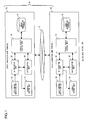
- FIG. 1 shows the configuration of an online game system according to the embodiment.
- An online game system 100 is provided with a newer generation game terminal 10a and an older generation game terminal 10b, which are generically referred to as game terminals 10.
- the newer generation game terminal 10a and the older generation game terminal 10b are connected to each other via a communication network 12 including a publicly known communication means (LAN/WAN/Internet, etc.).
- a communication network 12 including a publicly known communication means (LAN/WAN/Internet, etc.).
- the newer generation game terminal 10a is provided with a newer generation storage 20 with a higher access speed.
- the older generation game terminal 10b is provided with an older generation storage 22 with a lower access speed.
- the newer generation storage 20 and the older generation storage 22 may be generically referred to as "storages”.
- the newer generation game terminal 10a and the older generation game terminal 10b synchronize themselves to cause an online game to progress.
- the game terminals 10 access the storage and exchange data with each other via the communication network 12.
- Fig. 1 shows the functionality of the game terminal 10 in the block diagrams.
- the blocks depicted in the block diagram of this specification are implemented in hardware such as devices or mechanical components like a CPU of a computer, and in software such as a computer program etc.
- Fig. 1 depicts functional blocks implemented by the cooperation of these elements. Therefore, it will be obvious to those skilled in the art that the functional blocks may be implemented in a variety of manners by hardware only, software only, or a combination of thereof.
- the functional blocks of Fig. 1 may be installed in the hardware of the game terminal 10, read into a memory appropriately, and executed by a processor.
- the functional blocks may be implemented by an electronic circuit as hardware.
- the newer game terminal 10a comprises a newer generation storage 20, a user control detection unit 30, an AP execution unit 32, a communication unit 34, a display control unit 36, and a storage access control unit 38.
- the older generation game terminal 10b is configured similarly as the newer generation game terminal 10a but comprises an older generation storage 22 in place of the newer generation storage 20.
- the newer generation storage 20 and the older generation storage 22 are storage areas for storing parameters required to execute the game AP. Access to data stored in the newer generation storage 20 is executed at a higher speed than access to data stored in the older generation storage 22.
- a publicly known storage configuration may be applied to the newer generation storage 20 and the older generation storage 22.
- the storages may be an optical disk such as DVD or Blu-ray Disc (BD), an optical disk provided with a cache device, or a semiconductor memory.
- BD Blu-ray Disc
- the user control detection unit 30 detects a user operation for controlling the game terminal 10 via an input device such as a control button (not shown).
- the AP execution unit 32 executes the game AP and causes an online game to progress.
- the communication unit 34 communicates via the communication network 12 with a terminal (hereinafter, also referred to as "a peer terminal") with which synchronization should be established for progress of the online game.
- the display control unit 36 displays the result of execution of the game AP in the AP execution unit 32, i.e., various content in the online game, on a display (not shown).
- the storage access control unit 38 provides an interface for the AP execution unit 32 to access the storage. In other words, the storage access control unit 38 accesses the storage on behalf of the AP execution unit 32 and controls the access. More specifically, the AP execution unit 32 provides the storage access control unit 38 with a request to obtain data from the storage or a request to update data in the storage (hereinafter, simply referred to as "request for access”).
- the storage access control unit 38 refers to or updates data stored in the storage (hereinafter, simply referred to as "access process”) in response to a request for access and sends the result of the process to the AP execution unit 32.
- Fig. 2 shows the detailed configuration of the storage access control unit 38 of Fig. 1 .
- the storage access control unit 38 comprises an access request acknowledging unit 40, an access execution unit 42, an access completion notification unit 44, and an emulation unit 46.
- the access request acknowledging unit 40 acknowledges a request to access the storage from the AP execution unit 32.
- the access execution unit 42 accesses the storage in response to the request for access from the AP execution unit 32.
- the access completion notification unit 44 notifies the AP execution unit 32 that an access to the storage is completed.
- the emulation unit 46 performs an emulation process to cancel the difference between the time required for storage access in the host game terminal and the time required for storage access in the peer terminal.
- the emulation unit comprises a model storage unit 48, a model selection unit 50, an adjustment value obtaining unit 52, an access time estimation unit 54, an adjustment execution unit 56, and an error detection unit 58.
- the model storage unit 48 is a storage area for storing data for an evaluation function (hereinafter, also referred to as "estimation model") to calculate the time required for storage access in the peer terminal.
- the estimation model is a function defined according to the storage configuration. The model acknowledges the address of the data accessed in the storage, the data size, etc., and outputs the time required for storage access. An example of estimation model will be described later.
- the model storage unit 48 further stores an estimation model selection table from which to select an estimation model according to the type of the peer terminal.
- Fig. 3 schematically shows the configuration of an estimation model selection table.
- the "terminal type” field contains identification information indicating the type of the game terminal 10 (e.g., terminal version).
- the "storage speed indicator” field contains a value indicating the storage access speed associated with the type of the game terminal 10. The figure shows that the higher the value, the higher the speed of access to the storage.
- the "estimation model” field contains identification information indicating an estimated model corresponding to the storage configuration identified by the type of the game terminal 10. Reference is made back to Fig. 2 .
- the model selection unit 50 transmits to the peer terminal a request to obtain the terminal type of the peer terminal via the communication unit 34.
- the model selection unit 50 obtains from the peer terminal data indicating the terminal type of the peer terminal.
- the storage access control unit 38 of the peer terminal may acknowledge the request to obtain the terminal type and transmit data indicating the terminal type predefined for the host terminal to the source of request.
- the data indicating the terminal type may be predefined as additional information in the game AP executed in the peer terminal. For example, a game AP designed to be run on a specific type of terminal may have information identifying the terminal type recorded in the game AP. In this case, the storage access control unit 38 of the peer terminal may obtain the data from the game AP and transmit the obtained data to the source of request.
- the model selection unit 50 refers to the estimation model selection table and compares the storage speed indicator of the terminal type of the peer terminal with that of the terminal type of the host terminal. If the storage speed indicator of the peer terminal is smaller than the storage speed indicator of the host terminal, i.e., if the storage access speed of the peer terminal is lower than the storage access speed of the host terminal, the estimation model selection unit 50 identifies an estimation model associated with the type of the peer terminal. The estimation model selection unit 50 obtains data for the identified estimation model and sends the data to the access time estimation unit 54.
- the estimation model selection table may list storage types instead of terminal types.
- the model selection unit 50 may obtain data indicating the storage type from the peer terminal and select an estimation model in accordance with the access speed identified by the storage type.
- the adjustment value obtaining unit 52 detects whether an adjustment value for adjusting the estimated time determined by the estimation model is set in the game AP. If an adjustment value is set in the game AP, the adjustment value obtaining unit 52 obtains the adjustment value and sends the value to the access time estimation unit 54.
- the adjustment value is data for linearly increasing or decreasing the estimated time.
- the adjustment value may be data indicating a ratio that should be multiplexed by the estimated time. In this case, the adjustment value may be set to 1 or greater if the estimated time determined by the estimation model should be increased. If the estimated time should be decreased, the adjustment value may be set to a value less than 1.
- the access time estimation unit 54 estimates the storage access time of the peer terminal in accordance with the estimation model selected by the model selection unit 50, the adjustment value obtained by the adjustment value acquisition unit 52, and an error detected by the error detection unit 58.
- the time calculated in the estimation process will also be referred to as "estimated time".
- the primary estimated time is determined according to the estimation model
- the secondary estimated time is determined by multiplying the primary estimated time by the adjustment value
- the ultimate estimated time is determined by adjusting the secondary estimated time according to the error. For example, given the past estimated time and an associated error, the error may be adjusted according to a ratio between the past estimated time and the current secondary estimated time so that the ultimate estimated time may be determined by increasing or decreasing the current secondary estimated time by the adjusted error.
- the adjustment execution unit 56 obtains the (ultimate) estimated time determined by the access time estimation unit 54.
- the adjustment execution unit 56 further obtains the time required for storage access in the host terminal (hereinafter, also referred to as "record time") from the access execution unit 42.
- the adjustment execution unit 56 performs an adjustment process to fill the gap between the record time and the estimated time. More specifically, if the gap between the record time and the estimated time is equal to or more than a predefined adjustment execution threshold value (typically, if the estimated time is longer than the record time by the adjustment execution threshold value or more), the adjustment execution unit 56 performs a delay process as an adjustment process. For example, the adjustment execution unit 56 directs the access completion notification unit 44 to go to sleep for a duration defined by (estimated time - record time) and then notify the AP execution unit 32 that the access is completed.
- a predefined adjustment execution threshold value typically, if the estimated time is longer than the record time by the adjustment execution threshold value or more
- the adjustment execution threshold value is set to a permitted difference between the record time and the estimated time.
- the adjustment execution threshold value may be set to time equal to or less than communication time out between the AP execution units 32.
- the adjustment execution threshold value may be defined to be an appropriate value determined by the findings of a developer or experiments with using the online game system 100.
- the adjustment execution unit 56 requests the peer terminal to provide explicit notification of completion via the communication unit 34 when the storage access is completed. In this case, the adjustment execution unit 56 performs an adjustment process by standing by until the unit 56 receives notification of completion from the peer terminal. After the adjustment execution unit 56 receives notification of completion, the unit 56 directs the access completion notification unit 44 to notify the AP execution unit 32 of the completion of access. In a variation, the adjustment execution unit 56 may stand by until the unit 56 receives from the AP execution unit 32 of the peer terminal communication data to establish synchronization after the storage access is completed, instead of requesting notification of completion from the peer device.
- the self-adjustment threshold value is defined in accordance with tolerance for an error created as a result of adjustment based on the estimation in the host terminal. In other words, the longer the estimated time, the larger the difference between the estimated time and the actual time required in the peer terminal tends to be. Thus, a self-adjustment threshold value is defined in order to restrict autonomous adjustment based on the estimated time.
- the adjustment execution threshold value may be defined at an appropriate value according to the findings of a developer or experiments with using the online game system 100.
- the error detection unit 58 obtains, via the communication unit 34, the actual time required for storage access in the peer terminal from the access execution unit 42 of the peer terminal. If the difference between the estimated time calculated in the host terminal and the actually required time is more than a predetermined permitted value, the error detection unit 58 communicates the error to the access time estimation unit 54, thereby causing the access time estimation unit 54 to calculate the estimated time that reflects the error in the subsequent estimated time calculation processes. Like the adjustment execution threshold value, the permitted value may also be set in accordance with the communication time out between the AP execution units 32.
- the error detection unit 58 detects an error while storage access is not performed in the host terminal or in the peer terminal.
- the error detection unit 58 may detect an error after the access completion notification unit 44 communicates the completion of access and before the access request acknowledging unit 40 acknowledges the next request for access. This allows error detection to be performed asynchronously with storage access in the game terminal 10 and reduces the processing load of the storage access control unit 38 accordingly.
- ⁇ a> model constant is a value predefined for an estimation model according to the type of game terminal 10.
- ⁇ b> model internal state is temporary data stored in the access time estimation unit 54. The model internal state is updated according to storage access and referred to in the next storage access.
- ⁇ c> parameters are data necessary for storage access. The parameter values are determined at each occurrence of storage access. For example, the parameter values may be determined by the access execution unit 42.
- the cached memory model of Fig. 3 is not fully described above, but, as already described in step 3 for the case of the cached optical disk model, the access time for m unchached tracks is calculated, as in the case of the memory model, and added to Tcache.
- the internal state of the host terminal may be applied to the model internal state of the estimation model. More specifically, the current head position, cache status, etc. in the host terminal may be applied to the peer terminal unmodified.
- the access time estimation unit 54 of the host terminal may continually trace the internal state of the peer terminal (e.g., the head position or the cache status) according to the internal state updating algorithm in the peer terminal.
- the data indicating the cache status of the peer terminal may be continually updated according to the cache algorithm (e.g., FIFO or LRU) in the peer terminal each time storage access occurs in the host terminal.
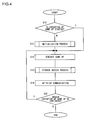
- Fig. 4 is a flowchart showing the operation of the game terminal 10 of Fig. 1 . If the execution of the game AP is not started in the AP execution unit 32 (N in S10), the initial process described later is executed (S12). If the execution of the game AP is already started (Y in S10), S12 is skipped. The AP execution unit 32 executes the game AP so as to cause the online game to progress (S14). The AP execution unit 32 sends a request to access the storage to the storage access control unit 38. The storage access control unit 38 executes a storage access process described later (S16).
- the AP execution unit 32 initiates communication with the AP execution unit 32 of the peer terminal to be synchronized with the peer terminals (S18). If the execution of the game AP should be continued (Y in S20), control is returned to S14. If the execution of the game AP should be terminated (N in S20), the process of the flow is terminated.
- Fig. 5 is a flowchart showing the initial process in S12 of Fig. 4 in detail.
- the AP execution unit 32 starts executing the game AP (S30).
- the model selection unit 50 obtains the type of the peer terminal from the peer terminal (S32). If the storage access speed in the peer terminal is lower than the storage access speed in the host terminal (Y in S34), the model selection unit 50 selects an estimation model determined by the type of the peer terminal and communicates the model to the access time estimation unit 54 (S36).
- the adjustment value obtaining unit 52 obtains the adjustment value predefined for the game AP and communicates the value to the access time estimation unit 54 (S38).
- the new generation game terminal 10a selects an estimation model associated with the older generation storage 22 of the older generation game terminal 10b. Meanwhile, the older generation game terminal 10b skips the process of selecting an estimation model.
- Fig. 6 is a flowchart showing the storage access process in S16 of Fig. 4 in detail.
- the access request acknowledging unit 40 acknowledges a request to access the storage from the AP execution unit 32 (S40).
- the access execution unit 42 accesses the storage in the host terminal (542).
- the access time estimation unit 54 estimates the storage access time in the peer terminal according to the estimation model, the adjustment value predefined for the game AP, and the error associated with the past estimated time (S46). If the estimated time is longer than the self-adjustment threshold value (Y in S48), the adjustment execution unit 56 stands by until the completion of storage access in the peer terminal is detected (S50). If the estimated time is equal to or shorter than the self-adjustment threshold value (N in S48), and if the time gap between the estimated time and the record time is equal to or more than the adjustment execution threshold value (Y in S52), the adjustment execution unit 56 delays the subsequent steps by the time gap (S54).
- S54 is skipped. If an estimation model is not selected (N in S44), S46-S54 are skipped. For example, S46-S54 are executed in the newer generation game terminal 10a and are skipped in the older generation game terminal 10b.
- the access completion notification unit 44 notifies the AP execution unit 32 that the access to the storage is completed (S56).
- the error detection unit 58 obtains the time required for actual storage access from the peer terminal.
- the error detection unit 58 detects an error between the actual required time and the estimated time (S58). If the error is greater than the permitted value (Y in S60), the error detection unit 58 reflects the error in the subsequent step of calculating the estimated time by communicating the error to the access time estimation unit 54 (S62). If the error is equal or less than the permitted value (N in 60), S62 is skipped.
- the flowcharts of this specification show steps as being performed in series. Alternatively, the steps may of course be performed in parallel. For example, the total processing time will be reduced by performing the storage access process of S42 and the access time estimation process of S46 in parallel.
- synchronization between game terminals can be maintained even if a game terminal provided with a high-speed storage and a game terminal provided with a low-speed storage are co-located in the same online game system. For example, occurrence of time out in the communication process for maintaining synchronization between game terminals is prevented. This eliminates the need to provide a limit to the storage access speed in an online game system. It is therefore possible to provide an online game in which a variety of game terminals can participate.
- the estimated time output from the estimation model is adjusted by the adjustment value defined for the game AP. Adjustment by an adjustment value allows calculating the estimated time in adaptation for the characteristic of the game AP even if the estimation model is not perfect, i.e., even if it is difficult to calculate the estimated time adapted to the characteristic of individual game AP's by using the estimation model.
- the actual time required for storage access in the peer terminal is compared with the time estimated for the host terminal so as to detect an error.
- the detected error is fed back to the calculation of the estimated time. This improves precision of estimation in the host terminal.
- the game terminal 10 is connected to a peer device and synchronizes itself with the peer device.
- the presence of a peer device is not essential in the technical idea of the present invention.
- the technical idea of the present invention can be applied in general to cases where an application designed to execute a synchronization process on the assumption of a speed of access to a first storage is run in an information processing device provided with a second storage with an access speed different from that of the first storage.
- the technical idea can be applied to standalone information processing devices. This prevents an error from occurring wile applications are being synchronized (e.g., when synchronization is established between an access to a storage, a separate process performed during the access, and a process of the joining processes).
- the model selection unit 50 obtains, from the application being executed, information indicating the type of storage for which the application is designed so as to select an estimation model adapted for the storage type.
- the online game system 100 includes two game terminals 10 that should be synchronized.
- the number of game terminals 10 is non-limiting and the online game system 100 may of course include three or more game terminals 10.
- the game terminal with the smallest storage speed indicator i.e., the game terminal 10 with the lowest speed of access to the storage, represents the older generation game terminal 10b according to the embodiment.
- the estimation model adapted for that terminal is selected in the other game terminals 10.
- the process of estimating the storage access time of the peer terminal is skipped in the game terminal 10 with a lower speed of access to the storage.
- the process of estimating the storage access time in the peer terminal may be performed in all game terminals regardless of the terminal type or storage type.
- the estimated time and the record time of the host terminal may be compared so that adjustment is performed in adaption for the lowest access speed.
- synchronization between game terminals 10 can be maintained even if the relative speed of access to the storage cannot be uniquely determined merely by referring to the terminal type or storage type. For example, comparing a storage configuration in which an optical disk is used with a configuration in which a cached optical disk is used, the latter will provide higher speed in a majority of cases. In the event of frequent cache misses, however, the former could be higher due to the penalty incurred in the event of cache misses.
- the above-described variation ensures that synchronization is performed properly even in a case like the above.
- the adjustment execution unit 56 stands by until the unit 56 receives explicit notification of completion from the peer terminal, if the estimated time is greater than the self-adjustment threshold value.
- the function for the standby process is not essential in the adjustment execution unit 56.
- the adjustment execution 56 may be configured not to perform the standby process. In this case, the steps of S48 and S50 in the flowchart of Fig. 6 are not executed.
- the functions that should be achieved by the constituting elements recited in the claims will be implemented by the constituting elements shown in the embodiment and the variations either alone or in combination.
- the access time estimation unit recited in the claims may be implemented by the combination of the model selection unit 50, the adjustment value obtaining unit 52, and the access time estimation unit 54 described in the embodiment.
- 10 game terminal 20 newer generation storage, 22 older generation storage, 30 user control detection unit, 32 AP execution unit, 34 communication unit, 36 display control unit, 38 storage access control unit, 40 access request acknowledging unit, 42 access execution unit, 44 access completion notification unit, 46 emulation unit, 48 model storage unit, 50 model selection unit, 52 adjustment value obtaining unit, 54 access time estimation unit, 56 adjustment execution unit, 58 error detection unit, 100 online game system
- the present invention can be applied to an information processing device configured to run an application that requests access to a storage.
Landscapes
- Engineering & Computer Science (AREA)
- Theoretical Computer Science (AREA)
- Physics & Mathematics (AREA)
- General Physics & Mathematics (AREA)
- Multimedia (AREA)
- Human Computer Interaction (AREA)
- General Engineering & Computer Science (AREA)
- Health & Medical Sciences (AREA)
- Child & Adolescent Psychology (AREA)
- Information Retrieval, Db Structures And Fs Structures Therefor (AREA)
- Computer And Data Communications (AREA)
Abstract
Description
- The present invention relates to a data processing technology and, more particularly, to a technology of controlling access to a storage.
- Some applications like game applications (hereinafter, also referred to as "game AP") that require high-level real time processing assumes a speed of access to a storage as a precondition and post-access data processing is implemented based on the assumption. For example, data processing is often implemented such that the processing is synchronized with access to a storage.
- Storage technology is progressing day by day and the speed of accessing data stored in a storage is also improving day by day. On the contrary, an application in which data processing is implemented on the assumption of a speed of access to a given storage may cause inconsistency in data processing when the application is executed in an information processing device provided with a storage with an access speed different from the speed of access to the storage for which the application is designed.
- The present invention addresses the problem and a purpose thereof is to provide a technology of preventing inconsistency in data processing from occurring when an application designed to execute data processing on the assumption of a speed of access to a certain storage is executed in an information processing device provided with another storage with a different access speed.
- The information processing device that addresses the problem is provided with a first storage with an access speed different from that of a second storage, and comprises: an access request acknowledging unit configured to acknowledge a request for access to a storage from an application designed to perform a synchronization process on the assumption that the speed of access to will be that of the access speed of the second storage; an access execution unit configured to perform a process of accessing the first storage in response to the request for access; an access time estimation unit configured to estimate the required time needed to perform a process of accessing the second storage in response to the request for access, in accordance with an evaluation function for calculating the required time; an adjustment unit configured to make an adjustment process to fill time gap between a record time required to perform a process of accessing the first storage and a required estimated time to perform a process of accessing the second storage; and an access completion notification unit configured to notify the application that the process of accessing the storage is completed after the adjustment process.
- Another embodiment of the present invention relates to an information processing method. The information processing method is adapted to execute, in an information processing device provided with a first storage with an access speed different from that of a second storage, an application designed to perform a synchronization process on the assumption that the speed of access will be that of the access speed of the second storage, the method comprising: acknowledging a request for access to a storage from the application; performing a process of accessing the first storage in response to the request for access; estimating the time required to perform a process of accessing the second storage in response to the request for access, in accordance with an evaluation function for calculating the required time; making an adjustment process to fill a time gap between the record time required to perform an access process for the first storage and a required estimated time to perform a process of accessing the second storage; and notifying the application that the process of accessing the storage is completed after the adjustment process.
- Optional combinations of the aforementioned constituting elements, and implementations of the invention in the form of methods, apparatuses, systems, computer programs, data structures, and recording mediums may also be practiced as additional modes of the present invention.
- According to present invention, inconsistency in data processing is prevented from occurring when an application designed to execute data processing on the assumption of a speed of access to a certain storage is executed in an information processing device provided with another storage with a different access speed.
-
-
Fig. 1 shows the configuration of an online game system according to the embodiment; -
Fig. 2 shows the detailed configuration of the storage access control unit ofFig. 1 ; -
Fig. 3 schematically shows the configuration of an estimation model selection table; -
Fig. 4 is a flowchart showing the operation of the game terminal ofFig. 1 ; -
Fig. 5 is a flowchart showing the initial process in S12 ofFig. 4 in detail; and -
Fig. 6 is a flowchart showing the storage access process in S16 ofFig. 4 in detail. - A summary of an embodiment of the present invention will be given before describing the configuration of the embodiment.
In an online game system run by connecting a plurality of game terminals via a network, the game progresses by processing data synchronously in the game terminals. For example, a storage may be accessed and then the data obtained from the storage may be exchanged between game terminals. - An online game system may include a newer generation game terminal provided with a storage capable of high-speed access and an older generation game terminal provided with a storage only capable of low-speed access. In this case, game terminals differ in the time required to access the storages so that a time gap is created between occurrences of communication after an access to the storage. This may cause an error in the operation of a game terminal. For example, a newer generation game terminal may access a storage and attempt to communicate with an older generation game terminal. However, storage access may not be completed in the older generation game terminal, creating a communication timeout.
- To address this, we propose in this embodiment a game terminal configured to estimate the time required to access an older generation storage by using an emulation model compatible with the configuration of the older generation storage and to approximate the time required to access data in the newer generation storage to that of the older generation storage. This can maintain synchronization between game terminals and prevent inconsistency in data processing in the game terminals even if a plurality of game terminals provided with storages with different access speeds are co-located in the same online game system.
- In other words, the embodiment addresses a problem caused by the fact that game AP's are designed for a speed of access to a storage available at a certain point of time, while storages with higher speed are made available day to day. The game terminal according to the embodiment addresses the problem by an approach in which the speed of access to a storage is virtually limited.
-
Fig. 1 shows the configuration of an online game system according to the embodiment. Anonline game system 100 is provided with a newergeneration game terminal 10a and an oldergeneration game terminal 10b, which are generically referred to asgame terminals 10. The newergeneration game terminal 10a and the oldergeneration game terminal 10b are connected to each other via acommunication network 12 including a publicly known communication means (LAN/WAN/Internet, etc.). - The newer
generation game terminal 10a is provided with anewer generation storage 20 with a higher access speed. Meanwhile, the oldergeneration game terminal 10b is provided with anolder generation storage 22 with a lower access speed. Hereinafter, thenewer generation storage 20 and theolder generation storage 22 may be generically referred to as "storages". The newergeneration game terminal 10a and the oldergeneration game terminal 10b synchronize themselves to cause an online game to progress. For example, thegame terminals 10 access the storage and exchange data with each other via thecommunication network 12. -
Fig. 1 shows the functionality of thegame terminal 10 in the block diagrams. The blocks depicted in the block diagram of this specification are implemented in hardware such as devices or mechanical components like a CPU of a computer, and in software such as a computer program etc.Fig. 1 depicts functional blocks implemented by the cooperation of these elements. Therefore, it will be obvious to those skilled in the art that the functional blocks may be implemented in a variety of manners by hardware only, software only, or a combination of thereof. For example, the functional blocks ofFig. 1 may be installed in the hardware of thegame terminal 10, read into a memory appropriately, and executed by a processor. Alternatively, the functional blocks may be implemented by an electronic circuit as hardware. - The
newer game terminal 10a comprises anewer generation storage 20, a usercontrol detection unit 30, anAP execution unit 32, acommunication unit 34, adisplay control unit 36, and a storageaccess control unit 38. The oldergeneration game terminal 10b is configured similarly as the newergeneration game terminal 10a but comprises anolder generation storage 22 in place of thenewer generation storage 20. - The
newer generation storage 20 and theolder generation storage 22 are storage areas for storing parameters required to execute the game AP. Access to data stored in thenewer generation storage 20 is executed at a higher speed than access to data stored in theolder generation storage 22. A publicly known storage configuration may be applied to thenewer generation storage 20 and theolder generation storage 22. For example, the storages may be an optical disk such as DVD or Blu-ray Disc (BD), an optical disk provided with a cache device, or a semiconductor memory. - The user
control detection unit 30 detects a user operation for controlling thegame terminal 10 via an input device such as a control button (not shown). The APexecution unit 32 executes the game AP and causes an online game to progress. Thecommunication unit 34 communicates via thecommunication network 12 with a terminal (hereinafter, also referred to as "a peer terminal") with which synchronization should be established for progress of the online game. Thedisplay control unit 36 displays the result of execution of the game AP in the APexecution unit 32, i.e., various content in the online game, on a display (not shown). - The storage
access control unit 38 provides an interface for theAP execution unit 32 to access the storage. In other words, the storageaccess control unit 38 accesses the storage on behalf of the APexecution unit 32 and controls the access. More specifically, theAP execution unit 32 provides the storageaccess control unit 38 with a request to obtain data from the storage or a request to update data in the storage (hereinafter, simply referred to as "request for access"). The storageaccess control unit 38 refers to or updates data stored in the storage (hereinafter, simply referred to as "access process") in response to a request for access and sends the result of the process to theAP execution unit 32. -
Fig. 2 shows the detailed configuration of the storageaccess control unit 38 ofFig. 1 . The storageaccess control unit 38 comprises an accessrequest acknowledging unit 40, anaccess execution unit 42, an accesscompletion notification unit 44, and anemulation unit 46. The accessrequest acknowledging unit 40 acknowledges a request to access the storage from theAP execution unit 32. Theaccess execution unit 42 accesses the storage in response to the request for access from theAP execution unit 32. The accesscompletion notification unit 44 notifies theAP execution unit 32 that an access to the storage is completed. - The
emulation unit 46 performs an emulation process to cancel the difference between the time required for storage access in the host game terminal and the time required for storage access in the peer terminal. The emulation unit comprises amodel storage unit 48, amodel selection unit 50, an adjustmentvalue obtaining unit 52, an accesstime estimation unit 54, anadjustment execution unit 56, and anerror detection unit 58. - The
model storage unit 48 is a storage area for storing data for an evaluation function (hereinafter, also referred to as "estimation model") to calculate the time required for storage access in the peer terminal. The estimation model is a function defined according to the storage configuration. The model acknowledges the address of the data accessed in the storage, the data size, etc., and outputs the time required for storage access. An example of estimation model will be described later. Themodel storage unit 48 further stores an estimation model selection table from which to select an estimation model according to the type of the peer terminal. -
Fig. 3 schematically shows the configuration of an estimation model selection table. The "terminal type" field contains identification information indicating the type of the game terminal 10 (e.g., terminal version). The "storage speed indicator" field contains a value indicating the storage access speed associated with the type of thegame terminal 10. The figure shows that the higher the value, the higher the speed of access to the storage. The "estimation model" field contains identification information indicating an estimated model corresponding to the storage configuration identified by the type of thegame terminal 10. Reference is made back toFig. 2 . - Before the execution of the game AP is started, the
model selection unit 50 transmits to the peer terminal a request to obtain the terminal type of the peer terminal via thecommunication unit 34. Themodel selection unit 50 obtains from the peer terminal data indicating the terminal type of the peer terminal. The storageaccess control unit 38 of the peer terminal may acknowledge the request to obtain the terminal type and transmit data indicating the terminal type predefined for the host terminal to the source of request. The data indicating the terminal type may be predefined as additional information in the game AP executed in the peer terminal. For example, a game AP designed to be run on a specific type of terminal may have information identifying the terminal type recorded in the game AP. In this case, the storageaccess control unit 38 of the peer terminal may obtain the data from the game AP and transmit the obtained data to the source of request. - The
model selection unit 50 refers to the estimation model selection table and compares the storage speed indicator of the terminal type of the peer terminal with that of the terminal type of the host terminal. If the storage speed indicator of the peer terminal is smaller than the storage speed indicator of the host terminal, i.e., if the storage access speed of the peer terminal is lower than the storage access speed of the host terminal, the estimationmodel selection unit 50 identifies an estimation model associated with the type of the peer terminal. The estimationmodel selection unit 50 obtains data for the identified estimation model and sends the data to the accesstime estimation unit 54. - In one variation, the estimation model selection table may list storage types instead of terminal types. The
model selection unit 50 may obtain data indicating the storage type from the peer terminal and select an estimation model in accordance with the access speed identified by the storage type. - When the execution of the game AP is started, the adjustment
value obtaining unit 52 detects whether an adjustment value for adjusting the estimated time determined by the estimation model is set in the game AP. If an adjustment value is set in the game AP, the adjustmentvalue obtaining unit 52 obtains the adjustment value and sends the value to the accesstime estimation unit 54. The adjustment value is data for linearly increasing or decreasing the estimated time. For example, the adjustment value may be data indicating a ratio that should be multiplexed by the estimated time. In this case, the adjustment value may be set to 1 or greater if the estimated time determined by the estimation model should be increased. If the estimated time should be decreased, the adjustment value may be set to a value less than 1. - The access
time estimation unit 54 estimates the storage access time of the peer terminal in accordance with the estimation model selected by themodel selection unit 50, the adjustment value obtained by the adjustmentvalue acquisition unit 52, and an error detected by theerror detection unit 58. The time calculated in the estimation process will also be referred to as "estimated time". Typically, the primary estimated time is determined according to the estimation model, the secondary estimated time is determined by multiplying the primary estimated time by the adjustment value, and the ultimate estimated time is determined by adjusting the secondary estimated time according to the error. For example, given the past estimated time and an associated error, the error may be adjusted according to a ratio between the past estimated time and the current secondary estimated time so that the ultimate estimated time may be determined by increasing or decreasing the current secondary estimated time by the adjusted error. - The
adjustment execution unit 56 obtains the (ultimate) estimated time determined by the accesstime estimation unit 54. Theadjustment execution unit 56 further obtains the time required for storage access in the host terminal (hereinafter, also referred to as "record time") from theaccess execution unit 42. Theadjustment execution unit 56 performs an adjustment process to fill the gap between the record time and the estimated time. More specifically, if the gap between the record time and the estimated time is equal to or more than a predefined adjustment execution threshold value (typically, if the estimated time is longer than the record time by the adjustment execution threshold value or more), theadjustment execution unit 56 performs a delay process as an adjustment process. For example, theadjustment execution unit 56 directs the accesscompletion notification unit 44 to go to sleep for a duration defined by (estimated time - record time) and then notify theAP execution unit 32 that the access is completed. - The adjustment execution threshold value is set to a permitted difference between the record time and the estimated time. For example, the adjustment execution threshold value may be set to time equal to or less than communication time out between the
AP execution units 32. Alternatively, the adjustment execution threshold value may be defined to be an appropriate value determined by the findings of a developer or experiments with using theonline game system 100. - Further, if the estimated time determined by the access
time estimation unit 54 is longer than a predetermined self-adjustment value, theadjustment execution unit 56 requests the peer terminal to provide explicit notification of completion via thecommunication unit 34 when the storage access is completed. In this case, theadjustment execution unit 56 performs an adjustment process by standing by until theunit 56 receives notification of completion from the peer terminal. After theadjustment execution unit 56 receives notification of completion, theunit 56 directs the accesscompletion notification unit 44 to notify theAP execution unit 32 of the completion of access. In a variation, theadjustment execution unit 56 may stand by until theunit 56 receives from theAP execution unit 32 of the peer terminal communication data to establish synchronization after the storage access is completed, instead of requesting notification of completion from the peer device. - The self-adjustment threshold value is defined in accordance with tolerance for an error created as a result of adjustment based on the estimation in the host terminal. In other words, the longer the estimated time, the larger the difference between the estimated time and the actual time required in the peer terminal tends to be. Thus, a self-adjustment threshold value is defined in order to restrict autonomous adjustment based on the estimated time. Alternatively, the adjustment execution threshold value may be defined at an appropriate value according to the findings of a developer or experiments with using the
online game system 100. - The
error detection unit 58 obtains, via thecommunication unit 34, the actual time required for storage access in the peer terminal from theaccess execution unit 42 of the peer terminal. If the difference between the estimated time calculated in the host terminal and the actually required time is more than a predetermined permitted value, theerror detection unit 58 communicates the error to the accesstime estimation unit 54, thereby causing the accesstime estimation unit 54 to calculate the estimated time that reflects the error in the subsequent estimated time calculation processes. Like the adjustment execution threshold value, the permitted value may also be set in accordance with the communication time out between theAP execution units 32. - Preferably, the
error detection unit 58 detects an error while storage access is not performed in the host terminal or in the peer terminal. For example, theerror detection unit 58 may detect an error after the accesscompletion notification unit 44 communicates the completion of access and before the accessrequest acknowledging unit 40 acknowledges the next request for access. This allows error detection to be performed asynchronously with storage access in thegame terminal 10 and reduces the processing load of the storageaccess control unit 38 accordingly. - Hereinafter, optical disk model, cached optical disk model, and memory model will be described by way of examples of estimation models. It should be noted that "<a> model constant" is a value predefined for an estimation model according to the type of
game terminal 10. "<b> model internal state" is temporary data stored in the accesstime estimation unit 54. The model internal state is updated according to storage access and referred to in the next storage access. "<c> parameters" are data necessary for storage access. The parameter values are determined at each occurrence of storage access. For example, the parameter values may be determined by theaccess execution unit 42. -
- * Time Tst required for the header to seek one track.
- * Time Ttt required to access the data on the innermost track (track 1) .
- * Ratio Ftrackn (0<Ftrackn<1; the larger n, the smaller Ftrackn, because the speed of access to outer tracks is higher than that of inner tracks) of the time required to access the data on track n (n is a natural number equal to more than 1) with respect to the time required to access the innermost track.
-
- * Current head position (track number) Phead.
-
- * Start position of the destination of access (track number) Pread.
- * Number of tracks accessed Lread.
-
- Step 1: calculate seek amount Lseek by referring to the start position of the destination of access and the current head position.

- Step 2: calculate seek time Tseek.

-
Step 3. calculate the time required for data access by referring to the start position of the destination of access and the number of tracks accessed.
- Step 4: calculate total access time T, which is an output from the estimation model.

-
- * Cache access time Tcr required to retrieve data for one track.
- * Penalty time Tcc incurred in the event of cache miss.
-
- * Current cache status (information on cached tracks) <c> Parameter
- * Start position of the destination of access (track number) Pread.
- * Number of tracks accessed Lread.
-
-
Step 1. determine whether the data on the accessed track is already cached by referring to the start position of the destination of access, the number of tracks accessed, and the cache status. -
Step 2. calculate the access time Tcache required to access n cached tracks.
-
Step 3. calculate disk access time Tdisc required to access m uncached tracks, as in the optical disk model.
-
Step 4. calculate total access time T, which is an output from the estimation model.
-
- * Time Ttt required to access data for one block.
- None
-
- * Start address of the destination of access.
- * Size of accessed data.
-
-
Step 1. calculate the number of blocks Lblk that should be accessed by referring to the start address of the destination of access and the size of accessed data. Data that do not fill a block are counted as one block. -
Step 2. calculate total access time T, which is an output from the estimation model.
- The cached memory model of
Fig. 3 is not fully described above, but, as already described instep 3 for the case of the cached optical disk model, the access time for m unchached tracks is calculated, as in the case of the memory model, and added to Tcache. - If the storage configuration of the host terminal is the same as the storage configuration of the peer terminal (e.g., if both terminals use a storage configuration including a cached optical disk), the internal state of the host terminal may be applied to the model internal state of the estimation model. More specifically, the current head position, cache status, etc. in the host terminal may be applied to the peer terminal unmodified.
- Meanwhile, if the storage configuration of the host terminal is different from the storage configuration of the peer terminal, the access
time estimation unit 54 of the host terminal may continually trace the internal state of the peer terminal (e.g., the head position or the cache status) according to the internal state updating algorithm in the peer terminal. For example, the data indicating the cache status of the peer terminal may be continually updated according to the cache algorithm (e.g., FIFO or LRU) in the peer terminal each time storage access occurs in the host terminal. - A description will be given of the operation in the above configuration.
Fig. 4 is a flowchart showing the operation of thegame terminal 10 ofFig. 1 . If the execution of the game AP is not started in the AP execution unit 32 (N in S10), the initial process described later is executed (S12). If the execution of the game AP is already started (Y in S10), S12 is skipped. TheAP execution unit 32 executes the game AP so as to cause the online game to progress (S14). TheAP execution unit 32 sends a request to access the storage to the storageaccess control unit 38. The storageaccess control unit 38 executes a storage access process described later (S16). Thereafter, theAP execution unit 32 initiates communication with theAP execution unit 32 of the peer terminal to be synchronized with the peer terminals (S18). If the execution of the game AP should be continued (Y in S20), control is returned to S14. If the execution of the game AP should be terminated (N in S20), the process of the flow is terminated. -
Fig. 5 is a flowchart showing the initial process in S12 ofFig. 4 in detail. TheAP execution unit 32 starts executing the game AP (S30). Themodel selection unit 50 obtains the type of the peer terminal from the peer terminal (S32). If the storage access speed in the peer terminal is lower than the storage access speed in the host terminal (Y in S34), themodel selection unit 50 selects an estimation model determined by the type of the peer terminal and communicates the model to the access time estimation unit 54 (S36). The adjustmentvalue obtaining unit 52 obtains the adjustment value predefined for the game AP and communicates the value to the access time estimation unit 54 (S38). If the storage access speed of the peer terminal is equal to or higher than the storage access time of the host terminal (N in S34), S36 and S38 are skipped. For example, the newgeneration game terminal 10a selects an estimation model associated with theolder generation storage 22 of the oldergeneration game terminal 10b. Meanwhile, the oldergeneration game terminal 10b skips the process of selecting an estimation model. -
Fig. 6 is a flowchart showing the storage access process in S16 ofFig. 4 in detail. The accessrequest acknowledging unit 40 acknowledges a request to access the storage from the AP execution unit 32 (S40). Theaccess execution unit 42 accesses the storage in the host terminal (542). - If an estimation model is already selected (Y in s44), the access
time estimation unit 54 estimates the storage access time in the peer terminal according to the estimation model, the adjustment value predefined for the game AP, and the error associated with the past estimated time (S46). If the estimated time is longer than the self-adjustment threshold value (Y in S48), theadjustment execution unit 56 stands by until the completion of storage access in the peer terminal is detected (S50). If the estimated time is equal to or shorter than the self-adjustment threshold value (N in S48), and if the time gap between the estimated time and the record time is equal to or more than the adjustment execution threshold value (Y in S52), theadjustment execution unit 56 delays the subsequent steps by the time gap (S54). If the time gap between the estimated time and the record time is less than the adjustment execution threshold value (N in S52), S54 is skipped. If an estimation model is not selected (N in S44), S46-S54 are skipped. For example, S46-S54 are executed in the newergeneration game terminal 10a and are skipped in the oldergeneration game terminal 10b. - The access
completion notification unit 44 notifies theAP execution unit 32 that the access to the storage is completed (S56). Theerror detection unit 58 obtains the time required for actual storage access from the peer terminal. Theerror detection unit 58 detects an error between the actual required time and the estimated time (S58). If the error is greater than the permitted value (Y in S60), theerror detection unit 58 reflects the error in the subsequent step of calculating the estimated time by communicating the error to the access time estimation unit 54 (S62). If the error is equal or less than the permitted value (N in 60), S62 is skipped. The flowcharts of this specification show steps as being performed in series. Alternatively, the steps may of course be performed in parallel. For example, the total processing time will be reduced by performing the storage access process of S42 and the access time estimation process of S46 in parallel. - According to the
game terminal 10 of the present embodiment, synchronization between game terminals can be maintained even if a game terminal provided with a high-speed storage and a game terminal provided with a low-speed storage are co-located in the same online game system. For example, occurrence of time out in the communication process for maintaining synchronization between game terminals is prevented. This eliminates the need to provide a limit to the storage access speed in an online game system. It is therefore possible to provide an online game in which a variety of game terminals can participate. - In further accordance with the
game terminal 10, the estimated time output from the estimation model is adjusted by the adjustment value defined for the game AP. Adjustment by an adjustment value allows calculating the estimated time in adaptation for the characteristic of the game AP even if the estimation model is not perfect, i.e., even if it is difficult to calculate the estimated time adapted to the characteristic of individual game AP's by using the estimation model. - In further accordance with the
game terminal 10, the actual time required for storage access in the peer terminal is compared with the time estimated for the host terminal so as to detect an error. The detected error is fed back to the calculation of the estimated time. This improves precision of estimation in the host terminal. - Described above is an explanation based on an exemplary embodiment. The embodiment is intended to be illustrative only and it will be obvious to those skilled in the art that various modifications to constituting elements and processes could be developed and that such modifications are also within the scope of the present invention.
- In the embodiment described above, the
game terminal 10 is connected to a peer device and synchronizes itself with the peer device. The presence of a peer device is not essential in the technical idea of the present invention. The technical idea of the present invention can be applied in general to cases where an application designed to execute a synchronization process on the assumption of a speed of access to a first storage is run in an information processing device provided with a second storage with an access speed different from that of the first storage. In other words, the technical idea can be applied to standalone information processing devices. This prevents an error from occurring wile applications are being synchronized (e.g., when synchronization is established between an access to a storage, a separate process performed during the access, and a process of the joining processes). In this case, themodel selection unit 50 obtains, from the application being executed, information indicating the type of storage for which the application is designed so as to select an estimation model adapted for the storage type. - In the embodiment described above, the
online game system 100 includes twogame terminals 10 that should be synchronized. However, the number ofgame terminals 10 is non-limiting and theonline game system 100 may of course include three ormore game terminals 10. In this case, the game terminal with the smallest storage speed indicator, i.e., thegame terminal 10 with the lowest speed of access to the storage, represents the oldergeneration game terminal 10b according to the embodiment. The estimation model adapted for that terminal is selected in theother game terminals 10. - According to the embodiment, the process of estimating the storage access time of the peer terminal is skipped in the
game terminal 10 with a lower speed of access to the storage. In one variation, the process of estimating the storage access time in the peer terminal may be performed in all game terminals regardless of the terminal type or storage type. The estimated time and the record time of the host terminal may be compared so that adjustment is performed in adaption for the lowest access speed. According to this variation, synchronization betweengame terminals 10 can be maintained even if the relative speed of access to the storage cannot be uniquely determined merely by referring to the terminal type or storage type. For example, comparing a storage configuration in which an optical disk is used with a configuration in which a cached optical disk is used, the latter will provide higher speed in a majority of cases. In the event of frequent cache misses, however, the former could be higher due to the penalty incurred in the event of cache misses. The above-described variation ensures that synchronization is performed properly even in a case like the above. - In the described as described, the
adjustment execution unit 56 stands by until theunit 56 receives explicit notification of completion from the peer terminal, if the estimated time is greater than the self-adjustment threshold value. The function for the standby process is not essential in theadjustment execution unit 56. In one variation, theadjustment execution 56 may be configured not to perform the standby process. In this case, the steps of S48 and S50 in the flowchart ofFig. 6 are not executed. - An arbitrary combination of the embodiment and variations will also be useful as the embodiment of the present invention. The new embodiment produced by the combination will provide combined advantages of the embodiment and the variation included in the combination.
- A skilled person would naturally understand that the functions that should be achieved by the constituting elements recited in the claims will be implemented by the constituting elements shown in the embodiment and the variations either alone or in combination. For example, the access time estimation unit recited in the claims may be implemented by the combination of the
model selection unit 50, the adjustmentvalue obtaining unit 52, and the accesstime estimation unit 54 described in the embodiment. - 10 game terminal, 20 newer generation storage, 22 older generation storage, 30 user control detection unit, 32 AP execution unit, 34 communication unit, 36 display control unit, 38 storage access control unit, 40 access request acknowledging unit, 42 access execution unit, 44 access completion notification unit, 46 emulation unit, 48 model storage unit, 50 model selection unit, 52 adjustment value obtaining unit, 54 access time estimation unit, 56 adjustment execution unit, 58 error detection unit, 100 online game system
- The present invention can be applied to an information processing device configured to run an application that requests access to a storage.
Claims (10)
- An information processing device provided with a first storage with an access speed different from that of a second storage, comprising:an access request acknowledging unit configured to acknowledge a request for access to a storage from an application designed to perform a synchronization process on the assumption that the speed of access to will be that of the access speed of the second storage;an access execution unit configured to perform a process of accessing the first storage in response to the request for access;an access time estimation unit configured to estimate the required time needed to perform a process of accessing the second storage in response to the request for access, in accordance with an evaluation function for calculating the required time;an adjustment unit configured to make an adjustment process to fill time gap between a record time required to perform a process of accessing the first storage and a required estimated time to perform a process of accessing the second storage; andan access completion notification unit configured to notify the application that the process of accessing the storage is completed after the adjustment process.
- The information processing device according to claim 1,
wherein, if the record time is shorter than the estimated time by a predetermined duration or longer, the adjustment unit delays the notification of completion for a duration indicated by the time gap. - The information processing device according to claim 1 or claim 2,
wherein the access time estimation unit selects an evaluation function associated with the configuration of the second storage from a plurality of types of evaluation functions associated with a plurality of storage configurations, respectively, so as to estimate the required time. - The information processing device according to one of claims 1 through 3,
wherein the application includes an adjustment value for adjusting the required estimated time to perform a process of accessing the second storage, and
wherein the access time estimation unit adjusts the required estimated time calculated according to the evaluation function, in accordance with the adjustment value. - The information processing device according to one of claims 1 through 4,
wherein the information processing device is connected to another information processing device provided with the second storage,
the access acknowledging unit acknowledges the request for access from an application that should execute a series of data processing steps in synchronization with another application installed in the other information processing device, and
the adjustment unit performs the adjustment process for synchronization between the application and the other application. - The information processing device according to claim 5, further comprising:an error detection unit configured to obtain the record time required to perform an access process for the second storage from the other information processing device and to detect an error in the estimated time calculated by the access time estimation unit for the access process,wherein the access time estimation unit adjusts, upon detection of an error equal to or greater than a predetermined value, the estimated time calculated according to the evaluation function, in accordance with the error.
- The information processing device according to claim 6,
wherein the error detection unit detects the error when the access process for the first storage is not performed. - The information processing device according to one of claims 5 through 7,
wherein, if the required estimated time is equal to or longer than a predetermined duration, the adjusting unit performs the adjustment process by suspending notification of the completion of an access until the completion of an access to the second storage in the other information device is detected. - An information processing method adapted to execute, in an information processing device provided with a first storage with an access speed different from that of a second storage, an application designed to perform a synchronization process on the assumption that the speed of access will be that of the access speed of the second storage, the method comprising:acknowledging a request for access to a storage from the application;performing a process of accessing the first storage in response to the request for access;estimating the time required to perform a process of accessing the second storage in response to the request for access, in accordance with an evaluation function for calculating the required time;making an adjustment process to fill a time gap between the record time required to perform an access process for the first storage and a required estimated time to perform a process of accessing the second storage; andnotifying the application that the process of accessing the storage is completed after the adjustment process.
- A recording medium having embodied thereon a computer program adapted for execution, in an information processing device provided with a first storage with an access speed different from that of a second storage, of an application designed to perform a synchronization process on the assumption of a speed of access to the second storage, the program comprising:a module configured to acknowledge a request for access to a storage from the application;a module configured to perform a process of accessing the first storage in response to the request for access;a module configured to estimate time required to perform a process of accessing the second storage in response to the request for access, in accordance with an evaluation function for calculating a required time;a module configured to make an adjustment process to fill a time gap between a record time required to perform a process of accessing the first storage and a required estimated time to perform a process of accessing the second storage; anda module configured to notify the application that the process of accessing the storage is completed after the adjustment process.
Applications Claiming Priority (2)
| Application Number | Priority Date | Filing Date | Title |
|---|---|---|---|
| JP2009194442A JP4682353B2 (en) | 2009-08-25 | 2009-08-25 | Information processing apparatus and information processing method |
| PCT/JP2010/001244 WO2011024334A1 (en) | 2009-08-25 | 2010-02-24 | Information processor and information processing method |
Publications (3)
| Publication Number | Publication Date |
|---|---|
| EP2472387A1 true EP2472387A1 (en) | 2012-07-04 |
| EP2472387A4 EP2472387A4 (en) | 2013-08-21 |
| EP2472387B1 EP2472387B1 (en) | 2018-08-15 |
Family
ID=43627458
Family Applications (1)
| Application Number | Title | Priority Date | Filing Date |
|---|---|---|---|
| EP10811394.5A Active EP2472387B1 (en) | 2009-08-25 | 2010-02-24 | Information processor and information processing method |
Country Status (4)
| Country | Link |
|---|---|
| US (1) | US8918598B2 (en) |
| EP (1) | EP2472387B1 (en) |
| JP (1) | JP4682353B2 (en) |
| WO (1) | WO2011024334A1 (en) |
Families Citing this family (2)
| Publication number | Priority date | Publication date | Assignee | Title |
|---|---|---|---|---|
| US9491251B2 (en) | 2012-11-27 | 2016-11-08 | Facebook, Inc. | Transmission of notifications to multiple devices associated with a user |
| CN112883009B (en) * | 2019-11-29 | 2024-05-07 | 北京百度网讯科技有限公司 | Method and device for processing data |
Family Cites Families (6)
| Publication number | Priority date | Publication date | Assignee | Title |
|---|---|---|---|---|
| US6502165B1 (en) * | 1999-12-03 | 2002-12-31 | International Business Machines Corporation | Balanced access to data volumes with redundant copies stored in data storage libraries |
| JP4392601B2 (en) * | 2004-05-07 | 2010-01-06 | パナソニック株式会社 | Data access device and recording medium |
| JP4754243B2 (en) * | 2005-03-15 | 2011-08-24 | 株式会社バンダイナムコゲームス | PROGRAM, INFORMATION STORAGE MEDIUM, AND GAME DEVICE |
| JP4921000B2 (en) * | 2006-03-15 | 2012-04-18 | キヤノン株式会社 | Image processing apparatus, image processing apparatus control method, and program |
| JP5224706B2 (en) * | 2007-03-23 | 2013-07-03 | キヤノン株式会社 | Storage device and storage device control method |
| US8560799B2 (en) * | 2010-02-18 | 2013-10-15 | Hitachi, Ltd. | Performance management method for virtual volumes |
-
2009
- 2009-08-25 JP JP2009194442A patent/JP4682353B2/en active Active
-
2010
- 2010-02-24 US US13/390,242 patent/US8918598B2/en active Active
- 2010-02-24 EP EP10811394.5A patent/EP2472387B1/en active Active
- 2010-02-24 WO PCT/JP2010/001244 patent/WO2011024334A1/en not_active Ceased
Also Published As
| Publication number | Publication date |
|---|---|
| US20120198185A1 (en) | 2012-08-02 |
| JP4682353B2 (en) | 2011-05-11 |
| JP2011048472A (en) | 2011-03-10 |
| WO2011024334A1 (en) | 2011-03-03 |
| EP2472387B1 (en) | 2018-08-15 |
| EP2472387A4 (en) | 2013-08-21 |
| US8918598B2 (en) | 2014-12-23 |
Similar Documents
| Publication | Publication Date | Title |
|---|---|---|
| CN109739810B (en) | File synchronization method, server, client and device with storage function | |
| US8347197B2 (en) | Terminal device, time adjusting method of terminal device and communication system | |
| WO2020000708A1 (en) | Blockchain node synchronization method and device using trust mechanism | |
| CN101547204B (en) | Information processing apparatus and method, program, recording medium, and information processing system | |
| JP5614133B2 (en) | Access control device, access control method, and storage system | |
| US20110087777A1 (en) | Information-processing device, information-processing method, and program | |
| CN113760934B (en) | Data reading method and terminal | |
| JP2022506614A (en) | In-game information platform | |
| WO2012111112A1 (en) | Information processing device, time setting method, and time setting program | |
| US9576061B2 (en) | Information processing system and data update control method | |
| CN103986779A (en) | Application data transmission method, device and terminal equipment | |
| US8918598B2 (en) | Synchronization system and method for storages with different access speeds | |
| JP4116064B1 (en) | Client device | |
| US11734256B2 (en) | Anomaly detection method and non-transitory computer-readable recording medium | |
| US20250018305A1 (en) | Apple watch-based html5 somatosensory game method | |
| CN113704026B (en) | Distributed financial memory database security synchronization method, device and medium | |
| CN114205266A (en) | Network delay calculation method and device, electronic equipment and storage medium | |
| CN119201000A (en) | A fast cache recovery method based on hot and cold characteristics | |
| CN112860211A (en) | Method, device, terminal and storage medium for determining time delay | |
| CN114356024B (en) | Method for automatically setting summer time in intelligent equipment, cloud platform and storage medium | |
| JP2008211380A (en) | Information processing apparatus and display control method | |
| CN115576780A (en) | Virtual machine state determination method and system and electronic equipment | |
| JP5573943B2 (en) | Data transfer apparatus and data transfer method | |
| CN114297167B (en) | Log replay method and device | |
| CN120151575A (en) | Media file playing method, device, computer equipment and storage medium |
Legal Events
| Date | Code | Title | Description |
|---|---|---|---|
| PUAI | Public reference made under article 153(3) epc to a published international application that has entered the european phase |
Free format text: ORIGINAL CODE: 0009012 |
|
| 17P | Request for examination filed |
Effective date: 20120307 |
|
| AK | Designated contracting states |
Kind code of ref document: A1 Designated state(s): AT BE BG CH CY CZ DE DK EE ES FI FR GB GR HR HU IE IS IT LI LT LU LV MC MK MT NL NO PL PT RO SE SI SK SM TR |
|
| DAX | Request for extension of the european patent (deleted) | ||
| RAP1 | Party data changed (applicant data changed or rights of an application transferred) |
Owner name: SONY COMPUTER ENTERTAINMENT INCORPORATED |
|
| RAP1 | Party data changed (applicant data changed or rights of an application transferred) |
Owner name: SONY COMPUTER ENTERTAINMENT INC. |
|
| A4 | Supplementary search report drawn up and despatched |
Effective date: 20130723 |
|
| RIC1 | Information provided on ipc code assigned before grant |
Ipc: G06F 3/06 20060101AFI20130717BHEP Ipc: A63F 13/12 20060101ALI20130717BHEP |
|
| RAP1 | Party data changed (applicant data changed or rights of an application transferred) |
Owner name: SONY INTERACTIVE ENTERTAINMENT INC. |
|
| STAA | Information on the status of an ep patent application or granted ep patent |
Free format text: STATUS: EXAMINATION IS IN PROGRESS |
|
| 17Q | First examination report despatched |
Effective date: 20171016 |
|
| GRAP | Despatch of communication of intention to grant a patent |
Free format text: ORIGINAL CODE: EPIDOSNIGR1 |
|
| STAA | Information on the status of an ep patent application or granted ep patent |
Free format text: STATUS: GRANT OF PATENT IS INTENDED |
|
| RIC1 | Information provided on ipc code assigned before grant |
Ipc: G07F 17/32 20060101ALI20180226BHEP Ipc: G06F 3/06 20060101AFI20180226BHEP Ipc: A63F 13/95 20140101ALN20180226BHEP |
|
| INTG | Intention to grant announced |
Effective date: 20180328 |
|
| GRAS | Grant fee paid |
Free format text: ORIGINAL CODE: EPIDOSNIGR3 |
|
| GRAA | (expected) grant |
Free format text: ORIGINAL CODE: 0009210 |
|
| STAA | Information on the status of an ep patent application or granted ep patent |
Free format text: STATUS: THE PATENT HAS BEEN GRANTED |
|
| AK | Designated contracting states |
Kind code of ref document: B1 Designated state(s): AT BE BG CH CY CZ DE DK EE ES FI FR GB GR HR HU IE IS IT LI LT LU LV MC MK MT NL NO PL PT RO SE SI SK SM TR |
|
| REG | Reference to a national code |
Ref country code: CH Ref legal event code: EP Ref country code: GB Ref legal event code: FG4D Ref country code: AT Ref legal event code: REF Ref document number: 1030536 Country of ref document: AT Kind code of ref document: T Effective date: 20180815 |
|
| REG | Reference to a national code |
Ref country code: IE Ref legal event code: FG4D |
|
| REG | Reference to a national code |
Ref country code: DE Ref legal event code: R096 Ref document number: 602010052822 Country of ref document: DE |
|
| REG | Reference to a national code |
Ref country code: NL Ref legal event code: MP Effective date: 20180815 |
|
| REG | Reference to a national code |
Ref country code: LT Ref legal event code: MG4D |
|
| REG | Reference to a national code |
Ref country code: AT Ref legal event code: MK05 Ref document number: 1030536 Country of ref document: AT Kind code of ref document: T Effective date: 20180815 |
|
| PG25 | Lapsed in a contracting state [announced via postgrant information from national office to epo] |
Ref country code: LT Free format text: LAPSE BECAUSE OF FAILURE TO SUBMIT A TRANSLATION OF THE DESCRIPTION OR TO PAY THE FEE WITHIN THE PRESCRIBED TIME-LIMIT Effective date: 20180815 Ref country code: IS Free format text: LAPSE BECAUSE OF FAILURE TO SUBMIT A TRANSLATION OF THE DESCRIPTION OR TO PAY THE FEE WITHIN THE PRESCRIBED TIME-LIMIT Effective date: 20181215 Ref country code: NL Free format text: LAPSE BECAUSE OF FAILURE TO SUBMIT A TRANSLATION OF THE DESCRIPTION OR TO PAY THE FEE WITHIN THE PRESCRIBED TIME-LIMIT Effective date: 20180815 Ref country code: AT Free format text: LAPSE BECAUSE OF FAILURE TO SUBMIT A TRANSLATION OF THE DESCRIPTION OR TO PAY THE FEE WITHIN THE PRESCRIBED TIME-LIMIT Effective date: 20180815 Ref country code: SE Free format text: LAPSE BECAUSE OF FAILURE TO SUBMIT A TRANSLATION OF THE DESCRIPTION OR TO PAY THE FEE WITHIN THE PRESCRIBED TIME-LIMIT Effective date: 20180815 Ref country code: GR Free format text: LAPSE BECAUSE OF FAILURE TO SUBMIT A TRANSLATION OF THE DESCRIPTION OR TO PAY THE FEE WITHIN THE PRESCRIBED TIME-LIMIT Effective date: 20181116 Ref country code: NO Free format text: LAPSE BECAUSE OF FAILURE TO SUBMIT A TRANSLATION OF THE DESCRIPTION OR TO PAY THE FEE WITHIN THE PRESCRIBED TIME-LIMIT Effective date: 20181115 Ref country code: FI Free format text: LAPSE BECAUSE OF FAILURE TO SUBMIT A TRANSLATION OF THE DESCRIPTION OR TO PAY THE FEE WITHIN THE PRESCRIBED TIME-LIMIT Effective date: 20180815 Ref country code: BG Free format text: LAPSE BECAUSE OF FAILURE TO SUBMIT A TRANSLATION OF THE DESCRIPTION OR TO PAY THE FEE WITHIN THE PRESCRIBED TIME-LIMIT Effective date: 20181115 |
|
| PG25 | Lapsed in a contracting state [announced via postgrant information from national office to epo] |
Ref country code: HR Free format text: LAPSE BECAUSE OF FAILURE TO SUBMIT A TRANSLATION OF THE DESCRIPTION OR TO PAY THE FEE WITHIN THE PRESCRIBED TIME-LIMIT Effective date: 20180815 Ref country code: LV Free format text: LAPSE BECAUSE OF FAILURE TO SUBMIT A TRANSLATION OF THE DESCRIPTION OR TO PAY THE FEE WITHIN THE PRESCRIBED TIME-LIMIT Effective date: 20180815 |
|
| PG25 | Lapsed in a contracting state [announced via postgrant information from national office to epo] |
Ref country code: CZ Free format text: LAPSE BECAUSE OF FAILURE TO SUBMIT A TRANSLATION OF THE DESCRIPTION OR TO PAY THE FEE WITHIN THE PRESCRIBED TIME-LIMIT Effective date: 20180815 Ref country code: RO Free format text: LAPSE BECAUSE OF FAILURE TO SUBMIT A TRANSLATION OF THE DESCRIPTION OR TO PAY THE FEE WITHIN THE PRESCRIBED TIME-LIMIT Effective date: 20180815 Ref country code: ES Free format text: LAPSE BECAUSE OF FAILURE TO SUBMIT A TRANSLATION OF THE DESCRIPTION OR TO PAY THE FEE WITHIN THE PRESCRIBED TIME-LIMIT Effective date: 20180815 Ref country code: PL Free format text: LAPSE BECAUSE OF FAILURE TO SUBMIT A TRANSLATION OF THE DESCRIPTION OR TO PAY THE FEE WITHIN THE PRESCRIBED TIME-LIMIT Effective date: 20180815 Ref country code: EE Free format text: LAPSE BECAUSE OF FAILURE TO SUBMIT A TRANSLATION OF THE DESCRIPTION OR TO PAY THE FEE WITHIN THE PRESCRIBED TIME-LIMIT Effective date: 20180815 Ref country code: IT Free format text: LAPSE BECAUSE OF FAILURE TO SUBMIT A TRANSLATION OF THE DESCRIPTION OR TO PAY THE FEE WITHIN THE PRESCRIBED TIME-LIMIT Effective date: 20180815 |
|
| REG | Reference to a national code |
Ref country code: DE Ref legal event code: R097 Ref document number: 602010052822 Country of ref document: DE |
|
| PG25 | Lapsed in a contracting state [announced via postgrant information from national office to epo] |
Ref country code: DK Free format text: LAPSE BECAUSE OF FAILURE TO SUBMIT A TRANSLATION OF THE DESCRIPTION OR TO PAY THE FEE WITHIN THE PRESCRIBED TIME-LIMIT Effective date: 20180815 Ref country code: SM Free format text: LAPSE BECAUSE OF FAILURE TO SUBMIT A TRANSLATION OF THE DESCRIPTION OR TO PAY THE FEE WITHIN THE PRESCRIBED TIME-LIMIT Effective date: 20180815 Ref country code: SK Free format text: LAPSE BECAUSE OF FAILURE TO SUBMIT A TRANSLATION OF THE DESCRIPTION OR TO PAY THE FEE WITHIN THE PRESCRIBED TIME-LIMIT Effective date: 20180815 |
|
| PLBE | No opposition filed within time limit |
Free format text: ORIGINAL CODE: 0009261 |
|
| STAA | Information on the status of an ep patent application or granted ep patent |
Free format text: STATUS: NO OPPOSITION FILED WITHIN TIME LIMIT |
|
| 26N | No opposition filed |
Effective date: 20190516 |
|
| PG25 | Lapsed in a contracting state [announced via postgrant information from national office to epo] |
Ref country code: SI Free format text: LAPSE BECAUSE OF FAILURE TO SUBMIT A TRANSLATION OF THE DESCRIPTION OR TO PAY THE FEE WITHIN THE PRESCRIBED TIME-LIMIT Effective date: 20180815 |
|
| REG | Reference to a national code |
Ref country code: CH Ref legal event code: PL |
|
| PG25 | Lapsed in a contracting state [announced via postgrant information from national office to epo] |
Ref country code: LU Free format text: LAPSE BECAUSE OF NON-PAYMENT OF DUE FEES Effective date: 20190224 Ref country code: MC Free format text: LAPSE BECAUSE OF FAILURE TO SUBMIT A TRANSLATION OF THE DESCRIPTION OR TO PAY THE FEE WITHIN THE PRESCRIBED TIME-LIMIT Effective date: 20180815 |
|
| REG | Reference to a national code |
Ref country code: BE Ref legal event code: MM Effective date: 20190228 |
|
| REG | Reference to a national code |
Ref country code: IE Ref legal event code: MM4A |
|
| PG25 | Lapsed in a contracting state [announced via postgrant information from national office to epo] |
Ref country code: CH Free format text: LAPSE BECAUSE OF NON-PAYMENT OF DUE FEES Effective date: 20190228 Ref country code: LI Free format text: LAPSE BECAUSE OF NON-PAYMENT OF DUE FEES Effective date: 20190228 |
|
| PG25 | Lapsed in a contracting state [announced via postgrant information from national office to epo] |
Ref country code: IE Free format text: LAPSE BECAUSE OF NON-PAYMENT OF DUE FEES Effective date: 20190224 |
|
| PG25 | Lapsed in a contracting state [announced via postgrant information from national office to epo] |
Ref country code: BE Free format text: LAPSE BECAUSE OF NON-PAYMENT OF DUE FEES Effective date: 20190228 |
|
| PG25 | Lapsed in a contracting state [announced via postgrant information from national office to epo] |
Ref country code: TR Free format text: LAPSE BECAUSE OF FAILURE TO SUBMIT A TRANSLATION OF THE DESCRIPTION OR TO PAY THE FEE WITHIN THE PRESCRIBED TIME-LIMIT Effective date: 20180815 |
|
| PG25 | Lapsed in a contracting state [announced via postgrant information from national office to epo] |
Ref country code: MT Free format text: LAPSE BECAUSE OF NON-PAYMENT OF DUE FEES Effective date: 20190224 Ref country code: PT Free format text: LAPSE BECAUSE OF FAILURE TO SUBMIT A TRANSLATION OF THE DESCRIPTION OR TO PAY THE FEE WITHIN THE PRESCRIBED TIME-LIMIT Effective date: 20181215 |
|
| PG25 | Lapsed in a contracting state [announced via postgrant information from national office to epo] |
Ref country code: CY Free format text: LAPSE BECAUSE OF FAILURE TO SUBMIT A TRANSLATION OF THE DESCRIPTION OR TO PAY THE FEE WITHIN THE PRESCRIBED TIME-LIMIT Effective date: 20180815 |
|
| PG25 | Lapsed in a contracting state [announced via postgrant information from national office to epo] |
Ref country code: HU Free format text: LAPSE BECAUSE OF FAILURE TO SUBMIT A TRANSLATION OF THE DESCRIPTION OR TO PAY THE FEE WITHIN THE PRESCRIBED TIME-LIMIT; INVALID AB INITIO Effective date: 20100224 |
|
| PG25 | Lapsed in a contracting state [announced via postgrant information from national office to epo] |
Ref country code: MK Free format text: LAPSE BECAUSE OF FAILURE TO SUBMIT A TRANSLATION OF THE DESCRIPTION OR TO PAY THE FEE WITHIN THE PRESCRIBED TIME-LIMIT Effective date: 20180815 |
|
| P01 | Opt-out of the competence of the unified patent court (upc) registered |
Effective date: 20230519 |
|
| P02 | Opt-out of the competence of the unified patent court (upc) changed |
Effective date: 20230527 |
|
| PGFP | Annual fee paid to national office [announced via postgrant information from national office to epo] |
Ref country code: DE Payment date: 20250122 Year of fee payment: 16 |
|
| PGFP | Annual fee paid to national office [announced via postgrant information from national office to epo] |
Ref country code: FR Payment date: 20250122 Year of fee payment: 16 |
|
| PGFP | Annual fee paid to national office [announced via postgrant information from national office to epo] |
Ref country code: GB Payment date: 20250124 Year of fee payment: 16 |