EP2471786A1 - Aminopyrazole derivative - Google Patents
Aminopyrazole derivative Download PDFInfo
- Publication number
- EP2471786A1 EP2471786A1 EP10806527A EP10806527A EP2471786A1 EP 2471786 A1 EP2471786 A1 EP 2471786A1 EP 10806527 A EP10806527 A EP 10806527A EP 10806527 A EP10806527 A EP 10806527A EP 2471786 A1 EP2471786 A1 EP 2471786A1
- Authority
- EP
- European Patent Office
- Prior art keywords
- methyl
- amino
- benzimidazol
- pyrazol
- indol
- Prior art date
- Legal status (The legal status is an assumption and is not a legal conclusion. Google has not performed a legal analysis and makes no representation as to the accuracy of the status listed.)
- Granted
Links
- 0 CC(*)C(C)(CC(C)(C)CCCC1)C1(*)OCCC#N Chemical compound CC(*)C(C)(CC(C)(C)CCCC1)C1(*)OCCC#N 0.000 description 52
- URLKBWYHVLBVBO-UHFFFAOYSA-N Cc1ccc(C)cc1 Chemical compound Cc1ccc(C)cc1 URLKBWYHVLBVBO-UHFFFAOYSA-N 0.000 description 3
- FLXWJXVCLJKBQT-UHFFFAOYSA-N CC(C(C)(C1)N)C#CC(C)=C1F Chemical compound CC(C(C)(C1)N)C#CC(C)=C1F FLXWJXVCLJKBQT-UHFFFAOYSA-N 0.000 description 1
- OZAUBUUCQKCFTK-UHFFFAOYSA-N CC(C=C1)=CCC1[Ne+] Chemical compound CC(C=C1)=CCC1[Ne+] OZAUBUUCQKCFTK-UHFFFAOYSA-N 0.000 description 1
- OZJTZIWTKQUYRX-JUGFDQIVSA-N CC1C2C=C[C@H](C)CC12 Chemical compound CC1C2C=C[C@H](C)CC12 OZJTZIWTKQUYRX-JUGFDQIVSA-N 0.000 description 1
- XKNMRHZMGHUNJY-UHFFFAOYSA-N CCC(NC1=C(C)CC=CC(C)(C)C1)=C Chemical compound CCC(NC1=C(C)CC=CC(C)(C)C1)=C XKNMRHZMGHUNJY-UHFFFAOYSA-N 0.000 description 1
- ADYFNFUWLQBLNL-UTJQPWESSA-N CCN/C(/C=C\C[N](C)(C(N)=[IH](C)C)NCC)=C\N=C Chemical compound CCN/C(/C=C\C[N](C)(C(N)=[IH](C)C)NCC)=C\N=C ADYFNFUWLQBLNL-UTJQPWESSA-N 0.000 description 1
- HGZVSTJTGKBFCF-APHSVINUSA-N CCOC(C(N(/C1=C/C(/C(F)(F)F)=C(\C)/Br)S(c2ccc(C)cc2)(=O)=O)=CC1=C)=O Chemical compound CCOC(C(N(/C1=C/C(/C(F)(F)F)=C(\C)/Br)S(c2ccc(C)cc2)(=O)=O)=CC1=C)=O HGZVSTJTGKBFCF-APHSVINUSA-N 0.000 description 1
- JSHIHGOMMBEWGC-UHFFFAOYSA-N CCc1nc2cc(-[n]3ncc(C(c4cc5cc(C(F)(F)F)ccc5[n]4S(c4ccc(C)cc4)=O)=O)c3N)ccc2[nH]1 Chemical compound CCc1nc2cc(-[n]3ncc(C(c4cc5cc(C(F)(F)F)ccc5[n]4S(c4ccc(C)cc4)=O)=O)c3N)ccc2[nH]1 JSHIHGOMMBEWGC-UHFFFAOYSA-N 0.000 description 1
- ZSXGLVDWWRXATF-UHFFFAOYSA-N CN(C)C(OC)OC Chemical compound CN(C)C(OC)OC ZSXGLVDWWRXATF-UHFFFAOYSA-N 0.000 description 1
- BHZBNXUCBZMYCD-QVDQXJPCSA-N CN1CCN(CC[C@H]2[I]=CC2F)CC1 Chemical compound CN1CCN(CC[C@H]2[I]=CC2F)CC1 BHZBNXUCBZMYCD-QVDQXJPCSA-N 0.000 description 1
- SJRJJKPEHAURKC-UHFFFAOYSA-N CN1CCOCC1 Chemical compound CN1CCOCC1 SJRJJKPEHAURKC-UHFFFAOYSA-N 0.000 description 1
- KLKXMYSNXCGJCK-UHFFFAOYSA-N CNc(c(N)c1)ccc1N1N=[I]C=C1N Chemical compound CNc(c(N)c1)ccc1N1N=[I]C=C1N KLKXMYSNXCGJCK-UHFFFAOYSA-N 0.000 description 1
- YMVIBCLVXQHIDP-UHFFFAOYSA-N COc1cc(NCC(CC#N)=C)ccc1 Chemical compound COc1cc(NCC(CC#N)=C)ccc1 YMVIBCLVXQHIDP-UHFFFAOYSA-N 0.000 description 1
- SWOMWXWMSKXRNB-UHFFFAOYSA-N Cc(cc1)ccc1[O](=C)=O Chemical compound Cc(cc1)ccc1[O](=C)=O SWOMWXWMSKXRNB-UHFFFAOYSA-N 0.000 description 1
- MYSALAKHLGMVSW-AATRIKPKSA-O Cc1cc(/C=C/C(N(CC2)CC2(F)F)=O)c(C=C)[n]1[SH+]C Chemical compound Cc1cc(/C=C/C(N(CC2)CC2(F)F)=O)c(C=C)[n]1[SH+]C MYSALAKHLGMVSW-AATRIKPKSA-O 0.000 description 1
- CFDYSIIVFSFHBT-UHFFFAOYSA-N Cc1nc(cc(cc2)-[n]3ncc(C(c([n](c4cc(Br)c5)S(c6ccc(C)cc6)=O)cc4c5F)=O)c3N)c2[nH]1 Chemical compound Cc1nc(cc(cc2)-[n]3ncc(C(c([n](c4cc(Br)c5)S(c6ccc(C)cc6)=O)cc4c5F)=O)c3N)c2[nH]1 CFDYSIIVFSFHBT-UHFFFAOYSA-N 0.000 description 1
- IUDFNNHFARLIPF-UHFFFAOYSA-N N#CCC(c1cc(Cl)ccc1)=O Chemical compound N#CCC(c1cc(Cl)ccc1)=O IUDFNNHFARLIPF-UHFFFAOYSA-N 0.000 description 1
- GCABLKFGYPIVFC-UHFFFAOYSA-N N#CCC(c1cc2ccccc2[o]1)=O Chemical compound N#CCC(c1cc2ccccc2[o]1)=O GCABLKFGYPIVFC-UHFFFAOYSA-N 0.000 description 1
- YXWBLLVBNCUCTI-UHFFFAOYSA-N OCc1cc(cc(cc2)Cl)c2[nH]1 Chemical compound OCc1cc(cc(cc2)Cl)c2[nH]1 YXWBLLVBNCUCTI-UHFFFAOYSA-N 0.000 description 1
- QMJYEEVSIREZCG-UHFFFAOYSA-N [O-][N+](c(cc1)cc(OCC2CC2)c1Cl)=O Chemical compound [O-][N+](c(cc1)cc(OCC2CC2)c1Cl)=O QMJYEEVSIREZCG-UHFFFAOYSA-N 0.000 description 1
Classifications
-
- C—CHEMISTRY; METALLURGY
- C07—ORGANIC CHEMISTRY
- C07F—ACYCLIC, CARBOCYCLIC OR HETEROCYCLIC COMPOUNDS CONTAINING ELEMENTS OTHER THAN CARBON, HYDROGEN, HALOGEN, OXYGEN, NITROGEN, SULFUR, SELENIUM OR TELLURIUM
- C07F7/00—Compounds containing elements of Groups 4 or 14 of the Periodic Table
- C07F7/02—Silicon compounds
- C07F7/08—Compounds having one or more C—Si linkages
- C07F7/0803—Compounds with Si-C or Si-Si linkages
- C07F7/0805—Compounds with Si-C or Si-Si linkages comprising only Si, C or H atoms
-
- A—HUMAN NECESSITIES
- A61—MEDICAL OR VETERINARY SCIENCE; HYGIENE
- A61K—PREPARATIONS FOR MEDICAL, DENTAL OR TOILETRY PURPOSES
- A61K31/00—Medicinal preparations containing organic active ingredients
- A61K31/33—Heterocyclic compounds
- A61K31/395—Heterocyclic compounds having nitrogen as a ring hetero atom, e.g. guanethidine or rifamycins
- A61K31/41—Heterocyclic compounds having nitrogen as a ring hetero atom, e.g. guanethidine or rifamycins having five-membered rings with two or more ring hetero atoms, at least one of which being nitrogen, e.g. tetrazole
- A61K31/4164—1,3-Diazoles
- A61K31/4184—1,3-Diazoles condensed with carbocyclic rings, e.g. benzimidazoles
-
- A—HUMAN NECESSITIES
- A61—MEDICAL OR VETERINARY SCIENCE; HYGIENE
- A61K—PREPARATIONS FOR MEDICAL, DENTAL OR TOILETRY PURPOSES
- A61K31/00—Medicinal preparations containing organic active ingredients
- A61K31/33—Heterocyclic compounds
- A61K31/395—Heterocyclic compounds having nitrogen as a ring hetero atom, e.g. guanethidine or rifamycins
- A61K31/435—Heterocyclic compounds having nitrogen as a ring hetero atom, e.g. guanethidine or rifamycins having six-membered rings with one nitrogen as the only ring hetero atom
- A61K31/4353—Heterocyclic compounds having nitrogen as a ring hetero atom, e.g. guanethidine or rifamycins having six-membered rings with one nitrogen as the only ring hetero atom ortho- or peri-condensed with heterocyclic ring systems
- A61K31/437—Heterocyclic compounds having nitrogen as a ring hetero atom, e.g. guanethidine or rifamycins having six-membered rings with one nitrogen as the only ring hetero atom ortho- or peri-condensed with heterocyclic ring systems the heterocyclic ring system containing a five-membered ring having nitrogen as a ring hetero atom, e.g. indolizine, beta-carboline
-
- A—HUMAN NECESSITIES
- A61—MEDICAL OR VETERINARY SCIENCE; HYGIENE
- A61K—PREPARATIONS FOR MEDICAL, DENTAL OR TOILETRY PURPOSES
- A61K31/00—Medicinal preparations containing organic active ingredients
- A61K31/33—Heterocyclic compounds
- A61K31/395—Heterocyclic compounds having nitrogen as a ring hetero atom, e.g. guanethidine or rifamycins
- A61K31/435—Heterocyclic compounds having nitrogen as a ring hetero atom, e.g. guanethidine or rifamycins having six-membered rings with one nitrogen as the only ring hetero atom
- A61K31/44—Non condensed pyridines; Hydrogenated derivatives thereof
- A61K31/4427—Non condensed pyridines; Hydrogenated derivatives thereof containing further heterocyclic ring systems
- A61K31/4439—Non condensed pyridines; Hydrogenated derivatives thereof containing further heterocyclic ring systems containing a five-membered ring with nitrogen as a ring hetero atom, e.g. omeprazole
-
- A—HUMAN NECESSITIES
- A61—MEDICAL OR VETERINARY SCIENCE; HYGIENE
- A61K—PREPARATIONS FOR MEDICAL, DENTAL OR TOILETRY PURPOSES
- A61K31/00—Medicinal preparations containing organic active ingredients
- A61K31/33—Heterocyclic compounds
- A61K31/395—Heterocyclic compounds having nitrogen as a ring hetero atom, e.g. guanethidine or rifamycins
- A61K31/435—Heterocyclic compounds having nitrogen as a ring hetero atom, e.g. guanethidine or rifamycins having six-membered rings with one nitrogen as the only ring hetero atom
- A61K31/44—Non condensed pyridines; Hydrogenated derivatives thereof
- A61K31/4427—Non condensed pyridines; Hydrogenated derivatives thereof containing further heterocyclic ring systems
- A61K31/444—Non condensed pyridines; Hydrogenated derivatives thereof containing further heterocyclic ring systems containing a six-membered ring with nitrogen as a ring heteroatom, e.g. amrinone
-
- A—HUMAN NECESSITIES
- A61—MEDICAL OR VETERINARY SCIENCE; HYGIENE
- A61K—PREPARATIONS FOR MEDICAL, DENTAL OR TOILETRY PURPOSES
- A61K31/00—Medicinal preparations containing organic active ingredients
- A61K31/33—Heterocyclic compounds
- A61K31/395—Heterocyclic compounds having nitrogen as a ring hetero atom, e.g. guanethidine or rifamycins
- A61K31/435—Heterocyclic compounds having nitrogen as a ring hetero atom, e.g. guanethidine or rifamycins having six-membered rings with one nitrogen as the only ring hetero atom
- A61K31/44—Non condensed pyridines; Hydrogenated derivatives thereof
- A61K31/445—Non condensed piperidines, e.g. piperocaine
- A61K31/4523—Non condensed piperidines, e.g. piperocaine containing further heterocyclic ring systems
- A61K31/454—Non condensed piperidines, e.g. piperocaine containing further heterocyclic ring systems containing a five-membered ring with nitrogen as a ring hetero atom, e.g. pimozide, domperidone
-
- A—HUMAN NECESSITIES
- A61—MEDICAL OR VETERINARY SCIENCE; HYGIENE
- A61K—PREPARATIONS FOR MEDICAL, DENTAL OR TOILETRY PURPOSES
- A61K31/00—Medicinal preparations containing organic active ingredients
- A61K31/33—Heterocyclic compounds
- A61K31/395—Heterocyclic compounds having nitrogen as a ring hetero atom, e.g. guanethidine or rifamycins
- A61K31/435—Heterocyclic compounds having nitrogen as a ring hetero atom, e.g. guanethidine or rifamycins having six-membered rings with one nitrogen as the only ring hetero atom
- A61K31/47—Quinolines; Isoquinolines
- A61K31/4709—Non-condensed quinolines and containing further heterocyclic rings
-
- A—HUMAN NECESSITIES
- A61—MEDICAL OR VETERINARY SCIENCE; HYGIENE
- A61K—PREPARATIONS FOR MEDICAL, DENTAL OR TOILETRY PURPOSES
- A61K31/00—Medicinal preparations containing organic active ingredients
- A61K31/33—Heterocyclic compounds
- A61K31/395—Heterocyclic compounds having nitrogen as a ring hetero atom, e.g. guanethidine or rifamycins
- A61K31/495—Heterocyclic compounds having nitrogen as a ring hetero atom, e.g. guanethidine or rifamycins having six-membered rings with two or more nitrogen atoms as the only ring heteroatoms, e.g. piperazine or tetrazines
- A61K31/496—Non-condensed piperazines containing further heterocyclic rings, e.g. rifampin, thiothixene or sparfloxacin
-
- A—HUMAN NECESSITIES
- A61—MEDICAL OR VETERINARY SCIENCE; HYGIENE
- A61K—PREPARATIONS FOR MEDICAL, DENTAL OR TOILETRY PURPOSES
- A61K31/00—Medicinal preparations containing organic active ingredients
- A61K31/33—Heterocyclic compounds
- A61K31/395—Heterocyclic compounds having nitrogen as a ring hetero atom, e.g. guanethidine or rifamycins
- A61K31/495—Heterocyclic compounds having nitrogen as a ring hetero atom, e.g. guanethidine or rifamycins having six-membered rings with two or more nitrogen atoms as the only ring heteroatoms, e.g. piperazine or tetrazines
- A61K31/50—Pyridazines; Hydrogenated pyridazines
- A61K31/501—Pyridazines; Hydrogenated pyridazines not condensed and containing further heterocyclic rings
-
- A—HUMAN NECESSITIES
- A61—MEDICAL OR VETERINARY SCIENCE; HYGIENE
- A61K—PREPARATIONS FOR MEDICAL, DENTAL OR TOILETRY PURPOSES
- A61K31/00—Medicinal preparations containing organic active ingredients
- A61K31/33—Heterocyclic compounds
- A61K31/395—Heterocyclic compounds having nitrogen as a ring hetero atom, e.g. guanethidine or rifamycins
- A61K31/535—Heterocyclic compounds having nitrogen as a ring hetero atom, e.g. guanethidine or rifamycins having six-membered rings with at least one nitrogen and one oxygen as the ring hetero atoms, e.g. 1,2-oxazines
- A61K31/5375—1,4-Oxazines, e.g. morpholine
- A61K31/5377—1,4-Oxazines, e.g. morpholine not condensed and containing further heterocyclic rings, e.g. timolol
-
- A—HUMAN NECESSITIES
- A61—MEDICAL OR VETERINARY SCIENCE; HYGIENE
- A61P—SPECIFIC THERAPEUTIC ACTIVITY OF CHEMICAL COMPOUNDS OR MEDICINAL PREPARATIONS
- A61P35/00—Antineoplastic agents
-
- A—HUMAN NECESSITIES
- A61—MEDICAL OR VETERINARY SCIENCE; HYGIENE
- A61P—SPECIFIC THERAPEUTIC ACTIVITY OF CHEMICAL COMPOUNDS OR MEDICINAL PREPARATIONS
- A61P35/00—Antineoplastic agents
- A61P35/02—Antineoplastic agents specific for leukemia
-
- A—HUMAN NECESSITIES
- A61—MEDICAL OR VETERINARY SCIENCE; HYGIENE
- A61P—SPECIFIC THERAPEUTIC ACTIVITY OF CHEMICAL COMPOUNDS OR MEDICINAL PREPARATIONS
- A61P43/00—Drugs for specific purposes, not provided for in groups A61P1/00-A61P41/00
-
- C—CHEMISTRY; METALLURGY
- C07—ORGANIC CHEMISTRY
- C07D—HETEROCYCLIC COMPOUNDS
- C07D401/00—Heterocyclic compounds containing two or more hetero rings, having nitrogen atoms as the only ring hetero atoms, at least one ring being a six-membered ring with only one nitrogen atom
- C07D401/14—Heterocyclic compounds containing two or more hetero rings, having nitrogen atoms as the only ring hetero atoms, at least one ring being a six-membered ring with only one nitrogen atom containing three or more hetero rings
-
- C—CHEMISTRY; METALLURGY
- C07—ORGANIC CHEMISTRY
- C07D—HETEROCYCLIC COMPOUNDS
- C07D403/00—Heterocyclic compounds containing two or more hetero rings, having nitrogen atoms as the only ring hetero atoms, not provided for by group C07D401/00
- C07D403/14—Heterocyclic compounds containing two or more hetero rings, having nitrogen atoms as the only ring hetero atoms, not provided for by group C07D401/00 containing three or more hetero rings
-
- C—CHEMISTRY; METALLURGY
- C07—ORGANIC CHEMISTRY
- C07D—HETEROCYCLIC COMPOUNDS
- C07D405/00—Heterocyclic compounds containing both one or more hetero rings having oxygen atoms as the only ring hetero atoms, and one or more rings having nitrogen as the only ring hetero atom
- C07D405/14—Heterocyclic compounds containing both one or more hetero rings having oxygen atoms as the only ring hetero atoms, and one or more rings having nitrogen as the only ring hetero atom containing three or more hetero rings
-
- C—CHEMISTRY; METALLURGY
- C07—ORGANIC CHEMISTRY
- C07D—HETEROCYCLIC COMPOUNDS
- C07D409/00—Heterocyclic compounds containing two or more hetero rings, at least one ring having sulfur atoms as the only ring hetero atoms
- C07D409/14—Heterocyclic compounds containing two or more hetero rings, at least one ring having sulfur atoms as the only ring hetero atoms containing three or more hetero rings
-
- C—CHEMISTRY; METALLURGY
- C07—ORGANIC CHEMISTRY
- C07D—HETEROCYCLIC COMPOUNDS
- C07D413/00—Heterocyclic compounds containing two or more hetero rings, at least one ring having nitrogen and oxygen atoms as the only ring hetero atoms
- C07D413/14—Heterocyclic compounds containing two or more hetero rings, at least one ring having nitrogen and oxygen atoms as the only ring hetero atoms containing three or more hetero rings
-
- C—CHEMISTRY; METALLURGY
- C07—ORGANIC CHEMISTRY
- C07D—HETEROCYCLIC COMPOUNDS
- C07D471/00—Heterocyclic compounds containing nitrogen atoms as the only ring hetero atoms in the condensed system, at least one ring being a six-membered ring with one nitrogen atom, not provided for by groups C07D451/00 - C07D463/00
- C07D471/02—Heterocyclic compounds containing nitrogen atoms as the only ring hetero atoms in the condensed system, at least one ring being a six-membered ring with one nitrogen atom, not provided for by groups C07D451/00 - C07D463/00 in which the condensed system contains two hetero rings
- C07D471/04—Ortho-condensed systems
-
- C—CHEMISTRY; METALLURGY
- C07—ORGANIC CHEMISTRY
- C07D—HETEROCYCLIC COMPOUNDS
- C07D491/00—Heterocyclic compounds containing in the condensed ring system both one or more rings having oxygen atoms as the only ring hetero atoms and one or more rings having nitrogen atoms as the only ring hetero atoms, not provided for by groups C07D451/00 - C07D459/00, C07D463/00, C07D477/00 or C07D489/00
- C07D491/02—Heterocyclic compounds containing in the condensed ring system both one or more rings having oxygen atoms as the only ring hetero atoms and one or more rings having nitrogen atoms as the only ring hetero atoms, not provided for by groups C07D451/00 - C07D459/00, C07D463/00, C07D477/00 or C07D489/00 in which the condensed system contains two hetero rings
- C07D491/04—Ortho-condensed systems
- C07D491/056—Ortho-condensed systems with two or more oxygen atoms as ring hetero atoms in the oxygen-containing ring
Definitions
- the present invention relates to aminopyrazole derivatives and uses thereof.
- Fibroblast growth factor receptors are kinases belonging to the receptor tyrosine kinase family.
- FGFR1, FGFR2, FGFR3, and FGFR4 constitute the FGFR family.
- the ligand is fibroblast growth factor (FGF), and 22 types of structurally similar proteins form a family. It is known that each FGFR is activated upon overexpression, gene amplification, mutation, or translocation, and serves as a cause of cancer.
- the FGFR signal follows the MAPK pathway or PI3K/AKT pathway. In cancer, the signal is known to be involved in cell growth, angiogenesis, cell migration, invasion, metastasis, and such (Non-patent Document 1).
- the FGFR1 gene is known to be amplified in breast cancer and non-small cell lung cancer (Non-patent Documents 2 and 3); mutated in glioblastoma (Non-patent Document 4); translocated to generate a fusion protein in acute myelocytic leukemia (Non-patent Document 5); and overexpressed in pancreatic cancer, bladder cancer, prostatic cancer, and esophageal cancer. Furthermore, FGFR1 is known to be expressed in neovessels and greatly contribute to angiogenesis (Non-patent Document 6).
- the FGFR2 gene is known to be amplified in stomach cancer and breast cancer (Non-patent Documents 7 and 8); mutated in endometrial cancer (Non-patent Document 9); and overexpressed in prostatic cancer, esophageal cancer, ovarian cancer, pancreatic cancer, brain tumor, and colon cancer.
- the FGFR3 gene is known to be translocated in multiple myeloma (Non-patent Document 10); mutated in bladder cancer (Non-patent Document 11); and overexpressed in ovarian cancer, non-small cell lung cancer, and hepatocellular carcinoma.
- FGFR4 is known to be mutated in lung cancer, ovarian cancer, prostatic cancer, etc.; and overexpressed in thyroid cancer, ovarian cancer, etc.
- An objective of the present invention is to provide low molecular weight compounds capable of inhibiting fibroblast growth factor receptor (FGFR) family kinases in cancer tissues.
- FGFR fibroblast growth factor receptor
- the present invention includes the following:
- the present invention also includes the following.
- the compounds of the present invention and pharmaceutically acceptable salts thereof have the activity of inhibiting FGFR family kinases in cancer tissues. Furthermore, the compounds of the present invention can exert efficacy on novel genes (non-target genes) altered in cancer, and thus can prevent and/or treat cancers against which no effective therapy has been available.
- the present invention relates to aminopyrazole derivatives and uses thereof.
- the present inventors for the first time synthesized compounds represented by formula (I) shown above or pharmaceutically acceptable salts thereof and discovered that the compounds or salts thereof had the activity of inhibiting the FGFR family kinases.
- alkyl refers to a monovalent group derived from an aliphatic hydrocarbon by removing an arbitrary hydrogen atom. It contains no heteroatom nor unsaturated carbon-carbon bond in the backbone, and has a subset of hydrocarbyl or hydrocarbon group structures which contain hydrogen and carbon atoms.
- the alkyl group includes linear and branched structures.
- Preferred alkyl groups include alkyl groups with one to six carbon atoms (C 1-6 ; hereinafter, "C p-q " means that the number of carbon atoms is p to q), C 1-5 alkyl groups, C 1-4 alkyl groups, and C 1-3 alkyl groups.
- the alkyl includes, for example, methyl group, ethyl group, n-propyl group, isopropyl group, n-butyl group, isobutyl group, s-butyl group, t-butyl group, pentyl group, isopentyl group, 2,3-dimethylpropyl group, 3,3-dimethylbutyl group, and hexyl group.
- alkenyl refers to a monovalent hydrocarbon group having at least one double bond (two adjacent SP2 carbon atoms), and includes those of linear and branched forms. Depending on the configuration of the double bond and substituents (if any), the geometry of the double bond can be of Mais (E) or sixteen (Z), or cis or trans configuration.
- Preferred alkenyl groups include C 2-6 alkenyl groups.
- the alkenyl includes, for example, vinyl group, allyl group, 1-propenyl group, 2-propenyl group, 1-butenyl group, 2-butenyl group (including cis and trans), 3-butenyl group, pentenyl group, and hexenyl group.
- alkynyl refers to a monovalent hydrocarbon group having at least one triple bond (two adjacent SP carbon atoms), and includes those of linear and branched forms.
- Preferred alkynyl groups include C 2-6 alkynyl groups.
- the alkynyl includes, for example, ethynyl group, 1-propynyl group, propargyl group, 3-butynyl group, pentynyl group, and hexynyl group.
- the alkenyl and alkynyl may each have one or more double bonds or triple bonds.
- cycloalkyl refers to a saturated or partially saturated cyclic monovalent aliphatic hydrocarbon group, and includes monocyclic groups, bicyclo rings, and spiro rings.
- Preferred cycloalkyl includes C 3-7 cycloalkyl groups.
- the cycloalkyl group includes, for example, cyclopropyl group, cyclobutyl group, cyclopentyl group, cyclohexyl group, and cycloheptyl group.
- cycloalkylalkyl refers to a group in which an arbitrary hydrogen atom of an "alkyl” defined above is substituted with a "cycloalkyl” defined above.
- Preferred cycloalkylalkyl groups include C 3-7 cycloalkylC 1-3 alkyl, and specifically includes, for example, cyclopropylmethyl group and cyclopropylethyl group.
- hetero atom refers to a nitrogen atom (N), oxygen atom (O), or sulfur atom (S).
- halogen atom refers to a fluorine atom, chlorine atom, bromine atom, or iodine atom.
- haloalkyl refers to a group in which preferably one to nine, more preferably one to five identical or different "halogen atoms" defined above are linked to an “alkyl” defined above.
- the haloalkyl includes, for example, chloromethyl group, dichloromethyl group, trichloromethyl group, fluoromethyl group, difluoromethyl group, perfluoroalkyl group (such as trifluoromethyl group and -CF 2 CF 3 ), and 2,2,2-trifluoroethyl group.
- alkoxy refers to an oxy group linked with an "alkyl” defined above.
- Preferred alkoxy includes C 1-4 alkoxy groups and C 1-3 alkoxy groups.
- alkoxy includes, for example, methoxy group, ethoxy group, 1-propoxy group, 2-propoxy group, n-butoxy group, i-butoxy group, sec -butoxy group, and tert -butoxy group.
- haloalkoxy refers to a group in which preferably one to nine, more preferably one to five identical or different halogen atoms defined above are linked to an “alkoxy” defined above.
- the haloalkoxy includes, for example, chloromethoxy group, trichloromethoxy group, and trifluoromethoxy group.
- aryl refers to a monovalent aromatic hydrocarbon ring.
- the aryl preferably includes C 6-10 aryl.
- the aryl includes, for example, phenyl group and naphthyl groups (for example, 1-naphthyl group and 2-naphthyl group).
- alicyclic ring refers to a monovalent non-aromatic hydrocarbon ring.
- the alicyclic ring may have unsaturated bonds within its ring, and may be a multicyclic group having two or more rings.
- the carbon atoms constituting the ring may be oxidized to form a carbonyl.
- the number of atoms constituting an alicyclic ring preferably ranges from three to ten (3- to 10-membered aliphatic ring).
- the alicyclic ring includes, for example, cycloalkyl rings, cycloalkenyl rings, and cycloalkynyl rings.
- heteroaryl refers to a monovalent aromatic heterocyclic group in which the ring-constituting atoms include preferably one to five hetero atoms.
- the heteroaryl may be partially saturated, and may be a monocyclic or condensed ring (for example, a bicyclic heteroaryl condensed with a benzene ring or monocyclic heteroaryl ring).
- the number of ring-constituting atoms preferably ranges from five to ten (5- to 10-membered heteroaryl).
- the heteroaryl includes, for example, furyl group, thienyl group, pyrrolyl group, imidazolyl group, pyrazolyl group, thiazolyl group, isothiazolyl group, oxazolyl group, isooxazolyl group, oxadiazolyl group, thiadiazolyl group, triazolyl group, tetrazolyl group, pyridyl group, pyrimidyl group, pyridazinyl group, pyrazinyl group, triazinyl group, benzofuranyl group, benzothienyl group, benzothiadiazolyl group, benzothiazolyl group, benzoxazolyl group, benzoxadiazolyl group, benzoimidazolyl group, indolyl group, isoindolyl group, azaindolyl group, indazolyl group, quinolyl group, isoquinolyl group, cin
- heterocyclyl refers to a non-aromatic monovalent heterocyclic group in which the ring-constituting atoms include preferably one to five hetero atoms.
- the heterocyclyl may contain double or triple bonds in its ring.
- the carbon atoms may be oxidized to form carbonyl.
- the ring may be a monocyclic or condensed ring.
- the number of the ring-constituting atoms preferably ranges from three to ten (3- to 10-membered heterocyclyl).
- the heterocyclyl includes, for example, oxetanyl group, dihydrofuryl group, tetrahydrofuryl group, dihydropyranyl group, tetrahydropyranyl group, tetrahydropyridyl group, morpholinyl group, thiomorpholinyl group, pyrrolidinyl group, piperidinyl group, piperazinyl group, pyrazolidinyl group, imidazolinyl group, imidazolidinyl group, oxazolidinyl group, isooxazolidinyl group, thiazolidinyl group, isothiazolidinyl group, thiadiazolidinyl group, azetidinyl group, oxazolidone group, benzodioxanyl group, benzoxazolyl group, dioxolanyl group, and dioxanyl group.
- arylalkyl refers to a group in which an arbitrary hydrogen atom in an “alkyl” defined above is substituted with an “aryl” defined above.
- the arylalkyl preferably includes C 6-10 aryl C 1-4 alkyl and C 6-10 aryl C 1-3 alkyl.
- the arylalkyl includes, for example, benzyl group, phenethyl group, and naphthylmethyl group.
- heteroarylalkyl refers to a group in which an arbitrary hydrogen atom in an alkyl defined above is substituted with a “heteroaryl” defined above.
- the heteroarylalkyl preferably includes 5- to 10-membered heteroaryl C 1-3 alkyl.
- the heteroarylalkyl includes, for example, pyrrolylmethyl group, imidazolylmethyl group, thienylmethyl group, pyridylmethyl group, pyrimidylmethyl group, quinolylmethyl group, and pyridylethyl group.
- heterocyclylalkyl refers to a group in which an arbitrary hydrogen atom in an “alkyl” defined above is substituted with a “heterocyclyl” defined above.
- the heterocyclylalkyl preferably includes 3- to 10-membered heterocyclyl C 1-3 alkyl.
- the heterocyclylalkyl includes, for example, morpholinylmethyl group, morpholinylethyl group, thiomorpholinylmethyl group, pyrrolidinylmethyl group, piperidinylmethyl group, piperazinylmethyl group, piperazinylethyl group, and oxetanylmethyl group.
- monohydroxyalkyl refers to a group in which an arbitrary hydrogen atom in an "alkyl” defined above is substituted with a hydroxyl group.
- the monohydroxyalkyl preferably includes C 1-6 monohydroxyalkyl and C 2-6 monohydroxyalkyl.
- the monohydroxyalkyl includes, for example, hydroxymethyl group, 1-hydroxyethyl group, and 2-hydroxyethyl group.
- dihydroxyalkyl refers to a group in which two arbitrary hydrogen atoms in an “alkyl” defined above are substituted with two hydroxyl groups.
- the dihydroxyalkyl preferably includes C 1-6 dihydroxyalkyl and C 2-6 dihydroxyalkyl.
- the dihydroxyalkyl includes, for example, 1,2-dihydroxyethyl group, 1,2-dihydroxypropyl group, and 1,3-dihydroxypropyl group.
- trihydroxyalkyl refers to a group in which three arbitrary hydrogen atoms in an “alkyl” defined above are substituted with three hydroxyl groups.
- the trihydroxyalkyl preferably includes C 1-6 trihydroxyalkyl and C 2-6 trihydroxyalkyl.
- alkoxyalkyl refers to a group in which an arbitrary hydrogen atom in an "alkyl” defined above is substituted with an “alkoxy” defined above.
- the alkoxyalkyl preferably includes C 1-3 alkoxy C 1-4 alkyl and C 1-3 alkoxy C 2-4 alkyl. Specifically, the alkoxyalkyl includes, for example, methoxyethyl.
- alkoxyalkoxyalkyl refers to a group in which an arbitrary hydrogen atom in the terminal alkyl of an "alkoxyalkyl” defined above is substituted with an "alkoxy” defined above.
- the alkoxyalkoxyalkyl preferably includes C 1-3 alkoxy C 1-4 alkoxy C 1-4 alkyl and C 1-3 alkoxy C 2-4 alkoxy C 2-4 alkyl.
- aminoalkyl refers to a group in which an arbitrary hydrogen atom in an “alkyl” defined above is substituted with an amino group.
- the aminoalkyl group preferably includes C 1-4 aminoalkyl and C 2-4 aminoalkyl.
- alkylamino refers to an amino group linked with an “alkyl” defined above.
- the alkylamino preferably includes C 1-4 alkylamino.
- dialkylamino refers to an amino group linked with two “alkyls” defined above.
- the two alkyl groups may be same or different.
- the dialkylamino preferably includes di(C 1-4 alkyl)amino.
- alkylaminoalkyl refers to a group in which an arbitrary hydrogen atom in an "alkyl” defined above is substituted with an “alkylamino” defined above.
- the alkylaminoalkyl preferably includes C 1-4 alkylamino C 1-4 alkyl and C 1-4 alkylamino C 2-4 alkyl.
- dialkylaminoalkyl refers to a group in which an arbitrary hydrogen atom in an "alkyl” defined above is substituted with a “dialkylamino” defined above.
- the dialkylaminoalkyl preferably includes di(C 1-4 alkyl)amino C 1-4 alkyl and di(C 1-4 alkyl)amino C 2-4 alkyl.
- heterocyclylamino refers to an amino group linked with a “heterocyclyl” defined above.
- the heterocyclylamino preferably includes 3- to 10-membered heterocyclylamino.
- cyanoalkyl refers to a group in which an arbitrary hydrogen atom in an “alkyl” defined above is substituted with a cyano group.
- the cyanoalkyl preferably includes cyano(C 1-3 alkyl).
- alkylsulfonyl refers to a sulfonyl group linked with an “alkyl” defined above (i.e. alkyl-SO 2 -).
- the alkylsulfonyl preferably includes C 1-3 alkylsulfonyl.
- the alkylsulfonyl includes methylsulfonyl, ethylsulfonyl, n-propylsulfonyl, and i-propylsulfonyl.
- alkylsulfonylalkyl refers to a group in which an arbitrary hydrogen atom in an "alkyl” defined above is substituted with an “alkylsulfonyl” defined above.
- the alkylsulfonylalkyl preferably includes C 1-3 alkylsulfonyl C 1-4 alkyl and C 1-3 alkylsulfonyl C 2-4 alkyl.
- the compounds of the present invention include free forms and pharmaceutically acceptable salts thereof.
- Such “salts” include, for example, inorganic acid salts, organic acid salts, inorganic base salts, organic base salts, and acidic or basic amino acid salts.
- Preferred inorganic acid salts include, for example, hydrochloride, hydrobromide, sulfate, nitrate, and phosphate.
- Preferred organic salts include, for example, acetate, succinate, fumarate, maleate, tartrate, citrate, lactate, malate, stearate, benzoate, methanesulfonate, and p-toluenesulfonate.
- a particularly preferred salt in the present invention is malate.
- Preferred inorganic base salts include, for example, alkali metal salts such as sodium salts and potassium salts; alkali earth metal salts such as calcium salts and magnesium salts; aluminum salts; and ammonium salts.
- Preferred organic base salts include, for example, diethylamine salts, diethanolamine salts, meglumine salts, and N,N-dibenzylethylenediamine salts.
- Preferred acidic amino acid salts include, for example, aspartate and glutamate.
- Preferred basic amino acid salts include, for example, arginine salts, lysine salts, and ornithine salts.
- the compounds of the present invention When the compounds of the present invention are left standing in the atomosphere, they may absorb moisture to adsorb water or form hydrates. Such hydrates are also included in the salts of the present invention.
- the compounds of the present invention may absorb other solvents to form solvates. Such solvates are also included in the salts of the present invention.
- the compounds of the present invention may have polymorphic crystalline forms. Such polymorphs are all included in the present invention.
- the compounds of the present invention include prodrugs thereof.
- the prodrugs refer to derivatives of the compounds of the present invention which have a chemically or metabolically degradable group, and upon administration to the living body, revert to the original compounds and exhibit the original drug efficacy.
- the prodrugs include non-covalent complexes and salts.
- the compounds of the present invention include those in which one or more atoms within the molucule have been replaced with isotopes.
- the isotope refers to an atom which has the same atomic number (proton number) but is different in mass number (sum of protons and neutrons).
- the target atoms to be replaced with an isotope in the compounds of the present invention include, for example, hydrogen atom, carbon atom, nitrogen atom, oxygen atom, phosphorus atom, sulfur atom, fluorine atom, and chlorine atom.
- Their isotopes include 2 H, 3 H, 13 C, 14 C, 15 N, 17 O, 18 O, 31 P, 32 P, 35 S, 18 F, and 36 Cl.
- radioisotopes such as 3 H and 14 C, which decay emitting radiation
- Stable isotopes do not decay, are almost constant in abundance, and emit no radiation. For this reason, stable isotopes can be used safely.
- the compounds of the present invention can be converted into isotope-substituted compounds according to conventional methods by replacing reagents used in synthesis with reagents containing corresponding isotopes.
- the compounds of the present invention represented by formula (I) shown above are as follows:
- R 6 and R 7 shown above can preferably be taken together with the nitrogen atoms to which they are attached to form 3- to 10-membered heterocyclyl or 5- to 10-membered heteroaryl.
- n shown above represents an integer from 1 to 3.
- n is 1.
- R 8 and R 9 shown above preferably may be the same or different, and each represents hydrogen, C 1-4 alkyl, or halogen, and more preferably hydrogen.
- R 8 and R 9 shown above can preferably be taken together with the carbon atoms to which they are attached to form an alicyclic ring.
- Z 1 shown above preferably represents hydrogen, NR 10 R 11 , -OH, or 3- to 10-membered heterocyclyl or 5- to 10-membered heteroaryl each of which is optionally substituted with one or more groups independently selected from group Q, more preferably NR 10 R 11 or -OH, or 3- to 10-membered heterocyclyl which is optionally substituted with one or more groups independently selected from group Q.
- the above 3- to 10-membered heterocyclyl is particularly preferably a pyrrolidinyl group, piperazinyl group, piperidinyl group, or morpholinyl group.
- R 10 and R 11 shown above preferably may be the same or different, and each preferably represents C 1-4 alkyl, C 2-6 alkenyl, C 2-6 alkynyl, C 1-4 haloalkyl, C 1-3 alkoxy C 1-4 alkyl, cyano(C 1-3 alkyl), or C 1-3 alkylsulfonyl C 1-4 alkyl, more preferably C 1-4 alkyl, C 2-6 alkynyl, or C 1-3 alkoxy C 2-4 alkyl.
- R 10 and R 11 shown above can preferably be taken together with the nitrogen atoms to which they are attached to form 3- to 10-membered heterocyclyl or 5- to 10-membered heteroaryl.
- R 12 and R 13 shown above preferably may be the same or different, and each represents hydrogen, C 1-4 alkyl, C 2-6 alkenyl, C 2-6 alkynyl, C 1-4 haloalkyl, C 1-3 alkoxy C 1-4 alkyl, C 6-10 aryl, 5- to 10-membered heteroaryl, 3- to 10-membered heterocyclyl, C 6-10 aryl C 1-4 alkyl, 3- to 10-membered heterocyclyl C 1-3 alkyl, 5- to 10-membered heteroaryl C 1-3 alkyl, cyano(C 1-3 alkyl), C 1-3 alkylsulfonyl C 1-4 alkyl, or 3- to 10-membered alicyclic ring, more preferably hydrogen, C 1-4 alkyl, or C 1-4 haloalkyl.
- R 12 and R 13 shown above preferably can be taken together with the nitrogen atoms to which they are attached to form 3- to 10-membered heterocyclyl or 5- to 10-membered heteroaryl each of which is optionally substituted with one or more groups independently selected from group Q, and particularly preferably 3- to 10-membered heterocyclylalkyl.
- group Q group Q
- piperazinyl group, morpholinyl group, pyrrolidinyl group, and piperidinyl group are more preferred.
- R 14 shown above preferably represents C 1-4 alkyl, C 2-6 alkenyl, C 2-6 alkynyl, C 1-4 haloalkyl, C 6-10 aryl which is optionally substituted with one or more groups independently selected from group P, or 5- to 10-membered heteroaryl or 3- to 10-membered heterocyclyl each of which is optionally substituted with one or more groups independently selected from group Q, and more preferably represents C 1-4 alkyl or C 1-4 haloalkyl.
- R 15 shown above preferably represents C 1-4 alkyl, C 2-6 alkenyl, C 2-6 alkynyl, C 1-4 haloalkyl, C 6-10 aryl which is optionally substituted with one or more groups independently selected from group P, or 5- to 10-membered heteroaryl or 3- to 10-membered heterocyclyl each of which is optionally substituted with one or more groups independently selected from group Q.
- R 16 shown above preferably represents C 1-4 alkyl, C 2-6 alkenyl, C 2-6 alkynyl, C 1-4 haloalkyl, C 6-10 aryl which is optionally substituted with one or more groups independently selected from group P, or 5- to 10-membered heteroaryl or 3- to 10-membered heterocyclyl each of which is optionally substituted with one or more groups independently selected from group Q, and more preferably represents C 1-4 alkyl.
- R 17 shown above preferably represents hydrogen or C 1-4 alkyl, and more preferably hydrogen.
- R 18 shown above preferably represents C 1-4 alkyl, C 2-6 alkenyl, C 2-6 alkynyl, C 1-4 haloalkyl, C 6-10 aryl which is optionally substituted with one or more groups independently selected from group P, or 5- to 10-membered heteroaryl or 3- to 10-membered heterocyclyl each of which is optionally substituted with one or more groups independently selected from group Q, and more preferably represents C 1-4 alkyl.
- R 19 shown above preferably represents hydrogen, C 1-4 alkyl, C 3-7 cycloalkyl, C 1-4 haloalkyl, C 6-10 aryl, or 5- to 10-membered heteroaryl or 3- to 10-membered heterocyclyl each of which is optionally substituted with one or more groups independently selected from group Q, and more preferably represents hydrogen, or 5- to 10-membered heteroaryl or 3- to 10-membered heterocyclyl each of which is optionally substituted with one or more groups independently selected from group Q.
- this 3- to 10-membered heterocyclyl is more preferably a piperazinyl group, morpholinyl group, pyrrolidinyl group, or piperidinyl group.
- R 20 shown above preferably represents C 1-4 alkyl, C 3-7 cycloalkyl, C 1-4 haloalkyl, C 6-10 aryl, 5- to 10-membered heteroaryl, or 3- to 10-membered heterocyclyl.
- R 21 shown above preferably represents C 1-4 alkyl, C 3-7 cycloalkyl, C 1-4 haloalkyl, C 6-10 aryl, 5- to 10-membered heteroaryl, or 3- to 10-membered heterocyclyl.
- R 22 shown above preferably represents hydrogen, C 1-4 alkyl, or C 1-4 haloalkyl.
- R 23 shown above preferably represents hydrogen, C 1-4 alkyl, C 3-7 cycloalkyl, C 1-4 haloalkyl, C 6-10 aryl, 5- to 10-membered heteroaryl, or 3- to 10-membered heterocyclyl.
- R 24 shown above preferably represents hydrogen, C 1-4 alkyl, or C 1-4 haloalkyl.
- R 25 shown above preferably represents C 1-4 alkyl, C 3-7 cycloalkyl, C 1-4 haloalkyl, C 6-10 aryl, 5- to 10-membered heteroaryl, or 3- to 10-membered heterocyclyl.
- R 26 and R 27 shown above preferably may be the same or different, and each represents hydrogen, C 1-4 alkyl, C 2-6 alkenyl, C 2-6 alkynyl, C 1-4 haloalkyl, C 1-3 alkoxy C 1-4 alkyl, C 6-10 aryl, 5- to 10-membered heteroaryl, 3- to 10-membered heterocyclyl, C 6-10 aryl C 1-4 alkyl, 3- to 10-membered heterocyclyl C 1-3 alkyl, 5- to 10-membered heteroaryl C 1-3 alkyl, cyano(C 1-3 alkyl), C 1-3 alkylsulfonyl C 1-4 alkyl, or 3- to 10-membered alicyclic ring.
- R 26 and R 27 shown above can preferably be taken together with the nitrogen atoms to which they are attached to form 3- to 10-membered heterocyclyl or 5- to 10-membered heteroaryl.
- R 28 and R 29 shown above preferably may be the same or different, and each represents hydrogen, C 1-4 alkyl, C 2-6 alkenyl, C 2-6 alkynyl, C 1-4 haloalkyl, C 1-3 alkoxy C 1-4 alkyl, C 6-10 aryl, 5- to 10-membered heteroaryl, 3- to 10-membered heterocyclyl, C 6-10 aryl C 1-4 alkyl, 3- to 10-membered heterocyclyl C 1-3 alkyl, 5- to 10-membered heteroaryl C 1-3 alkyl, cyano(C 1-3 alkyl), C 1-3 alkylsulfonyl C 1-4 alkyl, or 3- to 10-membered alicyclic ring.
- R 28 and R 29 shown above preferably can be taken together with the nitrogen atoms to which they are attached to form 3- to 10-membered heterocyclyl or 5- to 10-membered heteroaryl.
- R 30 shown above preferably represents C 1-4 alkyl, C 3-7 cycloalkyl, C 1-4 haloalkyl, C 6-10 aryl, 5- to 10-membered heteroaryl, or 3- to 10-membered heterocyclyl.
- R 31 shown above preferably represents C 1-4 alkyl, C 3-7 cycloalkyl, C 1-4 haloalkyl, C 6-10 aryl, 5- to 10-membered heteroaryl, or 3- to 10-membered heterocyclyl.
- R 32 shown above preferably represents C 1-4 alkyl, or C 6-10 aryl.
- Preferred substituents included in group P defined above are halogen, C 1-4 alkyl, C 1-4 haloalkyl, -OH, C 1-3 alkoxy, C 1-3 haloalkoxy, 3- to 10-membered heterocyclylamino, -SO 2 R, -CN, -NO 2 , and 3- to 10-membered heterocyclyl; and more preferably halogen, C 1-4 haloalkyl, C 1-3 alkoxy, C 1-3 haloalkoxy, and 3- to 10-membered heterocyclyl.
- this 3- to 10-membered heterocyclyl is particularly preferably a morpholinyl group.
- Preferred substituents included in group Q defined above are halogen, C 1-4 alkyl, C 1-4 haloalkyl, -OH, C 1-3 alkoxy, C 1-6 monohydroxyalkyl, C 1-6 dihydroxyalkyl, C 1-6 trihydroxyalkyl, 3- to 10-membered heterocyclylamino, -SO 2 R, -CN, -NO 2 , C 3-7 cycloalkyl, -COR 19 , and 3- to 10-membered heterocyclyl which is optionally substituted with C 1-4 alkyl; and more preferably halogen, C 1-4 alkyl, C 1-4 haloalkyl, -OH, C 1-3 alkoxy, C 1-6 monohydroxyalkyl, -SO 2 R 16 , C 3-7 cycloalkyl, -COR 19 , and 3- to 10-membered heterocyclyl which is optionally substituted with C 1-4 alkyl.
- this 3- to 10-membered heterocyclyl is more preferably
- the compounds of the present invention include, for example:
- the above compounds represented by formula (I) of the present invention and pharmaceutically acceptable salts thereof are useful as compounds that have an activity of inhibiting kinases of the fibroblast growth factor receptor (FGFR) family.
- the compounds are useful in preventing and/or treating cancer (for example, breast cancer, acute myelocytic leukemia, pancreatic cancer, bladder cancer, prostatic cancer, esophageal cancer, angiogenesis, stomach cancer, uterine body cancer, ovarian cancer, brain tumor (including glioblastoma), colon cancer, multiple myeloma, hepatocarcinoma, pulmonary cancer (including small cell and non-small cell lung cancers), and thyroid cancer.
- cancer for example, breast cancer, acute myelocytic leukemia, pancreatic cancer, bladder cancer, prostatic cancer, esophageal cancer, angiogenesis, stomach cancer, uterine body cancer, ovarian cancer, brain tumor (including glioblastoma), colon cancer, multiple myeloma, hepato
- the compounds of the present invention and salts thereof can be formulated into tablets, powders, fine granules, granules, coated tablets capsules, syrups, troches, inhalants, suppositories, injections, ointments, eye ointments, eye drops, nasal drops, ear drops, cataplasms, lotions, and the like by conventional methods.
- conventional excipients, binders, lubricants, colorants, flavoring agents, and if needed, stabilizers, emulsifiers, absorbefacients, surfactants, pH adjusting agents, preservatives, antioxidants, and the like can be used.
- the compounds of the present invention are formulated by combining ingredients that are generally used as materials for pharmaceutical preparations, using conventional methods.
- the compounds of the present invention or pharmaceutically acceptable salts thereof are combined with excipients, and if needed, binders, disintegrating agents, lubricants, colorants, flavoring agents, and the like; and then formulated into powders, fine granules, granules, tablets, coated tablets, capsules, and the like by conventional methods.
- the ingredients include, for example, animal and vegetable oils such as soybean oils, beef tallow, and synthetic glycerides; hydrocarbons such as liquid paraffin, squalane, and solid paraffin; ester oils such as octyldodecyl myristate and isopropyl myristate; higher alcohols such as cetostearyl alcohol and behenyl alcohol; silicon resins; silicon oils; surfactants such as polyoxyethylene fatty acid esters, sorbitan fatty acid esters, glycerin fatty acid esters, polyoxyethylene sorbitan fatty acid esters, polyoxyethylene hydrogenated castor oils, and polyoxyethylene/polyoxypropylene block copolymers; water-soluble polymers such as hydroxyethyl cellulose, polyacrylic acids, carboxyvinyl polymers, polyethylene glycol, polyvinylpyrrolidone, and methyl cellulose; lower alcohols such as ethanol and isopropanol; polyalcohols such as gly
- Excipients include, for example, lactose, cornstarch, sucrose, glucose, mannitol, sorbit, crystalline cellulose, and silicon dioxide.
- Binders include, for example, polyvinyl alcohol, polyvinyl ether, methyl cellulose, ethyl cellulose, Arabic gum, tragacanth, gelatin, shellac, hydroxypropyl methyl cellulose, hydroxypropyl cellulose, polyvinylpyrrolidone, polypropylene glycol/polyoxyethylene block polymer, and meglumine.
- Disintegrating agents include, for example, starch, agar, gelatin powder, crystalline cellulose, calcium carbonate, sodium bicarbonate, calcium citrate, dextran, pectin, and calcium carboxymethyl cellulose.
- Lubricants include, for example, magnesium stearate, talc, polyethylene glycol, silica, and hardened vegetable oil.
- Flavoring agents used include, for example, cacao powder, menthol, aromatic powder, peppermint oil, borneol, and cinnamon powder.
- these tablets and granules may be coated with sugar, or if needed, other appropriate coatings.
- the compounds of the present invention or pharmaceutically acceptable salts thereof are combined with pH adjusting agents, solubilizers, isotonizing agents, or such, and if needed, solubilizing agents, stabilizers, and such, and then formulated using conventional methods.
- Methods for producing external preparations are not limited, and they can be produced by conventional methods.
- Various conventional materials for pharmaceuticals, quasi-drugs, cosmetics, and the like can be used as base materials in the production.
- the base materials used include, for example, animal and vegetable oils, mineral oils, ester oils, waxes, higher alcohols, fatty acids, silicon oils, surfactants, phospholipids, alcohols, polyalcohols, water-soluble polymers, clay minerals, and purified water.
- the base materials for external preparations of the present invention are not limited thereto.
- the preparations may be combined with components that have an activity of inducing differentiation, or components such as blood flow-enhancing agents, antimicrobial agents, antiphlogistic agents, cell-activating agents, vitamins, amino acids, humectants, and keratolytic agents.
- the above-described base materials can be added at an amount that provides a concentration typically selected in the production of external preparations.
- salts, or hydrates thereof are administered
- their dosage forms are not particularly limited, and they may be administered orally or parenterally by conventionally used methods. They can be formulated and administered as tablets, powders, granules, capsules, syrups, troches, inhalants, suppositories, injections, ointments, eye ointments, eye drops, nasal drops, ear drops, cataplasms, lotions, and the like.
- the dosage of pharmaceuticals of the present invention can be appropriately selected depending on the severity of symptom, age, sex, weight, administration method, type of salt, specific type of disease, and such.
- the dosage considerably varies depending on the type of disease, severity of symptom, age, sex, sensitivity to the agent, and such of the patient.
- the agent is administered to an adult once or several times a day at a daily dose of about 0.03 to 1000 mg, preferably 0.1 to 500 mg, and more preferably 0.1 to 100 mg.
- the daily dose is typically about 1 to 3000 ⁇ g/kg, preferably about 3 to 1000 ⁇ g/kg.
- material compounds and various reagents may form salts, hydrates, or solvates.
- the type varies depending on the starting material, solvent used, and such, and is not particularly limited as long as the reactions are not inhibited.
- the solvents to be used vary depending on the starting material, reagent, and such, and as a matter of course, they are not particularly limited as long as they candissolve starting materials to some extent without inhibiting the reactions.
- isomers for example, geometric isomers, optical isomers based on asymmetric carbons, rotational isomers, stereoisomers, and tautomers
- a compound of the present invention When a compound of the present invention is obtained in a free form, it can be converted by conventional methods into a salt or hydrate thereof that may be formed from the compound of the present invention. When a compound of the present invention is obtained as a salt or hydrate thereof, it can be converted by conventional methods into a free form of the compound of the present invention.
- the compounds of the present invention can be purified and isolated using conventional chemical methods such as extraction, concentration, distilling off, crystallization, filtration, re-crystallization, and various chromatographic methods.
- the compounds of the present invention can be synthesized by various methods. Some of them are illustrated with reference to the schemes shown below. The schemes are for illustrative purposes, and the present invention is not limited to the chemical reactions and conditions shown therein. In the schemes shown below, some substituents may be omitted for clarity, but this is not intended to limit the disclosure of the schemes. Representative compounds of the present invention can be synthesized using appropriate intermediates, known compounds, and reagents.
- Scheme A shows a method for producing the compound represented by formula (I).
- R 33 to R 37 are defined as follows:
- 2-Ketoacetonitrile of formula (2) is obtained through a reaction between the carboxylic acid ester represented by formula (1) and acetonitrile anion which is generated by allowing a base to act on acetonitrile.
- the compound represented by formula (1) is commercially available or can be prepared by methods known in the art.
- aryl/heteroaryl carboxylic acid esters of formula (1) such as indole-2-carboxylic acid ethyl ester, benzofuran-2-carboxylic acid ethyl ester, benzothiophene-2-carboxylic acid methyl ester, pyrrole-2-carboxylic acid methyl ester, and quinoline-6-carboxylic acid methyl ester, are commercially available.
- Other compounds can be prepared by heating corresponding carboxylic acids in alcohol (R 33 OH) in the presence of an acid (for example, sulfuric acid).
- the methyl ester of formula (1), in which R 33 is a methyl group can be prepared through a reaction with trimethylsilyldiazomethane or diazomethane in a solvent (for example, dichloromethane or methanol).
- a solvent for example, dichloromethane or methanol.
- the compound of formula (2) can be prepared by methods known in the art. It can be prepared by treating acetonitrile with a base (for example, lithium diisopropylamide or n-butyl lithium) and then reacting the resultant acetonitrile anion with aryl/heteroaryl carboxylic acid ester.
- a base for example, lithium diisopropylamide or n-butyl lithium
- the compound of formula (3) can be prepared by methods known in the art.
- 2-Keto-3-dimethylamino-acrylonitrile of formula (3) can be prepared by reacting 2-ketoacetonitrile of formula (2) with N,N-dimethylformamide dimethyl acetal in a solvent (for example, toluene or tetrahydrofuran).
- the compound of formula (4) can be prepared by methods known in the art.
- 2-Keto-3-alkoxy-acrylonitrile of formula (4) can be prepared by reacting 2-ketoacetonitrile of formula (2) and trialkyl orthoformate in a solvent (for example, acetonitrile, chloroform, or acetic anhydride) under heat.
- a solvent for example, acetonitrile, chloroform, or acetic anhydride
- the compound of formula (I) can be prepared by methods known in the art.
- 5-Amino-ketopyrazole of formula (I) can be prepared by reacting 2-keto-3-dimethylamino-acrylonitrile of formula (3) with benzimidazol-5-yl hydrazine of formula (5) in the presence or absence of a base (for example, triethylamine or pyridine) in a solvent (for example, ethanol or N,N-dimethylacetamide); or reacting 2-keto-3-alkoxy-acrylonitrile of formula (4) with benzimidazol-5-yl hydrazine of formula (5) or a compound in which the hydrazine in formula (5) has been protected (for example, N-benzhydrylidene-N'-(2-methyl-1H-benzimidazol-5-yl)-hydrazine, N'-(2-methyl-1H-benzimidazol-5-yl)-hydrazine carboxylic acid tert-
- Protecting groups for indole include arylsulfonyl groups (for example, benzenesulfonyl group and toluenesulfonyl group).
- Formula (1) in which ring A is an indole ring protected by an arylsulfonyl group can be obtained by reacting formula (I) in which ring A is an unprotected indol with arylsulfonyl chloride (for example, benzyl halide or p-methoxybenzyl halide) in a solvent (for example, tetrahydrofuran or dimethylformamide) in the presence of a base (for example, sodium hydride or diisopropylethylamine).
- arylsulfonyl chloride for example, benzyl halide or p-methoxybenzyl halide
- solvent for example, tetrahydrofuran or dimethylformamide
- a base for example, sodium hydride or diisopropylethylamine
- Protecting groups for pyrrole include benzyl groups (for example, benzyl group and p-methoxybenzyl group).
- Formula (1) in which A is a pyrrole ring protected by a benzyl group can be obtained by reacting formula (I) in which A is an unprotected pyrrole with benzyl halide (for example, benzyl chloride, benzyl bromide, or 4-methoxybenzyl bromide) in a solvent (for example, tetrahydrofuran or dimethylformamide).
- benzyl halide for example, benzyl chloride, benzyl bromide, or 4-methoxybenzyl bromide
- the compound of formula (1) with desired R 1 or R 2 is not commercially available, it is possible to synthesize an ester of formula (1) having desired R 1 or R 2 by any one of methods (a) to (y) described below, and then synthesize formula (I) by the same method as in scheme A.
- the compound of formula (I) with a convertible substituent at R 1 or R 2 can be synthesized and then converted into the compound with desired substitutent R 1 or R 2 .
- R 1 is an ether (-OR 5 )
- the compound of formula (I) can be prepared through Mitsunobu reaction between alcohol (R 5 OH) and the compound of formula (6) in which R 1 is a hydroxyl group, or through etherification in the presence of a base between the compound of formula (6) in which R 1 is a hydroxyl group and R 5 X having leaving group X, such as halogen or alkylsulfonyloxy group.
- an ester of formula (1) in which R 1 is ether (-OR 5 ) can be prepared through Mitsunobu reaction between alcohol (R 5 OH) and an ester of formula (7) in which R 1 has a hydroxyl group, or through etherification in the presence of a base between the ester of formula (7) and R 5 X having leaving group X, such as halogen or alkylsulfonyloxy group.
- the ester of formula (1) in which R 1 is ether (-OR 5 ) can be used to prepare the compound of formula (I) in which R 1 is ether (-OR 5 ) by the same method as in scheme A.
- Mitsunobu reaction can be carried out using alcohol (R 5 OH) and a compound having a hydroxyl group, in a solvent (for example, tetrahydrofuran or dioxane) in the presence of an azo compound (for example, diethyl azodicarboxylate or diisopropyl azodicarboxylate), phosphine (for example, triphenylphosphine or tri-n-butylphosphine).
- a solvent for example, tetrahydrofuran or dioxane
- an azo compound for example, diethyl azodicarboxylate or diisopropyl azodicarboxylate
- phosphine for example, triphenylphosphine or tri-n-butylphosphine
- etherification can be carried out by heating a compound having a hydroxyl group and R 5 X having leaving group X such as halogen or alkylsulfonyloxy group, in a solvent (for example, dimethylformamide or tetrahydrofuran) in the presence of a base (for example, sodium hydride or potassium carbonate).
- a solvent for example, dimethylformamide or tetrahydrofuran
- a base for example, sodium hydride or potassium carbonate
- the compound of formula (I) in which R 1 is an amino group (NR 6 R 7 ) can be prepared by reacting the compound of formula (8) having halogen with an amine (NR 6 R 7 ) at room temperature or under heat in the presence of a base (for example, cesium carbonate, sodium tert-butoxide, or potassium phosphate) and a ligand (for example, N,N-dimethylglycine, 1,10-phenanthroline, or tri- tert -butylphosphine) in a solvent (for example, dimethylsulfoxide, dimethylformamide, toluene, or dioxane) using a copper catalyst (for example, copper iodide) or palladium catalyst (for example, palladium acetate).
- a base for example, cesium carbonate, sodium tert-butoxide, or potassium phosphate
- a ligand for example, N,N-dimethylglycine, 1,10-phenanthroline, or tri
- reductive amination can be carrired out with aldehyde and amine (NHR 8 R 9 ) using a reducing agent (for example, sodium triacetoxyborohydride, sodium cyanoborohydride, or sodium borohydride) in a solvent (for example, dichloromethane, 1,2-dichloroethane, or methanol), in the presence of an acid (for example, acetic acid) in some cases, at from 0°C to room temperature.
- a reducing agent for example, sodium triacetoxyborohydride, sodium cyanoborohydride, or sodium borohydride
- solvent for example, dichloromethane, 1,2-dichloroethane, or methanol
- an acid for example, acetic acid
- the compound of formula (I) in which R 1 is an amide (CONR 12 R 13 ) can be prepared by reacting the carboxylic acid of formula (11) with an amine (NHR 12 R 13 ) in the presence of a condensation agent.
- amide synthesis is be achieved by converting carboxylic acid into acyl halide or activated ester using a halogenating agent (for example, thionyl chloride or oxalyl chloride) or an activator (for example, ethyl chloroformate), respectively, and then reacting it with an amine (NHR 12 R 13 ) in a solvent (for example, tetrahydrofuran, dimethylformamide, or dichloromethane).
- a halogenating agent for example, thionyl chloride or oxalyl chloride
- an activator for example, ethyl chloroformate
- amide synthesis is achieved by synthesizing an active ester from carboxylic acid using a condensation agent (for example, dicyclohexylcarbodiimide) in the presence of a base (for example, triethylamine) in a solvent (for example, tetrahydrofuran, dimethylformamide, or dichloromethane), and then treating the resulting active ester with an amine (NHR 12 R 13 ).
- a condensation agent for example, dicyclohexylcarbodiimide
- a base for example, triethylamine
- solvent for example, tetrahydrofuran, dimethylformamide, or dichloromethane
- the compound of formula (I) in which R 1 is sulfide (-SR 14 ) can be prepared by reacting thiol with the compound of formula (8) having halogen in the presence of a base (for example, cesium carbonate, lithium hexamethyldisilazide or potassium phosphate) and a catalyst (for example, copper iodide, or palladium acetate) in a solvent (for example, dimethylsulfoxide or 1,2-dimethoxyethane) under heat.
- a base for example, cesium carbonate, lithium hexamethyldisilazide or potassium phosphate
- a catalyst for example, copper iodide, or palladium acetate
- the ester of formula (1) in which R 1 is sulfide (-SR 14 ) can be prepared by reacting thiol with the ester of formula (12) having halogen in the presence of a base (for example, cesium carbonate, lithium hexamethyldisilazide or potassium phosphate) and a catalyst (for example, copper iodide, or palladium acetate) in a solvent (for example, dimethylsulfoxide or 1,2-dimethoxyethane) with heating.
- a base for example, cesium carbonate, lithium hexamethyldisilazide or potassium phosphate
- a catalyst for example, copper iodide, or palladium acetate
- the ester of formula (1) can be prepared by reacting the ester of formula (12) with a base (for example, n-butyl lithium) at a low temperature (-80 to 0°C) in a solvent (for example, diethyl ether or tetrahydrofuran), and then reacting it with alkylsulfide or dialkyldisulfide.
- a base for example, n-butyl lithium
- a solvent for example, diethyl ether or tetrahydrofuran
- the compound of formula (I) in which R 1 is sulfoxide (-SO 2 R 15 ) can be prepared by treating the compound of formula (13) having a sulfide group (-SR 15 ) with an oxidizing agent (for example, m-chloroperbenzoic acid, oxon, or hydrogen peroxide) in a solvent (for example, dichloromethane, methanol, or water).
- an oxidizing agent for example, m-chloroperbenzoic acid, oxon, or hydrogen peroxide
- a solvent for example, dichloromethane, methanol, or water
- the compound of formula (I) in which R 1 is sulfone (-SO 2 R 16 ) can be prepared by treating the compound of formula (14) having sulfide (-SR 16 ) with an oxidizing agent (for example, m-chloroperbenzoic acid, oxon, or hydrogen peroxide) in a solvent (for example, dichloromethane, methanol, or water).
- an oxidizing agent for example, m-chloroperbenzoic acid, oxon, or hydrogen peroxide
- a solvent for example, dichloromethane, methanol, or water
- the ester of formula (1) in which R 1 is sulfone (-SO 2 R 16 ) can be prepared by treating the sulfide of formula (15) with an oxidizing agent (for example, m-chloroperbenzoic acid, oxon, or hydrogen peroxide) in a solvent (for example, dichloromethane, methanol, or water).
- an oxidizing agent for example, m-chloroperbenzoic acid, oxon, or hydrogen peroxide
- a solvent for example, dichloromethane, methanol, or water.
- the compound of formula (I) in which R 1 is alkylsufonamide (-NR 17 SO 2 R 18 ) can be prepared by reacting the compound of formula (8) in which R 1 is halogen with alkyl or arylsufonamide (HNR 17 SO 2 R 18 ) in the presence of a metal such as copper.
- it can be prepared by reacting the compound of formula (16) having an amino group (-NHR 17 ) with an alkyl or arylsulfonyl halide.
- the ester of formula (1) in which R 1 is alkylsufonamide (-NR 17 SO 2 R 18 ) can be prepared by reacting the ester of formula (12) having halogen with alkyl or arylsufonamide (HNR 17 SO 2 R 18 ) in the presence of a metal such as copper.
- it can be prepared by reacting the ester of formula (17) having an amino group (-NHR 17 ) with alkyl, arylsulfonyl halide, or such.
- the ester of formula (1) in which R 1 is alkylsufonamide (-NR 17 SO 2 R 18 ) can be used to prepare the compound of formula (I) in which R 1 is alkylsufonamide (-NR 17 SO 2 R 18 ) by the same method as in scheme A.
- a halogen compound is achieved by reacting a halogen compound with alkyl or arylsufonamide in the presence of a base (for example, cesium carbonate or potassium phosphate), a catalyst (for example, palladium acetate or copper iodide), and, in some cases, a ligand (for example, tri-t-butylphosphine or N,N-dimethylglycine) in a solvent (for example, dioxane, toluene, or dimethylformamide) with heating.
- a base for example, cesium carbonate or potassium phosphate
- a catalyst for example, palladium acetate or copper iodide
- a ligand for example, tri-t-butylphosphine or N,N-dimethylglycine
- solvent for example, dioxane, toluene, or dimethylformamide
- the synthesis from an amine compound is achieved by reacting an amine compound with alkyl or arylsulfonyl halide in the presence of a base (for example, triethylamine) in a solvent (for example, dichloromethane).
- a base for example, triethylamine
- a solvent for example, dichloromethane
- the compound of formula (I) in which R 1 is aryl or heteroaryl can be prepared through Suzuki coupling reaction between the compound of formula (8) having halogen and aryl boronic acid, heteroaryl boronic acid, aryl boronic acid ester, or heteroaryl boronic acid ester.
- the ester of formula (1) in which R 1 is aryl or heteroaryl can be prepared through Suzuki coupling reaction between the ester of formula (12) having halogen and aryl boronic acid, heteroaryl boronic acid, aryl boronic acid ester, or heteroaryl boronic acid ester.
- the ester of formula (1) in which R 1 is aryl or heteroaryl can be used to prepare the compound of formula (I) in which R 1 is aryl or heteroaryl by the same method as in scheme A.
- Suzuki coupling reaction is conducted by heating aryl halide or heteroaryl halide together with aryl boronic acid, heteroaryl boronic acid, aryl boronic acid ester, or heteroaryl boronic acid ester in the presence of a base (for example, potassium phosphate or cesium carbonate) and a catalyst (for example, palladium acetate or tetrakistriphenylphosphine) in a solvent (for example, dioxane or toluene).
- a base for example, potassium phosphate or cesium carbonate
- a catalyst for example, palladium acetate or tetrakistriphenylphosphine
- solvent for example, dioxane or toluene
- the compound of formula (I) in which R 1 is a cyano group can be prepared by reacting the compound of formula (8) having halogen (X) with a cyanide such as copper cyanide.
- cyanidation is carried out by heating a halogen compound, alkylsulfonyloxy compound, or arylsulfonyloxy compound together with a cyanidating agent (for example, copper (I) cyanide or potassium cyanide) in a solvent (for example, dimethylformamide or N-methylpyrrolidone).
- a cyanidating agent for example, copper (I) cyanide or potassium cyanide
- solvent for example, dimethylformamide or N-methylpyrrolidone
- the compound of formula (I) in which R 1 is an alkyl group can be prepared through Suzuki reaction between the compound of formula (8) having halogen and alkylboronic acid, alkylboronic acid ester, or a boron trifluoride-alkyl complex.
- the ester of formula (1) in which R 1 is an alkyl group can be prepared through Suzuki reaction between the ester of formula (12) having halogen and alkylboronic acid, alkylboronic acid ester, or a boron trifluoride-alkyl complex.
- the ester of formula (1) in which R 1 is an alkyl group can be used to prepare the compound of formula (I) in which R 1 is an alkyl group by the same method as in scheme A.
- Suzuki reaction is conducted by heating a mixture of a halogen compound, a boron derivative (for example, alkylboronic acid, alkyl boronic acid ester, or boron trifluoride-alkyl complex), and a base (for example, potassium carbonate or potassium phosphate) in a solvent (for example, xylene, toluene, dimethylformamide, dioxane, or tetrahydrofuran) in the presence of a palladium catalyst (for example, palladium acetate) and, in some cases, a ligand (for example, triphenylphosphine).
- a halogen compound for example, a boron derivative (for example, alkylboronic acid, alkyl boronic acid ester, or boron trifluoride-alkyl complex)
- a base for example, potassium carbonate or potassium phosphate
- a solvent for example, xylene, toluene, dimethylformamide, dio
- the compound of formula (I) in which R 1 is a perfluoroalkyl group can be prepared by reacting the compound of formula (8) having halogen with a perfluoroalkylating agent.
- the ester of formula (12) in which R 1 is a perfluoroalkyl group can be prepared by reacting the ester of formula (11) having halogen with a perfluoroalkylating agent.
- the ester of formula (1) in which R 1 is a perfluoroalkyl group can be used to prepare the compound of formula (I) in which R 1 is a perfluoroalkyl group by the same method as in scheme A.
- perfluoroalkylation is achieved by reacting a halogen compound, copper (for example, copper or copper (I) iodide), a perfluoroalkylating agent (such as potassium perfluoroalkyl carboxylate, triethylsilyl perfluoroalkyl, or perfluoroalkyl iodide) in a solvent (for example, dimethylsulfoxide or dimethylformamide) under heat.
- a halogen compound for example, copper or copper (I) iodide
- a perfluoroalkylating agent such as potassium perfluoroalkyl carboxylate, triethylsilyl perfluoroalkyl, or perfluoroalkyl iodide
- the compound of formula (I) in which R 1 is an alkynyl group can be prepared through Sonogashira reaction of the compound of formula (8) having halogen.
- the ester of formula (1) in which R 1 is an alkynyl group can be prepared through Sonogashira reaction of the ester of formula (12) having halogen.
- the ester of formula (1) in which R 1 is an alkynyl group can be used to prepare the compound of formula (I) in which R 1 is an alkynyl group by the same method as in scheme A.
- Sonogashira reaction is conducted by reacting aryl halide or heteroaryl halide with an alkynylating agent (for example, trimethylsilylacetylene) in the presence of a base (for example, triethylamine or potassium carbonate), a copper catalyst (for example, copper (I) iodide), and a palladium catalyst (for example, bis(triphenylphosphine)palladium dichloride) in a solvent (for example, tetrahydrofuran or toluene) under heat.
- an alkynylating agent for example, trimethylsilylacetylene
- a base for example, triethylamine or potassium carbonate
- a copper catalyst for example, copper (I) iodide
- a palladium catalyst for example, bis(triphenylphosphine)palladium dichloride
- the compound of formula (I) in which R 1 is a carboxyl group can be prepared through a reaction for introducing carbon monoxide into the compound of formula (8) having halogen.
- the ester of formula (1) in which R 1 is a carboxyl group can be prepared through a reaction for introducing carbon monoxide into the ester of formula (12) having halogen.
- the ester of formula (1) in which R 1 is a carboxyl group can be protected at the carboxyl group (for example, tert-butyl ester) and then used to prepare the compound of formula (I) in which R 1 is a carboxyl group by the same method as in scheme A.
- the introduction of carbon monoxide is achieved by reacting aryl halide or heteroaryl halide in the presence of a base (for example, triethylamine or sodium carbonate), a palladium catalyst (for example, palladium acetate), and a ligand (for example, triphenylphosphine) in a solvent (for example, dimethylsulfoxide or water) under a carbon monoxide atmosphere.
- a base for example, triethylamine or sodium carbonate
- a palladium catalyst for example, palladium acetate
- a ligand for example, triphenylphosphine
- the introduction is achieved by reacting aryl halide or heteroaryl halide with a base (for example, n-butyl lithium) in a solvent (for example, diethyl ether or tetrahydrofuran) at a low temperature (-80 to 0°C), and then reacting carbon monoxide therewith.
- a base for example, n-butyl lithium
- a solvent for example, diethyl ether or tetrahydrofuran
- the compound of formula (I) in which R 1 is a hydroxyl group can be prepared through dealkylation of the compound of formula (18) having a methoxy group or benzyloxy group.
- demethylation of methoxy group is achieved by reacting a mixture of a methoxy compound and a solvent (for example, dichloromethane) with a Lewis acid (for example, boron trifluoride or aluminum chloride).
- a solvent for example, dichloromethane
- a Lewis acid for example, boron trifluoride or aluminum chloride.
- the demethylation is achieved by reacting the methoxy compound in the presence of pyridine hydrochloride with heating.
- debenzylation of benzyloxy group is achieved through a reaction in the presence of a catalyst (for example, palladium carbon or palladium hydroxide) in a solvent (for example, methanol) under a hydrogen atmosphere.
- a catalyst for example, palladium carbon or palladium hydroxide
- a solvent for example, methanol
- the compound of formula (I) in which R 1 is an aliphatic heterocyclyl can be prepared through Suzuki coupling reaction of the compound of formula (8) having halogen with aliphatic heterocyclyl boronic acid or aliphatic heterocyclyl boronic acid ester.
- the ester of formula (1) in which R 1 is an aliphatic heterocyclyl can be prepared through Suzuki coupling reaction of the ester of formula (12) having halogen with aliphatic heterocyclyl boronic acid or aliphatic heterocyclyl boronic acid ester.
- the resulting ester of formula (1) in which R 1 is an aliphatic heterocyclyl can be used to prepare the compound of formula (I) in which R 1 is an aliphatic heterocyclyl by the same method as in scheme A.
- Suzuki coupling reaction of aliphatic heterocyclyl is achieved by reacting aryl halide or heteroaryl halide with aliphatic heterocyclyl boronic acid or aliphatic heterocyclyl boronic acid ester in the presence of a base (for example, potassium phosphate) and a palladium catalyst (for example, tetrakistriphenylphosphine) in a solvent (for example, dioxane or water) under heat.
- a base for example, potassium phosphate
- a palladium catalyst for example, tetrakistriphenylphosphine
- the compound of formula (I) in which R 1 is acyloxy (-OC(O)R 21 ) can be prepared through acylation between the compound of formula (6) in which R 1 is a hydroxy group and acyl halide or carboxylic anhydride.
- acylation of hydroxyl group is achieved by reacting a hydroxy compound and acyl halide or anhydrous carboxylic acid in the presence of a base (for example, triethylamine) in a solvent (for example, dichloromethane or pyridine).
- a base for example, triethylamine
- a solvent for example, dichloromethane or pyridine
- the compound of formula (I) having carbamide (-NR 22 C(O)R 23 ) as R 1 can be prepared by acylation of the compound of formula (19) having an amino group (-NHR 22 ).
- the ester of formula (1) having carbamide (-NR 22 C(O)R 23 ) as R 1 can be prepared by acylation of the ester of formula (20) having an amino group (-(NHR 22 ).
- acylation of an amino group is achieved by reacting an amine compound with acyl halide or carboxylic anhydride in the presence of a base (for example, triethylamine) in a solvent (for example, dichloromethane or pyridine).
- a base for example, triethylamine
- a solvent for example, dichloromethane or pyridine
- acylation is achieved by reacting an amine compound with carboxylic acid in the presence of a base (for example, triethylamine) and a condensation agent (for example, dicyclohexylcarbodiimide) in a solvent (for example, tetrahydrofuran or dichloromethane).
- the reaction for introducing a carbonyl source is achieved by heating a halogen compound in the presence of a catalyst (for example, palladium acetate or tetrakis(triphenylphosphine) palladium), a base (for example, sodium carbonate or triethylamine), and a reducing agent (for example, triethylsilane) in a solvent (for example, tetrahydrofuran or N,N-dimethylformamide), in a carbon monoxide atmosphere under ambient or elevated pressure.
- a catalyst for example, palladium acetate or tetrakis(triphenylphosphine) palladium
- a base for example, sodium carbonate or triethylamine
- a reducing agent for example, triethylsilane
- solvent for example, tetrahydrofuran or N,N-dimethylformamide
- reaction is achieved by halogen/metal exchange of a halogen compound using a base (for example, tert-butyl lithium), followed by reaction with a carbonyl source (for example, N,N-dimethylformamide, N,N-dimethylalkylamide, or carboxylic acid ester).
- a base for example, tert-butyl lithium
- a carbonyl source for example, N,N-dimethylformamide, N,N-dimethylalkylamide, or carboxylic acid ester.
- the compound of formula (I) having thioamide (-NR 24 C(S)R 25 ) as R 1 can be prepared by treating the compound of formula (21) having amide (-NR 24 C(O)R 25 ) with a sulfurizing agent (for example, Lawesson's reagent).
- a sulfurizing agent for example, Lawesson's reagent
- the compound of formula (I) can be prepared by a reaction between the compound of formula (22) having an amino group (NHR 24 ) and thiocarboxylic acid ester.
- thiocarbonylation is achieved by reacting, with heating, a carbamide compound with a sulfurizing agent (for example, Lawesson's reagent) in a solvent (for example, toluene).
- a sulfurizing agent for example, Lawesson's reagent
- a solvent for example, toluene
- reaction between the compound of formula (22) having an amino group (NHR 24 ) and thiocarboxylic acid ester is achieved by reacting, with heating, an amine compound with thiocarboxylic acid ester in a solvent (for example, methanol).
- a solvent for example, methanol
- the compound of formula (I) having thioamide (-C(S)NR 26 R 27 ) as R 1 can be prepared by treating the compound of formula (23) having amide (-C(O)NR 26 R 27 ) with a sulfurizing agent (for example, Lawesson's reagent).
- a sulfurizing agent for example, Lawesson's reagent
- the compound of formula (I) can be prepared by a reaction between a thioisocyanate derivative and the compound of formula (8) having halogen.
- thiocarbonylation is achieved by reacting, with heating, a carbamide compound with a sulfurizing agent (for example, Lawesson's reagent) in a solvent (for example, toluene).
- a sulfurizing agent for example, Lawesson's reagent
- a solvent for example, toluene
- reaction with a thioisocyanate derivative is carried out by treatment of a halogen compound with a base (for example, t-butyl lithium) in a solvent (for example, tetrahydrofuran or diethyl ether) at a low temperature (for example, -80 to 0°C), and then reaction with a thioisocyanate derivative.
- a base for example, t-butyl lithium
- solvent for example, tetrahydrofuran or diethyl ether
- the compound of formula (I) having sulfonamide (-SO 2 NR 28 R 29 ) as R 1 can be prepared by conversion of the compound of formula (24) having sulfonic acid into sulfonyl halide using a halogenating agent (for example, thionyl chloride or phosphorus oxychloride), followed by reaction with amine (NHR 28 R 29 ) in the presence of a base (for example, triethylamine) in a solvent (for example, dichloromethane or pyridine).
- a halogenating agent for example, thionyl chloride or phosphorus oxychloride
- the compound of formula (I) having sulfonic acid ester (-OSO 2 R 30 ) as R 1 can be prepared by reacting the compound of formula (6) having a hydroxyl group with sulfonyl halide (R 3 oSO 2 X) or sulfonic acid anhydride ((R 30 SO 2 )O) in the presence of a base (for example, triethylamine, pyridine, or sodium hydride) in a solvent (for example, dichloromethane or dimethylformamide).
- a base for example, triethylamine, pyridine, or sodium hydride
- a solvent for example, dichloromethane or dimethylformamide
- the compound of formula (I) having sulfonic acid ester (-SO 3 R 31 ) as R 1 can be prepared by reacting the compound of formula (25) having sulfonyl halide as R 1 with alcohol (R 31 OH) in the presence of a base (for example, triethylamine or 4-dimethylaminopyridine) in a solvent (for example, dichloromethane or diethyl ether).
- a base for example, triethylamine or 4-dimethylaminopyridine
- a solvent for example, dichloromethane or diethyl ether
- the compound of formula (I) can be prepared by reacting the compound of formula (24) having sulfonic acid as R 1 with alcohol (R 31 OH) in the presence of a base (for example, triethylamine, 4-dimethylaminopyridine, or sodium hydride) or a catalyst (for example, cobalt chloride), in a solvent (for example, dichloromethane or diethyl ether).
- a base for example, triethylamine, 4-dimethylaminopyridine, or sodium hydride
- a catalyst for example, cobalt chloride
- the compound of formula (I) can be prepared by reacting the compound of formula (24) having sulfonic acid as R 1 with a halogen compound (R 31 X) in a solvent (for example, acetonitrile).
- the compound of formula (I) having a trialkylsilyl group (-Si(R 32 ) 3 ) as R 1 can be prepared by treatment of the compound of formula (8) having halogen with a base (for example, n-butyl lithium) in a solvent (for example, tetrahydrofuran) at a low temperature (-80 to 0°C), followed by treatment with trialkyl halide (XSi(R 32 ) 3 ).
- a base for example, n-butyl lithium
- solvent for example, tetrahydrofuran
- ester of formula (1) having indole as ring A is commercially available, or can be prepared by methods well-known in the art, for example, methods (1) to (3) described below.
- the indole of formula (27) having an alkoxycarbonyl group (C(O)OR 33 ) can be prepared by alkoxycarbonylation of the indole compound of formula (26) which is protected by an alkylsulfonyl or aryl sulfonyl group.
- alkoxycarbonylation is achieved by reacting a base (for example, lithium diisopropyl amide) with the indole compound of formula (26) which is protected by an alkylsulfonyl or aryl sulfonyl group, in a solvent (for example, tetrahydrofuran), and then reacting this with a carbonyl source (for example, ethyl chloroformate).
- a base for example, lithium diisopropyl amide
- indole compound of formula (26) which is protected by an alkylsulfonyl or aryl sulfonyl group
- a solvent for example, tetrahydrofuran
- the indole of formula of (29) having an alkoxycarbonyl group (C(O)OR 33 ) can be prepared as follows: pyruvate ester is reacted with the hydrazine derivative of formula (28) in a solvent (for example, methanol or ethanol) under an acidic condition (for example, in hydrochloric acid or acetic acid) to produce a hydrazone derivative; and this hydrazone derivative is reacted in a solvent (for example, ethanol, dichloromethane, or toluene) under an acidic condition (for example, in hydrochloric acid or methanesulfonic acid).
- a solvent for example, methanol or ethanol
- an acidic condition for example, in hydrochloric acid or acetic acid
- the indole of formula (29) having an alkoxycarbonyl group (C(O)OR 33 ) can be prepared by heating the o-ethynyl aniline derivative of formula (30) in the presence of a catalyst (for example, copper acetate) in a solvent (for example, dichloroethane) as described in Hiroya, K. et al. (J. Org. Chem., 69, 1126, (2004 )) or Hiroya, K. et al. (Tetrahedron Letters, 43, 1277, (2002 )).
- a catalyst for example, copper acetate
- a solvent for example, dichloroethane
- ester of formula (1) having azaindole as ring A is commercially available, or can be prepared by methods well-known in the art, for example, by methods (4) to (7) described below.
- the azaindole of formula of (32) having an alkoxycarbonyl group (C(O)OR 33 ) can be prepared as follows: pyruvate ester is reacted with the aminohalopyridine of formula (31) in a solvent (for example, pyridine) as described in Lachance, N. et al., Synthesis, 15, 2571, (2005); and the resulting enamine is heated in the presence of a palladium catalyst (for example, tetrakis(triphenylphosphine)palladium) and a base (for example, dicyclohexylmethylamine).
- a palladium catalyst for example, tetrakis(triphenylphosphine)palladium
- a base for example, dicyclohexylmethylamine
- the azaindole of formula (32) having an alkoxycarbonyl group (C(O)OR 33 ) can be prepared as described in Romanelli, M. N. et al., Arkivoc, 286, (2004 ) by synthesis of the intermediate of formula (34) by reacting oxalic acid ester with the methylnitropyridine of formula (33) in the presence of a base (sodium ethoxide or such) in a solvent (for example, ethanol); followed by catalytic reduction under a hydrogen atmosphere.
- a base sodium ethoxide or such
- solvent for example, ethanol
- the azaindole of formula (32) having an alkoxycarbonyl group (C(O)OR 33 ) can be prepared by thermal decomposition of the 2-azido-3-pyridine acrylic acid ester of formula (35) in a solvent (for example, mesitylene) by heating as described in Roy, P. J. et al., Synthesis, 16, 2751, (2005 ).
- the azaindole of formula (37) having an alkoxycarbonyl group (C(O)OR 33 ) can be prepared by alkoxycarbonylation of the azaindole compound of formula (36) which is protected by an alkylsulfonyl group or aryl sulfonyl group.
- alkoxycarbonylation of azaindole at position 2 is achieved as follows: a base (for example, lithium diisopropyl amide) is reacted with the azaindole compound of formula (36) which is protected by an alkylsulfonyl group or aryl sulfonyl group, in a solvent (for example, tetrahydrofuran); and then this is reacted with a carbonyl source (for example, ethyl chloroformate).
- a base for example, lithium diisopropyl amide
- a solvent for example, tetrahydrofuran
- the ester of formula (1) in which A is a pyrrole ring, and either one or both of R 1 and R 2 are aryl or heteroaryl group(s) can be prepared by Suzuki coupling reaction between the monobromopyrrole of formula (38) or dibromopyrrole of formula (39), and aryl boronic acid, heteroaryl boronic acid, aryl boronic acid ester, or heteroaryl boronic acid ester.
- the benzimidazolyl-5-hydrazine of formula (5) is commercially available, or can be prepared by methods well-known in the art, for example, by methods (8) to (11) described below.
- the benzimidazolyl-5-hydrazine of formula (5) can be prepared by methods well-known in the art.
- the 5-nitrobenzimidazole of formula (41) is prepared by reacting the 4-nitro-1,2-phenylenediamine of formula (40) with carboxylic acid (R 3 COOH), aldehyde (R 3 CH0), orthocarboxylic acid triester (R 3 C(OR) 3 ), or acyl halide (R 3 COX) under an acidic condition (for example, in hydrochloric acid or sulfuric acid), or in the presence of Lewis acid (for example, boron trifluoride/diethyl ether complex or dichlorooxozirconium (IV)), in a solvent (for example, methanol or xylene).
- carboxylic acid R 3 COOH
- aldehyde R 3 CH0
- orthocarboxylic acid triester R 3 C(OR) 3
- acyl halide R 3 COX
- an acidic condition for example, in hydrochloric acid or sulfuric acid
- Lewis acid for example, boron trifluoride/diethy
- the aniline derivative of formula (42) is prepared by catalytic reduction of the prepared compound of formula (41) under a hydrogen atmosphere in the presence of a catalyst (for example, palladium carbon or palladium hydroxide) in a solvent (for example, methanol or ethanol).
- a catalyst for example, palladium carbon or palladium hydroxide
- a solvent for example, methanol or ethanol
- the 5-bezimidazolyl-5-hydrazine of formula (5) is prepared by subsequent diazotization under an acidic condition (for example, in hydrochloric acid) and reduction using tin (II) chloride or such (for example, tin (II) chloride).
- an acidic condition for example, in hydrochloric acid
- reduction using tin (II) chloride or such for example, tin (II) chloride
- the 5-nitrobenzimidazole of formula (41) can also be prepared by nitration of the benzimidazole of formula (43).
- the compound of formula (46) was prepared by introducing a protecting group into the benzimidazole moiety of the 5-halobenzimidazole of formula (44) in the reaction system.
- the protecting group used is preferably a group that can be readily and selectively removed for deprotection in subsequent steps. Methods of selection of protecting groups and deprotection are described, for example, in Greene and Wuts, Protective Groups in Organic Synthesis (third ed., John Wiley & Sons, 1999 ). The methods are appropriately used depending on the reaction condition.
- a dimethoxymethyl group, trimethylsilyl group, p-methoxybenzyl group, tetrahydropyranyl group, formyl group, benzenesulfonyl group or such can be introduced as a protecting group under acidic or basic conditions.
- acids are preferably used in a range of about 1% to about 1 equivalent.
- the acids include inorganic acids such as hydrochloric acid; sulfuric acid or sulfonic acids such as toluenesufonic acid; carboxylic acids such as acetic acid, propionic acid, and benzoic acid; salts of strong acids such as pyridinium toluenesulfonate; and substances that generate hydrochloric acid in the reaction system, such as trimethylsilyl chloride.
- Lewis acids such as metal halides including zinc chloride, magnesium chloride, and lithium chloride are also effectively used in the reaction for introducing protecting groups.
- bases are preferably used at one equivalent or more; or in some cases, at an excess amount such as about three equivalents.
- the bases preferably used include metal hydrides such as sodium hydride and potassium hydride; metal carbonates such as potassium carbonate and cesium carbonate; and metal alcoholates such as potassium t-butoxide and sodium t-butoxide.
- a base was added for halogen/metal exchange reaction to produce an intermediate in which the halogen group of formula (46) is replaced with a metal.
- Alkyl lithium or alkyl magnesium halide is preferably used as the base. More preferred bases include lower alkyl magnesium halides such as isopropyl magnesium chloride, isopropyl magnesium bromide, sec -butyl magnesium chloride, and cyclohexyl magnesium chloride.
- Solvents that ensure the stability of metal reagents in the reaction system are preferably used in the halogen/metal exchange reaction.
- the solvents include, for example, ether solvents such as diethyl ether, dimethoxy ethane, and tetrahydrofuran.
- a reaction temperature that ensures the stability of metal reagents in the reaction system is preferred.
- the preferred temperature ranges from about -80°C to room temperature, more preferably from about -78°C to 15°C.
- the bases used herein are in solutions commercially available, or prepared using alkyl halides and metal lithium or metal magnesium.
- An intermediate resulting from replacement of the halogen group of formula (46) with a metal is treated with an azodicarboxylic acid derivative (for example, azodicarboxylic acid di- tert -butyl ester or azodicarboxylic acid diethyl ester) to obtain the compound of formula (47).
- an azodicarboxylic acid derivative for example, azodicarboxylic acid di- tert -butyl ester or azodicarboxylic acid diethyl ester
- the protected hydrazine of formula (45) can be purified and isolated from the reaction solution as a free form or a salt with an appropriate acid.
- the appropriate acids include not only inorganic acids such as hydrochloric acid, hydrobromic acid, and sulfuric acid, but also any acids that are effective in the crystallization and purification.
- the acids include, for example, sulfonic acids such as methanesulfonic acid and toluenesulfonic acid, and carboxylic acids such as acetic acid, benzoic acid, malic acid, maleic acid, and fumaric acid.
- the hydrazine-protecting group is removed for deprotection to provide the benzimidazolyl hydrazine of formula (5).
- the deprotection may be carried out under known acidic or basic conditions described in documents. Acids used in the deprotection include not only inorganic acids such as hydrochloric acid, hydrobromic acid, and sulfuric acid, but also strong acids including carboxylic acids such as trifluoroacetic acid and pentafluoropropionic acid, and sulfonic acids such as methanesulfonic acid and toluenesulfonic acid. As necessary, the reaction solution can be diluted with an appropriate solvent, and the deprotection can be carried out.
- the solvents preferably used herein include amide solvents such as DMF, DMA, and NMP.
- the benzoimidazolyl hydrazine of formula (5) of interest can be produced by treatment in such a solvent at a temperature ranging from about ice-cold temperature to the boiling point of the solvent.
- bases suitably used in the deprotection include alkyl metal hydroxides such as sodium hydroxide and potassium hydroxide, alkyl metal carbonates such as sodium carbonate and potassium carbonate.
- the benzoimidazolyl hydrazine of formula (5) of interest can be produced by treatment in the presence of such a base in alcohol such as methanol or ethanol at a temperature ranging from about ice-cold temperature to the boiling point of the solvent.
- the benzimidazole moiety of the 5-halobenzimidazole of formula (44) is protected with an above-described protecting group in the reaction system to provide the compound of formula (46).
- This is then heated in the presence of a hydrazine derivative (for example, di- tert -butyloxycarbonyl hydrazine), a base (for example, cesium carbonate or potassium carbonate), a transition metal catalyst (for example, palladium acetate, copper iodide, or copper bromide), a ligand (for example, triphenylphosphine, N,N-dimethyl glycine, or N,N'-dimethyl ethylene diamine), in a solvent (for example, N,N-dimetylacetamide).
- a hydrazine derivative for example, di- tert -butyloxycarbonyl hydrazine
- a base for example, cesium carbonate or potassium carbonate
- a transition metal catalyst for example
- the compound of formula (47) is obtained.
- the benzimidazole-protecting group is removed for deprotection to provide the protected hydrazine of formula (45).
- the hydrazine-protecting group is removed for deprotection by the method as described above to provide the benzimidazolyl hydrazine of formula (5).
- the boronic acid derivative of formula (48) and a hydrazine derivative (for example, di- tert -butyloxycarbonyl hydrazine or azodicarboxylic acid di- tert -butyl ester) is stirred in the presence of a base (for example, tetramethyl ethylene diamine), a copper catalyst (for example, copper iodide, copper fluoride, or copper acetate) in a solvent (for example, methanol, tetrahydrofuran, or 1 ,2-dimethoxyethane) under a nitrogen atmosphere or in the air, at a temperature ranging from about room temperature to the boiling point of the solvent.
- a base for example, tetramethyl ethylene diamine
- a copper catalyst for example, copper iodide, copper fluoride, or copper acetate
- a solvent for example, methanol, tetrahydrofuran, or 1 ,2-dimethoxyethane
- a predetermined amount of L-malic acid (544.4 g, 4.06 mol) was dissolved in acetone (1.25 1, 6.6 v/w) and acetic acid (0.418 1, 2.2 v/w). Then, the resulting solution was filtered using a Kiriyama rohto (No. 4 paper filter), and placed into a 10-1 separable flask with a jacket while keeping the inner temperature at 45°C or higher. The seed crystal (0.95 g, 0.5%) was suspended in acetone (7.5 ml), and then this was placed into a 10-1 separable flask with a jacket.
- the suspension was cooled to 25°C.
- the crystals were collected by filtration using a Kiriyama rohto, and washed twice with acetone (0.851, 5 v/w).
- the resulting wet powder was placed into a 10-1 separable flask with a jacket.
- Acetone (2.85 1, 15 v/w) was added into the flask, and the suspension was stirred for three hours at 50°C.
- the resulting crystals were collected by filtration using a Kiriyama rohto, and washed twice with acetone (0.851, 5 v/w).
- methyl-t-butyl ether (105 ml) was divided into four portions and separately added to the reaction solution at 15-minute intervals. The reaction solution was stirred at room temperature for 1.5 hours. The resulting crystals were collected by filtration using a Kiriyama rohto. The solid collected by filtration was washed three times with methyl-t-butyl ether (210 ml), and dried to provide [5-amino-1-(2-methyl-1H-benzimidazol-5-yl)-1H-pyrazol-4-yl]-(1H-indol-2-yl)-methanone 1-methanesulfonate monohydrate (42.68 g, 84%).
- Cesium carbonate (1.29 g) was added to a methanol solution (20 ml) of [5-amino-1-(2-methyl-1H-benzimidazol-5-yl)-1H-pyrazol-4-yl]-(1-benzenesulfonyl-5-morpholin -4-ylmethyl-1H-indol-2-yl)-methanone (110 mg), and stirred at room temperature for 16 hours. Then, water (5 ml) and ammonia water (3 ml) were added to the reaction mixture and stirred for three hours. The reaction mixture was concentrated under reduced pressure. Water was added to the resulting residue.
- Step 1 Synthesis of [5-amino-1-(2-methyl-1H-benzimidazol-5-yl)-1H-pyrazol-4-yl]-(1-benzenesulfonyl-1H-indol-2-yl)-methanone (1001)
- N,N-Dimethylformamide dimethylacetal (620 ⁇ l) was added at room temperature to a tetrahydrofuran (THF) solution (8.5 ml) of 3-(1-benzenesulfonyl-1H-indol-2-yl)-3-oxo-propionitrile (1.0 g, 3.08 mmol), and stirred for ten minutes. The reaction mixture was then concentrated under reduced pressure to give crude 2-(1-benzenesulfonyl-1H-indole-2-carbonyl)-3-dimethylamino-acrylonitrile as yellow amorphous material. The obtained crude product was used in subsequent reactions without purification.
- ESI LC-MS positive mode
- Acetonitrile (10.6 g, 0.202 mol) was added to a tetrahydrofuran (THF) solution (135 ml) of 1-benzenesulfonyl-1H-indole-2-carboxylic acid ethyl ester (33.4 g, 0.101 mol), and cooled to -78°C.
- a saturated aqueous solution (83 ml) of ammonium chloride was added to the reaction mixture, and stirred for 10 minutes.
- Step 4 Synthesis of 1-benzenesulfonyl-1H-indole-2-carboxylic acid ethyl ester (1285)
- anhydrous N,N-dimethylformamide (DMF) solution of benzenesulfonyl chloride (50.4 g) was added dropwise, and the resulting mixture was stirred for one hour.
- An aqueous solution of 0.5 N hydrochloric acid was added dropwise to the reaction mixture, and then water was added thereto. The mixture was stirred for 30 minutes.
- the resulting solid was collected by filtration, and washed with water and then with n-hexane.
- the solid was dissolved in ethyl acetate, and washed with a saturated aqueous solution of sodium bicarbonate and then with a saturated aqueous solution of sodium chloride.
- the organic layer was dried over anhydrous sodium sulfate.
- Step 5 Synthesis of [5-amino-1-(2-methyl-1H-benzimidazol-5-yl)-1H-pyrazol-4-yl]-[4-(2-methoxy-ethylamino)-1-(t oluene-4-sulfonyl)-1H-indol-2-yl]-methanone (1313)
- the mixture was heated at 80°C with stirring under a nitrogen atmosphere for 18 hours. After the reaction mixture was cooled to room temperature, 25% ammonia water was added thereto. The resulting mixture was extracted with ethyl acetate. The organic layer was isolated, washed with an aqueous solution of 1 M hydrochloric acid and then with a saturated aqueous solution of sodium chloride, and dried over anhydrous magnesium sulfate. After the desiccant was removed by filtration, the solvent was distilled off under reduced pressure.
- Step 6 Synthesis of [5-amino-1-(2-methyl-1H-benzimidazol-5-yl)-1H-pyrazol-4-yl]-[5-(morpholine-4-carbonyl)-1-(t oluene-4-sulfonyl)-1H-indol-2-yl] methanone (1321)
- Step 7 Synthesis of 2-[5-amino-1-(2-methyl-1H-benzimidazol-5-yl)-1H-pyrazole-4-carbonyl]-1-(toluene-4-sulfonyl) -1H-indole-6-carbaldehyde (1327)
- Step 8 Synthesis of 2-[5-amino-1-(2-methyl-1H-benzimidazol-5-yl)-1H-pyrazole-4-carbonyl]-1H-indole-6-carbaldeh yde (1329)
- Step 9 Synthesis of 1-(4- ⁇ 2-[5-amino-1-(2-methyl-1H-benzimidazol-5-yl)-1H-pyrazole-4-carbonyl]-1-benzenesulfon yl-1-indol-5-ylmethyl ⁇ -piperazin-1-yl)-ethanone (1359)
- Step 10 Synthesis of 5-amino-1-(2-methyl-1H-benzimidazol-5-yl)-1H-pyrazol-4-yl]-[1-benzenesulfonyl-5-(4-methane sulfonylpiperazin-1-ylmethyl)-1H-indol-2-yl]-methanone (1360)
- Step 11 Synthesis of 5-isopropoxy-1(toluene-4-sulfonyl)-1H-indole-2-carboxylic acid ethyl ester (1361)
- Diisopropyl azodicarboxylate (0.15 ml, 0.75 mmol) was added to an anhydrous tetrahydrofuran (THF) solution (2.5 ml) of 5-hydroxy-1-(toluene-4-sulfonyl)-1H-indole-2-carboxylic acid ethyl ester (175 mg, 0.48 mmol), triphenylphosphine (197 mg, 0.75 mmol), and 2-propanol (0.2 ml, 4.0 mmol), and stirred at room temperature for one hour. The reaction mixture was concentrated under reduced pressure.
- THF tetrahydrofuran
- Step 12 Synthesis of 5-cyclopropylmethoxy-1-(toluene-4-sulfonyl)-1H-indole-2-carboxylic acid ethyl ester (1368)
- Cyclopropylmethyl bromide (0.072 ml, 0.75 mmol) was added to a suspension (5.0 ml) of 5-hydroxy-1-(toluene-4-sulfonyl)-1H-indole-2-carboxylic acid ethyl ester (173 mg, 0.48 mmol) and potassium carbonate (276 mg, 1.0 mmol) in acetonitrile, and stirred at 80°C for five hours. After cooling to room temperature, the reaction mixture was combined with ethyl acetate and water and extracted with ethyl acetate. The extract was washed with water and a saturated aqueous solution of sodium chloride, and dried over anhydrous sodium sulfate.
- Step 13 Synthesis of [5-amino-1-(2-methyl-1H-benzimidazol-5-yl)-1H-pyrazol-4-yl]-[6-iodo-1-(toluene-4-sulfonyl)-1H-indol-2-yl]-methanone (1369)
- the reaction mixture was poured into an aqueous solution of 2 M ammonia, and the mixture was extracted with ethyl acetate.
- the organic layer was washed with a saturated aqueous solution of sodium chloride, and dried over anhydrous sodium sulfate.
- the desiccant was removed by filtration. The filtrate was concentrated under reduced pressure.
- Step 14 Synthesis of 2-[5-amino-1-(2-methyl-1H-benzimidazol-5-yl)-1H-pyrazole-4-carbonyl]-1-(benzenesulfonyl)-1H-indole-5-carbonitrile (1372)
- Step 15 Synthesis of 1-(toluene-4-sulfonyl)-1H-indole-2,5-dicarboxylic acid 2-ethyl ester (1375)
- N,N-diisopropylethyl amine (4.5 mmol, 0.78 ml) and acetic anhydride (4.5 mmol, 0.43 ml) were added to the mixture, and deaeration and argon replacement was performed again.
- the reaction container was placed in a reaction device preheated at 80°C and the reaction mixture was stirred for 20 hours. After cooling to room temperature, the reaction mixture was diluted with ethyl acetate and an aqueous solution of 1 M hydrochloric acid, and filtered through Celite. The resulting filtrate was washed with 1 M hydrochloric acid, water, and a saturated aqueous solution of sodium chloride, and then dried over anhydrous sodium sulfate.
- Step 16 Synthesis of 1-(toluene-4-sulfonyl)-1H-indole-2,5-dicarboxylic acid 5- tert -butyl ester 2-ethyl ester (1377)
- Step 17 Synthesis of [5-amino-1-(2-methyl-1H-benzimidazol-5-yl)-1H-pyrazol-4-yl]-[1-(toluene-4-sulfonyl)-5-trimet hyl-silanylethynyl-1H-indol-2-yl] methanone (1378)
- the mixture was stirred at 80 to 85°C under nitrogen for 15 hours. After cooling to room temperature, the reaction mixture was diluted with ethyl acetate, washed with a saturated aqueous solution of sodium chloride, and dried over anhydrous sodium sulfate. The desiccant was removed by filtration. The filtrate was concentrated under reduced pressure.
- Step 18 Synthesis of N-[2-[5-amino-1-(2-methyl-1H-benzimidazol-5-yl)-1H-pyrazole-4-carbonyl]-1-(toluene-4-sulfo nyl)-1H-indol-6-yl]-methanesulfonamide (1380)
- the reaction mixture was added dropwise to an aqueous solution (20 ml) of 20% ammonium chloride, and extracted with ethyl acetate, the organic layer was washed with an aqueous solution of 20% sodium chloride and dried over anhydrous sodium sulfate. The desiccant was removed by filtration.
- Step 19 Synthesis of 6-cyclopropyl-1-(toluene-4-sulfonyl)-1H-indole-2-carboxylic acid methyl ester (1381)
- Step 20 Synthesis of 5-imidazol-1-yl-1H-indole-2-carboxylic acid ethyl ester (1385)
- 4-imidazol-1-yl-phenyl amine (637 mg) was dissolved in 2 M hydrochloric acid/MeOH (3 ml), and this was concentrated under reduced pressure. The residue was suspended in concentrated hydrochloric acid (1 ml), and an aqueous solution of sodium nitrite (304 mg, 2.5 ml) was added dropwise thereto over 30 minutes at 0°C on ice. The reaction mixture was slowly added dropwise to an aqueous solution prepared in advance from aqueous solutions of sodium hydrosulfite (2.3 g, 13 ml) and 5 M sodium hydroxide (400 ⁇ l), while keeping the temperature of the reaction mixture at 5°C or lower. Then, the mixture was stirred at 25°C for one hour.
- the extract was washed with water and an aqueous solution saturated with sodium chloride, and dried over anhydrous sodium sulfate.
- the desiccant was removed by filtration, and concentration was performed. Then, the residue obtained by concentration under reduced pressure was purified by silica gel column chromatography. Thus, 4-chloro-3-cyclopropylmethoxy-phenylamine was obtained as a pale yellow gum-like material (1.4 g).
- Table 21 Compound No. Structure Compound name m/z 1398 S-bromo-4-fluoro-2-iodo-phenylamine 316,318 1399 4-bromo-5-fluoro-2-iodo-phenylamine 316,318 1400 2,2-difluoro-6-iodo-benzo [1,3]dioxol-5-ylamine 300 1401 4-chloro-5-cyclopropylmethoxy-2-iodo-phenylamine 324,326 1402 4-bromo-2-iodo-5-methoxy-phenylamine 3281, 330
- Step 24 Synthesis of N-(4-bromo-2-iodo-5-trifluoromethyl-phenyl)-4-methyl benzenesulfonamide (1403)
- the desiccant was removed by filtration, and concentration was performed. Then, the residue obtained by concentration under reduced pressure was dissolved in tetrahydrofuran (THF) (2.5 ml), and then a tetrahydrofuran (THF) solution of 1 M tetrabutylammonium fluoride was added thereto. This was stirred at room temperature for 17 hours.
- the reaction mixture was diluted with ethyl acetate.
- the organic layer was isolated, and washed with water and an aqueous solution saturated with sodium chloride, and then dried over anhydrous sodium sulfate.
- the desiccant was removed by filtration and concentration was performed. Then, the residue obtained by concentration under reduced pressure was purified by silica gel column chromatography.
- Step 25 Synthesis of 5-bromo-1-(toluene-4-sulfonyl)-6-trifluoromethyl-1H-indole-2-carboxylic acid ethyl ester (1409)
- N,N-diisopropylethyl amine (0.42 ml, 2.4 mmol
- ethyl propionate (0.12 ml, 1.2 mmol
- tetrakis(triphenylphosphine)palladium 46 mg, 0.04 mmol
- THF anhydrous tetrahydrofuran
- N-(4-bromo-2-iodo-5-trifluoromethyl-phenyl)-4-methyl-benzenesulfonamide 208 mg, 0.4 mmol
- zinc bromide 270 mg, 1.2 mmol
- Step 26 Synthesis of N-benzhydrylidene-N'-(3,5-di- tert -butyl-phenyl)-hydrazine (1415)
- Step 27 Synthesis of 4,6-di-tert-butyl-1H-indole-2-carbonic acid ethyl ester (1416)
- N-Benzhydrylidene-N'-(3,5-di- tert -butyl-phenyl)-hydrazine (617 mg, 1.6 mmol) was dissolved in ethanol (12 ml). Then, ethyl pyruvate (212 ⁇ l, 1.9 mmol) and p-toluene sulfonic acid monohydrate (914 mg, 4.8 mmol) were added thereto. This was heated and stirred at 150°C by microwave under a nitrogen atmosphere for one hour. After cooling it to room temperature, the reaction mixture was combined with water and an aqueous solution saturated with sodium bicarbonate. The product was extracted into ethyl acetate.
- Step 28 Synthesis of 6-(5-fluoro-pyridin-2-yl)-1-(toluene-4-sulfonyl)-1H-indole-2-carboxylic acid methyl ester (1417)
- 6-Bromo-1-(toluene-4-sulfonyl)-1H-indole-2-carboxylic acid methyl ester (202.0 mg, 0.495 mmol), dichlorobis(triphenylphosphine)palladium (II) (35.6 mg, 0.051 mmol), bis(pinacol)diborane (189.3 mg, 0.745 mmol), potassium acetate (147.3 mg, 1.51 mmol), and dioxane (1.6 ml) were mixed. The air was replaced three times with argon under reduced pressure. The mixture was microwaved at 120°C for 30 minutes.
- Step 29 Synthesis of [5-amino-1-(2-methyl-1H-benzimidazol-5-yl)-1H-pyrazol-4-yl]-[5-(6-methoxy-pyridin-3-yl)-1-(t oluene-4-sulfonyl)-1H-indol-2-yl] methanone (1428)
- Step 30 Synthesis of [5-amino-1-(2-methyl-1H-benzimidazol-5-yl)-1H-pyrazol-4-yl]-[6-pyridazin-4-yl-1-(toluene-4-s ulfonyl)-1H-indol-2-yl]-methanone (1463)
- the resulting crude product was mixed with 4-bromo-pyridazine (78.0 mg, 0.491 mol), dichlorobis(triphenylphosphine)palladium (II) (17.2 mg, 0.025 mmol), an aqueous solution of 2 M sodium bicarbonate (0.325 mmol), and dioxane (0.4 ml). After deaeration, the air was replaced three times with argon, and this was microwaved at 150°C for five minutes. Then, the reaction mixture was extracted with ethyl acetate. The extract was dried over anhydrous sodium sulfate. The desiccant was removed by filtration, and concentration was performed.
- Step 31 Synthesis of (1-benzenesulfonyl-1H-indol-6-yl) methanol (1464)
- a predetermined amount of lithium aluminum hydride (167 mg, 4.42 mmol) was placed into a reaction container, and anhydrous tetrahydrofuran (THF) (15 ml) was added thereto, and this was cooled to 0°C.
- An anhydrous tetrahydrofuran (THF) solution (5 ml) of 1-benzenesulfonyl-1H-indole-6-carboxylic acid methyl ester (930 mg, 2.95 mmol) was added to the mixture. This was stirred at 0°C for 30 minutes.
- An aqueous solution saturated with ammonium chloride (1 ml) was added to the mixture. After Celite filtration, the Celite was washed with dichloromethane.
- the filtrate was dried over anhydrous sodium sulfate.
- the desiccant was removed by filtration, and concentration was performed. Then, by concentration under reduced pressure, (1-benzenesulfonyl-1H-indol-6-yl)-methanol was obtained as an oily brown material (859 mg, 100%).
- Step 32 Synthesis of 1-benzenesulfonyl-6-(tert-butyl-diphenyl-silanyloxymethyl)-1H-indole (1465)
- Step 33 Synthesis of 1-benzenesulfonyl-6-(tert-butyl-diphenyl-silanyloxy methyl)-1H-indole-2-carboxylic acid methyl ester (1466)
- a tetrahydrofuran (THF) solution of lithium diisopropyl amide (LDA) was prepared by adding a hexane solution of 1.0 M n-butyl lithium (2.8 ml, 4.49 mmol) dropwise to a pre-cooled (0°C) anhydrous tetrahydrofuran (THF) solution (5 ml) ofN,N-diisopropyl amine (0.64 ml, 4.49 mmol).
- THF lithium diisopropyl amide
- Anhydrous tetrahydrofuran (THF) solution (20 ml) of crude 1-benzenesulfonyl-6-( tert -butyl-diphenyl-silanyloxymethyl)-1H-indole was cooled to -78°C, and a prepared tetrahydrofuran (THF) solution of lithium diisopropyl amide (LDA) was added thereto. This was stirred at -78°C for 30 minutes. Methyl chlorofomate (0.43 ml, 5.98 mmol) was added thereto, and this was stirred at -78°C for 30 minutes.
- Step 34 Synthesis of 5-(1- tert -butoxycarbonyl-1,2,3,6-tetrahydro-pyridin-4-yl)-1-(toluene-4-sulfonyl)-1H-indole-2-carboxylic acid ethyl ester (1467)
- Table 26 Compound No. Structure Compound name m/z 1468 5-(1-tert-butoxycarbonyl-1,2,3,6-tetrahydro-pyridin -4-yl)-6-fluoro-1-(toluene-4-sulfonyl)-1H-indole-2- carboxylic acid ethyl ester 543 1469 5-(1-tert-butoxycarbonyl-1,2,3,6-tetrahydro-pyridin -4-yl)-1-(toluene-4-sulfonyl) -6-trifluoromethyl-1H-indole -2-carboxylic acid ethyl ester 593
- Step 35 Synthesis of 5-(1- tert -butoxycarbonyl-piperidin-4-yl)-1-(toluene-4-sulfonyl)-1H-indole-2-carboxylic acid ethyl ester (1470)
- Table 27 Compound No. Structure Compound name m/z 1471 5-(1-tert-butoxycarbonyl-piperidin-4-yl)-6-fluoro-1-(toluene-4-sulfonyl)-1H-indole-2-carboxylic acid ethyl ester 489 [M-tert- Bu] 1472 5-(1-tert-butoxycarbonyl-piperidin-4-yl)-1-(toluene-4-sulfonyl)-6-trifluoromethyl -1H-indole-2-carboxylic acid ethyl ester 595
- Step 36 Synthesis of 5-piperidin-4-yl-1-(toluene-4-sulfonyl)-1H-indole-2-carboxylic acid ethyl ester (1473)
- Table 28 Compound No. Structure Compound name m/z 1474 6-fluoro-5-piperidin-4-yl-1-(toluene-4-sulfonyl)-1H-indole-2-carboxylic acid ethyl ester 445 1475 5-piperidin-4-yl-1-(toluene -4-sulfonyl)-6-trifluoromethyl -1H-indole-2-carboxylic acid ethyl ester 495
- Step 37 Synthesis of 5-(1-isopropyl-piperidin-4-yl)-1-(toluene-4-sulfonyl)-1H-indole-2-carboxylic acid ethyl ester (1476)
- Step 38 Synthesis of 6-(1-methyl-piperidin-4-yl)-1-(toluene-4-sulfonyl)-1H-indole (1481)
- Anhydrous tetrahydrofuran (THF) solution (3.5 ml) of 4-chloro-1-methyl-piperidine (8.56 mmol, 1.1 ml) was added at 80°C to a suspension (0.5 ml) of magnesium (234 mg, 9.6 mmol) in anhydrous tetrahydrofuran (THF). This was stirred for one hour. After cooling it to room temperature, the reaction mixture was added dropwise to a mixed solution of zinc bromide (1.1 g, 4.8 mmol) in anhydrous tetrahydrofuran (THF) (2.0 ml) and anhydrous 1-methyl-2-pyrrolidinone (0.6 ml). This was stirred for 30 minutes.
- THF anhydrous tetrahydrofuran
- 6-Bromo-1-(toluene-4-sulfonyl)-1H-indole 340 mg, 0.97 mmol
- Tris(dibenzylideneacetone)dipalladium (0) 23 mg, 0.025 mmol
- (3-diethoxyphosphinothioylsulfanyl-1,4-dioxan-2-yl)sulfanyl-diethoxy-sulfanylidene-phosphora ne (Ruphos) (47 mg, 0.1 mmol) were placed into a reaction container. After deaeration, the air was replaced with nitrogen.
- Table 30 Compound No. Structure Compound name m/z 1482 6-fluoro-5-(1-methyl-piperidin-4-yl)-I-(toluene -4-sulfonyl)-1H-indole-2-carboxylic acid ethyl ester 459 1483 5-(1-methyl-piperidin-4-yl) -1-(toluene-4-sulfonyl)-1H-indole-2-carboxylic acid ethyl ester 441
- Step 40 Synthesis of 4-chloro-1-(toluene-4-sulfonyl)-1H-indole-2-carboxylic acid methyl ester (1484)
- a lithium diisopropyl amide solution was prepared by adding, at -78°C, a hexane solution of 1.0 M n-butyl lithium to an anhydrous tetrahydrofuran (THF) solution (1.5 ml) of diisopropyl amine (370 ⁇ l). The prepared solution was added at -78°C to a tetrahydrofuran (THF) solution (6 ml) of 4-chloro-1-(toluene-4-sulfonyl)-1H-indole. This was stirred for 15 minutes.
- Table 31 Compound No. Structure Compound name m/z 1485 3-fluoro-1-(toluene-4-sulfonyl) -1H-indole-2-carboxylic acid methyl ester 348 1486 6-(1-methyl-piperidin-4-yl)-1-(toluene-4-sulfonyl)-1H-indole -2-carboxylic acid methyl ester 427 1487 1-benzenesulfonyl-5-fluoro-6-morpholin-4-ylmethyl-1H-indole-2-carboxylic acid ethyl ester 447 1488 1-benzenesulfonyl-5-(4-tert-butoxycarbonyl-piperadin-1-ylmethyl)-1H-indole-2-carboxylic acid ethyl ester 528 1489 1-benzenesulfonyl-6
- Table 32 Compound No. Structure Compound name m/z 1492 (2-ethyl-1H-benzimidazol-5-yl)-hydrazine dihydrochloride 177 1493 (2-isopropyl-1H-benzimidazol -5-yl)-hydrazine dihydrochloride 191 1494 (2-propyl-1H-benzimidazol-5-yl)-hydrazine dihydrochloride 191 1496 (2-trifluoromethyl-1H-benzimidazol-5-yl)-hydrazine dihydrochloride 217 1496 (2-benzyl-1H-benzimidazol-5-yl)-hydrazine dihydrochloride 239
- a catalyst was prepared as follows. Palladium acetate (1.2 mg, 0.0052 mmol) and 2-dicyclohexyl phosphino-2',4',6'-tri-i-propyl-1,1'-biphenyl (X-PHOS) (4.2 mg, 0.0088 mmol) were dissolved in tert-amyl alcohol (2.4 ⁇ l, 0.022 mmol) and N-methyl-morpholine (0.05 ml). The resulting solution was heated and stirred at 60°C under a nitrogen atmosphere for five minutes.
- X-PHOS 2-dicyclohexyl phosphino-2',4',6'-tri-i-propyl-1,1'-biphenyl
- 4-Bromophenylene diamine (935 mg, 5.0 mmol) and difluoroacetic acid (0.47 ml, 7.5 mmol, 1.5 eq.) were dissolved in an aqueous solution (10 ml) of 5 M hydrochloric acid. This was stirred at 100°C for 24 hours. After cooling it to room temperature, the reaction mixture was alkalinized by adding an aqueous solution (10 ml) of 5 M sodium hydroxide thereto. After ethyl acetate extraction, the extract was dried over anhydrous sodium sulfate. The desiccant was removed by filtration and concentration was performed. The residue obtained by concentration under reduced pressure was purified by silica gel column chromatography.
- Step 44 Synthesis of 2-difluoromethyl-3-(2-trimethylsilanyl-ethoxymethyl)-3H-benzimidazol-5-yl]-hydrazine hydrochloride (1501)
- 6-Bromo-2-difluoromethyl-1-(2-trimethylsilanyl-ethoxymethyl)-1H-benzimidazole (754 mg, 2.0 mmol), Tris(dibenzylideneacetone)dipalladium (0) (92 mg, 0.1 mmol), 2-dicyclohexylphosphino-2',4',6'-tri-i-propyl-1,1'-biphenyl (X-PHOS) (143 mg, 0.3 mmol), cesium carbonate (1.3 g, 4.0 mmol), and tert -butyl carbazate (794 mg, 6.0 mmol) were placed into a flask. After deaeration, the air was replaced with argon.
- Step 45 Synthesis of 1-(4-methoxy-benzyl)-1H-pyrrole-2-carboxylic acid ethyl ester (1502)
- Step 46 Synthesis of 4-bromo-1H-pyrrole-2-carboxylic acid ethyl ester (1503)
- Step 47 Synthesis of 4,5-dibromo-1-(4-methoxy-benzyl)-1H-pyrrole-2-carboxylic acid ethyl ester (1504)
- Step 48 Synthesis of [5-amino-1-(2-methyl-1H-benzimidazol-5-yl)-1H-pyrazol-4-yl]-[4-phenyl-1-(toluene-4-sulfonyl) -1H-pyrrol-2-yl]-methanone (1505)
- Example Structure Compound name m/z 1H-NMR 202 [5-ainmc'-1-(2-mcthyl-1H-benzimidazol-5-yl)-1H-pyrazol-4-yl] -(4,5-diphenyl-1H-pyrrol-2-yl)-methanone 459 1H-NMR (CD3OD) 6: 8.22 (1H, s), 7.73-7.64 (3H, m), 7 60-7 51 (2H, m). 7 45-7 38 (3H, m), 7.37-7.18 (9H, m), 2.61 (3H, s).
- the FGFR1-inhibiting activity was measured based on the activity to inhibit phosphorylation of the biotinylated peptide EGPWLEEEEEAYGWMDF by the human FGFR1 I enzyme (Carna Biosciences, cat. 08-133).
- Phosphorylated biotinylated peptides were detected by the time-resolved fluorescent measurement using a europium cryptate-linked anti-phophotyrosine antibody and a streptavidin to which XL665, a derivative of allophycocyanine, is linked.
- the 50% inhibitory concentration (IC 50 ) was calculated based on the inhibitory rate against the control group without test substances.
- the FGFR2-inhibiting activity was measured based on the activity to inhibit phosphorylation of the biotinylated peptide EGPWLEEEEEAYGWMDF by the human FGFR2 enzyme prepared using a baculovirus expression system.
- Phosphorylated biotinylated peptides were detected by the time-resolved fluorescent measurement using a europium cryptate-linked anti-phophotyrosine antibody and a streptavidin to which XL665, a derivative of allophycocyanine, is linked.
- the 50% inhibitory concentration (IC 50 ) was calculated based on the inhibitory rate against the control group without test substances.
- the FGFR3-inhibiting activity was measured based on the activity to inhibit phosphorylation of the biotinylated peptide EGPWLEEEEEAYGWMDF by the human FGFR3 enzyme (Carna Biosciences, cat. 08-135).
- Phosphorylated biotinylated peptides were detected by the time-resolved fluorescent measurement using a europium cryptate-linked anti-phophotyrosine antibody and a streptavidin to which XL665, a derivative of allophycocyanine, is linked.
- the 50% inhibitory concentration (IC 50 ) was calculated based on the inhibitory rate against the control group without test substances.
- the present invention provides compounds having an activity of inhibiting FGFR family kinases. Furthermore, the present invention provides pharmaceutical agents for preventing and/or treating cancers (for example, breast cancer, acute myelocytic leukemia, pancreatic cancer, bladder cancer, prostatic cancer, esophageal cancer, angiogenesis, stomach cancer, uterine body cancer, ovarian cancer, brain tumor including glioblastoma, colon cancer, multiple myeloma, hepatocellular carcinoma, pulmonary cancer including small cell and non-small cell lung cancers, and thyroid cancer).
- cancers for example, breast cancer, acute myelocytic leukemia, pancreatic cancer, bladder cancer, prostatic cancer, esophageal cancer, angiogenesis, stomach cancer, uterine body cancer, ovarian cancer, brain tumor including glioblastoma, colon cancer, multiple myeloma, hepatocellular carcinoma, pulmonary cancer including small cell and non-small cell lung cancers, and thyroid cancer.
Landscapes
- Chemical & Material Sciences (AREA)
- Health & Medical Sciences (AREA)
- Organic Chemistry (AREA)
- Animal Behavior & Ethology (AREA)
- Veterinary Medicine (AREA)
- Public Health (AREA)
- Medicinal Chemistry (AREA)
- General Health & Medical Sciences (AREA)
- Pharmacology & Pharmacy (AREA)
- Life Sciences & Earth Sciences (AREA)
- Epidemiology (AREA)
- General Chemical & Material Sciences (AREA)
- Nuclear Medicine, Radiotherapy & Molecular Imaging (AREA)
- Chemical Kinetics & Catalysis (AREA)
- Engineering & Computer Science (AREA)
- Hematology (AREA)
- Oncology (AREA)
- Bioinformatics & Cheminformatics (AREA)
- Pharmaceuticals Containing Other Organic And Inorganic Compounds (AREA)
- Plural Heterocyclic Compounds (AREA)
- Nitrogen Condensed Heterocyclic Rings (AREA)
- Cosmetics (AREA)
- Agricultural Chemicals And Associated Chemicals (AREA)
Abstract
Description
- The present invention relates to aminopyrazole derivatives and uses thereof.
- Most of currently promising molecular-targeted drugs against cancer are receptor tyrosine kinase inhibitors such as erlotinib and lapatinib. Many of them are highly effective against cancers with mutation, amplification, or overexpression of target genes. However, such molecular-targeted agents cannot exert efficacy against cancers in which genes that are not their targets are altered. Thus, there is still no established therapeutic method that is effective against such cancers. Inhibitors against novel genes altered in cancer are expected to make a great contribution to treatment of cancer patients on whom conventional drugs have no effect.
- Fibroblast growth factor receptors (FGFRs) are kinases belonging to the receptor tyrosine kinase family. FGFR1, FGFR2, FGFR3, and FGFR4 constitute the FGFR family. The ligand is fibroblast growth factor (FGF), and 22 types of structurally similar proteins form a family. It is known that each FGFR is activated upon overexpression, gene amplification, mutation, or translocation, and serves as a cause of cancer. The FGFR signal follows the MAPK pathway or PI3K/AKT pathway. In cancer, the signal is known to be involved in cell growth, angiogenesis, cell migration, invasion, metastasis, and such (Non-patent Document 1).
- The FGFR1 gene is known to be amplified in breast cancer and non-small cell lung cancer (Non-patent Documents 2 and 3); mutated in glioblastoma (Non-patent Document 4); translocated to generate a fusion protein in acute myelocytic leukemia (Non-patent Document 5); and overexpressed in pancreatic cancer, bladder cancer, prostatic cancer, and esophageal cancer. Furthermore, FGFR1 is known to be expressed in neovessels and greatly contribute to angiogenesis (Non-patent Document 6). The FGFR2 gene is known to be amplified in stomach cancer and breast cancer (Non-patent Documents 7 and 8); mutated in endometrial cancer (Non-patent Document 9); and overexpressed in prostatic cancer, esophageal cancer, ovarian cancer, pancreatic cancer, brain tumor, and colon cancer. The FGFR3 gene is known to be translocated in multiple myeloma (Non-patent Document 10); mutated in bladder cancer (Non-patent Document 11); and overexpressed in ovarian cancer, non-small cell lung cancer, and hepatocellular carcinoma. Finally, FGFR4 is known to be mutated in lung cancer, ovarian cancer, prostatic cancer, etc.; and overexpressed in thyroid cancer, ovarian cancer, etc.
- As described above, all FGFR family kinases have been strongly suggested to be involved in cancer. Thus, the inhibition of the FGFR family kinases in cancer tissues may be a promising therapeutic method for treating the above types of cancer.
-
- [Non-patent Document 1] Cytokine & Growth Factor Reviews 16 (2005) 139-149
- [Non-patent Document 2] Breast Cancer Research 2007, 9:R23
- [Non-patent Document 3] Cancer Res 2005; 65(13): 5561-70
- [Non-patent Document 4] PNAS (2005), 102(40), 14344-14349.
- [Non-patent Document 5] Acta Haematol 2002;107:101-107
- [Non-patent Document 6] Nature Medicine 3, 887-89, 1997
- [Non-patent Document 7] J Pathol. 2003 Nov;201(3):439-50
- [Non-patent Document 8] Anal Cell Pathol. 2001;22(4):229-34
- [Non-patent Document 9] Cancer Res 2008;68(17):6902-7
- [Non-patent Document 10] Blood. 2003;101: 4569-4575
- [Non-patent Document 11] Nat Genet. 1999 Sep;23(1):18-20.
- An objective of the present invention is to provide low molecular weight compounds capable of inhibiting fibroblast growth factor receptor (FGFR) family kinases in cancer tissues.
- Specifically, the present invention includes the following:
- [1] A compound represented by following general formula (I), or a pharmaceutically acceptable salt thereof:

- R1 represents hydrogen, hydroxy, halogen, cyano, nitro, C1-4 haloalkyl, C1-6 alkyl, C2-6 alkenyl, C2-6 alkynyl, C3-7 cycloalkyl, C6-10 aryl C1-4 alkyl, -OR5, -NR6R7, -(CR8R9)nZ1, -C(O)NR12R13, -SR14, -SOR15, -SO2R16, -NR17SO2R18, COOH, C6-10 aryl which is optionally substituted by one or more groups independently selected from group P, 5- to 10-membered heteroaryl or 3- to 10-membered heterocyclyl which is optionally substituted by one or more groups independently selected from group Q, -COR19, -COOR20, -OC(O)R21, -NR22C(O)R23, -NR24C(S)R25, -C(S)NR26R27, -SO2NR28R29, -OSO2R30, -SO3R31, or -Si(R32)3;
- R2 represents hydrogen, hydroxy, halogen, cyano, nitro, C1-4 haloalkyl, C1-6 alkyl, C2-6 alkenyl, C2-6 alkynyl, C3-7 cycloalkyl, C6-10 aryl C1-4 alkyl, -OR5, -NR6R7, -(CR8R9)nZ1, -C(O)NR12R13, -SR14, -SOR15, -SO2R16, -NR17SO2R18, COOH, C6-10 aryl which is optionally substituted by one or more groups independently selected from group P, 5- to 10-membered heteroaryl or 3- to 10-membered heterocyclyl which is optionally substituted by one or more groups independently selected from group Q, -COR19, -COOR20, -OC(O)R21, -NR22C(O)R23, -NR24C(S)R25, -C(S)NR26R27, -SO2NR28P29, -OSO2R30, -SO3R31, or -Si(R32)3; or
- R1 and R2, together with an atom linked thereto, form 3- to 10-membered heterocyclyl or 5- to 10-membered heteroaryl, wherein the heterocyclyl or heteroaryl is optionally substituted by halogen;
- R3 represents hydrogen, C1-5 alkyl, C6-10 aryl C1-6 alkyl, or C1-4 haloalkyl;
- R4 represents hydrogen, halogen, C1-3 alkyl, C1-4 haloalkyl, hydroxy, cyano, nitro, C1-4 alkoxy, -(CH2)nZ1, -NR6R7, -OR5, -C(O)NR12R13, -SR14, -SOR15, -SO2R16, NR17SO2R18, COOH, -COR19, -COOR20, -OC(O)R21, -NR22C(O)R23, -NR24C(S)R25, -C(S)NR26P27, -SO2NR28P29, -OSO2R30, -SO3R31, or -Si(R32)3;
- A represents a 5- to 10-membered heteroaryl ring or C6-10 aryl ring;
- R5 represents C1-5 alkyl, C3-7 cycloalkyl, C3-7 cycloalkyl C1-3 alkyl, C2-6 alkenyl, C2-6 alkynyl, C1-4 haloalkyl, C1-3 alkoxy C1-4 alkyl, C1-3 alkoxy C1-4 alkoxy C1-4 alkyl, C1-4 aminoalkyl, C1-4 alkylamino C1-4 alkyl, di(C1-4 alkyl)amino C1-4 alkyl, C6-10 aryl, C6-10 aryl C1-3 alkyl, or 3- to 10-membered heterocyclyl C1-3 alkyl, 3- to 10-membered heterocyclyl, 5- to 10-membered heteroaryl, 5- to 10-membered heteroaryl C1-3 alkyl, C1-6 monohydroxy alkyl, C1-6 dihydroxy alkyl, or C1-6 trihydroxy alkyl which is optionally substituted by one or more groups independently selected from group Q;
- R6 and R7, which are the same or different, each represents hydrogen, C1-4 alkyl, C2-6 alkenyl, C2-6 alkynyl, C1-4 haloalkyl, C1-3 alkoxy C1-4 alkyl, C6-10 aryl C1-3 alkyl, 3- to 10-membered heterocyclyl C1-3 alkyl, 5- to 10-membered heteroaryl C1-3 alkyl, C1-6 monohydroxy alkyl, C1-6 dihydroxy alkyl, C1-6 trihydroxy alkyl, 3- to 10-membered heterocyclyl, C1-4 aminoalkyl, C1-4 alkylamino C1-4 alkyl, di(C1-4 alkyl)amino C1-4 alkyl, or cyano(C1-3 alkyl); or R6 and R7, together with a nitrogen atom linked thereto, form 3- to 10-membered heterocyclyl or 5- to 10-membered heteroaryl; n represents 1 to 3;
- R8 and R9, which are the same or different, each represents hydrogen, C1-4 alkyl, or halogen; or alternatively, R8 and R9, together with a carbon atom linked thereto, form a cycloaliphatic ring; Z1 represents hydrogen, NR10R11, -OH, or 3- to 10-membered heterocyclyl or 5- to 10-membered heteroaryl which is optionally substituted by one or more groups independently selected from group Q;
- R10 and R11, which are the same or different, each represents C1-4 alkyl, C2-6 alkenyl, C2-6 alkynyl, C1-4 haloalkyl, C1-3 alkoxy C1-4 alkyl, cyano(C1-3 alkyl), or C1-3 alkylsulfonyl C1-4 alkyl; or alternatively, R10 and R11, together with a nitrogen atom linked thereto, form 3- to 10-membered heterocyclyl or 5- to 10-membered heteroaryl;
- R12 and R13, which are the same or different, each represents hydrogen, C1-4 alkyl, C2-6 alkenyl, C2-6 alkynyl, C1-4 haloalkyl, C1-3 alkoxy C1-4 alkyl, C6-10 aryl, 5- to 10-membered heteroaryl, 3- to 10-membered heterocyclyl, C6-10 aryl C1-4 alkyl, 3- to 10-membered heterocyclyl C1-3 alkyl, 5- to 10-membered heteroaryl C1-3 alkyl, cyano(C1-3 alkyl), C1-3 alkylsulfonyl C1-4 alkyl, 3- to 10-membered cycloaliphatic ring, 5- to 10-membered heteroaryl, or 3- to 10-membered heterocyclyl; or alternatively, R12 and R13, together with a nitrogen atom linked thereto, form 3-to 10-membered heterocyclyl or 5- to 10-membered heteroaryl which is optionally substituted by one or more groups independently selected from group Q;
- R14 represents C1-4 alkyl, C2-6 alkenyl, C2-6 alkynyl, C1-4 haloalkyl, C6-10 aryl which is optionally substituted by one or more groups independently selected from group P, or 5- to 10-membered heteroaryl or 3- to 10-membered heterocyclyl which is optionally substituted by one or more groups independently selected from group Q;
- R15 represents C1-4 alkyl, C2-6 alkenyl, C2-6 alkynyl, C1-4 haloalkyl, C6-10 aryl which is optionally substituted by one or more groups independently selected from group P, or 5- to 10-membered heteroaryl or 3- to 10-membered heterocyclyl which is optionally substituted by one or more groups independently selected from group Q;
- R16 represents C1-4 alkyl, C2-6 alkenyl, C2-6 alkynyl, C1-4 haloalkyl, C6-10 aryl which is optionally substituted by one or more groups independently selected from group P, or 5- to 10-membered heteroaryl or 3- to 10-membered heterocyclyl which is optionally substituted by one or more groups independently selected from group Q;
- R17 represents hydrogen or C1-4 alkyl;
- R18 represents C1-4 alkyl, C2-6 alkenyl, C2-6 alkynyl, C1-4 haloalkyl, C6-10 aryl which is optionally substituted by one or more groups independently selected from group P, or 5- to 10-membered heteroaryl or 3- to 10-membered heterocyclyl which is optionally substituted by one or more groups independently selected from group Q;
- R19 represents hydrogen, C1-4 alkyl, C3-7 cycloalkyl, C1-4 haloalkyl, C6-10 aryl, or 5- to 10-membered heteroaryl or 3- to 10-membered heterocyclyl which is optionally substituted by one or more groups independently selected from group Q;
- R20 represents C1-4 alkyl, C3-7 cycloalkyl, C1-4 haloalkyl, C6-10 aryl, 5- to 10-membered heteroaryl, or 3- to 10-membered heterocyclyl;
- R21 represents C1-4 alkyl, C3-7 cycloalkyl, C1-4 haloalkyl, C6-10 aryl, 5- to 10-membered heteroaryl, or 3- to 10-membered heterocyclyl;
- R22 represents hydrogen, C1-4 alkyl, or C1-4 haloalkyl;
- R23 represents hydrogen, C1-4 alkyl, C3-7 cycloalkyl, C1-4 haloalkyl, C6-10 aryl, 5- to 10-membered heteroaryl, or 3- to 10-membered heterocyclyl;
- R24 represents hydrogen, C1-4 alkyl, or C1-4 haloalkyl;
- R25 represents C1-4 alkyl, C3-7 cycloalkyl, C1-4 haloalkyl, C6-10 aryl, 5- to 10-membered heteroaryl, or 3- to 10-membered heterocyclyl;
- R26 and R27, which are the same or different, each represents hydrogen, C1-4 alkyl, C2-6 alkenyl, C2-6 alkynyl, C1-4 haloalkyl, C1-3 alkoxyl C1-4 alkyl, C6-10 aryl, 5- to 10-membered heteroaryl, 3-to 10-membered heterocyclyl, C6-10 aryl C1-4 alkyl, 3- to 10-membered heterocyclyl C1-3 alkyl, 5-to 10-membered heteroaryl C1-3 alkyl, cyano(C1-3 alkyl), C1-3 alkylsulfonyl C1-4 alkyl, or 3- to 10-membered cycloaliphatic ring; or alternatively, R26 and R27, together with a nitrogen atom linked thereto, form 3- to 10-membered heterocyclyl or 5- to 10-membered heteroaryl;
- R28 and R29, which are the same or different, each represents hydrogen, C1-4 alkyl, C2-6 alkenyl, C2-6 alkynyl, C1-4 haloalkyl, C1-3 alkoxyl C1-4 alkyl, C6-10 aryl, 5- to 10-membered heteroaryl, 3-to 10-membered heterocyclyl, C6-10 aryl C1-4 alkyl, 3- to 10-membered heterocyclyl C1-3 alkyl, 5- to 10-membered heteroaryl C1-3 alkyl, cyano(C1-3 alkyl), C1-3 alkylsulfonyl C1-4 alkyl, or 3- to 10-membered cycloaliphatic ring; or alternatively, R28 and R29, together with a nitrogen atom linked thereto, form 3- to 10-membered heterocyclyl or 5- to 10-membered heteroaryl;
- R30 represents C1-4 alkyl, C3-7 cycloalkyl, C1-4 haloalkyl, C6-10 aryl, 5- to 10-membered heteroaryl, or 3- to 10-membered heterocyclyl;
- R31 represents C1-4 alkyl, C3-7 cycloalkyl, C1-4 haloalkyl, C6-10 aryl, 5- to 10-membered heteroaryl, or 3- to 10-membered heterocyclyl;
- R32 represents C1-4 alkyl or C6-10 aryl;
- <group P>
halogen, C1-4 alkyl, C1-4 haloalkyl, -OH, C1-3 alkoxy, C1-3 haloalkoxy, 3- to 10-membered heterocyclylamino, -SO2R16, -CN, -NO2, and 3- to 10-membered heterocyclyl; - <group Q>
halogen, C1-4 alkyl, C1-4 haloalkyl, -OH, C1-3 alkoxy, C1-6 monohydroxy alkyl, C1-6 dihydroxy alkyl, C1-6 trihydroxy alkyl, 3- to 10-membered heterocyclyl amino, -SO2R16, -CN, -NO2, C3-7 cycloalkyl, -COR19, and 3- to 10-membered heterocyclyl which is optionally substituted by C1-4 alkyl.
- [2] The compound of [1] or a pharmaceutically acceptable salt thereof, wherein A represents benzene, indole, azaindole, benzofuran, benzothiophene, benzothiazole, quinoline, or pyrrole.
- [3] The compound of [1] or [2], or a pharmaceutically acceptable salt thereof, wherein R3 represents hydrogen, C1-4 alkyl, C6-10 aryl C1-4 alkyl, or C1-3 perfluoroalkyl.
- [4] The compound of any one of [1] to [3], or a pharmaceutically acceptable salt thereof, wherein R4 represents hydrogen, halogen, C1-3 alkyl, C1-3 perfluoroalkyl, cyano, methanesulfonyl, hydroxyl, alkoxy, or amino.
- [5] The compound of [1] or a pharmaceutically acceptable salt thereof, which is selected from the group consisting of:
- (1) [5-amino-1-(2-methyl-1H-benzimidazol-5-yl)1H-pyrazol-4-yl]-(1H-indol-2-yl)-methanone;
- (2) [5-amino1-(2-methyl-1H-benzimidazol-5-yl)-1H-pyrazol-4-yl]-(6-pyrrolidin-1-ylmethyl-1H-ind ol-2-yl)-methanone;
- (3) [5-amino-1-(2-methyl-1H-benzimidazol-5-yl)-1H-pyrazol-4-yl]-[6-(4-hydroxy-piperidin-1-ylmet hyl)-1H-indol-2-yl]-methanone;
- (4) [5-amino-2-(2-methyl-2H-benzimidazol-5-yl)-1H-pyrazol-4-yl]-(1H-pyrrolo[3,2-c]pyridin-2-yl)-methanone;
- (5) [5-amino-1-(2-methyl-1H-benzimidazol-5-yl)-1H-pyrazol-4-yl]-(6-piperazin-1-ylmethyl-1H-ind ol-2-yl)-methanone;
- (6) [5-amino-1-(2-methyl-1H-benzimidazol-5-yl)-1H-pyrazol-4-yl]-[6-(2-morpholin-4-yl-ethoxy)-1H-indol-2-yl]-methanone;
- (7) [5-amino-1-(2-methyl-1H-benzimidazol-5-yl)-1H-pyrazol-4-yl]-[6-(tetrahydro-pyran-4-yloxy)-1H-indol-2-yl]-methanone;
- (8) [5-amino-1-(2-methyl-1H-benzimidazol-5-yl)-1H-pyrazol-4-yl]-(4-chloro-1H-indol-2-yl)-metha none;
- (9) [5-amino-1-(2-methyl-1H-benzimidazol-5-yl)-1H-pyrazol-4-yl]-(5-bromo-1H-indol-2-yl)-metha none;
- (10) [5-amino-1-(2-methyl-1H-benzimidazol-5-yl)-1H-pyrazol-4-yl]-(4-iodo-1H-indol-2-yl)-methano ne;
- (11) 2-[5-amino-1-(2-methyl-1H-benzimidazol-5-yl)-1H-pyrazole-4-carbonyl]-1H-indole-5-carbonitri le;
- (12) [5-amino-1-(2-methyl-1H-benzimidazol-5-yl)-1H-pyrazol-4-yl]-(6-bromo-5-fluoro-1H-indol-2-y 1)-methanone;
- (13) [5-amino-1-(2-methyl-1H-benzimidazol-5-yl)-1H-pyrazol-4-yl]-(5-ethynyl-1H-indol-2-yl)-meth anone;
- (14) [5-amino-1-(2-methyl-1H-benzimidazol-5-yl)-1H-pyrazol-4-yl]-[6-(2-fluoro-phenyl)-1H-indol-2 -yl]-methanone;
- (15) [5-amino-1-(2-methyl-1H-benzimidazol-5-yl)-1H-pyrazol-4-yl]-[6-(3-fluoro-phenyl)-1H-indol-2 -yl]-methanone;
- (16) [5-amino-1-(2-methyl-1H-benzimidazol-5-yl)-1H-pyrazol-4-yl]-[6-(4-fluoro-phenyl)-1H-indol-2 -yl]-methanone;
- (17) [5-amino-1-(2-methyl-1H-benzimidazol-5-yl)-1H-pyrazol-4-yl]-[6-(2-chloro-phenyl)-1H-indol-2 -yl]-methanone;
- (18) [5-amino-1-(2-methyl-1H-benzimidazol-5-yl)-1H-pyrazol-4-yl]-[6-(3-chloro-phenyl)-1H-indol-2 -yl]-methanone;
- (19) [5-amino-1-(2-methyl-1H-benzimidazol-5-yl)-1H-pyrazol-4-yl]-[6-(4-chloro-phenyl)-1H-indol-2 -yl]-methanone;
- (20) [5-amino-1-(2-methyl-1H-benzimidazol-5-yl)-1H-pyrazol-4-yl]-[6-(2-trifluoromethyl-phenyl)-1H-indol-2-yl]-methanone;
- (21) [5-amino-1-(2-methyl-1H-benzimidazol-5-yl)-1H-pyrazol-4-yl]-[6-(3-trifluoromethyl-phenyl)-1H-indol-2-yl]-methanone;
- (22) 5-amino-1-(2-methyl-1H-benzimidazol-5-yl)-1H-pyrazol-4-yl]-[6-(4-trifluoromethyl-phenyl)-1H-indol-2-yl]-methanone;
- (23) [5-amino-1-(2-methyl-1H-benzimidazol-5-yl)-1H-pyrazol-4-yl]-(4-bromo-1H-indol-2-yl)-metha none;
- (24) [5-amino-1-(2-methyl-1H-benzimidazol-5-yl)-1H-pyrazol-4-yl]-[6-(3-fluoro-pyridin-2-yl)-1H-in dol-2-yl]-methanone;
- (25) [5-amino-1-(2-methyl-1H-benzimidazol-5-yl)-1H-pyrazol-4-yl]-(6-methyl-1H-indol-2-yl)-metha none;
- (26) [5-amino-1-(2-methyl-1H-benzimidazol-5-yl)-1H-pyrazol-4-yl]-[5-(4,4-difluoro-piperidine-1-car bonyl)-1H-indol-2-yl]-methanone;
- (27) [5-amino-1-(2-methyl-1H-benzimidazol-5-yl)-1H-pyrazol-4-yl]-[5-(3,3-difluoro-piperidine-1-car bonyl)-1H-indol-2-yl]-methanone;
- (28) 2-[5-amino-1-(2-methyl-1H-benzimidazol-5-yl)-1H-pyrazole-4-carbonyl]-1H-indole-5-carboxyli c acid (2,2,2-trifluoro-ethyl)-amide;
- (29) [5-amino-1-(2-methyl-1H-benzimidazol-5-yl)-1H-pyrazol-4-yl]-[6-(5-trifluoromethyl-pyridin-2-yl)-1H-indol-2-yl]-methanone;
- (30) [5-amino-1-(2-methyl-1H-benzimidazol-5-yl)-1H-pyrazol-4-yl]-[6-(6-trifluoromethyl-pyridin-2-yl)-1H-indol-2-yl]-methanone;
- (31) [5-amino-1-(2-methyl-1H-benzimidazol-5-yl)-1H-pyrazol-4-yl]-[6-(5-chloro-pyridin-2-yl)-1H-in dol-2-yl]-methanone;
- (32) [5-amino-1-(2-methyl-1H-benzimidazol-5-yl)-1H-pyrazol-4-yl]-[6-(4-methyl-pyridin-2-yl)-1H-i ndol-2-yl]-methanone;
- (33) [5-amino-1-(2-methyl-1H-benzimidazol-5-yl)-1H-pyrazol-4-yl]-[6-(3-chloro-4-fluoro-phenyl)-1H-indol-2-yl]-methanone;
- (34) [5-amino-1-(2-methyl-1H-benzimidazol-5-yl)-1H-pyrazol-4-yl]-[6-(3-trifluoromethyl-pyridin-2-yl)-1H-indol-2-yl]-methanone;
- (35) [5-amino-1-(2-methyl-1H-benzimidazol-5-yl)-1H-pyrazol-4-yl]-[6-(4-trifluoromethyl-pyridin-2-yl)-1H-indol-2-yl]-methanone;
- (36) [5-amino-1-(6-fluoro-2-methyl-1H-benzimidazol-5-yl)-1H-pyrazol-4-yl]-(1H-indol-2-yl)-methan one;
- (37) 2-[5-amino-1-(2-methyl-1H-benzimidazol-5-yl)-1H-pyrazole-4-carbonyl]-1H-indole-6-carboxyli c acid;
- (38) [5-amino-1-(2-methyl-1H-benzimidazol-5-yl)-1H-pyrazol-4-yl]-(6-hydroxymethyl-1H-indol-2-y 1)-methanone;
- (39) [5-amino-1-(2-methyl-1H-benzimidazol-5-yl)-1H-pyrazol-4-yl]-{6-[2-(4-methyl-piperazin-l-yl)-ethoxy]-1H-indol-2-yl}-methanone;
- (40) [5-amino-1-(2-methyl-1H-benzimidazol-5-yl)-1H-pyrazol-4-yl]-[6-(3-methyl-oxetan-3-ylmethox y)-1H-indol-2-yl]-methanone;
- (41) [5-amino-1-(2-methyl-1H-benzimidazol-5-yl)-1H-pyrazol-4-yl]-[6-(3-fluoro-piperidin-1-ylmeth yl)-1H-indol-2-yl]-methanone;
- (42) [5-amino-1-(2-methyl-1H-benzimidazol-5-yl)-1H-pyrazol-4-yl]-(6-{[bis(2-methoxy-ethyl)amino ]-methyl}-1H-indol-2-yl)-methanone;
- (43) [5-amino-1-(2-methyl-1H-benzimidazol-5-yl)-1H-pyrazol-4-yl]-{6-[(methyl-prop-2-ynyl-amino) methyl]-1H-indol-2-yl}-methanone;
- (44) [5-amino-1-(2-methyl-1H-benzimidazol-5-yl)-1H-pyrazol-4-yl]-[6-(3,3-difluoro-pyrrolidin-1-yl methyl)-1H-indol-2-yl]-methanone;
- (45) [5-amino-1-(2-methyl-1H-benzimidazol-5-yl)-1H-pyrazol-4-yl]-[6-(2, 5-dimethyl-pyrrolidin-1-yl methyl)-1H-indol-2-yl]-methanone;
- (46) [5-amino-1-(2-methyl-1H-benzimidazol-5-yl)-1H-pyrazol-4-yl]-[6-(3,3-difluoro-piperidin-1-ylm ethyl)-1H-indol-2-yl]-methanone;
- (47) [5-amino-1-(2-methyl-1H-benzimidazol-5-yl)-1H-pyrazol-4-yl]-[6-((S)-3-methyl-morpholin-4-yl methyl)-1H-indol-2-yl]-methanone;
- (48) [5-amino-1-(2-methyl-1H-benzimidazol-5-yl)-1H-pyrazol-4-yl]-(6-bromo-1H-indol-2-yl)-metha none;
- (49) [5-amino-1-(2-methyl-1H-benzimidazol-5-yl)-1H-pyrazol-4-yl]-(5-iodo-1H-indol-2-yl)-methano ne;
- (50) [5-amino-1-(2-methyl-1H-benzimidazol-5-yl)-1H-pyrazol-4-yl]-(1H-pyrrolo[3,2-b]pyridin-2-yl)-methanone;
- (51) [5-amino-1-(2-methyl-1H-benzimidazol-5-yl)-1H-pyrazol-4-yl]-(5-bromo-6-trifluoromethyl-1H-indol-2-yl)-methanone;
- (52) [5-amino-1-(2-methyl-1H-benzimidazol-5-yl)-1H-pyrazol-4-yl]-(6-iodo-1H-indol-2-yl)-methano ne;
- (53) [5-amino-1-(2-methyl-1H-benzimidazol-5-yl)-1H-pyrazol-4-yl]-(4-methyl-1H-indol-2-yl)-metha none;
- (54) [5-amino-1-(2-methyl-1H-benzimidazol-5-yl)-1H-pyrazol-4-yl]-(4-isopropyl-1H-indol-2-yl)-met hanone;
- (55) [5-amino-1-(2-methyl-1H-benzimidazol-5-yl)-1H-pyrazol-4-yl]-[5-(2-fluoro-phenyl)-1H-indol-2 -yl]-methanone;
- (56) [5-amino-1-(2-methyl-1H-benzimidazol-5-yl)-1H-pyrazol-4-yl]-(5-benzyl-1H-indol-2-yl)-metha none;
- (57) [5-amino-1-(2-methyl-1H-benzimidazol-5-yl)-1H-pyrazol-4-yl]-[5-(2-trifluoromethyl-phenyl)-1H-indol-2-yl]-methanone;
- (58) [5-amino-1-(2-methyl-1H-benzimidazol-5-yl)-1H-pyrazol-4-yl]-[5-(3-fluorophenyl)-1H-indol-2-yl]-methanone;
- (59) [5-amino-1-(2-methyl-1H-benzimidazol-5-yl)-1H-pyrazol-4-yl]-[5-(3-trifluoromethyl-phenyl)-1H-indol-2-yl]-methanone;
- (60) [5-amino-1-(2-methyl-1H-benzimidazol-5-yl)-1H-pyrazol-4-yl]-(4-ethynyl-1H-indol-2-yl)-meth anone;
- (61) [5-amino-1-(2-methyl-1H-benzimidazol-5-yl)-1H-pyrazol-4-yl]-(5H-[1,3]dioxolo[4,5-f]indol-6-yl)-methanone;
- (62) [5-amino-1-(7-fluoro-2-methyl-1H-benzimidazol-5-yl)-1H-pyrazol-4-yl]-(1H-indol-2-yl)-methan one;
- (63) [5-amino-1-(2-methyl-1H-benzimidazol-5-yl)-1H-pyrazol-4-yl]-[5-(4-trifluoromethyl-phenyl)-1H-indol-2-yl]-methanone;
- (64) [5-amino-1-(2-methyl-1H-benzimidazol-5-yl)-1H-pyrazol-4-yl]-(5-butoxy-1H-indol-2-yl)-metha none;
- (65) [5-amino-1-(2-methyl-1H-benzimidazol-5-yl)-1H-pyrazol-4-yl]-[5-(1-methyl-piperidin-4-yl)-1H -indol-2-yl]-methanone;
- (66) N-{2-[5-amino-1-(2-methyl-1H-benzimidazol-5-yl)-1H-pyrazole-4-carbonyl]-1H-indol-6-yl}-me thanesulfonamide;
- (67) [5-amino-1-(2-methyl-1H-benzimidazol-5-yl)-1H-pyrazol-4-yl]-[6-(6-morpholin-4-yl-pyridin-3-yl)-1H-indol-2-yl]-methanone;
- (68) [5-amino-1-(2-methyl-1H-benzimidazol-5-yl)-1H-pyrazol-4-yl]-(6-butyl-1H-indol-2-yl)-methan one;
- (69) [5-amino-1-(2-methyl-1H-benzimidazol-5-yl)-1H-pyrazol-4-yl]-[6-(1-methyl-1H-pyrazol-4-yl)-1H-indol-2-yl]-methanone;
- (70) [5-amino-1-(2-methyl-1H-benzimidazol-5-yl)-1H-pyrazol-4-yl]-[6-(5-methoxy-pyridin-3-yl)-1H -indol-2-yl]-methanone;
- (71) [5-amino-1-(2-methyl-1H-benzimidazol-5-yl)-1H-pyrazol-4-yl]-[6-(2-methoxy-pyridin-3-yl)-1H -indol-2-yl]-methanone;
- (72) [5-amino-1-(2-methyl-1H-benzimidazol-5-yl)-1H-pyrazol-4-yl]-(6-cyclopropyl-1H-indol-2-yl)-methanone;
- (73) [5-amino-1-(2-methyl-1H-benzimidazol-5-yl)-1H-pyrazol-4-yl]-[6-(2-methoxy-phenyl)-1H-indo 1-2-yl]-methanone;
- (74) [5-amino-1-(2-methyl-1H-benzimidazol-5-yl)-1H-pyrazol-4-yl]-(6-phenyl-1H-indol-2-yl)-metha none;
- (75) [5-amino-1-(2-methyl-1H-benzimidazol-5-yl)-1H-pyrazol-4-yl]-[6-(5-methanesulfonyl-pyridin-3 -yl)-1H-indol-2-yl]-methanone;
- (76) [5-amino-1-(2-methyl-1H-benzimidazol-5-yl)-1H-pyrazol-4-yl]-(6-isopropyl-1H-indol-2-yl)-met hanone;
- (77) [5-amino-1-(2-methyl-1H-benzimidazol-5-yl)-1H-pyrazol-4-yl]-(6-pyridin-2-yl-1H-indol-2-yl)-methanone;
- (78) [5-amino-1-(2-methyl-1H-benzimidazol-5-yl)-1H-pyrazol-4-yl]-(5-cyclopropyl-1H-indol-2-yl)-methanone;
- (79) [5-amino-1-(2-methyl-1H-benzimidazol-5-yl)-1H-pyrazol-4-yl]-(6-pyridazin-3-yl-1H-indol-2-yl) -methanone;
- (80) [5-amino-1-(2-methyl-1H-benzimidazol-5-yl)-1H-pyrazol-4-yl]-(5-isopropoxy-1H-indol-2-yl)-m ethanone;
- (81) [5-amino-1-(2-methyl-1H-benzimidazol-5-yl)-1H-pyrazol-4-yl]-[5-(2-methoxy-ethoxy)-1H-indo 1-2-yl]-methanone;
- (82) [5-amino-1-(2-methyl-1H-benzimidazol-5-yl)-1H-pyrazol-4-yl]-(5-cyclopropylmethoxy-1H-indol-2-yl)-methanone;
- (83) [5-amino-1-(2-methyl-1H-benzimidazol-5-yl)-1H-pyrazol-4-yl]-(2,2-difluoro-SH-[1,3]dioxolo[4, 5-flindol-6-yl)-methanone;
- (84) [5-amino-1-(2-methyl-1H-benzimidazol-5-yl)-1H-pyrazol-4-yl]-[6-(3-chloro-pyridin-2-yl)-1H-in dol-2-yl]-methanone;
- (85) [5-amino-1-(2-methyl-1H-benzimidazol-5-yl)-1H-pyrazol-4-yl]-[6-(5-fluoro-pyridin-2-yl)-1H-in dol-2-yl]-methanone;
- (86) [5-amino-1-(2-methyl-1H-benzimidazol-5-yl)-1H-pyrazol-4-yl]-[6-(6-morpholin-4-yl-pyridazin-3-yl)-1H-indol-2-yl]-methanone;
- (87) [5-amino-1-(2-methyl-1H-benzimidazol-5-yl)-1H-pyrazol-4-yl]-(5-chloro-6-cyclopropylmethox y-1H-indol-2-yl)-methanone;
- (88) [5-amino-1-(2-methyl-1H-benzimidazol-5-yl)-1H-pyrazol-4-yl]-[6-(2,4-difluoro-phenyl)-1H-ind ol-2-yl]-methanone;
- (89) [5-amino-1-(2-methyl-1H-benzimidazol-5-yl)-1H-pyrazol-4-yl]-(6-pyridazin-4-yl-1H-indol-2-yl) -methanone;
- (90) [5-amino-1-(2-methyl-1H-benzimidazol-5-yl)-1H-pyrazol-4-yl]-(3-fluoro-1H-indol-2-yl)-methan one;
- (91) [5-amino-1-(2-methyl-1H-benzimidazol-5-yl)-1H-pyrazol-4-yl]-[5-(1-isopropyl-piperidin-4-yl)-6-trifluoromethyl-1H-indol-2-yl]-methanone;
- (92) 2-[5-amino-1-(2-methyl-1H-benzimidazol-5-yl)-1H-pyrazole-4-carbonyl]-1H-indole-6-carbonitri le;
- (93) [5-amino-1-(2-methyl-1H-benzimidazol-5-yl)-1H-pyrazol-4-yl]-[5-(1,2,3,6-tetrahydro-pyridin-4-yl)-1H-indol-2-yl]-methanone;
- (94) [5-amino-1-(2-methyl-1H-benzimidazol-5-yl)-1H-pyrazol-4-yl]-(5-piperidin-4-yl-1H-indol-2-yl) -methanone;
- (95) [5-amino-1-(2-methyl-1H-benzimidazol-5-yl)-1H-pyrazol-4-yl]-[5-((R)-3-fluoro-pyrrolidin-1-yl methyl)-1H-indol-2-yl]-methanone;
- (96) [5-amino-1-(2-methyl-1H-benzimidazol-5-yl)-1H-pyrazol-4-yl]-(6-fluoro-5-piperidin-4-yl-1H-in dol-2-yl)-methanone;
- (97) [5-amino-1-(2-methyl-1H-benzimidazol-5-yl)-1H-pyrazol-4-yl]-[6-fluoro-5-(1-methyl-piperidin-4-yl)-1H-indol-2-yl]-methanone;
- (98) [5-amino-1-(2-methyl-1H-benzimidazol-5-yl)-1H-pyrazol-4-yl]-[5-(1-isopropyl-piperidin-4-yl)-1H-indol-2-yl]-methanone;
- (99) [5-amino-1-(2-methyl-1H-benzimidazol-5-yl)-1H-pyrazol-4-yl]-[6-fluoro-5-(1-isopropyl-piperid in-4-yl)-1H-indol-2-yl]-methanone;
- (100) [5-amino-1-(2-methyl-1H-benzimidazol-5-yl)-1H-pyrazol-4-yl]-(6-pyridin-3-yl-1H-indol-2-yl)-methanone;
- (101) [5-amino-1-(2-methyl-1H-benzimidazol-5-yl)-1H-pyrazol-4-yl]-[5-(6-morpholin-4-ylpyridin-3-y 1)-1H-indol-2-yl]-methanone;
- (102) [5-amino-1-(2-methyl-1H-benzimidazol-5-yl)-1H-pyrazol-4-yl]-(5-pyridin-3-yl-1H-indol-2-yl)-methanone;
- (103) [5-amino-1-(2-methyl-1H-benzimidazol-5-yl)-1H-pyrazol-4-yl]-[5-(6-piperazin-1-yl-pyridin-3-y 1)-1H-indol-2-yl]-methanone;
- (104) [5-amino-1-(2-methyl-1H-benzimidazol-5-yl)-1H-pyrazol-4-yl]-[5-(6-hydroxy-pyridin-3-yl)-1H-indol-2-yl]-methanone;
- (105) [5-amino-1-(2-methyl-1H-benzimidazol-5-yl)-1H-pyrazol-4-yl]-[6-fluoro-5-(4-methyl-piperazin-1-ylmethyl)-1H-indol-2-yl]-methanone;
- (106) [5-amino-1-(2-methyl-1H-benzimidazol-5-yl)-1H-pyrazol-4-yl]-(6-fluoro-5-pyrrolidin-1-ylmeth yl-1H-indol-2-yl)-methanone;
- (107) [5-amino-1-(2-methyl-1H-benzimidazol-5-yl)-1H-pyrazol-4-yl]-[6-(1-methyl-piperidin-4-yl)-1H -indol-2-yl]-methanone;
- (108) [5-amino-1-(2-methyl-1H-benzimidazol-5-yl)-1H-pyrazol-4-yl]-[6-(4-morpholin-4-yl-phenyl)-1H-indol-2-yl]-methanone;
- (109) [5-amino-1-(2-methyl-1H-benzimidazol-5-yl)-1H-pyrazol-4-yl]-[6-(3,4, 5, 6-tetrahydro-2H-[1,2'] bipyridin-5'-yl)-1H-indol-2-yl]-methanone;
- (110) [5-amino-1-(2-methyl-1H-benzimidazol-5-yl)-1H-pyrazol-4-yl]-[6-(6-piperazin-1-yl-pyridin-3-y 1)-1H-indol-2-yl]-methanone;
- (111) [5-amino-1-(2-methyl-1H-benzimidazol-5-yl)-1H-pyrazol-4-yl]-[5-(6-methoxy-pyridin-3-yl)-1H -indol-2-yl]-methanone;
- (112) [5-amino-1-(2-methyl-1H-benzimidazol-5-yl)-1H-pyrazol-4-yl]-[5-((S)-3-methyl-morpholin-4-yl methyl)-1H-indol-2-yl]-methanone;
- (113) [5-amino-1-(2-methyl-1H-benzimidazol-5-yl)-1H-pyrazol-4-yl]-[6-((R)-3-fluoro-pyrrolidin-1-yl methyl)-1H-indol-2-yl]-methanone;
- (114) [5-amino-1-(2-methyl-1H-benzimidazol-5-yl)-1H-pyrazol-4-yl]-[5-(2, 5-dimethyl-pyrrolidin-1-yl methyl)-1H-indol-2-yl]-methanone;
- (115) [5-amino-1-(2-methyl-1H-benzimidazol-51-yl)-1H-pyrazol-4-yl]-[5-(3-fluoro-piperidin-I-ylmeth yl)-1H-indol-2-yl]-methanone;
- (116) [5-amino-1-(2-methyl-1H-benzimidazol-5-yl)-1H-pyrazol-4-yl]-[5-(3,3-difluoro-piperidin-1-ylm ethyl)-1H-indol-2-yl]-methanone;
- (117) [5-amino-1-(2-methyl-1H-benzimidazol-5-yl)-1H-pyrazol-4-yl]-{6-[2-(4-methyl-piperazin-1-yl) pyridin-4-yl]-1H-indol-2-yl}-methanone;
- (118) [5-amino-1-(2-methyl-1H-benzimidazol-5-yl)-1H-pyrazol-4-yl]-(6-pyridin-4-yl-1H-indol-2-yl)-methanone;
- (119) [5-amino-1-(2-methyl-1H-benzimidazol-5-yl)-1H-pyrazol-4-yl]-[5-(4-fluoropiperidin-1-ylmethyl )-1H-indol-2-yl]-methanone;
- (120) [5-amino-1-(2-methyl-1H-benzimidazol-5-yl)-1H-pyrazol-4-yl]-[5-(4,4-difluoro-piperidin-1-ylm ethyl)-1H-indol-2-yl]-methanone;
- (121) [5-amino-1-(2-difluoromethyl-1H-benzimidazol-5-yl)-1H-pyrazol-4-yl]-[5-(1-methyl-piperidin-4 -yl)-1H-indol-2-yl]-methanone;
- (122) [5-amino-1-(2-difluoromethyl-1H-benzimidazol-5-yl)-1H-pyrazol-4-yl]-(1H-indol-2-yl)-methan one;
- (123) [5-amino-1-(2-methyl-1H-benzimidazol-5-yl)-1H-pyrazol-4-yl]-[5-(3,3-difluoro-pyrrolidin-1-yl methyl)-1H-indol-2-yl]-methanone;
- (124) [5-amino-1-(2-methyl-1H-benzimidazol-5-yl)-1H-pyrazol-4-yl]-[5-(1-cyclopentyl-piperidin-4-yl )-1H-indol-2-yl]-methanone;
- (125) [5-amino-1-(2-methyl-1H-benzimidazol-5-yl)-1H-pyrazol-4-yl]-[5-(1-cyclohexyl-piperidin-4-yl) -1H-indol-2-yl]-methanone;
- (126) [5-amino-1-(2-methyl-1H-benzimidazol-5-yl)-1H-pyrazol-4-yl]-(4-bromo-1H-pyrrol-2-yl)-meth anone;
- (127) [5-amino-1-(2-methyl-1H-benzimidazol-5-yl)-1H-pyrazol-4-yl]-(1H-pyrrol-2-yl)-methanone;
- (128) [5-amino-1-(2-methyl-1H-benzimidazol-5-yl)-1H-pyrazol-4-yl]-(4-phenyl-1H-pyrrol-2-yl)-meth anone;
- (129) [5-amino-1-(2-methyl-1H-benzimidazol-5-yl)-1H-pyrazol-4-yl]-[4-(3-chloro-phenyl)-1H-pyrrol-2-yl]-methanone;
- (130) [5-amino-1-(2-methyl-1H-benzimidazol-5-yl)-1H-pyrazol-4-yl]-[4-(4-fluoro-phenyl)-1H-pyrrol-2-yl]-methanone;
- (131) [5-amino-1-(2-methyl-1H-benzimidazol-5-yl)-1H-pyrazol-4-yl]-[4-(3-fluoro-phenyl)-1H-pyrrol-2-yl]-methanone;
- (132) [5-amino-1-(2-methyl-1H-benzimidazol-5-yl)-1H-pyrazol-4-yl]-(6-morpholin-4-ylmethyl-1H-in dol-2-yl)-methanone;
- (133) [5-amino-1-(2-methyl-1H-benzimidazol-5-yl)-1H-pyrazol-4-yl]-[4-(2-morpholin-4-yl-ethylamin o)-1H-indol-2-yl]-methanone;
- (134) [5-amino-1-(2-methyl-1H-benzimidazol-5-yl)-1H-pyrazol-4-yl]-[5-(4-methyl-piperazine-1-carbo nyl)-1H-indol-2-yl]-methanone;
- (135) [5-amino-1-(2-methyl-1H-benzimidazol-5-yl)-1H-pyrazol-4-yl]-[6-(2-morpholin-4-yl-ethylamin o)-1H-indol-2-yl]-methanone;
- (136) [5-amino-1-(2-methyl-1H-benzimidazol-5-yl)-1H-pyrazol-4-yl]-[5-(piperazine-1-carbonyl)-1H-i ndol-2-yl]-methanone;
- (137) [5-amino-1-(2-methyl-1H-benzimidazol-5-yl)-1H-pyrazol-4-yl]-[4-(2-methoxy-ethylamino)-1H-indol-2-yl]-methanone;
- (138) [5-amino-1-(2-methyl-1H-benzimidazol-5-yl)-1H-pyrazol-4-yl]-[4-(2-hydroxy-1-hydroxymethyl -ethylamino)-1H-indol-2-yl]-methanone;
- (139) [5-amino-1-(2-methyl-1H-benzimidazol-5-yl)-1H-pyrazol-4-yl]-[4-(2-pyridin-4-yl-ethylamino)-1H-indol-2-yl]-methanone;
- (140) [5-amino-1-(2-methyl-1H-benzimidazol-5-yl)-1H-pyrazol-4-yl]-[6-(2-methoxy-ethylamino)-1H-indol-2-yl]-methanone;
- (141) [5-amino-1-(2-methyl-1H-benzimidazol-5-yl)-1H-pyrazol-4-yl]-(6-morpholin-4-yl-1H-indol-2-y 1)-methanone;
- (142) [5-amino-1-(2-methyl-1H-benzimidazol-5-yl)-1H-pyrazol-4-yl]-(4-morpholin-4-yl-1H-indol-2-y 1)-methanone;
- (143) [5-amino-1-(2-methyl-1H-benzimidazol-5-yl)-1H-pyrazol-4-yl]-(4-morpholin-4-ylmethyl-1H-in dol-2-yl)-methanone;
- (144) [5-amino-1-(2-methyl-1H-benzimidazol-5-yl)-1H-pyrazol-4-yl]-(5-morpholin-4-ylmethyl-1H-in dol-2-yl)-methanone;
- (145) [5-amino-1-(2-methyl-1H-benzimidazol-5-yl)-1H-pyrazol-4-yl]-[5-(morpholine-4-carbonyl)-1H-indol-2-yl]-methanone;
- (146) [5-amino-1-(2-isopropyl-1H-benzimidazol-5-yl)-1H-pyrazol-4-yl]-(1H-indol-2-yl)-methanone;
- (147) [5-amino-1-(2-propyl-1H-benzimidazol-5-yl)-1H-pyrazol-4-yl]-(1H-indol-2-yl)-methanone;
- (148) [5-amino-1-(1H-benzimidazol-5-yl)-1H-pyrazol-4-yl]-(1H-indol-2-yl)-methanone;
- (149) [5-amino-1-(2-trifluoromethyl-1H-benzimidazol-5-yl)-1H-pyrazol-4-yl]-(1H-indol-2-yl)-methan one;
- (150) [5-amino-1-(2-ethyl-1H-benzimidazol-5-yl)-1H-pyrazol-4-yl]-(1H-indol-2-yl)-methanone;
- (151) [5-amino-1-(2-benzyl-1H-benzimidazol-5-yl)-1H-pyrazol-4-yl]-(1H-indol-2-yl)-methanone;
- (152) 1-(4-{2-[5-amino-1-(2-methyl-1H-benzimidazol-5-yl)-1H-pyrazole-4-carbonyl]-1H-indol-5-ylm ethyl}-piperazin-1-yl)-ethanone;
- (153) [5-amino-1-(2-methyl-1H-benzimidazol-5-yl)-1H-pyrazol-4-yl]-[5-(4-methanesulfonyl-piperazin -1-ylmethyl)-1H-indol-2-yl]-methanone;
- (154) [5-amino-1-(2-methyl-1H-benzimidazol-5-yl)-1H-pyrazol-4-yl]-(5-piperazin-1-ylmethyl-1H-ind ol-2-yl)-methanone;
- (155) 1-(4-{2-[5-amino-1-(2-methyl-1H-benzimidazol-5-yl)-1H-pyrazole-4-carbonyl]-1H-indol-6-ylm ethyl} piperazin-1-yl)-ethanone;
- (156) [5-amino-1-(2-methyl-1H-benzimidazol-5-yl)-1H-pyrazol-4-yl]-[6-(4-methyl-piperazin-1-ylmeth yl)-1H-indol-2-yl]-methanone;
- (157) [5-amino-1-(2-methyl-1H-benzimidazol-5-yl)-1H-pyrazol-4-yl]-[5-(4-methyl-piperazin-1-ylmeth yl)-1H-indol-2-yl]-methanone;
- (158) [s-amino-1-(2-methyl-1H-benzimidazol-s-yl)-1H-pyrazol-4-yl]-(s-pyrrolidin-1-ylmethyl-1H-ind ol-2-yl)-methanone;
- (159) [s-amino-1-(2-methyl-1H-benzimidazol-s-yl)-1H-pyrazol-4-yl]-(4-fluoro-1H-indol-2-yl)-methan one;
- (160) [s-amino-1-(2-methyl-1H-benzimidazol-s-yl)-1H-pyrazol-4-yl]-(s-fluoro-1H-indol-2-yl)-methan one;
- (161) [s-amino-1-(2-methyl-1H-benzimidazol-s-yl)-1H-pyrazol-4-yl]-(6-fluoro-1H-indol-2-yl)-methan one;
- (162) [s-amino-1-(2-methyl-1H-benzimidazol-s-yl)-1H-pyrazol-4-yl]-(1H-pyrrolo[2,3-b]pyridin-2-yl)-methanone;
- (163) [s-amino-1-(2-methyl-1H-benzimidazol-s-yl)-1H-pyrazol-4-yl]-(s-fluoro-6-morpholin-4-ylmeth yl-1H-indol-2-yl)-methanone;
- (164) 2-[s-amino-1-(2-methyl-1H-benzimidazol-s-yl)-1H-pyrazole-4-carbonyl]-1H-indole-s-carboxyli c acid;
- (165) [s-amino-1-(2-methyl-1H-benzimidazol-s-yl)-1H-pyrazol-4-yl]-(s-methoxy-1H-indol-2-yl)-met hanone;
- (166) [5-amino-1-(2-methyl-1H-benzimidazol-s-yl)-1H-pyrazol-4-yl]-(4,6-dimethoxy-1H-indol-2-yl)-methanone;
- (167) [5-amino-1-(2-methyl-1H-benzimidazol-5-yl)-1H-pyrazol-4-yl]-(4-methoxy-1H-indol-2-yl)-met hanone;
- (168) [5-amino-1-(2-methyl-1H-benzimidazol-s-yl)-1H-pyrazol-4-yl]-(6-methoxy-1H-indol-2-yl)-met hanone;
- (169) [5-amino-1-(2-methyl-1H-benzimidazol-5-yl)-1H-pyrazol-4-yl]-(4,6-dimethyl-1H-indol-2-yl)-m ethanone;
- (170) [5-amino-1-(2-methyl-1H-benzimidazol-5-yl)-1H-pyrazol-4-yl]-(5-tert-butyl-1H-indol-2-yl)-met hanone;
- (171) [5-amino-1-(2-methyl-1H-benzimidazol-5-yl)-1H-pyrazol-4-yl]-(5-isopropyl-1H-indol-2-yl)-met hanone;
- (172) [5-amino-1-(2-methyl-1H-benzimidazol-5-yl)-1H-pyrazol-4-yl]-(5-benzyloxy-1H-indol-2-yl)-me thanone;
- (173) [5-amino-1-(2-methyl-1H-benzimidazol-5-yl)-1H-pyrazol-4-yl]-(4-benzyloxy-1H-indol-2-yl)-me thanone;
- (174) [5-amino-1-(2-methyl-1H-benzimidazol-5-yl)-1H-pyrazol-4-yl]-(5,6-dimethoxy-1H-indol-2-yl)-methanone;
- (175) [5-amino-1-(2-methyl-1H-benzimidazol-5-yl)-1H-pyrazol-4-yl]-(6-tert-butyl-1H-indol-2-yl)-met hanone;
- (176) [5-amino-1-(2-methyl-1H-benzimidazol-5-yl)-1H-pyrazol-4-yl]-(5-fluoro-4-trifluoromethyl-1H-i ndol-2-yl)-methanone;
- (177) [5-amino-1-(2-methyl-1H-benzimidazol-5-yl)-1H-pyrazol-4-yl]-(5-phenoxy-1H-indol-2-yl)-met hanone;
- (178) [5-amino-1-(2-methyl-1H-benzimidazol-5-yl)-1H-pyrazol-4-yl]-(6-methylsulfanyl-1H-indol-2-yl )-methanone;
- (179) [5-amino-1-(2-methyl-1H-benzimidazol-5-yl)-1H-pyrazol-4-yl]-(4-tert-butyl-1H-indol-2-yl)-met hanone;
- (180) [5-amino-1-(2-methyl-1H-benzimidazol-5-yl)-1H-pyrazol-4-yl]-(5-methyl-1H-indol-2-yl)-metha none;
- (181) [5-amino-1-(2-methyl-1H-benzimidazol-5-yl)-1H-pyrazol-4-yl]-(5-ethyl-1H-indol-2-yl)-methan one;
- (182) [5-amino-1-(2-methyl-1H-benzimidazol-5-yl)-1H-pyrazol-4-yl]-(5-fluoro-6-trifluoromethyl-1H-i ndol-2-yl)-methanone;
- (183) [5-amino-1-(2-methyl-1H-benzimidazol-5-yl)-1H-pyrazol-4-yl]-(6-fluoro-5-methoxy-1H-indol-2 -yl)-methanone;
- (184) [5-amino-1-(2-methyl-1H-benzimidazol-5-yl)-1H-pyrazol-4-yl]-(6-chloro-5-methoxy-1H-indol-2-yl)-methanone;
- (185) [5-amino-1-(2-methyl-1H-benzimidazol-5-yl)-1H-pyrazol-4-yl]-(5-chloro-6-methoxy-1H-indol-2-yl)-methanone;
- (186) [5-amino-1-(2-methyl-1H-benzimidazol-5-yl)-1H-pyrazol-4-yl]-(6-isopropoxy-1H-indol-2-yl)-m ethanone;
- (187) [5-amino-1-(2-methyl-1H-benzimidazol-5-yl)-1H-pyrazol-4-yl]-(6-benzyloxy-1H-indol-2-yl)-me thanone;
- (188) [5-amino-1-(2-methyl-1H-benzimidazol-5-yl)-1H-pyrazol-4-yl]-(4-isopropoxy-1H-indol-2-yl)-m ethanone;
- (189) [5-amino-1-(2-methyl-1H-benzimidazol-5-yl)-1H-pyrazol-4-yl]-(2,3-dihydro-6H-[1,4]dioxino[2, 3-f]indol-7-yl)-methanone;
- (190) [5-amino-1-(2-methyl-1H-benzimidazol-5-yl)-1H-pyrazol-4-yl]-(4,6-di-tert-butyl-1H-indol-2-yl) -methanone;
- (191) 2-[5-amino-1-(2-methyl-1H-benzimidazol-5-yl)-1H-pyrazole-4-carbonyl]-1H-indole-4-carbonitri le;
- (192) [5-amino-1-(2-methyl-1H-benzimidazol-5-yl)-1H-pyrazol-4-yl]-(5-imidazol-1-yl-1H-indol-2-yl) -methanone;
- (193) [5-amino-1-(2-methyl-1H-benzimidazol-5-yl)-1H-pyrazol-4-yl]-(5-trifluoromethylsulfanyl-1H-i ndol-2-yl)-methanone;
- (194) [5-amino-1-(2-methyl-1H-benzimidazol-5-yl)-1H-pyrazol-4-yl]-(5-methylsulfanyl-1H-indol-2-yl )-methanone;
- (195) [5-amino-1-(2-methyl-1H-benzimidazol-5-yl)-1H-pyrazol-4-yl]-(5-methanesulfonyl-1H-indol-2-yl)-methanone;
- (196) [5-amino-1-(2-methyl-1H-benzimidazol-5-yl)-1H-pyrazol-4-yl]-[6-(4,4-difluoro-piperidin-1-ylm ethyl)-1H-indol-2-yl]-methanone;
- (197) [5-amino-1-(2-methyl-1H-benzimidazol-5-yl)-1H-pyrazol-4-yl]-[6-(4-fluoro-piperidin-1-ylmeth yl)-1H-indol-2-yl]-methanone;
- (198) [5-amino-1-(2-methyl-1H-benzimidazol-5-yl)-1H-pyrazol-4-yl]-[6-(oxetan-3-yloxy)-1H-indol-2-yl]-methanone;
- (199) [5-amino-1-(2-methyl-1H-benzimidazol-5-yl)-1H-pyrazol-4-yl]-(6-hydroxy-1H-indol-2-yl)-meth anone;
- (200) [5-amino-1-(2-methyl-1H-benzimidazol-5-yl)-1H-pyrazol-4-yl]-(6-methanesulfonyl-1H-indol-2-yl)-methanone;
- (201) [5-amino-1-(2-methyl-1H-benzimidazol-5-yl)-1H-pyrazol-4-yl]-(4,5-dibromo-1H-pyrrol-2-yl)-m ethanone;
- (202) [5-amino-1-(2-methyl-1H-benzimidazol-5-yl)-1H-pyrazol-4-yl]-(4,5-diphenyl-1H-pyrrol-2-yl)-m ethanone;
- (203) [5-amino-1-(2-methyl-1H-benzimidazol-5-yl)-1H-pyrazol-4-yl]-(4,5-dipyridin-3-yl-1H-pyrrol-2-yl)-methanone;
- (204) [5-amino-1-(2-methyl-3H-benzimidazol-5-yl)-1H-pyrazol-4-yl]-(6-chloro-1H-indol-2-yl)-methanone;
- (205) [5-amino-1-(2-methyl-1H-benzimidazol-5-yl)-1H-pyrazol-4-yl]-(5-chloro-1H-indol-2-yl)-metha none;
- (206) [5-amino-1-(2-methyl-1H-benzimidazol-5-yl)-1H-pyrazol-4-yl]-(1H-indol-3-yl)-methanone;
- (207) [5-amino-1-(2-methyl-1H-benzimidazol-5-yl)-1H-pyrazol-4-yl]-(1H-indol-6-yl)-methanone;
- (208) [5-amino-1-(2-methyl-1H-benzimidazol-5-yl)-1H-pyrazol-4-yl]-(5-bromo-6-fluoro-1H-indol-2-y 1)-methanone;
- (209) [5-amino-1-(2-ethyl-1H-benzimidazol-5-yl)-1H-pyrazol-4-yl]-(5-bromo-6-fluoro-1H-indol-2-yl) -methanone;
- (210) [5-amino-1-(2-methyl-1H-benzimidazol-5-yl)-1H-pyrazol-4-yl]-(5-trifluoromethyl-1H-indol-2-y 1)-methanone;
- (211) [5-amino-1-(2-methyl-1H-benzimidazol-5-yl)-1H-pyrazol-4-yl]-(5-trifluoromethoxy-1H-indol-2-yl)-methanone;
- (212) [5-amino-1-(2-methyl-1H-benzimidazol-5-yl)-1H-pyrazol-4-yl]-(4,6-dichloro-1H-indol-2-yl)-me thanone;
- (213) [5-amino-1-(2-methyl-1H-benzimidazol-5-yl)-1H-pyrazol-4-yl]-(6-bromo-4-fluoro-1H-indol-2-y 1)-methanone;
- (214) [5-amino-1-(2-methyl-1H-benzimidazol-5-yl)-1H-pyrazol-4-yl]-(6-trifluoromethoxy-1H-indol-2-yl)-methanone;
- (215) [5-amino-1-(2-ethyl-1H-benzimidazol-5-yl)-1H-pyrazol-4-yl]-(5-trifluoromethoxy-1H-indol-2-yl )-methanone;
- (216) [5-amino-1-(2-ethyl-1H-benzimidazol-5-yl)-1H-pyrazol-4-yl]-(5-trifluoromethyl-1H-indol-2-yl)-methanone;
- (217) [5-amino-1-(2-methyl-1H-benzimidazol-5-yl)-1H-pyrazol-4-yl]-(5,6-dichloro-1H-indol-2-yl)-me thanone;
- (218) [5-amino-1-(2-ethyl-1H-benzimidazol-5-yl)-1H-pyrazol-4-yl]-(6-bromo-5-fluoro-1H-indol-2-yl) -methanone;
- (219) [5-amino-1-(2-methyl-1H-benzimidazol-5-yl)-1H-pyrazol-4-yl]-(4, 5-dichloro-1H-indol-2-yl)-me thanone;
- (220) [5-amino-1-(2-methyl-1H-benzimidazol-5-yl)-1H-pyrazol-4-yl]-(4,6-difluoro-1H-indol-2-yl)-me thanone;
- (221) [5-amino-1-(2-methyl-1H-benzimidazol-5-yl)-1H-pyrazol-4-yl]-[6-(3-chloro-pyridin-4-yl)-1H-in dol-2-yl]-methanone;
- (222) [5-amino-1-(2-methyl-1H-benzimidazol-5-yl)-1H-pyrazol-4-yl]-[6-(6-methyl-pyridine-3-yl)-1H-indol-2-yl]-methanone;
- (223) [5-amino-1-(2-methyl-1H-benzimidazol-5-yl)-1H-pyrazol-4-yl]-[6-(5-fluoro-pyridin-3-yl)-1H-in dol-2-yl]-methanone;
- (224) [5-amino-1-(2-methyl-1H-benzimidazol-5-yl)-1H-pyrazol-4-yl]-[6-(2-trifluoromethyl-pyridin-3-yl)-1H-indol-2-yl]-methanone;
- (225) [5-amino-1-(2-methyl-1H-benzimidazol-5-yl)-1H-pyrazol-4-yl]-[6-(5-chloro-2-methoxy-pyridin-3-yl)-1H-indol-2-yl]-methanone;
- (226) [5-amino-1-(2-methyl-1H-benzimidazol-5-yl)-1H-pyrazol-4-yl]-[6-(5-chloro-pyridin-3-yl)-1H-in dol-2-yl]-methanone;
- (227) [5-amino-1-(2-methyl-1H-benzimidazol-5-yl)-1H-pyrazol-4-yl]-(6-thiophen-3-yl-1H-indol-2-yl) -methanone;
- (228) [5-amino-1-(2-methyl-1H-benzimidazol-5-yl)-1H-pyrazol-4-yl]-[6-(4-chloropyridin-3-yl)-1H-in dol-2-yl]-methanone;
- (229) [5-amino-1-(2-methyl-1H-benzimidazol-5-yl)-1H-pyrazol-4-yl]-(6-thiophen-2-yl-1H-indol-2-yl) -methanone;
- (230) [5-amino-1-(2-methyl-1H-benzimidazol-5-yl)-1H-pyrazol-4-yl]-[6-(3-fluoro-pyridin-4-yl)-1H-in dol-2-yl]-methanone;
- (231) [5-amino-1-(2-methyl-1H-benzimidazol-5-yl)-1H-pyrazol-4-yl]-[6-(2-trifluoromethyl-pyridin-4-yl)-1H-indol-2-yl]-methanone;
- (232) [5-amino-1-(2-methyl-1H-benzimidazol-5-yl)-1H-pyrazol-4-yl]-[5-(3,3-difluoro-pyrrolidine-1-ca rbonyl)-1H-indol-2-yl]-methanone;
- (233) [5-amino-1-(2-methyl-1H-benzimidazol-5-yl)-1H-pyrazol-4-yl]-[5-(2,6-dimethyl-morpholine-4-carbonyl)-1H-indol-2-yl]-methanone;
- (234) [5-amino-1-(2-methyl-1H-benzimidazol-5-yl)-1H-pyrazol-4-yl]-[5-([1,4'] bipiperidinyl-1'-carbonyl)-1H-indol-2-yl]-methanone;
- (235) [5-amino-1-(2-methyl-1H-benzimidazol-5-yl)-1H-pyrazol-4-yl]-{5-[4-(2,2,2-trifluoro-ethyl)-piperazine-1-carbonyl]-1H-indol-2-yl}-methanone;
- (236) [5-amino-1-(2-methyl-1H-benzimidazol-5-yl)-1H-pyrazol-4-yl]-{5-[4-(2-hydroxy-ethyl)-piperazine-1-carbonyl]-1H-indol-2-yl}-methanone;
- (237) [5-amino-1-(2-methyl-1H-benzimidazol-5-yl)-1H-pyrazol-4-yl]-[5-(3,3,4,4-tetrafluoro-pyrrolidin e-1-carbonyl)-1H-indol-2-yl]-methanone;
- (238) [5-amino-1-(2-methyl-1H-benzimidazol-5-yl)-1H-pyrazol-4-yl]-[5-((R)-3-fluoro-pyrrolidine-1-c arbonyl)-1H-indol-2-yl]-methanone;
- (239) [5-amino-1-(2-methyl-1H-benzimidazol-5-yl)-1H-pyrazol-4-yl]-[5-((S)-3-fluroro-pyrrolidine-1-c arbonyl)-1H-indol-2-yl]-methanone;
- (240) [5-amino-1-(2-methyl-1H-benzimidazol-5-yl)-1H-pyrazol-4-yl]-[4-(4-methoxy-phenyl)-1H-pyrr ol-2-yl]-methanone;
- (241) [5-amino-1-(2-methyl-1H-benzimidazol-5-yl)-1H-pyrazol-4-yl]-[4-(3-methoxy-phenyl)-1H-pyrr ol-2-yl]-methanone;
- (242) [5-amino-1-(2-methyl-1H-benzimidazol-5-yl)-1H-pyrazol-4-yl]-[4,5-bis-(3-fluoro-phenyl)-1H-p yrrol-2-yl]-methanone;
- (243) [5-amino-1-(2-methyl-1H-benzimidazol-5-yl)-1H-pyrazol-4-yl]-[4,5-bis-(4-methoxy-phenyl)-1H -pyrrol-2-yl]-methanone;
- (244) [5-amino-1-(2-methyl-1H-benzimidazol-5-yl)-1H-pyrazol-4-yl]-[4-(2,4-difluoro-phenyl)-1H-pyr rol-2-yl]-methanone;
- (245) [5-amino-1-(2-methyl-1H-benzimidazol-5-yl)-1H-pyrazol-4-yl]-[4-(4-trifluoromethoxy-phenyl)-1H-pyrrol-2-yl]-methanone;
- (246) [5-amino-1-(2-methyl-1H-benzimidazol-5-yl)-1H-pyrazol-4-yl]-[4,5-bis-(3-methoxy-phenyl)-1H -pyrrol-2-yl]-methanone;
- (247) [5-amino-1-(2-methyl-1H-benzimidazol-5-yl)-1H-pyrazol-4-yl]-benzofuran-2-yl-methanone;
- (248) [5-amino-1-(2-methyl-1H-benzimidazol-5-yl)-1H-pyrazol-4-yl]-benzo[b] thiophen-2-yl-methanone;
- (249) [5-amino-1-(2-methyl-1H-benzimidazol-5-yl)-1H-pyrazol-4-yl]-benzothiazol-2-yl-methanone;
- (250) [5-amino-1-(2-methyl-1H-benzimidazol-5-yl)-1H-pyrazol-4-yl]-(4-fluoro-phenyl)-methanone;
- (251) [5-amino-1-(2-methyl-1H-benzimidazol-5-yl)-1H-pyrazol-4-yl]-(3-chloro-phenyl)-methanone;
- (252) [5-amino-1-(2-methyl-1H-benzimidazol-5-yl)-1H-pyrazol-4-yl]-quinolin-3-yl-methanone;
- (253) [5-amino-1-(2-methyl-1H-benzimidazol-5-yl)-1H-pyrazol-4-yl]-quinolin-7-yl-methanone; and
- (254) [5-amino-1-(2-methyl-1H-benzimidazol-5-yl)-1H-pyrazol-4-yl]-quinolin-6-yl-methanone.
- [6] A pharmaceutical composition comprising the compound of any one of [1] to [5], or a pharmaceutically acceptable salt thereof; and a carrier.
- [7] An agent for inhibiting FGFR activity, which comprises as an active ingredient the compound of any one of [1] to [5], or a pharmaceutically acceptable salt thereof.
- [8] An agent for preventing or treating cancer, which comprises as an active ingredient the compound of any one of [1] to [5], or a pharmaceutically acceptable salt thereof.
- [9] The agent for preventing or treating cancer of [8], wherein the cancer is at least one selected from the group consisting of:
- breast cancer, acute myelocytic leukemia, pancreatic cancer, bladder cancer, prostatic cancer, esophageal cancer, angiogenesis, stomach cancer, uterine body cancer, ovarian cancer, brain tumor, colon cancer, multiple myeloma, hepatocarcinoma, pulmonary cancer, and thyroid cancer.
- [10] A method for preventing or treating cancer, comprising administering a pharmaceutically effective amount of a composition comprising the compound of any one of [1] to [5] or a pharmaceutically acceptable salt thereof to a patient in need of prevention or treatment of cancer.
- [11] Use of the compound of any one of [1] to [5] or a pharmaceutically acceptable salt thereof in the production of an agent for preventing or treating cancer.
- [12] The compound of any one of [1] to [5] or a pharmaceutically acceptable salt thereof, for use in preventing or treating cancer.
- The present invention also includes the following.
- [101] A compound represented by following general formula (I), or a pharmaceutically acceptable salt thereof:

- R1 represents hydrogen, hydroxy, halogen, cyano, nitro, C1-4 haloalkyl, C1-6 alkyl, C2-6 alkenyl, C2-6 alkynyl, C6-10 aryl C1-4 alkyl, -OR5, -NR6R7, -(CR8R9)nZ1, -C(O)NR12R13, -SR14, -SOR15, -SO2R16, -NR17SO2R18, COOH, C6-10 aryl which is optionally substituted by one or more groups selected from group P, 5- to 10-membered heteroaryl or 3- to 10-membered heterocyclyl which is optionally substituted by one or more groups selected from group Q, -COR19, -COOR20, -OC(O)R21, -NR22C(O)R23, -NR24C(S)R25, -C(S)NR26R27, -SO2NR28P29, -OSO2R30, -SO3R31, or -Si(R32)3;
- R2 represents hydrogen, hydroxy, halogen, cyano, nitro, C1-4 haloalkyl, C1-6 alkyl, C2-6 alkenyl, C2-6 alkynyl, C6-10 aryl C1-4 alkyl, -OR5, -NR6R7, -(CRBR9)nZ1, -C(O)NR12R13, -SR14, -SOR15, -SO2R16, -NR17SO2R18, COOH, C6-10 aryl which is optionally substituted by one or more groups selected from group P, 5- to 10-membered heteroaryl or 3- to 10-membered heterocyclyl which is optionally substituted by one or more groups selected from group Q, -COR19, -COOR20, -OC(O)R21, -NR22C(O)R23, -NR24C(S)R25, -C(S)NR26R27, -SO2NR28R29, -OSO2R30, -SO3R31, or -Si(R32)3; or
- R1 and R2, together with an atom linked thereto, form 3- to 10-membered heterocyclyl or 5- to 10-membered heteroaryl, wherein the heterocyclyl or heteroaryl is optionally substituted by halogen;
- R3 represents hydrogen, C1-5 alkyl, C6-10 aryl C1-6 alkyl, or C1-4 haloalkyl;
- R4 represents hydrogen, halogen, C1-3 alkyl, C1-4 haloalkyl, hydroxy, cyano, nitro, C1-4 alkoxy, -(CH2)nZ1, -NR6R7, -OR5, -C(O)NR12R13, -SR14, -SOR15, -SO2R16, NR17SO2R18, COOH, -COR19, -COOR20, -OC(O)R21, -NR22C(O)R23, -NR24C(S)R25, -C(S)NR26P27, -SO2NR28R29, -OSO2R30-SO3R31, or -Si(R32)3;
- A represents a 5- to 10-membered heteroaryl ring or C6-10 aryl ring;
- R5 represents C1-5 alkyl, C3-7 cycloalkyl, C3-7 cycloalkyl C1-3 alkyl, C2-6 alkenyl, C2-6 alkynyl, C1-4 haloalkyl, C1-3 alkoxy C2-4 alkyl, C1-3 alkoxy C2-4 alkoxy C2-4 alkyl, C2-4 aminoalkyl, C1-4 alkylamino C2-4 alkyl, di(C1-4 alkyl)amino C2-4 alkyl, C6-10 aryl, C6-10 aryl C1-3 alkyl, or 3- to 10-membered heterocyclyl C1-3 alkyl, 3- to 10-membered heterocyclyl, 5- to 10-membered heteroaryl, 5- to 10-membered heteroaryl C1-3 alkyl, C1-6 monohydroxy alkyl, C1-6 dihydroxy alkyl, or C1-6 trihydroxy alkyl which is optionally substituted by one or more groups selected from group Q;
- R6 and R7, which are the same or different, each represents hydrogen, C1-4 alkyl, C2-6 alkenyl, C2-6 alkynyl, C1-4 haloalkyl, C1-3 alkoxy C2-4 alkyl, C6-10 aryl C1-3 alkyl, 3- to 10-membered heterocyclyl C1-3 alkyl, 5- to 10-membered heteroaryl C1-3 alkyl, C2-6 monohydroxy alkyl, C2-6 dihydroxy alkyl, C2-6 trihydroxy alkyl, 3- to 10-membered heterocyclyl, C2-4 aminoalkyl, C1-4 alkylamino C2-4 alkyl, di(C1-4 alkyl)amino C2-4 alkyl, or cyano(C1-3 alkyl); or R6 and R7, together with a nitrogen atom linked thereto, form 3- to 10-membered heterocyclyl or 5- to 10-membered heteroaryl;
- n represents 1 to 3;
- R8 and R9, which are the same or different, each represents hydrogen, C1-4 alkyl, or halogen; or alternatively, R8 and R9, together with a carbon atom linked thereto, form a cycloaliphatic ring; Z1 represents hydrogen, NR10R11, hygroxyl, or 3- to 10-membered heterocyclyl or 5- to 10-membered heteroaryl which is optionally substituted by one or more groups independently selected from group Q;
- R10 and R11, which are the same or different, each represents C1-4 alkyl, C2-6 alkenyl, C2-6 alkynyl, C1-4 haloalkyl, C1-3 alkoxy C2-4 alkyl, cyano(C1-3 alkyl), or C1-3 alkylsulfonyl C2-4 alkyl; or alternatively, R10 and R11, together with a nitrogen atom linked thereto, form 3- to 10-membered heterocyclyl or 5- to 10-membered heteroaryl;
- R12 and R13, which are the same or different, each represents hydrogen, C1-4 alkyl, C2-6 alkenyl, C2-6 alkynyl, C1-4 haloalkyl, C1-3 alkoxy C2-4 alkyl, C6-10 aryl, 5- to 10-membered heteroaryl, 3- to 10-membered heterocyclyl, C6-10 aryl C1-4 alkyl, 3- to 10-membered heterocyclyl C1-3 alkyl, 5- to 10-membered heteroaryl C1-3 alkyl, cyano(C1-3 alkyl), C1-3 alkylsulfonyl C2-4 alkyl, 3- to 10-membered cycloaliphatic ring, 5- to 10-membered heteroaryl, or 3- to 10-membered heterocyclyl; or alternatively, R12 and R13, together with a nitrogen atom linked thereto, form 3-to 10-membered heterocyclyl or 5- to 10-membered heteroaryl which is optionally substituted by one or more groups selected from group Q;
- R14 represents C1-4 alkyl, C2-6 alkenyl, C2-6 alkynyl, C1-4 haloalkyl, C6-10 aryl which is optionally substituted by one or more groups selected from group P, or 5- to 10-membered heteroaryl or 3-to 10-membered heterocyclyl which is optionally substituted by one or more groups selected from group Q;
- R15 represents C1-4 alkyl, C2-6 alkenyl, C2-6 alkynyl, C1-4 haloalkyl, C6-10 aryl which is optionally substituted by one or more groups selected from group P, or 5- to 10-membered heteroaryl or 3-to 10-membered heterocyclyl which is optionally substituted by one or more groups selected from group Q;
- R16 represents C1-4 alkyl, C2-6 alkenyl, C2-6 alkynyl, C1-4 haloalkyl, C6-10 aryl which is optionally substituted by one or more groups selected from group P, or 5- to 10-membered heteroaryl or 3-to 10-membered heterocyclyl which is optionally substituted by one or more groups selected from group Q;
- R17 represents hydrogen or C1-4 alkyl;
- R18 represents C1-4 alkyl, C2-6 alkenyl, C2-6 alkynyl, C1-4 haloalkyl, C6-10 aryl which is optionally substituted by one or more groups selected from group P, or 5- to 10-membered heteroaryl or 3-to 10-membered heterocyclyl which is optionally substituted by a group(s) selected from group Q;
- R19 represents hydrogen, C1-4 alkyl, C3-7 cycloalkyl, C1-4 haloalkyl, C6-10 aryl, or 5- to 10-membered heteroaryl or 3- to 10-membered heterocyclyl which is optionally substituted by one or more groups selected from group Q;
- R20 represents C1-4 alkyl, C3-7 cycloalkyl, C1-4 haloalkyl, C6-10 aryl, 5- to 10-membered heteroaryl, or 3- to 10-membered heterocyclyl;
- R21 represents C1-4 alkyl, C3-7 cycloalkyl, C1-4 haloalkyl, C6-10 aryl, 5- to 10-membered heteroaryl, or 3- to 10-membered heterocyclyl;
- R22 represents hydrogen, C1-4 alkyl, or C1-4 haloalkyl;
- R23 represents hydrogen, C1-4 alkyl, C3-7 cycloalkyl, C1-4 haloalkyl, C6-10 aryl, 5- to 10-membered heteroaryl, or 3- to 10-membered heterocyclyl;
- R24 represents hydrogen, C1-4 alkyl, or C1-4 haloalkyl;
- R25 represents C1-4 alkyl, C3-7 cycloalkyl, C1-4 haloalkyl, C6-10 aryl, 5- to 10-membered heteroaryl, or 3- to 10-membered heterocyclyl;
- R26 and R27, which are the same or different, each represents hydrogen, C1-4 alkyl, C2-6 alkenyl, C2-6 alkynyl, C1-4 haloalkyl, C1-3 alkoxyl C2-4 alkyl, C6-10 aryl, 5- to 10-membered heteroaryl, 3-to 10-membered heterocyclyl, C6-10 aryl C1-4 alkyl, 3- to 10-membered heterocyclyl C1-3 alkyl, 5-to 10-membered heteroaryl C1-3 alkyl, cyano(C1-3 alkyl), C1-3 alkylsulfonyl C2-4 alkyl, or 3- to 10-membered cycloaliphatic ring; or alternatively, R26 and R27, together with a nitrogen atom linked thereto, form 3- to 10-membered heterocyclyl or 5- to 10-membered heteroaryl;
- R28 and R29, which are the same or different, each represents hydrogen, C1-4 alkyl, C2-6 alkenyl, C2-6 alkynyl, C1-4 haloalkyl, C1-3 alkoxyl C2-4 alkyl, C6-10 aryl, 5- to 10-membered heteroaryl, 3-to 10-membered heterocyclyl, C6-10 aryl C1-4 alkyl, 3- to 10-membered heterocyclyl C1-3 alkyl, 5- to 10-membered heteroaryl C1-3 alkyl, cyano(C1-3 alkyl), C1-3 alkylsulfonyl C2-4 alkyl, or 3- to 10-membered cycloaliphatic ring; or alternatively, R28 and R29, together with a nitrogen atom linked thereto, form 3- to 10-membered heterocyclyl or 5- to 10-membered heteroaryl;
- R30 represents C1-4 alkyl, C3-7 cycloalkyl, C1-4 haloalkyl, C6-10 aryl, 5- to 10-membered heteroaryl, or 3- to 10-membered heterocyclyl;
- R3 represents C1-4 alkyl, C3-7 cycloalkyl, C1-4 haloalkyl, C6-10 aryl, 5- to 10-membered heteroaryl, or 3- to 10-membered heterocyclyl;
- R32 represents C1-4 alkyl or C6-10 aryl;
- <group P>
hydrogen, halogen, C1-4 alkyl, C1-4 haloalkyl, -OH, C1-3 alkoxy, 3- to 10-membered heterocyclylamino, -SO2R16, -CN, -NO2, and 3- to 10-membered heterocyclyl; - <group Q>
hydrogen, halogen, C1-4 alkyl, C1-4 haloalkyl, -OH, C1-3 alkoxy, 3- to 10-membered heterocyclyl amine, -SO2R16, -CN, -NO2, C3-7 cycloalkyl, -COR19, and 3- to 10-membered heterocyclyl.
- [102] The compound of [101] or a pharmaceutically acceptable salt thereof, wherein A represents indole, azaindole, or pyrrole.
- [103] The compound of [101] or [102], or a pharmaceutically acceptable salt thereof, wherein R3 represents hydrogen, C1-4 alkyl, C6-10 aryl C1-4 alkyl, or C1-3 perfluoroalkyl.
- [104] The compound of any one of [101] to [103], or a pharmaceutically acceptable salt thereof, wherein R4 represents hydrogen, halogen, C1-3 alkyl, C1-3 perfluoroalkyl, cyano, methanesulfonyl, hydroxyl, alkoxy, or amino.
- [105] The compound of [101] or a pharmaceutically acceptable salt thereof, which is selected from the group consisting of:
- (1) [5-amino-1-(2-methyl-1H-benzimidazol-5-yl)-1H-pyrazol-4-yl]-(1H-indol-2-yl)-methanone;
- (2) [5-amino-1-(2-methyl-1H-benzimidazol-5-yl)-1H-pyrazol-4-yl]-(6-pyrrolidin-1-ylmethyl-1H-ind ol-2-yl)-methanone;
- (3) [5-amino-1-(2-methyl-1H-benzimidazol-5-yl)-1H-pyrazol-4-yl]-[6-(4-hydroxy-piperidin-1-ylmet hyl)-1H-indol-2-yl]-methanone;
- (4) [5-amino-1-(2-methyl-1H-benzimidazol-5-yl)-1H-pyrazol-4-yl]-(1H-pyrrolo[3,2-c]pyridin-2-yl)-methanone;
- (5) [5-amino-1-(2-methyl-1H-benzimidazol-5-yl)-1H-pyrazol-4-yl]-(6-piperazin-1-ylmethyl-1H-ind ol-2-yl)-methanone;
- (6) [5-amino-1-(2-methyl-1H-benzimidazol-5-yl)-1H-pyrazol-4-yl]-[6-(2-morpholin-4-yl-ethoxy)-1H-indol-2-yl]-methanone;
- (7) [5-amino-1-(2-methyl-1H-benzimidazol-5-yl)-1H-pyrazol-4-yl]-[6-(tetrahydro-pyran-4-yloxy)-1H-indol-2-yl]-methanone;
- (8) [5-amino-1-(2-methyl-1H-benzimidazol-5-yl)-1H-pyrazol-4-yl]-(4-chloro-1H-indol-2-yl)-metha none;
- (9) [5-amino-1-(2-methyl-1H-benzimidazol-5-yl)-1H-pyrazol-4-yl]-(5-bromo-1H-indol-2-yl)-metha none;
- (10) [5-amino-1-(2-methyl-1H-benzimidazol-5-yl)-1H-pyrazol-4-yl]-(4-iodo-1H-indol-2-yl)-methano ne;
- (11) 2-[5-amino-1-(2-methyl-1H-benzimidazol-5-yl)-1H-pyrazole-4-carbonyl]-1H-indole-5-carbonitri le;
- (12) [5-amino-1-(2-methyl-1H-benzimidazol-5-yl)-1H-pyrazol-4-yl]-(6-bromo-5-fluoro-1H-indol-2-y 1)-methanone;
- (13) [5-amino-1-(2-methyl-1H-benzimidazol-5-yl)-1H-pyrazol-4-yl]-(5-ethynyl-1H-indol-2-yl)-meth anone;
- (14) [5-amino-1-(2-methyl-1H-benzimidazol-5-yl)-1H-pyrazol-4-yl]-[6-(2-fluoro-phenyl)-1H-indol-2 -yl]-methanone;
- (15) [5-amino-1-(2-methyl-1H-benzimidazol-5-yl)-1H-pyrazol-4-yl]-[6-(3-fluoro-phenyl)-1H-indol-2 -yl]-methanone;
- (16) [5-amino-1-(2-methyl-1H-benzimidazol-5-yl)-1H-pyrazol-4-yl]-[6-(4-fluoro-phenyl)-1H-indol-2 -yl]-methanone;
- (17) [5-amino-1-(2-methyl-1H-benzimidazol-5-yl)-1H-pyrazol-4-yl]-[6-(2-chloro-phenyl)-1H-indol-2 -yl]-methanone;
- (18) [5-amino-1-(2-methyl-1H-benzimidazol-5-yl)-1H-pyrazol-4-yl]-[6-(3-chloro-phenyl)-1H-indol-2 -yl]-methanone;
- (19) [5-amino-1-(2-methyl-1H-benzimidazol-5-yl)-1H-pyrazol-4-yl]-[6-(4-chloro-phenyl)-1H-indol-2 -yl]-methanone;
- (20) [5-amino-1-(2-methyl-1H-benzimidazol-5-yl)-1H-pyrazol-4-yl]-[6-(2-trifluoromethyl-phenyl)-1H-indol-2-yl]-methanone;
- (21) [5-amino-1-(2-methyl-1H-benzimidazol-5-yl)-1H-pyrazol-4-yl]-[6-(3-trifluoromethyl-phenyl)-1H-indol-2-yl]-methanone;
- (22) [5-amino-1-(2-methyl-1H-benzimidazol-5-yl)-1H-pyrazol-4-yl]-[6-(4-trifluoromethyl-phenyl)-1H-indol-2-yl]-methanone;
- (23) [5-amino-1-(2-methyl-1H-benzimidazol-5-yl)-1H-pyrazol-4-yl]-(4-bromo-1H-indol-2-yl)-metha none;
- (24) [5-amino-1-(2-methyl-1H-benzimidazol-5-yl)-1H-pyrazol-4-yl]-[6-(3-fluoro-pyridin-2-yl)-1H-in dol-2-yl]-methanone;
- (25) [5-amino-1-(2-methyl-1H-benzimidazol-5-yl)-1H-pyrazol-4-yl]-(6-methyl-1H-indol-2-yl)-metha none;
- (26) [5-amino-1-(2-methyl-1H-benzimidazol-s-yl)-1H-pyrazol-4-yl]-[5-(4,4-difluoro-piperidine-1-car bonyl)-1H-indol-2-yl]-methanone;
- (27) [5-amino-1-(2-methyl-1H-benzimidazol-5-yl)-1H-pyrazol-4-yl]-[5-(3,3-difluoro-piperidine-1-car bonyl)-1H-indol-2-yl]-methanone;
- (28) 2-[5-amino-1-(2-methyl-1H-benzimidazol-5-yl)-1H-pyrazole-4-carbonyl]-1H-indole-5-carboxyli c acid (2,2,2-trifluoro-ethyl)-amide;
- (29) [5-amino-1-(2-methyl-1H-benzimidazol-5-yl)-1H-pyrazol-4-yl]-[6-(5-trifluoromethyl-pyridin-2-yl)-1H-indol-2-yl]-methanone;
- (30) [5-amino-1-(2-methyl-1H-benzimidazol-5-yl)-1H-pyrazol-4-yl]-[6-(6-trifluoromethyl-pyridin-2-yl)-1H-indol-2-yl]-methanone;
- (31) [5-amino-1-(2-methyl-1H-benzimidazol-5-yl)-1H-pyrazol-4-yl]-[6-(5-chloro-pyridin-2-yl)-1H-in dol-2-yl]-methanone;
- (32) [5-amino-1-(2-methyl-1H-benzimidazol-5-yl)-1H-pyrazol-4-yl]-[6-(4-methyl-pyridin-2-yl)-1H-i ndol-2-yl]-methanone;
- (33) [5-amino-1-(2-methyl-1H-benzimidazol-5-yl)-1H-pyrazol-4-yl]-[6-(3-chloro-4-ftuoro-phenyl)-1H-indol-2-yl]-methanone;
- (34) [5-amino-1-(2-methyl-1H-benzimidazol-5-yl)-1H-pyrazol-4-yl]-[6-(3-trifluoromethyl-pyridin-2-yl)-1H-indol-2-yl]-methanone;
- (35) [5-amino-1-(2-methyl-1H-benzimidazol-5-yl)-1H-pyrazol-4-yl]-[6-(4-trifluoromethyl-pyridin-2-yl)-1H-indol-2-yl]-methanone;
- (36) [5-amino-1-(6-fluoro-2-methyl-1H-benzimidazol-5-yl)-1H-pyrazol-4-yl]-(1H-indol-2-yl)-methan one;
- (37) 2-[5-amino-1-(2-methyl-1H-benzimidazol-5-yl)-1H-pyrazole-4-carbonyl]-1H-indole-6-carboxyli c acid;
- (38) [5-amino-1-(2-methyl-1H-benzimidazol-5-yl)-1H-pyrazol-4-yl]-(6-hydroxymethyl-1H-indol-2-y 1)-methanone;
- (39) [5-amino-1-(2-methyl-1H-benzimidazol-5-yl)-1H-pyrazol-4-yl]-{6-[2-(4-methyl-piperazin-1-yl)-ethoxy]-1H-indol-2-yl}-methanone;
- (40) [5-amino-1-(2-methyl-1H-benzimidazol-5-yl)-1H-pyrazol-4-yl]-[6-(3-methyl-oxetan-3-ylmethox y)-1H-indol-2-yl]-methanone;
- (41) [5-amino-1-(2-methyl-1H-benzimidazol-5-yl)-1H-pyrazol-4-yl]-[6-(3-fluoro-piperidin-1-ylmeth yl)-1H-indol-2-yl]-methanone;
- (42) [5-amino-1-(2-methyl-1H-benzimidazol-5-yl)-1H-pyrazol-4-yl]-(6-([bis(2-methoxy-ethyl)amino ]-methyl}-1H-indol-2-yl)-methanone;
- (43) [5-amino-1-(2-methyl-1H-benzimidazol-5-yl)-1H-pyrazol-4-yl]-{6-[(methyl-prop-2-ynyl-amino) methyl]-1H-indol-2-yl}-methanone;
- (44) [5-amino-1-(2-methyl-1H-benzimidazol-5-yl)-1H-pyrazol-4-yl]-[6-(3,3-difluoro-pyrrolidin-1-yl methyl)-1H-indol-2-yl]-methanone;
- (45) [5-amino-1-(2-methyl-1H-benzimidazol-5-yl)-1H-pyrazol-4-yl]-[6-(2,5-dimethyl-pyrrolidin-1-yl methyl)-1H-indol-2-yl]-methanone;
- (46) [5-amino-1-(2-methyl-1H-benzimidazol-5-yl)-1H-pyrazol-4-yl]-[6-(3,3-difluoro-piperidin-1-ylm ethyl)-1H-indol-2-yl]-methanone;
- (47) [5-amino-1-(2-methyl-1H-benzimidazol-5-yl)-1H-pyrazol-4-yl]-[6-((S)-3-methyl-morpholin-4-yl methyl)-1H-indol-2-yl]-methanone;
- (48) [5-amino-1-(2-methyl-1H-benzimidazol-5-yl)-1H-pyrazol-4-yl]-(6-bromo-1H-indol-2-yl)-metha none;
- (49) [5-amino-1-(2-methyl-1H-benzimidazol-5-yl)-1H-pyrazol-4-yl]-(5-iodo-1H-indol-2-yl)-methano ne;
- (50) [5-amino-1-(2-methyl-1H-benzimidazol-5-yl)-1H-pyrazol-4-yl]-(1H-pyrrolo[3,2-b]pyridin-2-yl)-methanone;
- (51) [5-amino-1-(2-methyl-1H-benzimidazol-5-yl)-1H-pyrazol-4-yl]-(5-bromo-6-trifluoromethyl-1H-indol-2-yl)-methanone;
- (52) [5-amino-1-(2-methyl-1H-benzimidazol-5-yl)-1H-pyrazol-4-yl]-(6-iodo-1H-indol-2-yl)-methano ne;
- (53) [5-amino-1-(2-methyl-1H-benzimidazol-5-yl)-1H-pyrazol-4-yl]-(4-methyl-1H-indol-2-yl)-metha none;
- (54) [5-amino-1-(2-methyl-1H-benzimidazol-5-yl)-1H-pyrazol-4-yl]-(4-isopropyl-1H-indol-2-yl)-met hanone;
- (55) [s-amino-1-(2-methyl-1H-benzimidazol-s-yl)-1H-pyrazol-4-yl]-[s-(2-fluoro-phenyl)-1H-indol-2 -yl]-methanone;
- (56) [5-amino-1-(2-methyl-1H-benzimidazol-5-yl)-1H-pyrazol-4-yl]-(5-benzyl-1H-indol-2-yl)-metha none;
- (57) [5-amino-1-(2-methyl-1H-benzimidazol-5-yl)-1H-pyrazol-4-yl]-[5-(2-trifluoromethyl-phenyl)-1H-indol-2-yl]-methanone;
- (58) [5-amino-1-(2-methyl-1H-benzimidazol-5-yl)-1H-pyrazol-4-yl]-[5-(3-fluorophenyl)-1H-indol-2-yl]-methanone;
- (59) [5-amino-1-(2-methyl-1H-benzimidazol-5-yl)-1H-pyrazol-4-yl]-[5-(3-trifluoromethyl-phenyl)-1H-indol-2-yl]-methanone;
- (60) [5-amino-1-(2-methyl-1H-benzimidazol-5-yl)-1H-pyrazol-4-yl]-(4-ethynyl-1H-indol-2-yl)-meth anone;
- (61) [5-amino-1-(2-methyl-1H-benzimidazol-5-yl)-1H-pyrazol-4-yl]-(5H-[1,3]dioxolo[4,5-f]indol-6-yl)-methanone;
- (62) [5-amino-1-(7-fluoro-2-methyl-1H-benzimidazol-5-yl)-1H-pyrazol-4-yl]-(1H-indol-2-yl)-methan one;
- (63) [5-amino-1-(2-methyl-1H-benzimidazol-5-yl)-1H-pyrazol-4-yl]-[5-(4-trifluoromethyl-phenyl)-1H-indol-2-yl]-methanone;
- (64) [5-amino-1-(2-methyl-1H-benzimidazol-5-yl)-1H-pyrazol-4-yl]-(5-butoxy-1H-indol-2-yl)-metha none;
- (65) [5-amino-1-(2-methyl-1H-benzimidazol-5-yl)-1H-pyrazol-4-yl]-[5-(1-methyl-piperidin-4-yl)-1H -indol-2-yl]-methanone;
- (66) N-{2-[5-amino-1-(2-methyl-1H-benzimidazol-5-yl)-1H-pyrazole-4-carbonyl]-1H-indol-6-yl}-me thanesulfonamide;
- (67) [5-amino-1-(2-methyl-1H-benzimidazol-5-yl)-1H-pyrazol-4-yl]-[6-(6-morpholin-4-yl-pyridin-3-yl)-1H-indol-2-yl]-methanone;
- (68) [5-amino-1-(2-methyl-1H-benzimidazol-5-yl)-1H-pyrazol-4-yl]-(6-butyl-1H-indol-2-yl)-methan one;
- (69) [5-amino-1-(2-methyl-1H-benzimidazol-5-yl)-1H-pyrazol-4-yl]-[6-(1-methyl-1H-pyrazol-4-yl)-1H-indol-2-yl]-methanone;
- (70) [5-amino-1-(2-methyl-1H-benzimidazol-5-yl)-1H-pyrazol-4-yl]-[6-(5-methoxy-pyridin-3-yl)-1H -indol-2-yl]-methanone;
- (71) [5-amino-1-(2-methyl-1H-benzimidazol-5-yl)-1H-pyrazol-4-yl]-[6-(2-methoxy-pyridin-3-yl)-1H -indol-2-yl]-methanone;
- (72) [5-amino-1-(2-methyl-1H-benzimidazol-5-yl)-1H-pyrazol-4-yl]-(6-cyclopropyl-1H-indol-2-yl)-methanone;
- (73) [5-amino-1-(2-methyl-1H-benzimidazol-5-yl)-1H-pyrazol-4-yl]-[6-(2-methoxy-phenyl)-1H-indo 1-2-yl]-methanone;
- (74) [5-amino-1-(2-methyl-1H-benzimidazol-5-yl)-1H-pyrazol-4-yl]-(6-phenyl-1H-indol-2-yl)-metha none;
- (75) [5-amino-1-(2-methyl-1H-benzimidazol-5-yl)-1H-pyrazol-4-yl]-[6-(5-methanesulfonyl-pyridin-3 -yl)-1H-indol-2-yl]-methanone;
- (76) [5-amino-1-(2-methyl-1H-benzimidazol-5-yl)-1H-pyrazol-4-yl]-(6-isopropyl-1H-indol-2-yl)-met hanone;
- (77) [5-amino-1-(2-methyl-1H-benzimidazol-5-yl)-1H-pyrazol-4-yl]-(6-pyridin-2-yl-1H-indol-2-yl)-methanone;
- (78) [5-amino-1-(2-methyl-1H-benzimidazol-5-yl)-1H-pyrazol-4-yl]-(5-cyclopropyl-1H-indol-2-yl)-methanone;
- (79) [5-amino-1-(2-methyl-1H-benzimidazol-5-yl)-1H-pyrazol-4-yl]-(6-pyridazin-3-yl-1H-indol-2-yl) -methanone;
- (80) [5-amino-1-(2-methyl-1H-benzimidazol-5-yl)-1H-pyrazol-4-yl]-(5-isopropoxy-1H-indol-2-yl)-m ethanone;
- (81) [5-amino-1-(2-methyl-1H-benzimidazol-5-yl)-1H-pyrazol-4-yl]-[5-(2-methoxy-ethoxy)-1H-indo 1-2-yl]-methanone;
- (82) [5-amino-1-(2-methyl-1H-benzimidazol-5-yl)-1H-pyrazol-4-yl]-(5-cyclopropylmethoxy-1H-indol-2-yl)-methanone;
- (83) [5-amino-1-(2-methyl-1H-benzimidazol-5-yl)-1H-pyrazol-4-yl]-(2,2-difluoro-5H-[1,3]dioxolo[4, 5-f]indol-6-yl)-methanone;
- (84) [5-amino-1-(2-methyl-1H-benzimidazol-5-yl)-1H-pyrazol-4-yl]-[6-(3-chloro-pyridin-2-yl)-1H-in dol-2-yl]-methanone;
- (85) [5-amino-1-(2-methyl-1H-benzimidazol-5-yl)-1H-pyrazol-4-yl]-[6-(5-fluoro-pyridin-2-yl)-1H-in dol-2-yl]-methanone;
- (86) [5-amino-1-(2-methyl-1H-benzimidazol-5-yl)-1H-pyrazol-4-yl]-[6-(6-morpholin-4-yl-pyridazin-3-yl)-1H-indol-2-yl]-methanone;
- (87) [5-amino-1-(2-methyl-1H-benzimidazol-5-yl)-1H-pyrazol-4-yl]-(5-chloro-6-cyclopropylmethox y-1H-indol-2-yl)-methanone;
- (88) [5-amino-1-(2-methyl-1H-benzimidazol-5-yl)-1H-pyrazol-4-yl]-[6-(2,4-difluoro-phenyl)-1H-ind ol-2-yl]-methanone;
- (89) [5-amino-1-(2-methyl-1H-benzimidazol-5-yl)-1H-pyrazol-4-yl]-(6-pyridazin-4-yl-1H-indol-2-yl) -methanone;
- (90) [5-amino-1-(2-methyl-1H-benzimidazol-5-yl)-1H-pyrazol-4-yl]-(3-fluoro-1H-indol-2-yl)-methanone;
- (91) [5-amino-1-(2-methyl-1H-benzimidazol-5-yl)-1H-pyrazol-4-yl]-[5-(1-isopropyl-piperidin-4-yl)-6-trifluoromethyl-1H-indol-2-yl]-methanone;
- (92) 2-[5-amino-1-(2-methyl-1H-benzimidazol-5-yl)-1H-pyrazole-4-carbonyl]-1H-indole-6-carbonitri le;
- (93) [5-amino-1-(2-methyl-1H-benzimidazol-5-yl)-1H-pyrazol-4-yl]-[5-(1,2,3,6-tetrahydro-pyridin-4-yl)-1H-indol-2-yl]-methanone;
- (94) [5-amino-1-(2-methyl-1H-benzimidazol-5-yl)-1H-pyrazol-4-yl]-(5-piperidin-4-yl-1H-indol-2-yl) -methanone;
- (95) [5-amino-1-(2-methyl-1H-benzimidazol-5-yl)-1H-pyrazol-4-yl]-[5-((R)-3-fluoro-pyrrolidin-1-yl methyl)-1H-indol-2-yl]-methanone;
- (96) [5-amino-1-(2-methyl-1H-benzimidazol-5-yl)-1H-pyrazol-4-yl]-(6-fluoro-5-piperidin-4-yl-1H-in dol-2-yl)-methanone;
- (97) [5-amino-1-(2-methyl-1H-benzimidazol-5-yl)-1H-pyrazol-4-yl]-[6-fluoro-5-(1-methyl-piperidin-4-yl)-1H-indol-2-yl]-methanone;
- (98) [5-amino-1-(2-methyl-1H-benzimidazol-5-yl)-1H-pyrazol-4-yl]-[5-(1-isopropyl-piperidin-4-yl)-1H-indol-2-yl]-methanone;
- (99) [5-amino-1-(2-methyl-1H-benzimidazol-5-yl)-1H-pyrazol-4-yl]-[6-fluoro-5-(1-isopropyl-piperid in-4-yl)-1H-indol-2-yl]-methanone;
- (100) [5-amino-1-(2-methyl-1H-benzimidazol-5-yl)-1H-pyrazol-4-yl]-(6-pyridin-3-yl-1H-indol-2-yl)-methanone;
- (101) [5-amino-1-(2-methyl-1H-benzimidazol-5-yl)-1H-pyrazol-4-yl]-[5-(6-morpholin-4-ylpyridin-3-y 1)-1H-indol-2-yl]-methanone;
- (102) [5-amino-1-(2-methyl-1H-benzimidazol-5-yl)-1H-pyrazol-4-yl]-(5-pyridin-3-yl-1H-indol-2-yl)-methanone;
- (103) [5-amino-1-(2-methyl-1H-benzimidazol-5-yl)-1H-pyrazol-4-yl]-[5-(6-piperazin-1-yl-pyridin-3-y 1)-1H-indol-2-yl]-methanone;
- (104) [5-amino-1-(2-methyl-1H-benzimidazol-5-yl)-1H-pyrazol-4-yl]-[5-(6-hydroxy-pyridin-3-yl)-1H-indol-2-yl]-methanone;
- (105) [5-amino-1-(2-methyl-1H-benzimidazol-5-yl)-1H-pyrazol-4-yl]-[6-fluoro-5-(4-methyl-piperazin-1-ylmethyl)-1H-indol-2-yl]-methanone;
- (106) [5-amino-1-(2-methyl-1H-benzimidazol-5-yl)-1H-pyrazol-4-yl]-(6-fluoro-5-pyrrolidin-1-ylmeth yl-1H-indol-2-yl)-methanone;
- (107) [5-amino-1-(2-methyl-1H-benzimidazol-5-yl)-1H-pyrazol-4-yl]-[6-(1-methyl-piperidin-4-yl)-1H -indol-2-yl]-methanone;
- (108) [5-amino-1-(2-methyl-1H-benzimidazol-5-yl)-1H-pyrazol-4-yl]-[6-(4-morpholin-4-yl-phenyl)-1H-indol-2-yl]-methanone;
- (109) [5-amino-1-(2-methyl-1H-benzimidazol-5-yl)-1H-pyrazol-4-yl]-[6-(3,4,5,6-tetrahydro-2H-[1,2'] bipyridin-5'-yl)-1H-indol-2-yl]-methanone;
- (110) [5-amino-1-(2-methyl-1H-benzimidazol-5-yl)-1H-pyrazol-4-yl]-[6-(6-piperazin-1-yl-pyridin-3-y 1)-1H-indol-2-yl]-methanone;
- (111) [5-amino-1-(2-methyl-1H-benzimidazol-5-yl)-1H-pyrazol-4-yl]-[5-(6-methoxy-pyridin-3-yl)-1H -indol-2-yl]-methanone;
- (112) [5-amino-1-(2-methyl-1H-benzimidazol-5-yl)-1H-pyrazol-4-yl]-[5-((S)-3-methyl-morpholin-4-yl methyl)-1H-indol-2-yl]-methanone;
- (113) [5-amino-1-(2-methyl-1H-benzimidazol-5-yl)-1H-pyrazol-4-yl]-[6-((R)-3-fluoro-pyrrolidin-1-yl methyl)-1H-indol-2-yl]-methanone;
- (114) [5-amino-1-(2-methyl-1H-benzimidazol-5-yl)-1H-pyrazol-4-yl]-[5-(2,5-dimethyl-pyrrolidin-1-yl methyl)-1H-indol-2-yl]-methanone;
- (115) [5-amino-1-(2-methyl-1H-benzimidazol-5-yl)-1H-pyrazol-4-yl]-[5-(3-fluoro-piperidin-1-ylmeth yl)-1H-indol-2-yl]-methanone;
- (116) [5-amino-1-(2-methyl-1H-benzimidazol-5-yl)-1H-pyrazol-4-yl]-[5-(3,3-difluoro-piperidin-1-ylm ethyl)-1H-indol-2-yl]-methanone;
- (117) [5-amino-1-(2-methyl-1H-benzimidazol-5-yl)-1H-pyrazol-4-yl]-{6-[2-(4-methyl-piperazin-1-yl) pyridin-4-yl]-1H-indol-2-yl}-methanone;
- (118) [5-amino-1-(2-methyl-1H-benzimidazol-5-yl)-1H-pyrazol-4-yl]-(6-pyridin-4-yl-1H-indol-2-yl)-methanone;
- (119) [5-amino-1-(2-methyl-1H-benzimidazol-5-yl)-1H-pyrazol-4-yl]-[5-(4-fluoropiperidin-1-ylmethyl )-1H-indol-2-yl]-methanone;
- (120) [5-amino-1-(2-methyl-1H-benzimidazol-5-yl)-1H-pyrazol-4-yl]-[5-(4,4-difluoro-piperidin-1-ylm ethyl)-1H-indol-2-yl]-methanone;
- (121) [5-amino-1-(2-difluoromethyl-1H-benzimidazol-5-yl)-1H-pyrazol-4-yl]-[5-(1-methyl-piperidin-4 -yl)-1H-indol-2-yl]-methanone;
- (122) [5-amino-1-(2-difluoromethyl-1H-benzimidazol-5-yl)-1H-pyrazol-4-yl]-(1H-indol-2-yl)-methan one;
- (123) [5-ammo-1-(2-methyl-1H-benzimidazol-5-yl)-1H-pyrazol-4-yl]-[5-(3,3-diftuoro-pyrrolidin-1-yl methyl)-1H-indol-2-yl]-methanone;
- (124) [5-amino-1-(2-methyl-1H-benzimidazol-5-yl)-1H-pyrazol-4-yl]-[5-(1-cyclopentyl-piperidin-4-yl)-1H-indol-2-yl]-methanone;
- (125) [5-amino-1-(2-methyl-1H-benzimidazol-5-yl)-1H-pyrazol-4-yl]-[5-(1-cyclohexyl-piperidin-4-yl)-1H-indol-2-yl]-methanone;
- (126) [5-amino-1-(2-methyl-1H-benzimidazol-5-yl)-1H-pyrazol-4-yl]-(4-bromo-1H-pyrrol-2-yl)-meth anone;
- (127) [5-amino-1-(2-methyl-1H-benzimidazol-5-yl)-1H-pyrazol-4-yl]-(1H-pyrrol-2-yl)-methanone;
- (128) [5-amino-1-(2-methyl-1H-benzimidazol-5-yl)-1H-pyrazol-4-yl]-(4-phenyl-1H-pyrrol-2-yl)-meth anone;
- (129) [5-amino-1-(2-methyl-1H-benzimidazol-5-yl)-1H-pyrazol-4-yl]-[4-(3-chloro-phenyl)-1H-pyrrol-2-yl]-methanone;
- (130) [5-amino-1-(2-methyl-1H-benzimidazol-5-yl)-1H-pyrazol-4-yl]-[4-(4-fluoro-phenyl)-1H-pyrrol-2-yl]-methanone;
- (131) [5-amino-1-(2-methyl-1H-benzimidazol-5-yl)-1H-pyrazol-4-yl]-[4-(3-fluoro-phenyl)-1H-pyrrol-2-yl]-methanone;
- (132) [5-amino-1-(2-methyl-1H-benzimidazol-5-yl)-1H-pyrazol-4-yl]-(6-morpholin-4-ylmethyl-1H-in dol-2-yl)-methanone;
- (133) [5-amino-1-(2-methyl-1H-benzimidazol-5-yl)-1H-pyrazol-4-yl]-[4-(2-morpholin-4-yl-ethylamin o)-1H-indol-2-yl]-methanone;
- (134) [5-amino-1-(2-methyl-1H-benzimidazol-5-yl)-1H-pyrazol-4-yl]-[5-(4-methyl-piperazine-1-carbo nyl)-1H-indol-2-yl]-methanone;
- (135) [5-amino-1-(2-methyl-1H-benzimidazol-5-yl)-1H-pyrazol-4-yl]-[6-(2-morpholin-4-yl-ethylamin o)-1H-indol-2-yl]-methanone;
- (136) [5-amino-1-(2-methyl-1H-benzimidazol-5-yl)-1H-pyrazol-4-yl]-[5-(piperazine-1-carbonyl)-1H-indol-2-yl]-methanone;
- (137) [5-amino-1-(2-methyl-1H-benzimidazol-5-yl)-1H-pyrazol-4-yl]-[4-(2-methoxy-ethylamino)-1H-indol-2-yl]-methanone;
- (138) [5-amino-1-(2-methyl-1H-benzimidazol-5-yl)-1H-pyrazol-4-yl]-[4-(2-hydroxy-1-hydroxymethyl -ethylamino)-1H-indol-2-yl]-methanone;
- (139) [5-amino-1-(2-methyl-1H-benzimidazol-5-yl)-1H-pyrazol-4-yl]-[4-(2-pyridin-4-yl-ethylamino)-1H-indol-2-yl]-methanone;
- (140) [5-amino-1-(2-methyl-1H-benzimidazol-5-yl)-1H-pyrazol-4-yl]-[6-(2-methoxy-ethylamino)-1H-indol-2-yl]-methanone;
- (141) [5-amino-1-(2-methyl-1H-benzimidazol-5-yl)-1H-pyrazol-4-yl]-(6-morpholin-4-yl-1H-indol-2-y 1)-methanone;
- (142) [5-amino-1-(2-methyl-1H-benzimidazol-5-yl)-1H-pyrazol-4-yl]-(4-morpholin-4-yl-1H-indol-2-y 1)-methanone;
- (143) [5-amino-1-(2-methyl-1H-benzimidazol-5-yl)-1H-pyrazol-4-yl]-(4-morpholin-4-ylmethyl-1H-in dol-2-yl)-methanone;
- (144) [5-amino-1-(2-methyl-1H-benzimidazol-5-yl)-1H-pyrazol-4-yl]-(5-morpholin-4-ylmethyl-1H-in dol-2-yl)-methanone;
- (145) [5-amino-1-(2-methyl-1H-benzimidazol-5-yl)-1H-pyrazol-4-yl]-[5-(morpholine-4-carbonyl)-1H-indol-2-yl]-methanone;
- (146) [5-amino-1-(2-isopropyl-1H-benzimidazol-5-yl)-1H-pyrazol-4-yl]-(1H-indol-2-yl)-methanone;
- (147) [5-amino-1-(2-propyl-1H-benzimidazol-5-yl)-1H-pyrazol-4-yl]-(1H-indol-2-yl)-methanone;
- (148) [5-amino-1-(1H-benzimidazol-5-yl)-1H-pyrazol-4-yl]-(1H-indol-2-yl)-methanone;
- (149) [5-amino-1-(2-trifluoromethyl-1H-benzimidazol-5-yl)-1H-pyrazol-4-yl]-(1H-indol-2-yl)-methan one;
- (150) [5-amino-1-(2-ethyl-1H-benzimidazol-5-yl)-1H-pyrazol-4-yl]-(1H-indol-2-yl)-methanone;
- (151) [5-amino-1-(2-benzyl-1H-benzimidazol-5-yl)-1H-pyrazol-4-yl]-(1H-indol-2-yl)-methanone;
- (152) 1-(4-{2-[5-amino-1-(2-methyl-1H-benzimidazol-5-yl)-1H-pyrazole-4-carbonyl]-1H-indol-5-ylm ethyl}-piperazin-1-yl)-ethanone;
- (153) [5-amino-1-(2-methyl-1H-benzimidazol-5-yl)-1H-pyrazol-4-yl]-[5-(4-methanesulfonyl-piperazin -1-ylmethyl)-1H-indol-2-yl]-methanone;
- (154) [5-amino-1-(2-methyl-1H-benzimidazol-5-yl)-1H-pyrazol-4-yl]-(5-piperazin-1-ylmethyl-1H-ind ol-2-yl)-methanone;
- (155) 1-(4-{2-[5-amino-1-(2-methyl-1H-benzimidazol-5-yl)-1H-pyrazole-4-carbonyl]-1H-indol-6-ylm ethyl} piperazin-1-yl)-ethanone;
- (156) [5-amino-1-(2-methyl-1H-benzimidazol-5-yl)-1H-pyrazol-4-yl]-[6-(4-methyl-piperazin-1-ylmeth yl)-1H-indol-2-yl]-methanone;
- (157) [5-amino-1-(2-methyl-1H-benzimidazol-5-yl)-1H-pyrazol-4-yl]-[5-(4-methyl-piperazin-1-ylmeth yl)-1H-indol-2-yl]-methanone;
- (158) [5-amino-1-(2-methyl-1H-benzimidazol-5-yl)-1H-pyrazol-4-yl]-(5-pyrrolidin-1-ylmethyl-1H-ind ol-2-yl)-methanone;
- (159) [5-amino-1-(2-methyl-1H-benzimidazol-5-yl)-1H-pyrazol-4-yl]-(4-fluoro-1H-indol-2-yl)-methan one;
- (160) [5-amino-1-(2-methyl-1H-benzimidazol-5-yl)-1H-pyrazol-4-yl]-(5-fluoro-1H-indol-2-yl)-methan one;
- (161) [5-amino-1-(2-methyl-1H-benzimidazol-5-yl)-1H-pyrazol-4-yl]-(6-fluoro-1H-indol-2-yl)-methan one;
- (162) [5-amino-1-(2-methyl-1H-benzimidazol-5-yl)-1H-pyrazol-4-yl]-(1H-pyrrolo[2,3-b]pyridin-2-yl)-methanone;
- (163) [5-amino-1-(2-methyl-1H-benzimidazol-5-yl)-1H-pyrazol-4-yl]-(5-fluoro-6-morpholin-4-ylmeth yl-1H-indol-2-yl)-methanone;
- (164) 2-[5-amino-1-(2-methyl-1H-benzimidazol-5-yl)-1H-pyrazole-4-carbonyl]-1H-indole-5-carboxyli c acid;
- (165) [5-amino-1-(2-methyl-1H-benzimidazol-5-yl)-1H-pyrazol-4-yl]-(5-methoxy-1H-indol-2-yl)-met hanone;
- (166) [5-amino-1-(2-methyl-1H-benzimidazol-5-yl)-1H-pyrazol-4-yl]-(4,6-dimethoxy-1H-indol-2-yl)-methanone;
- (167) [5-amino-1-(2-methyl-1H-benzimidazol-5-yl)-1H-pyrazol-4-yl]-(4-methoxy-1H-indol-2-yl)-met hanone;
- (168) [5-amino-1-(2-methyl-1H-benzimidazol-5-yl)-1H-pyrazol-4-yl]-(6-methoxy-1H-indol-2-yl)-met hanone;
- (169) [5-amino-1-(2-methyl-1H-benzimidazol-5-yl)-1H-pyrazol-4-yl]-(4,6-dimethyl-1H-indol-2-yl)-m ethanone;
- (170) [5-amino-1-(2-methyl-1H-benzimidazol-5-yl)-1H-pyrazol-4-yl]-(5-tert-butyl-1H-indol-2-yl)-met hanone;
- (171) [5-amino-1-(2-methyl-1H-benzimidazol-5-yl)-1H-pyrazol-4-yl]-(5-isopropyl-1H-indol-2-yl)-met hanone;
- (172) [5-amino-1-(2-methyl-1H-benzimidazol-5-yl)-1H-pyrazol-4-yl]-(5-benzyloxy-1H-indol-2-yl)-me thanone;
- (173) [5-amino-1-(2-methyl-1H-benzimidazol-5-yl)-1H-pyrazol-4-yl]-(4-benzyloxy-1H-indol-2-yl)-me thanone;
- (174) [5-amino-1-(2-methyl-1H-benzimidazol-5-yl)-1H-pyrazol-4-yl]-(5,6-dimethoxy-1H-indol-2-yl)-methanone;
- (175) [5-amino-1-(2-methyl-1H-benzimidazol-5-yl)-1H-pyrazol-4-yl]-(6-tert-butyl-1H-indol-2-yl)-met hanone;
- (176) [5-amino-1-(2-methyl-1H-benzimidazol-5-yl)-1H-pyrazol-4-yl]-(5-fluoro-4-trifluoromethyl-1H-i ndol-2-yl)-methanone;
- (177) [5-amino-1-(2-methyl-1H-benzimidazol-5-yl)-1H-pyrazol-4-yl]-(5-phenoxy-1H-indol-2-yl)-met hanone;
- (178) [5-amino-1-(2-methyl-1H-benzimidazol-5-yl)-1H-pyrazol-4-yl]-(6-methylsulfanyl-1H-indol-2-yl )-methanone;
- (179) [5-amino-1-(2-methyl-1H-benzimidazol-5-yl)-1H-pyrazol-4-yl]-(4-tert-butyl-1H-indol-2-yl)-met hanone;
- (180) [5-amino-1-(2-methyl-1H-benzimidazol-5-yl)-1H-pyrazol-4-yl]-(5-methyl-1H-indol-2-yl)-metha none;
- (181) [5-amino-1-(2-methyl-1H-benzimidazol-5-yl)-1H-pyrazol-4-yl]-(5-ethyl-1H-indol-2-yl)-methan one;
- (182) [5-amino-1-(2-methyl-1H-benzimidazol-5-yl)-1H-pyrazol-4-yl]-(5-fluoro-6-trifluoromethyl-1H-i ndol-2-yl)-methanone;
- (183) [5-amino-1-(2-methyl-1H-benzimidazol-5-yl)-1H-pyrazol-4-yl]-(6-fluoro-5-methoxy-1H-indol-2 -yl)-methanone;
- (184) [5-amino-1-(2-methyl-1H-benzimidazol-5-yl)-1H-pyrazol-4-yl]-(6-chloro-5-methoxy-1H-indol-2-yl)-methanone;
- (185) [5-amino-1-(2-methyl-1H-benzimidazol-5-yl)-1H-pyrazol-4-yl]-(5-chloro-6-methoxy-1H-indol-2-yl)-methanone;
- (186) [5-amino-1-(2-methyl-1H-benzimidazol-5-yl)-1H-pyrazol-4-yl]-(6-isopropoxy-1H-indol-2-yl)-m ethanone;
- (187) [5-amino-1-(2-methyl-1H-benzimidazol-5-yl)-1H-pyrazol-4-yl]-(6-benzyloxy-1H-indol-2-yl)-me thanone;
- (188) [5-amino-1-(2-methyl-1H-benzimidazol-5-yl)-1H-pyrazol-4-yl]-(4-isopropoxy-1H-indol-2-yl)-m ethanone;
- (189) [5-amino-1-(2-methyl-1H-benzimidazol-5-yl)-1H-pyrazol-4-yl]-(2,3-dihydro-6H-[1,4]dioxino[2, 3-f]indol-7-yl)-methanone;
- (190) [5-amino-1-(2-methyl-1H-benzimidazol-5-yl)-1H-pyrazol-4-yl]-(4,6-di-tert-butyl-1H-indol-2-yl) -methanone;
- (191) 2-[5-amino-1-(2-methyl-1H-benzimidazol-5-yl)-1H-pyrazole-4-carbonyl]-1H-indole-4-carbonitri le;
- (192) [5-amino-1-(2-methyl-1H-benzimidazol-5-yl)-1H-pyrazol-4-yl]-(5-imidazol-1-yl-1H-indol-2-yl) -methanone;
- (193) [5-amino-1-(2-methyl-1H-benzimidazol-5-yl)-1H-pyrazol-4-yl]-(5-trifluoromethylsulfanyl-1H-i ndol-2-yl)-methanone;
- (194) [5-amino-1-(2-methyl-1H-benzimidazol-5-yl)-1H-pyrazol-4-yl]-(5-methylsulfanyl-1H-indol-2-yl )-methanone;
- (195) [5-amino-1-(2-methyl-1H-benzimidazol-5-yl)-1H-pyrazol-4-yl]-(5-methanesulfonyl-1H-indol-2-yl)-methanone;
- (196) [5-amino-1-(2-methyl-1H-benzimidazol-5-yl)-1H-pyrazol-4-yl]-[6-(4,4-difluoro-piperidin-1-ylm ethyl)-1H-indol-2-yl]-methanone;
- (197) [5-amino-1-(2-methyl-1H-benzimidazol-5-yl)-1H-pyrazol-4-yl]-[6-(4-fluoro-piperidin-1-ylmeth yl)-1H-indol-2-yl]-methanone;
- (198) [5-amino-1-(2-methyl-1H-benzimidazol-5-yl)-1H-pyrazol-4-yl]-[6-(oxetan-3-yloxy)-1H-indol-2-yl]-methanone;
- (199) [5-amino-1-(2-methyl-1H-benzimidazol-5-yl)-1H-pyrazol-4-yl]-(6-hydroxy-1H-indol-2-yl)-meth anone;
- (200) [5-amino-1-(2-methyl-1H-benzimidazol-5-yl)-1H-pyrazol-4-yl]-(6-methanesulfonyl-1H-indol-2-yl)-methanone;
- (201) [5-amino-1-(2-methyl-1H-benzimidazol-5-yl)-1H-pyrazol-4-yl]-(4,5-dibromo-1H-pyrrol-2-yl)-m ethanone;
- (202) [5-amino-1-(2-methyl-1H-benzimidazol-5-yl)-1H-pyrazol-4-yl]-(4,5-diphenyl-1H-pyrrol-2-yl)-m ethanone; and
- (203) [5-amino-1-(2-methyl-1H-benzimidazol-5-yl)-1H-pyrazol-4-yl]-(4,5-dipyridin-3-yl-1H-pyrrol-2-yl)-methanone.
- [106] A pharmaceutical composition comprising the compound of any one of [101] to [105], or a pharmaceutically acceptable salt thereof; and a carrier.
- [107] An agent for inhibiting FGFR activity, which comprises as an active ingredient the compound of any one of [101] to [105], or a pharmaceutically acceptable salt thereof.
- [108] An agent for preventing or treating cancer, which comprises as an active ingredient the compound of any one of [101] to [105], or a pharmaceutically acceptable salt thereof.
- [109] The agent for preventing or treating cancer of [108], wherein the cancer is at least one selected from the group consisting of:
- breast cancer, acute myelocytic leukemia, pancreatic cancer, bladder cancer, prostatic cancer, esophageal cancer, angiogenesis, stomach cancer, uterine body cancer, ovarian cancer, brain tumor, colon cancer, multiple myeloma, hepatocarcinoma, pulmonary cancer, and thyroid cancer.
- [110] A method for preventing or treating cancer, comprising administering a pharmaceutically effective amount of a composition comprising the compound of any one of [101] to [105] or a pharmaceutically acceptable salt thereof to a patient in need of prevention or treatment of cancer.
- [111] Use of the compound of any one of [101] to [105] or a pharmaceutically acceptable salt thereof in the production of an agent for preventing or treating cancer.
- [112] The compound of any one of [101] to [105] or a pharmaceutically acceptable salt thereof, for preventing or treating cancer.
- The compounds of the present invention and pharmaceutically acceptable salts thereof have the activity of inhibiting FGFR family kinases in cancer tissues. Furthermore, the compounds of the present invention can exert efficacy on novel genes (non-target genes) altered in cancer, and thus can prevent and/or treat cancers against which no effective therapy has been available.
- The present invention relates to aminopyrazole derivatives and uses thereof. The present inventors for the first time synthesized compounds represented by formula (I) shown above or pharmaceutically acceptable salts thereof and discovered that the compounds or salts thereof had the activity of inhibiting the FGFR family kinases.
- Herein, the "alkyl" refers to a monovalent group derived from an aliphatic hydrocarbon by removing an arbitrary hydrogen atom. It contains no heteroatom nor unsaturated carbon-carbon bond in the backbone, and has a subset of hydrocarbyl or hydrocarbon group structures which contain hydrogen and carbon atoms. The alkyl group includes linear and branched structures. Preferred alkyl groups include alkyl groups with one to six carbon atoms (C1-6; hereinafter, "Cp-q" means that the number of carbon atoms is p to q), C1-5 alkyl groups, C1-4 alkyl groups, and C1-3 alkyl groups.
- Specifically, the alkyl includes, for example, methyl group, ethyl group, n-propyl group, isopropyl group, n-butyl group, isobutyl group, s-butyl group, t-butyl group, pentyl group, isopentyl group, 2,3-dimethylpropyl group, 3,3-dimethylbutyl group, and hexyl group.
- Herein, "alkenyl" refers to a monovalent hydrocarbon group having at least one double bond (two adjacent SP2 carbon atoms), and includes those of linear and branched forms. Depending on the configuration of the double bond and substituents (if any), the geometry of the double bond can be of entgegen (E) or zusammen (Z), or cis or trans configuration. Preferred alkenyl groups include C2-6 alkenyl groups.
- Specifically, the alkenyl includes, for example, vinyl group, allyl group, 1-propenyl group, 2-propenyl group, 1-butenyl group, 2-butenyl group (including cis and trans), 3-butenyl group, pentenyl group, and hexenyl group.
- Herein, "alkynyl" refers to a monovalent hydrocarbon group having at least one triple bond (two adjacent SP carbon atoms), and includes those of linear and branched forms. Preferred alkynyl groups include C2-6 alkynyl groups.
- Specifically, the alkynyl includes, for example, ethynyl group, 1-propynyl group, propargyl group, 3-butynyl group, pentynyl group, and hexynyl group.
- The alkenyl and alkynyl may each have one or more double bonds or triple bonds.
- Herein, "cycloalkyl" refers to a saturated or partially saturated cyclic monovalent aliphatic hydrocarbon group, and includes monocyclic groups, bicyclo rings, and spiro rings. Preferred cycloalkyl includes C3-7 cycloalkyl groups. Specifically, the cycloalkyl group includes, for example, cyclopropyl group, cyclobutyl group, cyclopentyl group, cyclohexyl group, and cycloheptyl group.
- Herein, "cycloalkylalkyl" refers to a group in which an arbitrary hydrogen atom of an "alkyl" defined above is substituted with a "cycloalkyl" defined above. Preferred cycloalkylalkyl groups include C3-7 cycloalkylC1-3 alkyl, and specifically includes, for example, cyclopropylmethyl group and cyclopropylethyl group.
- Herein, "hetero atom" refers to a nitrogen atom (N), oxygen atom (O), or sulfur atom (S).
- Herein, "halogen atom" refers to a fluorine atom, chlorine atom, bromine atom, or iodine atom.
- Herein, "haloalkyl" refers to a group in which preferably one to nine, more preferably one to five identical or different "halogen atoms" defined above are linked to an "alkyl" defined above.
- Specifically, the haloalkyl includes, for example, chloromethyl group, dichloromethyl group, trichloromethyl group, fluoromethyl group, difluoromethyl group, perfluoroalkyl group (such as trifluoromethyl group and -CF2CF3), and 2,2,2-trifluoroethyl group.
- Herein, "alkoxy" refers to an oxy group linked with an "alkyl" defined above. Preferred alkoxy includes C1-4 alkoxy groups and C1-3 alkoxy groups. Specifically, alkoxy includes, for example, methoxy group, ethoxy group, 1-propoxy group, 2-propoxy group, n-butoxy group, i-butoxy group, sec-butoxy group, and tert-butoxy group.
- Herein, "haloalkoxy" refers to a group in which preferably one to nine, more preferably one to five identical or different halogen atoms defined above are linked to an "alkoxy" defined above.
- Specifically, the haloalkoxy includes, for example, chloromethoxy group, trichloromethoxy group, and trifluoromethoxy group.
- Herein, "aryl" refers to a monovalent aromatic hydrocarbon ring. The aryl preferably includes C6-10 aryl. Specifically, the aryl includes, for example, phenyl group and naphthyl groups (for example, 1-naphthyl group and 2-naphthyl group).
- Herein, "alicyclic ring" refers to a monovalent non-aromatic hydrocarbon ring. The alicyclic ring may have unsaturated bonds within its ring, and may be a multicyclic group having two or more rings. The carbon atoms constituting the ring may be oxidized to form a carbonyl. The number of atoms constituting an alicyclic ring preferably ranges from three to ten (3- to 10-membered aliphatic ring). The alicyclic ring includes, for example, cycloalkyl rings, cycloalkenyl rings, and cycloalkynyl rings.
- Herein, "heteroaryl" refers to a monovalent aromatic heterocyclic group in which the ring-constituting atoms include preferably one to five hetero atoms. The heteroaryl may be partially saturated, and may be a monocyclic or condensed ring (for example, a bicyclic heteroaryl condensed with a benzene ring or monocyclic heteroaryl ring). The number of ring-constituting atoms preferably ranges from five to ten (5- to 10-membered heteroaryl).
- Specifically, the heteroaryl includes, for example, furyl group, thienyl group, pyrrolyl group, imidazolyl group, pyrazolyl group, thiazolyl group, isothiazolyl group, oxazolyl group, isooxazolyl group, oxadiazolyl group, thiadiazolyl group, triazolyl group, tetrazolyl group, pyridyl group, pyrimidyl group, pyridazinyl group, pyrazinyl group, triazinyl group, benzofuranyl group, benzothienyl group, benzothiadiazolyl group, benzothiazolyl group, benzoxazolyl group, benzoxadiazolyl group, benzoimidazolyl group, indolyl group, isoindolyl group, azaindolyl group, indazolyl group, quinolyl group, isoquinolyl group, cinnolinyl group, quinazolinyl group, quinoxalinyl group, benzodioxolyl group, indolidinyl group, and imidazopyridyl group.
- Herein, "heterocyclyl" refers to a non-aromatic monovalent heterocyclic group in which the ring-constituting atoms include preferably one to five hetero atoms. The heterocyclyl may contain double or triple bonds in its ring. The carbon atoms may be oxidized to form carbonyl. The ring may be a monocyclic or condensed ring. The number of the ring-constituting atoms preferably ranges from three to ten (3- to 10-membered heterocyclyl).
- Specifically, the heterocyclyl includes, for example, oxetanyl group, dihydrofuryl group, tetrahydrofuryl group, dihydropyranyl group, tetrahydropyranyl group, tetrahydropyridyl group, morpholinyl group, thiomorpholinyl group, pyrrolidinyl group, piperidinyl group, piperazinyl group, pyrazolidinyl group, imidazolinyl group, imidazolidinyl group, oxazolidinyl group, isooxazolidinyl group, thiazolidinyl group, isothiazolidinyl group, thiadiazolidinyl group, azetidinyl group, oxazolidone group, benzodioxanyl group, benzoxazolyl group, dioxolanyl group, and dioxanyl group.
- Herein, "arylalkyl" refers to a group in which an arbitrary hydrogen atom in an "alkyl" defined above is substituted with an "aryl" defined above. The arylalkyl preferably includes C6-10 aryl C1-4 alkyl and C6-10 aryl C1-3 alkyl. Specifically, the arylalkyl includes, for example, benzyl group, phenethyl group, and naphthylmethyl group.
- Herein, "heteroarylalkyl" refers to a group in which an arbitrary hydrogen atom in an alkyl defined above is substituted with a "heteroaryl" defined above. The heteroarylalkyl preferably includes 5- to 10-membered heteroaryl C1-3 alkyl. Specifically, the heteroarylalkyl includes, for example, pyrrolylmethyl group, imidazolylmethyl group, thienylmethyl group, pyridylmethyl group, pyrimidylmethyl group, quinolylmethyl group, and pyridylethyl group.
- Herein, "heterocyclylalkyl" refers to a group in which an arbitrary hydrogen atom in an "alkyl" defined above is substituted with a "heterocyclyl" defined above. The heterocyclylalkyl preferably includes 3- to 10-membered heterocyclyl C1-3 alkyl. Specifically, the heterocyclylalkyl includes, for example, morpholinylmethyl group, morpholinylethyl group, thiomorpholinylmethyl group, pyrrolidinylmethyl group, piperidinylmethyl group, piperazinylmethyl group, piperazinylethyl group, and oxetanylmethyl group.
- Herein, "monohydroxyalkyl" refers to a group in which an arbitrary hydrogen atom in an "alkyl" defined above is substituted with a hydroxyl group. The monohydroxyalkyl preferably includes C1-6 monohydroxyalkyl and C2-6 monohydroxyalkyl. Specifically, the monohydroxyalkyl includes, for example, hydroxymethyl group, 1-hydroxyethyl group, and 2-hydroxyethyl group.
- Herein, "dihydroxyalkyl" refers to a group in which two arbitrary hydrogen atoms in an "alkyl" defined above are substituted with two hydroxyl groups. The dihydroxyalkyl preferably includes C1-6 dihydroxyalkyl and C2-6 dihydroxyalkyl. Specifically, the dihydroxyalkyl includes, for example, 1,2-dihydroxyethyl group, 1,2-dihydroxypropyl group, and 1,3-dihydroxypropyl group.
- Herein, "trihydroxyalkyl" refers to a group in which three arbitrary hydrogen atoms in an "alkyl" defined above are substituted with three hydroxyl groups. The trihydroxyalkyl preferably includes C1-6 trihydroxyalkyl and C2-6 trihydroxyalkyl.
- Herein, "alkoxyalkyl" refers to a group in which an arbitrary hydrogen atom in an "alkyl" defined above is substituted with an "alkoxy" defined above. The alkoxyalkyl preferably includes C1-3 alkoxy C1-4 alkyl and C1-3 alkoxy C2-4 alkyl. Specifically, the alkoxyalkyl includes, for example, methoxyethyl.
- Herein, "alkoxyalkoxyalkyl" refers to a group in which an arbitrary hydrogen atom in the terminal alkyl of an "alkoxyalkyl" defined above is substituted with an "alkoxy" defined above. The alkoxyalkoxyalkyl preferably includes C1-3 alkoxy C1-4 alkoxy C1-4 alkyl and C1-3 alkoxy C2-4 alkoxy C2-4 alkyl.
- Herein, "aminoalkyl" refers to a group in which an arbitrary hydrogen atom in an "alkyl" defined above is substituted with an amino group. The aminoalkyl group preferably includes C1-4 aminoalkyl and C2-4 aminoalkyl.
- Herein, "alkylamino" refers to an amino group linked with an "alkyl" defined above. The alkylamino preferably includes C1-4 alkylamino.
- Herein, "dialkylamino" refers to an amino group linked with two "alkyls" defined above. The two alkyl groups may be same or different. The dialkylamino preferably includes di(C1-4 alkyl)amino.
- Herein, "alkylaminoalkyl" refers to a group in which an arbitrary hydrogen atom in an "alkyl" defined above is substituted with an "alkylamino" defined above. The alkylaminoalkyl preferably includes C1-4 alkylamino C1-4 alkyl and C1-4 alkylamino C2-4 alkyl.
- Herein, "dialkylaminoalkyl" refers to a group in which an arbitrary hydrogen atom in an "alkyl" defined above is substituted with a "dialkylamino" defined above. The dialkylaminoalkyl preferably includes di(C1-4 alkyl)amino C1-4 alkyl and di(C1-4 alkyl)amino C2-4 alkyl.
- Herein, "heterocyclylamino" refers to an amino group linked with a "heterocyclyl" defined above. The heterocyclylamino preferably includes 3- to 10-membered heterocyclylamino.
- Herein, "cyanoalkyl" refers to a group in which an arbitrary hydrogen atom in an "alkyl" defined above is substituted with a cyano group. The cyanoalkyl preferably includes cyano(C1-3 alkyl).
- Herein, "alkylsulfonyl" refers to a sulfonyl group linked with an "alkyl" defined above (i.e. alkyl-SO2-). The alkylsulfonyl preferably includes C1-3 alkylsulfonyl. Specfically, the alkylsulfonyl includes methylsulfonyl, ethylsulfonyl, n-propylsulfonyl, and i-propylsulfonyl.
- Herein, "alkylsulfonylalkyl" refers to a group in which an arbitrary hydrogen atom in an "alkyl" defined above is substituted with an "alkylsulfonyl" defined above. The alkylsulfonylalkyl preferably includes C1-3 alkylsulfonyl C1-4 alkyl and C1-3 alkylsulfonyl C2-4 alkyl.
- The compounds of the present invention include free forms and pharmaceutically acceptable salts thereof. Such "salts" include, for example, inorganic acid salts, organic acid salts, inorganic base salts, organic base salts, and acidic or basic amino acid salts.
- Preferred inorganic acid salts include, for example, hydrochloride, hydrobromide, sulfate, nitrate, and phosphate. Preferred organic salts include, for example, acetate, succinate, fumarate, maleate, tartrate, citrate, lactate, malate, stearate, benzoate, methanesulfonate, and p-toluenesulfonate. A particularly preferred salt in the present invention is malate.
- Preferred inorganic base salts include, for example, alkali metal salts such as sodium salts and potassium salts; alkali earth metal salts such as calcium salts and magnesium salts; aluminum salts; and ammonium salts. Preferred organic base salts include, for example, diethylamine salts, diethanolamine salts, meglumine salts, and N,N-dibenzylethylenediamine salts.
- Preferred acidic amino acid salts include, for example, aspartate and glutamate. Preferred basic amino acid salts include, for example, arginine salts, lysine salts, and ornithine salts.
- When the compounds of the present invention are left standing in the atomosphere, they may absorb moisture to adsorb water or form hydrates. Such hydrates are also included in the salts of the present invention.
- Furthermore, the compounds of the present invention may absorb other solvents to form solvates. Such solvates are also included in the salts of the present invention.
- All structurally possible isomers (geometric isomers, optical isomers, stereoisomers, tautomers, etc.) of the compounds of the present invention and mixtures of such isomers are included in the present invention.
- The compounds of the present invention may have polymorphic crystalline forms. Such polymorphs are all included in the present invention.
- The compounds of the present invention include prodrugs thereof. The prodrugs refer to derivatives of the compounds of the present invention which have a chemically or metabolically degradable group, and upon administration to the living body, revert to the original compounds and exhibit the original drug efficacy. The prodrugs include non-covalent complexes and salts.
- The compounds of the present invention include those in which one or more atoms within the molucule have been replaced with isotopes. Herein, the isotope refers to an atom which has the same atomic number (proton number) but is different in mass number (sum of protons and neutrons). The target atoms to be replaced with an isotope in the compounds of the present invention, include, for example, hydrogen atom, carbon atom, nitrogen atom, oxygen atom, phosphorus atom, sulfur atom, fluorine atom, and chlorine atom. Their isotopes include 2H, 3H, 13C, 14C, 15N, 17O, 18O, 31P, 32P, 35S, 18F, and 36Cl. In particular radioisotopes such as 3H and 14C, which decay emitting radiation, are useful in in vivo tissue distribution study etc. of pharmaceuticals or compounds. Stable isotopes do not decay, are almost constant in abundance, and emit no radiation. For this reason, stable isotopes can be used safely. The compounds of the present invention can be converted into isotope-substituted compounds according to conventional methods by replacing reagents used in synthesis with reagents containing corresponding isotopes.
- Preferably, the compounds of the present invention represented by formula (I) shown above are as follows:
- R1 shown above preferably represents hydrogen, hydroxy, halogen, cyano, nitro, C1-4 haloalkyl, C1-6 alkyl, C2-6 alkenyl, C2-6 alkynyl, C3-7 cycloalkyl, C6-10 aryl C1-4 alkyl, -OR5, -NR6R7, -(CR8R9)nZ1, -C(O)NR12R13, -SR14, -SOR15, -SO2R16, -NR17SO2R18, COOH, C6-10 aryl which is optionally substituted with one or more groups independently selected from group P, 5-to 10-membered heteroaryl or 3- to 10-membered heterocyclyl each of which is optionally substituted with one or more groups independently selected from group Q, -COR19, -COOR20, -OC(O)R21, -NR22C(O)R23, -NR24C(S)R25, -C(S)NR26R27, -SO2NR28R29, -OSO2R30, -SO3R31, or -Si(R32)3.
- R1 shown above more preferably represents hydrogen, hydroxy, halogen, cyano, C1-4 haloalkyl, C1-6 alkyl, C2-6 alkynyl, C3-7 cycloalkyl, C6-10 aryl C1-4 alkyl, -OR5, -NR6R7, -(CR8R9)nZ1, -C(O)NR12R13, -SR14, -SO2R16, -NR17SO2R18, COOH, C6-10 aryl which is optionally substituted with one or more groups independently selected from group P, or 5- to 10-membered heteroaryl or 3- to 10-membered heterocyclyl each of which is optionally substituted with one or more groups independently selected from group Q. Specifically, the above 5- to 10-membered heteroaryl is particularly preferably an imidazolyl group, thienyl group, pyridyl group, pyridazinyl group, or pyrazolyl group. The above 3- to 10-membered heterocyclyl is particularly preferably a morpholinyl group, tetrahydropyridyl group, or piperidinyl group.
- R2 shown above preferably represents hydrogen, hydroxy, halogen, cyano, nitro, C1-4 haloalkyl, C1-6 alkyl, C2-6 alkenyl, C2-6 alkynyl, C3-7 cycloalkyl, C6-10 aryl C1-4 alkyl, -OR5, -NR6R7, -(CR8R9)nZ1, -C(O)NR12R13, -SR14, -SOR15, -SO2R16, -NR17SO2R18, COOH, C6-10 aryl which is optionally substituted with one or more groups independently selected from group P, 5-to 10-membered heteroaryl or 3- to 10-membered heterocyclyl each of which is optionally substituted with one or more groups independently selected from group Q, -COR19, -COOR20, -OC(O)R21, -NR22C(O)R23, -NR24C(S)R25, -C(S)NR26R27, -SO2NR28R29, -OSO2R30, -SO3R31, or -Si(R32)3.
- R2 shown above more preferably represents hydrogen, halogen, C1-4 haloalkyl, C1-6 alkyl, -OR5, C6-10 aryl which is optionally substituted with one or more groups independently selected from group P, or 5- to 10-membered heteroaryl which is optionally substituted with one or more groups independently selected from group Q. Specifically, this 5- to 10-membered heteroaryl is particularly preferably a pyridyl group.
- R1 and R2 shown above can preferably be taken together with the atoms to which they are attached to form 3- to 10-membered heterocyclyl or 5- to 10-membered heteroaryl. The heterocyclyl or heteroaryl may have a halogen atom as a substituent. Specifically, the 3- to 10-membered heterocyclyl formed together with the atoms to which R1 and R2 are attached, is particularly preferably a dioxolanyl group or dioxanyl group.
- R3 shown above preferably represents hydrogen, C1-5 alkyl, C6-10 aryl C1-6 alkyl, or C1-4 haloalkyl, more preferably hydrogen, C1-4 alkyl, C6-10 aryl C1-4 alkyl, or C1-3perfluoroalkyl, and particularly preferably C1 alkyl.
- R4 shown above preferably represents hydrogen, halogen, C1-3 alkyl, C1-4 haloalkyl, hydroxy, cyano, nitro, C1-4 alkoxy, -(CH2)nZ1, -NP6R7, -OR5, -C(O)NR12R13, -SR14, -SOR15, -SO2R16, NR17SO2R18, COOH, -COR19, -COOR20, -OC(O)R21, -NR22C(O)R23, -NR24C(S)R25, -C(S)NR26P27, -SO2NR28R29, -OSO2R30-SO3R31, or -Si(R32)3.
- R4 shown above more preferably represents hydrogen, halogen, C1-3 alkyl, C1-3 perfluoroalkyl, cyano, methanesulfonyl, hydroxyl, alkoxy, or amino, and particularly preferably hydrogen or halogen.
- Ring A shown above is represented by the following formula:

- R5 shown above preferably represents C1-5 alkyl, C3-7 cycloalkyl, C3-7 cycloalkyl C1-3 alkyl, C2-6 alkenyl, C2-6 alkynyl, C1-4 haloalkyl, C1-3 alkoxy C1-4 alkyl, C1-3 alkoxy C1-4 alkoxy C1-4 alkyl, C1-4 amino alkyl, C1-4 alkylamino C1-4 alkyl, di(C1-4 alkyl)amino C1-4 alkyl, C6-10 aryl, C6-10 aryl C1-3 alkyl, or 3- to 10-membered heterocyclyl C1-3 alkyl, 3- to 10-membered heterocyclyl, 5- to 10-membered heteroaryl, or 5- to 10-membered heteroaryl C1-3 alkyl, each of which is optionally substituted with one or more groups independently selected from group Q, C1-6 monohydroxyalkyl, C1-6 dihydroxyalkyl, or C1-6 trihydroxyalkyl.
- R5 shown above more preferably represents C1-5 alkyl, C3-7 cycloalkyl C1-3 alkyl, C1-4 haloalkyl, C1-3 alkoxy C1-4 alkyl, C6-10 aryl , C6-10 aryl C1-3 alkyl, or 3- to 10-membered heterocyclyl C1-3 alkyl or 3- to 10-membered heterocyclyl each of which is optionally substituted with one or more groups independently selected from group Q. Specifically, the above 3- to 10-membered heterocyclylalkyl is particularly preferably a piperazinylethyl group, oxetanylmethyl group, or morpholinylethyl group. The above 3- to 10-membered heterocyclyl is particularly preferably an oxetanyl group or tetrahydropyranyl group.
- R6 and R7 shown above may be the same or different, and each preferably represents hydrogen, C1-4 alkyl, C2-6 alkenyl, C2-6 alkynyl, C1-4 haloalkyl, C1-3 alkoxy C2-4 alkyl, C6-10 aryl C1-3 alkyl, 3- to 10-membered heterocyclyl C1-3 alkyl, 5- to 10-membered heteroaryl C1-3 alkyl, C1-6 monohydroxyalkyl, C1-6 dihydroxyalkyl, C1-6 trihydroxyalkyl, 3- to 10-membered heterocyclyl, C1-4 aminoalkyl, C1-4 alkylamino C1-4 alkyl, di(C1-4 alkyl)amino C1-4 alkyl, or cyano(C1-3 alkyl).
- R6 and R7 shown above more preferably each independently represent hydrogen, C1-3 alkoxy C1-4 alkyl, 3- to 10-membered heterocyclyl C1-3 alkyl, 5- to 10-membered heteroaryl C1-3 alkyl, or C1-6 dihydroxyalkyl. Specifically, the 3- to 10-membered heterocyclylalkyl is particularly preferably a morpholinylethyl group, and the 5- to 10-membered heteroarylalkyl is particularly preferably a pyridylethyl group.
- Alternatively, R6 and R7 shown above can preferably be taken together with the nitrogen atoms to which they are attached to form 3- to 10-membered heterocyclyl or 5- to 10-membered heteroaryl.
- "n" shown above represents an integer from 1 to 3. Preferably, n is 1.
- R8 and R9 shown above preferably may be the same or different, and each represents hydrogen, C1-4 alkyl, or halogen, and more preferably hydrogen.
- Alternatively, R8 and R9 shown above can preferably be taken together with the carbon atoms to which they are attached to form an alicyclic ring.
- Z1 shown above preferably represents hydrogen, NR10R11, -OH, or 3- to 10-membered heterocyclyl or 5- to 10-membered heteroaryl each of which is optionally substituted with one or more groups independently selected from group Q, more preferably NR10R11 or -OH, or 3- to 10-membered heterocyclyl which is optionally substituted with one or more groups independently selected from group Q. Specifically, the above 3- to 10-membered heterocyclyl is particularly preferably a pyrrolidinyl group, piperazinyl group, piperidinyl group, or morpholinyl group.
- R10 and R11 shown above preferably may be the same or different, and each preferably represents C1-4 alkyl, C2-6 alkenyl, C2-6 alkynyl, C1-4 haloalkyl, C1-3 alkoxy C1-4 alkyl, cyano(C1-3 alkyl), or C1-3 alkylsulfonyl C1-4 alkyl, more preferably C1-4 alkyl, C2-6 alkynyl, or C1-3 alkoxy C2-4 alkyl.
- Alternatively, R10 and R11 shown above can preferably be taken together with the nitrogen atoms to which they are attached to form 3- to 10-membered heterocyclyl or 5- to 10-membered heteroaryl.
- R12 and R13 shown above preferably may be the same or different, and each represents hydrogen, C1-4 alkyl, C2-6 alkenyl, C2-6 alkynyl, C1-4 haloalkyl, C1-3 alkoxy C1-4 alkyl, C6-10 aryl, 5- to 10-membered heteroaryl, 3- to 10-membered heterocyclyl, C6-10 aryl C1-4 alkyl, 3- to 10-membered heterocyclyl C1-3 alkyl, 5- to 10-membered heteroaryl C1-3 alkyl, cyano(C1-3 alkyl), C1-3 alkylsulfonyl C1-4 alkyl, or 3- to 10-membered alicyclic ring, more preferably hydrogen, C1-4 alkyl, or C1-4 haloalkyl.
- Alternatively, R12 and R13 shown above preferably can be taken together with the nitrogen atoms to which they are attached to form 3- to 10-membered heterocyclyl or 5- to 10-membered heteroaryl each of which is optionally substituted with one or more groups independently selected from group Q, and particularly preferably 3- to 10-membered heterocyclylalkyl. Specifically, piperazinyl group, morpholinyl group, pyrrolidinyl group, and piperidinyl group are more preferred.
- R14 shown above preferably represents C1-4 alkyl, C2-6 alkenyl, C2-6 alkynyl, C1-4 haloalkyl, C6-10 aryl which is optionally substituted with one or more groups independently selected from group P, or 5- to 10-membered heteroaryl or 3- to 10-membered heterocyclyl each of which is optionally substituted with one or more groups independently selected from group Q, and more preferably represents C1-4 alkyl or C1-4 haloalkyl.
- R15 shown above preferably represents C1-4 alkyl, C2-6 alkenyl, C2-6 alkynyl, C1-4 haloalkyl, C6-10 aryl which is optionally substituted with one or more groups independently selected from group P, or 5- to 10-membered heteroaryl or 3- to 10-membered heterocyclyl each of which is optionally substituted with one or more groups independently selected from group Q.
- R16 shown above preferably represents C1-4 alkyl, C2-6 alkenyl, C2-6 alkynyl, C1-4 haloalkyl, C6-10 aryl which is optionally substituted with one or more groups independently selected from group P, or 5- to 10-membered heteroaryl or 3- to 10-membered heterocyclyl each of which is optionally substituted with one or more groups independently selected from group Q, and more preferably represents C1-4 alkyl.
- R17 shown above preferably represents hydrogen or C1-4 alkyl, and more preferably hydrogen.
- R18 shown above preferably represents C1-4 alkyl, C2-6 alkenyl, C2-6 alkynyl, C1-4 haloalkyl, C6-10 aryl which is optionally substituted with one or more groups independently selected from group P, or 5- to 10-membered heteroaryl or 3- to 10-membered heterocyclyl each of which is optionally substituted with one or more groups independently selected from group Q, and more preferably represents C1-4 alkyl.
- R19 shown above preferably represents hydrogen, C1-4 alkyl, C3-7 cycloalkyl, C1-4 haloalkyl, C6-10 aryl, or 5- to 10-membered heteroaryl or 3- to 10-membered heterocyclyl each of which is optionally substituted with one or more groups independently selected from group Q, and more preferably represents hydrogen, or 5- to 10-membered heteroaryl or 3- to 10-membered heterocyclyl each of which is optionally substituted with one or more groups independently selected from group Q. Specifically, this 3- to 10-membered heterocyclyl is more preferably a piperazinyl group, morpholinyl group, pyrrolidinyl group, or piperidinyl group.
- R20 shown above preferably represents C1-4 alkyl, C3-7 cycloalkyl, C1-4 haloalkyl, C6-10 aryl, 5- to 10-membered heteroaryl, or 3- to 10-membered heterocyclyl.
- R21 shown above preferably represents C1-4 alkyl, C3-7 cycloalkyl, C1-4 haloalkyl, C6-10 aryl, 5- to 10-membered heteroaryl, or 3- to 10-membered heterocyclyl.
- R22 shown above preferably represents hydrogen, C1-4 alkyl, or C1-4 haloalkyl.
- R23 shown above preferably represents hydrogen, C1-4 alkyl, C3-7 cycloalkyl, C1-4 haloalkyl, C6-10 aryl, 5- to 10-membered heteroaryl, or 3- to 10-membered heterocyclyl.
- R24 shown above preferably represents hydrogen, C1-4 alkyl, or C1-4 haloalkyl.
- R25 shown above preferably represents C1-4 alkyl, C3-7 cycloalkyl, C1-4 haloalkyl, C6-10 aryl, 5- to 10-membered heteroaryl, or 3- to 10-membered heterocyclyl.
- R26 and R27 shown above preferably may be the same or different, and each represents hydrogen, C1-4 alkyl, C2-6 alkenyl, C2-6 alkynyl, C1-4 haloalkyl, C1-3 alkoxy C1-4 alkyl, C6-10 aryl, 5- to 10-membered heteroaryl, 3- to 10-membered heterocyclyl, C6-10 aryl C1-4 alkyl, 3- to 10-membered heterocyclyl C1-3 alkyl, 5- to 10-membered heteroaryl C1-3 alkyl, cyano(C1-3 alkyl), C1-3 alkylsulfonyl C1-4 alkyl, or 3- to 10-membered alicyclic ring.
- Alternatively, R26 and R27 shown above can preferably be taken together with the nitrogen atoms to which they are attached to form 3- to 10-membered heterocyclyl or 5- to 10-membered heteroaryl.
- R28 and R29 shown above preferably may be the same or different, and each represents hydrogen, C1-4 alkyl, C2-6 alkenyl, C2-6 alkynyl, C1-4 haloalkyl, C1-3 alkoxy C1-4 alkyl, C6-10 aryl, 5- to 10-membered heteroaryl, 3- to 10-membered heterocyclyl, C6-10 aryl C1-4 alkyl, 3- to 10-membered heterocyclyl C1-3 alkyl, 5- to 10-membered heteroaryl C1-3 alkyl, cyano(C1-3 alkyl), C1-3 alkylsulfonyl C1-4 alkyl, or 3- to 10-membered alicyclic ring.
- Alternatively, R28 and R29 shown above preferably can be taken together with the nitrogen atoms to which they are attached to form 3- to 10-membered heterocyclyl or 5- to 10-membered heteroaryl.
- R30 shown above preferably represents C1-4 alkyl, C3-7 cycloalkyl, C1-4 haloalkyl, C6-10 aryl, 5- to 10-membered heteroaryl, or 3- to 10-membered heterocyclyl.
- R31 shown above preferably represents C1-4 alkyl, C3-7 cycloalkyl, C1-4 haloalkyl, C6-10 aryl, 5- to 10-membered heteroaryl, or 3- to 10-membered heterocyclyl.
- R32 shown above preferably represents C1-4 alkyl, or C6-10 aryl.
- Preferred substituents included in group P defined above are halogen, C1-4 alkyl, C1-4 haloalkyl, -OH, C1-3 alkoxy, C1-3 haloalkoxy, 3- to 10-membered heterocyclylamino, -SO2R, -CN, -NO2, and 3- to 10-membered heterocyclyl; and more preferably halogen, C1-4 haloalkyl, C1-3 alkoxy, C1-3 haloalkoxy, and 3- to 10-membered heterocyclyl. Specifically, this 3- to 10-membered heterocyclyl is particularly preferably a morpholinyl group.
- Preferred substituents included in group Q defined above are halogen, C1-4 alkyl, C1-4 haloalkyl, -OH, C1-3 alkoxy, C1-6 monohydroxyalkyl, C1-6 dihydroxyalkyl, C1-6 trihydroxyalkyl, 3- to 10-membered heterocyclylamino, -SO2R, -CN, -NO2, C3-7 cycloalkyl, -COR19, and 3- to 10-membered heterocyclyl which is optionally substituted with C1-4 alkyl; and more preferably halogen, C1-4 alkyl, C1-4 haloalkyl, -OH, C1-3 alkoxy, C1-6 monohydroxyalkyl, -SO2R16, C3-7 cycloalkyl, -COR19, and 3- to 10-membered heterocyclyl which is optionally substituted with C1-4 alkyl. Specifically, this 3- to 10-membered heterocyclyl is more preferably a piperazinyl group, piperidinyl group, or morpholinyl group.
- Specifically, the compounds of the present invention include, for example:
- (1) [5-amino-1-(2-methyl-1H-benzimidazol-5-yl)-1H-pyrazol-4-yl]-(1H-indol-2-yl)-methanone;
- (2) [5-amino-1-(2-methyl-1H-benzimidazol-5-yl)-1H-pyrazol-4-yl]-(6-pyrrolidin-1-ylmethyl-1H-ind ol-2-yl)-methanone;
- (3) [5-amino-1-(2-methyl-1H-benzimidazol-5-yl)-1H-pyrazol-4-yl]-[6-(4-hydroxy-piperidin-1-ylmet hyl)-1H-indol-2-yl]-methanone;
- (4) [5-amino-1-(2-methyl-1H-benzimidazol-5-yl)-1H-pyrazol-4-yl]-(1H-pyrrolo[3,2-c]pyridin-2-yl)-methanone;
- (5) [5-amino-1-(2-methyl-1H-benzimidazol-5-yl)-1H-pyrazol-4-yl]-(6-piperazin-1-ylmethyl-1H-ind ol-2-yl)-methanone;
- (6) [5-amino-1-(2-methyl-1H-benzimidazol-5-yl)-1H-pyrazol-4-yl]-[6-(2-morpholin-4-yl-ethoxy)-1H-indol-2-yl]-methanone;
- (7) [5-amino-1-(2-methyl-1H-benzimidazol-5-yl)-1H-pyrazol-4-yl]-[6-(tetrahydro-pyran-4-yloxy)-1H-indol-2-yl]-methanone;
- (8) [5-amino-1-(2-methyl-1H-benzimidazol-5-yl)-1H-pyrazol-4-yl]-(4-chloro-1H-indol-2-yl)-metha none;
- (9) [5-amino-1-(2-methyl-1H-benzimidazol-5-yl)-1H-pyrazol-4-yl]-(5-bromo-1H-indol-2-yl)-metha none;
- (10) [5-amino-1-(2-methyl-1H-benzimidazol-5-yl)-1H-pyrazol-4-yl]-(4-iodo-1H-indol-2-yl)-methano ne;
- (11) 2-[5-amino-1-(2-methyl-1H-benzimidazol-5-yl)-1H-pyrazole-4-carbonyl]-1H-indole-5-carbonitri le;
- (12) [5-amino-1-(2-methyl-1H-benzimidazol-5-yl)-1H-pyrazol-4-yl]-(6-bromo-5-fluoro-1H-indol-2-y 1)-methanone;
- (13) [5-amino-1-(2-methyl-1H-benzimidazol-5-yl)-1H-pyrazol-4-yl]-(5-ethynyl-1H-indol-2-yl)-meth anone;
- (14) [5-amino-1-(2-methyl-1H-benzimidazol-5-yl)-1H-pyrazol-4-yl]-[6-(2-fluoro-phenyl)-1H-indol-2 -yl]-methanone;
- (15) [5-amino-1-(2-methyl-1H-benzimidazol-5-yl)-1H-pyrazol-4-yl]-[6-(3-fluoro-phenyl)-1H-indol-2 -yl]-methanone;
- (16) [5-amino-1-(2-methyl-1H-benzimidazol-5-yl)-1H-pyrazol-4-yl]-[6-(4-fluoro-phenyl)-1H-indol-2 -yl]-methanone;
- (17) [5-amino-1-(2-methyl-1H-benzimidazol-5-yl)-1H-pyrazol-4-yl]-[6-(2-chloro-phenyl)-1H-indol-2 -yl]-methanone;
- (18) [5-amino-1-(2-methyl-1H-benzimidazol-5-yl)-1H-pyrazol-4-yl]-[6-(3-chloro-phenyl)-1H-indol-2 -yl]-methanone;
- (19) [5-amino-1-(2-methyl-1H-benzimidazol-5-yl)-1H-pyrazol-4-yl]-[6-(4-chloro-phenyl)-1H-indol-2 -yl]-methanone;
- (20) [5-amino-1-(2-methyl-1H-benzimidazol-5-yl)-1H-pyrazol-4-yl]-[6-(2-trifluoromethyl-phenyl)-1H-indol-2-yl]-methanone;
- (21) [5-amino-1-(2-methyl-1H-benzimidazol-5-yl)-1H-pyrazol-4-yl]-[6-(3-trifluoromethyl-phenyl)-1H-indol-2-yl]-methanone;
- (22) [5-amino-1-(2-methyl-1H-benzimidazol-5-yl)-1H-pyrazol-4-yl]-[6-(4-trifluoromethyl-phenyl)-1H-indol-2-yl]-methanone;
- (23) [5-amino-1-(2-methyl-1H-benzimidazol-5-yl)-1H-pyrazol-4-yl]-(4-bromo-1H-indol-2-yl)-metha none;
- (24) [5-amino-1-(2-methyl-1H-benzimidazol-5-yl)-1H-pyrazol-4-yl]-[6-(3-fluoro-pyridin-2-yl)-1H-in dol-2-yl]-methanone;
- (25) [5-amino-1-(2-methyl-1H-benzimidazol-5-yl)-1H-pyrazol-4-yl]-(6-methyl-1H-indol-2-yl)-metha none;
- (26) [5-amino-1-(2-methyl-1H-benzimidazol-5-yl)-1H-pyrazol-4-yl]-[5-(4,4-difluoro-piperidine-1-car bonyl)-1H-indol-2-yl]-methanone;
- (27) [5-amino-1-(2-methyl-1H-benzimidazol-5-yl)-1H-pyrazol-4-yl]-[5-(3,3-difluoro-piperidine-1-car bonyl)-1H-indol-2-yl]-methanone;
- (28) 2-[5-amino-1-(2-methyl-1H-benzimidazol-5-yl)-1H-pyrazole-4-carbonyl]-1H-indole-5-carboxyli c acid (2,2,2-trifluoro-ethyl)-amide;
- (29) [5-amino-1-(2-methyl-1H-benzimidazol-5-yl)-1H-pyrazol-4-yl]-[6-(5-trifluoromethyl-pyridin-2-yl)-1H-indol-2-yl]-methanone;
- (30) [5-amino-1-(2-methyl-1H-benzimidazol-5-yl)-1H-pyrazol-4-yl]-[6-(6-trifluoromethyl-pyridin-2-yl)-1H-indol-2-yl]-methanone;
- (31) [5-amino-1-(2-methyl-1H-benzimidazol-5-yl)-1H-pyrazol-4-yl]-[6-(5-chloro-pyridin-2-yl)-1H-in dol-2-yl]-methanone;
- (32) [5-amino-1-(2-methyl-1H-benzimidazol-5-yl)-1H-pyrazol-4-yl]-[6-(4-methyl-pyridin-2-yl)-1H-i ndol-2-yl] methanone;
- (33) [5-amino-1-(2-methyl-1H-benzimidazol-5-yl)-1H-pyrazol-4-yl]-[6-(3-chloro-4-fluoro-phenyl)-1H-indol-2-yl]-methanone;
- (34) [5-amino-1-(2-methyl-1H-benzimidazol-5-yl)-1H-pyrazol-4-yl]-[6-(3-trifluoromethyl-pyridin-2-yl)-1H-indol-2-yl]-methanone;
- (35) [5-amino-1-(2-methyl-1H-benzimidazol-5-yl)-1H-pyrazol-4-yl]-[6-(4-trifluoromethyl-pyridin-2-yl)-1H-indol-2-yl] methanone;
- (36) [5-amino-1-(6-fluoro-2-methyl-1H-benzimidazol-5-yl)-1H-pyrazol-4-yl]-(1H-indol-2-yl)-methan one;
- (37) 2-[5-amino-1-(2-methyl-1H-benzimidazol-5-yl)-1H-pyrazole-4-carbonyl]-1H-indole-6-carboxyli c acid;
- (38) [5-amino-1-(2-methyl-1H-benzimidazol-5-yl)-1H-pyrazol-4-yl]-(6-hydroxymethyl-1H-indol-2-y 1)-methanone;
- (39) [5-amino-1-(2-methyl-10H-benzimidazol-5-yl)-1H-pyrazol-4-yl]-{6-[2-(4-methyl-piperazin-1-yl)-ethoxy]-1H-indol-2-yl}-methanone;
- (40) [5-amino-1-(2-methyl-1H-benzimidazol-5-yl)-1H-pyrazol-4-yl]-[6-(3-methyl-oxetan-3-ylmethox y)-1H-indol-2-yl]-methanone;
- (41) [5-amino-1-(2-methyl-1H-benzimidazol-5-yl)-1H-pyrazol-4-yl]-[6-(3-fluoro-piperidin-1-ylmeth yl)-1H-indol-2-yl]-methanone;
- (42) [5-amino-1-(2-methyl-1H-benzimidazol-5-yl)-1H-pyrazol-4-yl]-(6-{[bis(2-methoxy-ethyl)-amin o]-methyl}-1H-indol-2-yl)-methanone;
- (43) [5-amino-1-(2-methyl-1H-benzimidazol-5-yl)-1H-pyrazol-4-yl]-{6-[(methyl-prop-2-ynyl-amino) -methyl]-1H-indol-2-yl}-methanone;
- (44) [5-amino-1-(2-methyl-1H-benzimidazol-5-yl)-1H-pyrazol-4-yl]-[6-(3,3-difluoro-pyrrolidin-1-yl methyl)-1H-indol-2-yl]-methanone;
- (45) [5-amino-1-(2-methyl-1H-benzimidazol-5-yl)-1H-pyrazol-4-yl]-[6-(2,5-dimethyl-pyrrolidin-1-yl methyl)-1H-indol-2-yl]-methanone;
- (46) [5-amino-1-(2-methyl-1H-benzimidazol-5-yl)-1H-pyrazol-4-yl]-[6-(3,3-difluoro-piperidin-1-ylm ethyl)-1H-indol-2-yl]-methanone;
- (47) [5-amino-1-(2-methyl-1H-benzimidazol-5-yl)-1H-pyrazol-4-yl]-[6-((S)-3-methyl-morpholin-4-yl methyl)-1H-indol-2-yl]-methanone;
- (48) [5-amino-1-(2-methyl-1H-benzimidazol-5-yl)-1H-pyrazol-4-yl]-(6-bromo-1H-indol-2-yl)-metha none;
- (49) [5-amino-1-(2-methyl-1H-benzimidazol-5-yl)-1H-pyrazol-4-yl]-(5-iodo-1H-indol-2-yl)-methano ne;
- (50) [5-amino-1-(2-methyl-1H-benzimidazol-5-yl)-1H-pyrazol-4-yl]-(1H-pyrrolo[3,2-b]pyridin-2-yl)-methanone;
- (51) [5-amino-1-(2-methyl-1H-benzimidazol-5-yl)-1H-pyrazol-4-yl]-(5-bromo-6-trifluoromethyl-1H-indol-2-yl)-methanone;
- (52) [5-amino-1-(2-methyl-1H-benzimidazol-5-yl)-1H-pyrazol-4-yl]-(6-iodo-1H-indol-2-yl)-methano ne;
- (53) [5-amino-1-(2-methyl-1H-benzimidazol-5-yl)-1H-pyrazol-4-yl]-(4-methyl-1H-indol-2-yl)-metha none;
- (54) [5-amino-1-(2-methyl-1H-benzimidazol-5-yl)-1H-pyrazol-4-yl]-(4-isopropyl-1H-indol-2-yl)-met hanone;
- (55) [5-amino-1-(2-methyl-1H-benzimidazol-5-yl)-1H-pyrazol-4-yl]-[5-(2-fluoro-phenyl)-1H-indol-2 -yl]-methanone;
- (56) [5-amino-1-(2-methyl-1H-benzimidazol-5-yl)-1H-pyrazol-4-yl]-(5-benzyl-1H-indol-2-yl)-metha none;
- (57) [5-amino-1-(2-methyl-1H-benzimidazol-5-yl)-1H-pyrazol-4-yl]-[5-(2-trifluoromethyl-phenyl)-1H-indol-2-yl]-methanone;
- (58) [5-amino-1-(2-methyl-1H-benzimidazol-5-yl)-1H-pyrazol-4-yl]-[5-(3-fluorophenyl)-1H-indol-2-yl]-methanone;
- (59) [5-amino-1-(2-methyl-1H-benzimidazol-5-yl)-1H-pyrazol-4-yl]-[5-(3-trifluoromethyl-phenyl)-1H-indol-2-yl]-methanone;
- (60) [5-amino-1-(2-methyl-1H-benzimidazol-5-yl)-1H-pyrazol-4-yl]-(4-ethynyl-1H-indol-2-yl)-meth anone;
- (61) [5-amino-1-(2-methyl-1H-benzimidazol-5-yl)-1H-pyrazol-4-yl]-(5H-[1,3]dioxolo[4,5-flindol-6-yl)-methanone;
- (62) [5-amino-1-(7-fluoro-2-methyl-1H-benzimidazol-5-yl)-1H-pyrazol-4-yl]-(1H-indol-2-yl)-methan one;
- (63) [5-amino-1-(2-methyl-1H-benzimidazol-5-yl)-1H-pyrazol-4-yl]-[5-(4-trifluoromethyl-phenyl)-1H-indol-2-yl]-methanone;
- (64) [5-amino-1-(2-methyl-1H-benzimidazol-5-yl)-1H-pyrazol-4-yl]-(5-butoxy-1H-indol-2-yl)-metha none;
- (65) [5-amino-1-(2-methyl-1H-benzimidazol-5-yl)-1H-pyrazol-4-yl]-[5-(1-methyl-piperidin-4-yl)-1H -indol-2-yl] methanone;
- (66) N-{2-[5-amino-1-(2-methyl-1H-benzimidazol-5-yl)-1H-pyrazole-4-carbonyl]-1H-indol-6-yl}-methanesulfonamide;
- (67) [5-amino-1-(2-methyl-1H-benzimidazol-5-yl)-1H-pyrazol-4-yl]-[6-(6-morpholin-4-yl-pyridin-3-yl)-1H-indol-2-yl]-methanone;
- (68) [5-amino-1-(2-methyl-1H-benzimidazol-5-yl)-1H-pyrazol-4-yl]-(6-butyl-1H-indol-2-yl)-methan one;
- (69) [5-amino-1-(2-methyl-1H-benzimidazol-5-yl)-1H-pyrazol-4-yl]-[6-(1-methyl-1H-pyrazol-4-yl)-1H-indol-2-yl]-methanone;
- (70) [5-amino-1-(2-methyl-1H-benzimidazol-5-yl)-1H-pyrazol-4-yl]-[6-(5-methoxy-pyridin-3-yl)-1H -indol-2-yl]-methanone;
- (71) [5-amino-1-(2-methyl-1H-benzimidazol-5-yl)-1H-pyrazol-4-yl]-[6-(2-methoxy-pyridin-3-yl)-1H -indol-2-yl]-methanone;
- (72) [5-amino-1-(2-methyl-1H-benzimidazol-5-yl)-1H-pyrazol-4-yl]-(6-cyclopropyl-1H-indol-2-yl)-methanone;
- (73) [5-amino-1-(2-methyl-1H-benzimidazol-5-yl)-1H-pyrazol-4-yl]-[6-(2-methoxy-phenyl)-1H-indo 1-2-yl]-methanone;
- (74) [5-amino-1-(2-methyl-1H-benzimidazol-5-yl)-1H-pyrazol-4-yl]-(6-phenyl-1H-indol-2-yl)-metha none;
- (75) [5-amino-1-(2-methyl-1H-benzimidazol-5-yl)-1H-pyrazol-4-yl]-[6-(5-methanesulfonyl-pyridin-3 -yl)-1H-indol-2-yl]-methanone;
- (76) [5-amino-1-(2-methyl-1H-benzimidazol-5-yl)-1H-pyrazol-4-yl]-(6-isopropyl-1H-indol-2-yl)-met hanone;
- (77) [5-amino-1-(2-methyl-1H-benzimidazol-5-yl)-1H-pyrazol-4-yl]-(6-pyridin-2-yl-1H-indol-2-yl)-methanone;
- (78) [5-amino-1-(2-methyl-1H-benzimidazol-5-yl)-1H-pyrazol-4-yl]-(5-cyclopropyl-1H-indol-2-yl)-methanone;
- (79) [5-amino-1-(2-methyl-1H-benzimidazol-5-yl)-1H-pyrazol-4-yl]-(6-pyridazin-3-yl-1H-indol-2-yl) -methanone;
- (80) [5-amino-1-(2-methyl-1H-benzimidazol-5-yl)-1H-pyrazol-4-yl]-(5-isopropoxy-1H-indol-2-yl)-m ethanone;
- (81) [5-amino-1-(2-methyl-1H-benzimidazol-5-yl)-1H-pyrazol-4-yl]-[5-(2-methoxy-ethoxy)-1H-indo 1-2-yl]-methanone;
- (82) [5-amino-1-(2-methyl-1H-benzimidazol-5-yl)-1H-pyrazol-4-yl]-(5-cyclopropylmethoxy-1H-indol-2-yl)-methanone;
- (83) [5-amino-1-(2-methyl-1H-benzimidazol-5-yl)-1H-pyrazol-4-yl]-(2,2-difluoro-5H-[1,3]dioxolo[4, 5-f]indol-6-yl)-methanone;
- (84) [5-amino-1-(2-methyl-1H-benzimidazol-5-yl)-1H-pyrazol-4-yl]-[6-(3-chloro-pyridin-2-yl)-1H-in dol-2-yl]-methanone;
- (85) [5-amino-1-(2-methyl-1H-benzimidazol-5-yl)-1H-pyrazol-4-yl]-[6-(5-fluoro-pyridin-2-yl)-1H-in dol-2-yl]-methanone;
- (86) [5-amino-1-(2-methyl-1H-benzimidazol-5-yl)-1H-pyrazol-4-yl]-[6-(6-morpholin-4-yl-pyridazin-3-yl)-1H-indol-2-yl]-methanone;
- (87) [5-amino-1-(2-methyl-1H-benzimidazol-5-yl)-1H-pyrazol-4-yl]-(5-chloro-6-cyclopropylmethox y-1H-indol-2-yl)-methanone;
- (88) [5-amino-1-(2-methyl-1H-benzimidazol-5-yl)-1H-pyrazol-4-yl]-[6-(2,4-difluoro-phenyl)-1H-ind ol-2-yl]-methanone;
- (89) [5-amino-1-(2-methyl-1H-benzimidazol-5-yl)-1H-pyrazol-4-yl]-(6-pyridazin-4-yl-1H-indol-2-yl) -methanone;
- (90) [5-amino-1-(2-methyl-1H-benzimidazol-5-yl)-1H-pyrazol-4-yl]-(3-fluoro-1H-indol-2-yl)-methan one;
- (91) [5-amino-1-(2-methyl-1H-benzimidazol-5-yl)-1H-pyrazol-4-yl]-[5-(1-isopropyl-piperidin-4-yl)-6-trifluoromethyl-1H-indol-2-yl]-methanone;
- (92) 2-[5-amino-1-(2-methyl-1H-benzimidazol-5-yl)-1H-pyrazole-4-carbonyl]-1H-indole-6-carbonitri le;
- (93) [5-amino-1-(2-methyl-1H-benzimidazol-5-yl)-1H-pyrazol-4-yl]-[5-(1,2,3,6-tetrahydro-pyridin-4-yl)-1H-indol-2-yl]-methanone;
- (94) [5-amino-1-(2-methyl-1H-benzimidazol-5-yl)-1H-pyrazol-4-yl]-(5-piperidin-4-yl-1H-indol-2-yl) -methanone;
- (95) [5-amino-1-(2-methyl-1H-benzimidazol-5-yl)-1H-pyrazol-4-yl]-[5-((R)-3-fluoro-pyrrolidin-1-yl methyl)-1H-indol-2-yl]-methanone;
- (96) [5-amino-1-(2-methyl-1H-benzimidazol-5-yl)-1H-pyrazol-4-yl]-(6-fluoro-5-piperidin-4-yl-1H-in dol-2-yl)-methanone;
- (97) [5-amino-1-(2-methyl-1H-benzimidazol-5-yl)-1H-pyrazol-4-yl]-[6-fluoro-5-(1-methyl-piperidin-4-yl)-1H-indol-2-yl]-methanone;
- (98) [5-amino-1-(2-methyl-1H-benzimidazol-5-yl)-1H-pyrazol-4-yl]-[5-(1-isopropyl-piperidin-4-yl)-1H-indol-2-yl]-methanone;
- (99) [5-amino-1-(2-methyl-1H-benzimidazol-5-yl)-1H-pyrazol-4-yl]-[6-fluoro-5-(1-isopropyl-piperid in-4-yl)-1H-indol-2-yl]-methanone;
- (100) [5-amino-1-(2-methyl-1H-benzimidazol-5-yl)-1H-pyrazol-4-yl]-(6-pyridin-3-yl-1H-indol-2-yl)-methanone;
- (101) [5-amino-1-(2-methyl-1H-benzimidazol-5-yl)-1H-pyrazol-4-yl]-[5-(6-morpholin-4-yl-pyridin-3-yl)-1H-indol-2-yl]-methanone;
- (102) [5-amino-1-(2-methyl-1H-benzimidazol-5-yl)-1H-pyrazol-4-yl]-(5-pyridin-3-yl-1H-indol-2-yl)-methanone;
- (103) [5-amino-1-(2-methyl-1H-benzimidazol-5-yl)-1H-pyrazol-4-yl]-[5-(6-piperazin-1-yl-pyridin-3-y 1)-1H-indol-2-yl]-methanone;
- (104) [5-amino-1-(2-methyl-1H-benzimidazol-5-yl)-1H-pyrazol-4-yl]-[5-(6-hydroxy-pyridin-3-yl)-1H-indol-2-yl]-methanone;
- (105) [5-amino-1-(2-methyl-1H-benzimidazol-5-yl)-1H-pyrazol-4-yl]-[6-fluoro-5-(4-methyl-piperazin-1-ylmethyl)-1H-indol-2-yl]-methanone;
- (106) [5-amino-1-(2-methyl-1H-benzimidazol-5-yl)-1H-pyrazol-4-yl]-(6-fluoro-5-pyrrolidin-1-ylmeth yl-1H-indol-2-yl)-methanone;
- (107) [5-amino-1-(2-methyl-1H-benzimidazol-5-yl)-1H-pyrazol-4-yl]-[6-(1-methyl-piperidin-4-yl)-1H -indol-2-yl]-methanone;
- (108) [5-amino-1-(2-methyl-1H-benzimidazol-5-yl)-1H-pyrazol-4-yl]-[6-(4-morpholin-4-yl-phenyl)-1H-indol-2-yl]-methanone;
- (109) [5-amino-1-(2-methyl-1H-benzimidazol-5-yl)-1H-pyrazol-4-yl]-[6-(3,4, 5, 6-tetrahydro-2H-[1,2'] bipyridin-5'-yl)-1H-indol-2-yl]-methanone;
- (110) [5-amino-1-(2-methyl-1H-benzimidazol-5-yl)-1H-pyrazol-4-yl]-[6-(6-piperazin-1-yl-pyridin-3-y 1)-1H-indol-2-yl]-methanone;
- (111) [5-amino-1-(2-methyl-1H-benzimidazol-5-yl)-1H-pyrazol-4-yl]-[5-(6-methoxy-pyridin-3-yl)-1H -indol-2-yl]-methanone;
- (112) [5-amino-1-(2-methyl-1H-benzimidazol-5-yl)-1H-pyrazol-4-yl]-[5-((S)-3-methyl-morpholin-4-yl methyl)-1H-indol-2-yl]-methanone;
- (113) [5-amino-1-(2-methyl-1H-benzimidazol-5-yl)-1H-pyrazol-4-yl]-[6-((R)-3-fluoro-pyrrolidin-1-yl methyl)-1H-indol-2-yl]-methanone;
- (114) [5-amino-1-(2-methyl-1H-benzimidazol-5-yl)-1H-pyrazol-4-yl]-[5-(2,5-dimethyl-pyrrolidin-1-yl methyl)-1H-indol-2-yl]-methanone;
- (115) [5-amino-1-(2-methyl-1H-benzimidazol-5-yl)-1H-pyrazol-4-yl]-[5-(3-fluoro-piperidin-1-ylmeth yl)-1H-indol-2-yl]-methanone;
- (116) [5-amino-1-(2-methyl-1H-benzimidazol-5-yl)-1H-pyrazol-4-yl]-[5-(3,3-difluoro-piperidin-1-ylm ethyl)-1H-indol-2-yl]-methanone;
- (117) [5-amino-1-(2-methyl-1H-benzimidazol-5-yl)-1H-pyrazol-4-yl]-{6-[2-(4-methyl-piperazin-1-yl) pyridin-4-yl]-1H-indol-2-yl}-methanone;
- (118) [5-amino-1-(2-methyl-1H-benzimidazol-5-yl)-1H-pyrazol-4-yl]-(6-pyridin-4-yl-1H-indol-2-yl)-methanone;
- (119) [5-amino-1-(2-methyl-1H-benzimidazol-5-yl)-1H-pyrazol-4-yl]-[5-(4-fluoropiperidin-1-ylmethyl )-1H-indol-2-yl]-methanone;
- (120) [5-amino-1-(2-methyl-1H-benzimidazol-5-yl)-1H-pyrazol-4-yl]-[5-(4,4-difluoro-piperidin-1-ylm ethyl)-1H-indol-2-yl]-methanone;
- (121) [5-amino-1-(2-difluoromethyl-1H-benzimidazol-5-yl)-1H-pyrazol-4-yl]-[5-(1-methyl-piperidin-4 -yl)-1H-indol-2-yl]-methanone;
- (122) [5-amino-1-(2-difluoromethyl-1H-benzimidazol-5-yl)-1H-pyrazol-4-yl]-(1H-indol-2-yl)-methanone;
- (123) [5-amino-1-(2-methyl-1H-benzimidazol-5-yl)-1H-pyrazol-4-yl]-[5-(3,3-difluoro-pyrrolidin-1-yl methyl)-1H-indol-2-yl]-methanone;
- (124) [5-amino-1-(2-methyl-1H-benzimidazol-5-yl)-1H-pyrazol-4-yl]-[5-(1-cyclopentyl-piperidin-4-yl )-1H-indol-2-yl]-methanone;
- (125) [5-amino-1-(2-methyl-1H-benzimidazol-5-yl)-1H-pyrazol-4-yl]-[5-(1-cyclohexyl-piperidin-4-yl) -1H-indol-2-yl]-methanone;
- (126) [5-amino-1-(2-methyl-1H-benzimidazol-5-yl)-1H-pyrazol-4-yl]-(4-bromo-1H-pyrrol-2-yl)-meth anone;
- (127) [5-amino-1-(2-methyl-1H-benzimidazol-5-yl)-1H-pyrazol-4-yl]-(1H-pyrrol-2-yl)-methanone;
- (128) [5-amino-1-(2-methyl-1H-benzimidazol-5-yl)-1H-pyrazol-4-yl]-(4-phenyl-1H-pyrrol-2-yl)-meth anone;
- (129) [5-amino-1-(2-methyl-1H-benzimidazol-5-yl)-1H-pyrazol-4-yl]-[4-(3-chloro-phenyl)-1H-pyrrol-2-yl]-methanone;
- (130) [5-amino-1-(2-methyl-1H-benzimidazol-5-yl)-1H-pyrazol-4-yl]-[4-(4-fluoro-phenyl)-1H-pyrrol-2-yl]-methanone;
- (131) [5-amino-1-(2-methyl-1H-benzimidazol-5-yl)-1H-pyrazol-4-yl]-[4-(3-fluoro-phenyl)-1H-pyrrol-2-yl]-methanone;
- (132) [5-amino-1-(2-methyl-1H-benzimidazol-5-yl)-1H-pyrazol-4-yl]-(6-morpholin-4-ylmethyl-1H-in dol-2-yl)-methanone;
- (133) [5-amino-1-(2-methyl-1H-benzimidazol-5-yl)-1H-pyrazol-4-yl]-[4-(2-morpholin-4-yl-ethylamin o)-1H-indol-2-yl]-methanone;
- (134) [5-amino-1-(2-methyl-1H-benzimidazol-5-yl)-1H-pyrazol-4-yl]-[5-(4-methyl-piperazine-1-carbo nyl)-1H-indol-2-yl]-methanone;
- (135) [5-amino-1-(2-methyl-1H-benzimidazol-5-yl)-1H-pyrazol-4-yl]-[6-(2-morpholin-4-yl-ethylamin o)-1H-indol-2-yl]-methanone;
- (136) [5-amino-1-(2-methyl-1H-benzimidazol-5-yl)-1H-pyrazol-4-yl]-[5-(piperazine-1-carbonyl)-1H-indol-2-yl]-methanone;
- (137) [5-amino-1-(2-methyl-1H-benzimidazol-5-yl)-1H-pyrazol-4-yl]-[4-(2-methoxy-ethylamino)-1H-indol-2-yl]-methanone;
- (138) [5-amino-1-(2-methyl-1H-benzimidazol-5-yl)-1H-pyrazol-4-yl]-[4-(2-hydroxy-1-hydroxymethyl -ethylamino)-1H-indol-2-yl]-methanone;
- (139) [5-amino-1-(2-methyl-1H-benzimidazol-5-yl)-1H-pyrazol-4-yl]-[4-(2-pyridin-4-yl-ethylamino)-1H-indol-2-yl]-methanone;
- (140) [5-amino-1-(2-methyl-1H-benzimidazol-5-yl)-1H-pyrazol-4-yl]-[6-(2-methoxy-ethylamino)-1H-indol-2-yl]-methanone;
- (141) [5-amino-1-(2-methyl-1H-benzimidazol-5-yl)-1H-pyrazol-4-yl]-(6-morpholin-4-yl-1H-indol-2-yl)-methanone;
- (142) [5-amino-1-(2-methyl-1H-benzimidazol-5-yl)-1H-pyrazol-4-yl]-(4-morpholin-4-yl-1H-indol-2-yl)-methanone;
- (143) [5-amino-1-(2-methyl-1H-benzimidazol-5-yl)-1H-pyrazol-4-yl]-(4-morpholin-4-ylmethyl-1H-in dol-2-yl)-methanone;
- (144) [5-amino-1-(2-methyl-1H-benzimidazol-5-yl)-1H-pyrazol-4-yl]-(5-morpholin-4-ylmethyl-1H-in dol-2-yl)-methanone;
- (145) [5-amino-1-(2-methyl-1H-benzimidazol-5-yl)-1H-pyrazol-4-yl]-[5-(morpholine-4-carbonyl)-1H-indol-2-yl]-methanone;
- (146) [5-amino-1-(2-isopropyl-1H-benzimidazol-5-yl)-1H-pyrazol-4-yl]-(1H-indol-2-yl)-methanone;
- (147) [5-amino-1-2-propyl-1H-benzimidazol-5-yl)-1H-pyrazol-4-yl]-(1H-indol-2-yl)-methanone;
- (148) [5-amino-1-(1H-benzimidazol-5-yl)-1H-pyrazol-4-yl]-(1H-indol-2-yl)-methanone;
- (149) [5-amino-1-(2-trifluoromethyl-1H-benzimidazol-5-yl)-1H-pyrazol-4-yl]-(1H-indol-2-yl)-methan one;
- (150) [5-amino-1-(2-ethyl-1H-benzimidazol-5-yl)-1H-pyrazol-4-yl]-(1H-indol-2-yl)-methanone;
- (151) [5-amino-1-(2-benzyl-1H-benzimidazol-5-yl)-1H-pyrazol-4-yl]-(1H-indol-2-yl)methanone;
- (152) 1(4-{2-[5-amino-1-(2-methyl-1H-benzimidazol-5-yl)-1H-pyrazole-4-carbonyl]-1H-indol-5-ylm ethyl}-piperazin-1-yl)-ethanone;
- (153) [5-amino-1-(2-methyl-1H-benzimidazol-5-yl)-1H-pyrazol-4-yl]-[5-(4-methanesulfonyl-piperazin -1-ylmethyl)-1H-indol-2-yl]-methanone;
- (154) [5-amino-1-(2-methyl-1H-benzimidazol-5-yl)-1H-pyrazol-4-yl]-(5-piperazin-1-ylmethyl-1H-ind ol-2-yl)-methanone;
- (155) 1-(4-{2-[5-amino-1-(2-methyl-1H-benzimidazol-5-yl)-1H-pyrazole-4-carbonyl]-1H-indol-6-ylm ethyl}-piperazin-1-yl)-ethanone;
- (156) [5-amino-1-(2-methyl-1H-benzimidazol-5-yl)-1H-pyrazol-4-yl]-[6-(4-methyl-piperazin-1-ylmeth yl)-1H-indol-2-yl]-methanone;
- (157) [5-amino-1-(2-methyl-1H-benzimidazol-5-yl)-1H-pyrazol-4-yl]-[5-(4-methyl-piperazin-1-ylmeth yl)-1H-indol-2-yl]-methanone;
- (158) [5-amino-1-(2-methyl-1H-benzimidazol-5-yl)-1H-pyrazol-4-yl]-(5-pyrrolidin-1-ylmethyl-1H-ind ol-2-yl)-methanone;
- (159) [5-amino-1-(2-methyl-1H-benzimidazol-5-yl)-1H-pyrazol-4-yl]-(4-fluoro-1H-indol-2-yl)-methan one;
- (160) [5-amino-1-(2-methyl-1H-benzimidazol-5-yl)-1H-pyrazol-4-yl]-(5-fluoro-1H-indol-2-yl)-methan one;
- (161) [5-amino-1-(2-methyl-1H-benzimidazol-5-yl)-1H-pyrazol-4-yl]-(6-fluoro-1H-indol-2-yl)-methan one;
- (162) [5-amino-1-(2-methyl-1H-benzimidazol-5-yl)-1H-pyrazol-4-yl]-(1H-pyrrolo[2,3-b]pyridin-2-yl)-methanone;
- (163) [5-amino-1-(2-methyl-1H-benzimidazol-5-yl)-1H-pyrazol-4-yl]-(5-fluoro-6-morpholin-4-ylmeth yl-1H-indol-2-yl)-methanone;
- (164) 2-[5-amino-1-(2-methyl-1H-benzimidazol-5-yl)-1H-pyrazole-4-carbonyl]-1H-indole-5-carboxyli c acid;
- (165) [5-amino-1-(2-methyl-1H-benzimidazol-5-yl)-1H-pyrazol-4-yl]-(5-methoxy-1H-indol-2-yl)-met hanone;
- (166) [5-amino-1-(2-methyl-1H-benzimidazol-5-yl)-1H-pyrazol-4-yl]-(4,6-dimethoxy-1H-indol-2-yl)-methanone;
- (167) [5-amino-1-(2-methyl-1H-benzimidazol-5-yl)-1H-pyrazol-4-yl]-(4-methoxy-1H-indol-2-yl)-met hanone;
- (168) [5-amino-1-(2-methyl-1H-benzimidazol-5-yl)-1H-pyrazol-4-yl]-(6-methoxy-1H-indol-2-yl)-met hanone;
- (169) [5-amino-1-(2-methyl-1H-benzimidazol-5-yl)-1H-pyrazol-4-yl]-(4,6-dimethyl-1H-indol-2-yl)-m ethanone;
- (170) [5-amino-1-(2-methyl-1H-benzimidazol-5-yl)-1H-pyrazol-4-yl]-(5-tert-butyl-1H-indol-2-yl)-met hanone;
- (171) [5-amino-1-(2-methyl-1H-benzimidazol-5-yl)-1H-pyrazol-4-yl]-(5-isopropyl-1H-indol-2-yl)-met hanone;
- (172) [5-amino-1-(2-methyl-1H-benzimidazol-5-yl)-1H-pyrazol-4-yl]-(5-benzyloxy-1H-indol-2-yl)-me thanone;
- (173) [5-amino-1-(2-methyl-1H-benzimidazol-5-yl)-1H-pyrazol-4-yl]-(4-benzyloxy-1H-indol-2-yl)-me thanone;
- (174) [5-amino-1-(2-methyl-1H-benzimidazol-5-yl)-1H-pyrazol-4-yl]-(5,6-dimethoxy-1H-indol-2-yl)-methanone;
- (175) [5-amino-1-(2-methyl-1H-benzimidazol-5-yl)-1H-pyrazol-4-yl]-(6-tert-butyl-1H-indol-2-yl)-met hanone;
- (176) [5-amino-1-(2-methyl-1H-benzimidazol-5-yl)-1H-pyrazol-4-yl]-(5-fluoro-4-trifluoromethyl-1H-i ndol-2-yl)-methanone;
- (177) [5-amino-1-(2-methyl-1H-benzimidazol-5-yl)-1H-pyrazol-4-yl]-(5-phenoxy-1H-indol-2-yl)-met hanone;
- (178) [5-amino-1-(2-methyl-1H-benzimidazol-5-yl)-1H-pyrazol-4-yl]-(6-methylsulfanyl-1H-indol-2-yl )-methanone;
- (179) [5-amino-1-(2-methyl-1H-benzimidazol-5-yl)-1H-pyrazol-4-yl]-(4-tert-butyl-1H-indol-2-yl)-met hanone;
- (180) [5-amino-1-(2-methyl-1H-benzimidazol-5-yl)-1H-pyrazol-4-yl]-(5-methyl-1H-indol-2-yl)-metha none;
- (181) [5-amino-1-(2-methyl-1H-benzimidazol-5-yl)-1H-pyrazol-4-yl]-(5-ethyl-1H-indol-2-yl)-methan one;
- (182) [5-amino-1-(2-methyl-1H-benzimidazol-5-yl)-1H-pyrazol-4-yl]-(5-fluoro-6-trifluoromethyl-1H-i ndol-2-yl)-methanone;
- (183) [5-amino-1-(2-methyl-1H-benzimidazol-5-yl)-1H-pyrazol-4-yl]-(6-fluoro-5-methoxy-1H-indol-2 -yl)-methanone;
- (184) [5-amino-1-(2-methyl-1H-benzimidazol-5-yl)-1H-pyrazol-4-yl]-(6-chloro-5-methoxy-1H-indol-2-yl)-methanone;
- (185) [5-amino-1-(2-methyl-1H-benzimidazol-5-yl)-1H-pyrazol-4-yl]-(5-chloro-6-methoxy-1H-indol-2-yl)-methanone;
- (186) [5-amino-1-(2-methyl-1H-benzimidazol-5-yl)-1H-pyrazol-4-yl]-(6-isopropoxy-1H-indol-2-yl)-m ethanone;
- (187) [5-amino-1-(2-methyl-1H-benzimidazol-5-yl)-1H-pyrazol-4-yl]-(6-benzyloxy-1H-indol-2-yl)-me thanone;
- (188) [5-amino-1-(2-methyl-1H-benzimidazol-5-yl)-1H-pyrazol-4-yl]-(4-isopropoxy-1H-indol-2-yl)-m ethanone;
- (189) [5-amino-1-(2-methyl-1H-benzimidazol-5-yl)-1H-pyrazol-4-yl]-(2,3-dihydro-6H-[1,4]dioxino[2, 3-f]indol-7-yl)-methanone;
- (190) [5-amino-1-(2-methyl-1H-benzimidazol-5-yl)-1H-pyrazol-4-yl]-(4,6-di-tert-butyl-1H-indol-2-yl) -methanone;
- (191) 2-[5-amino-1-(2-methyl-1H-benzimidazol-5-yl)-1H-pyrazole-4-carbonyl]-1H-indole-4-carbonitri le;
- (192) [5-amino-1-(2-methyl-1H-benzimidazol-5-yl)-1H-pyrazol-4-yl]-(5-imidazol-1-yl-1H-indol-2-yl) -methanone;
- (193) [5-amino-1-(2-methyl-1-benzimidazol-5-yl)-1H-pyrazol-4-yl]-(5-trifluoromethylsulfanyl-1H-indol-2-yl)-methanone;
- (194) [5-amino-1-(2-methyl-1H-benzimidazol-5-yl)-1H-pyrazol-4-yl]-(5-methylsulfanyl-1H-indol-2-yl )-methanone;
- (195) [5-amino-1-(2-methyl-1H-benzimidazol-5-yl)-1H-pyrazol-4-yl]-(5-methanesulfonyl-1H-indol-2-yl)-methanone;
- (196) [5-amino-1-(2-methyl-1H-benzimidazol-5-yl)-1H-pyrazol-4-yl]-[6-(4,4-difluoro-piperidin-1-ylm ethyl)-1H-indol-2-yl]-methanone;
- (197) [5-amino-1-(2-methyl-1H-benzimidazol-5-yl)-1H-pyrazol-4-yl]-[6-(4-fluoro-piperidin-1-ylmeth yl)-1H-indol-2-yl]-methanone;
- (198) [5-amino-1-(2-methyl-1H-benzimidazol-5-yl)-1H-pyrazol-4-yl]-[6-(oxetan-3-yloxy)-1H-indol-2-yl]-methanone;
- (199) [5-amino-1-(2-methyl-1H-benzimidazol-5-yl)-1H-pyrazol-4-yl]-(6-hydroxy-1H-indol-2-yl)-meth anone;
- (200) [5-amino-1-(2-methyl-1H-benzimidazol-5-yl)-1H-pyrazol-4-yl]-(6-methanesulfonyl-1H-indol-2-yl)-methanone;
- (201) [5-amino-1-(2-methyl-1H-benzimidazol-5-yl)-1H-pyrazol-4-yl]-(4, 5-dibromo-1H-pyrrol-2-yl)-m ethanone;
- (202) [5-amino-1-(2-methyl-1H-benzimidazol-5-yl)-1H-pyrazol-4-yl]-(4, 5-diphenyl-1H-pyrrol-2-yl)-m ethanone; and
- (203) [5-amino-1-(2-methyl-1H-benzimidazol-5-yl)-1H-pyrazol-4-yl]-(4, 5-dipyridin-3-yl-1H-pyrrol-2-yl)-methanone.
- (204) [5-amino-1-(2-methyl-3H-benzimidazol-5-yl)-1H-pyrazol-4-yl]-(6-chloro-1H-indol-2-yl)-methanone;
- (205) [5-amino-1-(2-methyl-1H-benzimidazol-5-yl)-1H-pyrazol-4-yl]-(5-chloro-1H-indol-2-yl)-metha none;
- (206) [5-amino-1-(2-methyl-1H-benzimidazol-5-yl)-1H-pyrazol-4-yl]-(1H-indol-3-yl)-methanone;
- (207) [5-amino-1-(2-methyl-1H-benzimidazol-5-yl)-1H-pyrazol-4-yl]-(1H-indol-6-yl)-methanone;
- (208) [5-amino-1-(2-methyl-1H-benzimidazol-5-yl)-1H-pyrazol-4-yl]-(5-bromo-6-fluoro-1H-indol-2-y 1)-methanone;
- (209) [5-amino-1-(2-ethyl-1H-benzimidazol-5-yl)-1H-pyrazol-4-yl]-(5-bromo-6-fluoro-1H-indol-2-yl) -methanone;
- (210) [5-amino-1-(2-methyl-1H-benzimidazol-5-yl)-1H-pyrazol-4-yl]-(5-trifluoromethyl-1H-indol-2-y 1)-methanone;
- (211) [5-amino-1-(2-methyl-1H-benzimidazol-5-yl)-1H-pyrazol-4-yl]-(5-trifluoromethoxy-1H-indol-2-yl)-methanone;
- (212) [5-amino-1-(2-methyl-1H-benzimidazol-5-yl)-1H-pyrazol-4-yl]-(4,6-dichloro-1H-indol-2-yl)-me thanone;
- (213) [5-amino-1-(2-methyl-1H-benzimidazol-5-yl)-1H-pyrazol-4-yl]-(6-bromo-4-fluoro-1H-indol-2-y 1)-methanone;
- (214) [5-amino-1-(2-methyl-1H-benzimidazol-5-yl)-1H-pyrazol-4-yl]-(6-trifluoromethoxy-1H-indol-2-yl)-methanone;
- (215) [5-amino-1-(2-ethyl-1H-benzimidazol-5-yl)-1H-pyrazol-4-yl]-(5-trifluoromethoxy-1H-indol-2-yl )-methanone;
- (216) [5-amino-1-(2-ethyl-1H-benzimidazol-5-yl)-1H-pyrazol-4-yl]-(5-trifluoromethyl-1H-indol-2-yl)-methanone;
- (217) [5-amino-1-(2-methyl-1H-benzimidazol-5-yl)-1H-pyrazol-4-yl]-(5,6-dichloro-1H-indol-2-yl)-me thanone;
- (218) [5-amino-1-(2-ethyl-1H-benzimidazol-5-yl)-1H-pyrazol-4-yl]-(6-bromo-5-fluoro-1H-indol-2-yl) -methanone;
- (219) [5-amino-1-(2-methyl-1H-benzimidazol-5-yl)-1H-pyrazol-4-yl]-(4, 5-dichloro-1H-indol-2-yl)-me thanone;
- (220) [5-amino-1-(2-methyl-1H-benzimidazol-5-yl)-1H-pyrazol-4-yl]-(4,6-difluoro-1H-indol-2-yl)-me thanone;
- (221) [5-amino-1-(2-methyl-1H-benzimidazol-5-yl)-1H-pyrazol-4-yl]-[6-(3-chloro-pyridin-4-yl)-1H-in dol-2-yl]-methanone;
- (222) [5-amino-1-(2-methyl-1H-benzimidazol-5-yl)-1H-pyrazol-4-yl]-[6-(6-methyl-pyridine-3-yl)-1H-indol-2-yl]-methanone;
- (223) [5-amino-1-(2-methyl-1H-benzimidazol-5-yl)-1H-pyrazol-4-yl]-[6-(5-fluoro-pyridin-3-yl)-1H-in dol-2-yl]-methanone;
- (224) [5-amino-1-(2-methyl-1H-benzimidazol-5-yl)-1H-pyrazol-4-yl]-[6-(2-trifluoromethyl-pyridin-3-yl)-1H-indol-2-yl]-methanone;
- (225) [5-amino-1-(2-methyl-1H-benzimidazol-5-yl)-1H-pyrazol-4-yl]-[6-(5-chloro-2-methoxy-pyridin-3-yl)-1H-indol-2-yl]-methanone;
- (226) [5-amino-1-(2-methyl-1H-benzimidazol-5-yl)-1H-pyrazol-4-yl]-[6-(5-chloro-pyridin-3-yl)-1H-in dol-2-yl]-methanone;
- (227) [5-amino-1-(2-methyl-1H-benzimidazol-5-yl)-1H-pyrazol-4-yl]-(6-thiophen-3-yl-1H-indol-2-yl) -methanone;
- (228) [5-amino-1-(2-methyl-1H-benzimidazol-5-yl)-1H-pyrazol-4-yl]-[6-(4-chloropyridin-3-yl)-1H-in dol-2-yl]-methanone;
- (229) [5-amino-1-(2-methyl-1H-benzimidazol-5-yl)-1H-pyrazol-4-yl]-(6-thiophen-2-yl-1H-indol-2-yl) -methanone;
- (230) [5-amino-1-(2-methyl-1H-benzimidazol-5-yl)-1H-pyrazol-4-yl]-[6-(3-fluoro-pyridin-4-yl)-1H-in dol-2-yl]-methanone;
- (231) [5-amino-1-(2-methyl-1H-benzimidazol-5-yl)-1H-pyrazol-4-yl]-[6-(2-trifluoromethyl-pyridin-4-yl)-1H-indol-2-yl]-methanone;
- (232) [5-amino-1-(2-methyl-1H-benzimidazol-5-yl)-1H-pyrazol-4-yl]-[5-(3,3-difluoro-pyrrolidine-1-ca rbonyl)-1H-indol-2-yl]-methanone;
- (233) [5-amino-1-(2-methyl-1H-benzimidazol-5-yl)-1H-pyrazol-4-yl]-[5-(2,6-dimethyl-morpholine-4-carbonyl)-1H-indol-2-yl]-methanone;
- (234) [5-amino-1-(2-methyl-1H-benzimidazol-5-yl)-1H-pyrazol-4-yl]-[5-([1,4'] bipiperidinyl-1'-carbonyl)-1H-indol-2-yl]-methanone;
- (235) [5-amino-1-(2-methyl-1H-benzimidazol-5-yl)-1H-pyrazol-4-yl]-{5-[4-(2,2,2-trifluoro-ethyl)-pip erazine-1-carbonyl]-1H-indol-2-yl}-methanone;
- (236) [5-amino-1-(2-methyl-1H-benzimidazol-5-yl)-1H-pyrazol-4-yl]- L 5-[4-(2-hydroxy-ethyl)-piperaz ine-1-carbonyl]-1H-indol-2-yl}-methanone;
- (237) [5-amino-1-(2-methyl-1H-benzimidazol-5-yl)-1H-pyrazol-4-yl]-[5-(3,3,4,4-tetrafluoro-pyrrolidin e-1-carbonyl)-1H-indol-2-yl]-methanone;
- (238) [5-amino-1-(2-methyl-1H-benzimidazol-5-yl)-1H-pyrazol-4-yl]-[5-((R)-3-fluoro-pyrrolidine-1-carbonyl)-1H-indol-2-yl]-methanone;
- (239) [5-amino-1-(2-methyl-1H-benzimidazol-5-yl)-1H-pyrazol-4-yl]-[5-((S)-3-fluroro-pyrrolidine-1-c arbonyl)-1H-indol-2-yl]-methanone;
- (240) [5-amino-1-(2-methyl-1H-benzimidazol-5-yl)-1H-pyrazol-4-yl]-[4-(4-methoxy-phenyl)-1H-pyrr ol-2-yl]-methanone;
- (241) [5-amino-1-(2-methyl-1H-benzimidazol-5-yl)-1H-pyrazol-4-yl]-[4-(3-methoxy-phenyl)-1H-pyrr ol-2-yl]-methanone;
- (242) [5-amino-1-(2-methyl-1H-benzimidazol-5-yl)-1H-pyrazol-4-yl]-[4, 5-bis-(3-fluoro-phenyl)-1H-p yrrol-2-yl]-methanone;
- (243) [5-amino-1-(2-methyl-1H-benzimidazol-5-yl)-1H-pyrazol-4-yl]-[4, 5-bis-(4-methoxy-phenyl)-1H -pyrrol-2-yl]-methanone;
- (244) [5-amino-1-(2-methyl-1H-benzimidazol-5-yl)-1H-pyrazol-4-yl]-[4-(2,4-difluoro-phenyl)-1H-pyr rol-2-yl]-methanone;
- (245) [5-amino-1-(2-methyl-1H-benzimidazol-5-yl)-1H-pyrazol-4-yl]-[4-(4-trifluoromethoxy-phenyl)-1H-pyrrol-2-yl]-methanone;
- (246) [5-amino-1-(2-methyl-1H-benzimidazol-5-yl)-1H-pyrazol-4-yl]-[4,5-bis-(3-methoxy-phenyl)-1H-pyrrol-2-yl]-methanone;
- (247) [5-amino-1-(2-methyl-1H-benzimidazol-5-yl)-1H-pyrazol-4-yl]-benzofuran-2-yl-methanone;
- (248) [5-amino-1-(2-methyl-1H-benzimidazol-5-yl)-1H-pyrazol-4-yl]-benzo[b] thiophen-2-yl-methanone;
- (249) [5-amino-1-(2-methyl-1H-benzimidazol-5-yl)-1H-pyrazol-4-yl]-benzothiazol-2-yl-methanone;
- (250) [5-amino-1-(2-methyl-1H-benzimidazol-5-yl)-1H-pyrazol-4-yl]-(4-fluoro-phenyl)-methanone;
- (251) [5-amino-1-(2-methyl-1H-benzimidazol-5-yl)-1H-pyrazol-4-yl]-(3-chloro-phenyl)-methanone;
- (252) [5-amino-1-(2-methyl-1H-benzimidazol-5-yl)-1H-pyrazol-4-yl]-quinolin-3-yl-methanone;
- (253) [5-amino-1-(2-methyl-1H-benzimidazol-5-yl)-1H-pyrazol-4-yl]-quinolin-7-yl-methanone; and
- (254) [5-amino-1-(2-methyl-1H-benzimidazol-5-yl)-1H-pyrazol-4-yl]-quinolin-6-yl-methanone.
- The above compounds represented by formula (I) of the present invention and pharmaceutically acceptable salts thereof are useful as compounds that have an activity of inhibiting kinases of the fibroblast growth factor receptor (FGFR) family. Thus, the compounds are useful in preventing and/or treating cancer (for example, breast cancer, acute myelocytic leukemia, pancreatic cancer, bladder cancer, prostatic cancer, esophageal cancer, angiogenesis, stomach cancer, uterine body cancer, ovarian cancer, brain tumor (including glioblastoma), colon cancer, multiple myeloma, hepatocarcinoma, pulmonary cancer (including small cell and non-small cell lung cancers), and thyroid cancer.
- The compounds of the present invention and salts thereof can be formulated into tablets, powders, fine granules, granules, coated tablets capsules, syrups, troches, inhalants, suppositories, injections, ointments, eye ointments, eye drops, nasal drops, ear drops, cataplasms, lotions, and the like by conventional methods. For the formulation, conventional excipients, binders, lubricants, colorants, flavoring agents, and if needed, stabilizers, emulsifiers, absorbefacients, surfactants, pH adjusting agents, preservatives, antioxidants, and the like can be used. The compounds of the present invention are formulated by combining ingredients that are generally used as materials for pharmaceutical preparations, using conventional methods.
- For example, to produce oral formulations, the compounds of the present invention or pharmaceutically acceptable salts thereof are combined with excipients, and if needed, binders, disintegrating agents, lubricants, colorants, flavoring agents, and the like; and then formulated into powders, fine granules, granules, tablets, coated tablets, capsules, and the like by conventional methods.
- The ingredients include, for example, animal and vegetable oils such as soybean oils, beef tallow, and synthetic glycerides; hydrocarbons such as liquid paraffin, squalane, and solid paraffin; ester oils such as octyldodecyl myristate and isopropyl myristate; higher alcohols such as cetostearyl alcohol and behenyl alcohol; silicon resins; silicon oils; surfactants such as polyoxyethylene fatty acid esters, sorbitan fatty acid esters, glycerin fatty acid esters, polyoxyethylene sorbitan fatty acid esters, polyoxyethylene hydrogenated castor oils, and polyoxyethylene/polyoxypropylene block copolymers; water-soluble polymers such as hydroxyethyl cellulose, polyacrylic acids, carboxyvinyl polymers, polyethylene glycol, polyvinylpyrrolidone, and methyl cellulose; lower alcohols such as ethanol and isopropanol; polyalcohols such as glycerin, propylene glycol, dipropylene glycol, and sorbitol; saccharides such as glucose and sucrose; inorganic powders such as silicic anhydride, magnesium aluminum silicate, and aluminum silicate; and purified water.
- Excipients include, for example, lactose, cornstarch, sucrose, glucose, mannitol, sorbit, crystalline cellulose, and silicon dioxide.
- Binders include, for example, polyvinyl alcohol, polyvinyl ether, methyl cellulose, ethyl cellulose, Arabic gum, tragacanth, gelatin, shellac, hydroxypropyl methyl cellulose, hydroxypropyl cellulose, polyvinylpyrrolidone, polypropylene glycol/polyoxyethylene block polymer, and meglumine.
- Disintegrating agents include, for example, starch, agar, gelatin powder, crystalline cellulose, calcium carbonate, sodium bicarbonate, calcium citrate, dextran, pectin, and calcium carboxymethyl cellulose.
- Lubricants include, for example, magnesium stearate, talc, polyethylene glycol, silica, and hardened vegetable oil.
- Colorants approved for use as additives for pharmaceuticals are used. Flavoring agents used include, for example, cacao powder, menthol, aromatic powder, peppermint oil, borneol, and cinnamon powder.
- Of course, these tablets and granules may be coated with sugar, or if needed, other appropriate coatings. Alternatively, when liquid preparations such as syrups and injections are produced, the compounds of the present invention or pharmaceutically acceptable salts thereof are combined with pH adjusting agents, solubilizers, isotonizing agents, or such, and if needed, solubilizing agents, stabilizers, and such, and then formulated using conventional methods.
- Methods for producing external preparations are not limited, and they can be produced by conventional methods. Various conventional materials for pharmaceuticals, quasi-drugs, cosmetics, and the like can be used as base materials in the production. Specifically, the base materials used include, for example, animal and vegetable oils, mineral oils, ester oils, waxes, higher alcohols, fatty acids, silicon oils, surfactants, phospholipids, alcohols, polyalcohols, water-soluble polymers, clay minerals, and purified water. Furthermore, as necessary, it is possible to add pH adjusting agents, antioxidants, chelating agents, preservatives, colorants, flavoring agents, and such. However, the base materials for external preparations of the present invention are not limited thereto.
- Furthermore, if needed, the preparations may be combined with components that have an activity of inducing differentiation, or components such as blood flow-enhancing agents, antimicrobial agents, antiphlogistic agents, cell-activating agents, vitamins, amino acids, humectants, and keratolytic agents. The above-described base materials can be added at an amount that provides a concentration typically selected in the production of external preparations.
- When the compounds of the present invention, salts, or hydrates thereof are administered, their dosage forms are not particularly limited, and they may be administered orally or parenterally by conventionally used methods. They can be formulated and administered as tablets, powders, granules, capsules, syrups, troches, inhalants, suppositories, injections, ointments, eye ointments, eye drops, nasal drops, ear drops, cataplasms, lotions, and the like.
- The dosage of pharmaceuticals of the present invention can be appropriately selected depending on the severity of symptom, age, sex, weight, administration method, type of salt, specific type of disease, and such.
- The dosage considerably varies depending on the type of disease, severity of symptom, age, sex, sensitivity to the agent, and such of the patient. Typically, the agent is administered to an adult once or several times a day at a daily dose of about 0.03 to 1000 mg, preferably 0.1 to 500 mg, and more preferably 0.1 to 100 mg. When an injection is used, the daily dose is typically about 1 to 3000 µg/kg, preferably about 3 to 1000 µg/kg.
- When the compounds of the present invention are produced, material compounds and various reagents may form salts, hydrates, or solvates. The type varies depending on the starting material, solvent used, and such, and is not particularly limited as long as the reactions are not inhibited.
- The solvents to be used vary depending on the starting material, reagent, and such, and as a matter of course, they are not particularly limited as long as they candissolve starting materials to some extent without inhibiting the reactions.
- Various isomers (for example, geometric isomers, optical isomers based on asymmetric carbons, rotational isomers, stereoisomers, and tautomers) can be purified and isolated by conventional separation methods such as recrystallization, diastereomer salt methods, enzyme-based resolution methods, various chromatographic methods (for example, thin-layer chromatography, column chromatography, high performance liquid chromatography, and gas chromatography).
- When a compound of the present invention is obtained in a free form, it can be converted by conventional methods into a salt or hydrate thereof that may be formed from the compound of the present invention. When a compound of the present invention is obtained as a salt or hydrate thereof, it can be converted by conventional methods into a free form of the compound of the present invention.
- The compounds of the present invention can be purified and isolated using conventional chemical methods such as extraction, concentration, distilling off, crystallization, filtration, re-crystallization, and various chromatographic methods.
- All the prior art documents cited in this specification are incorporated herein by reference.
- The general methods for producing the compounds of the present invention and working examples are described below.
- The compounds of the present invention can be synthesized by various methods. Some of them are illustrated with reference to the schemes shown below. The schemes are for illustrative purposes, and the present invention is not limited to the chemical reactions and conditions shown therein. In the schemes shown below, some substituents may be omitted for clarity, but this is not intended to limit the disclosure of the schemes. Representative compounds of the present invention can be synthesized using appropriate intermediates, known compounds, and reagents.
- Scheme A shows a method for producing the compound represented by formula (I).
- In the schemes and general production methods below, the definitions of R1 and others are shown in each scheme or general production method. R33 to R37 are defined as follows:
- R33 represents an alkyl group.
- R34 and R35 each represent an alkyl group. Alternatively, a plurality of R34 or a plurality of R35 together form a ring.
- R36 represents an alkyl group. Alternatively, a plurality of R36 together form a ring.
- R37 represents an alkyl or aryl group.
- The compound of formula (I) in which R1, R2, R3, and R4 are defined as in the compound represented by general formula (I) shown above can be produced by the method described below.

- 2-Ketoacetonitrile of formula (2) is obtained through a reaction between the carboxylic acid ester represented by formula (1) and acetonitrile anion which is generated by allowing a base to act on acetonitrile.
- The compound represented by formula (1) is commercially available or can be prepared by methods known in the art. For example, aryl/heteroaryl carboxylic acid esters of formula (1) such as indole-2-carboxylic acid ethyl ester, benzofuran-2-carboxylic acid ethyl ester, benzothiophene-2-carboxylic acid methyl ester, pyrrole-2-carboxylic acid methyl ester, and quinoline-6-carboxylic acid methyl ester, are commercially available. Other compounds can be prepared by heating corresponding carboxylic acids in alcohol (R33OH) in the presence of an acid (for example, sulfuric acid). Alternatively, the methyl ester of formula (1), in which R33 is a methyl group, can be prepared through a reaction with trimethylsilyldiazomethane or diazomethane in a solvent (for example, dichloromethane or methanol).
- The compound of formula (2) can be prepared by methods known in the art. It can be prepared by treating acetonitrile with a base (for example, lithium diisopropylamide or n-butyl lithium) and then reacting the resultant acetonitrile anion with aryl/heteroaryl carboxylic acid ester.
- The compound of formula (3) can be prepared by methods known in the art. 2-Keto-3-dimethylamino-acrylonitrile of formula (3) can be prepared by reacting 2-ketoacetonitrile of formula (2) with N,N-dimethylformamide dimethyl acetal in a solvent (for example, toluene or tetrahydrofuran).
- The compound of formula (4) can be prepared by methods known in the art. 2-Keto-3-alkoxy-acrylonitrile of formula (4) can be prepared by reacting 2-ketoacetonitrile of formula (2) and trialkyl orthoformate in a solvent (for example, acetonitrile, chloroform, or acetic anhydride) under heat.
- The compound of formula (I) can be prepared by methods known in the art.
5-Amino-ketopyrazole of formula (I) can be prepared by reacting 2-keto-3-dimethylamino-acrylonitrile of formula (3) with benzimidazol-5-yl hydrazine of formula (5) in the presence or absence of a base (for example, triethylamine or pyridine) in a solvent (for example, ethanol or N,N-dimethylacetamide); or reacting 2-keto-3-alkoxy-acrylonitrile of formula (4) with benzimidazol-5-yl hydrazine of formula (5) or a compound in which the hydrazine in formula (5) has been protected (for example, N-benzhydrylidene-N'-(2-methyl-1H-benzimidazol-5-yl)-hydrazine, N'-(2-methyl-1H-benzimidazol-5-yl)-hydrazine carboxylic acid tert-butyl ester, or N-tert-butoxycarbonyl-N'-(2-methyl-1H-benzimidazol-5-yl)-hydrazine carboxylic acid tert-butyl ester), in the presence or absence of a base (for example, triethylamine or pyridine) in a solvent (for example, ethanol or N,N-dimethylacetamide) . - When compounds with ring A having an NH group such as indole or pyrrole are synthesized, in some cases, an ester of formula (1) is used to form an aminopyrazole ring through the reactions of formula (3) or (4) and formula (5), and then deprotection is carried out to give formula (I) with ring A having an NH group.
- Protecting groups for indole include arylsulfonyl groups (for example, benzenesulfonyl group and toluenesulfonyl group).
- Formula (1) in which ring A is an indole ring protected by an arylsulfonyl group can be obtained by reacting formula (I) in which ring A is an unprotected indol with arylsulfonyl chloride (for example, benzyl halide or p-methoxybenzyl halide) in a solvent (for example, tetrahydrofuran or dimethylformamide) in the presence of a base (for example, sodium hydride or diisopropylethylamine).
- Protecting groups for pyrrole include benzyl groups (for example, benzyl group and p-methoxybenzyl group). Formula (1) in which A is a pyrrole ring protected by a benzyl group can be obtained by reacting formula (I) in which A is an unprotected pyrrole with benzyl halide (for example, benzyl chloride, benzyl bromide, or 4-methoxybenzyl bromide) in a solvent (for example, tetrahydrofuran or dimethylformamide).
- If the compound of formula (1) with desired R1 or R2 is not commercially available, it is possible to synthesize an ester of formula (1) having desired R1 or R2 by any one of methods (a) to (y) described below, and then synthesize formula (I) by the same method as in scheme A. Alternatively, the compound of formula (I) with a convertible substituent at R1 or R2 can be synthesized and then converted into the compound with desired substitutent R1 or R2.
- The conversion of substituent R1 or R2 can be achieved by any one of methods (a) to (y) described below.

- When R1 is an ether (-OR5), the compound of formula (I) can be prepared through Mitsunobu reaction between alcohol (R5OH) and the compound of formula (6) in which R1 is a hydroxyl group, or through etherification in the presence of a base between the compound of formula (6) in which R1 is a hydroxyl group and R5X having leaving group X, such as halogen or alkylsulfonyloxy group.
- Alternatively, an ester of formula (1) in which R1 is ether (-OR5) can be prepared through Mitsunobu reaction between alcohol (R5OH) and an ester of formula (7) in which R1 has a hydroxyl group, or through etherification in the presence of a base between the ester of formula (7) and R5X having leaving group X, such as halogen or alkylsulfonyloxy group.
- The ester of formula (1) in which R1 is ether (-OR5) can be used to prepare the compound of formula (I) in which R1 is ether (-OR5) by the same method as in scheme A.
- In general, Mitsunobu reaction can be carried out using alcohol (R5OH) and a compound having a hydroxyl group, in a solvent (for example, tetrahydrofuran or dioxane) in the presence of an azo compound (for example, diethyl azodicarboxylate or diisopropyl azodicarboxylate), phosphine (for example, triphenylphosphine or tri-n-butylphosphine).
- In general, etherification can be carried out by heating a compound having a hydroxyl group and R5X having leaving group X such as halogen or alkylsulfonyloxy group, in a solvent (for example, dimethylformamide or tetrahydrofuran) in the presence of a base (for example, sodium hydride or potassium carbonate).

- The compound of formula (I) in which R1 is an amino group (NR6R7) can be prepared by reacting the compound of formula (8) having halogen with an amine (NR6R7) at room temperature or under heat in the presence of a base (for example, cesium carbonate, sodium tert-butoxide, or potassium phosphate) and a ligand (for example, N,N-dimethylglycine, 1,10-phenanthroline, or tri-tert-butylphosphine) in a solvent (for example, dimethylsulfoxide, dimethylformamide, toluene, or dioxane) using a copper catalyst (for example, copper iodide) or palladium catalyst (for example, palladium acetate).
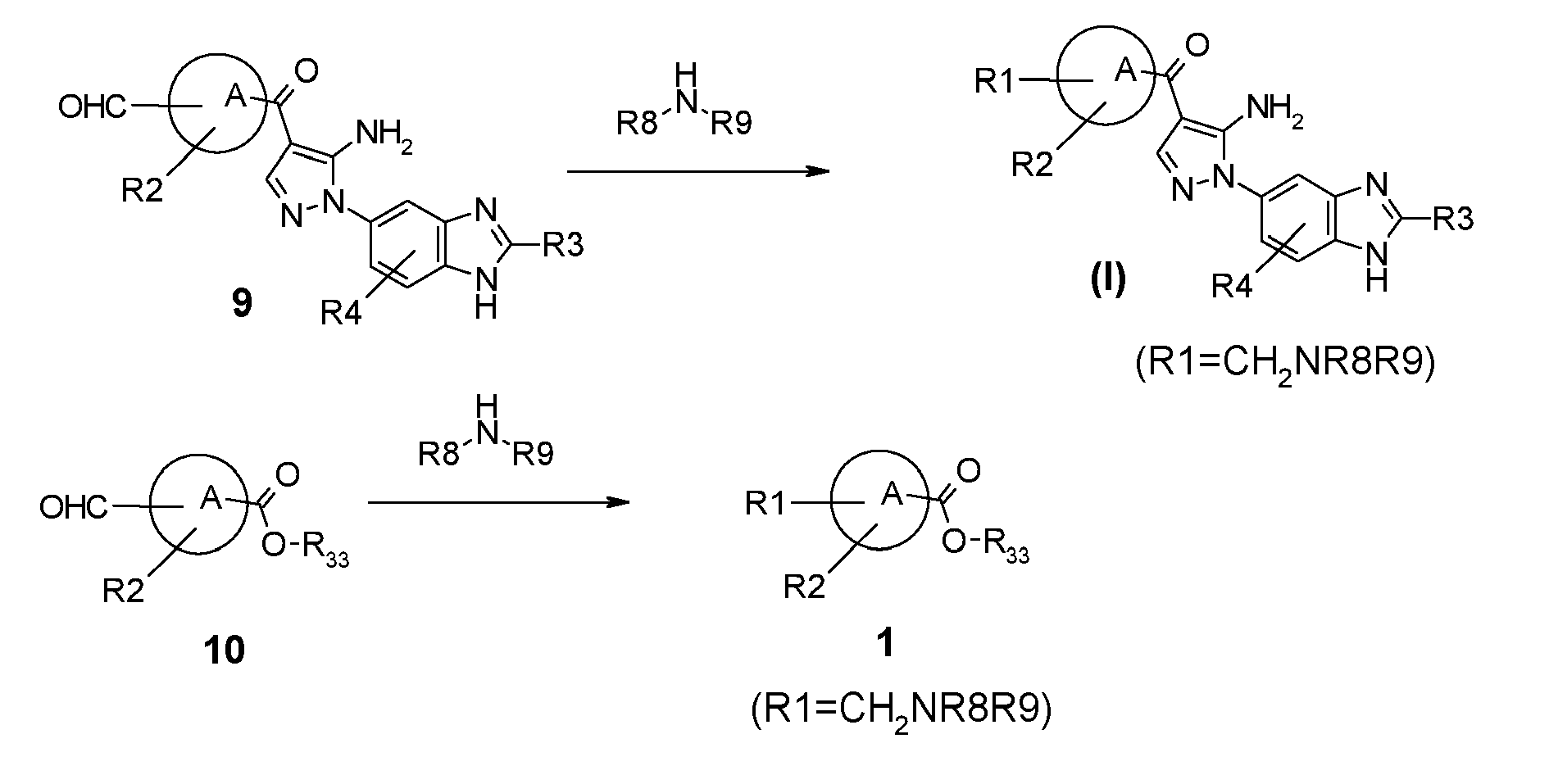
- The compound of formula (I) in which R1 is an aminomethyl group (-(CR8R9)nZ1, Rs=R9=H) can be prepared through reductive amination between amine (NHR8R9) and the compound of formula (9) having an aldehyde group. Alternatively, an ester of formula (1) in which R1 is an aminomethyl group (-(CR8R9)nZ1, Rs=R9=H) can be prepared through reductive amination between amine (NHR8R9) and an ester of formula (10) having an aldehyde group. The compound of formula (I) in which R1 is an aminomethyl group (-(CR8R9)nZ1, Rs=R9=H) can be obtained by the same method as in scheme A using the ester of formula (1) in which R1 is an aminomethyl group (-(CR8R9)nZ1, R8=R9=H).
- In general, reductive amination can be carrired out with aldehyde and amine (NHR8R9) using a reducing agent (for example, sodium triacetoxyborohydride, sodium cyanoborohydride, or sodium borohydride) in a solvent (for example, dichloromethane, 1,2-dichloroethane, or methanol), in the presence of an acid (for example, acetic acid) in some cases, at from 0°C to room temperature.

- The compound of formula (I) in which R1 is an amide (CONR12R13) can be prepared by reacting the carboxylic acid of formula (11) with an amine (NHR12R13) in the presence of a condensation agent.
- In general, amide synthesis is be achieved by converting carboxylic acid into acyl halide or activated ester using a halogenating agent (for example, thionyl chloride or oxalyl chloride) or an activator (for example, ethyl chloroformate), respectively, and then reacting it with an amine (NHR12R13) in a solvent (for example, tetrahydrofuran, dimethylformamide, or dichloromethane).
- Alternatively, amide synthesis is achieved by synthesizing an active ester from carboxylic acid using a condensation agent (for example, dicyclohexylcarbodiimide) in the presence of a base (for example, triethylamine) in a solvent (for example, tetrahydrofuran, dimethylformamide, or dichloromethane), and then treating the resulting active ester with an amine (NHR12R13).

- The compound of formula (I) in which R1 is sulfide (-SR14) can be prepared by reacting thiol with the compound of formula (8) having halogen in the presence of a base (for example, cesium carbonate, lithium hexamethyldisilazide or potassium phosphate) and a catalyst (for example, copper iodide, or palladium acetate) in a solvent (for example, dimethylsulfoxide or 1,2-dimethoxyethane) under heat.
- The ester of formula (1) in which R1 is sulfide (-SR14) can be prepared by reacting thiol with the ester of formula (12) having halogen in the presence of a base (for example, cesium carbonate, lithium hexamethyldisilazide or potassium phosphate) and a catalyst (for example, copper iodide, or palladium acetate) in a solvent (for example, dimethylsulfoxide or 1,2-dimethoxyethane) with heating.
- Alternatively, the ester of formula (1) can be prepared by reacting the ester of formula (12) with a base (for example, n-butyl lithium) at a low temperature (-80 to 0°C) in a solvent (for example, diethyl ether or tetrahydrofuran), and then reacting it with alkylsulfide or dialkyldisulfide. The ester of formula (1) in which R1 is sulfide (-SR14) can be used to prepare the compound of formula (I) in which R1 is sulfide (-SR14) by the same method as in scheme A.

- The compound of formula (I) in which R1 is sulfoxide (-SO2R15) can be prepared by treating the compound of formula (13) having a sulfide group (-SR15) with an oxidizing agent (for example, m-chloroperbenzoic acid, oxon, or hydrogen peroxide) in a solvent (for example, dichloromethane, methanol, or water).

- The compound of formula (I) in which R1 is sulfone (-SO2R16) can be prepared by treating the compound of formula (14) having sulfide (-SR16) with an oxidizing agent (for example, m-chloroperbenzoic acid, oxon, or hydrogen peroxide) in a solvent (for example, dichloromethane, methanol, or water).
- The ester of formula (1) in which R1 is sulfone (-SO2R16) can be prepared by treating the sulfide of formula (15) with an oxidizing agent (for example, m-chloroperbenzoic acid, oxon, or hydrogen peroxide) in a solvent (for example, dichloromethane, methanol, or water). The ester of formula (1) in which as R1 is sulfone (-SO2R16) can be used to prepare the compound of formula (I) in which R1 is sulfone (-SO2R16) by the same method as in scheme A.

- The compound of formula (I) in which R1 is alkylsufonamide (-NR17SO2R18) can be prepared by reacting the compound of formula (8) in which R1 is halogen with alkyl or arylsufonamide (HNR17SO2R18) in the presence of a metal such as copper. Alternatively, it can be prepared by reacting the compound of formula (16) having an amino group (-NHR17) with an alkyl or arylsulfonyl halide.
- Alternatively, the ester of formula (1) in which R1 is alkylsufonamide (-NR17SO2R18) can be prepared by reacting the ester of formula (12) having halogen with alkyl or arylsufonamide (HNR17SO2R18) in the presence of a metal such as copper. Alternatively, it can be prepared by reacting the ester of formula (17) having an amino group (-NHR17) with alkyl, arylsulfonyl halide, or such. The ester of formula (1) in which R1 is alkylsufonamide (-NR17SO2R18) can be used to prepare the compound of formula (I) in which R1 is alkylsufonamide (-NR17SO2R18) by the same method as in scheme A.
- In general, the synthesis from a halogen compound is achieved by reacting a halogen compound with alkyl or arylsufonamide in the presence of a base (for example, cesium carbonate or potassium phosphate), a catalyst (for example, palladium acetate or copper iodide), and, in some cases, a ligand (for example, tri-t-butylphosphine or N,N-dimethylglycine) in a solvent (for example, dioxane, toluene, or dimethylformamide) with heating.
- In general, the synthesis from an amine compound is achieved by reacting an amine compound with alkyl or arylsulfonyl halide in the presence of a base (for example, triethylamine) in a solvent (for example, dichloromethane).
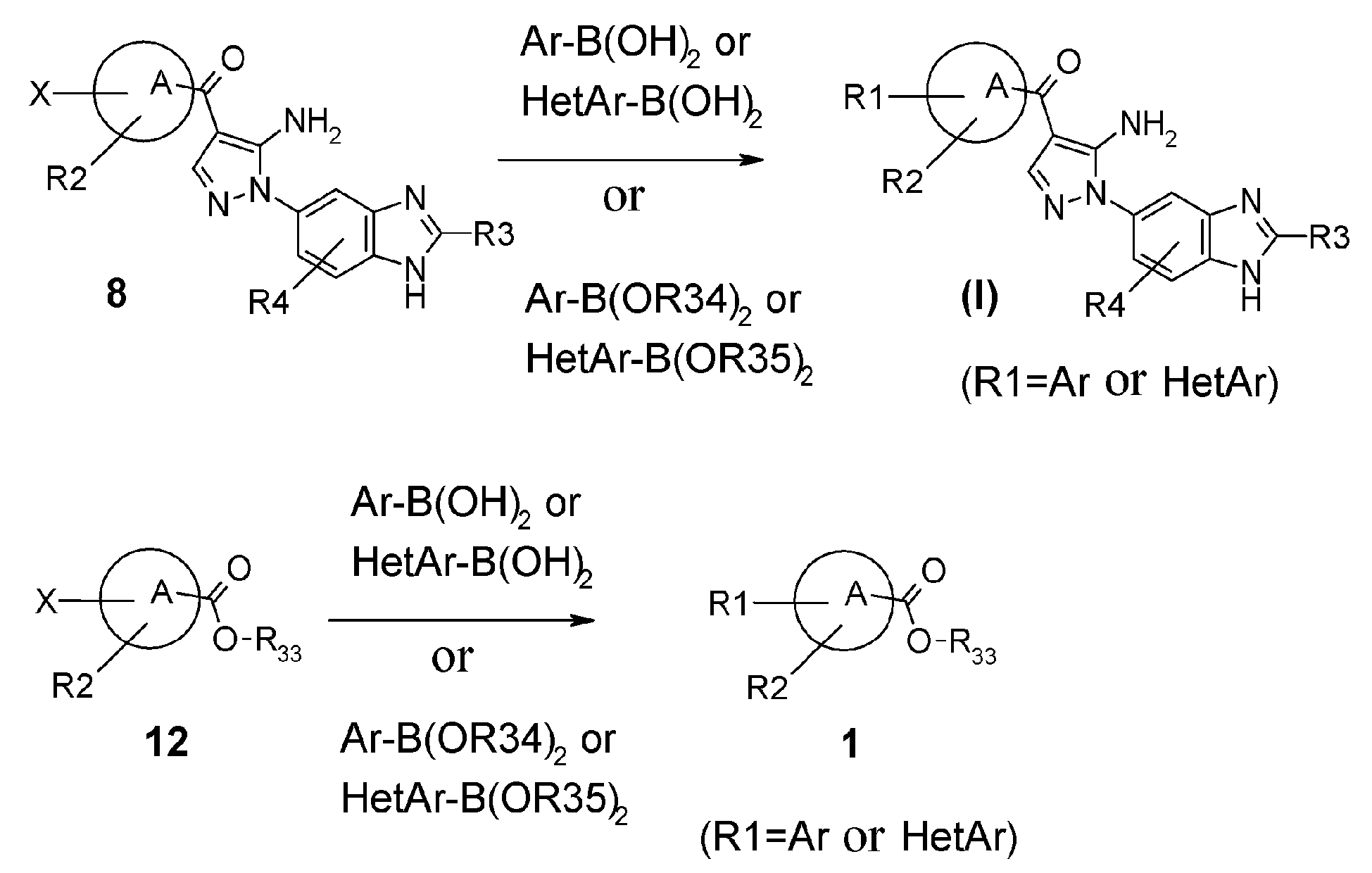
- The compound of formula (I) in which R1 is aryl or heteroaryl can be prepared through Suzuki coupling reaction between the compound of formula (8) having halogen and aryl boronic acid, heteroaryl boronic acid, aryl boronic acid ester, or heteroaryl boronic acid ester.
- Alternatively, the ester of formula (1) in which R1 is aryl or heteroaryl can be prepared through Suzuki coupling reaction between the ester of formula (12) having halogen and aryl boronic acid, heteroaryl boronic acid, aryl boronic acid ester, or heteroaryl boronic acid ester. The ester of formula (1) in which R1 is aryl or heteroaryl can be used to prepare the compound of formula (I) in which R1 is aryl or heteroaryl by the same method as in scheme A.
- In general, Suzuki coupling reaction is conducted by heating aryl halide or heteroaryl halide together with aryl boronic acid, heteroaryl boronic acid, aryl boronic acid ester, or heteroaryl boronic acid ester in the presence of a base (for example, potassium phosphate or cesium carbonate) and a catalyst (for example, palladium acetate or tetrakistriphenylphosphine) in a solvent (for example, dioxane or toluene).

- The compound of formula (I) in which R1 is a cyano group can be prepared by reacting the compound of formula (8) having halogen (X) with a cyanide such as copper cyanide.
- In general, cyanidation is carried out by heating a halogen compound, alkylsulfonyloxy compound, or arylsulfonyloxy compound together with a cyanidating agent (for example, copper (I) cyanide or potassium cyanide) in a solvent (for example, dimethylformamide or N-methylpyrrolidone).

- The compound of formula (I) in which R1 is an alkyl group can be prepared through Suzuki reaction between the compound of formula (8) having halogen and alkylboronic acid, alkylboronic acid ester, or a boron trifluoride-alkyl complex.
- The ester of formula (1) in which R1 is an alkyl group can be prepared through Suzuki reaction between the ester of formula (12) having halogen and alkylboronic acid, alkylboronic acid ester, or a boron trifluoride-alkyl complex. The ester of formula (1) in which R1 is an alkyl group can be used to prepare the compound of formula (I) in which R1 is an alkyl group by the same method as in scheme A.
- In general, Suzuki reaction is conducted by heating a mixture of a halogen compound, a boron derivative (for example, alkylboronic acid, alkyl boronic acid ester, or boron trifluoride-alkyl complex), and a base (for example, potassium carbonate or potassium phosphate) in a solvent (for example, xylene, toluene, dimethylformamide, dioxane, or tetrahydrofuran) in the presence of a palladium catalyst (for example, palladium acetate) and, in some cases, a ligand (for example, triphenylphosphine).

- The compound of formula (I) in which R1 is a perfluoroalkyl group can be prepared by reacting the compound of formula (8) having halogen with a perfluoroalkylating agent.
- The ester of formula (12) in which R1 is a perfluoroalkyl group can be prepared by reacting the ester of formula (11) having halogen with a perfluoroalkylating agent. The ester of formula (1) in which R1 is a perfluoroalkyl group can be used to prepare the compound of formula (I) in which R1 is a perfluoroalkyl group by the same method as in scheme A.
- In general, perfluoroalkylation is achieved by reacting a halogen compound, copper (for example, copper or copper (I) iodide), a perfluoroalkylating agent (such as potassium perfluoroalkyl carboxylate, triethylsilyl perfluoroalkyl, or perfluoroalkyl iodide) in a solvent (for example, dimethylsulfoxide or dimethylformamide) under heat.

- The compound of formula (I) in which R1 is an alkynyl group can be prepared through Sonogashira reaction of the compound of formula (8) having halogen.
- The ester of formula (1) in which R1 is an alkynyl group can be prepared through Sonogashira reaction of the ester of formula (12) having halogen. The ester of formula (1) in which R1 is an alkynyl group can be used to prepare the compound of formula (I) in which R1 is an alkynyl group by the same method as in scheme A.
- In general, Sonogashira reaction is conducted by reacting aryl halide or heteroaryl halide with an alkynylating agent (for example, trimethylsilylacetylene) in the presence of a base (for example, triethylamine or potassium carbonate), a copper catalyst (for example, copper (I) iodide), and a palladium catalyst (for example, bis(triphenylphosphine)palladium dichloride) in a solvent (for example, tetrahydrofuran or toluene) under heat.

- The compound of formula (I) in which R1 is a carboxyl group can be prepared through a reaction for introducing carbon monoxide into the compound of formula (8) having halogen.
- The ester of formula (1) in which R1 is a carboxyl group can be prepared through a reaction for introducing carbon monoxide into the ester of formula (12) having halogen. The ester of formula (1) in which R1 is a carboxyl group can be protected at the carboxyl group (for example, tert-butyl ester) and then used to prepare the compound of formula (I) in which R1 is a carboxyl group by the same method as in scheme A.
- In general, the introduction of carbon monoxide is achieved by reacting aryl halide or heteroaryl halide in the presence of a base (for example, triethylamine or sodium carbonate), a palladium catalyst (for example, palladium acetate), and a ligand (for example, triphenylphosphine) in a solvent (for example, dimethylsulfoxide or water) under a carbon monoxide atmosphere. Alternatively, the introduction is achieved by reacting aryl halide or heteroaryl halide with a base (for example, n-butyl lithium) in a solvent (for example, diethyl ether or tetrahydrofuran) at a low temperature (-80 to 0°C), and then reacting carbon monoxide therewith.

- The compound of formula (I) in which R1 is a hydroxyl group can be prepared through dealkylation of the compound of formula (18) having a methoxy group or benzyloxy group.
- In general, demethylation of methoxy group is achieved by reacting a mixture of a methoxy compound and a solvent (for example, dichloromethane) with a Lewis acid (for example, boron trifluoride or aluminum chloride). Alternatively, the demethylation is achieved by reacting the methoxy compound in the presence of pyridine hydrochloride with heating.
- In general, debenzylation of benzyloxy group is achieved through a reaction in the presence of a catalyst (for example, palladium carbon or palladium hydroxide) in a solvent (for example, methanol) under a hydrogen atmosphere.

- The compound of formula (I) in which R1 is an aliphatic heterocyclyl can be prepared through Suzuki coupling reaction of the compound of formula (8) having halogen with aliphatic heterocyclyl boronic acid or aliphatic heterocyclyl boronic acid ester.
- The ester of formula (1) in which R1 is an aliphatic heterocyclyl can be prepared through Suzuki coupling reaction of the ester of formula (12) having halogen with aliphatic heterocyclyl boronic acid or aliphatic heterocyclyl boronic acid ester. The resulting ester of formula (1) in which R1 is an aliphatic heterocyclyl can be used to prepare the compound of formula (I) in which R1 is an aliphatic heterocyclyl by the same method as in scheme A.
- In general, Suzuki coupling reaction of aliphatic heterocyclyl is achieved by reacting aryl halide or heteroaryl halide with aliphatic heterocyclyl boronic acid or aliphatic heterocyclyl boronic acid ester in the presence of a base (for example, potassium phosphate) and a palladium catalyst (for example, tetrakistriphenylphosphine) in a solvent (for example, dioxane or water) under heat.

- The compound of formula (I) in which R1 is acyloxy (-OC(O)R21) can be prepared through acylation between the compound of formula (6) in which R1 is a hydroxy group and acyl halide or carboxylic anhydride.
- In general, acylation of hydroxyl group is achieved by reacting a hydroxy compound and acyl halide or anhydrous carboxylic acid in the presence of a base (for example, triethylamine) in a solvent (for example, dichloromethane or pyridine).

- The compound of formula (I) having carbamide (-NR22C(O)R23) as R1 can be prepared by acylation of the compound of formula (19) having an amino group (-NHR22).
- The ester of formula (1) having carbamide (-NR22C(O)R23) as R1 can be prepared by acylation of the ester of formula (20) having an amino group (-(NHR22).
- In general, acylation of an amino group is achieved by reacting an amine compound with acyl halide or carboxylic anhydride in the presence of a base (for example, triethylamine) in a solvent (for example, dichloromethane or pyridine). Alternatively, acylation is achieved by reacting an amine compound with carboxylic acid in the presence of a base (for example, triethylamine) and a condensation agent (for example, dicyclohexylcarbodiimide) in a solvent (for example, tetrahydrofuran or dichloromethane).

- The compound of formula (I) having aldehyde (C(O)R19; R19=H) or ketone (C(O)R19; R19 is other than H) as R1 can be prepared by a reaction for introducing a carbonyl source into the compound of formula (8) having halogen.
- In general, in aldehyde synthesis, the reaction for introducing a carbonyl source is achieved by heating a halogen compound in the presence of a catalyst (for example, palladium acetate or tetrakis(triphenylphosphine) palladium), a base (for example, sodium carbonate or triethylamine), and a reducing agent (for example, triethylsilane) in a solvent (for example, tetrahydrofuran or N,N-dimethylformamide), in a carbon monoxide atmosphere under ambient or elevated pressure. Meanwhile, in ketone synthesis, the reaction for introducing a carbonyl source is achieved using aldehyde, enol ether derivative, hydrazone derivative, or the like, instead of carbon monoxide, as a carbonyl source.
- Alternatively, the reaction is achieved by halogen/metal exchange of a halogen compound using a base (for example, tert-butyl lithium), followed by reaction with a carbonyl source (for example, N,N-dimethylformamide, N,N-dimethylalkylamide, or carboxylic acid ester).

- The compound of formula (I) having thioamide (-NR24C(S)R25) as R1 can be prepared by treating the compound of formula (21) having amide (-NR24C(O)R25) with a sulfurizing agent (for example, Lawesson's reagent). Alternatively, the compound of formula (I) can be prepared by a reaction between the compound of formula (22) having an amino group (NHR24) and thiocarboxylic acid ester.
- In general, thiocarbonylation is achieved by reacting, with heating, a carbamide compound with a sulfurizing agent (for example, Lawesson's reagent) in a solvent (for example, toluene).
- The reaction between the compound of formula (22) having an amino group (NHR24) and thiocarboxylic acid ester is achieved by reacting, with heating, an amine compound with thiocarboxylic acid ester in a solvent (for example, methanol).

- The compound of formula (I) having thioamide (-C(S)NR26R27) as R1 can be prepared by treating the compound of formula (23) having amide (-C(O)NR26R27) with a sulfurizing agent (for example, Lawesson's reagent). Alternatively, the compound of formula (I) can be prepared by a reaction between a thioisocyanate derivative and the compound of formula (8) having halogen.
- In general, thiocarbonylation is achieved by reacting, with heating, a carbamide compound with a sulfurizing agent (for example, Lawesson's reagent) in a solvent (for example, toluene).
- In general, the reaction with a thioisocyanate derivative is carried out by treatment of a halogen compound with a base (for example, t-butyl lithium) in a solvent (for example, tetrahydrofuran or diethyl ether) at a low temperature (for example, -80 to 0°C), and then reaction with a thioisocyanate derivative.

- The compound of formula (I) having sulfonamide (-SO2NR28R29) as R1 can be prepared by conversion of the compound of formula (24) having sulfonic acid into sulfonyl halide using a halogenating agent (for example, thionyl chloride or phosphorus oxychloride), followed by reaction with amine (NHR28R29) in the presence of a base (for example, triethylamine) in a solvent (for example, dichloromethane or pyridine).

- The compound of formula (I) having sulfonic acid ester (-OSO2R30) as R1 can be prepared by reacting the compound of formula (6) having a hydroxyl group with sulfonyl halide (R3oSO2X) or sulfonic acid anhydride ((R30SO2)O) in the presence of a base (for example, triethylamine, pyridine, or sodium hydride) in a solvent (for example, dichloromethane or dimethylformamide).
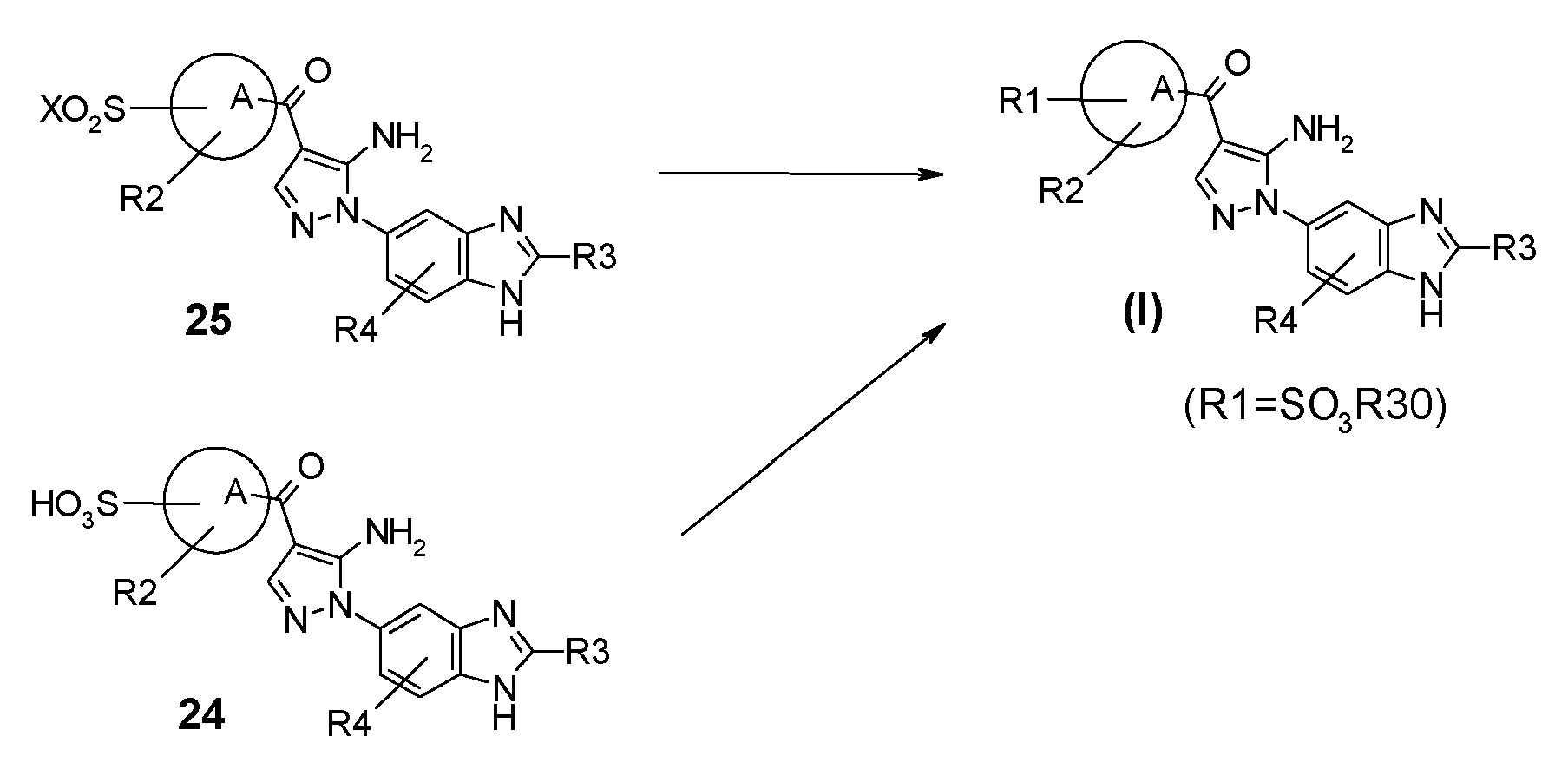
- The compound of formula (I) having sulfonic acid ester (-SO3R31) as R1 can be prepared by reacting the compound of formula (25) having sulfonyl halide as R1 with alcohol (R31OH) in the presence of a base (for example, triethylamine or 4-dimethylaminopyridine) in a solvent (for example, dichloromethane or diethyl ether).
- Alternatively, the compound of formula (I) can be prepared by reacting the compound of formula (24) having sulfonic acid as R1 with alcohol (R31OH) in the presence of a base (for example, triethylamine, 4-dimethylaminopyridine, or sodium hydride) or a catalyst (for example, cobalt chloride), in a solvent (for example, dichloromethane or diethyl ether). Alternatively, the compound of formula (I) can be prepared by reacting the compound of formula (24) having sulfonic acid as R1 with a halogen compound (R31X) in a solvent (for example, acetonitrile).

- The compound of formula (I) having a trialkylsilyl group (-Si(R32)3) as R1 can be prepared by treatment of the compound of formula (8) having halogen with a base (for example, n-butyl lithium) in a solvent (for example, tetrahydrofuran) at a low temperature (-80 to 0°C), followed by treatment with trialkyl halide (XSi(R32)3).

- The ester of formula (1) having indole as ring A is commercially available, or can be prepared by methods well-known in the art, for example, methods (1) to (3) described below.

- The indole of formula (27) having an alkoxycarbonyl group (C(O)OR33) can be prepared by alkoxycarbonylation of the indole compound of formula (26) which is protected by an alkylsulfonyl or aryl sulfonyl group.
- In general, alkoxycarbonylation is achieved by reacting a base (for example, lithium diisopropyl amide) with the indole compound of formula (26) which is protected by an alkylsulfonyl or aryl sulfonyl group, in a solvent (for example, tetrahydrofuran), and then reacting this with a carbonyl source (for example, ethyl chloroformate).

- The indole of formula of (29) having an alkoxycarbonyl group (C(O)OR33) can be prepared as follows: pyruvate ester is reacted with the hydrazine derivative of formula (28) in a solvent (for example, methanol or ethanol) under an acidic condition (for example, in hydrochloric acid or acetic acid) to produce a hydrazone derivative; and this hydrazone derivative is reacted in a solvent (for example, ethanol, dichloromethane, or toluene) under an acidic condition (for example, in hydrochloric acid or methanesulfonic acid).

- The indole of formula (29) having an alkoxycarbonyl group (C(O)OR33) can be prepared by heating the o-ethynyl aniline derivative of formula (30) in the presence of a catalyst (for example, copper acetate) in a solvent (for example, dichloroethane) as described in Hiroya, K. et al. (J. Org. Chem., 69, 1126, (2004)) or Hiroya, K. et al. (Tetrahedron Letters, 43, 1277, (2002)).

- The ester of formula (1) having azaindole as ring A is commercially available, or can be prepared by methods well-known in the art, for example, by methods (4) to (7) described below.

- The azaindole of formula of (32) having an alkoxycarbonyl group (C(O)OR33) can be prepared as follows: pyruvate ester is reacted with the aminohalopyridine of formula (31) in a solvent (for example, pyridine) as described in Lachance, N. et al., Synthesis, 15, 2571, (2005); and the resulting enamine is heated in the presence of a palladium catalyst (for example, tetrakis(triphenylphosphine)palladium) and a base (for example, dicyclohexylmethylamine).

- The azaindole of formula (32) having an alkoxycarbonyl group (C(O)OR33) can be prepared as described in Romanelli, M. N. et al., Arkivoc, 286, (2004) by synthesis of the intermediate of formula (34) by reacting oxalic acid ester with the methylnitropyridine of formula (33) in the presence of a base (sodium ethoxide or such) in a solvent (for example, ethanol); followed by catalytic reduction under a hydrogen atmosphere.

- The azaindole of formula (32) having an alkoxycarbonyl group (C(O)OR33) can be prepared by thermal decomposition of the 2-azido-3-pyridine acrylic acid ester of formula (35) in a solvent (for example, mesitylene) by heating as described in Roy, P. J. et al., Synthesis, 16, 2751, (2005).

- The azaindole of formula (37) having an alkoxycarbonyl group (C(O)OR33) can be prepared by alkoxycarbonylation of the azaindole compound of formula (36) which is protected by an alkylsulfonyl group or aryl sulfonyl group.
- In general, alkoxycarbonylation of azaindole at position 2 is achieved as follows: a base (for example, lithium diisopropyl amide) is reacted with the azaindole compound of formula (36) which is protected by an alkylsulfonyl group or aryl sulfonyl group, in a solvent (for example, tetrahydrofuran); and then this is reacted with a carbonyl source (for example, ethyl chloroformate).

- The ester of formula (1) in which A is a pyrrole ring, and either one or both of R1 and R2 are aryl or heteroaryl group(s) can be prepared by Suzuki coupling reaction between the monobromopyrrole of formula (38) or dibromopyrrole of formula (39), and aryl boronic acid, heteroaryl boronic acid, aryl boronic acid ester, or heteroaryl boronic acid ester.

- The benzimidazolyl-5-hydrazine of formula (5) is commercially available, or can be prepared by methods well-known in the art, for example, by methods (8) to (11) described below.

- The benzimidazolyl-5-hydrazine of formula (5) can be prepared by methods well-known in the art.
- The 5-nitrobenzimidazole of formula (41) is prepared by reacting the 4-nitro-1,2-phenylenediamine of formula (40) with carboxylic acid (R3COOH), aldehyde (R3CH0), orthocarboxylic acid triester (R3C(OR)3), or acyl halide (R3COX) under an acidic condition (for example, in hydrochloric acid or sulfuric acid), or in the presence of Lewis acid (for example, boron trifluoride/diethyl ether complex or dichlorooxozirconium (IV)), in a solvent (for example, methanol or xylene).
- The aniline derivative of formula (42) is prepared by catalytic reduction of the prepared compound of formula (41) under a hydrogen atmosphere in the presence of a catalyst (for example, palladium carbon or palladium hydroxide) in a solvent (for example, methanol or ethanol).
- The 5-bezimidazolyl-5-hydrazine of formula (5) is prepared by subsequent diazotization under an acidic condition (for example, in hydrochloric acid) and reduction using tin (II) chloride or such (for example, tin (II) chloride). Meanwhile, the 5-nitrobenzimidazole of formula (41) can also be prepared by nitration of the benzimidazole of formula (43).
- Functional groups can be modified, for example, by methods described in "Smith and March, March's Advanced Organic Chemistry (Fifth ed., John Wiley & Sons, 2001)" or "Richard C. Larock, Comprehensive Organic Transformations (VCH Publishers, Inc., 1989)". Compounds used as a material for the production may be those commercially available, or as necessary, may be produced by conventional methods.
- Alternatively, the compound of formula (46) was prepared by introducing a protecting group into the benzimidazole moiety of the 5-halobenzimidazole of formula (44) in the reaction system. The protecting group used is preferably a group that can be readily and selectively removed for deprotection in subsequent steps. Methods of selection of protecting groups and deprotection are described, for example, in Greene and Wuts, Protective Groups in Organic Synthesis (third ed., John Wiley & Sons, 1999). The methods are appropriately used depending on the reaction condition. For example, a dimethoxymethyl group, trimethylsilyl group, p-methoxybenzyl group, tetrahydropyranyl group, formyl group, benzenesulfonyl group or such can be introduced as a protecting group under acidic or basic conditions. When a protecting group is introduced, acids are preferably used in a range of about 1% to about 1 equivalent. The acids include inorganic acids such as hydrochloric acid; sulfuric acid or sulfonic acids such as toluenesufonic acid; carboxylic acids such as acetic acid, propionic acid, and benzoic acid; salts of strong acids such as pyridinium toluenesulfonate; and substances that generate hydrochloric acid in the reaction system, such as trimethylsilyl chloride. In addition to the above Brönsted acids, Lewis acids such as metal halides including zinc chloride, magnesium chloride, and lithium chloride are also effectively used in the reaction for introducing protecting groups. When a protecting group is introduced, bases are preferably used at one equivalent or more; or in some cases, at an excess amount such as about three equivalents. The bases preferably used include metal hydrides such as sodium hydride and potassium hydride; metal carbonates such as potassium carbonate and cesium carbonate; and metal alcoholates such as potassium t-butoxide and sodium t-butoxide.
- Then, a base was added for halogen/metal exchange reaction to produce an intermediate in which the halogen group of formula (46) is replaced with a metal. Alkyl lithium or alkyl magnesium halide is preferably used as the base. More preferred bases include lower alkyl magnesium halides such as isopropyl magnesium chloride, isopropyl magnesium bromide, sec-butyl magnesium chloride, and cyclohexyl magnesium chloride. Solvents that ensure the stability of metal reagents in the reaction system are preferably used in the halogen/metal exchange reaction. The solvents include, for example, ether solvents such as diethyl ether, dimethoxy ethane, and tetrahydrofuran. A reaction temperature that ensures the stability of metal reagents in the reaction system is preferred. Considering known halogen/metal exchange reactions described in documents, the preferred temperature ranges from about -80°C to room temperature, more preferably from about -78°C to 15°C. The bases used herein are in solutions commercially available, or prepared using alkyl halides and metal lithium or metal magnesium. An intermediate resulting from replacement of the halogen group of formula (46) with a metal is treated with an azodicarboxylic acid derivative (for example, azodicarboxylic acid di-tert-butyl ester or azodicarboxylic acid diethyl ester) to obtain the compound of formula (47). Then, the benzimidazole-protecting group is removed for deprotection to provide the protected hydrazine of formula (45). The protected hydrazine of formula (45) can be purified and isolated from the reaction solution as a free form or a salt with an appropriate acid. The appropriate acids include not only inorganic acids such as hydrochloric acid, hydrobromic acid, and sulfuric acid, but also any acids that are effective in the crystallization and purification. The acids include, for example, sulfonic acids such as methanesulfonic acid and toluenesulfonic acid, and carboxylic acids such as acetic acid, benzoic acid, malic acid, maleic acid, and fumaric acid. Finally, the hydrazine-protecting group is removed for deprotection to provide the benzimidazolyl hydrazine of formula (5). The deprotection may be carried out under known acidic or basic conditions described in documents. Acids used in the deprotection include not only inorganic acids such as hydrochloric acid, hydrobromic acid, and sulfuric acid, but also strong acids including carboxylic acids such as trifluoroacetic acid and pentafluoropropionic acid, and sulfonic acids such as methanesulfonic acid and toluenesulfonic acid. As necessary, the reaction solution can be diluted with an appropriate solvent, and the deprotection can be carried out. The solvents preferably used herein include amide solvents such as DMF, DMA, and NMP. The benzoimidazolyl hydrazine of formula (5) of interest can be produced by treatment in such a solvent at a temperature ranging from about ice-cold temperature to the boiling point of the solvent. Meanwhile, bases suitably used in the deprotection include alkyl metal hydroxides such as sodium hydroxide and potassium hydroxide, alkyl metal carbonates such as sodium carbonate and potassium carbonate. The benzoimidazolyl hydrazine of formula (5) of interest can be produced by treatment in the presence of such a base in alcohol such as methanol or ethanol at a temperature ranging from about ice-cold temperature to the boiling point of the solvent.
- Alternatively, the benzimidazole moiety of the 5-halobenzimidazole of formula (44) is protected with an above-described protecting group in the reaction system to provide the compound of formula (46). This is then heated in the presence of a hydrazine derivative (for example, di-tert-butyloxycarbonyl hydrazine), a base (for example, cesium carbonate or potassium carbonate), a transition metal catalyst (for example, palladium acetate, copper iodide, or copper bromide), a ligand (for example, triphenylphosphine, N,N-dimethyl glycine, or N,N'-dimethyl ethylene diamine), in a solvent (for example, N,N-dimetylacetamide). Thus, the compound of formula (47) is obtained. Then, the benzimidazole-protecting group is removed for deprotection to provide the protected hydrazine of formula (45). Finally, the hydrazine-protecting group is removed for deprotection by the method as described above to provide the benzimidazolyl hydrazine of formula (5).
- Alternatively, the boronic acid derivative of formula (48) and a hydrazine derivative (for example, di-tert-butyloxycarbonyl hydrazine or azodicarboxylic acid di-tert-butyl ester) is stirred in the presence of a base (for example, tetramethyl ethylene diamine), a copper catalyst (for example, copper iodide, copper fluoride, or copper acetate) in a solvent (for example, methanol, tetrahydrofuran, or 1 ,2-dimethoxyethane) under a nitrogen atmosphere or in the air, at a temperature ranging from about room temperature to the boiling point of the solvent. Thus, the protected hydrazine of formula (45) is obtained. Finally, the hydrazine-protecting group is removed for deprotection by the method as described above to provide the benzimidazolyl hydrazine of formula (5).
- The present invention is more specifically described below with reference to the Examples and test examples, but it is not to be construed as being limited thereto. All the starting materials and reagents were obtained from commercial suppliers or synthesized by known methods. Typically, 1H-NMR spectra were obtained by measurement, with or without Me4Si as an internal reference, using EX270 (JEOL), Mercury300 (Varian), ECP-400 (JEOL), or 400-MR (Varian) (s = singlet; d = doublet; t = triplet; brs = broad singlet; m= multiple). Mass spectrometric measurements were carried out using the mass spectrometer LCQ Classic (Thermo Electron), ZQ2000 (Waters), or ZMD4000 (Waters). Microwaves were generated using Initiator™ (Biotage).
-

- An aqueous solution (1.67 ml) of 4 M sodium hydroxide was added to an ethanol solution (17 ml) of [5-amino-1-(2-methyl-1H-benzimidazol-5-yl)-1H-pyrazol-4-yl]-(1-benzenesulfonyl-1H-indol-2-yl) methanone (87 mg). The resulting mixture was stirred at room temperature for 2 hours. The reaction mixture was poured into water. The resulting solid was collected by filtration, washed with water, and dried to give [5-amino-1-(2-methyl-1H-benzimidazol-5-yl)-1H-pyrazol-4-yl]-(1H-indol-2-yl) methanone (40 mg, 63%).
1H-NMR (DMSO-D6) δ: 12.47 (1H, s), 11.70 (1H, s), 8.32 (1H, s), 7.70 (1H, d, J = 8.0 Hz), 7.66-7.55 (2H, m), 7.50-7.45 (2H, m), 7.31-7.23 (2H, m), 7.10-7.06 (1H, m), 7.01 (2H, brs), 2.53 (3H, s)
ESI (LC-MS positive mode) m/z 357 [(M+H)+] -

- Predetermined amounts of L-malic acid (68 g, 0.507 mol) and [5-amino-1-(2-methyl-3H-benzimidazol-5-yl)-1H-pyrazol-4-yl]-(1H-indol-2-yl)-methanone hydrate (190 g, 0.507 mol) were dissolved in dimethyl sulfoxide (0.418 1, 2.2 v/w) and acetone (0.4181, 2.2 v/w). Then, the resulting solution was filtered using a Kiriyama rohto (No. 4 paper filter), and placed into a 10-1 separable flask with a jacket. The reaction solution was heated at 50°C for dissolution.
- A predetermined amount of L-malic acid (544.4 g, 4.06 mol) was dissolved in acetone (1.25 1, 6.6 v/w) and acetic acid (0.418 1, 2.2 v/w). Then, the resulting solution was filtered using a Kiriyama rohto (No. 4 paper filter), and placed into a 10-1 separable flask with a jacket while keeping the inner temperature at 45°C or higher. The seed crystal (0.95 g, 0.5%) was suspended in acetone (7.5 ml), and then this was placed into a 10-1 separable flask with a jacket.
- After seven hours, the suspension was cooled to 25°C. The crystals were collected by filtration using a Kiriyama rohto, and washed twice with acetone (0.851, 5 v/w). The resulting wet powder was placed into a 10-1 separable flask with a jacket.
- Acetone (2.85 1, 15 v/w) was added into the flask, and the suspension was stirred for three hours at 50°C. The resulting crystals were collected by filtration using a Kiriyama rohto, and washed twice with acetone (0.851, 5 v/w).
- The resulting wet powder was dried for three hours under reduced pressure at an outer temperature of 40°C to provide [5-amino-1-(2-methyl-3H-benzimidazol-5-yl)-1H-pyrazol-4-yl]-(1H-indol-2-yl)-methanone L-malate (556.9 g, 73%).
1H-NNM (DMSO-D6) δ: 11.69 (1H, s), 8.31 (1H, s), 8.25-7.00 (10H, m), 4.25-4.22 (1H, m), 3.33 (2H, brs), 2.69-2.32 (9H, m)
FAB positive mode m/z 157.1, 232.1, 289.2, 357.2 [(M+H)+] -

- [5-Amino-1-(2-methyl-1H-benzimidazol-5-yl)-1H-pyrazol-4-yl]-(1H-indol-2-yl)-metha none (194 mg) was dissolved in dimethylformamide (1.94 ml). An aqueous solution of 2 M hydrochloric acid (300 µl) was divided into five portions and separately added dropwise thereto at 25°C. 2-Propanol (4 ml) was divided into three portions and separately added to the reaction solution at five-minute intervals. The resulting precipitate was collected by filtration, and washed with 2-propanol (1 ml). Then, the powder was dried under reduced pressure at 40°C. This yielded an opalescent powder (188 mg, 88%).
11.72 (1H, s), 8.39 (1H, s), 7.96 (1H, d, J = 2.1 Hz), 7.92 (1H, d, J = 8.7 Hz), 7.71 (1H, t, J = 2.1 Hz), 7.68 (1H, t, J = 2.1 Hz), 7.51 (1H, s), 7.48 (1H, d, J = 2.1 Hz), 7.28 (1H, d, J = 7.6 Hz), 7.23 (3H, s), 7.09 (1H, t, J = 7.6 Hz), 2.82 (3H, s).
ESI (LC-MS positive mode) m/z 357 [(M+H)+] -

1H-NMR (DMSO-D6) δ: 11.70 (1H, s), 8.39 (1H, s), 7.99 (1H, d, J = 1.6 Hz), 7.94 (1H, d, J = 8.8 Hz), 7.74-7.68 (2H, m), 7.51-7.46 (2H, m), 7.29-7.18 (3H, m), 7.11-7.06 (1H, m), 2.84 (3H, s), 2.37 (3H, s)
ESI (LC-MS positive mode) m/z 357 [(M+H)+] - The compounds of Examples 2 to 35 listed in Table 1 were synthesized by the same method as in Example 1.
Table 1 Example Structure Compound name m/z 1H-NMR 2 
[5-amino-1-(2-methyl-1H-benzimidazol -5-yl)-1H-pyrazol-4-yl]-(6-pyrrolidin-1 -ylmethyl-1H-indol-2-yl)-methanone 440 1H-NMR (DMSO-D6) δ: 12.46 (1.0H,d, J = 3.9 Hz), 11.62 (1.0H, s), 8.30 (1.0H, d, J = 4.9 Hz), 7.61 (3.0H, m), 7.41 (2.0H, m), 7.29 (1 .0H, t, J = 7.3 Hz), 7.10-6.90 (3.0H, m), 3.66 (2.0H, s), 2.54 (3H, s), 2.48-2.42 (2.0H, m), 1.71 14.0H, m). 3 
[5-amino-1-(2-methyl-1H-benzimidazol-5-yl)-1H-pyrazol-4-yl] -[6-(4-hydroxy-piperidin-1-ylmethyl) -1H-indol-2-yl]-methanone 470 1H-NMR (CD3OD) δ: 8.27 (1.0H, s), 7.70-7.60 (3.0H, m), 7A4 (1.0H, s), 7.40-7.30 (2.0H, m), 7.11 (1.0H, dd, J = 8.1, 1.2 Hz), 3.64 (3.0H, m), 2.90-2.80 (2H, m), 2.61 (3.0H, s), 2.30-2.20 (2.0H, m), 1.90-1.80 (2.0H, m), 1.65-1.50 (2.0H, m). 4 
[5-amino-1-(2-methyl-1H-benzimidazol-5-yl)-1H-pyrazol-4-yl] -(1H-pyrrolo[3,2-c]pyridin-2-yl)-methanone 358 1H-NMR (CD,OD) δ: 9.02-8.98 (1H, m), 8.31 (1H, s), 8.25 (1H, d, J = 6.9 Hz), 7.70-7.65 (2H, m), 7.59-7.56 (1H, m), 7.51 (1H, d, J = 5.9 Hz), 7.39 (1H, dd, J = 8.8, 2.0 Hz), 2.62 (3H,s). 5 
[5-amino-1-(2-methyl-1H-benzimidazol-5-yl)-1H-pyrazol-4-yl] -(6-piperazin-1-ylmethyl-1H-indol-2-yl)-methanone 455 1H-NMR (CD30D) δ: 8.27 (1.0H, s), 7.74-7.68 (3.0H, m), 7.48-7.20 (2.0H, m), 7.36 (1.0H, d, J = 1.0 Hz), 7.13 (1.0H, m), 3.74 (2.0H, m), 3.25-3.20 (4.0H, m), 2.77-2.70 (4.0H, m), 2.66 (3.0H, s). 6 
[5-amino-1-(2-methyl-1H-benzimidazol-5-yl)-1H-pyrazol-4-yl] -[6-(2-morpholin-4-yl-ethoxy)-1H-indol-2-yl]-methanone 486 1H-NMR (DMSO-D6) δ: 12.45 (1.0H, br s), 11.50 (1.0H, br s), 8.27 (1.0H, s), 7.60-7.55 (3.0H. m), 7.40 (1.0H. br s). 7.32.7.28 [1.0H, m), 6.93 (3.0H, br s), 6.75 (1.0H, dd, J = 8.8, 2.4 Hz), 4.11 (2.0H, t, J = 6.9 Hz), 3.60 (4.0H, f, J = 4.6 Hz), 3.34-3.28 (4.0H, m), 2.73 (2.0H, t, J = 5.9 Hz), 2.53 (3.0H, s). 7 
[5-amino-1-(2-methyl-1H-benzimidazol-5-yl)-1H-pyrazol-4-yl] -[6-(tetrahydro-pyran-4-yloxy)-1H-indol-2-yl]-methanone 457 1H-NMR (DMSO-D6) δ: 12.46 (1.0H, br s), 11.44 (1.0H, br s), 8.27 (1.0H, s), 7.61-7.57 (3.0H, m), 7.39 (1.0H, br s), 7.29 (1.0H, d, J = 8.3 Hz), 6.98-6.95 (3.0H, m), 6.79 (1.0H, d, J = 8.8 Hz), 4.59-4.53 (1.0H, m), 3.90-3.85 (2.0H, m), 3.53-3.43 (2.0H, m), 253 (3.0H,s), 2.02. 1 .99 (2.0H, m), 1.68-1.59 (2.0H, m). 8 
[5-amino-1-(2-methyl-1H-benzimidazol-5-yl)-1H-pyrazol-4-yl] -(4-chloro-1H-indol-2-yl)-methanone 391, 393 1H-NMR (DMSO-D6) δ: 12.49 (1H, s), 12.10 (1H, s), 8.32 (1H, d, J = 3.6 Hz), 7.66 (1H, dd, J = 4.9, 3.3 Hz), 7.58 (1H, t, J = 4.0 Hz), 7.47 (1H, d, J = 7.9 Hz), 7.32-7.31 (3H, m), 7.26 (1H, t, J = 7.7 Hz), 7.19(1H, s), 7.16 1H, s), 2.54 (3H, s). 9 
[5-amino-1-(2-methyl-1H-benzimidazol-5-yl)-1H-pyrazol-4-yl] -(5-bromo-1H-indol-2-yl)-methanone 435,437 1H-NMR (DMSO-D6) δ: 12.48 (1H, s), 11.93 (1H, s), 8.28 (1H, s), 7.88 (1H, d, J = 1.5 Hz), 7.63-7.59 (2H, m), 7.47-7.44 (2H, m), 7.37 (1H, dd, J = 8.6, 1.9 Hz), 7.29 (1H, dd, J = 8.6, 1.9 Hz), 7.04 12H, s), 2.54 (3H, s). 10 
[5-amino-1-(2-methyl-1H-benzimidazol-5-yl)-1H-pyrazol-4-yl] -(4-iodo-1H-indol-2-yl)-methanone 483 1H-NMR (DMSO-D6) 6 : 12.23 (1.0H, s), 8.22 (1.0H, s), 7.64-7.57 (2.0H, m), 7..54-7.48 (2.0H, m), 7.29 (1.0H, dd, J = 8.3,1.9 Hz), 7.10-6.95 (3.0H, m), 3.16 (2H, s), 2.53 (3H, s) 11 
2-[5-amino-1-(2-methyl-1H-benzimidazol-5-yl)-1H-pyrazole-4-carbonyl]-1H-indole-5-carbonitrile 382 1H-MMR (DMSO-D6) δ: 12.46 (1.0H, s), 12.26 (1.0H, s), 8.30-8.23 (2.0H, m), 7.60 (5.0H, m), 7.28 (1.0H, d, J = 8.4 Hz), 7.05 (2.0H, m), 2.52 (3.0H, s). 12 
[5-amino-1-(2-methyl-1H-benzimidazol-5-yl)-1H-pyrazol-4-yl] -(6-brotno-5-fluoro-1H-indol-2-yl)-methanone 453, 455 1H-MMR (DMSO-D6) δ: 12.16 (1.0H, s), 8.28 (1.0H, s), 7.73 (1.0H, m), 7.63-7.60 (3H, m), 7.44 (1.0H, s), 7.27 (1.0H, m), 7.05 (2,OH, br s), 2.53 (3H, s). 13 
[5-amino-1 -(2-methyl- 1H-benzimidazol-5-yl)-1-H-pyrazol-4-yl] -(5-ethynyl-1H-indol-2-yl)-methanone 381 1H-NMR (DMSO-D6) δ: 12.45 (1.0H, s), 11.91 (1.0H, s), 8.29 (1.1H, s), 7.85 (1.0H, s), 7.61 (2.0H, m), 7.48 (2.0H, m), 7.34-7.29 (2.0H, m), 7.01-6.90 (2H, m), 3.99 (1.0H, s), 2.54 (3.0H, s). 14 
[5-amino-1-(2-methyl-1H-bcnzimidazol-5-yl)-1H-pyrazol-4-yl] -[6-(2-fluoro-phenyl)-1H-indol-2-yl] -methanone 451 1H-NMR (DMSO-D6) δ: 8.35 (1H, s), 7.79 (1H, d, J =8.6 Hz), 7.63-7.58 (6H, m), 7.52 (1H, s), 7.42-7.26 (3H, m), 7.06 (2H, br s), 2.64 (3H, s). 15 
[5-amino-1-(2-methyl-1H-bcnzimidazol-5-yl)-1H-pyrazol-4-yl] -[6-(3-fluoro-phenyl)-1H-indol-2-yl] -methanone 451 1H-NMR (DMSO-D6) δ: 12.48 (1H, s), 11.86 (1H, s), 8.34 (1H, s), 7.80 (1H, d, J =8.6 Hz), 7.73 (2H, br s), 7.65-7.42 (25H, m), 7.30 (1H, d, J = 6.9 Hz), 7.02 (2H, br s),2.54 (3H, s). 16 
[5-amino-1-(2-methyl-1H-benzimidazol-5-yl)-1H-pyrazol-4-yl] -[6-(4-fluoro-phenyl)-1H-indol-2-yl] -methanonc 451 1H-NMR (DMS0-D6) δ: 12.50 (1H, s), 11.82 (1H, s), 8.34 (1H, s), 7.81-7.65 (5H, m), 7.50 (1H, br s), 7.43-7.21 (5H, m), 7.03 (2H, br s), 2.54 (3H, s). 17 
[5-amino-1-(2-methyl-1H-benzimidazol-5-yl)-1H-pyrazol-4-yl] -[6-(2-chloro-phenyl)-1H-indol-2-yl] -methanone 467, 469 1H-NMR (DMSO-D6) δ: 12.49 (1H, s), 11.84 (1H, s), 8.35 (1H, d, J = 3.1 Hz), 7.77 (1H, d, J = 8.2 Hz), 7.66 (1H, t, J = 4.2 Hz), 7.59-7.57 (3H, m), 7.53-7.50 (2H, brs), 7.49-7.39 (2H, m), 7.30 (1H, d, J = 6.8 Hz), 7.14 (1H, dd, J = B.1, 1.3 Hz), 7.04 (2H, d, J 14.5 Hz), 2.54 (3H, s). 18 
[5-amino-1-(2-methyl-1H-benzimidazol-5-yl)-1H-pyrazol-4-yl] -[6-(3-chloro-phenyl)-1H-indol-2-yl] -methanone 467, 469 1H-NMR (DMSO-D6) δ: 12.49 (1H, s), 11.86 (1H, s), 8.34 (1H, d, J = 3.0 Hz), 7.80 (1H, d, J = 8.4 Hz), 7.72 (3H, m), 7.68-7.66 (3H, m), 7.58 (1H, d, J = 8.4 Hz), 7.51 (1H, d, J = 7.6 Hz), 7.43 (1H, d, J = 7.9 Hz), 7.30 (1H, ddd, J = 8.6, 4.1, 1.8 Hz), 7.05 (2H, d, J = 14.0 Hz), 2.54 (3H, s). 19 
[5-amino-1-(2-methyl-1H-benzimidazol-5-yl)-1H-pyrazol-4-yl] -[6-(4-chloro-phenyl)-1H-indol-yl] -methanone 467, 469 1H-NMR (DMSO-D6) δ: 12.49 (1H, s), 11.85 (1H, s), 8.34 (1H, s), 7.79 (2H, d, J = 8.1 Hz), 7.75-7.71 (2H, m), 7.72-7.68 (1H, m), 7.64-7.60 (1H, m), 7.54 (2H, d, J = 8.1 Hz), 7.51 [1H, d, J = 2.0 Hz), 7.41 (1H, dd, J = 8,4, 1.6 Hz), 7.30 (1H, dd, J = 8.7,1.5 Hz), 7.05 (2H, br s), 2.54 (3H, s). 20 
[5-amino-1-(2-methyl-1H-benzimidazol-5-yl)-1H-pyrazol-4-yl] -[6-(2-trifluoromethyl-phenyl)-1H-indol-2-yl]-methanone 501 1H-NMR (CD3OD) δ: 8.32 (1H, s), 7.96 (1H, s), 7.85 (1H, d, J = 8.7 Hz), 7.77 (1H, t, J = 8.6 Hz), 7.68,7.52 (5H, m), 7.42 (1H, dt, J = 13.3,5.4 Hz), 7.06 (2H, d, J = 8.7 Hz), 2.65 (3H, s). 21 
[5-amino-1-(2-methyl-1H-benzimidazol-5-yl)-1H-pyrazol-4-yl] -[6-(3-trifluoromethyl-phenyl)-1H-indol-2-yl]-methanone 501 1H-NMR (CD3OD) δ: 8.29 (1H, s), 7.94 (2H, br s), 7.83 (1H, dd, J = 8.4, 0.7 Hz), 7.76-7.75 (1H, m), 7.67 (1H, br s), 7.65-7.62 (2H, m), 7.43 (1H, d, J = 1.5 Hz), 7.40-7.39 (2H, m),7.36 (1H, d, J = 2.0 Hz), 2.61 (3H, s), 22 
[5-amino-1-(2-methyl-1H benzimidazol-5-yl)-1H-pyrazol-4-yl] -[6-(4-trifluoromethyl-phenyl)-1H-indol-2-yl]-methanone 501 1H-NMR (CD30D) δ: 8.31 (1H, s), 7.89 (2H, d, J = 8.1 Hz), 7.85 (1H, dd, J = 8.3, o.7 Hz), 7.81-7.80 (1H, m), 7.76 (2H, d, J = 8.1 Hz), 7.69.7.65 (2H, m), 7.46 (1H, dd, J = 8.4, 1.6 Hz), 7.43 (2H, d, J = 0.8 Hz), 7.39 (2H, dd, J = 8.5, 2.1 Hz), 2.62 (3H, s). 23 
[5-amino-1-(2-methyl-1H-benzimidazol-5-yl)-1H-pyrazol-4-yl] -(4-bromo-1H-indol-2-yl)-methanone 435, 437 1H-NMR {DMSO-D6) δ: 13.0-11.5 (1H, s), 11,2-10,5 (1H, s), 8.28 (1H, s), 7.60 (2H, t, J = 4.3 Hz), 7.49 (1H, d, J = 8.4 Hz), 7.29-7.25 (2H, m), 7.14 (2H, t, J = 9.1 Hz), 3.17 {2H, s), 2.53 {3H, s). 24 
[5-amino-1-(2-methyl-1H-benzimidazol-5-yl)-1H-pyrazol-4-yl] -[6-(3-fluoro-pyridin-2-yl)-1H-indol -2-yl]-methanone 452 1H-NMR (DMSO-D6) δ: 12.49 (1H, s), 11.94 (1H, d, J = 2.2 Hz), 8.57 (1H, td, J = 3.0,1.5 Hz), 8.36 (1H, s), 8.13 (1H, s), 7.87-7,81 (2H, m), 7.73 {1H, dt, J = 8.6, 1.5 Hz), 7.64-7.62 (2H, m), 7.52 (1H, d, J =1.5 Hz), 7.49-7.45 (1H, m), 7.31 (1H, dd, J = 8.6, 19 Hz), 7.06 (2H, s), 2.54 (3H, s). 25 
[5-amino-1-(2-methyl-1H-benzimidazol-5-yl)-1H-pyrazol-4-yl] -(6-methyl-1H-indol-2-yl)-methanone 371 1H-NMR (DMSO-D6) δ: 12.44 (1.0H, d, J = 3.7 Hz), 11.53 (1.0H, d, J = 1.6 Hz), 8.28 (1.oH, d, J =4.7 Hz), 7.67-7.62 (1.0H, m), 7.59-7.54 (2.0H, m), 7.39 1.1H, s), 7.32-7.24 (2.0H, m), 7.03-6.84 (3.0H, m), 2.53 (3.0H, s), 2.41 (3.0H, s). 26 
[5-amino-1-(2-methyl-1H-benzimidazol-5-yl)-1H -pyrazol-4-yl] -[5-(4,4-difluoro-piperidine-1-carbonyl)-1H-indol-2-yl]-methanone 504 1H-NMR (DMSO-D6) δ: 12.42 (1.0H, s), 11.88 (1.0H, s), 8.28 (1.0H, s), 7.80 (1.0H, d, J = 1.2Hz), 7.65-7.45 (4.0H, m), 7.32 (1.0H, dd, J = 8.4,1.6 Hz), 7.26 (1.0H, m), 7.06-6.90 (2.0H, m), 3..70-3.55 (4.0H, m), 2.51 (3H, s), 2.10-1.95 (4.0H, m), 27 
[5-amino-1-(2-methyl-1H-benzimidazol-5-yl)-1H-pyrazol-4-yl] -[5-(3,3-difluoro-piperidine-1-carbonyl)-1H-indol-2-yl]-methanone 504 1H-NMR (DMSO-D6) δ: 12.42 (1.0H, s),11.90 (1.0H, s), 8.28 (1.0H, s), 7.74 (1.0H, d, J = 0.8 Hz), 7.55-7.45 (4.0H, m), 7.30-7.23 12.0H, m), 6.99 (2.0H, m), 3.84 (2.0H, m), 3.51 (2.0H, m), 2.51 13.0H, s), 2.20-2.00 (2.0, m), 1.74-1.60 (2.0H, s). 28 
2-[5-amino-1-(2-methyl-1H-benzimidazol-5-yl)-1H-pyrazole-4-carbonyl]-1H-indole-5-carboxylic acid (2,2,2-trifluoro-ethyl)-amide 482 1H-NMR (DMSO-D6) δ: 12.43 (1.0H, s), 11.96 (1.0H, s), 8.98 (1.0H, d, J = 6.5 Hzl, 8.31 (2.0H, m), 7.79 (1.0H, dd, J = 8.7, 1.7 Hz), 7.70-7.50 (4.0H, m), 7.28 (1.0H, m), 7.05-6.90 (2.0H, m), 4.15-4.00 (2.0H, m), 2.52 (3.0H, s). 29 
[5-amino-1-(2-methyl-1H-benzimdazol-5-yl)-1H-pyrazol-4-yl] -[6-(5-trifuoromethyl-pyrdin-2-yl)-1H-indol-2-yl]-methanone 502 1H-NMR (DMSG-06) δ: 12.49 (1H, s), 12.02 (1H, d, J = 1.6 Hz), 9.06 (1H, d, J = 1.1 Hz), 8.35 (2H, s), 8.28 (1H, dd, J = 8.8, 2.2 Hz), 8.21 (1H, d, J = 8.2 Hz), 7.91 (1H, dd, J = 8.2, 1.6 Hz), 7.84 (1H, d, J = 8.2 Hz), 7.64-7.62 (2H, m), 7.53 (1H, d, J = 1.1 Hz), 7.31 (1H, dd, J = 8.2, 2.2 Hz), 7.07 (2H, s), 2.54 (3H, s), 30 
[5-amino-1-(2-methyl-1H-benzimidazol-5-yl)-1H-pyrazol-4-yl] -[6-(6-trifluoromethyl-pyridin-2-yl)-1H-indol-2-yl]-methanone 502 1H-NMR (DMSO-D6) δ: 12.48 (1H, s), 11.94 (1H, d, J = 2.2 Hz), 8.34-8.31 (3H, m), 8.18 (1H, t, J = 7.7 Hz), 7.88-7.84 (3H, m), 7.65-7.58 (2H, m), 7.52 (1H, d, J = 1.6 Hz), 7.31-7.30 (1H, m), 7.06 (2H, d, J = 22.0 Hz), 2,54 (3H, s). 31 
[5-amino-1-(2-methyl-1H-benzimidazol-5-yl)-1H-pyrazol-4-yl] -[6-(5-chloro-pyridin-2-yl)-1H-indol-2-yl]-melhanone 468, 470 1H-NMR (DMSO-D6) δ: 12.48 (1H, s), 11.95 (1H, s), 8.72 (1H, dd, J = 2.2, 1.1 Hz), 8.34 (1H, s), 8.25 (1H, s), 8.04-7.99 (2H, mj, 7.82-7.80 (2H, m), 7.63 (2H, s), 7.51 (1H, s), 7.30 (1H, dd, J = 8.5, 1.9 Hz), 7.05 (2H, d, J = 6.5 Hz), 2.54 (3H, s). 32 
[5-amino-1-(2-methyl-1H-benzimidazol-5-yl)-1H-pyrazol-4-yl] -[6-(4-methyl-pyridin-2-yl)-1H-indol -2-yl]methanone 448 1H-NMR (CD3OD) δ: 8.46 (1H, dd, J = 5.2,0.4 Hz), 8.31 (1H, s), 8.05-8.04 (1H, m), 7.93 (1H, dd, J=8.0, 1.7 Hz), 7.84 (1H, dd, J = 8.4, 0.7 Hz), 7.77-7.76 (1H, m), 7.69-7.67 (2H, m), 7.43 (1H, d, J = 0.8 Hz), 7.39 (1H, dd, J = 8.6, 2.0 Hz), 7.22-7.13 (1H, m), 2.62 (3H, s), 2.48 (3H, s). 33 
[5-amino-1-(2-methyl-1H-benzimidazol-5-yl)-1H-pyrazol-4-yl] -[6-(3-chloro-4-fluoro-phenyl)-1H-indol-2-yl]-methanone 484, 486 1H-NMR (DMSO-D6) δ: 12.48 (1H, s), 11.85 (1H, s), 8.34 (1H, 51. 7.87 (1H, dd, J = 7.1, 2.2 Hz), 7.79 (1H, d, J = 8.2 Hz), 7.74-7.66 12H, m), 7.65-7.58 (2H, m), 7.57-7.49 (2H, m), 7.41 (1H, d, J = 8.2 Hz), 7.30 (1H, d, J = 8.2 Hz), 7.04 (2H, s), 2.54 (3H, s), 34 
[5-amino-1-(2-methyl-1H-benzimidazol-5-yl)-1H-pyrazol-4-yl] -[6-(3-trifluoromethyl-pyridin-2-yl)-1H-mdol-2-yl]-methanone 502 1H-NMR (DMSO-D6) δ: 12.48 (1H, s), 11.96 (1H, s), 8.95 (1H, d, J =4.9 Hz), 8.35-8.34 (2H, m), 8.26 (1H, s), 7.93 (1H, dd, J = 8.5, 1.4 Hz), 7.82 (1H, d, J = 8.2 Hz), 7.70 (1H, d, J = 5.5 Hz), 7.62-7.60 (2H, m), 7.52 (1H, s), 7.30 (1H, dd, J = 8.5, 1.9 Hz), 7.06 12H, s), 2.54 (3H, s). 35 
[5-amino-1-(2-methyl-1H-benzimdazol-5-yl)-1H-pyrazol-4-yl] -[6-(4-trifluoromethyl-1H-pyridin-2-yl)-1H-indol-2-yl] methanone 502 1H-NMR (DMSO-D6) δ: 12.47 (1H, s), 11.90 (1H, d, J = 1.6 Hz), 8.92 (1H, d, J = 3.8 Hz), 8.35-8.31 (2H, m), 7.78 (1H, d, J = 8.2 Hz), 7.67-7.60 (4H, m), 7.63 (1H, d, J 1.6 Hz), 7.30 (1H, d, J = 8.2 Hz), 7.19 (1H, d, J = 8.2 Hz), 7.04 (2H, d, J = 10.4 Hz), 2.54 (3H, s). -

- [5-Amino-1-(6-fluoro-2-methyl-1H-benzimidazol-5-yl)-1H-pyrazol-4-yl]-(1-benzenesul fonyl-1H-indol-2-yl) methanone (114 mg, 0.22 mmol) was dissolved in isopropanol (2.2 ml), and an aqueous solution of 1 M sodium hydroxide (2.2 ml) was added thereto. The resulting mixture was heated at 90°C with stirring under a nitrogen atmosphere for two hours. After the reaction mixture was cooled to room temperature, water and a saturated aqueous solution of sodium dihydrogen phosphate were added thereto. The product was extracted with ethyl acetate. The organic layer was isolated, washed with an saturated aqueous solution of sodium chloride, and dried over magnesium sulfate. The desiccant was removed by filtration. The filtrate was concentrated under reduced pressure, and the resulting residue was purified by silica gel column chromatography (amino silica gel; dichloromethane/methanol = 100/5) to give [5-amino-1-(6-fluoro-2-methyl-1H-benzimidazol-5-yl)-1H-pyrazol-4-yl]-(1H-indol-2-yl) methanone as a yellow solid (75 mg, 89.8%).
1H-NMR (DMSO-D6) δ: 12.60 (1.0H, brs), 11.70 (1.0H, brs), 8.31 (1.0H, s), 7.69 (1.0H, d, J = 7.6 Hz), 7.62 (1.0H, d, J = 6.8 Hz), 7.55 (1.0H, d, J = 10.7 Hz), 7.50-7.45 (2.0H, m), 7.25 (1.0H, dd, J = 7.6, 7.6 Hz), 7.08 (1.0H, dd, J = 7.6, 7.6 Hz), 7.02 (2.0H, brs), 2.53 (3.0H, s)
ESI (LC-MS positive mode) m/z 375 [(M+H)+] - The compounds of Examples 37 to 63 listed in Table 2 were synthesized by the same method as in Examples 36.
Table 2 Example Structure Compound name m/z 1H-NMR 37 
2-[5-amino-1-(2-mcthyl-1H-benzimidazol-5-yl)-1H-pyrazole-4-carbonyl]-1H-indole-6-carboxlic acid 401 1H-NMR (DMSO-D6) δ: 12.74 (1H, br s),12.06 (1H, s), 8.36 (1H, s), 8.16 (1H, s), 7.78-7.76 (3H, m), 7.66 (1H, dd, J = 8.4, 1.4 Hz), 7.52 (1H, dd, J = 2.2, 0.8 Hz), 7.49 (1H, br s), 7.17 (2H, br s), 2.67 (3H, s). 38 
[5-amino-1-(2-mothyl-1H-benzimidazol-5-yl)-1H-pyrazol-4-yl] -(6-hydroxymethyl-1H-indol-2-yl)-methanone 387 1H-NMR (CD30D) δ: 8.32 (1H, s), 7.89 (1H, d, J = 2.2 Hz), 7.65 (1H, d, J = 8.8 Hz), 7.70-7.69 (2H, m), 7.49 (1H, s), 7.36 (1H, s), 7.11 (1H, dd, J = 8.2, 1.1 Hz), 4.72 (2H, s), 2.83 (3H, s), 39 
[5-amino-1-(2-methyl-111-bcnzimidazol-5-yl)-1H-pyrazol-4-yl] -{6-|2-(4-methyl-piperazin-1-yl)-ethoxy]-1H-indol-2-yl}-methanone 499 1H-NMR (DMSO-D6) δ: 12.51 (1.0H, br s), 11.49 (1.0H, br s), 8.27 (1.0H, s), 7.61-7.55 (3.0H, m), 7.40 (1.0H, br s), 7.29 (1.0H, dd, J = 8.3, 2.0 Hz), 6.94-6.93 (3.0H, m), 6.74 (1.0H, dd, J = 8.8, 2.0 Hz), 4.09 (2.0H, t, J = 6.8 Hz), 3.32-3.30 (4.0H, m), 2.72 (2.0H, t, J = 5.8 Hz), 2.53 (3.0H, s), 2.34-3.32 (4.0H, br m), 2.15 (3.0H, s). 40 
[5-amino-]-(2-methyl-1H-benzimidazol-5-yl)-1H-pyrazol-4-yl] -[6-(3-methyl-oxetan-3-ylmethoxy)-1H-indol-2-yl]-mcthanone 457 1H-NMR (DMSO-D6) δ: 12.54 (1.0, br s), 11.55 (1.0H, br s), 8.28 (1.0H, s), 7.61-7.57 (3.0H, m), 7.41 (1.0H, br s), 7.28 (1.0H, dd, J = 8.3, 2.0 Hz), 6.97-6.95 (3.0H, m), 6.79 (1.0H, dd, J = 8.8, 2.4 Hz), 4.55 (2.0H, d, J = 5.9 Hz), 4.33 (2.0H, d, J = 5.9 Hz), 4.08 (2.0H, s), 2.53 (3.0H, s), 1.40 (3.0H, s). 41 
[5-amino-1-(2-methyl-1H-benzimidazol-5-yl)-1H-pyrazol-4-yl] -[6-(3-fluoro-piperidin-1-ylmethyl)-1H-indol-2-yl]-methanone 472 1H-NMR (DMSO-06) δ: 12.48 (1.0H, br s), 11.65 (1.0H, br s), 8.30 (1.0H, s), 7.64-7.62 (3.0H, m), 7.43 (1.0H, br s), 7.40 (1.0H, br s), 7.29 (1.0H dd, J = 8.3, 1.0 Hz), 7.04-7.02 (3.0H, m), 4.69-4.57 (1.0H, m), 3.59 (2.0H, s), 2.74-2.67 (1.0H, m), 2.53 (3.0H, s), 2.51-2.49 (1.0H, m), 2.46-2.33 (1.0H, m), 2.28-2.23 (1.0H, m), 1.83-1.72 (2.0H, m), 1.55-1.43 (2.0H, m). 42 
[5-amino-1-(2-methyl-1H-benzimdazol-5-yl)-1H-pyrazol-4-yl] -(6-{[bis(2-methoxy-ethyl)-amino]-methyl}-1H-indol-2-yl)-methanone 502 1H-NMR (DMSO-D6) δ: 12.49 (1.0H, br s), 11.62 (1.0H, br s), 8.30 (1.0H, s), 7.62-7.60 (3.0H, m), 7.41 (1.0H, br s), 7.41 (1.0H, br s), 7.29 (1.0H, d, J = 8.3 Hz), 7.05 (1.0H, d, J = 7.8 Hz), 6J9 (1.0H, br s), 6.97 (1.0H, br s), 3.73 (2.0H, s), 3.42 (4.0H, t, J = 6.1 Hz), 3.22 (3.0H, s), 3.22 (3.0H, s), 2.66 (4.0H, t, J = 6.1 Hz), 2.53 (3.0H, s). 43 
[5-amino-1-(2-methyl-1H-benzimidazol-5-yl)-1H-pyrazol-4-yl] -{6-[(methyl-prop-2-ynyl-amino)-methyl]-1H-indol-2-yl}-methanone 438 1H-NMR (CD30D) δ: 8.27 (1.0H, s), 7.71-7.65 (30H, m), 7.47 (1.0H, s), 7.40-7.36 (2.0H, m), 7.13 (1.0H, dd, J = 8.1, 1.2 Hz), 3.73 (2.0H, s), 3.32-3.30 (2.0H, m), 2.73 (1.0H, t, J = 2.4 Hz), 2.62 (3.0H, s), 2.38 (3.0H, s). 44 
[5-amino-1-(2-methyl-1H-benzimidazol-5-yl)-1H-pyrazol-4-yl] -[6-(3,3-dinfluoro-pyrrolidin-1-ylmethyl)-1H-indol-2-yl]-methanone 476 1H-NMR (DMSO-D6) δ: 12.47 (1.0H, br s), 11.67 (1.0H, br s), 8.30 (1.0H, s), 7.65-7.63 (3.0H, m), 7.43 (1.0H, br s), 7.42 (1.0H, br s), 7.29 (1.0H, dd, J = 8.5, 1.7 Hz), 7.06-6.99 (3.0H, m), 3.71 (2.0H, s), 2.87 (2.0H, t, J = 13.4 Hz), 2.71 (2.0H, t, J = 7.1 Hz), 2.53 (3.0H, s), 2.33-2.20 (2.0H, m). 45 
[5-amino-1-[2-methyl-1H-benzimidazol-5-yl)-1H-pyrazol-4-yl] -[6-(2,5-dimethyl-pyrrolidin-1-ylmethyl)-1H-indol-2-yl]-methanone 468 1H-NMR (DMSO-D6) δ: 12.47 (1.0H, br s), 11.56 (1.0H, br s), 8.29 (1.0H, s), 7,67-7.69 (3.0H, m), 7.46-7.41 (2.0H, m), 7.30 (1.0H, d, J = 8.8 Hz), 7.11-6.97 (3.0H, m), 3.93-3.51 (2.0H, m), 3.02-2.94 (1.0H, m), 2.63-2.57 (1.0H, m), 2.53 (3.0H, s), 2.00-1.93 (1.0H, m), 1.81-1.76 (1.0H, m), 1.36-1.28 (2.0H, m), 0.97 (3.0H, d, J = 6.1 Hz), 0.96 (3.0H, d, J = 6.1 Hz). 46 
[5-amino-1-(2-methyl-1H-benzimidazol-5-yl)-1H-pyrazol-4-yl] -[6-(3,3-difluoro-piperidin-1-ylmethyl)-1H-indol-2-yl]-methanone 490 1H-NMR (DMSO-D6) δ: 12.47 (1.0H, br s), 11.67 (1.0H, br s), 8.30 (1.0H, s), 7.85-7.62 (3.0H, m), 7.43 (1.0H, br s), 7.41 (1.0H, br s), 7.29 (1.0H, dd, J = 8.8, 2.0 Hz), 7.05-7.00 (3.0H, ml, 3.66 (2.0H, s), 2.64 (2.0H, t, J =12.2 Hz), 2.53 (3.0H, s), 2.44-2.42 (2.0H, m), 1.93-1.83 (2.0H, m), 1.69-1.63 (2.0H, m). 47 
[5-amino-1-(2-methyl-1-1H-bcnzimidazol-5-yl)-1H-pyrazol-4-yl] -[6-((S)-3-methyl-morpholin-4-ylmethyl)-1H-indol-2-yl]-methanone 470 1H-NMR MSO-D6) δ: 12.47 (1.0H, br s), 11.62 (1.0H, br s), 8.30 (1.0H, s), 7.64-7.58 (3.0H, m), 7.42 (1.0H, br s), 7.42 (1.0H, br s), 7.29 (1.0H, d, J = 8.8 Hz), 7.07-6.98 (3.0H, m), 4.12-4.09 (1.0H, br m), 3.66-3.60 (2.0H, m), 3.48-3.40 (1.0H, m), 3.20-3.14 (3.0H, m), 2.53 (3.0H, s), 2.44-2.40 (1.6H, m), 2.14-2.07 (1.0H, m), 1.05-1.04 (3.0H, br m). 48 
[5-amino-1-(2--methyl-1H-benzimidazol-5-yl)-1H-pyrazol-4-yl] -(6-bromo-1H-indol-2-yl)-methanone 435, 437 1H-NMR (DMSO-D6) δ: 12.48 (1H, s), 11.86 (1H, s), 8.32 (1H, d, J = 3.1 Hz), 7.68 (1H, d, J = 3.6 Hz), 7.65 (2H, br s), 7.58-7.56 (1H, m), 7.50 (1H, br s), 7.30-7.28 (1H, m), 7.22 (1H, dd, J = 8.6, 1.6 Hz), 7.05 (2H, d, J = 14.2 Hz), 2.53 (3H, s). 49 
[5-amino-1-(2-methyl-1H-benzimidazol-5-yl)-1H-pyrazol-4-yl] -(5-iodo-1H-indol-2-yl)-methanone 483 1H-NMR (DMSO-D6) δ: 12.45 (1.0H, s), (1.87 (1.0H, s), 8.26 (1.1H, d, J = 4.7 Hz), 8.06 (1.0H, d, J = 1.8 Hz), 7.65 (1.0H, d, J = 8.4 Hz), 7.56 (1.0H, t, J = 4.1 Hz), 7.50 (1.0H, dd, J = 8.6, 1.6 Hz), 7.39 (1.0H, s), 7.33 (1.0H, d, J = 8.6 Hz), 7.28 (1.0H, m), 7.01 (2.0H, m), 2.53 (3.0H, d, J = 1.0 Hz). 50 
[5-amino-1-(2-methyl-1H-benzimidazol-5-yl)-1H-pyrazol-4-yl] -(1H-pyrrolo[3,2-b]pyridin-2-yl)-methanone 358 1H-NMR (CD3OD) δ: 9.02-8.98 (1H, m), 8.31 (1H, s), 8.25 (1H, d, J = 5.9 Hz), 7.70-7.65 (2H, m), 7.59-7.56 (1H, m), 7.51 (1H, d, J = 6.9 Hz), 7.39 (1H, dd, J = 8.8, 2.0 Hz), 2.62 (3H, s), 51 
[5-amino-1-(2-methyl-1H-benzimidazol-5-yl)-1]-[-pyrazol-4-yl] -(5-bromo-6-trifluoromethyl-1H-indol-2-yl)-melhanone 503, 505 1H-NMR (DMSO-D6) δ: 12.49 (1.0H, br s), 12.33 (1.0H, br s), 8.30 1.0H, s), 8.17 (1.0H, s), 7.94 (1.0H, s), 7.62-7.52 (3.0H, m), 7.29 (1.0H, dd, J = 8.5, 1.7 Hz), 7.12 (2.0H, br s), 2.53 (3.0H, s), 52 
[5-aimino-1-(2-methyl-1H-benzimidazol-5-yl)-1H-pyrazol-4-yl] -(6-iodo-1H-indol-2-yl)-methanone 483 1H-NMR (DMSO-D6) δ: 12.43 (1.0H, s), 11.77 (1.0H, s), 8.30 (1.0H, s), 7.86 (1.0H, s), 7.58 (3.0H, m), 7.46 (1.0H, s), 7.36 (1.0H, dd, J = 8.4, 1.6 Hz), 7.29 (1.0H, m), 7.06-6.90 (2.0H, m), 2.53 (3.0H, s). 53 
[5-amino-1-(2-methyl-1H-benzimidazol-5-yl)-1H-pyrazol-4-yl] -(4-methyl-1H-indol-2-yl)-melhanone 371 1H-NMR (DMSO-D6) δ: 12.47 (1.0H, br s), 11.66 (1.0H, br s), 8.40 (1.0H, s), 7.62-7.60 (2.0H, m), 7.46 (1.0H, s), 7.30-7.28 (2.0H, m), 7.14 (1.0H, dd, J = 7.3, 7.3 Hz), 6.99 (2.0H, br s), 6.86 (1.0H, d, J = 7.3 Hz), 2.57 (3.0H, s), 2.53 (3.0H, s). 54 
[5-amino-1-(2-methyl-1H-benzinidazol-5-yl)-1H-pyrazol-4-yl] -(4-isopropyl-1H-indol-2-yl)-methanone 399 1H-NMR (DNSO-D6) δ: 12.47 (1.0H, br s), 11.69 (1.0H, br s), 8.23 (1.0H, s), 7.64-7.59 (2.0H, m), 7.29 (1.0H, dd, J = 8.3, 1.5 Hz), 7.25 (1.0H, br s), 7.15 (1.0H, dd, J = 8.0, 8.0 Hz), 7.04-6.97 (3.0H, m), 6.55 (1.0H, d, J = 8.0 Hz), 4.79-4.73 (1.0H, m), 2.53 (3.0H, s),1.38 (6.0H, d, J = 5.9 Hz), 55 
[5-amino-1-(2-methyl-1H-benzimidazol-5-yl)-1H-pyrazol-4-yl] -[5-(2-fluoro-phenyl)-1H-indol-1-yl] -methanone 451 1H-NMR (DMSO-D6) δ: 12.45 (1H, br s), 11.82 (1H, s), 8.32 (1H, d, J = 4.9 Hz), 7.85 (1H, s), 7.66-7.63 (1H, m), 7.58-7.52 (4H, m), 7.44-7.42 (1H, m), 7.39-7.36 (1H, m), 7.31-7.28 (3H, m), 7.04 (1H, br s), 6.99 (1H, br s), 2.52 (3H, s). 56 
[5-amino-1-(2-methyl-1H-benzimidazol-5-yl)-1H-pyrazol-4-yl] -(5-benzyl-1H-indol-2-yl)-methanone 447 1H-MMR (DMSO-D6) δ: 12.47 (1H, by s), 11.62 (1H, br s), 8.29 (1H, s), 7.69-7.53 (2H, m), 7.62-7.48 (1H, m), 7.42-7.36 (2H, mi, 7.32-7.23 (5H, m), 7.20-7.12 (2H, m), 7.06-6.93 (2H, m), 4.02 (2H, s), 2.53 (3H, s). 57 
[5-amino-1-(2-methyl-1H-benzimidazol-5-yl)-1H-pyrazol-4-yl] -[5-(2-trifluoromethyl-phenyl)-1H-indol-2-yl]-methanone 501 1H-NMR (DMSO-D6) δ: 12.48 (1H, br s), 11.82 (1H, s), 8.31 (1H, s), 7.83-7.81 (1H, m), 7.72-7.70 (1H, m), 7.60-7.57 (4H, m), 7.52.7.50 (2H, m), 7.45 (1H, d, J = 7.2 Hz), 7.28 (1H, dd, J = 3.4, 2.0 Hz), 7.19.-7.17 (1H, m), 7.01 (2H, br s), 2.52 (3H, s), 58 
[5-amino-1-(2-methyl-1H-benzimidazol-5-yl)-1H-pyrazol-4-yl] -[5-(3-fluorophenyl)-1H-mdol-2-yl] -methanone 451 1H-NMR (DMSO-D6) δ: 12.47 (1H, s), 11.81 (1H, s), 8.30 (1H, s), 7.99 (1H, s), 7.61-7.46 (8H, m), 7.28 (1H, dd, J = 8.4, 1.8 Hz), 7.15-1.12 (1H, m), 7.01 (2H, br s), 2.52 (3H, s), 59 
[5-amino-1-(2-methyl-1H-benzimidazol-5-yl)-1H-pyrazol-4-yl -[5-(3-trifluoromethyl-phenyl)-1H-indol-2-yl]-methanone 501 1H-NMR (DMSO-D6) δ: 12.49 (1H, br s), 14.84 (1H, s), 9.29 (1H, s), 8.05 (1H, d, J = 1.3 Hz), 8.02.8.00 (1H, m), 7.97 (1H, s), 7.72.7.58 (6H, m), 7.51 (1H, s), 7.28 (1H, dd, J =8.4, 2.2 Hz), 7.02 (2H, s), 2.52 (3H, s). 60 
[5-amino-1-(2-melhyl-1H-benzimidazol-5-yl)-1H-pyrazol-4-yl] -(4-ethynyl-1H-indol-2-yl)-methanone 381 1H-NMR (DMSO-D6) δ: 12.47 (1.0H, br s), 12.01 (1.0H, br s), 8.24 (1.0H, s), 7.62.7.60 (2.0H, m), 7.57-7.53 (1.0H, m), 7.31-7.24 (4.0H, m), 7.03 (2.0H, br s), 4.11 (1.0H, s), 2.53 (3.0H, s), 61 
[5-amino-1-(2-methyl-1H-benzimidazol-5-yl)-1H-pyrazol -4-yl]-(-5H-[1,3]dioxolo[4,5-f] indol-6-yl)-methanone 401 1H-NMR (DMSO-D6) δ : 12.46 (1H, s), 11.52 (1H, s), 8.23 (1H, s), 7,59-7.58 (2H, m), 7.32 (1H, s), 7.27 (1H, dd, J = 8.6, 2.0 Hz), 7.07 (1H, s), 6.92 (2H, br s), 6.90 (1H, s), 5.99 (2H,s), 2.52 (3H, s). 62 
[5-amino-1-(7-fluoro-2-methyl-1H-benzimidazol-5-yl)-1H-pyrazol-4-yl]-(1H-indol-2-yl)-methanone 375 1H-NMR (DMSO-D6) δ: 12.81 (1.0H, s), 11.68 (1.0H, s), 8.33 (1.0H, s), 7.10 (3.0H, d, J = 8.0 Hz), 7.50-7.40 (3.0H, m), 7.30-7.22 (1.0H, m), 7.18 (1.0H, d, J = 11.2 Hz), 7.09 (3.0H, m), 2.55 (3.0H, s). 63 
[5-amino-1-(2-methyl-1H-benzimidazol-5-yl)-1H-pyrazol -4-yl]-[5-(4-trifluoromethyl-phcnyl)-1H-indol-2-yl]-methanone 501 1H-NMR (DMSO-D6) δ: 12.46 (1H, d, J = 6.3 Hz), 11.86 (1H, s), 8.31 (1H, d, J = 5,3 Hz), 8.05 (1H, s), 7.92 (2H, d, J = 8.4 Hz), 7.80 (2H, d, J = 8.4 Hz) 7.63-7.57 (4H, m), 7.53 (1H, s), 7.30-7.27 (1H, m), 7.06 (1H, s), 7.00 (1H, s), 2.52 (3H, s). -

- A mixture consisting of [5-amino-1-(2-methyl-1H-benzimidazol-5-yl)-1H-pyrazol-4-yl]-[5-butoxy-1-(toluene-4-sulfonyl )-1H-indol-2-yl]-methanone (70 mg), dioxane (3 ml), and an aqueous solution of 5 M sodium hydroxide (300 µl) was stirred under reflux for two hours. The reaction mixture was cooled in an ice bath, and acidified with an aqueous solution of 5 M hydrochloric acid. The solvent was distilled off under reduced pressure. Water was added to the residue obtained by concentration under reduced pressure. The solid was collected by filtration, washed with water, and dried to give [5-amino-1-(2-methyl-1H-benzimidazol-5-yl)-1H-pyrazol-4-yl]-(5-butoxy-1H-indol-2-yl)-metha none (35 mg, 65%).
1H-NMR (DMSO-D6) δ: 12.45 (1H ,s), 11.54 (1H, d, J = 1.8 Hz), 8.25 (1H, s), 7.65-7.63 (1H, brm), 7.57-7.55 (1H, brm), 7.36 (1H, d, J = 8.8 Hz), 7.32 (1H, d, J = 1.8 Hz), 7.30-7.28 (1H, brm), 7.12 (1H, d, J = 2.4 Hz), 7.01 (1H, brs), 6.95 (1H, brs), 6.90 (1H, dd, J = 8.8, 2.4 Hz), 3.98 (2H, t, J = 6.4 Hz), 2.53 (3H, s), 1.76-1.69 (2H, m), 1.51-1.44 (2H, m), 0.95 (3H, t, J = 7.3 Hz)
ESI (LC-MS positive mode) m/z 429 [(M+H)+] - The compounds of Examples 65 to 89, and 204 to 239 listed in Table 3 were synthesized by the same method as in Example 64.
Table 3 Example Structure Compound name m/z 1H-NMR 65 
[5-amino-1-(2-methyl-1H-benzimidazol-5-yl)-1H-pyrazol-4-yl] -[5-(1-methyl-piperidin-4-yl)-1H-indol-2-yl]methanone 454 1H-NMR (DMSO-D6) δ; 12.45 (1H, s), 11.56 (1H, d, J = 1.8 Hz), 8.28 (1H, s), 7.66-7.62 (1H, br m), 7.60-7.55 (1H, br m), 7.50 (1H, d, J = 1.8 Hz), 7.40 (1H, d, J = 8.5 Hz), 7.37 (1H, d, J = 1.8 Hz), 7.29 (1H, d, J = 8.5 Hz), 7.16 (1H, dd, J = 8.5, 1.8 Hz), 7.00(1H, br s), 6.95 (1H, br s), 2.89-2.87 (2H, m), 2.55-2.51 (1H, br m), 2.53 (3H, s), 2.20 (3H, s), 2.01-1.95 (2H, m), 1.82-1.65 (4H, m). 66 
N-{2-[5-ammo-1-(2-methyl-1H-benzimidazol-5-yl)-1H-pyrazole-4-carbonyl]-1H-indol-6-yl}-methanesulfonamide 450 1H-NMR (DMSO-D6) δ: 12.45 (1H, s), 11.65 (1H, s), 9.67 (1H, s), 8.28 (1H, s), 7.67-7.54 (3H, m), 7.42 (2H, s), 7.29 (1H, s), 7.02-6.93 (3H, m), 2.95 (3H, s), 2.53 (3H, s). 67 
[5-amino-1-(2-methyl-1H-benzimidazol-5-yl)-1H-pyrazol-4-yl] -[6-(6-morpholin-4-yl-pyridin-3-yl)-1H-indol-2-yl]-methanone 519 1H-NMR (DMSO-D6) δ: 12.48 (1H, s), 11.73 (1H, s), 8.49 (1H, d, J = 2.4 Hz), 8.33 (1H s), 7.90 (1H, dd, J = 9.2, 2.4 Hz), 7.76 (1H, d, J = 7.9 Hz), 7.65-7.58 (3H, m), 7.48 (1H, s), 7.37 (1H, dd, J = 8.5, 1.2 Hz), 7.30 (1H, dd, J = 8.5,1.8 Hz). 7.01 (2H, s), 6.96 (1H, d. J = 8.5 Hz), 3.78-3.70 (4H, m), 3.54-3.47 (4H, m), 2.54 (3H, s). 68 
[5-amino-1-(2-methyl-1H benzimidazol-5-yl)-1H-pyrazol-4-yl] -(6-butyl-1H-indol-2-yl)-methanone 413 1H-NMR (DMSO-D6) δ: 12.46 (1H, s), 11.54 (1H, s), 8,28 (1H, s), 7.59-7.57 (3H, m), 7.38 (1H, d, J = 1.4 Hz), 7.28 (1H, dd, J = 8.4, 2.0 Hz), 7.26 (1H, s), 6.96 (2H, s), 6.93 (1H, dd, J = 8.3, 1.5 Hz), 2.68-2.65 (2H, m), 2.52 (3H, s), 1.62-1.55 (2H, m), 1.34-1.30 (2H, m), 0.90 (3H, t, J = 7.3 Hz). 69 
[5-amino-1-(2-methyl-1H-benzimidazol-5-yl)-1H-pyrazol-4-yl] -[6-(1-methyl-1H-pyrazol-4-yl)-1H-indol-2-yl]-methanone 437 1H-NMR (DMSO-D6) δ: 12.49 (1H, s), 11.68 (1H, s), 8.31(1H, s), 8.14 (1H, s), 7.84 (1H, s), 7.67 (1H, d, J = 8.5 Hz), 7.62-7.56 (3H, m), 7.43 (1H, s), 7.32 (1H, dd, J = 8.5, 1.2 Hz), 7.28 (1H, dd, J = 8.5, 1.8 Hz), 6.99 (2H, s), 3.89 (3H, s), 2.54 (3H, s). 70 
[5-amino-1-(2-methyl-1H-benzimidazol-5-yl)-1H-pyrazol-4-yl] -[6-(5-methoxy-pyridin-3-yl)-1H-indol-2-yl]-methanone 464 1H-NMR (DMSO-D6) δ: 11.87 (1H, s), 8.51 (1H, d. J = 1.8 Hz), 8.38 (1H, s), 8.31 (1H, d, J = 3.1 Hz), 7.83 (1H, d, J = 8.5 Hz), 7.79-7.72 (3H,m), 7.64 (1H, t, J = 2.1 Hz), 7.53 (1H, d, J =1.8 Hz), 7.49-7.45 (2H, m), 7.14 (2H, s), 3.94 (3H, s), 2.65 (3H, s). 71 
[5-amino-1-(2-methyl-1H-b enzimidazol-5-yl)-1H-pyrazol-4-yl] -[6-(1-methoxy-pyridin-3-yl)-1H-indol-2-yl]-methanone 464 1H-NMR (DMSO-D6) δ: 11.87 (1H, s), 8.51 (1H, d, J = 1.8 Hz), 8.38 (1H, s), 8.31 (1H, d, J = 3.1 Hz), 7.83 (1H, d, J = 8.5Hz), 7.79-7.72 (3H,m), 7.64 (1H, t, J = 2.1 Hz), 7.63 (1H, d, J = 1.8 Hz), 7.49-7.45 (2H, m), 7,14 (2H, s), 3.94 (3H, s), 2.65 (3H, s). 72 
[5-amino-1-(2-methyl-1H-benzimidazol-5-yl)-1H-pyrazol-4-yl] -(6-cyclopropyl-1H-indol-2-y1)-methanone 397 1H-NMR (DMSO-D6) δ: 12.49 (1H, s), 11.49 (1H, s), 8.27 (1H, s), 7.59 (1H, br s), 7.56 (1H, s), 7.54 (1H, s), 7.37 (1H, d, J = 1.4 Hz), 7.27 (1H, dd, J = 8.5, 2.1 Hz), 7.16 (1H, s), 8.95 (2H, br s), 6.80 (1H, dd, J = 8.4, 1.6 Hz), 2.52 (3H, s), 2.04-1.97 (1H, m), 0.96 (2H, ddd, J = 9.5, 5.2. 3.0 Hz), 0.69-4.65. (2H, m). 73 
[5-amino-1-(2-methyl-1H-benzimidazol-5-yl)-1H-pyrazol-4-yl] -[6-(2-methoxy-phenyl)-1H-indol-2-yl]-methanone 463 1H-NMR (DMSO-D6) δ:12.49 (1H, s),11.71 (1H, s), 8.34 (1H, s), 7.75-7.55 (4H, m), 7.48 (1H, s), 7.40-7.28 (3H, m), 7.20 (1H, d, J = 8.5 Hz), 7.13 (1H, d, J = 8.5 Hz), 7.09-6.98 (3H, m), 3.78 (3H, s), 2.54 (3H, s), 74 
[5-amino-1-(2-methyl-1H-benzimidazol-5-yl)-1H-pyrazol-4-yl] -(6-phenyl-1H-indol-2-yl)-methanone 433 1H-NMR (DMSO-D6) δ: 12.49 (1H, s),11.80 (1H, s), 8.34 (1H, s), 7.79 (1H, d. J = 8.5 Hz), 7.73-7.60 (5H, s), 7.52-7.47 (3H, m), 7.41 (1H, dd, J = 8.5, 1.2 Hz), 7.37 (1H, t, J = 7.3 Hz), 7.30 (1H, dd, J = 8.2, 2.1 Hz), 7.04 (2H, s), 2.54 (3H, s). 75 
[5-amino-1-(2-methyl-1H-benzimidazol-5-yl)-1H-pyrazol-4-yl] -[6-(5-methanesulfonyl-pyridin-3-yl) -1H-mdol-2-yl]-methanone 512 1H-NMR (DMSO-D6) δ:12.48 (1H, s), 11.97 (1H, s), 9.26 (1H, s), 9.06 (1H, s), 8.55 (1H, s), 8.35 (1H, d, J = 3.7 Hz), 7.93-7.84 (2H, m), 7.70-7.51 (4H, m), 7.31 (1H, t, J = 7.0 Hz), 7.09 (1H, s), 7.03 (1H, s), 3.44 (3H, s), 2.54 (3H, s). 76 
[5-amino-1-(2-methyl-1H-benzimidazol-5-yl)-1H-pyrazol-4-yl] -(6-isopropyl-1H-indol-2-yl)-methanone 399 1H-NMR (DMSO-D6) δ: 12.46 (1H, s), 11.54 (1H, s), 8.27 (1H, s), 7.60-7.58 (3H, m), 7.38 (1H, d, J = 1.6 Hz), 7.29-7.26 (2H, m), 7.00 (1H, dd, J = 8.5, 1.5 Hz), 6.96 (2H, br s), 3.01-2.94 (1H, m), 2.52 (3H, s), 1.26 (3H, s), 1.24 (3H, s). 77 
[5-amino-1-(2-methyl-1H-benzimidazol-5-yl)-1H-pyrazol-4-yl] -(6-pyridin-2-yl-1H-indol-2-yl)-methanone 434 1H-MMR (DMSO-D6) δ: 12.49 (1H, s), 11.91 (1H, s), 8.68 (1H, d, J = 4.9 Hz) 8.34 (1H, s), 8.26 (1H, s), 7.97 (1H, d, J = 7.9 Hz), 7.91-7.87 (1H, m), 7.81 (2H, q, J = 8.5 Hz), 7.63 (2H, s), 7.50 (1H, s), 7.36-7.28 (2H, m), 7.04 (2H, s), 2.54 (3H, s). 78 
[5-amino-1-(2-methyl-1H-benzimidazol-5-yl)-1H-pyrazol-4-yl] -(5-cyclopropyl-1H-indol-2-yl)-methanone 397 1H-NMR (DMSO-D6) δ: 12.46 (1H, s), 11.58 (1H, s), 8.27 (1H, s), 7.64-7.57 (2H, br m), 7.37 (1H, s), 7.36 (1H, d, J = 8.5 Hz), 7.33 (1H, d, J = 1.5 Hz), 7.28 (1H, dd, J = 8.2 2.1 Hz), 7.00 (1H, dd, J = 8.5, 1.5 Hz), 6.99 (2H, br s), 2.53 (3H, s), 2.03-1.97 (1H, m), 0.95-0.90 (2H, m), 0.88-0.64 (2H, m). 79 
[5-amino-1-(2-methyl-1H-benzimidazol-5-yl)-1H-pyrazol-4-yl] -(6-pyridazin-3-yl-1H-indol-2-yl)-methanone 435 1H-NMR (DMSO-D6) δ: 12.49 (1H, s), 12.03 (1H, s), 9.20 (1H, dd, J = 4.9. 1.5 Hz), 8.35 (2H, d, J = 8.0 Hz), 8.24 (1H, d, J = 8.5 Hz), 7.87 (2H, s), 7.78 (1H, dd, J = 8.5, 4.9 Hz), 7.63 (1H, s), 7.54 (2H, s), 7.31 (1H, dd, J = 8.0, 1.5 Hz), 7.06 (2H, s), 2.54 (3H,s). 80 
[5-amino-1-(2-methyl-1H-benzimidazol-5-yl)-1H-pyrazol-4-yl] -(5-isopropoxy-1H-indol-2-yl)-methanone 41 1H-NMR (DMSO-D6) δ: 12.46(1H, s), 11.52 (1H, d, J = 1.8 Hz), 8.26 (1H, s), 7.65-7.55 (2H, br m), 7.36 (1H, d, J = 8.9 Hz), 7.32 (1H, d, J = 1.8 Hz), 7.29 (1H, dd, J = 8.5, 1.8 Hz), 7.13 (1H, d, J = 2.2 Hz), 6.96 (2H, br s), 6.89 (1H, dd, J = 8.9, 2.2 Hz), 4.68-4.52 (1H, m), 2.53 (3H, s), 1.29 (6H, d, J = 6.1 Hz). 81 
[5-amino-1-(2-methyl-1H-benzimidazol-5-yl)-1H-pyrazol-4-yl] -[5-(2-methoxy-ethoxy)-1H-indol-2-yl]-methanone 431 1H-NMR (DMSO-D6) δ: 12.46 (1H, s), 11.56 (1H, d, J =1.2 Hz), 8.27 (1H, s), 7.64-7.57 (2H, br m), 7.37 (1N, d, J = 9.1 Hz), 7.33 (1H, d, J = 1.2 Hz), 7.29 (1H, dd, J = 8.6. 1.8 Hz), 7.13 (1H, d, J = 2.4 Hz), 6.99 (2H, br s), 6.92 (1H, dd, J = 9.1. 2.4 Hz), 4.11-4.08 (2H, m), 3.74-3.68 (2H, m), 3.33 (3H, s), 2.53 (3H, s). 82 
[5-amino-1-(2-methyl-1H-benzimidazol-5-yl)-1H-pyrazol-4-yl] -(5-cyclopropylmethoxy-1H-indol-2 -yl)-methanone 427 1H-NMR (DMSO-D6) δ: 12.46 (1H, s), 11.54 (1H, s), 8.26 (1H, s), 7.65-7.55 (2H, br m), 7.36 (1H, d, J = 8.8 Hz), 7.31 (1H, s), 7.28 (1H, dd, J = 8.2, 2.2 Hz), 7.09 (1H, d J = 2.5 Hz), 6.98 (2H, s), 6.92 (1H, dd, J = 8.8. 2.5 Hz), 3.82 (2H, d, J = 7.1 Hz), 2.53 (3H, s), 1.28-1.20 (1H, m), 0.60-0.56 (2H, m), 0.37-0.31 (2H, m), 83 
[5-amino-1-(2-methyl-1H-benzimidazol-5-yl)-1H-pyrazol-4-yl] -(2,2-difluoro-5H-[1,3[dioxolo[4,5-f[ indol-6-yl)-methanone 437 1H-NMR (DMSO-D6) δ: 12.46 (1H, s), 11.96 (1H, s), 8.28 (1H, s), 7.65-7.55 (2H, br m), 7.60 (1H, s), 7.50 (1H, d, J = 1.9 Hz), 7.36 (1H, s), 7.28 (1H, dd, J = 8.5, 1.9 Hz), 7.01 (2H, br s), 2.53 (3H, s). 84 
[5-amino-1-(2-methyl-1H-benzimidazol-5-yl)-1H-pyrazol-4-yl] -[6-(3-chloro-pyridin-2-yl)-1H-indol -2-yl]-methanone 468,470 1H-NMR (DMSO-D6) δ: 12.48 (1H, s), 11.90 (1H, s), 8.66 (1H, dd, J = 4.7,1.4 Hz), 8.36 (1H, s), 8.07 (1H, dd, J = 8.0, 1.4 Hz), 7.84 (1H, s), 7.79 (1H, d, J = 8.2 Hz), 7.64 (2H, s), 7.53 (1H, s), 7.46-7.41 (2H, m), 7.31 (1H, dd, J = 8.5, 1.9 Hz), 7.05 (2H, s), 2.53 (3H, t, J= 5.5 Hz). 85 
[5-amino-1-(2-methyl-1H-benzimidazol-5-yl)-1H-pyrazol-4-yl] -[6-(5-fluoro-pyridin-2-yl)-1H-indol -2-yl]-methanone 452 1H-NMR (DMSO-D6) δ: 12.48 (1H, s), 11.92 (1H, s), 6.68 (1H, d, J = 2.7 Hz), 8.35 (1H, s), 8,21 (1H, d, J =1.1 Hz), 8.05 (1H, dd, J = 8.8, 4.4 Hz), 7.85-7.79 (3H, m), 7.63 (2H, s), 7.50 (1H, s), 7.31 (1H, dd, J = 8.5, 1.9 Hz), 7.05 (2H, s), 2.56 (3H, s). 86 
[5-amino-1-(2-methy)-1H-benzimidazol-5-yl)-1H-pyrazol-4-yl] -[6-(6-morpholin-4-yl-pyridazin-3-yl)-1H-indol-2-yl]-methanone 520 1H-NMR (DMSO-D6) δ: 12.47 (1H, d, J = 5.5 Hz), 11.90 (1H, d, J = 2.2 Hz), 8.34 (1H, d, J = 4.9 Hz), 8.17 (1H, s), 7.98 (1H, d, J = 9.3 Hz), 7.82-7.74 (2H, m), 7.68-7.64 (1H, m), 7.60.7.56 (1H, m), 7.50 (1H, s), 7.38 (1H, d, J = 9.3Hz), 7.33-7.28 (1H, m), 7.07(1H, s) 7.01(1H, s), 3.80-3.74 (4H, m), 3.65-3.60 (4H, m), 2.53 (3H, s). 87 
[5-amino-1-(2-methyl-1H-benzimidazol-5-yl)-1H-pyrazol-4-yl] -(5-chloro-6-cyclopropylmethoxy-1H -indol-2-yl)-methanone 461, 463 1H-NMR (DMSO-D6) δ: 12.45 (1H, s), 11.66 (1H, s), 8.25 (1H, s), 7.72 (1H, s), 7.62-7.58 (2H, m), 7.37 (1H, d, J = 1.3 Hz), 7.28 (1H, dd, J = 8.2,1.3 Hz), 7.02 (1H, s), 6.97 (2H, s), 3.92 [2H, d J = 7.1 Hz), 2.53 (3H, s), 1.35-1.25 (1H, m), 0.64-0.59 (2H, m), 0.44-0.39 (2H, m). 88 
[5-amino-1-(2-methyl-1H-benzimidazol-5-yl)-1H-pyrazol-4-yl] -[6-(2,4-difluoro-phenyl)-1H-indol-2 -yl]-methanone 469 1H-NMR (DMSO-D6) δ: 12.51 (1H, s), 11.86 (1H, s), 8.35 (1H, s), 7.79 (1H, d, J = 7.7 Hz), 7.62 (4H, s), 7.52 (1H, s), 7.46-7.16 (4H, m), 7.05 (2H, s), 2.54 (3H, s). 89 
[5-amino-1-(2-methyl-1H-benzimidazol-5-yl)-1H-pyrazol-4-yl] -(6-pyridazin-4-yl-1H-indol-2-yl)-methanone 435 1H-NMR (DMSO-D6) δ: 12.48(1H, s), 12.04 (1H, s), 9.67 - 9.64 (1H, m), 9.27 (1H, d, J = 5.5 Hz), 8.35(1H, d, J = 4.4 Hz), 8.02 (1H, dd, J = 5.5, 2.7 Hz), 7.95 (1H, s), 7.89 (1H, d, J = 8.8 Hz), 7.67-7.55 (4H, m), 7.30 (1H, t, J = 6.3 Hz), 7.10 (1H, s), 7.04 (1H, s), 2.54 (3H, s). Example Structure Compound name m/z 1H-NMR 204 
[5-amino-1-(2-methyl-3H-benzimidazol-5-yl)-1H-pyrazol-4-yl]-(6-chloro-1H-indol-2-yl)-methanone 391 11.8 (1H,brs), 8.28 (1H, m), 7.70-7.68 (1H, m), 7.60 (2H, m), 7.46 (2H, m), 7.29-7.27 (1H, m), 7.01 (2H, m), 2.52 (3H, s) 205 
[5-amino-1-(2-methyl-1H-benzimidazol-5-yl)-1H-pyrazol-4-yl]-(5-chloro-1H-indol-2-yl)-methanone 391 11.91 (s, 1H), 8.30 (s, 1H), 7.71 (m, 3H), 7.45 (m, 4H), 7.26 (m, 1H), 7.09 (s, 2H), 2.62 (s, 3H). 206 
[5-amino-1-(2-methyl-1H-benzimidazol-5-yl)-1H-pyrazol-4-yl]-(1H-indol-3-yl)-methanone 357 11.92 (s, 1H), 8.32 (m, 1H), 8.25 (d, J= 7.6 Hz, 1H), 8.20 (s, 1H), 7.77 (m, 2H), 7.51 (m, 2H), 7.18 (m, 2H), 6.97 (s, 2H), 2.67 (s, 3H). 207 
[5-amino-1-(2-methyl-1H-benzimidazol-5-yl)-1H-pyrazol-4-yl]-(1H-indol-6-yl)-methanone 357 12.42 (s, 1H), 11.36 (s, 1H), 7.91 (s, 1H), 7.85 (m,1H), 7.66 (d, J= 8.3 Hz, 1H), 7.58 (m, 3H), 7.48 (d, J= 8 Hz, 1H), 7.29 (d, J= 8.7 Hz, 1H), 6.95 (br s, 2H), 6.54 (s, 1H), 2.53 (s, 3H). 208 
[5-amino-1-(2-mcthyl-1H-benzimidazol-5-yl)-1H-pyrazol-4-yl]-(5-bromo-6-fluoro-1H-indol-2-yl)-methanone 453 12.48 9 (s, 1H), 11.97 (s, 1H), 8.27 (s, 1H), 8.01 (d, J= 7 Hz, 1H), 7.62 (m, 2H), 7.36 (d, J= 9.6 Hz, 1H), 7.29 (d, J= 7.6 Hz, 1H), 7.02 (br s, 2H). 2.54 (s, 3H) 209 
15-amino-1-(2-ethyl-1H-benzimidazol-5-yl)-1H-pyrazol-4-yl]-(5-bromo-6-fluoro-1H-indol-2-yl)-methanone 467 12.48 (s, 1H), 11.98 (s, 1H), 8.27(d, J= 4.5 Hz, 1H), 8.01 (d, J= 6.8 Hz, 1H), 7.67 (m, 1H), 7.57 (s, 1H), 7.46 (s, 1H), 7.37 (d, J= 9.4 Hz, 1H), 7.29 (t, J= 7.7 Hz, 1H), 7.03 (m, 2H), 2.86 (m, 2H), 1.34 (m, 3H) 210 
[5-amino-1-(2-methyl-1H-benzimidazol-5-yl)-1H-pyrazol-4-yl]-(5-trifluoromethyl-1H-indol-2-yl)-methanone 425 12.15 (s, 1H), 8.33 (s, 1H), 8.10 (s, 1H), 7.74 (m, 2H), 7.67 (d, J= 8.5 Hz, 1H), 7.62 (s, 1H), 7.54 (d, J= 8.5 Hz, 1H), 7.45 (d, J= 8.6 Hz, 1H), 7.13 (m, 2H), 2.65 (s, 3H) 211 
[5-amino-1-(2-methyl-1H-benzimidazol-5-yl)-1H-pyrazol-4-yl]-(5-trifluoromethoxy-1H-indol-2-yl)-methanone 441 12.48 (s, 1H), 11.99 (s, 1H), 8.29 (d, J=4.8 Hz, 1H), 7.66 (d, J= 8.6 Hz, 2H), 7.56 (d, J= 9.3 Hz, 1H), 7.52 (s, 2H), 7.27 (m, 2H), 7.16 (m, 1H), 7.05 (m, 2H), 2.53 (s, 3H) 212 
[5-amino-1-(2-methyl-1H-benzimidazol-5-yl)-1H-pyrazol-4-yl]-(4,6-dichloro-1H-indol-2-yl)-methanone 425 12.47 (s, 1H), 12.21 (s,1H), 8.33 (d, J= 5.6 Hz, 1H), 7.95 (br s, 1H), 7.65 (d, J= 7.8 Hz, 1H), 7.56 (d, J= 6.9 Hz, 1H), 7.48 (s, 1H), 7.37 (s, 1H), 7.28 (m, 1H), 7.22 (m, 1H), 7.09 (s, 1H), 7.03 (s, 1H), 2.53 (s, 3H) 213 
[5-amino-1-(2-methyl-1H-benzimidazol-5-yl)-1H-pyrazol-4-yl]-(6-bromo-4-fluoro-1H-indol-2-yl)-methanone 453 12.16 (s, 1H), 8.38 (s, 1H), 7.65 (m, 2H), 7.50 (d, J= 5.3 Hz, 2H), 7.34 (m, 1H), 7.13(m, 1H), 7.09 (m, 2H), 2.57 (s, 3H) 214 
[5-amino-1-(2-methyl-1H-benzimidazol-5-yl)-1H-pyrazol-4-yl]-(6-trifluoromethoxy-1H-indol-2-yl)-mcthanonc 441 12.5 (s, 1H), 11.93 (s, 1H), 8.31 (s, 1H), 7.80 (d, J =8.7 Hz, 1H), 7.62 (s, 2H), 7.53 (s, 1H), 7.41 (s, 1H), 7.29 (d, J = 8.5 Hz, 1H), 7.20 (m, 1H), 7.06 (m, 3H), 2.53 (s, 3H). 215 
[5-amino-1-(2-ethyl-1H-benzimidazol-5-yl)-1H-pyrazol-4-yl]-(5-trifluoromethoxy-1H-indol-2-yl)-methanone 455 12.50 (s, 1H), 11.98 (s, 1H), 8.29 (s, 1H), 7.67 (s, 1H), 7.63 (br s, 1H), 7.57 (d, J= 8.9 Hz, 1H), 7.51 (m, 1H), 7.29 (d, J= 8.3 Hz, 1H), 7.23 (d, J= 8.4 Hz, 1H), 7.04 (s, 1H), 2.87 (m, 2H), 1.48 (m, 3H) 216 
[5-amino-1-(2-ethyl-1H-benzimidazol-5-yl)-1H-pyrazol-4-yl]-(5-trifluorumethyl-1H-indal-2-yl)-methanone 439 12.16 (s, 1H), 8.33 (brs, 1H), 8.10 (br s, 1H), 7.73 (m, 2H), 7.67(d, J= 8.2 Hz, 1H), 7.62 (s, 1H), 7.54 (d, J= 8.3 Hz, 1H), 7.43 (m, 1H), 7.12 (br s, 3H), 2.96 (m, 2H), 1.37 (m, 3H) 217 
[5-amino-1-(2-methyl-1H-benzimidazol-5-yl)-1H-pyrazol-4-yl]-(5,6-dichloro-1H-indol-2-yl)-methanone 425 11.98 (s, 1H), 8.30 (s, 1H), 7.96 (s, 1H), 7.70 (m, 3H), 7.46 (s, 1H), 7.42 (d, J= 8.8 Hz, 1H), 7.11 (s, 2H), 2.67 (s, 3H) 218 
[5-amino-1-(2-ethyl-1H-benzimidazol-5-yl)-1H-pyrazol-4-yl]-(6-bromo-5-fluoro-1H-indol-2-yl)-methanone 467 11.91 (s, 1H), 8.28 (s, 1H), 7.74 (d, J= Hz, 1H), 7.64 (d, J= 9 Hz, 3H), 7.46 (s, 1H), 7.31 (d, J= 7.8 Hz, 1H), 7.06 (br s, 2H), 2.89 (q, J= 7.2 Hz, 2H), 1.35 (t, J= 7.2 Hz, 3H). 219 
[5-amino-1-(2-methyl-1H-benzimidazol-5-yl)-1H-pyrazol-4-yl]-(4,5-dichloro-1H-indol-2-yl)-methanone 425 12.46 (s, 2H), 7.66 (m, 1H), 7.57 (d, J= 7.6 Hz, 1H), 7.49 (m, 1H), 7.43 (d, J= 8.7 Hz, 1H), 7.30 (t, J= 6.6 Hz, 1H), 7.05 (m, 2H), 2.53 (s, 3H) 220 
[5-amino-1-(2-methyl-1H-benzimidazol-5-yl)-1H-pyrazol-4-yl]-(4,6-difluoro-1H-indol-2-yl)-methanone 393 12.40 (m, 1H), 12.12 (s, 1H), 8.37 (s, 1H), 7.62 (s, 2H), 7.49 (s, 1H), 7.29 (m, 1H), 7.07 (m, 3H), 6.94 (m, 1H), 2.54 (s, 3H). 221 
[5-amino-1-(2-methyl-1H-benzimidazol-5-yl)-1H-pyrazol-4-yl]-[6-(3-chloro-pyridin-4-yl)-1H-indol-2-yl]-methanone 468 11.95 (bs, 1H), 8.75 (s, 1H), 8.59 (d, 1H, J = 4 Hz), 8.41 (bs, 1H), 7.95 (m, 1H), 7.89 (m,), 7.82 (d, 1H, J = 12 Hz), 7.66 (m, 1H), 7.64 (m, 1H), 7.54 (m, 2H), 7.22 (m, 2H), 6.86 (s, 1H), 6.63 (s, 1H), 2.8 (s, 3H), 2.18 (s, 3H) 222 
[5-amino-1-(2-methyl-1H-benzimidazol-5-yl)-1H-pyrazol-4-yl]-[6-(6-methyl-pyridine-3-yl)-1H-indul-2-yl]-methanone 448 8.73 (1H, m), 8.30 (1H, m), 8.07-8.04 (1H, m), 7.86-7.84 (2H, m), 7.75 (1H, m), 7.68 (2H, m), 7.42-7.39 (4H, m), 2.62 (3H, s), 2.59 (3H, s) 223 
[5-amino-1-(2-methyl-1H-benzimidazol-5-yl)-1H-pyrazol-4-yl]-[6-(5-fluoro-pyridin-3-yl)-1H-indol-2-yl]-methanone 452 11.95 (s, 1H), 8.009 (m, 1H), 7.80 (m, 2H), 7.70 (m, 1H), 7.54 (m, 2H), 7.38 (d, 1H, J = 12 Hz), 7.17 (bs, 1H), 2.85 (s, 1H), 2.65 (m, 1H), 2.55 (s, 3H) 224 
[5-amino-1-(2-methyl-1H-benzimidazol-5-yl)-1H-pyrazol-4-yl]-[6-(2-trifluoromethyl-pyridin-3-yl)-1H-indol-2-yl]-methanone 502 8.30 (s, 2H), 8.17 (m, 1H), 8.06 (t, 1H, J = 8 Hz), 7.86 (q, 2H, J = 12 Hz), 7.67 (d, 3H, J = 8 Hz), 7.40 (m, 2 H), 2.61 (m, 3H), 225 
[5-amino-1-(2-methyl-1H-benzimidazol-5-yi)-1H-pyrazol-4-yl]-[6-(5-chloro-2-methoxy-pyridin-3-yl)-1H-indol-2-yl]-methanone 498 8.30 (1H, s), 8.09 (1H, d, J = 2.8 Hz), 7.78 (2H, m), 7.69 (3H, m), 7.42 (2H, m), 7.28 (1H, m), 5.78 (2H, m), 3.96 (3H, s), 2.63 (3H, s), 2.02 (3H, m) 226 
[5-amino-1-(2-methyl-1H-benzimidazol-5-yl)-1H-pyrazol-4-yl]-[6-(5-chloro-pyridin-3-yl)-1H-indol-2-yl]-methanone 468 12.55 (bs, 1H), 11.95 (bs, 1H), 8.87 (m, 1H), 8.62 (d, 1H, J = 2.4 Hz), 8.34 (s, 1H), 8.23 (t, 1H, J = 2 Hz), 7.82 (d, 1H, J = 8 Hz), 7.78 (s, 1H), 7.60 (m, 3H), 7.52 (m, 1H), 7.47(d, 1H, J=8 Hz), 7.28 (m, 1H), 7.05 (m, 1 H), 2.54 (s, 3 H) 227 
[5-amino-1-(2-methyl-1H-benzimidazol-5-yl)-1H-pyrazol-4-yl]-(6-thiophen-3-yl-1H-indol-2-yl)-methanone 439 12.55 (bs, 1H), 11.74 (s, 1H), 8.32 (s, 1H), 7.82 (m, 1H), 7.71 (m, 2H), 7.66 (m, 1H), 7.60 (m, 2H), 7.54 (d, 1H, J = 4 Hz), 7.3 (m, 1H), 2.54 (s, 3H) 228 
[5-amino-1-(2-methyl-1H-benzimidazol-5-yl)-1H-pyrazol-4-yl]-[6-(4-chloropyridin-3-yl)-1H-indol-2-yl]-methanone 468 11.87 (s, 1H), 8.61 (m, 2 H), 8.51 (m, 2 H), 8.36 (bs, 1H), 7.78 (m, 3H), 7.66 (m, 1H), 7.51 (m, 3 H), 7.15 (m, 3 H), 3.04 (s, 2 H), 2.68 (s, 3 H),1.47(bs, 1 H), 1.16 (m, 6 H) 229 
[5-amino-1-(2-methyl-1H- benzimidazol-5-yl)-1H-pyrazol-4-yl]-(6-thiophen-2-yl-1H-indol-2-yl)-methanone 439 11.75 (s, 1H), 8.35 (s, 1H), 7.75 (m, 4H), 7.48 (m, 5H), 7.14 (m, 3H), 3.08 (s, 1H), 2.65 (s, 3H), 230 
[5-amino-1-(2-methyl-1H-benzimidazol-5-yl)-1H-pyrazol-4-yl]-[6-(3-fluoro-pyridin-4-yl)-1H-indol-2-yl]-methanone 452 12.59 (s, 1H), 11.96 (s, 1H), 8.66 (d, 1H, J = 8 Hz), 8.51 (d, 1H, J = 4 Hz), 8.34 (m, 1H), 7.84 (d, 2H), 7.81 (s, 1H), 7.67 (m, 2H), 7.56 (m, 2H), 7.29 (m, 1H), 7.02(m,2H), 2.67(3, 3H) 231 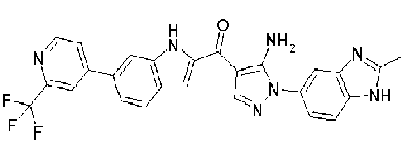
[5-amino-1-(2-methyl-1H-benzimidazol-5-yl)-1H-pyrazol-4-yl]-[6-(2-tritluoromethyl-pyridin-4-yl)-1H-indol-2-y1]-methanone 502 12.69 (bs, 1H), 11.98 (s, 1H), 8.83 (d, 1H, J = 4 Hz), 8.31 (m, 1H), 8.16 (m, 1H), 8.05 (d, 1H, J = 4 Hz), 7.94 (s, 1H), 7.86 (d, 1H, J = 8 Hz), 7.62 (m, 3H), 7.54 (m, 1H), 7.31 (d, 1H, J =8 Hz), 7.07 (bs, 2H), 2.55 (s,3H) 232 
[5-amino-1-(2-methyl-1H-benzimidazol-5-yl)-1H-pyrazol-4-yl]-[5-(3,3-difluoro-pyrrolidine-1-carbonyl)-1H-indol-2-yl]-methanone 490 8.33 (bs, 1H), 8.03 (bs, 1H), 7.81 (m, 2H), 7.56 (m, 2H), 7.50 (m, 2H), 4.24 (t, 4 H, J = 12 Hz), 2.66 (s, 3H), 1.49 (m, 1H), 1.39 (m, 3H), 1.28 (m, 4H) 233 
[5-amino-1-(2-methyl-1H-benzimidazol-5-yl)-1H-pyrazol-4-yl]-[5-(2,6-dimethyl-morpholine-4-carbonyl)-1H-indol-2-yl]-methanone 498 12.46 (d, 1H, J = 4 Hz), 11.91 (s, 1H), 8.32 (m, 1H), 7.77 (m, 1H), 7.65 (m, 1H), 7.56 (m, 1 H), 7.51 (m, 1H), 7.27 (m, 2H), 7.05 (s, 1H), 7.0 (s, 1H), 3.55 (bs, 2H), 2.62 (s, 3H), 1.23 (m, 5H), 1.07(bs,3H 234 
[5-amino-1-(2-methyl-1H-benzimidazol-5-yl)-1H-pyrazol-4-yl]-[5-([1,4'] bipiperidinyl-1'-carbonyl)-1H-indol-2-yl]-mcthanonc 551 8.28 (s, 1H), 7.83 (s, 1H), 7.63 (m, 2H), 7.55 (m, 1H), 7.45 (s, 1H), 7.32 (d, 2H, 7.05 (s, 1H, J = 8 Hz), 2.60 (m, 8H), 1.88 (m, 2H), 1.62 (m, 4H) 235 
[5-amino-1-(2-methyl-1H-benzimidazol-5-yl)-1H-pyrazol-4-yl]-{5-[4-(2,2,2-trifluoro-ethyl)-piperazine-1-carbonyl]-1H-indol-2-yl}-methanone 551 8.28 (s, 1H), 7.84 (s, 1H), 7.64 (d, 2H, J = 8 Hz), 7.55 (d, 1H, J = 8.68 Hz), 7.45 (s, 1H), 7.35 (t, 1H, J = 8 Hz), 3.67 (bs, 4H), 3.17 (t, 2H, J = 8 Hz), 2.74 (m, 4H), 2.36 (s, 3H), 236 
[5-amino-1-(2-methyl-1H-benzimidazol-5-yl)-1H-pyrazol-4-yl]-(5-[4-(2-hydroxy-ethyl)-piperazine-1-carbonyl]-1H-indol-2-yl)-methanone 513 8.28 (s, 1H), 7.84 (s, 1H), 7.65 (m, 2H), 7.55 (d, 1H, J= 8 Hz), 7.46 (s, 1H), 7.35 (m, 2H), 3.69 (m, 6H), 6.82 (m, 3H), 3.33 (s, 1H), 2.64 (s, 3H), 2.56 (m, 6H) 237 
[5-amino-1-(2-methyl-1H-benzimidazol-5-yl)-1H-pyrazol-4-yl]-[5-(3,3,4,4-tetrafluoro-pyrrolidine-1-carbonyl)-1H-indol-2-yl]-methanone 526 8.289 (s, 1H), 7.99 (m, 1H), 7.65 (m, 2H), 7.55 (m, 1H), 7.47 (m, 2H), 7.39 (d, 1H, J = 8 Hz), 3.95 (t, 2H, J = 12 Hz), 3.87 (t, 2H, J = 8 Hz), 2.61 (s,3H), 2.45(bs, 2H) 238 
[5-amino-1-(2-methyl-1H-benzimidazol-5-yl)-1H-pyrazol-4-yl]-[5-((R)-3-fluoro-pyrrolidine-1-carbonyl)-1H-indol-2-yl]-methanone 472 8.29 (s, 1H), 7.97 (d, 1H, J=12 Hz), 7.67 (m, 2H), 7.55 (m, 1H), 7.47 (m, 2H), 7.37 (d, 2H, J=8 Hz), 5.3 (m, 1H), 3.84 (m, 6H), 2.61 (s, 3H) 239 
[5-amino-1-(2-methyl-1H-benzimidazol-5-yl)-1H-pyrazol-4-yl]-[5-((S)-3-fluroro-pyrrolidine-1-carbonyl)-1H-indol-2-yl]-methanone 472 8.29 (s, 1H), 7.97 (d, 1H), 7.65 (m, 2H), 7.55 (m, 1H,), 7.47 (m, 2H), 7.35 (d, 1H, J = 8 Hz), 5.3 (m, 1H), 3.77 (m, 4H), 2.61 (s, 3H), 2.2 (bs, 2H) -

- [5-Amino-1-(2-methyl-1H-benzimidazol-5-yl)-1H-pyrazol-4-yl]-[3-fluoro-1-(toluene-4-sulfonyl)-1H-indol-2-yl]-methanone (25.0 mg, 0.041 mmol) was dissolved in methane sulfonic acid (0.25 ml), and stirred at room temperature for one hour. The pH of the reaction mixture was adjusted to 6 using an aqueous solution of 1 M sodium hydroxide. After extraction with ethyl acetate, the extract was dried over anhydrous sodium sulfate. The desiccant was removed by filtration. The filtrate was concentrated under reduced pressure, and the resulting residue was purified by silica gel column chromatography (dichloromethane /methanol = 60/1 to 40/1) to give [5-amino-1-(2-methyl-1H-benzimidazol-5-yl)-1H-pyrazol-4-yl]-(3-fluoro-1H-indol-2-yl)-methan one was obtained as a pale yellow solid (8.7 g, with a yield of 55%).
1H-NMR (DMSO-D6) δ 12.48 (1H, s), 11.50 (1H, s), 8.03 (1H, d, J = 3.1 Hz), 7.69 (1H, d, J = 8.5 Hz), 7.62 (2H, s), 7.45 (1H, d, J = 8.5 Hz), 7.25-7.35 (2H, m), 7.15 (1H, t, J = 7.3 Hz), 7.05 (2H, s), 2.53 (3H, s)
ESI (LC-MS positive mode) m/z 375 [(M+H)+] - The compounds of Examples 91 to 131 listed in Table 4 were synthesized by the same method as in Example 90.
Table 4 Example Structure Compound name m/z 1H-NMR 91 
[5-amino-1-(2-methyl-1H-benzimidazol-5-yl)-1H-pyrazol-4-yl] -[5-(1-isopropyl-piperidin-4-yl)-6-trifluoromethyl-1H-indol-2-yl]-methanone 550 1H-NMR (DNISO-D6) δ: 12.48 (1H, s), 11.99 (1H, s), 8.30 (1H, s), 7.87 (1H, s), 7.79 (1H, s), 7.66-7.55 (2H, br m), 7.45 (1H, s), 7.29 (1H, d, J = 8.5 Hz), 7.06 (2H, br s), 2.96-2.89 (2H, m), 2.84-2.70 (2H, m), 2.53 (3H, s), 2.25-2.18 (2H, m), 1.81-1.71 (4H, m), 1.01 (6H, d, J = 6.7 Hz). 92 
2-[5-amino-1-(2-methyl-1H-benzimidazol-5-yl)-1H-pyrazole-4-carbonyl]-1H-indole-6-carbonitrile 382 1H-NMR (DMSO-D6) δ: 12.47 (1H, s), 12.24 (1H, s), 8.33 (1H, s), 7.93-7.86 (2H,m), 7.67-7.55 (3H, m), 7.42 (1H, dd, J = 8.5, 1.2 Hz), 7.29 (1H, dd, J = 8.5, 1.8 Hz), 7.10 (2H, s), 2.54 (3H, s). 93 
[5-amino-1-(2-methyl-1H-benzimidazol-5-yl)-1H-pyrazol-4-yl] -[5-(1,2,3,6-tctrahydro-pyridin-4-yl) -1H-indol-2-yl]-methanone 438 1H-NMR (DMSO-D6) δ: 12.46 (1H, s), 11.65 (1H, s), 8.28 (1H, s), 7.67-7.54 (3H, m), 7.44-7.39 (3H, m), 7.29 (1H, d, J =8.5 Hz), 6.99 (2H, br s), 6.16 (1H, s), 3.41-3.38 (2H, m), 2.95 (2H, t, J = 5.5 Hz), 2.53 (3H, s), 2.43-2.41 (2H, m). 94 
[5-amino-1-(2-mcthyl-1H-benzimidazol-5-yl)-1H-pyazol-4-yl] -(5-piperidin-4-yl-1H-indol-2-yl)-methanone 440 1H-NMR (DMSO-D6) δ: 12.44 (1H, s), 11.55 (1H, s), 8.28 (1H, s), 7.66-7.55 (2H, br m), 7.48 (1H, s), 7.40 (1H, d, J = 8.5 Hz), 7.37 (1H, d, J = 1.2 Hz), 7.29 (1H, d, J = 8.5 Hz), 7.15 (1H, dd, J = 8.5, 1.2 Hz), 6.97 (2H, br s), 3.05-3.02 (2H, m), 2.67-2.58 (3H, m), 2.53 (3H, s), 1.75-1.72 (2H, m), 1.61-1.50 (2H, m). 95 
[5-amino-1-(2-methyl-1H-benzimidazol-5-yl)-1H-pyrazol-4-yl] -[5-((R)-3-fluoro-pyrrolidin-1-ylmethyl)-1H-indol-2-yl]-methanone 458 1H-NMR (DMSO-D6) δ: 12.46 (1H, d, J = 4.9 Hz), 11.65 (1H, d, J = 1.2 Hz), 8.30 (1H, d, J = 4.9 Hz), 7.65 (1H, dd, J = 5.2, 3.4 Hz), 7.59-7.57 (2H, m), 7.44-7.42 (2H, m), 7.32-7.27 (1H, m), 7.23 (1H, dd, J = 8.2, 1.5 Hz), 6.99 (2H, d, J = 22.0 Hz), 5.20 (1H, dt, J = 55.9, 5.6 Hz), 3.67 (2H, s), 2.81-2.75 (2H, m), 2.65-2.58 (1H, m), 2.54 (3H, s), 2.34-2.32 (1H, m), 2.18-2.33 (1H, m), 1.90-1.84 (1H, m). 96 
[5-amino-1-(2-methyl-1H-benzimidazol-5-yl)-1H-pyrazol-4-yl] -(6-fluoro-5-piperidin-4-yl-1H-indol -2-yl)-methanone 458 1H-NMR (DMSO-D6) δ: 12.45 (1H, s), 11.63 (1H, s), 8.27 (1H, s), 7.62-7.59 (2H, br m), 7.55 (1H, d, J = 7.3 Hz), 7.43 (1H, s), 7.28 (1H, dd, J = 8.5, 2.4 Hz), 7.34 (1H, d, J = 11.0 Hz), 6.97 (2H, br s), 3.06-3.03 (2H, m), 2.91-2.85 (1H, m), 2.66-2.59 (2H, m), 2.53 (3H, s), 1.75-1.72 (2H, m), 1.63-1.53 (2H, m). 97 
[5-amino-1-(2-methyl-1H-benzimidazol-5-yl)-1H-pyrazol-4-yl] -[6-fluoro-5-(1-methyl-piperidin-4-yl)-1H-mdol-2-yl]-methanone 472 1H-NMR (DMSO-D6) δ: 12.45 (1H, s), 11.64 (1H, H, d, J = 1.5 Hz), 8.27 (1H, s), 7.66-7.62 (1H, br m), 7.59-7.53 (1H, br m), 7.67 (1H, d, J = 7.3 Hz), 7.42 (1H, d, J = 1.5 Hz), 7.28 (1H, d, J = 9.8 Hz), 7.14 (1H, d, J = 11.6 Hz), 6.97 (2H, br s), 2.92-2.87 (2H, m), 2.79-2.72 (1H, m), 2.53 (3H, s), 2.21 (3H, s), 2.04-1.97 (2H, m), 1.78-1.69 (4H, m). 98 
[5-amino-1-(2-methyl-1H-benzimidazol-5-yl)-1H-pyrazol-4-yl] -[5-(1-isopropyl-piperidin-4-yl)-1H-indol-2-yl]-methanone 482 1H-NMR (DMSO-D6) δ: 12.45 (1H, s), 11.55 (1H, d, J = 1.8 Hz), 8.28 (1H, s), 7.65-7.63 (1H, br m), 7.59-7.56 (1H, br m), 7.49 (1H, s), 7.39 (1H, d, J = 8.5 Hz), 7.36 (1H, d, J = 1.5 Hz), 7.29 (1H, d, J = 9.1 Hz), 7.18 (1H, dd, J = 8.5, 1.5 Hz), 7.00 (1H, br s), 6.95 (1H, br s), 2.92-2.87 (2H, m), 2.76-2.68 (1H, m), 2.55-2.52 (1H, m), 2.53 (3H, s), 2.27-2.20 (2H, m), 1.83-1.77 (2H, m), 1.71-1.60 (2H, m), 1.00 (6H, d, J = 6.7 Hz). 99 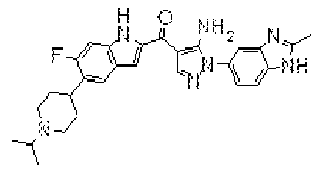
[5-amino-1-(2-methyl-1H-benzimidazol-5-yl)-1H-pyrazol-4-yl] -[6-fluoro-5-(1-isopropyl-piperidin-4-yl)-1H-indol-2-yl]-mehanone 500 1H-NMR (DMSO-D6) δ: 12.45 (1H, s), 11.64 (1H,d, J = 1.5 Hz), 8.27 (1H, s), 7.66-7.61 (1H, br m), 7.59-7.55 (1H, br m), 7.57 (1H, d, J = 7.3 Hz), 7.41 (1H, d, J = 1.5 Hz), 7.28 (1H, d, J = 7.9 Hz), 7.14 (1H, d, J = 13.6 Hz), 7.00 (1H, br s), 6.95 (1H, br s), 2.93-2.88 (2H, m), 2.77-2.69 (2H, m), 2.53 (3H, s), 2.30-2.22 (2H, m), 1.94-1.78 (2H, m), 1.75-1.65 (2H, m), 1.01 (6H, d, J = 6.7 Hz). 100 
[5-amino-1-(2-methyl-1H-bcnzimidazol-5-yl)-1H-pyrazol-4-yl] -(6-pyridin-3-yl-1H-indol-2-yl)-methanone 434 1H-NMR (DMSO-D6) δ: 12.47 (1H, s), 11.86 (1H, s), 8.90 (1H, d, J = 24 Hz), 8.56 (1H, d, d, J = 4.9 Hz), 8.34 (1H, s), 8.08 (1H, d, d, J = 7.9 Hz), 7.83 (1H, d, J = 7.9 Hz), 7.73 (1H, s), 7.62 (2H, s), 7.53-7.43 (3H, m), 7.30 (2H, dd, J = 8.2 , 1.5 Hz), 7.03 (3H, s), 2.54 (3H,s). 101 
[5-amino-1-(2-methyl-1H-benzimidazol-5-yl)-1H-pyrazol-4-yl] -[5-(6-morpholin-4-yl-pyridin-3-yl) -1H-indol-2-yl]-methanone 519 1H-NMR (DMSO-D6) δ: 12.47 (1H, s), 11.74 (1H, d, J = 1.2 Hz), 8.49 (1H, d, J = 2.4 Hz), 8.32 (1H, s), 7.91-7.90 (2H, m), 7.66-7.47 (5H, m), 7.30 (1H, d, J = 8.5 Hz), 7.02 (2H, d, J = 19.5 Hz), 6.94 (1H, d, J = 9.2 Hz), 3.73 (4H, dd, J = 4.6, 2.3 Hz), 3.49 (4H, dd, J = 4.9, 2.4 Hz), 2.54 (3H, s). 102 
[5-amino-1-(2-methyl-1H-benzimidazol-5-yl)-1H-pyazol-4-yl] -(5-pyridin-3-yl-1H-indol-2-yl)-methanone 434 1H-NMR (DMSO-D6) δ: 12.47 (1H, s), 11.85 (1H, d, J = 1.8 Hz), 8.93 (1H, d, J = 2.4 Hz), 8.54 (1H, dd, J = 4.9, 1.2 Hz), 8.33 (1H, s), 8.10 (1H, dt, J = 8.1, 1.8 Hz), 8.03 (1H, s), 7.64-7.59 (4H, m), 7.52 (1H, d, J = 1.8 Hz), 7.49 (1H, dd, J = 7.6, 4.6 Hz), 7.31 (1H, d, J = 8.5 Hz), 7.03 (2H, d, J = 20.1 Hz), 2.54 (3H, s). 103 
[5-ammo-1-(2-methyl-1H-benzimidazol-5-yl)-1H-pyrazol-4-yl] -[5-(6-piperazin-1-yl-pyridin-3-yl)-1H-indol-1-yl]-methanone 518 1H-HMR (DMSO-D6) δ: 12.48 (1H, s), 11.74 (1H, s), 8.45 (1H, d, J = 3.1 Hz), 8.32 (1H, s), 7.87-7.85 (2H, m), 7.69-7.49 (5H, m), 7.47 (1H, s), 7.30 (1H, dd, J = 8.5, 1.8 Hz), 7.02 (2H, s), 6.89 (1H, d, J = 9.2 Hz), 3.44 (4H, t, J = 5.1 Hz), 2.80 (4H, t, J = 5.1 Hz), 2.54 (3H, s). 104 
[5-amino-1-(2-methyl-1H-benzimidazol-5-yl)-1H-pyrazol-4-yl] -[5-(6-hydroxy-pyridin-3-yl)-1H-indol-2-yl]-methanone 450 1H-NMR (DMSO-D6) δ: 12.89 (1H, s), 11.76 (1H, s), 8.38 (1H, s), 8.00 (1H, d, J = 1.8 Hz), 7.95 (1H, d, J = 9.2 Hz), 7.88 (1H, dd, J = 9.7, 2.5 Hz), 7.82 (1H, s), 7.73 (1H, dd, J = 8.5, 1.8 Hz), 7.67 (1H, d, J = 2.5 Hz), 7.52-7.48 (4H, m), 7.25 (2H, s), 6.47 (1H, d, J = 9.7 Hz), 2.84 (3H, s). 105 
[5-amino-1-(2-methyl-1H-benzimidazol-5-yl)-1H-pyrazol-4-yl] -[6-fluoro-5-(4-methyl-piperazin-1-ylmethyl)-1H-indol-2-yl]-methanone 487 1H-NMR (DMSO-D6) δ: 12.47 (1H, s), 11.71 (1H, s), 8.29 (1H, s), 7.65 (1H, d, J = 7.3 Hz), 7.62-7.57 (2H, br m), 7.46 (1H, s), 7.28 (1H, dd, J = 8.5, 1.8 Hz), 7.15 (1H, d, J = 11.0 Hz), 6.99 (2H, br s), 3.56 (2H, s), 2.53 (3H, s), 2.47-2.38 (4H, br m), 2.35-2.28 (4H, br m), 2.14 (3H, s). 106 
[5-amino-1-(2-methyl-1H-benzimidazol-5-yl)-1H-pyrazol-4-yl] -(6-fluoro-5-pyrrolidin-1-ylmethyl-1H-indol-2-yl)-methanone 458 1H-NMR (DMSD-D6) δ: 12.48 (1H, s), 11.69 (1H, s), 8.29 (1H, s), 7.67 (1H, d, J = 7.3 Hz), 7.62-7.58 (2H, br m), 7.45 (1H, s), 7.28 (1H, dd, J = 8.5, 1.8 Hz), 7.14 (1H, d, J = 11.0 Hz), 6.99 (2H, br s), 3.68 (2H, s), 2.53 (3H, s), 2.52-2.45 (4H, m), 1.72-1.67 (4H, m). 107 
[5-amino-1-(2-methyl-1H-benzimidazol-5-yl)-1H-pyrazol-4-yl] -[6-(1-methyl-pipendin-4-yl)-1H-indol-2-yl]-methanone 454 1H-NMR (DMSO-D6) δ: 12.47 (1H, s), 11.56 (1H, s), 8.28 (1H, s), 7.63-7.67 (2H, br m), 7.60 (1H, d, J = 8.6 Hz), 7.39 (1H, d, J = 1.8 Hz), 7.30 (1H, s), 7.28 (1H, dd, J = 8.5, 1.8 Hz), 6.99 (1H, dd, J = 8.5, 1.8 Hz), 6.98 (2H, br s), 2.91-2.86 (2H, br m), 2.55-2.51 (1H, br m), 2.53 (3H, s), 2.20 (3H, s), 2.02-1.96 (2H, m), 1.79-1.64 (4H, m). 108 
[5-amino-1-(2-methyl-1H-benzimidazol-5-yl)-1H-pyrazol-4-yl] -[6-(4-morpholin-4-yl-phenyl)-1H-mdol-2-yl]-methanone 518 1H-NMR (DMSO-D6) δ: 12.47 (1H, s), 11.59 (1H, s), 8.32 (1H, d, J = 1.8 Hz), 7.73 (1H, d, J = 6.7 Hz), 7.64.7.56 (5H, m), 7.46 (1H, s), 7.37 (1H, d, J = 8.6 Hz), 7.30 (1H, d, J = 8.6 Hz), 7.09-6.97 (4H,m), 3.80-3.73 (4H, m), 3.19-3.14 (4H, m), 2.53 (3H, s). 109 
[5-aimno-1-(2-methyl-1H-benzimidazol-5-yl)-1H-pyrazol-4-yl] -[6-(3,4,5,6-tetrahydro-2H-[1,2'] bipyridin-5'-yl)-1H-inidol-2-yl]-methanone 517 1H-MMR (DMSO-D6) δ: 11.70 (1H, s), 8.45 (1H, d, J = 2.4 Hz), 8.33 (1H, s), 7.83 (1H, dd, J = 8.9, 2.7 Hz), 7.74 (1H, d, J = 8.5 Hz), 7.64-7.59 (4H, d, J = 8.5 Hz), 7.47 (1H, s), 7.36 (1H, d, J = 8.5 Hz), 7.30 (1H, dd, J = 8.6, 1.8 Hz), 7.01 (2H, s), 6.92 (1H, d, J = 9.2 Hz), 3.58 (4H, t, J = 5.2 Hz), 2.54 (3H, s), 1.64-1.57 (6H, m). 110 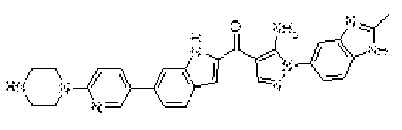
[5-amino-1-(2-methyl-1H-benzimidazol-5-yl)-1H-pyrazol-4-yl] -[6-(6-piperazin-1-yl-pyridin-3-yl)-1H-indol-2-yl]-methanone 518 1H-NMR (DMSO-D6) δ: 12.47 (1H, s), 11.71 (1H, s), 8.46 (1H, d, J = 2.4 Hz), 8.33 (1H, s), 7.85 (1H, dd, J = 8.5, 2.4 Hz), 7.75 (1H, d, J = 8.5 Hz), 7.65-7.58 (3H, m), 7.47 (1H, s), 7.36 (1H, d, J =7.9 Hz), 7.30 (1H, dd, J =8.5, 1.8 Hz), 7.01 (2H, s), 6.91 (1H, d, J = 9.2 Hz), 3.46 (4H, t, J = 4.9 Hz), 2.80 (4H, t, J = 4.9 Hz), 2.54 (3H, s). 111 
[5-amino-1-(2-methyl-1H-benzimidazol-5-yl)-1H-pyrazol-4-yl] -[5-(6-methoxy-pyridin-3-yl)-1H-indol-2-yl]-methanone 464 1H-NMR (DMSO-D6) δ: 12.47 (1H, s), 11.79 (1H, s), 8.49 (1H, d, J = 2.4 Hz), 8.32 (1H, s), 8.03 (1H, dd, J = 8.9, 2.7 Hz), 7.93 (1H, s), 7.62-7.54 (4H, m), 7.49 (1H, s), 7.30 (1H, dd, J = 8.2, 2.1 Hz), 7.02 (2H, s), 6.92 (1H, d, J = 9.2 Hz), 3.91 (3H, s), 2.54 (3H, s). 112 
[5-amino-1-(2-methyl-1H-benzimidazol-5-yl)-1H-pyrazol-4-yl] -[5-((S)-3-methyl-morpholin-4-ylmethyl)-1H-indol-2-yl]-methanone 470 1H-NMR (DMSO-D6) δ: 12.46 (1H, s), 11.66 (1H, s), 8.30 (1H, s), 7.60-7.58 (3H, m), 7.44-7.42 (2H, m), 7.30 (1H, d, J = 8.5 Hz), 7.22 (1H, d, J = 8.5 Hz), 6.99 (2H, s), 4.08 (1H, d, J = 12.8 Hz), 3.64-3.61 (2H, m), 3.43-3.40 (2H, m), 3.17-3.14 (2H, m), 2.53 (3H, s), 2.42-2.40 (1H, m), 2.12-2.08 (1H, m), 1.06 (3H, d, J=6.7 Hz). 113 
[5-amino-1-(2-methyl-1H-benzimidazol-5-yl)-1H-pyrazol-4-yl] -[6-((R)-3-fluoro-pyrrolidin-1-ylmethyl)-1H-indol-2-yl]-methanone 458 1H-NMR (DMSO-D6) δ: 12.48 (1H, s), 11.64 (1H, s), 8.29 (1H, s), 7.61-7.58 (3H, m), 7.42-7.40 (2H, m), 7.28 (1H, dd, J = 8.5, 2.1 Hz), 7.04 (1H, dd, J = 8.2, 1.2 Hz), 6.98 (2H, br s), 5.29-5.11 (1H, m), 3.68 (2H, s), 2:82-2.75 (2H, m), 2.67-2.65 (1H, m), 2.52 (3H, s), 2.32-2.30 (1H, m), 2.20-2.08 (1H, m), 1.94-1.78 (1H, m). 114 
[5-amino-1-(2-methyl-1H-benzimidazol-5-yl)-1H-pyrazol-4-yl] -[5-(2,5-dimelhyl-pyrrolidin-1-ylmethyl)-1H-indol-2-yl]-methanone 468 1H-NMR (DMSO-D6) δ: 12.44 (1H, d, J = 4.3 Hz), 11.60 (1H, s), 8.30 (1H, d, J = 4.3 Hz), 7.85-7.55 (3H, m), 7.41-7.40 (2H, m), 7.28-7.21 (2H, m), 6.98 (2H, d, J = 22.0 Hz), 3.90-3.52 (2H, m), 2.97-2.95 (1H, m), 2.61 (1H, dd, J = 11.0, 5.5 Hz), 2.53 (3H, s), 1.99-1.93 (1H, m), 1.80-1.74 (1H, m), 1.32-1.27 (2H, m), 0.97 (6H, t, J = 6.1 Hz). 115 
[5-amino-1-(2-melhyl-1H-benzimidazol-5-yl)-1H-pyazol-4-yl] -[5-(3-fluoro-piperidin-1-ylmethyl) -1H-mdol-2-yl]-methanone 472 1H-NMR (DMSO-D6) δ: 12.45 (1H, s), 11.64 (1H, s), 8.29 (1H, s), 7.63-7.56 (3H, m), 7.44-7.41 (2H, m), 7.29 (1H, d, J = 8.5 Hz), 7.20 (1H, d, J = 8.5 Hz), 6.98 (2H, s), 4.62 (1H, d, J = 48.2 Hz), 3.57 (2H, s), 2.76-2.21 (4H, m), 2.53 (3H, s), 1.80-1.74 (2H, m), 1.52-1.43 (2H, m). 116 
[5-ammo-1-(2-methyl-1H-benzimidazol-5-yl)-1H-pyrazol-4-yl] -[5-(3,3-difluoro-piperidin-1-ylmethyl)-1H-indol-2-yl]-methanone 490 1H-NMR (DMSO-D6) δ: 12.46 (1H, s), 11.66 (1H, s), 8.30 (1H, s), 7.61-7.58 (3H, m), 7.45-1.42 (2H, m), 7.29 (1H, dd, J = 8.5, 1.8 Hz), 7.20 (1H, d, J = 8.5 Hz), 6.99 (2H, s), 3.64 (2H, s), 2.59-2.51 (4H, m), 2.53 (3H, s), 1.88-1.86 (2H, m), 1.66-1.64 (2H, m). 117 
[5-amino-1-(2-methyl-1H-benzimidazol-5-yl)-1H-pyrazol-4-yl] -{6-[2-(4-methyl-piperazin-1-yl) pyridin-4-yl]-1H-indol-2-yl}-methanone 532 1H-NMR (DMSO-D6) δ: 12.47 (1H, s), 11.72 (1H, d, J = 1.2 Hz), 8.46 (1H, d, J = 3.1 Hz), 8.33 (1H, s), 7.86 (1H, dd, J = 8.9, 2.7 Hz), 7.76 (1H, d, J = 8.5 Hz), 7.68-7.55 (3H, m), 7.48 (1H, d, J = 1.2 Hz), 7.36 (1H, dd, J = 8.2, 1.5 Hz), 7.30 (1H, d, J = 7.9 Hz), 7-07-6.93 (3H, dd, m), 3.57-3.52 (4H, m), 2.53 (3H, s), 2.44-2.39 (4H, m), 2.23 (3H, s). 118 
[5-amino-1-(2-methyl-1H-benzimidazol-5-yl)-1H-pyrazol-4-yl] -(6-pyridin-4-yl-1H-indol-2-yl)-methanone 434 1H-NMR (DMSO-D6) δ: 8.66 (2H, dd, J = 4.6, 1.5 Hz), 8.34 (1H, s), 7.84 (2H, d, J = 9.2 Hz), 7.72 (2H, dd, J 4.6, 1.5 Hz), 7.61 (2H, t, J = 4.6 Hz), 7.55-7.50 (2H,m), 7.29 (1H, dd, J = 8.2, 2.1 Hz), 7.06 (2H, s), 2.65 (3H,s). 119 
[5-amino-1-(2-methyl-1H-benzimidazol-5-yl)-1H-pyrazol-4-yl] -[5-(4-fluoropiperidin-1-ylmethyl)-1H-indol-2-yl]-methanone 472 1H-NMR (DMSO-D6) δ: 12.46 (1H, d, J = 4.9 Hz), 11.66 (1H, d, J = 1.8 Hz), 8.30 (1H, d, J = 4.9 Hz), 7.66 (1H, dd, J = 5.2, 3.4 Hz), 7.58-7.56 (2H, m), 3.44-1.42 (2H, m), 7.32-7.27 (1H, m), 7.21 (1H, d, J = 4.9 Hz), 7.00 (2H, d, J = 22.6 Hz), 4.72-4.65 (1H, m), 3.54 (2H, s), 2.53 (3H, s), 2.51-2.48 (2H, m), 2.32.2.31 (2H, m), 1.89-1.83 (2H, m), 1.73-1.71 (2H, m). 120 
[5-amino-1-(2-methyl-1H-benzimidazol-5-yl)-1H-pyrazol-4-yl] -[5-(4,4-difluoro-piperidin-1-ylmethyl)-1H-indol-2-yl]-methanone 490 1H-NMR (DMSO-D6) δ: 12.45 (1H, s), 11.66 (1H, s), 8.29 (1H, s), 7.61-7.58 (3H, m), 7.43-7.42 (2H, m), 7.29 (1H, dd, J = 8.4, 2.1 Hz), 7.22 (1H, dd, J = 8.4, 1.8 Hz), 6.99 (2H, s), 3.61 (2H, s), 3.34-3.30 (4H, m), 2.53 (3H, s), 1.99-1.90 (4H, m). 121 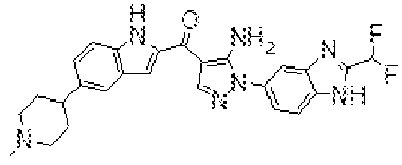
[5-amino-1-(2-difluoromethyl-1H-benzimidazol-5-yl)-1H-pyrazol-4-yl] -[5-(1-methyl-piperidin-4-yl)-1H-indol-2-yl]-methanone 490 1H-NMR (DMSO-D6) δ: 13.60 (1H, br s), 11.58 (1H, d, J = 1.8 Hz), 8.31 (1H, s), 7.83-7.80 (2H, m), 7.51-7.46 (2H, m), 7.45-7.38 (2H, m), 7.32-7.14 (2H, br m), 7.08 (2H, br s), 2.93-2.85 (2H, m), 2.56-2.50 (1H, m), 2.21 (3H, s), 2:04-1.96 (2H, m), 1.81-1.66 (4H, br m). 122 
[5-amino-1-(2-difluoromethyl-1H-benzimidazol-5-yl)-1H-pyrazol-4-yl] -(1H-indol-2-yl)-methanone 393 1H-NMR (DMSO-D6) δ: 13.60 (1H, br s), 11.69 (1H, s), 8.34 (1H, s), 7.84-7.80 (2H, m), 7.70 (1H, d, J = 7.9 Hz), 7.61-7.45 (3H, m), 7.32-1.18 (2H, m), 7.12-7.06 (3H, m). 123 
[5-amino-1-(2-methyl-1H-benzimidazol-5-yl)-1H-pyrazol-4-yl] -[5-(3,3-difluoro-pyrrolidin-1-ylmethyl)-1H-indol-2-yl]-methanone 476 1H-NMR (DMSO-D6) δ: 12.47 (1H, s), 11.68 (1H, s), 8.30 (1H, d, J = 4.9 Hz), 7.65 (1H, dd, J = 5.0, 3.4 Hz), 7.61-7.55 (2H, m), 7.47-7.41 (2H, m), 7.30 (1H, t, J = 6.4 Hz), 7.22 (1H, d, J = 8.5 Hz), 7.00 (2H, d, J = 21.4 Hz), 3.69 (2H, s), 2.86 (2H, t, J = 13.5 Hz), 2.66-2.42 (2H, m), 2.61 (3H, s), 2.29-2.22 (2H, m). 124 
[5-amino-1-(2-methyl-1H-benzimidazol-5-yl)-1H-pyrazol-4-yl] -[5-(1-cyclopentyl-piperidin-4-yl)-1H-indol-2-yl]-methanone 508 1H-NMR (DMSO-D6) δ: 12.47 (1H, s), 11.57 (1H, d, J = 1.2 Hz), 8.29 (1H, d, J = 3.7 Hz), 7.66-7-56 (2H, m), 7.50 (1H, s), 7.43-7.37 (2H, m), 7.29 (1H, t, J = 6.1 Hz), 7.17 (1H, dd, J = 8.5, 1.2 Hz), 6.99 (2H, d, J = 22.0 Hz), 3.06 (2H, d, J = 11.0 Hz), 2.54 (3H, s), 2.02 (2H, t, J = 10.7 Hz), 1.64-1.48 (14H, m). 125 
[5-amino-1-(2-methyl-1H-benzimidazol-5-yl)-1H-pyrazol-4-yl] -[5-(1-cyclohexyl-piperidin-4-y])-1H-indol-2-yl]-methanone 522 1H-NMR (DMSO-D6) δ: 12.46 (1H, s), 11.57 (1H, d, J = 1.8 Hz), 8.29 (1H, s), 7.62-7.58 (2H, m), 7.49 (1H, s), 7.40-7.37 (2H, m), 7.29 (1H, d, J = 7.9 Hz), 7.16 (1H, dd, J = 8.5, 1.2 Hz), 6.98 (2H, d, J = 20.8 Hz), 2.93 (2H, d, J = 11.6 Hz), 2.53 (3H, s), 2.36-2.31 (3H, m), 1.80-1.57 (9H, m), 1.22-1.14 (6H, m). 126 
[5-amino-1-(2-mcthyl-1H-benzimidazol-5-yl)-1H-pyrazol-4-yl] -(4-bromo-1H-pyrrol-2-yl)-methanone 385, 387 1H-NMR (DMSO-D6) δ: 12.47 (1H, s), 12.04 (1H, s), 8.20 (1H, a), 7.61-7.57 (1H, m), 7.27 (1H, dd, J = 8.5, 1.7 Hz), 7.19-7.18 (2H, m), 6.93-6.90 (3H, m), 2.53 (3H, s). 127 
[5-amino-1-(2-methyl-1H-benzimidazol-5-yl)-1H-pyrazol-4-yl] -(1H-pyrrol-2-yl)-methanone 307 1H-NMR (DMSO-D6) δ: 12.46 (1H s), 11.71 (1H, s), 8.16 (1H, d, J = 3.0 Hz), 7.59 (2H, dd, J = 23.6, 7.1 Hz), 7.29 (1H, d, J = 10.0 Hz), 7.08 (1H, d, J=15.4 Hz), 6.85 (2H, d, J = 14.8 Hz), 6.24-6.22 (2H m), 2.53 (3H, s). 128 
[5-amino-1-(2-methyl-1H-benzimidazol-5-yl)-1H-pyrazol-4-yl] -(4-phenyl-1H-pyrrol-2-yl)-methanone 383 1H-NMR (CD3OD) δ: 8.54 (1H, s), 8.25 (1H s), 7.94 (1H, d, J = 1.5 Hz), 7.91 (1H, d, J = 1.8 Hz), 7.67-7.63 (2H, m), 7.44-7.31 (5H, m), 2.61 (3H, s). 129 
[5-amino-1-(2-methyl-1H-benzimidazol-5-yl)-1H-pyrazol-4-yl] -[4-(3-chloro-phenyl)-1H-pyrrol-2-yl]-methanone 417 1H-NMR (CD3OD) δ: 8.30-8.26 (1H, m), 7.66 (2H, dt, J = 5.4, 2.4 Hz), 7.58 (1H, dq, J = 7.8. 0.9 Hz), 7.48 (1H, d, J =1.6 Hz), 7.42 (1H, d, J = 1.5 Hz), 7.39 (1H, d, J = 2.0 Hz), 7.36 (1H, d, J = 1.8 Hz), 7.31 (1H, d, J = 7-9 Hz), 7.17 (1H, dq, J = 8.0, 1.0 Hz), 2.61 (3H, s). 130 
[5-amino-1-(2-methyl-1H-benzimidazol-5-yl)-1H-pyrazol-4-yl] -[4-(4-fluoro-phenyl)-1H-pyrrol-2-yl]-methanone 401 1H-NMR (CD3OD) δ: 8.26 (1H, s), 7.66-7.63 (3H, m), 7.40 (1H, dd, J = 3.7, 1.7 Hz), 7.36 (1H, dd, J = 3.0, 1.8 Hz), 7.11 (1H, d, J = 2.1 Hz), 7.08 (2H, t, J = 2.1 Hz), 7.05 (1H, d, J = 2.1 Hz), 2.61 (3H, s). 131 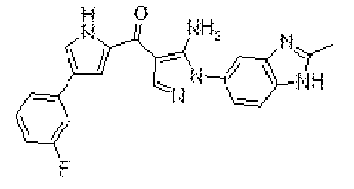
[5-amino-1-(2-methyl-1H-benzimidazol-5-yl)-1H-pyrazol-4-yl] -[4-(3-fluoro-phenyl)-1H-pyrrol-2-yl]-methanone 401 1H-NMR (CD3OD) 5: 8.27 (1H, s), 7.66-7.65 (2H, m), 7.47 (1H, d, J = 1.5 Hz), 7.45 (1H, t, J = 1.2 Hz), 7.42 (1H, d, J= 1.6 Hz), 7.39-7.35 (2H, m), 7.33-7.31 (1H, m), 6.94-6.86 (1H, m), 2.61 (3H, s). -

- [5-Amino-1-(2-methyl-1H-benzimidazol-5-yl)-1H-pyrazol-4-yl]-(1-benzenesulfonyl-6-morpholin-4-ylmethyl-1H-indol-2-yl)-methanone (132 mg, 0.22 mmol) was dissolved in tetrahydrofuran (THF) (1.0 ml), and then a tetrahydrofuran (THF) solution of 1 M tetrabutylammonium fluoride (0.46 ml, 0.46 mmol) was added thereto. The mixture was heated at 65°C with stirring for 22 hours. The reaction mixture was then cooled to room temperature, and concentrated under reduced pressure. The resulting residue was purified by silica gel column chromatography (dichloromethane /methanol = 100/10) to give [5-amino-1-(2-methyl-1H-benzimidazol-5-yl)-1H-pyrazol-4-yl]-(6-morpholin-4-ylmethyl-1H-in dol-2-yl)-methanone as a yellow solid (74 mg, 75%).
1H-NMR (DMSO-D6) δ: 12.48 (1.0H, brs), 11.64 (1.0H, brs), 8.30 (1.0H, s), 7.64-7.60 (3.0H, m), 7.42-7.41 (2.0H, m), 7.29 (1.0H, dd, J = 8.5, 2.2 Hz), 7.06 (1.0H, dd, J = 8.3, 1.0 Hz), 6.99 (2.0H, brs), 3.58 (4.0H, t, J = 4.4 Hz), 3.55 (2.0H, s), 2.53 (3.0H, s), 2.39-2.37 (4.0H, brm)
ESI (LC-MS positive mode) m/z 456 [(M+H)+] - The compounds of Examples 133 to 143 listed in Table 5 were synthesized by the same method as in Example 132.
Table 5 Example Structure Compound name m/z 1H-NMR 133 [5-amino-1-(2-methyl-1H- benzimidazol-5-yl)-1H-pyrazol-4-yl]-[4-(2-morpholin-4-yl-ethylamino)-1H-indol-2-yl]-methanone 485 1H-NMR (CD3OD) δ: 8.32 (1.0H, s), 7.73- 7.61 (2.4H, s), 7.58 (1.0H, d, J = 1.0 Hz), 7.38 (1H, dd, J = 8.8, 2.0 Hz), 7.11 (1H, t, J = 7.8 Hz), 6.79 (1H, d, J = 8.3 Hz), 6.21 (1H, d, J 7.3 Hz), 3.77-3.72 (4H, m), 3.45 (2H, q, J = 6.0 Hz), 2.76 (2H, t, J = 6.0 Hz), 2.61 (3H, s), 2.55-2.63 (4H, m). 134 [5-amino-1-(2-methyl-1H-benzimidazol-5-yl)-1H-pyrazol-4-yl]-[5-(4-methyl-piperazine-1-carbonyl)-1H-indol-2-yl]-methanone 483 1H-NMR (DMSO-D6) δ: 12.47 (1.0H, s), 11.91 (1.0H, s), 8.31 (1.0H, d, J =4.4 Hz), 7.75 (1.0H, s), 7.66 (1.0H, m), 7.57 (1.0H, m), 7.52 (2.0H, m), 7.29 (2.0H, m), 7.10-7.00 (2.0H, m), 3.56-3.51 (4.0H, m), 2.53 (3.0H, s), 2.40-2.25 (4.0H, m), 2.21 (3.0H, s). 135 
[5-amino-1-(2-methyl-1H-benzimidazol-5-yl)-1H-pyrazol-4-yl]-[6-(2-morpholin-4-yl-ethylamino)-1H-indol-2-yl]-methanone 485 1H-NMR (DMSO-D6) δ: 12.45 (1.0H, br s), 11.50 (1.0H, br s), 8.27 (1.0H, s), 7.60-7.55 (3.0H, m), 7.40 (1.0H, br s), 7.32-7.28 (1.0H, m), 5.93 (3.0H, br s), 6.75 (1.0H, dd, J = 8.8, 2.4 Hz), 4.11 (2.0H, t, J = 5.9 Hz), 3.60 (4.0H, t, J = 4.6 Hz), 3.34-3.28 (4.0H, m), 2.73 (2.0H, t, J = 5.9 Hz), 2.53 (3.0H, s). 136 
[5-amino-1-(2-methyl-1H-benzimidazol-5-yl)-1H-pyrazol-4-yl]-[5-(piperazine-1-carbonyl)-1H-indol-2-yl]-methanone 469 1H-NMR (CD3OD) δ: 8.28 (1.0H, s), 7.88 (1.0H, s), 7.68-7.64 (2.0H, m), 7.58 (1.0H, d, J = 8.3 Hz), 7.46 (1.0H, m), 7.40-7.35 (2.0H, m), 3.75 (4.0H, m), 3.01 (4.0H, m), 2.61 (3.0H, s). 137 
[5-amino-1-(2-methyl-1H-benzimidazol-5-yl)-1H-pyrazol-4-yl]-[4-(2-methoxy-ethylamino)-1H-indol-2-yl]-methanone 430 1H-NMR (CD3OD) δ: 8.33. (1H, s), 7.66-7.59 (3H, m), 7.37 (1H, dd, J = 8.8, 2.0 Hz), 7.10 (1H, t, J = 7.8 Hz), 6.78 (1H, d, J = 8.3 Hz), 6.21 (1H, d, J = 7.3 Hz), 3.70 (2H, t, J = 5.8 Hz), 3.46 (2H, t, J = 5.8 Hz), 2.60 (3.0H, s). 138 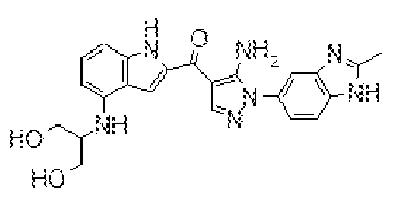
[5-amino-1-(2-methyl-1H-benzimidazol-5-yl)-1H-pyrazol-4-yl]-[4-(2-hydroxy-1-hydroxymethyl -ethylamino)-1H-indol-2-yl]-methanone 446 1H-NMR (CD3OD) δ: 8.35 (1H, s), 7.72-7.61 (3H, m), 7.37 (1H, dd, J = 8.8. 2.0 Hz), 7.10 (1H, t, J = 8.1 Hz), 6.78 (1H, d, J = 8.3 Hz), 6.29 (1H, d, J = 7.8 Hz), 3.85-3.71 (5H, m), 2.61 (3H, s). 139 
[5-amino-1-(2-methyl-1H-benzimidazol-5-yl)-1H-pyrazol-4-yl]-[4-(2-pyridin-4-yl-ethylamino)-1H-indol-2-yl]-methanone 477 1H-NMR (CD3OD) δ: 8.43 (2H, dd, J = 4.4, 1.5 Hz), 8.30 (1H, s), 7.74-7.61 (2H, s), 7.57 (1H,s), 7.40-7.35 (3H, m); 7.13 (1H, t, J = 8.1 Hz), 6.79 (1H, d, J = 8.3 Hz), 6.26 (1H, d, J = 7.8 Hz), 3.61 (2H, t, J = 7.1 Hz), 3.09 (2H, t, J = 7.1 Hz), 2.62 (3H, s). 140 
[5-amino-1-(2-methyl-1H-benzimidazol-5-yl)-1H-pyrazol-4-yl]-[6-(2-methoxy-ethylamino)-1H-indol-2-yl]-methanone 430 1H-NMR (CD3OD) δ: 8.23 (1.0H, s), 7.67 (2.0H, br s), 7.46-7.44 (1.0H, m), 7.38 (1.0H, dd, J = 8.8,2.0 Hz), 7.27 (1.0H, s), 6.63-6.60 (2.0H, m), 3.65 (2.0H, t, J = 5.4 Hz), 3.41 (3.0H, s), 3.34 (2.0H, t J = 5.4 Hz), 2.62 (3.0H, s). 141 
[5-amino-1-(2-methyl-1H-benzimidazol-5-yl)-1H-pyrazol-4-yl]-(6-morpholin-4-yl-1H-indol-2-yl)-methanone 442 1H-NMR (DMSO-D6) δ: 12.48 (1.0H, br s), 11.39 (1.0H, br s), 8.27 (1.0H, s), 7.61 (2.0H, br s), 7.54 (1.0H, d, J = 8.8 Hz), 7.35 (1.0H, d, J = 2.0 Hz), 7.29 (1.0H, dd, J = 8.3, 2.0 Hz), 6.93-6.91 (3.0H, m), 6.84 (1.0H, br s), 3.78 (4.0H, t, J = 4.8 Hz), 3.12 (4.0H, t, J =4.8 Hz), 2.53 (3.0H, s). 142 
[5-amino-1-(2-methyl-1H-benzimidazol-5-yl)-1H-pyrazol-4-yl]-(4-morpholin-4-yl-1H-indol-2-yl)-methnnone 442 1H-NMR (CD3OD) δ: 8.23 (1H, s), 7.67 (2H, s), 7.38 (1H, dd, J = 8.8, 2.0 Hz), 7.29 (1H, s), 7.23-7.14 (2H, m), 6.63-6.60 (1H, m), 3.99-3.94 (4H, m), 3.27-3.22 (4H, m), 2.61 (3H, s). 143 
[5-amino-1-(2-methyl-1H-benzimidazol-5-yl)-1H-pyrazol-4-yl]-(4-morpholin-4-ylmethyl-1H-indol-2-yl)-methanone 456 1H-NMR (CD3OD) δ: 8.31 (1H, s), 7.75-7.62(2H, m), 7.59 (1M, s), 7.45.7.37 (2H, m), 7.25 (1H, t, J = 7.8 Hz), 7.10-7.06 (1H, m), 3.88 (2H, s), 3.75-3.69 (4H, m), 2.62 (3H, s), 2.60-2.53 (4H, m). -

- Cesium carbonate (1.29 g) was added to a methanol solution (20 ml) of [5-amino-1-(2-methyl-1H-benzimidazol-5-yl)-1H-pyrazol-4-yl]-(1-benzenesulfonyl-5-morpholin -4-ylmethyl-1H-indol-2-yl)-methanone (110 mg), and stirred at room temperature for 16 hours. Then, water (5 ml) and ammonia water (3 ml) were added to the reaction mixture and stirred for three hours. The reaction mixture was concentrated under reduced pressure. Water was added to the resulting residue. After ethyl acetate extraction, the extract was washed with a saturated aqueous solution of sodium chloride, and then dried over anhydrous sodium sulfate. The desiccant was removed by filtration. The filtrate was concentrated under reduced pressure. The resulting residue was purified by silica gel column chromatography (methanol/dichloromethane = 0/100 to 20/100) to give [5-amino-1-(2-methyl-1H-benzimidazol-5-yl)-1H-pyrazol-4-yl]-(5-morpholin-4-ylmethyl-1H-in dol-2-yl)-methanone (33 mg).
1H-NMR (DMSO-D6) δ: 12.47 (1.0H, s), 11.67 (1.0H, s), 8.30 (1.0H, s), 7.60 (3.0H, m), 7.44 (2.0H, m), 7.30 (1.0H, dd, J = 8.4, 2.1 Hz), 7.23 (1.0H, dd, J = 8.4, 1.5 Hz), 7.01 (2.0H, m), 3.58 (4.0H, t, J = 4.4 Hz), 3.54 (2.0H, s), 2.55 (3.0H, s), 2.38 (4.0H, m)
ESI (LC-MS positive mode) m/z 456 [(M+H)+] - The compounds of Examples 145 to 164 listed in Table 6 were synthesized by the same method as in Example 144.
Table 6 Example Structure Compound name m/z 1H-NMR 145 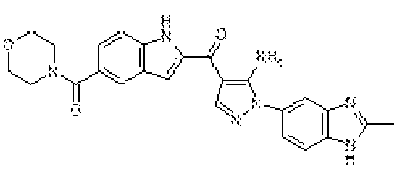
[5-amino-1-(2-melhyl-1H-benzimidazol-5-yl)-1H-pyrazol-4-yl] -[5-(morpholine-4-carbonyl)-1H-indol-2-yl]-methanone 470 1H-NMR (OMSO-D6) δ: 12.47 (1.0H, s), 11.92 (1.0H, s), 8.31 (1.0H, s), 7.79 (1.0H, s), 7.61 (2.0H, m), 7.53 (2.0H, m), 7.32-7.29 (1.0H, m), 7.32 (1.0H, dd, J = 8.8, 1.5 Hz), 7.10-6.95 (2.0H, m), 3.62-3.51 (8.0H, m), 2.54 (3.0H, s). 146 
[5-amino-1-(2-isopropyl-1H-benzimidazol-5-yl)-1H-pyrazol-4-yl] -(1H-indol-2-yl)-methanone 385 1H-NMR (CD3OD) δ: 8.28 (1H, s), 7.73-7.67 (3H, m), 7.50-7.47 (1H, m), 7.40-7.37 (2H, m), 7.29-7.24 (1H, m), 7.12-7.07 (1H, m), 3.30-3.247 (2H, m), 1.46 (6H, d, J = 7.6 Hz). 147 
[5-amino-1-(2-propyl-1H-benzimidazol-5-yl)-1H-pyrazol-4-yl] -(1H-indol-2-yl)-methanone 385 1H-NMR (DMSO-D6) δ: 12.46 (1H, s), 11.70 (1H, s), 8.31 (1H, s); 7.71-7.66 (2H, m), 7.59-7.57 (1H, m), 7.50-7.45 (2H, m), 7.32-7.23 (2H, m), 7.10-6.98 (3H, m), 2.83 (2H, t, J = 7.4 Hz), 1.85-1.79 (2H, m), 0.96 (3H, t, J = 7.3 Hz). 148 
[5-amino-1-(1H-benzimidazol-5-yl) -1H-pyrazol-4-yl]-(1H-indol-2-yl)-methanone 343 1H-NMR (CD3OD) δ: 8.32 (1H, s), 8.29 (1H, s), 7.83-7.80 (2H, m), 7.72 (1H, d, d=8.1 Hz), 7.50-7.46 (2H, m), 7.38 (1H, s), 7.27 (1H, t, J = 7.2 Hz), 7.09 (1H, t, J = 7.2 Hz). 149 
[5-amino-1-(2-trifluoromethyl-1H-benzimidazol-5-yl)-1H-pyrazol-4-yl] -(1H-indol-2-yl)-methanone 411 1H-NMR (DMSO-D6) δ: 12.58 (1H, s), 11.71 (1H, s), 8.35 (1H, s) 7.89-7.81 (2H, m), 7.70 (1H, d, J = 7.4 Hz), 7.50-7.46 (3H, m), 7.27-7.23 (1H, m), 7.10-7.09 (3H, m). 150 
[5-amino-1-(2-ethyl-1H-benzimidazol-5-yl)-1H-pyrazol-4-yl] -(1H-indol-2-yl)-methanone 371 1H-NMR (DMSO-D6) δ: 12.40 (1H, s), 11.68 (1H, s), 8.26 (1H, s), 7.66-7.64 (1H, m), 7.61-7.52 (2H, m), 7.45-7.40 (2H, m), 7.26-7.18 (2H, m), 7.05-7.01 (1H, m), 6.90 (1.1H, s), 2.83 (2H, d, J = 7.6 Hz), 1.29 (3H, t, J = 7.5 Hz). 151 
[5-amino-1-(2-benzyl-1H-benzimidazol-5-yl)-1H-pyrazol-4-yl] -(1H-indol-2-yl)methanone 433 1H-NMR (DMSO-D6) δ: 12.60 (1H, s), 11.70 (1H, s), 8.31 (1H, s), 7.69 (1H, d, J = 8.2 Hz), 7.67-7.59 (2H, m), 7.49-7.45 (2H, m), 7.37-7.23 (7H, m), 7.10-7.06 (1H, m), 7.03-6.97 (2H, m), 4.22 (2H, s). 152 
1-(4-{2-[5-amino-1-(2-methyl-1H-benzimidazol-5-yl)-1H-pyrazole-4-carbonyl]-1H-indol-5-ylmethyl}-piperazin-1-yl)-ethanone 497 1H-NMR(CD3OD) δ: 8.27 (1.0H, s), 7.66 (3.0H, m), 7.46 (1.0H, d, J = 8.3 Hz), 7.38 (1.0H, dd, J = 8.8, 2.0 Hz), 7.35 (1.0H, s), 7.30 (1.0H, dd, J = 8.5, 1.7 Hz), 3.64 (2.0H, s), 3.56 (4.2H, dt, J = 21.6. 4.9 Hz), 2.61 (3.0H, s), 2.49 (4.0H, td, J = 10.5,5.5 Hz), 2.07 (3.0H, s). 153 
[5-amino-1-(2-methyl-1H-benzimidazol-5-yl)-1H-pyrazol-4-yl] -[5-(4-methanesulfonyl-piperazin-1-ylmethyl)-1H-indol-2-yl]-methanone 533 1H-NMR (CD3OD) δ: 8.27 (1.0H, s), 7.67 (3.0H, m), 7.46 (1.0H, d, J = 8.3 Hz), 7.38 (1.0H, dd, J = 8.3, 2.0 Hz), 7.35 (1.0H, s), 7.30 (1.0H, dd, J = 8.3, 1.5 Hz), 3.67 (2.0H, s), 3.23 (4.0H, s), 2.83 (3.0H, s), 2.65-2.55 (4.0H, m), 2.61 (3.0H, s). 154 
[5-amino-1-(2-methyl-1H-benzimidazol-5-yl)-1H-pyrazol-4-yl] -(5-piperazin-1-ylmethyl-1H-indol-2 -yl)-methanone 455 1H-NMR (CD3OD) δ: 8.28 (1.0H, s), 7.70-7.62 (3.0H, m), 7.47 (1.1H, d, J = 8.8 Hz), 7.39 (1.0H, dd, J = 8.3,2.0 Hz), 7.36 (1.0H, d, J = 1.0 Hz), 7.30 (1.0H, dd, J = 8.8, 1.5 Hz), 3.67-3.60 (2.0H, m), 2.95-2.85 (4.0H, m), 2.62 (3.0H, s), 2.60-2.50 (2.0H, s). 155 
1-(4-{2-[5-amino-1-(2-methyl-1H-benzimidazol-5-yl)-1H-pyrazole-4-carbonyl]-1H-indol-6-ylmethyl}-piperazin-1-yl)-ethanone 497 1H-NMR (DMSO-D6) δ: 12.49 (1.0H, br s), 11.66 (1.0H, br s), 8.30 (1.0H, s), 7.66-7.60 (3.0H, m), 7.43-7.41 (2.0H, m), 7.29 (1.0H, dd, J = 8.3, 2.0 Hz), 7.06 (1.0H, dd, J = 8.3, 1.0 Hz), 5.99 (2.0H, br s), 3.58 (2.0H, s), 3.45-3.41 (4.0H, m), 2.53 (3.0H, s), 2.39 (2.0H, t, J = 4.6 Hz), 2.33 (2.0H, t, J = 4.9 Hz), 1.98 (3.0H, s). 156 
[5-amino-1-(2-methyl-1H-benzimidazol-5-yl)-1H-pyrazol-4-yl] -[6-(4-methyl-piperazin-1-ylmethyl) -1H-indol-2-yl]-methanone 469 1H-NMR (DMSO-D6) δ: 12.47 (1.0H, br s), 11.63 (1.0H, br s), 8.30 (1.0H, s), 7.65-7.56 (3.0H, m), 7,42-7.40 (2.0H, m), 7.30-7.28 (1.0H, m), 7.04-6.97 (3.0H, m), 3.53 (2.0H, s), 3.36-3.30 (4.0H m), 2.53 (3.0H, s), 2.46-2.33 (4.0H, m), 2.15 (3.0H, s). 157 
[5-amino-1-(1-methyl-1H-benzimidazol-5-yl)-1H-pyrazol-4-yl] -[5-(4-methyl-piperazin-1-ylmethyl) -1H-indol-2-yl]-methanone 469 1H-NMR(CD30D)δ: 8.27 (1.0H, s), 7.66 (3.0H, m), 7.45 (1.0H, d, J = 8.3 Hz), 7.40-7.33 (2.0H, m), 7.31-7.25 (1.0H, m), 3.64 (2.0H, s), 2.70-2.40 (8H, m), 2.61 (3.0H, s), 2.28 (3.0H, s). 158 
[5-amino-1-(2-methy-1H-benzimidazol-5-yl)-1H-pyrazol-4-yl] -(5-pyrrolidin-1-ylmethyl-1H-indol -2-yl)-methanone 440 1H-NMR (CD30D) δ: 8.27 (1.0H, s), 7.66 (3.0H, m), 7.46 (1.0H, d, J = 8.3 Hz), 7.38 (1:0H, dd, J = 8.3, 2.0 Hz), 7.35 (1.0H, s), 7.30 (1.0H, dd, J = 8.5, 1.7 Hz), 3.75 (2.0H, s), 2.65-2.55(4.0H, m), 2.61(3.0H, s), 1.82 (4.0H, s). 159 
[5-amino-1-(2-methyl-1H-benzimidazol-5-yl)-1H-pyrazol-4-yl] -(4-fluoro-1H-indol-2-yl)-methanone 375 1H-NMR (DMSO-D6) δ: 12.46 (1H, s), 12.04 (1H, s), 8.36 (1H, s), 7.68-7.55 (2H, m), 7.45 (1H, s), 7.34-7.20 (3H, m), 7.09-6.97 (2H, m), 6.38-6.84 (1H, m), 2.53 (3H, s). 160 
[5-amino-1-(2-methyl-1H-benzimidazol-5-yl)-1H-pyrazol-4-yl] -(5-fluoro-1H-indol-2-yl)-methanone 375 1H-NMR (DMSO-D6) δ: 12.48 (1H, s), 11.81 (1H, s), 8.29 (1H, s), 7.69-7.53 (2H, m), 7.60-7.47 (1H, m), 7.44-7.41 (2H, m), 7.29 (1H, dd, J = 8.4, 2.0 Hz), 7.15-7.10 (1H, m), 7.07.6.97 (2H, s), 2.53 (3H, s). 161 
[5-amino-1-(2-methyl-1H-benzimidazol-5-yl)-1H-pyrazol-4-yl] -(6-fluoro-1H-indol-2-yl)-methanone 375 1H-NMR (DMSO-D6) δ: 12.48 (1H, s), 11.78 (1H, s), 8.30 (1H, s), 7.73-7.70 (1H, m), 7.54-7.58 (2H, m), 7.49 (1H, s), 7.30-7-27 (1H, m), 7.20-7.17 (1H, m), 7.00-6.94 (3H, m), 2.53 (3H, s). 162 
[5-amimo-1-(2-methyl-1H-benzimidazol-5-yl)-1H-pyrazol-4-yl] -(1H-pyrrolo[2,3-b]pyridin-2-yl)-methanone 358 1H-NMR (DMSO-D6) δ: 12.48 (1H, s), 12.23 (1H, s), 8.40 (1H, dd, J = 4.6,1.7 Hz), 8.27 (1H, s), 8.13 (1H, dd, J = 8.0, 1.6 Hz), 7.61 (2H, m), 7.41 (1H, s), 7.29 (1H, dd, J = 8.5, 2.1 Hz), 7.18-7.16 (1H, m), 7.64 (2H, s), 2.53 (3.6H, s). 163 
[5-amimo-1-(2-methyl-1H-benzimidazol-5-yl)-1H-pyrazol-4-yl] -(5-fluoro-6-morpaholin-4-ylmethyl-1H-indol-2-yl)-methanone 474 1H-NMR (DMSO-D6) δ: 12.46 (1H, m), 1.74 (1H, s), 8.28 (1H, d, J = 5.1 Hz), 7.67-7.63 (1H, m), 7.58-7.56 (1H, m), 7.49 (1H, d, J = 6.3 Hz), 7.42-7.39 (2H, m), 7.31.7.27 (1H, m), 7.05-6.99 (2H, m), 3.62-3.55 (6H, m), 2.53 (3H, s), 2.47-2.39 (4H, m). 164 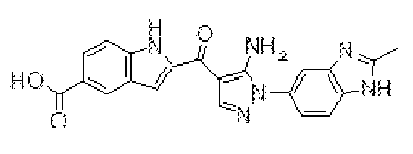
2-[5-amino-1-(2-methyl-1H-benzimidazol-5-yl)-1H-pyrazole-4-carbonyl]-1H-indole-5-carboxylic acid 401 1H-NMR (DMSO-D6) δ: 12.57 (1.0H, s), 12.47 (1.0H, d, J = 5.4 Hz), 12.04 (1.0H, s), 8.40 (1.0H, s), 8.34 (1.0H, J = 4.6 Hz), 7.84 (1.0H, dd, J =8.5, 1.7 Hz), 7.68-1.62 (2.0H, m), 7.57 (1.0H, d, J =8.3 Hz), 7.53 (1.0H, d, J = 8.3 Hz), 7.29 (1.0H, m), 7.10-6.95 (2.0H, m), 2.54 (3.0H, s). -
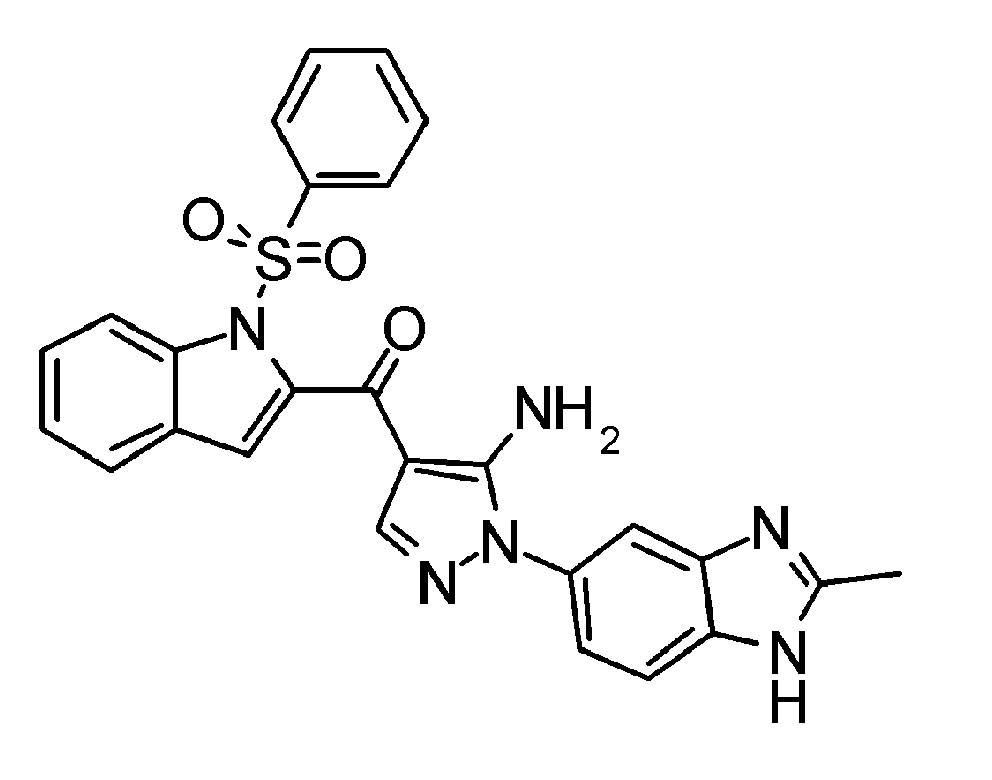
- (2-Methyl-1H-benzimidazol-5-yl)-hydrazine dihydrochloride (830 mg) was added to an ethanol solution (15 ml) of crude 2-(1-benzenesulfonyl-1H-indole-2-carbonyl)-3-dimethylamino acrylonitrile (1.17 g). The reaction mixture was heated with stirring under reflux for four hours. After cooling to room temperature, the mixture was allowed to stand at room temperature. The precipitated solid was collected by filtration, and washed with ethanol to give [5-amino-1-(2-methyl-1H-benzimidazol-5-yl)-1H-pyrazol-4-yl]-(1-benzenesulfonyl-1H-indol-2-yl)-methanone was obtained as a yellow solid (1.5 g, with a two-step yield of 91%).
1H-NMR (DMSO-D6) δ: 8.15-8.13 (2H, m), 8.02 (1H, dd, J = 8.4, 0.8 Hz), 7.97 (1H, d, J = 2.0 Hz), 7.92 (1H, d, J = 8.8 Hz), 7.87 (1H, s), 7.76-7.62 (5H, m), 7.49-7.45 (1H, m), 7.36-7.26 (4H, m), 2.82 (3H, m)
ESI (LC-MS positive mode) m/z 497 [(M+H)+] - The compounds of numbers 1002 to 1082, and 1511 to 1527 listed in Table 7 were synthesized by the same method as in Step 1.
Table 7 Compound No. Structure Compound name m/z 1002 
[5-amino-1-(2-methyl-1H-benzimidazol)-5-yl)-1H-pyrazol-4-yl]-(1-benzenesulfonyl-6-morpholin-4-ylmetlryl-1H-indol-2-yl) methanone 596 1003 
2-[5-amino-1-(2-metlyl-1H-benzimidazol-5-yl)-1H-pyrazol-4-carbony]-1-(toluene-4-sulfonyl)-1H- indole-5-carboxylic acid 555 1004 
[5-amino-1-(2-isopropyl-1H-benzimidazol-5-y)-1H-pyrazol-4-yl]-[1-(toluene-4-sulfonyl)-1H-indol-2-yl] -methanone 539 1005 
[5-amino-1-(2-propyl-1H-benzimidazol-5-yl)-1H-pyrazol-4-yl]-[1-(toluene-4-sulfonyl)-1H-indol-2-yl] -methanone 539 1006 
[5-amino-1-(1H-benzimidazol-5-yl)-1H-pyrazol-4-yl]-[1-(toluene-4-sulfonyl)-1H-indol-2-yl]-methanone 497 1007 
[5-amino-1-(2-methyl-1H-benzimidazol-5-yl)-1H-pyazol-4-yl]-(1-benzencsulfonyl-5-morpholin-4-ylmethl-1H-indol-2-yl)-methaone 596 1008 
[5-amino-1-(2-methyl-1H-benzimidazol-5-yl)-1H-pyrazol-4-yl]-(1-benzenesulfonyl-4-morpholin-4-yl -1H-indol-2-yl)-methanone 582 1009 
[5-amino-1-(2-methyl-1II-benzimidazol-5-yl)-II-pyrazol-4-yl]-(1-benzenesulfonyl-4-morpholin-4-ylmethyl-1H-indol-2-yl)-methanone 596 1010 
[5-amino-1-(2-trifuoromethyl-1H-benzimidazol-5-yl) -1H-pyazol-4-yl]-[1-(tolucnc-4-sulfonyl)-1H-indol-2-yl]-methanone 565 1011 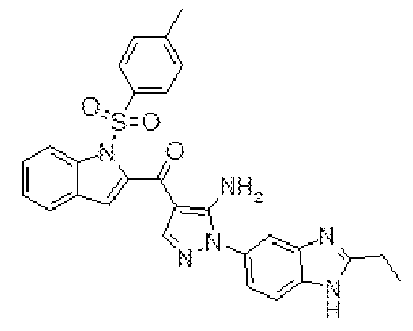
[5-amino-1-(2-ethyl-1H-benzimidazol-5-yl)-1H-pyrazol-4-yl]-[1-(toluene-4-sufonyl)-1H-indol-2-yl] -methanone 525 1012 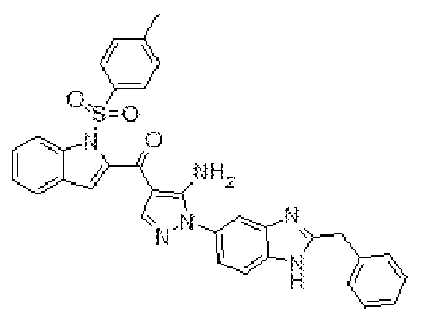
[5-amino-1-(2-benzyl-1H-benzimidazol-5-yl)-1H-pyrazol-4-yl]-[1-(toluene-4-sultonyl)-1H-indol-2-yl] -methanone 587 1013 
[5-amino-1-(2-methyl-1H-benzimidazol-5-yl)-1H-pyrazol-4-yl-(1-benzenesulfonyl-5-piperazin-1-ylmethyl-1H-indol-2-yl)-methanone 595 1014 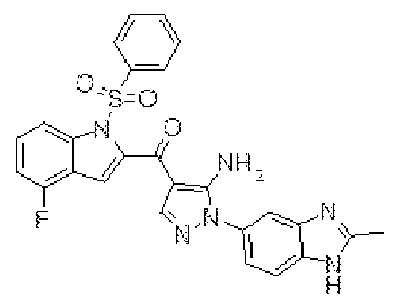
[5-amino-1-(2-methyl-1H-benzimidazol-5-yl)-1H-pyrazol-4-yl]-(1-henzenesulfonyl-4-fluoro-1H-indol -2-yl)-methanone 515 1015 
[5-amino-1-(2-methyl-1H-benzimidazol-5-yl)-1H-pyrazol-4-yl]-(1-benzenesulfonyl-5-fluoro-1H-indol -2-yl)-methanone 515 1016 
[5-amino-1-(2-methyl-1H-benzimidazol-5-yl)-1H-pyrazol-4-yl]-(1-benzenesulfonyl-6-fluoro-1H-indol -2-yl)-methanone 515 1017 
[5-amino-1-(2-methyl-1H-benzimidazol-5-yl)-1H-pyrazol-4-yl]-(1-benzenesulfonyl-1H-pyrrolo[2,3-b] pyridin-2-yl)-methanone 498 1018 
[5-amino-1-(2-methyl-1H-benzimidazol-5-yl)-1H-pyrazol-4-yl]-(1-benzenesulfonyl-1H-pyrrolo[3,2-c]pyridin-2-yl)-methanone 498 1019 
[5-amino-1-(2-methyl-1H-benzimidazol-5-yl)-1H-pyrazol-4-yl]-(1-benzenesulfonyl-5-fluoro-6-morpholin-4-ylmethly-1H-indol-2-yl)-methanone 614 1020 
[5-amino-1-(2-methyl-1H-benzimidazol-5-yl)-1H-pyrazol-4-yl]-[1-benzenesulfonyl-6-(2-morpholin-4-yl-ethoxy)-1H-indol-2-yl)-methanone 626 1021 
[5-amino-1-(2-methyl-1H-benzimidazol-5-yl)-1H-pyrazol-4-yl]-[1-benezensulfonyl-6-tetrahydropyran -4-yloxy)-1H-indol-2-yl)-methanone 597 1022 
[5-amino-1-(2-mehyl-1H-benzimidazol-5-yl)-1H-pyrazol-4-yl]-[4-chloro-1-(toluene-4-sulfonyl)-1H-indol-2-yl]-methanone 545. 547 1023 
[5-amino-1-(2-methyl-1H-benzimidazol-5-yl)-1H-pyrazol-4-yl]-[3-fluoro-1-(toluene-4-sulfonyl)-1H-indol-2-yl]-methanone 529 1024 
[5-amino-1-(2-methyl-1H-benzimidazol-5-yl)-1H-pyrazol-4-yl]-[5-(1-methyl-piperidin-4-yl)-1-(toluene -4-sulfonyl)-1H-indol-2-yl]-methanone 608 1025 
4-[2-[5-amino-1-(2-methy-1H-benzimidazol-5-yl) -1H-pyrazole-4-carbonyl]-1-(toluene-4-sulfonyl)-1H-indol-5-yl]-3,6-dihydro-2II-pyridine-1-carboxylic acid ten-butyl ester 692 1026 
4-[2-[5-amino-1-(2-methyl-1H-benzimidazol-5-yl) -1H-pyrazole-4-carbonyl]-1-(toluene-4-sulfonyl) -1H-indol-5-yl]-piperidine-1-carboxylic acid tert -butyl ester 694 1027 
[5-amino-1-(2-methyl-1H-benzimidazol-5-yl)-1H -pyrazol-4-yl]-[5-((R)-3-fluoro-pyrrolidin-1-ylmethyl) -1-(toluene-4-sulfonyl)-1H-indol-2-yl]-methanone 612 1028 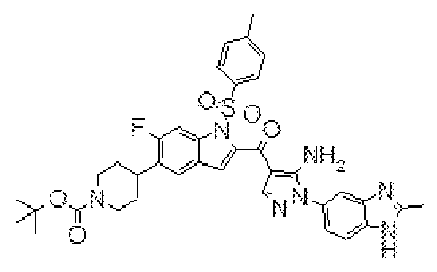
4-[2-[5-amino-1-(2-methyl-1H-benzimidazol-5-yl) -1H-pyrazole-4-carbonyl]-6-fluoro-1-(toluene-4-sulfonyl)-1H-indol-5-yl]-piperidine-1-carboxylic acid tert-butyl ester 712 1029 
[5-amino-1-(1-methyl-1H-benzimidazol-5-yl)-1H-pyazol-4-yl]-[6-tluoro-5-(1-methyl-piperidin-4-yl) -1-(toluene-4-sulfonyl)-1H-indol-2-yl]-methanone 626 1030 
[5-amino-1-(2-melhyl-1H-benzimidazol-5-yl)-1H-pyrazol-4-yl]-[1-benzenesulfonyl-6-(tert-butyl-dipheyl-silanyloxymethyl)-1H-indol-2-yl] methanone 765 1031 
[5-amino-1-(2-methyl-1H-benzimidazol-5-yl)-1H-pyrazol-4-yl]-[5-(1-isopropyl-piperidin-4-yl)-1-(toluene-4-sulfonyl)-1H-indol-2-yl]-methanone 636 1032 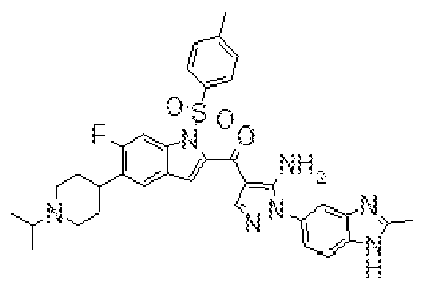
[5-amino-1-(2-melhyl-1H-benzimidazol-5-yl)-1H-pyrazol-4-yl]-[6-fuloro-5-(1-isopropyl-piperidin-4-yl) -1-(toluene-4-sulfonyl)-1H-indol-2-yl]-methanone 654 1033 
[5-amino-1-(2-methyl-1H-benezimidazol-5-yl)-1H-pyrazol-4-yl]-{1-benzenesulfonyl-6-[2-(4-methyl-piperidin-1-yl)-ethoxyl-1H-indol-2-yl}-methanone 639 1034 
[5-amino-1-(2-methyl-1-1H-benzimidazol-5-yl)-1H-pyrazol-4-yl]-[6-fluoro-5-(4-methyl-piperadin-1-ylmelhy)-1-(toluene-4-sufonyl)-1H-indol-2-yl]-methanone 641 1035 
[5-amino-1-(2-methyl-1H-benzimidazol-5-y1)-1H-pyrazol-4-yl]-[6-fluoro-5-pyrrolidin-1-ylmethyl-1-(toluene-4-sulfonyl)-1H-indol-2-yl|-methanone 612 1036 
|5-amino-1-(2-methyl-1H-benzinlidazol-5-yl)-1H-pyrazol-4-yl]--[6-(1-methyl-piperidin-4-yl)-1 -(toluene-4-sulfonyl)-1H-indol-2-yl]-methanone 608 1037 
[5-amino-1-(2-methyl-1H-benzimidazol-5-yl)-1H-pyrazol-4-yl]-[5-(4-fluoro-piperidin-1-ylmethyl)-1-(toluene-4-sulfonyl)-1H-indol-2-yl]-methanone 626 1038 
[5-amino-1-(2-diftuoromethyl-1H-benzimdazol-5-yl) -1H-pyrazol-4-yl]-[5-(1-methy-piperidin-4-yl)-1-(toluene-4-sulfonyl)-1H-indol-2-yl]-methanone 644 1039 
[5-amino-1-(2-difluoromethyl-1H-benzimidazol-5-yl) -1H-pyrazol-4-yl]-[1-(toluene-4-sulfonyl)-1H-indol -2-yl]-methanone 547 1040 
[5-amino-1-(2-methyl-1H-benzimidazol-5-yl)-1H-pyrazol-4-yl]-[5-(1-cyclopentyl-piperidin-4-yl)-1-(toluene-4-sulfonyl)-1H-indol-2-yl]-methanone 662 1041 
[5-mino-1-(2-methyl-1H-benzimidazol-5-yl)-1H-pyrazol-4-yl]-[5-(1-cycloliexyl-piperidin-4-yl)-1-(toluene-4-sulfonyl)-1H-indol-2-yl]-methanone 676 1042 
[5-amino-1-(2-methyl-1H-benzimidazol-5-yl)-1H-pyrazol-4-yl|-|4-bromo-1-(toluene-4-sulfonyl)-1H-pyrrol-2-yl]-methanone 539, 541 1043 
[5-amino-1-(2-methyl-1H-benzimidazol-5-yl)-1H-pyrazol-4-yl]-[1-(toluene-4-sulfonyl)-1H-phrrol-2-yl]-methanone 461 1044 
[5-amino-1-(2-methyl-1H-benezimidazol-5-yl)-1H-pyrazol-4-yl]-[6-butyl-1-(toluene-4-sulfonyl)-1H-indol-2-yl]-methanone 567 1045 
[5-amino-1-(2-methyl-1H-benzimidazol-5-yl)-1H-pyrazol-4-yl]-[5-(1-isopropyl-piperidin-4-yl)-1-(tolueue-4-sufonyl)-6-trifluoromethyl-1H-indol-2-yl]-methanone 704 1046 
[5-amino-1-(2-methyl-1H-benzimidazol-5-yl)-1H-pyrzol-4-yl]-6-bromo-1-(toluene-4-sulfonyl)-1H-indol-2-yl]-methanone 569, 591 1047 
[5-amino-1-(2-methyl-1H-benezimidazol-5-yl)-1H-pyrazol-4-yl]-[6-cyclopropyl-1-(toluene-4-sulfonyl) -1H-indol-2-yl]-methanone 551 1048 
[5-amino-1-(2-methyl-1H-benzimidazol-5-yl)-1H-pyrazol-4-yl]-[5-bromo-1-(toluene-4-sulfonyl)1H-indol-2-yl]-methanone 589, 591 1049 
[5-amino-1-(2-methyl-1H-benezimidazol-5-yl)-1H-pyrazol-4-yl]-[4-iodo-1-(toluene-4-sulfonyl)-1H-indol-2-yl]-methanone 637 1050 
[5-amino-1-(2-methyl-1H-benzimidazol-5-1H-pyrazol-4-yl]-[6-isopropyl-1-(toluene-4-sulufonyl)-1H-indol-2-yl]-methanone 553 1051 
[5-amino-1-(2-methyl-1H-benzimidazol-5-yl)-1H-pyrazol-4-yl]-(1-benzenesulfonyl-1H-pyrrolo[3,2-b]pyridin-2-yl)-methyanone 498 1052 
[5-amino-1-(1-methyl-1H-benzimidazol-5-yl)-1H- pyrazol-4-yl]-[5-bromio-1-(toluene-4-sulfonyl)-6-trifluoromethyl-1H-indol-2-yl]-methanone 657,659 1053 
[5-amino-1-(2-methyl-1H-benzimidazol-5-yl)-1H-pyrazol-4-yl]-[6-bromo-5-fluoro-1-(toluene-4-sulfonyl)-1H-indol-2-yl]-methanone 607,609 1054 
[5-amino-1-(2-methyl-1H-benzimidazol-5-yl)-1H-pyrazol-4-yl]-[6-pyridin-2-yl-1-(toluene-4-sulfonyl)-1H-indol-2-yl]-methanone 588 1055 
[5-amino-1-(2-methyl-1H-benzimidazol-5-yl)-1H-pyrazol-4-yl]-[5-cyclopropyl-1-(toluene-4-sulfonyl) -1H-indol-2-yl]-methanone 551 1056 
|5-amino-1-(2-methyl-1H-benzimidazol-5-yl)-1H-pyrazol-4-yl]-[6-pyridazin-3-yl-1-(toluene-4-sulfonyl) -1H-indol-2-yl]-methyanone 589 1067 
[5-amino-1-(2-methyl-1H-benzimidazol-5-yl)-1H-pyrazol-4-yl]-[6-methylsulfanyl-1-(toluene-4-sulfonyl) -1H-indol-2-yl]-methanone 557 1058 
[5-amino-1-(2-methyl-1H-benzimidazol-5-yl)-1H-pyrazol-4-yl]-[5-bromo-1-(toluene-4-sulfonyl)-1H-indol-2-yl]-methanone 589, 591 1059 
[5-amino-1-(2-methyl-1H-benzimidazol-5-yl)-1H-pyrazol-4-yl]-[5-butoxy-1-(toluene-4-sulfonyl)-1H-indol-2-yl]-methanone 583 1060 
[5-amino-1-(2-methyl-1H-benzimidazol-5-yl)-1H-pyrazol-4-yl]-[5-isopropoxy-1-(toluene-4-sulfonyl)-1H-indol-2-yl]-methanone 569 1061 
[5-amino-1-(2-methyl-1H-benzimidazol-5-yl)-1H-pyrazol-4-yl]-[5-(2-methoxy-cthoxy)-1-(toluene-4-sulfonyl)-1H-indol-2-yl]-methanone 585 1062 
[5-amino-1-(2-methyl-1H-benzimidazol-5-yl)-1H-pyrazol-4-yl]-(1-benzenesulfonyl-4-methyl-1H-indol -2-yl)-melhanone 511 1063 
[5-amino-1-(2-methyl-1H-benzmidazol-5-yl)-1H-pyrazol-4-yl]-(1-benzenesulfonyl-4-trimethylsilanylethynryl-1H-indol-2-yl]-methanone 593 1064 
[5-amino-1-(2-methyl-1H-benzimidazol-5-yl)-1H-pyrazol-4-yl]-[5-(toluene-4-sulfonyl)-5H-[1,3] dioxolo[4,5-f]inodl-6-yl]-methanone 555 1065 
[5-amino-1-(2-methyl-1H-benzimidazol-5-yl)-1H-pyrazol-4-yl]-[5-cyclopropylmethoxy-1-(toluene-4-sulfonyl)-1H-indol-2-yl]-methanone 581 1066 
[5-amino-1-(2-methyl-1H-benzimidazol-5-yl)-1H- pyazol-4-yl]-(1-benzenesulfonyl-d-bromo-1H-indol-2-yl]-methanone 575,577 1067 
[5-amino-1-(2-methyl-1H-benzimidazol-5-yl)-1H-pyrazol-4-yl]-[2,2-difluoro-5-(toluene-4-sulfonyl)-5H-[1,3]dioxolo[4,5-f]indol-6-yl]-methanone 591 1068 
|5-amino-1-(2-methyl-1H-benzimidazol-5-yl)-1H-pyrazol-4-yl]-[6-(3-chloropyridin-2-yl)-1-(toluene-4-sulfonyl)-1H-indol-2-yl]-methanone 622 1069 
[5-amino-1-(2-methyl-1H-benzimidazol-5-yl)-1H-pyrazol-4-yl]-[6-(3-fluoro-pyridin-2-yl)-1-(toluene-4-sulfonyl)-1H-indol-2-yl]-methanone 606 1070 
[5-amino-1-(7-fluoro-2-methyl-1H-benzimidazol -5-yl)-1H-pyrazol-4-yl]-(1-benzencsulfonyl-1H-indol-2-yl)-methanone 515 1071 
[5-amino-1-(2-methyl-1H-benzimidazol-5-yl)-1H-pyrazol-4-yl]-[6-methyl-1-(toluene-4-sulfonyl)-1H-indol-2-yl]-methanone 525 1072 
[5-amino-1-(2-methyl-1H-benzimidazol-5-yl)-1H-pyrazol-4-yl]-[6-(5-fluoro-pyridin-2-yl)-1-(toluene-4-sulfonyl)-1H-indol-2-yl]-methanone 606 1073 
[5-amino-1-(2-methyl-1H-benzimidazol-5-yl)-1H-pyrazol-4-yl]-[6-(6-morpholin-4-yl-pyridazin-3-yl) -1-(toluene-4-sulfonyl)-1H-indol-2-yl]-methanone 674 1074 
[5-amino-1-(2-methyl-1H-benzimidazol-5-yl) -1H-pyrazol-4-yl]-[5-chloro-6-cyclopropylmethoxy-1-(toluene-4-sulfonyl) -1H-indol-2-yl]-methanone 615, 617 1076 
[5-amino-1-(2-mythyl-1H-benzimidazol-5-yl) -1H-pyrazol-4-yl]-[1-(toluene-4-sulfonyl)-6-(5-trifluoromethpl-pyridin-2-yl)-1H-indol-2-yl] -methanone 656 1076 
|5-amino-1-(2-methyl-1H-henzimidazol-5-yl) -1H-pyrazol-4-yl]-[1-(tolene-4-sulfonyl)-6-(6-trifluoromethyl-pyridin-2-yl)-1H-indol-2-yl] -methanone 656 1077 
[5-amino-1-(2-methyl-1H-benzimidazol-5-yl) -1H-pyrazol-4-yl]-[6-(5-chloro-pyridin-2-yl)-1-(toluene-4-sulfonyl)-1H-indol-2-yl]-methanone 621, 623 1078 
[5-amino-1-(2-methyl-1H-benzimidazol-5-yl) -1H-pyrazol-4-yl]-[4,5-dibromo-1-(4-methoxy-benzyl)-1H-pyrrol-2-yl]-methanone 583, 585, 587 1079 
[5-amino-1-(1-methyl-1H-benzimidazol-5-yl) -1H-pyrazol-4-yl]-[1-(tolene-4-sulfonyl)-6-(5-trifluoromethyl-pyridin-2-yl)-1H-indol-2-yl] -methanone 656 1080 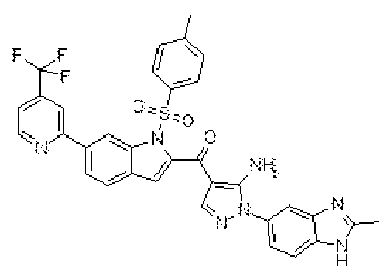
[5-amino-1-(2-methyl-1H-benzimidazol-5-yl) -1H-pyrazol-4-yl]-[1-(toluene-4-sulfonyl)-6-(4-trifluoromethyl-pyridin-2-yl)-1H-indol-2-yl] -methanone 656 1081 
[5-amino-1-(7-fluoro-2-methyl-1H- benzimidazol-5-yl)-1H-pyrazol-4-yl]-(1-benzenesulfonyl-1H-indol-2-yl)-methanone 515 1082 
[5-amino-1-(2-methyl-1H-benzimidazol-5-yl) -1H-pyrazol-4-yl]-(1-benzenzencsulfonyl-4-isopropyl-1H-indol-2-yl]-methanone 539 Compound No. Structure Compound name m/z 1511 
[5-amino-1-(2-methyl-1H-benzimidazol-5-yl)-1H-pyrazol-4-yl]-[6-chloro-1-(toluene-4-sulfonyl)-1H-indol-2-yl]-methanone 545 1512 
[5-amino-1-(2-methyl-1H-benzimidazol-5-yl)-1H-pyrazol-4-yl]-[6-chloro-1-(toluene-4-sulfonyl)-1H-indol-2-yl]-methanone 545 1513 
[5-amino-1-(2-methyl-1H-benzimidazol-5-yl)-1H-pyrazol-4-yl]-[1-(toluene-4-sulfonyl)-1H-indol-3-yl]-methanone 511 1514 
[5-amino-1-(2-methyl-1H-benzimidazol-5-yl)-1H-pyrazol-4-yl]-[1-(toluene-4-sulfonyl)-1H-indol-6-yl]-methanone 511 1515 
[5-amino-1-(2-methyl-1H-benzimidazol-5-yl)-1H-pyrazol-4-yl]-[5-bromo-6-fluoro-1-(toluene-4-sulfonyl)-1H-indol-2-yl]-methanone 607 1516 
[5-amino-1-(2-ethyl-1H-benzimidazol-5-yl)-1H-pyrazol-4-yl]-[5-bromo-6-fluoro-1-(toluene-4-sulfonyl)-1H-indol-2-yl]-methanone 621 1517 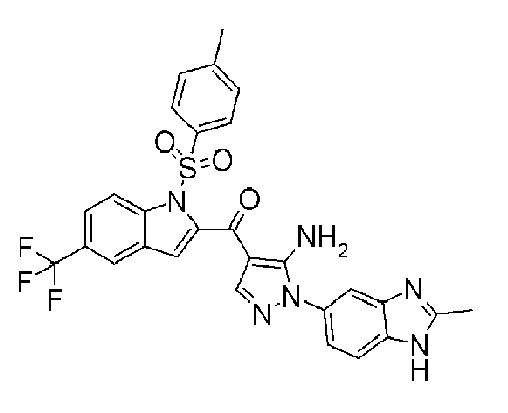
[5-amino-1-(2-methyl-1H-benzimidazol-5-yl)-1H-pyrazol-4-yl]-[1-(toluene-4-sulfonyl)-5-trifluoromethyl-1H-indol-2-yl]-methanone 579 1518 
[5-amino-1-(2-methyl-1H-benzimidazol-5-yl)-1H-pyrazol-4-yl]-[1-(toluene-4- sulfonyl)-5-trifluoromethoxy-1H-indol-2-yl]-methanone 595 1519 
[5-amino-1-(2-methyl-1H-benzimidazol-5-yl)-1H-pyrazol-4-yl]-[4,6-dichloro-1-(toluene-4-sulfonyl)-1H-indol-2-yl]-methanone 579 1520 
[5-amino-1-(2-methyl-1H-benzimidazol-5-yl)-1H-pyrazol-4-yl]-[6-bromo-4-fluoro-1-(toluene-4-sulfonyl)-1H-indol-2-yl]-methanone 607 1521 
[5-amino-1-(2-methyl-1H-benzimidazol-5-yl)-1H-pyrazol-4-yl]-[1-(toluene-4-sulfonyl)-6-trifluoromethoxy-1H-indol-2-yl]-methanone 595 1522 
[5-amino-1-(2-ethyl-1H-benzimidazol-5-yl)-1H-pyrazol-4-yl]-[1-(toluene-4-sulfonyl)-5-trifluoromethoxy-1H-indol-2-yl]-methanone 609 1523 
[5-amino-1-(2-ethyl-1H-benzimidazol-5-yl)-1H-pyrazol-4-yl]-[1-(toluene-4-sulfonyl)-5-trifluoromethyl-1H-indol-2-yl]-methanone 593 1524 
[5-amino-1-(2-methyl-1H-benzimidazol-5-yl)-1H-pyrazol-4-yl]-[5,6-dichloro-1-(toluene-4-sulfonyl)-1H-indol-2-yl]-methanone 579 1525 
[5-amino-1-(2-ethyl-1H-benzimidazol-5-yl)-1H-pyrazol-4-yl]-[6-bromo-5-fluoro-1-(toluene-4-sulfonyl)-1H-indol-2-yl]-methanone 621 1526 
[5-amino-1-(2-methyl-1H-benzimidazol-5-yl)-1H-pyrazol-4-yl]-[4,5-dichloro-l-(toluene-4-sulfonyl)-1H-indol-2-yl]-methanone 579 1527 
[5-amino-1-(2-methyl-1H-benzimidazol-5-yl)-1H-pyrazol-4-yl]-[4,6-difluoro-1-(toluene-4-sulfonyl)-1H-indol-2-yl]-methanone 547 - The compounds of Examples 165 to 195, and 247 to 254 listed in Table 8 were synthesized using compounds having indole ring with unprotected nitrogen atoms by the same method as in Step 1.
Table 8 Example Structure Compound name m/z 1H-NMR 165 
[5-amino-1-(2-methyl-1H-benzimidazol-5-yl)-1H-pyazol-4-yl] -(5-methoxy-1H-indol-2-yl)-methanone 387 1H-NMR (DMSO-D6) δ: 12.47 (1H, s), 11.56 (1H, s), 8.27 (1H, s), 7.62 (2H, s), 7.39-7.36 (2H, m), 7.29 (1H, dd, J = 8.5, 1.8 Hz), 7,13 (1H, d, J = 2.4 Hz), 6.99 (2H, s), 6.91 (1H, dd, J = 3.5, 2.4 Hz), 3.78 (3H, s), 2.53 (3H, s). 166 
[5-amino-1-(2-methyl-1H-benzimidazol-5-yl)-1H-pyrazol-4-yl] -(4,6-dimethoxy-1H-indol-2-yl)-methanone 417 1H-NMR (DMSO-D6) δ: 12.46 (1H, s), 11.56 (1H, d, J = 1.8 Hz), 8.22 (1H, s), 7.62-7.57 (2H, m), 7.31-7.23 (1H, m), 7.25 (1H, d, J = 1.8 Hz), 6.92 (2H, d, J = 22.0 Hz), 6.53 (1H, s), 6.21 (1H, d, J = 1.8 Hz), 3.88 (3H, s), 3.79 (3H, s), 2.53 (3H, s). 167 
[5-amino-1-(2-methyl-1H-benzimidazol-5-yl)-1H-pyrazol-4-yl] -(4-methyl-1H-indol-2-yl)-methanone 387 1H-MMR (DMSO-D6) δ: 12:47 (1H, s), 11.73 (1H, s), 8.25 (1H, s), 7.62-7.60 (2H, m), 7.32-7.28 (2H, m), 7.18 (1H, dd, J = 7.9, 4.0 Hz), 7.07 (1H, d, J = 8.5 Hz), 6.98 (2H, s), 6.55 (1H, d, J = 7.3 Hz), 3.92 (3H, s), 2.53 (3H, s). 168 
[5-amino-1-(2-methyl-1H-benzimidazol-5-yl)-1H-pyrazol-4-yl] -(6-methaxy-1H-indol-2-yl)-methanone 387 1H-HMR (DMSO-D6) δ: 12:46 (1H, s), 11.63 (1H, s), 8.28 (1H, s), 7.60-7.67 (3H, m), 7.41 (1H, d, J = 1.8 Hz), 7.29 (1H, dd, J = 8.5, 1.8 Hz), 6.95-6.93 (3H, m), 6.75 (1H, dd, J = 8.9, 2.1 Hz), 3.80 (3H, s), 2.53 (3H, s). 169 
[5-amino-1-(2-methyl-1H-benzimidazol-5-yl)-1]-1H-pyrazol-4-yl] -(4,6-dimethyl-1H-indol-2-yl)-methanone 385 1H-MMR (DMSO-D6) δ: 12.46 (1H, s), 11.51 (1H, s), 8.37 (1H, s), 7.65-7.57 (2H, br m), 7.40 (1H, br s), 7.29 (1H, d, J = 8.5 Hz), 7.07 (1H, br s), 6.96 (2H. br s), 6.70 (1H, br s), 2.53 (3H, s), 2.53 (3H, s), 2.37 (3H, s). 170 
[5-amino-1-(2-methyl-1H-benzimidazol-5-yl)-1H-pyrazol-4-yl] -(5-tert-butyl-1H-indol-2-yl)-methanone 413 1H-MMR (DMSO-D6) δ: 12:46 (1H, s), 11.55 (1H, s), 8.21 (1H, s), 7.64-7.58 (2H, br m), 7.63 (1H, d, J = 1.5 Hz), 7.41 (1H, d, J = 8.5 Hz), 7.40 (1H, s), 7.36 (1H, dd, J = 8.5, 1.5 Hz), 7.29 (1H, dd, J = 8.5, 1.8 Hz), 6.99 (2H, br s), 2.53 (3H, d, J = 4.3 Hz), 1.35 (9H, s). 171 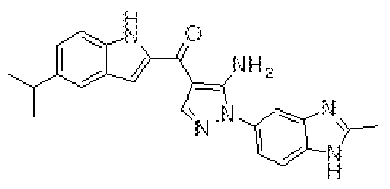
[5-amino-1-(2-methyl-1H-benzimidazol-5-yl)-1H-pyrazol-4-yl] -(5-isopropyl-1H-indol-2-yl)-methanone 399 1H-MNR (DMSO-D6) δ: 12.46 (1H, s), 11.56 (1H, s), 8.28 (1H, s), 7.64-7.56 (2H, br m), 7.60 (1H, s), 7.40 (1H, d, J = 8.5 Hz), 7.37 (1H, d, J = 1.5 Hz), 7.29 (1H, dd, J = 8.5, 1.8 Hz), 7.17 (1H, dd, J = 8.6, 1.6 Hz), 6.98 (2H, br s), 3.01-2.94 (1H, m), 2.53 (3H, s), 1.26 (6H, d, J = 6.7 Hz). 172 
[5-amzino-1-(2-methyl-1H-benzimidazol-5-yl)-1H-pyrazol-4-yl] -(5-benzyloxy-1H-indol-2-yl)-methanone 463 1H-NMR (DMSO-D6) δ: 12.46 (1H, s), 11.58 (1H, d, J = 1.8 Hz), 8.21 (1H, d, J = 3.0 Hz), 7.65-7.55 (2H, m), 7.49-7.47 (2H, m), 7.42-7.38 (3H, m), 7.33-7.29 (3H, m), 7.21 (1H, d, J = 2.4 Hz), 7.01-6.98 (3H, m), 5.12 (2H, s), 2.53 (3H, s). 173 
[5-amino-1-(2-methyl-1H-benzimidazol-5-yl)-1H-pyrazol-4-yl] -(4-benzyloay-1H-indol-2-yl)-methanone 463 1H-NMR (DMSO-D6) δ: 12.46 (1H, s), 11.75 (1H, d, J = 1.8 Hz), 8.27 (1H, s), 7,62-7.58 (4H, m), 7.42 (2H, t, J = 10.4 Hz), 7.35-7.30 (3H, m), 7.15 (1H, dd, J = 7.9, 4.0 Hz), 7.08 (1H, d, J = 8.5 Hz), 6.97 (2H, d, J = 19.5 Hz), 6.64 (1H, d, J = 7.9 Hz), 5.29 (2H, s), 2.53 (3H, s). 174 
[5-amino-1-(2-methyl-1H-benzimidazol-5-yl)-1H-pyazol-4-yl] -(5,6-dimethoxy-1H-indol-2-yl)-methanone 417 1H-NMR (DMSO-D6) δ: 12.45 (1H, s), 11.43 (1H, d, J = 1.6 Hz), 8.24 (1H, d, J = 4.4 Hz), 7-66-7.55 (2H, m), 7.32-7.27 (2H, m), 7.12 (1H, s), 6.94-6.91 (3H, m), 3.81 (3H, s), 3.79 (3H, s), 2.63 (3H, s). 175 
[5-amino-1-(2-methyl-1H-benzimidazol-5-yl)-1H-pyrazol-4-yl]-(6-tert-butyl-1H-indol-2-yl)-methanone 413 1H-MMR (DMSO.D6) δ: 12.45 (1H, s), 11.53 (1H, s), 8.28 (1H. s), 7.62-7.58 (2H, br m), 7.51 (1H, d, J = 6.5Hz), 7.44 (1H, s), 7.38 (1H, d, J = 1.2 Hz), 7.28 (1H, dd, J = 8.5, 1.8 Hz), 7.19 (1H, dd, J = 8.5, 1.2 Hz), 6.98 (2H, br s), 2.53 (3H, s), 1.36 (9H, s). 176 
[5-amino-1-(2-methyl-1H-benzimidazol-5-yl)-1H-pyrazol-4-yl]-(5-fluoro-4-trifluoromethyl-1H-indol-2-yl)-methanone 443 1H-NMR (DMSO-D6) δ: 12.48 (1.0H, brs), 12.38 (1.0H, br s), 8.22 (1.0H, s), 7.82 (1.0H, dd, J = 9.0, 4.2 Hz), 7.64-7.59 (2.0H, m), 7.33-7.26 (3.0H, m), 7.10-7.07 (2.0H, br m), 2.54 (3.0H, s). 177 
[5-amino-1-(2-methyl-1H-benzimidazol-5-yl)-1H-pyrazol-4-yl] -(5-phenoxy-1H-indol-2-yl)-methanone 449 1H-NMR (DMSO-D6) δ: 12:46 (1H, s), 11.77(1H, s), 8.27 (1H, s), 7.63-7.55 (2H, br m), 7.51 (1H, d, J = 8.8 Hz), 7.41 (1H, s), 7.37-7.33 (2H, m), 7.30-7.27 (2H, m), 7.08 (1H, d, J = 7.5 Hz), 7.06-7.00 (2H, m), 7.03 (1H, dd, J = 8.8, 2.4 Hz), 6.96 (2H, d, J =7.5 Hz), 2.53 (3H, s). 178 
[5-animo-1-(2-mcthyl-1H-benzimidazol-5-yl)-1H-pyrazol-4-yl] -(6-methylsulfanyl-1H-indol-2-yl)-methanone 403 1H-NMR (DMSO-D6) δ: 12.45 (1H, s),11.62 (1H, d, J = 1.8 Hz), 8.29 (1H, d, J = 5.5 Hz), 7.66-7.61 (2H, m), 7.56 (1H, d, J = 8.6 Hz], 7.43 (1H, s), 7.33 (1H, s), 7.30-7.26 (1H, m), 7.02-7.00 (2H, m), 5.97 (1H, s), 2.53 (3H, d, J = 1.8 Hz), 2.52 (3H, s). 179 
[5-ammo-1-(2-methyl-1H-benzimidazol-5-yl)-1H-pyrazol-4-yl] -(4-tert-butyl-1H-indol-2-yl)-methanone 413 1H-MMR (DMSO-D6) δ: 12.46 (1H, br s), 11.76 (1H, s), 8.19 (1H, s), 7.63-7.58 (2H, br m),7.42(1H, s), 7.36 (1H, d, J = 7.9 Hz), 7.29 (1H, dd, J = 8.5, 1.8 Hz), 7.17 (1H, t, J = 79 Hz), 6.97 (2H, br s), 6.95 (1H, d, J = 7.9 Hz), 2.54 (3H, s), 1,51 (9H, s). 180 
[5-ammo-1-(2-methyl-1H-benzimidazol-5-yl)-1H-pyrazol-4-yl] -(5-methyl-1H-indol-2-yl)-methanone 371 1H-NMR (DMSO-D6) δ: 12.46 (1H, br s), 11.55 (1H, s), 8.27 (1H, s), 7.60-7.58 (2H, m), 7.45 (1H, s), 7.36 (1H, d, J = 8.4 Hz), 7.33 (1H, s), 7.27 (1H, dd, J = 8.4, 2.0 Hz), 7.07 (1H, dd, J = 8.3,1.5 Hz), 6.96 (2H, br s), 2.52 (3H, s), 2.38 (3H, s). 181 
[5-amino-1-(2-methyl-1H-benzimidazol-5-yl)-1H-pyrazol-4-yl] -(5-ethyl-1H-indol-2-vl)-methanone 385 1H-NMR (DMSO-D6) δ: 12.46 (1H, s), 11.56 (1H, s), 8.27 (1H, s), 7.60.7.58 (2H, m), 7.47 (1H, s), 7.38 (1H, d, J = 8.5 Hz), 7.35-7.35 (1H, m), 7.28 (1H, dd,J = 8.5, 2.1 Hz), 7.11 (1H, dd, J = 8.5, 1.7 Hz), 6.96 (2H, s), 2.69-2.66 (2H, m), 2.52 (3H, s), 1.22 (3H, t, J = 7.5 Hz). 182 
[5-amino-1-(2-methyl-1H-benzimidazol-5-yl)-1H-pyrazol-4-yl] -(5-fluoro-6-trifluoromethyl-1H-indol -2-yl)-methanone 443 1H-NMR (DMSO-D6) δ: 12.48 (1.0H, br s), 12.24 (1.0H, br s), 8.31 (1.0H, s), 7.82 (1.0H, d, J = 5.9 Hz), 7.73 (1.0H, d, J = 11.2 Hz), 7.65-7.54 (3.0H, m), 7.29 (1.0H, d, J = 8.3 Hz), 7.13-7.09 (2.0H, br m), 2.54 (3.0H, s). 183 
[5-amino-1-(2-methyl-1H-benzimidazol-5-yl)-1H-pyrazol-4-yl] -(6-fluoro-5-methoxy-1H-indol-2-yl) -methanone 405 1H-NMR (DMSO-D6) δ: 12.46 (1H, s), 11.64 (1H, s), 8.26 (1H, s), 7.64-7.57 (2H, br m), 7.38 (1H, s), 7.32 (1H, d, J = 9.1 Hz), 7.28 (1H, dd, J = 8.5, 2.4 Hz), 7.23 (1H, d, J =11.6 Hz), 6.98 (2H, br s), 3.86 (3H, s),2.53 (3H, s). 184 
[5-amino-1-(2-methyl-1H-benzimidazol-5-yl)-1H-pyrazol-4-yl] -(6-chloro-5-methoxy-1H-indol-2-yl) -methanone 421, 423 1H-NMR (DMSO-D6) δ: 12.46 (1H, s), 11.65 (1H, s), 8.26 (1H, s), 7.65-7.55 (2H, br m), 7.51 (1H, s), 7.38 (1H, s), 7.31 (1H, s), 7.28 (1H, dd, J = 8.5, 2.4 Hz), 7.01 (2H, br s), 3.87 (3H, s), 2.53 (3H, s). 185 
[5-ammo-1-(2-methyl-1H-benzimidazol-5-yl)-1H-pyrazol-4-yl] -(5-chloro-6-methoxy-1H-indol-2-yl) -methanone 421, 423 1H-NMR (DMSO-D6) δ: 12.45 (1H, s), 11.70 (1H, s), 8.25 (1H, s), 7.73 (1H, s), 7.64-7.55 (2H, br m), 7.38 (1H, s), 7.28 (1H, dd, J = 8.5, 2.4 Hz), 7.06 (1H, s) 6.97 (2H, br s), 3.89 (3H, s), 2.53 (3H, s). 186 
[5-amino-1-(2-methyl-1H-benzimidazol-5-yl)-1H-pyrazol-4-yl] -(6-isopropoxy-1H-indol-2-yl)-methanone 415 1H-NMR (DMSO-D6) δ: 12.43 (1.0H, s), 11.41 (2.0H, s), 8.27 (1.0H, s), 7.7-7.50 (3.0H, m), 7.38 (1.0H, s) 7.29 (1.0H, dd, J = 8.5, 1.7 Hz), 6.95-6.90 (2.0H, m), 6.72 (1.0H, dd, J = 8.7,2.2 Hz), 4.62-4.56 (1.0H, m), 2.53 (3.0H, s), 1.31 (6.0H, d, J = 6.1 Hz). 187 
[5-amino-1-(2-methyl-1H-benzimidazol-5-yl)-1H-pyrazol-4-yl] -(6-benzyloxy-1H-indol-2-yl)-methanone 463 1H-NMR (DMSO-D6) δ: 12.45 (1H, s), 11.52 (1H, s), 8.27 (1H, d, J =4.9 Hz), 7.64 (1H, dd, J = 4.9,3.3 Hz), 7.57 (2H, dd, J = 8.6,4.3 Hz), 7.50-7.49 (2H, m), 7.42.7.39 (3H, m), 7.35-7.26 (2H, m), 7.00-6.94 (3H, m), 6.82 (1H, dd, J = 8.8, 2.2 Hz), 5.14 (2H, s), 2.53 (3H, s). 188 
[5-amino-1-(2-methyl-1H-benzimidazol-5-yl)-1H-pyrazol-4-yl] -(4-isopropoxy-1H-indol-2-yl)- methanone 415 1H-NMR (DMSO-D6) δ: 12.47 (1.0H, br s), 11.69 (1.0H, br s), 8.23 (1.0H, s), 7.64-7.59 (2.0H, m), 7.29 (1.0H, dd, J = 8.3. 1.5 Hz), 7.25-7.25 (1.0H, bt m), 7.15 (1.0H, dd, J = 8.0, 8.0 Hz), 7.04-6.97 (3.0H, m), 6.55 (1.0H, d, J = 8.0 Hz), 4.79-4.73 (1.0H, m), 2.53 (3.0H, s), 1.38 (8.0H, d, J = 5.9 Hz). 189 
[5-amino-1-(2-methyl-1H-benzimidazol-5-yl)-1H-pyrazol-4-yl] -(2,3-dihydro-6H-[1,4]dioxino[2,3-f] indol-7-yl)-mcthanonc 415 1H-NMR (DMSO-D6)δ: 12.44 (1H, s), 11.27 (1H, d, J = 1.6 Hz), 8.24 (1H, s), 7.64-7.62 (1H, br m), 7.68-7.54 (1H, br m), 7.30-7.26 (1H, br m), 7.28 (1H, d, J = 1.6 Hz), 7.08 (1H, s), 6.97 (1H, br s), 6.91 (1H, br s), 6.87 (1H, s), 4.27-4.22 (4H, m), 2.53 (3H, s). 190 
[5-ammo-1-(2-methyl-1H-benzimidazol-5-yl)-1H-pyrazol-4-yl] -(4,6-di-tert-butyl-1H-indol-2-yl)-methanone 469 1H-NMR (DMSO-D6) δ: 12.47 (1.0H, br s), 11.61 (1.0H, br s), 8.19 (1.0H, s), 7.62 (2.0H, br s), 7.37 (1.0H, s), 7.32-7.28 (2.0H, m), 7.05 (1.0H, s), 6.96 (2.0H, br s), 2.53 (3.0H, s), 1.51 (9.0H, s), 1.34 (9,0H, s). 191 
2-[5-amino-1-(2-methyl-1H-benzimidazol-5-yl)-1H-pyrazole-4-carbonyl]-1H-indole-4-carbonitrile 382 1H-NMR (DNSO-D6) δ: 12.44 (1.0H, s), 12.33 (1.0H, s), 8.36 (1.0H, s), 7.84 (1.0H, d, J = 8.2 Hz), 7.70-7.60 (3.0H, m), 7.45-7.35 (2.0H, m), 7.29 (1.0H, dd, J =8.5,1.9 Hz), 7.06 (1.0H, m), 2.53 [3.0H, s). 192 
[5-amino-1-(2-methyl-1H-benzimidazol-5-yl)-1H-pyrazol-4-yl] -(5-imidazol-1-yl-1H-indol-2-yl)-methanone 423 1H-NMR (DNSO-D6) δ: 8.31 (1H, s), 8.17 (1H, s), 7.86 (1H, d, J = 2.0 Hz), 7.70 (1H, s), 7.60-7.59 (3H, m), 7.50-7.47 (2H, m), 7.27 (1H, dd, J = 8.6. 2.0 Hz), 7.11 (1H, d, J = 0.8 Hz), 7.09 (2H, br s), 2.53 (3H, s). 193 
[5-ammo-1-(2-methyl-1H-benzimidazol-5-yl)-1H-pyrazol-4-yl] -(5-trifluorometlrylsulfanyl-1H-indol -2-yl)-methanone 467 1H-NMR (DMSO-D6) δ: 12.31 (1H, br s), 8.32 (1H, s), 8.09 (1H, s), 7.62(1H, d, J = 2.0 Hz), 7.61-7.59 (2H, m), 7.54 (1H, s), 7.48 (1H, d, J = 8.4 Hz), 7.28 (1H, dd, J = 8.6, 2,0 Hz). 7.14 (2H, brs), 2.53 (3H, s). 194 
[5-amino-1-(2-methyl-1H-benzimidazol-5-yl)-1H-pyrazol-4-yl] -(5-methylsulfanyl-1H-indol-2-yl)-methanone 403 1H-NMR (DMSO-D6) δ: 12.48 (1H, s), 11.76 (1H, s), 8.29 (1H, s), 7.62-7.62 (3H, m), 7.44 (1H, d, J = 8.6 Hz), 7.39 (1H, s), 7.29 (1H, dd, J = 8.6,2.0 Hz), 7.23 (1H, dd, J = 8.6, 1.8 Hz), 7.02 (2H, br s), 3.34 (3H, s), 2.54 (3H, s). 195 
[5-amino-1-(2-methyl-1H-benzimidazol-5-yl)-1H-pyrazol-4-yl] -(5-methanesulfonyl-1H-indol-2-yl)-methanone 435 1H-NMR (DMSO-D6) δ: 12.46 (1H, br s), 12.30 (1H, br s), 8.34-8.30 (1H, m), 8.33 (1H, s), 7.76 (1H, dd, J = 8.6, 1.8 Hz), 7.72-7.68 (2H, m), 7.6 8-7.65 (1H, m), 7. 62 - 7. 60 (1H, m), 7.29 (1H, dd, J = 8.6, 2.0 Hz), 7.08 (2H, br s), 3.34 (3H, s), 2.54 (3H, s). 247 
[5-amino-1-(2-methyl-1H-benzimidazol-5-yl)-1H-pyrazol-4-yl]-benzofuran-2-yl-methanone 358 9.21 (m, 1H), 8.52 (s, 1H), 7.73 (d, J= 7.8 Hz, 1H), 7.64 (d, J= 8.4 Hz, 1H), 7.61 (s, 1H), 7.47 (t, J= 8Hz, 1H), 7.40 (m, 1H), 7.32 (t, J= 7.6 Hz, 1H), 6.17 (m, 2H), 2.66 (s, 3H) 248 
[5-amino-1-(2-methyl-1H-benzimidazol-5-yl)-1H-pyrazol-4-yll-benzo[b] thiophen-2-yl-methanone 374 12.46 (s, 1H), 8.42 (s, 1H), 8.35 (m, 1H), 8.05 (m, 2H), 7.65 (m, -1H), 7.56 (m, 1H), 7.51 (m, 2H), 7.28 (m, 1H), 7.09 (s, 1H), 7.03 (s, 1H), 2.54 (s, 3H). 249 
[5-amino-1-(2-methyl-1H-benzimidazol-5-yl)-1H-pyrazol-4-yl]-benzothiazol-2-yl-methanone 375 8.83 (s, 1H), 8.27 (m, 2H), 7.86 (m, 2H), 7.64 (m, 2H), 7.57 (m, 1H), 7.44 (s, 2H), 2.73 (s, 3H). 250 
[5-amino-1-(2-methyl-1H-benzimidazol-5-yl)-1H-pyrazol-4-yl]-(4-fluoro-phenyl)-methanone 336 7.85 (m, 4H), 7.55 (d, J= 8.4 Hz, 1H), 7.36 (t, J= 8.7 Hz, 2H), 7.28 (s, 1H), 7.21 (s, 2H), 7.15 (s, 1H), 7.03 (s, 1H), 2.73 (s, 3H). 251 
[5-amino-1-(2-methyl-1H-benzimidazol-5-yl)-1H-pyrazol-4-yl]-(3-chloro-phenyl)-methanone 352 7.77 (m, 1H), 7.74 (m, 1H), 7.65 (m, 1H), 7.57 (m, 3H), 7.24 (d, J= 8.6 Hz, 2H), 7.03 (br s, 2H), 2.51 (m, 3H). 252 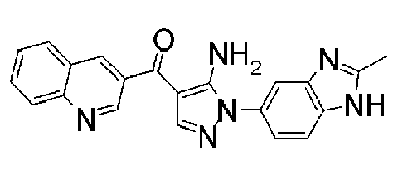
[5-amino-1-(2-methyl-1H-benzimidazol-5-yl)-1H-pyrazol-4-yl]-quinolin-3-yl-methanone 369 9.21 (s, 1H), 8.85 (s, 1H), 8.23 (d, J= 8.1 Hz, 1H), 8.12 (d, J= 8.4 Hz, 1H), 8.06 (s, 1H), 7.91 (m, 3H), 7.73 (t, J= 6.2 Hz, 1H), 7.64 (d, J= 8.4 Hz, 1H), 7.33 (s, 2H), 2.74 (s, 3H). 253 
[5-amino-1-(2-methyl-1H-benzimidazol-5-yl)-1H-pyrazol-4-yl]-quinolin-7-yl-methanone 369 9.05 (m, 1H), 8.52 (d, J= 8.2 Hz, 1H), 8.38 (s, 1H), 8.17 (d, J= 8.4 Hz, 1H), 7.93 (m, 4H), 7.69 (m, 2H), 7.32 (s, 2H), 2.79 (s, 3H). 254 
[5-amino-1-(2-methyl-1H-benzimidazol-5-yl)-1H-pyrazol-4-yl]-quinolin-6-yl-methanone 369 9.02 (d, J= 5.1 Hz, 1H), 8.51 (d, J= 8.4 Hz, 1H), 8.37 (s, 1H), 8.16 (d, J= 8.3 Hz, 1H), 7.92 (m, 4H), 7.66 (m, 2H), 7.32 (m, 2H), 2.74 (s, 3H). -

- N,N-Dimethylformamide dimethylacetal (620 µl) was added at room temperature to a tetrahydrofuran (THF) solution (8.5 ml) of 3-(1-benzenesulfonyl-1H-indol-2-yl)-3-oxo-propionitrile (1.0 g, 3.08 mmol), and stirred for ten minutes. The reaction mixture was then concentrated under reduced pressure to give crude 2-(1-benzenesulfonyl-1H-indole-2-carbonyl)-3-dimethylamino-acrylonitrile as yellow amorphous material. The obtained crude product was used in subsequent reactions without purification.
ESI (LC-MS positive mode) m/z 380 [(M+H)+] - The compounds of numbers 1084 to 1184, and 1528 to 1549 listed in Table 9 were synthesized by the same method as in Step 2.
Table 9 Compound No. Structure Compound name m/z 1084 
2-(1-benzenesulfonyl-6-morpholin-4-ylmethyl-1H-indole-2-carbony)-3-dimethylamino-acrylonitrile 479 1085 
2-(1-benzenesulfonyl-5-morpholin-4-ylmethyl-1H-indole-2-carbonyl)-3-dimethylamino-acrylonitrile 479 1086 
2-(1-benzenesulfonyl-4-morpholin-4-yl-1H-indole-2-carbonyl)-3-dimethylamino-acrylonitrile 465 1087 
2-(1-benzenesulfonyl-4-morpholin-4-ylmethyl-1H-indole-2-carbonyl)-3-dimethylamino-acrylonitrile 479 1088 
4-[1-benzenesulfonyl-2-(2-cyano-3-dimethylamino-acryloyl)-1H-indol-5-ylmethyl]-piperazine-1-carboaylic acid tert-butyl ester 578 1088 
2-(1-benzenesulfonyl-4-fluoro-1H-indole-2-carbonyl)-3-dimethylamino-acrylonitrile 398 1090 
2-(1-benzenesulfonyl-5-fluoro-1H-indole-2-carbonyl)-3-dimethylamino-acrylonitrile 398 1091 
2-(1-benzenesulfonyl-6-fluoro-1H-indole-2-carbonyl)-3-dimethylamino-acrylonitrile 398 1092 
2-(1-benzenesulfonyl-1H-pyrrolo[2,3-b] pyridine-2-carbonyl)-3-dimethylamino -acrylonitrile 381 1093 
2-(1-benzenesulfonyl-1H-pynolo[3,2-c] pyridine-2-carbonyl)-3-dimethylamino -acrylonitrile 381 1094 
2-(1-benzenesulfonyl-5-fluoro-6-morpholin-4-ylmethyl-1H-indole-2-carbonyl)-3-dimethylamino-acrylonitrile 497 1095 
2-[1-benzenesulfonyl-6-(2-morpholin-4-yl -ethoxy)-1H-indole-2-carbonyl]-3-dimethylamino-acrylonitrile 509 1096 
2-[1-benzenesutfonyl-6-(tetrahydro-pyran -4-ylooy)-1H-indole-2-carbonyl]-3-dimethylamino-acrylonitrile 480 1097 
2-[4-chloro-1-(toluene-4-sulfonyl)-1H-indole-2-carbonyl]-3-dimethylamino-acrylonitrile 428, 430 1098 
3-dimethylamino-2-[3-fluoro-1-(toluene -4-sulfonyl)-1H-indole-2-carbonyl] -acrylonitrile 412 1099 
3-dime+ylamino-2-[5-(1-me+yl-piperidin -4-yl)-1-(toluene-4-sulfonyl)-1H-indole -2-carbonyl]-acrylonitrile 491 1100 
4-[2-(2-cyano-3-dimethylamino-acryloyl) -1-(toluene-4-sulfonyl)-1H-indol-5-yl] -3,6-dihydro-2H-pyridine-1-carbooylic acid tert-butyl ester 575 1101 
4-[2-(2-cyano-3-dimethylamino-acryloyl) -1-(toluene-4-sulfonyl)-1H-indol-5-yl]-piperidine-1-carboxylic acid tert-butyl ester 577 1102 
3-dimethylamino-2-[5-((R)-3-fluoro-pyrrolidin-1-ylmethyl)-1-(toluene-4-sulfonyl)-1H-indole-2-carbonyl] -acrylonitrile 495 1103 
4-[2-(2-cyano-3-dimethylamino-acryloyl) -6-fluoro-1-(toluene-4-sulfonyl) -1H-indol-5-yl]-piperidine-1-carboxylic acid tert-butyl ester 595 1104 
3-dimethylamino-2-[6-fluoro-5-(1-methyl -piperidin-4-yl)-1-(toluene-4-sulfonyl) -1H-indole-2-carbonyl]-acrylonitrile 509 1106 
2-[1-benzenesulfonyl-6-(tert-butyldiphenyl -silanyloxymethyl)-1H-indole-2-carbonyl] -3-dimethylamino-acrylonitrile 648 1106 
3-dimethylamino-2-[5-(1-isopropyl-piperidin-4-yl)-1-(toluene-4-sulfonyl) -1H-indole-2-carbonyl]-acrylonitrile 519 1107 
3-dimethylamino-2-[6-fluoro-5-(1-isopropyl-piperidin-4-yl)-1-(toluene-4-sulfonyl)-1H-indole-2-carbonyl]-acrylonitrile 537 1108 
2-(1-benzenesulfonyl-6-[2-(4-methylpiperidin-1-yl)-ethoxy]-1H-indole -2-carbonyl)-3-dimethylamino-acrylonitrile 522 1109 
3-dimethylamino-2-[6-fluoro-5-(4-methyl-piperazin-1-ylmethyl)-1-(toluene -4-sulfonyl)-1H-indole-2-carbonyl]-acrylonitrile 524 1110 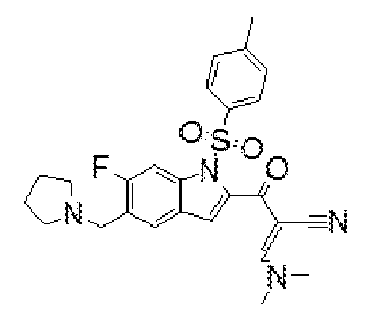
3-dmiethylamino-2-[6-Huoro-5-pyrrolidin -1-ylmethyl-1-(toluene-4-sulfonyl)-1H-indole-2-carbonyl]-aclylonitrile 495 1119 
3-dimethylamino-2-[6-(1-methyl-piperidin -4-yl)-1-(toluene-4-sulfonyl)-1H-indole -2-carbonyl]-acrylonitrile 491 1112 
2-[5-(1-cyclopentyl-piperidin-4-yl)-1-(toluene-4-sulfonyl)-1H-indole-2-carbonyl]-3-dimethylamino-acrylonitrile 545 1113 
2-[5-(1-cycloheayl-piperidin-4-yl)-1-(toluene-4-sulfonyl)-1H-indole-2-carbonyl]-3-dimethylamino-acrylonitrile 559 1114 
2-[4-bromo-1-(toluene-4-sulfonyl)-1H-pyrrol-2-carbonyl]-3-dimethylamino-acrylonitrile 422,424 1115 
3-dimethylamino-2-[1-(toluene-4-sulfonyl)-1H-pyrrol-2-carbonyl]-acrylonitrile 344 1116 
2-(6-benzyloxy-1H-indole-2-carbonyl) -3-dimethylamino-acrylonitrile 346 1117 
3-dimethylamino-2-(5-methoxy-1H-indole-2-carbonyl)-acrylonitrile 270 1118 
2-[6-butyl-1-(toluene-4-sulfonyl)-1H-indole-2-carbonyl]-3-dimethylamino- acrylonitrile 450 1119 
3-dimethylamino-2-[5-(1-isopropryl-piperidin-4-yl)-1-(toluene-4-sulfonyl)-6-trifluoromethyl-1H-indole-2-carbonyl] -acrylonitrile 587 1120 
2-(4,6-dimethoxy-1H-indole-2-carbonyl) -3-dimethylamino-acrylonitrile 300 1121 
3-dimethylamino-2-(4-methoxy-1H-indole-2-carbonyl)-acrylonitrile 270 1122 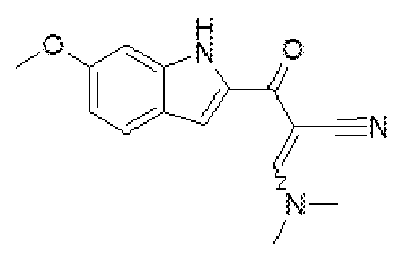
3-dimethylamino-2-(6-methoxy-1H- indole-2-carbonyl)-acrylonitrile 270 1123 
3-dimethylamino-2-(4,6-dimethyl-1H-indole-2-carbonyl)-acrylonitrile 268 1124 
2-[6-bromo-1-(toluene-4-sulfonyl)-1H-indole-2-carbonyl]- 3-dimethylamino-acrylonitrile 472,474 1125 
2-[6-cyclopropyl-1-(toluene-4-sulfonyl) -1H-indole-2-carbonyl]-3-dimethylamino -acrylonitrile 434 1126 
2-(5-tert-buty-1H-indole-2-carbonyl) -3-dimethylamino-acrylonitrile 296 1127 
3-dimethylamino-2-(5-isoproplyl-1H-indole-2-carbonyl)-acrylonitrile 282 1128 
2-(5-benzyloxy-1H-indole-2-carbonyl) -3-ditnethylamino-acrylonitrile 346 1129 
2-(4-benzyloxy-1H-indole-2-carbonyl) -3-dimethylamino-acrylonitrie 346 1130 
2-[5-bromo-1-(toluene-4-sulfonyl)-1H-indole-2-carbonyl]-3-dimethylamino-acrylonitrile 472,474 1131 
2-(5,6-dimethoxy-1H-indole-2-carbonyl) -3-dimethylamino-acrylonitrile 300 1132 
2-(1-benzenesulfonyl-4-iodo-1H-indole -2-carbonyl)-3-dimethylamino-acrylonitrile 506 1133 
3-dimethylamino-2-[6-isopropyl-1-(toluene-4-sulfonyl)-1H-indole-2-carbonyl]-acrylonitrile 436 1134 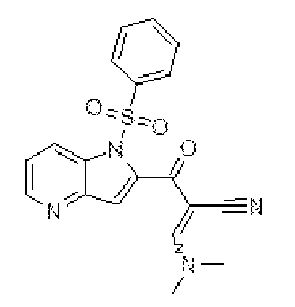
2-(1-benzenesulfonyl-1H-pyrrolo[3,2-b] pyridine-2-carbonyl)-3-dimethylamino -acrylonitrile 381 1135 
2-[5-bromo-1-(toluene-4-sulfonyl)-6-trifluoromethyl-1H-indole-2-carbonyl] -3-dimethylamino-acrylonitrile 542, 542 1136 
2-[6-bromo-5-fluoro-1-(toluene-4-sulfonyl)-1H-indole-2-carbonyl]-3-dimethylamino-acrylonitrile 490, 492 1137 
3-dimethylamino-2-[6-pyridin-2-yl-1-(toluene-4-sulfonyl)-1H-indole-2-carbonyl]-acrylonitrile 471 1138 
2-[5-cyclopropyl-1-(toluene-4-sulfonyl) -1H-indole-2-carbonyl] -3-dimethylamino-acrylonitrile 434 1139 
2-(6-tert-butyl-1H-indole-2-carbonyl)-3-dimethylamino-acrylonitrile 296 1140 
3-dimethylamino-2-[6-pyridazin-3-yl-1-(toluene-4-sulfonyl)-1H-indole-2-carbonyl]-acrylonitrile 472 1141 
3-dimethylamino-2-(5-fluoro-4-trifluoromethyl-1H-indole-2-carbonyl] -acrylonitrile 324 [M-H] 1142 
3-dimethylamino-2-(5-phenoxy-1H-indole-2-carbonyl]-acrylonitrile 332 1143 
3-dimethylamino-2-[6-methylsulfanyl-1-(toluene-4-sulfonyl)-1H-indole-2-carbonyl]-acrylonitrile 440 1144 
3-dimethylamino-2-(5-imidazol-1-yl-1H -indole-2-carbonyl)-acrylonitrile 306 1145 
3-dimethylamino-2-(5-trifluoromethylsulfanyl-1H-indole-2-carbonyl)-acrylonitrile 340 1146 
3-dimethylamino-2-(6-iodo-1H-indole-2-carbonyl)-acrylonitrile M not detected 1147 
(2-(4-tert-butyl-1H-indole-2-carbonyl) -3-dimethylamino-acrylonitrile 296 1148 
3-dimethylamino-2-(5-methyl-1H-indole -2-carbonyl)-acrylonitrile 254 1149 
3-dimethylamino-2-(5-ethyl-1H-indole-2-carbonyl)-acrylonitrile 268 1150 
2-[5-butoxy-1-(toluene-4-sulfonyl)-1H-indole-2-carbonyl]- 3-dimethylamino-acrylonitrile 466 1151 
3-dimethylamino-2-[5-isopropoxy-1-(toluene-4-sulfonyl)-1H-indole-2-carbonyl] -acrylonitrile 452 1152 
3-dimethylamino-2-[5-(2-methoxy-ethoxy)-1-(toluene-4-sulfonyl)-1H-indole-2-carbonyl]-acrylonitrile 467.99 1153 
2-(1-benzenesulfonyl-4-methyl-1H-indole-2-carbonyl)-3-dimethylamino-acrylonitrile 394 1154 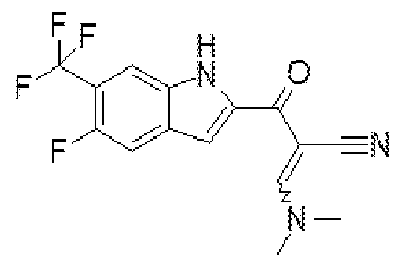
3-dimethylamino-2-(5-fluoro-6-trifluoromethyl-1H-indole-2-carbonyl)-acrylonitrile 324 [M-H] 1155 
3-dimethylamino-2-(6-fluoro-5-methoxy -1H-indole-2-carbonyl)-acrylonitrile 288 1166 
2-[5-benzyl-1-(toluene-4-sulfonyl)-1H-indole-2-carbonyl]-3-dimethylamino-acrylonitrile 484 1157 
2-(6-chloro-5-methoxy-1H-indole-2-carbonyl)-3-dimethylamino-acrylonitrile 304, 306 1158 
2-(5-chloro-6-methoxy-1H-indole-2-carbonyl)-3-dimethylamino-acrylonitrile 304,306 1159 
3-dimethylamino-2-(6-isopropoxy-1#H-indole-2-carbonyl]-acrylonitrile 298 1160 
2-(1-benzenesulfonyl-4-trimethylsilanylethynyl-1H-indole-2-carbonyl)-3-dimethylamino-acrylonitrile 476 1161 
2-[5-bromo-6-methoxy-1-(toluene-4-sulfonyl)-1H-indole-2-carbonyl]-3-dimethylamino-acrylonitrile 502, 504 1162 
3-dimethylamino-2-[5-(toluene-4-sulfonyl)-5H-[1,3]dioxolo[4,5-f] indole-6-carbonyl]-acrylonitrile 438 1163 
2-(6-benzyloxy-1H-indole-2-carbonyl) -3-dimethylamino-acrylonitrile 346 1164 
2-[5-cymopropylmethoxy-1-(toluene-4-sulfonyl)-1H-indole-2-carbonyl]-3-dimethylamino-acrylonitrile 464 1165 
3-dimethylamino-2-(4-isopropoxy-1H-indole-2-carbonyl)-acrylonitrile 298 1166 
2-(1-benzenesulfonyl-4-bromo-1H-indole -2-carbonyl)-3-dimethylamino-acrylonitrile 458, 460 1167 
2-[2,2-difluoro-5-(toluene-4-sulfonyl) -5H-[1,3]dioxolo[4,5-f]indole-6-carbonyl] -3-dimethylamino-acrylonitrile 474 1168 
2-[6-(3-chloro-pyridin-2-yl)-1-(toluene-4-sulfonyl)-1H-indole-2-carbonyl]-3-dimethylamino-acrylonitrile 505,507 1169 
3-dimethylamino-2-[6-(3-fluoropyridin -2-yl)-1-(toluene-4-sulfonyl)-1H-indole -2-carbonyl]-acrylonitrile 489 1170 
3-dimethylamino-2-[6-methyl-1-(toluene -4-sulfonyl)-1H-indole-2-carbonyl]-acrylonitrile 408 1171 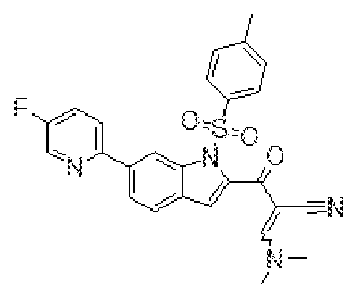
3-dimethylamino-2-[6-(5-fluoro-pyridin -2-yl)-1-(toluene-4-sulfonyl)-1H-indole -2-carbonyl]-acrylonitrile 489 1172 
2-(2,3-dihydro-6H-[1,4]dioxino[2,3-f] indole-7-carbonyl)-3-dimethylamino-acrylonitrile 298 1173 
3-dimethylamino-2-[6-(6-morpholin-4-yl-pyridazin-3yl)-1-(toluene-4-sulfonyl) -1H-indole-2-carbonyl]-acrylonitrile 557 1174 
2-[5-chloro-6-cyclopropylmethoxy-1-(toluene-4-sulfonyl)-1H-indole-2-carbonyl]-3-dimethylamino-acrylonitrile 498, 500 1175 
2-(4,6-di-tert-butyl-1H-indole-2-carbonyl)-3-dimethylamino-acrylonitrile 352 1176 
3-dimethlamino-2-[1-(toluene-4-sulfonyl)-6-(5-trifluoromethylpyridin -2-yl)-1H-indole-2-carbonyl]-acrylonitrile 539 1177 
3-dimethlamino-2-[1-(toluene-4-sulfonyl)-6-(6-trifluoromethyl-pyridin -2-yl)-1H-indole-2-carbonyl]-acrylonitrile 539 1178 
2-[6-(5-chloropyridin-2-yl)-1-(toluene -4-sulfonyl)-1H-indole-2-carbonyl] -3-dimethylamino-acrylonitrile 505, 507 1179 
2-[4,5-dibromo-1-(4-methoxy-benxyl) -1H-pyrrole-2-carbonyl)-3-dimethylamino-acrylonitrile 466, 468, 470 1180 
3-dimethylamino-2-[1-(toluene-4-sulfonyl)-6-(3-trifluoromethyl-pyridin -2-yl)-1H-indole-2-carbonyl]-acrylonitrile 539 1181 
3-dimethylamino-2-[1-(toluene-4-sulfonyl)-6-(4-trifluoromethyl-pyridin -2-yl)-1H-indole-2-carbonyl]-acrylonitrile 539 1182 
3-dimethylamino-2-(5-methylsulfanyl -1H-indole-2-carbonyl)-acrylonitrile 286 1183 
3-dimethylamino-2-(5-methanesulfonyl -1H-indole-2-carbonyl)-acrylonitrile 318 1184 
2-(1-benzenesulfonyl-4-isopropyl-1H-indole-2-carbonyl)-3-dimethylamino- acrylonitrile 422 Compound No. Structure Compound name m/z 1528 
2-[6-chloro-1-(toluene-4-sulfonyl)-1H-indole-2-carbonyl]-3-dimethylamino-acrylonitrile 428 1529 
2-[5-chloro-1-(toluene-4-sulfonyl)-1H-indole-2-carbonyl]-3-dimethylamino-acrylonitrile 428 1530 
3-dimethylamino-2-[1-(toluene-4-sulfonyl)-1H-indole-3-carbonyl]-acrylonitrile 394 1531 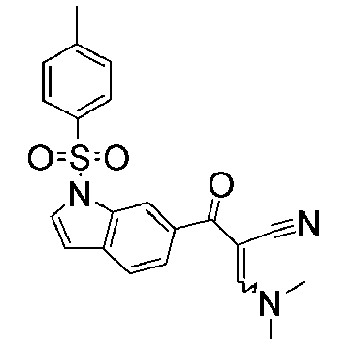
3-dimethylamino-2-[t-(toluene-4-sulfonyl)-1H-indole-6-carbonyl]-acrylonitrile 394 1532 
2-[5-bromo-6-fluoro-1-(toluene-4-sulfonyl)-1H-indole-2-carbonyl]-3-dimethylamino-acrylonitrile 490, 492 1533 
3-dimethylamino-2-[1-(toluene-4-sulfonyl)-5-trifluoromethyl-1H-indole-2-carbonyl]-acrylonitrile 462 1534 
3-dimethylamino-2-[1-(toluene-4-sulfonyl)-5-trifluoromethoxy-1H-indole-2-carbonyl]-acrylonitrile 478 1535 
2-[4,6-dichloro-1-(toluene-4-sulfonyl)-1H-indole-2-carbonyl] -3-dimethylamino-acrylonitrile 462 1536 
2-[6-bromo-4-fluoro-1-(toluene-4-sulfonyl)-1H-indole-2-carbonyl]-3-dimethylamino-acrylonitrile 490 1537 
3-dimethylamino-2-[1-(toluene-4-sulfonyl)-6-trifluoromethoxy-1H-indole-2-carbonyl]-acrylonitrile 478 1538 
2-[5,6-dichloro-1-(toluene-4-sulfonyl)-1H-indole-2-carbonyl]-3- dimethylamino-acrylonitrile 462 1539 
2-[4,5-dichloro-1-(toluene-4-sulfonyl)-1H-indole-2-carbonyl]-3-dimethylamino-acrylonitrile 462 1540 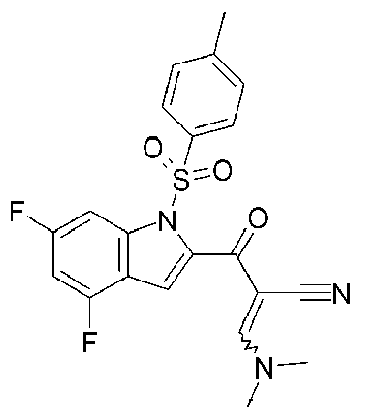
2-[4,6-difluoro-1-(toluene-4-sulfonyl)-1H-indole-2-carbonyl]-3-dimethylamino-acrylonitrile 430 1541 
2-(benzofuran-2-carbonyl)-3-dimethylamino-acrylonitrile 241 1542 
2-(benzo[b]thiophene-2-carbonyl)-3-dimethylamino-acrylonitrile 257 1543 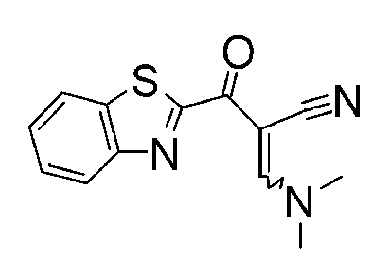
2-(benzothiazole-2-carbonyl)-3-dimethylamino-acrylonitrile 258 1544 
3-dimethylamino-2-(4-fluoro-benzoyl)-acrylonitrile 219 1545 
2-(3-chloro-benzolyl)-3-dimethylamino-acrylonitrile 235 1546 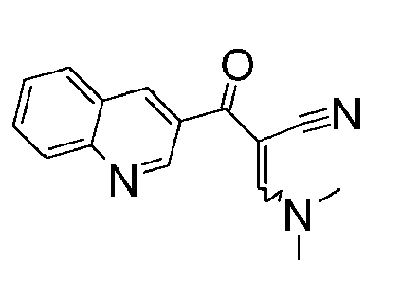
3-dimethylamino-2-(quinoline-3-carbonyl)-acrylonitrile 252 1547 
3-dimethylamino-2-(quinoline-7-carbonyl)-acrylonitrile 252 1548 
3-dimethylamino-2-(quinoline-6-carbonyl)-acrylonitrile 252 1549 
3-dimcthylamino-2-(1H -indolc-2-carbonyl)-acrylonitrile 240 -
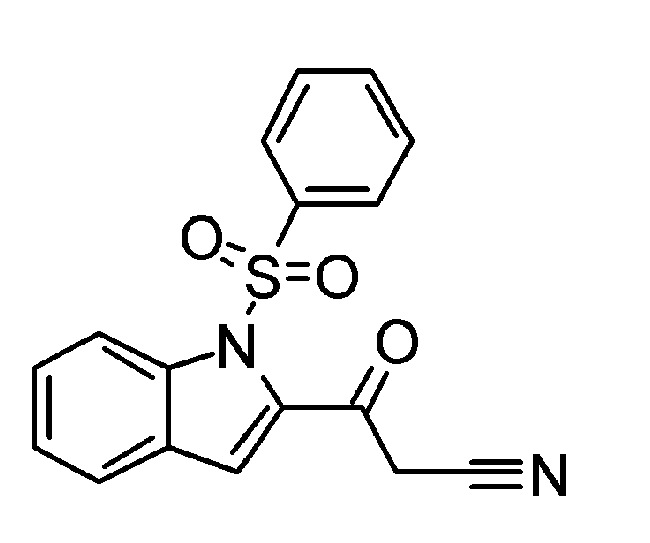
- Acetonitrile (10.6 g, 0.202 mol) was added to a tetrahydrofuran (THF) solution (135 ml) of 1-benzenesulfonyl-1H-indole-2-carboxylic acid ethyl ester (33.4 g, 0.101 mol), and cooled to -78°C. A tetrahydrofuran (THF) solution of 1 M lithium bis(trimethylsilyl) amide (213 ml, 0.213 mol) was added dropwise thereto, and stirred for 30 minutes. A saturated aqueous solution (83 ml) of ammonium chloride was added to the reaction mixture, and stirred for 10 minutes. Water (50 ml) was added to the mixture and warmed to room temperature. The solvent was distilled off under reduced pressure, and the resulting residue was extracted with ethyl acetate. The extract was washed with a saturated aqueous solution of sodium chloride and dried over anhydrous sodium sulfate. The desiccant was removed by filtration. The filtrate was concentrated under reduced pressure. The resulting crude product was washed with ethanol to give 3-(1-benzenesulfonyl-1H-indol-2-yl)-3-oxo-propionitrile (47.3 g, 70%).
1H-NMR (CDCl3) δ: 8.12 (1.0H, dq, J = 8.5, 0.8 Hz), 7.79-7.76(2.0H,m), 7.56-7.48 (3.0H, m), 7.42-7.38 (2.0H, m), 7.32-7.28 (1.0H, m), 7.20 (1.0H, d, J = 0.8 Hz), 4.16 (2.0H, s)
ESI (LC-MS positive mode) m/z 325 [(M+H)+] - The compounds of numbers 1186 to 1284, and 1550 to 1571 listed in Table 10 were synthesized by the same method as in Step 3.
Table 10 Compound No. Structure Compound name m/z 1186 
3-(1-benzenesulfonyl-6-morpholin-4ylmethyl-1H-indol-2-yl)-3-oxo-propionitrile 424 1187 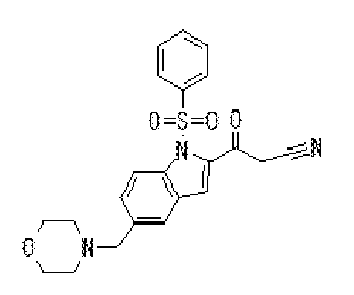
3-(1-benzenesulfonyl-5-morpholin-4-ylmethyl-1H-indol-2-yl)-3-oxo-propionitrile 424 1188 
3-(1-benzenesulfonyl-4-morpholin-4-yl-1H-indol-2-yl)-3-oxo-propionitrile 410 1189 
3-(1-benzenesulfonyl-4-morpholin-4-ylmethyl-1H-indol-2-yl)-3-oxo-propionitrile 424 1190 
4-[1-benzenesulfonyl-2-(2-cyanoacetyl) -1H-indol-5-ylmethyl]-piperazine-1-carboxylic acid tert-butyl ester 523 1191 
3-(1-benzenesulfonyl-4-fluoro-1H-indol-2-yl)-3-oxo-propionitrile 343 1192 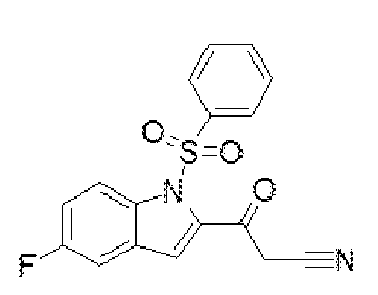
3-(1-benzenesulfonyl-5-fluoro-1H-indol-2-yl)-3-oxo-propionitrile 343 1193 
3-(1-benzenesulfonyl-6-fluoro-1H-indol-2-yl)-3-oxo-propionitrile 343 1194 
3-(1-benzenesulfonyl-1H-pyrrolo[2,3-b]pyridin-2-yl)-3-oxo-propionitrile 340 1195 
3-(1-benzenesulfonyl-1H-pyrrolo[3,2-c] pyridin-2-yl)-3-oxo-propionitrile 326 1196 
3-(1-benzenesulfonyl-5-tluoro-6-morpholin-4-ylmethyl-1H-indol-2-yl)-3 -oxo-propionitrile 442 1197 
3-[1-benzenesulfonyl-6-(2-morpholin-4-yl-ethoxy)-1H-indol-2-yl]-3-oxo-propionitrile 454 1198 
3-[1-benzenesulfonyl-6-(tetrahydro-pyran -4-yloxy)-1H-indol-2-yl]-3-oxo-propionitrile 425 1199 
3-[4-chloro-1-(toluene-4-sulfonyl)-1H-indol-2-yl]-3-oxo-propionitrile 373, 375 1200 
3-[3-fluoro-1-(toluene-4-sulfonyl)-1H-indol-2-yl]-3-oxo-propionitrile 357 1201 
3-[5-(1-methyl-piperidin-4-yl)-1-(toluene-4-sulfonyl)-1H-indol-2-yl]-3-oxo-propionitrile 436 1202 
4-[2-(2-cyano-acetyl)-6-fluoro-1-(toluene-4-sulfonyl)-1H-indol-5-yl] -3,6-dihydro-2H-pyridine-1-carboxylic acid tert-butyl ester 538 1203 
4-[2-(2-cyano-acetyl)-1-(toluene-4-sulfonyl)-1H-indol-5-yl]-piperidine-1-carboxylic acid tert-butyl ester 466 [M-tBu] 1204 
3-[5-((R)-3-fluoro-pyrrolidm-1-ylmethyl) -1-(toluene-4-sulfonyl)-1H-indol-2-yl] -3-oxo-propionitrile 440 1205 
4-[2-(2-cyano-acetyl)-6-fluoro-1-(toluene-4-sulfonyl)-1H-indol-5-yl] -piperidine-1-carboxylic acid tert-butyl ester 540 1206 
3-[6-fluoro-5-(1-methyl-piperidin-4-yl) -1-(toluene-4-sulfonyl)-1H-indol-2-yl] -3-oxo-propionitrile 454 1207 
3-[1-benzenesulfonyl-6-(tert-butyl-diphenyl-silanyloaymethyl)-1H-indol -2-yl]-3-oxo-propionitrile 593 1208 
3-[5-(1-isopropyl-piperidin-4-yl)-1-(toluene-4-sulfonyl)-1H-indol-2-yl] -3-oxo-propionitrile 464 1209 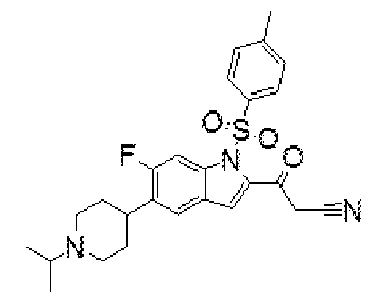
3-[6-fluoro-5-(1-isopropyl-piperidin-4-yl)-1-(toluene-4-sulfonyl)-1H-indol-2-yl] -3-oxo-propionitrile 482 1210 
3-{1-benzenesulfonyl-6-[2-(4-methyl-piperadin-1-yl)-ethoxy]-1H-indol-2-yl} -3-oxo-pr 467 1211 
3-[6-fluoro-5-(4-methyl-piperadin-1-ylmethyl) -1-(toluene-4-sulfonyl)-1H-indol-2-yl]-3-oxo-propionitrile 469 1212 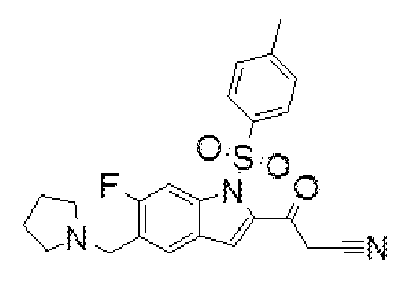
3-[6-fluoro-5-pyrrolidin-1-ylmethyl)-1-(toluene-4-sulfonyl)-1H-indol-2-yl]-3-oxo-propionitrile 440 1213 
3-[6-(1-methyl-piperidin-4-yl)-1-(toluene-4-sulfonyl)-1H-indol-2-yl] -3-oxo-propionitrile 436 1214 
3-[5-(1-cymopentyl-piperidin-4-yl)-1-(toluene-4-sulfonyl)-1H-indol-2-yl] -3-oxo-propionitrile 490 1215 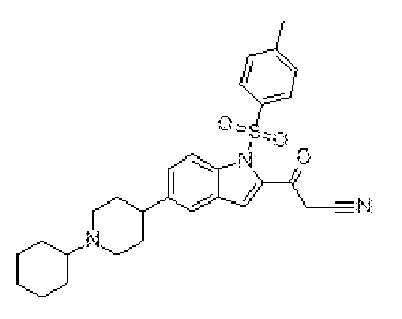
3-[5-(1-cyclohexyl-piperidin-4-yl) -1-(toluene-4-sulfonyl)-1H-indol-2-yl] -3-oxo-propionitrile 504 1216 
3-[4-bromo-1-(toluene-4-sulfonyl)-1H-pyrrol-2-yl]-3-oxo-propionitrile 367, 369 1217 
3-oxo-3-[1-(toluene-4-sulfonyl)-1H-pyrrol-2-yl]-propionitrile 289 1218 
3-(5-mefloxy-1H-indol-2-yl)-3-oxo-propionitrile 215 1219 
3-[6-butyl-1-(toluene-4-sulfonyl)-1H-indol-2-yl]-3-oxo-propionitrile 395 1220 
3-[5-(1-isopropyl-piperidin-4-yl)-1-(toluene-4-sulfonyl)-6-trifluoromethyl-1H-indol-2-yl]-3-oxo-propionitrile 532 1221 
3-(4,6-dimethoxy-1H-indol-2-yl)-3-oxo-propionitrile 245 1222 
3-(4-methoxy-1H-indol-2-yl)-3-oxo-propionitrile 215 1223 
3-(6-methoxy-1H-indol-2-yl)-3-oxo-propionitrile 215 1224 
3-(4,6-dimethyl-1H-indol-2-yl)-3-oxo-propionitrile 213 1225 
3-[6-bromo-1-(toluene-4-sulfonyl)-1H-indol-2-yl]-3-axo-propionitrile 417,419 1226 
3-[6-cyclopropyl-1-(toluene-4-sulfonyl) -1H-indol-2-yl]-3-oxo-propionitrile 379 1227 
3-(5-tert-butyl-1H-mdol-2-yl)-3-oxo-propionitrile 241 1228 
3-(5-isopropyl-1H-indol-2-yl)-3-oxo-propionitrile 227 1229 
3-(5-benzyloxy-1H-indol-2-yl)-3-oxo-propionitrile 291 1230 
3-(4-benzyloxy-1H-indol-2-yl)-3-oxo-propionitrile 291 1231 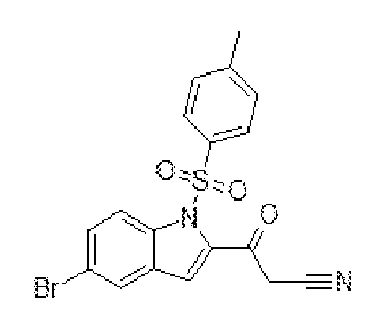
3-[5-bromo-1-(toluene-4-sulfonyl)-1H-indol-2-yl]-3-oxo-propionitrile 417, 419 1232 
3-(5,6-dimethoxy-1H-indol-2-yl)-3-oxo-propionitrile 245 1233 
3-(4-iodo-1H-indol-2-yl)-3-oxo-propionitrile 309 [M-H] 1234 
3-[6-isopropyl-1-(toluene-4-sulfonyl) -1H-indol-2-yl]-3-oxo-propionitrile 381 1235 
3-(1-benzenesulfonyl-1H-pyrrolo [3,2-b]pyridin-2-yl)-3-oxo-propionitrile 326 1236 
3-[5-bromo-1-(toluene-4-sulfonyl)-6-trifluoromethyl-1H-indol-2-yl]-3-oxo-propionitrile 483, 485 [M-H] 1237 
3-[6-bromo-5-fluoro-1-(toluene-4-sulfonyl)-1H-indol-2-yl]-3-oxo-propionitrile 435, 437 1238 
3-oxo-3-[6-pyridin-2-yl-1-(toluene-4-sulfonyl)-1H-indol-2-yl]-propionitrile 416 1239 
3-[5-cyclopropyl-1-(toluene-4-sulfonyl) -1H-indol-2-yl]-3-oxo-propionitrile 379 1240 
3-(6-tert-butyl-1H-indol-2-yl)-3-oxo-propionitrile 241 1241 
3-oxo-3-[6-pyridazin-3-yl-1-(toluene-4-sulfonyl)-1H-indol-2-yl]-propionitrile 417 1242 
3-(5-fluoro-4-trifluoromethyl-1H-indol -2-yl)-3-oxo-propionitrile 269 [M-H] 1243 
3-oxo-3-(5-phenoxy-1H-indol-2-yl)-propionitrile 277 1244 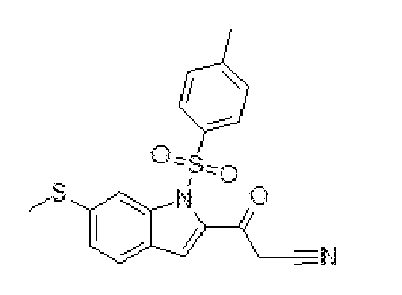
3-[6-methylsulfanyl-1-(toluene-4-sulfonyl)-1H-indol-2-yl]-3-oxo-propionitrile 385 1245 
3-(5-imidazol-1-yl-1H-indol-2-yl)-3 -oxo-propionitrile 251 1246 
3-oxo-3-(5-trifluoromethylsulfanyl-1H -indol-2-yl)-propionitrile 285 1247 
3-(4-tert-butyl-1H-indol-2-yl)-3-oxo-propionitrile 241 1248 
3-(5-methyl-1H-indol-2-yl)-3-oxo-propionitrile 199 1249 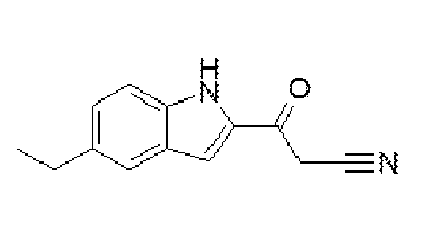
3-(5-ethyl-1H-indol-2-yl)-3-oxo-propionitrile 213 1250 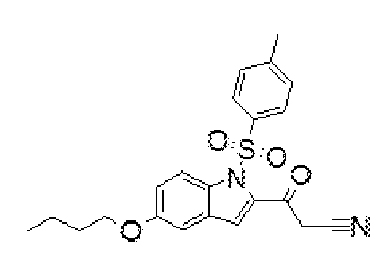
3-[5-butoxy-1-(toluene-4-sulfonyl)-1H-indol-2-yl]-3-oxo-propionitrile 411 1251 
3-[5-isopropoxy-1-(toluene-4-sulfonyl) -1H-indol-2-yl]-3-oxo-propionitrile 397 1252 
3-[5-(2-methoxy-ethoxy)-1-(toluene-4-sulfonyl)-1H-indol-2-yl]-3-oxo-propionitrile 413 1253 
3-(1-benzenesulfonyl-4-methyl-1H-indol-2-yl)-3-oxo-propionitrile 337 [M-H] 1254 
3-(5-fluoro-6-trifluoromethyl-1H-indol -2-yl)-3-oxo-propionitrile 269 [M-H] 1255 
3-(5-methylsulfanyl-1H-indol-2-yl) -3-oxo-propionitrile 231 1256 
3-(6-fluoro-5-methoxy-1H-indol-2-yl) -3-oxo-propionitrile 233 1257 
3-[5-benzyl-1-(toluene-4-sulfonyl)-1H-indol-2-yl]-3-oxo-propionitrile 429 1258 
3-(6-chloro-5-methoxy-1H-indol-2-yl) -3-oxo-propionitrile 249, 251 1259 
3-(5-chloro-6-methooy-1H-indol-2-yl) -3-oxo-propionitrile 249, 251 1260 
3-(6-isopropoxy-1H-indol-2-yl)-3-oxo-propionitrile 243 1261 
3-(1-benzenesulfonyl-4-trimethylsilanylethynyl-1H-indol-2-yl) -3-oxo-propionitrile 421 1262 
3-[5-bromo-6-methoxy-1-(toluene-4-sulfonyl)-1H-indol-2-yl]-3-oxo-propionitrile 447,449 1263 
3-oxo-3-[5-(toluene-4-sulfonyl)-5H-[1,3] dioxolo[4,5-f]indol-6-yl]-propionitrile 383 1264 
3-(6-benzyloxy-1H-indol-2-yl)-3-oxo-propionitrile 291 1265 
3-[5-cyclopropylmethoxy-1-(toluene-4-sulfonyl)-1H-indol-2-yl]-3-oxo-propionitrile 409 1266 
3-(4-isopropoxy-1H-indol-2-yl)-3-oxo-propionitrile 243 1267 
3-(1-benzenesulfonyl-4-bromo-1H-indol -2-yl)-3-oxo-propionitrile 403, 405 1268 
3-[2,2-difluoro-5-(toluene-4-sulfonyl) -5H-[1,3]dioxolo[4,5-f]indol-6-yl]-3-oxo-propionitrile 419 1269 
3-[6-(3-chloro-pyridin-2-yl)-1-(toluene-4-sulfonyl)-1H-indol-2-yl]-3-oxo-propionitrile 450, 452 1270 
3-[6-(3-fluoro-pyridin-2-yl)-1-(toluene -4-sulfonyl)-1H-indol-2-yl]-3-oxo-propionitrile 434 1271 
3-[6-methyl-1-(toluene-4-sulfonyl)-1H-indol-2-yl]-3-oxo-propionitrile 353 1272 
3-[6-(5-fluoro-pyridin-2-yl)-1-(toluene -4-sulfonyl)-1H-indol-2-yl]-3-oxo-propionitrile 434 1273 
3-{2,3-dihydro-6H-[1,4]dioxino[2,3-f] indol-7-yl)-3-oxo-propionitrile 243 1274 
3-[6-(6-morpholin-4-yl-pyridazin-3-yl) -1-(toluene-4-sulfonyl)-1H-indol-2-yl] -3-oxo-propionitrile 502 1275 
3-[5-chloro-6-cyclopropylmethoxy-1-(toluene-4-sulfonyl)-1H-indol-2-yl] -3-oxo-propionitrile 443, 445 1276 
3-(4,6-di-tert-butyl-1H-indole-2-yl) -3-oxopropionitrile 352 1277 
3-oxo-3-[1-(toluene-4-sulfonyl)-6-(5-trifluoromethyl-pyridin-2-yl)-1H-indol-2-yl]-propionitrile 484 1278 
3-oxo-3-[1-(toluene-4-sulfonyl)-6-(6-trifluoromethyl-pyridin-2-yl)-1H-indol-2-yl]-propionitrile 484 1279 
3-[6-(5-chloro-pyridin-2-yl)-1-(toluene -4-sulfonyl)-1H-indol-2-yl]-3-oxo-propionitrile 450, 452 1280 
3-[4,5-dibromo-1-(4-methoxy-benzyl) -1H-pyrrol-2-yl]-3-oxo-propionitrile 411, 413 415 1281 
3-oxo-3-[1-(toluene-4-sulfonyl)-6-(3-trifluoromethyl-pyridin-2-yl)-1H-indol-2-yl]-propionitrile 484 1282 
3-oxo-3-[1-(toluene-4-sulfonyl)-6-(4-trifluoromethyl-pyridin-2-yl)-1H-indol -2-yl]-propionitrile 484 1283 
3-(5-methanesulfonyl-1H-indol-2-yl) -3-oxo-propionitrile 263 1284 
3-(1-benzenesulfonyl-4-isopropyl-1H-indol-2-yl)-3-oxo-propionitrile 367 Compound No. Structure Compound name m/z 1550 
3-[6-chloro-1-(toluene-4-sulfonyl)-1H-indol-2-yl]-3-oxo-propionitrile 373 1551 
3-[5-chloro-1-(toluene-4-sulfonyl)-1H-indol-2-yl]-3-oxo-propionitrile 373 1552 
3-oxo-3-[1-(toluene-4-sulfonyl)-1H-indol-3-yl]-propionitrile 339 1553 
3-oxo-3-[1-(toluene-4-sulfonyl)-1H-indol-6-yl]-propionitrile 339 1554 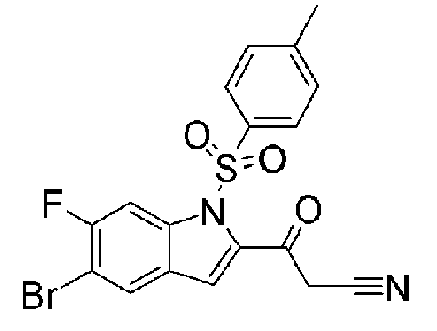
3-[5-bromo-6-fluoro-1-(toluene-4-sulfonyl)-1H-indol-2-yl]-3-oxo-propionitrile 435 1555 
3-oxo-3-[1-(toluene-4-sulfonyl)-5-trifluoromethyl-1H-indol-2-yl]-propionitrile 407 1556 
3-oxo-3-[1-(toluene-4-sulfonyl)-5-trifluoromethoxy-1H-indol-2-yl]-propionitrile 423 1557 
3-[4,6-dichloro-1-(toluene-4-sulfonyl)-1H-indol-2-yl]-3-oxo-propionitrile 407 1558 
3-[6-bromo-4-fluoro-1-(toluene-4-sulfonyl)-1H-indol-2-yl]-3-oxo-propionitrile 435 1559 
3-oxo-3- [1 -(toluene-4-sulfonyl)-6-trifluoromcthoxy-1H-indol-2-yl]-propionitrile 423 1560 
3-[5,6- dichloro-1-(toluene-4-sulfonyl)-1H-indol-2-yl]-3-oxo-propionitrile 407 1561 
3-[4,5- dichloro-1-(toluene-4-sulfonyl)-1H-indol-2-yl -3-oxy-propionitrile 407 1562 
3-[4,6-difluoro-1-(toluene-4-sulfonyl)-1H-indol-2-yl]-3-oxo-propionitrile 375 1563 
3-benzofuran-2-yl-3-oxo-propionitrile 186 1564 
3-benzo [b]thiophen-2-yl-3-oxo-propionitrile 202 1565 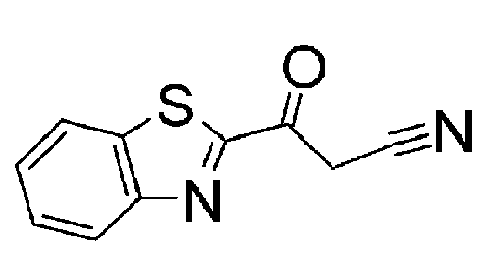
3-benzothiazol-2-yl-3-oxo-propionitrile 203 1566 
3-(4-fluoro-phenyl)-3-oxo-propionitrile 164 1567 
3-(3-chloro-phenyl)-3-oxo-propionitrile 180 1568 
3-oxo-3-quinolin-3-yl-propionitrile 197 1569 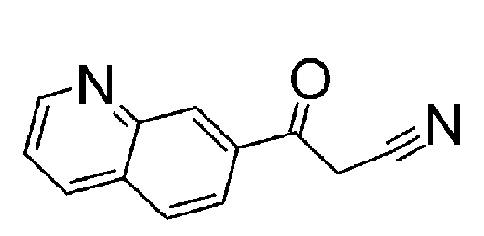
3-oxo-3-quinolin-7-yl-propionitrile 197 1570 
3-oxo-3-quinolin-6-yl-propionitrile 197 1571 
3-(1H-indol-2-yl)-3-oxo-propionitrile 185 -

- With cooling on ice, an anhydrous N,N-dimethylformamide (DMF) solution (70 ml) of 1H-indole-2-carboxylic acid ethyl ester (45 g, 0.238 mol) was added dropwise to a solution of 50% sodium hydride (13.7 g, 0.286 mol) in anhydrous N,N-dimethylformamide (DMF) (90 ml). After one and half hour of stirring with cooling on ice, the reaction mixture was warmed to room temperature, and then stirred for one hour. After cooling on ice, an anhydrous N,N-dimethylformamide (DMF) solution of benzenesulfonyl chloride (50.4 g) was added dropwise, and the resulting mixture was stirred for one hour. An aqueous solution of 0.5 N hydrochloric acid was added dropwise to the reaction mixture, and then water was added thereto. The mixture was stirred for 30 minutes. The resulting solid was collected by filtration, and washed with water and then with n-hexane. The solid was dissolved in ethyl acetate, and washed with a saturated aqueous solution of sodium bicarbonate and then with a saturated aqueous solution of sodium chloride. The organic layer was dried over anhydrous sodium sulfate. The desiccant was removed by filtration. The filtrate was concentrated under reduced pressure to give crude 1-benzenesulfonyl-1H-indole-2-carboxylic acid ethyl ester. The obtained crude product was recrystallized (ethyl acetate/hexane) to give 1-benzenesulfonyl-1H-indole-2-carboxylic acid ethyl ester (68.9 g, 79%).
1H-NMR (CDCl3) δ: 8.12 (1H, d, J = 8.3 Hz), 8.04 (2H, d, J = 7.8 Hz), 7.60-7.52 (2H, m), 7.51-7.40 (3H, m), 7.31-7.21 (1H, m), 7.17 (1H, s), 4.40 (2H,q, J = 7.0 Hz), 1.39 (3H, t, J = 7.0 Hz)
ESI (LC-MS positive mode) m/z 330 [(M+H)+] - The compounds of numbers 1286 to 1312 listed in Table 11 were synthesized by the same method as in Step 4.
Table 11 Compound No. Structure Compound name m/z 1286 
6-morpholin-4-ylmethyl-1-(benzenesulfonyl)-1H-indole-2-carboxylic acid ethyl ester 429 1287 
5-morpholin-4-ylmethyl-1-(benzenesulfonyl)-1H-indole-2-carboxylic acid ethyl ester 429 1288 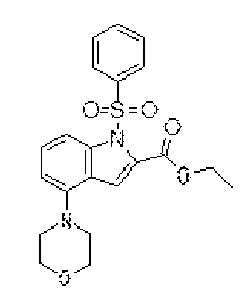
1-benzenesulfonyl-4-morpholin-4-yl-1H-indole-2-carboxylic acid ethyl ester 415 1289 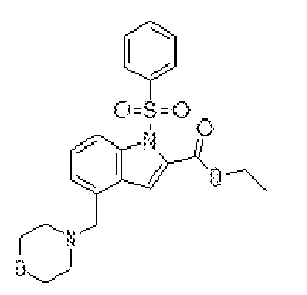
1-benzenesulfonyl-4-morpholin-4-ylmethyl-1H-indole-2-carboxylic acid ethyl ester 429 1290 
1-benzenesulfonyl-4-fluoro-1H-indole-2-carboxylic acid ethyl ester 348 1291 
1-benzenesulfonyl-5-fluoro-1H-indole-2-carboxylic acid ethyl ester 348 1292 
1-benzenesulfonyl-6-fluoro-1H-indole -2-carboxylic acid ethyl ester 348 1293 
1-benzenesulfonyl-1H-pyrrolo[2,3-b] pyridine-2-carboxylic acid ethyl ester 331 1294 
1-benzenesulfonyl-1H-pyrrolo [3,2-c]pyridine-2-carboxylic acid ethyl ester 331 1295 
1-benzenesulfonyl-5-fluoro-6-morpholin-4-ylmethyl-1H-indole -2-carboxylic acid ethyl ester 447 1296 
1-benzenesulfonyl-6-(2-morpholin -4-yl-ethoxy)-1H-indole-2-carboxylic acid methyl ester 445 1297 
1-benzenesulfonyl-6-(tetrahydro-pyran-4-yloxy)-1H-indole-2-carboxylic acid methyl ester 416 1298 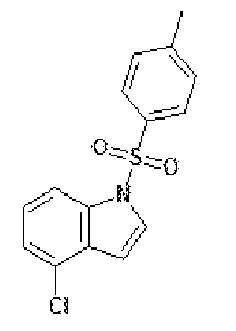
4-chloro-1-(toluene-4-sulfonyl) -1H-indole 306, 308 1299 
5-((R)-3-fluoro-pyrrolidin-1-ylmethyl)-1-(toluene-4-sulfonyl) -1H-indole-2-carboxylic acid ethyl ester 445 1300 
6-bromo-1-(toluene-4-sulfonyl) -1H-indole-2-carboxylic acid ethyl ester 422, 424 1301 
5-bromo-1-(toluene-4-sulfonyl) -1H-indole-2-carboxylic acid ethyl ester 422, 424 1302 
1-benzenesulfonyl-4-iodo-1H-indole-2-carboxylic acid ethyl ester 456 1303 
6-isopropyl-1-(toluene-4-sulfonyl) -1H-indole-2-carboxylic acid methyl ester 372 1304 
1-(toluene-4-sulfonyl)-1H-pyrrolo [3,2-b]pyridine-2-carboxylic acid ethyl ester 345 1305 
6-methylsulfanyl-1-(toluene-4-sulfonyl)-1H-indole-2-carboxylic acid methyl ester 376 1306 
4-methyl-1-(toluene-4-sulfonyl) -1H-indole-2-carboxylic acid methyl ester 344 1307 
5-(toluene-4-sulfonyl)-5H-[1,3] dioxolo[4,5-f]indol-6-carboxylic acid methyl ester 374 1308 
1-benzenesulfonyl-4-bromo-1H-indole-2-carboxylic acid ethyl ester 408, 410 1309 
6-methyl-1-(toluene-4-sulfonyl) -1H-indole-2-carboxylic acid methyl ester 344 1310 
4-bromo-1-(toluene-4-sulfonyl) -1H-pyrrole-2-carboxylic acid ethyl ester 372,374 1311 
1-(toluene-4-sulfonyl)-1H-pyrrole -2-carboxylic acid ethyl ester 294 1312 
1-benzenesulfbnyl-4-isopropyl-1H-indole-2-carboxylic acid ethyl ester 372 -

- Copper (I) iodide (16 mg, 0.086 mmol), L-proline (37 mg, 0.32 mmol), and [5-amino-1-(2-methyl-1H-benzimidazol-5-yl)-1H-pyrazol-4-yl]-[6-iodo-1-(toluene-4-sulfonyl)-1H-indol-2-yl]-methanone (104 mg) were dissolved in anhydrous dimethylsulfoxide (DMSO), and then 1,8-diazabicyclo[5.4.0]undec-7-ene (49 µl) and 2-methoxyethylamine (43 µl) were added thereto. The mixture was heated at 80°C with stirring under a nitrogen atmosphere for 18 hours. After the reaction mixture was cooled to room temperature, 25% ammonia water was added thereto. The resulting mixture was extracted with ethyl acetate. The organic layer was isolated, washed with an aqueous solution of 1 M hydrochloric acid and then with a saturated aqueous solution of sodium chloride, and dried over anhydrous magnesium sulfate. After the desiccant was removed by filtration, the solvent was distilled off under reduced pressure. The resulting residue was purified by chromatography (dichloromethane/methanol = 100/5) using a small amount of silica gel to give crude product of [5-amino-1-(2-methyl-1H-benzimidazol-5-yl)-1H-pyrazol-4-yl]-[4-(2-methoxy-ethylamino)-1-(t oluene-4-sulfonyl)-1H-indol-2-yl]-methanone. The obtained crude product was used in subsequent reactions without purification.
ESI (LC-MS positive mode) m/z 584 [(M+H)+] - The compounds of numbers 1314 to 1320 listed in Table 12 were synthesized by the same method as in Step 5.
Table 12 Compound No. Structure Compound name m/z 1314 
[5-amino-1-(2-methyl-1H-benzimidazol -5-yl)-1H-pyrazol-4-yl]-[4-(2-morpholin-4-yl-ethylamino)-1-(toluene-4-sulfonyl)-1H-indol-2-yl] -methanone 639 1315 
[5-amino-1-(2-methyl-1H-benzimidazol -5-yl)-1H-pyrazol-4-yl]-[6-(2-morpholin-4-yl-ethylamino)-1-(toluene-4-sulfonyl)-1H-indol-2-yl] -methanone 639 1316 
[5-amino-1-(2-methyl-1H-benzimidazol -5-yl)-1H-pyrazol-4-yl]-[4-(2-methoxy -ethylamino)-1-(toluene-4-sulfonyl) -1H-indol-2-yl]-methanone 584 1317 
[5-amino-1-(2-methyl-1H-benzimidazol-5-yl)-1H-pyrazol-4-yl] -[4-(2-hydroxy-1-hydroxymethyl-ethylamino)-1-(toluene-4-sulfonyl) -1H-indol-2-yl]-methanone 600 1318 
[5-amino-1-(2-methyl-1H-benzimidazol -5-yl)-1H-pyrazol-4-yl]-[4-(2-pyridin -4-yl-ethylamino)-1-(toluene-4-sulfonyl)-1H-indol-2-yl]-methanone 631 1319 
[5-amino-1-(2-methyl-1H-benzimidazol -5-yl)-1H-pyrazol-4-yl]-[6-morpholin -4-yl-1-(toluene-4-sulfonyl)-1H-indol -2-yl]-methanone 596 1320 
1-benzenesulfonyl-4-morpholin-4-yl-1H-indole-2-carboxylic acid ethyl ester 415 -
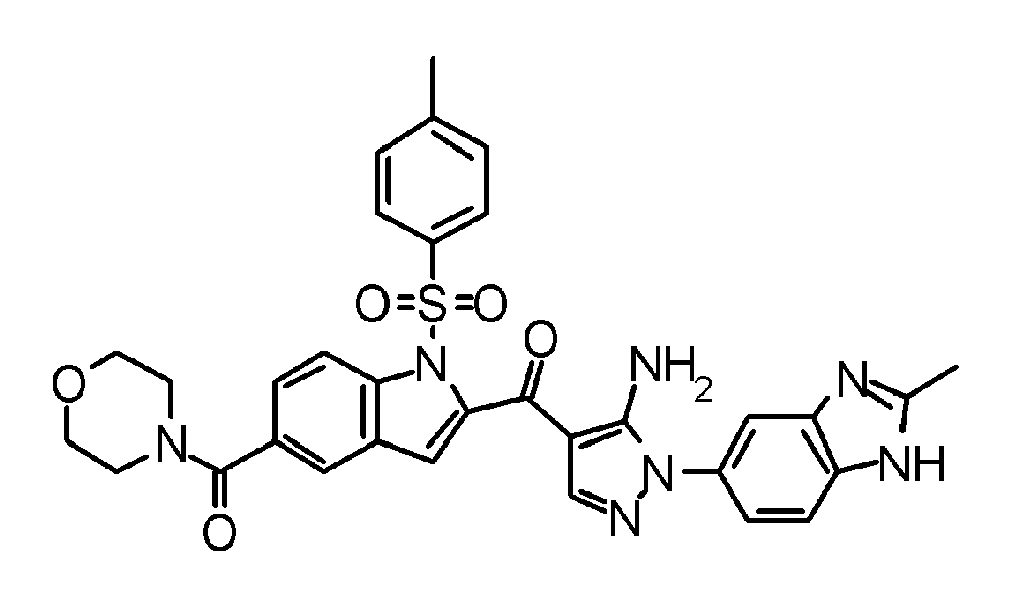
- 2-[5-Amino-1-(2-methyl-1H-benzimidazol-5-yl)-1H-pyrazole-4-carbonyl]-1-(toluene-4-sulfonyl)-1H-indole-5-carboxylic acid (113 mg) was dissolved in water (5 ml) and tetrahydrofuran (THF) (10 ml), and then morpholine (53.5 µl) and N-(3-dimethylaminopropyl)-N'-ethylcarbodiimide hydrochloride (WSC-HCl) (43 mg) were added thereto. The mixture was stirred at room temperature for 24 hours. The reaction mixture was then concentrated under reduced pressure. The resulting residue was purified by silica gel column chromatography (methanol/dichloromethane = 0/100 to 17/100) to give [5-amino-1-(2-methyl-1H-benzimidazol-5-yl)-1H-pyrazol-4-yl]-[5-(morpholine-4-carbonyl)-1-(t oluene-4-sulfonyl)-1H-indol-2-yl]-methanone (59 mg).
1H-NMR (DMSO-D6) δ: 12.49 (1.0H, d, J = 9.3 Hz), 8.08 (3.0H, m), 7.82-7.74 (2.0H, m), 7.70-7.64 (1.0H, m), 7.58 (1.0H, d, J = 8.3 Hz), 7.53-7.42 (3.0H, m), 7.35-7.25 (2.0H, m), 7.13-6.89 (2.0H, m), 3.69-3.51 (4.0H, m), 3.40-3.28 (4.0H, m), 2.54 (3.0H, s), 2.38 (3.0H, s)
ESI (LC-MS positive mode) m/z 624 [(M+H)+] - The compounds of numbers 1322 to 1326, 1572 to 1579 listed in Table 13 were synthesized by the same method as in Step 6.
Table 13 Compound No. Structure Compound name m/z 1322 
[5-amino-1-(2-methyl-1H-benzimidazol-5-yl)-1H-pyrazol-4-yl] -[5-(4-methylpiperadine-1-carbonyl) -1-(toluene-4-sulfonyl)-1H-indol-2-yl]-methanone 637 1323 
[5-amino-1-(2-methyl-1H-benzimidazol-5-yl)-1H-pyrazol-4-yl] -[5-(piperadine-1-carbonyl)-1- (toluene-4-sulfonyl)-1H-indol-2-yl] -methanone 623 1324 
[5-amino-1-(2-methyl-1H-benzimidazol-5-yl)-1H-pyrazol-4-yl] -[5-(4,4-difluoro-piperidine-1-carbonyl)-1-(toluene-4-sulfonyl) -1H-indol-2-yl]-methanone 658 1325 
[5-amino-1-(2-methyl-1H-benzimidazol-5-yl)-1H-pyrazol-4-yl] -[5-(3,3-difluoro-piperidine-1-carbonyl)-1-(toluene-4-sulfonyl) -1H-indol-2-yl]-methanone 658 1326 
[5-amino-1-(2-methyl-1H-benzimidazol-5-yl)-1H-pyrazol-4-carbonyl]-1-(toluene-4-sulfonyl) -1H-indol-5-carboxylic acid (2,2,2-trifluoro-ethyl)-amide 636 1572 
[5-amino-1-(2-methyl-1H-benzimidazol-5-yl)-1H-pyrazol-4-yl]-[5-(3,3-difluoro-pyrrolidine-1-carbonyl)-1-(toluene-4-sulfonyl)-1H-indol-2-yl]-methanone 644 1573 
[5-amino-1-(2-methyl-1H-benzimidazol-5-yl)-1H-pyrazol-4-yl]-[5-(2,6-dimethyl-morpholine-4-carbonyl)-1-(toluene-4-sulfonyl)-1H-indol-2-yl]-methanone 652 1574 
[5-amino-1-(2-methyl-1H-benzimidazol-5-yl)-1H-pyrazol-4-yl]-[5-([1,4']bipiperidinyl-1'-carbonyl)-1-(toluene-4-sulfonyl)-1H-indol-2-yl]-methanone 705 1575 
[5-amino-1-(2-methyl-1H-benzimidazol-5-yl)-1H-pyrazol-4-yl]-{l-(toluene-4-sulfonyl)-5-[4-(2,2,2-trifluoro-ethyl)-piperazine-1-carbonyl]-1H-indol-2-yl}-methanone 705 1576 
[5-amino-1-(2-methyl-1H-benzimidazol-5-yl)-1H-pyrazol-4-yl]-[5-[4-(2-hydroxy-ethyl)-piperazine-1-carbonyl]-1-(toluene-4-sulfonyl)-1H-indol-2-yl]-methanone 667 1577 
[5-amino-1-(2-methyl-1H-benzimidazol-5-yl)-1H-pyrazol-4-yl]-[5-(3,3,4,4-tetrafluoro-pyrrolidine-1-carbonyl)-1-(toluene-4-sulfonyl)-1H-indol-2-yl]-methanone 680 1578 
[5-amino-1-(2-methyl-1H-benzimidazol-5-yl)-1H-pyrazol-4-yl]-[5-((R)-3-fluoro-pyrrolidine-1-carbonyl)-1-(toluene-4-sulfonyl)-1H-indol-2-yl]-methanone 626 1579 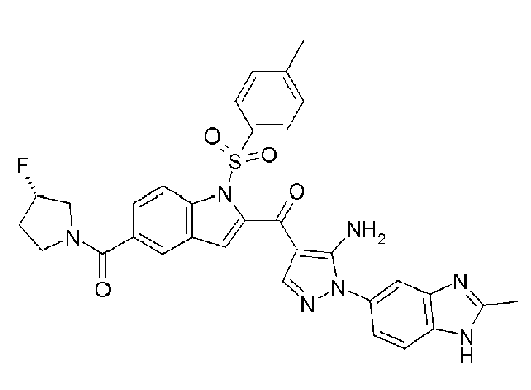
[5-amino-1-(2-methyl-1H-benzimidazol-5-yl)-1H-pyrazol-4-yl]-[5-((S)-3-fluoro-pyrrolidine-1-carbonyl)-1-(toluene-4-sulfonyl)-1H-indol-2-yl]-methanone 626 -

- In a pressure-proof container, palladium acetate (1.0 mg, 0.0044 mmol), 1,3-bis(diphenylphosphino) propane (1.8 mg, 0.0044 mmol), [5-amino-1-(2-methyl-1H-benzimidazol-5-yl)-1H-pyrazol-4-yl]-[6-iodo-1-(toluene-4-sulfonyl)-1H-indol-2-yl]-methanone (100 mg, 0.16 mmol), and sodium carbonate (18 mg, 0.17 mmol) were dissolved in anhydrous N,N-dimethylformamide (DMF) (0.22 ml). After triethylsilane (52 µl, 0.33 mmol) was added, the air inside the container was replaced with carbon monoxide. Then, the reaction mixture was heated at 60°C with stirring under pressure with carbon monoxide (3 atm) for 24 hours. After the reaction mixture was cooled to room temperature, the pressure was released to ambient pressure. The reaction mixture was diluted with ethyl acetate. The sodium carbonate was removed by filtration. The filtrate was concentrated under reduced pressure. The resulting residue was purified by silica gel column chromatography (dichloromethane/methanol = 100/5) to give 2-[5-amino-1-(2-methyl-1H-benzimidazol-5-yl)-1H-pyrazole-4-carbonyl]-1-(toluene-4-sulfonyl) -1H-indole-6-carbaldehyde as a yellow solid (80 mg, 85%).
1H-NMR (CDCl3) δ: 10.14 (1.0H, s), 9.81-9.40 (1.0H, brm), 8.61 (1.0H, d, J = 3.9 Hz), 8.09 (2.0H, d, J = 7.3 Hz), 7.86-7.72 (4.0H, m), 7.52-7.30 (4.0H, m), 7.02 (1.0H, s), 6.07 (1.0H, brs), 6.04 (1.0H, brs), 2.67 (3.0H, s), 2.40 (3.0H, s)
ESI (LC-MS positive mode) m/z 539 [(M+H)+] -

- 2-[5-Amino-1-(2-methyl-1H-benzimidazol-5-yl)-1H-pyrazole-4-carbonyl]-1-(toluene-4-sulfonyl)-1H-indole-5-carbaldehyde was synthesized by the same method as in Step 7.
ESI (LC-MS positive mode) m/z 539 [(M+H)+] -

- 2-[5-Amino-1-(2-methyl-1H-benzimidazol-5-yl)-1H-pyrazole-4-carbonyl]-1-(toluene-4-sulfonyl)-1H-indole-6-carbaldehyde (29 mg, 0.054 mmol), 1-methylpiperazine (7 µl, 0.066 mmol), and sodium triacetoxyborohydride (17 mg, 0.083 mmol) were dissolved in anhydrous dichloromethane (0.5 ml) and stirred at room temperature under a nitrogen atmosphere for 14 hours. A saturated aqueous solution of sodium bicarbonate was added to the reaction mixture. Then, the mixture was extracted with ethyl acetate. The organic layer was isolated, washed with a saturated aqueous solution of sodium chloride, and dried over anhydrous magnesium sulfate. The desiccant was removed by filtration. The filtrate was concentrated under reduced pressure. The resulting residue was purified by silica gel column chromatography (dichloromethane/methanol = 100/15) to give [5-amino-1-(2-methyl-1H-benzimidazol-5-yl)-1H-pyrazol-4-yl]-[6-(4-methyl-piperazin-1-ylmeth yl)-1-(toluene-4-sulfonyl)-1H-indol-2-yl]-methanone as a yellow solid (29 mg, 86%).
ESI (LC-MS positive mode) m/z 623 [(M+H)+] - The compounds of numbers 1330 to 1358 listed in Table 14 were synthesized by the same method as in Step 8.
Table 14 Compound No. Structure Compound name m/z 1330 
6-morpholin-4-ylmethyl-1-(toluene-4-sulfonyl)-1H-indole-2-carboxylic acid ethyl ester 443 1331 
5-morpholin-4-ylmethyl-1-benzenesulfonyl-1H-indole-2-carboxylic acid ethyl ester 429 1332 
1-benzenesulfonyl-4-morpholin-4-ylmethyl-1H-indole-2-carboaylic acid ethyl ester 429 1333 
5-((R)-3-fluoro-pyrrolidin-1-ylmethyl)-1-(toluene-4-sulfonyl) -1H-indole-2-carboarylic acid ethyl ester 445 1334 
6-fluoro-5-(4-methyl-piperazin-1-ylmethyl)-1-(toluene-4-sulfonyl) -1H-indole-2-carboarylic acid ethyl ester 474 1335 
6-fluoro-5-pyrrolidin-1-ylmethyl-1-(toluene-4-sulfonyl)-1H-indole-2-carboxylic acid ethyl ester 445 1336 
1-benzenesulfonyl-5-fluoro-6-morpholin-4-ylmethly-1H-indole 375 1337 
4-(1-benzenesulfonyl-1H-indol-5-ylmethyl)-piperadin-1-carboxylic acid tert-butyl ester 456 1338 
1-(4-[2-[5-amino-1-(2-methyl-1H-benzimidazol-5-yl)-1H-pyrazol-4-carbonyl]-1-(toluene-4-sulfonyl) -1H-indol-6-ylmethyl]-piperazin -1-yl}-ethanone 651 1339 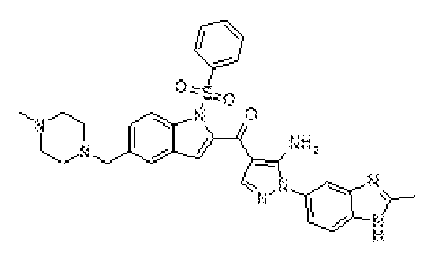
[5-amino-1-(2-methyl-1H-benzimidazol-5-yl)-1H-pyrazol-4-yl] -[1-benzenesulfonyl-5-(4-methyl-piperazin-1-ylmethy)-1H-indol-2-yl] -methanone 609 1340 
[5-amino-1-(2-methyl-1H-benzimidazol-5-yl)-1H-pyrazol-4-yl] -(1-benzenesulfonyl-5-pyrrolidin-1-ylmethyl-1H-indol-2-yl)-methanone 580 1341 
[5-amino-1-(2-methyl-1H-benzimidazol-5-yl)-1H-pyrazol-4-yl] -[6-pyrrolidin-1-ylmethyl-1-(toluene-4-sulfonyl)-1H-indol-2-yl] -methanone 594 1342 
[5-amino-1-(2-methyl-1H-benzimidazol-5-yl)-1H-pyrazol-4-yl] -[6-(4-hydroxy-piperidin-1-ylmethyl) -1-(toluene-4-sulfonyl)-1H-indol-2-yl] -methanone 624 1343 
[5-amino-1-(2-methyl-1H-benzimidazol-5-yl)-1H-pyrazol-4-yl] -[6-piperadin-1-ylmethyl)-1-(toluene -4-sulfonyl)-1H-indol-2-yl] -methanone 609 1344 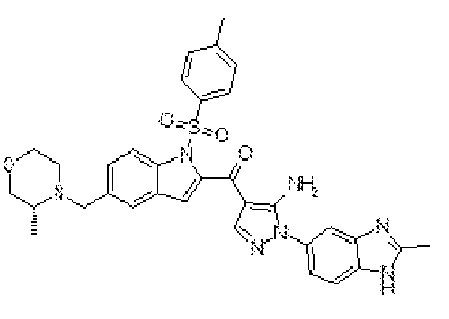
[5-amino-1-(2-methyl-1H-benzimidazol-5-yl)-1H-pyrazol-4-yl] -[5-((R)-3-methyl-morpholin-4-ylmethyl)-1-(toluene-4-sulfonyl) -1H-indol-2-yl]-methanone 624 1345 
[5-amino-1-(2-methyl-1H-benzimidazol-5-yl)-1H-pyrazol-4-yl] -[6-((R)-3-fluoro-pyrrolidi-1-ylmethyl)-1-(toluene-4-sulfonyl) -1H-indol-2-yl]-methanone 612 1346 
[5-amino-1-(2-methyl-1H-benzimidazol-5-yl)-1H-pyrazol-4-yl] -[5-(2,5-dimethyl-pyrrolidin-1-ylmethyl)-1-(toluene-4-sulfonyl)-1H-indol-2-yl]-methanone 622 1347 
[5-amino-1-(2-methyl-1H-benzimidazol-5-yl)-1H-pyrazol-4-yl] -[5-(3-fluoro-piperidin-1-ylmethyl) -1-(toluene-4-sulfonyl)-1H-indol-2-yl] -methanone 626 1348 
[5-amino-1-(2-methyl-1H-benzimidazol-5-yl)-1H-pyrazol-4-yl] -[5-(3,3-difluoro-piperidin-1-ylmethyl) -1-(toluene-4-sulfonyl)-1H-indol-2-yl] -methanone 644 1349 
[5-amino-1-(2-methyl-1H-benzimidazol-5-yl)-1H-pyrazol-4-yl] -[5-(4-fluoro-piperidin-1-ylmethyl) -1-(toluene-4-sulfonyl)-1H-indol-2-yl] -methanone 626 1350 
[5-amino-1-(2-methyl-1H-benzimidazol-5-yl)-1H-pyrazol-4-yl] -[5-(4,4-difluoro-piperidin-1-ylmethyl) -1-(toluene-4-sulfonyl)-1H-indol-2-yl] -methanone 644 1361 
[5-amino-1-(2-methyl-1H-benzimidazol-5-yl)-1H-pyrazol-4-yl] -[6-(3-fluoro-piperidin-1-ylmethyl) -1-(toluene-4-sulfonyl)-1H-indol-2-yl] -methanone 626 1352 
[5-amino-1-(2-methyl-1H-benzimidazol-5-yl)-1H-pyrazol-4-yl] -[6-{[bis-(2-methoxy-ethyl)-amino] -methyl-1-(toluene-4-sulfonyl)-1H-indol-2-yl]-methanone 656 1353 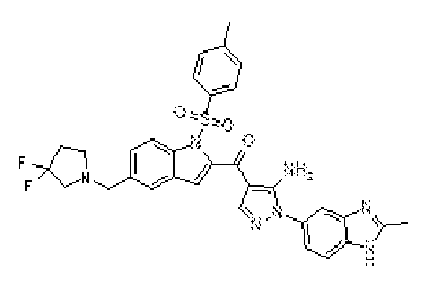
[5-amino-1-(2-methyl-1H-benzimidazol-5-yl)-1H-pyrazol-4-yl] -[5-(3,3-difluoro-pyrrolidin-1-ylmethyl) -1-(toluene-4-sulfonyl) -1H-indol-2-yl]-methanone 630 1354 
[5-amino-1-(2-methyl-1H-benzimidazol-5-yl)-1H-pyrazol-4-yl] -{6-[(methyl-prop-2-ynyl-amino) -methyl]-1-(toluene-4-sulfonyl)-1H-indol-2-yl}-methanone 592 1365 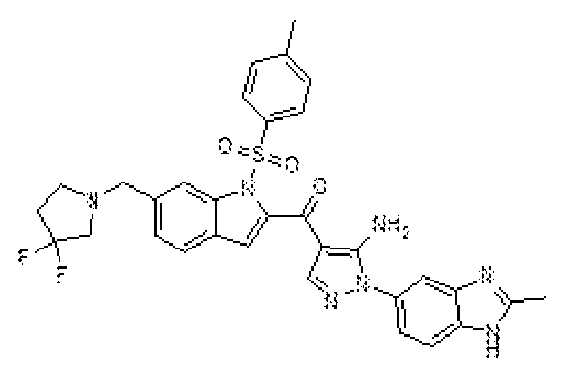
[5-amino-1-(2-methyl-1H-benzimidazol-5-yl)-1H-pyrazol-4-yl] -[6-(3,3-difluoro-pyrrolidin-1-ylmethyl)-1-(toluene-4-sulfonyl) -1H-indol-2-yl]-methanone 630 1356 
[5-amino-1-(2-methyl-1H-benzimidazol-5-yl)-1H-pyrazol-4-yl] -[6-(2,5-dimethyl-pyrrolidin-1-ylmethyl) -1-(toluene-4-sulfonyl) -1H-indol-2-yl]-methanone 622 1357 
[5-amino-1-(2-methyl-1H-benzimidazol-5-yl)-1H-pyrazol-4-yl] -[6-(3,3-difluoro-piperidin-1-ylmethyl) -1-(toluene-4-sulfonyl) -1H-indol-2-yl]-methanone 644 1358 
[5-amino-1-(2-methyl-1H- benzimidazol-5-yl)-1H-pyrazol-4-yl] -[6-((S)-3-methyl-morpholin-4-ylmethyl)-1-(toluene-4-sulfonyl) -1H-indol-2-yl]-methanone 624 - The compounds of Examples 196 and 197 listed in Table 15 were synthesized by the same method as in Step 8.
Table 15 Example Structure Compound name m/z NMR 196 
[5-amino-1-(2-methyl-1H-benzimidazol -5-yl)-1H-pyrazol-4-yl]-[6-(4,4-difluoro -piperidin-1-ulmethyl)-1H-indol-2-yl] -methanone 490 1H-MMR (DMSO-D6) δ: 12.46 (1.0H, s), 11.65 (1.0H, s), 8.30 (1.0H, s), 7,64 (3.0H, m), 7.42 (2.0H, t, J =2.4 Hz), 7.30 (1.0H, dd, J = 8.3, 2.0 Hz), 7.07 (1.0H, dd, J = 8.3, 1.0 Hz), 7.00 (2.0H, m), 3.64 (3:0H, s), 2.55-2.48 (4.2H, m), 2.54 (2.5H, s), 2.01-1.91 (4.2H, m). 197 
[5-amino-1-(2-methyl-1H-benzimidazol -5-yl)-1H-pyrazol-4-yl]-[6-(4-fluoro -piperidin-1-ylmethyl)-1H-indol-2-yl] -methanone 472 1H-NMR (DMSO-D6) δ: 12.46 (1.0H, s), 11.63 (1.0H, s), 8.30 (1.0H, s), 7.62 (3.0H, m), 7.41 (2.0H, d, J = 5.9 Hz), 7.30 (1.0H, dd, J = 8.5, 2.2 Hz), 7.05 (1.0H, dd, J = 8.3, 1.0 Hz), 7.00 (2H, m), 4.69 (1.0H, m), 3.56 (2.0H, s), 2.60-2.50 (2.0H, m), 2.64 (3H, s), 2.37-2.26 (2.0H, m), 1.94-1.78 (2.0H, m), 1.78-1.65 (2.0H, m). -
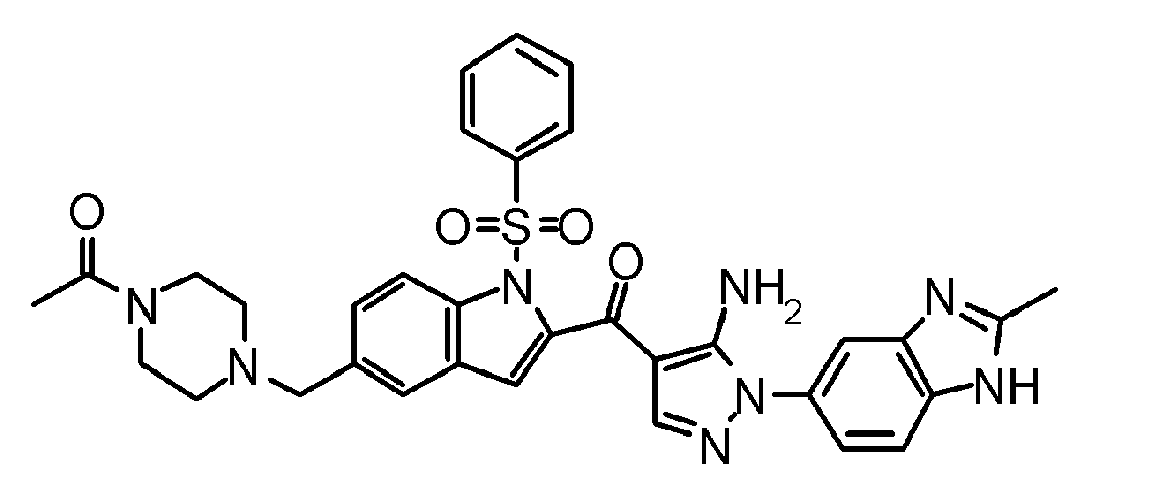
- [5-Amino-1-(2-methyl-1H-benzimidazol-5-yl)-1H-pyrazol-4-yl]-(5-piperazin-1-ylmethy 1-1H-indol-2-yl)-methanone (103 mg) was dissolved in a saturated aqueous solution of sodium bicarbonate (25 ml) containing dichloromethane (20 ml) and methanol (3 ml), and cooled to 0°C. Then, acetyl chloride (326 µl) was added thereto in three parts, and stirred for 1.5 hour. The reaction mixture was extracted with dichloromethane. The extract was dried over anhydrous sodium sulfate. The desiccant was removed by filtration, and the filtrate was concentrated under reduced pressure. The resulting residue was purified by silica gel column chromatography (methanol/dichloromethane = 0/100 to 10/100) to give 1-(4-{2-[5-amino-1-(2-methyl-1H-benzimidazol-5-yl)-1H-pyrazole-4-carbonyl]-1-benzenesulfonyl-1-indol-5-ylmethyl}-piperazin-1-yl)-ethanone (32 mg).
1H-NMR (CDCl3) δ: 8.18-8.14 (2.0H, m), 8.05 (1.0H, d, J = 8.8 Hz), 7.78 (1.1H, s), 7.60-7.56 (1.0H, m), 7.50 (3.0H, m), 7.40 (1.0H, dd, J = 8.8, 1.5 Hz), 7.35 (1.0H, m), 6.98 (1.0H, s), 6.03 (2.0H, m), 3.62 (2.0H, t, J = 5.0 Hz), 3.58 (2.0H, s), 3.45 (2.0H, t, J = 5.0 Hz), 2.64 (3.0H, s), 2.42 (4.0H, m), 2.07 (3.0H, s)
ESI (LC-MS positive mode) m/z 637 [(M+H)+] -

- [5-Amino-1-(2-methyl-1H-benzimidazol-5-yl)-1H-pyrazol-4-yl]-(5-piperazin-1-ylmethy 1-1H-indol-2-yl)-methanone (94 mg) was dissolved in tetrahydrofuran (THF) (5 ml) and a saturated aqueous solution of sodium bicarbonate (5 ml), and cooled to 0°C. Then methanesulfonyl chloride (94 µl) was added thereto and stirred at 0°C for 1.5 hour. Then ammonia water (5 ml) was added thereto, and stirred at 0°C for two hours. The reaction mixture was extracted with ethyl acetate, and the extract was washed with a saturated sodium chloride solution and dried over anhydrous sodium sulfate. The desiccant was removed by filtration. The filtrate was concentrated under reduced pressure. The resulting residue was purified by silica gel column chromatography (methanol/dichloromethane =0/100 to 15/100) to give 5-amino-1-(2-methyl-1H-benzimidazol-5-yl)-1H-pyrazol-4-yl]-[1-benzenesulfonyl-5-(4-methane sulfonylpiperazin-1-ylmethyl)-1H-indol-2-yl]-methanone (39 mg).
1H-NMR (CD3OD) δ: 8.09 (2.0H, m), 7.98 (2.0H, m), 7.84 (1.0H, m), 7.75 (1.0H, m), 7.65-7.57 (3.0H ,m), 7.53-7.40 (3.0H, m), 7.12 (1.0H, d, J = 3.9 Hz), 3.64 (2.0H, m), 3.25-3.15 (4.0H, m), 2.86 (3.0H, s), 2.82 (3.0H, s), 2.54 (4.0H, m)
ESI (LC-MS positive mode) m/z 673 [(M+H)+] -

- Diisopropyl azodicarboxylate (0.15 ml, 0.75 mmol) was added to an anhydrous tetrahydrofuran (THF) solution (2.5 ml) of 5-hydroxy-1-(toluene-4-sulfonyl)-1H-indole-2-carboxylic acid ethyl ester (175 mg, 0.48 mmol), triphenylphosphine (197 mg, 0.75 mmol), and 2-propanol (0.2 ml, 4.0 mmol), and stirred at room temperature for one hour. The reaction mixture was concentrated under reduced pressure. The resulting residue was purified by silica gel column chromatography to give 5-isopropoxy-1-(toluene-4-sulfonyl)-1H-indole-2-carboxylic acid ethyl ester as a colorless gum-like material (166.7 mg, 87%).
1H-NMR (DMSO-D6) δ: 7.86 (1H, d, J = 9.1 Hz), 7.79 (2H, d, J = 8.5 Hz), 7.39 (2H, d, J = 8.5 Hz), 7.25 (1H, s), 7.15 (1H, d, J = 2.4 Hz), 7.04 (1H, dd, J = 9.1, 2.4 Hz), 4.62-4.53 (1H, m), 4.34 (2H, q, J = 7.1 Hz), 2.34 (3H, s), 1.31 (3H, t, J = 7.1 Hz), 1.25 (6H, d, J = 6.1 Hz)
ESI (LC-MS positive mode) m/z 402 [(M+H)+] - The compounds of numbers 1362 to 1367 listed in Table 16 were synthesized by the same method as in Step 11.
Table 16 Compound No. Structure Compound name m/z 1362 
6-(2-morpholin-4-yl-ethoxy)-1-(toluene-4-sulfonyl)-1H-indole -2-carboxylic acid methyl ester 459 1363 
6-(tetrahydro-pyran-4-yloxy) -1-(toluene-4-sulfonyl)-1H-indole-2-carboxylic acid methyl ester 430 1364 
1-benzenesulfonyl-6-[2-(4-methyl-piperadin-1-yl)-ethoxy]-1H-indole-2-carboxylic acid methyl ester 458 1365 
4-isopropoxy-1H-indole-2-carboxylic acid methyl ester 234 1366 
5-(2-methoxy-ethoxy)-1-(toluene-4-sulfonyl)-1H-indole -2-carboxylic acid ethyl ester 416 1367 
[5-amino-1-(2-methyl-1H-benzimidazol-5-yl)-1H-pyrazol -4-yl]-[6-(3-methyl-oxetan-3-ylmethoxy)-1-(toluene-4-sulfonyl) -1H-indol-2-yl]-methanone 611 -

- Cyclopropylmethyl bromide (0.072 ml, 0.75 mmol) was added to a suspension (5.0 ml) of 5-hydroxy-1-(toluene-4-sulfonyl)-1H-indole-2-carboxylic acid ethyl ester (173 mg, 0.48 mmol) and potassium carbonate (276 mg, 1.0 mmol) in acetonitrile, and stirred at 80°C for five hours. After cooling to room temperature, the reaction mixture was combined with ethyl acetate and water and extracted with ethyl acetate. The extract was washed with water and a saturated aqueous solution of sodium chloride, and dried over anhydrous sodium sulfate. The desiccant was removed by filtration. The filtrate was concentrated under reduced pressure. The resulting residue was purified by silica gel column chromatography to give 5-cyclopropylmethoxy-1-(toluene-4-sulfonyl)-1H-indole-2-carboxylic acid ethyl ester as a colorless gum-like material (112.5 mg, 56%).
1H-NMR (DMSO-D6) δ: 7.87 (1H, d, J = 9.2 Hz), 7.76 (2H, d, J = 8.2 Hz), 7.38 (2H, d, J = 8.2 Hz), 7.25 (1H, s), 7.11 (1H, d, J = 2.6 Hz), 7.07 (1H, dd, J = 9.2, 2.6 Hz), 4.33 (2H, q, J = 8.1 Hz), 3.80 (2H, d, J = 6.6 Hz), 2.33 (3H, s), 1.32 (3H, t, J = 8.1 Hz), 1.25-1.19 (1H, m), 0.58-0.52 (2H, m), 0.33-0.28 (2H, m)
ESI (LC-MS positive mode) m/z 414 [(M+H)+] -

- [5-Amino-1-(2-methyl-1H-benzimidazol-5-yl)-1H-pyrazol-4-yl]-(6-hydroxy-1H-indol-2 -yl)-methanone (21 mg, 0.056 mmol), toluene-4-sulfonic acid oxetan-3-yl ester (19 mg, 0.084 mmol), and potassium carbonate (13 mg, 0.095 mmol) were dissolved in anhydrous N,N-dimethylformamide (DMF), and heated at 80°C with stirring under a nitrogen atmosphere for six days. After cooling to room temperature, the reaction mixture was combined with water, and extracted with an ethyl acetate/methanol (10/1) solution. The organic layer was isolated, washed with water, and dried over anhydrous magnesium sulfate. The desiccant was removed by filtration. The filtrate was concentrated under reduced pressure. The resulting residue was purified by silica gel column chromatography (dichloromethane/methanol =100/3) to give [5-amino-1-(2-methyl-1H-benzimidazol-5-yl)-1H-pyrazol-4-yl]-[6-(oxetan-3-yloxy)-1H-indol-2-yl]-methanone as a yellow solid (6.9 mg, 29%).
1H-NMR (DMSO-D6) δ: 12.48 (1.0H, brs), 11.48 (1.0H, brs), 8.28 (1.0H, s), 7.62-7.60 (3.0H, m), 7.41 (1.0H, brs), 7.28 (1.0H, dd, J = 8.3, 2.0 Hz), 6.96 (1.0H, brs), 6.94 (1.0H, brs), 6.71 (1.0H, dd, J = 8.5, 2.2 Hz), 6.67 (1.0H, brs), 5.34-5.29 (1.0H, m), 4.94 (2.0H, dd, J = 6.8, 6.8 Hz), 4.60 (2.0H, dd, J = 6.8, 5.1 Hz), 2.53 (3.0H, s)
ESI (LC-MS positive mode) m/z 429 [(M+H)+] -

- 2-[5-Amino-1-(2-methyl-1H-benzimidazol-5-yl)-1H-pyrazole-4-carbonyl]-1-(toluene-4-sulfonyl)-1H-indole-6-carbaldehyde (650 mg, 1.0 mmol), 1,1'-bis(diphenylphosphino)ferrocene palladium(II) dichloride (42 mg, 0.051 mmol), bis(pinacolato) diboron (312 mg, 1.23 mmol), and potassium acetate (323 mg, 3.3 mmol) were dissolved in anhydrous N,N-dimethylformamide (DMF) (4.1 ml). After deaeration, the mixture was heated at 100°C with stirring under a nitrogen atmosphere for eight hours. The reaction mixture was cooled to room temperature, and then water was added thereto. The precipitated solid was collected by filtration, washed with water, and then dried to give a brown solid (538 mg). The obtained crude product was used in subsequent reactions without purification.
- The obtained brown solid crude product of 4-methyl-morpholine N-oxide (256 mg, 2.2 mmol) was dissolved in tetrahydrofuran (THF) (7.0 ml), and heated at 70°C with stirring under a nitrogen atmosphere for three and half hours. After the reaction mixture was cooled to room temperature, water and ethyl acetate were added thereto. The mixture was filtered through Celite®, and the filtrate was divided into organic and aqueous layers. The organic layer was concentrated under reduced pressure, and the resulting residue was purified by silica gel column chromatography (amino silica; dichloromethane /methanol = 100/5 to 100/10) to give [5-amino-1-(2-methyl-1H-benzimidazol-5-yl)-1H-pyrazol-4-yl]-(6-hydroxy-1H-indol-2-yl)-meth anone as a yellow amorphous material (123 mg, with a two-step yield of 23%).
1H-NMR (DMSO-D6) δ: 12.51 (1.0H, brs), 11.30 (1.0H, brs), 9.40 (1.0H, brs), 8.26 (1.0H, s), 7.61-7.59 (2.0H, m), 7.47 (1.0H, d, J = 8.8 Hz), 7.34 (1.0H, s), 7.28 (1.0H, d, J = 8.8 Hz), 6.91 (2.0H, brs), 6.82 (1.0H, s), 6.62 (1.0H, d, J = 8.8 Hz), 2.53 (3.0H, s)
ESI (LC-MS positive mode) m/z 373 [(M+H)+] -

- A mixture consisting of [5-amino-1-(2-methyl-3H-benzimidazol-5-yl)-1H-pyrazol-4-yl]-[6-bromo-1-(toluene-4-sulfonyl) -1H-indol-2-yl]-methanone (1 g), copper (I) iodide (161 mg), sodium iodide (508 mg), trans-N,N'-dimethylcyclohexane-1,2-diamine (267 µl), and anhydrous dioxane (5 ml) was stirred in a pressure-proof container at 105 to 112°C under a nitrogen atmosphere for 20 hours. The reaction mixture was poured into an aqueous solution of 2 M ammonia, and the mixture was extracted with ethyl acetate. The organic layer was washed with a saturated aqueous solution of sodium chloride, and dried over anhydrous sodium sulfate. The desiccant was removed by filtration. The filtrate was concentrated under reduced pressure. The resulting residue was purified by silica gel column chromatography (methanol/dichloromethane = 0/100 to 20/100) to give [5-amino-1-(2-methyl-1H-benzimidazol-5-yl)-1H-pyrazol-4-yl]-[6-iodo-1-(toluene-4-sulfonyl)-1H-indol-2-yl]-methanone (0.67 g, 62%).
1H-NMR (DMSO-D6) δ: 12.44 (1.0H, s), 8.30 (1.0H, d, J = 0.6Hz), 7.98 (2.0H, d, J = 8.5 Hz), 7.75 (1.0H, s), 7.66 (1.0H, dd, J = 8.2, 1.4 Hz), 7.51 (1.0H, d, J = 8.0 Hz), 7.46 (2.0H, d, J = 8.5 Hz), 7.28 (1.0H, d, J = 7.6 Hz), 7.23 (1.0H, d, J = 0.4 Hz), 7.10-6.92 (2.0H, m), 2.53 (3.0H, s), 2.37 (3.0H, s)
ESI (LC-MS positive mode) m/z 637 [(M+H)+] - The compounds of numbers 1370 and 1371 listed in Table 17 were synthesized by the same method as in Step 13.
Table 17 Compound No. Structure Compound name m/z 1370 
[5-amino-1-(2-methyl-1H-benzimidazol-5-yl)-1H-pyrazol -4-yl]-[5-iodo-1-(toluene-4-sulfonyl)-1-indol-2-yl] -methanone 637 1371 
1-benzenesulfonyl-4-iodo-1H-indole-2-carboxylic acid ethyl ester 456 -

- A mixture of 2-[5-amino-1-(2-methyl-1H-benzimidazol-5-yl)-1H-pyrazole-4-carbonyl]-1-(benzenesulfonyl)-5 -iodo-1H-indole (117 mg), copper (I) cyanide (84 mg), and 1-methyl-2-pyrrolidinone was reacted in a microwave reactor (190°C, 20 minutes). The reaction mixture was poured into a mixed solution of 2 M ammonia water (40 ml), ethyl acetate (60 ml), and methanol (7 ml), and sonicated for five minutes. After ethyl acetate extraction, the extract was washed with water and then dried over anhydrous sodium sulfate. The desiccant was removed by filtration. The filtrate was concentrated under reduced pressure. The resulting residue was purified by silica gel column chromatography (methanol/dichloromethane = 0/100 to 20/100) to give 2-[5-amino-1-(2-methyl-1H-benzimidazol-5-yl)-1H-pyrazole-4-carbonyl]-1-(benzenesulfonyl)-1H-indole-5-carbonitrile (87 mg, 89%).
1H-NMR (DMSO-D6) δ: 12.47 (1.0H, d, J = 8.4 Hz), 8.27-8.21 (4.0H, m), 7.86 (1.0H, dd, J = 8.8, 1.8 Hz), 7.80-7.76 (2.0H, m), 7.72-7.64 (3.0H, m), 7.60-7.55 (1.0H, m), 7.35-7.25 (2.0H, m), 7.12-7.02 (2.0H, m), 2.54 (3.0H, s)
ESI (LC-MS positive mode) m/z 522 [(M+H)+] - The compounds of numbers 1373 and 1374 listed in Table 18 were synthesized by the same method as in Step 14.
Table 18 Compound No. Structure Compound name m/z 1373 
2-[5-amino-1-(2-methyl-1H-benzimidazol-5-yl)-1H-pyrazol-4-carbonyl]-1-benzenesulfonyl-1H-indole -4-carbonitrile 522 1374 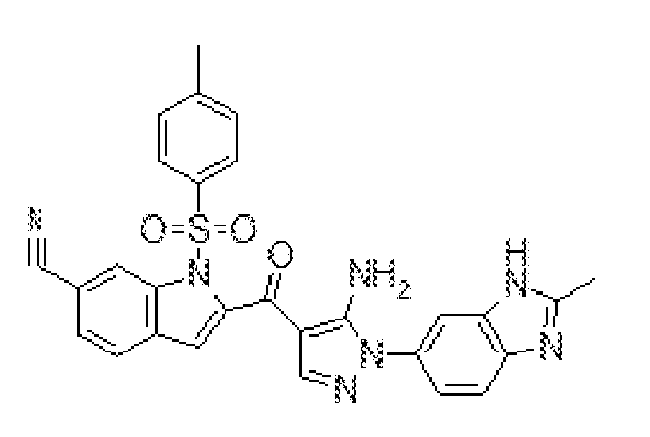
2-[5-amino-1-(2-methyl-1H-benzimidazol-5-yl)-1H-pyrazol-4-carbonyl]-1-(toluene-4-sulfonyl)-1H-indole-6-carbonitrile 536 -

- A mixture of 5-bromo-1-(toluene-4-sulfonyl)-1H-indole-2-carboxylic acid ethyl ester (948.4 mg, 2.24 mmol), Tris(dibenzylideneacetone) dipalladium (0) (0.112 mmol, 103 mg), 4,5-bis(diphenylphosphino)-9,9-dimethylxanthene (Xantphos) (0.225 mmol, 130 mg), lithium formate monohydrate (5.6 mmol, 394 mg), lithium chloride (286 mg, 6.75 mmol), and anhydrous N,N-dimethylformamide (DMF) (5.9 ml) was evacuated, and backfilled with argon. Then, N,N-diisopropylethyl amine (4.5 mmol, 0.78 ml) and acetic anhydride (4.5 mmol, 0.43 ml) were added to the mixture, and deaeration and argon replacement was performed again. The reaction container was placed in a reaction device preheated at 80°C and the reaction mixture was stirred for 20 hours. After cooling to room temperature, the reaction mixture was diluted with ethyl acetate and an aqueous solution of 1 M hydrochloric acid, and filtered through Celite. The resulting filtrate was washed with 1 M hydrochloric acid, water, and a saturated aqueous solution of sodium chloride, and then dried over anhydrous sodium sulfate. The desiccant was removed by filtration. The filtrate was concentrated under reduced pressure, and the resulting residue was purified by silica gel column chromatography (hexane/ethyl acetate = 5/1 to 1/3, and finally ethyl acetate/methanol = 15/1) to give 1-(toluene-4-sulfonyl)-1H-indole-2,5-dicarboxylic acid 2-ethyl ester as a yellow amorphous material (930 mg).
1H-NMR (DMSO-D6) δ : 8.32 (1H, d, J = 1.5 Hz), 8.13 (1H, d, J = 8.8 Hz), 8.05 (1H, dd, J = 8.8, 1.5 Hz), 7.93 (2H, d, J = 8.2 Hz), 7.50 (1H, s), 7.46 (2H, d, J = 8.2 Hz), 4.38 (2H, q, J = 7.1 Hz), 2.37 (3H, s), 1.34 (3H, t, J = 7.1 Hz)
ESI (LC-MS positive mode) m/z 388 [(M+H)+] -

- 2-[5-Amino-1-(2-methyl-1H-benzimidazol-5-yl)-1H-pyrazole-4-carbonyl]-1H-indole-6-carboxylic acid was synthesized by the same method as in Step 15.
ESI (LC-MS positive mode) m/z 555 [(M+H)+] -

- 1-(Toluene-4-sulfonyl)-1H-indole-2,5-dicarboxylic acid 2-ethyl ester (690 mg, 1.85 mmol) was dissolved in N,N-dimethylformamide di-tert-butyl acetal (3.0 ml), and stirred at 80°C for two and half hours. N,N-dimethylformamide di-tert-butyl acetal (2.0 ml) was further added thereto and stirred at 80°C for three hours. After cooling to room temperature, the reaction mixture was diluted with ethyl acetate (150 ml) and water (75 ml). The organic layer was isolated, washed with water and a saturated aqueous solution of sodium chloride, and then dried over anhydrous sodium sulfate. The desiccant was removed by filtration. The filtrate was concentrated under reduced pressure. The resulting residue was purified by silica gel column chromatography (hexane/ethyl acetate = 25/1 to 5/1) to give 1-(toluene-4-sulfonyl)-1H-indole-2,5-dicarboxylic acid 5-tert-butyl ester 2-ethyl ester (551 mg, 69%).
1H-NMR (DMSO-D6) δ: 8.25 (1H, d, J = 1.4 Hz), 8.12 (1H, d, J = 8.8 Hz), 8.00 (1H, dd, J = 8.8, 1.4 Hz), 7.88 (2H, d, J = 8.0 Hz), 7.48 (1H, s), 7.43 (2H, d, J = 8.0 Hz), 4.37 (2H, q, J = 7.2 Hz), 2.37 (3H, s), 1.56 (9H, s), 1.34 (3H, t, J = 7.2 Hz)
ESI (LC-MS positive mode) m/z 444 [(M+H)+] -

- [5-Amino-1-(2-methyl-1H-benzimidazol-5-yl)-1H-pyrazol-4-yl]-[5-bromo-1-(toluene-4 -sulfonyl)-1H-indol-2-yl]-methanone (150 mg), dichloro-bis(triphenylphosphine)palladium (II)(54 mg), copper (I) iodide (10 mg), triethylamine (0.7 ml), and anhydrous N,N-dimethylformamide (DMF) (0.7 ml) were combined together in a pressure-proof container, and trimethylsilyl acetylene (150 mg) was added thereto. The mixture was stirred at 80 to 85°C under nitrogen for 15 hours. After cooling to room temperature, the reaction mixture was diluted with ethyl acetate, washed with a saturated aqueous solution of sodium chloride, and dried over anhydrous sodium sulfate. The desiccant was removed by filtration. The filtrate was concentrated under reduced pressure. The resulting residue was purified by silica gel column chromatography (methanol/dichloromethane = 0/100 to 20/100) to give [5-amino-1-(2-methyl-1H-benzimidazol-5-yl)-1H-pyrazol-4-yl]-[1-(toluene-4-sulfonyl)-5-trimethyl-silanylethynyl-1H-indol-2-yl]-methanone (65 mg, 42%).
1H-NMR (DMSO-D6) δ: 12.48 (1H, d, J = 8.4 Hz), 8.04-7.95 (3H, m), 7.80 (1H, s), 7.75 (1H, d, J = 3.7 Hz), 7.69-7.62 (1H, m), 7.62-7.54 (1H, m), 7.50 (1H, dd, J = 8.7, 1.7 Hz), 7.44 (2H, d, J = 8.6 Hz), 7.29 (1H, t, J = 7.9 Hz), 7.20 (1H, s), 7.09-6.97 (2H, m), 2.54 (3H, s), 2.36 (3.0H, s), 0.23 (9.0H, s)
ESI (LC-MS positive mode) m/z 607 [(M+H)+] -

- 1-Benzenesulfonyl-4-trimethyl-silanylethynyl-1H-indole-2-carboxylic acid ethyl ester was synthesized by the same method as in Step 17.
ESI (LC-MS positive mode) m/z 426 [(M+H)+] -

- [5-Amino-1-(2-methyl-1H-benzimidazol-5-yl)-1H-pyrazol-4-yl]-[6-iodo-1-(toluene-4-s ulfonyl)-1H-indol-2-yl]-methanone (80.3 mg, 0.126 mmol), copper (I) iodide (37.5 mg, 0.197 mmol), methanesulfonamide (37.5 mg, 0.394 mmol), sarcosine (36.2 mg, 0.406 mmol), and tripotassium phosphate (86.0 mg, 9.405 mmol) were dissolved in anhydrous 1-methyl-2-pyrrolidinone (0.36 ml), and heated at 140°C with stirring under an argon atmosphere for 30 minutes. The reaction mixture was added dropwise to an aqueous solution (20 ml) of 20% ammonium chloride, and extracted with ethyl acetate, the organic layer was washed with an aqueous solution of 20% sodium chloride and dried over anhydrous sodium sulfate. The desiccant was removed by filtration. The filtrate was concentrated under reduced pressure, and the resulting residue was purified by amino gel column chromatography (dichloromethane/methanol = 15/1) to give N-[2-[5-amino-1-(2-methyl-1H-benzimidazol-5-yl)-1H-pyrazole-4-carbonyl]-1-(toluene-4-sulfo nyl)-1H-indol-6-yl] methanesulfonamide as a yellow amorphous material (17.9 mg with a yield of 24%).
1H-NMR (DMSO-D6) δ: 12.47 (1H, s), 9.93 (1H, brs), 7.97 (1H, s), 7.94 (2H, d, J = 7.9 Hz), 7.77 (1H, s), 7.64-7.59 (3H, m), 7.43 (2H, d, J = 6.7 Hz), 7.29 (1H, d, J = 7.9 Hz), 7.22-7.15 (2H, t, J = 5.2 Hz), 7.01 (2H, brs), 2.97 (3H, s), 2.53 (3H, s), 2.35 (3H, s)
ESI (LC-MS positive mode) m/z 604 [(M+H)+] -

- [5-Amino-1-(2-methyl-1H-benzimidazol-5-yl)-1H-pyrazol-4-yl]-(6-methyl-sulfanyl-1H -indol-2-yl)-methanone (23 mg, 0.057 mmol) was dissolved in trifluoroethanol (5 ml), and an aqueous solution (0.5 ml) of oxone (105 mg, 0.171 mmol) was added thereto. The mixture was stirred at room temperature under a nitrogen atmosphere for 1.75 hours. The reaction mixture was filtered, and the filtrate was concentrated. The resulting residue was purified by amino gel column chromatography (dichloromethane/methanol = 99/1 to 92/8). Thus, [5-amino-1-(2-methyl-1H-benzimidazol-5-yl)-1H-pyrazol-4-yl]-(6-methanesulfonyl-1H-indol-2-yl)-methanone was obtained as a pale yellow solid (8 mg, 32%).
1H-NMR (DMSO-D6) δ: 12.48 (1H, d, J = 4.9 Hz), 12.33 (1H, s), 8.35 (1H, d, J = 4.9 Hz), 8.05 (1H, s), 7.94 (1H, d, J = 8.5 Hz), 7.65-7.59 (4H, m), 7.31-7.27 (1H, m), 7.11 (2H, d, J = 21.4 Hz), 3.22 (3H, s), 2.54 (3H, s)
ESI (LC-MS positive mode) m/z 435 [(M+H)+] -
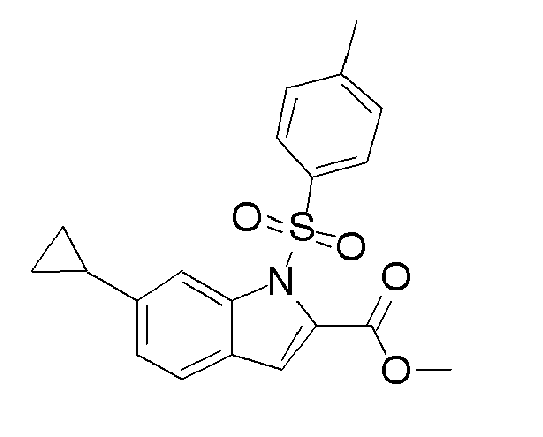
- Predetermined amounts of 6-bromo-1-(toluene-4-sulfonyl)-1H-indole-2-carboxylic acid methyl ester (300 mg, 0.73 mmol), palladium acetate (16.5 mg, 0.07 mmol), bis(1,1-dimethylethyl)phenylphosphine (0.028 ml, 0.12 mmol), potassium cyclopropyl trifluoro borate (163 mg, 1.1 mmol), and cesium carbonate (718 mg, 2.2 mmol) were placed in a reaction container, and toluene (5 ml) and water (0.5 ml) were added thereto. The resulting mixture was then stirred at 100°C for 14 hours. After cooling it to room temperature, the mixture was diluted with ethyl acetate, and washed twice with water, and then dried over anhydrous sodium sulfate. The desiccant was removed by filtration, and concentration was performed. Then, the residue obtained by concentration under reduced pressure was purified by silica gel column chromatography (hexane/ethyl acetate = 97/3 to 7/3). Thus, a yellow solid was obtained (208 mg, 77%).
1H-NMR (DMSO-D6) δ: 7.82-7.80 (2H, m), 7.68 (1H, brs), 7.52 (1H, d, J = 8.2 Hz), 7.42-7.39 (2H, m), 7.32 (1H, d, J = 0.8 Hz), 7.00 (1H, dd, J = 8.3, 1.5 Hz), 3.83 (3H, s), 2.33 (3H, s), 2.11-2.09 (1H, m), 1.03 (2H, ddd, J = 9.6, 5.2, 3.1 Hz), 0.73-0.70 (2H, m)
ESI (LC-MS positive mode) m/z 370[(M+H)+] - The compounds of numbers 1382 to 1384 listed in Table 19 were synthesized as described in Step 19.
Table 19 Compound No. Structure Compound name m/z 1382 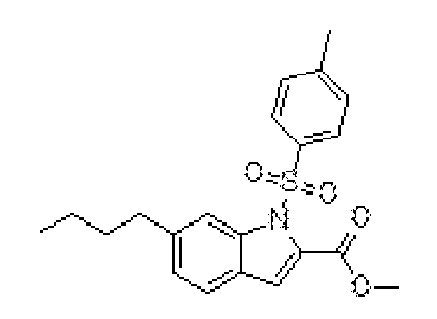
6-butyl-1-(toluene-4-sulfonyl) -1H-indole-2-carboxylic acid methyl ester 386 1383 
5-cyclopropyl-1-(toluene-4-sulfonyl)-1H-indole-2-carboxylic acid ethyl ester 384 1384 
5-benzyl-1-(toluene-4-sulfonyl)-1H-indole-2-carboxylic acid ethyl ester 434 -

- 4-imidazol-1-yl-phenyl amine (637 mg) was dissolved in 2 M hydrochloric acid/MeOH (3 ml), and this was concentrated under reduced pressure. The residue was suspended in concentrated hydrochloric acid (1 ml), and an aqueous solution of sodium nitrite (304 mg, 2.5 ml) was added dropwise thereto over 30 minutes at 0°C on ice. The reaction mixture was slowly added dropwise to an aqueous solution prepared in advance from aqueous solutions of sodium hydrosulfite (2.3 g, 13 ml) and 5 M sodium hydroxide (400 µl), while keeping the temperature of the reaction mixture at 5°C or lower. Then, the mixture was stirred at 25°C for one hour. An ethanol solution (5 ml) of ethyl pyruvate (465 µl) was added dropwise to the reaction mixture. After stirring at 50°C for 30 minutes, the mixture was further stirred at 25°C for 10 hours. The pH of the mixture was adjusted to 11 using an aqueous solution (about 10 ml) of 20% potassium phosphate. The resulting precipitate was collected by filtration, and dried. Thus, 2-[(E)-4-imidazol-1-yl-phenylimino]-propionic acid ethyl ester was obtained as a pale yellow powder (1.1 g, 99%).
- 2-[(E)-4-Imidazol-1-yl-phenylimino]-propionic acid ethyl ester (842 mg) was added to an Eaton's reagent (4 ml), and this was stirred at 100°C for one hour. After adjusting the pH of the reaction mixture to 11 using an aqueous solution (about 10 ml) of 20% potassium phosphate, the mixture was extracted with ethyl acetate (30 ml). The organic layer was washed with an aqueous solution saturated with sodium chloride (20 ml), and the organic layer was concentrated under reduced pressure. The resulting residue was purified by silica gel column chromatography (dichloromethane/methanol). Thus, 5-imidazol-1-yl-1H-indole-2-carboxylic acid ethyl ester was obtained as a yellow amorphous material (370 mg, 47%).
ESI (LC-MS positive mode) m/z 256[(M+H)+] - The compounds of numbers 1386 to 1394 listed in Table 20 were synthesized as described in Step 20.
Table 20 Compound No. Structure Compound name m/z 1386 
4-tert-butyl-1H-indole-2-carboxylic acid ethyl ester 246 1387 
5-trifluoromethylsulfanyl-1H-indole-2-carboxylic acid ethyl ester 290 1388 
5-trifluoromethylsulfanyl-1H-indole-2-carboxylic acid ethyl ester 274 [M-H] 1389 
5-fluoro-4-trifluoromethyl-1H-indole-2-carboxylic acid ethyl ester 274 [M-H] 1390 
6-tert-butyl-1H-indole-2-carboxylic acid ethyl ester 246 1391 
4,6-dimethyl-1H-indole-2-carboxylic acid ethyl ester 218 1392 
5-tert-butyl-1H-indole-2-carboxylic acid ethyl ester 246 1393 
5-isopropyl-1H-indole-2-carboxylic acid ethyl ester 232 1394 
5-phenoxy-1H-indole-2-carboxylic acid ethyl ester 282 -

- Cyclopropylmethyl bromide (2.0 ml, 20 mmol, 2.0 eq.) was added to a mixture solution of 2-chloro-5-nitro-phenol (1.7 g, 10 mmol), potassium carbonate (2.7 g, 20 mmol), and anhydrous acetonitrile (20 ml). This was stirred at 80°C for eight hours. After cooling it to room temperature, the reaction mixture was filtered through Celite, and washed with ethyl acetate. The filtrate was concentrated under reduced pressure. This yielded crude 1-chloro-2-cyclopropyl-methoxy-4-nitro-benzene as a pale red solid. The crude product was used in subsequent reactions without being purified.
1H-NMR (DMSO-D6) δ: 7.84 (1H, dd, J = 8.4, 2.5 Hz), 7.81 (1H, d, J = 2.5 Hz), 7.74 (1H, d, J = 8.4 Hz), 4.08 (2H, d, J = 7.1 Hz), 1.33-1.23 (1H, m), 0.63-0.59 (2H, m), 0.41-0.37 (2H, m) -

- 1-chloro-2-cyclopropylmethoxy-4-nitro-benzene (2.3 g, 10 mmol) was dissolved in ethanol (30 ml) and water (30 ml), and then sodium dithionite was gradually added thereto. This was stirred at 80°C for four and half hours. After cooling it to room temperature, an aqueous solution of 5 M hydrochloride (40 ml) was added to the reaction mixture. This was stirred at room temperature for one hour. Then, an aqueous solution (42 ml) of 5 M sodium hydroxide was added, and the solution was alkalinized and extracted with ethyl acetate. The extract was washed with water and an aqueous solution saturated with sodium chloride, and dried over anhydrous sodium sulfate. The desiccant was removed by filtration, and concentration was performed. Then, the residue obtained by concentration under reduced pressure was purified by silica gel column chromatography. Thus, 4-chloro-3-cyclopropylmethoxy-phenylamine was obtained as a pale yellow gum-like material (1.4 g).
1H-NMR (DMSO-D6) δ: 6.95 (1H, d, J = 8.3 Hz), 6.28 (1H, d, J = 2.4 Hz), 6.11 (1H, dd, J = 8.3, 2.4 Hz), 5.19 (2H, s), 3.76 (2H, d, J = 7.1 Hz), 1.24-1.18 (1H, m), 0.59-0.54 (2H, m), 0.35-0.30 (2H, m)
ESI (LC-MS positive mode) m/z 198, 200 [(M+H)+] -

- Iodine (1.4 g, 5.5 mmol, 1.1 eq.) was gradually added to a mixture solution of 4-bromo-3-trifluoromethyl aniline (1.2 g, 1.0mmol), silver sulfate (1.72 g, 5.5 mmol, 1.1 eq.), and anhydrous ethanol (35 ml). This was stirred at room temperature for two and half hours. The reaction mixture was filtered through Celite, and washed with ethyl acetate. The wash solution was washed with aqueous solutions of 10% sodium thiosulfate, saturated sodium bicarbonate, and saturated sodium chloride, and then dried over anhydrous sodium sulfate. The desiccant was removed by filtration, and concentration was performed. Crude solid 4-bromo-2-iodo-5-trifluoromethyl-phenylamine was obtained by concentration under reduced pressure. The resulting crude product was used in subsequent reactions without being purified.
1H-NMR(DMSO-D6) δ: 7.94 (1H, s), 7.15(1H, s), 5.86 (2H, s)
ESI (LC-MS positive mode) m/z 366, 368 [(M+H)+] - The compounds of numbers 1398 to 1402 listed in Table 21 were synthesized as described in Step 23.
Table 21 Compound No. Structure Compound name m/z 1398 
S-bromo-4-fluoro-2-iodo-phenylamine 316,318 1399 
4-bromo-5-fluoro-2-iodo-phenylamine 316,318 1400 
2,2-difluoro-6-iodo-benzo [1,3]dioxol-5-ylamine 300 1401 
4-chloro-5-cyclopropylmethoxy-2-iodo-phenylamine 324,326 1402 
4-bromo-2-iodo-5-methoxy-phenylamine 3281, 330 -

- 4-Bromo-2-iodo-5-trifluoromethyl-phenylamine (366 mg, 1.0 mmol) and p-toluene sulfonyl chloride (286 mg, 1.5 mmol, 1.5 eq.) were dissolved in anhydrous pyridine (2.5 ml). This was stirred at room temperature for 16 hours. An aqueous solution of 1 M sodium hydroxide was added to the reaction mixture, and this was stirred for five minutes. The reaction mixture was diluted with ethyl acetate. The organic layer was isolated, and washed with an aqueous solution of 1 M hydrochloric acid and an aqueous solution saturated with sodium chloride, and dried over anhydrous sodium sulfate. The desiccant was removed by filtration, and concentration was performed. Then, the residue obtained by concentration under reduced pressure was dissolved in tetrahydrofuran (THF) (2.5 ml), and then a tetrahydrofuran (THF) solution of 1 M tetrabutylammonium fluoride was added thereto. This was stirred at room temperature for 17 hours. The reaction mixture was diluted with ethyl acetate. The organic layer was isolated, and washed with water and an aqueous solution saturated with sodium chloride, and then dried over anhydrous sodium sulfate. The desiccant was removed by filtration and concentration was performed. Then, the residue obtained by concentration under reduced pressure was purified by silica gel column chromatography. Thus, N-(4-bromo-2-iodo-5-trifluoromethyl-phenyl)-4-methyl benzynesulfonamide was obtained as a pale brown solid (494 mg, three-step yield of 95%).
1H-NMR (DMSO-D6) δ: 10.10 (1H, s), 8.34 (1H, s), 7.58 (2H, d, J = 8.2 Hz), 7.39 (2H, d, J = 8.2 Hz), 7.27 (1H, s), 2.38 (3H, s)
ESI (LC-MS positive mode) m/z 520, 522 [(M+H)+] - The compounds of numbers 1404 to 1408 listed in Table 22 were synthesized as described in Step 24.
Table 22 Compound No. Structure Compound name m/z 1404 
N-(5-bromo-4-fluoro-2-iodo-phenyl)-4-methyl-benzenesulfonamide 470, 472 1405 
N-(4-bromo-5-fluoro-2-iodo-phenyl)-4-methyl-benzenesulfonamide Not observed 1406 
N-(2,2-difluoro-6-iodo-benzo [1,3]dioxol-5-yl)-4-methyl-benzenesulfonamide 454 1407 
N-(4-chloro-5-cyclopropylmethoxy-2-iodo-phenyl)-4-methyl-benzenesulfonamide 478, 480 1408 
N-(4-bromo-2-iodo-5-methoxy-phenyl)-4-methyl-benzenesulfonamide 482,484 -

- N,N-diisopropylethyl amine (0.42 ml, 2.4 mmol), ethyl propionate (0.12 ml, 1.2 mmol), and tetrakis(triphenylphosphine)palladium (46 mg, 0.04 mmol) were added to an anhydrous tetrahydrofuran (THF) solution (3.2 ml) containing N-(4-bromo-2-iodo-5-trifluoromethyl-phenyl)-4-methyl-benzenesulfonamide (208 mg, 0.4 mmol) and zinc bromide (270 mg, 1.2 mmol). Then, the mixture was evacuated, and backfilled with argon. This was stirred at 80°C for 13 hours. After cooling it to room temperature, the reaction mixture was filtered through Celite, and washed with ethyl acetate. The wash solution was washed with an aqueous solution saturated with sodium bicarbonate and an aqueous solution saturated with sodium chloride, and dried over anhydrous sodium sulfate. The desiccant was removed by filtration, and concentration was performed. Then, the residue obtained by concentration under reduced pressure was purified by silica gel column chromatography. Thus, 5-bromo-1-(toluene-4-sulfonyl)-6-trifluoromethyl-1H-indole-2-carboxylic acid ethyl ester was obtained as a pale brown solid (195 mg, 50%).
1H-NMR (DMSO-D6) δ: 8.37 (1H, s), 8.29 (1H, s), 7.89 (2H, d, J = 8.2 Hz), 7.47 (2H, d, J = 8.2 Hz), 7.43 (1H, s), 4.36 (2H, q, J = 7.1 Hz), 2.38 (3H, s), 1.30 (3H, t, J = 7.1 Hz)
ESI (LC-MS positive mode) m/z 490, 492 [(M+H)+] - The compounds of numbers 1410 to 1414 listed in Table 23 were synthesized as described in Step 25.
Table 23 Compound No. Structure Compound name m/z 1410 
6-bromo-5-fluoro-1-(toluene -4-sulfonyl)-1H-indole-2-carboxylic acid ethyl ester 440,442 1411 
5-bromo-6-fluoro-1-(toluene -4-sulfonyl)-1H-indole-2-carboxylic acid ethyl ester Not observed 1412 
5-bromo-1-(toluene-4-sulfonyl)-6-trifluoromethyl -1H-indole-2-carboxylic acid ethyl ester 490, 492 1413 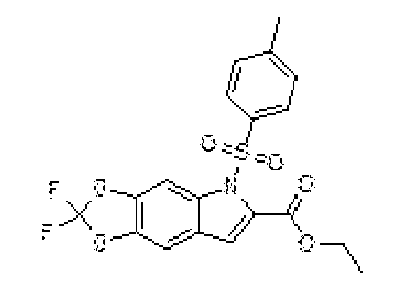
2,2-difluoro-5-(toluene-4-sulfonyl)-5H-[1,3]dioxolo [4,5-f]indole-6-carboxylic acid ethyl ester 424 1414 
5-chloro-6-cyclopropylmethoxy-1-(toluene-4-sulfonyl)-1H-indole-2-carboxylic acid ethyl ester 448,450 -

- Palladium acetate (8.4 mg, 0.037 mmol) and 2-dicyclohexylphosphino-2',4',6'-tri-i-propyl-1,1'-biphenyl (X-PHOS) (35.6 mg, 0.074 mmol) were dissolved in tert-amyl alcohol (10 µl, 0.093 mmol) and anhydrous ethylene glycol dimethyl ether (0.25 ml). The mixture was heated and stirred at 60°C for five minutes under a nitrogen atmosphere to prepare a catalyst. In a separate reaction container under a nitrogen atmosphere, 1-bromo-3,5-di-t-butyl benzene (501 mg, 1.9 mmol), lithium bis(trimethylsilyl) amide (475 mg, 2.8 mmol), and benzophenone hydrazone (401 mg, 2.0 mmol) were dissolved in anhydrous ethylene glycol dimethyl ether (2.5 ml). Then, a solution containing the prepared catalyst was added thereto. After deaeration, this was heated and stirred at 90°C for two hours under a nitrogen atmosphere. The reaction mixture was cooled to room temperature, and then concentrated under reduced pressure. The resulting residue was purified by silica gel column chromatography (hexane/ethyl acetate = 100/5). Thus, N-benzhydrylidene-N'-(3,5-di-tert-butyl-phenyl)-hydrazine was obtained as a yellow amorphous material (699 mg, 97.7%).
1H-NMR (DMSO-D6) δ: 8.72 (1.0H, s), 7.63-7.53 (3.0H, m), 7.42-7.25 (7.0H, m), 7.11 (2.0H, s), 6.83(1.0H, s), 1.26(18.0H, s)
ESI (LC-MS positive mode) m/z 385 [(M+H)+] -

- N-Benzhydrylidene-N'-(3,5-di-tert-butyl-phenyl)-hydrazine (617 mg, 1.6 mmol) was dissolved in ethanol (12 ml). Then, ethyl pyruvate (212 µl, 1.9 mmol) and p-toluene sulfonic acid monohydrate (914 mg, 4.8 mmol) were added thereto. This was heated and stirred at 150°C by microwave under a nitrogen atmosphere for one hour. After cooling it to room temperature, the reaction mixture was combined with water and an aqueous solution saturated with sodium bicarbonate. The product was extracted into ethyl acetate. The organic layer was isolated, and washed with an aqueous solution saturated with sodium chloride, and dried over magnesium sulfate. The desiccant was removed by filtration, and concentration was performed. Then, the residue obtained by concentration under reduced pressure was purified by silica gel column chromatography (hexane/ethyl acetate =100/5). Thus, 4,6-di-tert-butyl-1H-indole-2-carboxylic acid ethyl ester was obtained as a brown solid (268 mg, 56%).
1H-NMR (DMSO-D6) δ: 11.76 (1.0H, brs), 7.27 (1.0H, s), 7.22-7.22 (1.0H, brm), 7.04-7.03 (1.0H, brm), 4.33 (2.0H, q, J = 7.2 Hz), 1.44 (9.0H, s), 1.36-1.32 (12.0H, m)
ESI (LC-MS positive mode) m/z 302 [(M+H)+] -
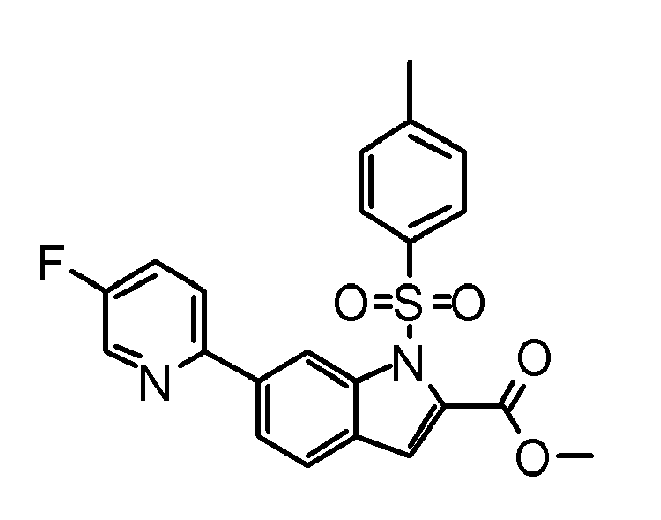
- 6-Bromo-1-(toluene-4-sulfonyl)-1H-indole-2-carboxylic acid methyl ester (202.0 mg, 0.495 mmol), dichlorobis(triphenylphosphine)palladium (II) (35.6 mg, 0.051 mmol), bis(pinacol)diborane (189.3 mg, 0.745 mmol), potassium acetate (147.3 mg, 1.51 mmol), and dioxane (1.6 ml) were mixed. The air was replaced three times with argon under reduced pressure. The mixture was microwaved at 120°C for 30 minutes. Dichlorobis(triphenylphosphine)palladium (II) (35.6 mg, 0.051 mmol) and 2-bromo-5-fluoro-pyridine (206.9 mg, 1.48 mmol) were added to the reaction mixture. After deaeration, the air was replaced three times with argon. This was heated and stirred at 100°C for three hours. The reaction mixture was extracted with ethyl acetate, and the extract was dried over anhydrous sodium sulfate. The desiccant was removed by filtration, and concentration was performed. Then, the residue obtained by concentration under reduced pressure was purified by amino gel column chromatography (n-hexane/ethyl acetate = 7/100 to 63/100). Thus, 6-(5-fluoro-pyridin-2-yl)-1-(toluene-4-sulfonyl)-1H-indole-2-carboxylic acid methyl ester was obtained as a pale yellow amorphous material (150.5 mg, yield of 72%).
1H-NMR (CDCl3) δ: 8.70 (1H, s), 8.59 (1H, d, J = 2.7 Hz), 7.93 (3H, d, J = 8.2 Hz), 7.83 (1H, dd, J = 8.8, 3.8 Hz), 7.65 (1H, d, J = 8.2 Hz), 7.53 (1H, td, J = 8.4, 2.9 Hz), 7.29-7.25 (2H, m), 7.19 (1H, s), 3.95 (3H, s), 2.37 (3H, s)
ESI (LC-MS positive mode) m/z 425 [(M+H)+] - The compounds of numbers 1418 to 1427 listed in Table 24 were synthesized as described in Step 28.
Table 24 Compound No. Structure Compound name m/z 1418 
6-pyridin-2-yl-1-(toluene-4-sulfonyl) -1H-indole-2-carboaylic acid methyl ester 407 1419 
6-pyridazin-3-yl-1-(toluene-4-sulfonyl)-1H-indole-2-carboxylic acid methyl ester 408 1420 
1-(toluene-4-sulfonyl)-6-(5-trifluorometl1yl-pyridin-2-yl)-1H-indole-2-carboxylic acid methyl ester 475 1421 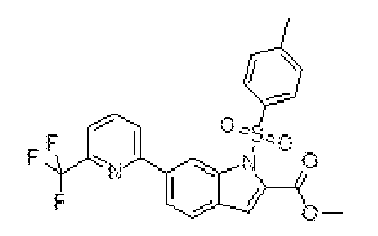
1-(toluene-4-sulfonyl)-6-(6-trifluoromethyl-pyridin-2-yl)-1H-indole-2-carboxylic acid methyl ester 475 1422 
6-(5-chloro-pyridin-2-yl)-1-(toluene -4-sulfonyl)-1H-indole-2-carboxylic acid methyl ester 441 1423 
1-(toluene-4-sulfonyl)-6-(3-trifluorometbyl-pyridin-2-yl)-1H-indole-2-carboxylic acid methyl ester 475 1424 
1-(toluene-4-sulfonyl)-6-(4-trifluoromethyl-pyridin-2-yl)-1H-indole-2-carboxylic acid methyl ester 475 1426 
6-(3-chloro-pyridin-2-yl)-1-(toluene -4-sulfonyl)-1H-indole-2-carboxylic acid methyl ester 441, 443 1426 
6-(3-fluoro-pyridin-2-yl)-1-(toluene -4-sulfonyl)-1H-indole-2-carboxylic acid methyl ester 425 1427 
6-(6-morpholin-4-yl-pyridazin-3-yl) 1) -1-(toluene-4-sulfonyl)-1H-indole-2-carboxylic acid methyl ester 493 -

- A mixure of dioxane (0.6 ml), [5-amino-1-(2-methyl-1H-benzimidazol-5-yl)-1H-pyrazol-4-yl]-[5-bromo-1-(toluene-4-sulfonyl) -1H-indol-2-yl]-methanone (60 mg, 0.102 mmol), dichlorobis(triphenylphosphine)palladium (II) (14 mg, 0.020 mmol), 2-methoxy-5-pyridine boronic acid (39 mg, 0.255 mmol), and an aqueous solution of 2 M sodium bicarbonate (0.255mL, 0.51mmol) was stirred at 140°C for six minutes in a microwave reactor. The reaction mixture was filtered through Celite, and washed with ethyl acetate and then with methanol. The filtrate was dried over anhydrous sodium sulfate. The desiccant was removed by filtration and concentration was performed. The residue obtained was purified by amino gel chromatography (dichloromethane/methanol = 99/1 to 92/8). Thus, [5-amino-1-(2-methyl-1H-benzimidazol-5-yl)-1H-pyrazol-4-yl]-[5-(6-methoxy-pyridin-3-yl)-1-(t oluene-4-sulfonyl)-1H-indol-2-yl]-methanone was obtained as a pale yellow solid (54 mg, 85%).
1H-NMR (DMSO-D6) δ: 12.50 (1H, s), 8.50 (1H, d, J = 2.4 Hz), 8.08-8.04 (4H, m), 7.94 (1H, d, J = 1.8 Hz), 7.77 (1H, s), 7.74 (1H, dd, J = 9.1, 1.8 Hz), 7.63-7.61 (2H, m), 7.46-7.40 (2H, m), 7.30 (1H, dd, J = 8.5, 1.8 Hz), 7.25 (1H, s), 7.06 (2H, s), 6.93 (1H, d, J = 8.5 Hz), 3.90 (3H, s), 2.54 (3H, s), 2.37 (3H, s)
ESI (LC-MS positive mode) m/z 618 [(M+H)+] - The compounds of numbers 1429 to 1462, and 1580 to 1590 listed in Table 25 were synthesized as described in Step 29.
Table 25 Compound No. Structure Compound name m/z 1429 
[5-amino-1-(2-methyl-1H-benzimidazol-5-yl)-1H-pyrazol -4-yl]-[6-(6-morpholin-4-yl-pyridin-3-yl)-1-(toluene-4-sulfonyl)-1H-indol-2-yl] -methanone 673 1430 
[5-amino-1-(2-methyl-1H-benzimidazol-5-yl)-1H-pyrazol -4-yl]-[6-pyridin-3-yl)-1-(toluene -4-sulfonyl)-1H-indol-2-yl] -methanone 588 1431 
[5-amino-1-(2-methyl-1H-benzimidazol-5-yl)-1H-pyrazol -4-yl]-[5-(6-morpholin-4-yl-pyridin-3-yl)-1-(toluene-4-sulfonyl)-1H-indol-2-yl] -methanone 673 1432 
[5-amino-1-(2-methyl-1H-benzimidazol-5-yl)-1H-pyrazol -4-yl]-[5-pyridin-3-yl-1-(toluene -4-sulfonyl)-1H-indol-2-yl] -methanone 588 1433 
[5-amfno-1-(2-methyl-1H-benzimidazol-5-yl)-1H-pyrazol -4-yl]-[5-(6-piperadin-1-yl-pyridin-3 -yl)- I -(toluene-4-sulfonyl)-1H-indol-2-yl] -methanone 672 1434 
[5-amino-1-(2-methyl-1H-benzimidazol-5-yl)-1H-pyrazol -4-yl]-(5-(6-hydroxy-pyridin-3-yl)-1-(toluene-4-sulfonyl)-1H-indol-2-yl]-methanone 604 1435 
[5-amino-1-(2-methyl-1H-benzimidazol-5-yl)-1H-pyrazol -4-yl]-[6-(3,4,5,6-tetrahydro-2H [1,2']bipyridin-5'-yl)-1-(toluene-4-sulfonyl)-1H-indol -2-yl]-methanone 671 1436 
[5-amino-1-(2-methyl-1H-benzimidazol-5-yl)-1H-pyrazol -4-yl]-[6-(6-piperadin-1-yl-pyridin-3-yl)-1-(toluene-4-sulfonyl)-1H-indol-2-yl] -methanone 672 1437 
[5-amino-1-(2-methyl-1H-benzimidazol-5-yl)-1H-pyrazol -4-yl]-[6-[2-(4-methyl-piperadin -1-yl)-pyridin-4-yl]-1-(toluene, -4-sulfonyl)-1H-indol-2-yl] -methanone 686 1438 
[5-amino-1-(2-methyl-1H-benzimidazol-5-yl)-1H-pyrazol -4-yl]-[6-pyridin-4-yl-1-(toluene -4-sulfonyl)-1H-indol-2-yl] -methanone 588 1439 
[5-amino-1-(2-methyl-1H-benzimidazol-5-yl)-1H-pyrazol -4-yl]-[6-(1-methyl-1H-pyrazol -4-yl)-1-(toluene-4-sulfonyl)-1H-indol-2-yl]-methanone 591 1440 
[5-amino-1-(2-methyl-1H-benzimidazol-5-yl)-1H-pyrazol -4-yl]-[6-(5-methoxy-pyridin-3-yl) -1-(toluene-4-sulfonyl)-1H-indol -2-yl]-methanone 618 1441 
[5-amino-1-(2-methyl-1H-benzimidazol-5-yl)-1H-pyrazol -4-yl]-[6-(2-methoxy-pyidin-3-yl) -1-(toluene-4-sulfonyl)-1H-indol -2-yl]-methanone 618 1442 
[5-amino-1-(2-methyl-1H-benzimidazol-5-yl)-1H-pyrazol -4-yl]-[6-(5-methanesulfonyl-pyridin-3-yl)-1-(toluene-4-sulfonyl)-1H-indol-2-yl] -methanone 666 1443 
[5-amino-1-(2-methyl-1H-benzimidazol-5-yl)-1H-pyrazol -4-yl]-[6-(4-methyl-pyridin-2-yl) -1-(toluene-4-sulfonyl)-1H-indol -2-yl]-methanone 602 1444 
[5-amino-1-(2-methyl-1H-benzimidazol-5-yl)-1H-pyrazol -4-yl]-[6-(4-morpholin-4-yl-phenyl)-1-(toluene-4-sulfonyl) -1H-indol-2-yl]-methanone 672 1445 
[5-amino-1-(2-methyl-1H-benzimidazol-5-yl)-1H-pyrazol -4-yl]-[6-(2-methoxy-phenyl)-1-(toluene-4-sulfonyl)-1H-indol -2-yl]-methanone 617 1446 
[5-amino-1-(2-methyl-1H-benzimidazol-5-yl)-1H-pyrazol -4-yl]-[6-phenyl-1-(toluene-4-sulfonyl)-1H-indol-2-yl] -methanone 587 1447 
[5-amino-1-(2-methyl-1H-benzimidazol-5-yl)-1H-pyrazol -4-yl]-[5-(2-fluoro-phenyl)-1-(toluene-4-sulfonyl)-1H-indol -2-yl]-methanone 605 1448 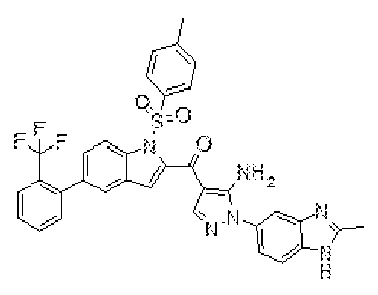
[5-amino-1-(2-methyl-1H-benzimidazol-5-yl)-1H-pyrazol -4-yl]-[1-(toluene-4-sulfonyl)-5-(2-trifluoromethyl-phenyl)-1H-indol-2-yl]-methanone 655 1449 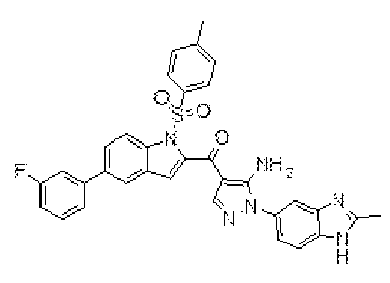
[5-amino-1-(2-methyl-1H-benzimidazol-5-yl)-1H-pyrazol -4-yl]-[5-(3-fluoro-phenyl)-1-(toluene-4-sulfonyl)-1H-indol -2-yl]-methanone 605 1450 
[5-amino-1-(2-methyl-1H-benzimidazol-5-yl)-1H-pyrazol -4-yl]-[1-(toluene-4-sulfonyl)-5-(3-trifluoromethyl-phenyl)-1H-indol-2-yl]-methanone 655 1451 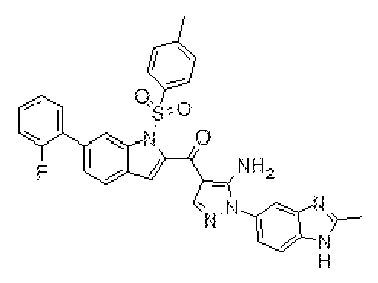
[5-amino-1-(2-methyl-1H-benzimidazol-5-yl)-1H-pyrazol -4-yl]-[6-(2-fluoro-phenyl)-1-(toluene-4-sulfonyl)-1H-indol -2-yl]-methanone 605 1452 
[5-amino-1-(2-methyl-1H-benzimidazol-5-yl)-1H-pyrazol -4-yl]-[6-(3-fluoro-phenyl)-1-(toluene-4-sulfonyl)-1H-indol -2-yl]-methanone 605 1453 
[5-amino-1-(2-methyl-1H-benzimidazol-5-yl)-1H-pyrazol -4-yl]-[6-(4-fluoro-phenyl)-1-(toluene-4-sulfonyl)-1H-indol -2-yl]-methanone 605 1454 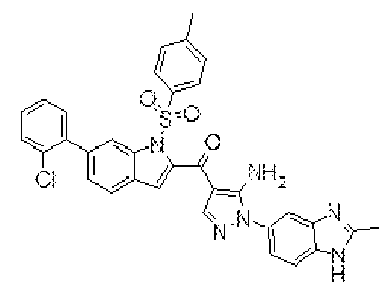
[5-amino-1-(2-methyl-1H-benzimidazol-5-yl)-1H-pyrazol -4-yl]-[6-(2-chloro-phenyl)-1-(toluene-4-sulfonyl)-1H-indol -2-yl]-methanone 621, 623 1455 
[5-amino-1-(2-methyl-1H-benzimidazol-5-yl)-1H-pyrazol -4-yl]-[6-(3-chlorophenyl)-1- (toluene-4-sulfonyl)-1H-indol -2-yl]-methanone 621, 623 1456 
[5-amino-1-(2-methyl-1H- benzimidazol-5-yl)-1H-pyrazol -4-yl]-[6-(4-chloro-phenyl)-1-(toluene-4-sulfonyl)-1H-indol-2-yl] -methanone 621,623 1457 
[5-amino-1-(2-methyl-1H-benzimidazol-5-yl)-1H-pyrazol -4-yl]-[1-(toluene-4-sulfonyl)-6-(2-trifluoromethyl-phenyl)-1H-indol-2-yl]-methanone 655 1458 
[5-amino-1-(2-methyl-1H-benzimidazol-5-yl)-1H-pyrazol -4-yl]-[1-(toluene-4-sulfonyl)-6-(3-trifluoromethylphenyl)-1H-indol-2-yl]-methanone 655 1459 
[5-amino-1-(2-methyl-1H-benzimidazol-5-yl)-1H-pyrazol -4-yl]-[1-(toluene-4-sulfonyl) -6-(4-trifluoromethyl-phenyl)-1H -indol-2-yl]-methanone 655 1460 
[5-amino-1-(2-methyl-1H-benzimidazol-5-yl)-1H-pyrazol -4-yl]-[1-(toluene-4-sulfonyl) -5-(4-trifluoromethyl-phenyl)-1H-indol-2-yl]-methanone 655 1461 
[5-amino-1-(2-methyl-1H-benzimidazol-5-yl)-1H-pyrazol -4-yl]-[6-(2,4-difluoro-phenyl)-1-(toluene-4-sulfonyl)-1H-indol-2-yl] -methanone 623 1462 
[5-amino-1-(2-methyl-1H-benzimidazol-5-yl)-1H-pyrazol -4-yl]-[6-(3-chloro-4-fluoro- phenyl)-1-(toluene-4-sulfonyl) -1H-indol-2-yl]-methanone 640,642 Compound No. Structure Compound name m/z 1580 
[5-amino-1-(2-methyl-1H-benzimidazol-5-yl)-1H-pyrazol-4-yl]-[6-(3-chloro-pyridin-4-yl)-1-(toluene-4-sulfonyl)-1H-indol-2-yl]-methanone 622 1581 
[5-amino-1-(2-methyl-1H-benzimidazol-5-yl)-1H-pyrazol-4-yl]-[6-(6-methylpyridin-3-yl)-1-(toluene-4-sulfonyl)-1H-indol-2-yl]-methanone 602 1582 
[5-amino-1-(2-methyl-1H-benzimidazol-5-yl)-1H-pyrazol-4-yl]-[6-(5-fluoro-pyridin-3-yl)-1-(toluene-4-sulfonyl)-1H-indol-2-yl]-methanone 606 1583 
[5-amino-1-(2-methyl-1H-benzimidazol-5-yl)-1H-pyrazol-4-yl]-[1-(toluene-4-sulfonyl)-6-(2-trifluoromethyl-pyridin-3-yl)-1H-indol-2-yl]-methanone 656 1584 
[5-amino-1-(2-methyl-1H-benzimidazol-5-yl)-1H-pyrazol-4-yl]-[6-(5-chloro-2-methoxy-pyridin-3-yl)-1-(toluene-4-sulfonyl)-1H-indol-2-yl]-methanone 652 1585 
[5-amino-1-(2-methyl-1H-benzimidazol-5-yl)-1H-pyrazol-4-yl]-[6-(5-chtoro-pyridin-3-yl)-1-(toluene-4-sulfonyl)-1H-indol-2-yl]-methanone 622 1586 
[5-amino-1-(2-methyl-1H-benzimidazol-5-yl)-1H-pyrazol-4-yl]-[6-thiophen-3-yl-1-(toluene-4-sulfonyl)-1H-indol-2-yl]-methanone 593 1587 
[5-amino-1-(2-methyl-1H-benzimidazol-5-yl)-1H-pyrazol-4-yl]-[6-(4-ehloropyridin-3-yl)-1-(toluene-4-sulfonyl)-1H-indol-2-yl]-methanone 622 1588 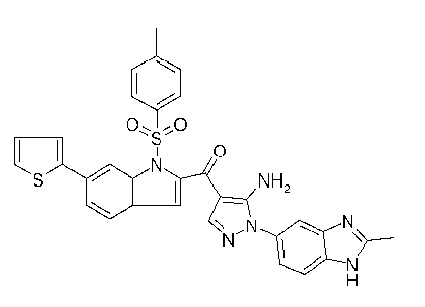
[5-amino-1-(2-methyl-1H-benzimidazol-5-yl)-1H-pyrazol-4-yl]-[6-thiphen-2-yl-l-(toluene-4-sulfonyl)-1H-indol-2-yl]-methanone 593 1589 
[5-amino-1-(2-methyl-1H-benzimidazol-5-yl)-1H- pyrazol-4-yl]-[6-(3-fluoro-pyridin-4-yl)-1-(toluene-4-sulfonyl)-1H-indol-2-yl]-methanone 606 1590 
[5-amino-1-(2-methyl-1H-benzimidazol-5-yl)-1H-pyrazol-4-yl]-[1-(toluene-4-sulfonyl)-6-(2-trifluoromethyl-pyridin-4-yl)-1H-indol-2-yl]-methanone 656 -

- A mixture of [5-amino-1-(2-methyl-1H-benzimidazol-5-yl)-1H-pyrazol-4-yl]-[6-iodo-1-(toluene-4-sulfonyl)-1H-indol-2-yl]-methanone (194.9 mg, 0.306 mmol), [1,1'-bis(diphenylphosphino)ferrocene] dichloro-palladium (II)/dichloromethane adduct (14.4 mg, 0.015 mmol) bis(pinacol)diborane (100.9 mg, 0.397 mmol), potassium acetate (132.3 mg,1.35 mmol), and anhydrous dimethylsulfoxide (DMSO) (1.5 ml) was deaerated. Then, the air was replaced three times with argon, and was heated and stirred at 110°C for six hours. Then, the reaction mixture was extracted with ethyl acetate. The extract was dried over anhydrous sodium sulfate. The desiccant was removed by filtration, and concentration was performed. Then, the residue obtained by concentration under reduced pressure was subjected to silica gel column chromatography (dichloromethane/methanol = 15/1). The resulting crude product was mixed with 4-bromo-pyridazine (78.0 mg, 0.491 mol), dichlorobis(triphenylphosphine)palladium (II) (17.2 mg, 0.025 mmol), an aqueous solution of 2 M sodium bicarbonate (0.325 mmol), and dioxane (0.4 ml). After deaeration, the air was replaced three times with argon, and this was microwaved at 150°C for five minutes. Then, the reaction mixture was extracted with ethyl acetate. The extract was dried over anhydrous sodium sulfate. The desiccant was removed by filtration, and concentration was performed. Then, the residue obtained by concentration under reduced pressure was purified by silica gel column chromatography (dichloromethane/methanol = 1% to 12%). Thus, [5-amino-1-(2-methyl-1H-benzimidazol-5-yl)-1H-pyrazol-4-yl]-[6-pyridazin-4-yl-1-(toluene-4-s ulfonyl)-1H-indol-2-yl]-methanone was obtained as a pale yellow amorphous material (20.0 mg, yield of 11%).
ESI (LC-MS positive mode) m/z 589 [(M+H)+] -

- A predetermined amount of lithium aluminum hydride (167 mg, 4.42 mmol) was placed into a reaction container, and anhydrous tetrahydrofuran (THF) (15 ml) was added thereto, and this was cooled to 0°C. An anhydrous tetrahydrofuran (THF) solution (5 ml) of 1-benzenesulfonyl-1H-indole-6-carboxylic acid methyl ester (930 mg, 2.95 mmol) was added to the mixture. This was stirred at 0°C for 30 minutes. An aqueous solution saturated with ammonium chloride (1 ml) was added to the mixture. After Celite filtration, the Celite was washed with dichloromethane. The filtrate was dried over anhydrous sodium sulfate. The desiccant was removed by filtration, and concentration was performed. Then, by concentration under reduced pressure, (1-benzenesulfonyl-1H-indol-6-yl)-methanol was obtained as an oily brown material (859 mg, 100%).
1H-NMR (DMSO-D6) δ: 7.96-7.92 (3H, m), 7.74 (1H, d, J = 3.7 Hz), 7.68-7.67 (1H, m), 7.60-7.55 (2H, m), 7.52 (1H, d, J = 8.0 Hz), 7.19-7.17 (1H, m), 6.80 (1H, dd, J = 3.7, 0.8 Hz), 5.30 (1H, t, J = 5.7 Hz), 4.59 (2H, d, J = 5.7 Hz)
ESI (LC-MS positive mode) m/z 288 [(M+H)+] -

- Predetermined amounts of 1-benzenesulfonyl-1H-indol-6-yl)-methanol (859 mg, 2.99 mmol), tert-butyl diphenyl chlorosilane (2.3 ml, 8.97 mmol), and imidazole (1.2 g, 17.9 mmol) were placed into a reaction container, and dimethylformamide (30 ml) was added thereto. This was stirred at room temperature for 20 hours. The reaction mixture was diluted with ethyl acetate (60 ml). This was washed twice with water, and dried over anhydrous sodium sulfate. The desiccant was removed by filtration, and concentration was performed. The resulting crude product was used in subsequent reactions.
ESI (LC-MS positive mode) m/z 526 [(M+H)+] -

- A tetrahydrofuran (THF) solution of lithium diisopropyl amide (LDA) was prepared by adding a hexane solution of 1.0 M n-butyl lithium (2.8 ml, 4.49 mmol) dropwise to a pre-cooled (0°C) anhydrous tetrahydrofuran (THF) solution (5 ml) ofN,N-diisopropyl amine (0.64 ml, 4.49 mmol).
- An anhydrous tetrahydrofuran (THF) solution (20 ml) of crude 1-benzenesulfonyl-6-(tert-butyl-diphenyl-silanyloxymethyl)-1H-indole was cooled to -78°C, and a prepared tetrahydrofuran (THF) solution of lithium diisopropyl amide (LDA) was added thereto. This was stirred at -78°C for 30 minutes. Methyl chlorofomate (0.43 ml, 5.98 mmol) was added thereto, and this was stirred at -78°C for 30 minutes. An aqueous solution saturated with ammonium chloride was added to the reaction mixture, and this was warmed to room temperature. After ethyl acetate extraction, the organic layer was dried over anhydrous sodium sulfate. The desiccant was removed by filtration and concentration was performed. Then, the residue obtained by concentration under reduced pressure was purified by silica gel column chromatography (hexane/ethyl acetate =98/2 to 4/1). Thus, 1-benzenesulfonyl-6-(tert-butyl-diphenyl-silanyloxymethyl)-1H-indole-2-carboxylic acid methyl ester was obtained as a brown amorphous material (882 mg, 51%).
ESI (LC-MS positive mode) m/z 584 [(M+H)+] -
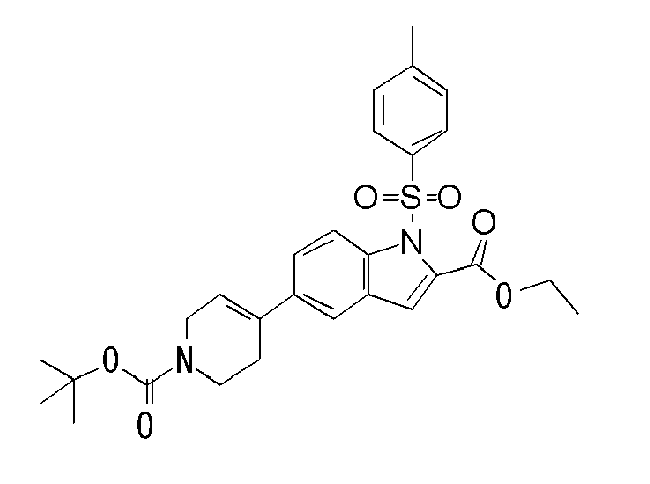
- 5-Bromo-1-(toluene-4-sulfonyl)-1H-indole-2-carboxylic acid ethyl ester (844 mg, 2.0 mmol), 4-(4,4,5,5-tetramethyl-[1,3,2]dioxaborolan-2-yl)-3,6-dihydro-2H-pyridine-1-carboxylic acid tert-butyl ester (742 mg, 2.4 mmol), potassium phosphate (848 mg, 4.0 mmol), and tetrakis(triphenylphosphine) palladium (116 mg, 0.1 mmol) were placed into a flask. After deaeration, the air was replaced with nitrogen. Anhydrous dioxane (16 ml) and water (4 ml) were added to the flask, and this was stirred at 80°C for 15 hours. After cooling it to room temperature, the reaction mixture was filtered through Celite, and then washed with ethyl acetate. The filtrate was concentrated, and the residue obtained by concentration under reduced pressure was purified by silica gel column chromatography. Thus, 5-(1-tert-butoxycarbonyl-1,2,3,6-tetrahydro-pyridin-4-yl)-1-(toluene-4-sulfonyl)-1H-indole-2-carboxylic acid ethyl ester was obtained as a colorless amorphous material (1.0 g, 97.2%).
1H-NNM (DMSO-D6) δ: 7.96 (1H, d, J = 9.1 Hz), 7.84 (2H, d, J = 8.2 Hz), 7.68 (1H, d, J = 1.8 Hz), 7.60 (1H, dd, J = 9.1, 1.8 Hz), 7.41 (2H, d, J = 8.2 Hz), 7.34 (1H, s), 6.17 (1H, s), 4.34 (2H, q, J = 7.0 Hz), 4.02-3.98 (2H, m), 3.57-3.51 (2H, m), 2.51-2.45 (1H, m), 2.34 (3H, s), 1.42 (9H, s), 1.32 (3H, t, J = 7.0 Hz)
ESI (LC-MS positive mode) m/z 525 [(M+H)+] - The compounds of numbers 1468 and 1469 listed in Table 26 were synthesized as described in Step 34.
Table 26 Compound No. Structure Compound name m/z 1468 
5-(1-tert-butoxycarbonyl-1,2,3,6-tetrahydro-pyridin -4-yl)-6-fluoro-1-(toluene-4-sulfonyl)-1H-indole-2- carboxylic acid ethyl ester 543 1469 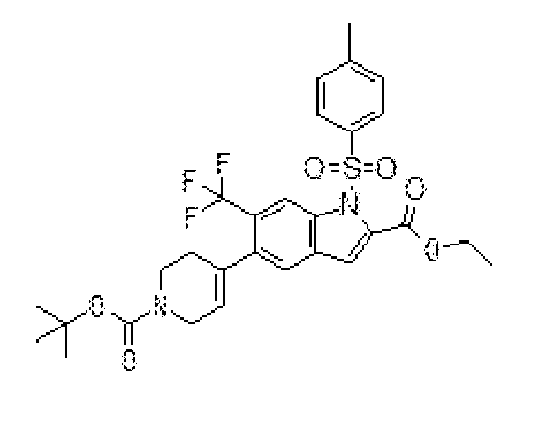
5-(1-tert-butoxycarbonyl-1,2,3,6-tetrahydro-pyridin -4-yl)-1-(toluene-4-sulfonyl) -6-trifluoromethyl-1H-indole -2-carboxylic acid ethyl ester 593 -

- A mixture of 5-(1-tert-butoxycarbonyl-1,2,3,6-tetrahydro-pyridin-4-yl)-1-(toluene-4-sulfonyl)-1H-indole-2-carboxylic acid ethyl ester (495 mg, 0.9mmol), 5% palladium carbon (100 mg), and methanol (20 ml) was stirred under a hydrogen atmosphere for 13 hours. The reaction mixture was filtered through Celite, and washed with ethyl acetate, and the filtrate was concentrated. The residue obtained by concentration under reduced pressure was purified by silica gel column chromatography. Thus, 5-(1-tert-butoxycarbonyl-piperidin-4-yl)-1-(toluene-4-sulfonyl)-1H-indole-2-carboxylic acid ethyl ester was obtained as a colorless amorphous material (315.9 mg, 64%).
1H-NMR (DMSO-D6) δ: 7.92 (1H, d, J = 8.8 Hz), 7.87 (2H, d, J = 7.9 Hz), 7.53 (1H, d, J = 1.5 Hz), 7.42 (2H, d, J = 7.9 Hz), 7.39 (1H, dd, J = 8.8, 1.5 Hz), 7.30 (1H, s), 4.33 (2H, q, J = 7.0 Hz), 4.12-4.00 (2H, m), 2.85-2.70 (3H, m), 2.35 (3H, s), 1.78-1.70 (2H, m), 1.54-1.44 (2H, m), 1.41 (9H, s), 1.31 (3H, t, J = 7.0 Hz)
ESI (LC-MS positive mode) m/z 527 [(M+H)+] - The compounds of numbers 1471 and 1472 listed in Table 27 were synthesized as described in Step 35.
Table 27 Compound No. Structure Compound name m/z 1471 
5-(1-tert-butoxycarbonyl-piperidin-4-yl)-6-fluoro-1-(toluene-4-sulfonyl)-1H-indole-2-carboxylic acid ethyl ester 489 [M-tert-Bu] 1472 
5-(1-tert-butoxycarbonyl-piperidin-4-yl)-1-(toluene-4-sulfonyl)-6-trifluoromethyl -1H-indole-2-carboxylic acid ethyl ester 595 -

- 5-(1-tert-Butoxycarbonyl-piperidin-4-yl)-1-(toluene-4-sulfonyl)-1H-indole-2-carboxylic acid ethyl ester (362 mg, 0.687 mmol) was dissolved in a mixture solution of ethyl acetate (4 ml) and 4 M hydrochloric acid/ethyl acetate (8 ml). This was stirred at room temperature under a nitrogen atmosphere for 1.5 hours. The reaction mixture was concentrated under reduced pressure. Thus, 5-piperidin-4-yl-1-(toluene-4-sulfonyl)-1H-indole-2-carboxylic acid ethyl ester hydrochloride was obtained as a colorless amorphous material (332 mg).
1H-NMR (DMSO-D6) δ: 8.78 (1H, brs), 7.98 (1H, d, J = 8.5 Hz), 7.90 (2H, d, J = 8.5 Hz), 7.51 (1H, s), 7.44 (2H, d, J = 8.5 Hz), 7.38-7.36 (2H, m), 4.34 (2H, q, J = 7.1 Hz), 3.02-2.90 (4H, m), 2.36 (3H, s), 1.95-1.78 (5H, m), 1.31 (3H, t, J = 7.1 Hz)
ESI (LC-MS positive mode) m/z 427 [(M+H)+] - The compounds of numbers 1474 and 1475 listed in Table 28 were synthesized as described in Step 36.
Table 28 Compound No. Structure Compound name m/z 1474 
6-fluoro-5-piperidin-4-yl-1-(toluene-4-sulfonyl)-1H-indole-2-carboxylic acid ethyl ester 445 1475 5-piperidin-4-yl-1-(toluene -4-sulfonyl)-6-trifluoromethyl -1H-indole-2-carboxylic acid ethyl ester 495 -

- A mixture of 5-piperidin-4-yl-1-(toluene-4-sulfonyl)-1H-indole-2-carboxylic acid ethyl ester hydrochloride (253 mg, 0.592 mmol) in dichloroethane (4 ml), triethylamine (0.17 ml, 1.18 mmol), acetone (1.44 ml, 19.6 mmol), acetic acid (0.28 ml, 4.89 mmol), and sodium triacetoxyborohydride (318 mg, 1.50 mmol) was stirred at room temperature for 14.5 hours. The pH of the reaction mixture was adjusted to 9 (basic) using an aqueous solution saturated with sodium bicarbonate. The mixture was extracted with ethyl acetate. The extract was washed with an aqueous solution saturated with sodium chloride, and then dried over anhydrous sodium sulfate. The desiccant was removed by filtration, and concentration was performed. The resulting residue was purified by amino gel column chromatography (hexane/ethyl acetate = 92/8 to 35/65). Thus, 5-(1-isopropyl-piperidin-4-yl)-1-(toluene-4-sulfonyl)-1H-indole-2-carboxylic acid ethyl ester was obtained as a colorless gum-like material (191 mg, 69%).
1H-NMR (DMSO-D6)δ: 7.91 (1H, d, J = 8.5 Hz), 7.87 (2H, d, J = 8.5 Hz), 7.52 (1H, d, J = 1.8 Hz), 7.42 (2H, d, J = 8.5 Hz), 7.39 (1H, dd, J = 9.2, 1.8 Hz), 7.31 (1H, s), 4.34 (2H, q, J = 7.1 Hz), 2.87 (2H, d, J = 11.6 Hz), 2.74-2.67 (1H, m), 2.56-2.53 (1H, m), 2.35 (3H, s), 2.21 (2H, dd, J = 11.6, 5.8 Hz), 1.77-1.74 (2H, m), 1.63-1.57 (2H, m), 1.31 (3H, t, J = 7.1 Hz), 0.98 (6H, d, J = 6.7 Hz)
ESI (LC-MS positive mode) m/z 469 [(M+H)+] - The compounds of numbers 1477 to 1480 listed in Table 29 were synthesized as described in Step 37.
Table 29 Compound No. Structure Compound name m/z 1477 
6-ftuoro-5-(1-isopropyl-piperidin-4-yl)-1-(toluene-4-sulfonyl)-1H-indole-2-carboxylic acid ethyl ester 487 1478 
5-(1-cyclopentyl-piperidin -4-yl)-1-(toluene-4-sulfonyl) -1H-indole-2-carboxylic acid ethyl ester 495 1479 5-(1-cyclohexyl-piperidin -4-yl)-1-(toluene-4-sulfonyl) -1H-indole-2-carboxylic acid ethyl ester 509 1480 
5-(1-isopropyl-piperidin-4-yl) -1-(toluene-4-sulfonyl)-6-trifluoromethyl-1H-indole-2-carboxylic acid ethyl ester 537 -

- An anhydrous tetrahydrofuran (THF) solution (3.5 ml) of 4-chloro-1-methyl-piperidine (8.56 mmol, 1.1 ml) was added at 80°C to a suspension (0.5 ml) of magnesium (234 mg, 9.6 mmol) in anhydrous tetrahydrofuran (THF). This was stirred for one hour. After cooling it to room temperature, the reaction mixture was added dropwise to a mixed solution of zinc bromide (1.1 g, 4.8 mmol) in anhydrous tetrahydrofuran (THF) (2.0 ml) and anhydrous 1-methyl-2-pyrrolidinone (0.6 ml). This was stirred for 30 minutes.
- 6-Bromo-1-(toluene-4-sulfonyl)-1H-indole (340 mg, 0.97 mmol), Tris(dibenzylideneacetone)dipalladium (0) (23 mg, 0.025 mmol), and (3-diethoxyphosphinothioylsulfanyl-1,4-dioxan-2-yl)sulfanyl-diethoxy-sulfanylidene-phosphora ne (Ruphos) (47 mg, 0.1 mmol) were placed into a reaction container. After deaeration, the air was replaced with nitrogen. Anhydrous tetrahydrofuran (THF) (5.0 ml) and a prepared zinc reagent suspension were added thereto, and this was stirred at 70°C for 17 hours. After cooling it to room temperature, the reaction mixture was alkalinized with an aqueous solution saturated with sodium bicarbonate. The precipitated solid was removed by filtration. The filtrate was extracted with ethyl acetate. The extract was washed with water and an aqueous solution saturated with sodium chloride, and dried over anhydrous sodium sulfate. The desiccant was removed by filtration and concentration was performed. The residue obtained by concentration under reduced pressure was purified by silica gel column chromatography. Thus, 6-(1-methyl-piperidin-4-yl)-1-(toluene-4-sulfonyl)-1H-indole was obtained as a wax-like solid (293.7 mg, 82%).
1H-NNM (DMSO-D6) δ: 7.83 (2H, d, J = 8.2 Hz), 7.75 (1H, d, J = 1.5 Hz), 7.71 (1H, d, J = 3.7 Hz), 7.48 (1H, d, J = 8.1Hz),7.38 (2H, d, J = 8.2 Hz), 7.14 (1H, dd, J = 8.1, 1.5 Hz), 6.76 (1H, d, J = 3.7 Hz), 2.89-2.87 (2H, m), 2.61-2.52 (1H, m), 2.31 (3H, s), 2.21 (3H, s), 1.99 (2H, td, J = 11.4, 5.7 Hz), 1.76-1.62 (4H, m)
ESI (LC-MS positive mode) m/z 369 [(M+H)+] - The compounds of numbers 1482 and 1483 listed in Table 30 were synthesized as described in Step 38.
Table 30 Compound No. Structure Compound name m/z 1482 
6-fluoro-5-(1-methyl-piperidin-4-yl)-I-(toluene -4-sulfonyl)-1H-indole-2-carboxylic acid ethyl ester 459 1483 5-(1-methyl-piperidin-4-yl) -1-(toluene-4-sulfonyl)-1H-indole-2-carboxylic acid ethyl ester 441 -

- A lithium diisopropyl amide solution was prepared by adding, at -78°C, a hexane solution of 1.0 M n-butyl lithium to an anhydrous tetrahydrofuran (THF) solution (1.5 ml) of diisopropyl amine (370 µl). The prepared solution was added at -78°C to a tetrahydrofuran (THF) solution (6 ml) of 4-chloro-1-(toluene-4-sulfonyl)-1H-indole. This was stirred for 15 minutes. After adding methyl chloroformate (169 µl) thereto, the reaction mixture was stirred at -78°C for 15 minutes, and then an aqueous solution (4 ml) of 1 M hydrochloric acid was added thereto at -78°C. After warming it to room temperature, the reaction mixture was extracted with ethyl acetate (10 ml). The organic layer was washed with an aqueous solution saturated with sodium chloride, and the organic layer was concentrated under reduced pressure. The resulting residue was purified by silica gel column chromatography (hexane/ethyl acetate). Thus, 4-chloro-1-(toluene-4-sulfonyl)-1H-indole-2-carboxylic acid methyl ester was obtained as a colorless solid (591 mg, 82%).
ESI (LC-MS positive mode) m/z 364, 366 [(M+H)+] - The compounds of numbers 1485 to 1490 listed in Table 31 were synthesized as described in Step 39.
Table 31 Compound No. Structure Compound name m/z 1485 
3-fluoro-1-(toluene-4-sulfonyl) -1H-indole-2-carboxylic acid methyl ester 348 1486 6-(1-methyl-piperidin-4-yl)-1-(toluene-4-sulfonyl)-1H-indole -2-carboxylic acid methyl ester 427 1487 1-benzenesulfonyl-5-fluoro-6-morpholin-4-ylmethyl-1H-indole-2-carboxylic acid ethyl ester 447 1488 1-benzenesulfonyl-5-(4-tert-butoxycarbonyl-piperadin-1-ylmethyl)-1H-indole-2-carboxylic acid ethyl ester 528 1489 
1-benzenesulfonyl-6-(tert-butyl -diphenyl-silanyloxymethyl) -1H-indole-2-carboxylic acid methyl ester 584 1490 
1-benzenesulfonyl-5-(4-tert-butoxycarbonyl-piperadin-1-ylmethyl)-1H-indole-2-carboxylic acid ethyl ester 528 -

- 5-Amino-2-methyl-1H-benzimidazol hydrochloride (16.51 g) was dissolved in concentrated hydrochloric acid (200 ml), and this was cooled to 0°C. An aqueous solution (15 ml) of sodium nitrite (7.59 g) was added dropwise thereto at 0°C over 20 minutes. This was stirred for 20 minutes. Then, a concentrated hydrochloric acid solution (20 ml) of tin (II) chloride dihydrate (55.7 g) was added dropwise thereto at 0°C over one hour, and then this was stirred for 30 minutes. The precipitated solid was collected by filtration, and washed with water, and dried. Thus, crude (2-methyl-1H-benzimidazol-5-yl)-hydrazine dihydrochlide was obtained.
ESI (LC-MS positive mode) m/z 163 [(M+H)+] - The compounds of numbers 1492 to 1496 listed in Table 32 were synthesized as described in Step 40.
Table 32 Compound No. Structure Compound name m/z 1492 
(2-ethyl-1H-benzimidazol-5-yl)-hydrazine dihydrochloride 177 1493 
(2-isopropyl-1H-benzimidazol -5-yl)-hydrazine dihydrochloride 191 1494 
(2-propyl-1H-benzimidazol-5-yl)-hydrazine dihydrochloride 191 1496 
(2-trifluoromethyl-1H-benzimidazol-5-yl)-hydrazine dihydrochloride 217 1496 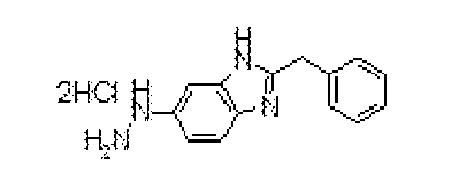
(2-benzyl-1H-benzimidazol-5-yl)-hydrazine dihydrochloride 239 -

- A catalyst was prepared as follows. Palladium acetate (1.2 mg, 0.0052 mmol) and 2-dicyclohexyl phosphino-2',4',6'-tri-i-propyl-1,1'-biphenyl (X-PHOS) (4.2 mg, 0.0088 mmol) were dissolved in tert-amyl alcohol (2.4 µl, 0.022 mmol) and N-methyl-morpholine (0.05 ml). The resulting solution was heated and stirred at 60°C under a nitrogen atmosphere for five minutes.
- In a separate reaction container, 7-fluoro-2-methyl-3H-benzimidazol-5-yl amine (100 mg, 0.44 mmol), lithium bis(trimethylsilyl) amide (190 mg, 1.1 mmol), and benzophenone hydrazone (94.3 mg, 0.48 mmol) were dissolved in N-methyl-morpholine (0.5 ml) under a nitrogen atmosphere. Then, the prepared solution containing the catalyst was added thereto. After deaeration, this was heated and stirred at 100°C under a nitrogen atmosphere for two hours. The reaction mixture was cooled to room temperature, and then an aqueous solution of 6 M hydrochloric acid (0.5 ml) was added thereto. The organic layer was isolated, and concentrated under reduced pressure. Thus, crude N-benzhydrylidene-N'-(7-fluoro-2-methyl-1H-benzimidazol-5-yl)-hydrazine was obtained. The obtained crude product was used in subsequent reactions without being purified.
- Concentrated hydrochloric acid (0.7 ml) was added to a mixture of the crude N-benzhydrylidene-N'-(7-fluoro-2-methyl-1H-benzimidazol-5-yl)-hydrazine (325 mg) and ethanol (0.7 ml). This was stirred at 59 to 64°C for one hour, and the reaction mixture was cooled to room temperature. Then, the precipitated solid was collected by filtration and dried. Thus, 7-fluoro-2-methyl-1H-benzimidazol-5-yl-hydrazine dihydrochloride (90 mg, 80%) was obtained.
1H-NMR (DMSO-D6) δ: 7.11 (1.0H, d, J = 1.8 Hz), 6.99 (1.0H, dd, J = 12.4, 1.8 Hz), 2.69 (3.1H, s)
ESI (LC-MS positive mode) m/z 181 [(M+H)+] - 6-Fluoro-2-methyl-1H-benzimidazol-5-yl-hydrazine dihydrochloride (1498) was synthesized as described in Step 41.

-
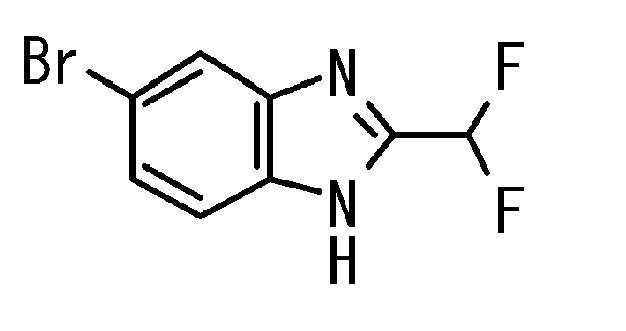
- 4-Bromophenylene diamine (935 mg, 5.0 mmol) and difluoroacetic acid (0.47 ml, 7.5 mmol, 1.5 eq.) were dissolved in an aqueous solution (10 ml) of 5 M hydrochloric acid. This was stirred at 100°C for 24 hours. After cooling it to room temperature, the reaction mixture was alkalinized by adding an aqueous solution (10 ml) of 5 M sodium hydroxide thereto. After ethyl acetate extraction, the extract was dried over anhydrous sodium sulfate. The desiccant was removed by filtration and concentration was performed. The residue obtained by concentration under reduced pressure was purified by silica gel column chromatography. Thus, 6-bromo-2-difluoro-methyl-1H-benzimidazole was obtained as a pale yellow solid (1.0 g, 85.4%).
1H-NNM (DMSO-D6) δ: 13.51 (1H, brs), 7.86 (1H, d, J = 1.8 Hz), 7.62 (1H, d, J = 8.5 Hz), 7.44 (1H, dd, J = 8.5, 1.8 Hz), 7.41-7.14 (1H, m)
ESI (LC-MS positive mode) m/z 247, 249 [(M+H)+] -

- (2-Chloro-methoxy-ethyl)-trimethyl-silane (1.1 ml, 6.4 mmol, 1.5 eq.) was added to an anhydrous dichloromethane solution (22 ml) of 6-bromo-2-difluoromethyl-1H-benzimidazol (1.0 g, 4.27 mmol) and N,N-diisopropyl ethyl amine (1.9 ml, 10.6 mmol, 2.5 eq.). This was stirred at room temperature for 18 hours. The reaction mixture was concentrated. The residue obtained by concentration under reduced pressure was purified by silica gel column chromatography. Thus, 6-bromo-2-difluoromethyl-1-(2-trimethylsilanyl-ethoxymethyl)-1H-benzimidazole was obtained as a yellow solid (1.37 g, 85%).
1H-NNM (DMSO-D6) δ: 8.07-8.02 (1H, m), 7.78-7.74 (1H, m), 7.60-7.28 (2H, m), 5.76 (2H, s), 3.52 (2H, td, J = 8.4, 2.6 Hz), 0.83 (2H, td, J = 8.4, 2.6 Hz), -0.10 (9H, s)
ESI (LC-MS positive mode) m/z 377, 379 [(M+H)+] -

- 6-Bromo-2-difluoromethyl-1-(2-trimethylsilanyl-ethoxymethyl)-1H-benzimidazole (754 mg, 2.0 mmol), Tris(dibenzylideneacetone)dipalladium (0) (92 mg, 0.1 mmol), 2-dicyclohexylphosphino-2',4',6'-tri-i-propyl-1,1'-biphenyl (X-PHOS) (143 mg, 0.3 mmol), cesium carbonate (1.3 g, 4.0 mmol), and tert-butyl carbazate (794 mg, 6.0 mmol) were placed into a flask. After deaeration, the air was replaced with argon. Anhydrous toluene (8.0 ml) was added thereto, and this was stirred at 100°C for 20 hours. After cooling it to room temperature, the reaction mixture was filtered through Celite, and washed with ethyl acetate. The filtrate was concentrated. The residue obtained by concentration under reduced pressure was purified by silica gel column chromatography. Thus, tert-butoxycarbonylated hydrazine was obtained as a pale yellow gum-like material (220 mg, 26%). A 4 M hydrochloric acid/ethyl acetate solution (6.0 ml) was added to an ethyl acetate solution (3.0 ml) of the prepared tert-butoxycarbonylated hydrazine. This was stirred at room temperature for one and a half hours. The precipitated solid was collected by filtration, washed with ethyl acetate, and dried. Thus, crude
[2-difluoromethyl-3-(2-trimethylsilanyl-ethoxymethyl)-3H-benzimidazol-5-yl]-hydrazine hydrochloride was obtained as a yellow solid. The crude product was used in subsequent reactions without being purified.
ESI (LC-MS positive mode) m/z 329 [(M+H)+] -

- A mixture solution of 5-iodo-2-methyl-1H-benzimidazole (10 g, 39 mmol), trimethoxy-methane (200 ml), and chlorotrimethylsilane (0.075 ml, 0.59 mmol) was heated and stirred at 100°C for five hours under a nitrogen atmosphere while distilling off the solvent (a reaction conversion rate of 97%). The reaction mixture was cooled to 40°C, and then a tetrahydrofuran solution (0.87 ml, 0.87 mmol) of potassium tert-butoxide was added thereto. This was concentrated under reduced pressure to provide crude 1-dimethoxymethyl-5-iodo-2-methyl-1H-benzimidazole.
- A tetrahydrofuran solution (44 ml, 47 mmol) of 1.06 M cyclohexyl magnesium chloride was added to a mixed solution of crude 1-dimethoxymethyl-5-iodo-2-methyl-1H-benzimidazole and tetrahydrofuran (79 ml). This was stirred at -20°C under a nitrogen atmosphere for two hours. A toluene solution (40 ml) of di-tert-butyl azodicarboxylate (10.7 g, 46 mmol) was added to the reaction mixture, and this was stirred under a nitrogen atmosphere at -20°C for one hour and at 0°C for another one hour (a reaction conversion rate of 96%). An aqueous solution (60 ml) of 15% ammonium chloride was added to the reaction mixture. After extraction with a solution of isopropyl acetate/heptane (1/1; 50 ml), the organic layer was washed with an aqueous solution (50 ml) of 2% sodium bicarbonate. Then, 1-methyl-pyrrolidin-2-one (15 ml) was added thereto, and this was concentrated under reduced pressure to provide a
1-methyl-pyrrolidin-2-one solution (48 ml) of crude
1-(1-(dimethoxymethyl)-2-methyl-1H-benzo[d]imidazol-5-yl)hydrazine-1,2-dicarboxylic acid di-tert-butyl. - Isopropyl acetate (61 ml), water (0.2 ml), and mesylic acid (0.87 ml) were added to the 1-methyl-pyrrolidin-2-one solution (16 ml) of crude
1-(1-(dimethoxymethyl)-2-methyl-1H-benzo[d]imidazol-5-yl)hydrazine-1,2-dicarboxylic acid di-tert-butyl. This was stirred at 40°C for two hours. After cooling it to 5°C, the precipitated solid was collected by filtration, and dried to provide
1-(2-methyl-1H-benzo[d]imidazol-5-yl)hydrazine-1,2-dicarboxylic acid di-tert-butyl mesilate (4.3 g, 73%).
1H-NMR (CD30D) δ: 7.87 (1.0H, m), 7.69-7.53 (2.0H, m), 2.84 (3.0H, s), 2.70 (3.0H, s), 1.52-1.47 (18H, m) - Crude 1-dimethoxymethyl-5-iodo-2-methyl-1H-benzimidazole was prepared using magnesium chloride instead of chlorotrimethylsilane in step A (a reaction conversion rate of 98%).
- Crude 1-dimethoxymethyl-5-iodo-2-methyl-1H-benzimidazole was prepared using lithium chloride instead of chlorotrimethylsilane in step A (a reaction conversion rate of 98%).
- Crude 1-dimethoxymethyl-5-iodo-2-methyl-1H-benzimidazole was prepared using benzoic acid instead of chlorotrimethylsilane in step A (a reaction conversion rate of 97%).
- Crude 1-(1-(dimethoxymethyl)-2-methyl-1H-benzo[d]imidazol-5-yl)hydrazine-1,2-dicarboxylic acid di-tert-butyl was prepared using a tetrahydrofuran solution of isopropyl magnesium chloride instead of a tetrahydrofuran solution of cyclohexyl magnesium chloride in step B (a reaction conversion rate of 96%).
-

- 1-(2-Methyl-1H-benzo[d]imidazol-5-yl)hydrazine-1,2-dicarboxylic acid di-tert-butyl malate tetrahydrofuran solvate was prepared using tetrahydrofuran, maleic acid, and heptane instead of mesylic acid and isopropyl acetate in step B (a yield of 62%).
1H-NNM (CD30D) δ: 7.77 (1.0H, m), 7.64-7.53 (2.0H, m), 6.26 (2.0H, s), 3.74-3.71 (4.0H, m), 2.80 (3.0H, s), 1.90-1.85 (4.0H, m), 1.51-1.48 (18H, m) -

- 60% Oily sodium hydride (362 mg) was washed with hexane, and this was suspended in anhydrous N,N-dimethylformamide (DMF) (5 ml). An N,N-dimethylformamide (DMF) solution (15 ml) of 1H-pyrrole-2-carboxylic acid ethyl ester (1.05 g) was added dropwise to the suspension at 0°C with argon flow. The reaction mixture was stirred at 25°C for one hour, and then 4-methoxybenzyl chloride (1.5 ml) was added thereto at 0°C. The reaction mixture was stirred at 25°C for 10 hours. Then, ice (about 10 g) was added to the reaction mixture, and this was extracted with ethyl acetate (20 ml). The organic layer was washed with an aqueous solution (60 ml) saturated with sodium chloride, and then concentrated. The residue obtained by concentration under reduced pressure was purified by silica gel column chromatography (hexane/ethyl acetate). Thus, a yellow oily material was obtained (1.64 g, 83%).
ESI (LC-MS positive mode) m/z 260 [(M+H)+] -

- 1H-Pyrrole-2-carboxylic acid ethyl ester (10 g) was dissolved in carbon tetrachloride (50 ml). A carbon tetrachloride solution (50 ml) of bromine was added dropwise thereto on ice over 30 minutes. The reaction mixture was stirred at 25°C for one hour. The suspension of reaction mixture was added dropwise to an ethanol solution (100 ml) of 10% sodium ethoxide on ice over 20 minutes. The solvent was concentrated under reduced pressure. The resulting residue was diluted with ethyl acetate (40 ml) and water (20 ml). The organic layer was washed with an aqueous solution saturated with sodium chloride (10 ml), and then concentrated. The residue obtained by concentration under reduced pressure was purified by silica gel column chromatography (hexane/ethyl acetate). Thus, a brown solid was obtained (10 g, 99%).
ESI (LC-MS positive mode) m/z 218, 220 [(M+H)+] -

- An anhydrous N,N-dimethylformamide (DMF) solution (9 ml) of N-bromosuccinimide (2.7 g) was added dropwise to an anhydrous N,N-dimethylformamide (DMF) solution (8 ml) of 1-(4-methoxy-benzyl)-1H-pyrrole-2-carboxylic acid ethyl ester (2 g) at 0°C with argon flow. The reaction mixture was stirred at 0°C, and then water (20 ml) was added thereto. After extraction with ethyl acetate (30 ml), the organic layer was washed with an aqueous solution saturated with sodium chloride (70 ml), and the organic layer was concentrated under reduced pressure. The resulting residue was purified by silica gel column chromatography (hexane/ethyl acetate). Thus, 4,5-dibromo-1-(4-methoxy-benzyl)-1H-pyrrole-2-carboxylic acid ethyl ester was obtained as an oily pale brown material (2.99 g, 92%).
ESI (LC-MS positive mode) m/z 416, 418, 420 [(M+H)+] -

- Dioxane (1.5 ml) and an aqueous solution (1.5 ml) of 1 M sodium bicarbonate were added to [5-amino-1-(2-methyl-1H-benzimidazol-5-yl)-1H-pyrazol-4-yl]-[4-bromo-1-(toluene-4-sulfonyl) -1H-pyrrol-2-yl]-methanone (57 mg), palladium chloride bis-triphenylphosphine complex (10 mg), and phenylboronic acid (37 mg). The mixture was reacted at 140°C in a microwave reactor for ten minutes. The reaction mixture was diluted with water (5 ml), and then extracted with ethyl acetate. The organic layers were combined, and concentrated under reduced pressure. After HPLC purification, the eluate was desalted using PLHC03 cartridge (PolymerLabs), and then concentrated under reduced pressure. Thus, [5-amino-1-(2-methyl-1H-benzimidazol-5-yl)-1H-pyrazol-4-yl]-[4-phenyl-1-(toluene-4-sulfonyl) -1H-pyrrol-2-yl]-methanone was obtained as a yellow powder (15 mg, 26%).
ESI (LC-MS positive mode) m/z 537 [(M+H)+] - The compounds of numbers 1506 to 1510, and 1591 to 1598 listed in Table 33 were synthesized as described in Step 48.
Table 33 Compound No. Structure Compound name m/z 1506 
[5-amino-1-(2-methyl-1H-benzimidazol-5-yl)-1H-pyrazol -4-yl]-[1-(4-methoxy-benzyl) -4,5-diphenyl-1H-pyrrol-2-yl] -methanone 579 1507 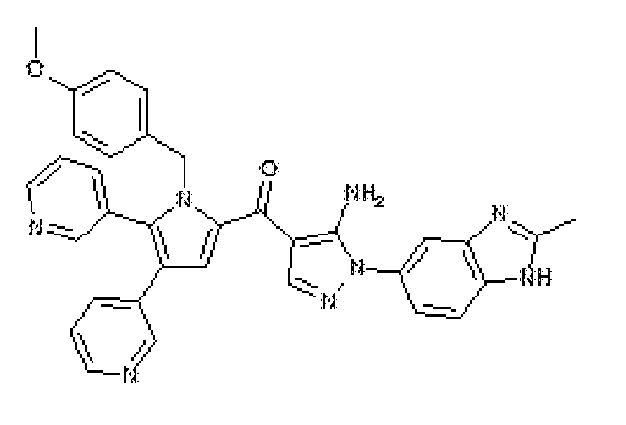
[5-amino-1-(2-methyl-1H-benzimidazol-5-yl)-1H-pyrazol -4-yl]-[I-(4-methoxy-benzyl) -4,5-dipyridin-3-yl-1H-pyrrol -2-yl]-methanone 581 1508 
[5-amino-1-(2-methyl-1H-benzimidazol-5-yl)-1H-pyrazol -4-yl]-[4-(3-chloro-phenyl)-l-(toluene-4-sulfonyl)-1H-pyrrol -2-yl]-methanone 571, 573 1509 
[5-amino-1-(2-methyl-1H-benzimidazol-5-yl)-1H-pyrazol -4-yl] - [4-(4-fluoro-phenyl)-1 -(toluene-4-sulfonyl)-1H-pyrrol -2-yl]-methanone 555 1510 
[5-amino-1-(2-methyl-1H-benzimidazol-5-yl)-1H-pyrazol -4-yl]-[4-(3-fluoro-phenyl)-1-(toluene-4-sulfonyl)-1H-pyrrol -2-yl]-methanone 555 1591 
[5-amino-1-(2-methyl-1H-benzimidazol-5-yl)-1H-pyrazol-4-yl]-[1-(4-methoxy-benzyl)-4-(4-methoxy-phenyl)-1H-pyrrol-2-yl]-methanone 533 1592 [5-amino-1-(2-methyl-1H-benzimidazol-5-yl)-1H-pyrazol-4-yl]-[1-(4-methoxy-benzyl)-4-(3-methoxy-phenyl)-1H-pyrrol-2-yl]-methanone 533 1593 [5-amino-1-(2-methyl-1H-benzimidazol-5-yl)-1H-pyrazol-4-yl]-[4,5-bis-(3-fluoro-phenyl)-1-(4-methoxy-benzyl)-1H-pyrrol-2-yl]-methanone 615 1594 
[5-amino-1-(2-methyl-1H-benzimidazol-5-yl)-1H-pyrazol-4-yl]-[4-(5-fluoro-2-methoxy-phenyl)-1-(4-methoxy-benzyl)-1H-pyrrol-2-yl]-methanone 551 1595 
[5-amino-1-(2-methyl-1H-benzimidazol-5-yl)-1H-pyrazol-4-yl]-[1-(4-methoxy-benzyl)-4,5-bis-(4-methoxy-phenyl)-1H-pyrrol-2-yl]-methanone 639 1596 
[5-amino-1-(2-methyl-1H-benzimidazol-5-yl)-1H-pyrazol-4-yl]-[4-(2,4-difluoro-phenyl)-1-(4-methoxy-benzyl)-1H-pyrrol-2-yl]-methanone 539 1597 [5-amino-1-(2-methyl-1H-benzimidazol-5-yl)-1H-pyrazol-4-yl]-[1-(4-methoxy-benzyl)-4-(4-trifluoromethoxy-phenyl)-1H-pyrrol-2-yl]-methanone 589 1598 [5-amino-1-(2-methyl-1H-benzimidazol-5-yl)-1H-pyrazol-4-yl]-[1-(4-methoxy-benzyl)-4,5-bis-(3-methoxy-phenyl)-1H-pyrrol-2-yl]-methanone 439 -

- [5-Amino-1-(2-methyl-1H-benzimidazol-5-yl)-1H-pyrazol-4-yl]-[4, 5-dibromo-1-(4-met hoxy-benzyl)-1H-pyrrol-2-yl]-methanone (317 mg) was dissolved in ethyl acetate/sulfuric acid (4/1; 5 ml). This was stirred at 80°C for four hours. The pH of the reaction mixture was adjusted to 11 (basic) using an aqueous solution of 5 M sodium hydroxide while cooling it on ice. The reaction mixture was extracted with ethyl acetate/tetrahydrofuran (THF) (10 ml). The organic layer was washed with an aqueous solution saturated with sodium chloride (5 ml), and the organic layer was concentrated under reduced pressure. The resulting residue was purified by silica gel column chromatography (dichloromethane/methanol). Thus, a brown solid was obtained (135 mg, 54%).
1H-NNM (DMSO-D6) δ: 12.88 (1H, s), 12.46 (1H, s), 8.19 (1H, s), 7.63 (1H, d, J = 8.7 Hz), 7.56-7.54 (1H, m), 7.27-7.26 (3H, m), 6.90 (1H, t, J = 14.2 Hz), 2.53 (3H, s)
ESI (LC-MS positive mode) m/z 463, 465, 467 [(M+H)+] - The compounds of Examples 202, 203, and 240-246 listed in Table 34 were synthesized as described in Example 201.
Table 34 Example Structure Compound name m/z 1H-NMR 202 [5-ainmc'-1-(2-mcthyl-1H-benzimidazol-5-yl)-1H-pyrazol-4-yl] -(4,5-diphenyl-1H-pyrrol-2-yl)-methanone 459 1H-NMR (CD3OD) 6: 8.22 (1H, s), 7.73-7.64 (3H, m), 7 60-7 51 (2H, m). 7 45-7 38 (3H, m), 7.37-7.18 (9H, m), 2.61 (3H, s). 203 
[5 -amino- 1 -(2-mcihyl -1H-benzimidazol-5-yl)-lII-pyrazol-4-yl] -(4,5-dipyridin-3-yl-1H-pyrrol-2-yl)-methanone 461 1H-NMR (DMSO-D6) δ : 12.39 (1H. s), 8.56 (1H, dd, J = 7.9, 2.1 Hz), 8.52 (1H, dd, J = 4.7, 1.1 Hz), 8.43 (1H, dd, J = 47, 1.6Hz), 8 38 (1H, s).781 (1H, dt, J = 79, 19 Hz), 772 (1H, dt, J = 8.0, 2.0 Hz), 7.63-7.59 (2H, m), 7.42 (1H, t, J = 3.7 Hz), 7.36 (1H, dd, J = 8.5, 3.7 Hz), 7.30 (1H, dd, J = 8.6, 2.0 Hz), 6.98 (2H, br s), 2.54 (3H, s). 240 [5-amino-1-(2-methyl-1H-benzimidazol-5-yl)-1H-pyrazol-4-ylJ-[4-(4-methoxy-phenyl)-1H-pyrrol-2-yl]-methanone 413 11.9 (1H, br s), 7.64-7.62 (2H, m), 7.56 (1H, m), 7.51 (1H, m), 7.33-7.31 (3H, m), 7.27-7.23 (1H, m), 6.96 (1H, m), 6.90 (2H, m), 6.75-6.73 (1H, m), 3.82 (3H, s), 2.60 (3H, s) 241 
[5-amino-1-(2-methyl-1H-benzimidazol-5-yl)-1H-pyrazol-4-yl]-[4-(3-methoxy-phenyl)-1H-pyrrol-2-yl]-methanone 413 11.9 (1H, br s), 7.69-7.62 (2H, m), 7.56 (1H, m), 7.51 (1H, m), 7.33-7.31 (3H, m), 7.27-7.23 (1H, m), 6.96 (1H, m), 6.90 (2H, m), 6.75-6.73 (1H, m), 3.82 (3H, s), 2.60 (3H, s) 242 [5-amino-1-(2-methyl-1H-benzimidazol-5-yl)-1H-pyrazoi-4-y)]-[4,5-bis-(3-fluoro-phenyl)-1H-pyrrol-2-yl]-mcthanonc 495 7.67 (1H, m), 7.41-7.28 (3H, m), 7.25-7.23 (2H, m), 7.16-7.14 (2H, m), 7.10-7.05 (2H, m), 6.99-6.95 (1H, m), 2.65 (3H, s) 243 
[5-amino-1-(2-methyl-1H-benzimidazol-5-yl)-1H-pyrazol-4-yl]-[4,5-bis-(4-methoxy-phenyl)-1H-pyrrol-2-yl]-methanone 519 8.19 (1H, m), 7.66-7.64 (2H, m), 7.38-7.34 (3H, m), 7.25-7.23 (2H, m), 7.14 (1H, m), 6.91-6.84 (4H, s), 3.80 (3H, s), 3.76 (3H, s), 2.61 (3H, s) 244 [5-amino-1-(2-methyl-1H-benzimidazol-5-yl)-1H-pyrazol-4-yll-14-(2,4-ditluoro-phenyl)-1H-pyrrol-2-yi]-methanone 419 8.30 (1H, m), 7.96-7.89 (1H, m), 7.69 (2H, m), 7.47-7.45 (2H, m), 7.42-7.39 (1H, m), 7.26-7.21 (1H, m), 7.12-7.08 (1H, m), 2.60 (3H, s) 245 
[5-amino-1-(2-methyl-1H-benzimidazol-5-yl)-1H-pyrazol-4-yl]-[4-(4-trifluoromethoxy-phenyl)-1H-pyrrol-2-y1]-methanone 467 12.5 (1H,brs),11.9(1H, br s), 8.39 (1H, m), 7.89-7.87 (2H, m), 7.64-7.55 (4H, m), 7.33-7.31 (3H, m), 6.91-6.85 (2H, m), 2.54 (3H, s) 246 
[5-amino-1-(2-methyl-1H-benzimidazol-5-yl)-1H-pyrazol-4-yl]-[4,5-bis-(3-methoxy-phenyl)-1H-pyrrol-2-yl]-methanone 519 12.5 (1H,brs),11.9(1H,brs), 7.65-7.63 (1H, m), 7.58-7.55 (1H, m), 7.31-7.28 (1H, m), 7.25-7.18 (3H, m), 7.07 (1H, m), 6.96-6.86 (6H, m), 6.80-6.78 (1H, m), 3.73 (3H, s), 3.69 (3H, s), 2.53 (3H, s) - The FGFR1-inhibiting activity was measured based on the activity to inhibit phosphorylation of the biotinylated peptide EGPWLEEEEEAYGWMDF by the human FGFR1 I enzyme (Carna Biosciences, cat. 08-133). Phosphorylated biotinylated peptides were detected by the time-resolved fluorescent measurement using a europium cryptate-linked anti-phophotyrosine antibody and a streptavidin to which XL665, a derivative of allophycocyanine, is linked. The 50% inhibitory concentration (IC50) was calculated based on the inhibitory rate against the control group without test substances.
- The FGFR2-inhibiting activity was measured based on the activity to inhibit phosphorylation of the biotinylated peptide EGPWLEEEEEAYGWMDF by the human FGFR2 enzyme prepared using a baculovirus expression system. Phosphorylated biotinylated peptides were detected by the time-resolved fluorescent measurement using a europium cryptate-linked anti-phophotyrosine antibody and a streptavidin to which XL665, a derivative of allophycocyanine, is linked. The 50% inhibitory concentration (IC50) was calculated based on the inhibitory rate against the control group without test substances.
- The FGFR3-inhibiting activity was measured based on the activity to inhibit phosphorylation of the biotinylated peptide EGPWLEEEEEAYGWMDF by the human FGFR3 enzyme (Carna Biosciences, cat. 08-135). Phosphorylated biotinylated peptides were detected by the time-resolved fluorescent measurement using a europium cryptate-linked anti-phophotyrosine antibody and a streptavidin to which XL665, a derivative of allophycocyanine, is linked. The 50% inhibitory concentration (IC50) was calculated based on the inhibitory rate against the control group without test substances.
- Compounds that have an activity of inhibiting FGFR1 (IC50 of 0.3 µM or less):
- Examples 1-14, 16-18, 23-25, 27-32, 35-62, 64-87, 89-108, 110, 112-125, 130-161, 163-175, 177-191, and 192-201
- Examples 1-14, 16-62, 64-108, 110, 112-126, 128-150, 152-161, 163-191, and 192-201
- Examples 1-3, 5-9, 12-13, 25, 27-29, 32, 36, 38-50, 52-54, 56, 61, 64-67, 69-72, 74-81, 85-87, 89, 91-100, 102-108, 110, 112-121, 123-125, 132-150, 152-161, 163-169, 174-176, 178, 180-187, 189-191, 192, and 194-200
- The present invention provides compounds having an activity of inhibiting FGFR family kinases. Furthermore, the present invention provides pharmaceutical agents for preventing and/or treating cancers (for example, breast cancer, acute myelocytic leukemia, pancreatic cancer, bladder cancer, prostatic cancer, esophageal cancer, angiogenesis, stomach cancer, uterine body cancer, ovarian cancer, brain tumor including glioblastoma, colon cancer, multiple myeloma, hepatocellular carcinoma, pulmonary cancer including small cell and non-small cell lung cancers, and thyroid cancer).
| Example | FGFR1 | FGFR2 | FGFR3 |
| 1 | 0.0050 | 0.023 | 0.018 |
| 3 | 0.0053 | 0.0055 | 0.013 |
| 5 | 0.028 | 0.0056 | 0.038 |
| 6 | 0.0027 | 0.0032 | 0.0054 |
| 7 | 0.0030 | 0.0043 | 0.0067 |
| 12 | 0.031 | 0.0085 | 0.50 |
| 16 | 0.042 | 0.031 | 0.36 |
| 21 | 0.46 | 0.064 | 50 |
| 27 | 0.030 | 0.0054 | 0.0031 |
| 28 | 0.099 | 0.021 | 0.21 |
| 29 | 0.093 | 0.019 | 0.35 |
| 38 | 0.015 | 0.023 | 0.077 |
| 39 | 0.010 | 0.015 | 0.046 |
| 40 | 0.00081 | 0.012 | 0.0037 |
| 42 | 0.0096 | 0.023 | 0.034 |
| 43 | 0.017 | 0.017 | 0.070 |
| 47 | 0.0027 | 0.0043 | 0.0054 |
| 48 | 0.030 | 0.0089 | 0.11 |
| 50 | 0.042 | 0.026 | 0.15 |
| 52 | 0.016 | 0.0086 | 0.21 |
| 53 | 0.043 | 0.021 | 0.15 |
| 54 | 0.089 | 0.042 | 0.19 |
| 56 | 0.051 | 0.034 | 0.18 |
| 57 | 0.26 | 0.086 | 0.58 |
| 60 | 0.077 | 0.022 | 0.32 |
| 62 | 0.035 | 0.016 | 0.36 |
| 64 | 0.022 | 0.012 | 0.16 |
| 66 | 0.025 | 0.048 | 0.043 |
| 67 | 0.029 | 0.025 | 0.082 |
| 68 | 0.23 | 0.20 | 0.40 |
| 69 | 0.023 | 0.016 | 0.060 |
| 71 | 0.060 | 0.027 | 0.13 |
| 72 | 0.045 | 0.021 | 0.082 |
| 73 | 0.076 | 0.036 | 0.80 |
| 74 | 0.050 | 0.026 | 0.23 |
| 75 | 0.043 | 0.022 | 0.086 |
| 79 | 0.018 | 0.010 | 0.027 |
| 81 | 0.018 | 0.012 | 0.045 |
| 82 | 0.024 | 0.0083 | 0.37 |
| 83 | 0.057 | 0.014 | 0.67 |
| 85 | 0.022 | 0.0055 | 0.094 |
| 87 | 0.062 | 0.014 | 0.090 |
| 90 | 0.075 | 0.040 | 0.38 |
| 91 | 0.039 | 0.018 | 0.077 |
| 92 | 0.009 | 0.0062 | 0.032 |
| 93 | 0.043 | 0.039 | 0.015 |
| 96 | 0.033 | 0.038 | 0.068 |
| 98 | 0.011 | 0.017 | 0.065 |
| 102 | 0.048 | 0.039 | 0.16 |
| 104 | 0.036 | 0.031 | 0.14 |
| 107 | 0.0069 | 0.0084 | 0.018 |
| 114 | 0.00032 | 0.012 | 0.012 |
| 115 | 0.00067 | 0.0085 | 0.030 |
| 121 | 0.087 | 0.11 | 0.13 |
| 124 | 0.011 | 0.012 | 0.041 |
| 126 | 0.39 | 0.26 | 2.1 |
| 127 | 0.98 | 0.51 | 5.5 |
| 131 | 0.21 | 0.067 | 9.8 |
| 132 | 0.0014 | 0.0034 | 0.0035 |
| 133 | 0.0051 | 0.026 | 0.19 |
| 134 | 0.0020 | 0.012 | 0.035 |
| 137 | 0.0064 | 0.019 | 0.026 |
| 138 | 0.0042 | 0.006 | 0.0056 |
| 139 | 0.0085 | 0.029 | 0.018 |
| 141 | 0.0025 | 0.0040 | 0.0016 |
| 145 | 0.0038 | 0.0091 | 0.010 |
| 149 | 0.024 | 0.20 | 0.28 |
| 150 | 0.0029 | 0.065 | 0.079 |
| 151 | 0.082 | 0.32 | 0.92 |
| 153 | 0.0079 | 0.011 | 0.036 |
| 154 | 0.066 | 0.038 | 0.13 |
| 155 | 0.0018 | 0.0063 | 0.0012 |
| 157 | 0.0016 | 0.0048 | 0.012 |
| 158 | 0.0014 | 0.0046 | 0.010 |
| 159 | 0.070 | 0.028 | 0.19 |
| 163 | 0.018 | 0.0036 | 0.019 |
| 164 | 0.0030 | 0.010 | 0.0084 |
| 166 | 0.040 | 0.015 | 0.080 |
| 168 | 0.048 | 0.021 | 0.079 |
| 169 | 0.03 | 0.015 | 0.14 |
| 170 | 0.15 | 0.056 | 0.95 |
| 177 | 0.12 | 0.11 | 0.38 |
| 178 | 0.033 | 0.020 | 0.077 |
| 182 | 0.060 | 0.029 | 0.18 |
| 185 | 0.0055 | 0.0040 | 0.029 |
| 187 | 0.046 | 0.016 | 0.25 |
| 188 | 0.091 | 0.026 | 1.3 |
| 189 | 0.038 | 0.0076 | 0.10 |
| 190 | 0.034 | 0.0055 | 0.094 |
| 192 | 0.031 | 0.020 | 0.11 |
| 193 | 0.14 | 0.078 | 0.37 |
| 196 | 0.0029 | 0.0094 | 0.13 |
| 198 | 0.021 | 0.020 | 0.090 |
| 199 | 0.027 | 0.018 | 0.12 |
| 200 | 0.056 | 0.021 | 0.068 |
| 201 | 0.26 | 0.066 | 1.4 |
| 203 | 1.7 | 0.393 | 1.8 |
| 204 | 0.091 | 0.057 | 0.37 |
| 207 | 3.6 | 1.9 | 7.9 |
| 210 | 0.092 | 0.037 | 0.33 |
| 213 | 0.045 | 0.026 | 0.15 |
| 222 | 0.053 | 0.017 | 0.21 |
| 225 | 0.053 | 0.028 | 0.26 |
| 229 | 0.036 | 0.010 | 0.35 |
| 232 | 0.056 | 0.22 | 0.26 |
| 233 | 0.210 | 0.35 | 0.88 |
| 239 | 2.8 | 0.538 | 4.0 |
| 240 | 0.85 | 0.18 | 3.18 |
| 249 | 0.038 | 0.022 | 0.082 |
| 250 | 0.095 | 0.040 | 0.32 |
| 251 | 0.077 | 0.032 | 0.23 |
Claims (12)
- A compound represented by following general formula (I), or a pharmaceutically acceptable salt thereof:
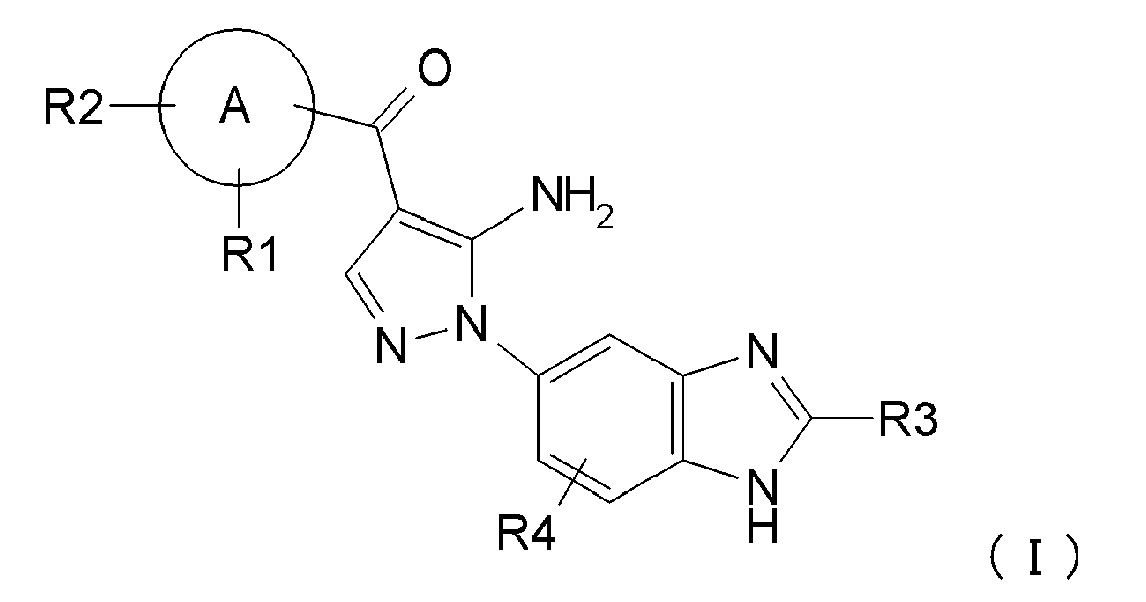 R1 represents hydrogen, hydroxy, halogen, cyano, nitro, C1-4 haloalkyl, C1-6 alkyl, C2-6 alkenyl, C2-6 alkynyl, C3-7 cycloalkyl, C6-10 aryl C1-4 alkyl, -OR5, -NR6R7, -(CR8H9)nZ1, -C(O)NR12R13, -SR14, -SOR15, -SO2R16, -NR17SO2R18, COOH, C6-10 aryl which is optionally substituted by one or more groups independently selected from group P, 5- to 10-membered heteroaryl or 3- to 10-membered heterocyclyl which is optionally substituted by one or more groups independently selected from group Q, -COR19, -COOR20, -OC(O)R21, -NR22C(O)R23, -NR24C(S)R25, -C(S)NR26P27, -SO2NR28P29, -OSO2R30, -SO3R31, or -Si(R32)3;R2 represents hydrogen, hydroxy, halogen, cyano, nitro, C1-4 haloalkyl, Cm-6 alkyl, C2-6 alkenyl, C2-6 alkynyl, C3-7 cycloalkyl, C6-10 aryl C1-4 alkyl, -OR5, -NR6R7, -(CRBR9)nZ1, -C(O)NR12R13, -SR14, -SOR15, -SO2R16, -NR17SO2R18, COOH, C6-10 aryl which is optionally substituted by one or more groups independently selected from group P, 5- to 10-membered heteroaryl or 3- to 10-membered heterocyclyl which is optionally substituted by one or more groups independently selected from group Q, -COR19, -COOR20, -OC(O)R21, -NR22C(O)R23, -NR24C(S)R25, -C(S)NR26R27, -SO2NR28R29, -OSO2R30, -SO3R31, Or -Si(R32)3; orR1,and R2, together with an atom linked thereto, form 3- to 10-membered heterocyclyl or 5- to 10-membered heteroaryl, wherein the heterocyclyl or heteroaryl is optionally substituted by halogen;R3 represents hydrogen, C1-5 alkyl, C6-10 aryl C1-6 alkyl, or C1-4 haloalkyl;R4 represents hydrogen, halogen, C1-3 alkyl, C1-4 haloalkyl, hydroxy, cyano, nitro, C1-4 alkoxy, -(CH2)nZ1, -NR6R7, -OR5, -C(O)NR12R13, -SR14, -SOR15, -SO2R16, NR17SO2R18, COOH, -COR19, -COOR20, -OC(O)R21, -NR22C(O)R23, -NR24C(S)R25, -C(S)NR26R27, -SO2NR28R29, -OSO2R30, -SO3R31, Or -Si(R32)3;A represents a 5- to 10-membered heteroaryl ring or C6-10aryl ring;R5 represents C1-5 alkyl, C3-7 cycloalkyl, C3-7 cycloalkyl C1-3 alkyl, C2-6 alkenyl, C2-6 alkynyl, C1-4 haloalkyl, C1-3 alkoxy C1-4 alkyl, C1-3 alkoxy C1-4 alkoxy C1-4 alkyl, C1-4 aminoalkyl, C1-4 alkylamino C1-4 alkyl, di(C1-4 alkyl)amino C1-4 alkyl, C6-10 aryl, C6-10 aryl C1-3 alkyl, or 3- to 10-membered heterocyclyl C1-3 alkyl, 3- to 10-membered heterocyclyl, 5- to 10-membered heteroaryl, 5- to 10-membered heteroaryl C1-3 alkyl, C1-6 monohydroxy alkyl, C1-6 dihydroxy alkyl, or C1-6 trihydroxy alkyl which is optionally substituted by one or more groups independently selected from group Q;R6 and R7, which are the same or different, each represents hydrogen, C1-4 alkyl, C2-6 alkenyl, C2-6 alkynyl, C1-4 haloalkyl, C1-3 alkoxy C1-4 alkyl, C6-10 aryl C1-3 alkyl, 3- to 10-membered heterocyclyl C1-3 alkyl, 5- to 10-membered heteroaryl C1-3 alkyl, C1-6 monohydroxy alkyl, Cm-6 dihydroxy alkyl, C1-6 trihydroxy alkyl, 3- to 10-membered heterocyclyl, C1-4 aminoalkyl, C1-4 alkylamino C1-4 alkyl, di(C1-4 alkyl)amino C1-4 alkyl, or cyano(C1-3 alkyl); or R6 and R7, together with a nitrogen atom linked thereto, form 3- to 10-membered heterocyclyl or 5- to 10-membered heteroaryl;n represents 1 to 3;R8and R9, which are the same or different, each represents hydrogen, C1-4 alkyl, or halogen; or alternatively, R8and R9, together with a carbon atom linked thereto, form a cycloaliphatic ring;Z1 represents hydrogen, NR10R11, -OH, or 3- to 10-membered heterocyclyl or 5- to 10-membered heteroaryl which is optionally substituted by one or more groups independently selected from group Q;R10and R11, which are the same or different, each represents C1-4 alkyl, C2-6 alkenyl, C2-6 alkynyl, C1-4 haloalkyl, C1-3 alkoxy C1-4 alkyl, cyano(C1-3 alkyl), or C1-3 alkylsulfonyl C1-4 alkyl; or alternatively, R10and R11, together with a nitrogen atom linked thereto, form 3- to 10-membered heterocyclyl or 5- to 10-membered heteroaryl;R12 and R13, which are the same or different, each represents hydrogen, C1_4 alkyl, C2-6 alkenyl, C2-6 alkynyl, C1-4 haloalkyl, C1-3 alkoxy C1-4 alkyl, C6-10 aryl, 5- to 10-membered heteroaryl, 3- to 10-membered heterocyclyl, C6-10 aryl C1-4 alkyl, 3- to 10-membered heterocyclyl C1-3 alkyl, 5- to 10-membered heteroaryl C1-3 alkyl, cyano(C1-3 alkyl), C1-3 alkylsulfonyl C1-4 alkyl, 3- to 10-membered cycloaliphatic ring, 5- to 10-membered heteroaryl, or 3- to 10-membered heterocyclyl; or alternatively, R12 and R13, together with a nitrogen atom linked thereto, form 3-to 10-membered heterocyclyl or 5- to 10-membered heteroaryl which is optionally substituted by one or more groups independently selected from group Q;R14 represents C1-4 alkyl, C2-6 alkenyl, C2-6 alkynyl, C1-4 haloalkyl, C6-10 aryl which is optionally substituted by one or more groups independently selected from group P, or 5- to 10-membered heteroaryl or 3- to 10-membered heterocyclyl which is optionally substituted by one or more groups independently selected from group Q;R15 represents C1-4 alkyl, C2-6 alkenyl, C2-6 alkynyl, C1-4 haloalkyl, C6-10 aryl which is optionally substituted by one or more groups independently selected from group P, or 5- to 10-membered heteroaryl or 3- to 10-membered heterocyclyl which is optionally substituted by one or more groups independently selected from group Q;R16 represents C1-4 alkyl, C2-6 alkenyl, C2-6 alkynyl, C1-4 haloalkyl, C6-10 aryl which is optionally substituted by one or more groups independently selected from group P, or 5- to 10-membered heteroaryl or 3- to 10-membered heterocyclyl which is optionally substituted by one or more groups independently selected from group Q;R17 represents hydrogen or C1-4 alkyl;Rl8represents C1-4 alkyl, C2-6 alkenyl, C2-6 alkynyl, C1-4 haloalkyl, C6-10 aryl which is optionally substituted by one or more groups independently selected from group P, or 5- to 10-membered heteroaryl or 3- to 10-membered heterocyclyl which is optionally substituted by one or more groups independently selected from group Q;R19 represents hydrogen, C1-4 alkyl, C3-7 cycloalkyl, C1-4 haloalkyl, C6-10 aryl, or 5- to 10-membered heteroaryl or 3- to 10-membered heterocyclyl which is optionally substituted by one or more groups independently selected from group Q;R20represents C1-4 alkyl, C3-7 cycloalkyl, C1-4 haloalkyl, C6-10 aryl, 5- to 10-membered heteroaryl, or 3- to 10-membered heterocyclyl;R21 represents C1-4 alkyl, C3-7 cycloalkyl, C1-4 haloalkyl, C6-10 aryl, 5- to 10-membered heteroaryl, or 3- to 10-membered heterocyclyl;R22 represents hydrogen, C1-4 alkyl, or C1-4 haloalkyl;R23 represents hydrogen, C1-4 alkyl, C3-7 cycloalkyl, C1-4 haloalkyl, C6-10 aryl, 5- to 10-membered heteroaryl, or 3- to 10-membered heterocyclyl;R24 represents hydrogen, C1-4 alkyl, or C1-4 haloalkyl;R25 represents C1-4 alkyl, C3-7 cycloalkyl, C1-4 haloalkyl, C6-10 aryl, 5- to 10-membered heteroaryl, or 3- to 10-membered heterocyclyl;R26 and R27, which are the same or different, each represents hydrogen, C1-4 alkyl, C2-6 alkenyl, C2-6 alkynyl, C1-4 haloalkyl, C1-3 alkoxyl C1-4 alkyl, C6-10 aryl, 5- to 10-membered heteroaryl, 3-to 10-membered heterocyclyl, C6-10 aryl C1-4 alkyl, 3- to 10-membered heterocyclyl C1-3 alkyl, 5-to 10-membered heteroaryl C1-3 alkyl, cyano(C1-3 alkyl), C1-3 alkylsulfonyl C1-4 alkyl, or 3- to 10-membered cycloaliphatic ring; or alternatively, R26 and R27, together with a nitrogen atom linked thereto, form 3- to 10-membered heterocyclyl or 5- to 10-membered heteroaryl;R28 and R29, which are the same or different, each represents hydrogen, C1-4 alkyl, C2-6 alkenyl, C2-6 alkynyl, C1-4 haloalkyl, C1-3 alkoxyl C1-4 alkyl, C6-10 aryl, 5- to 10-membered heteroaryl, 3-to 10-membered heterocyclyl, C6-10 aryl C1-4 alkyl, 3- to 10-membered heterocyclyl C1-3 alkyl, 5-to 10-membered heteroaryl C1-3 alkyl, cyano(C1-3 alkyl), C1-3 alkylsulfonyl C1-4 alkyl, or 3- to 10-membered cycloaliphatic ring; or alternatively, R28 and R29, together with a nitrogen atom linked thereto, form 3- to 10-membered heterocyclyl or 5- to 10-membered heteroaryl;R30 represents C1-4 alkyl, C3-7 cycloalkyl, C1-4 haloalkyl, C6-10 aryl, 5- to 10-membered heteroaryl, or 3- to 10-membered heterocyclyl;R31 represents C1-4 alkyl, C3-7 cycloalkyl, C1-4 haloalkyl, C6-10 aryl, 5- to 10-membered heteroaryl, or 3- to 10-membered heterocyclyl;R32 represents C1-4 alkyl or C6-10 aryl;<group P>
halogen, C1-4 alkyl, C1-4 haloalkyl, -OH, C1-3 alkoxy, C1-3 haloalkoxy, 3- to 10-membered heterocyclylamino, -SO2R16, -CN, -NO2, and 3- to 10-membered heterocyclyl;<group Q>
halogen, C1-4 alkyl, C1-4 haloalkyl, -OH, C1-3 alkoxy, C1-6 monohydroxy alkyl, C1-6 dihydroxy alkyl, C1-6 trihydroxy alkyl, 3- to 10-membered heterocyclyl amine, -SO2R16, -CN, -NO2, C3-7 cycloalkyl, -COR19, and 3- to 10-membered heterocyclyl which is optionally substituted by C1-4 alkyl. - The compound of claim 1 or a pharmaceutically acceptable salt thereof, wherein A represents benzene, indole, azaindole, benzofuran, benzothiophene, benzothiazole, quinoline, or pyrrole.
- The compound of claim 1 or 2, or a pharmaceutically acceptable salt thereof, wherein R3 represents hydrogen, C1-4 alkyl, C6-10 aryl C1-4 alkyl, or C1-3 perfluoroalkyl.
- The compound of any one of claims 1 to 3, or a pharmaceutically acceptable salt thereof, wherein R4 represents hydrogen, halogen, C1-3 alkyl, C1-3 perfluoroalkyl, cyano, methanesulfonyl, hydroxyl, alkoxy, or amino.
- The compound of claim 1 or a pharmaceutically acceptable salt thereof, which is selected from the group consisting of:(1) [5-amino-1-(2-methyl-1H-benzimidazol-5-yl)-1H-pyrazol-4-yl]-(1H-indol-2-yl)-methanone;(2) [5-amino-1-(2-methyl-1H-benzimidazol-5-yl)-1H-pyrazol-4-yl]-(6-pyrrolidin-1-ylmethyl-1H-ind ol-2-yl)-methanone;(3) [5-amino-1-(2-methyl-1H-benzimidazol-5-yl)-1H-pyrazol-4-yl]-[6-(4-hydroxy-piperidin-1-ylmet hyl)-1H-indol-2-yl]-methanone;(4) [5-amino-1-(2-methyl-1H-benzimidazol-5-yl)-1H-pyrazol-4-yl]-(1H-pyrrolo[3,2-c]pyridin-2-yl)-methanone;(5) [5-amino-1-(2-methyl-1H-benzimidazol-5-yl)-1H-pyrazol-4-yl]-(6-piperazin-1-ylmethyl-1H-ind ol-2-yl)-methanone;(6) [5-amino-1-(2-methyl-1H-benzimidazol-5-yl)-1H-pyrazol-4-yl]-[6-(2-morpholin-4-yl-ethoxy)-1H-indol-2-yl]-methanone;(7) [5-amino-1-(2-methyl-1H-benzimidazol-5-yl)-1H-pyrazol-4-yl]-[6-(tetrahydro-pyran-4-yloxy)-1H-indol-2-yl]-methanone;(8) [5-amino-1-(2-methyl-1H-benzimidazol-5-yl)-1H-pyrazol-4-yl]-(4-chloro-1H-indol-2-yl)-metha none;(9) [5-amino-1-(2-methyl-1H-benzimidazol-5-yl)-1H-pyrazol-4-yl]-(5-bromo-1H-indol-2-yl)-metha none;(10) [5-amino-1-(2-methyl-1H-benzimidazol-5-yl)-1H-pyrazol-4-yl]-(4-iodo-1H-indol-2-yl)-methano ne;(11) 2-[5-amino-1-(2-methyl-1H-benzimidazol-5-yl)-1H-pyrazole-4-carbonyl]-1H-indole-5-carbonitri le;(12) [5-amino-1-(2-methyl-1H-benzimidazol-5-yl)-1H-pyrazol-4-yl]-(6-bromo-5-fluoro-1H-indol-2-y )-methanone;(13) [5-amino-1-(2-methyl-1H-benzimidazol-5-yl)-1H-pyrazol-4-yl]-(5-ethynyl-1H-indol-2-yl)-meth anone;(14) [5-amino-1-(2-methyl-1H-benzimidazol-5-yl)-1H-pyrazol-4-yl]-[6-(2-fluoro-phenyl)-1H-indol-2 -yl]-methanone;(15) [5-amino-1-(2-methyl-1H-benzimidazol-5-yl)-1H-pyrazol-4-yl]-[6-(3-fluoro-phenyl)-1H-indol-2 -yl]-methanone;(16) [5-amino-1-(2-methyl-1H-benzimidazol-5-yl)-1H-pyrazol-4-yl]-[6-(4-fluoro-phenyl)-1H-indol-2 -yl]-methanone;(17) [5-amino-1-(2-methyl-1H-benzimidazol-5-yl)-1H-pyrazol-4-yl]-[6-(2-chloro-phenyl)-1H-indol-2 -yl]-methanone;(18) [5-amino-1-(2-methyl-1H-benzimidazol-5-yl)-1H-pyrazol-4-yl]-[6-(3-chloro-phenyl)-1H-indol-2 -yl]-methanone;(19) [5-amino-1-(2-methyl-1H-benzimidazol-5-yl)-1H-pyrazol-4-yl]-[6-(4-chloro-phenyl)-1H-indol-2 -yl]-methanone;(20) [5-amino-1-(2-methyl-1H-benzimidazol-5-yl)-1H-pyrazol-4-yl]-[6-(2-trifluoromethyl-phenyl)-1H-indol-2-yl]-methanone;(21) [5-amino-1-(2-methyl-1H-benzimidazol-5-yl)-1H-pyrazol-4-yl]-[6-(3-trifluoromethyl-phenyl)-1H-indol-2-yl]-methanone;(22) [5-amino-1-(2-methyl-1H-benzimidazol-5-yl)-1H-pyrazol-4-yl]-[6-(4-trifluoromethyl-phenyl)-1H-indol-2-yl]-methanone;(23) [5-amino-1-(2-methyl-1H-benzimidazol-5-yl)-1H-pyrazol-4-yl]-(4-bromo-1H-indol-2-yl)-metha none;(24) [5-amino-1-(2-methyl-1H-benzimidazol-S-yl)-1H-pyrazol-4-yl]-[6-(3-fluoro-pyridin-2-yl)-1H-in dol-2-yl]-methanone;(25) [5-amino-1-(2-methyl-1H-benzimidazol-5-yl)-1H-pyrazol-4-yl]-(6-methyl-1H-indol-2-yl)-metha none;(26) [5-amino-1-(2-methyl-1H-benzimidazol-5-yl)-1H-pyrazol-4-yl]-[5-(4,4-difluoro-piperidine-1-car bonyl)-1H-indol-2-yl]-methanone;(27) [5-amino-1-(2-methyl-1H-benzimidazol-5-yl)-1H-pyrazol-4-yl]-[5-(3,3-difluoro-piperidine-1-car bonyl)-1H-indol-2-yl]-methanone;(28) 2-[5-amino-1-(2-methyl-1H-benzimidazol-5-yl)-1H-pyrazole-4-carbonyl]-1H-indole-5-carboxyli c acid (2,2,2-trifluoro-ethyl)-amide;(29) [5-amino-1-(2-methyl-1H-benzimidazol-5-yl)-1H-pyrazol-4-yl]-[6-(5-trifluoromethyl-pyridin-2-yl)-1H-indol-2-yl]-methanone;(30) [5-amino-1-(2-methyl-1H-benzimidazol-5-yl)-1H-pyrazol-4-yl]-[6-(6-trifluoromethyl-pyridin-2-yl)-1H-indol-2-yl]-methanone;(31) [5-amino-1-(2-methyl-1H-benzimidazol-5-yl)-1H-pyrazol-4-yl]-[6-(5-chloro-pyridin-2-yl)-1H-in dol-2-yl]-methanone;(32) [5-amino-1-(2-methyl-1H-benzimidazol-5-yl)-1H-pyrazol-4-yl]-[6-(4-methyl-pyridin-2-yl)-1H-i ndol-2-yl]-methanone;(33) [5-amino-1-(2-methyl-1H-benzimidazol-5-yl)-1H-pyrazol-4-yl]-[6-(3-chloro-4-fluoro-phenyl)-1H-indol-2-yl]-methanone;(34) [5-amino-1-(2-methyl-1H-benzimidazol-5-yl)-1H-pyrazol-4-yl]-[6-(3-trifluoromethyl-pyridin-2-yl)-1H-indol-2-yl]-methanone;(35) [5-amino-1-(2-methyl-1H-benzimidazol-5-yl)-1H-pyrazol-4-yl]-[6-(4-trifluoromethyl-pyridin-2-yl)-1H-indol-2-yl]-methanone;(36) [5-amino-1-(6-fluoro-2-methyl-1H-benzimidazol-5-yl)-1H-pyrazol-4-yl]-(1H-indol-2-yl)-methan one;(37) 2-[5-amino-1-(2-methyl-1H-benzimidazol-5-yl)-1H-pyrazole-4-carbonyl]-1H-indole-6-carboxyli c acid;(38) [5-amino-1-(2-methyl-1H-benzimidazol-5-yl)-1H-pyrazol-4-yl]-(6-hydroxymethyl-1H-indol-2-y 1)-methanone;(39) [5-amino-1 -(2-methyl-1H-benzimidazol-5-yl)-1H-pyrazol-4-yl]-{6-[2-(4-methyl-piperazin-1-yl)-ethoxy]-1H-indol-2-yl}-methanone;(40) [5-amino-1-(2-methyl-1H-benzimidazol-5-yl)-1H-pyrazol-4-yl]-[6-(3-methyl-oxetan-3-ylmethox y)-1H-indol-2-yl]-methanone;(41) [5-amino-1-(2-methyl-1H-benzimidazol-5-yl)-1H-pyrazol-4-yl]-[6-(3-fluoro-piperidin-1-ylmeth yl)-1H-indol-2-yl]-methanone;(42) [5-amino-1-(2-methyl-1H-benzimidazol-5-yl)-1H-pyrazol-4-yl]-(6-{[bis(2-methoxy-ethyl)amino ]-methyl}-1H-indol-2-yl)-methanone;(43) [S-amino-1-(2-methyl-1H-benzimidazol-5-yl)-1H-pyrazol-4-yl]-{6-[(methyl-prop-2-ynyl-amino) methyl]-1H-indol-2-yl}-methanone;(44) [5-amino-1-(2-methyl-1H-benzimidazol-S-yl)-1H-pyrazol-4-yl]-[6-(3,3-difluoro-pyrrolidin-1-yl methyl)-1H-indol-2-yl]-methanone;(45) [5-amino-1-(2-methyl-1H-benzimidazol-5-yl)-1H-pyrazol-4-yl]-[6-(2,5-dimethyl-pyrrolidin-1-yl methyl)-1H-indol-2-yl]-methanone;(46) [5-amino-1-(2-methyl-1H-benzimidazol-5-yl)-1H-pyrazol-4-yl]-[6-(3,3-difluoro-piperidin-1-ylm ethyl)-1H-indol-2-yl]-methanone;(47) [5-amino-1-(2-methyl-1H-benzimidazol-5-yl)-1H-pyrazol-4-yl]-[6-((S)-3-methyl-morpholin-4-yl methyl)-1H-indol-2-yl]-methanone;(48) [5-amino-1-(2-methyl-1H-benzimidazol-S-yl)-1H-pyrazol-4-yl]-(6-bromo-1H-indol-2-yl)-metha none;(49) [5-amino-1-(2-methyl-1H-benzimidazol-5-yl)-1H-pyrazol-4-yl]-(5-iodo-1H-indol-2-yl)-methano ne;(50) [5-amino-1-(2-methyl-1H-benzimidazol-5-yl)-1H-pyrazol-4-yl]-(1H-pyrrolo[3,2-b]pyridin-2-yl)-methanone;(51) [5-amino-1-(2-methyl-1H-benzimidazol-5-yl)-1H-pyrazol-4-yl]-(5-bromo-6-trifluoromethyl-1H-indol-2-yl)-methanone;(52) [5-amino-1-(2-methyl-1H-benzimidazol-s-yl)-1H-pyrazol-4-yl]-(6-iodo-1H-indol-2-yl)-methano ne;(53) [5-amino-1-(2-methyl-1H-benzimidazol-5-yl)-1H-pyrazol-4-yl]-(4-methyl-1H-indol-2-yl)-metha none;(54) [5-amino-1-(2-methyl-1H-benzimidazol-5-yl)-1H-pyrazol-4-yl]-(4-isopropyl-1H-indol-2-yl)-met hanone;(55) [5-amino-1-(2-methyl-1H-benzimidazol-5-yl)-1H-pyrazol-4-yl]-[5-(2-fluoro-phenyl)-1H-indol-2 -yl]-methanone;(56) [5-amino-1-(2-methyl-1H-benzimidazol-s-yl)-1H-pyrazol-4-yl]-(5-benzyl-1H-indol-2-yl)-metha none;(57) [5-amino-1-(2-methyl-1H-benzimidazol-5-yl)-1H-pyrazol-4-yl]-[5-(2-trifluoromethyl-phenyl)-1H-indol-2-yl]-methanone;(58) [5-amino-1-(2-methyl-1H-benzimidazol-s-yl)-1H-pyrazol-4-yl]-[5-(3-fluorophenyl)-1H-indol-2-yl]-methanone;(59) [5-amino-1-(2-methyl-1H-benzimidazol-5-yl)-1H-pyrazol-4-yl]-[5-(3-trifluoromethyl-phenyl)-1H-indol-2-yl]-methanone;(60) [5-amino-1-(2-methyl-1H-benzimidazol-5-yl)-1H-pyrazol-4-yl]-(4-ethynyl-1H-indol-2-yl)-meth anone;(61) [5-amino-1-(2-methyl-1H-benzimidazol-5-yl)-1H-pyrazol-4-yl]-(5H-[1,3]dioxolo[4,5-f]indol-6-yl)-methanone;(62) [5-amino-1-(7-fluoro-2-methyl-1H-benzimidazol-5-yl)-1H-pyrazol-4-yl]-(1H-indol-2-yl)-methan one;(63) [5-amino-1-(2-methyl-1H-benzimidazol-5-yl)-1H-pyrazol-4-yl]-[5-(4-trifluoromethyl-phenyl)-1H-indol-2-yl]-methanone;(64) [5-amino-1-(2-methyl-1H-benzimidazol-5-yl)-1H-pyrazol-4-yl]-(5-butoxy-1H-indol-2-yl)-metha none;(65) [5-amino-1-(2-methyl-1H-benzimidazol-5-yl)-1H-pyrazol-4-yl]-[5-(1-methyl-piperidin-4-yl)-1H -indol-2-yl]-methanone;(66) N-{2-[5-amino-1-(2-methyl-1H-benzimidazol-5-yl)-1H-pyrazole-4-carbonyl]-1H-indol-6-yl}-me thanesulfonamide;(67) [5-amino-1-(2-methyl-1H-benzimidazol-5-yl)-1H-pyrazol-4-yl]-[6-(6-morpholin-4-yl-pyridin-3-yl)-1H-indol-2-yl]-methanone;(68) [5-amino-1-(2-methyl-1H-benzimidazol-5-yl)-1H-pyrazol-4-yl]-(6-butyl-1H-indol-2-yl)-methan one;(69) [5-amino-1-(2-methyl-1H-benzimidazol-5-yl)-1H-pyrazol-4-yl]-[6-(1-methyl-1H-pyrazol-4-yl)-1H-indol-2-yl]-methanone;(70) [5-amino-1-(2-methyl-1H-benzimidazol-5-yl)-1H-pyrazol-4-yl]-[6-(5-methoxy-pyridin-3-yl)-1H -indol-2-yl]-methanone;(71) [5-amino-1-(2-methyl-1H-benzimidazol-5-yl)-1H-pyrazol-4-yl]-[6-(2-methoxy-pyridin-3-yl)-1H -indol-2-yl]-methanone;(72) [5-amino-1-(2-methyl-1H-benzimidazol-5-yl)-1H-pyrazol-4-yl]-(6-cyclopropyl-1H-indol-2-yl)-methanone;(73) [5-amino-1-(2-methyl-1H-benzimidazol-5-yl)-1H-pyrazol-4-yl]-[6-(2-methoxy-phenyl)-1H-indo 1-2-yl]-methanone;(74) [5-amino-1-(2-methyl-1H-benzimidazol-5-yl)-1H-pyrazol-4-yl]-(6-phenyl-1H-indol-2-yl)-metha none;(75) [5-amino-1-(2-methyl-1H-benzimidazol-5-yl)-1H-pyrazol-4-yl]-[6-(5-methanesulfonyl-pyridin-3 -yl)-1H-indol-2-yl]-methanone;(76) [5-amino-1-(2-methyl-1H-benzimidazol-5-yl)-1H-pyrazol-4-yl]-(6-isopropyl-1H-indol-2-yl)-met hanone;(77) [5-amino-1-(2-methyl-1H-benzimidazol-5-yl)-1H-pyrazol-4-yl]-(6-pyridin-2-yl-1H-indol-2-yl)-methanone;(78) [5-amino-1-(2-methyl-1H-benzimidazol-5-yl)-1H-pyrazol-4-yl]-(5-cyclopropyl-1H-indol-2-yl)-methanone;(79) [5-amino-1-(2-methyl-1H-benzimidazol-5-yl)-1H-pyrazol-4-yl]-(6-pyridazin-3-yl-1H-indol-2-yl) -methanone;(80) [5-amino-1-(2-methyl-1H-benzimidazol-5-yl)-1H-pyrazol-4-yl]-(5-isopropoxy-1H-indol-2-yl)-m ethanone;(81) [5-amino-1-(2-methyl-1H-benzimidazol-5-yl)-1H-pyrazol-4-yl]-[5-(2-methoxy-ethoxy)-1H-indo 1-2-yl]-methanone;(82) [5-amino-1-(2-methyl-1H-benzimidazol-5-yl)-1H-pyrazol-4-yl]-(5-cyclopropylmethoxy-1H-indol-2-yl)-methanone;(83) [5-amino-1-(2-methyl-1H-benzimidazol-5-yl)-1H-pyrazol-4-yl]-(2,2-difluoro-5H-[1,3]dioxolo[4, 5-f]indol-6-yl)-methanone;(84) [5-amino-1-(2-methyl-1H-benzimidazol-5-yl)-1H-pyrazol-4-yl]-[6-(3-chloro-pyridin-2-yl)-1H-in dol-2-yl]-methanone;(85) [5-amino-1-(2-methyl-1H-benzimidazol-5-yl)-1H-pyrazol-4-yl]-[6-(5-fluoro-pyridin-2-yl)-1H-in dol-2-yl]-methanone;(86) [5-amino-1-(2-methyl-1H-benzimidazol-5-yl)-1H-pyrazol-4-yl]-[6-(6-morpholin-4-yl-pyridazin-3-yl)-1H-indol-2-yl]-methanone;(87) [5-amino-1-(2-methyl-1H-benzimidazol-5-yl)-1H-pyrazol-4-yl]-(5-chloro-6-cyclopropylmethox y-1H-indol-2-yl)-methanone;(88) [5-amino-1-(2-methyl-1H-benzimidazol-5-yl)-1H-pyrazol-4-yl]-[6-(2,4-difluoro-phenyl)-1H-ind ol-2-yl]-methanone;(89) [5-amino-1-(2-methyl-1H-benzimidazol-5-yl)-1H-pyrazol-4-yl]-(6-pyridazin-4-yl-1H-indol-2-yl) -methanone;(90) [5-amino-1-(2-methyl-1H-benzimidazol-5-yl)-1H-pyrazol-4-yl]-(3-fluoro-1H-indol-2-yl)-methan one;(91) [5-amino-1-(2-methyl-1H-benzimidazol-5-yl)-1H-pyrazol-4-yl]-[5-(1-isopropyl-piperidin-4-yl)-6-trifluoromethyl-1H-indol-2-yl]-methanone;(92) 2-[5-amino-1-(2-methyl-1H-benzimidazol-5-yl)-1H-pyrazole-4-carbonyl]-1H-indole-6-carbonitri le;(93) [5-amino-1-(2-methyl-1H-benzimidazol-5-yl)-1H-pyrazol-4-yl]-[5-(1,2,3,6-tetrahydro-pyridin-4-yl)-1H-indol-2-yl]-methanone;(94) [5-amino-1-(2-methyl-1H-benzimidazol-5-yl)-1H-pyrazol-4-yl]-(5-piperidin-4-yl-1H-indol-2-yl) -methanone;(95) [5-amino-1-(2-methyl-1H-benzimidazol-5-yl)-1H-pyrazol-4-yl]-[5-((R)-3-fluoro-pyrrolidin-1-yl methyl)-1H-indol-2-yl]-methanone;(96) [5-amino-1-(2-methyl-1H-benzimidazol-5-yl)-1H-pyrazol-4-yl]-(6-fluoro-5-piperidin-4-yl-1H-in dol-2-yl)-methanone;(97) [5-amino-1-(2-methyl-1H-benzimidazol-5-yl)-1H-pyrazol-4-yl]-[6-fluoro-5-(1-methyl-piperidin-4-yl)-1H-indol-2-yl]-methanone;(98) [5-amino-1-(2-methyl-1H-benzimidazol-5-yl)-1H-pyrazol-4-yl]-[5-(1-isopropyl-piperidin-4-yl)-1H-indol-2-yl]-methanone;(99) [5-amino-1-(2-methyl-1H-benzimidazol-5-yl)-1H-pyrazol-4-yl]-[6-fluoro-5-(1-isopropyl-piperid in-4-yl)-1H-indol-2-yl]-methanone;(100) [5-amino-1-(2-methyl-1H-benzimidazol-5-yl)-1H-pyrazol-4-yl]-(6-pyridin-3-yl-1H-indol-2-yl)-methanone;(101) [5-amino-1-(2-methyl-1H-benzimidazol-5-yl)-1H-pyrazol-4-yl]-[5-(6-morpholin-4-ylpyridin-3-y 1)-1H-indol-2-yl]-methanone;(102) [5-amino-1-(2-methyl-1H-benzimidazol-5-yl)-1H-pyrazol-4-yl]-(5-pyridin-3-yl-1H-indol-2-yl)-methanone;(103) [5-amino-1-(2-methyl-1H-benzimidazol-5-yl)-1H-pyrazol-4-yl]-[5-(6-piperazin-1-yl-pyridin-3-y 1)-1H-indol-2-yl]-methanone;(104) [5-amino-1-(2-methyl-1H-benzimidazol-5-yl)-1H-pyrazol-4-yl]-[5-(6-hydroxy-pyridin-3-yl)-1H-indol-2-yl]-methanone;(105) [5-amino-1-(2-methyl-1H-benzimidazol-5-yl)-1H-pyrazol-4-yl]-[6-fluoro-5-(4-methyl-piperazin-1-ylmethyl)-1H-indol-2-yl]-methanone;(106) [5-amino-1-(2-methyl-1H-benzimidazol-5-yl)-1H-pyrazol-4-yl]-(6-fluoro-5-pyrrolidin-1-ylmeth yl-1H-indol-2-yl)-methanone;(107) [5-amino-1-(2-methyl-1H-benzimidazol-5-yl)-1H-pyrazol-4-yl]-[6-(1-methyl-piperidin-4-yl)-1H -indol-2-yl]-methanone;(108) [5-amino-1-(2-methyl-1H-benzimidazol-5-yl)-1H-pyrazol-4-yl]-[6-(4-morpholin-4-yl-phenyl)-1H-indol-2-yl]-methanone;(109) [5-amino-1-(2-methyl-1H-benzimidazol-5-yl)-1H-pyrazol-4-yl]-[6-(3,4,5,6-tetrahydro-2H-[1,2'] bipyridin-5'-yl)-1H-indol-2-yl]-methanone;(110) [5-amino-1-(2-methyl-1H-benzimidazol-5-yl)-1H-pyrazol-4-yl]-[6-(6-piperazin-1-yl-pyridin-3-y 1)-1H-indol-2-yl]-methanone;(111) [5-amino-1-(2-methyl-1H-benzimidazol-5-yl)-1H-pyrazol-4-yl]-[5-(6-methoxy-pyridin-3-yl)-1H -indol-2-yl]-methanone;(112) [5-amino-1-(2-methyl-1H-benzimidazol-5-yl)-1H-pyrazol-4-yl]-[5-((S)-3-methyl-morpholin-4-yl methyl)-1H-indol-2-yl]-methanone;(113) [5-amino-1-(2-methyl-1H-benzimidazol-5-yl)-1H-pyrazol-4-yl]-[6-((R)-3-fluoro-pyrrolidin-1-yl methyl)-1H-indol-2-yl]-methanone;(114) [5-amino-1-(2-methyl-1H-benzimidazol-5-yl)-1H-pyrazol-4-yl]-[5-(2,5-dimethyl-pyrrolidin-1-yl methyl)-1H-indol-2-yl]-methanone;(115) [5-amino-1-(2-methyl-1H-benzimidazol-5-yl)-1H-pyrazol-4-yl]-[5-(3-fluoro-piperidin-1-ylmeth yl)-1H-indol-2-yl]-methanone;(116) [5-amino-1-(2-methyl-1H-benzimidazol-5-yl)-1H-pyrazol-4-yl]-[5-(3,3-difluoro-piperidin-1-ylm ethyl)-1H-indol-2-yl]-methanone;(117) [5-amino-1-(2-methyl-1H-benzimidazol-5-yl)-1H-pyrazol-4-yl]-{6-[2-(4-methyl-piperazin-1-yl) pyridin-4-yl]-1H-indol-2-yl}-methanone;(118) [5-amino-1-(2-methyl-1H-benzimidazol-5-yl)-1H-pyrazol-4-yl]-(6-pyridin-4-yl-1H-indol-2-yl)-methanone;(119) [5-amino-1-(2-methyl-1H-benzimidazol-5-yl)-1H-pyrazol-4-yl]-[5-(4-fluoropiperidin-1-ylmethyl )-1H-indol-2-yl]-methanone;(120) [5-amino-1-(2-methyl-1H-benzimidazol-5-yl)-1H-pyrazol-4-yl]-[5-(4,4-difluoro-piperidin-1-ylm ethyl)-1H-indol-2-yl]-methanone;(121) [5-amino-1-(2-difluoromethyl-1H-benzimidazol-5-yl)-1H-pyrazol-4-yl]-[5-(1-methyl-piperidin-4 -yl)-1H-indol-2-yl]-methanone;(122) [5-amino-1-(2-difluoromethyl-1H-benzimidazol-5-yl)-1H-pyrazol-4-yl]-(1H-indol-2-yl)-methan one;(123) [5-amino-1-(2-methyl-1H-benzimidazol-5-yl)-1H-pyrazol-4-yl]-[5-(3,3-difluoro-pyrrolidin-1-yl methyl)-1H-indol-2-yl]-methanone;(124) [5-amino-1-(2-methyl-1H-benzimidazol-5-yl)-1H-pyrazol-4-yl]-[5-(1-cyclopentyl-piperidin-4-yl)-1H-indol-2-yl]-methanone;(125) [5-amino-1-(2-methyl-1H-benzimidazol-5-yl)-1H-pyrazol-4-yl]-[5-(1-cyclohexyl-piperidin-4-yl) -1H-indol-2-yl]-methanone;(126) [5-amino-1-(2-methyl-1H-benzimidazol-5-yl)-1H-pyrazol-4-yl]-(4-bromo-1H-pyrrol-2-yl)-meth anone;(127) [5-amino-1-(2-methyl-1H-benzimidazol-5-yl)-1H-pyrazol-4-yl]-(1H-pyrrol-2-yl)-methanone;(128) [5-amino-1-(2-methyl-1H-benzimidazol-5-yl)-1H-pyrazol-4-yl]-(4-phenyl-1H-pyrrol-2-yl)-meth anone;(129) [5-amino-1-(2-methyl-1H-benzimidazol-5-yl)-1H-pyrazol-4-yl]-[4-(3-chloro-phenyl)-1H-pyrrol-2-yl]-methanone;(130) [5-amino-1-(2-methyl-1H-benzimidazol-5-yl)-1H-pyrazol-4-yl]-[4-(4-fluoro-phenyl)-1H-pyrrol-2-yl]-methanone;(131) [5-amino-1-(2-methyl-1H-benzimidazol-5-yl)-1H-pyrazol-4-yl]-[4-(3-fluoro-phenyl)-1H-pyrrol-2-yl]-methanone;(132) [5-amino-1-(2-methyl-1H-benzimidazol-5-yl)-1H-pyrazol-4-yl]-(6-morpholin-4-ylmethyl-1H-in dol-2-yl)-methanone;(133) [5-amino-1-(2-methyl-1H-benzimidazol-5-yl)-1H-pyrazol-4-yl]-[4-(2-morpholin-4-yl-ethylamin o)-1H-indol-2-yl]-methanone;(134) [5-amino-1-(2-methyl-1H-benzimidazol-5-yl)-1H-pyrazol-4-yl]-[5-(4-methyl-piperazine-1-carbo nyl)-1H-indol-2-yl]-methanone;(135) [5-amino-1-(2-methyl-1H-benzimidazol-5-yl)-1H-pyrazol-4-yl]-[6-(2-morpholin-4-yl-ethylamin o)-1H-indol-2-yl]-methanone;(136) [5-amino-1-(2-methyl-1H-benzimidazol-5-yl)-1H-pyrazol-4-yl]-[5-(piperazine-1-carbonyl)-1H-i ndol-2-yl]-methanone;(137) [5-amino-1-(2-methyl-1H-benzimidazol-5-yl)-1H-pyrazol-4-yl]-[4-(2-methoxy-ethylamino)-1H-indol-2-yl]-methanone;(138) [5-amino-1-(2-methyl-1H-benzimidazol-5-yl)-1H-pyrazol-4-yl]-[4-(2-hydroxy-1-hydroxymethyl -ethylamino)-1H-indol-2-yl]-methanone;(139) [5-amino-1-(2-methyl-1H-benzimidazol-5-yl)-1H-pyrazol-4-yl]-[4-(2-pyridin-4-yl-ethylamino)-1H-indol-2-yl]-methanone;(140) [5-amino-1-(2-methyl-1H-benzimidazol-5-yl)-1H-pyrazol-4-yl]-[6-(2-methoxy-ethylamino)-1H-indol-2-yl]-methanone;(141) [5-amino-1-(2-methyl-1H-benzimidazol-5-yl)-1H-pyrazol-4-yl]-(6-morpholin-4-yl-1H-indol-2-y 1)-methanone;(142) [5-amino-1-(2-methyl-1H-benzimidazol-5-yl)-1H-pyrazol-4-yl]-(4-morpholin-4-yl-1H-indol-2-y 1)-methanone;(143) [5-amino-1-(2-methyl-1H-benzimidazol-5-yl)-1H-pyrazol-4-yl]-(4-morpholin-4-ylmethyl-1H-in dol-2-yl)-methanone;(144) [5-amino-1-(2-methyl-1H-benzimidazol-5-yl)-1H-pyrazol-4-yl]-(5-morpholin-4-ylmethyl-1H-in dol-2-yl)-methanone;(145) [5-amino-1-(2-methyl-1H-benzimidazol-5-yl)-1H-pyrazol-4-yl]-[5-(morpholine-4-carbonyl)-1H-indol-2-yl]-methanone;(146) [5-amino-1-(2-isopropyl-1H-benzimidazol-5-yl)-1H-pyrazol-4-yl]-(1H-indol-2-yl)-methanone;(147) [5-amino-1-(2-propyl-1H-benzimidazol-5-yl)-1H-pyrazol-4-yl]-(1H-indol-2-yl)-methanone;(148) [5-amino-1-(1H-benzimidazol-5-yl)-1H-pyrazol-4-yl]-(1H-indol-2-yl)-methanone;(149) [5-amino-1-(2-trifluoromethyl-1H-benzimidazol-5-yl)-1H-pyrazol-4-yl]-(1H-indol-2-yl)-methan one;(150) [5-amino-1-(2-ethyl-1H-benzimidazol-5-yl)-1H-pyrazol-4-yl]-(1H-indol-2-yl)-methanone;(151) [5-amino-1-(2-benzyl-1H-benzimidazol-5-yl)-1H-pyrazol-4-yl]-(1H-indol-2-yl)-methanone;(152) 1-(4-{2-[5-amino-1-(2-methyl-1H-benzimidazol-5-yl)-1H-pyrazole-4-carbonyl]-1H-indol-5-ylm ethyl }-piperazin-1-yl)-ethanone;(153) [5-amino-1-(2-methyl-1H-benzimidazol-5-yl)-1H-pyrazol-4-yl]-[5-(4-methanesulfonyl-piperazin -1-ylmethyl)-1H-indol-2-yl]-methanone;(154) [5-amino-1-(2-methyl-1H-benzimidazol-5-yl)-1H-pyrazol-4-yl]-(5-piperazin-1-ylmethyl-1H-ind ol-2-yl)-methanone;(155) 1-(4-{2-[5-amino-1-(2-methyl-1H-benzimidazol-5-yl)-1H-pyrazole-4-carbonyl]-1H-indol-6-ylmethyl}-piperazin-1-yl)-ethanone;(156) [5-amino-1-(2-methyl-1H-benzimidazol-5-yl)-1H-pyrazol-4-yl]-[6-(4-methyl-piperazin-1-ylmeth yl)-1H-indol-2-yl]-methanone;(157) [5-amino-1-(2-methyl-1H-benzimidazol-5-yl)-1H-pyrazol-4-yl]-[5-(4-methyl-piperazin-1-ylmeth yl)-1H-indol-2-yl]-methanone;(158) [5-amino-1-(2-methyl-1H-benzimidazol-5-yl)-1H-pyrazol-4-yl]-(5-pyrrolidin-1-ylmethyl-1H-ind ol-2-yl)-methanone;(159) [5-amino-1-(2-methyl-1H-benzimidazol-5-yl)-1H-pyrazol-4-yl]-(4-fluoro-1H-indol-2-yl)-methan one;(160) [5-amino-1-(2-methyl-1H-benzimidazol-5-yl)-1H-pyrazol-4-yl]-(5-fluoro-1H-indol-2-yl)-methan one;(161) [5-amino-1-(2-methyl-1H-benzimidazol-5-yl)-1H-pyrazol-4-yl]-(6-fluoro-1H-indol-2-yl)-methan one;(162) [5-amino-1-(2-methyl-1H-benzimidazol-5-yl)-1H-pyrazol-4-yl]-(1H-pyrrolo[2,3-b]pyridin-2-yl)-methanone;(163) [5-amino-1-(2-methyl-1H-benzimidazol-5-yl)-1H-pyrazol-4-yl]-(5-fluoro-6-morpholin-4-ylmeth yl-1H-indol-2-yl)-methanone;(164) 2-[5-amino-1-(2-methyl-1H-benzimidazol-5-yl)-1H-pyrazole-4-carbonyl]-1H-indole-5-carboxyli c acid;(165) [5-amino-1-(2-methyl-1H-benzimidazol-S-yl)-1H-pyrazol-4-yl]-(5-methoxy-1H-indol-2-yl)-met hanone;(166) [5-amino-1-(2-methyl-1H-benzimidazol-5-yl)-1H-pyrazol-4-yl]-(4,6-dimethoxy-1H-indol-2-yl)-methanone;(167) [5-amino-1-(2-methyl-1H-benzimidazol-5-yl)-1H-pyrazol-4-yl]-(4-methoxy-1H-indol-2-yl)-met hanone;(168) [5-amino-1-(2-methyl-1H-benzimidazol-5-yl)-1H-pyrazol-4-yl]-(6-methoxy-1H-indol-2-yl)-met hanone;(169) [5-amino-1-(2-methyl-1H-benzimidazol-5-yl)-1H-pyrazol-4-yl]-(4,6-dimethyl-1H-indol-2-yl)-methanone;(170) [5-amino-1-(2-methyl-1H-benzimidazol-5-yl)-1H-pyrazol-4-yl]-(5-tert-butyl-1H-indol-2-yl)-methanone;(171) [5-amino-1-(2-methyl-1H-benzimidazol-5-yl)-1H-pyrazol-4-yl]-(5-isopropyl-1H-indol-2-yl)-methanone;(172) [5-amino-1-(2-methyl-1H-benzimidazol-5-yl)-1H-pyrazol-4-yl]-(5-benzyloxy-1H-indol-2-yl)-me thanone;(173) [5-amino-1-(2-methyl-1H-benzimidazol-5-yl)-1H-pyrazol-4-yl]-(4-benzyloxy-1H-indol-2-yl)-me thanone;(174) [5-amino-1-(2-methyl-1H-benzimidazol-5-yl)-1H-pyrazol-4-yl]-(5,6-dimethoxy-1H-indol-2-yl)-methanone;(175) [5-amino-1-(2-methyl-1H-benzimidazol-5-yl)-1H-pyrazol-4-yl]-(6-tert-butyl-1H-indol-2-yl)-met hanone;(176) [5-amino-1-(2-methyl-1H-benzimidazol-5-yl)-1H-pyrazol-4-yl]-(5-fluoro-4-trifluoromethyl-1H-i ndol-2-yl)-methanone;(177) [5-amino-1-(2-methyl-1H-benzimidazol-5-yl)-1H-pyrazol-4-yl]-(5-phenoxy-1H-indol-2-yl)-met hanone;(178) [5-amino-1-(2-methyl-1H-benzimidazol-5-yl)-1H-pyrazol-4-yl]-(6-methylsulfanyl-1H-indol-2-yl )-methanone;(179) [5-amino-1-(2-methyl-1H-benzimidazol-5-yl)-1H-pyrazol-4-yl]-(4-tert-butyl-1H-indol-2-yl)-met hanone;(180) [5-amino-1-(2-methyl-1H-benzimidazol-5-yl)-1H-pyrazol-4-yl]-(5-methyl-1H-indol-2-yl)-metha none;(181) [5-amino-1-(2-methyl-1H-benzimidazol-5-yl)-1H-pyrazol-4-yl]-(5-ethyl-1H-indol-2-yl)-methan one;(182) [5-amino-1-(2-methyl-1H-benzimidazol-5-yl)-1H-pyrazol-4-yl]-(5-fluoro-6-trifluoromethyl-1H-i ndol-2-yl)-methanone;(183) [5-amino-1-(2-methyl-1H-benzimidazol-5-yl)-1H-pyrazol-4-yl]-(6-fluoro-5-methoxy-1H-indol-2 -yl)-methanone;(184) [5-amino-1-(2-methyl-1H-benzimidazol-5-yl)-1H-pyrazol-4-yl]-(6-chloro-5-methoxy-1H-indol-2-yl)-methanone;(185) [5-amino-1-(2-methyl-1H-benzimidazol-5-yl)-1H-pyrazol-4-yl]-(5-chloro-6-methoxy-1H-indol-2-yl)-methanone;(186) [5-amino-1-(2-methyl-1H-benzimidazol-5-yl)-1H-pyrazol-4-yl]-(6-isopropoxy-1H-indol-2-yl)-m ethanone;(187) [5-amino-1-(2-methyl-1H-benzimidazol-5-yl)-1H-pyrazol-4-yl]-(6-benzyloxy-1H-indol-2-yl)-me thanone;(188) [5-amino-1-(2-methyl-1H-benzimidazol-5-yl)-1H-pyrazol-4-yl]-(4-isopropoxy-1H-indol-2-yl)-m ethanone;(189) [5-amino-1-(2-methyl-1H-benzimidazol-5-yl)-1H-pyrazol-4-yl]-(2,3-dihydro-6H-[1,4]dioxino[2, 3-f]indol-7-yl)-methanone;(190) [5-amino-1-(2-methyl-1H-benzimidazol-5-yl)-1H-pyrazol-4-yl]-(4,6-di-tert-butyl-1H-indol-2-yl) -methanone;(191) 2-[5-amino-1-(2-methyl-1H-benzimidazol-5-yl)-1H-pyrazole-4-carbonyl]-1H-indole-4-carbonitri le;(192) [5-amino-1-(2-methyl-1H-benzimidazol-5-yl)-1H-pyrazol-4-yl]-(5-imidazol-1-yl-1H-indol-2-yl) -methanone;(193) [5-amino-1-(2-methyl-1H-benzimidazol-5-yl)-1H-pyrazol-4-yl]-(5-trifluoromethylsulfanyl-1H-i ndol-2-yl)-methanone;(194) [5-amino-1-(2-methyl-1H-benzimidazol-5-yl)-1H-pyrazol-4-yl]-(5-methylsulfanyl-1H-indol-2-yl )-methanone;(195) [5-amino-1-(2-methyl-1H-benzimidazol-5-yl)-1H-pyrazol-4-yl]-(5-methanesulfonyl-1H-indol-2-yl)-methanone;(196) [5-amino-1-(2-methyl-1H-benzimidazol-5-yl)-1H-pyrazol-4-yl]-[6-(4,4-difluoro-piperidin-1-ylm ethyl)-1H-indol-2-yl]-methanone;(197) [5-amino-1-(2-methyl-1H-benzimidazol-5-yl)-1H-pyrazol-4-yl]-[6-(4-fluoro-piperidin-1-ylmeth yl)-1H-indol-2-yl]-methanone;(198) [5-amino-1-(2-methyl-1H-benzimidazol-5-yl)-1H-pyrazol-4-yl]-[6-(oxetan-3-yloxy)-1H-indol-2-yl]-methanone;(199) [5-amino-1-(2-methyl-1H-benzimidazol-5-yl)-1H-pyrazol-4-yl]-(6-hydroxy-1H-indol-2-yl)-meth anone;(200) [5-amino-1-(2-methyl-1H-benzimidazol-5-yl)-1H-pyrazol-4-yl]-(6-methanesulfonyl-1H-indol-2-yl)-methanone;(201) [5-amino-1-(2-methyl-1H-benzimidazol-5-yl)-1H-pyrazol-4-yl]-(4, 5-dibromo-1H-pyrrol-2-yl)-m ethanone;(202) [5-amino-1-(2-methyl-1H-benzimidazol-5-yl)-1H-pyrazol-4-yl]-(4,5-diphenyl-1H-pyrrol-2-yl)-m ethanone;(203) [5-amino-1-(2-methyl-1H-benzimidazol-5-yl)-1H-pyrazol-4-yl]-(4,5-dipyridin-3-yl-1H-pyrrol-2-yl)-methanone;(204) [5-amino-1-(2-methyl-3H-benzimidazol-5-yl)-1H-pyrazol-4-yl]-(6-chloro-1H-indol-2-yl)-methanone;(205) [5-amino-1-(2-methyl-1H-benzimidazol-5-yl)-1H-pyrazol-4-yl]-(5-chloro-1H-indol-2-yl)-metha none;(206) [5-amino-1-(2-methyl-1H-benzimidazol-5-yl)-1H-pyrazol-4-yl]-(1H-indol-3-yl)-methanone;(207) [5-amino-1-(2-methyl-1H-benzimidazol-5-yl)-1H-pyrazol-4-yl]-(1H-indol-6-yl)-methanone;(208) [5-amino-1-(2-methyl-1H-benzimidazol-5-yl)-1H-pyrazol-4-yl]-(5-bromo-6-fluoro-1H-indol-2-y 1)-methanone;(209) [5-amino-1-(2-ethyl-1H-benzimidazol-5-yl)-1H-pyrazol-4-yl]-(5-bromo-6-fluoro-1H-indol-2-yl) -methanone;(210) [5-amino-1-(2-methyl-1H-benzimidazol-5-yl)-1H-pyrazol-4-yl]-(5-trifluoromethyl-1H-indol-2-y 1)-methanone;(211) [5-amino-1-(2-methyl-1H-benzimidazol-5-yl)-1H-pyrazol-4-yl]-(5-trifluoromethoxy-1H-indol-2-yl)-methanone;(212) [5-amino-1-(2-methyl-1H-benzimidazol-5-yl)-1H-pyrazol-4-yl]-(4,6-dichloro-1H-indol-2-yl)-me thanone;(213) [5-amino-1-(2-methyl-1H-benzimidazol-5-yl)-1H-pyrazol-4-yl]-(6-bromo-4-fluoro-1H-indol-2-y 1)-methanone;(214) [5-amino-1-(2-methyl-1H-benzimidazol-5-yl)-1H-pyrazol-4-yl]-(6-trifluoromethoxy-1H-indol-2-yl)-methanone;(215) [5-amino-1-(2-ethyl-1H-benzimidazol-5-yl)-1H-pyrazol-4-yl]-(5-trifluoromethoxy-1H-indol-2-yl )-methanone;(216) [5-amino-1-(2-ethyl-1H-benzimidazol-5-yl)-1H-pyrazol-4-yl]-(5-trifluoromethyl-1H-indol-2-yl)-methanone;(217) [5-amino-1-(2-methyl-1H-benzimidazol-5-yl)-1H-pyrazol-4-yl]-(5,6-dichloro-1H-indol-2-yl)-me thanone;(218) [5-amino-1-(2-ethyl-1H-benzimidazol-5-yl)-1H-pyrazol-4-yl]-(6-bromo-5-fluoro-1H-indol-2-yl) -methanone;(219) [5-amino-1-(2-methyl-1H-benzimidazol-5-yl)-1H-pyrazol-4-yl]-(4, 5-dichloro-1H-indol-2-yl)-me thanone;(220) [5-amino-1-(2-methyl-1H-benzimidazol-5-yl)-1H-pyrazol-4-yl]-(4,6-difluoro-1H-indol-2-yl)-me thanone;(221) [5-amino-1-(2-methyl-1H-benzimidazol-5-yl)-1H-pyrazol-4-yl]-[6-(3-chloro-pyridin-4-yl)-1H-in dol-2-yl]-methanone;(222) [5-amino-1-(2-methyl-1H-benzimidazol-5-yl)-1H-pyrazol-4-yl]-[6-(6-methyl-pyridine-3-yl)-1H-indol-2-yl]-methanone;(223) [5-amino-1-(2-methyl-1H-benzimidazol-5-yl)-1H-pyrazol-4-yl]-[6-(5-fluoro-pyridin-3-yl)-1H-in dol-2-yl]-methanone;(224) [5-amino-1-(2-methyl-1H-benzimidazol-5-yl)-1H-pyrazol-4-yl]-[6-(2-trifluoromethyl-pyridin-3-yl)-1H-indol-2-yl]-methanone;(225) [5-amino-1-(2-methyl-1H-benzimidazol-5-yl)-1H-pyrazol-4-yl]-[6-(5-chloro-2-methoxy-pyridin-3-yl)-1H-indol-2-yl]-methanone;(226) [5-amino-1-(2-methyl-1H-benzimidazol-5-yl)-1H-pyrazol-4-yl]-[6-(5-chloro-pyridin-3-yl)-1H-in dol-2-yl]-methanone;(227) [5-amino-1-(2-methyl-1H-benzimidazol-5-yl)-1H-pyrazol-4-yl]-(6-thiophen-3-yl-1H-indol-2-yl) -methanone;(228) [5-amino-1-(2-methyl-1H-benzimidazol-5-yl)-1H-pyrazol-4-yl]-[6-(4-chloropyridin-3-yl)-1H-in dol-2-yl]-methanone;(229) [5-amino-1-(2-methyl-1H-benzimidazol-5-yl)-1H-pyrazol-4-yl]-(6-thiophen-2-yl-1H-indol-2-yl) -methanone;(230) [5-amino-1-(2-methyl-1H-benzimidazol-5-yl)-1H-pyrazol-4-yl]-[6-(3-fluoro-pyridin-4-yl)-1H-in dol-2-yl]-methanone;(231) [5-amino-1-(2-methyl-1H-benzimidazol-5-yl)-1H-pyrazol-4-yl]-[6-(2-trifluoromethyl-pyridin-4-yl)-1H-indol-2-yl]-methanone;(232) [5-amino-1-(2-methyl-1H-benzimidazol-5-yl)-1H-pyrazol-4-yl]-[5-(3,3-difluoro-pyrrolidine-1-carbonyl)-1H-indol-2-yl]-methanone;(233) [5-amino-1-(2-methyl-1H-benzimidazol-5-yl)-1H-pyrazol-4-yl]-[5-(2,6-dimethyl-morpholine-4-carbonyl)-1H-indol-2-yl]-methanone;(234) [5-amino-1-(2-methyl-1H-benzimidazol-5-yl)-1H-pyrazol-4-yl]-[5-([1,4'] bipiperidinyl-1'-carbonyl)-1H-indol-2-yl]-methanone;(235) [5-amino-1-(2-methyl-1H-benzimidazol-5-yl)-1H-pyrazol-4-yl]-{5-[4-(2,2,2-trifluoro-ethyl)-piperazine-1-carbonyl]-1H-indol-2-yl}-methanone;(236) [5-amino-1-(2-methyl-1H-benzimidazol-5-yl)-1H-pyrazol-4-yl]-{5-[4-(2-hydroxy-ethyl)-piperazine-1-carbonyl]-1H-indol-2-yl}-methanone;(237) [5-amino-1-(2-methyl-1H-benzimidazol-5-yl)-1H-pyrazol-4-yl]-[5-(3,3,4,4-tetrafluoro-pyrrolidin e-1-carbonyl)-1H-indol-2-yl]-methanone;(238) [5-amino-1-(2-methyl-1H-benzimidazol-5-yl)-1H-pyrazol-4-yl]-[5-((R)-3-fluoro-pyrrolidine-1-c arbonyl)-1H-indol-2-yl]-methanone;(239) [5-amino-1-(2-methyl-1H-benzimidazol-5-yl)-1H-pyrazol-4-yl]-[5-((S)-3-fluroro-pyrrolidine-1-c arbonyl)-1H-indol-2-yl]-methanone;(240) [5-amino-1-(2-methyl-1H-benzimidazol-5-yl)-1H-pyrazol-4-yl]-[4-(4-methoxy-phenyl)-1H-pyrr ol-2-yl]-methanone;(241) [5-amino-1-(2-methyl-1H-benzimidazol-5-yl)-1H-pyrazol-4-yl]-[4-(3-methoxy-phenyl)-1H-pyrr ol-2-yl]-methanone;(242) [5-amino-1-(2-methyl-1H-benzimidazol-5-yl)-1H-pyrazol-4-yl]-[4,5-bis-(3-fluoro-phenyl)-1H-p yrrol-2-yl]-methanone;(243) [5-amino-1-(2-methyl-1H-benzimidazol-5-yl)-1H-pyrazol-4-yl]-[4,5-bis-(4-methoxy-phenyl)-1H -pyrrol-2-yl]-methanone;(244) [5-amino-1-(2-methyl-1H-benzimidazol-5-yl)-1H-pyrazol-4-yl]-[4-(2,4-difluoro-phenyl)-1H-pyr rol-2-yl]-methanone;(245) [5-amino-1-(2-methyl-1H-benzimidazol-5-yl)-1H-pyrazol-4-yl]-[4-(4-trifluoromethoxy-phenyl)-1H-pyrrol-2-yl]-methanone;(246) [5-amino-1-(2-methyl-1H-benzimidazol-5-yl)-1H-pyrazol-4-yl]-[4,5-bis-(3-methoxy-phenyl)-1H -pyrrol-2-yl]-methanone;(247) [5-amino-1-(2-methyl-1H-benzimidazol-5-yl)-1H-pyrazol-4-yl]-benzofuran-2-yl-methanone;(248) [5-amino-1-(2-methyl-1H-benzimidazol-5-yl)-1H-pyrazol-4-yl]-benzo[b] thiophen-2-yl-methanone;(249) [5-amino-1-(2-methyl-1H-benzimidazol-5-yl)-1H-pyrazol-4-yl]-benzothiazol-2-yl-methanone;(250) [5-amino-1-(2-methyl-1H-benzimidazol-5-yl)-1H-pyrazol-4-yl]-(4-fluoro-phenyl)-methanone;(251) [5-amino-1-(2-methyl-1H-benzimidazol-5-yl)-1H-pyrazol-4-yl]-(3-chloro-phenyl)-methanone;(252) [5-amino-1-(2-methyl-1H-benzimidazol-5-yl)-1H-pyrazol-4-yl]-quinolin-3-yl-methanone;(253) [5-amino-1-(2-methyl-1H-benzimidazol-5-yl)-1H-pyrazol-4-yl]-quinolin-7-yl-methanone; and(254) [5-amino-1-(2-methyl-1H-benzimidazol-5-yl)-1H-pyrazol-4-yl]-quinolin-6-yl-methanone.
- A pharmaceutical composition comprising the compound of any one of claims 1 to 5, or a pharmaceutically acceptable salt thereof; and a carrier.
- An agent for inhibiting FGFR activity, which comprises as an active ingredient the compound of any one of claims 1 to 5, or a pharmaceutically acceptable salt thereof.
- An agent for preventing or treating cancer, which comprises as an active ingredient the compound of any one of claims 1 to 5, or a pharmaceutically acceptable salt thereof.
- The agent for preventing or treating cancer of claim 8, wherein the cancer is at least one selected from the group consisting of:breast cancer, acute myelocytic leukemia, pancreatic cancer, bladder cancer, prostatic cancer, esophageal cancer, angiogenesis, stomach cancer, uterine body cancer, ovarian cancer, brain tumor, colon cancer, multiple myeloma, hepatocarcinoma, pulmonary cancer, and thyroid cancer.
- A method for preventing or treating cancer, comprising administering a pharmaceutically effective amount of a composition comprising the compound of any one of claims 1 to 5 or a pharmaceutically acceptable salt thereof to a patient in need of prevention or treatment of cancer.
- Use of the compound of any one of claims 1 to 5 or a pharmaceutically acceptable salt thereof in the production of an agent for preventing or treating cancer.
- The compound of any one of claims 1 to 5 or a pharmaceutically acceptable salt thereof, for use in preventing or treating cancer.
Priority Applications (4)
| Application Number | Priority Date | Filing Date | Title |
|---|---|---|---|
| SI201031114T SI2471786T1 (en) | 2009-08-07 | 2010-08-05 | Aminopyrazole derivative |
| PL10806527T PL2471786T3 (en) | 2009-08-07 | 2010-08-05 | Aminopyrazole derivative |
| HRP20151258TT HRP20151258T1 (en) | 2009-08-07 | 2010-08-05 | AMINOPIRAZOLA DERIVATIVE |
| CY20161100044T CY1117142T1 (en) | 2009-08-07 | 2016-01-18 | AMINOPYRAZOL PRODUCT |
Applications Claiming Priority (2)
| Application Number | Priority Date | Filing Date | Title |
|---|---|---|---|
| JP2009184822 | 2009-08-07 | ||
| PCT/JP2010/063315 WO2011016528A1 (en) | 2009-08-07 | 2010-08-05 | Aminopyrazole derivative |
Publications (3)
| Publication Number | Publication Date |
|---|---|
| EP2471786A1 true EP2471786A1 (en) | 2012-07-04 |
| EP2471786A4 EP2471786A4 (en) | 2013-03-27 |
| EP2471786B1 EP2471786B1 (en) | 2015-11-04 |
Family
ID=43544423
Family Applications (1)
| Application Number | Title | Priority Date | Filing Date |
|---|---|---|---|
| EP10806527.7A Active EP2471786B1 (en) | 2009-08-07 | 2010-08-05 | Aminopyrazole derivative |
Country Status (28)
| Country | Link |
|---|---|
| US (2) | US8829199B2 (en) |
| EP (1) | EP2471786B1 (en) |
| JP (2) | JP5225470B2 (en) |
| KR (1) | KR101529767B1 (en) |
| CN (1) | CN102574836B (en) |
| AR (1) | AR084370A1 (en) |
| AU (1) | AU2010279930B2 (en) |
| BR (1) | BR112012008094A2 (en) |
| CA (1) | CA2770195C (en) |
| CL (1) | CL2012000324A1 (en) |
| CY (1) | CY1117142T1 (en) |
| DK (1) | DK2471786T3 (en) |
| ES (1) | ES2561659T3 (en) |
| HR (1) | HRP20151258T1 (en) |
| HU (1) | HUE028584T2 (en) |
| IL (1) | IL217912A (en) |
| IN (1) | IN2012DN01249A (en) |
| MX (1) | MX2012001653A (en) |
| MY (1) | MY163531A (en) |
| PE (1) | PE20120795A1 (en) |
| PH (1) | PH12012500252A1 (en) |
| PL (1) | PL2471786T3 (en) |
| PT (1) | PT2471786E (en) |
| RU (1) | RU2580543C9 (en) |
| SI (1) | SI2471786T1 (en) |
| TW (1) | TWI464160B (en) |
| WO (1) | WO2011016528A1 (en) |
| ZA (1) | ZA201200895B (en) |
Cited By (9)
| Publication number | Priority date | Publication date | Assignee | Title |
|---|---|---|---|---|
| WO2015086642A1 (en) * | 2013-12-13 | 2015-06-18 | F. Hoffmann-La Roche Ag | Inhibitors of bruton's tyrosine kinase |
| WO2015086636A1 (en) * | 2013-12-13 | 2015-06-18 | F. Hoffmann-La Roche Ag | Inhibitors of bruton's tyrosine kinase |
| WO2015086635A1 (en) * | 2013-12-13 | 2015-06-18 | F. Hoffmann-La Roche Ag | Inhibitors of bruton's tyrosine kinase |
| EP2886118A4 (en) * | 2013-07-31 | 2016-01-27 | Chugai Pharmaceutical Co Ltd | PHARMACEUTICAL PREPARATION COMPRISING AN AMINOPYRAZOLE DERIVATIVE |
| EP3087986A4 (en) * | 2013-12-27 | 2017-08-02 | Chugai Seiyaku Kabushiki Kaisha | Fgfr gatekeeper mutant gene and drug targeting same |
| EP3339305A4 (en) * | 2015-08-20 | 2019-02-06 | Zhejiang Hisun Pharmaceutical Co., Ltd | INDOLE DERIVATIVE, PROCESS FOR PREPARING THE SAME AND USE THEREOF IN PHARMACEUTICAL MEDICAMENT |
| US10479780B2 (en) | 2015-06-17 | 2019-11-19 | Chugai Seiyaku Kabushiki Kaisha | Aminopyrazole derivatives |
| US10689705B2 (en) | 2012-09-27 | 2020-06-23 | Chugai Seiyaku Kabushiki Kaisha | FGFR3 fusion gene and pharmaceutical drug targeting same |
| EP4450494A1 (en) * | 2023-04-20 | 2024-10-23 | Consejo Superior De Investigaciones Científicas | Indole derivatives as histone deacetylase (hdac) inhibitors for the treatment of cancer |
Families Citing this family (47)
| Publication number | Priority date | Publication date | Assignee | Title |
|---|---|---|---|---|
| AR084370A1 (en) | 2009-08-07 | 2013-05-15 | Chugai Pharmaceutical Co Ltd | AMINOPIRAZOL DERIVATIVES |
| WO2012088266A2 (en) | 2010-12-22 | 2012-06-28 | Incyte Corporation | Substituted imidazopyridazines and benzimidazoles as inhibitors of fgfr3 |
| WO2013123634A1 (en) | 2012-02-20 | 2013-08-29 | Rhodia Operations | Process for production of dfmb derivatives |
| LT3495367T (en) | 2012-06-13 | 2021-02-25 | Incyte Holdings Corporation | MODIFIED TRICYCLIC COMPOUNDS AS FGFR INHIBITORS |
| NZ703495A (en) | 2012-07-11 | 2018-02-23 | Blueprint Medicines Corp | Inhibitors of the fibroblast growth factor receptor |
| WO2014026125A1 (en) | 2012-08-10 | 2014-02-13 | Incyte Corporation | Pyrazine derivatives as fgfr inhibitors |
| US9266892B2 (en) | 2012-12-19 | 2016-02-23 | Incyte Holdings Corporation | Fused pyrazoles as FGFR inhibitors |
| AR094812A1 (en) | 2013-02-20 | 2015-08-26 | Eisai R&D Man Co Ltd | DERIVED FROM MONOCYCLIC PYRIDINE AS AN FGFR INHIBITOR |
| LT2986610T (en) | 2013-04-19 | 2018-04-10 | Incyte Holdings Corporation | Bicyclic heterocycles as fgfr inhibitors |
| CN103224479B (en) * | 2013-04-26 | 2014-10-15 | 温州大学 | Synthetic method of 2-arylbenzofuran compounds |
| DK3395814T3 (en) | 2013-10-25 | 2022-07-04 | Blueprint Medicines Corp | Inhibitors of the fibroblast growth factor receptor |
| WO2015108992A1 (en) | 2014-01-15 | 2015-07-23 | Blueprint Medicines Corporation | Heterobicyclic compounds and their use as fgfr4 receptor inhibitors |
| DK3125936T3 (en) | 2014-03-31 | 2019-08-05 | Debiopharm Int Sa | FGFR FUSIONS |
| EP3166924B1 (en) * | 2014-07-08 | 2019-02-20 | Sunshine Lake Pharma Co., Ltd. | Aromatic heterocyclic derivatives and pharmaceutical applications thereof |
| MX369646B (en) | 2014-08-18 | 2019-11-15 | Eisai R&D Man Co Ltd | Salt of monocyclic pyridine derivative and crystal thereof. |
| US10851105B2 (en) | 2014-10-22 | 2020-12-01 | Incyte Corporation | Bicyclic heterocycles as FGFR4 inhibitors |
| WO2016134294A1 (en) | 2015-02-20 | 2016-08-25 | Incyte Corporation | Bicyclic heterocycles as fgfr4 inhibitors |
| MA41551A (en) | 2015-02-20 | 2017-12-26 | Incyte Corp | BICYCLIC HETEROCYCLES USED AS FGFR4 INHIBITORS |
| SG11201706287PA (en) | 2015-02-20 | 2017-09-28 | Incyte Corp | Bicyclic heterocycles as fgfr inhibitors |
| AU2016237222B2 (en) | 2015-03-25 | 2021-04-29 | Eisai R&D Management Co., Ltd. | Therapeutic agent for bile duct cancer |
| CN108026588A (en) | 2015-07-24 | 2018-05-11 | 德彪药业国际股份公司 | FGFR is expressed and the sensitiveness to FGFR inhibitor |
| CA3001969C (en) | 2015-12-17 | 2023-10-03 | Eisai R&D Management Co., Ltd. | Therapeutic agent for breast cancer |
| WO2017157332A1 (en) * | 2016-03-18 | 2017-09-21 | 江苏恒瑞医药股份有限公司 | Aromatic amide derivative, preparation method therefor, and pharmaceutical applications thereof |
| WO2018049233A1 (en) | 2016-09-08 | 2018-03-15 | Nicolas Stransky | Inhibitors of the fibroblast growth factor receptor in combination with cyclin-dependent kinase inhibitors |
| AR111960A1 (en) | 2017-05-26 | 2019-09-04 | Incyte Corp | CRYSTALLINE FORMS OF A FGFR INHIBITOR AND PROCESSES FOR ITS PREPARATION |
| JPWO2019189241A1 (en) | 2018-03-28 | 2021-03-18 | エーザイ・アール・アンド・ディー・マネジメント株式会社 | Hepatocellular carcinoma therapeutic agent |
| MX2020011718A (en) | 2018-05-04 | 2021-02-15 | Incyte Corp | SOLID FORMS OF A FIBROBLAST GROWTH FACTOR RECEPTOR (FGFR) INHIBITOR AND PROCESSES FOR PREPARING THEM. |
| ES3061844T3 (en) | 2018-05-04 | 2026-04-07 | Incyte Corp | Salts of an fgfr inhibitor |
| GB201810092D0 (en) | 2018-06-20 | 2018-08-08 | Ctxt Pty Ltd | Compounds |
| CN110950848B (en) * | 2018-09-27 | 2024-03-26 | 徐诺药业 | Synthesis and application of novel aminopyrazole derivative |
| CA3114883A1 (en) | 2018-10-02 | 2020-04-09 | Disc Medicine, Inc. | Matriptase 2 inhibitors and uses thereof |
| US11628162B2 (en) | 2019-03-08 | 2023-04-18 | Incyte Corporation | Methods of treating cancer with an FGFR inhibitor |
| CN110092791B (en) * | 2019-05-17 | 2020-04-03 | 河南大学 | 5, 6-indolyldiodioxane derivatives, and preparation method and application thereof |
| PH12021553107A1 (en) | 2019-06-18 | 2022-08-01 | Ctxt Pty Ltd | Benzisoxazole sulfonamide derivatives |
| US11591329B2 (en) | 2019-07-09 | 2023-02-28 | Incyte Corporation | Bicyclic heterocycles as FGFR inhibitors |
| US12122767B2 (en) | 2019-10-01 | 2024-10-22 | Incyte Corporation | Bicyclic heterocycles as FGFR inhibitors |
| CN112358435B (en) * | 2019-10-12 | 2023-01-10 | 中国医学科学院医药生物技术研究所 | Substituted aromatic heterocyclic compound, preparation method, ULK1 inhibition and antitumor application |
| TWI891666B (en) | 2019-10-14 | 2025-08-01 | 美商英塞特公司 | Bicyclic heterocycles as fgfr inhibitors |
| US11566028B2 (en) | 2019-10-16 | 2023-01-31 | Incyte Corporation | Bicyclic heterocycles as FGFR inhibitors |
| CA3163875A1 (en) | 2019-12-04 | 2021-06-10 | Incyte Corporation | Tricyclic heterocycles as fgfr inhibitors |
| WO2021113462A1 (en) | 2019-12-04 | 2021-06-10 | Incyte Corporation | Derivatives of an fgfr inhibitor |
| US12012409B2 (en) | 2020-01-15 | 2024-06-18 | Incyte Corporation | Bicyclic heterocycles as FGFR inhibitors |
| JP2023529867A (en) | 2020-06-05 | 2023-07-12 | キネート バイオファーマ インク. | Inhibitor of fibroblast growth factor receptor kinase |
| TW202304459A (en) | 2021-04-12 | 2023-02-01 | 美商英塞特公司 | Combination therapy comprising an fgfr inhibitor and a nectin-4 targeting agent |
| JP2024522189A (en) | 2021-06-09 | 2024-06-11 | インサイト・コーポレイション | Tricyclic Heterocycles as FGFR Inhibitors |
| EP4352060A1 (en) | 2021-06-09 | 2024-04-17 | Incyte Corporation | Tricyclic heterocycles as fgfr inhibitors |
| KR20240115884A (en) * | 2021-12-08 | 2024-07-26 | 킨네이트 바이오파마 인크. | Treatment of cancer using FGFR kinase inhibitors |
Family Cites Families (15)
| Publication number | Priority date | Publication date | Assignee | Title |
|---|---|---|---|---|
| US5712303A (en) | 1992-12-17 | 1998-01-27 | Pfizer Inc. | Pyrazoles and pyrazolopyrimidines having CRF antagonistic activity |
| US6316466B1 (en) * | 1998-05-05 | 2001-11-13 | Syntex (U.S.A.) Llc | Pyrazole derivatives P-38 MAP kinase inhibitors |
| IL139169A0 (en) | 1998-05-05 | 2001-11-25 | Hoffmann La Roche | Pyrazole derivatives as p-38 map kinase inhibitors |
| US6534535B1 (en) | 1999-08-12 | 2003-03-18 | Millennium Pharmaceuticals, Inc. | Inhibitors of factor Xa |
| JP2003050945A (en) | 2001-08-06 | 2003-02-21 | Takashi Hashimoto | Interlocking type advertisement distribution system and operating method for advertisement distributing server |
| JP5039268B2 (en) | 2001-10-26 | 2012-10-03 | アベンティス・ファーマスーティカルズ・インコーポレイテツド | Benzimidazoles and analogs and their use as protein kinase inhibitors |
| FR2831537B1 (en) | 2001-10-26 | 2008-02-29 | Aventis Pharma Sa | NOVEL BENZIMIDAZOLE DERIVATIVES, PROCESS FOR THE PREPARATION THEREOF, THEIR USE AS MEDICAMENTS, PHARMACEUTICAL COMPOSITIONS AND THE USE THEREOF |
| FR2854159B1 (en) | 2003-04-25 | 2008-01-11 | Aventis Pharma Sa | NOVEL INDOLE DERIVATIVES, THEIR PREPARATION AS MEDICAMENTS, PHARMACEUTICAL COMPOSITIONS AND IN PARTICULAR AS KDR INHIBITORS |
| ES2393950T3 (en) * | 2003-06-26 | 2013-01-02 | Novartis Ag | P38 kinase inhibitors based on 5-membered heterocycles |
| US20090131470A1 (en) | 2005-06-11 | 2009-05-21 | Vernalis R & D Limited | Pyrazole-substituted benzimidazole derivatives for use in the treatment of cancer and autoimmune disorders |
| WO2007077435A1 (en) | 2005-12-30 | 2007-07-12 | Astex Therapeutics Limited | Pharmaceutical compounds |
| FR2903406B1 (en) | 2006-07-04 | 2012-08-10 | Aventis Pharma Sa | PYRAZOLYLBENZIMIDAZOLE DERIVATIVES, COMPOSITIONS CONTAINING SAME AND USE THEREOF |
| RU2011106357A (en) * | 2008-07-23 | 2012-08-27 | Ф.Хоффманн-Ля Рош Аг (Ch) | HETEROCYCLIC ANTI-VIRAL COMPOUNDS |
| BRPI0916233A2 (en) | 2008-07-23 | 2018-03-13 | F.Hoffman-La Roche Ag | antiviral heterocyclic compounds |
| AR084370A1 (en) | 2009-08-07 | 2013-05-15 | Chugai Pharmaceutical Co Ltd | AMINOPIRAZOL DERIVATIVES |
-
2010
- 2010-08-05 AR ARP100102875A patent/AR084370A1/en active IP Right Grant
- 2010-08-05 CA CA2770195A patent/CA2770195C/en not_active Expired - Fee Related
- 2010-08-05 TW TW099126056A patent/TWI464160B/en not_active IP Right Cessation
- 2010-08-05 PE PE2012000181A patent/PE20120795A1/en active IP Right Grant
- 2010-08-05 MX MX2012001653A patent/MX2012001653A/en active IP Right Grant
- 2010-08-05 ES ES10806527.7T patent/ES2561659T3/en active Active
- 2010-08-05 AU AU2010279930A patent/AU2010279930B2/en not_active Ceased
- 2010-08-05 PT PT108065277T patent/PT2471786E/en unknown
- 2010-08-05 EP EP10806527.7A patent/EP2471786B1/en active Active
- 2010-08-05 PH PH1/2012/500252A patent/PH12012500252A1/en unknown
- 2010-08-05 PL PL10806527T patent/PL2471786T3/en unknown
- 2010-08-05 HU HUE10806527A patent/HUE028584T2/en unknown
- 2010-08-05 DK DK10806527.7T patent/DK2471786T3/en active
- 2010-08-05 KR KR1020127005218A patent/KR101529767B1/en not_active Expired - Fee Related
- 2010-08-05 WO PCT/JP2010/063315 patent/WO2011016528A1/en not_active Ceased
- 2010-08-05 MY MYPI2012000478A patent/MY163531A/en unknown
- 2010-08-05 IN IN1249DEN2012 patent/IN2012DN01249A/en unknown
- 2010-08-05 BR BR112012008094-6A patent/BR112012008094A2/en not_active Application Discontinuation
- 2010-08-05 RU RU2012108164/04A patent/RU2580543C9/en active
- 2010-08-05 US US13/389,146 patent/US8829199B2/en active Active
- 2010-08-05 JP JP2011525936A patent/JP5225470B2/en not_active Expired - Fee Related
- 2010-08-05 SI SI201031114T patent/SI2471786T1/en unknown
- 2010-08-05 HR HRP20151258TT patent/HRP20151258T1/en unknown
- 2010-08-05 CN CN201080045256.4A patent/CN102574836B/en not_active Expired - Fee Related
-
2012
- 2012-02-02 IL IL217912A patent/IL217912A/en active IP Right Grant
- 2012-02-06 ZA ZA2012/00895A patent/ZA201200895B/en unknown
- 2012-02-07 CL CL2012000324A patent/CL2012000324A1/en unknown
-
2013
- 2013-01-31 JP JP2013017346A patent/JP5732081B2/en not_active Expired - Fee Related
-
2014
- 2014-06-06 US US14/297,790 patent/US9102692B2/en active Active
-
2016
- 2016-01-18 CY CY20161100044T patent/CY1117142T1/en unknown
Cited By (20)
| Publication number | Priority date | Publication date | Assignee | Title |
|---|---|---|---|---|
| US10689705B2 (en) | 2012-09-27 | 2020-06-23 | Chugai Seiyaku Kabushiki Kaisha | FGFR3 fusion gene and pharmaceutical drug targeting same |
| EP2886118A4 (en) * | 2013-07-31 | 2016-01-27 | Chugai Pharmaceutical Co Ltd | PHARMACEUTICAL PREPARATION COMPRISING AN AMINOPYRAZOLE DERIVATIVE |
| US9814776B2 (en) | 2013-07-31 | 2017-11-14 | Chugai Seiyaku Kabushiki Kaisha | Pharmaceutical preparation comprising aminopyrazole derivative |
| CN105793252B (en) * | 2013-12-13 | 2018-01-30 | 豪夫迈·罗氏有限公司 | Bruton's tyrosine kinase inhibitor |
| US10093657B2 (en) | 2013-12-13 | 2018-10-09 | Hoffmann-La Roche Inc. | Inhibitors of bruton's tyrosine kinase |
| CN105814035A (en) * | 2013-12-13 | 2016-07-27 | 豪夫迈·罗氏有限公司 | Inhibitors of bruton's tyrosine kinase |
| JP2016540788A (en) * | 2013-12-13 | 2016-12-28 | エフ.ホフマン−ラ ロシュ アーゲーF. Hoffmann−La Roche Aktiengesellschaft | Inhibitor of breton-type tyrosine kinase |
| WO2015086636A1 (en) * | 2013-12-13 | 2015-06-18 | F. Hoffmann-La Roche Ag | Inhibitors of bruton's tyrosine kinase |
| US9802920B2 (en) | 2013-12-13 | 2017-10-31 | Hoffman-La Roche Inc. | Inhibitors of bruton's tyrosine kinase |
| WO2015086635A1 (en) * | 2013-12-13 | 2015-06-18 | F. Hoffmann-La Roche Ag | Inhibitors of bruton's tyrosine kinase |
| WO2015086642A1 (en) * | 2013-12-13 | 2015-06-18 | F. Hoffmann-La Roche Ag | Inhibitors of bruton's tyrosine kinase |
| CN105814035B (en) * | 2013-12-13 | 2018-02-02 | 豪夫迈·罗氏有限公司 | Bruton's tyrosine kinase inhibitor |
| CN105793252A (en) * | 2013-12-13 | 2016-07-20 | 豪夫迈·罗氏有限公司 | Inhibitors of bruton's tyrosine kinase |
| US10391081B2 (en) | 2013-12-27 | 2019-08-27 | Chugai Seiyaku Kabushiki Kaisha | FGFR gatekeeper mutant gene and drug targeting same |
| EP3581179A1 (en) * | 2013-12-27 | 2019-12-18 | Chugai Seiyaku Kabushiki Kaisha | Fgfr gatekeeper mutant gene and drug targeting same |
| EP3087986A4 (en) * | 2013-12-27 | 2017-08-02 | Chugai Seiyaku Kabushiki Kaisha | Fgfr gatekeeper mutant gene and drug targeting same |
| US10479780B2 (en) | 2015-06-17 | 2019-11-19 | Chugai Seiyaku Kabushiki Kaisha | Aminopyrazole derivatives |
| EP3339305A4 (en) * | 2015-08-20 | 2019-02-06 | Zhejiang Hisun Pharmaceutical Co., Ltd | INDOLE DERIVATIVE, PROCESS FOR PREPARING THE SAME AND USE THEREOF IN PHARMACEUTICAL MEDICAMENT |
| EP4450494A1 (en) * | 2023-04-20 | 2024-10-23 | Consejo Superior De Investigaciones Científicas | Indole derivatives as histone deacetylase (hdac) inhibitors for the treatment of cancer |
| WO2024218227A1 (en) | 2023-04-20 | 2024-10-24 | Universidad De Alcalá | Indole derivatives as histone deacetylase (hdac) inhibitors for the treatment of cancer |
Also Published As
Similar Documents
| Publication | Publication Date | Title |
|---|---|---|
| EP2471786B1 (en) | Aminopyrazole derivative | |
| JP5620417B2 (en) | Pharmaceuticals containing aminopyrazole derivatives | |
| AU2005219791B2 (en) | Diaryl-substituted five-membered heterocycle derivative | |
| CN112105609A (en) | Substituted imidazolidin-2-one derivatives as PRMT5 inhibitors | |
| EA029497B1 (en) | Benzimidazolone derivatives as bromodomain inhibitors | |
| TW200406385A (en) | Pyrazole compound and pharmaceutical composition containing the same | |
| BR112014010179B1 (en) | compound, pharmaceutical composition, and, use of a compound | |
| TW202342473A (en) | Parp1 inhibitors and uses thereof | |
| WO2020070332A1 (en) | Oxindole compounds for use as map4k1 inhibitors | |
| TW201118092A (en) | New dihydroindolone compounds, a process for their preparation and pharmaceutical compositions containing them | |
| JP2009537460A (en) | Phenanthrene derivatives as mPGES-1 inhibitors | |
| EP3312172B1 (en) | Aminopyrazole derivatives useful as src kinase inhibitors | |
| JP2022053557A (en) | Pyridone derivative | |
| WO2011070299A1 (en) | Tri-substituted 9h-beta-carboline (or 9h-pyrido[3,4-b]indole) derivatives, preparation of same and therapeutic use thereof | |
| HK1170236B (en) | Aminopyrazole derivative | |
| CN114555597A (en) | Isocitrate Dehydrogenase (IDH) inhibitors | |
| US20260125346A1 (en) | Isoquinolinone Derivatives and 4H-Quinolizinone Derivatives and Pharmaceutical Compositions Thereof for the Treatment of Disease |
Legal Events
| Date | Code | Title | Description |
|---|---|---|---|
| PUAI | Public reference made under article 153(3) epc to a published international application that has entered the european phase |
Free format text: ORIGINAL CODE: 0009012 |
|
| 17P | Request for examination filed |
Effective date: 20120305 |
|
| AK | Designated contracting states |
Kind code of ref document: A1 Designated state(s): AL AT BE BG CH CY CZ DE DK EE ES FI FR GB GR HR HU IE IS IT LI LT LU LV MC MK MT NL NO PL PT RO SE SI SK SM TR |
|
| DAX | Request for extension of the european patent (deleted) | ||
| A4 | Supplementary search report drawn up and despatched |
Effective date: 20130225 |
|
| RIC1 | Information provided on ipc code assigned before grant |
Ipc: C07D 405/14 20060101ALI20130219BHEP Ipc: A61K 31/496 20060101ALI20130219BHEP Ipc: C07D 491/056 20060101ALI20130219BHEP Ipc: A61P 35/02 20060101ALI20130219BHEP Ipc: A61P 35/00 20060101ALI20130219BHEP Ipc: A61K 31/4184 20060101ALI20130219BHEP Ipc: A61K 31/5377 20060101ALI20130219BHEP Ipc: A61P 43/00 20060101ALI20130219BHEP Ipc: A61K 31/437 20060101ALI20130219BHEP Ipc: C07D 403/14 20060101ALI20130219BHEP Ipc: A61K 31/4439 20060101ALI20130219BHEP Ipc: A61K 31/4709 20060101ALI20130219BHEP Ipc: A61K 31/501 20060101ALI20130219BHEP Ipc: C07D 401/14 20060101AFI20130219BHEP Ipc: C07D 409/14 20060101ALI20130219BHEP Ipc: C07D 417/14 20060101ALI20130219BHEP Ipc: C07D 471/04 20060101ALI20130219BHEP Ipc: C07D 413/14 20060101ALI20130219BHEP Ipc: A61K 31/444 20060101ALI20130219BHEP Ipc: A61K 31/454 20060101ALI20130219BHEP |
|
| 17Q | First examination report despatched |
Effective date: 20130319 |
|
| 17Q | First examination report despatched |
Effective date: 20130322 |
|
| GRAP | Despatch of communication of intention to grant a patent |
Free format text: ORIGINAL CODE: EPIDOSNIGR1 |
|
| INTG | Intention to grant announced |
Effective date: 20150513 |
|
| GRAS | Grant fee paid |
Free format text: ORIGINAL CODE: EPIDOSNIGR3 |
|
| GRAA | (expected) grant |
Free format text: ORIGINAL CODE: 0009210 |
|
| AK | Designated contracting states |
Kind code of ref document: B1 Designated state(s): AL AT BE BG CH CY CZ DE DK EE ES FI FR GB GR HR HU IE IS IT LI LT LU LV MC MK MT NL NO PL PT RO SE SI SK SM TR |
|
| REG | Reference to a national code |
Ref country code: GB Ref legal event code: FG4D |
|
| REG | Reference to a national code |
Ref country code: CH Ref legal event code: EP |
|
| REG | Reference to a national code |
Ref country code: AT Ref legal event code: REF Ref document number: 759103 Country of ref document: AT Kind code of ref document: T Effective date: 20151115 |
|
| REG | Reference to a national code |
Ref country code: HR Ref legal event code: TUEP Ref document number: P20151258 Country of ref document: HR |
|
| REG | Reference to a national code |
Ref country code: IE Ref legal event code: FG4D |
|
| REG | Reference to a national code |
Ref country code: DE Ref legal event code: R096 Ref document number: 602010028846 Country of ref document: DE |
|
| REG | Reference to a national code |
Ref country code: DK Ref legal event code: T3 Effective date: 20160120 |
|
| REG | Reference to a national code |
Ref country code: CH Ref legal event code: NV Representative=s name: PATENTANWAELTE SCHAAD, BALASS, MENZL AND PARTN, CH |
|
| REG | Reference to a national code |
Ref country code: RO Ref legal event code: EPE |
|
| REG | Reference to a national code |
Ref country code: SE Ref legal event code: TRGR |
|
| REG | Reference to a national code |
Ref country code: HR Ref legal event code: T1PR Ref document number: P20151258 Country of ref document: HR |
|
| REG | Reference to a national code |
Ref country code: ES Ref legal event code: FG2A Ref document number: 2561659 Country of ref document: ES Kind code of ref document: T3 Effective date: 20160229 |
|
| REG | Reference to a national code |
Ref country code: NL Ref legal event code: FP |
|
| REG | Reference to a national code |
Ref country code: PT Ref legal event code: SC4A Free format text: AVAILABILITY OF NATIONAL TRANSLATION Effective date: 20160126 |
|
| REG | Reference to a national code |
Ref country code: EE Ref legal event code: FG4A Ref document number: E011515 Country of ref document: EE Effective date: 20160127 |
|
| REG | Reference to a national code |
Ref country code: NO Ref legal event code: T2 Effective date: 20151104 |
|
| PG25 | Lapsed in a contracting state [announced via postgrant information from national office to epo] |
Ref country code: LV Free format text: LAPSE BECAUSE OF FAILURE TO SUBMIT A TRANSLATION OF THE DESCRIPTION OR TO PAY THE FEE WITHIN THE PRESCRIBED TIME-LIMIT Effective date: 20151104 |
|
| REG | Reference to a national code |
Ref country code: GR Ref legal event code: EP Ref document number: 20160400171 Country of ref document: GR Effective date: 20160414 |
|
| REG | Reference to a national code |
Ref country code: SK Ref legal event code: T3 Ref document number: E 20446 Country of ref document: SK |
|
| REG | Reference to a national code |
Ref country code: DE Ref legal event code: R097 Ref document number: 602010028846 Country of ref document: DE |
|
| REG | Reference to a national code |
Ref country code: FR Ref legal event code: PLFP Year of fee payment: 7 |
|
| PG25 | Lapsed in a contracting state [announced via postgrant information from national office to epo] |
Ref country code: SM Free format text: LAPSE BECAUSE OF FAILURE TO SUBMIT A TRANSLATION OF THE DESCRIPTION OR TO PAY THE FEE WITHIN THE PRESCRIBED TIME-LIMIT Effective date: 20151104 |
|
| PLBE | No opposition filed within time limit |
Free format text: ORIGINAL CODE: 0009261 |
|
| STAA | Information on the status of an ep patent application or granted ep patent |
Free format text: STATUS: NO OPPOSITION FILED WITHIN TIME LIMIT |
|
| 26N | No opposition filed |
Effective date: 20160805 |
|
| REG | Reference to a national code |
Ref country code: HU Ref legal event code: AG4A Ref document number: E028584 Country of ref document: HU |
|
| REG | Reference to a national code |
Ref country code: FR Ref legal event code: PLFP Year of fee payment: 8 |
|
| REG | Reference to a national code |
Ref country code: FR Ref legal event code: PLFP Year of fee payment: 9 |
|
| REG | Reference to a national code |
Ref country code: AT Ref legal event code: UEP Ref document number: 759103 Country of ref document: AT Kind code of ref document: T Effective date: 20151104 |
|
| REG | Reference to a national code |
Ref country code: HR Ref legal event code: ODRP Ref document number: P20151258 Country of ref document: HR Payment date: 20190724 Year of fee payment: 10 |
|
| REG | Reference to a national code |
Ref country code: HR Ref legal event code: ODRP Ref document number: P20151258 Country of ref document: HR Payment date: 20200730 Year of fee payment: 11 |
|
| PGFP | Annual fee paid to national office [announced via postgrant information from national office to epo] |
Ref country code: GR Payment date: 20200820 Year of fee payment: 11 Ref country code: CZ Payment date: 20200804 Year of fee payment: 11 Ref country code: LU Payment date: 20200820 Year of fee payment: 11 Ref country code: CY Payment date: 20200730 Year of fee payment: 11 Ref country code: FI Payment date: 20200820 Year of fee payment: 11 Ref country code: RO Payment date: 20200723 Year of fee payment: 11 Ref country code: MC Payment date: 20200821 Year of fee payment: 11 Ref country code: SK Payment date: 20200804 Year of fee payment: 11 Ref country code: EE Payment date: 20200814 Year of fee payment: 11 Ref country code: LT Payment date: 20200722 Year of fee payment: 11 Ref country code: IE Payment date: 20200819 Year of fee payment: 11 Ref country code: IS Payment date: 20200811 Year of fee payment: 11 Ref country code: NL Payment date: 20200826 Year of fee payment: 11 Ref country code: TR Payment date: 20200730 Year of fee payment: 11 Ref country code: PT Payment date: 20200723 Year of fee payment: 11 Ref country code: DK Payment date: 20200821 Year of fee payment: 11 Ref country code: NO Payment date: 20200821 Year of fee payment: 11 |
|
| PGFP | Annual fee paid to national office [announced via postgrant information from national office to epo] |
Ref country code: SI Payment date: 20200723 Year of fee payment: 11 Ref country code: BE Payment date: 20200826 Year of fee payment: 11 Ref country code: LV Payment date: 20200817 Year of fee payment: 11 Ref country code: IT Payment date: 20200826 Year of fee payment: 11 Ref country code: HU Payment date: 20200917 Year of fee payment: 11 Ref country code: AT Payment date: 20200820 Year of fee payment: 11 Ref country code: PL Payment date: 20200724 Year of fee payment: 11 Ref country code: BG Payment date: 20200821 Year of fee payment: 11 Ref country code: CH Payment date: 20200819 Year of fee payment: 11 Ref country code: SE Payment date: 20200826 Year of fee payment: 11 Ref country code: MK Payment date: 20200722 Year of fee payment: 11 |
|
| PGFP | Annual fee paid to national office [announced via postgrant information from national office to epo] |
Ref country code: AL Payment date: 20200824 Year of fee payment: 11 Ref country code: MT Payment date: 20200730 Year of fee payment: 11 Ref country code: HR Payment date: 20200730 Year of fee payment: 11 |
|
| PGFP | Annual fee paid to national office [announced via postgrant information from national office to epo] |
Ref country code: ES Payment date: 20201023 Year of fee payment: 11 |
|
| REG | Reference to a national code |
Ref country code: HR Ref legal event code: PBON Ref document number: P20151258 Country of ref document: HR Effective date: 20210805 |
|
| REG | Reference to a national code |
Ref country code: LT Ref legal event code: MM4D Effective date: 20210805 |
|
| REG | Reference to a national code |
Ref country code: EE Ref legal event code: MM4A Ref document number: E011515 Country of ref document: EE Effective date: 20210831 |
|
| REG | Reference to a national code |
Ref country code: DK Ref legal event code: EBP Effective date: 20210831 |
|
| REG | Reference to a national code |
Ref country code: FI Ref legal event code: MAE |
|
| REG | Reference to a national code |
Ref country code: NO Ref legal event code: MMEP |
|
| REG | Reference to a national code |
Ref country code: SE Ref legal event code: EUG |
|
| REG | Reference to a national code |
Ref country code: CH Ref legal event code: PL |
|
| PG25 | Lapsed in a contracting state [announced via postgrant information from national office to epo] |
Ref country code: MC Free format text: LAPSE BECAUSE OF NON-PAYMENT OF DUE FEES Effective date: 20210831 |
|
| REG | Reference to a national code |
Ref country code: NL Ref legal event code: MM Effective date: 20210901 |
|
| REG | Reference to a national code |
Ref country code: AT Ref legal event code: MM01 Ref document number: 759103 Country of ref document: AT Kind code of ref document: T Effective date: 20210805 |
|
| REG | Reference to a national code |
Ref country code: BE Ref legal event code: MM Effective date: 20210831 |
|
| REG | Reference to a national code |
Ref country code: SK Ref legal event code: MM4A Ref document number: E 20446 Country of ref document: SK Effective date: 20210805 |
|
| PG25 | Lapsed in a contracting state [announced via postgrant information from national office to epo] |
Ref country code: LT Free format text: LAPSE BECAUSE OF NON-PAYMENT OF DUE FEES Effective date: 20210805 Ref country code: LI Free format text: LAPSE BECAUSE OF NON-PAYMENT OF DUE FEES Effective date: 20210831 Ref country code: HU Free format text: LAPSE BECAUSE OF NON-PAYMENT OF DUE FEES Effective date: 20210806 Ref country code: FI Free format text: LAPSE BECAUSE OF NON-PAYMENT OF DUE FEES Effective date: 20210805 Ref country code: CH Free format text: LAPSE BECAUSE OF NON-PAYMENT OF DUE FEES Effective date: 20210831 Ref country code: BG Free format text: LAPSE BECAUSE OF NON-PAYMENT OF DUE FEES Effective date: 20220228 Ref country code: AT Free format text: LAPSE BECAUSE OF NON-PAYMENT OF DUE FEES Effective date: 20210805 |
|
| REG | Reference to a national code |
Ref country code: DE Ref legal event code: R082 Ref document number: 602010028846 Country of ref document: DE Representative=s name: SIMMONS & SIMMONS LLP, DE |
|
| REG | Reference to a national code |
Ref country code: SI Ref legal event code: KO00 Effective date: 20220406 |
|
| PG25 | Lapsed in a contracting state [announced via postgrant information from national office to epo] |
Ref country code: SE Free format text: LAPSE BECAUSE OF NON-PAYMENT OF DUE FEES Effective date: 20210806 Ref country code: RO Free format text: LAPSE BECAUSE OF NON-PAYMENT OF DUE FEES Effective date: 20210805 Ref country code: PT Free format text: LAPSE BECAUSE OF NON-PAYMENT OF DUE FEES Effective date: 20220207 Ref country code: NO Free format text: LAPSE BECAUSE OF NON-PAYMENT OF DUE FEES Effective date: 20210831 Ref country code: LV Free format text: LAPSE BECAUSE OF NON-PAYMENT OF DUE FEES Effective date: 20210805 Ref country code: LU Free format text: LAPSE BECAUSE OF NON-PAYMENT OF DUE FEES Effective date: 20210805 Ref country code: HR Free format text: LAPSE BECAUSE OF NON-PAYMENT OF DUE FEES Effective date: 20210805 Ref country code: GR Free format text: LAPSE BECAUSE OF NON-PAYMENT OF DUE FEES Effective date: 20220308 Ref country code: EE Free format text: LAPSE BECAUSE OF NON-PAYMENT OF DUE FEES Effective date: 20210831 Ref country code: CZ Free format text: LAPSE BECAUSE OF NON-PAYMENT OF DUE FEES Effective date: 20210805 Ref country code: CY Free format text: LAPSE BECAUSE OF NON-PAYMENT OF DUE FEES Effective date: 20210805 |
|
| PG25 | Lapsed in a contracting state [announced via postgrant information from national office to epo] |
Ref country code: NL Free format text: LAPSE BECAUSE OF NON-PAYMENT OF DUE FEES Effective date: 20210901 |
|
| PG25 | Lapsed in a contracting state [announced via postgrant information from national office to epo] |
Ref country code: SK Free format text: LAPSE BECAUSE OF NON-PAYMENT OF DUE FEES Effective date: 20210805 Ref country code: IT Free format text: LAPSE BECAUSE OF NON-PAYMENT OF DUE FEES Effective date: 20210805 Ref country code: IE Free format text: LAPSE BECAUSE OF NON-PAYMENT OF DUE FEES Effective date: 20210805 Ref country code: DK Free format text: LAPSE BECAUSE OF NON-PAYMENT OF DUE FEES Effective date: 20210831 Ref country code: BE Free format text: LAPSE BECAUSE OF NON-PAYMENT OF DUE FEES Effective date: 20210831 |
|
| REG | Reference to a national code |
Ref country code: ES Ref legal event code: FD2A Effective date: 20221003 |
|
| PG25 | Lapsed in a contracting state [announced via postgrant information from national office to epo] |
Ref country code: ES Free format text: LAPSE BECAUSE OF NON-PAYMENT OF DUE FEES Effective date: 20210806 |
|
| PGFP | Annual fee paid to national office [announced via postgrant information from national office to epo] |
Ref country code: GB Payment date: 20230822 Year of fee payment: 14 |
|
| PG25 | Lapsed in a contracting state [announced via postgrant information from national office to epo] |
Ref country code: AL Free format text: LAPSE BECAUSE OF NON-PAYMENT OF DUE FEES Effective date: 20210805 |
|
| PGFP | Annual fee paid to national office [announced via postgrant information from national office to epo] |
Ref country code: FR Payment date: 20230824 Year of fee payment: 14 Ref country code: DE Payment date: 20230821 Year of fee payment: 14 |
|
| PG25 | Lapsed in a contracting state [announced via postgrant information from national office to epo] |
Ref country code: PL Free format text: LAPSE BECAUSE OF NON-PAYMENT OF DUE FEES Effective date: 20210805 |
|
| PG25 | Lapsed in a contracting state [announced via postgrant information from national office to epo] |
Ref country code: MT Free format text: LAPSE BECAUSE OF NON-PAYMENT OF DUE FEES Effective date: 20210508 |
|
| REG | Reference to a national code |
Ref country code: DE Ref legal event code: R119 Ref document number: 602010028846 Country of ref document: DE |
|
| GBPC | Gb: european patent ceased through non-payment of renewal fee |
Effective date: 20240805 |
|
| PG25 | Lapsed in a contracting state [announced via postgrant information from national office to epo] |
Ref country code: DE Free format text: LAPSE BECAUSE OF NON-PAYMENT OF DUE FEES Effective date: 20250301 |
|
| PG25 | Lapsed in a contracting state [announced via postgrant information from national office to epo] |
Ref country code: GB Free format text: LAPSE BECAUSE OF NON-PAYMENT OF DUE FEES Effective date: 20240805 |
|
| PG25 | Lapsed in a contracting state [announced via postgrant information from national office to epo] |
Ref country code: FR Free format text: LAPSE BECAUSE OF NON-PAYMENT OF DUE FEES Effective date: 20240831 |
|
| PG25 | Lapsed in a contracting state [announced via postgrant information from national office to epo] |
Ref country code: IS Free format text: LAPSE BECAUSE OF NON-PAYMENT OF DUE FEES Effective date: 20220303 |