EP2469447A1 - Method for providing trusted time in a computing platform - Google Patents
Method for providing trusted time in a computing platform Download PDFInfo
- Publication number
- EP2469447A1 EP2469447A1 EP11010295A EP11010295A EP2469447A1 EP 2469447 A1 EP2469447 A1 EP 2469447A1 EP 11010295 A EP11010295 A EP 11010295A EP 11010295 A EP11010295 A EP 11010295A EP 2469447 A1 EP2469447 A1 EP 2469447A1
- Authority
- EP
- European Patent Office
- Prior art keywords
- trusted time
- computing platform
- trusted
- random number
- time
- Prior art date
- Legal status (The legal status is an assumption and is not a legal conclusion. Google has not performed a legal analysis and makes no representation as to the accuracy of the status listed.)
- Granted
Links
Images


Classifications
-
- G—PHYSICS
- G06—COMPUTING OR CALCULATING; COUNTING
- G06F—ELECTRIC DIGITAL DATA PROCESSING
- G06F21/00—Security arrangements for protecting computers, components thereof, programs or data against unauthorised activity
- G06F21/70—Protecting specific internal or peripheral components, in which the protection of a component leads to protection of the entire computer
- G06F21/71—Protecting specific internal or peripheral components, in which the protection of a component leads to protection of the entire computer to assure secure computing or processing of information
- G06F21/72—Protecting specific internal or peripheral components, in which the protection of a component leads to protection of the entire computer to assure secure computing or processing of information in cryptographic circuits
- G06F21/725—Protecting specific internal or peripheral components, in which the protection of a component leads to protection of the entire computer to assure secure computing or processing of information in cryptographic circuits operating on a secure reference time value
Definitions
- the present invention relates generally to computer security and, more specifically, to providing time in a computing platform that is trusted by executing applications.
- trusted time may be used in conjunction with other processing to improve the robustness of content protection mechanisms to assure that premium content is available for the digital home. It may be used in a content protection environment to assure that the computing platform owner downloads a revocation list of compromised keys on a periodic basis. It may also be used to provide a secure way to enable content to be purchased for access during a temporary time window. However, if the time value can be modified by an unscrupulous user without detection by the computing platform, then computer security and content protection systems may be compromised.
- An embodiment of the present invention is a method and apparatus for providing trusted time in a computing platform.
- One security requirement is that the user must not be able to modify the trusted time.
- a battery may be used that provides electrical power to a small group of trusted time circuits.
- An initial connection to a trusted time source may be used to initialize the trusted time. The property is achieved that as long as the trusted time circuits are powered up, trusted time will be provided in the computing platform. If power to the trusted time circuits is ever removed, then the absence of power will be detected, thus requiring a connection to the trusted time source to reinitialize the trusted time mechanism.
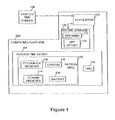
- FIG. 1 is a diagram of a trusted time architecture according to an embodiment of the present invention.
- a computing platform 100 includes an executing application program 102 and trusted time device 104.
- the computing platform may be any system having a processor for executing instructions, such as a personal computer, a server, a laptop or handheld computer, a personal digital assistant (PDA), a cell phone, a set-top box, and so on. Well known details of components of such a system have been omitted from Figure 1 for clarity.
- Application 102 may be any computer program for providing some functionality to a user of the computing platform that uses trusted time for some processing. The application wants to use trusted time and has functionality to store information securely so that the information cannot be easily modified by the user without detection.
- the application communicates with a trusted time source 106 for obtaining an initial trusted time.
- Trusted time source 106 comprises a source external to the computing platform that can provide a trusted time value.
- the trusted time source may be communicatively coupled with the application in any way (e.g., via a network such as the Internet, or an intranet).
- the application wants to trust the time available on the computing platform, even if the user is an adversary. Further, the mechanism for providing trusted time should be privacy-friendly. That is, the trusted time mechanism should not uniquely identify the computing platform, which might raise privacy concerns.
- trusted time device 104 provides trusted time unless power is removed. If power is removed, the application can detect this event.
- Trusted time device 104 comprises a hardware computing device which contains trusted battery well 110 powered by trusted time battery 108, and other circuits (not shown) that are not powered by the trusted time battery.
- the trusted time device may be integrated into the Input/Output (I/O) Controller Hub (ICH) of a computer system's chipset.
- Trusted time device 104 includes battery 108, which comprises a conventional replaceable power source to provide small amounts of electrical power for a very long time.
- the battery is the same as the Real Time Clock battery existing in many computing platforms.
- Trusted time battery well 110 comprises a small set of circuits that are powered by battery 108, and remain powered up as long as the trusted time battery 108 is operational and not removed.
- the trusted time battery well includes at least three other components.
- Crystal 112 comprises a circuit that produces a clock pulse at a constant and known frequency. In one embodiment, the crystal may be outside of the trusted time batter well.
- Trusted time (TT) Random (Rand) register 114 comprises a register to store a random number.
- TT Counter register 116 comprises a register that, in one embodiment, increments by one with a fixed frequency. The frequency may be once for each tick of crystal 112, or once per second. In one embodiment, the size of the TT Counter may be set such that the computing platform could operate for 20 years, for example, before rolling over the counter. For the TT Rand and TT Counter registers, when power is first provided to these registers, they are set to all zeros. If power is ever removed and then restored, the registers are set to all zeros.
- Trusted time device 104 also includes a random number generator (RNG) 118.
- RNG comprises a circuit that provides a random number as needed.
- Computing platform 100 also includes secure storage 120.
- Secure storage is a component used to store data in a secure manner that is not easily tampered with by the user or any other party.
- secure storage 120 comprises a trusted platform module (TPM) as described by specifications available from the Trusted Computing Group.
- TPM trusted platform module
- secure storage may be provided using known tamper resistant software techniques.
- Application 102 has the ability to securely store at least two values: Application Random value (Rand) 122, and Application Offset 124.
- FIG. 2 is a flow diagram illustrating resetting 200 a trusted time device according to an embodiment of the present invention. Resetting may be performed whenever power is applied to the computing platform (i.e., at power on of the system).
- the computing platform checks TT Rand 114 to determine if the value currently stored in the TT Rand register is zero. If TT Rand is not zero, this means that the battery has continually powered the trusted time device since the last time the battery was replaced, and the computing platform may proceed with initialization processing at block 208. If TT Rand is zero, this means that battery 108 has been disconnected and reconnected.
- the computing platform then waits a period of time at block 204. In one embodiment, this period of time is a fixed amount of one minute.
- the period of time may be a different fixed amount of time, such as 30 seconds, two minutes, three minutes, and so on. In still further embodiments, the period of time may be variable over successive resets.
- a new TT Rand may be generated using random number generator (RNG) 108 and stored in TT Rand 114 before continuing with initialization processing at block 208.
- RNG random number generator
- TT Rand is a random number
- the size of TT Rand may be chosen small enough such that it will not be a unique identifier of the computing platform.
- the only time that TT Rand will be populated anew upon a system reset is after the power has been removed to the Trusted Time Battery Well 110 (i.e., the battery has been disconnected). The time delay prior to repopulating the TT Rand register will only occur when the battery has been disconnected, and not during typical resets of the computing platform.
- a substantial time delay between reset and the time that TT Rand is populated with a new random value during reset of the trusted time device may be used for the case when TT Rand is all zeros.
- the TT Rand register comprises a 16 bit register. If a one minute time delay is used at block 204, then it would take an expected number of 2 16 trials (taking approximately 45 days) of continual attempts in a brute force attack before the value of TT Rand matches the value of App Rand 122 stored in secure storage 120. But since there are hundreds of millions of computing platforms in service worldwide, 2 16 (65,536) is a small enough number so that it would not be construed as a unique identifier of the computing platform, thereby supporting user privacy. Other sizes for the TT Rand register (e.g., 20 bits) and the time delay may be used depending on system implementation requirements without departing from the present invention.
- FIG. 3 is a flow diagram illustrating application initialization 300 according to an embodiment of the present invention.
- the application contacts a trusted time source 106 to obtain the current trusted time. In one embodiment, this may be accomplished in a secure manner by the application sending a nonce to the trusted time source, the trusted time source digitally signing the current trusted time and the nonce with its private key, and the trusted time source sending the signed current trusted time and nonce to the application. If the application has the public key of the trusted time source, the application can decrypt the signed current trusted time and nonce, and check to make sure the received nonce matches the nonce sent to the trusted time source.
- the application obtains values for TT Rand and TT Counter from the appropriate registers 114, 116 in the battery well of the trusted time device 104.
- the application optionally converts the TT Counter obtained from the trusted time device and current trusted time obtained from the trusted time source to application time units, if necessary.
- the application sets the application offset to the current trusted time minus TT Counter. This acts as a baseline value for later measurement of elapsed time since initialization.
- the application sets the application random value to TT Rand 114.
- the application securely stores the modified application offset 124 and application random value 122 in secure storage 120.
- Figure 4 is a flow diagram illustrating obtaining the current trusted time by an application 400 according to an embodiment of the present invention. These actions may be performed when an executing application needs to locally access the current trusted time during application processing subsequent to initialization.
- the application obtains application random value 122 and application offset 124 from secure storage 120.
- the application obtains TT Rand 114 and TT Counter 116 from the battery well of the trusted time device 104.
- TT Rand does not match the application random value, then an error may be reported at block 408, and application initialization may be performed again as represented in Figure 4 at block 410.
- the application optionally converts TT Counter to application time units (if necessary) at block 412, and sets the current trusted time to the application offset + TT Counter at block 414.
- the current trusted time may then be used by the application for further processing.
- the techniques described herein are not limited to any particular hardware or software configuration; they may find applicability in any computing or processing environment.
- the techniques may be implemented in hardware, software, or a combination of the two.
- the techniques may be implemented in programs executing on programmable machines such as mobile or stationary computers, personal digital assistants, set top boxes, cellular telephones and pagers, and other electronic devices, that each include a processor, a storage medium readable by the processor (including volatile and non-volatile memory and/or storage elements), at least one input device, and one or more output devices.
- Program code is applied to the data entered using the input device to perform the functions described and to generate output information.
- the output information may be applied to one or more output devices.
- the invention can be practiced with various computer system configurations, including multiprocessor systems, minicomputers, mainframe computers, and the like.
- the invention can also be practiced in distributed computing environments where tasks may be performed by remote processing devices that are linked through a communications network.
- Each program may be implemented in a high level procedural or object oriented programming language to communicate with a processing .system.
- programs may be implemented in assembly or machine language, if desired. In any case, the language may be compiled or interpreted.
- Program instructions may be used to cause a general-purpose or special-purpose processing system that is programmed with the instructions to perform the operations described herein. Alternatively, the operations may be performed by specific hardware components that contain hardwired logic for performing the operations, or by any combination of programmed computer components and custom hardware components.
- the methods described herein may be provided as a computer program product that may include a machine accessible medium having stored thereon instructions that may be used to program a processing system or other electronic device to perform the methods.
- the term "machine accessible medium” used herein shall include any medium that is capable of storing or encoding a sequence of instructions for execution by a machine and that cause the machine to perform any one of the methods described herein.
- machine accessible medium shall accordingly include, but not be limited to, solid-state memories, optical and magnetic disks, and a carrier wave that encodes a data signal.
- machine accessible medium shall accordingly include, but not be limited to, solid-state memories, optical and magnetic disks, and a carrier wave that encodes a data signal.
Landscapes
- Engineering & Computer Science (AREA)
- Physics & Mathematics (AREA)
- Computer Hardware Design (AREA)
- Theoretical Computer Science (AREA)
- Mathematical Physics (AREA)
- Computer Security & Cryptography (AREA)
- Software Systems (AREA)
- General Engineering & Computer Science (AREA)
- General Physics & Mathematics (AREA)
- Storage Device Security (AREA)
- Power Sources (AREA)
Abstract
Description
- The present invention relates generally to computer security and, more specifically, to providing time in a computing platform that is trusted by executing applications.
- Obtaining a value for time that can be trusted in a computing platform is desirable. For example, trusted time may be used in conjunction with other processing to improve the robustness of content protection mechanisms to assure that premium content is available for the digital home. It may be used in a content protection environment to assure that the computing platform owner downloads a revocation list of compromised keys on a periodic basis. It may also be used to provide a secure way to enable content to be purchased for access during a temporary time window. However, if the time value can be modified by an unscrupulous user without detection by the computing platform, then computer security and content protection systems may be compromised.
- Existing solutions to providing trusted time require a battery contained in a tamper resistant hardware module that cannot be easily removed by the user (such as described in Trusted Platform Module (TPM) Main part 1 Design Principles, Specification Version 1.2, Revision 81, November 23, 2004, pp. 93-98, available from the Trusted Computing Group). This may be problematic for continued operation of some computer systems as they age and the battery needs replacement. If the user can't change the battery without disrupting system operation, frustration with the system may ensue.
- Therefore, a better mechanism to provide a trusted time value in a computing platform would be useful.
- The features and advantages of the present invention will become apparent from the following detailed description of the present invention in which:
-
Figure 1 is a diagram of a trusted time architecture according to an embodiment of the present invention; -
Figure 2 is a flow diagram illustrating resetting a trusted time device according to an embodiment of the present invention; -
Figure 3 is a flow diagram illustrating application initialization according to an embodiment of the present invention; and -
Figure 4 is a flow diagram illustrating obtaining the current trusted time by an application according to an embodiment of the present invention. - An embodiment of the present invention is a method and apparatus for providing trusted time in a computing platform. One security requirement is that the user must not be able to modify the trusted time. In one embodiment, a battery may be used that provides electrical power to a small group of trusted time circuits. An initial connection to a trusted time source may be used to initialize the trusted time. The property is achieved that as long as the trusted time circuits are powered up, trusted time will be provided in the computing platform. If power to the trusted time circuits is ever removed, then the absence of power will be detected, thus requiring a connection to the trusted time source to reinitialize the trusted time mechanism.
- Reference in the specification to "one embodiment" or "an embodiment" of the present invention means that a particular feature, structure or characteristic described in connection with the embodiment is included in at least one embodiment of the present invention. Thus, the appearances of the phrase "in one embodiment" appearing in various places throughout the specification are not necessarily all referring to the same embodiment.
-
Figure 1 is a diagram of a trusted time architecture according to an embodiment of the present invention. Acomputing platform 100 includes anexecuting application program 102 and trustedtime device 104. The computing platform may be any system having a processor for executing instructions, such as a personal computer, a server, a laptop or handheld computer, a personal digital assistant (PDA), a cell phone, a set-top box, and so on. Well known details of components of such a system have been omitted fromFigure 1 for clarity.Application 102 may be any computer program for providing some functionality to a user of the computing platform that uses trusted time for some processing. The application wants to use trusted time and has functionality to store information securely so that the information cannot be easily modified by the user without detection. - The application communicates with a trusted
time source 106 for obtaining an initial trusted time. Trustedtime source 106 comprises a source external to the computing platform that can provide a trusted time value. The trusted time source may be communicatively coupled with the application in any way (e.g., via a network such as the Internet, or an intranet). - In embodiments of the present invention, the application wants to trust the time available on the computing platform, even if the user is an adversary. Further, the mechanism for providing trusted time should be privacy-friendly. That is, the trusted time mechanism should not uniquely identify the computing platform, which might raise privacy concerns. In the present invention, trusted
time device 104 provides trusted time unless power is removed. If power is removed, the application can detect this event. - Trusted
time device 104 comprises a hardware computing device which contains trusted battery well 110 powered by trustedtime battery 108, and other circuits (not shown) that are not powered by the trusted time battery. In one embodiment, the trusted time device may be integrated into the Input/Output (I/O) Controller Hub (ICH) of a computer system's chipset. Trustedtime device 104 includesbattery 108, which comprises a conventional replaceable power source to provide small amounts of electrical power for a very long time. In one embodiment, the battery is the same as the Real Time Clock battery existing in many computing platforms. Trusted time battery well 110 comprises a small set of circuits that are powered bybattery 108, and remain powered up as long as the trustedtime battery 108 is operational and not removed. - The trusted time battery well includes at least three other components. Crystal 112 comprises a circuit that produces a clock pulse at a constant and known frequency. In one embodiment, the crystal may be outside of the trusted time batter well. Trusted time (TT) Random (Rand)
register 114 comprises a register to store a random number.TT Counter register 116 comprises a register that, in one embodiment, increments by one with a fixed frequency. The frequency may be once for each tick ofcrystal 112, or once per second. In one embodiment, the size of the TT Counter may be set such that the computing platform could operate for 20 years, for example, before rolling over the counter. For the TT Rand and TT Counter registers, when power is first provided to these registers, they are set to all zeros. If power is ever removed and then restored, the registers are set to all zeros. - Trusted
time device 104 also includes a random number generator (RNG) 118. RNG comprises a circuit that provides a random number as needed. -
Computing platform 100 also includessecure storage 120. Secure storage is a component used to store data in a secure manner that is not easily tampered with by the user or any other party. In one embodiment,secure storage 120 comprises a trusted platform module (TPM) as described by specifications available from the Trusted Computing Group. In another embodiment, secure storage may be provided using known tamper resistant software techniques.Application 102 has the ability to securely store at least two values: Application Random value (Rand) 122, andApplication Offset 124. -
Figure 2 is a flow diagram illustrating resetting 200 a trusted time device according to an embodiment of the present invention. Resetting may be performed whenever power is applied to the computing platform (i.e., at power on of the system). Atblock 202, the computing platform checksTT Rand 114 to determine if the value currently stored in the TT Rand register is zero. If TT Rand is not zero, this means that the battery has continually powered the trusted time device since the last time the battery was replaced, and the computing platform may proceed with initialization processing atblock 208. If TT Rand is zero, this means thatbattery 108 has been disconnected and reconnected. The computing platform then waits a period of time atblock 204. In one embodiment, this period of time is a fixed amount of one minute. In other embodiments, the period of time may be a different fixed amount of time, such as 30 seconds, two minutes, three minutes, and so on. In still further embodiments, the period of time may be variable over successive resets. Atblock 206, a new TT Rand may be generated using random number generator (RNG) 108 and stored inTT Rand 114 before continuing with initialization processing atblock 208. - Because the value of TT Rand is a random number, there is a potential concern that it could be used to identify the computing platform. In an embodiment of the present invention, this is solved by carefully picking the size of TT Rand, and by modifying the behavior of the population of TT Rand. First, the size of TT Rand may be chosen small enough such that it will not be a unique identifier of the computing platform. Second, the only time that TT Rand will be populated anew upon a system reset is after the power has been removed to the Trusted Time Battery Well 110 (i.e., the battery has been disconnected). The time delay prior to repopulating the TT Rand register will only occur when the battery has been disconnected, and not during typical resets of the computing platform. Thus, a substantial time delay between reset and the time that TT Rand is populated with a new random value during reset of the trusted time device may be used for the case when TT Rand is all zeros.
- Taking these requirements into account, in one embodiment, the TT Rand register comprises a 16 bit register. If a one minute time delay is used at
block 204, then it would take an expected number of 216 trials (taking approximately 45 days) of continual attempts in a brute force attack before the value of TT Rand matches the value ofApp Rand 122 stored insecure storage 120. But since there are hundreds of millions of computing platforms in service worldwide, 216 (65,536) is a small enough number so that it would not be construed as a unique identifier of the computing platform, thereby supporting user privacy. Other sizes for the TT Rand register (e.g., 20 bits) and the time delay may be used depending on system implementation requirements without departing from the present invention. -
Figure 3 is a flow diagram illustratingapplication initialization 300 according to an embodiment of the present invention. Atblock 302, the application contacts a trustedtime source 106 to obtain the current trusted time. In one embodiment, this may be accomplished in a secure manner by the application sending a nonce to the trusted time source, the trusted time source digitally signing the current trusted time and the nonce with its private key, and the trusted time source sending the signed current trusted time and nonce to the application. If the application has the public key of the trusted time source, the application can decrypt the signed current trusted time and nonce, and check to make sure the received nonce matches the nonce sent to the trusted time source. Atblock 304, the application obtains values for TT Rand and TT Counter from theappropriate registers time device 104. Next, atblock 306, the application optionally converts the TT Counter obtained from the trusted time device and current trusted time obtained from the trusted time source to application time units, if necessary. Atblock 308, the application sets the application offset to the current trusted time minus TT Counter. This acts as a baseline value for later measurement of elapsed time since initialization. Atblock 310, the application sets the application random value toTT Rand 114. Atblock 312, the application securely stores the modified application offset 124 and applicationrandom value 122 insecure storage 120. -
Figure 4 is a flow diagram illustrating obtaining the current trusted time by anapplication 400 according to an embodiment of the present invention. These actions may be performed when an executing application needs to locally access the current trusted time during application processing subsequent to initialization. Atblock 402, the application obtains applicationrandom value 122 and application offset 124 fromsecure storage 120. Atblock 404, the application obtainsTT Rand 114 andTT Counter 116 from the battery well of the trustedtime device 104. Atblock 406, if TT Rand does not match the application random value, then an error may be reported atblock 408, and application initialization may be performed again as represented inFigure 4 atblock 410. If TT Rand does match the application random value, then the application optionally converts TT Counter to application time units (if necessary) atblock 412, and sets the current trusted time to the application offset + TT Counter atblock 414. The current trusted time may then be used by the application for further processing. - Although the operations detailed herein may be described as a sequential process, some of the operations may in fact be performed in parallel or concurrently. In addition, in some embodiments the order of the operations may be rearranged.
- The techniques described herein are not limited to any particular hardware or software configuration; they may find applicability in any computing or processing environment. The techniques may be implemented in hardware, software, or a combination of the two. The techniques may be implemented in programs executing on programmable machines such as mobile or stationary computers, personal digital assistants, set top boxes, cellular telephones and pagers, and other electronic devices, that each include a processor, a storage medium readable by the processor (including volatile and non-volatile memory and/or storage elements), at least one input device, and one or more output devices. Program code is applied to the data entered using the input device to perform the functions described and to generate output information. The output information may be applied to one or more output devices. One of ordinary skill in the art may appreciate that the invention can be practiced with various computer system configurations, including multiprocessor systems, minicomputers, mainframe computers, and the like. The invention can also be practiced in distributed computing environments where tasks may be performed by remote processing devices that are linked through a communications network.
- Each program may be implemented in a high level procedural or object oriented programming language to communicate with a processing .system. However, programs may be implemented in assembly or machine language, if desired. In any case, the language may be compiled or interpreted.
- Program instructions may be used to cause a general-purpose or special-purpose processing system that is programmed with the instructions to perform the operations described herein. Alternatively, the operations may be performed by specific hardware components that contain hardwired logic for performing the operations, or by any combination of programmed computer components and custom hardware components. The methods described herein may be provided as a computer program product that may include a machine accessible medium having stored thereon instructions that may be used to program a processing system or other electronic device to perform the methods. The term "machine accessible medium" used herein shall include any medium that is capable of storing or encoding a sequence of instructions for execution by a machine and that cause the machine to perform any one of the methods described herein. The term "machine accessible medium" shall accordingly include, but not be limited to, solid-state memories, optical and magnetic disks, and a carrier wave that encodes a data signal. Furthermore, it is common in the art to speak of software, in one form or another (e.g., program, procedure, process, application, module, logic, and so on) as taking an action or causing a result. Such expressions are merely a shorthand way of stating the execution of the software by a processing system cause the processor to perform an action of produce a result.
- 1. A method of supporting privacy for a computing platform having a trusted time device to provide trusted time to an application executing on the computing platform comprising:
- resetting the trusted time device by determining if a value in a register has been set, and if not, waiting a period of time, generating a new random number, and storing the new random number in the register.
- 2. The method of clause 1, further comprising resetting the trusted time device whenever electrical power is applied at power up of the computing platform.
- 3. The method of clause 1, further comprising setting the register to zero whenever electrical power is first provided to the trusted time device, and whenever electrical power is removed and then restored to the trusted time device.
- 4. The method of clause 1, wherein at least a portion of the trusted time device is powered by a battery.
- 5. The method of clause 1, further comprising proceeding with initializing the computing platform after storing the new random number in the register.
- 6. The method of clause 1, wherein the period of time comprises a variable amount of time.
- 7. An article comprising: a machine accessible medium containing instructions, which when executed, result in supporting privacy for a computing platform having a trusted time device to provide trusted time to an application executing on the computing platform by resetting the trusted time device by determining if a value in a register has been set, and if not, waiting a period of time, generating a new random number, and storing the new random number in the register.
- 8. The article of clause 7, further comprising instructions for resetting the trusted time device whenever electrical power is applied at power up of the computing platform.
- 9. The article of clause 8, further comprising instructions for proceeding with initializing the computing platform after storing the new random number in the register.
- 10. A trusted time device to provide trusted time to an application executing on a computing platform without uniquely identifying the computing platform comprising:
- a random number generator; and
- a register;
- wherein the trusted time device is capable of being reset by determining if a value in the register has been set, and if not, waiting a period of time, generating a new random number by the random number generator, and storing the new random number in the register.
- 11. The trusted time device of clause 10, wherein the trusted time device is reset whenever electrical power is applied at power up of the computing platform.
- 12. The trusted time device of clause 10, wherein the trusted time device is capable of resetting the register to zero whenever electrical power is first provided to the trusted time device, and whenever electrical power is removed and then restored to the trusted time device.
- 13. The trusted time device of clause 10, further comprising a battery to power at least a portion of the trusted time device, and wherein the trusted time device is incorporated into an input/output controller hub of the computing platform.
- 14. The trusted time device of clause 10, wherein the computing platform is initialized after storing the new random number in the register of the trusted time device.
- 15. The trusted time device of clause 10, wherein the register comprises less than or equal to 20 bits.
Claims (14)
- A method of supporting privacy for a computing platform having a trusted time device to provide trusted time to an application executing on the computing platform comprising:resetting the trusted time device by determining if a stored value indicates whether power to the trusted time device has not been removed since a last power disruption to the trusted time device and that the trusted time device is to be initialized, and if not, waiting a period of time after determining that the stored value has not been set, generating a new random number after waiting the period of time, and storing the new random number; andinitializing the computing platform after storing the new random number by obtaining a current trusted time from a trusted time source, the trusted time source being external to the computing platform, obtaining the stored random number, storing an application offset value equal to the current trusted time minus a counter value into a secure storage within the computing system, and storing the random number into the secure storage.
- The method of claim 1, further comprising resetting the trusted time device whenever electrical power is applied at power up of the computing platform.
- The method of claim 1, wherein at least a portion of the trusted time device is powered by a battery within the trusted time device.
- The method of claim 1, wherein the period of time comprises a fixed amount of time.
- The method of claim 1, wherein the period of time comprises a variable amount of time.
- The method of claim 1, further comprising obtaining the current trusted time for use by an application program executing on the computing platform at a point in time after computing platform initialization by obtaining the random number and the application offset value from the secure storage, comparing the random number from the secure storage to current contents within the trusted time device, and when the random number from the secure storage matches the current contents, setting the current trusted time to the application offset plus the counter value from the trusted time device.
- An article comprising: a non-transitory computer readable storage medium containing instructions, which when executed, result in supporting privacy for a computing platform having a trusted time device to provide trusted time to an application executing on the computing platform by resetting the trusted time device by determining if a stored value has been set to indicate power to the trusted time device has not been removed since a last power disruption to the trusted time device and that the trusted time device is to be initialized, and if not, waiting a period of time after determining that the stored value has not been set, generating a new random number after waiting the period of time, and storing the new random number; and initializing the computing platform after storing the new random number by obtaining a current trusted time from a trusted time source, the trusted time source being external to the computing platform, storing an application offset value equal to the current trusted time minus a counter value into a secure storage within the computing system, and storing the random number read into the secure storage.
- The article of claim 7, further comprising instructions for resetting the trusted time device whenever electrical power is applied at power up of the computing platform.
- The article of claim 8, wherein the period of time comprises a fixed amount of time.
- A computing platform comprising:a trusted time device to provide trusted time to an application to be executed on the computing platform;a random number generator; anda secure storage,wherein the trusted time device is capable of being reset by determining if a stored value has been set to indicate power to the trusted time device has not been removed since a last power disruption to the trusted time device and that the trusted time device is to be initialized, and if not, waiting a period of time after determining that the stored value has not been set, generating a new random number after waiting the period of time by the random number generator, and storing the new random number; andwherein the computing platform is to be initialized after storing the new random number by obtaining a current trusted time from a trusted time source, the trusted time source being external to the computing platform, storing an application offset value equal to the current trusted time minus a counter value into the secure storage within the computing system, and storing the random number into the secure storage.
- The trusted time device of claim 10, wherein the trusted time device is reset whenever electrical power is applied at power up of the computing platform.
- The trusted time device of claim 11, further comprising a battery to power at least a portion of the trusted time device, wherein the battery is within the trusted time device, and wherein the trusted time device is incorporated into an input/output controller hub of the computing platform.
- The trusted time device of claim 10, wherein the period of time comprises a fixed amount of time.
- The trusted time device of claim 10, wherein the trusted time device does not uniquely identify the computing platform.
Applications Claiming Priority (2)
| Application Number | Priority Date | Filing Date | Title |
|---|---|---|---|
| US11/233,543 US7962752B2 (en) | 2005-09-23 | 2005-09-23 | Method for providing trusted time in a computing platform |
| EP06803727A EP1927066B1 (en) | 2005-09-23 | 2006-09-14 | Method for providing trusted time in a computing platform |
Related Parent Applications (1)
| Application Number | Title | Priority Date | Filing Date |
|---|---|---|---|
| EP06803727.4 Division | 2006-09-14 |
Publications (2)
| Publication Number | Publication Date |
|---|---|
| EP2469447A1 true EP2469447A1 (en) | 2012-06-27 |
| EP2469447B1 EP2469447B1 (en) | 2014-01-01 |
Family
ID=37876017
Family Applications (2)
| Application Number | Title | Priority Date | Filing Date |
|---|---|---|---|
| EP06803727A Not-in-force EP1927066B1 (en) | 2005-09-23 | 2006-09-14 | Method for providing trusted time in a computing platform |
| EP11010295.1A Not-in-force EP2469447B1 (en) | 2005-09-23 | 2006-09-14 | Method for providing trusted time in a computing platform |
Family Applications Before (1)
| Application Number | Title | Priority Date | Filing Date |
|---|---|---|---|
| EP06803727A Not-in-force EP1927066B1 (en) | 2005-09-23 | 2006-09-14 | Method for providing trusted time in a computing platform |
Country Status (4)
| Country | Link |
|---|---|
| US (1) | US7962752B2 (en) |
| EP (2) | EP1927066B1 (en) |
| CN (1) | CN101268469B (en) |
| WO (1) | WO2007038031A2 (en) |
Families Citing this family (9)
| Publication number | Priority date | Publication date | Assignee | Title |
|---|---|---|---|---|
| US7962752B2 (en) | 2005-09-23 | 2011-06-14 | Intel Corporation | Method for providing trusted time in a computing platform |
| GB0802741D0 (en) * | 2008-02-14 | 2008-03-26 | Wolfson Microelectronics Plc | Secure Clock |
| US8495354B2 (en) * | 2008-09-24 | 2013-07-23 | Hewlett-Packard Development Company, L.P. | Apparatus for determining during a power-on sequence, a value to be written to a first register in a secure area and the same value to a second register in non-secure area, which during a protected mode, the value is compared such that if it is equal, enabling writing to a memory |
| US8886957B2 (en) * | 2009-11-09 | 2014-11-11 | 3Dlabs Inc. Ltd. | Systems, methods, software, and components using tamper-proof real-time clock |
| US8813240B1 (en) | 2012-05-30 | 2014-08-19 | Google Inc. | Defensive techniques to increase computer security |
| US9015838B1 (en) * | 2012-05-30 | 2015-04-21 | Google Inc. | Defensive techniques to increase computer security |
| US9323957B2 (en) * | 2013-03-01 | 2016-04-26 | Marvell World Trade Ltd. | Anti-tamper system based on dual random bits generators for integrated circuits |
| CN105335670A (en) * | 2015-10-29 | 2016-02-17 | 深圳国微技术有限公司 | Real-time integrity checking method and checking circuit as well as security chip |
| US10129229B1 (en) * | 2016-08-15 | 2018-11-13 | Wickr Inc. | Peer validation |
Citations (3)
| Publication number | Priority date | Publication date | Assignee | Title |
|---|---|---|---|---|
| EP0635790A1 (en) * | 1993-07-22 | 1995-01-25 | International Business Machines Corporation | Client/server based secure timekeeping system |
| US6728880B1 (en) * | 1999-09-17 | 2004-04-27 | Adobe Systems Incorporated | Secure time on computers with insecure clocks |
| US20040128528A1 (en) * | 2002-12-31 | 2004-07-01 | Poisner David I. | Trusted real time clock |
Family Cites Families (6)
| Publication number | Priority date | Publication date | Assignee | Title |
|---|---|---|---|---|
| US4628504A (en) * | 1983-01-31 | 1986-12-09 | Honeywell Inc. | Distributed bus control communication protocol |
| US7409557B2 (en) * | 1999-07-02 | 2008-08-05 | Time Certain, Llc | System and method for distributing trusted time |
| US7036013B2 (en) * | 2002-01-31 | 2006-04-25 | Brocade Communications Systems, Inc. | Secure distributed time service in the fabric environment |
| JP2003244139A (en) * | 2002-02-20 | 2003-08-29 | Amano Corp | Time stamping system for electronic document and program medium thereof |
| US7146504B2 (en) * | 2002-06-13 | 2006-12-05 | Microsoft Corporation | Secure clock on computing device such as may be required in connection with a trust-based system |
| US7962752B2 (en) | 2005-09-23 | 2011-06-14 | Intel Corporation | Method for providing trusted time in a computing platform |
-
2005
- 2005-09-23 US US11/233,543 patent/US7962752B2/en not_active Expired - Fee Related
-
2006
- 2006-09-14 CN CN2006800347152A patent/CN101268469B/en not_active Expired - Fee Related
- 2006-09-14 WO PCT/US2006/036151 patent/WO2007038031A2/en not_active Ceased
- 2006-09-14 EP EP06803727A patent/EP1927066B1/en not_active Not-in-force
- 2006-09-14 EP EP11010295.1A patent/EP2469447B1/en not_active Not-in-force
Patent Citations (3)
| Publication number | Priority date | Publication date | Assignee | Title |
|---|---|---|---|---|
| EP0635790A1 (en) * | 1993-07-22 | 1995-01-25 | International Business Machines Corporation | Client/server based secure timekeeping system |
| US6728880B1 (en) * | 1999-09-17 | 2004-04-27 | Adobe Systems Incorporated | Secure time on computers with insecure clocks |
| US20040128528A1 (en) * | 2002-12-31 | 2004-07-01 | Poisner David I. | Trusted real time clock |
Also Published As
| Publication number | Publication date |
|---|---|
| US20070074044A1 (en) | 2007-03-29 |
| EP1927066B1 (en) | 2012-10-31 |
| EP1927066A2 (en) | 2008-06-04 |
| US7962752B2 (en) | 2011-06-14 |
| WO2007038031A3 (en) | 2007-06-07 |
| CN101268469A (en) | 2008-09-17 |
| WO2007038031A2 (en) | 2007-04-05 |
| EP2469447B1 (en) | 2014-01-01 |
| CN101268469B (en) | 2011-12-28 |
Similar Documents
| Publication | Publication Date | Title |
|---|---|---|
| US11921860B2 (en) | Rollback resistant security | |
| US9965249B2 (en) | Stochastic processing | |
| EP2695052B1 (en) | Random number generating system based on memory start-up noise | |
| US10860724B2 (en) | Active key rolling for sensitive data protection | |
| US8479017B2 (en) | System and method for N-ary locality in a security co-processor | |
| EP2469447B1 (en) | Method for providing trusted time in a computing platform | |
| US9930031B2 (en) | Multi-factor user authentication based on user credentials and entry timing | |
| US11163908B2 (en) | Device state driven encryption key management | |
| Kietzmann et al. | Puf for the commons: Enhancing embedded security on the os level | |
| US10078492B2 (en) | Generating pseudo-random numbers using cellular automata | |
| US9563773B2 (en) | Systems and methods for securing BIOS variables | |
| US20200342075A1 (en) | Secure Hardware Backdoor for Digital Devices | |
| Van Herrewege et al. | Software only, extremely compact, Keccak-based secure PRNG on ARM Cortex-M | |
| US20060218649A1 (en) | Method for conditional disclosure of identity information | |
| US11321475B2 (en) | Entropy data based on error correction data | |
| Oh et al. | Implementation and characterization of flash‐based hardware security primitives for cryptographic key generation | |
| US20220284088A1 (en) | Authentication of write requests | |
| CN117580034A (en) | Key determination method, device, electronic equipment and readable storage medium | |
| US10678511B1 (en) | Generating pseudo-random numbers using cellular automata | |
| WO2021092488A1 (en) | Public key encryption using self powered timers | |
| US12225122B2 (en) | Method and service continuity encrypted storage solution for secure off-line distribution |
Legal Events
| Date | Code | Title | Description |
|---|---|---|---|
| 17P | Request for examination filed |
Effective date: 20120116 |
|
| AC | Divisional application: reference to earlier application |
Ref document number: 1927066 Country of ref document: EP Kind code of ref document: P |
|
| AK | Designated contracting states |
Kind code of ref document: A1 Designated state(s): AT BE BG CH CY CZ DE DK EE ES FI FR GB GR HU IE IS IT LI LT LU LV MC NL PL PT RO SE SI SK TR |
|
| AX | Request for extension of the european patent |
Extension state: AL BA HR MK RS |
|
| PUAI | Public reference made under article 153(3) epc to a published international application that has entered the european phase |
Free format text: ORIGINAL CODE: 0009012 |
|
| RIN1 | Information on inventor provided before grant (corrected) |
Inventor name: HALL, CLIFFORD, D. Inventor name: BRICKELL, ERNEST, F. |
|
| REG | Reference to a national code |
Ref country code: DE Ref legal event code: R079 Ref document number: 602006039920 Country of ref document: DE Free format text: PREVIOUS MAIN CLASS: G06F0021020000 Ipc: G06F0021720000 |
|
| GRAP | Despatch of communication of intention to grant a patent |
Free format text: ORIGINAL CODE: EPIDOSNIGR1 |
|
| RIC1 | Information provided on ipc code assigned before grant |
Ipc: G06F 21/72 20130101AFI20130628BHEP |
|
| INTG | Intention to grant announced |
Effective date: 20130726 |
|
| GRAS | Grant fee paid |
Free format text: ORIGINAL CODE: EPIDOSNIGR3 |
|
| GRAA | (expected) grant |
Free format text: ORIGINAL CODE: 0009210 |
|
| AC | Divisional application: reference to earlier application |
Ref document number: 1927066 Country of ref document: EP Kind code of ref document: P |
|
| AK | Designated contracting states |
Kind code of ref document: B1 Designated state(s): AT BE BG CH CY CZ DE DK EE ES FI FR GB GR HU IE IS IT LI LT LU LV MC NL PL PT RO SE SI SK TR |
|
| REG | Reference to a national code |
Ref country code: GB Ref legal event code: FG4D |
|
| REG | Reference to a national code |
Ref country code: CH Ref legal event code: EP |
|
| REG | Reference to a national code |
Ref country code: IE Ref legal event code: FG4D |
|
| REG | Reference to a national code |
Ref country code: NL Ref legal event code: T3 |
|
| REG | Reference to a national code |
Ref country code: AT Ref legal event code: REF Ref document number: 647867 Country of ref document: AT Kind code of ref document: T Effective date: 20140215 |
|
| REG | Reference to a national code |
Ref country code: DE Ref legal event code: R096 Ref document number: 602006039920 Country of ref document: DE Effective date: 20140220 |
|
| REG | Reference to a national code |
Ref country code: AT Ref legal event code: MK05 Ref document number: 647867 Country of ref document: AT Kind code of ref document: T Effective date: 20140101 |
|
| REG | Reference to a national code |
Ref country code: LT Ref legal event code: MG4D |
|
| PG25 | Lapsed in a contracting state [announced via postgrant information from national office to epo] |
Ref country code: IS Free format text: LAPSE BECAUSE OF FAILURE TO SUBMIT A TRANSLATION OF THE DESCRIPTION OR TO PAY THE FEE WITHIN THE PRESCRIBED TIME-LIMIT Effective date: 20140501 Ref country code: LT Free format text: LAPSE BECAUSE OF FAILURE TO SUBMIT A TRANSLATION OF THE DESCRIPTION OR TO PAY THE FEE WITHIN THE PRESCRIBED TIME-LIMIT Effective date: 20140101 |
|
| PG25 | Lapsed in a contracting state [announced via postgrant information from national office to epo] |
Ref country code: FI Free format text: LAPSE BECAUSE OF FAILURE TO SUBMIT A TRANSLATION OF THE DESCRIPTION OR TO PAY THE FEE WITHIN THE PRESCRIBED TIME-LIMIT Effective date: 20140101 Ref country code: AT Free format text: LAPSE BECAUSE OF FAILURE TO SUBMIT A TRANSLATION OF THE DESCRIPTION OR TO PAY THE FEE WITHIN THE PRESCRIBED TIME-LIMIT Effective date: 20140101 Ref country code: SE Free format text: LAPSE BECAUSE OF FAILURE TO SUBMIT A TRANSLATION OF THE DESCRIPTION OR TO PAY THE FEE WITHIN THE PRESCRIBED TIME-LIMIT Effective date: 20140101 Ref country code: CY Free format text: LAPSE BECAUSE OF FAILURE TO SUBMIT A TRANSLATION OF THE DESCRIPTION OR TO PAY THE FEE WITHIN THE PRESCRIBED TIME-LIMIT Effective date: 20140101 Ref country code: ES Free format text: LAPSE BECAUSE OF FAILURE TO SUBMIT A TRANSLATION OF THE DESCRIPTION OR TO PAY THE FEE WITHIN THE PRESCRIBED TIME-LIMIT Effective date: 20140101 Ref country code: PT Free format text: LAPSE BECAUSE OF FAILURE TO SUBMIT A TRANSLATION OF THE DESCRIPTION OR TO PAY THE FEE WITHIN THE PRESCRIBED TIME-LIMIT Effective date: 20140502 |
|
| PG25 | Lapsed in a contracting state [announced via postgrant information from national office to epo] |
Ref country code: BE Free format text: LAPSE BECAUSE OF FAILURE TO SUBMIT A TRANSLATION OF THE DESCRIPTION OR TO PAY THE FEE WITHIN THE PRESCRIBED TIME-LIMIT Effective date: 20140101 Ref country code: LV Free format text: LAPSE BECAUSE OF FAILURE TO SUBMIT A TRANSLATION OF THE DESCRIPTION OR TO PAY THE FEE WITHIN THE PRESCRIBED TIME-LIMIT Effective date: 20140101 |
|
| REG | Reference to a national code |
Ref country code: DE Ref legal event code: R097 Ref document number: 602006039920 Country of ref document: DE |
|
| PG25 | Lapsed in a contracting state [announced via postgrant information from national office to epo] |
Ref country code: DK Free format text: LAPSE BECAUSE OF FAILURE TO SUBMIT A TRANSLATION OF THE DESCRIPTION OR TO PAY THE FEE WITHIN THE PRESCRIBED TIME-LIMIT Effective date: 20140101 Ref country code: RO Free format text: LAPSE BECAUSE OF FAILURE TO SUBMIT A TRANSLATION OF THE DESCRIPTION OR TO PAY THE FEE WITHIN THE PRESCRIBED TIME-LIMIT Effective date: 20140101 Ref country code: EE Free format text: LAPSE BECAUSE OF FAILURE TO SUBMIT A TRANSLATION OF THE DESCRIPTION OR TO PAY THE FEE WITHIN THE PRESCRIBED TIME-LIMIT Effective date: 20140101 Ref country code: CZ Free format text: LAPSE BECAUSE OF FAILURE TO SUBMIT A TRANSLATION OF THE DESCRIPTION OR TO PAY THE FEE WITHIN THE PRESCRIBED TIME-LIMIT Effective date: 20140101 |
|
| PGFP | Annual fee paid to national office [announced via postgrant information from national office to epo] |
Ref country code: NL Payment date: 20140910 Year of fee payment: 9 |
|
| PLBE | No opposition filed within time limit |
Free format text: ORIGINAL CODE: 0009261 |
|
| STAA | Information on the status of an ep patent application or granted ep patent |
Free format text: STATUS: NO OPPOSITION FILED WITHIN TIME LIMIT |
|
| PG25 | Lapsed in a contracting state [announced via postgrant information from national office to epo] |
Ref country code: SK Free format text: LAPSE BECAUSE OF FAILURE TO SUBMIT A TRANSLATION OF THE DESCRIPTION OR TO PAY THE FEE WITHIN THE PRESCRIBED TIME-LIMIT Effective date: 20140101 Ref country code: PL Free format text: LAPSE BECAUSE OF FAILURE TO SUBMIT A TRANSLATION OF THE DESCRIPTION OR TO PAY THE FEE WITHIN THE PRESCRIBED TIME-LIMIT Effective date: 20140101 |
|
| 26N | No opposition filed |
Effective date: 20141002 |
|
| REG | Reference to a national code |
Ref country code: DE Ref legal event code: R097 Ref document number: 602006039920 Country of ref document: DE Effective date: 20141002 |
|
| PG25 | Lapsed in a contracting state [announced via postgrant information from national office to epo] |
Ref country code: MC Free format text: LAPSE BECAUSE OF FAILURE TO SUBMIT A TRANSLATION OF THE DESCRIPTION OR TO PAY THE FEE WITHIN THE PRESCRIBED TIME-LIMIT Effective date: 20140101 Ref country code: LU Free format text: LAPSE BECAUSE OF FAILURE TO SUBMIT A TRANSLATION OF THE DESCRIPTION OR TO PAY THE FEE WITHIN THE PRESCRIBED TIME-LIMIT Effective date: 20140914 |
|
| REG | Reference to a national code |
Ref country code: CH Ref legal event code: PL |
|
| PG25 | Lapsed in a contracting state [announced via postgrant information from national office to epo] |
Ref country code: SI Free format text: LAPSE BECAUSE OF FAILURE TO SUBMIT A TRANSLATION OF THE DESCRIPTION OR TO PAY THE FEE WITHIN THE PRESCRIBED TIME-LIMIT Effective date: 20140101 |
|
| REG | Reference to a national code |
Ref country code: IE Ref legal event code: MM4A |
|
| REG | Reference to a national code |
Ref country code: FR Ref legal event code: ST Effective date: 20150529 |
|
| PG25 | Lapsed in a contracting state [announced via postgrant information from national office to epo] |
Ref country code: LI Free format text: LAPSE BECAUSE OF NON-PAYMENT OF DUE FEES Effective date: 20140930 Ref country code: CH Free format text: LAPSE BECAUSE OF NON-PAYMENT OF DUE FEES Effective date: 20140930 |
|
| PG25 | Lapsed in a contracting state [announced via postgrant information from national office to epo] |
Ref country code: IE Free format text: LAPSE BECAUSE OF NON-PAYMENT OF DUE FEES Effective date: 20140914 Ref country code: FR Free format text: LAPSE BECAUSE OF NON-PAYMENT OF DUE FEES Effective date: 20140930 |
|
| PG25 | Lapsed in a contracting state [announced via postgrant information from national office to epo] |
Ref country code: BG Free format text: LAPSE BECAUSE OF FAILURE TO SUBMIT A TRANSLATION OF THE DESCRIPTION OR TO PAY THE FEE WITHIN THE PRESCRIBED TIME-LIMIT Effective date: 20140101 |
|
| REG | Reference to a national code |
Ref country code: NL Ref legal event code: MM Effective date: 20151001 |
|
| PG25 | Lapsed in a contracting state [announced via postgrant information from national office to epo] |
Ref country code: IT Free format text: LAPSE BECAUSE OF FAILURE TO SUBMIT A TRANSLATION OF THE DESCRIPTION OR TO PAY THE FEE WITHIN THE PRESCRIBED TIME-LIMIT Effective date: 20140101 Ref country code: GR Free format text: LAPSE BECAUSE OF FAILURE TO SUBMIT A TRANSLATION OF THE DESCRIPTION OR TO PAY THE FEE WITHIN THE PRESCRIBED TIME-LIMIT Effective date: 20140402 |
|
| PG25 | Lapsed in a contracting state [announced via postgrant information from national office to epo] |
Ref country code: HU Free format text: LAPSE BECAUSE OF FAILURE TO SUBMIT A TRANSLATION OF THE DESCRIPTION OR TO PAY THE FEE WITHIN THE PRESCRIBED TIME-LIMIT; INVALID AB INITIO Effective date: 20060914 Ref country code: TR Free format text: LAPSE BECAUSE OF FAILURE TO SUBMIT A TRANSLATION OF THE DESCRIPTION OR TO PAY THE FEE WITHIN THE PRESCRIBED TIME-LIMIT Effective date: 20140101 |
|
| PG25 | Lapsed in a contracting state [announced via postgrant information from national office to epo] |
Ref country code: NL Free format text: LAPSE BECAUSE OF NON-PAYMENT OF DUE FEES Effective date: 20151001 |
|
| PGFP | Annual fee paid to national office [announced via postgrant information from national office to epo] |
Ref country code: DE Payment date: 20180904 Year of fee payment: 13 |
|
| PGFP | Annual fee paid to national office [announced via postgrant information from national office to epo] |
Ref country code: GB Payment date: 20180912 Year of fee payment: 13 |
|
| REG | Reference to a national code |
Ref country code: DE Ref legal event code: R119 Ref document number: 602006039920 Country of ref document: DE |
|
| PG25 | Lapsed in a contracting state [announced via postgrant information from national office to epo] |
Ref country code: DE Free format text: LAPSE BECAUSE OF NON-PAYMENT OF DUE FEES Effective date: 20200401 |
|
| GBPC | Gb: european patent ceased through non-payment of renewal fee |
Effective date: 20190914 |
|
| PG25 | Lapsed in a contracting state [announced via postgrant information from national office to epo] |
Ref country code: GB Free format text: LAPSE BECAUSE OF NON-PAYMENT OF DUE FEES Effective date: 20190914 |