EP2466885A2 - Video muting - Google Patents
Video muting Download PDFInfo
- Publication number
- EP2466885A2 EP2466885A2 EP11172282A EP11172282A EP2466885A2 EP 2466885 A2 EP2466885 A2 EP 2466885A2 EP 11172282 A EP11172282 A EP 11172282A EP 11172282 A EP11172282 A EP 11172282A EP 2466885 A2 EP2466885 A2 EP 2466885A2
- Authority
- EP
- European Patent Office
- Prior art keywords
- video
- muting
- terminal
- user interface
- audio
- Prior art date
- Legal status (The legal status is an assumption and is not a legal conclusion. Google has not performed a legal analysis and makes no representation as to the accuracy of the status listed.)
- Granted
Links
Images


Classifications
-
- H—ELECTRICITY
- H04—ELECTRIC COMMUNICATION TECHNIQUE
- H04N—PICTORIAL COMMUNICATION, e.g. TELEVISION
- H04N7/00—Television systems
- H04N7/14—Systems for two-way working
- H04N7/15—Conference systems
-
- H—ELECTRICITY
- H04—ELECTRIC COMMUNICATION TECHNIQUE
- H04N—PICTORIAL COMMUNICATION, e.g. TELEVISION
- H04N7/00—Television systems
- H04N7/14—Systems for two-way working
- H04N7/141—Systems for two-way working between two video terminals, e.g. videophone
- H04N7/142—Constructional details of the terminal equipment, e.g. arrangements of the camera and the display
-
- H—ELECTRICITY
- H04—ELECTRIC COMMUNICATION TECHNIQUE
- H04N—PICTORIAL COMMUNICATION, e.g. TELEVISION
- H04N7/00—Television systems
- H04N7/14—Systems for two-way working
- H04N7/141—Systems for two-way working between two video terminals, e.g. videophone
- H04N7/147—Communication arrangements, e.g. identifying the communication as a video-communication, intermediate storage of the signals
Definitions
- the present invention relates to video muting and particularly, although not exclusively, to methods and systems for audio-video communications and is particularly concerned with video telephones or teleconferences.
- An alternative is to obstruct the video camera while privacy is desired, by hand placement or the use of a barrier (e.g. a towel thrown over the camera).
- a barrier e.g. a towel thrown over the camera.
- Another alternative is for the other party to avert their gaze as would be done if the persons were in the same room together.
- Systems and methods disclosed herein provide methods and systems for audio-video communications to obviate or mitigate at least some of the aforementioned disadvantages.
- An object of the present disclosure is to provide an improved audio-video communications system and method.
- either party may initiate a video mute to and/or from the other party.
- the conversation continues while the video is muted as audio is not affected.
- the video mute may be in one direction or in both directions (and equivalents for conference calls).
- the video mute is terminated, resuming both voice and video communication, by the originally muting party or by mutual consent (requiring both parties to end the video mute).
- Video mute and audio mute may be invoked independently or in conjunction, as appropriate
- mute and/or “video mute” implies a pausing, stopping or freezing of the video camera from transmitting live or nearly live video. Further, “mute” and/or “video mute” means a halting of transmitting live or nearly live images or frames to a receiving party on a video call. As indicated above, when the video mute function is invoked, audio may continue as normal.
- the users are provided an interface to mute video without affecting the audio call (e.g. by pressing a video mute hard key on the video phone).
- Upon invoking video mute the video transmission from the video phone is changed from the active camera field of view to a static image.
- the user invoking video mute is then provided an option of un-muting the video (e.g. by pressing the video mute key a second time).
- un-muting video the video transmission is changed from a static image back to the active camera field of view.
- An audio-video communications system 100 for a two-way video teleconference includes end-user terminals 102 and 104 coupled via a communications link 106.
- End-user equipment 102 includes a video processor component 110, a user interface 112, a display 114, for convenience shown with built in speaker 116 and microphone 118, a video camera device 120 and a storage device 122 all coupled to the processor.
- the communications link 106 may be a dedicated link or may be implemented via a data communications network, for example via the Internet.
- the communications link may include a proxy 124.
- the user interface 112 in the present example is a keypad.
- the keypad has dedicated keys for muting functions in accordance with the present disclosure.
- the muting options are shown in Table A. TABLE A Key Pad Designation Function Mute Video Out Mutes outgoing video Mute Vid In Mutes incoming video Mute Vid Both Mutes video both directions Mute Aud/Vid Out Mutes outgoing audio and video Un-mute Un-mutes any of the above mutes
- either party may invoke one of several mute options, including an independent video mute. These options include some or all of,
- Ralph and Ted establish a video call where Ralph is a home office worker using a video phone 102, while Ted is a road warrior using a mobile video phone 104. Both Ralph and Ted may, for example, use Bluetooth® headsets for the audio portion of the call (not shown in Fig. 1 ).
- one party decides that the other party should not observe the video, but wishes to continue the audio conversation. They invoke the appropriate mute option from the choices available, for example, the first option above (don't look).
- An indication of video mute is provided to the user for whom the video image is not being transmitted through the user interface, for example using LEDs by the dedicated keys or by visual indication on the video display, for example, a graphical icon overlaying the top left corner of the received video image.
- indication of video mute may also be provided to the user viewing the replacement or blank image.
- the video phone 102 changes the video source for transmission from the video camera device 120 to the output of a video processor component 110.
- the video processor component 110 renders a still image, which is transmitted to the far end video phone 104 for display.
- the same party decides that the video portion of the call can resume. They invoke the corresponding un-mute option.
- the video phone 102 then changes the video source for transmission from the output of a video processor component 110 to the video camera device 120.
- the active field of view of the video camera device is transmitted to the far end video phone 104 for display.
- Ralph chooses to mute video while he changes his socks and puts on his shoes in preparation for another meeting. The conversation continues uninterrupted and Ralph un-mutes video when he is again facing his laptop.
- Signalling is exchanged with the far end video phone 104 (e.g. using SIP messaging to initiate two-party bi-directional video mute and identifying both parties). Both video phones and change the video source for transmission to the video processor component.
- the video phone When one party chooses to resume video for the call they invoke the corresponding un-mute option.
- the video phone does not change transmission source but instead signals the far end video phone (e.g. using SIP messaging) to remove one-party from the bi-directional video mute.
- the video phone does not change transmission source but instead signals the far end video phone (e.g. using SIP messaging) to remove the one-party from the bi-directional video mute.
- the far end video phone e.g. using SIP messaging
- each video phone proceeds with the change of transmission source from video processor component to video camera.
- the video link remains active with transmission of the replacement image from source.
- an embodiment of the present disclosure could allow for optimization of A/V link, which may involve renegotiating audio only and audio/video communications paths and/or changing the transmission media involved. In this case the replacement image would be provided by the destination rather than transmitted from the source.
- Ted pulls into a gas station and chooses to mute video while he attends to his automobile. The conversation continues uninterrupted without video until Ted is back on the road and unmutes video.
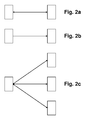
- Figs. 2a to 2c there is graphically illustrated the possible variation of communications schemes. While a two party video call (bi-directional) is described herein above and as shown in Fig. 2a , the present disclosure also applies to unidirectional calls ( Fig. 2b ) and omni-directional calls with two or more parties ( Fig. 2c ), including video conference calls.
- the user interface to mute/un-mute video may involve physical keys on the video phone as shown in Fig. 3a , labelled soft keys as shown in Fig. 3b , and/or touch screens as shown in Fig. 3c .
- a graphical user interface (GUI), Interactive Voice Response (IVR), or speech recognition system may also be involved.
- the video transmission while muted may use a video frame taken from just before the video mute was invoked.
- a photo image may be displayed (system or user configured, randomly selected or stock photo).
- a video or moving image may also be transmitted rather than a static image.
- muting options may be provided in the user interface, muting options may also be combined with other user interface functions.
- the video mute may be done by the proxy 124 of Fig. 1 , possibly in conjunction with in-band or out-of-band signalling, to replace or alter the video transmission after it has been sent from the muted video phone.
- the video processor component 110 may be a dedicated component or be a function of the computer processing capabilities of the video phone.
- the video processor component may continuously render an image or video or only render the image or video as required for transmission.
Landscapes
- Engineering & Computer Science (AREA)
- Multimedia (AREA)
- Signal Processing (AREA)
- Two-Way Televisions, Distribution Of Moving Picture Or The Like (AREA)
- Telephonic Communication Services (AREA)
- Telephone Function (AREA)
Abstract
Description
- The present invention relates to video muting and particularly, although not exclusively, to methods and systems for audio-video communications and is particularly concerned with video telephones or teleconferences.
- With the growing prevalence of video phone technology there are circumstances during a call where it may become inappropriate to observe the resultant video. Both parties may desire a conversation to continue, however, the video camera field of view may include activities which are not appropriate for viewing.
- In general, people choose not to establish video communication or terminate the communication prematurely for privacy.
- An alternative is to obstruct the video camera while privacy is desired, by hand placement or the use of a barrier (e.g. a towel thrown over the camera).
- Another alternative is for the other party to avert their gaze as would be done if the persons were in the same room together.
- Systems and methods disclosed herein provide methods and systems for audio-video communications to obviate or mitigate at least some of the aforementioned disadvantages.
- The present invention will be further understood from the following detailed description with reference to the drawings in which:
-
Fig. 1 illustrates an audio-video communications system in accordance with an embodiment of the present disclosure; -
Fig. 2 graphically illustrates the possible variation of communications schemes; and -
Fig. 3 illustrates a number of user interface options for implementing the system ofFig. 1 in accordance with an embodiment of the present invention. - An object of the present disclosure is to provide an improved audio-video communications system and method.
- Accordingly, in a two party video call, either party may initiate a video mute to and/or from the other party. The conversation continues while the video is muted as audio is not affected. The video mute may be in one direction or in both directions (and equivalents for conference calls). The video mute is terminated, resuming both voice and video communication, by the originally muting party or by mutual consent (requiring both parties to end the video mute). Video mute and audio mute may be invoked independently or in conjunction, as appropriate
- As used herein, "mute" and/or "video mute" implies a pausing, stopping or freezing of the video camera from transmitting live or nearly live video. Further, "mute" and/or "video mute" means a halting of transmitting live or nearly live images or frames to a receiving party on a video call. As indicated above, when the video mute function is invoked, audio may continue as normal.
- Throughout the duration of a video phone call the users are provided an interface to mute video without affecting the audio call (e.g. by pressing a video mute hard key on the video phone). Upon invoking video mute the video transmission from the video phone is changed from the active camera field of view to a static image. The user invoking video mute is then provided an option of un-muting the video (e.g. by pressing the video mute key a second time). Upon un-muting video the video transmission is changed from a static image back to the active camera field of view.
- Referring to
Fig. 1 there is illustrated an audio-video communications system in accordance with an embodiment of the present disclosure. An audio-video communications system 100 for a two-way video teleconference includes end-user terminals communications link 106. End-user equipment 102 includes avideo processor component 110, auser interface 112, adisplay 114, for convenience shown with built inspeaker 116 andmicrophone 118, avideo camera device 120 and astorage device 122 all coupled to the processor. Thecommunications link 106 may be a dedicated link or may be implemented via a data communications network, for example via the Internet. The communications link may include aproxy 124. Theuser interface 112 in the present example is a keypad. The keypad has dedicated keys for muting functions in accordance with the present disclosure. The muting options are shown in Table A.TABLE A Key Pad Designation Function Mute Video Out Mutes outgoing video Mute Vid In Mutes incoming video Mute Vid Both Mutes video both directions Mute Aud/Vid Out Mutes outgoing audio and video Un-mute Un-mutes any of the above mutes - In operation, during a two party (bi-directional) video call either party may invoke one of several mute options, including an independent video mute. These options include some or all of,
- mute video from this party's camera to the other party's video screen (don't look)
- mute video from the other party's camera to this party's video screen (avert gaze)
- mute video in both directions (let's just talk)
- mute both audio and video from this party's video phone (mute functionality)
- For example, Ralph and Ted establish a video call where Ralph is a home office worker using a
video phone 102, while Ted is a road warrior using amobile video phone 104. Both Ralph and Ted may, for example, use Bluetooth® headsets for the audio portion of the call (not shown inFig. 1 ). - Upon a change in circumstances, one party decides that the other party should not observe the video, but wishes to continue the audio conversation. They invoke the appropriate mute option from the choices available, for example, the first option above (don't look). An indication of video mute is provided to the user for whom the video image is not being transmitted through the user interface, for example using LEDs by the dedicated keys or by visual indication on the video display, for example, a graphical icon overlaying the top left corner of the received video image. Similarly, indication of video mute may also be provided to the user viewing the replacement or blank image.
- The
video phone 102 changes the video source for transmission from thevideo camera device 120 to the output of avideo processor component 110. Thevideo processor component 110 renders a still image, which is transmitted to the farend video phone 104 for display. - Upon a subsequent change in circumstances, the same party decides that the video portion of the call can resume. They invoke the corresponding un-mute option.
- The
video phone 102 then changes the video source for transmission from the output of avideo processor component 110 to thevideo camera device 120. The active field of view of the video camera device is transmitted to the farend video phone 104 for display. - For example, Ralph chooses to mute video while he changes his socks and puts on his shoes in preparation for another meeting. The conversation continues uninterrupted and Ralph un-mutes video when he is again facing his laptop.
- A further change in circumstances, one party decides that neither party should observe the video but again wishes to continue the audio conversation. They then invoke the appropriate mute option from the choices available, the third option above (let's just talk).
- Signalling is exchanged with the far end video phone 104 (e.g. using SIP messaging to initiate two-party bi-directional video mute and identifying both parties). Both video phones and change the video source for transmission to the video processor component.
- When one party chooses to resume video for the call they invoke the corresponding un-mute option. However, the video phone does not change transmission source but instead signals the far end video phone (e.g. using SIP messaging) to remove one-party from the bi-directional video mute.
- When the second party chooses to resume video for the call they also invoke the corresponding un-mute option. Again, the video phone does not change transmission source but instead signals the far end video phone (e.g. using SIP messaging) to remove the one-party from the bi-directional video mute. As the signalling confirms both parties have un-muted video, each video phone proceeds with the change of transmission source from video processor component to video camera.
- During the video muting, the video link remains active with transmission of the replacement image from source. However, an embodiment of the present disclosure could allow for optimization of A/V link, which may involve renegotiating audio only and audio/video communications paths and/or changing the transmission media involved. In this case the replacement image would be provided by the destination rather than transmitted from the source.
- For example, Ted pulls into a gas station and chooses to mute video while he attends to his automobile. The conversation continues uninterrupted without video until Ted is back on the road and unmutes video.
- Referring to
Figs. 2a to 2c , there is graphically illustrated the possible variation of communications schemes. While a two party video call (bi-directional) is described herein above and as shown inFig. 2a , the present disclosure also applies to unidirectional calls (Fig. 2b ) and omni-directional calls with two or more parties (Fig. 2c ), including video conference calls. - Referring to
Figs. 3a to 3c , there are illustrated a number of user interface options for implementing the present embodiment. The user interface to mute/un-mute video may involve physical keys on the video phone as shown inFig. 3a , labelled soft keys as shown inFig. 3b , and/or touch screens as shown inFig. 3c . A graphical user interface (GUI), Interactive Voice Response (IVR), or speech recognition system may also be involved. - The video transmission while muted may use a video frame taken from just before the video mute was invoked. Alternatively, a photo image may be displayed (system or user configured, randomly selected or stock photo). A video or moving image may also be transmitted rather than a static image.
- Any or all of the muting options may be provided in the user interface, muting options may also be combined with other user interface functions.
- The video mute may be done by the
proxy 124 ofFig. 1 , possibly in conjunction with in-band or out-of-band signalling, to replace or alter the video transmission after it has been sent from the muted video phone. - The
video processor component 110 may be a dedicated component or be a function of the computer processing capabilities of the video phone. The video processor component may continuously render an image or video or only render the image or video as required for transmission. - Numerous modifications, variations and adaptations may be made to the particular embodiments described above without departing from the scope patent disclosure, which is defined in the claims.
Claims (15)
- An end-user terminal for audio-video communications comprising:a video processor component;a user interface, a display, a speaker and a microphone, a video camera device and a storage device, all coupled to the processor;the user interface including a video muting function; andthe video processor component including a module responsive to the video muting function for switching from a video source of the video camera to a predetermined video signal.
- The terminal of claim 1, wherein the video muting function comprises a selection for muting video sent from the end-user terminal.
- The terminal of claim 1 or claim 2, wherein the video muting function comprises a selection for muting video received by the end-user terminal.
- The terminal of claim 1, wherein the video muting function comprises a selection for muting both video sent from and video received by the end-user terminal.
- The terminal of any preceding claim, wherein the video muting function comprises a selection for muting audio and video sent from the end-user terminal.
- The terminal of any preceding claim, wherein the user interface includes hard keys for selecting the video muting function.
- The terminal of any preceding claim, wherein the user interface includes soft keys for selecting the video muting function.
- The terminal of any preceding claim, wherein the user interface includes a touch screen for selecting the video muting function.
- The terminal of any preceding claim, wherein the user interface includes at least one of graphical user interface (GUI), interactive voice response (IVR), or speech recognition system for selecting the video muting function.
- A system for audio-video communications comprising:the terminal of any of claims 1 to 9; andat least one other end-user terminal coupled via a communications link to the terminal, wherein each of the other end-user terminals includes:a video processor component; anda user interface, a display, a speaker and a microphone, a video camera, and a storage all coupled to the video processor, each user interface including a video muting function, and each video processor component including a module responsive to the video muting function for switching from a video source of the video camera to a predetermined video signal.
- A method of controlling audio-video communications, the method comprising:establishing an audio-video call between a first and a second party; andduring the call, one party muting a video portion of the call while maintaining an audio portion of the call.
- The method of claim 11, wherein the muting of the video portion comprises muting video sent from the one party.
- The method of claim 11 or claim 12, wherein the muting of the video portion comprises muting video received by the one party.
- The method of any of claims 11 to 13, wherein the muting of the video portion comprises muting both video sent from and video received by the one party.
- The method of any of claims 11 to 14, wherein the muting of the video portion comprises muting audio and video sent from the one party.
Applications Claiming Priority (1)
| Application Number | Priority Date | Filing Date | Title |
|---|---|---|---|
| US12/928,768 US9007415B2 (en) | 2010-12-16 | 2010-12-16 | Method and system for audio-video communications |
Publications (3)
| Publication Number | Publication Date |
|---|---|
| EP2466885A2 true EP2466885A2 (en) | 2012-06-20 |
| EP2466885A3 EP2466885A3 (en) | 2013-08-28 |
| EP2466885B1 EP2466885B1 (en) | 2020-09-16 |
Family
ID=44650683
Family Applications (1)
| Application Number | Title | Priority Date | Filing Date |
|---|---|---|---|
| EP11172282.3A Active EP2466885B1 (en) | 2010-12-16 | 2011-06-30 | Video muting |
Country Status (4)
| Country | Link |
|---|---|
| US (1) | US9007415B2 (en) |
| EP (1) | EP2466885B1 (en) |
| CN (1) | CN102547208A (en) |
| CA (1) | CA2747344C (en) |
Cited By (1)
| Publication number | Priority date | Publication date | Assignee | Title |
|---|---|---|---|---|
| EP3172895A4 (en) * | 2014-07-25 | 2017-08-09 | Ricoh Company, Ltd. | Remote conference system, communication terminal, and program |
Families Citing this family (12)
| Publication number | Priority date | Publication date | Assignee | Title |
|---|---|---|---|---|
| US9323250B2 (en) | 2011-01-28 | 2016-04-26 | Intouch Technologies, Inc. | Time-dependent navigation of telepresence robots |
| US9098611B2 (en) | 2012-11-26 | 2015-08-04 | Intouch Technologies, Inc. | Enhanced video interaction for a user interface of a telepresence network |
| US8605872B2 (en) * | 2011-06-28 | 2013-12-10 | Lifesize Communications, Inc. | Muting a videoconference using touch-based gestures |
| US8818345B1 (en) * | 2012-04-17 | 2014-08-26 | Sprint Communications Company L.P. | Enhancing conference bridge muting to save network resources |
| US9361021B2 (en) | 2012-05-22 | 2016-06-07 | Irobot Corporation | Graphical user interfaces including touchpad driving interfaces for telemedicine devices |
| WO2013176760A1 (en) | 2012-05-22 | 2013-11-28 | Intouch Technologies, Inc. | Graphical user interfaces including touchpad driving interfaces for telemedicine devices |
| US9270822B2 (en) | 2012-08-14 | 2016-02-23 | Avaya Inc. | Protecting privacy of a customer and an agent using face recognition in a video contact center environment |
| US9007426B2 (en) * | 2012-10-04 | 2015-04-14 | Blackberry Limited | Comparison-based selection of video resolutions in a video call |
| KR102004265B1 (en) * | 2012-12-28 | 2019-07-26 | 엘지전자 주식회사 | Head mounted display and the method of video communication |
| EP2797279B1 (en) * | 2013-04-23 | 2016-09-14 | Gurulogic Microsystems OY | Communications using at least two different media types |
| WO2022072482A1 (en) * | 2020-10-01 | 2022-04-07 | Bose Corporation | Video teleconferencing |
| US20250080599A1 (en) * | 2023-09-05 | 2025-03-06 | Cisco Technology, Inc. | System and Method to Determine Communication Reciprocity For A Network Device |
Family Cites Families (8)
| Publication number | Priority date | Publication date | Assignee | Title |
|---|---|---|---|---|
| US5574934A (en) * | 1993-11-24 | 1996-11-12 | Intel Corporation | Preemptive priority-based transmission of signals using virtual channels |
| US5999207A (en) * | 1997-05-16 | 1999-12-07 | Scientific-Atlanta, Inc. | Method and apparatus for implementing a user interface for a videophone in a cable television network |
| US5819294A (en) * | 1997-08-06 | 1998-10-06 | Philips Electronics North America Corporation | Automatic configuration mechanism for universal remote |
| KR100735290B1 (en) * | 2005-06-07 | 2007-07-03 | 삼성전자주식회사 | Image Data Control Method in Video Call Mode of Mobile Device |
| US8044989B2 (en) * | 2006-12-12 | 2011-10-25 | General Instrument Corporation | Mute function for video applications |
| US8310521B2 (en) * | 2007-04-30 | 2012-11-13 | Microsoft Corp. | Insertion of virtual video into live video |
| CN101316435B (en) * | 2007-05-31 | 2012-08-08 | 华为技术有限公司 | Call control method and IMS circuit switching control device and terminal unit |
| US8347216B2 (en) | 2008-10-01 | 2013-01-01 | Lg Electronics Inc. | Mobile terminal and video sharing method thereof |
-
2010
- 2010-12-16 US US12/928,768 patent/US9007415B2/en active Active
-
2011
- 2011-06-30 EP EP11172282.3A patent/EP2466885B1/en active Active
- 2011-07-26 CA CA2747344A patent/CA2747344C/en active Active
- 2011-12-16 CN CN2011104317159A patent/CN102547208A/en active Pending
Non-Patent Citations (1)
| Title |
|---|
| None |
Cited By (1)
| Publication number | Priority date | Publication date | Assignee | Title |
|---|---|---|---|---|
| EP3172895A4 (en) * | 2014-07-25 | 2017-08-09 | Ricoh Company, Ltd. | Remote conference system, communication terminal, and program |
Also Published As
| Publication number | Publication date |
|---|---|
| CA2747344A1 (en) | 2012-06-16 |
| US9007415B2 (en) | 2015-04-14 |
| CN102547208A (en) | 2012-07-04 |
| CA2747344C (en) | 2015-04-14 |
| EP2466885A3 (en) | 2013-08-28 |
| EP2466885B1 (en) | 2020-09-16 |
| US20120154509A1 (en) | 2012-06-21 |
Similar Documents
| Publication | Publication Date | Title |
|---|---|---|
| EP2466885B1 (en) | Video muting | |
| CN115344230B (en) | Methods and systems for switching wireless audio connections during a call | |
| US9723401B2 (en) | Multiple microphone switching and configuration | |
| EP3276905B1 (en) | System for audio communication using lte | |
| CN106463108B (en) | Provides isolation from interference | |
| US8451996B2 (en) | Automatic mute detection | |
| CN102474424B (en) | Systems and methods for switching between computer and presenter audio transmission during conference call | |
| US9516476B2 (en) | Teleconferencing system, method of communication, computer program product and master communication device | |
| US20130316752A1 (en) | Systems and methods for wireless audio conferencing | |
| CN104365088A (en) | Multiple channel communication using multiple cameras | |
| CN103731541A (en) | Method and terminal for controlling voice frequency during telephone communication | |
| US20070121606A1 (en) | VOIP Hub Using Existing Audio or Video Systems | |
| US11557296B2 (en) | Communication transfer between devices | |
| US8767942B2 (en) | Muting audio in turret switching systems | |
| US20060098798A1 (en) | Method to selectively mute parties on a conference call | |
| KR20130132040A (en) | Method and system for conference call using a different kinds of device | |
| US20090111444A1 (en) | Sound in a conference communication session | |
| US12627760B2 (en) | Semi-global muting | |
| US20090074169A1 (en) | Multi-Line Communication System | |
| US11223714B2 (en) | Telecommunication terminal and method for controlling media streams | |
| US10721360B2 (en) | Method and device for reducing telephone call costs | |
| JP2015046743A (en) | Intercom system | |
| HK1168965B (en) | Muting of terminals for creation of a sub-conference | |
| HK1168965A (en) | Muting of terminals for creation of a sub-conference | |
| HK1158353B (en) | Multiple microphone switching and configuration |
Legal Events
| Date | Code | Title | Description |
|---|---|---|---|
| PUAI | Public reference made under article 153(3) epc to a published international application that has entered the european phase |
Free format text: ORIGINAL CODE: 0009012 |
|
| AK | Designated contracting states |
Kind code of ref document: A2 Designated state(s): AL AT BE BG CH CY CZ DE DK EE ES FI FR GB GR HR HU IE IS IT LI LT LU LV MC MK MT NL NO PL PT RO RS SE SI SK SM TR |
|
| AX | Request for extension of the european patent |
Extension state: BA ME |
|
| PUAL | Search report despatched |
Free format text: ORIGINAL CODE: 0009013 |
|
| AK | Designated contracting states |
Kind code of ref document: A3 Designated state(s): AL AT BE BG CH CY CZ DE DK EE ES FI FR GB GR HR HU IE IS IT LI LT LU LV MC MK MT NL NO PL PT RO RS SE SI SK SM TR |
|
| AX | Request for extension of the european patent |
Extension state: BA ME |
|
| RIC1 | Information provided on ipc code assigned before grant |
Ipc: H04N 7/15 20060101AFI20130724BHEP Ipc: H04N 7/14 20060101ALI20130724BHEP |
|
| 17P | Request for examination filed |
Effective date: 20140228 |
|
| RBV | Designated contracting states (corrected) |
Designated state(s): AL AT BE BG CH CY CZ DE DK EE ES FI FR GB GR HR HU IE IS IT LI LT LU LV MC MK MT NL NO PL PT RO RS SE SI SK SM TR |
|
| STAA | Information on the status of an ep patent application or granted ep patent |
Free format text: STATUS: EXAMINATION IS IN PROGRESS |
|
| 17Q | First examination report despatched |
Effective date: 20171006 |
|
| GRAP | Despatch of communication of intention to grant a patent |
Free format text: ORIGINAL CODE: EPIDOSNIGR1 |
|
| STAA | Information on the status of an ep patent application or granted ep patent |
Free format text: STATUS: GRANT OF PATENT IS INTENDED |
|
| INTG | Intention to grant announced |
Effective date: 20200615 |
|
| GRAS | Grant fee paid |
Free format text: ORIGINAL CODE: EPIDOSNIGR3 |
|
| GRAA | (expected) grant |
Free format text: ORIGINAL CODE: 0009210 |
|
| STAA | Information on the status of an ep patent application or granted ep patent |
Free format text: STATUS: THE PATENT HAS BEEN GRANTED |
|
| AK | Designated contracting states |
Kind code of ref document: B1 Designated state(s): AL AT BE BG CH CY CZ DE DK EE ES FI FR GB GR HR HU IE IS IT LI LT LU LV MC MK MT NL NO PL PT RO RS SE SI SK SM TR |
|
| REG | Reference to a national code |
Ref country code: GB Ref legal event code: FG4D |
|
| REG | Reference to a national code |
Ref country code: CH Ref legal event code: EP |
|
| REG | Reference to a national code |
Ref country code: DE Ref legal event code: R096 Ref document number: 602011068604 Country of ref document: DE |
|
| REG | Reference to a national code |
Ref country code: IE Ref legal event code: FG4D |
|
| REG | Reference to a national code |
Ref country code: AT Ref legal event code: REF Ref document number: 1315230 Country of ref document: AT Kind code of ref document: T Effective date: 20201015 |
|
| REG | Reference to a national code |
Ref country code: DE Ref legal event code: R082 Ref document number: 602011068604 Country of ref document: DE Representative=s name: VENNER SHIPLEY GERMANY LLP, DE Ref country code: DE Ref legal event code: R082 Ref document number: 602011068604 Country of ref document: DE Representative=s name: VENNER SHIPLEY LLP, DE |
|
| PG25 | Lapsed in a contracting state [announced via postgrant information from national office to epo] |
Ref country code: SE Free format text: LAPSE BECAUSE OF FAILURE TO SUBMIT A TRANSLATION OF THE DESCRIPTION OR TO PAY THE FEE WITHIN THE PRESCRIBED TIME-LIMIT Effective date: 20200916 Ref country code: NO Free format text: LAPSE BECAUSE OF FAILURE TO SUBMIT A TRANSLATION OF THE DESCRIPTION OR TO PAY THE FEE WITHIN THE PRESCRIBED TIME-LIMIT Effective date: 20201216 Ref country code: HR Free format text: LAPSE BECAUSE OF FAILURE TO SUBMIT A TRANSLATION OF THE DESCRIPTION OR TO PAY THE FEE WITHIN THE PRESCRIBED TIME-LIMIT Effective date: 20200916 Ref country code: GR Free format text: LAPSE BECAUSE OF FAILURE TO SUBMIT A TRANSLATION OF THE DESCRIPTION OR TO PAY THE FEE WITHIN THE PRESCRIBED TIME-LIMIT Effective date: 20201217 Ref country code: FI Free format text: LAPSE BECAUSE OF FAILURE TO SUBMIT A TRANSLATION OF THE DESCRIPTION OR TO PAY THE FEE WITHIN THE PRESCRIBED TIME-LIMIT Effective date: 20200916 Ref country code: BG Free format text: LAPSE BECAUSE OF FAILURE TO SUBMIT A TRANSLATION OF THE DESCRIPTION OR TO PAY THE FEE WITHIN THE PRESCRIBED TIME-LIMIT Effective date: 20201216 |
|
| REG | Reference to a national code |
Ref country code: AT Ref legal event code: MK05 Ref document number: 1315230 Country of ref document: AT Kind code of ref document: T Effective date: 20200916 |
|
| REG | Reference to a national code |
Ref country code: NL Ref legal event code: MP Effective date: 20200916 |
|
| PG25 | Lapsed in a contracting state [announced via postgrant information from national office to epo] |
Ref country code: LV Free format text: LAPSE BECAUSE OF FAILURE TO SUBMIT A TRANSLATION OF THE DESCRIPTION OR TO PAY THE FEE WITHIN THE PRESCRIBED TIME-LIMIT Effective date: 20200916 Ref country code: RS Free format text: LAPSE BECAUSE OF FAILURE TO SUBMIT A TRANSLATION OF THE DESCRIPTION OR TO PAY THE FEE WITHIN THE PRESCRIBED TIME-LIMIT Effective date: 20200916 |
|
| REG | Reference to a national code |
Ref country code: LT Ref legal event code: MG4D |
|
| PG25 | Lapsed in a contracting state [announced via postgrant information from national office to epo] |
Ref country code: EE Free format text: LAPSE BECAUSE OF FAILURE TO SUBMIT A TRANSLATION OF THE DESCRIPTION OR TO PAY THE FEE WITHIN THE PRESCRIBED TIME-LIMIT Effective date: 20200916 Ref country code: CZ Free format text: LAPSE BECAUSE OF FAILURE TO SUBMIT A TRANSLATION OF THE DESCRIPTION OR TO PAY THE FEE WITHIN THE PRESCRIBED TIME-LIMIT Effective date: 20200916 Ref country code: RO Free format text: LAPSE BECAUSE OF FAILURE TO SUBMIT A TRANSLATION OF THE DESCRIPTION OR TO PAY THE FEE WITHIN THE PRESCRIBED TIME-LIMIT Effective date: 20200916 Ref country code: SM Free format text: LAPSE BECAUSE OF FAILURE TO SUBMIT A TRANSLATION OF THE DESCRIPTION OR TO PAY THE FEE WITHIN THE PRESCRIBED TIME-LIMIT Effective date: 20200916 Ref country code: PT Free format text: LAPSE BECAUSE OF FAILURE TO SUBMIT A TRANSLATION OF THE DESCRIPTION OR TO PAY THE FEE WITHIN THE PRESCRIBED TIME-LIMIT Effective date: 20210118 Ref country code: NL Free format text: LAPSE BECAUSE OF FAILURE TO SUBMIT A TRANSLATION OF THE DESCRIPTION OR TO PAY THE FEE WITHIN THE PRESCRIBED TIME-LIMIT Effective date: 20200916 Ref country code: LT Free format text: LAPSE BECAUSE OF FAILURE TO SUBMIT A TRANSLATION OF THE DESCRIPTION OR TO PAY THE FEE WITHIN THE PRESCRIBED TIME-LIMIT Effective date: 20200916 |
|
| PG25 | Lapsed in a contracting state [announced via postgrant information from national office to epo] |
Ref country code: AL Free format text: LAPSE BECAUSE OF FAILURE TO SUBMIT A TRANSLATION OF THE DESCRIPTION OR TO PAY THE FEE WITHIN THE PRESCRIBED TIME-LIMIT Effective date: 20200916 Ref country code: AT Free format text: LAPSE BECAUSE OF FAILURE TO SUBMIT A TRANSLATION OF THE DESCRIPTION OR TO PAY THE FEE WITHIN THE PRESCRIBED TIME-LIMIT Effective date: 20200916 Ref country code: ES Free format text: LAPSE BECAUSE OF FAILURE TO SUBMIT A TRANSLATION OF THE DESCRIPTION OR TO PAY THE FEE WITHIN THE PRESCRIBED TIME-LIMIT Effective date: 20200916 Ref country code: IS Free format text: LAPSE BECAUSE OF FAILURE TO SUBMIT A TRANSLATION OF THE DESCRIPTION OR TO PAY THE FEE WITHIN THE PRESCRIBED TIME-LIMIT Effective date: 20210116 Ref country code: PL Free format text: LAPSE BECAUSE OF FAILURE TO SUBMIT A TRANSLATION OF THE DESCRIPTION OR TO PAY THE FEE WITHIN THE PRESCRIBED TIME-LIMIT Effective date: 20200916 |
|
| REG | Reference to a national code |
Ref country code: DE Ref legal event code: R097 Ref document number: 602011068604 Country of ref document: DE |
|
| PG25 | Lapsed in a contracting state [announced via postgrant information from national office to epo] |
Ref country code: SK Free format text: LAPSE BECAUSE OF FAILURE TO SUBMIT A TRANSLATION OF THE DESCRIPTION OR TO PAY THE FEE WITHIN THE PRESCRIBED TIME-LIMIT Effective date: 20200916 |
|
| PLBE | No opposition filed within time limit |
Free format text: ORIGINAL CODE: 0009261 |
|
| STAA | Information on the status of an ep patent application or granted ep patent |
Free format text: STATUS: NO OPPOSITION FILED WITHIN TIME LIMIT |
|
| 26N | No opposition filed |
Effective date: 20210617 |
|
| PG25 | Lapsed in a contracting state [announced via postgrant information from national office to epo] |
Ref country code: SI Free format text: LAPSE BECAUSE OF FAILURE TO SUBMIT A TRANSLATION OF THE DESCRIPTION OR TO PAY THE FEE WITHIN THE PRESCRIBED TIME-LIMIT Effective date: 20200916 Ref country code: DK Free format text: LAPSE BECAUSE OF FAILURE TO SUBMIT A TRANSLATION OF THE DESCRIPTION OR TO PAY THE FEE WITHIN THE PRESCRIBED TIME-LIMIT Effective date: 20200916 |
|
| PG25 | Lapsed in a contracting state [announced via postgrant information from national office to epo] |
Ref country code: IT Free format text: LAPSE BECAUSE OF FAILURE TO SUBMIT A TRANSLATION OF THE DESCRIPTION OR TO PAY THE FEE WITHIN THE PRESCRIBED TIME-LIMIT Effective date: 20200916 |
|
| PG25 | Lapsed in a contracting state [announced via postgrant information from national office to epo] |
Ref country code: MC Free format text: LAPSE BECAUSE OF FAILURE TO SUBMIT A TRANSLATION OF THE DESCRIPTION OR TO PAY THE FEE WITHIN THE PRESCRIBED TIME-LIMIT Effective date: 20200916 |
|
| REG | Reference to a national code |
Ref country code: CH Ref legal event code: PL |
|
| REG | Reference to a national code |
Ref country code: BE Ref legal event code: MM Effective date: 20210630 |
|
| PG25 | Lapsed in a contracting state [announced via postgrant information from national office to epo] |
Ref country code: LU Free format text: LAPSE BECAUSE OF NON-PAYMENT OF DUE FEES Effective date: 20210630 |
|
| PG25 | Lapsed in a contracting state [announced via postgrant information from national office to epo] |
Ref country code: LI Free format text: LAPSE BECAUSE OF NON-PAYMENT OF DUE FEES Effective date: 20210630 Ref country code: IE Free format text: LAPSE BECAUSE OF NON-PAYMENT OF DUE FEES Effective date: 20210630 Ref country code: CH Free format text: LAPSE BECAUSE OF NON-PAYMENT OF DUE FEES Effective date: 20210630 |
|
| PG25 | Lapsed in a contracting state [announced via postgrant information from national office to epo] |
Ref country code: BE Free format text: LAPSE BECAUSE OF NON-PAYMENT OF DUE FEES Effective date: 20210630 |
|
| PG25 | Lapsed in a contracting state [announced via postgrant information from national office to epo] |
Ref country code: HU Free format text: LAPSE BECAUSE OF FAILURE TO SUBMIT A TRANSLATION OF THE DESCRIPTION OR TO PAY THE FEE WITHIN THE PRESCRIBED TIME-LIMIT; INVALID AB INITIO Effective date: 20110630 Ref country code: CY Free format text: LAPSE BECAUSE OF FAILURE TO SUBMIT A TRANSLATION OF THE DESCRIPTION OR TO PAY THE FEE WITHIN THE PRESCRIBED TIME-LIMIT Effective date: 20200916 |
|
| PG25 | Lapsed in a contracting state [announced via postgrant information from national office to epo] |
Ref country code: MK Free format text: LAPSE BECAUSE OF FAILURE TO SUBMIT A TRANSLATION OF THE DESCRIPTION OR TO PAY THE FEE WITHIN THE PRESCRIBED TIME-LIMIT Effective date: 20200916 |
|
| PG25 | Lapsed in a contracting state [announced via postgrant information from national office to epo] |
Ref country code: TR Free format text: LAPSE BECAUSE OF FAILURE TO SUBMIT A TRANSLATION OF THE DESCRIPTION OR TO PAY THE FEE WITHIN THE PRESCRIBED TIME-LIMIT Effective date: 20200916 |
|
| PG25 | Lapsed in a contracting state [announced via postgrant information from national office to epo] |
Ref country code: MT Free format text: LAPSE BECAUSE OF FAILURE TO SUBMIT A TRANSLATION OF THE DESCRIPTION OR TO PAY THE FEE WITHIN THE PRESCRIBED TIME-LIMIT Effective date: 20200916 |
|
| REG | Reference to a national code |
Ref country code: DE Ref legal event code: R081 Ref document number: 602011068604 Country of ref document: DE Owner name: DIORITE TECHNOLOGY, LLC, MCKINNEY, US Free format text: FORMER OWNER: MITEL NETWORKS CORPORATION, OTTAWA, ONTARIO, CA |
|
| REG | Reference to a national code |
Ref country code: GB Ref legal event code: 732E Free format text: REGISTERED BETWEEN 20241205 AND 20241211 |
|
| PGFP | Annual fee paid to national office [announced via postgrant information from national office to epo] |
Ref country code: DE Payment date: 20250627 Year of fee payment: 15 |
|
| PGFP | Annual fee paid to national office [announced via postgrant information from national office to epo] |
Ref country code: GB Payment date: 20250627 Year of fee payment: 15 |
|
| PGFP | Annual fee paid to national office [announced via postgrant information from national office to epo] |
Ref country code: FR Payment date: 20250625 Year of fee payment: 15 |