EP2465881A1 - Impact modified thermoplastic composition with hydrolytic sensitivity to obtain higher fluidity while keeping high impact strength - Google Patents
Impact modified thermoplastic composition with hydrolytic sensitivity to obtain higher fluidity while keeping high impact strength Download PDFInfo
- Publication number
- EP2465881A1 EP2465881A1 EP11193672A EP11193672A EP2465881A1 EP 2465881 A1 EP2465881 A1 EP 2465881A1 EP 11193672 A EP11193672 A EP 11193672A EP 11193672 A EP11193672 A EP 11193672A EP 2465881 A1 EP2465881 A1 EP 2465881A1
- Authority
- EP
- European Patent Office
- Prior art keywords
- core
- shell
- poly
- thermoplastic polymer
- impact modifier
- Prior art date
- Legal status (The legal status is an assumption and is not a legal conclusion. Google has not performed a legal analysis and makes no representation as to the accuracy of the status listed.)
- Withdrawn
Links
- 239000000203 mixture Substances 0.000 title claims abstract description 45
- 229920001169 thermoplastic Polymers 0.000 title claims abstract description 37
- 239000004416 thermosoftening plastic Substances 0.000 title claims abstract description 18
- 230000003301 hydrolyzing effect Effects 0.000 title 1
- 230000035945 sensitivity Effects 0.000 title 1
- 239000011258 core-shell material Substances 0.000 claims abstract description 47
- 238000000034 method Methods 0.000 claims abstract description 39
- 239000004609 Impact Modifier Substances 0.000 claims abstract description 37
- 230000008569 process Effects 0.000 claims abstract description 34
- 229920000642 polymer Polymers 0.000 claims description 37
- 239000004417 polycarbonate Substances 0.000 claims description 34
- 229920000515 polycarbonate Polymers 0.000 claims description 34
- 239000002245 particle Substances 0.000 claims description 31
- -1 poly(vinyl chloride) Polymers 0.000 claims description 23
- 229920001577 copolymer Polymers 0.000 claims description 22
- 238000005345 coagulation Methods 0.000 claims description 19
- 230000015271 coagulation Effects 0.000 claims description 19
- 239000000243 solution Substances 0.000 claims description 18
- 239000000872 buffer Substances 0.000 claims description 14
- PPBRXRYQALVLMV-UHFFFAOYSA-N Styrene Chemical compound C=CC1=CC=CC=C1 PPBRXRYQALVLMV-UHFFFAOYSA-N 0.000 claims description 12
- 230000015572 biosynthetic process Effects 0.000 claims description 10
- 238000007720 emulsion polymerization reaction Methods 0.000 claims description 10
- 238000003786 synthesis reaction Methods 0.000 claims description 10
- 239000008151 electrolyte solution Substances 0.000 claims description 9
- 239000012062 aqueous buffer Substances 0.000 claims description 8
- 229920000728 polyester Polymers 0.000 claims description 8
- QXNVGIXVLWOKEQ-UHFFFAOYSA-N Disodium Chemical compound [Na][Na] QXNVGIXVLWOKEQ-UHFFFAOYSA-N 0.000 claims description 6
- 229910019142 PO4 Inorganic materials 0.000 claims description 6
- 150000001875 compounds Chemical class 0.000 claims description 6
- 230000009477 glass transition Effects 0.000 claims description 6
- 235000021317 phosphate Nutrition 0.000 claims description 6
- 239000008055 phosphate buffer solution Substances 0.000 claims description 6
- 229920003229 poly(methyl methacrylate) Polymers 0.000 claims description 5
- 239000004926 polymethyl methacrylate Substances 0.000 claims description 5
- NLHHRLWOUZZQLW-UHFFFAOYSA-N Acrylonitrile Chemical compound C=CC#N NLHHRLWOUZZQLW-UHFFFAOYSA-N 0.000 claims description 4
- 239000004793 Polystyrene Substances 0.000 claims description 4
- KCIDZIIHRGYJAE-YGFYJFDDSA-L dipotassium;[(2r,3r,4s,5r,6r)-3,4,5-trihydroxy-6-(hydroxymethyl)oxan-2-yl] phosphate Chemical compound [K+].[K+].OC[C@H]1O[C@H](OP([O-])([O-])=O)[C@H](O)[C@@H](O)[C@H]1O KCIDZIIHRGYJAE-YGFYJFDDSA-L 0.000 claims description 4
- 235000019800 disodium phosphate Nutrition 0.000 claims description 4
- 150000003013 phosphoric acid derivatives Chemical class 0.000 claims description 4
- 229920002857 polybutadiene Polymers 0.000 claims description 4
- 239000004626 polylactic acid Substances 0.000 claims description 4
- 229920006324 polyoxymethylene Polymers 0.000 claims description 4
- 239000004800 polyvinyl chloride Substances 0.000 claims description 4
- 229920000915 polyvinyl chloride Polymers 0.000 claims description 4
- GNSKLFRGEWLPPA-UHFFFAOYSA-M potassium dihydrogen phosphate Chemical class [K+].OP(O)([O-])=O GNSKLFRGEWLPPA-UHFFFAOYSA-M 0.000 claims description 4
- RYFMWSXOAZQYPI-UHFFFAOYSA-K trisodium phosphate Chemical class [Na+].[Na+].[Na+].[O-]P([O-])([O-])=O RYFMWSXOAZQYPI-UHFFFAOYSA-K 0.000 claims description 4
- 235000019801 trisodium phosphate Nutrition 0.000 claims description 4
- 239000000956 alloy Substances 0.000 claims description 3
- 229910045601 alloy Inorganic materials 0.000 claims description 3
- 235000019797 dipotassium phosphate Nutrition 0.000 claims description 3
- 235000019796 monopotassium phosphate Nutrition 0.000 claims description 3
- 235000019799 monosodium phosphate Nutrition 0.000 claims description 3
- AJPJDKMHJJGVTQ-UHFFFAOYSA-M sodium dihydrogen phosphate Chemical class [Na+].OP(O)([O-])=O AJPJDKMHJJGVTQ-UHFFFAOYSA-M 0.000 claims description 3
- MMINFSMURORWKH-UHFFFAOYSA-N 3,6-dioxabicyclo[6.2.2]dodeca-1(10),8,11-triene-2,7-dione Chemical compound O=C1OCCOC(=O)C2=CC=C1C=C2 MMINFSMURORWKH-UHFFFAOYSA-N 0.000 claims description 2
- 229920007019 PC/ABS Polymers 0.000 claims description 2
- 239000002033 PVDF binder Substances 0.000 claims description 2
- 239000005062 Polybutadiene Substances 0.000 claims description 2
- 229920002614 Polyether block amide Polymers 0.000 claims description 2
- 239000004698 Polyethylene Substances 0.000 claims description 2
- 229920006243 acrylic copolymer Polymers 0.000 claims description 2
- 229920006020 amorphous polyamide Polymers 0.000 claims description 2
- 125000002496 methyl group Chemical group [H]C([H])([H])* 0.000 claims description 2
- 229920000747 poly(lactic acid) Polymers 0.000 claims description 2
- 229920006149 polyester-amide block copolymer Polymers 0.000 claims description 2
- 229920000573 polyethylene Polymers 0.000 claims description 2
- 229920002981 polyvinylidene fluoride Polymers 0.000 claims description 2
- 229920006114 semi-crystalline semi-aromatic polyamide Polymers 0.000 claims description 2
- 238000011084 recovery Methods 0.000 abstract description 7
- 238000004519 manufacturing process Methods 0.000 abstract description 6
- 238000009757 thermoplastic moulding Methods 0.000 abstract description 4
- 239000000178 monomer Substances 0.000 description 19
- XLYOFNOQVPJJNP-UHFFFAOYSA-N water Substances O XLYOFNOQVPJJNP-UHFFFAOYSA-N 0.000 description 16
- 229920001971 elastomer Polymers 0.000 description 15
- 239000005060 rubber Substances 0.000 description 14
- 229920000126 latex Polymers 0.000 description 13
- 239000004816 latex Substances 0.000 description 13
- KAKZBPTYRLMSJV-UHFFFAOYSA-N Butadiene Chemical compound C=CC=C KAKZBPTYRLMSJV-UHFFFAOYSA-N 0.000 description 12
- 125000003118 aryl group Chemical group 0.000 description 12
- 239000007853 buffer solution Substances 0.000 description 12
- 229920000578 graft copolymer Polymers 0.000 description 11
- 238000006116 polymerization reaction Methods 0.000 description 10
- 239000000843 powder Substances 0.000 description 10
- HEMHJVSKTPXQMS-UHFFFAOYSA-M Sodium hydroxide Chemical compound [OH-].[Na+] HEMHJVSKTPXQMS-UHFFFAOYSA-M 0.000 description 9
- 239000002253 acid Substances 0.000 description 8
- 239000003995 emulsifying agent Substances 0.000 description 8
- 239000000047 product Substances 0.000 description 8
- 229910052708 sodium Inorganic materials 0.000 description 8
- DGAQECJNVWCQMB-PUAWFVPOSA-M Ilexoside XXIX Chemical compound C[C@@H]1CC[C@@]2(CC[C@@]3(C(=CC[C@H]4[C@]3(CC[C@@H]5[C@@]4(CC[C@@H](C5(C)C)OS(=O)(=O)[O-])C)C)[C@@H]2[C@]1(C)O)C)C(=O)O[C@H]6[C@@H]([C@H]([C@@H]([C@H](O6)CO)O)O)O.[Na+] DGAQECJNVWCQMB-PUAWFVPOSA-M 0.000 description 7
- 239000011734 sodium Substances 0.000 description 7
- MYRTYDVEIRVNKP-UHFFFAOYSA-N 1,2-Divinylbenzene Chemical compound C=CC1=CC=CC=C1C=C MYRTYDVEIRVNKP-UHFFFAOYSA-N 0.000 description 6
- RRHGJUQNOFWUDK-UHFFFAOYSA-N Isoprene Chemical compound CC(=C)C=C RRHGJUQNOFWUDK-UHFFFAOYSA-N 0.000 description 6
- 239000002585 base Substances 0.000 description 6
- KRKNYBCHXYNGOX-UHFFFAOYSA-N citric acid Chemical compound OC(=O)CC(O)(C(O)=O)CC(O)=O KRKNYBCHXYNGOX-UHFFFAOYSA-N 0.000 description 6
- 239000003792 electrolyte Substances 0.000 description 6
- 229940021013 electrolyte solution Drugs 0.000 description 6
- 239000000523 sample Substances 0.000 description 6
- 238000000926 separation method Methods 0.000 description 6
- CSNNHWWHGAXBCP-UHFFFAOYSA-L Magnesium sulfate Chemical compound [Mg+2].[O-][S+2]([O-])([O-])[O-] CSNNHWWHGAXBCP-UHFFFAOYSA-L 0.000 description 5
- NBIIXXVUZAFLBC-UHFFFAOYSA-L Phosphate ion(2-) Chemical compound OP([O-])([O-])=O NBIIXXVUZAFLBC-UHFFFAOYSA-L 0.000 description 5
- ZLMJMSJWJFRBEC-UHFFFAOYSA-N Potassium Chemical compound [K] ZLMJMSJWJFRBEC-UHFFFAOYSA-N 0.000 description 5
- KWYUFKZDYYNOTN-UHFFFAOYSA-M Potassium hydroxide Chemical compound [OH-].[K+] KWYUFKZDYYNOTN-UHFFFAOYSA-M 0.000 description 5
- 230000008859 change Effects 0.000 description 5
- 239000008367 deionised water Substances 0.000 description 5
- 238000009826 distribution Methods 0.000 description 5
- 229910052700 potassium Inorganic materials 0.000 description 5
- 239000011591 potassium Substances 0.000 description 5
- 238000002360 preparation method Methods 0.000 description 5
- 239000007787 solid Substances 0.000 description 5
- CIHOLLKRGTVIJN-UHFFFAOYSA-N tert‐butyl hydroperoxide Chemical compound CC(C)(C)OO CIHOLLKRGTVIJN-UHFFFAOYSA-N 0.000 description 5
- 229920005992 thermoplastic resin Polymers 0.000 description 5
- XSZYESUNPWGWFQ-UHFFFAOYSA-N 1-(2-hydroperoxypropan-2-yl)-4-methylcyclohexane Chemical compound CC1CCC(C(C)(C)OO)CC1 XSZYESUNPWGWFQ-UHFFFAOYSA-N 0.000 description 4
- NIXOWILDQLNWCW-UHFFFAOYSA-M Acrylate Chemical compound [O-]C(=O)C=C NIXOWILDQLNWCW-UHFFFAOYSA-M 0.000 description 4
- WQZGKKKJIJFFOK-GASJEMHNSA-N Glucose Natural products OC[C@H]1OC(O)[C@H](O)[C@@H](O)[C@@H]1O WQZGKKKJIJFFOK-GASJEMHNSA-N 0.000 description 4
- 125000000217 alkyl group Chemical group 0.000 description 4
- 239000007864 aqueous solution Substances 0.000 description 4
- WQZGKKKJIJFFOK-VFUOTHLCSA-N beta-D-glucose Chemical compound OC[C@H]1O[C@@H](O)[C@H](O)[C@@H](O)[C@@H]1O WQZGKKKJIJFFOK-VFUOTHLCSA-N 0.000 description 4
- 239000006227 byproduct Substances 0.000 description 4
- OSGAYBCDTDRGGQ-UHFFFAOYSA-L calcium sulfate Chemical compound [Ca+2].[O-]S([O-])(=O)=O OSGAYBCDTDRGGQ-UHFFFAOYSA-L 0.000 description 4
- 150000001735 carboxylic acids Chemical class 0.000 description 4
- BNIILDVGGAEEIG-UHFFFAOYSA-L disodium hydrogen phosphate Chemical compound [Na+].[Na+].OP([O-])([O-])=O BNIILDVGGAEEIG-UHFFFAOYSA-L 0.000 description 4
- 229910000397 disodium phosphate Inorganic materials 0.000 description 4
- 239000000839 emulsion Substances 0.000 description 4
- 229920001519 homopolymer Polymers 0.000 description 4
- 239000012535 impurity Substances 0.000 description 4
- 239000003999 initiator Substances 0.000 description 4
- 230000000977 initiatory effect Effects 0.000 description 4
- 238000001556 precipitation Methods 0.000 description 4
- XWGJFPHUCFXLBL-UHFFFAOYSA-M rongalite Chemical compound [Na+].OCS([O-])=O XWGJFPHUCFXLBL-UHFFFAOYSA-M 0.000 description 4
- 150000003839 salts Chemical class 0.000 description 4
- 229920002554 vinyl polymer Polymers 0.000 description 4
- WBIQQQGBSDOWNP-UHFFFAOYSA-N 2-dodecylbenzenesulfonic acid Chemical compound CCCCCCCCCCCCC1=CC=CC=C1S(O)(=O)=O WBIQQQGBSDOWNP-UHFFFAOYSA-N 0.000 description 3
- 238000005054 agglomeration Methods 0.000 description 3
- 230000002776 aggregation Effects 0.000 description 3
- 230000032683 aging Effects 0.000 description 3
- 239000001110 calcium chloride Substances 0.000 description 3
- 229910001628 calcium chloride Inorganic materials 0.000 description 3
- 239000003638 chemical reducing agent Substances 0.000 description 3
- 239000003795 chemical substances by application Substances 0.000 description 3
- 239000012792 core layer Substances 0.000 description 3
- 239000008121 dextrose Substances 0.000 description 3
- 229940060296 dodecylbenzenesulfonic acid Drugs 0.000 description 3
- 239000010419 fine particle Substances 0.000 description 3
- 159000000001 potassium salts Chemical class 0.000 description 3
- 159000000000 sodium salts Chemical class 0.000 description 3
- 238000003756 stirring Methods 0.000 description 3
- 239000000126 substance Substances 0.000 description 3
- 238000012546 transfer Methods 0.000 description 3
- 125000000391 vinyl group Chemical group [H]C([*])=C([H])[H] 0.000 description 3
- 238000004383 yellowing Methods 0.000 description 3
- YAJYJWXEWKRTPO-UHFFFAOYSA-N 2,3,3,4,4,5-hexamethylhexane-2-thiol Chemical compound CC(C)C(C)(C)C(C)(C)C(C)(C)S YAJYJWXEWKRTPO-UHFFFAOYSA-N 0.000 description 2
- OZAIFHULBGXAKX-UHFFFAOYSA-N 2-(2-cyanopropan-2-yldiazenyl)-2-methylpropanenitrile Chemical compound N#CC(C)(C)N=NC(C)(C)C#N OZAIFHULBGXAKX-UHFFFAOYSA-N 0.000 description 2
- QGZKDVFQNNGYKY-UHFFFAOYSA-N Ammonia Chemical compound N QGZKDVFQNNGYKY-UHFFFAOYSA-N 0.000 description 2
- CIWBSHSKHKDKBQ-JLAZNSOCSA-N Ascorbic acid Chemical compound OC[C@H](O)[C@H]1OC(=O)C(O)=C1O CIWBSHSKHKDKBQ-JLAZNSOCSA-N 0.000 description 2
- IJGRMHOSHXDMSA-UHFFFAOYSA-N Atomic nitrogen Chemical compound N#N IJGRMHOSHXDMSA-UHFFFAOYSA-N 0.000 description 2
- UXVMQQNJUSDDNG-UHFFFAOYSA-L Calcium chloride Chemical compound [Cl-].[Cl-].[Ca+2] UXVMQQNJUSDDNG-UHFFFAOYSA-L 0.000 description 2
- WMFOQBRAJBCJND-UHFFFAOYSA-M Lithium hydroxide Chemical compound [Li+].[OH-] WMFOQBRAJBCJND-UHFFFAOYSA-M 0.000 description 2
- CERQOIWHTDAKMF-UHFFFAOYSA-N Methacrylic acid Chemical compound CC(=C)C(O)=O CERQOIWHTDAKMF-UHFFFAOYSA-N 0.000 description 2
- VVQNEPGJFQJSBK-UHFFFAOYSA-N Methyl methacrylate Chemical compound COC(=O)C(C)=C VVQNEPGJFQJSBK-UHFFFAOYSA-N 0.000 description 2
- ISWSIDIOOBJBQZ-UHFFFAOYSA-N Phenol Chemical compound OC1=CC=CC=C1 ISWSIDIOOBJBQZ-UHFFFAOYSA-N 0.000 description 2
- NBIIXXVUZAFLBC-UHFFFAOYSA-N Phosphoric acid Chemical compound OP(O)(O)=O NBIIXXVUZAFLBC-UHFFFAOYSA-N 0.000 description 2
- 239000003568 Sodium, potassium and calcium salts of fatty acids Substances 0.000 description 2
- 150000007513 acids Chemical class 0.000 description 2
- 239000004676 acrylonitrile butadiene styrene Substances 0.000 description 2
- 229910052783 alkali metal Inorganic materials 0.000 description 2
- 125000005250 alkyl acrylate group Chemical group 0.000 description 2
- ROOXNKNUYICQNP-UHFFFAOYSA-N ammonium persulfate Chemical compound [NH4+].[NH4+].[O-]S(=O)(=O)OOS([O-])(=O)=O ROOXNKNUYICQNP-UHFFFAOYSA-N 0.000 description 2
- 150000008064 anhydrides Chemical class 0.000 description 2
- 125000000129 anionic group Chemical group 0.000 description 2
- 239000011575 calcium Substances 0.000 description 2
- 229910052791 calcium Inorganic materials 0.000 description 2
- BVKZGUZCCUSVTD-UHFFFAOYSA-N carbonic acid Chemical compound OC(O)=O BVKZGUZCCUSVTD-UHFFFAOYSA-N 0.000 description 2
- 230000015556 catabolic process Effects 0.000 description 2
- 230000003197 catalytic effect Effects 0.000 description 2
- 238000005119 centrifugation Methods 0.000 description 2
- 239000012986 chain transfer agent Substances 0.000 description 2
- 239000007795 chemical reaction product Substances 0.000 description 2
- 235000015165 citric acid Nutrition 0.000 description 2
- 238000007796 conventional method Methods 0.000 description 2
- SPTHWAJJMLCAQF-UHFFFAOYSA-M ctk4f8481 Chemical compound [O-]O.CC(C)C1=CC=CC=C1C(C)C SPTHWAJJMLCAQF-UHFFFAOYSA-M 0.000 description 2
- 230000001186 cumulative effect Effects 0.000 description 2
- 238000010908 decantation Methods 0.000 description 2
- 238000006731 degradation reaction Methods 0.000 description 2
- 239000011790 ferrous sulphate Substances 0.000 description 2
- 235000003891 ferrous sulphate Nutrition 0.000 description 2
- 238000001914 filtration Methods 0.000 description 2
- VOZRXNHHFUQHIL-UHFFFAOYSA-N glycidyl methacrylate Chemical compound CC(=C)C(=O)OCC1CO1 VOZRXNHHFUQHIL-UHFFFAOYSA-N 0.000 description 2
- 230000007062 hydrolysis Effects 0.000 description 2
- 238000006460 hydrolysis reaction Methods 0.000 description 2
- 150000003949 imides Chemical group 0.000 description 2
- BAUYGSIQEAFULO-UHFFFAOYSA-L iron(2+) sulfate (anhydrous) Chemical compound [Fe+2].[O-]S([O-])(=O)=O BAUYGSIQEAFULO-UHFFFAOYSA-L 0.000 description 2
- 229910000359 iron(II) sulfate Inorganic materials 0.000 description 2
- 239000010410 layer Substances 0.000 description 2
- 229960003390 magnesium sulfate Drugs 0.000 description 2
- 229910052943 magnesium sulfate Inorganic materials 0.000 description 2
- 235000019341 magnesium sulphate Nutrition 0.000 description 2
- FPYJFEHAWHCUMM-UHFFFAOYSA-N maleic anhydride Chemical compound O=C1OC(=O)C=C1 FPYJFEHAWHCUMM-UHFFFAOYSA-N 0.000 description 2
- 239000011159 matrix material Substances 0.000 description 2
- 239000000155 melt Substances 0.000 description 2
- 230000007935 neutral effect Effects 0.000 description 2
- 150000002924 oxiranes Chemical class 0.000 description 2
- 239000006174 pH buffer Substances 0.000 description 2
- 238000003921 particle size analysis Methods 0.000 description 2
- NBIIXXVUZAFLBC-UHFFFAOYSA-K phosphate Chemical compound [O-]P([O-])([O-])=O NBIIXXVUZAFLBC-UHFFFAOYSA-K 0.000 description 2
- 239000010452 phosphate Substances 0.000 description 2
- 239000008363 phosphate buffer Substances 0.000 description 2
- 229920002587 poly(1,3-butadiene) polymer Polymers 0.000 description 2
- 239000013047 polymeric layer Substances 0.000 description 2
- 229920002223 polystyrene Polymers 0.000 description 2
- USHAGKDGDHPEEY-UHFFFAOYSA-L potassium persulfate Chemical compound [K+].[K+].[O-]S(=O)(=O)OOS([O-])(=O)=O USHAGKDGDHPEEY-UHFFFAOYSA-L 0.000 description 2
- 238000000746 purification Methods 0.000 description 2
- 230000009467 reduction Effects 0.000 description 2
- 238000007873 sieving Methods 0.000 description 2
- 239000002002 slurry Substances 0.000 description 2
- 239000001488 sodium phosphate Substances 0.000 description 2
- 238000001694 spray drying Methods 0.000 description 2
- 230000006641 stabilisation Effects 0.000 description 2
- 238000011105 stabilization Methods 0.000 description 2
- 239000004094 surface-active agent Substances 0.000 description 2
- 229920002818 (Hydroxyethyl)methacrylate Polymers 0.000 description 1
- WVAFEFUPWRPQSY-UHFFFAOYSA-N 1,2,3-tris(ethenyl)benzene Chemical compound C=CC1=CC=CC(C=C)=C1C=C WVAFEFUPWRPQSY-UHFFFAOYSA-N 0.000 description 1
- LDVVTQMJQSCDMK-UHFFFAOYSA-N 1,3-dihydroxypropan-2-yl formate Chemical compound OCC(CO)OC=O LDVVTQMJQSCDMK-UHFFFAOYSA-N 0.000 description 1
- BJELTSYBAHKXRW-UHFFFAOYSA-N 2,4,6-triallyloxy-1,3,5-triazine Chemical compound C=CCOC1=NC(OCC=C)=NC(OCC=C)=N1 BJELTSYBAHKXRW-UHFFFAOYSA-N 0.000 description 1
- LCPVQAHEFVXVKT-UHFFFAOYSA-N 2-(2,4-difluorophenoxy)pyridin-3-amine Chemical compound NC1=CC=CN=C1OC1=CC=C(F)C=C1F LCPVQAHEFVXVKT-UHFFFAOYSA-N 0.000 description 1
- MTLWTRLYHAQCAM-UHFFFAOYSA-N 2-[(1-cyano-2-methylpropyl)diazenyl]-3-methylbutanenitrile Chemical compound CC(C)C(C#N)N=NC(C#N)C(C)C MTLWTRLYHAQCAM-UHFFFAOYSA-N 0.000 description 1
- QSRJVOOOWGXUDY-UHFFFAOYSA-N 2-[2-[2-[3-(3-tert-butyl-4-hydroxy-5-methylphenyl)propanoyloxy]ethoxy]ethoxy]ethyl 3-(3-tert-butyl-4-hydroxy-5-methylphenyl)propanoate Chemical compound CC(C)(C)C1=C(O)C(C)=CC(CCC(=O)OCCOCCOCCOC(=O)CCC=2C=C(C(O)=C(C)C=2)C(C)(C)C)=C1 QSRJVOOOWGXUDY-UHFFFAOYSA-N 0.000 description 1
- FRIBMENBGGCKPD-UHFFFAOYSA-N 3-(2,3-dimethoxyphenyl)prop-2-enal Chemical compound COC1=CC=CC(C=CC=O)=C1OC FRIBMENBGGCKPD-UHFFFAOYSA-N 0.000 description 1
- 239000004342 Benzoyl peroxide Substances 0.000 description 1
- OMPJBNCRMGITSC-UHFFFAOYSA-N Benzoylperoxide Chemical compound C=1C=CC=CC=1C(=O)OOC(=O)C1=CC=CC=C1 OMPJBNCRMGITSC-UHFFFAOYSA-N 0.000 description 1
- BVKZGUZCCUSVTD-UHFFFAOYSA-M Bicarbonate Chemical compound OC([O-])=O BVKZGUZCCUSVTD-UHFFFAOYSA-M 0.000 description 1
- OYPRJOBELJOOCE-UHFFFAOYSA-N Calcium Chemical compound [Ca] OYPRJOBELJOOCE-UHFFFAOYSA-N 0.000 description 1
- GHKOFFNLGXMVNJ-UHFFFAOYSA-N Didodecyl thiobispropanoate Chemical compound CCCCCCCCCCCCOC(=O)CCSCCC(=O)OCCCCCCCCCCCC GHKOFFNLGXMVNJ-UHFFFAOYSA-N 0.000 description 1
- 239000003508 Dilauryl thiodipropionate Substances 0.000 description 1
- 239000004908 Emulsion polymer Substances 0.000 description 1
- IAYPIBMASNFSPL-UHFFFAOYSA-N Ethylene oxide Chemical compound C1CO1 IAYPIBMASNFSPL-UHFFFAOYSA-N 0.000 description 1
- WOBHKFSMXKNTIM-UHFFFAOYSA-N Hydroxyethyl methacrylate Chemical compound CC(=C)C(=O)OCCO WOBHKFSMXKNTIM-UHFFFAOYSA-N 0.000 description 1
- 239000007836 KH2PO4 Substances 0.000 description 1
- 229920004142 LEXAN™ Polymers 0.000 description 1
- YIVJZNGAASQVEM-UHFFFAOYSA-N Lauroyl peroxide Chemical compound CCCCCCCCCCCC(=O)OOC(=O)CCCCCCCCCCC YIVJZNGAASQVEM-UHFFFAOYSA-N 0.000 description 1
- 239000004418 Lexan Substances 0.000 description 1
- FYYHWMGAXLPEAU-UHFFFAOYSA-N Magnesium Chemical compound [Mg] FYYHWMGAXLPEAU-UHFFFAOYSA-N 0.000 description 1
- PEEHTFAAVSWFBL-UHFFFAOYSA-N Maleimide Chemical compound O=C1NC(=O)C=C1 PEEHTFAAVSWFBL-UHFFFAOYSA-N 0.000 description 1
- PMZURENOXWZQFD-UHFFFAOYSA-L Sodium Sulfate Chemical compound [Na+].[Na+].[O-]S([O-])(=O)=O PMZURENOXWZQFD-UHFFFAOYSA-L 0.000 description 1
- DBMJMQXJHONAFJ-UHFFFAOYSA-M Sodium laurylsulphate Chemical compound [Na+].CCCCCCCCCCCCOS([O-])(=O)=O DBMJMQXJHONAFJ-UHFFFAOYSA-M 0.000 description 1
- 239000004141 Sodium laurylsulphate Substances 0.000 description 1
- BCKXLBQYZLBQEK-KVVVOXFISA-M Sodium oleate Chemical compound [Na+].CCCCCCCC\C=C/CCCCCCCC([O-])=O BCKXLBQYZLBQEK-KVVVOXFISA-M 0.000 description 1
- OKKRPWIIYQTPQF-UHFFFAOYSA-N Trimethylolpropane trimethacrylate Chemical compound CC(=C)C(=O)OCC(CC)(COC(=O)C(C)=C)COC(=O)C(C)=C OKKRPWIIYQTPQF-UHFFFAOYSA-N 0.000 description 1
- XTXRWKRVRITETP-UHFFFAOYSA-N Vinyl acetate Chemical compound CC(=O)OC=C XTXRWKRVRITETP-UHFFFAOYSA-N 0.000 description 1
- 230000002378 acidificating effect Effects 0.000 description 1
- 150000003926 acrylamides Chemical class 0.000 description 1
- NIXOWILDQLNWCW-UHFFFAOYSA-N acrylic acid group Chemical group C(C=C)(=O)O NIXOWILDQLNWCW-UHFFFAOYSA-N 0.000 description 1
- XECAHXYUAAWDEL-UHFFFAOYSA-N acrylonitrile butadiene styrene Chemical compound C=CC=C.C=CC#N.C=CC1=CC=CC=C1 XECAHXYUAAWDEL-UHFFFAOYSA-N 0.000 description 1
- 229920000122 acrylonitrile butadiene styrene Polymers 0.000 description 1
- 238000013019 agitation Methods 0.000 description 1
- 229910000147 aluminium phosphate Inorganic materials 0.000 description 1
- 229910021529 ammonia Inorganic materials 0.000 description 1
- 229910001870 ammonium persulfate Inorganic materials 0.000 description 1
- 239000008346 aqueous phase Substances 0.000 description 1
- 235000010323 ascorbic acid Nutrition 0.000 description 1
- 229960005070 ascorbic acid Drugs 0.000 description 1
- 239000011668 ascorbic acid Substances 0.000 description 1
- 150000007514 bases Chemical class 0.000 description 1
- 235000019400 benzoyl peroxide Nutrition 0.000 description 1
- CDQSJQSWAWPGKG-UHFFFAOYSA-N butane-1,1-diol Chemical compound CCCC(O)O CDQSJQSWAWPGKG-UHFFFAOYSA-N 0.000 description 1
- 235000011148 calcium chloride Nutrition 0.000 description 1
- AXCZMVOFGPJBDE-UHFFFAOYSA-L calcium dihydroxide Chemical compound [OH-].[OH-].[Ca+2] AXCZMVOFGPJBDE-UHFFFAOYSA-L 0.000 description 1
- 239000000920 calcium hydroxide Substances 0.000 description 1
- 235000011116 calcium hydroxide Nutrition 0.000 description 1
- 229910001861 calcium hydroxide Inorganic materials 0.000 description 1
- 238000004364 calculation method Methods 0.000 description 1
- 239000003054 catalyst Substances 0.000 description 1
- 125000002091 cationic group Chemical group 0.000 description 1
- 238000007385 chemical modification Methods 0.000 description 1
- 238000006243 chemical reaction Methods 0.000 description 1
- 239000000701 coagulant Substances 0.000 description 1
- 239000003086 colorant Substances 0.000 description 1
- 230000000052 comparative effect Effects 0.000 description 1
- 239000000470 constituent Substances 0.000 description 1
- 238000007334 copolymerization reaction Methods 0.000 description 1
- 238000004132 cross linking Methods 0.000 description 1
- 238000000354 decomposition reaction Methods 0.000 description 1
- 150000001993 dienes Chemical class 0.000 description 1
- 238000009792 diffusion process Methods 0.000 description 1
- NBIIXXVUZAFLBC-UHFFFAOYSA-M dihydrogenphosphate Chemical compound OP(O)([O-])=O NBIIXXVUZAFLBC-UHFFFAOYSA-M 0.000 description 1
- 235000019304 dilauryl thiodipropionate Nutrition 0.000 description 1
- 238000001035 drying Methods 0.000 description 1
- 239000000806 elastomer Substances 0.000 description 1
- 150000002148 esters Chemical class 0.000 description 1
- 150000002191 fatty alcohols Chemical class 0.000 description 1
- 239000012467 final product Substances 0.000 description 1
- 239000012530 fluid Substances 0.000 description 1
- 238000005194 fractionation Methods 0.000 description 1
- 239000011521 glass Substances 0.000 description 1
- 239000008103 glucose Substances 0.000 description 1
- 238000001746 injection moulding Methods 0.000 description 1
- 150000007529 inorganic bases Chemical class 0.000 description 1
- 238000002955 isolation Methods 0.000 description 1
- 238000001307 laser spectroscopy Methods 0.000 description 1
- 239000007788 liquid Substances 0.000 description 1
- 239000011777 magnesium Substances 0.000 description 1
- 229910052749 magnesium Inorganic materials 0.000 description 1
- 229940073640 magnesium sulfate anhydrous Drugs 0.000 description 1
- 229940091250 magnesium supplement Drugs 0.000 description 1
- 238000010128 melt processing Methods 0.000 description 1
- 238000002156 mixing Methods 0.000 description 1
- 239000003607 modifier Substances 0.000 description 1
- 239000012778 molding material Substances 0.000 description 1
- 229910000402 monopotassium phosphate Inorganic materials 0.000 description 1
- 229910052757 nitrogen Inorganic materials 0.000 description 1
- 239000002736 nonionic surfactant Substances 0.000 description 1
- KZCOBXFFBQJQHH-UHFFFAOYSA-N octane-1-thiol Chemical compound CCCCCCCCS KZCOBXFFBQJQHH-UHFFFAOYSA-N 0.000 description 1
- 230000003287 optical effect Effects 0.000 description 1
- 150000007530 organic bases Chemical class 0.000 description 1
- 150000001451 organic peroxides Chemical class 0.000 description 1
- 238000010979 pH adjustment Methods 0.000 description 1
- JRKICGRDRMAZLK-UHFFFAOYSA-L peroxydisulfate Chemical class [O-]S(=O)(=O)OOS([O-])(=O)=O JRKICGRDRMAZLK-UHFFFAOYSA-L 0.000 description 1
- 230000000704 physical effect Effects 0.000 description 1
- 210000002381 plasma Anatomy 0.000 description 1
- 229920000058 polyacrylate Polymers 0.000 description 1
- 229920002239 polyacrylonitrile Polymers 0.000 description 1
- 239000002952 polymeric resin Substances 0.000 description 1
- 239000003505 polymerization initiator Substances 0.000 description 1
- 229920005862 polyol Polymers 0.000 description 1
- 150000003077 polyols Chemical class 0.000 description 1
- 235000013966 potassium salts of fatty acid Nutrition 0.000 description 1
- 150000003141 primary amines Chemical class 0.000 description 1
- 238000012545 processing Methods 0.000 description 1
- 239000012429 reaction media Substances 0.000 description 1
- 230000009257 reactivity Effects 0.000 description 1
- 239000012966 redox initiator Substances 0.000 description 1
- 239000011342 resin composition Substances 0.000 description 1
- 239000001509 sodium citrate Substances 0.000 description 1
- NLJMYIDDQXHKNR-UHFFFAOYSA-K sodium citrate Chemical compound O.O.[Na+].[Na+].[Na+].[O-]C(=O)CC(O)(CC([O-])=O)C([O-])=O NLJMYIDDQXHKNR-UHFFFAOYSA-K 0.000 description 1
- FQENQNTWSFEDLI-UHFFFAOYSA-J sodium diphosphate Chemical compound [Na+].[Na+].[Na+].[Na+].[O-]P([O-])(=O)OP([O-])([O-])=O FQENQNTWSFEDLI-UHFFFAOYSA-J 0.000 description 1
- HRZFUMHJMZEROT-UHFFFAOYSA-L sodium disulfite Chemical compound [Na+].[Na+].[O-]S(=O)S([O-])(=O)=O HRZFUMHJMZEROT-UHFFFAOYSA-L 0.000 description 1
- BTURAGWYSMTVOW-UHFFFAOYSA-M sodium dodecanoate Chemical compound [Na+].CCCCCCCCCCCC([O-])=O BTURAGWYSMTVOW-UHFFFAOYSA-M 0.000 description 1
- 229940082004 sodium laurate Drugs 0.000 description 1
- 235000019333 sodium laurylsulphate Nutrition 0.000 description 1
- 229940001584 sodium metabisulfite Drugs 0.000 description 1
- 235000010262 sodium metabisulphite Nutrition 0.000 description 1
- RYYKJJJTJZKILX-UHFFFAOYSA-M sodium octadecanoate Chemical compound [Na+].CCCCCCCCCCCCCCCCCC([O-])=O RYYKJJJTJZKILX-UHFFFAOYSA-M 0.000 description 1
- 229940045870 sodium palmitate Drugs 0.000 description 1
- CHQMHPLRPQMAMX-UHFFFAOYSA-L sodium persulfate Substances [Na+].[Na+].[O-]S(=O)(=O)OOS([O-])(=O)=O CHQMHPLRPQMAMX-UHFFFAOYSA-L 0.000 description 1
- 229940048086 sodium pyrophosphate Drugs 0.000 description 1
- 235000013875 sodium salts of fatty acid Nutrition 0.000 description 1
- 229940080350 sodium stearate Drugs 0.000 description 1
- 229910052938 sodium sulfate Inorganic materials 0.000 description 1
- 235000011152 sodium sulphate Nutrition 0.000 description 1
- HFQQZARZPUDIFP-UHFFFAOYSA-M sodium;2-dodecylbenzenesulfonate Chemical compound [Na+].CCCCCCCCCCCCC1=CC=CC=C1S([O-])(=O)=O HFQQZARZPUDIFP-UHFFFAOYSA-M 0.000 description 1
- GGXKEBACDBNFAF-UHFFFAOYSA-M sodium;hexadecanoate Chemical compound [Na+].CCCCCCCCCCCCCCCC([O-])=O GGXKEBACDBNFAF-UHFFFAOYSA-M 0.000 description 1
- 239000007921 spray Substances 0.000 description 1
- 230000035882 stress Effects 0.000 description 1
- 150000003467 sulfuric acid derivatives Chemical class 0.000 description 1
- 229920003002 synthetic resin Polymers 0.000 description 1
- 238000012360 testing method Methods 0.000 description 1
- 235000019818 tetrasodium diphosphate Nutrition 0.000 description 1
- 239000001577 tetrasodium phosphonato phosphate Substances 0.000 description 1
- 239000012815 thermoplastic material Substances 0.000 description 1
- 229910000406 trisodium phosphate Inorganic materials 0.000 description 1
- 239000002478 γ-tocopherol Substances 0.000 description 1
Images
Classifications
-
- C—CHEMISTRY; METALLURGY
- C08—ORGANIC MACROMOLECULAR COMPOUNDS; THEIR PREPARATION OR CHEMICAL WORKING-UP; COMPOSITIONS BASED THEREON
- C08F—MACROMOLECULAR COMPOUNDS OBTAINED BY REACTIONS ONLY INVOLVING CARBON-TO-CARBON UNSATURATED BONDS
- C08F2/00—Processes of polymerisation
- C08F2/12—Polymerisation in non-solvents
- C08F2/16—Aqueous medium
- C08F2/22—Emulsion polymerisation
-
- C—CHEMISTRY; METALLURGY
- C08—ORGANIC MACROMOLECULAR COMPOUNDS; THEIR PREPARATION OR CHEMICAL WORKING-UP; COMPOSITIONS BASED THEREON
- C08F—MACROMOLECULAR COMPOUNDS OBTAINED BY REACTIONS ONLY INVOLVING CARBON-TO-CARBON UNSATURATED BONDS
- C08F279/00—Macromolecular compounds obtained by polymerising monomers on to polymers of monomers having two or more carbon-to-carbon double bonds as defined in group C08F36/00
- C08F279/02—Macromolecular compounds obtained by polymerising monomers on to polymers of monomers having two or more carbon-to-carbon double bonds as defined in group C08F36/00 on to polymers of conjugated dienes
- C08F279/06—Vinyl aromatic monomers and methacrylates as the only monomers
-
- C—CHEMISTRY; METALLURGY
- C08—ORGANIC MACROMOLECULAR COMPOUNDS; THEIR PREPARATION OR CHEMICAL WORKING-UP; COMPOSITIONS BASED THEREON
- C08F—MACROMOLECULAR COMPOUNDS OBTAINED BY REACTIONS ONLY INVOLVING CARBON-TO-CARBON UNSATURATED BONDS
- C08F2/00—Processes of polymerisation
- C08F2/60—Polymerisation by the diene synthesis
-
- C—CHEMISTRY; METALLURGY
- C08—ORGANIC MACROMOLECULAR COMPOUNDS; THEIR PREPARATION OR CHEMICAL WORKING-UP; COMPOSITIONS BASED THEREON
- C08F—MACROMOLECULAR COMPOUNDS OBTAINED BY REACTIONS ONLY INVOLVING CARBON-TO-CARBON UNSATURATED BONDS
- C08F6/00—Post-polymerisation treatments
- C08F6/006—Removal of residual monomers by chemical reaction, e.g. scavenging
-
- C—CHEMISTRY; METALLURGY
- C08—ORGANIC MACROMOLECULAR COMPOUNDS; THEIR PREPARATION OR CHEMICAL WORKING-UP; COMPOSITIONS BASED THEREON
- C08F—MACROMOLECULAR COMPOUNDS OBTAINED BY REACTIONS ONLY INVOLVING CARBON-TO-CARBON UNSATURATED BONDS
- C08F6/00—Post-polymerisation treatments
- C08F6/14—Treatment of polymer emulsions
- C08F6/22—Coagulation
-
- C—CHEMISTRY; METALLURGY
- C08—ORGANIC MACROMOLECULAR COMPOUNDS; THEIR PREPARATION OR CHEMICAL WORKING-UP; COMPOSITIONS BASED THEREON
- C08K—Use of inorganic or non-macromolecular organic substances as compounding ingredients
- C08K9/00—Use of pretreated ingredients
- C08K9/10—Encapsulated ingredients
-
- C—CHEMISTRY; METALLURGY
- C08—ORGANIC MACROMOLECULAR COMPOUNDS; THEIR PREPARATION OR CHEMICAL WORKING-UP; COMPOSITIONS BASED THEREON
- C08L—COMPOSITIONS OF MACROMOLECULAR COMPOUNDS
- C08L101/00—Compositions of unspecified macromolecular compounds
-
- C—CHEMISTRY; METALLURGY
- C08—ORGANIC MACROMOLECULAR COMPOUNDS; THEIR PREPARATION OR CHEMICAL WORKING-UP; COMPOSITIONS BASED THEREON
- C08L—COMPOSITIONS OF MACROMOLECULAR COMPOUNDS
- C08L67/00—Compositions of polyesters obtained by reactions forming a carboxylic ester link in the main chain; Compositions of derivatives of such polymers
- C08L67/02—Polyesters derived from dicarboxylic acids and dihydroxy compounds
-
- C—CHEMISTRY; METALLURGY
- C08—ORGANIC MACROMOLECULAR COMPOUNDS; THEIR PREPARATION OR CHEMICAL WORKING-UP; COMPOSITIONS BASED THEREON
- C08L—COMPOSITIONS OF MACROMOLECULAR COMPOUNDS
- C08L69/00—Compositions of polycarbonates; Compositions of derivatives of polycarbonates
-
- C—CHEMISTRY; METALLURGY
- C08—ORGANIC MACROMOLECULAR COMPOUNDS; THEIR PREPARATION OR CHEMICAL WORKING-UP; COMPOSITIONS BASED THEREON
- C08L—COMPOSITIONS OF MACROMOLECULAR COMPOUNDS
- C08L2205/00—Polymer mixtures characterised by other features
- C08L2205/22—Mixtures comprising a continuous polymer matrix in which are dispersed crosslinked particles of another polymer
-
- C—CHEMISTRY; METALLURGY
- C08—ORGANIC MACROMOLECULAR COMPOUNDS; THEIR PREPARATION OR CHEMICAL WORKING-UP; COMPOSITIONS BASED THEREON
- C08L—COMPOSITIONS OF MACROMOLECULAR COMPOUNDS
- C08L51/00—Compositions of graft polymers in which the grafted component is obtained by reactions only involving carbon-to-carbon unsaturated bonds; Compositions of derivatives of such polymers
- C08L51/04—Compositions of graft polymers in which the grafted component is obtained by reactions only involving carbon-to-carbon unsaturated bonds; Compositions of derivatives of such polymers grafted on to rubbers
Definitions
- the present invention relates to, amongst other things, a process for manufacturing an impact modifier, concerns impact modified thermoplastic molding compositions and in particular a process for manufacturing and recovering the impact modifiers and their use in polymeric thermoplastic compositions. More particularly the present invention relates to a polymeric impact modifier with a core-shell structure manufactured by a multistage process comprising a special recovery process so that the composition of the thermoplastic polymer containing the impact modifier has a high fluidity while keeping its high impact strength.
- Thermoplastic compositions and especially aromatic polycarbonates may be employed in numerous applications, such as electrical, engineering and automotive applications.
- high molecular weight aromatic polycarbonates are employed in electrical and engineering applications because of their relatively high strength, high impact resistance.
- high molecular weight polycarbonates typically exhibit relatively poor melt flow characteristics, which may restrict their applications.
- high molecular weight aromatic polycarbonates typically exhibit relatively low melt flow rates. Consequently, it is typically more difficult to form intricate moulded parts and moulded articles with low levels of residual stress from such aromatic polycarbonates.
- thermoplastic polymer that has no negative influence on the thermoplastic polymer.
- negative influence it is understood, for example the color stability of the thermoplastic polymer comprising the impact modifier, either on function of the time or the temperature or both. All these influences might occur due to the architecture of the core-shell but more particularly the impurities and side products employed during the synthesis and treatment of the impact modifier powder.
- impurities, by-products employed are still incorporated in the impact modifier.
- chemical compounds should not influence the thermoplastic material in a major way as for example degradation of optical and/or mechanical properties with time and/or temperature and/or hygrometry.
- blends of the polycarbonate with other polymer resins have been employed.
- blends of aromatic polycarbonates and acrylonitrile-butadiene-styrene (ABS) have been used to enhance the melt flow of the polycarbonate.
- ABS acrylonitrile-butadiene-styrene
- a disadvantage which may result from blends of aromatic polycarbonates and ABS include a reduction in the Vicat softening point and a reduction in the impact resistance compared to the aromatic polycarbonate alone at temperatures above 0°C
- One objective of the invention is therefore to solve the aforementioned technical problems associated with processing a impact modified thermoplastic polymer and especially a aromatic polycarbonate or a blend of a aromatic polycarbonate and another polymer, particularly a thermoplastic blend of an aromatic polycarbonate and another polymer.
- a further objective of the invention is to have thermoplastic composition containing an impact modifier that has a good compromise between all the properties of the impact modified thermoplastic polymer as having high impact strength, while reducing the viscosity of the polymer composition and no color change (yellowing) at elevated temperatures, due to the influence of impurities or by-products used during the preparation of the impact modifier.
- the document W02008/149156 describes a polymer composition comprising an aromatic polycarbonate, a graft copolymer including polyacrylonitrile and a non crosslinked acrylic polymer for melt processing applications such as injection moulding.
- the document EP0668318 describes a stabilized modifier and impact modified thermoplastics.
- the impact modifier is a stabilized MBS core-shell graft polymer stabilized by a hindered phenol and optionally a pH buffer system for a pH in a range of about 7 to 11.
- a buffer based on sodium hydroxide and phosphoric acid to bring the pH to 7.5 to 8.0.
- the stabilized MBS polymer was recovered by spray drying.
- the document W02009/118114 describes an impact modified polycarbonate composition with a good combination of color, hydrolysis and melt stability.
- the rubber core is based on polybutadiene.
- the pH value between 2 and 11 of the impact modifier is adapted by buffers, acids or basic compounds as NaOH and KOH.
- thermoplastic molding materials containing rubber After the polymerization of the rubber polymer a pH buffer system is added to the aqueous phase in order to reduce the mold deposit of the thermoplastic molding.
- the pH range for the buffer system is large and the choice of the buffer system as well.
- the pH value during the precipitation agglomeration step is important for the coagulation and the performance of the product in the thermoplastic resin. It could be not sufficient to have a certain pH for the final product, but already respect a certain pH during the recovery step.
- the nature of the species (either acidic or basic) used to control the pH is also important for the performance of the product in the thermoplastic resin.
- the invention concerns a process for producing an impact modifier comprising following steps
- the invention concerns a process for producing an impact modifier comprising following steps
- impact modifier a compound comprising an elastomer or rubber that can be added or incorporated in a thermoplastic compound to improve its impact resistance.
- buffer as used is denoted a mixture of a weak acid and its conjugated base or a weak base and its conjugated acid or mixed systems.
- weak acid or “weak base” as used is denoted an acid or a base that is partially dissociated in aqueous solution.
- rubber as used is denoted the thermodynamic state of the polymer above its glass transition.
- alkyl(meth)acrylate as used is denoted the to both alkyl acrylate and alkyl methacrylate.
- copolymer as used is denoted that the polymers consists of at least two different monomers.
- multistage polymer as used is denoted a polymer formed in sequential fashion by a multi-stage emulsion polymerization process with at least two stages that are different in composition.
- a multi-stage emulsion polymerization process in which the first polymer is a first-stage polymer and the second polymer is a second-stage polymer, i.e., the second polymer is formed by emulsion polymerization in the presence of the first emulsion polymer.
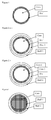
- core-shell polymer as used is denoted a polymers having structures for example as shown in figures 1-3 , but not limited there to.
- particle size as used is denoted the volume average diameter of a particle considered as spherical as measured by light diffusion using laser spectrometry.
- binder as used are denoted polymer particles having a volume average diameter over 1 ⁇ m.
- parts as used herein is denoted “parts by weight”. Unless otherwise stated, “total parts by weight” do not necessarily add to 100.
- neutral pH as used herein is denoted a pH from 6.0 to 7.5.
- the core-shell impact modifier is an emulsion graft copolymer having a butadiene-based core polymer and one or more shell polymers.
- a graft copolymer is obtained by graft-polymerizing a monomer or monomer mixture containing at least an aromatic vinyl, alkyl methacrylate or alkyl acrylate in the presence of a latex containing a butadiene-based rubber polymer.
- Polymerization initiators useful in producing the graft copolymer include, but are not limited to a persulfate salt such as potassium persulfate, ammonium persulfate, and sodium persulfate; an organic peroxide such as tert-butyl hydroperoxide, cumene hydroperoxide, benzoyl peroxide, lauroyl peroxide, p-menthane hydroperoxide, and diisopropylbenzene hydroperoxide; an azo compound such as azobisisobutyronitrile, and azobisisovaleronitrile; or a redox initiator.
- a persulfate salt such as potassium persulfate, ammonium persulfate, and sodium persulfate
- an organic peroxide such as tert-butyl hydroperoxide, cumene hydroperoxide, benzoyl peroxide, lauroyl peroxide, p-menthane hydroperoxide,
- a reducing agent in particular such as alkali metal sulfite, alkali metal bisulfite, sodium formaldehyde sulfoxylate (NaHSO 2 HCHO), ascorbic acid, glucose, and in particular those of the said catalytic systems which are water-soluble,
- the emulsifying agent may be chosen from anionic emulsifying agents, such as sodium or potassium salts of fatty acids, in particular sodium laurate, sodium stearate, sodium palmitate, sodium oleate, mixed sulphates of sodium or of potassium and of fatty alcohols, in particular sodium lauryl sulphate, sodium or potassium salts of sulphosuccinic esters, sodium or potassium salts of alkylarylsulphonic acids, in particular sodium dodecylbenzenesulphonate, and sodium or potassium salts of fatty monoglyceride monosulphonates, or alternatively from nonionic surfactants, such as the reaction products of ethylene oxide and of alkylphenol or of aliphatic alcohols, alkylphenols. Use may also be made of mixtures of such surface-active agents, if necessary.
- anionic emulsifying agents such as sodium or potassium salts of fatty acids, in particular sodium laurate, sodium stearate, sodium palmitate, sodium ole
- the core-shell copolymer is in the form of fine particles having a rubber core and at least one thermoplastic shell, the particle size being generally less than 1 ⁇ m and advantageously between 50nm and 500nm, preferably between 100nm and 400nm, and most preferably 150nm and 350nm, advantageously between 170nm and 350nm.
- the core-shell particle has preferably more than one shell.
- At least the outer shell, in contact with the thermoplastic matrix, has a glass transition temperature (Tg) greater then 25°C, preferably greater then 50°C.
- Tg glass transition temperature
- the core-shell impact modifier is prepared by emulsion polymerization.
- a suitable method is a two-stage polymerization technique in which the core and shell are produced in two sequential emulsion polymerization stages. If there are more shells another emulsion polymerization stage follows.
- the core-shell ratio is not particularly limited, but preferably in a range in weight between 10/90 and 90/10, more preferably 40/60 and 90/10 advantageously 60/40 to 90/10 and most advantageously between 70/30 and 85/15.
- this is a rubber polymer.
- the glass transition temperature (Tg) of the rubber core is less then 0°C, preferably less then -10°C, advantageously less then -20°C and most advantageously less then - 25°C and more most advantageously less then -40°C.
- the rubber core has a glass transition temperature between -120°C and -10°C and more particularly between -90°C and - 40°C, preferably between -80°C and -40°C and more preferably between - 80°C and - 50 °C.
- the rubber polymer of the core mention may be made of isoprene homopolymers or butadiene homopolymers, isoprene-butadiene copolymers, copolymers of isoprene with at most 98 wt% of a vinyl monomer and copolymers of butadiene with at most 98 wt% of a vinyl monomer.
- the vinyl monomer may be styrene, an alkylstyrene, acrylonitrile, an alkyl (meth)acrylate, or butadiene or isoprene.
- the core is a butadiene homopolymer.
- the core of the core-shell copolymer may be completely or partly crosslinked. All that is required is to add at least difunctional monomers during the preparation of the core; these monomers may be chosen from poly(meth)acrylic esters of polyols, such as butanediol di(meth)acrylate and trimethylolpropane trimethacrylate. Other multifunctional monomers are, for example, divinylbenzene, trivinylbenzene, and triallyl cyanurate.
- the core can also be crosslinked by introducing into it, by grafting or as a comonomer during the polymerization, unsaturated functional monomers such as anhydrides of unsaturated carboxylic acids, unsaturated carboxylic acids and unsaturated epoxides. Mention may be made, by way of example, of maleic anhydride, (meth)acrylic acid and glycidyl methacrylate. The crosslinking may also be carried out by using the intrinsic reactivity of the monomers, for example the diene monomers.
- the core can also be covered by a core layer.
- core layer is meant that the polymer composition of that core layer has glass transition temperature (Tg) of less then 0°C, preferably less then -10°C, advantageously less then -20°C and most advantageously less then -25°C.
- Chain transfer agents are also useful in forming the core polymer.
- Useful chain transfer agents include those known in the art, including but not limited to ter- dodecylmercaptan, n-docdecylmercaptan, n-octylmercaptan, and mixtures of chain transfer agents.
- the chain transfer agent is used at levels from 0 to 2 percent by weight, based on the total core monomer content. In a preferred embodiment, 0.1 to 1 percent chain transfer agent is used in forming the core polymer.
- these are styrene homopolymers, alkylstyrene homopolymers or methyl methacrylate homopolymers, or copolymers comprising at least 70 wt% of one of the above monomers and at least one comonomer chosen from the other above monomers, another alkyl (meth)acrylate, vinyl acetate and acrylonitrile.
- the shell may be functionalized by introducing into it, by grafting or as a comonomer during the polymerization, unsaturated functional monomers such as anhydrides of unsaturated carboxylic acids, unsaturated carboxylic acids and unsaturated epoxides.
- core-shell copolymers having a polystyrene shell and core-shell copolymers having a PMMA shell.
- the shell may also contain imide functional groups, either by copolymerization with a maleimide or by chemical modification of the PMMA by a primary amine.
- the molar concentration of the imide functional groups is 30 to 60% (relative to the entire shell).
- core-shell copolymers having two shells, one made of polystyrene and the other, on the outside, made of PMMA. Examples of copolymers and their method of preparation are described in the following patents: US 4 180 494 , US 3 808 180 , US 4 096 202 , US 4 260 693 , US 3 287 443 , US 3 657 391 , US 4 299 928 , US 3 985 704 and US 5 773 320 .
- the shell(s) may be crosslinked by adding a at least one multifunctional monomer during the preparation of the respective shell.
- the polymeric core which is a rubber, and at least one polymeric layer.
- the physical property the young modulus of the polymeric rubber core is always less then the modulus of the other polymeric layer or layers.
- working up or recovery meaning the isolation of the core-shell polymers from the emulsion
- working up or recovery is carried out by means of spray drying or by means of precipitation or coagulation and separation of the dispersing water.
- the buffer according to the invention is a buffer that works in a pH range between 4 and 8, preferably between 5 and 7.5 advantageously between 6 and 7.5 and most advantageously between 6 and 7.
- the separation of the coagulated and precipitated polymer and the water can take place by conventional methods for example sieving, filtration, decantation or centrifugation. After separating off the dispersing water, a moist graft polymer is obtained, which usually has residual water content of up to 60 wt. %.
- the pH of the latex of the core-shell copolymer particle before the coagulation step is between 4 and 7.5 preferably between 5 and 7.
- the pH during the coagulation step b) is between 6 and 7.
- the pH value of step b) is adjusted by addition of an aqueous buffer solution and precipitated at the same time. If the pH value before the coagulation step is far outside (at least 1 pH unity) of the pH interval, it is possible to add only one component for the buffer of the aqueous buffer solution, either the proton donor or the proton acceptor.
- the pH value of the latex causes that some of the buffer component will be protonated or deprotonated with the result of establishing the buffer equilibrium. For instance trisodium phosphate may be added to a latex having a pH ⁇ 3, the phosphate is protonated to give hydrogenphosphate or/and dihydrogenphosphate and the buffer is produced for adjusting and precipitation at the same time.
- the buffer solution is an aqueous solution consisting of a mixture of a weak acid and its conjugate base or a weak base and its conjugate acid or mixed systems.
- buffer solution As example of buffer solution, one can mention, buffer of carbonic acid (H 2 CO 3 ) and bicarbonate (HCO 3 - ) present in blood plasma, to maintain a pH between 7.35 and 7.45, or citric acid and sodium citrate buffer solution, or phosphate buffers based on tri pottasium phosphates, dipotassium and monopotassium phosphates or trisodium phosphates, disodium and monosodium phosphates or citric acid and disodium phosphate.
- phosphate buffer solutions are used in the present invention and more preferably, phosphate buffer solution prepared to be able to keep pH value between 6 and 7.
- the aqueous phosphate buffer solution according to the invention comprises a buffer based on at least on compound chosen from tri pottasium phosphates or dipotassium or monopotassium phosphates or trisodium phosphates or disodium or monosodium phosphates or mixtures thereof.
- the coagulation is carried out by only ading the buffer solution, no other additional electrolyte is added.
- the process can comprise a optional further step ab) between step a) and step b), characterized by controlling the pH value of the core-shell copolymer particle after the synthesis step a).
- the control of the pH can be done with a pH meter. It is obvious that the pH control is not necessary if it is known by the well established reaction conditions what pH value is exactly obtained at the end of the synthesis step. By control is also meant the knowledge and certitude that the pH value is inside a certain interval at the end of the synthesis step.
- the process can comprise an optional further step c) - after step b) - characterized that the pH of the coagulated core-shell polymer is adjusted at a pH between 6 and 7.5 and advantageously between 6 and 7.
- the pH value of the core shell impact modifier should not be too alkaline as it influences directly the degradation of the thermoplastic matrix, meaning the heat ageing in view of coloration of the thermoplastic resin wherein the core-shell impact modifier of the invention is used.
- the pH value of the final core-shell impact modifier should be smaller then 7.5, advantageously smaller then 7.
- the adjustment of the pH after coagulation can be made if necessary by electrolytes as solutions of for example inorganic salts such as sodium sulfate, calcium sulfate, sodium dihydrogenophosphate, disodium hydrogenophosphate, potassium dihydrogenophosphate, dipotassium hydrogenophosphate, calcium.
- inorganic salts can be used from the anhydrous or the hydrated form when it exists, as for example magnesium sulfate anhydrous or magnesium sulfate heptahydrous.
- the electrolyte is chosen from inorganic salts and preferably among phosphates and sulfates anions and among sodium, potassium, magnesium and calcium cations, as for example magnesium sulfate, calcium sulfate, disodium hydrogenophosphate, potassium dihydrogenophosphate.
- the electrolytes are used in form of an aqueous solution of one or more thereof. Strong inorganic bases like NaOH, KOH, LiOH, Ca(OH)2 and more generally ammonia and most organic bases which release OH- ions due to hydrolysis have to be avoided.
- the coagulation is carried out at temperatures of from 5°C to 100°C, preferably from 10°C to 100°C, particularly preferably from 15°C to 100°C advantageously from 20°C to 90°C.
- the latex coming from the synthesis used for the coagulation has a solid content between 15% and 60 % in weight and preferably between 25% and 50%.
- the aqueous solution of the electrolyte contain concentrations in salt small enough to insure solubility of the species, taking into account their solubility constant in water at 25°C.
- the separation of the coagulated and precipitated polymer and the water can take place by conventional methods for example sieving, filtration, decantation or centrifugation or combination of some of them.
- a moist grafted polymer is obtained, which usually has residual water content of up to 75 wt. %.
- the auxiliary substances such as, for example, emulsifiers, decomposition products of the radical formers, buffer substances, so that a considerable portion of up to 100% of the auxiliary substances remains in the graft polymer and consequently in the end product, that is to say the moist grafted polymer.
- all byproducts and impurities that will not part with the water will rest in the core-shell polymer powder.
- Still another aspect of the invention is an impact modified thermoplastic composition
- a thermoplastic polymer comprising at least one thermoplastic polymer and a core-shell copolymer impact modifier particle as obtained by process as described before.
- thermoplastic polymer that is part of the thermoplastic composition according to the invention it can be chosen among but not limited to, poly(vinyl chloride) (PVC), polyesters as for example poly (ethylene terephtalate) (PET) or poly(butylen terephtalate) (PBT)or polylactic acid (PLA), polystyrene (PS), polycarbonates (PC), polyethylene, poly (methyl methacrylate)s , (meth)acrylic copolymers, thermoplastic poly(methyl methacrylate-coethylacrylates), poly(alkylene-terephtalates), poly vinylidene fluoride , les poly(vinylidenchloride), polyoxymethylen (POM) , semi-crystalline polyamides, amorphous polyamides, semi-crystalline copolyamides, amorphous copolyamides, polyetheramides, polyesteramides, copolymers of styrene and acrylonitrile (SAN), and
- thermoplastic resin composition comprises polycarbonate (PC) and/or polyester (PET or PBT) or PC or polyester alloys.
- PC polycarbonate
- PET or PBT polyester
- PC or polyester alloys for example may be PC/ABS, PC/polyester or PC/PLA just to mention a few.
- the proportions between the core-shell polymer of the invention and the thermoplastic polymer are between 0.5/99.5 and 20/80, preferably between 2/98 and 15/75.
- CHDF capillary hydrodynamic fractionation
- D (v, 0.5) is the particle size at which 50% of the sample has size less then and 50% of the sample have a size larger then that size, or in other words the equivalent volume diameter at 50% cumulative volume. This size is also known as volume medium diameter that is related to the mass median diameter by the density of the particles by the density of the particles assuming a size independent density for the particles.
- D (v, 0.1) is the particle size at which 10% of the sample is smaller then that size, or in other words the equivalent volume diameter at 10% cumulative volume.
- D (v, 0.9) is the particle size at which 90% of the sample are smaller then that size.
- D[4,3] is the volume average diameter.
- the Span is expressing the width of the particle size distribution. The smaller the parameter is the smaller the particle size distribution is.
- the norm 9276-1 Presentation of results of particle size analysis part 1: graphical representation
- the norm 9276-2 Presentation of results of particle size analysis part 2: Calculation of average particle sizes/diameters and moments from particle size distribution
- the respective impact modifier powders are mixed with the thermoplastic resin polycarbonate Lexan ML5221 from SABIC(at 5wt% with the aide of an extruder type Clextral (double diameter 25mm, length 700mm) using temperatures between from 100°C up to 320°C depending on the respective zones throughout the whole extruder.
- thermoplastic composition The impact strength of the thermoplastic composition is measured in accordance with the norm ISO 180-2000. Test specimen are Type 1A.
- melt flow index (MVI) of the polymeric composition is measured in accordance with ISO-1333-2005 at 300°C using a 2.16kg load. Samples were prepared. The MVI change is expressed in percentage of change from the prepared sample at 300° after 25 min compared to the value after 6min. As the polymer composition gets more fluid the MVI value at 25 min is larger then the value at 6 min.
- the color change is observed by measuring the parameter b*.
- the b* value is used to characterize the principal yellowing off the samples.
- the b* value measures the blue and the yellow of the colour. Colours tending toward the yellow have a positive b* value while those tending toward the blue have a negative b* value.
- the b* values is measured using a colorimeter (especially according to the ASTM E 308 standard).
- thermoplastic composition comprising the impact modifiers of the invention is acceptable.
- the b* should not larger then 4.
- the colour change is observed as a function of time under different conditions: samples kept at 120°C and samples kept at 90°C and 95% humidity.
- Paraloid TM EXL2691A is an MBS impact modifier from ROHM and HAAS.
- Example 1 (according to the invention) of a latex according to figure 2b
- the solution was heated to 68° C, additional initiator (p-menthane hydroperoxide 0.09 parts) and Styrene (0.9 parts) were continously added during additional 3 hours, and allowed to react until at least twenty hours had elapsed since polymerization initiation, producing butadiene core1-BD/ST gradient core2 latex (R2).
- the resultant polybutadiene rubber latex (R2) contained 40.3wt% solids and had a average particle size of about 180 nm.
- the stabilization emulsion was prepared by mixing 5.4 parts de-ionized water (based on graft copolymer mass), 0.1 parts sodium salt of dodecyl benzene sulfonic acid, 0.1 parts dilauryl thiodipropionate, and 0.24 parts triethyleneglycol-bis[3-(3-t-butyl-4-hydroxy-5-methylphenyl)-propionate].
- the resultant core shell latex (E2) had an average particle size of about 190 nm.
- Buffer solution for adjusting the pH and to coagulate
- the latex from example 1 is coagulated with a mixture of CaCl 2 and Na 2 HPO 4 .
- 17.5 g CaCl 2 a/2*H2O is completed to 332g with demineralized water.
- 647 g of a solution of Na 2 HPO 4 at 0.4mol/l is prepared.
- the two solutions are mixed in a 2 litres calibrated flask and are completed to 2 litres with demineralized water.
- the coagulation according to the quantities and conditions of the previous example for coagulation is repeated while using the buffer electrolyte solution of example 2.
- the pH of the coagulated product is 6.8. Coagulating agent pH adjustment at the end to obtain neutral pH EXL2691A / (Spray dried) No Example 1 Phosphate buffer solution Yes, inherent to buffer solution Example 2 CaCl2/Phosphate buffer solution Yes, inherent to buffer solution
- the figures are examples for core-shell structures
Landscapes
- Chemical & Material Sciences (AREA)
- Health & Medical Sciences (AREA)
- Chemical Kinetics & Catalysis (AREA)
- Medicinal Chemistry (AREA)
- Polymers & Plastics (AREA)
- Organic Chemistry (AREA)
- General Chemical & Material Sciences (AREA)
- Graft Or Block Polymers (AREA)
- Compositions Of Macromolecular Compounds (AREA)
- Addition Polymer Or Copolymer, Post-Treatments, Or Chemical Modifications (AREA)
Abstract
The present invention relates to, amongst other things, a process for manufacturing an impact modifier, concerns impact modified thermoplastic molding compositions and in particular a process for manufacturing and recovering the impact modifiers and their use in polymeric thermoplastic compositions.
More particularly the present invention relates to a polymeric impact modifier with a core-shell structure manufactured by a multistage process comprising a special recovery process so that the composition of the thermoplastic polymer containing the impact modifier has a high fluidity while keeping its high impact strength.
More particularly the present invention relates to a polymeric impact modifier with a core-shell structure manufactured by a multistage process comprising a special recovery process so that the composition of the thermoplastic polymer containing the impact modifier has a high fluidity while keeping its high impact strength.
Description
- The present invention relates to, amongst other things, a process for manufacturing an impact modifier, concerns impact modified thermoplastic molding compositions and in particular
a process for manufacturing and recovering the impact modifiers and their use in polymeric thermoplastic compositions.
More particularly the present invention relates to a polymeric impact modifier with a core-shell structure manufactured by a multistage process comprising a special recovery process so that the composition of the thermoplastic polymer containing the impact modifier has a high fluidity while keeping its high impact strength. - Thermoplastic compositions and especially aromatic polycarbonates may be employed in numerous applications, such as electrical, engineering and automotive applications. Typically, high molecular weight aromatic polycarbonates are employed in electrical and engineering applications because of their relatively high strength, high impact resistance. However, high molecular weight polycarbonates typically exhibit relatively poor melt flow characteristics, which may restrict their applications. In particular, high molecular weight aromatic polycarbonates typically exhibit relatively low melt flow rates. Consequently, it is typically more difficult to form intricate moulded parts and moulded articles with low levels of residual stress from such aromatic polycarbonates.
- It is, as well, important to have an impact modifier powder that has no negative influence on the thermoplastic polymer. As negative influence, it is understood, for example the color stability of the thermoplastic polymer comprising the impact modifier, either on function of the time or the temperature or both.
All these influences might occur due to the architecture of the core-shell but more particularly the impurities and side products employed during the synthesis and treatment of the impact modifier powder. Usually, there is no special purification step of the impact modifier, just a separation of solid versus liquid. Therefore more or less important quantities of any chemical compound (impurities, by-products) employed are still incorporated in the impact modifier. These chemical compounds should not influence the thermoplastic material in a major way as for example degradation of optical and/or mechanical properties with time and/or temperature and/or hygrometry. - It is also, as well important, to separate the impact modifier from the reaction medium in the easiest way, meaning essentially the use of less of resources as possible. As resources can be seen equipment involved, energy, and more generally utilities and any products.
- In order to overcome the low fluidity of aromatic polycarbonates, blends of the polycarbonate with other polymer resins have been employed. For example, blends of aromatic polycarbonates and acrylonitrile-butadiene-styrene (ABS) have been used to enhance the melt flow of the polycarbonate. However a disadvantage which may result from blends of aromatic polycarbonates and ABS include a reduction in the Vicat softening point and a reduction in the impact resistance compared to the aromatic polycarbonate alone at temperatures above 0°C
- One objective of the invention is therefore to solve the aforementioned technical problems associated with processing a impact modified thermoplastic polymer and especially a aromatic polycarbonate or a blend of a aromatic polycarbonate and another polymer, particularly a thermoplastic blend of an aromatic polycarbonate and another polymer.
- A further objective of the invention is to have thermoplastic composition containing an impact modifier that has a good compromise between all the properties of the impact modified thermoplastic polymer as having high impact strength, while reducing the viscosity of the polymer composition and no color change (yellowing) at elevated temperatures, due to the influence of impurities or by-products used during the preparation of the impact modifier.
- The document
W02008/149156 describes a polymer composition comprising an aromatic polycarbonate, a graft copolymer including polyacrylonitrile and a non crosslinked acrylic polymer for melt processing applications such as injection moulding. - The document
EP0668318 describes a stabilized modifier and impact modified thermoplastics. The impact modifier is a stabilized MBS core-shell graft polymer stabilized by a hindered phenol and optionally a pH buffer system for a pH in a range of about 7 to 11. One example uses a buffer based on sodium hydroxide and phosphoric acid to bring the pH to 7.5 to 8.0. The stabilized MBS polymer was recovered by spray drying. - The document
W02009/118114 describes an impact modified polycarbonate composition with a good combination of color, hydrolysis and melt stability. The rubber core is based on polybutadiene. The pH value between 2 and 11 of the impact modifier is adapted by buffers, acids or basic compounds as NaOH and KOH. - The document
US2004/0102564 describes a method for producing thermoplastic molding materials containing rubber. After the polymerization of the rubber polymer a pH buffer system is added to the aqueous phase in order to reduce the mold deposit of the thermoplastic molding. The pH range for the buffer system is large and the choice of the buffer system as well. - Surprisingly it discovered that the pH value during the precipitation agglomeration step is important for the coagulation and the performance of the product in the thermoplastic resin. It could be not sufficient to have a certain pH for the final product, but already respect a certain pH during the recovery step. The nature of the species (either acidic or basic) used to control the pH is also important for the performance of the product in the thermoplastic resin.
- Surprisingly it has also been discovered as well that the recovery process of a core-shell impact modifier by agglomeration with means of an aqueous electrolyte solution in form of a buffer solution is possible.
- Unexpectedly, it has been found that by employing a core-shell copolymer impact modifier obtained with a recovery processes discovered herein, typically provides a thermoplastic composition having the desired Melt Flow Rate whilst still retaining an acceptable and relatively high impact strenght and an acceptable yellowing under aging conditions.
- According to a first aspect the invention concerns a process for producing an impact modifier comprising following steps
- a) synthesis of a core-shell copolymer by emulsion polymerization
- b) coagulation of the core shell polymer at a pH between 4 and 8 by addition of an aqueous electrolyte solution,
wherein the aqueous electrolyte solution comprises an aqueous buffer solution. - According to another aspect the invention concerns a process for producing an impact modifier comprising following steps
- a) synthesis of a core-shell copolymer by emulsion polymerization
- b) coagulation of the core shell polymer at a pH between 4 and 8 by addition of an aqueous electrolyte solution,
- By the term "impact modifier" as used is denoted a compound comprising an elastomer or rubber that can be added or incorporated in a thermoplastic compound to improve its impact resistance.
By the term "buffer" as used is denoted a mixture of a weak acid and its conjugated base or a weak base and its conjugated acid or mixed systems.
By the term "weak acid" or "weak base" as used is denoted an acid or a base that is partially dissociated in aqueous solution.
By the term "rubber" as used is denoted the thermodynamic state of the polymer above its glass transition.
By the term "alkyl(meth)acrylate" as used is denoted the to both alkyl acrylate and alkyl methacrylate.
By the term "copolymer" as used is denoted that the polymers consists of at least two different monomers.
By "multistage polymer" as used is denoted a polymer formed in sequential fashion by a multi-stage emulsion polymerization process with at least two stages that are different in composition. Preferred is a multi-stage emulsion polymerization process in which the first polymer is a first-stage polymer and the second polymer is a second-stage polymer, i.e., the second polymer is formed by emulsion polymerization in the presence of the first emulsion polymer.
By the term "core-shell polymer" as used is denoted a polymers having structures for example as shown infigures 1-3 , but not limited there to.
By the term "particle size" as used is denoted the volume average diameter of a particle considered as spherical as measured by light diffusion using laser spectrometry.
By the term "powder" as used are denoted polymer particles having a volume average diameter over 1 µm.
By the term "parts" as used herein is denoted "parts by weight". Unless otherwise stated, "total parts by weight" do not necessarily add to 100. - By the term "neutral pH" as used herein is denoted a pH from 6.0 to 7.5.
- With regard to the production or synthesis process, the core-shell impact modifier is an emulsion graft copolymer having a butadiene-based core polymer and one or more shell polymers. A graft copolymer, is obtained by graft-polymerizing a monomer or monomer mixture containing at least an aromatic vinyl, alkyl methacrylate or alkyl acrylate in the presence of a latex containing a butadiene-based rubber polymer.
- Polymerization initiators useful in producing the graft copolymer include, but are not limited to a persulfate salt such as potassium persulfate, ammonium persulfate, and sodium persulfate; an organic peroxide such as tert-butyl hydroperoxide, cumene hydroperoxide, benzoyl peroxide, lauroyl peroxide, p-menthane hydroperoxide, and diisopropylbenzene hydroperoxide; an azo compound such as azobisisobutyronitrile, and azobisisovaleronitrile; or a redox initiator. However, it is preferable to use catalytic systems of redox type formed by the combination of a peroxide compound, for example as mentioned above, with a reducing agent, in particular such as alkali metal sulfite, alkali metal bisulfite, sodium formaldehyde sulfoxylate (NaHSO2HCHO), ascorbic acid, glucose, and in particular those of the said catalytic systems which are water-soluble, for example potassium persulfate/sodium metabisulfite or alternatively diisopropylbenzene hydroperoxide/sodium formaldehyde sulfoxylate or even more complicate systems as for example ferrous sulfate/dextrose/sodium pyrophosphate.
- Use may be made, as emulsifying agent, of any one of the known surface-active agents, whether anionic, nonionic or even cationic. In particular, the emulsifying agent may be chosen from anionic emulsifying agents, such as sodium or potassium salts of fatty acids, in particular sodium laurate, sodium stearate, sodium palmitate, sodium oleate, mixed sulphates of sodium or of potassium and of fatty alcohols, in particular sodium lauryl sulphate, sodium or potassium salts of sulphosuccinic esters, sodium or potassium salts of alkylarylsulphonic acids, in particular sodium dodecylbenzenesulphonate, and sodium or potassium salts of fatty monoglyceride monosulphonates, or alternatively from nonionic surfactants, such as the reaction products of ethylene oxide and of alkylphenol or of aliphatic alcohols, alkylphenols. Use may also be made of mixtures of such surface-active agents, if necessary.
- With regard to the core-shell copolymer, this is in the form of fine particles having a rubber core and at least one thermoplastic shell, the particle size being generally less than 1 µm and advantageously between 50nm and 500nm, preferably between 100nm and 400nm, and most preferably 150nm and 350nm, advantageously between 170nm and 350nm.
The core-shell particle has preferably more than one shell. At least the outer shell, in contact with the thermoplastic matrix, has a glass transition temperature (Tg) greater then 25°C, preferably greater then 50°C.
The core-shell impact modifier is prepared by emulsion polymerization. For example a suitable method is a two-stage polymerization technique in which the core and shell are produced in two sequential emulsion polymerization stages. If there are more shells another emulsion polymerization stage follows.
The core-shell ratio is not particularly limited, but preferably in a range in weight between 10/90 and 90/10, more preferably 40/60 and 90/10 advantageously 60/40 to 90/10 and most advantageously between 70/30 and 85/15. - With regard to the core according to the invention, this is a rubber polymer. The glass transition temperature (Tg) of the rubber core is less then 0°C, preferably less then -10°C, advantageously less then -20°C and most advantageously less then - 25°C and more most advantageously less then -40°C.
Preferably the rubber core has a glass transition temperature between -120°C and -10°C and more particularly between -90°C and - 40°C, preferably between -80°C and -40°C and more preferably between - 80°C and - 50 °C. - By way of example, the rubber polymer of the core, mention may be made of isoprene homopolymers or butadiene homopolymers, isoprene-butadiene copolymers, copolymers of isoprene with at most 98 wt% of a vinyl monomer and copolymers of butadiene with at most 98 wt% of a vinyl monomer. The vinyl monomer may be styrene, an alkylstyrene, acrylonitrile, an alkyl (meth)acrylate, or butadiene or isoprene. In a preferred embodiment the core is a butadiene homopolymer.
The core of the core-shell copolymer may be completely or partly crosslinked. All that is required is to add at least difunctional monomers during the preparation of the core; these monomers may be chosen from poly(meth)acrylic esters of polyols, such as butanediol di(meth)acrylate and trimethylolpropane trimethacrylate. Other multifunctional monomers are, for example, divinylbenzene, trivinylbenzene, and triallyl cyanurate. The core can also be crosslinked by introducing into it, by grafting or as a comonomer during the polymerization, unsaturated functional monomers such as anhydrides of unsaturated carboxylic acids, unsaturated carboxylic acids and unsaturated epoxides. Mention may be made, by way of example, of maleic anhydride, (meth)acrylic acid and glycidyl methacrylate. The crosslinking may also be carried out by using the intrinsic reactivity of the monomers, for example the diene monomers.
The core can also be covered by a core layer. By core layer is meant that the polymer composition of that core layer has glass transition temperature (Tg) of less then 0°C, preferably less then -10°C, advantageously less then -20°C and most advantageously less then -25°C. - For preparing the rubber core with a diameter of 50-250nm of the core-shell particle different processes can be used: the grow-out process, the seeded grow-out process and an agglomeration process. The grow-out process is preferred in order to have a narrower homogenous particle size distribution and avoiding fine particles. Chain transfer agents are also useful in forming the core polymer. Useful chain transfer agents include those known in the art, including but not limited to ter- dodecylmercaptan, n-docdecylmercaptan, n-octylmercaptan, and mixtures of chain transfer agents. The chain transfer agent is used at levels from 0 to 2 percent by weight, based on the total core monomer content. In a preferred embodiment, 0.1 to 1 percent chain transfer agent is used in forming the core polymer.
- With regard to the shell(s) according to the invention, these are styrene homopolymers, alkylstyrene homopolymers or methyl methacrylate homopolymers, or copolymers comprising at least 70 wt% of one of the above monomers and at least one comonomer chosen from the other above monomers, another alkyl (meth)acrylate, vinyl acetate and acrylonitrile. The shell may be functionalized by introducing into it, by grafting or as a comonomer during the polymerization, unsaturated functional monomers such as anhydrides of unsaturated carboxylic acids, unsaturated carboxylic acids and unsaturated epoxides. Mention may be made, for example, of maleic anhydride, (meth)acrylic acid glycidyl methacrylate, hydroxyethyl methacrylate and alkyl(meth)acrylamides. By way of example, mention may be made of core-shell copolymers having a polystyrene shell and core-shell copolymers having a PMMA shell. The shell may also contain imide functional groups, either by copolymerization with a maleimide or by chemical modification of the PMMA by a primary amine. Advantageously, the molar concentration of the imide functional groups is 30 to 60% (relative to the entire shell). There are also core-shell copolymers having two shells, one made of polystyrene and the other, on the outside, made of PMMA. Examples of copolymers and their method of preparation are described in the following patents:
US 4 180 494 ,US 3 808 180US 4 096 202 ,US 4 260 693 ,US 3 287 443US 3 657 391US 4 299 928 ,US 3 985 704US 5 773 320 .
The shell(s) may be crosslinked by adding a at least one multifunctional monomer during the preparation of the respective shell. - With regard to structure and the properties of the core-shell copolymer there is the polymeric core, which is a rubber, and at least one polymeric layer. The physical property the young modulus of the polymeric rubber core is always less then the modulus of the other polymeric layer or layers.
- Usually the working up or recovery (meaning the isolation of the core-shell polymers from the emulsion) is carried out by means of spray drying or by means of precipitation or coagulation and separation of the dispersing water.
- In the case of the present invention working up is done by means of coagulation and separation of the dispersing water. The coagulation precipitation is made with an electrolyte addition comprising an aqueous buffer solution.
- With regard to the buffer according to the invention, it is a buffer that works in a pH range between 4 and 8, preferably between 5 and 7.5 advantageously between 6 and 7.5 and most advantageously between 6 and 7.
- The separation of the coagulated and precipitated polymer and the water can take place by conventional methods for example sieving, filtration, decantation or centrifugation. After separating off the dispersing water, a moist graft polymer is obtained, which usually has residual water content of up to 60 wt. %.
- With regard to the recovery process the pH of the latex of the core-shell copolymer particle before the coagulation step is between 4 and 7.5 preferably between 5 and 7. Advantageously the pH during the coagulation step b) is between 6 and 7. The pH value of step b) is adjusted by addition of an aqueous buffer solution and precipitated at the same time.
If the pH value before the coagulation step is far outside (at least 1 pH unity) of the pH interval, it is possible to add only one component for the buffer of the aqueous buffer solution, either the proton donor or the proton acceptor. The pH value of the latex causes that some of the buffer component will be protonated or deprotonated with the result of establishing the buffer equilibrium. For instance trisodium phosphate may be added to a latex having a pH<3, the phosphate is protonated to give hydrogenphosphate or/and dihydrogenphosphate and the buffer is produced for adjusting and precipitation at the same time. - The buffer solution is an aqueous solution consisting of a mixture of a weak acid and its conjugate base or a weak base and its conjugate acid or mixed systems.
- As example of buffer solution, one can mention, buffer of carbonic acid (H2CO3) and bicarbonate (HCO3 -) present in blood plasma, to maintain a pH between 7.35 and 7.45, or citric acid and sodium citrate buffer solution, or phosphate buffers based on tri pottasium phosphates, dipotassium and monopotassium phosphates or trisodium phosphates, disodium and monosodium phosphates or citric acid and disodium phosphate.
Preferably, phosphate buffer solutions are used in the present invention and more preferably, phosphate buffer solution prepared to be able to keep pH value between 6 and 7.
The aqueous phosphate buffer solution according to the invention comprises a buffer based on at least on compound chosen from tri pottasium phosphates or dipotassium or monopotassium phosphates or trisodium phosphates or disodium or monosodium phosphates or mixtures thereof.
Preferably the coagulation is carried out by only ading the buffer solution, no other additional electrolyte is added. - Another aspect of the invention is that the process can comprise a optional further step ab) between step a) and step b), characterized by controlling the pH value of the core-shell copolymer particle after the synthesis step a).
The control of the pH can be done with a pH meter. It is obvious that the pH control is not necessary if it is known by the well established reaction conditions what pH value is exactly obtained at the end of the synthesis step. By control is also meant the knowledge and certitude that the pH value is inside a certain interval at the end of the synthesis step. - Another aspect of the invention is that the process can comprise an optional further step c) - after step b) - characterized that the pH of the coagulated core-shell polymer is adjusted at a pH between 6 and 7.5 and advantageously between 6 and 7.
- The pH value of the core shell impact modifier should not be too alkaline as it influences directly the degradation of the thermoplastic matrix, meaning the heat ageing in view of coloration of the thermoplastic resin wherein the core-shell impact modifier of the invention is used.
- Therefore the pH value of the final core-shell impact modifier should be smaller then 7.5, advantageously smaller then 7.
- The adjustment of the pH after coagulation can be made if necessary by electrolytes as solutions of for example inorganic salts such as sodium sulfate, calcium sulfate, sodium dihydrogenophosphate, disodium hydrogenophosphate, potassium dihydrogenophosphate, dipotassium hydrogenophosphate, calcium. Inorganic salts can be used from the anhydrous or the hydrated form when it exists, as for example magnesium sulfate anhydrous or magnesium sulfate heptahydrous. Advantageously the electrolyte is chosen from inorganic salts and preferably among phosphates and sulfates anions and among sodium, potassium, magnesium and calcium cations, as for example magnesium sulfate, calcium sulfate, disodium hydrogenophosphate, potassium dihydrogenophosphate. The electrolytes are used in form of an aqueous solution of one or more thereof.
Strong inorganic bases like NaOH, KOH, LiOH, Ca(OH)2 and more generally ammonia and most organic bases which release OH- ions due to hydrolysis have to be avoided. - The coagulation is carried out at temperatures of from 5°C to 100°C, preferably from 10°C to 100°C, particularly preferably from 15°C to 100°C advantageously from 20°C to 90°C. The latex coming from the synthesis used for the coagulation has a solid content between 15% and 60 % in weight and preferably between 25% and 50%. The aqueous solution of the electrolyte contain concentrations in salt small enough to insure solubility of the species, taking into account their solubility constant in water at 25°C.
- The separation of the coagulated and precipitated polymer and the water can take place by conventional methods for example sieving, filtration, decantation or centrifugation or combination of some of them. After separating off the dispersing water, a moist grafted polymer is obtained, which usually has residual water content of up to 75 wt. %.
By the process according to the invention there is only partial separation of the auxiliary substances, such as, for example, emulsifiers, decomposition products of the radical formers, buffer substances, so that a considerable portion of up to 100% of the auxiliary substances remains in the graft polymer and consequently in the end product, that is to say the moist grafted polymer.
As there is no further purification step, all byproducts and impurities that will not part with the water will rest in the core-shell polymer powder. - Still another aspect of the invention is an impact modified thermoplastic composition comprising at least one thermoplastic polymer and a core-shell copolymer impact modifier particle as obtained by process as described before.
- With regard to the thermoplastic polymer that is part of the thermoplastic composition according to the invention it can be chosen among but not limited to, poly(vinyl chloride) (PVC), polyesters as for example poly (ethylene terephtalate) (PET) or poly(butylen terephtalate) (PBT)or polylactic acid (PLA), polystyrene (PS), polycarbonates (PC), polyethylene, poly (methyl methacrylate)s , (meth)acrylic copolymers, thermoplastic poly(methyl methacrylate-coethylacrylates), poly(alkylene-terephtalates), poly vinylidene fluoride , les poly(vinylidenchloride), polyoxymethylen (POM) , semi-crystalline polyamides, amorphous polyamides, semi-crystalline copolyamides, amorphous copolyamides, polyetheramides, polyesteramides, copolymers of styrene and acrylonitrile (SAN), and their respective mixtures. According to a preferred embodiment the thermoplastic resin composition comprises polycarbonate (PC) and/or polyester (PET or PBT) or PC or polyester alloys. The alloys for example may be PC/ABS, PC/polyester or PC/PLA just to mention a few.
- With regard to the constituents of the composition, the proportions between the core-shell polymer of the invention and the thermoplastic polymer are between 0.5/99.5 and 20/80, preferably between 2/98 and 15/75.
- Estimation of the particle size of the initial impact modifiers at the end of the emulsion polymerization is performed by capillary hydrodynamic fractionation (CHDF).
- For the estimation of weight average powder particle size, particle size distribution and ratio of fine particles a Malvern Mastersizer S apparatus with a 300mm lenses, measuring a range from 0,5-880µm is used.
D (v, 0.5) is the particle size at which 50% of the sample has size less then and 50% of the sample have a size larger then that size, or in other words the equivalent volume diameter at 50% cumulative volume. This size is also known as volume medium diameter that is related to the mass median diameter by the density of the particles by the density of the particles assuming a size independent density for the particles.
D (v, 0.1) is the particle size at which 10% of the sample is smaller then that size, or in other words the equivalent volume diameter at 10% cumulative volume.
D (v, 0.9) is the particle size at which 90% of the sample are smaller then that size.
D[4,3] is the volume average diameter.
The Span is expressing the width of the particle size distribution. The smaller the parameter is the smaller the particle size distribution is.
The norm 9276-1 "Presentation of results of particle size analysis part 1: graphical representation" and the norm 9276-2 "Presentation of results of particle size analysis part 2: Calculation of average particle sizes/diameters and moments from particle size distribution" are used. - Procedure to obtain the pH of the final powder:
- 5 g of dried powder are dispersed in 20 mL of demineralised water under stirring during 10 min. at 45°C. Then, the slurry is filtrated on a Wattman filter in paper. The pH of the filtrated water is measured at room temperature.
- The pH value is obtained using a Fisher Scientific glass probe connected to an Eutech Instrument pH 200 series pH-meter preliminary calibrated with standard buffer solutions.
- Preparation of impact modified compositions, the respective impact modifier powders are mixed with the thermoplastic resin polycarbonate Lexan ML5221 from SABIC(at 5wt% with the aide of an extruder type Clextral (double diameter 25mm, length 700mm) using temperatures between from 100°C up to 320°C depending on the respective zones throughout the whole extruder.
- The impact strength of the thermoplastic composition is measured in accordance with the norm ISO 180-2000. Test specimen are Type 1A.
- In the following examples the melt flow index (MVI) of the polymeric composition is measured in accordance with ISO-1333-2005 at 300°C using a 2.16kg load. Samples were prepared.
The MVI change is expressed in percentage of change from the prepared sample at 300° after 25 min compared to the value after 6min. As the polymer composition gets more fluid the MVI value at 25 min is larger then the value at 6 min. - The color change is observed by measuring the parameter b*. The b* value is used to characterize the principal yellowing off the samples. The b* value measures the blue and the yellow of the colour. Colours tending toward the yellow have a positive b* value while those tending toward the blue have a negative b* value. The b* values is measured using a colorimeter (especially according to the ASTM E 308 standard).
- If the initial color is close to zero it is considered that the thermoplastic composition comprising the impact modifiers of the invention is acceptable. The b* should not larger then 4.
The colour change is observed as a function of time under different conditions: samples kept at 120°C and samples kept at 90°C and 95% humidity. - As commercial products the following product was tested as well: Paraloid™ EXL2691A is an MBS impact modifier from ROHM and HAAS.
- To a 20 litres high-pressure reactor was charged: de-ionized water 116.5 parts, emulsifier sodium salt of dodecyl benzene sulfonic acid 0.1 parts, 1,3-butadiene 20 parts, t-dodecyl mercaptan 0.1 parts, and p-menthane hydroperoxide 0.1 parts as an initial charge . The solution was heated, with agitation, to 43°C at which time a redox-based catalyst solution was charged (water 4.5 parts, sodium tretrapyrophosphate 0.3 parts, ferrous sulfate 0.004parts and dextrose 0.3 parts), effectively initiating the polymerization. Then the solution was further heated to 56°C and held at this temperature for a period of three hours.
Three hours after polymerization initiation, a second monomer charge (71 parts BD, t-dodecyl mercaptan 0.2 parts), additional emulsifier and reductant charge (de-ionized water 30.4 parts, emulsifier sodium salt of dodecyl benzene sulfonic acid 0.9 parts, dextrose 0.5 parts) and additional initiator (p-menthane hydroperoxide 0.8 parts) were continuously added over eight hours. Following the completion of the second monomer addition, the remaining emulsifier and reductant charge plus initiator was continuously added over an additional five hours.
Thirteen hours after polymerization initiation, the solution was heated to 68° C, additional initiator (p-menthane hydroperoxide 0.09 parts) and Styrene (0.9 parts) were continously added during additional 3 hours, and allowed to react until at least twenty hours had elapsed since polymerization initiation, producing butadiene core1-BD/ST gradient core2 latex (R2).
The resultant polybutadiene rubber latex (R2) contained 40.3wt% solids and had a average particle size of about 180 nm. - Into a 3.9 litres reactor was charged 80.75 parts, on a solids basis, of polybutadiene rubber latex R2, 1.3 parts de-ionized water, and 0.004 parts sodium formaldehyde sulfoxylate. The solution was agitated, purged with nitrogen, and heated to 55°C. When the solution reached 62°C, continuously during 60 minutes 7.1 part of styrene, 0.09 parts of divinyl benzene and 0.03 part of t-butyl hydroperoxide are added. Afterwards the temperature is increased to 75°C for 40 minutes. In batch, a mixture of 1.4 parts de-ionized water, 0.003 parts sodium formaldehyde sulfoxylate is added,then continuously 10.5 parts methyl methacrylate, 0.13 parts de divinyl benzene and 0.04 parts t-butyl hydroperoxide initiator were added over 30 minutes. Thirty minutes after the previous addition 0.1 parts t-butyl hydroperoxide were added to the reactor at once, followed by a hold period of 60 minutes.
- Following the 60-minute hold period, a stabilization emulsion was added to the graft copolymer latex. The stabilization emulsion was prepared by mixing 5.4 parts de-ionized water (based on graft copolymer mass), 0.1 parts sodium salt of dodecyl benzene sulfonic acid, 0.1 parts dilauryl thiodipropionate, and 0.24 parts triethyleneglycol-bis[3-(3-t-butyl-4-hydroxy-5-methylphenyl)-propionate].
The resultant core shell latex (E2) had an average particle size of about 190 nm. - In a 2 litres calibrated flask are added 57.3g Na2HPO4 (disodium hydrogeno phosphate) and 54.9g KH2PO4 (potassium dihydrogeno phosphate) and is completed to 2 litres with demineralized water.
The pH is measured at 6.8 (0.4mol/l) - In a jacketed vessel of 3 L, equipped with a stirrer is put successively 500 g of latex of core-shell particles from example 1 and under stirring at 300 r/min the buffer solution at pH=6.8 for having a solid content of 14.1%. Coagulation occurs very rapidly. The heat is raised to 30°C . After 15 min. at 30°C under stirring, the temperature is increased up to 80 °C and maintained for further 30 min. at this temperature. Then is cooled down to 40 °C. The pH is measured at 6.8. The slurry is filtrated on Buchner paper filter and the powder is recovered. The powder is put in a ventilated oven during 48 h at 50°Cand recovered after complete drying.
- The latex from example 1 is coagulated with a mixture of CaCl2 and Na2HPO4.
17.5 g CaCl2a/2*H2O is completed to 332g with demineralized water. Additionally 647 g of a solution of Na2HPO4 at 0.4mol/l is prepared. The two solutions are mixed in a 2 litres calibrated flask and are completed to 2 litres with demineralized water.
The coagulation according to the quantities and conditions of the previous example for coagulation is repeated while using the buffer electrolyte solution of example 2. The pH of the coagulated product is 6.8.Coagulating agent pH adjustment at the end to obtain neutral pH EXL2691A / (Spray dried) No Example 1 Phosphate buffer solution Yes, inherent to buffer solution Example 2 CaCl2/Phosphate buffer solution Yes, inherent to buffer solution -
b* initial b* after 4 days EXL2691A -2.9 -0.4 Example 1 0.3 1.6 Example 2 -1.8 1.8 - It can be seen from the examples that with the process described by the present invention, it is possible to achieve modified PC with good initial b* and keeping low b* values versus time after aging at 120°C.
IZOD impact strength [kj/m2] at 23°C -20°C EXL2691A 36.2 8.2 Example 1 22.7 8.6 Example 2 34.8 7.5 - It can be seen from the examples that with the process described by the present invention, it is possible to achieve modified PC with good impact resistance at room temperature and especially at low temperature.
Delta MVI (%) PC without core shell 18.2 EXL2691A -0.4 Example 1 65.6 Example 2 34.6 - It can be seen from the examples that with the process described by the present invention, it is possible to achieve modified PC with good impact resistance and high fluidity in contrary to PC modified with comparative products.
- The figures are examples for core-shell structures
-
Figure 1 : Core-shell particle consisting of a core and one shell -
Figure 2 a: Core-shell particle consisting of a core and three shells -
Figure 2 b: Core-shell particle consisting of a core and three layers:core 2,shell 1 andshell 2 -
Figure 3 : Core-shell particle consisting of a core and two shells
Claims (14)
- Process for producing an impact modifier comprising following stepsa) synthesis of a core-shell copolymer by emulsion polymerizationb) coagulation of the core shell polymer at a pH between 4 and 8 by addition of an aqueous electrolyte solution,
wherein the aqueous electrolyte solution comprises an aqueous buffer solution. - Process according to claim 1, wherein aqueous electrolyte solution consists of an aqueous buffer solution.
- Process according to any of claim 1 or 2, wherein the pH of the coagulation step b) is between 4 and 7.5 and preferably between 6 and 7.
- Process according to any of claim 1 to 3, wherein the aqueous buffer solution is an aqueous phosphate buffer solution.
- Process according to claim 4, wherein the aqueous phosphate buffer solution comprises a buffer based on at least on compound chosen from tri pottasium phosphates or dipotassium or monopotassium phosphates or trisodium phosphates or disodium or monosodium phosphates or mixtures thereof.
- Process according to any of claim 1 to 5, wherein the process comprises a further step ab) between step a) and step b), characterized by controlling the pH value of the core-shell copolymer particle after the synthesis step a).
- Process according to any of claim 1 to 5, wherein the process comprises a further step c) - after step b) - characterized that the pH of the coagulated core-shell polymer is adjusted at a pH between 6 and 7.5.
- Process according to any of claim 1 to 7, wherein the pH value of the final core-shell impact modifier should be smaller then 7.5, advantageously smaller then 7.
- A thermoplastic polymer composition comprisinga) a thermoplastic polymerb) a core-shell impact modifier
wherein the core-shell impact modifier is made by a process according to any of claim 1 to 8. - The thermoplastic polymer composition according to claim 9, characterized that the thermoplastic polymer is chosen from poly(vinyl chloride) (PVC), polyesters as for example poly (ethylene terephtalate) (PET) or poly(butylen terephtalate) (PBT)or polylactic acid (PLA), polystyrene (PS), polycarbonates (PC), polyethylene, poly (methyl methacrylate)s , (meth)acrylic copolymers, thermoplastic poly(methyl methacrylate-coethylacrylates), poly(alkylene-terephtalates), poly vinylidene fluoride , les poly(vinylidenchloride), polyoxymethylen (POM) , semi-crystalline polyamides, amorphous polyamides, semi-crystalline copolyamides, amorphous copolyamides, polyetheramides, polyesteramides, copolymers of styrene and acrylonitrile (SAN), or their mixtures.
- The thermoplastic polymer composition according to any of claims 9 to 10, characterized that the thermoplastic polymer is chosen from polycarbonate (PC) and/or polyester (PET or PBT) or PC or polyester alloys.
- The thermoplastic polymer composition according to any of claims 9 to 11, characterized that the thermoplastic polymer is chosen from PC/ABS (poly(Acrylonitrile-co-butadiene-co-styrene), PC/polyester or PC/PLA.
- The thermoplastic polymer composition according to any of claims 9 to 12, characterized that the glass transition temperature of the polymeric core less then 0°C, preferably less then -10°C, advantageously less then -20°C and most advantageously less then -25°C and more most advantageously less then -40°C.
- The thermoplastic polymer composition according to any of claims 9 to 13, characterized that the polymeric core comprises polybutadiene.
Applications Claiming Priority (1)
| Application Number | Priority Date | Filing Date | Title |
|---|---|---|---|
| FR1060583A FR2969159B1 (en) | 2010-12-15 | 2010-12-15 | SHOCK MODIFIED THERMOPLASTIC COMPOSITION HAVING HYDROLYTIC SENSITIVITY TO OBTAIN HIGH FLUIDITY WHILE MAINTAINING HIGH SHOCK RESISTANCE |
Publications (1)
| Publication Number | Publication Date |
|---|---|
| EP2465881A1 true EP2465881A1 (en) | 2012-06-20 |
Family
ID=45217420
Family Applications (1)
| Application Number | Title | Priority Date | Filing Date |
|---|---|---|---|
| EP11193672A Withdrawn EP2465881A1 (en) | 2010-12-15 | 2011-12-15 | Impact modified thermoplastic composition with hydrolytic sensitivity to obtain higher fluidity while keeping high impact strength |
Country Status (8)
| Country | Link |
|---|---|
| US (1) | US20120157628A1 (en) |
| EP (1) | EP2465881A1 (en) |
| JP (1) | JP2012126904A (en) |
| KR (1) | KR20120067316A (en) |
| CN (1) | CN102585102A (en) |
| FR (1) | FR2969159B1 (en) |
| MY (1) | MY160558A (en) |
| SG (1) | SG182098A1 (en) |
Cited By (4)
| Publication number | Priority date | Publication date | Assignee | Title |
|---|---|---|---|---|
| WO2014152223A1 (en) * | 2013-03-15 | 2014-09-25 | Sabic Innovative Plastics Ip B.V. | Polymer compositions, method of manufacture, and articles formed therefrom |
| US9260603B2 (en) | 2013-03-15 | 2016-02-16 | Sabic Global Technologies B.V. | Polymer compositions, method of manufacture, and articles formed therefrom |
| WO2018002273A1 (en) | 2016-06-29 | 2018-01-04 | Arkema France | Composition comprising a thermoplastic polymer, a multistage polymer and a (meth) acrylic polymer, its method of preparation and its use |
| WO2019012052A1 (en) * | 2017-07-12 | 2019-01-17 | Arkema France | Composition comprising a multistage polymer and a (meth) acrylic polymer, its method of preparation and its use |
Families Citing this family (9)
| Publication number | Priority date | Publication date | Assignee | Title |
|---|---|---|---|---|
| FR2969158B1 (en) * | 2010-12-15 | 2013-01-18 | Arkema France | METHOD FOR CHOCY MODIFIERS AND SHOCK MODIFIED THERMOPLASTIC COMPOSITION HAVING IMPROVED HYDROLYTIC RESISTANCE |
| US8906995B2 (en) * | 2013-03-15 | 2014-12-09 | Sabic Global Technologies B.V. | Polymer compositions, method of manufacture, and articles formed therefrom |
| CN104610508A (en) * | 2013-11-05 | 2015-05-13 | 派诺尔斯管理服务公司 | Vinyl aromatic material composition having enhanced impact resistance and containing structure modification additive |
| FR3028859B1 (en) * | 2014-11-24 | 2018-02-16 | Arkema France | METHOD FOR MANUFACTURING A MULTIPURPOSE OF A POLYMER, ITS COMPOSITION, USE THEREOF, AND COMPOSITION COMPRISING THE SAME |
| CN104448595A (en) * | 2014-12-19 | 2015-03-25 | 深圳市鑫恒力科技有限公司 | Gpps transparent liquid toughening agent |
| FR3052168B1 (en) * | 2016-06-07 | 2020-01-31 | Arkema France | POLYMER COMPOSITION, PROCESS FOR THE PREPARATION THEREOF, AND USE THEREOF |
| FR3068980B1 (en) | 2017-07-12 | 2020-10-02 | Arkema France | COMPOSITION OF EPOXY ADHESIVE COMPRISING A MULTI-STAGE POLYMER AND AN ACRYLIC (METH) POLYMER, ITS PREPARATION PROCESS AND ITS USE |
| FR3068979B1 (en) | 2017-07-12 | 2020-07-31 | Arkema France | COMPOSITION OF ACRYLIC (METH) ADHESIVE, ITS PREPARATION PROCESS AND ITS USE |
| EP3732250B1 (en) | 2017-12-29 | 2023-08-09 | Dow Global Technologies, LLC | Method for modifying polycarbonate blends |
Citations (14)
| Publication number | Priority date | Publication date | Assignee | Title |
|---|---|---|---|---|
| US3287443A (en) | 1962-12-24 | 1966-11-22 | Kanegafuchi Chemical Ind | Preparation of blends of vinyl chloride resins and graft copolymers of styrene, acrylonitrile and methyl methacrylate onto diene polymers |
| US3657391A (en) | 1969-03-12 | 1972-04-18 | Borg Warner | Graft copolymers of styrene acrylonitrile and methyl acrylate onto diene polymers and blends thereof with vinyl chloride resins |
| US3808180A (en) | 1970-04-13 | 1974-04-30 | Rohm & Haas | Composite interpolymer and low haze impact resistant thermoplastic compositions thereof |
| US3985704A (en) | 1975-06-19 | 1976-10-12 | Rohm And Haas Company | Methacrylate-butadiene-styrene graft polymers and process for their production |
| US4096202A (en) | 1976-06-09 | 1978-06-20 | Rohm And Haas Company | Impact modified poly(alkylene terephthalates) |
| US4180494A (en) | 1977-08-15 | 1979-12-25 | Rohm And Haas Company | Thermoplastic polyesters |
| US4260693A (en) | 1979-08-27 | 1981-04-07 | General Electric Company | Polycarbonate compositions |
| US4299928A (en) | 1980-03-14 | 1981-11-10 | Mobay Chemical Corporation | Impact modified polycarbonates |
| EP0668318A1 (en) | 1994-02-15 | 1995-08-23 | Rohm And Haas Company | Stabilized modifier and impact modified thermoplastics |
| EP0688318A1 (en) * | 1991-12-20 | 1995-12-27 | BASF Aktiengesellschaft | Process for producing diamino pyridines |
| US5773320A (en) | 1995-11-13 | 1998-06-30 | Asea Brown Boveri Ag | Method for producing a power semiconductor module |
| US20040102564A1 (en) | 2000-11-22 | 2004-05-27 | Norbert Guntherberg | Method for producing thermoplastic molding materials containing rubber |
| WO2008149156A1 (en) | 2007-06-08 | 2008-12-11 | Lucite International Uk Ltd | Polymer composition |
| US20090239991A1 (en) * | 2008-03-22 | 2009-09-24 | Bayer Materialscience Ag | Impact-modified polycarbonate compositions having a good combination of natural color, hydrolytic stability and melt stability |
Family Cites Families (6)
| Publication number | Priority date | Publication date | Assignee | Title |
|---|---|---|---|---|
| US4602083A (en) * | 1985-01-10 | 1986-07-22 | Rohm And Haas Company | Coagulation process |
| DE10100493A1 (en) * | 2001-01-08 | 2002-08-01 | Biotecon Diagnostics Gmbh | Detection of pathogenic bacteria |
| JP5306592B2 (en) * | 2006-12-04 | 2013-10-02 | 東レ・ダウコーニング株式会社 | Curable epoxy resin composition, cured product, and use thereof |
| FR2969161B1 (en) * | 2010-12-15 | 2014-06-06 | Arkema France | NOVEL HEART-ECORCE MULTI-STEP POLYMER POWDER, PROCESS FOR PRODUCING THE SAME, AND COMPOSITION COMPRISING THE SAME |
| FR2969158B1 (en) * | 2010-12-15 | 2013-01-18 | Arkema France | METHOD FOR CHOCY MODIFIERS AND SHOCK MODIFIED THERMOPLASTIC COMPOSITION HAVING IMPROVED HYDROLYTIC RESISTANCE |
| FR2969167B1 (en) * | 2010-12-15 | 2013-01-11 | Arkema France | MODIFIED THERMOPLASTIC COMPOSITION IMPROVED SHOCK |
-
2010
- 2010-12-15 FR FR1060583A patent/FR2969159B1/en not_active Expired - Fee Related
-
2011
- 2011-12-14 CN CN2011104625840A patent/CN102585102A/en active Pending
- 2011-12-14 US US13/325,792 patent/US20120157628A1/en not_active Abandoned
- 2011-12-14 MY MYPI2011006079A patent/MY160558A/en unknown
- 2011-12-15 SG SG2011092954A patent/SG182098A1/en unknown
- 2011-12-15 EP EP11193672A patent/EP2465881A1/en not_active Withdrawn
- 2011-12-15 JP JP2011274861A patent/JP2012126904A/en active Pending
- 2011-12-15 KR KR1020110135753A patent/KR20120067316A/en not_active Withdrawn
Patent Citations (16)
| Publication number | Priority date | Publication date | Assignee | Title |
|---|---|---|---|---|
| US3287443A (en) | 1962-12-24 | 1966-11-22 | Kanegafuchi Chemical Ind | Preparation of blends of vinyl chloride resins and graft copolymers of styrene, acrylonitrile and methyl methacrylate onto diene polymers |
| US3657391A (en) | 1969-03-12 | 1972-04-18 | Borg Warner | Graft copolymers of styrene acrylonitrile and methyl acrylate onto diene polymers and blends thereof with vinyl chloride resins |
| US3808180A (en) | 1970-04-13 | 1974-04-30 | Rohm & Haas | Composite interpolymer and low haze impact resistant thermoplastic compositions thereof |
| US3985704A (en) | 1975-06-19 | 1976-10-12 | Rohm And Haas Company | Methacrylate-butadiene-styrene graft polymers and process for their production |
| US4096202B1 (en) | 1976-06-09 | 1983-08-09 | ||
| US4096202A (en) | 1976-06-09 | 1978-06-20 | Rohm And Haas Company | Impact modified poly(alkylene terephthalates) |
| US4180494A (en) | 1977-08-15 | 1979-12-25 | Rohm And Haas Company | Thermoplastic polyesters |
| US4260693A (en) | 1979-08-27 | 1981-04-07 | General Electric Company | Polycarbonate compositions |
| US4299928A (en) | 1980-03-14 | 1981-11-10 | Mobay Chemical Corporation | Impact modified polycarbonates |
| EP0688318A1 (en) * | 1991-12-20 | 1995-12-27 | BASF Aktiengesellschaft | Process for producing diamino pyridines |
| EP0668318A1 (en) | 1994-02-15 | 1995-08-23 | Rohm And Haas Company | Stabilized modifier and impact modified thermoplastics |
| US5773320A (en) | 1995-11-13 | 1998-06-30 | Asea Brown Boveri Ag | Method for producing a power semiconductor module |
| US20040102564A1 (en) | 2000-11-22 | 2004-05-27 | Norbert Guntherberg | Method for producing thermoplastic molding materials containing rubber |
| WO2008149156A1 (en) | 2007-06-08 | 2008-12-11 | Lucite International Uk Ltd | Polymer composition |
| US20090239991A1 (en) * | 2008-03-22 | 2009-09-24 | Bayer Materialscience Ag | Impact-modified polycarbonate compositions having a good combination of natural color, hydrolytic stability and melt stability |
| WO2009118114A1 (en) | 2008-03-22 | 2009-10-01 | Bayer Materialscience Ag | Impact-resistant modified polycarbonate compositions with a good combination of raw talc, hydrolysis- and melt stability |
Cited By (7)
| Publication number | Priority date | Publication date | Assignee | Title |
|---|---|---|---|---|
| WO2014152223A1 (en) * | 2013-03-15 | 2014-09-25 | Sabic Innovative Plastics Ip B.V. | Polymer compositions, method of manufacture, and articles formed therefrom |
| US9260603B2 (en) | 2013-03-15 | 2016-02-16 | Sabic Global Technologies B.V. | Polymer compositions, method of manufacture, and articles formed therefrom |
| US9260604B2 (en) | 2013-03-15 | 2016-02-16 | Sabic Global Technologies B.V. | Polycarbonate compositions comprising elastomer-modified graft copolymer prepared by emulsion polymerization |
| WO2018002273A1 (en) | 2016-06-29 | 2018-01-04 | Arkema France | Composition comprising a thermoplastic polymer, a multistage polymer and a (meth) acrylic polymer, its method of preparation and its use |
| WO2019012052A1 (en) * | 2017-07-12 | 2019-01-17 | Arkema France | Composition comprising a multistage polymer and a (meth) acrylic polymer, its method of preparation and its use |
| FR3068977A1 (en) * | 2017-07-12 | 2019-01-18 | Arkema France | COMPOSITION COMPRISING A MULTIPHASE POLYMER AND A (METH) ACRYLIC POLYMER, PROCESS FOR PREPARING THE SAME AND USE THEREOF |
| CN110869402A (en) * | 2017-07-12 | 2020-03-06 | 阿科玛法国公司 | Composition comprising a multistage polymer and a (meth) acrylic polymer, method for the preparation thereof and use thereof |
Also Published As
| Publication number | Publication date |
|---|---|
| CN102585102A (en) | 2012-07-18 |
| JP2012126904A (en) | 2012-07-05 |
| SG182098A1 (en) | 2012-07-30 |
| US20120157628A1 (en) | 2012-06-21 |
| MY160558A (en) | 2017-03-15 |
| KR20120067316A (en) | 2012-06-25 |
| FR2969159A1 (en) | 2012-06-22 |
| FR2969159B1 (en) | 2013-01-11 |
Similar Documents
| Publication | Publication Date | Title |
|---|---|---|
| EP2465881A1 (en) | Impact modified thermoplastic composition with hydrolytic sensitivity to obtain higher fluidity while keeping high impact strength | |
| EP2465882B1 (en) | Improved impact modified thermoplastic composition | |
| US9068036B2 (en) | Process for core-shell impact modifiers and impact modified thermoplastic composition with enhanced hydrolytic resistance | |
| EP2465883B1 (en) | New core shell particle multistage polymer powder, its manufacturing process and composition comprising it | |
| US10316127B2 (en) | Process of manufacturing a multistage polymer, its composition, its use and composition comprising it | |
| EP0406806B1 (en) | Impact-resistant thermoplastic resin composition | |
| JP2017538814A5 (en) | ||
| US20170355801A1 (en) | Multistage polymer, its composition, its method of preparation, its use and composition comprising it | |
| WO2019158609A1 (en) | Multistage polymer comprising a phosphorus comprising moiety, its method of preparation, its use and composition comprising it | |
| JP2017535658A5 (en) | ||
| KR102213427B1 (en) | Graft copolymer having a multi-layer structure and method for preparing the same |
Legal Events
| Date | Code | Title | Description |
|---|---|---|---|
| PUAI | Public reference made under article 153(3) epc to a published international application that has entered the european phase |
Free format text: ORIGINAL CODE: 0009012 |
|
| 17P | Request for examination filed |
Effective date: 20111215 |
|
| AK | Designated contracting states |
Kind code of ref document: A1 Designated state(s): AL AT BE BG CH CY CZ DE DK EE ES FI FR GB GR HR HU IE IS IT LI LT LU LV MC MK MT NL NO PL PT RO RS SE SI SK SM TR |
|
| AX | Request for extension of the european patent |
Extension state: BA ME |
|
| 17Q | First examination report despatched |
Effective date: 20150217 |
|
| STAA | Information on the status of an ep patent application or granted ep patent |
Free format text: STATUS: THE APPLICATION IS DEEMED TO BE WITHDRAWN |
|
| 18D | Application deemed to be withdrawn |
Effective date: 20150630 |