EP2464029A1 - Transmission method and device for uplink control channel - Google Patents
Transmission method and device for uplink control channel Download PDFInfo
- Publication number
- EP2464029A1 EP2464029A1 EP10806050A EP10806050A EP2464029A1 EP 2464029 A1 EP2464029 A1 EP 2464029A1 EP 10806050 A EP10806050 A EP 10806050A EP 10806050 A EP10806050 A EP 10806050A EP 2464029 A1 EP2464029 A1 EP 2464029A1
- Authority
- EP
- European Patent Office
- Prior art keywords
- control channel
- uplink control
- base station
- mode
- transmits
- Prior art date
- Legal status (The legal status is an assumption and is not a legal conclusion. Google has not performed a legal analysis and makes no representation as to the accuracy of the status listed.)
- Granted
Links
Images



Classifications
-
- H—ELECTRICITY
- H04—ELECTRIC COMMUNICATION TECHNIQUE
- H04B—TRANSMISSION
- H04B7/00—Radio transmission systems, i.e. using radiation field
- H04B7/02—Diversity systems; Multi-antenna system, i.e. transmission or reception using multiple antennas
- H04B7/04—Diversity systems; Multi-antenna system, i.e. transmission or reception using multiple antennas using two or more spaced independent antennas
- H04B7/06—Diversity systems; Multi-antenna system, i.e. transmission or reception using multiple antennas using two or more spaced independent antennas at the transmitting station
- H04B7/0613—Diversity systems; Multi-antenna system, i.e. transmission or reception using multiple antennas using two or more spaced independent antennas at the transmitting station using simultaneous transmission
- H04B7/0615—Diversity systems; Multi-antenna system, i.e. transmission or reception using multiple antennas using two or more spaced independent antennas at the transmitting station using simultaneous transmission of weighted versions of same signal
- H04B7/0619—Diversity systems; Multi-antenna system, i.e. transmission or reception using multiple antennas using two or more spaced independent antennas at the transmitting station using simultaneous transmission of weighted versions of same signal using feedback from receiving side
-
- H—ELECTRICITY
- H04—ELECTRIC COMMUNICATION TECHNIQUE
- H04B—TRANSMISSION
- H04B7/00—Radio transmission systems, i.e. using radiation field
- H04B7/02—Diversity systems; Multi-antenna system, i.e. transmission or reception using multiple antennas
- H04B7/04—Diversity systems; Multi-antenna system, i.e. transmission or reception using multiple antennas using two or more spaced independent antennas
- H04B7/0404—Diversity systems; Multi-antenna system, i.e. transmission or reception using multiple antennas using two or more spaced independent antennas the mobile station comprising multiple antennas, e.g. to provide uplink diversity
-
- H—ELECTRICITY
- H04—ELECTRIC COMMUNICATION TECHNIQUE
- H04B—TRANSMISSION
- H04B7/00—Radio transmission systems, i.e. using radiation field
- H04B7/02—Diversity systems; Multi-antenna system, i.e. transmission or reception using multiple antennas
- H04B7/04—Diversity systems; Multi-antenna system, i.e. transmission or reception using multiple antennas using two or more spaced independent antennas
- H04B7/06—Diversity systems; Multi-antenna system, i.e. transmission or reception using multiple antennas using two or more spaced independent antennas at the transmitting station
- H04B7/0613—Diversity systems; Multi-antenna system, i.e. transmission or reception using multiple antennas using two or more spaced independent antennas at the transmitting station using simultaneous transmission
- H04B7/0678—Diversity systems; Multi-antenna system, i.e. transmission or reception using multiple antennas using two or more spaced independent antennas at the transmitting station using simultaneous transmission using different spreading codes between antennas
-
- H—ELECTRICITY
- H04—ELECTRIC COMMUNICATION TECHNIQUE
- H04B—TRANSMISSION
- H04B7/00—Radio transmission systems, i.e. using radiation field
- H04B7/02—Diversity systems; Multi-antenna system, i.e. transmission or reception using multiple antennas
- H04B7/04—Diversity systems; Multi-antenna system, i.e. transmission or reception using multiple antennas using two or more spaced independent antennas
- H04B7/06—Diversity systems; Multi-antenna system, i.e. transmission or reception using multiple antennas using two or more spaced independent antennas at the transmitting station
- H04B7/0686—Hybrid systems, i.e. switching and simultaneous transmission
- H04B7/0689—Hybrid systems, i.e. switching and simultaneous transmission using different transmission schemes, at least one of them being a diversity transmission scheme
-
- H—ELECTRICITY
- H04—ELECTRIC COMMUNICATION TECHNIQUE
- H04W—WIRELESS COMMUNICATION NETWORKS
- H04W72/00—Local resource management
- H04W72/04—Wireless resource allocation
Definitions
- the present invention relates to the field of mobile communications and particularly to a method and device for transmitting an uplink control channel.
- LTE Long Term Evolution
- 3GPP 3rd Generation Partnership Project
- the multi-antenna technology at the physical layer has become one of crucial technologies for an existing mobile communication system and offers numerous advantages, e.g., a throughput of the system improved due to a multiplexing gain of multiple antennas, the performance of the system improved due to a diversity gain of multiple antennas, interference between users eliminated by distinguishing one user from another due to a directional gain of the antennas, etc.
- the design of the LTE system has been substantially completed in the standardization effort of the 3GPP, and frame structures for a general transmission scheme of the LTE system in an FDD system and a TDD system are as illustrated respectively in Fig. 1 and Fig. 2 .
- Downlink signaling and downlink data, and uplink signaling and uplink data as well their mutual transmission relationships are defined for each operating carrier, where two ends of a frequency band are occupied for uplink control signaling transmitted through frequency-hopping, that is, different frequency ranges will be occupied for transmission of the uplink control signaling in two time slots of a sub-frame.
- the uplink control signaling is subject to orthogonal sequence spreading and then mapped into an uplink control channel for transmission, thus a plurality of uplink control channels can be transmitted concurrently on the same Physical Resource Block (PRB).
- PRB Physical Resource Block
- Each uplink control channel corresponds to a unique orthogonal sequence number, and a UE can determine from the orthogonal sequence number an orthogonal spreading sequence for its corresponding uplink control channel and the location of the PRB where the uplink control channel is located.
- an uplink control channel i.e., the format 1/1a/1b and the format 2/2a/2b.
- ACK/NACK information corresponding to a downlink data packet and an uplink Scheduling Request (SR) is carried in the format 1/1a/1b.
- Channel quality related information e.g., a Channel Quality Information (CQI), a Pre-coding Matrix Information (PMI), a Rank Information (RI), etc., is fed back in the format 2/2a/2b.
- CQI Channel Quality Information
- PMI Pre-coding Matrix Information
- RI Rank Information
- the number of an uplink channel on which ACK/NACK information is fed back (i.e., a orthogonal sequence number) will be derived from the number of a Control Channel Element (CCE) occupied for a downlink control channel on which scheduling information of the data packet is carried, that is, a unique uplink channel resource number can be derived from a CCE number.
- CCE Control Channel Element
- a UE will transmit only one uplink control channel at most in each sub-frame due to an uplink limitation arising from uni-carrier transmission, thus an uplink control channel in actual use is an uplink control channel corresponding to a first CCE occupied for a downlink control channel serving the UE.
- an SR and a CQI/PMI/RI transmitted in the format 2/2a/2b are fed back periodically, and a base station can know in advance specific temporal locations at which the respective information is transmitted, thus the numbers of channels on which the foregoing control signaling is transmitted are allocated in advance by RRC signaling from the base station to a UE.
- ORTD Orthogonal Resource Transmit Diversity
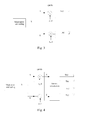
- Fig. 3 illustrates a schematic diagram of transmit diversity through ORTD with two antennas, where Tx0 and Tx1 represents two transmission antenna, n_r0 and n_r1 represent two orthogonal sequence numbers different from each other, and s represents feedback information.
- Tx0 and Tx1 represents two transmission antenna
- n_r0 and n_r1 represent two orthogonal sequence numbers different from each other
- s represents feedback information.
- a study shows an insignificant performance gain of ORTD with four antennas as compared with that with two antennas.
- a hybrid scheme of ORTD and virtual antennas as illustrated in Fig. 4 is recommended for four antennas.
- a process of virtualizing antennas is added here for transmission of information of two antenna ports on four physical antennas, and this virtualizing process is transparent to a base station, that is, the base station can receive without any knowledge of whether a transmitter transmits on two or four antennas.
- a UE configured with a plurality of transmission antennas can alternatively go back to a single antenna port transmission mode which can be performed in the following two approaches:
- a first approach is transmission on a single physical antenna as illustrated in Fig. 5 , which is the same as that in the LTE Rel-8 system.
- a second approach is concurrent transmission of the same information with the same orthogonal sequence to thereby improve actual transmit power and hence the reliability of transmission, a schematic diagram of which is as illustrated in Fig. 6 .
- Transmission in the first or second approach is transparent to a receiver, that is, the receiver can receive and demodulate without any knowledge of which transmission approach is particularly used.
- An object of the invention is to address at least one of the foregoing technical drawbacks particularly by enabling a base station to configure flexibly a UE configured with a plurality of transmission antennas dependent upon an operating status of a system to have the UE transmit an uplink control channel in a varying mode, thereby improving requirements of the system upon a reliability and an efficiency and enhancing effectively the performance of the system.
- an aspect of embodiments of the invention proposes a method for transmitting an uplink control channel including the operations of: a base station configuring a UE with an uplink control channel transmission mode by higher layer signaling; and the base station receiving an uplink control channel transmitted by transmit diversity or an uplink control channel transmitted by a single antenna port from the UE, according to the uplink control channel transmission mode.
- Another aspect of the embodiments of the invention further proposes a method for transmitting an uplink control channel including the operations of: a user equipment receiving higher layer signaling transmitted from a base station and acquiring information on an uplink control channel transmission mode; and the user equipment transmitting an uplink control channel by transmit diversity or transmitting an uplink control channel by a single antenna port to the base station according to the uplink control channel transmission mode.
- a base station including a configuring module, a transmitting module and a receiving module, wherein the configuring module is configured to configure a UE with an uplink control channel transmission mode; the transmitting module is configured to transmit the uplink control channel transmission mode to the UE by higher layer signaling; and the receiving module is configured to receive an uplink control channel transmitted by transmit diversity or an uplink control channel transmitted by a single antenna port from the UE according to the uplink control channel transmission mode.
- a User Equipment including a receiving module and a transmitting module, wherein the receiving module is configured to receive higher layer signaling transmitted from a base station and to acquire information on an uplink control channel transmission mode; and the transmitting module is configured to transmit an uplink control channel by transmit diversity or transmit an uplink control channel by a single antenna port to the base station.
- the receiving module is configured to receive higher layer signaling transmitted from a base station and to acquire information on an uplink control channel transmission mode
- the transmitting module is configured to transmit an uplink control channel by transmit diversity or transmit an uplink control channel by a single antenna port to the base station.
- a base station configures flexibly a UE configured with multiple transmission antennas dependent upon an operating status of a system to have the UE transmit an uplink control channel in a varying mode, thereby improving requirements of the system upon a reliability and an efficiency and enhancing effectively the performance of the system.
- the foregoing solution according to the embodiments of the invention can be applicable to both an FDD system and a TDD system with a minor modification to the existing system without any influence upon the compatibility of the system and can be simple and efficient to implement.
- Fig. 1 is a schematic diagram of a frame structure of an FDD system
- Fig. 2 is a schematic diagram of a frame structure of a TDD system
- Fig. 3 is a schematic diagram of transmit diversity with two antennas
- Fig. 4 is a schematic diagram of transmit diversity with four antennas
- Fig. 5 is a schematic diagram of transmission on a single physical antenna
- Fig. 6 is a schematic diagram of power combination of two physical antennas
- Fig. 7 is a flow chart of a method for transmitting an uplink control channel at the side of a base station according to an embodiment of the invention.
- Fig. 8 is a flow chart of a method for transmitting an uplink control channel at the side of a user equipment according to an embodiment of the invention
- Fig. 9 is a schematic structural diagram of a base station according to an embodiment of the invention.
- Fig. 10 is a schematic structural diagram of a user equipment according to an embodiment of the invention.
- two uplink control channel transmission modes are supported for a User Equipment (UE) configured with a plurality of transmission antennas.
- UE User Equipment
- the UE transmits an uplink control channel fixedly by a single antenna port by transmitting an uplink control channel in the single antenna port transmission mode as introduced in the Background.
- the UE can transmit an uplink control channel by multiple antenna ports, and here the mode can be further performed in two handling methods dependent upon a varying number of available orthogonal sequences with which an uplink control channel are transmitted:
- a base station configures the UE with one available orthogonal sequence number by RRC signaling.
- the UE can transmit uplink control signaling by multiple antenna ports to achieve a diversity gain as illustrated in Fig. 3 and Fig. 4 in the Background.
- ACK/NACK corresponding to a dynamically scheduled downlink data packet with an aggregation level of PDCCH CCEs above 1
- orthogonal sequences corresponding to first two CCEs of a Physical Downlink Control Channel (PDCCH) can be used, and if a specific condition of a transmission channel determines that an uplink control channel of a specific user must be transmitted by transmit diversity, then a base station can limit the aggregation level of PDCCH CCEs corresponding to the user to at least 2; and for ACK/NACK corresponding to a persistently scheduled downlink data packet, an SR, and a CQI/PMI/RI transmitted in the format 2/2a/2b, a base station configures the UE with two available orthogonal sequence numbers by RRC signaling.
- PDCCH Physical Downlink Control Channel
- Transmission mode Orthogonal sequence resource Transmission method Mode 1 At least one available orthogonal sequence resource Transmission by a single antenna port
- Mode 2 Only one available orthogonal sequence resource Transmission by a single antenna port
- an embodiment of the invention proposes a method for transmitting an uplink control channel including the operations of: a base station configures a UE with an uplink control channel transmission mode by higher layer signaling; and the base station receiving an uplink control channel transmitted by transmit diversity or an uplink control channel transmitted by a single antenna port from the UE according to the uplink control channel transmission mode.
- Fig. 7 illustrates a flow chart of a method for transmitting an uplink control channel at the side of a base station according to an embodiment of the invention.
- the method includes the following operations S101 and S102:
- a base station configures a UE with an uplink control channel transmission mode by higher layer signaling.
- the base station configures a UE with an uplink control channel transmission mode by higher layer signaling, e.g., RRC signaling, etc.
- the transmission mode is categorized into a first mode and a second mode.
- the first mode includes:
- the base station determines an aggregation level of PDCCH CCEs, and taking a targeted PDCCH detection reliability as an example, the aggregation level of PDCCH CCEs is selected from a first set of aggregation levels including the aggregation level of 1, and the first set of aggregation levels can include 1, 2, 4 and 8.
- the base station For ACK/NACK corresponding to a persistently scheduled downlink data packet, an SR, and a CQI/PMI/RI transmitted in the format 2/2a/2b, the base station configures the UE with one available orthogonal sequence resource by RRC signaling.
- the second mode includes:
- the base station determines an aggregation level of PDCCH CCEs, and taking a PDCCH detection reliability and the selected uplink control channel transmission mode as an example, if an uplink control channel is transmitted by transmit diversity, then the aggregation level of PDCCH CCEs is selected from a second set of aggregation levels in which the aggregation level of 1 is absent, and the second set of aggregation levels can include 2, 4 and 8; otherwise, the aggregation level of PDCCH CCEs is selected from the first set of aggregation levels including the aggregation level of 1, and the first set of aggregation levels can include 1, 2, 4 and 8.
- the base station For ACK/NACK corresponding to a persistently scheduled downlink data packet, an SR, and a CQI/PMI/RI transmitted in the format 2/2a/2b, the base station configures the UE with two available orthogonal sequence resources by RRC signaling.
- the UE transmits an uplink control channel by a single antenna port on one available orthogonal sequence resource and the aggregation level of PDCCH CCEs is an aggregation level determined by a PDCCH detection reliability when the base station configures the UE with the first mode.
- a different PDCCH detection reliability corresponds to a different coding rate, and the PDCCH detection reliability is guaranteed by selecting the corresponding coding rate so that a corresponding CCE aggregation level can be determined after selecting a coding rate, that is, the number of CCEs required for carrying and thus a corresponding CCE aggregation level can be determined after PDCCH data to be transmitted and a coding rate is known.
- the base station When the base station configures the UE with the second mode, the base station allocates more than one available orthogonal sequence resource to the UE, and the UE transmits by multiple antenna ports with corresponding orthogonal sequences using transmit diversity; or the base station allocates one available orthogonal sequence resource to the UE, and the UE transmits an uplink control channel by a single antenna port. Furthermore when the UE transmits an uplink control channel by a single antenna port, the system can support switching between a single physical antenna transmission mode and a multiple physical antennas transmission mode, and the UE can perform switching by itself dependent upon a specific situation.
- the UE determines by itself the number of physical antennas for use according to a Transmission Power Control (TPC) of an uplink control channel on a PDCCH: when transmit power adjusted according to the TPC exceeds the maximum transmit power of a single antenna, the UE transmits an uplink control channel concurrently on multiple physical antennas; otherwise, the UE transmits an uplink control channel on a single physical antenna.
- TPC Transmission Power Control
- Particularly determining the aggregation level of PDCCH CCEs in the second mode further includes:
- the aggregation level of PDCCH CCEs is max ⁇ 2, the aggregation level determined by the PDCCH detection reliability ⁇ ; otherwise, the aggregation level of PDCCH CCEs is the aggregation level determined by the PDCCH detection reliability.
- the base station receives an uplink control channel transmitted from the UE according to the transmission mode.
- the base station Since the base station can know the specific transmission mode of the UE after initial configuring, the base station receives by transmit diversity if the UE transmits by diversity; otherwise, the base station receives by a single antenna port, in the operation S102.
- An embodiment of the invention further proposes a method for transmitting an uplink control channel including the following operations: a user equipment receiving higher layer signaling transmitted from a base station and acquiring information on an uplink control channel transmission mode; and the user equipment transmitting an uplink control channel by transmit diversity or transmitting an uplink control channel by a single antenna port to the base station according to the transmission mode.
- Fig. 8 illustrates a flow chart of a method for transmitting an uplink control channel at the side of a user equipment according to an embodiment of the invention.
- the method includes the following operations S201 and S202:
- S201 A user equipment acquires information on an uplink control channel transmission mode.
- the user equipment receives the higher layer signaling transmitted from a base station and acquires the information on the uplink control channel transmission mode.
- the transmission mode includes a first mode and a second mode.
- the UE When the transmission mode is the first mode, the UE transmits an uplink control channel by a single antenna port.
- the UE acquires an available sequence resource by detecting PDCCH information or the higher layer signaling and transmits an uplink control channel by transmit diversity or transmits an uplink control channel by a single antenna port to the base station.
- S202 The user equipment transmits an uplink control channel to the base station according to the transmission mode.
- the user equipment transmits an uplink control channel by transmit diversity or transmits an uplink control channel by a single antenna port to the base station according to the transmission mode.
- the UE transmits by multiple antenna ports with corresponding orthogonal sequences using transmit diversity; or when there is one available orthogonal sequence resource, the UE transmits an uplink control channel using a single antenna port.
- the system can support switching between two transmission modes of a single physical antenna transmission mode and a multiple physical antennas transmission mode, and the UE can perform switching by itself dependent upon a specific situation.
- the UE determines by itself the number of physical antennas for use according to a Transmission Power Control (TPC) of an uplink control channel on a PDCCH: when transmit power adjusted according to the TPC exceeds the maximum transmit power of a single antenna, the UE transmits an uplink control channel concurrently on multiple physical antennas; otherwise, the UE transmits an uplink control channel on a single physical antenna.
- TPC Transmission Power Control
- an embodiment of the invention further proposes a base station 100 including a configuring module 130, a transmitting module 110 and a receiving module 120.
- the configuring module 130 is configured to configure a UE with an uplink control channel transmission mode; the transmitting module 110 is configured to transmit the uplink control channel transmission mode to the UE by higher layer signaling; and the receiving module 120 is configured to receive an uplink control channel transmitted by transmit diversity or an uplink control channel transmitted by a single antenna port from the UE, according to the uplink control channel transmission mode.
- the transmission mode includes a first mode and a second mode.
- the first mode includes:
- the configuring module 130 determines an aggregation level of PDCCH CCEs, where the aggregation level of PDCCH CCEs is selected from a first set of aggregation levels.
- the first set of aggregation levels includes the aggregation level of 1, and the first set of aggregation levels can include 1, 2, 4 and 8.
- the configuring module 130 configures the UE with one available orthogonal sequence resource.
- the second mode includes:
- the configuring module 130 determines an aggregation level of PDCCH CCEs, and if an uplink control channel is transmitted by transmit diversity, then the aggregation level of PDCCH CCEs is selected from a second set of aggregation levels in which the aggregation level of 1 is absent, and the second set of aggregation levels can include 2, 4 and 8; otherwise, the aggregation level of PDCCH CCEs is selected from the first set of aggregation levels including the aggregation level of 1, and the first set of aggregation levels can include 1, 2, 4 and 8.
- the configuring module 130 configures the UE with two available orthogonal sequence resources.
- the UE transmits an uplink control channel by a single antenna port on one available orthogonal sequence resource and the aggregation level of PDCCH CCEs is an aggregation level determined by a PDCCH detection reliability when the configuring module 130 configures the UE with the first mode.
- the base station 100 when the configuring module 130 configures the UE with the second mode, the base station 100 allocates more than one available orthogonal sequence resource to the UE, and the UE transmits by multiple antenna ports with corresponding orthogonal sequences using transmit diversity; or the base station 100 allocates one available orthogonal sequence resource to the UE, and the UE transmits an uplink control channel by a single antenna port.
- determining the aggregation level of PDCCH CCEs in the second mode includes: if the UE transmits an uplink control channel by transmit diversity, the aggregation level of PDCCH CCEs is max ⁇ 2, the aggregation level determined by the PDCCH detection reliability ⁇ ; otherwise, the aggregation level of PDCCH CCEs is the aggregation level determined by the PDCCH detection reliability.
- an embodiment of the invention further proposes a UE 200 including a receiving module 220 and a transmitting module 210.
- the receiving module 220 is configured to receive higher layer signaling transmitted from a base station and to acquire information on an uplink control channel transmission mode; and the transmitting module 210 is configured to transmit an uplink control channel by transmit diversity or transmit an uplink control channel by a single antenna port to the base station.
- the UE 200 further includes a parsing module 230 configured to parse the information on the transmission mode including a first mode and a second mode.
- the transmitting module 210 transmits an uplink control channel by a single antenna port; or when the transmission mode is the second mode, the receiving module 220 acquires an available sequence resource by detecting PDCCH information or the higher layer signaling, and the transmitting module 210 transmits an uplink control channel by transmit diversity or transmits an uplink control channel by a single antenna port to the base station.
- the transmitting module 210 when the transmission mode is the second mode and there is more than one available orthogonal sequence resource, the transmitting module 210 transmits by multiple antenna ports with corresponding orthogonal sequences using transmit diversity; or when there is one available orthogonal sequence resource, the transmitting module 210 transmits an uplink control channel using a single antenna port.
- the transmitting module 210 transmits an uplink control channel by a single antenna port on one or more physical antennas, the UE 200 determines by itself the number of physical antennas for use according to a Transmission Power Control (TPC) of an uplink control channel on a PDCCH from the base station: when transmit power adjusted according to the TPC exceeds the maximum transmit power of a single antenna, the transmitting module 210 transmits an uplink control channel concurrently on multiple physical antennas; otherwise, the transmitting module 210 transmits an uplink control channel on a single physical antenna.
- TPC Transmission Power Control
- a base station configures flexibly a UE configured with multiple transmission antennas dependent upon an operating status of a system to have the UE transmit an uplink control channel in a varying mode, thereby improving requirements of the system upon a reliability and an efficiency and enhancing effectively the performance of the system.
- the foregoing solution according to the embodiments of the invention can be applicable to both an FDD system and a TDD system with a minor modification to the existing system without any influence upon the compatibility of the system and can be simple and efficient to implement.
- the respective functional modules in the respective embodiments of the invention can be integrated in a processing module or physically present separately from each other, or two or more of the modules can be integrated in a module.
- the integrated module can be embodied in the form of hardware or a software functional module.
- the integrated module can also be stored in a computer readable storage medium if it is embodied in the form of a software functional module and sold or used as a stand-alone product.
- the storage medium mentioned above can be a read-only memory, a magnetic disk, an optical disk, etc.
Landscapes
- Engineering & Computer Science (AREA)
- Computer Networks & Wireless Communication (AREA)
- Signal Processing (AREA)
- Mobile Radio Communication Systems (AREA)
- Radio Transmission System (AREA)
Abstract
Description
- The present invention relates to the field of mobile communications and particularly to a method and device for transmitting an uplink control channel.
- Mobility and broadband has become development orientations of modern communication, and the 3rd Generation Partnership Project is making an effort to develop a Long Term Evolution (LTE) system as an evolved 3G system for the purpose of evolving a 3GPP radio access oriented toward high data rate, low delay and optimized packet data applications. The multi-antenna technology at the physical layer has become one of crucial technologies for an existing mobile communication system and offers numerous advantages, e.g., a throughput of the system improved due to a multiplexing gain of multiple antennas, the performance of the system improved due to a diversity gain of multiple antennas, interference between users eliminated by distinguishing one user from another due to a directional gain of the antennas, etc.
- At present, the design of the LTE system has been substantially completed in the standardization effort of the 3GPP, and frame structures for a general transmission scheme of the LTE system in an FDD system and a TDD system are as illustrated respectively in
Fig. 1 and Fig. 2 . Downlink signaling and downlink data, and uplink signaling and uplink data as well their mutual transmission relationships are defined for each operating carrier, where two ends of a frequency band are occupied for uplink control signaling transmitted through frequency-hopping, that is, different frequency ranges will be occupied for transmission of the uplink control signaling in two time slots of a sub-frame. - The uplink control signaling is subject to orthogonal sequence spreading and then mapped into an uplink control channel for transmission, thus a plurality of uplink control channels can be transmitted concurrently on the same Physical Resource Block (PRB). Each uplink control channel corresponds to a unique orthogonal sequence number, and a UE can determine from the orthogonal sequence number an orthogonal spreading sequence for its corresponding uplink control channel and the location of the PRB where the uplink control channel is located.
- At present there are two different formats of an uplink control channel, i.e., the format 1/1a/1b and the format 2/2a/2b. ACK/NACK information corresponding to a downlink data packet and an uplink Scheduling Request (SR) is carried in the format 1/1a/1b. Channel quality related information, e.g., a Channel Quality Information (CQI), a Pre-coding Matrix Information (PMI), a Rank Information (RI), etc., is fed back in the format 2/2a/2b.
- For a dynamically scheduled downlink data packet, the number of an uplink channel on which ACK/NACK information is fed back (i.e., a orthogonal sequence number) will be derived from the number of a Control Channel Element (CCE) occupied for a downlink control channel on which scheduling information of the data packet is carried, that is, a unique uplink channel resource number can be derived from a CCE number. In an LTE Rel-8 system, a UE will transmit only one uplink control channel at most in each sub-frame due to an uplink limitation arising from uni-carrier transmission, thus an uplink control channel in actual use is an uplink control channel corresponding to a first CCE occupied for a downlink control channel serving the UE.
- ACK/NACK corresponding to a persistently scheduled downlink data packet, an SR and a CQI/PMI/RI transmitted in the format 2/2a/2b are fed back periodically, and a base station can know in advance specific temporal locations at which the respective information is transmitted, thus the numbers of channels on which the foregoing control signaling is transmitted are allocated in advance by RRC signaling from the base station to a UE.
- In the ongoing study of an uplink control channel for a Long Term Evolution-Advanced system, a possibility has been proposed to use Orthogonal Resource Transmit Diversity (ORTD) for transmit diversity in transmission of an uplink control channel for a UE configured with a plurality of transmission antennas to thereby improve the reliability or capacity of transmitting uplink control signaling. As ORTD implies, each antenna port corresponds to one orthogonal sequence, and the same information is spread in different orthogonal sequences and then transmitted concurrently by different antenna ports. A receiver extracts signals from the different antenna ports and then combines them for detection to thereby achieve a diversity gain.
-
Fig. 3 illustrates a schematic diagram of transmit diversity through ORTD with two antennas, where Tx0 and Tx1 represents two transmission antenna, n_r0 and n_r1 represent two orthogonal sequence numbers different from each other, and s represents feedback information. A study shows an insignificant performance gain of ORTD with four antennas as compared with that with two antennas. In view of an overhead of an orthogonal sequence and alike, a hybrid scheme of ORTD and virtual antennas as illustrated inFig. 4 is recommended for four antennas. As compared with the ORTD-only scheme, a process of virtualizing antennas is added here for transmission of information of two antenna ports on four physical antennas, and this virtualizing process is transparent to a base station, that is, the base station can receive without any knowledge of whether a transmitter transmits on two or four antennas. - Dependent upon a specific transmission condition and demand, a UE configured with a plurality of transmission antennas can alternatively go back to a single antenna port transmission mode which can be performed in the following two approaches:
- A first approach is transmission on a single physical antenna as illustrated in
Fig. 5 , which is the same as that in the LTE Rel-8 system. - A second approach is concurrent transmission of the same information with the same orthogonal sequence to thereby improve actual transmit power and hence the reliability of transmission, a schematic diagram of which is as illustrated in
Fig. 6 . - Transmission in the first or second approach is transparent to a receiver, that is, the receiver can receive and demodulate without any knowledge of which transmission approach is particularly used.
- However there is no method for configuring transmission of an uplink control channel in a plurality of transmission modes for a high-level UE configured with a plurality of transmission antennas, making it impossible to make full use of the advantages of the UE being provided with a plurality of transmission antennas, thus it is necessary to propose a corresponding technical solution in which a base station configures flexibly the UE configured with a plurality of transmission antennas dependent upon an operating status of a system to have the UE transmit an uplink control channel in a varying mode.
- An object of the invention is to address at least one of the foregoing technical drawbacks particularly by enabling a base station to configure flexibly a UE configured with a plurality of transmission antennas dependent upon an operating status of a system to have the UE transmit an uplink control channel in a varying mode, thereby improving requirements of the system upon a reliability and an efficiency and enhancing effectively the performance of the system.
- In order to attain the foregoing object, an aspect of embodiments of the invention proposes a method for transmitting an uplink control channel including the operations of: a base station configuring a UE with an uplink control channel transmission mode by higher layer signaling; and the base station receiving an uplink control channel transmitted by transmit diversity or an uplink control channel transmitted by a single antenna port from the UE, according to the uplink control channel transmission mode.
- Another aspect of the embodiments of the invention further proposes a method for transmitting an uplink control channel including the operations of: a user equipment receiving higher layer signaling transmitted from a base station and acquiring information on an uplink control channel transmission mode; and the user equipment transmitting an uplink control channel by transmit diversity or transmitting an uplink control channel by a single antenna port to the base station according to the uplink control channel transmission mode.
- Another aspect of the embodiments of the invention further proposes a base station including a configuring module, a transmitting module and a receiving module, wherein the configuring module is configured to configure a UE with an uplink control channel transmission mode; the transmitting module is configured to transmit the uplink control channel transmission mode to the UE by higher layer signaling; and the receiving module is configured to receive an uplink control channel transmitted by transmit diversity or an uplink control channel transmitted by a single antenna port from the UE according to the uplink control channel transmission mode.
- Another aspect of the embodiments of the invention further proposes a User Equipment, UE, including a receiving module and a transmitting module, wherein the receiving module is configured to receive higher layer signaling transmitted from a base station and to acquire information on an uplink control channel transmission mode; and the transmitting module is configured to transmit an uplink control channel by transmit diversity or transmit an uplink control channel by a single antenna port to the base station.
- In the technical solutions according to the embodiments of the invention, a base station configures flexibly a UE configured with multiple transmission antennas dependent upon an operating status of a system to have the UE transmit an uplink control channel in a varying mode, thereby improving requirements of the system upon a reliability and an efficiency and enhancing effectively the performance of the system. The foregoing solution according to the embodiments of the invention can be applicable to both an FDD system and a TDD system with a minor modification to the existing system without any influence upon the compatibility of the system and can be simple and efficient to implement.
- Additional aspects and advantages of the invention will partly be presented in the following description, partly become apparent in the following description or be appreciated in practicing of the invention.
- The foregoing and/or additional aspects and advantages of the invention will become apparent and readily understood in the foregoing description of embodiments taken in conjunction with the drawings in which:
-
Fig. 1 is a schematic diagram of a frame structure of an FDD system; -
Fig. 2 is a schematic diagram of a frame structure of a TDD system; -
Fig. 3 is a schematic diagram of transmit diversity with two antennas; -
Fig. 4 is a schematic diagram of transmit diversity with four antennas; -
Fig. 5 is a schematic diagram of transmission on a single physical antenna; -
Fig. 6 is a schematic diagram of power combination of two physical antennas; -
Fig. 7 is a flow chart of a method for transmitting an uplink control channel at the side of a base station according to an embodiment of the invention; -
Fig. 8 is a flow chart of a method for transmitting an uplink control channel at the side of a user equipment according to an embodiment of the invention; -
Fig. 9 is a schematic structural diagram of a base station according to an embodiment of the invention; and -
Fig. 10 is a schematic structural diagram of a user equipment according to an embodiment of the invention. - Embodiments of the invention will be detailed below, and examples of the embodiments will be illustrated in the drawings throughout which identical or similar reference numerals represent identical or similar elements or functionally identical or similar elements. The embodiments described below with reference to the drawings are illustrative and merely intended to set forth but not construed to limit the invention.
- In a technical solution according to the invention, two uplink control channel transmission modes are supported for a User Equipment (UE) configured with a plurality of transmission antennas.
- In a first mode, the UE transmits an uplink control channel fixedly by a single antenna port by transmitting an uplink control channel in the single antenna port transmission mode as introduced in the Background.
- In a second mode, the UE can transmit an uplink control channel by multiple antenna ports, and here the mode can be further performed in two handling methods dependent upon a varying number of available orthogonal sequences with which an uplink control channel are transmitted:
- In a first handling method, if there is only one available orthogonal sequence, then the UE can transmit an uplink control channel in the single antenna port transmission mode as introduced in the Background. For ACK/NACK corresponding to a dynamically scheduled downlink data packet, an aggregation level of PDCCH CCEs is 1 and there is only one available orthogonal sequence; and for ACK/NACK corresponding to a persistently scheduled downlink data packet, an SR, and a CQI/PMI/RI transmitted in the format 2/2a/2b, a base station configures the UE with one available orthogonal sequence number by RRC signaling.
- In a second handling method, if there are a plurality of available orthogonal sequences, the UE can transmit uplink control signaling by multiple antenna ports to achieve a diversity gain as illustrated in
Fig. 3 and Fig. 4 in the Background. For ACK/NACK corresponding to a dynamically scheduled downlink data packet with an aggregation level of PDCCH CCEs above 1, orthogonal sequences corresponding to first two CCEs of a Physical Downlink Control Channel (PDCCH) can be used, and if a specific condition of a transmission channel determines that an uplink control channel of a specific user must be transmitted by transmit diversity, then a base station can limit the aggregation level of PDCCH CCEs corresponding to the user to at least 2; and for ACK/NACK corresponding to a persistently scheduled downlink data packet, an SR, and a CQI/PMI/RI transmitted in the format 2/2a/2b, a base station configures the UE with two available orthogonal sequence numbers by RRC signaling. - The transmission modes defined according to the invention are as depicted in the table below:
Transmission mode Orthogonal sequence resource Transmission method Mode 1 At least one available orthogonal sequence resource Transmission by a single antenna port Mode 2 Only one available orthogonal sequence resource Transmission by a single antenna port A plurality of available orthogonal sequence resource Transmit diversity - Thus, in order to attain the object of the invention, an embodiment of the invention proposes a method for transmitting an uplink control channel including the operations of: a base station configures a UE with an uplink control channel transmission mode by higher layer signaling; and the base station receiving an uplink control channel transmitted by transmit diversity or an uplink control channel transmitted by a single antenna port from the UE according to the uplink control channel transmission mode.
-
Fig. 7 illustrates a flow chart of a method for transmitting an uplink control channel at the side of a base station according to an embodiment of the invention. The method includes the following operations S101 and S102: - S101: A base station configures a UE with an uplink control channel transmission mode by higher layer signaling.
- In the operation S101, the base station configures a UE with an uplink control channel transmission mode by higher layer signaling, e.g., RRC signaling, etc. The transmission mode is categorized into a first mode and a second mode.
- Further in connection with a specific system, the first mode includes:
- For ACK/NACK corresponding to a dynamically scheduled downlink data packet, the base station determines an aggregation level of PDCCH CCEs, and taking a targeted PDCCH detection reliability as an example, the aggregation level of PDCCH CCEs is selected from a first set of aggregation levels including the aggregation level of 1, and the first set of aggregation levels can include 1, 2, 4 and 8.
- For ACK/NACK corresponding to a persistently scheduled downlink data packet, an SR, and a CQI/PMI/RI transmitted in the format 2/2a/2b, the base station configures the UE with one available orthogonal sequence resource by RRC signaling.
- The second mode includes:
- For ACK/NACK corresponding to a dynamically scheduled downlink data packet, the base station determines an aggregation level of PDCCH CCEs, and taking a PDCCH detection reliability and the selected uplink control channel transmission mode as an example, if an uplink control channel is transmitted by transmit diversity, then the aggregation level of PDCCH CCEs is selected from a second set of aggregation levels in which the aggregation level of 1 is absent, and the second set of aggregation levels can include 2, 4 and 8; otherwise, the aggregation level of PDCCH CCEs is selected from the first set of aggregation levels including the aggregation level of 1, and the first set of aggregation levels can include 1, 2, 4 and 8.
- For ACK/NACK corresponding to a persistently scheduled downlink data packet, an SR, and a CQI/PMI/RI transmitted in the format 2/2a/2b, the base station configures the UE with two available orthogonal sequence resources by RRC signaling.
- Thus corresponding to the different transmission modes, the UE transmits an uplink control channel by a single antenna port on one available orthogonal sequence resource and the aggregation level of PDCCH CCEs is an aggregation level determined by a PDCCH detection reliability when the base station configures the UE with the first mode. Typically, a different PDCCH detection reliability corresponds to a different coding rate, and the PDCCH detection reliability is guaranteed by selecting the corresponding coding rate so that a corresponding CCE aggregation level can be determined after selecting a coding rate, that is, the number of CCEs required for carrying and thus a corresponding CCE aggregation level can be determined after PDCCH data to be transmitted and a coding rate is known.
- When the base station configures the UE with the second mode, the base station allocates more than one available orthogonal sequence resource to the UE, and the UE transmits by multiple antenna ports with corresponding orthogonal sequences using transmit diversity; or the base station allocates one available orthogonal sequence resource to the UE, and the UE transmits an uplink control channel by a single antenna port. Furthermore when the UE transmits an uplink control channel by a single antenna port, the system can support switching between a single physical antenna transmission mode and a multiple physical antennas transmission mode, and the UE can perform switching by itself dependent upon a specific situation. For example, when the UE transmits an uplink control channel by a single antenna port, the UE determines by itself the number of physical antennas for use according to a Transmission Power Control (TPC) of an uplink control channel on a PDCCH: when transmit power adjusted according to the TPC exceeds the maximum transmit power of a single antenna, the UE transmits an uplink control channel concurrently on multiple physical antennas; otherwise, the UE transmits an uplink control channel on a single physical antenna.
- Particularly determining the aggregation level of PDCCH CCEs in the second mode further includes:
- if the UE transmits an uplink control channel by transmit diversity, the aggregation level of PDCCH CCEs is max {2, the aggregation level determined by the PDCCH detection reliability}; otherwise, the aggregation level of PDCCH CCEs is the aggregation level determined by the PDCCH detection reliability.
- S102: The base station receives an uplink control channel transmitted from the UE according to the transmission mode.
- Since the base station can know the specific transmission mode of the UE after initial configuring, the base station receives by transmit diversity if the UE transmits by diversity; otherwise, the base station receives by a single antenna port, in the operation S102.
- An embodiment of the invention further proposes a method for transmitting an uplink control channel including the following operations: a user equipment receiving higher layer signaling transmitted from a base station and acquiring information on an uplink control channel transmission mode; and the user equipment transmitting an uplink control channel by transmit diversity or transmitting an uplink control channel by a single antenna port to the base station according to the transmission mode.
-
Fig. 8 illustrates a flow chart of a method for transmitting an uplink control channel at the side of a user equipment according to an embodiment of the invention. The method includes the following operations S201 and S202: - S201: A user equipment acquires information on an uplink control channel transmission mode.
- In the operation S201, the user equipment receives the higher layer signaling transmitted from a base station and acquires the information on the uplink control channel transmission mode.
- Particularly the transmission mode includes a first mode and a second mode.
- When the transmission mode is the first mode, the UE transmits an uplink control channel by a single antenna port.
- When the transmission mode is the second mode, the UE acquires an available sequence resource by detecting PDCCH information or the higher layer signaling and transmits an uplink control channel by transmit diversity or transmits an uplink control channel by a single antenna port to the base station.
- S202: The user equipment transmits an uplink control channel to the base station according to the transmission mode.
- In the operation S202, the user equipment transmits an uplink control channel by transmit diversity or transmits an uplink control channel by a single antenna port to the base station according to the transmission mode.
- Particularly when the transmission mode is the second mode and there is more than one available orthogonal sequence resource, the UE transmits by multiple antenna ports with corresponding orthogonal sequences using transmit diversity; or when there is one available orthogonal sequence resource, the UE transmits an uplink control channel using a single antenna port.
- Furthermore when the UE transmits an uplink control channel by a single antenna port, the system can support switching between two transmission modes of a single physical antenna transmission mode and a multiple physical antennas transmission mode, and the UE can perform switching by itself dependent upon a specific situation. For example, when the UE transmits an uplink control channel by a single antenna port, the UE determines by itself the number of physical antennas for use according to a Transmission Power Control (TPC) of an uplink control channel on a PDCCH: when transmit power adjusted according to the TPC exceeds the maximum transmit power of a single antenna, the UE transmits an uplink control channel concurrently on multiple physical antennas; otherwise, the UE transmits an uplink control channel on a single physical antenna.
- As illustrated in
Fig. 9 , an embodiment of the invention further proposes abase station 100 including aconfiguring module 130, a transmittingmodule 110 and areceiving module 120. - Particularly the
configuring module 130 is configured to configure a UE with an uplink control channel transmission mode; the transmittingmodule 110 is configured to transmit the uplink control channel transmission mode to the UE by higher layer signaling; and the receivingmodule 120 is configured to receive an uplink control channel transmitted by transmit diversity or an uplink control channel transmitted by a single antenna port from the UE, according to the uplink control channel transmission mode. - In an embodiment of the
base station 100, the transmission mode includes a first mode and a second mode. - Particularly the first mode includes:
- For ACK/NACK corresponding to a dynamically scheduled downlink data packet, the configuring
module 130 determines an aggregation level of PDCCH CCEs, where the aggregation level of PDCCH CCEs is selected from a first set of aggregation levels. The first set of aggregation levels includes the aggregation level of 1, and the first set of aggregation levels can include 1, 2, 4 and 8. For ACK/NACK corresponding to a persistently scheduled downlink data packet, an SR, and a CQI/PMI/RI transmitted in the format 2/2a/2b, the configuringmodule 130 configures the UE with one available orthogonal sequence resource. - The second mode includes:
- For ACK/NACK corresponding to a dynamically scheduled downlink data packet, the configuring
module 130 determines an aggregation level of PDCCH CCEs, and if an uplink control channel is transmitted by transmit diversity, then the aggregation level of PDCCH CCEs is selected from a second set of aggregation levels in which the aggregation level of 1 is absent, and the second set of aggregation levels can include 2, 4 and 8; otherwise, the aggregation level of PDCCH CCEs is selected from the first set of aggregation levels including the aggregation level of 1, and the first set of aggregation levels can include 1, 2, 4 and 8. For ACK/NACK corresponding to a persistently scheduled downlink data packet, an SR, and a CQI/PMI/RI transmitted in the format 2/2a/2b, the configuringmodule 130 configures the UE with two available orthogonal sequence resources. - In an embodiment of the
base station 100, the UE transmits an uplink control channel by a single antenna port on one available orthogonal sequence resource and the aggregation level of PDCCH CCEs is an aggregation level determined by a PDCCH detection reliability when theconfiguring module 130 configures the UE with the first mode. - In an embodiment of the
base station 100, when theconfiguring module 130 configures the UE with the second mode, thebase station 100 allocates more than one available orthogonal sequence resource to the UE, and the UE transmits by multiple antenna ports with corresponding orthogonal sequences using transmit diversity; or thebase station 100 allocates one available orthogonal sequence resource to the UE, and the UE transmits an uplink control channel by a single antenna port. - In an embodiment of the
base station 100, determining the aggregation level of PDCCH CCEs in the second mode includes: if the UE transmits an uplink control channel by transmit diversity, the aggregation level of PDCCH CCEs is max {2, the aggregation level determined by the PDCCH detection reliability}; otherwise, the aggregation level of PDCCH CCEs is the aggregation level determined by the PDCCH detection reliability. - As illustrated in
Fig. 10 , an embodiment of the invention further proposes aUE 200 including areceiving module 220 and atransmitting module 210. - Particularly the receiving
module 220 is configured to receive higher layer signaling transmitted from a base station and to acquire information on an uplink control channel transmission mode; and thetransmitting module 210 is configured to transmit an uplink control channel by transmit diversity or transmit an uplink control channel by a single antenna port to the base station. - In an embodiment of the
UE 200, theUE 200 further includes aparsing module 230 configured to parse the information on the transmission mode including a first mode and a second mode. - When the transmission mode is the first mode, the transmitting
module 210 transmits an uplink control channel by a single antenna port; or when the transmission mode is the second mode, the receivingmodule 220 acquires an available sequence resource by detecting PDCCH information or the higher layer signaling, and thetransmitting module 210 transmits an uplink control channel by transmit diversity or transmits an uplink control channel by a single antenna port to the base station. - In an embodiment of the
UE 200, when the transmission mode is the second mode and there is more than one available orthogonal sequence resource, the transmittingmodule 210 transmits by multiple antenna ports with corresponding orthogonal sequences using transmit diversity; or when there is one available orthogonal sequence resource, the transmittingmodule 210 transmits an uplink control channel using a single antenna port. - In an embodiment of the
UE 200, the transmittingmodule 210 transmits an uplink control channel by a single antenna port on one or more physical antennas, theUE 200 determines by itself the number of physical antennas for use according to a Transmission Power Control (TPC) of an uplink control channel on a PDCCH from the base station: when transmit power adjusted according to the TPC exceeds the maximum transmit power of a single antenna, the transmittingmodule 210 transmits an uplink control channel concurrently on multiple physical antennas; otherwise, the transmittingmodule 210 transmits an uplink control channel on a single physical antenna. - In the technical solution according to the embodiments of the invention, a base station configures flexibly a UE configured with multiple transmission antennas dependent upon an operating status of a system to have the UE transmit an uplink control channel in a varying mode, thereby improving requirements of the system upon a reliability and an efficiency and enhancing effectively the performance of the system. The foregoing solution according to the embodiments of the invention can be applicable to both an FDD system and a TDD system with a minor modification to the existing system without any influence upon the compatibility of the system and can be simple and efficient to implement.
- Those ordinarily skilled in the art can appreciate that all or a part of the operations in the methods according to the embodiments can be performed in program instructing relevant hardware, and the program can be stored in a computer readable storage medium and perform when being executed any one or combination of the operations in the embodiments of the methods.
- Furthermore the respective functional modules in the respective embodiments of the invention can be integrated in a processing module or physically present separately from each other, or two or more of the modules can be integrated in a module. The integrated module can be embodied in the form of hardware or a software functional module. The integrated module can also be stored in a computer readable storage medium if it is embodied in the form of a software functional module and sold or used as a stand-alone product.
- The storage medium mentioned above can be a read-only memory, a magnetic disk, an optical disk, etc.
- The foregoing description is merely illustrative of the preferred embodiments of the invention, and it shall be noted that those ordinarily skilled in the art can further make several modifications and variations thereto without departing from the principle of the invention and that these modifications and variations shall also be deemed as coming into the claimed scope of the invention.
Claims (22)
- A method for transmitting an uplink control channel, comprising:a base station configuring a User Equipment, UE, with an uplink control channel transmission mode by higher layer signaling; andthe base station receiving an uplink control channel transmitted by transmit diversity or an uplink control channel transmitted by a single antenna port from the UE, according to the uplink control channel transmission mode.
- The method for transmitting an uplink control channel according to claim 1, wherein the transmission mode comprises a first mode and a second mode, and
in the first mode:for ACK/NACK corresponding to a dynamically scheduled downlink data packet, the base station determines an aggregation level of Physical Downlink Control Channel, PDCCH, Control Channel Elements, CCEs, wherein the aggregation level of PDCCH CCEs is selected from a first set of aggregation levels; andfor ACK/NACK corresponding to a persistently scheduled downlink data packet, an uplink Scheduling Request, SR, and a Channel Quality Information, CQI, a Pre-coding Matrix Information, PMI, and a Rank Information, RI, transmitted in a format 2/2a/2b, the base station configures the UE with one available orthogonal sequence resource by the higher layer signaling; andin the second mode:for ACK/NACK corresponding to a dynamically scheduled downlink data packet, the base station determines an aggregation level of PDCCH CCEs, and if an uplink control channel is transmitted by transmit diversity, then the aggregation level of PDCCH CCEs is selected from a second set of aggregation levels; otherwise, the aggregation level of PDCCH CCEs is selected from the first set of aggregation levels; andfor ACK/NACK corresponding to a persistently scheduled downlink data packet, an SR and a CQI/PMI/RI transmitted in the format 2/2a/2b, the base station configures the UE with two available orthogonal sequence resources by higher layer signaling, andwherein the first set of aggregation levels comprises an aggregation level of 1, and the second set of aggregation levels does not comprise the aggregation level of 1. - The method for transmitting an uplink control channel according to claim 2, wherein:the first set of aggregation levels comprises 1, 2, 4 and 8; andthe second set of aggregation levels comprises 2, 4 and 8.
- The method for transmitting an uplink control channel according to claim 2, wherein when the base station configures the UE with the first mode,
the UE transmits an uplink control channel by a single antenna port on one available orthogonal sequence resource, and the aggregation level of PDCCH CCEs is an aggregation level determined by a PDCCH detection reliability. - The method for transmitting an uplink control channel according to claim 2, wherein when the base station configures the UE with the second mode,
the base station allocates more than one available orthogonal sequence resource to the UE, and the UE transmits on multiple antenna ports with corresponding orthogonal sequences using transmit diversity; or
the base station allocates one available orthogonal sequence resource to the UE, and the UE transmits an uplink control channel using a single antenna port. - The method for transmitting an uplink control channel according to claim 4 or 5, wherein the UE transmits an uplink control channel by a single antenna port on one or more physical antennas and determines by itself the number of physical antennas for use according to a Transmission Power Control, TPC, of an uplink control channel over a PDCCH from the base station:if transmit power adjusted according to the TPC exceeds the maximum transmit power of a single antenna, the UE transmits an uplink control channel concurrently on multiple physical antennas; otherwise, the UE transmits an uplink control channel on a single physical antenna.
- The method for transmitting an uplink control channel according to claim 2, wherein determining the aggregation level of PDCCH CCEs in the second mode comprises:if the UE transmits an uplink control channel by transmit diversity, the aggregation level of PDCCH CCEs is max {2, an aggregation level determined by a PDCCH detection reliability}; otherwise, the aggregation level of PDCCH CCEs is the aggregation level determined by the PDCCH detection reliability.
- A method for transmitting an uplink control channel, comprising:a user equipment receiving higher layer signaling transmitted from a base station and acquiring information on an uplink control channel transmission mode; andthe user equipment transmitting an uplink control channel by transmit diversity or transmitting an uplink control channel by a single antenna port to the base station, according to the uplink control channel transmission mode.
- The method for transmitting an uplink control channel according to claim 8, wherein the transmission mode comprises a first mode and a second mode, and
when the transmission mode is the first mode, the User Equipment, UE, transmits an uplink control channel by a single antenna port; and
when the transmission mode is the second mode, the UE acquires one or more available sequence resources by detecting Physical Downlink Control Channel, PDCCH, information or the higher layer signaling and transmits an uplink control channel by transmit diversity or transmits an uplink control channel by a single antenna port to the base station. - The method for transmitting an uplink control channel according to claim 9, wherein when the transmission mode is the second mode,
when the number of available orthogonal sequence resources is more than 1, the UE transmits on multiple antenna ports with corresponding orthogonal sequences using transmit diversity; or
when the number of available orthogonal sequence resources is 1, the UE transmits an uplink control channel using a single antenna port. - The method for transmitting an uplink control channel according to claim 9 or 10, wherein the UE transmits an uplink control channel by a single antenna port on one or more physical antennas and determines by itself the number of physical antennas for use according to a Transmission Power Control, TPC, of an uplink control channel over a PDCCH from the base station:if transmit power adjusted according to the TPC exceeds the maximum transmit power of a single antenna, the UE transmits an uplink control channel concurrently on multiple physical antennas; otherwise, the UE transmits an uplink control channel on a single physical antenna.
- A base station, comprising a configuring module, a transmitting module and a receiving module, wherein:the configuring module is configured to configure a User Equipment, UE, with an uplink control channel transmission mode;the transmitting module is configured to transmit the uplink control channel transmission mode to the UE by higher layer signaling; andthe receiving module is configured to receive an uplink control channel transmitted by transmit diversity or an uplink control channel transmitted by a single antenna port from the UE, according to the uplink control channel transmission mode.
- The base station of claim 12, wherein the transmission mode comprises a first mode and a second mode, and
in the first mode,
for ACK/NACK corresponding to a dynamically scheduled downlink data packet, the configuring module determines an aggregation level of Physical Downlink Control Channel, PDCCH, Control Channel Elements, CCEs, wherein the aggregation level of PDCCH CCEs is selected from a first set of aggregation levels; and
for ACK/NACK corresponding to a persistently scheduled downlink data packet, a Scheduling Request, SR, and a Channel Quality Information, CQI, a Pre-coding Matrix Information, PMI, and a Rank Information, RI, transmitted in a format 2/2a/2b, the configuring module configures the UE with one available orthogonal sequence resource; and
in the second mode:for ACK/NACK corresponding to a dynamically scheduled downlink data packet, the configuring module determines an aggregation level of PDCCH CCEs, and if an uplink control channel is transmitted by transmit diversity, then the aggregation level of PDCCH CCEs is selected from a second set of aggregation levels; otherwise, the aggregation level of PDCCH CCEs is selected from the first set of aggregation levels; andfor ACK/NACK corresponding to a persistently scheduled downlink data packet, an SR and a CQI/PMI/RI transmitted in the format 2/2a/2b, the configuring module configures the UE with two available orthogonal sequence resources, andwherein the first set of aggregation levels comprises an aggregation level of 1, and the second set of aggregation levels does not comprise the aggregation level of 1. - The base station of claim 13, wherein:the first set of aggregation levels comprises 1, 2, 4 and 8; andthe second set of aggregation levels comprises 2, 4 and 8.
- The base station of claim 12, wherein when the configuring module configures the UE with the first mode,
the UE transmits an uplink control channel by a single antenna port on one available orthogonal sequence resource, and the aggregation level of PDCCH CCEs is an aggregation level determined by a PDCCH detection reliability. - The base station of claim 12, wherein when the configuring module configures the UE with the second mode,
the base station allocates more than one available orthogonal sequence resource to the UE, and the UE transmits on multiple antenna ports with corresponding orthogonal sequences using transmit diversity; or
the base station allocates one available orthogonal sequence resource to the UE, and the UE transmits an uplink control channel using a single antenna port. - The base station of claim 12, wherein determining the aggregation level of PDCCH CCEs in the second mode comprises:if the UE transmits an uplink control channel by transmit diversity, the aggregation level of PDCCH CCEs is max {2, an aggregation level determined by a PDCCH detection reliability}; otherwise, the aggregation level of PDCCH CCEs is the aggregation level determined by the PDCCH detection reliability.
- A User Equipment, UE, comprising a receiving module and a transmitting module, wherein:the receiving module is configured to receive higher layer signaling transmitted from a base station and to acquire information on an uplink control channel transmission mode; andthe transmitting module is configured to transmit an uplink control channel by transmit diversity or transmit an uplink control channel by a single antenna port to the base station.
- The User Equipment, UE, of claim 18, further comprising a parsing module configured to parse the information on the transmitting mode.
- The User Equipment, UE, of claim 19, wherein the transmitting module comprises a first mode and a second mode, and
when the transmission mode is the first mode, the transmitting module transmits an uplink control channel by a single antenna port; or
when the transmission mode is the second mode, the receiving module acquires one or more available sequence resources by detecting Physical Downlink Control Channel, PDCCH, information or the higher layer signaling, and the transmitting module transmits an uplink control channel by transmit diversity or transmits an uplink control channel by a single antenna port to the base station. - The User Equipment, UE, of claim 20, wherein when the transmission mode is the second mode,
when there is more than one available orthogonal sequence resource, the transmitting module transmits on multiple antenna ports with corresponding orthogonal sequences using transmit diversity; or
when there is one available orthogonal sequence resource, the transmitting module transmits an uplink control channel using a single antenna port. - The User Equipment, UE, of claim 19, wherein the transmitting module transmits an uplink control channel by a single antenna port on one or more physical antennas, the UE determines by itself the number of physical antennas for use according to a Transmission Power Control, TPC, of an uplink control channel over a PDCCH from the base station:if transmit power adjusted according to the TPC is exceeds the maximum transmit power of a single antenna, the transmitting module transmits an uplink control channel concurrently on multiple physical antennas; otherwise, the transmitting module transmits an uplink control channel on a single physical antenna.
Applications Claiming Priority (2)
| Application Number | Priority Date | Filing Date | Title |
|---|---|---|---|
| CN200910090376.5A CN101989873B (en) | 2009-08-07 | 2009-08-07 | Method and device for transmitting uplink control channel |
| PCT/CN2010/075764 WO2011015146A1 (en) | 2009-08-07 | 2010-08-06 | Transmission method and device for uplink control channel |
Publications (3)
| Publication Number | Publication Date |
|---|---|
| EP2464029A1 true EP2464029A1 (en) | 2012-06-13 |
| EP2464029A4 EP2464029A4 (en) | 2014-04-16 |
| EP2464029B1 EP2464029B1 (en) | 2015-10-07 |
Family
ID=43543938
Family Applications (1)
| Application Number | Title | Priority Date | Filing Date |
|---|---|---|---|
| EP10806050.0A Active EP2464029B1 (en) | 2009-08-07 | 2010-08-06 | Transmission method and device for uplink control channel |
Country Status (4)
| Country | Link |
|---|---|
| US (1) | US9148209B2 (en) |
| EP (1) | EP2464029B1 (en) |
| CN (1) | CN101989873B (en) |
| WO (1) | WO2011015146A1 (en) |
Cited By (1)
| Publication number | Priority date | Publication date | Assignee | Title |
|---|---|---|---|---|
| EP2717492A4 (en) * | 2011-06-03 | 2014-07-16 | Huawei Tech Co Ltd | METHOD FOR PROCESSING ANTENNA RECEPTION MODE CONFIGURATION, BASE STATION CONTROLLER, AND BASE STATION |
Families Citing this family (24)
| Publication number | Priority date | Publication date | Assignee | Title |
|---|---|---|---|---|
| CN103024910B (en) | 2007-09-12 | 2017-02-22 | 苹果公司 | Systems and methods for uplink signalling |
| US9288024B2 (en) * | 2007-09-12 | 2016-03-15 | Apple Inc. | Systems and methods for uplink signaling using time-frequency resources |
| CN102823179B (en) * | 2010-03-22 | 2015-07-08 | Lg电子株式会社 | Method and device for transmitting control information |
| CN102932854B (en) * | 2011-08-08 | 2017-10-03 | 南京中兴软件有限责任公司 | transmission mode switching method and device |
| CN103096453B (en) * | 2011-10-31 | 2016-01-13 | 上海贝尔股份有限公司 | The method and apparatus of synchronous eNB and subscriber equipment in transport mode translations process |
| WO2013064194A1 (en) * | 2011-11-04 | 2013-05-10 | Fujitsu Limited | Buffer status indication in wireless communication |
| CN103108398B (en) * | 2011-11-11 | 2016-06-22 | 华为技术有限公司 | Uplink control channel transmission method and relevant apparatus |
| CN103313404B (en) * | 2012-03-16 | 2017-06-13 | 华为技术有限公司 | A kind of control channel resource transmission method, user equipment and base station |
| KR102117024B1 (en) | 2012-11-28 | 2020-06-01 | 삼성전자 주식회사 | Method and apparatus for communication in wireless communication system |
| WO2014084640A1 (en) * | 2012-11-28 | 2014-06-05 | Samsung Electronics Co., Ltd. | Method and apparatus for performing communication in a wireless communication system |
| KR101842557B1 (en) * | 2013-06-28 | 2018-03-27 | 후아웨이 테크놀러지 컴퍼니 리미티드 | Control information transmission method, control information reception method, and apparatus |
| US10149255B2 (en) * | 2015-05-01 | 2018-12-04 | Qualcomm Incorporated | Low latency uplink power control |
| CN106454885A (en) * | 2015-08-10 | 2017-02-22 | 北京大学 | Method and apparatus for determining aggregation grade of physical downlink control channel |
| US10863489B2 (en) | 2016-07-07 | 2020-12-08 | Lg Electronics Inc. | Method for transmitting uplink control information in wireless communication system and device therefor |
| CN109526047B (en) * | 2016-12-29 | 2021-05-28 | 上海琦予通信科技服务中心 | A method and apparatus in UE and base station for power adjustment |
| US10616914B2 (en) * | 2017-01-06 | 2020-04-07 | Qualcomm Incorporated | Unicast data transmission on a downlink common burst of a slot using mini-slots |
| CN112073104B (en) * | 2017-09-08 | 2021-11-19 | 北京紫光展锐通信技术有限公司 | Uplink diversity transmission method, device and user equipment |
| CN110324884B (en) * | 2018-03-30 | 2021-04-06 | 维沃移动通信有限公司 | Transmission mode determination method and device |
| CN110690940A (en) * | 2018-07-04 | 2020-01-14 | 北京三星通信技术研究有限公司 | Downlink reception method, method for PDCCH detection, UE and computer readable medium |
| US10448342B1 (en) * | 2018-10-19 | 2019-10-15 | Motorola Mobility Llc | Aggregate transmit power limiting on uncoordinated multiple transmitter device |
| CN115150231B (en) * | 2019-01-30 | 2023-07-25 | 中兴通讯股份有限公司 | Determination of precoding, data detection method and device |
| CN114844534B (en) * | 2021-02-01 | 2024-12-03 | 中国电信股份有限公司 | Uplink signal transmission method, device and system |
| KR20240008702A (en) | 2022-07-12 | 2024-01-19 | 삼성전자주식회사 | A method for transmitting precoded pucch signal in wireless communication system and electronic device thereof |
| CN116567866B (en) * | 2023-05-23 | 2026-02-06 | 上海朗力半导体有限公司 | Wireless data center system, communication method, electronic equipment and chip |
Family Cites Families (17)
| Publication number | Priority date | Publication date | Assignee | Title |
|---|---|---|---|---|
| US6662024B2 (en) * | 2001-05-16 | 2003-12-09 | Qualcomm Incorporated | Method and apparatus for allocating downlink resources in a multiple-input multiple-output (MIMO) communication system |
| US7095709B2 (en) * | 2002-06-24 | 2006-08-22 | Qualcomm, Incorporated | Diversity transmission modes for MIMO OFDM communication systems |
| US7706454B2 (en) * | 2003-10-01 | 2010-04-27 | Regents Of The University Of Minnesota | Full-diversity, full-rate complex-field space-time coding for wireless communication |
| JP4525227B2 (en) * | 2004-07-28 | 2010-08-18 | ソニー株式会社 | Wireless communication apparatus, wireless communication method, and computer program |
| CN1941987B (en) * | 2005-09-30 | 2010-09-01 | 上海原动力通信科技有限公司 | Control method of multi-antenna communication mode in mobile communication system |
| CN101043242A (en) * | 2006-03-20 | 2007-09-26 | 华为技术有限公司 | Method, apparatus and transceiver for controlling transmitting antenna power |
| CN101150343B (en) * | 2006-09-20 | 2011-08-24 | 华为技术有限公司 | A MIMO mobile communication method and system |
| US9590715B2 (en) * | 2006-12-22 | 2017-03-07 | Sony Corporation | WCDMA power saving with transmit diversity |
| CN101227703A (en) | 2007-01-17 | 2008-07-23 | 北京三星通信技术研究有限公司 | Device and method for allocating multiple types of ACK/NACK channels |
| WO2008133576A1 (en) | 2007-04-30 | 2008-11-06 | Telefonaktiebolaget Lm Ericsson (Publ) | Recommending a transmission mode for a mimo -supporting ue |
| CN101689907B (en) * | 2007-07-06 | 2013-09-04 | Lm爱立信电话有限公司 | Setting maximum power at a mobile communication system base station having multiple antennas |
| WO2009037853A1 (en) * | 2007-09-21 | 2009-03-26 | Panasonic Corporation | Radio communication base station device, radio communication terminal device, and response signal allocation method |
| JP5251304B2 (en) * | 2008-07-04 | 2013-07-31 | 日本電気株式会社 | COMMUNICATION SYSTEM, RADIO COMMUNICATION DEVICE, AND COMMUNICATION METHOD |
| KR20100019948A (en) * | 2008-08-11 | 2010-02-19 | 엘지전자 주식회사 | Method of transmitting data using spatial multiplexing |
| CN101729217B (en) | 2008-10-31 | 2013-02-27 | 华为技术有限公司 | Method, device and system for transmission |
| CN101478379A (en) | 2009-01-20 | 2009-07-08 | 中兴通讯股份有限公司 | Sending method and user equipment for physical uplink control channel |
| US8462741B2 (en) * | 2009-08-04 | 2013-06-11 | Qualcomm Incorporated | Uplink power control for multiple transmit antennas |
-
2009
- 2009-08-07 CN CN200910090376.5A patent/CN101989873B/en active Active
-
2010
- 2010-08-06 US US13/389,209 patent/US9148209B2/en active Active
- 2010-08-06 WO PCT/CN2010/075764 patent/WO2011015146A1/en not_active Ceased
- 2010-08-06 EP EP10806050.0A patent/EP2464029B1/en active Active
Cited By (2)
| Publication number | Priority date | Publication date | Assignee | Title |
|---|---|---|---|---|
| EP2717492A4 (en) * | 2011-06-03 | 2014-07-16 | Huawei Tech Co Ltd | METHOD FOR PROCESSING ANTENNA RECEPTION MODE CONFIGURATION, BASE STATION CONTROLLER, AND BASE STATION |
| US9325405B2 (en) | 2011-06-03 | 2016-04-26 | Huawei Technologies Co., Ltd | Method for antenna receiving mode configuration processing, base station controller and base station |
Also Published As
| Publication number | Publication date |
|---|---|
| EP2464029A4 (en) | 2014-04-16 |
| US9148209B2 (en) | 2015-09-29 |
| EP2464029B1 (en) | 2015-10-07 |
| US20120134332A1 (en) | 2012-05-31 |
| WO2011015146A1 (en) | 2011-02-10 |
| CN101989873B (en) | 2014-03-19 |
| CN101989873A (en) | 2011-03-23 |
Similar Documents
| Publication | Publication Date | Title |
|---|---|---|
| US9148209B2 (en) | Transmission method and device for uplink control channel | |
| CN111213416B (en) | Dynamic management of uplink control signaling resources in a wireless network | |
| EP3588825B1 (en) | Method and apparatus for transmitting feedback information | |
| KR101492380B1 (en) | Method and device for allocating search space of control channel in subframe | |
| US11109406B2 (en) | Scheduling method and device in wireless communication system providing broadband service | |
| TWI517740B (en) | Device and communication method and user equipment for use in a wireless network | |
| EP2308179B1 (en) | Receiving data in wireless communication system | |
| EP2942996B1 (en) | Method and apparatus for transmitting and receiving ue capability information in mobile communication system | |
| CN101808408B (en) | Transmission method and system of downlink control information | |
| EP3455991B1 (en) | Configuration of downlink transmissions | |
| CN113615117A (en) | Code Division Multiplexing (CDM) groups for multi-source transmission | |
| US8861624B2 (en) | Method of transmitting signal in a wireless system | |
| EP2656672B1 (en) | Allocation of resources | |
| US20140211710A1 (en) | Control information transmission method, user equipment, and base station | |
| EP3565290B1 (en) | Method and apparatus for transmitting and receiving ue capability information in mobile communication system | |
| US20230180276A1 (en) | Multi-TRP Configured Grant Transmission | |
| CN102238641A (en) | Method for processing uplink control channel and communication device thereof | |
| CN108496387A (en) | Base station device, terminal device, and communication method | |
| CN111404637A (en) | HARQ-ACK multiplexing in PUSCH | |
| CN101692739B (en) | Method and device for indicating transmission mode | |
| US11258572B2 (en) | Transport block size for channels with shortened transmission time interval | |
| CN108496388A (en) | Base station apparatus, terminal installation and communication means | |
| CA2936786A1 (en) | User terminal, radio base station, and radio communication method | |
| KR20120004351A (en) | Method for processing capacity information of mobile device and related communication device | |
| KR101603115B1 (en) | Method for estimating data channel in wireless communication system, and apparatus for same |
Legal Events
| Date | Code | Title | Description |
|---|---|---|---|
| PUAI | Public reference made under article 153(3) epc to a published international application that has entered the european phase |
Free format text: ORIGINAL CODE: 0009012 |
|
| 17P | Request for examination filed |
Effective date: 20120306 |
|
| AK | Designated contracting states |
Kind code of ref document: A1 Designated state(s): AL AT BE BG CH CY CZ DE DK EE ES FI FR GB GR HR HU IE IS IT LI LT LU LV MC MK MT NL NO PL PT RO SE SI SK SM TR |
|
| DAX | Request for extension of the european patent (deleted) | ||
| A4 | Supplementary search report drawn up and despatched |
Effective date: 20140313 |
|
| RIC1 | Information provided on ipc code assigned before grant |
Ipc: H04B 7/06 20060101AFI20140307BHEP |
|
| 17Q | First examination report despatched |
Effective date: 20140328 |
|
| GRAP | Despatch of communication of intention to grant a patent |
Free format text: ORIGINAL CODE: EPIDOSNIGR1 |
|
| INTG | Intention to grant announced |
Effective date: 20150306 |
|
| GRAS | Grant fee paid |
Free format text: ORIGINAL CODE: EPIDOSNIGR3 |
|
| GRAA | (expected) grant |
Free format text: ORIGINAL CODE: 0009210 |
|
| AK | Designated contracting states |
Kind code of ref document: B1 Designated state(s): AL AT BE BG CH CY CZ DE DK EE ES FI FR GB GR HR HU IE IS IT LI LT LU LV MC MK MT NL NO PL PT RO SE SI SK SM TR |
|
| REG | Reference to a national code |
Ref country code: GB Ref legal event code: FG4D |
|
| REG | Reference to a national code |
Ref country code: AT Ref legal event code: REF Ref document number: 754272 Country of ref document: AT Kind code of ref document: T Effective date: 20151015 Ref country code: CH Ref legal event code: EP |
|
| REG | Reference to a national code |
Ref country code: IE Ref legal event code: FG4D |
|
| REG | Reference to a national code |
Ref country code: DE Ref legal event code: R096 Ref document number: 602010028117 Country of ref document: DE |
|
| REG | Reference to a national code |
Ref country code: NL Ref legal event code: MP Effective date: 20151007 |
|
| REG | Reference to a national code |
Ref country code: AT Ref legal event code: MK05 Ref document number: 754272 Country of ref document: AT Kind code of ref document: T Effective date: 20151007 |
|
| REG | Reference to a national code |
Ref country code: LT Ref legal event code: MG4D |
|
| PG25 | Lapsed in a contracting state [announced via postgrant information from national office to epo] |
Ref country code: NO Free format text: LAPSE BECAUSE OF FAILURE TO SUBMIT A TRANSLATION OF THE DESCRIPTION OR TO PAY THE FEE WITHIN THE PRESCRIBED TIME-LIMIT Effective date: 20160107 Ref country code: ES Free format text: LAPSE BECAUSE OF FAILURE TO SUBMIT A TRANSLATION OF THE DESCRIPTION OR TO PAY THE FEE WITHIN THE PRESCRIBED TIME-LIMIT Effective date: 20151007 Ref country code: IT Free format text: LAPSE BECAUSE OF FAILURE TO SUBMIT A TRANSLATION OF THE DESCRIPTION OR TO PAY THE FEE WITHIN THE PRESCRIBED TIME-LIMIT Effective date: 20151007 Ref country code: IS Free format text: LAPSE BECAUSE OF FAILURE TO SUBMIT A TRANSLATION OF THE DESCRIPTION OR TO PAY THE FEE WITHIN THE PRESCRIBED TIME-LIMIT Effective date: 20160207 Ref country code: HR Free format text: LAPSE BECAUSE OF FAILURE TO SUBMIT A TRANSLATION OF THE DESCRIPTION OR TO PAY THE FEE WITHIN THE PRESCRIBED TIME-LIMIT Effective date: 20151007 Ref country code: NL Free format text: LAPSE BECAUSE OF FAILURE TO SUBMIT A TRANSLATION OF THE DESCRIPTION OR TO PAY THE FEE WITHIN THE PRESCRIBED TIME-LIMIT Effective date: 20151007 Ref country code: LT Free format text: LAPSE BECAUSE OF FAILURE TO SUBMIT A TRANSLATION OF THE DESCRIPTION OR TO PAY THE FEE WITHIN THE PRESCRIBED TIME-LIMIT Effective date: 20151007 |
|
| PG25 | Lapsed in a contracting state [announced via postgrant information from national office to epo] |
Ref country code: PT Free format text: LAPSE BECAUSE OF FAILURE TO SUBMIT A TRANSLATION OF THE DESCRIPTION OR TO PAY THE FEE WITHIN THE PRESCRIBED TIME-LIMIT Effective date: 20160208 Ref country code: GR Free format text: LAPSE BECAUSE OF FAILURE TO SUBMIT A TRANSLATION OF THE DESCRIPTION OR TO PAY THE FEE WITHIN THE PRESCRIBED TIME-LIMIT Effective date: 20160108 Ref country code: PL Free format text: LAPSE BECAUSE OF FAILURE TO SUBMIT A TRANSLATION OF THE DESCRIPTION OR TO PAY THE FEE WITHIN THE PRESCRIBED TIME-LIMIT Effective date: 20151007 Ref country code: FI Free format text: LAPSE BECAUSE OF FAILURE TO SUBMIT A TRANSLATION OF THE DESCRIPTION OR TO PAY THE FEE WITHIN THE PRESCRIBED TIME-LIMIT Effective date: 20151007 Ref country code: AT Free format text: LAPSE BECAUSE OF FAILURE TO SUBMIT A TRANSLATION OF THE DESCRIPTION OR TO PAY THE FEE WITHIN THE PRESCRIBED TIME-LIMIT Effective date: 20151007 Ref country code: SE Free format text: LAPSE BECAUSE OF FAILURE TO SUBMIT A TRANSLATION OF THE DESCRIPTION OR TO PAY THE FEE WITHIN THE PRESCRIBED TIME-LIMIT Effective date: 20151007 Ref country code: LV Free format text: LAPSE BECAUSE OF FAILURE TO SUBMIT A TRANSLATION OF THE DESCRIPTION OR TO PAY THE FEE WITHIN THE PRESCRIBED TIME-LIMIT Effective date: 20151007 |
|
| REG | Reference to a national code |
Ref country code: DE Ref legal event code: R097 Ref document number: 602010028117 Country of ref document: DE |
|
| PG25 | Lapsed in a contracting state [announced via postgrant information from national office to epo] |
Ref country code: CZ Free format text: LAPSE BECAUSE OF FAILURE TO SUBMIT A TRANSLATION OF THE DESCRIPTION OR TO PAY THE FEE WITHIN THE PRESCRIBED TIME-LIMIT Effective date: 20151007 |
|
| PLBE | No opposition filed within time limit |
Free format text: ORIGINAL CODE: 0009261 |
|
| STAA | Information on the status of an ep patent application or granted ep patent |
Free format text: STATUS: NO OPPOSITION FILED WITHIN TIME LIMIT |
|
| PG25 | Lapsed in a contracting state [announced via postgrant information from national office to epo] |
Ref country code: SM Free format text: LAPSE BECAUSE OF FAILURE TO SUBMIT A TRANSLATION OF THE DESCRIPTION OR TO PAY THE FEE WITHIN THE PRESCRIBED TIME-LIMIT Effective date: 20151007 Ref country code: DK Free format text: LAPSE BECAUSE OF FAILURE TO SUBMIT A TRANSLATION OF THE DESCRIPTION OR TO PAY THE FEE WITHIN THE PRESCRIBED TIME-LIMIT Effective date: 20151007 Ref country code: RO Free format text: LAPSE BECAUSE OF FAILURE TO SUBMIT A TRANSLATION OF THE DESCRIPTION OR TO PAY THE FEE WITHIN THE PRESCRIBED TIME-LIMIT Effective date: 20151007 Ref country code: SK Free format text: LAPSE BECAUSE OF FAILURE TO SUBMIT A TRANSLATION OF THE DESCRIPTION OR TO PAY THE FEE WITHIN THE PRESCRIBED TIME-LIMIT Effective date: 20151007 Ref country code: EE Free format text: LAPSE BECAUSE OF FAILURE TO SUBMIT A TRANSLATION OF THE DESCRIPTION OR TO PAY THE FEE WITHIN THE PRESCRIBED TIME-LIMIT Effective date: 20151007 |
|
| REG | Reference to a national code |
Ref country code: FR Ref legal event code: PLFP Year of fee payment: 7 |
|
| 26N | No opposition filed |
Effective date: 20160708 |
|
| PG25 | Lapsed in a contracting state [announced via postgrant information from national office to epo] |
Ref country code: SI Free format text: LAPSE BECAUSE OF FAILURE TO SUBMIT A TRANSLATION OF THE DESCRIPTION OR TO PAY THE FEE WITHIN THE PRESCRIBED TIME-LIMIT Effective date: 20151007 |
|
| PG25 | Lapsed in a contracting state [announced via postgrant information from national office to epo] |
Ref country code: MC Free format text: LAPSE BECAUSE OF FAILURE TO SUBMIT A TRANSLATION OF THE DESCRIPTION OR TO PAY THE FEE WITHIN THE PRESCRIBED TIME-LIMIT Effective date: 20151007 |
|
| REG | Reference to a national code |
Ref country code: CH Ref legal event code: PL |
|
| PG25 | Lapsed in a contracting state [announced via postgrant information from national office to epo] |
Ref country code: CH Free format text: LAPSE BECAUSE OF NON-PAYMENT OF DUE FEES Effective date: 20160831 Ref country code: LI Free format text: LAPSE BECAUSE OF NON-PAYMENT OF DUE FEES Effective date: 20160831 |
|
| REG | Reference to a national code |
Ref country code: IE Ref legal event code: MM4A |
|
| PG25 | Lapsed in a contracting state [announced via postgrant information from national office to epo] |
Ref country code: IE Free format text: LAPSE BECAUSE OF NON-PAYMENT OF DUE FEES Effective date: 20160806 |
|
| PG25 | Lapsed in a contracting state [announced via postgrant information from national office to epo] |
Ref country code: LU Free format text: LAPSE BECAUSE OF NON-PAYMENT OF DUE FEES Effective date: 20160806 |
|
| REG | Reference to a national code |
Ref country code: FR Ref legal event code: PLFP Year of fee payment: 8 |
|
| PG25 | Lapsed in a contracting state [announced via postgrant information from national office to epo] |
Ref country code: CY Free format text: LAPSE BECAUSE OF FAILURE TO SUBMIT A TRANSLATION OF THE DESCRIPTION OR TO PAY THE FEE WITHIN THE PRESCRIBED TIME-LIMIT Effective date: 20151007 Ref country code: HU Free format text: LAPSE BECAUSE OF FAILURE TO SUBMIT A TRANSLATION OF THE DESCRIPTION OR TO PAY THE FEE WITHIN THE PRESCRIBED TIME-LIMIT; INVALID AB INITIO Effective date: 20100806 |
|
| PG25 | Lapsed in a contracting state [announced via postgrant information from national office to epo] |
Ref country code: MK Free format text: LAPSE BECAUSE OF FAILURE TO SUBMIT A TRANSLATION OF THE DESCRIPTION OR TO PAY THE FEE WITHIN THE PRESCRIBED TIME-LIMIT Effective date: 20151007 Ref country code: TR Free format text: LAPSE BECAUSE OF FAILURE TO SUBMIT A TRANSLATION OF THE DESCRIPTION OR TO PAY THE FEE WITHIN THE PRESCRIBED TIME-LIMIT Effective date: 20151007 Ref country code: MT Free format text: LAPSE BECAUSE OF NON-PAYMENT OF DUE FEES Effective date: 20160831 |
|
| PG25 | Lapsed in a contracting state [announced via postgrant information from national office to epo] |
Ref country code: BG Free format text: LAPSE BECAUSE OF FAILURE TO SUBMIT A TRANSLATION OF THE DESCRIPTION OR TO PAY THE FEE WITHIN THE PRESCRIBED TIME-LIMIT Effective date: 20151007 |
|
| REG | Reference to a national code |
Ref country code: FR Ref legal event code: PLFP Year of fee payment: 9 |
|
| PG25 | Lapsed in a contracting state [announced via postgrant information from national office to epo] |
Ref country code: AL Free format text: LAPSE BECAUSE OF FAILURE TO SUBMIT A TRANSLATION OF THE DESCRIPTION OR TO PAY THE FEE WITHIN THE PRESCRIBED TIME-LIMIT Effective date: 20151007 |
|
| REG | Reference to a national code |
Ref country code: DE Ref legal event code: R081 Ref document number: 602010028117 Country of ref document: DE Owner name: DATANG MOBILE COMMUNICATIONS EQUIPMENT CO., LT, CN Free format text: FORMER OWNER: CHINA ACADEMY OF TELECOMMUNICATIONS TECHNOLOGY, HAIDIAN, DISTRICT BEIJING, CN |
|
| REG | Reference to a national code |
Ref country code: BE Ref legal event code: PD Owner name: DATANG MOBILE COMMUNICATIONS EQUIPMENT CO., LTD.; CN Free format text: DETAILS ASSIGNMENT: CHANGE OF OWNER(S), ASSIGNMENT; FORMER OWNER NAME: CHINA ACADEMY OF TELECOMMUNICATIONS TECHNOLOGY Effective date: 20210816 |
|
| REG | Reference to a national code |
Ref country code: GB Ref legal event code: 732E Free format text: REGISTERED BETWEEN 20211007 AND 20211013 |
|
| P01 | Opt-out of the competence of the unified patent court (upc) registered |
Effective date: 20230512 |
|
| PGFP | Annual fee paid to national office [announced via postgrant information from national office to epo] |
Ref country code: DE Payment date: 20250820 Year of fee payment: 16 |
|
| PGFP | Annual fee paid to national office [announced via postgrant information from national office to epo] |
Ref country code: GB Payment date: 20250821 Year of fee payment: 16 Ref country code: BE Payment date: 20250820 Year of fee payment: 16 |
|
| PGFP | Annual fee paid to national office [announced via postgrant information from national office to epo] |
Ref country code: FR Payment date: 20250829 Year of fee payment: 16 |