EP2463276A1 - Nitrogenous-ring acylguanidine derivative - Google Patents
Nitrogenous-ring acylguanidine derivative Download PDFInfo
- Publication number
- EP2463276A1 EP2463276A1 EP10806503A EP10806503A EP2463276A1 EP 2463276 A1 EP2463276 A1 EP 2463276A1 EP 10806503 A EP10806503 A EP 10806503A EP 10806503 A EP10806503 A EP 10806503A EP 2463276 A1 EP2463276 A1 EP 2463276A1
- Authority
- EP
- European Patent Office
- Prior art keywords
- esi
- lower alkyl
- carboxamide
- compound
- group
- Prior art date
- Legal status (The legal status is an assumption and is not a legal conclusion. Google has not performed a legal analysis and makes no representation as to the accuracy of the status listed.)
- Granted
Links
- 0 *c(cc1cc2)ccc1nc2N* Chemical compound *c(cc1cc2)ccc1nc2N* 0.000 description 2
Classifications
-
- C—CHEMISTRY; METALLURGY
- C07—ORGANIC CHEMISTRY
- C07D—HETEROCYCLIC COMPOUNDS
- C07D215/00—Heterocyclic compounds containing quinoline or hydrogenated quinoline ring systems
- C07D215/02—Heterocyclic compounds containing quinoline or hydrogenated quinoline ring systems having no bond between the ring nitrogen atom and a non-ring member or having only hydrogen atoms or carbon atoms directly attached to the ring nitrogen atom
- C07D215/16—Heterocyclic compounds containing quinoline or hydrogenated quinoline ring systems having no bond between the ring nitrogen atom and a non-ring member or having only hydrogen atoms or carbon atoms directly attached to the ring nitrogen atom with hetero atoms or with carbon atoms having three bonds to hetero atoms with at the most one bond to halogen, e.g. ester or nitrile radicals, directly attached to ring carbon atoms
- C07D215/48—Carbon atoms having three bonds to hetero atoms with at the most one bond to halogen
-
- A—HUMAN NECESSITIES
- A61—MEDICAL OR VETERINARY SCIENCE; HYGIENE
- A61K—PREPARATIONS FOR MEDICAL, DENTAL OR TOILETRY PURPOSES
- A61K31/00—Medicinal preparations containing organic active ingredients
- A61K31/33—Heterocyclic compounds
- A61K31/395—Heterocyclic compounds having nitrogen as a ring hetero atom, e.g. guanethidine or rifamycins
- A61K31/435—Heterocyclic compounds having nitrogen as a ring hetero atom, e.g. guanethidine or rifamycins having six-membered rings with one nitrogen as the only ring hetero atom
- A61K31/47—Quinolines; Isoquinolines
-
- A—HUMAN NECESSITIES
- A61—MEDICAL OR VETERINARY SCIENCE; HYGIENE
- A61P—SPECIFIC THERAPEUTIC ACTIVITY OF CHEMICAL COMPOUNDS OR MEDICINAL PREPARATIONS
- A61P25/00—Drugs for disorders of the nervous system
-
- A—HUMAN NECESSITIES
- A61—MEDICAL OR VETERINARY SCIENCE; HYGIENE
- A61P—SPECIFIC THERAPEUTIC ACTIVITY OF CHEMICAL COMPOUNDS OR MEDICINAL PREPARATIONS
- A61P25/00—Drugs for disorders of the nervous system
- A61P25/18—Antipsychotics, i.e. neuroleptics; Drugs for mania or schizophrenia
-
- A—HUMAN NECESSITIES
- A61—MEDICAL OR VETERINARY SCIENCE; HYGIENE
- A61P—SPECIFIC THERAPEUTIC ACTIVITY OF CHEMICAL COMPOUNDS OR MEDICINAL PREPARATIONS
- A61P25/00—Drugs for disorders of the nervous system
- A61P25/28—Drugs for disorders of the nervous system for treating neurodegenerative disorders of the central nervous system, e.g. nootropic agents, cognition enhancers, drugs for treating Alzheimer's disease or other forms of dementia
-
- A—HUMAN NECESSITIES
- A61—MEDICAL OR VETERINARY SCIENCE; HYGIENE
- A61P—SPECIFIC THERAPEUTIC ACTIVITY OF CHEMICAL COMPOUNDS OR MEDICINAL PREPARATIONS
- A61P43/00—Drugs for specific purposes, not provided for in groups A61P1/00-A61P41/00
-
- C—CHEMISTRY; METALLURGY
- C07—ORGANIC CHEMISTRY
- C07D—HETEROCYCLIC COMPOUNDS
- C07D215/00—Heterocyclic compounds containing quinoline or hydrogenated quinoline ring systems
- C07D215/02—Heterocyclic compounds containing quinoline or hydrogenated quinoline ring systems having no bond between the ring nitrogen atom and a non-ring member or having only hydrogen atoms or carbon atoms directly attached to the ring nitrogen atom
- C07D215/16—Heterocyclic compounds containing quinoline or hydrogenated quinoline ring systems having no bond between the ring nitrogen atom and a non-ring member or having only hydrogen atoms or carbon atoms directly attached to the ring nitrogen atom with hetero atoms or with carbon atoms having three bonds to hetero atoms with at the most one bond to halogen, e.g. ester or nitrile radicals, directly attached to ring carbon atoms
- C07D215/48—Carbon atoms having three bonds to hetero atoms with at the most one bond to halogen
- C07D215/54—Carbon atoms having three bonds to hetero atoms with at the most one bond to halogen attached in position 3
-
- C—CHEMISTRY; METALLURGY
- C07—ORGANIC CHEMISTRY
- C07D—HETEROCYCLIC COMPOUNDS
- C07D215/00—Heterocyclic compounds containing quinoline or hydrogenated quinoline ring systems
- C07D215/58—Heterocyclic compounds containing quinoline or hydrogenated quinoline ring systems with hetero atoms directly attached to the ring nitrogen atom
- C07D215/60—N-oxides
-
- C—CHEMISTRY; METALLURGY
- C07—ORGANIC CHEMISTRY
- C07D—HETEROCYCLIC COMPOUNDS
- C07D217/00—Heterocyclic compounds containing isoquinoline or hydrogenated isoquinoline ring systems
- C07D217/02—Heterocyclic compounds containing isoquinoline or hydrogenated isoquinoline ring systems with only hydrogen atoms or radicals containing only carbon and hydrogen atoms, directly attached to carbon atoms of the nitrogen-containing ring; Alkylene-bis-isoquinolines
-
- C—CHEMISTRY; METALLURGY
- C07—ORGANIC CHEMISTRY
- C07D—HETEROCYCLIC COMPOUNDS
- C07D217/00—Heterocyclic compounds containing isoquinoline or hydrogenated isoquinoline ring systems
- C07D217/12—Heterocyclic compounds containing isoquinoline or hydrogenated isoquinoline ring systems with radicals, substituted by hetero atoms, attached to carbon atoms of the nitrogen-containing ring
- C07D217/14—Heterocyclic compounds containing isoquinoline or hydrogenated isoquinoline ring systems with radicals, substituted by hetero atoms, attached to carbon atoms of the nitrogen-containing ring other than aralkyl radicals
-
- C—CHEMISTRY; METALLURGY
- C07—ORGANIC CHEMISTRY
- C07D—HETEROCYCLIC COMPOUNDS
- C07D217/00—Heterocyclic compounds containing isoquinoline or hydrogenated isoquinoline ring systems
- C07D217/12—Heterocyclic compounds containing isoquinoline or hydrogenated isoquinoline ring systems with radicals, substituted by hetero atoms, attached to carbon atoms of the nitrogen-containing ring
- C07D217/14—Heterocyclic compounds containing isoquinoline or hydrogenated isoquinoline ring systems with radicals, substituted by hetero atoms, attached to carbon atoms of the nitrogen-containing ring other than aralkyl radicals
- C07D217/16—Heterocyclic compounds containing isoquinoline or hydrogenated isoquinoline ring systems with radicals, substituted by hetero atoms, attached to carbon atoms of the nitrogen-containing ring other than aralkyl radicals substituted by oxygen atoms
-
- C—CHEMISTRY; METALLURGY
- C07—ORGANIC CHEMISTRY
- C07D—HETEROCYCLIC COMPOUNDS
- C07D217/00—Heterocyclic compounds containing isoquinoline or hydrogenated isoquinoline ring systems
- C07D217/22—Heterocyclic compounds containing isoquinoline or hydrogenated isoquinoline ring systems with hetero atoms or with carbon atoms having three bonds to hetero atoms with at the most one bond to halogen, e.g. ester or nitrile radicals, directly attached to carbon atoms of the nitrogen-containing ring
-
- C—CHEMISTRY; METALLURGY
- C07—ORGANIC CHEMISTRY
- C07D—HETEROCYCLIC COMPOUNDS
- C07D401/00—Heterocyclic compounds containing two or more hetero rings, having nitrogen atoms as the only ring hetero atoms, at least one ring being a six-membered ring with only one nitrogen atom
- C07D401/02—Heterocyclic compounds containing two or more hetero rings, having nitrogen atoms as the only ring hetero atoms, at least one ring being a six-membered ring with only one nitrogen atom containing two hetero rings
- C07D401/04—Heterocyclic compounds containing two or more hetero rings, having nitrogen atoms as the only ring hetero atoms, at least one ring being a six-membered ring with only one nitrogen atom containing two hetero rings directly linked by a ring-member-to-ring-member bond
Definitions
- the present invention relates to pharmaceuticals, particularly to nitrogenous-ring acylguanidine derivatives with 5-HT 5A receptor modulating action, useful as an agent for treating or preventing dementia, schizophrenia, and the like.
- the 5-HT 5A receptor which is one of the subtypes of serotonin receptors plays an important role in dementia and schizophrenia.
- new exploratory behaviors are increased in the 5-HT 5A receptor knock-out mice, and hyperactivity by LSD is inhibited in the 5-HT 5A receptor knock-out mice ( Neuron 22, 581-591, 1999 ).
- the 5-HT 5A receptor is highly expressed in human and rodent brain, and in brain, it is highly expressed in hippocampal CA1 and CA3 pyramidal cells which are related to memory, and frontal lobe (cerebral cortex) which is deeply related to schizophrenia ( Molecular Brain Research 56, 1-8, 1998 ).
- A represents phenyl or the like
- R 1 , R 2 , and R 3 each represent H, lower alkyl, halogen, or the like
- R 7 and R 8 each represent H, lower alkyl, or the like
- X represents O, S, or CR 9a R 9b , R 9a and R 9b each represent H or the like
- the dotted line represents a bond or absence
- m represents 0, 1, or 2
- L 1 and L 2 each represent a bond or the like
- R 4 , R 5 , and R 6 each represent H or the like.
- Patent Document 2 compounds having a tricyclic acylguanidine structure
- Patent Document 3 compounds having a structure in which the ring is directly bonded to the guanidine
- Patent Document 4 quinoline derivatives represented by the following general formula bind to a 5-HT 5A receptor, and are used for treating dementia, schizophrenia, and the like.
- R 1 represents -C(O)NR c CH 2 -Ar 1 or the like
- R 2 represents -Ar 2 , -CHR d -Ar 2 , - CH 2 CH 2 O-Ar 2 , or the like
- R 3 represents phenyl or pyridinyl, which may be substituted
- Ar 1 and Ar 2 each represent aryl or heteroaryl, which may be substituted
- R c and R d each represent a hydrogen atom or C 1-7 -alkyl.
- R 1 represents -C(O)NR c CH 2 -Ar 1 or the like
- R 2 represents -Ar 2 , -CHR d -Ar 2 , - CH 2 CH 2 O-Ar 2 , or the like
- R 3 represents phenyl or pyridinyl, which may be substituted
- Ar 1 and Ar 2 each represent aryl or heteroaryl, which may be substituted
- R c and R d each represent
- Patent Document 5 naphthalene ring derivatives substituted with an acylguanidino group have been reported in Patent Document 5.
- This document relates to a naphthylacylguanidine derivative, but does not disclose the quinoline derivative of the present invention. Further, the application of the compound of this document is an antiviral agent.
- the object of the present invention is to provide excellent agents for treating or preventing dementia, schizophrenia, and the like, based on 5-HT 5A receptor modulating action.
- the present inventors have extensively studied compounds having 5-HT 5A receptor modulating action, and as a result, it has been found that acyl guanidine derivatives which have the characteristic structure in which the guanidine is bonded to one ring of the quinoline or isoquinoline via a carbonyl group, and a cyclic group is bonded to the other ring, exhibit potent 5-HT 5A receptor modulating actions and excellent pharmacological actions based on said 5-HT 5A receptor modulating action, and thus can be excellent agents for treating or preventing dementia, schizophrenia, and the like, thereby completing the present invention
- Compound of formula (I) is characterized by the quinoline or isoquinoline structure, good metabolism profile and safety. That is, the present invention relates to compound of formula (I) or pharmaceutically acceptable salts thereof.
- R 1 , R 2 and R 3 each independently represents H, lower alkyl, halogen, halogeno-lower alkyl, -CN, -NO 2 , -OR a , -S-lower alkyl, -O-halogeno-lower alkyl, -CO 2 R a , - C(O)NR b R c , -SO 2 -lower alkyl, or -lower alkylene-OR a , R 4 , R 5 and R 6 : each independently represents H, lower alkyl, cycloalkyl, cycloalkyl, cycloalkenyl or monocyclic nitrogen-containing heterocyclic group, Z 1 , Z 2 , Z 3 , Z 4 and Z 5 : one of any of them is a nitrogen atom, and the others are carbon atoms, in which the nitrogen atom is optionally oxidized to form an N-oxide, R 1 , R 2 and R 3 : each independently represents H,
- the present invention relates to pharmaceutical compositions containing a compound of the above formula (I) or a pharmaceutically acceptable salt thereof, and a pharmaceutically acceptable excipient, and, for example, the above pharmaceutical composition which is a 5-HT 5A receptor modulator.
- the present invention relates to the above pharmaceutical composition, which is an agent for preventing or treating dementia, schizophrenia, bipolar disorder, or attention deficit hyperactivity disorder; and further as another example, it relates to the above pharmaceutical composition which is an agent for preventing or treating dementia or schizophrenia.
- the present invention relates to 5-HT 5A receptor modulators, for example, agents for preventing or treating dementia, schizophrenia, bipolar disorder, or attention deficit hyperactivity disorder; further as another example, it relates to use of compound of the above formula (I) or a pharmaceutically acceptable salt thereof for prevention or treatment of dementia, schizophrenia, bipolar disorder, or attention deficit hyperactivity disorder; further as another example, it relates to use of compound of the above formula (I) or a pharmaceutically acceptable salt thereof for the manufacture of an agent for preventing or treating dementia, schizophrenia, bipolar disorder, or attention deficit hyperactivity disorder or a method for preventing or treating dementia, schizophrenia, bipolar disorder, or attention deficit hyperactivity disorder, or a method for preventing or treating dementia or schizophrenia in which the method includes administering a therapeutically effective amount of compound of the above formula (I) or a pharmaceutically acceptable salt thereof to a mammal.
- the above said schizophrenia includes positive symptoms, negative symptoms, cognitive impairment, and mood disorders.
- compositions of the present invention are useful for treatment or prevention of 5-HT 5A receptor-related diseases, particularly for treatment or prevention of dementia, schizophrenia, bipolar disorder, or attention deficit hyperactivity disorder.
- the "5-HT 5A receptor modulator” is a generic term referring to a compound that inhibits activation of the 5-HT 5A receptor by antagonizing with an endogenous ligand (5-HT 5A antagonist), and a compound that shows function by activation of the 5-HT 5A receptor (5-HT 5A agonist).
- Examples of the “5-HT 5A receptor modulating action” include a 5-HT 5A antagonist.
- the "lower alkyl,” means a linear or branched alkyl group having 1 to 6 carbon atoms (hereinafter abbreviated as C 1-6 ), specifically, methyl, ethyl, n-propyl, isopropyl, n-butyl, isobutyl, sec-butyl, tert-butyl, n-pentyl, n-hexyl group, or the like. In another embodiment, it is C 1-4 alkyl, and in a still another embodiment, methyl, ethyl, n-propyl, or isopropyl.
- the "lower alkylene” is a linear or branched C 1-6 alkylene, for example, methylene, ethylene, trimethylene, tetramethylene, pentamethylene, hexamethylene, propylene, methylmethylene, ethylethylene, 1,2-dimethylethylene, 1,1,2,2-tetramethylethylene, and the like. In another embodiment, it is C 1-4 alkylene, in a still another embodiment, methylene or ethylene, and in a further still another embodiment, methylene.
- the "cycloalkyl” is a C 3-10 saturated hydrocarbon ring group, which may have a bridge.
- cyclopropyl is cyclopropyl, cyclobutyl, cyclopentyl, cyclohexyl, cycloheptyl, cyclooctyl, adamantyl group, or the like, in another embodiment, C 3-6 cycloalkyl group, and in a still another embodiment, cyclopropyl group.
- the "cycloalkenyl” is a C 5-10 cycloalkenyl, in another embodiment, cyclopentenyl, cyclopentadienyl, cyclohexenyl, cycloheptenyl group, or the like, and in a still another embodiment, cyclopentenyl or cyclohexenyl group.
- halogen means F, Cl, Br, or I. In a certain embodiment, it is F or Cl.
- halogeno-lower alkyl is a C 1-6 alkyl group substituted with one or more halogen atoms. In a certain embodiment, it is a C 1-6 alkyl group substituted with 1 to 5 halogen atoms, and in another embodiment, difluoromethyl or trifluoromethyl group.
- aryl is a C 6-14 monocyclic to tricyclic aromatic hydrocarbon ring group, and in a certain embodiment, it is phenyl or naphthyl group, and in another embodiment, a phenyl group.
- the "monocyclic nitrogen-containing heterocyclic group” means a 5- to 8-membered monocyclic heterocyclic group that contains one nitrogen atom, and may further contain one or two heteroatoms selected from nitrogen, oxygen, and sulfur.
- the "monocyclic nitrogen-containing heterocyclic group” is a generic term referring to a "monocyclic nitrogen-containing saturated heterocyclic group” that is a saturated or partially unsaturated ring group and a "monocyclic nitrogen-containing heteroaryl” that is an aromatic ring group. Sulfur or nitrogen which is a ring atom is optionally oxidized to form an oxide or a dioxide.
- the "monocyclic nitrogen-containing saturated heterocyclic group” is specifically azetidinyl, pyrrolidinyl, piperidyl, piperazinyl, azepanyl, diazepanyl, azocanyl, morpholinyl, thiomorpholinyl, tetrahydropyridinyl group, or the like. In another embodiment, it is pyrrolidinyl, piperidyl, or piperazinyl group, and in a still another embodiment, pyrrolidinyl group.
- the "monocyclic nitrogen-containing heteroaryl” is specifically pyridyl, pyrimidinyl, thiazolyl, pyrazolyl, oxadiazolyl group, or the like. In another embodiment, it is pyridyl or pyrimidinyl group, and in a still another embodiment, pyridyl group.
- the expression “optionally substituted” means unsubstituted or substituted with 1 to 5 substituents. When plural substituents, these may be the same or different each other.
- compound of formula (I) may exist as other tautomers, conformational isomers, or optical isomers, depending on the kinds of substituents.
- compound of formula (I) shall be described in only one form of the isomers, yet the present invention includes such isomers, their isolated forms or their mixtures.
- compounds having lower alkyl as R 7 or R 8 may exist as isomers having different positions of double bonds and geometrical arrangement in the guanidine moiety.
- the present invention includes all of these isomers.
- pharmaceutically acceptable prodrugs of compound of formula (I) are also included in the present invention.
- prodrugs refer to compounds which have a group that can be converted into an amino group, OH, CO 2 H or the like by solvolysis or under physiological conditions.
- groups forming prodrugs include the groups described in " Prog. Med., 5, 2157-2161 (1985 ), and “ Iyakuhin no Kaihatsu (Development of Medicines)" (Hirokawa Publishing company, 1990), vol. 7, Bunshi Sekkei (Molecular Design)", 163-198 .
- compound of formula (I) may form an acid addition salt, or may form a salt with a base depending on the kind of substituents, and the salts are included in the present invention as long as they are pharmaceutically acceptable salts.
- these salts include acid addition salts with inorganic acids such as hydrochloric acid, hydrobromic acid, hydroiodic acid, sulfuric acid, nitric acid, and phosphoric acid, and with organic acids such as formic acid, acetic acid, propionic acid, oxalic acid, malonic acid, succinic acid, fumaric acid, maleic acid, lactic acid, malic acid, tartaric acid, citric acid, methanesulfonic acid, ethanesulfonic acid, p-toluenesulfonic acid, aspartic acid, and glutamic acid, salts with inorganic bases such as sodium, potassium, magnesium, calcium, and aluminum, and organic bases such as methylamine, ethylamine, ethanolamine,
- compound of formula (I) and pharmaceutically acceptable salts thereof include hydrates, solvates, and crystal polymorphs.
- compound of formula (I) and pharmaceutically acceptable salts thereof include the compounds labeled with radioactive or non-radioactive isotopes.
- Compound of formula (I) and pharmaceutically acceptable salts thereof can be produced by applying known synthetic methods, according to its basic skeleton or kind of substituents. Protection of the functional groups with suitable protecting groups (groups which can be easily converted into the original functional group) may be effective in technical means, depending on the kind of the functional group, in any step from starting materials to intermediates. Examples of functional groups include amino group, hydroxyl group, and carboxyl group, and examples of the protecting group include those described in " Greene's Protective Groups in Organic Synthesis (4th Edition, 2006)", edited by P. G. M. Wuts and T. W. Greene , which can beselected and used depending on the reaction conditions.
- the object compound can be obtained by introducing a protecting group during the reaction, and then, by optionally removing it.
- prodrugs of compound of formula (I) can be produced by introducing a specific group during any step from starting materials to intermediates, in a similar way to the aforementioned protecting groups, or by carrying out further reactions using the obtained compound of formula (I).
- the reaction can be carried out by employing known methods to a skilled person in the art, such as usual esterification, amidation, and dehydration reactions.
- representative production processes of compound of formula (I) are described. Each production process can be carried out according to the references cited in the description. Further, production processes of the present invention are not limited to the examples as shown below.
- Compound of formula (I) can be produced by the reaction of a carboxylic acid or a reactive derivative thereof (1) with guanidine (2) or a salt thereof.
- the reaction can be carried out by using the carboxylic acid or a reactive derivative thereof (I) and guanidine (2) in equivalent amounts, or guanidine in an excess amount.
- a solvent inert to the reaction such as aromatic hydrocarbons such as benzene, toluene, xylene, and the like; halogenated hydrocarbons such as dichloromethane, 1,2-dichloroethane, chloroform, and the like; ethers such as diethylether, tetrahydrofuran (THF), dioxane, dimethoxyethane (DME), and the like; N,N-dimethylformamide (DMF), dimethylsulfoxide (DMSO), N-methylpyrrolidone (NMP), ethyl acetate, acetonitrile, water, and the like, or a mixtures thereof.
- aromatic hydrocarbons such as benzene, toluene, xylene, and the like
- halogenated hydrocarbons such as dichloromethane, 1,2-dichloroethane, chloroform, and the like
- ethers such as diethylether, t
- a carboxylic acid wherein Lv 1 is -OH is used as the carboxilic acid or a reactive derivative thereof (1)
- the condensing agent include N,N'-dicyclohexylcarbodiimide (DCC), 1-[3-(dimethylamino)propyl]-3-ethylcarbodiimide (WSC), 1,1'-carbonyldiimidazole (CDI), 2-(1H-benzotriazol-1-yl)-1,1,3,3-tetramethyluronium hexafluorophosphate (HBTU), diphenylphosphoryl azide (DPPA), and phosphorous oxychloride.
- DCC N,N'-dicyclohexylcarbodiimide
- WSC 1-[3-(dimethylamino)propyl]-3-ethylcarbodiimide
- CDI 1,1'-carbonyldiimidazole
- HBTU 2-(1H-benzotria
- additive agents e.g., N-hydroxysuccinimide (HONSu), 1-hydroxybenzotriazole (HOBt) and the like.
- the condensing agent is usually used in an equivalent amount or excess to the carboxylic acid.
- acid halides acid chloride, acid bromide, or the like
- acid anhydrides mixed acid anhydrides obtained by the reaction of the carboxylic acid with phenyl chlorocarbonate, p-toluenesulfonic acid, isovaleric acid, or the like; or symmetric acid anhydrides
- active esters esters which can be prepared from phenol, HOBt, HONSu, or the like;optionally substituted with an electron withdrawing group such as a nitro group, a fluorine atom, and the like
- lower alkyl esters, and the like can be exemplified.
- Compound (Ia) having lower alkyl as R 8 among compounds of formula (I) can be produced by reaction of an amidine compound (3) having a leaving group with an amine compound (4).
- This reaction can be carried out using compound (3) and compound (4) in equivalent amounts, or in an excess amount of one of them, in which their mixture is stirred under from cooling to heating under reflux, and preferably from 0°C to 80°C, usually for 0.1 hours to 5 days, in a solvent inert to reaction or without solvent.
- solvents used herein are not limited, but include aromatic hydrocarbons, ethers, halogenated hydrocarbons, DMF, DMSO, ethyl acetate, acetonitrile, and a mixture thereof.
- organic bases such as triethylamine, N,N-diisopropylethylamine, N-methylmorpholine, and the like
- inorganic bases such as potassium carbonate, sodium carbonate, potassium hydroxide, and the like.
- Carboxylic acid or a reactive derivative thereof (1) of the above Production Process 1 can be produced by known methods or any variation thereof.
- starting compound (1a) can be produced by the reaction route shown below (Production Process of Starting Compound).
- X 1 represents halogen, methanesulfonyloxy group, p-toluenesulfonyloxy group, or trifluoromethanesulfonyloxy group
- R 1 represents a protecting group of carboxyl group such as lower alkyl, benzyl, or the like
- X 2 represents an active group such as -B(OH) 2 , -B(OY)OW, and the like.
- Y and W are the same or different from each other and represent lower alkyl, or Y and W are combined together to form lower alkylene.
- Compound (1a) can be obtained by coupling reaction of compound (5) and compound (6) to first obtain compound (7),followed by its hydrolysis.
- Synthesis of compound (7) is carried out by using a mixture of compound (5) and compound (6) in equivalent amounts or in an excess of one of them, and stirring the mixture under from room temperature to heating under reflux, usually for 0.1 hours to 5 days, in a reaction inert solvent in the presence of a base and palladium catalyst.
- the present reaction is preferably carried out under an inert gas atmosphere.
- solvents used herein include, but not particularly limited to, aromatic hydrocarbons, ethers, halogenated hydrocarbons, alcohols such as methanol, ethanol, and the like, DMF, DMSO, and mixed solvents thereof.
- bases inorganic bases such as sodium carbonate, potassium carbonate, sodium hydroxide, and the like are preferred.
- the palladium catalyst examples include tetrakis(triphenylphosphine)palladium, dichlorobis(triphenylphosphine)palladium, palladium-1,1'-bis(diphenylphosphino)ferrocene chloride, tris(dibenzylideneacetone)dipalladium, and the like.
- palladium ligands tert-butylphosphine, cyclohexylphosphine, 2-dicyclohexylphosphinobiphenyl derivative, or the like can be used.
- the coupling reaction can be carried out with reference to the following documents.
- Compound of formula (I) prepared in accordance with the aforementioned methods is isolated and purified as a free compound, as a pharmaceutically acceptable salt, hydrate, solvate, or crystalline polymorph thereof.
- Pharmaceutically acceptable salts of compound of formula (1) can be prepared using salt preparation methods well-known to those skilled in the art. Isolation and purification are carried out by applying common chemical operations such as extraction, fractional crystallization and fractional chromatography. A variety of isomers can be produced by selecting their corresponding starting compounds or by separation of isomers using their physicochemical properties differences.
- optical isomers are obtained by general optical resolution methods of racemic compounds (for example, fractional crystallization of diastereomeric salts obtained from optically active bases or acids; or chiral column chromatography), and also can be prepared from suitable optical active starting compounds.
- production processes of compound of formula (I) are described as Examples.
- production processes of compounds used as starting compounds are described as Preparation Examples.
- Production processes of compound of formula (I) are not limited to the production processes of the following specific Examples, but the compounds can be prepared by combining these production processes or known production processes.
- n-butyllithium 1.6 M THF solution, 0.7 mL was added dropwise to a mixture of 3,5-difluoropyridine (123 mg) and THF (3 mL) at -78°C, followed by stirring at the same temperature for one hour. Then, zinc chloride (146 mg) was added, and stirred for an additional hour.
- Methyl 4-chloro-1- ⁇ [(trifluoromethyl)sulfonyl]oxy ⁇ isoquinoline-7-carboxylate (330 mg) and tetrakis(triphenylphosphine)palladium (206 mg) were added thereto, followed by heating under stirring in an oil bath at 60°C for 3 hours.
- n-butyllithium 1.6 M THF solution, 1.3 mL
- 3,5-difluoropyridine 238 mg
- THF 4 mL
- zinc chloride 0.5 M THF solution, 3.8 mL
- Tris(dibenzylideneacetone)dipalladium (73 mg), 2-dicyclohexylphosphino-2',6'-diisopropoxybiphenyl (148 mg), and ethyl 2,3-dimethyl-4- ⁇ [(trifluoromethyl)sulfonyl]oxy ⁇ quinoline-6-carboxylate (300 mg), were added to the reaction mixture and heated under stirring in an oil bath at 70°C for 15 hours. The reaction mixture was returned to room temperature, and the insoluble materials were separated by filtration.
- Trifluoromethanesulfonic anhydride (2.1 g) was added to a mixture of methyl 1-hydroxyisoquinoline-7-carboxylate (1.3 g), pyridine (587 mg), and dichloromethane (40 mL), followed by stirring at room temperature for 18 hours.
- the reaction mixture was diluted with water, extracted with chloroform, and the organic layer was concentrated under reduced pressure.
- the resulting residue was purified under silica gel column chromatography (chloroform/methanol) to obtain methyl 1- ⁇ [(trifluoromethyl)sulfonyl]oxy ⁇ isoquinoline-7-carboxylate (1.9 g).
- m-Chloroperbenzoic acid (425 mg) was added to a mixture of methyl 4-(2,4,6-trifluorophenyl)quinoline-6-carboxylate (710 mg) and dichloromethane (20 mL), followed by stirring at room temperature for 3 days.
- the reaction mixture was diluted with aqueous sodium thiosulfate solution, and extracted with chloroform.
- the organic layer was washed with water, dried, and concentrated under reduced pressure to obtain methyl 4-(2,4,6-trifluorophenyl)quinoline-6-carboxylate 1-oxide (680 mg).
- Osmium tetraoxide (2.5% isobutanol solution, 0.05 mL), sodium periodate (280 mg), and water (4 mL) were added to a mixture of methyl 1-(2,4,6-trifluorophenyl)-4-vinylisoquinoline-7-carboxylate (180 mg) and THF (4 mL), followed by stirring at room temperature for 12 hours.
- the reaction mixture was diluted with an aqueous sodium sulfate solution, and extracted with ethyl acetate.
- DEOXO-FLUOR registered trademark
- 240 mg was added dropwise to a mixture of methyl 1-(2,6-difluorophenyl)-4-formylisoquinoline-7-carboxylate (96 mg) and dichloromethane (5 mL) at 0°C, and stirred at room temperature for one hour.
- the reaction mixture was diluted with saturated aqueous sodium bicarbonate, and extracted with chloroform.
- the organic layer was concentrated under reduced pressure and purified by silica gel column chromatography (hexane/ethyl acetate) to obtain methyl 4-(difluoromethyl)-1-(2,6-difluorophenyl)isoquinoline-7-carboxylate (80 mg).
- Methyl 4-chloro-1-hydroxyisoquinoline-7-carboxylate was prepared by the same reaction as in Preparation Example 22 using methyl 1-hydroxyisoquinoline-7-carboxylate as the starting material.
- Methyl 2,2-difluoro-2-(fluorosulfonyl) acetate (1.7 g) and copper(I) iodide (174 mg) were added to a mixture of methyl 3-iodo-4-oxo-1,4-dihydroquinoline-6-carboxylate (1.0 g) and DMF (20 mL), followed by heating under stirring in an oil bath at 100°C for 5 hours.
- the reaction mixture was returned to room temperature, concentrated under reduced pressure, and then the resulting residue was purified under silica gel column chromatography (chloroform/methanol) to obtain methyl 4-oxo-3-(trifluoromethyl)-1,4-dihydroquinoline-6-carboxylate (228 mg).
- a mixed liquid of 7-bromo-4-fluoroisoquinolin-1-ol hydrochloride (3.0 g), palladium (II) acetate (484 mg), 1,1'-bis(diphenylphosphino)ferrocene (1.2 g), triethylamine (4.4 g), NMP (60 mL), and methanol (60 mL) was stirred at room temperature for 15 minutes while carbon monoxide gas was passed therethrough.
- the reaction was further heated under stirring in an oil bath at 80°C for 16 hours under a carbon monoxide gas atmosphere at 1 atm.
- the reaction mixture was returned to room temperature, the insoluble materials were separated by filtration, and then the precipitate was concentrated under reduced pressure.
- the resulting residue was diluted with water, and then the precipitate was collected by filtration to obtain methyl 4-fluoro-1-hydroxyisoquinoline-7-carboxylate (2.3 g).
- Tetrabutylammonium fluoride (1M THF solution, 0.35 mL) was added to a mixture of methyl 1-[3,5-difluoro-4-(trimethylsilyl)pyridin-2-yl]-4-fluoroisoquinoline-7-carboxylate and THF (1.8 mL), and stirred at room temperature overnight.
- the reaction mixture was diluted with water, and extracted with ethyl acetate. The organic layer was washed with saturated brine, dried, and concentrated under reduced pressure.
- Example 4 The compounds of Examples 4 to 223 and 225 to 251 were prepared using the corresponding starting materials in the same manner as Example 1, and the compound of Example 224 was prepared using the corresponding starting materials in the same manner as Example 2.
- the structural formulae and the physicochemical data of the compounds of Examples are shown in Tables below.
- Test Example 1 Acquisition of HEK293 cells for forced expressions of a human 5-HT 5A receptor
- the ORF (open reading frame; protein coding region) of a human 5-HT 5A receptor (Genbank AF498985) was cloned from a human hippocampus cDNA library, and then inserted into a per2.1 vector (Invitrogen), and Escherichia coli containing the plasmid was cultured in a large amount.
- the full-length cDNA sequence of the human 5-HT 5A receptor was analyzed, and recombined into a pCDNA3.1 vector (Invitrogen) as an expression vector and cultured in a large amount.
- HEK293 established cells ATCC derived from the human fetal kidney were seeded, the expression plasmid (1 ⁇ g) obtained above were added thereto with LIPOFECTAMINE 2000 (Invitrogen; 2 ⁇ l), the gene was transfected into HEK293 cells, and the expression cells were screened with a drug-resistant marker, Geneticin (G418 sulfate 500 ⁇ g/ml; Kanto Chemical Co., Inc.).
- Test Example 2 Test on a human 5-HT 5A receptor binding inhibition
- HEK293 cells for forced expressions of a human 5-HT 5A receptor were cultured in a F500 plate, and scraped with a scraper. After centrifugation, the precipitate was collected, and an incubation buffer (50 mM Tris (HCl) (pH 7.4), 10 mM MgSO 4 , and 0.5 mM EDTA (ethylenediamine tetraacetic acid)) was added thereto. After homogenization, it was further centrifuged, and the incubation buffer was added to the precipitate, followed by thoroughly suspending. The operation was repeated, and protein concentration was measured, thereby completing preparation of the membrane.
- an incubation buffer 50 mM Tris (HCl) (pH 7.4), 10 mM MgSO 4 , and 0.5 mM EDTA (ethylenediamine tetraacetic acid)
- MAP methamphetamine
- the animal was taken out of a breeding cage, orally administered with a test compound, and then placed into a cage for breeding. After 30 minutes, the animal was put into a cage for measurement, and the quantity of motion with the test compound alone was measured. Further, after 30 to 90 minutes, the animal was taken out, and subcutaneously or intraperitoneally administered with a drug for increasing the quantity of motion (MAP; 1.5 mg/kg or MK-801; 0.3 mg/kg, dissolved in physiological saline, respectively). Then, the quantity of motion for a certain period of time (60 minutes) was measured using a device for measuring the quantity of motion (CompACT AMS manufactured by Muromachi Kikai Co., Ltd.) by means of an infrared sensor.
- a Student's T test was performed for evaluation for each interval.
- an assay was performed using a solvent (vehicle) group and a Dunnett's T test. For the evaluation, if there was a significant difference (P ⁇ 0.05), it was considered that there is an effect.
- compound of formula (I) inhibited the increase in the quantity of motion of the mouse.
- the compounds of Examples 73, 148, 157, 160, 187, and 192 significantly inhibited the hyperactivity induced by MK-801 at doses of 0.1 mg/kg, 0.03 mg/kg, 0.03 mg/kg, 0.01 mg/kg, 0.01 mg/kg, and 0.01 mg/kg, respectively.
- the compound of Example 148 significantly inhibited the hyperactivity induced by MAP at a dose of 0.1 mg/kg.
- compound of formula (I) has an improvement effect for the increase of the quantity of motion (hyperactivity) which is a symptom of schizophrenia.
- Alternation rate % Number of spontaneous alternation behaviors / Total number of entries - 2 ⁇ 100.
- the compound of Example 148 significantly inhibited spontaneous alternation behavior induced by Scoporamine at a dose of 0.01 mg/kg; the compound of Example 192 significantly inhibited spontaneous alternation behavior induced by Scoporamine at a dose of 0.003 mg/kg; the compounds of Examples 157 and 160 significantly inhibited spontaneous alternation behavior induced by Scoporamine at a dose of 0.001 mg/kg; and the compound of Example 187 significantly inhibited spontaneous alternation behavior induced by Scoporamine at a dose of 0. 0003 mg/kg.
- compound of formula (I) shows improvement effect on cognitive impairment of dementia and schizophrenia.
- compound of formula (I) can be used as an agent for treating or preventing 5-HT 5A -related diseases, in particular, treating or preventing dementia, schizophrenia (including symptoms such as positive symptoms, negative symptoms, cognitive impairment, mood disorders, and the like), bipolar disorder, attention deficit hyperactivity disorder, psychological disorders (anxiety disorder, panic disorder, obsessive disorder, and the like), autism, mood disorders (anxiety disorder and depression disorder), somnipathy, neurodegenerative diseases, and cerebral infarction.
- schizophrenia including symptoms such as positive symptoms, negative symptoms, cognitive impairment, mood disorders, and the like
- bipolar disorder attention deficit hyperactivity disorder
- psychological disorders anxiety disorder, panic disorder, obsessive disorder, and the like
- autism anxiety disorders
- mood disorders anxiety disorder and depression disorder
- somnipathy neurodegenerative diseases
- neurodegenerative diseases and cerebral infarction.
- a pharmaceutical preparation containing one or two or more kinds of compound of formula (I) or a salt thereof as an active ingredient can be prepared by using pharmaceutical carriers, excipients, and the like that are each usually used in the art, by a method that is usually used.
- Administration may be made in any form for either oral administration by tablets, pills, capsules, granules, powders, and solutions, or parenteral administration by injections for intraarticular injection, intravenous injection, and intramuscular injection, suppositories, ophthalmic solutions, ophthalmic oinments, percutaneous liquids, oinments, percutaneous patches, transmucosal liquids, transmucosal patches, and inhalations.
- the solid composition for oral administration tablets, powders, granules, or the like are used.
- one, or two or more active ingredients are mixed with at least one inactive excipient such as lactose, mannitol, glucose, hydroxypropyl cellulose, microcrystalline cellulose, starch, polyvinyl pyrrolidone, and/or magnesium meta-silicate alminate.
- the composition may contain inactive additives; for example, a lubricant such as magnesium stearate, a disintegrator such as carboxymethylstarch sodium, a stabilizing agent, and a dissolution promotor.
- the liquid composition for oral administration includes pharmaceutically acceptable emulsions, solutions, suspensions, syrups, elixirs, and the like, and contains an inert diluent that is commonly used, such as purified water or ethanol.
- this liquid composition may contain an auxiliary agent such as a solubilizing agent, a moistening agent, and a suspending agent, a sweetener, a flavor, an aroma, and an antiseptic.
- Injections for parenteral administration include aqueous or non-aqueous sterile solutions, suspensions, and emulsions.
- aqueous solvent examples include distilled water for injection, and physiological saline.
- non-aqueous solvent examples include propylene glycol, polyethylene glycol, vegetable oils such as olive oil, alcohols such as ethanol, and Polysorbate 80 (Pharmacopeia).
- a composition may further contain a tonicity agent, an antiseptic, a moistening agent, an emulsifying agent, a dispersing agent, a stabilizing agent, and a dissolution promotor. These are sterilized, for example, by filtration through a bacterium-retaining filter, blending of bactericides, or irradiation. In addition, these can also be used by producing a sterile solid composition, and dissolving or suspending it in sterile water or a sterile solvent for injection prior to its use.
- Examples of the drug for external use include ointments, plasters, creams, jellies, cataplasms, sprays, lotions, ophthalmic solutions, and ophthalmic ointments.
- the drug contains commonly used ointment bases, lotion bases, aqueous or non-aqueous solutions, suspensions, emulsions, and the like.
- Examples of the ointment bases or lotion bases include polyethylene glycol, propylene glycol, white vaseline, bleached bee wax, polyoxyethylene hydrogenated castor oil, glyceryl monostearate, stearyl alcohol, cetyl alcohol, lauromacrogol, and sorbitan sesquioleate.
- a transmucosal agent such as an inhalations and a transnasal agent can be used in a solid, liquid or semi-solid state, and may be produced in accordance with a conventionally known method.
- a known excipient and also a pH adjusting agent, an antiseptic, a surfactant, a lubricant, a stabilizer, a viscosity-increasing agent, and the like may be appropriately added thereto.
- an appropriate device for inhalation or blowing may be used.
- a compound may be administered alone or as a powder of a formulated mixture, or as a solution or suspension by combining it with a pharmaceutically acceptable carrier, using a conventionally known device or sprayer, such as a measured administration inhalation device.
- a conventionally known device or sprayer such as a measured administration inhalation device.
- the dry powder inhaler or the like may be for single or multiple administration use, and a dry powder or a powder-containing capsule may be used.
- this may be in a form such as a high pressure aerosol spray which uses an appropriate propellant, for example, a suitable gas such as chlorofluoroalkane, hydrofluoroalkane, or carbon dioxide.
- the daily dose is usually from about 0.0001 to 100 mg/kg per body weight in the case of oral administration, preferably 0.0001 to 10 mg/kg, and even more preferably 0.0001 to 1 mg/kg, and the preparation is administered in one portion or dividing it into 2 to 4 portions.
- the daily dose is administered suitably in a range from about 0.00001 to 1 mg/kg per body weight, and the preparation is administered once a day or two or more times a day.
- the drug is administered usually in a range from about 0.0001 to 10 mg/kg per body weight, once a day or two or more times a day.
- the dose is appropriately decided, depending on individual cases by taking into consideration the symptom, age, sex and the like.
- the content of the active ingredients in the preparation is from 0.0001 to 50%, and more preferably 0.001 to 50%.
- Compound of formula (I) can be used in combination with various therapeutic agents or prophylactic agents for the diseases, in which compound of formula (I) is considered effective, as described above.
- the combined preparation may be administered simultaneously; or separately, and continuously or at a desired time interval.
- the preparations to be co-administered may be a blend, or prepared individually.
- compositions of the present invention are useful for treatment or prevention of 5-HT 5A receptor-related diseases, and in particular, for treatment or prevention of dementia, schizophrenia, bipolar disorder, or attention deficit hyperactivity disorder.
Landscapes
- Chemical & Material Sciences (AREA)
- Organic Chemistry (AREA)
- Health & Medical Sciences (AREA)
- Bioinformatics & Cheminformatics (AREA)
- Engineering & Computer Science (AREA)
- General Health & Medical Sciences (AREA)
- Veterinary Medicine (AREA)
- Medicinal Chemistry (AREA)
- Public Health (AREA)
- Pharmacology & Pharmacy (AREA)
- Life Sciences & Earth Sciences (AREA)
- Animal Behavior & Ethology (AREA)
- Neurosurgery (AREA)
- General Chemical & Material Sciences (AREA)
- Nuclear Medicine, Radiotherapy & Molecular Imaging (AREA)
- Biomedical Technology (AREA)
- Neurology (AREA)
- Chemical Kinetics & Catalysis (AREA)
- Psychiatry (AREA)
- Hospice & Palliative Care (AREA)
- Epidemiology (AREA)
- Pharmaceuticals Containing Other Organic And Inorganic Compounds (AREA)
- Quinoline Compounds (AREA)
- Other In-Based Heterocyclic Compounds (AREA)
- Plural Heterocyclic Compounds (AREA)
Abstract
Description
- The present invention relates to pharmaceuticals, particularly to nitrogenous-ring acylguanidine derivatives with 5-HT5A receptor modulating action, useful as an agent for treating or preventing dementia, schizophrenia, and the like.
- In recent years, it has been suggested that the 5-HT5A receptor which is one of the subtypes of serotonin receptors plays an important role in dementia and schizophrenia. For example, it has been reported that new exploratory behaviors are increased in the 5-HT5A receptor knock-out mice, and hyperactivity by LSD is inhibited in the 5-HT5A receptor knock-out mice (Neuron 22, 581-591, 1999). From the results of gene expression analysis, it has been reported that the 5-HT5A receptor is highly expressed in human and rodent brain, and in brain, it is highly expressed in hippocampal CA1 and CA3 pyramidal cells which are related to memory, and frontal lobe (cerebral cortex) which is deeply related to schizophrenia (Molecular Brain Research 56, 1-8, 1998). Furthermore, it has been reported that gene polymorphism of the 5-HT5A receptor relates to schizophrenia (Neuroreport 11, 2017-2020, 2000; Mol. Psychiatr. 6, 217-219, 2001; and J. Psychiatr. Res. 38, 371-376,2004). Accordingly, it is suggested that regulation of 5-HT5A receptor action leads to the improvement of dementia and schizophrenia and compounds with such function are needed.
- Hitherto, several kinds of compounds having affinity for a 5-HT5A receptor have been reported.
For example, it is described that bicyclic acylguanidine derivatives represented by the following general formula bind to the 5-HT5A receptor, and are thus used for treating dementia, schizophrenia, and the like (Patent Document 1).

In the publication, there is no disclosure on those in which the bicyclic ring group has a N atom containing ring. - In addition, it is reported that compounds having a tricyclic acylguanidine structure (Patent Document 2) and compounds having a structure in which the ring is directly bonded to the guanidine (Patent Document 3) each bind to the 5-HT5A receptor, and are used for treating dementia, schizophrenia, and the like.
Furthermore, it is described that quinoline derivatives represented by the following general formula bind to a 5-HT5A receptor, and are used for treating dementia, schizophrenia, and the like (Patent Document 4).
In the publication, there is no disclosure on those having acylguanidine as R1.
Hitherto, there is no report for a 5-HT5A receptor modulator which has a structure in which the guanidine is bonded to a bicyclic nitrogen-containing ring via a carbonyl group. - In addition, naphthalene ring derivatives substituted with an acylguanidino group have been reported in Patent Document 5. This document relates to a naphthylacylguanidine derivative, but does not disclose the quinoline derivative of the present invention. Further, the application of the compound of this document is an antiviral agent.
-
- Patent Document 1:
WO 2009/022633 pamphlet - Patent Document 2:
WO 2008/096791 pamphlet - Patent Document 3:
WO 2005/082871 pamphlet - Patent Document 4:
WO 2009/040290 pamphlet - Patent Document 5:
WO 2006/135978 pamphlet - The object of the present invention is to provide excellent agents for treating or preventing dementia, schizophrenia, and the like, based on 5-HT5A receptor modulating action.
- The present inventors have extensively studied compounds having 5-HT5A receptor modulating action, and as a result, it has been found that acyl guanidine derivatives which have the characteristic structure in which the guanidine is bonded to one ring of the quinoline or isoquinoline via a carbonyl group, and a cyclic group is bonded to the other ring, exhibit potent 5-HT5A receptor modulating actions and excellent pharmacological actions based on said 5-HT5A receptor modulating action, and thus can be excellent agents for treating or preventing dementia, schizophrenia, and the like, thereby completing the present invention,
Compound of formula (I) is characterized by the quinoline or isoquinoline structure, good metabolism profile and safety.
That is, the present invention relates to compound of formula (I) or pharmaceutically acceptable salts thereof. -


Z1, Z2, Z3, Z4 and Z5: one of any of them is a nitrogen atom, and the others are carbon atoms, in which the nitrogen atom is optionally oxidized to form an N-oxide,
R1, R2 and R3: each independently represents H, lower alkyl, halogen, halogeno-lower alkyl, -CN, -NO2, -ORa, -S-lower alkyl, -O-halogeno-lower alkyl, -CO2Ra, - C(O)NRbRc, -SO2-lower alkyl, or -lower alkylene-ORa,
R4, R5 and R6: each independently represents H, lower alkyl, cycloalkyl, halogen, halogeno-lower alkyl, -CN, -NO2 -ORa, -S-lower alkyl, -O-halogeno-lower alkyl, -CO2Ra, -C(O)NRbRc, -SO2-lower alkyl, or lower alkylene-ORa,
Ra, Rb and Rc: each independently represents H or lower alkyl, and
R7 and R8: each independently represents H or lower alkyl.)
Unless otherwise specifically noted, in the present specification, when a symbol in a chemical formula is used in another chemical formula same symbols have the same meanings.
Furthermore, atoms from Z1 to Z5 in formula (I), that are carbon atoms and do not bond to any of R4, R5, and R6 are substituted with H. - Furthermore, the present invention relates to pharmaceutical compositions containing a compound of the above formula (I) or a pharmaceutically acceptable salt thereof, and a pharmaceutically acceptable excipient, and, for example, the above pharmaceutical composition which is a 5-HT5A receptor modulator. In another example, the present invention relates to the above pharmaceutical composition, which is an agent for preventing or treating dementia, schizophrenia, bipolar disorder, or attention deficit hyperactivity disorder; and further as another example, it relates to the above pharmaceutical composition which is an agent for preventing or treating dementia or schizophrenia.
In another embodiment, the present invention relates to 5-HT5A receptor modulators, for example, agents for preventing or treating dementia, schizophrenia, bipolar disorder, or attention deficit hyperactivity disorder; further as another example, it relates to use of compound of the above formula (I) or a pharmaceutically acceptable salt thereof for prevention or treatment of dementia, schizophrenia, bipolar disorder, or attention deficit hyperactivity disorder; further as another example, it relates to use of compound of the above formula (I) or a pharmaceutically acceptable salt thereof for the manufacture of an agent for preventing or treating dementia, schizophrenia, bipolar disorder, or attention deficit hyperactivity disorder or a method for preventing or treating dementia, schizophrenia, bipolar disorder, or attention deficit hyperactivity disorder, or a method for preventing or treating dementia or schizophrenia in which the method includes administering a therapeutically effective amount of compound of the above formula (I) or a pharmaceutically acceptable salt thereof to a mammal. The above said schizophrenia includes positive symptoms, negative symptoms, cognitive impairment, and mood disorders. - Compounds of formula (I) have the advantage of potent 5-HT5A receptor modulating action and excellent pharmacological action based thereon. The pharmaceutical compositions of the present invention are useful for treatment or prevention of 5-HT5A receptor-related diseases, particularly for treatment or prevention of dementia, schizophrenia, bipolar disorder, or attention deficit hyperactivity disorder.
- Hereinafter, the present invention is described in detail.
In the present specification, the "5-HT5A receptor modulator" is a generic term referring to a compound that inhibits activation of the 5-HT5A receptor by antagonizing with an endogenous ligand (5-HT5A antagonist), and a compound that shows function by activation of the 5-HT5A receptor (5-HT5A agonist). Examples of the "5-HT5A receptor modulating action" include a 5-HT5A antagonist.
The "lower alkyl," means a linear or branched alkyl group having 1 to 6 carbon atoms (hereinafter abbreviated as C1-6), specifically, methyl, ethyl, n-propyl, isopropyl, n-butyl, isobutyl, sec-butyl, tert-butyl, n-pentyl, n-hexyl group, or the like. In another embodiment, it is C1-4 alkyl, and in a still another embodiment, methyl, ethyl, n-propyl, or isopropyl.
The "lower alkylene" is a linear or branched C1-6 alkylene, for example, methylene, ethylene, trimethylene, tetramethylene, pentamethylene, hexamethylene, propylene, methylmethylene, ethylethylene, 1,2-dimethylethylene, 1,1,2,2-tetramethylethylene, and the like. In another embodiment, it is C1-4 alkylene, in a still another embodiment, methylene or ethylene, and in a further still another embodiment, methylene.
The "cycloalkyl" is a C3-10 saturated hydrocarbon ring group, which may have a bridge. Specifically, it is cyclopropyl, cyclobutyl, cyclopentyl, cyclohexyl, cycloheptyl, cyclooctyl, adamantyl group, or the like, in another embodiment, C3-6 cycloalkyl group, and in a still another embodiment, cyclopropyl group.
The "cycloalkenyl" is a C5-10 cycloalkenyl, in another embodiment, cyclopentenyl, cyclopentadienyl, cyclohexenyl, cycloheptenyl group, or the like, and in a still another embodiment, cyclopentenyl or cyclohexenyl group. - The "halogen" means F, Cl, Br, or I. In a certain embodiment, it is F or Cl.
The "halogeno-lower alkyl" is a C1-6 alkyl group substituted with one or more halogen atoms. In a certain embodiment, it is a C1-6 alkyl group substituted with 1 to 5 halogen atoms, and in another embodiment, difluoromethyl or trifluoromethyl group.
The "aryl" is a C6-14 monocyclic to tricyclic aromatic hydrocarbon ring group, and in a certain embodiment, it is phenyl or naphthyl group, and in another embodiment, a phenyl group.
The "monocyclic nitrogen-containing heterocyclic group" means a 5- to 8-membered monocyclic heterocyclic group that contains one nitrogen atom, and may further contain one or two heteroatoms selected from nitrogen, oxygen, and sulfur. The "monocyclic nitrogen-containing heterocyclic group" is a generic term referring to a "monocyclic nitrogen-containing saturated heterocyclic group" that is a saturated or partially unsaturated ring group and a "monocyclic nitrogen-containing heteroaryl" that is an aromatic ring group. Sulfur or nitrogen which is a ring atom is optionally oxidized to form an oxide or a dioxide. The "monocyclic nitrogen-containing saturated heterocyclic group" is specifically azetidinyl, pyrrolidinyl, piperidyl, piperazinyl, azepanyl, diazepanyl, azocanyl, morpholinyl, thiomorpholinyl, tetrahydropyridinyl group, or the like. In another embodiment, it is pyrrolidinyl, piperidyl, or piperazinyl group, and in a still another embodiment, pyrrolidinyl group. The "monocyclic nitrogen-containing heteroaryl" is specifically pyridyl, pyrimidinyl, thiazolyl, pyrazolyl, oxadiazolyl group, or the like. In another embodiment, it is pyridyl or pyrimidinyl group, and in a still another embodiment, pyridyl group.
The expression "optionally substituted" means unsubstituted or substituted with 1 to 5 substituents. When plural substituents, these may be the same or different each other. - Some embodiments of compound of formula (I) are shown below.
- (1) A compound wherein Z1 is nitrogen atom, and Z2, Z3, Z4, and Z5 are carbon atoms.
- (2) A compound wherein Z3 is nitrogen atom, and Z1, Z2, Z4, and Z5 are carbon atoms.
- (3) A compound wherein

- (4) A compound wherein R1, R2, and R3 are each H, lower alkyl, halogen, halogeno-lower alkyl, -CN, or -ORa; in another embodiment, H, lower alkyl, F, Cl, trifluoromethyl, -CN, or -ORa; and in a still another embodiment, H, F, Cl, or -ORa group.
- (5) A compound wherein R4, R5, and R6 are each H, lower alkyl, cyclopropyl, halogen, halogeno-lower alkyl, -CN, or -C(O)NRbRc; in another embodiment, H, lower alkyl, F, Cl, halogeno-lower alkyl, -CN, or -C(O)NRbRc; and still in another embodiment, H, lower alkyl, F, Cl, or halogeno-lower alkyl group.
- (6) A compound wherein both R7 and R8 are H.
- (7) A compound which combines two or more groups described in the above (1) to (6).
Examples of specific embodiments of (7) above include the following compounds. - (8) A compound as described in the aforesaid (3), wherein both R7 and R8 are H.
- (9) A compound as described in the aforesaid (3) or (8), wherein R1, R2, and R3 are as described in the aforesaid (4).
- (10) A compound as described in any one of the aforesaid (3), (8), (9), wherein R4, R5, and R6 are as described in the aforesaid (5).
- (11) A compound as described in the aforesaid (3), wherein Z1 is a nitrogen atom, and Z2, Z3, Z4, and Z5 are carbon atoms.
- (12) A compound as described in the aforesaid (3), wherein Z3 is a nitrogen atom, and Z1, Z2, Z4, and Z5 are carbon atoms.
- (13) A compound as described in the aforesaid (11) or (12), wherein both R7 and R8 are H.
- (14) A compound as described in any one of the aforesaid (11) to (13), wherein R1, R2, and R3 are as described in the aforesaid (4).
- (15) A compound as described in any one of the aforesaid(11) to (14), wherein R4, R5, and R6 are as described in (5) above.
-
- (16) A compound wherein Z1 is a nitrogen atom; Z2, Z3, Z4, and Z5 are carbon atoms; the ring group A is phenyl, pyridyl, cyclopropyl, cyclohexenyl, cyclopentenyl, or pyrrolidinyl group; R1, R2, and R3 are each H, lower alkyl, halogen, halogeno-lower alkyl, -CN, or -ORa; R4, R5, and R6 are each H, lower alkyl, cyclopropyl, halogen, halogeno-lower alkyl, -CN, or -C(O)NRbRc; and R7 and R8 are both H.
- (17) A compound wherein Z3 is a nitrogen atom; Z1, Z2, Z4, and Z5 are carbon atoms; the ring group A is phenyl, pyridyl, cyclopropyl, cyclohexenyl, cyclopentenyl, or pyrrolidinyl group; R1, R2, and R3 are each H, lower alkyl, halogen, halogeno-lower alkyl, -CN, or -ORa; R4, R5, and R6 are each H, lower alkyl, cyclopropyl, halogen, halogeno-lower alkyl, -CN, or -C(O)NRbRc; and both R7 and R8 are H.
- (18) A compound wherein Z1 is a nitrogen atom; Z2, Z3, Z4, and Z5 are carbon atoms; the ring group A is phenyl or pyridyl group; R1, R2, and R3 are each H, F, Cl, or a - ORa group; R4, R5, and R5 are each H, lower alkyl, F, Cl, or a halogeno-lower alkyl group; and both R7 and R8 are H.
- (19) A compound wherein Z3 is a nitrogen atom; Z1, Z2, Z4, and Z5 are carbon atoms; the ring group A is phenyl or pyridyl group; R1, R2, and R3 are each H, F, Cl, or - ORa group; R4, R5, and R6 are each H, lower alkyl, F, Cl, or a halogeno-lower alkyl group; and both R7 and R8 are H.
-
- (20) A compound or a salt thereof, which is selected from the group consisting of:
- N-(diaminomethylene)-2-methyl-4-(2,4,6-trifluorophenyl)quinoline-6-carboxamide,
- 1-(2-chloro-6-fluorophenyl)-N-(diaminomethylene)-4-fluoroisoquinoline-7-carboxamide,
- N-(diaminomethylene)-1-(2,6-difluorophenyl)-4-fluoroisoquinoline-7-carboxamide,
- 1-(2-chloro-4-fluorophenyl)-N-(diaminomethylene)-4-fluoroisoquinoline-7-carboxamide,
- N-(diaminomethylene)-4-methyl-1-(2,4,6-trifluorophenyl)isoquinoline-7-carboxamide,
- N-(diaminomethylene)-2,3 -dimethyl-4-(2,4,6-trifluorophenyl)quinoline-6-carboxamide,
- N-(diaminomethylene)-1-(3,5-difluoropyridin-4-yl)-4-fluoroisoquinoline-7-carboxamide,
- N-(diaminomethylene-4-fluoro-1-(2-fluoro-6-methoxyphenyl)isoquinoline-7-carboxamide,
- N-(diaminomethylene)-4-fluoro-1-(2-fluorophenyl)isoquinoline-7-carboxamide,
- 1-(2-chlorophenyl)-N-(diaminomethylene)-4-fluoroisoquinoline-7-carboxamide,
- 4-chloro-N-(diaminomethylene)-1-(2,6-difluorophenyl)isoquinoline-7-carboxamide,
- 1-(3-chloro-5-fluoropyridin-4-yl)-N-(diaminomethylene)-4-fluorolsoquinoline-7-carboxamide,
- N-(diaminomethylene)-1-(2,6-difluorophenyl)-4-methylisoquinoline-7-carboxamide,
- 1-(3-chloro-5-fluoropyridin-2-yl)-N-(diaminomethylene)-4-fluoroisoquinoline-7-carboxamide,
- N-(diaminomethylene)-4-(difluoromethyl)-1-(2,6-difluorophenyl)isoquinoline-7-carboxamide,
- N-(diaminomethylene)-1-(2-Ruorophenyl)-4-methylisoquinoline-7-carboxamide, and
- 4-chloro-N-(diaminomethylene)-1-(2,4-difluorophenyl)isoquinoline-7-carboxamide.
- Furthermore, compound of formula (I) may exist as other tautomers, conformational isomers, or optical isomers, depending on the kinds of substituents. In the present specification, compound of formula (I) shall be described in only one form of the isomers, yet the present invention includes such isomers, their isolated forms or their mixtures. For example, among the compounds (I), compounds having lower alkyl as R7 or R8 may exist as isomers having different positions of double bonds and geometrical arrangement in the guanidine moiety. The present invention includes all of these isomers.
Furthermore, pharmaceutically acceptable prodrugs of compound of formula (I) are also included in the present invention. Pharmaceutically acceptable prodrugs refer to compounds which have a group that can be converted into an amino group, OH, CO2H or the like by solvolysis or under physiological conditions. Examples of groups forming prodrugs include the groups described in "Prog. Med., 5, 2157-2161 (1985), and " Iyakuhin no Kaihatsu (Development of Medicines)" (Hirokawa Publishing company, 1990), vol. 7, Bunshi Sekkei (Molecular Design)", 163-198. - Furthermore, compound of formula (I) may form an acid addition salt, or may form a salt with a base depending on the kind of substituents, and the salts are included in the present invention as long as they are pharmaceutically acceptable salts. Specifically, examples of these salts include acid addition salts with inorganic acids such as hydrochloric acid, hydrobromic acid, hydroiodic acid, sulfuric acid, nitric acid, and phosphoric acid, and with organic acids such as formic acid, acetic acid, propionic acid, oxalic acid, malonic acid, succinic acid, fumaric acid, maleic acid, lactic acid, malic acid, tartaric acid, citric acid, methanesulfonic acid, ethanesulfonic acid, p-toluenesulfonic acid, aspartic acid, and glutamic acid, salts with inorganic bases such as sodium, potassium, magnesium, calcium, and aluminum, and organic bases such as methylamine, ethylamine, ethanolamine, lysine, and ornithine, and ammonium salts.
In addition, compound of formula (I) and pharmaceutically acceptable salts thereof include hydrates, solvates, and crystal polymorphs. Also, compound of formula (I) and pharmaceutically acceptable salts thereof include the compounds labeled with radioactive or non-radioactive isotopes. - Compound of formula (I) and pharmaceutically acceptable salts thereof can be produced by applying known synthetic methods, according to its basic skeleton or kind of substituents. Protection of the functional groups with suitable protecting groups (groups which can be easily converted into the original functional group) may be effective in technical means, depending on the kind of the functional group, in any step from starting materials to intermediates. Examples of functional groups include amino group, hydroxyl group, and carboxyl group, and examples of the protecting group include those described in "Greene's Protective Groups in Organic Synthesis (4th Edition, 2006)", edited by P. G. M. Wuts and T. W. Greene, which can beselected and used depending on the reaction conditions. In this way, the object compound can be obtained by introducing a protecting group during the reaction, and then, by optionally removing it.
In addition, prodrugs of compound of formula (I) can be produced by introducing a specific group during any step from starting materials to intermediates, in a similar way to the aforementioned protecting groups, or by carrying out further reactions using the obtained compound of formula (I). The reaction can be carried out by employing known methods to a skilled person in the art, such as usual esterification, amidation, and dehydration reactions.
Hereinbelow, representative production processes of compound of formula (I) are described. Each production process can be carried out according to the references cited in the description. Further, production processes of the present invention are not limited to the examples as shown below. -


- Compound of formula (I) can be produced by the reaction of a carboxylic acid or a reactive derivative thereof (1) with guanidine (2) or a salt thereof.
The reaction can be carried out by using the carboxylic acid or a reactive derivative thereof (I) and guanidine (2) in equivalent amounts, or guanidine in an excess amount. It can be carried out under cooling to under heating, and preferably at -20°C to 80°C, in a solvent inert to the reaction, such as aromatic hydrocarbons such as benzene, toluene, xylene, and the like; halogenated hydrocarbons such as dichloromethane, 1,2-dichloroethane, chloroform, and the like; ethers such as diethylether, tetrahydrofuran (THF), dioxane, dimethoxyethane (DME), and the like; N,N-dimethylformamide (DMF), dimethylsulfoxide (DMSO), N-methylpyrrolidone (NMP), ethyl acetate, acetonitrile, water, and the like, or a mixtures thereof.
When a carboxylic acid wherein Lv1 is -OH is used as the carboxilic acid or a reactive derivative thereof (1), it is desirable to carry out the reaction in the presence of a condensing agent. In this case, examples of the condensing agent include N,N'-dicyclohexylcarbodiimide (DCC), 1-[3-(dimethylamino)propyl]-3-ethylcarbodiimide (WSC), 1,1'-carbonyldiimidazole (CDI), 2-(1H-benzotriazol-1-yl)-1,1,3,3-tetramethyluronium hexafluorophosphate (HBTU), diphenylphosphoryl azide (DPPA), and phosphorous oxychloride. In some cases, it is preferable to further use additive agents (e.g., N-hydroxysuccinimide (HONSu), 1-hydroxybenzotriazole (HOBt) and the like). The condensing agent is usually used in an equivalent amount or excess to the carboxylic acid.
When a reactive derivative of the carboxylic acid wherein Lv1 is a leaving group is used as the carboxylic acid or a reactive derivative thereof (1), acid halides (acid chloride, acid bromide, or the like), acid anhydrides (mixed acid anhydrides obtained by the reaction of the carboxylic acid with phenyl chlorocarbonate, p-toluenesulfonic acid, isovaleric acid, or the like; or symmetric acid anhydrides), active esters (esters which can be prepared from phenol, HOBt, HONSu, or the like;optionally substituted with an electron withdrawing group such as a nitro group, a fluorine atom, and the like), lower alkyl esters, and the like can be exemplified. Each of which can be produced from carboxylic acid using reactions obvious to those skilled in the art. Depending on the kind of the reactives, it is sometimes advantageous for quick progress of the reaction to carry out the reaction in presence of a base (organic bases such as triethylamine, diisopropylethylamine (DIPEA), N-methylmorpholine, pyridine, 4-(N,N-dimethylamino)pyridine, and the like, or inorganic bases such as sodium hydrogen carbonate and the like). Pyridine can also serve as a solvent. Further, when a lower alkyl ester is used as the reactive derivative, it is preferable to carry out the reaction under from room temperature to heating under reflux. -
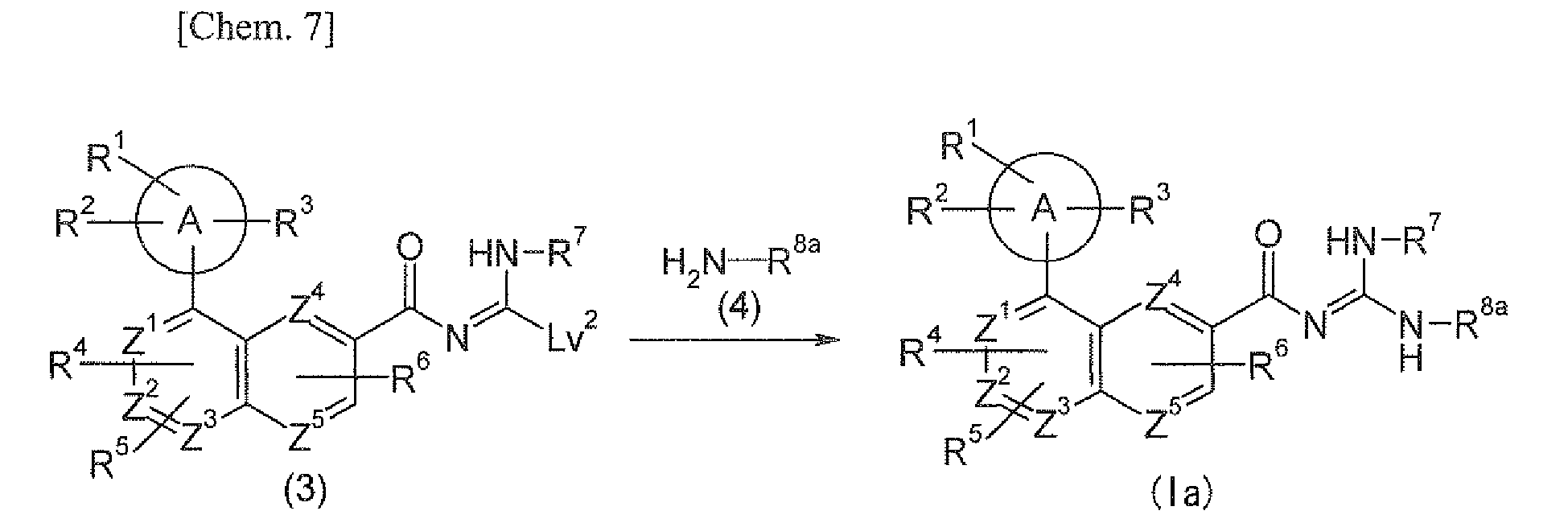
Compound (Ia) having lower alkyl as R8 among compounds of formula (I) can be produced by reaction of an amidine compound (3) having a leaving group with an amine compound (4).
This reaction can be carried out using compound (3) and compound (4) in equivalent amounts, or in an excess amount of one of them, in which their mixture is stirred under from cooling to heating under reflux, and preferably from 0°C to 80°C, usually for 0.1 hours to 5 days, in a solvent inert to reaction or without solvent. Examples of solvents used herein are not limited, but include aromatic hydrocarbons, ethers, halogenated hydrocarbons, DMF, DMSO, ethyl acetate, acetonitrile, and a mixture thereof. It is sometimes advantageous for smooth progress of the reaction to carry out the reaction in the presence of organic bases such as triethylamine, N,N-diisopropylethylamine, N-methylmorpholine, and the like, or inorganic bases such as potassium carbonate, sodium carbonate, potassium hydroxide, and the like. - Carboxylic acid or a reactive derivative thereof (1) of the above Production Process 1 can be produced by known methods or any variation thereof. For example, starting compound (1a) can be produced by the reaction route shown below (Production Process of Starting Compound).
-

- (In the formula, X1 represents halogen, methanesulfonyloxy group, p-toluenesulfonyloxy group, or trifluoromethanesulfonyloxy group, R1 represents a protecting group of carboxyl group such as lower alkyl, benzyl, or the like, and X2 represents an active group such as -B(OH)2, -B(OY)OW, and the like. Here, Y and W are the same or different from each other and represent lower alkyl, or Y and W are combined together to form lower alkylene.)
Compound (1a) can be obtained by coupling reaction of compound (5) and compound (6) to first obtain compound (7),followed by its hydrolysis.
Synthesis of compound (7) is carried out by using a mixture of compound (5) and compound (6) in equivalent amounts or in an excess of one of them, and stirring the mixture under from room temperature to heating under reflux, usually for 0.1 hours to 5 days, in a reaction inert solvent in the presence of a base and palladium catalyst. The present reaction is preferably carried out under an inert gas atmosphere. Examples of solvents used herein include, but not particularly limited to, aromatic hydrocarbons, ethers, halogenated hydrocarbons, alcohols such as methanol, ethanol, and the like, DMF, DMSO, and mixed solvents thereof. As bases, inorganic bases such as sodium carbonate, potassium carbonate, sodium hydroxide, and the like are preferred. Examples of the palladium catalyst include tetrakis(triphenylphosphine)palladium, dichlorobis(triphenylphosphine)palladium, palladium-1,1'-bis(diphenylphosphino)ferrocene chloride, tris(dibenzylideneacetone)dipalladium, and the like. As palladium ligands, tert-butylphosphine, cyclohexylphosphine, 2-dicyclohexylphosphinobiphenyl derivative, or the like can be used. - The coupling reaction can be carried out with reference to the following documents.
- A. de Meijere and F. Diederich, "Metal-Catalyzed Cross-Coupling Reactions", 2nd edition, VCH Publishers Inc., 2004
The Chemical Society of Japan, "Courses in Experimental Chemistry (5th edition)" Vol. 13 (2005) (Maruzen)
Subsequently, compound (7) can be subjected to hydrolysis reaction to obtain compound (1a). The hydrolysis reaction can be carried out with reference to "Greene's Protective Groups in Organic Synthesis (4th edition, 2006)" shown above. - In addition, compounds (5) and (6) described above in (Production Process of Starting Compound) can be produced by known methods or any variation thereof, and for example, they can be produced by the methods described in Preparation Examples below.
- Compound of formula (I) prepared in accordance with the aforementioned methods is isolated and purified as a free compound, as a pharmaceutically acceptable salt, hydrate, solvate, or crystalline polymorph thereof. Pharmaceutically acceptable salts of compound of formula (1) can be prepared using salt preparation methods well-known to those skilled in the art.
Isolation and purification are carried out by applying common chemical operations such as extraction, fractional crystallization and fractional chromatography.
A variety of isomers can be produced by selecting their corresponding starting compounds or by separation of isomers using their physicochemical properties differences. For example, optical isomers are obtained by general optical resolution methods of racemic compounds (for example, fractional crystallization of diastereomeric salts obtained from optically active bases or acids; or chiral column chromatography), and also can be prepared from suitable optical active starting compounds. - Hereinafter, production processes of compound of formula (I) are described as Examples. In addition, production processes of compounds used as starting compounds are described as Preparation Examples. Production processes of compound of formula (I) are not limited to the production processes of the following specific Examples, but the compounds can be prepared by combining these production processes or known production processes.
- A mixture of 4-(2,4,6-trifluorophenyl)quinoline-6-carboxylic acid (118 mg), WSC hydrochloride (112 mg), HOBt (37 mg), and DMF (4 mL) was stirred at room temperature for 5 minutes, and then 3,5-dimethyl-1H-pyrazole-1-carboximidamide nitrate (94 mg) and DIPEA (76 mg) were added thereto, followed by stirring for an additional 24 hours. The reaction mixture was diluted with water, and the precipitate was collected by filtration to obtain N-[1-amino(3,5-dimethyl-1H-pyrazol-1-yl)methylene]-4-(2,4,6-trifluorophenyl)quinoline-6-carboxamide (140 mg).
- A mixture of methyl 1-(2,4,6-trifluorophenyl)isoquinoline-7-carboxylate (228 mg), a 1M aqueous sodium hydroxide solution (4 mL), THF (3 mL), and ethanol (3 mL) was stirred at room temperature for 24 hours. The reaction mixture was neutralized with 1M hydrochloric acid, and the precipitate was collected by filtration to obtain 1-(2,4,6-trifluorophenyl)isoquinoline-7-carboxylic acid hydrochloride (200 mg).
- 2-Carbamoyl-4-(2,4,6-trifluorophenyl)quinoline-6-carboxylic acid was obtained by the same reaction as in Preparation Example 2 by using methyl 2-cyano-4-(2,4,6-trifluorophenyl)quinoline-6-carboxylate as the starting material.
- Under argon gas atmosphere, a mixture of methyl 1-{[(trifluoromethyl)sulfonyl]oxy}isoquinoline-7-carboxylate (250 mg), 2,4,6-trifluorophenylboric acid (184 mg), tetrakis(triphenylphosphine)palladium (22 mg), triethylamine (189 mg), and 1,4-dioxane (15 mL) was heated under stirring in an oil bath at 95°C for 18 hours. The reaction mixture was returned to room temperature, diluted with water, and then extracted with ethyl acetate. The organic layer was concentrated under reduced pressure, and the resulting residue was purified under silica gel column chromatography (hexane/ethyl acetate) to obtain methyl 1-(2,4,6-trifluorophenyl)isoquinoline-7-carboxylate (228 mg).
- Under argon gas atmosphere, a mixture of methyl 4-bromo-3-chloroquinoline-6-carboxylate (130 mg), 2,4-difluorophenylboric acid (137 mg), a 1,1'-bis(diphenylphosphino)ferrocene palladium (II) dichloride/dichloromethane complex (177 mg), cesium fluoride (197 mg), 1,4-dioxane (8 mL), and water (2 mL) was heated under stirring in an oil bath at 100°C for one day. The reaction mixture was returned to room temperature, and water was added, and extracted with ethyl acetate. The organic layer was concentrated under reduced pressure, and the resulting residue was purified under silica gel column chromatography (hexane/ethyl acetate) to obtain methyl 3-chloro-4-(2,4-difluorophenyl)quinoline-6-carboxylate (100 mg).
- Under argon gas atmosphere, a mixture of methyl 4-bromo-1-(2,4,6-trifluorophenyl)isoquinoline-7-carboxylate (292 mg), 2,4,6-trivinylboroxin-pyridine complex (89 mg), palladium acetate (19 mg), tricyclohexylphosphine (45 mg), tripotassium phosphate (280 mg), toluene (7 mL), and water (0.5 mL) was heated under stirring in an oil bath at 100°C for 12 hours. The reaction mixture was returned to room temperature, diluted with water and ethyl acetate, and then the insoluble materials were separated by filtration. The filtrate was extracted with ethyl acetate, and the organic layer was concentrated under reduced pressure. The resulting residue was purified under silica gel column chromatography (hexane/ethyl acetate) to obtain methyl 1-(2,4,6-trifluorophenyl)-4-vinylisoquinoline-7-carboxylate (180 mg).
- Under argon gas atmosphere, a mixture of methyl 4-bromo-1-(2,4,6-trifluorophenyl)isoquinoline-7-carboxylate (160 mg), trimethylboroxin (117 mg), tetrakis(triphenylphosphine)palladium (23 mg), 2M aqueous sodium carbonate solution (1 mL), and 1,4-dioxane (5 mL) was heated under stirring in an oil bath at 100°C for 4 hours. The reaction mixture was returned to room temperature and diluted with ethyl acetate, and then the insoluble materials were separated by filtration through Celite. The filtrate was extracted with ethyl acetate. The organic layer was concentrated under reduced pressure, and the resulting residue was purified under silica gel column chromatography (hexane/ethyl acetate) to obtain 4-methyl-1-(2,4,6-trifluorophenyl)isoquinoline-7-carboxylic acid (95 mg).
- Under argon gas atmosphere, a mixture of ethyl 5-bromoquinoline-3-carboxylate (113 mg), 2,4,6-trifluorophenylboric acid (106 mg), bis(tri-t-butylphosphine)palladium (41 mg), cesium fluoride (123 mg), silver oxide (112 mg), and DMF (2 mL) was heated under stirring in an oil bath at 100°C for 15 hours. The reaction liquid was returned to room temperature, diluted with water, and then extracted with ethyl acetate. The organic layer was concentrated under reduced pressure, and the resulting residue was purified under silica gel column chromatography (hexane/ethyl acetate) to obtain ethyl 5-(2,4,6-trifluorophenyl)quinoline-3-carboxylate (60 mg).
- Under argon gas atmosphere, n-butyllithium (1.6 M THF solution, 0.7 mL) was added dropwise to a mixture of 3,5-difluoropyridine (123 mg) and THF (3 mL) at -78°C, followed by stirring at the same temperature for one hour. Then, zinc chloride (146 mg) was added, and stirred for an additional hour. Methyl 4-chloro-1-{[(trifluoromethyl)sulfonyl]oxy}isoquinoline-7-carboxylate (330 mg) and tetrakis(triphenylphosphine)palladium (206 mg) were added thereto, followed by heating under stirring in an oil bath at 60°C for 3 hours. The reaction mixture was concentrated under reduced pressure and purified under silica gel column chromatography (hexane/ethyl acetate) to obtain methyl 4-chloro-1-(3,5-difluoropyridin-4-yl)isoquinoline-7-carboxylate (62 mg).
- Under argon gas atmosphere, n-butyllithium (1.6 M THF solution, 1.3 mL) was added dropwise to a mixture of 3,5-difluoropyridine (238 mg) and THF (4 mL) at -78°C, followed by stirring at the same temperature for one hour. Then, zinc chloride (0.5 M THF solution, 3.8 mL) was slowly added stirried at the same temperature for 30 minutes and tfurther for an additional hour at room temperature. Tris(dibenzylideneacetone)dipalladium (73 mg), 2-dicyclohexylphosphino-2',6'-diisopropoxybiphenyl (148 mg), and ethyl 2,3-dimethyl-4-{[(trifluoromethyl)sulfonyl]oxy}quinoline-6-carboxylate (300 mg), were added to the reaction mixture and heated under stirring in an oil bath at 70°C for 15 hours. The reaction mixture was returned to room temperature, and the insoluble materials were separated by filtration. Then, the precipitate was concentrated under reduced pressure, and the resulting residue was purified under silica gel column chromatography (hexane/ethyl acetate) to obtain ethyl 4-(3,5-difluoropyridin-4-yl)-2,3-dimethylquinoline-6-carboxylate (51 mg).
- Trifluoromethanesulfonic anhydride (2.1 g) was added to a mixture of methyl 1-hydroxyisoquinoline-7-carboxylate (1.3 g), pyridine (587 mg), and dichloromethane (40 mL), followed by stirring at room temperature for 18 hours. The reaction mixture was diluted with water, extracted with chloroform, and the organic layer was concentrated under reduced pressure. The resulting residue was purified under silica gel column chromatography (chloroform/methanol) to obtain methyl 1-{[(trifluoromethyl)sulfonyl]oxy}isoquinoline-7-carboxylate (1.9 g).
- Boron tribromide (1M dichloromethane solution, 2.5 mL) was added to a mixture of methyl 4-fluoro-1-(2-fluoro-6-methoxyphenyl)isoquinoline-7-carboxylate (270 mg) and dichloromethane (3 mL) under ice-cooling, and stirred at room temperature for 16 hours. The reaction mixture was diluted with water, and the precipitate was collected by filtration to obtain 4-fluoro-1-(2-fluoro-6-hydroxyphenyl)isoquinoline-7-carboxylic acid (240 mg).
- m-Chloroperbenzoic acid (425 mg) was added to a mixture of methyl 4-(2,4,6-trifluorophenyl)quinoline-6-carboxylate (710 mg) and dichloromethane (20 mL), followed by stirring at room temperature for 3 days. The reaction mixture was diluted with aqueous sodium thiosulfate solution, and extracted with chloroform. The organic layer was washed with water, dried, and concentrated under reduced pressure to obtain methyl 4-(2,4,6-trifluorophenyl)quinoline-6-carboxylate 1-oxide (680 mg).
- A mixture of methyl 3,4-dichloroquinoline-6-carboxylate (100 mg), pyrrolidine (33 mg), and NMP (2 mL) was heated under stirring at 180°C for 10 minutes under microwave irradiation. The reaction mixture was diluted with water, and extracted with ethyl acetate. The organic layer was concentrated under reduced pressure, and the resulting residue was purified under silica gel column chromatography (hexane/ethyl acetate) to obtain methyl 3-chloro-4-(pyrrolidin-1-yl)quinoline-6-carboxylate (40 mg).
- Sodium borohydride (17 mg) was added to a mixture of methyl 4-formyl-1-(2,4,6-trifluorophenyl)isoquinoline-7-carboxylate (150 mg) and methanol (10 mL) under ice-cooling, followed by stirring at room temperature for 10 minutes. The reaction mixture was diluted with water, and extracted with ethyl acetate. The organic layer was washed with water, dried, and then concentrated under reduced pressure to obtain methyl 4-(hydroxymethyl)-1-(2,4,6-trifluorophenyl)isoquinoline-7-carboxylate (140 mg).
- Osmium tetraoxide (2.5% isobutanol solution, 0.05 mL), sodium periodate (280 mg), and water (4 mL) were added to a mixture of methyl 1-(2,4,6-trifluorophenyl)-4-vinylisoquinoline-7-carboxylate (180 mg) and THF (4 mL), followed by stirring at room temperature for 12 hours. The reaction mixture was diluted with an aqueous sodium sulfate solution, and extracted with ethyl acetate. The organic layer was concentrated under reduced pressure and purified by silica gel column chromatography (hexane/ethyl acetate) to obtain methyl 4-formyl-1-(2,4,6-trifluorophenyl)isoquinoline-7-carboxylate (153 mg).
- Under hydrogen gas atmosphere at 1 atm, a mixture of methyl 1-(2,6-difluorophenyl)-4-(prop-1-en-2-yl)isoquinoline-7-carboxylate (85 mg), 10% palladium-active carbon (20 mg), and methanol was stirred at room temperature for 4 days. The insoluble materials were separated by filtration, and then the filtrate was concentrated under reduced pressure. The resulting residue was purified under silica gel column chromatography (chloroform) to obtain methyl 1-(2,6-difluorophenyl)-4-isopropyl isoquinoline-7-carboxylate (72 mg).
- A mixture of methyl 4-bromo-1-(2,4,6-trifluorophenyl)isoquinoline-7-carboxylate (66 mg), zinc cyanide (content 60%,21 mg), tris(dibenzylideneacetone)dipalladium (0) (14 mg), 1,1'-bis(diphenylphosphino)ferrocene (17 mg), and N-methyl-2-pyrrolidone (3 mL) was heated under stirring in an oil bath at 150°C for 3 hours. The reaction mixture was returned to room temperature, diluted with water and ethyl acetate, and then the insoluble materials were separated by filtration. The filtrate was subjected to liquid separation, and the organic layer was concentrated under reduced pressure. Then, the resulting residue was purified under silica gel column chromatography (hexane/ethyl acetate) to obtain methyl 4-cyano-1-(2,4,6-trifluorophenyl)isoquinoline-7-carboxylate (44 mg).
- A mixture of methyl-1-oxide 4-(2,4,6-trifluorophenyl)quinoline-6-carboxylate (540 mg), trimethylsilyl cyanide (530 mg), triethylamine (607 mg), dichloromethane (10 mL), and acetonitrile (20 mL) was heated under reflux for one day. The reaction mixture was returned to room temperature, diluted with saturated aqueous sodium bicarbonate, and extracted with ethyl acetate. The organic layer was concentrated under reduced pressure, and the resulting residue was purified under silica gel column chromatography (hexane/ethyl acetate) to obtain methyl 2-cyano-4-(2,4,6-trifluorophenyl)quinoline-6-carboxylate (460 mg).
- A mixture of methyl 1-hydroxy-3-methylisoquinoline-7-carboxylate (120 mg), Selectfluor (registered trademark) (215 mg), acetonitrile (2 mL), and methanol (2 mL) was stirred at room temperature for 3 days. The reaction mixture was concentrated under reduced pressure, and the resulting residue was diluted with water. Then, the precipitate was collected by filtration to obtain methyl 4-fluoro-1-hydroxy-3-methylisoquinoline-7-carboxylate (55 mg).
- DEOXO-FLUOR (registered trademark) (240 mg) was added dropwise to a mixture of methyl 1-(2,6-difluorophenyl)-4-formylisoquinoline-7-carboxylate (96 mg) and dichloromethane (5 mL) at 0°C, and stirred at room temperature for one hour. The reaction mixture was diluted with saturated aqueous sodium bicarbonate, and extracted with chloroform. The organic layer was concentrated under reduced pressure and purified by silica gel column chromatography (hexane/ethyl acetate) to obtain methyl 4-(difluoromethyl)-1-(2,6-difluorophenyl)isoquinoline-7-carboxylate (80 mg).
- A mixture of methyl 4-hydroxyquinoline-6-carboxylate (2.07 g), N-chlorosuccinimide (1.36 g), and acetic acid (56 mL) was stirred at room temperature for one day. The reaction mixture was diluted with water, and then, the precipitate was collected by filtration to obtain methyl 3-chloro-4-hydroxyquinoline-6-carboxylate (2.13 g).
- Methyl 4-chloro-1-hydroxyisoquinoline-7-carboxylate was prepared by the same reaction as in Preparation Example 22 using methyl 1-hydroxyisoquinoline-7-carboxylate as the starting material.
- A mixture of ethyl 3-chloro-4-hydroxy-2-methylquinoline-6-carboxylate (629 mg) and phosphoryl chloride (2 mL) was stirred in an oil bath at 100°C for 18 hours. The reaction mixture was concentrated under reduced pressure, and the resulting residue was diluted with water, and extracted with ethyl acetate. The organic layer was concentrated under reduced pressure, and the resulting residue was purified under silica gel column chromatography (hexane/ethyl acetate) to obtain ethyl 3,4-dichloro-2-methylquinoline-6-carboxylate (454 mg).
- A mixture of methyl 4-(2,4,6-trifluorophenyl)quinoline-6-carboxylate 1-oxide (1.3 g) and phosphoryl chloride (10 mL) was heated under stirring in an oil bath at 100°C for 2 hours. The reaction mixture was concentrated under reduced pressure, and the resulting residue was diluted with water, and then extracted with ethyl acetate. The organic layer was concentrated under reduced pressure, and the resulting residue was purified under silica gel column chromatography (hexane/ethyl acetate) to obtain methyl 2-chloro-4-(2,4,6-trifluorophenyl)quinoline-6-carboxylate (370 mg).
- A mixture of bromine (940 mg) and acetic acid (10 mL) was added dropwise to a mixture of methyl 1-hydroxyisoquinoline-7-carboxylate (1.2 g) and acetic acid (50 mL) and stirred at room temperature for 30 minutes. The reaction mixture was diluted with water, and the precipitate was collected by filtration to obtain methyl 4-bromo-1-hydroxyisoquinoline-7-carboxylate (1.4 g).
- A mixture of methyl 3-chloro-4-hydroxyquinoline-6-carboxylate (600 mg) and phosphoryl bromide (868 mg) was heated under stirring in an oil bath at 130°C for 6 hours. Ice-water was added, followed by neutralization with saturated aqueous sodium bicarbonate and extraction with ethyl acetate. The organic layer was washed with water, dried, and concentrated under reduced pressure to obtain methyl 4-bromo-3-chloroquinoline-6-carboxylate (426 mg).
- To a mixture of methyl 1-hydroxyisoquinoline-7-carboxylate (1.0 g) and pyridine (40 mL) was added iodine (1.2 g), and stirred at room temperature for 16 hours. The reaction mixture was diluted with saturated aqueous sodium bicarbonate and a 5% aqueous sodium thiosulfate solution. Then, the precipitate was collected by filtration to obtain methyl 1-hydroxy-4-iodoisoquinoline-7-carboxylate (1.1 g).
- To a mixture of methyl 4-oxo-1,4-dihydroquinoline-6-carboxylate (1.1 g) and acetic acid (30 mL) was added N-iodosuccinimide (1.1 g), followed by stirring at room temperature for one day. The reaction mixture was diluted with water, and the precipitate was collected by filtration to obtain methyl 3-iodo-4-oxo-1,4-dihydroquinoline-6-carboxylate (1.8 g).
- Methyl 2,2-difluoro-2-(fluorosulfonyl) acetate (1.7 g) and copper(I) iodide (174 mg) were added to a mixture of methyl 3-iodo-4-oxo-1,4-dihydroquinoline-6-carboxylate (1.0 g) and DMF (20 mL), followed by heating under stirring in an oil bath at 100°C for 5 hours. The reaction mixture was returned to room temperature, concentrated under reduced pressure, and then the resulting residue was purified under silica gel column chromatography (chloroform/methanol) to obtain methyl 4-oxo-3-(trifluoromethyl)-1,4-dihydroquinoline-6-carboxylate (228 mg).
- A mixture of methyl 3-methyl-1-oxo-1H-isochromene-7-carboxylate (1.0 g), 29% aqueous ammonia solution (30 mL) and THF (30 mL) was stirred at room temperature for 8 hours. The reaction mixture was neutralized with hydrochloric acid, and the precipitate was collected by filtration to obtain methyl 1-hydroxy-3-methylisoquinoline-7-carboxylate (390 mg).
- Concentrated sulfuric acid (3 mL) was added to a mixture of sodium 3-methyl-1-oxo-1H-isochromene-7-carboxylate (1.69 g) and methanol (50 mL), and heated under stirring in an oil bath at 60°C for 2 days. The reaction mixture was returned to room temperature, diluted with water, and extracted with ethyl acetate. The organic layer was washed with water, dried, and concentrated under reduced pressure to obtain methyl 3-methyl-1-oxo-1H-isochromene-7-carboxylate (1.0 g).
- Under oxygen atmosphere, a mixture of 4-allyl isophthalic acid (500 mg), bis(acetonitrile)dichloropalladium (629 mg), sodium carbonate (514 mg), and THF (30 mL) was stirred at room temperature for 4 hours. The insoluble material of the reaction mixture was separated by filtration, and the filtrate was concentrated under reduced pressure. A mixture of the resulting residue and DMF (5 mL) was diluted with 1M hydrochloric acid, and the precipitate was collected by filtration to obtain 3-methyl-1-oxo-1H-isochromene-7-carboxylic acid (112 mg).
- Under argon gas atmosphere, a mixture of dimethyl 4-bromoisophthalate (5.0 g), allyl tributyl tin (6.7 g), tetrakis(triphenylphosphine)palladium (1.1 g), and toluene (100 mL) was heated under reflux for 20 hours. The reaction mixture was returned to room temperature, diluted with water, and extracted with ethyl acetate. The organic layer was concentrated under reduced pressure, and the resulting residue was purified under silica gel column chromatography (hexane/ethyl acetate) to obtain dimethyl 4-allyl isophthalic acid (3.1g).
- A mixture of 4-{[(2,2-dimethyl-4,6-dioxo-1,3-dioxan-5-ylidene)methyl]amino}-3-methylbenzoic acid (10.1 g) and diphenyl ether (101 mL) was heated under stirring in an oil bath at 280°C for 2 hours. The reaction mixture was returned to room temperature, diluted with petroleum ether and the precipitate was collected by filtration to obtain 4-hydroxy-8-methylquinoline-6-carboxylic acid (6.7 g).
- A mixture of 4-amino-3-methylbenzoic acid (7.3 g), Meldrum's acid (7.3 g), methyl orthoformate (5.6 g) and methanol (30 mL) was heated under stirring in an oil bath at 60°C for 5 hours. The reaction mixture was returned to room temperature, diluted with ethyl acetate and the precipitate was collected by filtration to obtain 4-{[(2,2-dimethyl-4,6-dioxo-1,3-dioxan-5-ylidene)methyl]amino}-3-methylbenzoic acid (10.1 g).
- A mixture of phosphorus pentoxide (37 g) and phosphoric acid (46 g) was heated under stirring in an oil bath at 140°C, and methyl 4-amino-3-methylbenzoate (3.0 g) and ethyl acetoacetate (2.8 g) were added thereto, followed by heating under stirring for an additional 2 hours. The reaction mixture was cooled to 60°C, poured into water, and neutralized with a 29% aqueous ammonia solution, and the precipitate was collected by filtration to obtain methyl 2,8-dimethyl-4-oxo-1,4-dihydroquinoline-6-carboxylate (1.8 g).
- A mixed liquid of 7-bromo-4-fluoroisoquinolin-1-ol hydrochloride (3.0 g), palladium (II) acetate (484 mg), 1,1'-bis(diphenylphosphino)ferrocene (1.2 g), triethylamine (4.4 g), NMP (60 mL), and methanol (60 mL) was stirred at room temperature for 15 minutes while carbon monoxide gas was passed therethrough. The reaction was further heated under stirring in an oil bath at 80°C for 16 hours under a carbon monoxide gas atmosphere at 1 atm. The reaction mixture was returned to room temperature, the insoluble materials were separated by filtration, and then the precipitate was concentrated under reduced pressure. The resulting residue was diluted with water, and then the precipitate was collected by filtration to obtain methyl 4-fluoro-1-hydroxyisoquinoline-7-carboxylate (2.3 g).
- A mixture of 2-bromo-1-chloro-3,5-difluorobenzene (800 mg), bis(pinacolato)diborone (1.1 g), bis(triphenylphosphine)palladium chloride (123 mg), triphenylphosphine (92 mg), potassium acetate (1.0 g), and 1,4-dioxane (24 mL) was heated under stirring in an oil bath at 100°C for 18 hours. The reaction mixture was returned to room temperature, the insoluble materials were separated by filtration, and the filtrate was concentrated under reduced pressure. The resulting residue was purified under silica gel column chromatography (hexane/ethyl acetate) to obtain 2-(2-chloro-4,6-difluorophenyl)-4,4,5,5-tetramethyl-1,3,2-dioxaborolane (242 mg).
- Under argon gas atmosphere, a mixture of methyl 4-bromo-1-(2,4,6-trifluorophenyl)isoquinoline-7-carboxylate (150 mg), ethylboronic acid (84 mg), tetrakis(triphenylphosphine)palladium (44 mg), tripotassium phosphate (241 mg), toluene (5 mL), and water (0.3 mL) was heated under stirring in an oil bath at 100°C for one day. The reaction mixture was returned to room temperature, and diluted with water and ethyl acetate, and then the insoluble matter was separated by filtration. The filtrate was extracted with ethyl acetate, and the organic layer was concentrated under reduced pressure. The resulting residue was purified under silica gel column chromatography (hexane/ethyl acetate) to obtain methyl 4-ethyl-1-(2,4,6-trifluorophenyl)isoquinoline-7-carboxylate (71 mg).
- A mixture of methyl 4-chloro-1-(3-chloro-2-hydroxyphenyl)isoquinoline-7-carboxylate (150 mg), potassium carbonate (119 mg), iodomethane (245 mg), and DMF (3 mL) was stirred at room temperature for one day. The reaction mixture was diluted with water, and extracted with ethyl acetate. The organic layer was washed with saturated brine, dried, and concentrated under reduced pressure. The resulting residue was purified under silica gel column chromatography (hexane/ethyl acetate) to obtain methyl 4-chloro-1-(3-chloro-2-methoxyphenyl)isoquinoline-7-carboxylate (130 mg).
- Tetrabutylammonium fluoride (1M THF solution, 0.35 mL) was added to a mixture of methyl 1-[3,5-difluoro-4-(trimethylsilyl)pyridin-2-yl]-4-fluoroisoquinoline-7-carboxylate and THF (1.8 mL), and stirred at room temperature overnight. The reaction mixture was diluted with water, and extracted with ethyl acetate. The organic layer was washed with saturated brine, dried, and concentrated under reduced pressure. The resulting residue was purified under silica gel column chromatography (hexane/ethyl acetate) to obtain methyl 1-(3,5-difluoropyridin-2-yl)-4-fluoroisoquinoline-7-carboxylate (55 mg).
- The compounds of Preparation Examples shown in Tables below were prepared using the respective corresponding starting materials in the same manner as the methods of Preparation Examples above. In addition, the structural formulae, the physicochemical data, and the production methods for the compounds of Preparation Examples are shown in Tables below.
- A mixture of 1-(2,4,6-trifluorophenyl)isoquinoline-7-carboxylic acid hydrochloride (200 mg), CDI (143 mg) and DMF (6 mL) was heated under stirring in an oil bath at 60°C for 30 minutes. Then, the reaction mixture was returned to room temperature, and guanidine carbonate (265 mg) was added thereto, followed by stirring at room temperature for additional 20 hours. The reaction mixture was diluted with saturated aqueous sodium bicarbonate, extracted with ethyl acetate, and the organic layer was washed with water, dried, and concentrated under reduced pressure. The resulting residue was purified under NH silica gel column chromatography (chloroform/methanol=100:0-20:1), and formed into its salt with 4M hydrogen chloride/ethyl acetate solution to obtain N-(diaminomethylene)-1-(2,4,6-trifluorophenyl)isoquinoline-7-carboxamide dihydrochloride (232 mg).
- A mixture of guanidine hydrochloride (374 mg), sodium methoxide (212 mg), and methanol (10 mL) was stirred at room temperature for one hour. The reaction mixture was concentrated under reduced pressure, and a mixture of methyl 4-(hydroxymethyl)-1-(2,4,6-trifluorophenyl)isoquinoline-7-carboxylate (136 mg) and NMP (10 mL) was added thereto, followed by heating and stirring in an oil bath at 120°C for 5 hours. The reaction mixture was returned to room temperature, diluted with water, and extracted with ethyl acetate. The organic layer was concentrated under reduced pressure, and the resulting residue was purified under NH silica gel column chromatography (chloroform/methanol=100:0-90:10). Then, ethanol and fumaric acid were added thereto, and the precipitate was collected by filtration to obtain N-(diaminomethylene)-4-(hydroxymethyl)-1-(2,4,6-trifluorophenyl)isoquinoline-7-carboxamide fumarate (46 mg).
- A mixture of N-[1-amino(3,5-dimethyl-1H-pyrazol-1-yl)methylene]-4-(2,4,6-trifluorophenyl)quinoline-6-carboxamide (73 mg) and methylamine (40% methanol solution, 32 mg) was stirred at room temperature for 20 hours. The reaction mixture was diluted with saturated aqueous sodium bicarbonate, and extracted with ethyl acetate. The organic layer was concentrated under reduced pressure, and the resulting residue was purified under silica gel column chromatography (chloroform/methanol=20:1), and formed into its salt with 4M hydrogen chloride/1,4-dioxane solution to obtain N-[1-amino(methylamino)methylene]-4-(2,4,6-trifluorophenyl)quinoline-6-carboxamide dihydrochloride.
- The compounds of Examples 4 to 223 and 225 to 251 were prepared using the corresponding starting materials in the same manner as Example 1, and the compound of Example 224 was prepared using the corresponding starting materials in the same manner as Example 2. The structural formulae and the physicochemical data of the compounds of Examples are shown in Tables below.
- The following abbreviations are used in the tables below.
PEx: Preparation Example number, Ex: Example number, Str: structural formula, Dat: physicochemical data (ESI+: ESI-MS[M+H]+ or ESI-MS[M]+; FAB+: FAB-MS[M+H]+ or FAB-MS[M]+; EI+: EI[M]+; A/E+: APCI/ESI-MS[M+H]+ or APCI/ESI-MS[M]+ (APCI/ESI means simultaneous measurement of APCI and ESI); A/E-: APCI/ESI-MS[M-H]- (APCI/ESI means simultaneous measurement of APCI and ESI); NMR: δ (ppm) of peaks by 1HNMR in CDCl3 or DMSO-d6); Sal: salt (Blank or no description represents the free form, and the numeral present before the acidic ingredient represents a molar ratio. For example, when 2HCl is described shows that the compound is dihydrochloride); Me: methyl, Et: ethyl, iPr: isopropyl, cPr: cyclopropyl, tBu: tert-butyl, Tf: trifluoromethanesulfonyl, Fum: fumaric acid, Syn: production process (the numeral shows that the compound was produced using the corresponding starting material in the same manner as in the compound having the number as its Preparation Example number), ND: Not Determined. -

-

-

-

-

-

-

-

-

-

-

-

-

-

-

-

-

-

-

-

-

-

-

-

-

-

-

-

-

-

-

-

-

-

-

-

-

-

-
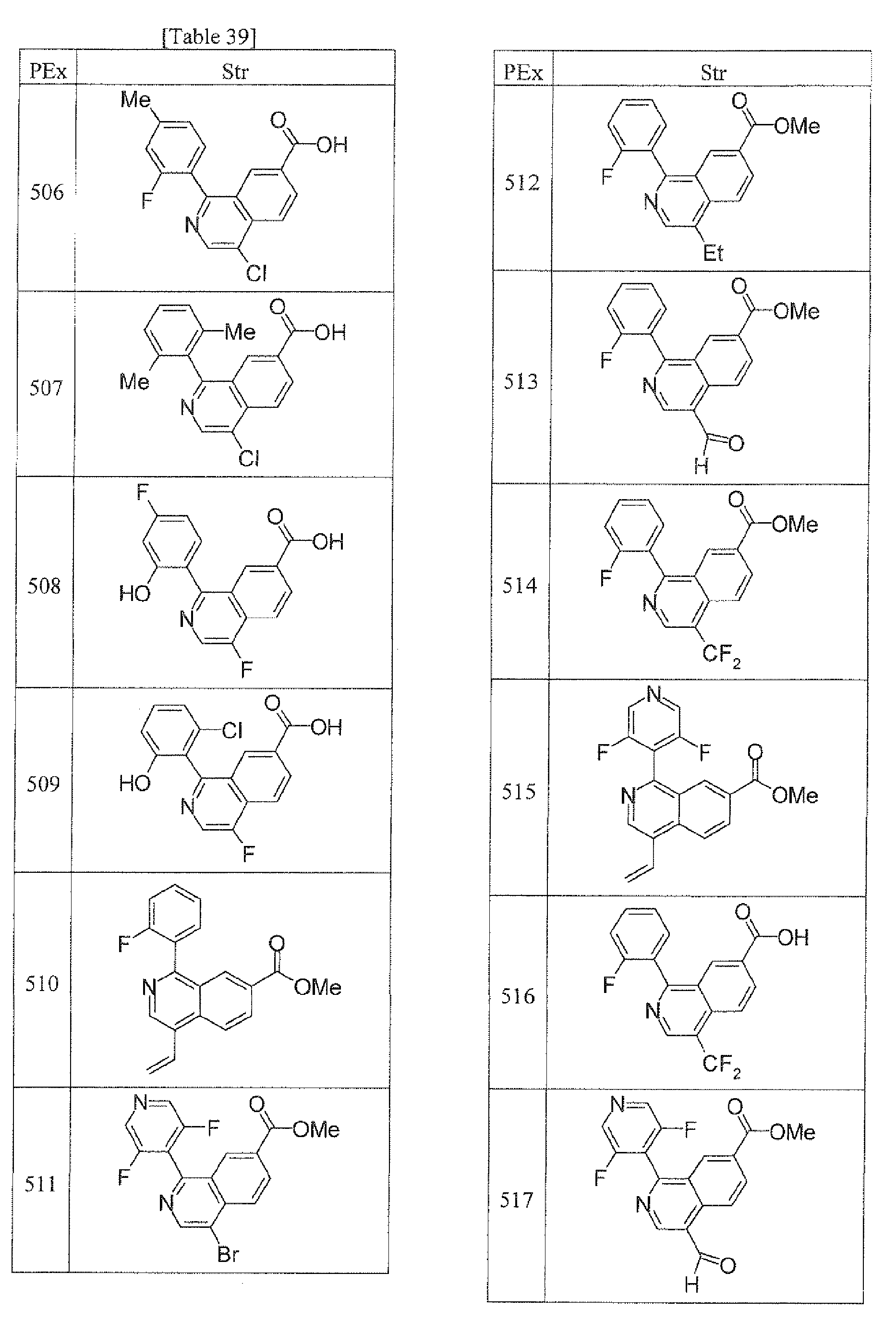
-
[Table 40] PEx Str 518 
519 
520 
-
[Table 41] PEx Syn Dat PEx Syn Dat PEx Syn Dat 1 1 A/E+: 424 38 38 A/E+: 222 75 4 EI+: 331 2 2 ESI+: 304 39 39 EI+: 274 76 4 ESI+: 332 3 3 ESI+: 361 40 11 A/E+: 336 77 4 ESI+: 332 4 4 ESI+: 318 41 4 EI+: 263 78 2 ESI+: 264 5 5 ESI+: 334 42 4 EI+: 317 79 2 ESI+: 318 6 6 A/E+: 344 43 2 ESI+: 250 80 2 ESI+: 318 7 7 ESI+: 318 44 2 ESI+: 304 81 2 ESI+: 318 8 8 A/E+: 332 45 4 EI+: 263 82 4 ESI+: 316 9 9 A/E+: 335 46 4 EI+: 317 83 4 ESI+: 332 10 10 A/E+:343 47 2 ESI+: 250 84 4 ESI+: 316 11 11 A/E+:336 48 2 ESI+: 304 85 4 EI+: 333 12 12 ESI+: 302 49 11 ESI+: 364 86 4 EI+: 315 13 13 ESI+: 334 50 4 ESI+: 346 87 4 EI+: 315 14 14 A/E+: 291, 293 51 2 ESI+: 318 88 2 ESI+: 320 15 15 ESI+: 348 52 4 ESI+: 264 89 2 ESI+: 302 16 16 ESI+: 346 53 2 ESI+: 250 90 2 ESI+: 302 17 17 ESI+: 342 54 4 A/E+: 344 91 2 A/E+: 302 18 18 A/E+: 342 55 2 ESI+: 316 92 2 A/E+: 318 19 19 ESI+: 343 56 4 ESI+: 332 93 2 A/E+: 302 20 20 A/E+: 236 57 4 ESI+: 332 94 4 ESI+: 332 21 21 ESI+: 350 58 4 ESI+: 316 95 4 ESI+: 332 22 22 A/E+: 238 59 4 ESI+: 289 96 4 ESI+: 289 23 23 ESI+: 237 60 2 ESI+: 318 97 4 A/E+: 348 24 24 A/E+: 284, 286 61 2 ESI+: 318 98 4 A/E+: 346 25 25 A/E+: 352 62 2 ESI+: 302 99 4 A/E+: 366 26 26 FAB+: 282, 284 63 2 ESI+: 275 100 2 A/E+: 318 27 27 ESI+: 300, 302 64 4 EI+: 334 101 2 A/E+: 318 28 28 ESI+: 329 65 2 EI+: 320 102 2 A/E+: 275 29 29 A/E+: 330 66 4 EI+: 333 103 2 ESI+: 334 30 30 A/E+: 272 67 4 ESI+: 316 104 2 ESI+: 332 31 31 A/E+: 218 68 4 ESI+: 316 105 2 ESI+: 352 32 32 A/E+: 219 69 2 ESI+: 320 106 4 ESI+: 350 33 33 A/E+: 205 70 2 ESI+: 302 107 4 ESI+: 400 34 34 A/E+: 235 71 2 ESI+: 302 108 2 ESI+: 336 35 35 ESI+: 204 72 38 A/E+: 218 109 2 ESI+: 386 36 36 A/E-: 304 73 11 A/E+: 350 110 4 ESI+: 323 37 37 A/E+: 232 74 4 EI+: 277 111 4 ESI+: 350 -
[Table 42] PEx Syn Dat PEx Syn Dat PEx Syn Dat 112 2 ESI+: 336 149 4 A/E+: 314 186 4 A/E+: 344 113 2 A/E-: 307 150 36 A/E-: 308 187 4 ESI+: 330 114 4 A/E+: 314 151 36 A/E-: 358 188 2 ESI+: 302 115 4 A/E+: 314 152 11 ESI+: 369 189 2 ESI+: 330 116 4 ESI+: 289 153 35 ND 190 2 ESI+: 316 117 4 ESI+: 350 154 2 A/E+: 293 191 2 A/E+: 304 118 2 ESI+: 300 155 4 ESI+: 352 192 4 A/E+: 330 119 2 ESI+: 300 156 2 FAB+: 332 193 4 A/E+: 316 120 2 ESI+: 275 157 35 A/E+: 258 194 2 ND 121 2 ESI+: 336 158 32 A/E+: 222 195 4 ND 122 4 ESI+: 294 159 4 A/E+: 330 196 2 A/E+: 302 123 4 ESI+: 319 160 4 A/E+: 330 197 2 A/E+: 254 124 2 ESI+: 280 161 4 A/E+: 296 198 4 A/E+: 330 125 2 ESI+: 305 162 4 A/E+: 296 199 2 A/E+: 316 126 4 EI+: 349 163 4 A/E+: 346 200 11 ESI+: 415, 417 127 4 EI+: 349 164 32 A/E+: 272 201 4 A/E+: 396, 398 128 36 ND 165 2 ESI+: 337 202 4 A/E+: 348 129 2 ESI+: 336 166 2 ESI+: 316 203 4 A/E+: 282 130 2 ESI+: 336 167 2 ESI+: 316 204 2 A/E+: 327 131 32 A/E+: 218 168 2 ESI+: 282 205 2 A/E+: 334 132 35 ND 169 2 ESI+: 282 206 2 A/E+: 268 133 32 A/E+: 238 170 2 A/E+: 332 207 4 A/E+: 330 134 11 FAB+: 350 171 11 ESI+: 354 208 4 ND 135 2 ESI+: 320 172 11 FAB+: 404 209 2 A/E-: 314 136 4 ESI+: 332 173 4 A/E+: 346, 348 210 5 A/E+: 316 137 4 A/E+: 330 174 4 A/E+: 336 211 2 A/E+: 296 138 2 A/E+: 318 175 9 A/E+: 301 212 4 A/E+: 342 139 11 ND 176 4 ND 213 2 A/E+: 302 140 4 A/E+: 314 177 2 A/E+: 332, 334 214 4 A/E+: 242 141 4 A/E+: 330 178 2 A/E+: 322 215 2 A/E+: 328 142 2 A/E+: 316 179 2 A/E+: 372 216 2 A/E+: 228 143 2 A/E+: 300 180 2 ESI+: 287 217 2 A/E+: 320 144 4 A/E+: 352 181 4 A/E+: 346, 348 218 5 A/E+: 316 145 2 A/E+: 316 182 2 A/E+: 332 219 5 A/E+: 298 146 2 A/E+: 338 183 4 A/E+: 330 220 2 A/E+: 302 147 4 ESI+: 307 184 4 A/E+: 316, 318 221 2 A/E+: 284 148 4 A/E+: 346 185 2 A/E+: 316 222 4 A/E+: 336 -
[Table 43] PEx Syn Dat PEx Syn Dat PEx Syn Dat 223 4 A/E+: 318 260 4 A/E+: 368 297 5 A/E+: 324 224 4 A/E+: 268 261 11 ESI+: 378 298 5 A/E+: 276 225 2 ESI+: 322 262 2 A/E+: 354 299 2 A/E+: 339, 341 226 2 ESI+: 304 263 4 A/E+: 360 300 2 A/E-: 346, 348 227 5 A/E+: 262 264 2 A/E+: 332 301 2 A/E+: 334, 336 228 2 A/E+: 248 265 2 ESI+: 320 302 2 A/E+: 309 229 4 A/E+: 342 266 6 A/E+: 358 303 2 A/E+: 316, 318 230 2 A/E+: 254 267 2 A/E+: 344 304 2 A/E+: 207 231 2 A/E+: 321 268 5 A/E+: 362, 364 305 2 A/E+: 296 232 2 ESI+: 328 269 2 ESI+: 334 306 5 A/E+: 317, 319 233 19 A/E+: 329 270 5 A/E+: 344 307 5 A/E+: 329, 311 234 4 A/E+: 334 271 2 A/E+: 316 308 2 A/E+: 262, 264 235 4 ESI+: 334 272 4 ND 309 2 A/E+: 303, 305 236 4 A/E+: 334 273 5 A/E+: 302, 304 310 2 A/E+: 315, 317 237 4 A/E+: 318 274 11 A/E+: 404 311 5 A/E+: 288, 290 238 4 A/E+: 307 275 37 A/E+: 246 312 2 A/E+: 274 239 4 A/E+: 344 276 4 ESI+: 386 313 11 A/E+: 350 240 4 A/E+: 328 277 4 ESI+: 368 314 4 A/E+: 332 241 2 ESI+: 320 278 2 A/E+: 288 315 11 A/E+: 368 242 2 ESI+: 320 279 22 A/E+: 252 316 4 A/E+: 350 243 2 ESI+: 304 280 4 A/E+: 344 317 2 ESI+: 318 244 2 ESI+: 293 281 24 A/E+: 264, 266 318 2 ESI+: 336 245 4 A/E+: 328 282 2 ESI+: 372 319 2 A/E+: 314 246 4 A/E+: 310 283 2 ESI+: 354 320 4 A/E+: 314 247 2 A/E+: 300 284 5 A/E+: 362, 364 321 5 A/E+: 330, 332 248 2 ESI+: 330 285 5 A/E+: 342 322 5 A/E+: 330, 332 249 11 ESI+: 364 286 2 A/E+: 330 323 2 ESI+: 300 250 2 A/E+: 282 287 2 A/E+: 330 324 2 A/E+: 316, 318 251 2 A/E+: 300 288 24 A/E+: 270, 272 325 2 A/E+: 316, 318 252 4 A/E+: 346 289 5 A/E+: 328 326 5 A/E+: 362, 364 253 4 A/E+: 328 290 5 A/E+: 332, 334 327 5 A/E+: 346, 348 254 4 A/E+: 328 291 5 A/E+: 323, 325 328 2 A/E+: 348, 350 255 2 ESI+: 332 292 5 A/E+: 353, 355 329 2 ND 256 2 A/E+: 314 293 2 A/E+: 314, 316 330 5 A/E+: 341 257 27 A/E+: 334,336 294 2 A/E+: 318, 320 331 2 A/E+: 327, 329 258 2 A/E+: 314 295 5 A/E+: 348, 350 332 5 A/E+: 344, 346 259 22 A/E+: 266 296 5 A/E+: 330, 332 333 11 FAB+: 378 -
[Table 44] PEx Syn Dat PEx Syn Dat PEx Syn Dat 334 4 A/E+: 360 371 2 ESI+: 328 408 2 A/E+: 332, 334 335 2 A/E+: 316, 318 372 4 A/E+: 346 409 4 A/E+: 362, 364 336 2 A/E+: 332 373 2 A/E+: 330 410 17 A/E+: 328 337 38 A/E+: 204 374 4 A/E+: 363, 364 411 6 ESI+: 314 338 11 A/E+: 336 375 2 A/E+: 313 412 2 A/E+: 302, 304 339 4 A/E+: 300 376 2 A/E+: 318 413 2 A/E+: 300 340 2 A/E+: 277, 279 377 4 A/E+: 317 414 A/E+: 339, 341 341 4 A/E+: 342 378 4 A/E+: 362 415 4 ESI+: 350 342 2 ESI+: 286 379 2 ND 416 2 ESI+: 314 343 2 A/E+: 314 380 30 A/E-: 270 417 2 A/E+: 348, 350 344 4 A/E+: 358 381 4 A/E+: 354 418 9 A/E+: 351 345 4 ESI+: 324 382 2 A/E+: 334, 336 419 2 ESI+: 336 346 4 A/E+: 361 383 4 A/E+: 328 420 4 A/E+: 350, 352 347 4 A/E+: 372 384 2 ESI+: 303 421 2 ESI+: 337 348 2 ESI+: 296 385 2 A/E+: 300 422 4 ESI+: 300 349 37 A/E+: 250 386 4 A/E+: 346 423 4 ESI+: 350 350 2 A/E+: 333 387 2 A/E+: 326 424 4 ESI+: 350 351 2 A/E+: 344 388 2 A/E+: 320 425 4 ESI+: 350 352 4 A/E+: 340 389 2 A/E+: 332, 334 426 2 ESI+: 286 353 4 ESI+: 380 390 4 A/E+: 350, 352 427 2 ESI+: 336 354 9 A/E+: 319 391 4 A/E+: 332, 334 428 2 ESI+: 336 355 11 A/E+: 354 392 2 A/E+: 338 429 2 ESI+: 336 356 6 ESI+: 340 393 2 A/E+: 336, 338 430 4 A/E+: 362, 364 357 2 ESI+: 326 394 9 A/E+: 335 431 4 A/E+: 366, 368 358 6 ESI+: 340 395 4 ESI+: 301 432 4 A/E+: 334, 336 359 2 ESI+: 305 396 2 ESI+: 321 433 4 A/E+: 330, 332 360 2 A/E+: 330, 332 397 2 ESI+: 287 434 5 A/E+: 360, 362 361 2 A/E-: 310, 312 398 4 A/E+: 317 435 2 A/E+: 316, 318 362 4 A/E+: 358 399 4 A/E+: 333, 335 436 4 ESI+: 282 363 4 A/E+: 341, 343 400 9 A/E+: 335 437 4 ESI+: 296 364 4 ESI+: 330 401 11 ESI+: 404 438 4 ESI+: 300 365 4 ESI+: 300 402 2 ESI+: 321 439 4 ESI+: 316 366 4 ESI+: 316 403 2 A/E+: 319, 321 440 5 A/E+: 379, 380 367 2 ESI+: 316 404 4 A/E+: 316, 318 441 4 A/E+: 262, 264 368 2 ESI+: 286 405 4 A/E+: 346 442 4 A/E+: 298, 300 369 2 ESI+: 302 406 4 A/E+: 353, 355 443 6 ESI+: 326 370 11 ESI+: 382 407 2 A/E+: 303 444 2 A/E+: 348, 350 -
[Table 45] PEx Syn Dat PEx Syn Dat PEx Syn Dat 445 4 A/E+: 368 478 2 A/E+: 316 511 9 ESI+: 379, 381 446 2 ESI+: 268 479 4 ESI+: 394, 396, 398 512 17 ESI+: 310 447 2 ESI+: 282 480 6 ESI+: 330, 332 513 16 ESI+: 310 448 2 ESI+: 286 481 4 A/E+: 352, 354 514 21 ESI+: 332 449 2 ESI+: 302 482 4 A/E+: 334, 336 515 6 ESI+: 327 450 4 A/E+: 350, 352 483 14 A/E+: 371 516 2 ESI+: 318 451 16 ESI+: 328 484 4 ESI+: 361, 363 517 16 ESI+: 329 452 4 ESI+: 332 485 6 A/E+: 315 518 21 ESI+: 351 453 2 A/E+: 284, 286 486 2 ESI+: 338, 340 519 2 ESI+: 337 454 2 ESI+: 336 487 2 A/E+: 320, 322 520 2 ESI+: 296 455 2 A/E+: 336, 338 488 4 ESI+: 350, 352 456 2 ESI+: 318 489 4 ESI+: 330 457 2 A/E+: 354 490 4 ESI+: 346 458 2 A/E+: 332, 334 491 4 ESI+: 346 459 4 ESI+: 360, 362 492 4 ESI+: 318 460 4 ESI+: 376, 378, 380 493 2 ESI+: 336, 338 461 4 ESI+: 334 494 2 ESI+: 316, 318 462 2 A/E+: 248, 250 495 4 ESI+: 312, 314 463 4 ESI+: 334 496 4 ESI+: 330 464 6 A/E+: 312, 314 497 2 ND 465 2 ESI+: 352, 354, 356 498 2 ESI+: 316 466 2 ESI+: 320, 322 499 2 ESI+: 332 467 4 ESI+: 366, 368, 370 500 2 ESI+: 332 468 4 ESI+: 334, 336 501 2 ESI+: 304 469 2 A/E+: 351, 353 502 6 ESI+: 297 470 2 A/E+: 320, 322 503 4 ESI+: 326 471 2 ESI+: 320 504 2 ESI+: 298 472 2 ESI+: 320 505 2 ESI+: 283 473 2 A/E+: 350, 352 506 2 ESI+: 316, 318 474 2 ESI+: 282 507 2 ESI+: 312, 315 475 2 A/E+: 315 508 12 ESI+: 302 476 2 ND 509 12 ESI+: 318 477 15 ESI+: 330 510 6 ESI+: 308 -
[Table 46] PEx Dat (NMR) 128 DMSO-d6: 1.70 (6H, s), 7.94-7.96 (1H, m), 8.04-8.06 (2H, m), 8.84-8.87 (1H, m), 11.65-11.68 (1H, brs) 139 CDCl3: 4,04 (3H, s), 7.60 (1H, d, J = 6 Hz), 8.57 (1H, s), 8.74 (1H, s), 9.20 (1H, d, J = 6 Hz) 208 CDCl3: 1.54 (6H, s), 3.93 (3H, s), 7.23-7.35 (3H, m), 7.40 (1H, d, J = 4 Hz), 8.19 (1H, s), 8.23 (1H, s), 9.08 (1H, d, J = 4 Hz) 272 CDCl3: 2.83 (3H, s), 2.88 (3H, s), 3.89 (3H, s), 7.18-7.27 (2H, m), 7.41-7.45 (2H, m), 7.98 (1H, s), 8.14 (1H, s) -

-

-

-

-

-

-

-

-

-

-

-

-

-

-

-

-

-

-

-

-

-
[Table 68] Ex Dat 223 ESI+: 378 224 ESI+: 357 225 ESI+: 291 226 ESI+: 345 227 ESI+: 345 228 ESI+: 327 -
[Table 69] Ex Dat (NMR-DMSO-d6) 2 5.03 (2H, s), 5.51 (1H, brs), 6.62 (2H, s), 7.45-7.51 (2H, m), 8.25 (1H, d, J = 8.8 Hz), 8.32 (1H, s), 8.51 (1H, dd, J = 8.8, 1.6 Hz), 8.66 (1H, s) 6 2.80 (3H, s), 7.44-7.52 (2H, m), 7.73 (1H, s), 8.24 (1H, d, J = 8.9 Hz), 8.37 (1H, brs), 8.47 (1H, dd, J = 8.8, 2.0 Hz), 8.54 (2H, brs), 8.74 (2H, brs) 17 1.99 (3H, s), 7.50 (2H, t, J = 7.8 Hz), 8.23 (1H, s), 8.28 (1H, d, J = 8.8 Hz), 8.42-8.46 (1H, m), 8.57 (2H, brs), 8.78 (2H, brs), 9.15 (1H, s) 31 2.28 (3H, s), 7.31-7.40 (1H, m), 7.50-7.59 (2H, m), 8.09 (1H, s), 8.24 (1H, d, J = 8.8 Hz), 8.41-8.47 (1H, m), 8.55 (2H, brs), 8.70 (2H, brs), 9.09 (1H, s) 60 7.36-7.40 (1H, m), 7.56-7.67 (2H, m), 8.15 (1H, s), 8.33 (1H, d, J = 8 Hz), 8.51 (1H, d, J = 8 Hz), 8.56 (2H, brs), 8.68 (2H, brs), 9.23 (1H, s), 12.33 (1H, brs) 73 7.45-7.50 (2H, m), 7.55-7.58 (2H, m), 8.12 (1H, s), 8.30 (1H, d, J = 8 Hz), 8.51 (1H, d, J = 8 Hz), 8.56 (2H, brs), 8.66 (2H, brs), 9.19 (1H, s), 12.22 (1H, brs) 74 7.47-7.49 (2H, m), 7.60-7.64 (2H, m), 8.12 (1H, s), 8.30 (1H, d, J = 8 Hz), 8.55 (2H, d, J = 8 Hz), 8.58 (2H, brs), 8.67 (2H, brs), 9.18 (1H, s), 12.23 (1H, brs) 95 7.51-7.54 (1H, m), 7.59-7.69 (3H, m), 7.75-7.77 (1H, m), 7.94 (1H, s), 8.31-8.34 (1H, m), 8.58-8.60 (3H, m), 8.69 (2H, brs), 9.24 (1H, s) 108 2.23 (3H, s), 2.87 (3H, s), 7.35-7.40 (1H, m), 7.48-7.60 (2H, m), 8.05 (1H, s), 8.30 (1H, d, J = 8 Hz), 8.52 (1H, d, J = 8 Hz), 8.58 (2H, brs), 8.73 (2H, brs), 12.34 (1H, brs) 109 1.96 (3H, s), 7.26-7.39 (3H, m), 7.95 (1H, s), 8.31 (1H, d, J = 10 Hz), 8.59 (1H, d, J = 10 Hz), 8.64 (2H, brs), 8.78 (2H, brs), 9.20 (1H, s) 114 2.26 (3H, s), 2.87 (3H, s), 7.50-7.54 (2H, m), 8.20 (1H, s), 8.29 (1H, d, J = 9.0 Hz), 8.51 (1H, d, J = 9.0 Hz), 8.62 (2H, brs), 8.83 (2H, brs), 9.12 (1H, s) 115 2.86 (3H, s), 7.44-7.53 (4H, m), 7.99 (1H, s), 8.21 (1H, d, J = 8 Hz), 8.41 (1H, d, J = 8 Hz), 8.53 (4H, brs), 11.98 (1H, brs) 117 2.25 (3H, s), 2.85 (3H, s), 7.40-7.44 (2H, m), 7.74-7.78 (1H, m), 8.02 (1H, s), 8.26 (1H, d, J = 10 Hz), 8.54 (1H, d, J = 10 Hz), 8.61 (2H, brs), 8.74 (2H, brs), 9.12 (1H, s) 126 2.17 (3H, s), 2.86 (3H, s), 7.48-7.51 (2H, m), 7.78 (1H, dd, J = 8.2, 2.1 Hz), 7.90 (1H, d, J = 1.8 Hz), 8.28 (1H, d, J = 8.8 Hz), 8.51 (1H, d, J = 8.9 Hz), 8.56 (2H, brs), 8.72 (2H, brs) 141 6.62 (2H, s), 7.82-7.86 (1H, m), 7.94 (1H, d, J = 7.9 Hz), 8.00 (1H, d, J = 5.6 Hz), 8.09 (1H, d, J = 8.6 Hz), 8.13 (1H, d, J = 9.6 Hz), 8.36 (1H, s), 8.49 (1H, d, J = 8.6 Hz), 8.67 (1H, d, J = 5.7 Hz) 144 6.63 (2H, s), 7.50 (2H, t, J = 8.2 Hz), 8.24 (1H, d, J = 8.7 Hz), 8.35 (1H, s), 8.63 (1H, d, J = 8.7Hz), 8.72 (1H, s) -
[Table 70] Ex Dat (NMR-DMSO-d6) 147 6.63 (2H, s), 7.51 (1H, t, J = 8.4 Hz), 7.61 (1H, d, J = 8.0 Hz), 7.65-7.74 (1H, m), 8.19 (1H, s), 8.24 (1H, d, J = 8.7 Hz), 8.60-8.66 (1H, m), 8.71 (1H, s) 148 6.63 (2H, s), 7.38 (2H, t, J = 8.0 Hz), 7.67-7.80 (1H, m), 8.24 (1H, d, J = 8.7 Hz), 8.32 (1H, brs), 8.60-8.64 (1H, m), 8.71 (1H, d, J = 1.7 Hz) 149 6.63 (2H, s), 8.34 (1H, s), 8.35 (1H, d, J = 8.9 Hz), 8.69 (1H, d, J = 8.9 Hz), 8.87 (2H, s), 8.91 (1H, s) 151 6.63 (2H, s), 7.42-7.49 (1H, m), 7.59-7.65 (1H, m), 7.68-7.73 (1H, m), 8.21 (1H, d, J = 8.7 Hz), 8.24 (1H, s), 8.59 (1H, d, J = 8.7 Hz), 8.64 (1H, s) 152 2.69 (3H, s), 6.63 (2H, s), 7.45-7.49 (2H, m), 8.16 (1H, d, J = 8.8 Hz), 8.30 (1H, s), 8.53 (1H, d, J = 8.8 Hz), 8.54 (1H, s) 156 0.89-0.94 (2H, m), 1.12-1.17 (2H, m), 2.42-2.48 (1H, m), 6.62 (2H, s), 7.32-7.38 (2H, m), 7.66-7.73 (1H, m), 8.28 (1H, s), 8.43 (1H, s), 8.47 (1H, d, J = 8.8 Hz), 8.53-8.56 (1H, m) 157 6.63 (2H, s), 8.29 (1H, d, J = 8.7 Hz), 8.33 (1H, brs), 8.62-8.67 (1H, m), 8.79 (1H, d, J = 1.8 Hz), 8.87 (2H, s) 158 1.46 (6H, d, J = 7.2 Hz), 3.75-3.85 (1H, m), 6.62 (2H, s), 7.32-7.38 (2H, m), 7.66-7.73 (1H, m), 8.28-8.31 (2H, m), 8.50-8.53 (1H, m), 8.62 (1H, s) 159 3.67 (3H, s), 6.63 (2H, s), 7.03 (1H, t, J = 8.5 Hz), 7.11 (1H, d, J = 8.5 Hz), 7.56-7.64 (1H, m), 8.18 (1H, d, J = 8.7 Hz), 8.23 (1H, s), 8.57-8.61 (1H, m), 8.63 (1H, d, J = 1.9 Hz) 160 6.63 (2H, s), 7.41-7.50 (2H, m), 7.56-7.70 (2H, m), 8.21 (1H, d, J = 8.7 Hz), 8.42 (1H, brs), 8.58-8.64 (1H, m), 8.66 (1H, d, J = 1.9 Hz) 161 6.63 (2H, s), 7.51-7.65 (3H, m), 7.68-7.72 (1H, m), 8.20 (1H, d, J = 8.8 Hz), 8.23 (1H, s), 8.57-8.62 (1H. m), 8.64 (1H, d, J = 1.9 Hz) 162 6.63 (2H, s), 7.38-7.42 (2H, m), 7.72-7.74 (1H, m), 8.30-8.34 (2H, m), 8.66-8.67 (1H, m), 8.88 (1H, s) 164 6.63 (2H, s), 8.20 (1H, s), 8.28 (1H, d, J = 8.7 Hz), 8.62-8.67 (1H, m), 8.78 (1H, d, J = 1.8 Hz), 8.89 (1H, s), 8.92 (1H, s) 169 6.63 (2H, s), 7.69 (1H, d, J = 5.2 Hz), 8.22 (1H, s), 8.31 (1H, d, J = 8.8 Hz), 8.66 (1H, d, J = 8.8 Hz), 8.78 (1H, d, J = 5.2 Hz), 8.84 (1H, s), 8.92 (1H, s) 170 2.69 (3H, s), 6.62 (2H, s), 7.32-7.39 (2H, m), 7.66-7.73 (1H, m), 8.15 (1H, d, J = 8.8 Hz), 8.28 (1H, brs), 8.41-8.54 (2H, m) 171 6.62 (2H, s), 8.20 (1H, s), 8.28 (1H, d, J = 8.7 Hz), 8.62-8.67 (1H, m), 8.78 (1H, d, J = 1.8 Hz), 8.89 (1H, s), 8.92 (1H, s) -
[Table 71] Ex Dat (NMR-DMSO-d6) 172 1.39 (3H, t, J = 7.6 Hz), 3.15 (2H, q, J = 7.6 Hz), 6.63 (2H, s), 7.32-7.39 (2H, m), 7.66-7.74 (1H, m), 8.22 (1H, d, J = 8.8 Hz), 8.29 (1H, s), 8.50-8.56 (2H, m) 174 3.68 (3H, s), 6.63 (2H, s), 6.96-7.01 (1H, m), 7.16-7.19 (1H, m), 7.40-7.44 (1H, m), 8.21 (1H, d, J = 8 Hz), 8.35 (1H, brs), 8.59 (1H, d, J = 8 Hz), 8.72 (1H, s) 176 6.62 (2H, s), 7.44-7.49 (1H, m), 7.63-7.67 (1H, m), 7.71-7.74 (1H, m), 8.25-8.28 (2H, m), 8,63-8.65 (1H, m), 8.78 (1H, s) 187 6.63 (2H, s), 7.38-7.44 (2H, m), 7.70 (1H, t, J = 54 Hz), 7.72-7.79 (1H, m), 8.32 (1H, d, J = 8.8 Hz), 8.39 (1H, s), 8.62-8.65 (1H, m), 8.92 (1H, s) 192 2.67 (3H, s), 6.62 (2H, s), 7.40-7.45 (2H, m), 7.54-7.66 (2H, m), 8.12 (1H, d, J = 8.8 Hz), 8.40 (1H, brs), 8.49-8.52 (2H, m) 193 2.67 (3H, s), 6.62 (2H, s), 7.48-7.61 (3H, m), 7.65-7.68 (1H, m), 8.11 (1H, d, J = 8.8 Hz), 8.21 (1H, d, J = 1.5 Hz), 8.47-8.52 (2H, m) 206 2.69 (3H, s), 6.62 (2H, s), 7.45-7.50 (1H, m), 7.58 (1H, d, J = 8.0 Hz), 7.64-7.70 (1H, m), 8.13-8.16 (2H, m), 8.51-8.54 (2H, m) 207 2.72 (3H, s), 6.62 (2H, s), 8.20 (1H, d, J = 8.8 Hz), 8.27 (1H, brs), 8.54-8.56 (1H, m), 8.59 (1H, brs), 8.84 (2H, s) 208 2.70 (3H, s), 6.62 (2H, s), 7.67-7.70 (1H, m), 8.17 (1H, d, J = 8.8 Hz), 8.38 (1H, brs), 8.51-8.56 (2H, m), 8.66-8.68 (1H, m), 8.83 (1H, brs) 215 6.62 (2H, s), 7.44-7.81 (5H, m), 8.29 (1H, d, J = 8.7 Hz), 8.49 (1H, brs), 8.59-8.62 (1H, m), 8,87 (1H, s) 219 1.37 (3H, t, J = 7.5 Hz), 3.13 (2H, q, J = 7.5 Hz), 6.62 (2H, s), 7.40-7.45 (2H, m), 7.55-7.65 (2H, m), 8.18 (1H, d, J = 8.8 Hz), 8.40 (1H, brs), 8.48-8.52 (2H, m) 223 6.63 (2H, s), 7.73 (1H, t, J = 54 Hz), 8.35-8.39 (2H, m), 8.66 (1H, dd, J = 8.8, 1.6 Hz), 8.89 (2H, s), 8.97 (1H, s) 224 5,03 (2H, s), 5.49 (1H, brs), 6.62 (2H, s), 7.33-7.39 (2H, m), 7.67-7.74 (1H, m), 8.24 (1H, d, J = 8.8 Hz), 8.29 (1H, brs), 8.50-8.53 (1H, m), 8.65 (1H, s) -

-

-

-

-

-
[Table 77] PEx Syn Dat 521 521 A/E+: 346 522 522 ESI+: 362,364 523 523 ESI+: 319 524 2 ESI+: 336 525 4 ESI+: 348, 350 526 2 ESI+: 334, 336 527 4 ESI+: 332, 334 528 2 ESI+: 318, 320 529 4 ESI+: 346, 348 530 2 ESI+: 332, 334 531 2 ESI+: 302, 304 532 2 ESI+: 350, 352 533 4 ESI+: 364, 366 534 4 A/E+: 358, 360 535 4 ESI+: 330 536 4 ESI+: 346 537 2 ESI+: 348, 350 538 4 A/E+: 346, 348 539 12 ESI+: 318 540 12 ESI+:302 541 2 ESI+: 316 542 2 ESI+:332 543 4 ESI+: 334 544 6 ESI+: 356 545 2 NMR-DMSO-d6: 3.60 (1H, s), 6.88 (2H, d, J = 8 Hz), 7.53 (1H, t, J = 8 Hz), 8.16 (1H, brs), 8.31 (1H, d, J = 8 Hz), 8.37 (1H, d, J = 8 Hz), 8.82 (1H, s) 546 2 ESI+: 342 -
[Table 78] Ex Syn Dat 547 17 ESI+: 329 548 2 ESI+: 315 549 2 A/E+: 350, 352 550 4 NMR-DMSO-d6: 2.37 (3H, brs), 3,89 (3H, s), 7.34 (1H, t, J = 8 Hz), 7.42 (1H, t, J = 8 Hz), 7.56 (1H, t, J = 8 Hz), 8.36-8.46 (3H, m), 8.91 (1H, s) 551 2 A/E+: 332, 334 552 2 A/E+: 316 553 4 ESI+: 330 554 2 A/E+: 316 555 9 ESI+: 391 556 4 A/E+: 350, 352 557 2 ESI+: 305 558 4 ESI+: 316, 318 559 4 A/E+: 378, 380 560 2 A/E+: 382, 384 561 2 A/E+: 332 562 521 ESI+: 328 563 2 ESI+: 314 564 521 ESI+: 344, 346 565 2 A/E+: 330, 332 -

-

-
[Table 81] Ex Sal Str 249 Fum 
250 Fum 
251 Fum 
-
[Table 82] Ex Dat 229 ESI+: 377, 379 230 ESI+: 375, 377 231 ESI+: 359, 361 232 ESI+: 373, 375 233 ESI+: 343, 345 234 ESI+: 391, 393 235 ESI+: 389, 391 236 ESI+: 359 237 ESI+: 357 238 ESI+: 373 239 ESI+: 343 240 ESI+: 383 241 ESI+: 356 242 ESI+: 385 243 ESI+: 373 244 ESI+: 391 245 ESI+: 357 246 ESI+: 357, 359 247 ESI+:346 248 ESI+: 423, 425 249 ESI+: 373 250 ESI+: 355 251 ESI+: 371, 373 - Pharmacological activities of compound of formula (I) were confirmed by the following tests.
- The ORF (open reading frame; protein coding region) of a human 5-HT5A receptor (Genbank AF498985) was cloned from a human hippocampus cDNA library, and then inserted into a per2.1 vector (Invitrogen), and Escherichia coli containing the plasmid was cultured in a large amount. Next, the full-length cDNA sequence of the human 5-HT5A receptor was analyzed, and recombined into a pCDNA3.1 vector (Invitrogen) as an expression vector and cultured in a large amount. HEK293 established cells (ATCC) derived from the human fetal kidney were seeded, the expression plasmid (1 µg) obtained above were added thereto with LIPOFECTAMINE 2000 (Invitrogen; 2 µl), the gene was transfected into HEK293 cells, and the expression cells were screened with a drug-resistant marker, Geneticin (G418 sulfate 500 µg/ml; Kanto Chemical Co., Inc.). Thus prepared recombinant cells which expressed the gene were cultured in a medium containing D-MEM (Dulbecco's modified eagle medium, Sigma), 10% FCS (Fetal calf serum: fetal bovine serum), 1% Pc./Sm (Penicillin/Streptomycin, Invitrogen), and 500 µg/ml G418 for 3 days. These experimental operations followed a manual for gene operation experiment and an instruction appended in a reagent, and the like, such as a known method (Sambrook, J. et al, Molecular Cloning-A Laboratory Manual", Cold Spring Harabor laboratory, NY, 1989).
- HEK293 cells for forced expressions of a human 5-HT5A receptor were cultured in a F500 plate, and scraped with a scraper. After centrifugation, the precipitate was collected, and an incubation buffer (50 mM Tris (HCl) (pH 7.4), 10 mM MgSO4, and 0.5 mM EDTA (ethylenediamine tetraacetic acid)) was added thereto. After homogenization, it was further centrifuged, and the incubation buffer was added to the precipitate, followed by thoroughly suspending. The operation was repeated, and protein concentration was measured, thereby completing preparation of the membrane.
- A solution of the compound to be tested and 100 µM 5-CT (5-carboxamidetriptamine) in DMSO was added to a 96-well plate at 2 µl/well, suspended in an incubation buffer, and a membrane from HEK293 cells for forced expressions of a human 5-HT5A receptor prepared at 200 µg/ml was added at 100 µl/well. After incubation at room temperature for 15 minutes, a [3H]5-CT solution (2 nM [3H]5-CT, incubation buffer) was added thereto at 100 µl/well.
Separately, 100 µl of the solution was distributed into a liquid scintillation vial, and 2 ml of Aquasol II (registered trademark) was added thereto, followed by stirring. Then, radioactivity was measured by a liquid scintillation counter. It was incubated at 37°C for 60 minutes. The reaction mixture was sucked into 96-well GF/C filter plate that had been pre-treated with 0.2% polyethyleneimine, and washed six times with an ice-cooled, 50 mM Tris (pH 7.5) buffer. The GF/C filter plate was dried.
Microscint TMPS (registered trademark) was added thereto at 40 µl/well. Radioactivity remaining on the GF/C filter plate was measured by a top counter.
The [3H]5-CT binding inhibiting activity by the compound to be tested in each experiment was determined as an IC50 value with a radioactivity upon addition of DMSO alone being 0% inhibition, and a radioactivity upon addition of 1 µM 5-CT being 100% inhibition. Separately, Ki values were calculated from the Kd value of the [3H]5-CT determined from Scatchard analysis, by the following equation.
Ki = IC50 (1+Concentraion of ligand added/Kd (4.95 nM))
As a result of this test, it was demonstrated that compound of formula (I) has a potent human 5-HT5A receptor binding inhibiting activity.
The compounds of Examples 1, 3, 5, 8 to 11, 13, 15 to 17, 19, 23, 24, 27, 31, 32, 39 to 42, 44, 46 to 51, 55 to 58, 61, 62, 65 to 67, 69, 70, 73, 74, 77, 83 to 85, 88, 89, 91, 93 to 99, 101, 102, 104, 107 to 117, 121, 123, 126, 130, 132, 134 to 138, 141, 142, 144 to 154, 157, 159 to 161, 164, 166 to 172, 175 to 190, 192 to 195, 197, 198, 200, 201, 203, 206 to 211, 213, 214, 216 to 222, and 226 showed Ki values ranging between 1 nM and 10 nM, respectively; the compounds of Examples 2, 4, 6, 7, 14, 18, 20 to 22, 25, 28 to 30, 33 to 36, 43, 45, 52, 54, 59, 63, 64, 68, 71, 75, 76, 78 to 82, 86, 87, 90, 100, 103, 105, 106, 118 to 120, 122, 124, 125, 127 to 129, 131, 133, 140, 143, 155, 156, 158, 163, 165, 173, 174, 191, 196, 199, 202, 204, 205, 212, 215, 224, 227, and 228 showed Ki values ranging between 10 nM and 100 nM, respectively; and the compounds of Examples 12, 37, 92, 139, and 225 showed Ki values ranging between 100 nM and 300 nM, respectively.
The Ki values of several compounds of Examples are shown in Tables below. -
[Table 83] Ex Ki [nM] 6 13 60 1.3 147 1.6 148 1.4 151 4.1 152 1.3 114 3.7 157 5.3 159 7.1 160 3.3 161 3.4 162 1.2 164 4.7 170 1.9 171 6.2 187 4.6 192 1.8 211 2.3 - The improvement effect of compound of formula (I) on schizophrenia was evaluated by measuring the quantity of motion inhibited by administration of the compound in a model in which the symptoms were induced by methamphetamine (hereinafter abbreviated as MAP) and MK-801.
- Species: Male ICR mouse
- The animal was taken out of a breeding cage, orally administered with a test compound, and then placed into a cage for breeding. After 30 minutes, the animal was put into a cage for measurement, and the quantity of motion with the test compound alone was measured. Further, after 30 to 90 minutes, the animal was taken out, and subcutaneously or intraperitoneally administered with a drug for increasing the quantity of motion (MAP; 1.5 mg/kg or MK-801; 0.3 mg/kg, dissolved in physiological saline, respectively). Then, the quantity of motion for a certain period of time (60 minutes) was measured using a device for measuring the quantity of motion (CompACT AMS manufactured by Muromachi Kikai Co., Ltd.) by means of an infrared sensor.
- For a normal mouse (a mouse administered with physiological saline) and a mouse administered with a drug for increasing the quantity of motion, a Student's T test was performed for evaluation for each interval. For a group administered with the test compound, an assay was performed using a solvent (vehicle) group and a Dunnett's T test. For the evaluation, if there was a significant difference (P<0.05), it was considered that there is an effect.
- As a result of this test, compound of formula (I) inhibited the increase in the quantity of motion of the mouse. For example, the compounds of Examples 73, 148, 157, 160, 187, and 192 significantly inhibited the hyperactivity induced by MK-801 at doses of 0.1 mg/kg, 0.03 mg/kg, 0.03 mg/kg, 0.01 mg/kg, 0.01 mg/kg, and 0.01 mg/kg, respectively. Further, the compound of Example 148 significantly inhibited the hyperactivity induced by MAP at a dose of 0.1 mg/kg.
As described above, it was confirmed that compound of formula (I) has an improvement effect for the increase of the quantity of motion (hyperactivity) which is a symptom of schizophrenia. - The improvement effect of compound of formula (I) on cognitive impairment of dementia and schizophrenia was evaluated by a known test method as a model with short-term learning disorder.
- Species: Male ddY mouse
- After 10 to 30 minutes from oral administration of the test compound, 0.5 mg/kg of Scoporamine or 0.15 mg/kg of MK-801 (in the case of a normal group, physiological saline was administered) was intraperitoneally administered. After 20 minutes, the test was conducted. In addition, solvent (vehicle) was orally administered to the normal group (to which physiological saline was administered) and to the control group (to which 0.5 mg/kg of Scoporamine or 0.15 mg/kg of MK-801 was administered), when the test compound was administered.
- A mouse was placed at the end of one arm of a Y-maze having arms with the same length in three directions, and then allowed to explore freely and the number of arm entries was counted for 8 minutes. Further, spontaneous alternation behavior was defined as entries into all three different arms on consecutive occasions, and the ratio of the number of instances of this behavior to the total number of the entries was calculated as an alternation rate by the following formula:

- If a significant difference between the normal group and the control group (Student's T test) was approved in the alternation rate (%), it was considered to have learning disorder by the administration of Scoporamine or MK-801. By carrying out a Dunnett's test on the group administered with the test compound with respect to the control group, the presence or absence of effect of the test compound on learning disorder was evaluated. For each assay, it was considered that there was a tendency when p<0.10 and there was a significant difference when p<0.05.
As a result of this test, compound of formula (I) inhibited the spontaneous alternation behavior in the mouse, induced by Scoporamine and MK-801. For example, the compound of Example 148 significantly inhibited spontaneous alternation behavior induced by Scoporamine at a dose of 0.01 mg/kg; the compound of Example 192 significantly inhibited spontaneous alternation behavior induced by Scoporamine at a dose of 0.003 mg/kg; the compounds of Examples 157 and 160 significantly inhibited spontaneous alternation behavior induced by Scoporamine at a dose of 0.001 mg/kg; and the compound of Example 187 significantly inhibited spontaneous alternation behavior induced by Scoporamine at a dose of 0. 0003 mg/kg.
As a result of this test, it was confirmed that compound of formula (I) shows improvement effect on cognitive impairment of dementia and schizophrenia. - When a sound stimulus is given to a human, a startled reaction occurs, but for a normal human, this startled reaction is inhibited when the sound stimulus is preceded by a weak sound stimulus. This inhibiting action is similarly lowered in a patient with schizophrenia. It is known that when a rat is administered with PCP (phencyclidine), a similar symptom to human schizophrenia occurs. Using this model, the improvement effect of compound of formula (I) on information processing disorder included in cognitive impairment of schizophrenia was evaluated.
The improvement effect of compound of formula (I) on schizophrenia was evaluated using a known model with PCP-induced prepulse inhibition disorder as a model with the condition of a disease. Specifically, it followed the method as described in "Neuropsychopharmacology, 1989; 2: 61-66, Mansbach, R.S. and Geyer, M.A. and Brain Research, 1998; 781: 227-235".
As a result of this test, it was confirmed that compound of formula (I) also has an effect on information processing disorder included in cognitive impairment of schizophrenia. - The improvement effect of compound of formula (I) on dementia was evaluated using a known model with water maze learning disorder as a model with the condition of the disease. Specifically, it followed the method described in J Pharmacol Exp Ther, 1996; 279: 1157-73, Yamazaki M. et al.
As a result of this test, it was confirmed that compound of formula (I) has effect on dementia. - The improvement effect of compound of formula (I) on depression can be evaluated by a known forced swimming test as an evaluation model. Specifically, it follows the method described in "Behav Brain Res. 2005; 156(1): 153-162, Ducottet C. et al.)".
- From the test results of Test Examples 1 to 7, it was confirmed that compound of formula (I) can be used as an agent for treating or preventing 5-HT5A-related diseases, in particular, treating or preventing dementia, schizophrenia (including symptoms such as positive symptoms, negative symptoms, cognitive impairment, mood disorders, and the like), bipolar disorder, attention deficit hyperactivity disorder, psychological disorders (anxiety disorder, panic disorder, obsessive disorder, and the like), autism, mood disorders (anxiety disorder and depression disorder), somnipathy, neurodegenerative diseases, and cerebral infarction.
- A pharmaceutical preparation containing one or two or more kinds of compound of formula (I) or a salt thereof as an active ingredient can be prepared by using pharmaceutical carriers, excipients, and the like that are each usually used in the art, by a method that is usually used.
Administration may be made in any form for either oral administration by tablets, pills, capsules, granules, powders, and solutions, or parenteral administration by injections for intraarticular injection, intravenous injection, and intramuscular injection, suppositories, ophthalmic solutions, ophthalmic oinments, percutaneous liquids, oinments, percutaneous patches, transmucosal liquids, transmucosal patches, and inhalations. - Regarding the solid composition for oral administration according to the present invention, tablets, powders, granules, or the like are used. In such a solid composition, one, or two or more active ingredients are mixed with at least one inactive excipient such as lactose, mannitol, glucose, hydroxypropyl cellulose, microcrystalline cellulose, starch, polyvinyl pyrrolidone, and/or magnesium meta-silicate alminate. According to a conventional method, the composition may contain inactive additives; for example, a lubricant such as magnesium stearate, a disintegrator such as carboxymethylstarch sodium, a stabilizing agent, and a dissolution promotor. As occasion demands, tablets or pills may be coated with a sugar, or a film of a gastric or enteric material.
The liquid composition for oral administration includes pharmaceutically acceptable emulsions, solutions, suspensions, syrups, elixirs, and the like, and contains an inert diluent that is commonly used, such as purified water or ethanol. In addition to the inert diluent, this liquid composition may contain an auxiliary agent such as a solubilizing agent, a moistening agent, and a suspending agent, a sweetener, a flavor, an aroma, and an antiseptic.
Injections for parenteral administration include aqueous or non-aqueous sterile solutions, suspensions, and emulsions. Examples of the aqueous solvent include distilled water for injection, and physiological saline. Examples of the non-aqueous solvent include propylene glycol, polyethylene glycol, vegetable oils such as olive oil, alcohols such as ethanol, and Polysorbate 80 (Pharmacopeia). Such a composition may further contain a tonicity agent, an antiseptic, a moistening agent, an emulsifying agent, a dispersing agent, a stabilizing agent, and a dissolution promotor. These are sterilized, for example, by filtration through a bacterium-retaining filter, blending of bactericides, or irradiation. In addition, these can also be used by producing a sterile solid composition, and dissolving or suspending it in sterile water or a sterile solvent for injection prior to its use. - Examples of the drug for external use include ointments, plasters, creams, jellies, cataplasms, sprays, lotions, ophthalmic solutions, and ophthalmic ointments. The drug contains commonly used ointment bases, lotion bases, aqueous or non-aqueous solutions, suspensions, emulsions, and the like. Examples of the ointment bases or lotion bases include polyethylene glycol, propylene glycol, white vaseline, bleached bee wax, polyoxyethylene hydrogenated castor oil, glyceryl monostearate, stearyl alcohol, cetyl alcohol, lauromacrogol, and sorbitan sesquioleate.
A transmucosal agent such as an inhalations and a transnasal agent can be used in a solid, liquid or semi-solid state, and may be produced in accordance with a conventionally known method. For example, a known excipient, and also a pH adjusting agent, an antiseptic, a surfactant, a lubricant, a stabilizer, a viscosity-increasing agent, and the like may be appropriately added thereto. For their administration, an appropriate device for inhalation or blowing may be used. For example, a compound may be administered alone or as a powder of a formulated mixture, or as a solution or suspension by combining it with a pharmaceutically acceptable carrier, using a conventionally known device or sprayer, such as a measured administration inhalation device. The dry powder inhaler or the like may be for single or multiple administration use, and a dry powder or a powder-containing capsule may be used. Alternatively, this may be in a form such as a high pressure aerosol spray which uses an appropriate propellant, for example, a suitable gas such as chlorofluoroalkane, hydrofluoroalkane, or carbon dioxide. - It is suitable that the daily dose is usually from about 0.0001 to 100 mg/kg per body weight in the case of oral administration, preferably 0.0001 to 10 mg/kg, and even more preferably 0.0001 to 1 mg/kg, and the preparation is administered in one portion or dividing it into 2 to 4 portions. Also, in the case of intravenous administration, the daily dose is administered suitably in a range from about 0.00001 to 1 mg/kg per body weight, and the preparation is administered once a day or two or more times a day. In the case of drugs for external use or transmucosal administration, the drug is administered usually in a range from about 0.0001 to 10 mg/kg per body weight, once a day or two or more times a day. The dose is appropriately decided, depending on individual cases by taking into consideration the symptom, age, sex and the like. The content of the active ingredients in the preparation is from 0.0001 to 50%, and more preferably 0.001 to 50%.
- Compound of formula (I) can be used in combination with various therapeutic agents or prophylactic agents for the diseases, in which compound of formula (I) is considered effective, as described above. The combined preparation may be administered simultaneously; or separately, and continuously or at a desired time interval. The preparations to be co-administered may be a blend, or prepared individually.
- Compounds of formula (I) have potent 5-HT5A receptor modulating action, and excellent pharmacological action based on said 5-HT5A receptor modulating action. Pharmaceutical compositions of the present invention are useful for treatment or prevention of 5-HT5A receptor-related diseases, and in particular, for treatment or prevention of dementia, schizophrenia, bipolar disorder, or attention deficit hyperactivity disorder.
Claims (12)
- A compound of formula (I) or a pharmaceutically acceptable salt thereof:


Z1, Z2, Z3, Z4 and Z5: one of any of them is a nitrogen atom, and the others are carbon atoms, in which the nitrogen atom is optionally oxidized to form an N-oxide,
R1, R2 and R3: each independently represents H, lower alkyl, halogen, halogeno-lower alkyl, -CN, -NO2, -ORa, -S-lower alkyl, -O-halogeno-lower alkyl, -CO2Ra, - C(O)NRbRc, -SO2-lower alkyl, or -lower alkylene-ORa,
R4, R5 and R6: each independently represents H, lower alkyl, cycloalkyl, halogen, halogeno-lower alkyl, -CN, -NO2, -ORa, -S-lower alkyl, -O-halogeno-lower alkyl, -CO2Ra, -C(O)NRbRc, -SO2-lower alkyl, or lower alkylene-ORa,
Ra, Rb and Rc: each independently represents H or lower alkyl, and
R7 and R8: each independently represents H or lower alkyl). - The compound according to claim 1, wherein Z1 is a nitrogen atom, Z2, Z3, Z4 and Z5 are carbon atoms, the ring group A is phenyl, pyridyl, cyclopropyl, cyclohexenyl, cyclopentenyl, or pyrrolidinyl group, R1, R2 and R3 are each H, lower alkyl, halogen, halogeno-lower alkyl, -CN, or -ORa, R4, R5 and R6 are each H, lower alkyl, cyclopropyl, halogen, halogeno-lower alkyl, -CN, or -C(O)NRbRc, and R7 and R8 are both H.
- The compound according to claim 1, wherein Z3 is a nitrogen atom, Z1, Z2, Z4 and Z5 are carbon atoms, the ring group A is phenyl, pyridyl, cyclopropyl, cyclohexenyl, cyclopentenyl, or pyrrolidinyl group, R1, R2 and R3 are each H, lower alkyl, halogen, halogeno-lower alkyl, -CN, or -ORa, R4, R5 and R6 are each H, lower alkyl, cyclopropyl, halogen, halogeno-lower alkyl, -CN, or -C(O)NRbRc, and R7 and R8 are both H.
- The compound according to claim 1, wherein Z1 is a nitrogen atom, Z2, Z3, Z4 and Z5 are carbon atoms, the ring group A is phenyl or pyridyl group, R1, R2 and R3 are each H, F, Cl, or -ORa group, R4, R5 and R6 are each H, lower alkyl, F, CI, or halogeno-lower alkyl group, and R7 and R8 are both H.
- The compound according to claim 1, wherein Z3 is a nitrogen atom, Z1, Z2, Z4 and Z5 are carbon atoms, the ring group A is phenyl or pyridyl group, R1, R2 and R3 are each H, F, Cl, or -ORa group, R4, R5 and R6 are each H, lower alkyl, F, Cl, or halogeno-lower alkyl group, and R7 and R8 are both H.
- A compound or a salt thereof, which is selected from the group consisting of:N-(diaminomethylene)-2-methyl-4-(2,4,6-trifluorophenyl)quinoline-6-carboxamide,1-(2-chloro-6-fluorophenyl)-N-(diaminomethylene)-4-fluoroisoquinoline-7-carboxamide,N-(diaminomethylene)-1-(2,6-difluorophenyl)-4-fluoroisoquinoline-7-carboxamide,1-(2-chloro-4-fluorophenyl)-N-(diaminomethylene)-4-fluoroisoquinoline-7-carboxamide,N-(diaminomethylenc)-4-methyl-1-(2,4,6-trifluorophenyl)isoquinoline-7-carboxamide,N-(diaminomethylene)-2,3-dimethyl-4-(2,4,6-trifluorophenyl)quinoline-6-carboxamide,N-(diaminomethylene)-1-(3,5-difluoropyridin-4-yl)-4-fluoroisoquinoline-7-carboxamide,N-(diaminomethylene-4-fluoro-1-(2-fluoro-6-methoxyphenyl)isoquinoline-7-carboxamide,N-(diaminomethylene)-4-fluoro-1-(2-fluorophenyl)isoquinoline-7-carboxamide,1-(2-chlorophenyl)-N-(diaminomethylene)-4-fluoroisoquinoline-7-carboxamide,4-chloro-N-(diaminomethylene)-1-(2,6-difluorophenyl)isoquinoline-7-carboxamide,1-(3-chloro-5-fluoropyridin-4-yl)-N-(diaminomethylene)-4-fluoroisoquinoline-7-carboxamide,N-(diaminomethylene)-1-(2,6-difluorophenyl)-4-methylisoquinoline-7-carboxamide,1-(3-chloro-5-fluoropyridin-2-yl)-N-(diazninomethylene)-4-fluoroisoquinoline-7-carboxamide,N-(diaminomethylene)-4-(difluoromethyl)-1-(2,6-difluorophenyl)isoquinoline-7-carboxamide,N-(diarninomethylene)-1-(2-fluorophenyl)-4-methylisoquinoline-7-carboxamide, and4-chloro-N-(diaminomethylene)-1-(2,4-difluorophenyl)isoquinoline-7-carboxamide.
- A pharmaceutical composition comprising the compound or a salt thereof according to claim 1, and a pharmaceutically acceptable carrier.
- The pharmaceutical composition according to claim 7 which is a 5-HT5A receptor inhibitor.
- The pharmaceutical composition according to claim 8 which is an agent for preventing or treating dementia, schizophrenia, bipolar disorder, or attention deficit hyperactivity disorder.
- Use of the compound or a pharmaceutically acceptable salt thereof according to claim 1 for prevention or treatment of dementia, schizophrenia, bipolar disorder, or attention deficit hyperactivity disorder.
- Use of the compound or a pharmaceutically acceptable salt thereof according to claim 1 for the manufacture of an agent for preventing or treating dementia, schizophrenia, bipolar disorder, or attention deficit hyperactivity disorder.
- A method for preventing or treating dementia, schizophrenia, bipolar disorder, or attention deficit hyperactivity disorder, comprising administering a therapeutically effective amount of the compound or a pharmaceutically acceptable salt thereof according to claim 1 to a patient.
Applications Claiming Priority (2)
| Application Number | Priority Date | Filing Date | Title |
|---|---|---|---|
| JP2009183876 | 2009-08-06 | ||
| PCT/JP2010/063240 WO2011016504A1 (en) | 2009-08-06 | 2010-08-05 | Nitrogenous-ring acylguanidine derivative |
Publications (3)
| Publication Number | Publication Date |
|---|---|
| EP2463276A1 true EP2463276A1 (en) | 2012-06-13 |
| EP2463276A4 EP2463276A4 (en) | 2013-02-13 |
| EP2463276B1 EP2463276B1 (en) | 2014-03-12 |
Family
ID=43544399
Family Applications (1)
| Application Number | Title | Priority Date | Filing Date |
|---|---|---|---|
| EP10806503.8A Active EP2463276B1 (en) | 2009-08-06 | 2010-08-05 | Nitrogenous-ring acylguanidine derivative |
Country Status (15)
| Country | Link |
|---|---|
| US (1) | US8853242B2 (en) |
| EP (1) | EP2463276B1 (en) |
| JP (1) | JP5692072B2 (en) |
| KR (1) | KR20120043058A (en) |
| CN (1) | CN102482220A (en) |
| AU (1) | AU2010279999A1 (en) |
| BR (1) | BR112012002698A2 (en) |
| CA (1) | CA2770409A1 (en) |
| ES (1) | ES2454769T3 (en) |
| IL (1) | IL217894A0 (en) |
| MX (1) | MX2012001625A (en) |
| RU (1) | RU2012108423A (en) |
| TW (1) | TW201116281A (en) |
| WO (1) | WO2011016504A1 (en) |
| ZA (1) | ZA201200853B (en) |
Cited By (1)
| Publication number | Priority date | Publication date | Assignee | Title |
|---|---|---|---|---|
| WO2016128465A1 (en) * | 2015-02-11 | 2016-08-18 | Basilea Pharmaceutica Ag | Substituted mono- and polyazanaphthalene derivatives and their use |
Families Citing this family (9)
| Publication number | Priority date | Publication date | Assignee | Title |
|---|---|---|---|---|
| JP5870937B2 (en) | 2011-02-02 | 2016-03-01 | アステラス製薬株式会社 | Tetrahydroisoquinoline derivatives |
| JP2014076948A (en) * | 2011-02-09 | 2014-05-01 | Astellas Pharma Inc | Isoquinoline amide derivative |
| JP6113354B2 (en) * | 2013-05-03 | 2017-04-12 | エフ.ホフマン−ラ ロシュ アーゲーF. Hoffmann−La Roche Aktiengesellschaft | Neurogenesis stimulating isoquinoline derivative |
| CN108299425B (en) * | 2015-03-24 | 2020-09-18 | 上海璎黎药业有限公司 | Condensed ring derivative, its preparation method, intermediate, pharmaceutical composition and application |
| US10370336B2 (en) | 2015-07-29 | 2019-08-06 | Merck Sharp & Dohme Corp. | Phenyl-cyanoquinolinone PDE9 inhibitors |
| US10370337B2 (en) | 2015-07-29 | 2019-08-06 | Merck, Sharp & Dohme Corp. | Oxy-cyanoquinolinone PDE9 inhibitors |
| US10376504B2 (en) | 2015-07-29 | 2019-08-13 | Merck, Sharp & Dohme Corp. | Substituted quinolinones as PDE9 inhibitors |
| CN114957114A (en) * | 2021-02-26 | 2022-08-30 | 冷志 | Synthetic method of 4-bromo-3-chloro-7-methoxyquinoline |
| CN115477610B (en) * | 2022-09-08 | 2024-03-15 | 河北农业大学 | Preparation method of C-3 perfluoroalkylated 4-quinolinone compounds |
Family Cites Families (11)
| Publication number | Priority date | Publication date | Assignee | Title |
|---|---|---|---|---|
| JPH039588A (en) | 1989-06-07 | 1991-01-17 | Nippon Telegr & Teleph Corp <Ntt> | Multi-beam semiconductor laser |
| DE19621483A1 (en) * | 1996-05-29 | 1997-12-04 | Hoechst Ag | Substituted 2-naphthoylguanidines, processes for their preparation, their use as medicaments or diagnostic agents and medicaments containing them |
| DE102004008141A1 (en) | 2004-02-19 | 2005-09-01 | Abbott Gmbh & Co. Kg | Guanidine compounds and their use as binding partners for 5-HT5 receptors |
| US8669280B2 (en) | 2005-06-24 | 2014-03-11 | Biotron Limited | Antiviral compounds and methods |
| EP1923387B1 (en) | 2005-08-08 | 2011-10-19 | Astellas Pharma Inc. | Acylguanidine derivative or salt thereof |
| MX2008010645A (en) | 2006-02-20 | 2008-10-14 | Astellas Pharma Inc | Amide derivative or salt thereof. |
| WO2008096791A1 (en) | 2007-02-07 | 2008-08-14 | Astellas Pharma Inc. | Acylguanidine derivative |
| EP2177505A4 (en) | 2007-08-10 | 2011-08-31 | Astellas Pharma Inc | BICYCLIC ACYLGUANIDINE DERIVATIVE |
| WO2009040290A1 (en) | 2007-09-27 | 2009-04-02 | F. Hoffmann-La Roche Ag | Quinoline derivatives as 5ht5a receptor antagonists |
| US20120041036A1 (en) | 2009-02-09 | 2012-02-16 | Isao Kinoyama | Substituted acylguanidine derivatives (as amended) |
| EP2394987A4 (en) | 2009-02-09 | 2012-09-05 | Astellas Pharma Inc | ACYLGUANIDINE DERIVATIVE |
-
2010
- 2010-08-04 TW TW099125923A patent/TW201116281A/en unknown
- 2010-08-05 AU AU2010279999A patent/AU2010279999A1/en not_active Abandoned
- 2010-08-05 JP JP2011525924A patent/JP5692072B2/en not_active Expired - Fee Related
- 2010-08-05 KR KR1020127005766A patent/KR20120043058A/en not_active Withdrawn
- 2010-08-05 MX MX2012001625A patent/MX2012001625A/en active IP Right Grant
- 2010-08-05 BR BR112012002698A patent/BR112012002698A2/en not_active IP Right Cessation
- 2010-08-05 US US13/388,872 patent/US8853242B2/en active Active
- 2010-08-05 RU RU2012108423/04A patent/RU2012108423A/en not_active Application Discontinuation
- 2010-08-05 CN CN2010800350096A patent/CN102482220A/en active Pending
- 2010-08-05 WO PCT/JP2010/063240 patent/WO2011016504A1/en not_active Ceased
- 2010-08-05 EP EP10806503.8A patent/EP2463276B1/en active Active
- 2010-08-05 ES ES10806503.8T patent/ES2454769T3/en active Active
- 2010-08-05 CA CA2770409A patent/CA2770409A1/en not_active Abandoned
-
2012
- 2012-02-02 IL IL217894A patent/IL217894A0/en unknown
- 2012-02-03 ZA ZA2012/00853A patent/ZA201200853B/en unknown
Non-Patent Citations (2)
| Title |
|---|
| No further relevant documents disclosed * |
| See also references of WO2011016504A1 * |
Cited By (3)
| Publication number | Priority date | Publication date | Assignee | Title |
|---|---|---|---|---|
| WO2016128465A1 (en) * | 2015-02-11 | 2016-08-18 | Basilea Pharmaceutica Ag | Substituted mono- and polyazanaphthalene derivatives and their use |
| CN107428692A (en) * | 2015-02-11 | 2017-12-01 | 巴斯利尔药物国际股份公司 | Substituted monoazinaphthalene derivatives and polyazinaphthalene derivatives and uses thereof |
| US10487075B2 (en) | 2015-02-11 | 2019-11-26 | Basilea Pharmaceutica International AG | Substituted mono- and polyazanaphthalene derivatives and their use |
Also Published As
| Publication number | Publication date |
|---|---|
| MX2012001625A (en) | 2012-07-20 |
| JPWO2011016504A1 (en) | 2013-01-10 |
| US8853242B2 (en) | 2014-10-07 |
| EP2463276A4 (en) | 2013-02-13 |
| TW201116281A (en) | 2011-05-16 |
| ES2454769T3 (en) | 2014-04-11 |
| JP5692072B2 (en) | 2015-04-01 |
| CN102482220A (en) | 2012-05-30 |
| CA2770409A1 (en) | 2011-02-10 |
| RU2012108423A (en) | 2013-09-20 |
| US20120142727A1 (en) | 2012-06-07 |
| EP2463276B1 (en) | 2014-03-12 |
| ZA201200853B (en) | 2013-05-29 |
| AU2010279999A1 (en) | 2012-03-01 |
| WO2011016504A1 (en) | 2011-02-10 |
| BR112012002698A2 (en) | 2019-09-24 |
| IL217894A0 (en) | 2012-03-29 |
| KR20120043058A (en) | 2012-05-03 |
Similar Documents
| Publication | Publication Date | Title |
|---|---|---|
| EP2463276B1 (en) | Nitrogenous-ring acylguanidine derivative | |
| AU2004275719B2 (en) | Quinoline potassium channel inhibitors | |
| AU2004289186B2 (en) | Isoquinolinone potassium channel inhibitors | |
| JP4794446B2 (en) | Isoquinoline potassium channel inhibitor | |
| EP2699551A1 (en) | Tetrahydroquinoline derivatives useful as bromodomain inhibitors | |
| EP2833886B1 (en) | Substituted quinolines as bruton's tyrosine kinase inhibitors | |
| AU2017287553A1 (en) | Imidazopyrazinamine phenyl derivative and use thereof | |
| US7763614B2 (en) | Isoquinoline potassium channel inhibitors | |
| KR20100031610A (en) | Triazolo[1,5-a]quinolines as adenosine a3 receptor ligands | |
| JP4717815B2 (en) | Isoquinolinone potassium channel inhibitor | |
| JP2014076948A (en) | Isoquinoline amide derivative | |
| US20110306621A1 (en) | Acylguanidine derivatives | |
| AU2004276237B2 (en) | Quinoline potassium channel inhibitors | |
| AU2011295408B2 (en) | Substituted 2-oxo- and 2-thioxo-dihydroquinoline-3-carboxamides as KCNQ2/3 modulators | |
| US20120041036A1 (en) | Substituted acylguanidine derivatives (as amended) | |
| CN103339109B (en) | Tetrahydroisoquinoline derivative |
Legal Events
| Date | Code | Title | Description |
|---|---|---|---|
| PUAI | Public reference made under article 153(3) epc to a published international application that has entered the european phase |
Free format text: ORIGINAL CODE: 0009012 |
|
| 17P | Request for examination filed |
Effective date: 20120206 |
|
| AK | Designated contracting states |
Kind code of ref document: A1 Designated state(s): AL AT BE BG CH CY CZ DE DK EE ES FI FR GB GR HR HU IE IS IT LI LT LU LV MC MK MT NL NO PL PT RO SE SI SK SM TR |
|
| AX | Request for extension of the european patent |
Extension state: RS |
|
| RAX | Requested extension states of the european patent have changed |
Extension state: RS Payment date: 20120206 |
|
| A4 | Supplementary search report drawn up and despatched |
Effective date: 20130115 |
|
| RIC1 | Information provided on ipc code assigned before grant |
Ipc: A61P 43/00 20060101ALI20130109BHEP Ipc: A61P 25/18 20060101ALI20130109BHEP Ipc: C07D 215/60 20060101ALI20130109BHEP Ipc: C07D 401/04 20060101ALI20130109BHEP Ipc: C07D 217/22 20060101ALI20130109BHEP Ipc: A61P 25/28 20060101ALI20130109BHEP Ipc: A61K 31/472 20060101ALI20130109BHEP Ipc: C07D 215/48 20060101AFI20130109BHEP Ipc: A61K 31/4709 20060101ALI20130109BHEP Ipc: C07D 217/16 20060101ALI20130109BHEP Ipc: C07D 217/02 20060101ALI20130109BHEP Ipc: C07D 215/54 20060101ALI20130109BHEP Ipc: A61K 31/47 20060101ALI20130109BHEP Ipc: A61K 31/4725 20060101ALI20130109BHEP Ipc: C07D 217/14 20060101ALI20130109BHEP Ipc: A61P 25/00 20060101ALI20130109BHEP |
|
| GRAP | Despatch of communication of intention to grant a patent |
Free format text: ORIGINAL CODE: EPIDOSNIGR1 |
|
| INTG | Intention to grant announced |
Effective date: 20130919 |
|
| GRAS | Grant fee paid |
Free format text: ORIGINAL CODE: EPIDOSNIGR3 |
|
| GRAA | (expected) grant |
Free format text: ORIGINAL CODE: 0009210 |
|
| AK | Designated contracting states |
Kind code of ref document: B1 Designated state(s): AL AT BE BG CH CY CZ DE DK EE ES FI FR GB GR HR HU IE IS IT LI LT LU LV MC MK MT NL NO PL PT RO SE SI SK SM TR |
|
| AX | Request for extension of the european patent |
Extension state: RS |
|
| REG | Reference to a national code |
Ref country code: GB Ref legal event code: FG4D |
|
| REG | Reference to a national code |
Ref country code: CH Ref legal event code: EP |
|
| REG | Reference to a national code |
Ref country code: AT Ref legal event code: REF Ref document number: 656220 Country of ref document: AT Kind code of ref document: T Effective date: 20140315 |
|
| REG | Reference to a national code |
Ref country code: IE Ref legal event code: FG4D |
|
| REG | Reference to a national code |
Ref country code: ES Ref legal event code: FG2A Ref document number: 2454769 Country of ref document: ES Kind code of ref document: T3 Effective date: 20140411 |
|
| REG | Reference to a national code |
Ref country code: NL Ref legal event code: T3 |
|
| REG | Reference to a national code |
Ref country code: DE Ref legal event code: R096 Ref document number: 602010014317 Country of ref document: DE Effective date: 20140424 |
|
| PG25 | Lapsed in a contracting state [announced via postgrant information from national office to epo] |
Ref country code: LT Free format text: LAPSE BECAUSE OF FAILURE TO SUBMIT A TRANSLATION OF THE DESCRIPTION OR TO PAY THE FEE WITHIN THE PRESCRIBED TIME-LIMIT Effective date: 20140312 Ref country code: NO Free format text: LAPSE BECAUSE OF FAILURE TO SUBMIT A TRANSLATION OF THE DESCRIPTION OR TO PAY THE FEE WITHIN THE PRESCRIBED TIME-LIMIT Effective date: 20140612 |
|
| REG | Reference to a national code |
Ref country code: AT Ref legal event code: MK05 Ref document number: 656220 Country of ref document: AT Kind code of ref document: T Effective date: 20140312 |
|
| REG | Reference to a national code |
Ref country code: LT Ref legal event code: MG4D |
|
| PG25 | Lapsed in a contracting state [announced via postgrant information from national office to epo] |
Ref country code: FI Free format text: LAPSE BECAUSE OF FAILURE TO SUBMIT A TRANSLATION OF THE DESCRIPTION OR TO PAY THE FEE WITHIN THE PRESCRIBED TIME-LIMIT Effective date: 20140312 Ref country code: CY Free format text: LAPSE BECAUSE OF FAILURE TO SUBMIT A TRANSLATION OF THE DESCRIPTION OR TO PAY THE FEE WITHIN THE PRESCRIBED TIME-LIMIT Effective date: 20140312 Ref country code: SE Free format text: LAPSE BECAUSE OF FAILURE TO SUBMIT A TRANSLATION OF THE DESCRIPTION OR TO PAY THE FEE WITHIN THE PRESCRIBED TIME-LIMIT Effective date: 20140312 |
|
| PG25 | Lapsed in a contracting state [announced via postgrant information from national office to epo] |
Ref country code: HR Free format text: LAPSE BECAUSE OF FAILURE TO SUBMIT A TRANSLATION OF THE DESCRIPTION OR TO PAY THE FEE WITHIN THE PRESCRIBED TIME-LIMIT Effective date: 20140312 Ref country code: LV Free format text: LAPSE BECAUSE OF FAILURE TO SUBMIT A TRANSLATION OF THE DESCRIPTION OR TO PAY THE FEE WITHIN THE PRESCRIBED TIME-LIMIT Effective date: 20140312 |
|
| PG25 | Lapsed in a contracting state [announced via postgrant information from national office to epo] |
Ref country code: BG Free format text: LAPSE BECAUSE OF FAILURE TO SUBMIT A TRANSLATION OF THE DESCRIPTION OR TO PAY THE FEE WITHIN THE PRESCRIBED TIME-LIMIT Effective date: 20140612 Ref country code: BE Free format text: LAPSE BECAUSE OF FAILURE TO SUBMIT A TRANSLATION OF THE DESCRIPTION OR TO PAY THE FEE WITHIN THE PRESCRIBED TIME-LIMIT Effective date: 20140312 Ref country code: RO Free format text: LAPSE BECAUSE OF FAILURE TO SUBMIT A TRANSLATION OF THE DESCRIPTION OR TO PAY THE FEE WITHIN THE PRESCRIBED TIME-LIMIT Effective date: 20140312 Ref country code: IS Free format text: LAPSE BECAUSE OF FAILURE TO SUBMIT A TRANSLATION OF THE DESCRIPTION OR TO PAY THE FEE WITHIN THE PRESCRIBED TIME-LIMIT Effective date: 20140712 Ref country code: CZ Free format text: LAPSE BECAUSE OF FAILURE TO SUBMIT A TRANSLATION OF THE DESCRIPTION OR TO PAY THE FEE WITHIN THE PRESCRIBED TIME-LIMIT Effective date: 20140312 Ref country code: EE Free format text: LAPSE BECAUSE OF FAILURE TO SUBMIT A TRANSLATION OF THE DESCRIPTION OR TO PAY THE FEE WITHIN THE PRESCRIBED TIME-LIMIT Effective date: 20140312 |
|
| PG25 | Lapsed in a contracting state [announced via postgrant information from national office to epo] |
Ref country code: PL Free format text: LAPSE BECAUSE OF FAILURE TO SUBMIT A TRANSLATION OF THE DESCRIPTION OR TO PAY THE FEE WITHIN THE PRESCRIBED TIME-LIMIT Effective date: 20140312 Ref country code: AT Free format text: LAPSE BECAUSE OF FAILURE TO SUBMIT A TRANSLATION OF THE DESCRIPTION OR TO PAY THE FEE WITHIN THE PRESCRIBED TIME-LIMIT Effective date: 20140312 Ref country code: SK Free format text: LAPSE BECAUSE OF FAILURE TO SUBMIT A TRANSLATION OF THE DESCRIPTION OR TO PAY THE FEE WITHIN THE PRESCRIBED TIME-LIMIT Effective date: 20140312 |
|
| REG | Reference to a national code |
Ref country code: DE Ref legal event code: R097 Ref document number: 602010014317 Country of ref document: DE |
|
| PG25 | Lapsed in a contracting state [announced via postgrant information from national office to epo] |
Ref country code: PT Free format text: LAPSE BECAUSE OF FAILURE TO SUBMIT A TRANSLATION OF THE DESCRIPTION OR TO PAY THE FEE WITHIN THE PRESCRIBED TIME-LIMIT Effective date: 20140714 |
|
| PLBE | No opposition filed within time limit |
Free format text: ORIGINAL CODE: 0009261 |
|
| STAA | Information on the status of an ep patent application or granted ep patent |
Free format text: STATUS: NO OPPOSITION FILED WITHIN TIME LIMIT |
|
| PG25 | Lapsed in a contracting state [announced via postgrant information from national office to epo] |
Ref country code: DK Free format text: LAPSE BECAUSE OF FAILURE TO SUBMIT A TRANSLATION OF THE DESCRIPTION OR TO PAY THE FEE WITHIN THE PRESCRIBED TIME-LIMIT Effective date: 20140312 |
|
| 26N | No opposition filed |
Effective date: 20141215 |
|
| REG | Reference to a national code |
Ref country code: DE Ref legal event code: R097 Ref document number: 602010014317 Country of ref document: DE Effective date: 20141215 |
|
| PG25 | Lapsed in a contracting state [announced via postgrant information from national office to epo] |
Ref country code: MC Free format text: LAPSE BECAUSE OF FAILURE TO SUBMIT A TRANSLATION OF THE DESCRIPTION OR TO PAY THE FEE WITHIN THE PRESCRIBED TIME-LIMIT Effective date: 20140312 Ref country code: LU Free format text: LAPSE BECAUSE OF FAILURE TO SUBMIT A TRANSLATION OF THE DESCRIPTION OR TO PAY THE FEE WITHIN THE PRESCRIBED TIME-LIMIT Effective date: 20140805 |
|
| REG | Reference to a national code |
Ref country code: CH Ref legal event code: PL |
|
| PG25 | Lapsed in a contracting state [announced via postgrant information from national office to epo] |
Ref country code: LI Free format text: LAPSE BECAUSE OF NON-PAYMENT OF DUE FEES Effective date: 20140831 Ref country code: CH Free format text: LAPSE BECAUSE OF NON-PAYMENT OF DUE FEES Effective date: 20140831 |
|
| REG | Reference to a national code |
Ref country code: IE Ref legal event code: MM4A |
|
| PG25 | Lapsed in a contracting state [announced via postgrant information from national office to epo] |
Ref country code: SI Free format text: LAPSE BECAUSE OF FAILURE TO SUBMIT A TRANSLATION OF THE DESCRIPTION OR TO PAY THE FEE WITHIN THE PRESCRIBED TIME-LIMIT Effective date: 20140312 |
|
| PG25 | Lapsed in a contracting state [announced via postgrant information from national office to epo] |
Ref country code: IE Free format text: LAPSE BECAUSE OF NON-PAYMENT OF DUE FEES Effective date: 20140805 |
|
| PG25 | Lapsed in a contracting state [announced via postgrant information from national office to epo] |
Ref country code: SM Free format text: LAPSE BECAUSE OF FAILURE TO SUBMIT A TRANSLATION OF THE DESCRIPTION OR TO PAY THE FEE WITHIN THE PRESCRIBED TIME-LIMIT Effective date: 20140312 |
|
| PG25 | Lapsed in a contracting state [announced via postgrant information from national office to epo] |
Ref country code: MT Free format text: LAPSE BECAUSE OF FAILURE TO SUBMIT A TRANSLATION OF THE DESCRIPTION OR TO PAY THE FEE WITHIN THE PRESCRIBED TIME-LIMIT Effective date: 20140312 Ref country code: GR Free format text: LAPSE BECAUSE OF FAILURE TO SUBMIT A TRANSLATION OF THE DESCRIPTION OR TO PAY THE FEE WITHIN THE PRESCRIBED TIME-LIMIT Effective date: 20140613 |
|
| REG | Reference to a national code |
Ref country code: FR Ref legal event code: PLFP Year of fee payment: 7 |
|
| PG25 | Lapsed in a contracting state [announced via postgrant information from national office to epo] |
Ref country code: HU Free format text: LAPSE BECAUSE OF FAILURE TO SUBMIT A TRANSLATION OF THE DESCRIPTION OR TO PAY THE FEE WITHIN THE PRESCRIBED TIME-LIMIT; INVALID AB INITIO Effective date: 20100805 Ref country code: TR Free format text: LAPSE BECAUSE OF FAILURE TO SUBMIT A TRANSLATION OF THE DESCRIPTION OR TO PAY THE FEE WITHIN THE PRESCRIBED TIME-LIMIT Effective date: 20140312 |
|
| REG | Reference to a national code |
Ref country code: FR Ref legal event code: PLFP Year of fee payment: 8 |
|
| PG25 | Lapsed in a contracting state [announced via postgrant information from national office to epo] |
Ref country code: MK Free format text: LAPSE BECAUSE OF FAILURE TO SUBMIT A TRANSLATION OF THE DESCRIPTION OR TO PAY THE FEE WITHIN THE PRESCRIBED TIME-LIMIT Effective date: 20140312 |
|
| REG | Reference to a national code |
Ref country code: FR Ref legal event code: PLFP Year of fee payment: 9 |
|
| PG25 | Lapsed in a contracting state [announced via postgrant information from national office to epo] |
Ref country code: AL Free format text: LAPSE BECAUSE OF FAILURE TO SUBMIT A TRANSLATION OF THE DESCRIPTION OR TO PAY THE FEE WITHIN THE PRESCRIBED TIME-LIMIT Effective date: 20140312 |
|
| PGFP | Annual fee paid to national office [announced via postgrant information from national office to epo] |
Ref country code: GB Payment date: 20220630 Year of fee payment: 13 |
|
| PGFP | Annual fee paid to national office [announced via postgrant information from national office to epo] |
Ref country code: NL Payment date: 20220715 Year of fee payment: 13 |
|
| PGFP | Annual fee paid to national office [announced via postgrant information from national office to epo] |
Ref country code: IT Payment date: 20220712 Year of fee payment: 13 Ref country code: ES Payment date: 20220901 Year of fee payment: 13 Ref country code: DE Payment date: 20220621 Year of fee payment: 13 |
|
| PGFP | Annual fee paid to national office [announced via postgrant information from national office to epo] |
Ref country code: FR Payment date: 20220709 Year of fee payment: 13 |
|
| REG | Reference to a national code |
Ref country code: DE Ref legal event code: R119 Ref document number: 602010014317 Country of ref document: DE |
|
| REG | Reference to a national code |
Ref country code: NL Ref legal event code: MM Effective date: 20230901 |
|
| GBPC | Gb: european patent ceased through non-payment of renewal fee |
Effective date: 20230805 |
|
| PG25 | Lapsed in a contracting state [announced via postgrant information from national office to epo] |
Ref country code: NL Free format text: LAPSE BECAUSE OF NON-PAYMENT OF DUE FEES Effective date: 20230901 |
|
| PG25 | Lapsed in a contracting state [announced via postgrant information from national office to epo] |
Ref country code: NL Free format text: LAPSE BECAUSE OF NON-PAYMENT OF DUE FEES Effective date: 20230901 |
|
| PG25 | Lapsed in a contracting state [announced via postgrant information from national office to epo] |
Ref country code: GB Free format text: LAPSE BECAUSE OF NON-PAYMENT OF DUE FEES Effective date: 20230805 |
|
| PG25 | Lapsed in a contracting state [announced via postgrant information from national office to epo] |
Ref country code: IT Free format text: LAPSE BECAUSE OF NON-PAYMENT OF DUE FEES Effective date: 20230805 Ref country code: GB Free format text: LAPSE BECAUSE OF NON-PAYMENT OF DUE FEES Effective date: 20230805 Ref country code: FR Free format text: LAPSE BECAUSE OF NON-PAYMENT OF DUE FEES Effective date: 20230831 Ref country code: DE Free format text: LAPSE BECAUSE OF NON-PAYMENT OF DUE FEES Effective date: 20240301 |
|
| REG | Reference to a national code |
Ref country code: ES Ref legal event code: FD2A Effective date: 20240927 |
|
| PG25 | Lapsed in a contracting state [announced via postgrant information from national office to epo] |
Ref country code: ES Free format text: LAPSE BECAUSE OF NON-PAYMENT OF DUE FEES Effective date: 20230806 |
|
| PG25 | Lapsed in a contracting state [announced via postgrant information from national office to epo] |
Ref country code: ES Free format text: LAPSE BECAUSE OF NON-PAYMENT OF DUE FEES Effective date: 20230806 |