EP2463263B1 - Isotope labeled 2-arylpropionic acid compounds and process for production of same, and molecular probe for positron emission tomography and method for imaging of cyclooxygenase and the like using same - Google Patents
Isotope labeled 2-arylpropionic acid compounds and process for production of same, and molecular probe for positron emission tomography and method for imaging of cyclooxygenase and the like using same Download PDFInfo
- Publication number
- EP2463263B1 EP2463263B1 EP10806375.1A EP10806375A EP2463263B1 EP 2463263 B1 EP2463263 B1 EP 2463263B1 EP 10806375 A EP10806375 A EP 10806375A EP 2463263 B1 EP2463263 B1 EP 2463263B1
- Authority
- EP
- European Patent Office
- Prior art keywords
- flurbiprofen
- methyl ester
- minutes
- synthesis
- labeled
- Prior art date
- Legal status (The legal status is an assumption and is not a legal conclusion. Google has not performed a legal analysis and makes no representation as to the accuracy of the status listed.)
- Not-in-force
Links
- SOCCQJWKHNZGNG-UHFFFAOYSA-N CC(C)OC(Cc1ccc(-c2ccccc2)c(F)c1)=O Chemical compound CC(C)OC(Cc1ccc(-c2ccccc2)c(F)c1)=O SOCCQJWKHNZGNG-UHFFFAOYSA-N 0.000 description 1
- BVKFKVZYXRHOIX-UHFFFAOYSA-N CCCOC(C(C)c1ccc(-c2ccccc2)c(F)c1)=O Chemical compound CCCOC(C(C)c1ccc(-c2ccccc2)c(F)c1)=O BVKFKVZYXRHOIX-UHFFFAOYSA-N 0.000 description 1
- SYTBZMRGLBWNTM-SNVBAGLBSA-N C[C@@H](C(O)=O)c1ccc(-c2ccccc2)c(F)c1 Chemical compound C[C@@H](C(O)=O)c1ccc(-c2ccccc2)c(F)c1 SYTBZMRGLBWNTM-SNVBAGLBSA-N 0.000 description 1
Images


Classifications
-
- A—HUMAN NECESSITIES
- A61—MEDICAL OR VETERINARY SCIENCE; HYGIENE
- A61K—PREPARATIONS FOR MEDICAL, DENTAL OR TOILETRY PURPOSES
- A61K31/00—Medicinal preparations containing organic active ingredients
- A61K31/185—Acids; Anhydrides, halides or salts thereof, e.g. sulfur acids, imidic, hydrazonic or hydroximic acids
- A61K31/19—Carboxylic acids, e.g. valproic acid
- A61K31/192—Carboxylic acids, e.g. valproic acid having aromatic groups, e.g. sulindac, 2-aryl-propionic acids, ethacrynic acid
-
- A—HUMAN NECESSITIES
- A61—MEDICAL OR VETERINARY SCIENCE; HYGIENE
- A61K—PREPARATIONS FOR MEDICAL, DENTAL OR TOILETRY PURPOSES
- A61K51/00—Preparations containing radioactive substances for use in therapy or testing in vivo
- A61K51/02—Preparations containing radioactive substances for use in therapy or testing in vivo characterised by the carrier, i.e. characterised by the agent or material covalently linked or complexing the radioactive nucleus
- A61K51/04—Organic compounds
-
- A—HUMAN NECESSITIES
- A61—MEDICAL OR VETERINARY SCIENCE; HYGIENE
- A61K—PREPARATIONS FOR MEDICAL, DENTAL OR TOILETRY PURPOSES
- A61K51/00—Preparations containing radioactive substances for use in therapy or testing in vivo
- A61K51/02—Preparations containing radioactive substances for use in therapy or testing in vivo characterised by the carrier, i.e. characterised by the agent or material covalently linked or complexing the radioactive nucleus
- A61K51/04—Organic compounds
- A61K51/0402—Organic compounds carboxylic acid carriers, fatty acids
-
- C—CHEMISTRY; METALLURGY
- C07—ORGANIC CHEMISTRY
- C07B—GENERAL METHODS OF ORGANIC CHEMISTRY; APPARATUS THEREFOR
- C07B59/00—Introduction of isotopes of elements into organic compounds ; Labelled organic compounds per se
- C07B59/001—Acyclic or carbocyclic compounds
-
- C—CHEMISTRY; METALLURGY
- C07—ORGANIC CHEMISTRY
- C07C—ACYCLIC OR CARBOCYCLIC COMPOUNDS
- C07C57/00—Unsaturated compounds having carboxyl groups bound to acyclic carbon atoms
- C07C57/30—Unsaturated compounds having carboxyl groups bound to acyclic carbon atoms containing six-membered aromatic rings
-
- C—CHEMISTRY; METALLURGY
- C07—ORGANIC CHEMISTRY
- C07C—ACYCLIC OR CARBOCYCLIC COMPOUNDS
- C07C57/00—Unsaturated compounds having carboxyl groups bound to acyclic carbon atoms
- C07C57/52—Unsaturated compounds having carboxyl groups bound to acyclic carbon atoms containing halogen
- C07C57/58—Unsaturated compounds having carboxyl groups bound to acyclic carbon atoms containing halogen containing six-membered aromatic rings
-
- C—CHEMISTRY; METALLURGY
- C07—ORGANIC CHEMISTRY
- C07C—ACYCLIC OR CARBOCYCLIC COMPOUNDS
- C07C59/00—Compounds having carboxyl groups bound to acyclic carbon atoms and containing any of the groups OH, O—metal, —CHO, keto, ether, groups, groups, or groups
- C07C59/40—Unsaturated compounds
- C07C59/58—Unsaturated compounds containing ether groups, groups, groups, or groups
- C07C59/64—Unsaturated compounds containing ether groups, groups, groups, or groups containing six-membered aromatic rings
-
- C—CHEMISTRY; METALLURGY
- C07—ORGANIC CHEMISTRY
- C07C—ACYCLIC OR CARBOCYCLIC COMPOUNDS
- C07C59/00—Compounds having carboxyl groups bound to acyclic carbon atoms and containing any of the groups OH, O—metal, —CHO, keto, ether, groups, groups, or groups
- C07C59/40—Unsaturated compounds
- C07C59/58—Unsaturated compounds containing ether groups, groups, groups, or groups
- C07C59/64—Unsaturated compounds containing ether groups, groups, groups, or groups containing six-membered aromatic rings
- C07C59/66—Unsaturated compounds containing ether groups, groups, groups, or groups containing six-membered aromatic rings the non-carboxylic part of the ether containing six-membered aromatic rings
- C07C59/68—Unsaturated compounds containing ether groups, groups, groups, or groups containing six-membered aromatic rings the non-carboxylic part of the ether containing six-membered aromatic rings the oxygen atom of the ether group being bound to a non-condensed six-membered aromatic ring
-
- C—CHEMISTRY; METALLURGY
- C07—ORGANIC CHEMISTRY
- C07C—ACYCLIC OR CARBOCYCLIC COMPOUNDS
- C07C59/00—Compounds having carboxyl groups bound to acyclic carbon atoms and containing any of the groups OH, O—metal, —CHO, keto, ether, groups, groups, or groups
- C07C59/40—Unsaturated compounds
- C07C59/76—Unsaturated compounds containing keto groups
- C07C59/84—Unsaturated compounds containing keto groups containing six membered aromatic rings
-
- C—CHEMISTRY; METALLURGY
- C07—ORGANIC CHEMISTRY
- C07C—ACYCLIC OR CARBOCYCLIC COMPOUNDS
- C07C59/00—Compounds having carboxyl groups bound to acyclic carbon atoms and containing any of the groups OH, O—metal, —CHO, keto, ether, groups, groups, or groups
- C07C59/40—Unsaturated compounds
- C07C59/76—Unsaturated compounds containing keto groups
- C07C59/86—Unsaturated compounds containing keto groups containing six-membered aromatic rings and other rings
-
- C—CHEMISTRY; METALLURGY
- C07—ORGANIC CHEMISTRY
- C07C—ACYCLIC OR CARBOCYCLIC COMPOUNDS
- C07C69/00—Esters of carboxylic acids; Esters of carbonic or haloformic acids
- C07C69/612—Esters of carboxylic acids having a carboxyl group bound to an acyclic carbon atom and having a six-membered aromatic ring in the acid moiety
-
- C—CHEMISTRY; METALLURGY
- C07—ORGANIC CHEMISTRY
- C07C—ACYCLIC OR CARBOCYCLIC COMPOUNDS
- C07C69/00—Esters of carboxylic acids; Esters of carbonic or haloformic acids
- C07C69/62—Halogen-containing esters
- C07C69/65—Halogen-containing esters of unsaturated acids
-
- C—CHEMISTRY; METALLURGY
- C07—ORGANIC CHEMISTRY
- C07C—ACYCLIC OR CARBOCYCLIC COMPOUNDS
- C07C69/00—Esters of carboxylic acids; Esters of carbonic or haloformic acids
- C07C69/66—Esters of carboxylic acids having esterified carboxylic groups bound to acyclic carbon atoms and having any of the groups OH, O—metal, —CHO, keto, ether, acyloxy, groups, groups, or in the acid moiety
- C07C69/73—Esters of carboxylic acids having esterified carboxylic groups bound to acyclic carbon atoms and having any of the groups OH, O—metal, —CHO, keto, ether, acyloxy, groups, groups, or in the acid moiety of unsaturated acids
- C07C69/734—Ethers
-
- C—CHEMISTRY; METALLURGY
- C07—ORGANIC CHEMISTRY
- C07C—ACYCLIC OR CARBOCYCLIC COMPOUNDS
- C07C69/00—Esters of carboxylic acids; Esters of carbonic or haloformic acids
- C07C69/66—Esters of carboxylic acids having esterified carboxylic groups bound to acyclic carbon atoms and having any of the groups OH, O—metal, —CHO, keto, ether, acyloxy, groups, groups, or in the acid moiety
- C07C69/73—Esters of carboxylic acids having esterified carboxylic groups bound to acyclic carbon atoms and having any of the groups OH, O—metal, —CHO, keto, ether, acyloxy, groups, groups, or in the acid moiety of unsaturated acids
- C07C69/734—Ethers
- C07C69/736—Ethers the hydroxy group of the ester being etherified with a hydroxy compound having the hydroxy group bound to a carbon atom of a six-membered aromatic ring
-
- C—CHEMISTRY; METALLURGY
- C07—ORGANIC CHEMISTRY
- C07C—ACYCLIC OR CARBOCYCLIC COMPOUNDS
- C07C69/00—Esters of carboxylic acids; Esters of carbonic or haloformic acids
- C07C69/66—Esters of carboxylic acids having esterified carboxylic groups bound to acyclic carbon atoms and having any of the groups OH, O—metal, —CHO, keto, ether, acyloxy, groups, groups, or in the acid moiety
- C07C69/73—Esters of carboxylic acids having esterified carboxylic groups bound to acyclic carbon atoms and having any of the groups OH, O—metal, —CHO, keto, ether, acyloxy, groups, groups, or in the acid moiety of unsaturated acids
- C07C69/738—Esters of keto-carboxylic acids or aldehydo-carboxylic acids
-
- A—HUMAN NECESSITIES
- A61—MEDICAL OR VETERINARY SCIENCE; HYGIENE
- A61K—PREPARATIONS FOR MEDICAL, DENTAL OR TOILETRY PURPOSES
- A61K49/00—Preparations for testing in vivo
- A61K49/04—X-ray contrast preparations
- A61K49/0433—X-ray contrast preparations containing an organic halogenated X-ray contrast-enhancing agent
-
- C—CHEMISTRY; METALLURGY
- C07—ORGANIC CHEMISTRY
- C07B—GENERAL METHODS OF ORGANIC CHEMISTRY; APPARATUS THEREFOR
- C07B2200/00—Indexing scheme relating to specific properties of organic compounds
- C07B2200/05—Isotopically modified compounds, e.g. labelled
-
- C—CHEMISTRY; METALLURGY
- C07—ORGANIC CHEMISTRY
- C07B—GENERAL METHODS OF ORGANIC CHEMISTRY; APPARATUS THEREFOR
- C07B2200/00—Indexing scheme relating to specific properties of organic compounds
- C07B2200/07—Optical isomers
-
- C—CHEMISTRY; METALLURGY
- C07—ORGANIC CHEMISTRY
- C07C—ACYCLIC OR CARBOCYCLIC COMPOUNDS
- C07C2601/00—Systems containing only non-condensed rings
- C07C2601/06—Systems containing only non-condensed rings with a five-membered ring
- C07C2601/08—Systems containing only non-condensed rings with a five-membered ring the ring being saturated
Definitions
- the present invention relates to an isotope-labeled 2-arylpropionic acid compounds and a process for producing the same and a molecular probe for positron emission tomography (hereinafter referred to as "PET”) and a method for imaging of cyclooxygenase using the molecular probe.
- PET positron emission tomography
- the isotope-labeled 2-arylpropionic acid compounds and the process for producing the same of the present invention are preferably used as a molecular probe used in positron emission tomography (hereinafter referred to as "PET method") and a process for producing the same. Imaging of cyclooxygenase can be performed by using the molecular probe of the present invention.
- NSAIDs non-steroidal anti-inflammatory drugs that have been widely used as antipyretic, analgesic and agents for antiinflammatory
- NSAIDs show pharmacologic actions mainly by inhibiting an enzyme called cyclooxygenase.
- Cyclooxygenase is involved in enormous numbers of pathologic conditions such as pain, fever, chronic and acute inflammation, arthritis, colon cancer, new blood vessel growth, asthma, arterial sclerosis, Alzheimer disease, and Parkinson's disease. Therefore, it has been considered that examining behaviors of NSAIDs within a living body makes it possible to find out many pathologic conditions and diagnoses.
- PET is a method that includes administering, into a living body, a tracer labeled with a short-term radionuclide which releases positrons such as 11 C or 18 F so that ⁇ rays generated from the tracer is measured by a PET camera (detector comprising a gamma ray scintillator and a photoelectron multiplier tube), and imaging a body distribution of the ⁇ ray by a computer.
- the PET method can non-invasively and quantitatively track down behaviors of medical agents in living bodies including from small animals to a human and a degree of reaching a target site.
- NSAIDs such as ibuprofen and naproxen inhibit functions of an enzyme called cyclooxygenase in a living body to show anti-inflammatory actions, and it was found that cyclooxygenase is involved in not only inflammation but also tumors, Alzheimer disease, and the like. Therefore, in order to apply NSAIDs to a PET method, numerous NSAIDs have been labeled with 11 C and 18 F (Non-Patent Documents 1 to 15). Analyzing PET images for NSAIDs enables non-invasive imaging of cyclooxygenase, and consequently, significantly useful information can be obtained in respective fields such as biology, development of pharmaceutical products, and medical services.
- Patent Document 1 WO2006/116629
- a cause of not obtaining a satisfactory PET image for behaviors of NSAIDs in a living body so far includes time restriction. That is, examples of the short-term radionuclide used in the PET are 11 C and 18 F, and compounds labeled with these radionuclides are used as the tracer. There is a very broad application range for the 11 C utilizing carbon atoms present in organic compounds, therefore, 11 C can be considered to be an ideal radionuclide. However, the 11 C has such a short half-life as 20 minutes, and the process from synthesis through the PET method must be completed within a very short time frame.
- 18 F having a half-life longer than that of the 11 C, 110 minutes, however, the process from synthesis through the PET method must be completed within a very short time frame. Due to difficulty such as time restriction, restriction was added to a synthesis method, and the number and kind of a labeling compound to be synthesized, satisfactory PET image for behaviors of NSAIDs cannot be obtained up to the present date regardless of many trials made in all over the world.
- the present invention was accomplished to solve the above described conventional problems, and an object of the present invention is to provide a labeled NSAIDs compound that can be produced in a short time, preferably used in a PET method, and is capable of imaging cyclooxygenase, and a process for producing the same.
- the inventors of the present invention focused on NSAIDs, 2-arylpropionic acids, such as ibuprofen, naproxen, etc. and the derivatives. As the results, the inventors succeeded in the introduction of [ 11 C]methyl group into the corresponding arylacetic acid in a short time and the purification. Furthermore, when a PET method is performed using the isotope-labeled 2-arylpropionic acid compounds as tracers, a labeled medical agent accumulated in an expression site of cyclooxygenase and the present inventors succeeded in showing a specific binding for the first time in the world.
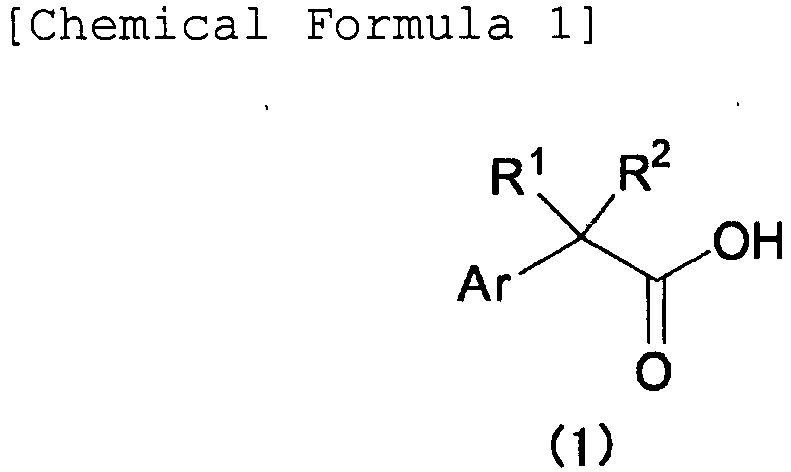
- the isotope-labeled 2-arylpropionic acid compounds of the present invention are characterized by including a compound represented by the following general formula (1) (wherein Ar represents an aryl group which may have a substituent; R 1 represents any one of 11 CH 3 , CH 2 18 F and CF 2 18 F; and R 2 represents a hydrogen atom, or an alkyl group which may have a branch, provided that a compound wherein Ar is a benzene ring, R 1 is 11 CH 3 , and R 2 is a hydrogen atom is excluded), or a pharmaceutically acceptable salt, hydrate, solvate or prodrug thereof:
- Ar represents an aryl group which may have a substituent
- R 1 represents any one of 11 CH 3 , CH 2 18 F and CF 2 18 F
- R 2 represents a hydrogen atom, or an alkyl group which may have a branch, provided that a compound wherein Ar is a benzene ring, R 1 is 11 CH 3 , and R 2 is a hydrogen
- isotope-labeled R 1 is introduced into a carbon atom interposed between a carbonyl group and an aryl group that are electron attractive groups. Therefore, isotope-labeled R 1 can be easily introduced through a carboanion from a precursor in which R 1 is a hydrogen atom in the general formula (1). In addition that this reaction proceeds in a moment of time, ester hydrolysis is completed within 1 minute, and synthesis can be thus completed in a short time though it is two-step synthesis. Therefore, a ratio of the radioactivity decaying with synthetic time is small, and the isotope-labeled 2-arylpropionic acid compounds can be used as molecular probes effective to a PET method.
- R 2 is preferably an alkyl group having 1 to 6 carbon atoms.
- the isotope-labeled 2-arylpropionic acid compounds of the present invention include a salt, hydrate, solvate, and prodrug in addition to carboxylic acid.
- the prodrug is referred to as a compound that is hydrolyzed in a living body to generate the isotope-labeled 2-arylpropionic acid of the present invention.
- the prodrug of the present invention includes compounds produced in all techniques for forming prodrugs, which are known to a person skilled in the art.
- a compound obtained by inducing one of the carboxyl group or amino group to an ester group, an amide group, or the like, which could be easily hydrolyzed in the living body corresponds to a prodrug.
- Specific examples include compounds obtained by inducing a carboxyl group that is present in isotope-labeled 2-arylpropionic acid into alkyl such as methyl and ethyl, alkyloxyalkyl such as methyloxymethyl, ethyloxymethyl, 2-methyloxyethyl and 2-methyloxyethyloxymethyl, acyloxymethyl such as pivaloyloxymethyl, acetyloxymethyl, cyclohexylacetyloxymethyl and 1-methylcyclohexylcarbonyloxymethyl, alkoxycarbonylalkyl such as ethyloxycarbonyloxy-1-ethyl, and cycloalkyloxycarbonylalkyl such as cyclohexyloxycarbonyloxy-1-ethyl.
- an aryl group has an amino group
- an example includes a compound obtained by inducing the amino group to an acetoamide, or the like.
- Examples of pharmaceutically acceptable salts include base addition salts and acid addition salts.
- Examples of the base addition salts include inorganic basic salts such as sodium salt and calcium salt, and organic basic salts such as meglumine salt, and trishydroxymethylaminomethane salt.
- acid addition salts include, for example, inorganic acid salts such as hydrochloride, hydrobromide, phosphate, sulfate and nitrate, and organic acid salts such as formate, acetate, propionate, maleate, fumarate, succinate, lactate, malate, tartrate, citrate, ascorbate, malonate, oxalate, glycolate, phthalate and benzene sulfonate, and combination of the above described salts can be also used.
- R 1 can be 11 CH 3.
- the isotope-labeled 2-arylpropionic acid compounds of the present invention can be rapidly and simply synthesized in the following method. That is, a process for producing the isotope-labeled 2-arylpropionic acid compounds of the present invention is characterized by having a carboanion generation step of adding a base to a 2-arylacetic acid ester represented by the following general formula (2) (wherein Ar represents an aryl group which may have a substituent; R 2 represents a hydrogen atom, or an alkyl group which may have a branch; and R 3 represents a hydrogen atom, an alkyl group which may have a substituent, or an aryl group which may have a substituent) to be mixed, and an isotope labeling introduction step of adding any one of 11 CH 3 X, CH 2 18 FX and CF 2 18 FX (wherein X represents any of I, Br and a triflate group) to the reaction solution after the carboanion generation step:
- a base is added to a 2-arylacetic acid ester represented by the above general formula (2) and mixed in the carboanion generation step.
- a substituent of R 3 include a halogen atom, a carboxyl group, an ester group, a hydroxyl group, a thiol group and an alkoxy group.
- R 3 is an alkyl group
- a preferable substituent is an alkyl group having 6 to 10 carbon atoms.
- R 3 is an aryl group
- a preferable substituent is an aryl group having 6 to 10 carbon atoms.
- anhydrous N,N-dimethyl formamide (DMF), anhydrous tetrahydrofuran, and the like can be used.
- a base sodium hydride, potassium hydride, lithium diisopropylamide, sodium bis(trimethylsilyl)amide, lithium bis(trimethylsilyl)amide, and the like can be used.
- active hydrogen that is bound to a carbon atom interposed between an aryl group and a carbonyl group is detached to generate carboanion.
- any one of 11 CH 3 X, CH 2 18 FX and CF 2 18 FX is added to the reaction solution in the isotope labeling introduction step.
- labeling compounds can be easily synthesized by chemical change from nuclear species that are generated in a cyclotron. Thereby, any one of 11 CH 3 , CH 2 18 F and CF 2 18 F is introduced in place of a hydrogen atom in a benzyl position.
- Fig. 2 in Non-Patent Document 13 shows an idea of introduction of 11 CH 3 using a technique of synthesis of an acetoacetic acid ester, a step of decarboxylation, and the like are required so that the number of steps are large, and production of the isotope-labeled 2-arylpropionic acid compounds of the present invention by this method requires time as well as complicated operations; therefore, application to a PET method is difficult.
- the isotope-labeled 2-arylpropionic acid compounds of the present invention can be preferably used as molecular probes for PET.
- the present inventors applied the isotope-labeled 2-arylpropionic acid compounds of the present invention to a PET method, thereby confirming capability of imaging of cyclooxygenase and imaging of brain inflammation that is involved in neurodegeneration in Alzheimer disease.
- NSAIDs having analogical structures to the isotope-labeled 2-arylpropionic acid compounds of the present invention include compounds having the following structural formulas and names.
- an ester form can be also used as a prodrug of isotope-labeled 2-arylpropionic acid. Converting to an ester form enables a brain transfer property to improve more than administering in a form of carboxylic acid, and imaging of an inflammation site in the brain can be carried out as described below in examples.
- the isotope-labeled 2-arylpropionic acid compounds of the present invention can be obtained in the following reaction.
- a 2-arylacetic acid ester having a hydrogen atom in a benzyl position is used as a precursor and the hydrogen atom in the benzyl position is drawn with a base to form carboanion.
- the carboanion is reacted with R 1 X (herein, R 1 represents any one of 11 CH 3 , CH 2 18 F and CF 2 18 F, and X represents any of I, Br and a triflate group) to introduce R 1 into a benzyl position, and the reaction product is further hydrolyzed with alkali, or the like to thus obtain the isotope-labeled 2-arylpropionic acid of the present invention.
- a protection and deprotection step described in Protective Groups in Organic Synthesis can be utilized. Hydrolysis in a final step may not be performed in the case of an ester type for a desired isotope-labeled 2-arylpropionic acid compound.
- An administration solution of an isotope-labeled 2-arylpropionic acid compound finally obtained can be prepared by dissolving into a solvent obtained by adding ethylene glycol, ethanol, Tween 80, ascorbic acid, cyclodextrin, etc. to saline.
- the 11 C is produced by 14 N(p, ⁇ ) 11 C nuclear reaction using CYPRIS HM-12S Cyclotron manufactured by Sumitomo Heavy Industries, Ltd.
- a series of procedures including preparation of [ 11 C]methyl iodide ([ 11 C]CH 3 I), heating and dilution of the reaction solution, injection into the high performance liquid chromatography (HPLC) apparatus, preparative separation, concentration, and sterilization were performed using an originally-developed automatic synthesizer.
- the preparative HPLC was performed using LC-2000 manufactured by JASCO Corporation.
- the analytical HPLC was performed using Prominence manufactured by Shimadzu Corporation.
- the emitted radioactivity was measured using RLC-700 Radioanalyzer manufactured by ALOKA CO., LTD. COSMOSIL manufactured by NACALAI TESQUE, INC. is used for the HPLC column, and a column manufactured by Daicel Corporation was used for the chiral column.
- TMS tetramethylsilane
- JEOL JNM-AL-400 400MHz
- FT-NMR FT-NMR manufactured by JEOL Ltd.
- a chemical shift ⁇ value was expressed by ppm.
- a chemical association constant (J) was expressed by Hz, and for breakup manners of signals, single line was abbreviated as s, double line was abbreviated as d, triple line was abbreviated as t, quadruple line was abbreviated as q, multiple line was abbreviated as m, and broad line was abbreviated as br.
- [ 11 C]ibuprofen (3) was eluted at a retention time of 19 to 20 minutes as shown in Fig. 1 .
- a target fraction was concentrated under a reduced pressure using an evaporator, and thereto was added a diluting solution made of saline (4.0 mL), propylene glycol (0.3 mL), Tween 80 (0.05 mL), and 25% ascorbic acid (0.2 mL) to form a solution for administration.
- a radioactivity was 4.95 GBq on completion of the reaction, and a specific radioactivity was 34 GBq/ ⁇ mol.
- An isolated yield after decay-corrected based on [ 11 C]CH 3 I was 69%.
- a total time for synthesis and separation of [ 11 C]ibuprofen (3), and preparation of an intravenous injection solution was about 37 minutes.
- a radioactivity was 4.00 GBq on completion of the reaction, and a specific radioactivity was 23 GBq/ ⁇ mol.
- a total time for synthesis and separation of [ 11 C]ibuprofen methyl ester (4), and preparation of an intravenous injection solution was about 30 minutes.
- [ 11 C]naproxen (5) was synthetically reacted from methyl 2-(6-methoxynaphthalene-2-yl) acetate ( USP3896157 ).
- a radioactivity was 3.30 GBq on completion of the reaction, and a specific radioactivity was 29 GBq/ ⁇ mol.
- a total time for synthesis and separation of [ 11 C]naproxen (5), and preparation of an intravenous injection solution was about 29 minutes.
- a retention time was about 5.2 minutes, and a purity was 99% or more.
- [ 11 C]naproxen methyl ester (6) was synthesized from methyl-2-(6-methoxynaphthalene-2-yl) acetate.
- a radioactivity was 3.30 GBq on completion of the reaction, and a specific radioactivity was 29 GBq/ ⁇ mol.
- a total time for synthesis and separation of [ 11 C]naproxen methyl ester (6), and preparation of an intravenous injection solution was about 32 minutes.
- a retention time was 5.5 minutes, and a purity was 99% or more.
- [ 11 C]ketoprofen (7) was synthesized from methyl 2-(3-benzoylphenyl)acetate ( Org. Lett. 2002, 4, 3083-3085 ).
- a radioactivity was 3.40 GBq on completion of the reaction, and a specific radioactivity was 40 GBq/ ⁇ mol.
- a total time for synthesis and separation of [ 11 C]ketoprofen (7), and preparation of an intravenous injection solution was about 28 minutes.
- [ 11 C]ketoprofen methyl ester (8) was synthesized from methyl 2-(3-benzoylphenyl)acetate.
- a radioactivity was 5.4 GBq on completion of the reaction, and a specific radioactivity was 46 GBq/ ⁇ mol.
- a total time for synthesis and separation of [ 11 C]ketoprofen methyl ester (8), and preparation of an intravenous injection solution was about 27 minutes.
- a retention time was 6.0 minutes, and a purity was 99% or more.
- [ 11 C]fenoprofen (9) was synthesized from ethyl 2-(3-phenoxyphenyl) acetate ( J. Med. Chem. 2005, 48, 995-1018 ) .
- a radioactivity was 5.99 GBq on completion of the reaction, and a specific radioactivity was 25 GBq/ ⁇ mol.
- a total time for synthesis and separation of [ 11 C]fenoprofen (9), and preparation of an intravenous injection solution was about 40 minutes.
- a retention time was 8.4 minutes, and a purity was 99% or more.
- [ 11 C]fenoprofen methyl ester (10) was synthesized from methyl 2-(3-phenoxyphenyl) acetate.
- a radioactivity was 4.8 GBq on completion of the reaction, and a specific radioactivity was 43 GBq/ ⁇ mol.
- a total time for synthesis and separation of [ 11 C] fenoprofen methyl ester (10), and preparation of an intravenous injection solution was about 32 minutes.
- An authentic sample of fenoprofen methyl ester Bioorg. Med. Chem. Lett.
- [ 11 C]loxoprofen (11) was synthesized from methyl 2- ⁇ 4-(2-oxocyclopentyl)phenyl ⁇ acetate ( GB2078732 ).
- the reaction mixture thus obtained was separated by preparative HPLC (mobile phase; acetonitrile: 10 mM sodium phosphate buffer
- a radioactivity was 1.9 GBq on completion of the reaction, and a specific radioactivity was 28 GBq/ ⁇ mol.
- a total time for synthesis and separation of [ 11 C]loxoprofen (11), and preparation of an intravenous injection solution was about 36 minutes.
- a retention time was 6.6 minutes, and a purity was 99% or more.
- [ 11 C]loxoprofen methyl ester (12) was synthesized from methyl 2- ⁇ 4-(2-oxocyclopentyl)phenyl ⁇ acetate.
- a radioactivity was 2.1 GBq on completion of the reaction, and a specific radioactivity was 33 GBq/ ⁇ mol.
- a total time for synthesis and separation of [ 11 C] loxoprofen methyl ester (12), and preparation of an intravenous injection solution was about 27 minutes.
- a radioactivity was 3.1 GBq on completion of the reaction, and a specific radioactivity was 76 GBq/ ⁇ mol.
- a total time for synthesis and separation of [ 11 C]flurbiprofen (13), and preparation of an intravenous injection solution was about 40 minutes.
- a retention time was about 6 minutes, and a purity was 99% or more.
- a radioactivity was 5.8 GBq on completion of the reaction, and a specific radioactivity was 41 GBq/ ⁇ mol.
- a total time for synthesis and separation of [ 11 C] flurbiprofen methyl ester (14), and preparation of an intravenous injection solution was about 30 minutes.
- n-propyl 2-(2-fluorobiphenyl-4-yl) acetate 150 mg, 0.65 mmol was dissolved into dichloromethane (3 mL), and oxalyl chloride (67 ⁇ L, 99 mg, 0.78 mmol) and DMF (10 ⁇ L) were added thereto while stirring at room temperature. After stirring for 5 minutes, propanol (97 mL, 78 mg, 1.3 mmol) was added.
- a radioactivity was 1. 4 GBq on completion of the reaction, and a specific radioactivity was 26 GBq/ ⁇ mol.
- a total time for synthesis and separation of [ 11 C]flurbiprofen n-propyl ester (17), and preparation of an intravenous injection solution was about 34 minutes.
- An authentic sample of flurbiprofen n-propyl ester J. Org. Chem.
- a radioactivity was 2.1 GBq on completion of the reaction, and a specific radioactivity was 19 GBq/ ⁇ mol.
- a total time for synthesis and separation of [ 11 C] flurbiroprofen 2-propyl ester (19), and preparation of an intravenous injection solution was about 36 minutes.
- An authentic sample of flurbiroprofen 2-propyl ester J. Controlled Rellease.
- n-butyl 2-(2-fluorobiphenyl-4-yl) acetate (22) was synthesized from 2-(2-fluorobiphenyl-4-yl) acetic acid and n-butanol according to a similar procedure to the step 1 of Example 15.
- the 1 H NMR spectrum of this substance is shown below.
- a radioactivity was 1.5 GBq on completion of the reaction, and a specific radioactivity was 16 GBq/ ⁇ mol.
- a total time for synthesis and separation of [ 11 C]flurbiprofen n-butyl ester (21), and preparation of an intravenous injection solution was about 39 minutes.
- [ 11 C]flurbiprofen 2-methylpropyl ester (23) was synthesized from the 2-methylpropyl 2- (2-fluorobiphenyl-4-yl) acetate (24) synthesized in the step 1 of Example 18 according to a similar procedure to Example 2.
- a retention time was 5.4 minutes, and a purity was 99% or more.
- a flurbiprofen methyl ester was used as a starting material, and [ 11 C]methyl flurbiprofen (25) was synthesized according to a method similar to the method of Example 1.
- Flurbiprofen methyl ester was used as a starting material, and [ 11 C]methyl flurbiprofen methyl ester (26) was synthesized according to a method similar to the method of Example 2.
- PET was eprformed using a brain inflammation model rat for the [ 11 C]ketoprofen methyl ester (8) synthesized in Example 6.
- a trace amount, 0.5 ⁇ g, of lipopolysaccharide (LPS) that is a constituent of a gram-negative bacteria cell wall outer membrane was injected into the left striatum of a rat, thereby inducing brain inflammation ( Hunter RL, Dragicevic N, Seifert K, Choi DY, Liu M, Kim HC, Cass WA, Sullivan PG, Bing G. Inflammation induces mitochondrial dysfunction and dopaminergic neurodegeneration in the nigrostriatal system. J Neurochem.2007100:5:1375-86 .).
- the [ 11 C]ketoprofen methyl ester (8) was administered to a rat after 1 day from injection of LPS through a caudal vein, PET was performed for 45 minutes using a PET apparatus for small animals (manufactured by microPET, SIMENS) .
- the injection solution of the [ 11 C] ketoprofen methyl ester (radioactivity 72 to 74 MBq) was prepared by diluting with saline to 1.0 CC volume.
- an injection solution added with 10mg/kg of ketoprofen methyl ester (final concentration of a solvent was 5 % DMSO, 5% tween20) was prepared.
- a rat brain section was prepared and an Ex vivo autoradiography (ARG) experiment was performed.
- ARG Ex vivo autoradiography
- the rat was perfused with saline, and a section prepared with 2 mm thickness, which was obtained from the brain taken out from the rat, was exposed on an imaging plate BAS SR-2040 (manufactured by Fujifilm Corporation) for 1 hour to read using a fluoroimage analyzer (FLA7000).
- FLA7000 fluoroimage analyzer
- chemical staining of an immune tissue in a brain section was performed using a specific antibody.
- FIG. 22a An addition average of PET images in 45 minutes after administration of the [ 11 C]ketoprofen methyl ester, and an amount of radioactivity were shown in Fig. 22a , and radioactivity over elapsed times in each brain site at the time was shown in Fig. 22b.
- Fig. 22a indicates that the [ 11 C] ketoprofen methyl ester (8) passed through the blood-brain barrier and accumulated in an inflammation region around the LPS injected site in the left side of the brain. This accumulation was significantly reduced by administration of 10 mg/kg of non-RI labeled ketoprofen methyl ester, and thus, accumulation in an inflammation region of [ 11 C]ketoprofen methyl ester was found to be specific. In addition, it was found as shown in Fig.
- PET images were taken using an Alzheimer disease model mouse for the [ 11 C]ketoprofen methyl ester (21) synthesized in Example 6.
- a transgenic mouse (APP-Tg) excessively expressing amyloid precursor protein (APP) in familial Alzheimer disease was purchased from Taconic Farms, Inc. USA to be used.
- APP amyloid precursor protein
- the [ 11 C]ketoprofen methyl ester (21) was administered through a caudal vein, and PET images were taken for 30 minutes using a PET apparatus for small animals (microPET, manufactured by SIMENS).
- the injection solution of the [ 11 C]ketoprofen methyl ester (21) (radioactivity 45 to 60 MBq) was prepared by diluting with saline to 1.0 CC volume.
- SUV Standard Uptake Value
- the present invention is not necessarily limited to the exemplary embodiment and examples described so far.
- the present invention includes various modified embodiments as far as they stay within the Scope of Claims and can be easily assumed by the ordinarily skilled in the art.
- the present invention can be used as a molecular probe for PET in the pharmaceutical industry, and the like.
Landscapes
- Chemical & Material Sciences (AREA)
- Organic Chemistry (AREA)
- Health & Medical Sciences (AREA)
- Life Sciences & Earth Sciences (AREA)
- Public Health (AREA)
- Epidemiology (AREA)
- Animal Behavior & Ethology (AREA)
- General Health & Medical Sciences (AREA)
- Pharmacology & Pharmacy (AREA)
- Veterinary Medicine (AREA)
- Medicinal Chemistry (AREA)
- Proteomics, Peptides & Aminoacids (AREA)
- Physics & Mathematics (AREA)
- Optics & Photonics (AREA)
- Organic Low-Molecular-Weight Compounds And Preparation Thereof (AREA)
- Medicines Containing Antibodies Or Antigens For Use As Internal Diagnostic Agents (AREA)
Description
- The present invention relates to an isotope-labeled 2-arylpropionic acid compounds and a process for producing the same and a molecular probe for positron emission tomography (hereinafter referred to as "PET") and a method for imaging of cyclooxygenase using the molecular probe. The isotope-labeled 2-arylpropionic acid compounds and the process for producing the same of the present invention are preferably used as a molecular probe used in positron emission tomography (hereinafter referred to as "PET method") and a process for producing the same. Imaging of cyclooxygenase can be performed by using the molecular probe of the present invention.
- Many of non-steroidal anti-inflammatory drugs that have been widely used as antipyretic, analgesic and agents for antiinflammatory (hereinafter referred to as "NSAIDs") show pharmacologic actions mainly by inhibiting an enzyme called cyclooxygenase. Cyclooxygenase is involved in enormous numbers of pathologic conditions such as pain, fever, chronic and acute inflammation, arthritis, colon cancer, new blood vessel growth, asthma, arterial sclerosis, Alzheimer disease, and Parkinson's disease. Therefore, it has been considered that examining behaviors of NSAIDs within a living body makes it possible to find out many pathologic conditions and diagnoses.
- According to the above described reasons, examining behaviors of NSAIDs in the living body by a PET method has been actively tried in recent years. PET is a method that includes administering, into a living body, a tracer labeled with a short-term radionuclide which releases positrons such as 11C or 18F so that γ rays generated from the tracer is measured by a PET camera (detector comprising a gamma ray scintillator and a photoelectron multiplier tube), and imaging a body distribution of the γ ray by a computer. The PET method can non-invasively and quantitatively track down behaviors of medical agents in living bodies including from small animals to a human and a degree of reaching a target site. NSAIDs such as ibuprofen and naproxen inhibit functions of an enzyme called cyclooxygenase in a living body to show anti-inflammatory actions, and it was found that cyclooxygenase is involved in not only inflammation but also tumors, Alzheimer disease, and the like. Therefore, in order to apply NSAIDs to a PET method, numerous NSAIDs have been labeled with 11C and 18F (Non-Patent Documents 1 to 15). Analyzing PET images for NSAIDs enables non-invasive imaging of cyclooxygenase, and consequently, significantly useful information can be obtained in respective fields such as biology, development of pharmaceutical products, and medical services.
- Patent Document 1:
WO2006/116629 -
- Non-Patent Document 1 : Phillip W. Miller, Nicholas J. Long, Ramon Vilar, Antony D. Gee, Synthesis of 11C, 18F, 15O, and 13N Radiolabels for Positron Emission Tomography. Angew. Chem. Int. Ed. 2008, 47, 8998-9033.
- Non-Patent Document 2: Toru Sasaki, Koj i Ogawa, Shin-Ichi Ishii, Michio Senda, Synthesis of [11C]salicylic acid and related compounds and their biodistribution in mice. Applied Radiation and Isotopes, 1999, 50, 905-909.
- Non-Patent Document 3: Elder, Stewart Todd, Synthesis and in vivo distribution of a nonsteroidal anti-inflammatory drug: fluorine-18-labeled flurbiprofen. Univ. Kentucky, Lexington, KY, USA. Avail. Univ. Microfilms Int., Order No. DA9129898. (1991), 176 pp. From: Diss. Abstr. Int. B 1991, 52(5), 2566.
- Non-Patent Document 4: Jaya Prabhakaran, Vattoy J. Majo, Norman R. Simpson, Ronald L. Van Heertum, J. John Mann, J. S. Dileep Kumar, Synthesis of [11C]celecoxib: a potential PET probe for imaging COX-2 expression, J. Label. Compd. Radiopharm. 2005, 48, 887-895.
- Non-Patent Document 5: Jaya Prabhakaran, Mark D. Underwood, Ramin V. Parsey, Victoria Arango, Vattoly J. Majo, Norman R. Simpson, Ronald Van Heertum, J. John Mann, J. S. Dileep Kumar, Synthesis and in vivo evaluation of [18F]-4-[5-(4-methylphenyl)-3-(trifluoromethyl)-1H-pyrazol-1-yl]benzenesulfonamide as a PET imaging probe for COX-2 expression, Bioorg. Med. Chem. 2007, 15, 1802-1807.
- Non-Patent Document 6: Erik F.J. Vries, Janine Doorduin, Rudi A. Dierckx, Aren van Waard, Evaluation of [11C] Rofecoxib as PET tracer for .
- Non-Patent Document 7: Vattoly J. Majo, Jaya Prabhakaran, Norman R. Simpson, Ronald L. Van Heertum, J. John Mann, J. S. Dileep Kumar, A general method for the synthesis of aryl[11C]methylsulfones: Potential PET probes for imaging cyclooxygenase-2 expression, Bioorg. Med. Chem. Lett. 2005, 15, 4268-4271.
- Non-Patent Document 8: Yoshihiko Fujisaki, Kazunori Kawamura, Wei-Fang Wang, Kiichi Ishiwata, Fumihiko Yamamoto, Takashi Kuwano, Mayumi Ono, Minoru Maeda, Radiosynthesis and in vivo evaluation of 11C-labeled 1,5-diarylpyrazole derivatives for mapping cyclooxygenase, Annal. Nucl. Med. 2005, 19, 617-625.
- Non-Patent Document 9: Mariko Tanaka, Yoshihiko Fujisaki, Kazunori Kawamura, Kiichi Ishiwata, Qinggeletu, Fumihiko Yamamoto, Takahiro Mukai, Minoru Maeda, Radiosynthesis and Evaluation of 11C-Labeled Diaryl-Substituted Imidazole and Indole Derivatives for Mapping Cyclooxygenase-2, Biol. Pharm. Bull. 2006, 29, 2087-2094.
- Non-Patent Document 10: Timothy J. McCarthy, Ahmed U. Sheriff, Matthew J. Graneto, John J. Talley, Michael J. Welch, Radiosynthesis, in vitro validation, and in vivo evaluation of 18F-Laveled COX-1 and COX-2 inhibitors, J. Nucl. Med. 2002, 43, 117-124.
- Non-Patent Document 11: Erik F.J. Vries, Aren van Waarde, Anne Rixt Buursma, Willem Vaalburg, Synthesis and in vivo evaluation of 18F-Desbromo-Dup-697 as a PET tracer for cyclooxygenase-2 Expression, J. Nucl. Med. 2003, 44, 1700-1706.
- Non-Patent Document 12: Frank Wuest, Torsten Kniess, Ralf Bergmann, Jens Pietzsch, Synthesis and evaluation in vitro and in vivo of a 11C-labeled cyclooxygenase-2 (COX-2) inhibitor, Bioorg. Med. Chem. 2008, 16, 7662-7670.
- Non-Patent Document 13: Frank R. Wust, aileen Hohne, Peter Metz, Synthesis of 18F-labelled cyclooxygenase-2 (COX-2) inhibitors via Stille reaction with 4-[18F]fluoroiodobenzene as radiotracers for positron emission tomography (PET), Org. Biomol. Chem. 2005, 3, 503-507.
- Non-Patent Document 14: Koji Ogawa, Motoji Sasaki, Tadashi Nozaki, Applied Radiation and Isotopes, 1997, 48, 623-630.
- Non-Patent Document 15: MingzhangGao, Min Wang, Kathy D. Miller, Gary D. Hutchins and Qi-Huang Zheng, Synthesisof carbon-11 labeled celecoxib derivatives as new candidate PET radioligandsfor imaging of inflammation, Appl. Radiat. Isot. 2009, 67, 2019-2024.
- Non-Patent Document 15: José Castell, Luis Martinez, Miguel Miranda, Pilar Tárrega, A general procedure for isotopic (deuterium) labelling of non-steroidal antiinflammatory 2-arylpropionic acids, J. Lab. Cmpds and Radiopharmaceuticals, 1993, 34, 1, 93-100
- As described above, examining behaviors of NSAIDs in a living body by a PET method has been tried in all over the world. However, although some compounds have been observed to accumulate in an inflammation site and tumor site so far, it cannot be demonstrated that such compounds form bonds specific to cyclooxygenase.
- As described above, a cause of not obtaining a satisfactory PET image for behaviors of NSAIDs in a living body so far includes time restriction. That is, examples of the short-term radionuclide used in the PET are 11C and 18F, and compounds labeled with these radionuclides are used as the tracer. There is a very broad application range for the 11C utilizing carbon atoms present in organic compounds, therefore, 11C can be considered to be an ideal radionuclide. However, the 11C has such a short half-life as 20 minutes, and the process from synthesis through the PET method must be completed within a very short time frame. Further, 18F having a half-life longer than that of the 11C, 110 minutes, however, the process from synthesis through the PET method must be completed within a very short time frame. Due to difficulty such as time restriction, restriction was added to a synthesis method, and the number and kind of a labeling compound to be synthesized, satisfactory PET image for behaviors of NSAIDs cannot be obtained up to the present date regardless of many trials made in all over the world.
- The present invention was accomplished to solve the above described conventional problems, and an object of the present invention is to provide a labeled NSAIDs compound that can be produced in a short time, preferably used in a PET method, and is capable of imaging cyclooxygenase, and a process for producing the same.
- To solve the conventional problems, the inventors of the present invention focused on NSAIDs, 2-arylpropionic acids, such as ibuprofen, naproxen, etc. and the derivatives. As the results, the inventors succeeded in the introduction of [11C]methyl group into the corresponding arylacetic acid in a short time and the purification. Furthermore, when a PET method is performed using the isotope-labeled 2-arylpropionic acid compounds as tracers, a labeled medical agent accumulated in an expression site of cyclooxygenase and the present inventors succeeded in showing a specific binding for the first time in the world.
- That is, the isotope-labeled 2-arylpropionic acid compounds of the present invention are characterized by including a compound represented by the following general formula (1) (wherein Ar represents an aryl group which may have a substituent; R1 represents any one of 11CH3, CH2 18F and CF2 18F; and R2 represents a hydrogen atom, or an alkyl group which may have a branch, provided that a compound wherein Ar is a benzene ring, R1 is 11CH3, and R2 is a hydrogen atom is excluded), or a pharmaceutically acceptable salt, hydrate, solvate or prodrug thereof:
- In the isotope-labeled 2-arylpropionic acid compounds of the present invention, isotope-labeled R1 is introduced into a carbon atom interposed between a carbonyl group and an aryl group that are electron attractive groups. Therefore, isotope-labeled R1 can be easily introduced through a carboanion from a precursor in which R1 is a hydrogen atom in the general formula (1). In addition that this reaction proceeds in a moment of time, ester hydrolysis is completed within 1 minute, and synthesis can be thus completed in a short time though it is two-step synthesis. Therefore, a ratio of the radioactivity decaying with synthetic time is small, and the isotope-labeled 2-arylpropionic acid compounds can be used as molecular probes effective to a PET method.
- In addition, R2 is preferably an alkyl group having 1 to 6 carbon atoms.
- The isotope-labeled 2-arylpropionic acid compounds of the present invention include a salt, hydrate, solvate, and prodrug in addition to carboxylic acid. Herein, the prodrug is referred to as a compound that is hydrolyzed in a living body to generate the isotope-labeled 2-arylpropionic acid of the present invention. The prodrug of the present invention includes compounds produced in all techniques for forming prodrugs, which are known to a person skilled in the art. For example, in the case of having a carboxyl group or an amino group, a compound obtained by inducing one of the carboxyl group or amino group to an ester group, an amide group, or the like, which could be easily hydrolyzed in the living body corresponds to a prodrug. Specific examples include compounds obtained by inducing a carboxyl group that is present in isotope-labeled 2-arylpropionic acid into alkyl such as methyl and ethyl, alkyloxyalkyl such as methyloxymethyl, ethyloxymethyl, 2-methyloxyethyl and 2-methyloxyethyloxymethyl, acyloxymethyl such as pivaloyloxymethyl, acetyloxymethyl, cyclohexylacetyloxymethyl and 1-methylcyclohexylcarbonyloxymethyl, alkoxycarbonylalkyl such as ethyloxycarbonyloxy-1-ethyl, and cycloalkyloxycarbonylalkyl such as cyclohexyloxycarbonyloxy-1-ethyl. When an aryl group has an amino group, an example includes a compound obtained by inducing the amino group to an acetoamide, or the like.
- Examples of pharmaceutically acceptable salts include base addition salts and acid addition salts. Examples of the base addition salts include inorganic basic salts such as sodium salt and calcium salt, and organic basic salts such as meglumine salt, and trishydroxymethylaminomethane salt. Examples of the acid addition salts include, for example, inorganic acid salts such as hydrochloride, hydrobromide, phosphate, sulfate and nitrate, and organic acid salts such as formate, acetate, propionate, maleate, fumarate, succinate, lactate, malate, tartrate, citrate, ascorbate, malonate, oxalate, glycolate, phthalate and benzene sulfonate, and combination of the above described salts can be also used.
R1 can be 11CH3.
- The isotope-labeled 2-arylpropionic acid compounds of the present invention can be rapidly and simply synthesized in the following method. That is, a process for producing the isotope-labeled 2-arylpropionic acid compounds of the present invention is characterized by having a carboanion generation step of adding a base to a 2-arylacetic acid ester represented by the following general formula (2) (wherein Ar represents an aryl group which may have a substituent; R2 represents a hydrogen atom, or an alkyl group which may have a branch; and R3 represents a hydrogen atom, an alkyl group which may have a substituent, or an aryl group which may have a substituent) to be mixed, and an isotope labeling introduction step of adding any one of 11CH3X, CH2 18FX and CF2 18FX (wherein X represents any of I, Br and a triflate group) to the reaction solution after the carboanion generation step:

- In the process for producing the isotope-labeled 2-arylpropionic acid compounds of the present invention, a base is added to a 2-arylacetic acid ester represented by the above general formula (2) and mixed in the carboanion generation step. Examples of a substituent of R3 include a halogen atom, a carboxyl group, an ester group, a hydroxyl group, a thiol group and an alkoxy group. When R3 is an alkyl group, a preferable substituent is an alkyl group having 6 to 10 carbon atoms. When R3 is an aryl group, a preferable substituent is an aryl group having 6 to 10 carbon atoms. For a solvent, anhydrous N,N-dimethyl formamide (DMF), anhydrous tetrahydrofuran, and the like can be used. For a base, sodium hydride, potassium hydride, lithium diisopropylamide, sodium bis(trimethylsilyl)amide, lithium bis(trimethylsilyl)amide, and the like can be used. Thereby, active hydrogen that is bound to a carbon atom interposed between an aryl group and a carbonyl group is detached to generate carboanion. Then, any one of 11CH3X, CH2 18FX and CF2 18FX is added to the reaction solution in the isotope labeling introduction step. These labeling compounds can be easily synthesized by chemical change from nuclear species that are generated in a cyclotron. Thereby, any one of 11CH3, CH2 18F and CF2 18F is introduced in place of a hydrogen atom in a benzyl position.
- In addition, when a hydrolysis reaction is further carried out, corresponding carboxylic acid can be obtained.
-
Fig. 2 in Non-Patent Document 13 shows an idea of introduction of 11CH3 using a technique of synthesis of an acetoacetic acid ester, a step of decarboxylation, and the like are required so that the number of steps are large, and production of the isotope-labeled 2-arylpropionic acid compounds of the present invention by this method requires time as well as complicated operations; therefore, application to a PET method is difficult. - Furthermore, though [18F]flurbiprofen is synthesized in
Non-Patent Document 3, the method of the present invention can label a common moiety of large numbers of 2-arylpropionic acid compounds in the same method and thus is considered to be a method having a wide range of applications. - The isotope-labeled 2-arylpropionic acid compounds of the present invention can be preferably used as molecular probes for PET. The present inventors applied the isotope-labeled 2-arylpropionic acid compounds of the present invention to a PET method, thereby confirming capability of imaging of cyclooxygenase and imaging of brain inflammation that is involved in neurodegeneration in Alzheimer disease.
- Examples of NSAIDs having analogical structures to the isotope-labeled 2-arylpropionic acid compounds of the present invention include compounds having the following structural formulas and names.


- Compounds obtained by substituting methyl groups in benzyl positions with any one of 11CH3, CH2 18F and CF2 18F are included in the isotope-labeled 2-arylpropionic acid compounds of the present invention. Taking PET images of the isotope-labeled 2-arylpropionic acid compounds of the present invention imitating NSAIDs makes it possible to examine behaviors of the NSAIDs over time in a living body.
- In addition, an ester form can be also used as a prodrug of isotope-labeled 2-arylpropionic acid. Converting to an ester form enables a brain transfer property to improve more than administering in a form of carboxylic acid, and imaging of an inflammation site in the brain can be carried out as described below in examples.
- The isotope-labeled 2-arylpropionic acid compounds of the present invention can be obtained in the following reaction.

- That is, a 2-arylacetic acid ester having a hydrogen atom in a benzyl position is used as a precursor and the hydrogen atom in the benzyl position is drawn with a base to form carboanion. Then, the carboanion is reacted with R1X (herein, R1 represents any one of 11CH3, CH2 18F and CF2 18F, and X represents any of I, Br and a triflate group) to introduce R1 into a benzyl position, and the reaction product is further hydrolyzed with alkali, or the like to thus obtain the isotope-labeled 2-arylpropionic acid of the present invention. When a functional group having active hydrogen, such as an amino group and a hydroxyl group, is present in an aryl group, a protection and deprotection step described in Protective Groups in Organic Synthesis (T. W. Green, et al.) can be utilized. Hydrolysis in a final step may not be performed in the case of an ester type for a desired isotope-labeled 2-arylpropionic acid compound. An administration solution of an isotope-labeled 2-arylpropionic acid compound finally obtained can be prepared by dissolving into a solvent obtained by adding ethylene glycol, ethanol, Tween 80, ascorbic acid, cyclodextrin, etc. to saline.
- Examples specifying the present invention will be described in detail in the following.
- Commercially available products were directly used for all chemical reagents and NSAIDs unless otherwise specified. Heavy chloroform and heavy dimethyl sulfoxide were used for measurement solvents of NMR spectra. Commercially available products of ethyl acetate, hexane, dichloromethane and methanol were directly used for extraction and elution solvents of chromatography.
- The 11C is produced by 14N(p,α)11C nuclear reaction using CYPRIS HM-12S Cyclotron manufactured by Sumitomo Heavy Industries, Ltd. A series of procedures including preparation of [11C]methyl iodide ([11C]CH3I), heating and dilution of the reaction solution, injection into the high performance liquid chromatography (HPLC) apparatus, preparative separation, concentration, and sterilization were performed using an originally-developed automatic synthesizer. The preparative HPLC was performed using LC-2000 manufactured by JASCO Corporation. The analytical HPLC was performed using Prominence manufactured by Shimadzu Corporation. The emitted radioactivity was measured using RLC-700 Radioanalyzer manufactured by ALOKA CO., LTD. COSMOSIL manufactured by NACALAI TESQUE, INC. is used for the HPLC column, and a column manufactured by Daicel Corporation was used for the chiral column.
- For 1H NMR spectra, tetramethylsilane (TMS) was used as the internal standard substance, and the 1H NMR spectra were measured using JEOL JNM-AL-400 (400MHz) FT-NMR manufactured by JEOL Ltd. A chemical shift δ value was expressed by ppm. A chemical association constant (J) was expressed by Hz, and for breakup manners of signals, single line was abbreviated as s, double line was abbreviated as d, triple line was abbreviated as t, quadruple line was abbreviated as q, multiple line was abbreviated as m, and broad line was abbreviated as br.
-

- Under an argon atmosphere, sodium hydride (1 mg) was added to an anhydrous DMF (200 µL) solution of methyl 2-(4-isobutylphenyl) acetate (
EP347939 inner diameter 20 mm×length 250 mm, particle diameter 5 µm, flow rate; 10 mL/min, UV detector; 195 nm). As a result, [11C]ibuprofen (3) was eluted at a retention time of 19 to 20 minutes as shown inFig. 1 . A target fraction was concentrated under a reduced pressure using an evaporator, and thereto was added a diluting solution made of saline (4.0 mL), propylene glycol (0.3 mL), Tween 80 (0.05 mL), and 25% ascorbic acid (0.2 mL) to form a solution for administration. - A radioactivity was 4.95 GBq on completion of the reaction, and a specific radioactivity was 34 GBq/µmol. An isolated yield after decay-corrected based on [11C]CH3I was 69%. A total time for synthesis and separation of [11C]ibuprofen (3), and preparation of an intravenous injection solution was about 37 minutes. An authentic sample of ibuprofen was mixed and a result of analytical HPLC showed a single peak, thereby determining identification of the [11C]ibuprofen (3) (mobile phase; acetonitrile: aqueous 1% phosphoric acid solution = 60:40, column; COSMOSIL, 5C18-MS-II, inner diameter 4.6 mm×length 150 mm, particle diameter 5 µm, flow rate; 1 mL/min, UV detector; 210 nm) . As a result, a retention time was about 6 minutes, and a purity was 99% or more.
-

- Under an argon atmosphere, methyl 2-(4-isobutylphenyl) acetate (1 mg) was dissolved in anhydrous DMF (200 µL), and sodium hydride (1 mg) was added thereto and stirred. Then, immediately after capturing [11C]CH3I at room temperature, the reaction solution as diluted with a solution made of 25% ascorbic acid (50 µL), acetonitrile (400 µL), and water (400 µL). The reaction mixture thus obtained was separated by preparative HPLC (mobile phase; acetonitrile:water = 75:25, column; COSMOSIL, 5C18-MS-II,
inner diameter 20 mm×length 250 mm, particle diameter 5 µm, flow rate; 10 mL/min, UV detector; 195 nm) . As a result, [11C]ibuprofenmethyl ester (4) was eluted at a retention time of 15 to 16 minutes as shown inFig. 2 . - A radioactivity was 4.00 GBq on completion of the reaction, and a specific radioactivity was 23 GBq/µmol. A total time for synthesis and separation of [11C]ibuprofen methyl ester (4), and preparation of an intravenous injection solution was about 30 minutes. An authentic sample of ibuprofen methyl ester was mixed and a result of analytical HPLC showed a single peak, thereby determining identification of the [11C] ibuprofen methyl ester (4) (mobile phase; acetonitrile:water = 60:40, column; COSMOSIL, 5C18-AR-II, inner diameter 4.6 mm×
length 100 mm, particle diameter 5 µm, flow rate; 1 mL/min, UV detector; 210 nm). As a result, a retention time was about 6 minutes, and a purity was 99% or more. -


- According to a similar procedure to Example 1, [11C]naproxen (5) was synthetically reacted from methyl 2-(6-methoxynaphthalene-2-yl) acetate (
USP3896157 ). The reaction mixture thus obtained was separated by preparative HPLC (mobile phase; acetonitrile: 10 mM sodium phosphate buffer (pH 7.4) = 22:78, column; COSMOSIL, 5C18-MS-II,inner diameter 20 mm×length 250 mm, particle diameter 5 µm, flow rate; 10 mL/min, UV detector; 200 nm); as a result, [11C]naproxen (5) was eluted at a retention time of 19 to 20 minutes as shown inFig. 3 . - A radioactivity was 3.30 GBq on completion of the reaction, and a specific radioactivity was 29 GBq/µmol. A total time for synthesis and separation of [11C]naproxen (5), and preparation of an intravenous injection solution was about 29 minutes. An authentic sample of naproxen was mixed and a result of analytical HPLC showed a single peak, thereby determining identification of the [11C]naproxen (5) (mobile phase; acetonitrile:aqueous 1% phosphoric acid solution = 50:50, column; COSMOSIL, 5C18-MS-II, inner diameter 4.6 mm×length 150 mm, particle diameter 5 µm, flow rate; 1 mL/min, UV detector; 254 nm) . As a result, a retention time was about 5.2 minutes, and a purity was 99% or more.
-

- According to a similar procedure to Example 2, [11C]naproxen methyl ester (6) was synthesized from methyl-2-(6-methoxynaphthalene-2-yl) acetate. The reaction mixture thus obtained was separated by preparative HPLC (mobile phase; acetonitrile:water = 65:35, column; COSMOSIL, 5C18-MS-II,
inner diameter 20 mm×length 250 mm, particle diameter 5 µm, flow rate; 10 mL/min, UV detector; 230 nm) ; as a result, [11C] naproxen methyl ester (6) was eluted at a retention time of 16.2 minutes as shown inFig. 4 . - A radioactivity was 3.30 GBq on completion of the reaction, and a specific radioactivity was 29 GBq/µmol. A total time for synthesis and separation of [11C]naproxen methyl ester (6), and preparation of an intravenous injection solution was about 32 minutes. An authentic sample of naproxen methyl ester was mixed and a result of analytical HPLC showed a single peak, thereby determining identification of the [11C]naproxen methyl ester (6) (mobile phase; acetonitrile:water= 65:35, column; COSMOSIL, 5C18-MS-II, inner diameter 4.6 mm×length 150 mm, particle diameter 5 µm, flow rate; 1 mL/min, UV detector; 230 nm). As a result, a retention time was 5.5 minutes, and a purity was 99% or more.
-

- According to a similar procedure to Example 1, [11C]ketoprofen (7) was synthesized from methyl 2-(3-benzoylphenyl)acetate (Org. Lett. 2002, 4, 3083-3085). The reaction mixture thus obtained was separated by preparative HPLC (mobile phase; acetonitrile: 10 mM sodium phosphate buffer (pH 7.4) = 30:70, column; COSMOSIL, 5C18-MS-II,
inner diameter 20 mmxlength 250 mm, particle diameter 5 µm, flow rate; 10 mL/min, UV detector; 254 nm) ; as a result, [11C] ketoprofen (7) was eluted at a retention time of 14 minutes as shown inFig. 5 . - A radioactivity was 3.40 GBq on completion of the reaction, and a specific radioactivity was 40 GBq/µmol. A total time for synthesis and separation of [11C]ketoprofen (7), and preparation of an intravenous injection solution was about 28 minutes. An authentic sample of ketoprofen was mixed and a result of analytical HPLC showed a single peak, thereby determining identification of the [11C]ketoprofen (7) (mobile phase; acetonitrile:aqueous 1% phosphoric acid solution = 40:60, column; COSMOSIL, 5C18-AR-II, inner diameter 4.6 mmxlength 100 mm, particle diameter 5 µm, flow rate; 1 mL/min, UV detector; 254 nm). As a result, a retention time was 6.8 minutes, and a purity was 99% or more.
-

- According to a similar procedure to Example 2, [11C]ketoprofen methyl ester (8) was synthesized from methyl 2-(3-benzoylphenyl)acetate. The reaction mixture thus obtained was separated by preparative HPLC (mobile phase; acetonitrile:water= 70:30, column; COSMOSIL, 5C18-MS-II,
inner diameter 20 mm×length 250 mm, particle diameter 5 µm, flow rate; 10 mL/min, UV detector; 254 nm); as a result, [11C]ketoprofen methyl ester (8) was eluted at a retention time of 12 minutes as shown inFig. 6 . - A radioactivity was 5.4 GBq on completion of the reaction, and a specific radioactivity was 46 GBq/µmol. A total time for synthesis and separation of [11C]ketoprofen methyl ester (8), and preparation of an intravenous injection solution was about 27 minutes. An authentic sample of ketoprofen methyl ester was mixed and a result of analytical HPLC showed a single peak, thereby determining identification of the [11C]ketoprofen methyl ester (8) (mobile phase; acetonitrile:water = 55:45, column; COSMOSIL, 5C18-AR-II, inner diameter 4.6 mm×
length 100 mm, particle diameter 5 µm, flow rate; 1 mL/min, UV detector; 254 nm). As a result, a retention time was 6.0 minutes, and a purity was 99% or more. -


- According to a similar procedure to Example 1, [11C]fenoprofen (9) was synthesized from ethyl 2-(3-phenoxyphenyl) acetate (J. Med. Chem. 2005, 48, 995-1018) . The reaction mixture thus obtained was separated by preparative HPLC (mobile phase; acetonitrile: 10 mM sodium phosphate buffer (pH 7.4) = 20:80, column; COSMOSIL, 5C18-MS-II,
inner diameter 20 mm×length 250 mm, particle diameter 5 µm, flow rate; 10 mL/min, UV detector; 206 nm); as a result, [11C]fenoprofen (9) was eluted at a retention time of 16 minutes as shown inFig. 7 . - A radioactivity was 5.99 GBq on completion of the reaction, and a specific radioactivity was 25 GBq/µmol. A total time for synthesis and separation of [11C]fenoprofen (9), and preparation of an intravenous injection solution was about 40 minutes. An authentic sample of fenoprofen was mixed and a result of analytical HPLC showed a single peak, thereby determining identification of the [11C]fenoprofen (9) (mobile phase; acetonitrile:aqueous 1% phosphoric acid solution = 45:55, column; COSMOSIL, 5C18-MS-II, inner diameter 4.6 mm×
length 100 mm, particle diameter 5 µm, flow rate; 1 mL/min, UV detector; 220 nm). As a result, a retention time was 8.4 minutes, and a purity was 99% or more. -

- According to a similar procedure to Example 2, [11C]fenoprofen methyl ester (10) was synthesized from methyl 2-(3-phenoxyphenyl) acetate. The reaction mixture thus obtained was separated by preparative HPLC (mobile phase; acetonitrile:water= 70:30, column; COSMOSIL, 5C18-MS-II,
inner diameter 20 mm×length 250 mm, particle diameter 5 µm, flow rate; 10 mL/min, UV detector; 206 nm); as a result, [11C]fenoprofen methyl ester (10) was eluted at a retention time of 17 minutes as shown inFig. 8 . - A radioactivity was 4.8 GBq on completion of the reaction, and a specific radioactivity was 43 GBq/µmol. A total time for synthesis and separation of [11C] fenoprofen methyl ester (10), and preparation of an intravenous injection solution was about 32 minutes. An authentic sample of fenoprofen methyl ester (Bioorg. Med. Chem. Lett. 2006, 16, 2219-222) was mixed and a result of analytical HPLC showed a single peak, thereby determining identification of the [11C] fenoprofen methyl ester (10) (mobile phase; acetonitrile:water = 60:40, column; COSMOSIL, 5C18-AR-II, inner diameter 4.6 mmxlength 100 mm, particle diameter 5 µm, flow rate; 1 mL/min, UV detector; 220 nm) . As a result, a retention time was about 5.8 minutes, and a purity was 99% or more.
-

- According to a similar procedure to Example 1, [11C]loxoprofen (11) was synthesized from methyl 2-{4-(2-oxocyclopentyl)phenyl} acetate (
GB2078732 - (pH 7.4) = 20:80, column; COSMOSIL, 5C18-MS-II,
inner diameter 20 mmxlength 250 mm, particle diameter 5 µm, flow rate; 10 mL/min, UV detector; 220 nm); as a result, [11C]loxoprofen (11) was eluted at a retention time of 15.9 minutes as shown inFig. 9 . - A radioactivity was 1.9 GBq on completion of the reaction, and a specific radioactivity was 28 GBq/µmol. A total time for synthesis and separation of [11C]loxoprofen (11), and preparation of an intravenous injection solution was about 36 minutes. An authentic sample of loxoprofen was mixed and a result of analytical HPLC showed a single peak, thereby determining identification of the [11C]loxoprofen (11) (mobile phase; acetonitrile:aqueous 1% phosphoric acid solution = 60:40, column; COSMOSIL, 5C18-MS-II, inner diameter 4.6 mmxlength 150 mm, particle diameter 5 µm, flow rate; 1 mL/min, UV detector; 220 nm). As a result, a retention time was 6.6 minutes, and a purity was 99% or more.
-

- According to a similar procedure to Example 2, [11C]loxoprofen methyl ester (12) was synthesized from methyl 2-{4-(2-oxocyclopentyl)phenyl} acetate. The reaction mixture thus obtained was separated by preparative HPLC (mobile phase; acetonitrile:aqueous 10 mM ammonium formate solution = 50:50, column; COSMOSIL, 5C18-MS-II,
inner diameter 10 mm×length 250 mm, particle diameter 5 µm, flow rate; 6 mL/min, UV detector; 220 nm); as a result, [11C]loxoprofen methyl ester (12) was eluted at a retention time of 13 minutes as shown inFig. 10 . - A radioactivity was 2.1 GBq on completion of the reaction, and a specific radioactivity was 33 GBq/µmol. A total time for synthesis and separation of [11C] loxoprofen methyl ester (12), and preparation of an intravenous injection solution was about 27 minutes. An authentic sample of loxoprofen methyl ester (
FR2483918 A1 -
- Methyl 2-(2-fluorobiphenyl-4-yl) acetate (
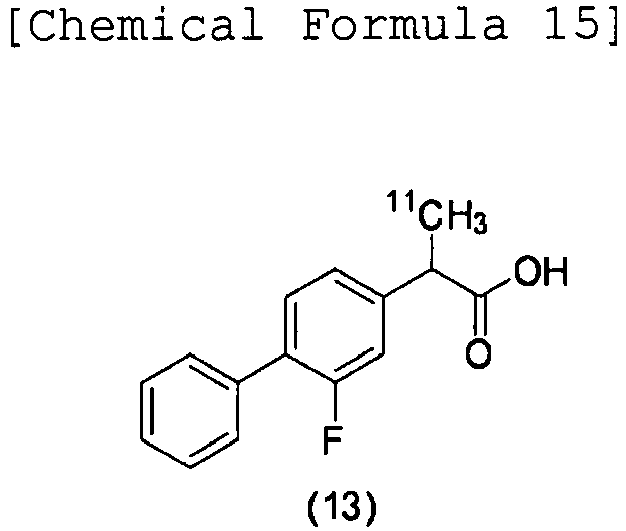
USP3755427 ) was used as a starting material, and [11C] flurbiprofen (13) was synthesized according to a method similar to the method of Example 1. The obtained reaction mixture was separated by preparative HPLC (mobile phase; acetonitrile:10 mM sodium phosphate buffer (pH 7.4) = 33: 67, column; COSMOSIL, 5C18-MS-II,inner diameter 20 mm×length 250 mm, particle diameter 5 µm, flow rate; 10 mL/min, UV detector; 254 nm); as a result, [11C]flurbiprofen (13) was eluted at a retention time of 14 to 16 minutes as shown inFig. 11 . - A radioactivity was 3.1 GBq on completion of the reaction, and a specific radioactivity was 76 GBq/µmol.
- A total time for synthesis and separation of [11C]flurbiprofen (13), and preparation of an intravenous injection solution was about 40 minutes. An authentic sample of flurbiprofen was mixed and a result of analytical HPLC showed a single peak, thereby determining identification of the [11C]flurbiprofen (13) (mobile phase; acetonitrile:aqueous 1% phosphoric acid solution = 50:50, column; COSMOSIL, 5C18-MS-II, inner diameter 4.6 mmxlength 100 mm, particle diameter 5 µm, flow rate; 1 mL/min, UV detector; 254 nm). As a result, a retention time was about 6 minutes, and a purity was 99% or more.
-

- Methyl 2-(2-fluorobiphenyl-4-yl) acetate was used as a starting material, and [11C]flurbiprofen methyl ester (14) was synthesized according to a method similar to the method of Example 2. The obtained reaction mixture was separated by preparative HPLC (mobile phase; acetonitrile:water = 75:25, column; COSMOSIL, 5C18-MS-II,
inner diameter 20 mm×length 250 mm, particle diameter 5 µm, flow rate; 10 mL/min, UV detector; 254 nm); as a result, [11C]flurbiprofen methyl ester (14) was eluted at a retention time of 15 to 16 minutes as shown inFig. 12 . - A radioactivity was 5.8 GBq on completion of the reaction, and a specific radioactivity was 41 GBq/µmol. A total time for synthesis and separation of [11C] flurbiprofen methyl ester (14), and preparation of an intravenous injection solution was about 30 minutes. An authentic sample of flurbiprofen methyl ester was mixed and a result of analytical HPLC showed a single peak, thereby determining identification of the [11C]flurbiprofen methyl ester (14) (mobile phase; acetonitrile:water = 60:40, column; COSMOSIL, 5C18-AR-II, inner diameter 4.6 mmxlength 100 mm, particle diameter 5 µm, flow rate; 1 mL/min, UV detector; 254 nm) . As a result, a retention time was 5.9 to 6.2 minutes, and a purity was 99% or more.
-

- Methyl 2-(2-fluorobiphenyl-4-yl) acetate was used as a starting material, and (R)-[11C]flurbiprofen (13R) and (S)-[11C]flurbiprofen (13S) were synthesized according to a method similar to the method of Example 1.
- The reaction mixture obtained in the above described synthesis reaction was separated by preparative HPLC (mobile phase; 0.05% TFA hexane:0.05% TFA ethanol = 95:5,column; CHIRALPAK AD-H,
inner diameter 10 mm×length 250 mm, particle diameter 5 µm, flow rate; 3 mL/min, UV detector; 254 nm); as a result, (R)-[11C]flurbiprofen (13R) was eluted at a retention time of 10 minutes as shown inFig. 13 . An authentic sample of (R) -flurbiprofen was mixed and a result of analytical HPLC showed a single peak, thereby determining identification of the (R)-[11C] flurbiprofen (13R). - On the other hand, the reaction mixture obtained in the above described synthesis reaction was separated by preparative HPLC (mobile phase; 0.05% TFA hexane:0.05% TFA ethanol = 95: 5, column; CHIRALPAK AD-H,
inner diameter 10 mm×length 250 mm, particle diameter 5 µm, flow rate; 3 mL/min, UV detector; 254 nm); as a result, (S)-[11C]flurbiprofen (13S) was eluted at a retention time of 13 minutes as shown inFig. 13 . An authentic sample of (S) -flurbiprofen was mixed and a result of analytical HPLC showed a single peak, thereby determining identification of the (S)-[11C]flurbiprofen (13S). -
- Ethyl 2- (2-fluorobiphenyl-4-yl) acetate (
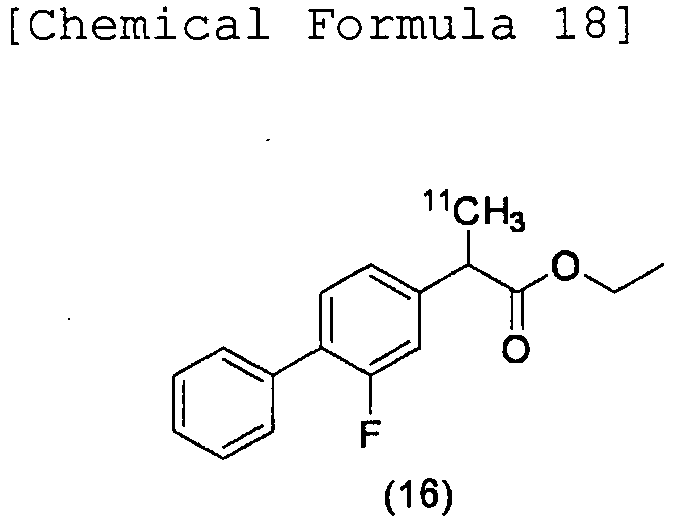
US3755427 ) was used as a starting material, and [11C]flurbiprofen ethyl ester (16) was synthesized according to a method similar to the method of Example 2. The obtained reaction mixture was separated by preparative HPLC (mobile phase; acetonitrile:water = 80:20, column; COSMOSIL, 5C18-MS-II,inner diameter 20 mm×length 250 mm, particle diameter 5 µm, flow rate; 10 mL/min, UV detector; 254 nm); as a result, [11C]flurbiprofen ethyl ester (16) was eluted at a retention time of 16 minutes as shown inFig. 14 . - A radioactivity was 4.65 GBq on completion of the reaction, and a specific radioactivity was 42 GBq/µmol. A total time for synthesis and separation of [11C] flurbiprofen ethyl ester (16), and preparation of an intravenous injection solution was about 37 minutes. An authentic sample of flurbiprofen ethyl ester (Chem. Pharm. Bull. 1984, 32, 99-105) was mixed and a result of analytical HPLC showed a single peak, thereby determining identification of the [11C]flurbiprofen ethyl ester (16) (mobile phase; acetonitrile:water = 65:35, column; COSMOSIL, 5C18-AR-II, inner diameter 4.6 mm×
length 100 mm, particle diameter 5 µm, flow rate; 1 mL/min, UV detector; 254 nm). As a result, a retention time was 7.1 minutes, and a purity was 99% or more. -

-

- n-propyl 2-(2-fluorobiphenyl-4-yl) acetate (150 mg, 0.65 mmol) was dissolved into dichloromethane (3 mL), and oxalyl chloride (67 µL, 99 mg, 0.78 mmol) and DMF (10 µL) were added thereto while stirring at room temperature. After stirring for 5 minutes, propanol (97 mL, 78 mg, 1.3 mmol) was added. After stirring further for 5 minutes, the reaction was terminated with water (0.2 mL), and the obtained reaction mixture was separated by silica gel column chromatography (hexane:ethyl acetate = 20:1) to thus obtain target n-propyl 2- (2-fluorobiphenyl-4-yl) acetate (18) as a transparent oily substance (yield 84%) . The 1H NMR spectrum of this substance is shown below.
1H NMR (400 MHz, CDCl3)
δ: 7.55-7.53 (m, 2H), 7.46-7.34 (m, 4H), 7.15-7.10 (m, 2H), 4.09 (t, J= 6.8 Hz, 2H), 3.65 (s, 2H), 1.68 (quintet, J= 6.8 Hz, 2H), 0.94 (t, J = 7.3 Hz, 3H). - [11C]flurbiprofen n-propyl ester (17) was synthesized from the n-propyl 2-(2-fluorobiphenyl-4-yl)acetate (18) synthesized in the step 1 of Example 15 according to a similar procedure to Example 2. The reaction mixture thus obtained was separated by preparative HPLC (mobile phase; acetonitrile: water= 75:25, column; COSMOSIL, 5C18-MS-II,
inner diameter 20 mm×length 250 mm, particle diameter 5 µm, flow rate; 10 mL/min, UV detector; 254 nm); as a result, [11C] flurbiprofen n-propyl ester (17) was eluted at a retention time of 13 minutes as shown inFig. 15 . - A radioactivity was 1. 4 GBq on completion of the reaction, and a specific radioactivity was 26 GBq/µmol. A total time for synthesis and separation of [11C]flurbiprofen n-propyl ester (17), and preparation of an intravenous injection solution was about 34 minutes. An authentic sample of flurbiprofen n-propyl ester (J. Org. Chem. 1994, 59, 4410-4417) was mixed and a result of analytical HPLC showed a single peak, thereby determining identification of the [11C]flurbiprofen n-propyl ester (17) (mobile phase; acetonitrile:water = 70:30, column; COSMOSIL, 5C18-AR-II, inner diameter 4.6 mm×
length 100 mm, particle diameter 5 µm, flow rate; 1 mL/min, UV detector; 254 nm). As a result, a retention time was 5.7 minutes, and a purity was 99% or more. -

-

- 2-propyl (2-fluorobiphenyl-4-yl) acetate (20) was synthesized from 2-(2-fluorobiphenyl-4-yl) acetic acid and 2-propanol according to a similar procedure to step 1 of Example 15. The 1H NMR spectrum of this substance is shown below. 1H NMR (400 MHz, CDCl3)
δ: 7.55-7.53 (m, 2H), 7.46-7.36 (m, 4H), 7.14-7.10 (m, 2H), 3.91 (t, J = 6.8 Hz, 1H), 3.66 (s, 2H), 0.92 (t, J = 6.8 Hz, 6H). - [11C]flurbiprofen 2-propyl ester (19) was synthesized from the 2-propyl (2-fluorobiphenyl-4-yl) acetate (20) synthesized in the step 1 of Example 16 according to a similar procedure to Example 2. The reaction mixture thus obtained was separated by preparative HPLC (mobile phase; acetonitrile: water= 75:25, column; COSMOSIL, 5C18-MS-II,
inner diameter 20 mm×length 250 mm, particle diameter 5 µm, flow rate; 10 mL/min, UV detector; 254 nm); as a result, [11C]flurbiroprofen 2-propyl ester (19) was eluted at a retention time of 11.4 minutes as shown inFig. 16 . - A radioactivity was 2.1 GBq on completion of the reaction, and a specific radioactivity was 19 GBq/µmol. A total time for synthesis and separation of [11C] flurbiroprofen 2-propyl ester (19), and preparation of an intravenous injection solution was about 36 minutes. An authentic sample of flurbiroprofen 2-propyl ester (J. Controlled Rellease. 1999, 62, 223-229) was mixed and a result of analytical HPLC showed a single peak, thereby determining identification of the [11C]flurbiroprofen 2-propyl ester (19) (mobile phase; acetonitrile:water = 70:30, column; COSMOSIL, 5C18-AR-II, inner diameter 4.6 mmxlength 100 mm, particle diameter 5 µm, flow rate; 1 mL/min, UV detector; 254 nm). As a result, a retention time was 5.7 minutes, and a purity was 99% or more.
-

-

- n-butyl 2-(2-fluorobiphenyl-4-yl) acetate (22) was synthesized from 2-(2-fluorobiphenyl-4-yl) acetic acid and n-butanol according to a similar procedure to the step 1 of Example 15. The 1H NMR spectrum of this substance is shown below.
1H NMR (400 MHz, CDCl3)
δ: 7.55-7.54 (m, 2H), 7.46-7.35 (m, 4H), 7.14-7.09 (m, 2H), 4.13 (t, J = 6.8 Hz, 1H), 3.68 (s, 2H), 1.66-1.58 (m, 2H), 1.42-1.33 (m, 2H), 0.93 (t, J = 7.3 Hz, 3H). - [11C]flurbiprofen n-butyl ester (21) was synthesized from the n-butyl 2-(2-fluorobiphenyl-4-yl)acetate (22) synthesized in the step 1 of Example 17 according to a similar procedure to Example 2. The reaction mixture thus obtained was separated by preparative HPLC (mobile phase; acetonitrile: water= 75:25, column; COSMOSIL, 5C18-MS-II,
inner diameter 20 mm×length 250 mm, particle diameter 5 µm, flow rate; 10 mL/min, UV detector; 254 nm); as a result, [11C] flurbiprofen n-butyl ester (21) was eluted at a retention time of 15.5 minutes as shown inFig. 17 . - A radioactivity was 1.5 GBq on completion of the reaction, and a specific radioactivity was 16 GBq/µmol. A total time for synthesis and separation of [11C]flurbiprofen n-butyl ester (21), and preparation of an intravenous injection solution was about 39 minutes. An authentic sample of flurbiprofen n-butyl ester (
JP57091913 A length 100 mm, particle diameter 5 µm, flow rate; 1 mL/min, UV detector; 254 nm) . As a result, a retention time was 5.4 minutes, and a purity was 99% or more. -
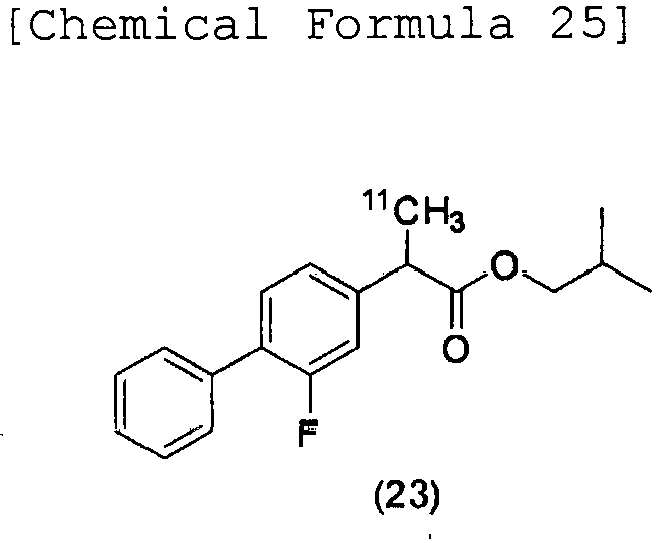
-

- 2-methylpropyl 2-(2-fluorobiphenyl-4-yl) acetate (24) was synthesized from 2- (2-fluorobiphenyl-4-yl) acetic acid and 2-methyl propanol according to a similar procedure to step 1 of Example 15. The 1H NMR spectrum of this substance is shown below.
1H NMR (400 MHz, CDCl3)
δ: 7.55-7.54 (m, 2H), 7.46-7.35 (m, 4H), 7.14-7.09 (m, 2H), 4.13 (t, J = 6.8 Hz, 1H), 3.68 (s, 2H), 0.93 (t, J = 7.3 Hz, 3H). - [11C]flurbiprofen 2-methylpropyl ester (23) was synthesized from the 2-methylpropyl 2- (2-fluorobiphenyl-4-yl) acetate (24) synthesized in the step 1 of Example 18 according to a similar procedure to Example 2. The reaction mixture thus obtained was separated by preparative HPLC (mobile phase; acetonitrile: water= 75:25, column; COSMOSIL, 5C18-MS-II,
inner diameter 20 mm×length 250 mm, particle diameter 5 µm, flow rate; 10 mL/min, UV detector; 254 nm); as a result, [11C] flurbiprofen 2-methylpropyl ester (23) was eluted at a retention time of 15.5 minutes as shown inFig. 18 . - A radioactivity was 1.5 GBq on completion of the reaction, and a specific radioactivity was 26 GBq/µmol. A total time for synthesis and separation of [11C]flurbiprofen 2-methylpropyl ester (23), and preparation of an intravenous injection solution was about 39 minutes. An authentic sample of flurbiprofen 2-methylpropyl ester (Ind. J. Chem. Section B: Organic Chemistry Including Medicinal Chemistry, 2007, 46B, 1164-1168) was mixed and a result of analytical HPLC showed a single peak, thereby determining identification of the [11C]flurbiprofen 2-methylpropyl ester (23) (mobile phase; acetonitrile:water= 70:30, column; COSMOSIL, 5C18-AR-II, inner diameter 4.6 mm×
length 100 mm, particle diameter 5 µm, flow rate; 1 mL/min, UV detector; 254 nm) . As a result, a retention time was 5.4 minutes, and a purity was 99% or more. -


- A flurbiprofen methyl ester was used as a starting material, and [11C]methyl flurbiprofen (25) was synthesized according to a method similar to the method of Example 1. The reaction mixture thus obtained was separated by preparative HPLC (mobile phase; acetonitrile:10 mM sodium phosphate buffer (pH 7.4) = 80:20, column; COSMOSIL, 5C18-MS-II,
inner diameter 20 mm×length 250 mm, particle diameter 5 µm, flow rate; 10 mL/min, UV detector; 254 nm); as a result, [11C]methylflurbiprofen (25) was eluted at a retention time of 14 minutes as shown inFig. 19 . - A radioactivity was 3.68 GBq on completion of the reaction, and a specific radioactivity was 42 GBq/µmol. A total time for synthesis and separation of [11C]methylflurbiprofen (25), and preparation of an intravenous injection solution was about 32 minutes. An authentic sample of methylflurbiprofen (Bioorg. Med. Chem. Lett. 2006, 16, 2219-222) was mixed and a result of analytical HPLC showed a single peak, thereby determining identification of the [11C]methylflurbiprofen (25) (mobile phase; acetonitrile:0.1% phosphoric acid = 50:50, column; COSMOSIL, 5C18-AR-II, inner diameter 4.6 mm×
length 100 mm, particle diameter 5 µm, flow rate; 1 mL/min, UV detector; 254 nm) . As a result, a retention time was 7.6 minutes, and a purity was 99% or more. -

- Flurbiprofen methyl ester was used as a starting material, and [11C]methyl flurbiprofen methyl ester (26) was synthesized according to a method similar to the method of Example 2. The reaction mixture thus obtained was separated by preparative HPLC (mobile phase; acetonitrile:water = 80:20, column; COSMOSIL, 5C18-MS-II,
inner diameter 20 mmxlength 250 mm, particle diameter 5 µm, flow rate; 10 mL/min, UV detector; 254 nm) ; as a result, [11C]methylflurbiprofen methyl ester (26) was eluted at a retention time of 17 minutes as shown inFig. 20 . - A radioactivity was 2.32 GBq on completion of the reaction, and a specific radioactivity was 37 GBq/µmol. A total time for synthesis and separation of [11C]methyl flurbiprofen methyl ester (26), and preparation of an intravenous injection solution was about 32 minutes. An authentic sample of methyl flurbiprofen methyl ester (Bioorg. Med. Chem. Lett. 2006, 16, 2219-222) was mixed and a result of analytical HPLC showed a single peak, thereby determining identification of the [11C]methyl flurbiprofen methyl ester (26) (mobile phase; acetonitrile: water= 65:35, column; COSMOSIL, 5C18-AR-II, inner diameter 4.6 mm×
length 100 mm, particle diameter 5 µm, flow rate; 1 mL/min, UV detector; 254 nm) . As a result, a retention time was 6.9 minutes, and a purity was 99% or more. -
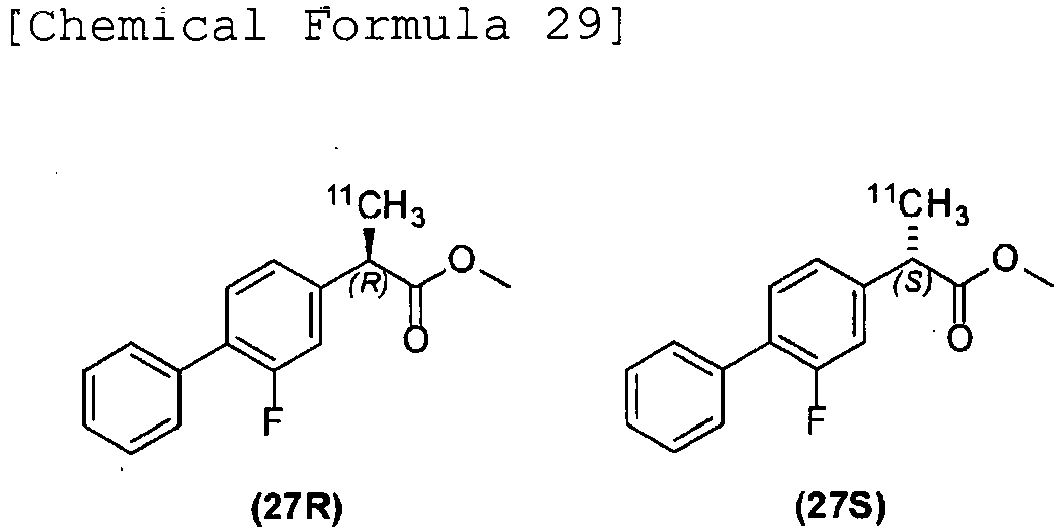
- Methyl 2-(2-fluorobiphenyl-4-yl) acetate was used as a starting material, and (R) - [11C] flurbiprofen methyl ester (27R) and (S)-[11C]flurbiprofen methyl ester (27S) were synthesized according to a method similar to the method of Example 2.
- The reaction mixture obtained in the above synthesis reaction was separated by preparative HPLC (mobile phase; methanol:water = 90:10, column; CHIRALCEL OJ-RH,
inner diameter 20 mm×length 150 mm, particle diameter 5 µm, flow rate; 10 mL/min, UV detector; 254 nm) ; as a result, (R) - [11C] flurbiprofen methyl ester (27R) was eluted at a retention time of 17 minutes as shown inFig. 21 . An authentic sample of (R)-flurbiprofen methyl ester was mixed and a result of analytical HPLC showed a single peak, thereby determining identification of the (R)-[11C]flurbiprofen methyl ester (27R). - On the other hand, the reaction mixture obtained in the above synthesis reaction was separated by preparative HPLC (mobile phase; methanol:water = 90: 10, column; CHIRALCEL OJ-RH,
inner diameter 20 mm×length 150 mm, particle diameter 5 µm, flow rate; 10 mL/min, UV detector; 254 nm); as a result, (S)-[11C]flurbiprofen methyl ester (27S) was eluted at a retention time of 22 minutes as shown inFig. 21 . An authentic sample of (S) -flurbiprofen methyl ester was mixed and a result of analytical HPLC showed a single peak, thereby determining identification of the (S) - [11C] flurbiprofen methyl ester (27S) . - PET was eprformed using a brain inflammation model rat for the [11C]ketoprofen methyl ester (8) synthesized in Example 6. In the experiment, a trace amount, 0.5 µg, of lipopolysaccharide (LPS) that is a constituent of a gram-negative bacteria cell wall outer membrane was injected into the left striatum of a rat, thereby inducing brain inflammation (Hunter RL, Dragicevic N, Seifert K, Choi DY, Liu M, Kim HC, Cass WA, Sullivan PG, Bing G. Inflammation induces mitochondrial dysfunction and dopaminergic neurodegeneration in the nigrostriatal system. J Neurochem.2007100:5:1375-86.). The [11C]ketoprofen methyl ester (8) was administered to a rat after 1 day from injection of LPS through a caudal vein, PET was performed for 45 minutes using a PET apparatus for small animals (manufactured by microPET, SIMENS) . The injection solution of the [11C] ketoprofen methyl ester (radioactivity 72 to 74 MBq) was prepared by diluting with saline to 1.0 CC volume. In order to further study an effect of inhibiting bonds by a non-RI labeled body, an injection solution added with 10mg/kg of ketoprofen methyl ester (final concentration of a solvent was 5 % DMSO, 5% tween20) was prepared. On completion of PET imaging, a rat brain section was prepared and an Ex vivo autoradiography (ARG) experiment was performed. In the experiment, the rat was perfused with saline, and a section prepared with 2 mm thickness, which was obtained from the brain taken out from the rat, was exposed on an imaging plate BAS SR-2040 (manufactured by Fujifilm Corporation) for 1 hour to read using a fluoroimage analyzer (FLA7000). In order to identify an expression site of cyclooxygenase-2, chemical staining of an immune tissue in a brain section was performed using a specific antibody. That is, 20 µm of a frozen section prepared from the brain section used in the autoradiography mentioned above and pasted on a slide glass was incubated with anti-cyclooxygenase-2 (rabbit IgG, polyclonal antibody, manufactured by Cayman) diluted to PBS-T at a concentration of 200 times as a primary antibody at 4°C overnight. Next, the brain section was reacted with a biotin labeled anti-rabbit IgG antibody (manufactured by VECTOR) diluted to PBS-T at a concentration of 200 times at room temperature for 1 hour to bond with an avidin-biotin labeled peroxydase complex (VECTASTAIN Elite ABC Kit, manufactured by VECTOR). In the method of dye, a DAB method of reacting with diaminobenzine was used.
- An addition average of PET images in 45 minutes after administration of the [11C]ketoprofen methyl ester, and an amount of radioactivity were shown in
Fig. 22a , and radioactivity over elapsed times in each brain site at the time was shown inFig. 22b. Fig. 22a indicates that the [11C] ketoprofen methyl ester (8) passed through the blood-brain barrier and accumulated in an inflammation region around the LPS injected site in the left side of the brain. This accumulation was significantly reduced by administration of 10 mg/kg of non-RI labeled ketoprofen methyl ester, and thus, accumulation in an inflammation region of [11C]ketoprofen methyl ester was found to be specific. In addition, it was found as shown inFig. 23 that the [11C]ketoprofen methyl ester was accumulated specifically in an inflammation site also in the autoradiography (ARG) experiment using a rat brain section, similar to the time of taking PET images. Furthermore, as a result of performing immune tissue chemical staining, an accumulated site of the [11C]ketoprofen methyl ester was correspond with a positive site of immunostaining of cyclooxygenase-2, as shown inFig. 24 . These facts demonstrated that use of the [11C]ketoprofen methyl ester (8) in Example 6 enables imaging of cyclooxygenase-2 in the brain as the first case in the world. - PET images were taken using an Alzheimer disease model mouse for the [11C]ketoprofen methyl ester (21) synthesized in Example 6. For the Alzheimer disease model mouse, a transgenic mouse (APP-Tg) excessively expressing amyloid precursor protein (APP) in familial Alzheimer disease was purchased from Taconic Farms, Inc. USA to be used. In 24 months old when accumulation of amyloid β protein was confirmed as pathological change of Alzheimer disease, the [11C]ketoprofen methyl ester (21) was administered through a caudal vein, and PET images were taken for 30 minutes using a PET apparatus for small animals (microPET, manufactured by SIMENS). The injection solution of the [11C]ketoprofen methyl ester (21) (radioactivity 45 to 60 MBq) was prepared by diluting with saline to 1.0 CC volume. SUV (Standard Uptake Value)= tissue radioactivity in region of interest (MBq/g)÷[administration amount (MBq) /body weight (g)] was used as the index of an accumulation level, to compare with a brain of a wild type mouse that is a normal mouse in terms of an accumulation amount into the APP-Tg mouse brain.
- An addition average of PET images in 25 minutes after 5 minutes from administration of the [11C] ketoprofen methyl ester (21), and a quantitative value of an accumulation amount (SUV) were shown in
Fig. 25 . It was shown that the [11C]ketoprofen methyl ester (21) was highly accumulated in the APP-Tg mouse brain as compared with the wild type mouse brain. It was also shown from the quantitative value that a site showing high accumulation of [11C]ketoprofen methyl ester is corresponded with a site that was reported of accumulation of amyloid β that is a main constituent of senile plaque in the APP-Tg mouse brain (Am J Pathol. 1998; 152 (1) : 307-17.) . These facts demonstrated that use of the [11C]ketoprofen methyl ester (21) enables imaging of brain inflammation involved in neurodegeneration in Alzheimer disease. - The present invention is not necessarily limited to the exemplary embodiment and examples described so far. The present invention includes various modified embodiments as far as they stay within the Scope of Claims and can be easily assumed by the ordinarily skilled in the art.
-
-
Fig. 1 is a HPLC chart of the reaction mixture in Example 1, and the arrow shows a peak of [11C]ibuprofen. -
Fig. 2 is a HPLC chart of the reaction mixture in Example 2, and the arrow shows a peak of [11C]ibuprofen methyl ester. -
Fig. 3 is a HPLC chart of the reaction mixture in Example 3, and the arrow shows a peak of [11C]naproxen. -
Fig. 4 is a HPLC chart of the reaction mixture in Example 4, and the arrow shows a peak of [11C]naproxen methyl ester. -
Fig. 5 is a HPLC chart of the reaction mixture in Example 5, and the arrow shows a peak of [11C]ketoprofen. -
Fig. 6 is a HPLC chart of the reaction mixture in Example 6, and the arrow shows a peak of [11C]ketoprofen methyl ester. -
Fig. 7 is a HPLC chart of the reaction mixture in Example 7, and the arrow shows a peak of [11C]fenoprofen. -
Fig. 8 is a HPLC chart of the reaction mixture in Example 8, and the arrow shows a peak of [11C] fenoprofen methyl ester. -
Fig. 9 is a HPLC chart of the reaction mixture in Example 9, and the arrow shows a peak of [11C]loxoprofen (11). -
Fig. 10 is a HPLC chart of the reaction mixture in Example 10, and the arrow shows a peak of [11C]loxoprofen methyl ester (12) . -
Fig. 11 is a HPLC chart of the reaction mixture in Example 11, and the arrow shows a peak of [11C]flurbiprofen. -
Fig. 12 is a HPLC chart of the reaction mixture in Example 12, and the arrow shows a peak of [11C]flurbiprofen methyl ester. -
Fig. 13 is a HPLC chart of the reaction mixture in Example 13, and arrows show peaks of (R)-[11C]flurbiprofen and (S)-[11C]flurbiprofen. -
Fig. 14 is a HPLC chart of the reaction mixture in Example 14, and the arrow shows a peak of [11C] flurbiprofen ethyl ester. -
Fig. 15 is a HPLC chart of the reaction mixture in Example 15, and the arrow shows a peak of [11C]flurbiprofen n-propyl ester. -
Fig. 16 is a HPLC chart of the reaction mixture in Example 16, and the arrow shows a peak of [11C]flurbiprofen 2-propyl ester. -
Fig. 17 is a HPLC chart of the reaction mixture in Example 17, and the arrow shows a peak of [11C]flurbiprofen n-butyl ester. -
Fig. 18 is a HPLC chart of the reaction mixture in Example 18, and the arrow shows a peak of [11C]flurbiprofen 2-methylpropyl ester. -
Fig. 19 is a HPLC chart of the reaction mixture in Example 19, and the arrow shows a peak of [11C]methyl flurbiprofen. -
Fig. 20 is a HPLC chart of the reaction mixture in Example 20, and the arrow shows a peak of [11C]methyl flurbiprofen methyl ester. -
Fig. 21 is a HPLC chart of the reaction mixture in Example 21, and arrows show peaks of (R) - [11C] flurbiprofen methyl ester and (S)-[11C]flurbiprofen methyl ester. -
Fig. 22 (a) shows an addition average of PET images in 45 minutes after administration of the [11C]ketoprofen methyl ester (described as 11C-KTP-Me) (8) synthesized in Example 6, and a ratio of an amount of radioactivity in each brain site using cerebellum as a reference region. Note that the PET images are overlapped with the standard MRI brain image.Fig. 22 (b) shows an elapsed time of radioactivity. (SUV: tissue radioactivity in region of interest (MBq/g)÷[administration amount (MBq)/body weight (g)]). -
Fig. 23 shows autoradiography of the [11C]ketoprofen methyl ester (described as 11C-KTP-Me)(8) synthesized in Example 6 and a result of its quantitative analysis. In the autoradiography, an image overlapped with a brain section is used, and a quantitative value is shown as PSL/mm2 (photostimulable fluorescence PSL/quantitative area mm2). -
Fig. 24 shows a result of immune tissue chemical staining of cyclooxygenase-2 using a brain section of a rat. -
Fig. 25 shows an addition average of PET images for 25 minutes from 5 minutes after administration of the [11C] ketoprofen methyl ester (described as 11C-KTP-Me) (21), and a quantitative value of an accumulation amount into a brain tissue (SUV: tissue radioactivity in region of interest (MBq/g)÷[administration amount (MBq)/body weight (g)]). - The present invention can be used as a molecular probe for PET in the pharmaceutical industry, and the like.
Claims (6)
- Isotope-labeled 2-arylpropionic acid compounds, each of which is a compound represented by the following general formula (1) wherein Ar represents an aryl group which may have a substituent; R1 represents any one of 11CH3, CH2 18F and CF2 18F; and R2 represents a hydrogen atom, or an alkyl group which may have a branch, provided that a compound wherein Ar is a benzene ring, R1 is 11CH3, and R2 is a hydrogen atom is excluded, or a pharmaceutically acceptable salt, hydrate, solvate or ester thereof:

- The isotope-labeled 2-arylpropionic acid compounds according to claim 1, wherein R1 is 11CH3.
- A process for producing the isotope-labeled 2-arylpropionic acid compounds according to claim 1, comprising a carboanion generation step of adding base to a 2-arylacetic acid ester represented by the following general formula wherein Ar represents an aryl group which may have a substituent; R2 represents a hydrogen atom, or an alkyl group which may have a branch; and R3 represents a hydrogen atom, an alkyl group which may have a substituent, or an aryl group which may have a substituent to be mixed, and an isotope labeling introduction step of adding any of CH3X, CH2 18FX and CF2 18FX wherein X represents any one of I, Br and a triflate group to a reaction solution after the carboanion generation step:

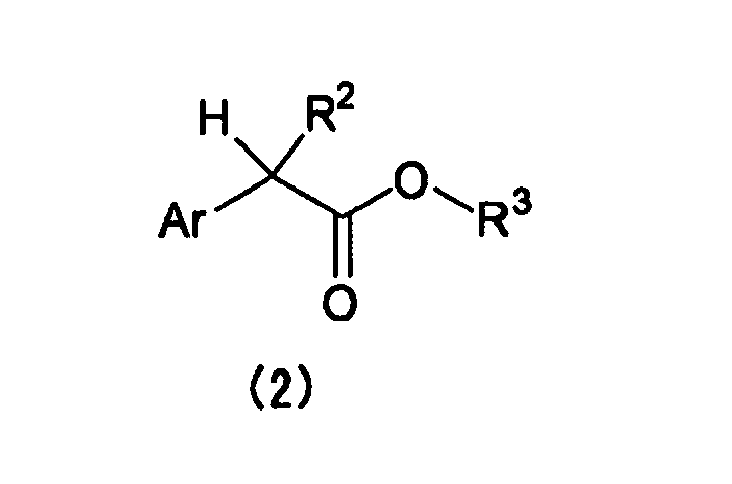
- A PET molecular probe comprising the isotope-labeled 2-arylpropionic acid compounds according to claim 1 or 2.
- The PET molecular probe according to claim 4 for PET imaging of cyclooxygenase.
- The PET molecular probe according to claim 4 for diagnosis of Alzheimer disease.
Applications Claiming Priority (2)
| Application Number | Priority Date | Filing Date | Title |
|---|---|---|---|
| JP2009181122 | 2009-08-03 | ||
| PCT/JP2010/062744 WO2011016376A1 (en) | 2009-08-03 | 2010-07-29 | Isotopelabeled 2-arylpropionic acid compounds and process for production of same, and molecular probe for positron emission tomography and method for imaging of cyclooxygenase and the like using same |
Publications (3)
| Publication Number | Publication Date |
|---|---|
| EP2463263A1 EP2463263A1 (en) | 2012-06-13 |
| EP2463263A4 EP2463263A4 (en) | 2013-01-23 |
| EP2463263B1 true EP2463263B1 (en) | 2014-04-23 |
Family
ID=43544272
Family Applications (1)
| Application Number | Title | Priority Date | Filing Date |
|---|---|---|---|
| EP10806375.1A Not-in-force EP2463263B1 (en) | 2009-08-03 | 2010-07-29 | Isotope labeled 2-arylpropionic acid compounds and process for production of same, and molecular probe for positron emission tomography and method for imaging of cyclooxygenase and the like using same |
Country Status (4)
| Country | Link |
|---|---|
| US (1) | US8778298B2 (en) |
| EP (1) | EP2463263B1 (en) |
| JP (1) | JP5721231B2 (en) |
| WO (1) | WO2011016376A1 (en) |
Cited By (2)
| Publication number | Priority date | Publication date | Assignee | Title |
|---|---|---|---|---|
| US9850183B2 (en) | 2014-06-27 | 2017-12-26 | Reiley Pharmaceuticals, Inc. | Conjugates derived from non-steroidal anti-inflammatory drugs and methods of use thereof in imaging |
| US10053478B2 (en) | 2015-01-09 | 2018-08-21 | Reiley Pharmaceuticals, Inc. | COX-2-targeting, platinum-containing conjugates and their use in the treatment of tumors and cancers |
Families Citing this family (4)
| Publication number | Priority date | Publication date | Assignee | Title |
|---|---|---|---|---|
| JP5770621B2 (en) * | 2011-12-27 | 2015-08-26 | 株式会社Lttバイオファーマ | 2-Fluorophenylpropionic acid derivative |
| GB201308278D0 (en) | 2013-05-08 | 2013-06-12 | Imp Innovations Ltd | Labelled Carboxylic Acids and Their Uses in Molecular Imaging |
| US12332244B2 (en) | 2018-06-08 | 2025-06-17 | Kyungpook National University Industry-Academic Cooperation Foundation | Composition for diagnosing diseases associated with COX2 overexpression and screening method therefor |
| CN110261531B (en) * | 2019-07-27 | 2021-02-19 | 湖南九典制药股份有限公司 | Method for detecting related substances in loxoprofen or sodium salt thereof |
Family Cites Families (2)
| Publication number | Priority date | Publication date | Assignee | Title |
|---|---|---|---|---|
| EP1875240A2 (en) | 2005-04-27 | 2008-01-09 | Siemens Medical Solutions USA, Inc. | The preparation of molecular imaging probes using click chemistry |
| EP2128123A4 (en) | 2007-01-29 | 2011-04-20 | Medrx Co Ltd | Salt of nonsteroidal anti-inflammatory drug and organic amine compound and use thereof |
-
2010
- 2010-07-29 US US13/387,753 patent/US8778298B2/en not_active Expired - Fee Related
- 2010-07-29 EP EP10806375.1A patent/EP2463263B1/en not_active Not-in-force
- 2010-07-29 WO PCT/JP2010/062744 patent/WO2011016376A1/en not_active Ceased
- 2010-07-29 JP JP2011525861A patent/JP5721231B2/en not_active Expired - Fee Related
Non-Patent Citations (1)
| Title |
|---|
| FRANK R. WÜST ET AL: "Synthesis of 18F-labelled cyclooxygenase-2 (COX-2) inhibitors via Stille reaction with 4-[18F]fluoroiodobenzene as radiotracers for positron emission tomography (PET)", ORGANIC & BIOMOLECULAR CHEMISTRY, vol. 3, no. 3, 1 January 2005 (2005-01-01), pages 503, XP055075563, ISSN: 1477-0520, DOI: 10.1039/b412871k * |
Cited By (2)
| Publication number | Priority date | Publication date | Assignee | Title |
|---|---|---|---|---|
| US9850183B2 (en) | 2014-06-27 | 2017-12-26 | Reiley Pharmaceuticals, Inc. | Conjugates derived from non-steroidal anti-inflammatory drugs and methods of use thereof in imaging |
| US10053478B2 (en) | 2015-01-09 | 2018-08-21 | Reiley Pharmaceuticals, Inc. | COX-2-targeting, platinum-containing conjugates and their use in the treatment of tumors and cancers |
Also Published As
| Publication number | Publication date |
|---|---|
| US8778298B2 (en) | 2014-07-15 |
| EP2463263A1 (en) | 2012-06-13 |
| EP2463263A4 (en) | 2013-01-23 |
| WO2011016376A1 (en) | 2011-02-10 |
| US20120128588A1 (en) | 2012-05-24 |
| JPWO2011016376A1 (en) | 2013-01-10 |
| JP5721231B2 (en) | 2015-05-20 |
Similar Documents
| Publication | Publication Date | Title |
|---|---|---|
| Rong et al. | Radiochemistry for positron emission tomography | |
| US8778298B2 (en) | Isotope labeled 2-arylpropionic acid compounds and process for production of same, and molecular probe for positron emission tomography and method for imaging of cyclooxygenase and the like using same | |
| JP6524046B2 (en) | PSMA binders and their use | |
| Sachin et al. | F-18 labeling protocol of peptides based on chemically orthogonal strain-promoted cycloaddition under physiologically friendly reaction conditions | |
| JP6405573B2 (en) | Method for producing 4-borono-L-phenylalanine having 18F atoms introduced and precursor of 4-borono-L-phenylalanine having 18F atoms introduced | |
| Liu et al. | Development of 18F-labeled picolinamide probes for PET imaging of malignant melanoma | |
| JP2021513979A (en) | Chemical conjugates of Evans blue derivatives and their use as radiation therapy and contrast agents to target prostate cancer | |
| Tietz et al. | Radiotracers for molecular imaging of cyclooxygenase-2 (COX-2) enzyme | |
| Takashima‐Hirano et al. | General method for the 11C‐labeling of 2‐arylpropionic acids and their esters: construction of a PET tracer library for a study of biological events involved in COXs expression | |
| CN107847618B (en) | HBED-bisphosphonates, their radiometal conjugates and their use as theranostic agents | |
| Zhang et al. | Highly efficient and stable strain-release radioiodination for thiol chemoselective bioconjugation | |
| TW200800869A (en) | Precursor compound of radioactive halogen labeled organic compound | |
| US20090105489A1 (en) | Novel organic compound and method for producing radioactive halogen-labeled organic compound using the same | |
| Kaide et al. | Conversion of iodine to fluorine-18 based on iodinated chalcone and evaluation for β-amyloid PET imaging | |
| Auchynnikava et al. | Tetrazine Glycoconjugate for Pretargeted Positron Emission Tomography Imaging of trans-Cyclooctene-Functionalized Molecular Spherical Nucleic Acids | |
| CN102557969A (en) | Cyclic ketone derivatives and applications thereof as developers and aggregation inhibitors of amyloid protein sediments and neurofibrillary tangles | |
| JP5085824B2 (en) | Production of compounds useful for hypoxia detection | |
| Huynh et al. | 68Ga-labeled benzothiazole derivatives for imaging Aβ plaques in cerebral amyloid angiopathy | |
| Pashikanti et al. | Synthetic efforts toward the synthesis of a fluorinated analog of 5-aminolevulinic acid: Practical synthesis of racemic and enantiomerically defined 3-fluoro-5-aminolevulinic acid | |
| US10821194B2 (en) | Labelled carboxylic acids and their uses in molecular imaging | |
| Jarkas et al. | (R, S)-Anti-1-amino-2-[18F] fluorocyclopentyl-1-carboxylic acid: synthesis from racemic 2-benzyloxycyclopentanone and biological evaluation for brain tumor imaging with positron emission tomography | |
| Basuli et al. | Synthesis of ApoSense compound [18F] 2-(5-(dimethylamino) naphthalene-1-sulfonamido)-2-(fluoromethyl) butanoic acid ([18F] NST732) by nucleophilic ring opening of an aziridine precursor | |
| WO2023145967A1 (en) | Probe for nuclear medical testing | |
| US9468692B2 (en) | Labeled molecular imaging agents and methods of use | |
| JP6273251B2 (en) | Aromatic amino acid derivative and PET probe using the same |
Legal Events
| Date | Code | Title | Description |
|---|---|---|---|
| PUAI | Public reference made under article 153(3) epc to a published international application that has entered the european phase |
Free format text: ORIGINAL CODE: 0009012 |
|
| 17P | Request for examination filed |
Effective date: 20120305 |
|
| AK | Designated contracting states |
Kind code of ref document: A1 Designated state(s): AL AT BE BG CH CY CZ DE DK EE ES FI FR GB GR HR HU IE IS IT LI LT LU LV MC MK MT NL NO PL PT RO SE SI SK SM TR |
|
| DAX | Request for extension of the european patent (deleted) | ||
| A4 | Supplementary search report drawn up and despatched |
Effective date: 20121221 |
|
| RIC1 | Information provided on ipc code assigned before grant |
Ipc: C07C 59/64 20060101ALI20121217BHEP Ipc: G01T 1/161 20060101ALI20121217BHEP Ipc: C07C 59/68 20060101ALI20121217BHEP Ipc: C07C 67/333 20060101ALI20121217BHEP Ipc: C07C 51/353 20060101ALI20121217BHEP Ipc: C07C 57/30 20060101AFI20121217BHEP Ipc: C07C 59/84 20060101ALI20121217BHEP Ipc: C07C 69/734 20060101ALI20121217BHEP Ipc: C07C 69/736 20060101ALI20121217BHEP Ipc: C07C 69/65 20060101ALI20121217BHEP Ipc: A61K 51/00 20060101ALI20121217BHEP Ipc: C07C 59/86 20060101ALI20121217BHEP Ipc: C07C 69/612 20060101ALI20121217BHEP Ipc: C07C 57/58 20060101ALI20121217BHEP Ipc: C07C 69/738 20060101ALI20121217BHEP |
|
| GRAP | Despatch of communication of intention to grant a patent |
Free format text: ORIGINAL CODE: EPIDOSNIGR1 |
|
| INTG | Intention to grant announced |
Effective date: 20131212 |
|
| GRAS | Grant fee paid |
Free format text: ORIGINAL CODE: EPIDOSNIGR3 |
|
| GRAA | (expected) grant |
Free format text: ORIGINAL CODE: 0009210 |
|
| AK | Designated contracting states |
Kind code of ref document: B1 Designated state(s): AL AT BE BG CH CY CZ DE DK EE ES FI FR GB GR HR HU IE IS IT LI LT LU LV MC MK MT NL NO PL PT RO SE SI SK SM TR |
|
| REG | Reference to a national code |
Ref country code: GB Ref legal event code: FG4D |
|
| REG | Reference to a national code |
Ref country code: CH Ref legal event code: EP |
|
| REG | Reference to a national code |
Ref country code: AT Ref legal event code: REF Ref document number: 663743 Country of ref document: AT Kind code of ref document: T Effective date: 20140515 |
|
| REG | Reference to a national code |
Ref country code: IE Ref legal event code: FG4D |
|
| REG | Reference to a national code |
Ref country code: DE Ref legal event code: R096 Ref document number: 602010015469 Country of ref document: DE Effective date: 20140612 |
|
| REG | Reference to a national code |
Ref country code: AT Ref legal event code: MK05 Ref document number: 663743 Country of ref document: AT Kind code of ref document: T Effective date: 20140423 |
|
| REG | Reference to a national code |
Ref country code: NL Ref legal event code: VDEP Effective date: 20140423 |
|
| REG | Reference to a national code |
Ref country code: LT Ref legal event code: MG4D |
|
| PG25 | Lapsed in a contracting state [announced via postgrant information from national office to epo] |
Ref country code: FI Free format text: LAPSE BECAUSE OF FAILURE TO SUBMIT A TRANSLATION OF THE DESCRIPTION OR TO PAY THE FEE WITHIN THE PRESCRIBED TIME-LIMIT Effective date: 20140423 Ref country code: GR Free format text: LAPSE BECAUSE OF FAILURE TO SUBMIT A TRANSLATION OF THE DESCRIPTION OR TO PAY THE FEE WITHIN THE PRESCRIBED TIME-LIMIT Effective date: 20140724 Ref country code: IS Free format text: LAPSE BECAUSE OF FAILURE TO SUBMIT A TRANSLATION OF THE DESCRIPTION OR TO PAY THE FEE WITHIN THE PRESCRIBED TIME-LIMIT Effective date: 20140823 Ref country code: BG Free format text: LAPSE BECAUSE OF FAILURE TO SUBMIT A TRANSLATION OF THE DESCRIPTION OR TO PAY THE FEE WITHIN THE PRESCRIBED TIME-LIMIT Effective date: 20140723 Ref country code: NL Free format text: LAPSE BECAUSE OF FAILURE TO SUBMIT A TRANSLATION OF THE DESCRIPTION OR TO PAY THE FEE WITHIN THE PRESCRIBED TIME-LIMIT Effective date: 20140423 Ref country code: NO Free format text: LAPSE BECAUSE OF FAILURE TO SUBMIT A TRANSLATION OF THE DESCRIPTION OR TO PAY THE FEE WITHIN THE PRESCRIBED TIME-LIMIT Effective date: 20140723 Ref country code: CY Free format text: LAPSE BECAUSE OF FAILURE TO SUBMIT A TRANSLATION OF THE DESCRIPTION OR TO PAY THE FEE WITHIN THE PRESCRIBED TIME-LIMIT Effective date: 20140423 Ref country code: LT Free format text: LAPSE BECAUSE OF FAILURE TO SUBMIT A TRANSLATION OF THE DESCRIPTION OR TO PAY THE FEE WITHIN THE PRESCRIBED TIME-LIMIT Effective date: 20140423 |
|
| PG25 | Lapsed in a contracting state [announced via postgrant information from national office to epo] |
Ref country code: ES Free format text: LAPSE BECAUSE OF FAILURE TO SUBMIT A TRANSLATION OF THE DESCRIPTION OR TO PAY THE FEE WITHIN THE PRESCRIBED TIME-LIMIT Effective date: 20140423 Ref country code: AT Free format text: LAPSE BECAUSE OF FAILURE TO SUBMIT A TRANSLATION OF THE DESCRIPTION OR TO PAY THE FEE WITHIN THE PRESCRIBED TIME-LIMIT Effective date: 20140423 Ref country code: SE Free format text: LAPSE BECAUSE OF FAILURE TO SUBMIT A TRANSLATION OF THE DESCRIPTION OR TO PAY THE FEE WITHIN THE PRESCRIBED TIME-LIMIT Effective date: 20140423 Ref country code: PL Free format text: LAPSE BECAUSE OF FAILURE TO SUBMIT A TRANSLATION OF THE DESCRIPTION OR TO PAY THE FEE WITHIN THE PRESCRIBED TIME-LIMIT Effective date: 20140423 Ref country code: LV Free format text: LAPSE BECAUSE OF FAILURE TO SUBMIT A TRANSLATION OF THE DESCRIPTION OR TO PAY THE FEE WITHIN THE PRESCRIBED TIME-LIMIT Effective date: 20140423 Ref country code: HR Free format text: LAPSE BECAUSE OF FAILURE TO SUBMIT A TRANSLATION OF THE DESCRIPTION OR TO PAY THE FEE WITHIN THE PRESCRIBED TIME-LIMIT Effective date: 20140423 |
|
| PG25 | Lapsed in a contracting state [announced via postgrant information from national office to epo] |
Ref country code: PT Free format text: LAPSE BECAUSE OF FAILURE TO SUBMIT A TRANSLATION OF THE DESCRIPTION OR TO PAY THE FEE WITHIN THE PRESCRIBED TIME-LIMIT Effective date: 20140825 |
|
| REG | Reference to a national code |
Ref country code: DE Ref legal event code: R097 Ref document number: 602010015469 Country of ref document: DE |
|
| PG25 | Lapsed in a contracting state [announced via postgrant information from national office to epo] |
Ref country code: EE Free format text: LAPSE BECAUSE OF FAILURE TO SUBMIT A TRANSLATION OF THE DESCRIPTION OR TO PAY THE FEE WITHIN THE PRESCRIBED TIME-LIMIT Effective date: 20140423 Ref country code: SK Free format text: LAPSE BECAUSE OF FAILURE TO SUBMIT A TRANSLATION OF THE DESCRIPTION OR TO PAY THE FEE WITHIN THE PRESCRIBED TIME-LIMIT Effective date: 20140423 Ref country code: RO Free format text: LAPSE BECAUSE OF FAILURE TO SUBMIT A TRANSLATION OF THE DESCRIPTION OR TO PAY THE FEE WITHIN THE PRESCRIBED TIME-LIMIT Effective date: 20140423 Ref country code: BE Free format text: LAPSE BECAUSE OF FAILURE TO SUBMIT A TRANSLATION OF THE DESCRIPTION OR TO PAY THE FEE WITHIN THE PRESCRIBED TIME-LIMIT Effective date: 20140423 Ref country code: DK Free format text: LAPSE BECAUSE OF FAILURE TO SUBMIT A TRANSLATION OF THE DESCRIPTION OR TO PAY THE FEE WITHIN THE PRESCRIBED TIME-LIMIT Effective date: 20140423 Ref country code: CZ Free format text: LAPSE BECAUSE OF FAILURE TO SUBMIT A TRANSLATION OF THE DESCRIPTION OR TO PAY THE FEE WITHIN THE PRESCRIBED TIME-LIMIT Effective date: 20140423 |
|
| PG25 | Lapsed in a contracting state [announced via postgrant information from national office to epo] |
Ref country code: LU Free format text: LAPSE BECAUSE OF FAILURE TO SUBMIT A TRANSLATION OF THE DESCRIPTION OR TO PAY THE FEE WITHIN THE PRESCRIBED TIME-LIMIT Effective date: 20140729 |
|
| PLBE | No opposition filed within time limit |
Free format text: ORIGINAL CODE: 0009261 |
|
| REG | Reference to a national code |
Ref country code: CH Ref legal event code: PL |
|
| STAA | Information on the status of an ep patent application or granted ep patent |
Free format text: STATUS: NO OPPOSITION FILED WITHIN TIME LIMIT |
|
| PG25 | Lapsed in a contracting state [announced via postgrant information from national office to epo] |
Ref country code: IT Free format text: LAPSE BECAUSE OF FAILURE TO SUBMIT A TRANSLATION OF THE DESCRIPTION OR TO PAY THE FEE WITHIN THE PRESCRIBED TIME-LIMIT Effective date: 20140423 |
|
| 26N | No opposition filed |
Effective date: 20150126 |
|
| REG | Reference to a national code |
Ref country code: IE Ref legal event code: MM4A |
|
| PG25 | Lapsed in a contracting state [announced via postgrant information from national office to epo] |
Ref country code: LI Free format text: LAPSE BECAUSE OF NON-PAYMENT OF DUE FEES Effective date: 20140731 Ref country code: CH Free format text: LAPSE BECAUSE OF NON-PAYMENT OF DUE FEES Effective date: 20140731 |
|
| REG | Reference to a national code |
Ref country code: DE Ref legal event code: R097 Ref document number: 602010015469 Country of ref document: DE Effective date: 20150126 |
|
| REG | Reference to a national code |
Ref country code: FR Ref legal event code: PLFP Year of fee payment: 6 |
|
| PG25 | Lapsed in a contracting state [announced via postgrant information from national office to epo] |
Ref country code: SI Free format text: LAPSE BECAUSE OF FAILURE TO SUBMIT A TRANSLATION OF THE DESCRIPTION OR TO PAY THE FEE WITHIN THE PRESCRIBED TIME-LIMIT Effective date: 20140423 |
|
| PG25 | Lapsed in a contracting state [announced via postgrant information from national office to epo] |
Ref country code: IE Free format text: LAPSE BECAUSE OF NON-PAYMENT OF DUE FEES Effective date: 20140729 |
|
| PG25 | Lapsed in a contracting state [announced via postgrant information from national office to epo] |
Ref country code: SM Free format text: LAPSE BECAUSE OF FAILURE TO SUBMIT A TRANSLATION OF THE DESCRIPTION OR TO PAY THE FEE WITHIN THE PRESCRIBED TIME-LIMIT Effective date: 20140423 Ref country code: MC Free format text: LAPSE BECAUSE OF FAILURE TO SUBMIT A TRANSLATION OF THE DESCRIPTION OR TO PAY THE FEE WITHIN THE PRESCRIBED TIME-LIMIT Effective date: 20140423 |
|
| PG25 | Lapsed in a contracting state [announced via postgrant information from national office to epo] |
Ref country code: MT Free format text: LAPSE BECAUSE OF FAILURE TO SUBMIT A TRANSLATION OF THE DESCRIPTION OR TO PAY THE FEE WITHIN THE PRESCRIBED TIME-LIMIT Effective date: 20140423 |
|
| REG | Reference to a national code |
Ref country code: FR Ref legal event code: PLFP Year of fee payment: 7 |
|
| PG25 | Lapsed in a contracting state [announced via postgrant information from national office to epo] |
Ref country code: TR Free format text: LAPSE BECAUSE OF FAILURE TO SUBMIT A TRANSLATION OF THE DESCRIPTION OR TO PAY THE FEE WITHIN THE PRESCRIBED TIME-LIMIT Effective date: 20140423 Ref country code: HU Free format text: LAPSE BECAUSE OF FAILURE TO SUBMIT A TRANSLATION OF THE DESCRIPTION OR TO PAY THE FEE WITHIN THE PRESCRIBED TIME-LIMIT; INVALID AB INITIO Effective date: 20100729 |
|
| PGFP | Annual fee paid to national office [announced via postgrant information from national office to epo] |
Ref country code: DE Payment date: 20160722 Year of fee payment: 7 Ref country code: GB Payment date: 20160721 Year of fee payment: 7 |
|
| PGFP | Annual fee paid to national office [announced via postgrant information from national office to epo] |
Ref country code: FR Payment date: 20160721 Year of fee payment: 7 |
|
| REG | Reference to a national code |
Ref country code: DE Ref legal event code: R119 Ref document number: 602010015469 Country of ref document: DE |
|
| GBPC | Gb: european patent ceased through non-payment of renewal fee |
Effective date: 20170729 |
|
| REG | Reference to a national code |
Ref country code: FR Ref legal event code: ST Effective date: 20180330 |
|
| PG25 | Lapsed in a contracting state [announced via postgrant information from national office to epo] |
Ref country code: GB Free format text: LAPSE BECAUSE OF NON-PAYMENT OF DUE FEES Effective date: 20170729 Ref country code: DE Free format text: LAPSE BECAUSE OF NON-PAYMENT OF DUE FEES Effective date: 20180201 |
|
| PG25 | Lapsed in a contracting state [announced via postgrant information from national office to epo] |
Ref country code: FR Free format text: LAPSE BECAUSE OF NON-PAYMENT OF DUE FEES Effective date: 20170731 |
|
| PG25 | Lapsed in a contracting state [announced via postgrant information from national office to epo] |
Ref country code: MK Free format text: LAPSE BECAUSE OF FAILURE TO SUBMIT A TRANSLATION OF THE DESCRIPTION OR TO PAY THE FEE WITHIN THE PRESCRIBED TIME-LIMIT Effective date: 20140423 |
|
| PG25 | Lapsed in a contracting state [announced via postgrant information from national office to epo] |
Ref country code: AL Free format text: LAPSE BECAUSE OF FAILURE TO SUBMIT A TRANSLATION OF THE DESCRIPTION OR TO PAY THE FEE WITHIN THE PRESCRIBED TIME-LIMIT Effective date: 20140423 |