EP2462117B1 - Quinolinyloxyphenylsulfonamides - Google Patents
Quinolinyloxyphenylsulfonamides Download PDFInfo
- Publication number
- EP2462117B1 EP2462117B1 EP10776309.6A EP10776309A EP2462117B1 EP 2462117 B1 EP2462117 B1 EP 2462117B1 EP 10776309 A EP10776309 A EP 10776309A EP 2462117 B1 EP2462117 B1 EP 2462117B1
- Authority
- EP
- European Patent Office
- Prior art keywords
- methoxy
- quinolin
- yloxy
- phenyl
- methyl
- Prior art date
- Legal status (The legal status is an assumption and is not a legal conclusion. Google has not performed a legal analysis and makes no representation as to the accuracy of the status listed.)
- Active
Links
- 0 C*(N1CC(c2ccccc2)N(CC(*)COC)CC1)IC Chemical compound C*(N1CC(c2ccccc2)N(CC(*)COC)CC1)IC 0.000 description 5
- MCTWTZJPVLRJOU-UHFFFAOYSA-N C[n]1cncc1 Chemical compound C[n]1cncc1 MCTWTZJPVLRJOU-UHFFFAOYSA-N 0.000 description 2
- MGHKWBQZEBMFOH-UHFFFAOYSA-N Cc1c(C)[o]nc1C Chemical compound Cc1c(C)[o]nc1C MGHKWBQZEBMFOH-UHFFFAOYSA-N 0.000 description 2
- FXPPSZVBCFYGBA-UHFFFAOYSA-N CC(C)(C)OC(N1C(CCOC)CCCC1)=O Chemical compound CC(C)(C)OC(N1C(CCOC)CCCC1)=O FXPPSZVBCFYGBA-UHFFFAOYSA-N 0.000 description 1
- FZOFMKCQDCVJKS-UHFFFAOYSA-N CC(C)(C)OC(N1CC(COC)CCC1)=O Chemical compound CC(C)(C)OC(N1CC(COC)CCC1)=O FZOFMKCQDCVJKS-UHFFFAOYSA-N 0.000 description 1
- ZFVXWTZWIJAWSZ-UHFFFAOYSA-N CC(C=C1)=CS1(=O)=O Chemical compound CC(C=C1)=CS1(=O)=O ZFVXWTZWIJAWSZ-UHFFFAOYSA-N 0.000 description 1
- CYNDWHRDMHECSB-UHFFFAOYSA-N CC(C=C1)=CS1=O Chemical compound CC(C=C1)=CS1=O CYNDWHRDMHECSB-UHFFFAOYSA-N 0.000 description 1
- CMJLMPKFQPJDKP-UHFFFAOYSA-N CC(CC1)CS1(=O)=O Chemical compound CC(CC1)CS1(=O)=O CMJLMPKFQPJDKP-UHFFFAOYSA-N 0.000 description 1
- GFDQTQWMQFSCRF-UHFFFAOYSA-N CC(CC1)CS1=O Chemical compound CC(CC1)CS1=O GFDQTQWMQFSCRF-UHFFFAOYSA-N 0.000 description 1
- HCBYHOOOERLRRA-UHFFFAOYSA-N CC1=CCSN1 Chemical compound CC1=CCSN1 HCBYHOOOERLRRA-UHFFFAOYSA-N 0.000 description 1
- JURUUEKAMPFSMA-UHFFFAOYSA-N CC1=CSCN1 Chemical compound CC1=CSCN1 JURUUEKAMPFSMA-UHFFFAOYSA-N 0.000 description 1
- FEJLVGRGTODGGS-UHFFFAOYSA-N CC1CN(CCCOc2cc3nccc(Oc(c(F)c4)ccc4NS(c(cccc4)c4Cl)(=O)=O)c3cc2OC)CCC1 Chemical compound CC1CN(CCCOc2cc3nccc(Oc(c(F)c4)ccc4NS(c(cccc4)c4Cl)(=O)=O)c3cc2OC)CCC1 FEJLVGRGTODGGS-UHFFFAOYSA-N 0.000 description 1
- GHKLPEZRKZJJFK-UHFFFAOYSA-N CC1CN(CCCOc2cc3nccc(Oc(ccc(NS(c(cc(cc4)F)c4F)(=O)=O)c4)c4OC)c3cc2OC)CCC1 Chemical compound CC1CN(CCCOc2cc3nccc(Oc(ccc(NS(c(cc(cc4)F)c4F)(=O)=O)c4)c4OC)c3cc2OC)CCC1 GHKLPEZRKZJJFK-UHFFFAOYSA-N 0.000 description 1
- SMVAVEYZFJZFLY-UHFFFAOYSA-N CC1CN(CCCOc2cc3nccc(Oc(ccc(NS(c4c5ncccc5ccc4)(=O)=O)c4)c4F)c3cc2OC)CCC1 Chemical compound CC1CN(CCCOc2cc3nccc(Oc(ccc(NS(c4c5ncccc5ccc4)(=O)=O)c4)c4F)c3cc2OC)CCC1 SMVAVEYZFJZFLY-UHFFFAOYSA-N 0.000 description 1
- WUAXNTTYWOSMKH-UHFFFAOYSA-N CC1N(CCCOc2cc3nccc(Oc(ccc(NS(c(c(Cl)c[s]4)c4Cl)(=O)=O)c4)c4F)c3cc2OC)CCCC1 Chemical compound CC1N(CCCOc2cc3nccc(Oc(ccc(NS(c(c(Cl)c[s]4)c4Cl)(=O)=O)c4)c4F)c3cc2OC)CCCC1 WUAXNTTYWOSMKH-UHFFFAOYSA-N 0.000 description 1
- OWTATVOPXRZDIE-UHFFFAOYSA-N CC1NSC=C1 Chemical compound CC1NSC=C1 OWTATVOPXRZDIE-UHFFFAOYSA-N 0.000 description 1
- YWHKXEYWNMJLKS-UHFFFAOYSA-N CC1SC=CN1 Chemical compound CC1SC=CN1 YWHKXEYWNMJLKS-UHFFFAOYSA-N 0.000 description 1
- MWNUHLIJHQAYSC-UHFFFAOYSA-N CN(CC1)N=C1S(Nc1cc(Oc2c(cc(c(OCCCN3CCN(C)CC3)c3)OC)c3ncc2)ccc1)(=O)=O Chemical compound CN(CC1)N=C1S(Nc1cc(Oc2c(cc(c(OCCCN3CCN(C)CC3)c3)OC)c3ncc2)ccc1)(=O)=O MWNUHLIJHQAYSC-UHFFFAOYSA-N 0.000 description 1
- VNKZQBKUCFALNT-UHFFFAOYSA-N CN1C=COC1 Chemical compound CN1C=COC1 VNKZQBKUCFALNT-UHFFFAOYSA-N 0.000 description 1
- GBZVMXOBUAXBSF-UHFFFAOYSA-N CN1CCN(CCCOc2cc3nccc(Oc(ccc(NS(c(cccc4)c4OC)(=O)=O)c4)c4F)c3cc2OC)CC1 Chemical compound CN1CCN(CCCOc2cc3nccc(Oc(ccc(NS(c(cccc4)c4OC)(=O)=O)c4)c4F)c3cc2OC)CC1 GBZVMXOBUAXBSF-UHFFFAOYSA-N 0.000 description 1
- VGCPLOYEJJBUIP-UHFFFAOYSA-N CN1CCN(CCCOc2cc3nccc(Oc(ccc(NS(c4cccc(F)c4)(=O)=O)c4)c4F)c3cc2OC)CC1 Chemical compound CN1CCN(CCCOc2cc3nccc(Oc(ccc(NS(c4cccc(F)c4)(=O)=O)c4)c4F)c3cc2OC)CC1 VGCPLOYEJJBUIP-UHFFFAOYSA-N 0.000 description 1
- HCSGSORBHBNZSU-UHFFFAOYSA-N CN1CCN(CCCOc2cc3nccc(Oc4cccc(NS(c(c(Cl)ccc5)c5Cl)(=O)=O)c4)c3cc2OC)CC1 Chemical compound CN1CCN(CCCOc2cc3nccc(Oc4cccc(NS(c(c(Cl)ccc5)c5Cl)(=O)=O)c4)c3cc2OC)CC1 HCSGSORBHBNZSU-UHFFFAOYSA-N 0.000 description 1
- XZZFSDQHMRJEMV-UHFFFAOYSA-N CN1CCN(CCCOc2cc3nccc(Oc4cccc(NS(c5c[s]c6c5cccc6)(=O)=O)c4)c3cc2OC)CC1 Chemical compound CN1CCN(CCCOc2cc3nccc(Oc4cccc(NS(c5c[s]c6c5cccc6)(=O)=O)c4)c3cc2OC)CC1 XZZFSDQHMRJEMV-UHFFFAOYSA-N 0.000 description 1
- SOWNNYHYNUIDHV-UHFFFAOYSA-N CN1OC=CC1 Chemical compound CN1OC=CC1 SOWNNYHYNUIDHV-UHFFFAOYSA-N 0.000 description 1
- HPEDHHAIOCJJCS-UHFFFAOYSA-N CN1OCC=C1 Chemical compound CN1OCC=C1 HPEDHHAIOCJJCS-UHFFFAOYSA-N 0.000 description 1
- HVPFFCNIKRMJIS-UHFFFAOYSA-N COc(c(OCC1CNCCC1)cc1ncc2)cc1c2Oc(ccc(NS(c(cc(cc1)F)c1F)(=O)=O)c1)c1F Chemical compound COc(c(OCC1CNCCC1)cc1ncc2)cc1c2Oc(ccc(NS(c(cc(cc1)F)c1F)(=O)=O)c1)c1F HVPFFCNIKRMJIS-UHFFFAOYSA-N 0.000 description 1
- SRMSGIRVKICZNB-UHFFFAOYSA-N COc(c(OCCCN1CCCCC1)cc1ncc2)cc1c2Oc(ccc(NS(c(cccc1)c1F)(=O)=O)c1)c1F Chemical compound COc(c(OCCCN1CCCCC1)cc1ncc2)cc1c2Oc(ccc(NS(c(cccc1)c1F)(=O)=O)c1)c1F SRMSGIRVKICZNB-UHFFFAOYSA-N 0.000 description 1
- FLLUCKVQHNVCSY-UHFFFAOYSA-N COc(c(OCCCN1CCCCC1)cc1ncc2)cc1c2Oc(ccc(NS(c1c(C(F)(F)F)cccc1)(=O)=O)c1)c1F Chemical compound COc(c(OCCCN1CCCCC1)cc1ncc2)cc1c2Oc(ccc(NS(c1c(C(F)(F)F)cccc1)(=O)=O)c1)c1F FLLUCKVQHNVCSY-UHFFFAOYSA-N 0.000 description 1
- PGRQVRLRWWCLCM-UHFFFAOYSA-N C[NH+](c(cccc1)c1S(Nc(cc1)cc(F)c1Oc1c(cc(c(OCCCN2CCCCC2)c2)OC)c2ncc1)(=O)=O)[O-] Chemical compound C[NH+](c(cccc1)c1S(Nc(cc1)cc(F)c1Oc1c(cc(c(OCCCN2CCCCC2)c2)OC)c2ncc1)(=O)=O)[O-] PGRQVRLRWWCLCM-UHFFFAOYSA-N 0.000 description 1
- UQFQONCQIQEYPJ-UHFFFAOYSA-N C[n]1nccc1 Chemical compound C[n]1nccc1 UQFQONCQIQEYPJ-UHFFFAOYSA-N 0.000 description 1
- YXZYBFVLBLCVHR-UHFFFAOYSA-N Cc([n](C)nc1C)c1S(Nc(cc1)cc(F)c1Oc1c(cc(c(OCCCN2CCOCC2)c2)OC)c2ncc1)(=O)=O Chemical compound Cc([n](C)nc1C)c1S(Nc(cc1)cc(F)c1Oc1c(cc(c(OCCCN2CCOCC2)c2)OC)c2ncc1)(=O)=O YXZYBFVLBLCVHR-UHFFFAOYSA-N 0.000 description 1
- DUAZFYUNWBILMU-UHFFFAOYSA-N Cc1c(C)[n](C)nc1C Chemical compound Cc1c(C)[n](C)nc1C DUAZFYUNWBILMU-UHFFFAOYSA-N 0.000 description 1
Classifications
-
- C—CHEMISTRY; METALLURGY
- C07—ORGANIC CHEMISTRY
- C07D—HETEROCYCLIC COMPOUNDS
- C07D417/00—Heterocyclic compounds containing two or more hetero rings, at least one ring having nitrogen and sulfur atoms as the only ring hetero atoms, not provided for by group C07D415/00
- C07D417/02—Heterocyclic compounds containing two or more hetero rings, at least one ring having nitrogen and sulfur atoms as the only ring hetero atoms, not provided for by group C07D415/00 containing two hetero rings
- C07D417/12—Heterocyclic compounds containing two or more hetero rings, at least one ring having nitrogen and sulfur atoms as the only ring hetero atoms, not provided for by group C07D415/00 containing two hetero rings linked by a chain containing hetero atoms as chain links
-
- A—HUMAN NECESSITIES
- A61—MEDICAL OR VETERINARY SCIENCE; HYGIENE
- A61P—SPECIFIC THERAPEUTIC ACTIVITY OF CHEMICAL COMPOUNDS OR MEDICINAL PREPARATIONS
- A61P35/00—Antineoplastic agents
-
- A—HUMAN NECESSITIES
- A61—MEDICAL OR VETERINARY SCIENCE; HYGIENE
- A61P—SPECIFIC THERAPEUTIC ACTIVITY OF CHEMICAL COMPOUNDS OR MEDICINAL PREPARATIONS
- A61P35/00—Antineoplastic agents
- A61P35/04—Antineoplastic agents specific for metastasis
-
- C—CHEMISTRY; METALLURGY
- C07—ORGANIC CHEMISTRY
- C07D—HETEROCYCLIC COMPOUNDS
- C07D215/00—Heterocyclic compounds containing quinoline or hydrogenated quinoline ring systems
- C07D215/02—Heterocyclic compounds containing quinoline or hydrogenated quinoline ring systems having no bond between the ring nitrogen atom and a non-ring member or having only hydrogen atoms or carbon atoms directly attached to the ring nitrogen atom
- C07D215/16—Heterocyclic compounds containing quinoline or hydrogenated quinoline ring systems having no bond between the ring nitrogen atom and a non-ring member or having only hydrogen atoms or carbon atoms directly attached to the ring nitrogen atom with hetero atoms or with carbon atoms having three bonds to hetero atoms with at the most one bond to halogen, e.g. ester or nitrile radicals, directly attached to ring carbon atoms
- C07D215/20—Oxygen atoms
-
- C—CHEMISTRY; METALLURGY
- C07—ORGANIC CHEMISTRY
- C07D—HETEROCYCLIC COMPOUNDS
- C07D401/00—Heterocyclic compounds containing two or more hetero rings, having nitrogen atoms as the only ring hetero atoms, at least one ring being a six-membered ring with only one nitrogen atom
- C07D401/02—Heterocyclic compounds containing two or more hetero rings, having nitrogen atoms as the only ring hetero atoms, at least one ring being a six-membered ring with only one nitrogen atom containing two hetero rings
- C07D401/12—Heterocyclic compounds containing two or more hetero rings, having nitrogen atoms as the only ring hetero atoms, at least one ring being a six-membered ring with only one nitrogen atom containing two hetero rings linked by a chain containing hetero atoms as chain links
-
- C—CHEMISTRY; METALLURGY
- C07—ORGANIC CHEMISTRY
- C07D—HETEROCYCLIC COMPOUNDS
- C07D401/00—Heterocyclic compounds containing two or more hetero rings, having nitrogen atoms as the only ring hetero atoms, at least one ring being a six-membered ring with only one nitrogen atom
- C07D401/14—Heterocyclic compounds containing two or more hetero rings, having nitrogen atoms as the only ring hetero atoms, at least one ring being a six-membered ring with only one nitrogen atom containing three or more hetero rings
-
- C—CHEMISTRY; METALLURGY
- C07—ORGANIC CHEMISTRY
- C07D—HETEROCYCLIC COMPOUNDS
- C07D405/00—Heterocyclic compounds containing both one or more hetero rings having oxygen atoms as the only ring hetero atoms, and one or more rings having nitrogen as the only ring hetero atom
- C07D405/02—Heterocyclic compounds containing both one or more hetero rings having oxygen atoms as the only ring hetero atoms, and one or more rings having nitrogen as the only ring hetero atom containing two hetero rings
- C07D405/12—Heterocyclic compounds containing both one or more hetero rings having oxygen atoms as the only ring hetero atoms, and one or more rings having nitrogen as the only ring hetero atom containing two hetero rings linked by a chain containing hetero atoms as chain links
-
- C—CHEMISTRY; METALLURGY
- C07—ORGANIC CHEMISTRY
- C07D—HETEROCYCLIC COMPOUNDS
- C07D409/00—Heterocyclic compounds containing two or more hetero rings, at least one ring having sulfur atoms as the only ring hetero atoms
- C07D409/02—Heterocyclic compounds containing two or more hetero rings, at least one ring having sulfur atoms as the only ring hetero atoms containing two hetero rings
- C07D409/12—Heterocyclic compounds containing two or more hetero rings, at least one ring having sulfur atoms as the only ring hetero atoms containing two hetero rings linked by a chain containing hetero atoms as chain links
-
- C—CHEMISTRY; METALLURGY
- C07—ORGANIC CHEMISTRY
- C07D—HETEROCYCLIC COMPOUNDS
- C07D409/00—Heterocyclic compounds containing two or more hetero rings, at least one ring having sulfur atoms as the only ring hetero atoms
- C07D409/14—Heterocyclic compounds containing two or more hetero rings, at least one ring having sulfur atoms as the only ring hetero atoms containing three or more hetero rings
-
- C—CHEMISTRY; METALLURGY
- C07—ORGANIC CHEMISTRY
- C07D—HETEROCYCLIC COMPOUNDS
- C07D413/00—Heterocyclic compounds containing two or more hetero rings, at least one ring having nitrogen and oxygen atoms as the only ring hetero atoms
- C07D413/02—Heterocyclic compounds containing two or more hetero rings, at least one ring having nitrogen and oxygen atoms as the only ring hetero atoms containing two hetero rings
- C07D413/12—Heterocyclic compounds containing two or more hetero rings, at least one ring having nitrogen and oxygen atoms as the only ring hetero atoms containing two hetero rings linked by a chain containing hetero atoms as chain links
Definitions
- the present invention relates to quinolinyloxyphenylsulfonamides and stereoisomeric forms, solvates, hydrates and/or pharmaceutically acceptable salts of these quinolinyloxyphenylsulfonamide compounds as well as pharmaceutical compositions containing at least one of these compounds together with at least one pharmaceutically acceptable carrier, excipient and/or diluent.
- Said quinolinyloxyphenylsulfonamides are useful for prophylaxsis, treatment and/or after-treatment of hyperproliferative disorders, such as cancer, tumors and particularly cancer metastases.
- the international patent application WO 2005/030140 discloses quinazolines and quinolines which inhibit or modulate kinase receptor, particularly c-Met, KDR, c-Kit, FLT-3 and FLT4.
- the international patent application PCT/EP2009/002798 refers to similar compounds which are inhibitors of receptor tyrosine kinases of the AXL receptor family. These compounds are suitable for the treatment or prevention of disorders associated with, accompanied by or caused by hyperfunction of a receptor of the AXL family.
- the compounds of PCT/EP2009/002798 are suitable for the treatment of hyperproliferative disorders, such as cancer and particularly cancer metastases.
- -R 9 is selected from hydrogen, C 1-6 -alkyl which is optionally substituted by hydroxyl, halogen and/or C 1-4 -alkoxy and -R 10 is selected from C 1-6 -alkyl which is optionally substituted by hydroxyl, halogen and/or C 1-4 -alkoxy.
- R 11 - R 21 represent independently of each other linear or branched, substituted or unsubstituted C 1 -C 20 -alkyl, -H, -OH, -OCH 3 , -OC 2 H 5 , -OC 3 H 7 , -O-cyclo-C 3 H 5 , -OCH(CH 3 ) 2 , -OC(CH 3 ) 3 , -OC 4 H 9 , -OPh, -OCH 2 -Ph, -OCPh 3 , -SH, -SCH 3 , -SC 2 H 5 , -SC 3 H 7 , -S-cyclo-C 3 H 5 , -SCH(CH 3 ) 2 , -SC(CH 3 ) 3 , -NO 2 , -F, -Cl, -Br, -I, -N 3 , -CN, -OCN, -NCO, -SCN, -NCS, -CHO
- C 1-6 alkyl or “linear or branched C 1 -C 6 -alkyl” refers to -CH 3 , -C 2 H 5 , -C 3 H 7 , -CH(CH 3 ) 2 , -C 4 H 9 , -CH 2 -CH(CH 3 ) 2 , -CH(CH 3 )-C 2 H 5 , -C(CH 3 ) 3 , -CH(CH 3 )-C 3 H 7 , -CH 2 -CH(CH 3 )-C 2 H 5 , -CH(CH 3 )-CH(CH 3 ) 2 , -C 5 H 11 , -C(CH 3 ) 2 -C 2 H 5 , -CH 2 -C(CH 3 ) 3 , -CH(C 2 H 5 ) 2 , -C 2 H 4 -CH(CH 3 ) 2 , -C 6 H 13 , -C 3 H
- C 3 -C 10 -cycloalkyl or “carbocyclic group” refers to
- C 2-6 alkynyl or “linear or branched C 2 -C 6 -alkynyl” refers to -C ⁇ CH, -C ⁇ C-CH 3 , -CH 2 -C ⁇ CH, -C 2 H 4 -C ⁇ CH, -CH 2 -C ⁇ C-CH 3 , -C ⁇ C-C 2 H 5 , -C 3 H 6 -C ⁇ CH, -C 2 H 4 -C ⁇ C-CH 3 , -CH 2 -C ⁇ C-C 2 H 5 , -C ⁇ C-C 3 H 7 , -CH(CH 3 )-C ⁇ CH, -CH 2 -CH(CH 3 )-C ⁇ CH, -CH(CH 3 )-CH 2 -C ⁇ CH, -CH(CH 3 )-C ⁇ C-CH 3 , -C 4 H 8 -C ⁇ CH.
- aryl or “carbocyclic group” refers to phenyl, indenyl, indanyl, naphthyl, 1,2-dihydro-naphthyl, 2,3-dihydronaphthyl, 1,2,3,4-tetrahydronaphthyl (tetralinyl), fluorenyl, anthryl (anthracenyl), 9,10-dihydroanthryl, 1,2,3,4-tetrahydro-anthryl, 1,2,3,4,5,6,7,8-octahydro-anthryl, azulenyl, diphenylmethyl, benzyl, triphenylmethyl (trityl), styryl, naphthoquinonyl, acenaphthyl, anthraquinonyl, phenanthryl (phenanthrenyl) and especially to a mono- or bicyclic 6 to 10 membered
- heteroaryl or “heterocyclic ring” or “heterocyclic group” refers to heteroaromatic groups which have from 5 to 10 ring atoms, from 1 to 4 of which are selected from O, N and/or S. Preferred groups have 1 or 2 heteroatoms in a 5- or 6-membered aromatic ring. Mono and bicyclic ring systems are included.
- Typical heteroaryl groups which are at least partially aromatic include pyridyl, furyl, thienyl, pyrrolyl, oxazolyl, thiazolyl, imidazolyl, isoxazolyl, isothiazolyl, oxadiazolyl, pyridazinyl, pyrimidyl, pyrazinyl, 1,3,5-triazinyl, 1,2,3-triazolyl, 1,3,4-thiadiazolyl, indolizinyl, indolyl, isoindolyl, benzo[b]furyl, thiophenyl, benzo[b]thienyl, indazolyl, benzimidazolyl, benzthiazolyl, thiazolyl, purinyl, quinolizinyl, quinolyl, isoquinolyl, quinazolinyl, quinoxalinyl, 1,8-naphthyridinyl,
- Said herteroaryl groups may further be substituted by one, two, three, four, five or more substituents selected from the group consisting of R 18 - R 30 , linear or branched C 1 -C 6 -alkyl, C 3 -C 6 -cycloalkyl, linear or branched C 2 -C 6 -alkenyl, linear or branched C 2 -C 6 -alkynyl and aryl.
- Preferred heterocyclic groups from which also R 7 can be selected are:
- R 7 can also be selected from the above-mentioned heterocyclic groups.
- R 7 can also stand for the followinf residue: wherein R 23 to R 27 are independently of each other selected from the substituents mentioned below.
- Preferred heterocyclic -NR 9 R 10 groups are:
- Said preferred herteroaryl groups and heterocyclic groups may further be substituted by one, two, three, four, five or more substituents selected from the group consisting of R 23 - R 35 , linear or branched C 1 -C 6 -alkyl, C 3 -C 10 -cycloalkyl, linear or branched C 2 -C 6 -alkenyl, linear or branched C 2 -C 6 -alkynyl and aryl.
- heterocyclic group or “heterocyclic ring” or “heterocyclic ring system” or “heterocyclyl” refers to carbocycles having at least one heteroatom in the ring such as oxygen, nitrogen, or sulfur. Such heterocycles may be saturated or partially unsaturated but not aromatic.
- heterocyclic residues are 1,3-dioxolane, benzo[1,3]dioxolyl, pyrazolinyl, pyranyl, thiomorpholinyl, pyrazolidinyl, piperidyl, piperazinyl, 1,4-dioxanyl, imidazolinyl, pyrrolinyl, imidazolidinyl, morpholinyl, 1,4-dithianyl, pyrrolidinyl, oxozolinyl, oxazolidinyl, isoxazolinyl, isoxazolidinyl, thiazolinyl, thiazolidinyl, isothiazolinyl, isothiazolidinyl, dihydropyranl, pyrrolidinyl, tetrahydrothiophenyl, tetrahydrofuranyl.
- Aryl refers to phenyl, substituted phenyl and heteroary
- C 1 -C 6 alkyloxy or "C 1 -C 6 alkoxy” refers to the residue -O-C 1 -C 6 -alkyl, wherein C 1 -C 6 -alkyl has the meanings as defined above.
- C 1 -C 6 alkoxy groups are preferred -O-CH 3 , -O-C 2 H 5 , -O-C 3 H 7 , -O-CH(CH 3 ) 2 , -O-C 4 H 9 , -O-CH 2 -CH(CH 3 ) 2 , -O-CH(CH 3 )-C 2 H 5 , -O-C(CH 3 ) 3 , and -O-C 5 H 11 .
- Most preferred are -O-CH 3 , -O-C 2 H 5 and -O-C 3 H.
- C 1 -C 6 alkyloxycarbonyl or "C 1 -C 6 alkoxycarbonyl” refers to the residue -CO-O-C 1 -C 6 -alkyl, wherein C 1 -C 6 -alkyl has the meanings as defined above.
- Preferred C 1 -C 6 alkoxycarbony groups are -CO-OCH 3 , -CO-OC 2 H 5 , -CO-OC 3 H 7 , -CO-OCH(CH 3 ) 2 , -CO-OC 4 H 9 , -CO-OCH 2 -CH(CH 3 ) 2 , -CO-OCH(CH 3 )-C 2 H 5 , -CO-OC(CH 3 ) 3 , and -CO-OC 5 H 11 .
- Most preferred are -CO-OCH 3 , -CO-OC 2 H 5 , -CO-OC 3 H 7 .
- C 1 -C 6 alkylcarbonyl or "C 1 -C 6 alkanoyl” or "C 1 -C 6 acyl” refers to the residue -CO-C 1 -C 6 -alkyl, wherein C 1 -C 6 -alkyl has the meanings as defined above.
- C 1 -C 6 acyl groups are -CO-CH 3 , -CO-C 2 H 5 , -CO-C 3 H 7 , -CO-CH(CH 3 ) 2 , -CO-C 4 H 9 , -CO-CH 2 -CH(CH 3 ) 2 , -CO-CH(CH 3 )-C 2 H 5 , -CO-C(CH 3 ) 3 , and -CO-C 5 H 11 .
- Most preferred are -CO-CH 3 , -CO-C 2 H 5 , -CO-C 3 H 7 .
- C 1 -C 6 alkylcarbonyloxy or "C 1 -C 6 alkanoyloxy” or “C 1 -C 6 acyloxy" refers to the residue -O-CO-C 1 -C 6 -alkyl, wherein C 1 -C 6 -alkyl has the meanings as defined above.
- Preferred C 1 -C 6 acyloxy groups are -O-CO-CH 3 , -O-CO-C 2 H 5 , -O-CO-C 3 H 7 , -O-CO-CH(CH 3 ) 2 , -O-CO-C 4 H 9 , -O-CO-CH 2 -CH(CH 3 ) 2 , -O-CO-CH(CH 3 )-C 2 H 5 , -O-CO-C(CH 3 ) 3 , and -O-CO-C 5 H 11 .
- Most preferred are -O-CO-CH 3 , -O-CO-C 2 H 5 , -O-CO-C 3 H 7 .
- substituted or "substituted alkyl”, “substituted cycloalkyl”, “substituted heterocyclyl”, “substituted aryl”, “substituted heteroaryl”, “substituted heterocyclic group”, “substituted carboicyclic group” respectively shall refer to the addressed residue such as “alkyl”, “cycloalkyl”, “heterocyclyl", “aryl”, or “heteroaryl” bearing one, two, three, four, five or more, preferably one or two substituents R 23 to R 35 independently selected from the following group: -OH, -OCH 3 , -OC 2 H 5 , -OC 3 H 7 , -O-cyclo-C 3 H 5 , -OCH(CH 3 ) 2 , -OC(CH 3 ) 3 , -OC 4 H 9 , -OPh, -OCH 2 -Ph, -OCPh 3
- -R 1 is -O-X-R 8
- -R 2 is preferably -H, -OCH 3 , -OCF 3 , -OC 2 H 5 and if -R 2 is -O-X-R 8 , than -R 1 is preferably -H, -OCH 3 , -OCF 3 , -OC 2 H 5 .
- -R 3 , -R 4 , -R 5 , -R 6 are independently of each -OCH 3 , -OC 2 H 5 , -OC 3 H 7 , -OCF 3 , -F, -Cl, -Br, -I, -CH 3 , -C 2 H 5 , -C 3 H 7 , -cyclo-C 3 H 5 , -CH(CH 3 ) 2 , and more preferably -OCH 3 , -OC 2 H 5 , -OCF 3 , -F, -Cl, -Br, -CH 3 , -C 2 H 5 .
- -R 3 , -R 4 and -R 5 are selected from -F or -Cl. It is also preferred if at least one of -R 3 and -R 4 is -F and preferably -R 3 is -F.
- -R 7 is one of the following groups -CH 3 , -C 2 H 5 , -C 3 H 7 , -C 4 H 9 , -C 5 H 11 , -R 8 represents preferably
- R 1 and R 2 are a methoxy group are excluded from the present application. Such compounds having the substitution pattern of the compounds disclosed herein have shown moderate to low activity or no activity and are consequently not preferred. Also compounds of general formula (I), wherein both groups R 1 and R 2 are ethoxy groups are still not preferred and could also be excluded from the present invention. However compounds wherein both of R 1 and R 2 represent propoxy, butoxy, pentoxy etc. have shown activity and belong to the compounds of the present invention and are consequently not excluded from the scope of protection.
- the present invention also comprises pharmaceutically acceptable salts of the compounds according to the general formula (I), all stereoisomeric forms of the compounds according to the general formula (I) as well as solvates, especially hydrates thereof.
- the inventive compounds bear basic and/or acidic substituents, they may form salts with organic or inorganic acids or bases.
- suitable acids for such acid addition salt formation are hydrochloric acid, hydrobromic acid, sulfuric acid, phosphoric acid, acetic acid, citric acid, oxalic acid, malonic acid, salicylic acid, p-aminosalicylic acid, malic acid, fumaric acid, succinic acid, ascorbic acid, maleic acid, sulfonic acid, phosphonic acid, perchloric acid, nitric acid, formic acid, propionic acid, gluconic acid, lactic acid, tartaric acid, hydroxymaleic acid, pyruvic acid, phenylacetic acid, benzoic acid, p-aminobenzoic acid, p-hydroxybenzoic acid, methanesulfonic acid, ethanesulfonic acid, nitrous acid, hydroxyethanesulfonic acid, ethylenesulfonic acid
- the salts are prepared by contacting the free base form with a sufficient amount of the desired acid to produce a salt in the conventional manner.
- suitable inorganic or organic bases are, for example, NaOH, KOH, NH 4 OH, tetraalkylammonium hydroxide, lysine or arginine and the like.
- Salts may be prepared in a conventional manner using methods well known in the art, for example by treatment of a solution of the compound of the general formula (I) with a solution of an acid, selected out of the group mentioned above.
- Some of the compounds of the present invention may be crystallised or recrystallised from solvents such as aqueous and organic solvents. In such cases solvates may be formed.
- This invention includes within its scope stoichiometric solvates including hydrates as well as compounds containing variable amounts of water that may be produced by processes such as lyophilisation.
- Certain compounds of the general formula (I) may exist in the form of optical isomers, e.g. diastereoisomers and mixtures of isomers in all ratios, e.g. racemic mixtures.
- the invention includes all such forms, in particular the pure isomeric forms.
- the different isomeric forms may be separated or resolved one from the other by conventional methods, or any given isomer may be obtained by conventional synthetic methods or by stereospecific or asymmetric syntheses.
- a compound according to the general formula (I) contains an alkene moiety, the alkene can be presented as a cis or trans isomer or a mixture thereof.
- an isomeric form of a compound of the invention When an isomeric form of a compound of the invention is provided substantially free of other isomers, it will preferably contain less than 5% w/w, more preferably less than 2% w/w and especially less than 1% w/w of the other isomers.
- Another aspect of the present invention relates to the use of the inventive quinolinyloxyphenylsulfonamide derivatives as drugs, i.d. as pharmaceutically active agents applicable in medicine.
- the inventive quinolinyloxyphenylsulfonamides are useful for the treatment and/or prevention of AXL receptor tyrosine kinase induced disorders, wherein the AXL receptor tyrosine kinase induced disorders are selected from the group comprising hyperproliferative disorders, breast, colon, prostate, lung, gastric, ovarian, endometrial, renal, hepatocellular, thyroid, uterine cancer, esophageal carcinoma, squamous cell carcinoma, leukemia, osteosarcoma, melanoma, glioblastoma, and neuroblastoma.
- quinolinyloxyphenylsulfonamides are useful for prophylaxis, treatment and after-treatment cancer, tumors and cancer metastases.
- the quinolinyloxyphenylsulfonamide compounds of the present invention can be used for prophylaxis and treatment of various cancer types and especially of cancer metastases.
- the compounds of the present invention are useful for the treatment and after-treatment of various cancer types such as adenocarcinoma, choroidal melanoma, acute leukemia, acoustic neurinoma, ampullary carcinoma, anal carcinoma, astrocytoma, basal cell carcinoma, pancreatic cancer, desmoid tumor, bladder cancer, bronchial carcinoma, breast cancer, Burkitt's lymphoma, corpus cancer, CUP-syndrome (carcinoma of unknown primary), colorectal cancer, small intestine cancer, small intestinal tumors, ovarian cancer, endometrial carcinoma, ependymoma, epithelial cancer types, Ewing's tumors, gastrointestinal tumors, gastric cancer, gallbladder cancer, gall bladder carcinomas, uterine cancer, cervical cancer, glioblastomas, gynecologic tumors, ear, nose and throat tumors, hematologic neoplasias, hairy cell leuk
- lymph node cancer Hodgkin's/Non-Hodgkin's
- head and neck tumors tumors of the ear, nose and throat area
- breast cancer ovarian cancer
- gastric cancer gastric cancer
- gastrointestinal tumors intestinal tumors.
- Another aspect of the present invention is directed to the quinolinyloxyphenylsulfonamide compound and/or pharmaceutically acceptable salts thereof for use in the prophylaxis, treatment and/or after-treatment of cancer, tumors and especially cancer metastases.
- Still another aspect of the present invention is directed to pharmaceutical compositions comprising at least one quinolinyloxyphenylsulfonamide compound of the present invention as active ingredient, together with at least one pharmaceutically acceptable carrier, excipient and/or diluents.
- the pharmaceutical compositions of the present invention can be prepared in a conventional solid or liquid carrier or diluent and a conventional pharmaceutically-made adjuvant at suitable dosage level in a known way.
- the preferred preparations are adapted for oral application.
- These administration forms include, for example, pills, tablets, film tablets, coated tablets, capsules, powders and deposits.
- the present invention also includes pharmaceutical preparations for parenteral application, including dermal, intradermal, intragastral, intracutan, intravasal, intravenous, intramuscular, intraperitoneal, intranasal, intravaginal, intrabuccal, percutan, rectal, subcutaneous, sublingual, topical, or transdermal application, which preparations in addition to typical vehicles and/or diluents contain at least one compound according to the present invention and/or a pharmaceutical acceptable salt thereof as active ingredient.
- compositions according to the present invention containing at least one compound according to the present invention, and/or a pharmaceutical acceptable salt thereof as active ingredient will typically be administered together with suitable carrier materials selected with respect to the intended form of administration, i.e. for oral administration in the form of tablets, capsules (either solid filled, semi-solid filled or liquid filled), powders for constitution, extrudates, deposits, gels, elixirs, dispersable granules, syrups, suspensions, and the like, and consistent with conventional pharmaceutical practices.
- suitable carrier materials selected with respect to the intended form of administration, i.e. for oral administration in the form of tablets, capsules (either solid filled, semi-solid filled or liquid filled), powders for constitution, extrudates, deposits, gels, elixirs, dispersable granules, syrups, suspensions, and the like, and consistent with conventional pharmaceutical practices.
- the active drug component may be combined with any oral non-toxic pharmaceutically acceptable carrier, preferably with an inert carrier like lactose, starch, sucrose, cellulose, magnesium stearate, dicalcium phosphate, calcium sulfate, talc, mannitol, ethyl alcohol (liquid filled capsules) and the like.
- suitable binders, lubricants, disintegrating agents and coloring agents may also be incorporated into the tablet or capsule.
- Powders and tablets may contain about 5 to about 95 weight % of the quinolinyloxyphenylsulfonamide compound and/or the respective pharmaceutically active salt as active ingredient.
- Suitable binders include starch, gelatin, natural sugars, corn sweeteners, natural and synthetic gums such as acacia, sodium alginate, carboxymethylcellulose, polyethylene glycol and waxes.
- suitable lubricants there may be mentioned boric acid, sodium benzoate, sodium acetate, sodium chloride, and the like.
- Suitable disintegrants include starch, methylcellulose, guar gum, and the like. Sweetening and flavoring agents as well as preservatives may also be included, where appropriate. The disintegrants, diluents, lubricants, binders etc. are discussed in more detail below.
- compositions of the present invention may be formulated in sustained release form to provide the rate controlled release of any one or more of the components or active ingredients to optimise the therapeutic effect(s), e.g. antihistaminic activity and the like.
- Suitable dosage forms for sustained release include tablets having layers of varying disintegration rates or controlled release polymeric matrices impregnated with the active components and shaped in tablet form or capsules containing such impregnated or encapsulated porous polymeric matrices.
- Liquid form preparations include solutions, suspensions, and emulsions. As an example, there may be mentioned water or water/propylene glycol solutions for parenteral injections or addition of sweeteners and opacifiers for oral solutions, suspensions, and emulsions. Liquid form preparations may also include solutions for intranasal administration. Aerosol preparations suitable for inhalation may include solutions and solids in powder form, which may be present in combination with a pharmaceutically acceptable carrier such as an inert, compressed gas, e.g. nitrogen.
- a pharmaceutically acceptable carrier such as an inert, compressed gas, e.g. nitrogen.
- a low melting fat or wax such as a mixture of fatty acid glycerides like cocoa butter is melted first, and the active ingredient is then dispersed homogeneously therein e.g. by stirring. The molten, homogeneous mixture is then poured into conveniently sized moulds, allowed to cool, and thereby solidified.
- solid form preparations which are intended to be converted, shortly before use, to liquid form preparations for either oral or parenteral administration. Such liquid forms include solutions, suspensions, and emulsions.
- the compounds according to the present invention may also be delivered transdermally.
- the transdermal compositions may have the form of a cream, a lotion, an aerosol and/or an emulsion and may be included in a transdermal patch of the matrix or reservoir type as is known in the art for this purpose.
- capsule refers to a specific container or enclosure made e.g. of methyl cellulose, polyvinyl alcohols, or denatured gelatins or starch for holding or containing compositions comprising the active ingredient(s).
- Capsules with hard shells are typically made of blended of relatively high gel strength gelatins from bones or pork skin.
- the capsule itself may contain small amounts of dyes, opaquing agents, plasticisers and/or preservatives.
- Under tablet a compressed or moulded solid dosage form is understood which comprises the active ingredients with suitable diluents.
- the tablet may be prepared by compression of mixtures or granulations obtained by wet granulation, dry granulation, or by compaction well known to a person of ordinary skill in the art.
- Oral gels refer to the active ingredients dispersed or solubilised in a hydrophilic semi-solid matrix.
- Powders for constitution refers to powder blends containing the active ingredients and suitable diluents which can be suspended e.g. in water or in juice.
- Suitable diluents are substances that usually make up the major portion of the composition or dosage form. Suitable diluents include sugars such as lactose, sucrose, mannitol, and sorbitol, starches derived from wheat, corn rice, and potato, and celluloses such as microcrystalline cellulose.
- the amount of diluent in the composition can range from about 5 to about 95 % by weight of the total composition, preferably from about 25 to about 75 weight %, and more preferably from about 30 to about 60 weight %.
- disintegrants refers to materials added to the composition to support break apart (disintegrate) and release the pharmaceutically active ingredients of a medicament.
- Suitable disintegrants include starches, "cold water soluble" modified starches such as sodium carboxymethyl starch, natural and synthetic gums such as locust bean, karaya, guar, tragacanth and agar, cellulose derivatives such as methylcellulose and sodium carboxymethylcellulose, microcrystalline celluloses, and cross-linked microcrystalline celluloses such as sodium croscaramellose, alginates such as alginic acid and sodium alginate, clays such as bentonites, and effervescent mixtures.
- the amount of disintegrant in the composition may range from about 2 to about 20 weight % of the composition, more preferably from about 5 to about 10 weight %.
- Binders are substances which bind or "glue” together powder particles and make them cohesive by forming granules, thus serving as the "adhesive" in the formulation. Binders add cohesive strength already available in the diluent or bulking agent. Suitable binders include sugars such as sucrose, starches derived from wheat corn rice and potato, natural gums such as acacia, gelatin and tragacanth, derivatives of seaweed such as alginic acid, sodium alginate and ammonium calcium alginate, cellulose materials such as methylcellulose, sodium carboxymethylcellulose and hydroxypropylmethylcellulose, polyvinylpyrrolidone, and inorganic compounds such as magnesium aluminum silicate. The amount of binder in the composition may range from about 2 to about 20 weight % of the composition, preferably from about 3 to about 10 weight %, and more preferably from about 3 to about 6 weight %.
- Lubricants refer to a class of substances which are added to the dosage form to enable the tablet granules etc. after being compressed to release from the mould or die by reducing friction or wear.
- Suitable lubricants include metallic stearates such as magnesium stearate, calcium stearate, or potassium stearate, stearic acid, high melting point waxes, and other water soluble lubricants such as sodium chloride, sodium benzoate, sodium acetate, sodium oleate, polyethylene glycols and D,L-leucine. Lubricants are usually added at the very last step before compression, since they must be present at the surface of the granules.
- the amount of lubricant in the composition may range from about 0.2 to about 5 weight % of the composition, preferably from about 0.5 to about 2 weight %, and more preferably from about 0.3 to about 1.5 weight % of the composition.
- Glidents are materials that prevent caking of the components of the pharmaceutical composition and improve the flow characteristics of granulate so that flow is smooth and uniform.
- Suitable glidents include silicon dioxide and talc.
- the amount of glident in the composition may range from about 0.1 to about 5 weight % of the final composition, preferably from about 0.5 to about 2 weight %.
- Coloring agents are excipients that provide coloration to the composition or the dosage form. Such excipients can include food grade dyes adsorbed onto a suitable adsorbent such as clay or aluminum oxide.
- the amount of the coloring agent may vary from about 0.1 to about 5 weight % of the composition, preferably from about 0.1 to about 1 weight %.
- UV spectra were recorded using a Waters 996 DAD UV detector. Mass spectra were obtained using Waters SQD MS detector (Ionization: ES + /ES - , Source block temp: 110 C, Desolvation temp: 250 °C, Desolvation Gas: 500 L/h, Cone Gas: 80 L/h, Capillary: 3000 V, Cone: 30 V, Extractor: 6 V, Rf Lens: 0.1 V, Scan: 80 to 1000 m/z in 1 sec., Inter-scan delay: 0.1 s).
- TLC Thin-layer chromatography
- R 2 has the meanings as disclosed herein and is, for instance, -OCH 3 .
- the preparation of compound H can be prepared with an another method.
- Some potential intermediate - H-1, H-2, H-3 - are described in the literature that can be used for preparing the corresponding H compound, see J. Med. Chem. 2008, 51 (18), 5766-5779 (Noel D. Angelo et. Al .).
- R 1 has the meanings as disclosed herein and is, for instance, -OCH 3 .
- the D' compound can be prepared in the similar manner as described in the patent US 2005/0029264 , Example 13 (Atsushi Miwa et al.).
- R 2 has the meanings as disclosed herein and is, for instance, -OCH 3 .
- compounds, showed in Reaction Scheme can be prepared according to the described literature.
- R 2 is a hydrogen atom
- Example 1 Lidstrom Kyle et al.
- benzyloxy group is at the position 6 in the quinoline ring and can be prepared in the similar manner [ WO 2005/032484 , Example 2 (Lindstrom Kyle et al.)]:
- Butane-1-sulfonic acid ⁇ 3-fluoro-4-[6-methoxy-7-(3-morpholin-4-yl-propoxy)-quinolin-4-yloxy]-phenyl ⁇ -amide
Landscapes
- Chemical & Material Sciences (AREA)
- Organic Chemistry (AREA)
- Health & Medical Sciences (AREA)
- Life Sciences & Earth Sciences (AREA)
- Chemical Kinetics & Catalysis (AREA)
- General Chemical & Material Sciences (AREA)
- Medicinal Chemistry (AREA)
- Nuclear Medicine, Radiotherapy & Molecular Imaging (AREA)
- Pharmacology & Pharmacy (AREA)
- Animal Behavior & Ethology (AREA)
- General Health & Medical Sciences (AREA)
- Public Health (AREA)
- Veterinary Medicine (AREA)
- Oncology (AREA)
- Pharmaceuticals Containing Other Organic And Inorganic Compounds (AREA)
Description
- The present invention relates to quinolinyloxyphenylsulfonamides and stereoisomeric forms, solvates, hydrates and/or pharmaceutically acceptable salts of these quinolinyloxyphenylsulfonamide compounds as well as pharmaceutical compositions containing at least one of these compounds together with at least one pharmaceutically acceptable carrier, excipient and/or diluent. Said quinolinyloxyphenylsulfonamides are useful for prophylaxsis, treatment and/or after-treatment of hyperproliferative disorders, such as cancer, tumors and particularly cancer metastases.
- The international patent application
WO 2005/030140 discloses quinazolines and quinolines which inhibit or modulate kinase receptor, particularly c-Met, KDR, c-Kit, FLT-3 and FLT4. The international patent applicationPCT/EP2009/002798 PCT/EP2009/002798 - It is object of the present invention to provide further compounds and pharmaceutically acceptable salts thereof which can be used as pharmaceutically active agents, especially for prophylaxis, treatment and after-treatment of cancer, tumors and particularly cancer metastases.
- The object of the present invention is solved by the teaching of the independent claims. Further advantageous features, aspects and details of the invention are evident from the dependent claims, the description, and the examples of the present application.
- The novel quinolinyloxyphenylsulfonamides according to the present invention are represented by the following general formula (I)

- -R1 or -R2 represents -O-X-R8;
if -R1 represents -O-X-R8 than -R2 represents -H, -OH, -OCH3, -OCF3, -OC2H5, -OC3H7, -OCH2CH2-OCH3, -OCH2CH2-OC2H5;
if -R2 represents -O-X-R8 than -R1 represents -H, -OH, -OCH3, -OCF3, -OC2H5, -OC3H7, -OCH2CH2-OCH3, -OCH2CH2-OC2H5;
R8-X-O- are selected from the group consisting of:




- -R3, -R4, -R5, -R6 are independently of each other selected from hydrogen, halogen, nitro, C1-6 alkyl, C3-C10-cycloalkyl, C1-6 alkoxy, wherein the C1-6 alkyl, C3-C10-cycloalkyl or C1-6 alkoxy groups are optionally mono- or polysubstituted by hydroxyl, halogen, C1-4 alkyl and/or C1-4 alkoxy, wherein the C1-4 alkyl and/or C1-4 alkoxy groups are optionally mono- or polysubstituted by hydroxyl and/or halogen.
- -R7 represents
- (i) a saturated or unsaturated three- to twelve-membered carbocyclic or heterocyclic ring system which is optionally mono- or polysubstituted by hydroxy, C1-6 alkyl, C3-C10-cycloalkyl, C2-6 alkenyl, C2-6 alkynyl, C1-6 alkoxy, a halogen atom, or a saturated or unsaturated three- to eight-membered carbocyclic or heterocyclic group, and the C1-6 alkyl, C3-C10-cycloalkyl, C2-6 alkenyl, C2-6 alkynyl, and C1-6 alkoxy groups are optionally substituted by a halogen atom or a saturated or unsaturated three- to eight-membered carbocyclic or heterocyclic group,
- (ii) C1-6 alkyl or C1-6 alkoxy which is unsubstituted or substituted by a saturated or unsaturated three- to twelve-membered carbocyclic or heterocyclic ring system which is optionally mono- or polysubstituted by hydroxy, C1-6 alkyl, C2-6 alkenyl, C2-6 alkynyl, C1-6 alkoxy, a halogen atom, or a saturated or unsaturated three- to eight-membered carbocyclic or heterocyclic group, and the C1-6 alkyl, C2-6 alkenyl, C2-6 alkynyl, and C1-6 alkoxy groups are optionally substituted by a halogen atom or a saturated or unsaturated three- to eight-membered carbocyclic or heterocyclic group,
- (iii) a nitrogen atom substituted with a saturated or unsaturated three- to twelve-membered or heterocyclic ring system which is optionally mono- or polysubstituted by hydroxy, C1-6 alkyl, C2-6 alkenyl, C2-6 alkynyl, C1-6 alkoxy, a halogen atom, or a saturated or unsaturated three- to eight-membered carbocyclic or heterocyclic group, and the C1-6 alkyl, C2-6 alkenyl, C2-6 alkynyl, and C1-6 alkoxy groups are optionally substituted by a halogen atom or a saturated or unsaturated three- to eight-membered carbocyclic or heterocyclic group,
-R9 and -R10 are independently of each other selected from hydrogen, C3-C6-cycloalkyl, C1-6 alkyl optionally substituted by hydroxyl, halogen and/or C1-4 alkoxy or
-R9 and -R10 may combine with the nitrogen atom attached thereto to form a saturated or unsaturated five- or six-membered heterocyclic group, wherein the heterocyclic group is optionally substituted by hydroxyl, amino, halogen, -COOH, C1-6 alkyl, C2-6 alkenyl, C2-6 alkynyl, C1-6 alkoxy, C1-6 alkoxycarbonyl, C1-6 alkylcarbonyl, C1-6 acyloxy, a saturated or unsaturated three- to twelve-membered carbocyclic or heterocyclic ring system,
wherein the C1-6 alkyl, C2-6 alkenyl, C2-6 alkynyl, C1-6 alkoxy, C1-6 alkoxycarbonyl, C1-6 alkylcarbonyl and/or C1-6 acyloxy groups are optionally substituted by hydroxyl, C1-6 alkoxy, or a saturated or unsaturated three- to twelve-membered carbocyclic or heterocyclic ring system;
wherein in the amino group one or both hydrogen atoms on said amino group are optionally substituted by C1-6 alkyl or a saturated or unsaturated three- to twelve-membered carbocyclic or heterocyclic ring system, and the C1-6 alkyl group is optionally substituted by hydroxyl, C1-6 alkoxy, or a saturated or unsaturated three-to twelve-membered carbocyclic or heterocyclic ring system;
wherein the saturated or unsaturated three- to twelve-membered carbocyclic or heterocyclic ring system is optionally substituted by hydroxyl, C1-6 alkyl, C2-6 alkenyl, C2-6 alkynyl, C1-6 alkoxy, C1-6 alkoxycarbonyl, or a saturated or unsaturated three- to twelve-membered carbocyclic or heterocyclic ring system, wherein the C1-6 alkyl, C2-6 alkenyl, and C2-6 alkynyl groups are optionally substituted by hydroxyl, C1-6 alkoxy, or a saturated or unsaturated three- to twelve-membered carbocyclic or heterocyclic ring system; when the carbocyclic or heterocyclic group is substituted by two C1-6 alkyl groups, the two alkyl groups may combine together to form an alkylene chain; and the carbocyclic or heterocyclic group may be condensed with another saturated or unsaturated five- to seven-membered carbocyclic or heterocyclic group to form a bicyclic group. - Preferably -R9 is selected from hydrogen, C1-6-alkyl which is optionally substituted by hydroxyl, halogen and/or C1-4-alkoxy and -R10 is selected from C1-6-alkyl which is optionally substituted by hydroxyl, halogen and/or C1-4-alkoxy.
- R11 - R21 represent independently of each other linear or branched, substituted or unsubstituted C1-C20-alkyl, -H, -OH, -OCH3, -OC2H5, -OC3H7, -O-cyclo-C3H5, -OCH(CH3)2, -OC(CH3)3, -OC4H9, -OPh, -OCH2-Ph, -OCPh3, -SH, -SCH3, -SC2H5, -SC3H7, -S-cyclo-C3H5, -SCH(CH3)2, -SC(CH3)3, -NO2, -F, -Cl, -Br, -I, -N3, -CN, -OCN, -NCO, -SCN, -NCS, -CHO, -COCH3, -COC2H5, -COC3H7, -CO-cyclo-C3H5, -COCH(CH3)2, -COC(CH3)3, -COOH, -COCN, -COOCH3, -COOC2H5, -COOC3H7, -COO-cyclo-C3H5, -COOCH(CH3)2, -COOC(CH3)3, -OOC-CH3, -OOC-C2H5, -OOC-C3H7, -OOC-cyclo-C3H5, -OOC-CH(CH3)2, -OOC-C(CH3)3, -CONH2, -CONHCH3, -CONHC2H5, -CONHC3H7, -CONH-cyclo-C3H5, -CONH[CH(CH3)2], -CONH[C(CH3)3], -CON(CH3)2, -CON(C2H5)2, -CON(C3H7)2, -CON(cyclo-C3H5)2, -CON[CH(CH3)2]2, -CON[C(CH3)3]2, -NH2, -NHCH3, -NHC2H5, -NHC3H7, -NH-cyclo-C3H5, -NHCH(CH3)2, -NHC(CH3)3, -N(CH3)2, -N(C2H5)2, -N(C3H7)2, -N(cyclo-C3H5)2, -N[CH(CH3)2]2, -N[C(CH3)3]2, -SOCH3, -SOC2H5, -SOC3H7, -SO-cyclo-C3H5, -SOCH(CH3)2, -SOC(CH3)3, -SO2CH3, -SO2C2H5, -SO2C3H7, -SO2-cyclo-C3H5, -SO2CH(CH3)2, -SO2C(CH3)3, -SO3H, -SO3CH3, -OCHF2, -SO3C2H5, -SO3C3H7, -SO3-cyclo-C3H5, -SO3CH(CH3)2, -SO3C(CH3)3, -OCF3, -OC2F5, -O-COOCH3, -O-COOC2H5, -O-COOC3H7, -O-COO-cyclo-C3H5, -O-COOCH(CH3)2, -O-COOC(CH3)3, -NH-CO-NH2, -NH-CO-NHCH3, -NH-CO-NHC2H5, -NH-CO-NHC3H7, -NH-CO-NH-cyclo-C3H5, -NH-CO-NH[CH(CH3)2], -NH-CO-NH[C(CH3)3], -NH-CO-N(CH3)2, -NH-CO-N(C2H5)2, -NH-CO-N(C3H7)2, -NH-CO-N(cyclo-C3H5)2, -NH-CO-N[CH(CH3)2]z, -NH-CO-N[C(CH3)3]2, -NH-CS-NH2, -NH-CS-NH-cyclo-C3H5, -NH-CS-NHC3H7, -NH-CS-NH[CH(CH3)2], -NH-CS-NH[C(CH3)3], -NH-CS-N(CH3)2, -NH-CS-N(C2H5)2, -NH-CS-N(C3H7)2, -NH-CS-N(cyclo-C3H5)2, -NH-CS-N[CH(CH3)2]2, -NH-CS-N[C(CH3)3]2, -NH-C(=NH)-NH2, -NH-C(=NH)-NHCH3, -NH-C(=NH)-NHC2H5, -NH-CS-NHC2H5, -NH-C(=NH)-NHC3H7, -NH-C(=NH)-NH-cyclo-C3H5, -NH-C(=NH)-NH[CH(CH3)2], -NH-C(=NH)-NH[C(CH3)3], -NH-CS-NHCH3, -NH-C(=NH)-N(CH3)2, -NH-C(=NH)-N(C2H5)2, -NH-C(=NH)-N(C3H7)2, -NH-C(=NH)-N(cyclo-C3H5)2, -NH-C(=NH)-N[CH(CH3)2]2, -NH-C(=NH)-N[C(CH3)3]2, -O-CO-NH2, -O-CO-NHCH3, -O-CO-NHC2H5, -O-CO-NHC3H7, -O-CO-NH-cyclo-C3H5, -O-CO-NH[CH(CH3)2], -O-CO-NH[C(CH3)3], -O-CO-N(CH3)2, -O-CO-N(C2H5)2, -O-CO-N(C3H7)2, -O-CO-N(cyclo-C3H5)2, -O-CO-N[CH(CH3)2]2, -O-CO-N[C(CH3)3]2, -O-CO-OCH3, -O-CO-OC2H5, -O-CO-OC3H7, -O-CO-O-cyclo-C3H5, -O-CO-OCH(CH3)2, -O-CO-0C(CH3)3, -CH2F -CHF2, -CF3, -CH2Cl, -CHCl2, -CCl3, -CH2Br -CHBr2, -CBr3, -CH2I -CHI2, -Cl3, -CH2-CH2F -CH2-CHF2, -CH2-CF3, -CH2-CH2Cl, -CH2-CHCl2, -CH2-CCl3, -CH2-CH2Br -CH2-CHBr2, -CH2-CBr3, -CH2-CH2I, -CH2-CHl2, -CH2-Cl3, -CH3, -C2H5, -C3H7, -cyclo-C3H5, -CH(CH3)2, -C(CH3)3, -C4H9, -CH2-CH(CH3)2, -CH(CH3)-C2H5, -C(CH3)3, -Ph, -CH2-Ph, -CPh3, -CH=CH2, -CH2-CH=CH2, -C(CH3)=CH2, -CH=CH-CH3, -C2H4-CH=CH2, -CH=C(CH3)2, -C≡CH, -C≡C-CH3, -CH2-C≡CH, -Si(CH3)3, R22 represents phenyl, benzyl, C1-C6-alkyl, pyrrolidin-1-yl, piperidin-1-yl, piperazin-1-yl, -OH, -CH2-OH, -C2H4-OH, -OCH3, -CH2-OCH3, -C2H4-OCH3; wherein C1-C6-alkyl represents -CH3, -C2H5, -C3H7, -CH(CH3)2, -C4H9, -CH2-CH(CH3)2, -CH(CH3)-C2H5, -C(CH3)3, -CH(CH3)-C3H7, -CH2-CH(CH3)-C2H5, -CH(CH3)-CH(CH3)2, -C5H11, -C(CH3)2-C2H5, -CH2-C(CH3)3, -CH(C2H5)2, -C2H4-CH(CH3)2, -C6H13, -C3H6-CH(CH3)2, -C2H4-CH(CH3)-C2H5, -CH(CH3)-C4H9, -CH2-CH(CH3)-C3H7, -CH(CH3)-CH2-CH(CH3)2, -CH(CH3)-CH(CH3)-C2H5, -CH2-CH(CH3)-CH(CH3)2, -CH2-C(CH3)2-C2H5, -C(CH3)2-C3H7, -C(CH3)2-CH(CH3)2, -C2H4-C(CH3)3, or -CH(CH3)-C(CH3)3, wherein in the afore-mentioned groups one or more hydrogen atom(s) can be replaced by -OH, -OCH3, -OC2H5, -SH, -SCH3, -SC2H5, -NO2, -F, -Cl, -Br, -I, -N3,-COCH3, -COC2H5, -COOCH3, -COOC2H5, -OOC-CH3, -OOC-C2H5, -COOH, -CONH2, -CON(CH3)2, -CON(C2H5)2, -NH2, -NHCH3, -NHC2H5, -N(CH3)2, -N(C2H5)2, -SOCH3, -SOC2H5, -SO3H, -OCF3, -CF3, -C≡CH;
and stereoisomeric forms, solvates, hydrates and/or pharmaceutically acceptable salts thereof. - As used herein, the term "C1-6 alkyl" or "linear or branched C1-C6-alkyl" refers to -CH3, -C2H5, -C3H7, -CH(CH3)2, -C4H9, -CH2-CH(CH3)2, -CH(CH3)-C2H5, -C(CH3)3, -CH(CH3)-C3H7, -CH2-CH(CH3)-C2H5, -CH(CH3)-CH(CH3)2, -C5H11, -C(CH3)2-C2H5, -CH2-C(CH3)3, -CH(C2H5)2, -C2H4-CH(CH3)2, -C6H13, -C3H6-CH(CH3)2, -C2H4-CH(CH3)-C2H5, -CH(CH3)-C4H9, -CH2-CH(CH3)-C3H7, -CH(CH3)-CH2-CH(CH3)2, -CH(CH3)-CH(CH3)-C2H5, -CH2-CH(CH3)-CH(CH3)2, -CH2-C(CH3)2-C2H5, -C(CH3)2-C3H7, -C(CH3)2-CH(CH3)2, -C2H4-C(CH3)3, and -CH(CH3)-C(CH3)3, wherein in the afore-mentioned groups one or more hydrogen atoms can be replaced by -OH, -OCH3, -OC2H5, -SH, -SCH3, -SC2H5, -NO2, -F, -Cl, -Br, -I, -N3, -COCH3, -COC2H5, -COOCH3, -COOC2H5, -OOC-CH3, -OOC-C2H5, -COOH, -CONH2, -CON(CH3)2, -CON(C2H5)2, -NH2, -NHCH3, -NHC2H5, -N(CH3)2, -N(C2H5)2, -SOCH3, -SOC2H5, -SO3H, -OCF3, -CF3, -C≡CH. Preferred are -CH3, -C2H5, -C3H7, -CH(CH3)2, -C4H9, -CH2-CH(CH3)2, -CH(CH3)-C2H5, -C(CH3)3, and -C5H11. Especially preferred are -CH3, -C2H5, -C3H7.
- As used herein, the term "C3-C10-cycloalkyl" or "carbocyclic group" refers to



- Prefferred are the following cycloalkyls:

- As used herein, the term "C2-6 alkenyl" or "linear or branched C2-C6-alkenyl" refers to -CH=CH2, -CH2-CH=CH2, -CH=CH-CH3, -C2H4-CH=CH2, -CH=CH-C2H5, -CH2-C(CH3)=CH2, -CH(CH3)-CH=CH, -CH=C(CH3)2, -C(CH3)=CH-CH3, -CH=CH-CH=CH2, -C3H6-CH=CH2, -C2H4-CH=CH-CH3, -CH2-CH=CH-C2H5, -CH=CH-C3H7, -CH2-CH=CH-CH=CH2, -CH=CH-CH=CH-CH3, -CH=CH-CH2-CH=CH2, -C(CH3)=CH-CH=CH2, -CH=C(CH3)-CH=CH2, -CH=CH-C(CH3)=CH2, -C2H4-C(CH3)=CH2, -CH2-CH(CH3)-CH=CH2, -CH(CH3)-CH2-CH=CH2, -CH2-CH=C(CH3)2, -CH2-C(CH3)=CH-CH3, -CH(CH3)-CH=CH-CH3, -CH=CH-CH(CH3)2, -CH=C(CH3)-C2H5, -C(CH3)=CH-C2H5, -C(CH3)=C(CH3)2, -C(CH3)2-CH=CH2, -CH(CH3)-C(CH3)=CH2, -C(CH3)=CH-CH=CH2, -CH=C(CH3)-CH=CH2, -CH=CH-C(CH3)=CH2, -C4H8-CH=CH2, -C3H6-CH=CH-CH3, -C2H4-CH=CH-C2H5, -CH2-CH=CH-C3H7, -CH=CH-C4H9, -C3H6-C(CH3)=CH2, -C2H4-CH(CH3)-CH=CH2, -CH2-CH(CH3)-CH2-CH=CH2, -CH2-CH=CH-CH3, -CH(CH3)-C2H4-CH=CH2, -C2H4-CH=C(CH3)2, -C2H4-C(CH3)=CH-CH3, -CH2-CH(CH3)-CH=CH-CH3, -CH(CH3)-CH2-CH=CH-CH3, -C(CH3)=CH2, -CH2-CH=CH-CH(CH3)2, -CH2-CH=C(CH3)-C2H5, -CH2-C(CH3)=CH-C2H5, -CH(CH3)-CH=CH-C2H5, -CH=CH-CH2-CH(CH3)2, -CH=CH-CH(CH3)-C2H5, -CH=C(CH3)-C3H7, -C(CH3)=CH-C3H7, -CH2-CH(CH3)-C(CH3)=CH2, -CH(CH3)-CH2-C(CH3)=CH2, -CH(CH3)-CH(CH3)-CH=CH2, -CH2-C(CH3)2-CH=CH2, -C(CH3)2-CH2-CH=CH2, -CH2-C(CH3)=C(CH3)2, -CH(CH3)-CH=C(CH3)2, -C(CH3)2-CH=CH-CH3, -CH(CH3)-C(CH3)=CH-CH3, -CH=C(CH3)-CH(CH3)2, -C(CH3)=CH-CH(CH3)2, -C(CH3)=C(CH3)-C2H5, -C(CH3)2-C(CH3)=CH2, -CH(C2H5)-C(CH3)=CH2, -C(CH3)(C2H5)-CH=CH2, -CH(CH3)-C(C2H5)=CH2, -CH2-C(C2H5)=CH-CH3, -C[CH2-CH(CH3)2]=CH2, -C2H4-CH=CH-CH=CH2, -CH2-CH=CH-CH2-CH=CH2, -CH=CH-C2H4-CH=CH2, -CH=CH-C(CH3)3, -CH2-CH=CH-CH=CH-CH3, -CH=CH-CH2-CH=CH-CH3, -C[CH(CH3)(C2H5)]=CH2, -CH=CH-CH=CH-C2H5, -CH2-CH=CH-C(CH3)=CH2, -C(C2H5)=CH-C2H5, -CH2-CH=C(CH3)-CH=CH2, -CH2-C(CH3)=CH-CH=CH2, -C(C2H5)=C(CH3)2, -CH(CH3)-CH=CH-CH=CH2, -CH=CH-CH2-C(CH3)=CH2, -C(C4H9)=CH2, -CH=CH-CH(CH3)-CH=CH2, -CH=C(CH3)-CH2-CH=CH2, -C[C(CH3)3]=CH2, -CH=C(CH3)-CH=CH-CH3, -C(CH3)=CH-CH2-CH=CH2, -CH(C2H5)-CH=CH-CH3, -CH=CH-C(CH3)=CH-CH3, -CH=CH-CH=C(CH3)2, -C(C3H7)=CH-CH3, -C(CH3)=CH-CH=CH-CH3, -CH=C(CH3)-C(CH3)=CH2, -CH2-C(C3H7)=CH2, -C(CH3)=CH-C(CH3)=CH2, -C(CH3)=C(CH3)-CH=CH2, and -CH=CH-CH=CH-CH=CH2.
- Preferred are -CH=CH2, -CH2-CH=CH2, -C(CH3)=CH2, -CH=CH-CH3, -C2H4-CH=CH2, -CH2-CH=CH-CH3. Especially preferred are -CH=CH2 -CH2-CH=CH2.
- As used herein, the term "C2-6 alkynyl" or "linear or branched C2-C6-alkynyl" refers to -C≡CH, -C≡C-CH3, -CH2-C≡CH, -C2H4-C≡CH, -CH2-C≡C-CH3, -C≡C-C2H5, -C3H6-C≡CH, -C2H4-C≡C-CH3, -CH2-C≡C-C2H5, -C≡C-C3H7, -CH(CH3)-C≡CH, -CH2-CH(CH3)-C≡CH, -CH(CH3)-CH2-C≡CH, -CH(CH3)-C≡C-CH3, -C4H8-C≡CH. -C3H6-C≡C-CH3, -C2H4-C≡C-C2H5, -CH2-C≡C-C3H7, -C2H4-CH(CH3)-C≡CH, -CH2-CH(CH3)-CH2-C≡CH, -CH(CH3)-C2H4-C≡CH, -CH2-CH(CH3)-C≡C-CH3, -CH(CH3)-CH2-C≡C-CH3, -CH(CH3)-C≡C-C2H5, -CH2-C≡C-CH(CH3)2, -C≡C-CH(CH3)-C2H5, -C≡C-CH2-CH(CH3)2, -C≡C-C4H9, -C≡C-C(CH3)3, -CH(C2H5)-C≡C-CH3, -C(CH3)2-C≡C-CH3, -CH(C2H5)-CH2-C≡CH, -CH2-CH(C2H5)-C≡CH, -C(CH3)2-CH2-C≡CH, -CH2-C(CH3)2-C≡CH, -CH(CH3)-CH(CH3)-C≡CH, -CH(C3H7)-C≡CH, -C(CH3)(C2H5)-C≡CH, -C≡C-C≡CH, -CH2-C≡C-C≡CH, -C≡C-C≡C-CH3, -CH(C≡CH)2, -C2H4-C≡C-C≡CH, -CH2-C≡C-CH2-C≡CH, -C≡C-C2H4-C≡CH, -CH2-C≡C-C≡C-CH3, -C≡C-CH2-C≡C-CH3, -C≡C-C≡C-C2H5, -C≡C-CH(CH3)-C≡CH, -CH(CH3)-C≡C-C≡CH, -CH(C≡CH)-CH2-C≡CH, -C(C≡CH)2-CH3, -CH2-CH(C≡CH)2, -CH(C≡CH)-C≡C-CH3. Preferred are -C≡CH and -C≡C-CH3.
- As used herein, the term "aryl" or "carbocyclic group" refers to phenyl, indenyl, indanyl, naphthyl, 1,2-dihydro-naphthyl, 2,3-dihydronaphthyl, 1,2,3,4-tetrahydronaphthyl (tetralinyl), fluorenyl, anthryl (anthracenyl), 9,10-dihydroanthryl, 1,2,3,4-tetrahydro-anthryl, 1,2,3,4,5,6,7,8-octahydro-anthryl, azulenyl, diphenylmethyl, benzyl, triphenylmethyl (trityl), styryl, naphthoquinonyl, acenaphthyl, anthraquinonyl, phenanthryl (phenanthrenyl) and especially to a mono- or bicyclic 6 to 10 membered ring system, preferably phenyl or napthyl.
- As used herein, the term "heteroaryl" or "heterocyclic ring" or "heterocyclic group" refers to heteroaromatic groups which have from 5 to 10 ring atoms, from 1 to 4 of which are selected from O, N and/or S. Preferred groups have 1 or 2 heteroatoms in a 5- or 6-membered aromatic ring. Mono and bicyclic ring systems are included. Typical heteroaryl groups which are at least partially aromatic include pyridyl, furyl, thienyl, pyrrolyl, oxazolyl, thiazolyl, imidazolyl, isoxazolyl, isothiazolyl, oxadiazolyl, pyridazinyl, pyrimidyl, pyrazinyl, 1,3,5-triazinyl, 1,2,3-triazolyl, 1,3,4-thiadiazolyl, indolizinyl, indolyl, isoindolyl, benzo[b]furyl, thiophenyl, benzo[b]thienyl, indazolyl, benzimidazolyl, benzthiazolyl, thiazolyl, purinyl, quinolizinyl, quinolyl, isoquinolyl, quinazolinyl, quinoxalinyl, 1,8-naphthyridinyl, tetrahydroquinolyl, benzooxazolyl, chrom-2-onyl, indazolyl, indenyl. Said herteroaryl groups may further be substituted by one, two, three, four, five or more substituents selected from the group consisting of R18 - R30, linear or branched C1-C6-alkyl, C3-C6-cycloalkyl, linear or branched C2-C6-alkenyl, linear or branched C2-C6-alkynyl and aryl.
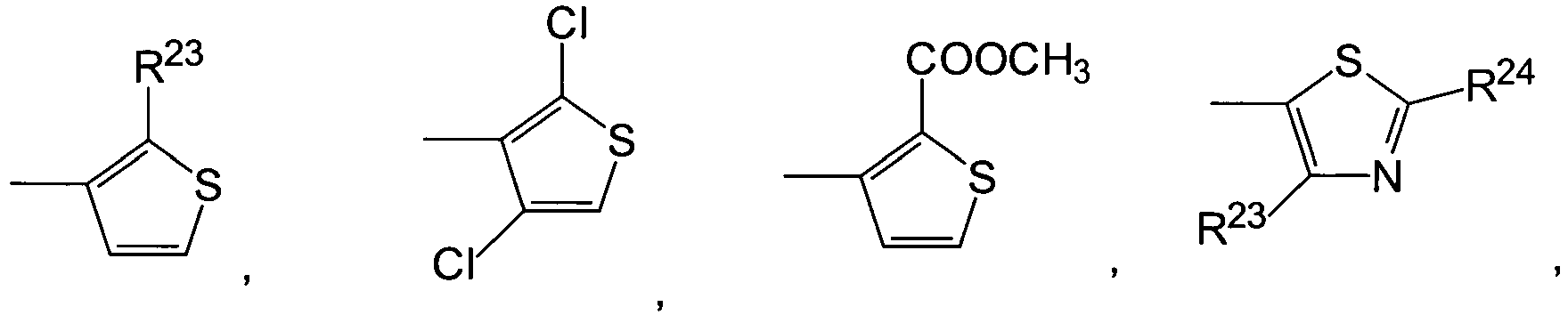
- Preferred heterocyclic groups from which also R7 can be selected are:













- R7 can also be selected from the above-mentioned heterocyclic groups. In addition R7 can also stand for the followinf residue:

- Preferred heterocyclic -NR9R10 groups are:


- Said preferred herteroaryl groups and heterocyclic groups may further be substituted by one, two, three, four, five or more substituents selected from the group consisting of R23 - R35, linear or branched C1-C6-alkyl, C3-C10-cycloalkyl, linear or branched C2-C6-alkenyl, linear or branched C2-C6-alkynyl and aryl.
- As used herein, the term "heterocyclic group" or "heterocyclic ring" or "heterocyclic ring system" or "heterocyclyl" refers to carbocycles having at least one heteroatom in the ring such as oxygen, nitrogen, or sulfur. Such heterocycles may be saturated or partially unsaturated but not aromatic. Examples for heterocyclic residues are 1,3-dioxolane, benzo[1,3]dioxolyl, pyrazolinyl, pyranyl, thiomorpholinyl, pyrazolidinyl, piperidyl, piperazinyl, 1,4-dioxanyl, imidazolinyl, pyrrolinyl, imidazolidinyl, morpholinyl, 1,4-dithianyl, pyrrolidinyl, oxozolinyl, oxazolidinyl, isoxazolinyl, isoxazolidinyl, thiazolinyl, thiazolidinyl, isothiazolinyl, isothiazolidinyl, dihydropyranl, pyrrolidinyl, tetrahydrothiophenyl, tetrahydrofuranyl.
Aryl refers to phenyl, substituted phenyl and heteroaryl, wherein substituted phenyl and heteroaryl have the meanings as defined above. - As used herein, the term "C1-C6 alkyloxy" or "C1-C6 alkoxy" refers to the residue -O-C1-C6-alkyl, wherein C1-C6-alkyl has the meanings as defined above. The following C1-C6 alkoxy groups are preferred -O-CH3, -O-C2H5, -O-C3H7, -O-CH(CH3)2, -O-C4H9, -O-CH2-CH(CH3)2, -O-CH(CH3)-C2H5, -O-C(CH3)3, and -O-C5H11. Most preferred are -O-CH3, -O-C2H5 and -O-C3H.
- As used herein, the term "C1-C6 alkyloxycarbonyl" or "C1-C6 alkoxycarbonyl" refers to the residue -CO-O-C1-C6-alkyl, wherein C1-C6-alkyl has the meanings as defined above. Preferred C1-C6 alkoxycarbony groups are -CO-OCH3, -CO-OC2H5, -CO-OC3H7, -CO-OCH(CH3)2, -CO-OC4H9, -CO-OCH2-CH(CH3)2, -CO-OCH(CH3)-C2H5, -CO-OC(CH3)3, and -CO-OC5H11. Most preferred are -CO-OCH3, -CO-OC2H5, -CO-OC3H7.
- As used herein, the term "C1-C6 alkylcarbonyl" or "C1-C6 alkanoyl" or "C1-C6 acyl" refers to the residue -CO-C1-C6-alkyl, wherein C1-C6-alkyl has the meanings as defined above. Preferred C1-C6 acyl groups are -CO-CH3, -CO-C2H5, -CO-C3H7, -CO-CH(CH3)2, -CO-C4H9, -CO-CH2-CH(CH3)2, -CO-CH(CH3)-C2H5, -CO-C(CH3)3, and -CO-C5H11. Most preferred are -CO-CH3, -CO-C2H5, -CO-C3H7.
- As used herein, the term "C1-C6 alkylcarbonyloxy" or "C1-C6 alkanoyloxy" or "C1-C6 acyloxy " refers to the residue -O-CO-C1-C6-alkyl, wherein C1-C6-alkyl has the meanings as defined above. Preferred C1-C6 acyloxy groups are -O-CO-CH3, -O-CO-C2H5, -O-CO-C3H7, -O-CO-CH(CH3)2, -O-CO-C4H9, -O-CO-CH2-CH(CH3)2, -O-CO-CH(CH3)-C2H5, -O-CO-C(CH3)3, and -O-CO-C5H11. Most preferred are -O-CO-CH3, -O-CO-C2H5, -O-CO-C3H7.
- The term "substituted" or "substituted alkyl", "substituted cycloalkyl", "substituted heterocyclyl", "substituted aryl", "substituted heteroaryl", "substituted heterocyclic group", "substituted carboicyclic group" respectively shall refer to the addressed residue such as "alkyl", "cycloalkyl", "heterocyclyl", "aryl", or "heteroaryl" bearing one, two, three, four, five or more, preferably one or two substituents R23 to R35 independently selected from the following group:


- Preferred residues R8-X-O- is:

- Preferred are also compounds of the general formula (I)

- one of -R1 and -R2 represents -O-X-Ra;
and the other one of -R1 and -R2 represents -H, -OH, -OCH3, -OCF3, -OC2H5, -OC3H7, -OCH2CH2-OCH3, -OCH2CH2-OC2H5;
-X- represents -CR11R12- -CR11R12-CR13R14-, -CR11R12-CR13R14-CR15R16-, -CR11R12-CR13R14-CR15R16-CR17R18-, -CR11R12-CR13R14-CR15R16-CR17R18-CR19R20-, -(CH2)n-NH-, -CO-, -(CH2)n-CO-, -(CH2)n-NH-CO-NH-, -(CH2)n-NH-CO-, -(CH2)n-NH-CO-O-, -(CH2)n-CO-NR9-, -(CH2)n-O-CO-NH-, -(CH2)n-O-CO-, -(CH2)n-O-, -(CH2)n-;
n is an integer selected from 1, 2, 3, 4, 5 and 6; - -R3, -R4, -R5, -R6 are independently of each other selected from -H, halogen, nitro, C1-4-alkyl, C3-C5-cycloalkyl, C1-6-alkoxy;
-R8 represents -H, -OH, -F, -Cl, -Br, -I, -OCH3, -OC2H5, -OC3H7, -O-cyclo-C3H5, -OCH(CH3)2, -OC(CH3)3, -OC4H9, -CHO, -COCH3, -COC2H5, -COC3H7, -CO-cyclo-C3H5, -COCH(CH3)2, -COC(CH3)3, -COOH, -cyclo-C3H5, -cyclo-C4H7, -cyclo-C5H9, -cyclo-C6H11, -COOCH3, -COOC2H5, -COOC3H7, -COO-cyclo-C3H5, -COOCH(CH3)2, -COOC(CH3)3, -CONH2, -CONHCH3, -CONHC2H5, -CONHC3H7, -CONH-cyclo-C3H5, -CONH[CH(CH3)2], -CONH[C(CH3)3], -CON(CH3)2, -CON(C2H5)2, -CON(C3H7)2, -CON(cyclo-C3H5)2, -CON[CH(CH3)2]2, -CON[C(CH3)3]2, -NH2, -NHCH3, -NHC2H5, -NHC3H7, -NH-cyclo-C3H5, -NHCH(CH3)2, -NHC(CH3)3, -N(CH3)2, -N(C2H5)2, -N(C3H7)2, -N(cyclo-C3H5)2, -N[CH(CH3)2]2, -N[C(CH3)3]2, -OOC-CH3, -OOC-C2H5, -OOC-C3H7, -OOC-cyclo-C3H5, -OOC-CH(CH3)2, -OOC-C(CH3)3, -NH-CO-NH2, -NH-CO-NHCH3, -NH-CO-NHC2H5, -NH-CO-NHC3H7, -NH-CO-NH-cyclo-C3H5, -NH-CO-NH[CH(CH3)2], -NH-CO-NH[C(CH3)3], -NH-CO-N(CH3)2, -NH-CO-N(C2H5)2, -NH-CO-N(C3H7)2, -NH-CO-N(cyclo-C3H5)2, -NH-CO-N[CH(CH3)2]2, -NH-CO-N[C(CH3)3]2, -NH-COOCH3, -NH-COOC2H5, -NH-COOC3H7, -NH-COO-cyclo-C3H5, -NH-COOCH(CH3)2, -NH-COOC(CH3)3, -O-CO-NH2, -O-CO-NHCH3, -O-CO-NHC2H5, -O-CO-NHC3H7, -O-CO-NH-cyclo-C3H5, -O-CO-NH[CH(CH3)2], -O-CO-NH[C(CH3)3], -O-CO-N(CH3)2, -O-CO-N(C2H5)2, -O-CO-N(C3H7)2, -O-CO-N(cyclo-C3H5)2, -O-CO-N[CH(CH3)2]2, -O-CO-N[C(CH3)3]2, -NH-CO-NR9R10, -CO-NR9R10, -NR9R10, -CH2F -CHF2, -CF3, -CH2Cl, -CH2Br, -CH2-CH2F, -CH2-CH2Cl, -CH2-CH2Br, -CH3, -C2H5, -C3H7, -CH(CH3)2, -C(CH3)3, -C4H9, -C5H11, -CH2-CH(CH3)2, -CH(CH3)-C2H5, -C(CH3)3, -Ph, -CH2-Ph, -CH=CH2, -CH2-CH=CH2, -C≡CH,


- -R7 represents one of the following groups -CH3, -C2H5, -C3H7, -C4H9, -C5H11,











- If -R1 is -O-X-R8, -R2 is preferably -H, -OCH3, -OCF3, -OC2H5 and if -R2 is -O-X-R8, than -R1 is preferably -H, -OCH3, -OCF3, -OC2H5.
- Preferably -R3, -R4, -R5, -R6 are independently of each -OCH3, -OC2H5, -OC3H7, -OCF3, -F, -Cl, -Br, -I, -CH3, -C2H5, -C3H7, -cyclo-C3H5, -CH(CH3)2, and more preferably -OCH3, -OC2H5, -OCF3, -F, -Cl, -Br, -CH3, -C2H5. Moreover it is preferred if at least one of -R3, -R4 and -R5 are selected from -F or -Cl. It is also preferred if at least one of -R3 and -R4 is -F and preferably -R3 is -F.
- Preferably -R7 is one of the following groups -CH3, -C2H5, -C3H7, -C4H9, -C5H11,







- Compounds wherein R1 and R2 are a methoxy group are excluded from the present application. Such compounds having the substitution pattern of the compounds disclosed herein have shown moderate to low activity or no activity and are consequently not preferred. Also compounds of general formula (I), wherein both groups R1 and R2 are ethoxy groups are still not preferred and could also be excluded from the present invention. However compounds wherein both of R1 and R2 represent propoxy, butoxy, pentoxy etc. have shown activity and belong to the compounds of the present invention and are consequently not excluded from the scope of protection.
- Excluded from this application and excluded from the patent claims and excluded from the general formula (I) are the following compounds which are excluded by the following disclaimer:
- N'-(4-{[6,7-bis(methyloxy)quinolin-4-yl]oxy}-3-fluorophenyl)-N-methyl-N-(2-phenylethyl)sulfamide,
- N-(4-{[6,7-bis(methyloxy)quinolin-4-yl]oxy}-3-fluorophenyl)-1-phenylmethanesulfonamide,
- N-(4-{[6,7-bis(methyloxy)quinolin-4-yl]oxy}-3-fluorophenyl)-2-phenylethanesulfonamide,
- N-(4-{[6,7-bis(methyloxy)quinolin-4-yl]oxy}-3-fluorophenyl)-3-phenylpropane-1-sulfonamide.
- The following specific compounds are also preferred which are selected from the group comprising or consisting of:
- 1) 2,5-Difluoro-N-{3-fluoro-4-[6-methoxy-7-(3-piperidin-1-yl-propoxy)-quinolin-4-yloxy]-phenyl}-benzenesulfonamide,
- 2) 2-Fluoro-N-{3-fluoro-4-[6-methoxy-7-(3-piperidin-1-yl-propoxy)-quinolin-4-yloxy]-phenyl}-benzenesulfonamide,
- 3) 4-Chloro-2-fluoro-N-{3-fluoro-4-[6-methoxy-7-(3-piperidin-1-yl-propoxy)-quinolin-4-yloxy]-phenyl}-benzenesulfonamide,
- 4) N-{3-Fluoro-4-[6-methoxy-7-(3-piperidin-1-yl-propoxy)-quinolin-4-yloxy]-phenyl}-2-trifluoromethyl-benzenesulfonamide,
- 5) N-{3-Fluoro-4-[6-methoxy-7-(3-piperidin-1-yl-propoxy)-quinolin-4-yloxy]-phenyl}-3-trifluoromethyl-benzenesulfonamide,
- 6) 2,6-Dichloro-N-{3-fluoro-4-[6-methoxy-7-(3-piperidin-1-yl-propoxy)-quinolin-4-yloxy]-phenyl}-benzenesulfonamide,
- 7) N-{3-Fluoro-4-[6-methoxy-7-(3-piperidin-1-yl-propoxy)-quinolin4-yloxy]-phenyl}-2-nitro-benzenesulfonamide,
- 8) Biphenyl-3-sulfonic acid {3-fluoro-4-[6-methoxy-7-(3-piperidin-1-yl-propoxy)-quinolin-4-loxy]-phenyl}-amide,
- 9) 3-Difluoromethoxy-N-{3-fluoro-4-[6-methoxy-7-(3-piperidin-1-yl-propoxy)-quinolin-4-yloxy]-phenyl}-benzenesulfonamide,
- 10) N-{3-Fluoro-4-[6-methoxy-7-(3-piperidin-1-yl-propoxy)-quinolin-4-yloxy]-phenyl}-3-phenoxy-benzenesulfonamide,
- 11) 2,6-Difluoro-N-{3-fluoro-4-[6-methoxy-7-(3-piperidin-1-yl-propoxy)-quinolin-4-yloxy]-phenyl}-benzenesulfonamide,
- 12) 2,5-Difluoro-N-(3-fluoro-4-{6-methoxy-7-[3-(4-methyl-piperazin-1-yl)-propoxy]-quinolin-4-yloxy}-phenyl)-benzenesulfonamide,
- 13) Biphenyl-3-sulfonic acid (3-fluoro-4-{6-methoxy-7-[3-(4-methyl-piperazin-1-yl)-propoxy]-quinolin-4-yloxy}-phenyl)-amide,
- 14) N-(3-Fluoro-4-{6-methoxy-7-[3-(4-methyl-piperazin-1-yl)-propoxy]-quinolin-4-yloxy}-phenyl)-3-phenoxy-benzenesulfonamide,
- 15) 2-Cyano-N-(3-fluoro-4-{6-methoxy-7-[3-(4-methyl-piperazin-1-yl)-propoxy]-quinolin-4-yloxy}-phenyl)-benzenesulfonamide,
- 16) 2,4-Difluoro-N-(3-fluoro-4-{6-methoxy-7-[3-(4-methyl-piperazin-1-yl)-propoxy]-quinolin-4-yloxy}-phenyl)-benzenesulfonamide,
- 17) 2,3,4-Trifluoro-N-(3-fluoro-4-{6-methoxy-7-[3-(4-methyl-piperazin-1-yl)-propoxy]-quinolin-4-yloxy}-phenyl)-benzenesulfonamide,
- 18) 4-Fluoro-N-(3-fluoro-4-{6-methoxy-7-[3-(4-methyl-piperazin-1-yl)-propoxy]-quinolin-4-yloxy}-phenyl)-3-methoxy-benzenesulfonamide,
- 19) 2-Bromo-N-(3-fluoro-4-{6-methoxy-7-[3-(4-methyl-piperazin-1-yl)-propoxy]-quinolin-4-yloxy}-phenyl)-benzenesulfonamide,
- 20) 2,5-Dichloro-N-(3-fluoro-4-{6-methoxy-7-[3-(4-methyl-piperazin-1-yl)-propoxy]-quinolin-4-yloxy}-phenyl)-benzenesulfonamide,
- 21) N-(3-Fluoro-4-{6-methoxy-7-[3-(4-methyl-piperazin-1-yl)-propoxy]-quinolin-4-yloxy}-phenyl)-2-nitro-benzenesulfonamide,
- 22) 3-Fluoro-(3-fluoro-4-{6-methoxy-7-[3-(4-methyl-piperazin-1-yl)-propoxy]-quinolin-4-yloxy}-phenyl)-benzenesulfonamide,
- 23) 3-Chloro-4-fluoro-N-(3-fluoro-4-{6-methoxy-7-[3-(4-methyl-piperazin-1-yl)-propoxy]-quinolin-4-yloxy}-phenyl)-benzenesulfonamide,
- 24) N-(3-Fluoro-4-{6-methoxy-7-[3-(4-methyl-piperazin-1-yl)-propoxy]-quinolin-4-yloxy}-phenyl)-2-trifluoromethyl-benzenesulfonamide,
- 25) N-(3-Fluoro-4-{6-methoxy-7-[3-(4-methyl-piperazin-1-yl)-propoxy]-quinolin-4-yloxy}-phenyl)-2-trifluoromethoxy-benzenesulfonamide,
- 26) 2-Fluoro-N-(3-fluoro-4-{6-methoxy-7-[3-(4-methyl-piperazin-1-yl)-propoxy]-quinolin-4-yloxy}-phenyl)-benzenesulfonamide,
- 27) 4-Chloro-2-fluoro-N-(3-fluoro-4-{6-methoxy-7-[3-(4-methyl-piperazin-1-yl)-propoxy]-quinolin-4-yloxy}-phenyl)-benzenesulfonamide,
- 28) N-(3-Fluoro-4-{6-methoxy-7-[3-(4-methyl-piperazin-1-yl)-propoxy]-quinolin-4-yloxy}-phenyl)-2-methyl-benzenesulfonamide,
- 29) 2-Chloro-N-(3-fluoro-4-{6-methoxy-7-[3-(4-methyl-piperazin-1-yl)-propoxy]-quinolin-4-yloxy}-phenyl)-benzenesulfonamide,
- 30) 3-Difluoromethoxy-N-(3-fluoro-4-{6-methoxy-7-[3-(4-methyl-piperazin-1-yl)-propoxy]-quinolin-4-yloxy}-phenyl)-benzenesulfonamide,
- 31) Thiophene-2-sulfonic acid (3-fluoro-4-{6-methoxy-7-[3-(4-methyl-piperazin-1-yl)-propoxy]-quinolin-4-yloxy}-phenyl)-amide,
- 32) 2,6-Dichloro-N-(3-fluoro-4-{6-methoxy-7-[3-(4-methyl-piperazin-1-yl)-propoxy]-quinolin-4-yloxy}-phenyl)-benzenesulfonamide,
- 33) N-(3-Fluoro-4-{6-methoxy-7-[3-(4-methyl-piperazin-1-yl)-propoxy]-quinolin-4-yloxy}-phenyl)-2-methoxy-benzenesulfonamide,
- 34) 3,5-Dichloro-N-{3-fluoro-4-[6-methoxy-7-(3-piperidin-1-yl-propoxy)-quinolin-4-yloxy]-phenyl}-2-methoxy-benzenesulfonamide,
- 35) 3,5-Dichloro-N-(3-fluoro-4-{6-methoxy-7-[3-(4-methyl-piperazin-1-yl)-propoxy]- quinolin-4-yloxy}-phenyl)-2-methoxy-benzenesulfonamide.
- 36) N-(3-Fluoro-4-{6-methoxy-7-[3-(3-methyl-piperidin-1-yl)-propoxy]-quinolin-4-yloxy}-phenyl)-benzenesulfonamide,
- 37) 3-Fluoro-N-(3-fluoro-4-{6-methoxy-7-[3-(3-methyl-piperidin-1-yl)-propoxy]-quinolin-4-yloxy}-phenyl)-benzenesulfonamide,
- 38) 2-Chloro-N-(3-fluoro-4-{6-methoxy-7-[3-(3-methyl-piperidin-1-yl)-propoxy]-quinolin-4-yloxy}-phenyl)-benzenesulfonamide
- 39) 'N-(3-Fluoro-4-{6-methoxy-7-[3-(3-methyl-piperidin-1-yl)-propoxy]-quinolin-4-yloxy}-phenyl)-3-trifluoromethyl-benzenesulfonamide
- 40) N-(3-Fluoro-4-{6-methoxy-7-[3-(3-methyl-piperidin-1-yl)-propoxy]-quinolin-4-yloxy}-phenyl)-2-nitro-benzenesulfonamide
- 41) 3-Cyano-N-(3-fluoro-4-{6-methoxy-7-[3-(3-methyl-piperidin-1-yl)-propoxy]-quinolin-4-yloxy}-phenyl)-benzenesulfonamide,
- 42) N-(3-Fluoro-4-{6-methoxy-7-[3-(3-methyl-piperidin-1-yl)-propoxy]-quinolin-4-yloxy}-phenyl)-3-methoxy-benzenesulfonamide,
- 43) 3-Difluoromethoxy-N-(3-fluoro-4-{6-methoxy-7-[3-(3-methyl-piperidin-1-yl)-propoxy]-quinolin-4-yloxy}-phenyl)-benzenesulfonamide,
- 44) N-(3-Fluoro-4-{6-methoxy-7-[3-(3-methyl-piperidin-1-yl)-propoxy]-quinolin-4-yloxy}-phenyl)-2-methyl-benzenesulfonamide,
- 45) N-(3-Fluoro-4-{6-methoxy-7-[3-(3-methyl-piperidin-1-yl)-propoxy]-quinolin-4-yloxy}-phenyl)-2-trifluoromethoxy-benzenesulfonamide,
- 46) N-(3-Fluoro-4-{6-methoxy-7-[3-(3-methyl-piperidin-1-yl)-propoxy]-quinolin-4-yloxy}-phenyl)-3-trifluoromethoxy-benzenesulfonamide,
- 47) 2,4-Difluoro-N-(3-fluoro-4-{6-methoxy-7-[3-(3-methyl-piperidin-1-yl)-propoxy]-quinolin-4-yloxy}-phenyl)-benzenesulfonamide,
- 48) 3,4-Difluoro-N-(3-fluoro-4-{6-methoxy-7-[3-(3-methyl-piperidin-1-yl)-propoxy]-quinolin-4-yloxy}-phenyl)-benzenesulfonamide,
- 49) 2,3,4-Trifluoro-N-(3-fluoro-4-{6-methoxy-7-[3-(3-methyl-piperidin-1-yl)-propoxy]-quinolin-4-yloxy}-phenyl)-benzenesulfonamide,
- 50) 2,5-Dichloro-N-(3-fluoro-4-{6-methoxy-7-[3-(3-methyl-piperidin1-yl)-propoxy]-quinolin-4-yloxy}-phenyl)-benzenesulfonamide,
- 51) 2,6-Dichloro-N-(3-fluoro-4-{6-methoxy-7-[3-(3-methyl-piperidin-1-yl)-propoxy]-quinolin-4-yloxy}-phenyl)-benzenesulfonamide,
- 52) 3,4-Dichloro-N-(3-fluoro-4-{6-methoxy-7-[3-(3-methyl-piperidin-1-yl)-propoxy]-quinolin-4-yloxy}-phenyl)-benzenesulfonamide,
- 53) 3,5-Dichloro-N-(3-fluoro-4-{6-methoxy-7-[3-(3-methyl-piperidin-1-yl)-propoxy]-quinolin-4-yloxy}-phenyl)-benzenesulfonamide,
- 54) 3-Chloro-2-fluoro-N-(3-fluoro-4-{6-methoxy-7-[3-(3-methyl-piperidin-1-yl)-propoxy]-quinolin-4-yloxy}-phenyl)-benzenesulfonamide,
- 55) 2-Fluoro-N-(3-fluoro-4-{6-methoxy-7-[3-(3-methyl-piperidin-1-yl)-propoxy]-quinolin-4-yloxy}-phenyl)-5-methyl-benzenesulfonamide,
- 56) 3-Fluoro-N-(3-fluoro-4-{6-methoxy-7-[3-(3-methyl-piperidin-1-yl)-propoxy]-quinolin-4-yloxy}-phenyl)-4-methyl-benzenesulfonamide,
- 57) 3-Chloro-4-fluoro-N-(3-fluoro-4-{6-methoxy-7-[3-(3-methyl-piperidin-1-yl)-propoxy]-quinolin-4-yloxy}-phenyl)-benzenesulfonamide,
- 58) Naphthalene-1-sulfonic acid (3-fluoro-4-{6-methoxy-7-[3-(3-methyl-piperidin-1-yl)-propoxy]-quinolin-4-yloxy}-phenyl)-amide,
- 59) N-(3-Fluoro-4-{6-methoxy-7-[3-(3-methyl-piperidin-1-yl)-propoxy]-quinolin-4-yloxy}-phenyl)-3-phenoxy-benzenesulfonamide,
- 60) Cyclopropanesulfonic acid (3-fluoro-4-{6-methoxy-7-[3-(3-methyl-piperidin-1-yl)-propoxy]-quinolin-4-yloxy}-phenyl)-amide,
- 61) 1-Methyl-1 H-pyrazole-3-sulfonic acid (3-fluoro-4-{6-methoxy-7-[3-(3-methyl-piperidin-1-yl)-propoxy]-quinolin-4-yloxy}-phenyl)-amide,
- 62) 5-Methyl-thiophene-2-sulfonic acid (3-fluoro-4-{6-methoxy-7-[3-(3-methyl-piperidin-1-yl)-propoxy]-quinolin-4-yloxy}-phenyl)-amide,
- 63) 5-Chloro-thiophene-2-sulfonic acid (3-fluoro-4-{6-methoxy-7-[3-(3-methyl-piperidin-1-yl)-propoxy]-quinolin-4-yloxy}-phenyl)-amide,
- 64) 2,4-Dichloro-thiophene-3-sulfonic acid (3-fluoro-4-{6-methoxy-7-[3-(3-methyl-piperidin-1-yl)-propoxy]-quinolin-4-yloxy}-phenyl)-amide,
- 65) Thiophene-3-sulfonic acid (3-fluoro-4-{6-methoxy-7-[3-(3-methyl-piperidin-1-yl)-propoxy]-quinolin-4-yloxy}-phenyl)-amide,
- 66) 3-(3-Fluoro-4-{6-methoxy-7-[3-(3-methyl-piperidin-1-yl)-propoxy]-quinolin-4-yloxy}-phenylsulfamoyl)-thiophene-2-carboxylic acid methyl ester,
- 67) Benzo[b]thiophene-3-sulfonic acid (3-fluoro-4-{6-methoxy-7-[3-(3-methyl-piperidin-1-yl)-propoxy]-quinolin-4-yloxy}-phenyl)-amide,
- 68) 1-Ethyl-1H-pyrazole-4-sulfonic acid (3-fluoro-4-{6-methoxy-7-[3-(3-methyl-piperidin-1-yl)-propoxy]-quinolin-4-yloxy}-phenyl)-amide,
- 69) 3-Chloro-N-(3-fluoro-4-{6-methoxy-7-[3-(3-methyl-piperidin-1-yl)-propoxy]-quinolin-4-yloxy}-phenyl)-benzenesulfonamide,
- 70) N-(3-Fluoro-4-{6-methoxy-7-[3-(3-methyl-piperidin-1-yl)-propoxy]-quinolin-4-yloxy}-phenyl)-3-methyl-benzenesulfonamide,
- 71) N-(3-Fluoro-4-{6-methoxy-7-[3-(3-methyl-piperidin-1-yl)-propoxy]-quinolin-4-yloxy}-phenyl)-2-methoxy-benzenesulfonamide,
- 72) 3-Cyano-4-fluoro-N-(3-fluoro-4-{6-methoxy-7-[3-(3-methyl-piperidin-1-yl)-propoxy]-quinolin-4-yloxy}-phenyl)-benzenesulfonamide,
- 73) 2-Phenyl-ethenesulfonic acid (3-fluoro-4-{6-methoxy-7-[3-(3-methyl-piperidin-1-yl)-propoxy]-quinolin-4-yloxy}-phenyl)-amide,
- 74) Quinoline-8-sulfonic acid (3-fluoro-4-{6-methoxy-7-[3-(3-methyl-piperidin-1-yl)-propoxy]-quinolin-4-yloxy}-phenyl)-amide,
- 75) 3,5-Dichloro-N-(3-fluoro-4-{6-methoxy-7-[3-(3-methyl-piperidin-1-yl)-propoxy]-quinolin-4-yloxy}-phenyl)-2-methoxy-benzenesulfonamide,
- 76) 3,5-Dichloro-N-{3-fluoro-4-[6-methoxy-7-(3-morpholin-4-yl-propoxy)-quinolin-4-yloxy]-phenyl}-2-methoxy-benzenesulfonamide,
- 77) 2,6-Difluoro-N-{3-fluoro-4-[6-methoxy-7-(3-morpholin-4-yl-propoxy)-quinolin-4-yloxy]-phenyl}-benzenesulfonamide,
- 78) N-{3-Fluoro-4-[6-methoxy-7-(3-piperidin-1-yl-propoxy)-quinolin-4-yloxy]-phenyl}-2-trifluoromethoxy-benzenesulfonamide,
- 79) Butane-1-sulfonic acid {3-fluoro-4-[6-methoxy-7-(3-morpholin-4-yl-propoxy)-quinolin-4-yloxy]-phenyl}-amide,
- 80) 2,5-Difluoro-N-{3-fluoro-4-[6-methoxy-7-(piperidin-3-ylmethoxy)-quinolin-4-yloxy]-phenyl}-benzenesulfonamide,
- 81) 2-Fluoro-N-{3-fluoro-4-[6-methoxy-7-(2-morpholin-4-yl-ethoxy)-quinolin-4-yloxy]-phenyl}-benzenesulfonamide,
- 82) 2,6-Difluoro-N-{3-fluoro-4-[6-methoxy-7-(2-morpholin-4-yl-ethoxy)-quinolin-4-yloxy]-phenyl}-benzenesulfonamide,
- 83) 2,5-Difluoro-N-{3-fluoro-4-[6-methoxy-7-(4-morpholin-4-yl-butoxy)-quinolin-4-yloxy]-phenyl}-benzenesulfonamide,
- 84) 2,5-Difluoro-N-{3-fluoro-4-[7-(4-morpholin-4-yl-butoxy)-quinolin-4-yloxy]-phenyl}-benzenesulfonamide,
- 85) N-(3-Fluoro-4-{6-[3-(4-methyl-piperazin-1-yl)-propoxy]-quinolin-4-yloxy}-phenyl)-2-trifluoromethyl-benzenesulfonamide,
- 86) N-(3-Fluoro-4-{7-methoxy-6-[3-(4-methyl-piperazin-1-yl)-propoxy]-quinolin-4-yloxy}-phenyl)-2-trifluoromethyl-benzenesulfonamide,
- 87) N-(3-Chloro-4-{6-methoxy-7-[3-(4-methyl-piperazin-1-yl)-propoxy]-quinolin-4-yloxy}-phenyl)-2-trifluoromethyl-benzenesulfonamide,
- 88) N-(3,5-Dichloro-4-{6-methoxy-7-[3-(4-methyl-piperazin-1-yl)-propoxy]-quinolin-4-yloxy}-phenyl)-2,6-difluoro-benzenesulfonamide,
- 89) N-(4-{6-Methoxy-7-[3-(4-methyl-piperidin-1-yl)-propoxy]-quinolin-4-yloxy}-3-methyl-phenyl)-2-trifluoromethyl-benzenesulfonamide,
- 90) 2,5-Difluoro-N-(3-methoxy-4-{6-methoxy-7-[3-(3-methyl-piperidin-1-yl)-propoxy]-quinolin-4-yloxy}-phenyl)-benzenesulfonamide,
- 99) N-(3-Fluoro-4-{6-methoxy-7-[3-(2-methyl-piperidin-1-yl)-propoxy]-quinolin-4-yloxy}-phenyl)-2-trifluoromethyl-benzenesulfonamide,
- 102) N-(3-{6-Methoxy-7-[3-(4-methyl-piperazin-1-yl)-propoxy]-quinolin-4-yloxy}-phenyl)-2-trifluoromethyl-benzenesulfonamide.
- 103) N-{3-Fluoro-4-[6-methoxy-7-(2-morpholin-4-yl-ethoxy)-quinolin-4-yloxy]-phenyl}-2-methoxy-benzenesulfonamide
- 104) 2,6-Dichloro-N-{3-fluoro-4-[6-methoxy-7-(2-morpholin-4-yl-ethoxy)-quinolin-4-yloxy]-phenyl}-benzenesulfonamide
- 105) Thiophene-2-sulfonic acid {3-fluoro-4-[6-methoxy-7-(2-morpholin-4-yl-ethoxy)-quinolin-4-yloxy]-phenyl}-amide
- 106) 2,5-Dichloro-N-{3-fluoro-4-[6-methoxy-7-(2-morpholin-4-yl-ethoxy)-quinolin-4-yloxy]-phenyl}-benzenesulfonamide
- 107) 1-Methyl-1 H-pyrazole-3-sulfonic acid {3-fluoro-4-[6-methoxy-7-(2-morpholin-4-yl-ethoxy)-quinolin-4-yloxy]-phenyl}-amide
- 108) 2-Chloro-N-{3-fluoro-4-[6-methoxy-7-(2-morpholin-4-yl-ethoxy)-quinolin-4-yloxy]-phenyl}-benzenesulfonamide
- 109) N-{3-Fluoro-4-[6-methoxy-7-(2-morpholin-4-yl-ethoxy)-quinolin-4-yloxy]-phenyl}-2-nitro-benzenesulfonamide
- 110) 2,6-Difluoro-N-(3-fluoro-4-{6-methoxy-7-[3-(4-methyl-piperazin-1-yl)-propoxy]-quinolin-4-yloxy}-phenyl)-benzenesulfonamide
- 111) N-(3-Chloro-4-{6-methoxy-7-[3-(4-methyl-piperazin-1-yl)-propoxy]-quinolin-4-yloxy}-phenyl)-2-fluoro-benzenesulfonamide
- 112) N-(3-Chloro-4-{6-methoxy-7-[3-(4-methyl-piperazin-1-yl)-propoxy]-quinolin-4-yloxy}-phenyl)-2,5-difluoro-benzenesulfonamide
- 113) Benzo[b]thiophene-3-sulfonic acid {3-fluoro-4-[6-methoxy-7-(3-piperidin-1-yl-propoxy)-quinolin-4-yloxy]-phenyl}-amide
- 114) Benzo[b]thiophene-3-sulfonic acid {3-fluoro-4-[6-methoxy-7-(3-morpholin-4-yl-propoxy)-quinolin-4-yloxy]-phenyl}-amide
- 115) Benzo[b]thiophene-3-sulfonic acid (3-fluoro-4-{6-methoxy-7-[3-(4-methyl-piperidin-1-yl)-propoxy]-quinolin-4-loxy}-phenyl)-amide
- 116) Benzo[b]thiophene-3-sulfonic acid (3-fluoro-4-{6-methoxy-7-[3-(4-methyl-piperazin-1-yl)-propoxy]-quinolin-4-yloxy}-phenyl)-amide
- 117) Benzo[b]thiophene-3-sulfonic acid (3-chloro-4-{6-methoxy-7-[3-(4-methyl-piperazin-1-yl)-propoxy]-quinolin-4-yloxy}-phenyl)-amide
- 118) N-(3-Chloro-4-{6-methoxy-7-[3-(4-methyl-piperazin-1-yl)-propoxy]-quinolin-4-yloxy}-phenyl)-2,6-difluoro-benzenesulfonamide
- 119) 2,6-Dichloro-N-(3-chloro-4-{6-methoxy-7-[3-(4-methyl-piperazin-1-yl)-propoxy]-quinolin-4-yloxy}-phenyl)-benzenesulfonamide
- 123) 2,5-Difluoro-N-(3-{6-methoxy-7-[3-(4-methyl-piperazin-1-yl)-propoxy]-quinolin-4-yloxy}-phenyl)-benzenesulfonamide
- 124) 2,5-Dichloro-N-(3-chloro-4-{6-methoxy-7-[3-(4-methyl-piperazin-1-yl)-propoxy]-quinolin-4-yloxy}-phenyl)-benzenesulfonamide
- 125) 2,6-Difluoro-N-(3-{6-methoxy-7-[3-(4-methyl-piperazin-1-yl)-propoxy]-quinolin-4-yloxy}-phenyl)-benzenesulfonamide
- 126) N-(3-{6-Methoxy-7-[3-(4-methyl-piperazin-1-yl)-propoxy]-quinolin-4-yloxy}-phenyl)-2-trifluoromethoxy-benzenesulfonamide
- 127) 2,5-Dichloro-N-(3-{6-methoxy-7-[3-(4-methyl-piperazin-1-yl)-propoxy]-quinolin-4-yloxy}-phenyl)-benzenesulfonamide
- 128) 2,6-Dichloro-N-(3-{6-methoxy-7-[3-(4-methyl-piperazin-1-yl)-propoxy]-quinolin-4-yloxy}-phenyl)-benzenesulfonamide
- 129) Thiophene-2-sulfonic acid (3-{6-methoxy-7-[3-(4-methyl-piperazin-1-yl)-propoxy]-quinolin-4-yloxy}-phenyl)-amide
- 130) 5-Chloro-thiophene-2-sulfonic acid (3-{6-methoxy-7-[3-(4-methyl-piperazin-1-yl)-propoxy]-quinolin-4-yloxy}-phenyl)-amide
- 131) 5-Methyl-thiophene-2-sulfonic acid (3-{6-methoxy-7-[3-(4-methyl-piperazin-1-yl)-propoxy]-quinolin-4-yloxy}-phenyl)-amide
- 132) N-[5-(3-{6-Methoxy-7-[3-(4-methyl-piperazin-1-yl)-propoxy]-quinolin-4-yloxy}-phenylsulfamoyl)-4-methyl-thiazol-2-yl]-acetamide
- 133) Thiophene-3-sulfonic acid (3-{6-methoxy-7-[3-(4-methyl-piperazin-1-yl)-propoxy]-quinolin-4-yloxy}-phenyl)-amide
- 134) 2,5-Dichloro-thiophene-3-sulfonic acid (3-{6-methoxy-7-[3-(4-methyl-piperazin-1-yl)-propoxy]-quinolin-4-yloxy}-phenyl)-amide
- 135) 3-(3-{6-Methoxy-7-[3-(4-methyl-piperazin-1-yl)-propoxy]-quinolin-4-yloxy}-phenylsulfamoyl)-thiophene-2-carboxylic acid methyl ester
- 136) Benzo[b]thiophene-3-sulfonic acid (3-{6-methoxy-7-[3-(4-methyl-piperazin-1-yl)-propoxy]-quinolin-4-yloxy}-phenyl)-amide
- 137) Furan-2-sulfonic acid (3-{6-methoxy-7-[3-(4-methyl-piperazin-1-yl)-propoxy]-quinolin-4-yloxy}-phenyl)-amide
- 138) 3,5-Dimethyl-isoxazole-4-sulfonic acid (3-{6-methoxy-7-[3-(4-methyl-piperazin-1-yl)-propoxy]-quinolin-4-yloxy}-phenyl)-amide
- 139) 1-Methyl-1 H-pyrazole-3-sulfonic acid (3-{6-methoxy-7-[3-(4-methyl-piperazin-1-yl)-propoxy]-quinolin-4-yloxy}-phenyl)-amide
- 140) 1-Ethyl-1 H-pyrazole-4-sulfonic acid (3-{6-methoxy-7-[3-(4-methyl-piperazin-1-yl)-propoxy]-quinolin-4-yloxy}-phenyl)-amide
- 141) 2-Methyl-1 H-imidazole-4-sulfonic acid (3-{6-methoxy-7-[3-(4-methyl-piperazin-1-yl)-propoxy]-quinolin-4-yloxy}-phenyl)-amide
- 142) Cyclopropanesulfonic acid (3-{6-methoxy-7-[3-(4-methyl-piperazin-1-yl)-propoxy]-quinolin-4-yloxy}-phenyl)-amide
- 143) 2-Phenyl-ethenesulfonic acid (3-{6-methoxy-7-[3-(4-methyl-piperazin-1-yl)-propoxy]-quinolin-4-yloxy}-phenyl)-amide
- 144) Thiophene-2-sulfonic acid (3-fluoro-4-{6-methoxy-7-[3-(2-methyl-piperidin-1-yl)-propoxy]-quinolin-4-yloxy}-phenyl)-amide
- 145) 5-Chloro-thiophene-2-sulfonic acid (3-fluoro-4-{6-methoxy-7-[3-(2-methyl-piperidin-1-yl)-propoxy]-quinolin-4-yloxy}-phenyl)-amide
- 146) 2,4-Dichloro-thiophene-3-sulfonic acid (3-fluoro-4-{6-methoxy-7-[3-(2-methyl-piperidin-1-yl)-propoxy]-quinolin-4-yloxy}-phenyl)-amide
- 147) Benzo[b]thiophene-3-sulfonic acid (3-fluoro-4-{6-methoxy-7-[3-(2-methyl-piperidin-1-yl)-propoxy]-quinolin-4-yloxy}-phenyl)-amide
- 148) Furan-2-sulfonic acid (3-fluoro-4-{6-methoxy-7-[3-(2-methyl-piperidin-1-yl)-propoxy]-quinolin-4-yloxy}-phenyl)-amide
- 149) 2-Methyl-1 H-imidazole-4-sulfonic acid (3-fluoro-4-{6-methoxy-7-[3-(2-methyl-piperidin-1-yl)-propoxy]-quinolin-4-yloxy}-phenyl)-amide
- 150) 1-Methyl-1 H-pyrazole-3-sulfonic acid (3-fluoro-4-{6-methoxy-7-[3-(2-methyl-piperidin-1-yl)-propoxy]-quinolin-4-yloxy}-phenyl)-amide
- 151) 2,5-Difluoro-N-(3-fluoro-4-{6-methoxy-7-[3-(2-methyl-piperidin-1-yl)-propoxy]-quinolin-4-yloxy}-phenyl)-benzenesulfonamide
- 152) 2,6-Difluoro-N-(3-fluoro-4-{6-methoxy-7-[3-(2-methyl-piperidin-1-yl)-propoxy]-quinolin-4-yloxy}-phenyl)-benzenesulfonamide
- 153) N-(3-Fluoro-4-{6-methoxy-7-[3-(2-methyl-piperidin-1-yl)-propoxy]-quinolin-4-yloxy}-phenyl)-2-trifluoromethoxy-benzenesulfonamide
- 154) 2,5-Dichloro-N-(3-fluoro-4-{6-methoxy-7-[3-(2-methyl-piperidin-1-yl)-propoxy]-quinolin-4-yloxy}-phenyl)-benzenesulfonamide
- 155) 3-{3-Fluoro-4-[6-methoxy-7-(3-piperidin-1-yl-propoxy)-quinolin-4-yloxy]-phenylsulfamoyl}-thiophene-2-carboxylic acid methyl ester
- 156) 3-(3-Fluoro-4-{6-methoxy-7-[3-(4-methyl-piperidin-1-yl)-propoxy]-quinolin-4-yloxy}-phenylsulfamoyl)-thiophene-2-carboxylic acid methyl ester
- 157) 3-{3-Fluoro-4-[6-methoxy-7-(3-morpholin-4-yl-propoxy)-quinolin-4-yloxy]-phenylsulfamoyl}-thiophene-2-carboxylic acid methyl ester
- 158) 3-(3-Fluoro-4-{6-methoxy-7-[3-(4-methyl-piperazin-1-yl)-propoxy]-quinolin-4-yloxy}-phenylsulfamoyl)-thiophene-2-carboxylic acid methyl ester
- 159) 1,3,5-Trimethyl-1H-pyrazole-4-sulfonic acid {3-fluoro-4-[6-methoxy-7-(3-piperidin-1-yl-propoxy)-quinolin-4-yloxy]-phenyl}-amide
- 160) 1,3,5-Trimethyl-1 H-pyrazole-4-sulfonic acid (3-fluoro-4-{6-methoxy-7-[3-(4-methyl-piperidin-1-yl)-propoxy]-quinolin-4-yloxy}-phenyl)-amide
- 161) 1,3,5-Trimethyl-1 H-pyrazole-4-sulfonic acid {3-fluoro-4-[6-methoxy-7-(3-morpholin-4-yl-propoxy)-quinolin-4-yloxy]-phenyl}-amide
- 162) 1,3,5-Trimethyl-1 H-pyrazole-4-sulfonic acid (3-fluoro-4-{6-methoxy-7-[3-(4-methyl-piperazin-1-yl)-propoxy]-quinolin-4-yloxy}-phenyl)-amide
- 163) 1-Methyl-1 H-pyrazole-3-sulfonic acid {3-fluoro-4-[6-methoxy-7-(3-piperidin-1-yl-propoxy)-quinolin-4-yloxy]-phenyl}-amide
- 164) 1-Methyl-1 H-pyrazole-3-sulfonic acid (3-fluoro-4-{6-methoxy-7-[3-(4-methyl-piperidin-1-yl)-propoxy]-quinolin-4-yloxy}-phenyl)-amide
- 165) 1-Methyl-1 H-pyrazole-3-sulfonic acid {3-fluoro-4-[6-methoxy-7-(3-morpholin-4-yl-propoxy)-quinolin-4-yloxy]-phenyl}-amide
- 166) 1-Methyl-1 H-pyrazole-3-sulfonic acid (3-fluoro-4-{6-methoxy-7-[3-(4-methyl-piperazin-1-yl)-propoxy]-quinolin-4-yloxy}-phenyl)-amide
- 167) 2-Methyl-3H-imidazole-4-sulfonic acid {3-fluoro-4-[6-methoxy-7-(3-piperidin-1-yl-propoxy)-quinolin-4-yloxy]-phenyl}-amide
- 168) 2-Methyl-3H-imidazole-4-sulfonic acid (3-fluoro-4-{6-methoxy-7-[3-(4-methyl-piperidin-1-yl)-propoxy]-quinolin-4-yloxy}-phenyl)-amide
- 169) 2-Methyl-3H-imidazole-4-sulfonic acid {3-fluoro-4-[6-methoxy-7-(3-morpholin-4-yl-propoxy)-quinolin-4-yloxy]-phenyl}-amide
- 170) 2-Methyl-3H-imidazole-4-sulfonic acid (3-fluoro-4-{6-methoxy-7-[3-(4-methyl-piperazin-1-yl)-propoxy]-quinolin-4-yloxy}-phenyl)-amide
- 171) 2,5-Difluoro-N-(4-{6-methoxy-7-[3-(4-methyl-piperidin-1-yl)-propoxy]-quinolin-4-yloxy}-3-methyl-phenyl)-benzenesulfonamide
- 172) 2,6-Difluoro-N-(4-{6-methoxy-7-[3-(4-methyl-piperidin-1-yl)-propoxy]-quinolin-4-yloxy}-3-methyl-phenyl)-benzenesulfonamide
- 173) 2,6-Difluoro-N-(3-methoxy-4-{6-methoxy-7-[3-(4-methyl-piperidin-1-yl)-propoxy]-quinolin-4-yloxy}-phenyl)-benzenesulfonamide
- 174) N-(4-{6-Methoxy-7-[3-(4-methyl-piperidin-1-yl)-propoxy]-quinolin-4-yloxy}-3-methyl-phenyl)-2-trifluoromethoxy-benzenesulfonamide
- 175) 2,5-Dichloro-N-(4-{6-methoxy-7-[3-(4-methyl-piperidin-1-yl)-propoxy]-quinolin-4-yloxy}-3-methyl-phenyl)-benzenesulfonamide
- 176) 2,6-Dichloro-N-(4-{6-methoxy-7-[3-(4-methyl-piperidin-1-yl)-propoxy]-quinolin-4-yloxy}-3-methyl-phenyl)-benzenesulfonamide
- 187) 2,5-Difluoro-N-(4-fluoro-3-{6-methoxy-7-[3-(4-methyl-piperidin-1-yl)-propoxy]-quinolin-4-yloxy}-phenyl)-benzenesulfonamide
- 188) 2,6-Difluoro-N-(4-fluoro-3-{6-methoxy-7-[3-(4-methyl-piperidin-1-yl)-propoxy]-quinolin-4-yloxy}-phenyl)-benzenesulfonamide
- 189) N-(4-Fluoro-3-{6-methoxy-7-[3-(4-methyl-piperidin-1-yl)-propoxy]-quinolin-4-yloxy}-phenyl)-2-trifluoromethyl-benzenesulfonamide
- 190) N-(4-Fluoro-3-{6-methoxy-7-[3-(4-methyl-piperidin-1-yl)-propoxy]-quinolin-4-yloxy}-phenyl)-2-trifluoromethoxy-benzenesulfonamide
- 191) 2,5-Dichloro-N-(4-fluoro-3-{6-methoxy-7-[3-(4-methyl-piperidin-1-yl)-propoxy]-quinolin-4-yloxy}-phenyl)-benzenesulfonamide
- 192) 2,6-Dichloro-N-(4-fluoro-3-{6-methoxy-7-[3-(4-methyl-piperidin-1-yl)-propoxy]-quinolin-4-yloxy}-phenyl)-benzenesulfonamide
- 193) N-(2-Chloro-5-{6-methoxy-7-[3-(4-methyl-piperidin-1-yl)-propoxy]-quinolin-4-yloxy}-phenyl)-2,5-difluoro-benzenesulfonamide
- 194) N-(2-Chloro-5-{6-methoxy-7-[3-(4-methyl-piperidin-1-yl)-propoxy]-quinolin-4-yloxy}-phenyl)-2,6-difluoro-benzenesulfonamide
- 195) N-(2-Chloro-5-{6-methoxy-7-[3-(4-methyl-piperidin-1-yl)-propoxy]-quinolin-4-yloxy}-phenyl)-2-trifluoromethyl-benzenesulfonamide
- 196) N-(2-Chloro-5-{6-methoxy-7-[3-(4-methyl-piperidin-1-yl)-propoxy]-quinolin-4-yloxy}-phenyl)-2-trifluoromethoxy-benzenesulfonamide
- 197) 2,5-Dichloro-N-(2-chloro-5-{6-methoxy-7-[3-(4-methyl-piperidin-1-yl)-propoxy]-quinolin-4-yloxy}-phenyl)-benzenesulfonamide
- 198) 2,6-Dichloro-N-(2-chloro-5-{6-methoxy-7-[3-(4-methyl-piperidin-1-yl)-propoxy]-quinolin-4-yloxy}-phenyl)-benzenesulfonamide
- 199) 2,5-Difluoro-N-[3-fluoro-4-(6-methoxy-quinolin-4-yloxy)-phenyl]-benzenesulfonamide
- 200) 2,6-Difluoro-N-[3-fluoro-4-(6-methoxy-quinolin-4-yloxy)-phenyl]-benzenesulfonamide
- 201) N-[3-Fluoro-4-(6-methoxy-quinolin-4-yloxy)-phenyl]-2-trifluoromethyl-benzenesulfonamide
- 202) N-[3-Fluoro-4-(6-methoxy-quinolin-4-yloxy)-phenyl]-2-trifluoromethoxy-benzenesulfonamide
- 203) 2,5-Dichloro-N-[3-fluoro-4-(6-methoxy-quinolin-4-yloxy)-phenyl]-benzenesulfonamide
- 204) 2,6-Dichloro-N-[3-fluoro-4-(6-methoxy-quinolin-4-yloxy)-phenyl]-benzenesulfonamide
- 205) Naphthalene-2-sulfonic acid [3-fluoro-4-(6-methoxy-quinolin-4-yloxy)-phenyl]-amide
- 206) Cyclopropanesulfonic acid [3-fluoro-4-(6-methoxy-quinolin-4-yloxy)-phenyl]-amide
- 207) 2,5-Difluoro-N-(3-methoxy-4-{6-methoxy-7-[3-(4-methyl-piperidin-1-yl)-propoxy]-quinolin-4-yloxy}-phenyl)-benzenesulfonamide
- 208) N-(3-Methoxy-4-{6-methoxy-7-[3-(4-methyl-piperidin-1-yl)-propoxy]-quinolin-4-yloxy}-phenyl)-2-trifluoromethyl-benzenesulfonamide
- 209) N-(3,5-Dichloro-4-{6-methoxy-7-[3-(4-methyl-piperidin-1-yl)-propoxy]-quinolin-4-yloxy}-phenyl)-2,6-difluoro-benzenesulfonamide
- 210) N-(3,5-Dichloro-4-{6-methoxy-7-[3-(4-methyl-piperidin-1-yl)-propoxy]-quinolin-4-yloxy}-phenyl)-2-trifluoromethyl-benzenesulfonamide
- 214) N-{3-Fluoro-4-[6-methoxy-7-(4-morpholin-4-yl-butoxy)-quinolin-4-yloxy]-phenyl}-2-trifluoromethyl-benzenesulfonamide
- 215) N-(2-Fluoro-4-{6-methoxy-7-[3-(3-methyl-piperidin-1-yl)-propoxy]-quinolin-4-yloxy}-phenyl)-2-trifluoromethyl-benzenesulfonamide
- The present invention also comprises pharmaceutically acceptable salts of the compounds according to the general formula (I), all stereoisomeric forms of the compounds according to the general formula (I) as well as solvates, especially hydrates thereof.
- In case, the inventive compounds bear basic and/or acidic substituents, they may form salts with organic or inorganic acids or bases. Examples of suitable acids for such acid addition salt formation are hydrochloric acid, hydrobromic acid, sulfuric acid, phosphoric acid, acetic acid, citric acid, oxalic acid, malonic acid, salicylic acid, p-aminosalicylic acid, malic acid, fumaric acid, succinic acid, ascorbic acid, maleic acid, sulfonic acid, phosphonic acid, perchloric acid, nitric acid, formic acid, propionic acid, gluconic acid, lactic acid, tartaric acid, hydroxymaleic acid, pyruvic acid, phenylacetic acid, benzoic acid, p-aminobenzoic acid, p-hydroxybenzoic acid, methanesulfonic acid, ethanesulfonic acid, nitrous acid, hydroxyethanesulfonic acid, ethylenesulfonic acid, p-toluenesulfonic acid, naphthylsulfonic acid, sulfanilic acid, camphorsulfonic acid, china acid, mandelic acid, o-methylmandelic acid, hydrogen-benzenesulfonic acid, picric acid, adipic acid, d-o-tolyltartaric acid, tartronic acid, (o, m, p)-toluic acid, naphthylamine sulfonic acid, and other mineral or carboxylic acids well known to those skilled in the art. The salts are prepared by contacting the free base form with a sufficient amount of the desired acid to produce a salt in the conventional manner. Examples for suitable inorganic or organic bases are, for example, NaOH, KOH, NH4OH, tetraalkylammonium hydroxide, lysine or arginine and the like. Salts may be prepared in a conventional manner using methods well known in the art, for example by treatment of a solution of the compound of the general formula (I) with a solution of an acid, selected out of the group mentioned above.
- Some of the compounds of the present invention may be crystallised or recrystallised from solvents such as aqueous and organic solvents. In such cases solvates may be formed. This invention includes within its scope stoichiometric solvates including hydrates as well as compounds containing variable amounts of water that may be produced by processes such as lyophilisation.
- Certain compounds of the general formula (I) may exist in the form of optical isomers, e.g. diastereoisomers and mixtures of isomers in all ratios, e.g. racemic mixtures. The invention includes all such forms, in particular the pure isomeric forms. The different isomeric forms may be separated or resolved one from the other by conventional methods, or any given isomer may be obtained by conventional synthetic methods or by stereospecific or asymmetric syntheses. Where a compound according to the general formula (I) contains an alkene moiety, the alkene can be presented as a cis or trans isomer or a mixture thereof. When an isomeric form of a compound of the invention is provided substantially free of other isomers, it will preferably contain less than 5% w/w, more preferably less than 2% w/w and especially less than 1% w/w of the other isomers.
- Another aspect of the present invention relates to the use of the inventive quinolinyloxyphenylsulfonamide derivatives as drugs, i.d. as pharmaceutically active agents applicable in medicine.
- The inventive quinolinyloxyphenylsulfonamides are useful for the treatment and/or prevention of AXL receptor tyrosine kinase induced disorders, wherein the AXL receptor tyrosine kinase induced disorders are selected from the group comprising hyperproliferative disorders, breast, colon, prostate, lung, gastric, ovarian, endometrial, renal, hepatocellular, thyroid, uterine cancer, esophageal carcinoma, squamous cell carcinoma, leukemia, osteosarcoma, melanoma, glioblastoma, and neuroblastoma.
- Moreover the inventive quinolinyloxyphenylsulfonamides are useful for prophylaxis, treatment and after-treatment cancer, tumors and cancer metastases. Thus, the quinolinyloxyphenylsulfonamide compounds of the present invention can be used for prophylaxis and treatment of various cancer types and especially of cancer metastases.
- Furthermore, the compounds of the present invention are useful for the treatment and after-treatment of various cancer types such as adenocarcinoma, choroidal melanoma, acute leukemia, acoustic neurinoma, ampullary carcinoma, anal carcinoma, astrocytoma, basal cell carcinoma, pancreatic cancer, desmoid tumor, bladder cancer, bronchial carcinoma, breast cancer, Burkitt's lymphoma, corpus cancer, CUP-syndrome (carcinoma of unknown primary), colorectal cancer, small intestine cancer, small intestinal tumors, ovarian cancer, endometrial carcinoma, ependymoma, epithelial cancer types, Ewing's tumors, gastrointestinal tumors, gastric cancer, gallbladder cancer, gall bladder carcinomas, uterine cancer, cervical cancer, glioblastomas, gynecologic tumors, ear, nose and throat tumors, hematologic neoplasias, hairy cell leukemia, urethral cancer, skin cancer, skin testis cancer, brain tumors (gliomas), brain metastases, testicle cancer, hypophysis tumor, carcinoids, Kaposi's sarcoma, laryngeal cancer, germ cell tumor, bone cancer, colorectal carcinoma, head and neck tumors (tumors of the ear, nose and throat area), colon carcinoma, craniopharyngiomas, oral cancer (cancer in the mouth area and on lips), cancer of the central nervous system, liver cancer, liver metastases, leukemia, eyelid tumor, lung cancer, lymph node cancer (Hodgkin's/Non-Hodgkin's), lymphomas, stomach cancer, malignant melanoma, malignant neoplasia, malignant tumors gastrointestinal tract, breast carcinoma, rectal cancer, medulloblastomas, melanoma, meningiomas, Hodgkin's disease, mycosis fungoides, nasal cancer, neurinoma, neuroblastoma, kidney cancer, renal cell carcinomas, non-Hodgkin's lymphomas, oligodendroglioma, esophageal carcinoma, osteolytic carcinomas and osteoplastic carcinomas, osteosarcomas, ovarial carcinoma, pancreatic carcinoma, penile cancer, plasmocytoma, prostate cancer, pharyngeal cancer, rectal carcinoma, retinoblastoma, vaginal cancer, thyroid carcinoma, Schneeberger disease, esophageal cancer, spinalioms, T-cell lymphoma (mycosis fungoides), thymoma, tube carcinoma, eye tumors, urologic tumors, urothelial carcinoma, vulva cancer, wart appearance, soft tissue tumors, soft tissue sarcoma, Wilm's tumor, cervical carcinoma and tongue cancer.
- Most active are the inventive compounds on lung cancer, lymph node cancer (Hodgkin's/Non-Hodgkin's), head and neck tumors (tumors of the ear, nose and throat area), breast cancer, ovarian cancer, gastric cancer, gastrointestinal tumors, intestinal tumors.
- Another aspect of the present invention is directed to the quinolinyloxyphenylsulfonamide compound and/or pharmaceutically acceptable salts thereof for use in the prophylaxis, treatment and/or after-treatment of cancer, tumors and especially cancer metastases.
- Still another aspect of the present invention is directed to pharmaceutical compositions comprising at least one quinolinyloxyphenylsulfonamide compound of the present invention as active ingredient, together with at least one pharmaceutically acceptable carrier, excipient and/or diluents. The pharmaceutical compositions of the present invention can be prepared in a conventional solid or liquid carrier or diluent and a conventional pharmaceutically-made adjuvant at suitable dosage level in a known way. The preferred preparations are adapted for oral application. These administration forms include, for example, pills, tablets, film tablets, coated tablets, capsules, powders and deposits.
- Furthermore, the present invention also includes pharmaceutical preparations for parenteral application, including dermal, intradermal, intragastral, intracutan, intravasal, intravenous, intramuscular, intraperitoneal, intranasal, intravaginal, intrabuccal, percutan, rectal, subcutaneous, sublingual, topical, or transdermal application, which preparations in addition to typical vehicles and/or diluents contain at least one compound according to the present invention and/or a pharmaceutical acceptable salt thereof as active ingredient.
- The pharmaceutical compositions according to the present invention containing at least one compound according to the present invention, and/or a pharmaceutical acceptable salt thereof as active ingredient will typically be administered together with suitable carrier materials selected with respect to the intended form of administration, i.e. for oral administration in the form of tablets, capsules (either solid filled, semi-solid filled or liquid filled), powders for constitution, extrudates, deposits, gels, elixirs, dispersable granules, syrups, suspensions, and the like, and consistent with conventional pharmaceutical practices. For example, for oral administration in the form of tablets or capsules, the active drug component may be combined with any oral non-toxic pharmaceutically acceptable carrier, preferably with an inert carrier like lactose, starch, sucrose, cellulose, magnesium stearate, dicalcium phosphate, calcium sulfate, talc, mannitol, ethyl alcohol (liquid filled capsules) and the like. Moreover, suitable binders, lubricants, disintegrating agents and coloring agents may also be incorporated into the tablet or capsule. Powders and tablets may contain about 5 to about 95 weight % of the quinolinyloxyphenylsulfonamide compound and/or the respective pharmaceutically active salt as active ingredient.
- Suitable binders include starch, gelatin, natural sugars, corn sweeteners, natural and synthetic gums such as acacia, sodium alginate, carboxymethylcellulose, polyethylene glycol and waxes. Among suitable lubricants there may be mentioned boric acid, sodium benzoate, sodium acetate, sodium chloride, and the like. Suitable disintegrants include starch, methylcellulose, guar gum, and the like. Sweetening and flavoring agents as well as preservatives may also be included, where appropriate. The disintegrants, diluents, lubricants, binders etc. are discussed in more detail below.
- Moreover, the pharmaceutical compositions of the present invention may be formulated in sustained release form to provide the rate controlled release of any one or more of the components or active ingredients to optimise the therapeutic effect(s), e.g. antihistaminic activity and the like. Suitable dosage forms for sustained release include tablets having layers of varying disintegration rates or controlled release polymeric matrices impregnated with the active components and shaped in tablet form or capsules containing such impregnated or encapsulated porous polymeric matrices.
- Liquid form preparations include solutions, suspensions, and emulsions. As an example, there may be mentioned water or water/propylene glycol solutions for parenteral injections or addition of sweeteners and opacifiers for oral solutions, suspensions, and emulsions. Liquid form preparations may also include solutions for intranasal administration. Aerosol preparations suitable for inhalation may include solutions and solids in powder form, which may be present in combination with a pharmaceutically acceptable carrier such as an inert, compressed gas, e.g. nitrogen. For preparing suppositories, a low melting fat or wax, such as a mixture of fatty acid glycerides like cocoa butter is melted first, and the active ingredient is then dispersed homogeneously therein e.g. by stirring. The molten, homogeneous mixture is then poured into conveniently sized moulds, allowed to cool, and thereby solidified.
Also included are solid form preparations which are intended to be converted, shortly before use, to liquid form preparations for either oral or parenteral administration. Such liquid forms include solutions, suspensions, and emulsions. - The compounds according to the present invention may also be delivered transdermally. The transdermal compositions may have the form of a cream, a lotion, an aerosol and/or an emulsion and may be included in a transdermal patch of the matrix or reservoir type as is known in the art for this purpose.
- The term capsule as recited herein refers to a specific container or enclosure made e.g. of methyl cellulose, polyvinyl alcohols, or denatured gelatins or starch for holding or containing compositions comprising the active ingredient(s). Capsules with hard shells are typically made of blended of relatively high gel strength gelatins from bones or pork skin. The capsule itself may contain small amounts of dyes, opaquing agents, plasticisers and/or preservatives. Under tablet a compressed or moulded solid dosage form is understood which comprises the active ingredients with suitable diluents. The tablet may be prepared by compression of mixtures or granulations obtained by wet granulation, dry granulation, or by compaction well known to a person of ordinary skill in the art.
- Oral gels refer to the active ingredients dispersed or solubilised in a hydrophilic semi-solid matrix. Powders for constitution refers to powder blends containing the active ingredients and suitable diluents which can be suspended e.g. in water or in juice.
- Suitable diluents are substances that usually make up the major portion of the composition or dosage form. Suitable diluents include sugars such as lactose, sucrose, mannitol, and sorbitol, starches derived from wheat, corn rice, and potato, and celluloses such as microcrystalline cellulose. The amount of diluent in the composition can range from about 5 to about 95 % by weight of the total composition, preferably from about 25 to about 75 weight %, and more preferably from about 30 to about 60 weight %.
- The term disintegrants refers to materials added to the composition to support break apart (disintegrate) and release the pharmaceutically active ingredients of a medicament. Suitable disintegrants include starches, "cold water soluble" modified starches such as sodium carboxymethyl starch, natural and synthetic gums such as locust bean, karaya, guar, tragacanth and agar, cellulose derivatives such as methylcellulose and sodium carboxymethylcellulose, microcrystalline celluloses, and cross-linked microcrystalline celluloses such as sodium croscaramellose, alginates such as alginic acid and sodium alginate, clays such as bentonites, and effervescent mixtures. The amount of disintegrant in the composition may range from about 2 to about 20 weight % of the composition, more preferably from about 5 to about 10 weight %.
- Binders are substances which bind or "glue" together powder particles and make them cohesive by forming granules, thus serving as the "adhesive" in the formulation. Binders add cohesive strength already available in the diluent or bulking agent. Suitable binders include sugars such as sucrose, starches derived from wheat corn rice and potato, natural gums such as acacia, gelatin and tragacanth, derivatives of seaweed such as alginic acid, sodium alginate and ammonium calcium alginate, cellulose materials such as methylcellulose, sodium carboxymethylcellulose and hydroxypropylmethylcellulose, polyvinylpyrrolidone, and inorganic compounds such as magnesium aluminum silicate. The amount of binder in the composition may range from about 2 to about 20 weight % of the composition, preferably from about 3 to about 10 weight %, and more preferably from about 3 to about 6 weight %.
- Lubricants refer to a class of substances which are added to the dosage form to enable the tablet granules etc. after being compressed to release from the mould or die by reducing friction or wear. Suitable lubricants include metallic stearates such as magnesium stearate, calcium stearate, or potassium stearate, stearic acid, high melting point waxes, and other water soluble lubricants such as sodium chloride, sodium benzoate, sodium acetate, sodium oleate, polyethylene glycols and D,L-leucine. Lubricants are usually added at the very last step before compression, since they must be present at the surface of the granules. The amount of lubricant in the composition may range from about 0.2 to about 5 weight % of the composition, preferably from about 0.5 to about 2 weight %, and more preferably from about 0.3 to about 1.5 weight % of the composition.
- Glidents are materials that prevent caking of the components of the pharmaceutical composition and improve the flow characteristics of granulate so that flow is smooth and uniform. Suitable glidents include silicon dioxide and talc. The amount of glident in the composition may range from about 0.1 to about 5 weight % of the final composition, preferably from about 0.5 to about 2 weight %.
- Coloring agents are excipients that provide coloration to the composition or the dosage form. Such excipients can include food grade dyes adsorbed onto a suitable adsorbent such as clay or aluminum oxide. The amount of the coloring agent may vary from about 0.1 to about 5 weight % of the composition, preferably from about 0.1 to about 1 weight %.
- Analytical HPLC/MS was performed on an Waters HPLC/MS system using reverse phase
- Method A: Waters XTerra MS C18 (5cm x 4.6mm, 5um), gradient 0-95% B (0.00 min 5 % B, 0.50 min 5 % B, 5.50 min 95 % B, 6.00 min 95 %B, 6.50 min 5 % B, 7.00 min 5 % B), Solvent A: Water/ 0.05% HCOOH, Solvent B: AcCN/ 0.05% HCOOH over 7.00 min, flow = 2.0 ml/min. Separation module was Waters Alliance 2795.
- Method B: Waters X Waters XBridge C18 (5cm x 4.6mm, 3.5um), gradient 0-95% B (0.00 min 5 % B, 0.50 min 5 % B, 5.50 min 95 % B, 6.00 min 95 % B, 6.50 min 5 % B, 7.00 min 5 % B), Solvent A: 5mM NH4HCO3, Solvent B: AcCN over 7.00 min, flow = 2.0 ml/min. Separation module was Waters Alliance 2795.
- UV spectra were recorded using a Waters 996 DAD UV detector. Mass spectra were obtained using Waters SQD MS detector (Ionization: ES+/ES-, Source block temp: 110 C, Desolvation temp: 250 °C, Desolvation Gas: 500 L/h, Cone Gas: 80 L/h, Capillary: 3000 V, Cone: 30 V, Extractor: 6 V, Rf Lens: 0.1 V, Scan: 80 to 1000 m/z in 1 sec., Inter-scan delay: 0.1 s).
- 1H NMR spectra were recorded on a Bruker Avanve 300 MHz AV spectrometer in deuterated solvents (DMSO-d6)- Chemical shifts □ are in parts per million (ppm).
- Thin-layer chromatography (TLC) analysis was performed with Kieselgel 60 F254 (Merck) plates and visualized using UV light.
- Melting point measurement was Büchi melting Point B-54 instrument.
- First of all general methods will be presented for the synthesis of basic building blocks. In subsequent reactions these basic building blocks can be functionalized via common methods of organic syntheses to obtain the desired target compounds.
-

- R2 has the meanings as disclosed herein and is, for instance, -OCH3.
- The mixture of 31.62 g (190 mmol) 1-(4-hydroxy-3-methoxy-phenyl)-ethanone, 16.36g (118mmol) potassium carbonate, 0.5g potassium iodide, 400ml acetone and 33.15 g (190 mmol) ml benzyl bromide were refluxed for 2 days. The solvent was evaporated, the residue was taken up in 400 ml of water. The precipitate was filtered, washed with 100 ml of sodium carbonate saturated aqueous solution and 2 x100 ml of water, then dried on air to give 47.8 g of product [A]. Yield 98%.
- 1-(4-Benzyloxy-3-methoxy-phenyl)-ethanone (24.61 g, 96 mmol) was dissolved in acetic acid (100 ml) and the mixture was cooled to 10°C. Nitric acid fuming (Fluka ID 84392, 100%, 10 ml, 240 mmol) was added dropwise to the cooled solution over 2 hours. The reaction mixture was allowed to come to room temperature and stirred for 16 hours. The reaction mixture was poured into water (400 ml). The precipitate was filtered, washed with water, then taken up in sodium hydrogencarbonate saturated aqueous solution (300 ml) and stirred for 2 hours. The precipitate was filtered, washed with water and dried. The raw product was recrystallized from ethyl alcohol (1000 ml) to give 18.25 g of product [B]. Yield 65%.
- A mixture of 1-(4-Benzyloxy-5-methoxy-2-nitro-phenyl)-ethanone (11.94 g 39.6 mmol), ammonium chloride (13.48 g, 250mmol), zinc powder (65.39 g, 1000 mmol), ethyl alcohol (720 ml) and water (70 ml) was refluxed until completion (5 hours). The mixture was filtered through celite and washed with hot ethyl alcohol. The filtrate was evaporated in vacuum. The residue was taken up in the mixture of chloroform (200 ml), water (200 ml) and the pH of this mixture was set to 8 by adding sodium hydroxide solutuion. The two layers were separated, the aqueous layer was extracted with chloroform (2 x 50 ml). The organic layers were combined, washed with water and over Na2SO4, and concentrated to give 9.25 product [C]. Yield 86%.
- A mixture of sodium methylate (270 mmol, 14.75 g, favorable prepared from sodium metal and methanol before use), 1,2-dimeythoxyethane (122 ml) and 1-(2-amino-4-benzyloxy-5-methoxv-phenyl)-ethanone (6.68 g 24 mmol) was stirred at 0°C for 1 hour. Ethyl formate (10.7 ml, 9.81g, 132 mmol) was added to the reaction mixture, that was allowed to come to room temperature and stirred for further 4 hours. The mixture was diluted with water (50 ml) and acidified to pH 1 by adding hydrochloric acid (1 N, 185 ml). The precipitate was filtered, washed with water and dried to give 6.51 g of product [D]. Yield: 94%.
- A mixture of 7-benzyloxy-6-methoxy-4-quinolone (9.72 g 34.5 mmol) and phosphorus oxychloride (130 ml) was stirred at 110 °C for 3 hours. The stirred mixture was concentrated at atmospheric pressure. The residue was dissolved in chloroform (150 ml), then ice and water was added to the solution. The mixture was rendered weakly alkaline by the addition of saturated sodium carbonate solution. The two phases were separated, the aqueous layer was extracted with chloroform. The extract was washed with water, dried over sodium sulfate, and the solvent was removed by evaporation under the reduced pressure. The residue was solidified under diisopropyl ether to give 9.82 g of product [E]. Yield: 94%.
- A mixture of 7-benzyloxy-4-chloro-6-methoxy-quinoline (2.04 g, 6.8 mmol), 2-fluoro-4-nitrophenol (2.34g 14.9 mmol) and chlorobenzene (40 ml) was stirred at reflux temperature for 2 days. The reaction mixture was cooled, diluted with saturated sodium carbonate solution (30ml) and stirred for 3 hours. The precipitate was filtered and the filtrate was separated. The aqueous layer was extracted with chloroform (3x30 ml). The organic layers were combined, washed with water and dried over sodium sulfate. The solvent was removed by evaporation under the reduced pressure. The residue was purified by column chromatography. The pure product was solidified under diisopropyl ether to give 1.11 g of product [F]. Yield: 39%.
- 7-Benzyloxy-4-(2-fluoro-4-nitro-phenoxy)-6-methoxy-quinoline (2.75 g, 6.54 mmol) was added slowly in portion into hydrobromic acid solution (33% in acetic acid, 45 ml). The mixture was stirred at room temperature for 2 hours, then poured into diethyl ether (300 ml). The precipitate was filtered and washed with diethyl ether. The solid hydrobromide salt was stirred in the mixture of sodium acetate aqueous solution (10%, 60 ml) and ethyl acetate (15 ml) for 1 day. The precipitate was filtered, washed with water and dried to give 1.82 g of product [G]. Yield: 86%
- The free hydroxy group of compound [G] was substituted with the residue R8-X-by an etherification reaction or a nucleophilic substitution to result in compound [H]. For the coupling, for reagent could be used chloroalkyl- (Cl-X-R8), bromoalkyl (Br-X-R8) or mesylate (MeSO2-X-R8) derivatives as well.
- Alternatively, the preparation of compound H can be prepared with an another method. Some potential intermediate - H-1, H-2, H-3 - are described in the literature that can be used for preparing the corresponding H compound, see J. Med. Chem. 2008, 51 (18), 5766-5779 (Noel D. Angelo et. Al.).

- The nitro group of compound [H] was reduced to the amino group as described above for compound [C]. The preparation of the sulfonamide group is described below.
-

- R1 has the meanings as disclosed herein and is, for instance, -OCH3.
- The D' compound can be prepared in the similar manner as described in the patent
US 2005/0029264 , Example 13 (Atsushi Miwa et al.). -

- R2 has the meanings as disclosed herein and is, for instance, -OCH3.
- For some embodiments, compounds, showed in Reaction Scheme can be prepared according to the described literature. For example the preparation of compound D (where R2 is a hydrogen atom) is described in the patent
WO 2005/032484 , Example 1 (Lindstrom Kyle et al.). - In certain embodiments, benzyloxy group is at the position 6 in the quinoline ring and can be prepared in the similar manner [
WO 2005/032484 , Example 2 (Lindstrom Kyle et al.)]:
-


- 0.31 mmol appropriately substituted sulfonylchloride and 0.3 mmol appropriately substituted 4-(4-amino-phenoxy)quinoline derivative was dissolved 3 ml abs. pyridine and stirred while the starting amine disappears according to the TLC (at room temperature 1-21 days or at 60°C for 24 hours). The reaction mixture was poured into 50 ml of water and extracted with 3x30 ml of chloroform. The organic phase was washed with water, dried over anhydrous sodium sulfate, filtrated and evaporated. The residue was purified on TLC plate (saturated with vapour of NH4OH, eluent chloroform-methanol 9:1). The pure product was solidified under diisopropyl ether.
- There are some other possibilities to modify the sulfonamide derivatives. For example using a protected aminoalkyl reagent we could prepare the protected derivative [G+3]. After removing the protective group the free amine [G+4] can be prepared, which is convenient material for produce further derivatives, e.g. react with isocyanate or with aldehyde or ketone (reductive alkylation).

- The synthesis is equivalent to the above reaction scheme for these inventive compounds wherein R2 represents R8-X-. The general reaction scheme is shown below. The single reaction protocols are the same as disclosed above.
-

- C30H30F3N3O5S Mw. 601.65
- LC/MS purity: 99 %, m/z 600 [M-H]-, 602 [M+H]+ Rt. 3.12 min.(Method B)
- 1H NMR (300 MHz, DMSO-d6): 9.0 (bs, 1H), 8.41 (d, 1H), 7.61-7.03 (m, 8H), 6.30 (d, 1 H), 4.26 (t, 2H), 3.97 (s, 3H), 3.40 (bs, 2H), 3.33 (bs, 2H), 2.45 (bs, 2H), 2.11 (bs, 6H), 1.63 (bs, 2H).
- Melting point: 206-208 °C.
- Yield: 46 %
-

- C30H31F2N3O5S Mw. 583.66
- LC/MS purity: 99 %, m/z 582 [M-H]-, 584 [M+H]+ Rt. 3.18 min. (Method B)
- 1H NMR (300 MHz, DMSO-d6): 9.2 (bs, 1H), 8.43 (d, 1H), 7.84 (t, 1H), 7.60 (d, 1 H), 7.47 (s, 1 H), 7.32 (m, 3H), 7.18 (t, 1 H), 6.99 (d, 1 H), 6.87 (d, 1 H), 6.33 (d, 1 H), 4.18 (t, 2H), 3.92 (s, 3H), 2.43 (bs, 6H), 1.96 (t, 2H), 1.52 (bs, 4H), 1.40 (bs, 2H).
- Melting point: 214-216 °C.
- Yield: 38 %
-

- LC/MS purity: 100 %, m/z 616 [M-H]-, 618 [M+H]+ Rt.3.32 min. (Method B)
- 1H NMR (300 MHz, DMSO-d6): 9.8 (bs, 1 H), 8.43 (d, 1 H), 7.82 (t, 1 H), 7.56 (dd, 1H), 7.49 (s, 1 H), 7.39 (m, 2H), 7.15 (t, 1H), 6.96 (dd, 1 H), 6.82 (d, 1 H), 6.35 (d, 1 H), 4.19 (t, 2H), 3.92 (s, 3H), 2.58 (m, 6H), 2.02 (m, 2H), 1.56 (m, 4H), 1.43 (m, 2H).
- Melting point: 122-124 °C.
- Yield: 36 %
-

- C31H31F4N3O5S Mw. 633.67
- LC/MS purity: 100 %, m/z 632 [M-H]-, 634 [M+H]+ Rt. 3.36 min. (Method B)
- 1H NMR (300 MHz, DMSO-d6): 10.0 (bs, 1H), 8.45 (d, 1H), 8.14 (d, 1H), 7.93 (d, 1 H), 7.78 (m, 2H), 7.48 (s, 1 H), 7.38 (s, 1 H), 7.21 (t, 1 H), 7.00 (dd, 1 H), 6.88 (d, 1H), 6.36 (d, 1H), 4.19 (t, 2H), 3.64 (s, 3H), 2.62 (m, 6H), 2.03 (m, 2H), 1.59 (m, 4H), 1.44 (m, 2H).
- Melting point: 173-175 °C.
- Yield: 48 %
-

- C31H31F4N3O5S Mw. 633.67
- LC/MS purity: 100 %, m/z 632 [M-H]-, 634 [M+H]+ Rt. 3.34 min. (Method B)
- 1H NMR (300 MHz, DMSO-d6): 9.8 (bs, 1H), 8.43 (d, 1H), 8.00 (m, 3H), 7.78 (t, 2H), 7.48 (s, 1 H), 7.38 (s, 1 H), 7.22 (t, 1 H), 7.04 (dd, 1 H), 6.89 (d, 1 H), 6.32 (d, 1 H), 4.19 (t, 1 H), 3.92 (s, 3H), 2.64 (m, 6H), 2.02 (m, 2H), 1.56 (m, 4H), 1.44 (m, 2H).
- Melting point: 123-126 °C.
- Yield: 61 %
-

- C30H30Cl2FN3O5S Mw. 634.56
- LC/MS purity: 99 %, m/z 632 [M-H]-, 634 [M+H]+ Rt. 3.31 min. (Method B)
- 1H NMR (300 MHz, DMSO-d6): 9.8 (bs, 1 H), 8.42 (d, 1 H), 7.48 (m, 3H), 7.37 (m, 2H), 7.08 (t, 1 H), 6.90 (d, 1 H), 6.73 (d, 1 H), 6.33 (d, 1 H), 4.18 (t, 2H), 3.92 (s, 3H), 2.52 (m, 6H), 1.99 (m, 2H), 1.53 (m, 4H), 1.41 (m, 2H).
- Melting point: 206-208 °C.
- Yield: 35 %
-

- C30H31FN4O7S Mw. 610.67
- LC/MS purity: 100 %, m/z 609 [M-H]-, 611 [M+H]+ Rt. 2.99 min. (Method B)
- 1H NMR (300 MHz, DMSO-d6): 11 (bs, 1 H), 8.43 (d, 1H), 7.93 (t, 1H), 7.65 (m, 3H), 7.49 (s, 1 H), 7.38 (s, 1 H), 7.06 (t, 1 H), 6.84 (dd, 1 H), 6.72 (d, 1 H), 6.35 (d, 1 H), 4.20 (t, 2H), 3.93 (s, 3H), 2.71 (bs, 6H), 2.07 (m, 2H), 1.60 (bs, 4H), 1.46 (bs, 2H).
- Melting point: 113-116 °C.
- Yield: 41 %
-
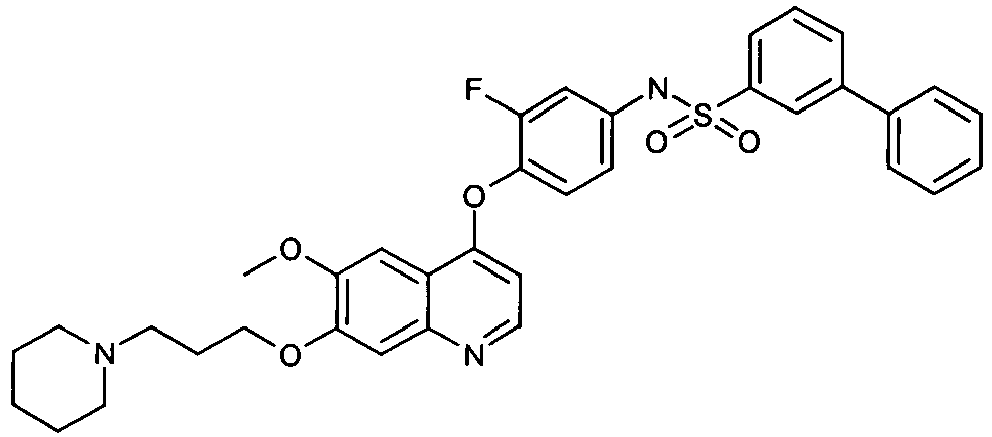
- C36H36FN3O5S Mw. 641.77
- LC/MS purity: 100 %, m/z 640 [M-H]-, 642 [M+H]+ Rt. 3.95 min. (Method B)
- 1H NMR (300 MHz, DMSO-d6): 10.6 (bs, 1H), 8.37 (d, 1H), 8.03 (s, 1H), 7.95 (d, 1 H), 7.79 (d, 1 H), 7.68 (m, 3H), 7.49 (m, 4H), 7.37 (s, 1 H), 7.32 (t, 1 H), 7.16 (dd, 1 H), 7.00 (d, 1 H), 6.28 (d, 1 H), 4.17 (t, 2H), 3.90 (s, 3H), 2.44 (bs, 6H), 1.97 (m, 2H), 1.53 (bs, 4H), 1.39 (m, 2H).
- Melting point: 113-115 °C.
- Yield: 47 %
-

- C31H32F3N3O6S Mw. 631.68
- LC/MS purity: 100 %, m/z 630 [M-H]-, 632 [M+H]+ Rt. 3.44 min. (Method B)
- 1H NMR (300 MHz, DMSO-d6): 10.2 (bs, 1H), 8.43 (d, 1H), 8.66-7.21 (m, 7H), 7.05 (d, 1H), 6.91 (d, 1H), 6.33 (d, 1H), 4.18 (t, 2H), 3.92 (s, 3H), 3.59 (m,1 H), 2.52 (bs, 6H), 1.99 (m, 2H), 1.52 (bs, 4H), 1.41 (m, 2H).
- Melting point: 105-106 °C.
- Yield: 77 %
-

- C36H36FN3O6S Mw. 657.77
- LC/MS purity: 97 %, m/z 656 [M-H]-, 658 [M+H]+ Rt. 3.93 min. (Method B)
- 1H NMR (300 MHz, DMSO-d6): 10.4 (bs, 1H), 8.43 (d, 1H), 7.58-7.24 (m, 10H), 7.07-6.90 (m, 4H), 6.35 (d, 1H), 4.18 (t, 2H), 3.93 (s, 3H), 2.49 (bs, 6H), 1.99 (bs, 2H), 1.53 (bs, 4H), 1.41 (bs, 2H).
- Melting point: 146-147 °C.
- Yield: 38 %
-

- C30H30F3N3O5S Mw. 601.65
- LC/MS purity: 98 %, m/z 600 [M-H]-, 602 [M+H]+ Rt. 2.99 min. (Method B)
- 1H NMR (300 MHz, DMSO-d6): 10.2 (bs, 1H), 8.44 (d, 1 H), 7.59 (t, 1H), 7.49 (s, 1 H), 7.39 (s, 1 H), 7.20 (m, 3H), 7.04 (d, 1 H), 6.89 (d, 1 H), 6.35 (d, 1 H), 4.20 (t, 2H), 3.92 (s, 3H), 2.70 (bs, 6H), 2.06 (bs, 2H), 1.45 (bs, 4H), 1.24 (bs, 2H).
- Melting point: 242-244 °C.
- Yield: 27 %
-

- C30H31F3N4O5S Mw. 616.66
- LC/MS purity: 99 %, m/z 615 [M-H]-, 617 [M+H]+ Rt. 2.91 min. (Method B)
- 1H NMR (300 MHz, DMSO-d6): 10.3 (bs, 1H), 8.43 (d, 1H), 7.60 (m, 1H), 7.42 (m, 4H), 7.19 (t, 1 H), 7.02 (dd, 1 H), 6.88 (d, 1 H), 6.35 (d, 1 H), 4.18 (t, 2H), 4.01 (bs, 4H), 3.92 (s, 3H), 3.35 (bs, 6H), 2.26 (s, 3H), 1.95 (m, 2H).
- Melting point: 124-126 °C.
- Yield: 24 %
-

- C36H37FN4O5S Mw. 656.78
- LC/MS purity: 97 %, m/z 655 [M-H]-, 657 [M+H]+ Rt. 3.71 min. (Method B)
- 1H NMR (300 MHz, DMSO-d6): 10.5 (bs, 1H), 8.36 (d, 1H), 8.03 (d, 1H), 7.96 (t, 1H), 7.79 (d, 1H), 7.67 (m, 3H), 7.52-7.12 (m, 6H), 7.04 (dd, 1H), 6.90 (d, 1H), 6.28 (d, 1 H), 4.17 (t, 2H), 3.93 (s, 3H), 2.40 (bs, 10H), 2.19 (s, 3H), 1.96 (t, 2H).
- Melting point: 190-191 °C.
- Yield: 40 %
-

- C36H37FN4O6S Mw. 672.78
- LC/MS purity: 97 %, m/z 671 [M-H]-, 673 [M+H]+ Rt. 3.68 min. (Method B)
- 1H NMR (300 MHz, DMSO-d6): 11 (bs, 1H), 8.43 (s, 1H), 7.62-7.23 (m, 10H), 7.10-6.92 (m, 4H), 6.35 (d, 1 H), 4.18 (t, 2H), 3.93 (s, 3H), 2.47 (m, 4H), 2.40 (m, 6H), 2.19 (s, 3H), 1.96 (t, 2H).
- Melting point: 140-141 °C.
- Yield: 24 %
-

- C31H32FN5O5S Mw. 605.69
- LC/MS purity: 99 %, m/z 604 [M-H]-, 606 [M+H]+ Rt. 2.73 min. (Method B)
- 1H NMR (300 MHz, DMSO-d6): 10.6 (bs, 1 H), 8.44 (d, 1 H), 7.50 (m, 3H), 7.37 (m, 3H), 7.28 (t, 1H), 7.10 (d, 1H), 6.96 (d, 1H), 6.34 (d, 1H), 4.17 (t, 2H), 3.92 (s, 3H), 2.44 (m, 4H), 2.36 (m, 6H), 2.16 (s, 3H), 1.94 (m, 2H).
- Melting point: 109-111 °C.
- Yield: 22 %
-

- C30H31F3N4O5 Mw. 616.66
- LC/MS purity: 99 %, m/z 615 [M-H]-, 617 [M+H]+ Rt. 2.93 min. (Method B)
- 1H NMR (300 MHz, DMSO-d6): 10 (bs, 1H), 8.43 (d, 1H), 7.93 (t, 1H), 7.47 (m, 2H), 7.36 (s, 1 H), 7.22 (m, 2H), 7.08 (dd, 1 H), 6.92 (dd, 1 H), 6.34 (d, 1 H), 4.18 (t, 2H), 3.92 (s, 3H), 2.44 (m, 4H), 2.36 (m, 6H), 2.18 (s, 3H), 1.96 (t, 2H).
- Melting point: 99-102 °C.
- Yield: 42 %
-

- C30H30F4N4O5S Mw. 634.65
- LC/MS purity: 98 %, m/z 633 [M-H]-, 635 [M+H]+ Rt. 2.98 min. (Method B)
- 1H NMR (300 MHz, DMSO-d6): 10.2 (bs, 1H), 8.44 (d, 1H), 7.92 (d, 1H), 7.80 (d, 1 H), 7.77 (t, 1 H), 7.48 (s, 1 H), 7.38 (s, 1 H), 7.26 (t, 1 H), 7.02 (d, 1 H), 6.36 (d, 1 H), 4.21 (t, 2H), 3.98 (s, 3H), 2.45 (m, 4H), 2.36 (m, 6H), 2.18 (s, 3H), 1.95 (t, 2H).
- Melting point: 88-90 °C.
- Yield: 45 %
-

- C31H34F2N4O6S Mw. 628.70
- LC/MS purity: 99 %, m/z 627 [M-H]-, 629 [M+H]+ Rt. 3.19 min. (Method B)
- 1H NMR (300 MHz, DMSO-d6): 10.9 (bs, 1H), 8.44 (d, 1H), 7.52-7.28 (m, 6H), 7.10 (d, 1 H), 6.94 (dd, 1 H), 6.34 (d, 1 H), 4.17 (t, 2H), 3.92 (s, 3H), 3.88 (s, 3H), 2.44 (m, 4H), 2.37 (m, 6H), 2.19 (s, 3H), 1.94 (t, 2H).
- Melting point: 167-169 °C.
- Yield: 60 %
-

- C30H32BrFN4O5S Mw. 659.58
- LC/MS purity: 98 %, m/z 657 [M-H]-, 659 [M+H]+ Rt. 3.17 min. (Method B)
- 1H NMR (300 MHz, DMSO-d6): 10.5 (bs, 1H), 8.43 (d, 1H), 8.11 (d, 1H), 7.81 (d, 1H), 7.57-7.46 (m, 3H), 7.36 (s, 1H), 7.26 (t, 1H), 7.05 (d, 1H), 6.94 (d, 1H), 6.34 (d, 1 H), 4.17 (t, 2H), 3.91 (s, 3H), 2.45 (bs, 10H), 2.20 (s, 3H), 1.95 (t, 2H).
- Melting point: 98-101 °C.
- Yield: 40 %
-

- C30H31Cl2FN4O5S Mw. 649.57
- LC/MS purity: 98 %, m/z 647 [M-H]-, 649 [M+H]+ Rt. 3.20 min. (Method B)
- 1H NMR (300 MHz, DMSO-d6): 11 (bs, 1H), 8.42 (d, 1H), 7.98 (bs, 1H), 7.60 (bs, 2H), 7.48 (bs, 1 H), 7.38 (bs, 1 H), 7.18 (t, 1 H), 6.98 (d, 1 H), 6.85 (d, 1 H), 6.34 (d, 1 H), 4.18 (t, 2H), 3.92 (s, 3H), 2.50 (bs, 10H), 2.28 (s, 3H), 1.78 (m, 2H).
- Melting point: 134-136 °C.
- Yield: 38 %
-

- C30H32FN5O7S Mw. 625.68
- LC/MS purity: 99 %, m/z 624 [M-H]-, 626 [M+H]+ Rt. 2.81 min. (Method B)
- 1H NMR (300 MHz, DMSO-d6): 10.4 (bs, 1 H), 8.43 (d, 1 H), 7.96 (m, 1 H), 7.77 (m, 1 H), 7.70 (m, 2H), 7.48 (s, 1 H), 7.37 (s, 1 H), 7.15 (t, 1 H), 6.94 (d, 1 H), 6.79 (d, 1 H), 6.35 (d, 1 H), 4.18 (t, 2H), 3.92 (s, 3H), 2.73 (m, 4H), 2.54 (m, 6H), 2.35 (s, 3H), 1.98 (m, 2H).
- Melting point: 125-128 °C.
- Yield: 29 %
-

- C30H32F2N4O5S Mw. 598.67
- LC/MS purity: 99 %, m/z 597 [M-H]-, 599 [M+H]+ Rt. 3.07 min. (Method B)
- 1H NMR (300 MHz, DMSO-d6): 10.9 (bs, 1H), 8.44 (d, 1H), 7.63-7.47 (m, 5H), 7.37 (s, 1 H), 7.29 (t, 1 H), 7.00 (dd, 1 H), 6.94 (d, 1 H), 6.35 (d, 1 H), 4.17 (t, 2H), 3.92 (s, 3H), 2.45 (m, 10H), 2.20 (s, 3H), 1.96 (m, 2H).
- Melting point: 82-84 °C.
- Yield: 48 %
-

- C30H31ClF2N4O5S Mw. 633.12
- LC/MS purity: 98 %, m/z 631 [M-H]-, 633 [M+H]+ Rt. 3.24 min. (Method B)
- 1H NMR (300 MHz, DMSO-d6): 10.5 (bs, 1H), 8.44 (d, 1H), 7.91 (dd, 1H), 7.77 (m, 1H), 7.59 (t, 1H), 7.48 (s, 1H), 7.37 (s, 1H), 7.25 (t, 1H), 7.06 (d, 1H), 6.90 (d, 1 H), 6.36 (d, 1 H), 4.18 (t, 2H), 3.92 (s, 3H), 2.46 (bs, 10H), 2.22 (s, 3H), 1.96 (m, 2H). Melting point: 108-110 °C.
- Yield: 57 %
-

- C31H32F4N4O5S Mw. 648.68
- LC/MS purity: 99 %, m/z 647 [M-H]-, 649 [M+H]+ Rt. 3.11 min. (Method B)
- 1H NMR (300 MHz, DMSO-d6): 11 (bs, 1H), 8.44 (d, 1H), 8.14 (d, 1H), 7.95 (d, 1 H), 7.80 (m, 2H), 7.47 (s, 1 H), 7.36 (s, 1 H), 7.24 (t, 1 H), 7.02 (dd, 1 H), 6.90 (d, 1 H), 6.35 (d, 1 H), 4.17 (t, 2H), 3.91 (s, 3H), 2.45 (bs, 10H), 2.23 (s, 3H), 1.96 (m, 2H).
- Melting point: 102-106 °C.
- Yield: 26 %
-

- C31H32F4N4O6S Mw. 664.68
- LC/MS purity: 100 %, m/z 663 [M-H]-, 665 [M+H]+ Rt. 3.26 min. (Method B)
- 1H NMR (300 MHz, DMSO-d6): 9.8 (bs, 1 H), 8.44 (d, 1H), 8.01 (d, 1H), 7.73 (t, 1 H), 7.52 (m, 2H), 7.47 (s, 1 H), 7.36 (s, 1 H), 7.26 (t, 1 H), 7.07 (d, 1 H), 6.91 (d, 1 H), 6.33 (d, 1 H), 4.18 (t, 2H), 3.91 (s, 3H), 2.44 (bs, 10H), 2.23 (s, 3H), 1.96 (m, 2H).
- Melting point: 86-90 °C.
- Yield: 23 %
-

- C30H32F2N4O5S Mw. 598.67
- LC/MS purity: 100 %, m/z 597 [M-H]-, 599 [M+H]+ Rt. 2.85 min. (Method B)
- 1H NMR (300 MHz, DMSO-d6): 11.5 (bs, 1 H), 8.43 (d, 1H), 7.88 (t, 1H), 7.68 (d, 1 H), 7.47-7.28 (m, 5H), 7.09 (d, 1 H), 6.96 (d, 1 H), 6.33 (d, 1 H), 4.17 (t, 2H), 3.91 (s, 3H), 2.43 (bs, 10H), 2.20 (s, 3H), 1.96 (m, 2H).
- Melting point: 185-186 °C.
- Yield: 28 %
-

- C30H31ClF2N4O5S Mw. 633.12
- LC/MS purity: 100 %, m/z 631 [M-H]-, 633 [M+H]+ Rt. 3.05 min. (Method B)
- 1H NMR (300 MHz, DMSO-d6): 10 (bs, 1H), 8.44 (d, 1H), 7.85 (t, 1H), 7.63 (d, 1H), 7.48 (s, 1 H), 7.43 (d, 1 H), 7.37 (s, 1 H), 7.22 (t, 1 H), 7.04 (d, 1 H), 6.89 (d, 1 H), 6.35 (d, 1 H), 4.18 (t, 2H), 3.92 (s, 3H), 2.50 (bs, 10H), 2.25 (s, 3H), 1.98 (m, 2H).
- Melting point: 106-110 °C.
- Yield: 26 %
-

- C31H35FN4O5S Mw. 594.71
- LC/MS purity: 99 %, m/z 593 [M-H]-, 595 [M+H]+ Rt. 3.28 min. (Method B)
- 1H NMR (300 MHz, DMSO-d6): 11 (bs, 1H), 8.43 (d, 1H), 7.91 (t, 1H), 7.53-7.24 (m, 6H), 7.05 (d, 1 H), 6.94 (d, 1 H), 6.32 (d, 1 H), 4.17 (t, 2H), 3.91 (s, 3H), 2.62 (s, 3H), 2.40 (m, 10H), 2.16 (s, 3H), 1.95 (m, 2H).
- Melting point: 73-75 °C.
- Yield: 35 %
-

- C30H32ClFN4O5S Mw. 615.13
- LC/MS purity: 99 %, m/z 613 [M-H]-, 615 [M+H]+ Rt. 3.09 min. (Method B)
- 1H NMR (300 MHz, DMSO-d6): 11.2 (bs, 1H), 8.43 (d, 1H), 8.08 (d, 1H), 7.62 (m, 2H), 7.52 (m, 1 H), 7.46(s, 1 H), 7.36 (s, 1 H), 7.26 (t, 1 H), 7.06 (dd, 1 H), 6.94 (d, 1 H), 6.32 (d, 1 H), 4.17 (t, 2H), 3.91 (s, 3H), 2.43 (m, 10H), 2.19 (s, 3H), 1.96 (m, 2H).
- Melting point: 96-98 °C.
- Yield: 36 %
-

- C31H33F3N4O6S Mw. 646.69
- LC/MS purity: 100 %, m/z 645 [M-H]-, 647 [M+H]+ Rt. 3.15 min. (Method B)
- 1H NMR (300 MHz, DMSO-d6): 10.4 (bs, 1H), 7.65-7.26 (m, 8H), 7.09 (d, 1H), 6.95 (d, 1 H), 6.33 (d, 1 H), 4.17 (t, 2H), 3.92 (s, 3H), 3.51 (m, 1 H), 2.43 (m, 10H), 2.20 (s, 3H), 1.96 (m, 2H).
- Melting point: 95-97 °C.
- Yield: 41 %
-

- C28H31FN4O5S2 Mw. 586.71
- LC/MS purity: 99 %, m/z 585 [M-H]-, 587 [M+H]+ Rt. 2.81 min. (Method B)
- 1H NMR (300 MHz, DMSO-d6): 10.1 (bs, 1H), 8.45 (d, 1H), 7.88 (d, 1H), 7.56 (d, 1 H), 7.49 (s, 1 H), 7.38(s, 1 H), 7.32 (t, 1 H), 7.13 (m, 2H), 7.00 (d, 1 H), 6.36 (d, 1 H), 4.18 (t, 2H), 3.93 (s, 3H), 2.43 (m, 10H), 2.21 (s, 3H), 1.96 (m, 2H).
- Melting point: 201-202 °C.
- Yield: 46 %
-

- C30H31Cl2FN4O5S Mw. 649.57
- LC/MS purity: 99 %, m/z 647 [M-H]-, 649 [M+H]+ Rt. 3.03 min. (Method B)
- 1H NMR (300 MHz, DMSO-d6): 10.4 (bs, 1 H), 8.43 (d, 1 H), 7.59 (m, 2H), 7.48 (m, 2H), 7.36 (s, 1 H), 7.25 (t, 1 H), 7.05 (d, 1 H), 6.90 (d, 1 H), 6.33 (d, 1 H), 4.18 (t, 2H), 3.91 (s, 3H), 2.50 (bs, 10H), 2.20 (s, 3H), 1.97 (m, 2H).
- Melting point: 113-116 °C.
- Yield: 38 %
-

- C31H35FN4O6S Mw. 610.71
- LC/MS purity: 97 %, m/z 609 [M-H]-, 611 [M+H]+ Rt. 3.33 min. (Method B)
- 1H NMR (300 MHz, DMSO-d6): 10.3 (bs, 1H), 8.42 (d, 1H), 7.82 (d, 1H), 7.62 (t, 1 H), 7.45 (s, 1H), 7.36(s, 1H), 7.31 (s, 1H), 7.21 (d, 1H), 7.14-6.99 (m, 3H), 6.28 (d, 1 H), 4.17 (t, 2H), 3.90 (s, 6H), 2.39 (m, 10H), 2.15 (s, 3H), 1.94 (m, 2H). Melting point: 168-170 °C.
- Yield: 36 %
-

- C31H32Cl2FN3O6S Mw. 664.59
- LC/MS purity: 97 %, m/z 662 [M-H]-, 664 [M+H]+ Rt. 3.91 min. (Method B)
- 1H NMR (300 MHz, DMSO-d6): 10.5 (bs, 1H), 8.44 (d, 1H), 7.88 (bs, 1H), 7.76 (bs, 1H), 7.49 (s, 1H), 7.38 (s, 1H), 7.20 (t, 1 H), 7.02 (d, 1H), 6.87 (d, 1H), 6.36 (d, 1H), 4.19 (t, 2H), 3.92 (s, 6H), 2.61 (bs, 6H), 2.03 (bs, 2H), 1.90 (bs, 4H), 1.80 (bs, 2H). Melting point: 173-175 °C.
- Yield: 27 %
-

- C31H33Cl2FN4O6S Mw. 679.60
- LC/MS purity: 98 %, m/z 677 [M-H]-, 679 [M+H]+ Rt. 3.79 min. (Method B)
- 1H NMR (300 MHz, DMSO-d6): 10.4 (bs, 1 H), 8.44 (d, 1H), 7.93 (d, 1H), 7.76 (d, 1H), 7.48 (s, 1H), 7.37 (s, 1H), 7.25 (t, 1H), 7.05 (dd, 1H), 6.91 (d, 1 H), 6.36 (d, 1 H), 4.18 (t, 2H), 3.92 (s, 6H), 2.50 (bs, 10H), 2.25 (s, 3H), 1.97 (m, 2H).
- Melting point: 183-185 °C.
- Yield: 36 %
-

- C31H34FN3O5S Mw. 579.70
- LC/MS purity: 99 %, m/z 578 [M-H]-, 580 [M+H]+ Rt. 3.70 min. (Method B)
- 1H NMR (300 MHz, DMSO-d6): 10.6 (bs, 1H), 8.44 (d, 1H), 7.80 (d, 2H), 7.58 (m, 3H), 7.47 (s, 1 H), 7.37 (s, 1 H), 7.28 (t, 1 H), 7.09 (d, 1 H), 6.95 (d, 1 H), 6.33 (d, 1 H), 4.17 (t, 2H), 3.91 (s, 3H), 2.80 (m, 2H), 2.45 (m, 2H), 1.96 (m, 2H), 1.90 (m, 1H), 1.58 (m, 4H), 1.38 (m, 1 H), 0.86 (m, 1 H), 0.84 (d, 3H)
- Melting point: 160-161 °C.
- Yield: 32 %
-
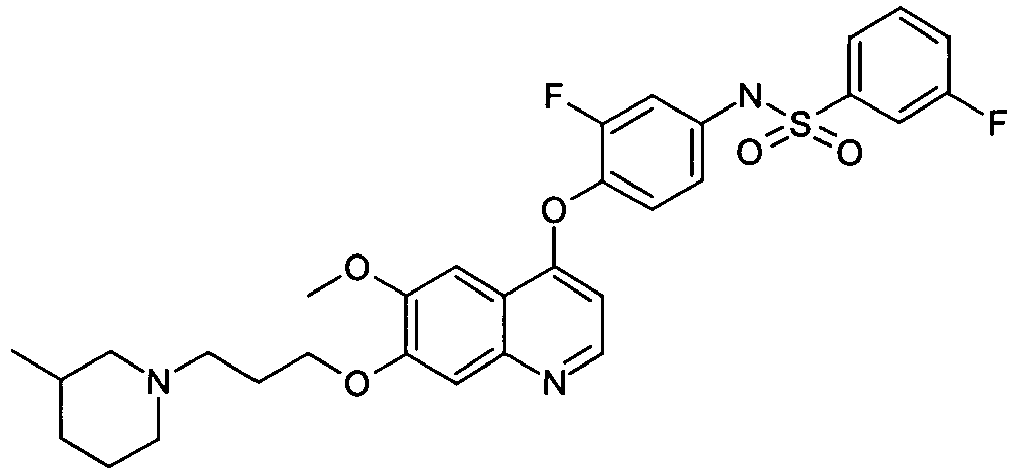
- C31H33F2N3O5S Mw. 597.69
- LC/MS purity: 99 %, m/z 596 [M-H]-, 598 [M+H]+ Rt. 3.55 min. (Method B)
- 1H NMR (300 MHz, DMSO-d6): 10.6 (bs, 1 H), 8.44 (d, 1 H), 7.62 (bs, 2H), 7.57 (t, 1 H), 7.45 (m, 2H), 7.37 (s, 1 H), 7.25 (t, 1 H), 7.07 (dd, 1 H), 6.92 (d, 1 H), 6.35 (d, 1 H), 4.18 (t, 2H), 3.92 (s, 3H), 2.86 (m, 2H), 2.53 (m, 2H), 1.98 (m, 3H), 1.65 (m, 4H), 1.50 (m, 1 H), 0.88 (m, 1 H), 0.84 (d, 3H)
- Melting point: 113-115 °C.
- Yield: 26 %
-

- C31H33ClFN3O5S Mw. 614.14
- LC/MS purity: 98 %, m/z 612 [M-H]-. 614 [M+H]+ Rt. 3.67 min. (Method B)
- 1H NMR (300 MHz, DMSO-d6): 10.8 (bs, 1 H), 8.43 (d, 1 H), 8.08 (d, 1 H), 7.62 (bs, 2H), 7.52 (m, 1 H), 7.46 (s, 1 H), 7.37 (s, 1H), 7.26 (t, 1 H), 7.06 (d, 1 H), 6.97 (d, 1 H), 6.33 (d, 1 H), 4.18 (t, 2H), 3.91 (s, 3H), 2.87 (m, 2H), 2.55 (m, 2H), 1.98 (m, 3H), 1.69 (m, 4H), 1.49 (m, 1 H), 0.89 (m, 1 H), 0.84 (d, 3H)
- Melting point: 115-118 °C.
- Yield: 22 %
-

- C32H33F4N3O5S Mw. 647.69
- LC/MS purity: 99 %, m/z 646 [M-H]-, 648 [M+H]+ Rt. 3.01 min. (Method A)
- 1H NMR (300 MHz, DMSO-d6): 10 (bs, 1H), 8.43 (d, 1H), 8.02 (m, 3H), 7.80 (t, 1 H), 7.48 (s, 1 H), 7.38 (s, 1 H), 7.25 (t, 1 H), 7.07 (dd, 1 H), 6.91 (d, 1 H), 6.32 (d, 1 H), 4.19 (t, 2H), 3.92 (s, 3H), 2.96 (m, 2H), 2.63 (m, 2H), 2.55 (m, 3H), 1.82 (m, 1 H), 1.66 (m, 3H), 1.52 (m, 1 H), 0.92 (m, 1 H), 0.84 (d, 3H)
- Melting point: 128-130 °C.
- Yield: 41 %
-

- C31H33FN4O7S Mw. 624.69
- LC/MS purity: 100 %, m/z 623 [M-H]-, 625 [M+H]+ Rt. 3.26 min. (Method B)
- 1H NMR (300 MHz, DMSO-d6): 10.5 (bs, 1 H), 8.43 (d, 1 H), 7.94 (m, 1 H), 7.73 (m, 1 H), 7.50 (s, 1H), 7.39 (s, 1H), 7.10 (t, 1H), 6.89 (dd, 1H), 6.76 (d, 1H), 6.36 (d, 1 H), 4.21 (t, 2H), 3.93 (s, 3H), 3.09 (m, 2H), 2.80 (m, 2H), 2.22 (m, 1 H), 2.09 (m, 3H), 1.68 (m, 3H), 1.56 (m, 1 H), 0.96 (m, 1 H), 0.87 (d, 3H)
- Melting point: 136-138 °C.
- Yield: 19 %
-

- C32H33FN4O5S Mw. 604.71
- LC/MS purity: 99 %, m/z 603 [M-H]-, 605 [M+H]+ Rt. 3.29 min. (Method B)
- 1H NMR (300 MHz, DMSO-d6): 10.5 (bs, 1H), 8.44 (d, 1H), 8.14 (s, 1H), 8.05 (t, 2H), 7.75 (t, 1 H), 7.49 (s, 1 H), 7.38 (s, 1 H), 7.22 (t, 1 H), 7.04 (dd, 1 H), 6.32 (d, 1 H), 6.35 (d, 1 H), 4.20 (t, 2H), 3.92 (s, 3H), 2.96 (m, 2H), 2.64 (m, 2H), 2.05 (m, 3H), 1.85 (m, 1 H), 1.66 (m, 3H), 1.56 (m, 1 H), 0.92 (m, 1 H), 0.86 (d, 3H)
- Melting point:125-127 °C.
- Yield: 26 %
-

- C32H36FN3O6S Mw. 609.72
- LC/MS purity: 98 %, m/z 608 [M-H]-, 610 [M+H]+ Rt. 3.75 min. (Method B)
- 1H NMR (300 MHz, DMSO-d6): 10.6 (bs, 1H), 8.44 (d, 1H), 7.49 (m, 2H), 7.36 (m, 2H), 7.30 (m, 2H), 7.20 (d, 1 H), 7.14 (d, 1 H), 6.99 (d, 1 H), 6.35 (d, 1 H), 4.18 (t, 2H), 3.91 (s, 3H), 3.80 (s, 3H), 2.82 (m, 2H), 2.48 (m, 2H), 1.97 (m, 2H), 1.90 (m, 1 H), 1.62 (m, 4H), 1.49 (m, 1 H), 0.92 (m, 1 H), 0.84 (d, 3H)
- Melting point: 172-174 °C.
- Yield: 35 %
-

- C32H34F3N3O6S Mw. 645.70
- LC/MS purity: 99 %, m/z 644 [M-H]-, 646 [M+H]+ Rt. 3.70 min. (Method B)
- 1H NMR (300 MHz, DMSO-d6): 10.5 (bs, 1H), 8.44 (bs, 1H), 7.65-7.32 (m, 7H), 7.09 (d, 1 H), 6.96 (d, 1 H), 6.34 (bs, 1 H), 4.18 (bs, 2H), 3.92 (s, 3H), 3.57 (m, 1 H), 2.89 (bs, 2H), 2.55 (bs, 2H), 2.00 (bs, 3H), 1.63 (bs, 4H), 1.51 (m, 1H), 0.88 (m, 1H), 0.86 (d, 3H)
- Melting point: 99-100 °C.
- Yield: 25 %
-

- C32H36FN3O5S Mw. 593.72
- LC/MS purity: 99 %, m/z 592 [M-H]-, 594 [M+H]+ Rt. 3.89 min. (Method B)
- 1H NMR (300 MHz, DMSO-d6): 10.7 (bs, 1H), 8.43 (d, 1H), 7.92 (d, 1H), 7.51-7.25 (m, 6H), 7.05 (d, 1 H), 6.94 (d, 1 H), 6.32 (d, 1 H), 4.17 (t, 2H), 3.91 (s, 3H), 2.80 (m, 2H), 2.62 (s, 3H), 2.52 (m, 2H), 1.96 (m, 2H), 1.88 (m, 1 H), 1.61 (m, 4H), 1.48 (m, 1H), 0.90 (m, 1H), 0.84 (d, 3H)
- Melting point: 99-100 °C.
- Yield: 26 %
-

- C32H33F4N3O6S Mw. 663.69
- LC/MS purity: %, m/z 642 [M-H]-, 644 [M+H]+ Rt. 3.84 min. (Method B)
- 1H NMR (300 MHz, DMSO-d6): 10.4 (bs, 1H), 8.43 (d, 1H), 7.98 (d, 1H), 7.67 (t, 1 H), 7.48 (bs, 3H), 7.37 (s, 1 H), 7.18 (t, 1 H), 7.00 (d, 1 H), 6.84 (d, 1 H), 6.33 (d, 1 H), 4.18 (t, 2H), 3.92 (s, 3H), 2.83 (m, 2H), 2.56 (m, 2H), 1.99 (m, 3H), 1.63 (m, 4H), 1.51 (m, 1 H), 0.89 (m, 1 H), 0.84 (d, 3H)
- Melting point: 128-130°C.
- Yield: 21 %
-

- C32H33F4N3O6S Mw. 663.69
- LC/MS purity: 99 %, m/z 662 [M-H]-, 664 [M+H]+ Rt. 3.87 min. (Method B)
- 1H NMR (300 MHz, DMSO-d6): 10 (bs, 1H), 8.42 (d, 1H), 7.79 (d, 1H), 7.66 (m, 2H), 7.56 (d, 1H), 7.48 (s, 1H), 7.37 (s, 1H), 7.19 (t, 1H), 7.01 (dd, 1H), 6.86 (d, 1 H), 6.32 (d, 1 H), 4.18 (t, 2H), 3.92 (s, 3H), 2.87 (m, 2H), 2.54 (m, 2H), 1.98 (m, 3H), 1.65 (m, 4H), 1.51 (m, 1 H), 0.88 (m, 1 H), 0.84 (d, 3H)
- Melting point: 102-104 °C.
- Yield: 21 %
-

- C31H32F3N3O5S Mw. 615.68
- LC/MS purity: 99 %, m/z 614 [M-H]-, 616 [M+H]+ Rt. 3.48 min. (Method B)
- 1H NMR (300 MHz, DMSO-d6): 10.5 (bs, 1H), 8.44 (d, 1H), 7.92 (m, 1H), 7.48 (s, 2H), 7.44 (d, 1 H), 7.38 (s, 1 H), 7.25 (m, 2H), 7.05 (dd, 1 H), 6.91 (d, 1 H), 6.35 (d, 1 H), 4.19 (t, 2H), 3.92 (s, 3H), 2.92 (m, 2H), 2.60 (m, 2H), 2.03 (m, 3H), 1.78 (m, 1 H), 1.65 (m, 3H), 1.54 (m, 1 H), 0.92 (m, 1 H), 0.85 (d, 3H)
- Melting point:118-120 °C.
- Yield: 18 %
-

- C31H32F3N3O5S Mw. 615.68
- LC/MS purity: 99 %, m/z 614 [M-H]-, 616 [M+H]+ Rt. 3.59 min. (Method B)
- 1H NMR (300 MHz, DMSO-d6): 10.5 (bs, 1 H), 8.43 (d, 1H), 7.78 (t, 1 H), 7.59 (m, 2H), 7.48 (s, 1 H), 7.37 (s, 1 H), 7.21 (t, 2H), 7.04 (d, 1 H), 6.88 (d, 1 H), 6.36 (d, 1 H), 4.18 (t, 2H), 3.92 (s, 3H), 2.98 (m, 2H), 2.55 (m, 2H), 2.00 (m, 3H), 1.70 (m, 3H), 1.51 (m, 1 H), 0.90 (m, 1 H), 0.84 (d, 3H)
- Melting point: 120-122 °C.
- Yield: 34 %
-

- C31H31F4N3O5S Mw. 633.67
- LC/MS purity: 100 %, m/z 632 [M-H]-, 634 [M+H]+ Rt. 3.46 min. (Method B)
- LC/MS purity: 100 %, m/z 632 [M-H]-, 634 [M+H]+ Rt. 3.46 min. (Method B)
- 1H NMR (300 MHz, DMSO-d6): 10.2 (bs, 1 H), 8.44 (d, 1 H), 7.64 (m, 1 H), 7.50 (s, 1 H), 7.39 (m, 2H), 7.16 (t, 1 H), 6.98 (dd, 1 H), 6.84 (d, 1 H), 6.37 (d, 1 H), 4.21 (t, 2H), 3.93 (s, 3H), 3.11 (m, 2H), 2.81 (m, 2H), 2.16 (m, 4H), 1.69 (m, 3H), 1.58 (m, 1H), 0.96 (m, 1H), 0.88 (d, 3H)
- Melting point: 134-136 °C.
- Yield: 28 %
-

- C31H32Cl2FN3O5S Mw. 648.59
- LC/MS purity: 99 %, m/z 646 [M-H]-, 648 [M+H]+ Rt. 3.03 min. (Method A)
- 1H NMR (300 MHz, DMSO-d6): 10.4 (bs, 1H), 8.44 (d, 1H), 7.98 (s, 1H), 7.60 (bs, 2H), 7.48 (s, 1H), 7.39 (s, 1H), 7.18 (t, 1H), 6.98 (d, 1H), 6.86 (d, 1H), 6.35 (d, 1H), 4.18 (t, 2H), 3.92 (s, 3H), 3.04 (m, 2H), 2.74 (m, 2H), 2.23 (m, 1 H), 2.07 (m, 2H), 1.95 (m, 1 H), 1.68 (m, 3H), 1.56 (m, 1 H), 0.95 (m, 1 H), 0.87 (d, 3H)
- Melting point: 127-129 °C.
- Yield: 29 %
-

- C31H32Cl2FN3O5S Mw. 648.59
- LC/MS purity: 99 %, m/z 646 [M-H]-, 648 [M+H]+ Rt. 3.59 min. (Method B)
- 1H NMR (300 MHz, DMSO-d6): 10.6 (bs, 1H), 8.43 (d, 1H), 7.58 (d, 1H), 7.57 (s, 1 H), 7.48 (m, 2H), 7.38 (s, 1 H), 7.22 (t, 1 H), 7.02 (dd, 1 H), 6.88 (d, 1 H), 6.34 (d,
- 1 H), 4.20 (t, 2H), 3.92 (s, 3H), 3.01 (m, 2H), 2.70 (m, 2H), 2.16 (m, 1 H), 2.05 (m, 2H), 1.91 (m, 1 H), 1.68 (m, 3H), 1.55 (m, 1 H), 0.98 (m, 1 H), 0.86 (d, 3H)
- Melting point: 119-121 °C.
- Yield: 16 %
-

- C31H32Cl2FN3O5S Mw. 648.59
- LC/MS purity: 99 %, m/z 646 [M-H]-, 648 [M+H]+ Rt. 3.11 min. (Method A)
- 1H NMR (300 MHz, DMSO-d6): 10.4 (bs, 1H), 8.44 (d, 1H), 7.92 (d, 1H), 7.80 (d, 1 H), 7.71 (dd, 1 H), 7.49 (s, 1 H), 7.39 (s, 1 H), 7.23 (t, 1 H), 7.05 (dd, 1 H), 6.89 (d, 1 H), 6.36 (d, 1 H), 4.20 (t, 2H), 3.93 (s, 3H), 2.98 (m, 2H), 2.67 (m, 2H), 2.13 (m, 1 H), 2.03 (m, 2H), 1.86 (m, 1 H), 1.67 (m, 3H), 1.57 (m, 1 H), 0.92 (m, 1 H), 0.86 (d, 3H)
- Melting point: 123-124 °C.
- Yield: 15 %
-
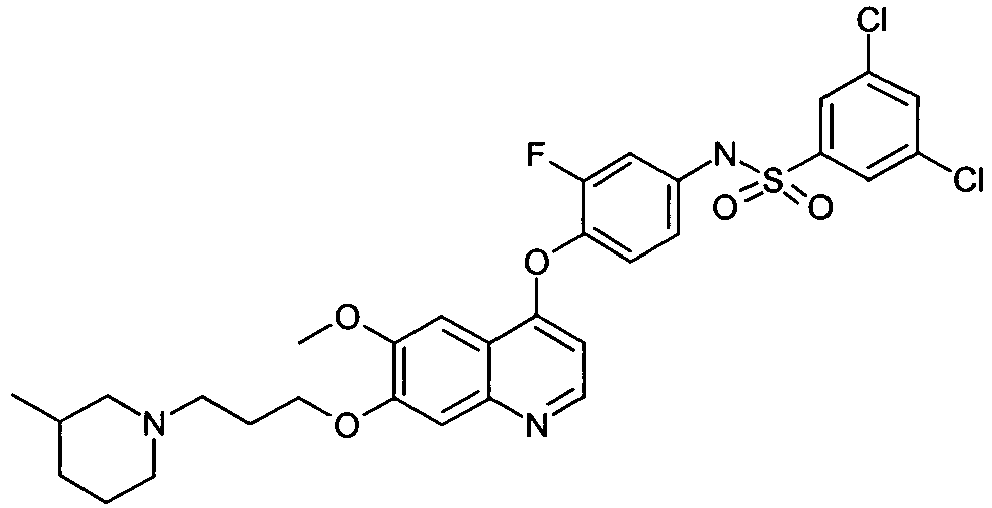
- C31H32Cl2FN3O5S Mw. 648.59
- LC/MS purity: 98 %, m/z 646 [M-H]-, 648 [M+H]+ Rt. 3.13 min. (Method A)
- 1H NMR (300 MHz, DMSO-d6): 10.3 (bs, 1H), 8.44 (d, 1H), 7.81 (d, 1H), 7.69 (s, 1 H), 7.68 (s, 1 H), 7.50 (s, 1 H), 7.39 (s, 1 H), 7.20 (t, 1 H), 7.01 (dd, 1 H), 6.86 (d, 1 H), 6.36 (d, 1 H), 4.21 (t, 2H), 3.93 (s, 3H), 3.06 (m, 2H), 2.76 (m, 2H), 2.23 (m, 1 H), 2.06 (m, 2H), 1.97 (m, 1 H), 1.69 (m, 3H), 1.57 (m, 1 H), 0.92 (m, 1 H), 0.87 (d, 3H)
- Melting point: 126-128 °C.
- Yield: 19 %
-
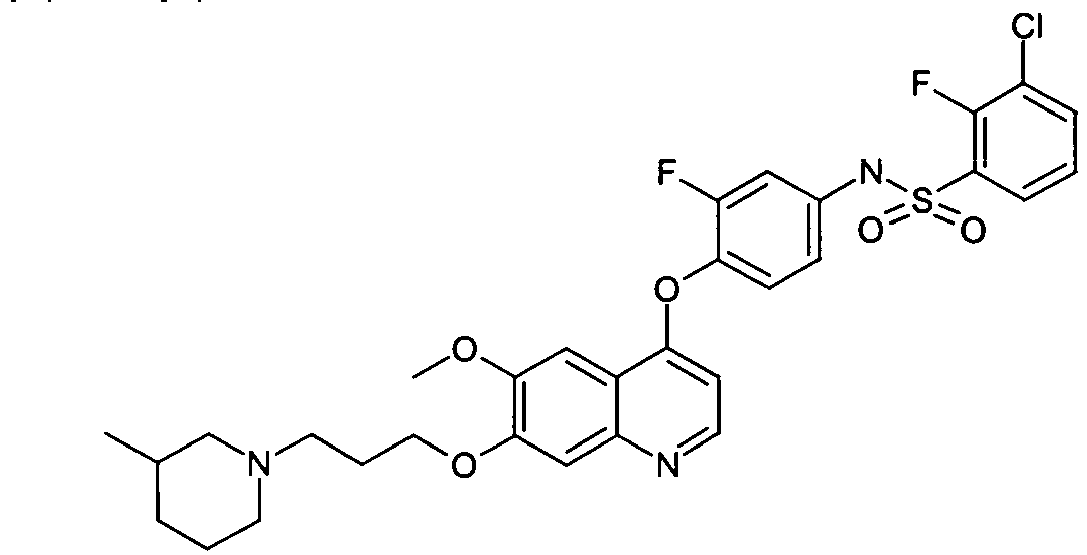
- C31H32ClF2N3O5S Mw. 632.13
- LC/MS purity: 98 %, m/z 630 [M-H]-, 632 [M+H]+ Rt. 3.50 min. (Method B)
- 1H NMR (300 MHz, DMSO-d6): 10.3 (bs, 1H), 8.43 (d, 1H), 7.81 (d, 1H), 7.76 (d, 1H), 7.49 (s, 1H), 7.39 (s, 1H), 7.33 (t, 1H), 7.19 (t, 1H), 7.02 (dd, 1 H), 6.87 (d, 1 H), 6.36 (d, 1 H), 4.20 (t, 2H), 3.93 (s, 3H), 3.03 (m, 2H), 2.73 (m, 2H), 2.20 (m,
- 1 H), 2.06 (m, 2H), 1.94 (m, 1 H), 1.68 (m, 3H), 1.56 (m, 1 H), 0.93 (m, 1 H), 0.86 (d, 3H)
- Melting point: 125-127 °C.
- Yield: 18 %
-
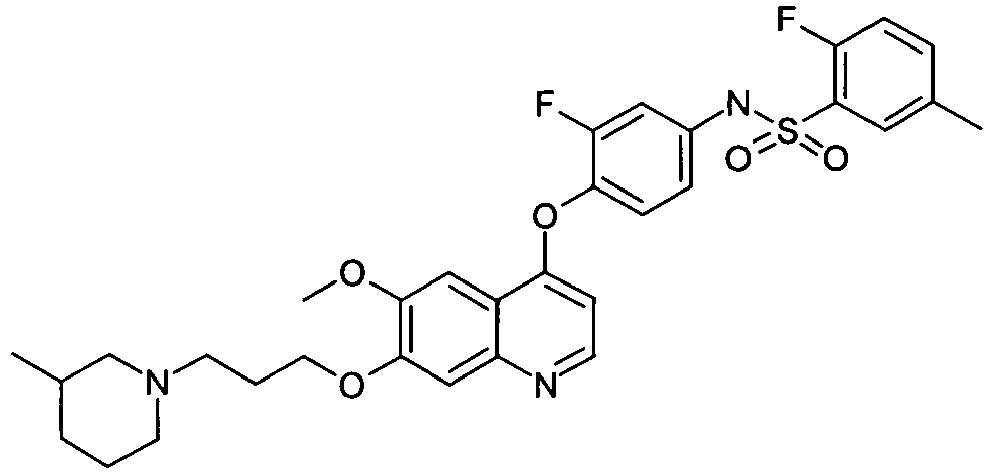
- C32H35F2N3O5S Mw. 611.71
- LC/MS purity: 99 %, m/z 610 [M-H]-, 612 [M+H]+ Rt. 3.73 min. (Method B)
- 1H NMR (300 MHz, DMSO-d6): 10.2 (bs, 1H), 8.44 (d, 1H), 7.69 (d, 1H), 7.49 (d, 1 H), 7.47 (s, 1 H), 7.38 (s, 1 H), 7.30 (td, 2H), 7.12 (dd, 1 H), 6.99 (d, 1 H), 6.34 (d, 1 H), 4.19 (t, 2H), 3.92 (s, 3H), 2.90 (m, 2H), 2.57 (s, 2H), 2.34 (s, 3H), 2.01 (m, 3H), 1.74 (m, 1 H), 1.61 (m, 3H), 1.52 (m, 1 H), 0.90 (m, 1 H), 0.85 (d, 3H)
- Melting point: 149-151 °C.
- Yield: 23 %
-

- C32H35F2N3O5S Mw. 611.71
- LC/MS purity: 99 %, m/z 610 [M-H]-, 612 [M+H]+ Rt. 3.85 min. (Method B)
- 1H NMR (300 MHz, DMSO-d6): 10.5 (bs, 1 H), 8.44 (d, 1 H), 7.52 (m, 4H), 7.38 (s, 1H), 7.31 (t, 1 H), 7.13 (dd, 1H), 6.98 (d, 1H), 6.36 (d, 1H), 4.19 (t, 2H), 3.92 (s, 3H), 2.88 (m, 2H), 2.54 (m, 2H), 2.29 (m, 3H), 1.99 (m, 3H), 1.63 (m, 4H), 1.54 (m, 1H), 0.89 (m, 1H), 0.84 (d, 3H)
- Melting point: 174-176 °C.
- Yield: 19 %
-

- C31H32ClF2N3O5S Mw. 632.13
- LC/MS purity: 96 %, m/z 630 [M-H]-, 632 [M+H]+ Rt. 2.97 min. (Method A)
- 1H NMR (300 MHz, DMSO-d6): 10.6 (bs, 1H), 8.44 (d, 1H), 7.91 (dd, 1H), 7.77 (m, 1H), 7.58 (t, 1H), 7.48 (s, 1H), 7.38 (s, 1H), 7.24 (t, 1H), 7.06 (dd, 1H), 6.89 (d, 1 H), 6.36 (d, 1 H), 4.19 (t, 2H), 3.92 (s, 3H), 2.83 (m, 2H), 2.61 (s, 2H), 2.03 (m, 3H), 1.78 (m, 1 H), 1.63 (m, 3H), 1.52 (m, 1 H), 0.91 (m, 1 H), 0.85 (d, 3H)
- Melting point: 124-126 °C.
- Yield: 30 %
-

- C35H36FN3O5S Mw. 629.76
- LC/MS purity: 99 %, m/z 628 [M-H]-, 630 [M+H]+ Rt. 2.95 min. (Method A)
- 1H NMR (300 MHz, DMSO-d6): 10.4 (bs, 1 H), 8.82 (d, 1 H), 8.39 (d, 1 H), 8.20 (m, 2H), 8.06 (d, 1 H), 7.65 (m, 3H), 7.42 (s, 1 H), 7.35 (s, 1 H), 7.16 (t, 1H), 6.99 (d, 1 H), 6.85 (d, 1 H), 6.26 (d, 1 H), 4.16 (t, 2H), 3.89 (s, 3H), 2.83 (m, 2H), 2.48 (m, 2H), 1.96 (m, 3H), 1.62 (m, 4H), 1.49 (m, 1 H), 0.89 (m, 1 H), 0.84 (d, 3H)
- Melting point: 131-133 °C.
- Yield: 21 %
-

- C37H38FN3O6S Mw. 671.79
- LC/MS purity: 98 %, m/z 670 [M-H]-, 672 [M+H]+ Rt. 3.18 min. (Method A)
- 1H NMR (300 MHz, DMSO-d6): 10.4 (bs, 1H), 8.44 (d, 1H), 7.62-7.22 (m, 10H), 7.04 (m, 3H), 6.93 (d, 1H), 6.35 (d, 1H), 4.19 (t, 2H), 3.93 (s, 3H), 2.86 (m, 2H), 2.48 (m, 2H), 1.99 (m, 3H), 1.65 (m, 4H), 1.51 (m, 1 H), 0.88 (m, 1 H), 0.84 (d, 3H)
- Melting point:146-147 °C.
- Yield: 24 %
-

- C28H34FN3O5S Mw. 543.66
- LC/MS purity: 96 %, m/z 542 [M-H]-, 544 [M+H]+ Rt. 3.65 min. (Method B)
- 1H NMR (300 MHz, DMSO-d6): 10.3 (bs, 1H), 8.47 (d, 1H), 7.52 (s, 1H), 7.45 (d, 1H), 7.39 (s, 1H), 7.28 (d, 1H), 7.17 (d, 1H), 6.45 (d, 1H), 4.19 (t, 2H), 3.94 (s, 3H), 3.17 (m, 1 H), 2.77 (m, 3H), 2.44 (m, 2H), 1.96 (m, 2H), 1.84 (m, 1 H), 1.61 (m, 3H), 1.48 (m, 1 H), 0.99 (m, 2H), 0.97 (m, 2H), 0.88 (m, 1 H), 0.84 (d, 3H)
- Melting point: 158-160 °C.
- Yield: 11 %
-
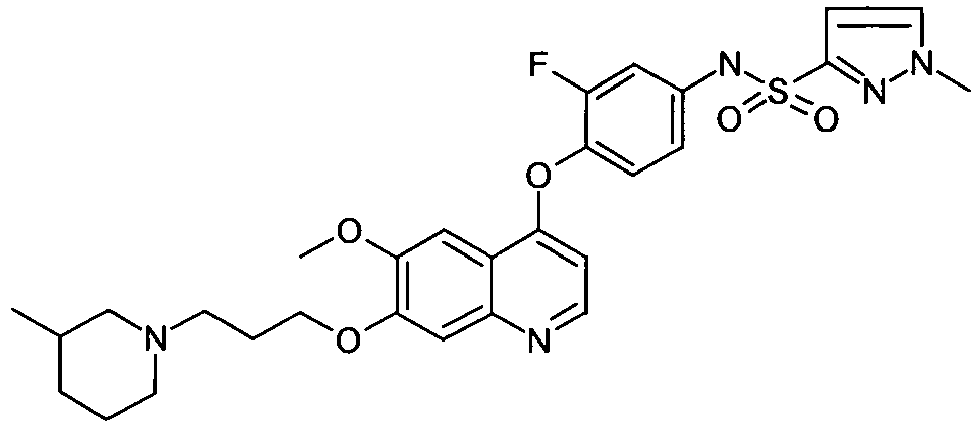
- C29H34FN5O5S Mw. 583.69
- LC/MS purity: 97 %, m/z 582 [M-H]-, 584 [M+H]+ Rt. 3.09 min. (Method B)
- 1H NMR (300 MHz, DMSO-d6): 10.2 (bs, 1H), 8.45 (d, 1H), 7.84 (d, 1H), 7.49 (s, 1 H), 7.37 (s, 1 H), 7.30 (t, 1 H), 7.15 (dd, 1 H), 7.00 (d, 1 H), 6.63 (d, 1 H), 6.38 (d, 1 H), 4.18 (t, 2H), 3.93 (s, 3H), 3.90 (s, 3H), 2.78 (m, 2H), 2.44 (m, 2H), 1.96 (m, 2H), 1.85 (m, 1 H), 1.58 (m, 4H), 1.46 (m, 1 H), 0.85 (m, 1 H), 0.83 (d, 3H)
- Melting point: 164-166 °C.
- Yield: 31 %
-

- C30H34FN3O5S2 Mw. 599.75
- LC/MS purity: 99 %, m/z 598 [M-H]-, 600 [M+H]+ Rt. 3.62 min. (Method B)
- 1H NMR (300 MHz, DMSO-d6): 10.5 (bs, 1H), 8.45 (d, 1H), 7.49 (s, 1H), 7.38 (s, 1 H), 7.36 (s, 1 H), 7.30 (t, 1 H), 7.12 (dd, 1 H), 6.98 (d, 1 H), 6.83 (d, 1 H), 6.38 (d, 1 H), 4.18 (t, 2H), 3.93 (s, 3H), 2.85 (m, 2H), 2.54 (m, 2H), 2.46 (s, 3H), 1.97 (m, 3H), 1.63 (m, 4H), 1.50 (m, 1 H), 0.88 (m, 1 H), 0.84 (d, 3H)
- Melting point: 99-101 °C.
- Yield: 29 %
-

- C29H31ClFN3O5S2Mw. 620.17
- LC/MS purity: 99 %, m/z 618 [M-H]-, 620 [M+H]+ Rt. 3.50 min. (Method B)
- 1H NMR (300 MHz, DMSO-d6): 10.8 (bs, 1H), 8.46 (d, 1H), 7.51 (s, 1H), 7.40 (s, 1H), 7.33 (s, 1H), 7.23 (t, 1H), 7.12 (d, 1H), 7.04 (d, 1H), 6.91 (d, 1H), 6.39 (d, 1H), 4.21 (t, 2H), 3.93 (s, 3H), 3.16 (m, 2H), 2.79 (m, 2H), 2.28 (s, 1 H), 2.09 (m, 3H), 1.68 (m, 3H), 1.58 (m, 1 H), 0.96 (m, 1 H), 0.88 (d, 3H)
- Melting point: 100-103 °C.
- Yield: 19 %
-

- C29H30Cl2FN3O5S2 Mw. 654.61
- LC/MS purity: 98 %, m/z 652 [M-H]-, 654 [M+H]+ Rt. 3.03 min. (Method A)
- 1H NMR (300 MHz, DMSO-d6): 10.5 (bs, 1H), 8.45 (d, 1H), 7.51 (s, 1H), 7.38 (s, 1 H), 7.18 (s, 1 H), 7.16 (t, 1 H), 6.97 (d, 1 H), 6.82 (d, 1 H), 6.39 (d, 1 H), 4.20 (t, 2H), 3.93 (s, 3H), 3.17 (m, 2H), 2.68 (m, 2H), 2.18 (m, 1 H), 2.06 (m, 2H), 1.88 (m, 1 H), 1.67 (m, 3H), 1.53 (m, 1 H), 0.93 (m, 1 H), 0.86 (d, 3H)
- Melting point: 119-121 °C.
- Yield: 39 %
-

- C29H32FN3O5S2 Mw. 585.72
- LC/MS purity: 99 %, m/z 584 [M-H]-, 586 [M+H]+ Rt. 3.49 min. (Method B)
- 1H NMR (300 MHz, DMSO-d6): 10.4 (bs, 1 H), 8.44 (d, 1H), 8.19 (d, 1H), 7.71 (m, 1 H), 7.48 (s, 1 H), 7.37 (s, 1 H), 7.30 (m, 2H), 7.13 (dd, 1 H), 6.99 (d, 1 H), 6.36 (d, 1 H), 4.18 (t, 2H), 3.92 (s, 3H), 2.80 (m, 2H), 2.46 (m, 2H), 1.95 (m, 2H), 1.87 (m, 1 H), 1.66 (m, 1 H), 1.60 (m, 3H), 1.48 (m, 1 H), 0.92 (m, 1 H), 0.84 (d, 3H)
- Melting point: 174-176 °C.
- Yield: 28 %
-

- C31H34FN3O7S2 Mw. 643.76
- LC/MS purity: 98 %, m/z 642 [M-H]-, 644 [M+H]+ Rt. 3.78 min. (Method B)
- 1H NMR (300 MHz, DMSO-d6): 10.4 (bs, 1H), 8.45 (d, 1H), 7.94 (d, 1H), 7.48 (s, 1H), 7.47 (s, 1H), 7.37 (s, 1H), 7.30 (t, 1H), 7.13 (dd, 1H), 6.98 (d, 1H), 6.36 (d, 1 H), 4.18 (t, 2H), 3.92 (s, 3H), 3.88 (m, 3H), 2.85 (m, 2H), 2.54 (s, 2H), 1.96 (m, 3H), 1.65 (m, 4H), 1.47 (m, 1 H), 0.92 (d, 1 H), 0.92 (d, 3H)
- Melting point: 132-134 °C.
- Yield: 9 %
-

- C33H34FN3O5S2 Mw. 635.78
- LC/MS purity: 99 %, m/z 634 [M-H]-, 636 [M+H]+ Rt. 3.86 min. (Method B)
- 1H NMR (300 MHz, DMSO-d6): 10.4 (bs, 1H), 8.57 (s, 1H), 8.41 (d, 1H), 8.25 (d, 1 H), 8.09 (d, 1 H), 7.54 (m, 2H), 7.45 (s, 1 H), 7.36 (s, 1 H), 7.22 (t, 1 H), 7.09 (d, 1 H), 6.93 (d, 1 H), 6.29 (d, 1 H), 4.16 (t, 2H), 3.90 (s, 3H), 2.85 (m, 2H), 2.51 (m, 2H), 1.96 (m, 3H), 1.65 (m, 4H), 1.49 (m, 1 H), 0.92 (m, 1 H), 0.84 (d, 3H)
- Melting point: 126-128 °C.
- Yield: 26 %
-

- C30H36FN5O5S Mw. 597.71
- LC/MS purity: 99 %, m/z 596 [M-H]-, 598 [M+H]+ Rt. 3.35 min. (Method B)
- 1H NMR (300 MHz, DMSO-d6): 10.4 (bs, 1H), 8.45 (d, 1H), 8.33 (s, 1H), 7.75 (s, 1 H), 7.49 (s, 1 H), 7.38 (s, 1 H), 7.36 (t, 1 H), 7.16 (d, 1 H), 7.03 (d, 1 H), 6.38 (d, 1 H), 4.16 (m, 4H), 3.93 (s, 3H), 2.80 (m, 2H), 2.45 (m, 2H), 1.96 (m, 2H), 1.85 (m, 1 H), 1.65 (m, 1 H), 1.59 (m, 3H), 1.48 (m, 1 H), 1.34 (t, 3H), 0.91 (m, 1 H), 0.83 (d, 3H)
- Melting point: 152-154 °C.
- Yield: 43 %
-

- C31H33ClFN3O5S Mw. 614.14
- LC/MS purity: 98 %, m/z 612 [M-H]-, 614 [M+H]+ Rt. 2.90 min. (Method A)
- 1H NMR (300 MHz, DMSO-d6): 10.2 (bs, 1 H), 8.44 (d, 1 H), 7.75 (s, 1 H), 7.74 (d, 1 H), 7.67 (d, 1 H), 7.58 (t, 1 H), 7.48 (s, 1 H), 7.38 (s, 1 H), 7.25 (t, 1 H), 7.06 (d, 1 H), 6.91 (d, 1 H), 6.35 (d, 1 H), 4.19 (t, 2H), 3.92 (s, 3H), 2.89 (m, 2H), 2.55 (m, 2H), 1.99 (m, 3H), 1.69 (m, 4H), 1.51 (m, 1 H), 0.92 (m, 1 H), 0.85 (d, 3H)
- Melting point: 110-112 °C.
- Yield: 43 %
-
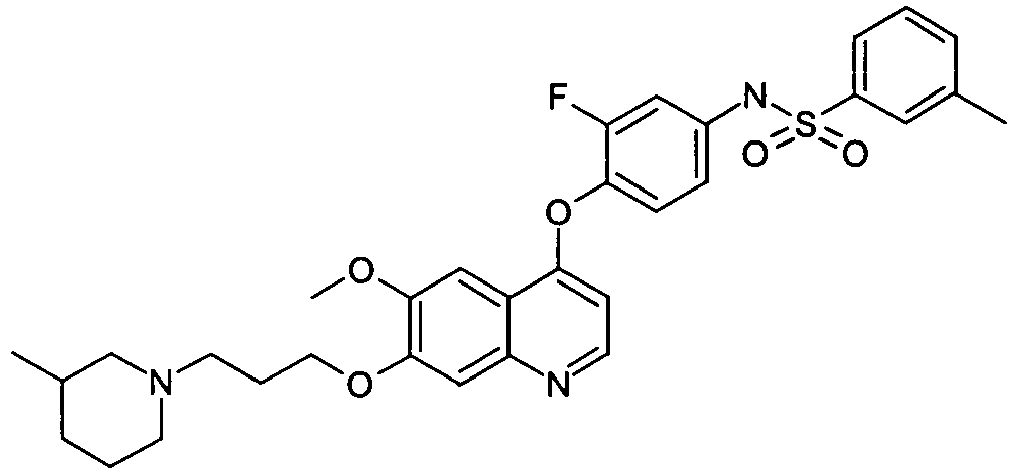
- C32H36FN3O5S Mw. 593.72
- LC/MS purity: 98 %, m/z 592 [M-H]-, 594 [M+H]+ Rt. 2.85 min. (Method A)
- 1H NMR (300 MHz, DMSO-d6): 10.2 (bs, 1H), 8.44 (d, 1H), 7.63 (s, 1H), 7.60 (d, 1 H), 7.47 (m, 3H), 7.38 (s, 1 H), 7.31 (s, 1 H), 7.12 (d, 1 H), 6.95 (d, 1 H), 6.34 (d, 1H), 4.18 (t, 2H), 3.91 (s, 3H), 2.80 (m, 2H), 2.46 (m, 2H), 2.37 (s, 3H), 1.96 (m, 2H), 1.85 (m, 1 H), 1.60 (m, 4H), 1.46 (m, 1 H), 0.93 (m, 1 H), 0.84 (d, 3H)
- Melting point: 168-170 °C.
- Yield: 37 %
-

- C32H36FN3O6S Mw. 609.72
- LC/MS purity: 100 %, m/z 608 [M-H]-, 610 [M+H]+ Rt. 2.71 min. (Method A)
- 1H NMR (300 MHz, DMSO-d6): 10.3 (bs, 1 H), 8.43 (d, 1H), 7.83 (d, 1 H), 7.61 (t, 1 H), 7.45 (s, 1 H), 7.36 (s, 1 H), 7.29 (t, 1 H), 7.20 (d, 1 H), 7.08 (m, 2H), 6.98 (d, 1 H), 6.29 (d, 1 H), 4.17 (t, 2H), 3.89 (s, 6H), 2.77 (m, 2H), 2.42 (m, 2H), 1.95 (m, 2H), 1.82 (m, 1 H), 1.61 (m, 4H), 1.51 (m, 1 H), 0.93 (m, 1 H), 0.83 (d, 3H)
- Melting point: 175-176 °C.
- Yield: 35 %
-

- C32H32F2N4O5S Mw. 622.70
- LC/MS purity: 99 %, m/z 621 [M-H]-, 623 [M+H]+ Rt. 2.82 min. (Method A)
- 1H NMR (300 MHz, DMSO-d6): 10.2 (bs, 1 H), 8.44 (d, 1 H), 8.22 (d, 1 H), 8.11 (m, 1H), 7.64 (t, 1H), 7.49 (s, 1H), 7.38 (s, 1H), 7.16 (t, 1H), 6.99 (d, 1H), 6.84 (d, 1H), 6.37 (d, 1H), 4.20 (t, 2H), 3.93 (s, 3H), 2.99 (m, 2H), 2.67 (m, 2H), 2.14 (m, 1H), 2.06 (m, 2H), 1.87 (m, 1 H), 1.67 (m, 3H), 1.54 (m, 1 H), 0.93 (m, 1 H), 0.83 (d, 3H) Melting point: 125-127 °C.
- Yield: 8 %
-

- C33H36FN3O5S Mw. 605.73
- LC/MS purity: 98 %, m/z 604 [M-H]-, 606 [M+H]+ Rt. 2.91 min. (Method A)
- 1H NMR (300 MHz, DMSO-d6): 10.5 (bs, 1H), 8.41 (d, 1H), 7.70 (bs, 2H), 7.48 (s, 1H), 7.42-7.24 (m, 7H), 7.17 (d, 1 H), 7.03 (d, 1H), 6.37 (d, 1H), 4.17 (bs, 2H), 3.93 (s, 3H), 2.77 (m, 2H), 2.43 (m, 2H), 1.96 (m, 2H), 1.84 (m, 1 H), 1.59 (m, 4H), 1.48 (m, 1 H), 0.92 (m, 1 H), 0.83 (d, 3H)
- Melting point: 104-106 °C.
- Yield: 27 %
-

- C34H35FN4O5S Mw. 630.74
- LC/MS purity: 98 %, m/z 629 [M-H]-, 631 [M+H]+ Rt. 2.62 min. (Method A)
- 1H NMR (300 MHz, DMSO-d6): 10.5 (bs, 1H), 9.15 (d, 1H), 8.55 (d, 1H), 8.45 (d, 1 H), 8.39 (d, 1 H), 8.33 (d, 1 H), 7.74 (m, 2H), 7.40 (s, 1 H), 7.34 (s, 1 H), 7.17 (t, 1H), 7.14 (d, 1 H), 6.97 (d, 1 H), 6.21 (d, 1 H), 4.15 (t, 2H), 3.87 (s, 3H), 2.78 (m, 2H), 2.43 (m, 2H), 1.94 (m, 2H), 1.82 (m, 1 H), 1.58 (m, 5H), 0.89 (m, 1 H), 0.82 (d, 3H)
- Melting point: 190-191 °C.
- Yield: 25 %
-

- C32H34Cl2FN3O6S Mw. 678.61
- LC/MS purity: 97 %, m/z 676 [M-H]-, 678 [M+H]+ Rt. 3.19 min. (Method A)
- 1H NMR (300 MHz, DMSO-d6): 10.5 (bs, 1H), 8.44 (d, 1H), 7.90 (d, 1H), 7.76 (d, 1 H), 7.49 (s, 1 H), 7.38 (s, 1 H), 7.22 (t, 1 H), 7.04 (dd, 1 H), 6.89 (d, 1 H), 6.36 (d, 1 H), 4.19 (t, 2H), 3.92 (s, 3H), 3.91 (s, 3H), 2.96 (m, 2H), 2.64 (m, 2H), 2.03 (m, 3H), 1.82 (m, 1 H), 1.66 (m, 3H), 1.51 (m, 1 H), 0.92 (m, 1 H), 0.86 (d, 3H)
- Melting point: 145-146 °C.
- Yield: 17 %
-
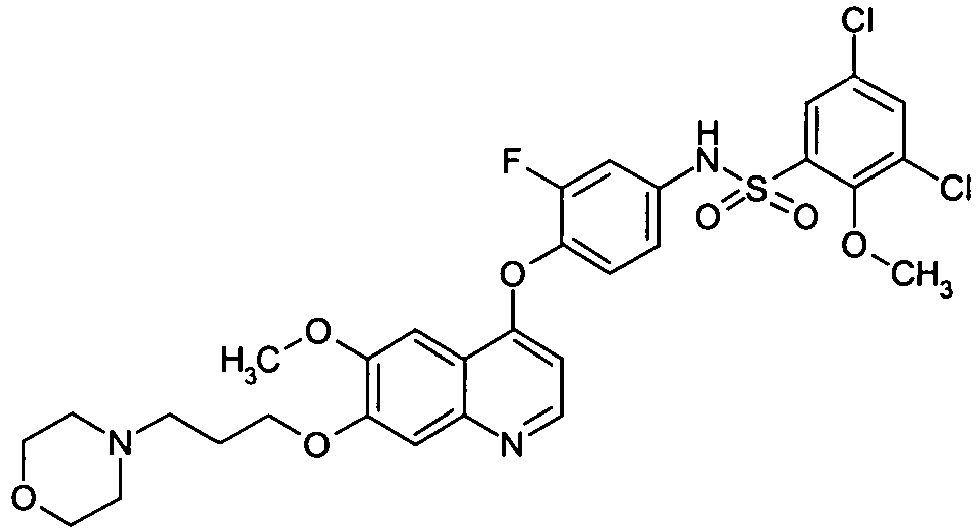
- C30H30Cl2FN3O7S Mw. 666.56
- LC/MS purity: 98 %, m/z 664 [M-H]-, 666 [M+H]+ Rt. 3.00 min. (Method A)
- 1H NMR (300 MHz, DMSO-d6): 10.8 (bs, 1H), 8.44 (d, 1H), 8.00 (d, 1H), 7.79 (d, 1 H), 7.48 (s, 1 H), 7.38 (s, 1 H), 7.32 (t, 1 H), 7.12 (dd, 1 H), 6.98 (d, 1 H), 6.36 (d, 1H), 4.19 (t, 2H), 3.94 (s, 3H), 3.92 (s, 3H), 3.59 (m, 4H), 2.49 (m, 2H), 2.42 (m, 4H), 1.97 (m, 2H)
- Melting point: 189-191 °C.
- Yield: 24 %
-

- C29H28F3N3O6S Mw. 603.62
- LC/MS purity: 98 %, m/z 602 [M-H]-, 604 [M+H]+ Rt. 2.95 min. (Method B)
- 1H NMR (300 MHz, DMSO-d6): 11 (bs, 1H), 8.44 (d, 1H), 7.68 (m, 1H), 7.48 (s, 1H), 7.38 (s, 1H), 7.36-7.24 (m, 3H), 7.14 (dd, 1H), 7.00 (d, 1H), 6.34 (d, 1H), 4.19 (t, 2H), 3.92 (s, 3H), 3.59 (m, 4H), 2.49 (m, 2H), 2.41 (m, 4H), 1.96 (m, 2H)
- Melting point: 190-192 °C.
- Yield: 23 %
-

- C31H31F4N3O6S Mw. 649.67
- LC/MS purity: 98 %, m/z 648 [M-H]-, 650 [M+H]+ Rt. 2.90 min. (Method A)
- 1H NMR (300 MHz, DMSO-d6): 10.5 (bs, 1H), 8.44 (d, 1H), 8.00 (d, 1H), 7.70 (t, 1 H), 7.52 (m, 2H), 7.48 (s, 1 H), 7.38 (s, 1 H), 7.22 (t, 1 H), 7.05 (dd, 1 H), 6.89 (d,
- 1 H), 6.33 (d, 1 H), 4.19 (t, 2H), 3.93 (s, 3H), 2.62 (m, 2H), 2.56 (m, 4H), 2.03 (m, 2H), 1.55 (m, 4H), 1.43 (m, 2H)
- Melting point: 156-158 °C.
- Yield: 26 %
-

- C27H34FN3O6S Mw. 547.65
- LC/MS purity: 98 %, m/z 546 [M-H]-, 548 [M+H]+ Rt. 3.59 min.
- 1H NMR (300 MHz, DMSO-d6): 10.14 (s, 1H), 8.47 (d, 1H), 7.51 (s, 1 H), 7.44 (t, 1 H), 7.40 (s, 1 H), 7.27 (dd, 1H), 7.14 (d, 1 H), 6.46 (d, 1 H), 4.20 (t, 2H), 3.94 (s, 3H), 3.59 (m, 4H), 3.20 (m, 2H), 2.47 (m, 2H), 2.39 (m, 4H), 1.98 (m, 2H), 1.68 (m, 2H), 1.39 (m, 2H), 0.87 (t, 3H)
- Melting point: 98-100 °C.
- Yield: 18 %
-

- C28H26F3N3O5S Mw. 573.60
- LC/MS purity: %, m/z [M-H]-, [M+H]+ Rt. min. (Method B)
- Yield: 34 %
-

- C28H27F2N3O6S Mw. 571.60
- LC/MS purity: 98 %, m/z 570 [M-H]-, 572 [M+H]+, Rt. 3.06 min. (Method B)
- 1H NMR (300 MHz, DMSO-d6): 11 (bs, 1H), 8.44 (s, 1 H), 7.90 (s, 1H), 7.73 (s, 1H), 7.38 (m, 5H), 7.15 (d, 1 H), 7.03 (d, 1 H), 6.33 (s, 1 H), 4.27 (bs, 2H), 3.90 (s, 3H), 3.59 (s, 4H), 2.79 (bs, 2H), 2.52 (s, 4H)
- Melting point: 168-169°C.
- Yield: 67 %
-

- C28H26F3N3O6S Mw. 589.60
- LC/MS purity: 97 %, m/z 588 [M-H]-, 590 [M+H]+ Rt. 2.88 min. (Method B)
- 1H NMR (300 MHz, DMSO-d6): 11 (bs, 1 H), 8.45 (s, 1H), 7.71 (s, 1H), 7.47 (s, 1 H), 7.42 (s, 1 H), 7.36-7.26 (m, 5H), 7.16 (d, 1 H), 7.03 (d, 1 H), 6.35 (s, 1 H), 4.27 (bs, 2H), 3.91 (s, 3H), 3.60 (s, 4H), 2.80 (bs, 2H), 2.57 (s, 4H)
- Melting point: 182-183°C.
- Yield: 32 %
-

- C30H30F3N3O6S Mw. 617.65
- LC/MS purity: 97 %, m/z 616 [M-H]-, 618 [M+H]+ Rt. 3.22 min. (Method B)
- 1H NMR (300 MHz, DMSO-d6): 11.1 (bs, 1H), 8.44 (d, 1H), 7.67-7.53 (m, 3H), 7.47 (s, 1H), 7.38 (s, 1H), 7.30 (t, 1H), 7.12 (d, 1 H), 6.98 (d, 1H), 6.35 (d, 1H), 4.17 (t, 2H), 3.92 (s, 3H), 3.58 (m, 4H), 2.39 (m, 6H), 1.82 (m, 2H), 1.64 (m, 2H)
- Melting point:156-158°C.
- Yield: 29 %
-

- C29H28F3N3O5S Mw. 587.62
- LC/MS purity: %, m/z [M-H]-, [M+H]+ Rt. min. (Method B)
- Yield: 30 %
-

- C30H30F4N4O4S Mw. 618.66
- LC/MS purity: 97 %, m/z 617 [M-H]-, 619 [M+H]+ Rt. 3.18 min. (Method B)
- 1H NMR (300 MHz, DMSO-d6): 10 (bs, 1H), 8.50 (d, 1H), 8.15 (d, 1H), 7.97-7,78 (m, 4H), 7.52 (m, 1 H), 7.43(dd, 1 H), 7.27 (t, 1 H), 7.05 (d, 1 H), 6.93 (d, 1 H), 6.49 (d, 1 H), 4.16 (t, 2H), 2.44 (m, 10H), 2.19 (s, 3H), 1.95 (m, 2H)
- Melting point: 101-103°C.
- Yield: 27 %
-

- C31H32F4N4O5S Mw. 648.68
- LC/MS purity: 97 %, m/z 647 [M-H]-, 649 [M+H]+ Rt. 3.07 min. (Method B)
- 1H NMR (300 MHz, DMSO-d6): 10 (bs, 1H), 8.43 (d, 1H), 8.13 (d, 1H), 7.95 (d, 1H), 7.80 (m, 2H), 7.47 (s, 1 H), 7.38(s, 1 H), 7.25 (t, 1 H), 7.05 (d, 1 H), 6.91 (d, 1 H), 6.35 (d, 1 H), 4.15 (t, 2H), 3.93 (s, 3H), 2.44 (m, 10H), 2.17 (s, 3H), 1.96 (m, 2H)
- Melting point: 113-115°C.
- Yield: 23 %
-

- C31H32ClF3N4O5S Mw. 665.14
- LC/MS purity: 99 %, m/z 663 [M-H]-, 665 [M+H]+ Rt. 3.17 min. (Method B)
- 1H NMR (300 MHz, DMSO-d6): 11 (bs, 1H), 8.43 (d, 1H), 8.13 (d, 1H), 7.93 (d, 1 H), 7.80 (m, 2H), 7.47 (s, 1 H), 7.37 (s, 1 H), 7.22 (m, 2H), 7.04 (d, 1 H), 6.26 (s, 1 H), 4.18 (bs, 2H), 3.91 (s, 3H), 2.48 (s, 10H), 2.24 (s, 3H), 1.96 (m, 2H).
- Melting point: 103-105°C.
- Yield: 26 %
-

- C30H30Cl2F2N4O5S Mw. 667.56
- LC/MS purity: %, m/z [M-H]-, [M+H]+ Rt. min. (Method B)
- Yield: 20 %
-

- C33H36F3N3O5S Mw. 643.73
- LC/MS purity: 99 %, m/z 642 [M-H]-, 644 [M+H]+ Rt. 4.03 min. (Method B)
- 1H NMR (300 MHz, DMSO-d6): 10.6 (bs, 1 H), 8.40 (d, 1 H), 8.12 (d, 1 H), 7.89 (d, 1 H), 7.85 (m, 2H), 7.50 (s, 1 H), 7.36 (s, 1 H), 7.09 (s, 1 H), 7.02 (m, 2H), 6.17 (d, 1 H), 4.17 (t, 2H), 3.91 (s, 3H), 2.87 (m, 2H), 2.47 (m, 2H), 2.01 (m, 3H), 1.93 (m, 4H), 1.58 (m, 2H), 1.33 (m, 1 H), 1.18 (m, 2H), 0.88 (d, 3H)
- Melting point: 165-167°C.
- Yield: 25 %
-

- C32H35F2N3O6S Mw. 627.71
- LC/MS purity: %, m/z [M-H]-, [M+H]+ Rt. min. (Method B)
- Yield: 28 %
-

- C32H33F4N3O5S Mw. 647.69
- LC/MS purity: 98 %, m/z 646 [M-H]-, 648 [M+H]+ Rt. 3.36 min. (Method B)
- 1H NMR (300 MHz, DMSO-d6): 10 (bs, 1 H), 8.44 (d, 1 H), 8.13 (d, 1 H), 7.90 (d, 1 H), 7.75 (m, 2H), 7.48 (s, 1 H), 7.38 (s, 1 H), 7.18 (t, 1 H), 6.97 (dd, 1 H), 6.84 (d, 1 H), 6.35 (d, 1 H), 4.19 (t, 2H), 3.92 (s, 3H), 2.99 (m, 2H), 2.63 (m, 2H), 2.40 (m, 1 H), 2.00 (m, 2H), 1.56 (m, 4H), 1.30 (m, 2H), 1.09 (d, 3H).
- Melting point: 115-116°C.
- Yield: 20 %
-

- C31H33F3N4O5S Mw. 630.69
- LC/MS purity: 98 %, m/z 629 [M-H]-, 631 [M+H]+ Rt. 3.41 min. (Method B)
- 1H NMR (300 MHz, DMSO-d6): 10 (bs, 1 H), 8.41 (d, 1 H), 8.03 (d, 1 H), 7.88 (d, 1 H) 7.74 (bs, 2H), 7.36 (bs, 2H), 7.26 (t, 1 H), 6.91 (d, 1 H), 6.78 (s, 1 H), 6.72 (d, 1 H), 6.30 (d, 1 H), 4.18 (bs, 2H), 3.87 (s, 3H), 2.36 (m, 10H), 2.17 (s, 3H), 1.96 (m, 2H).
- Melting point: 155-156°C.
- Yield: 27 %
-

- C29H30FN3O7S Mw. 583.64
- LC/MS purity: 98 %, m/z 582 [M-H]-, 584 [M+H]+ Rt. 3.46 min. (Method B)
- 1H NMR (300 MHz, DMSO-d6): 10.40 (s, 1H), 8.43 (d, 1H), 7.83 (d, 1H), 7.62 (t, 1H), 7.46 (s, 1H), 7.41 (s, 1H), 7.30 (t, 1H), 7.21 (d, 1H), 7.13-6.90 (m, 3H), 6.29 (d, 1 H), 4.26 (t, 2H), 3.90 (s, 6H), 3.60 (t, 4H), 2.78 (t, 2H), 2.52 (t, 4H)
- Melting point: 182-183°C.
- Yield: 41 %
-

- C28H26Cl2FN3O6S Mw. 622.50
- LC/MS purity: 98 %, m/z 622 [M-H]-, 624 [M+H]+ Rt. 3.12 min. (Method B)
- 1H NMR (300 MHz, DMSO-d6): 11.21 (bs, 1H), 8.44 (s, 1H), 7.66 (m, 2H), 7.59 (d, 1H), 7.47 (s, 1H), 7.42 (s, 1H), 7.34 (d, 1H), 7.15 (d, 1H), 7.00 (d, 1H), 6.33 (s, 1 H), 4.27 (bs, 2H), 3.91 (s, 3H), 3.59 (s, 4H), 2.80 (bs, 2H), 2.52 (s, 4H).
- Melting point: 210-211°C.
- Yield: 54 %
-

- C26H26FN3O6S2 Mw. 559.64
- LC/MS purity: 98 %, m/z 558 [M-H]-, 560 [M+H]+ Rt. 2.85 min. (Method B)
- 1H NMR (300 MHz, DMSO-d6): 10.5 (bs, 1H), 8.47 (d, 1H), 8.04 (s, 1H), 7.70 (s, 2H), 7.48 (s, 1 H), 7.43 (s, 1 H), 7.30 (t, 1 H), 7.13 (d, 1 H), 6.97 (d, 1 H), 6.36 (d, 1 H), 4.26 (t, 2H), 3.93 (s, 3H), 3.59 (s, 4H), 2.81 (m, 2H), 2.56 (bs, 4H).
- Melting point: 146-147°C.
- Yield: 55 %
-

- C28H26Cl2FN3O6S Mw. 622.50
- LC/MS purity: 97 %, m/z 622 [M-H]-, 624 [M+H]+ Rt. 3.28 min. (Method B)
- 1H NMR (300 MHz, DMSO-d6): 11.1 (bs, 1 H), 8.44 (s, 1H), 8.03 (s, 1H), 7.71 (s, 2H), 7.47 (s, 1H), 7.42 (s, 1 H), 7.33 (t, 1H), 7.12 (d, 1 H), 6.99 (d, 1H), 6.34 (s, 1 H), 4.27 (bs, 2H), 3.91 (s, 3H), 3.59 (s, 4H), 2.80 (bs, 2H), 2.53 (s, 4H)
- Melting point: 194-196°C.
- Yield: 74 %
-

- C26H28FN5O6S Mw. 557.60
- LC/MS purity: 98 %, m/z 556 [M-H]-, 558 [M+H]+ Rt. 2.66 min. (Method B)
- 1H NMR (300 MHz, DMSO-d6): 10.74 (s, 1H), 8.45 (s, 1H), 7.88 (s, 1H), 7.49 (s, 1H), 7.43 (s, 1H), 7.36 (t, 1 H), 7.20 (d, 1 H), 7.07 (d, 1H), 6.68 (s, 1 H), 6.38 (s, 1 H), 4.27 (bs, 2H), 3.91 (s, 6H), 3.59 (s, 4H), 2.79 (bs, 2H), 2.53 (s, 4H)
- Melting point: 213-214°C.
- Yield: 69 %
-

- C28H27ClFN3O6S Mw. 588.05
- LC/MS purity: 96 %, m/z 586 [M-H]-, 588 [M+H]+ Rt. 3.24 min. (Method B)
- 1H NMR (300 MHz, DMSO-d6): 11.01 (bs, 1 H), 8.43 (s, 1 H), 8.01 (d, 1 H), 7.67 (s, 2H), 7.56 (s, 1 H), 7.46 (s, 1 H), 7.42 (s, 1 H), 7.34 (t, 1 H), 7.13 (d, 1 H), 7.02 (d, 1 H), 6.32 (s, 1 H), 4.26 (bs, 2H), 3.90 (s, 3H), 3.59 (s, 4H), 2.79 (bs, 2H), 2.51 (s, 4H)
- Melting point: 180-181°C.
- Yield: 76 %
-

- C28H27FN4O8S Mw. 598.61
- LC/MS purity: 97 %, m/z 597 [M-H]-, 599 [M+H]+ Rt. 2.88 min. (Method B)
- 1H NMR (300 MHz, DMSO-d6): 11 (bs, 1H), 8.45 (s, 1H), 8.02 (s, 1H), 7.93 (s, 1H), 7.83 (s, 2H), 7.48 (s, 1H), 7.43 (s, 1H), 7.32 (t, 1H), 7.11 (d, 1H), 6.97 (d, 1H), 6.37 (s, 1 H), 4.27 (bs, 2H), 3.92 (s, 3H), 3.59 (s, 4H), 2.81 (bs, 2H), 2.54 (s, 4H)
- Melting point: 129-131°C.
- Yield: 74 %
-

- C30H31F3N4O5S Mw. 616.66
- LC/MS purity: 97 %, m/z 615 [M-H]-, 617 [M+H]+ Rt. 2.77 min. (Method B)
- 1H NMR (300 MHz, DMSO-d6): 10.5 (bs, 1H), 8.44 (d, 1 H), 7.6 (t, 1H), 7.48 (s, 1 H), 7.37 (s, 1 H), 7.19 (m, 3H), 7.05 (d, 1 H), 6.90 (d, 1 H), 6.34 (d, 1 H), 4.18 (bs, 2H), 3.92 (s, 3H), 2.48 (s, 10H), 2.26 (s, 3H), 1.97 (bs, 2H).
- Melting point: 199-201°C.
- Yield: 41 %
-

- C30H32ClFN4O5S Mw. 615.12
- LC/MS purity: 95 %, m/z 613 [M-H]-, 615 [M+H]+ Rt. 3.01 min. (Method B)
- 1H NMR (300 MHz, DMSO-d6): 11.2 (bs, 1H), 8.43 (dd, 1H), 7.86 (t, 1H), 7.65 (s, 1 H), 7.36 (m, 6H), 7.09 (dd, 1 H), 6.23 (d, 1 H), 4.17 (s, 2H), 3.91 (s, 3H), 2.41 (s, 10H), 2.19 (s, 3H), 1.96 (s, 2H).
- Melting point: 170-171°C.
- Yield: 52 %
-

- C30H31ClF2N4O5S Mw. 633.11
- LC/MS purity: 96 %, m/z 631 [M-H]-, 633 [M+H]+ Rt. 2.94 min. (Method B)
- 1H NMR (300 MHz, DMSO-d6): 10.2 (bs, 1 H), 8.42 (d, 1 H), 7.59 (m, 1 H), 7.48 (s, 1 H), 7.40 (m, 2H), 7.37 (s, 1 H), 7.20 (m, 2H), 7.03 (d, 1 H), 6.25 (d, 1 H), 4.18 (bs, 2H), 3.92 (s, 3H), 2.49 (s, 10H), 2.28 (s, 3H), 1.97 (bs, 2H).
- Melting point: 118-121°C.
- Yield: 68 %
-

- C32H32FN3O5S2 Mw. 621.75
- LC/MS purity: 98 %, m/z 620 [M-H]-, 622 [M+H]+ Rt. 3.56 min. (Method B)
- 1H NMR (300 MHz, DMSO-d6): 10.5 (s, 1H), 8.53 (s, 1H), 8.41 (d, 1H), 8.26 (d, 1 H), 8.08 (d, 1 H), 7.52 (m, 4H), 7.35 (s, 1 H), 7.20 (t, 1 H), 7.08 (d, 1 H), 6.90 (d, 1 H), 4.16 (s, 2H), 3.90 (s, 3H), 2.47 (s, 6H), 1.98 (s, 2H), 1.52 (s, 4H), 1.40 (s, 2H). Melting point: 128-130°C.
- Yield: 65 %
-
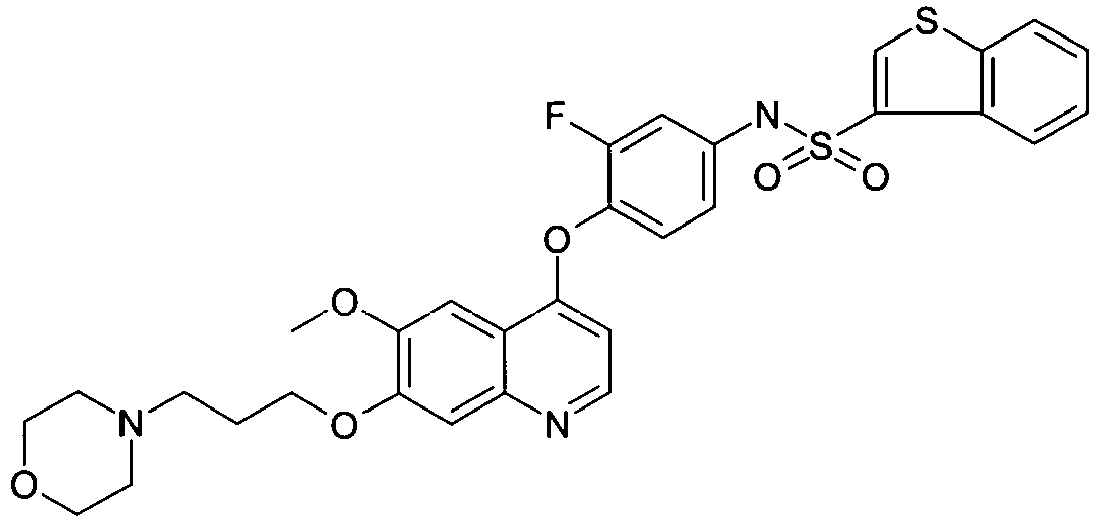
- C31H30FN3O6S2 Mw. 623.72
- LC/MS purity: 99 %, m/z 622 [M-H]-, 624 [M+H]+ Rt. 3.54 min. (Method B)
- 1H NMR (300 MHz, DMSO-d6): 11 (bs, 1H), 8.66 (d, 1H), 8.42 (d, 1H), 8.24 (d, 1 H), 8.12 (d, 1H), 7.56 (m, 2H), 7.44 (s, 1H), 7.37 (s, 1H), 7.28 (t, 1H), 7.14 (d, 1 H), 6.97 (d, 1 H), 6.29 (s, 1 H), 4.18 (s, 2H), 3.90 (s, 3H), 3.58 (s, 4H), 2.47 (s, 2H), 2.38 (s, 4H), 1.96 (s, 2H).
- Melting point: 196-197°C.
- Yield: 64 %
-

- C33H34FN3O5S2 Mw. 635.78
- LC/MS purity: 98 %, m/z 634 [M-H]-, 636 [M+H]+ Rt. 3.81 min. (Method B)
- 1H NMR (300 MHz, DMSO-d6): 10.9 (bs, 1H), 8.58 (s, 1H), 8.41 (d, 1H), 8.24 (d, 1 H), 8.09 (d, 1 H), 7.52 (m, 3H), 7.36 (s, 1 H), 7.23 (t, 1 H), 7.09 (d, 1 H), 6.93 (d, 1 H), 6.29 (s, 1 H), 4.17 (s, 2H), 3.90 (s, 3H), 2.92 (d, 2H), 2.02 (m, 4H), 1.60 (s, 2H), 1.35 (bs, 1 H), 1.11 (m, 4H), 0.88 (s, 3H).
- Melting point: 132-135°C.
- Yield: 61 %
-
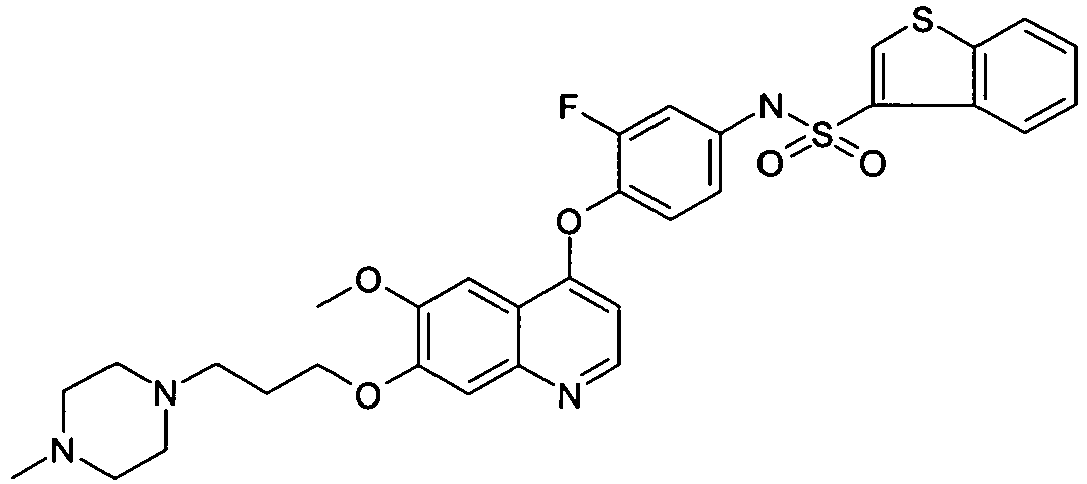
- C32H33FN4O5S2 Mw. 636.77
- LC/MS purity: 98 %, m/z 635 [M-H]-, 637 [M+H]+ Rt. 3.29 min. (Method B)
- 1H NMR (300 MHz, DMSO-d6): 10.8 (bs, 1H), 8.58 (s, 1H), 8.42 (d, 1H), 8.24 (d, 1 H), 8.09 (d, 1 H), 7.52 (m, 3H), 7.45 (s, 1 H), 7.35 (s, 1 H), 7.09 (d, 1 H), 6.93 (d, 1H), 6.29 (s, 1H), 4.16 (s, 2H), 3.90 (s, 3H), 2.43 (m, 10H), 2.18 (s, 3H), 1.95 (s, 2H).
- Melting point: 112-114°C.
- Yield: 73 %
-

- C32H33ClN4O5S2 Mw. 653.22
- LC/MS purity: 99 %, m/z 651 [M-H]-, 653 [M+H]+ Rt. 3.36 min. (Method B)
- 1H NMR (300 MHz, DMSO-d6): 11 (bs, 1 H), 8.56 (s, 1 H), 8.40 (t, 1 H), 8.23 (d, 1 H), 8.09 (d, 1 H), 7.52 (m, 2H), 7.45 (s, 1 H), 7.35 (s, 1 H), 7.24 (m, 2H), 7.09 (d, 1 H), 6.19 (s, 1 H), 4.17 (s, 2H), 3.89 (s, 3H), 2.39 (bs, 10H), 2.19 (s, 3H), 1.95 (s, 2H).
- Melting point: 98-101°C.
- Yield: 75 %
-

- C30H31ClF2N4O5S Mw. 633.11
- LC/MS purity: 99 %, m/z 631 [M-H]-, 633 [M+H]+ Rt. 2.84 min. (Method B)
- 1H NMR (300 MHz, DMSO-d6): 10.8 (bs, 1 H), 8.42 (s, 1 H), 7.62 (s, 1 H), 7.48 (s, 1 H), 7.37 (s, 1 H), 7.23 (m, 4H), 7.06 (d, 1 H), 6.24 (s, 1 H), 4.18 (s, 2H), 3.91 (s, 3H), 2.49 (s, 10H), 2.29 (s, 3H), 1.97 (s, 2H).
- Melting point: 122-124°C.
- Yield: 48 %
-

- C30H31Cl3N4O5S Mw. 666.02
- LC/MS purity: 98 %, m/z 665 [M-H]-, 667 [M+H]+ Rt. 3.12 min. (Method B)
- 1H NMR (300 MHz, DMSO-d6): 11 (bs, 1H), 8.41 (s, 1H), 7.58 (s, 2H), 7.47 (s, 2H), 7.37 (s, 1 H), 7.25 (s, 2H), 7.04 (s, 1 H), 6.23 (s, 1 H), 4.18 (s, 2H), 3.91 (s, 3H), 2.50 (s, 10H), 2.29 (s, 3H), 1.97 (s, 2H).
- Melting point: 171-172°C.
- Yield: 34 %
-

- C30H32F2N4O5S Mw. 598.67
- LC/MS purity: 98 %, m/z 597 [M-H]-, 599 [M+H]+ Rt. 2.38 min. (Method A)
- LC/MS purity: 99 %, m/z 631 [M-H]-, 633 [M+H]+ Rt. 2.84 min. (Method B)
- 1H NMR (300 MHz, DMSO-d6): 11 (bs, 1H), 8.39 (d, 1H), 7.42 (bs, 2H), 7.35 (m, 3H), 7.17 (t, 1 H), 6.82 (d, 1 H), 6.77 (s, 1 H), 6.57 (d, 1 H), 6.29 (d, 1 H), 4.18 (bs, 2H), 3.90 (s, 3H), 2.40 (s, 10H), 2.16 (s, 3H), 1.96 (s, 2H).
- Melting point: 186-188°C.
- Yield: 52 %
-

- C25H22F3N3O5S.HCl Mw. 533.53
- LC/MS purity: 99 %, m/z 532 [M-H]-, 534 [M+H]+ Rt. 2.71 min. (Method B)
- 1H NMR (300 MHz, DMSO-d6): 11.37 (s, 1 H), 8.77 (bs, 1H), 8.09 (bs, 2H), 7.61 (m, 4H), 7.28 (d, 1 H), 7.15 (d, 1 H), 6.85 (bs, 1 H), 4.33 (bs, 2H), 4.02 (s, 3H), 3.57 (s, 2H), 3.01 (bs, 2H), 2.19 (bs, 2H).
- Melting point: 188-190°C.
- Yield: 85 %
-

- C30H32F2N4O5S Mw. 598.67
- LC/MS purity: 98 %, m/z 597 [M-H]-, 599 [M+H]+ Rt. 2.38 min. (Method A)
- LC/MS purity: 99 %, m/z 631 [M-H]-, 633 [M+H]+ Rt. 2.84 min. (Method B)
- 1H NMR (300 MHz, DMSO-d6): 11 (bs, 1 H), 8.39 (d, 1 H), 7.42 (bs, 2H), 7.35 (m, 3H), 7.17 (t, 1H), 6.82 (d, 1H), 6.77 (s, 1H), 6.57 (d, 1H), 6.29 (d, 1H), 4.18 (bs, 2H), 3.90 (s, 3H), 2.40 (s, 10H), 2.16 (s, 3H), 1.96 (s, 2H).
- Melting point: 186-188°C.
- Yield: 52 %
-

- C30H31Cl3N4O5S Mw. 666.02
- LC/MS purity: 99%, m/z 664 [M-H]-, 666 [M+H]+ Rt. 3.39 min. (Method B)
- 1H NMR (300 MHz, DMSO-d6): 10.5 (bs, 1 H), 8.42 (d, 1 H), 7.97 (s, 1 H), 7.62 (bs, 2H), 7.48 (s, 1H), 7.37 (s, 1H), 7.19 (m, 2H), 7.00 (d, 1H), 6.25 (d, 1H), 4.17 (t, 2H), 3.91 (s, 3H), 2.49 (s, 10H), 2.32 (s, 3H), 1.97 (s, 2H).
- Melting point: 144-145°C.
- Yield: 66 %
-

- C30H32F2N4O5S Mw. 598.67
- LC/MS purity: 98%, m/z 597 [M-H]-, 599 [M+H]+ Rt. 3.04 min. (Method B)
- 1H NMR (300 MHz, DMSO-d6): 10.8 (bs, 1 H), 8.43 (d, 1 H), 7.64 (m, 1 H), 7.40 (s, 1 H), 7.37 (s, 1 H), 7.31 (t, 1 H), 7.18 (t, 2H), 6.97 (d, 1 H), 6.88 (s, 1 H), 6.80 (s, 1 H), 6.20 (d, 1 H), 4.18 (t, 2H), 3.89 (s, 3H), 2.46 (t, 2H), 2.41 (s, 8H), 2.20 (s, 3H), 1.96 (t, 2H).
- Melting point: 171-172°C.
- Yield: 58 %
-
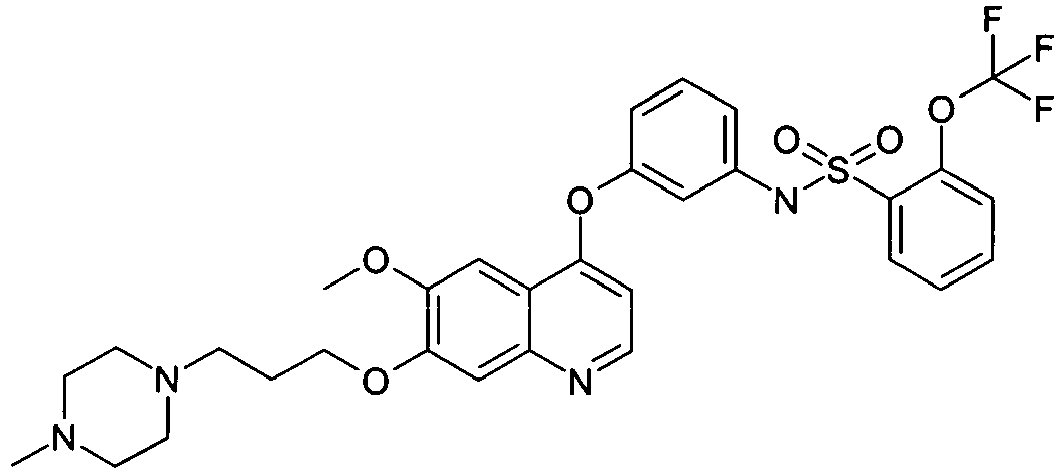
- C31H33F3N4O6S Mw. 646.69
- LC/MS purity: 99%, m/z 645 [M-H]-, 647 [M+H]+ Rt. 3.58 min. (Method B)
- 1H NMR (300 MHz, DMSO-d6): 11 (bs, 1H), 8.43 (d, 1H), 7.88 (d, 1H), 7.72 (t, 1H), 7.38 (m, 5H), 6.95 (d, 1 H), 6.70 (m, 2H), 6.26 (d, 1 H), 4.18 (t, 2H), 3.88 (s, 3H), 2.44 (m, 10H), 2.17 (s, 3H), 1.96 (t, 2H).
- Melting point: 164-166°C.
- Yield: 60 %
-

- C30H32Cl2N4O5S Mw. 631.58
- LC/MS purity: 99 %, m/z 629 [M-H]-, 631 [M+H]+ Rt. 3.45 min. (Method B)
- 1H NMR (300 MHz, DMSO-d6): 11.2 (bs, 1H), 8.43 (d, 1H), 7.90 (m, 1 H), 7.65 (m, 2H), 7.40 (s, 1 H), 7.37 (s, 1 H), 7.31 (t, 1 H), 6.96 (d, 1 H), 6.80 (m, 2H), 6.24 (d, 1 H), 4.18 (t, 2H), 3.89 (s, 3H), 2.47 (m, 10H), 2.24 (s, 3H), 1.98 (t, 2H).
- Melting point: 111-113°C.
- Yield: 55 %
-
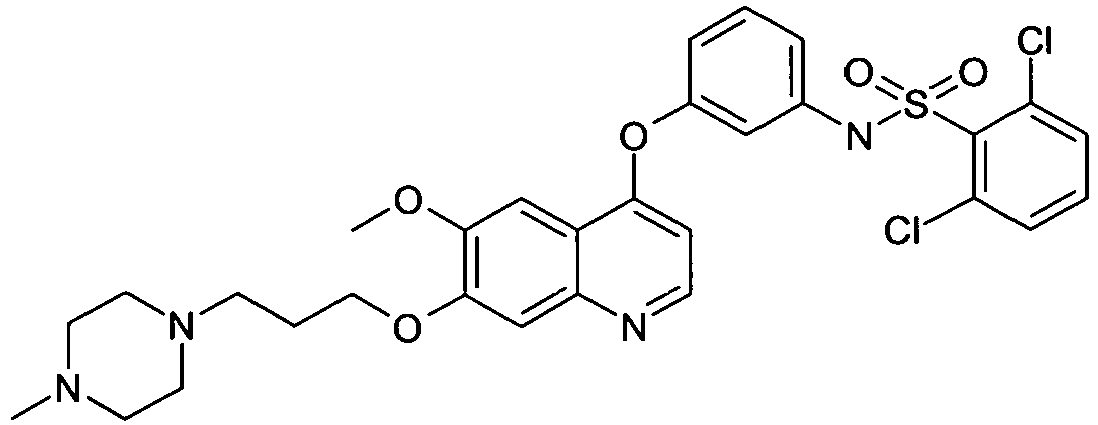
- C30H32Cl2N4O5S Mw. 631.58
- LC/MS purity: 99 %, m/z 629 [M-H]-, 631 [M+H]+ Rt. 3.35 min. (Method B)
- 1H NMR (300 MHz, DMSO-d6): 10.2 (bs, 1 H), 8.42 (d, 1 H), 7.52 (m, 3H), 7.37 (s, 2H), 7.30 (t, 1 H), 6.93 (d, 1 H), 6.81 (s, 1H), 6.79 (d, 1H), 6.23 (d, 1H), 4.16 (t, 2H), 3.87 (s, 3H), 2.45 (m, 10H), 2.19 (s, 3H), 1.97 (m, 2H).
- Melting point: 111-112°C.
- Yield: 51 %
-

- C28H32N4O5S2 Mw. 568.71
- LC/MS purity: 97 %, m/z 567 [M-H]-, 569 [M+H]+ Rt. 2.97 min. (Method A)
- 1H NMR (300 MHz, DMSO-d6): 10.8 (bs, 1 H), 8.47 (d, 1 H), 7.88 (d, 1 H), 7.41 (m, 4H), 7.10 (d, 1 H), 6.98 (d, 1 H), 6.90 (s, 2H), 6.32 (d, 1 H), 4.18 (bs, 2H), 3.90 (s, 3H), 2.40 (m, 10H), 2.17 (s, 3H), 1.96 (bs, 2H).
- Melting point: 188-189°C.
- Yield: 31 %
-

- C28H31ClN4O5S2 Mw. 603.16
- LC/MS purity: 99 %, m/z 601 [M-H]-, 603 [M+H]+ Rt. 3.05 min. (Method B)
- 1H NMR (300 MHz, DMSO-d6): 11 (bs, 1 H), 8.47 (s, 1H), 7.36 (m, 4H), 7.14 (d, 1 H), 7.00 (s, 1 H), 6.86 (s, 2H), 6.36 (d, 1 H), 4.18 (bs, 2H), 3.90 (s, 3H), 2.45 (m, 10H), 2.22 (s, 3H), 1.97 (bs, 2H).
- Melting point: 162-163°C.
- Yield: 52 %
-

- C29H34N4O5S2 Mw. 582.74
- LC/MS purity: 98 %, m/z 581 [M-H]-, 583 [M+H]+ Rt. 3.21 min. (Method B)
- 1H NMR (300 MHz, DMSO-d6): 10.5 (bs, 1H), 8.47 (d, 1H), 7.42 (s, 1H), 7.38 (s, 1 H), 7.34 (t, 1 H), 7.26 (d, 1 H), 7.01 (d, 1 H), 6.85 (m, 3H), 6.36 (d, 1 H), 4.18 (t, 2H), 3.90 (s, 3H), 2.40 (m, 13H), 2.16 (s, 3H), 1.96 (m, 2H).
- Melting point: 147-149°C.
- Yield: 33 %
-

- C30H36N6O6S2 Mw. 640.78
- LC/MS purity: 98 %, m/z 639 [M-H]-, 641 [M+H]+ Rt. 2.68 min. (Method B)
- 1H NMR (300 MHz, DMSO-d6): 12.2 (bs, 1 H), 8.44 (d, 1 H), 7.38 (m, 3H), 7.03 (d, 1 H), 6.92 (s, 2H), 6.30 (d, 1 H), 4.19 (bs, 2H), 3.90 (s, 3H), 2.40 (m, 16H), 2.16 (s, 3H), 1.96 (m, 2H).
- Melting point: 148-150°C.
- Yield: 36 %
-

- C28H32N4O5S2 Mw. 568.71
- LC/MS purity: 98%, m/z 567 [M-H]-, 569 [M+H]+ Rt. 3.11 min. (Method B)
- 1H NMR (300 MHz, DMSO-d6): 10.5 (bs, 1H), 8.47 (d, 1H), 8.10 (s, 1H), 7.70 (d, 1 H), 7.38 (m, 3H), 7.22 (d, 1 H), 7.06 (d, 1 H), 6.88 (s, 2H), 6.30 (d, 1 H), 4.18 (t, 2H), 3.90 (s, 3H), 2.45 (m, 10H), 2.15 (s, 3H), 1.97 (m, 2H).
- Melting point: 176-178°C.
- Yield: 41 %
-

- C28H30Cl2N4O5S2 Mw. 637.60
- LC/MS purity: 98 %, m/z 635 [M-H]-, 637 [M+H]+ Rt. 3.19 min. (Method B)
- 1H NMR (300 MHz, DMSO-d6): 10.3 (bs, 1H), 8.46 (d, 1 H), 7.43 (s, 1H), 7.37 (s, 1 H), 7.31 (t, 1H), 7.17(s, 1 H), 6.94 (d, 1H), 6.80 (m, 2H), 6.36 (d, 1H), 4.18 (t, 2H), 3.91 (s, 3H), 2.44 (m, 10H), 2.22 (s, 3H), 1.97 (m, 2H).
- Melting point: 177-178°C.
- Yield: 35 %
-

- C30H34N4O7S2 Mw. 626.75
- LC/MS purity: 99 %, m/z 625 [M-H]-, 627 [M+H]+ Rt. 2.37 min. (Method A)
- 1H NMR (300 MHz, DMSO-d6): 10.4 (bs, 1H), 8.45 (s, 1H), 7.90 (s, 1H), 7.37 (m, 4H), 6.98 (d, 1 H), 6.85 (bs, 2H), 6.00 (s, 1 H), 4.18 (bs, 2H), 3.89 (s, 3H), 3.80 (s, 3H), 2.38 (m, 10H), 2.15 (s, 3H), 1.96 (bs, 2H).
- Melting point: 84-86°C.
- Yield: 33 %
-
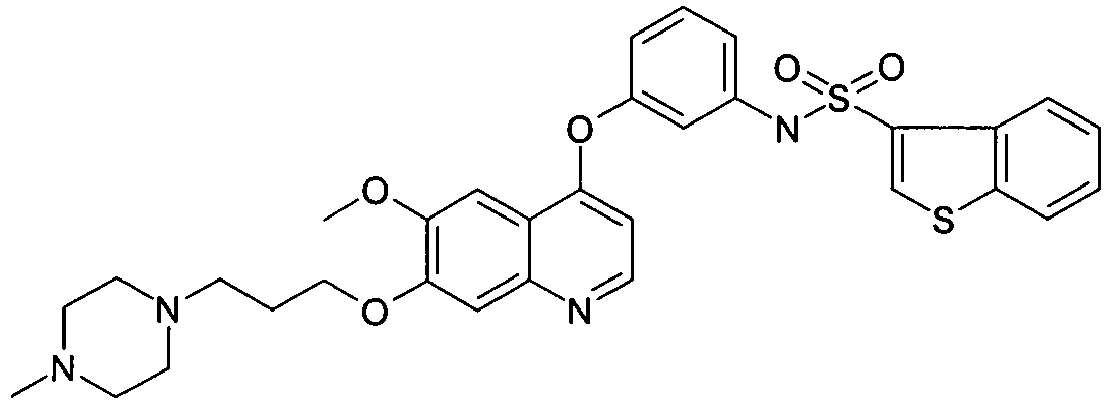
- C32H34N4O5S2 Mw. 618.77
- LC/MS purity: 98%, m/z 617 [M-H]-, 619 [M+H]+ Rt. 3.42 min. (Method B)
- 1H NMR (300 MHz, DMSO-d6): 10.7 (bs, 1H), 8.46 (s, 1H), 8.39 (d, 1H), 8.20 (d, 1 H), 8.09 (d, 1 H), 7.48 (bs, 2H), 7.36 (s, 2H), 7.28 (t, 1 H), 7.01 (d, 1 H), 6.80 (m, 2H), 6.13 (d, 1 H), 4.17 (bs, 2H), 3.87 (s, 3H), 2.40 (m, 10H), 2.16 (s, 3H), 1.95 (bs, 2H).
- Melting point: 91-93°C.
- Yield: 42 %
-

- C28H32N4O6S Mw. 552.65
- LC/MS purity: 98 %, m/z 551 [M-H]-, 553 [M+H]+ Rt. 2.71 min. (Method B)
- 1H NMR (300 MHz, DMSO-d6): 10.5 (bs, 1H), 8.49 (d, 1H), 7.90 (s, 1H), 7.40 (m, 3H), 7.04 (m, 2H), 6.90 (m, 2H), 6.62 (s, 1 H), 6.39 (d, 1 H), 4.19 (bs, 2H), 3.90 (s, 3H), 2.41 (m, 10H), 2.20 (s, 3H), 1.96 (bs, 2H).
- Melting point: 176-177°C.
- Yield: 39 %
-

- C29H35N5O6S Mw. 581.69
- LC/MS purity: 99 %, m/z 580 [M-H]-, 582 [M+H]+ Rt. 2.82 min. (Method B)
- 1H NMR (300 MHz, DMSO-d6): 11 (bs, 1 H), 8.47 (d, 1 H), 7.40 (m, 3H), 6.95 (m, 2H), 6.82 (s, 1 H), 6.38 (d, 1 H), 4.19 (bs, 2H), 3.90 (s, 3H), 2.40 (m, 10H), 2.22 (s, 6H), 2.19 (s, 3H), 1.96 (bs, 2H).
- Melting point: 200-202°C.
- Yield: 38 %
-

- C28H34N6O5S Mw. 566.68
- LC/MS purity: 98 %, m/z 565 [M-H]-, 567 [M+H]+ Rt. 2.72 min. (Method B)
- 1H NMR (300 MHz, DMSO-d6): 10.5 (bs, 1H), 8.48 (d, 1H), 7.82 (s, 1H), 7.43 (s, 1H), 7.38 (s, 1H), 7.33 (t, 1H), 7.02 (s, 1H), 6.96 (s, 1H), 6.84 (d, 1H), 6.55 (d, 1H), 6.38 (d, 1 H), 4.18 (bs, 2H), 3.91 (s, 3H), 3.84 (s, 3H), 2.35 (m, 10H), 2.15 (s, 3H), 1.96 (bs, 2H).
- Melting point: 87-89°C.
- Yield: 26 %
-

- C29H36N6O5S Mw. 580.71
- LC/MS purity: 98%, m/z 579 [M-H]-, 581 [M+H]+ Rt. 2.91 min. (Method B)
- 1H NMR (300 MHz, DMSO-d6): 10.2 (bs, 1H), 8.46 (d, 1H), 8.25 (s, 1H), 7.66 (s, 1 H), 7.44 (s, 1 H), 7.38 (m, 2H), 7.06 (d, 1 H), 6.91 (m, 2H), 6.38 (d, 1 H), 4.15 (bs, 2H), 3.91 (s, 3H), 2.40 (m, 12H), 2.16 (s, 3H), 1.96 (bs, 2H), 1.32 (t, 3H).
- Melting point: 87-90°C.
- Yield: 38 %
-

- C28H34N6O5S Mw. 566.68
- LC/MS purity: 96 %, m/z 565 [M-H]-, 567 [M+H]+ Rt. 2.70 min. (Method B)
- 1H NMR (300 MHz, DMSO-d6): 12.4 (bs, 1H), 10.2 (bs, 1H), 8.47 (d, 1H), 7.59 (bs, 1 H), 7.44 (s, 1 H), 7.37 (s, 1 H), 7.32 (t, 1 H), 7.05 (d, 1 H), 6.98 (s, 1 H), 6.82 (bs, 1 H), 6.35 (d, 1 H), 4.18 (bs, 2H), 3.91 (s, 3H), 2.45 (m, 10H), 2.24 (s, 3H), 2.15 (s, 3H), 1.96 (bs, 2H).
- Melting point: 118-120°C.
- Yield: 33 %
-

- C27H34N4O5S Mw. 526.65
- LC/MS purity: 99 %, m/z 525 [M-H]-, 527 [M+H]+ Rt. 2.99 min. (Method B)
- 1H NMR (300 MHz, DMSO-d6): 10 (bs, 1H), 8.50 (d, 1H), 7.47 (s, 1H), 7.43 (d, 1H), 7.38 (s, 1H), 7.16 (d, 1H), 7.07 (s, 1H), 6.97 (d, 1H), 6.53 (d, 1H), 4.18 (t, 2H), 3.92 (s, 3H), 2.67 (m, 1 H), 2.40 (m, 10H), 2.15 (s, 3H), 1.96 (m, 2H), 0.94 (m, 4H).
- Melting point: 150-152°C.
- Yield: 43 %
-

- C32H36N4O5S Mw. 588.73
- LC/MS purity: 99%, m/z 587 [M-H]-, 589 [M+H]+ Rt. 3.41 min. (Method B)
- 1H NMR (300 MHz, DMSO-d6): 10.2 (bs, 1H), 8.27 (d, 1H), 7.66 (s, 1H), 7.64 (s, 1 H), 7.40 (m, 7H), 7.26 (d, 1 H), 7.12 (d, 1 H), 7.00 (s, 1 H), 6.89 (d, 1 H), 6.39 (d, 1 H), 4.17 (t, 2H), 3.89 (s, 3H), 2.40 (m, 10H), 2.15 (s, 3H), 1.95 (m, 2H).
- Melting point: 85-87°C.
- Yield: 39 %
-

- C29H32FN3O5S2 Mw. 585.72
- LC/MS purity: 98%, m/z 584 [M-H]-, 586 [M+H]+ Rt. 3.08 min. (Method B)
- 1H NMR (300 MHz, DMSO-d6): 10.5 (bs, 1H), 8.45 (d, 1H), 7.78 (d, 1 H), 7.49 (s, 2H), 7.38 (s, 1 H), 7.24 (t, 1 H), 7.07 (m, 2H), 6.92 (d, 1 H), 6.36 (d, 1 H), 4.18 (t, 2H), 3.92 (s, 3H), 2.94 (m, 2H), 2.50 (m, 2H), 2.30 (m, 1 H), 1.96 (m, 2H), 1.50 (m, 4H), 1.27 (m, 2H), 1.05 (d, 3H).
- Melting point: 117-119°C.
- Yield: 47 %
-

- C29H31ClFN3O5S2 Mw. 620.16
- LC/MS purity: 99 %, 618 m/z [M-H]-, 620 [M+H]+ Rt. 3.24 min. (Method B)
- 1H NMR (300 MHz, DMSO-d6): 10.2 (bs, 1 H), 8.44 (d, 1 H), 7.50 (s, 1H), 7.38 (s, 1H), 7.18 (d, 1 H), 7.09 (t, 1 H), 7.03 (d, 1 H), 6.83 (d, 1 H), 6.77 (d, 1 H), 6.37 (d, 1 H), 4.19 (t, 2H), 3.93 (s, 3H), 2.97 (m, 2H), 2.70 (m, 2H), 2.36 (m, 1 H), 1.99 (m, 2H), 1.56 (m, 4H), 1.29 (m, 2H), 1.08 (d, 3H).
- Melting point: 118-120°C.
- Yield: 31 %
-

- C29H30Cl2FN3O5S2 Mw. 654.61
- LC/MS purity: 99 %, m/z 652 [M-H]-, 654 [M+H]+ Rt. 3.39 min. (Method B)
- 1H NMR (300 MHz, DMSO-d6): 10 (bs, 1H), 8.45 (d, 1H), 7.51 (s, 1H), 7.39 (s, 1H), 7.15 (s, 1H), 7.10 (d, 1H), 6.93 (d, 1H), 6.78 (d, 1H), 6.39 (d, 1 H), 4.21 (t, 2H), 3.93 (s, 3H), 3.04 (m, 2H), 2.71 (m, 2H), 2.49 (m, 1 H), 2.03 (m, 2H), 1.60 (m, 4H), 1.34 (m, 2H), 1.11 (d, 3H).
- Melting point: 131-132°C.
- Yield: 39 %
-

- C33H34FN3O5S2 Mw. 635.78
- LC/MS purity: 99 %, m/z 634 [M-H]-, 636 [M+H]+ Rt. 3.52 min. (Method B)
- 1H NMR (300 MHz, DMSO-d6): 10.3 (bs, 1 H), 8.53 (s, 1 H), 8.41 (d, 1 H), 8.25 (d, 1 H), 8.09 (d, 1 H), 7.50 (m, 2H), 7.45 (s, 1 H), 7.37 (s, 1 H), 7.20 (t, 1 H), 7.07 (d, 1H), 6.90 (d, 1H), 6.29 (d, 1H), 4.17 (t, 2H), 3.90 (s, 3H), 2.90 (m, 2H), 2.49 (m, 2H), 2.28 (m, 1 H), 1.94 (m, 2H), 1.53 (m, 4H), 1.26 (m, 2H), 1.04 (d, 3H).
- Melting point: 120-122°C.
- Yield: 45 %
-

- C29H32FN3O6S Mw. 569.65
- LC/MS purity: 98 %, m/z 568 [M-H]-, 570 [M+H]+ Rt. 2.88 min. (Method B)
- 1H NMR (300 MHz, DMSO-d6): 10 (bs, 1H), 8.45 (d, 1H), 7.82 (s, 1H), 7.50 (s, 1H), 7.39 (s, 1H), 7.20 (t, 1H), 7.03 (d, 1H), 6.95 (s, 1H), 6.88 (d, 1H), 6.56 (s, 1H), 6.38 (d, 1H), 4.20 (t, 2H), 3.93 (s, 3H), 2.99 (m, 2H), 2.63 (m, 2H), 2.40 (m, 1H), 2.00 (m, 2H), 1.55 (m, 4H), 1.30 (m, 2H), 1.09 (d, 3H).
- Melting point: 118-119°C.
- Yield: 34 %
-

- C29H34FN5O5S Mw. 583.68
- LC/MS purity: 99 %, m/z 582 [M-H]-, 584 [M+H]+ Rt. 2.81 min. (Method B)
- 1H NMR (300 MHz, DMSO-d6): 12.5 (bs, 1H), 10.6 (bs, 1 H), 8.44 (d, 1H), 7.75 (s, 1 H), 7.48 (s, 1 H), 7.37 (s, 1 H), 7.32 (t, 1 H), 7.19 (d, 1 H), 7.04 (d, 1 H), 6.37 (d, 1 H), 4.17 (t, 2H), 3.92 (s, 3H), 2.84 (m, 2H), 2.42 (m, 1H), 2.28 (s, 3H), 2.11 (m, 2H), 1.91 (m, 2H), 1.50 (m, 4H), 1.20 (m, 2H), 0.99 (d, 3H).
- Melting point: 219-220°C.
- Yield: 26 %
-

- C29H34FN5O5S Mw. 583.68
- LC/MS purity: 98 %, m/z 582 [M-H]-, 584 [M+H]+ Rt. 2.56 min. (Method B)
- 1H NMR (300 MHz, DMSO-d6): 10.7 (bs, 1H), 8.45 (d, 1H), 7.85 (s, 1H), 7.48 (s, 1H), 7.38 (s, 1H), 7.31 (t, 1H), 7.16 (d, 1H), 7.01 (d, 1 H), 6.64 (d, 1H), 6.38 (d, 1 H), 4.17 (t, 2H), 3.92 (s, 3H), 3.90 (s, 3H), 2.86 (m, 2H), 2.42 (m, 1 H), 2.32 (s, 1 H), 2.13 (m, 2H), 1.92 (m, 1 H), 1.49 (m, 4H), 1.23 (m, 2H), 1.00 (d, 3H).
- Melting point: 175-176°C.
- Yield: 35 %
-

- C31H32F3N3O5S Mw. 615.67
- LC/MS purity: 97%, m/z 614 [M-H]-, 616 [M+H]+ Rt. 3.07 min. (Method B)
- 1H NMR (300 MHz, DMSO-d6): 10 (bs, 1 H), 8.44 (d, 1 H), 7.56 (t, 1 H), 7.49 (s, 1 H), 7.38 (m, 3H), 7.14 (t, 1 H), 6.97 (d, 1 H), 6.82 (d, 1 H), 6.36 (s, 1 H), 4.20 (t, 2H), 3.92 (s, 3H), 3.05 (m, 2H), 2.72 (m, 2H), 2.50 (m, 1 H), 2.03 (m, 2H), 1.60 (m, 4H), 1.34 (m, 2H), 1.11 (d, 3H).
- Melting point: 120-122°C.
- Yield: 33 %
-
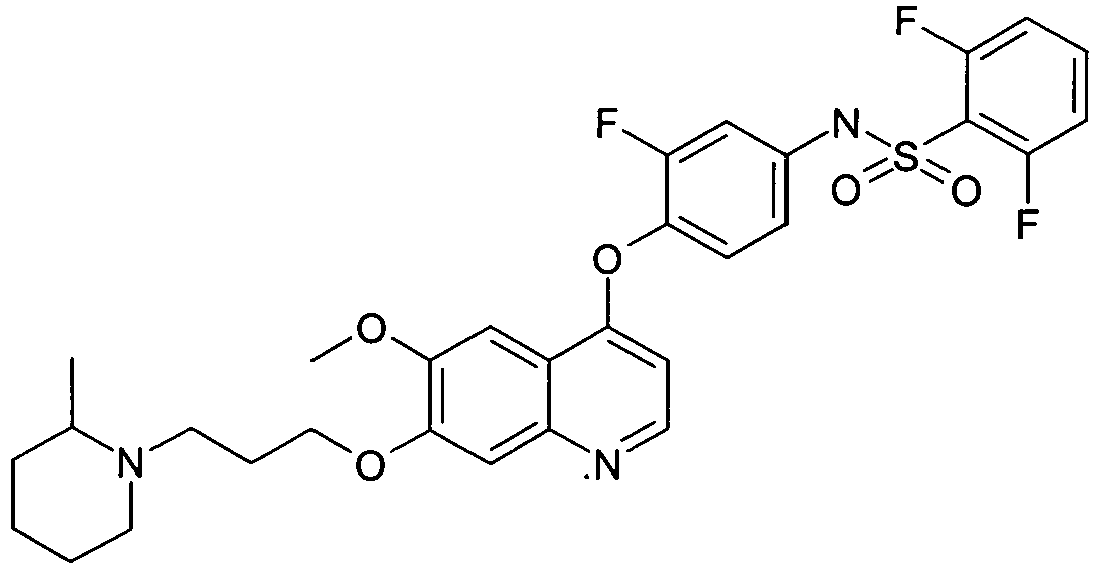
- C31H32F3N3O5S Mw. 615.67
- LC/MS purity: 100 %, m/z 614 [M-H]-, 616 [M+H]+ Rt. 3.03 min. (Method B)
- 1H NMR (300 MHz, DMSO-d6): 10 (bs, 1H), 8.43 (d, 1H), 7.49 (m, 2H), 7.38 (s, 1H), 7.11 (m, 3H), 6.97 (d, 1H), 6.79 (d, 1H), 6.34 (d, 1H), 4.19 (m, 2H), 3.92 (s, 3H), 2.97 (m, 2H), 2.61 (m, 2H), 2.46 (m, 1 H), 2.00 (m, 2H), 1.58 (m, 4H), 1.30 (m, 2H), 1.08 (d, 3H).
- Melting point: 132-134°C.
- Yield: 26 %
-

- C32H33F4N3O6S Mw. 663.69
- LC/MS purity: 98%, m/z 662 [M-H]-, 664 [M+H]+ Rt. 3.52 min. (Method B)
- 1H NMR (300 MHz, DMSO-d6): 10.5 (bs, 1H), 8.43 (d, 1H), 7.99 (d, 1H), 7.68 (t, 1H), 7.48 (m, 3H), 7.38 (s, 1H), 7.19 (t, 1H), 7.02 (d, 1H), 6.85 (d, 1H), 6.33 (d, 1 H), 4.19 (t, 2H), 3.92 (s, 3H), 2.96 (m, 2H), 2.55 (m, 2H), 2.36 (m, 1 H), 1.98 (t, 2H), 1.55 (m, 4H), 1.29 (m, 2H), 1.07 (d, 3H).
- Melting point: 90-92°C.
- Yield: 29 %
-

- C31H32Cl2FN3O5S Mw. 648.58
- LC/MS purity: 98%, m/z 646 [M-H]-, 648 [M+H]+ Rt. 3.39 min. (Method B)
- 1H NMR (300 MHz, DMSO-d6): 11 (bs, 1H), 8.44 (d, 1H), 7.96 (s, 1H), 7.55 (s, 2H), 7.50 (s, 1H), 7.39 (s, 1H), 7.12 (t, 1H), 6.92 (d, 1H), 6.80 (d, 1H), 6.35 (d, 1H), 4.21 (t, 2H), 3.92 (s, 3H), 3.01 (m, 2H), 2.72 (m, 2H), 2.50 (m, 1H), 2.04 (m, 2H), 1.58 (m, 4H), 1.34 (m, 2H), 1.13 (d, 3H).
- Melting point: 128-130°C.
- Yield: 37 %
-

- C30H32FN3O7S2 Mw. 629.73
- LC/MS purity: 97%, m/z 628 [M-H]-, 630 [M+H]+ Rt. 3.38 min. (Method B)
- 1H NMR (300 MHz, DMSO-d6): 10.2 (bs, 1H), 8.45 (d, 1H), 7.94 (d, 1H), 7.47 (m, 2H), 7.38 (s, 1 H), 7.30 (t, 1 H), 7.11 (d, 1 H), 6.97 (d, 1 H), 6.36 (dd, 1 H), 4.20 (t, 2H), 3.92 (s, 3H), 3.87 (s, 3H), 2.45 (m, 6H), 1.98 (m, 2H), 1.53 (bs, 4H), 1.40 (m, 2H)
- Melting point: 138-139°C.
- Yield: 26 %
-

- C31H34FN3O7S2 Mw. 643.75
- LC/MS purity: 99 %, m/z 642 [M-H]-, 644 [M+H]+ Rt. 3.67 min. (Method B)
- 1H NMR (300 MHz, DMSO-d6): 10.2 (bs, 1 H), 8.45 (d, 1 H), 7.95 (d, 1 H), 7.47 (bs, 2H), 7.37 (s, 1 H), 7.30 (t, 1 H), 7.11 (d, 1 H), 6.97 (d, 1 H), 6.36 (d, 1 H), 4.18 (t, 2H), 3.92 (s, 3H), 3.88 (s, 3H), 2.91 (m, 2H), 2.55 (m, 2H), 2.00 (m, 4H), 1.60 (m, 2H), 1.35 (bs, 1 H), 1.16 (m, 2H), 0.89 (d, 3H)
- Melting point: 139-141°C.
- Yield: 29 %
-

- C29H30FN3O8S2 Mw. 631.70
- LC/MS purity: 98%, m/z 630 [M-H]-, 632 [M+H]+ Rt. 3.33 min. (Method B)
- 1H NMR (300 MHz, DMSO-d6): 10.5 (bs, 1H), 8.45 (d, 1H), 7.98 (d, 1H), 7.50 (d, 1H), 7.47 (s, 1H), 7.38 (s, 1H), 7.34 (t, 1H), 7.14 (d, 1H), 7.01 (d, 1H), 6.36 (d, 1H), 4.19 (t, 2H), 3.92 (s, 3H), 3.89 (s, 3H), 3.58 (m, 4H), 2.47 (m, 2H), 2.39 (m, 4H), 1.97 (m, 2H)
- Melting point: 167-168°C.
- Yield: 31 %
-

- C30H33FN4O7S2 Mw. 644.74
- LC/MS purity: 98%, m/z 643 [M-H]-, 645 [M+H]+ Rt. 3.13 min. (Method B)
- 1H NMR (300 MHz, DMSO-d6): 10.3 (bs, 1H), 8.45 (d, 1H), 7.95 (d, 1H), 7.47 (s, 2H), 7.37 (s, 1H), 7.31 (t, 1H), 7.12 (d, 1 H), 6.98 (d, 1H), 6.36 (d, 1H), 4.17 (t, 2H), 3.92 (s, 3H), 3.88 (s, 3H), 2.42 (m, 10H), 2.18 (s, 3H), 1.95 (m, 2H)
- Melting point: 146-148°C.
- Yield: 41 %
-

- C30H36FN5O5S Mw. 597.71
- LC/MS purity: 97%, m/z 596 [M-H]-, 598 [M+H]+ Rt. 3.17 min. (Method B)
- 1H NMR (300 MHz, DMSO-d6): 10.3 (bs, 1H), 8.46 (d, 1H), 7.48 (s, 1H), 7.37 (s, 1 H), 7.36 (t, 1 H), 7.08 (d, 1 H), 6.97 (d, 1 H), 6.37 (d, 1 H), 4.18 (t, 2H), 3.92 (s, 3H), 3.66 (s, 3H), 2.85 (d, 2H), 2.43 (m, 2H), 2.38 (m, 5H), 2.21 (s, 3H), 1.95 (m, 2H), 1.50 (bs, 4H), 1.39 (m, 2H)
- Melting point: 96-98°C.
- Yield: 51 %
-

- C31H38FN5O5S Mw. 611.74
- LC/MS purity: 98%, m/z 610 [M-H]-, 612 [M+H]+ Rt. 3.42 min. (Method B)
- 1H NMR (300 MHz, DMSO-d6): 10.3 (bs, 1H), 8.46 (d, 1H), 7.48 (s, 1H), 7.38 (s, 1H), 7.37 (t, 1H), 7.09 (d, 1H), 6.99 (d, 1H), 6.37 (d, 1H), 4.17 (t, 2H), 3.92 (s, 3H), 3.67 (s, 3H), 2.85 (d, 2H), 2.45 (m, 2H), 2.38 (m, 3H), 2.22 (s, 3H), 1.96 (m, 4H), 1.58 (m, 2H), 1.32 (m, 1 H), 1.23 (m, 2H), 0.88 (d, 3H)
- Melting point: 88-90°C.
- Yield: 36 %
-
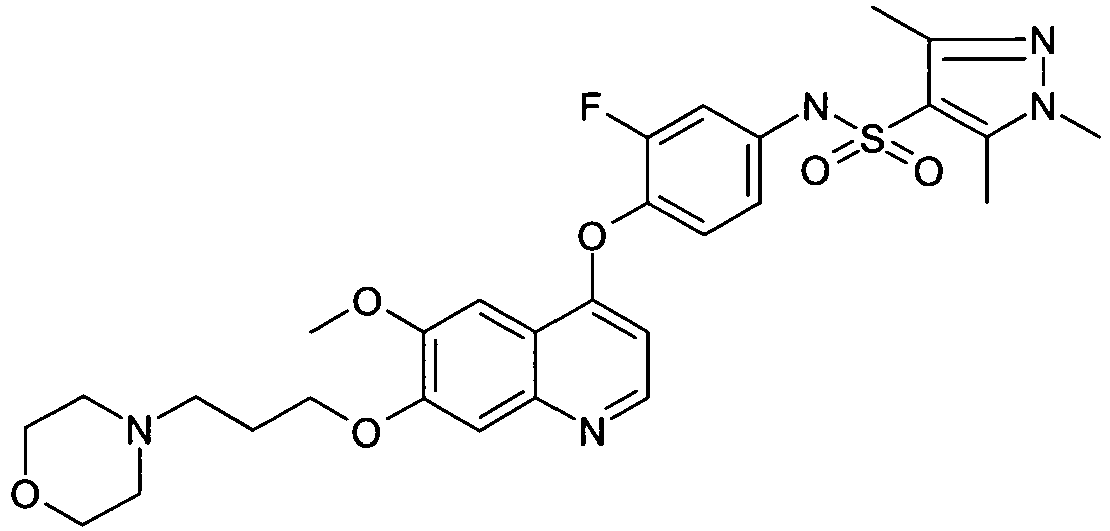
- C29H34FN5O6S Mw. 599.68
- LC/MS purity: 98%, m/z 598 [M-H]-, 600 [M+H]+ Rt. 3.11 min. (Method B)
- 1H NMR (300 MHz, DMSO-d6): 10.3 (bs, 1H), 8.46 (d, 1H), 7.48 (s, 1 H), 7.39 (s, 1H), 7.37 (t, 1H), 7.09 (d, 1H), 6.99 (d, 1H), 6.37 (d, 1H), 4.19 (t, 2H), 3.91 (s, 3H), 3.67 (s, 3H), 3.58 (bs, 4H), 2.47 (m, 2H), 2.38 (bs, 7H), 2.22 (s, 3H), 1.97 (m, 2H) Melting point: 163-164°C.
- Yield: 49 %
-

- C30H37FN6O5S Mw. 612.72
- LC/MS purity: 98%, m/z 611 [M-H]-, 613 [M+H]+ Rt. 2.89 min. (Method B)
- 1H NMR (300 MHz, DMSO-d6): 10.3 (bs, 1 H), 8.46 (d, 1H), 7.48 (s, 1H), 7.37 (s, 1 H), 7.36 (t, 1 H), 7.08 (d, 1 H), 6.97 (d, 1 H), 6.37 (d, 1 H), 4.18 (t, 2H), 3.92 (s, 3H), 3.66 (s, 3H), 2.45 (m, 2H), 2.38 (bs, 7H), 2.33 (bs, 4H), 2.21 (s, 3H), 2.15 (s, 3H), 1.95 (m, 2H)
- Melting point: 80-81°C.
- Yield: 37 %
-

- C28H32FN5O5S Mw. 569.66
- LC/MS purity: 99%, m/z 568 [M-H]-, 570 [M+H]+ Rt. 2.56 min. (Method B)
- 1H NMR (300 MHz, DMSO-d6): 10.6 (bs, 1H), 8.45 (d, 1H), 7.86 (d, 1H), 7.49 (s, 1 H), 7.38 (s, 1 H), 7.33 (t, 1 H), 7.18 (d, 1 H), 7.03 (d, 1 H), 6.66 (d, 1 H), 6.38 (d, 1 H), 4.18 (t, 2H), 3.93 (s, 3H), 3.90 (s, 3H), 2.49 (m, 2H), 2.39 (bs, 4H), 1.96 (m, 2H), 1.50 (bs, 4H), 1.39 (m, 2H)
- Melting point: 167-168°C.
- Yield: 61 %
-
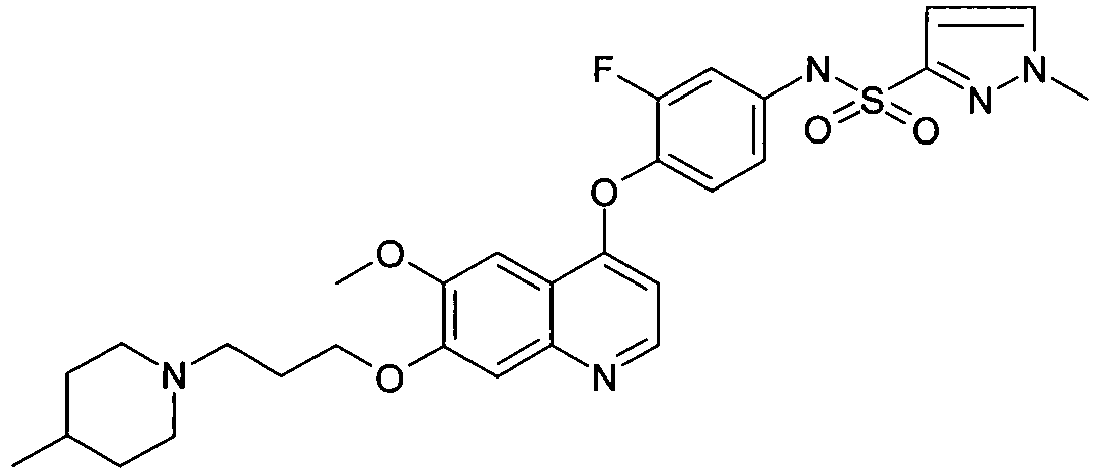
- C29H34FN5O5S Mw. 583.68
- LC/MS purity: 98%, m/z 582 [M-H]-, 584 [M+H]+ Rt. 3.02 min. (Method B)
- 1H NMR (300 MHz, DMSO-d6): 10.6 (bs, 1H), 8.45 (d, 1H), 7.85 (s, 1H), 7.48 (s, 1H), 7.37 (s, 1H), 7.32 (t, 1H), 7.16 (d, 1H), 7.02 (d, 1H), 6.65 (s, 1H), 6.38 (d, 1H), 4.17 (t, 2H), 3.93 (s, 3H), 3.90 (s, 3H), 2.86 (m, 2H), 2.47 (m, 2H), 1.93 (m, 4H), 1.58 (m, 2H), 1.32 (m, 1 H), 1.12 (m, 2H), 0.88 (d, 3H)
- Melting point: 165-166°C.
- Yield: 40 %
-

- C27H30FN5O6S Mw. 571.63
- LC/MS purity: 98%, m/z 570 [M-H]-, 572 [M+H]+ Rt. 2.74 min. (Method B)
- 1H NMR (300 MHz, DMSO-d6): 10.8 (bs, 1H), 8.45 (d, 1H), 7.86 (d, 1H), 7.49 (s, 1 H), 7.39 (s, 1 H), 7.33 (t, 1 H), 7.18 (dd, 1 H), 7.04 (d, 1 H), 6.66 (d, 1 H), 6.38 (d, 1 H), 4.17 (t, 2H), 3.93 (s, 3H), 3.90 (s, 3H), 3.58 (m, 4H), 2.47 (m, 2H), 2.39 (m, 4H), 1.97 (m, 2H)
- Melting point: 198-199°C.
- Yield: 53 %
-

- C28H33FN6O5S Mw. 584.67
- LC/MS purity: 97 %, 584 m/z [M-H]-, 586 [M+H]+ Rt. 2.51 min. (Method B)
- 1H NMR (300 MHz, DMSO-d6): 10.4 (bs, 1H), 8.45 (d, 1H), 7.86 (d, 1H), 7.48 (s, 1 H), 7.37 (s, 1 H), 7.32 (t, 1 H), 7.17 (dd, 1 H), 7.03 (d, 1 H), 6.66 (d, 1 H), 6.38 (d, 1 H), 4.18 (t, 2H), 3.93 (s, 3H), 3.90 (s, 3H), 2.46 (m, 2H), 2.38 (m, 8H), 2.15 (s, 3H), 1.95 (m, 2H)
- Melting point: 157-159°C.
- Yield: 74 %
-

- C28H32FN5O5S Mw. 569.66
- LC/MS purity: 96%, m/z 568 [M-H]-, 570 [M+H]+ Rt. 2.79 min. (Method B)
- 1H NMR (300 MHz, DMSO-d6): 12.3 (bs, 1H), 10.6 (bs, 1H), 8.44 (d, 1H), 7.72 (bs, 1H), 7.48 (s, 1H), 7.37 (s, 1H), 7.30 (t, 1H), 7.18 (d, 1H), 7.02 (d, 1H), 6.37 (d, 1H), 4.17 (t, 2H), 3.92 (s, 3H), 2.42 (m, 2H), 2.40 (bs, 4H), 2.28 (s, 3H), 1.94 (m, 2H), 1.50 (bs, 4H), 1.39 (m, 2H)
- Melting point: 160-163°C.
- Yield: 26 %
-

- C29H34FN5O5S Mw. 583.68
- LC/MS purity: 98%, m/z 582 [M-H]-, 584 [M+H]+ Rt. 3.02 min. (Method B)
- 1H NMR (300 MHz, DMSO-d6): 12.4 (bs, 1H), 10.7 (bs, 1H), 8.44 (d, 1H), 7.72 (bs, 1H), 7.48 (s, 1H), 7.37 (s, 1H), 7.30 (t, 1H), 7.19 (d, 1H), 7.03 (d, 1H), 6.37 (d, 1H), 4.17 (t, 2H), 3.92 (s, 3H), 2.84 (m, 2H), 2.44 (m, 2H), 2.38 (s, 3H), 1.95 (m, 2H), 1.88 (m, 2H), 1.57 (m, 2H), 1.33 (m, 1H), 1.15 (m, 2H), 0.88 (d, 3H)
- Melting point: 225-226°C.
- Yield: 30 %
-
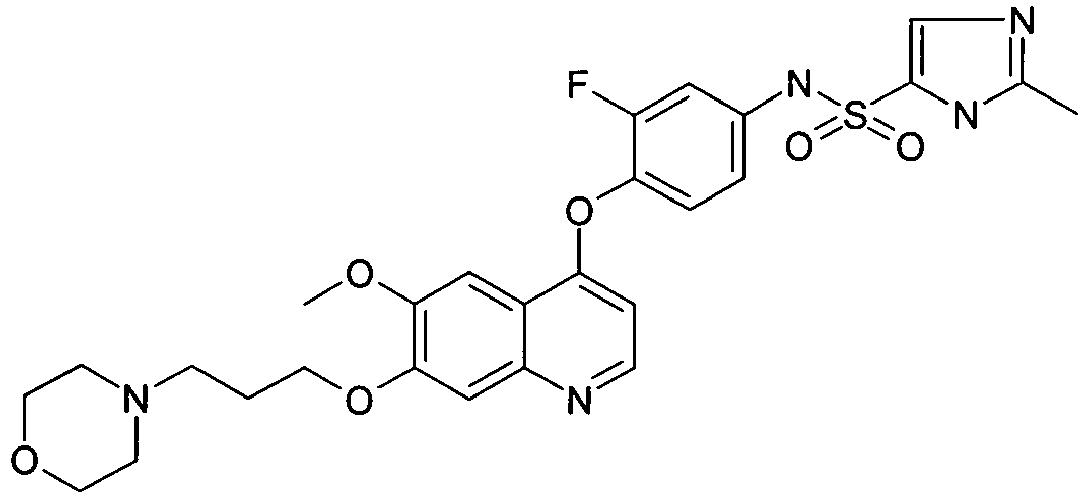
- C27H30FN5O6S Mw. 571.63
- LC/MS purity: 99%, m/z 570 [M-H]-, 572 [M+H]+ Rt. 2.73 min. (Method B)
- 1H NMR (300 MHz, DMSO-d6): 12.4 (bs, 1H), 10.6 (bs, 1H), 8.45 (d, 1H), 7.72 (bs, 1H), 7.49 (s, 1H), 7.39 (s, 1H), 7.32 (t, 1H), 7.21 (d, 1H), 7.05 (d, 1H), 6.37 (d, 1H), 4.19 (t, 2H), 3.93 (s, 3H), 3.58 (m, 4H), 2.47 (m, 2H), 2.39 (s, 4H), 2.28 (s, 3H), 1.97 (t, 2H)
- Melting point: 252-254°C.
- Yield: 38 %
-

- C28H33FN6O5S Mw. 584.67
- LC/MS purity: 99%, m/z 583 [M-H]-, 585 [M+H]+ Rt. 2.52 min. (Method B)
- 1H NMR (300 MHz, DMSO-d6): 12.4 (bs, 1H), 10.6 (bs, 1H), 8.44 (d, 1H), 7.73 (bs, 1H), 7.48 (s, 1H), 7.37 (s, 1H), 7.31 (t, 1H), 7.18 (d, 1H), 7.03 (d, 1H), 6.37 (d, 1 H), 4.17 (t, 2H), 3.92 (s, 3H), 2.45 (m, 2H), 2.39 (bs, 4H), 2.32 (bs, 4H), 2.28 (s, 3H), 2.14 (s, 3H), 1.85 (m, 2H)
- Melting point: 215-217°C.
- Yield: 32 %
-

- C32H35F2N3O5S Mw. 611.71
- LC/MS purity: 97 %, m/z 610 [M-H]-, 612 [M+H]+ Rt. 3.76 min. (Method B)
- 1H NMR (300 MHz, DMSO-d6): 10.7 (bs, 1H), 8.40 (d, 1H), 7.55 (m, 3H), 7.51 (s, 1 H), 7.36 (m, 1 H), 7.05 (m, 3H), 6.17 (d, 1 H), 4.17 (t, 2H), 3.92 (s, 3H), 2.89 (m, 2H), 2.01 (s, 3H), 1.98 (m, 4H), 1.59 (m, 2H), 1.30 (m, 1H), 1.17 (m, 3H), 1.03 (m, 1H), 0.88 (d, 3H)
- Melting point: 222-223°C.
- Yield: 55 %
-

- C32H35F2N3O5S Mw. 611.71
- LC/MS purity: 98 %, m/z 610 [M-H]-, 612 [M+H]+ Rt. 3.64 min. (Method B)
- 1H NMR (300 MHz, DMSO-d6): 10.8 (bs, 1H), 8.40 (d, 1H), 7.67 (m, 1H), 7.51 (s, 1H), 7.36 (m, 1H), 7.25 (t, 2H), 7.05 (m, 3H), 6.16 (d, 1H), 4.17 (t, 2H), 3.92 (s, 3H), 2.88 (m, 2H), 2.49 (m, 2H), 1.97 (m, 7H), 1.58 (m, 2H), 1.33 (m, 1 H), 1.16 (m, 2H), 0.88 (d, 3H)
- Melting point: 191-193°C.
- Yield: 44 %
-

- C33H35F3N3O6S Mw. 627.71
- LC/MS purity: 99%, m/z 628 [M-H]-, 626 [M+H]+ Rt. 3.36 min. (Method B)
- 1H NMR (300 MHz, DMSO-d6): 11 (bs, 1H), 8.37 (d, 1H), 7.62 (m, 1H), 7.46 (s, 1 H), 7.33 (s, 1 H), 7.20 (t, 2H), 7.04 (d, 1 H), 6.92 (s, 1 H), 6.68 (d, 1 H), 6.15 (d, 1 H), 4.17 (t, 2H), 3.91 (s, 3H), 3.60 (s, 3H), 3.32 (m, 1 H), 2.83 (m, 2H), 2.46 (m, 2H), 1.94 (m, 3H), 1.62 (m, 4H), 1.45 (m, 1 H), 0.84 (d, 3H)
- Melting point: 98-101°C.
- Yield: 47 %
-

- C33H36F3N3O6S Mw. 659.73
- LC/MS purity: 98%, m/z 658 [M-H]-, 660 [M+H]+ Rt. 4.18 min. (Method B)
- 1H NMR (300 MHz, DMSO-d6): 10.6 (bs, 1H), 8.40 (d, 1H), 7.98 (dd, 1H), 7.76 (m, 1 H), 7.54 (m, 2H), 7.50 (s, 1 H), 7.36 (s, 1 H), 7.09 (d, 1 H), 7.00 (m, 2H), 6.15 (d, 1 H), 4.17 (t, 2H), 3.91 (s, 3H), 2.86 (m, 2H), 2.46 (m, 2H), 2.00 (m, 3H), 1.93 (m, 4H), 1.58 (m, 2H), 1.33 (m, 1H), 1.16 (m, 2H), 0.88 (d, 3H)
- Melting point: 168-169°C.
- Yield: 51 %
-

- C32H35Cl2N3O5S Mw. 644.62
- LC/MS purity: 100 %, m/z 642 [M-H]-, 644 [M+H]+ Rt. 3.33 min. (Method B)
- 1H NMR (300 MHz, DMSO-d6): 10.6 (bs, 1H), 8.40 (d, 1H), 7.97 (d, 1H), 7.69 (m, 2H), 7.50 (s, 1 H), 7.36 (s, 1 H), 7.07 (d, 1 H), 7.01 (m, 2H), 6.16 (d, 1 H), 4.17 (t, 2H), 3.91 (s, 3H), 2.91 (m, 2H), 2.51 (m, 2H), 2.01 (m, 7H), 1.60 (m, 2H), 1.35 (m, 1 H), 1.15 (m, 2H), 0.88 (d, 3H)
- Melting point: 187-188°C.
- Yield: 48 %
-

- C32H35Cl2N3O5S Mw. 644.62
- LC/MS purity: 95%, m/z 642 [M-H]-, 644 [M+H]+ Rt. 4.00 min. (Method B)
- 1H NMR (300 MHz, DMSO-d6): 10.7 (bs, 1H), 8.39 (d, 1H), 7.62 (m, 2H), 7.54 (d, 1H), 7.49 (s, 1H), 7.35 (s, 1H), 7.11 (s, 1H), 7.03 (m, 2H), 6.14 (d, 1H), 4.17 (t, 2H), 3.91 (s, 3H), 2.88 (m, 2H), 2.50 (m, 2H), 1.99 (s, 3H), 1.96 (m, 4H), 1.58 (m, 2H), 1.34 (m, 1 H), 1.16 (m, 2H), 0.88 (d, 3H)
- Melting point: 209-210°C.
- Yield: 35 %
-

- C27H26F3N3O5S Mw. 561.58
- LC/MS purity: 99%, m/z 560 [M-H]-, 562 [M+H]+ Rt. 2.87 min. (Method B)
- 1H NMR (300 MHz, DMSO-d6): 11 (bs, 1 H), 8.44 (d, 1H), 7.57 (m, 1H), 7.49 (s, 1H), 7.42 (s, 2H), 7.38 (s, 1H), 7.17 (s, 1 H), 7.00 (d, 1H), 6.85 (d, 1 H), 6.36 (d, 1 H), 4.20 (t, 2H), 3.93 (s, 3H), 2.69 (t, 2H), 2.40 (s, 6H), 2.03 (m, 2H)
- Melting point: 108-110°C.
- Yield: 64 %
-

- C27H26F3N3O5S Mw. 561.58
- LC/MS purity: 99%, m/z 560 [M-H]-, 562 [M+H]+ Rt. 2.77 min. (Method B)
- 1H NMR (300 MHz, DMSO-d6): 10.8 (bs, 1H), 8.44 (d, 1 H), 7.56 (m, 1H), 7.49 (s, 1H), 7.37 (s, 1 H), 7.18 (m, 3H), 7.01 (dd, 1 H), 6.85 (d, 1 H), 6.35 (d, 1 H), 4.19 (t, 2H), 3.93 (s, 3H), 2.66 (t, 2H), 2.37 (s, 6H), 2.02 (m, 2H)
- Melting point: 125-127°C.
- Yield: 53 %
-

- C28H27F4N3O6S Mw. 609.60
- LC/MS purity: 99%, m/z 608 [M-H]-, 610 [M+H]+ Rt. 3.28 min. (Method B)
- 1H NMR (300 MHz, DMSO-d6): 10.5 (bs, 1H), 8.44 (d, 1H), 7.99 (d, 1H), 7.69 (t, 1 H), 7.51 (m, 3H), 7.37 (s, 1 H), 7.21 (t, 1 H), 7.04 (dd, 1 H), 6.87 (d, 1 H), 6.35 (d, 1 H), 4.19 (t, 2H), 3.92 (s, 3H), 2.58 (t, 2H), 2.31 (s, 6H), 1.99 (m, 2H)
- Melting point: 94-96°C.
- Yield: 56 %
-

- C27H26Cl2FN3O5S Mw. 594.49
- LC/MS purity: 99%, m/z 592 [M-H]-, 594 [M+H]+ Rt. 3.15 min. (Method B)
- 1H NMR (300 MHz, DMSO-d6): 10.5 (bs, 1H), 8.43 (d, 1H), 7.96 (s, 1H), 7.56 (s, 2H), 7.49 (s, 1 H), 7.37 (s, 1 H), 7.13 (t, 1 H), 6.93 (d, 1 H), 6.80 (d, 1 H), 6.35 (d, 1 H), 4.19 (t, 2H), 3.93 (s, 3H), 2.67 (t, 2H), 2.38 (s, 6H), 2.03 (m, 2H)
- Melting point: 150-152°C.
- Yield: 62 %
-

- C27H26Cl2FN3O5S Mw. 594.49
- LC/MS purity: 100%, m/z 592 [M-H]-, 594 [M+H]+ Rt. 1.23 min. (Method B)
- 1H NMR (300 MHz, DMSO-d6): 10.4 (bs, 1H), 8.43 (d, 1H), 7.46 (s, 4H), 7.37 (s, 1 H), 7.19 (t, 1 H), 7.00 (dd, 1 H), 6.84 (d, 1 H), 6.34 (d, 1 H), 4.19 (t, 2H), 3.92 (s, 3H), 2.67 (t, 2H), 2.38 (s, 6H), 2.02 (m, 2H)
- Melting point: 197-198°C.
- Yield: 44 %
-

- C25H25ClFN3O5S2 Mw. 566.07
- LC/MS purity: 99 %, m/z 564 [M-H]-, 566 [M+H]+ Rt. 2.89 min. (Method B)
- 1H NMR (300 MHz, DMSO-d6): 10.5 (bs, 1H), 8.45 (d, 1H), 7.51 (s, 1H), 7.39 (s, 1 H), 7.30 (d, 1 H), 7.20 (t, 1 H), 7.10 (d, 1 H), 7.02 (dd, 1 H), 6.88 (d, 1 H), 6.39 (d, 1 H), 4.21 (t, 2H), 3.94 (s, 3H), 2.76 (t, 2H), 2.45 (s, 6H), 2.05 (m, 2H)
- Melting point: 130-132°C.
- Yield: 45 %
-

- C27H30FN5O6S2 Mw. 603.69
- LC/MS purity: 100 %, m/z 602 [M-H]-, 604 [M+H]+ Rt. 2.56 min. (Method B)
- 1H NMR (300 MHz, DMSO-d6): 12 (bs, 1H), 10.5 (bs, 1H), 8.44 (d, 1H), 7.49 (s, 1 H), 7.37 (s, 1H), 7.30 (t, 1H), 7.09 (dd, 1H), 6.96 (d, 1 H), 6.36 (d, 1H), 4.18 (t, 2H), 3.93 (s, 3H), 2.54 (t, 2H), 2.39 (s, 3H), 2.26 (s, 6H), 2.15 (s, 3H), 1.98 (m, 2H) Melting point: 164-166°C.
- Yield: 42 %
-

- C27H28FN3O7S2 Mw. 589.66
- LC/MS purity: 96 %, m/z 588 [M-H]-, 590 [M+H]+ Rt. 3.16 min. (Method B)
- 1H NMR (300 MHz, DMSO-d6): 10.4 (bs, 1H), 8.45 (d, 1H), 7.94 (d, 1 H), 7.48 (s, 1 H), 7.46 (s, 1 H), 7.37 (s, 1 H), 7.29 (t, 1 H), 7.11 (dd, 1 H), 6.97 (d, 1 H), 6.36 (d, 1 H), 4.18 (t, 2H), 3.92 (s, 3H), 3.87 (s, 3H), 2.47 (t, 2H), 2.24 (s, 6H), 1.98 (m, 2H)
- Melting point: 80-82°C.
- Yield: 39 %
-

- C31H32F3N3O5S Mw. 615.68
- LC/MS purity: 97 %, m/z 614 [M-H]-, 616 [M+H]+ Rt. 3.37 min. (Method B)
- 1H NMR (300 MHz, DMSO-d6): 10.5 (bs, 1H), 8.44 (d, 1H), 7.46 (m, 5H), 7.27 (t, 1 H), 6.95 (m, 2H), 6.27 (d, 1 H), 4.20 (t, 2H), 3.93 (s, 3H), 3.03 (m, 2H), 2.67 (t, 2H), 2.18 (m, 2H), 2.04 (m, 2H), 1.64 (m, 2H), 1.40 (m, 1 H), 1.20 (m, 2H), 0.90 (d, 3H)
- Melting point: 186-188°C.
- Yield: 54 %
-

- C31H32F3N3O5S Mw. 615.68
- LC/MS purity: 98 %, m/z 614 [M-H]-, 616 [M+H]+ Rt. 3.26 min. (Method B)
- 1H NMR (300 MHz, DMSO-d6): 10.5 (bs, 1H), 8.45 (d, 1H), 7.62 (m, 1H), 7.46 (s, 1 H), 7.40 (s, 1 H), 7.31 (t, 1 H), 7.16 (m, 2H), 6.97 (m, 2H), 6.26 (d, 1 H), 4.21 (t, 2H), 3.92 (s, 3H), 3.03 (m, 2H), 2.66 (t, 2H), 2.18 (m, 2H), 2.04 (m, 2H), 1.64 (m, 2H), 1.41 (m, 1 H), 1.20 (m, 2H), 0.90 (d, 3H)
- Melting point: 185-186°C.
- Yield: 38 %
-

- C32H33F4N3O5S Mw. 647.69
- LC/MS purity: 97 %, m/z 646 [M-H]-, 648 [M+H]+ Rt. 3.63 min. (Method B)
- 1H NMR (300 MHz, DMSO-d6): 10.5 (bs, 1 H), 8.45 (d, 1 H), 8.04 (m, 1 H), 7.91 (m, 1 H), 7.77 (m, 2H), 7.42 (s, 1 H), 7.39 (s, 1 H), 7.30 (t, 1 H), 6.94 (m, 2H), 6.28 (d, 1 H), 4.20 (t, 2H), 3.91 (s, 3H), 2.98 (m, 2H), 2.60 (t, 2H), 2.05 (m, 4H), 1.62 (m, 2H), 1.40 (m, 1 H), 1.20 (m, 2H), 0.89 (d, 3H)
- Melting point: 175-177°C.
- Yield: 44 %
-

- C32H33F4N3O6S Mw. 663.69
- LC/MS purity: 98 %, m/z 662 [M-H]-, 664 [M+H]+ Rt. 3.85 min. (Method B)
- 1H NMR (300 MHz, DMSO-d6): 10.5 (bs, 1H), 8.46 (d, 1H), 7.88 (d, 1H), 7.71 (t, 1H), 7.45 (m, 4H), 7.31 (t, 1H), 6.96 (m, 2H), 6.25 (d, 1H), 4.20 (t, 2H), 3.91 (s, 3H), 2.95 (m, 2H), 2.57 (t, 2H), 2.02 (m, 4H), 1.62 (m, 2H), 1.36 (m, 1 H), 1.17 (m, 2H), 0.89 (d, 3H)
- Melting point: 80-82°C.
- Yield: 37 %
-

- C31H32Cl2FN3O5S Mw. 648.58
- LC/MS purity: 95 %, m/z 646 [M-H]-, 648 [M+H]+ Rt. 3.64 min. (Method B)
- 1H NMR (300 MHz, DMSO-d6): 10.5 (bs, 1H), 8.45 (d, 1H), 7.87 (d, 1H), 7.61 (m, 2H), 7.46 (s, 1 H), 7.40 (s, 1 H), 7.26 (t, 1 H), 6.93 (m, 2H), 6.24 (d, 1 H), 4.21 (t, 2H), 3.93 (s, 3H), 3.07 (m, 2H), 2.69 (t, 2H), 2.21 (m, 2H), 2.05 (m, 2H), 1.66 (m, 2H), 1.43 (m, 1 H), 1.23 (m, 2H), 0.90 (d, 3H)
- Melting point: 127-130°C.
- Yield: 52 %
-

- C31H32Cl2FN3O5S Mw. 648.58
- LC/MS purity: 97 %, m/z 646 [M-H]-, 648 [M+H]+ Rt. 3.56 min. (Method B)
- 1H NMR (300 MHz, DMSO-d6): 10.5 (bs, 1 H), 8.43 (d, 1 H), 7.45 (m, 5H), 7.30 (t, 1 H), 6.93 (m, 2H), 6.22 (d, 1 H), 4.21 (t, 2H), 3.93 (s, 3H), 3.00 (m, 2H), 2.64 (m, 2H), 2.10 (m, 4H), 1.64 (m, 2H), 1.39 (m, 1 H), 1.19 (m, 2H), 0.90 (d, 3H)
- Melting point: 116-118°C.
- Yield: 46 %
-

- C31H32ClF2N3O5S Mw. 632.13
- LC/MS purity: 97 %, m/z 630 [M-H]-, 632 [M+H]+ Rt. 3.24 min. (Method B)
- 1H NMR (300 MHz, DMSO-d6): 9.1 (bs, 1H), 8.36 (d, 1H), 7.44 (s, 1H), 7.38 (t, 1 H), 7.25 (m, 4H), 7.05 (d, 1 H), 6.43 (dd, 1 H), 6.27 (d, 1 H), 4.22 (t, 2H), 3.92 (s, 3H), 3.19 (m, 2H), 2.89 (m, 2H), 2.56 (m, 1 H), 2.11 (m, 2H), 1.72 (m, 2H), 1.36 (m,
- 1 H), 1.28 (m, 3H), 0.92 (d, 3H)
- Melting point: 206-208°C.
- Yield: 11%
-

- C31H32ClF2N3O5S Mw. 632.13
- LC/MS purity: 98 %, m/z 630 [M-H]-, 632 [M+H]+ Rt. 3.23 min. (Method B)
- 1H NMR (300 MHz, DMSO-d6): 9.1 (bs, 1 H), 8.35 (d, 1 H), 7.44 (s, 1 H), 7.35 (m, 2H), 7.24 (d, 1 H), 7.06 (d, 1 H), 6.91 (t, 2H), 6.39 (dd, 1 H), 6.23 (d, 1 H), 4.23 (t, 2H), 3.92 (s, 3H), 3.17 (m, 2H), 2.97 (m, 2H), 2.57 (m, 1 H), 2.14 (m, 2H), 1.75 (m, 2H), 1.53 (m, 1 H), 1.26 (m, 3H), 0.93 (d, 3H)
- Melting point: 222-226°C.
- Yield: 14 %
-

- C32H33ClF3N3O5S Mw. 664.14
- LC/MS purity: 98 %, m/z 662 [M-H]-, 664 [M+H]+ Rt. 3.43 min. (Method B)
- 1H NMR (300 MHz, DMSO-d6): 9.15 (bs, 1H), 8.31 (d, 1 H), 7.95 (d, 1H), 7.72 (d, 1 H), 7.57 (m, 2H), 7.38 (s, 1 H), 7.36 (s, 1 H), 7.27 (d, 1 H), 6.89 (d, 1 H), 6.40 (d, 1H), 6.19 (d, 1H), 4.22 (t, 2H), 3.89 (s, 3H), 3.31 (m, 2H), 3.01 (m, 2H), 2.61 (m, 1 H), 2.15 (m, 2H), 1.75 (m, 2H), 1.54 (m, 1 H), 1.29 (m, 3H), 0.93 (d, 3H)
- Melting point: 179-181°C.
- Yield: 12 %
-

- C32H33ClF3N3O6S Mw. 680.14
- LC/MS purity: 98 %, m/z 678 [M-H]-, 680 [M+H]+ Rt. 3.58 min. (Method B)
- 1H NMR (300 MHz, DMSO-d6): 9.1 (bs, 1H), 8.35 (d, 1H), 7.74 (d, 1H), 7.50 (t, 1 H), 7.42 (s, 1 H), 7.39 (s, 1 H), 7.29 (m, 3H), 7.01 (d, 1 H), 6.43 (d, 1 H), 6.27 (d, 1 H), 4.23 (t, 2H), 3.90 (s, 3H), 3.29 (m, 2H), 3.02 (m, 2H), 2.68 (m, 1 H), 2.16 (m, 2H), 1.77 (m, 2H), 1.56 (m, 1 H), 1.29 (m, 3H), 0.93 (d, 3H)
- Melting point: 123-126°C.
- Yield: 9 %
-
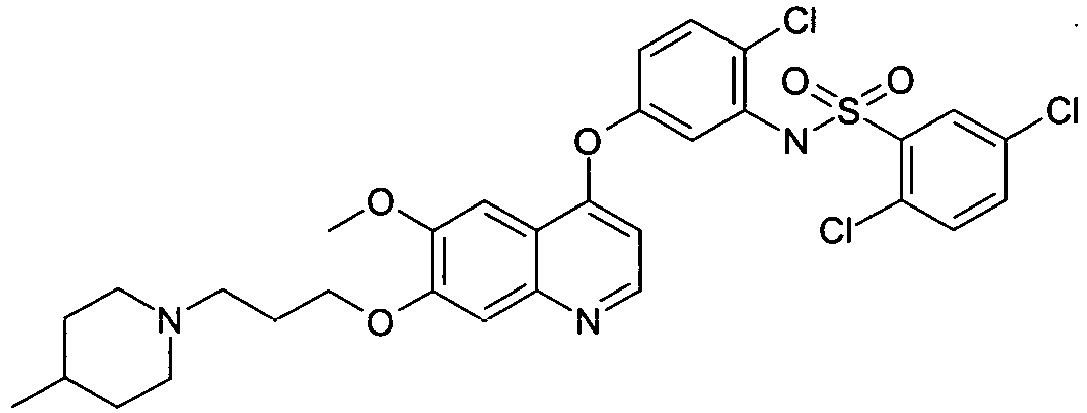
- C31H32Cl3N3O5S Mw. 665.04
- LC/MS purity: 97 %, m/z 662 [M-H]-, 664 [M+H]+ Rt. 3.49 min. (Method B)
- 1H NMR (300 MHz, DMSO-d6): 9.1 (bs, 1 H), 8.37 (d, 1 H), 7.75 (d, 1 H), 7.40 (m, 4H), 7.27 (d, 1H), 6.98 (d,1 H), 6.40 (dd, 1H), 6.24 (d, 1 H), 4.22 (t, 2H), 3.92 (s, 3H), 3.31 (m, 2H), 3.17 (m, 2H), 2.98 (m, 1 H), 2.11 (m, 2H), 1.73 (m, 2H), 1.55 (m, 1 H), 1.26 (m, 3H), 0.92 (d, 3H)
- Melting point: 223-224°C.
- Yield: 12 %
-

- C31H32Cl3N3O5S Mw. 665.04
- LC/MS purity: 98 %, m/z 662 [M-H]-, 664 [M+H]+ Rt. 3.38 min. (Method B)
- 1H NMR (300 MHz, DMSO-d6): 9 (bs, 1 H), 8.32 (d, 1 H), 7.42 (s, 1 H), 7.38 (s, 1 H), 7.26 (m, 4H), 6.94 (d,1 H), 6.37 (dd, 1H), 6.17 (d, 1H), 4.23 (t, 2H), 3.91 (s, 3H), 3.28 (m, 2H), 2.96 (m, 2H), 2.54 (m, 1 H), 2.14 (m, 2H), 1.75 (m, 2H), 1.53 (m, 1 H), 1.30 (m, 3H), 0.93 (d, 3H)
- Melting point: 206-208°C.
- Yield: 9 %
-
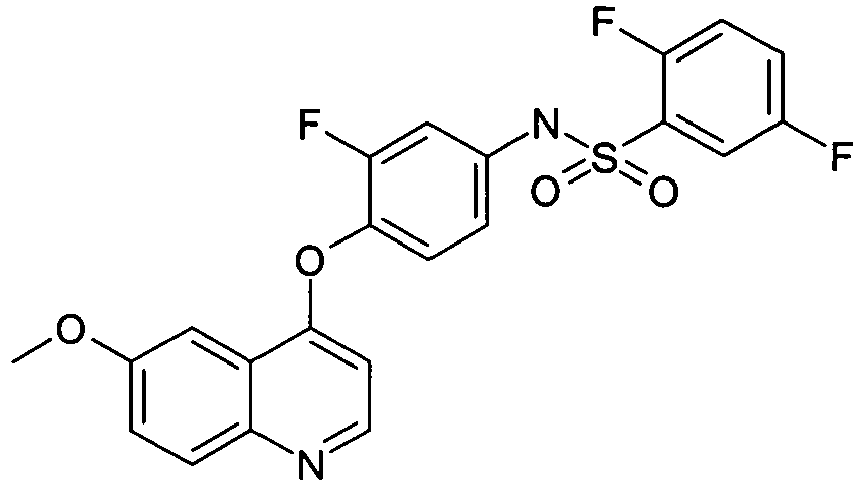
- C22H15F3N2O4S Mw. 460.43
- LC/MS purity: 98 %, m/z 459 [M-H]-, 461 [M+H]+ Rt. 3.42 min. (Method B)
- 1H NMR (300 MHz, DMSO-d6): 11 (bs, 1 H), 8.58 (d, 1H), 8.17 (d, 1H), 7.64 (m, 1 H), 7.48 (m, 1 H), 7.40 (s, 1 H), 7.39 (m, 1 H), 7.26 (m, 2H), 7.06 (dd, 1 H), 6.92 (d, 1H), 6.37 (d, 1H), 3.93 (s, 3H)
- Melting point: 249-250°C.
- Yield: 81 %
-

- C22H15F3N2O4S Mw. 460.43
- LC/MS purity: 98 %, m/z 459 [M-H]-, 461 [M+H]+ Rt. 3.27 min. (Method B)
- 1H NMR (300 MHz, DMSO-d6): 11.3 (bs, 1H), 8.59 (d, 1H), 8.17 (d, 1H), 7.70 (m, 1 H), 7.4-7.25 (m, 6H), 7.14 (dd, 1 H), 7.01 (d, 1 H), 3.93 (s, 3H)
- Melting point: 227-228°C.
- Yield: 69 %
-

- C23H16F4N2O4S Mw. 492.45
- LC/MS purity: 98 %, m/z 491 [M-H]-, 493 [M+H]+ Rt. 3.75 min. (Method B)
- 1H NMR (300 MHz, DMSO-d6): 11 (bs, 1H), 8.59 (d, 1H), 8.18 (s, 1 H), 8.15 (s, 1 H), 8.02 (d, 1 H), 7.89 (m, 2H), 7.40 (s, 1 H), 7.36 (d, 1 H), 7.29 (dd, 1 H), 7.14 (d, 1 H), 7.01 (d, 1 H), 6.37 (d, 1 H), 3.93 (s, 3H)
- Melting point: 168-169°C.
- Yield: 75 %
-

- C23H16F4N2O5S Mw. 508.45
- LC/MS purity: 99 %, m/z 507 [M-H]-, 509 [M+H]+ Rt. 3.97 min. (Method B)
- 1H NMR (300 MHz, DMSO-d6): 11 (bs, 1H), 8.59 (d, 1H), 8.18 (s, 1H), 8.05 (d, 1 H), 7.81 (t, 1 H), 7.59 (m, 2H), 7.40 (s, 1H), 7.36 (d, 1 H), 7.29 (dd, 1H), 7.15 (d, 1 H), 7.00 (d, 1H), 6.34 (d, 1 H), 3.93 (s, 3H)
- Melting point: 175-176°C.
- Yield: 69 %
-

- C22H15Cl2FN2O4S Mw. 493.34
- LC/MS purity: 98 %, m/z 491 [M-H]-, 493 [M+H]+ Rt. 3.78 min. (Method B)
- 1H NMR (300 MHz, DMSO-d6): 11.2 (bs, 1H), 8.58 (d, 1H), 8.17 (d, 1H), 8.05 (d, 1 H), 7.74 (m, 2H), 7.39 (d, 1 H), 7.35 (t, 1 H), 7.28 (dd, 1 H), 7.16 (dd, 1 H), 7.01 (d, 1H), 6.36 (d, 1H), 3.93 (s, 3H)
- Melting point: 253-255°C.
- Yield: 70 %
-

- C22H15Cl2FN2O4S Mw. 493.34
- LC/MS purity: 99 %, m/z 491 [M-H]-, 493 [M+H]+ Rt. 3.69 min. (Method B)
- 1H NMR (300 MHz, DMSO-d6): 11.2 (bs, 1H), 8.58 (d, 1H), 8.17 (d, 1H), 7.62 (m, 2H), 7.54 (m, 1 H), 7.40 (d, 1 H), 7.34 (t, 1 H), 7.27 (dd, 1 H), 7.00 (dd, 1 H), 6.96 (d, 1H), 6.35 (d, 1H), 3.93 (s, 3H)
- Melting point: 219-221°C.
- Yield: 67 %
-

- C26H19FN2O4S Mw. 474.51
- LC/MS purity: 99 %, m/z 473 [M-H]-, 475 [M+H]+ Rt. 4.20 min. (Method B)
- 1H NMR (300 MHz, DMSO-d6): 10.8 (bs, 1H), 8.53 (d, 1H), 8.49 (s, 1H), 8.19 (m, 3H), 8.03 (d, 1 H), 7.82 (dd, 1 H), 7.69 (m, 2H), 7.38 (d, 1 H), 7.27 (m, 2H), 7.16 (dd, 1 H), 6.99 (t, 1 H), 6.28 (d, 1 H), 3.92 (s, 3H)
- Melting point: 220-222°C.
- Yield: 74 %
-

- C19H17FN2O4S Mw. 388.42
- LC/MS purity: 98 %, m/z 387 [M-H]-, 389 [M+H]+ Rt. 3.64 min. (Method B)
- 1H NMR (300 MHz, DMSO-d6): 10.8 (bs, 1H), 8.62 (dd, 1H), 8.22 (d, 1H), 7.48 (d, 1 H), 7.43 (s, 1 H), 7.29 (m, 2H), 7.18 (d, 1 H), 6.48 (d, 1 H), 3.94 (s, 3H), 2.76 (m, 1 H), 0.99 (m, 4H)
- Melting point: 194-196°C.
- Yield: 75 %
-

- C32H35F2N3O6S Mw. 627.71
- LC/MS purity: 98 %, m/z 626 [M-H]-, 628 [M+H]+ Rt. 3.50 min. (Method B)
- 1H NMR (300 MHz, DMSO-d6): 10.5 (bs, 1H), 8.37 (d, 1H), 7.63 (m, 1H), 7.51 (m, 2H), 7.46 (s, 1 H), 7.34 (s, 1 H), 7.07 (d, 1 H), 6.90 (s, 1 H), 6.70 (d, 1 H), 6.16 (d, 1H), 4.17 (t, 2H), 3.91 (s, 3H), 3.61 (s, 3H), 3.34 (m, 1H), 2.84 (m, 2H), 2.46 (m, 2H), 1.95 (m, 3H), 1.63 (m, 4H), 1.48 (m, 1 H), 0.84 (d, 3H)
- Melting point: 170-172°C.
- Yield: 58%
-

- C33H36F3N3O6S Mw. 659.73
- LC/MS purity: 98 %, m/z 658 [M-H]-, 660 [M+H]+ Rt. 3.86 min. (Method B)
- 1H NMR (300 MHz, DMSO-d6): 10.6 (bs, 1H), 8.38 (d, 1H), 8.15 (d, 1H), 7.97 (d, 1 H), 7.83 (m, 2H), 7.45 (s, 1 H), 7.34 (s, 1 H), 7.07 (d, 1 H), 6.91 (d, 1 H), 6.67 (dd, 1 H), 6.17 (d, 1 H), 4.17 (t, 2H), 3.91 (s, 3H), 3.60 (s, 3H), 3.32 (m, 1 H), 2.81 (m, 2H), 2.46 (m, 2H), 1.96 (m, 2H), 1.88 (m, 1 H), 1.60 (m, 4H), 1.46 (m, 1 H), 0.84 (d, 3H)
- Melting point: 216-218°C.
- Yield: 53 %
-

- C31H31Cl2F2N3O5S Mw. 666.58
- LC/MS purity: 96 %, m/z 664 [M-H]-, 666 [M+H]+ Rt. 3.34 min. (Method B)
- 1H NMR (300 MHz, DMSO-d6): 10.2 (bs, 1H), 8.43 (d, 1H), 7.53 (s, 1H), 7.45 (m, 1H), 7.41 (s, 1H), 7.07 (m, 2H), 7.02 (m, 2H), 6.26 (d, 1H), 4.23 (t, 2H), 3.94 (s, 3H), 3.28 (m, 2H), 2.95 (m, 2H), 2.52 (m, 1 H), 2.13 (m, 2H), 1.74 (m, 2H), 1.53 (m, 1 H), 1.29 (m, 3H), 0.92 (d, 3H)
- Melting point: 146-151°C.
- Yield: 7 %
-

- C32H32Cl2F3N3O5S Mw. 698.59
- LC/MS purity: 98 %, m/z 696 [M-H]-, 698 [M+H]+ Rt. 3.59 min. (Method B)
- 1H NMR (300 MHz, DMSO-d6): 10.5 (bs, 1H), 8.43 (d, 1H), 8.11 (d, 1H), 7.82 (d, 1 H), 7.69 (m, 2H), 7.52 (s, 1 H), 7.41 (s, 1 H), 6.96 (s, 2H), 6.25 (d, 1 H), 4.22 (t, 2H), 3.93 (s, 3H), 3.28 (m, 2H), 2.69 (m, 2H), 2.56 (m, 1 H), 2.27 (m, 2H), 1.72 (m, 2H), 1.50 (m, 1H), 1.32 (m, 3H), 0.92 (d, 3H)
- Melting point: 148-151°C.
- Yield: 22 %
-

- C28H25F3N2O7S Mw. 590.58
- LC/MS purity: 98 %, m/z 589 [M-H]-, 591 [M+H]+ Rt. 3.57 min. (Method B)
- 1H NMR (300 MHz, DMSO-d6): 11.11 (s, 1H), 8.45 (d, 1H), 7.71-7.35 (m, 6H), 7.18 (d, 1 H), 7.05 (d, 1 H), 6.36 (d, 1 H), 4.17 (bs, 2H), 4.10 (bs, 2H), 3.92 (s, 3H), 2.01 (s, 3H), 1.84 (bs, 2H), 1.80 bs, 2H)
- Melting point: 165-167°C.
- Yield: 65 %
-
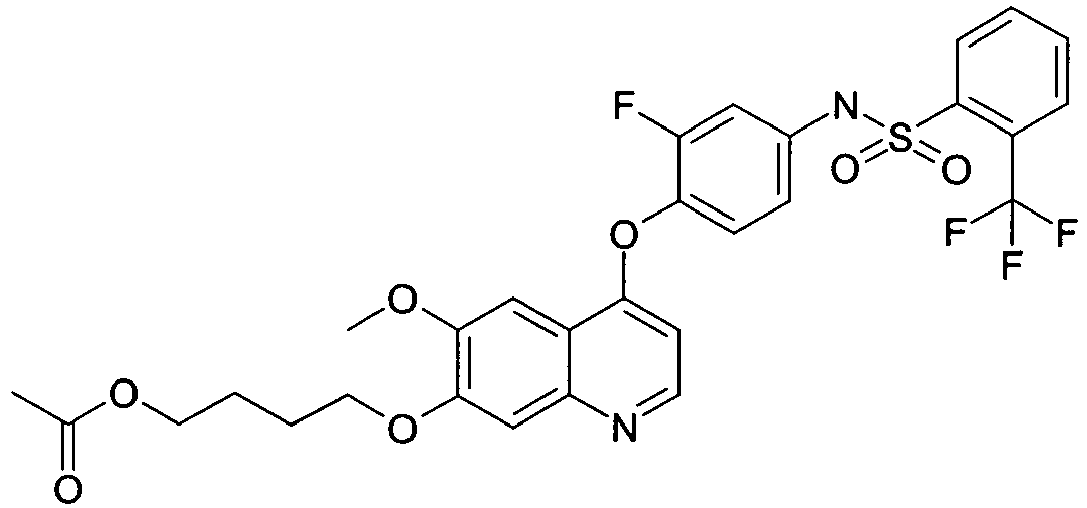
- C29H26F4N2O7 Mw. 622.60
- LC/MS purity: 98 %, m/z 621 [M-H]-, 623 [M+H]+ Rt. 3.86 min. (Method B)
- 1H NMR (300 MHz, DMSO-d6): 11.03 (s, 1H), 8.45 (d, 1H), 8.16 (d, 1H), 8.04 (d, 1 H), 7.80 (m, 2H), 7.47 (s, 1 H), 7.39 (s, 1 H), 7.37 (t, 1 H), 7.16 (d, 1 H), 7.03 (d, 1 H), 6.36 (d, 1 H), 4.17 (t, 2H), 4.10 (t, 2H), 3.91 (s, 3H), 2.01 (s, 3H), 1.82 (m, 4H) Melting point: 143-145°C.
- Yield: 74 %
-

- C31H31F4N3O6S Mw. 649.67
- LC/MS purity: 97 %, m/z 648 [M-H]-, 650 [M+H]+ Rt. 3.50 min. (Method B)
- 1H NMR (300 MHz, DMSO-d6): 11 (bs, 1H), 8.44 (d, 1H), 8.16 (d, 1H), 8.01 (d, 1H), 7.90 (m, 2H), 7.46 (s, 1 H), 7.38 (s, 1 H), 7.33 (t, 1 H), 7.13 (d, 1 H), 6.98 (d, 1 H), 6.35 (d, 1 H), 4.16 (t, 2H), 3.91 (s, 3H), 3.57 (m, 4H), 2.38 (m, 6H), 1.82 (m, 2H), 1.64 (m, 2H)
- Melting point: 102-104°C.
- Yield: 23 %
-

- C32H33F4N3O5S Mw. 647.69
- LC/MS purity: 95 %, m/z 646 [M-H]-, m/z 648 [M-H]+ Rt. 3.60 min. (Method B)
- 1H NMR (300 MHz, DMSO-d6): 10.6 (bs, 1H), 8.44 (d, 1H), 8.07 (d, 1H), 7.81 (d, 1 H), 7.65 (m, 2H), 7.43 (s, 1H), 7.35 (s, 1H), 7.14 (t, 1H), 6.96 (d, 1H), 6.76 (d, 1 H), 6.43 (d, 1 H), 4.17 (t, 2H), 3.90 (s, 3H), 2.85 (m, 2H), 2.42 (m, 2H), 1.98 (m, 2H), 1.82 (m, 1 H), 1.61 (m, 4H), 1.51 (m, 1 H), 1.03 (m, 1 H), 0.84 (d, 3H)
- Melting point: 125-126 °C.
- Yield: 35 %
- WtAXL cDNA was cloned into vector pLXSN(ESK) and transfected into Phoenix E packaging cells. The viral supernatant was collected and used to infect target cells NIH3T3 N7. Monoclonal NIH3T3-AXL cell lines stably expressing wtAXL were generated by selecting retrovirally infected cells in medium containing puromycin (2µg/ml) and subsequent clonal separation. NIH-3T3-AXL (clone 22) cells were used for further experiment because AXL was highly expressed and constitutively phosphorylated in these cells. In addition, these cells demonstrated aggressive behaviors on matrigel matrix (Matrigel™ Matrix, BD Biosciences, Bedford, MA, USA). Moreover, the inhibitory effects of compounds on AXL phosphorylation discovered by using NIH-3T3 AXL (clone 22) system have been confirmed in human breast cancer cells endogenously expressing AXL in our previous study (Zhang YX, et al. AXL is a potential target for therapeutic intervention in breast cancer progression. Cancer Res. 2008; 68:1905-15).
- Determination of the morphology of cells grown on matrigel matrix was carried out as described previously, with some modifications (Thompson EW, et al. Association of increased basement membrane invasiveness with absence of estrogen receptor and expression of vimentin in human breast cancer cell lines. J Cell Physiol 1992;150:534-44). Briefly, in a 96-well flat-bottomed plate, 10000 cells/100µl cell suspensions was plated on the surface of precoated matrigel (3mg/ml). Colony outgrowth was visualized with a Zeiss Axiovert S100 microscope (Carl Zeiss UK, Welwyn Garden City, UK).
- NIH-3T3-AXL (Clone 22) cells were seeded onto 6-well plates (1.5 x 10⁵ cells/well) in 1.5ml DMEM + 10% heat inactivated FBS (GIBCO - Invitrogen GmbH, Karlsruhe, Germany) and cultured overnight, followed by serum depletion in DMEM without FBS for 24 h. Serial dilutions of compounds were added, and the cells were further incubated for 1 h. Cells were washed with PBS and lysed on ice in 500µl lysis buffer (50 mM HEPES (pH 7.5), 150 mM NaCl, 1mM EGTA, 10% Glycerol, 1% Triton X-100, 100 mM NaF, 10 mM Na4P2O7·10 H2O, 1 mM Na3VO4, 1 mM phenylmethylsulfonyl fluoride, and 10 mg/ml aprotinin) for 15min. The cell lysate were used for phosphotyrosine AXL enzyme-linked immunosorbant assay (pY-AXL-ELISA). 96-well Nunc MicroWell™ plates (Fischer Scientific GmbH, Schwerte, Germany) were coated over night with homemade anti-Axl capture antibody 2µg/ml (clone 259/2, IgG1 isotype) in PBS (100µl/well). Subsequently 96-well plates were blocked with PBS-0.05%Tween®20 + 10%FBS for 4h at 37°C. Plates were washed 5 times with PBS-0.05%Tween®20 and 95µl of lysate was transferred per well for incubation overnight at 4°C. Plates were washed 5 times with PBS-0.05%Tween®20 (Sigma, Steinheim, Germany). For detection of phosphorylated tyrosine we used homemade biotynilated 4G10-antibody (0.5µg/ml) in PBS-0.05%Tween®20 + 10%FBS (100µl/well) and incubated the 96-well plate for 2h at room temperature. The anti-phosphotyrosine mouse monoclonal antibody 4G10 was biotynilated with Sulfo-NHS®-Biotin according to the suppliers protocol (Pierce, Rockford, IL, USA) and purified by Mirco Bio-Spin 6 Chromatograpy Columns (BIO RAD Laboratories, Inc., Hercules, CA, USA) using PBS as diluent. Plates were washed 5 times with PBS-0.05%Tween®20. For biding to biotin Alkaline Phosphatase Conjugated Strepavidin SA110 (Millipore, Billerica, MA, USA) (1:4000) was used in PBS-0.05%Tween20 + 10%FBS (100µl/well) and incubated for 30min at room temperature. Plates were washed 5 times with PBS-0.05%Tween20. For fluorimetric detection of alkaline phosphatase AttoPhos Substrate Set (Roche diagnostics GmbH, Mannheim, Germany) was used (100µl/well). The fluorimetric signal was quantified after 90min at 430/560nm wavelength using a TECAN Ultra Evolution plate reader (Tecan Deutschland GmbH, Crailsheim, Germany).
- Table la below shows for the cell line NIH-3T3-Axl in column 2 the half-maximal inhibition concentration (IC50) values of representative compounds according to general formula (I) (+ = 3 µM > IC50 > 500nM & ++ = IC50 ≤ 500nM) obtained according to the disclosure above of Assay Example A.
Table la: Inhibitory effect of the compounds of the present invention on the NIH-3T3-axl cell line Example No pY-Axl-ELISA on NIH-3T3-Axl cells (cellular IC50 [nM] Example No pY-Axl-ELISA on NIH-3T3-Axl cells (cellular IC50 [nM] 4 ++ 114 ++ 5 ++ 115 ++ 6 ++ 116 ++ 7 ++ 117 ++ 8 ++ 118 ++ 9 ++ 119 ++ 10 ++ 11 ++ 12 ++ 124 ++ 34 ++ 127 + 35 ++ 128 + 36 ++ 134 + 37 ++ 136 + 38 ++ 144 ++ 40 ++ 145 ++ 43 ++ 146 ++ 44 ++ 147 + 45 ++ 148 + 46 ++ 151 ++ 47 ++ 152 ++ 48 ++ 153 ++ 49 ++ 154 ++ 50 ++ 155 ++ 51 ++ 156 ++ 52 ++ 157 ++ 53 ++ 158 ++ 54 ++ 171 + 55 ++ 172 + 56 ++ 173 + 57 ++ 174 + 58 ++ 175 + 59 ++ 176 + 62 ++ 63 ++ 64 ++ 65 ++ 66 ++ 67 ++ 76 ++ 77 ++ 78 ++ 81 ++ 191 + 82 ++ 193 + 87 ++ 194 + 89 ++ 197 + 99 ++ 198 + 199 + 104 ++ 201 + 106 ++ 202 + 108 ++ 207 + 109 ++ 208 ++ 110 ++ 209 ++ 111 ++ 210 ++ 112 ++ 113 ++ - Table Ib below shows the inhibitory effect of some compounds of the present invention on the cell line HS578T. In column 2 the experimental data of the "Matrigel outgrowth assay / branching assay" (+ = 25 µM > IC50 > 10.0 µM & ++ = IC50 ≤ 10.0 µM) as disclosed below under Assay Example E are shown and in column 3 the experimental data of the "Cell vitality assay (ATP assay)" (+ = 50 µM > IC50 > 12.5 µM & ++ = IC50 ≤ 12.5 µM) as disclosed below in section Assay Example B and in column 4 the experimental data of the "Wound healing migration assay" (+ = 50 µM > IC50 > 12.5 µM & ++ = IC50 ≤ 12.5 µM) as outlined under Assay Example D are provided.
Table Ib: Inhibitory effect of the compounds of the present invention on the HS578T cell line Example No Total branching inhibition in Matrigel HS578T [µM] IC50 ATP-Assay HS578T after 72h [µM] IC50 Wound healing Assay HS578T [µM] 1 ++ ++ ++ 2 3 4 ++ ++ ++ 5 + ++ + 6 ++ ++ ++ 7 + ++ ++ 8 ++ + ++ 9 + ++ + 10 ++ + ++ 11 + ++ ++ 12 ++ ++ ++ 13 14 15 ++ 16 17 ++ 18 ++ 19 20 21 ++ 22 23 24 25 ++ 26 ++ 27 ++ 28 + 29 ++ 30 31 32 ++ 33 ++ 34 ++ ++ ++ 35 ++ ++ - 36 + ++ + 37 + ++ + 38 ++ + ++ 39 40 ++ ++ ++ 41 ++ 42 43 ++ ++ ++ 44 ++ ++ ++ 45 ++ ++ ++ 46 ++ ++ ++ 47 ++ ++ ++ 48 + ++ ++ 49 + ++ ++ 50 ++ ++ ++ 51 ++ ++ ++ 52 ++ ++ ++ 53 + ++ ++ 54 + ++ ++ 55 ++ + ++ 56 + + ++ 57 ++ ++ ++ 58 ++ ++ ++ 59 ++ ++ ++ 60 61 62 + ++ + 63 ++ ++ ++ 64 + ++ ++ 65 + ++ ++ 66 + ++ ++ 67 ++ ++ ++ 68 69 70 ++ 71 72 ++ 73 74 75 ++ 76 + ++ + 77 ++ ++ ++ 78 ++ ++ ++ 79 80 81 ++ ++ + 82 ++ ++ + 83 ++ 84 ++ 85 ++ 86 ++ 87 ++ + ++ 88 + 89 ++ ++ ++ 90 99 ++ ++ ++ 102 + ++ ++ 104 + ++ ++ 106 + ++ + 108 + ++ + 109 + ++ + 110 ++ ++ ++ 111 ++ ++ ++ 112 ++ ++ ++ 113 ++ ++ ++ 114 + ++ + 115 ++ ++ ++ 116 + ++ ++ 117 + ++ ++ 119 ++ ++ ++ 124 ++ ++ ++ 125 + ++ ++ 126 + ++ ++ 127 ++ ++ ++ 128 ++ ++ ++ 129 ++ ++ ++ 130 ++ ++ + 131 + ++ + 132 + + + 133 ++ ++ ++ 134 ++ ++ ++ 135 + + + 136 ++ ++ ++ 137 + + + 138 + + + 139 + + + 140 + + + 141 + + + 142 + + + 143 ++ ++ ++ 144 + ++ ++ 145 + ++ ++ 146 + ++ ++ 147 ++ ++ ++ 148 + ++ + 149 + + + 150 + ++ + 151 ++ ++ ++ 152 ++ ++ ++ 153 + ++ ++ 154 + ++ ++ 155 + ++ ++ 156 + ++ ++ 157 + ++ ++ 158 + ++ ++ 159 + ++ + 160 + ++ ++ 161 + ++ + 162 + ++ + 163 + ++ + 164 + ++ + 165 + ++ + 166 + ++ + 167 + + + 168 + + + 169 + + + 170 + + + 171 + + + 172 ++ ++ ++ 173 + ++ + 174 ++ ++ ++ 175 ++ ++ ++ 176 ++ ++ ++ 187 ++ ++ ++ 188 ++ ++ ++ 189 + + + 190 + + + 191 + ++ ++ 192 + ++ + 193 + + ++ 194 + + + 195 + + + 196 + + + 197 + + + 198 + + + 199 + + + 200 + + + 201 + + + 202 + + + 203 + ++ ++ 204 + + + 205 + + + 206 + + + 207 + ++ ++ 208 + ++ + 209 ++ ++ ++ 210 ++ ++ ++ -
Cell line Source Description Hs578T ECACC Mammary glad, adenocarcinoma MDA-MB231 ATCC no. HTB-26 Mammary glad, adenocarcinoma MCF10A ATCC no. CRL-10317 Mammary gland; breast MDA-MB435s ATCC no. HTB-129 Mammary glad, adenocarcinoma SF126 M. Rosenblum Brain, glioblastoma SF763 SUGEN Brain, glioblastoma U118 SUGEN Brain, glioblastoma U138 SUGEN Brain, glioblastoma U373 SUGEN Brain, glioblastoma A172 CRL-1620 Brain, glioblastoma A549 ATCC no. CCL-185 Lung, carcinoma NCI-H460 ATCC no. HTB-177 Lung, carcinoma NCI-H1299 ATCC no. CRL-5803 Lung, carcinoma C8161 B. Gillies Skin, melanoma SK-MEL-28 ATCC no. HTB-72 Skin, melanoma MIA PaCa-2 ATCC no. CRL-1420 Pancreas, carcinoma ASPC-1 ATCC no. CRL-1682 Pancreas, adenocarcinoma Panc-1 ATCC no. CRL-1469 Pancreas, epithelioid carcinoma 786-0 ATCC no. CRL-1932 Kidney, renal cell adenocarcinoma DU145 ATCC no. HTB-81 Prostate, carcinoma PC3 ATCC no. CRL-1435 Prostate, adenocarcinoma HT29 ATCC no. HTB-38 Colon, colorectal adenocarcinoma - The CellTiter-Glo® Luminescent Cell Viability Assay (Promega Corporation. Madison, WI, USA) is method a determining the number of viable cells in culture based on quantification of the ATP being present which is an indicator of metabolically active cells was used according to manufacturers protocol, In detail the assay was performed in a 96 well format were 1000 cells/well were incubated with indicated compound at concentration of 12.5µM, 6.25µM, 3.125µM, 1.56µM, 0.78µM, 0.39µM, 0.195µM as well as DMSO control for 72h in 100µl cell culture medium. IC50 values were calculated as 50% of ATP amount compared to DMSO control.
- Protocol for the CellTiter-Glo® Luminescent Cell Viability Assay
- 1. Prepare opaque-walled multiwell plates with mammalian cells in culture medium, 100µl per well for 96-well plates
- 2. Prepare control wells containing medium without cells to obtain a value for background luminescence.
- 3. Add the compound to be tested to experimental wells, and incubate according to culture protocol.
- 4. Equilibrate the plate and its contents at room temperature for approximately 30 minutes.
- 5. Add a volume of CellTiter-Glo® Reagent (Promega Corporation. Madison, WI) equal to the volume of cell culture medium present in each well.
- 6. Mix contents for 2 minutes on an orbital shaker to induce cell lysis.
- 7. Allow the plate to incubate at room temperature for 10 minutes to stabilize luminescent signal.
- 8. Record luminescence on Microplate Luminometer LB96V (Berthold Tchnologies, Bad Wildbad, Germany). An integration time of 0.1 and 1 second per well
- The Cellomics BioApplication (Thermo Fischer Cellomics Products, Pittsburgh, PA) is an automated image analysis algorithm that provides detailed analysis of phenotypes related to apoptosis. As one of the most prominent characteristics of apoptotics cell a nucleus condensation takes place. This can be measured fluorescence signal intensity using a CCD camera on fully automated microscope system. The Cellomics system is able to quantify the fluorescence intensity per single nucleus and calculates the variation of signal intensity in each cell population. Healthy cell have a low variation of signal intensity in contrast to apoptotic cell with condensed nucleus exhibiting a high variation of signal intensity. Additionally the number of detected cell decreases normally in apoptotic cell populations. In detail 5000 cell per 96 well were labeled with DNA intercalating dye (Hoechst 33342, Sigma, Steinheim, Germany) to visualize the nucleus in a fluorescence microscope under live conditions. The apoptosis assay was performed 24h and 48h after addition of compound at concentrations 12.5µM, 6.25µM, 3.125µM, 1.56µM, 0.78µM, 0.39µM as well as DMSO control for 48h.
Table III below shows the IC50 values of representative compounds according to general formula (I) (+ = 50 µM > IC50 > 12.5 µM & ++ = IC50 ≤ 12.5 µM). Example No Apoptosis induction in C8161 [µM] Apoptosis induction in Hs578T [µM] Apoptosis induction in SF126 [µM] Apoptosis induction in SF763 [µM] Apoptosis induction in U118 [µM] Apoptosis induction in U138 [µM] 1 ++ ++ ++ + ++ ++ 7 ++ ++ - ++ + ++ 8 ++ ++ ++ ++ ++ + 10 ++ ++ + + ++ ++ 12 + 14 ++ ++ ++ ++ + ++ 15 ++ ++ ++ ++ - ++ 16 ++ ++ ++ ++ - ++ 17 ++ ++ ++ ++ + ++ 18 ++ ++ ++ ++ ++ ++ 21 ++ ++ ++ ++ ++ + 24 ++ 25 ++ ++ ++ ++ ++ ++ 26 ++ ++ + ++ + ++ 27 ++ ++ + ++ ++ ++ 28 ++ ++ ++ ++ ++ ++ 29 ++ ++ ++ ++ - + 32 ++ ++ ++ ++ ++ ++ 33 ++ + ++ ++ + ++ 34 ++ + ++ ++ ++ ++ 35 ++ ++ ++ ++ ++ + 38 ++ ++ ++ ++ ++ ++ 41 ++ ++ ++ ++ ++ ++ 47 + ++ + ++ ++ ++ 55 ++ ++ ++ ++ + ++ 56 ++ ++ ++ ++ ++ ++ 57 ++ ++ ++ + ++ ++ 58 ++ + ++ ++ + ++ 59 ++ ++ ++ ++ ++ ++ 63 ++ ++ ++ ++ ++ ++ 70 ++ ++ ++ ++ ++ ++ 72 ++ ++ + ++ ++ + 75 ++ ++ ++ ++ ++ ++ 77 ++ ++ ++ ++ ++ ++ 80 + ++ + + ++ + 81 ++ ++ ++ ++ ++ ++ 82 ++ ++ ++ ++ ++ ++ 83 ++ ++ ++ ++ ++ ++ 84 ++ ++ ++ ++ ++ ++ 85 ++ ++ ++ ++ + ++ 86 ++ ++ ++ ++ ++ ++ 87 ++ ++ ++ ++ ++ + 88 ++ ++ ++ ++ ++ ++ 99 ++ ++ ++ ++ + ++ 102 ++ ++ ++ ++ ++ ++ - This method mimics cell migration during wound healing in vivo. The basic steps involve creating a "wound" in a cell monolayer, capturing the images at the beginning and at regular intervals during cell migration to close the wound, and comparing the images to quantify the migration rate of the cells. In detail, 150000 cell/24well have been seeded and allowed to form a monolayer overnight. Subsequently a "wound" or "scratch" has been performed with a 1000µl pipette tip. The STDV of wound size is normally below 10% at time point t0. The assay was stopped by fixation with 0.05% Crystal violet/20%methanol when control scratches were closed. The assay was terminated between 48h and 72h depending on the migration potential of the indicated cell line. The "wounds" were visualized with a Zeiss Axiovert S100 microscope (Carl Zeiss UK, Welwyn Garden City, UK). The tested compounds were used at 12.5µM, 6.25, 3.125µM and DMSO control. IC50 values have been calculated as 50% wound size in between t0 and t48 or t72.
Table IV below shows the IC50 values of representative compounds according to general formula (I) (+ = 50 µM > IC50 > 12.5 µM & ++ = IC50 ≤ 12.5 µM). Example No IC50 Wound healing Assay / [µM] SF763 C8161 A172 SF126 U118 1 ++ ++ ++ ++ ++ 4 ++ ++ ++ 6 ++ ++ ++ 7 ++ ++ ++ ++ ++ 8 ++ + ++ ++ ++ 10 ++ ++ ++ ++ ++ 11 + ++ + 12 ++ ++ ++ ++ 14 + + 15 ++ + 16 + + 17 + ++ 18 + ++ 21 + ++ 24 ++ 25 + + 26 ++ + 27 ++ + 28 ++ ++ 29 ++ ++ 32 ++ ++ 33 + ++ 34 + ++ 35 ++ ++ 38 + ++ ++ ++ ++ 40 ++ ++ ++ 41 ++ + 45 ++ ++ ++ 47 ++ ++ ++ ++ ++ 49 ++ ++ ++ 51 ++ ++ ++ 54 ++ ++ ++ 55 + + 56 + ++ 57 + ++ 58 ++ + 59 ++ + 63 ++ + 66 ++ ++ ++ 70 ++ + 72 ++ ++ 75 - + 77 ++ ++ ++ ++ ++ 78 ++ ++ ++ 80 ++ ++ 81 + ++ 82 ++ ++ 83 ++ ++ 84 + ++ 85 + ++ 86 + + 87 ++ + ++ ++ ++ 88 ++ + 99 ++ + ++ ++ ++ 102 ++ + 104 + ++ ++ 110 ++ ++ ++ 112 ++ ++ ++ 119 ++ ++ ++ 151 ++ ++ ++ 155 ++ ++ ++ 156 ++ ++ ++ 157 ++ ++ ++ 158 ++ ++ ++ 209 ++ ++ ++ 210 ++ ++ ++ - The Matrigel outgrowth assay is based on the ability of tumor cell to penetrate a solid gel of extracellular matrix proteins mimicking the metastasis formation in vivo.
- While cells with low invasive potential appear as roundish cell or cell cluster, cells with high invasive potential penetrate the Matrigel and form polymorphic structures. In detail 65µl of Matrigel matrix (Matrigel™ Matrix, BD Biosciences, Bedford, MA, USA) with a concentration of 3mg/ml have been polymerized in 96well plates for 1 h at 37°C. Subsequently 5000 cell/well were seeded into each well containing cell culture medium and indicated compound with concentrations of 3.125µM, 1.56µM and 0.78µM as well as DMSO control. After 48h, 72h and 96h images of cell were taken on an inverted microscope using a 5x objective (Zeiss Axiovert S100 microscope Carl Zeiss UK, Welwyn Garden City, UK). Only compound concentrations were total branching inhibition was evident were accounted as positive. Method was used as previously described, with some modifications (Thompson EW, et al. Association of increased basement membrane invasiveness with absence of estrogen receptor and expression of vimentin in human breast cancer cell lines. J Cell Physiol 1992;150:534-44).
Table Va below shows the IC50 values of representative compounds according to general formula (I) (+ = 50 µM > IC50 > 5.0 µM & ++ = IC50 ≤ 5.0 µM). Example No Total branching inhibition in Matrigel U118 [µM] Total branching inhibition in Matrigel U138 [µM] Total branching inhibition in Matrigel C8161 [µM] Total branching inhibition in Matrigel Hs578T [µM] 1 ++ ++ ++ ++ 7 ++ + ++ + 8 ++ ++ ++ ++ 10 ++ + ++ ++ 12 ++ ++ ++ ++ 14 ++ + + + 15 ++ ++ ++ ++ 16 + ++ ++ + 17 ++ + ++ ++ 18 ++ ++ ++ ++ 21 + + + ++ 24 ++ + ++ ++ 25 ++ + ++ ++ 26 ++ + ++ ++ 27 ++ ++ ++ ++ 28 ++ ++ ++ + 29 ++ + ++ ++ 32 ++ + ++ ++ 33 ++ + ++ ++ 34 ++ + ++ ++ 35 ++ + ++ ++ 38 ++ + ++ ++ 41 ++ + ++ ++ 47 ++ + ++ ++ 55 ++ + ++ ++ 56 ++ + ++ + 57 ++ ++ + ++ 58 ++ + ++ ++ 59 + ++ ++ ++ 63 ++ ++ + ++ 66 ++ + ++ ++ 70 ++ ++ ++ ++ 72 ++ ++ ++ ++ 75 ++ + ++ ++ 77 ++ + + ++ 80 ++ + ++ ++ 81 + + ++ ++ 82 ++ + + ++ 83 ++ ++ ++ ++ 84 ++ ++ ++ ++ 85 ++ + ++ ++ 86 ++ + ++ ++ 87 ++ + ++ ++ 88 + + ++ + 99 ++ ++ + ++ 102 ++ + ++ ++ Table Vb below shows the IC100 values of representative compounds according to general formula (I) (+ = IC100 > 12.5 µM & ++ = IC100 ≤ 12.5 µM). Example No Total branching inhibition in Matrigel / [µM] A172 SF126 U118 PC3 U373 U138 SK-MEL28 U87MG NCl-H1299 1 ++ ++ ++ ++ ++ ++ ++ + ++ 4 + ++ ++ 6 + ++ ++ 7 + ++ ++ 8 ++ ++ ++ 10 ++ ++ ++ 11 + + + 12 ++ ++ ++ ++ ++ ++ ++ + ++ 14 ++ ++ 24 ++ ++ ++ ++ ++ ++ ++ + ++ 38 ++ ++ + 40 + ++ + 45 + ++ ++ 47 + ++ ++ 49 + + + 51 + ++ ++ 54 + ++ + 66 + ++ ++ ++ ++ ++ ++ ++ ++ 77 + ++ ++ 78 + ++ + 87 ++ ++ ++ 99 + ++ ++ 104 + + + 110 + ++ ++ 112 ++ ++ ++ 119 ++ ++ ++ 151 ++ ++ ++ 155 ++ ++ ++ 156 + ++ ++ 157 + ++ + 158 + ++ ++ 209 ++ ++ ++ 210 + ++ ++ - The Boyden chamber assay is based on a chamber of two medium-filled compartments separated by a microporous membrane of 8µM (Cell culture insert 8.0µM pore size, BD Biosciences, Bedford, MA). The boyden chamber migration assays were carried out according to the supplier's instructions. In general, 20000 cells are placed in the upper compartment with medium containing 0% FCS plus 0,1 %BSA and are allowed to migrate 16h through the pores of the membrane into the lower compartment, which is filled with cell culture medium containing 10% FCS as chemotactic agents. The cells remaining in the insert were removed with a cotton swab, and the cells on the bottom of the filter were fixed and counted. (Zhang YX, et al. AXL is a potential target for therapeutic intervention in breast cancer progression. Cancer Res. 2008; 68:1905-15).
Table VI below shows the IC50 values of representative compounds according to general formula (I) (+ = 50 µM > IC50 > 5.0 µM & ++ = IC50 ≤ 5.0 µM). Example No IC50 Boyden chamber migration assay Hs578T [µM] Example No IC50 Boyden chamber migration assay Hs578T [µM] Example No IC50 Boyden chamber migration assay Hs578T [µM] 1 ++ 38 + 86 ++ 7 ++ 41 ++ 87 ++ 8 ++ 47 ++ 88 ++ 10 ++ 55 ++ 14 ++ 56 ++ 15 ++ 57 + 99 ++ 16 ++ 58 ++ 17 ++ 59 ++ 18 ++ 63 ++ 102 ++ 21 ++ 70 ++ 25 ++ 72 ++ 26 ++ 75 ++ 27 ++ 77 ++ 28 ++ 80 ++ 29 ++ 81 ++ 32 ++ 82 + 33 ++ 83 ++ 34 ++ 84 ++ 102 ++ 35 ++ 85 ++ 12 ++ -
Cell line ATCC no. Description HCT116 wt CCL-247™ Colorectal carcinoma; Aurora A amplification, Src expression HCT116 def Colorectal carcinoma, p53 mutant SW480 CCL-228™ Colorectal adenocarcinoma; Aurora A amplification, p53 and ras mutation, is positive for expression of c-myc, K-ras, H-ras, N-ras, myb, sis and fos oncogene HT29 HTB-28 TM Colorectal adenocarcinoma; is positive for expression of c-myc, K-ras, H-ras, N-ras, Myb, sis and fos oncogenes, p53 mutation, Aurora A amplification H1993 CRL-5909™ adenocarcinoma, KEAP1 mutation, MET amplification, CDK6 (copy number >=4 and <7) and CDK4 (copy number >=4 and <7) amplification H1975 CRL-5908™ adenocarcinoma, EGFR mutant H1650 CRL-5883™ adenocarcinoma, EGFR del mutant RKO CRL-2577™ Colon carcinoma, wild type p53+ HCC827 CRL-2868™ adenocarcinoma, EGFR mutant, MYC and CDK4 (copy number >7) amplification H358 CRL-5807™ bronchioalveolar carcinoma, RAS mutant H1666 CRL-5885™ adenocarcinoma; bronchoalveolar carcinoma RAF mutant A549 CCL-185™ lung carcinoma, EGFR and PLK mutant, wild type p53 -
Conditions reference compound: staurosporine conc 20 nM compound 10 µM cell number: 1000 cell/well volume: 100 µl/well incubation time: 72 h detection: CellTiter-Glo Luminescent Cell Viability Assay - The CellTiter-Glo® Luminescent Cell Viability Assay (Promega Corporation. Madison, WI, USA) is method a determining the number of viable cells in culture based on quantification of the ATP being present which is an indicator of metabolically active cells was used according to manufacturers protocol. In detail the assay was performed in a 96 well format were 1000 cells/well were incubated with compound at concentration 10µM as well as DMSO control for 72h in 100µl cell culture medium. Percentage of inhibition was calculated compared to ATP amount of DMSO control.
Table VII below shows the percentage (%) of viable cells in the culture treated with representative compounds according to general formula (I) (a = 0% - 20% viable cells; b = 21% - 40% viable cells; c = 41% - 60% viable cells; d > 60% viable cells). Example HCT 116wt HCT 116def SW480 HT29 H1993 H1975 H1650 RKO HCC827 H358 H1666 A549 1 a a a b b b c a b a c d 3 a a a a b b c a d a c b 7 a b a a b b a a a a b c 8 a a a b a a a b a a b c 10 a a a b a b b a a a b b 12 b b b b c c b a b a c d 13 a a a a a a b a a a a b 14 a b a a a b b a b b c c 15 d d b c b c c c d c c d 16 c c a b b a b b c a c c 18 a a a a a a b a b a b b 19 a b a a a b b a b a b b 20 a b a a b b b a c a b d 21 d c b b b c c c d b c d 22 b b a a a a b b b a b d 23 a a a a a a b a b a b c 27 a a a b a b c a d a c d 28 b b a b b b b a b a c b 29 a a a a a a b a b b c c 32 a b b a a b b b c a c c 33 a b a a a b d a b b b c 34 a b a b a a b a d a b d 35 a b a a b a b c c a b d 38 b b a a b b d a c a b d 41 c a a b b a c a c a b b 47 a b b c a a c a c a b c 55 a b b b a d a c c a a b 56 b b a a c a c b b a b d 57 d b a a b a c a d b c d 58 a b a a c a d a d b b c 59 a a a a a b d a b b c b 63 a b a b a a c d b a c b 70 c b b b a a c a b b b b 72 b c a a a c c a c b b d 75 b b a a b a b a d a c d 77 a b a c b a b b d a c c 80 b b a c a a d a b a b d 81 b b a b b a b c a a b c 82 a b b a a b b c b b c d 83 a b b a a c b d a a b b 84 a a a a a b a a d a c d 85 a b a b a b b a a b c c 86 b b b a a b b b c a c d 87 c a a a c a b c c a c d 88 c a b b a a c c a a b c 99 a d a b b b b b c a c b 102 a a a a b b c b b a c c - Indicated cancer cell lines were seeded onto 6-well plates (1.5 x 10⁵ cells/well) in 1.5ml DMEM + 10% heat inactivated FBS (GIBCO - Invitrogen GmbH, Karlsruhe, Germany) and cultured overnight, followed by serum depletion in DMEM without FBS for 24 h. Serial dilutions of compounds were added, and the cells were incubated for 1 h followed by Gas6 mediated Axl activation with 250ng/ml recombinant human Gas6 (Catalog Number: 885GS, R&D Systems, Inc., Minneapolis, USA) for 30 minutes. Cells were washed with PBS and lysed on ice in 500µl lysis buffer (50 mM HEPES (pH 7.5), 150 mM NaCl, 1 mM EGTA, 10% Glycerol, 1% Triton X-100, 100 mM NaF, 10 mM Na4P2O7·10 H2O, 1 mM Na3VO4, 1 mM phenylmethylsulfonyl fluoride, and 10 mg/ml aprotinin) for 15min. The cell lysate were used for phosphotyrosine AXL enzyme-linked immunosorbant assay (pY-AXL-ELISA). 96-well Nunc MicroWell™ plates (Fischer Scientific GmbH, Schwerte, Germany) were coated over night with homemade anti-Axl capture antibody 2 µg/ml (clone 259/2, IgG1 isotype) in PBS (100 µl/well). Subsequently 96-well plates were blocked with PBS-0.05%Tween®20 + 10%FBS for 4h at 37°C. Plates were washed 5 times with PBS-0.05%Tween®20 and 95 µl of lysate was transferred per well for incubation overnight at 4°C. Plates were washed 5 times with PBS-0.05%Tween®20 (Sigma, Steinheim, Germany). For detection of phosphorylated tyrosine we used homemade biotynilated 4G10-antibody (0.5µg/ml) in PBS-0.05%Tween®20 + 10%FBS (100µl/well) and incubated the 96-well plate for 2h at room temperature. The anti-phosphotyrosine mouse monoclonal antibody 4G10 was biotynilated with Sulfo-NHS®-Biotin according to the suppliers protocol (Pierce, Rockford, IL, USA) and purified by Mirco Bio-Spin 6 Chromatograpy Columns (BIO RAD Laboratories, Inc., Hercules, CA, USA) using PBS as diluent. Plates were washed 5 times with PBS-0.05%Tween®20. For biding to biotin Alkaline Phosphatase Conjugated Strepavidin SA110 (Millipore, Billerica, MA, USA) (1:4000) was used in PBS-0.05%Tween®20 + 10%FBS (100µl/well) and incubated for 30min at room temperature. Plates were washed 5 times with PBS-0.05%Tween®20. For fluorimetric detection of alkaline phosphatase AttoPhos Substrate Set (Roche diagnostics GmbH, Mannheim, Germany) was used (100 µl/well). The fluorimetric signal was quantified after 90min at 430/560 nm wavelength using a TECAN Ultra Evolution plate reader (Tecan Deutschland GmbH, Crailsheim, Germany).
Table VIII below shows the IC50 values of representative compounds according to general formula (I) (+ = 50 µM > IC50 > 12.5 µM & ++ = IC50 ≤ 12.5 µM). Origin Cell line AXL TC AXL TC AXL TC AXL TC Breast Hs578T 24 ++ 12 1 66 Breast MDA-MB231 ++ 24 ++ 12 ++ 1 ++ 66 Brain SF126 ++ 24 ++ 12 ++ 1 ++ 66 Brain U118 + 24 ++ 12 ++ 1 ++ 66 Brain U138 ++ 24 ++ 12 ++ 1 ++ 66 Brain U373 ++ 24 ++ 12 ++ 1 ++ 66 Brain U87MG - 24 + 12 + 1 - 66 Brain A172 ++ 24 ++ 12 ++ 1 ++ 66 Skin C8161 + 24 + 12 + 1 + 66 Skin SK-MEL-28 - 24 + 12 + 1 - 66 Pancreas ASPC-1 ++ 24 ++ 12 ++ 1 ++ 66 Prostate PC3 + 24 ++ 12 ++ 1 ++ 66 Prostate DU145 ++ 24 ++ 12 ++ 1 ++ 66 Lung H460 ++ 24 ++ 12 ++ 1 ++ 66 Lung A549 ++ 24 ++ 12 ++ 1 ++ 66 Lung H1299 ++ 24 ++ 12 ++ 1 ++ 66 TC: tested compound (3µM-0.1µM)
AXL: Inhibition of AXL-pY
| Example No | IC50 ATP-Assay after 72h / [µM] | |||||||
| SF763 | A172 | SF126 | U118 | U138 | Hs578T | MDA-MB231 | C8161 | |
| 1 | ++ | ++ | ++ | ++ | ++ | + | + | + |
| 4 | ++ | ++ | ++ | |||||
| 6 | ++ | ++ | ++ | |||||
| 7 | ++ | + | + | + | ++ | ++ | ++ | ++ |
| 8 | ++ | ++ | ++ | ++ | ++ | + | - | ++ |
| 10 | ++ | ++ | ++ | ++ | ++ | + | ++ | ++ |
| 11 | + | + | + | |||||
| 12 | ++ | ++ | ++ | |||||
| 14 | ++ | ++ | + | + | - | ++ | ++ | |
| 21 | + | + | + | - | - | + | + | |
| 25 | ++ | ++ | ++ | ++ | ++ | ++ | ++ | |
| 29 | + | ++ | ++ | ++ | + | ++ | ++ | |
| 32 | ++ | ++ | ++ | ++ | ++ | ++ | ++ | |
| 33 | ++ | ++ | ++ | ++ | ++ | ++ | ++ | |
| 38 | ++ | ++ | ++ | ++ | ++ | + | ++ | ++ |
| 40 | ++ | ++ | + | |||||
| 41 | ++ | + | ++ | ++ | ++ | ++ | ++ | |
| 45 | ++ | ++ | ++ | |||||
| 47 | ++ | ++ | ++ | ++ | ++ | ++ | + | + |
| 49 | ++ | ++ | ++ | |||||
| 51 | ++ | ++ | ++ | |||||
| 54 | ++ | + | ++ | |||||
| 55 | + | ++ | + | + | + | ++ | ++ | |
| 56 | ++ | ++ | + | ++ | + | + | ++ | |
| 59 | ++ | + | + | ++ | ++ | ++ | ++ | |
| 63 | ++ | + | ++ | + | ++ | ++ | ++ | |
| 66 | ++ | ++ | ++ | |||||
| 70 | + | ++ | ++ | ++ | + | + | + | |
| 72 | + | + | + | + | + | + | + | |
| 77 | ++ | ++ | + | ++ | ++ | ++ | + | ++ |
| 78 | ++ | ++ | ++ | |||||
| 87 | ++ | ++ | ++ | ++ | ++ | + | + | ++ |
| 88 | + | + | ++ | + | ++ | ++ | ++ | |
| 99 | ++ | ++ | ++ | ++ | ++ | ++ | ++ | + |
| 104 | + | + | + | |||||
| 110 | ++ | ++ | ++ | |||||
| 112 | ++ | ++ | ++ | |||||
| 119 | ++ | ++ | ++ | |||||
| 151 | ++ | ++ | ++ | |||||
| 155 | ++ | ++ | ++ | |||||
| 156 | ++ | ++ | ++ | |||||
| 157 | ++ | ++ | ++ | |||||
| 158 | ++ | ++ | ++ | |||||
| 209 | ++ | ++ | ++ | |||||
| 210 | ++ | ++ | ++ | |||||
| Example No | MCF10A | MiaPaca-2 | Aspc-1 | Panc-1 | DU145 | PC3 | 786-0 | SF126 |
| 24 | ++ | ++ | ++ | + | ++ | + | ++ | ++ |
| 12 | ++ | ++ | + | ++ | ++ | ++ | ++ | |
| 1 | ++ | ++ | + | ++ | ++ | + | ++ | |
| 66 | ++ | ++ | ++ | ++ | ++ | ++ | ++ |
| Example No | U118 | U373 | A549 | H460 | HT29 | MDA-MB435s | MDA-MB231 |
| 24 | + | ++ | ++ | ++ | ++ | ++ | ++ |
| 12 | ++ | ++ | ++ | ++ | ++ | ++ | ++ |
| 1 | ++ | ++ | ++ | ++ | ++ | ++ | ++ |
| 66 | ++ | ++ | ++ | ++ | ++ | ++ | ++ |
Claims (8)
- Compounds having the general formula (I):
 -R1 or -R2 represents -O-X-R8;
if -R1 represents -O-X-R8 than -R2 represents -H, -OH, -OCH3, -OCF3, -OC2H5, -OC3H7, -OCH2CH2-OCH3, -OCH2CH2-OC2H5;
if -R2 represents -O-X-R8 than -R1 represents -H, -OH, -OCH3, -OCF3, -OC2H5, -OC3H7, -OCH2CH2-OCH3, -OCH2CH2-OC2H5;
R8-X-O- is selected from the group consisting of:


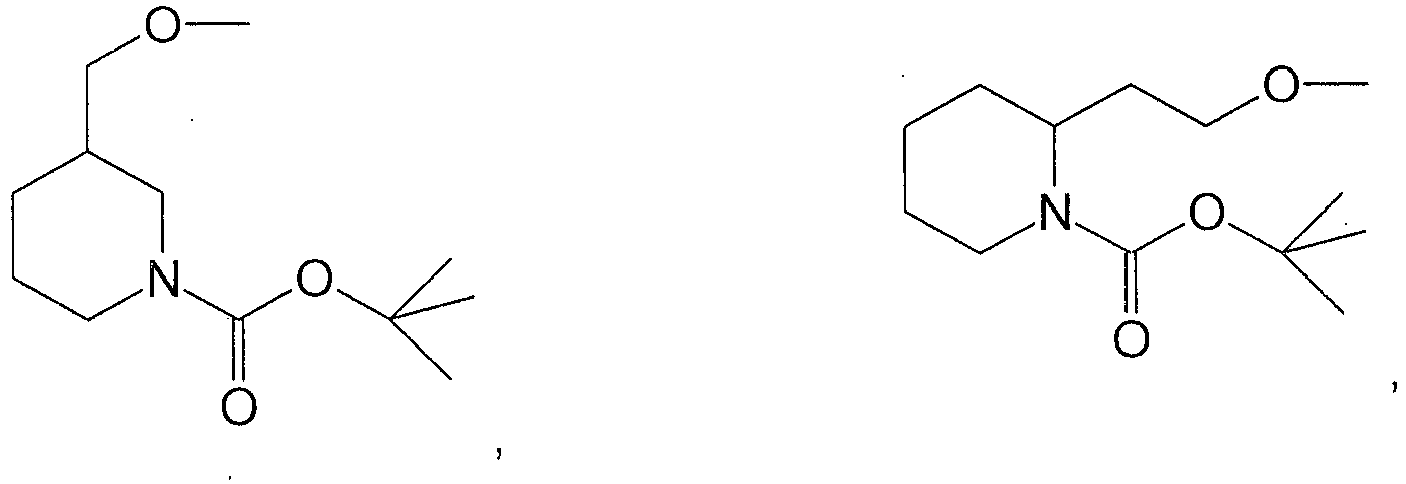


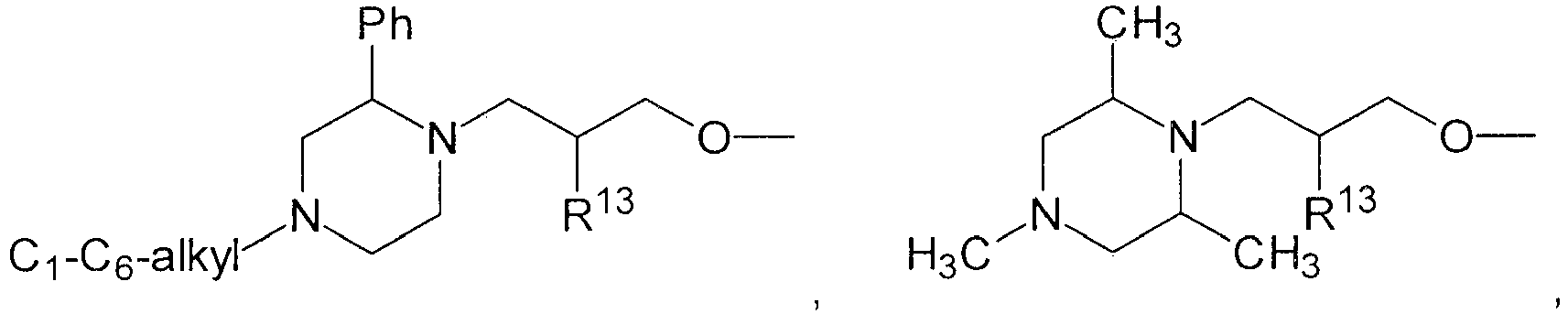
 -R3, -R4, -R5, -R6 are independently of each other selected from hydrogen, halogen, nitro, C1-6 alkyl, C3-C10-cycloalkyl, C1-6 alkoxy, wherein the C1-6 alkyl, C3-C10-cycloalkyl or C1-6 alkoxy groups are optionally mono- or polysubstituted by hydroxyl, halogen, C1-4 alkyl and/or C1-4 alkoxy, wherein the C1-4 alkyl and/or C1-4 alkoxy groups are optionally mono- or polysubstituted by hydroxyl and/or halogen.-R7 representsand stereoisomeric forms, solvates, hydrates and/or pharmaceutically acceptable salts thereof.(i) a saturated or unsaturated three- to twelve-membered carbocyclic or heterocyclic ring system which is optionally mono- or polysubstituted by hydroxy, C1-6 alkyl, C3-C10-cycloalkyl, C2-6 alkenyl, C2-6 alkynyl, C1-6 alkoxy, a halogen atom, or a saturated or unsaturated three- to eight-membered carbocyclic or heterocyclic group, and the C1-6 alkyl, C3-C10-cycloalkyl, C2-6 alkenyl, C2-6 alkynyl, and C1-6 alkoxy groups are optionally substituted by a halogen atom or a saturated or unsaturated three- to eight-membered carbocyclic or heterocyclic group,(ii) C1-6 alkyl or C1-6 alkoxy which is unsubstituted or substituted by a saturated or unsaturated three- to twelve-membered carbocyclic or heterocyclic ring system which is optionally mono- or polysubstituted by hydroxy, C1-6 alkyl, C2-6 alkenyl, C2-6 alkynyl, C1-6 alkoxy, a halogen atom, or a saturated or unsaturated three- to eight-membered carbocyclic or heterocyclic group, and the C1-6 alkyl, C2-6 alkenyl, C2-6 alkynyl, and C1-6 alkoxy groups are optionally substituted by a halogen atom or a saturated or unsaturated three- to eight-membered carbocyclic or heterocyclic group,(iii) a nitrogen atom substituted with a saturated or unsaturated three- to twelve-membered or heterocyclic ring system which is optionally mono- or polysubstituted by hydroxy, C1-6 alkyl, C2-6 alkenyl, C2-6 alkynyl, C1-6 alkoxy, a halogen atom, or a saturated or unsaturated three- to eight-membered carbocyclic or heterocyclic group, and the C1-6 alkyl, C2-6 alkenyl, C2-6 alkynyl, and C1-6 alkoxy groups are optionally substituted by a halogen atom or a saturated or unsaturated three- to eight-membered carbocyclic or heterocyclic group,-R8 represents hydroxyl, halogen, C1-6-alkoxy, C1-6 alkylcarbonyl, carboxyl, C3-C10-cycloalkyl, C1-6-alkoxycarbonyl, a heterocyclic group, a heterocycloalkyl group with one or two heteroatoms selected from O, N, S and 2 to 6 carbon atoms, C1-6-alkyl, -NH-CO-NR9R10, -CO-NR9R10,-NR9R10;
-R9 and -R10 are independently of each other selected from hydrogen, C3-C6-cycloalkyl, C1-6 alkyl optionally substituted by hydroxyl, halogen and/or C1-4 alkoxy or
-R9 and -R10 may combine with the nitrogen atom attached thereto to form a saturated or unsaturated five- or six-membered heterocyclic group,
wherein the heterocyclic group is optionally substituted by hydroxyl, amino, halogen, -COOH, C1-6 alkyl, C2-6 alkenyl, C2-6 alkynyl, C1-6 alkoxy, C1-6 alkoxycarbonyl, C1-6 alkylcarbonyl, C1-6 acyloxy, a saturated or unsaturated three- to twelve-membered carbocyclic or heterocyclic ring system, wherein the C1-6 alkyl, C2-6 alkenyl, C2-6 alkynyl, C1-6 alkoxy, C1-6 alkoxycarbonyl, C1-6 alkylcarbonyl and/or C1-6 acyloxy groups are optionally substituted by hydroxyl, C1-6 alkoxy, or a saturated or unsaturated three- to twelve-membered carbocyclic or heterocyclic ring system;
wherein in the amino group one or both hydrogen atoms on said amino group are optionally substituted by C1-6 alkyl or a saturated or unsaturated three- to twelve-membered carbocyclic or heterocyclic ring system, and the C1-6 alkyl group is optionally substituted by hydroxyl, C1-6 alkoxy, or a saturated or unsaturated three- to twelve-membered carbocyclic or heterocyclic ring system;
wherein the saturated or unsaturated three- to twelve-membered carbocyclic or heterocyclic ring system is optionally substituted by hydroxyl, C1-6 alkyl, C2-6 alkenyl, C2-6 alkynyl, C1-6 alkoxy, C1-6 alkoxycarbonyl, or a saturated or unsaturated three- to twelve-membered carbocyclic or heterocyclic ring system, wherein the C1-6 alkyl, C2-6 alkenyl, and C2-6 alkynyl groups are optionally substituted by hydroxyl, C1-6 alkoxy, or a saturated or unsaturated three- to twelve-membered carbocyclic or heterocyclic ring system; when the carbocyclic or heterocyclic group is substituted by two C1-6 alkyl groups, the two alkyl groups may combine together to form an alkylene chain; and the carbocyclic or heterocyclic group may be condensed with another saturated or unsaturated five- to seven-membered carbocyclic or heterocyclic group to form a bicyclic group;
R11 - R21 represent independently of each other linear or branched, substituted or unsubstituted C1-C20-alkyl, -H, -OH, -OCH3, -OC2H5, -OC3H7, -O-cyclo-C3H5, -OCH(CH3)2, -OC(CH3)3, -OC4H9, -OPh, -OCH2-Ph, -OCPh3, -SH, -SCH3, -SC2H5, -SC3H7, -S-cyclo-C3H5, -SCH(CH3)2, -SC(CH3)3, -NO2, -F, -Cl, -Br, -I, -N3, -CN, -OCN, -NCO, -SCN, -NCS, -CHO, -COCH3, -COC2H5, -COC3H7, -CO-cyclo-C3H5, -COCH(CH3)2, -COC(CH3)3, -COOH, -COCN, -COOCH3, -COOC2H5, -COOC3H7, -COO-cyclo-C3H5, -COOCH(CH3)2, -COOC(CH3)3, -OOC-CH3, -OOC-C2H5, -OOC-C3H7, -OOC-cyclo-C3H5, -OOC-CH(CH3)2, -OOC-C(CH3)3, -CONH2, -CONHCH3, -CONHC2H5, -CONHC3H7, -CONH-cyclo-C3H5, -CONH[CH(CH3)2], -CONH[C(CH3)3], -CON(CH3)2, -CON(C2H5)2, -CON(C3H7)2, -CON(cyclo-C3H5)2, -CON[CH(CH3)2]2, -CON[C(CH3)3]2, -NH2, -NHCH3, -NHC2H5, -NHC3H7, -NH-cyclo-C3H5, -NHCH(CH3)2, -NHC(CH3)3, -N(CH3)2, -N(C2H5)2, -N(C3H7)2, -N(cyclo-C3H5)2, -N[CH(CH3)2]2, -N[C(CH3)3]2, -SOCH3, -SOC2H5, -SOC3H7, -SO-cyclo-C3H5, -SOCH(CH3)2, -SOC(CH3)3, -SO2CH3, -SO2C2H5, -SO2C3H7, -SO2-cyclo-C3H5, -SO2CH(CH3)2, -SO2C(CH3)3, -SO3H, -SO3CH3, -SO3C2H5, -SO3C3H7, -SO3-cyclo-C3H5, -SO3CH(CH3)2, -SO3C(CH3)3, -OCHF2, -OCF3, -OC2F5, -O-COOCH3, -O-COOC2H5, -O-COOC3H7, -O-COO-cyclo-C3H5, -O-COOCH(CH3)2, -O-COOC(CH3)3, -NH-CO-NH2, -NH-CO-NHCH3, -NH-CO-NHC2H5, -NH-CO-NHC3H7, -NH-CO-NH-cyclo-C3H5, -NH-CO-NH[CH(CH3)2], -NH-CO-NH[C(CH3)3], -NH-CO-N(CH3)2, -NH-CO-N(C2H5)2, -NH-CO-N(C3H7)2, -NH-CO-N(cyclo-C3H5)2, -NH-CO-N[CH(CH3)2]2, -NH-CO-N[C(CH3)3]2, -NH-CS-NH2, -NH-CS-NH-cyclo-C3H5, -NH-CS-NHC3H7, -NH-CS-NH(CH(CH3)2], -NH-CS-NH[C(CH3)3], -NH-CS-N(CH3)2, -NH-CS-N(C2H5)2, -NH-CS-N(C3H7)2, -NH-CS-N(cyclo-C3H5)2, -NH-CS-N[CH(CH3)2]2, -NH-CS-N[C(CH3)3]2, -NH-C(=NH)-NH2, -NH-C(=NH)-NHCH3, -NH-C(=NH)-NHC2H5, -NH-CS-NHC2H5, -NH-C(=NH)-NHC3H7, -NH-C(=NH)-NH-cyclo-C3H5, -NH-C(=NH)-NH[CH(CH3)2], -NH-C(=NH)-NH[C(CH3)3], -NH-CS-NHCH3, -NH-C(=NH)-N(CH3)2, -NH-C(=NH)-N(C2H5)2, -NH-C(=NH)-N(C3H7)2, -NH-C(=NH)-N(cyclo-C3H5)2, -Si(CH3)3, -NH-C(=NH)-N[CH(CH3)2]2, -NH-C(=NH)-N[C(CH3)3]2, -O-CO-NH2, -O-CO-NHCH3, -O-CO-NHC2H5, -O-CO-NHC3H7, -O-CO-NH-cyclo-C3H5, -O-CO-NH[CH(CH3)2], -O-CO-NH[C(CH3)3], -O-CO-N(CH3)2, -O-CO-N(C2H5)2, -O-CO-N(C3H7)2, -O-CO-N(cyclo-C3H5)2, -O-CO-N[CH(CH3)2]2, -O-CO-N[C(CH3)3]2, -O-CO-OCH3, -O-CO-OC2H5, -O-CO-OC3H7, -O-CO-O-cyclo-C3H5, -O-CO-OCH(CH3)2, -O-CO-OC(CH3)3, -CH2F -CHF2, -CF3, -CH2Cl, -CHCl2, -CCl3, -CH2Br -CHBr2, -CBr3, -CH2I -CHl2, -Cl3, -CPh3, -CH2-CH2F -CH2-CHF2, -CH2-CF3, -CH2-CH2Cl, -CH2-CHCl2, -CH2-CCl3, -CH2-CH2Br -CH2-CHBr2, -CH2-CBr3, -CH2-CH2I -CH2-CHI2, -CH2-CI3, -CH3, -C2H5, -C3H7, -cyclo-C3H5, -CH(CH3)2, -C(CH3)3, -C4H9, -CH2-CH(CH3)2, -CH(CH3)-C2H5, -C(CH3)3, -Ph, -CH2-Ph, -CH=CH2, -CH2-CH=CH2, -C(CH3)=CH2, -CH=CH-CH3, -C2H4-CH=CH2, -CH=C(CH3)2, -C=CH, -C=C-CH3, -CH2-C=CH;
R22 represents phenyl, benzyl, C1-C6-alkyl, pyrrolidin-1-yl, piperidin-1-yl, piperazin-1-yl, -OH, -CH2-OH, -C2H4-OH, -OCH3, -CH2-OCH3, -C2H4-OCH3;
wherein C1-C6-alkyl represents -CH3, -C2H5, -C3H7, -CH(CH3)2, -C4H9, -CH2-CH(CH3)2, -CH(CH3)-C2H5, -C(CH3)3, -CH(CH3)-C3H7, -CH2-CH(CH3)-C2H5, -CH(CH3)-CH(CH3)2, -C5H11, -C(CH3)2-C2H5, -CH2-C(CH3)3, -CH(C2H5)2, -C2H4-CH(CH3)2, -C6H13, -C3H6-CH(CH3)2, -C2H4-CH(CH3)-C2H5, -CH(CH3)-C4H9, -CH2-CH(CH3)-C3H7, -CH(CH3)-CH2-CH(CH3)2, -CH(CH3)-CH(CH3)-C2H5, -CH2-CH(CH3)-CH(CH3)2, -CH2-C(CH3)2-C2H5, -C(CH3)2-C3H7, -C(CH3)2-CH(CH3)2, -C2H4-C(CH3)3, or -CH(CH3)-C(CH3)3, wherein in the afore-mentioned groups one or more hydrogen atom(s) can be replaced by -OH, -OCH3, -OC2H5, -SH, -SCH3, -SC2H5, -NO2, -F, -Cl, -Br, -I, -N3, -COCH3, -COC2H5, -COOCH3, -COOC2H5, -OOC-CH3, -OOC-C2H5, -COOH, -CONH2, -CON(CH3)2, -CON(C2H5)2, -NH2, -NHCH3, -NHC2H5, -N(CH3)2, -N(C2H5)2, -SOCH3, -SOC2H5, -SO3H, -OCF3, -CF3, -C≡CH; - Compound according to claim 1, wherein the group R8-X-O- is

- Compound according to claim 1, wherein the compound is selected from the group comprising:2,5-Difluoro-N-{3-fluoro-4-[6-methoxy-7-(3-piperidin-1-yl-propoxy)-quinolin-4-yloxy]-phenyl}-benzenesulfonamide,2-Fluoro-N-{3-fluoro-4-[6-methoxy-7-(3-piperidin-1-yl-propoxy)-quinolin-4-yloxy]-phenyl}-benzenesulfonamide,4-Chloro-2-fluoro-N-{3-fluoro-4-[6-methoxy-7-(3-piperidin-1-yl-propoxy)-quinolin-4-yloxy]-phenyl}-benzenesulfonamide,N-{3-Fluoro-4-[6-methoxy-7-(3-piperidin-1-yl-propoxy)-quinolin-4-yloxy]-phenyl}-2-trifluoromethyl-benzenesulfonamide,N-{3-Fluoro-4-[6-methoxy-7-(3-piperidin-1-yl-propoxy)-quinolin-4-yloxy]-phenyl}-3-trifluoromethyl-benzenesulfonamide,2,6-Dichloro-N-{3-fluoro-4-[6-methoxy-7-(3-piperidin-1-yl-propoxy)-quinolin-4-yloxy]-phenyl}-benzenesulfonamide,N-{3-Fluoro-4-[6-methoxy-7-(3-piperidin-1-yl-propoxy)-quinolin4-yloxy]-phenyl}-2-nitro-benzenesulfonamide,Biphenyl-3-sulfonic acid {3-fluoro-4-[6-methoxy-7-(3-piperidin-1-yl-propoxy)-quinolin-4-loxy]-phenyl}-amide,3-Difluoromethoxy-N-{3-fluoro-4-[6-methoxy-7-(3-piperidin-1-yl-propoxy)-quinolin-4-yloxy]-phenyl}benzenesulfonamide,N-{3-Fluoro-4-[6-methoxy-7-(3-piperidin-1-yl-propoxy)-quinolin-4-yloxy]-phenyl}-3-phenoxy-benzenesulfonamide,2,6-Difluoro-N-{3-fluoro-4-[6-methoxy-7-(3-piperidin-1-yl-propoxy)-quinolin-4-yloxy]-phenyl}-benzenesulfonamide,2,5-Difluoro-N-(3-fluoro-4-{6-methoxy-7-[3-(4-methyl-piperazin-1-yl)-propoxy]-quinolin-4-yloxy}-phenyl)-benzenesulfonamide,Biphenyl-3-sulfonic acid (3-fluoro-4-{6-methoxy-7-[3-(4-methyl-piperazin-1-yl)-propoxy]-quinolin-4-yloxy}-phenyl)-amide,N-(3-Fluoro-4-{6-methoxy-7-[3-(4-methyl-piperazin-1-yl)-propoxy]-quinolin-4-yloxy}-phenyl)-3-phenoxy-benzenesulfonamide,2-Cyano-N-(3-fluoro-4-{6-methoxy-7-[3-(4-methyl-piperazin-1-yl)-propoxy]-quinolin-4-yloxy}-phenyl)-benzenesulfonamide,2,4-Difluoro-N-(3-fluoro-4-{6-methoxy-7-[3-(4-methyl-piperazin-1-yl)-propoxy]-quinolin-4-yloxy}-phenyl)-benzenesulfonamide,2, 3,4-Trifluoro-N-(3-fluoro-4-{6-methoxy-7-[3-(4-methyl-piperazin-1-yl)-propoxy]-quinolin-4-yloxy}-phenyl)-benzenesulfonamide,4-Fluoro-N-(3-fluoro-4-{6-methoxy-7-[3-(4-methyl-piperazin-1-yl)-propoxy]-quinolin-4-yloxy}-phenyl)-3-methoxy-benzenesulfonamide,2-Bromo-N-(3-fluoro-4-{6-methoxy-7-[3-(4-methyl-piperazin-1-yl)-propoxy]-quinolin-4-yloxy}-phenyl)-benzenesulfonamide,2,5-Dichloro-N-(3-fluoro-4-{6-methoxy-7-[3-(4-methyl-piperazin-1-yl)-propoxy]-quinolin-4-yloxy}-phenyl)-benzenesulfonamide,N-(3-Fluoro-4-{6-methoxy-7-[3-(4-methyl-piperazin-1-yl)-propoxy]-quinolin-4-yloxy}-phenyl)-2-nitro-benzenesulfonamide,3-Fluoro-(3-fluoro-4-{6-methoxy-7-[3-(4-methyl-piperazin-1-yl)-propoxy]-quinolin-4-yloxy}-phenyl)-benzenesulfonamide,3-Chloro-4-fluoro-N-(3-fluoro-4-{6-methoxy-7-[3-(4-methyl-piperazin-1-yl)-propoxy]-quinolin-4-yloxy}-phenyl)-benzenesulfonamide,N-(3-Fluoro-4-{6-methoxy-7-[3-(4-methyl-piperazin-1-yl)-propoxy]-quinolin-4-yloxy}-phenyl)-2-trifluoromethyl-benzenesulfonamide,N-(3-Fluoro-4-{6-methoxy-7-[3-(4-methyl-piperazin-1-yl)-propoxy]-quinolin-4-yloxy}-phenyl)-2-trifluoromethoxy-benzenesulfonamide,2-Fluoro-N-(3-fluoro-4-{6-methoxy-7-[3-(4-methyl-piperazin-1-yl)-propoxy]-quinolin-4-yloxy}-phenyl)-benzenesulfonamide,4-Chloro-2-fluoro-N-(3-fluoro-4-{6-methoxy-7-[3-(4-methyl-piperazin-1-yl)-propoxy]-quinolin-4-yloxy}-phenyl)-benzenesulfonamide,N-(3-Fluoro-4-{6-methoxy-7-[3-(4-methyl-piperazin-1-yl)-propoxy]-quinolin-4-yloxy}-phenyl)-2-methyl-benzenesulfonamide,2-Chloro-N-(3-fluoro-4-{6-methoxy-7-[3-(4-methyl-piperazin-1-yl)-propoxy]-quinolin-4-yloxy}-phenyl)-benzenesulfonamide,3-Difluoromethoxy-N-(3-fluoro-4-{6-methoxy-7-[3-(4-methyl-piperazin-1-yl)-propoxy]-quinolin-4-yloxy}-phenyl)-benzenesulfonamide,Thiophene-2-sulfonic acid (3-fluoro-4-{6-methoxy-7-[3-(4-methyl-piperazin-1-yl)-propoxy]-quinolin-4-yloxy}-phenyl)-amide,2,6-Dichloro-N-(3-fluoro-4-{6-methoxy-7-[3-(4-methyl-piperazin-1-yl)-propoxy]-quinolin-4-yloxy}-phenyl)-benzenesulfonamide,N-(3-Fluoro-4-{6-methoxy-7-[3-(4-methyl-piperazin-1-yl)-propoxy]-quinolin-4-yloxy}-phenyl)-2-methoxy-benzenesulfonamide,3,5-Dichloro-N-{3-fluoro-4-[6-methoxy-7-(3-piperidin-1-yl-propoxy)-quinolin-4-yloxy]-phenyl}-2-methoxy-benzenesulfonamide,3,5-Dichloro-N-(3-fluoro-4-{6-methoxy-7-[3-(4-methyl-piperazin-1-yl)-propoxy]-quinolin-4-yloxy}-phenyl)-2-methoxy-benzenesulfonamide,N-(3-Fluoro-4-{6-methoxy-7-[3-(3-methyl-piperidin-1-yl)-propoxy]-quinolin-4-yloxy}-phenyl)-benzenesulfonamide,3-Fluoro-N-(3-fluoro-4-{6-methoxy-7-[3-(3-methyl-piperidin-1-yl)-propoxy]-quinolin-4-yloxy}-phenyl)-benzenesulfonamide,2-Chloro-N-(3-fluoro-4-{6-methoxy-7-[3-(3-methyl-piperidin-1-yl)-propoxy]-quinolin-4-yloxy}-phenyl)-benzenesulfonamide'N-(3-Fluoro-4-{6-methoxy-7-[3-(3-methyl-piperidin-1-yl)-propoxy]-quinolin-4-yloxy}-phenyl)-3-trifluoromethyl-benzenesulfonamideN-(3-Fluoro-4-{6-methoxy-7-[3-(3-methyl-piperidin-1-yl)-propoxy]-quinolin-4-yloxy}-phenyl)-2-nitro-benzenesulfonamide3-Cyano-N-(3-fluoro-4-{6-methoxy-7-[3-(3-methyl-piperidin-1-yl)-propoxy]-quinolin-4-yloxy}-phenyl)-benzenesulfonamide,N-(3-Fluoro-4-{6-methoxy-7-[3-(3-methyl-piperidin-1-yl)-propoxy]-quinolin-4-yloxy}-phenyl)-3-methoxy-benzenesulfonamide,3-Difluoromethoxy-N-(3-fluoro-4-{6-methoxy-7-[3-(3-methyl-piperidin-1-yl)-propoxy]-quinolin-4-yloxy}-phenyl)-benzenesulfonamide,N-(3-Fluoro-4-{6-methoxy-7-[3-(3-methyl-piperidin-1-yl)-propoxy]-quinolin-4-yloxy}-phenyl)-2-methyl-benzenesulfonamide,N-(3-Fluoro-4-{6-methoxy-7-[3-(3-methyl-piperidin-1-yl)-propoxy]-quinolin-4-yloxy}-phenyl)-2-trifluoromethoxy-benzenesulfonamide,N-(3-Fluoro-4-{6-methoxy-7-[3-(3-methyl-piperid in-1-yl)-propoxy]-q uinolin-4-yloxy}-phenyl)-3-trifluoromethoxy-benzenesulfonamide,2,4-Difluoro-N-(3-fluoro-4-{6-methoxy-7-[3-(3-methyl-piperidin-1-yl)-propoxy]-quinolin-4-yloxy}-phenyl)-benzenesulfonamide,3,4-Difluoro-N-(3-fluoro-4-{6-methoxy-7-[3-(3-methyl-piperidin-1-yl)-propoxy]-quinolin-4-yloxy}-phenyl)-benzenesulfonamide,2,3,4-Trifluoro-N-(3-fluoro-4-{6-methoxy-7-[3-(3-methyl-piperidin-1-yl)-propoxy]-quinolin-4-yloxy)-phenyl)-benzenesulfonamide,2,5-Dichloro-N-(3-fluoro-4-{6-methoxy-7-[3-(3-methyl-piperidin1-yl)-propoxy]-quinolin-4-yloxy}-phenyl)-benzenesulfonamide,2,6-Dichloro-N-(3-fluoro-4-{6-methoxy-7-[3-(3-methyl-piperidin-1-yl)-propoxy]-quinolin-4-yloxy)-phenyl)-benzenesulfonamide,3,4-Dichloro-N-(3-fluoro-4-{6-methoxy-7-[3-(3-methyl-piperidin-1-yl)-propoxy]-quinolin-4-yloxy}-phenyl)-benzenesulfonamide,3,5-Dichloro-N-(3-fluoro-4-{6-methoxy-7-[3-(3-methyl-piperidin-1-yl)-propoxy]-quinolin-4-yloxy}-phenyl)-benzenesulfonamide,3-Chloro-2-fluoro-N-(3-fluoro-4-{6-methoxy-7-[3-(3-methyl-piperidin-1-yl)-propoxy]-quinolin-4-yloxy}-phenyl)-benzenesulfonamide,2-Fluoro-N-(3-fluoro-4-{6-methoxy-7-[3-(3-methyl-piperidin-1-yl)-propoxy]-quinolin-4-yloxy}-phenyl)-5-methyl-benzenesulfonamide,3-Fluoro-N-(3-fluoro-4-{6-methoxy-7-[3-(3-methyl-piperidin-1-yl)-propoxy]-quinolin-4-yloxy}-phenyl)-4-methyl-benzenesulfonamide,3-Chloro-4-fluoro-N-(3-fluoro-4-{6-methoxy-7-[3-(3-methyl-piperidin-1-yl)-propoxy]-quinolin-4-yloxy}-phenyl)-benzenesulfonamide,Naphthalene-1-sulfonic acid (3-fluoro-4-{6-methoxy-7-[3-(3-methyl-piperidin-1-yl)-propoxy]-quinolin-4-yloxy}-phenyl)-amide,N-(3-Fluoro-4-{6-methoxy-7-[3-(3-methyl-piperidin-1-yl)-propoxy]-quinolin-4-yloxy}-phenyl)-3-phenoxy-benzenesulfonamide,Cyclopropanesulfonic acid (3-fluoro-4-{6-methoxy-7-[3-(3-methyl-piperidin-1-yl)-propoxy]-quinolin-4-yloxy}-phenyl)-amide,1-Methyl-1 H-pyrazole-3-sulfonic acid (3-fluoro-4-{6-methoxy-7-[3-(3-methyl-piperidin-1-yl)-propoxy]-quinolin-4-yloxy}-phenyl)-amide,5-Methyl-thiophene-2-sulfonic acid (3-fluoro-4-{6-methoxy-7-[3-(3-methyl-piperidin-1-yl)-propoxy]-quinolin-4-yloxy}-phenyl)-amide,5-Chloro-thiophene-2-sulfonic acid (3-fluoro-4-{6-methoxy-7-[3-(3-methyl-piperidin-1-yl)-propoxy]-quinolin-4-yloxy}-phenyl)-amide,2,4-Dichloro-thiophene-3-sulfonic acid (3-fluoro-4-{6-methoxy-7-[3-(3-methyl-piperidin-1-yl)-propoxy]-quinolin-4-yloxy}-phenyl)-amide,Thiophene-3-sulfonic acid (3-fluoro-4-{6-methoxy-7-[3-(3-methyl-piperidin-1-yl)-propoxy]-quinolin-4-yloxy}-phenyl)-amide,3-(3-Fluoro-4-{6-methoxy-7-[3-(3-methyl-piperidin-1-yl)-propoxy]-quinolin-4-y[oxyl-phenylsulfamoyl)-thiophene-2-carboxylic acid methyl ester,Benzo[b]thiophene-3-sulfonic acid (3-fluoro-4-{6-methoxy-7-[3-(3-methyl-piperidin-1-yl)-propoxy]-quinolin-4-yloxy}-phenyl)-amide,1-Ethyl-1 H-pyrazole-4-sulfonic acid (3-fluoro-4-{6-methoxy-7-[3-(3-methyl-piperidin-1-yl)-propoxy]-quinolin-4-yloxy}-phenyl)-amide,3-Chloro-N-(3-fluoro-4-{6-methoxy-7-[3-(3-methyl-piperidin-1-yl)-propoxy]-quinolin-4-yloxy}-phenyl)-benzenesulfonamide,N-(3-Fluoro-4-{6-methoxy-7-[3-(3-methyl-piperidin-1-yl)-propoxy]-quinolin-4-yloxy}-phenyl)-3-methyl-benzenesulfonamide,N-(3-Fluoro-4-{6-methoxy-7-[3-(3-methyl-piperidin-1-yl)-propoxy]-quinolin-4-yloxy}-phenyl)-2-methoxy-benzenesulfonamide,3-Cyano-4-fluoro-N-(3-fluoro-4-{6-methoxy-7-[3-(3-methyl-piperid in-1-yl)-propoxy]-quinolin-4-yloxy}-phenyl)-benzenesulfonamide,2-Phenyl-ethenesulfonic acid (3-fluoro-4-{6-methoxy-7-[3-(3-methyl-piperidin-1-yl)-propoxy]-quinolin-4-yloxy}-phenyl)-amide,Quinoline-8-sulfonic acid (3-fluoro-4-{6-methoxy-7-[3-(3-methyl-piperidin-1-yl)-propoxy]-quinolin-4-yloxy}-phenyl)-amide,3,5-Dichloro-N-(3-fluoro-4-{6-methoxy-7-[3-(3-methyl-piperidin-1-yl)-propoxy]-quinolin-4-yloxy}-phenyl)-2-methoxy-benzenesulfonamide,3,5-Dichloro-N-{3-fluoro-4-[6-methoxy-7-(3-morpholin-4-yl-propoxy)-quinolin-4-yloxy]-phenyl}-2-methoxy-benzenesulfonamide,2,6-Difluoro-N-{3-fluoro-4-[6-methoxy-7-(3-morpholin-4-yl-propoxy)-quinolin-4-yloxy]-phenyl}-benzenesulfonamide,N-{3-Fluoro-4-[6-methoxy-7-(3-piperidin-1-yl-propoxy)-quinolin-4-yloxy]-phenyl}-2-trifluoromethoxy-benzenesulfonamide,Butane-1-sulfonic acid {3-fluoro-4-[6-methoxy-7-(3-morpholin-4-yl-propoxy)-quinolin-4-yloxy]-phenyl}-amide,2,5-Difluoro-N-{3-fluoro-4-[6-methoxy-7-(piperidin-3-ylmethoxy)-quinolin-4-yloxy]-phenyl}-benzenesulfonamide,2-Fluoro-N-{3-fluoro-4-[6-methoxy-7-(2-morpholin-4-yl-ethoxy)-quinolin-4-yloxy]-phenyl}-benzenesulfonamide,2,6-Difluoro-N-{3-fluoro-4-[6-methoxy-7-(2-morpholin-4-yl-ethoxy)-quinolin-4-yloxy]-phenyl}-benzenesulfonamide,2,5-Difluoro-N-{3-fluoro-4-[6-methoxy-7-(4-morpholin-4-yl-butoxy)-quinolin-4-yloxy]-phenyl}-benzenesulfonamide,2,5-Difluoro-N-{3-fluoro-4-[7-(4-morpholin-4-yl-butoxy)-quinolin-4-yloxy]-phenyl}-benzenesulfonamide,N-(3-Fluoro-4-{6-[3-(4-methyl-piperazin-1-yl)-propoxy]-quinolin-4-yloxy}-phenyl)-2-trifluoromethyl-benzenesulfonamide,N-(3-Fluoro-4-{7-methoxy-6-[3-(4-methyl-piperazin-1-yl)-propoxy]-quinolin-4-yloxy}-phenyl)-2-trifluoromethyl-benzenesulfonamide,N-(3-Chloro-4-{6-methoxy-7-[3-(4-methyl-piperazin-1-yl)-propoxy]-quinolin-4-yloxy}-phenyl)-2-trifluoromethyl-benzenesulfonamide,N-(3,5-Dichloro-4-{6-methoxy-7-[3-(4-methyl-piperazin-1-yl)-propoxy]-quinolin-4-yloxy}-phenyl)-2,6-difluoro-benzenesulfonamide,N-(4-{6-Methoxy-7-[3-(4-methyl-piperidin-1-yl)-propoxy]-quinolin-4-yloxy}-3-methyl-phenyl)-2-trifluoromethyl-benzenesulfonamide,2,5-Difluoro-N-(3-methoxy-4-{6-methoxy-7-[3-(3-methyl-piperidin-1-yl)-propoxy]-quinolin-4-yloxy}-phenyl)-benzenesulfonamide,N-(3-Fluoro-4-{6-methoxy-7-[3-(2-methyl-piperidin-1-yl)-propoxy]-quinolin-4-yloxy}-phenyl)-2-trifluoromethyl-benzenesulfonamide,N-(3-{6-Methoxy-7-[3-(4-methyl-piperazin-1-yl)-propoxy]-quinolin-4-yloxy}-phenyl)-2-trifluoromethyl-benzenesulfonamide,N-{3-Fluoro-4-[6-methoxy-7-(2-morpholin-4-yl-ethoxy)-quinolin-4-yloxy]-phenyl}-2-methoxy-benzenesulfonamide,2,6-Dichloro-N-{3-fluoro-4-[6-methoxy-7-(2-morpholin-4-yl-ethoxy)-quinolin-4-yloxy]-phenyl}-benzenesulfonamide,Thiophene-2-sulfonic acid {3-fluoro-4-[6-methoxy-7-(2-morpholin-4-yl-ethoxy)-quinolin-4-yloxy]-phenyl}-amide,2,5-Dichloro-N-{3-fluoro-4-[6-methoxy-7-(2-morpholin-4-yl-ethoxy)-quinolin-4-yloxy]-phenyl}-benzenesulfonamide,1-Methyl-1 H-pyrazole-3-sulfonic acid {3-fluoro-4-[6-methoxy-7-(2-morpholin-4-yl-ethoxy)-quinolin-4-yloxy]-phenyl}-amide,2-Chloro-N-{3-fluoro-4-[6-methoxy-7-(2-morpholin-4-yl-ethoxy)-quinolin-4-yloxy]-phenyl}-benzenesulfonamide,N-{3-Fluoro-4-[6-methoxy-7-(2-morpholin-4-yl-ethoxy)-quinolin-4-yloxy]-phenyl}-2-nitro-benzenesulfonamide,2,6-Difluoro-N-(3-fluoro-4-{6-methoxy-7-[3-(4-methyl-piperazin-1-yl)-propoxy]-quinolin-4-yloxy}-phenyl)-benzenesulfonamide,N-(3-Chloro-4-{6-methoxy-7-[3-(4-methyl-piperazin-1-yl)-propoxy]-quinolin-4-yloxy}-phenyl)-2-fluoro-benzenesulfonamide,N-(3-Chloro-4-{6-methoxy-7-[3-(4-methyl-piperazin-1-yl)-propoxy]-quinolin-4-yloxy}-phenyl)-2,5-difluoro-benzenesulfonamide,Benzo[b]thiophene-3-sulfonic acid {3-fluoro-4-[6-methoxy-7-(3-piperidin-1-yl-propoxy)-quinolin-4-yloxy]-phenyl}-amide,Benzo[b]thiophene-3-sulfonic acid {3-fluoro-4-[6-methoxy-7-(3-morpholin-4-yl-propoxy)-quinolin-4-yloxy]-phenyl}-amide,Benzo[b]thiophene-3-sulfonic acid (3-fluoro-4-{6-methoxy-7-[3-(4-methyl-piperidin-1-yl)-propoxy]-quinolin-4-loxy}-phenyl)-amide,Benzo[b]thiophene-3-sulfonic acid (3-fluoro-4-{6-methoxy-7-[3-(4-methyl-piperazin-1-yl)-propoxy]-quinolin-4-yloxy}-phenyl)-amide,Benzo[b]thiophene-3-sulfonic acid (3-chloro-4-{6-methoxy-7-[3-(4-methyl-piperazin-1-yl)-propoxy]-quinolin-4-yloxy}-phenyl)-amide,N-(3-Chloro-4-{6-methoxy-7-[3-(4-methyl-piperazin-1-yl)-propoxy]-quinolin-4-yloxy}-phenyl)-2,6-difluoro-benzenesulfonamide,2,6-Dichloro-N-(3-chloro-4-{6-methoxy-7-[3-(4-methyl-piperazin-1-yl)-propoxy]-quinolin-4-yloxy}-phenyl)-benzenesulfonamide,2,5-Difluoro-N-(3-{6-methoxy-7-[3-(4-methyl-piperazin-1-yl)-propoxy]-quinolin-4-yloxy}-phenyl)-benzenesulfonamide,2,5-Dichloro-N-(3-chloro-4-{6-methoxy-7-[3-(4-methyl-piperazin-1-yl)-propoxy]-quinolin-4-yloxy}-phenyl)-benzenesulfonamide,2,6-Difluoro-N-(3-{6-methoxy-7-[3-(4-methyl-piperazin-1-yl)-propoxy]-quinolin-4-yloxy}-phenyl)-benzenesulfonamide,N-(3-{6-Methoxy-7-[3-(4-methyl-piperazin-1-yl)-propoxy]-quinolin-4-yloxy}-phenyl)-2-trifluoromethoxy-benzenesulfonamide,2,5-Dichloro-N-(3-{6-methoxy-7-[3-(4-methyl-piperazin-1-yl)-propoxy]-quinolin-4-yloxy}-phenyl)-benzenesulfonamide,2,6-Dichloro-N-(3-{6-methoxy-7-[3-(4-methyl-piperazin-1-yl)-propoxy]-quinolin-4-yloxy}-phenyl)-benzenesulfonamide,Thiophene-2-sulfonic acid (3-{6-methoxy-7-[3-(4-methyl-piperazin-1-yl)-propoxy]-quinolin-4-yloxy}-phenyl)-amide,5-Chloro-thiophene-2-sulfonic acid (3-{6-methoxy-7-[3-(4-methyl-piperazin-1-yl)-propoxy]-quinolin-4-yloxy}-phenyl)-amide,5-Methyl-thiophene-2-sulfonic acid (3-{6-methoxy-7-[3-(4-methyl-piperazin-1-yl)-propoxy]-quinolin-4-yloxy}-phenyl)-amide,N-[5-(3-{6-Methoxy-7-[3-(4-methyl-piperazin-1-yl)-propoxy]-quinolin-4-yloxy}-phenylsulfamoyl)-4-methyl-thiazol-2-yl]-acetamide,Thiophene-3-sulfonic acid (3-{6-methoxy-7-[3-(4-methyl-piperazin-1-yl)-propoxy]-quinolin-4-yloxy}-phenyl)-amide,2,5-Dichloro-thiophene-3-sulfonic acid (3-{6-methoxy-7-[3-(4-methyl-piperazin-1-yl)-propoxy]-quinolin-4-yloxy}-phenyl)-amide,3-(3-{6-Methoxy-7-[3-(4-methyl-piperazin-1-yl)-propoxy]-quinolin-4-yloxy}-phenylsulfamoyl)-thiophene-2-carboxylic acid methyl ester,Benzo[b]thiophene-3-sulfonic acid (3-{6-methoxy-7-[3-(4-methyl-piperazin-1-yl)-propoxy]-quinolin-4-yloxy}-phenyl)-amide,Furan-2-sulfonic acid (3-{6-methoxy-7-[3-(4-methyl-piperazin-1-yl)-propoxy]-quinolin-4-yloxy}-phenyl)-amide,3,5-Dimethyl-isoxazole-4-sulfonic acid (3-{6-methoxy-7-[3-(4-methyl-piperazin-1-yl)-propoxy]-quinolin-4-yloxy}-phenyl)-amide,1-Methyl-1 H-pyrazole-3-sulfonic acid (3-{6-methoxy-7-[3-(4-methyl-piperazin-1-yl)-propoxy]-quinolin-4-yloxy}-phenyl)-amide,1-Ethyl-1H-pyrazole-4-sulfonic acid (3-{6-methoxy-7-[3-(4-methyl-piperazin-1-yl)-propoxy]-quinolin-4-yloxy}-phenyl)-amide,2-Methyl-1 H-imidazole-4-sulfonic acid (3-{6-methoxy-7-[3-(4-methyl-piperazin-1-yl)-propoxy]-quinolin-4-yloxy}-phenyl)-amide,Cyclopropanesulfonic acid (3-{6-methoxy-7-[3-(4-methyl-piperazin-1-yl)-propoxy]-quinolin-4-yloxy}-phenyl)-amide,2-Phenyl-ethenesulfonic acid (3-{6-methoxy-7-[3-(4-methyl-piperazin-1-yl)-propoxy]-quinolin-4-yloxy}-phenyl)-amide,Thiophene-2-sulfonic acid (3-fluoro-4-{6-methoxy-7-[3-(2-methyl-piperidin-1-yl)-propoxy]-quinolin-4-yloxy}-phenyl)-amide,5-Chloro-thiophene-2-sulfonic acid (3-fluoro-4-{6-methoxy-7-[3-(2-methyl-piperidin-1-yl)-propoxy]-quinolin-4-yloxy}-phenyl)-amide,2,4-Dichloro-thiophene-3-sulfonic acid (3-fluoro-4-{6-methoxy-7-[3-(2-methyl-piperidin-1-yl)-propoxy]-quinolin-4-yloxy}-phenyl)-amide,Benzo[b]thiophene-3-sulfonic acid (3-fluoro-4-{6-methoxy-7-[3-(2-methyl-piperidin-1-yl)-propoxy]-quinolin-4-yloxy}-phenyl)-amide,Furan-2-sulfonic acid (3-ftuoro-4-{6-methoxy-7-[3-(2-methyl-piperidin-1-yl)-propoxy]-quinolin-4-yloxy}-phenyl)-amide,2-Methyl-1 H-imidazole-4-sulfonic acid (3-fluoro-4-{6-methoxy-7-[3-(2-methyl-piperidin-1-yl)-propoxy]-quinolin-4-yloxy}-phenyl)-amide,1-Methyl-1 H-pyrazole-3-sulfonic acid (3-fluoro-4-{6-methoxy-7-[3-(2-methyl-piperidin-1-yl)-propoxy]-quinolin-4-yloxy}-phenyl)-amide,2,5-Difluoro-N-(3-fluoro-4-{6-methoxy-7-[3-(2-methyl-piperidin-1-yl)-propoxy]-quinolin-4-yloxy}-phenyl)-benzenesulfonamide,2,6-Difluoro-N-(3-fluoro-4-{6-methoxy-7-[3-(2-methyl-piperidin-1-yl)-propoxy]-quinolin-4-yloxy}-phenyl)-benzenesulfonamide,N-(3-Fluoro-4-{6-methoxy-7-[3-(2-methyl-piperidin-1-yl)-propoxy]-quinolin-4-yloxy}-phenyl)-2-trifluoromethoxy-benzenesulfonamide,2,5-Dichloro-N-(3-fluoro-4-{6-methoxy-7-[3-(2-methyl-piperidin-1-yl)-propoxy]-quinolin-4-yloxy}-phenyl)-benzenesulfonamide,3-{3-Fluoro-4-[6-methoxy-7-(3-piperidin-1-yl-propoxy)-quinolin-4-yloxy]-phenylsulfamoyl}-thiophene-2-carboxylic acid methyl ester,3-(3-Fluoro-4-{6-methoxy-7-[3-(4-methyl-piperidin-1-yl)-propoxy]-quinolin-4-yloxy}-phenylsulfamoyl)-thiophene-2-carboxylic acid methyl ester,3-{3-Fluoro-4-[6-methoxy-7-(3-morpholin-4-yl-propoxy)-quinolin-4-yloxy]-phenylsulfamoyl}-thiophene-2-carboxylic acid methyl ester,3-(3-Fluoro-4-{6-methoxy-7-[3-(4-methyl-piperazin-1-yl)-propoxy]-quinolin-4-yloxy}-phenylsulfamoyl)-thiophene-2-carboxylic acid methyl ester,1,3,5-Trimethyl-1H-pyrazole-4-sulfonic acid {3-fluoro-4-[6-methoxy-7-(3-piperidin-1-yl-propoxy)-quinolin-4-yloxy]-phenyl}-amide,1,3,5-Trimethyl-1H-pyrazole-4-sulfonic acid (3-fluoro-4-{6-methoxy-7-[3-(4-methyl-piperidin-1-yl)-propoxy]-quinolin-4-yloxy}-phenyl)-amide,1,3,5-Trimethyl-1 H-pyrazole-4-sulfonic acid {3-fluoro-4-[6-methoxy-7-(3-morpholin-4-yl-propoxy)-quinolin-4-yloxy]-phenyl}-amide,1,3,5-Trimethyl-1H-pyrazole-4-sulfonic acid (3-fluoro-4-{6-methoxy-7-[3-(4-methyl-piperazin-1-yl)-propoxy]-quinolin-4-yloxy}-phenyl)-amide,1-Methyl-1 H-pyrazole-3-sulfonic acid {3-fluoro-4-[6-methoxy-7-(3-piperidin-1-yl-propoxy)-quinolin-4-yloxy]-phenyl}-amide,1-Methyl-1H-pyrazole-3-sulfonic acid (3-fluoro-4-{6-methoxy-7-[3-(4-methyl-piperidin-1-yl)-propoxy]-quinolin-4-yloxy}-phenyl)-amide,1-Methyl-1 H-pyrazole-3-sulfonic acid {3-fluoro-4-[6-methoxy-7-(3-morpholin-4-yl-propoxy)-quinolin-4-yloxy]-phenyl}-amide,1-Methyl-1 H-pyrazole-3-sulfonic acid (3-fluoro-4-{6-methoxy-7-[3-(4-methyl-piperazin-1-yl)-propoxy]-quinolin-4-yloxy}-phenyl)-amide,2-Methyl-3H-imidazole-4-sulfonic acid {3-fluoro-4-[6-methoxy-7-(3-piperidin-1-yl-propoxy)-quinolin-4-yloxy]-phenyl}-amide,2-Methyl-3H-imidazole-4-sulfonic acid (3-fluoro-4-{6-methoxy-7-[3-(4-methyl-piperidin-1-yl)-propoxy]-quinolin-4-yloxy}-phenyl)-amide,2-Methyl-3H-imidazole-4-sulfonic acid {3-fluoro-4-[6-methoxy-7-(3-morpholin-4-yl-propoxy)-quinolin-4-yloxy]-phenyl}-amide,2-Methyl-3H-imidazole-4-sulfonic acid (3-fluoro-4-{6-methoxy-7-[3-(4-methyl-piperazin-1-yl)-propoxy]-quinolin-4-yloxy}-phenyl)-amide,2,5-Difluoro-N-(4-{6-methoxy-7-[3-(4-methyl-piperidin-1-yl)-propoxy]-quinolin-4-yloxy}-3-methyl-phenyl)-benzenesulfonamide,2,6-Difluoro-N-(4-{6-methoxy-7-[3-(4-methyl-piperidin-1-yl)-propoxy]-quinolin-4-yloxy}-3-methyl-phenyl)-benzenesulfonamide,2,6-Difluoro-N-(3-methoxy-4-{6-methoxy-7-[3-(4-methyl-piperidin-1-yl)-propoxy]-quinolin-4-yloxy}-phenyl)-benzenesulfonamide,N-(4-{6-Methoxy-7-[3-(4-methyl-piperidin-1-yl)-propoxy]-quinolin-4-yloxy}-3-methyl-phenyl)-2-trifluoromethoxy-benzenesulfonamide,2,5-Dichloro-N-(4-{6-methoxy-7-[3-(4-methyl-piperidin-1-yl)-propoxy]-quinolin-4-yloxy}-3-methyl-phenyl)-benzenesulfonamide,2,6-Dichloro-N-(4-{6-methoxy-7-[3-(4-methyl-piperidin-1-yl)-propoxy]-quinolin-4-yloxy}-3-methyl-phenyl)-benzenesulfonamide,2,5-Difluoro-N-(4-fluoro-3-{6-methoxy-7-[3-(4-methyl-piperidin-1-yl)-propoxy]-quinolin-4-yloxy}-phenyl)-benzenesulfonamide,2,6-Difluoro-N-(4-fluoro-3-{6-methoxy-7-[3-(4-methyl-piperidin-1-yl)-propoxy]-quinolin-4-yloxy}-phenyl)-benzenesulfonamide,N-(4-Fluoro-3-{6-methoxy-7-[3-(4-methyl-piperidin-1-yl)-propoxy]-quinolin-4-yloxy}-phenyl)-2-trifluoromethyl-benzenesulfonamide,N-(4-Fluoro-3-{6-methoxy-7-[3-(4-methyl-piperidin-1-yl)-propoxy]-quinolin-4-yloxy}-phenyl)-2-trifluoromethoxy-benzenesulfonamide,2,5-Dichloro-N-(4-fluoro-3-{6-methoxy-7-[3-(4-methyl-piperidin-1-yl)-propoxy]-quinolin-4-yloxy}-phenyl)-benzenesulfonamide,2,6-Dichloro-N-(4-fluoro-3-{6-methoxy-7-[3-(4-methyl-piperidin-1-yl)-propoxy]-quinolin-4-yloxy}-phenyl)-benzenesulfonamide,N-(2-Chloro-5-{6-methoxy-7-[3-(4-methyl-piperidin-1-yl)-propoxy]-quinolin-4-yloxy}-phenyl)-2,5-difluoro-benzenesulfonamide,N-(2-Chloro-5-{6-methoxy-7-[3-(4-methyl-piperidin-1-yl)-propoxy]-quinolin-4-yloxy}-phenyl)-2,6-difluoro-benzenesulfonamide,N-(2-Chloro-5-{6-methoxy-7-[3-(4-methyl-piperidin-1-yl)-propoxy]-quinolin-4-yloxy}-phenyl)-2-trifluoromethyl-benzenesulfonamide,N-(2-Chloro-5-{6-methoxy-7-[3-(4-methyl-piperidin-1-yl)-propoxy]-quinolin-4-yloxy}-phenyl)-2-trifluoromethoxy-benzenesulfonamide,2,5-Dichloro-N-(2-chloro-5-{6-methoxy-7-[3-(4-methyl-piperidin-1-yl)-propoxy]-quinolin-4-yloxy}-phenyl)-benzenesulfonamide,2,6-Dichloro-N-(2-chloro-5-{6-methoxy-7-[3-(4-methyl-piperidin-1-yl)-propoxy]-quinolin-4-yloxy}-phenyl)-benzenesulfonamide,2,5-Difluoro-N-(3-methoxy-4-{6-methoxy-7-[3-(4-methyl-piperidin-1-yl)-propoxy]-quinolin-4-yloxy}-phenyl)-benzenesulfonamide,N-(3-Methoxy-4-{6-methoxy-7-[3-(4-methyl-piperidin-1-yl)-propoxy]-quinolin-4-yloxy}-phenyl)-2-trifluoromethyl-benzenesulfonamide,N-(3,5-Dichloro-4-{6-methoxy-7-[3-(4-methyl-piperidin-1-yl)-propoxy]-quinolin-4-yloxy}-phenyl)-2,6-difluoro-benzenesulfonamide,N-(3,5-Dichloro-4-{6-methoxy-7-[3-(4-methyl-piperidin-1-yl)-propoxy]-quinolin-4-yloxy}-phenyl)-2-trifluoromethyl-benzenesulfonamide,N-{3-Fluoro-4-[6-methoxy-7-(4-morpholin-4-yl-butoxy)-quinolin-4-yloxy]-phenyl}-2-trifluoromethyl-benzenesulfonamide, andN-(2-Fluoro-4-{6-methoxy-7-[3-(3-methyl-piperidin-1-yl)-propoxy]-quinolin-4-yloxy}-phenyl)-2-trifluoromethyl-benzenesulfonamide.
- Compound according to any of previous claims 1 to 3 for use as a pharmaceutically active agent in medicine.
- Compound according to any of previous claim 1 to 3 for use in the treatment and/or prevention of AXL receptor tyrosine kinase induced disorders, wherein the AXL receptor tyrosine kinase induced disorders are selected from the group comprising hyperproliferative disorders, breast, colon, prostate, lung, gastric, ovarian, endometrial, renal, hepatocellular, thyroid, uterine cancer, esophageal carcinoma, squamous cell carcinoma, leukemia, osteosarcoma, melanoma, glioblastoma, and neuroblastoma.
- Compound according to any one of claims 1 - 3 for use in the prophylaxis, treatment and after-treatment cancer, tumors and cancer metastases.
- Compound according to claim 6, wherein the cancer, tumor or cancer metastase is selected from the group comprising:adenocarcinoma, choroidal melanoma, acute leukemia, acoustic neurinoma, ampullary carcinoma, anal carcinoma, astrocytoma, basal cell carcinoma, pancreatic cancer, desmoid tumor, bladder cancer, bronchial carcinoma, breast cancer, Burkitt's lymphoma, corpus cancer, CUP-syndrome (carcinoma of unknown primary), colorectal cancer, small intestine cancer, small intestinal tumors, ovarian cancer, endometrial carcinoma, ependymoma, epithelial cancer types, Ewing's tumors, gastrointestinal tumors, gastric cancer, gallbladder cancer, gall bladder carcinomas, uterine cancer, cervical cancer, glioblastomas, gynecologic tumors, ear, nose and throat tumors, hematologic neoplasias, hairy cell leukemia, urethral cancer, skin cancer, skin testis cancer, brain tumors (gliomas), brain metastases, testicle cancer, hypophysis tumor, carcinoids, Kaposi's sarcoma, laryngeal cancer, germ cell tumor, bone cancer, colorectal carcinoma, head and neck tumors (tumors of the ear, nose and throat area), colon carcinoma, craniopharyngiomas, oral cancer (cancer in the mouth area and on lips), cancer of the central nervous system, liver cancer, liver metastases, leukemia, eyelid tumor, lung cancer, lymph node cancer (Hodgkin's/Non-Hodgkin's), lymphomas, stomach cancer, malignant melanoma, malignant neoplasia, malignant tumors gastrointestinal tract, breast carcinoma, rectal cancer, medulloblastomas, melanoma, meningiomas, Hodgkin's disease, mycosis fungoides, nasal cancer, neurinoma, neuroblastoma, kidney cancer, renal cell carcinomas, non-Hodgkin's lymphomas, oligodendroglioma, esophageal carcinoma, osteolytic carcinomas and osteoplastic carcinomas, osteosarcomas, ovarial carcinoma, pancreatic carcinoma, penile cancer, plasmocytoma, prostate cancer, pharyngeal cancer, rectal carcinoma, retinoblastoma, vaginal cancer, thyroid carcinoma, Schneeberger disease, esophageal cancer, spinalioms, T-cell lymphoma (mycosis fungoides), thymoma, tube carcinoma, eye tumors, urologic tumors, urothelial carcinoma, vulva cancer, wart appearance, soft tissue tumors, soft tissue sarcoma, Wilm's tumor, cervical carcinoma and tongue cancer.
- Pharmaceutical composition comprising at least one compound according to any one of claims 1 to 3 as an active ingredient, together with at least one pharmaceutically acceptable carrier, excipient and/or diluents.
Priority Applications (1)
| Application Number | Priority Date | Filing Date | Title |
|---|---|---|---|
| EP10776309.6A EP2462117B1 (en) | 2009-10-16 | 2010-10-16 | Quinolinyloxyphenylsulfonamides |
Applications Claiming Priority (3)
| Application Number | Priority Date | Filing Date | Title |
|---|---|---|---|
| EP09075468A EP2311809A1 (en) | 2009-10-16 | 2009-10-16 | Quinolinyloxyphenylsulfonamides |
| EP10776309.6A EP2462117B1 (en) | 2009-10-16 | 2010-10-16 | Quinolinyloxyphenylsulfonamides |
| PCT/EP2010/006525 WO2011045084A1 (en) | 2009-10-16 | 2010-10-16 | Quinolinyloxyphenylsulfonamides |
Publications (2)
| Publication Number | Publication Date |
|---|---|
| EP2462117A1 EP2462117A1 (en) | 2012-06-13 |
| EP2462117B1 true EP2462117B1 (en) | 2017-06-28 |
Family
ID=41818643
Family Applications (2)
| Application Number | Title | Priority Date | Filing Date |
|---|---|---|---|
| EP09075468A Ceased EP2311809A1 (en) | 2009-10-16 | 2009-10-16 | Quinolinyloxyphenylsulfonamides |
| EP10776309.6A Active EP2462117B1 (en) | 2009-10-16 | 2010-10-16 | Quinolinyloxyphenylsulfonamides |
Family Applications Before (1)
| Application Number | Title | Priority Date | Filing Date |
|---|---|---|---|
| EP09075468A Ceased EP2311809A1 (en) | 2009-10-16 | 2009-10-16 | Quinolinyloxyphenylsulfonamides |
Country Status (6)
| Country | Link |
|---|---|
| US (2) | US8685971B2 (en) |
| EP (2) | EP2311809A1 (en) |
| CN (1) | CN102574804B (en) |
| AU (1) | AU2010306003B2 (en) |
| ES (1) | ES2644083T3 (en) |
| WO (1) | WO2011045084A1 (en) |
Families Citing this family (18)
| Publication number | Priority date | Publication date | Assignee | Title |
|---|---|---|---|---|
| UY34451A (en) | 2011-11-14 | 2013-05-31 | Cephalon Inc | URACILO DERIVATIVES AS INHIBITORS OF THE AXL AND C-MET KINASE |
| MY165215A (en) | 2012-01-31 | 2018-03-09 | Daiichi Sankyo Co Ltd | Pyridone derivatives |
| CN105916506B (en) | 2013-11-20 | 2020-01-07 | 圣诺康生命科学公司 | Quinazoline derivatives as TAM family kinase inhibitors |
| CN105764514B (en) | 2013-11-27 | 2019-07-12 | 圣诺康生命科学公司 | Aminopyridine derivatives as TAM family kinase inhibitors |
| TWI690525B (en) | 2014-07-07 | 2020-04-11 | 日商第一三共股份有限公司 | Pyridone derivatives with tetrahydropyranylmethyl and uses thereof |
| US9840503B2 (en) | 2015-05-11 | 2017-12-12 | Incyte Corporation | Heterocyclic compounds and uses thereof |
| WO2017027717A1 (en) | 2015-08-12 | 2017-02-16 | Incyte Corporation | Bicyclic fused pyrimidine compounds as tam inhibitors |
| US10053465B2 (en) | 2015-08-26 | 2018-08-21 | Incyte Corporation | Pyrrolopyrimidine derivatives as TAM inhibitors |
| CN114456176B (en) | 2016-03-28 | 2024-08-30 | 因赛特公司 | Pyrrolotriazine compounds as TAM inhibitors |
| KR20200047627A (en) * | 2017-08-31 | 2020-05-07 | 애브비 인코포레이티드 | Ectonucleotide pyrophosphatase-phosphodiesterase 1 (ENPP-1) inhibitors and uses thereof |
| KR102739325B1 (en) | 2017-09-27 | 2024-12-09 | 인사이트 코포레이션 | Salts of pyrrolotriazine derivatives useful as TAM inhibitors |
| CN109824587A (en) * | 2017-11-23 | 2019-05-31 | 上海翔锦生物科技有限公司 | The preparation method of tyrosine kinase inhibitor XJF007 and its intermediate |
| WO2019191504A1 (en) * | 2018-03-30 | 2019-10-03 | Mavupharma, Inc. | Ectonucleotide pyrophosphate-phosphodiesterase (enpp) conjugates and uses thereof |
| MX2020011636A (en) * | 2018-05-30 | 2020-12-07 | Qurient Co Ltd | Quinoline derivatives as inhibitors of axl/mer rtk and csf1r. |
| US11241438B2 (en) | 2018-06-29 | 2022-02-08 | Incyte Corporation | Formulations of an AXL/MER inhibitor |
| CA3166485A1 (en) * | 2020-02-04 | 2021-08-12 | Srinivas Rao Kasibhatla | Inhibitors of ectonucleotide pyrophosphatase/phosphodiesterase 1 (enpp1) and methods of use thereof |
| PH12022552347A1 (en) | 2020-03-06 | 2024-01-29 | Incyte Corp | Combination therapy comprising axl/mer and pd-1/pd-l1 inhibitors |
| CN111393363B (en) * | 2020-04-27 | 2022-12-20 | 威海海洋生物医药产业技术研究院有限公司 | 4-phenoxy quinoline and N-sulfonyl amidine compound and preparation method and application thereof |
Family Cites Families (7)
| Publication number | Priority date | Publication date | Assignee | Title |
|---|---|---|---|---|
| US20050029264A1 (en) | 2003-08-04 | 2005-02-10 | Werth Elmer D. | Bottom-Fill Container and Opening System |
| CA2744997A1 (en) * | 2003-09-26 | 2005-04-07 | Exelixis, Inc. | C-met modulators and method of use |
| EP1673087B1 (en) | 2003-10-03 | 2015-05-13 | 3M Innovative Properties Company | Alkoxy substituted imidazoquinolines |
| GB0509227D0 (en) * | 2005-05-05 | 2005-06-15 | Chroma Therapeutics Ltd | Intracellular enzyme inhibitors |
| ES2703723T3 (en) * | 2006-12-14 | 2019-03-12 | Exelixis Inc | Methods for using MEK inhibitors |
| WO2009017838A2 (en) * | 2007-08-01 | 2009-02-05 | Exelixis, Inc. | Combinations of jak-2 inhibitors and other agents |
| JP5746015B2 (en) * | 2008-04-16 | 2015-07-08 | マックス プランク ゲゼルシャフト ツゥアー フェデルゥン デル ヴィッセンシャフテン エー フォー | Quinoline derivatives as AXL kinase inhibitors |
-
2009
- 2009-10-16 EP EP09075468A patent/EP2311809A1/en not_active Ceased
-
2010
- 2010-10-16 AU AU2010306003A patent/AU2010306003B2/en active Active
- 2010-10-16 EP EP10776309.6A patent/EP2462117B1/en active Active
- 2010-10-16 ES ES10776309.6T patent/ES2644083T3/en active Active
- 2010-10-16 US US13/500,761 patent/US8685971B2/en active Active
- 2010-10-16 CN CN201080046094.6A patent/CN102574804B/en active Active
- 2010-10-16 WO PCT/EP2010/006525 patent/WO2011045084A1/en not_active Ceased
-
2014
- 2014-03-10 US US14/202,951 patent/US9169241B2/en active Active
Non-Patent Citations (1)
| Title |
|---|
| None * |
Also Published As
| Publication number | Publication date |
|---|---|
| ES2644083T3 (en) | 2017-11-27 |
| AU2010306003B2 (en) | 2013-10-03 |
| WO2011045084A1 (en) | 2011-04-21 |
| EP2311809A1 (en) | 2011-04-20 |
| HK1171017A1 (en) | 2013-03-15 |
| US20120277231A1 (en) | 2012-11-01 |
| AU2010306003A1 (en) | 2012-03-15 |
| CN102574804B (en) | 2015-01-07 |
| US9169241B2 (en) | 2015-10-27 |
| US20140336191A1 (en) | 2014-11-13 |
| US8685971B2 (en) | 2014-04-01 |
| CN102574804A (en) | 2012-07-11 |
| EP2462117A1 (en) | 2012-06-13 |
Similar Documents
| Publication | Publication Date | Title |
|---|---|---|
| US8685971B2 (en) | Quinolinyloxyphenylsulfonamides | |
| EP2227453B1 (en) | Heteroaryl amides useful as inhibitors of voltage-gated sodium channels | |
| US8309543B2 (en) | Compositions useful as inhibitors of voltage-gated sodium channels | |
| JP4944776B2 (en) | Pyrimidine urea derivatives as kinase inhibitors | |
| US7615563B2 (en) | Compositions useful as inhibitors of voltage-gated sodium channels | |
| US20100184753A1 (en) | Ion Channel Modulators and Methods of Uses | |
| JP2007501804A5 (en) | ||
| AU2004217891A1 (en) | Quinazolines useful as modulators of ion channels | |
| JP2012126751A (en) | Bicyclic derivative as modulator of ion channel | |
| JP2007521325A (en) | Benzimidazoles useful as modulators of ion channels | |
| JP2012149084A (en) | Quinoline derivative useful as modulator of ion channel | |
| JP2008540661A (en) | Bicyclic derivatives as modulators of ion channels | |
| TWI774780B (en) | Compounds | |
| WO2006119451A1 (en) | Pyrimidines and pyrazines useful as modulators of ion channels | |
| EP1877381A1 (en) | Pyridines useful as modulators of ion channels | |
| EP1888549A2 (en) | Biaryls useful as modulators of ion channels | |
| HRP20030608A2 (en) | Use of gal3 receptor antagonists for the treatment | |
| HK1171017B (en) | Quinolinyloxyphenylsulfonamides | |
| HK1141277A (en) | Heteroarylaminosulfonylphenyl derivatives for use as sodium or calcium channel blockers in the treatment of pain | |
| HK1124844A (en) | Quinazolines useful as modulators of voltage gated ion channels |
Legal Events
| Date | Code | Title | Description |
|---|---|---|---|
| PUAI | Public reference made under article 153(3) epc to a published international application that has entered the european phase |
Free format text: ORIGINAL CODE: 0009012 |
|
| 17P | Request for examination filed |
Effective date: 20120217 |
|
| AK | Designated contracting states |
Kind code of ref document: A1 Designated state(s): AL AT BE BG CH CY CZ DE DK EE ES FI FR GB GR HR HU IE IS IT LI LT LU LV MC MK MT NL NO PL PT RO RS SE SI SK SM TR |
|
| DAX | Request for extension of the european patent (deleted) | ||
| 17Q | First examination report despatched |
Effective date: 20160208 |
|
| GRAP | Despatch of communication of intention to grant a patent |
Free format text: ORIGINAL CODE: EPIDOSNIGR1 |
|
| RIC1 | Information provided on ipc code assigned before grant |
Ipc: A61P 35/04 20060101ALI20170127BHEP Ipc: C07D 409/12 20060101ALI20170127BHEP Ipc: A61P 35/00 20060101ALI20170127BHEP Ipc: C07D 413/12 20060101ALI20170127BHEP Ipc: C07D 417/12 20060101ALI20170127BHEP Ipc: A61K 31/4709 20060101ALI20170127BHEP Ipc: C07D 401/14 20060101ALI20170127BHEP Ipc: C07D 401/12 20060101ALI20170127BHEP Ipc: C07D 409/14 20060101ALI20170127BHEP Ipc: A61K 31/47 20060101ALI20170127BHEP Ipc: C07D 405/12 20060101ALI20170127BHEP Ipc: C07D 215/20 20060101AFI20170127BHEP |
|
| INTG | Intention to grant announced |
Effective date: 20170213 |
|
| RIN1 | Information on inventor provided before grant (corrected) |
Inventor name: TORKA, ROBERT Inventor name: SZABADKAI, ISTVAN Inventor name: OERFI, LASZLO Inventor name: KERI, GYOERGY Inventor name: ZHANG, YIXIANG Inventor name: ULLRICH, AXEL |
|
| GRAS | Grant fee paid |
Free format text: ORIGINAL CODE: EPIDOSNIGR3 |
|
| GRAA | (expected) grant |
Free format text: ORIGINAL CODE: 0009210 |
|
| AK | Designated contracting states |
Kind code of ref document: B1 Designated state(s): AL AT BE BG CH CY CZ DE DK EE ES FI FR GB GR HR HU IE IS IT LI LT LU LV MC MK MT NL NO PL PT RO RS SE SI SK SM TR |
|
| REG | Reference to a national code |
Ref country code: GB Ref legal event code: FG4D |
|
| REG | Reference to a national code |
Ref country code: CH Ref legal event code: EP |
|
| REG | Reference to a national code |
Ref country code: AT Ref legal event code: REF Ref document number: 904712 Country of ref document: AT Kind code of ref document: T Effective date: 20170715 |
|
| REG | Reference to a national code |
Ref country code: IE Ref legal event code: FG4D |
|
| REG | Reference to a national code |
Ref country code: DE Ref legal event code: R096 Ref document number: 602010043318 Country of ref document: DE |
|
| REG | Reference to a national code |
Ref country code: FR Ref legal event code: PLFP Year of fee payment: 8 |
|
| PG25 | Lapsed in a contracting state [announced via postgrant information from national office to epo] |
Ref country code: NO Free format text: LAPSE BECAUSE OF FAILURE TO SUBMIT A TRANSLATION OF THE DESCRIPTION OR TO PAY THE FEE WITHIN THE PRESCRIBED TIME-LIMIT Effective date: 20170928 Ref country code: GR Free format text: LAPSE BECAUSE OF FAILURE TO SUBMIT A TRANSLATION OF THE DESCRIPTION OR TO PAY THE FEE WITHIN THE PRESCRIBED TIME-LIMIT Effective date: 20170929 Ref country code: HR Free format text: LAPSE BECAUSE OF FAILURE TO SUBMIT A TRANSLATION OF THE DESCRIPTION OR TO PAY THE FEE WITHIN THE PRESCRIBED TIME-LIMIT Effective date: 20170628 Ref country code: FI Free format text: LAPSE BECAUSE OF FAILURE TO SUBMIT A TRANSLATION OF THE DESCRIPTION OR TO PAY THE FEE WITHIN THE PRESCRIBED TIME-LIMIT Effective date: 20170628 Ref country code: LT Free format text: LAPSE BECAUSE OF FAILURE TO SUBMIT A TRANSLATION OF THE DESCRIPTION OR TO PAY THE FEE WITHIN THE PRESCRIBED TIME-LIMIT Effective date: 20170628 |
|
| REG | Reference to a national code |
Ref country code: NL Ref legal event code: MP Effective date: 20170628 |
|
| REG | Reference to a national code |
Ref country code: LT Ref legal event code: MG4D |
|
| REG | Reference to a national code |
Ref country code: AT Ref legal event code: MK05 Ref document number: 904712 Country of ref document: AT Kind code of ref document: T Effective date: 20170628 |
|
| REG | Reference to a national code |
Ref country code: ES Ref legal event code: FG2A Ref document number: 2644083 Country of ref document: ES Kind code of ref document: T3 Effective date: 20171127 |
|
| PG25 | Lapsed in a contracting state [announced via postgrant information from national office to epo] |
Ref country code: RS Free format text: LAPSE BECAUSE OF FAILURE TO SUBMIT A TRANSLATION OF THE DESCRIPTION OR TO PAY THE FEE WITHIN THE PRESCRIBED TIME-LIMIT Effective date: 20170628 Ref country code: NL Free format text: LAPSE BECAUSE OF FAILURE TO SUBMIT A TRANSLATION OF THE DESCRIPTION OR TO PAY THE FEE WITHIN THE PRESCRIBED TIME-LIMIT Effective date: 20170628 Ref country code: SE Free format text: LAPSE BECAUSE OF FAILURE TO SUBMIT A TRANSLATION OF THE DESCRIPTION OR TO PAY THE FEE WITHIN THE PRESCRIBED TIME-LIMIT Effective date: 20170628 Ref country code: BG Free format text: LAPSE BECAUSE OF FAILURE TO SUBMIT A TRANSLATION OF THE DESCRIPTION OR TO PAY THE FEE WITHIN THE PRESCRIBED TIME-LIMIT Effective date: 20170928 Ref country code: LV Free format text: LAPSE BECAUSE OF FAILURE TO SUBMIT A TRANSLATION OF THE DESCRIPTION OR TO PAY THE FEE WITHIN THE PRESCRIBED TIME-LIMIT Effective date: 20170628 |
|
| PG25 | Lapsed in a contracting state [announced via postgrant information from national office to epo] |
Ref country code: EE Free format text: LAPSE BECAUSE OF FAILURE TO SUBMIT A TRANSLATION OF THE DESCRIPTION OR TO PAY THE FEE WITHIN THE PRESCRIBED TIME-LIMIT Effective date: 20170628 Ref country code: AT Free format text: LAPSE BECAUSE OF FAILURE TO SUBMIT A TRANSLATION OF THE DESCRIPTION OR TO PAY THE FEE WITHIN THE PRESCRIBED TIME-LIMIT Effective date: 20170628 Ref country code: RO Free format text: LAPSE BECAUSE OF FAILURE TO SUBMIT A TRANSLATION OF THE DESCRIPTION OR TO PAY THE FEE WITHIN THE PRESCRIBED TIME-LIMIT Effective date: 20170628 Ref country code: SK Free format text: LAPSE BECAUSE OF FAILURE TO SUBMIT A TRANSLATION OF THE DESCRIPTION OR TO PAY THE FEE WITHIN THE PRESCRIBED TIME-LIMIT Effective date: 20170628 Ref country code: CZ Free format text: LAPSE BECAUSE OF FAILURE TO SUBMIT A TRANSLATION OF THE DESCRIPTION OR TO PAY THE FEE WITHIN THE PRESCRIBED TIME-LIMIT Effective date: 20170628 |
|
| PG25 | Lapsed in a contracting state [announced via postgrant information from national office to epo] |
Ref country code: SM Free format text: LAPSE BECAUSE OF FAILURE TO SUBMIT A TRANSLATION OF THE DESCRIPTION OR TO PAY THE FEE WITHIN THE PRESCRIBED TIME-LIMIT Effective date: 20170628 Ref country code: IS Free format text: LAPSE BECAUSE OF FAILURE TO SUBMIT A TRANSLATION OF THE DESCRIPTION OR TO PAY THE FEE WITHIN THE PRESCRIBED TIME-LIMIT Effective date: 20171028 Ref country code: PL Free format text: LAPSE BECAUSE OF FAILURE TO SUBMIT A TRANSLATION OF THE DESCRIPTION OR TO PAY THE FEE WITHIN THE PRESCRIBED TIME-LIMIT Effective date: 20170628 |
|
| REG | Reference to a national code |
Ref country code: DE Ref legal event code: R097 Ref document number: 602010043318 Country of ref document: DE |
|
| PG25 | Lapsed in a contracting state [announced via postgrant information from national office to epo] |
Ref country code: DK Free format text: LAPSE BECAUSE OF FAILURE TO SUBMIT A TRANSLATION OF THE DESCRIPTION OR TO PAY THE FEE WITHIN THE PRESCRIBED TIME-LIMIT Effective date: 20170628 |
|
| PLBE | No opposition filed within time limit |
Free format text: ORIGINAL CODE: 0009261 |
|
| STAA | Information on the status of an ep patent application or granted ep patent |
Free format text: STATUS: NO OPPOSITION FILED WITHIN TIME LIMIT |
|
| PG25 | Lapsed in a contracting state [announced via postgrant information from national office to epo] |
Ref country code: MC Free format text: LAPSE BECAUSE OF FAILURE TO SUBMIT A TRANSLATION OF THE DESCRIPTION OR TO PAY THE FEE WITHIN THE PRESCRIBED TIME-LIMIT Effective date: 20170628 |
|
| REG | Reference to a national code |
Ref country code: CH Ref legal event code: PL |
|
| 26N | No opposition filed |
Effective date: 20180329 |
|
| REG | Reference to a national code |
Ref country code: IE Ref legal event code: MM4A |
|
| PG25 | Lapsed in a contracting state [announced via postgrant information from national office to epo] |
Ref country code: LU Free format text: LAPSE BECAUSE OF NON-PAYMENT OF DUE FEES Effective date: 20171016 Ref country code: CH Free format text: LAPSE BECAUSE OF NON-PAYMENT OF DUE FEES Effective date: 20171031 Ref country code: LI Free format text: LAPSE BECAUSE OF NON-PAYMENT OF DUE FEES Effective date: 20171031 |
|
| REG | Reference to a national code |
Ref country code: BE Ref legal event code: MM Effective date: 20171031 |
|
| PG25 | Lapsed in a contracting state [announced via postgrant information from national office to epo] |
Ref country code: BE Free format text: LAPSE BECAUSE OF NON-PAYMENT OF DUE FEES Effective date: 20171031 Ref country code: SI Free format text: LAPSE BECAUSE OF FAILURE TO SUBMIT A TRANSLATION OF THE DESCRIPTION OR TO PAY THE FEE WITHIN THE PRESCRIBED TIME-LIMIT Effective date: 20170628 |
|
| PG25 | Lapsed in a contracting state [announced via postgrant information from national office to epo] |
Ref country code: MT Free format text: LAPSE BECAUSE OF NON-PAYMENT OF DUE FEES Effective date: 20171016 |
|
| REG | Reference to a national code |
Ref country code: FR Ref legal event code: PLFP Year of fee payment: 9 |
|
| PG25 | Lapsed in a contracting state [announced via postgrant information from national office to epo] |
Ref country code: IE Free format text: LAPSE BECAUSE OF NON-PAYMENT OF DUE FEES Effective date: 20171016 |
|
| PG25 | Lapsed in a contracting state [announced via postgrant information from national office to epo] |
Ref country code: HU Free format text: LAPSE BECAUSE OF FAILURE TO SUBMIT A TRANSLATION OF THE DESCRIPTION OR TO PAY THE FEE WITHIN THE PRESCRIBED TIME-LIMIT; INVALID AB INITIO Effective date: 20101016 |
|
| PG25 | Lapsed in a contracting state [announced via postgrant information from national office to epo] |
Ref country code: CY Free format text: LAPSE BECAUSE OF NON-PAYMENT OF DUE FEES Effective date: 20170628 |
|
| PG25 | Lapsed in a contracting state [announced via postgrant information from national office to epo] |
Ref country code: MK Free format text: LAPSE BECAUSE OF FAILURE TO SUBMIT A TRANSLATION OF THE DESCRIPTION OR TO PAY THE FEE WITHIN THE PRESCRIBED TIME-LIMIT Effective date: 20170628 |
|
| PG25 | Lapsed in a contracting state [announced via postgrant information from national office to epo] |
Ref country code: TR Free format text: LAPSE BECAUSE OF FAILURE TO SUBMIT A TRANSLATION OF THE DESCRIPTION OR TO PAY THE FEE WITHIN THE PRESCRIBED TIME-LIMIT Effective date: 20170628 |
|
| PG25 | Lapsed in a contracting state [announced via postgrant information from national office to epo] |
Ref country code: PT Free format text: LAPSE BECAUSE OF FAILURE TO SUBMIT A TRANSLATION OF THE DESCRIPTION OR TO PAY THE FEE WITHIN THE PRESCRIBED TIME-LIMIT Effective date: 20170628 |
|
| PG25 | Lapsed in a contracting state [announced via postgrant information from national office to epo] |
Ref country code: AL Free format text: LAPSE BECAUSE OF FAILURE TO SUBMIT A TRANSLATION OF THE DESCRIPTION OR TO PAY THE FEE WITHIN THE PRESCRIBED TIME-LIMIT Effective date: 20170628 |
|
| PGFP | Annual fee paid to national office [announced via postgrant information from national office to epo] |
Ref country code: DE Payment date: 20250909 Year of fee payment: 16 |
|
| PGFP | Annual fee paid to national office [announced via postgrant information from national office to epo] |
Ref country code: GB Payment date: 20251024 Year of fee payment: 16 |
|
| PGFP | Annual fee paid to national office [announced via postgrant information from national office to epo] |
Ref country code: IT Payment date: 20251031 Year of fee payment: 16 |
|
| PGFP | Annual fee paid to national office [announced via postgrant information from national office to epo] |
Ref country code: FR Payment date: 20251029 Year of fee payment: 16 |
|
| PGFP | Annual fee paid to national office [announced via postgrant information from national office to epo] |
Ref country code: ES Payment date: 20251114 Year of fee payment: 16 |