EP2461581A1 - Device and method for content delivery adapted for synchronous playbacks - Google Patents
Device and method for content delivery adapted for synchronous playbacks Download PDFInfo
- Publication number
- EP2461581A1 EP2461581A1 EP10306335A EP10306335A EP2461581A1 EP 2461581 A1 EP2461581 A1 EP 2461581A1 EP 10306335 A EP10306335 A EP 10306335A EP 10306335 A EP10306335 A EP 10306335A EP 2461581 A1 EP2461581 A1 EP 2461581A1
- Authority
- EP
- European Patent Office
- Prior art keywords
- association
- content
- duration
- cnt
- terminal
- Prior art date
- Legal status (The legal status is an assumption and is not a legal conclusion. Google has not performed a legal analysis and makes no representation as to the accuracy of the status listed.)
- Granted
Links
Images



Classifications
-
- H—ELECTRICITY
- H04—ELECTRIC COMMUNICATION TECHNIQUE
- H04N—PICTORIAL COMMUNICATION, e.g. TELEVISION
- H04N21/00—Selective content distribution, e.g. interactive television or video on demand [VOD]
- H04N21/40—Client devices specifically adapted for the reception of or interaction with content, e.g. set-top-box [STB]; Operations thereof
- H04N21/43—Processing of content or additional data, e.g. demultiplexing additional data from a digital video stream; Elementary client operations, e.g. monitoring of home network or synchronising decoder's clock; Client middleware
- H04N21/4302—Content synchronisation processes, e.g. decoder synchronisation
-
- H—ELECTRICITY
- H04—ELECTRIC COMMUNICATION TECHNIQUE
- H04L—TRANSMISSION OF DIGITAL INFORMATION, e.g. TELEGRAPHIC COMMUNICATION
- H04L65/00—Network arrangements, protocols or services for supporting real-time applications in data packet communication
- H04L65/80—Responding to QoS
-
- H—ELECTRICITY
- H04—ELECTRIC COMMUNICATION TECHNIQUE
- H04N—PICTORIAL COMMUNICATION, e.g. TELEVISION
- H04N21/00—Selective content distribution, e.g. interactive television or video on demand [VOD]
- H04N21/20—Servers specifically adapted for the distribution of content, e.g. VOD servers; Operations thereof
- H04N21/23—Processing of content or additional data; Elementary server operations; Server middleware
- H04N21/242—Synchronisation processes, e.g. processing of PCR [Programme Clock References]
-
- H—ELECTRICITY
- H04—ELECTRIC COMMUNICATION TECHNIQUE
- H04N—PICTORIAL COMMUNICATION, e.g. TELEVISION
- H04N21/00—Selective content distribution, e.g. interactive television or video on demand [VOD]
- H04N21/60—Network structure or processes for video distribution between server and client or between remote clients; Control signalling between clients, server and network components; Transmission of management data between server and client, e.g. sending from server to client commands for recording incoming content stream; Communication details between server and client
- H04N21/61—Network physical structure; Signal processing
- H04N21/6106—Network physical structure; Signal processing specially adapted to the downstream path of the transmission network
Definitions
- the invention relates to the field of content delivery adapted for synchronous content playback by terminals connected to a server delivering simultaneously said content to said terminals via networks having different data delivery duration generating different delivery delays.
- IPTV Internet Protocol Television
- DTT Digital Terrestrial Television
- satellite and even over the worldwide web.
- IPTV Internet Protocol Television
- DTT Digital Terrestrial Television
- One problem is that all these pipes use different network technologies generating very different delivery delays. This may result in a strange user experience such as when a TV spectator is watching a soccer match delivered over his broadband IPTV service and he may hear a joyous explosion from his neighbourhood, reacting to a goal if for example a said neighbourhood is probably watching the same program but delivered through the DTT network. Said TV spectator will see the goal too but it may happen several seconds afterwards.
- a classical delivery system is represented in figure 1 . It comprises four terminals T1, T2, T3, T4 and a server S connected through four various networks N1, N2, N3, N4 such as for example: Satellite, Cable, digital terrestrial TV, broadband IPTV, on demand, Internet etc ....
- N1, N2, N3, N4 such as for example: Satellite, Cable, digital terrestrial TV, broadband IPTV, on demand, Internet etc ....
- Head-ends devices VHE1, VHE2, VHE3, VHE4 are adapted for formatting the content as proposed by the broadcaster (not represented on fig. 1 ) for being delivered to said terminals for quasi-simultaneous playbacks. As explained above, there can be delays of about 10 second between the playbacks on standard/basic terminals.
- terminals When terminals are not especially adapted for simultaneous playbacks, one will speak of "basic terminals". Said basic terminals start playing back the delivered content as soon as said content reaches the terminal. But the data delivery durations on the various links, from said server S to said terminals, are not necessarily identical. This variability of data delivery durations introduces delays (up to 10 seconds) between the playbacks performed by all the terminals. This may be problematic when synchronization among terminal users is a strong requirement such as for interactive programs (e.g. TV quiz show wherein terminal users are invited to answer questions in live) or for live events such as a soccer match.
- interactive programs e.g. TV quiz show wherein terminal users are invited to answer questions in live
- live events such as a soccer match.
- Van Deventer et al. proposes to handle delivery duration variability with synchronization buffers located either in network or at terminals.
- the proposed solution is not fully described and is silent on the way the modified basic terminal could implement said feature and particularly it is silent on the complexity of the operation for the broadcaster in terms of supplying of synchronisation signals and especially on the problems of deployment of such solution in a world where most of terminals are basic terminals.
- One of the goals of the present invention is to propose a solution for synchronizing the rendering of a program delivered simultaneously over different networks which would be simple to manage by the broadcaster in charge of supplying content to various terminals via various networks and last but not least which would be compliant with existing "basic terminals".
- the present invention concerns according to a first aspect a method for delivering a content CNT to at least two terminals T1, T2, T3, T4 for synchronous playback of said content CNT onto said at least two terminals T1, T2, T3, T4, each of at least two terminals T1, T2, T3, T4 being connected over a server S through at least one network N1, N2, N3, N4.
- it involves, prior to said steps of associating ST10, ST11, a step of evaluating ST1 the playback duration of the preamble sequence PS, wherein said playback duration is greater than or equal to the largest difference between said estimations DDE1, DDE2, DDE3, DDE4, said preamble sequence PS is adapted for being played back by said terminals T1, T2, T3, T4.
- said preamble sequence PS and said ending sequence ES have an identical playback duration.
- said preamble sequence PS, said ending sequence ES and said content CNT are audio programs or programs combining audio and video.
- the present invention concerns according to a second aspect a method for for playing-back synchronously a content CNT by a terminal T1, T2, T3, T4 connected over at least one network N1, N2, N3, N4 to a server S delivering said content CNT, said terminal T1, T2, T3, T4 receiving through said network N1, N2, N3, N4 a first association A1 and a second association A2, said first association A1 gathering a preamble sequence PS and said content CNT, said preamble sequence PS being temporally positioned in said first association A1 such that when said terminal T1, T2, T3, T4 plays back said first association A1, it plays-back successively and continuously said preamble sequence PS and said content CNT, said second association A2 gathering said content CNT and an ending sequence ES, said ending sequence ES being temporally positioned in said second association A2 such that when said terminal T1, T2, T3, T4 plays back said second association A2, it plays-back successively and continuously said content CNT and said ending sequence ES, one of said first or
- said step of extracting SR10 further consists in extracting from said one of said first or second association A1, A2 an arbitrary duration value ⁇ , wherein said step of evaluating SR1000 of local temporization duration LTD3 consists in assigning to the local temporization duration LTD3 a value equal to the sum of said arbitrary value with a difference between the largest estimations DDE1 and the estimation DDE3.
- said step of playing back SR10001 said second association A2 ends at the end of a time period whose duration is equal to the content CNT playback duration plus the preamble sequence PS playback duration minus said local temporization duration LTD3.
- the present invention concerns according to a third aspect a terminal T3 for playing back a content CNT.
- said terminal receives said content CNT from a server S through a first association A1 and a second association A2 through at least one network N3, said first association A1 gathering a preamble sequence PS and said content CNT both adapted for being played-back by said terminal T3, said preamble sequence PS being temporally positioned in said first association A1 such that said terminal T3 plays back successively and continuously said preamble sequence PS and said content CNT, said second association A2 gathering said content CNT and an ending sequence ES adapted for being played-back, said ending sequence ES being temporally positioned in said second association A2 such that said terminal T3 plays-back successively and continuously said content CNT and said ending sequence ES, and one of said first or second association A1, A2 further comprises estimations DDE1, DDE2, DDE3, DDE4 of data delivery duration from said server S to terminals T1, T2, T3, T4 via networks N1, N2, N3, N4 and a preamble sequence PS playback duration.
- the terminal T3 comprises:
- the terminal T3 is configured for operating according to a first mode of operation in which it plays back the first association A1 as soon as it receives said first association A1.
- the terminal T3 is configured for operating according to a second mode of operation in which, as soon as it receives said first and second association A1, A2 it plays back the preamble sequence PS during a duration equal to said local temporization duration LTD3 and successively and continuously the second association A2, wherein said local temporization duration LTD3 is a difference between the largest estimations DDE1 and the estimation DDE3 corresponding to said identified network N3.
- the terminal T3 interrupts playing back said second association A2 at a date corresponding to said starting reception date plus the content CNT playback duration plus the preamble sequence PS playback duration minus said local temporization duration LTD3.
- An embodiment corresponds to a situation where a broadcaster prepares and delivers a content CNT located on a server S such that whatever the network N1, N2, N3, N4 used for delivery said content CNT can reach terminals adapted for playing back essentially simultaneously said content CNT and/or basic terminals.
- This also applies to terminals which can select the mode of playback operation among a first mode of operation later called “interactive” for signalling it is configured for a synchronous playback and a second mode of operation later called “non interactive" in which playback operations are similar to the playback operations performed on basic terminals.
- An advantage of the invention is then to be adapted for delivering content to all categories of terminals.
- content it is meant an audio/video program dedicated to continuous playback at constant speed, e.g. a soccer match or a TV quiz.
- the program can be pre-recorded and distributed at a particular time or it can be live.
- the broadcaster associates into a first association A1 a content CNT to a preamble sequence PS.
- Both the content CNT and the preamble sequence PS are adapted for being played back by any terminal.
- the first association A1 is adapted for being played back by a terminal operating according to said non-interactive mode (or by any basic terminal). That means the association A1 playback starts immediately after the terminal starts to receive said first association A1.
- Said preamble sequence PS is temporally positioned in said first association such that the terminal receiving said first association plays-back said preamble sequence PS entirely before said content. As soon as the playback of the preamble sequence PS ends, the content playback starts. The content playback is delayed by the playback duration of the preamble sequence PS as shown on fig. 2b .
- the broadcaster assigns to the preamble sequence PS a playback duration greater than or equal to the largest difference between all the data delivery durations over the available delivery networks. Said preamble sequence is prepared by the broadcaster. This assignation van be realized after
- preamble sequence an audio/video program dedicated to a continuous playback at constant speed, partially or in totality for delaying the content playback.
- the audio/video program of the preamble sequence PS is pre-recorded.
- the preamble sequence PS can include data or metadata related to the associated content CNT, for example a title of said content, credits of said contents, still images, bonus etc ..
- the preamble sequence PS can include advertisement messages.
- the broadcaster further associates into a second association A2 said content CNT to an ending sequence ES also adapted for being played back by a terminal.
- Said ending sequence ES is temporally positioned in said second association A2 such that the terminal receiving said second association plays-back said content CNT before said ending sequence ES.
- the second association A2 is adapted for being played back exclusively by a terminal operating according to said interactive mode.
- the playback duration of the ending sequence ES is equal to the playback duration of the preamble sequence PS for facilitating the task of the broadcaster who has to deliver the first and the second association into a single transport stream.
- the broadcaster stores estimations DDE1, DDE2, DDE3, DDE4 of data delivery duration from the server S to each of the terminals T1, T2, T3, T4 respectively over said networks N1, N2, N3, N4.
- these estimations are supplied by content diffusers.
- the broadcaster further inserts said estimations DDE1, DDE2, DDE3, DDE4 in at least one of said first and second association A1, A2 and delivers second association A2 essentially simultaneously to terminals T1, T2, T3, T4 via the networks N1, N2, N3, N4.
- These insertions can be made as an auxiliary stream that means the insertions are periodically temporally repeated into said at least one of said first and second association A1, A2. This could, by example allow to update said estimations when the content diffusers supplies such estimation updates.
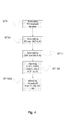
- fig. 4 shows the main steps of the method for delivering content to at least two terminals T1, T2, T3, T4 for synchronous playbacks of said content onto said terminals according to said embodiment.
- Step ST1 consists in evaluating a playback duration of a preamble sequence PS, wherein said playback duration is determined for being greater than or equal to the largest difference between said estimations DDE1, DDE2, DDE3, DDE4.
- the preamble sequence PS is adapted for being played back by said terminals T1, T2, T3, T4; This step can be avoided by assigning to the preamble sequence PS a duration which is empirically greater than all estimation of delivery duration : for example the preamble sequence PS playback duration is set to 30 seconds.
- Step ST10 consists in associating into a first association A1 said content CNT to said preamble sequence PS.
- the preamble sequence PS is temporally positioned in said first association A1 such that a terminal T1, T2, T3, T4 playing back said first association A1 will plays-back successively entirely said preamble sequence PS and continuously said content;
- Step ST11 consists in associating into a second association A2 said content CNT to an ending sequence ES.
- the ending sequence ES has a playback duration for example identical to the playback duration of the preamble sequence PS and is temporally positioned in said second association A2 such that a terminal playing back said second association A2 will play-back said content CNT before said ending sequence ES.
- Step ST100 consists in inserting said estimations DDE1, DDE2, DDE3, DDE4 at least one of said first and second association A1, A2.
- step ST100 involves a step of inserting ST100 an arbitrary duration value in said at least one of said first and second association A1, A2.
- Step ST1000 consists in delivering said first and second association A1 A2 to said terminals T1, T2, T3, T4 via said at least one network N1, N2, N3, N4. This delivery is essentially simultaneous.
- said first and second association A1, A2 are delivered to a specific terminal T1, T2, T3, T4 through a single network N1, N1, N3, N4.
- said first and second association A1, A2 are delivered to a specific terminal T3 through two different networks N3, N5. (N5 is not shown on fig. 1 )
- the signal structure comprising a first and second association A1, A2 is transparent for any head-end device VHE1, VHE2, VHE2, VHE4 which is usually adapted for formatting any data incoming on the associated network it is connected to. No adaptation is needed for addressing the content CNT to basic terminals either to terminals adapted for operating in interactive mode.
- FIG 2b one depicts the variability of data delivery duration which generates variability in the arrival time of the data at terminals T1, T2, T3, T4.
- DDEi the data delivery duration from the server S to the terminal Ti is longer than the data delivery duration from the server S to the terminal Ti+1 where i is an index comprised between 1 and 4.
- DDEi estimations of data delivery duration from server S to terminals Ti, is respectively named DDEi, one would have DDE1 > DDE2 > DDE3 > DDE4.
- Fig. 3a represents the various arrival times of the first and second association A1, A2 at terminals.
- Fig.3a is similar to fig. 3a .
- the basic terminals or the terminals operating in a non-interactive mode start the data playback as soon as they receive the data.
- the terminal has to playback the whole preamble sequence before playing the content.
- the playback of content CNT can start at the earliest after the end of the playback of the preamble sequence PS: at least DDE1-DDE4 after terminal T4 the first association A1 reception start.
- the first and second association A1, A2 arrives with various delays on terminals.
- the playback of the second association A2 is delayed with a local temporization duration LTD4 equal to DDE1-DDE4 + ⁇ .
- ⁇ is an arbitrary duration value also inserted in the second association A2.
- ⁇ is set to 0 on fig. 3c .
- Said arbitrary duration value represents a margin for handling a situation where a terminal T0 connected over a network N0 to the server S has a data delivery duration DDE0 greater than DDE1 (T0 and N0 are not represented on fig. 1 ).
- the arbitrary duration value ⁇ is adapted for delivering the first and second association to the terminals T0, T1, T2, T3, T4 without modifying the first and second association A1, A2 build when the broadcaster didn't know this slow network N0.
- the terminal plays-back a part of the preamble sequence PS received through the first association A1.
- terminal T4 receives first the preamble sequence PS at date DDE4.
- terminal T4 plays-back the whole preamble sequence PS as an introductory temporization program P4 as soon as it receives the preamble sequence PS through the first association A1.
- Terminals T3, T2, T1 playback a part of the preamble sequence PS as an introductory temporization program P3, P2, P1 as soon as they receive it through the first association A1.
- the duration of said introductory temporization program P4, P3, P2, P1 is adapted such that the content playback starts respectively at a duration LTD4, LTD3, LTD2, LTD1 after the start of first and second association A1, A2 reception by the terminal T4, T3, T2, T1.
- LTD4 DDE1-DDE4 + ⁇
- LTD3 DDE1-DDE3 + ⁇
- LTD2 DDE1-DDE2 + ⁇
- LTD1 ⁇ .
- figure 5 shows the main steps of the method for playing-back a content in a interactive mode by the terminal T3 connected over the network N3 when the content is delivered according to the embodiment of the method for delivering presented above:
- the durations of the introductory temporization program P1, P2, P3, P4 are all different on the terminals connected over different networks and can be null (cf. the duration of introductory temporization program P1 on the terminal T1).
- the introductory temporization program P3 playback is followed by the second association A2 playback which comprises successively the content CNT and the ending sequence ES.
- Step SR10001 consists in interrupting the second association playback when the whole playback duration is equal to the duration of the content playback plus the preamble sequence playback duration.
- An ending temporization program E3 is played-back during the remaining time for reaching the duration of the content playback plus the preamble sequence playback duration.
- Said ending temporization program E1, E2, E3, E4 corresponds to the starting part of the ending sequence ES received via the second association A2. As shown on fig.3 the durations of the ending temporization program E1, E2, E3, E4 are all different and can be equal to the plus the ending sequence playback duration (cf. the duration of ending temporization program E1 on the terminal T1).
Landscapes
- Engineering & Computer Science (AREA)
- Multimedia (AREA)
- Signal Processing (AREA)
- Computer Networks & Wireless Communication (AREA)
- Two-Way Televisions, Distribution Of Moving Picture Or The Like (AREA)
Abstract
- associating into a first association (A1) said content (CNT) to said preamble sequence (PS), said preamble sequence (PS) being temporally positioned in said first association (A1) such that a terminal (T1, T2, T3, T4) playing back said first association (A1) plays-back successively and continuously said preamble sequence (PS) and said content (CNT);
- associating into a second association (A2) said content (CNT) to an ending sequence (ES), said ending sequence (PS) and being temporally positioned in said second association (A2) such that a terminal (T1, T2, T3, T4) playing back (T1, T2, T3, T4) said second association (A2) plays-back successively and continuously said content (CNT) and said ending sequence (ES);
- Inserting estimations (DDE1, DDE2, DDE3, DDE4) of data delivery duration from said server (S) to each of the at least two terminals (T1, T2, T3, T4) via said networks (N1, N2, N3, N4), and said preamble sequence (PS) playback duration in at least of one association among said first and second association (A1, A2).
- delivering said first association (A1) and second association (A2) to said terminals (T1, T2, T3, T4) via said at least one network (N1, N2, N3, N4).
Description
- The invention relates to the field of content delivery adapted for synchronous content playback by terminals connected to a server delivering simultaneously said content to said terminals via networks having different data delivery duration generating different delivery delays.
- This section is intended to introduce the reader to various aspects of art, which may be related to various aspects of the present invention that are described and/or claimed below. This discussion is believed to be helpful in providing the reader with background information to facilitate a better understanding of the various aspects of the present invention. Accordingly, it should be understood that these statements are to be read in this light, and not as admissions of prior art.
- Nowadays, regarding broadcast TV, a broadcaster such as TF1 or M6 in France is not attached to a single broadcast feed. The broadcaster can distribute its live programs simultaneously through several pipes such as Internet Protocol Television (IPTV), or Digital Terrestrial Television (DTT or DDTV), satellite, and even over the worldwide web. One problem is that all these pipes use different network technologies generating very different delivery delays. This may result in a strange user experience such as when a TV spectator is watching a soccer match delivered over his broadband IPTV service and he may hear a joyous explosion from his neighbourhood, reacting to a goal if for example a said neighbourhood is probably watching the same program but delivered through the DTT network. Said TV spectator will see the goal too but it may happen several seconds afterwards. More annoying is the case of interactive programs (e.g. a quiz show) where the competitors (TV spectators located in different homes) are not equally treated depending on their TV feed. Overall the delay difference among all the TV delivery networks is typically several seconds. The broadcaster doesn't wish to handle a complex delivery taking into account the different delivery delays of various used pipes.
- A classical delivery system is represented in
figure 1 . It comprises four terminals T1, T2, T3, T4 and a server S connected through four various networks N1, N2, N3, N4 such as for example: Satellite, Cable, digital terrestrial TV, broadband IPTV, on demand, Internet etc .... Four Head-ends devices VHE1, VHE2, VHE3, VHE4 are adapted for formatting the content as proposed by the broadcaster (not represented onfig. 1 ) for being delivered to said terminals for quasi-simultaneous playbacks. As explained above, there can be delays of about 10 second between the playbacks on standard/basic terminals. - When terminals are not especially adapted for simultaneous playbacks, one will speak of "basic terminals". Said basic terminals start playing back the delivered content as soon as said content reaches the terminal. But the data delivery durations on the various links, from said server S to said terminals, are not necessarily identical. This variability of data delivery durations introduces delays (up to 10 seconds) between the playbacks performed by all the terminals. This may be problematic when synchronization among terminal users is a strong requirement such as for interactive programs (e.g. TV quiz show wherein terminal users are invited to answer questions in live) or for live events such as a soccer match.
- This problem is known and solved by van Deventer et al. in "Advanced Interactive Television Services Require Content Synchronization" appearing in Systems, Signals and Image Processing, 2008. IWSSIP 2008. 15th International Conference , 25-28 June 2008. Van Deventer et al. propose to handle delivery duration variability with synchronization buffers located either in network or at terminals. The proposed solution is not fully described and is silent on the way the modified basic terminal could implement said feature and particularly it is silent on the complexity of the operation for the broadcaster in terms of supplying of synchronisation signals and especially on the problems of deployment of such solution in a world where most of terminals are basic terminals.
- One of the goals of the present invention is to propose a solution for synchronizing the rendering of a program delivered simultaneously over different networks which would be simple to manage by the broadcaster in charge of supplying content to various terminals via various networks and last but not least which would be compliant with existing "basic terminals".
- Thus, the present invention concerns according to a first aspect a method for delivering a content CNT to at least two terminals T1, T2, T3, T4 for synchronous playback of said content CNT onto said at least two terminals T1, T2, T3, T4, each of at least two terminals T1, T2, T3, T4 being connected over a server S through at least one network N1, N2, N3, N4.
- According to an embodiment, at said server S, it involves steps of:
- associating ST10 into a first association A1 said content CNT to said preamble sequence PS, said preamble sequence PS being temporally positioned in said first association A1 such that a terminal T1, T2, T3, T4 playing back said first association A1 plays-back successively and continuously said preamble sequence PS and said content CNT;
- associating ST11 into a second association A2 said content CNT to an ending sequence ES, said ending sequence PS and being temporally positioned in said second association A2 such that a terminal T1, T2, T3, T4 playing back T1, T2, T3, T4 said second association A2 plays-back successively and continuously said content CNT and said ending sequence ES;
- Inserting ST100 estimations DDE1, DDE2, DDE3, DDE4 of data delivery duration from said server S to each of the at least two terminals T1, T2, T3, T4 via said at least one network N1, N2, N3, N4, and a playback duration of said preamble sequence PS in at least one of said first and second association A1, A2.
- delivering ST1000 said first association A1 and second association A2 to said terminals T1, T2, T3, T4 via said at least one network N1, N2, N3, N4.
- Advantageously, it involves, prior to said steps of associating ST10, ST11, a step of evaluating ST1 the playback duration of the preamble sequence PS, wherein said playback duration is greater than or equal to the largest difference between said estimations DDE1, DDE2, DDE3, DDE4, said preamble sequence PS is adapted for being played back by said terminals T1, T2, T3, T4.
- Advantageously, said preamble sequence PS and said ending sequence ES have an identical playback duration.
- Advantageously, said preamble sequence PS, said ending sequence ES and said content CNT are audio programs or programs combining audio and video.
- The present invention concerns according to a second aspect a method for for playing-back synchronously a content CNT by a terminal T1, T2, T3, T4 connected over at least one network N1, N2, N3, N4 to a server S delivering said content CNT, said terminal T1, T2, T3, T4 receiving through said network N1, N2, N3, N4 a first association A1 and a second association A2, said first association A1 gathering a preamble sequence PS and said content CNT, said preamble sequence PS being temporally positioned in said first association A1 such that when said terminal T1, T2, T3, T4 plays back said first association A1, it plays-back successively and continuously said preamble sequence PS and said content CNT, said second association A2 gathering said content CNT and an ending sequence ES, said ending sequence ES being temporally positioned in said second association A2 such that when said terminal T1, T2, T3, T4 plays back said second association A2, it plays-back successively and continuously said content CNT and said ending sequence ES, one of said first or second association A1, A2 further comprising estimations DDE1, DDE2, DDE3, DDE4 of data delivery duration from said server S to each of the at least two terminals T1, T2, T3, T4 via said networks N1, N2, N3, N4
- According to an embodiment, at said terminal T3, it involves the steps of :
- Receiving SR1 said first and second association A1, A2 via said network N3;
- Extracting SR10 a preamble sequence PS playback duration and said estimations DDE1, DDE2, DDE3, DDE4 from said one of said first or second association A1, A2;
- Identifying SR100 the network N3 through which said terminal T3 is receiving said second association A2;
- Evaluating SR1000 a local temporization duration LTD3 from the largest estimations DDE1 and the estimation DDE3 corresponding to said identified network N3;
- Playing-back SR10000 an introductory temporization program P3 corresponding to a starting part of the preamble sequence PS received via said first association A1, said step of playing-back starts at the reception date of said second association A2 and lasts a time period equal to said local temporization duration LTD3;
- Playing-back SR10001 successively and continuously said second association A2.
- Advantageously, said step of extracting SR10 further consists in extracting from said one of said first or second association A1, A2 an arbitrary duration value τ, wherein said step of evaluating SR1000 of local temporization duration LTD3 consists in assigning to the local temporization duration LTD3 a value equal to the sum of said arbitrary value with a difference between the largest estimations DDE1 and the estimation DDE3.
- Advantageously, said step of playing back SR10001 said second association A2 ends at the end of a time period whose duration is equal to the content CNT playback duration plus the preamble sequence PS playback duration minus said local temporization duration LTD3.
- The present invention concerns according to a third aspect a terminal T3 for playing back a content CNT.
- According to an embodiment, said terminal receives said content CNT from a server S through a first association A1 and a second association A2 through at least one network N3, said first association A1 gathering a preamble sequence PS and said content CNT both adapted for being played-back by said terminal T3, said preamble sequence PS being temporally positioned in said first association A1 such that said terminal T3 plays back successively and continuously said preamble sequence PS and said content CNT, said second association A2 gathering said content CNT and an ending sequence ES adapted for being played-back, said ending sequence ES being temporally positioned in said second association A2 such that said terminal T3 plays-back successively and continuously said content CNT and said ending sequence ES, and one of said first or second association A1, A2 further comprises estimations DDE1, DDE2, DDE3, DDE4 of data delivery duration from said server S to terminals T1, T2, T3, T4 via networks N1, N2, N3, N4 and a preamble sequence PS playback duration.
- Advantageously, the terminal T3 comprises:
- Means for receiving said first and second association A1, A2 via said network N3;
- Means for extracting the preamble sequence PS playback duration and said estimations DDE1, DDE2, DDE3, DDE4 from said one of said first or second association A1, A2;
- Means for identifying the network N3 through which said terminal T3 is receiving said second association A2;
- Means for evaluating a local temporization duration LTD3 from the largest estimations DDE1 and the estimation DDE3 corresponding to said identified network N3;
- Means for playing-back an introductory temporization program P3 from a starting reception date of said second association A2 during the local temporization duration LTD3;
- Means for playing-back successively and continuously said second association A2.
- Advantageously, the terminal T3 is configured for operating according to a first mode of operation in which it plays back the first association A1 as soon as it receives said first association A1.
- Advantageously, the terminal T3 is configured for operating according to a second mode of operation in which, as soon as it receives said first and second association A1, A2 it plays back the preamble sequence PS during a duration equal to said local temporization duration LTD3 and successively and continuously the second association A2, wherein said local temporization duration LTD3 is a difference between the largest estimations DDE1 and the estimation DDE3 corresponding to said identified network N3.
- Advantageously, the terminal T3 interrupts playing back said second association A2 at a date corresponding to said starting reception date plus the content CNT playback duration plus the preamble sequence PS playback duration minus said local temporization duration LTD3.
- Certain aspects commensurate in scope with the disclosed embodiments are set forth below. It should be understood that these aspects are presented merely to provide the reader with a brief summary of certain forms the invention might take and that these aspects are not intended to limit the scope of the invention. Indeed, the invention may encompass a variety of aspects that may not be set forth below.
- The invention will be better understood and illustrated by means of the following embodiments and execution examples, in no way limitative, with reference to the appended figures on which:
-
Figure 1 represents a system for delivering of a content to four terminals connected over four different network pipes, this figure is described above; -
Figure 2a represents a structure of data according to an embodiment comprising a first association and a second association, both associations being composed at the server S before a simultaneous delivery to terminals T1, T2, T3, T4 over the networks; -
Figure 2b illustrates effects of the different data delivery duration on arrival time of the first and second association at the terminals T1, T2, T3, T4; -
Figure 3a illustrates also the arrival time of the first and second association at the terminals T1, T2, T3, T4; -
Figure 3b illustrates in a temporal diagram how said first associations are played back at terminals T1, T2, T3, T4 when said terminals operate in a so-called "non-interactive mode"; -
Figure 3c illustrates in a temporal diagram how said second associations are played back at terminals T1, T2, T3, T4 when said terminals operate in a so-called "interactive mode"; -
Figure 4 , represents a flow chart of a method for delivering a content to terminals for synchronous playbacks of said content onto said terminals, according to an embodiments; -
Figure 5 , represents a flow chart of the method for playing-back synchronously a content on terminals. - It is to be understood that the figures and descriptions of the present invention have been simplified to illustrate elements that are relevant for a clear understanding of the present invention, while eliminating, for purposes of clarity, many other elements found in typical digital multimedia content delivery methods and systems. However, because such elements are well known in the art, a detailed discussion of such elements is not provided herein. The disclosure herein is directed to all such variations and modifications known to those skilled in the art.
- An embodiment is described, which corresponds to a situation where a broadcaster prepares and delivers a content CNT located on a server S such that whatever the network N1, N2, N3, N4 used for delivery said content CNT can reach terminals adapted for playing back essentially simultaneously said content CNT and/or basic terminals. This also applies to terminals which can select the mode of playback operation among a first mode of operation later called "interactive" for signalling it is configured for a synchronous playback and a second mode of operation later called "non interactive" in which playback operations are similar to the playback operations performed on basic terminals.
- An advantage of the invention is then to be adapted for delivering content to all categories of terminals.
- By "content", it is meant an audio/video program dedicated to continuous playback at constant speed, e.g. a soccer match or a TV quiz. The program can be pre-recorded and distributed at a particular time or it can be live.
- As shown on
figure 2 , the broadcaster associates into a first association A1 a content CNT to a preamble sequence PS. Both the content CNT and the preamble sequence PS are adapted for being played back by any terminal. The first association A1 is adapted for being played back by a terminal operating according to said non-interactive mode (or by any basic terminal). That means the association A1 playback starts immediately after the terminal starts to receive said first association A1. - Said preamble sequence PS is temporally positioned in said first association such that the terminal receiving said first association plays-back said preamble sequence PS entirely before said content. As soon as the playback of the preamble sequence PS ends, the content playback starts. The content playback is delayed by the playback duration of the preamble sequence PS as shown on
fig. 2b . - The broadcaster assigns to the preamble sequence PS a playback duration greater than or equal to the largest difference between all the data delivery durations over the available delivery networks. Said preamble sequence is prepared by the broadcaster. This assignation van be realized after
- By "preamble sequence", it is meant an audio/video program dedicated to a continuous playback at constant speed, partially or in totality for delaying the content playback. The audio/video program of the preamble sequence PS is pre-recorded. The preamble sequence PS can include data or metadata related to the associated content CNT, for example a title of said content, credits of said contents, still images, bonus etc ..
- In another embodiment, the preamble sequence PS can include advertisement messages.
- As shown on
fig. 2a , the broadcaster further associates into a second association A2 said content CNT to an ending sequence ES also adapted for being played back by a terminal. - Said ending sequence ES is temporally positioned in said second association A2 such that the terminal receiving said second association plays-back said content CNT before said ending sequence ES. The second association A2 is adapted for being played back exclusively by a terminal operating according to said interactive mode.
- Advantageously, the playback duration of the ending sequence ES is equal to the playback duration of the preamble sequence PS for facilitating the task of the broadcaster who has to deliver the first and the second association into a single transport stream.
- At the server S, the broadcaster stores estimations DDE1, DDE2, DDE3, DDE4 of data delivery duration from the server S to each of the terminals T1, T2, T3, T4 respectively over said networks N1, N2, N3, N4. For example, these estimations are supplied by content diffusers.
- The broadcaster further inserts said estimations DDE1, DDE2, DDE3, DDE4 in at least one of said first and second association A1, A2 and delivers second association A2 essentially simultaneously to terminals T1, T2, T3, T4 via the networks N1, N2, N3, N4. These insertions can be made as an auxiliary stream that means the insertions are periodically temporally repeated into said at least one of said first and second association A1, A2. This could, by example allow to update said estimations when the content diffusers supplies such estimation updates.
- As a summary of the operations performed at the server S by the broadcaster,
fig. 4 shows the main steps of the method for delivering content to at least two terminals T1, T2, T3, T4 for synchronous playbacks of said content onto said terminals according to said embodiment. - Step ST1 consists in evaluating a playback duration of a preamble sequence PS, wherein said playback duration is determined for being greater than or equal to the largest difference between said estimations DDE1, DDE2, DDE3, DDE4. The preamble sequence PS is adapted for being played back by said terminals T1, T2, T3, T4; This step can be avoided by assigning to the preamble sequence PS a duration which is empirically greater than all estimation of delivery duration : for example the preamble sequence PS playback duration is set to 30 seconds.
- Step ST10 consists in associating into a first association A1 said content CNT to said preamble sequence PS. The preamble sequence PS is temporally positioned in said first association A1 such that a terminal T1, T2, T3, T4 playing back said first association A1 will plays-back successively entirely said preamble sequence PS and continuously said content;
- Step ST11 consists in associating into a second association A2 said content CNT to an ending sequence ES. The ending sequence ES has a playback duration for example identical to the playback duration of the preamble sequence PS and is temporally positioned in said second association A2 such that a terminal playing back said second association A2 will play-back said content CNT before said ending sequence ES.
- Step ST100 consists in inserting said estimations DDE1, DDE2, DDE3, DDE4 at least one of said first and second association A1, A2.
- Advantageously, step ST100 involves a step of inserting ST100 an arbitrary duration value in said at least one of said first and second association A1, A2.
- The interest of said arbitrary duration value will be explained below.
- Step ST1000 consists in delivering said first and second association A1 A2 to said terminals T1, T2, T3, T4 via said at least one network N1, N2, N3, N4. This delivery is essentially simultaneous.
- Advantageously, said first and second association A1, A2 are delivered to a specific terminal T1, T2, T3, T4 through a single network N1, N1, N3, N4.
- Advantageously, said first and second association A1, A2 are delivered to a specific terminal T3 through two different networks N3, N5. (N5 is not shown on
fig. 1 ) - The signal structure comprising a first and second association A1, A2 is transparent for any head-end device VHE1, VHE2, VHE2, VHE4 which is usually adapted for formatting any data incoming on the associated network it is connected to. No adaptation is needed for addressing the content CNT to basic terminals either to terminals adapted for operating in interactive mode.
- On
figure 2b , one depicts the variability of data delivery duration which generates variability in the arrival time of the data at terminals T1, T2, T3, T4. In the representation offigure 2b , the x-axis represents the time and the origin is set at time DDE4 by considering the first and second associations A1, A2 are sent at date t=0. One will state that the data delivery duration from the server S to the terminal Ti is longer than the data delivery duration from the server S to the terminal Ti+1 where i is an index comprised between 1 and 4. In other words, if estimations of data delivery duration from server S to terminals Ti, is respectively named DDEi, one would have DDE1 > DDE2 > DDE3 > DDE4. - Then, it is clear from
fig. 2b that the first and second association A1, A2 are received by the terminal T4 at a date DDE4, the first and second association A1, A2 are received by the terminal T3 with a data delivery delay to said reception corresponding to DDE3 - DDE4. - One will present the playback operations at basic terminals or at terminals operating in said "non-interactive mode" from the temporal representation shown on
figure 3b . - For the sake of clarity playback operations (synchronous and not synchronous) are shown in view with
Fig. 3a which represents the various arrival times of the first and second association A1, A2 at terminals.Fig.3a is similar tofig. 3a . - The basic terminals or the terminals operating in a non-interactive mode start the data playback as soon as they receive the data. Whatever over which network N1, N2, N3, N4 the basic terminal is connected to the server S; the terminal has to playback the whole preamble sequence before playing the content. Then, in any case the playback of content CNT can start at the earliest after the end of the playback of the preamble sequence PS: at least DDE1-DDE4 after terminal T4 the first association A1 reception start.
- One will now present the operations at terminals operating in the so-called interactive mode from the temporal representation shown on
figure 3c . - As recalled above, the first and second association A1, A2 arrives with various delays on terminals. For getting a synchronous content playback on all terminals, one has to start the playback on all terminals at a date which is later than the latest reception of the first and second association A1, A2. It is advantageous that this playback start happens also before the start of quickest playback start in non-synchronous mode for advantaging the owner of terminals adapted for operating in interactive mode. In doing so the owner of terminals adapted for operating in interactive mode will mandatorily watch the content played back on its terminal shortly before any owner of a basic terminal.
- In the example shown on
figure 3c , the playback of the second association A2, then the content playback, is delayed with a local temporization duration LTD4 equal to DDE1-DDE4 + τ. Where τ is an arbitrary duration value also inserted in the second association A2. For the sake of clarity τ is set to 0 onfig. 3c . - Said arbitrary duration value represents a margin for handling a situation where a terminal T0 connected over a network N0 to the server S has a data delivery duration DDE0 greater than DDE1 (T0 and N0 are not represented on
fig. 1 ). In this particular case, the arbitrary duration value τ is adapted for delivering the first and second association to the terminals T0, T1, T2, T3, T4 without modifying the first and second association A1, A2 build when the broadcaster didn't know this slow network N0. - Advantageously, during said local temporization, the terminal plays-back a part of the preamble sequence PS received through the first association A1.
- As shown on
fig. 3c , terminal T4 receives first the preamble sequence PS at date DDE4. Here, terminal T4 plays-back the whole preamble sequence PS as an introductory temporization program P4 as soon as it receives the preamble sequence PS through the first association A1. - Terminals T3, T2, T1 playback a part of the preamble sequence PS as an introductory temporization program P3, P2, P1 as soon as they receive it through the first association A1. The duration of said introductory temporization program P4, P3, P2, P1 is adapted such that the content playback starts respectively at a duration LTD4, LTD3, LTD2, LTD1 after the start of first and second association A1, A2 reception by the terminal T4, T3, T2, T1. Where LTD4 = DDE1-DDE4 + τ, LTD3 = DDE1-DDE3 + τ, LTD2 = DDE1-DDE2 + τ, LTD1 = τ.
- As an exemplary summary of the playback operations performed at terminals,
figure 5 shows the main steps of the method for playing-back a content in a interactive mode by the terminal T3 connected over the network N3 when the content is delivered according to the embodiment of the method for delivering presented above: - Step SR1 consists in receiving said first and second association A1, A2 by said terminal T3 via said network N3;
- Step SR10 consists in extracting the estimations DDE1, DDE2, DDE3, DDE4; of data delivery duration from the server S to each of the terminals T1, T2, T3, T4 over said networks N1, N2, N3, N4 and the preamble sequence playback duration.
- Step SR100 consists in identifying the network N3 through which said terminal T3 is receiving said first and second association A1, A2;
- Step SR1000 consists in evaluating a local temporization duration LTD3, from the largest estimations DDE1 and the estimation DDE3 corresponding to said identified network N3;
- As disclosed above LTD3 is for example expressed as LTD3 = DDE1 - DDE3 + τ.
- Step SR10000 consists in starting a playback of an introductory temporization program P3 as soon as the first and second association A1, A2 are received. This playback duration is equal to LTD3.
- Said introductory temporization program P3 corresponds to the starting part of the preamble sequence PS received via the first association A1. If
- As shown on
fig.3 the durations of the introductory temporization program P1, P2, P3, P4 are all different on the terminals connected over different networks and can be null (cf. the duration of introductory temporization program P1 on the terminal T1). - The introductory temporization program P3 playback is followed by the second association A2 playback which comprises successively the content CNT and the ending sequence ES.
- Step SR10001 consists in interrupting the second association playback when the whole playback duration is equal to the duration of the content playback plus the preamble sequence playback duration.
- An ending temporization program E3 is played-back during the remaining time for reaching the duration of the content playback plus the preamble sequence playback duration.
- Said ending temporization program E1, E2, E3, E4 corresponds to the starting part of the ending sequence ES received via the second association A2. As shown on
fig.3 the durations of the ending temporization program E1, E2, E3, E4 are all different and can be equal to the plus the ending sequence playback duration (cf. the duration of ending temporization program E1 on the terminal T1). - References disclosed in the description, the claims and the drawings may be provided independently or in any appropriate combination. Features may, where appropriate, be implemented in hardware, software, or a combination of the two.
- Reference herein to "one embodiment" or "an embodiment" means that a particular feature, structure, or characteristic described in connection with the embodiment can be included in at least one implementation of the invention. The appearances of the phrase "in one embodiment" in various places in the specification are not necessarily all referring to the same embodiment, nor are separate or alternative embodiments necessarily mutually exclusive of other embodiments.
- Reference numerals appearing in the claims are by way of illustration only and shall have no limiting effect on the scope of the claims.
Claims (15)
- Method for delivering a content (CNT) to at least two terminals (T1, T2, T3, T4) for synchronous playback of said content (CNT) onto said at least two terminals (T1, T2, T3, T4), each of at least two terminals (T1, T2, T3, T4) being connected over a server (S) through at least one network (N1, N2, N3, N4), characterized in that, at said server (S), it involves the steps of:- associating (ST10) into a first association (A1) said content (CNT) to said preamble sequence (PS), said preamble sequence (PS) being temporally positioned in said first association (A1) such that a terminal (T1, T2, T3, T4) playing back said first association (A1) plays-back successively and continuously said preamble sequence (PS) and said content (CNT);- associating (ST11) into a second association (A2) said content (CNT) to an ending sequence (ES), said ending sequence (PS) and being temporally positioned in said second association (A2) such that a terminal (T1, T2, T3, T4) playing back (T1, T2, T3, T4) said second association (A2) plays-back successively and continuously said content (CNT) and said ending sequence (ES);- Inserting (ST100) estimations (DDE1, DDE2, DDE3, DDE4) of data delivery duration from said server (S) to each of the at least two terminals (T1, T2, T3, T4) via said at least one network (N1, N2, N3, N4), and a playback duration of said preamble sequence (PS) in at least one of said first and second association (A1, A2).- delivering (ST1000) said first association (A1) and second association (A2) to said terminals (T1, T2, T3, T4) via said at least one network (N1, N2, N3, N4).
- Method according to claim 1, wherein it involves, prior to said steps of associating (ST10, ST11), a step of evaluating (ST1) the playback duration of the preamble sequence (PS), wherein said playback duration is greater than or equal to the largest difference between said estimations (DDE1, DDE2, DDE3, DDE4), said preamble sequence (PS) is adapted for being played back by said terminals (T1, T2, T3, T4).
- Method according to any one of claims 1 to 2, wherein said preamble sequence (PS) and said ending sequence (ES) have an identical playback duration.
- Method according to any one of claims 1 to 3, wherein said preamble sequence (PS), said ending sequence (ES) and said content (CNT) are audio programs or programs combining audio and video.
- Method according to anyone of claims 1 to 4, wherein said first and second association (A1, A2) are delivered to a specific terminal (T1, T2, T3, T4) through a single network (N1, N1, N3, N4).
- Method according to anyone of claims 1 to 4, wherein said first and second association (A1, A2) are delivered to a specific terminal (T3) through two different networks (N3, N5).
- Method according to anyone of claims 1 to 6, wherein it involves a step of inserting (ST100) an arbitrary duration value (τ) in said at least one of said first and second association (A1, A2).
- Method for playing-back synchronously a content (CNT) by a terminal (T1, T2, T3, T4) connected over at least one network (N1, N2, N3, N4) to a server (S) delivering said content (CNT), said terminal (T1, T2, T3, T4) receiving through said network (N1, N2, N3, N4) a first association (A1) and a second association (A2), said first association (A1) gathering a preamble sequence (PS) and said content (CNT), said preamble sequence (PS) being temporally positioned in said first association (A1) such that when said terminal (T1, T2, T3, T4) plays back said first association (A1), it plays-back successively and continuously said preamble sequence (PS) and said content (CNT), said second association (A2) gathering said content (CNT) and an ending sequence (ES), said ending sequence (ES) being temporally positioned in said second association (A2) such that when said terminal (T1, T2, T3, T4) plays back said second association (A2), it plays-back successively and continuously said content (CNT) and said ending sequence (ES), one of said first or second association (A1, A2) further comprising estimations (DDE1, DDE2, DDE3, DDE4) of data delivery duration from said server (S) to each of the at least two terminals (T1, T2, T3, T4) via said networks (N1, N2, N3, N4), characterized in that, at said terminal (T3), it involves the steps of :- Receiving (SR1) said first and second association (A1, A2) via said network (N3);- Extracting (SR10) a preamble sequence (PS) playback duration and said estimations (DDE1, DDE2, DDE3, DDE4) from said one of said first or second association (A1, A2);- Identifying (SR100) the network (N3) through which said terminal (T3) is receiving said second association (A2);- Evaluating (SR1000) a local temporization duration (LTD3) from the largest estimations (DDE1) and the estimation (DDE3) corresponding to said identified network (N3);- Playing-back (SR10000) an introductory temporization program (P3) corresponding to a starting part of the preamble sequence (PS) received via said first association (A1), said step of playing-back starts at the reception date of said second association (A2) and lasts a time period equal to said local temporization duration (LTD3);- Playing-back (SR10001) successively and continuously said second association (A2).
- Method according to claim 8, wherein said step of extracting (SR10) further consists in extracting from said one of said first or second association (A1, A2) an arbitrary duration value (τ), wherein said step of evaluating (SR1000) of local temporization duration (LTD3) consists in assigning to the local temporization duration (LTD3) a value equal to the sum of said arbitrary value (τ) with a difference between the largest estimations (DDE1) and the estimation (DDE3).
- Method according to any one of claims 8 to 9, wherein said step of playing back (SR10001) said second association (A2) ends at the end of a time period whose duration is equal to the content (CNT) playback duration plus the preamble sequence (PS) playback duration minus said local temporization duration (LTD3).
- Terminal (T3) for playing back a content (CNT), characterized in that it receives said content (CNT) from a server (S) through a first association (A1) and a second association (A2) through at least one network (N3), said first association (A1) gathering a preamble sequence (PS) and said content (CNT) both adapted for being played-back by said terminal (T3), said preamble sequence (PS) being temporally positioned in said first association (A1) such that said terminal (T3) plays back successively and continuously said preamble sequence (PS) and said content (CNT), said second association (A2) gathering said content (CNT) and an ending sequence (ES) adapted for being played-back, said ending sequence (ES) being temporally positioned in said second association (A2) such that said terminal (T3) plays-back successively and continuously said content (CNT) and said ending sequence (ES), and in that one of said first or second association (A1, A2) further comprises estimations (DDE1, DDE2, DDE3, DDE4) of data delivery duration from said server (S) to terminals (T1, T2, T3, T4) via networks (N1, N2, N3, N4) and a preamble sequence (PS) playback duration.
- Terminal (T3) according to claim 11, wherein it comprises:- Means for receiving said first and second association (A1, A2) via said network (N3);- Means for extracting the preamble sequence (PS) playback duration and said estimations (DDE1, DDE2, DDE3, DDE4) from said one of said first or second association (A1, A2);- Means for identifying the network (N3) through which said terminal (T3) is receiving said second association (A2);- Means for evaluating a local temporization duration (LTD3) from the largest estimations (DDE1) and the estimation (DDE3) corresponding to said identified network (N3);- Means for playing-back an introductory temporization program (P3) from a starting reception date of said second association (A2) during the local temporization duration (LTD3);- Means for playing-back successively and continuously said second association (A2).
- Terminal (T3) according to claim 12, wherein, it is configured for operating according to a first mode of operation in which it plays back the first association (A1) as soon as it receives said first association (A1).
- Terminal (T3) according to claims 11 or 13, wherein it is configured for operating according to a second mode of operation in which, as soon as it receives said first and second association (A1, A2) it plays back the preamble sequence (PS) during a duration equal to said local temporization duration (LTD3) and successively and continuously the second association (A2), wherein said local temporization duration (LTD3) is a difference between the largest estimations (DDE1) and the estimation (DDE3) corresponding to said identified network (N3).
- Terminal (T3) according to claim 13, wherein, it interrupts playing back said second association (A2) at a date corresponding to said starting reception date plus the content (CNT) playback duration plus the preamble sequence (PS) playback duration minus said local temporization duration (LTD3).
Priority Applications (2)
| Application Number | Priority Date | Filing Date | Title |
|---|---|---|---|
| EP10306335.0A EP2461581B1 (en) | 2010-12-01 | 2010-12-01 | Device and method for content delivery adapted for synchronous playbacks |
| US13/200,843 US9313531B2 (en) | 2010-10-06 | 2011-10-04 | Device and method for content delivery adapted for synchronous playbacks |
Applications Claiming Priority (1)
| Application Number | Priority Date | Filing Date | Title |
|---|---|---|---|
| EP10306335.0A EP2461581B1 (en) | 2010-12-01 | 2010-12-01 | Device and method for content delivery adapted for synchronous playbacks |
Publications (2)
| Publication Number | Publication Date |
|---|---|
| EP2461581A1 true EP2461581A1 (en) | 2012-06-06 |
| EP2461581B1 EP2461581B1 (en) | 2018-10-24 |
Family
ID=43532897
Family Applications (1)
| Application Number | Title | Priority Date | Filing Date |
|---|---|---|---|
| EP10306335.0A Not-in-force EP2461581B1 (en) | 2010-10-06 | 2010-12-01 | Device and method for content delivery adapted for synchronous playbacks |
Country Status (1)
| Country | Link |
|---|---|
| EP (1) | EP2461581B1 (en) |
Citations (3)
| Publication number | Priority date | Publication date | Assignee | Title |
|---|---|---|---|---|
| WO2006006026A2 (en) * | 2004-07-01 | 2006-01-19 | Skipjam Corp. | Method and system for synchronization of digital media playback |
| US20060156375A1 (en) * | 2005-01-07 | 2006-07-13 | David Konetski | Systems and methods for synchronizing media rendering |
| EP2164222A1 (en) * | 2008-09-12 | 2010-03-17 | Koninklijke KPN N.V. | Method and system for synchronizing the output of a group of end-terminals |
-
2010
- 2010-12-01 EP EP10306335.0A patent/EP2461581B1/en not_active Not-in-force
Patent Citations (3)
| Publication number | Priority date | Publication date | Assignee | Title |
|---|---|---|---|---|
| WO2006006026A2 (en) * | 2004-07-01 | 2006-01-19 | Skipjam Corp. | Method and system for synchronization of digital media playback |
| US20060156375A1 (en) * | 2005-01-07 | 2006-07-13 | David Konetski | Systems and methods for synchronizing media rendering |
| EP2164222A1 (en) * | 2008-09-12 | 2010-03-17 | Koninklijke KPN N.V. | Method and system for synchronizing the output of a group of end-terminals |
Non-Patent Citations (1)
| Title |
|---|
| VAN DEVENTER ET AL.: "Advanced Interactive Television Services Require Content Synchronization", SYSTEMS, SIGNALS AND IMAGE PROCESSING, 2008. IWSSIP 2008. 15TH INTERNATIONAL CONFERENCE, 25 June 2008 (2008-06-25) |
Also Published As
| Publication number | Publication date |
|---|---|
| EP2461581B1 (en) | 2018-10-24 |
Similar Documents
| Publication | Publication Date | Title |
|---|---|---|
| US7930716B2 (en) | Techniques for reinsertion of local market advertising in digital video from a bypass source | |
| US11284138B2 (en) | Reception apparatus, reception method, transmission apparatus, transmission method, program, and broadcast system for accessing data content on a network server | |
| KR101902021B1 (en) | Receiver apparatus, reception method, transmitter apparatus, transmission method, program and broadcast system | |
| US8931024B2 (en) | Receiving apparatus and subtitle processing method | |
| US11375258B2 (en) | Transitioning between broadcast and unicast streams | |
| CN106470352B (en) | Live channel playing method, device and system | |
| US9843613B2 (en) | Synchronization of multimedia contents on second screen | |
| JP2004531955A5 (en) | ||
| US20250106464A1 (en) | Linear Interactive Television Data Insertion | |
| US9313531B2 (en) | Device and method for content delivery adapted for synchronous playbacks | |
| US20060044469A1 (en) | Apparatus and method for coordinating synchronization of video and captions | |
| EP2814256B1 (en) | Method and apparatus for modifying a stream of digital content | |
| CN112437316A (en) | Method and device for synchronously playing instant message and live video stream | |
| US8918805B2 (en) | Method for synchronization of interactive contextual content with broadcasting audio and/or video | |
| WO2011075016A1 (en) | Pausing of a live media stream | |
| WO2006032593A1 (en) | Interactive television using supplementary information and a backward channel via a mobile radio communication system | |
| JP2002271736A (en) | Content reproducing device, content providing device, content reproducing program, and content providing program | |
| EP2461581B1 (en) | Device and method for content delivery adapted for synchronous playbacks | |
| Matsumura et al. | Personalization of broadcast programs using synchronized internet content | |
| US20080059999A1 (en) | Multi-function display controller | |
| EP2723067B1 (en) | Information-providing system, reception device, and information management server | |
| AU2005251296B2 (en) | Display of enhanced content | |
| JP5381434B2 (en) | Content processing device | |
| KR20220021387A (en) | Set top box, and control method thereof | |
| JP2003333548A (en) | Stream media distribution method and apparatus, software and recording medium |
Legal Events
| Date | Code | Title | Description |
|---|---|---|---|
| PUAI | Public reference made under article 153(3) epc to a published international application that has entered the european phase |
Free format text: ORIGINAL CODE: 0009012 |
|
| AK | Designated contracting states |
Kind code of ref document: A1 Designated state(s): AL AT BE BG CH CY CZ DE DK EE ES FI FR GB GR HR HU IE IS IT LI LT LU LV MC MK MT NL NO PL PT RO RS SE SI SK SM TR |
|
| AX | Request for extension of the european patent |
Extension state: BA ME |
|
| 17P | Request for examination filed |
Effective date: 20121203 |
|
| 17Q | First examination report despatched |
Effective date: 20130201 |
|
| GRAP | Despatch of communication of intention to grant a patent |
Free format text: ORIGINAL CODE: EPIDOSNIGR1 |
|
| INTG | Intention to grant announced |
Effective date: 20180601 |
|
| GRAS | Grant fee paid |
Free format text: ORIGINAL CODE: EPIDOSNIGR3 |
|
| GRAA | (expected) grant |
Free format text: ORIGINAL CODE: 0009210 |
|
| AK | Designated contracting states |
Kind code of ref document: B1 Designated state(s): AL AT BE BG CH CY CZ DE DK EE ES FI FR GB GR HR HU IE IS IT LI LT LU LV MC MK MT NL NO PL PT RO RS SE SI SK SM TR |
|
| REG | Reference to a national code |
Ref country code: GB Ref legal event code: FG4D |
|
| REG | Reference to a national code |
Ref country code: CH Ref legal event code: EP |
|
| REG | Reference to a national code |
Ref country code: IE Ref legal event code: FG4D |
|
| REG | Reference to a national code |
Ref country code: AT Ref legal event code: REF Ref document number: 1058063 Country of ref document: AT Kind code of ref document: T Effective date: 20181115 |
|
| REG | Reference to a national code |
Ref country code: DE Ref legal event code: R096 Ref document number: 602010054553 Country of ref document: DE |
|
| REG | Reference to a national code |
Ref country code: NL Ref legal event code: MP Effective date: 20181024 |
|
| REG | Reference to a national code |
Ref country code: LT Ref legal event code: MG4D |
|
| REG | Reference to a national code |
Ref country code: AT Ref legal event code: MK05 Ref document number: 1058063 Country of ref document: AT Kind code of ref document: T Effective date: 20181024 |
|
| PG25 | Lapsed in a contracting state [announced via postgrant information from national office to epo] |
Ref country code: NL Free format text: LAPSE BECAUSE OF FAILURE TO SUBMIT A TRANSLATION OF THE DESCRIPTION OR TO PAY THE FEE WITHIN THE PRESCRIBED TIME-LIMIT Effective date: 20181024 |
|
| PG25 | Lapsed in a contracting state [announced via postgrant information from national office to epo] |
Ref country code: ES Free format text: LAPSE BECAUSE OF FAILURE TO SUBMIT A TRANSLATION OF THE DESCRIPTION OR TO PAY THE FEE WITHIN THE PRESCRIBED TIME-LIMIT Effective date: 20181024 Ref country code: LV Free format text: LAPSE BECAUSE OF FAILURE TO SUBMIT A TRANSLATION OF THE DESCRIPTION OR TO PAY THE FEE WITHIN THE PRESCRIBED TIME-LIMIT Effective date: 20181024 Ref country code: NO Free format text: LAPSE BECAUSE OF FAILURE TO SUBMIT A TRANSLATION OF THE DESCRIPTION OR TO PAY THE FEE WITHIN THE PRESCRIBED TIME-LIMIT Effective date: 20190124 Ref country code: AT Free format text: LAPSE BECAUSE OF FAILURE TO SUBMIT A TRANSLATION OF THE DESCRIPTION OR TO PAY THE FEE WITHIN THE PRESCRIBED TIME-LIMIT Effective date: 20181024 Ref country code: IS Free format text: LAPSE BECAUSE OF FAILURE TO SUBMIT A TRANSLATION OF THE DESCRIPTION OR TO PAY THE FEE WITHIN THE PRESCRIBED TIME-LIMIT Effective date: 20190224 Ref country code: BG Free format text: LAPSE BECAUSE OF FAILURE TO SUBMIT A TRANSLATION OF THE DESCRIPTION OR TO PAY THE FEE WITHIN THE PRESCRIBED TIME-LIMIT Effective date: 20190124 Ref country code: LT Free format text: LAPSE BECAUSE OF FAILURE TO SUBMIT A TRANSLATION OF THE DESCRIPTION OR TO PAY THE FEE WITHIN THE PRESCRIBED TIME-LIMIT Effective date: 20181024 Ref country code: FI Free format text: LAPSE BECAUSE OF FAILURE TO SUBMIT A TRANSLATION OF THE DESCRIPTION OR TO PAY THE FEE WITHIN THE PRESCRIBED TIME-LIMIT Effective date: 20181024 Ref country code: HR Free format text: LAPSE BECAUSE OF FAILURE TO SUBMIT A TRANSLATION OF THE DESCRIPTION OR TO PAY THE FEE WITHIN THE PRESCRIBED TIME-LIMIT Effective date: 20181024 Ref country code: PL Free format text: LAPSE BECAUSE OF FAILURE TO SUBMIT A TRANSLATION OF THE DESCRIPTION OR TO PAY THE FEE WITHIN THE PRESCRIBED TIME-LIMIT Effective date: 20181024 |
|
| PG25 | Lapsed in a contracting state [announced via postgrant information from national office to epo] |
Ref country code: RS Free format text: LAPSE BECAUSE OF FAILURE TO SUBMIT A TRANSLATION OF THE DESCRIPTION OR TO PAY THE FEE WITHIN THE PRESCRIBED TIME-LIMIT Effective date: 20181024 Ref country code: SE Free format text: LAPSE BECAUSE OF FAILURE TO SUBMIT A TRANSLATION OF THE DESCRIPTION OR TO PAY THE FEE WITHIN THE PRESCRIBED TIME-LIMIT Effective date: 20181024 Ref country code: PT Free format text: LAPSE BECAUSE OF FAILURE TO SUBMIT A TRANSLATION OF THE DESCRIPTION OR TO PAY THE FEE WITHIN THE PRESCRIBED TIME-LIMIT Effective date: 20190224 Ref country code: AL Free format text: LAPSE BECAUSE OF FAILURE TO SUBMIT A TRANSLATION OF THE DESCRIPTION OR TO PAY THE FEE WITHIN THE PRESCRIBED TIME-LIMIT Effective date: 20181024 Ref country code: GR Free format text: LAPSE BECAUSE OF FAILURE TO SUBMIT A TRANSLATION OF THE DESCRIPTION OR TO PAY THE FEE WITHIN THE PRESCRIBED TIME-LIMIT Effective date: 20190125 |
|
| REG | Reference to a national code |
Ref country code: DE Ref legal event code: R119 Ref document number: 602010054553 Country of ref document: DE |
|
| PG25 | Lapsed in a contracting state [announced via postgrant information from national office to epo] |
Ref country code: DK Free format text: LAPSE BECAUSE OF FAILURE TO SUBMIT A TRANSLATION OF THE DESCRIPTION OR TO PAY THE FEE WITHIN THE PRESCRIBED TIME-LIMIT Effective date: 20181024 Ref country code: IT Free format text: LAPSE BECAUSE OF FAILURE TO SUBMIT A TRANSLATION OF THE DESCRIPTION OR TO PAY THE FEE WITHIN THE PRESCRIBED TIME-LIMIT Effective date: 20181024 Ref country code: CZ Free format text: LAPSE BECAUSE OF FAILURE TO SUBMIT A TRANSLATION OF THE DESCRIPTION OR TO PAY THE FEE WITHIN THE PRESCRIBED TIME-LIMIT Effective date: 20181024 |
|
| REG | Reference to a national code |
Ref country code: CH Ref legal event code: PL |
|
| PG25 | Lapsed in a contracting state [announced via postgrant information from national office to epo] |
Ref country code: RO Free format text: LAPSE BECAUSE OF FAILURE TO SUBMIT A TRANSLATION OF THE DESCRIPTION OR TO PAY THE FEE WITHIN THE PRESCRIBED TIME-LIMIT Effective date: 20181024 Ref country code: SK Free format text: LAPSE BECAUSE OF FAILURE TO SUBMIT A TRANSLATION OF THE DESCRIPTION OR TO PAY THE FEE WITHIN THE PRESCRIBED TIME-LIMIT Effective date: 20181024 Ref country code: SM Free format text: LAPSE BECAUSE OF FAILURE TO SUBMIT A TRANSLATION OF THE DESCRIPTION OR TO PAY THE FEE WITHIN THE PRESCRIBED TIME-LIMIT Effective date: 20181024 Ref country code: LU Free format text: LAPSE BECAUSE OF NON-PAYMENT OF DUE FEES Effective date: 20181201 Ref country code: EE Free format text: LAPSE BECAUSE OF FAILURE TO SUBMIT A TRANSLATION OF THE DESCRIPTION OR TO PAY THE FEE WITHIN THE PRESCRIBED TIME-LIMIT Effective date: 20181024 Ref country code: MC Free format text: LAPSE BECAUSE OF FAILURE TO SUBMIT A TRANSLATION OF THE DESCRIPTION OR TO PAY THE FEE WITHIN THE PRESCRIBED TIME-LIMIT Effective date: 20181024 |
|
| PLBE | No opposition filed within time limit |
Free format text: ORIGINAL CODE: 0009261 |
|
| STAA | Information on the status of an ep patent application or granted ep patent |
Free format text: STATUS: NO OPPOSITION FILED WITHIN TIME LIMIT |
|
| REG | Reference to a national code |
Ref country code: IE Ref legal event code: MM4A |
|
| GBPC | Gb: european patent ceased through non-payment of renewal fee |
Effective date: 20190124 |
|
| 26N | No opposition filed |
Effective date: 20190725 |
|
| REG | Reference to a national code |
Ref country code: BE Ref legal event code: MM Effective date: 20181231 |
|
| PG25 | Lapsed in a contracting state [announced via postgrant information from national office to epo] |
Ref country code: IE Free format text: LAPSE BECAUSE OF NON-PAYMENT OF DUE FEES Effective date: 20181201 Ref country code: DE Free format text: LAPSE BECAUSE OF NON-PAYMENT OF DUE FEES Effective date: 20190702 Ref country code: FR Free format text: LAPSE BECAUSE OF NON-PAYMENT OF DUE FEES Effective date: 20181224 Ref country code: SI Free format text: LAPSE BECAUSE OF FAILURE TO SUBMIT A TRANSLATION OF THE DESCRIPTION OR TO PAY THE FEE WITHIN THE PRESCRIBED TIME-LIMIT Effective date: 20181024 |
|
| PG25 | Lapsed in a contracting state [announced via postgrant information from national office to epo] |
Ref country code: BE Free format text: LAPSE BECAUSE OF NON-PAYMENT OF DUE FEES Effective date: 20181231 |
|
| PG25 | Lapsed in a contracting state [announced via postgrant information from national office to epo] |
Ref country code: GB Free format text: LAPSE BECAUSE OF NON-PAYMENT OF DUE FEES Effective date: 20190124 Ref country code: LI Free format text: LAPSE BECAUSE OF NON-PAYMENT OF DUE FEES Effective date: 20181231 Ref country code: CH Free format text: LAPSE BECAUSE OF NON-PAYMENT OF DUE FEES Effective date: 20181231 |
|
| PG25 | Lapsed in a contracting state [announced via postgrant information from national office to epo] |
Ref country code: MT Free format text: LAPSE BECAUSE OF NON-PAYMENT OF DUE FEES Effective date: 20181201 |
|
| PG25 | Lapsed in a contracting state [announced via postgrant information from national office to epo] |
Ref country code: TR Free format text: LAPSE BECAUSE OF FAILURE TO SUBMIT A TRANSLATION OF THE DESCRIPTION OR TO PAY THE FEE WITHIN THE PRESCRIBED TIME-LIMIT Effective date: 20181024 |
|
| PG25 | Lapsed in a contracting state [announced via postgrant information from national office to epo] |
Ref country code: MK Free format text: LAPSE BECAUSE OF NON-PAYMENT OF DUE FEES Effective date: 20181024 Ref country code: HU Free format text: LAPSE BECAUSE OF FAILURE TO SUBMIT A TRANSLATION OF THE DESCRIPTION OR TO PAY THE FEE WITHIN THE PRESCRIBED TIME-LIMIT; INVALID AB INITIO Effective date: 20101201 Ref country code: CY Free format text: LAPSE BECAUSE OF FAILURE TO SUBMIT A TRANSLATION OF THE DESCRIPTION OR TO PAY THE FEE WITHIN THE PRESCRIBED TIME-LIMIT Effective date: 20181024 |