EP2461509B1 - Detection method using yi algorithm and yi detector - Google Patents
Detection method using yi algorithm and yi detector Download PDFInfo
- Publication number
- EP2461509B1 EP2461509B1 EP10803833.2A EP10803833A EP2461509B1 EP 2461509 B1 EP2461509 B1 EP 2461509B1 EP 10803833 A EP10803833 A EP 10803833A EP 2461509 B1 EP2461509 B1 EP 2461509B1
- Authority
- EP
- European Patent Office
- Prior art keywords
- level
- node
- tailbits
- detection
- threshold
- Prior art date
- Legal status (The legal status is an assumption and is not a legal conclusion. Google has not performed a legal analysis and makes no representation as to the accuracy of the status listed.)
- Active
Links
Images


Classifications
-
- H—ELECTRICITY
- H04—ELECTRIC COMMUNICATION TECHNIQUE
- H04L—TRANSMISSION OF DIGITAL INFORMATION, e.g. TELEGRAPHIC COMMUNICATION
- H04L25/00—Baseband systems
- H04L25/02—Details ; arrangements for supplying electrical power along data transmission lines
- H04L25/03—Shaping networks in transmitter or receiver, e.g. adaptive shaping networks
- H04L25/03006—Arrangements for removing intersymbol interference
- H04L25/03178—Arrangements involving sequence estimation techniques
-
- H—ELECTRICITY
- H03—ELECTRONIC CIRCUITRY
- H03M—CODING; DECODING; CODE CONVERSION IN GENERAL
- H03M13/00—Coding, decoding or code conversion, for error detection or error correction; Coding theory basic assumptions; Coding bounds; Error probability evaluation methods; Channel models; Simulation or testing of codes
- H03M13/37—Decoding methods or techniques, not specific to the particular type of coding provided for in groups H03M13/03 - H03M13/35
- H03M13/3738—Decoding methods or techniques, not specific to the particular type of coding provided for in groups H03M13/03 - H03M13/35 with judging correct decoding
-
- H—ELECTRICITY
- H03—ELECTRONIC CIRCUITRY
- H03M—CODING; DECODING; CODE CONVERSION IN GENERAL
- H03M13/00—Coding, decoding or code conversion, for error detection or error correction; Coding theory basic assumptions; Coding bounds; Error probability evaluation methods; Channel models; Simulation or testing of codes
- H03M13/37—Decoding methods or techniques, not specific to the particular type of coding provided for in groups H03M13/03 - H03M13/35
- H03M13/39—Sequence estimation, i.e. using statistical methods for the reconstruction of the original codes
- H03M13/41—Sequence estimation, i.e. using statistical methods for the reconstruction of the original codes using the Viterbi algorithm or Viterbi processors
Definitions
- the present invention relates to the field of communications technologies, and in particular to a detection method using a (Yamamoto-Itoh, YI) algorithm and a YI detector.
- a high speed shared control channel (High Speed Shared Control Channel, HS-SCCH) is ahead of a high speed physical downlink shared channel (High Speed Physical Downlink Shared Channel, HS-PDSCH) by 2 slots (Slot).
- the objective of such a specification is to facilitate a user equipment (User Equipment, UE) to use the 2 slots to first detect a Slot1 portion of the HS-SCCH. If the detection succeeds, it indicates that a transmitted sub-frame is the sub-frame belonging to the UE. Then the UE decodes data of Slot2, and begins a process of buffering demodulation data of the HS-PDSCH. Therefore, correct detection of the HS-SCCH Slot1 is of great importance for throughput and power consumption of the UE.
- UE User Equipment
- the YI algorithm is generally used for the detection of the HS-SCCH Slot1.
- the YI algorithm is mainly to trace and mark a path in the process of Viterbi (Viterbi) decoding.
- a method for marking the path of each state in each step is: selecting a path a that enters the state and has a maximum likelihood path metric and a path b that enters the state and has a sub-maximum likelihood path metric. If a difference between the path metric of a and the path metric of b is greater than or equal to a threshold A, the path a is marked as C; otherwise, the path a is marked as X, and all other paths other than a are discarded.
- An optimized path of each state in every step is selected in such a manner till a final level.
- the process for detecting the HS-SCCH Slot1 using the YI algorithm is described below with reference to FIG. 1 .
- a path a-e-s and a path b - g - t are incorporated into the same node of state 0; that is, ⁇ j +1 ( b - g - t ) ⁇ ⁇ j +1 ( a - e - s )+ A
- ⁇ j +1 ( b - g - t ) is a maximum likelihood path metric of the path ( b - g - t )
- ⁇ j +1 ( a - e - s ) is a maximum likelihood path metric of the path ( a - e - s ).
- the path b - g - t is still identified as X , because at the level j , the path b - g has been identified as X .
- the process is repeated till the decoding is completed.
- the detection is considered as a failure; otherwise, the detection is considered as a success, and ("success") is output.
- the process may be briefly described as follows.
- the HS-SCCH Slot1 is detected by judging whether the PMD on a certain node is greater than a threshold.
- the YI threshold is mainly a fixed threshold obtained empirically and through lots of emulations.
- the prior art at least has the following problems: in a practical signal environment, due to the influence of channels and interference, received signals fluctuate greatly, so that using a fixed threshold in detection is inapplicable for the situation of multiple signal environments, and therefore the detection performance for the HS-SCCH Slot1 is decreased.
- D1 discloses a technique for implementing adaptive thresholds associated with HS-SCCH detection schemes; and when applied to any HS-SCCH detection scheme, the resulting false alarm probability curves are more robust to amplitude variations of the different shared control channels.
- the technique has low computational complexity and low storage requirements for the estimator. Such lower complexity detection schemes have been found to outperform more complex schemes when adaptive thresholds are applied.
- D1 does not disclose that in different signal environments, the threshold changes along with variation of the received signal, which embodies the change of external input signals; in addition, the threshold also changes along with the real-time level change in each stage of the Viterbi decoding, so that the detection performance of HS-SCCH Slot1 detection in different environments is improved. With the improvement of the detection performance, the possibility of incorrect decision decreases accordingly, so that beneficial effects of improving system throughput and reducing power consumption of the UE caused by incorrect decision are achieved.
- Embodiments of the present invention provide a method for detection using a YI algorithm, and a YI detector, so as to improve the detection performance of HS-SCCH Slot1 detection using the YI algorithm in different signal environments.
- a method for detection using a YI algorithm includes:
- a YI detector includes:
- the threshold changes along with variation of the received signal, which embodies the change of external input signals; in addition, the threshold also changes along with the real-time level change in each stage of the Viterbi decoding, so that the detection performance of HS-SCCH Slot1 detection in different environments is improved.
- the detection performance With the improvement of the detection performance, the possibility of incorrect decision decreases accordingly, so that beneficial effects of improving system throughput and reducing power consumption of the UE caused by incorrect decision are achieved.
- a threshold needs to be determined for judging validity of a state of each node in a Viterbi decoding process: when a PMD of the node is greater than the threshold, it is considered that the detection is valid; otherwise, it is considered that the detection is invalid, that is, unreliable. Therefore, the accuracy of the threshold greatly affects the detection performance of the YI algorithm.
- a k denotes an amplitude of a kth transmitted signal
- n ( t ) denotes additive white gaussian noise (Additive White Gaussian Noise, AWGN) at time t
- n ( t ) follows N (0, ⁇ 2 ) normal distribution, that is, n ( t ) ⁇ N (0, ⁇ 2 ), ⁇ 2 denotes
- a path metric at the node i may be represented by accumulated path metric and the branch metric according to different assumption values.
- ⁇ i j ⁇ B 0 + ⁇ m j - 1 , assumption 0 B 1 + ⁇ n j - 1 , assumption 1
- ⁇ m j - 1 and ⁇ n j - 1 respectively denote path metrics separately accumulated at the node m and the node n at the level j -1
- B(0) and B(1) respectively denote branch metrics determined by a current input at the jth level and corresponding to the assumption 0 and the assumption 1.
- ⁇ m j - 1 and ⁇ n j - 1 are determined by an input prior to the jth level , and are independent of an input at the jth level, that is, a current input, and therefore, for simplicity, it is considered that in the case of the current input, PMD i j is determined only by BMD i j .
- the current branch metric difference BMD i j is as shown as the following expression: BMD i j ⁇ ⁇ N 6 ⁇ A , 12 ⁇ ⁇ 2 ; the 3 assumptions are all correct N 2 ⁇ A , 12 ⁇ ⁇ 2 ; only one of the 3 assumptions is incorrect N ⁇ - 2 ⁇ A , 12 ⁇ ⁇ 2 ; only two of the 3 assumptions are incorrect N ⁇ - 6 ⁇ A , 12 ⁇ ⁇ 2 ; the 3 assumptions are all incorrect
- a branch metric value of a certain node is only associated with the current input, that is, associated with B(0) or B(1), and is independent of the foregoing accumulated path metric, that is, ⁇ m j - 1 or ⁇ n j - 1 . .
- the path metric of a current node is a sum of the previously accumulated path metric and the branch metric of the current node; therefore when the path metric of the current node is investigated, the previously accumulated path metric can be regarded as a fixed constant. Therefore, the setting of the threshold of the PMD at the current node may be mainly considered from a statistical meaning of the BMD.
- ⁇ m - n j - 1 is the previously accumulated PMD, that is, the PMD between the node m and the node n at the level j -1;
- ⁇ j - 1 Max ⁇ ⁇ m - n j - 1 ;
- ⁇ j -1 denotes a maximum accumulated PMD in the accumulated PMDs obtained through every two nodes at the level j -1;
- m and n denote any two nodes at the (j-1)th level, and have a value of ;
- m , n 0,...,2 Tailbits -1, in which a value of 2 Tailbits denotes the number of Tailbits states.
- ⁇ m - n j - 1 may be introduced to obtain the following distribution of PMD i j : : PMD i j ⁇ ⁇ N ⁇ 6 ⁇ A + ⁇ m - n j - 1 , 12 ⁇ ⁇ 2 ; the 3 assumptions are all correct N ⁇ 2 ⁇ A + ⁇ m - n j - 1 , 12 ⁇ ⁇ 2 ; only one of the 3 assumptions is incorrect N ⁇ - 2 ⁇ A + ⁇ m - n j - 1 , 12 ⁇ ⁇ 2 ; only two of the 3 assumptions are incorrect N ⁇ - 6 ⁇ A + ⁇ m - n j - 1 , 12 ⁇ ⁇ 2 ; the 3 assumptions are all incorrect
- the current node at the current level can be judged as validity provided that not only that a high path metric can be obtained from the current input, but also that the previous path metric reaches a relatively high value.
- the maximum value is selected for ⁇ m - n j - 1 , , and is recorded as ⁇ j -1 (the expression (8)); and ⁇ j -1 is introduced into the formula (7-1), it can be obtained that: PMD i j ⁇ ⁇ N ⁇ 6 ⁇ A + ⁇ m - n j - 1 , 12 ⁇ ⁇ 2 ; the 3 assumptions are all correct N ⁇ 2 ⁇ A + ⁇ ⁇ ⁇ j - 1 , 12 ⁇ ⁇ 2 ; only one of the 3 assumptions is incorrect N ⁇ - 2 ⁇ A + ⁇ ⁇ ⁇ j - 1 , 12 ⁇ ⁇ 2 ; only two of the 3 assumptions are incorrect N ⁇ - 6 ⁇ A + ⁇ ⁇ ⁇ j - 1 , 12 ⁇ ⁇ 2 ; the 3 assumptions are all incorrect
- YI Threshold j ⁇ * ⁇ j - 1 + 6 ⁇ A - 4.0 * 12 ⁇ ⁇ 2 , ⁇ ⁇ 0.7 1.0 ;
- ⁇ denotes a coefficient factor
- ⁇ j -1 denotes the maximum accumulated PMD at the level j -1
- A denotes an amplitude of a received signal
- ⁇ 2 denotes a noise variance
- YI Threshold j denotes a level threshold at the jth level
- j Tailbits , Taibits + 1,..., Inforbits + Tailbits -1.
- the Tailbits denotes a Tailbits value
- the Inforbits denotes a valid data transmission length.
- This embodiment provides a method for detection using a YI algorithm. As shown in FIG. 3 , the method includes the following steps.
- S 101 Obtain, according to a received signal, parameters related to the signal.
- the rest may be deduced by analogy, till that the determination of at least one node at each level starting from the Kth level in the decoding process ends.
- S103 Output a detection identifier according to the validity of at least one node at each level obtained after determination.
- the embodiment of the present invention has the following beneficial effect. According to different received signals, different level thresholds can be obtained. In the case that the received signals are different due to different environments, the corresponding level threshold can be used for judgment of validity, thereby improving the detection performance of the HS-SCCH Slot1 detection using the YI algorithm.
- This embodiment specifically describes a method for detection using a YI algorithm. As shown in FIG. 4 , the method includes the following steps:
- K Tailbits
- the first Tailbits levels are first K levels
- the maximum BMD obtained through calculation in a decoding process in the first K levels is extracted, and an estimated value E (6A) of an amplitude 6 A of the received signal and an estimated value E (12 ⁇ 2 ) of a noise variance 12 ⁇ 2 of AWGN are estimated according to the maximum BMD.
- step S201 the maximum BMD value at the first Tailbits levels is extracted to obtain the estimated values E (6 A ) and E (12 ⁇ 2 ) of the signal amplitude and the variance.
- ⁇ denotes a coefficient factor
- ⁇ j -1 denotes the maximum accumulated PMD at a level j -1
- A denotes an amplitude of a received signal
- ⁇ 2 denotes a noise variance
- YI Threshold j denotes a level threshold at a jthjthlevel.
- a PMD of each node at the level is calculated, and the PMD of each node at the level is compared with a level threshold at the level. If the PMD of the node at the level is no less than the level threshold, it is decided that the node is valid, and the validity of the node is recorded as valid; if the PMD of the node is less than the level threshold, it is decided that the node is invalid, and the validity of the node is recorded as invalid.
- the process may be as follows:
- Each of the PMD i k is compared with the YI Threshold j , YI validity of each node at the Kth level is determined according to the following:
- the rest may be deduced by analogy.
- the YI validity of each node at each level is decided, and a result is recorded.
- decoded data and path metric of the state 0 after the decoding ends are also output. If through the YI algorithm, "TRUE" is detected on at least two HS-SCCHs, the path metric of a last 0 node on each HS-SCCH may be compared, and the branch having the maximum path metric of 0 node is extracted for the final decision.
- a technical solution of dynamic level threshold is used, to solve the technical problem in the prior art that the high-efficiency performance detection cannot be performed in various signal environments because the threshold used in the detection using the YI algorithm is fixed, thereby achieving the technical effects that the level threshold for decision can dynamically change along with the change of the signal environment, and the detection performance of HS-SCCH Slot1 detection using the YI algorithm in various signal environments is improved. Meanwhile, because the detection performance is improved, the system throughput is increased, and the power consumption of a UE is reduced.
- the level threshold for decision changes automatically and dynamically along with the different signal environments, which requires no manual setting and is accordingly more convenient for application as compared with the prior art, in which the threshold is obtained empirically and through lots of emulated data.
- the YI detector includes a parameter obtaining module 31, a YI calculation module 32, and a YI identifier decision module 33.
- the parameter obtaining module 31 is configured to obtain parameters according to a received signal; the YI calculation module 32 is configured to obtain a level threshold according to the parameters at each level starting from a level corresponding to a Tailbits value, and determine validity of at least one node at the level according to the level threshold, where the level is the same as a level of the level threshold; and the YI identifier decision module 33 is configured to output a detection identifier according to the validity.
- the parameter obtaining module 31 includes an amplitude estimation unit 311, and a variance estimation unit 312.
- the amplitude estimation unit 311 is configured to obtain an estimated value of an amplitude of the signal according to the maximum BMD in first Tailbits-value levels of the received signal; and the variance estimation unit 312 is configured to obtain an estimated value of a noise variance of the signal according to the maximum BMD in the first Tailbits-value levels of the received signal.
- the YI calculation module 32 includes a level calculation unit 321, a metric calculation unit 322, a judging unit 323, and a recording unit 324.
- the level calculation unit 321 is configured to calculate the level threshold at the level according to the estimated value of the amplitude of the signal obtained by the amplitude estimation unit 311, the noise variance of the signal obtained by the variance estimation unit 312, and a coefficient factor;
- the metric calculation unit 322 is configured to calculate a path metric difference of at least one node at the level;
- the judging unit 323 is configured to decide that the any node is valid when the path metric difference of any node calculated by the metric calculation unit 322 at the level is no less than the level threshold calculated by the level calculation unit, and decide that the any node is invalid when the path metric difference of any node calculated by the metric calculation unit 322 at the level is less than the level threshold calculated by the level calculation unit;
- the recording unit 324 is configured to record a decision result of the judging unit 323, record the node as valid when the judging unit 323 decides that the node is valid, and record the node as invalid when the judging unit 323 decides that the node is invalid.
- the YI identifier decision module 33 includes an output unit 331.
- the output unit 331 is configured to output the detection identifier which is TRUE when each node in a backtracing path is recorded as valid; otherwise, output the detection identifier which is FALSE.
- the YI detector provided in the embodiment of the present invention may further include an output module 34.
- the output module 34 is configured to output, for each detected HS-SCCH, a decoding result and a path metric of state 0 after the decoding ends.
- the YI detector provided in the embodiment of the present invention has the following beneficial effects.
- Using the level threshold capable of dynamically changing along with the change of the signal environment in the YI validity decision can improve the detection performance of HS-SCCH Slot1 detection using the YI algorithm in different signal environments.
- the detection performance is improved, the system throughput is increased, and the power consumption of a UE is reduced.
- the path metric of 0 node on each HS-SCCH output by the output module the incapability of providing a final decision when TRUE is detected on multiple HS-SCCHs can be prevented.
- the embodiments of the present invention are mainly applied to a scenario for determining a YI detection threshold during the HS-SCCH Slot1 detection using the YI algorithm in wideband-code division multiple access (Wideband-Code Division Multiple Access, WCDMA).
- Viterbi decoding is widely applied in communications, and the YI algorithm is a high-performance detection algorithm based on the Viterbi decoding. Therefore, in a communication system adopting the Viterbi decoding, if the YI algorithm is used as a signal detection algorithm, the threshold problem can be considered by using the concept of the method according to the embodiment of the present invention.
- the concept and methods embodied in the embodiments of the present invention may be applied to other scenarios in the field, or may be transferred to a similar or close technical field.
- the present invention may be accomplished through software plus a necessary universal hardware platform, or through hardware; however, in most cases, the former is preferred. Based on this, the technical solution of the present invention or the part that makes contributions to the prior art can be essentially embodied in the form of a software product.
- the computer software product may be stored in a readable storage medium, for example, a floppy disk, a hard disk or an optical disk of the computer, and contain several instructions used to instruct an apparatus (which may be a terminal) to perform part or all of the steps of the method according to the embodiments of the present invention.
Landscapes
- Engineering & Computer Science (AREA)
- Physics & Mathematics (AREA)
- Probability & Statistics with Applications (AREA)
- Theoretical Computer Science (AREA)
- Power Engineering (AREA)
- Computer Networks & Wireless Communication (AREA)
- Signal Processing (AREA)
- Error Detection And Correction (AREA)
Description
- The present invention relates to the field of communications technologies, and in particular to a detection method using a (Yamamoto-Itoh, YI) algorithm and a YI detector.
- It is specified in the industry that a high speed shared control channel (High Speed Shared Control Channel, HS-SCCH) is ahead of a high speed physical downlink shared channel (High Speed Physical Downlink Shared Channel, HS-PDSCH) by 2 slots (Slot). The objective of such a specification is to facilitate a user equipment (User Equipment, UE) to use the 2 slots to first detect a Slot1 portion of the HS-SCCH. If the detection succeeds, it indicates that a transmitted sub-frame is the sub-frame belonging to the UE. Then the UE decodes data of Slot2, and begins a process of buffering demodulation data of the HS-PDSCH. Therefore, correct detection of the HS-SCCH Slot1 is of great importance for throughput and power consumption of the UE.
- In the prior art, the YI algorithm is generally used for the detection of the HS-SCCH Slot1.
- The YI algorithm is mainly to trace and mark a path in the process of Viterbi (Viterbi) decoding. A method for marking the path of each state in each step is: selecting a path a that enters the state and has a maximum likelihood path metric and a path b that enters the state and has a sub-maximum likelihood path metric. If a difference between the path metric of a and the path metric of b is greater than or equal to a threshold A, the path a is marked as C; otherwise, the path a is marked as X, and all other paths other than a are discarded. An optimized path of each state in every step is selected in such a manner till a final level. The process for detecting the HS-SCCH Slot1 using the YI algorithm is described below with reference to
FIG. 1 . - As shown in
FIG. 1 , it is assumed that 4 reserved paths for 4states - It can be seen from
FIG. 1 that at a level j, paths a-e and c-f are incorporated into the same node ofstate 0, and paths b-g and d-h are incorporated into the same node ofstate 2.

where λ j (a-e), is a maximum likelihood path metric of the path a-e, λj(c-f) is a maximum likelihood path metric of the path (c-f), λ j (a-e)-λ j (c-f) is a path metric difference (Path Metric Difference, PMD) of the node ofstate 0 at the level j, and A is a threshold;
λ j (b-g) is a maximum likelihood path metric of the path (b-g), λ j (d-h) is a maximum likelihood path metric of the path (d-h),
λ j (b-g)-λ j (d-h) is a PMD of the node ofstate 2 at the level j;
then the path a-e is identified as C, the path b-g is identified as X, that is, at the level j, the node ofstate 0 is marked as C, and the node ofstate 2 is marked as X. - As shown in
FIG. 1 , at a level j+1, a path a-e-s and a path b-g-t are incorporated into the same node ofstate 0;
that is, λ j+1(b-g-t) ≥ λ j+1(a-e-s)+A
where λ j+1(b-g-t) is a maximum likelihood path metric of the path (b-g-t), and λ j+1(a-e-s) is a maximum likelihood path metric of the path (a-e-s). - The path b-g-t is still identified as X, because at the level j, the path b-g has been identified as X. The process is repeated till the decoding is completed. At the final level, if a survival path with the maximum path metric is identified as X, or a node in a backtracing path is marked as X, the detection is considered as a failure; otherwise, the detection is considered as a success, and ("success") is output.
- The process may be briefly described as follows. In the YI algorithm, the HS-SCCH Slot1 is detected by judging whether the PMD on a certain node is greater than a threshold. At present, the YI threshold is mainly a fixed threshold obtained empirically and through lots of emulations.
- During the implementation of the present invention, the prior art at least has the following problems: in a practical signal environment, due to the influence of channels and interference, received signals fluctuate greatly, so that using a fixed threshold in detection is inapplicable for the situation of multiple signal environments, and therefore the detection performance for the HS-SCCH Slot1 is decreased.
- D1 (
US 2004/001428 A1 ) discloses a technique for implementing adaptive thresholds associated with HS-SCCH detection schemes; and when applied to any HS-SCCH detection scheme, the resulting false alarm probability curves are more robust to amplitude variations of the different shared control channels. The technique has low computational complexity and low storage requirements for the estimator. Such lower complexity detection schemes have been found to outperform more complex schemes when adaptive thresholds are applied. D1 does not disclose that in different signal environments, the threshold changes along with variation of the received signal, which embodies the change of external input signals; in addition, the threshold also changes along with the real-time level change in each stage of the Viterbi decoding, so that the detection performance of HS-SCCH Slot1 detection in different environments is improved. With the improvement of the detection performance, the possibility of incorrect decision decreases accordingly, so that beneficial effects of improving system throughput and reducing power consumption of the UE caused by incorrect decision are achieved. - Embodiments of the present invention provide a method for detection using a YI algorithm, and a YI detector, so as to improve the detection performance of HS-SCCH Slot1 detection using the YI algorithm in different signal environments.
- In order to achieve the foregoing objectives, embodiments of the present invention adopt the following technical solutions.
- A method for detection using a YI algorithm includes:
- obtaining parameters according to a received signal;
- obtaining a level threshold according to the parameters at each level starting from a level corresponding to a Tailbits value, and determining validity of at least one node at the level according to the level threshold, where the level is the same as a level of the level threshold; and outputting a detection identifier according to the validity.
- A YI detector includes:
- a parameter obtaining module, configured to obtain parameters according to a received signal;
- a YI calculation module, configured to obtain a level threshold according to the parameters at each level starting from a level corresponding to a Tailbits value, and determine validity of at least one node at the level according to the level threshold, where the level is the same as a level of the level threshold; and
- a YI identifier decision module, configured to output a detection identifier according to the validity.
- According to the solutions provided in the embodiments of the present invention, in different signal environments, the threshold changes along with variation of the received signal, which embodies the change of external input signals; in addition, the threshold also changes along with the real-time level change in each stage of the Viterbi decoding, so that the detection performance of HS-SCCH Slot1 detection in different environments is improved. With the improvement of the detection performance, the possibility of incorrect decision decreases accordingly, so that beneficial effects of improving system throughput and reducing power consumption of the UE caused by incorrect decision are achieved.
-
-
FIG. 1 is a schematic diagram of a YI algorithm in the prior art; -
FIG. 2 is a schematic diagram of a Viterbi decoding node in an embodiment of the present invention; -
FIG. 3 is a schematic flow chart of a method for detection using a YI algorithm according toEmbodiment 1 of the present invention; -
FIG. 4 is a schematic flow chart of a method for detection using a YI algorithm according toEmbodiment 2 of the present invention; and -
FIG. 5 is a schematic structural diagram of a YI detector according toEmbodiment 3 of the - Before the description of the implementation of the present invention, a process for determining a level threshold used in embodiments of the present invention is introduced first.
- In the YI algorithm, a threshold needs to be determined for judging validity of a state of each node in a Viterbi decoding process: when a PMD of the node is greater than the threshold, it is considered that the detection is valid; otherwise, it is considered that the detection is invalid, that is, unreliable. Therefore, the accuracy of the threshold greatly affects the detection performance of the YI algorithm. For simplicity, it is assumed that the received signal has the following format:

where Ak denotes an amplitude of a kth transmitted signal; n(t) denotes additive white gaussian noise (Additive White Gaussian Noise, AWGN) at time t, and n(t) follows N(0,σ2) normal distribution, that is, n(t) ∼ N(0,σ2), σ2 denotes a noise variance; and xk (t) denotes a signal received at time t. - Meanwhile, the amplitude Ak of the signal meets the following assumption:

and then, signal xk (t) ∼ N(Ak , σ2) is transmitted. - As shown in
FIG. 2 , at a node i at a jth level, the following assumption may exist. - Two paths converge at the node i, that is, 0 assumes that a branch path is from a node m at a (j-1)th level; and 1 assumes that a branch path is from a node n at the (j-1)th level. A path metric at the node i may be represented by accumulated path metric and the branch metric according to different assumption values.
- Specifically, the following expression may be used:

where

assumption 0 and theassumption 1. In the following analysis, a convolutional code with a bit rate of 1/3 (HS-SCCH Slot1 uses a convolutional code with a bit rate of 1/3) is considered. According to a Viterbi decoding principle, it can be obtained that B(1)=-B(0). - According to that in Viterbi decoding, only the property having a maximum likelihood path metric is selected, a


- In the expression (5),


- Hereinafter, the distribution of


- It is assumed that the current input is xk , x k+1, x k+2, and the input is independently identically distributed (I.I.D), and has the format as shown in formula (1),
that is, xk (t)=Ak +n(t); - It is assumed that corresponding assumption coefficients are respectively


assumption 0 andassumption 1 - According to the Viterbi decoding principle, B(0) and B(1) may be expressed as follows:


- According to the property of two branch paths in Viterbi decoding during Slot1 detection in the prior art, it can be obtained that:

where
- Because 3 input sample values xk' x k+1' x k+2 are I.I.D, that is, having independency and irrelevance, the following conclusions are drawn:

and
- It is assumed that

- The conclusion (6-3) and the (6-6) are introduced into (6-4) and (6-5), and it can be obtained that:

- According to the (6-7), B(0)-B(1) has the following distribution:

- When the 3 assumptions of 0 respectively corresponding to x k' x k+1' x k+2 are all correct,

- When one of the 3 assumptions of 0 respectively corresponding to xk' x k+1', x k+2 is incorrect,
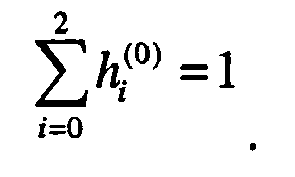
- When two of the 3 assumptions of 0 respectively corresponding to x k' x k+1' x k+2 are incorrect,

- When the 3 assumptions of 0 respectively corresponding to x k' x k+1' x k+2 are all incorrect,

- That is, according to the distributions of B(0) and B(1) previously considered, and the obtained property of the assumption coefficient


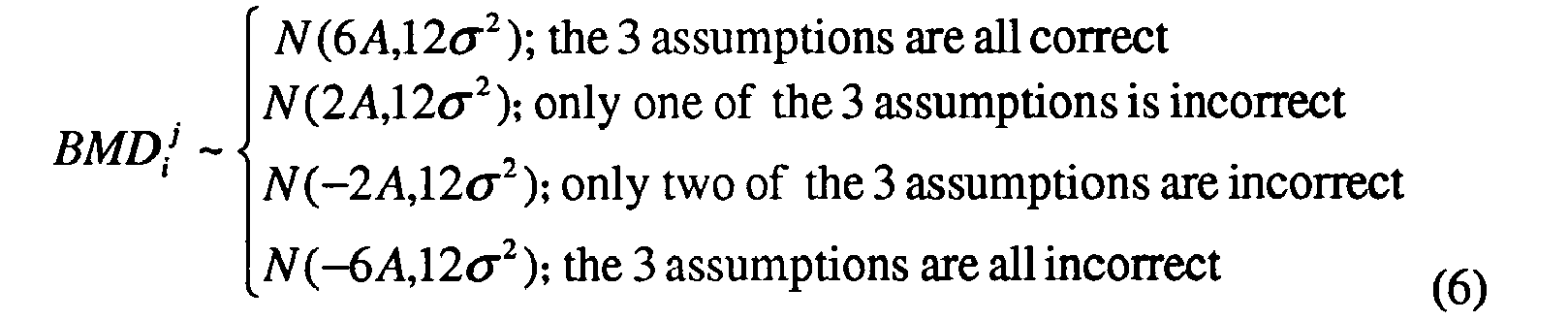
- Because the input data is independently identically distributed (IID), a branch metric value of a certain node is only associated with the current input, that is, associated with B(0) or B(1), and is independent of the foregoing accumulated path metric, that is,


- In this manner, in the decoding process, as shown in
FIG. 2 , the nodes m and n in the state j-1 is converged into the node i in the state j; it is assumed that


- For the selection of


where λ j-1 denotes a maximum accumulated PMD in the accumulated PMDs obtained through every two nodes at the level j-1; and m and n denote any two nodes at the (j-1)th level, and have a value of ; m, n=0,...,2 Tailbits -1, in which a value of 2 Tailbits denotes the number of Tailbits states. - According to the expression (6),


- Considering that the YI algorithm is used mainly for the purpose of improving the detection reliability, the current node at the current level can be judged as validity provided that not only that a high path metric can be obtained from the current input, but also that the previous path metric reaches a relatively high value. Therefore, the maximum value is selected for


- It can be known from the expression (6) that, in practical application, the 3 assumptions are not necessarily all correct, and therefore in the level threshold expression provided in the (8-2), λ j-1 is multiplied by a coefficient factor β, to ensure the detection effectiveness and improve the detection probability.
- It can be known from the (8-2) that, when an actual distribution of


the formula for a level threshold to be used in the embodiment of the present invention is as follows:
where β denotes a coefficient factor, λ j-1 denotes the maximum accumulated PMD at the level j-1, A denotes an amplitude of a received signal, σ2 denotes a noise variance, and
- The technical solutions of the present invention will be described in the following with reference to the accompanying drawings. It is obvious that the embodiments to be described are only a part rather than all of the embodiments of the present invention. All other embodiments obtained by persons skilled in the art based on the embodiments of the present invention without creative efforts shall fall within the protection scope of the present invention. The embodiments below are all optional solutions of the present invention, and the ranking order and numbering of the embodiments are independent of an exemplary execution order.
- This embodiment provides a method for detection using a YI algorithm. As shown in
FIG. 3 , the method includes the following steps. - S 101: Obtain, according to a received signal, parameters related to the signal.
- S102: At each level starting from a level corresponding to a Tailbits value, that is, if K=Tailbits, at each level starting from a Kth level (including the level K), perform the following operations: obtain a level threshold at a level A (it is assumed that the level A is any level starting from the level K) according to the parameters, set the level threshold to a level A threshold, and determine validity of at least one node at the level A according to the level A threshold.
- The rest may be deduced by analogy, till that the determination of at least one node at each level starting from the Kth level in the decoding process ends.
- S103: Output a detection identifier according to the validity of at least one node at each level obtained after determination.
- The embodiment of the present invention has the following beneficial effect. According to different received signals, different level thresholds can be obtained. In the case that the received signals are different due to different environments, the corresponding level threshold can be used for judgment of validity, thereby improving the detection performance of the HS-SCCH Slot1 detection using the YI algorithm.
- This embodiment specifically describes a method for detection using a YI algorithm. As shown in
FIG. 4 , the method includes the following steps: - S201: Estimate an amplitude and a noise variance of a received signal according to the maximum BMD in first Tailbits levels of the received signal.
- Specifically, it is assumed that K= Tailbits, the first Tailbits levels are first K levels; the maximum BMD obtained through calculation in a decoding process in the first K levels is extracted, and an estimated value E(6A) of an amplitude 6A of the received signal and an estimated value E(12σ2) of a noise variance 12σ2 of AWGN are estimated according to the maximum BMD.
- In the YI algorithm, the investigation on the validity of a YI flag should start from a Tailbitsth level; in addition, it can be known from an analysis on the expression (6) that, the maximum value in

- S202: Calculate a level threshold of each level starting from the Tailbitsth level according to a coefficient factor β after E(6A) and E(12σ2) are obtained.
- Specifically, calculation may be performed according to the formula (9):

that is, j = Tailbits,Taibits + 1,..., Inforbits + Tailbits -1
where β denotes a coefficient factor, λ j-1 denotes the maximum accumulated PMD at a level j-1, A denotes an amplitude of a received signal, σ2 denotes a noise variance,
- Furthermore, for each level, a PMD of each node at the level is calculated, and the PMD of each node at the level is compared with a level threshold at the level. If the PMD of the node at the level is no less than the level threshold, it is decided that the node is valid, and the validity of the node is recorded as valid; if the PMD of the node is less than the level threshold, it is decided that the node is invalid, and the validity of the node is recorded as invalid. The rest may be deduced by analogy, till the decoding of the last level (j = Tailbits-1) ends.
- Specifically, the process may be as follows:
- For example, at a Kth level, a level threshold may be expressed as:

- Meanwhile, a PDM


- If

- If

- The rest may be deduced by analogy. In the subsequent decoding process, the YI validity of each node at each level is decided, and a result is recorded.
- S203: After the decoding ends, in a backtracing process, output a decision identifier according to the validity recorded for each node. If the validity recorded for each node in a backtracing path is valid, a finally given YI flag is "TRUE"; otherwise, "FALSE" is output.
- In the embodiment of the present invention, for each detected HS-SCCH, after the Viterbi decoding ends, decoded data and path metric of the
state 0 after the decoding ends are also output. If through the YI algorithm, "TRUE" is detected on at least two HS-SCCHs, the path metric of a last 0 node on each HS-SCCH may be compared, and the branch having the maximum path metric of 0 node is extracted for the final decision. - In the detection method of using a YI algorithm provided in the embodiment of the present invention, a technical solution of dynamic level threshold is used, to solve the technical problem in the prior art that the high-efficiency performance detection cannot be performed in various signal environments because the threshold used in the detection using the YI algorithm is fixed, thereby achieving the technical effects that the level threshold for decision can dynamically change along with the change of the signal environment, and the detection performance of HS-SCCH Slot1 detection using the YI algorithm in various signal environments is improved. Meanwhile, because the detection performance is improved, the system throughput is increased, and the power consumption of a UE is reduced. Furthermore, in the technical solution provided in the embodiment, the level threshold for decision changes automatically and dynamically along with the different signal environments, which requires no manual setting and is accordingly more convenient for application as compared with the prior art, in which the threshold is obtained empirically and through lots of emulated data.
- This embodiment provides a YI detector, to implement the foregoing method. As shown in
FIG. 5 , the YI detector includes aparameter obtaining module 31, aYI calculation module 32, and a YIidentifier decision module 33. - The
parameter obtaining module 31 is configured to obtain parameters according to a received signal; theYI calculation module 32 is configured to obtain a level threshold according to the parameters at each level starting from a level corresponding to a Tailbits value, and determine validity of at least one node at the level according to the level threshold, where the level is the same as a level of the level threshold; and the YIidentifier decision module 33 is configured to output a detection identifier according to the validity. - The
parameter obtaining module 31 includes anamplitude estimation unit 311, and avariance estimation unit 312. - The
amplitude estimation unit 311 is configured to obtain an estimated value of an amplitude of the signal according to the maximum BMD in first Tailbits-value levels of the received signal; and thevariance estimation unit 312 is configured to obtain an estimated value of a noise variance of the signal according to the maximum BMD in the first Tailbits-value levels of the received signal. - The
YI calculation module 32 includes alevel calculation unit 321, ametric calculation unit 322, a judgingunit 323, and arecording unit 324. - The
level calculation unit 321 is configured to calculate the level threshold at the level according to the estimated value of the amplitude of the signal obtained by theamplitude estimation unit 311, the noise variance of the signal obtained by thevariance estimation unit 312, and a coefficient factor; themetric calculation unit 322 is configured to calculate a path metric difference of at least one node at the level; the judgingunit 323 is configured to decide that the any node is valid when the path metric difference of any node calculated by themetric calculation unit 322 at the level is no less than the level threshold calculated by the level calculation unit, and decide that the any node is invalid when the path metric difference of any node calculated by themetric calculation unit 322 at the level is less than the level threshold calculated by the level calculation unit; and therecording unit 324 is configured to record a decision result of the judgingunit 323, record the node as valid when the judgingunit 323 decides that the node is valid, and record the node as invalid when the judgingunit 323 decides that the node is invalid. - The YI
identifier decision module 33 includes anoutput unit 331. Theoutput unit 331 is configured to output the detection identifier which is TRUE when each node in a backtracing path is recorded as valid; otherwise, output the detection identifier which is FALSE. - Furthermore, the YI detector provided in the embodiment of the present invention may further include an
output module 34. Theoutput module 34 is configured to output, for each detected HS-SCCH, a decoding result and a path metric ofstate 0 after the decoding ends. - The YI detector provided in the embodiment of the present invention has the following beneficial effects. Using the level threshold capable of dynamically changing along with the change of the signal environment in the YI validity decision can improve the detection performance of HS-SCCH Slot1 detection using the YI algorithm in different signal environments. In addition, as the detection performance is improved, the system throughput is increased, and the power consumption of a UE is reduced. Through the path metric of 0 node on each HS-SCCH output by the output module, the incapability of providing a final decision when TRUE is detected on multiple HS-SCCHs can be prevented.
- The embodiments of the present invention are mainly applied to a scenario for determining a YI detection threshold during the HS-SCCH Slot1 detection using the YI algorithm in wideband-code division multiple access (Wideband-Code Division Multiple Access, WCDMA). Viterbi decoding is widely applied in communications, and the YI algorithm is a high-performance detection algorithm based on the Viterbi decoding. Therefore, in a communication system adopting the Viterbi decoding, if the YI algorithm is used as a signal detection algorithm, the threshold problem can be considered by using the concept of the method according to the embodiment of the present invention. Furthermore, with the development of the communications and network technologies, the concept and methods embodied in the embodiments of the present invention may be applied to other scenarios in the field, or may be transferred to a similar or close technical field.
- Through the above description of the implementation, it is clear to persons skilled in the art that the present invention may be accomplished through software plus a necessary universal hardware platform, or through hardware; however, in most cases, the former is preferred. Based on this, the technical solution of the present invention or the part that makes contributions to the prior art can be essentially embodied in the form of a software product. The computer software product may be stored in a readable storage medium, for example, a floppy disk, a hard disk or an optical disk of the computer, and contain several instructions used to instruct an apparatus (which may be a terminal) to perform part or all of the steps of the method according to the embodiments of the present invention.
- The above is only the specific implementation of the present invention, but the protection scope of the present invention is not limited herein. Any change or replacement that can be easily figured out by persons skilled in the art within the technical scope disclosed by the present invention shall be covered by the protection scope of the present invention. Therefore, the protection scope of the present invention shall be the protection scope of the claims.
Claims (8)
- A method for detection using a Yamamoto-Itoh, YI, algorithm, wherein the method comprises:performing Viterbi decoding on a trellis comprising a number of levels, each level comprising nodes at each state;obtaining (S101, S201) parameters according to a received signal;performing at each level a computation for obtaining (S102, S202) a level threshold according to the parameters starting from a level j corresponding to a value Tailbits where j=Tailbits, Tailbits+1, ..., inforbits+Tailbits-1, where Tailbits denotes a number of tail bits and inforbits denotes a valid data transmission length, and determining the validity of at least one node at each level according to the level threshold; andoutputting (S103, S203) a detection identifier according to the validity;wherein the obtaining (S101) the parameters according to the received signal comprises: obtaining an estimated value of an amplitude of the signal and an estimated value of a noise variance of the signal according to a branch metric difference in first Tailbits levels of the trellis.
- The method for detection using a YI algorithm according to claim 1, characterized in that obtaining (S102) the level threshold according to the parameters comprises:calculating the level threshold at the level according to the estimated value of the amplitude of the signal, the estimated value of the noise variance of the signal, and a coefficient factor;calculating a path metric difference of at least one node at the level; andthe determining the validity of at least one node at the level according to the level threshold comprises:if the path metric difference of the at least one node at the level is no less than the level threshold at the level, recording that the at least one node is valid;if the path metric difference of the at least one node at the level is less than the level threshold at the level, recording that the at least one node is invalid.
- The method for detection using a YI algorithm according to claim 1, characterized in that the outputting (S103) the detection identifier according to the validity comprises:outputting the detection identifier which is TRUE if each node in a backtracing path is recorded as valid; otherwise, outputting the detection identifier to be FALSE .
- The method for detection using a YI algorithm according to any one of claims 1 to 3, characterized in that the method further comprises:outputting, for each detected channel, a decoding result and a path metric of a state 0.
- A Yamamoto-Itoh, YI, detector, for processing a trellis comprising a number of levels, each level comprising nodes at each state, wherein the YI detector comprises:a parameter obtaining module (31), configured to obtain parameters according to a received signal;a YI calculation module (32), configured to obtain a level threshold according to the parameters at each level starting from a level j corresponding to a valve Tailbits where j = Tailbits, Tailbits+1,..., inforbits + Tailbits+2, where Tailbits denotes a number of tail bits and inforbits denotes a valid data transmission length, and determine validity of at least one node at the level according to the level threshold, wherein the level is the same as a level of the level threshold; anda YI identifier decision module (33), configured to output a detection identifier according to the validity;wherein the parameter obtaining module (31) comprises:an amplitude estimation unit (311), configured to obtain an estimated value of an amplitude of the signal according to a maximum branch metric difference in first Tailbits levels of the received signal; anda variance estimation unit (312), configured to obtain an estimated value of a noise variance of the signal according to the branch metric difference in the first Tailbits levels of the trellis.
- The YI detector according to claim 5, characterized in that the YI calculation module (32) comprises:a level calculation unit (321), configured to calculate the level threshold at the level according to the estimated value of the amplitude of the signal obtained by the amplitude estimation unit (311), the noise variance of the signal obtained by the variance estimation unit (312), and a coefficient factor;a metric calculation unit (322), configured to calculate a path metric difference of at least one node at the level;a judging unit (323), configured to, when the path metric difference of any node calculated by the metric calculation unit (322) at the level is no less than the level threshold calculated by the level calculation unit (321), decide that the any node is valid, and when the path metric difference of any node calculated by the metric calculation unit (322) at the level is less than the level threshold calculated by the level calculation unit (321), decide that the any node is invalid; anda recording unit (324), configured to record a decision result of the judging unit (323), record the node as valid when the judging unit (323) decides that the node is valid, and record the node as invalid when the judging unit (323) decides that the node is invalid.
- The YI detector according to claim 5, characterized in that the YI identifier decision module (33) comprises:an output unit (331), configured to output the detection identifier which is TRUE when each node in a backtracing path is recorded as valid; and output the detection identifier which is FALSE when each node in a backtracing path is recorded as invalid.
- The YI detector according to any one of claims 5 to 7, characterized in that the YI detector further comprises:an output module (34), configured to output, for each detected channel, a decoding result and a path metric of a state 0 after the decoding ends.
Applications Claiming Priority (2)
| Application Number | Priority Date | Filing Date | Title |
|---|---|---|---|
| CN2009101574337A CN101605021B (en) | 2009-07-29 | 2009-07-29 | Method for detection by YI algorithm, and YI detector |
| PCT/CN2010/072173 WO2011012000A1 (en) | 2009-07-29 | 2010-04-24 | Detection method using yi algorithm and yi detector |
Publications (3)
| Publication Number | Publication Date |
|---|---|
| EP2461509A4 EP2461509A4 (en) | 2012-06-06 |
| EP2461509A1 EP2461509A1 (en) | 2012-06-06 |
| EP2461509B1 true EP2461509B1 (en) | 2013-07-03 |
Family
ID=41470584
Family Applications (1)
| Application Number | Title | Priority Date | Filing Date |
|---|---|---|---|
| EP10803833.2A Active EP2461509B1 (en) | 2009-07-29 | 2010-04-24 | Detection method using yi algorithm and yi detector |
Country Status (4)
| Country | Link |
|---|---|
| US (1) | US9172564B2 (en) |
| EP (1) | EP2461509B1 (en) |
| CN (1) | CN101605021B (en) |
| WO (1) | WO2011012000A1 (en) |
Families Citing this family (1)
| Publication number | Priority date | Publication date | Assignee | Title |
|---|---|---|---|---|
| CN101605021B (en) | 2009-07-29 | 2012-08-08 | 华为终端有限公司 | Method for detection by YI algorithm, and YI detector |
Family Cites Families (20)
| Publication number | Priority date | Publication date | Assignee | Title |
|---|---|---|---|---|
| JP3280834B2 (en) * | 1995-09-04 | 2002-05-13 | 沖電気工業株式会社 | Signal judging device and receiving device in coded communication system, signal judging method, and channel state estimating method |
| US5822340A (en) * | 1996-05-10 | 1998-10-13 | Telefonaktiebolaget Lm Ericsson | Method for decoding data signals using fixed-length decision window |
| US6175590B1 (en) * | 1997-08-08 | 2001-01-16 | Qualcomm Inc. | Method and apparatus for determining the rate of received data in a variable rate communication system |
| DE10055658B4 (en) * | 2000-11-10 | 2004-04-29 | Infineon Technologies Ag | Method and circuit for synchronizing a receiver for a convolutionally coded received signal |
| US7162675B2 (en) * | 2002-04-05 | 2007-01-09 | Lucent Technologies Inc. | Error detection methods in wireless communication systems |
| US7680216B2 (en) * | 2002-07-01 | 2010-03-16 | Texas Instruments Incorporated | Adaptive thresholds for high speed downlink shared control channel (HS-SCCH) (part I) detection schemes |
| US7406070B2 (en) | 2003-10-09 | 2008-07-29 | Telefonaktiebolaget L M Ericsson (Publ) | Adaptive threshold for HS-SCCH part 1 decoding |
| US7424071B2 (en) * | 2005-06-27 | 2008-09-09 | Icera Inc. | Decoder and a method for determining a decoding reliability indicator |
| CN1972170B (en) * | 2005-11-22 | 2010-05-05 | 上海明波通信技术有限公司 | Wireless communication channel detection method |
| CN100455093C (en) | 2005-12-29 | 2009-01-21 | 华为技术有限公司 | HS-SCCH detection method and device |
| US8885599B2 (en) | 2006-12-28 | 2014-11-11 | Nokia Corporation | Handover of circuit-switched call to packet-switched call, and vice versa |
| GB0707387D0 (en) | 2007-04-17 | 2007-05-23 | Lucent Technologies Inc | Single radio VCC:LTE-VMSC anchor solution |
| US7912028B2 (en) * | 2007-05-31 | 2011-03-22 | Agere Systems Inc. | Reducing false detection in an HSDPA 3G terminal |
| US7876862B2 (en) * | 2007-07-16 | 2011-01-25 | Agere Systems Inc. | Conditionally input saturated Viterbi detector |
| CN101400090B (en) | 2007-09-30 | 2011-08-03 | 华为技术有限公司 | Method and system for communication service switching |
| CN102149156B (en) | 2007-12-29 | 2014-12-17 | 华为技术有限公司 | Method, system and relevant method and device for returning to CS domain to establish voice call |
| CN101489288B (en) | 2008-01-16 | 2011-04-20 | 华为技术有限公司 | Method, system and related equipment for processing circuit domain services in evolved packet network |
| KR101344347B1 (en) * | 2008-01-16 | 2013-12-24 | 삼성전자주식회사 | Nonvolatile memory device controlling program start voltage, program method thereof, and memory system including the same |
| US20100039968A1 (en) * | 2008-08-13 | 2010-02-18 | Cambridge Silicon Radio Limited | Receiver |
| CN101605021B (en) * | 2009-07-29 | 2012-08-08 | 华为终端有限公司 | Method for detection by YI algorithm, and YI detector |
-
2009
- 2009-07-29 CN CN2009101574337A patent/CN101605021B/en active Active
-
2010
- 2010-04-24 EP EP10803833.2A patent/EP2461509B1/en active Active
- 2010-04-24 WO PCT/CN2010/072173 patent/WO2011012000A1/en not_active Ceased
-
2012
- 2012-01-27 US US13/360,257 patent/US9172564B2/en active Active
Also Published As
| Publication number | Publication date |
|---|---|
| CN101605021B (en) | 2012-08-08 |
| CN101605021A (en) | 2009-12-16 |
| EP2461509A4 (en) | 2012-06-06 |
| EP2461509A1 (en) | 2012-06-06 |
| WO2011012000A1 (en) | 2011-02-03 |
| US9172564B2 (en) | 2015-10-27 |
| US20120123730A1 (en) | 2012-05-17 |
Similar Documents
| Publication | Publication Date | Title |
|---|---|---|
| US8818811B2 (en) | Method and apparatus for performing voice activity detection | |
| CN101674639B (en) | Detection method, device and system of channel quality | |
| US20080165901A1 (en) | Method and apparatus for processing signals received from a channel having a variable channel length | |
| CN111465051A (en) | SINR estimation method, system, electronic device and storage medium | |
| EP3171520A1 (en) | Decoding method and decoder | |
| CN101335540B (en) | Physical code channel activating detection method and apparatus based on channel estimating postprocessing | |
| US20240372750A1 (en) | Efficient learning algorithm for channel estimation in wireless communication systems | |
| US20040174854A1 (en) | Optimizing multi-user detection | |
| EP2461509A1 (en) | Detection method using yi algorithm and yi detector | |
| CN101741773B (en) | Method and device for channel estimation of terminal in time division synchronous code division multiple access system | |
| US20020181624A1 (en) | Method and apparatus for making a channel estimate | |
| CN102347808B (en) | Method and device for eliminating known interference on wireless communication node | |
| CN111200466B (en) | Confidence threshold optimization method for digital signal demodulation | |
| US20030016769A9 (en) | Fast, blind equalization techniques using reliable symbols | |
| EP2756603B1 (en) | Channel estimation method, channel estimation apparatus and communication device for cdma systems | |
| CN115226197B (en) | Frame timing synchronization method, device and electronic device for wireless communication | |
| JP7231870B2 (en) | Wavelength dispersion amount calculation device and wavelength dispersion amount calculation method | |
| CN111726180A (en) | Method and device for detecting preamble signal | |
| CN102904838B (en) | Method and device for judging interfering boundary | |
| JP2004159077A (en) | Data receiving device and data receiving method | |
| KR101970065B1 (en) | Method for detecting signal in mimo system | |
| KR20070110255A (en) | Improved channel response calculation | |
| EP2717501A1 (en) | Uplink receiving method and device | |
| CN104883329A (en) | Method and device for channel estimation and equalization of receiving end in satellite communication | |
| CN105703850A (en) | Short-time-fourier-transform-based edge detection method for data chain signal |
Legal Events
| Date | Code | Title | Description |
|---|---|---|---|
| PUAI | Public reference made under article 153(3) epc to a published international application that has entered the european phase |
Free format text: ORIGINAL CODE: 0009012 |
|
| 17P | Request for examination filed |
Effective date: 20120203 |
|
| A4 | Supplementary search report drawn up and despatched |
Effective date: 20120503 |
|
| AK | Designated contracting states |
Kind code of ref document: A1 Designated state(s): AT BE BG CH CY CZ DE DK EE ES FI FR GB GR HR HU IE IS IT LI LT LU LV MC MK MT NL NO PL PT RO SE SI SK SM TR |
|
| DAX | Request for extension of the european patent (deleted) | ||
| GRAP | Despatch of communication of intention to grant a patent |
Free format text: ORIGINAL CODE: EPIDOSNIGR1 |
|
| RIC1 | Information provided on ipc code assigned before grant |
Ipc: H03M 13/41 20060101ALI20130204BHEP Ipc: H03M 13/37 20060101ALI20130204BHEP Ipc: H04L 25/03 20060101ALI20130204BHEP Ipc: H04L 1/00 20060101AFI20130204BHEP |
|
| GRAS | Grant fee paid |
Free format text: ORIGINAL CODE: EPIDOSNIGR3 |
|
| GRAA | (expected) grant |
Free format text: ORIGINAL CODE: 0009210 |
|
| AK | Designated contracting states |
Kind code of ref document: B1 Designated state(s): AT BE BG CH CY CZ DE DK EE ES FI FR GB GR HR HU IE IS IT LI LT LU LV MC MK MT NL NO PL PT RO SE SI SK SM TR |
|
| REG | Reference to a national code |
Ref country code: GB Ref legal event code: FG4D |
|
| REG | Reference to a national code |
Ref country code: AT Ref legal event code: REF Ref document number: 620264 Country of ref document: AT Kind code of ref document: T Effective date: 20130715 Ref country code: CH Ref legal event code: EP |
|
| REG | Reference to a national code |
Ref country code: IE Ref legal event code: FG4D |
|
| REG | Reference to a national code |
Ref country code: DE Ref legal event code: R096 Ref document number: 602010008312 Country of ref document: DE Effective date: 20130905 |
|
| PG25 | Lapsed in a contracting state [announced via postgrant information from national office to epo] |
Ref country code: SI Free format text: LAPSE BECAUSE OF FAILURE TO SUBMIT A TRANSLATION OF THE DESCRIPTION OR TO PAY THE FEE WITHIN THE PRESCRIBED TIME-LIMIT Effective date: 20130703 |
|
| REG | Reference to a national code |
Ref country code: AT Ref legal event code: MK05 Ref document number: 620264 Country of ref document: AT Kind code of ref document: T Effective date: 20130703 |
|
| REG | Reference to a national code |
Ref country code: NL Ref legal event code: VDEP Effective date: 20130703 |
|
| REG | Reference to a national code |
Ref country code: LT Ref legal event code: MG4D |
|
| PG25 | Lapsed in a contracting state [announced via postgrant information from national office to epo] |
Ref country code: BE Free format text: LAPSE BECAUSE OF FAILURE TO SUBMIT A TRANSLATION OF THE DESCRIPTION OR TO PAY THE FEE WITHIN THE PRESCRIBED TIME-LIMIT Effective date: 20130703 Ref country code: PT Free format text: LAPSE BECAUSE OF FAILURE TO SUBMIT A TRANSLATION OF THE DESCRIPTION OR TO PAY THE FEE WITHIN THE PRESCRIBED TIME-LIMIT Effective date: 20131104 Ref country code: SE Free format text: LAPSE BECAUSE OF FAILURE TO SUBMIT A TRANSLATION OF THE DESCRIPTION OR TO PAY THE FEE WITHIN THE PRESCRIBED TIME-LIMIT Effective date: 20130703 Ref country code: HR Free format text: LAPSE BECAUSE OF FAILURE TO SUBMIT A TRANSLATION OF THE DESCRIPTION OR TO PAY THE FEE WITHIN THE PRESCRIBED TIME-LIMIT Effective date: 20130703 Ref country code: IS Free format text: LAPSE BECAUSE OF FAILURE TO SUBMIT A TRANSLATION OF THE DESCRIPTION OR TO PAY THE FEE WITHIN THE PRESCRIBED TIME-LIMIT Effective date: 20131103 Ref country code: CY Free format text: LAPSE BECAUSE OF FAILURE TO SUBMIT A TRANSLATION OF THE DESCRIPTION OR TO PAY THE FEE WITHIN THE PRESCRIBED TIME-LIMIT Effective date: 20130828 Ref country code: LT Free format text: LAPSE BECAUSE OF FAILURE TO SUBMIT A TRANSLATION OF THE DESCRIPTION OR TO PAY THE FEE WITHIN THE PRESCRIBED TIME-LIMIT Effective date: 20130703 Ref country code: NO Free format text: LAPSE BECAUSE OF FAILURE TO SUBMIT A TRANSLATION OF THE DESCRIPTION OR TO PAY THE FEE WITHIN THE PRESCRIBED TIME-LIMIT Effective date: 20131003 Ref country code: AT Free format text: LAPSE BECAUSE OF FAILURE TO SUBMIT A TRANSLATION OF THE DESCRIPTION OR TO PAY THE FEE WITHIN THE PRESCRIBED TIME-LIMIT Effective date: 20130703 |
|
| PG25 | Lapsed in a contracting state [announced via postgrant information from national office to epo] |
Ref country code: GR Free format text: LAPSE BECAUSE OF FAILURE TO SUBMIT A TRANSLATION OF THE DESCRIPTION OR TO PAY THE FEE WITHIN THE PRESCRIBED TIME-LIMIT Effective date: 20131004 Ref country code: ES Free format text: LAPSE BECAUSE OF FAILURE TO SUBMIT A TRANSLATION OF THE DESCRIPTION OR TO PAY THE FEE WITHIN THE PRESCRIBED TIME-LIMIT Effective date: 20131014 Ref country code: PL Free format text: LAPSE BECAUSE OF FAILURE TO SUBMIT A TRANSLATION OF THE DESCRIPTION OR TO PAY THE FEE WITHIN THE PRESCRIBED TIME-LIMIT Effective date: 20130703 Ref country code: LV Free format text: LAPSE BECAUSE OF FAILURE TO SUBMIT A TRANSLATION OF THE DESCRIPTION OR TO PAY THE FEE WITHIN THE PRESCRIBED TIME-LIMIT Effective date: 20130703 Ref country code: FI Free format text: LAPSE BECAUSE OF FAILURE TO SUBMIT A TRANSLATION OF THE DESCRIPTION OR TO PAY THE FEE WITHIN THE PRESCRIBED TIME-LIMIT Effective date: 20130703 Ref country code: NL Free format text: LAPSE BECAUSE OF FAILURE TO SUBMIT A TRANSLATION OF THE DESCRIPTION OR TO PAY THE FEE WITHIN THE PRESCRIBED TIME-LIMIT Effective date: 20130703 |
|
| PG25 | Lapsed in a contracting state [announced via postgrant information from national office to epo] |
Ref country code: CY Free format text: LAPSE BECAUSE OF FAILURE TO SUBMIT A TRANSLATION OF THE DESCRIPTION OR TO PAY THE FEE WITHIN THE PRESCRIBED TIME-LIMIT Effective date: 20130703 |
|
| PG25 | Lapsed in a contracting state [announced via postgrant information from national office to epo] |
Ref country code: DK Free format text: LAPSE BECAUSE OF FAILURE TO SUBMIT A TRANSLATION OF THE DESCRIPTION OR TO PAY THE FEE WITHIN THE PRESCRIBED TIME-LIMIT Effective date: 20130703 Ref country code: RO Free format text: LAPSE BECAUSE OF FAILURE TO SUBMIT A TRANSLATION OF THE DESCRIPTION OR TO PAY THE FEE WITHIN THE PRESCRIBED TIME-LIMIT Effective date: 20130703 Ref country code: CZ Free format text: LAPSE BECAUSE OF FAILURE TO SUBMIT A TRANSLATION OF THE DESCRIPTION OR TO PAY THE FEE WITHIN THE PRESCRIBED TIME-LIMIT Effective date: 20130703 Ref country code: SK Free format text: LAPSE BECAUSE OF FAILURE TO SUBMIT A TRANSLATION OF THE DESCRIPTION OR TO PAY THE FEE WITHIN THE PRESCRIBED TIME-LIMIT Effective date: 20130703 Ref country code: EE Free format text: LAPSE BECAUSE OF FAILURE TO SUBMIT A TRANSLATION OF THE DESCRIPTION OR TO PAY THE FEE WITHIN THE PRESCRIBED TIME-LIMIT Effective date: 20130703 |
|
| PLBE | No opposition filed within time limit |
Free format text: ORIGINAL CODE: 0009261 |
|
| STAA | Information on the status of an ep patent application or granted ep patent |
Free format text: STATUS: NO OPPOSITION FILED WITHIN TIME LIMIT |
|
| PG25 | Lapsed in a contracting state [announced via postgrant information from national office to epo] |
Ref country code: IT Free format text: LAPSE BECAUSE OF FAILURE TO SUBMIT A TRANSLATION OF THE DESCRIPTION OR TO PAY THE FEE WITHIN THE PRESCRIBED TIME-LIMIT Effective date: 20130703 |
|
| 26N | No opposition filed |
Effective date: 20140404 |
|
| REG | Reference to a national code |
Ref country code: DE Ref legal event code: R097 Ref document number: 602010008312 Country of ref document: DE Effective date: 20140404 |
|
| PG25 | Lapsed in a contracting state [announced via postgrant information from national office to epo] |
Ref country code: MC Free format text: LAPSE BECAUSE OF FAILURE TO SUBMIT A TRANSLATION OF THE DESCRIPTION OR TO PAY THE FEE WITHIN THE PRESCRIBED TIME-LIMIT Effective date: 20130703 Ref country code: LU Free format text: LAPSE BECAUSE OF FAILURE TO SUBMIT A TRANSLATION OF THE DESCRIPTION OR TO PAY THE FEE WITHIN THE PRESCRIBED TIME-LIMIT Effective date: 20140424 |
|
| REG | Reference to a national code |
Ref country code: CH Ref legal event code: PL |
|
| REG | Reference to a national code |
Ref country code: IE Ref legal event code: MM4A |
|
| PG25 | Lapsed in a contracting state [announced via postgrant information from national office to epo] |
Ref country code: LI Free format text: LAPSE BECAUSE OF NON-PAYMENT OF DUE FEES Effective date: 20140430 Ref country code: CH Free format text: LAPSE BECAUSE OF NON-PAYMENT OF DUE FEES Effective date: 20140430 |
|
| PG25 | Lapsed in a contracting state [announced via postgrant information from national office to epo] |
Ref country code: IE Free format text: LAPSE BECAUSE OF NON-PAYMENT OF DUE FEES Effective date: 20140424 |
|
| REG | Reference to a national code |
Ref country code: FR Ref legal event code: PLFP Year of fee payment: 7 |
|
| PG25 | Lapsed in a contracting state [announced via postgrant information from national office to epo] |
Ref country code: MT Free format text: LAPSE BECAUSE OF FAILURE TO SUBMIT A TRANSLATION OF THE DESCRIPTION OR TO PAY THE FEE WITHIN THE PRESCRIBED TIME-LIMIT Effective date: 20130703 |
|
| PG25 | Lapsed in a contracting state [announced via postgrant information from national office to epo] |
Ref country code: SM Free format text: LAPSE BECAUSE OF FAILURE TO SUBMIT A TRANSLATION OF THE DESCRIPTION OR TO PAY THE FEE WITHIN THE PRESCRIBED TIME-LIMIT Effective date: 20130703 |
|
| PG25 | Lapsed in a contracting state [announced via postgrant information from national office to epo] |
Ref country code: BG Free format text: LAPSE BECAUSE OF FAILURE TO SUBMIT A TRANSLATION OF THE DESCRIPTION OR TO PAY THE FEE WITHIN THE PRESCRIBED TIME-LIMIT Effective date: 20130703 |
|
| PG25 | Lapsed in a contracting state [announced via postgrant information from national office to epo] |
Ref country code: HU Free format text: LAPSE BECAUSE OF FAILURE TO SUBMIT A TRANSLATION OF THE DESCRIPTION OR TO PAY THE FEE WITHIN THE PRESCRIBED TIME-LIMIT; INVALID AB INITIO Effective date: 20100424 Ref country code: TR Free format text: LAPSE BECAUSE OF FAILURE TO SUBMIT A TRANSLATION OF THE DESCRIPTION OR TO PAY THE FEE WITHIN THE PRESCRIBED TIME-LIMIT Effective date: 20130703 |
|
| REG | Reference to a national code |
Ref country code: FR Ref legal event code: PLFP Year of fee payment: 8 |
|
| REG | Reference to a national code |
Ref country code: FR Ref legal event code: PLFP Year of fee payment: 9 |
|
| PG25 | Lapsed in a contracting state [announced via postgrant information from national office to epo] |
Ref country code: MK Free format text: LAPSE BECAUSE OF FAILURE TO SUBMIT A TRANSLATION OF THE DESCRIPTION OR TO PAY THE FEE WITHIN THE PRESCRIBED TIME-LIMIT Effective date: 20130703 |
|
| REG | Reference to a national code |
Ref country code: DE Ref legal event code: R081 Ref document number: 602010008312 Country of ref document: DE Owner name: HUAWEI DEVICE CO., LTD., DONGGUAN, CN Free format text: FORMER OWNER: HUAWEI DEVICE CO., LTD., SHENZHEN, GUANGDONG, CN Ref country code: DE Ref legal event code: R081 Ref document number: 602010008312 Country of ref document: DE Owner name: HONOR DEVICE CO., LTD., SHENZHEN, CN Free format text: FORMER OWNER: HUAWEI DEVICE CO., LTD., SHENZHEN, GUANGDONG, CN |
|
| REG | Reference to a national code |
Ref country code: GB Ref legal event code: 732E Free format text: REGISTERED BETWEEN 20190124 AND 20190130 |
|
| REG | Reference to a national code |
Ref country code: DE Ref legal event code: R081 Ref document number: 602010008312 Country of ref document: DE Owner name: HONOR DEVICE CO., LTD., SHENZHEN, CN Free format text: FORMER OWNER: HUAWEI DEVICE CO., LTD., DONGGUAN, GUANGDONG, CN |
|
| REG | Reference to a national code |
Ref country code: GB Ref legal event code: 732E Free format text: REGISTERED BETWEEN 20210624 AND 20210630 |
|
| PGFP | Annual fee paid to national office [announced via postgrant information from national office to epo] |
Ref country code: DE Payment date: 20250305 Year of fee payment: 16 |
|
| PGFP | Annual fee paid to national office [announced via postgrant information from national office to epo] |
Ref country code: GB Payment date: 20260312 Year of fee payment: 17 |
|
| PGFP | Annual fee paid to national office [announced via postgrant information from national office to epo] |
Ref country code: FR Payment date: 20260309 Year of fee payment: 17 |