EP2459550B1 - R-7-(3-aminomethyl-4-methoxyimino-3-methyl-pyrrolidin-1-yl)-1-cyclopropyl-6-fluoro-4-oxo-1,4-dihydro-[1,8]naphthyridine-3-carboxylic acid and l-aspartic acid salt, process for the preparation thereof and pharmaceutical composition comprising the same for antimicrobial - Google Patents
R-7-(3-aminomethyl-4-methoxyimino-3-methyl-pyrrolidin-1-yl)-1-cyclopropyl-6-fluoro-4-oxo-1,4-dihydro-[1,8]naphthyridine-3-carboxylic acid and l-aspartic acid salt, process for the preparation thereof and pharmaceutical composition comprising the same for antimicrobial Download PDFInfo
- Publication number
- EP2459550B1 EP2459550B1 EP10804705.1A EP10804705A EP2459550B1 EP 2459550 B1 EP2459550 B1 EP 2459550B1 EP 10804705 A EP10804705 A EP 10804705A EP 2459550 B1 EP2459550 B1 EP 2459550B1
- Authority
- EP
- European Patent Office
- Prior art keywords
- methoxyimino
- naphthyridine
- dihydro
- oxo
- pyrrolidin
- Prior art date
- Legal status (The legal status is an assumption and is not a legal conclusion. Google has not performed a legal analysis and makes no representation as to the accuracy of the status listed.)
- Active
Links
Classifications
-
- C—CHEMISTRY; METALLURGY
- C07—ORGANIC CHEMISTRY
- C07D—HETEROCYCLIC COMPOUNDS
- C07D215/00—Heterocyclic compounds containing quinoline or hydrogenated quinoline ring systems
- C07D215/02—Heterocyclic compounds containing quinoline or hydrogenated quinoline ring systems having no bond between the ring nitrogen atom and a non-ring member or having only hydrogen atoms or carbon atoms directly attached to the ring nitrogen atom
- C07D215/16—Heterocyclic compounds containing quinoline or hydrogenated quinoline ring systems having no bond between the ring nitrogen atom and a non-ring member or having only hydrogen atoms or carbon atoms directly attached to the ring nitrogen atom with hetero atoms or with carbon atoms having three bonds to hetero atoms with at the most one bond to halogen, e.g. ester or nitrile radicals, directly attached to ring carbon atoms
- C07D215/48—Carbon atoms having three bonds to hetero atoms with at the most one bond to halogen
- C07D215/54—Carbon atoms having three bonds to hetero atoms with at the most one bond to halogen attached in position 3
- C07D215/56—Carbon atoms having three bonds to hetero atoms with at the most one bond to halogen attached in position 3 with oxygen atoms in position 4
-
- C—CHEMISTRY; METALLURGY
- C07—ORGANIC CHEMISTRY
- C07D—HETEROCYCLIC COMPOUNDS
- C07D403/00—Heterocyclic compounds containing two or more hetero rings, having nitrogen atoms as the only ring hetero atoms, not provided for by group C07D401/00
- C07D403/02—Heterocyclic compounds containing two or more hetero rings, having nitrogen atoms as the only ring hetero atoms, not provided for by group C07D401/00 containing two hetero rings
- C07D403/04—Heterocyclic compounds containing two or more hetero rings, having nitrogen atoms as the only ring hetero atoms, not provided for by group C07D401/00 containing two hetero rings directly linked by a ring-member-to-ring-member bond
-
- A—HUMAN NECESSITIES
- A61—MEDICAL OR VETERINARY SCIENCE; HYGIENE
- A61K—PREPARATIONS FOR MEDICAL, DENTAL OR TOILETRY PURPOSES
- A61K31/00—Medicinal preparations containing organic active ingredients
- A61K31/33—Heterocyclic compounds
- A61K31/395—Heterocyclic compounds having nitrogen as a ring hetero atom, e.g. guanethidine or rifamycins
- A61K31/435—Heterocyclic compounds having nitrogen as a ring hetero atom, e.g. guanethidine or rifamycins having six-membered rings with one nitrogen as the only ring hetero atom
- A61K31/4353—Heterocyclic compounds having nitrogen as a ring hetero atom, e.g. guanethidine or rifamycins having six-membered rings with one nitrogen as the only ring hetero atom ortho- or peri-condensed with heterocyclic ring systems
- A61K31/4375—Heterocyclic compounds having nitrogen as a ring hetero atom, e.g. guanethidine or rifamycins having six-membered rings with one nitrogen as the only ring hetero atom ortho- or peri-condensed with heterocyclic ring systems the heterocyclic ring system containing a six-membered ring having nitrogen as a ring heteroatom, e.g. quinolizines, naphthyridines, berberine, vincamine
-
- A—HUMAN NECESSITIES
- A61—MEDICAL OR VETERINARY SCIENCE; HYGIENE
- A61K—PREPARATIONS FOR MEDICAL, DENTAL OR TOILETRY PURPOSES
- A61K31/00—Medicinal preparations containing organic active ingredients
- A61K31/33—Heterocyclic compounds
- A61K31/395—Heterocyclic compounds having nitrogen as a ring hetero atom, e.g. guanethidine or rifamycins
- A61K31/435—Heterocyclic compounds having nitrogen as a ring hetero atom, e.g. guanethidine or rifamycins having six-membered rings with one nitrogen as the only ring hetero atom
- A61K31/44—Non condensed pyridines; Hydrogenated derivatives thereof
- A61K31/445—Non condensed piperidines, e.g. piperocaine
-
- A—HUMAN NECESSITIES
- A61—MEDICAL OR VETERINARY SCIENCE; HYGIENE
- A61K—PREPARATIONS FOR MEDICAL, DENTAL OR TOILETRY PURPOSES
- A61K9/00—Medicinal preparations characterised by special physical form
- A61K9/0012—Galenical forms characterised by the site of application
- A61K9/0019—Injectable compositions; Intramuscular, intravenous, arterial, subcutaneous administration; Compositions to be administered through the skin in an invasive manner
-
- A—HUMAN NECESSITIES
- A61—MEDICAL OR VETERINARY SCIENCE; HYGIENE
- A61K—PREPARATIONS FOR MEDICAL, DENTAL OR TOILETRY PURPOSES
- A61K9/00—Medicinal preparations characterised by special physical form
- A61K9/14—Particulate form, e.g. powders, Processes for size reducing of pure drugs or the resulting products, Pure drug nanoparticles
- A61K9/141—Intimate drug-carrier mixtures characterised by the carrier, e.g. ordered mixtures, adsorbates, solid solutions, eutectica, co-dried, co-solubilised, co-kneaded, co-milled, co-ground products, co-precipitates, co-evaporates, co-extrudates, co-melts; Drug nanoparticles with adsorbed surface modifiers
- A61K9/145—Intimate drug-carrier mixtures characterised by the carrier, e.g. ordered mixtures, adsorbates, solid solutions, eutectica, co-dried, co-solubilised, co-kneaded, co-milled, co-ground products, co-precipitates, co-evaporates, co-extrudates, co-melts; Drug nanoparticles with adsorbed surface modifiers with organic compounds
-
- A—HUMAN NECESSITIES
- A61—MEDICAL OR VETERINARY SCIENCE; HYGIENE
- A61K—PREPARATIONS FOR MEDICAL, DENTAL OR TOILETRY PURPOSES
- A61K9/00—Medicinal preparations characterised by special physical form
- A61K9/20—Pills, tablets, discs, rods
- A61K9/2004—Excipients; Inactive ingredients
- A61K9/2022—Organic macromolecular compounds
- A61K9/205—Polysaccharides, e.g. alginate, gums; Cyclodextrin
- A61K9/2059—Starch, including chemically or physically modified derivatives; Amylose; Amylopectin; Dextrin
-
- A—HUMAN NECESSITIES
- A61—MEDICAL OR VETERINARY SCIENCE; HYGIENE
- A61K—PREPARATIONS FOR MEDICAL, DENTAL OR TOILETRY PURPOSES
- A61K9/00—Medicinal preparations characterised by special physical form
- A61K9/48—Preparations in capsules, e.g. of gelatin, of chocolate
- A61K9/4841—Filling excipients; Inactive ingredients
- A61K9/4858—Organic compounds
-
- A—HUMAN NECESSITIES
- A61—MEDICAL OR VETERINARY SCIENCE; HYGIENE
- A61P—SPECIFIC THERAPEUTIC ACTIVITY OF CHEMICAL COMPOUNDS OR MEDICINAL PREPARATIONS
- A61P31/00—Antiinfectives, i.e. antibiotics, antiseptics, chemotherapeutics
-
- A—HUMAN NECESSITIES
- A61—MEDICAL OR VETERINARY SCIENCE; HYGIENE
- A61P—SPECIFIC THERAPEUTIC ACTIVITY OF CHEMICAL COMPOUNDS OR MEDICINAL PREPARATIONS
- A61P31/00—Antiinfectives, i.e. antibiotics, antiseptics, chemotherapeutics
- A61P31/04—Antibacterial agents
-
- C—CHEMISTRY; METALLURGY
- C07—ORGANIC CHEMISTRY
- C07C—ACYCLIC OR CARBOCYCLIC COMPOUNDS
- C07C229/00—Compounds containing amino and carboxyl groups bound to the same carbon skeleton
- C07C229/02—Compounds containing amino and carboxyl groups bound to the same carbon skeleton having amino and carboxyl groups bound to acyclic carbon atoms of the same carbon skeleton
- C07C229/04—Compounds containing amino and carboxyl groups bound to the same carbon skeleton having amino and carboxyl groups bound to acyclic carbon atoms of the same carbon skeleton the carbon skeleton being acyclic and saturated
- C07C229/24—Compounds containing amino and carboxyl groups bound to the same carbon skeleton having amino and carboxyl groups bound to acyclic carbon atoms of the same carbon skeleton the carbon skeleton being acyclic and saturated having more than one carboxyl group bound to the carbon skeleton, e.g. aspartic acid
-
- C—CHEMISTRY; METALLURGY
- C07—ORGANIC CHEMISTRY
- C07D—HETEROCYCLIC COMPOUNDS
- C07D471/00—Heterocyclic compounds containing nitrogen atoms as the only ring hetero atoms in the condensed system, at least one ring being a six-membered ring with one nitrogen atom, not provided for by groups C07D451/00 - C07D463/00
- C07D471/02—Heterocyclic compounds containing nitrogen atoms as the only ring hetero atoms in the condensed system, at least one ring being a six-membered ring with one nitrogen atom, not provided for by groups C07D451/00 - C07D463/00 in which the condensed system contains two hetero rings
- C07D471/04—Ortho-condensed systems
-
- C—CHEMISTRY; METALLURGY
- C07—ORGANIC CHEMISTRY
- C07D—HETEROCYCLIC COMPOUNDS
- C07D487/00—Heterocyclic compounds containing nitrogen atoms as the only ring hetero atoms in the condensed system, not provided for by groups C07D451/00 - C07D477/00
- C07D487/02—Heterocyclic compounds containing nitrogen atoms as the only ring hetero atoms in the condensed system, not provided for by groups C07D451/00 - C07D477/00 in which the condensed system contains two hetero rings
- C07D487/04—Ortho-condensed systems
-
- C—CHEMISTRY; METALLURGY
- C07—ORGANIC CHEMISTRY
- C07D—HETEROCYCLIC COMPOUNDS
- C07D498/00—Heterocyclic compounds containing in the condensed system at least one hetero ring having nitrogen and oxygen atoms as the only ring hetero atoms
- C07D498/02—Heterocyclic compounds containing in the condensed system at least one hetero ring having nitrogen and oxygen atoms as the only ring hetero atoms in which the condensed system contains two hetero rings
- C07D498/06—Peri-condensed systems
Definitions
- the present disclosure relates to R-7-(3-aminomethyl-4-methoxyimino-3-methyl-pyrrolidin-1-yl)-1-cyclopropyl-6-fluoro-4-oxo-1,4-dihydro-[1,8]naphthyridine-3-carboxylic acid and L-aspartic acid salt, process for the preparation thereof and pharmaceutical composition comprising the same for antimicrobial.
- Quinolone carboxylic acid derivatives are synthetic antibacterial agents which are well known to be useful for the treatment of infective diseases in human and animals due to their potent and broad antimicrobial activities.
- quinolone-based antimicrobial agents such as norfloxacin, ofloxacin, ciprofloxacin, etc. are very usefully applied for the treatment of human diseases, and their efficacies are acknowledged.
- these medicines have the problem that even though they show excellent antimicrobial activities against Gram-negative bacteria, they still show ordinary or relatively low antimicrobial activities against Gram-positive bacteria.
- R-7-(3-aminomethyl-4-methoxyimino-3-methyl-pyrolidin-1-yl)-1-cyclopropyl-6-fluoro-4-oxo-1,4-dihydro-[1,8]naphthyridine-3-carboxylic acid exhibit excellent antimicrobial activities against Gram-positive bacteria, Gram-negative bacteria, methicillin resistant bacteria, and existing quinolone-resistant strains.
- an active ingredient used in a pharmaceutical composition should be highly soluble in water or aqueous solution having a broad range of pH. Accordingly, the development of salts having excellent solubility is needed in order to increase the bioavailability of the R-7-(3-aminomethyl-4-methoxyimino-3-methyl-pyrrolidin-1-yl)-1-cyclopropyl-6-fluoro-4-oxo-1,4-dihydro-[1,8]naphthyridine-3-carboxylic acid.
- acids examples include inorganic acids such as hydrochloric acid, phosphoric acid, sulfuric acid, etc., organic acids such as methanesulfonic acid, p-toluenesulfonic acid, acetic acid, citric acid, maleic acid, succinic acid, oxalic acid, benzoic acid, tartaric acid, fumaric acid, mandelic acid, lactic acid, glycolic acid, gluconic acid, galaturonic acid, glutamic acid, etc., and alkali metal ions such as sodium ions, potassium ions, etc.
- inorganic acids such as hydrochloric acid, phosphoric acid, sulfuric acid, etc.
- organic acids such as methanesulfonic acid, p-toluenesulfonic acid, acetic acid, citric acid, maleic acid, succinic acid, oxalic acid, benzoic acid, tartaric acid, fumaric acid, mandelic acid, lactic acid, glycolic acid, glu
- hydrochloride is usually used as a pharmaceutically acceptable salt of R-7-(3-aminomethyl-4-methoxyimino-3-methyl-pyrrolidin-1-yl)-1-cyclopropyl-6-fluoro-4-oxo-1,4-dihydro-[1,8]naphthyridine-3-carboxylic acid.
- L-aspartic acid was approved by the US FDA as a food additive, and the acid has been safely and widely used.
- L-aspartic acid is a stable and colorless liquid that is not hygroscopic and corrosive and has stability in preparation because it is not toxic. It is so easy to treat the acid that L-aspartic acid may be easily used in mass production.
- the acid is known to contribute to hepatic detoxification, assist in mineral absorption, enhance DNA and RNA metabolism and improve immunocompetence.
- L-aspartic acid has not been conventionally used as a pharmaceutically acceptable salt.
- the present inventors have performed research to develop a salt having excellent solubility to improve the bioavailability of the R-7-(3-aminomethyl-4-methoxyimino-3-methyl-pyrrolidin-1-yl)-1-cyclopropyl-6-fluoro-4-oxo-1,4-dihydro-[1,8]naphthyridine-3-carboxylic acid, prepared L-aspartate of R-7-(3-aminomethyl-4-methoxyimino-3-methyl-pyrrolidin-1-yl)-1-cyclopropyl-6-fluoro-4-oxo-1,4-dihydro-[1,8]naphthyridine-3-carboxylic acid, confirmed that the L-aspartate has better solubility as well as better physical properties such as stability, etc. than hydrochloride and D-aspartate, and aspartic acid is easily dissolved in the form of salt and internally absorbed to have a lower toxicity than
- One object of the present invention is to provide L-asparate of R-7-(3-aminomethyl-4-methoxyimino-3-methyl-pyrrolidin-1-yl)-1-cyclopropyl-6-fluoro-4-oxo-1,4-dihydro-[1,8]naphthyridine-3-carboxylic acid.
- Another object of the present invention is to provide a preparation method of the L-aspartate of R-7-(3-aminomethyl-4-methoxyimino-3-methyl-pyrrolidin-1-yl)-1-cyclopropyl-6-fluoro-4-oxo-1,4-dihydro-[1,8]naphthyridine-3-carboxylic acid.
- Still another object of the present invention is to provide an antimicrobial pharmaceutical composition containing the L-aspartate of R-7-(3-aminomethyl-4-methoxyimino-3-methyl-pyrrolidin-1-yl)-1-cyclopropyl-6-fluoro-4-oxo-1,4-dihydro-[1,8]naphthyridine-3-carboxylic acid as an active ingredient.
- the present invention provides L-aspartate of R-7-(3-aminomethyl-4-methoxyimino-3-methyl-pyrrolidin-1-yl)-1-cyclopropyl-6-fluoro-4-oxo-1,4-dihydro-[1,8]naphthyridine-3-carboxylic acid, a preparation method thereof, and an antimicrobial pharmaceutical composition containing the same as an active ingredient.
- R-7-(3-aminomethyl-4-methoxyimino-3-methyl-pyrrolidin-1-yl)-1-cyclopropyl-6-fluoro-4-oxo-1,4-dihydro-[1,8]naphthyridine-3-carboxylic acid L-aspartate of the present invention is more soluble than hydrochloride, is less toxic than the other salts (D-aspartate, hydrochloride, and phosphate), and has reduced side effects as an antimicrobial agent, the salt may be useful for oral and injectable administration.
- the present invention provides L-aspartate of R-7-(3-aminomethyl-4-methoxyimino-3-methyl-pyrrolidin-1-yl)-1-cyclopropyl-6-fluoro-4-oxo-1,4-dihydro-[1,8]naphthyridine-3-carboxylic acid represented by the following Chemical Figure 1.
- L-aspartate of the present invention may be crystal or amorphous, and more preferably a crystal form.
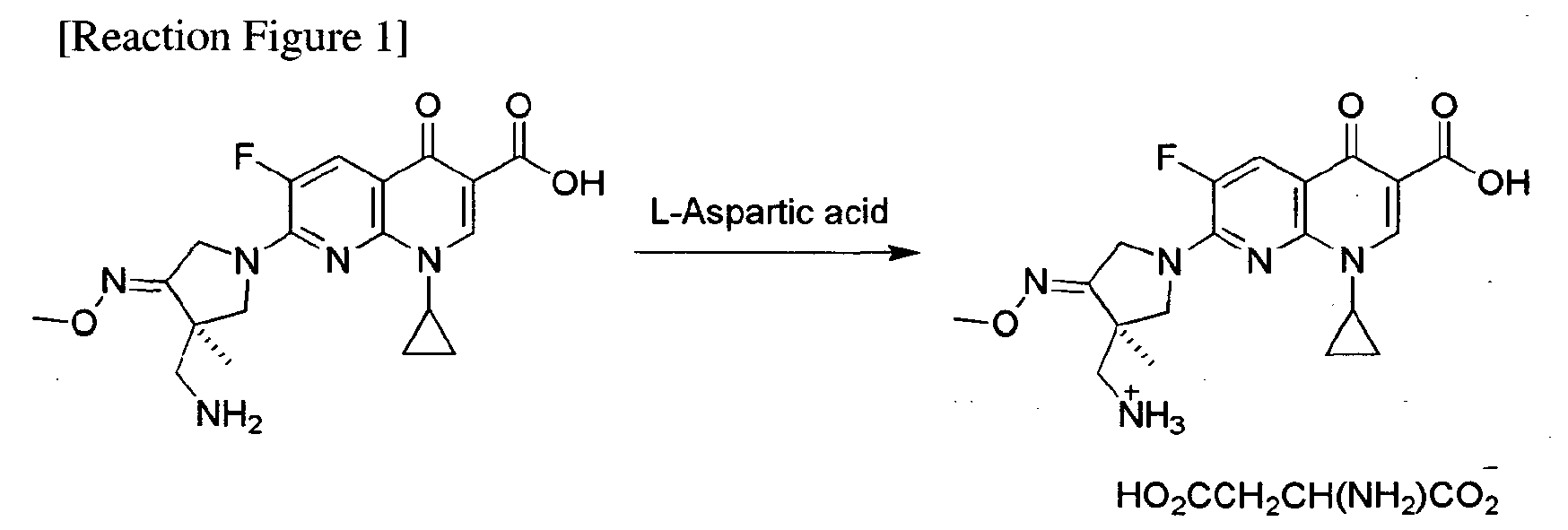
- the present invention also provides a preparation method of the R-7-(3-aminomethyl-4-methoxyimino-3-methyl-pyrrolidin-1-yl)-1-cyclopropyl-6-fluoro-4-oxo-1,4-dihydro-[1,8]naphthyridine-3-carboxylic acid L-aspartate of Chemical Figure 1.
- a preparation method according to the present invention includes reacting R-7-(3-aminomethyl-4-methoxyimino-3-methyl-pyrrolidin-1-yl)-1-cyclopropyl-6-fluoro-4-oxo-1,4-dihydro-[1,8]naphthyridine-3-carboxylic acid with L-aspartic acid in an inert organic solvent.
- L-aspartic acid used in a preparation method according to the present invention has been widely used as a main ingredient of aspartame, is a stable and colorless liquid that is not hygroscopic and corrosive, and has stability in preparation because it is not toxic. It is so easy to treat the acid that L-aspartic acid may be easily used in mass production. In addition, because the acid is known to contribute to hepatic detoxification, assistance in mineral absorption, and enhancement of DNA and RNA metabolism and improve immunocompetence, it is expected that side effects accompanied by the use of antimicrobial agents may be reduced.
- the inert organic solvent used in the preparation method of the present invention includes ethyl acetate, methanol, ethanol, isopropanol, acetone, acetonitrile, hexane, isopropyl ether, water, etc., and ethanol may be the most preferable among them.
- a preparation method of the present invention will be specifically described as follows. First, R- 7-(3-aminomethyl-4-methoxyimino-3-methyl-pyrrolidin-1-yl)-1-cyclopropyl-6-fluoro-4-oxo-1,4-dihydro-[1,8]naphthyridine-3-carboxylic acid is dissolved in an inert organic solvent.
- the inert organic solvent may be preferably used in an amount equivalent to a volume (ml) 10 to 20 times based on a weight(g) of R- 7-(3-aminomethyl-4-methoxyimino-3-methyl-pyrrolidin-1-yl)-1-cyclopropyl-6-fluoro-4-oxo-1,4-dihydro-[1,8]naphthyridine-3-carboxylic acid.
- L-aspartic acid may be added to 1 equivalent weight of R- 7-(3-aminomethyl-4-methoxyimino-3-methyl-pyrrolidin-1-yl)-1-cyclopropyl-6-fluoro-4-oxo-1,4-dihydro-[1,8]naphthyridine-3-carboxylic acid and may be reacted at 30 °C to 70 °C, and preferably 40 °C to 60 °C for 10 min to 5 hours, and preferably 30 min to 2 hours to prepare R- 7-(3-aminomethyl-4-methoxyimino-3-methyl-pyrrolidin-1yl)-1-cyclopropyl-6-fluoro-4-oxo-1,4-dihydro-[1,8]naphthyridine-3-carboxylic acid L-aspartate.
- R-7-(3-aminomethyl-4-methoxyimino-3-methyl-pyrrolidin-1-yl)-1-cyclopropyl-6-flu oro-4-oxo-1,4-dihydro-[1,8]naphthyridine-3-carboxylic acid may be prepared at a high yield of 82-83% or more by the preparation method.
- the present invention also provides an antimicrobial pharmaceutical composition containing R- 7-(3-aminomethyl-4-methoxyimino-3-methyl-pyrrolidin-1-yl)-1-cyclopropyl-6-fluoro-4-oxo-1,4-dihydro-[1,8]naphthyridine-3-carboxylic acid L-aspallate of the Chemical Formula 1 as an active ingredient.
- the present invention provides a method for treating bacterial disease, including administering to a patient in need thereof a therapeutically effective amount of L-aspartate of R- 7-(3-aminomethyl-4-methoxyimino-3-methyl-pyrrolidin-1-yl)-1-cyclopropyl-6-fluoro-4-oxo-1,4-dihydro-[1,8]naphthyridine-3-carboxylic acid represented by the Chemical Formula 1.
- the present invention also provides a use of L-aspartate of R- 7-(3-aminomethyl-4-methoxyimino-3-methyl-pyrrolidin-1-yl)-1-cyclopropyl-6-fluoro-4-oxo-1,4-dihydro-[1,8]naphthyridine-3-carboxylic acid represented by the Chemical Formula 1 in the preparation of an antimicrobial formulation.
- the L-aspartate according to the present invention may be useful as an antimicrobial agent.
- a composition containing the L-aspartate according to the present invention may be used in the form of a general medicinal preparation.
- the L-aspartate according to the present invention may be administered in various dosage forms, orally or parenterally when administered in an actual clinical setting.
- Pharmaceutical preparations may be prepared by including one or more pharmaceutically acceptable carriers in addition to an active ingredient.
- the pharmaceutically acceptable carrier may be used by including saline solution, sterile water, Ringer's solution, buffered saline solution, dextrose solution, maltodextrin solution, glycerol, ethanol, and a mixture of one or more thereof, and other conventional additives such as antioxidants, buffers, bacteriostatic agents, etc. may be added if necessary.
- Solid preparations for oral administration include tablets, pills, powders, granules, capsules, etc. These solid preparations may be prepared by mixing a compound with at least one excipients, for example, starch, calcium carbonate, sucrose, lactose, gelatin, etc. In addition to simple excipients, lubricants such as magnesium stearate and talc may be used.
- excipients for example, starch, calcium carbonate, sucrose, lactose, gelatin, etc.
- lubricants such as magnesium stearate and talc may be used.
- liquid preparations for oral administration include suspensions, solutions, emulsions and syrups, etc.
- various excipients for example, wetting agents, sweetening agents, flavors, preservatives, etc. may be included.
- Preparations for parenteral administration include sterilized aqueous solutions, non-aqueous solvents, suspending agents, emulsions, freeze-drying agents, suppositories, etc.
- Propylene glycol, polyethylene glycol, vegetable oils such as olive oil, injectable esters such as ethyl oleate, etc. may be used as non-aqueous solutions and suspending agents.
- Suppositories may include witepsol, macrogol, tween 61, cacao butter, laurin butter, glycerinated gelatin, etc.
- the pharmaceutical composition of the present invention may be parenterally administered, and the parenteral administration may be effected by hypodermatic, intravenous or intramuscular injection.
- a parenteral formulation a solution or suspension may be prepared by mixing the compound with a stabilizer or a buffer in water, and a unit dosage form such as an ampoule or a vial may be prepared.
- An amount of the L-aspartate according to the present invention may be preferably included in the ranges from 0.1% to 50% by weight based on a total weight of the composition.
- the above ranges are not to be limited to this, but may depend on the conditions of the patient, kinds of diseases, and severities of diseases.
- a preferable dose of the L-aspartate according to the present invention depends on the conditions and body weight of the patient, the severity of the disease, drug forms, administration routes, and duration, but may be appropriately selected by those skilled in the art. However, 0.01 mg/kg to 10 g/kg a day, and preferably 1 mg/kg to 1 g/kg a day may be administered. The doses may be administered once or several times a day.
- (+)-7-(3-aminomethyl-4-methoxyimino-3-methyl-pyrrolidin-1-yl)-1-cyclopropyl-6-flu oro-4-oxo-1,4-dihydro-[1,8]naphthyridine-3-carboxylic acid was prepared.
- (+)-7-(3-aminomethyl-4-methoxyimino-3-methyl-pyrrolidin-1-yl)-1-cyclopropyl-6-flu oro-4-oxo-1,4-dihydro-[1,8]naphthyridine-3-carboxylic acid hydrochloride was prepared.
- the L-aspartate exhibited about 2 times higher solubility than the hydrochloride (93.30 mg/ml) and much better solubility than the other salts in Comparative Examples.
- the L-aspartate according to the present invention is excellent in solubility and may be useful as a medicine.
- mice Male ICR mice were used as experimental animals. 5 male ICR mice were divided into 6 dose groups, respectively and fasted except for water for 24 hours.
- L-aspartate prepared in the Example 1 and the other salts prepared in Comparative Examples were intraperitoneally administered once (10 ml/kg) at 500, 250, 125, and 0 mg/kg, respectively to observe the lethal dose 50 (LD50) for 14 days. The results are shown in Table 3.
- the L-aspartate and hydrochloride according to the present invention were orally or intravenously administered to SD rats, respectively and blood samples were collected at a predetermined time to compare in vivo pharmacokinetics. Pharmacokinetic parameters are shown in Table 4.
- Cmax maximum drug concentration
- Tmax maximum drug concentration time
- T 1/2 drug half-life
- AUC0-t area under the plasma concentration-time curve from time zero to t hours
- AUC0-inf area under the plasma concentration-time curve from time zero to infinity.
- the pharmacokinetic parameters of the hydrochloride and L-aspartate according to the present invention showed in Table 4. Although the statistical significance was not observed, the mean oral bioavailability (BA, %) of the L-aspartate of the present invention was relatively higher than that of the hydrochloride in rat pharmacokinetic study.
- the BA values of the hydrochloride and L-aspartate according to the present invention were 50.96% and 70.05%, respectively.
- P ratio is a ratio of permeation into muscle and calculated as intramuscular AUC/intraplasmic AUC.
- the ingredients were mixed and filled into sealed packaging to provide powders.
- the ingredients were mixed and tabletted according to a conventional tablet preparation method to provide a tablet.
- the ingredients were mixed and filled into a gelatin capsule according to a conventional capsule preparation method to provide a capsule.
- the compound of Chemical Formula 1 was dissolved in a proper volume of injectable sodium chloride BP, pH of a solution produced was adjusted to pH 3.5 with diluted hydrochloric acid BP, and its volume was adjusted with injectable sodium chloride BP. After being sufficiently mixed, the solution was filled in a 5 type I ampoule made from transparent glass, which was then molten such that the solution was packaged under the upper grid of air. An injection was obtained by autoclaving the ampoule at 120 °C for 15 min or longer.
Landscapes
- Chemical & Material Sciences (AREA)
- Health & Medical Sciences (AREA)
- Organic Chemistry (AREA)
- Veterinary Medicine (AREA)
- Medicinal Chemistry (AREA)
- Pharmacology & Pharmacy (AREA)
- Life Sciences & Earth Sciences (AREA)
- Animal Behavior & Ethology (AREA)
- General Health & Medical Sciences (AREA)
- Public Health (AREA)
- Epidemiology (AREA)
- Engineering & Computer Science (AREA)
- Bioinformatics & Cheminformatics (AREA)
- Dermatology (AREA)
- Communicable Diseases (AREA)
- Oncology (AREA)
- Chemical Kinetics & Catalysis (AREA)
- General Chemical & Material Sciences (AREA)
- Nuclear Medicine, Radiotherapy & Molecular Imaging (AREA)
- Nitrogen Condensed Heterocyclic Rings (AREA)
- Pharmaceuticals Containing Other Organic And Inorganic Compounds (AREA)
Description
- The present disclosure relates to R-7-(3-aminomethyl-4-methoxyimino-3-methyl-pyrrolidin-1-yl)-1-cyclopropyl-6-fluoro-4-oxo-1,4-dihydro-[1,8]naphthyridine-3-carboxylic acid and L-aspartic acid salt, process for the preparation thereof and pharmaceutical composition comprising the same for antimicrobial.
- Background Art
- Quinolone carboxylic acid derivatives are synthetic antibacterial agents which are well known to be useful for the treatment of infective diseases in human and animals due to their potent and broad antimicrobial activities. Currently, quinolone-based antimicrobial agents such as norfloxacin, ofloxacin, ciprofloxacin, etc. are very usefully applied for the treatment of human diseases, and their efficacies are acknowledged. However, these medicines have the problem that even though they show excellent antimicrobial activities against Gram-negative bacteria, they still show ordinary or relatively low antimicrobial activities against Gram-positive bacteria. Accordingly, there have been various studies for solving such problems of existing quinolone-based antimicrobial agents, and as a result, sparfloxacin having improved antimicrobial activities against Gram-positive bacteria has been developed. However, this compound still shows weak antimicrobial activities against Streptococci, methicillin resistant Staphylococcus aureus (MRSA) and other currently increasing quinolone-resistant strains. The above-mentioned strains are well known as pathogens of respiratory infections. Therefore, there are increasing needs for the development of improved quinolone antimicrobial agents which exhibit excellent antimicrobial activities against these strains.
- In quinolone-based antimicrobial agents, R-7-(3-aminomethyl-4-methoxyimino-3-methyl-pyrolidin-1-yl)-1-cyclopropyl-6-fluoro-4-oxo-1,4-dihydro-[1,8]naphthyridine-3-carboxylic acid exhibit excellent antimicrobial activities against Gram-positive bacteria, Gram-negative bacteria, methicillin resistant bacteria, and existing quinolone-resistant strains.
- In general, it is well known to those skilled in the art that an active ingredient used in a pharmaceutical composition should be highly soluble in water or aqueous solution having a broad range of pH. Accordingly, the development of salts having excellent solubility is needed in order to increase the bioavailability of the R-7-(3-aminomethyl-4-methoxyimino-3-methyl-pyrrolidin-1-yl)-1-cyclopropyl-6-fluoro-4-oxo-1,4-dihydro-[1,8]naphthyridine-3-carboxylic acid.
- Thus, the present inventors have described various salts of R-7-(3-aminomethyl-4-methoxyimino-3-methyl-pyrrolidin-1-yl)-1-cyclopropyl-6-fluoro-4-oxo-1,4-dihydro-[1,8]naphthyridine-3-carboxylic acid in Korean Patent Laid-Open Publication No.
2001-0029698 - L-aspartic acid was approved by the US FDA as a food additive, and the acid has been safely and widely used. L-aspartic acid is a stable and colorless liquid that is not hygroscopic and corrosive and has stability in preparation because it is not toxic. It is so easy to treat the acid that L-aspartic acid may be easily used in mass production. In addition, the acid is known to contribute to hepatic detoxification, assist in mineral absorption, enhance DNA and RNA metabolism and improve immunocompetence. However, when L-aspartic acid is administered alone, the solubility and internal absorption is so low that only minor effects are known to be exerted when the acid is administered even in excess. Therefore, L-aspartic acid has not been conventionally used as a pharmaceutically acceptable salt.
- Thus, the present inventors have performed research to develop a salt having excellent solubility to improve the bioavailability of the R-7-(3-aminomethyl-4-methoxyimino-3-methyl-pyrrolidin-1-yl)-1-cyclopropyl-6-fluoro-4-oxo-1,4-dihydro-[1,8]naphthyridine-3-carboxylic acid, prepared L-aspartate of R-7-(3-aminomethyl-4-methoxyimino-3-methyl-pyrrolidin-1-yl)-1-cyclopropyl-6-fluoro-4-oxo-1,4-dihydro-[1,8]naphthyridine-3-carboxylic acid, confirmed that the L-aspartate has better solubility as well as better physical properties such as stability, etc. than hydrochloride and D-aspartate, and aspartic acid is easily dissolved in the form of salt and internally absorbed to have a lower toxicity than the other salts, and made the present invention.
- Disclosure of Invention
- One object of the present invention is to provide L-asparate of R-7-(3-aminomethyl-4-methoxyimino-3-methyl-pyrrolidin-1-yl)-1-cyclopropyl-6-fluoro-4-oxo-1,4-dihydro-[1,8]naphthyridine-3-carboxylic acid.
- Another object of the present invention is to provide a preparation method of the L-aspartate of R-7-(3-aminomethyl-4-methoxyimino-3-methyl-pyrrolidin-1-yl)-1-cyclopropyl-6-fluoro-4-oxo-1,4-dihydro-[1,8]naphthyridine-3-carboxylic acid.
- Still another object of the present invention is to provide an antimicrobial pharmaceutical composition containing the L-aspartate of R-7-(3-aminomethyl-4-methoxyimino-3-methyl-pyrrolidin-1-yl)-1-cyclopropyl-6-fluoro-4-oxo-1,4-dihydro-[1,8]naphthyridine-3-carboxylic acid as an active ingredient.
- Solution to Problem
- In order to achieve the objects, the present invention provides L-aspartate of R-7-(3-aminomethyl-4-methoxyimino-3-methyl-pyrrolidin-1-yl)-1-cyclopropyl-6-fluoro-4-oxo-1,4-dihydro-[1,8]naphthyridine-3-carboxylic acid, a preparation method thereof, and an antimicrobial pharmaceutical composition containing the same as an active ingredient.
- Advantageous Effects of Invention
- Because the R-7-(3-aminomethyl-4-methoxyimino-3-methyl-pyrrolidin-1-yl)-1-cyclopropyl-6-fluoro-4-oxo-1,4-dihydro-[1,8]naphthyridine-3-carboxylic acid L-aspartate of the present invention is more soluble than hydrochloride, is less toxic than the other salts (D-aspartate, hydrochloride, and phosphate), and has reduced side effects as an antimicrobial agent, the salt may be useful for oral and injectable administration.
- Best Mode for Carrying out the Invention
- The present invention provides L-aspartate of R-7-(3-aminomethyl-4-methoxyimino-3-methyl-pyrrolidin-1-yl)-1-cyclopropyl-6-fluoro-4-oxo-1,4-dihydro-[1,8]naphthyridine-3-carboxylic acid represented by the following Chemical Figure 1.
- Chemistry Figure 1

- R-7-(3-aminomethyl-4-methoxyimino-3-methyl-pyrrolidin-1-yl)-1-cyclopropyl-6-flu oro-4-oxo-1,4-dihydro-[1,8]naphthyridine-3-carboxylic acid L-aspartate of the present invention may be crystal or amorphous, and more preferably a crystal form.
- The present invention also provides a preparation method of the R-7-(3-aminomethyl-4-methoxyimino-3-methyl-pyrrolidin-1-yl)-1-cyclopropyl-6-fluoro-4-oxo-1,4-dihydro-[1,8]naphthyridine-3-carboxylic acid L-aspartate of Chemical Figure 1. Specifically, a preparation method according to the present invention, as represented by the following Reaction Figure 1, includes reacting R-7-(3-aminomethyl-4-methoxyimino-3-methyl-pyrrolidin-1-yl)-1-cyclopropyl-6-fluoro-4-oxo-1,4-dihydro-[1,8]naphthyridine-3-carboxylic acid with L-aspartic acid in an inert organic solvent.
-
- L-aspartic acid used in a preparation method according to the present invention has been widely used as a main ingredient of aspartame, is a stable and colorless liquid that is not hygroscopic and corrosive, and has stability in preparation because it is not toxic. It is so easy to treat the acid that L-aspartic acid may be easily used in mass production. In addition, because the acid is known to contribute to hepatic detoxification, assistance in mineral absorption, and enhancement of DNA and RNA metabolism and improve immunocompetence, it is expected that side effects accompanied by the use of antimicrobial agents may be reduced.
- The inert organic solvent used in the preparation method of the present invention includes ethyl acetate, methanol, ethanol, isopropanol, acetone, acetonitrile, hexane, isopropyl ether, water, etc., and ethanol may be the most preferable among them.
- A preparation method of the present invention will be specifically described as follows. First, R-
7-(3-aminomethyl-4-methoxyimino-3-methyl-pyrrolidin-1-yl)-1-cyclopropyl-6-fluoro-4-oxo-1,4-dihydro-[1,8]naphthyridine-3-carboxylic acid is dissolved in an inert organic solvent. The inert organic solvent may be preferably used in an amount equivalent to a volume (mℓ) 10 to 20 times based on a weight(g) of R-
7-(3-aminomethyl-4-methoxyimino-3-methyl-pyrrolidin-1-yl)-1-cyclopropyl-6-fluoro-4-oxo-1,4-dihydro-[1,8]naphthyridine-3-carboxylic acid. - 0.9 to 2.5 equivalent weight, and preferably 1.0 to 1.5 equivalent weight of L-aspartic acid may be added to 1 equivalent weight of R-
7-(3-aminomethyl-4-methoxyimino-3-methyl-pyrrolidin-1-yl)-1-cyclopropyl-6-fluoro-4-oxo-1,4-dihydro-[1,8]naphthyridine-3-carboxylic acid and may be reacted at 30 °C to 70 °C, and preferably 40 °C to 60 °C for 10 min to 5 hours, and preferably 30 min to 2 hours to prepare R-
7-(3-aminomethyl-4-methoxyimino-3-methyl-pyrrolidin-1yl)-1-cyclopropyl-6-fluoro-4-oxo-1,4-dihydro-[1,8]naphthyridine-3-carboxylic acid L-aspartate. - R-7-(3-aminomethyl-4-methoxyimino-3-methyl-pyrrolidin-1-yl)-1-cyclopropyl-6-flu oro-4-oxo-1,4-dihydro-[1,8]naphthyridine-3-carboxylic acid may be prepared at a high yield of 82-83% or more by the preparation method.
- The present invention also provides an antimicrobial pharmaceutical composition containing R-
7-(3-aminomethyl-4-methoxyimino-3-methyl-pyrrolidin-1-yl)-1-cyclopropyl-6-fluoro-4-oxo-1,4-dihydro-[1,8]naphthyridine-3-carboxylic acid L-aspallate of the Chemical Formula 1 as an active ingredient. - Furthermore, the present invention provides a method for treating bacterial disease, including administering to a patient in need thereof a therapeutically effective amount of L-aspartate of R-
7-(3-aminomethyl-4-methoxyimino-3-methyl-pyrrolidin-1-yl)-1-cyclopropyl-6-fluoro-4-oxo-1,4-dihydro-[1,8]naphthyridine-3-carboxylic acid represented by the Chemical Formula 1. - The present invention also provides a use of L-aspartate of R-
7-(3-aminomethyl-4-methoxyimino-3-methyl-pyrrolidin-1-yl)-1-cyclopropyl-6-fluoro-4-oxo-1,4-dihydro-[1,8]naphthyridine-3-carboxylic acid represented by the Chemical Formula 1 in the preparation of an antimicrobial formulation. - L-aspartate of R-
7-(3-aminomethyl-4-methoxyimino-3-methyl-pyrrolidin-1-yl)-1-cyclopropyl-6-fluoro-4-oxo-1,4-dihydro-[1,8]naphthyridine-3-carboxylic acid of the present invention was shown to have better solubility than R-
7-(3-aminomethyl-4-methoxyimino-methyl-pyrrolidin-1-yl)-1-cyclopropyl-6-fluoro-4-oxo-1,4-dihydro-[1,8]naphthyridine-3-carboxylic acid, hydrochloride and D-aspartate thereof and to be about 2 times more soluble, in particular, in distilled water than the hydrochloride (See Table 1). There was also little change in content of the salt in distilled water, meaning that its chemical stability was excellent (See Table 2), and it was determined that the toxicity was relatively low due to a high lethal dose 50 (See Table 3). Furthermore, the salt exhibited pharmacokinetics equivalent to that of hydrochloride in an in vivo pharmacokinetic experiment (See Table 4). - Therefore, the L-aspartate according to the present invention may be useful as an antimicrobial agent.
- A composition containing the L-aspartate according to the present invention may be used in the form of a general medicinal preparation.
- That is, the L-aspartate according to the present invention may be administered in various dosage forms, orally or parenterally when administered in an actual clinical setting. Pharmaceutical preparations may be prepared by including one or more pharmaceutically acceptable carriers in addition to an active ingredient. The pharmaceutically acceptable carrier may be used by including saline solution, sterile water, Ringer's solution, buffered saline solution, dextrose solution, maltodextrin solution, glycerol, ethanol, and a mixture of one or more thereof, and other conventional additives such as antioxidants, buffers, bacteriostatic agents, etc. may be added if necessary.
- Solid preparations for oral administration include tablets, pills, powders, granules, capsules, etc. These solid preparations may be prepared by mixing a compound with at least one excipients, for example, starch, calcium carbonate, sucrose, lactose, gelatin, etc. In addition to simple excipients, lubricants such as magnesium stearate and talc may be used.
- In addition, liquid preparations for oral administration include suspensions, solutions, emulsions and syrups, etc. In addition to water commonly used as a simple diluent and liquid paraffin, various excipients, for example, wetting agents, sweetening agents, flavors, preservatives, etc. may be included. Preparations for parenteral administration include sterilized aqueous solutions, non-aqueous solvents, suspending agents, emulsions, freeze-drying agents, suppositories, etc. Propylene glycol, polyethylene glycol, vegetable oils such as olive oil, injectable esters such as ethyl oleate, etc. may be used as non-aqueous solutions and suspending agents. Suppositories may include witepsol, macrogol, tween 61, cacao butter, laurin butter, glycerinated gelatin, etc.
- Furthermore, the pharmaceutical composition of the present invention may be parenterally administered, and the parenteral administration may be effected by hypodermatic, intravenous or intramuscular injection. To prepare a parenteral formulation, a solution or suspension may be prepared by mixing the compound with a stabilizer or a buffer in water, and a unit dosage form such as an ampoule or a vial may be prepared.
- An amount of the L-aspartate according to the present invention may be preferably included in the ranges from 0.1% to 50% by weight based on a total weight of the composition. However, the above ranges are not to be limited to this, but may depend on the conditions of the patient, kinds of diseases, and severities of diseases.
- A preferable dose of the L-aspartate according to the present invention depends on the conditions and body weight of the patient, the severity of the disease, drug forms, administration routes, and duration, but may be appropriately selected by those skilled in the art. However, 0.01 mg/kg to 10 g/kg a day, and preferably 1 mg/kg to 1 g/kg a day may be administered. The doses may be administered once or several times a day.
- Mode for the Invention
- Hereinafter, the present invention will be described in more detail with reference to the following examples and experimental examples. However, the following examples and experimental examples are provided for illustrative purposes only, and the scope of the present invention should not be limited thereto in any manner.
- <Example 1> Preparation of R-
7-(3-aminomethyl-4-methoxyimino-3-methyl-pyrrolidin-1-yl)-1-cyclopropyl-6-fluoro-4-oxo-1,4-dihydro-[1,8]naphthyridine-3-carboxylic acid L-aspartate - 23 me of methanol and 23 mℓ of water were added to 7.8 g of R-7-(3-aminomethyl-4-methoxyimino-3-methyl-pyrrolidin-1-yl)-1-cyclopropyl-6-fluoro-4-oxo-1,4-dihydro-[1,8]naphthyridine-3-carboxylic acid, to which was added 2.57 g of L-aspartic acid, followed by stirring at 45 °C for 1 hour. After the solid of the reaction mixture was filtered, 78 mℓ of ethanol was added to the solid. The mixture was stirred at 5 °C to 10 °C for 2 hours, followed by filtration and drying to obtain 8.5 g of the target compound (yield: 82%).
- 1H-NMR(D2O, ppm) : 1.03(d, 2H, J=4.00Hz), 1.27(m, 2H), 1.47(s, 3H), 2.67(dd, 1H, J=17.59Hz, J=8.80Hz), 2.77(dd, 1H, J=22.03Hz, J=3.64Hz), 3.34(s, 2H), 3.63(m, 1H), 3.86(m, 1H), 3.96(m, 5H), 4.67(s, 2H), 7.66(d, 1H, J=12.43Hz), 8.54(s, 1H).
- Melting point (m.p.) : 164.2 °C
- <Comparative Example 1> Preparation of R-
7-(3-aminomethyl-4-methoxyimino-3-methyl-pyrrolidin-1-yl)-1-cyclopropyl-6-fluoro-4-oxo-1,4-dihydro-[1,8]naphthyridine-3-carboxylic acid D-aspartate - 30 mℓ of methanol and 30 mℓ of distilled water were added to 10 g of R-7-(3-aminomethyl-4-methoxyimino-3-methyl-pyrrolidin-1-yl)-1-cyclopropyl-6-fluoro-4-oxo-1,4-dihydro-[1,8]naphthyridine-3-carboxylic acid, to which was added 3.3 g of D-aspartic acid, followed by stirring at 45 °C for 1 hour. After the solid of the reaction mixture was filtered, 100 mℓ of ethanol was added to the solid. The mixture was stirred at room temperature for 3 hours, and the solid produced was filtered and dried to obtain 8.67 g of the target compound (yield: 65%).
- 1H-NMR(D2O, ppm) : 1.06(2H, d, J=4.04Hz), 1.32(2H, d, J=6.96Hz), 1.51(3H, s), 2.73(1H, dd, J=17.59Hz, J=8.80Hz), 2.83(1H, dd, J=22.03Hz, J=3.64Hz), 3.38(1H, s), 3.65(2H, m), 3.90(1H, m), 3.99(4H, m), 4.10(1H, m), 4.71(2H, s), 7.68(1H, d, J=12.27Hz), 8.57(1H, s).
- Melting point (m.p.) : 163.3 °C
- <Comparative Example 2> Preparation of R-
7-(3-aminomethyl-4-methoxyimino-3-methyl-pyrrolidin-1-yl)-1-cyclopropyl-6-fluoro-4-oxo-1,4-dihydro-[1,8]naphthyridine-3-carboxylic acid - According to the method described in Korean Patent Laid-Open Publication No.
2001-0029698
(+)-7-(3-aminomethyl-4-methoxyimino-3-methyl-pyrrolidin-1-yl)-1-cyclopropyl-6-flu oro-4-oxo-1,4-dihydro-[1,8]naphthyridine-3-carboxylic acid was prepared. - <Comparative Example 3> Preparation of R-
7-(3-aminomethyl-4-methoxyimino-3-methyl-pyrrolidin-1-yl)-1-cyclopropyl-6-fluoro-4-oxo-1,4-dihydro-[1,8]naphthyridine-3-carboxylic acid hydrochloride - According to the method described in Korean Patent Laid-Open Publication No.
2001-0029698
(+)-7-(3-aminomethyl-4-methoxyimino-3-methyl-pyrrolidin-1-yl)-1-cyclopropyl-6-flu oro-4-oxo-1,4-dihydro-[1,8]naphthyridine-3-carboxylic acid hydrochloride was prepared. - <Comparative Example 4> Preparation of R-
7-(3-aminomethyl-4-methoxyimino-3-methyl-pyrrolidin-1-yl)-1-cyclopropyl-6-fluoro-4-oxo-1,4-dihydro-[1,8]naphthyridine-3-carboxylic acid methanesulfonate - *40 mℓ of trifluoroacetic acid was cooled to 5°C to 10°C, to which was added 20 g of
7-[3-(t-butoxycarbonylamino-methyl)-4-methoxyimino-3-methyl-pyrrolidin-1-yl]-1-cy clopropyl-6-fluoro-4-oxo-1,4-dihydro-[1,8]naphthyridine-3-carboxylic acid, followed by stirring for 1.5 hours. 140 mℓ of isopropanol and 3.1 mℓ of methanesulfonic acid were added to this reaction mixture and stirred at the same temperature for 2 hours. The solid produced from the reaction mixture was filtered and dried to obtain 10.2 g of the target compound (yield : 51%). - 1H-NMR(D2O, ppm) : 1.05(2H, d, J=3.84Hz), 1.32(2H, d, J=7.16Hz), 1.51(s, 3H), 2.80(3H, s), 3.38(2H, s), 3.67(1H, m), 3.98(4H, m), 4.10(1H, m), 4.70(2H, s), 7.65(2H, d, J=12.27Hz), 8.54(1H, s).
- Melting point (m.p.): 193.3 °C.
- *<Comparative Example 5> Preparation of R-
7-(3-aminomethyl-4-methoxyimino-3-methyl-pyrrolidin-1-yl)-1-cyclopropyl-6-fluoro-4-oxo-1,4-dihydro-[1,8]naphthyridine-3-carboxylic acid formate - 50 mℓ of purified water, 50 me of ethanol, and 1.1 mℓ of formic acid were added to 10 g of R-
7-(3-aminomethyl-4-methoxyimino-3-methyl-pyrrolidin-1-yl)-1-cyclopropyl-6-fluoro-4-oxo-1,4-dihydro-[1,8]naphthyridine-3-carboxylic acid, followed by stirring at 55 °C to 60 °C for 1 hour. Subsequently, the reaction mixture was filtered, and then 40 mℓ of ethanol was added to the filtrate. The mixture was cooled to room temperature and stirred at room temperature for 4 hours. The solid produced was filtered, followed by drying to obtain 6.4 g of the target compound (yield : 57%). - 1H-NMR(D2O, ppm) : 1.03(2H, d, J=4.04Hz), 1.31(2H, m), 1.49(3H, s), 3.37(2H, s), 3.62(1H, m), 3.95(4H, m), 4.03(1H, m), 4.66(1H, s), 7.61(2H, d, J=12.43Hz), 8.45(1H, s), 8.50(1H, s).
- Melting point (m.p.): 195.4 °C.
- <Comparative Example 6> Preparation of R-
7-(3-aminomethyl-4-methoxyimino-3-methyl-pyrrolidin-1-yl)-1-cyclopropyl-6-fluoro-4-oxo-1,4-dihydro-[1,8]naphthyridine-3-carboxylic acid phosphate - 8.04 g of R-
7-(3-aminomethyl-4-methoxyimino-3-methyl-pyrrolidin-1-yl)-1-cyclopropyl-6-fluoro-4-oxo-1,4-dihydro-[1,8]naphthyridine-3-carboxylic acid was added to 41 mℓ of phosphoric acid and 41 mℓ of distilled water, followed by stirring at 55 °C to 60 °C for 2 hours. Subsequently, the reaction mixture was filtered, and then the filtrate was cooled to room temperature. To the filtrate was added 33 mℓ of ethanol, and then the solid produced after the mixture was stirred at 5 °C to 10 °C for 1 hour was filtered and dried to obtain 8.54 g of the target compound (yield : 85%). - 1H-NMR(D2O, ppm) : 1.06(2H, d, J=6.04Hz), 1.32(2H, d, J=6.96Hz), 1.51(3H, s), 3.38(2H, s), 3.66(1H, m), 3.99(4H, s), 4.10(1H, d, J=12.27Hz), 4.70(2H, s), 7.65(1H, d, J=12.23Hz), 8.54(1H, s).
- Melting point (m.p.): 165.4 °C.
- <Comparative Example 7> Preparation of R-
7-(3-aminomethyl-4-methoxyimino-3-methyl-pyrrolidin-1-yl)-1-cyclopropyl-6-fluoro-4-oxo-1,4-dihydro-[1,8]naphthyridine-3-carboxylic acid p-toluenesulfonate - 53 mℓ of ethanol and 53 mℓ of distilled water were added to 6 g of p-toluenesulfonic acid, to which was added 10.51 g of R-
7-(3-aminomethyl-4-methoxyimino-3-methyl-pyrrolidin-1-yl)-1-cyclopropyl-6-fluoro-4-oxo-1,4-dihydro-[1,8]naphthyridine-3-carboxylic acid, followed by stirring at 55 °C to 58 °C for 2 hours. Subsequently, the reaction mixture was filtered, and then the filtrate was cooled to 5 °C to 10 °C. 52 mℓ of ethanol was added to the filtrate, followed by stirring for 1 hour. The solid produced was filtered and dried to obtain 8.24 g of the target compound (yield : 55%). - 1H-NMR(D2O, ppm) : 1.06(2H, d, J=6.44Hz), 1.31(2H, d, J=6.96Hz), 1.50(3H, s), 2.35(3H, s), 3.37(2H, s), 3.66(1H, m), 3.99(4H, s), 4.11(1H, d, J=12.1Hz), 4.70(2H, s), 7.31(2H, d, J=8.44Hz), 7.63(2H, d, J=8.04Hz), 7.68(1H, d, J=12.2Hz), 8.58(1H, s).
- Melting point (m.p.): 187.2 °C.
- <Experimental Example 1> Solubility test
- Each solubility (µg/mℓ) of the R-
7-(3-aminomethyl-4-methoxyimino-3-methyl-pyrrolidin-1-yl)-1-cyclopropyl-6-fluoro-4-oxo-1,4-dihydro-[1,8]naphthyridine-3-carboxylic acid L-aspartate, D-aspartate, methanesulfonate, formate, phosphate, p-toluenesulfonate, and hydrochloride and R-7-(3-aminomethyl-4-methoxyimino-3-methyl-pyrrolidin-1-yl)-1-cyclopropyl-6-fluoro-4-oxo-1,4-dihydro-[1,8]naphthyridine-3-carboxylic acid prepared in the Example and Comparative Examples was measured at room temperature. - The results are shown in Table 1.
- Table 1
[Table 1][Table] Salt used Solubility (mg/mℓ) L-aspartate (Example 1) 189.78 D-aspartate (Comparative Example 1) 118.64 Free form (Comparative Example 2) 2.79 Hydrochloride (Comparative Example 3) 93.30 Methanesulfonate (Comparative Example 4) 99.08 Formate (Comparative Example 5) 27.52 Phosphate (Comparative Example 6) 57.79 p-toluenesulfonate (Comparative Example 7) 5.78 - As shown in Table 1, the free form of R-
7-(aminomethyl-4-methoxyimino-3-methyl-pyrrolidin-1-yl)-1-cyclopropyl-6-fluoro-4-oxo-1,4-dihydro-[1,8]naphthyridine-3-carboxylic acid was rarely soluble in water due to the solubility of 2.79 mg/mℓ, while the L-aspartate according to the present invention was excellent in solubility, which was 189.78 mg/mℓ. In particular, the solubility of the L-aspartate according to the present invention was higher than that (118.64 mg/mℓ) of D-aspartate which is the optical isomer. The L-aspartate exhibited about 2 times higher solubility than the hydrochloride (93.30 mg/mℓ) and much better solubility than the other salts in Comparative Examples. Thus, the L-aspartate according to the present invention is excellent in solubility and may be useful as a medicine. - <Experimental Example 2> Stability test
- 30 mg of each salt of the R-
7-(3-aminomethyl-4-methoxyimino-3-methyl-pyrrolidin-1-yl)-1-cyclopropyl-6-fluoro-4-oxo-1,4-dihydro-[1,8]naphthyridine-3-carboxylic acids prepared in the Example and Comparative Examples was dissolved in 100 mℓ of distilled water, and then was subjected to stability test at room temperature and at 60 °C. The results are shown in Table 2. - Table 2
[Table 2][Table] Salt used Content (%) Initial Room temperature (after 3 weeks) 60? (after 3 weeks) L-aspartate (Example 1) 98.1 98.0 87.4 D-aspartate (Comparative Example 1) 97.8 98.0 90.3 Free form (Comparative Example 2) 97.3 96.8 34.6 ydrochloride (Comparative Example 3) 97.9 98.0 90.0 Methanesulfonate (Comparative Example 4) 96.4 96.8 89.6 Formate (Comparative Example 5) 89.7 89.7 75.1 Phosphate (Comparative Example 6) 98.1 97.9 91.2 p-toluenesulfonate (Comparative Example 7) 98.6 98.1 87.3 - As shown in Table 2, there was little change in content of the L-aspartate according to the present invention at room temperature, meaning that it was chemically stable.
- <Experimental Example 3> Toxicity test-single dose toxicity in mice
- The following experiment was performed in order to observe the degree of toxicity of the L-aspartate according to the present invention.
- Male ICR mice were used as experimental animals. 5 male ICR mice were divided into 6 dose groups, respectively and fasted except for water for 24 hours. R-
7-(3-aminomethyl-4-methoxyimino-3-methyl-pyrrolidin-1-yl)-1-cyclopropyl-6-fluoro-4-oxo-1,4-dihydro-[1,8]naphthyridine-3-carboxylic acid L-aspartate prepared in the Example 1 and the other salts prepared in Comparative Examples were intraperitoneally administered once (10 mℓ/kg) at 500, 250, 125, and 0 mg/kg, respectively to observe the lethal dose 50 (LD50) for 14 days. The results are shown in Table 3. - Table 3
[Table 3][Table] Salt used Lethal dose 50 (mg/kg) L-aspartate (Example 1) 209 D-aspartate (Comparative Example 1) 176 Hydrochloride (Comparative Example 3) 176 Phosphate (Comparative Example 6) 176 - As shown in Table 3, it is determined that the L-aspartate of the present invention was less toxic than the other salts (D-aspartate, phosphate, and hydrochloride) due to a higher lethal dose 50 than those of the other salts.
- <Experimental Example 4> in vivo genotoxicities
- The following study performed to obtain in vivo genotoxicities, micronucleus test of L-aspartate and hydrochloric acid salt in male mice to the following procedure.
- After 24hrs after end of twice intraperitoneal treatment of aspartate or of single intraperitoneal treatment of cyclophosphamide(CPA), all animal were sacrifice and the changes on the number of polychromatic erythrocyte with one or more nuclei (MNPCE) were evaluate among 2000 PCEs with PCE/((PCE+normochromatic erythrocytes(NCE)) ratio among 500 erythrocytes for detecting possibility of cytotoxicity. The highest dosage used in the present study was selected as 60 mg/kg in a volume of 20 ml using distilled water as vehicle because quinolone antibiotics have been showed positive results in mouse micronucleus test, and 30, 15 and 7.5 mg/kg were selected using common ratio 2 in the present study, respectively. in addition, intact control and positive control (cyclophosphoamide(CPA) 70 mg/kg )groups were added.
- In these result, the MNPCE number of aspartate were not detected significant change in 30, 15, 7.5 mg/kg treat groupas compared with intact control, respectively. But in the case of hydrochloric acid salt, the MNPCE number were singificantly increase in 7.5 mg/kg tested group.
- <Experimental Example 5> In vivo pharmacokinetic test
- The L-aspartate and hydrochloride according to the present invention were orally or intravenously administered to SD rats, respectively and blood samples were collected at a predetermined time to compare in vivo pharmacokinetics. Pharmacokinetic parameters are shown in Table 4.
- Then, Cmax: maximum drug concentration, Tmax: maximum drug concentration time, T1/2: drug half-life, AUC0-t: area under the plasma concentration-time curve from time zero to t hours, and AUC0-inf: area under the plasma concentration-time curve from time zero to infinity.
- Table 4
[Table 4][Table] PK parameters of the hydrochloride and L-aspartate according to the present invention in rats after p.o. and i.v. administration Pharmacokinetic parameter Hydrochloride L-aspartate i.v.(10mg/kg) p.o.(100mg/kg) i.v.(10mg/kg) p.o.(100mg/kg) Cmax (µg/mℓ) 4.46±0.96 7.62±3.93 4.18±0.29 9.08±4.50 Tmax (hr) 0 2.13±1.97 0 2.13±0.63 T1/2 (hr) 1.552.05± - 2.05±1.55 - AUC0-t (µg·hr/mℓ) 8.72±0.33 44.42±21.38 7.52±0.22 52.68±28.73 AUC0-inf (µg-hr/mℓ) 0.4610.72± - 9.32±0.28 - BA(%)a - 50.96 - 70.05 - * estimated value by back extrapolation(CO)
- a This result is calculated by ratio of AUCO-T
- The pharmacokinetic parameters of the hydrochloride and L-aspartate according to the present invention showed in Table 4. Although the statistical significance was not observed, the mean oral bioavailability (BA, %) of the L-aspartate of the present invention was relatively higher than that of the hydrochloride in rat pharmacokinetic study. The BA values of the hydrochloride and L-aspartate according to the present invention were 50.96% and 70.05%, respectively.
- <Experimental Example 6> In vivo tissue distribution test
- An in vivo tissue distribution test was performed in order to confirm the degree of drug distribution of the L-aspartate and hydrochloride according to the present invention in each organ. After 8-week-old ICR mice were purchased and adapted in the laboratory, each salt was orally administered to the mouse at a dose of 100 mg/kg. The mice were bled and sacrificed at a predetermined time and each organ was drawn to measure the concentration in each organ. After the administration of hydrochloride and L-aspartate, each organ concentration over time, the area under the corresponding time-concentration curve, and the ratio of permeation into tissue were shown in Tables 5 and 6.
- Then, P ratio is a ratio of permeation into muscle and calculated as intramuscular AUC/intraplasmic AUC.
- Table 5
[Table 5][Table] Hydrochloride Time (hr) Plasma(µg/mℓ) Liver( µg/g) Kidney (µg/g) Brain( µg/g) Lung( µg/g) Splee n(µg/g) Thym us(µg/g) Heart( µg/g) Testicle(µg/g) Muscle(µg/g) 0.5 15.51 160.68 90.76 2.51 82.80 101.81 24.55 59.29 4.79 39.79 1 14.24 124.93 87.84 3.09 79.50 111.78 57.95 61.22 8.36 52.03 1.5 12.09 112.52 75.49 2.72 73.65 107.26 60.77 52.66 12.66 50.40 2 12.04 109.11 69.92 3.18 63.66 101.77 61.30 57.59 16.98 50.82 3 6.24 68.98 42.99 1.99 38.75 59.75 38.37 25.52 14.22 28.30 5 4.32 55.73 32.76 1.60 23.42 42.08 25.68 17.31 12.92 18.42 8 2.29 27.03 18.04 0.73 11.41 21.51 12.82 8.86 7.77 8.26 AUC0-t 53.55 564.25 352.92 14.63 299.50 463.83 258.57 224.61 90.91 210.10 P ratio - 10.54 6.59 0.27 5.59 8.66 4.83 4.19 1.70 3.92 - Table 6
[Table 6][Table] L-aspartate Time (hr) Plasma(µg/mℓ) Liver( µg/g) Kidney (µg/g) Brain( µg/g) Lung( µg/g) Splee n(µg/g) Thym us(µg/g) Heart( µg/g) Testicle(µg/g) Muscle(µg/g) 0.5 11.59 127.50 79.15 2.28 76.28 91.63 26.52 47.22 4.94 38.02 1 12.24 114.15 79.20 2.55 70.10 98.14 48.11 57.97 8.82 39.58 1.5 10.74 117.77 77.42 2.34 71.52 84.89 48.85 49.96 10.20 37.37 2 8.47 85.44 62.18 2.57 52.69 67.28 40.10 36.69 12.92 36.70 3 6.30 70.82 48.76 2.02 38.74 57.56 39.78 27.72 14.84 28.83 5 4.62 57.35 34.03 1.52 24.52 43.72 25.94 01.33 11.52 18.02 8 1.87 26.56 20.17 0.33 11.62 23.37 12.79 8.72 6.97 6.93 AUC0-t 47.44 533.23 353.00 12.82 285.27 418.47 235.49 203.05 83.15 183.68 P ratio - 11.24 7.44 0.27 6.01 8.82 4.96 4.28 1.75 3.87 - As shown in Tables 5 and 6, when the L-aspartate and hydrochloride according to the present invention was orally administered, there was no big difference in concentration of the drug to be distributed in organ tissues and AUC according to the form of salt. It was confirmed that the levels of the L-aspartate according to the present invention permeated were highest in the order of liver, kidney, brain, spleen, lung, thymus, heart, muscle, and testicle.
- <Preparation Example> Preparation of Pharmaceutical Formulations
- <1-1> Preparation of Powders
- Compound of Chemical Formula 1 2 g
- Lactose 1 g
- The ingredients were mixed and filled into sealed packaging to provide powders.
- <1-2> Preparation of a Tablet
- Compound of Chemical Formula 1 100
- Corn starch 100
- Lactose 100
- Magnesium stearate 2
- The ingredients were mixed and tabletted according to a conventional tablet preparation method to provide a tablet.
- <1-3> Preparation of a Capsule
- Compound of Chemical Formula 1 100
- Com starch 100
- Lactose 100
- Magnesium stearate 2
- The ingredients were mixed and filled into a gelatin capsule according to a conventional capsule preparation method to provide a capsule.
- <1-4> Preparation of Injections
- Compound of Chemical Formula 1 10/
- Diluted Hydrochloric acid BP to pH 3.5
- Injectable Sodium chloride BP Up to 1
- The compound of Chemical Formula 1 was dissolved in a proper volume of injectable sodium chloride BP, pH of a solution produced was adjusted to pH 3.5 with diluted hydrochloric acid BP, and its volume was adjusted with injectable sodium chloride BP. After being sufficiently mixed, the solution was filled in a 5 type I ampoule made from transparent glass, which was then molten such that the solution was packaged under the upper grid of air. An injection was obtained by autoclaving the ampoule at 120 °C for 15 min or longer.
Claims (10)
- An L-aspartate of R-
7-(3-aminomethyl-4-methoxyimino-3-methyl-pyrrolidin-1-yl)-1-cyclop ropyl-6-fluoro-4-oxo-1,4-dihydro-[1,8]naphthyridine-3-carboxylic acid represented by the following Chemical Figure 1:
- The L-aspartate as set forth in claim 1, wherein the L-aspartate is a crystal form.
- A method for preparing L-aspartate of R-
7-(3-aminomethyl-4-methoxyimino-3-methyl-pyrrolidin-1-yl)-1-cyclop ropyl-6-fluoro-4-oxo-1,4-dihydro-[1,8]naphthyridine-3-carboxylic acid as described in the following Reaction Figure 1, comprising: reacting R-
7-(3-aminomethyl-4-methoxyimino-3-methyl-pyrrolidin-1-yl)-1-cyclop ropyl-6-fluoro-4-oxo-1,4-dihydro-[1,8]naphthyridine-3-carboxylic acid with L-aspartic acid in an inert organic solvent:
- The method as set forth in claim 3, wherein the inert organic solvent is selected from the group consisting of ethyl acetate, methanol, ethanol, isopropanol, acetone, acetonitrile, hexane, isopropyl ether, and water.
- The method as set forth in claim 3, wherein the inert organic solvent is ethanol.
- The method as set forth in claim 3, wherein the inert organic solvent is used in an amount equivalent to a volume (mℓ) 10 to 20 times based on a weight(g) of R-
7-(3-aminomethyl-4-methoxyimino-3-methyl-pyrrolidin-1-yl)-1-cyclop ropyl-6-fluoro-4-oxo-1,4-dihydro-[1,8]naphthyridine-3-carboxylic acid. - The method as set forth in claim 3, wherein 0.9 to 2.5 equivalent weight of the L-aspartic acid is added to 1 equivalent weight of R-
7-(3-aminomethyl-4-methoxyimino-3-methyl-pyrrolidin-1-yl)-1-cyclop ropyl-6-fluoro-4-oxo-1,4-dihydro-[1,8]naphthyridine-3-carboxylic acid. - The method as set forth in claim 3, wherein the reaction is performed at 30 °C to 70 °C for 10 min to 5 hours.
- An antimicrobial pharmaceutical composition, comprising L-aspartate of R-
7-(3-aminomethyl-4-methoxyimino-3-methyl-pyrrolidin-1-yl)-1-cyclop ropyl-6-fluoro-4-oxo-1,4-dihydro-[1,8]naphthyridine-3-carboxylic acid of claim 1 as an active ingredient. - The antimicrobial pharmaceutical composition as set forth in claim 9, wherein the composition is formulated for oral or injectable administration.
Applications Claiming Priority (2)
| Application Number | Priority Date | Filing Date | Title |
|---|---|---|---|
| KR1020090068396A KR101468659B1 (en) | 2009-07-27 | 2009-07-27 | Methyl-pyrrolidin-l-yl) -1-cyclopropyl-6-fluoro-4-oxo- [1,8] naphthyridine-3-carboxylic acid L-aspartate, a process for preparing the same, and a pharmaceutical composition for antibiosis comprising the same |
| PCT/KR2010/004938 WO2011013992A2 (en) | 2009-07-27 | 2010-07-27 | R-7-(3-aminomethyl-4-methoxyimino-3-methyl-pyrrolidin-1-yl)-1-cyclopropyl-6-fluoro-4-oxo-1,4-dihydro-[1,8]naphthyridine-3-carboxylic acid and l-aspartic acid salt, process for the preparation thereof and pharmaceutical composition comprising the same for antimicrobial |
Publications (3)
| Publication Number | Publication Date |
|---|---|
| EP2459550A2 EP2459550A2 (en) | 2012-06-06 |
| EP2459550A4 EP2459550A4 (en) | 2013-01-02 |
| EP2459550B1 true EP2459550B1 (en) | 2013-10-09 |
Family
ID=43529859
Family Applications (1)
| Application Number | Title | Priority Date | Filing Date |
|---|---|---|---|
| EP10804705.1A Active EP2459550B1 (en) | 2009-07-27 | 2010-07-27 | R-7-(3-aminomethyl-4-methoxyimino-3-methyl-pyrrolidin-1-yl)-1-cyclopropyl-6-fluoro-4-oxo-1,4-dihydro-[1,8]naphthyridine-3-carboxylic acid and l-aspartic acid salt, process for the preparation thereof and pharmaceutical composition comprising the same for antimicrobial |
Country Status (10)
| Country | Link |
|---|---|
| US (5) | US8664240B2 (en) |
| EP (1) | EP2459550B1 (en) |
| JP (1) | JP5357335B2 (en) |
| KR (1) | KR101468659B1 (en) |
| CN (1) | CN102574840B (en) |
| AU (1) | AU2010277947B2 (en) |
| BR (1) | BR112012001897A2 (en) |
| CA (1) | CA2768290C (en) |
| MX (1) | MX2012001298A (en) |
| WO (1) | WO2011013992A2 (en) |
Families Citing this family (2)
| Publication number | Priority date | Publication date | Assignee | Title |
|---|---|---|---|---|
| KR101468659B1 (en) | 2009-07-27 | 2014-12-05 | 주식회사 아리바이오 | Methyl-pyrrolidin-l-yl) -1-cyclopropyl-6-fluoro-4-oxo- [1,8] naphthyridine-3-carboxylic acid L-aspartate, a process for preparing the same, and a pharmaceutical composition for antibiosis comprising the same |
| US10573202B2 (en) * | 2016-09-09 | 2020-02-25 | R.R. Donnelley & Sons Company | Self-erectable display with free floating stop and method for forming the same |
Family Cites Families (7)
| Publication number | Priority date | Publication date | Assignee | Title |
|---|---|---|---|---|
| ZA824096B (en) * | 1981-06-11 | 1983-04-27 | Warner Lambert Co | Salts of antimicrobial naphthyridine and quinoline compounds |
| KR0174373B1 (en) * | 1995-08-03 | 1999-02-18 | 성재갑 | Novel quinoline carboxylic acid derivatives having 7- (4-aminomethyl-4-alkyl-3-alkyloxime) pyrrolidine substituents and methods for their preparation |
| KR20010029698A (en) * | 1999-05-20 | 2001-04-06 | 황규언 | Optically active quinoline carboxylic acid derivatives having 7-pyrrolidine substitutes causing optical activity and a process for preparing thereof |
| ES2296618T3 (en) * | 1999-05-20 | 2008-05-01 | Dong Wha Pharmaceutical Industrial Co. Ltd. | OPTICALLY ACTIVE DERIVATIVES OF QUINOLIN-CARBOXILIC ACIDS THAT HAVE SUBSTITUTES FOR 7-PIRROLIDINE THAT CAUSE OPTICAL ACTIVITY AND A PROCEDURE FOR THE PREPARATION OF THESE. |
| AU2008239966C1 (en) * | 2007-04-13 | 2012-03-29 | Dong Wha Pharmaceutical Co., Ltd. | Aspartate of 1-cyclopropyl-6-fluoro-7-(8-methoxyimino-2,6-diaza- spiro[3.4]oct-6-yl)-4-oxo-1,4-dihydro-[1,8]naphthyridine-3-carboxylic acid, method for preparing the same, and antimicrobial pharmaceutical composition comprising the same |
| US7767860B2 (en) * | 2007-09-06 | 2010-08-03 | Auspex Pharmaceuticals, Inc | Substituted amino alcohols |
| KR101468659B1 (en) | 2009-07-27 | 2014-12-05 | 주식회사 아리바이오 | Methyl-pyrrolidin-l-yl) -1-cyclopropyl-6-fluoro-4-oxo- [1,8] naphthyridine-3-carboxylic acid L-aspartate, a process for preparing the same, and a pharmaceutical composition for antibiosis comprising the same |
-
2009
- 2009-07-27 KR KR1020090068396A patent/KR101468659B1/en active Active
-
2010
- 2010-07-27 JP JP2012521587A patent/JP5357335B2/en active Active
- 2010-07-27 EP EP10804705.1A patent/EP2459550B1/en active Active
- 2010-07-27 MX MX2012001298A patent/MX2012001298A/en active IP Right Grant
- 2010-07-27 BR BR112012001897A patent/BR112012001897A2/en active Search and Examination
- 2010-07-27 AU AU2010277947A patent/AU2010277947B2/en not_active Ceased
- 2010-07-27 WO PCT/KR2010/004938 patent/WO2011013992A2/en not_active Ceased
- 2010-07-27 US US13/387,080 patent/US8664240B2/en active Active
- 2010-07-27 CN CN201080033220.4A patent/CN102574840B/en active Active
- 2010-07-27 CA CA2768290A patent/CA2768290C/en not_active Expired - Fee Related
-
2014
- 2014-01-14 US US14/155,249 patent/US8952164B2/en active Active
- 2014-12-18 US US14/574,935 patent/US9150576B2/en active Active
-
2015
- 2015-09-03 US US14/845,143 patent/US9452158B2/en active Active
-
2016
- 2016-08-25 US US15/247,686 patent/US9751840B2/en active Active
Also Published As
| Publication number | Publication date |
|---|---|
| US20150105558A1 (en) | 2015-04-16 |
| WO2011013992A2 (en) | 2011-02-03 |
| US9452158B2 (en) | 2016-09-27 |
| WO2011013992A3 (en) | 2011-06-30 |
| AU2010277947A1 (en) | 2012-02-02 |
| US20160362377A1 (en) | 2016-12-15 |
| CA2768290C (en) | 2014-05-06 |
| US20120130075A1 (en) | 2012-05-24 |
| US9751840B2 (en) | 2017-09-05 |
| US8952164B2 (en) | 2015-02-10 |
| US9150576B2 (en) | 2015-10-06 |
| US20150374674A1 (en) | 2015-12-31 |
| CA2768290A1 (en) | 2011-02-03 |
| JP5357335B2 (en) | 2013-12-04 |
| US20140128610A1 (en) | 2014-05-08 |
| AU2010277947B2 (en) | 2013-05-16 |
| CN102574840A (en) | 2012-07-11 |
| KR20110010988A (en) | 2011-02-08 |
| US8664240B2 (en) | 2014-03-04 |
| CN102574840B (en) | 2014-05-28 |
| MX2012001298A (en) | 2012-02-28 |
| JP2013500251A (en) | 2013-01-07 |
| EP2459550A2 (en) | 2012-06-06 |
| EP2459550A4 (en) | 2013-01-02 |
| KR101468659B1 (en) | 2014-12-05 |
| BR112012001897A2 (en) | 2016-03-15 |
Similar Documents
| Publication | Publication Date | Title |
|---|---|---|
| US20150353467A1 (en) | 3,4-diaminopyridine tartrate and phosphate, pharmaceutical compositions and uses thereof | |
| EP2808330B1 (en) | Complexes of germanium with amino acids and carboxylic acids and method for preparing same | |
| KR100953271B1 (en) | 1-cyclopropyl-6-fluoro-7- (8-methoxyimino-2,6-diaza-spiro [3.4] oct-6-yl) -4-oxo-1,4-dihydro- [1 , 8] naphthyridine-3-carboxylic acid aspartic acid salt, preparation method thereof and antimicrobial pharmaceutical composition comprising the same | |
| US9751840B2 (en) | R-7-(3-aminomethyl-4-methoxyimino-3-methyl-pyrrolidin-1-yl)-1-cyclopropyl-6-fluoro-4-oxo-acid and L-aspartic acid salt, process for the preparation thereof and pharmaceutical composition comprising the same for antimicrobial | |
| CA3215809A1 (en) | New salt and solid state forms of escitalopram | |
| US20180042918A1 (en) | Respiratory infection treating agent | |
| KR102097598B1 (en) | Pharmaceutical composition for prevention or treatment of pneumonia comprising dihydroquinoline carboxamide derivative or pharmacurically acceptable salt thereof as an active ingredient | |
| KR101349752B1 (en) | Novel antimicrobial comoposition having quorum sensing inhibiting activity and antimicrobial activity | |
| CN102198134A (en) | Use of new stable Ulifloxacin hydrochloride in preparation of anti-infection medicine | |
| US8901089B2 (en) | Composition comprising an amorphous non-crystalline glass form of roxithromycin | |
| KR102170422B1 (en) | A Novel Tofacitinib Salt, Preparation Methods thereof and Pharmaceutical Compositions Comprising thereof | |
| CN105017281A (en) | Salt of antofloxacin salt and preparation method and application thereof | |
| EP3170829B1 (en) | Novel salt of tenofovir disoproxil | |
| KR20200110308A (en) | Polymorph of trimebutine maleate and method of use thereof | |
| CN102198136B (en) | Application of novel stable Ulifloxacin mesylate in preparing anti-infective medicament | |
| KR20110013659A (en) | Novel Salts of Adefovir Difficile |
Legal Events
| Date | Code | Title | Description |
|---|---|---|---|
| PUAI | Public reference made under article 153(3) epc to a published international application that has entered the european phase |
Free format text: ORIGINAL CODE: 0009012 |
|
| 17P | Request for examination filed |
Effective date: 20111228 |
|
| AK | Designated contracting states |
Kind code of ref document: A2 Designated state(s): AL AT BE BG CH CY CZ DE DK EE ES FI FR GB GR HR HU IE IS IT LI LT LU LV MC MK MT NL NO PL PT RO SE SI SK SM TR |
|
| RIN1 | Information on inventor provided before grant (corrected) |
Inventor name: CHOI, DONG RACK Inventor name: YANG, JIN Inventor name: RYU, JEI MAN Inventor name: SEONG, SEUNG-KYOO Inventor name: KIM, SEUNG HWAN Inventor name: PYUN, SUNG JAE Inventor name: YOON, SUE HYE |
|
| RIN1 | Information on inventor provided before grant (corrected) |
Inventor name: PYUN, SUNG JAE Inventor name: SEONG, SEUNG-KYOO Inventor name: YOON, SUE HYE Inventor name: YANG, JIN Inventor name: CHOI, DONG RACK Inventor name: RYU, JEI MAN Inventor name: KIM, SEUNG HWAN |
|
| DAX | Request for extension of the european patent (deleted) | ||
| A4 | Supplementary search report drawn up and despatched |
Effective date: 20121203 |
|
| RIC1 | Information provided on ipc code assigned before grant |
Ipc: A61P 31/00 20060101ALI20121127BHEP Ipc: A61K 31/445 20060101ALI20121127BHEP Ipc: C07D 487/04 20060101ALI20121127BHEP Ipc: C07D 403/04 20060101AFI20121127BHEP |
|
| GRAP | Despatch of communication of intention to grant a patent |
Free format text: ORIGINAL CODE: EPIDOSNIGR1 |
|
| INTG | Intention to grant announced |
Effective date: 20130506 |
|
| GRAS | Grant fee paid |
Free format text: ORIGINAL CODE: EPIDOSNIGR3 |
|
| GRAA | (expected) grant |
Free format text: ORIGINAL CODE: 0009210 |
|
| AK | Designated contracting states |
Kind code of ref document: B1 Designated state(s): AL AT BE BG CH CY CZ DE DK EE ES FI FR GB GR HR HU IE IS IT LI LT LU LV MC MK MT NL NO PL PT RO SE SI SK SM TR |
|
| REG | Reference to a national code |
Ref country code: GB Ref legal event code: FG4D |
|
| REG | Reference to a national code |
Ref country code: CH Ref legal event code: EP Ref country code: AT Ref legal event code: REF Ref document number: 635511 Country of ref document: AT Kind code of ref document: T Effective date: 20131015 |
|
| REG | Reference to a national code |
Ref country code: IE Ref legal event code: FG4D |
|
| REG | Reference to a national code |
Ref country code: DE Ref legal event code: R096 Ref document number: 602010010892 Country of ref document: DE Effective date: 20131205 |
|
| REG | Reference to a national code |
Ref country code: AT Ref legal event code: MK05 Ref document number: 635511 Country of ref document: AT Kind code of ref document: T Effective date: 20131009 |
|
| REG | Reference to a national code |
Ref country code: NL Ref legal event code: VDEP Effective date: 20131009 |
|
| PG25 | Lapsed in a contracting state [announced via postgrant information from national office to epo] |
Ref country code: SI Free format text: LAPSE BECAUSE OF FAILURE TO SUBMIT A TRANSLATION OF THE DESCRIPTION OR TO PAY THE FEE WITHIN THE PRESCRIBED TIME-LIMIT Effective date: 20131009 |
|
| REG | Reference to a national code |
Ref country code: LT Ref legal event code: MG4D |
|
| REG | Reference to a national code |
Ref country code: DE Ref legal event code: R082 Ref document number: 602010010892 Country of ref document: DE Representative=s name: BOEHMERT & BOEHMERT, DE Ref country code: DE Ref legal event code: R082 Ref document number: 602010010892 Country of ref document: DE Representative=s name: BOEHMERT & BOEHMERT ANWALTSPARTNERSCHAFT MBB -, DE |
|
| PG25 | Lapsed in a contracting state [announced via postgrant information from national office to epo] |
Ref country code: HR Free format text: LAPSE BECAUSE OF FAILURE TO SUBMIT A TRANSLATION OF THE DESCRIPTION OR TO PAY THE FEE WITHIN THE PRESCRIBED TIME-LIMIT Effective date: 20131009 Ref country code: LT Free format text: LAPSE BECAUSE OF FAILURE TO SUBMIT A TRANSLATION OF THE DESCRIPTION OR TO PAY THE FEE WITHIN THE PRESCRIBED TIME-LIMIT Effective date: 20131009 Ref country code: NL Free format text: LAPSE BECAUSE OF FAILURE TO SUBMIT A TRANSLATION OF THE DESCRIPTION OR TO PAY THE FEE WITHIN THE PRESCRIBED TIME-LIMIT Effective date: 20131009 Ref country code: IS Free format text: LAPSE BECAUSE OF FAILURE TO SUBMIT A TRANSLATION OF THE DESCRIPTION OR TO PAY THE FEE WITHIN THE PRESCRIBED TIME-LIMIT Effective date: 20140209 Ref country code: SE Free format text: LAPSE BECAUSE OF FAILURE TO SUBMIT A TRANSLATION OF THE DESCRIPTION OR TO PAY THE FEE WITHIN THE PRESCRIBED TIME-LIMIT Effective date: 20131009 Ref country code: BE Free format text: LAPSE BECAUSE OF FAILURE TO SUBMIT A TRANSLATION OF THE DESCRIPTION OR TO PAY THE FEE WITHIN THE PRESCRIBED TIME-LIMIT Effective date: 20131009 Ref country code: FI Free format text: LAPSE BECAUSE OF FAILURE TO SUBMIT A TRANSLATION OF THE DESCRIPTION OR TO PAY THE FEE WITHIN THE PRESCRIBED TIME-LIMIT Effective date: 20131009 Ref country code: NO Free format text: LAPSE BECAUSE OF FAILURE TO SUBMIT A TRANSLATION OF THE DESCRIPTION OR TO PAY THE FEE WITHIN THE PRESCRIBED TIME-LIMIT Effective date: 20140109 |
|
| PG25 | Lapsed in a contracting state [announced via postgrant information from national office to epo] |
Ref country code: ES Free format text: LAPSE BECAUSE OF FAILURE TO SUBMIT A TRANSLATION OF THE DESCRIPTION OR TO PAY THE FEE WITHIN THE PRESCRIBED TIME-LIMIT Effective date: 20131009 Ref country code: CY Free format text: LAPSE BECAUSE OF FAILURE TO SUBMIT A TRANSLATION OF THE DESCRIPTION OR TO PAY THE FEE WITHIN THE PRESCRIBED TIME-LIMIT Effective date: 20131009 Ref country code: AT Free format text: LAPSE BECAUSE OF FAILURE TO SUBMIT A TRANSLATION OF THE DESCRIPTION OR TO PAY THE FEE WITHIN THE PRESCRIBED TIME-LIMIT Effective date: 20131009 Ref country code: PL Free format text: LAPSE BECAUSE OF FAILURE TO SUBMIT A TRANSLATION OF THE DESCRIPTION OR TO PAY THE FEE WITHIN THE PRESCRIBED TIME-LIMIT Effective date: 20131009 Ref country code: LV Free format text: LAPSE BECAUSE OF FAILURE TO SUBMIT A TRANSLATION OF THE DESCRIPTION OR TO PAY THE FEE WITHIN THE PRESCRIBED TIME-LIMIT Effective date: 20131009 |
|
| PG25 | Lapsed in a contracting state [announced via postgrant information from national office to epo] |
Ref country code: PT Free format text: LAPSE BECAUSE OF FAILURE TO SUBMIT A TRANSLATION OF THE DESCRIPTION OR TO PAY THE FEE WITHIN THE PRESCRIBED TIME-LIMIT Effective date: 20140210 |
|
| REG | Reference to a national code |
Ref country code: DE Ref legal event code: R097 Ref document number: 602010010892 Country of ref document: DE |
|
| PG25 | Lapsed in a contracting state [announced via postgrant information from national office to epo] |
Ref country code: EE Free format text: LAPSE BECAUSE OF FAILURE TO SUBMIT A TRANSLATION OF THE DESCRIPTION OR TO PAY THE FEE WITHIN THE PRESCRIBED TIME-LIMIT Effective date: 20131009 |
|
| PLBE | No opposition filed within time limit |
Free format text: ORIGINAL CODE: 0009261 |
|
| STAA | Information on the status of an ep patent application or granted ep patent |
Free format text: STATUS: NO OPPOSITION FILED WITHIN TIME LIMIT |
|
| PG25 | Lapsed in a contracting state [announced via postgrant information from national office to epo] |
Ref country code: CZ Free format text: LAPSE BECAUSE OF FAILURE TO SUBMIT A TRANSLATION OF THE DESCRIPTION OR TO PAY THE FEE WITHIN THE PRESCRIBED TIME-LIMIT Effective date: 20131009 Ref country code: RO Free format text: LAPSE BECAUSE OF FAILURE TO SUBMIT A TRANSLATION OF THE DESCRIPTION OR TO PAY THE FEE WITHIN THE PRESCRIBED TIME-LIMIT Effective date: 20131009 Ref country code: IT Free format text: LAPSE BECAUSE OF FAILURE TO SUBMIT A TRANSLATION OF THE DESCRIPTION OR TO PAY THE FEE WITHIN THE PRESCRIBED TIME-LIMIT Effective date: 20131009 Ref country code: SK Free format text: LAPSE BECAUSE OF FAILURE TO SUBMIT A TRANSLATION OF THE DESCRIPTION OR TO PAY THE FEE WITHIN THE PRESCRIBED TIME-LIMIT Effective date: 20131009 |
|
| 26N | No opposition filed |
Effective date: 20140710 |
|
| PG25 | Lapsed in a contracting state [announced via postgrant information from national office to epo] |
Ref country code: DK Free format text: LAPSE BECAUSE OF FAILURE TO SUBMIT A TRANSLATION OF THE DESCRIPTION OR TO PAY THE FEE WITHIN THE PRESCRIBED TIME-LIMIT Effective date: 20131009 |
|
| REG | Reference to a national code |
Ref country code: DE Ref legal event code: R097 Ref document number: 602010010892 Country of ref document: DE Effective date: 20140710 |
|
| PG25 | Lapsed in a contracting state [announced via postgrant information from national office to epo] |
Ref country code: LU Free format text: LAPSE BECAUSE OF FAILURE TO SUBMIT A TRANSLATION OF THE DESCRIPTION OR TO PAY THE FEE WITHIN THE PRESCRIBED TIME-LIMIT Effective date: 20140727 |
|
| REG | Reference to a national code |
Ref country code: CH Ref legal event code: PL |
|
| REG | Reference to a national code |
Ref country code: IE Ref legal event code: MM4A |
|
| PG25 | Lapsed in a contracting state [announced via postgrant information from national office to epo] |
Ref country code: CH Free format text: LAPSE BECAUSE OF NON-PAYMENT OF DUE FEES Effective date: 20140731 Ref country code: LI Free format text: LAPSE BECAUSE OF NON-PAYMENT OF DUE FEES Effective date: 20140731 |
|
| PG25 | Lapsed in a contracting state [announced via postgrant information from national office to epo] |
Ref country code: IE Free format text: LAPSE BECAUSE OF NON-PAYMENT OF DUE FEES Effective date: 20140727 |
|
| PG25 | Lapsed in a contracting state [announced via postgrant information from national office to epo] |
Ref country code: SM Free format text: LAPSE BECAUSE OF FAILURE TO SUBMIT A TRANSLATION OF THE DESCRIPTION OR TO PAY THE FEE WITHIN THE PRESCRIBED TIME-LIMIT Effective date: 20131009 Ref country code: MC Free format text: LAPSE BECAUSE OF FAILURE TO SUBMIT A TRANSLATION OF THE DESCRIPTION OR TO PAY THE FEE WITHIN THE PRESCRIBED TIME-LIMIT Effective date: 20131009 |
|
| REG | Reference to a national code |
Ref country code: FR Ref legal event code: PLFP Year of fee payment: 7 |
|
| PG25 | Lapsed in a contracting state [announced via postgrant information from national office to epo] |
Ref country code: GR Free format text: LAPSE BECAUSE OF FAILURE TO SUBMIT A TRANSLATION OF THE DESCRIPTION OR TO PAY THE FEE WITHIN THE PRESCRIBED TIME-LIMIT Effective date: 20140110 Ref country code: BG Free format text: LAPSE BECAUSE OF FAILURE TO SUBMIT A TRANSLATION OF THE DESCRIPTION OR TO PAY THE FEE WITHIN THE PRESCRIBED TIME-LIMIT Effective date: 20131009 Ref country code: MT Free format text: LAPSE BECAUSE OF FAILURE TO SUBMIT A TRANSLATION OF THE DESCRIPTION OR TO PAY THE FEE WITHIN THE PRESCRIBED TIME-LIMIT Effective date: 20131009 |
|
| PG25 | Lapsed in a contracting state [announced via postgrant information from national office to epo] |
Ref country code: TR Free format text: LAPSE BECAUSE OF FAILURE TO SUBMIT A TRANSLATION OF THE DESCRIPTION OR TO PAY THE FEE WITHIN THE PRESCRIBED TIME-LIMIT Effective date: 20131009 Ref country code: HU Free format text: LAPSE BECAUSE OF FAILURE TO SUBMIT A TRANSLATION OF THE DESCRIPTION OR TO PAY THE FEE WITHIN THE PRESCRIBED TIME-LIMIT; INVALID AB INITIO Effective date: 20100727 |
|
| REG | Reference to a national code |
Ref country code: FR Ref legal event code: PLFP Year of fee payment: 8 |
|
| PG25 | Lapsed in a contracting state [announced via postgrant information from national office to epo] |
Ref country code: MK Free format text: LAPSE BECAUSE OF FAILURE TO SUBMIT A TRANSLATION OF THE DESCRIPTION OR TO PAY THE FEE WITHIN THE PRESCRIBED TIME-LIMIT Effective date: 20131009 |
|
| REG | Reference to a national code |
Ref country code: FR Ref legal event code: PLFP Year of fee payment: 9 |
|
| PG25 | Lapsed in a contracting state [announced via postgrant information from national office to epo] |
Ref country code: AL Free format text: LAPSE BECAUSE OF FAILURE TO SUBMIT A TRANSLATION OF THE DESCRIPTION OR TO PAY THE FEE WITHIN THE PRESCRIBED TIME-LIMIT Effective date: 20131009 |
|
| PGFP | Annual fee paid to national office [announced via postgrant information from national office to epo] |
Ref country code: DE Payment date: 20250711 Year of fee payment: 16 |
|
| PGFP | Annual fee paid to national office [announced via postgrant information from national office to epo] |
Ref country code: GB Payment date: 20250718 Year of fee payment: 16 |
|
| PGFP | Annual fee paid to national office [announced via postgrant information from national office to epo] |
Ref country code: FR Payment date: 20250718 Year of fee payment: 16 |