EP2459509B1 - Process for the selective preparation of acetaldehyde from acrolein and one or more ammonium salts dissolved in water - Google Patents
Process for the selective preparation of acetaldehyde from acrolein and one or more ammonium salts dissolved in water Download PDFInfo
- Publication number
- EP2459509B1 EP2459509B1 EP10736988.6A EP10736988A EP2459509B1 EP 2459509 B1 EP2459509 B1 EP 2459509B1 EP 10736988 A EP10736988 A EP 10736988A EP 2459509 B1 EP2459509 B1 EP 2459509B1
- Authority
- EP
- European Patent Office
- Prior art keywords
- acetaldehyde
- acrolein
- reaction
- ammonium
- process according
- Prior art date
- Legal status (The legal status is an assumption and is not a legal conclusion. Google has not performed a legal analysis and makes no representation as to the accuracy of the status listed.)
- Not-in-force
Links
- HGINCPLSRVDWNT-UHFFFAOYSA-N Acrolein Chemical compound C=CC=O HGINCPLSRVDWNT-UHFFFAOYSA-N 0.000 title claims description 56
- 238000000034 method Methods 0.000 title claims description 16
- XLYOFNOQVPJJNP-UHFFFAOYSA-N water Substances O XLYOFNOQVPJJNP-UHFFFAOYSA-N 0.000 title claims description 13
- 150000003863 ammonium salts Chemical class 0.000 title claims description 7
- 238000002360 preparation method Methods 0.000 title claims description 5
- IKHGUXGNUITLKF-UHFFFAOYSA-N Acetaldehyde Chemical compound CC=O IKHGUXGNUITLKF-UHFFFAOYSA-N 0.000 title description 68
- PEDCQBHIVMGVHV-UHFFFAOYSA-N Glycerine Chemical compound OCC(O)CO PEDCQBHIVMGVHV-UHFFFAOYSA-N 0.000 claims description 54
- WSFSSNUMVMOOMR-UHFFFAOYSA-N Formaldehyde Chemical compound O=C WSFSSNUMVMOOMR-UHFFFAOYSA-N 0.000 claims description 24
- IKHGUXGNUITLKF-XPULMUKRSA-N acetaldehyde Chemical compound [14CH]([14CH3])=O IKHGUXGNUITLKF-XPULMUKRSA-N 0.000 claims description 5
- BFNBIHQBYMNNAN-UHFFFAOYSA-N ammonium sulfate Chemical compound N.N.OS(O)(=O)=O BFNBIHQBYMNNAN-UHFFFAOYSA-N 0.000 claims description 5
- 229910052921 ammonium sulfate Inorganic materials 0.000 claims description 5
- 235000011130 ammonium sulphate Nutrition 0.000 claims description 5
- WWILHZQYNPQALT-UHFFFAOYSA-N 2-methyl-2-morpholin-4-ylpropanal Chemical compound O=CC(C)(C)N1CCOCC1 WWILHZQYNPQALT-UHFFFAOYSA-N 0.000 claims description 4
- 239000007864 aqueous solution Substances 0.000 claims description 4
- LFVGISIMTYGQHF-UHFFFAOYSA-N ammonium dihydrogen phosphate Chemical compound [NH4+].OP(O)([O-])=O LFVGISIMTYGQHF-UHFFFAOYSA-N 0.000 claims description 3
- 229910000387 ammonium dihydrogen phosphate Inorganic materials 0.000 claims description 3
- 235000019837 monoammonium phosphate Nutrition 0.000 claims description 3
- USFZMSVCRYTOJT-UHFFFAOYSA-N Ammonium acetate Chemical compound N.CC(O)=O USFZMSVCRYTOJT-UHFFFAOYSA-N 0.000 claims description 2
- 239000005695 Ammonium acetate Substances 0.000 claims description 2
- 229940043376 ammonium acetate Drugs 0.000 claims description 2
- 235000019257 ammonium acetate Nutrition 0.000 claims description 2
- 238000006243 chemical reaction Methods 0.000 description 26
- QAOWNCQODCNURD-UHFFFAOYSA-N Sulfuric acid Chemical compound OS(O)(=O)=O QAOWNCQODCNURD-UHFFFAOYSA-N 0.000 description 18
- LYCAIKOWRPUZTN-UHFFFAOYSA-N Ethylene glycol Chemical compound OCCO LYCAIKOWRPUZTN-UHFFFAOYSA-N 0.000 description 15
- 230000018044 dehydration Effects 0.000 description 13
- 238000006297 dehydration reaction Methods 0.000 description 13
- 239000000243 solution Substances 0.000 description 9
- 230000015572 biosynthetic process Effects 0.000 description 6
- 239000000047 product Substances 0.000 description 6
- 239000003054 catalyst Substances 0.000 description 5
- 238000004519 manufacturing process Methods 0.000 description 5
- ITQTTZVARXURQS-UHFFFAOYSA-N 3-methylpyridine Chemical compound CC1=CC=CN=C1 ITQTTZVARXURQS-UHFFFAOYSA-N 0.000 description 4
- CURLTUGMZLYLDI-UHFFFAOYSA-N Carbon dioxide Chemical compound O=C=O CURLTUGMZLYLDI-UHFFFAOYSA-N 0.000 description 4
- JUJWROOIHBZHMG-UHFFFAOYSA-N Pyridine Chemical compound C1=CC=NC=C1 JUJWROOIHBZHMG-UHFFFAOYSA-N 0.000 description 4
- 238000005575 aldol reaction Methods 0.000 description 4
- 230000007246 mechanism Effects 0.000 description 4
- AKXKFZDCRYJKTF-UHFFFAOYSA-N 3-Hydroxypropionaldehyde Chemical compound OCCC=O AKXKFZDCRYJKTF-UHFFFAOYSA-N 0.000 description 3
- WFDIJRYMOXRFFG-UHFFFAOYSA-N Acetic anhydride Chemical compound CC(=O)OC(C)=O WFDIJRYMOXRFFG-UHFFFAOYSA-N 0.000 description 3
- XEKOWRVHYACXOJ-UHFFFAOYSA-N Ethyl acetate Chemical compound CCOC(C)=O XEKOWRVHYACXOJ-UHFFFAOYSA-N 0.000 description 3
- HHLFWLYXYJOTON-UHFFFAOYSA-N Glyoxylic acid Natural products OC(=O)C=O HHLFWLYXYJOTON-UHFFFAOYSA-N 0.000 description 3
- LRHPLDYGYMQRHN-UHFFFAOYSA-N N-Butanol Chemical compound CCCCO LRHPLDYGYMQRHN-UHFFFAOYSA-N 0.000 description 3
- 230000002378 acidificating effect Effects 0.000 description 3
- 230000003197 catalytic effect Effects 0.000 description 3
- MLUCVPSAIODCQM-NSCUHMNNSA-N crotonaldehyde Chemical compound C\C=C\C=O MLUCVPSAIODCQM-NSCUHMNNSA-N 0.000 description 3
- MLUCVPSAIODCQM-UHFFFAOYSA-N crotonaldehyde Natural products CC=CC=O MLUCVPSAIODCQM-UHFFFAOYSA-N 0.000 description 3
- 229910001119 inconels 625 Inorganic materials 0.000 description 3
- 239000007788 liquid Substances 0.000 description 3
- 239000012429 reaction media Substances 0.000 description 3
- PUPZLCDOIYMWBV-UHFFFAOYSA-N (+/-)-1,3-Butanediol Chemical compound CC(O)CCO PUPZLCDOIYMWBV-UHFFFAOYSA-N 0.000 description 2
- QGZKDVFQNNGYKY-UHFFFAOYSA-N Ammonia Chemical compound N QGZKDVFQNNGYKY-UHFFFAOYSA-N 0.000 description 2
- KAKZBPTYRLMSJV-UHFFFAOYSA-N Butadiene Chemical compound C=CC=C KAKZBPTYRLMSJV-UHFFFAOYSA-N 0.000 description 2
- UGFAIRIUMAVXCW-UHFFFAOYSA-N Carbon monoxide Chemical compound [O+]#[C-] UGFAIRIUMAVXCW-UHFFFAOYSA-N 0.000 description 2
- KFSLWBXXFJQRDL-UHFFFAOYSA-N Peracetic acid Chemical compound CC(=O)OO KFSLWBXXFJQRDL-UHFFFAOYSA-N 0.000 description 2
- 239000002253 acid Substances 0.000 description 2
- 150000007513 acids Chemical class 0.000 description 2
- 239000006227 byproduct Substances 0.000 description 2
- 239000001569 carbon dioxide Substances 0.000 description 2
- 229910002092 carbon dioxide Inorganic materials 0.000 description 2
- 229910002091 carbon monoxide Inorganic materials 0.000 description 2
- 238000011942 cross aldol reaction Methods 0.000 description 2
- 235000019439 ethyl acetate Nutrition 0.000 description 2
- 238000010505 homolytic fission reaction Methods 0.000 description 2
- 239000001257 hydrogen Substances 0.000 description 2
- 229910052739 hydrogen Inorganic materials 0.000 description 2
- 125000004435 hydrogen atom Chemical class [H]* 0.000 description 2
- LELOWRISYMNNSU-UHFFFAOYSA-N hydrogen cyanide Chemical compound N#C LELOWRISYMNNSU-UHFFFAOYSA-N 0.000 description 2
- 239000007791 liquid phase Substances 0.000 description 2
- 239000000203 mixture Substances 0.000 description 2
- 239000012071 phase Substances 0.000 description 2
- UMJSCPRVCHMLSP-UHFFFAOYSA-N pyridine Natural products COC1=CC=CN=C1 UMJSCPRVCHMLSP-UHFFFAOYSA-N 0.000 description 2
- 239000007858 starting material Substances 0.000 description 2
- NWONKYPBYAMBJT-UHFFFAOYSA-L zinc sulfate Chemical compound [Zn+2].[O-]S([O-])(=O)=O NWONKYPBYAMBJT-UHFFFAOYSA-L 0.000 description 2
- 229960001763 zinc sulfate Drugs 0.000 description 2
- 229910000368 zinc sulfate Inorganic materials 0.000 description 2
- GOKCJCODOLGYQD-UHFFFAOYSA-N 4,6-dichloro-2-imidazol-1-ylpyrimidine Chemical compound ClC1=CC(Cl)=NC(N2C=NC=C2)=N1 GOKCJCODOLGYQD-UHFFFAOYSA-N 0.000 description 1
- NTSLROIKFLNUIJ-UHFFFAOYSA-N 5-Ethyl-2-methylpyridine Chemical compound CCC1=CC=C(C)N=C1 NTSLROIKFLNUIJ-UHFFFAOYSA-N 0.000 description 1
- KNCHDRLWPAKSII-UHFFFAOYSA-N 5-ethyl-2-methylpyridine Natural products CCC1=CC=NC(C)=C1 KNCHDRLWPAKSII-UHFFFAOYSA-N 0.000 description 1
- NLHHRLWOUZZQLW-UHFFFAOYSA-N Acrylonitrile Chemical compound C=CC#N NLHHRLWOUZZQLW-UHFFFAOYSA-N 0.000 description 1
- VGGSQFUCUMXWEO-UHFFFAOYSA-N Ethene Chemical compound C=C VGGSQFUCUMXWEO-UHFFFAOYSA-N 0.000 description 1
- 239000005977 Ethylene Substances 0.000 description 1
- GRYLNZFGIOXLOG-UHFFFAOYSA-N Nitric acid Chemical compound O[N+]([O-])=O GRYLNZFGIOXLOG-UHFFFAOYSA-N 0.000 description 1
- XTXRWKRVRITETP-UHFFFAOYSA-N Vinyl acetate Chemical compound CC(=O)OC=C XTXRWKRVRITETP-UHFFFAOYSA-N 0.000 description 1
- 229910021536 Zeolite Inorganic materials 0.000 description 1
- 238000007259 addition reaction Methods 0.000 description 1
- 238000006668 aldol addition reaction Methods 0.000 description 1
- 125000000217 alkyl group Chemical group 0.000 description 1
- HSFWRNGVRCDJHI-UHFFFAOYSA-N alpha-acetylene Natural products C#C HSFWRNGVRCDJHI-UHFFFAOYSA-N 0.000 description 1
- 239000004411 aluminium Substances 0.000 description 1
- 229910052782 aluminium Inorganic materials 0.000 description 1
- XAGFODPZIPBFFR-UHFFFAOYSA-N aluminium Chemical compound [Al] XAGFODPZIPBFFR-UHFFFAOYSA-N 0.000 description 1
- 229910021529 ammonia Inorganic materials 0.000 description 1
- -1 ammonium ions Chemical class 0.000 description 1
- 239000003225 biodiesel Substances 0.000 description 1
- 229910052799 carbon Inorganic materials 0.000 description 1
- 238000006555 catalytic reaction Methods 0.000 description 1
- 239000007795 chemical reaction product Substances 0.000 description 1
- 150000001875 compounds Chemical class 0.000 description 1
- HNPSIPDUKPIQMN-UHFFFAOYSA-N dioxosilane;oxo(oxoalumanyloxy)alumane Chemical compound O=[Si]=O.O=[Al]O[Al]=O HNPSIPDUKPIQMN-UHFFFAOYSA-N 0.000 description 1
- 239000003995 emulsifying agent Substances 0.000 description 1
- 125000002534 ethynyl group Chemical group [H]C#C* 0.000 description 1
- 239000007789 gas Substances 0.000 description 1
- 238000004817 gas chromatography Methods 0.000 description 1
- LEQAOMBKQFMDFZ-UHFFFAOYSA-N glyoxal Chemical compound O=CC=O LEQAOMBKQFMDFZ-UHFFFAOYSA-N 0.000 description 1
- 229940015043 glyoxal Drugs 0.000 description 1
- 230000036571 hydration Effects 0.000 description 1
- 238000006703 hydration reaction Methods 0.000 description 1
- XLSMFKSTNGKWQX-UHFFFAOYSA-N hydroxyacetone Chemical compound CC(=O)CO XLSMFKSTNGKWQX-UHFFFAOYSA-N 0.000 description 1
- 238000011835 investigation Methods 0.000 description 1
- WOFDVDFSGLBFAC-UHFFFAOYSA-N lactonitrile Chemical compound CC(O)C#N WOFDVDFSGLBFAC-UHFFFAOYSA-N 0.000 description 1
- 239000012263 liquid product Substances 0.000 description 1
- 229910000000 metal hydroxide Inorganic materials 0.000 description 1
- 150000004692 metal hydroxides Chemical class 0.000 description 1
- WSFSSNUMVMOOMR-NJFSPNSNSA-N methanone Chemical compound O=[14CH2] WSFSSNUMVMOOMR-NJFSPNSNSA-N 0.000 description 1
- 229910017604 nitric acid Inorganic materials 0.000 description 1
- 229910017464 nitrogen compound Inorganic materials 0.000 description 1
- 150000002830 nitrogen compounds Chemical class 0.000 description 1
- 238000005457 optimization Methods 0.000 description 1
- 230000003647 oxidation Effects 0.000 description 1
- 238000007254 oxidation reaction Methods 0.000 description 1
- WXZMFSXDPGVJKK-UHFFFAOYSA-N pentaerythritol Chemical compound OCC(CO)(CO)CO WXZMFSXDPGVJKK-UHFFFAOYSA-N 0.000 description 1
- 239000004014 plasticizer Substances 0.000 description 1
- 238000006116 polymerization reaction Methods 0.000 description 1
- 229920005862 polyol Polymers 0.000 description 1
- 150000003077 polyols Chemical class 0.000 description 1
- 239000002243 precursor Substances 0.000 description 1
- 238000007348 radical reaction Methods 0.000 description 1
- 150000003254 radicals Chemical class 0.000 description 1
- 239000011541 reaction mixture Substances 0.000 description 1
- 238000006462 rearrangement reaction Methods 0.000 description 1
- 239000011347 resin Substances 0.000 description 1
- 229920005989 resin Polymers 0.000 description 1
- 150000003839 salts Chemical class 0.000 description 1
- 238000000926 separation method Methods 0.000 description 1
- WBHQBSYUUJJSRZ-UHFFFAOYSA-M sodium bisulfate Chemical compound [Na+].OS([O-])(=O)=O WBHQBSYUUJJSRZ-UHFFFAOYSA-M 0.000 description 1
- 229910000342 sodium bisulfate Inorganic materials 0.000 description 1
- 239000011949 solid catalyst Substances 0.000 description 1
- 238000003786 synthesis reaction Methods 0.000 description 1
- 239000002699 waste material Substances 0.000 description 1
- 239000010457 zeolite Substances 0.000 description 1
Images

Classifications
-
- C—CHEMISTRY; METALLURGY
- C07—ORGANIC CHEMISTRY
- C07C—ACYCLIC OR CARBOCYCLIC COMPOUNDS
- C07C45/00—Preparation of compounds having >C = O groups bound only to carbon or hydrogen atoms; Preparation of chelates of such compounds
- C07C45/51—Preparation of compounds having >C = O groups bound only to carbon or hydrogen atoms; Preparation of chelates of such compounds by pyrolysis, rearrangement or decomposition
- C07C45/52—Preparation of compounds having >C = O groups bound only to carbon or hydrogen atoms; Preparation of chelates of such compounds by pyrolysis, rearrangement or decomposition by dehydration and rearrangement involving two hydroxy groups in the same molecule
-
- C—CHEMISTRY; METALLURGY
- C07—ORGANIC CHEMISTRY
- C07C—ACYCLIC OR CARBOCYCLIC COMPOUNDS
- C07C45/00—Preparation of compounds having >C = O groups bound only to carbon or hydrogen atoms; Preparation of chelates of such compounds
- C07C45/61—Preparation of compounds having >C = O groups bound only to carbon or hydrogen atoms; Preparation of chelates of such compounds by reactions not involving the formation of >C = O groups
- C07C45/67—Preparation of compounds having >C = O groups bound only to carbon or hydrogen atoms; Preparation of chelates of such compounds by reactions not involving the formation of >C = O groups by isomerisation; by change of size of the carbon skeleton
- C07C45/673—Preparation of compounds having >C = O groups bound only to carbon or hydrogen atoms; Preparation of chelates of such compounds by reactions not involving the formation of >C = O groups by isomerisation; by change of size of the carbon skeleton by change of size of the carbon skeleton
Definitions
- the present invention relates to a process for the selective and continuous preparation of acetaldehyde from acrolein.
- acetaldehyde is used for the preparation of acetic esters.
- ethyl acetate is prepared in a rearrangement reaction with aluminium alcoholates as a catalyst (Claisen-Ti enko reaction).
- formaldehyde for the production of pentaerythritol, an intermediate in the production of alkyl resins and plasticizers and emulsifiers.
- acetaldehyde is an intermediate in the preparation of butadiene starting from acetylene via acetaldol and its hydration product 1,3-butanediol.
- acetaldol which can be dehydrated to give crotonaldehyde, takes place by aldol addition of acetaldehyde.
- the reaction of acetaldehyde with nitrogen compounds to give pyridine and derivatives thereof is becoming increasingly important.
- 5-ethyl-2-methylpyridine is prepared in a liquid-phase reaction from acetaldehyde and ammonia. Addition of formaldehyde or acrolein leads to the formation of pyridine and alkylpyridines.
- Acetaldehyde is further used in the production, of peracetic acid, in the oxidation with nitric acid to give glyoxal or glyoxylic acid and in the addition reactions with hydrocyanic acid to give lactonitrile, a precursor of acrylonitrile, and acetic anhydride to give ethylidene diacetate, an intermediate in the vinyl acetate process [Eck2007].
- acrolein can be prepared, inter alia, from the dehydration of glycerol, which occurs as the "waste product" in relatively large amounts in biodiesel production, in near-critical and supercritical water under addition of acids [Wat2007] or salts [Ott2006].
- glycerol which occurs as the "waste product” in relatively large amounts in biodiesel production, in near-critical and supercritical water under addition of acids [Wat2007] or salts [Ott2006].
- acetaldehyde is obtained in high yields.
- acetaldehyde is obtained with a yield of 26% in the dehydration of glycerol in supercritical water at 500°C and 34.5 MPa and with a residence time of 90 s [Ant1985].
- a free radical mechanism by dehydration of the glycerol to 3-hydroxypropionaldehyde and homolytic cleavage of this intermediate to give acetaldehyde and formaldehyde is assumed for the stated conditions.
- An alternative mechanism via homolytic cleavage of acetol can be ruled out.
- the selectivity with respect to acetaldehyde is lower under near-critical water conditions at 360°C and the same conditions. Addition of sodium hydrogensulfate as acidic catalyst merely leads to an increase in the yield of acrolein, which presumably results from the acid-catalysed dehydration of 3-hydroxypropionaldehyde.
- acetaldehyde forms as a by-product in the dehydration of glycerol in near-critical water at between 300 and 350°C and 34.5 MPa by addition of 0.005 M sulfuric acid [Ant1987].
- the reaction of a 0.5 M glycerol solution at 325°C and with a residence time of 39 s leads to a molar yield of acetaldehyde of only 5%.
- a retro-aldol reaction starting from acrolein via 3-hydroxypropionaldehyde is assumed as a reaction mechanism, formaldehyde additionally forming and decomposing into hydrogen, carbon monoxide and carbon dioxide under the stated conditions.
- the back-reaction or cross-aldol reaction of acetaldehyde with formaldehyde to give acrolein leads to an acrolein yield of 22%, based on formaldehyde.
- Crotonaldehyde which is formed by aldol reaction of acetaldehyde, is detected as a further liquid product.
- the aldol reaction can be slowed down by addition of acids.
- the results of the reaction of glycerol without addition in the near-critical and supercritical water in a temperature range of 250-475°C, at pressures of 25, 35 or 45 MPa and with residence times of 32-165 s and different starting concentration of glycerol are likewise known [Büh2002].
- acetaldehyde forms in the homogeneously catalysed dehydration of ethylene glycol in near-critical and supercritical water [Ott2005].
- acetaldehyde can be obtained with a yield of 10% with addition of catalytic amounts of zinc sulfate to a dilute ethylene glycol solution.
- the yield can be increased to about 80% at 400°C and 34 MPa and with a residence time of 15 s.
- zinc sulfate catalyses the subsequent reactions of acrolein from the dehydration of glycerol.
- acetaldehyde is obtained in the dehydration of very dilute aqueous glycerol solutions without addition or addition of sulfuric acid under the near-critical and supercritical conditions in a batch or flow-tube reactor [Wat2007].
- the maximum yield of acetaldehyde is about 23% for the continuous dehydration of a 0.05 M glycerol solution at 4,00°C and 34.5 MPa and with a residence time of 20 s and addition of 5 mM sulfuric acid.
- the yields without catalyst are significantly lower.
- the low starting concentrations of glycerol in combination with the use of sulfuric acid as a catalyst are disadvantageous.
- WO 2008/052993 A2 discloses a process for the production of acrolein and other oxygenated compounds from glycerol in a moving bed reactor using an acidic solid catalyst such as a zeolite. It appears that the reaction takes place at essentially ambient pressure, starting materials and products being in the gas phase.
- the technical problem to be solved consists in reacting the produced acrolein in a second state continuously in high yields without use of sulfuric acid and with short residence times to give acetaldehyde, in order to increase the overall yield of acetaldehyde from glycerol.
- This problem is solved by the process according to the invention, which is characterized in that acrolein and one or more ammonium salts dissolved in water are reacted continuously under pressures of 20 to 40 MPa and at temperatures of 300-400°C.
- the process according to the invention preferably takes place in a pH range of 4-8, particularly preferably of 4-6.
- Inorganic ammonium salts in particular ammonium sulfate, ammonium hydrogensulfate , ammonium acetate and ammonium dihydrogenphosphate, are particularly preferred.
- ammonium salts leads to the establishment of a pH range in which the retro-aldol reaction of acrolein to give acetaldehyde is favoured.
- 3-methylpyridine and gaseous products are formed.
- Formaldehyde which could be detected qualitatively, also forms as a coproduct.
- the separation of acetaldehyde from 3-methylpyridine can be effected with very little effort.
- the process according to the invention achieves a maximum acetaldehyde yield of 40-62%, based on the starting compounds used.
- the process according to the invention can be carried out both directly with the acrolein-containing reaction mixture of the acrolein synthesis step and with acrolein purified beforehand.
- residence times of 5-240 s are preferably set.
- the reactions take place at not more than 400°C and 40 MPa.
- the process according to the invention can be carried out in standard high-pressure units.
- a unit having a flow-tube reactor comprising Inconel625 and a reactor volume of 4-50 ml is preferred here.
- the starting mixtures are transported via two preheated separate trains with not more than 35 ml min -1 into the reactor.
- the present invention is explained in more detail by the following, nonlimiting examples.
- An aqueous solution comprising 0.75% (g g -1 ) of acrolein and 1.77% (g g -1 ) of ammonium sulfate or 3.15% (g g -1 ) of ammonium hydrogensulfate or 3.07% (g g -1 ) of ammonium dihydrogenphosphate, which corresponds to a molar ratio of acrolein to ammonium ions of 1:2, is reacted in a two-train high-pressure unit at 30 MPa.
- the liquid mixture is first heated to 170°C in a preheating stage and then mixed with twice the amount of hot water so that, at the reactor entrance of a tubular reactor comprising Inconel625 and having a volume of 49.5 ml, the reaction temperature of 360°C is established and near-critical water conditions prevail. Depending on the volume flow rate and density of the reaction medium, residence times of 60-240 s are established.
- the reaction solution is then cooled to room temperature in a heat exchanger and depressurized to atmospheric pressure. In a phase separator, the liquid components are separated from the gaseous ones at 2°C. The liquid phase is collected and the fractions of the detectable components are determined by gas chromatography.
- the reaction takes place with acrolein and ammonium sulfate in a molar ratio of 1:1.
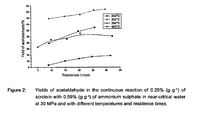
- An aqueous solution comprising 0.75% (g g -1 ) of acrolein is first heated to 50°C in a preheated stage and then mixed with twice the amount of a preheated aqueous solution comprising 0.89% (g g -1 ) of ammonium sulfate, so that the reaction temperature is established at the reactor entrance of a flow-tube reactor (Inconel625; 4.4 ml reactor volume). Depending on the volume flow rate and density of the reaction medium, residence times of 5-35 s are established. The results are shown in Figure 2 .
- the maximum acetaldehyde yield is 52% at a temperature of 350°C and with a residence time of 30 s.
Landscapes
- Chemical & Material Sciences (AREA)
- Organic Chemistry (AREA)
- Chemical Kinetics & Catalysis (AREA)
- Organic Low-Molecular-Weight Compounds And Preparation Thereof (AREA)
Description
- The present invention relates to a process for the selective and continuous preparation of acetaldehyde from acrolein.
- A considerable proportion of acetaldehyde is used for the preparation of acetic esters. For example, ethyl acetate is prepared in a rearrangement reaction with aluminium alcoholates as a catalyst (Claisen-Ti
 enko reaction). A substantial proportion is also used with formaldehyde for the production of pentaerythritol, an intermediate in the production of alkyl resins and plasticizers and emulsifiers. Furthermore, acetaldehyde is an intermediate in the preparation of butadiene starting from acetylene via acetaldol and its hydration product 1,3-butanediol. The formation of the acetaldol, which can be dehydrated to give crotonaldehyde, takes place by aldol addition of acetaldehyde. The reaction of acetaldehyde with nitrogen compounds to give pyridine and derivatives thereof is becoming increasingly important. Thus, 5-ethyl-2-methylpyridine is prepared in a liquid-phase reaction from acetaldehyde and ammonia. Addition of formaldehyde or acrolein leads to the formation of pyridine and alkylpyridines. Acetaldehyde is further used in the production, of peracetic acid, in the oxidation with nitric acid to give glyoxal or glyoxylic acid and in the addition reactions with hydrocyanic acid to give lactonitrile, a precursor of acrylonitrile, and acetic anhydride to give ethylidene diacetate, an intermediate in the vinyl acetate process [Eck2007].
- According to the prior art, acrolein can be prepared, inter alia, from the dehydration of glycerol, which occurs as the "waste product" in relatively large amounts in biodiesel production, in near-critical and supercritical water under addition of acids [Wat2007] or salts [Ott2006]. In the reaction of the resulting acrolein with ammonium salts, acetaldehyde is obtained in high yields.
- It is known that acetaldehyde is obtained with a yield of 26% in the dehydration of glycerol in supercritical water at 500°C and 34.5 MPa and with a residence time of 90 s [Ant1985]. A free radical mechanism by dehydration of the glycerol to 3-hydroxypropionaldehyde and homolytic cleavage of this intermediate to give acetaldehyde and formaldehyde is assumed for the stated conditions. An alternative mechanism via homolytic cleavage of acetol can be ruled out. The selectivity with respect to acetaldehyde is lower under near-critical water conditions at 360°C and the same conditions. Addition of sodium hydrogensulfate as acidic catalyst merely leads to an increase in the yield of acrolein, which presumably results from the acid-catalysed dehydration of 3-hydroxypropionaldehyde.
- It is furthermore known that acetaldehyde forms as a by-product in the dehydration of glycerol in near-critical water at between 300 and 350°C and 34.5 MPa by addition of 0.005 M sulfuric acid [Ant1987]. The reaction of a 0.5 M glycerol solution at 325°C and with a residence time of 39 s leads to a molar yield of acetaldehyde of only 5%. A retro-aldol reaction starting from acrolein via 3-hydroxypropionaldehyde is assumed as a reaction mechanism, formaldehyde additionally forming and decomposing into hydrogen, carbon monoxide and carbon dioxide under the stated conditions. This assumption was confirmed by the use of an equimolar amount of acetaldehyde and formaldehyde and the cross-aldol reaction to give acrolein. The reaction of a dilute acetaldehyde solution under non-catalytic or alkaline conditions leads mainly to the formation of crotonaldehyde. Furthermore, acetaldehyde can be obtained as the main product by acid-catalysed dehydration from ethylene glycol. The dehydration of a 0.5 M ethylene glycol solution at 385°C and 34.5 MPa and with a residence time of 29 s leads to a molar acetaldehyde yield of 40%. A disadvantage is the corrosive property of the sulfuric acid, especially in near-critical water.
- Further investigations into the dehydration of polyols under supercritical water conditions (385°C, 34 MPa, 20-45 s residence time) are also known [Ram1987]. The acid-catalysed reaction of a 0.5 M ethylene glycol solution leads to a maximum acetaldehyde yield of 41% with 45 s residence time. Hydrogen, carbon monoxide, carbon dioxide and ethylene can be identified as by-products in small amounts. In the dehydration of glycerol in the near-critical range, acetaldehyde is obtained with a maximum yield of 12% at 350°C and with a residence time of 25 s and addition of catalytic amounts of sulfuric acid. The back-reaction or cross-aldol reaction of acetaldehyde with formaldehyde to give acrolein leads to an acrolein yield of 22%, based on formaldehyde. Crotonaldehyde, which is formed by aldol reaction of acetaldehyde, is detected as a further liquid product. The aldol reaction can be slowed down by addition of acids.
The results of the reaction of glycerol without addition in the near-critical and supercritical water in a temperature range of 250-475°C, at pressures of 25, 35 or 45 MPa and with residence times of 32-165 s and different starting concentration of glycerol are likewise known [Büh2002]. Lower temperatures and higher pressures and longer residence times lead to higher relative selectivities, based on acetaldehyde, the maximum conversion of glycerol being relatively low at 31%. Two competing reaction paths are described for the reaction of glycerol. Ionic reaction steps are preferred at higher pressures and/or lower temperatures, whereas free-radical reactions take place at lower pressures and/or higher temperatures. Acetaldehyde can be formed by both routes and is the main product under all conditions. The reaction mechanisms described for the formation of acetaldehyde differ here from the reaction routes assumed to date. The complete reaction model and the kinetic parameters of the reaction of glycerol can, after optimization, be adapted to the measured data obtained. - It is furthermore known that acetaldehyde forms in the homogeneously catalysed dehydration of ethylene glycol in near-critical and supercritical water [Ott2005]. Thus, acetaldehyde can be obtained with a yield of 10% with addition of catalytic amounts of zinc sulfate to a dilute ethylene glycol solution. By using 20 mM sulfuric acid as a catalyst, the yield can be increased to about 80% at 400°C and 34 MPa and with a residence time of 15 s. Moreover, zinc sulfate catalyses the subsequent reactions of acrolein from the dehydration of glycerol. For an aqueous 1% (g g-1) acrolein solution, the conversion is 62% at 360°C and 34 MPa and with a residence time of 120 s. Liquid reaction products cannot be found. Once again, the corrosiveness of the sulfuric acid under the stated conditions is disadvantageous.
- In addition, it is known that acetaldehyde is obtained in the dehydration of very dilute aqueous glycerol solutions without addition or addition of sulfuric acid under the near-critical and supercritical conditions in a batch or flow-tube reactor [Wat2007]. The maximum yield of acetaldehyde is about 23% for the continuous dehydration of a 0.05 M glycerol solution at 4,00°C and 34.5 MPa and with a residence time of 20 s and addition of 5 mM sulfuric acid. The yields without catalyst are significantly lower. The low starting concentrations of glycerol in combination with the use of sulfuric acid as a catalyst are disadvantageous.
-
WO 2008/052993 A2 discloses a process for the production of acrolein and other oxygenated compounds from glycerol in a moving bed reactor using an acidic solid catalyst such as a zeolite. It appears that the reaction takes place at essentially ambient pressure, starting materials and products being in the gas phase. - The technical problem to be solved consists in reacting the produced acrolein in a second state continuously in high yields without use of sulfuric acid and with short residence times to give acetaldehyde, in order to increase the overall yield of acetaldehyde from glycerol. This problem is solved by the process according to the invention, which is characterized in that acrolein and one or more ammonium salts dissolved in water are reacted continuously under pressures of 20 to 40 MPa and at temperatures of 300-400°C.
- The process according to the invention preferably takes place in a pH range of 4-8, particularly preferably of 4-6.
- It is particularly preferred according to the invention to carry out the reaction in an acidic reaction medium, with the result that the formation of metal hydroxides and/or polymerization reactions of the acrolein can be prevented.
- Inorganic ammonium salts, in particular ammonium sulfate, ammonium hydrogensulfate , ammonium acetate and ammonium dihydrogenphosphate, are particularly preferred.
- The use of the ammonium salts leads to the establishment of a pH range in which the retro-aldol reaction of acrolein to give acetaldehyde is favoured. In addition to acetaldehyde, 3-methylpyridine and gaseous products are formed. Formaldehyde, which could be detected qualitatively, also forms as a coproduct.
The separation of acetaldehyde from 3-methylpyridine can be effected with very little effort. - The process according to the invention achieves a maximum acetaldehyde yield of 40-62%, based on the starting compounds used.
- The process according to the invention can be carried out both directly with the acrolein-containing reaction mixture of the acrolein synthesis step and with acrolein purified beforehand.
- Depending on the density of the medium, according to the invention residence times of 5-240 s are preferably set.
- According to the invention, the reactions take place at not more than 400°C and 40 MPa.
- The process according to the invention can be carried out in standard high-pressure units. A unit having a flow-tube reactor comprising Inconel625 and a reactor volume of 4-50 ml is preferred here. The starting mixtures are transported via two preheated separate trains with not more than 35 ml min-1 into the reactor.
The present invention is explained in more detail by the following, nonlimiting examples. - An aqueous solution comprising 0.75% (g g-1) of acrolein and 1.77% (g g-1) of ammonium sulfate or 3.15% (g g-1) of ammonium hydrogensulfate or 3.07% (g g-1) of ammonium dihydrogenphosphate, which corresponds to a molar ratio of acrolein to ammonium ions of 1:2, is reacted in a two-train high-pressure unit at 30 MPa. The liquid mixture is first heated to 170°C in a preheating stage and then mixed with twice the amount of hot water so that, at the reactor entrance of a tubular reactor comprising Inconel625 and having a volume of 49.5 ml, the reaction temperature of 360°C is established and near-critical water conditions prevail. Depending on the volume flow rate and density of the reaction medium, residence times of 60-240 s are established. The reaction solution is then cooled to room temperature in a heat exchanger and depressurized to atmospheric pressure. In a phase separator, the liquid components are separated from the gaseous ones at 2°C. The liquid phase is collected and the fractions of the detectable components are determined by gas chromatography. For the quantitative determination of the acetaldehyde and of the acrolein, 1-butanol is added to the sample as an internal standard. The acetaldehyde yields determined under the conditions described are shown in
Figure 1 . The maximum acetaldehyde yield is 62% at all measured residence times with ammonium hydrogensulfate. - The reaction takes place with acrolein and ammonium sulfate in a molar ratio of 1:1. An aqueous solution comprising 0.75% (g g-1) of acrolein is first heated to 50°C in a preheated stage and then mixed with twice the amount of a preheated aqueous solution comprising 0.89% (g g-1) of ammonium sulfate, so that the reaction temperature is established at the reactor entrance of a flow-tube reactor (Inconel625; 4.4 ml reactor volume). Depending on the volume flow rate and density of the reaction medium, residence times of 5-35 s are established. The results are shown in
Figure 2 . The maximum acetaldehyde yield is 52% at a temperature of 350°C and with a residence time of 30 s. -
[Ant1985] M. J. Antal Jr., W. S. L. Mok, J. C. Roy, A. C. Raissi, D. G. M. Anderson: Pyrolytic sources of hydrocarbons from Biomass, Journal of Analytical and Applied Pyrolysis, 1985, 8, 291-303. [Ant1987] M. J. Antal Jr., A. Britain, C. DeAlmeida, W. S. L. Mok, S. Ramayya: Catalyzed and uncatalyzed conversion of cellulose biopolymer model compounds to chemical feedstocks in supercritical solvents, Energy from Biomass and Wastes, 1987, 10, 865-877. [Büh2002] W. Bühler, E. Dinjus, H. J. Ederer, A. Kruse, C. Mas: Ionic reactions and pyrolysis of glycerol as competing reaction pathways in near- and supercritical water, Journal of Supercritical Fluids, 2002, 22, 37-53. [Eck2007] M. Eckert, G. Fleischmann, R. Jira, H. M. Bolt, K. Golka: Acetaldehyde, Ullmann's Encyclopedia of Industrial Chemistry, 7. Aufl., Wiley Interscience, Online Release, 2009. [Ott2005] L. Ott: Stoffliche Nutzung von Biomasse mit Hilfe von nah- und überkritischem Wasser - homogenkatalysierte Dehydratisierung von Polyolen zu Aldehyden -[Material use of biomass with the aid of near-critical and supercritical water - homogeneously catalysed dehydration of polyols to give aldehydes], Thesis, TU Darmstadt, 2005. [Ott2006] L. Ott, M. Bicker, H. Vogel: Catalytic dehydration of glycerol in sub- and supercritical water: a new chemical process for acrolein production, Green Chemistry, 2006, 8, 214-220. [Ram1987] S. Ramayya, A. Brittain, C. DeAlmeida, W. S. L. Mok, M. J. Antal Jr.: Acid-catalyzed dehydration of alcohols in supercritical water, Fuel, 1987, 66(10), 1364-71. [Wat2007] M. Watanabe, T. lida, Y. Aizawa, T. M. Aida, H. Inomata: Acrolein synthesis from glycerol in hot-compressed water, Bioresource Technology, 2007, 98, 1285-1290.
Claims (7)
- Process for the selective preparation of acetaldehyde, characterized in that acrolein and one or more ammonium salts dissolved in water are reacted continuously under pressures of 20 to 40 MPa and a temperatures of 300-400°C.
- Process according to Claim 1, characterized in that ammonium sulfate, ammonium hydrogensulfate, ammonium acetate and/or ammonium dihydrogenphosphate are used.
- Process according to at least one of Claims 1-2, characterized in that the acrolein and the ammonium salt are used in a molar ratio of 1:0.125 to 1:2.
- Process according to at least one of Claims 1-3, characterized in that the contact or residence time is 5-240 s, preferably 30-160 s.
- Process according to at least one of Claims 1-4, the pH of the aqueous solution being in a range of 4-8.
- Process according to at least one of Claims 1-5, formaldehyde forming as a coproduct.
- Process according to at least one of Claims 1-6, the acrolein being obtained from glycerol.
Priority Applications (1)
| Application Number | Priority Date | Filing Date | Title |
|---|---|---|---|
| EP10736988.6A EP2459509B1 (en) | 2009-07-29 | 2010-07-21 | Process for the selective preparation of acetaldehyde from acrolein and one or more ammonium salts dissolved in water |
Applications Claiming Priority (4)
| Application Number | Priority Date | Filing Date | Title |
|---|---|---|---|
| US22959909P | 2009-07-29 | 2009-07-29 | |
| EP09009822A EP2281797A1 (en) | 2009-07-29 | 2009-07-29 | Method for selective production of acetaldehyde from acrolein and one or more ammonium salts dissolved in water |
| EP10736988.6A EP2459509B1 (en) | 2009-07-29 | 2010-07-21 | Process for the selective preparation of acetaldehyde from acrolein and one or more ammonium salts dissolved in water |
| PCT/EP2010/004463 WO2011012253A2 (en) | 2009-07-29 | 2010-07-21 | Process for the selective preparation of acetaldehyde from acrolein and one or more ammonium salts dissolved in water |
Publications (2)
| Publication Number | Publication Date |
|---|---|
| EP2459509A2 EP2459509A2 (en) | 2012-06-06 |
| EP2459509B1 true EP2459509B1 (en) | 2013-06-19 |
Family
ID=41349269
Family Applications (2)
| Application Number | Title | Priority Date | Filing Date |
|---|---|---|---|
| EP09009822A Ceased EP2281797A1 (en) | 2009-07-29 | 2009-07-29 | Method for selective production of acetaldehyde from acrolein and one or more ammonium salts dissolved in water |
| EP10736988.6A Not-in-force EP2459509B1 (en) | 2009-07-29 | 2010-07-21 | Process for the selective preparation of acetaldehyde from acrolein and one or more ammonium salts dissolved in water |
Family Applications Before (1)
| Application Number | Title | Priority Date | Filing Date |
|---|---|---|---|
| EP09009822A Ceased EP2281797A1 (en) | 2009-07-29 | 2009-07-29 | Method for selective production of acetaldehyde from acrolein and one or more ammonium salts dissolved in water |
Country Status (7)
| Country | Link |
|---|---|
| US (1) | US8044246B2 (en) |
| EP (2) | EP2281797A1 (en) |
| JP (1) | JP2013500287A (en) |
| CN (1) | CN102471204A (en) |
| IN (1) | IN2012DN00681A (en) |
| TW (1) | TW201107282A (en) |
| WO (1) | WO2011012253A2 (en) |
Families Citing this family (1)
| Publication number | Priority date | Publication date | Assignee | Title |
|---|---|---|---|---|
| FR2954311B1 (en) * | 2009-12-22 | 2012-02-03 | Arkema France | PROCESS FOR THE PERFECTED SYNTHESIS OF ACROLEIN FROM GLYCEROL |
Family Cites Families (2)
| Publication number | Priority date | Publication date | Assignee | Title |
|---|---|---|---|---|
| CH660733A5 (en) * | 1981-09-29 | 1987-06-15 | Lonza Ag | METHOD FOR PRODUCING 3-PICOLIN. |
| WO2008052993A2 (en) * | 2006-11-01 | 2008-05-08 | Bioecon International Holding N.V. | Process for production of acrolein and other oxygenated compounds from glycerol in a transported bed reactor |
-
2009
- 2009-07-29 EP EP09009822A patent/EP2281797A1/en not_active Ceased
-
2010
- 2010-07-21 CN CN2010800328158A patent/CN102471204A/en active Pending
- 2010-07-21 EP EP10736988.6A patent/EP2459509B1/en not_active Not-in-force
- 2010-07-21 WO PCT/EP2010/004463 patent/WO2011012253A2/en not_active Ceased
- 2010-07-21 JP JP2012522008A patent/JP2013500287A/en not_active Withdrawn
- 2010-07-21 IN IN681DEN2012 patent/IN2012DN00681A/en unknown
- 2010-07-27 US US12/844,571 patent/US8044246B2/en not_active Expired - Fee Related
- 2010-07-28 TW TW099124873A patent/TW201107282A/en unknown
Also Published As
| Publication number | Publication date |
|---|---|
| US20110028764A1 (en) | 2011-02-03 |
| IN2012DN00681A (en) | 2015-08-21 |
| WO2011012253A2 (en) | 2011-02-03 |
| EP2281797A1 (en) | 2011-02-09 |
| WO2011012253A3 (en) | 2011-06-30 |
| EP2459509A2 (en) | 2012-06-06 |
| US8044246B2 (en) | 2011-10-25 |
| JP2013500287A (en) | 2013-01-07 |
| TW201107282A (en) | 2011-03-01 |
| CN102471204A (en) | 2012-05-23 |
Similar Documents
| Publication | Publication Date | Title |
|---|---|---|
| EP3408251B1 (en) | Efficient synthesis of methacrolein from methanol and propionaldehyde | |
| US6960694B2 (en) | Processes for preparing β-hydroxy-ketones and α,β-unsaturated ketones | |
| US8044246B2 (en) | Process for the selective preparation of acetaldehyde from acrolein and one or more ammonium salts dissolved in water | |
| JP2013515042A (en) | A novel method for the synthesis of acrolein from glycerol | |
| US20110028727A1 (en) | Process for the selective preparation of 3-methylpyridine (3-picoline) from acrolein and one or more ammonium salts dissolved in water | |
| CN104016857B (en) | The method preparing methyl formate | |
| EP3039004B1 (en) | A process for preparation of unsaturated ketone | |
| US4190605A (en) | Catalyst activation in oxidation process | |
| US8853465B2 (en) | Process for preparing neopentyl glycol | |
| US7071361B2 (en) | Processes for the preparation of high molecular weight saturated ketones | |
| US20030144541A1 (en) | Process for preparing alpha-halogenated retones | |
| HK1170474A (en) | Process for the selective preparation of acetaldehyde from acrolein and one or more ammonium salts dissolved in water | |
| US4740614A (en) | Process for preparation of p-hydroxybenzoic acid from p-methoxytoluene | |
| GB1591538A (en) | Preparation of ketones | |
| TWI473782B (en) | Recovery of alcohols from purification residue | |
| US2792421A (en) | Condensation reaction | |
| US4429131A (en) | Process for the production of 3,5-dialkylpyridines | |
| JP7158001B2 (en) | Method for producing hydroxycarbonyl compound | |
| JPH04230342A (en) | Production of beta-hydroxyketones | |
| KR101642960B1 (en) | Preparation method of benzoic acid | |
| CN119431395A (en) | A continuous flow preparation method of biotin valproic acid with side bonds | |
| HK1170484A (en) | Process for the selective preparation of 3-methylpyridine (3-picoline) from acrolein and one or more ammonium salts dissolved in water | |
| CN119390548A (en) | A kind of preparation method of 4-hydroxybenzaldehyde | |
| KR20130035270A (en) | Method for the continuous production of 2-butanone in hot pressurized water having an added electrolyte | |
| IE52346B1 (en) | Process for the preparation of 3-picoline |
Legal Events
| Date | Code | Title | Description |
|---|---|---|---|
| PUAI | Public reference made under article 153(3) epc to a published international application that has entered the european phase |
Free format text: ORIGINAL CODE: 0009012 |
|
| 17P | Request for examination filed |
Effective date: 20120229 |
|
| AK | Designated contracting states |
Kind code of ref document: A2 Designated state(s): AL AT BE BG CH CY CZ DE DK EE ES FI FR GB GR HR HU IE IS IT LI LT LU LV MC MK MT NL NO PL PT RO SE SI SK SM TR |
|
| DAX | Request for extension of the european patent (deleted) | ||
| REG | Reference to a national code |
Ref country code: DE Ref legal event code: R079 Ref document number: 602010007964 Country of ref document: DE Free format text: PREVIOUS MAIN CLASS: C07C0047060000 Ipc: C07C0045670000 |
|
| GRAP | Despatch of communication of intention to grant a patent |
Free format text: ORIGINAL CODE: EPIDOSNIGR1 |
|
| RIC1 | Information provided on ipc code assigned before grant |
Ipc: C07C 45/67 20060101AFI20121210BHEP Ipc: C07C 47/22 20060101ALI20121210BHEP Ipc: C07C 47/06 20060101ALI20121210BHEP Ipc: C07C 47/04 20060101ALI20121210BHEP Ipc: C07C 45/52 20060101ALI20121210BHEP |
|
| GRAS | Grant fee paid |
Free format text: ORIGINAL CODE: EPIDOSNIGR3 |
|
| GRAA | (expected) grant |
Free format text: ORIGINAL CODE: 0009210 |
|
| AK | Designated contracting states |
Kind code of ref document: B1 Designated state(s): AL AT BE BG CH CY CZ DE DK EE ES FI FR GB GR HR HU IE IS IT LI LT LU LV MC MK MT NL NO PL PT RO SE SI SK SM TR |
|
| REG | Reference to a national code |
Ref country code: GB Ref legal event code: FG4D |
|
| REG | Reference to a national code |
Ref country code: CH Ref legal event code: EP |
|
| REG | Reference to a national code |
Ref country code: AT Ref legal event code: REF Ref document number: 617567 Country of ref document: AT Kind code of ref document: T Effective date: 20130715 |
|
| REG | Reference to a national code |
Ref country code: IE Ref legal event code: FG4D |
|
| REG | Reference to a national code |
Ref country code: DE Ref legal event code: R096 Ref document number: 602010007964 Country of ref document: DE Effective date: 20130814 |
|
| PG25 | Lapsed in a contracting state [announced via postgrant information from national office to epo] |
Ref country code: ES Free format text: LAPSE BECAUSE OF FAILURE TO SUBMIT A TRANSLATION OF THE DESCRIPTION OR TO PAY THE FEE WITHIN THE PRESCRIBED TIME-LIMIT Effective date: 20130930 Ref country code: GR Free format text: LAPSE BECAUSE OF FAILURE TO SUBMIT A TRANSLATION OF THE DESCRIPTION OR TO PAY THE FEE WITHIN THE PRESCRIBED TIME-LIMIT Effective date: 20130920 Ref country code: FI Free format text: LAPSE BECAUSE OF FAILURE TO SUBMIT A TRANSLATION OF THE DESCRIPTION OR TO PAY THE FEE WITHIN THE PRESCRIBED TIME-LIMIT Effective date: 20130619 Ref country code: NO Free format text: LAPSE BECAUSE OF FAILURE TO SUBMIT A TRANSLATION OF THE DESCRIPTION OR TO PAY THE FEE WITHIN THE PRESCRIBED TIME-LIMIT Effective date: 20130919 Ref country code: SE Free format text: LAPSE BECAUSE OF FAILURE TO SUBMIT A TRANSLATION OF THE DESCRIPTION OR TO PAY THE FEE WITHIN THE PRESCRIBED TIME-LIMIT Effective date: 20130619 Ref country code: SI Free format text: LAPSE BECAUSE OF FAILURE TO SUBMIT A TRANSLATION OF THE DESCRIPTION OR TO PAY THE FEE WITHIN THE PRESCRIBED TIME-LIMIT Effective date: 20130619 Ref country code: LT Free format text: LAPSE BECAUSE OF FAILURE TO SUBMIT A TRANSLATION OF THE DESCRIPTION OR TO PAY THE FEE WITHIN THE PRESCRIBED TIME-LIMIT Effective date: 20130619 |
|
| REG | Reference to a national code |
Ref country code: AT Ref legal event code: MK05 Ref document number: 617567 Country of ref document: AT Kind code of ref document: T Effective date: 20130619 |
|
| REG | Reference to a national code |
Ref country code: LT Ref legal event code: MG4D |
|
| PG25 | Lapsed in a contracting state [announced via postgrant information from national office to epo] |
Ref country code: HR Free format text: LAPSE BECAUSE OF FAILURE TO SUBMIT A TRANSLATION OF THE DESCRIPTION OR TO PAY THE FEE WITHIN THE PRESCRIBED TIME-LIMIT Effective date: 20130619 Ref country code: BG Free format text: LAPSE BECAUSE OF FAILURE TO SUBMIT A TRANSLATION OF THE DESCRIPTION OR TO PAY THE FEE WITHIN THE PRESCRIBED TIME-LIMIT Effective date: 20130919 |
|
| REG | Reference to a national code |
Ref country code: NL Ref legal event code: VDEP Effective date: 20130619 |
|
| PG25 | Lapsed in a contracting state [announced via postgrant information from national office to epo] |
Ref country code: LV Free format text: LAPSE BECAUSE OF FAILURE TO SUBMIT A TRANSLATION OF THE DESCRIPTION OR TO PAY THE FEE WITHIN THE PRESCRIBED TIME-LIMIT Effective date: 20130619 |
|
| PG25 | Lapsed in a contracting state [announced via postgrant information from national office to epo] |
Ref country code: AT Free format text: LAPSE BECAUSE OF FAILURE TO SUBMIT A TRANSLATION OF THE DESCRIPTION OR TO PAY THE FEE WITHIN THE PRESCRIBED TIME-LIMIT Effective date: 20130619 Ref country code: PT Free format text: LAPSE BECAUSE OF FAILURE TO SUBMIT A TRANSLATION OF THE DESCRIPTION OR TO PAY THE FEE WITHIN THE PRESCRIBED TIME-LIMIT Effective date: 20131021 Ref country code: CY Free format text: LAPSE BECAUSE OF FAILURE TO SUBMIT A TRANSLATION OF THE DESCRIPTION OR TO PAY THE FEE WITHIN THE PRESCRIBED TIME-LIMIT Effective date: 20130828 Ref country code: IS Free format text: LAPSE BECAUSE OF FAILURE TO SUBMIT A TRANSLATION OF THE DESCRIPTION OR TO PAY THE FEE WITHIN THE PRESCRIBED TIME-LIMIT Effective date: 20131019 Ref country code: EE Free format text: LAPSE BECAUSE OF FAILURE TO SUBMIT A TRANSLATION OF THE DESCRIPTION OR TO PAY THE FEE WITHIN THE PRESCRIBED TIME-LIMIT Effective date: 20130619 Ref country code: BE Free format text: LAPSE BECAUSE OF FAILURE TO SUBMIT A TRANSLATION OF THE DESCRIPTION OR TO PAY THE FEE WITHIN THE PRESCRIBED TIME-LIMIT Effective date: 20130619 Ref country code: SK Free format text: LAPSE BECAUSE OF FAILURE TO SUBMIT A TRANSLATION OF THE DESCRIPTION OR TO PAY THE FEE WITHIN THE PRESCRIBED TIME-LIMIT Effective date: 20130619 Ref country code: CZ Free format text: LAPSE BECAUSE OF FAILURE TO SUBMIT A TRANSLATION OF THE DESCRIPTION OR TO PAY THE FEE WITHIN THE PRESCRIBED TIME-LIMIT Effective date: 20130619 |
|
| PG25 | Lapsed in a contracting state [announced via postgrant information from national office to epo] |
Ref country code: PL Free format text: LAPSE BECAUSE OF FAILURE TO SUBMIT A TRANSLATION OF THE DESCRIPTION OR TO PAY THE FEE WITHIN THE PRESCRIBED TIME-LIMIT Effective date: 20130619 Ref country code: NL Free format text: LAPSE BECAUSE OF FAILURE TO SUBMIT A TRANSLATION OF THE DESCRIPTION OR TO PAY THE FEE WITHIN THE PRESCRIBED TIME-LIMIT Effective date: 20130619 Ref country code: RO Free format text: LAPSE BECAUSE OF FAILURE TO SUBMIT A TRANSLATION OF THE DESCRIPTION OR TO PAY THE FEE WITHIN THE PRESCRIBED TIME-LIMIT Effective date: 20130619 |
|
| PG25 | Lapsed in a contracting state [announced via postgrant information from national office to epo] |
Ref country code: CY Free format text: LAPSE BECAUSE OF FAILURE TO SUBMIT A TRANSLATION OF THE DESCRIPTION OR TO PAY THE FEE WITHIN THE PRESCRIBED TIME-LIMIT Effective date: 20130619 Ref country code: MC Free format text: LAPSE BECAUSE OF FAILURE TO SUBMIT A TRANSLATION OF THE DESCRIPTION OR TO PAY THE FEE WITHIN THE PRESCRIBED TIME-LIMIT Effective date: 20130619 |
|
| REG | Reference to a national code |
Ref country code: IE Ref legal event code: MM4A |
|
| REG | Reference to a national code |
Ref country code: DE Ref legal event code: R119 Ref document number: 602010007964 Country of ref document: DE Effective date: 20140201 |
|
| PLBE | No opposition filed within time limit |
Free format text: ORIGINAL CODE: 0009261 |
|
| REG | Reference to a national code |
Ref country code: FR Ref legal event code: ST Effective date: 20140331 |
|
| STAA | Information on the status of an ep patent application or granted ep patent |
Free format text: STATUS: NO OPPOSITION FILED WITHIN TIME LIMIT |
|
| PG25 | Lapsed in a contracting state [announced via postgrant information from national office to epo] |
Ref country code: DK Free format text: LAPSE BECAUSE OF FAILURE TO SUBMIT A TRANSLATION OF THE DESCRIPTION OR TO PAY THE FEE WITHIN THE PRESCRIBED TIME-LIMIT Effective date: 20130619 Ref country code: DE Free format text: LAPSE BECAUSE OF NON-PAYMENT OF DUE FEES Effective date: 20140201 |
|
| 26N | No opposition filed |
Effective date: 20140320 |
|
| PG25 | Lapsed in a contracting state [announced via postgrant information from national office to epo] |
Ref country code: FR Free format text: LAPSE BECAUSE OF NON-PAYMENT OF DUE FEES Effective date: 20130819 Ref country code: IT Free format text: LAPSE BECAUSE OF FAILURE TO SUBMIT A TRANSLATION OF THE DESCRIPTION OR TO PAY THE FEE WITHIN THE PRESCRIBED TIME-LIMIT Effective date: 20130619 |
|
| PG25 | Lapsed in a contracting state [announced via postgrant information from national office to epo] |
Ref country code: IE Free format text: LAPSE BECAUSE OF NON-PAYMENT OF DUE FEES Effective date: 20130721 |
|
| REG | Reference to a national code |
Ref country code: CH Ref legal event code: PL |
|
| GBPC | Gb: european patent ceased through non-payment of renewal fee |
Effective date: 20140721 |
|
| PG25 | Lapsed in a contracting state [announced via postgrant information from national office to epo] |
Ref country code: CH Free format text: LAPSE BECAUSE OF NON-PAYMENT OF DUE FEES Effective date: 20140731 Ref country code: LI Free format text: LAPSE BECAUSE OF NON-PAYMENT OF DUE FEES Effective date: 20140731 |
|
| PG25 | Lapsed in a contracting state [announced via postgrant information from national office to epo] |
Ref country code: SM Free format text: LAPSE BECAUSE OF FAILURE TO SUBMIT A TRANSLATION OF THE DESCRIPTION OR TO PAY THE FEE WITHIN THE PRESCRIBED TIME-LIMIT Effective date: 20130619 Ref country code: GB Free format text: LAPSE BECAUSE OF NON-PAYMENT OF DUE FEES Effective date: 20140721 |
|
| PG25 | Lapsed in a contracting state [announced via postgrant information from national office to epo] |
Ref country code: MT Free format text: LAPSE BECAUSE OF FAILURE TO SUBMIT A TRANSLATION OF THE DESCRIPTION OR TO PAY THE FEE WITHIN THE PRESCRIBED TIME-LIMIT Effective date: 20130619 Ref country code: TR Free format text: LAPSE BECAUSE OF FAILURE TO SUBMIT A TRANSLATION OF THE DESCRIPTION OR TO PAY THE FEE WITHIN THE PRESCRIBED TIME-LIMIT Effective date: 20130619 |
|
| PG25 | Lapsed in a contracting state [announced via postgrant information from national office to epo] |
Ref country code: LU Free format text: LAPSE BECAUSE OF NON-PAYMENT OF DUE FEES Effective date: 20130721 Ref country code: MK Free format text: LAPSE BECAUSE OF FAILURE TO SUBMIT A TRANSLATION OF THE DESCRIPTION OR TO PAY THE FEE WITHIN THE PRESCRIBED TIME-LIMIT Effective date: 20130619 Ref country code: HU Free format text: LAPSE BECAUSE OF FAILURE TO SUBMIT A TRANSLATION OF THE DESCRIPTION OR TO PAY THE FEE WITHIN THE PRESCRIBED TIME-LIMIT; INVALID AB INITIO Effective date: 20100721 |
|
| PG25 | Lapsed in a contracting state [announced via postgrant information from national office to epo] |
Ref country code: AL Free format text: LAPSE BECAUSE OF FAILURE TO SUBMIT A TRANSLATION OF THE DESCRIPTION OR TO PAY THE FEE WITHIN THE PRESCRIBED TIME-LIMIT Effective date: 20130619 |