EP2458661A1 - Negative active material for rechargeable lithium battery, method of producing negative electrode and rechargeable lithium battery including same - Google Patents
Negative active material for rechargeable lithium battery, method of producing negative electrode and rechargeable lithium battery including same Download PDFInfo
- Publication number
- EP2458661A1 EP2458661A1 EP11190646A EP11190646A EP2458661A1 EP 2458661 A1 EP2458661 A1 EP 2458661A1 EP 11190646 A EP11190646 A EP 11190646A EP 11190646 A EP11190646 A EP 11190646A EP 2458661 A1 EP2458661 A1 EP 2458661A1
- Authority
- EP
- European Patent Office
- Prior art keywords
- group
- active material
- lithium battery
- rechargeable lithium
- methacrylate
- Prior art date
- Legal status (The legal status is an assumption and is not a legal conclusion. Google has not performed a legal analysis and makes no representation as to the accuracy of the status listed.)
- Granted
Links
Images


Classifications
-
- H—ELECTRICITY
- H01—ELECTRIC ELEMENTS
- H01M—PROCESSES OR MEANS, e.g. BATTERIES, FOR THE DIRECT CONVERSION OF CHEMICAL ENERGY INTO ELECTRICAL ENERGY
- H01M4/00—Electrodes
- H01M4/02—Electrodes composed of, or comprising, active material
- H01M4/13—Electrodes for accumulators with non-aqueous electrolyte, e.g. for lithium-accumulators; Processes of manufacture thereof
- H01M4/131—Electrodes based on mixed oxides or hydroxides, or on mixtures of oxides or hydroxides, e.g. LiCoOx
-
- H—ELECTRICITY
- H01—ELECTRIC ELEMENTS
- H01M—PROCESSES OR MEANS, e.g. BATTERIES, FOR THE DIRECT CONVERSION OF CHEMICAL ENERGY INTO ELECTRICAL ENERGY
- H01M4/00—Electrodes
- H01M4/02—Electrodes composed of, or comprising, active material
- H01M4/13—Electrodes for accumulators with non-aqueous electrolyte, e.g. for lithium-accumulators; Processes of manufacture thereof
- H01M4/134—Electrodes based on metals, Si or alloys
-
- H—ELECTRICITY
- H01—ELECTRIC ELEMENTS
- H01M—PROCESSES OR MEANS, e.g. BATTERIES, FOR THE DIRECT CONVERSION OF CHEMICAL ENERGY INTO ELECTRICAL ENERGY
- H01M4/00—Electrodes
- H01M4/02—Electrodes composed of, or comprising, active material
- H01M4/13—Electrodes for accumulators with non-aqueous electrolyte, e.g. for lithium-accumulators; Processes of manufacture thereof
- H01M4/139—Processes of manufacture
- H01M4/1391—Processes of manufacture of electrodes based on mixed oxides or hydroxides, or on mixtures of oxides or hydroxides, e.g. LiCoOx
-
- H—ELECTRICITY
- H01—ELECTRIC ELEMENTS
- H01M—PROCESSES OR MEANS, e.g. BATTERIES, FOR THE DIRECT CONVERSION OF CHEMICAL ENERGY INTO ELECTRICAL ENERGY
- H01M4/00—Electrodes
- H01M4/02—Electrodes composed of, or comprising, active material
- H01M4/13—Electrodes for accumulators with non-aqueous electrolyte, e.g. for lithium-accumulators; Processes of manufacture thereof
- H01M4/139—Processes of manufacture
- H01M4/1395—Processes of manufacture of electrodes based on metals, Si or alloys
-
- H—ELECTRICITY
- H01—ELECTRIC ELEMENTS
- H01M—PROCESSES OR MEANS, e.g. BATTERIES, FOR THE DIRECT CONVERSION OF CHEMICAL ENERGY INTO ELECTRICAL ENERGY
- H01M4/00—Electrodes
- H01M4/02—Electrodes composed of, or comprising, active material
- H01M4/36—Selection of substances as active materials, active masses, active liquids
- H01M4/362—Composites
- H01M4/366—Composites as layered products
-
- H—ELECTRICITY
- H01—ELECTRIC ELEMENTS
- H01M—PROCESSES OR MEANS, e.g. BATTERIES, FOR THE DIRECT CONVERSION OF CHEMICAL ENERGY INTO ELECTRICAL ENERGY
- H01M4/00—Electrodes
- H01M4/02—Electrodes composed of, or comprising, active material
- H01M4/36—Selection of substances as active materials, active masses, active liquids
- H01M4/38—Selection of substances as active materials, active masses, active liquids of elements or alloys
- H01M4/386—Silicon or alloys based on silicon
-
- H—ELECTRICITY
- H01—ELECTRIC ELEMENTS
- H01M—PROCESSES OR MEANS, e.g. BATTERIES, FOR THE DIRECT CONVERSION OF CHEMICAL ENERGY INTO ELECTRICAL ENERGY
- H01M4/00—Electrodes
- H01M4/02—Electrodes composed of, or comprising, active material
- H01M4/36—Selection of substances as active materials, active masses, active liquids
- H01M4/38—Selection of substances as active materials, active masses, active liquids of elements or alloys
- H01M4/387—Tin or alloys based on tin
-
- H—ELECTRICITY
- H01—ELECTRIC ELEMENTS
- H01M—PROCESSES OR MEANS, e.g. BATTERIES, FOR THE DIRECT CONVERSION OF CHEMICAL ENERGY INTO ELECTRICAL ENERGY
- H01M4/00—Electrodes
- H01M4/02—Electrodes composed of, or comprising, active material
- H01M4/36—Selection of substances as active materials, active masses, active liquids
- H01M4/48—Selection of substances as active materials, active masses, active liquids of inorganic oxides or hydroxides
-
- Y—GENERAL TAGGING OF NEW TECHNOLOGICAL DEVELOPMENTS; GENERAL TAGGING OF CROSS-SECTIONAL TECHNOLOGIES SPANNING OVER SEVERAL SECTIONS OF THE IPC; TECHNICAL SUBJECTS COVERED BY FORMER USPC CROSS-REFERENCE ART COLLECTIONS [XRACs] AND DIGESTS
- Y02—TECHNOLOGIES OR APPLICATIONS FOR MITIGATION OR ADAPTATION AGAINST CLIMATE CHANGE
- Y02E—REDUCTION OF GREENHOUSE GAS [GHG] EMISSIONS, RELATED TO ENERGY GENERATION, TRANSMISSION OR DISTRIBUTION
- Y02E60/00—Enabling technologies; Technologies with a potential or indirect contribution to GHG emissions mitigation
- Y02E60/10—Energy storage using batteries
Definitions
- This disclosure relates to a negative active material of a rechargeable lithium battery, a method of preparing a negative electrode, and a rechargeable lithium battery including the same.
- Lithium rechargeable batteries have recently drawn attention as a power source for small portable electronic devices. They use an organic electrolyte solution and thereby, have twice the discharge voltage of a conventional battery using an alkali aqueous solution, and accordingly, have higher energy density.
- lithium-transition element composite oxides that can intercalate lithium, such as LiCoO 2 LiMn 2 O 4 , LiNi 1-x Co x O 2 (0 ⁇ x ⁇ 1), and so on.
- negative active materials diverse carbon-based materials capable of intercalating/deintercalating lithium such as artificial graphite, natural graphite, and hard carbon have been used, and at present, graphite-based materials such as artificial graphite and natural graphite are widely employed. Since the graphite-based negative active materials do not reduce lithium metal, an internal short-circuit is not caused by dendrites and thus drawbacks originating from the internal short-circuits are not present.
- the graphite-based active material has a theoretical lithium occlusion capacity of about 372mAh/g, which accounts for 10% of a theoretical lithium metal capacity, which is very small. Therefore, as a high capacity is required, research is again being conducted on a metal-based negative active material such as Si, which was once used in the initial days of the development of rechargeable batteries.
- the metal-based negative active material has high capacity but shows remarkably reduced cycle-life due to large expansion and shrinkage during charge and discharge.
- One embodiment of this disclosure provides a negative active material for a rechargeable lithium battery having excellent cycle-life characteristics.
- Another embodiment of the present invention provides a manufacturing method of a negative electrode.
- Yet another embodiment of the present invention provides a rechargeable lithium battery including the negative electrode.
- a negative active material for a rechargeable lithium battery that is represented by the following Chemical Formula 1 is provided.
- X is an active material which comprises a metal and whose functional group has been reacted with a silane coupling agent
- Ra is a residual group from a silane coupling agent
- Rb is a polymer including a first repeating unit represented by the following Chemical Formula 2a.
- R 10 to R 13 are the same or different, and are hydrogen; or a substituted or unsubstituted C1 to C5 alkyl group, and n 1 is an integer ranging from 1 to 100000, and * is a chemical bond.
- the substituted C1 to C5 alkyl group may be a group in which at least one hydrogen is substituted with an amino group, an acryl group, a vinyl group, an epoxy group, or a phenyl group.
- the residual group derived from a silane coupling agent, Ra may be represented by the following Chemical Formula 3.
- R 1 , R 2 and R 3 are the same or different, and are hydrogen; or a substituted or unsubstituted C1 to C5 alkyl group,
- R 4 is a carboxyl group, an amino group, an acryl group, a vinyl group, an epoxy group, or a phenyl group,
- R 5 is a substituted or unsubstituted C1 to C5 alkylene group
- Y is a silane functional group
- * is a chemical bond
- the polymer of Formula 2a may be a copolymer further including a second repeating unit of the following Chemical Formula 2b along with a first repeating unit.
- the second repeating unit may be different from the first repeating unit.
- R 20 to R 22 are the same or different, and are hydrogen; or a substituted or unsubstituted C1 to C5 alkyl group and * is a chemical bond.
- the substituted C1 to C5 alkyl group may be a group in which at least one hydrogen is substituted with an amino group, an acryl group, a vinyl group, an epoxy group, or a phenyl group.
- the polymer may be a copolymer further including a second repeating unit, and the copolymer may include the first repeating unit and the second repeating unit at a mole ratio of about 0.9 : 0.1 to about 0.1 : 0.9.
- a method of manufacturing a negative electrode for a rechargeable lithium battery includes mixing a silane coupling agent, a solvent, and water to provide a hydrolysis product; adding an active material comprising a metal to the hydrolysis product to effect a condensation reaction and to provide a condensation product; adding a vehicle including a monomer, an oligomer, and an initiator to the condensation product to provide a mixture; coating the mixture on a current collector; polymerizing the mixture on the current collector.
- the active material may include Si, SiO x (0 ⁇ x ⁇ 2), a Si-Q alloy (wherein Q is an element selected from the group consisting of an alkali metal, an alkaline-earth metal, a Group 13 element, a Group 14 element, a Group 15 element, a Group 16 element, a transition element, a rare earth element, and a combination thereof, but is not Si), Sn, SnO 2 , a Sn-R alloy (wherein R is an element selected from the group consisting of an alkali metal, an alkaline-earth metal, a Group 13 element, a Group 14 element, a Group 15 element, a Group 16 element, a transition element, a rare earth element, and a combination thereof, but is not Sn), or combinations thereof.
- Q is an element selected from the group consisting of an alkali metal, an alkaline-earth metal, a Group 13 element, a Group 14 element, a Group 15 element, a Group 16 element, a transition element,
- the silane coupling agent may be a silane-based compound including a functional group selected from an amino group, an acryl group, a vinyl group, an epoxy group, a phenyl group, or combinations thereof.
- the silane coupling agent may include, but is not limited to, at least one selected from 3-methoxysilylpropyl methacrylate, 3-(trimethoxysilyl)propyl methacrylate, 3-ethoxysilylpropyl methacrylate, 3-methoxysilylpropyl acrylate, 3-ethoxysilylpropyl acrylate, 3-methoxysilylbutyl methacrylate, 3-ethoxysilylbutyl methacrylate, 3-methoxysilylbutyl acrylate, 3-ethoxysilylbutyl acrylate, 3-methoxysilylpentyl methacrylate, 3-ethoxysilylpentyl methacrylate, 3-methoxysilylpentyl acrylate, 3-ethoxysilylpentyl acrylate, 3-methoxysilylhexyl methacrylate, 3-ethoxysilylhexyl methacrylate, 3-methoxysily
- the monomer and the oligomer act as a binder, and examples of monomer and oligomer may include a monomer and an oligomer including at least one of an amino group, an acryl group, a vinyl group, an epoxy group, or a phenyl group.
- the active material may be included in about 3000 parts by weight to about 9000 parts by weight based on 100 parts by weight of the silane coupling agent.
- binder of monomer and oligomer may be mixed in a weight ratio of about 1 : 9 to about 9 : 1.
- the polymerization reaction may be performed according to a photo-curing or a thermal curing process.
- a rechargeable lithium battery includes a negative electrode comprising a negative active material layer including a negative active material as defined above, a positive electrode including a positive active material, and a non-aqueous electrolyte.
- the negative electrode for a rechargeable lithium battery according to the one embodiment of the present invention has excellent cycle-life characteristics.
- FIG. 1 shows the structure of a rechargeable lithium battery according to one embodiment of the present invention.
- FIG. 2 is a graph showing cycle-life characteristics of half cells using the negative electrodes obtained from Examples 2 to 3 and Comparative Example 1.
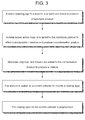
- FIG. 3 is a flowchart showing the preparation of a negative electrode according to an embodiment of the invention.
- One exemplary embodiment of the present invention provides a negative active material represented by the following Chemical Formula 1.
- X is an active material which comprises a metal and whose functional group has been reacted with a silane coupling agent
- Ra is a residual group from a silane coupling agent
- Rb is a polymer including a first repeating unit represented by the following Chemical Formula 2a.
- R 10 to R 13 are the same or different, and are hydrogen; or a substituted or unsubstituted C1 to C5 alkyl group, and nl is an integer ranging from 1 to 100000, and * is a chemical bond.
- the substituted C1 to C5 alkyl group is a group in which at least one hydrogen is substituted with an amino group, an acryl group, a vinyl group, an epoxy group, or a phenyl group.
- the residual group derived from a silane coupling agent, Ra may be represented by the following Chemical Formula 3.
- R 1 , R 2 and R 3 are the same or different, and are hydrogen; or a substituted or unsubstituted C1 to C5 alkyl group,
- R 4 is a carboxyl group, an amino group, an acryl group, a vinyl group, an epoxy group, or a phenyl group,
- R 5 is a substituted of unsubstituted C1 to C5 alkylene group
- Y is a silane functional group and * is a chemical bond.
- the polymer of Formula 2a may be a copolymer further including a second repeating unit represented by the following Chemical Formula 2b together with the first repeating unit represented by the above Chemical Formula 2a.
- R 20 to R 22 are the same or different, and are hydrogen; or a substituted or unsubstituted C1 to C5 alkyl group and * is a chemical bond.
- the substituted C1 to C5 alkyl group is a group in which at least one hydrogen is substituted with an amino group, an acryl group, a vinyl group, an epoxy group, or a phenyl group.
- the first repeating unit and the second repeating unit may have a mole ratio of about 0.9 : 0.1 to about 0.1 : 0.9.
- the binder may more actively form a network with the active material, so it may improve the cycle-life and well maintain the electrode adherence.
- the copolymer may have a weight average molecular weight (Mw) of about 5,000 to about 4,000,000.
- the polymer including a first repeating unit represented by Chemical Formula 2a or the polymer including the first repeating unit and the second repeating unit represented by Chemical Formula 2b is obtained by polymerizing the monomer and the oligomer used for the negative electrode manufacturing process.
- the monomer and the oligomer may be a monomer and an oligomer including at least one of an amino group, an acryl group, a vinyl group, an epoxy group, or a phenyl group.
- the monomer may be selected form phenoxyethylacrylate, phenoxydiethyleneglycolacrylate, phenoxytetraethyleneglycolacrylate, phenoxyhexaethyleneglycolacrylate, isobornylacrylate, isobornylmetaacrylate, bisphenol ethoxylate diacrylate, ethoxylate phenol monoacrylate, polyethyleneglycol 200 diacrylate, tripropyleneglycol diacrylate, trimethylolpropane triacrylate, trimethylpropane triacrylate, triethylpropane triacrylate, polyethyleneglycol diacrylate, ethyleneoxide addition triethylpropanetriacrylate, pentaerythritol tetraacrylate, 1,4-butanediol diacrylate, 1,6-hexanediol diacrylate, ethoxylated pentaerythritol tetraacrylate, 2-phenoxyethyl acrylate, e
- the oligomer may include a urethane acrylate oligomer, or an epoxy acrylate oligomer.
- the active material is a metal-based active material.
- metal refers to a material having excellent thermo- or electric- conductivity, and non limiting examples thereof include a general metal such as alkali metal and semi-metals having semiconductor properties, such as Si.
- the active material may include Si, SiO x (0 ⁇ x ⁇ 2), a Si-Q alloy (wherein Q is an element selected from the group consisting of an alkali metal, an alkaline-earth metal, a Group 13 element, a Group 14 element, a Group 15 element, a Group 16 element, a transition element, a rare earth element, and combinations thereof, but is not Si), Sn, SnO 2 , a Sn-R alloy (wherein R is an element selected from the group consisting of an alkali metal, an alkaline-earth metal, a Group 13 element, a Group 14 element, a Group 15 element, a Group 16 element, a transition element, a rare earth element, and combinations thereof, but is not Sn), or combinations thereof.
- Q is an element selected from the group consisting of an alkali metal, an alkaline-earth metal, a Group 13 element, a Group 14 element, a Group 15 element, a Group 16 element, a transition element, a rare earth
- the element Q and R may be selected from the group consisting of Mg, Ca, Sr, Ba, Ra, Sc, Y, Ti, Zr, Hf, Rf, V, Nb, Ta, Db, Cr, Mo, W, Sg, Tc, Re, Bh, Fe, Pb, Ru, Os, Hs, Rh, Ir, Pd, Pt, Cu, Ag, Au, Zn, Cd, B, Al, Ga, Sn, In, Ti, Ge, P, As, Sb, Bi, S, Se, Te, Po, and combinations thereof.
- a negative electrode according to one emobodiment of the present invention includes a current collector and a negative active material layer including the negative active material.
- the negative active material layer according to one embodiment is composed of only the negative active material represented by Chemical Formula 1, and does not include additional conductive agents and binders.
- the current collector may be selected from the group consisting of a copper foil, a nickel foil, a stainless steel foil, a titanium foil, a nickel foam, a copper foam, a polymer substrate coated with a conductive metal, and combinations thereof.
- a method of manufacturing a negative electrode for a rechargeable lithium battery includes mixing a silane coupling agent, a solvent, and water to provide a hydrolysis product; adding an active material to the hydrolysis product to effect a condensation reaction and to provide a condensation product; adding a vehicle including monomer, oligomer, and initiator to the condensation product to provide a mixture; coating the mixture on a current collector; and polymerizing the obtained current collector.
- the process is represented in Figure 3 . Each step is described hereinafter in more detail.
- a silane coupling agent a solvent, and water are mixed to provide a hydrolysis product.
- the silane coupling agent and the solvent may be mixed in a weight ratio of about 1 : 50 to 100.
- the solvent may include any polar solvent.
- Non-limiting examples may include methanol, ethanol, isopropyl alcohol, isobutanol, t-butanol, benzylalcohol, or combinations thereof, but is not limited thereto.
- Water used for the hydrolysis reaction, hydrolyzes the silane coupling agent to provide a silane functional group having an OH group.
- the water is added in sufficient amount to hydrolyze the silane coupling agent, for example, it may be added in at least about 3 moles per one mole of silane coupling agent. Water is sufficient if it is added in 3 or more moles per one mole of silane coupling agent, so it is not limited to the maximum limited value.
- the silane coupling agent may be a silane-based compound having a functional group selected from an amino group, acryl group, vinyl group, epoxy group, mercapto group, chloro group, phenyl group, or combinations thereof.
- the silane coupling agent may include, but is not limited to, at least one selected from 3-methoxysilylpropyl methacrylate, 3-(trimethoxysilyl)propyl methacrylate, 3-ethoxysilylpropyl methacrylate, 3-methoxysilylpropyl acrylate, 3-ethoxysilylpropyl acrylate, 3-methoxysilylbutyl methacrylate, 3-ethoxysilylbutyl methacrylate, 3-methoxysilylbutyl acrylate, 3-ethoxysilylbutyl acrylate, 3-methoxysilylpentyl methacrylate, 3-ethoxysilylpentyl methacrylate, 3-methoxysilylpentyl acrylate, 3-ethoxysilylpentyl acrylate, 3-methoxysilylhexyl methacrylate, 3-ethoxysilylhexyl methacrylate, 3-methoxysily
- the active material may be added in about 3000 to 9000 parts by weight based on 100 parts by weight of the silane coupling agent. When the active material is added within this range, it may enhance the adherence through the appropriate bond of the active material with the silane coupling agent and improve the cycle-life characteristic.
- the active material may include any active materials as long as it is bonded with the silane coupling agent through a condensation reaction.
- the active material may include Si, SiO x (0 ⁇ x ⁇ 2), a Si-Q alloy (wherein Q is an element selected from the group consisting of an alkali metal, an alkaline-earth metal, a Group 13 element, a Group 14 element, a Group 15 element, a Group 16 element, a transition element, a rare earth element, and combinations thereof, but is not Si), Sn, SnO 2 , a Sn-R alloy (wherein R is an element selected from the group consisting of an alkali metal, an alkaline-earth metal, a Group 13 element, a Group 14 element, a Group 15 element, a Group 16 element, a transition element, a rare earth element, and combinations thereof, but is not Sn), or combinations thereof.
- the elements Q and R may be selected from the group consisting of Mg, Ca, Sr, Ba, Ra, Sc, Y, Ti, Zr, Hf, Rf, V, Nb, Ta, Db, Cr, Mo, W, Sg, Tc, Re, Bh, Fe, Pb, Ru, Os, Hs, Rh, Ir, Pd, Pt, Cu, Ag, Au, Zn, Cd, B, Al, Ga, Sn, In, Ti, Ge, P, As, Sb, Bi, S, Se, Te, Po, and combinations thereof.
- the active material is used in a state with OH groups on the surface formed by reacting with oxygen from the air.
- the OH groups on the surface causes a condensation reaction with the hydrolysis product of the silane coupling agent.
- the condensation reaction is performed at a temperature equal to or below the boiling point of the solvent, for example, at room temperature to about 100°C.
- the condensation reaction may be performed for about 12 hours, but does not need to be specifically limited.
- a vehicle is added to the obtained condensation product.
- the vehicle is prepared by mixing monomer, oligomer, and initiator.
- the monomer may be mixed with the oligomer in a weight ratio of about 9 : 1 to about 1 : 9.
- the monomer may better maintain the flexibility of the electrode plate.
- the initiator may be included in about 0.1 to 10 parts by weight based on 100 parts by weight of the monomer and oligomer.
- the monomer and the oligomer may be a monomer and an oligomer including at least one of an amino group, an acryl group, a vinyl group, an epoxy group, or a phenyl group.
- the monomer may be selected from phenoxyethylacrylate, phenoxydiethyleneglycolacrylate, phenoxytetraethyleneglycolacrylate, phenoxyhexaethyleneglycolacrylate, isobornylacrylate, isobornylmetaacrylate, bisphenol ethoxylate diacrylate, ethoxylate phenol monoacrylate, polyethyleneglycol 200 diacrylate, tripropyleneglycol diacrylate, trimethylolpropane triacrylate, trimethylpropane triacrylate, triethylpropane triacrylate, polyethyleneglycol diacrylate, ethyleneoxide addition triethylpropanetriacrylate, pentaerythritol tetraacrylate, 1,4-butanediol diacrylate, 1,6-hexanediol diacrylate, ethoxylated pentaerythritol tetraacrylate, 2-phenoxyethyl acrylate, e
- the oligomer may include a urethane acrylate oligomer or an epoxy acrylate oligomer.
- an additive for improving the physical property of a coating agent, and it may be added within a range that does not change the physical properties of a coating agent.
- the additive include a heat stabilizer, a compatibilizer, an inorganic material additive, a surfactant, a plasticizer, a defoamer, an admixture, a stabilizer, a lubricant, or combinations thereof.
- a thermal curing initiator or a photo-curing initiator may be used as the initiator.
- thermal curing initiator examples include peroxides such as di-t-butyl peroxide, persulfates, azos, or silver alkyls.
- photo-curing initiator examples include 2-hydroxy-2-methyl-1-phenyl-1-propanone, 2,4-bistrichloromethyl-6-p-methoxystyryl-s-triazine, 2-p-methoxyphenyl-4,6-bistrichloromethyl-s-triazine, 4-trichloromethyl-6-triazine, 4-trichloromethyl-4-methylnaphthyl-6-triazine, benzophenone, p-(diethylamino)benzophenone, 2,2'-dichloro-4-phenoxyacetophenone, 2,2'-diethoxyacetophenone, 2,2'-dibutoxyacetophenone, 2-hydroxy-2-methylpropiophenone, p-t-butyltrichloroacetophenone, diphenyl 1 (2,4,6-trimethylbenzoyl) phosphine oxide, bis(2,4,6-trimethylbenzoyl) phenyl phosphine oxide
- the condensation product may be mixed with the vehicle in about 9 : 1 to about 3 : 1 weight ratio.
- the coating process may be performed according to any general coating process.
- the current collector coated with the coating layer is polymerized.
- the polymerization reaction may be performed according to a photo-curing or a thermal curing process.
- the current collector coated with the coating layer may be irradiated with a light source.
- the light source may include UV, electron beam or X-ray, for example, it may include UV having a wavelength range of about 200 nm to about 400 nm. It may be irradiated for several minutes to several tens of minutes, but is not limited thereto.
- the current collector coated with the coating layer is maintained at about 100°C to about 200°C for about 0.1 hour to about 2 hours.
- the negative active material layer including the negative active material represented by above Chemical Formula 1 is formed on the current collector.
- the current collector may be formed with the negative active material layer including a polymer including only the first repeating unit represented by Chemical Formula 2a; on the other hand, if using two or more kinds of monomers, the current collector may be formed with the negative active material layer including a polymer including not only a first repeating unit represented by above Chemical Formula 2a but also a second repeating unit represented by Chemical Formula 2b.
- the polymerization reaction After the polymerization reaction, it is heated at about 80°C to about 140°C for about 2 hours to 4 hours to further remove moisture from the electrode plate.
- the heat treatment may be performed under vacuum.
- Another embodiment of this disclosure provides a rechargeable lithium battery.
- Rechargeable lithium batteries may be classified into lithium ion batteries, lithium ion polymer batteries, and lithium polymer batteries according to the presence of a separator and the kind of electrolyte used in the battery.
- the rechargeable lithium batteries may have a variety of shapes and sizes, and include cylindrical, prismatic, or coin-type batteries, and may be thin film batteries or may be rather bulky in size. Structures and fabrication methods for lithium ion batteries are well known in the art.
- a rechargeable lithium battery includes a negative electrode as defined above, a positive electrode including a positive active material, and a non-aqueous electrolyte.
- the positive electrode includes a current collector and a positive active material layer disposed on the current collector.
- the positive active material includes a lithiated intercalation compound that reversibly intercalates and deintercalates lithium ions.
- the positive active material may include a composite oxide including at least one selected from the group consisting of cobalt, manganese, and nickel, as well as lithium.
- Examples of the positive active material may include a compound represented by the following Chemical Formulae : Li a A 1-b X b D 2 (0.90 ⁇ a ⁇ 1.8, 0 ⁇ b ⁇ 0.5); Li a E 1-b X b O 2-c D c (0.90 ⁇ a ⁇ 1.8, 0 ⁇ b ⁇ 0.5, 0 ⁇ c ⁇ 0.05); Li a E 2-b X b O 4-c D c (0.90 ⁇ a ⁇ 1.8, 0 ⁇ b ⁇ 0.5, 0 ⁇ c ⁇ 0.05); Li a Ni 1-b-c Co b X c D ⁇ (0.90 ⁇ a ⁇ 1.8, 0 ⁇ b ⁇ 0.5, 0 ⁇ c ⁇ 0.05, 0 ⁇ ⁇ ⁇ 2); Li a Ni 1-b-c Co b X c O 2- ⁇ T ⁇ (0.90 ⁇ a ⁇ 1.8, 0 ⁇
- A is selected from the group consisting ofNi, Co, Mn, and combinations thereof;
- X is selected from the group consisting of Al, Ni, Co, Mn, Cr, Fe, Mg, Sr, V, a rare earth element, and combinations thereof;
- D is selected from the group consisting of O, F, S, P, and combinations thereof;
- E is selected from the group consisting of Co, Mn, and combinations thereof;
- T is selected from the group consisting of F, S, P, and combinations thereof;
- G is selected from the group consisting of Al, Cr, Mn, Fe, Mg, La, Ce, Sr, V, and combinations thereof;
- Q is selected from the group consisting of Ti, Mo, Mn, and combinations thereof;
- Z is selected from the group consisting of Cr, V, Fe, Sc, Y, and combinations thereof;
- J is selected from the group consisting of V, Cr, Mn, Co, Ni, Cu, and combinations thereof.
- the compound may have a coating layer on the surface, or may be mixed with another compound having a coating layer.
- the coating layer may include at least one coating element compound selected from the group consisting of an oxide of a coating element, a hydroxide of a coating element, an oxyhydroxide of a coating element, an oxycarbonate of a coating element, and a hydroxyl carbonate of a coating element.
- the compound for the coating layer may be amorphous or crystalline.
- the coating element included in the coating layer may include Mg, Al, Co, K, Na, Ca, Si, Ti, V, Sn, Ge, Ga, B, As, Zr, or a mixtures thereof.
- the coating layer may be disposed with a method having no adverse influence on properties of a positive active material.
- the method may include any coating method such as spray coating, dipping, and the like, but is not illustrated in more detail since it is well-known to those of ordinary skill in the art.
- the positive active material may be included in an amount ranging from about 90 wt% to about 98 wt% based on the total weight of the positive active material layer.
- the positive active material layer may also include a binder and a conductive material.
- the binder and conductive material may be included in amounts of about 1 wt% to about 5 wt% based on the total weight of the positive active material layer, respectively.
- the binder improves properties of binding positive active material particles among one another and also, the positive active material with a current collector.
- the binder include polyvinyl alcohol, carboxylmethyl cellulose, hydroxypropyl cellulose, diacetyl cellulose, polyvinyl chloride, carboxylated polyvinyl chloride, polyvinylfluoride, an ethylene oxide-containing polymer, polyvinylpyrrolidone, polyurethane, polytetrafluoroethylene, polyvinylidene fluoride, polyethylene, polypropylene, a styrene-butadiene rubber, an acrylated styrene-butadiene rubber, an epoxy resin, nylon, and the like, but are not limited thereto.
- the conductive material is included to impart conductivity to an electrode. It may include any electrically conductive material, unless it causes a chemical change.
- the conductive material include a carbon-based material such as natural graphite, artificial graphite, carbon black, acetylene black, ketjen black, a carbon fiber, and the like; a metal-based material such as a metal powder, a metal fiber, or the like that includes copper, nickel, aluminum, silver, and the like; a conductive polymer such as a polyphenylene derivative; or mixtures thereof.
- the current collector may be aluminum (Al) but is not limited thereto.
- the positive electrode may be obtained in a general process including mixing a positive active material, a binder, and selectively a conductive material in a solvent to prepare an active material composition, coating the active material composition on a current collector, and drying and pressing the same. Electrode-manufacturing methods are well known and thus are not described in detail in the present specification.
- the solvent includes N-methylpyrrolidone or the like, but is not limited thereto.
- the non-aqueous electrolyte may include a non-aqueous organic solvent and a lithium salt.
- the non-aqueous organic solvent serves as a medium for transmitting ions taking part in the electrochemical reaction of a battery.
- the non-aqueous organic solvent may include a carbonate-based, ester-based, ether-based, ketone-based, alcohol-based, or aprotic solvent.
- the carbonate-based solvent may include dimethyl carbonate (DMC), diethyl carbonate (DEC), dipropyl carbonate (DPC), methylpropyl carbonate (MPC), ethylpropyl carbonate (EPC), methylethyl carbonate (MEC), ethylene carbonate (EC), propylene carbonate (PC), butylene carbonate (BC), and the like.
- ester-based solvent may include methyl acetate, ethyl acetate, n-propyl acetate, dimethylacetate, methylpropionate, ethylpropionate, ⁇ -butyrolactone, decanolide, valerolactone, mevalonolactone, caprolactone, and the like.
- ether-based solvent examples include dibutyl ether, tetraglyme, diglyme, dimethoxyethane, 2-methyltetrahydrofuran, tetrahydrofuran, and the like
- examples of the ketone-based solvent include cyclohexanone and the like.
- Examples of the alcohol-based solvent include ethyl alcohol, isopropyl alcohol, and the like
- examples of the aprotic solvent include nitriles such as R-CN (where R is a C2 to C20 linear, branched, or cyclic hydrocarbon, or comprises a double bond, an aromatic ring, or an ether bond), amides such as dimethylformamide, dioxolanes such as 1,3-dioxolane, sulfolanes, and the like.
- the non-aqueous organic solvent may be used singularly or in a mixture.
- the mixture ratio may be controlled in accordance with a desirable battery performance.
- the carbonate-based solvent may be prepared by mixing a cyclic carbonate and a linear carbonate.
- the cyclic carbonate and the linear carbonate are mixed together in a volume ratio ranging from about 1:1 to about 1:9.
- the electrolyte performance is enhanced.
- non-aqueous organic electrolyte may be further prepared by mixing a carbonate-based solvent with an aromatic hydrocarbon-based solvent.
- the carbonate-based and the aromatic hydrocarbon-based solvents may be mixed together in a volume ratio ranging from about 1:1 to about 30:1.
- the aromatic hydrocarbon-based organic solvent may be represented by the following Chemical Formula 4.
- R 31 to R 36 are independently selected from the group consisting of hydrogen, a halogen, a C1 to C10 alkyl group, a C1 to C10 haloalkyl group, and combinations thereof.
- the aromatic hydrocarbon-based organic solvent may include, but is not limited to, at least one selected from benzene, fluorobenzene, 1,2-difluorobenzene, 1,3-difluorobenzene, 1,4-difluorobenzene, 1,2,3-trifluorobenzene, 1,2,4-trifluorobenzene, chlorobenzene, 1,2-dichlorobenzene, 1,3-dichlorobenzene, 1,4-dichlorobenzene, 1,2,3-trichlorobenzene, 1,2,4-trichlorobenzene, iodobenzene, 1,2-diiodobenzene, 1,3-diiodobenzene, 1,4-diiodobenzene, 1,2,3-triiodobenzene, 1,2,4-triiodobenzene, toluene, fluorotoluene, 2,3-difluorotolu
- the non-aqueous electrolyte may further include an additive of vinylene carbonate, an ethylene carbonate-based compound represented by the following Chemical Formula 5, or combinations thereof to improve cycle life.
- R 37 and R 38 are independently selected from the group consisting of hydrogen, a halogen, a cyano group (CN), a nitro group (NO 2 ) and a C1 to C5 fluoroalkyl group, provided that at least one of R 37 and R 38 is selected from the group consisting of a halogen, a cyano group (CN), a nitro group (NO 2 ) and a C1 to C5 fluoroalkyl group, but both R 37 and R 38 are not hydrogen.
- Examples of the ethylene carbonate-based compound include difluoroethylene carbonate, chloroethylene carbonate, dichloroethylene carbonate, bromoethylene carbonate, dibromoethylene carbonate, nitroethylene carbonate, cyanoethylene carbonate, fluoroethylene carbonate, and the like.
- the amount of the additive used to improve cycle life may be adjusted within an appropriate range.
- the lithium salt is dissolved in an organic solvent and plays a role of supplying lithium ions in a battery, operating a basic operation of the rechargeable lithium battery, and improving lithium ion transportation between positive and negative electrodes therein.
- the lithium salt include at least one supporting salt selected from LiPF 6 , LiBF 4 , LiSbF 6 , LiAsF 6 , LiN(SO 2 C 2 F 5 ) 2 , Li(CF 3 SO 2 ) 2 N, LiN(SO 3 C 2 F 5 ) 2 , LiC 4 F 9 SO 3 , LiClO 4 , LiAlO 2 , LiAlCl 4 , LiN(C x F 2x+1 SO 2 )(C y F 2y+1 SO 2 ) (x and y are natural numbers), LiCl, LiI, and LiB(C 2 O 4 ) 2 (lithium bis(oxalato) borate; LiBOB).
- the lithium salt may be used in a concentration ranging from about 0.1 M to about 2.0
- FIG. 1 is a schematic view showing a representative structure of a rechargeable lithium battery 1 according to one embodiment.
- the rechargeable lithium battery 1 includes a battery case 5 including a positive electrode 3, a negative electrode 2, and a separator 4 interposed between the positive electrode 3 and the negative electrode 2, an electrolyte solution impregnated therein, and a sealing member 6 sealing the battery case 5.
- the rechargeable lithium battery may further include a separator between the negative electrode and the positive electrode, as needed.
- suitable separator materials include polyethylene, polypropylene, polyvinylidene fluoride, and multilayers thereof such as a polyethylene/polypropylene double-layered separator, a polyethylene/polypropylene/polyethylene triple-layered separator, and a polypropylene/polyethylene/polypropylene triple-layered separator.
- silane coupling agent represented by the following Chemical Formula 6 is mixed with isopropyl alcohol and water.
- the silane coupling agent and isopropyl alcohol are mixed in a weight ratio of about 1 : 100, and the silane coupling agent and water have a mole ratio of about 1 : 4.
- the silane coupling agent is hydrolyzed according to the following Reaction scheme 1.
- the active material is added in about 9000 parts by weight based on 100 parts by weight of the silane coupling agent. Accordingly, it obtains the condensation product by the condensation reaction as shown in the following Reaction scheme 2.
- the binding product of active material-silane is represented as a part, part indicates that the terminal group is not a methyl group but refers to the active material or the like which may be bonded to oxygen.
- the trimethylolpropane triacrylate monomer represented by the following Chemical Formula 7, the urethane acrylate oligomer, and di-t-butyl peroxide initiator are mixed to provide a vehicle.
- condensation product and the vehicle are mixed in a ratio of about 9 : 1 wt%.
- the silane coupling agent, the isopropyl alcohol, the monomer, the oligomer, and the active material are included as shown in the following Table 1.
- the initiator may be included in about 3 parts by weight based on the total 100 parts by weight of monomer and oligomer.
- the mixture is coated on an Al current collector to provide a coating layer.
- the Al current collector formed with the coating layer is thermally cured at about 200°C for about 1 hour. It is polymerized according to the thermal curing process to react silane coupling agent bonded with the active material, with the monomer and the oligomer, and the monomer and the oligomer are cross-linked with each other to provide a polymer. Then the heated Al current collector is heated at about 80°C for about three hours under the vacuum to remove moisture of electrode plate.
- a negative electrode is prepared by the same procedure as in Example 1, except the silane coupling agent, isopropyl alcohol, monomer, oligomer, and active material are included as shown in the following Table 1 in the mixture of the condensation product and the vehicle.
- the initiator is added in as much as about 3 parts by weight based on the total 100 parts by weight of monomer and oligomer.
- a negative electrode is prepared by the same procedure as in Example 1, except the silane coupling agent, isopropyl alcohol, monomer, oligomer, and active material are included as shown in the following Table 1 in the mixture of the condensation product and the vehicle.
- the initiator is added in as much as about 3 parts by weight based on the total 100 parts by weight of monomer and oligomer.
- a negative electrode is prepared by the same procedure as in Example 1, except silane coupling agent, isopropyl alcohol, monomer, oligomer, and active material are included as shown in the following Table 1 in the mixture of the condensation product and the vehicle.
- the initiator is added in as much as about 3 parts by weight based on the total 100 parts by weight of monomer and oligomer.
- the half-cell is charged and discharged for 50 cycles under the conditions of constant current /constant voltage charge at 0.5C and constant current discharge at 0.5C to measure the discharge capacity.
- FIG. 2 shows the discharge capacity retention (cycle-life characteristic) of Examples 2 and 3 and Comparative Example 1. As shown in FIG. 2 , it is understood that the capacity retentions of Examples 2 to 3 are superior to that of Comparative Example 1.
Landscapes
- Chemical & Material Sciences (AREA)
- Chemical Kinetics & Catalysis (AREA)
- Electrochemistry (AREA)
- General Chemical & Material Sciences (AREA)
- Engineering & Computer Science (AREA)
- Materials Engineering (AREA)
- Composite Materials (AREA)
- Manufacturing & Machinery (AREA)
- Inorganic Chemistry (AREA)
- Battery Electrode And Active Subsutance (AREA)
- Secondary Cells (AREA)
Abstract
X-Ra-Rb
In Chemical Formula 1,
X is an active material which comprises a metal and whose functional group has been reacted with a silane coupling agent,
Ra is a residual group from a silane coupling agent, and
Rb is a polymer including a first repeating unit represented by the following Chemical Formula 2a.

R10 to R13 are the same or different, and are hydrogen; or a substituted or unsubstituted C1 to C5 alkyl group, and n1 is an integer ranging from 1 to 100000 and * is a chemical bond.
Description
- This disclosure relates to a negative active material of a rechargeable lithium battery, a method of preparing a negative electrode, and a rechargeable lithium battery including the same.
- Lithium rechargeable batteries have recently drawn attention as a power source for small portable electronic devices. They use an organic electrolyte solution and thereby, have twice the discharge voltage of a conventional battery using an alkali aqueous solution, and accordingly, have higher energy density.
- As for positive active materials of a rechargeable lithium battery, there has been research conducted on lithium-transition element composite oxides that can intercalate lithium, such as LiCoO2 LiMn2O4, LiNi1-xCoxO2 (0<x<1), and so on.
- As for negative active materials, diverse carbon-based materials capable of intercalating/deintercalating lithium such as artificial graphite, natural graphite, and hard carbon have been used, and at present, graphite-based materials such as artificial graphite and natural graphite are widely employed. Since the graphite-based negative active materials do not reduce lithium metal, an internal short-circuit is not caused by dendrites and thus drawbacks originating from the internal short-circuits are not present.
- However, the graphite-based active material has a theoretical lithium occlusion capacity of about 372mAh/g, which accounts for 10% of a theoretical lithium metal capacity, which is very small. Therefore, as a high capacity is required, research is again being conducted on a metal-based negative active material such as Si, which was once used in the initial days of the development of rechargeable batteries.
- The metal-based negative active material has high capacity but shows remarkably reduced cycle-life due to large expansion and shrinkage during charge and discharge.
- One embodiment of this disclosure provides a negative active material for a rechargeable lithium battery having excellent cycle-life characteristics.
- Another embodiment of the present invention provides a manufacturing method of a negative electrode.
- Yet another embodiment of the present invention provides a rechargeable lithium battery including the negative electrode.
- According to one embodiment of the present invention, a negative active material for a rechargeable lithium battery that is represented by the following Chemical Formula 1 is provided.
-
[Chemical Formula 1] X-Ra-Rb
- In Chemical Formula 1,
- X is an active material which comprises a metal and whose functional group has been reacted with a silane coupling agent,
- Ra is a residual group from a silane coupling agent, and
- Rb is a polymer including a first repeating unit represented by the following Chemical Formula 2a.
-

- In Chemical Formula 2a,
- R10 to R13 are the same or different, and are hydrogen; or a substituted or unsubstituted C1 to C5 alkyl group, and n1 is an integer ranging from 1 to 100000, and * is a chemical bond. The substituted C1 to C5 alkyl group may be a group in which at least one hydrogen is substituted with an amino group, an acryl group, a vinyl group, an epoxy group, or a phenyl group.
- The residual group derived from a silane coupling agent, Ra may be represented by the following Chemical Formula 3.
-

- In Chemical Formula 3,
- R1, R2 and R3 are the same or different, and are hydrogen; or a substituted or unsubstituted C1 to C5 alkyl group,
- R4 is a carboxyl group, an amino group, an acryl group, a vinyl group, an epoxy group, or a phenyl group,
- R5 is a substituted or unsubstituted C1 to C5 alkylene group, and
- Y is a silane functional group, and * is a chemical bond.
- In one embodiment of the present invention, the polymer of Formula 2a may be a copolymer further including a second repeating unit of the following Chemical Formula 2b along with a first repeating unit. The second repeating unit may be different from the first repeating unit.
-

- In Chemical Formula 2b,
- R20 to R22 are the same or different, and are hydrogen; or a substituted or unsubstituted C1 to C5 alkyl group and * is a chemical bond. The substituted C1 to C5 alkyl group may be a group in which at least one hydrogen is substituted with an amino group, an acryl group, a vinyl group, an epoxy group, or a phenyl group.
- The polymer may be a copolymer further including a second repeating unit, and the copolymer may include the first repeating unit and the second repeating unit at a mole ratio of about 0.9 : 0.1 to about 0.1 : 0.9.
- According to another embodiment of the present invention, a method of manufacturing a negative electrode for a rechargeable lithium battery is provided that includes mixing a silane coupling agent, a solvent, and water to provide a hydrolysis product; adding an active material comprising a metal to the hydrolysis product to effect a condensation reaction and to provide a condensation product; adding a vehicle including a monomer, an oligomer, and an initiator to the condensation product to provide a mixture; coating the mixture on a current collector; polymerizing the mixture on the current collector.
- The active material may include Si, SiOx (0 < x < 2), a Si-Q alloy (wherein Q is an element selected from the group consisting of an alkali metal, an alkaline-earth metal, a Group 13 element, a Group 14 element, a Group 15 element, a Group 16 element, a transition element, a rare earth element, and a combination thereof, but is not Si), Sn, SnO2, a Sn-R alloy (wherein R is an element selected from the group consisting of an alkali metal, an alkaline-earth metal, a Group 13 element, a Group 14 element, a Group 15 element, a Group 16 element, a transition element, a rare earth element, and a combination thereof, but is not Sn), or combinations thereof.
- The silane coupling agent may be a silane-based compound including a functional group selected from an amino group, an acryl group, a vinyl group, an epoxy group, a phenyl group, or combinations thereof.
- The silane coupling agent may include, but is not limited to, at least one selected from 3-methoxysilylpropyl methacrylate, 3-(trimethoxysilyl)propyl methacrylate, 3-ethoxysilylpropyl methacrylate, 3-methoxysilylpropyl acrylate, 3-ethoxysilylpropyl acrylate, 3-methoxysilylbutyl methacrylate, 3-ethoxysilylbutyl methacrylate, 3-methoxysilylbutyl acrylate, 3-ethoxysilylbutyl acrylate, 3-methoxysilylpentyl methacrylate, 3-ethoxysilylpentyl methacrylate, 3-methoxysilylpentyl acrylate, 3-ethoxysilylpentyl acrylate, 3-methoxysilylhexyl methacrylate, 3-ethoxysilylhexyl methacrylate, 3-methoxysilylhexyl acrylate, 3-ethoxysilylhexyl acrylate, 3-methoxysilylheptyl methacrylate, 3-ethoxysilylheptyl methacrylate, 3-methoxysilylheptyl acrylate, 3-ethoxysilylheptyl acrylate, 3-methoxysilyloctyl methacrylate, 3-ethoxysilyloctyl methacrylate, 3-methoxysilyloctyl acrylate, 3-ethoxysilyloctyl acrylate, 3-methoxysilylnonyl methacrylate, 3-ethoxysilylnonyl methacrylate, 3-methoxysilylnonyl acrylate, or 3-ethoxysilylnonyl acrylate, or combinations thereof.
- The monomer and the oligomer act as a binder, and examples of monomer and oligomer may include a monomer and an oligomer including at least one of an amino group, an acryl group, a vinyl group, an epoxy group, or a phenyl group.
- The active material may be included in about 3000 parts by weight to about 9000 parts by weight based on 100 parts by weight of the silane coupling agent.
- In addition, the binder of monomer and oligomer may be mixed in a weight ratio of about 1 : 9 to about 9 : 1.
- The polymerization reaction may be performed according to a photo-curing or a thermal curing process.
- According to yet another embodiment of the present invention, a rechargeable lithium battery is provided that includes a negative electrode comprising a negative active material layer including a negative active material as defined above, a positive electrode including a positive active material, and a non-aqueous electrolyte.
- Hereinafter, further embodiments of the present invention will be described in detail.
- The negative electrode for a rechargeable lithium battery according to the one embodiment of the present invention has excellent cycle-life characteristics.
-
FIG. 1 shows the structure of a rechargeable lithium battery according to one embodiment of the present invention. -
FIG. 2 is a graph showing cycle-life characteristics of half cells using the negative electrodes obtained from Examples 2 to 3 and Comparative Example 1. -
FIG. 3 is a flowchart showing the preparation of a negative electrode according to an embodiment of the invention. - Exemplary embodiments of the present invention will hereinafter be described in detail. However, these embodiments are only exemplary, and the present invention is not limited thereto. Their features can, if appropriate, be combined.
- One exemplary embodiment of the present invention provides a negative active material represented by the following Chemical Formula 1.
-
[Chemical Formula 1] X-Ra-Rb
- In Chemical Formula 1,
- X is an active material which comprises a metal and whose functional group has been reacted with a silane coupling agent,
- Ra is a residual group from a silane coupling agent, and
- Rb is a polymer including a first repeating unit represented by the following Chemical Formula 2a.
-

- In Chemical Formula 2a,
- R10 to R13 are the same or different, and are hydrogen; or a substituted or unsubstituted C1 to C5 alkyl group, and nl is an integer ranging from 1 to 100000, and * is a chemical bond. The substituted C1 to C5 alkyl group is a group in which at least one hydrogen is substituted with an amino group, an acryl group, a vinyl group, an epoxy group, or a phenyl group.
- The residual group derived from a silane coupling agent, Ra may be represented by the following Chemical Formula 3.
-

- In
Chemical Formula 3, - R1, R2 and R3 are the same or different, and are hydrogen; or a substituted or unsubstituted C1 to C5 alkyl group,
- R4 is a carboxyl group, an amino group, an acryl group, a vinyl group, an epoxy group, or a phenyl group,
- R5 is a substituted of unsubstituted C1 to C5 alkylene group, and
- Y is a silane functional group and * is a chemical bond.
- According to one embodiment of the present invention, the polymer of Formula 2a may be a copolymer further including a second repeating unit represented by the following Chemical Formula 2b together with the first repeating unit represented by the above Chemical Formula 2a.
-

- In Chemical Formula 2b,
- R20 to R22 are the same or different, and are hydrogen; or a substituted or unsubstituted C1 to C5 alkyl group and * is a chemical bond. The substituted C1 to C5 alkyl group is a group in which at least one hydrogen is substituted with an amino group, an acryl group, a vinyl group, an epoxy group, or a phenyl group.
- When the polymer is a copolymer further including the second repeating unit, the first repeating unit and the second repeating unit may have a mole ratio of about 0.9 : 0.1 to about 0.1 : 0.9. When the first repeating unit and the second repeating unit have a mole ratio within this range, the binder may more actively form a network with the active material, so it may improve the cycle-life and well maintain the electrode adherence.
- When the polymer is a copolymer further including a second repeating unit, the copolymer may have a weight average molecular weight (Mw) of about 5,000 to about 4,000,000.
- In one embodiment of the present invention, the polymer including a first repeating unit represented by Chemical Formula 2a or the polymer including the first repeating unit and the second repeating unit represented by Chemical Formula 2b is obtained by polymerizing the monomer and the oligomer used for the negative electrode manufacturing process.
- The monomer and the oligomer may be a monomer and an oligomer including at least one of an amino group, an acryl group, a vinyl group, an epoxy group, or a phenyl group.
- The monomer may be selected form phenoxyethylacrylate, phenoxydiethyleneglycolacrylate, phenoxytetraethyleneglycolacrylate, phenoxyhexaethyleneglycolacrylate, isobornylacrylate, isobornylmetaacrylate, bisphenol ethoxylate diacrylate, ethoxylate phenol monoacrylate,
polyethyleneglycol 200 diacrylate, tripropyleneglycol diacrylate, trimethylolpropane triacrylate, trimethylpropane triacrylate, triethylpropane triacrylate, polyethyleneglycol diacrylate, ethyleneoxide addition triethylpropanetriacrylate, pentaerythritol tetraacrylate, 1,4-butanediol diacrylate, 1,6-hexanediol diacrylate, ethoxylated pentaerythritol tetraacrylate, 2-phenoxyethyl acrylate, ethoxylated bisphenol A diacrylate, or mixtures thereof, but is not limited thereto. - Further, the oligomer may include a urethane acrylate oligomer, or an epoxy acrylate oligomer.
- In the present invention, the active material is a metal-based active material. As used herein, in the metal-based active material, the term "metal" refers to a material having excellent thermo- or electric- conductivity, and non limiting examples thereof include a general metal such as alkali metal and semi-metals having semiconductor properties, such as Si.
- The active material may include Si, SiOx (0 < x < 2), a Si-Q alloy (wherein Q is an element selected from the group consisting of an alkali metal, an alkaline-earth metal, a Group 13 element, a Group 14 element, a Group 15 element, a Group 16 element, a transition element, a rare earth element, and combinations thereof, but is not Si), Sn, SnO2, a Sn-R alloy (wherein R is an element selected from the group consisting of an alkali metal, an alkaline-earth metal, a Group 13 element, a Group 14 element, a Group 15 element, a Group 16 element, a transition element, a rare earth element, and combinations thereof, but is not Sn), or combinations thereof. The element Q and R may be selected from the group consisting of Mg, Ca, Sr, Ba, Ra, Sc, Y, Ti, Zr, Hf, Rf, V, Nb, Ta, Db, Cr, Mo, W, Sg, Tc, Re, Bh, Fe, Pb, Ru, Os, Hs, Rh, Ir, Pd, Pt, Cu, Ag, Au, Zn, Cd, B, Al, Ga, Sn, In, Ti, Ge, P, As, Sb, Bi, S, Se, Te, Po, and combinations thereof.
- A negative electrode according to one emobodiment of the present invention includes a current collector and a negative active material layer including the negative active material. The negative active material layer according to one embodiment is composed of only the negative active material represented by
Chemical Formula 1, and does not include additional conductive agents and binders. - The current collector may be selected from the group consisting of a copper foil, a nickel foil, a stainless steel foil, a titanium foil, a nickel foam, a copper foam, a polymer substrate coated with a conductive metal, and combinations thereof.
- According to another embodiment of the present invention, a method of manufacturing a negative electrode for a rechargeable lithium battery is provided that includes mixing a silane coupling agent, a solvent, and water to provide a hydrolysis product; adding an active material to the hydrolysis product to effect a condensation reaction and to provide a condensation product; adding a vehicle including monomer, oligomer, and initiator to the condensation product to provide a mixture; coating the mixture on a current collector; and polymerizing the obtained current collector. The process is represented in
Figure 3 . Each step is described hereinafter in more detail. - First, a silane coupling agent, a solvent, and water are mixed to provide a hydrolysis product.
- The silane coupling agent and the solvent may be mixed in a weight ratio of about 1 : 50 to 100.
- The solvent may include any polar solvent. Non-limiting examples may include methanol, ethanol, isopropyl alcohol, isobutanol, t-butanol, benzylalcohol, or combinations thereof, but is not limited thereto.
- Water, used for the hydrolysis reaction, hydrolyzes the silane coupling agent to provide a silane functional group having an OH group. The water is added in sufficient amount to hydrolyze the silane coupling agent, for example, it may be added in at least about 3 moles per one mole of silane coupling agent. Water is sufficient if it is added in 3 or more moles per one mole of silane coupling agent, so it is not limited to the maximum limited value.
- The silane coupling agent may be a silane-based compound having a functional group selected from an amino group, acryl group, vinyl group, epoxy group, mercapto group, chloro group, phenyl group, or combinations thereof.
- The silane coupling agent may include, but is not limited to, at least one selected from 3-methoxysilylpropyl methacrylate, 3-(trimethoxysilyl)propyl methacrylate, 3-ethoxysilylpropyl methacrylate, 3-methoxysilylpropyl acrylate, 3-ethoxysilylpropyl acrylate, 3-methoxysilylbutyl methacrylate, 3-ethoxysilylbutyl methacrylate, 3-methoxysilylbutyl acrylate, 3-ethoxysilylbutyl acrylate, 3-methoxysilylpentyl methacrylate, 3-ethoxysilylpentyl methacrylate, 3-methoxysilylpentyl acrylate, 3-ethoxysilylpentyl acrylate, 3-methoxysilylhexyl methacrylate, 3-ethoxysilylhexyl methacrylate, 3-methoxysilylhexyl acrylate, 3-ethoxysilylhexyl acrylate, 3-methoxysilylheptyl methacrylate, 3-ethoxysilylheptyl methacrylate, 3-methoxysilylheptyl acrylate, 3-ethoxysilylheptyl acrylate, 3-methoxysilyloctyl methacrylate, 3-ethoxysilyloctyl methacrylate, 3-methoxysilyloctyl acrylate, 3-ethoxysilyloctyl acrylate, 3-methoxysilylnonyl methacrylate, 3-ethoxysilylnonyl methacrylate, 3-methoxysilylnonyl acrylate, or 3-ethoxysilylnonyl acrylate, or combinations thereof.
- Then an active material is added to the obtained hydrolysis product.
- The active material may be added in about 3000 to 9000 parts by weight based on 100 parts by weight of the silane coupling agent. When the active material is added within this range, it may enhance the adherence through the appropriate bond of the active material with the silane coupling agent and improve the cycle-life characteristic.
- The active material may include any active materials as long as it is bonded with the silane coupling agent through a condensation reaction. Examples of the active material may include Si, SiOx (0 < x < 2), a Si-Q alloy (wherein Q is an element selected from the group consisting of an alkali metal, an alkaline-earth metal, a Group 13 element, a Group 14 element, a Group 15 element, a Group 16 element, a transition element, a rare earth element, and combinations thereof, but is not Si), Sn, SnO2, a Sn-R alloy (wherein R is an element selected from the group consisting of an alkali metal, an alkaline-earth metal, a Group 13 element, a Group 14 element, a Group 15 element, a Group 16 element, a transition element, a rare earth element, and combinations thereof, but is not Sn), or combinations thereof. The elements Q and R may be selected from the group consisting of Mg, Ca, Sr, Ba, Ra, Sc, Y, Ti, Zr, Hf, Rf, V, Nb, Ta, Db, Cr, Mo, W, Sg, Tc, Re, Bh, Fe, Pb, Ru, Os, Hs, Rh, Ir, Pd, Pt, Cu, Ag, Au, Zn, Cd, B, Al, Ga, Sn, In, Ti, Ge, P, As, Sb, Bi, S, Se, Te, Po, and combinations thereof.
- The active material is used in a state with OH groups on the surface formed by reacting with oxygen from the air. The OH groups on the surface causes a condensation reaction with the hydrolysis product of the silane coupling agent.
- The condensation reaction is performed at a temperature equal to or below the boiling point of the solvent, for example, at room temperature to about 100°C. The condensation reaction may be performed for about 12 hours, but does not need to be specifically limited.
- A vehicle is added to the obtained condensation product.
- The vehicle is prepared by mixing monomer, oligomer, and initiator. The monomer may be mixed with the oligomer in a weight ratio of about 9 : 1 to about 1 : 9. When the monomer is mixed with the oligomer within the range, it may better maintain the flexibility of the electrode plate.
- In addition, the initiator may be included in about 0.1 to 10 parts by weight based on 100 parts by weight of the monomer and oligomer.
- The monomer and the oligomer may be a monomer and an oligomer including at least one of an amino group, an acryl group, a vinyl group, an epoxy group, or a phenyl group.
- The monomer may be selected from phenoxyethylacrylate, phenoxydiethyleneglycolacrylate, phenoxytetraethyleneglycolacrylate, phenoxyhexaethyleneglycolacrylate, isobornylacrylate, isobornylmetaacrylate, bisphenol ethoxylate diacrylate, ethoxylate phenol monoacrylate,
polyethyleneglycol 200 diacrylate, tripropyleneglycol diacrylate, trimethylolpropane triacrylate, trimethylpropane triacrylate, triethylpropane triacrylate, polyethyleneglycol diacrylate, ethyleneoxide addition triethylpropanetriacrylate, pentaerythritol tetraacrylate, 1,4-butanediol diacrylate, 1,6-hexanediol diacrylate, ethoxylated pentaerythritol tetraacrylate, 2-phenoxyethyl acrylate, ethoxylated bisphenol A diacrylate, or mixtures thereof, but is not limited thereto. - Further, the oligomer may include a urethane acrylate oligomer or an epoxy acrylate oligomer.
- It may be further added with an additive for improving the physical property of a coating agent, and it may be added within a range that does not change the physical properties of a coating agent. Examples of the additive include a heat stabilizer, a compatibilizer, an inorganic material additive, a surfactant, a plasticizer, a defoamer, an admixture, a stabilizer, a lubricant, or combinations thereof.
- A thermal curing initiator or a photo-curing initiator may be used as the initiator.
- Examples of the thermal curing initiator include peroxides such as di-t-butyl peroxide, persulfates, azos, or silver alkyls.
- Examples of the photo-curing initiator include 2-hydroxy-2-methyl-1-phenyl-1-propanone, 2,4-bistrichloromethyl-6-p-methoxystyryl-s-triazine, 2-p-methoxyphenyl-4,6-bistrichloromethyl-s-triazine, 4-trichloromethyl-6-triazine, 4-trichloromethyl-4-methylnaphthyl-6-triazine, benzophenone, p-(diethylamino)benzophenone, 2,2'-dichloro-4-phenoxyacetophenone, 2,2'-diethoxyacetophenone, 2,2'-dibutoxyacetophenone, 2-hydroxy-2-methylpropiophenone, p-t-butyltrichloroacetophenone, diphenyl 1 (2,4,6-trimethylbenzoyl) phosphine oxide, bis(2,4,6-trimethylbenzoyl) phenyl phosphine oxide, 2-methylthioxanthone, 2-isobutylthioxanthone, 2-dodecylthioxanthone, 2,4-dimethylthioxanthone, 2,4-diethylthioxanthone, 2,2'-bis(2-chlorophenyl)-4,5,4',5'-tetraphenyl-2'-1,2'-biimidazole compound, or combinations thereof.
- The condensation product may be mixed with the vehicle in about 9 : 1 to about 3 : 1 weight ratio.
- Then the mixture is coated on a current collector to provide a coating layer. The coating process may be performed according to any general coating process.
- The current collector coated with the coating layer is polymerized. The polymerization reaction may be performed according to a photo-curing or a thermal curing process. When the polymerization reaction is performed according to a photo-curing process, the current collector coated with the coating layer may be irradiated with a light source. The light source may include UV, electron beam or X-ray, for example, it may include UV having a wavelength range of about 200 nm to about 400 nm. It may be irradiated for several minutes to several tens of minutes, but is not limited thereto.
- When the polymerization reaction is performed according to a thermal curing process, the current collector coated with the coating layer is maintained at about 100°C to about 200°C for about 0.1 hour to about 2 hours.
- According to the process, the negative active material layer including the negative active material represented by above
Chemical Formula 1 is formed on the current collector. In addition, if using one kind of monomer, the current collector may be formed with the negative active material layer including a polymer including only the first repeating unit represented by Chemical Formula 2a; on the other hand, if using two or more kinds of monomers, the current collector may be formed with the negative active material layer including a polymer including not only a first repeating unit represented by above Chemical Formula 2a but also a second repeating unit represented by Chemical Formula 2b. - After the polymerization reaction, it is heated at about 80°C to about 140°C for about 2 hours to 4 hours to further remove moisture from the electrode plate. The heat treatment may be performed under vacuum.
- Another embodiment of this disclosure provides a rechargeable lithium battery.
- Rechargeable lithium batteries may be classified into lithium ion batteries, lithium ion polymer batteries, and lithium polymer batteries according to the presence of a separator and the kind of electrolyte used in the battery. The rechargeable lithium batteries may have a variety of shapes and sizes, and include cylindrical, prismatic, or coin-type batteries, and may be thin film batteries or may be rather bulky in size. Structures and fabrication methods for lithium ion batteries are well known in the art.
- A rechargeable lithium battery includes a negative electrode as defined above, a positive electrode including a positive active material, and a non-aqueous electrolyte.
- The positive electrode includes a current collector and a positive active material layer disposed on the current collector. The positive active material includes a lithiated intercalation compound that reversibly intercalates and deintercalates lithium ions. The positive active material may include a composite oxide including at least one selected from the group consisting of cobalt, manganese, and nickel, as well as lithium. Examples of the positive active material may include a compound represented by the following Chemical Formulae : LiaA1-bXbD2 (0.90 ≤ a ≤ 1.8, 0 ≤ b ≤ 0.5); LiaE1-bXbO2-cDc (0.90 ≤ a ≤ 1.8, 0 ≤ b ≤ 0.5, 0 ≤ c ≤ 0.05); LiaE2-bXbO4-cDc (0.90 ≤ a ≤ 1.8, 0 ≤ b ≤ 0.5, 0 ≤ c ≤ 0.05); LiaNi1-b-cCobXcDα (0.90 ≤ a ≤1.8, 0 ≤ b ≤ 0.5, 0 ≤ c ≤ 0.05, 0 ≤ α ≤ 2); LiaNi1-b-cCobXcO2-αTα (0.90 ≤ a ≤ 1.8, 0 ≤ b ≤ 0.5, 0 ≤ c ≤ 0.05, 0 ≤ a < 2); LiaNi1-b-cCobXcO2-αT2 (0.90 ≤ a ≤ 1.8, 0 ≤ b ≤ 0.5, 0 ≤ c ≤ 0.05, 0 ≤ α < 2); LiNi1-b-cMnbXcDα (0.90 ≤ a ≤ 1.8, 0 ≤ b ≤ 0.5, 0 ≤ c ≤ 0.05, 0 ≤ a ≤ 2); LiaNi1-b-cMnbXcO2-αTα (0.90 ≤ a ≤ 1.8, 0 ≤ b ≤ 0.5, 0 ≤ c ≤ 0.05, 0 ≤ α < 2); LiaNi1-b-cMnbXcO2-aT2 (0.90 ≤ a ≤ 1.8, 0 ≤ b ≤ 0.5, 0 ≤ c ≤ 0.05, 0 ≤ α < 2); LiaNibEcGdO2 (0.90 ≤ a ≤ 1.8, 0 ≤ b ≤ 0.9, 0 ≤ c ≤ 0.5, 0.001 ≤ d ≤ 0.1); LiaNibCocMndGeO2 (0.90 ≤ a ≤ 1.8, 0 ≤ b ≤ 0.9, 0 ≤ c ≤ 0.5, 0 ≤ d ≤0.5, 0.001 ≤ e ≤ 0.1); LiaNiGbO2 (0.90 ≤ a ≤ 1.8, 0.001 ≤b ≤ 0.1); LiaCoGbO2 (0.90 ≤ a ≤ 1.8, 0.001 ≤ b ≤ 0.1); LiaMnGbO2 (0.90 ≤ a ≤ 1.8, 0.001 ≤ b ≤ 0.1); LiaMn2GbO4 (0.90 ≤ a ≤ 1.8, 0.001 ≤ b ≤ 0.1); QO2; QS2; LiQS2; V2O5; LiV2O5; LiZO 2; LiNiVO4; Li(3-f)J2(PO4)3 (0 ≤ f ≤ 2); Li(3-f)Fe2(PO4)3 (0 ≤ f ≤ 2); LiFePO4.
- In the above formulae, A is selected from the group consisting ofNi, Co, Mn, and combinations thereof; X is selected from the group consisting of Al, Ni, Co, Mn, Cr, Fe, Mg, Sr, V, a rare earth element, and combinations thereof; D is selected from the group consisting of O, F, S, P, and combinations thereof; E is selected from the group consisting of Co, Mn, and combinations thereof; T is selected from the group consisting of F, S, P, and combinations thereof; G is selected from the group consisting of Al, Cr, Mn, Fe, Mg, La, Ce, Sr, V, and combinations thereof; Q is selected from the group consisting of Ti, Mo, Mn, and combinations thereof; Z is selected from the group consisting of Cr, V, Fe, Sc, Y, and combinations thereof; and J is selected from the group consisting of V, Cr, Mn, Co, Ni, Cu, and combinations thereof.
- The compound may have a coating layer on the surface, or may be mixed with another compound having a coating layer. The coating layer may include at least one coating element compound selected from the group consisting of an oxide of a coating element, a hydroxide of a coating element, an oxyhydroxide of a coating element, an oxycarbonate of a coating element, and a hydroxyl carbonate of a coating element. The compound for the coating layer may be amorphous or crystalline. The coating element included in the coating layer may include Mg, Al, Co, K, Na, Ca, Si, Ti, V, Sn, Ge, Ga, B, As, Zr, or a mixtures thereof. The coating layer may be disposed with a method having no adverse influence on properties of a positive active material. For example, the method may include any coating method such as spray coating, dipping, and the like, but is not illustrated in more detail since it is well-known to those of ordinary skill in the art.
- The positive active material may be included in an amount ranging from about 90 wt% to about 98 wt% based on the total weight of the positive active material layer.
- The positive active material layer may also include a binder and a conductive material. The binder and conductive material may be included in amounts of about 1 wt% to about 5 wt% based on the total weight of the positive active material layer, respectively.
- The binder improves properties of binding positive active material particles among one another and also, the positive active material with a current collector. Examples of the binder include polyvinyl alcohol, carboxylmethyl cellulose, hydroxypropyl cellulose, diacetyl cellulose, polyvinyl chloride, carboxylated polyvinyl chloride, polyvinylfluoride, an ethylene oxide-containing polymer, polyvinylpyrrolidone, polyurethane, polytetrafluoroethylene, polyvinylidene fluoride, polyethylene, polypropylene, a styrene-butadiene rubber, an acrylated styrene-butadiene rubber, an epoxy resin, nylon, and the like, but are not limited thereto.
- The conductive material is included to impart conductivity to an electrode. It may include any electrically conductive material, unless it causes a chemical change. Examples of the conductive material include a carbon-based material such as natural graphite, artificial graphite, carbon black, acetylene black, ketjen black, a carbon fiber, and the like; a metal-based material such as a metal powder, a metal fiber, or the like that includes copper, nickel, aluminum, silver, and the like; a conductive polymer such as a polyphenylene derivative; or mixtures thereof.
- The current collector may be aluminum (Al) but is not limited thereto.
- The positive electrode may be obtained in a general process including mixing a positive active material, a binder, and selectively a conductive material in a solvent to prepare an active material composition, coating the active material composition on a current collector, and drying and pressing the same. Electrode-manufacturing methods are well known and thus are not described in detail in the present specification. The solvent includes N-methylpyrrolidone or the like, but is not limited thereto.
- The non-aqueous electrolyte may include a non-aqueous organic solvent and a lithium salt.
- The non-aqueous organic solvent serves as a medium for transmitting ions taking part in the electrochemical reaction of a battery.
- The non-aqueous organic solvent may include a carbonate-based, ester-based, ether-based, ketone-based, alcohol-based, or aprotic solvent. Examples of the carbonate-based solvent may include dimethyl carbonate (DMC), diethyl carbonate (DEC), dipropyl carbonate (DPC), methylpropyl carbonate (MPC), ethylpropyl carbonate (EPC), methylethyl carbonate (MEC), ethylene carbonate (EC), propylene carbonate (PC), butylene carbonate (BC), and the like. Examples of the ester-based solvent may include methyl acetate, ethyl acetate, n-propyl acetate, dimethylacetate, methylpropionate, ethylpropionate, γ-butyrolactone, decanolide, valerolactone, mevalonolactone, caprolactone, and the like. Examples of the ether-based solvent include dibutyl ether, tetraglyme, diglyme, dimethoxyethane, 2-methyltetrahydrofuran, tetrahydrofuran, and the like, and examples of the ketone-based solvent include cyclohexanone and the like. Examples of the alcohol-based solvent include ethyl alcohol, isopropyl alcohol, and the like, and examples of the aprotic solvent include nitriles such as R-CN (where R is a C2 to C20 linear, branched, or cyclic hydrocarbon, or comprises a double bond, an aromatic ring, or an ether bond), amides such as dimethylformamide, dioxolanes such as 1,3-dioxolane, sulfolanes, and the like.
- The non-aqueous organic solvent may be used singularly or in a mixture. When the organic solvent is used in a mixture, the mixture ratio may be controlled in accordance with a desirable battery performance.
- The carbonate-based solvent may be prepared by mixing a cyclic carbonate and a linear carbonate. The cyclic carbonate and the linear carbonate are mixed together in a volume ratio ranging from about 1:1 to about 1:9. When the mixture is used as an electrolyte, the electrolyte performance is enhanced.
- In addition, the non-aqueous organic electrolyte may be further prepared by mixing a carbonate-based solvent with an aromatic hydrocarbon-based solvent. The carbonate-based and the aromatic hydrocarbon-based solvents may be mixed together in a volume ratio ranging from about 1:1 to about 30:1.
- The aromatic hydrocarbon-based organic solvent may be represented by the following
Chemical Formula 4. -

- In
Chemical Formula 4, - R31 to R36 are independently selected from the group consisting of hydrogen, a halogen, a C1 to C10 alkyl group, a C1 to C10 haloalkyl group, and combinations thereof.
- The aromatic hydrocarbon-based organic solvent may include, but is not limited to, at least one selected from benzene, fluorobenzene, 1,2-difluorobenzene, 1,3-difluorobenzene, 1,4-difluorobenzene, 1,2,3-trifluorobenzene, 1,2,4-trifluorobenzene, chlorobenzene, 1,2-dichlorobenzene, 1,3-dichlorobenzene, 1,4-dichlorobenzene, 1,2,3-trichlorobenzene, 1,2,4-trichlorobenzene, iodobenzene, 1,2-diiodobenzene, 1,3-diiodobenzene, 1,4-diiodobenzene, 1,2,3-triiodobenzene, 1,2,4-triiodobenzene, toluene, fluorotoluene, 2,3-difluorotoluene, 2,4-difluorotoluene, 2,5-difluorotoluene, 2,3,4-trifluorotoluene, 2,3,5-trifluorotoluene, chlorotoluene, 2,3-dichlorotoluene, 2,4-dichlorotoluene, 2,5-dichlorotoluene, 2,3,4-trichlorotoluene, 2,3,5-trichlorotoluene, iodotoluene, 2,3-diiodotoluene, 2,4-diiodotoluene, 2,5-diiodotoluene, 2,3,4-triiodotoluene, 2,3,5-triiodotoluene, xylene, and combinations thereof.
- The non-aqueous electrolyte may further include an additive of vinylene carbonate, an ethylene carbonate-based compound represented by the following
Chemical Formula 5, or combinations thereof to improve cycle life. -


- In
Chemical Formula 5, - R37 and R38 are independently selected from the group consisting of hydrogen, a halogen, a cyano group (CN), a nitro group (NO2) and a C1 to C5 fluoroalkyl group, provided that at least one of R37 and R38 is selected from the group consisting of a halogen, a cyano group (CN), a nitro group (NO2) and a C1 to C5 fluoroalkyl group, but both R37 and R38 are not hydrogen.
- Examples of the ethylene carbonate-based compound include difluoroethylene carbonate, chloroethylene carbonate, dichloroethylene carbonate, bromoethylene carbonate, dibromoethylene carbonate, nitroethylene carbonate, cyanoethylene carbonate, fluoroethylene carbonate, and the like. The amount of the additive used to improve cycle life may be adjusted within an appropriate range.
- The lithium salt is dissolved in an organic solvent and plays a role of supplying lithium ions in a battery, operating a basic operation of the rechargeable lithium battery, and improving lithium ion transportation between positive and negative electrodes therein. Non-limiting examples of the lithium salt include at least one supporting salt selected from LiPF6, LiBF4, LiSbF6, LiAsF6, LiN(SO2C2F5)2, Li(CF3SO2)2N, LiN(SO3C2F5)2, LiC4F9SO3, LiClO4, LiAlO2, LiAlCl4, LiN(CxF2x+1SO2)(CyF2y+1SO2) (x and y are natural numbers), LiCl, LiI, and LiB(C2O4)2 (lithium bis(oxalato) borate; LiBOB). The lithium salt may be used in a concentration ranging from about 0.1 M to about 2.0 M. When the lithium salt is included at the above concentration range, an electrolyte has excellent performance and lithium ion mobility due to optimal electrolyte conductivity and viscosity.
-
FIG. 1 is a schematic view showing a representative structure of arechargeable lithium battery 1 according to one embodiment. As shown inFIG. 1 , therechargeable lithium battery 1 includes abattery case 5 including apositive electrode 3, anegative electrode 2, and aseparator 4 interposed between thepositive electrode 3 and thenegative electrode 2, an electrolyte solution impregnated therein, and a sealingmember 6 sealing thebattery case 5. - The rechargeable lithium battery may further include a separator between the negative electrode and the positive electrode, as needed. Non-limiting examples of suitable separator materials include polyethylene, polypropylene, polyvinylidene fluoride, and multilayers thereof such as a polyethylene/polypropylene double-layered separator, a polyethylene/polypropylene/polyethylene triple-layered separator, and a polypropylene/polyethylene/polypropylene triple-layered separator.
- The following examples illustrate the present invention in more detail. These examples, however, are not in any sense to be interpreted as limiting the scope of this disclosure.
- Example 1
- 3-(trimethoxysilyl)propyl methacrylate silane coupling agent represented by the following
Chemical Formula 6 is mixed with isopropyl alcohol and water. The silane coupling agent and isopropyl alcohol are mixed in a weight ratio of about 1 : 100, and the silane coupling agent and water have a mole ratio of about 1 : 4. -
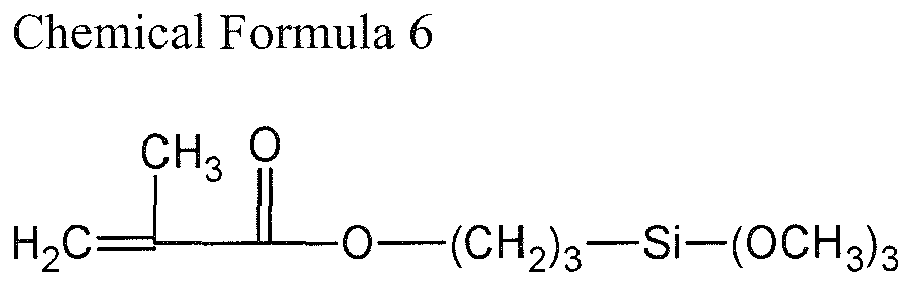
- According to the process, the silane coupling agent is hydrolyzed according to the following
Reaction scheme 1.
- SiOx (x=0.3) active material is added into the hydrolysis product and maintained at about 60□ for about 6 hours. The active material is added in about 9000 parts by weight based on 100 parts by weight of the silane coupling agent. Accordingly, it obtains the condensation product by the condensation reaction as shown in the following
Reaction scheme 2. In other words, "- OH groups" present on the surface of SiOx (x=0.3) active material and "H groups" of silane are condensed to remove water and form a bond. - In
Reaction scheme 2, the binding product of active material-silane is represented as a part,

- The trimethylolpropane triacrylate monomer represented by the following Chemical Formula 7, the urethane acrylate oligomer, and di-t-butyl peroxide initiator are mixed to provide a vehicle.
-

- Then, the obtained condensation product and the vehicle are mixed in a ratio of about 9 : 1 wt%.
- In the mixture, the silane coupling agent, the isopropyl alcohol, the monomer, the oligomer, and the active material are included as shown in the following Table 1. In addition, the initiator may be included in about 3 parts by weight based on the total 100 parts by weight of monomer and oligomer.
- The mixture is coated on an Al current collector to provide a coating layer.
- The Al current collector formed with the coating layer is thermally cured at about 200°C for about 1 hour. It is polymerized according to the thermal curing process to react silane coupling agent bonded with the active material, with the monomer and the oligomer, and the monomer and the oligomer are cross-linked with each other to provide a polymer. Then the heated Al current collector is heated at about 80°C for about three hours under the vacuum to remove moisture of electrode plate.
- As a result, it provides a negative electrode including Al current collector formed with the negative active material layer including negative active material that the polymer prepared by polymerizing the monomer and the oligomer is bonded with SiOx (x=0.3) active material through the silane coupling agent.
- Example 2
- A negative electrode is prepared by the same procedure as in Example 1, except the silane coupling agent, isopropyl alcohol, monomer, oligomer, and active material are included as shown in the following Table 1 in the mixture of the condensation product and the vehicle. The initiator is added in as much as about 3 parts by weight based on the total 100 parts by weight of monomer and oligomer.
- Example 3
- A negative electrode is prepared by the same procedure as in Example 1, except the silane coupling agent, isopropyl alcohol, monomer, oligomer, and active material are included as shown in the following Table 1 in the mixture of the condensation product and the vehicle. In addition, the initiator is added in as much as about 3 parts by weight based on the total 100 parts by weight of monomer and oligomer.
- Comparative Example 1
- A negative electrode is prepared by the same procedure as in Example 1, except silane coupling agent, isopropyl alcohol, monomer, oligomer, and active material are included as shown in the following Table 1 in the mixture of the condensation product and the vehicle. In addition, the initiator is added in as much as about 3 parts by weight based on the total 100 parts by weight of monomer and oligomer.
-
Table 1 Monomer (wt%) Oligomer (wt%) Silane coupling agent (wt%) Active material (wt%) Isopropyl alcohol (wt%) Comparative Example 1 1.50 3.50 0.00 45.00 50.00 Example 1 1.35 3.15 0.50 45.00 50.00 Example 2 1.20 2.80 1.00 45.00 50.00 Example 3 1.05 2.45 1.50 45.00 50.00 - Using each negative electrode obtained by Examples 1 to 3 and Comparative Example 1, a counter electrode of lithium metal, and an electrolyte solution that 1M of LiPF6 is dissolved in a mixed solvent (5:55:40 volume ratio) of ethylene carbonate/diethyl carbonate, fluoroethylene carbonate, a coin-type half-cell is manufactured.
- The half-cell is charged and discharged for 50 cycles under the conditions of constant current /constant voltage charge at 0.5C and constant current discharge at 0.5C to measure the discharge capacity.
-
FIG. 2 shows the discharge capacity retention (cycle-life characteristic) of Examples 2 and 3 and Comparative Example 1. As shown inFIG. 2 , it is understood that the capacity retentions of Examples 2 to 3 are superior to that of Comparative Example 1. - While this invention has been described in connection with what is presently considered to be practical exemplary embodiments, it is to be understood that the invention is not limited to the disclosed embodiments, but, on the contrary, is intended to cover various modifications and equivalent arrangements included within the scope of the appended claims.
Claims (15)
- A negative active material for a rechargeable lithium battery, represented by the following Chemical Formula 1:
Chemical Formula 1 X-Ra-Rb
wherein,
X is an active material which comprises a metal and whose functional group has been reacted with a silane coupling agent,
Ra is a residual group from a silane coupling agent, and Rb is a polymer including a first repeating unit represented by the following Chemical Formula 2a,
R10 to R13 are the same or different, and are hydrogen; or a substituted or unsubstituted C1 to C5 alkyl group, n1 is an integer ranging from 1 to 100000, and * is a chemical bond. - The negative active material for a rechargeable lithium battery of claim 1, wherein the substituted C1 to C5 alkyl group is a group in which at least one hydrogen is substituted with an amino group, an acryl group, a vinyl group, an epoxy group, or a phenyl group.
- The negative active material for a rechargeable lithium battery of claim 1 or 2, wherein the residual group from a silane coupling agent, Ra is represented by the following Chemical Formula 3:

R1, R2 and R3 are the same or different, and are hydrogen; or a substituted or unsubstituted C1 to C5 alkyl group,
R4is a carboxyl group, an amino group, an acryl group, a vinyl group, an epoxy group, or a phenyl group,
R5 is a substituted or unsubstituted C1 to C5 alkylene group,
Y is a silane functional group, and
* is a chemical bond. - The negative active material for a rechargeable lithium battery of claim 1, 2 or 3 wherein the polymer Rb further comprises a second repeating unit of the following Chemical Formula 2b:

R20 to R22 are the same or different, and are hydrogen or a substituted or unsubstituted C 1 to C5 alkyl group, and
* is a chemical bond. - The negative active material for a rechargeable lithium battery of claim 4, wherein the substituted C1 to C5 alkyl group is a group in which at least one hydrogen is substituted with an amino group, an acryl group, a vinyl group, an epoxy group or a phenyl group.
- The negative active material for a rechargeable lithium battery of claim 4 or 5, wherein the mole ratio of the first repeating unit to the second repeating unit is about 0.9 : 0.1 to 0.1 : 0.9.
- The negative active material for a rechargeable lithium battery of anyone of claims 1 to 6, wherein the active material comprises:Si,SiOx (0 < x < 2),a Si-Q alloy, wherein Q is an element selected from the group consisting of an alkali metal, an alkaline-earth metal, a Group 13 element, a Group 14 element, a Group 15 element, a Group 16 element, a transition element, a rare earth element, and combinations thereof, but is not Si,Sn,SnO2,a Sn-R alloy wherein R is an element selected from the group consisting of an alkali metal, an alkaline-earth metal, a Group 13 element, a Group 14 element, a Group 15 element, a Group 16 element, a transition element, a rare earth element, and combinations thereof, but is not Sn,or combinations thereof.
- A method of making a negative electrode for a rechargeable lithium battery, comprising:mixing a silane coupling agent, a solvent, and water to produce a hydrolysis product;adding an active material comprising a metal to the hydrolysis product to effect a condensation reaction and to produce a condensation product;adding a monomer, an oligomer, , and an initiator to the condensation product to produce a mixture;coating the mixture on a current collector; andpolymerizing the mixture on the current collector.
- The method of making a negative electrode for a rechargeable lithium battery of claim 8, wherein the active material comprises:Si,SiOx (0 < x < 2),a Si-Q alloy wherein Q is an element selected from the group consisting of an alkali metal, an alkaline-earth metal, a Group 13 element, a Group 14 element, a Group 15 element, a Group 16 element, a transition element, a rare earth element, and combinations thereof, but is not Si,Sn,SnO2,Sn-R wherein R is an element selected from the group consisting of an alkali metal, an alkaline-earth metal, a Group 13 element, a Group 14 element, a Group 15 element, a Group 16 element, a transition element, a rare earth element, and combinations thereof, but is not Sn,or combinations thereof.
- The method of making a negative electrode for a rechargeable lithium battery of claim 8 or 9, wherein the silane coupling agent comprises 3-methoxysilylpropyl methacrylate, 3-(trimethoxysilyl)propyl methacrylate, 3-ethoxysilylpropyl methacrylate, 3-methoxysilylpropyl acrylate, 3-ethoxysilylpropyl acrylate, 3-methoxysilylbutyl methacrylate, 3-ethoxysilylbutyl methacrylate, 3-methoxysilylbutyl acrylate, 3-ethoxysilylbutyl acrylate, 3-methoxysilylpentyl methacrylate, 3-ethoxysilylpentyl methacrylate, 3-methoxysilylpentyl acrylate, 3-ethoxysilylpentyl acrylate, 3-methoxysilylhexyl methacrylate, 3-ethoxysilylhexyl methacrylate, 3-methoxysilylhexyl acrylate, 3-ethoxysilylhexyl acrylate, 3-methoxysilylheptyl methacrylate, 3-ethoxysilylheptyl methacrylate, 3-methoxysilylheptyl acrylate, 3-ethoxysilylheptyl acrylate, 3-methoxysilyloctyl methacrylate, 3-ethoxysilyloctyl methacrylate, 3-methoxysilyloctyl acrylate, 3-ethoxysilyloctyl acrylate, 3-methoxysilylnonyl methacrylate, 3-ethoxysilylnonyl methacrylate, 3-methoxysilylnonyl acrylate, or 3-ethoxysilylnonyl acrylate, or combinations thereof.
- The method of making a negative electrode for a rechargeable lithium battery of claim 8, 9 or 10, wherein the monomer and the oligomer each comprise at least one of an amino group, an acryl group, a vinyl group, an epoxy group, or a phenyl group.
- The method of making a negative electrode for a rechargeable lithium battery of anyone of claims 8 to 12, wherein the active material is included at about 3000 to about 9000 parts by weight based on 100 parts by weight of the silane coupling agent.
- The method of making a negative electrode for a rechargeable lithium battery of anyone of claims 8 to 12, wherein the monomer and the oligomer are added in a weight ratio of about 1 : 9 to about 9 : 1.
- The method of making a negative electrode for a rechargeable lithium battery of anyone of claims 8 to 13, wherein the polymerization reaction is performed according to photo-curing or thermal curing process.
- A rechargeable lithium battery comprising:a negative electrode comprising a negative active material layer including a negative active material as defined in anyone of claims 1 to 7;a positive electrode comprising a positive active material; anda non-aqueous electrolyte.
Applications Claiming Priority (1)
| Application Number | Priority Date | Filing Date | Title |
|---|---|---|---|
| KR1020100118333A KR101135500B1 (en) | 2010-11-25 | 2010-11-25 | Negative electrode for rechargeable lithium battery, method of producing same and rechargeable lithium battery including same |
Publications (2)
| Publication Number | Publication Date |
|---|---|
| EP2458661A1 true EP2458661A1 (en) | 2012-05-30 |
| EP2458661B1 EP2458661B1 (en) | 2015-08-05 |
Family
ID=45093475
Family Applications (1)
| Application Number | Title | Priority Date | Filing Date |
|---|---|---|---|
| EP11190646.7A Active EP2458661B1 (en) | 2010-11-25 | 2011-11-24 | Negative active material for rechargeable lithium battery, method of producing negative electrode and rechargeable lithium battery including the same |
Country Status (5)
| Country | Link |
|---|---|
| US (1) | US20120135307A1 (en) |
| EP (1) | EP2458661B1 (en) |
| JP (1) | JP5590740B2 (en) |
| KR (1) | KR101135500B1 (en) |
| CN (1) | CN102479954B (en) |
Families Citing this family (17)
| Publication number | Priority date | Publication date | Assignee | Title |
|---|---|---|---|---|
| CN103804599B (en) * | 2012-11-14 | 2019-05-03 | 三星电子株式会社 | Polymer, electrode for lithium battery containing the same, and lithium battery containing the same |
| KR20150088281A (en) * | 2012-11-19 | 2015-07-31 | 프라운호퍼 게젤샤프트 쭈르 푀르데룽 데어 안겐반텐 포르슝 에. 베. | Particulate electrode material having a coating made of a crystalline inorganic material and/or an inorganic-organic hybrid polymer and method for the production thereof |
| KR102124053B1 (en) * | 2013-09-17 | 2020-06-17 | 삼성전자주식회사 | Polymer, electrode for lithium battery including the same, and lithium battery including the electrode |
| PL3136483T3 (en) * | 2014-04-21 | 2018-12-31 | Fujifilm Wako Pure Chemical Corporation | Binder for lithium cell |
| US10003075B2 (en) | 2014-06-12 | 2018-06-19 | Council Of Scientific And Industrial Research | Carbon nanotube-metal nanocomposites as flexible, free standing, binder free high performance anode for Li-ion battery |
| KR20160061167A (en) * | 2014-11-21 | 2016-05-31 | 삼성에스디아이 주식회사 | Electrod coated with inorganic layer, manufacturing method thereof and rechargeable battery therewith |
| KR101551757B1 (en) | 2014-12-30 | 2015-09-10 | 삼성에스디아이 주식회사 | Composition for forming porous heat-resistance layer, separators comprising the porous heat-resistance layer, electrochemical battery using the separator, and method for preparing the separator |
| KR101618681B1 (en) | 2014-12-30 | 2016-05-11 | 삼성에스디아이 주식회사 | Composition for forming porous heat-resistance layer, separators comprising the porous heat-resistance layer, electrochemical battery using the separator, and method for preparing the separator |
| KR101709697B1 (en) | 2014-12-30 | 2017-02-23 | 삼성에스디아이 주식회사 | Separator for rechargeable lithium battery and rechargeable lithium battery including the same |
| CN104934606B (en) * | 2015-05-18 | 2018-05-22 | 宁德新能源科技有限公司 | A kind of silicon based composite material, its preparation method and application |
| KR20170047656A (en) | 2015-10-23 | 2017-05-08 | 삼성전자주식회사 | Nonaqueous electrolyte for lithium secondary battery and lithium secondary battery employing the same |
| KR20170047659A (en) | 2015-10-23 | 2017-05-08 | 삼성전자주식회사 | Nonaqueous electrolyte for lithium secondary battery and lithium secondary battery employing the same |
| KR102425829B1 (en) | 2015-10-23 | 2022-07-28 | 삼성전자주식회사 | Nonaqueous electrolyte for lithium secondary battery and lithium secondary battery employing the same |
| KR102490866B1 (en) | 2015-10-23 | 2023-01-20 | 삼성전자주식회사 | Nonaqueous electrolyte for lithium secondary battery and lithium secondary battery employing the same |
| KR102798539B1 (en) * | 2019-03-12 | 2025-04-18 | 삼성전자주식회사 | Surface coating material and film and stacked structure and display device and article |
| JP2022034555A (en) * | 2020-08-18 | 2022-03-03 | 財團法人工業技術研究院 | Negative electrode active material, negative electrode and battery |
| CN112968147B (en) * | 2021-02-02 | 2022-06-21 | 同济大学 | Composite coating, preparation method and application thereof, composite lithium negative electrode and preparation method |
Citations (3)
| Publication number | Priority date | Publication date | Assignee | Title |
|---|---|---|---|---|
| JP2001216961A (en) * | 2000-02-04 | 2001-08-10 | Shin Etsu Chem Co Ltd | Silicon oxide for lithium ion secondary battery and lithium ion secondary battery |
| US20060147797A1 (en) * | 2004-12-31 | 2006-07-06 | Industrial Technology Research Institute | Anode materials of lithium secondary battery and method of fabricating the same |
| WO2010123269A2 (en) * | 2009-04-21 | 2010-10-28 | 주식회사 엘지화학 | Additive to be added to an electrochemical device to improve safety |
Family Cites Families (9)
| Publication number | Priority date | Publication date | Assignee | Title |
|---|---|---|---|---|
| KR100409160B1 (en) | 1995-12-29 | 2004-03-18 | 고려화학 주식회사 | Non-metallic surface coating agent composition |
| JPH09237625A (en) * | 1996-02-27 | 1997-09-09 | Dainippon Printing Co Ltd | Electrode plate for non-aqueous electrolyte secondary battery and method for producing the same |
| JP4025995B2 (en) * | 2002-11-26 | 2007-12-26 | 信越化学工業株式会社 | Nonaqueous electrolyte secondary battery negative electrode material, method for producing the same, and lithium ion secondary battery |
| JP2006196338A (en) * | 2005-01-14 | 2006-07-27 | Matsushita Electric Ind Co Ltd | Nonaqueous electrolyte secondary battery |
| CN101243566B (en) * | 2005-09-06 | 2010-05-19 | Lg化学株式会社 | Composite binder containing carbon nanotubes and lithium secondary battery using same |
| KR100800970B1 (en) * | 2006-01-18 | 2008-02-11 | 주식회사 엘지화학 | Binder of Polyvinyl Alcohol Crosslinked with Polyurethane and Lithium Secondary Battery Employed with the Same |
| KR100741698B1 (en) | 2006-02-28 | 2007-07-23 | 한국생산기술연구원 | Modified airgel, coatings comprising the same, and transparent insulation prepared therefrom |
| CN104409710A (en) * | 2009-01-06 | 2015-03-11 | 株式会社Lg化学 | Cathode active material for lithium secondary battery |
| JP5678419B2 (en) * | 2009-08-27 | 2015-03-04 | 日産自動車株式会社 | Battery electrode and manufacturing method thereof |
-
2010
- 2010-11-25 KR KR1020100118333A patent/KR101135500B1/en not_active Expired - Fee Related
-
2011
- 2011-08-04 US US13/198,577 patent/US20120135307A1/en not_active Abandoned
- 2011-09-30 JP JP2011216804A patent/JP5590740B2/en active Active
- 2011-11-23 CN CN201110375246.3A patent/CN102479954B/en active Active
- 2011-11-24 EP EP11190646.7A patent/EP2458661B1/en active Active
Patent Citations (3)
| Publication number | Priority date | Publication date | Assignee | Title |
|---|---|---|---|---|
| JP2001216961A (en) * | 2000-02-04 | 2001-08-10 | Shin Etsu Chem Co Ltd | Silicon oxide for lithium ion secondary battery and lithium ion secondary battery |
| US20060147797A1 (en) * | 2004-12-31 | 2006-07-06 | Industrial Technology Research Institute | Anode materials of lithium secondary battery and method of fabricating the same |
| WO2010123269A2 (en) * | 2009-04-21 | 2010-10-28 | 주식회사 엘지화학 | Additive to be added to an electrochemical device to improve safety |
Also Published As
| Publication number | Publication date |
|---|---|
| KR101135500B1 (en) | 2012-04-13 |
| JP5590740B2 (en) | 2014-09-17 |
| CN102479954A (en) | 2012-05-30 |
| US20120135307A1 (en) | 2012-05-31 |
| JP2012114080A (en) | 2012-06-14 |
| CN102479954B (en) | 2016-08-03 |
| EP2458661B1 (en) | 2015-08-05 |
Similar Documents
| Publication | Publication Date | Title |
|---|---|---|
| EP2458661B1 (en) | Negative active material for rechargeable lithium battery, method of producing negative electrode and rechargeable lithium battery including the same | |
| US9853291B2 (en) | Negative electrode for rechargeable lithium battery, method of preparing same and rechargeable lithium battery including same | |
| US9853320B2 (en) | Positive active material for rechargeable lithium battery and rechargeable lithium battery including same | |
| US9130246B2 (en) | Rechargeable lithium battery having lithium difluorophosphate and a sultone-based compound | |
| EP2712017B1 (en) | Electrolyte for rechargeable lithium battery and rechargeable lithium battery including same | |
| CN116154158A (en) | Negative electrode active material for rechargeable lithium battery and rechargeable lithium battery | |
| US20110318645A1 (en) | Gel electrolyte including additives for rechargeable lithium battery, and rechargeable lithium battery including same | |
| US9893358B2 (en) | Binder composition for rechargeable lithium battery, method of preparing the same, and rechargeable lithium battery including the same | |
| KR102272820B1 (en) | Negative electrode for rechargeable lithium battery and rechargeable lithium battery including the same | |
| KR102338842B1 (en) | Negative active material for rechargeable lithium battery and rechargeable lithium battery including same | |
| EP4220775A1 (en) | Negative electrode for rechargeable lithium battery and rechargeable lithium battery including same | |
| KR101233341B1 (en) | Negative active material for rechargeable lithium battery and rechargeable lithium battery | |
| CN111095656A (en) | Lithium secondary battery | |
| KR20140095810A (en) | Positive active material for lithium secondary battery and lithium secondary battery | |
| KR102209829B1 (en) | Additive for electrolyte of lithium battery, electrolyte including the same and lithium battery using the electrolyte | |
| US9012077B2 (en) | Positive electrode including a binder for rechargeable lithium battery and rechargeable lithium battery including the same | |
| US9005815B2 (en) | Negative active material for rechargeable lithium battery, method of preparing same, and rechargeable lithium battery | |
| KR20190122437A (en) | Negative electrode for rechargeable lithium battery, and rechargeable lithium battery including same | |
| KR101309161B1 (en) | Polymer composition for rechargeable lithium battery, method of preparing same and rechargeable lithium battery including same | |
| KR20210052006A (en) | Electrolyte for rechargeable lithium battery and rechargeable lithium battery | |
| EP4195316A1 (en) | Binder for negative electrode of rechargeable lithium battery and rechargeable lithium battery including same | |
| JP7699181B2 (en) | Method for producing carboxymethylcellulose lithium salt and lithium secondary battery containing the carboxymethylcellulose lithium salt produced by the method | |
| KR20220061721A (en) | Non-aqueous electrolyte for rechargebale lithium battery and rechargeable lithium battery comprising same | |
| US20130177819A1 (en) | Rechargeable lithium battery | |
| KR20210127482A (en) | Electrolyte for rechargeable lithium battery and rechargeable lithium battery comprising the same |
Legal Events
| Date | Code | Title | Description |
|---|---|---|---|
| PUAI | Public reference made under article 153(3) epc to a published international application that has entered the european phase |
Free format text: ORIGINAL CODE: 0009012 |
|
| AK | Designated contracting states |
Kind code of ref document: A1 Designated state(s): AL AT BE BG CH CY CZ DE DK EE ES FI FR GB GR HR HU IE IS IT LI LT LU LV MC MK MT NL NO PL PT RO RS SE SI SK SM TR |
|
| AX | Request for extension of the european patent |
Extension state: BA ME |
|
| 17P | Request for examination filed |
Effective date: 20121106 |
|
| 17Q | First examination report despatched |
Effective date: 20130918 |
|
| GRAP | Despatch of communication of intention to grant a patent |
Free format text: ORIGINAL CODE: EPIDOSNIGR1 |
|
| RIC1 | Information provided on ipc code assigned before grant |
Ipc: H01M 4/1395 20100101ALI20150211BHEP Ipc: H01M 4/36 20060101ALI20150211BHEP Ipc: H01M 4/1391 20100101ALI20150211BHEP Ipc: H01M 4/48 20100101ALI20150211BHEP Ipc: H01M 4/134 20100101ALI20150211BHEP Ipc: H01M 4/131 20100101ALI20150211BHEP Ipc: H01M 4/38 20060101AFI20150211BHEP |
|
| INTG | Intention to grant announced |
Effective date: 20150223 |
|
| GRAS | Grant fee paid |
Free format text: ORIGINAL CODE: EPIDOSNIGR3 |
|
| GRAA | (expected) grant |
Free format text: ORIGINAL CODE: 0009210 |
|
| AK | Designated contracting states |
Kind code of ref document: B1 Designated state(s): AL AT BE BG CH CY CZ DE DK EE ES FI FR GB GR HR HU IE IS IT LI LT LU LV MC MK MT NL NO PL PT RO RS SE SI SK SM TR |
|
| REG | Reference to a national code |
Ref country code: GB Ref legal event code: FG4D |
|
| REG | Reference to a national code |
Ref country code: CH Ref legal event code: EP |
|
| REG | Reference to a national code |
Ref country code: AT Ref legal event code: REF Ref document number: 741143 Country of ref document: AT Kind code of ref document: T Effective date: 20150815 |
|
| REG | Reference to a national code |
Ref country code: IE Ref legal event code: FG4D |
|
| REG | Reference to a national code |
Ref country code: DE Ref legal event code: R096 Ref document number: 602011018416 Country of ref document: DE |
|
| REG | Reference to a national code |
Ref country code: FR Ref legal event code: PLFP Year of fee payment: 5 |
|
| REG | Reference to a national code |
Ref country code: AT Ref legal event code: MK05 Ref document number: 741143 Country of ref document: AT Kind code of ref document: T Effective date: 20150805 |
|
| REG | Reference to a national code |
Ref country code: LT Ref legal event code: MG4D |
|
| REG | Reference to a national code |
Ref country code: NL Ref legal event code: MP Effective date: 20150805 |
|
| PG25 | Lapsed in a contracting state [announced via postgrant information from national office to epo] |
Ref country code: FI Free format text: LAPSE BECAUSE OF FAILURE TO SUBMIT A TRANSLATION OF THE DESCRIPTION OR TO PAY THE FEE WITHIN THE PRESCRIBED TIME-LIMIT Effective date: 20150805 Ref country code: GR Free format text: LAPSE BECAUSE OF FAILURE TO SUBMIT A TRANSLATION OF THE DESCRIPTION OR TO PAY THE FEE WITHIN THE PRESCRIBED TIME-LIMIT Effective date: 20151106 Ref country code: LV Free format text: LAPSE BECAUSE OF FAILURE TO SUBMIT A TRANSLATION OF THE DESCRIPTION OR TO PAY THE FEE WITHIN THE PRESCRIBED TIME-LIMIT Effective date: 20150805 Ref country code: LT Free format text: LAPSE BECAUSE OF FAILURE TO SUBMIT A TRANSLATION OF THE DESCRIPTION OR TO PAY THE FEE WITHIN THE PRESCRIBED TIME-LIMIT Effective date: 20150805 Ref country code: NO Free format text: LAPSE BECAUSE OF FAILURE TO SUBMIT A TRANSLATION OF THE DESCRIPTION OR TO PAY THE FEE WITHIN THE PRESCRIBED TIME-LIMIT Effective date: 20151105 |
|
| PG25 | Lapsed in a contracting state [announced via postgrant information from national office to epo] |
Ref country code: AT Free format text: LAPSE BECAUSE OF FAILURE TO SUBMIT A TRANSLATION OF THE DESCRIPTION OR TO PAY THE FEE WITHIN THE PRESCRIBED TIME-LIMIT Effective date: 20150805 Ref country code: ES Free format text: LAPSE BECAUSE OF FAILURE TO SUBMIT A TRANSLATION OF THE DESCRIPTION OR TO PAY THE FEE WITHIN THE PRESCRIBED TIME-LIMIT Effective date: 20150805 Ref country code: HR Free format text: LAPSE BECAUSE OF FAILURE TO SUBMIT A TRANSLATION OF THE DESCRIPTION OR TO PAY THE FEE WITHIN THE PRESCRIBED TIME-LIMIT Effective date: 20150805 Ref country code: SE Free format text: LAPSE BECAUSE OF FAILURE TO SUBMIT A TRANSLATION OF THE DESCRIPTION OR TO PAY THE FEE WITHIN THE PRESCRIBED TIME-LIMIT Effective date: 20150805 Ref country code: RS Free format text: LAPSE BECAUSE OF FAILURE TO SUBMIT A TRANSLATION OF THE DESCRIPTION OR TO PAY THE FEE WITHIN THE PRESCRIBED TIME-LIMIT Effective date: 20150805 Ref country code: IS Free format text: LAPSE BECAUSE OF FAILURE TO SUBMIT A TRANSLATION OF THE DESCRIPTION OR TO PAY THE FEE WITHIN THE PRESCRIBED TIME-LIMIT Effective date: 20151205 Ref country code: PL Free format text: LAPSE BECAUSE OF FAILURE TO SUBMIT A TRANSLATION OF THE DESCRIPTION OR TO PAY THE FEE WITHIN THE PRESCRIBED TIME-LIMIT Effective date: 20150805 Ref country code: PT Free format text: LAPSE BECAUSE OF FAILURE TO SUBMIT A TRANSLATION OF THE DESCRIPTION OR TO PAY THE FEE WITHIN THE PRESCRIBED TIME-LIMIT Effective date: 20151207 |
|
| PG25 | Lapsed in a contracting state [announced via postgrant information from national office to epo] |
Ref country code: NL Free format text: LAPSE BECAUSE OF FAILURE TO SUBMIT A TRANSLATION OF THE DESCRIPTION OR TO PAY THE FEE WITHIN THE PRESCRIBED TIME-LIMIT Effective date: 20150805 |
|
| PG25 | Lapsed in a contracting state [announced via postgrant information from national office to epo] |
Ref country code: EE Free format text: LAPSE BECAUSE OF FAILURE TO SUBMIT A TRANSLATION OF THE DESCRIPTION OR TO PAY THE FEE WITHIN THE PRESCRIBED TIME-LIMIT Effective date: 20150805 Ref country code: SK Free format text: LAPSE BECAUSE OF FAILURE TO SUBMIT A TRANSLATION OF THE DESCRIPTION OR TO PAY THE FEE WITHIN THE PRESCRIBED TIME-LIMIT Effective date: 20150805 Ref country code: CZ Free format text: LAPSE BECAUSE OF FAILURE TO SUBMIT A TRANSLATION OF THE DESCRIPTION OR TO PAY THE FEE WITHIN THE PRESCRIBED TIME-LIMIT Effective date: 20150805 Ref country code: IT Free format text: LAPSE BECAUSE OF FAILURE TO SUBMIT A TRANSLATION OF THE DESCRIPTION OR TO PAY THE FEE WITHIN THE PRESCRIBED TIME-LIMIT Effective date: 20150805 Ref country code: DK Free format text: LAPSE BECAUSE OF FAILURE TO SUBMIT A TRANSLATION OF THE DESCRIPTION OR TO PAY THE FEE WITHIN THE PRESCRIBED TIME-LIMIT Effective date: 20150805 |
|
| REG | Reference to a national code |
Ref country code: DE Ref legal event code: R097 Ref document number: 602011018416 Country of ref document: DE |
|
| PG25 | Lapsed in a contracting state [announced via postgrant information from national office to epo] |
Ref country code: RO Free format text: LAPSE BECAUSE OF FAILURE TO SUBMIT A TRANSLATION OF THE DESCRIPTION OR TO PAY THE FEE WITHIN THE PRESCRIBED TIME-LIMIT Effective date: 20150805 |
|
| PLBE | No opposition filed within time limit |
Free format text: ORIGINAL CODE: 0009261 |
|
| STAA | Information on the status of an ep patent application or granted ep patent |
Free format text: STATUS: NO OPPOSITION FILED WITHIN TIME LIMIT |
|
| PG25 | Lapsed in a contracting state [announced via postgrant information from national office to epo] |
Ref country code: MC Free format text: LAPSE BECAUSE OF FAILURE TO SUBMIT A TRANSLATION OF THE DESCRIPTION OR TO PAY THE FEE WITHIN THE PRESCRIBED TIME-LIMIT Effective date: 20150805 Ref country code: LU Free format text: LAPSE BECAUSE OF FAILURE TO SUBMIT A TRANSLATION OF THE DESCRIPTION OR TO PAY THE FEE WITHIN THE PRESCRIBED TIME-LIMIT Effective date: 20151124 |
|
| REG | Reference to a national code |
Ref country code: CH Ref legal event code: PL |
|
| 26N | No opposition filed |
Effective date: 20160509 |
|
| PG25 | Lapsed in a contracting state [announced via postgrant information from national office to epo] |
Ref country code: LI Free format text: LAPSE BECAUSE OF NON-PAYMENT OF DUE FEES Effective date: 20151130 Ref country code: CH Free format text: LAPSE BECAUSE OF NON-PAYMENT OF DUE FEES Effective date: 20151130 |
|
| REG | Reference to a national code |
Ref country code: IE Ref legal event code: MM4A |
|
| PG25 | Lapsed in a contracting state [announced via postgrant information from national office to epo] |
Ref country code: SI Free format text: LAPSE BECAUSE OF FAILURE TO SUBMIT A TRANSLATION OF THE DESCRIPTION OR TO PAY THE FEE WITHIN THE PRESCRIBED TIME-LIMIT Effective date: 20150805 |
|
| PG25 | Lapsed in a contracting state [announced via postgrant information from national office to epo] |
Ref country code: IE Free format text: LAPSE BECAUSE OF NON-PAYMENT OF DUE FEES Effective date: 20151124 |
|
| REG | Reference to a national code |
Ref country code: FR Ref legal event code: PLFP Year of fee payment: 6 |
|
| PG25 | Lapsed in a contracting state [announced via postgrant information from national office to epo] |
Ref country code: BE Free format text: LAPSE BECAUSE OF FAILURE TO SUBMIT A TRANSLATION OF THE DESCRIPTION OR TO PAY THE FEE WITHIN THE PRESCRIBED TIME-LIMIT Effective date: 20150805 |
|
| PG25 | Lapsed in a contracting state [announced via postgrant information from national office to epo] |
Ref country code: BG Free format text: LAPSE BECAUSE OF FAILURE TO SUBMIT A TRANSLATION OF THE DESCRIPTION OR TO PAY THE FEE WITHIN THE PRESCRIBED TIME-LIMIT Effective date: 20150805 Ref country code: SM Free format text: LAPSE BECAUSE OF FAILURE TO SUBMIT A TRANSLATION OF THE DESCRIPTION OR TO PAY THE FEE WITHIN THE PRESCRIBED TIME-LIMIT Effective date: 20150805 Ref country code: HU Free format text: LAPSE BECAUSE OF FAILURE TO SUBMIT A TRANSLATION OF THE DESCRIPTION OR TO PAY THE FEE WITHIN THE PRESCRIBED TIME-LIMIT; INVALID AB INITIO Effective date: 20111124 |
|
| PG25 | Lapsed in a contracting state [announced via postgrant information from national office to epo] |
Ref country code: CY Free format text: LAPSE BECAUSE OF FAILURE TO SUBMIT A TRANSLATION OF THE DESCRIPTION OR TO PAY THE FEE WITHIN THE PRESCRIBED TIME-LIMIT Effective date: 20150805 |
|
| PG25 | Lapsed in a contracting state [announced via postgrant information from national office to epo] |
Ref country code: TR Free format text: LAPSE BECAUSE OF FAILURE TO SUBMIT A TRANSLATION OF THE DESCRIPTION OR TO PAY THE FEE WITHIN THE PRESCRIBED TIME-LIMIT Effective date: 20150805 Ref country code: MT Free format text: LAPSE BECAUSE OF FAILURE TO SUBMIT A TRANSLATION OF THE DESCRIPTION OR TO PAY THE FEE WITHIN THE PRESCRIBED TIME-LIMIT Effective date: 20150805 |
|
| REG | Reference to a national code |
Ref country code: FR Ref legal event code: PLFP Year of fee payment: 7 |
|
| PG25 | Lapsed in a contracting state [announced via postgrant information from national office to epo] |
Ref country code: MK Free format text: LAPSE BECAUSE OF FAILURE TO SUBMIT A TRANSLATION OF THE DESCRIPTION OR TO PAY THE FEE WITHIN THE PRESCRIBED TIME-LIMIT Effective date: 20150805 |
|
| REG | Reference to a national code |
Ref country code: FR Ref legal event code: PLFP Year of fee payment: 8 |
|
| PG25 | Lapsed in a contracting state [announced via postgrant information from national office to epo] |
Ref country code: AL Free format text: LAPSE BECAUSE OF FAILURE TO SUBMIT A TRANSLATION OF THE DESCRIPTION OR TO PAY THE FEE WITHIN THE PRESCRIBED TIME-LIMIT Effective date: 20150805 |
|
| P01 | Opt-out of the competence of the unified patent court (upc) registered |
Effective date: 20230528 |
|
| PGFP | Annual fee paid to national office [announced via postgrant information from national office to epo] |
Ref country code: DE Payment date: 20241029 Year of fee payment: 14 |
|
| PGFP | Annual fee paid to national office [announced via postgrant information from national office to epo] |
Ref country code: GB Payment date: 20241024 Year of fee payment: 14 |
|
| PGFP | Annual fee paid to national office [announced via postgrant information from national office to epo] |
Ref country code: FR Payment date: 20241111 Year of fee payment: 14 |