EP2457878A1 - Anaerobic sludge treatment processes - Google Patents
Anaerobic sludge treatment processes Download PDFInfo
- Publication number
- EP2457878A1 EP2457878A1 EP20110190681 EP11190681A EP2457878A1 EP 2457878 A1 EP2457878 A1 EP 2457878A1 EP 20110190681 EP20110190681 EP 20110190681 EP 11190681 A EP11190681 A EP 11190681A EP 2457878 A1 EP2457878 A1 EP 2457878A1
- Authority
- EP
- European Patent Office
- Prior art keywords
- nitrate
- sludge
- anaerobic
- added
- waste water
- Prior art date
- Legal status (The legal status is an assumption and is not a legal conclusion. Google has not performed a legal analysis and makes no representation as to the accuracy of the status listed.)
- Granted
Links
- 238000000034 method Methods 0.000 title claims abstract description 99
- 230000008569 process Effects 0.000 title claims abstract description 85
- 239000010802 sludge Substances 0.000 title claims abstract description 71
- VNWKTOKETHGBQD-UHFFFAOYSA-N methane Chemical compound C VNWKTOKETHGBQD-UHFFFAOYSA-N 0.000 claims abstract description 92
- 229910002651 NO3 Inorganic materials 0.000 claims abstract description 76
- NHNBFGGVMKEFGY-UHFFFAOYSA-N Nitrate Chemical compound [O-][N+]([O-])=O NHNBFGGVMKEFGY-UHFFFAOYSA-N 0.000 claims abstract description 76
- 238000004519 manufacturing process Methods 0.000 claims abstract description 43
- 230000029087 digestion Effects 0.000 claims abstract description 34
- 239000002351 wastewater Substances 0.000 claims abstract description 27
- ZCCIPPOKBCJFDN-UHFFFAOYSA-N calcium nitrate Chemical compound [Ca+2].[O-][N+]([O-])=O.[O-][N+]([O-])=O ZCCIPPOKBCJFDN-UHFFFAOYSA-N 0.000 claims description 34
- 239000000243 solution Substances 0.000 claims description 24
- 238000004065 wastewater treatment Methods 0.000 claims description 20
- XTVVROIMIGLXTD-UHFFFAOYSA-N copper(II) nitrate Chemical compound [Cu+2].[O-][N+]([O-])=O.[O-][N+]([O-])=O XTVVROIMIGLXTD-UHFFFAOYSA-N 0.000 claims description 18
- 229910001959 inorganic nitrate Inorganic materials 0.000 claims description 16
- 150000002823 nitrates Chemical class 0.000 claims description 12
- IJGRMHOSHXDMSA-UHFFFAOYSA-N Atomic nitrogen Chemical compound N#N IJGRMHOSHXDMSA-UHFFFAOYSA-N 0.000 claims description 10
- 238000004364 calculation method Methods 0.000 claims description 8
- VWDWKYIASSYTQR-UHFFFAOYSA-N sodium nitrate Chemical compound [Na+].[O-][N+]([O-])=O VWDWKYIASSYTQR-UHFFFAOYSA-N 0.000 claims description 8
- YIXJRHPUWRPCBB-UHFFFAOYSA-N magnesium nitrate Chemical compound [Mg+2].[O-][N+]([O-])=O.[O-][N+]([O-])=O YIXJRHPUWRPCBB-UHFFFAOYSA-N 0.000 claims description 6
- FGIUAXJPYTZDNR-UHFFFAOYSA-N potassium nitrate Chemical compound [K+].[O-][N+]([O-])=O FGIUAXJPYTZDNR-UHFFFAOYSA-N 0.000 claims description 6
- 229910052757 nitrogen Inorganic materials 0.000 claims description 5
- 239000000463 material Substances 0.000 claims description 4
- 239000004317 sodium nitrate Substances 0.000 claims description 4
- 235000010344 sodium nitrate Nutrition 0.000 claims description 4
- 238000012544 monitoring process Methods 0.000 claims description 3
- 239000004323 potassium nitrate Substances 0.000 claims description 3
- 235000010333 potassium nitrate Nutrition 0.000 claims description 3
- 239000000654 additive Substances 0.000 claims description 2
- 230000000996 additive effect Effects 0.000 claims description 2
- 230000009977 dual effect Effects 0.000 claims description 2
- 238000002360 preparation method Methods 0.000 claims description 2
- 239000012266 salt solution Substances 0.000 claims description 2
- 230000001965 increasing effect Effects 0.000 abstract description 11
- 239000005416 organic matter Substances 0.000 abstract description 8
- 230000000638 stimulation Effects 0.000 abstract description 2
- QVGXLLKOCUKJST-UHFFFAOYSA-N atomic oxygen Chemical compound [O] QVGXLLKOCUKJST-UHFFFAOYSA-N 0.000 description 23
- 239000001301 oxygen Substances 0.000 description 23
- 229910052760 oxygen Inorganic materials 0.000 description 23
- CURLTUGMZLYLDI-UHFFFAOYSA-N Carbon dioxide Chemical compound O=C=O CURLTUGMZLYLDI-UHFFFAOYSA-N 0.000 description 14
- XLYOFNOQVPJJNP-UHFFFAOYSA-N water Substances O XLYOFNOQVPJJNP-UHFFFAOYSA-N 0.000 description 13
- 239000001569 carbon dioxide Substances 0.000 description 12
- 229910002092 carbon dioxide Inorganic materials 0.000 description 12
- OKTJSMMVPCPJKN-UHFFFAOYSA-N Carbon Chemical compound [C] OKTJSMMVPCPJKN-UHFFFAOYSA-N 0.000 description 11
- 229910052799 carbon Inorganic materials 0.000 description 11
- 239000000126 substance Substances 0.000 description 10
- 239000000370 acceptor Substances 0.000 description 9
- 230000000694 effects Effects 0.000 description 9
- 239000007789 gas Substances 0.000 description 9
- 238000006731 degradation reaction Methods 0.000 description 8
- 238000005259 measurement Methods 0.000 description 8
- RWSOTUBLDIXVET-UHFFFAOYSA-N Dihydrogen sulfide Chemical compound S RWSOTUBLDIXVET-UHFFFAOYSA-N 0.000 description 7
- 238000006243 chemical reaction Methods 0.000 description 7
- 230000007062 hydrolysis Effects 0.000 description 7
- 238000006460 hydrolysis reaction Methods 0.000 description 7
- 230000003647 oxidation Effects 0.000 description 7
- 238000007254 oxidation reaction Methods 0.000 description 7
- QTBSBXVTEAMEQO-UHFFFAOYSA-N Acetic acid Chemical compound CC(O)=O QTBSBXVTEAMEQO-UHFFFAOYSA-N 0.000 description 6
- 241000196324 Embryophyta Species 0.000 description 6
- 210000003608 fece Anatomy 0.000 description 6
- QTBSBXVTEAMEQO-UHFFFAOYSA-M Acetate Chemical compound CC([O-])=O QTBSBXVTEAMEQO-UHFFFAOYSA-M 0.000 description 5
- 241000894006 Bacteria Species 0.000 description 5
- 238000005273 aeration Methods 0.000 description 5
- 230000015556 catabolic process Effects 0.000 description 5
- 238000005516 engineering process Methods 0.000 description 5
- 238000006213 oxygenation reaction Methods 0.000 description 5
- 239000000047 product Substances 0.000 description 5
- 239000002028 Biomass Substances 0.000 description 4
- 230000015572 biosynthetic process Effects 0.000 description 4
- 238000000855 fermentation Methods 0.000 description 4
- 230000004151 fermentation Effects 0.000 description 4
- 239000003337 fertilizer Substances 0.000 description 4
- 239000001257 hydrogen Substances 0.000 description 4
- 229910052739 hydrogen Inorganic materials 0.000 description 4
- 239000010815 organic waste Substances 0.000 description 4
- 239000002689 soil Substances 0.000 description 4
- 238000010561 standard procedure Methods 0.000 description 4
- 239000002699 waste material Substances 0.000 description 4
- LKDRXBCSQODPBY-VRPWFDPXSA-N D-fructopyranose Chemical compound OCC1(O)OC[C@@H](O)[C@@H](O)[C@@H]1O LKDRXBCSQODPBY-VRPWFDPXSA-N 0.000 description 3
- XBDQKXXYIPTUBI-UHFFFAOYSA-M Propionate Chemical compound CCC([O-])=O XBDQKXXYIPTUBI-UHFFFAOYSA-M 0.000 description 3
- QAOWNCQODCNURD-UHFFFAOYSA-N Sulfuric acid Chemical compound OS(O)(=O)=O QAOWNCQODCNURD-UHFFFAOYSA-N 0.000 description 3
- 150000001875 compounds Chemical class 0.000 description 3
- 238000002474 experimental method Methods 0.000 description 3
- 150000002431 hydrogen Chemical class 0.000 description 3
- 239000010871 livestock manure Substances 0.000 description 3
- 239000000203 mixture Substances 0.000 description 3
- 150000002894 organic compounds Chemical class 0.000 description 3
- 239000011368 organic material Substances 0.000 description 3
- 230000001590 oxidative effect Effects 0.000 description 3
- FERIUCNNQQJTOY-UHFFFAOYSA-M Butyrate Chemical compound CCCC([O-])=O FERIUCNNQQJTOY-UHFFFAOYSA-M 0.000 description 2
- FERIUCNNQQJTOY-UHFFFAOYSA-N Butyric acid Natural products CCCC(O)=O FERIUCNNQQJTOY-UHFFFAOYSA-N 0.000 description 2
- 241001465754 Metazoa Species 0.000 description 2
- GRYLNZFGIOXLOG-UHFFFAOYSA-N Nitric acid Chemical compound O[N+]([O-])=O GRYLNZFGIOXLOG-UHFFFAOYSA-N 0.000 description 2
- 229920002472 Starch Polymers 0.000 description 2
- UCKMPCXJQFINFW-UHFFFAOYSA-N Sulphide Chemical compound [S-2] UCKMPCXJQFINFW-UHFFFAOYSA-N 0.000 description 2
- 239000010828 animal waste Substances 0.000 description 2
- 150000001722 carbon compounds Chemical class 0.000 description 2
- 238000003889 chemical engineering Methods 0.000 description 2
- 230000001186 cumulative effect Effects 0.000 description 2
- 238000010586 diagram Methods 0.000 description 2
- XBDQKXXYIPTUBI-UHFFFAOYSA-N dimethylselenoniopropionate Natural products CCC(O)=O XBDQKXXYIPTUBI-UHFFFAOYSA-N 0.000 description 2
- 230000007613 environmental effect Effects 0.000 description 2
- 235000013305 food Nutrition 0.000 description 2
- 230000014509 gene expression Effects 0.000 description 2
- 230000005764 inhibitory process Effects 0.000 description 2
- 238000002347 injection Methods 0.000 description 2
- 239000007924 injection Substances 0.000 description 2
- 239000002054 inoculum Substances 0.000 description 2
- 239000000543 intermediate Substances 0.000 description 2
- 239000007788 liquid Substances 0.000 description 2
- 239000012528 membrane Substances 0.000 description 2
- 230000000696 methanogenic effect Effects 0.000 description 2
- 244000005700 microbiome Species 0.000 description 2
- 229910017604 nitric acid Inorganic materials 0.000 description 2
- QJGQUHMNIGDVPM-UHFFFAOYSA-N nitrogen group Chemical group [N] QJGQUHMNIGDVPM-UHFFFAOYSA-N 0.000 description 2
- 239000007800 oxidant agent Substances 0.000 description 2
- KMUONIBRACKNSN-UHFFFAOYSA-N potassium dichromate Chemical compound [K+].[K+].[O-][Cr](=O)(=O)O[Cr]([O-])(=O)=O KMUONIBRACKNSN-UHFFFAOYSA-N 0.000 description 2
- 230000005180 public health Effects 0.000 description 2
- 230000009467 reduction Effects 0.000 description 2
- 238000010992 reflux Methods 0.000 description 2
- 238000011160 research Methods 0.000 description 2
- 239000010865 sewage Substances 0.000 description 2
- 239000007787 solid Substances 0.000 description 2
- 235000019698 starch Nutrition 0.000 description 2
- 239000008107 starch Substances 0.000 description 2
- 230000001629 suppression Effects 0.000 description 2
- 238000012360 testing method Methods 0.000 description 2
- RYGMFSIKBFXOCR-UHFFFAOYSA-N Copper Chemical compound [Cu] RYGMFSIKBFXOCR-UHFFFAOYSA-N 0.000 description 1
- 108090000790 Enzymes Proteins 0.000 description 1
- 102000004190 Enzymes Human genes 0.000 description 1
- WQZGKKKJIJFFOK-GASJEMHNSA-N Glucose Natural products OC[C@H]1OC(O)[C@H](O)[C@@H](O)[C@@H]1O WQZGKKKJIJFFOK-GASJEMHNSA-N 0.000 description 1
- UFHFLCQGNIYNRP-UHFFFAOYSA-N Hydrogen Chemical compound [H][H] UFHFLCQGNIYNRP-UHFFFAOYSA-N 0.000 description 1
- 239000007836 KH2PO4 Substances 0.000 description 1
- 238000012773 Laboratory assay Methods 0.000 description 1
- 241000202972 Methanobacterium bryantii Species 0.000 description 1
- 241000205275 Methanosarcina barkeri Species 0.000 description 1
- 101150042248 Mgmt gene Proteins 0.000 description 1
- IOVCWXUNBOPUCH-UHFFFAOYSA-M Nitrite anion Chemical compound [O-]N=O IOVCWXUNBOPUCH-UHFFFAOYSA-M 0.000 description 1
- 240000007594 Oryza sativa Species 0.000 description 1
- 235000007164 Oryza sativa Nutrition 0.000 description 1
- 239000001888 Peptone Substances 0.000 description 1
- 108010080698 Peptones Proteins 0.000 description 1
- 150000001413 amino acids Chemical class 0.000 description 1
- 239000007864 aqueous solution Substances 0.000 description 1
- 238000003556 assay Methods 0.000 description 1
- 238000010923 batch production Methods 0.000 description 1
- 230000003851 biochemical process Effects 0.000 description 1
- 230000031018 biological processes and functions Effects 0.000 description 1
- 230000033558 biomineral tissue development Effects 0.000 description 1
- 239000006227 byproduct Substances 0.000 description 1
- 229940041514 candida albicans extract Drugs 0.000 description 1
- 239000007795 chemical reaction product Substances 0.000 description 1
- 238000003501 co-culture Methods 0.000 description 1
- 238000009264 composting Methods 0.000 description 1
- 238000004590 computer program Methods 0.000 description 1
- 238000011109 contamination Methods 0.000 description 1
- 238000010924 continuous production Methods 0.000 description 1
- 229910052802 copper Inorganic materials 0.000 description 1
- 239000010949 copper Substances 0.000 description 1
- 238000000354 decomposition reaction Methods 0.000 description 1
- 239000007857 degradation product Substances 0.000 description 1
- 238000011161 development Methods 0.000 description 1
- 230000018109 developmental process Effects 0.000 description 1
- SOCTUWSJJQCPFX-UHFFFAOYSA-N dichromate(2-) Chemical compound [O-][Cr](=O)(=O)O[Cr]([O-])(=O)=O SOCTUWSJJQCPFX-UHFFFAOYSA-N 0.000 description 1
- 235000014113 dietary fatty acids Nutrition 0.000 description 1
- 238000009792 diffusion process Methods 0.000 description 1
- ZPWVASYFFYYZEW-UHFFFAOYSA-L dipotassium hydrogen phosphate Chemical compound [K+].[K+].OP([O-])([O-])=O ZPWVASYFFYYZEW-UHFFFAOYSA-L 0.000 description 1
- 229910000396 dipotassium phosphate Inorganic materials 0.000 description 1
- 230000002708 enhancing effect Effects 0.000 description 1
- 239000002360 explosive Substances 0.000 description 1
- 239000003925 fat Substances 0.000 description 1
- 229930195729 fatty acid Natural products 0.000 description 1
- 239000000194 fatty acid Substances 0.000 description 1
- 150000004665 fatty acids Chemical class 0.000 description 1
- 239000010794 food waste Substances 0.000 description 1
- 230000006870 function Effects 0.000 description 1
- 239000008103 glucose Substances 0.000 description 1
- 150000004676 glycans Chemical class 0.000 description 1
- 230000036541 health Effects 0.000 description 1
- 229910001385 heavy metal Inorganic materials 0.000 description 1
- 239000004615 ingredient Substances 0.000 description 1
- 230000002401 inhibitory effect Effects 0.000 description 1
- 238000010169 landfilling Methods 0.000 description 1
- 150000002632 lipids Chemical class 0.000 description 1
- 244000144972 livestock Species 0.000 description 1
- 230000007246 mechanism Effects 0.000 description 1
- 230000001404 mediated effect Effects 0.000 description 1
- 230000000813 microbial effect Effects 0.000 description 1
- 238000002156 mixing Methods 0.000 description 1
- 239000000178 monomer Substances 0.000 description 1
- 229910000402 monopotassium phosphate Inorganic materials 0.000 description 1
- 150000002772 monosaccharides Chemical class 0.000 description 1
- 239000010813 municipal solid waste Substances 0.000 description 1
- 239000010841 municipal wastewater Substances 0.000 description 1
- 150000007523 nucleic acids Chemical class 0.000 description 1
- 102000039446 nucleic acids Human genes 0.000 description 1
- 108020004707 nucleic acids Proteins 0.000 description 1
- 235000015097 nutrients Nutrition 0.000 description 1
- 150000007524 organic acids Chemical class 0.000 description 1
- 235000005985 organic acids Nutrition 0.000 description 1
- 230000001151 other effect Effects 0.000 description 1
- 239000011236 particulate material Substances 0.000 description 1
- 235000019319 peptone Nutrition 0.000 description 1
- 229920001282 polysaccharide Polymers 0.000 description 1
- 239000005017 polysaccharide Substances 0.000 description 1
- 230000008092 positive effect Effects 0.000 description 1
- GNSKLFRGEWLPPA-UHFFFAOYSA-M potassium dihydrogen phosphate Chemical compound [K+].OP(O)([O-])=O GNSKLFRGEWLPPA-UHFFFAOYSA-M 0.000 description 1
- 239000002243 precursor Substances 0.000 description 1
- 230000002265 prevention Effects 0.000 description 1
- 238000004886 process control Methods 0.000 description 1
- 238000012545 processing Methods 0.000 description 1
- 235000019260 propionic acid Nutrition 0.000 description 1
- 108090000623 proteins and genes Proteins 0.000 description 1
- 102000004169 proteins and genes Human genes 0.000 description 1
- IUVKMZGDUIUOCP-BTNSXGMBSA-N quinbolone Chemical compound O([C@H]1CC[C@H]2[C@H]3[C@@H]([C@]4(C=CC(=O)C=C4CC3)C)CC[C@@]21C)C1=CCCC1 IUVKMZGDUIUOCP-BTNSXGMBSA-N 0.000 description 1
- 238000011084 recovery Methods 0.000 description 1
- 230000001105 regulatory effect Effects 0.000 description 1
- 238000012552 review Methods 0.000 description 1
- 235000009566 rice Nutrition 0.000 description 1
- 230000000630 rising effect Effects 0.000 description 1
- 239000010801 sewage sludge Substances 0.000 description 1
- 239000002002 slurry Substances 0.000 description 1
- 239000003516 soil conditioner Substances 0.000 description 1
- 241000894007 species Species 0.000 description 1
- 239000000758 substrate Substances 0.000 description 1
- 235000000346 sugar Nutrition 0.000 description 1
- 150000008163 sugars Chemical class 0.000 description 1
- 230000019086 sulfide ion homeostasis Effects 0.000 description 1
- 239000008399 tap water Substances 0.000 description 1
- 235000020679 tap water Nutrition 0.000 description 1
- 238000012546 transfer Methods 0.000 description 1
- 230000009466 transformation Effects 0.000 description 1
- 230000001131 transforming effect Effects 0.000 description 1
- 239000012138 yeast extract Substances 0.000 description 1
Images



Classifications
-
- C—CHEMISTRY; METALLURGY
- C02—TREATMENT OF WATER, WASTE WATER, SEWAGE, OR SLUDGE
- C02F—TREATMENT OF WATER, WASTE WATER, SEWAGE, OR SLUDGE
- C02F11/00—Treatment of sludge; Devices therefor
- C02F11/02—Biological treatment
- C02F11/04—Anaerobic treatment; Production of methane by such processes
-
- C—CHEMISTRY; METALLURGY
- C02—TREATMENT OF WATER, WASTE WATER, SEWAGE, OR SLUDGE
- C02F—TREATMENT OF WATER, WASTE WATER, SEWAGE, OR SLUDGE
- C02F3/00—Biological treatment of water, waste water, or sewage
- C02F3/28—Anaerobic digestion processes
-
- Y—GENERAL TAGGING OF NEW TECHNOLOGICAL DEVELOPMENTS; GENERAL TAGGING OF CROSS-SECTIONAL TECHNOLOGIES SPANNING OVER SEVERAL SECTIONS OF THE IPC; TECHNICAL SUBJECTS COVERED BY FORMER USPC CROSS-REFERENCE ART COLLECTIONS [XRACs] AND DIGESTS
- Y02—TECHNOLOGIES OR APPLICATIONS FOR MITIGATION OR ADAPTATION AGAINST CLIMATE CHANGE
- Y02E—REDUCTION OF GREENHOUSE GAS [GHG] EMISSIONS, RELATED TO ENERGY GENERATION, TRANSMISSION OR DISTRIBUTION
- Y02E50/00—Technologies for the production of fuel of non-fossil origin
- Y02E50/30—Fuel from waste, e.g. synthetic alcohol or diesel
-
- Y—GENERAL TAGGING OF NEW TECHNOLOGICAL DEVELOPMENTS; GENERAL TAGGING OF CROSS-SECTIONAL TECHNOLOGIES SPANNING OVER SEVERAL SECTIONS OF THE IPC; TECHNICAL SUBJECTS COVERED BY FORMER USPC CROSS-REFERENCE ART COLLECTIONS [XRACs] AND DIGESTS
- Y02—TECHNOLOGIES OR APPLICATIONS FOR MITIGATION OR ADAPTATION AGAINST CLIMATE CHANGE
- Y02W—CLIMATE CHANGE MITIGATION TECHNOLOGIES RELATED TO WASTEWATER TREATMENT OR WASTE MANAGEMENT
- Y02W10/00—Technologies for wastewater treatment
- Y02W10/20—Sludge processing
Definitions
- the present invention relates to an anaerobic digestion process. More particularly, the present invention relates to the use of nitrate for stimulation of anaerobic digestion of organic matter, such as sludge from wastewater, resulting in increased methane production.
- Degradation and removal of organic matter through mineralization is a major purpose for waste water and sludge treatment, and a preferred solution is the conversion of the waste organics to renewable energy as methane.
- Anaerobic processes are commonly used to treat wastes with high concentrations of organic compounds. Instead of transforming ingredients to water (H 2 O) and carbon dioxide (CO 2 ), which is the aim of aerobic treatment processes, an anaerobic process delivers H 2 O, CO 2 and methane (CH 4 ).
- the CH 4 can subsequently be used as a renewable energy source, i.e. by the conversion to thermal or electrical energy.
- Anaerobic treatment plants are common within larger waste water or sludge treatment plants, where they are used to transform biologically active surplus sludge into stabilized sludge, which can be used as fertilizer/soil conditioner, dumped in a landfill or burned. Anaerobic treatment plants have also become very common in agriculture, where they are primarily used to produce energy from biomass and manure. Whereas treated sludge from agricultural biogas plants may always be used as fertilizer this use is more limited for municipal sludge due to contaminations.
- hydrolysis step involves more than the standard chemistry understanding of hydrolysis as it also includes disintegration and the enzyme-mediated transformation of particulate material - such as lipids, polysaccharides, protein, nucleic acids, fats, etc. into soluble organic materials such as fatty acid, monosaccharides, amino acids, simple aromatics and other simple monomers. These can be used by bacteria during the subsequent fermentation processes.
- the fermentation step can also be referred to as acidogenesis, as this step results in further degradation of soluble organic materials mainly to acetate, hydrogen, CO 2 , propionate and butyrate.
- the propionate and butyrate are further converted to acetate, hydrogen and CO 2 .
- acetate, H 2 and CO 2 are converted into methane and carbon dioxide by methanogenic archea.
- Methane is produced by two main groups of archea; acetate utilizers and hydrogen-utilizing methanogens.
- Anaerobic processes are classically driven without the injection of an electron source like oxygen or nitrate. Completely anaerobic conditions in anaerobic digestion are furthermore difficult to maintain due to limited and unintentional aeration effects caused during feeding, effluent and gas removal, mixing etc. ( Botheju et al., 2009, "Oxygen effects in anaerobic digestion", Modeling, Identification and Control, 30(1), pp. 1-11 ). It is found that anaerobic microorganisms, such as methanogens survive in such environments ( Kato et al. 1997, "Anaerobe tolerance to oxygen and the potentials of anaerobic and aerobic co-cultures for wastewater treatment", Brazilian journal of chemical engineering, Vol. 14 No.
- Rathnasiri (2009) has in the doctoral thesis "Aanaerobic digestion process using membrane integrated micro aeration", Norwegian University of Natural Science and Technology, found that the injection of small amounts of oxygen leads to an increased methane production and also reduced COD (Chemical Oxygen Demand) levels at the same input feeds.
- COD Chemical Oxygen Demand
- the application of oxygen in an anaerobic digestion process system is associated with several drawbacks. It is not easily handled as it demands diffusion through a submerged membrane as gas should not bubble out and get into the gas collector area.
- the addition of oxygen to anaerobic digestion process systems is connected with an undesirable risk of affecting the headspace of the reactor, due to the possibilities that the oxygen may form explosive mixtures with the CH 4 .
- Nitrate may function as an electron acceptor.
- H 2 S hydrogen sulphide gas
- Singh and Singh (1996), Energy Convers. Mgmt, 37:4, pp 417-419 relates to the addition of cupric nitrate to cow dung in an attempt to accelerate biogas production.
- the use of cupric nitrate in large scale sludge treatment processes represents a disadvantage due to e.g. environmental considerations.
- the present inventors have surprisingly discovered that the addition of small amounts of inorganic nitrate to an anaerobic sludge treatment process in fact facilitates methane production, resulting in an increase in the production of methane.
- the present invention therefore provides an improved anaerobic digestion process resulting in high methane yield by adding inorganic nitrate to the anaerobic sludge or waste water treatment plant.
- the present invention provides an anaerobic sludge treatment process, wherein inorganic nitrate solution having a nitrate concentration according to the present invention is added to stimulate methane production.
- a solution of inorganic nitrate applied as a liquid will have positive effects similar to that of micro-aeration but not the drawbacks of oxygen addition.
- the inorganic nitrate is used as an electron acceptor.
- the nitrate can be used especially to enhance the degradation of not so easily accessible organic matter, and generally enhance the initial degradation steps of anaerobic digestion.
- an anaerobic sludge treatment process for the preparation of methane is characterized in that nitrate salt is added to an anaerobic digestion process in an amount corresponding to 1- 4 % of the added COD.
- the anaerobic sludge treatment system is selected from the group consisting of a municipal sludge treatment plant, an agricultural biogas plant and industrial anaerobic sludge digestion plant.
- the nitrate salt of the nitrate salt solution is selected from the group consisting of sodium nitrate, potassium nitrate, calcium nitrate or magnesium nitrate.
- the nitrate salt added to said anaerobic digestion process is calcium nitrate.
- Said nitrate salt may according to one embodiment be added as a nitrate salt containing 10-60 weight-% of said dissolved nitrate salts.
- a process comprising the steps of a) introducing sludge or waste water into an anaerobic biological sludge or waste water treatment system; b) measuring the COD level of the sludge or waste water material at a monitoring point of the sludge or waste water treatment system; c) calculation of the nitrate dosage to be added; and d) adding nitrate in an amount corresponding to 1- 4 % of feed COD based on the calculations in step c).
- the nitrate added to the process of the invention is not cupric nitrate.
- Yet another embodiment of the process according to the present invention provides for the adding of nitrate at the beginning of each batch of sludge treatment.
- the sludge treatment process is continuously working and the addition of nitrate is dosed periodically.
- the present invention further relates to the use of inorganic nitrate to increase methane production in anaerobic sludge or waste water treatment processes using an inorganic nitrate solution as an additive to the said process.
- the amount inorganic nitrate added according to one embodiment of the invention equals 1 % - 4 % of COD.
- the nitrogen solution is added periodically or continuously during the anaerobic sludge treatment process in the reactor.
- the nitrogen solution is added to the first reactor(s) or stage(s) of a dual or multi stage anaerobic digestion process.
- sludge or "waste water” means sludge or waste water from municipal sewage disposal plants, manure treatment systems, organics from industrial operations (such as chemical and biochemical processing), food industry, paper and pulp operations, etc. Any sludge or waste water being useful as a source for methane production in an anaerobic process may be used in the anaerobic digestion process according to the present invention.
- anaerobic digestion process system refers to any sludge or waste water collection plant and/or treatment system or facility where organic waste material present in the sludge or waste water is treated or processed to manufacture methane from the organic matter being introduced in said treatment system.
- feed point refers to the point at which the inorganic nitrate is added to the sludge or waste water treatment process.
- monitoring point or "test point” as used herein refers to the point of the sludge or waste water treatment system wherein data measurements are performed enabling calculations of the nitrate dosage needed to obtain optimal methane production of the treated sludge or waste water.
- Oxidation Power Demand is defined as the amount of oxidation power needed to oxidize completely one or more organic compounds in sludge, mixtures or other materials. OPD is fundamentally expressed as the amount of electrons that need to be transferred in the redox process for the complete oxidation, but more generally it can be expressed as the amount of electron acceptors needed to receive these electrons.
- This half-reaction must be balanced with a half-reaction receiving these electrons, a reduction of an electron acceptor.
- An electron acceptor can be numerous substances, but oxygen and nitrate are relevant in this context: 4.8NO 3 - + 24e - + 28.8H + -> 2.4N 2 + 14.4H 2 O (2) 60 2 + 24e - + 24H + -> 12H 2 O (3)
- COD Chemical oxygen demand
- the COD level measured may be used to determine the amount of nitrate to be added to facilitate methane production according to the present invention.
- the dosing of nitrate is thus expressed as a fraction (%) of COD of the organics in the anaerobic digestion feed.
- nitrate corresponding to 1 %- 4 % of feed COD is added to an anaerobic sludge or waste water treatment process.
- nitrate is added as an electron acceptor to facilitate methane production in anaerobic sludge and waste water treatment processes, thus having a similar effect to the addition of oxygen as an electron acceptor.
- the dosage of a nitrate solution will support the microbial activity in general.
- microorganisms that are involved in the process of anaerobic digestion including acetic acid forming bacteria (acetogens) and methane forming bacteria (methanogens), resulting in that organic waste is converted to intermediate molecules including sugars, hydrogen, organic acids such as acetic acid and propionic acid, and finally to biogas.
- acetogens acetic acid forming bacteria
- methane forming bacteria methane forming bacteria
- Anaerobic sludge and waste water treatment processes can be designed and engineered to operate using a number of different process configurations, e.g. in respect of discontinuous batch systems or continuous systems.
- a batch system is the simplest form of system, wherein the biomass to be digested is added to a reactor in one batch and then is sealed for the duration of the process.
- continuous digestion systems the biomass to be digested is continuously added in stages to the reactor, and the end products, i.e. biogas and other degradation products are continuously removed, resulting in continuous and relatively constant production of biogas. Both single and multiple digester reactors placed in sequence are commonly used.
- CSTRs continuous stirred-tank reactors
- UASB up flow anaerobic sludge blankets
- EVSB Expanded granular sludge beds
- IC Internal circulation reactors
- Anaerobic sludge and waster water treatment processes may also be constructed differently in respect of involving a one-stage or single stage process, or a two-stage or multi stage process.
- a single step process represents a process wherein all the biological reactions happen within one single sealed reactor.
- a two-stage or multi stage process involves the use of more than one reactor, and wherein each reactor is optimized with respect to providing optimal conditions for the biological processes to be conducted within each reactor.
- the first digestion processes, the hydrolysis and the acidogenesis steps may occur in one reactor, whereas the next step, the methanogenesis, occurs in another reactor.
- the process according to the present invention is applicable in the various sludge and waste water treatment systems known to the skilled person for the biological production of methane, i.e. in batch and continuous processes and in single and multi stage processes.
- a small dosage of an inorganic nitrate e.g. such as calcium nitrate is added at the start-up of a batch.
- the present invention is applicable to all the various anaerobic sludge and waste water treatment processes discussed above.
- a periodical or constant dosage of inorganic nitrate is used for continuous flow working reactors.
- Control of continuously working processes may demand a control system with process control parameters enabling the estimation of the nitrate dose to be added.
- data measurements are performed during continuous flow working sludge and waste water treatment enabling the determination and addition of the nitrate needed.
- the nitrate dosage to be added may be estimated as outlined below.
- the nitrate to be added may be estimated from the Oxidation Power Demand (OPD) from various methods for determination of the oxidizable organic carbon content of the sludge or waste water to be treated. Three optional methods are e.g.:
- the nitrate dose recommendation can be made with reference to the OPD.
- a conversion factor is needed to calculate the COD from the OPD. From (6) and (7) above, the skilled person will acknowledge that the ratio between COD level (or OPD expressed in mg O 2 /l) and OPD expressed in mg NO 3 - /l is 1.55.
- a 50 % Calcium nitrate solution as the product to be added to a sludge treatment process, this would give a dosing rate of 2344 mg product/l (i.e. 1550*124/164/0.5).
- OPD can be estimated from other expressions/determinations of oxidizable organic carbon, also known as the parameter total organic carbon (TOC). If the compounds are dissolved this equals the DOC. If the content of TOC is expressed as content of carbon, e.g. dissolved organic carbon (DOC) one must assume what type of carbon compound it is (the oxidation state of the carbon).
- TOC parameter total organic carbon
- the dosage of nitrate to be added to facilitate methane production is estimated based on the COD of the sludge or waste water, i.e. the COD load.
- the nitrate will provide a sufficient amount of electrons to stimulate the anaerobic processes without disturbing them.
- the present inventors have surprisingly discovered that the feeding of an equivalent of 1 % to 4 % of the COD as nitrate into a sludge treatment reactor, the methane production is facilitated resulting in a significant increase of the methane production compared with a process where no nitrate is added.
- the process according to the present invention should be stabilized and monitored by using CH 4 and CO 2 measurement for a feedback control and continuous COD estimation.
- Biogas production rate and CH 4 and CO 2 measurements in the headspace and discharge/off-gas of reactors are standard parameters measured by equipment on biogas production plants and well known to the skilled person.
- COD is measured analytically or derived from carbon related parameters, as shown above.
- the calculation of the dosage of nitrate refers to the average COD of the system input as well as the input flow Q (input).
- the mass specific dosage is 310 ppm for NO 3 and 409 ppm for Ca(NO 3 ) 2 , respectively. Similar calculations may be performed for the various numbers within the desired range according to the invention, i.e. wherein ⁇ is a value between 0.01 and 0.04.
- a self learning computer program may be used for calculating the dosage.
- This dynamically calculated dosage amount may be applied with a dosage pump connected to the computer unit.
- This unit may also be used to monitor temperature, CO 2 and CH 4 levels as these parameters are also standard data which are monitored.
- a non-limited list of inorganic nitrate that may be used according to the present invention is sodium nitrate, potassium nitrate, calcium nitrate, magnesium nitrate. It is also possible to use nitric acid (HNO 3 ).
- the nitrate to be added is not cupric nitrate, because copper as a heavy metal shall not be added to potential fertilizers.
- inoculums consisting of an initial inoculum taken from a municipal waste water sludge continuous flow anaerobic digestion treatment plant (Porsgrunn municipality, Norway) and nutrient solution containing starch, peptone, yeast extract, KH 2 PO 4 and K 2 HPO 4 , and tap water were feed into each batch reactor.
- Calcium nitrate solution was added in the beginning of the test.
- Two parallel groups were set.
- Ten of the reactors were added calcium nitrate solutions corresponding to different percentage of O 2 as follows: 0 %, 2 %, 4 %, 8 % and 16 % (as percentages of feed COD load). Two reactors were kept without feeding and the other 10 were fed a 1ml starch solution having 54468 mg/l COD.
- Biogas generation was measured for all the reactors at various times as shown in figure 1 .
- the composition of gas collected was analysed using Hewlett Packard, HP, Micro Gas Chromatograph (GC) Aglient model P200 following the instructions of the manufacturer.
- the data handling and instrument control software used was MTI EZChrom 200 version 4.5 data handling and instrument control software.
- TCOD total COD
- SOD soluble COD
- the COD measurement was determined based on the COD measurement procedure Closed Reflux, Colorimetric COD Method according to the method disclosed in " Standard Methods for examination of Water and Waste water", Eaton AD, Clesceri LS, Greenberg AE, (1995), Standard Methods for the Examination of Water and Wastewater, 19th Edition, American Public Health Association, USA - Method 5220 D Chemical Oxygen Dem and.
- Figure 1 shows how cumulative biogas production varies at different nitrate levels applied to laboratory scale batch reactors.
- the result demonstrates that reactors fed with1688 mg/L concentration of nitrate (equal to 2 % oxygen of feed COD) showed the highest biogas generation compared with the other laboratory scale reactors.
- the results further show that the biogas formation increases with increasing amounts of nitrate up to a level corresponding to 2 % oxygen.
- the results further show that the biogas formation is higher compared with the reactor not having any added nitrate, i.e. corresponding to strictly anaerobic conditions, until the amount of oxygenation equivalent nitrate exceeds about 4 %.
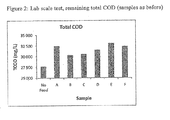
- Figure 2 and 3 shows SCOD and TCOD, respectively, at the end of the experiment (358 hr) for the different nitrate levels tested.
- nitrate solutions added equal to 1 %, 2 % and 4 % oxygenation, respectively, both SCOD and TCOD are lower compared with the reactor having no nitrate solution added or having even higher amounts of nitrate solution added (i.e. equal to 8 % and 16 % oxygenation).
Landscapes
- Life Sciences & Earth Sciences (AREA)
- Engineering & Computer Science (AREA)
- Chemical & Material Sciences (AREA)
- Microbiology (AREA)
- Hydrology & Water Resources (AREA)
- Environmental & Geological Engineering (AREA)
- Water Supply & Treatment (AREA)
- Organic Chemistry (AREA)
- Oil, Petroleum & Natural Gas (AREA)
- Health & Medical Sciences (AREA)
- General Chemical & Material Sciences (AREA)
- Molecular Biology (AREA)
- Chemical Kinetics & Catalysis (AREA)
- Biodiversity & Conservation Biology (AREA)
- Purification Treatments By Anaerobic Or Anaerobic And Aerobic Bacteria Or Animals (AREA)
- Treatment Of Sludge (AREA)
Abstract
Description
- The present invention relates to an anaerobic digestion process. More particularly, the present invention relates to the use of nitrate for stimulation of anaerobic digestion of organic matter, such as sludge from wastewater, resulting in increased methane production.
- The amount of wet organic wastes, such as food waste, sewage sludge and wastewater from industry, agriculture and municipal origin is increasing. Livestock production in Europe and in developed countries in general is intensifying, resulting in a larger amount of animal waste. If not handled properly, the increasing amounts of animal waste may become a threat against human and animal health and food. Therefore suitable and efficient solutions to handle the rising amounts are desirable.
- Degradation and removal of organic matter through mineralization is a major purpose for waste water and sludge treatment, and a preferred solution is the conversion of the waste organics to renewable energy as methane.
- Anaerobic processes are commonly used to treat wastes with high concentrations of organic compounds. Instead of transforming ingredients to water (H2O) and carbon dioxide (CO2), which is the aim of aerobic treatment processes, an anaerobic process delivers H2O, CO2 and methane (CH4).
- In contrast to an aerobic degradation process, less energy is required in the process as no oxygen/air has to be injected. In addition, the CH4 can subsequently be used as a renewable energy source, i.e. by the conversion to thermal or electrical energy.
- Anaerobic treatment plants are common within larger waste water or sludge treatment plants, where they are used to transform biologically active surplus sludge into stabilized sludge, which can be used as fertilizer/soil conditioner, dumped in a landfill or burned. Anaerobic treatment plants have also become very common in agriculture, where they are primarily used to produce energy from biomass and manure. Whereas treated sludge from agricultural biogas plants may always be used as fertilizer this use is more limited for municipal sludge due to contaminations.
- With both anaerobic and aerobic degradation processes it is desirable that the mass of treated sludge is as low as possible due to transportation costs afterwards.
- Furthermore, 20 % of European energy demand is to be fulfilled by renewable energy systems by 2010 (Nielsen et al., 2009, "The future of anaerobic digestion and biogas utilization", Bioresource Technology, 100, pp. 5478-5484). Biogas production in the European Union has been steadily increasing over the last few years and its production was 69 TW in 2007 (Petersson and Wellinger, 2009, Biogas upgrading technologies- development and innovations, www.iea-biogas.net). More than 1500 millions tons of animal manure is produced every year in EU 27 alone (Nielsen et al., 2009, supra). In addition to biogasification as a renewable energy source, it reduces the release of methane to the atmosphere compared to traditional waste management (composting, land filling) and gives a high quality digestion product as a fertilizer.
- Conventional anaerobic treatment of waste water and sewage involves three basic steps: 1) hydrolysis, 2) fermentation, and 3) methanogenesis. The hydrolysis step involves more than the standard chemistry understanding of hydrolysis as it also includes disintegration and the enzyme-mediated transformation of particulate material - such as lipids, polysaccharides, protein, nucleic acids, fats, etc. into soluble organic materials such as fatty acid, monosaccharides, amino acids, simple aromatics and other simple monomers. These can be used by bacteria during the subsequent fermentation processes. The fermentation step can also be referred to as acidogenesis, as this step results in further degradation of soluble organic materials mainly to acetate, hydrogen, CO2, propionate and butyrate. The propionate and butyrate are further converted to acetate, hydrogen and CO2. In the methanogenesis step, acetate, H2 and CO2 are converted into methane and carbon dioxide by methanogenic archea. Methane is produced by two main groups of archea; acetate utilizers and hydrogen-utilizing methanogens.
- Anaerobic processes are classically driven without the injection of an electron source like oxygen or nitrate. Completely anaerobic conditions in anaerobic digestion are furthermore difficult to maintain due to limited and unintentional aeration effects caused during feeding, effluent and gas removal, mixing etc. (Botheju et al., 2009, "Oxygen effects in anaerobic digestion", Modeling, Identification and Control, 30(1), pp. 1-11). It is found that anaerobic microorganisms, such as methanogens survive in such environments (Kato et al. 1997, "Anaerobe tolerance to oxygen and the potentials of anaerobic and aerobic co-cultures for wastewater treatment", Brazilian journal of chemical engineering, Vol. 14 No. 4). Furthermore, it has been reported that micro aeration promotes hydrolysis (Hao et al. 2009, "Regulating the hydrolysis of organic waste by micro-aeration and effluent recirculation". Waste Management, Vol.29, pp.2042-2050, Bakke, 2006, (Johansen J.-E. and Bakke R. 2006. Enhancing hydrolysis with microaeration. Wat. Sci. Tech. 53, No. 8: 43-50), Nguyen et al., 2007, "Anaerobic digestion of municipal solid waste as a treatment prior to land fill", Bioresourse Technology, Vol. 98, pp. 380-387).
- Rathnasiri (2009) has in the doctoral thesis "Aanaerobic digestion process using membrane integrated micro aeration", Norwegian University of Natural Science and Technology, found that the injection of small amounts of oxygen leads to an increased methane production and also reduced COD (Chemical Oxygen Demand) levels at the same input feeds. However, the application of oxygen in an anaerobic digestion process system is associated with several drawbacks. It is not easily handled as it demands diffusion through a submerged membrane as gas should not bubble out and get into the gas collector area. Furthermore, the addition of oxygen to anaerobic digestion process systems is connected with an undesirable risk of affecting the headspace of the reactor, due to the possibilities that the oxygen may form explosive mixtures with the CH4.
- Due to the drawbacks in using oxygen addition, it is an object of the present invention to provide an improved anaerobic sludge treatment process for the production of methane, resulting in increased methane yield and not having the drawbacks of the use of oxygen addition as mentioned above. The present inventors thus aimed at finding an alternative compound that would have the same effect on methane production as oxygen, i.e. being an electron acceptor in an anaerobic digestion process.
- Nitrate may function as an electron acceptor. The use of nitrate in anaerobic environment, such as with anaerobic digestion processes in sludge and waste water treatment plants to control hydrogen sulphide gas (H2S) production, is well known (Jenneman et al., 1986, Applied and Environmental Microbiology, vol. 51, No. 6, pp. 1205-1211, Bentzen et al., 1995, Controlled dosing of nitrate for prevention of H2S in a sewer network and the effects on the subsequent treatment processes. Water Science and Technology, 31(7), pp.293-302; Zhang et al., 2008, Chemical and biological technologies for hydrogen sulphide emission control in sewer systems: A review. Water Research, 42(1-2), pp. 1-11).
- Calcium nitrate addition to anaerobic processes in biogas plants with agricultural backgrounds is further described in the
PCT patent application WO 2008/090231 A2 - Calcium nitrate as an addition to anaerobic digestion processes aiming at reducing sulphide production is furthermore described in the
US patent 4,505,819 , wherein a method using a moving solid bed reactor is disclosed. - In
US patent 7,326,340 , systems and methods are disclosed involving addition of nitrate to reduce the production of foul-smelling sulfide products. - In
US patent 7,285,207 , a method to reduce hydrogen sulphide is disclose involving the addition of nitrate and an alkaline compound. - As to other effects of nitrate in sludge treatment processes, it is reported that the addition of nitrate may have a disadvantageous effect on methane production. For example, it has been reported that methane producing bacteria are inhibited by nitrate addition (Allison and Macfarlane, 1998, "Effect of nitrate on methane production and fermentation by slurries of human faecal bacteria", J. Gen. Microbiol. 134, 1397-1405, Klüber and Conrad 1998, "Inhibitory effects of nitrate, nitrite, NO and N2O on methanogenesis by Methanosarcina barkeri and Methanobacterium bryantii", FEMS Microbiology Ecology 25:331-339, Mohanakrishnan et al (2008), Nitrate effectively inhibits sulfide and methane production in a laboratory scale sewer reactor. Water Research, 42, pp. 3961-3971). This is further in accordance with the report of Bolag and Czlonkowski (1973) (Inhibition of methane formation in soil by various nitrogen-containing compounds. Soil Biology and Biochemistry. 5 (5), pp.673-678) which found that the evolution of methane from soil samples under anaerobic conditions was suppressed by adding nitrogen containing chemicals.
- Another negative impact of nitrate addition in anaerobic digester is consumption of organic carbon for denitrification as shown in the equation
24NO3 -+ 5C6H12O6 → 12N2 + 30CO2 + 18H2O + 24OH-
(Kim et al., 2006, supra, Benis et al., 2010, "Effect of adding nitrate on the performance of a multistage biofilter used for anaerobic treatment of high strength waste water", Chemical Engineering Journal, 156, pp. 250-256). The conversion of organic carbon according to the above equation results in a lower yield of methane and thus less energy recovery. - Others have suggested that the main mechanism involved in the suppression of CH4 production by nitrate is the inhibition of methanogenesis by denitrification intermediates rather than the competition between denitrifiers and methanogens for substrates (Roy and Conrad, 1999, "Effect of methanogenic precursors (acetate, hydrogen, propionate) on the suppression of methane production by nitrate in anoxic rice field soil", FEMS Microbiology Ecology, Vol.28, No.1, pp.49-61).
- Singh and Singh (1996), Energy Convers. Mgmt, 37:4, pp 417-419 relates to the addition of cupric nitrate to cow dung in an attempt to accelerate biogas production. The amount of cupric nitrate added to the one kg cow dung (i.e. 1 g /kg cow dung) in the report of Singh and Singh, supra, represents a significantly lower amount of nitrate compared with the amounts of nitrate to be added according to the present invention. In addition, the use of cupric nitrate in large scale sludge treatment processes represents a disadvantage due to e.g. environmental considerations.
- The biochemical processes of an anaerobic digestion process and the various factors effecting e.g. the production of decay product such as methane and H2S gas is complex. The many reports referred to above show that all in all, the prior art teaches that the addition of nitrate to anaerobic digestion processes generally results in reduction of methane production.
- The present inventors have surprisingly discovered that the addition of small amounts of inorganic nitrate to an anaerobic sludge treatment process in fact facilitates methane production, resulting in an increase in the production of methane. The present invention therefore provides an improved anaerobic digestion process resulting in high methane yield by adding inorganic nitrate to the anaerobic sludge or waste water treatment plant.
- Due to the increasing amounts of waste water and sludge world wide, and due to the need of renewable energy sources, there is a need for more efficient processes for digestion of organic material compared with the prior art processes, resulting in higher methane production yields.
- The present invention provides an anaerobic sludge treatment process, wherein inorganic nitrate solution having a nitrate concentration according to the present invention is added to stimulate methane production. A solution of inorganic nitrate applied as a liquid will have positive effects similar to that of micro-aeration but not the drawbacks of oxygen addition. Hence, according to the present invention, the inorganic nitrate is used as an electron acceptor. Like oxygen the nitrate can be used especially to enhance the degradation of not so easily accessible organic matter, and generally enhance the initial degradation steps of anaerobic digestion.
- According to one aspect of the invention, an anaerobic sludge treatment process for the preparation of methane, is characterized in that nitrate salt is added to an anaerobic digestion process in an amount corresponding to 1- 4 % of the added COD.
- According to one embodiment of the invention, the anaerobic sludge treatment system is selected from the group consisting of a municipal sludge treatment plant, an agricultural biogas plant and industrial anaerobic sludge digestion plant.
- According to yet another embodiment of the invention, the nitrate salt of the nitrate salt solution is selected from the group consisting of sodium nitrate, potassium nitrate, calcium nitrate or magnesium nitrate.
- According to a further preferred embodiment of the invention, the nitrate salt added to said anaerobic digestion process is calcium nitrate.
- Said nitrate salt may according to one embodiment be added as a nitrate salt containing 10-60 weight-% of said dissolved nitrate salts.
- According to yet another embodiment of the invention, a process is provided comprising the steps of a) introducing sludge or waste water into an anaerobic biological sludge or waste water treatment system; b) measuring the COD level of the sludge or waste water material at a monitoring point of the sludge or waste water treatment system; c) calculation of the nitrate dosage to be added; and d) adding nitrate in an amount corresponding to 1- 4 % of feed COD based on the calculations in step c).
- According to yet another embodiment of the present process, the nitrate added to the process of the invention is not cupric nitrate.
- Yet another embodiment of the process according to the present invention provides for the adding of nitrate at the beginning of each batch of sludge treatment.
- According to another embodiment of the process according to the present invention the sludge treatment process is continuously working and the addition of nitrate is dosed periodically.
- The present invention further relates to the use of inorganic nitrate to increase methane production in anaerobic sludge or waste water treatment processes using an inorganic nitrate solution as an additive to the said process. According to this aspect of the present invention, the amount inorganic nitrate added according to one embodiment of the invention equals 1 % - 4 % of COD.
- According to yet another embodiment of the use according to the present invention, the nitrogen solution is added periodically or continuously during the anaerobic sludge treatment process in the reactor.
- According to another embodiment of the present use, the nitrogen solution is added to the first reactor(s) or stage(s) of a dual or multi stage anaerobic digestion process.
- A specific embodiment of the invention will now be described by way of example with reference to the accompanying diagrams in which:
-
Figure 1 shows cumulative biogas production obtained in example 1. -
Figure 2 shows remaining total COD (TCOD) measured in the end of the experiment reported in example 1. -
Figure 3 shows remaining soluble COD (SCOD) measured in the end of the experiment reported in example 1. -
Figure 4 is a schematic diagram of batch reactor used in example 1 - As used herein, "sludge" or "waste water" means sludge or waste water from municipal sewage disposal plants, manure treatment systems, organics from industrial operations (such as chemical and biochemical processing), food industry, paper and pulp operations, etc. Any sludge or waste water being useful as a source for methane production in an anaerobic process may be used in the anaerobic digestion process according to the present invention.
- The expressions "anaerobic digestion process system", "sludge treatment system" or "waste water treatment system", refers to any sludge or waste water collection plant and/or treatment system or facility where organic waste material present in the sludge or waste water is treated or processed to manufacture methane from the organic matter being introduced in said treatment system.
- The term "feed point" as used herein refers to the point at which the inorganic nitrate is added to the sludge or waste water treatment process.
- The term "monitoring point" or "test point" as used herein refers to the point of the sludge or waste water treatment system wherein data measurements are performed enabling calculations of the nitrate dosage needed to obtain optimal methane production of the treated sludge or waste water.
- Oxidation Power Demand (OPD) is defined as the amount of oxidation power needed to oxidize completely one or more organic compounds in sludge, mixtures or other materials. OPD is fundamentally expressed as the amount of electrons that need to be transferred in the redox process for the complete oxidation, but more generally it can be expressed as the amount of electron acceptors needed to receive these electrons.
- As an example, 180 mg/l of glucose = 1 mM would transfer 24 mM electrons to the electron acceptor for complete oxidation to CO2 and H2O:
C6H12O6 + 24OH- -> 6CO2 + 18H2O + 24e- (1)
- This half-reaction must be balanced with a half-reaction receiving these electrons, a reduction of an electron acceptor. An electron acceptor can be numerous substances, but oxygen and nitrate are relevant in this context:
4.8NO3 - + 24e- + 28.8H+ -> 2.4N2 + 14.4H2O (2)
602 + 24e- + 24H+ -> 12H2O (3)
- The full reaction in each case would be:
C6H12O6 + 4.8NO3 - + 4.8H+ -> 6CO2 + 2.4N2 + 8.4H2O (4) = (1)+(2)
C6H12O6 + 6O2 -> 6CO2 + 6H2O (5) = (1)+(3)
- The OPD will in this example be expressed as:
4.8 mM NO3 - = 297.6 mg NO3 -/l (6)
6 mM O2 = 192 mg O2/l (7)
- When OPD is expressed as mag/l O2 it is commonly referred to as Chemical Oxygen Demand (COD).
- "Chemical oxygen demand (COD)" as used herein, is a unit of measure determining the capacity of water to consume oxygen upon decomposition of organic matter. The skilled person is well aware of the various methods available for the measurement of COD in samples of the sludge or waste water entering or leaving an anaerobic sludge or waste water treatment plant. Standardized laboratory assays wherein a sample is incubated with a strong chemical oxidant under specific conditions of temperature and for a particular period of time are known. For example, a commonly used oxidant available for COD assays is potassium dichromate (K2Cr2O2) used in combination with sulfuric acid (H2SO4). One method for measuring COD is the dichromate reflux method ("Standard Methods for examination of Water and Waste water", Eaton AD, Clesceri LS, Greenberg AE, (1995), Standard Methods for the Examination of Water and Wastewater, 19th Edition, American Public Health Association, USA - Method 5220 D Chemical Oxygen Demand) providing superior oxidizing ability of most organic compounds.
- The COD level measured may be used to determine the amount of nitrate to be added to facilitate methane production according to the present invention. In the present application the dosing of nitrate is thus expressed as a fraction (%) of COD of the organics in the anaerobic digestion feed.
- According to the present invention, increased biogas formation is obtained when adding nitrate corresponding to 1 %- 4 % of feed COD. According to one preferred embodiment of the invention, a nitrate solution corresponding to 2 % of feed COD is added to an anaerobic sludge or waste water treatment process.
- According to the present invention, nitrate is added as an electron acceptor to facilitate methane production in anaerobic sludge and waste water treatment processes, thus having a similar effect to the addition of oxygen as an electron acceptor. The dosage of a nitrate solution will support the microbial activity in general. There are a number of microorganisms that are involved in the process of anaerobic digestion including acetic acid forming bacteria (acetogens) and methane forming bacteria (methanogens), resulting in that organic waste is converted to intermediate molecules including sugars, hydrogen, organic acids such as acetic acid and propionic acid, and finally to biogas. The nitrate added to the initial degradation steps leads to more biomass in forms of anoxic species that later on can be degraded anaerobically. Additionally the organic matter itself will be more easily degradable due to enhancement of these initial processes.
- Anaerobic sludge and waste water treatment processes can be designed and engineered to operate using a number of different process configurations, e.g. in respect of discontinuous batch systems or continuous systems. A batch system is the simplest form of system, wherein the biomass to be digested is added to a reactor in one batch and then is sealed for the duration of the process. In continuous digestion systems, the biomass to be digested is continuously added in stages to the reactor, and the end products, i.e. biogas and other degradation products are continuously removed, resulting in continuous and relatively constant production of biogas. Both single and multiple digester reactors placed in sequence are commonly used. Examples of well known systems for continuous treatment of sludge and waste water include continuous stirred-tank reactors (CSTRs), up flow anaerobic sludge blankets (UASB), Expanded granular sludge beds (EGSB) and Internal circulation reactors (IC).
- Anaerobic sludge and waster water treatment processes may also be constructed differently in respect of involving a one-stage or single stage process, or a two-stage or multi stage process. In this respect, a single step process represents a process wherein all the biological reactions happen within one single sealed reactor. A two-stage or multi stage process involves the use of more than one reactor, and wherein each reactor is optimized with respect to providing optimal conditions for the biological processes to be conducted within each reactor. For example, the first digestion processes, the hydrolysis and the acidogenesis steps, may occur in one reactor, whereas the next step, the methanogenesis, occurs in another reactor. The process according to the present invention is applicable in the various sludge and waste water treatment systems known to the skilled person for the biological production of methane, i.e. in batch and continuous processes and in single and multi stage processes.
- For batch reactors, a small dosage of an inorganic nitrate, e.g. such as calcium nitrate is added at the start-up of a batch.
- The present invention is applicable to all the various anaerobic sludge and waste water treatment processes discussed above.
- For continuous flow working reactors a periodical or constant dosage of inorganic nitrate is used. Control of continuously working processes may demand a control system with process control parameters enabling the estimation of the nitrate dose to be added. Thus, according to the present invention, data measurements are performed during continuous flow working sludge and waste water treatment enabling the determination and addition of the nitrate needed.
- Independent of the type of sludge or waste water process used, the nitrate dosage to be added may be estimated as outlined below.
- The nitrate to be added may be estimated from the Oxidation Power Demand (OPD) from various methods for determination of the oxidizable organic carbon content of the sludge or waste water to be treated. Three optional methods are e.g.:
- The nitrate dose recommendation can be made with reference to the OPD. A conversion factor is needed to calculate the COD from the OPD. From (6) and (7) above, the skilled person will acknowledge that the ratio between COD level (or OPD expressed in mg O2/l) and OPD expressed in mg NO3 -/l is 1.55.
- In a system with a feed COD value of 50 000 mg O2/l, a dosage (of nitrate) of 2 % OPD would mean (50 000 x 1.55 x 0.02) = 1 550 mg NO3 -/l. Using a 50 % Calcium nitrate solution as the product to be added to a sludge treatment process, this would give a dosing rate of 2344 mg product/l (i.e. 1550*124/164/0.5).
- Thus, in accordance with the explanation above, there is a fairly straightforward way of determine the nitrate dose (in % OPD) from information/measurements of COD.
- When the COD information is not available, OPD can be estimated from other expressions/determinations of oxidizable organic carbon, also known as the parameter total organic carbon (TOC). If the compounds are dissolved this equals the DOC. If the content of TOC is expressed as content of carbon, e.g. dissolved organic carbon (DOC) one must assume what type of carbon compound it is (the oxidation state of the carbon).
- If COD, TOC or DOC of the feed cannot be measured, then an estimation of feed COD can be made via biogas production, from production rates and concentrations of CH4 and CO2 in the headspace of the reactor. The produced biogas is carbon transferred from dissolved and solid organic matter. Hence there is a relation between biogas production and organic carbon content of digester input and output.
- According to one embodiment of the invention, the dosage of nitrate to be added to facilitate methane production is estimated based on the COD of the sludge or waste water, i.e. the COD load. Without being bound by any theory, the nitrate will provide a sufficient amount of electrons to stimulate the anaerobic processes without disturbing them.
- As mentioned above, the present inventors have surprisingly discovered that the feeding of an equivalent of 1 % to 4 % of the COD as nitrate into a sludge treatment reactor, the methane production is facilitated resulting in a significant increase of the methane production compared with a process where no nitrate is added.
- The process according to the present invention should be stabilized and monitored by using CH4 and CO2 measurement for a feedback control and continuous COD estimation. Biogas production rate and CH4 and CO2 measurements in the headspace and discharge/off-gas of reactors are standard parameters measured by equipment on biogas production plants and well known to the skilled person.
- According to one embodiment of the present invention, COD is measured analytically or derived from carbon related parameters, as shown above. The calculation of the dosage of nitrate refers to the average COD of the system input as well as the input flow Q (input).
- The dosage is then calculated by the equation:

wherein µ is a value between 0.01 and 0.04, i.e. the amount of nitrate corresponding to 1 % - 4 % of feed COD. - As an example, the dosage of nitrate to be added, i.e. q(NO3) is 0.31 [kg/h] when Q (input) = 1 [m3/h], COD = [20 kg/m3], µ = 0.01. If the nitrate is applied as Ca(NO3)2 in a 45 % aqueous solution this results in q(Ca(NO3)2)= 0.41 [kg/h]. The mass specific dosage is 310 ppm for NO3 and 409 ppm for Ca(NO3)2, respectively. Similar calculations may be performed for the various numbers within the desired range according to the invention, i.e. wherein µ is a value between 0.01 and 0.04.
- For calculating the dosage a self learning computer program may be used. This dynamically calculated dosage amount may be applied with a dosage pump connected to the computer unit. This unit may also be used to monitor temperature, CO2 and CH4 levels as these parameters are also standard data which are monitored.
- From waste water treatment it is known that sodium nitrate works similarly to calcium nitrate when it comes to support biological degradation processes in sewers. Hence an increased methane yield will be provided not only with calcium nitrate but with any inorganic nitrate. A non-limited list of inorganic nitrate that may be used according to the present invention is sodium nitrate, potassium nitrate, calcium nitrate, magnesium nitrate. It is also possible to use nitric acid (HNO3).
- According to one embodiment of the invention, the nitrate to be added is not cupric nitrate, because copper as a heavy metal shall not be added to potential fertilizers.
- The following examples serve to explain the invention in more detailed only, and shall not be construed limiting for the scope of the claimed invention.
- Batch reactors in lab scale.
- Twelve batch reactors consisting of syringes were used as lab scale batch reactors (
figure 4 ). Each syringe was connected to a needle blocked by a small rubbery stopper (3) to stop leakage of both gas (1) and liquid (2). The syringes were kept in an incubator at a temperature of 35 ± 1.0°C. - 39 ml of inoculums consisting of an initial inoculum taken from a municipal waste water sludge continuous flow anaerobic digestion treatment plant (Porsgrunn municipality, Norway) and nutrient solution containing starch, peptone, yeast extract, KH2PO4 and K2HPO4, and tap water were feed into each batch reactor. Calcium nitrate solution was added in the beginning of the test. Two parallel groups were set. Ten of the reactors were added calcium nitrate solutions corresponding to different percentage of O2 as follows: 0 %, 2 %, 4 %, 8 % and 16 % (as percentages of feed COD load). Two reactors were kept without feeding and the other 10 were fed a 1ml starch solution having 54468 mg/l COD.
- Biogas generation was measured for all the reactors at various times as shown in
figure 1 . The composition of gas collected was analysed using Hewlett Packard, HP, Micro Gas Chromatograph (GC) Aglient model P200 following the instructions of the manufacturer. The data handling and instrument control software used wasMTI EZChrom 200 version 4.5 data handling and instrument control software. - In addition, total COD (TCOD) and soluble COD (SCOD) were tested according to the methods described below and are shown in
figures 2 and3 . The COD measurement was determined based on the COD measurement procedure Closed Reflux, Colorimetric COD Method according to the method disclosed in "Standard Methods for examination of Water and Waste water", Eaton AD, Clesceri LS, Greenberg AE, (1995), Standard Methods for the Examination of Water and Wastewater, 19th Edition, American Public Health Association, USA - Method 5220 D Chemical Oxygen Demand. -
Figure 1 shows how cumulative biogas production varies at different nitrate levels applied to laboratory scale batch reactors. The result demonstrates that reactors fed with1688 mg/L concentration of nitrate (equal to 2 % oxygen of feed COD) showed the highest biogas generation compared with the other laboratory scale reactors. The results further show that the biogas formation increases with increasing amounts of nitrate up to a level corresponding to 2 % oxygen. The results further show that the biogas formation is higher compared with the reactor not having any added nitrate, i.e. corresponding to strictly anaerobic conditions, until the amount of oxygenation equivalent nitrate exceeds about 4 %. -
Figure 2 and3 shows SCOD and TCOD, respectively, at the end of the experiment (358 hr) for the different nitrate levels tested. At nitrate solutions added equal to 1 %, 2 % and 4 % oxygenation, respectively, both SCOD and TCOD are lower compared with the reactor having no nitrate solution added or having even higher amounts of nitrate solution added (i.e. equal to 8 % and 16 % oxygenation). - The results thus show that by adding nitrate solution to an anaerobic sludge treatment reactor, wherein the amount of nitrate equals from 1 % to 4 % oxygenation, higher methane production and lower COD are obtained. The most optimal conditions are obtained wherein the nitrogen solution added equals 2 % oxygenation.
Claims (13)
- A process for the preparation of methane in an anaerobic sludge treatment process, characterized in that nitrate salt is added to an anaerobic digestion process in an amount corresponding to 1- 4 % of the added COD.
- A process according to claim 1, characterized in that the anaerobic sludge treatment system is selected from the group consisting of a municipal sludge treatment plant, an agricultural biogas plant and an industrial anaerobic sludge digestion plant.
- A process according either of the preceding claims, characterized in that the nitrate salt of the nitrate salt solution is selected from the group consisting of sodium nitrate, potassium nitrate, calcium nitrate or magnesium nitrate.
- A process according to claim 3, wherein the nitrate salt is calcium nitrate.
- A process according to claim 4, characterized in that the nitrate solution contains 10-60 weight-% of said dissolved nitrate salt.
- A process according to claim 1, comprising the steps of:a. introducing sludge or waste water into an anaerobic biological sludge or waste water treatment system;b. measuring the COD level of the sludge or waste water material at a monitoring point of the sludge or waste water treatment system;c. calculation of the nitrate dosage to be added;d. adding nitrate in an amount corresponding to 1- 4 % of feed COD based on the calculations in step c.
- A process according to any of the above claims, characterized that the nitrate is not cupric nitrate.
- A process according to any of the claims 1-7, wherein nitrate is added at the beginning of each batch of sludge treatment.
- A process according to any of the claims 1-7, wherein the sludge treatment process is working continuously and wherein the addition of nitrate is dosed periodically.
- The use of inorganic nitrate to increase methane production in anaerobic sludge or waste water treatment processes using an inorganic nitrate solution as an additive to said process.
- The use according to claim 10, wherein the amount inorganic nitrate added equals 1 %-4%ofCOD.
- The use according to claim 10, wherein the nitrogen solution is added periodically or continuously during the anaerobic sludge treatment process in the reactor.
- The process according to claims 1-7 or the use according to claim 10, wherein the nitrogen solution is added to the first reactor(s) or stage(s) of a dual or multi stage anaerobic digestion process.
Priority Applications (1)
| Application Number | Priority Date | Filing Date | Title |
|---|---|---|---|
| PL11190681T PL2457878T3 (en) | 2010-11-29 | 2011-11-25 | Anaerobic sludge treatment processes |
Applications Claiming Priority (1)
| Application Number | Priority Date | Filing Date | Title |
|---|---|---|---|
| NO20101667A NO332626B1 (en) | 2010-11-29 | 2010-11-29 | Process for preparing methane in an anaerobic sludge treatment process. |
Publications (2)
| Publication Number | Publication Date |
|---|---|
| EP2457878A1 true EP2457878A1 (en) | 2012-05-30 |
| EP2457878B1 EP2457878B1 (en) | 2017-08-02 |
Family
ID=45092259
Family Applications (1)
| Application Number | Title | Priority Date | Filing Date |
|---|---|---|---|
| EP11190681.4A Not-in-force EP2457878B1 (en) | 2010-11-29 | 2011-11-25 | Anaerobic sludge treatment processes |
Country Status (7)
| Country | Link |
|---|---|
| EP (1) | EP2457878B1 (en) |
| CY (1) | CY1119573T1 (en) |
| DK (1) | DK2457878T3 (en) |
| ES (1) | ES2642085T3 (en) |
| NO (1) | NO332626B1 (en) |
| PL (1) | PL2457878T3 (en) |
| PT (1) | PT2457878T (en) |
Cited By (5)
| Publication number | Priority date | Publication date | Assignee | Title |
|---|---|---|---|---|
| EP3502230A1 (en) * | 2017-12-22 | 2019-06-26 | Yara International ASA | Method for controlling the dosage of a biogas production optimizer in an anaerobic digester sludge and anaerobic biogas digester system for performing such a method |
| CN111239276A (en) * | 2020-02-03 | 2020-06-05 | 广西大学 | A kind of method to measure soil and sludge organic matter content |
| CN111470744A (en) * | 2020-04-13 | 2020-07-31 | 陈光浩 | Method for producing volatile organic acid by anaerobic fermentation of sludge |
| CN114592014A (en) * | 2022-03-22 | 2022-06-07 | 太原理工大学 | Method for enhancing acid production through anaerobic fermentation of excess sludge by photolysis of nitrate |
| CN114956502A (en) * | 2022-04-07 | 2022-08-30 | 无锡国联环保科技股份有限公司 | Two-stage type thermal hydrolysis method and system for municipal sludge |
Families Citing this family (2)
| Publication number | Priority date | Publication date | Assignee | Title |
|---|---|---|---|---|
| DE102019001727B4 (en) | 2019-03-13 | 2023-02-09 | LUCRAT GmbH | Solid, porous, pyrogenic biochar containing adsorbed inorganic nitrates, processes for their production and their use |
| CN111500646A (en) * | 2020-05-06 | 2020-08-07 | 苏州科技大学 | A kind of method for producing methane from phenol-containing wastewater |
Citations (6)
| Publication number | Priority date | Publication date | Assignee | Title |
|---|---|---|---|---|
| US1997252A (en) * | 1931-01-02 | 1935-04-09 | Dorr Co Inc | Sewage sludge treatment |
| US4505819A (en) | 1980-08-18 | 1985-03-19 | Unisearch Limited | Method for the anaerobic degradation of organic material |
| US7285207B2 (en) | 2003-03-05 | 2007-10-23 | Siemens Water Technologies Holding Corp. | Methods and apparatus for reducing nitrate demands in the reduction of dissolved and/or atmospheric sulfides in wastewater |
| US7326340B2 (en) | 2003-03-05 | 2008-02-05 | Siemens Water Technologies Holding Corp. | System for controlling sulfide generation |
| WO2008090231A2 (en) | 2007-01-26 | 2008-07-31 | Sachtleben Chemie Gmbh | Method for preventing unwanted formation of hydrogen sulfide during the isolation of biogas by the addition of nitrate salts |
| US20100021979A1 (en) * | 2008-06-25 | 2010-01-28 | Gemini Corporation | Apparatus and Process for Production of Biogas |
-
2010
- 2010-11-29 NO NO20101667A patent/NO332626B1/en not_active IP Right Cessation
-
2011
- 2011-11-25 ES ES11190681.4T patent/ES2642085T3/en active Active
- 2011-11-25 PL PL11190681T patent/PL2457878T3/en unknown
- 2011-11-25 PT PT111906814T patent/PT2457878T/en unknown
- 2011-11-25 EP EP11190681.4A patent/EP2457878B1/en not_active Not-in-force
- 2011-11-25 DK DK11190681.4T patent/DK2457878T3/en active
-
2017
- 2017-09-21 CY CY20171101002T patent/CY1119573T1/en unknown
Patent Citations (6)
| Publication number | Priority date | Publication date | Assignee | Title |
|---|---|---|---|---|
| US1997252A (en) * | 1931-01-02 | 1935-04-09 | Dorr Co Inc | Sewage sludge treatment |
| US4505819A (en) | 1980-08-18 | 1985-03-19 | Unisearch Limited | Method for the anaerobic degradation of organic material |
| US7285207B2 (en) | 2003-03-05 | 2007-10-23 | Siemens Water Technologies Holding Corp. | Methods and apparatus for reducing nitrate demands in the reduction of dissolved and/or atmospheric sulfides in wastewater |
| US7326340B2 (en) | 2003-03-05 | 2008-02-05 | Siemens Water Technologies Holding Corp. | System for controlling sulfide generation |
| WO2008090231A2 (en) | 2007-01-26 | 2008-07-31 | Sachtleben Chemie Gmbh | Method for preventing unwanted formation of hydrogen sulfide during the isolation of biogas by the addition of nitrate salts |
| US20100021979A1 (en) * | 2008-06-25 | 2010-01-28 | Gemini Corporation | Apparatus and Process for Production of Biogas |
Non-Patent Citations (22)
| Title |
|---|
| ALLISON; MACFARLANE: "Effect of nitrate on methane production and fermentation by slurries of human faecal bacteria", J. GEN. MICROBIOL., vol. 134, 1998, pages 1397 - 1405 |
| BENIS ET AL.: "Effect of adding nitrate on the performance of a multistage biofilter used for anaerobic treatment of high strength waste water", CHEMICAL ENGINEERING JOURNAL, vol. 156, 2010, pages 250 - 256 |
| BENTZEN ET AL.: "Controlled dosing of nitrate for prevention of H2S in a sewer network and the effects on the subsequent treatment processes", WATER SCIENCE AND TECHNOLOGY, vol. 31, no. 7, 1995, pages 293 - 302, XP055114093, DOI: doi:10.1016/0273-1223(95)00346-O |
| BOLAG; CZLONKOWSKI: "Inhibition of methane formation in soil by various nitrogen-containing compounds", SOIL BIOLOGY AND BIOCHEMISTRY, vol. 5, no. 5, 1973, pages 673 - 678 |
| BOTHEJU ET AL.: "Oxygen effects in anaerobic digestion", MODELING, IDENTIFICATION AND CONTROL, vol. 30, no. 1, 2009, pages 1 - 11 |
| EATON AD; CLESCERI LS; GREENBERG AE: "Standard Methods for the Examination of Water and Wastewater, 19th Edition,", 1995, AMERICAN PUBLIC HEALTH ASSOCIATION, article "Standard Methods for examination of Water and Waste water" |
| GHANIYARI-BENIS S ET AL: "Effect of adding nitrate on the performance of a multistage biofilter used for anaerobic treatment of high-strength wastewater", CHEMICAL ENGINEERING JOURNAL, ELSEVIER SEQUOIA, LAUSANNE, CH, vol. 156, no. 2, 15 January 2010 (2010-01-15), pages 250 - 256, XP026827892, ISSN: 1385-8947, [retrieved on 20091108] * |
| HAO ET AL.: "Regulating the hydrolysis of organic waste by micro- aeration and effluent recirculation", WASTE MANAGEMENT, vol. 29, 2009, pages 2042 - 2050, XP026084231, DOI: doi:10.1016/j.wasman.2008.12.023 |
| JENNEMAN ET AL., APPLIED AND ENVIRONMENTAL MICROBIOLOGY, vol. 51, no. 6, 1986, pages 1205 - 1211 |
| JOHANSEN J.-E.; BAKKE R.: "Enhancing hydrolysis with microaeration", WAT. SCI. TECH., vol. 53, no. 8, 2006, pages 43 - 50, XP055182321, DOI: doi:10.2166/wst.2006.234 |
| KATO ET AL.: "Anaerobe tolerance to oxygen and the potentials of anaerobic and aerobic co-cultures for wastewater treatment", BRAZILIAN JOURNAL OF CHEMICAL ENGINEERING, vol. 14, no. 4, 1997 |
| KLUBER; CONRAD: "Inhibitory effects of nitrate, nitrite, NO and N20 on methanogenesis by Methanosarcina barkeri and Methanobacterium bryantii", FEMS MICROBIOLOGY ECOLOGY, vol. 25, 1998, pages 331 - 339 |
| MOHANAKRISHNAN ET AL.: "Nitrate effectively inhibits sulfide and methane production in a laboratory scale sewer reactor", WATER RESEARCH, vol. 42, 2008, pages 3961 - 3971, XP024528767, DOI: doi:10.1016/j.watres.2008.07.001 |
| NGUYEN ET AL.: "Anaerobic digestion of municipal solid waste as a treatment prior to land fill", BIORESOURSE TECHNOLOGY, vol. 98, 2007, pages 380 - 387 |
| NIELSEN ET AL.: "The future of anaerobic digestion and biogas utilization", BIORESOURCE TECHNOLOGY, vol. 100, 2009, pages 5478 - 5484, XP026458511, DOI: doi:10.1016/j.biortech.2008.12.046 |
| PETERSSON; WELLINGER, BIOGAS UPGRADING TECHNOLOGIES- DEVELOPMENT AND INNOVATIONS, 2009, Retrieved from the Internet <URL:www.iea-biogas.net> |
| RATHNASIRI: "Aanaerobic digestion process using membrane integrated micro aeration", 2009, NORWEGIAN UNIVERSITY OF NATURAL SCIENCE AND TECHNOLOGY |
| ROY; CONRAD: "Effect of methanogenic precursors (acetate, hydrogen, propionate) on the suppression of methane production by nitrate in anoxic rice field soil", FEMS MICROBIOLOGY ECOLOGY, vol. 28, no. 1, 1999, pages 49 - 61 |
| SINGH S ET AL: "Effect of cupric nitrate on acceleration of biogas production", ENERGY CONVERSION AND MANAGEMENT, ELSEVIER SCIENCE PUBLISHERS, OXFORD, GB, vol. 37, no. 4, 1 April 1996 (1996-04-01), pages 417 - 419, XP004039802, ISSN: 0196-8904, DOI: 10.1016/0196-8904(95)00191-3 * |
| SINGH; SINGH, ENERGY CONVERS. MGMT, vol. 37, no. 4, 1996, pages 417 - 419 |
| SPONZA D T ET AL: "Influence of nitrate and COD on phosphorus, nitrogen and dinitrotoluene (DNT) removals under batch anaerobic and anoxic conditions", ANAEROBE, LONDON, GB, vol. 10, no. 5, 1 October 2004 (2004-10-01), pages 287 - 293, XP004562859, ISSN: 1075-9964, DOI: 10.1016/J.ANAEROBE.2004.06.002 * |
| ZHANG ET AL.: "Chemical and biological technologies for hydrogen sulphide emission control in sewer systems: A review", WATER RESEARCH, vol. 42, no. 1-2, 2008, pages 1 - 11 |
Cited By (6)
| Publication number | Priority date | Publication date | Assignee | Title |
|---|---|---|---|---|
| EP3502230A1 (en) * | 2017-12-22 | 2019-06-26 | Yara International ASA | Method for controlling the dosage of a biogas production optimizer in an anaerobic digester sludge and anaerobic biogas digester system for performing such a method |
| WO2019122296A1 (en) * | 2017-12-22 | 2019-06-27 | Yara International Asa | Method for controlling the dosage of a biogas production optimizer in an anaerobic digester sludge and anaerobic biogas digester system for performing such a method |
| CN111239276A (en) * | 2020-02-03 | 2020-06-05 | 广西大学 | A kind of method to measure soil and sludge organic matter content |
| CN111470744A (en) * | 2020-04-13 | 2020-07-31 | 陈光浩 | Method for producing volatile organic acid by anaerobic fermentation of sludge |
| CN114592014A (en) * | 2022-03-22 | 2022-06-07 | 太原理工大学 | Method for enhancing acid production through anaerobic fermentation of excess sludge by photolysis of nitrate |
| CN114956502A (en) * | 2022-04-07 | 2022-08-30 | 无锡国联环保科技股份有限公司 | Two-stage type thermal hydrolysis method and system for municipal sludge |
Also Published As
| Publication number | Publication date |
|---|---|
| CY1119573T1 (en) | 2018-03-07 |
| PT2457878T (en) | 2017-11-14 |
| DK2457878T3 (en) | 2017-09-11 |
| EP2457878B1 (en) | 2017-08-02 |
| NO332626B1 (en) | 2012-11-19 |
| NO20101667A1 (en) | 2012-05-30 |
| ES2642085T3 (en) | 2017-11-15 |
| PL2457878T3 (en) | 2017-12-29 |
Similar Documents
| Publication | Publication Date | Title |
|---|---|---|
| Ahlberg-Eliasson et al. | Anaerobic digestion of animal manure and influence of organic loading rate and temperature on process performance, microbiology, and methane emission from digestates | |
| Dalby et al. | Understanding methane emission from stored animal manure: A review to guide model development | |
| Zan et al. | Sulfate in anaerobic co-digester accelerates methane production from food waste and waste activated sludge | |
| Angelidaki et al. | Biomethanation and its potential | |
| Gelegenis et al. | Optimization of biogas production by co-digesting whey with diluted poultry manure | |
| Nordell et al. | Co-digestion of manure and industrial waste–The effects of trace element addition | |
| Adou et al. | Anaerobic mono-digestion of wastewater from the main slaughterhouse in Yamoussoukro (Côte d’Ivoire): Evaluation of biogas potential and removal of organic pollution | |
| Liu et al. | Characterization of methanogenic activity during high-solids anaerobic digestion of sewage sludge | |
| EP2457878B1 (en) | Anaerobic sludge treatment processes | |
| Rajagopal et al. | Combined anaerobic and activated sludge anoxic/oxic treatment for piggery wastewater | |
| Moset et al. | Process performance of anaerobic co-digestion of raw and acidified pig slurry | |
| Tsapekos et al. | Nickel spiking to improve the methane yield of sewage sludge | |
| Kawai et al. | Biodegradability and methane productivity during anaerobic co-digestion of refractory leachate | |
| El-Fadel et al. | Startup and stability of thermophilic anaerobic digestion of OFMSW | |
| Yangin-Gomec et al. | Microbial monitoring of ammonia removal in a UASB reactor treating pre-digested chicken manure with anaerobic granular inoculum | |
| Shao et al. | Effects of chlorine disinfectants on the microbial community structure and the performance of anaerobic digestion of swine manure | |
| Luo et al. | The start-up and saline adaptation of mesophilic anaerobic sequencing batch reactor treating sludge from recirculating aquaculture systems | |
| Hu et al. | Influence of recirculation of liquid fraction of the digestate (LFD) on maize stover anaerobic digestion | |
| Sánchez-Hernández et al. | The effect of biogas sparging on cow manure characteristics and its subsequent anaerobic biodegradation | |
| Yang et al. | Influence of reflux ratio on the anaerobic digestion of pig manure in leach beds coupled with continuous stirred tank reactors | |
| Tampio et al. | Use of laboratory anaerobic digesters to simulate the increase of treatment rate in full-scale high nitrogen content sewage sludge and co-digestion biogas plants | |
| Shen et al. | Methane production in an upflow anaerobic biofilm digester from leachates derived from poultry litter at different organic loading rates and hydraulic retention times | |
| Zhan et al. | Employing micro-aeration in anaerobic digestion of poultry litter and wheat straw: Batch kinetics and continuous performance | |
| Zhang | Study on the removal of high nitrate-nitrogen concentration from pig farm wastewater by heterotrophic and sulphur autotrophic synergistic denitrification filter process | |
| Jasińska et al. | Energy recovery from poultry manure in the process of semi-continuous anaerobic co-digestion with sewage sludge |
Legal Events
| Date | Code | Title | Description |
|---|---|---|---|
| PUAI | Public reference made under article 153(3) epc to a published international application that has entered the european phase |
Free format text: ORIGINAL CODE: 0009012 |
|
| AK | Designated contracting states |
Kind code of ref document: A1 Designated state(s): AL AT BE BG CH CY CZ DE DK EE ES FI FR GB GR HR HU IE IS IT LI LT LU LV MC MK MT NL NO PL PT RO RS SE SI SK SM TR |
|
| AX | Request for extension of the european patent |
Extension state: BA ME |
|
| 17P | Request for examination filed |
Effective date: 20121130 |
|
| 17Q | First examination report despatched |
Effective date: 20160801 |
|
| STAA | Information on the status of an ep patent application or granted ep patent |
Free format text: STATUS: EXAMINATION IS IN PROGRESS |
|
| GRAP | Despatch of communication of intention to grant a patent |
Free format text: ORIGINAL CODE: EPIDOSNIGR1 |
|
| STAA | Information on the status of an ep patent application or granted ep patent |
Free format text: STATUS: GRANT OF PATENT IS INTENDED |
|
| INTG | Intention to grant announced |
Effective date: 20170407 |
|
| GRAS | Grant fee paid |
Free format text: ORIGINAL CODE: EPIDOSNIGR3 |
|
| GRAA | (expected) grant |
Free format text: ORIGINAL CODE: 0009210 |
|
| STAA | Information on the status of an ep patent application or granted ep patent |
Free format text: STATUS: THE PATENT HAS BEEN GRANTED |
|
| AK | Designated contracting states |
Kind code of ref document: B1 Designated state(s): AL AT BE BG CH CY CZ DE DK EE ES FI FR GB GR HR HU IE IS IT LI LT LU LV MC MK MT NL NO PL PT RO RS SE SI SK SM TR |
|
| RAP1 | Party data changed (applicant data changed or rights of an application transferred) |
Owner name: YARA INTERNATIONAL ASA |
|
| REG | Reference to a national code |
Ref country code: GB Ref legal event code: FG4D |
|
| REG | Reference to a national code |
Ref country code: CH Ref legal event code: EP Ref country code: CH Ref legal event code: NV Representative=s name: ARNOLD AND SIEDSMA AG, CH Ref country code: AT Ref legal event code: REF Ref document number: 914250 Country of ref document: AT Kind code of ref document: T Effective date: 20170815 |
|
| REG | Reference to a national code |
Ref country code: IE Ref legal event code: FG4D |
|
| REG | Reference to a national code |
Ref country code: DE Ref legal event code: R096 Ref document number: 602011040097 Country of ref document: DE |
|
| REG | Reference to a national code |
Ref country code: DK Ref legal event code: T3 Effective date: 20170905 |
|
| REG | Reference to a national code |
Ref country code: SE Ref legal event code: TRGR |
|
| REG | Reference to a national code |
Ref country code: FR Ref legal event code: PLFP Year of fee payment: 7 |
|
| REG | Reference to a national code |
Ref country code: NO Ref legal event code: T2 Effective date: 20170802 |
|
| REG | Reference to a national code |
Ref country code: PT Ref legal event code: SC4A Ref document number: 2457878 Country of ref document: PT Date of ref document: 20171114 Kind code of ref document: T Free format text: AVAILABILITY OF NATIONAL TRANSLATION Effective date: 20171031 |
|
| REG | Reference to a national code |
Ref country code: ES Ref legal event code: FG2A Ref document number: 2642085 Country of ref document: ES Kind code of ref document: T3 Effective date: 20171115 |
|
| REG | Reference to a national code |
Ref country code: NL Ref legal event code: FP |
|
| REG | Reference to a national code |
Ref country code: LT Ref legal event code: MG4D |
|
| PG25 | Lapsed in a contracting state [announced via postgrant information from national office to epo] |
Ref country code: LT Free format text: LAPSE BECAUSE OF FAILURE TO SUBMIT A TRANSLATION OF THE DESCRIPTION OR TO PAY THE FEE WITHIN THE PRESCRIBED TIME-LIMIT Effective date: 20170802 Ref country code: HR Free format text: LAPSE BECAUSE OF FAILURE TO SUBMIT A TRANSLATION OF THE DESCRIPTION OR TO PAY THE FEE WITHIN THE PRESCRIBED TIME-LIMIT Effective date: 20170802 |
|
| PG25 | Lapsed in a contracting state [announced via postgrant information from national office to epo] |
Ref country code: BG Free format text: LAPSE BECAUSE OF FAILURE TO SUBMIT A TRANSLATION OF THE DESCRIPTION OR TO PAY THE FEE WITHIN THE PRESCRIBED TIME-LIMIT Effective date: 20171102 Ref country code: LV Free format text: LAPSE BECAUSE OF FAILURE TO SUBMIT A TRANSLATION OF THE DESCRIPTION OR TO PAY THE FEE WITHIN THE PRESCRIBED TIME-LIMIT Effective date: 20170802 Ref country code: GR Free format text: LAPSE BECAUSE OF FAILURE TO SUBMIT A TRANSLATION OF THE DESCRIPTION OR TO PAY THE FEE WITHIN THE PRESCRIBED TIME-LIMIT Effective date: 20171103 Ref country code: RS Free format text: LAPSE BECAUSE OF FAILURE TO SUBMIT A TRANSLATION OF THE DESCRIPTION OR TO PAY THE FEE WITHIN THE PRESCRIBED TIME-LIMIT Effective date: 20170802 Ref country code: IS Free format text: LAPSE BECAUSE OF FAILURE TO SUBMIT A TRANSLATION OF THE DESCRIPTION OR TO PAY THE FEE WITHIN THE PRESCRIBED TIME-LIMIT Effective date: 20171202 |
|
| PG25 | Lapsed in a contracting state [announced via postgrant information from national office to epo] |
Ref country code: RO Free format text: LAPSE BECAUSE OF FAILURE TO SUBMIT A TRANSLATION OF THE DESCRIPTION OR TO PAY THE FEE WITHIN THE PRESCRIBED TIME-LIMIT Effective date: 20170802 |
|
| REG | Reference to a national code |
Ref country code: DE Ref legal event code: R097 Ref document number: 602011040097 Country of ref document: DE |
|
| PG25 | Lapsed in a contracting state [announced via postgrant information from national office to epo] |
Ref country code: EE Free format text: LAPSE BECAUSE OF FAILURE TO SUBMIT A TRANSLATION OF THE DESCRIPTION OR TO PAY THE FEE WITHIN THE PRESCRIBED TIME-LIMIT Effective date: 20170802 Ref country code: SK Free format text: LAPSE BECAUSE OF FAILURE TO SUBMIT A TRANSLATION OF THE DESCRIPTION OR TO PAY THE FEE WITHIN THE PRESCRIBED TIME-LIMIT Effective date: 20170802 Ref country code: SM Free format text: LAPSE BECAUSE OF FAILURE TO SUBMIT A TRANSLATION OF THE DESCRIPTION OR TO PAY THE FEE WITHIN THE PRESCRIBED TIME-LIMIT Effective date: 20170802 |
|
| PLBE | No opposition filed within time limit |
Free format text: ORIGINAL CODE: 0009261 |
|
| STAA | Information on the status of an ep patent application or granted ep patent |
Free format text: STATUS: NO OPPOSITION FILED WITHIN TIME LIMIT |
|
| PG25 | Lapsed in a contracting state [announced via postgrant information from national office to epo] |
Ref country code: MC Free format text: LAPSE BECAUSE OF FAILURE TO SUBMIT A TRANSLATION OF THE DESCRIPTION OR TO PAY THE FEE WITHIN THE PRESCRIBED TIME-LIMIT Effective date: 20170802 |
|
| 26N | No opposition filed |
Effective date: 20180503 |
|
| PG25 | Lapsed in a contracting state [announced via postgrant information from national office to epo] |
Ref country code: LU Free format text: LAPSE BECAUSE OF NON-PAYMENT OF DUE FEES Effective date: 20171125 Ref country code: SI Free format text: LAPSE BECAUSE OF FAILURE TO SUBMIT A TRANSLATION OF THE DESCRIPTION OR TO PAY THE FEE WITHIN THE PRESCRIBED TIME-LIMIT Effective date: 20170802 |
|
| PG25 | Lapsed in a contracting state [announced via postgrant information from national office to epo] |
Ref country code: MT Free format text: LAPSE BECAUSE OF NON-PAYMENT OF DUE FEES Effective date: 20171125 |
|
| REG | Reference to a national code |
Ref country code: FR Ref legal event code: PLFP Year of fee payment: 8 |
|
| PGFP | Annual fee paid to national office [announced via postgrant information from national office to epo] |
Ref country code: PL Payment date: 20180925 Year of fee payment: 8 |
|
| PGFP | Annual fee paid to national office [announced via postgrant information from national office to epo] |
Ref country code: CZ Payment date: 20181116 Year of fee payment: 8 Ref country code: PT Payment date: 20181123 Year of fee payment: 8 |
|
| REG | Reference to a national code |
Ref country code: AT Ref legal event code: UEP Ref document number: 914250 Country of ref document: AT Kind code of ref document: T Effective date: 20170802 |
|
| PGFP | Annual fee paid to national office [announced via postgrant information from national office to epo] |
Ref country code: CY Payment date: 20181009 Year of fee payment: 8 |
|
| PG25 | Lapsed in a contracting state [announced via postgrant information from national office to epo] |
Ref country code: HU Free format text: LAPSE BECAUSE OF FAILURE TO SUBMIT A TRANSLATION OF THE DESCRIPTION OR TO PAY THE FEE WITHIN THE PRESCRIBED TIME-LIMIT; INVALID AB INITIO Effective date: 20111125 |
|
| PG25 | Lapsed in a contracting state [announced via postgrant information from national office to epo] |
Ref country code: MK Free format text: LAPSE BECAUSE OF FAILURE TO SUBMIT A TRANSLATION OF THE DESCRIPTION OR TO PAY THE FEE WITHIN THE PRESCRIBED TIME-LIMIT Effective date: 20170802 |
|
| PG25 | Lapsed in a contracting state [announced via postgrant information from national office to epo] |
Ref country code: CY Free format text: LAPSE BECAUSE OF NON-PAYMENT OF DUE FEES Effective date: 20191125 Ref country code: CZ Free format text: LAPSE BECAUSE OF NON-PAYMENT OF DUE FEES Effective date: 20191125 Ref country code: PT Free format text: LAPSE BECAUSE OF NON-PAYMENT OF DUE FEES Effective date: 20200626 Ref country code: AL Free format text: LAPSE BECAUSE OF FAILURE TO SUBMIT A TRANSLATION OF THE DESCRIPTION OR TO PAY THE FEE WITHIN THE PRESCRIBED TIME-LIMIT Effective date: 20170802 |
|
| PGFP | Annual fee paid to national office [announced via postgrant information from national office to epo] |
Ref country code: NL Payment date: 20201113 Year of fee payment: 10 Ref country code: TR Payment date: 20201123 Year of fee payment: 10 |
|
| PGFP | Annual fee paid to national office [announced via postgrant information from national office to epo] |
Ref country code: DE Payment date: 20201110 Year of fee payment: 10 Ref country code: SE Payment date: 20201110 Year of fee payment: 10 Ref country code: DK Payment date: 20201110 Year of fee payment: 10 Ref country code: AT Payment date: 20201027 Year of fee payment: 10 Ref country code: NO Payment date: 20201110 Year of fee payment: 10 Ref country code: IT Payment date: 20201013 Year of fee payment: 10 Ref country code: ES Payment date: 20201208 Year of fee payment: 10 Ref country code: IE Payment date: 20201110 Year of fee payment: 10 Ref country code: CH Payment date: 20201117 Year of fee payment: 10 Ref country code: GB Payment date: 20201118 Year of fee payment: 10 Ref country code: FR Payment date: 20201013 Year of fee payment: 10 Ref country code: FI Payment date: 20201109 Year of fee payment: 10 |
|
| PGFP | Annual fee paid to national office [announced via postgrant information from national office to epo] |
Ref country code: BE Payment date: 20201015 Year of fee payment: 10 |
|
| PG25 | Lapsed in a contracting state [announced via postgrant information from national office to epo] |
Ref country code: PL Free format text: LAPSE BECAUSE OF NON-PAYMENT OF DUE FEES Effective date: 20191125 |
|
| REG | Reference to a national code |
Ref country code: DE Ref legal event code: R119 Ref document number: 602011040097 Country of ref document: DE |
|
| REG | Reference to a national code |
Ref country code: DK Ref legal event code: EBP Effective date: 20211130 |
|
| REG | Reference to a national code |
Ref country code: NO Ref legal event code: MMEP |
|
| REG | Reference to a national code |
Ref country code: CH Ref legal event code: PL |
|
| REG | Reference to a national code |
Ref country code: FI Ref legal event code: MAE |
|
| REG | Reference to a national code |
Ref country code: NL Ref legal event code: MM Effective date: 20211201 |
|
| REG | Reference to a national code |
Ref country code: AT Ref legal event code: MM01 Ref document number: 914250 Country of ref document: AT Kind code of ref document: T Effective date: 20211125 |
|
| GBPC | Gb: european patent ceased through non-payment of renewal fee |
Effective date: 20211125 |
|
| PG25 | Lapsed in a contracting state [announced via postgrant information from national office to epo] |
Ref country code: SE Free format text: LAPSE BECAUSE OF NON-PAYMENT OF DUE FEES Effective date: 20211126 Ref country code: NO Free format text: LAPSE BECAUSE OF NON-PAYMENT OF DUE FEES Effective date: 20211130 Ref country code: BE Free format text: LAPSE BECAUSE OF NON-PAYMENT OF DUE FEES Effective date: 20211130 |
|
| REG | Reference to a national code |
Ref country code: BE Ref legal event code: MM Effective date: 20211130 |
|
| PG25 | Lapsed in a contracting state [announced via postgrant information from national office to epo] |
Ref country code: FI Free format text: LAPSE BECAUSE OF NON-PAYMENT OF DUE FEES Effective date: 20211125 Ref country code: AT Free format text: LAPSE BECAUSE OF NON-PAYMENT OF DUE FEES Effective date: 20211125 |
|
| PG25 | Lapsed in a contracting state [announced via postgrant information from national office to epo] |
Ref country code: NL Free format text: LAPSE BECAUSE OF NON-PAYMENT OF DUE FEES Effective date: 20211201 |
|
| PG25 | Lapsed in a contracting state [announced via postgrant information from national office to epo] |
Ref country code: IE Free format text: LAPSE BECAUSE OF NON-PAYMENT OF DUE FEES Effective date: 20211125 Ref country code: GB Free format text: LAPSE BECAUSE OF NON-PAYMENT OF DUE FEES Effective date: 20211125 Ref country code: DK Free format text: LAPSE BECAUSE OF NON-PAYMENT OF DUE FEES Effective date: 20211130 Ref country code: DE Free format text: LAPSE BECAUSE OF NON-PAYMENT OF DUE FEES Effective date: 20220601 |
|
| PG25 | Lapsed in a contracting state [announced via postgrant information from national office to epo] |
Ref country code: FR Free format text: LAPSE BECAUSE OF NON-PAYMENT OF DUE FEES Effective date: 20211130 |
|
| PG25 | Lapsed in a contracting state [announced via postgrant information from national office to epo] |
Ref country code: IT Free format text: LAPSE BECAUSE OF NON-PAYMENT OF DUE FEES Effective date: 20211125 |
|
| REG | Reference to a national code |
Ref country code: ES Ref legal event code: FD2A Effective date: 20230301 |
|
| PG25 | Lapsed in a contracting state [announced via postgrant information from national office to epo] |
Ref country code: ES Free format text: LAPSE BECAUSE OF NON-PAYMENT OF DUE FEES Effective date: 20211126 |
|
| PG25 | Lapsed in a contracting state [announced via postgrant information from national office to epo] |
Ref country code: LI Free format text: LAPSE BECAUSE OF NON-PAYMENT OF DUE FEES Effective date: 20220630 Ref country code: CH Free format text: LAPSE BECAUSE OF NON-PAYMENT OF DUE FEES Effective date: 20220630 |
|
| PG25 | Lapsed in a contracting state [announced via postgrant information from national office to epo] |
Ref country code: TR Free format text: LAPSE BECAUSE OF NON-PAYMENT OF DUE FEES Effective date: 20211125 |