EP2457355B1 - Tracker in p2p systems with dvd functionalities - Google Patents
Tracker in p2p systems with dvd functionalities Download PDFInfo
- Publication number
- EP2457355B1 EP2457355B1 EP09780985.9A EP09780985A EP2457355B1 EP 2457355 B1 EP2457355 B1 EP 2457355B1 EP 09780985 A EP09780985 A EP 09780985A EP 2457355 B1 EP2457355 B1 EP 2457355B1
- Authority
- EP
- European Patent Office
- Prior art keywords
- peers
- peer
- tracker
- jump
- hash
- Prior art date
- Legal status (The legal status is an assumption and is not a legal conclusion. Google has not performed a legal analysis and makes no representation as to the accuracy of the status listed.)
- Active
Links
Images



Classifications
-
- H—ELECTRICITY
- H04—ELECTRIC COMMUNICATION TECHNIQUE
- H04L—TRANSMISSION OF DIGITAL INFORMATION, e.g. TELEGRAPHIC COMMUNICATION
- H04L67/00—Network arrangements or protocols for supporting network services or applications
- H04L67/01—Protocols
- H04L67/10—Protocols in which an application is distributed across nodes in the network
- H04L67/104—Peer-to-peer [P2P] networks
Definitions
- the present invention is related to Peer-to-Peer(P2P) systems, in particular, to the design of a tracker to support DVD features.
- a tracker is a network component that provides peers with information to build high quality neighborhoods that makes sharing data possible without having to rely on the server except only as a last resort.
- a tracker also provides each peer with a mechanism to bootstrap data delivery to a requesting peer.
- the tracker is designed to make a random selection of peers (as a neighborhood of a requesting peer). This random selection works well because peers are interested in the entire file. So, the tracker is not concerned with in-sequence delivery of file segments. Two of the most common algorithms used in such trackers are the random neighbor selection and the optimal neighbor selection.
- RNS Random Neighbor Selection
- the tracker selects n peers at random from a list of active peers and returns them to the requesting peer. This is the standard algorithm used by most P2P tracker systems today. This is the most scalable of the tracker algorithms since it does not require any sophisticated data structure to maintain the candidate list of peers.
- the tracker In the Optimal Neighbor Selection (ONS) the tracker is assumed to have global knowledge of every segment at every peer and performs exhaustive search over all peers to always return the peers with the most relevant segments. This is very good for peer neighborhood formation. However, it is prohibitively expensive for the tracker's processing load.
- Document US2009/172179 A1 discloses a networked transmission system which comprises a network, a streaming server and an ordered series of a first up to n-th cooperative-sharing groups.
- the streaming server transmits one or more audio/video clips to the leader node of the first cooperative-sharing groups, which transmits the currently received audio/video clip to the users' terminals within the same cooperative-sharing group, and passes the received audio/video clip to the leader node of the next cooperative-sharing group after one time slot.
- Document US2008/256255 A1 discloses a process for streaming media data in a peer-to-peer (P2P) network which includes the step of submitting a request through the P2P network to play a time segment of a media file.
- a local computer is connected through the P2P network to a streaming computer having the desired time segment.
- the time segment is streamed from the streaming computer to the local computer starting with an initial data byte.
- the time segment is stored on the local computer for playback through a corresponding media player.
- the invention is defined by a method according to claim 1 and a system according to claim 4. Further embodiments are defined by the dependent claims.
- the goal of this invention is to describe an optimal design of a tracker to support DVD-features (ability to pause, jump forward and backwards in time) at the peers in a Video-on-demand (VoD) system while providing users, a good viewing experience.
- DVD-features ability to pause, jump forward and backwards in time
- the method and device of the invention design are based on the following two guiding principles:
- the tracker uses (1) to group users who are at the same playback point and (2) to estimate the current playback position of users in the system. Together, (1) and (2) allows a tracker to find and report suitable peers that can share content with requesting peers in a scalable way.
- the design of the tracker is a two-step process.
- the first step we propose an efficient technique to group peers by playback point.
- the second step we design two smart algorithms, either one of which can be implemented at a tracker; Smart Neighborhood Selection (SNS) or History-based Neighborhood Selection (HNS). Both algorithms help a requesting peer form a neighborhood of peers with whom they can exchange data. If needed, both the Smart Neighborhood Selection and the History-based selection can be used to select the neighborhood, the former being used first to produce a subset of peers.
- SNS Smart Neighborhood Selection
- HNS History-based Neighborhood Selection
- the invention provides thus a method of grouping peers in accordance with claim 1.
- the method comprises the steps of (a) determining for peer j, at the video time T, the jump point P j , (b) generating a hash key HK j .
- the hash-key value for a peer is updated when the next jump operation is performed.
- a neighbourhood of a requesting peer is selected from the group of peers with the same hash key as the requesting peer. If the number of peers in the neighbourhood (peers having the same hash-key) is less than n, in a next step the remaining peers are selected from the neighbours with a hash key that is greater than but close to the hash key of the requesting peer, i.e. from neighbours which have already played the playback segment k of the requesting peer. If the number of peers in the neighbourhood is still less than n, in a next step the remaining peers are selected randomly.
- the tracker is a key component in any P2P system. In a P2P VoD system, it has a particularly key role since peers will contact the tracker at:
- the present invention provides a method of grouping peers by play point for use in VoD systems that support DVD-functionality. Two ways of neighbourhood selection at the tracker are then possible both based on this first grouping. To be effective, the tracker needs to group peers that can share data. Every time a peer needs a list of neighbors, it contacts the tracker with its current playback point. Based on the playback point, the neighborhood selection algorithm at the tracker invokes two mechanisms: (1) Finding the playback point of the requesting peer. (2) Neighborhood Selection that selects a list of peers that are at the same playback point as the playback point of the requesting peer and contains the necessary video information.
- HK j (P j -T) / C , where C ⁇ 1 is the granularity of the mechanism to predict the play point of peers.
- the granularity is chosen according to the tolerance of the users. It should be as small as possible, the lower limit being 1 second. However, a very low granularity can lead to misinterpretations. It has been calculated that the optimal C should be set to no lesser than 5 seconds.
- the peer is removed from the old hash entry and inserted into the new entry with key as HK j . Note that the hash key HK j is static and the tracker does not need to update the peer in the hash table until the next jump operation. This is one of the advantages of the invention.
- Fig.1 we demonstrate our approach using a numerical example.
- Peer A begins watching a video at time 2 and at time 6 jumps to play point 7.
- C 1, the hash key for peer A at the jump is 1.
- the hash key of peer A is the projection of its play point at jump time.
- Peer B has started playing at time 4.
- Peer B jumps to play point 9.
- peer B also has a hash key 1 and the tracker will return A as a peer in the same group as peer B. If the length of the media is very large, the size of the hash table can potentially reach the number of peers in the tracker.
- Fig 4(a) gives a snapshot of hash keys before and after the jump.
- the SNS algorithm is shown below.
- the algorithm thus consists of two steps: (1) calculating the playback point of a requesting peer is a constant-time operation as discussed previously and (2) finding n neighbours is also a constant time operation since the number of fragments K in a media file is small, much smaller than the number of peers in the system.
- n the minimum number of other peers that a peer may be connected to.
- the value of n depends on the VoD application. Depending on network conditions and stability of peers, the P2P application determines a suitable choice of n. Normally, a value of n > 10 is chosen.
- the history-based neighbourhood selection algorithm differs from SNS in one key aspect.
- the algorithm In addition to maintaining a list of peers L j for each playback point j (1 ⁇ j ⁇ K), the algorithm also maintains H j , a history of all peers who have played segment j. Knowing the playback rate of media, the history of fragments played by a peer is periodically updated. Note that at least for popular content, the number of peers who have played segment j and are active in the swarm (and hence are in the table H j ) is likely to be higher than the number of peers who are playing segment j (and are part of the list L j ).
- peers do not need to periodically report their content to the tracker. Instead, by estimating their current play point (by knowing the playback rate of the media they are playing) and the time since last contact (either start time, or last jump operation or last request for new neighbors), the tracker can infer the content of each peer and refresh the history table accordingly.
- the refreshing depends both on the number of peers and on the refresh time period. Therefore refreshing, which can be run as a background task, has O(n) complexity, while peer lookup is 0(1).
- the second part of the neighborhood selection requires a separate history table that contains the segments that each peer has. Keeping history about a peer in the order of seconds is memory intensive and searching over it is resource intensive as well.
- Figure 4(b) shows snapshots of the history table at different time-points for the example in Figure 1 .
- the memory requirement is N p * L * size(P id ) / C, where L is the length of the movie, P id is the unique peer-id of each peer and N p is the total number of peers. Each peer has a unique id of 32 bits.
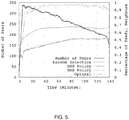
- Figure 5 compares the performance of different algorithms, namely SNS and HNS, against an optimal neighborhood selection algorithm (ONS) and the simples among all, RNS. Since ONS has global knowledge of every segment at every peer and performs exhaustive search over all peers, it always returns peers with the most relevant segments. If there are N peers at the tracker and a media file of M fragments, each request to the tracker is O(N). From Figure 5 , we observe that under different workload with a larger number of jumps (from a live VoD trace), simple neighborhood selection strategies do poorly. Initially, both HNS and SNS algorithms have about the same percentage of useful neighbors.
- ONS optimal neighborhood selection algorithm
- HNS performs nearly optimally and much better than SNS since HNS returns peers who have played the requested segment in the past.
- Peers returned by SNS may not always have the requested segment since not all returned peers may be within a window of the requesting peer's playback point (because users jump).
- HNS performs nearly optimally and is constant time. The space requirement of the HNS is very minimal.
- HNS While SNS outperforms RNS, it does not perform as well as HNS largely due to the fact that it does not take advantage of the fact that other active peers who do not share the playback point with the requesting peer may have viewed the same content in the recent history. Both HNS and SNS have been shown to be effective in a tracker design to support DVD operations in P2P VoD systems.
Landscapes
- Engineering & Computer Science (AREA)
- Computer Networks & Wireless Communication (AREA)
- Signal Processing (AREA)
- Signal Processing For Digital Recording And Reproducing (AREA)
- Computer And Data Communications (AREA)
- Management Or Editing Of Information On Record Carriers (AREA)
- Television Signal Processing For Recording (AREA)
Description
- The present invention is related to Peer-to-Peer(P2P) systems, in particular, to the design of a tracker to support DVD features.
- A tracker is a network component that provides peers with information to build high quality neighborhoods that makes sharing data possible without having to rely on the server except only as a last resort. A tracker also provides each peer with a mechanism to bootstrap data delivery to a requesting peer.
- Most file sharing applications follow the download-then-consume model. Here, the tracker is designed to make a random selection of peers (as a neighborhood of a requesting peer). This random selection works well because peers are interested in the entire file. So, the tracker is not concerned with in-sequence delivery of file segments. Two of the most common algorithms used in such trackers are the random neighbor selection and the optimal neighbor selection.
- The Random Neighbor Selection (RNS) is the simplest of all neighbor selection algorithms. In RNS, the tracker selects n peers at random from a list of active peers and returns them to the requesting peer. This is the standard algorithm used by most P2P tracker systems today. This is the most scalable of the tracker algorithms since it does not require any sophisticated data structure to maintain the candidate list of peers.
- In the Optimal Neighbor Selection (ONS) the tracker is assumed to have global knowledge of every segment at every peer and performs exhaustive search over all peers to always return the peers with the most relevant segments. This is very good for peer neighborhood formation. However, it is prohibitively expensive for the tracker's processing load.
- The demands placed on a P2P video on demand (VoD) tracker are entirely different. A user's demand for the next segment is guided by her current playback point. Hence, a careful choice of a neighbor's peer is needed to ensure a good system-wide performance. Further, the latency response of each request also becomes critical because it directly affects the user's experience of using jump operations, which would require a quick neighborhood selection to ensure quick recovery for playback.
- Current state-of-art P2P systems ignore DVD functionality or jumps (fast forward, backward jump, pause etc.). The design is hard since DVD operations reduce P2P file sharing opportunities. In an ideal system, the server should be used only as a last resort to pull data. So, scheduling data in time and finding the right set of peers to share data are non-trivial issues that must be addressed as a first step towards designing peers that support DVD functionality and provide good user experience.
- Document
US2009/172179 A1 discloses a networked transmission system which comprises a network, a streaming server and an ordered series of a first up to n-th cooperative-sharing groups. The streaming server transmits one or more audio/video clips to the leader node of the first cooperative-sharing groups, which transmits the currently received audio/video clip to the users' terminals within the same cooperative-sharing group, and passes the received audio/video clip to the leader node of the next cooperative-sharing group after one time slot. - Document
US2008/256255 A1 discloses a process for streaming media data in a peer-to-peer (P2P) network which includes the step of submitting a request through the P2P network to play a time segment of a media file. A local computer is connected through the P2P network to a streaming computer having the desired time segment. The time segment is streamed from the streaming computer to the local computer starting with an initial data byte. The time segment is stored on the local computer for playback through a corresponding media player. - The invention is defined by a method according to
claim 1 and a system according toclaim 4. Further embodiments are defined by the dependent claims.The goal of this invention is to describe an optimal design of a tracker to support DVD-features (ability to pause, jump forward and backwards in time) at the peers in a Video-on-demand (VoD) system while providing users, a good viewing experience. - The method and device of the invention design are based on the following two guiding principles:
- (1) Users who are at (or near) the same playback point can benefit mutually by collaborating.
- (2) Between jumps, users play video sequentially.
- The tracker uses (1) to group users who are at the same playback point and (2) to estimate the current playback position of users in the system. Together, (1) and (2) allows a tracker to find and report suitable peers that can share content with requesting peers in a scalable way.
- The design of the tracker is a two-step process. In the first step, we propose an efficient technique to group peers by playback point. In the second step, we design two smart algorithms, either one of which can be implemented at a tracker; Smart Neighborhood Selection (SNS) or History-based Neighborhood Selection (HNS). Both algorithms help a requesting peer form a neighborhood of peers with whom they can exchange data. If needed, both the Smart Neighborhood Selection and the History-based selection can be used to select the neighborhood, the former being used first to produce a subset of peers.
- The following abbreviations are used:
- P2P: Peer to peer system. Here, each node acts as both a client (request data) and
- a server (by making data available for other peers).
- K: Number of fragments in a media file.
- W: Window size
- B: Size of buffer
- Pj: Current playback point of peer j (as reported to the tracker).
- Li: List of peers playing fragment i (out of K total fragments).
- NB: Number of neighbours of peer B.
- Hi: List of peers who have played fragment i in the past. As peers play a media, knowing the playback rate and the segment size of a peer, periodically, the segments played by a peer are updated in the History table maintained by the tracker.
- The invention provides thus a method of grouping peers in accordance with
claim 1. The method comprises the steps of (a) determining for peer j, at the video time T, the jump point Pj, (b) generating a hash key HKj. The hash key has a value HKj= (Pj-T)/C, where C >= 1 is the granularity of the system and finally (c) grouping peers with the same hash-key. - The hash-key value for a peer is updated when the next jump operation is performed. In a second step, a neighbourhood of a requesting peer is selected from the group of peers with the same hash key as the requesting peer. If the number of peers in the neighbourhood (peers having the same hash-key) is less than n, in a next step the remaining peers are selected from the neighbours with a hash key that is greater than but close to the hash key of the requesting peer, i.e. from neighbours which have already played the playback segment k of the requesting peer. If the number of peers in the neighbourhood is still less than n, in a next step the remaining peers are selected randomly.
- To complete the description and in order to provide a better understanding of the invention, a set of drawings is provided. The said drawings form an integral part of the description and illustrate a preferred embodiment of the invention, which should not be interpreted as restricting the scope of the invention, but just as an example of how the invention can be embodied. The drawings comprise the following figures:
-
Figure 1 describes an example that demonstrates grouping of peers by play point at the tracker. -
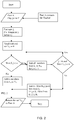
Figure 2 is a flowchart of the SNS algorithm of the invention. -
Figure 3 is a flowchart of the HNS algorithm of the invention. -
Figure 4(a) shows how Hash Keys are used to group peers for the example inFigure 1 . -
Figure 4(b) shows the snapshot of the content of History table for the example ofFigure 1 as per the HNS algorithm. -
Figure 5 shows a comparison of the performance of Peer Selection Algorithms at the Tracker. - The tracker is a key component in any P2P system. In a P2P VoD system, it has a particularly key role since peers will contact the tracker at:
- (1) Start time, when request for content is made.
- (2) Every DVD operation because the peer needs to find other peers with whom it can exchange data without having to go to the server for each segment.
- (3) Every time a peer determines that its neighbourhood does not contain high-quality peers to exchange data.
- The present invention provides a method of grouping peers by play point for use in VoD systems that support DVD-functionality. Two ways of neighbourhood selection at the tracker are then possible both based on this first grouping. To be effective, the tracker needs to group peers that can share data. Every time a peer needs a list of neighbors, it contacts the tracker with its current playback point. Based on the playback point, the neighborhood selection algorithm at the tracker invokes two mechanisms: (1) Finding the playback point of the requesting peer. (2) Neighborhood Selection that selects a list of peers that are at the same playback point as the playback point of the requesting peer and contains the necessary video information.
- First, we show how to group peers by playing point. We will then propose two Neighborhood Selection algorithms, Smart Neighborhood Selection (SNS) and History-based Neighborhood Selection (HNS) to help a peer exchange data with its neighborhood.
- Grouping Peers by Play Point: To implement the smart neighborhood selection and the history based selection algorithms, the tracker needs to know the part of the video that each peer is playing when it receives a peer request for a list of neighbors. Since the play point increases with time, a naive tracker would have to re-calculate the play point of every peer at every request, thus incurring a very high overhead. To avoid having to do a per-peer computation, we created a hash table that keeps in each entry all peers that are playing the same part of the video. We use a hash key that is a function of the video time when the jump happened and the final jump point. We use a simple modulo operation as our hash function.
- We illustrate this using an example. For a jump operation at video time T, peer j reports the jump point, Pj to the tracker. The tracker generates a hash key HKj as follows: HKj = (Pj-T) / C , where C ≥ 1 is the granularity of the mechanism to predict the play point of peers. The granularity is chosen according to the tolerance of the users. It should be as small as possible, the lower limit being 1 second. However, a very low granularity can lead to misinterpretations. It has been calculated that the optimal C should be set to no lesser than 5 seconds. Then the peer is removed from the old hash entry and inserted into the new entry with key as HKj. Note that the hash key HKj is static and the tracker does not need to update the peer in the hash table until the next jump operation. This is one of the advantages of the invention.
- In
Fig.1 , we demonstrate our approach using a numerical example. Peer A begins watching a video attime 2 and attime 6 jumps to playpoint 7. Assuming C = 1, the hash key for peer A at the jump is 1. The hash key of peer A is the projection of its play point at jump time. We assume that Peer B has started playing attime 4. Attime 8, Peer B jumps to playpoint 9. Attime 9, peer B also has ahash key 1 and the tracker will return A as a peer in the same group as peer B. If the length of the media is very large, the size of the hash table can potentially reach the number of peers in the tracker.Fig 4(a) gives a snapshot of hash keys before and after the jump. - To bound the size of hash table and to ensure that peers who leave the system are removed, every peer periodically contacts the tracker to inform it of its current play position. This keep-alive time, (ta) is set to 15 minutes. With periodic reports, the number of keys is no more than (L + ta) /C. Here, L is the length of video. For a 120 minute movie, ta = 15 minutes and C = 1 minute, there are only 135 possible different active keys at that tracker at any time. By allocating 135 entries in the table, we can avoid collisions and achieve a complexity of 0(1) to access / insert in a hash table.
- Given that we now have a lightweight mechanism to group peers by playback point and make quick updates on jump operations, we discuss design of two neighbourhood selection algorithms.
- The SNS algorithm is shown below.
-
Algorithm 1 Smart Neighborhood Selection (SNS) - Require: Media file is divided into K fragments.
- Require: For each media fragment i, tracker maintains a list of peers Li playing the fragment i.
- Result: The tracker returns n neighbors to a requesting peer.
- 1: A peer A contacts the tracker with a playback point P it wants to jump to.
- 2: Neighborhood of A, NA = Φ (Initially, set to empty set)
- 3: Tracker estimates the fragment j of the playback point P, 1 ≤ j ≤ K, P ∈ fragment j and calculates its hash key HKj.
- 4: Tracker randomly picks n peers from list Lj and adds them to list NA
- 5: count ← j
- 6: sum ← Size(Lj)
- 7: while sum < n do
- 8: count ←
count + 1 - 9: sum ← sum + Size(Lcount)
- 10: add the set Lcount to NA
- 11: end while
- 12: Add peer A to list Lj
- 13: return Neighborhood of A, NA
- The logic of our algorithm to select n neighbors follows the following steps, once a list of peers with the same hash key as the requesting peer has been generated according to the previous step:
- 1. If we can not find n neighbors at the same playback point of the requesting peer, we attempt to get the remaining peers from a list of peers that are close to the play point of the requesting peer and have a higher hash key. The rationale behind this choice is that peers close in time to the requesting peer may already have played the segment and hence, can provide it to the requesting peer. So, for a peer that has jumped to a playback point in fragment j, if the tracker cannot find n peers at playback point j, the tracker will look for peers at playback point j+1, j+2, ... K etc. in that order.
- 2. If the tracker gets to the last fragment K and still does not find n neighbors, it will randomly pick the remaining neighbors from playback points [1, j].
- The algorithm thus consists of two steps: (1) calculating the playback point of a requesting peer is a constant-time operation as discussed previously and (2) finding n neighbours is also a constant time operation since the number of fragments K in a media file is small, much smaller than the number of peers in the system.
- There are no hard guidelines for choice of value of n, the minimum number of other peers that a peer may be connected to. The value of n depends on the VoD application. Depending on network conditions and stability of peers, the P2P application determines a suitable choice of n. Normally, a value of n > 10 is chosen.
- As seen in the above discussion, the SNS algorithm at the tracker is constant in time and tries to quickly find peers who can collaborate. A flowchart of the SNS algorithm is shown in
figure 2 . - Using
figure 4(a) , we demonstrate that for the example infigure 1 , the Hash Key of peer A (HKA) was initially -2. Likewise, the Hash Key of peer B (HKB) was initially -4. At time=6, the peer A jumps resulting in a new HKA = 1. Likewise, when peer B jumps at time = 8, the new HKB = 1. As per SNS, peer A will be returned to peer B as a neighbour to exchange data. If there are fewer than n peers with the same Hash Key, the algorithm will first attempt to find remaining peers with a higher Hash Key and if insufficient peers are found, try and find peers at random. - History-based Neighborhood Selection: The HNS algorithm is shown below.
- Algorithm 2: History-based Neighbor Selection (HNS)
- Require: Media file is divided into K fragments.
- Require: For each media fragment i, tracker maintains a list of peers Li playing the fragment i.
- Require: The tracker returns n neighbors to a requesting peer.
- Require: For each jump operation, the tracker generates a history of segments, Hj played by the peer. So, each
playpoint 1 ≤ j ≤ K contains a list of peers that played that segment.- 1: A peer B contacts the tracker with a playback point P it wants to jump to.
- 2: Neighborhood of B, NB = Φ (Neighbourhood of B is an empty set)
- 3: Tracker estimates the fragment j of the playback point P, 1 ≤ j ≤ K, P ∈ fragment j.
- 4: Tracker picks n peers randomly from list Lj and adds them to list NB
- 5: if Size(Lj) < n then
- 6: Pick the remaining n - Size(Lj) peers randomly from the list Hi and add them to NB
- 7: end if
- 8: Pick n - Size(Lj) peers from lists Li, j ≤ i ≤ K
- 9: Return neighbors for B, NB
- The history-based neighbourhood selection algorithm differs from SNS in one key aspect. In addition to maintaining a list of peers Lj for each playback point j (1 ≤ j ≤ K), the algorithm also maintains Hj, a history of all peers who have played segment j. Knowing the playback rate of media, the history of fragments played by a peer is periodically updated. Note that at least for popular content, the number of peers who have played segment j and are active in the swarm (and hence are in the table Hj) is likely to be higher than the number of peers who are playing segment j (and are part of the list Lj).
- The logic of our algorithm to select n neighbors follows the following steps:
- 1. As in SNS, we first identify the playback point of the requesting peer and get a list of peers that are at the same playback point (and hence, having the same Hash Key). If not already updated, the history table is updated with all the fragments played since last update.
- 2. If we cannot find n neighbors at the same playback point as the requesting peer, we attempt to get the remaining peers from the history table. The rationale behind this choice is that we maintain a history Hi of each fragment i seen by each peer.
- 3. If the tracker still does not find n neighbors, it will first pick the remaining neighbors from playback points [j, K].
- 4. If it still does not find n neighbors, it will pick the remaining peers from playback points [1, j). One reason this may work is that the peers use rarest-first algorithm in the upload scheduler, which allows peers to download fragments that have not been played locally yet. A flowchart of the HNS algorithm is shown in
figure 3 . - To generate the history table of the content of each peer, peers do not need to periodically report their content to the tracker. Instead, by estimating their current play point (by knowing the playback rate of the media they are playing) and the time since last contact (either start time, or last jump operation or last request for new neighbors), the tracker can infer the content of each peer and refresh the history table accordingly. The refreshing depends both on the number of peers and on the refresh time period. Therefore refreshing, which can be run as a background task, has O(n) complexity, while peer lookup is 0(1).
- The second part of the neighborhood selection (HNS) requires a separate history table that contains the segments that each peer has. Keeping history about a peer in the order of seconds is memory intensive and searching over it is resource intensive as well. In our implementation, we divide videos in time-fragments of size C.
Figure 4(b) shows snapshots of the history table at different time-points for the example inFigure 1 . - The memory requirement is Np * L * size(Pid) / C, where L is the length of the movie, Pid is the unique peer-id of each peer and Np is the total number of peers. Each peer has a unique id of 32 bits. Thus, the tracker would require about 18MB of memory to build the history for 20K peers, for a movie length of 120 minutes and with C = 30seconds. So, the memory requirements are very modest to maintain such a history table.
- Impact of Peer Matching Algorithms: To evaluate the performance of various peer assignment algorithms, we evaluate HNS and SNS against RNS and ONS. We will show that a random selection of such peers can result in neighborhoods where the peers do not have data to share, resulting in poor system performance.
-
Figure 5 compares the performance of different algorithms, namely SNS and HNS, against an optimal neighborhood selection algorithm (ONS) and the simples among all, RNS. Since ONS has global knowledge of every segment at every peer and performs exhaustive search over all peers, it always returns peers with the most relevant segments. If there are N peers at the tracker and a media file of M fragments, each request to the tracker is O(N). FromFigure 5 , we observe that under different workload with a larger number of jumps (from a live VoD trace), simple neighborhood selection strategies do poorly. Initially, both HNS and SNS algorithms have about the same percentage of useful neighbors. However, over time, as users jump, the fraction of useful neighbors returned by the tracker is quite small for both SNS and RNS, but is very high and close to the optimal peer selection strategy for HNS. Overall, SNS does much better than RNS since SNS selects peers that are close to the playback point of the requesting peer and hence, has a higher likelihood of forming useful neighborhoods. HNS performs nearly optimally and much better than SNS since HNS returns peers who have played the requested segment in the past. Peers returned by SNS on the other hand may not always have the requested segment since not all returned peers may be within a window of the requesting peer's playback point (because users jump).
We have shown that HNS performs nearly optimally and is constant time. The space requirement of the HNS is very minimal. While SNS outperforms RNS, it does not perform as well as HNS largely due to the fact that it does not take advantage of the fact that other active peers who do not share the playback point with the requesting peer may have viewed the same content in the recent history. Both HNS and SNS have been shown to be effective in a tracker design to support DVD operations in P2P VoD systems. - Additionally, scaling tests with the tracker showed that jump patterns with up to 16,000 simultaneous peers, the tracker can respond with less than 0.1 sec delay. The maximum memory usage observed was 32 Mbytes with CPU usage peaking at 74% for SNS algorithm. This is a negligible value when compared with the transmission time of the first segments of the video (2 sec for a 64 KB segment on a 1 Mbps link) and powerful machines available today.
- Some applications of the tracker are as follows:
- A sub-system within a P2P system to co-ordinate all peers (or a subset of peers if using multiple trackers).
- To function as a neighborhood manager of peers in a P2P system to help peers find high quality neighborhoods to exchange data.
- In this text, the term "comprises" and its derivations (such as "comprising", etc.) should not be understood in an excluding sense, that is, these terms should not be interpreted as excluding the possibility that what is described and defined may include further elements, steps, etc.
- On the other hand, the invention is obviously not limited to the specific embodiment(s) described herein, but also encompasses any variations that may be considered by any person skilled in the art (for example, as regards the choice of materials, dimensions, components, configuration, etc.), within the general scope of the invention as defined in the claims.
Claims (4)
- A method of grouping peers in a P2P system where DVD jump operations can be performed, the method comprising the steps of:a. determining for each peer and video operation a time T and a jump point Pj, wherein the jump point Pj is the playback point to which said each peer jumps at the time T;b. generating a hash key HKj for each peer, the hash key having a value HKj= (Pj-T)/C, where C>=1 is the granularity of the systemc. grouping the peers with the same hash-key.d. selecting a neighbourhood of a requesting peer from the group of peers with the same hash key as the requesting peer, wherein, upon determining that the number of peers in the neighbourhood of the requesting peer is less than n, n being the minimum number of other peers that a peer may be connected to, the remaining peers of the neighbourhood are selected either from a list of peers with a hash key greater than and close to the hash key of the requesting peer or from a list of peers that have already played the playback segment j of the requesting peer.
- A method according to claim 1 wherein the hash-key value is updated when the next jump operation is performed.
- A method according to claim 1 or 2 wherein if the number of peers in the neighbourhood is still less than n, in a next step the remaining peers are selected randomly.
- A P2P system for video applications, the system comprising a tracker adapted to support jump DVD operations, wherein the tracker is adapted to perform any of the methods of claims 1-3.
Applications Claiming Priority (1)
| Application Number | Priority Date | Filing Date | Title |
|---|---|---|---|
| PCT/EP2009/059497 WO2011009489A1 (en) | 2009-07-23 | 2009-07-23 | Tracker in p2 p systems with dvd functionalities |
Publications (2)
| Publication Number | Publication Date |
|---|---|
| EP2457355A1 EP2457355A1 (en) | 2012-05-30 |
| EP2457355B1 true EP2457355B1 (en) | 2018-08-29 |
Family
ID=41435407
Family Applications (1)
| Application Number | Title | Priority Date | Filing Date |
|---|---|---|---|
| EP09780985.9A Active EP2457355B1 (en) | 2009-07-23 | 2009-07-23 | Tracker in p2p systems with dvd functionalities |
Country Status (8)
| Country | Link |
|---|---|
| US (1) | US8868682B2 (en) |
| EP (1) | EP2457355B1 (en) |
| AR (1) | AR077327A1 (en) |
| BR (1) | BR112012001527A2 (en) |
| ES (1) | ES2697874T3 (en) |
| MX (1) | MX2012001025A (en) |
| UY (1) | UY32795A (en) |
| WO (1) | WO2011009489A1 (en) |
Families Citing this family (2)
| Publication number | Priority date | Publication date | Assignee | Title |
|---|---|---|---|---|
| CN102907065B (en) * | 2010-05-20 | 2017-04-26 | 瑞典爱立信有限公司 | System and method for managing data delivery in a peer-to-peer network |
| US10841352B2 (en) * | 2012-11-27 | 2020-11-17 | International Business Machines Corporation | Non-chronological buffering of segments of a media file |
Citations (2)
| Publication number | Priority date | Publication date | Assignee | Title |
|---|---|---|---|---|
| US20080256255A1 (en) * | 2007-04-11 | 2008-10-16 | Metro Enterprises, Inc. | Process for streaming media data in a peer-to-peer network |
| US20090172179A1 (en) * | 2007-12-31 | 2009-07-02 | Yu-Ben Miao | Networked Transmission System And Method For Stream Data |
Family Cites Families (9)
| Publication number | Priority date | Publication date | Assignee | Title |
|---|---|---|---|---|
| US7493363B2 (en) * | 2001-09-19 | 2009-02-17 | Microsoft Corporation | Peer-to-peer group management and method for maintaining peer-to-peer graphs |
| US20030212804A1 (en) * | 2002-05-09 | 2003-11-13 | Ardeshir Hashemi | Method and apparatus for media clip sharing over a network |
| US8060648B2 (en) * | 2005-08-31 | 2011-11-15 | Cable Television Laboratories, Inc. | Method and system of allocating data for subsequent retrieval |
| CN101351990B (en) * | 2006-04-21 | 2011-03-16 | 张永敏 | Method and apparatus for transmitting peer-to-peer network contents for implementing localized play |
| US7925781B1 (en) * | 2006-05-26 | 2011-04-12 | The Hong Kong University Of Science And Technology | Distributed storage to support user interactivity in peer-to-peer video streaming |
| US20080059631A1 (en) * | 2006-07-07 | 2008-03-06 | Voddler, Inc. | Push-Pull Based Content Delivery System |
| US8352692B1 (en) * | 2007-03-30 | 2013-01-08 | Symantec Corporation | Utilizing peer-to-peer services with single instance storage techniques |
| US8219706B2 (en) * | 2008-11-14 | 2012-07-10 | At&T Intellectual Property I, Lp | Interdomain network aware peer-to-peer protocol |
| US20100293294A1 (en) * | 2009-05-15 | 2010-11-18 | Alcatel-Lucent Usa Inc. | Peer-to-peer communication optimization |
-
2009
- 2009-07-23 BR BR112012001527A patent/BR112012001527A2/en not_active IP Right Cessation
- 2009-07-23 US US13/386,455 patent/US8868682B2/en not_active Expired - Fee Related
- 2009-07-23 EP EP09780985.9A patent/EP2457355B1/en active Active
- 2009-07-23 MX MX2012001025A patent/MX2012001025A/en active IP Right Grant
- 2009-07-23 ES ES09780985T patent/ES2697874T3/en active Active
- 2009-07-23 WO PCT/EP2009/059497 patent/WO2011009489A1/en not_active Ceased
-
2010
- 2010-07-20 UY UY0001032795A patent/UY32795A/en not_active Application Discontinuation
- 2010-07-21 AR ARP100102657A patent/AR077327A1/en not_active Application Discontinuation
Patent Citations (2)
| Publication number | Priority date | Publication date | Assignee | Title |
|---|---|---|---|---|
| US20080256255A1 (en) * | 2007-04-11 | 2008-10-16 | Metro Enterprises, Inc. | Process for streaming media data in a peer-to-peer network |
| US20090172179A1 (en) * | 2007-12-31 | 2009-07-02 | Yu-Ben Miao | Networked Transmission System And Method For Stream Data |
Also Published As
| Publication number | Publication date |
|---|---|
| AR077327A1 (en) | 2011-08-17 |
| US20120272282A1 (en) | 2012-10-25 |
| BR112012001527A2 (en) | 2016-03-15 |
| EP2457355A1 (en) | 2012-05-30 |
| US8868682B2 (en) | 2014-10-21 |
| UY32795A (en) | 2011-02-28 |
| ES2697874T3 (en) | 2019-01-29 |
| WO2011009489A1 (en) | 2011-01-27 |
| MX2012001025A (en) | 2012-02-21 |
Similar Documents
| Publication | Publication Date | Title |
|---|---|---|
| US9167015B2 (en) | Method and system for caching streaming multimedia on the internet | |
| JP5747090B2 (en) | Cache manager for segmented multimedia and corresponding cache management method | |
| US8078729B2 (en) | Media streaming with online caching and peer-to-peer forwarding | |
| US20070288638A1 (en) | Methods and distributed systems for data location and delivery | |
| He et al. | VOVO: VCR-oriented video-on-demand in large-scale peer-to-peer networks | |
| JP5833114B2 (en) | Method and apparatus for providing streaming media programs and targeted advertisements to be compatible with HTTP live streaming | |
| KR20100090203A (en) | Method for managing data transmission between peers according to levels of priority of transmitted and received data and associated management device | |
| JP2009165092A (en) | Stream data network transmission system and method | |
| Juluri et al. | Cache'n dash: Efficient caching for dash | |
| Liang et al. | Incentivized peer-assisted streaming for on-demand services | |
| Yang et al. | Kangaroo: Video Seeking in {P2P} Systems | |
| JP2006515966A (en) | Channel merge for video on demand | |
| CN101605242B (en) | Method, device and system for realizing video-on-demand service | |
| US8868682B2 (en) | Tracker in P2P systems with DVD functionalities | |
| WO2021011317A2 (en) | Low latency streaming media | |
| Klasen | Efficient content distribution in social-aware hybrid networks | |
| US20170311046A1 (en) | Method of Broadcasting Contents by Streaming in a Peer-to-Peer Network | |
| CN101436946B (en) | Method for scheduling data request in peer-to-peer sharing network | |
| Fouda et al. | On supporting P2P-based VoD services over mesh overlay networks | |
| Ghosh et al. | Enhancing P2Cast VoD streaming performance: A node behaviour-driven parent selection approach considering VCR actions | |
| CN106210803A (en) | The player method of a kind of media program and device | |
| Hecht et al. | Liveshift: Mesh-pull live and time-shifted p2p video streaming | |
| Hecht et al. | LiveShift: mesh-pull P2P live and time-shifted video streaming | |
| JP6016773B2 (en) | Push-pull based content distribution system | |
| Kulkarni et al. | A stream tapping protocol involving clients in the distribution of videos on demand |
Legal Events
| Date | Code | Title | Description |
|---|---|---|---|
| PUAI | Public reference made under article 153(3) epc to a published international application that has entered the european phase |
Free format text: ORIGINAL CODE: 0009012 |
|
| 17P | Request for examination filed |
Effective date: 20120222 |
|
| AK | Designated contracting states |
Kind code of ref document: A1 Designated state(s): AT BE BG CH CY CZ DE DK EE ES FI FR GB GR HR HU IE IS IT LI LT LU LV MC MK MT NL NO PL PT RO SE SI SK SM TR |
|
| DAX | Request for extension of the european patent (deleted) | ||
| STAA | Information on the status of an ep patent application or granted ep patent |
Free format text: STATUS: EXAMINATION IS IN PROGRESS |
|
| 17Q | First examination report despatched |
Effective date: 20170928 |
|
| REG | Reference to a national code |
Ref country code: DE Ref legal event code: R079 Ref document number: 602009054184 Country of ref document: DE Free format text: PREVIOUS MAIN CLASS: H04L0029060000 Ipc: H04L0029080000 |
|
| GRAP | Despatch of communication of intention to grant a patent |
Free format text: ORIGINAL CODE: EPIDOSNIGR1 |
|
| STAA | Information on the status of an ep patent application or granted ep patent |
Free format text: STATUS: GRANT OF PATENT IS INTENDED |
|
| RIC1 | Information provided on ipc code assigned before grant |
Ipc: H04L 29/08 20060101AFI20180110BHEP |
|
| INTG | Intention to grant announced |
Effective date: 20180206 |
|
| GRAS | Grant fee paid |
Free format text: ORIGINAL CODE: EPIDOSNIGR3 |
|
| GRAA | (expected) grant |
Free format text: ORIGINAL CODE: 0009210 |
|
| STAA | Information on the status of an ep patent application or granted ep patent |
Free format text: STATUS: THE PATENT HAS BEEN GRANTED |
|
| AK | Designated contracting states |
Kind code of ref document: B1 Designated state(s): AT BE BG CH CY CZ DE DK EE ES FI FR GB GR HR HU IE IS IT LI LT LU LV MC MK MT NL NO PL PT RO SE SI SK SM TR |
|
| REG | Reference to a national code |
Ref country code: GB Ref legal event code: FG4D |
|
| REG | Reference to a national code |
Ref country code: CH Ref legal event code: EP |
|
| REG | Reference to a national code |
Ref country code: AT Ref legal event code: REF Ref document number: 1036522 Country of ref document: AT Kind code of ref document: T Effective date: 20180915 |
|
| REG | Reference to a national code |
Ref country code: IE Ref legal event code: FG4D |
|
| REG | Reference to a national code |
Ref country code: DE Ref legal event code: R096 Ref document number: 602009054184 Country of ref document: DE |
|
| REG | Reference to a national code |
Ref country code: NL Ref legal event code: MP Effective date: 20180829 |
|
| REG | Reference to a national code |
Ref country code: LT Ref legal event code: MG4D |
|
| REG | Reference to a national code |
Ref country code: ES Ref legal event code: FG2A Ref document number: 2697874 Country of ref document: ES Kind code of ref document: T3 Effective date: 20190129 |
|
| PG25 | Lapsed in a contracting state [announced via postgrant information from national office to epo] |
Ref country code: SE Free format text: LAPSE BECAUSE OF FAILURE TO SUBMIT A TRANSLATION OF THE DESCRIPTION OR TO PAY THE FEE WITHIN THE PRESCRIBED TIME-LIMIT Effective date: 20180829 Ref country code: LT Free format text: LAPSE BECAUSE OF FAILURE TO SUBMIT A TRANSLATION OF THE DESCRIPTION OR TO PAY THE FEE WITHIN THE PRESCRIBED TIME-LIMIT Effective date: 20180829 Ref country code: GR Free format text: LAPSE BECAUSE OF FAILURE TO SUBMIT A TRANSLATION OF THE DESCRIPTION OR TO PAY THE FEE WITHIN THE PRESCRIBED TIME-LIMIT Effective date: 20181130 Ref country code: FI Free format text: LAPSE BECAUSE OF FAILURE TO SUBMIT A TRANSLATION OF THE DESCRIPTION OR TO PAY THE FEE WITHIN THE PRESCRIBED TIME-LIMIT Effective date: 20180829 Ref country code: NL Free format text: LAPSE BECAUSE OF FAILURE TO SUBMIT A TRANSLATION OF THE DESCRIPTION OR TO PAY THE FEE WITHIN THE PRESCRIBED TIME-LIMIT Effective date: 20180829 Ref country code: BG Free format text: LAPSE BECAUSE OF FAILURE TO SUBMIT A TRANSLATION OF THE DESCRIPTION OR TO PAY THE FEE WITHIN THE PRESCRIBED TIME-LIMIT Effective date: 20181129 Ref country code: IS Free format text: LAPSE BECAUSE OF FAILURE TO SUBMIT A TRANSLATION OF THE DESCRIPTION OR TO PAY THE FEE WITHIN THE PRESCRIBED TIME-LIMIT Effective date: 20181229 Ref country code: NO Free format text: LAPSE BECAUSE OF FAILURE TO SUBMIT A TRANSLATION OF THE DESCRIPTION OR TO PAY THE FEE WITHIN THE PRESCRIBED TIME-LIMIT Effective date: 20181129 |
|
| REG | Reference to a national code |
Ref country code: AT Ref legal event code: MK05 Ref document number: 1036522 Country of ref document: AT Kind code of ref document: T Effective date: 20180829 |
|
| PG25 | Lapsed in a contracting state [announced via postgrant information from national office to epo] |
Ref country code: HR Free format text: LAPSE BECAUSE OF FAILURE TO SUBMIT A TRANSLATION OF THE DESCRIPTION OR TO PAY THE FEE WITHIN THE PRESCRIBED TIME-LIMIT Effective date: 20180829 Ref country code: LV Free format text: LAPSE BECAUSE OF FAILURE TO SUBMIT A TRANSLATION OF THE DESCRIPTION OR TO PAY THE FEE WITHIN THE PRESCRIBED TIME-LIMIT Effective date: 20180829 |
|
| PG25 | Lapsed in a contracting state [announced via postgrant information from national office to epo] |
Ref country code: EE Free format text: LAPSE BECAUSE OF FAILURE TO SUBMIT A TRANSLATION OF THE DESCRIPTION OR TO PAY THE FEE WITHIN THE PRESCRIBED TIME-LIMIT Effective date: 20180829 Ref country code: PL Free format text: LAPSE BECAUSE OF FAILURE TO SUBMIT A TRANSLATION OF THE DESCRIPTION OR TO PAY THE FEE WITHIN THE PRESCRIBED TIME-LIMIT Effective date: 20180829 Ref country code: RO Free format text: LAPSE BECAUSE OF FAILURE TO SUBMIT A TRANSLATION OF THE DESCRIPTION OR TO PAY THE FEE WITHIN THE PRESCRIBED TIME-LIMIT Effective date: 20180829 Ref country code: IT Free format text: LAPSE BECAUSE OF FAILURE TO SUBMIT A TRANSLATION OF THE DESCRIPTION OR TO PAY THE FEE WITHIN THE PRESCRIBED TIME-LIMIT Effective date: 20180829 Ref country code: AT Free format text: LAPSE BECAUSE OF FAILURE TO SUBMIT A TRANSLATION OF THE DESCRIPTION OR TO PAY THE FEE WITHIN THE PRESCRIBED TIME-LIMIT Effective date: 20180829 Ref country code: CZ Free format text: LAPSE BECAUSE OF FAILURE TO SUBMIT A TRANSLATION OF THE DESCRIPTION OR TO PAY THE FEE WITHIN THE PRESCRIBED TIME-LIMIT Effective date: 20180829 |
|
| PG25 | Lapsed in a contracting state [announced via postgrant information from national office to epo] |
Ref country code: SK Free format text: LAPSE BECAUSE OF FAILURE TO SUBMIT A TRANSLATION OF THE DESCRIPTION OR TO PAY THE FEE WITHIN THE PRESCRIBED TIME-LIMIT Effective date: 20180829 Ref country code: DK Free format text: LAPSE BECAUSE OF FAILURE TO SUBMIT A TRANSLATION OF THE DESCRIPTION OR TO PAY THE FEE WITHIN THE PRESCRIBED TIME-LIMIT Effective date: 20180829 Ref country code: SM Free format text: LAPSE BECAUSE OF FAILURE TO SUBMIT A TRANSLATION OF THE DESCRIPTION OR TO PAY THE FEE WITHIN THE PRESCRIBED TIME-LIMIT Effective date: 20180829 |
|
| REG | Reference to a national code |
Ref country code: DE Ref legal event code: R097 Ref document number: 602009054184 Country of ref document: DE |
|
| PLBE | No opposition filed within time limit |
Free format text: ORIGINAL CODE: 0009261 |
|
| STAA | Information on the status of an ep patent application or granted ep patent |
Free format text: STATUS: NO OPPOSITION FILED WITHIN TIME LIMIT |
|
| 26N | No opposition filed |
Effective date: 20190531 |
|
| PG25 | Lapsed in a contracting state [announced via postgrant information from national office to epo] |
Ref country code: SI Free format text: LAPSE BECAUSE OF FAILURE TO SUBMIT A TRANSLATION OF THE DESCRIPTION OR TO PAY THE FEE WITHIN THE PRESCRIBED TIME-LIMIT Effective date: 20180829 |
|
| PG25 | Lapsed in a contracting state [announced via postgrant information from national office to epo] |
Ref country code: MC Free format text: LAPSE BECAUSE OF FAILURE TO SUBMIT A TRANSLATION OF THE DESCRIPTION OR TO PAY THE FEE WITHIN THE PRESCRIBED TIME-LIMIT Effective date: 20180829 |
|
| REG | Reference to a national code |
Ref country code: CH Ref legal event code: PL |
|
| PG25 | Lapsed in a contracting state [announced via postgrant information from national office to epo] |
Ref country code: TR Free format text: LAPSE BECAUSE OF FAILURE TO SUBMIT A TRANSLATION OF THE DESCRIPTION OR TO PAY THE FEE WITHIN THE PRESCRIBED TIME-LIMIT Effective date: 20180829 |
|
| REG | Reference to a national code |
Ref country code: BE Ref legal event code: MM Effective date: 20190731 |
|
| PG25 | Lapsed in a contracting state [announced via postgrant information from national office to epo] |
Ref country code: LI Free format text: LAPSE BECAUSE OF NON-PAYMENT OF DUE FEES Effective date: 20190731 Ref country code: CH Free format text: LAPSE BECAUSE OF NON-PAYMENT OF DUE FEES Effective date: 20190731 Ref country code: BE Free format text: LAPSE BECAUSE OF NON-PAYMENT OF DUE FEES Effective date: 20190731 Ref country code: LU Free format text: LAPSE BECAUSE OF NON-PAYMENT OF DUE FEES Effective date: 20190723 |
|
| PG25 | Lapsed in a contracting state [announced via postgrant information from national office to epo] |
Ref country code: PT Free format text: LAPSE BECAUSE OF FAILURE TO SUBMIT A TRANSLATION OF THE DESCRIPTION OR TO PAY THE FEE WITHIN THE PRESCRIBED TIME-LIMIT Effective date: 20181229 Ref country code: FR Free format text: LAPSE BECAUSE OF NON-PAYMENT OF DUE FEES Effective date: 20190731 |
|
| PG25 | Lapsed in a contracting state [announced via postgrant information from national office to epo] |
Ref country code: IE Free format text: LAPSE BECAUSE OF NON-PAYMENT OF DUE FEES Effective date: 20190723 |
|
| PG25 | Lapsed in a contracting state [announced via postgrant information from national office to epo] |
Ref country code: CY Free format text: LAPSE BECAUSE OF FAILURE TO SUBMIT A TRANSLATION OF THE DESCRIPTION OR TO PAY THE FEE WITHIN THE PRESCRIBED TIME-LIMIT Effective date: 20180829 |
|
| PG25 | Lapsed in a contracting state [announced via postgrant information from national office to epo] |
Ref country code: HU Free format text: LAPSE BECAUSE OF FAILURE TO SUBMIT A TRANSLATION OF THE DESCRIPTION OR TO PAY THE FEE WITHIN THE PRESCRIBED TIME-LIMIT; INVALID AB INITIO Effective date: 20090723 Ref country code: MT Free format text: LAPSE BECAUSE OF FAILURE TO SUBMIT A TRANSLATION OF THE DESCRIPTION OR TO PAY THE FEE WITHIN THE PRESCRIBED TIME-LIMIT Effective date: 20180829 |
|
| REG | Reference to a national code |
Ref country code: DE Ref legal event code: R079 Ref document number: 602009054184 Country of ref document: DE Free format text: PREVIOUS MAIN CLASS: H04L0029080000 Ipc: H04L0065000000 |
|
| PG25 | Lapsed in a contracting state [announced via postgrant information from national office to epo] |
Ref country code: MK Free format text: LAPSE BECAUSE OF FAILURE TO SUBMIT A TRANSLATION OF THE DESCRIPTION OR TO PAY THE FEE WITHIN THE PRESCRIBED TIME-LIMIT Effective date: 20180829 |
|
| PGFP | Annual fee paid to national office [announced via postgrant information from national office to epo] |
Ref country code: ES Payment date: 20250804 Year of fee payment: 17 |
|
| PGFP | Annual fee paid to national office [announced via postgrant information from national office to epo] |
Ref country code: DE Payment date: 20250728 Year of fee payment: 17 |
|
| PGFP | Annual fee paid to national office [announced via postgrant information from national office to epo] |
Ref country code: GB Payment date: 20260625 Year of fee payment: 18 |