EP2456435B1 - Heteroaryl benzamides, compositions and methods of use - Google Patents
Heteroaryl benzamides, compositions and methods of use Download PDFInfo
- Publication number
- EP2456435B1 EP2456435B1 EP10802849.9A EP10802849A EP2456435B1 EP 2456435 B1 EP2456435 B1 EP 2456435B1 EP 10802849 A EP10802849 A EP 10802849A EP 2456435 B1 EP2456435 B1 EP 2456435B1
- Authority
- EP
- European Patent Office
- Prior art keywords
- methyl
- benzamide
- amino
- pyridinyl
- phenyl
- Prior art date
- Legal status (The legal status is an assumption and is not a legal conclusion. Google has not performed a legal analysis and makes no representation as to the accuracy of the status listed.)
- Not-in-force
Links
- -1 Heteroaryl benzamides Chemical class 0.000 title claims description 417
- 238000000034 method Methods 0.000 title claims description 135
- 239000000203 mixture Substances 0.000 title description 110
- 229940054066 benzamide antipsychotics Drugs 0.000 title description 2
- 229910052739 hydrogen Inorganic materials 0.000 claims description 912
- 150000001875 compounds Chemical class 0.000 claims description 189
- 150000003839 salts Chemical class 0.000 claims description 98
- 125000003118 aryl group Chemical group 0.000 claims description 53
- 125000002496 methyl group Chemical group [H]C([H])([H])* 0.000 claims description 48
- 239000001257 hydrogen Substances 0.000 claims description 43
- 125000001072 heteroaryl group Chemical group 0.000 claims description 32
- 125000004435 hydrogen atom Chemical class [H]* 0.000 claims description 32
- 125000000217 alkyl group Chemical group 0.000 claims description 31
- 125000000592 heterocycloalkyl group Chemical group 0.000 claims description 31
- 125000001997 phenyl group Chemical group [H]C1=C([H])C([H])=C(*)C([H])=C1[H] 0.000 claims description 29
- 208000037265 diseases, disorders, signs and symptoms Diseases 0.000 claims description 25
- 230000004190 glucose uptake Effects 0.000 claims description 24
- 239000008194 pharmaceutical composition Substances 0.000 claims description 24
- 201000010099 disease Diseases 0.000 claims description 20
- 125000003545 alkoxy group Chemical group 0.000 claims description 19
- 125000003178 carboxy group Chemical group [H]OC(*)=O 0.000 claims description 18
- 125000000753 cycloalkyl group Chemical group 0.000 claims description 18
- 230000002950 deficient Effects 0.000 claims description 18
- 125000000547 substituted alkyl group Chemical group 0.000 claims description 18
- 125000002837 carbocyclic group Chemical group 0.000 claims description 17
- 125000002924 primary amino group Chemical group [H]N([H])* 0.000 claims description 16
- 125000003107 substituted aryl group Chemical group 0.000 claims description 16
- 230000001404 mediated effect Effects 0.000 claims description 15
- 125000003342 alkenyl group Chemical group 0.000 claims description 14
- 125000001424 substituent group Chemical group 0.000 claims description 14
- 102100035070 von Hippel-Lindau disease tumor suppressor Human genes 0.000 claims description 12
- 125000004209 (C1-C8) alkyl group Chemical group 0.000 claims description 11
- 125000000304 alkynyl group Chemical group 0.000 claims description 10
- 125000004122 cyclic group Chemical group 0.000 claims description 10
- 230000034659 glycolysis Effects 0.000 claims description 10
- 239000003937 drug carrier Substances 0.000 claims description 9
- 125000002887 hydroxy group Chemical group [H]O* 0.000 claims description 9
- 230000001965 increasing effect Effects 0.000 claims description 9
- 125000004179 3-chlorophenyl group Chemical group [H]C1=C([H])C(*)=C([H])C(Cl)=C1[H] 0.000 claims description 8
- 125000001054 5 membered carbocyclic group Chemical group 0.000 claims description 8
- 125000004008 6 membered carbocyclic group Chemical group 0.000 claims description 8
- 125000004104 aryloxy group Chemical group 0.000 claims description 8
- 231100000433 cytotoxic Toxicity 0.000 claims description 8
- 230000001472 cytotoxic effect Effects 0.000 claims description 8
- 125000000472 sulfonyl group Chemical group *S(*)(=O)=O 0.000 claims description 8
- 125000004207 3-methoxyphenyl group Chemical group [H]C1=C([H])C(*)=C([H])C(OC([H])([H])[H])=C1[H] 0.000 claims description 7
- 125000001255 4-fluorophenyl group Chemical group [H]C1=C([H])C(*)=C([H])C([H])=C1F 0.000 claims description 7
- 125000004172 4-methoxyphenyl group Chemical group [H]C1=C([H])C(OC([H])([H])[H])=C([H])C([H])=C1* 0.000 claims description 7
- KPCZJLGGXRGYIE-UHFFFAOYSA-N [C]1=CC=CN=C1 Chemical group [C]1=CC=CN=C1 KPCZJLGGXRGYIE-UHFFFAOYSA-N 0.000 claims description 7
- 125000002252 acyl group Chemical group 0.000 claims description 7
- 125000005017 substituted alkenyl group Chemical group 0.000 claims description 7
- FYGNUQBXEFYKDJ-UHFFFAOYSA-N 4-[[(3-chloro-2-methylphenyl)sulfonylamino]methyl]-n-pyridin-3-ylbenzamide Chemical compound CC1=C(Cl)C=CC=C1S(=O)(=O)NCC1=CC=C(C(=O)NC=2C=NC=CC=2)C=C1 FYGNUQBXEFYKDJ-UHFFFAOYSA-N 0.000 claims description 6
- WBZDXMJBOFKVSN-UHFFFAOYSA-N 4-[[(3-methylphenyl)sulfonylamino]methyl]-n-pyridin-3-ylbenzamide Chemical compound CC1=CC=CC(S(=O)(=O)NCC=2C=CC(=CC=2)C(=O)NC=2C=NC=CC=2)=C1 WBZDXMJBOFKVSN-UHFFFAOYSA-N 0.000 claims description 6
- 125000004453 alkoxycarbonyl group Chemical group 0.000 claims description 6
- BXRSQICJJVQNPU-UHFFFAOYSA-N methyl 2-[[4-(pyridin-3-ylcarbamoyl)phenyl]methylsulfamoyl]benzoate Chemical compound COC(=O)C1=CC=CC=C1S(=O)(=O)NCC1=CC=C(C(=O)NC=2C=NC=CC=2)C=C1 BXRSQICJJVQNPU-UHFFFAOYSA-N 0.000 claims description 6
- 125000005346 substituted cycloalkyl group Chemical group 0.000 claims description 6
- CHPYLJLKNYANST-UHFFFAOYSA-N 3-[[(4-tert-butylphenyl)sulfonylamino]methyl]-n-pyridin-3-ylbenzamide Chemical compound C1=CC(C(C)(C)C)=CC=C1S(=O)(=O)NCC1=CC=CC(C(=O)NC=2C=NC=CC=2)=C1 CHPYLJLKNYANST-UHFFFAOYSA-N 0.000 claims description 5
- OQFKGIUJLUIZKB-UHFFFAOYSA-N 4-[[(4-bromophenyl)sulfonylamino]methyl]-n-pyridin-3-ylbenzamide Chemical compound C1=CC(Br)=CC=C1S(=O)(=O)NCC1=CC=C(C(=O)NC=2C=NC=CC=2)C=C1 OQFKGIUJLUIZKB-UHFFFAOYSA-N 0.000 claims description 5
- HWBODXDUVGMADS-UHFFFAOYSA-N 4-[[[4-[3-[2-[2-[2-[2-[2-(2-aminoethoxy)ethoxy]ethoxy]ethoxy]ethoxy]ethoxy]prop-1-ynyl]phenyl]sulfonylamino]methyl]-n-pyridin-3-ylbenzamide Chemical compound C1=CC(C#CCOCCOCCOCCOCCOCCOCCN)=CC=C1S(=O)(=O)NCC1=CC=C(C(=O)NC=2C=NC=CC=2)C=C1 HWBODXDUVGMADS-UHFFFAOYSA-N 0.000 claims description 5
- 125000003762 3,4-dimethoxyphenyl group Chemical group [H]C1=C([H])C(OC([H])([H])[H])=C(OC([H])([H])[H])C([H])=C1* 0.000 claims description 4
- ICMWJJQMWQHBDA-UHFFFAOYSA-N 3-(benzenesulfonamidomethyl)-n-pyridin-3-ylbenzamide Chemical compound C=1C=CC(CNS(=O)(=O)C=2C=CC=CC=2)=CC=1C(=O)NC1=CC=CN=C1 ICMWJJQMWQHBDA-UHFFFAOYSA-N 0.000 claims description 4
- 125000006275 3-bromophenyl group Chemical group [H]C1=C([H])C(Br)=C([H])C(*)=C1[H] 0.000 claims description 4
- 125000004180 3-fluorophenyl group Chemical group [H]C1=C([H])C(*)=C([H])C(F)=C1[H] 0.000 claims description 4
- PFUBTMVHCHKARS-UHFFFAOYSA-N 4-(benzenesulfonamidomethyl)-n-pyridin-3-ylbenzamide Chemical compound C=1C=C(CNS(=O)(=O)C=2C=CC=CC=2)C=CC=1C(=O)NC1=CC=CN=C1 PFUBTMVHCHKARS-UHFFFAOYSA-N 0.000 claims description 4
- XDIJAODMNIQZGB-UHFFFAOYSA-N 4-[(4-fluorophenyl)sulfamoylmethyl]-n-pyridin-3-ylbenzamide Chemical compound C1=CC(F)=CC=C1NS(=O)(=O)CC1=CC=C(C(=O)NC=2C=NC=CC=2)C=C1 XDIJAODMNIQZGB-UHFFFAOYSA-N 0.000 claims description 4
- XHQRZQCBVLTMTJ-UHFFFAOYSA-N 4-[(4-tert-butylphenyl)sulfamoylmethyl]-n-pyridin-3-ylbenzamide Chemical compound C1=CC(C(C)(C)C)=CC=C1NS(=O)(=O)CC1=CC=C(C(=O)NC=2C=NC=CC=2)C=C1 XHQRZQCBVLTMTJ-UHFFFAOYSA-N 0.000 claims description 4
- PUROKVIXZZPAPF-UHFFFAOYSA-N 4-[1-[(4-tert-butylphenyl)sulfonylamino]ethyl]-n-pyridin-3-ylbenzamide Chemical compound C=1C=C(C(=O)NC=2C=NC=CC=2)C=CC=1C(C)NS(=O)(=O)C1=CC=C(C(C)(C)C)C=C1 PUROKVIXZZPAPF-UHFFFAOYSA-N 0.000 claims description 4
- PKFKTOPHZADXSF-UHFFFAOYSA-N 4-[[(3,4-dimethylphenyl)sulfonylamino]methyl]-n-pyridin-3-ylbenzamide Chemical compound C1=C(C)C(C)=CC=C1S(=O)(=O)NCC1=CC=C(C(=O)NC=2C=NC=CC=2)C=C1 PKFKTOPHZADXSF-UHFFFAOYSA-N 0.000 claims description 4
- HEKZHMOGMIZJFD-UHFFFAOYSA-N 4-[[(4-fluorophenyl)sulfonylamino]methyl]-n-pyridin-3-ylbenzamide Chemical compound C1=CC(F)=CC=C1S(=O)(=O)NCC1=CC=C(C(=O)NC=2C=NC=CC=2)C=C1 HEKZHMOGMIZJFD-UHFFFAOYSA-N 0.000 claims description 4
- WKOHKYCFOXUCHY-UHFFFAOYSA-N 4-[[(4-piperidin-1-ylphenyl)sulfonylamino]methyl]-n-pyridin-3-ylbenzamide Chemical compound C=1C=C(CNS(=O)(=O)C=2C=CC(=CC=2)N2CCCCC2)C=CC=1C(=O)NC1=CC=CN=C1 WKOHKYCFOXUCHY-UHFFFAOYSA-N 0.000 claims description 4
- XJUVAOLAPUHNCF-UHFFFAOYSA-N 4-[[(4-tert-butylphenyl)sulfonylamino]methyl]-2-fluoro-n-pyridin-3-ylbenzamide Chemical compound C1=CC(C(C)(C)C)=CC=C1S(=O)(=O)NCC(C=C1F)=CC=C1C(=O)NC1=CC=CN=C1 XJUVAOLAPUHNCF-UHFFFAOYSA-N 0.000 claims description 4
- OMNOPARJIWFKJI-UHFFFAOYSA-N 4-[[(4-tert-butylphenyl)sulfonylamino]methyl]-2-methyl-n-pyridin-3-ylbenzamide Chemical compound C=1C=C(C(=O)NC=2C=NC=CC=2)C(C)=CC=1CNS(=O)(=O)C1=CC=C(C(C)(C)C)C=C1 OMNOPARJIWFKJI-UHFFFAOYSA-N 0.000 claims description 4
- NCXOAPLJAGEEFC-UHFFFAOYSA-N 4-[[(4-tert-butylphenyl)sulfonylamino]methyl]-3-fluoro-n-pyridin-3-ylbenzamide Chemical compound C1=CC(C(C)(C)C)=CC=C1S(=O)(=O)NCC1=CC=C(C(=O)NC=2C=NC=CC=2)C=C1F NCXOAPLJAGEEFC-UHFFFAOYSA-N 0.000 claims description 4
- QWXFLQVTXZDLTE-UHFFFAOYSA-N 4-[[(4-tert-butylphenyl)sulfonylamino]methyl]-3-methyl-n-pyridin-3-ylbenzamide Chemical compound CC1=CC(C(=O)NC=2C=NC=CC=2)=CC=C1CNS(=O)(=O)C1=CC=C(C(C)(C)C)C=C1 QWXFLQVTXZDLTE-UHFFFAOYSA-N 0.000 claims description 4
- UOMCKLPNBJDHIG-UHFFFAOYSA-N 4-[[(4-tert-butylphenyl)sulfonylamino]methyl]-n-methyl-n-pyridin-3-ylbenzamide Chemical compound C=1C=CN=CC=1N(C)C(=O)C(C=C1)=CC=C1CNS(=O)(=O)C1=CC=C(C(C)(C)C)C=C1 UOMCKLPNBJDHIG-UHFFFAOYSA-N 0.000 claims description 4
- CGEUTTFEXFTUFO-UHFFFAOYSA-N 4-[[4-(4-methylpiperazin-1-yl)phenyl]sulfamoylmethyl]-n-pyridin-3-ylbenzamide Chemical compound C1CN(C)CCN1C(C=C1)=CC=C1NS(=O)(=O)CC1=CC=C(C(=O)NC=2C=NC=CC=2)C=C1 CGEUTTFEXFTUFO-UHFFFAOYSA-N 0.000 claims description 4
- SQVTVTGQSWPKQE-UHFFFAOYSA-N 4-[[[4-(4-methylpiperazin-1-yl)phenyl]sulfonylamino]methyl]-n-pyridin-3-ylbenzamide Chemical compound C1CN(C)CCN1C1=CC=C(S(=O)(=O)NCC=2C=CC(=CC=2)C(=O)NC=2C=NC=CC=2)C=C1 SQVTVTGQSWPKQE-UHFFFAOYSA-N 0.000 claims description 4
- 229920006395 saturated elastomer Polymers 0.000 claims description 4
- 125000006276 2-bromophenyl group Chemical group [H]C1=C([H])C(Br)=C(*)C([H])=C1[H] 0.000 claims description 3
- 125000004182 2-chlorophenyl group Chemical group [H]C1=C([H])C(Cl)=C(*)C([H])=C1[H] 0.000 claims description 3
- 125000004198 2-fluorophenyl group Chemical group [H]C1=C([H])C(F)=C(*)C([H])=C1[H] 0.000 claims description 3
- 125000004189 3,4-dichlorophenyl group Chemical group [H]C1=C([H])C(Cl)=C(Cl)C([H])=C1* 0.000 claims description 3
- JPRYMCDWHPFPGB-UHFFFAOYSA-N 3,4-dimethoxy-n-[[4-(pyridin-3-ylcarbamoyl)phenyl]methyl]benzamide Chemical compound C1=C(OC)C(OC)=CC=C1C(=O)NCC1=CC=C(C(=O)NC=2C=NC=CC=2)C=C1 JPRYMCDWHPFPGB-UHFFFAOYSA-N 0.000 claims description 3
- GZMNUOUMVLIEIV-UHFFFAOYSA-N 3,5-dimethyl-n-[[4-(pyridin-3-ylcarbamoyl)phenyl]methyl]benzamide Chemical compound CC1=CC(C)=CC(C(=O)NCC=2C=CC(=CC=2)C(=O)NC=2C=NC=CC=2)=C1 GZMNUOUMVLIEIV-UHFFFAOYSA-N 0.000 claims description 3
- LJGHYPLBDBRCRZ-UHFFFAOYSA-N 3-(3-aminophenyl)sulfonylaniline Chemical group NC1=CC=CC(S(=O)(=O)C=2C=C(N)C=CC=2)=C1 LJGHYPLBDBRCRZ-UHFFFAOYSA-N 0.000 claims description 3
- OZEFDIXAXRYIBK-UHFFFAOYSA-N 4-(benzenesulfonamidomethyl)-n-(1-oxidopyridin-1-ium-3-yl)benzamide Chemical compound [O-][N+]1=CC=CC(NC(=O)C=2C=CC(CNS(=O)(=O)C=3C=CC=CC=3)=CC=2)=C1 OZEFDIXAXRYIBK-UHFFFAOYSA-N 0.000 claims description 3
- UORBXCFFJMRNKH-UHFFFAOYSA-N 4-(benzenesulfonamidomethyl)-n-methyl-n-pyridin-3-ylbenzamide Chemical compound C=1C=CN=CC=1N(C)C(=O)C(C=C1)=CC=C1CNS(=O)(=O)C1=CC=CC=C1 UORBXCFFJMRNKH-UHFFFAOYSA-N 0.000 claims description 3
- VXXBHIVXJWLGLV-UHFFFAOYSA-N 4-[(2,3-dihydro-1h-inden-5-ylsulfonylamino)methyl]-n-pyridin-3-ylbenzamide Chemical compound C=1C=C(CNS(=O)(=O)C=2C=C3CCCC3=CC=2)C=CC=1C(=O)NC1=CC=CN=C1 VXXBHIVXJWLGLV-UHFFFAOYSA-N 0.000 claims description 3
- YLSHODWPXQGDDS-UHFFFAOYSA-N 4-[(naphthalen-2-ylsulfonylamino)methyl]-n-pyridin-3-ylbenzamide Chemical compound C=1C=C(CNS(=O)(=O)C=2C=C3C=CC=CC3=CC=2)C=CC=1C(=O)NC1=CC=CN=C1 YLSHODWPXQGDDS-UHFFFAOYSA-N 0.000 claims description 3
- PJDUOWCSLWJHSR-UHFFFAOYSA-N 4-[[(2,3,4,5,6-pentamethylphenyl)sulfonylamino]methyl]-n-pyridin-3-ylbenzamide Chemical compound CC1=C(C)C(C)=C(C)C(C)=C1S(=O)(=O)NCC1=CC=C(C(=O)NC=2C=NC=CC=2)C=C1 PJDUOWCSLWJHSR-UHFFFAOYSA-N 0.000 claims description 3
- MUUBCQNMHRGESQ-UHFFFAOYSA-N 4-[[(2,4-dimethylphenyl)sulfonylamino]methyl]-n-pyridin-3-ylbenzamide Chemical compound CC1=CC(C)=CC=C1S(=O)(=O)NCC1=CC=C(C(=O)NC=2C=NC=CC=2)C=C1 MUUBCQNMHRGESQ-UHFFFAOYSA-N 0.000 claims description 3
- XLLKLCZASBCRFR-UHFFFAOYSA-N 4-[[(2-bromophenyl)sulfonylamino]methyl]-n-pyridin-3-ylbenzamide Chemical compound BrC1=CC=CC=C1S(=O)(=O)NCC1=CC=C(C(=O)NC=2C=NC=CC=2)C=C1 XLLKLCZASBCRFR-UHFFFAOYSA-N 0.000 claims description 3
- VDNSEGUJTVDIDI-UHFFFAOYSA-N 4-[[(2-cyanophenyl)sulfonylamino]methyl]-n-pyridin-3-ylbenzamide Chemical compound C=1C=C(CNS(=O)(=O)C=2C(=CC=CC=2)C#N)C=CC=1C(=O)NC1=CC=CN=C1 VDNSEGUJTVDIDI-UHFFFAOYSA-N 0.000 claims description 3
- PMQQKEAZCSSVAG-UHFFFAOYSA-N 4-[[(2-fluorophenyl)sulfonylamino]methyl]-n-pyridin-3-ylbenzamide Chemical compound FC1=CC=CC=C1S(=O)(=O)NCC1=CC=C(C(=O)NC=2C=NC=CC=2)C=C1 PMQQKEAZCSSVAG-UHFFFAOYSA-N 0.000 claims description 3
- NMHNPXJAIKEGSK-UHFFFAOYSA-N 4-[[(2-methylphenyl)sulfonylamino]methyl]-n-pyridin-3-ylbenzamide Chemical compound CC1=CC=CC=C1S(=O)(=O)NCC1=CC=C(C(=O)NC=2C=NC=CC=2)C=C1 NMHNPXJAIKEGSK-UHFFFAOYSA-N 0.000 claims description 3
- HCTOVLUFPJKMCQ-UHFFFAOYSA-N 4-[[(3,4-dichlorophenyl)sulfonylamino]methyl]-n-pyridin-3-ylbenzamide Chemical compound C1=C(Cl)C(Cl)=CC=C1S(=O)(=O)NCC1=CC=C(C(=O)NC=2C=NC=CC=2)C=C1 HCTOVLUFPJKMCQ-UHFFFAOYSA-N 0.000 claims description 3
- RQCNVXWWTGYHKY-UHFFFAOYSA-N 4-[[(3,4-dimethoxyphenyl)sulfonylamino]methyl]-n-pyridin-3-ylbenzamide Chemical compound C1=C(OC)C(OC)=CC=C1S(=O)(=O)NCC1=CC=C(C(=O)NC=2C=NC=CC=2)C=C1 RQCNVXWWTGYHKY-UHFFFAOYSA-N 0.000 claims description 3
- PSRBGIXJXAKCEQ-UHFFFAOYSA-N 4-[[(3,5-dimethylphenyl)sulfonylamino]methyl]-n-pyridin-3-ylbenzamide Chemical compound CC1=CC(C)=CC(S(=O)(=O)NCC=2C=CC(=CC=2)C(=O)NC=2C=NC=CC=2)=C1 PSRBGIXJXAKCEQ-UHFFFAOYSA-N 0.000 claims description 3
- YUDCXLWGIPOQRB-UHFFFAOYSA-N 4-[[(3-aminophenyl)sulfonylamino]methyl]-n-pyridin-3-ylbenzamide Chemical compound NC1=CC=CC(S(=O)(=O)NCC=2C=CC(=CC=2)C(=O)NC=2C=NC=CC=2)=C1 YUDCXLWGIPOQRB-UHFFFAOYSA-N 0.000 claims description 3
- NAFORDACXQPOLA-UHFFFAOYSA-N 4-[[(3-bromophenyl)sulfonylamino]methyl]-n-pyridin-3-ylbenzamide Chemical compound BrC1=CC=CC(S(=O)(=O)NCC=2C=CC(=CC=2)C(=O)NC=2C=NC=CC=2)=C1 NAFORDACXQPOLA-UHFFFAOYSA-N 0.000 claims description 3
- OANCTBSIADWEFN-UHFFFAOYSA-N 4-[[(3-chloro-4-methylphenyl)sulfonylamino]methyl]-n-pyridin-3-ylbenzamide Chemical compound C1=C(Cl)C(C)=CC=C1S(=O)(=O)NCC1=CC=C(C(=O)NC=2C=NC=CC=2)C=C1 OANCTBSIADWEFN-UHFFFAOYSA-N 0.000 claims description 3
- FHVLOYSJFLEESX-UHFFFAOYSA-N 4-[[(3-cyano-4-fluorophenyl)sulfonylamino]methyl]-n-pyridin-3-ylbenzamide Chemical compound C1=C(C#N)C(F)=CC=C1S(=O)(=O)NCC1=CC=C(C(=O)NC=2C=NC=CC=2)C=C1 FHVLOYSJFLEESX-UHFFFAOYSA-N 0.000 claims description 3
- PQMZVRFQMZTORO-UHFFFAOYSA-N 4-[[(3-cyanophenyl)sulfonylamino]methyl]-n-pyridin-3-ylbenzamide Chemical compound C=1C=C(CNS(=O)(=O)C=2C=C(C=CC=2)C#N)C=CC=1C(=O)NC1=CC=CN=C1 PQMZVRFQMZTORO-UHFFFAOYSA-N 0.000 claims description 3
- JYXTZCTZXBHFRN-UHFFFAOYSA-N 4-[[(3-nitrophenyl)sulfonylamino]methyl]-n-pyridin-3-ylbenzamide Chemical compound [O-][N+](=O)C1=CC=CC(S(=O)(=O)NCC=2C=CC(=CC=2)C(=O)NC=2C=NC=CC=2)=C1 JYXTZCTZXBHFRN-UHFFFAOYSA-N 0.000 claims description 3
- QFMVVBSZJVVERT-UHFFFAOYSA-N 4-[[(3-phenylphenyl)sulfonylamino]methyl]-n-pyridin-3-ylbenzamide Chemical compound C=1C=C(CNS(=O)(=O)C=2C=C(C=CC=2)C=2C=CC=CC=2)C=CC=1C(=O)NC1=CC=CN=C1 QFMVVBSZJVVERT-UHFFFAOYSA-N 0.000 claims description 3
- CTHOYPVMODLGBB-UHFFFAOYSA-N 4-[[(3-tert-butyl-4-methoxyphenyl)sulfonylamino]methyl]-n-pyridin-3-ylbenzamide Chemical compound C1=C(C(C)(C)C)C(OC)=CC=C1S(=O)(=O)NCC1=CC=C(C(=O)NC=2C=NC=CC=2)C=C1 CTHOYPVMODLGBB-UHFFFAOYSA-N 0.000 claims description 3
- DYTKOJOULXXMRL-UHFFFAOYSA-N 4-[[(4-acetamidophenyl)sulfonylamino]methyl]-n-pyridin-3-ylbenzamide Chemical compound C1=CC(NC(=O)C)=CC=C1S(=O)(=O)NCC1=CC=C(C(=O)NC=2C=NC=CC=2)C=C1 DYTKOJOULXXMRL-UHFFFAOYSA-N 0.000 claims description 3
- GMOBVVIVCDDQEE-UHFFFAOYSA-N 4-[[(4-aminophenyl)sulfonylamino]methyl]-n-pyridin-3-ylbenzamide Chemical compound C1=CC(N)=CC=C1S(=O)(=O)NCC1=CC=C(C(=O)NC=2C=NC=CC=2)C=C1 GMOBVVIVCDDQEE-UHFFFAOYSA-N 0.000 claims description 3
- DWMRERAVMWCUNR-UHFFFAOYSA-N 4-[[(4-butoxyphenyl)sulfonylamino]methyl]-n-pyridin-3-ylbenzamide Chemical compound C1=CC(OCCCC)=CC=C1S(=O)(=O)NCC1=CC=C(C(=O)NC=2C=NC=CC=2)C=C1 DWMRERAVMWCUNR-UHFFFAOYSA-N 0.000 claims description 3
- XMTBBJBNNOQLQM-UHFFFAOYSA-N 4-[[(4-cyanophenyl)sulfonylamino]methyl]-n-pyridin-3-ylbenzamide Chemical compound C=1C=C(CNS(=O)(=O)C=2C=CC(=CC=2)C#N)C=CC=1C(=O)NC1=CC=CN=C1 XMTBBJBNNOQLQM-UHFFFAOYSA-N 0.000 claims description 3
- LXMYBJWLPXSKPD-UHFFFAOYSA-N 4-[[(4-ethynylphenyl)sulfonylamino]methyl]-n-pyridin-3-ylbenzamide Chemical compound C=1C=C(CNS(=O)(=O)C=2C=CC(=CC=2)C#C)C=CC=1C(=O)NC1=CC=CN=C1 LXMYBJWLPXSKPD-UHFFFAOYSA-N 0.000 claims description 3
- BAXPWKWRULIRSJ-UHFFFAOYSA-N 4-[[(4-methylphenyl)sulfonylamino]methyl]-n-pyridin-3-ylbenzamide Chemical compound C1=CC(C)=CC=C1S(=O)(=O)NCC1=CC=C(C(=O)NC=2C=NC=CC=2)C=C1 BAXPWKWRULIRSJ-UHFFFAOYSA-N 0.000 claims description 3
- USHGFSATIXRWBC-UHFFFAOYSA-N 4-[[(4-nitrophenyl)sulfonylamino]methyl]-n-pyridin-3-ylbenzamide Chemical compound C1=CC([N+](=O)[O-])=CC=C1S(=O)(=O)NCC1=CC=C(C(=O)NC=2C=NC=CC=2)C=C1 USHGFSATIXRWBC-UHFFFAOYSA-N 0.000 claims description 3
- ZRYZJYBUBYCGSU-UHFFFAOYSA-N 4-[[(4-phenoxyphenyl)sulfonylamino]methyl]-n-pyridin-3-ylbenzamide Chemical compound C=1C=C(CNS(=O)(=O)C=2C=CC(OC=3C=CC=CC=3)=CC=2)C=CC=1C(=O)NC1=CC=CN=C1 ZRYZJYBUBYCGSU-UHFFFAOYSA-N 0.000 claims description 3
- MLEWUWLWPBLBAX-UHFFFAOYSA-N 4-[[(4-phenylphenyl)sulfonylamino]methyl]-n-pyridin-3-ylbenzamide Chemical compound C=1C=C(CNS(=O)(=O)C=2C=CC(=CC=2)C=2C=CC=CC=2)C=CC=1C(=O)NC1=CC=CN=C1 MLEWUWLWPBLBAX-UHFFFAOYSA-N 0.000 claims description 3
- HPLRELWLWPKOJV-UHFFFAOYSA-N 4-[[(4-propylphenyl)sulfonylamino]methyl]-n-pyridin-3-ylbenzamide Chemical compound C1=CC(CCC)=CC=C1S(=O)(=O)NCC1=CC=C(C(=O)NC=2C=NC=CC=2)C=C1 HPLRELWLWPKOJV-UHFFFAOYSA-N 0.000 claims description 3
- FXDAFTAUAILJQH-UHFFFAOYSA-N 4-[[(4-pyrazol-1-ylphenyl)sulfonylamino]methyl]-n-pyridin-3-ylbenzamide Chemical compound C=1C=C(CNS(=O)(=O)C=2C=CC(=CC=2)N2N=CC=C2)C=CC=1C(=O)NC1=CC=CN=C1 FXDAFTAUAILJQH-UHFFFAOYSA-N 0.000 claims description 3
- JOJRCCMFYRLGBB-UHFFFAOYSA-N 4-[[[2-(dimethylamino)-2,3-dihydro-1h-inden-5-yl]sulfonylamino]methyl]-n-pyridin-3-ylbenzamide Chemical compound C1=C2CC(N(C)C)CC2=CC=C1S(=O)(=O)NCC(C=C1)=CC=C1C(=O)NC1=CC=CN=C1 JOJRCCMFYRLGBB-UHFFFAOYSA-N 0.000 claims description 3
- DWOXNOCAQGIQHR-UHFFFAOYSA-N 4-[[[3-(1-methylpyrazol-3-yl)phenyl]sulfonylamino]methyl]-n-pyridin-3-ylbenzamide Chemical compound CN1C=CC(C=2C=C(C=CC=2)S(=O)(=O)NCC=2C=CC(=CC=2)C(=O)NC=2C=NC=CC=2)=N1 DWOXNOCAQGIQHR-UHFFFAOYSA-N 0.000 claims description 3
- PBOHIMDGLGKQAE-UHFFFAOYSA-N 4-[[[3-(2-methyl-1,3-thiazol-4-yl)phenyl]sulfonylamino]methyl]-n-pyridin-3-ylbenzamide Chemical compound S1C(C)=NC(C=2C=C(C=CC=2)S(=O)(=O)NCC=2C=CC(=CC=2)C(=O)NC=2C=NC=CC=2)=C1 PBOHIMDGLGKQAE-UHFFFAOYSA-N 0.000 claims description 3
- RTBPXTOWOJRBLK-UHFFFAOYSA-N 4-[[[3-(5-methyl-1,2,4-oxadiazol-3-yl)phenyl]sulfonylamino]methyl]-n-pyridin-3-ylbenzamide Chemical compound O1C(C)=NC(C=2C=C(C=CC=2)S(=O)(=O)NCC=2C=CC(=CC=2)C(=O)NC=2C=NC=CC=2)=N1 RTBPXTOWOJRBLK-UHFFFAOYSA-N 0.000 claims description 3
- CKTAWRUIDNOYKQ-UHFFFAOYSA-N 4-[[[3-(5-methyl-1,3,4-oxadiazol-2-yl)phenyl]sulfonylamino]methyl]-n-pyridin-3-ylbenzamide Chemical compound O1C(C)=NN=C1C1=CC=CC(S(=O)(=O)NCC=2C=CC(=CC=2)C(=O)NC=2C=NC=CC=2)=C1 CKTAWRUIDNOYKQ-UHFFFAOYSA-N 0.000 claims description 3
- XFKRRODOFQSTGK-UHFFFAOYSA-N 4-[[[4-(1-benzyltriazol-4-yl)phenyl]sulfonylamino]methyl]-n-pyridin-3-ylbenzamide Chemical compound C=1C=C(CNS(=O)(=O)C=2C=CC(=CC=2)C=2N=NN(CC=3C=CC=CC=3)C=2)C=CC=1C(=O)NC1=CC=CN=C1 XFKRRODOFQSTGK-UHFFFAOYSA-N 0.000 claims description 3
- ZSCPWAPJJFFDMP-UHFFFAOYSA-N 4-[[[4-(2-methyl-1,3-thiazol-4-yl)phenyl]sulfonylamino]methyl]-n-pyridin-3-ylbenzamide Chemical compound S1C(C)=NC(C=2C=CC(=CC=2)S(=O)(=O)NCC=2C=CC(=CC=2)C(=O)NC=2C=NC=CC=2)=C1 ZSCPWAPJJFFDMP-UHFFFAOYSA-N 0.000 claims description 3
- LKXMVMLBMCHGNB-UHFFFAOYSA-N 4-[[[4-(3-chloro-1-adamantyl)phenyl]sulfonylamino]methyl]-n-pyridin-3-ylbenzamide Chemical compound C1C(Cl)(C2)CC(C3)CC1CC32C(C=C1)=CC=C1S(=O)(=O)NCC(C=C1)=CC=C1C(=O)NC1=CC=CN=C1 LKXMVMLBMCHGNB-UHFFFAOYSA-N 0.000 claims description 3
- IOSZORUQDDRFBS-UHFFFAOYSA-N 4-[[[4-(3-hydroxyprop-1-ynyl)phenyl]sulfonylamino]methyl]-n-pyridin-3-ylbenzamide Chemical compound C1=CC(C#CCO)=CC=C1S(=O)(=O)NCC1=CC=C(C(=O)NC=2C=NC=CC=2)C=C1 IOSZORUQDDRFBS-UHFFFAOYSA-N 0.000 claims description 3
- DOVYEHPCNWEWJQ-UHFFFAOYSA-N 4-[[[4-(3-hydroxypropyl)phenyl]sulfonylamino]methyl]-n-pyridin-3-ylbenzamide Chemical compound C1=CC(CCCO)=CC=C1S(=O)(=O)NCC1=CC=C(C(=O)NC=2C=NC=CC=2)C=C1 DOVYEHPCNWEWJQ-UHFFFAOYSA-N 0.000 claims description 3
- LXJPSTGBIULKPP-UHFFFAOYSA-N 4-[[[4-(3-methoxyprop-1-ynyl)phenyl]sulfonylamino]methyl]-n-pyridin-3-ylbenzamide Chemical compound C1=CC(C#CCOC)=CC=C1S(=O)(=O)NCC1=CC=C(C(=O)NC=2C=NC=CC=2)C=C1 LXJPSTGBIULKPP-UHFFFAOYSA-N 0.000 claims description 3
- GUABRMCDMXXEOX-UHFFFAOYSA-N 4-[[[4-(4-chlorophenyl)phenyl]sulfonylamino]methyl]-n-pyridin-3-ylbenzamide Chemical compound C1=CC(Cl)=CC=C1C1=CC=C(S(=O)(=O)NCC=2C=CC(=CC=2)C(=O)NC=2C=NC=CC=2)C=C1 GUABRMCDMXXEOX-UHFFFAOYSA-N 0.000 claims description 3
- CHCFQOLGDXSCRM-UHFFFAOYSA-N 4-[[[4-(4-fluorophenyl)phenyl]sulfonylamino]methyl]-n-pyridin-3-ylbenzamide Chemical compound C1=CC(F)=CC=C1C1=CC=C(S(=O)(=O)NCC=2C=CC(=CC=2)C(=O)NC=2C=NC=CC=2)C=C1 CHCFQOLGDXSCRM-UHFFFAOYSA-N 0.000 claims description 3
- KYSLNUXJNXKNBZ-UHFFFAOYSA-N 4-[[[4-(4-methoxyphenyl)phenyl]sulfonylamino]methyl]-n-pyridin-3-ylbenzamide Chemical compound C1=CC(OC)=CC=C1C1=CC=C(S(=O)(=O)NCC=2C=CC(=CC=2)C(=O)NC=2C=NC=CC=2)C=C1 KYSLNUXJNXKNBZ-UHFFFAOYSA-N 0.000 claims description 3
- ZRBQEHXFAAXNJZ-UHFFFAOYSA-N 4-[[[4-(4-methylphenyl)phenyl]sulfonylamino]methyl]-n-pyridin-3-ylbenzamide Chemical compound C1=CC(C)=CC=C1C1=CC=C(S(=O)(=O)NCC=2C=CC(=CC=2)C(=O)NC=2C=NC=CC=2)C=C1 ZRBQEHXFAAXNJZ-UHFFFAOYSA-N 0.000 claims description 3
- QMXNRJTZNBRVTM-UHFFFAOYSA-N 4-[[[4-(azepan-1-ylmethyl)phenyl]sulfonylamino]methyl]-n-pyridin-3-ylbenzamide Chemical compound C=1C=C(CNS(=O)(=O)C=2C=CC(CN3CCCCCC3)=CC=2)C=CC=1C(=O)NC1=CC=CN=C1 QMXNRJTZNBRVTM-UHFFFAOYSA-N 0.000 claims description 3
- BIFSHOCJFNDHOI-UHFFFAOYSA-N 4-[[[4-(diethylaminomethyl)phenyl]sulfonylamino]methyl]-n-pyridin-3-ylbenzamide Chemical compound C1=CC(CN(CC)CC)=CC=C1S(=O)(=O)NCC1=CC=C(C(=O)NC=2C=NC=CC=2)C=C1 BIFSHOCJFNDHOI-UHFFFAOYSA-N 0.000 claims description 3
- UYRHYBGTGXFERA-UHFFFAOYSA-N 4-[[[4-(morpholin-4-ylmethyl)phenyl]sulfonylamino]methyl]-n-pyridin-3-ylbenzamide Chemical compound C=1C=C(CNS(=O)(=O)C=2C=CC(CN3CCOCC3)=CC=2)C=CC=1C(=O)NC1=CC=CN=C1 UYRHYBGTGXFERA-UHFFFAOYSA-N 0.000 claims description 3
- MJTIQECKBPSWFS-UHFFFAOYSA-N 4-[[[4-(piperidin-1-ylmethyl)phenyl]sulfonylamino]methyl]-n-pyridin-3-ylbenzamide Chemical compound C=1C=C(CNS(=O)(=O)C=2C=CC(CN3CCCCC3)=CC=2)C=CC=1C(=O)NC1=CC=CN=C1 MJTIQECKBPSWFS-UHFFFAOYSA-N 0.000 claims description 3
- SVNQCIXREGKSGD-UHFFFAOYSA-N 4-[[[4-[(4-methoxypiperidin-1-yl)methyl]phenyl]sulfonylamino]methyl]-n-pyridin-3-ylbenzamide Chemical compound C1CC(OC)CCN1CC1=CC=C(S(=O)(=O)NCC=2C=CC(=CC=2)C(=O)NC=2C=NC=CC=2)C=C1 SVNQCIXREGKSGD-UHFFFAOYSA-N 0.000 claims description 3
- XIBWBTKHZUOVFL-UHFFFAOYSA-N 4-[[[4-[(4-methylpiperazin-1-yl)methyl]phenyl]sulfonylamino]methyl]-n-pyridin-3-ylbenzamide Chemical compound C1CN(C)CCN1CC1=CC=C(S(=O)(=O)NCC=2C=CC(=CC=2)C(=O)NC=2C=NC=CC=2)C=C1 XIBWBTKHZUOVFL-UHFFFAOYSA-N 0.000 claims description 3
- VIJCXBYNMQPLRG-UHFFFAOYSA-N 4-[[[4-[(dimethylamino)methyl]phenyl]sulfonylamino]methyl]-n-pyridin-3-ylbenzamide Chemical compound C1=CC(CN(C)C)=CC=C1S(=O)(=O)NCC1=CC=C(C(=O)NC=2C=NC=CC=2)C=C1 VIJCXBYNMQPLRG-UHFFFAOYSA-N 0.000 claims description 3
- ALDMLGMWYXONDP-UHFFFAOYSA-N 4-[[[4-[(dipropylamino)methyl]phenyl]sulfonylamino]methyl]-n-pyridin-3-ylbenzamide Chemical compound C1=CC(CN(CCC)CCC)=CC=C1S(=O)(=O)NCC1=CC=C(C(=O)NC=2C=NC=CC=2)C=C1 ALDMLGMWYXONDP-UHFFFAOYSA-N 0.000 claims description 3
- ONUIDUSVGJMQBQ-UHFFFAOYSA-N 4-[[[5-(dimethylamino)naphthalen-1-yl]sulfonylamino]methyl]-n-pyridin-3-ylbenzamide Chemical compound C1=CC=C2C(N(C)C)=CC=CC2=C1S(=O)(=O)NCC(C=C1)=CC=C1C(=O)NC1=CC=CN=C1 ONUIDUSVGJMQBQ-UHFFFAOYSA-N 0.000 claims description 3
- 125000004800 4-bromophenyl group Chemical group [H]C1=C([H])C(*)=C([H])C([H])=C1Br 0.000 claims description 3
- 125000004801 4-cyanophenyl group Chemical group [H]C1=C([H])C(C#N)=C([H])C([H])=C1* 0.000 claims description 3
- 125000006306 4-iodophenyl group Chemical group [H]C1=C([H])C(*)=C([H])C([H])=C1I 0.000 claims description 3
- 125000004863 4-trifluoromethoxyphenyl group Chemical group [H]C1=C([H])C(OC(F)(F)F)=C([H])C([H])=C1* 0.000 claims description 3
- 125000004199 4-trifluoromethylphenyl group Chemical group [H]C1=C([H])C(=C([H])C([H])=C1*)C(F)(F)F 0.000 claims description 3
- JCXJVPUVTGWSNB-UHFFFAOYSA-N Nitrogen dioxide Chemical group O=[N]=O JCXJVPUVTGWSNB-UHFFFAOYSA-N 0.000 claims description 3
- UKJLNMAFNRKWGR-UHFFFAOYSA-N cyclohexatrienamine Chemical group NC1=CC=C=C[CH]1 UKJLNMAFNRKWGR-UHFFFAOYSA-N 0.000 claims description 3
- 125000000040 m-tolyl group Chemical group [H]C1=C([H])C(*)=C([H])C(=C1[H])C([H])([H])[H] 0.000 claims description 3
- QSXFUMLRAPYWLO-UHFFFAOYSA-N methyl 4-[[4-(pyridin-3-ylcarbamoyl)phenyl]methylsulfamoyl]benzoate Chemical compound C1=CC(C(=O)OC)=CC=C1S(=O)(=O)NCC1=CC=C(C(=O)NC=2C=NC=CC=2)C=C1 QSXFUMLRAPYWLO-UHFFFAOYSA-N 0.000 claims description 3
- NAZWUYULPKXVJF-UHFFFAOYSA-N n-pyridin-3-yl-4-[[(3-pyrimidin-2-ylphenyl)sulfonylamino]methyl]benzamide Chemical compound C=1C=C(CNS(=O)(=O)C=2C=C(C=CC=2)C=2N=CC=CN=2)C=CC=1C(=O)NC1=CC=CN=C1 NAZWUYULPKXVJF-UHFFFAOYSA-N 0.000 claims description 3
- VBBKQKJOQXVGGB-UHFFFAOYSA-N n-pyridin-3-yl-4-[[(4-pyrimidin-2-ylphenyl)sulfonylamino]methyl]benzamide Chemical compound C=1C=C(CNS(=O)(=O)C=2C=CC(=CC=2)C=2N=CC=CN=2)C=CC=1C(=O)NC1=CC=CN=C1 VBBKQKJOQXVGGB-UHFFFAOYSA-N 0.000 claims description 3
- XCKKGWKRDZAUQF-UHFFFAOYSA-N n-pyridin-3-yl-4-[[[2-(trifluoromethyl)phenyl]sulfonylamino]methyl]benzamide Chemical compound FC(F)(F)C1=CC=CC=C1S(=O)(=O)NCC1=CC=C(C(=O)NC=2C=NC=CC=2)C=C1 XCKKGWKRDZAUQF-UHFFFAOYSA-N 0.000 claims description 3
- JLVYOMBNJSSHRL-UHFFFAOYSA-N n-pyridin-3-yl-4-[[[4-(pyrrolidin-1-ylmethyl)phenyl]sulfonylamino]methyl]benzamide Chemical compound C=1C=C(CNS(=O)(=O)C=2C=CC(CN3CCCC3)=CC=2)C=CC=1C(=O)NC1=CC=CN=C1 JLVYOMBNJSSHRL-UHFFFAOYSA-N 0.000 claims description 3
- MKBJMYHOQGSIRI-UHFFFAOYSA-N n-pyridin-3-yl-4-[[[4-(trifluoromethoxy)phenyl]sulfonylamino]methyl]benzamide Chemical compound C1=CC(OC(F)(F)F)=CC=C1S(=O)(=O)NCC1=CC=C(C(=O)NC=2C=NC=CC=2)C=C1 MKBJMYHOQGSIRI-UHFFFAOYSA-N 0.000 claims description 3
- ZZWCQOBHRNVYJM-UHFFFAOYSA-N n-pyridin-3-yl-4-[[[4-(trifluoromethyl)phenyl]sulfonylamino]methyl]benzamide Chemical compound C1=CC(C(F)(F)F)=CC=C1S(=O)(=O)NCC1=CC=C(C(=O)NC=2C=NC=CC=2)C=C1 ZZWCQOBHRNVYJM-UHFFFAOYSA-N 0.000 claims description 3
- 125000003261 o-tolyl group Chemical group [H]C1=C([H])C(*)=C(C([H])=C1[H])C([H])([H])[H] 0.000 claims description 3
- 125000003854 p-chlorophenyl group Chemical group [H]C1=C([H])C(*)=C([H])C([H])=C1Cl 0.000 claims description 3
- 125000000636 p-nitrophenyl group Chemical group [H]C1=C([H])C(=C([H])C([H])=C1*)[N+]([O-])=O 0.000 claims description 3
- 125000001037 p-tolyl group Chemical group [H]C1=C([H])C(=C([H])C([H])=C1*)C([H])([H])[H] 0.000 claims description 3
- IEEZJIBNKVIUBD-UHFFFAOYSA-N 1-phenyl-3-(trifluoromethyl)benzene Chemical compound FC(F)(F)C1=CC=CC(C=2C=CC=CC=2)=C1 IEEZJIBNKVIUBD-UHFFFAOYSA-N 0.000 claims description 2
- BMANBIPOTDAKOM-UHFFFAOYSA-N 4-(phenylsulfamoylmethyl)-n-pyridin-3-ylbenzamide Chemical compound C=1C=C(CS(=O)(=O)NC=2C=CC=CC=2)C=CC=1C(=O)NC1=CC=CN=C1 BMANBIPOTDAKOM-UHFFFAOYSA-N 0.000 claims description 2
- XQZZRMNBZPZWKL-UHFFFAOYSA-N 4-[[(2-chlorophenyl)sulfonylamino]methyl]-n-pyridin-3-ylbenzamide Chemical compound ClC1=CC=CC=C1S(=O)(=O)NCC1=CC=C(C(=O)NC=2C=NC=CC=2)C=C1 XQZZRMNBZPZWKL-UHFFFAOYSA-N 0.000 claims description 2
- DEPZENZEQAXRCD-UHFFFAOYSA-N 4-[[(3-fluoro-4-methylphenyl)sulfonylamino]methyl]-n-pyridin-3-ylbenzamide Chemical compound C1=C(F)C(C)=CC=C1S(=O)(=O)NCC1=CC=C(C(=O)NC=2C=NC=CC=2)C=C1 DEPZENZEQAXRCD-UHFFFAOYSA-N 0.000 claims description 2
- FDFHPCSBNKWLBT-UHFFFAOYSA-N 4-[[(3-fluorophenyl)sulfonylamino]methyl]-n-pyridin-3-ylbenzamide Chemical compound FC1=CC=CC(S(=O)(=O)NCC=2C=CC(=CC=2)C(=O)NC=2C=NC=CC=2)=C1 FDFHPCSBNKWLBT-UHFFFAOYSA-N 0.000 claims description 2
- KTZLEQXGUMZORR-UHFFFAOYSA-N 4-[[(3-morpholin-4-ylphenyl)sulfonylamino]methyl]-n-pyridin-3-ylbenzamide Chemical compound C=1C=C(CNS(=O)(=O)C=2C=C(C=CC=2)N2CCOCC2)C=CC=1C(=O)NC1=CC=CN=C1 KTZLEQXGUMZORR-UHFFFAOYSA-N 0.000 claims description 2
- TUKOZXJTRQAGSZ-UHFFFAOYSA-N 4-[[(4-benzylphenyl)sulfonylamino]methyl]-n-pyridin-3-ylbenzamide Chemical compound C=1C=C(CNS(=O)(=O)C=2C=CC(CC=3C=CC=CC=3)=CC=2)C=CC=1C(=O)NC1=CC=CN=C1 TUKOZXJTRQAGSZ-UHFFFAOYSA-N 0.000 claims description 2
- CSKIVKAABHWYKF-UHFFFAOYSA-N 4-[[(4-chlorophenyl)sulfonylamino]methyl]-n-pyridin-3-ylbenzamide Chemical compound C1=CC(Cl)=CC=C1S(=O)(=O)NCC1=CC=C(C(=O)NC=2C=NC=CC=2)C=C1 CSKIVKAABHWYKF-UHFFFAOYSA-N 0.000 claims description 2
- GODGHHAYWOJQAG-UHFFFAOYSA-N 4-[[(4-iodophenyl)sulfonylamino]methyl]-n-pyridin-3-ylbenzamide Chemical compound C1=CC(I)=CC=C1S(=O)(=O)NCC1=CC=C(C(=O)NC=2C=NC=CC=2)C=C1 GODGHHAYWOJQAG-UHFFFAOYSA-N 0.000 claims description 2
- PMMDCIQHXDHNKX-UHFFFAOYSA-N 4-[[(4-morpholin-4-ylphenyl)sulfonylamino]methyl]-n-pyridin-3-ylbenzamide Chemical compound C=1C=C(CNS(=O)(=O)C=2C=CC(=CC=2)N2CCOCC2)C=CC=1C(=O)NC1=CC=CN=C1 PMMDCIQHXDHNKX-UHFFFAOYSA-N 0.000 claims description 2
- GORLQDVSAOBOBQ-UHFFFAOYSA-N 4-[[(4-tert-butylbenzoyl)amino]methyl]-n-pyridin-3-ylbenzamide Chemical compound C1=CC(C(C)(C)C)=CC=C1C(=O)NCC1=CC=C(C(=O)NC=2C=NC=CC=2)C=C1 GORLQDVSAOBOBQ-UHFFFAOYSA-N 0.000 claims description 2
- MVGVCUFKVDZYJC-UHFFFAOYSA-N 4-[[(4-tert-butylphenyl)sulfonyl-ethylamino]methyl]-n-pyridin-3-ylbenzamide Chemical compound C=1C=C(C(C)(C)C)C=CC=1S(=O)(=O)N(CC)CC(C=C1)=CC=C1C(=O)NC1=CC=CN=C1 MVGVCUFKVDZYJC-UHFFFAOYSA-N 0.000 claims description 2
- YZJAWLCLNBFHAM-UHFFFAOYSA-N 4-[[(4-tert-butylphenyl)sulfonyl-propylamino]methyl]-n-pyridin-3-ylbenzamide Chemical compound C=1C=C(C(C)(C)C)C=CC=1S(=O)(=O)N(CCC)CC(C=C1)=CC=C1C(=O)NC1=CC=CN=C1 YZJAWLCLNBFHAM-UHFFFAOYSA-N 0.000 claims description 2
- OIRMPHAYYZDEMS-UHFFFAOYSA-N 4-[[(4-tert-butylphenyl)sulfonylamino]methyl]-3-nitro-n-pyridin-3-ylbenzamide Chemical compound C1=CC(C(C)(C)C)=CC=C1S(=O)(=O)NCC1=CC=C(C(=O)NC=2C=NC=CC=2)C=C1[N+]([O-])=O OIRMPHAYYZDEMS-UHFFFAOYSA-N 0.000 claims description 2
- PXVOLWQEVLMUTR-UHFFFAOYSA-N 4-[[(4-tert-butylphenyl)sulfonylamino]methyl]-n-(2-chloropyridin-3-yl)benzamide Chemical compound C1=CC(C(C)(C)C)=CC=C1S(=O)(=O)NCC1=CC=C(C(=O)NC=2C(=NC=CC=2)Cl)C=C1 PXVOLWQEVLMUTR-UHFFFAOYSA-N 0.000 claims description 2
- DYXBDHKHRXNMIJ-UHFFFAOYSA-N 4-[[(4-tert-butylphenyl)sulfonylamino]methyl]-n-(2-fluoropyridin-3-yl)benzamide Chemical compound C1=CC(C(C)(C)C)=CC=C1S(=O)(=O)NCC1=CC=C(C(=O)NC=2C(=NC=CC=2)F)C=C1 DYXBDHKHRXNMIJ-UHFFFAOYSA-N 0.000 claims description 2
- LMAQPZTZTRRLEE-UHFFFAOYSA-N 4-[[(4-tert-butylphenyl)sulfonylamino]methyl]-n-(2-methylpyridin-3-yl)benzamide Chemical compound CC1=NC=CC=C1NC(=O)C(C=C1)=CC=C1CNS(=O)(=O)C1=CC=C(C(C)(C)C)C=C1 LMAQPZTZTRRLEE-UHFFFAOYSA-N 0.000 claims description 2
- JIDAAQWLRYTNLW-UHFFFAOYSA-N 4-[[(4-tert-butylphenyl)sulfonylamino]methyl]-n-(2-nitropyridin-3-yl)benzamide Chemical compound C1=CC(C(C)(C)C)=CC=C1S(=O)(=O)NCC1=CC=C(C(=O)NC=2C(=NC=CC=2)[N+]([O-])=O)C=C1 JIDAAQWLRYTNLW-UHFFFAOYSA-N 0.000 claims description 2
- AQPLJYZHXGQYKL-UHFFFAOYSA-N 4-[[(4-tert-butylphenyl)sulfonylamino]methyl]-n-(4-chloropyridin-3-yl)benzamide Chemical compound C1=CC(C(C)(C)C)=CC=C1S(=O)(=O)NCC1=CC=C(C(=O)NC=2C(=CC=NC=2)Cl)C=C1 AQPLJYZHXGQYKL-UHFFFAOYSA-N 0.000 claims description 2
- COFMWLDAJMQXKQ-UHFFFAOYSA-N 4-[[(4-tert-butylphenyl)sulfonylamino]methyl]-n-(4-methoxypyridin-3-yl)benzamide Chemical compound COC1=CC=NC=C1NC(=O)C(C=C1)=CC=C1CNS(=O)(=O)C1=CC=C(C(C)(C)C)C=C1 COFMWLDAJMQXKQ-UHFFFAOYSA-N 0.000 claims description 2
- DDVQMJFYJYTGSJ-UHFFFAOYSA-N 4-[[(4-tert-butylphenyl)sulfonylamino]methyl]-n-(4-methylpyridin-3-yl)benzamide Chemical compound CC1=CC=NC=C1NC(=O)C(C=C1)=CC=C1CNS(=O)(=O)C1=CC=C(C(C)(C)C)C=C1 DDVQMJFYJYTGSJ-UHFFFAOYSA-N 0.000 claims description 2
- CQUJKLYZGYMJAI-UHFFFAOYSA-N 4-[[(4-tert-butylphenyl)sulfonylamino]methyl]-n-(5-chloropyridin-3-yl)benzamide Chemical compound C1=CC(C(C)(C)C)=CC=C1S(=O)(=O)NCC1=CC=C(C(=O)NC=2C=C(Cl)C=NC=2)C=C1 CQUJKLYZGYMJAI-UHFFFAOYSA-N 0.000 claims description 2
- ZBLYEPOUDLOJQG-UHFFFAOYSA-N 4-[[(4-tert-butylphenyl)sulfonylamino]methyl]-n-(5-fluoropyridin-3-yl)benzamide Chemical compound C1=CC(C(C)(C)C)=CC=C1S(=O)(=O)NCC1=CC=C(C(=O)NC=2C=C(F)C=NC=2)C=C1 ZBLYEPOUDLOJQG-UHFFFAOYSA-N 0.000 claims description 2
- WPWFOXXHQMPWAS-UHFFFAOYSA-N 4-[[(4-tert-butylphenyl)sulfonylamino]methyl]-n-(5-methylpyridin-3-yl)benzamide Chemical compound CC1=CN=CC(NC(=O)C=2C=CC(CNS(=O)(=O)C=3C=CC(=CC=3)C(C)(C)C)=CC=2)=C1 WPWFOXXHQMPWAS-UHFFFAOYSA-N 0.000 claims description 2
- BLHMGJQQEMOOQR-UHFFFAOYSA-N 4-[[(4-tert-butylphenyl)sulfonylamino]methyl]-n-(6-chloropyridin-3-yl)benzamide Chemical compound C1=CC(C(C)(C)C)=CC=C1S(=O)(=O)NCC1=CC=C(C(=O)NC=2C=NC(Cl)=CC=2)C=C1 BLHMGJQQEMOOQR-UHFFFAOYSA-N 0.000 claims description 2
- RYTZXPSHBXJGRV-UHFFFAOYSA-N 4-[[(4-tert-butylphenyl)sulfonylamino]methyl]-n-(6-fluoropyridin-3-yl)benzamide Chemical compound C1=CC(C(C)(C)C)=CC=C1S(=O)(=O)NCC1=CC=C(C(=O)NC=2C=NC(F)=CC=2)C=C1 RYTZXPSHBXJGRV-UHFFFAOYSA-N 0.000 claims description 2
- RLGPIESYORNUER-UHFFFAOYSA-N 4-[[(4-tert-butylphenyl)sulfonylamino]methyl]-n-(6-methoxypyridin-3-yl)benzamide Chemical compound C1=NC(OC)=CC=C1NC(=O)C(C=C1)=CC=C1CNS(=O)(=O)C1=CC=C(C(C)(C)C)C=C1 RLGPIESYORNUER-UHFFFAOYSA-N 0.000 claims description 2
- OTFLOGAPNPSBGM-UHFFFAOYSA-N 4-[[(4-tert-butylphenyl)sulfonylamino]methyl]-n-(6-methylpyridin-3-yl)benzamide Chemical compound C1=NC(C)=CC=C1NC(=O)C(C=C1)=CC=C1CNS(=O)(=O)C1=CC=C(C(C)(C)C)C=C1 OTFLOGAPNPSBGM-UHFFFAOYSA-N 0.000 claims description 2
- GSOLRXLHRRGQFR-UHFFFAOYSA-N 4-[[(4-tert-butylphenyl)sulfonylamino]methyl]-n-(6-morpholin-4-ylpyridin-3-yl)benzamide Chemical compound C1=CC(C(C)(C)C)=CC=C1S(=O)(=O)NCC1=CC=C(C(=O)NC=2C=NC(=CC=2)N2CCOCC2)C=C1 GSOLRXLHRRGQFR-UHFFFAOYSA-N 0.000 claims description 2
- VBWRPUONFSCHEK-UHFFFAOYSA-N 4-[[(4-tert-butylphenyl)sulfonylamino]methyl]-n-[4-(trifluoromethyl)pyridin-3-yl]benzamide Chemical compound C1=CC(C(C)(C)C)=CC=C1S(=O)(=O)NCC1=CC=C(C(=O)NC=2C(=CC=NC=2)C(F)(F)F)C=C1 VBWRPUONFSCHEK-UHFFFAOYSA-N 0.000 claims description 2
- ZZXLYVQMJFMZDR-UHFFFAOYSA-N 4-[[(4-tert-butylphenyl)sulfonylamino]methyl]-n-[6-(trifluoromethyl)pyridin-3-yl]benzamide Chemical compound C1=CC(C(C)(C)C)=CC=C1S(=O)(=O)NCC1=CC=C(C(=O)NC=2C=NC(=CC=2)C(F)(F)F)C=C1 ZZXLYVQMJFMZDR-UHFFFAOYSA-N 0.000 claims description 2
- YTJGHHYRXKMXKQ-UHFFFAOYSA-N 4-[[[3-(4-methylpiperazin-1-yl)phenyl]sulfonylamino]methyl]-n-pyridin-3-ylbenzamide Chemical compound C1CN(C)CCN1C1=CC=CC(S(=O)(=O)NCC=2C=CC(=CC=2)C(=O)NC=2C=NC=CC=2)=C1 YTJGHHYRXKMXKQ-UHFFFAOYSA-N 0.000 claims description 2
- LFEDWIOWWNXJLA-UHFFFAOYSA-N 4-[[[3-(prop-2-enoylamino)phenyl]sulfonylamino]methyl]-n-pyridin-3-ylbenzamide Chemical compound C=CC(=O)NC1=CC=CC(S(=O)(=O)NCC=2C=CC(=CC=2)C(=O)NC=2C=NC=CC=2)=C1 LFEDWIOWWNXJLA-UHFFFAOYSA-N 0.000 claims description 2
- GDPOWYTXLUTMJB-UHFFFAOYSA-N 4-[[[3-(propanoylamino)phenyl]sulfonylamino]methyl]-n-pyridin-3-ylbenzamide Chemical compound CCC(=O)NC1=CC=CC(S(=O)(=O)NCC=2C=CC(=CC=2)C(=O)NC=2C=NC=CC=2)=C1 GDPOWYTXLUTMJB-UHFFFAOYSA-N 0.000 claims description 2
- MUIHGOYCUNSBIF-UHFFFAOYSA-N 4-[[[4-(1-adamantyl)phenyl]sulfonylamino]methyl]-n-pyridin-3-ylbenzamide Chemical compound C=1C=C(CNS(=O)(=O)C=2C=CC(=CC=2)C23CC4CC(CC(C4)C2)C3)C=CC=1C(=O)NC1=CC=CN=C1 MUIHGOYCUNSBIF-UHFFFAOYSA-N 0.000 claims description 2
- GXMHJOLESSYXCY-UHFFFAOYSA-N 4-[[[4-(3-methoxypropyl)phenyl]sulfonylamino]methyl]-n-pyridin-3-ylbenzamide Chemical compound C1=CC(CCCOC)=CC=C1S(=O)(=O)NCC1=CC=C(C(=O)NC=2C=NC=CC=2)C=C1 GXMHJOLESSYXCY-UHFFFAOYSA-N 0.000 claims description 2
- QYCHQAXKPGEXQH-UHFFFAOYSA-N 4-[[[4-(3-morpholin-4-ylprop-1-ynyl)phenyl]sulfonylamino]methyl]-n-pyridin-3-ylbenzamide Chemical compound C=1C=C(CNS(=O)(=O)C=2C=CC(=CC=2)C#CCN2CCOCC2)C=CC=1C(=O)NC1=CC=CN=C1 QYCHQAXKPGEXQH-UHFFFAOYSA-N 0.000 claims description 2
- UZRQOFDWAFWIOR-UHFFFAOYSA-N 4-[[[4-(3-morpholin-4-ylpropyl)phenyl]sulfonylamino]methyl]-n-pyridin-3-ylbenzamide Chemical compound C=1C=C(CNS(=O)(=O)C=2C=CC(CCCN3CCOCC3)=CC=2)C=CC=1C(=O)NC1=CC=CN=C1 UZRQOFDWAFWIOR-UHFFFAOYSA-N 0.000 claims description 2
- VKUHOANXWLUMDA-UHFFFAOYSA-N 4-[[[4-(3-morpholin-4-ylpropylamino)phenyl]sulfonylamino]methyl]-n-pyridin-3-ylbenzamide Chemical compound C=1C=C(CNS(=O)(=O)C=2C=CC(NCCCN3CCOCC3)=CC=2)C=CC=1C(=O)NC1=CC=CN=C1 VKUHOANXWLUMDA-UHFFFAOYSA-N 0.000 claims description 2
- GPQWQDWYJAQVBC-UHFFFAOYSA-N 4-[[[4-[2-(dimethylamino)ethylamino]phenyl]sulfonylamino]methyl]-n-pyridin-3-ylbenzamide Chemical compound C1=CC(NCCN(C)C)=CC=C1S(=O)(=O)NCC1=CC=C(C(=O)NC=2C=NC=CC=2)C=C1 GPQWQDWYJAQVBC-UHFFFAOYSA-N 0.000 claims description 2
- GPUXYHRFIQVAGW-UHFFFAOYSA-N 4-[[[4-[3-(dimethylamino)prop-1-ynyl]phenyl]sulfonylamino]methyl]-n-pyridin-3-ylbenzamide Chemical compound C1=CC(C#CCN(C)C)=CC=C1S(=O)(=O)NCC1=CC=C(C(=O)NC=2C=NC=CC=2)C=C1 GPUXYHRFIQVAGW-UHFFFAOYSA-N 0.000 claims description 2
- HRQOWEYURFGRJE-UHFFFAOYSA-N 4-[[[4-[3-(dimethylamino)propyl]phenyl]sulfonylamino]methyl]-n-pyridin-3-ylbenzamide Chemical compound C1=CC(CCCN(C)C)=CC=C1S(=O)(=O)NCC1=CC=C(C(=O)NC=2C=NC=CC=2)C=C1 HRQOWEYURFGRJE-UHFFFAOYSA-N 0.000 claims description 2
- FSVIDKSCCDHODB-UHFFFAOYSA-N 4-[[[4-[3-[2-[2-[2-[2-[2-(2-aminoethoxy)ethoxy]ethoxy]ethoxy]ethoxy]ethoxy]propyl]phenyl]sulfonylamino]methyl]-n-pyridin-3-ylbenzamide Chemical compound C1=CC(CCCOCCOCCOCCOCCOCCOCCN)=CC=C1S(=O)(=O)NCC1=CC=C(C(=O)NC=2C=NC=CC=2)C=C1 FSVIDKSCCDHODB-UHFFFAOYSA-N 0.000 claims description 2
- JUHAJELKJXNZNB-UHFFFAOYSA-N n-(6-acetamidopyridin-3-yl)-4-[[(4-tert-butylphenyl)sulfonylamino]methyl]benzamide Chemical compound C1=NC(NC(=O)C)=CC=C1NC(=O)C(C=C1)=CC=C1CNS(=O)(=O)C1=CC=C(C(C)(C)C)C=C1 JUHAJELKJXNZNB-UHFFFAOYSA-N 0.000 claims description 2
- JBGCYKLOSLVLSP-UHFFFAOYSA-N n-(6-bromopyridin-3-yl)-4-[[(4-tert-butylphenyl)sulfonylamino]methyl]benzamide Chemical compound C1=CC(C(C)(C)C)=CC=C1S(=O)(=O)NCC1=CC=C(C(=O)NC=2C=NC(Br)=CC=2)C=C1 JBGCYKLOSLVLSP-UHFFFAOYSA-N 0.000 claims description 2
- WATLYEZUCQFLNY-UHFFFAOYSA-N n-pyridin-3-yl-4-[[[4-[3-(trifluoromethyl)phenyl]phenyl]sulfonylamino]methyl]benzamide Chemical compound FC(F)(F)C1=CC=CC(C=2C=CC(=CC=2)S(=O)(=O)NCC=2C=CC(=CC=2)C(=O)NC=2C=NC=CC=2)=C1 WATLYEZUCQFLNY-UHFFFAOYSA-N 0.000 claims description 2
- 229930195734 saturated hydrocarbon Natural products 0.000 claims description 2
- 125000005415 substituted alkoxy group Chemical group 0.000 claims description 2
- 125000000475 sulfinyl group Chemical group [*:2]S([*:1])=O 0.000 claims description 2
- 125000001475 halogen functional group Chemical group 0.000 claims 3
- 125000001183 hydrocarbyl group Chemical group 0.000 claims 1
- KXDAEFPNCMNJSK-UHFFFAOYSA-N Benzamide Chemical compound NC(=O)C1=CC=CC=C1 KXDAEFPNCMNJSK-UHFFFAOYSA-N 0.000 description 483
- XEKOWRVHYACXOJ-UHFFFAOYSA-N Ethyl acetate Chemical compound CCOC(C)=O XEKOWRVHYACXOJ-UHFFFAOYSA-N 0.000 description 366
- OKKJLVBELUTLKV-UHFFFAOYSA-N Methanol Chemical compound OC OKKJLVBELUTLKV-UHFFFAOYSA-N 0.000 description 291
- 235000019439 ethyl acetate Nutrition 0.000 description 182
- 125000004005 formimidoyl group Chemical group [H]\N=C(/[H])* 0.000 description 138
- 238000006243 chemical reaction Methods 0.000 description 128
- 238000005160 1H NMR spectroscopy Methods 0.000 description 125
- 239000000843 powder Substances 0.000 description 116
- 125000006367 bivalent amino carbonyl group Chemical group [H]N([*:1])C([*:2])=O 0.000 description 114
- 238000002360 preparation method Methods 0.000 description 110
- 238000001644 13C nuclear magnetic resonance spectroscopy Methods 0.000 description 104
- 238000004440 column chromatography Methods 0.000 description 103
- 210000004027 cell Anatomy 0.000 description 94
- YMWUJEATGCHHMB-UHFFFAOYSA-N Dichloromethane Chemical compound ClCCl YMWUJEATGCHHMB-UHFFFAOYSA-N 0.000 description 88
- RTZKZFJDLAIYFH-UHFFFAOYSA-N Diethyl ether Chemical compound CCOCC RTZKZFJDLAIYFH-UHFFFAOYSA-N 0.000 description 73
- 229910001868 water Inorganic materials 0.000 description 69
- WPYMKLBDIGXBTP-UHFFFAOYSA-N Benzoic acid Natural products OC(=O)C1=CC=CC=C1 WPYMKLBDIGXBTP-UHFFFAOYSA-N 0.000 description 67
- XLYOFNOQVPJJNP-UHFFFAOYSA-N water Substances O XLYOFNOQVPJJNP-UHFFFAOYSA-N 0.000 description 64
- 208000006542 von Hippel-Lindau disease Diseases 0.000 description 58
- IOMMMLWIABWRKL-WUTDNEBXSA-N nazartinib Chemical compound C1N(C(=O)/C=C/CN(C)C)CCCC[C@H]1N1C2=C(Cl)C=CC=C2N=C1NC(=O)C1=CC=NC(C)=C1 IOMMMLWIABWRKL-WUTDNEBXSA-N 0.000 description 50
- 239000002904 solvent Substances 0.000 description 46
- LFQSCWFLJHTTHZ-UHFFFAOYSA-N Ethanol Chemical compound CCO LFQSCWFLJHTTHZ-UHFFFAOYSA-N 0.000 description 44
- CTSLXHKWHWQRSH-UHFFFAOYSA-N oxalyl chloride Chemical compound ClC(=O)C(Cl)=O CTSLXHKWHWQRSH-UHFFFAOYSA-N 0.000 description 42
- 239000000243 solution Substances 0.000 description 35
- WSFSSNUMVMOOMR-UHFFFAOYSA-N Formaldehyde Chemical compound O=C WSFSSNUMVMOOMR-UHFFFAOYSA-N 0.000 description 34
- 239000007787 solid Substances 0.000 description 34
- 101000951234 Homo sapiens Solute carrier family 49 member 4 Proteins 0.000 description 32
- 102100037945 Solute carrier family 49 member 4 Human genes 0.000 description 32
- HEMHJVSKTPXQMS-UHFFFAOYSA-M Sodium hydroxide Chemical compound [OH-].[Na+] HEMHJVSKTPXQMS-UHFFFAOYSA-M 0.000 description 30
- ZMXDDKWLCZADIW-UHFFFAOYSA-N N,N-Dimethylformamide Chemical compound CN(C)C=O ZMXDDKWLCZADIW-UHFFFAOYSA-N 0.000 description 26
- 239000002244 precipitate Substances 0.000 description 25
- 239000005711 Benzoic acid Substances 0.000 description 23
- 235000010233 benzoic acid Nutrition 0.000 description 23
- JUJWROOIHBZHMG-UHFFFAOYSA-N Pyridine Chemical compound C1=CC=NC=C1 JUJWROOIHBZHMG-UHFFFAOYSA-N 0.000 description 20
- 239000006071 cream Substances 0.000 description 17
- 125000004178 (C1-C4) alkyl group Chemical group 0.000 description 16
- KXDHJXZQYSOELW-UHFFFAOYSA-M Carbamate Chemical compound NC([O-])=O KXDHJXZQYSOELW-UHFFFAOYSA-M 0.000 description 16
- PEDCQBHIVMGVHV-UHFFFAOYSA-N Glycerine Chemical compound OCC(O)CO PEDCQBHIVMGVHV-UHFFFAOYSA-N 0.000 description 16
- 239000003795 chemical substances by application Substances 0.000 description 16
- 125000000999 tert-butyl group Chemical group [H]C([H])([H])C(*)(C([H])([H])[H])C([H])([H])[H] 0.000 description 16
- 238000011282 treatment Methods 0.000 description 16
- CPELXLSAUQHCOX-UHFFFAOYSA-N Hydrogen bromide Chemical compound Br CPELXLSAUQHCOX-UHFFFAOYSA-N 0.000 description 14
- WYURNTSHIVDZCO-UHFFFAOYSA-N Tetrahydrofuran Chemical compound C1CCOC1 WYURNTSHIVDZCO-UHFFFAOYSA-N 0.000 description 14
- 239000002246 antineoplastic agent Substances 0.000 description 14
- 239000000543 intermediate Substances 0.000 description 14
- 208000006265 Renal cell carcinoma Diseases 0.000 description 13
- 239000002253 acid Substances 0.000 description 13
- 229940127089 cytotoxic agent Drugs 0.000 description 13
- 230000000694 effects Effects 0.000 description 13
- CPELXLSAUQHCOX-UHFFFAOYSA-M Bromide Chemical compound [Br-] CPELXLSAUQHCOX-UHFFFAOYSA-M 0.000 description 12
- IAZDPXIOMUYVGZ-UHFFFAOYSA-N Dimethylsulphoxide Chemical compound CS(C)=O IAZDPXIOMUYVGZ-UHFFFAOYSA-N 0.000 description 12
- 206010028980 Neoplasm Diseases 0.000 description 12
- HEDRZPFGACZZDS-MICDWDOJSA-N Trichloro(2H)methane Chemical compound [2H]C(Cl)(Cl)Cl HEDRZPFGACZZDS-MICDWDOJSA-N 0.000 description 12
- 125000004432 carbon atom Chemical group C* 0.000 description 12
- 239000003814 drug Substances 0.000 description 12
- 239000003921 oil Substances 0.000 description 12
- 108090000623 proteins and genes Proteins 0.000 description 12
- 229940079593 drug Drugs 0.000 description 11
- 125000000956 methoxy group Chemical group [H]C([H])([H])O* 0.000 description 11
- 235000019198 oils Nutrition 0.000 description 11
- 239000000047 product Substances 0.000 description 11
- 239000012453 solvate Substances 0.000 description 11
- 102000058063 Glucose Transporter Type 1 Human genes 0.000 description 10
- VEXZGXHMUGYJMC-UHFFFAOYSA-N Hydrochloric acid Chemical compound Cl VEXZGXHMUGYJMC-UHFFFAOYSA-N 0.000 description 10
- 241001465754 Metazoa Species 0.000 description 10
- KDLHZDBZIXYQEI-UHFFFAOYSA-N Palladium Chemical compound [Pd] KDLHZDBZIXYQEI-UHFFFAOYSA-N 0.000 description 10
- 108091006296 SLC2A1 Proteins 0.000 description 10
- VYPSYNLAJGMNEJ-UHFFFAOYSA-N Silicium dioxide Chemical compound O=[Si]=O VYPSYNLAJGMNEJ-UHFFFAOYSA-N 0.000 description 10
- ZMANZCXQSJIPKH-UHFFFAOYSA-N Triethylamine Chemical compound CCN(CC)CC ZMANZCXQSJIPKH-UHFFFAOYSA-N 0.000 description 10
- RJURFGZVJUQBHK-UHFFFAOYSA-N actinomycin D Natural products CC1OC(=O)C(C(C)C)N(C)C(=O)CN(C)C(=O)C2CCCN2C(=O)C(C(C)C)NC(=O)C1NC(=O)C1=C(N)C(=O)C(C)=C2OC(C(C)=CC=C3C(=O)NC4C(=O)NC(C(N5CCCC5C(=O)N(C)CC(=O)N(C)C(C(C)C)C(=O)OC4C)=O)C(C)C)=C3N=C21 RJURFGZVJUQBHK-UHFFFAOYSA-N 0.000 description 10
- 239000004480 active ingredient Substances 0.000 description 10
- 230000001419 dependent effect Effects 0.000 description 10
- 229910052760 oxygen Inorganic materials 0.000 description 10
- 239000000546 pharmaceutical excipient Substances 0.000 description 10
- UMJSCPRVCHMLSP-UHFFFAOYSA-N pyridine Natural products COC1=CC=CN=C1 UMJSCPRVCHMLSP-UHFFFAOYSA-N 0.000 description 10
- 101001046870 Homo sapiens Hypoxia-inducible factor 1-alpha Proteins 0.000 description 9
- 102100022875 Hypoxia-inducible factor 1-alpha Human genes 0.000 description 9
- DNIAPMSPPWPWGF-UHFFFAOYSA-N Propylene glycol Chemical compound CC(O)CO DNIAPMSPPWPWGF-UHFFFAOYSA-N 0.000 description 9
- 125000005843 halogen group Chemical group 0.000 description 9
- 239000003112 inhibitor Substances 0.000 description 9
- 230000004044 response Effects 0.000 description 9
- 239000000725 suspension Substances 0.000 description 9
- 239000003981 vehicle Substances 0.000 description 9
- QXTQWYZHHMQSQH-UHFFFAOYSA-N 4-(bromomethyl)benzenesulfonyl chloride Chemical compound ClS(=O)(=O)C1=CC=C(CBr)C=C1 QXTQWYZHHMQSQH-UHFFFAOYSA-N 0.000 description 8
- QTBSBXVTEAMEQO-UHFFFAOYSA-N Acetic acid Chemical compound CC(O)=O QTBSBXVTEAMEQO-UHFFFAOYSA-N 0.000 description 8
- VEXZGXHMUGYJMC-UHFFFAOYSA-M Chloride anion Chemical compound [Cl-] VEXZGXHMUGYJMC-UHFFFAOYSA-M 0.000 description 8
- AOJJSUZBOXZQNB-TZSSRYMLSA-N Doxorubicin Chemical compound O([C@H]1C[C@@](O)(CC=2C(O)=C3C(=O)C=4C=CC=C(C=4C(=O)C3=C(O)C=21)OC)C(=O)CO)[C@H]1C[C@H](N)[C@H](O)[C@H](C)O1 AOJJSUZBOXZQNB-TZSSRYMLSA-N 0.000 description 8
- 102000005548 Hexokinase Human genes 0.000 description 8
- 108700040460 Hexokinases Proteins 0.000 description 8
- 241000282414 Homo sapiens Species 0.000 description 8
- UFHFLCQGNIYNRP-UHFFFAOYSA-N Hydrogen Chemical compound [H][H] UFHFLCQGNIYNRP-UHFFFAOYSA-N 0.000 description 8
- QCTBMLYLENLHLA-UHFFFAOYSA-N aminomethylbenzoic acid Chemical compound NCC1=CC=C(C(O)=O)C=C1 QCTBMLYLENLHLA-UHFFFAOYSA-N 0.000 description 8
- CSKNSYBAZOQPLR-UHFFFAOYSA-N benzenesulfonyl chloride Chemical compound ClS(=O)(=O)C1=CC=CC=C1 CSKNSYBAZOQPLR-UHFFFAOYSA-N 0.000 description 8
- 125000005842 heteroatom Chemical group 0.000 description 8
- 150000002431 hydrogen Chemical class 0.000 description 8
- RMAQACBXLXPBSY-UHFFFAOYSA-N silicic acid Chemical compound O[Si](O)(O)O RMAQACBXLXPBSY-UHFFFAOYSA-N 0.000 description 8
- YIAADZGXCHXLKJ-UHFFFAOYSA-N 4-(aminomethyl)-n-pyridin-4-ylbenzamide;dihydrobromide Chemical compound Br.Br.C1=CC(CN)=CC=C1C(=O)NC1=CC=NC=C1 YIAADZGXCHXLKJ-UHFFFAOYSA-N 0.000 description 7
- WQZGKKKJIJFFOK-GASJEMHNSA-N Glucose Natural products OC[C@H]1OC(O)[C@H](O)[C@@H](O)[C@@H]1O WQZGKKKJIJFFOK-GASJEMHNSA-N 0.000 description 7
- 238000010521 absorption reaction Methods 0.000 description 7
- HSFWRNGVRCDJHI-UHFFFAOYSA-N alpha-acetylene Natural products C#C HSFWRNGVRCDJHI-UHFFFAOYSA-N 0.000 description 7
- QVGXLLKOCUKJST-UHFFFAOYSA-N atomic oxygen Chemical compound [O] QVGXLLKOCUKJST-UHFFFAOYSA-N 0.000 description 7
- 239000002585 base Substances 0.000 description 7
- WQZGKKKJIJFFOK-VFUOTHLCSA-N beta-D-glucose Chemical compound OC[C@H]1O[C@@H](O)[C@H](O)[C@@H](O)[C@@H]1O WQZGKKKJIJFFOK-VFUOTHLCSA-N 0.000 description 7
- 239000012267 brine Substances 0.000 description 7
- 229910052799 carbon Inorganic materials 0.000 description 7
- 239000000969 carrier Substances 0.000 description 7
- 239000002552 dosage form Substances 0.000 description 7
- 235000019441 ethanol Nutrition 0.000 description 7
- 125000002534 ethynyl group Chemical group [H]C#C* 0.000 description 7
- 239000008103 glucose Substances 0.000 description 7
- XMBWDFGMSWQBCA-UHFFFAOYSA-N hydrogen iodide Chemical compound I XMBWDFGMSWQBCA-UHFFFAOYSA-N 0.000 description 7
- 239000001301 oxygen Substances 0.000 description 7
- 229920001223 polyethylene glycol Polymers 0.000 description 7
- 150000003254 radicals Chemical class 0.000 description 7
- HPALAKNZSZLMCH-UHFFFAOYSA-M sodium;chloride;hydrate Chemical compound O.[Na+].[Cl-] HPALAKNZSZLMCH-UHFFFAOYSA-M 0.000 description 7
- 239000000126 substance Substances 0.000 description 7
- 229910052717 sulfur Inorganic materials 0.000 description 7
- 210000001519 tissue Anatomy 0.000 description 7
- CUYKNJBYIJFRCU-UHFFFAOYSA-N 3-aminopyridine Chemical compound NC1=CC=CN=C1 CUYKNJBYIJFRCU-UHFFFAOYSA-N 0.000 description 6
- 108010092160 Dactinomycin Proteins 0.000 description 6
- 241000699670 Mus sp. Species 0.000 description 6
- CZMRCDWAGMRECN-UGDNZRGBSA-N Sucrose Chemical compound O[C@H]1[C@H](O)[C@@H](CO)O[C@@]1(CO)O[C@@H]1[C@H](O)[C@@H](O)[C@H](O)[C@@H](CO)O1 CZMRCDWAGMRECN-UGDNZRGBSA-N 0.000 description 6
- 229930006000 Sucrose Natural products 0.000 description 6
- NKANXQFJJICGDU-QPLCGJKRSA-N Tamoxifen Chemical compound C=1C=CC=CC=1C(/CC)=C(C=1C=CC(OCCN(C)C)=CC=1)/C1=CC=CC=C1 NKANXQFJJICGDU-QPLCGJKRSA-N 0.000 description 6
- 125000004429 atom Chemical group 0.000 description 6
- 238000009472 formulation Methods 0.000 description 6
- 235000011187 glycerol Nutrition 0.000 description 6
- 238000004519 manufacturing process Methods 0.000 description 6
- 239000000463 material Substances 0.000 description 6
- 125000000449 nitro group Chemical group [O-][N+](*)=O 0.000 description 6
- 239000005720 sucrose Substances 0.000 description 6
- 238000012360 testing method Methods 0.000 description 6
- 125000004169 (C1-C6) alkyl group Chemical group 0.000 description 5
- IJGRMHOSHXDMSA-UHFFFAOYSA-N Atomic nitrogen Chemical group N#N IJGRMHOSHXDMSA-UHFFFAOYSA-N 0.000 description 5
- CMSMOCZEIVJLDB-UHFFFAOYSA-N Cyclophosphamide Chemical compound ClCCN(CCCl)P1(=O)NCCCO1 CMSMOCZEIVJLDB-UHFFFAOYSA-N 0.000 description 5
- ZRALSGWEFCBTJO-UHFFFAOYSA-N Guanidine Chemical compound NC(N)=N ZRALSGWEFCBTJO-UHFFFAOYSA-N 0.000 description 5
- 206010021143 Hypoxia Diseases 0.000 description 5
- 150000001204 N-oxides Chemical class 0.000 description 5
- YNHIGQDRGKUECZ-UHFFFAOYSA-L PdCl2(PPh3)2 Substances [Cl-].[Cl-].[Pd+2].C1=CC=CC=C1P(C=1C=CC=CC=1)C1=CC=CC=C1.C1=CC=CC=C1P(C=1C=CC=CC=1)C1=CC=CC=C1 YNHIGQDRGKUECZ-UHFFFAOYSA-L 0.000 description 5
- CDBYLPFSWZWCQE-UHFFFAOYSA-L Sodium Carbonate Chemical compound [Na+].[Na+].[O-]C([O-])=O CDBYLPFSWZWCQE-UHFFFAOYSA-L 0.000 description 5
- RJURFGZVJUQBHK-IIXSONLDSA-N actinomycin D Chemical compound C[C@H]1OC(=O)[C@H](C(C)C)N(C)C(=O)CN(C)C(=O)[C@@H]2CCCN2C(=O)[C@@H](C(C)C)NC(=O)[C@H]1NC(=O)C1=C(N)C(=O)C(C)=C2OC(C(C)=CC=C3C(=O)N[C@@H]4C(=O)N[C@@H](C(N5CCC[C@H]5C(=O)N(C)CC(=O)N(C)[C@@H](C(C)C)C(=O)O[C@@H]4C)=O)C(C)C)=C3N=C21 RJURFGZVJUQBHK-IIXSONLDSA-N 0.000 description 5
- 230000006536 aerobic glycolysis Effects 0.000 description 5
- 229960003375 aminomethylbenzoic acid Drugs 0.000 description 5
- 239000007864 aqueous solution Substances 0.000 description 5
- 239000002775 capsule Substances 0.000 description 5
- 125000002915 carbonyl group Chemical group [*:2]C([*:1])=O 0.000 description 5
- 229960000640 dactinomycin Drugs 0.000 description 5
- 208000035475 disorder Diseases 0.000 description 5
- 230000004076 epigenetic alteration Effects 0.000 description 5
- 239000000499 gel Substances 0.000 description 5
- 230000014509 gene expression Effects 0.000 description 5
- 230000004077 genetic alteration Effects 0.000 description 5
- 229930195733 hydrocarbon Natural products 0.000 description 5
- 150000002430 hydrocarbons Chemical class 0.000 description 5
- 230000005764 inhibitory process Effects 0.000 description 5
- 239000007924 injection Substances 0.000 description 5
- 238000002347 injection Methods 0.000 description 5
- 230000003993 interaction Effects 0.000 description 5
- 239000007788 liquid Substances 0.000 description 5
- 150000007524 organic acids Chemical class 0.000 description 5
- 150000007530 organic bases Chemical class 0.000 description 5
- 239000006072 paste Substances 0.000 description 5
- 229920000642 polymer Polymers 0.000 description 5
- 230000008569 process Effects 0.000 description 5
- 239000007921 spray Substances 0.000 description 5
- 239000003826 tablet Substances 0.000 description 5
- 230000001225 therapeutic effect Effects 0.000 description 5
- VZCYOOQTPOCHFL-UHFFFAOYSA-N trans-butenedioic acid Natural products OC(=O)C=CC(O)=O VZCYOOQTPOCHFL-UHFFFAOYSA-N 0.000 description 5
- 125000004765 (C1-C4) haloalkyl group Chemical group 0.000 description 4
- 102100037263 3-phosphoinositide-dependent protein kinase 1 Human genes 0.000 description 4
- YEZADZMMVHWFIY-UHFFFAOYSA-N 4-tert-butylbenzenesulfonyl chloride Chemical compound CC(C)(C)C1=CC=C(S(Cl)(=O)=O)C=C1 YEZADZMMVHWFIY-UHFFFAOYSA-N 0.000 description 4
- STQGQHZAVUOBTE-UHFFFAOYSA-N 7-Cyan-hept-2t-en-4,6-diinsaeure Natural products C1=2C(O)=C3C(=O)C=4C(OC)=CC=CC=4C(=O)C3=C(O)C=2CC(O)(C(C)=O)CC1OC1CC(N)C(O)C(C)O1 STQGQHZAVUOBTE-UHFFFAOYSA-N 0.000 description 4
- GUBGYTABKSRVRQ-XLOQQCSPSA-N Alpha-Lactose Chemical compound O[C@@H]1[C@@H](O)[C@@H](O)[C@@H](CO)O[C@H]1O[C@@H]1[C@@H](CO)O[C@H](O)[C@H](O)[C@H]1O GUBGYTABKSRVRQ-XLOQQCSPSA-N 0.000 description 4
- 241000416162 Astragalus gummifer Species 0.000 description 4
- 239000004215 Carbon black (E152) Substances 0.000 description 4
- 108010010803 Gelatin Proteins 0.000 description 4
- 101000600756 Homo sapiens 3-phosphoinositide-dependent protein kinase 1 Proteins 0.000 description 4
- 101001117146 Homo sapiens [Pyruvate dehydrogenase (acetyl-transferring)] kinase isozyme 1, mitochondrial Proteins 0.000 description 4
- 239000002147 L01XE04 - Sunitinib Substances 0.000 description 4
- 102100020870 La-related protein 6 Human genes 0.000 description 4
- 108050008265 La-related protein 6 Proteins 0.000 description 4
- GUBGYTABKSRVRQ-QKKXKWKRSA-N Lactose Natural products OC[C@H]1O[C@@H](O[C@H]2[C@H](O)[C@@H](O)C(O)O[C@@H]2CO)[C@H](O)[C@@H](O)[C@H]1O GUBGYTABKSRVRQ-QKKXKWKRSA-N 0.000 description 4
- 241000124008 Mammalia Species 0.000 description 4
- 229930012538 Paclitaxel Natural products 0.000 description 4
- 206010038389 Renal cancer Diseases 0.000 description 4
- 229920002472 Starch Polymers 0.000 description 4
- 229920001615 Tragacanth Polymers 0.000 description 4
- WNROFYMDJYEPJX-UHFFFAOYSA-K aluminium hydroxide Chemical compound [OH-].[OH-].[OH-].[Al+3] WNROFYMDJYEPJX-UHFFFAOYSA-K 0.000 description 4
- VSRXQHXAPYXROS-UHFFFAOYSA-N azanide;cyclobutane-1,1-dicarboxylic acid;platinum(2+) Chemical compound [NH2-].[NH2-].[Pt+2].OC(=O)C1(C(O)=O)CCC1 VSRXQHXAPYXROS-UHFFFAOYSA-N 0.000 description 4
- 230000015572 biosynthetic process Effects 0.000 description 4
- 201000011510 cancer Diseases 0.000 description 4
- 229960004562 carboplatin Drugs 0.000 description 4
- 230000030833 cell death Effects 0.000 description 4
- 229960004316 cisplatin Drugs 0.000 description 4
- DQLATGHUWYMOKM-UHFFFAOYSA-L cisplatin Chemical compound N[Pt](N)(Cl)Cl DQLATGHUWYMOKM-UHFFFAOYSA-L 0.000 description 4
- 230000005025 clonogenic survival Effects 0.000 description 4
- 238000000576 coating method Methods 0.000 description 4
- 125000004093 cyano group Chemical group *C#N 0.000 description 4
- 229960004397 cyclophosphamide Drugs 0.000 description 4
- 230000003013 cytotoxicity Effects 0.000 description 4
- 231100000135 cytotoxicity Toxicity 0.000 description 4
- STQGQHZAVUOBTE-VGBVRHCVSA-N daunorubicin Chemical compound O([C@H]1C[C@@](O)(CC=2C(O)=C3C(=O)C=4C=CC=C(C=4C(=O)C3=C(O)C=21)OC)C(C)=O)[C@H]1C[C@H](N)[C@H](O)[C@H](C)O1 STQGQHZAVUOBTE-VGBVRHCVSA-N 0.000 description 4
- 229960000975 daunorubicin Drugs 0.000 description 4
- 230000007423 decrease Effects 0.000 description 4
- 238000010828 elution Methods 0.000 description 4
- 239000003995 emulsifying agent Substances 0.000 description 4
- MMXKVMNBHPAILY-UHFFFAOYSA-N ethyl laurate Chemical compound CCCCCCCCCCCC(=O)OCC MMXKVMNBHPAILY-UHFFFAOYSA-N 0.000 description 4
- 239000008273 gelatin Substances 0.000 description 4
- 229920000159 gelatin Polymers 0.000 description 4
- 235000019322 gelatine Nutrition 0.000 description 4
- 235000011852 gelatine desserts Nutrition 0.000 description 4
- 239000008187 granular material Substances 0.000 description 4
- 229940093915 gynecological organic acid Drugs 0.000 description 4
- XLYOFNOQVPJJNP-ZSJDYOACSA-N heavy water Substances [2H]O[2H] XLYOFNOQVPJJNP-ZSJDYOACSA-N 0.000 description 4
- 230000006698 induction Effects 0.000 description 4
- 239000008101 lactose Substances 0.000 description 4
- 231100000518 lethal Toxicity 0.000 description 4
- 230000001665 lethal effect Effects 0.000 description 4
- 239000002502 liposome Substances 0.000 description 4
- CFCUWKMKBJTWLW-BKHRDMLASA-N mithramycin Chemical compound O([C@@H]1C[C@@H](O[C@H](C)[C@H]1O)OC=1C=C2C=C3C[C@H]([C@@H](C(=O)C3=C(O)C2=C(O)C=1C)O[C@@H]1O[C@H](C)[C@@H](O)[C@H](O[C@@H]2O[C@H](C)[C@H](O)[C@H](O[C@@H]3O[C@H](C)[C@@H](O)[C@@](C)(O)C3)C2)C1)[C@H](OC)C(=O)[C@@H](O)[C@@H](C)O)[C@H]1C[C@@H](O)[C@H](O)[C@@H](C)O1 CFCUWKMKBJTWLW-BKHRDMLASA-N 0.000 description 4
- KKZJGLLVHKMTCM-UHFFFAOYSA-N mitoxantrone Chemical compound O=C1C2=C(O)C=CC(O)=C2C(=O)C2=C1C(NCCNCCO)=CC=C2NCCNCCO KKZJGLLVHKMTCM-UHFFFAOYSA-N 0.000 description 4
- 229960001156 mitoxantrone Drugs 0.000 description 4
- 230000035772 mutation Effects 0.000 description 4
- 231100000252 nontoxic Toxicity 0.000 description 4
- 230000003000 nontoxic effect Effects 0.000 description 4
- 239000004006 olive oil Substances 0.000 description 4
- 235000005985 organic acids Nutrition 0.000 description 4
- 229960001592 paclitaxel Drugs 0.000 description 4
- 229960003171 plicamycin Drugs 0.000 description 4
- 235000019698 starch Nutrition 0.000 description 4
- FDDDEECHVMSUSB-UHFFFAOYSA-N sulfanilamide Chemical compound NC1=CC=C(S(N)(=O)=O)C=C1 FDDDEECHVMSUSB-UHFFFAOYSA-N 0.000 description 4
- 150000003456 sulfonamides Chemical class 0.000 description 4
- 239000000829 suppository Substances 0.000 description 4
- 238000003786 synthesis reaction Methods 0.000 description 4
- 239000000454 talc Substances 0.000 description 4
- 235000012222 talc Nutrition 0.000 description 4
- 229910052623 talc Inorganic materials 0.000 description 4
- 230000008685 targeting Effects 0.000 description 4
- RCINICONZNJXQF-MZXODVADSA-N taxol Chemical compound O([C@@H]1[C@@]2(C[C@@H](C(C)=C(C2(C)C)[C@H](C([C@]2(C)[C@@H](O)C[C@H]3OC[C@]3([C@H]21)OC(C)=O)=O)OC(=O)C)OC(=O)[C@H](O)[C@@H](NC(=O)C=1C=CC=CC=1)C=1C=CC=CC=1)O)C(=O)C1=CC=CC=C1 RCINICONZNJXQF-MZXODVADSA-N 0.000 description 4
- 231100001274 therapeutic index Toxicity 0.000 description 4
- 230000001988 toxicity Effects 0.000 description 4
- 231100000419 toxicity Toxicity 0.000 description 4
- 235000010487 tragacanth Nutrition 0.000 description 4
- 239000000196 tragacanth Substances 0.000 description 4
- 229940116362 tragacanth Drugs 0.000 description 4
- 239000001993 wax Substances 0.000 description 4
- BMYNFMYTOJXKLE-UHFFFAOYSA-N 3-azaniumyl-2-hydroxypropanoate Chemical compound NCC(O)C(O)=O BMYNFMYTOJXKLE-UHFFFAOYSA-N 0.000 description 3
- AOJJSUZBOXZQNB-VTZDEGQISA-N 4'-epidoxorubicin Chemical compound O([C@H]1C[C@@](O)(CC=2C(O)=C3C(=O)C=4C=CC=C(C=4C(=O)C3=C(O)C=21)OC)C(=O)CO)[C@H]1C[C@H](N)[C@@H](O)[C@H](C)O1 AOJJSUZBOXZQNB-VTZDEGQISA-N 0.000 description 3
- NUKYPUAOHBNCPY-UHFFFAOYSA-N 4-aminopyridine Chemical compound NC1=CC=NC=C1 NUKYPUAOHBNCPY-UHFFFAOYSA-N 0.000 description 3
- WFDIJRYMOXRFFG-UHFFFAOYSA-N Acetic anhydride Chemical compound CC(=O)OC(C)=O WFDIJRYMOXRFFG-UHFFFAOYSA-N 0.000 description 3
- 229920001817 Agar Polymers 0.000 description 3
- UHOVQNZJYSORNB-UHFFFAOYSA-N Benzene Chemical compound C1=CC=CC=C1 UHOVQNZJYSORNB-UHFFFAOYSA-N 0.000 description 3
- 108010006654 Bleomycin Proteins 0.000 description 3
- COVZYZSDYWQREU-UHFFFAOYSA-N Busulfan Chemical compound CS(=O)(=O)OCCCCOS(C)(=O)=O COVZYZSDYWQREU-UHFFFAOYSA-N 0.000 description 3
- KLWPJMFMVPTNCC-UHFFFAOYSA-N Camptothecin Natural products CCC1(O)C(=O)OCC2=C1C=C3C4Nc5ccccc5C=C4CN3C2=O KLWPJMFMVPTNCC-UHFFFAOYSA-N 0.000 description 3
- GAGWJHPBXLXJQN-UORFTKCHSA-N Capecitabine Chemical compound C1=C(F)C(NC(=O)OCCCCC)=NC(=O)N1[C@H]1[C@H](O)[C@H](O)[C@@H](C)O1 GAGWJHPBXLXJQN-UORFTKCHSA-N 0.000 description 3
- GAGWJHPBXLXJQN-UHFFFAOYSA-N Capecitabine Natural products C1=C(F)C(NC(=O)OCCCCC)=NC(=O)N1C1C(O)C(O)C(C)O1 GAGWJHPBXLXJQN-UHFFFAOYSA-N 0.000 description 3
- OKTJSMMVPCPJKN-UHFFFAOYSA-N Carbon Chemical compound [C] OKTJSMMVPCPJKN-UHFFFAOYSA-N 0.000 description 3
- DLGOEMSEDOSKAD-UHFFFAOYSA-N Carmustine Chemical compound ClCCNC(=O)N(N=O)CCCl DLGOEMSEDOSKAD-UHFFFAOYSA-N 0.000 description 3
- PTOAARAWEBMLNO-KVQBGUIXSA-N Cladribine Chemical compound C1=NC=2C(N)=NC(Cl)=NC=2N1[C@H]1C[C@H](O)[C@@H](CO)O1 PTOAARAWEBMLNO-KVQBGUIXSA-N 0.000 description 3
- HTIJFSOGRVMCQR-UHFFFAOYSA-N Epirubicin Natural products COc1cccc2C(=O)c3c(O)c4CC(O)(CC(OC5CC(N)C(=O)C(C)O5)c4c(O)c3C(=O)c12)C(=O)CO HTIJFSOGRVMCQR-UHFFFAOYSA-N 0.000 description 3
- VZCYOOQTPOCHFL-OWOJBTEDSA-N Fumaric acid Chemical compound OC(=O)\C=C\C(O)=O VZCYOOQTPOCHFL-OWOJBTEDSA-N 0.000 description 3
- XDXDZDZNSLXDNA-TZNDIEGXSA-N Idarubicin Chemical compound C1[C@H](N)[C@H](O)[C@H](C)O[C@H]1O[C@@H]1C2=C(O)C(C(=O)C3=CC=CC=C3C3=O)=C3C(O)=C2C[C@@](O)(C(C)=O)C1 XDXDZDZNSLXDNA-TZNDIEGXSA-N 0.000 description 3
- XDXDZDZNSLXDNA-UHFFFAOYSA-N Idarubicin Natural products C1C(N)C(O)C(C)OC1OC1C2=C(O)C(C(=O)C3=CC=CC=C3C3=O)=C3C(O)=C2CC(O)(C(C)=O)C1 XDXDZDZNSLXDNA-UHFFFAOYSA-N 0.000 description 3
- KFZMGEQAYNKOFK-UHFFFAOYSA-N Isopropanol Chemical compound CC(C)O KFZMGEQAYNKOFK-UHFFFAOYSA-N 0.000 description 3
- DCXYFEDJOCDNAF-REOHCLBHSA-N L-asparagine Chemical compound OC(=O)[C@@H](N)CC(N)=O DCXYFEDJOCDNAF-REOHCLBHSA-N 0.000 description 3
- FBOZXECLQNJBKD-ZDUSSCGKSA-N L-methotrexate Chemical compound C=1N=C2N=C(N)N=C(N)C2=NC=1CN(C)C1=CC=C(C(=O)N[C@@H](CCC(O)=O)C(O)=O)C=C1 FBOZXECLQNJBKD-ZDUSSCGKSA-N 0.000 description 3
- JVTAAEKCZFNVCJ-UHFFFAOYSA-M Lactate Chemical compound CC(O)C([O-])=O JVTAAEKCZFNVCJ-UHFFFAOYSA-M 0.000 description 3
- 235000010643 Leucaena leucocephala Nutrition 0.000 description 3
- 240000007472 Leucaena leucocephala Species 0.000 description 3
- 229930192392 Mitomycin Natural products 0.000 description 3
- NWIBSHFKIJFRCO-WUDYKRTCSA-N Mytomycin Chemical compound C1N2C(C(C(C)=C(N)C3=O)=O)=C3[C@@H](COC(N)=O)[C@@]2(OC)[C@@H]2[C@H]1N2 NWIBSHFKIJFRCO-WUDYKRTCSA-N 0.000 description 3
- POFVJRKJJBFPII-UHFFFAOYSA-N N-cyclopentyl-5-[2-[[5-[(4-ethylpiperazin-1-yl)methyl]pyridin-2-yl]amino]-5-fluoropyrimidin-4-yl]-4-methyl-1,3-thiazol-2-amine Chemical compound C1(CCCC1)NC=1SC(=C(N=1)C)C1=NC(=NC=C1F)NC1=NC=C(C=C1)CN1CCN(CC1)CC POFVJRKJJBFPII-UHFFFAOYSA-N 0.000 description 3
- ZDZOTLJHXYCWBA-VCVYQWHSSA-N N-debenzoyl-N-(tert-butoxycarbonyl)-10-deacetyltaxol Chemical compound O([C@H]1[C@H]2[C@@](C([C@H](O)C3=C(C)[C@@H](OC(=O)[C@H](O)[C@@H](NC(=O)OC(C)(C)C)C=4C=CC=CC=4)C[C@]1(O)C3(C)C)=O)(C)[C@@H](O)C[C@H]1OC[C@]12OC(=O)C)C(=O)C1=CC=CC=C1 ZDZOTLJHXYCWBA-VCVYQWHSSA-N 0.000 description 3
- CHJJGSNFBQVOTG-UHFFFAOYSA-N N-methyl-guanidine Natural products CNC(N)=N CHJJGSNFBQVOTG-UHFFFAOYSA-N 0.000 description 3
- 239000002202 Polyethylene glycol Substances 0.000 description 3
- 102000004079 Prolyl Hydroxylases Human genes 0.000 description 3
- 108010043005 Prolyl Hydroxylases Proteins 0.000 description 3
- RWRDLPDLKQPQOW-UHFFFAOYSA-N Pyrrolidine Chemical compound C1CCNC1 RWRDLPDLKQPQOW-UHFFFAOYSA-N 0.000 description 3
- LCTONWCANYUPML-UHFFFAOYSA-M Pyruvate Chemical compound CC(=O)C([O-])=O LCTONWCANYUPML-UHFFFAOYSA-M 0.000 description 3
- FAPWRFPIFSIZLT-UHFFFAOYSA-M Sodium chloride Chemical compound [Na+].[Cl-] FAPWRFPIFSIZLT-UHFFFAOYSA-M 0.000 description 3
- FOCVUCIESVLUNU-UHFFFAOYSA-N Thiotepa Chemical compound C1CN1P(N1CC1)(=S)N1CC1 FOCVUCIESVLUNU-UHFFFAOYSA-N 0.000 description 3
- YXFVVABEGXRONW-UHFFFAOYSA-N Toluene Chemical compound CC1=CC=CC=C1 YXFVVABEGXRONW-UHFFFAOYSA-N 0.000 description 3
- DTQVDTLACAAQTR-UHFFFAOYSA-N Trifluoroacetic acid Chemical compound OC(=O)C(F)(F)F DTQVDTLACAAQTR-UHFFFAOYSA-N 0.000 description 3
- 230000002378 acidificating effect Effects 0.000 description 3
- 150000007513 acids Chemical class 0.000 description 3
- 235000010419 agar Nutrition 0.000 description 3
- 235000010443 alginic acid Nutrition 0.000 description 3
- 229920000615 alginic acid Polymers 0.000 description 3
- 125000005037 alkyl phenyl group Chemical group 0.000 description 3
- 150000001412 amines Chemical class 0.000 description 3
- XCPGHVQEEXUHNC-UHFFFAOYSA-N amsacrine Chemical compound COC1=CC(NS(C)(=O)=O)=CC=C1NC1=C(C=CC=C2)C2=NC2=CC=CC=C12 XCPGHVQEEXUHNC-UHFFFAOYSA-N 0.000 description 3
- 229960001220 amsacrine Drugs 0.000 description 3
- 230000001028 anti-proliverative effect Effects 0.000 description 3
- 230000004900 autophagic degradation Effects 0.000 description 3
- 230000008901 benefit Effects 0.000 description 3
- 235000012216 bentonite Nutrition 0.000 description 3
- 230000033228 biological regulation Effects 0.000 description 3
- OYVAGSVQBOHSSS-UAPAGMARSA-O bleomycin A2 Chemical compound N([C@H](C(=O)N[C@H](C)[C@@H](O)[C@H](C)C(=O)N[C@@H]([C@H](O)C)C(=O)NCCC=1SC=C(N=1)C=1SC=C(N=1)C(=O)NCCC[S+](C)C)[C@@H](O[C@H]1[C@H]([C@@H](O)[C@H](O)[C@H](CO)O1)O[C@@H]1[C@H]([C@@H](OC(N)=O)[C@H](O)[C@@H](CO)O1)O)C=1N=CNC=1)C(=O)C1=NC([C@H](CC(N)=O)NC[C@H](N)C(N)=O)=NC(N)=C1C OYVAGSVQBOHSSS-UAPAGMARSA-O 0.000 description 3
- VSJKWCGYPAHWDS-FQEVSTJZSA-N camptothecin Chemical compound C1=CC=C2C=C(CN3C4=CC5=C(C3=O)COC(=O)[C@]5(O)CC)C4=NC2=C1 VSJKWCGYPAHWDS-FQEVSTJZSA-N 0.000 description 3
- 229940127093 camptothecin Drugs 0.000 description 3
- 229960004117 capecitabine Drugs 0.000 description 3
- JCKYGMPEJWAADB-UHFFFAOYSA-N chlorambucil Chemical compound OC(=O)CCCC1=CC=C(N(CCCl)CCCl)C=C1 JCKYGMPEJWAADB-UHFFFAOYSA-N 0.000 description 3
- 229960004630 chlorambucil Drugs 0.000 description 3
- 238000004587 chromatography analysis Methods 0.000 description 3
- 235000012343 cottonseed oil Nutrition 0.000 description 3
- 230000003111 delayed effect Effects 0.000 description 3
- 238000011161 development Methods 0.000 description 3
- 125000002147 dimethylamino group Chemical group [H]C([H])([H])N(*)C([H])([H])[H] 0.000 description 3
- SWSQBOPZIKWTGO-UHFFFAOYSA-N dimethylaminoamidine Natural products CN(C)C(N)=N SWSQBOPZIKWTGO-UHFFFAOYSA-N 0.000 description 3
- 239000006185 dispersion Substances 0.000 description 3
- VSJKWCGYPAHWDS-UHFFFAOYSA-N dl-camptothecin Natural products C1=CC=C2C=C(CN3C4=CC5=C(C3=O)COC(=O)C5(O)CC)C4=NC2=C1 VSJKWCGYPAHWDS-UHFFFAOYSA-N 0.000 description 3
- 229960003668 docetaxel Drugs 0.000 description 3
- 229960004679 doxorubicin Drugs 0.000 description 3
- 239000000839 emulsion Substances 0.000 description 3
- 229960001904 epirubicin Drugs 0.000 description 3
- VJJPUSNTGOMMGY-MRVIYFEKSA-N etoposide Chemical compound COC1=C(O)C(OC)=CC([C@@H]2C3=CC=4OCOC=4C=C3[C@@H](O[C@H]3[C@@H]([C@@H](O)[C@@H]4O[C@H](C)OC[C@H]4O3)O)[C@@H]3[C@@H]2C(OC3)=O)=C1 VJJPUSNTGOMMGY-MRVIYFEKSA-N 0.000 description 3
- 229960004979 fampridine Drugs 0.000 description 3
- 239000000945 filler Substances 0.000 description 3
- 239000012458 free base Substances 0.000 description 3
- 230000006870 function Effects 0.000 description 3
- SDUQYLNIPVEERB-QPPQHZFASA-N gemcitabine Chemical compound O=C1N=C(N)C=CN1[C@H]1C(F)(F)[C@H](O)[C@@H](CO)O1 SDUQYLNIPVEERB-QPPQHZFASA-N 0.000 description 3
- 229960005277 gemcitabine Drugs 0.000 description 3
- 238000007429 general method Methods 0.000 description 3
- 230000007946 glucose deprivation Effects 0.000 description 3
- 150000004677 hydrates Chemical class 0.000 description 3
- 230000001146 hypoxic effect Effects 0.000 description 3
- 229960000908 idarubicin Drugs 0.000 description 3
- 230000001771 impaired effect Effects 0.000 description 3
- 238000001727 in vivo Methods 0.000 description 3
- UWKQSNNFCGGAFS-XIFFEERXSA-N irinotecan Chemical compound C1=C2C(CC)=C3CN(C(C4=C([C@@](C(=O)OC4)(O)CC)C=4)=O)C=4C3=NC2=CC=C1OC(=O)N(CC1)CCC1N1CCCCC1 UWKQSNNFCGGAFS-XIFFEERXSA-N 0.000 description 3
- 229960004768 irinotecan Drugs 0.000 description 3
- 231100000225 lethality Toxicity 0.000 description 3
- VZCYOOQTPOCHFL-UPHRSURJSA-N maleic acid Chemical compound OC(=O)\C=C/C(O)=O VZCYOOQTPOCHFL-UPHRSURJSA-N 0.000 description 3
- SGDBTWWWUNNDEQ-LBPRGKRZSA-N melphalan Chemical compound OC(=O)[C@@H](N)CC1=CC=C(N(CCCl)CCCl)C=C1 SGDBTWWWUNNDEQ-LBPRGKRZSA-N 0.000 description 3
- 229960001924 melphalan Drugs 0.000 description 3
- 108020004999 messenger RNA Proteins 0.000 description 3
- 229960000485 methotrexate Drugs 0.000 description 3
- 229960004857 mitomycin Drugs 0.000 description 3
- 229910052757 nitrogen Chemical group 0.000 description 3
- 239000002674 ointment Substances 0.000 description 3
- 235000008390 olive oil Nutrition 0.000 description 3
- 210000000056 organ Anatomy 0.000 description 3
- 239000003960 organic solvent Substances 0.000 description 3
- 125000004430 oxygen atom Chemical group O* 0.000 description 3
- 239000006187 pill Substances 0.000 description 3
- 239000003755 preservative agent Substances 0.000 description 3
- 230000002265 prevention Effects 0.000 description 3
- CPTBDICYNRMXFX-UHFFFAOYSA-N procarbazine Chemical compound CNNCC1=CC=C(C(=O)NC(C)C)C=C1 CPTBDICYNRMXFX-UHFFFAOYSA-N 0.000 description 3
- 229960000624 procarbazine Drugs 0.000 description 3
- 229940002612 prodrug Drugs 0.000 description 3
- 239000000651 prodrug Substances 0.000 description 3
- 125000003226 pyrazolyl group Chemical group 0.000 description 3
- 125000004076 pyridyl group Chemical group 0.000 description 3
- 125000002943 quinolinyl group Chemical group N1=C(C=CC2=CC=CC=C12)* 0.000 description 3
- 125000006413 ring segment Chemical group 0.000 description 3
- 239000008159 sesame oil Substances 0.000 description 3
- 235000011803 sesame oil Nutrition 0.000 description 3
- 235000012239 silicon dioxide Nutrition 0.000 description 3
- 239000007858 starting material Substances 0.000 description 3
- 238000006467 substitution reaction Methods 0.000 description 3
- 235000000346 sugar Nutrition 0.000 description 3
- 150000008163 sugars Chemical class 0.000 description 3
- 125000004434 sulfur atom Chemical group 0.000 description 3
- 239000000375 suspending agent Substances 0.000 description 3
- 239000006188 syrup Substances 0.000 description 3
- 235000020357 syrup Nutrition 0.000 description 3
- 229960001603 tamoxifen Drugs 0.000 description 3
- 229960001278 teniposide Drugs 0.000 description 3
- NRUKOCRGYNPUPR-QBPJDGROSA-N teniposide Chemical compound COC1=C(O)C(OC)=CC([C@@H]2C3=CC=4OCOC=4C=C3[C@@H](O[C@H]3[C@@H]([C@@H](O)[C@@H]4O[C@@H](OC[C@H]4O3)C=3SC=CC=3)O)[C@@H]3[C@@H]2C(OC3)=O)=C1 NRUKOCRGYNPUPR-QBPJDGROSA-N 0.000 description 3
- CXWXQJXEFPUFDZ-UHFFFAOYSA-N tetralin Chemical compound C1=CC=C2CCCCC2=C1 CXWXQJXEFPUFDZ-UHFFFAOYSA-N 0.000 description 3
- 238000002560 therapeutic procedure Methods 0.000 description 3
- 230000004614 tumor growth Effects 0.000 description 3
- 229960003048 vinblastine Drugs 0.000 description 3
- OGWKCGZFUXNPDA-XQKSVPLYSA-N vincristine Chemical compound C([N@]1C[C@@H](C[C@]2(C(=O)OC)C=3C(=CC4=C([C@]56[C@H]([C@@]([C@H](OC(C)=O)[C@]7(CC)C=CCN([C@H]67)CC5)(O)C(=O)OC)N4C=O)C=3)OC)C[C@@](C1)(O)CC)CC1=C2NC2=CC=CC=C12 OGWKCGZFUXNPDA-XQKSVPLYSA-N 0.000 description 3
- 229960004528 vincristine Drugs 0.000 description 3
- OGWKCGZFUXNPDA-UHFFFAOYSA-N vincristine Natural products C1C(CC)(O)CC(CC2(C(=O)OC)C=3C(=CC4=C(C56C(C(C(OC(C)=O)C7(CC)C=CCN(C67)CC5)(O)C(=O)OC)N4C=O)C=3)OC)CN1CCC1=C2NC2=CC=CC=C12 OGWKCGZFUXNPDA-UHFFFAOYSA-N 0.000 description 3
- 239000000080 wetting agent Substances 0.000 description 3
- PUPZLCDOIYMWBV-UHFFFAOYSA-N (+/-)-1,3-Butanediol Chemical compound CC(O)CCO PUPZLCDOIYMWBV-UHFFFAOYSA-N 0.000 description 2
- JNYAEWCLZODPBN-JGWLITMVSA-N (2r,3r,4s)-2-[(1r)-1,2-dihydroxyethyl]oxolane-3,4-diol Chemical compound OC[C@@H](O)[C@H]1OC[C@H](O)[C@H]1O JNYAEWCLZODPBN-JGWLITMVSA-N 0.000 description 2
- MWWSFMDVAYGXBV-MYPASOLCSA-N (7r,9s)-7-[(2r,4s,5s,6s)-4-amino-5-hydroxy-6-methyloxan-2-yl]oxy-6,9,11-trihydroxy-9-(2-hydroxyacetyl)-4-methoxy-8,10-dihydro-7h-tetracene-5,12-dione;hydrochloride Chemical compound Cl.O([C@@H]1C[C@@](O)(CC=2C(O)=C3C(=O)C=4C=CC=C(C=4C(=O)C3=C(O)C=21)OC)C(=O)CO)[C@H]1C[C@H](N)[C@H](O)[C@H](C)O1 MWWSFMDVAYGXBV-MYPASOLCSA-N 0.000 description 2
- FPVKHBSQESCIEP-UHFFFAOYSA-N (8S)-3-(2-deoxy-beta-D-erythro-pentofuranosyl)-3,6,7,8-tetrahydroimidazo[4,5-d][1,3]diazepin-8-ol Natural products C1C(O)C(CO)OC1N1C(NC=NCC2O)=C2N=C1 FPVKHBSQESCIEP-UHFFFAOYSA-N 0.000 description 2
- FDKXTQMXEQVLRF-ZHACJKMWSA-N (E)-dacarbazine Chemical compound CN(C)\N=N\c1[nH]cnc1C(N)=O FDKXTQMXEQVLRF-ZHACJKMWSA-N 0.000 description 2
- LKJPYSCBVHEWIU-KRWDZBQOSA-N (R)-bicalutamide Chemical compound C([C@@](O)(C)C(=O)NC=1C=C(C(C#N)=CC=1)C(F)(F)F)S(=O)(=O)C1=CC=C(F)C=C1 LKJPYSCBVHEWIU-KRWDZBQOSA-N 0.000 description 2
- IAKHMKGGTNLKSZ-INIZCTEOSA-N (S)-colchicine Chemical compound C1([C@@H](NC(C)=O)CC2)=CC(=O)C(OC)=CC=C1C1=C2C=C(OC)C(OC)=C1OC IAKHMKGGTNLKSZ-INIZCTEOSA-N 0.000 description 2
- PVOAHINGSUIXLS-UHFFFAOYSA-N 1-Methylpiperazine Chemical compound CN1CCNCC1 PVOAHINGSUIXLS-UHFFFAOYSA-N 0.000 description 2
- 102100025573 1-alkyl-2-acetylglycerophosphocholine esterase Human genes 0.000 description 2
- VBICKXHEKHSIBG-UHFFFAOYSA-N 1-monostearoylglycerol Chemical compound CCCCCCCCCCCCCCCCCC(=O)OCC(O)CO VBICKXHEKHSIBG-UHFFFAOYSA-N 0.000 description 2
- VSNHCAURESNICA-NJFSPNSNSA-N 1-oxidanylurea Chemical compound N[14C](=O)NO VSNHCAURESNICA-NJFSPNSNSA-N 0.000 description 2
- TVTJUIAKQFIXCE-HUKYDQBMSA-N 2-amino-9-[(2R,3S,4S,5R)-4-fluoro-3-hydroxy-5-(hydroxymethyl)oxolan-2-yl]-7-prop-2-ynyl-1H-purine-6,8-dione Chemical compound NC=1NC(C=2N(C(N(C=2N=1)[C@@H]1O[C@@H]([C@H]([C@H]1O)F)CO)=O)CC#C)=O TVTJUIAKQFIXCE-HUKYDQBMSA-N 0.000 description 2
- ICSNLGPSRYBMBD-UHFFFAOYSA-N 2-aminopyridine Chemical compound NC1=CC=CC=N1 ICSNLGPSRYBMBD-UHFFFAOYSA-N 0.000 description 2
- GSWYUZQBLVUEPH-UHFFFAOYSA-N 3-(azaniumylmethyl)benzoate Chemical compound NCC1=CC=CC(C(O)=O)=C1 GSWYUZQBLVUEPH-UHFFFAOYSA-N 0.000 description 2
- NHQDETIJWKXCTC-UHFFFAOYSA-N 3-chloroperbenzoic acid Chemical compound OOC(=O)C1=CC=CC(Cl)=C1 NHQDETIJWKXCTC-UHFFFAOYSA-N 0.000 description 2
- FIQOGXOIIDJKJL-UHFFFAOYSA-N 3-nitro-2-phenylbenzamide Chemical compound NC(=O)C1=CC=CC([N+]([O-])=O)=C1C1=CC=CC=C1 FIQOGXOIIDJKJL-UHFFFAOYSA-N 0.000 description 2
- WAKSZNJMSRGGIE-UHFFFAOYSA-N 4-(benzenesulfonamidomethyl)-n-pyridin-2-ylbenzamide Chemical compound C=1C=C(CNS(=O)(=O)C=2C=CC=CC=2)C=CC=1C(=O)NC1=CC=CC=N1 WAKSZNJMSRGGIE-UHFFFAOYSA-N 0.000 description 2
- MUXMONDKINBONG-UHFFFAOYSA-N 4-(benzenesulfonamidomethyl)-n-pyridin-4-ylbenzamide Chemical compound C=1C=C(CNS(=O)(=O)C=2C=CC=CC=2)C=CC=1C(=O)NC1=CC=NC=C1 MUXMONDKINBONG-UHFFFAOYSA-N 0.000 description 2
- ATPQCYYEZLSBPY-UHFFFAOYSA-N 4-[2-[1-(6-aminohexyl)triazol-4-yl]pyridin-4-yl]-n-(3-methylphenyl)-1,3-thiazol-2-amine Chemical compound CC1=CC=CC(NC=2SC=C(N=2)C=2C=C(N=CC=2)C=2N=NN(CCCCCCN)C=2)=C1 ATPQCYYEZLSBPY-UHFFFAOYSA-N 0.000 description 2
- DUXDRDGBIWDDGH-UHFFFAOYSA-N 4-[[(3-chlorophenyl)sulfonylamino]methyl]-n-pyridin-3-ylbenzamide Chemical compound ClC1=CC=CC(S(=O)(=O)NCC=2C=CC(=CC=2)C(=O)NC=2C=NC=CC=2)=C1 DUXDRDGBIWDDGH-UHFFFAOYSA-N 0.000 description 2
- RITASYQGCCWSGR-UHFFFAOYSA-N 4-[[(3-methoxyphenyl)sulfonylamino]methyl]-n-pyridin-3-ylbenzamide Chemical compound COC1=CC=CC(S(=O)(=O)NCC=2C=CC(=CC=2)C(=O)NC=2C=NC=CC=2)=C1 RITASYQGCCWSGR-UHFFFAOYSA-N 0.000 description 2
- AMFPSDAHMYLWCK-UHFFFAOYSA-N 4-[[(4-acetylphenyl)sulfonylamino]methyl]-n-pyridin-3-ylbenzamide Chemical compound C1=CC(C(=O)C)=CC=C1S(=O)(=O)NCC1=CC=C(C(=O)NC=2C=NC=CC=2)C=C1 AMFPSDAHMYLWCK-UHFFFAOYSA-N 0.000 description 2
- WZGSJPXXJQYSHP-UHFFFAOYSA-N 4-[[(4-bromophenyl)sulfonylamino]methyl]-n-pyridin-4-ylbenzamide Chemical compound C1=CC(Br)=CC=C1S(=O)(=O)NCC1=CC=C(C(=O)NC=2C=CN=CC=2)C=C1 WZGSJPXXJQYSHP-UHFFFAOYSA-N 0.000 description 2
- UACRJQGTLKUFHQ-UHFFFAOYSA-N 4-[[(4-fluorophenyl)sulfonylamino]methyl]-n-pyridin-4-ylbenzamide Chemical compound C1=CC(F)=CC=C1S(=O)(=O)NCC1=CC=C(C(=O)NC=2C=CN=CC=2)C=C1 UACRJQGTLKUFHQ-UHFFFAOYSA-N 0.000 description 2
- UOBSZPHTDYGKPU-UHFFFAOYSA-N 4-[[(4-methoxyphenyl)sulfonylamino]methyl]-n-pyridin-3-ylbenzamide Chemical compound C1=CC(OC)=CC=C1S(=O)(=O)NCC1=CC=C(C(=O)NC=2C=NC=CC=2)C=C1 UOBSZPHTDYGKPU-UHFFFAOYSA-N 0.000 description 2
- NGQPRVWTFNBUHA-UHFFFAOYSA-N 4-[[(4-tert-butylphenyl)sulfonylamino]methyl]-n-pyridin-3-ylbenzamide Chemical compound C1=CC(C(C)(C)C)=CC=C1S(=O)(=O)NCC1=CC=C(C(=O)NC=2C=NC=CC=2)C=C1 NGQPRVWTFNBUHA-UHFFFAOYSA-N 0.000 description 2
- QUCYVIFUEOPOHH-UHFFFAOYSA-N 4-[[[4-[3-[2-[2-[2-[2-[2-(2-aminoethoxy)ethoxy]ethoxy]ethoxy]ethoxy]ethoxy]prop-1-ynyl]phenyl]sulfonylamino]methyl]-n-pyridin-4-ylbenzamide Chemical compound C1=CC(C#CCOCCOCCOCCOCCOCCOCCN)=CC=C1S(=O)(=O)NCC1=CC=C(C(=O)NC=2C=CN=CC=2)C=C1 QUCYVIFUEOPOHH-UHFFFAOYSA-N 0.000 description 2
- KMMHZIBWCXYAAH-UHFFFAOYSA-N 4-bromobenzenesulfonyl chloride Chemical compound ClS(=O)(=O)C1=CC=C(Br)C=C1 KMMHZIBWCXYAAH-UHFFFAOYSA-N 0.000 description 2
- POXFXTSTVWDWIR-UHFFFAOYSA-N 4-iodobenzenesulfonyl chloride Chemical compound ClS(=O)(=O)C1=CC=C(I)C=C1 POXFXTSTVWDWIR-UHFFFAOYSA-N 0.000 description 2
- YYROPELSRYBVMQ-UHFFFAOYSA-N 4-toluenesulfonyl chloride Chemical compound CC1=CC=C(S(Cl)(=O)=O)C=C1 YYROPELSRYBVMQ-UHFFFAOYSA-N 0.000 description 2
- WYWHKKSPHMUBEB-UHFFFAOYSA-N 6-Mercaptoguanine Natural products N1C(N)=NC(=S)C2=C1N=CN2 WYWHKKSPHMUBEB-UHFFFAOYSA-N 0.000 description 2
- WEVYAHXRMPXWCK-UHFFFAOYSA-N Acetonitrile Chemical compound CC#N WEVYAHXRMPXWCK-UHFFFAOYSA-N 0.000 description 2
- 235000003276 Apios tuberosa Nutrition 0.000 description 2
- 244000105624 Arachis hypogaea Species 0.000 description 2
- 235000010777 Arachis hypogaea Nutrition 0.000 description 2
- 235000010744 Arachis villosulicarpa Nutrition 0.000 description 2
- CIWBSHSKHKDKBQ-JLAZNSOCSA-N Ascorbic acid Chemical compound OC[C@H](O)[C@H]1OC(=O)C(O)=C1O CIWBSHSKHKDKBQ-JLAZNSOCSA-N 0.000 description 2
- 108010024976 Asparaginase Proteins 0.000 description 2
- 125000000882 C2-C6 alkenyl group Chemical group 0.000 description 2
- VTYYLEPIZMXCLO-UHFFFAOYSA-L Calcium carbonate Chemical compound [Ca+2].[O-]C([O-])=O VTYYLEPIZMXCLO-UHFFFAOYSA-L 0.000 description 2
- JWBOIMRXGHLCPP-UHFFFAOYSA-N Chloditan Chemical compound C=1C=CC=C(Cl)C=1C(C(Cl)Cl)C1=CC=C(Cl)C=C1 JWBOIMRXGHLCPP-UHFFFAOYSA-N 0.000 description 2
- 208000030808 Clear cell renal carcinoma Diseases 0.000 description 2
- UHDGCWIWMRVCDJ-CCXZUQQUSA-N Cytarabine Chemical compound O=C1N=C(N)C=CN1[C@H]1[C@@H](O)[C@H](O)[C@@H](CO)O1 UHDGCWIWMRVCDJ-CCXZUQQUSA-N 0.000 description 2
- FBPFZTCFMRRESA-FSIIMWSLSA-N D-Glucitol Natural products OC[C@H](O)[C@H](O)[C@@H](O)[C@H](O)CO FBPFZTCFMRRESA-FSIIMWSLSA-N 0.000 description 2
- FBPFZTCFMRRESA-KVTDHHQDSA-N D-Mannitol Chemical compound OC[C@@H](O)[C@@H](O)[C@H](O)[C@H](O)CO FBPFZTCFMRRESA-KVTDHHQDSA-N 0.000 description 2
- FBPFZTCFMRRESA-JGWLITMVSA-N D-glucitol Chemical compound OC[C@H](O)[C@@H](O)[C@H](O)[C@H](O)CO FBPFZTCFMRRESA-JGWLITMVSA-N 0.000 description 2
- 230000005778 DNA damage Effects 0.000 description 2
- 231100000277 DNA damage Toxicity 0.000 description 2
- YZCKVEUIGOORGS-OUBTZVSYSA-N Deuterium Chemical compound [2H] YZCKVEUIGOORGS-OUBTZVSYSA-N 0.000 description 2
- FEWJPZIEWOKRBE-JCYAYHJZSA-N Dextrotartaric acid Chemical compound OC(=O)[C@H](O)[C@@H](O)C(O)=O FEWJPZIEWOKRBE-JCYAYHJZSA-N 0.000 description 2
- XTHFKEDIFFGKHM-UHFFFAOYSA-N Dimethoxyethane Chemical compound COCCOC XTHFKEDIFFGKHM-UHFFFAOYSA-N 0.000 description 2
- LCGLNKUTAGEVQW-UHFFFAOYSA-N Dimethyl ether Chemical compound COC LCGLNKUTAGEVQW-UHFFFAOYSA-N 0.000 description 2
- ROSDSFDQCJNGOL-UHFFFAOYSA-N Dimethylamine Chemical compound CNC ROSDSFDQCJNGOL-UHFFFAOYSA-N 0.000 description 2
- LVGKNOAMLMIIKO-UHFFFAOYSA-N Elaidinsaeure-aethylester Natural products CCCCCCCCC=CCCCCCCCC(=O)OCC LVGKNOAMLMIIKO-UHFFFAOYSA-N 0.000 description 2
- 102000004190 Enzymes Human genes 0.000 description 2
- 108090000790 Enzymes Proteins 0.000 description 2
- 102000018233 Fibroblast Growth Factor Human genes 0.000 description 2
- 108050007372 Fibroblast Growth Factor Proteins 0.000 description 2
- GHASVSINZRGABV-UHFFFAOYSA-N Fluorouracil Chemical compound FC1=CNC(=O)NC1=O GHASVSINZRGABV-UHFFFAOYSA-N 0.000 description 2
- 241000206672 Gelidium Species 0.000 description 2
- 102000030595 Glucokinase Human genes 0.000 description 2
- 108010021582 Glucokinase Proteins 0.000 description 2
- BLCLNMBMMGCOAS-URPVMXJPSA-N Goserelin Chemical compound C([C@@H](C(=O)N[C@H](COC(C)(C)C)C(=O)N[C@@H](CC(C)C)C(=O)N[C@@H](CCCN=C(N)N)C(=O)N1[C@@H](CCC1)C(=O)NNC(N)=O)NC(=O)[C@H](CO)NC(=O)[C@H](CC=1C2=CC=CC=C2NC=1)NC(=O)[C@H](CC=1NC=NC=1)NC(=O)[C@H]1NC(=O)CC1)C1=CC=C(O)C=C1 BLCLNMBMMGCOAS-URPVMXJPSA-N 0.000 description 2
- 108010069236 Goserelin Proteins 0.000 description 2
- HTTJABKRGRZYRN-UHFFFAOYSA-N Heparin Chemical compound OC1C(NC(=O)C)C(O)OC(COS(O)(=O)=O)C1OC1C(OS(O)(=O)=O)C(O)C(OC2C(C(OS(O)(=O)=O)C(OC3C(C(O)C(O)C(O3)C(O)=O)OS(O)(=O)=O)C(CO)O2)NS(O)(=O)=O)C(C(O)=O)O1 HTTJABKRGRZYRN-UHFFFAOYSA-N 0.000 description 2
- 241000282412 Homo Species 0.000 description 2
- MHAJPDPJQMAIIY-UHFFFAOYSA-N Hydrogen peroxide Chemical compound OO MHAJPDPJQMAIIY-UHFFFAOYSA-N 0.000 description 2
- 206010061598 Immunodeficiency Diseases 0.000 description 2
- 102000014150 Interferons Human genes 0.000 description 2
- 108010050904 Interferons Proteins 0.000 description 2
- 102100020873 Interleukin-2 Human genes 0.000 description 2
- 108010002350 Interleukin-2 Proteins 0.000 description 2
- 208000008839 Kidney Neoplasms Diseases 0.000 description 2
- 239000005551 L01XE03 - Erlotinib Substances 0.000 description 2
- CSNNHWWHGAXBCP-UHFFFAOYSA-L Magnesium sulfate Chemical compound [Mg+2].[O-][S+2]([O-])([O-])[O-] CSNNHWWHGAXBCP-UHFFFAOYSA-L 0.000 description 2
- 229930195725 Mannitol Natural products 0.000 description 2
- AFVFQIVMOAPDHO-UHFFFAOYSA-N Methanesulfonic acid Chemical compound CS(O)(=O)=O AFVFQIVMOAPDHO-UHFFFAOYSA-N 0.000 description 2
- 102000029749 Microtubule Human genes 0.000 description 2
- 108091022875 Microtubule Proteins 0.000 description 2
- YNAVUWVOSKDBBP-UHFFFAOYSA-N Morpholine Chemical compound C1COCCN1 YNAVUWVOSKDBBP-UHFFFAOYSA-N 0.000 description 2
- 241000699666 Mus <mouse, genus> Species 0.000 description 2
- UFWIBTONFRDIAS-UHFFFAOYSA-N Naphthalene Chemical compound C1=CC=CC2=CC=CC=C21 UFWIBTONFRDIAS-UHFFFAOYSA-N 0.000 description 2
- KYRVNWMVYQXFEU-UHFFFAOYSA-N Nocodazole Chemical compound C1=C2NC(NC(=O)OC)=NC2=CC=C1C(=O)C1=CC=CS1 KYRVNWMVYQXFEU-UHFFFAOYSA-N 0.000 description 2
- 240000007817 Olea europaea Species 0.000 description 2
- MUBZPKHOEPUJKR-UHFFFAOYSA-N Oxalic acid Chemical compound OC(=O)C(O)=O MUBZPKHOEPUJKR-UHFFFAOYSA-N 0.000 description 2
- ISWSIDIOOBJBQZ-UHFFFAOYSA-N Phenol Chemical compound OC1=CC=CC=C1 ISWSIDIOOBJBQZ-UHFFFAOYSA-N 0.000 description 2
- NBIIXXVUZAFLBC-UHFFFAOYSA-N Phosphoric acid Chemical compound OP(O)(O)=O NBIIXXVUZAFLBC-UHFFFAOYSA-N 0.000 description 2
- NQRYJNQNLNOLGT-UHFFFAOYSA-N Piperidine Chemical compound C1CCNCC1 NQRYJNQNLNOLGT-UHFFFAOYSA-N 0.000 description 2
- ATUOYWHBWRKTHZ-UHFFFAOYSA-N Propane Chemical compound CCC ATUOYWHBWRKTHZ-UHFFFAOYSA-N 0.000 description 2
- 108091006299 SLC2A2 Proteins 0.000 description 2
- 108091027967 Small hairpin RNA Proteins 0.000 description 2
- PXIPVTKHYLBLMZ-UHFFFAOYSA-N Sodium azide Chemical compound [Na+].[N-]=[N+]=[N-] PXIPVTKHYLBLMZ-UHFFFAOYSA-N 0.000 description 2
- 102100023537 Solute carrier family 2, facilitated glucose transporter member 2 Human genes 0.000 description 2
- QAOWNCQODCNURD-UHFFFAOYSA-N Sulfuric acid Chemical compound OS(O)(=O)=O QAOWNCQODCNURD-UHFFFAOYSA-N 0.000 description 2
- MUMGGOZAMZWBJJ-DYKIIFRCSA-N Testostosterone Chemical compound O=C1CC[C@]2(C)[C@H]3CC[C@](C)([C@H](CC4)O)[C@@H]4[C@@H]3CCC2=C1 MUMGGOZAMZWBJJ-DYKIIFRCSA-N 0.000 description 2
- DTQVDTLACAAQTR-UHFFFAOYSA-M Trifluoroacetate Chemical class [O-]C(=O)C(F)(F)F DTQVDTLACAAQTR-UHFFFAOYSA-M 0.000 description 2
- 108010073929 Vascular Endothelial Growth Factor A Proteins 0.000 description 2
- 102000005789 Vascular Endothelial Growth Factors Human genes 0.000 description 2
- 108010019530 Vascular Endothelial Growth Factors Proteins 0.000 description 2
- JXLYSJRDGCGARV-WWYNWVTFSA-N Vinblastine Natural products O=C(O[C@H]1[C@](O)(C(=O)OC)[C@@H]2N(C)c3c(cc(c(OC)c3)[C@]3(C(=O)OC)c4[nH]c5c(c4CCN4C[C@](O)(CC)C[C@H](C3)C4)cccc5)[C@@]32[C@H]2[C@@]1(CC)C=CCN2CC3)C JXLYSJRDGCGARV-WWYNWVTFSA-N 0.000 description 2
- 240000008042 Zea mays Species 0.000 description 2
- 235000005824 Zea mays ssp. parviglumis Nutrition 0.000 description 2
- 235000002017 Zea mays subsp mays Nutrition 0.000 description 2
- XLOMVQKBTHCTTD-UHFFFAOYSA-N Zinc monoxide Chemical compound [Zn]=O XLOMVQKBTHCTTD-UHFFFAOYSA-N 0.000 description 2
- KYIKRXIYLAGAKQ-UHFFFAOYSA-N abcn Chemical compound C1CCCCC1(C#N)N=NC1(C#N)CCCCC1 KYIKRXIYLAGAKQ-UHFFFAOYSA-N 0.000 description 2
- 230000009471 action Effects 0.000 description 2
- 239000013543 active substance Substances 0.000 description 2
- ORILYTVJVMAKLC-UHFFFAOYSA-N adamantane Chemical compound C1C(C2)CC3CC1CC2C3 ORILYTVJVMAKLC-UHFFFAOYSA-N 0.000 description 2
- 239000002671 adjuvant Substances 0.000 description 2
- 239000000783 alginic acid Substances 0.000 description 2
- 229960001126 alginic acid Drugs 0.000 description 2
- 150000004781 alginic acids Chemical class 0.000 description 2
- SHGAZHPCJJPHSC-YCNIQYBTSA-N all-trans-retinoic acid Chemical compound OC(=O)\C=C(/C)\C=C\C=C(/C)\C=C\C1=C(C)CCCC1(C)C SHGAZHPCJJPHSC-YCNIQYBTSA-N 0.000 description 2
- 208000026935 allergic disease Diseases 0.000 description 2
- 229960003437 aminoglutethimide Drugs 0.000 description 2
- ROBVIMPUHSLWNV-UHFFFAOYSA-N aminoglutethimide Chemical compound C=1C=C(N)C=CC=1C1(CC)CCC(=O)NC1=O ROBVIMPUHSLWNV-UHFFFAOYSA-N 0.000 description 2
- 229960002932 anastrozole Drugs 0.000 description 2
- YBBLVLTVTVSKRW-UHFFFAOYSA-N anastrozole Chemical compound N#CC(C)(C)C1=CC(C(C)(C#N)C)=CC(CN2N=CN=C2)=C1 YBBLVLTVTVSKRW-UHFFFAOYSA-N 0.000 description 2
- 229940045799 anthracyclines and related substance Drugs 0.000 description 2
- 239000003242 anti bacterial agent Substances 0.000 description 2
- 230000000340 anti-metabolite Effects 0.000 description 2
- 230000002927 anti-mitotic effect Effects 0.000 description 2
- 229940100197 antimetabolite Drugs 0.000 description 2
- 239000002256 antimetabolite Substances 0.000 description 2
- 239000003963 antioxidant agent Substances 0.000 description 2
- 235000006708 antioxidants Nutrition 0.000 description 2
- 230000006907 apoptotic process Effects 0.000 description 2
- 238000013459 approach Methods 0.000 description 2
- 229960001230 asparagine Drugs 0.000 description 2
- 238000000065 atmospheric pressure chemical ionisation Methods 0.000 description 2
- ITRPPWFSLFFEJJ-UHFFFAOYSA-N azane dihydrobromide Chemical compound [H+].[NH4+].[Br-].[Br-] ITRPPWFSLFFEJJ-UHFFFAOYSA-N 0.000 description 2
- 239000000440 bentonite Substances 0.000 description 2
- 229910000278 bentonite Inorganic materials 0.000 description 2
- SVPXDRXYRYOSEX-UHFFFAOYSA-N bentoquatam Chemical compound O.O=[Si]=O.O=[Al]O[Al]=O SVPXDRXYRYOSEX-UHFFFAOYSA-N 0.000 description 2
- SESFRYSPDFLNCH-UHFFFAOYSA-N benzyl benzoate Chemical compound C=1C=CC=CC=1C(=O)OCC1=CC=CC=C1 SESFRYSPDFLNCH-UHFFFAOYSA-N 0.000 description 2
- PUJDIJCNWFYVJX-UHFFFAOYSA-N benzyl carbamate Chemical compound NC(=O)OCC1=CC=CC=C1 PUJDIJCNWFYVJX-UHFFFAOYSA-N 0.000 description 2
- 229960000997 bicalutamide Drugs 0.000 description 2
- 229920002988 biodegradable polymer Polymers 0.000 description 2
- 239000004621 biodegradable polymer Substances 0.000 description 2
- 229960001561 bleomycin Drugs 0.000 description 2
- 210000004556 brain Anatomy 0.000 description 2
- 239000000872 buffer Substances 0.000 description 2
- 239000006172 buffering agent Substances 0.000 description 2
- 229960002092 busulfan Drugs 0.000 description 2
- 150000001721 carbon Chemical group 0.000 description 2
- 239000011203 carbon fibre reinforced carbon Substances 0.000 description 2
- 125000006297 carbonyl amino group Chemical group [H]N([*:2])C([*:1])=O 0.000 description 2
- 239000001768 carboxy methyl cellulose Substances 0.000 description 2
- 229960005243 carmustine Drugs 0.000 description 2
- 239000012876 carrier material Substances 0.000 description 2
- 239000004359 castor oil Substances 0.000 description 2
- 230000003197 catalytic effect Effects 0.000 description 2
- 235000010980 cellulose Nutrition 0.000 description 2
- 239000001913 cellulose Substances 0.000 description 2
- 229920002678 cellulose Polymers 0.000 description 2
- 230000008859 change Effects 0.000 description 2
- 239000002738 chelating agent Substances 0.000 description 2
- 239000007795 chemical reaction product Substances 0.000 description 2
- 239000000460 chlorine Substances 0.000 description 2
- OSASVXMJTNOKOY-UHFFFAOYSA-N chlorobutanol Chemical compound CC(C)(O)C(Cl)(Cl)Cl OSASVXMJTNOKOY-UHFFFAOYSA-N 0.000 description 2
- KRKNYBCHXYNGOX-UHFFFAOYSA-N citric acid Natural products OC(=O)CC(O)(C(O)=O)CC(O)=O KRKNYBCHXYNGOX-UHFFFAOYSA-N 0.000 description 2
- 229960002436 cladribine Drugs 0.000 description 2
- 206010073251 clear cell renal cell carcinoma Diseases 0.000 description 2
- 229940110456 cocoa butter Drugs 0.000 description 2
- 235000019868 cocoa butter Nutrition 0.000 description 2
- 239000003086 colorant Substances 0.000 description 2
- 238000002648 combination therapy Methods 0.000 description 2
- 229940125851 compound 27 Drugs 0.000 description 2
- 239000000470 constituent Substances 0.000 description 2
- 235000005822 corn Nutrition 0.000 description 2
- 239000010779 crude oil Substances 0.000 description 2
- 239000013078 crystal Substances 0.000 description 2
- 238000002425 crystallisation Methods 0.000 description 2
- 230000008025 crystallization Effects 0.000 description 2
- 229960000684 cytarabine Drugs 0.000 description 2
- 230000003247 decreasing effect Effects 0.000 description 2
- 230000001934 delay Effects 0.000 description 2
- 229910052805 deuterium Inorganic materials 0.000 description 2
- 229940088598 enzyme Drugs 0.000 description 2
- AAKJLRGGTJKAMG-UHFFFAOYSA-N erlotinib Chemical compound C=12C=C(OCCOC)C(OCCOC)=CC2=NC=NC=1NC1=CC=CC(C#C)=C1 AAKJLRGGTJKAMG-UHFFFAOYSA-N 0.000 description 2
- LVGKNOAMLMIIKO-QXMHVHEDSA-N ethyl oleate Chemical compound CCCCCCCC\C=C/CCCCCCCC(=O)OCC LVGKNOAMLMIIKO-QXMHVHEDSA-N 0.000 description 2
- 229940093471 ethyl oleate Drugs 0.000 description 2
- 229960005420 etoposide Drugs 0.000 description 2
- 238000002474 experimental method Methods 0.000 description 2
- 229940126864 fibroblast growth factor Drugs 0.000 description 2
- ODKNJVUHOIMIIZ-RRKCRQDMSA-N floxuridine Chemical compound C1[C@H](O)[C@@H](CO)O[C@H]1N1C(=O)NC(=O)C(F)=C1 ODKNJVUHOIMIIZ-RRKCRQDMSA-N 0.000 description 2
- GIUYCYHIANZCFB-FJFJXFQQSA-N fludarabine phosphate Chemical compound C1=NC=2C(N)=NC(F)=NC=2N1[C@@H]1O[C@H](COP(O)(O)=O)[C@@H](O)[C@@H]1O GIUYCYHIANZCFB-FJFJXFQQSA-N 0.000 description 2
- 229960002949 fluorouracil Drugs 0.000 description 2
- 230000004907 flux Effects 0.000 description 2
- 239000006260 foam Substances 0.000 description 2
- 229940045109 genistein Drugs 0.000 description 2
- 235000006539 genistein Nutrition 0.000 description 2
- TZBJGXHYKVUXJN-UHFFFAOYSA-N genistein Natural products C1=CC(O)=CC=C1C1=COC2=CC(O)=CC(O)=C2C1=O TZBJGXHYKVUXJN-UHFFFAOYSA-N 0.000 description 2
- ZCOLJUOHXJRHDI-CMWLGVBASA-N genistein 7-O-beta-D-glucoside Chemical compound O[C@@H]1[C@@H](O)[C@H](O)[C@@H](CO)O[C@H]1OC1=CC(O)=C2C(=O)C(C=3C=CC(O)=CC=3)=COC2=C1 ZCOLJUOHXJRHDI-CMWLGVBASA-N 0.000 description 2
- 230000004153 glucose metabolism Effects 0.000 description 2
- RWSXRVCMGQZWBV-WDSKDSINSA-N glutathione Chemical compound OC(=O)[C@@H](N)CCC(=O)N[C@@H](CS)C(=O)NCC(O)=O RWSXRVCMGQZWBV-WDSKDSINSA-N 0.000 description 2
- 150000002334 glycols Chemical class 0.000 description 2
- 229960002913 goserelin Drugs 0.000 description 2
- 239000003102 growth factor Substances 0.000 description 2
- 229910052736 halogen Inorganic materials 0.000 description 2
- 230000002140 halogenating effect Effects 0.000 description 2
- 150000002367 halogens Chemical class 0.000 description 2
- JYGXADMDTFJGBT-VWUMJDOOSA-N hydrocortisone Chemical compound O=C1CC[C@]2(C)[C@H]3[C@@H](O)C[C@](C)([C@@](CC4)(O)C(=O)CO)[C@@H]4[C@@H]3CCC2=C1 JYGXADMDTFJGBT-VWUMJDOOSA-N 0.000 description 2
- 229960001101 ifosfamide Drugs 0.000 description 2
- HOMGKSMUEGBAAB-UHFFFAOYSA-N ifosfamide Chemical compound ClCCNP1(=O)OCCCN1CCCl HOMGKSMUEGBAAB-UHFFFAOYSA-N 0.000 description 2
- PQNFLJBBNBOBRQ-UHFFFAOYSA-N indane Chemical compound C1=CC=C2CCCC2=C1 PQNFLJBBNBOBRQ-UHFFFAOYSA-N 0.000 description 2
- 239000000411 inducer Substances 0.000 description 2
- 239000003701 inert diluent Substances 0.000 description 2
- 239000004615 ingredient Substances 0.000 description 2
- 229910052500 inorganic mineral Inorganic materials 0.000 description 2
- 229940079322 interferon Drugs 0.000 description 2
- 238000007912 intraperitoneal administration Methods 0.000 description 2
- 229910052740 iodine Inorganic materials 0.000 description 2
- 230000007794 irritation Effects 0.000 description 2
- 125000000959 isobutyl group Chemical group [H]C([H])([H])C([H])(C([H])([H])[H])C([H])([H])* 0.000 description 2
- 125000001972 isopentyl group Chemical group [H]C([H])([H])C([H])(C([H])([H])[H])C([H])([H])C([H])([H])* 0.000 description 2
- 239000007951 isotonicity adjuster Substances 0.000 description 2
- 210000003734 kidney Anatomy 0.000 description 2
- 201000010982 kidney cancer Diseases 0.000 description 2
- 230000002147 killing effect Effects 0.000 description 2
- JVTAAEKCZFNVCJ-UHFFFAOYSA-N lactic acid Chemical compound CC(O)C(O)=O JVTAAEKCZFNVCJ-UHFFFAOYSA-N 0.000 description 2
- 229960003881 letrozole Drugs 0.000 description 2
- HPJKCIUCZWXJDR-UHFFFAOYSA-N letrozole Chemical compound C1=CC(C#N)=CC=C1C(N1N=CN=C1)C1=CC=C(C#N)C=C1 HPJKCIUCZWXJDR-UHFFFAOYSA-N 0.000 description 2
- 239000008297 liquid dosage form Substances 0.000 description 2
- HQKMJHAJHXVSDF-UHFFFAOYSA-L magnesium stearate Chemical compound [Mg+2].CCCCCCCCCCCCCCCCCC([O-])=O.CCCCCCCCCCCCCCCCCC([O-])=O HQKMJHAJHXVSDF-UHFFFAOYSA-L 0.000 description 2
- 239000000594 mannitol Substances 0.000 description 2
- 235000010355 mannitol Nutrition 0.000 description 2
- 239000011159 matrix material Substances 0.000 description 2
- 229960004961 mechlorethamine Drugs 0.000 description 2
- HAWPXGHAZFHHAD-UHFFFAOYSA-N mechlorethamine Chemical compound ClCCN(C)CCCl HAWPXGHAZFHHAD-UHFFFAOYSA-N 0.000 description 2
- 239000002609 medium Substances 0.000 description 2
- 238000002844 melting Methods 0.000 description 2
- 230000008018 melting Effects 0.000 description 2
- GLVAUDGFNGKCSF-UHFFFAOYSA-N mercaptopurine Chemical compound S=C1NC=NC2=C1NC=N2 GLVAUDGFNGKCSF-UHFFFAOYSA-N 0.000 description 2
- 229960001428 mercaptopurine Drugs 0.000 description 2
- QPJVMBTYPHYUOC-UHFFFAOYSA-N methyl benzoate Chemical compound COC(=O)C1=CC=CC=C1 QPJVMBTYPHYUOC-UHFFFAOYSA-N 0.000 description 2
- 239000004530 micro-emulsion Substances 0.000 description 2
- 210000004688 microtubule Anatomy 0.000 description 2
- 239000011707 mineral Substances 0.000 description 2
- 235000010755 mineral Nutrition 0.000 description 2
- 150000007522 mineralic acids Chemical class 0.000 description 2
- 229960000350 mitotane Drugs 0.000 description 2
- LBWFXVZLPYTWQI-IPOVEDGCSA-N n-[2-(diethylamino)ethyl]-5-[(z)-(5-fluoro-2-oxo-1h-indol-3-ylidene)methyl]-2,4-dimethyl-1h-pyrrole-3-carboxamide;(2s)-2-hydroxybutanedioic acid Chemical compound OC(=O)[C@@H](O)CC(O)=O.CCN(CC)CCNC(=O)C1=C(C)NC(\C=C/2C3=CC(F)=CC=C3NC\2=O)=C1C LBWFXVZLPYTWQI-IPOVEDGCSA-N 0.000 description 2
- AXTGOALUYDWWCT-UHFFFAOYSA-N n-pyridin-3-yl-4-[[[3-(trifluoromethyl)phenyl]sulfonylamino]methyl]benzamide Chemical compound FC(F)(F)C1=CC=CC(S(=O)(=O)NCC=2C=CC(=CC=2)C(=O)NC=2C=NC=CC=2)=C1 AXTGOALUYDWWCT-UHFFFAOYSA-N 0.000 description 2
- 239000013642 negative control Substances 0.000 description 2
- 229960002653 nilutamide Drugs 0.000 description 2
- XWXYUMMDTVBTOU-UHFFFAOYSA-N nilutamide Chemical compound O=C1C(C)(C)NC(=O)N1C1=CC=C([N+]([O-])=O)C(C(F)(F)F)=C1 XWXYUMMDTVBTOU-UHFFFAOYSA-N 0.000 description 2
- QJGQUHMNIGDVPM-UHFFFAOYSA-N nitrogen group Chemical group [N] QJGQUHMNIGDVPM-UHFFFAOYSA-N 0.000 description 2
- 229950006344 nocodazole Drugs 0.000 description 2
- 239000012457 nonaqueous media Substances 0.000 description 2
- 238000011275 oncology therapy Methods 0.000 description 2
- 150000002895 organic esters Chemical class 0.000 description 2
- 125000004043 oxo group Chemical group O=* 0.000 description 2
- 230000036284 oxygen consumption Effects 0.000 description 2
- 238000007911 parenteral administration Methods 0.000 description 2
- FPVKHBSQESCIEP-JQCXWYLXSA-N pentostatin Chemical compound C1[C@H](O)[C@@H](CO)O[C@H]1N1C(N=CNC[C@H]2O)=C2N=C1 FPVKHBSQESCIEP-JQCXWYLXSA-N 0.000 description 2
- 229960002340 pentostatin Drugs 0.000 description 2
- 229960002087 pertuzumab Drugs 0.000 description 2
- DYUMLJSJISTVPV-UHFFFAOYSA-N phenyl propanoate Chemical compound CCC(=O)OC1=CC=CC=C1 DYUMLJSJISTVPV-UHFFFAOYSA-N 0.000 description 2
- BASFCYQUMIYNBI-UHFFFAOYSA-N platinum Chemical compound [Pt] BASFCYQUMIYNBI-UHFFFAOYSA-N 0.000 description 2
- 239000003495 polar organic solvent Substances 0.000 description 2
- 229920005862 polyol Polymers 0.000 description 2
- 150000003077 polyols Chemical class 0.000 description 2
- 239000013641 positive control Substances 0.000 description 2
- BWHMMNNQKKPAPP-UHFFFAOYSA-L potassium carbonate Chemical compound [K+].[K+].[O-]C([O-])=O BWHMMNNQKKPAPP-UHFFFAOYSA-L 0.000 description 2
- 238000002953 preparative HPLC Methods 0.000 description 2
- 239000003380 propellant Substances 0.000 description 2
- 235000018102 proteins Nutrition 0.000 description 2
- 102000004169 proteins and genes Human genes 0.000 description 2
- 125000003373 pyrazinyl group Chemical group 0.000 description 2
- HDOUGSFASVGDCS-UHFFFAOYSA-N pyridin-3-ylmethanamine Chemical compound NCC1=CC=CN=C1 HDOUGSFASVGDCS-UHFFFAOYSA-N 0.000 description 2
- 125000000714 pyrimidinyl group Chemical group 0.000 description 2
- 239000002510 pyrogen Substances 0.000 description 2
- 238000001959 radiotherapy Methods 0.000 description 2
- ZAHRKKWIAAJSAO-UHFFFAOYSA-N rapamycin Natural products COCC(O)C(=C/C(C)C(=O)CC(OC(=O)C1CCCCN1C(=O)C(=O)C2(O)OC(CC(OC)C(=CC=CC=CC(C)CC(C)C(=O)C)C)CCC2C)C(C)CC3CCC(O)C(C3)OC)C ZAHRKKWIAAJSAO-UHFFFAOYSA-N 0.000 description 2
- 210000000664 rectum Anatomy 0.000 description 2
- 230000002829 reductive effect Effects 0.000 description 2
- 201000010174 renal carcinoma Diseases 0.000 description 2
- YGSDEFSMJLZEOE-UHFFFAOYSA-M salicylate Chemical compound OC1=CC=CC=C1C([O-])=O YGSDEFSMJLZEOE-UHFFFAOYSA-M 0.000 description 2
- 239000000741 silica gel Substances 0.000 description 2
- 229910002027 silica gel Inorganic materials 0.000 description 2
- 229960002930 sirolimus Drugs 0.000 description 2
- QFJCIRLUMZQUOT-HPLJOQBZSA-N sirolimus Chemical compound C1C[C@@H](O)[C@H](OC)C[C@@H]1C[C@@H](C)[C@H]1OC(=O)[C@@H]2CCCCN2C(=O)C(=O)[C@](O)(O2)[C@H](C)CC[C@H]2C[C@H](OC)/C(C)=C/C=C/C=C/[C@@H](C)C[C@@H](C)C(=O)[C@H](OC)[C@H](O)/C(C)=C/[C@@H](C)C(=O)C1 QFJCIRLUMZQUOT-HPLJOQBZSA-N 0.000 description 2
- 239000004055 small Interfering RNA Substances 0.000 description 2
- 239000008247 solid mixture Substances 0.000 description 2
- 235000010356 sorbitol Nutrition 0.000 description 2
- 239000000600 sorbitol Substances 0.000 description 2
- 238000001228 spectrum Methods 0.000 description 2
- 230000006641 stabilisation Effects 0.000 description 2
- 238000011105 stabilization Methods 0.000 description 2
- 239000008107 starch Substances 0.000 description 2
- 230000000707 stereoselective effect Effects 0.000 description 2
- 239000008223 sterile water Substances 0.000 description 2
- 229960001052 streptozocin Drugs 0.000 description 2
- ZSJLQEPLLKMAKR-GKHCUFPYSA-N streptozocin Chemical compound O=NN(C)C(=O)N[C@H]1[C@@H](O)O[C@H](CO)[C@@H](O)[C@@H]1O ZSJLQEPLLKMAKR-GKHCUFPYSA-N 0.000 description 2
- 229940124530 sulfonamide Drugs 0.000 description 2
- WINHZLLDWRZWRT-ATVHPVEESA-N sunitinib Chemical compound CCN(CC)CCNC(=O)C1=C(C)NC(\C=C/2C3=CC(F)=CC=C3NC\2=O)=C1C WINHZLLDWRZWRT-ATVHPVEESA-N 0.000 description 2
- 229960001796 sunitinib Drugs 0.000 description 2
- 230000004083 survival effect Effects 0.000 description 2
- 229940034785 sutent Drugs 0.000 description 2
- 208000024891 symptom Diseases 0.000 description 2
- DYHSDKLCOJIUFX-UHFFFAOYSA-N tert-butoxycarbonyl anhydride Chemical compound CC(C)(C)OC(=O)OC(=O)OC(C)(C)C DYHSDKLCOJIUFX-UHFFFAOYSA-N 0.000 description 2
- 125000000335 thiazolyl group Chemical group 0.000 description 2
- 229960001196 thiotepa Drugs 0.000 description 2
- MNRILEROXIRVNJ-UHFFFAOYSA-N tioguanine Chemical compound N1C(N)=NC(=S)C2=NC=N[C]21 MNRILEROXIRVNJ-UHFFFAOYSA-N 0.000 description 2
- 229960003087 tioguanine Drugs 0.000 description 2
- UCFGDBYHRUNTLO-QHCPKHFHSA-N topotecan Chemical compound C1=C(O)C(CN(C)C)=C2C=C(CN3C4=CC5=C(C3=O)COC(=O)[C@]5(O)CC)C4=NC2=C1 UCFGDBYHRUNTLO-QHCPKHFHSA-N 0.000 description 2
- 229960000303 topotecan Drugs 0.000 description 2
- 231100000331 toxic Toxicity 0.000 description 2
- 230000002588 toxic effect Effects 0.000 description 2
- 229960000575 trastuzumab Drugs 0.000 description 2
- 229960001727 tretinoin Drugs 0.000 description 2
- JXLYSJRDGCGARV-XQKSVPLYSA-N vincaleukoblastine Chemical compound C([C@@H](C[C@]1(C(=O)OC)C=2C(=CC3=C([C@]45[C@H]([C@@]([C@H](OC(C)=O)[C@]6(CC)C=CCN([C@H]56)CC4)(O)C(=O)OC)N3C)C=2)OC)C[C@@](C2)(O)CC)N2CCC2=C1NC1=CC=CC=C21 JXLYSJRDGCGARV-XQKSVPLYSA-N 0.000 description 2
- GBABOYUKABKIAF-IELIFDKJSA-N vinorelbine Chemical compound C1N(CC=2C3=CC=CC=C3NC=22)CC(CC)=C[C@H]1C[C@]2(C(=O)OC)C1=CC([C@]23[C@H]([C@@]([C@H](OC(C)=O)[C@]4(CC)C=CCN([C@H]34)CC2)(O)C(=O)OC)N2C)=C2C=C1OC GBABOYUKABKIAF-IELIFDKJSA-N 0.000 description 2
- 229960002066 vinorelbine Drugs 0.000 description 2
- 239000012130 whole-cell lysate Substances 0.000 description 2
- HFVMEOPYDLEHBR-UHFFFAOYSA-N (2-fluorophenyl)-phenylmethanol Chemical compound C=1C=CC=C(F)C=1C(O)C1=CC=CC=C1 HFVMEOPYDLEHBR-UHFFFAOYSA-N 0.000 description 1
- QBYIENPQHBMVBV-HFEGYEGKSA-N (2R)-2-hydroxy-2-phenylacetic acid Chemical compound O[C@@H](C(O)=O)c1ccccc1.O[C@@H](C(O)=O)c1ccccc1 QBYIENPQHBMVBV-HFEGYEGKSA-N 0.000 description 1
- DNISEZBAYYIQFB-PHDIDXHHSA-N (2r,3r)-2,3-diacetyloxybutanedioic acid Chemical compound CC(=O)O[C@@H](C(O)=O)[C@H](C(O)=O)OC(C)=O DNISEZBAYYIQFB-PHDIDXHHSA-N 0.000 description 1
- DEQANNDTNATYII-OULOTJBUSA-N (4r,7s,10s,13r,16s,19r)-10-(4-aminobutyl)-19-[[(2r)-2-amino-3-phenylpropanoyl]amino]-16-benzyl-n-[(2r,3r)-1,3-dihydroxybutan-2-yl]-7-[(1r)-1-hydroxyethyl]-13-(1h-indol-3-ylmethyl)-6,9,12,15,18-pentaoxo-1,2-dithia-5,8,11,14,17-pentazacycloicosane-4-carboxa Chemical compound C([C@@H](N)C(=O)N[C@H]1CSSC[C@H](NC(=O)[C@H]([C@@H](C)O)NC(=O)[C@H](CCCCN)NC(=O)[C@@H](CC=2C3=CC=CC=C3NC=2)NC(=O)[C@H](CC=2C=CC=CC=2)NC1=O)C(=O)N[C@H](CO)[C@H](O)C)C1=CC=CC=C1 DEQANNDTNATYII-OULOTJBUSA-N 0.000 description 1
- 125000003837 (C1-C20) alkyl group Chemical group 0.000 description 1
- 125000004191 (C1-C6) alkoxy group Chemical group 0.000 description 1
- 125000004454 (C1-C6) alkoxycarbonyl group Chemical group 0.000 description 1
- BJEPYKJPYRNKOW-REOHCLBHSA-N (S)-malic acid Chemical compound OC(=O)[C@@H](O)CC(O)=O BJEPYKJPYRNKOW-REOHCLBHSA-N 0.000 description 1
- 229940058015 1,3-butylene glycol Drugs 0.000 description 1
- RAIPHJJURHTUIC-UHFFFAOYSA-N 1,3-thiazol-2-amine Chemical compound NC1=NC=CS1 RAIPHJJURHTUIC-UHFFFAOYSA-N 0.000 description 1
- WKGZJBVXZWCZQC-UHFFFAOYSA-N 1-(1-benzyltriazol-4-yl)-n,n-bis[(1-benzyltriazol-4-yl)methyl]methanamine Chemical compound C=1N(CC=2C=CC=CC=2)N=NC=1CN(CC=1N=NN(CC=2C=CC=CC=2)C=1)CC(N=N1)=CN1CC1=CC=CC=C1 WKGZJBVXZWCZQC-UHFFFAOYSA-N 0.000 description 1
- IIZPXYDJLKNOIY-JXPKJXOSSA-N 1-palmitoyl-2-arachidonoyl-sn-glycero-3-phosphocholine Chemical compound CCCCCCCCCCCCCCCC(=O)OC[C@H](COP([O-])(=O)OCC[N+](C)(C)C)OC(=O)CCC\C=C/C\C=C/C\C=C/C\C=C/CCCCC IIZPXYDJLKNOIY-JXPKJXOSSA-N 0.000 description 1
- FUFLCEKSBBHCMO-UHFFFAOYSA-N 11-dehydrocorticosterone Natural products O=C1CCC2(C)C3C(=O)CC(C)(C(CC4)C(=O)CO)C4C3CCC2=C1 FUFLCEKSBBHCMO-UHFFFAOYSA-N 0.000 description 1
- VOXZDWNPVJITMN-ZBRFXRBCSA-N 17β-estradiol Chemical compound OC1=CC=C2[C@H]3CC[C@](C)([C@H](CC4)O)[C@@H]4[C@@H]3CCC2=C1 VOXZDWNPVJITMN-ZBRFXRBCSA-N 0.000 description 1
- RABLNFZVSVWKEB-UHFFFAOYSA-N 1h-pyrazol-5-amine;hydrochloride Chemical compound Cl.NC=1C=CNN=1 RABLNFZVSVWKEB-UHFFFAOYSA-N 0.000 description 1
- VDBXRBKVRRJRRW-UHFFFAOYSA-N 2,3,4,5,6-pentamethylbenzenesulfonyl chloride Chemical compound CC1=C(C)C(C)=C(S(Cl)(=O)=O)C(C)=C1C VDBXRBKVRRJRRW-UHFFFAOYSA-N 0.000 description 1
- SWLIXMXSCZYVTQ-UHFFFAOYSA-N 2,3-dihydro-1h-indene-5-sulfonyl chloride Chemical compound ClS(=O)(=O)C1=CC=C2CCCC2=C1 SWLIXMXSCZYVTQ-UHFFFAOYSA-N 0.000 description 1
- HCSBTDBGTNZOAB-UHFFFAOYSA-N 2,3-dinitrobenzoic acid Chemical compound OC(=O)C1=CC=CC([N+]([O-])=O)=C1[N+]([O-])=O HCSBTDBGTNZOAB-UHFFFAOYSA-N 0.000 description 1
- FREOGXBZEAMJQN-UHFFFAOYSA-N 2,4-dimethylbenzenesulfonyl chloride Chemical compound CC1=CC=C(S(Cl)(=O)=O)C(C)=C1 FREOGXBZEAMJQN-UHFFFAOYSA-N 0.000 description 1
- UEJJHQNACJXSKW-UHFFFAOYSA-N 2-(2,6-dioxopiperidin-3-yl)-1H-isoindole-1,3(2H)-dione Chemical compound O=C1C2=CC=CC=C2C(=O)N1C1CCC(=O)NC1=O UEJJHQNACJXSKW-UHFFFAOYSA-N 0.000 description 1
- ZKFMRMTWUWSSEF-UHFFFAOYSA-N 2-(dimethylamino)-2,3-dihydro-1h-indene-5-sulfonyl chloride Chemical compound C1=C(S(Cl)(=O)=O)C=C2CC(N(C)C)CC2=C1 ZKFMRMTWUWSSEF-UHFFFAOYSA-N 0.000 description 1
- UZYQSNQJLWTICD-UHFFFAOYSA-N 2-(n-benzoylanilino)-2,2-dinitroacetic acid Chemical compound C=1C=CC=CC=1N(C(C(=O)O)([N+]([O-])=O)[N+]([O-])=O)C(=O)C1=CC=CC=C1 UZYQSNQJLWTICD-UHFFFAOYSA-N 0.000 description 1
- ZIZGWNOAHUCACM-UHFFFAOYSA-N 2-(trifluoromethyl)benzenesulfonyl chloride Chemical compound FC(F)(F)C1=CC=CC=C1S(Cl)(=O)=O ZIZGWNOAHUCACM-UHFFFAOYSA-N 0.000 description 1
- DPRULTZUGLDCPZ-UHFFFAOYSA-N 2-[2-[2-[2-[2-(2-azidoethoxy)ethoxy]ethoxy]ethoxy]ethoxy]ethanol Chemical compound OCCOCCOCCOCCOCCOCCN=[N+]=[N-] DPRULTZUGLDCPZ-UHFFFAOYSA-N 0.000 description 1
- PPKUSMKVYBQPEE-UHFFFAOYSA-N 2-[2-[2-[2-[2-(2-hydroxyethoxy)ethoxy]ethoxy]ethoxy]ethoxy]ethyl methanesulfonate Chemical compound CS(=O)(=O)OCCOCCOCCOCCOCCOCCO PPKUSMKVYBQPEE-UHFFFAOYSA-N 0.000 description 1
- KMGUEILFFWDGFV-UHFFFAOYSA-N 2-benzoyl-2-benzoyloxy-3-hydroxybutanedioic acid Chemical compound C=1C=CC=CC=1C(=O)C(C(C(O)=O)O)(C(O)=O)OC(=O)C1=CC=CC=C1 KMGUEILFFWDGFV-UHFFFAOYSA-N 0.000 description 1
- VFPWGZNNRSQPBT-UHFFFAOYSA-N 2-bromobenzenesulfonyl chloride Chemical compound ClS(=O)(=O)C1=CC=CC=C1Br VFPWGZNNRSQPBT-UHFFFAOYSA-N 0.000 description 1
- BSHJRTMGKFPQGZ-UHFFFAOYSA-N 2-chloro-5-nitro-1,3-benzothiazole Chemical compound [O-][N+](=O)C1=CC=C2SC(Cl)=NC2=C1 BSHJRTMGKFPQGZ-UHFFFAOYSA-N 0.000 description 1
- KMVZDSQHLDGKGV-UHFFFAOYSA-N 2-chlorobenzenesulfonyl chloride Chemical compound ClC1=CC=CC=C1S(Cl)(=O)=O KMVZDSQHLDGKGV-UHFFFAOYSA-N 0.000 description 1
- NQAYCMBZPAARNO-UHFFFAOYSA-N 2-cyanobenzenesulfonyl chloride Chemical compound ClS(=O)(=O)C1=CC=CC=C1C#N NQAYCMBZPAARNO-UHFFFAOYSA-N 0.000 description 1
- ZSZKAQCISWFDCQ-UHFFFAOYSA-N 2-fluorobenzenesulfonyl chloride Chemical compound FC1=CC=CC=C1S(Cl)(=O)=O ZSZKAQCISWFDCQ-UHFFFAOYSA-N 0.000 description 1
- JNODDICFTDYODH-UHFFFAOYSA-N 2-hydroxytetrahydrofuran Chemical compound OC1CCCO1 JNODDICFTDYODH-UHFFFAOYSA-N 0.000 description 1
- 125000004918 2-methyl-2-pentyl group Chemical group CC(C)(CCC)* 0.000 description 1
- HDECRAPHCDXMIJ-UHFFFAOYSA-N 2-methylbenzenesulfonyl chloride Chemical compound CC1=CC=CC=C1S(Cl)(=O)=O HDECRAPHCDXMIJ-UHFFFAOYSA-N 0.000 description 1
- 125000004493 2-methylbut-1-yl group Chemical group CC(C*)CC 0.000 description 1
- CTRPRMNBTVRDFH-UHFFFAOYSA-N 2-n-methyl-1,3,5-triazine-2,4,6-triamine Chemical class CNC1=NC(N)=NC(N)=N1 CTRPRMNBTVRDFH-UHFFFAOYSA-N 0.000 description 1
- 125000003903 2-propenyl group Chemical group [H]C([*])([H])C([H])=C([H])[H] 0.000 description 1
- 125000004105 2-pyridyl group Chemical group N1=C([*])C([H])=C([H])C([H])=C1[H] 0.000 description 1
- NYIBPWGZGSXURD-UHFFFAOYSA-N 3,4-dichlorobenzenesulfonyl chloride Chemical compound ClC1=CC=C(S(Cl)(=O)=O)C=C1Cl NYIBPWGZGSXURD-UHFFFAOYSA-N 0.000 description 1
- NDMPLJNOPCLANR-UHFFFAOYSA-N 3,4-dihydroxy-15-(4-hydroxy-18-methoxycarbonyl-5,18-seco-ibogamin-18-yl)-16-methoxy-1-methyl-6,7-didehydro-aspidospermidine-3-carboxylic acid methyl ester Natural products C1C(CC)(O)CC(CC2(C(=O)OC)C=3C(=CC4=C(C56C(C(C(O)C7(CC)C=CCN(C67)CC5)(O)C(=O)OC)N4C)C=3)OC)CN1CCC1=C2NC2=CC=CC=C12 NDMPLJNOPCLANR-UHFFFAOYSA-N 0.000 description 1
- RSJSYCZYQNJQPY-UHFFFAOYSA-N 3,4-dimethoxybenzenesulfonyl chloride Chemical compound COC1=CC=C(S(Cl)(=O)=O)C=C1OC RSJSYCZYQNJQPY-UHFFFAOYSA-N 0.000 description 1
- DAUAQNGYDSHRET-UHFFFAOYSA-N 3,4-dimethoxybenzoic acid Chemical compound COC1=CC=C(C(O)=O)C=C1OC DAUAQNGYDSHRET-UHFFFAOYSA-N 0.000 description 1
- DNMQPRPJIWTNAX-UHFFFAOYSA-N 3,4-dimethylbenzenesulfonyl chloride Chemical compound CC1=CC=C(S(Cl)(=O)=O)C=C1C DNMQPRPJIWTNAX-UHFFFAOYSA-N 0.000 description 1
- LSAGRAXLOLZVKO-UHFFFAOYSA-N 3,5-dimethylbenzenesulfonyl chloride Chemical compound CC1=CC(C)=CC(S(Cl)(=O)=O)=C1 LSAGRAXLOLZVKO-UHFFFAOYSA-N 0.000 description 1
- UMVOQQDNEYOJOK-UHFFFAOYSA-N 3,5-dimethylbenzoic acid Chemical compound CC1=CC(C)=CC(C(O)=O)=C1 UMVOQQDNEYOJOK-UHFFFAOYSA-N 0.000 description 1
- QGUULJKRHYTFTP-UHFFFAOYSA-N 3-(1-methylpyrazol-3-yl)benzenesulfonyl chloride Chemical compound CN1C=CC(C=2C=C(C=CC=2)S(Cl)(=O)=O)=N1 QGUULJKRHYTFTP-UHFFFAOYSA-N 0.000 description 1
- ZZGWJBAJNLBBRB-UHFFFAOYSA-N 3-(2-methyl-1,3-thiazol-4-yl)benzenesulfonyl chloride Chemical compound S1C(C)=NC(C=2C=C(C=CC=2)S(Cl)(=O)=O)=C1 ZZGWJBAJNLBBRB-UHFFFAOYSA-N 0.000 description 1
- LCQHROGKGXSVNY-UHFFFAOYSA-N 3-(benzenesulfonamidomethyl)benzoic acid Chemical compound OC(=O)C1=CC=CC(CNS(=O)(=O)C=2C=CC=CC=2)=C1 LCQHROGKGXSVNY-UHFFFAOYSA-N 0.000 description 1
- ONCAZCNPWWQQMW-UHFFFAOYSA-N 3-(trifluoromethyl)benzenesulfonyl chloride Chemical compound FC(F)(F)C1=CC=CC(S(Cl)(=O)=O)=C1 ONCAZCNPWWQQMW-UHFFFAOYSA-N 0.000 description 1
- SVNCRRZKBNSMIV-UHFFFAOYSA-N 3-Aminoquinoline Chemical compound C1=CC=CC2=CC(N)=CN=C21 SVNCRRZKBNSMIV-UHFFFAOYSA-N 0.000 description 1
- RMTSUVHRVBVQGT-UHFFFAOYSA-N 3-[[(2,5-dimethylphenyl)sulfonylamino]methyl]-n-pyridin-3-ylbenzamide Chemical compound CC1=CC=C(C)C(S(=O)(=O)NCC=2C=C(C=CC=2)C(=O)NC=2C=NC=CC=2)=C1 RMTSUVHRVBVQGT-UHFFFAOYSA-N 0.000 description 1
- OCRWLSKAYHNMGF-UHFFFAOYSA-N 3-[[(3,4-dimethylphenyl)sulfonylamino]methyl]-n-pyridin-3-ylbenzamide Chemical compound C1=C(C)C(C)=CC=C1S(=O)(=O)NCC1=CC=CC(C(=O)NC=2C=NC=CC=2)=C1 OCRWLSKAYHNMGF-UHFFFAOYSA-N 0.000 description 1
- CKVDBFQBOJWOOY-UHFFFAOYSA-N 3-[[(4-tert-butylphenyl)sulfonylamino]methyl]benzoic acid Chemical compound C1=CC(C(C)(C)C)=CC=C1S(=O)(=O)NCC1=CC=CC(C(O)=O)=C1 CKVDBFQBOJWOOY-UHFFFAOYSA-N 0.000 description 1
- PJGOLCXVWIYXRQ-UHFFFAOYSA-N 3-bromobenzenesulfonyl chloride Chemical compound ClS(=O)(=O)C1=CC=CC(Br)=C1 PJGOLCXVWIYXRQ-UHFFFAOYSA-N 0.000 description 1
- ZSIYKAQPQRTBPF-UHFFFAOYSA-N 3-chloro-2-methylbenzenesulfonyl chloride Chemical compound CC1=C(Cl)C=CC=C1S(Cl)(=O)=O ZSIYKAQPQRTBPF-UHFFFAOYSA-N 0.000 description 1
- GNYVVCRRZRVBDD-UHFFFAOYSA-N 3-chloro-4-methylbenzenesulfonyl chloride Chemical compound CC1=CC=C(S(Cl)(=O)=O)C=C1Cl GNYVVCRRZRVBDD-UHFFFAOYSA-N 0.000 description 1
- OINWZUJVEXUHCC-UHFFFAOYSA-N 3-chlorobenzenesulfonyl chloride Chemical compound ClC1=CC=CC(S(Cl)(=O)=O)=C1 OINWZUJVEXUHCC-UHFFFAOYSA-N 0.000 description 1
- KDVZADPGGPBAAK-UHFFFAOYSA-N 3-cyano-4-fluorobenzenesulfonyl chloride Chemical compound FC1=CC=C(S(Cl)(=O)=O)C=C1C#N KDVZADPGGPBAAK-UHFFFAOYSA-N 0.000 description 1
- BHNRGBRMCNHNQD-UHFFFAOYSA-N 3-cyanobenzenesulfonyl chloride Chemical compound ClS(=O)(=O)C1=CC=CC(C#N)=C1 BHNRGBRMCNHNQD-UHFFFAOYSA-N 0.000 description 1
- YDUHIMCRFRIVFI-UHFFFAOYSA-N 3-fluoro-4-methylbenzenesulfonyl chloride Chemical compound CC1=CC=C(S(Cl)(=O)=O)C=C1F YDUHIMCRFRIVFI-UHFFFAOYSA-N 0.000 description 1
- OKYSUJVCDXZGKE-UHFFFAOYSA-N 3-fluorobenzenesulfonyl chloride Chemical compound FC1=CC=CC(S(Cl)(=O)=O)=C1 OKYSUJVCDXZGKE-UHFFFAOYSA-N 0.000 description 1
- WHBMMWSBFZVSSR-UHFFFAOYSA-N 3-hydroxybutyric acid Chemical compound CC(O)CC(O)=O WHBMMWSBFZVSSR-UHFFFAOYSA-N 0.000 description 1
- JHJKSEKUZNJKGO-UHFFFAOYSA-N 3-methoxybenzenesulfonyl chloride Chemical compound COC1=CC=CC(S(Cl)(=O)=O)=C1 JHJKSEKUZNJKGO-UHFFFAOYSA-N 0.000 description 1
- YACFFSVYSPMSGS-UHFFFAOYSA-N 3-methoxyprop-1-yne Chemical compound COCC#C YACFFSVYSPMSGS-UHFFFAOYSA-N 0.000 description 1
- 125000004919 3-methyl-2-pentyl group Chemical group CC(C(C)*)CC 0.000 description 1
- KFPMLWUKHQMEBU-UHFFFAOYSA-N 3-methylbenzenesulfonyl chloride Chemical compound CC1=CC=CC(S(Cl)(=O)=O)=C1 KFPMLWUKHQMEBU-UHFFFAOYSA-N 0.000 description 1
- MWWNNNAOGWPTQY-UHFFFAOYSA-N 3-nitrobenzenesulfonyl chloride Chemical compound [O-][N+](=O)C1=CC=CC(S(Cl)(=O)=O)=C1 MWWNNNAOGWPTQY-UHFFFAOYSA-N 0.000 description 1
- LKSVJXWZVULUDA-UHFFFAOYSA-N 3-phenylbenzenesulfonyl chloride Chemical compound ClS(=O)(=O)C1=CC=CC(C=2C=CC=CC=2)=C1 LKSVJXWZVULUDA-UHFFFAOYSA-N 0.000 description 1
- 125000003349 3-pyridyl group Chemical group N1=C([H])C([*])=C([H])C([H])=C1[H] 0.000 description 1
- IGZSWRUGAYXXJV-UHFFFAOYSA-N 3-pyrimidin-2-ylbenzenesulfonyl chloride Chemical compound ClS(=O)(=O)C1=CC=CC(C=2N=CC=CN=2)=C1 IGZSWRUGAYXXJV-UHFFFAOYSA-N 0.000 description 1
- LJTKLMIMDSOBTG-UHFFFAOYSA-N 3-tert-butyl-4-methoxybenzenesulfonyl chloride Chemical compound COC1=CC=C(S(Cl)(=O)=O)C=C1C(C)(C)C LJTKLMIMDSOBTG-UHFFFAOYSA-N 0.000 description 1
- FWBHETKCLVMNFS-UHFFFAOYSA-N 4',6-Diamino-2-phenylindol Chemical compound C1=CC(C(=N)N)=CC=C1C1=CC2=CC=C(C(N)=N)C=C2N1 FWBHETKCLVMNFS-UHFFFAOYSA-N 0.000 description 1
- DHKZBSLGLBVFCO-UHFFFAOYSA-N 4-(1-adamantyl)benzenesulfonyl chloride Chemical compound C1=CC(S(=O)(=O)Cl)=CC=C1C1(C2)CC(C3)CC2CC3C1 DHKZBSLGLBVFCO-UHFFFAOYSA-N 0.000 description 1
- NWYUSJMIHFIMTA-UHFFFAOYSA-N 4-(4-chlorophenyl)benzenesulfonyl chloride Chemical compound C1=CC(Cl)=CC=C1C1=CC=C(S(Cl)(=O)=O)C=C1 NWYUSJMIHFIMTA-UHFFFAOYSA-N 0.000 description 1
- CIDMHDJTWVMBIF-UHFFFAOYSA-N 4-(4-fluorophenyl)benzenesulfonyl chloride Chemical compound C1=CC(F)=CC=C1C1=CC=C(S(Cl)(=O)=O)C=C1 CIDMHDJTWVMBIF-UHFFFAOYSA-N 0.000 description 1
- AJWXJCPSCXFPJJ-UHFFFAOYSA-N 4-(4-methoxyphenyl)benzenesulfonyl chloride Chemical compound C1=CC(OC)=CC=C1C1=CC=C(S(Cl)(=O)=O)C=C1 AJWXJCPSCXFPJJ-UHFFFAOYSA-N 0.000 description 1
- DBYXACYHGMSPMQ-UHFFFAOYSA-N 4-(4-methylphenyl)benzenesulfonyl chloride Chemical compound C1=CC(C)=CC=C1C1=CC=C(S(Cl)(=O)=O)C=C1 DBYXACYHGMSPMQ-UHFFFAOYSA-N 0.000 description 1
- TVIBPJZYSIIDNG-UHFFFAOYSA-N 4-(aminomethyl)-n-pyridin-2-ylbenzamide;dihydrobromide Chemical compound Br.Br.C1=CC(CN)=CC=C1C(=O)NC1=CC=CC=N1 TVIBPJZYSIIDNG-UHFFFAOYSA-N 0.000 description 1
- IHHFCWHTRUIZOK-UHFFFAOYSA-N 4-(aminomethyl)-n-pyridin-3-ylbenzamide Chemical compound C1=CC(CN)=CC=C1C(=O)NC1=CC=CN=C1 IHHFCWHTRUIZOK-UHFFFAOYSA-N 0.000 description 1
- DKPMQVGGWSJCEG-UHFFFAOYSA-N 4-(aminomethyl)-n-pyridin-3-ylbenzamide;dihydrobromide Chemical compound Br.Br.C1=CC(CN)=CC=C1C(=O)NC1=CC=CN=C1 DKPMQVGGWSJCEG-UHFFFAOYSA-N 0.000 description 1
- BEIPZGFAWMRBKW-UHFFFAOYSA-N 4-(aminomethyl)-n-pyridin-4-ylbenzamide Chemical compound C1=CC(CN)=CC=C1C(=O)NC1=CC=NC=C1 BEIPZGFAWMRBKW-UHFFFAOYSA-N 0.000 description 1
- CDMBANUQSFDTFB-UHFFFAOYSA-N 4-(benzenesulfonamido)-n-pyridin-3-ylbenzamide Chemical class C=1C=C(NS(=O)(=O)C=2C=CC=CC=2)C=CC=1C(=O)NC1=CC=CN=C1 CDMBANUQSFDTFB-UHFFFAOYSA-N 0.000 description 1
- BUCSSVJHLAGYCN-UHFFFAOYSA-N 4-(benzenesulfonamidomethyl)-n-(1,3-thiazol-2-yl)benzamide Chemical compound C=1C=C(CNS(=O)(=O)C=2C=CC=CC=2)C=CC=1C(=O)NC1=NC=CS1 BUCSSVJHLAGYCN-UHFFFAOYSA-N 0.000 description 1
- PGSMFYGLFNVTTB-UHFFFAOYSA-N 4-(benzenesulfonamidomethyl)-n-(1h-pyrazol-5-yl)benzamide Chemical compound C=1C=C(CNS(=O)(=O)C=2C=CC=CC=2)C=CC=1C(=O)NC=1C=CNN=1 PGSMFYGLFNVTTB-UHFFFAOYSA-N 0.000 description 1
- GVCBBOKEPIGGGQ-UHFFFAOYSA-N 4-(benzenesulfonamidomethyl)-n-pyrazin-2-ylbenzamide Chemical compound C=1C=C(CNS(=O)(=O)C=2C=CC=CC=2)C=CC=1C(=O)NC1=CN=CC=N1 GVCBBOKEPIGGGQ-UHFFFAOYSA-N 0.000 description 1
- XMAHWUGRXCIGKM-UHFFFAOYSA-N 4-(benzenesulfonamidomethyl)-n-pyrimidin-2-ylbenzamide Chemical compound C=1C=C(CNS(=O)(=O)C=2C=CC=CC=2)C=CC=1C(=O)NC1=NC=CC=N1 XMAHWUGRXCIGKM-UHFFFAOYSA-N 0.000 description 1
- GPOFIQYEFXHODA-UHFFFAOYSA-N 4-(benzenesulfonamidomethyl)-n-quinolin-3-ylbenzamide Chemical compound C=1N=C2C=CC=CC2=CC=1NC(=O)C(C=C1)=CC=C1CNS(=O)(=O)C1=CC=CC=C1 GPOFIQYEFXHODA-UHFFFAOYSA-N 0.000 description 1
- KKXOOQYNBBRJQM-UHFFFAOYSA-N 4-(benzenesulfonamidomethyl)-n-quinolin-5-ylbenzamide Chemical compound C=1C=CC2=NC=CC=C2C=1NC(=O)C(C=C1)=CC=C1CNS(=O)(=O)C1=CC=CC=C1 KKXOOQYNBBRJQM-UHFFFAOYSA-N 0.000 description 1
- CHOGMPPUSGFJEB-UHFFFAOYSA-N 4-(benzenesulfonamidomethyl)benzoic acid Chemical compound C1=CC(C(=O)O)=CC=C1CNS(=O)(=O)C1=CC=CC=C1 CHOGMPPUSGFJEB-UHFFFAOYSA-N 0.000 description 1
- UHCDBMIOLNKDHG-UHFFFAOYSA-N 4-(trifluoromethoxy)benzenesulfonyl chloride Chemical compound FC(F)(F)OC1=CC=C(S(Cl)(=O)=O)C=C1 UHCDBMIOLNKDHG-UHFFFAOYSA-N 0.000 description 1
- HAOXIWCBZDWFQZ-UHFFFAOYSA-N 4-[[(2,5-dimethylphenyl)sulfonylamino]methyl]-n-pyridin-3-ylbenzamide Chemical compound CC1=CC=C(C)C(S(=O)(=O)NCC=2C=CC(=CC=2)C(=O)NC=2C=NC=CC=2)=C1 HAOXIWCBZDWFQZ-UHFFFAOYSA-N 0.000 description 1
- BJJKAZFQYSYZNY-UHFFFAOYSA-N 4-[[(4-bromophenyl)sulfonylamino]methyl]benzoic acid Chemical compound C1=CC(C(=O)O)=CC=C1CNS(=O)(=O)C1=CC=C(Br)C=C1 BJJKAZFQYSYZNY-UHFFFAOYSA-N 0.000 description 1
- IVCHRMCUEZRTIN-UHFFFAOYSA-N 4-[[(4-fluorophenyl)sulfonylamino]methyl]benzoic acid Chemical compound C1=CC(C(=O)O)=CC=C1CNS(=O)(=O)C1=CC=C(F)C=C1 IVCHRMCUEZRTIN-UHFFFAOYSA-N 0.000 description 1
- VUOSXQUAKWUXPF-UHFFFAOYSA-N 4-[[(4-iodophenyl)sulfonylamino]methyl]-n-methyl-n-pyridin-4-ylbenzamide Chemical compound C=1C=NC=CC=1N(C)C(=O)C(C=C1)=CC=C1CNS(=O)(=O)C1=CC=C(I)C=C1 VUOSXQUAKWUXPF-UHFFFAOYSA-N 0.000 description 1
- ACLHYIHMZYQEQE-UHFFFAOYSA-N 4-[[(4-tert-butylphenyl)sulfonylamino]methyl]-n-pyridin-4-ylbenzamide Chemical compound C1=CC(C(C)(C)C)=CC=C1S(=O)(=O)NCC1=CC=C(C(=O)NC=2C=CN=CC=2)C=C1 ACLHYIHMZYQEQE-UHFFFAOYSA-N 0.000 description 1
- DJHQDSIEHWQOEJ-UHFFFAOYSA-N 4-[[(4-tert-butylphenyl)sulfonylamino]methyl]benzoic acid Chemical compound C1=CC(C(C)(C)C)=CC=C1S(=O)(=O)NCC1=CC=C(C(O)=O)C=C1 DJHQDSIEHWQOEJ-UHFFFAOYSA-N 0.000 description 1
- SOMKPTGYIIOIOB-UHFFFAOYSA-N 4-[[[4-(1,3-oxazol-5-yl)phenyl]sulfonylamino]methyl]-n-pyridin-3-ylbenzamide Chemical compound C=1C=C(CNS(=O)(=O)C=2C=CC(=CC=2)C=2OC=NC=2)C=CC=1C(=O)NC1=CC=CN=C1 SOMKPTGYIIOIOB-UHFFFAOYSA-N 0.000 description 1
- FXVDNCRTKXMSEZ-UHFFFAOYSA-N 4-acetylbenzenesulfonyl chloride Chemical compound CC(=O)C1=CC=C(S(Cl)(=O)=O)C=C1 FXVDNCRTKXMSEZ-UHFFFAOYSA-N 0.000 description 1
- PXACTUVBBMDKRW-UHFFFAOYSA-N 4-bromobenzenesulfonic acid Chemical compound OS(=O)(=O)C1=CC=C(Br)C=C1 PXACTUVBBMDKRW-UHFFFAOYSA-N 0.000 description 1
- HGKWMUBXVMFXNC-UHFFFAOYSA-N 4-butoxybenzenesulfonyl chloride Chemical compound CCCCOC1=CC=C(S(Cl)(=O)=O)C=C1 HGKWMUBXVMFXNC-UHFFFAOYSA-N 0.000 description 1
- RPKWNMFDAOACCX-UHFFFAOYSA-M 4-chloro-3-nitrobenzenesulfonate Chemical compound [O-][N+](=O)C1=CC(S([O-])(=O)=O)=CC=C1Cl RPKWNMFDAOACCX-UHFFFAOYSA-M 0.000 description 1
- ZLYBFBAHAQEEQQ-UHFFFAOYSA-N 4-chlorobenzenesulfonyl chloride Chemical compound ClC1=CC=C(S(Cl)(=O)=O)C=C1 ZLYBFBAHAQEEQQ-UHFFFAOYSA-N 0.000 description 1
- DBMFYTQPPBBKHI-UHFFFAOYSA-N 4-cyanobenzenesulfonyl chloride Chemical compound ClS(=O)(=O)C1=CC=C(C#N)C=C1 DBMFYTQPPBBKHI-UHFFFAOYSA-N 0.000 description 1
- XLRPFBACBJJYFG-UHFFFAOYSA-N 4-cyclohexyl-5-sulfanylidene-1,2,4-triazolidin-3-one Chemical compound O=C1NNC(=S)N1C1CCCCC1 XLRPFBACBJJYFG-UHFFFAOYSA-N 0.000 description 1
- BFXHJFKKRGVUMU-UHFFFAOYSA-N 4-fluorobenzenesulfonyl chloride Chemical compound FC1=CC=C(S(Cl)(=O)=O)C=C1 BFXHJFKKRGVUMU-UHFFFAOYSA-N 0.000 description 1
- FJKROLUGYXJWQN-UHFFFAOYSA-N 4-hydroxybenzoic acid Chemical compound OC(=O)C1=CC=C(O)C=C1 FJKROLUGYXJWQN-UHFFFAOYSA-N 0.000 description 1
- DTJVECUKADWGMO-UHFFFAOYSA-N 4-methoxybenzenesulfonyl chloride Chemical compound COC1=CC=C(S(Cl)(=O)=O)C=C1 DTJVECUKADWGMO-UHFFFAOYSA-N 0.000 description 1
- DMFJRRMECZFOKR-UHFFFAOYSA-N 4-methoxypiperidine;hydrochloride Chemical compound Cl.COC1CCNCC1 DMFJRRMECZFOKR-UHFFFAOYSA-N 0.000 description 1
- 125000004920 4-methyl-2-pentyl group Chemical group CC(CC(C)*)C 0.000 description 1
- JXRGUPLJCCDGKG-UHFFFAOYSA-N 4-nitrobenzenesulfonyl chloride Chemical compound [O-][N+](=O)C1=CC=C(S(Cl)(=O)=O)C=C1 JXRGUPLJCCDGKG-UHFFFAOYSA-N 0.000 description 1
- QIZPONOMFWAPRR-UHFFFAOYSA-N 4-phenoxybenzenesulfonyl chloride Chemical compound C1=CC(S(=O)(=O)Cl)=CC=C1OC1=CC=CC=C1 QIZPONOMFWAPRR-UHFFFAOYSA-N 0.000 description 1
- ALBQXDHCMLLQMB-UHFFFAOYSA-N 4-phenylbenzenesulfonyl chloride Chemical compound C1=CC(S(=O)(=O)Cl)=CC=C1C1=CC=CC=C1 ALBQXDHCMLLQMB-UHFFFAOYSA-N 0.000 description 1
- OBKXEAXTFZPCHS-UHFFFAOYSA-N 4-phenylbutyric acid Chemical compound OC(=O)CCCC1=CC=CC=C1 OBKXEAXTFZPCHS-UHFFFAOYSA-N 0.000 description 1
- LEFGAGRZHLNPLS-UHFFFAOYSA-N 4-propylbenzenesulfonyl chloride Chemical compound CCCC1=CC=C(S(Cl)(=O)=O)C=C1 LEFGAGRZHLNPLS-UHFFFAOYSA-N 0.000 description 1
- AHXRGFFTKHQGOE-UHFFFAOYSA-N 4-pyrazol-1-ylbenzenesulfonyl chloride Chemical compound C1=CC(S(=O)(=O)Cl)=CC=C1N1N=CC=C1 AHXRGFFTKHQGOE-UHFFFAOYSA-N 0.000 description 1
- 125000000339 4-pyridyl group Chemical group N1=C([H])C([H])=C([*])C([H])=C1[H] 0.000 description 1
- BPLYUKDYQDTCTE-UHFFFAOYSA-N 4-pyrimidin-2-ylbenzenesulfonyl chloride Chemical compound C1=CC(S(=O)(=O)Cl)=CC=C1C1=NC=CC=N1 BPLYUKDYQDTCTE-UHFFFAOYSA-N 0.000 description 1
- KDVYCTOWXSLNNI-UHFFFAOYSA-N 4-t-Butylbenzoic acid Chemical compound CC(C)(C)C1=CC=C(C(O)=O)C=C1 KDVYCTOWXSLNNI-UHFFFAOYSA-N 0.000 description 1
- PXRKCOCTEMYUEG-UHFFFAOYSA-N 5-aminoisoindole-1,3-dione Chemical compound NC1=CC=C2C(=O)NC(=O)C2=C1 PXRKCOCTEMYUEG-UHFFFAOYSA-N 0.000 description 1
- FHIDNBAQOFJWCA-UAKXSSHOSA-N 5-fluorouridine Chemical compound O[C@@H]1[C@H](O)[C@@H](CO)O[C@H]1N1C(=O)NC(=O)C(F)=C1 FHIDNBAQOFJWCA-UAKXSSHOSA-N 0.000 description 1
- VVIAGPKUTFNRDU-UHFFFAOYSA-N 6S-folinic acid Natural products C1NC=2NC(N)=NC(=O)C=2N(C=O)C1CNC1=CC=C(C(=O)NC(CCC(O)=O)C(O)=O)C=C1 VVIAGPKUTFNRDU-UHFFFAOYSA-N 0.000 description 1
- ZCYVEMRRCGMTRW-UHFFFAOYSA-N 7553-56-2 Chemical compound [I] ZCYVEMRRCGMTRW-UHFFFAOYSA-N 0.000 description 1
- HBAQYPYDRFILMT-UHFFFAOYSA-N 8-[3-(1-cyclopropylpyrazol-4-yl)-1H-pyrazolo[4,3-d]pyrimidin-5-yl]-3-methyl-3,8-diazabicyclo[3.2.1]octan-2-one Chemical class C1(CC1)N1N=CC(=C1)C1=NNC2=C1N=C(N=C2)N1C2C(N(CC1CC2)C)=O HBAQYPYDRFILMT-UHFFFAOYSA-N 0.000 description 1
- QTBSBXVTEAMEQO-UHFFFAOYSA-M Acetate Chemical compound CC([O-])=O QTBSBXVTEAMEQO-UHFFFAOYSA-M 0.000 description 1
- NIXOWILDQLNWCW-UHFFFAOYSA-M Acrylate Chemical compound [O-]C(=O)C=C NIXOWILDQLNWCW-UHFFFAOYSA-M 0.000 description 1
- 239000005995 Aluminium silicate Substances 0.000 description 1
- NLXLAEXVIDQMFP-UHFFFAOYSA-N Ammonia chloride Chemical compound [NH4+].[Cl-] NLXLAEXVIDQMFP-UHFFFAOYSA-N 0.000 description 1
- 102000004121 Annexin A5 Human genes 0.000 description 1
- 108090000672 Annexin A5 Proteins 0.000 description 1
- 108020000948 Antisense Oligonucleotides Proteins 0.000 description 1
- BFYIZQONLCFLEV-DAELLWKTSA-N Aromasine Chemical compound O=C1C=C[C@]2(C)[C@H]3CC[C@](C)(C(CC4)=O)[C@@H]4[C@@H]3CC(=C)C2=C1 BFYIZQONLCFLEV-DAELLWKTSA-N 0.000 description 1
- 102100030907 Aryl hydrocarbon receptor nuclear translocator Human genes 0.000 description 1
- DCXYFEDJOCDNAF-UHFFFAOYSA-N Asparagine Natural products OC(=O)C(N)CC(N)=O DCXYFEDJOCDNAF-UHFFFAOYSA-N 0.000 description 1
- 102000035101 Aspartic proteases Human genes 0.000 description 1
- 108091005502 Aspartic proteases Proteins 0.000 description 1
- BSYNRYMUTXBXSQ-UHFFFAOYSA-N Aspirin Chemical compound CC(=O)OC1=CC=CC=C1C(O)=O BSYNRYMUTXBXSQ-UHFFFAOYSA-N 0.000 description 1
- NOWKCMXCCJGMRR-UHFFFAOYSA-N Aziridine Chemical class C1CN1 NOWKCMXCCJGMRR-UHFFFAOYSA-N 0.000 description 1
- 239000005552 B01AC04 - Clopidogrel Substances 0.000 description 1
- 239000005528 B01AC05 - Ticlopidine Substances 0.000 description 1
- MLDQJTXFUGDVEO-UHFFFAOYSA-N BAY-43-9006 Chemical compound C1=NC(C(=O)NC)=CC(OC=2C=CC(NC(=O)NC=3C=C(C(Cl)=CC=3)C(F)(F)F)=CC=2)=C1 MLDQJTXFUGDVEO-UHFFFAOYSA-N 0.000 description 1
- 108010027344 Basic Helix-Loop-Helix Transcription Factors Proteins 0.000 description 1
- 102000018720 Basic Helix-Loop-Helix Transcription Factors Human genes 0.000 description 1
- LSNNMFCWUKXFEE-UHFFFAOYSA-M Bisulfite Chemical compound OS([O-])=O LSNNMFCWUKXFEE-UHFFFAOYSA-M 0.000 description 1
- 241000283690 Bos taurus Species 0.000 description 1
- WKBOTKDWSSQWDR-UHFFFAOYSA-N Bromine atom Chemical compound [Br] WKBOTKDWSSQWDR-UHFFFAOYSA-N 0.000 description 1
- 108010037003 Buserelin Proteins 0.000 description 1
- 102100031151 C-C chemokine receptor type 2 Human genes 0.000 description 1
- 101710149815 C-C chemokine receptor type 2 Proteins 0.000 description 1
- 125000003601 C2-C6 alkynyl group Chemical group 0.000 description 1
- 125000004648 C2-C8 alkenyl group Chemical group 0.000 description 1
- 208000000380 Cafe-au-Lait Spots Diseases 0.000 description 1
- 241000282465 Canis Species 0.000 description 1
- CURLTUGMZLYLDI-UHFFFAOYSA-N Carbon dioxide Chemical compound O=C=O CURLTUGMZLYLDI-UHFFFAOYSA-N 0.000 description 1
- 229920002134 Carboxymethyl cellulose Polymers 0.000 description 1
- 102000011727 Caspases Human genes 0.000 description 1
- 108010076667 Caspases Proteins 0.000 description 1
- 229940123587 Cell cycle inhibitor Drugs 0.000 description 1
- 229940123150 Chelating agent Drugs 0.000 description 1
- 102000009410 Chemokine receptor Human genes 0.000 description 1
- 108050000299 Chemokine receptor Proteins 0.000 description 1
- ZAMOUSCENKQFHK-UHFFFAOYSA-N Chlorine atom Chemical compound [Cl] ZAMOUSCENKQFHK-UHFFFAOYSA-N 0.000 description 1
- 108010077544 Chromatin Proteins 0.000 description 1
- KRKNYBCHXYNGOX-UHFFFAOYSA-K Citrate Chemical compound [O-]C(=O)CC(O)(CC([O-])=O)C([O-])=O KRKNYBCHXYNGOX-UHFFFAOYSA-K 0.000 description 1
- 229920002261 Corn starch Polymers 0.000 description 1
- MFYSYFVPBJMHGN-ZPOLXVRWSA-N Cortisone Chemical compound O=C1CC[C@]2(C)[C@H]3C(=O)C[C@](C)([C@@](CC4)(O)C(=O)CO)[C@@H]4[C@@H]3CCC2=C1 MFYSYFVPBJMHGN-ZPOLXVRWSA-N 0.000 description 1
- MFYSYFVPBJMHGN-UHFFFAOYSA-N Cortisone Natural products O=C1CCC2(C)C3C(=O)CC(C)(C(CC4)(O)C(=O)CO)C4C3CCC2=C1 MFYSYFVPBJMHGN-UHFFFAOYSA-N 0.000 description 1
- PMATZTZNYRCHOR-CGLBZJNRSA-N Cyclosporin A Chemical compound CC[C@@H]1NC(=O)[C@H]([C@H](O)[C@H](C)C\C=C\C)N(C)C(=O)[C@H](C(C)C)N(C)C(=O)[C@H](CC(C)C)N(C)C(=O)[C@H](CC(C)C)N(C)C(=O)[C@@H](C)NC(=O)[C@H](C)NC(=O)[C@H](CC(C)C)N(C)C(=O)[C@H](C(C)C)NC(=O)[C@H](CC(C)C)N(C)C(=O)CN(C)C1=O PMATZTZNYRCHOR-CGLBZJNRSA-N 0.000 description 1
- 108010036949 Cyclosporine Proteins 0.000 description 1
- RGHNJXZEOKUKBD-SQOUGZDYSA-M D-gluconate Chemical compound OC[C@@H](O)[C@@H](O)[C@H](O)[C@@H](O)C([O-])=O RGHNJXZEOKUKBD-SQOUGZDYSA-M 0.000 description 1
- 239000012623 DNA damaging agent Substances 0.000 description 1
- 229920002307 Dextran Polymers 0.000 description 1
- 235000019739 Dicalciumphosphate Nutrition 0.000 description 1
- ZAFNJMIOTHYJRJ-UHFFFAOYSA-N Diisopropyl ether Chemical compound CC(C)OC(C)C ZAFNJMIOTHYJRJ-UHFFFAOYSA-N 0.000 description 1
- 101100393884 Drosophila melanogaster Glut1 gene Proteins 0.000 description 1
- 241000283073 Equus caballus Species 0.000 description 1
- 239000001856 Ethyl cellulose Substances 0.000 description 1
- ZZSNKZQZMQGXPY-UHFFFAOYSA-N Ethyl cellulose Chemical compound CCOCC1OC(OC)C(OCC)C(OCC)C1OC1C(O)C(O)C(OC)C(CO)O1 ZZSNKZQZMQGXPY-UHFFFAOYSA-N 0.000 description 1
- 241000400611 Eucalyptus deanei Species 0.000 description 1
- 240000001414 Eucalyptus viminalis Species 0.000 description 1
- 108010037362 Extracellular Matrix Proteins Proteins 0.000 description 1
- 102000010834 Extracellular Matrix Proteins Human genes 0.000 description 1
- 241000282324 Felis Species 0.000 description 1
- 102100037362 Fibronectin Human genes 0.000 description 1
- 108010067306 Fibronectins Proteins 0.000 description 1
- 108010029961 Filgrastim Proteins 0.000 description 1
- 239000004606 Fillers/Extenders Substances 0.000 description 1
- 238000012413 Fluorescence activated cell sorting analysis Methods 0.000 description 1
- KRHYYFGTRYWZRS-UHFFFAOYSA-M Fluoride anion Chemical compound [F-] KRHYYFGTRYWZRS-UHFFFAOYSA-M 0.000 description 1
- PXGOKWXKJXAPGV-UHFFFAOYSA-N Fluorine Chemical compound FF PXGOKWXKJXAPGV-UHFFFAOYSA-N 0.000 description 1
- 229940123414 Folate antagonist Drugs 0.000 description 1
- BDAGIHXWWSANSR-UHFFFAOYSA-M Formate Chemical compound [O-]C=O BDAGIHXWWSANSR-UHFFFAOYSA-M 0.000 description 1
- 108010024636 Glutathione Proteins 0.000 description 1
- AEMRFAOFKBGASW-UHFFFAOYSA-N Glycolic acid Polymers OCC(O)=O AEMRFAOFKBGASW-UHFFFAOYSA-N 0.000 description 1
- 102100039619 Granulocyte colony-stimulating factor Human genes 0.000 description 1
- 239000004705 High-molecular-weight polyethylene Substances 0.000 description 1
- 101000793115 Homo sapiens Aryl hydrocarbon receptor nuclear translocator Proteins 0.000 description 1
- 206010061218 Inflammation Diseases 0.000 description 1
- 108090000191 Inhibitor of growth protein 1 Proteins 0.000 description 1
- 102000003781 Inhibitor of growth protein 1 Human genes 0.000 description 1
- 239000005517 L01XE01 - Imatinib Substances 0.000 description 1
- 108010000817 Leuprolide Proteins 0.000 description 1
- HLFSDGLLUJUHTE-SNVBAGLBSA-N Levamisole Chemical compound C1([C@H]2CN3CCSC3=N2)=CC=CC=C1 HLFSDGLLUJUHTE-SNVBAGLBSA-N 0.000 description 1
- GQYIWUVLTXOXAJ-UHFFFAOYSA-N Lomustine Chemical compound ClCCN(N=O)C(=O)NC1CCCCC1 GQYIWUVLTXOXAJ-UHFFFAOYSA-N 0.000 description 1
- OFOBLEOULBTSOW-UHFFFAOYSA-L Malonate Chemical compound [O-]C(=O)CC([O-])=O OFOBLEOULBTSOW-UHFFFAOYSA-L 0.000 description 1
- 240000003183 Manihot esculenta Species 0.000 description 1
- 235000016735 Manihot esculenta subsp esculenta Nutrition 0.000 description 1
- XOGTZOOQQBDUSI-UHFFFAOYSA-M Mesna Chemical compound [Na+].[O-]S(=O)(=O)CCS XOGTZOOQQBDUSI-UHFFFAOYSA-M 0.000 description 1
- 206010027476 Metastases Diseases 0.000 description 1
- 239000012359 Methanesulfonyl chloride Substances 0.000 description 1
- 229920000168 Microcrystalline cellulose Polymers 0.000 description 1
- 241000699660 Mus musculus Species 0.000 description 1
- KATNUHQNJGNLPW-UHFFFAOYSA-N N-(3-methylphenyl)-4-pyridin-4-yl-2-thiazolamine Chemical compound CC1=CC=CC(NC=2SC=C(N=2)C=2C=CN=CC=2)=C1 KATNUHQNJGNLPW-UHFFFAOYSA-N 0.000 description 1
- GXCLVBGFBYZDAG-UHFFFAOYSA-N N-[2-(1H-indol-3-yl)ethyl]-N-methylprop-2-en-1-amine Chemical compound CN(CCC1=CNC2=C1C=CC=C2)CC=C GXCLVBGFBYZDAG-UHFFFAOYSA-N 0.000 description 1
- QIAFMBKCNZACKA-UHFFFAOYSA-N N-benzoylglycine Chemical compound OC(=O)CNC(=O)C1=CC=CC=C1 QIAFMBKCNZACKA-UHFFFAOYSA-N 0.000 description 1
- 206010061309 Neoplasm progression Diseases 0.000 description 1
- MWUXSHHQAYIFBG-UHFFFAOYSA-N Nitric oxide Chemical class O=[N] MWUXSHHQAYIFBG-UHFFFAOYSA-N 0.000 description 1
- MSHZHSPISPJWHW-UHFFFAOYSA-N O-(chloroacetylcarbamoyl)fumagillol Chemical compound O1C(CC=C(C)C)C1(C)C1C(OC)C(OC(=O)NC(=O)CCl)CCC21CO2 MSHZHSPISPJWHW-UHFFFAOYSA-N 0.000 description 1
- 108010016076 Octreotide Proteins 0.000 description 1
- 102000042846 PKC family Human genes 0.000 description 1
- 108091082203 PKC family Proteins 0.000 description 1
- 229910019142 PO4 Inorganic materials 0.000 description 1
- 208000000407 Pancreatic Cyst Diseases 0.000 description 1
- 235000019483 Peanut oil Nutrition 0.000 description 1
- NBIIXXVUZAFLBC-UHFFFAOYSA-L Phosphate ion(2-) Chemical compound OP([O-])([O-])=O NBIIXXVUZAFLBC-UHFFFAOYSA-L 0.000 description 1
- 229920003171 Poly (ethylene oxide) Polymers 0.000 description 1
- 239000004952 Polyamide Substances 0.000 description 1
- 229920002732 Polyanhydride Polymers 0.000 description 1
- 229920000954 Polyglycolide Polymers 0.000 description 1
- 229920001710 Polyorthoester Polymers 0.000 description 1
- OFOBLEOULBTSOW-UHFFFAOYSA-N Propanedioic acid Natural products OC(=O)CC(O)=O OFOBLEOULBTSOW-UHFFFAOYSA-N 0.000 description 1
- XBDQKXXYIPTUBI-UHFFFAOYSA-M Propionate Chemical compound CCC([O-])=O XBDQKXXYIPTUBI-UHFFFAOYSA-M 0.000 description 1
- 206010060862 Prostate cancer Diseases 0.000 description 1
- 208000000236 Prostatic Neoplasms Diseases 0.000 description 1
- IWYDHOAUDWTVEP-UHFFFAOYSA-N R-2-phenyl-2-hydroxyacetic acid Natural products OC(=O)C(O)C1=CC=CC=C1 IWYDHOAUDWTVEP-UHFFFAOYSA-N 0.000 description 1
- 102000009572 RNA Polymerase II Human genes 0.000 description 1
- 108010009460 RNA Polymerase II Proteins 0.000 description 1
- 238000011529 RT qPCR Methods 0.000 description 1
- 241000700159 Rattus Species 0.000 description 1
- 235000004443 Ricinus communis Nutrition 0.000 description 1
- 101150058068 SLC2A1 gene Proteins 0.000 description 1
- 229910006074 SO2NH2 Inorganic materials 0.000 description 1
- 235000019485 Safflower oil Nutrition 0.000 description 1
- 108020004459 Small interfering RNA Proteins 0.000 description 1
- DBMJMQXJHONAFJ-UHFFFAOYSA-M Sodium laurylsulphate Chemical compound [Na+].CCCCCCCCCCCCOS([O-])(=O)=O DBMJMQXJHONAFJ-UHFFFAOYSA-M 0.000 description 1
- 235000002595 Solanum tuberosum Nutrition 0.000 description 1
- 244000061456 Solanum tuberosum Species 0.000 description 1
- SSZBUIDZHHWXNJ-UHFFFAOYSA-N Stearinsaeure-hexadecylester Natural products CCCCCCCCCCCCCCCCCC(=O)OCCCCCCCCCCCCCCCC SSZBUIDZHHWXNJ-UHFFFAOYSA-N 0.000 description 1
- 108010023197 Streptokinase Proteins 0.000 description 1
- KDYFGRWQOYBRFD-UHFFFAOYSA-N Succinic acid Natural products OC(=O)CCC(O)=O KDYFGRWQOYBRFD-UHFFFAOYSA-N 0.000 description 1
- QAOWNCQODCNURD-UHFFFAOYSA-L Sulfate Chemical compound [O-]S([O-])(=O)=O QAOWNCQODCNURD-UHFFFAOYSA-L 0.000 description 1
- NINIDFKCEFEMDL-UHFFFAOYSA-N Sulfur Chemical group [S] NINIDFKCEFEMDL-UHFFFAOYSA-N 0.000 description 1
- LSNNMFCWUKXFEE-UHFFFAOYSA-N Sulfurous acid Chemical compound OS(O)=O LSNNMFCWUKXFEE-UHFFFAOYSA-N 0.000 description 1
- 108091008003 TRAIL-RI Proteins 0.000 description 1
- QJJXYPPXXYFBGM-LFZNUXCKSA-N Tacrolimus Chemical compound C1C[C@@H](O)[C@H](OC)C[C@@H]1\C=C(/C)[C@@H]1[C@H](C)[C@@H](O)CC(=O)[C@H](CC=C)/C=C(C)/C[C@H](C)C[C@H](OC)[C@H]([C@H](C[C@H]2C)OC)O[C@@]2(O)C(=O)C(=O)N2CCCC[C@H]2C(=O)O1 QJJXYPPXXYFBGM-LFZNUXCKSA-N 0.000 description 1
- FEWJPZIEWOKRBE-UHFFFAOYSA-N Tartaric acid Natural products [H+].[H+].[O-]C(=O)C(O)C(O)C([O-])=O FEWJPZIEWOKRBE-UHFFFAOYSA-N 0.000 description 1
- 229940123237 Taxane Drugs 0.000 description 1
- BPEGJWRSRHCHSN-UHFFFAOYSA-N Temozolomide Chemical compound O=C1N(C)N=NC2=C(C(N)=O)N=CN21 BPEGJWRSRHCHSN-UHFFFAOYSA-N 0.000 description 1
- CBPNZQVSJQDFBE-FUXHJELOSA-N Temsirolimus Chemical compound C1C[C@@H](OC(=O)C(C)(CO)CO)[C@H](OC)C[C@@H]1C[C@@H](C)[C@H]1OC(=O)[C@@H]2CCCCN2C(=O)C(=O)[C@](O)(O2)[C@H](C)CC[C@H]2C[C@H](OC)/C(C)=C/C=C/C=C/[C@@H](C)C[C@@H](C)C(=O)[C@H](OC)[C@H](O)/C(C)=C/[C@@H](C)C(=O)C1 CBPNZQVSJQDFBE-FUXHJELOSA-N 0.000 description 1
- 108090000190 Thrombin Proteins 0.000 description 1
- 108090000373 Tissue Plasminogen Activator Proteins 0.000 description 1
- 102000003978 Tissue Plasminogen Activator Human genes 0.000 description 1
- IVTVGDXNLFLDRM-HNNXBMFYSA-N Tomudex Chemical compound C=1C=C2NC(C)=NC(=O)C2=CC=1CN(C)C1=CC=C(C(=O)N[C@@H](CCC(O)=O)C(O)=O)S1 IVTVGDXNLFLDRM-HNNXBMFYSA-N 0.000 description 1
- 108091023040 Transcription factor Proteins 0.000 description 1
- 102000040945 Transcription factor Human genes 0.000 description 1
- YZCKVEUIGOORGS-NJFSPNSNSA-N Tritium Chemical compound [3H] YZCKVEUIGOORGS-NJFSPNSNSA-N 0.000 description 1
- GLNADSQYFUSGOU-GPTZEZBUSA-J Trypan blue Chemical compound [Na+].[Na+].[Na+].[Na+].C1=C(S([O-])(=O)=O)C=C2C=C(S([O-])(=O)=O)C(/N=N/C3=CC=C(C=C3C)C=3C=C(C(=CC=3)\N=N\C=3C(=CC4=CC(=CC(N)=C4C=3O)S([O-])(=O)=O)S([O-])(=O)=O)C)=C(O)C2=C1N GLNADSQYFUSGOU-GPTZEZBUSA-J 0.000 description 1
- 102000004243 Tubulin Human genes 0.000 description 1
- 108090000704 Tubulin Proteins 0.000 description 1
- 102000006275 Ubiquitin-Protein Ligases Human genes 0.000 description 1
- 108010083111 Ubiquitin-Protein Ligases Proteins 0.000 description 1
- 108090000435 Urokinase-type plasminogen activator Proteins 0.000 description 1
- 102000003990 Urokinase-type plasminogen activator Human genes 0.000 description 1
- 102000006108 VHL Human genes 0.000 description 1
- GPVDHNVGGIAOQT-UHFFFAOYSA-N Veratric acid Natural products COC1=CC=C(C(O)=O)C(OC)=C1 GPVDHNVGGIAOQT-UHFFFAOYSA-N 0.000 description 1
- 101150046474 Vhl gene Proteins 0.000 description 1
- 229940122803 Vinca alkaloid Drugs 0.000 description 1
- 108700031765 Von Hippel-Lindau Tumor Suppressor Proteins 0.000 description 1
- ZZXDRXVIRVJQBT-UHFFFAOYSA-M Xylenesulfonate Chemical compound CC1=CC=CC(S([O-])(=O)=O)=C1C ZZXDRXVIRVJQBT-UHFFFAOYSA-M 0.000 description 1
- 229960000446 abciximab Drugs 0.000 description 1
- 239000002250 absorbent Substances 0.000 description 1
- 230000002745 absorbent Effects 0.000 description 1
- 239000003655 absorption accelerator Substances 0.000 description 1
- 239000003070 absorption delaying agent Substances 0.000 description 1
- IPBVNPXQWQGGJP-UHFFFAOYSA-N acetic acid phenyl ester Natural products CC(=O)OC1=CC=CC=C1 IPBVNPXQWQGGJP-UHFFFAOYSA-N 0.000 description 1
- DPXJVFZANSGRMM-UHFFFAOYSA-N acetic acid;2,3,4,5,6-pentahydroxyhexanal;sodium Chemical compound [Na].CC(O)=O.OCC(O)C(O)C(O)C(O)C=O DPXJVFZANSGRMM-UHFFFAOYSA-N 0.000 description 1
- 125000002777 acetyl group Chemical group [H]C([H])([H])C(*)=O 0.000 description 1
- YTIVTFGABIZHHX-UHFFFAOYSA-L acetylenedicarboxylate(2-) Chemical compound [O-]C(=O)C#CC([O-])=O YTIVTFGABIZHHX-UHFFFAOYSA-L 0.000 description 1
- 229960001138 acetylsalicylic acid Drugs 0.000 description 1
- 229930183665 actinomycin Natural products 0.000 description 1
- 239000012190 activator Substances 0.000 description 1
- 229950009084 adecatumumab Drugs 0.000 description 1
- 210000004100 adrenal gland Anatomy 0.000 description 1
- 229940009456 adriamycin Drugs 0.000 description 1
- 239000008272 agar Substances 0.000 description 1
- 229960000548 alemtuzumab Drugs 0.000 description 1
- 125000001931 aliphatic group Chemical group 0.000 description 1
- 125000003302 alkenyloxy group Chemical group 0.000 description 1
- 229940100198 alkylating agent Drugs 0.000 description 1
- 239000002168 alkylating agent Substances 0.000 description 1
- 125000005133 alkynyloxy group Chemical group 0.000 description 1
- BJEPYKJPYRNKOW-UHFFFAOYSA-N alpha-hydroxysuccinic acid Natural products OC(=O)C(O)CC(O)=O BJEPYKJPYRNKOW-UHFFFAOYSA-N 0.000 description 1
- 229960000473 altretamine Drugs 0.000 description 1
- 229910052782 aluminium Inorganic materials 0.000 description 1
- XAGFODPZIPBFFR-UHFFFAOYSA-N aluminium Chemical compound [Al] XAGFODPZIPBFFR-UHFFFAOYSA-N 0.000 description 1
- PNEYBMLMFCGWSK-UHFFFAOYSA-N aluminium oxide Inorganic materials [O-2].[O-2].[O-2].[Al+3].[Al+3] PNEYBMLMFCGWSK-UHFFFAOYSA-N 0.000 description 1
- 229910000147 aluminium phosphate Inorganic materials 0.000 description 1
- 235000012211 aluminium silicate Nutrition 0.000 description 1
- 150000001408 amides Chemical class 0.000 description 1
- 125000003277 amino group Chemical group 0.000 description 1
- BTVNSWXYSMLTOP-UHFFFAOYSA-N amino pyridine-3-carboxylate Chemical class NOC(=O)C1=CC=CN=C1 BTVNSWXYSMLTOP-UHFFFAOYSA-N 0.000 description 1
- 150000003927 aminopyridines Chemical class 0.000 description 1
- 238000004458 analytical method Methods 0.000 description 1
- 230000033115 angiogenesis Effects 0.000 description 1
- 208000000252 angiomatosis Diseases 0.000 description 1
- 229940125364 angiotensin receptor blocker Drugs 0.000 description 1
- 150000001450 anions Chemical class 0.000 description 1
- 230000001772 anti-angiogenic effect Effects 0.000 description 1
- 238000011122 anti-angiogenic therapy Methods 0.000 description 1
- 230000000844 anti-bacterial effect Effects 0.000 description 1
- 230000002095 anti-migrative effect Effects 0.000 description 1
- 229940088710 antibiotic agent Drugs 0.000 description 1
- 239000003146 anticoagulant agent Substances 0.000 description 1
- 229940127219 anticoagulant drug Drugs 0.000 description 1
- 239000003429 antifungal agent Substances 0.000 description 1
- 229940121375 antifungal agent Drugs 0.000 description 1
- 229940045687 antimetabolites folic acid analogs Drugs 0.000 description 1
- 239000003080 antimitotic agent Substances 0.000 description 1
- 229940045719 antineoplastic alkylating agent nitrosoureas Drugs 0.000 description 1
- 229940127218 antiplatelet drug Drugs 0.000 description 1
- 239000000074 antisense oligonucleotide Substances 0.000 description 1
- 238000012230 antisense oligonucleotides Methods 0.000 description 1
- 229950003145 apolizumab Drugs 0.000 description 1
- 239000003886 aromatase inhibitor Substances 0.000 description 1
- 229940046844 aromatase inhibitors Drugs 0.000 description 1
- 235000010323 ascorbic acid Nutrition 0.000 description 1
- 229960005070 ascorbic acid Drugs 0.000 description 1
- 239000011668 ascorbic acid Substances 0.000 description 1
- 229960003272 asparaginase Drugs 0.000 description 1
- DCXYFEDJOCDNAF-UHFFFAOYSA-M asparaginate Chemical compound [O-]C(=O)C(N)CC(N)=O DCXYFEDJOCDNAF-UHFFFAOYSA-M 0.000 description 1
- 235000009582 asparagine Nutrition 0.000 description 1
- 229940120638 avastin Drugs 0.000 description 1
- 229960002170 azathioprine Drugs 0.000 description 1
- LMEKQMALGUDUQG-UHFFFAOYSA-N azathioprine Chemical compound CN1C=NC([N+]([O-])=O)=C1SC1=NC=NC2=C1NC=N2 LMEKQMALGUDUQG-UHFFFAOYSA-N 0.000 description 1
- ZSIQJIWKELUFRJ-UHFFFAOYSA-N azepane Chemical compound C1CCCNCC1 ZSIQJIWKELUFRJ-UHFFFAOYSA-N 0.000 description 1
- 150000001540 azides Chemical class 0.000 description 1
- UDLLFLQFQMACJB-UHFFFAOYSA-N azidomethylbenzene Chemical compound [N-]=[N+]=NCC1=CC=CC=C1 UDLLFLQFQMACJB-UHFFFAOYSA-N 0.000 description 1
- 229960000190 bacillus calmette–guérin vaccine Drugs 0.000 description 1
- 150000007514 bases Chemical class 0.000 description 1
- 150000001555 benzenes Chemical class 0.000 description 1
- 125000000499 benzofuranyl group Chemical group O1C(=CC2=C1C=CC=C2)* 0.000 description 1
- 125000004196 benzothienyl group Chemical group S1C(=CC2=C1C=CC=C2)* 0.000 description 1
- 229960002903 benzyl benzoate Drugs 0.000 description 1
- HSDAJNMJOMSNEV-UHFFFAOYSA-N benzyl chloroformate Chemical compound ClC(=O)OCC1=CC=CC=C1 HSDAJNMJOMSNEV-UHFFFAOYSA-N 0.000 description 1
- 125000001797 benzyl group Chemical group [H]C1=C([H])C([H])=C(C([H])=C1[H])C([H])([H])* 0.000 description 1
- PQCFEDKVVRIJMF-UHFFFAOYSA-N benzyl n-[[4-(pyridin-2-ylcarbamoyl)phenyl]methyl]carbamate Chemical compound C=1C=CC=CC=1COC(=O)NCC(C=C1)=CC=C1C(=O)NC1=CC=CC=N1 PQCFEDKVVRIJMF-UHFFFAOYSA-N 0.000 description 1
- GSBYGFZKRYZIFR-UHFFFAOYSA-N benzyl n-[[4-(pyridin-3-ylcarbamoyl)phenyl]methyl]carbamate Chemical compound C=1C=CC=CC=1COC(=O)NCC(C=C1)=CC=C1C(=O)NC1=CC=CN=C1 GSBYGFZKRYZIFR-UHFFFAOYSA-N 0.000 description 1
- UHTUAKXCIMEETD-UHFFFAOYSA-N benzyl n-[[4-(pyridin-4-ylcarbamoyl)phenyl]methyl]carbamate Chemical compound C=1C=CC=CC=1COC(=O)NCC(C=C1)=CC=C1C(=O)NC1=CC=NC=C1 UHTUAKXCIMEETD-UHFFFAOYSA-N 0.000 description 1
- 229960000397 bevacizumab Drugs 0.000 description 1
- 125000006580 bicyclic heterocycloalkyl group Chemical group 0.000 description 1
- 239000011230 binding agent Substances 0.000 description 1
- 229920000249 biocompatible polymer Polymers 0.000 description 1
- 229960003008 blinatumomab Drugs 0.000 description 1
- 239000008280 blood Substances 0.000 description 1
- 210000004369 blood Anatomy 0.000 description 1
- 230000036760 body temperature Effects 0.000 description 1
- 238000009835 boiling Methods 0.000 description 1
- GXJABQQUPOEUTA-RDJZCZTQSA-N bortezomib Chemical compound C([C@@H](C(=O)N[C@@H](CC(C)C)B(O)O)NC(=O)C=1N=CC=NC=1)C1=CC=CC=C1 GXJABQQUPOEUTA-RDJZCZTQSA-N 0.000 description 1
- 229960001467 bortezomib Drugs 0.000 description 1
- GDTBXPJZTBHREO-UHFFFAOYSA-N bromine Substances BrBr GDTBXPJZTBHREO-UHFFFAOYSA-N 0.000 description 1
- 229910052794 bromium Inorganic materials 0.000 description 1
- 125000001246 bromo group Chemical group Br* 0.000 description 1
- 239000007975 buffered saline Substances 0.000 description 1
- 229960002719 buserelin Drugs 0.000 description 1
- CUWODFFVMXJOKD-UVLQAERKSA-N buserelin Chemical compound CCNC(=O)[C@@H]1CCCN1C(=O)[C@H](CCCN=C(N)N)NC(=O)[C@H](CC(C)C)NC(=O)[C@@H](COC(C)(C)C)NC(=O)[C@@H](NC(=O)[C@H](CO)NC(=O)[C@H](CC=1C2=CC=CC=C2NC=1)NC(=O)[C@H](CC=1NC=NC=1)NC(=O)[C@H]1NC(=O)CC1)CC1=CC=C(O)C=C1 CUWODFFVMXJOKD-UVLQAERKSA-N 0.000 description 1
- 239000001273 butane Substances 0.000 description 1
- 235000019437 butane-1,3-diol Nutrition 0.000 description 1
- 125000004369 butenyl group Chemical group C(=CCC)* 0.000 description 1
- 125000000484 butyl group Chemical group [H]C([*])([H])C([H])([H])C([H])([H])C([H])([H])[H] 0.000 description 1
- 125000000480 butynyl group Chemical group [*]C#CC([H])([H])C([H])([H])[H] 0.000 description 1
- 229910000019 calcium carbonate Inorganic materials 0.000 description 1
- 235000010216 calcium carbonate Nutrition 0.000 description 1
- 239000001506 calcium phosphate Substances 0.000 description 1
- 235000012241 calcium silicate Nutrition 0.000 description 1
- CJZGTCYPCWQAJB-UHFFFAOYSA-L calcium stearate Chemical compound [Ca+2].CCCCCCCCCCCCCCCCCC([O-])=O.CCCCCCCCCCCCCCCCCC([O-])=O CJZGTCYPCWQAJB-UHFFFAOYSA-L 0.000 description 1
- 239000008116 calcium stearate Substances 0.000 description 1
- 235000013539 calcium stearate Nutrition 0.000 description 1
- MIOPJNTWMNEORI-UHFFFAOYSA-N camphorsulfonic acid Chemical class C1CC2(CS(O)(=O)=O)C(=O)CC1C2(C)C MIOPJNTWMNEORI-UHFFFAOYSA-N 0.000 description 1
- 150000001720 carbohydrates Chemical class 0.000 description 1
- 235000014633 carbohydrates Nutrition 0.000 description 1
- 235000010948 carboxy methyl cellulose Nutrition 0.000 description 1
- 239000008112 carboxymethyl-cellulose Substances 0.000 description 1
- 230000015556 catabolic process Effects 0.000 description 1
- 239000013592 cell lysate Substances 0.000 description 1
- 230000033077 cellular process Effects 0.000 description 1
- 229920002301 cellulose acetate Polymers 0.000 description 1
- 229960005395 cetuximab Drugs 0.000 description 1
- 229960000541 cetyl alcohol Drugs 0.000 description 1
- 239000013522 chelant Substances 0.000 description 1
- 230000000973 chemotherapeutic effect Effects 0.000 description 1
- 239000012069 chiral reagent Substances 0.000 description 1
- 229910052801 chlorine Inorganic materials 0.000 description 1
- KVSASDOGYIBWTA-UHFFFAOYSA-N chloro benzoate Chemical compound ClOC(=O)C1=CC=CC=C1 KVSASDOGYIBWTA-UHFFFAOYSA-N 0.000 description 1
- 125000001309 chloro group Chemical group Cl* 0.000 description 1
- 229960004926 chlorobutanol Drugs 0.000 description 1
- 150000005827 chlorofluoro hydrocarbons Chemical class 0.000 description 1
- 210000003483 chromatin Anatomy 0.000 description 1
- 229960001265 ciclosporin Drugs 0.000 description 1
- 239000004927 clay Substances 0.000 description 1
- 229960002286 clodronic acid Drugs 0.000 description 1
- ACSIXWWBWUQEHA-UHFFFAOYSA-N clodronic acid Chemical compound OP(O)(=O)C(Cl)(Cl)P(O)(O)=O ACSIXWWBWUQEHA-UHFFFAOYSA-N 0.000 description 1
- GKTWGGQPFAXNFI-HNNXBMFYSA-N clopidogrel Chemical compound C1([C@H](N2CC=3C=CSC=3CC2)C(=O)OC)=CC=CC=C1Cl GKTWGGQPFAXNFI-HNNXBMFYSA-N 0.000 description 1
- 229960003009 clopidogrel Drugs 0.000 description 1
- 239000011248 coating agent Substances 0.000 description 1
- 208000010877 cognitive disease Diseases 0.000 description 1
- 229960001338 colchicine Drugs 0.000 description 1
- 238000004040 coloring Methods 0.000 description 1
- 238000010668 complexation reaction Methods 0.000 description 1
- 238000002591 computed tomography Methods 0.000 description 1
- 238000009833 condensation Methods 0.000 description 1
- 230000005494 condensation Effects 0.000 description 1
- 238000013270 controlled release Methods 0.000 description 1
- 230000001276 controlling effect Effects 0.000 description 1
- ARUVKPQLZAKDPS-UHFFFAOYSA-L copper(II) sulfate Chemical compound [Cu+2].[O-][S+2]([O-])([O-])[O-] ARUVKPQLZAKDPS-UHFFFAOYSA-L 0.000 description 1
- 229910000366 copper(II) sulfate Inorganic materials 0.000 description 1
- 235000005687 corn oil Nutrition 0.000 description 1
- 239000002285 corn oil Substances 0.000 description 1
- 239000008120 corn starch Substances 0.000 description 1
- 238000005100 correlation spectroscopy Methods 0.000 description 1
- 239000003246 corticosteroid Substances 0.000 description 1
- 229960001334 corticosteroids Drugs 0.000 description 1
- 229960004544 cortisone Drugs 0.000 description 1
- 239000002385 cottonseed oil Substances 0.000 description 1
- 230000008878 coupling Effects 0.000 description 1
- 238000010168 coupling process Methods 0.000 description 1
- 238000005859 coupling reaction Methods 0.000 description 1
- 229940111134 coxibs Drugs 0.000 description 1
- 125000000000 cycloalkoxy group Chemical group 0.000 description 1
- 125000001995 cyclobutyl group Chemical group [H]C1([H])C([H])([H])C([H])(*)C1([H])[H] 0.000 description 1
- 125000000113 cyclohexyl group Chemical group [H]C1([H])C([H])([H])C([H])([H])C([H])(*)C([H])([H])C1([H])[H] 0.000 description 1
- 239000003255 cyclooxygenase 2 inhibitor Substances 0.000 description 1
- MKNXBRLZBFVUPV-UHFFFAOYSA-L cyclopenta-1,3-diene;dichlorotitanium Chemical compound Cl[Ti]Cl.C=1C=C[CH-]C=1.C=1C=C[CH-]C=1 MKNXBRLZBFVUPV-UHFFFAOYSA-L 0.000 description 1
- 125000001511 cyclopentyl group Chemical group [H]C1([H])C([H])([H])C([H])([H])C([H])(*)C1([H])[H] 0.000 description 1
- 125000001559 cyclopropyl group Chemical group [H]C1([H])C([H])([H])C1([H])* 0.000 description 1
- 229930182912 cyclosporin Natural products 0.000 description 1
- 229960003843 cyproterone Drugs 0.000 description 1
- DUSHUSLJJMDGTE-ZJPMUUANSA-N cyproterone Chemical compound C1=C(Cl)C2=CC(=O)[C@@H]3C[C@@H]3[C@]2(C)[C@@H]2[C@@H]1[C@@H]1CC[C@@](C(=O)C)(O)[C@@]1(C)CC2 DUSHUSLJJMDGTE-ZJPMUUANSA-N 0.000 description 1
- 238000011393 cytotoxic chemotherapy Methods 0.000 description 1
- 229960003901 dacarbazine Drugs 0.000 description 1
- 229960002806 daclizumab Drugs 0.000 description 1
- GHVNFZFCNZKVNT-UHFFFAOYSA-M decanoate Chemical compound CCCCCCCCCC([O-])=O GHVNFZFCNZKVNT-UHFFFAOYSA-M 0.000 description 1
- GHVNFZFCNZKVNT-UHFFFAOYSA-N decanoic acid Chemical compound CCCCCCCCCC(O)=O GHVNFZFCNZKVNT-UHFFFAOYSA-N 0.000 description 1
- 230000007547 defect Effects 0.000 description 1
- 229920006237 degradable polymer Polymers 0.000 description 1
- 238000006731 degradation reaction Methods 0.000 description 1
- CFCUWKMKBJTWLW-UHFFFAOYSA-N deoliosyl-3C-alpha-L-digitoxosyl-MTM Natural products CC=1C(O)=C2C(O)=C3C(=O)C(OC4OC(C)C(O)C(OC5OC(C)C(O)C(OC6OC(C)C(O)C(C)(O)C6)C5)C4)C(C(OC)C(=O)C(O)C(C)O)CC3=CC2=CC=1OC(OC(C)C1O)CC1OC1CC(O)C(O)C(C)O1 CFCUWKMKBJTWLW-UHFFFAOYSA-N 0.000 description 1
- 239000007933 dermal patch Substances 0.000 description 1
- 229960003957 dexamethasone Drugs 0.000 description 1
- UREBDLICKHMUKA-CXSFZGCWSA-N dexamethasone Chemical compound C1CC2=CC(=O)C=C[C@]2(C)[C@]2(F)[C@@H]1[C@@H]1C[C@@H](C)[C@@](C(=O)CO)(O)[C@@]1(C)C[C@@H]2O UREBDLICKHMUKA-CXSFZGCWSA-N 0.000 description 1
- NEFBYIFKOOEVPA-UHFFFAOYSA-K dicalcium phosphate Chemical compound [Ca+2].[Ca+2].[O-]P([O-])([O-])=O NEFBYIFKOOEVPA-UHFFFAOYSA-K 0.000 description 1
- 229940038472 dicalcium phosphate Drugs 0.000 description 1
- 229910000390 dicalcium phosphate Inorganic materials 0.000 description 1
- VILAVOFMIJHSJA-UHFFFAOYSA-N dicarbon monoxide Chemical compound [C]=C=O VILAVOFMIJHSJA-UHFFFAOYSA-N 0.000 description 1
- 229960003839 dienestrol Drugs 0.000 description 1
- NFDFQCUYFHCNBW-SCGPFSFSSA-N dienestrol Chemical compound C=1C=C(O)C=CC=1\C(=C/C)\C(=C\C)\C1=CC=C(O)C=C1 NFDFQCUYFHCNBW-SCGPFSFSSA-N 0.000 description 1
- 235000014113 dietary fatty acids Nutrition 0.000 description 1
- HPNMFZURTQLUMO-UHFFFAOYSA-N diethylamine Chemical compound CCNCC HPNMFZURTQLUMO-UHFFFAOYSA-N 0.000 description 1
- RGLYKWWBQGJZGM-ISLYRVAYSA-N diethylstilbestrol Chemical compound C=1C=C(O)C=CC=1C(/CC)=C(\CC)C1=CC=C(O)C=C1 RGLYKWWBQGJZGM-ISLYRVAYSA-N 0.000 description 1
- 229960000452 diethylstilbestrol Drugs 0.000 description 1
- 230000004069 differentiation Effects 0.000 description 1
- NBIIXXVUZAFLBC-UHFFFAOYSA-M dihydrogenphosphate Chemical compound OP(O)([O-])=O NBIIXXVUZAFLBC-UHFFFAOYSA-M 0.000 description 1
- 239000003085 diluting agent Substances 0.000 description 1
- AASUFOVSZUIILF-UHFFFAOYSA-N diphenylmethanone;sodium Chemical compound [Na].C=1C=CC=CC=1C(=O)C1=CC=CC=C1 AASUFOVSZUIILF-UHFFFAOYSA-N 0.000 description 1
- XPPKVPWEQAFLFU-UHFFFAOYSA-J diphosphate(4-) Chemical compound [O-]P([O-])(=O)OP([O-])([O-])=O XPPKVPWEQAFLFU-UHFFFAOYSA-J 0.000 description 1
- 235000011180 diphosphates Nutrition 0.000 description 1
- WEHWNAOGRSTTBQ-UHFFFAOYSA-N dipropylamine Chemical compound CCCNCCC WEHWNAOGRSTTBQ-UHFFFAOYSA-N 0.000 description 1
- IZEKFCXSFNUWAM-UHFFFAOYSA-N dipyridamole Chemical compound C=12N=C(N(CCO)CCO)N=C(N3CCCCC3)C2=NC(N(CCO)CCO)=NC=1N1CCCCC1 IZEKFCXSFNUWAM-UHFFFAOYSA-N 0.000 description 1
- 229960002768 dipyridamole Drugs 0.000 description 1
- 239000002270 dispersing agent Substances 0.000 description 1
- 239000002612 dispersion medium Substances 0.000 description 1
- 238000004090 dissolution Methods 0.000 description 1
- 239000003534 dna topoisomerase inhibitor Substances 0.000 description 1
- 239000008298 dragée Substances 0.000 description 1
- 238000009510 drug design Methods 0.000 description 1
- 238000009509 drug development Methods 0.000 description 1
- 238000007876 drug discovery Methods 0.000 description 1
- 229960001776 edrecolomab Drugs 0.000 description 1
- 230000009881 electrostatic interaction Effects 0.000 description 1
- 239000012156 elution solvent Substances 0.000 description 1
- 230000001804 emulsifying effect Effects 0.000 description 1
- 239000003623 enhancer Substances 0.000 description 1
- 239000002702 enteric coating Substances 0.000 description 1
- 238000009505 enteric coating Methods 0.000 description 1
- 230000004887 epithelial permeability Effects 0.000 description 1
- 229930013356 epothilone Natural products 0.000 description 1
- HESCAJZNRMSMJG-KKQRBIROSA-N epothilone A Chemical class C/C([C@@H]1C[C@@H]2O[C@@H]2CCC[C@@H]([C@@H]([C@@H](C)C(=O)C(C)(C)[C@@H](O)CC(=O)O1)O)C)=C\C1=CSC(C)=N1 HESCAJZNRMSMJG-KKQRBIROSA-N 0.000 description 1
- 229950009760 epratuzumab Drugs 0.000 description 1
- 229940082789 erbitux Drugs 0.000 description 1
- 229960001433 erlotinib Drugs 0.000 description 1
- 125000004185 ester group Chemical group 0.000 description 1
- 150000002148 esters Chemical class 0.000 description 1
- 229960005309 estradiol Drugs 0.000 description 1
- 229930182833 estradiol Natural products 0.000 description 1
- 229960001842 estramustine Drugs 0.000 description 1
- FRPJXPJMRWBBIH-RBRWEJTLSA-N estramustine Chemical compound ClCCN(CCCl)C(=O)OC1=CC=C2[C@H]3CC[C@](C)([C@H](CC4)O)[C@@H]4[C@@H]3CCC2=C1 FRPJXPJMRWBBIH-RBRWEJTLSA-N 0.000 description 1
- 229940011871 estrogen Drugs 0.000 description 1
- 239000000262 estrogen Substances 0.000 description 1
- BEFDCLMNVWHSGT-UHFFFAOYSA-N ethenylcyclopentane Chemical compound C=CC1CCCC1 BEFDCLMNVWHSGT-UHFFFAOYSA-N 0.000 description 1
- 229940093499 ethyl acetate Drugs 0.000 description 1
- 235000019325 ethyl cellulose Nutrition 0.000 description 1
- 229920001249 ethyl cellulose Polymers 0.000 description 1
- 125000001495 ethyl group Chemical group [H]C([H])([H])C([H])([H])* 0.000 description 1
- 229960000255 exemestane Drugs 0.000 description 1
- 210000002744 extracellular matrix Anatomy 0.000 description 1
- 210000001508 eye Anatomy 0.000 description 1
- 239000003885 eye ointment Substances 0.000 description 1
- 239000000194 fatty acid Substances 0.000 description 1
- 229930195729 fatty acid Natural products 0.000 description 1
- 239000003527 fibrinolytic agent Substances 0.000 description 1
- 229960004177 filgrastim Drugs 0.000 description 1
- 238000001914 filtration Methods 0.000 description 1
- 239000000796 flavoring agent Substances 0.000 description 1
- 229960000961 floxuridine Drugs 0.000 description 1
- 229960000390 fludarabine Drugs 0.000 description 1
- 229960005304 fludarabine phosphate Drugs 0.000 description 1
- AAXVEMMRQDVLJB-BULBTXNYSA-N fludrocortisone Chemical compound O=C1CC[C@]2(C)[C@@]3(F)[C@@H](O)C[C@](C)([C@@](CC4)(O)C(=O)CO)[C@@H]4[C@@H]3CCC2=C1 AAXVEMMRQDVLJB-BULBTXNYSA-N 0.000 description 1
- 229960002011 fludrocortisone Drugs 0.000 description 1
- RMBPEFMHABBEKP-UHFFFAOYSA-N fluorene Chemical compound C1=CC=C2C3=C[CH]C=CC3=CC2=C1 RMBPEFMHABBEKP-UHFFFAOYSA-N 0.000 description 1
- 238000000799 fluorescence microscopy Methods 0.000 description 1
- 239000011737 fluorine Substances 0.000 description 1
- 229910052731 fluorine Inorganic materials 0.000 description 1
- 125000001153 fluoro group Chemical group F* 0.000 description 1
- YLRFCQOZQXIBAB-RBZZARIASA-N fluoxymesterone Chemical compound C1CC2=CC(=O)CC[C@]2(C)[C@]2(F)[C@@H]1[C@@H]1CC[C@](C)(O)[C@@]1(C)C[C@@H]2O YLRFCQOZQXIBAB-RBZZARIASA-N 0.000 description 1
- 229960001751 fluoxymesterone Drugs 0.000 description 1
- MKXKFYHWDHIYRV-UHFFFAOYSA-N flutamide Chemical compound CC(C)C(=O)NC1=CC=C([N+]([O-])=O)C(C(F)(F)F)=C1 MKXKFYHWDHIYRV-UHFFFAOYSA-N 0.000 description 1
- 229960002074 flutamide Drugs 0.000 description 1
- 150000002224 folic acids Chemical class 0.000 description 1
- VVIAGPKUTFNRDU-ABLWVSNPSA-N folinic acid Chemical compound C1NC=2NC(N)=NC(=O)C=2N(C=O)C1CNC1=CC=C(C(=O)N[C@@H](CCC(O)=O)C(O)=O)C=C1 VVIAGPKUTFNRDU-ABLWVSNPSA-N 0.000 description 1
- 235000008191 folinic acid Nutrition 0.000 description 1
- 239000011672 folinic acid Substances 0.000 description 1
- 238000001640 fractional crystallisation Methods 0.000 description 1
- 238000010575 fractional recrystallization Methods 0.000 description 1
- 239000001530 fumaric acid Substances 0.000 description 1
- 125000002541 furyl group Chemical group 0.000 description 1
- 210000001035 gastrointestinal tract Anatomy 0.000 description 1
- 239000007903 gelatin capsule Substances 0.000 description 1
- 229960000578 gemtuzumab Drugs 0.000 description 1
- 230000002068 genetic effect Effects 0.000 description 1
- 229940050410 gluconate Drugs 0.000 description 1
- 230000006377 glucose transport Effects 0.000 description 1
- 229960003180 glutathione Drugs 0.000 description 1
- YQEMORVAKMFKLG-UHFFFAOYSA-N glycerine monostearate Natural products CCCCCCCCCCCCCCCCCC(=O)OC(CO)CO YQEMORVAKMFKLG-UHFFFAOYSA-N 0.000 description 1
- SVUQHVRAGMNPLW-UHFFFAOYSA-N glycerol monostearate Natural products CCCCCCCCCCCCCCCCC(=O)OCC(O)CO SVUQHVRAGMNPLW-UHFFFAOYSA-N 0.000 description 1
- 125000001188 haloalkyl group Chemical group 0.000 description 1
- 201000002222 hemangioblastoma Diseases 0.000 description 1
- 229960002897 heparin Drugs 0.000 description 1
- 229920000669 heparin Polymers 0.000 description 1
- MNWFXJYAOYHMED-UHFFFAOYSA-N heptanoic acid Chemical compound CCCCCCC(O)=O MNWFXJYAOYHMED-UHFFFAOYSA-N 0.000 description 1
- 125000003187 heptyl group Chemical group [H]C([*])([H])C([H])([H])C([H])([H])C([H])([H])C([H])([H])C([H])([H])C([H])([H])[H] 0.000 description 1
- 125000005553 heteroaryloxy group Chemical group 0.000 description 1
- 150000002391 heterocyclic compounds Chemical class 0.000 description 1
- 125000005844 heterocyclyloxy group Chemical group 0.000 description 1
- 238000003919 heteronuclear multiple bond coherence Methods 0.000 description 1
- 238000005570 heteronuclear single quantum coherence Methods 0.000 description 1
- KKLGDUSGQMHBPB-UHFFFAOYSA-N hex-2-ynedioic acid Chemical compound OC(=O)CCC#CC(O)=O KKLGDUSGQMHBPB-UHFFFAOYSA-N 0.000 description 1
- BXWNKGSJHAJOGX-UHFFFAOYSA-N hexadecan-1-ol Chemical compound CCCCCCCCCCCCCCCCO BXWNKGSJHAJOGX-UHFFFAOYSA-N 0.000 description 1
- IIRDTKBZINWQAW-UHFFFAOYSA-N hexaethylene glycol Chemical compound OCCOCCOCCOCCOCCOCCO IIRDTKBZINWQAW-UHFFFAOYSA-N 0.000 description 1
- UUVWYPNAQBNQJQ-UHFFFAOYSA-N hexamethylmelamine Chemical compound CN(C)C1=NC(N(C)C)=NC(N(C)C)=N1 UUVWYPNAQBNQJQ-UHFFFAOYSA-N 0.000 description 1
- 125000006038 hexenyl group Chemical group 0.000 description 1
- 125000004051 hexyl group Chemical group [H]C([H])([H])C([H])([H])C([H])([H])C([H])([H])C([H])([H])C([H])([H])* 0.000 description 1
- 125000005980 hexynyl group Chemical group 0.000 description 1
- 229940088597 hormone Drugs 0.000 description 1
- 239000005556 hormone Substances 0.000 description 1
- 239000003668 hormone analog Substances 0.000 description 1
- 239000003906 humectant Substances 0.000 description 1
- 229960000890 hydrocortisone Drugs 0.000 description 1
- 239000000017 hydrogel Substances 0.000 description 1
- QAOWNCQODCNURD-UHFFFAOYSA-M hydrogensulfate Chemical compound OS([O-])(=O)=O QAOWNCQODCNURD-UHFFFAOYSA-M 0.000 description 1
- 230000033444 hydroxylation Effects 0.000 description 1
- 238000005805 hydroxylation reaction Methods 0.000 description 1
- 235000010979 hydroxypropyl methyl cellulose Nutrition 0.000 description 1
- 239000001866 hydroxypropyl methyl cellulose Substances 0.000 description 1
- 229920003088 hydroxypropyl methyl cellulose Polymers 0.000 description 1
- UFVKGYZPFZQRLF-UHFFFAOYSA-N hydroxypropyl methyl cellulose Chemical compound OC1C(O)C(OC)OC(CO)C1OC1C(O)C(O)C(OC2C(C(O)C(OC3C(C(O)C(O)C(CO)O3)O)C(CO)O2)O)C(CO)O1 UFVKGYZPFZQRLF-UHFFFAOYSA-N 0.000 description 1
- 230000007954 hypoxia Effects 0.000 description 1
- 238000003384 imaging method Methods 0.000 description 1
- 229960002411 imatinib Drugs 0.000 description 1
- KTUFNOKKBVMGRW-UHFFFAOYSA-N imatinib Chemical compound C1CN(C)CCN1CC1=CC=C(C(=O)NC=2C=C(NC=3N=C(C=CN=3)C=3C=NC=CC=3)C(C)=CC=2)C=C1 KTUFNOKKBVMGRW-UHFFFAOYSA-N 0.000 description 1
- 125000002636 imidazolinyl group Chemical group 0.000 description 1
- 229940125721 immunosuppressive agent Drugs 0.000 description 1
- 238000009169 immunotherapy Methods 0.000 description 1
- 239000007943 implant Substances 0.000 description 1
- 125000003387 indolinyl group Chemical group N1(CCC2=CC=CC=C12)* 0.000 description 1
- 230000004054 inflammatory process Effects 0.000 description 1
- 238000001802 infusion Methods 0.000 description 1
- 230000002401 inhibitory effect Effects 0.000 description 1
- 239000007972 injectable composition Substances 0.000 description 1
- 230000000266 injurious effect Effects 0.000 description 1
- 150000007529 inorganic bases Chemical class 0.000 description 1
- 210000000936 intestine Anatomy 0.000 description 1
- 238000001361 intraarterial administration Methods 0.000 description 1
- 238000007918 intramuscular administration Methods 0.000 description 1
- 238000010255 intramuscular injection Methods 0.000 description 1
- 239000007927 intramuscular injection Substances 0.000 description 1
- 238000007913 intrathecal administration Methods 0.000 description 1
- 238000001990 intravenous administration Methods 0.000 description 1
- 239000011630 iodine Substances 0.000 description 1
- 125000002346 iodo group Chemical group I* 0.000 description 1
- 229960005386 ipilimumab Drugs 0.000 description 1
- 230000002427 irreversible effect Effects 0.000 description 1
- KQNPFQTWMSNSAP-UHFFFAOYSA-N isobutyric acid Chemical compound CC(C)C(O)=O KQNPFQTWMSNSAP-UHFFFAOYSA-N 0.000 description 1
- 238000002955 isolation Methods 0.000 description 1
- 125000001449 isopropyl group Chemical group [H]C([H])([H])C([H])(*)C([H])([H])[H] 0.000 description 1
- 230000000155 isotopic effect Effects 0.000 description 1
- 125000003971 isoxazolinyl group Chemical group 0.000 description 1
- NLYAJNPCOHFWQQ-UHFFFAOYSA-N kaolin Chemical compound O.O.O=[Al]O[Si](=O)O[Si](=O)O[Al]=O NLYAJNPCOHFWQQ-UHFFFAOYSA-N 0.000 description 1
- 125000000468 ketone group Chemical group 0.000 description 1
- 229940043355 kinase inhibitor Drugs 0.000 description 1
- 229950000518 labetuzumab Drugs 0.000 description 1
- 239000004310 lactic acid Substances 0.000 description 1
- 235000014655 lactic acid Nutrition 0.000 description 1
- 229940099584 lactobionate Drugs 0.000 description 1
- JYTUSYBCFIZPBE-AMTLMPIISA-N lactobionic acid Chemical compound OC(=O)[C@H](O)[C@@H](O)[C@@H]([C@H](O)CO)O[C@@H]1O[C@H](CO)[C@H](O)[C@H](O)[C@H]1O JYTUSYBCFIZPBE-AMTLMPIISA-N 0.000 description 1
- 235000010445 lecithin Nutrition 0.000 description 1
- 239000000787 lecithin Substances 0.000 description 1
- 229940067606 lecithin Drugs 0.000 description 1
- 229960001691 leucovorin Drugs 0.000 description 1
- GFIJNRVAKGFPGQ-LIJARHBVSA-N leuprolide Chemical compound CCNC(=O)[C@@H]1CCCN1C(=O)[C@H](CCCNC(N)=N)NC(=O)[C@H](CC(C)C)NC(=O)[C@@H](CC(C)C)NC(=O)[C@@H](NC(=O)[C@H](CO)NC(=O)[C@H](CC=1C2=CC=CC=C2NC=1)NC(=O)[C@H](CC=1N=CNC=1)NC(=O)[C@H]1NC(=O)CC1)CC1=CC=C(O)C=C1 GFIJNRVAKGFPGQ-LIJARHBVSA-N 0.000 description 1
- 229960004338 leuprorelin Drugs 0.000 description 1
- 229960001614 levamisole Drugs 0.000 description 1
- 230000000670 limiting effect Effects 0.000 description 1
- 229950002950 lintuzumab Drugs 0.000 description 1
- 150000002632 lipids Chemical class 0.000 description 1
- 239000006194 liquid suspension Substances 0.000 description 1
- 210000004185 liver Anatomy 0.000 description 1
- 238000011068 loading method Methods 0.000 description 1
- 229960002247 lomustine Drugs 0.000 description 1
- 239000006210 lotion Substances 0.000 description 1
- 239000007937 lozenge Substances 0.000 description 1
- 239000000314 lubricant Substances 0.000 description 1
- 229940124302 mTOR inhibitor Drugs 0.000 description 1
- VTHJTEIRLNZDEV-UHFFFAOYSA-L magnesium dihydroxide Chemical compound [OH-].[OH-].[Mg+2] VTHJTEIRLNZDEV-UHFFFAOYSA-L 0.000 description 1
- 239000000347 magnesium hydroxide Substances 0.000 description 1
- 229910001862 magnesium hydroxide Inorganic materials 0.000 description 1
- 235000019359 magnesium stearate Nutrition 0.000 description 1
- 229910052943 magnesium sulfate Inorganic materials 0.000 description 1
- 238000012423 maintenance Methods 0.000 description 1
- 239000011976 maleic acid Substances 0.000 description 1
- 239000001630 malic acid Substances 0.000 description 1
- 235000011090 malic acid Nutrition 0.000 description 1
- 230000003211 malignant effect Effects 0.000 description 1
- 239000003628 mammalian target of rapamycin inhibitor Substances 0.000 description 1
- IWYDHOAUDWTVEP-UHFFFAOYSA-M mandelate Chemical compound [O-]C(=O)C(O)C1=CC=CC=C1 IWYDHOAUDWTVEP-UHFFFAOYSA-M 0.000 description 1
- 229960002510 mandelic acid Drugs 0.000 description 1
- 239000003550 marker Substances 0.000 description 1
- 238000001819 mass spectrum Methods 0.000 description 1
- 230000007246 mechanism Effects 0.000 description 1
- 230000010534 mechanism of action Effects 0.000 description 1
- 229960004616 medroxyprogesterone Drugs 0.000 description 1
- FRQMUZJSZHZSGN-HBNHAYAOSA-N medroxyprogesterone Chemical compound C([C@@]12C)CC(=O)C=C1[C@@H](C)C[C@@H]1[C@@H]2CC[C@]2(C)[C@@](O)(C(C)=O)CC[C@H]21 FRQMUZJSZHZSGN-HBNHAYAOSA-N 0.000 description 1
- 229960001786 megestrol Drugs 0.000 description 1
- JBVNBBXAMBZTMQ-CEGNMAFCSA-N megestrol Chemical compound C1=CC2=CC(=O)CC[C@]2(C)[C@@H]2[C@@H]1[C@@H]1CC[C@@](C(=O)C)(O)[C@@]1(C)CC2 JBVNBBXAMBZTMQ-CEGNMAFCSA-N 0.000 description 1
- 239000012528 membrane Substances 0.000 description 1
- 229960004635 mesna Drugs 0.000 description 1
- 229910021645 metal ion Inorganic materials 0.000 description 1
- 125000005341 metaphosphate group Chemical group 0.000 description 1
- 230000009401 metastasis Effects 0.000 description 1
- 230000001394 metastastic effect Effects 0.000 description 1
- 206010061289 metastatic neoplasm Diseases 0.000 description 1
- QARBMVPHQWIHKH-UHFFFAOYSA-N methanesulfonyl chloride Chemical compound CS(Cl)(=O)=O QARBMVPHQWIHKH-UHFFFAOYSA-N 0.000 description 1
- INWZFJFBXZALHV-UHFFFAOYSA-N methyl 2-[(4-bromophenyl)sulfonylamino]benzoate Chemical compound COC(=O)C1=CC=CC=C1NS(=O)(=O)C1=CC=C(Br)C=C1 INWZFJFBXZALHV-UHFFFAOYSA-N 0.000 description 1
- HUNUAFNLLYVTQD-UHFFFAOYSA-N methyl 2-chlorosulfonylbenzoate Chemical compound COC(=O)C1=CC=CC=C1S(Cl)(=O)=O HUNUAFNLLYVTQD-UHFFFAOYSA-N 0.000 description 1
- ALUXQIKISRKXQE-UHFFFAOYSA-N methyl 3-[4-[[4-(pyridin-3-ylcarbamoyl)phenyl]methylsulfamoyl]phenyl]propanoate Chemical compound C1=CC(CCC(=O)OC)=CC=C1S(=O)(=O)NCC1=CC=C(C(=O)NC=2C=NC=CC=2)C=C1 ALUXQIKISRKXQE-UHFFFAOYSA-N 0.000 description 1
- MOFQDKOKODUZPK-UHFFFAOYSA-N methyl 4-chlorosulfonylbenzoate Chemical compound COC(=O)C1=CC=C(S(Cl)(=O)=O)C=C1 MOFQDKOKODUZPK-UHFFFAOYSA-N 0.000 description 1
- IZYBEMGNIUSSAX-UHFFFAOYSA-N methyl benzenecarboperoxoate Chemical compound COOC(=O)C1=CC=CC=C1 IZYBEMGNIUSSAX-UHFFFAOYSA-N 0.000 description 1
- 229940095102 methyl benzoate Drugs 0.000 description 1
- 244000005700 microbiome Species 0.000 description 1
- 235000019813 microcrystalline cellulose Nutrition 0.000 description 1
- 239000008108 microcrystalline cellulose Substances 0.000 description 1
- 229940016286 microcrystalline cellulose Drugs 0.000 description 1
- 239000004005 microsphere Substances 0.000 description 1
- 235000013336 milk Nutrition 0.000 description 1
- 239000008267 milk Substances 0.000 description 1
- 210000004080 milk Anatomy 0.000 description 1
- 230000004065 mitochondrial dysfunction Effects 0.000 description 1
- 229950003063 mitumomab Drugs 0.000 description 1
- 238000002156 mixing Methods 0.000 description 1
- 238000012544 monitoring process Methods 0.000 description 1
- 125000002950 monocyclic group Chemical group 0.000 description 1
- CQDGTJPVBWZJAZ-UHFFFAOYSA-N monoethyl carbonate Chemical compound CCOC(O)=O CQDGTJPVBWZJAZ-UHFFFAOYSA-N 0.000 description 1
- 150000004682 monohydrates Chemical class 0.000 description 1
- 125000004312 morpholin-2-yl group Chemical group [H]N1C([H])([H])C([H])([H])OC([H])(*)C1([H])[H] 0.000 description 1
- 125000004572 morpholin-3-yl group Chemical group N1C(COCC1)* 0.000 description 1
- 125000002757 morpholinyl group Chemical group 0.000 description 1
- 239000002324 mouth wash Substances 0.000 description 1
- RTGDFNSFWBGLEC-SYZQJQIISA-N mycophenolate mofetil Chemical compound COC1=C(C)C=2COC(=O)C=2C(O)=C1C\C=C(/C)CCC(=O)OCCN1CCOCC1 RTGDFNSFWBGLEC-SYZQJQIISA-N 0.000 description 1
- 229960004866 mycophenolate mofetil Drugs 0.000 description 1
- WQGOVIMROSXEGA-UHFFFAOYSA-N n,n-dimethylnaphthalen-1-amine;sulfuryl dichloride Chemical compound ClS(Cl)(=O)=O.C1=CC=C2C(N(C)C)=CC=CC2=C1 WQGOVIMROSXEGA-UHFFFAOYSA-N 0.000 description 1
- IJDNQMDRQITEOD-UHFFFAOYSA-N n-butane Chemical compound CCCC IJDNQMDRQITEOD-UHFFFAOYSA-N 0.000 description 1
- OFBQJSOFQDEBGM-UHFFFAOYSA-N n-pentane Natural products CCCCC OFBQJSOFQDEBGM-UHFFFAOYSA-N 0.000 description 1
- NHMFEFGWCYTYQE-UHFFFAOYSA-N n-pyridin-3-yl-3-[[(2,3,4-trifluorophenyl)sulfonylamino]methyl]benzamide Chemical compound FC1=C(F)C(F)=CC=C1S(=O)(=O)NCC1=CC=CC(C(=O)NC=2C=NC=CC=2)=C1 NHMFEFGWCYTYQE-UHFFFAOYSA-N 0.000 description 1
- XYUHHPFEONWQRQ-UHFFFAOYSA-N n-pyridin-3-yl-3-[[(2,3,5,6-tetramethylphenyl)sulfonylamino]methyl]benzamide Chemical compound CC1=CC(C)=C(C)C(S(=O)(=O)NCC=2C=C(C=CC=2)C(=O)NC=2C=NC=CC=2)=C1C XYUHHPFEONWQRQ-UHFFFAOYSA-N 0.000 description 1
- KMLHIGLSMFSVSP-UHFFFAOYSA-N n-pyridin-3-yl-4-[[(2,3,4-trifluorophenyl)sulfonylamino]methyl]benzamide Chemical compound FC1=C(F)C(F)=CC=C1S(=O)(=O)NCC1=CC=C(C(=O)NC=2C=NC=CC=2)C=C1 KMLHIGLSMFSVSP-UHFFFAOYSA-N 0.000 description 1
- XHRXAVDVMZGIEC-UHFFFAOYSA-N n-pyridin-3-yl-4-[[(2,3,5,6-tetramethylphenyl)sulfonylamino]methyl]benzamide Chemical compound CC1=CC(C)=C(C)C(S(=O)(=O)NCC=2C=CC(=CC=2)C(=O)NC=2C=NC=CC=2)=C1C XHRXAVDVMZGIEC-UHFFFAOYSA-N 0.000 description 1
- PSZYNBSKGUBXEH-UHFFFAOYSA-N naphthalene-1-sulfonic acid Chemical compound C1=CC=C2C(S(=O)(=O)O)=CC=CC2=C1 PSZYNBSKGUBXEH-UHFFFAOYSA-N 0.000 description 1
- KVBGVZZKJNLNJU-UHFFFAOYSA-N naphthalene-2-sulfonic acid Chemical compound C1=CC=CC2=CC(S(=O)(=O)O)=CC=C21 KVBGVZZKJNLNJU-UHFFFAOYSA-N 0.000 description 1
- OPECTNGATDYLSS-UHFFFAOYSA-N naphthalene-2-sulfonyl chloride Chemical compound C1=CC=CC2=CC(S(=O)(=O)Cl)=CC=C21 OPECTNGATDYLSS-UHFFFAOYSA-N 0.000 description 1
- 125000001624 naphthyl group Chemical group 0.000 description 1
- 229930014626 natural product Natural products 0.000 description 1
- 229940086322 navelbine Drugs 0.000 description 1
- 230000017074 necrotic cell death Effects 0.000 description 1
- 125000001971 neopentyl group Chemical group [H]C([*])([H])C(C([H])([H])[H])(C([H])([H])[H])C([H])([H])[H] 0.000 description 1
- 230000007935 neutral effect Effects 0.000 description 1
- 239000002840 nitric oxide donor Substances 0.000 description 1
- OSTGTTZJOCZWJG-UHFFFAOYSA-N nitrosourea Chemical compound NC(=O)N=NO OSTGTTZJOCZWJG-UHFFFAOYSA-N 0.000 description 1
- 231100000344 non-irritating Toxicity 0.000 description 1
- 230000007959 normoxia Effects 0.000 description 1
- 238000000655 nuclear magnetic resonance spectrum Methods 0.000 description 1
- 238000011580 nude mouse model Methods 0.000 description 1
- NIHNNTQXNPWCJQ-UHFFFAOYSA-N o-biphenylenemethane Natural products C1=CC=C2CC3=CC=CC=C3C2=C1 NIHNNTQXNPWCJQ-UHFFFAOYSA-N 0.000 description 1
- OIPZNTLJVJGRCI-UHFFFAOYSA-M octadecanoyloxyaluminum;dihydrate Chemical compound O.O.CCCCCCCCCCCCCCCCCC(=O)O[Al] OIPZNTLJVJGRCI-UHFFFAOYSA-M 0.000 description 1
- WWZKQHOCKIZLMA-UHFFFAOYSA-M octanoate Chemical compound CCCCCCCC([O-])=O WWZKQHOCKIZLMA-UHFFFAOYSA-M 0.000 description 1
- 229960002700 octreotide Drugs 0.000 description 1
- 125000002347 octyl group Chemical group [H]C([*])([H])C([H])([H])C([H])([H])C([H])([H])C([H])([H])C([H])([H])C([H])([H])C([H])([H])[H] 0.000 description 1
- 229950007283 oregovomab Drugs 0.000 description 1
- 125000002524 organometallic group Chemical group 0.000 description 1
- XSXHWVKGUXMUQE-UHFFFAOYSA-N osmium dioxide Inorganic materials O=[Os]=O XSXHWVKGUXMUQE-UHFFFAOYSA-N 0.000 description 1
- DWAFYCQODLXJNR-BNTLRKBRSA-L oxaliplatin Chemical compound O1C(=O)C(=O)O[Pt]11N[C@@H]2CCCC[C@H]2N1 DWAFYCQODLXJNR-BNTLRKBRSA-L 0.000 description 1
- 229960001756 oxaliplatin Drugs 0.000 description 1
- 125000003431 oxalo group Chemical group 0.000 description 1
- 125000005968 oxazolinyl group Chemical group 0.000 description 1
- 238000007254 oxidation reaction Methods 0.000 description 1
- WRUUGTRCQOWXEG-UHFFFAOYSA-N pamidronate Chemical compound NCCC(O)(P(O)(O)=O)P(O)(O)=O WRUUGTRCQOWXEG-UHFFFAOYSA-N 0.000 description 1
- 229940046231 pamidronate Drugs 0.000 description 1
- 210000000496 pancreas Anatomy 0.000 description 1
- 229960001972 panitumumab Drugs 0.000 description 1
- 239000012188 paraffin wax Substances 0.000 description 1
- 244000045947 parasite Species 0.000 description 1
- 239000002245 particle Substances 0.000 description 1
- 235000010603 pastilles Nutrition 0.000 description 1
- 239000000312 peanut oil Substances 0.000 description 1
- 125000002255 pentenyl group Chemical group C(=CCCC)* 0.000 description 1
- 125000001147 pentyl group Chemical group C(CCCC)* 0.000 description 1
- 125000005981 pentynyl group Chemical group 0.000 description 1
- 239000002304 perfume Substances 0.000 description 1
- 239000003208 petroleum Substances 0.000 description 1
- 230000000144 pharmacologic effect Effects 0.000 description 1
- WVDDGKGOMKODPV-ZQBYOMGUSA-N phenyl(114C)methanol Chemical compound O[14CH2]C1=CC=CC=C1 WVDDGKGOMKODPV-ZQBYOMGUSA-N 0.000 description 1
- 229940049953 phenylacetate Drugs 0.000 description 1
- WLJVXDMOQOGPHL-UHFFFAOYSA-N phenylacetic acid Chemical compound OC(=O)CC1=CC=CC=C1 WLJVXDMOQOGPHL-UHFFFAOYSA-N 0.000 description 1
- 229950009215 phenylbutanoic acid Drugs 0.000 description 1
- 125000003170 phenylsulfonyl group Chemical group C1(=CC=CC=C1)S(=O)(=O)* 0.000 description 1
- 208000028591 pheochromocytoma Diseases 0.000 description 1
- NBIIXXVUZAFLBC-UHFFFAOYSA-K phosphate Chemical compound [O-]P([O-])([O-])=O NBIIXXVUZAFLBC-UHFFFAOYSA-K 0.000 description 1
- 239000010452 phosphate Substances 0.000 description 1
- 239000008363 phosphate buffer Substances 0.000 description 1
- 150000003904 phospholipids Chemical class 0.000 description 1
- 239000003757 phosphotransferase inhibitor Substances 0.000 description 1
- XNGIFLGASWRNHJ-UHFFFAOYSA-L phthalate(2-) Chemical compound [O-]C(=O)C1=CC=CC=C1C([O-])=O XNGIFLGASWRNHJ-UHFFFAOYSA-L 0.000 description 1
- BCIIMDOZSUCSEN-UHFFFAOYSA-N piperidin-4-amine Chemical class NC1CCNCC1 BCIIMDOZSUCSEN-UHFFFAOYSA-N 0.000 description 1
- 239000000106 platelet aggregation inhibitor Substances 0.000 description 1
- 229910052697 platinum Inorganic materials 0.000 description 1
- 229920002647 polyamide Polymers 0.000 description 1
- 229920001296 polysiloxane Polymers 0.000 description 1
- 235000013855 polyvinylpyrrolidone Nutrition 0.000 description 1
- 239000001267 polyvinylpyrrolidone Substances 0.000 description 1
- 229920000036 polyvinylpyrrolidone Polymers 0.000 description 1
- 239000011736 potassium bicarbonate Substances 0.000 description 1
- 229910000028 potassium bicarbonate Inorganic materials 0.000 description 1
- 229910000027 potassium carbonate Inorganic materials 0.000 description 1
- TYJJADVDDVDEDZ-UHFFFAOYSA-M potassium hydrogencarbonate Chemical compound [K+].OC([O-])=O TYJJADVDDVDEDZ-UHFFFAOYSA-M 0.000 description 1
- 229920001592 potato starch Polymers 0.000 description 1
- 229960004618 prednisone Drugs 0.000 description 1
- XOFYZVNMUHMLCC-ZPOLXVRWSA-N prednisone Chemical compound O=C1C=C[C@]2(C)[C@H]3C(=O)C[C@](C)([C@@](CC4)(O)C(=O)CO)[C@@H]4[C@@H]3CCC2=C1 XOFYZVNMUHMLCC-ZPOLXVRWSA-N 0.000 description 1
- 230000002035 prolonged effect Effects 0.000 description 1
- 125000001500 prolyl group Chemical group [H]N1C([H])(C(=O)[*])C([H])([H])C([H])([H])C1([H])[H] 0.000 description 1
- TVDSBUOJIPERQY-UHFFFAOYSA-N prop-2-yn-1-ol Chemical compound OCC#C TVDSBUOJIPERQY-UHFFFAOYSA-N 0.000 description 1
- 239000001294 propane Substances 0.000 description 1
- KCXFHTAICRTXLI-UHFFFAOYSA-N propane-1-sulfonic acid Chemical class CCCS(O)(=O)=O KCXFHTAICRTXLI-UHFFFAOYSA-N 0.000 description 1
- YORCIIVHUBAYBQ-UHFFFAOYSA-N propargyl bromide Chemical compound BrCC#C YORCIIVHUBAYBQ-UHFFFAOYSA-N 0.000 description 1
- XJMOSONTPMZWPB-UHFFFAOYSA-M propidium iodide Chemical compound [I-].[I-].C12=CC(N)=CC=C2C2=CC=C(N)C=C2[N+](CCC[N+](C)(CC)CC)=C1C1=CC=CC=C1 XJMOSONTPMZWPB-UHFFFAOYSA-M 0.000 description 1
- 125000001436 propyl group Chemical group [H]C([*])([H])C([H])([H])C([H])([H])[H] 0.000 description 1
- 229960004063 propylene glycol Drugs 0.000 description 1
- 235000013772 propylene glycol Nutrition 0.000 description 1
- UORVCLMRJXCDCP-UHFFFAOYSA-M propynoate Chemical compound [O-]C(=O)C#C UORVCLMRJXCDCP-UHFFFAOYSA-M 0.000 description 1
- 125000002568 propynyl group Chemical group [*]C#CC([H])([H])[H] 0.000 description 1
- 230000004063 proteosomal degradation Effects 0.000 description 1
- 238000000746 purification Methods 0.000 description 1
- 150000003212 purines Chemical class 0.000 description 1
- XFTQRUTUGRCSGO-UHFFFAOYSA-N pyrazin-2-amine Chemical compound NC1=CN=CC=N1 XFTQRUTUGRCSGO-UHFFFAOYSA-N 0.000 description 1
- 125000004307 pyrazin-2-yl group Chemical group [H]C1=C([H])N=C(*)C([H])=N1 0.000 description 1
- LJXQPZWIHJMPQQ-UHFFFAOYSA-N pyrimidin-2-amine Chemical compound NC1=NC=CC=N1 LJXQPZWIHJMPQQ-UHFFFAOYSA-N 0.000 description 1
- 125000000246 pyrimidin-2-yl group Chemical group [H]C1=NC(*)=NC([H])=C1[H] 0.000 description 1
- 150000003230 pyrimidines Chemical class 0.000 description 1
- 238000011002 quantification Methods 0.000 description 1
- 150000003856 quaternary ammonium compounds Chemical class 0.000 description 1
- XMIAFAKRAAMSGX-UHFFFAOYSA-N quinolin-5-amine Chemical compound C1=CC=C2C(N)=CC=CC2=N1 XMIAFAKRAAMSGX-UHFFFAOYSA-N 0.000 description 1
- 229960004432 raltitrexed Drugs 0.000 description 1
- 239000011541 reaction mixture Substances 0.000 description 1
- 238000003753 real-time PCR Methods 0.000 description 1
- 108091008598 receptor tyrosine kinases Proteins 0.000 description 1
- 102000027426 receptor tyrosine kinases Human genes 0.000 description 1
- 230000009467 reduction Effects 0.000 description 1
- 239000003340 retarding agent Substances 0.000 description 1
- 229960004641 rituximab Drugs 0.000 description 1
- 235000005713 safflower oil Nutrition 0.000 description 1
- 239000003813 safflower oil Substances 0.000 description 1
- 229960001860 salicylate Drugs 0.000 description 1
- 210000003079 salivary gland Anatomy 0.000 description 1
- 229940116351 sebacate Drugs 0.000 description 1
- CXMXRPHRNRROMY-UHFFFAOYSA-L sebacate(2-) Chemical compound [O-]C(=O)CCCCCCCCC([O-])=O CXMXRPHRNRROMY-UHFFFAOYSA-L 0.000 description 1
- 230000035945 sensitivity Effects 0.000 description 1
- 238000007493 shaping process Methods 0.000 description 1
- 230000019491 signal transduction Effects 0.000 description 1
- 150000004760 silicates Chemical class 0.000 description 1
- 229910000108 silver(I,III) oxide Inorganic materials 0.000 description 1
- 150000003384 small molecules Chemical class 0.000 description 1
- PPASLZSBLFJQEF-RKJRWTFHSA-M sodium ascorbate Substances [Na+].OC[C@@H](O)[C@H]1OC(=O)C(O)=C1[O-] PPASLZSBLFJQEF-RKJRWTFHSA-M 0.000 description 1
- 235000010378 sodium ascorbate Nutrition 0.000 description 1
- 229960005055 sodium ascorbate Drugs 0.000 description 1
- 229910000029 sodium carbonate Inorganic materials 0.000 description 1
- 235000019812 sodium carboxymethyl cellulose Nutrition 0.000 description 1
- 229920001027 sodium carboxymethylcellulose Polymers 0.000 description 1
- 239000011780 sodium chloride Substances 0.000 description 1
- 239000001509 sodium citrate Substances 0.000 description 1
- NLJMYIDDQXHKNR-UHFFFAOYSA-K sodium citrate Chemical compound O.O.[Na+].[Na+].[Na+].[O-]C(=O)CC(O)(CC([O-])=O)C([O-])=O NLJMYIDDQXHKNR-UHFFFAOYSA-K 0.000 description 1
- 235000019333 sodium laurylsulphate Nutrition 0.000 description 1
- PPASLZSBLFJQEF-RXSVEWSESA-M sodium-L-ascorbate Chemical compound [Na+].OC[C@H](O)[C@H]1OC(=O)C(O)=C1[O-] PPASLZSBLFJQEF-RXSVEWSESA-M 0.000 description 1
- 239000007909 solid dosage form Substances 0.000 description 1
- 239000004334 sorbic acid Substances 0.000 description 1
- 235000010199 sorbic acid Nutrition 0.000 description 1
- 229940075582 sorbic acid Drugs 0.000 description 1
- 239000003549 soybean oil Substances 0.000 description 1
- 235000012424 soybean oil Nutrition 0.000 description 1
- 210000000278 spinal cord Anatomy 0.000 description 1
- 210000000952 spleen Anatomy 0.000 description 1
- 239000003381 stabilizer Substances 0.000 description 1
- 238000010186 staining Methods 0.000 description 1
- 239000008174 sterile solution Substances 0.000 description 1
- 239000003206 sterilizing agent Substances 0.000 description 1
- 239000002731 stomach secretion inhibitor Substances 0.000 description 1
- 229960005202 streptokinase Drugs 0.000 description 1
- 238000007920 subcutaneous administration Methods 0.000 description 1
- 238000010254 subcutaneous injection Methods 0.000 description 1
- 239000007929 subcutaneous injection Substances 0.000 description 1
- TYFQFVWCELRYAO-UHFFFAOYSA-L suberate(2-) Chemical compound [O-]C(=O)CCCCCCC([O-])=O TYFQFVWCELRYAO-UHFFFAOYSA-L 0.000 description 1
- 125000005338 substituted cycloalkoxy group Chemical group 0.000 description 1
- KDYFGRWQOYBRFD-UHFFFAOYSA-L succinate(2-) Chemical compound [O-]C(=O)CCC([O-])=O KDYFGRWQOYBRFD-UHFFFAOYSA-L 0.000 description 1
- 239000001384 succinic acid Substances 0.000 description 1
- BDHFUVZGWQCTTF-UHFFFAOYSA-M sulfonate Chemical compound [O-]S(=O)=O BDHFUVZGWQCTTF-UHFFFAOYSA-M 0.000 description 1
- 239000011593 sulfur Chemical group 0.000 description 1
- 230000000153 supplemental effect Effects 0.000 description 1
- 229960005314 suramin Drugs 0.000 description 1
- FIAFUQMPZJWCLV-UHFFFAOYSA-N suramin Chemical compound OS(=O)(=O)C1=CC(S(O)(=O)=O)=C2C(NC(=O)C3=CC=C(C(=C3)NC(=O)C=3C=C(NC(=O)NC=4C=C(C=CC=4)C(=O)NC=4C(=CC=C(C=4)C(=O)NC=4C5=C(C=C(C=C5C(=CC=4)S(O)(=O)=O)S(O)(=O)=O)S(O)(=O)=O)C)C=CC=3)C)=CC=C(S(O)(=O)=O)C2=C1 FIAFUQMPZJWCLV-UHFFFAOYSA-N 0.000 description 1
- 239000004094 surface-active agent Substances 0.000 description 1
- 238000013268 sustained release Methods 0.000 description 1
- 239000012730 sustained-release form Substances 0.000 description 1
- 239000003765 sweetening agent Substances 0.000 description 1
- 238000011521 systemic chemotherapy Methods 0.000 description 1
- 229940120982 tarceva Drugs 0.000 description 1
- 235000002906 tartaric acid Nutrition 0.000 description 1
- 239000011975 tartaric acid Substances 0.000 description 1
- 229940095064 tartrate Drugs 0.000 description 1
- DKPFODGZWDEEBT-QFIAKTPHSA-N taxane Chemical class C([C@]1(C)CCC[C@@H](C)[C@H]1C1)C[C@H]2[C@H](C)CC[C@@H]1C2(C)C DKPFODGZWDEEBT-QFIAKTPHSA-N 0.000 description 1
- 229960004964 temozolomide Drugs 0.000 description 1
- 229960000235 temsirolimus Drugs 0.000 description 1
- QFJCIRLUMZQUOT-UHFFFAOYSA-N temsirolimus Natural products C1CC(O)C(OC)CC1CC(C)C1OC(=O)C2CCCCN2C(=O)C(=O)C(O)(O2)C(C)CCC2CC(OC)C(C)=CC=CC=CC(C)CC(C)C(=O)C(OC)C(O)C(C)=CC(C)C(=O)C1 QFJCIRLUMZQUOT-UHFFFAOYSA-N 0.000 description 1
- 229960003604 testosterone Drugs 0.000 description 1
- DPKBAXPHAYBPRL-UHFFFAOYSA-M tetrabutylazanium;iodide Chemical compound [I-].CCCC[N+](CCCC)(CCCC)CCCC DPKBAXPHAYBPRL-UHFFFAOYSA-M 0.000 description 1
- YLQBMQCUIZJEEH-UHFFFAOYSA-N tetrahydrofuran Natural products C=1C=COC=1 YLQBMQCUIZJEEH-UHFFFAOYSA-N 0.000 description 1
- CZDYPVPMEAXLPK-UHFFFAOYSA-N tetramethylsilane Chemical compound C[Si](C)(C)C CZDYPVPMEAXLPK-UHFFFAOYSA-N 0.000 description 1
- 125000003831 tetrazolyl group Chemical group 0.000 description 1
- 229960003433 thalidomide Drugs 0.000 description 1
- 229940124597 therapeutic agent Drugs 0.000 description 1
- 230000004797 therapeutic response Effects 0.000 description 1
- 125000005305 thiadiazolinyl group Chemical group 0.000 description 1
- 125000002769 thiazolinyl group Chemical group 0.000 description 1
- 239000002562 thickening agent Substances 0.000 description 1
- 125000001544 thienyl group Chemical group 0.000 description 1
- 238000004809 thin layer chromatography Methods 0.000 description 1
- 229960004072 thrombin Drugs 0.000 description 1
- PHWBOXQYWZNQIN-UHFFFAOYSA-N ticlopidine Chemical compound ClC1=CC=CC=C1CN1CC(C=CS2)=C2CC1 PHWBOXQYWZNQIN-UHFFFAOYSA-N 0.000 description 1
- 229960005001 ticlopidine Drugs 0.000 description 1
- 229960000187 tissue plasminogen activator Drugs 0.000 description 1
- JOXIMZWYDAKGHI-UHFFFAOYSA-N toluene-4-sulfonic acid Chemical compound CC1=CC=C(S(O)(=O)=O)C=C1 JOXIMZWYDAKGHI-UHFFFAOYSA-N 0.000 description 1
- 238000011200 topical administration Methods 0.000 description 1
- 230000000699 topical effect Effects 0.000 description 1
- 229940044693 topoisomerase inhibitor Drugs 0.000 description 1
- 229960005267 tositumomab Drugs 0.000 description 1
- 238000013518 transcription Methods 0.000 description 1
- 230000035897 transcription Effects 0.000 description 1
- 230000037317 transdermal delivery Effects 0.000 description 1
- 125000001425 triazolyl group Chemical group 0.000 description 1
- CWMFRHBXRUITQE-UHFFFAOYSA-N trimethylsilylacetylene Chemical group C[Si](C)(C)C#C CWMFRHBXRUITQE-UHFFFAOYSA-N 0.000 description 1
- 229910052722 tritium Inorganic materials 0.000 description 1
- 230000005751 tumor progression Effects 0.000 description 1
- 210000000689 upper leg Anatomy 0.000 description 1
- 210000000626 ureter Anatomy 0.000 description 1
- 210000003708 urethra Anatomy 0.000 description 1
- 210000003932 urinary bladder Anatomy 0.000 description 1
- VBEQCZHXXJYVRD-GACYYNSASA-N uroanthelone Chemical compound C([C@@H](C(=O)N[C@H](C(=O)N[C@@H](CS)C(=O)N[C@@H](CC(N)=O)C(=O)N[C@@H](CS)C(=O)N[C@H](C(=O)N[C@@H]([C@@H](C)CC)C(=O)NCC(=O)N[C@@H](CC=1C=CC(O)=CC=1)C(=O)N[C@@H](CO)C(=O)NCC(=O)N[C@@H](CC(O)=O)C(=O)N[C@@H](CCCNC(N)=N)C(=O)N[C@@H](CS)C(=O)N[C@@H](CCC(N)=O)C(=O)N[C@@H]([C@@H](C)O)C(=O)N[C@@H](CCCNC(N)=N)C(=O)N[C@@H](CC(O)=O)C(=O)N[C@@H](CC(C)C)C(=O)N[C@@H](CCCNC(N)=N)C(=O)N[C@@H](CC=1C2=CC=CC=C2NC=1)C(=O)N[C@@H](CC=1C2=CC=CC=C2NC=1)C(=O)N[C@@H](CCC(O)=O)C(=O)N[C@@H](CC(C)C)C(=O)N[C@@H](CCCNC(N)=N)C(O)=O)C(C)C)[C@@H](C)O)NC(=O)[C@H](CO)NC(=O)[C@H](CC(O)=O)NC(=O)[C@H](CC(C)C)NC(=O)[C@H](CO)NC(=O)[C@H](CCC(O)=O)NC(=O)[C@@H](NC(=O)[C@H](CC=1NC=NC=1)NC(=O)[C@H](CCSC)NC(=O)[C@H](CS)NC(=O)[C@@H](NC(=O)CNC(=O)CNC(=O)[C@H](CC(N)=O)NC(=O)[C@H](CC(C)C)NC(=O)[C@H](CS)NC(=O)[C@H](CC=1C=CC(O)=CC=1)NC(=O)CNC(=O)[C@H](CC(O)=O)NC(=O)[C@H](CC=1C=CC(O)=CC=1)NC(=O)[C@H](CO)NC(=O)[C@H](CO)NC(=O)[C@H]1N(CCC1)C(=O)[C@H](CS)NC(=O)CNC(=O)[C@H]1N(CCC1)C(=O)[C@H](CC=1C=CC(O)=CC=1)NC(=O)[C@H](CO)NC(=O)[C@@H](N)CC(N)=O)C(C)C)[C@@H](C)CC)C1=CC=C(O)C=C1 VBEQCZHXXJYVRD-GACYYNSASA-N 0.000 description 1
- 229960005356 urokinase Drugs 0.000 description 1
- 238000010200 validation analysis Methods 0.000 description 1
- 239000004066 vascular targeting agent Substances 0.000 description 1
- 230000006442 vascular tone Effects 0.000 description 1
- YCOYDOIWSSHVCK-UHFFFAOYSA-N vatalanib Chemical compound C1=CC(Cl)=CC=C1NC(C1=CC=CC=C11)=NN=C1CC1=CC=NC=C1 YCOYDOIWSSHVCK-UHFFFAOYSA-N 0.000 description 1
- 229950000578 vatalanib Drugs 0.000 description 1
- 235000015112 vegetable and seed oil Nutrition 0.000 description 1
- 235000019871 vegetable fat Nutrition 0.000 description 1
- 239000008158 vegetable oil Substances 0.000 description 1
- JXLYSJRDGCGARV-CFWMRBGOSA-N vinblastine Chemical compound C([C@H](C[C@]1(C(=O)OC)C=2C(=CC3=C([C@]45[C@H]([C@@]([C@H](OC(C)=O)[C@]6(CC)C=CCN([C@H]56)CC4)(O)C(=O)OC)N3C)C=2)OC)C[C@@](C2)(O)CC)N2CCC2=C1NC1=CC=CC=C21 JXLYSJRDGCGARV-CFWMRBGOSA-N 0.000 description 1
- UGGWPQSBPIFKDZ-KOTLKJBCSA-N vindesine Chemical compound C([C@@H](C[C@]1(C(=O)OC)C=2C(=CC3=C([C@]45[C@H]([C@@]([C@H](O)[C@]6(CC)C=CCN([C@H]56)CC4)(O)C(N)=O)N3C)C=2)OC)C[C@@](C2)(O)CC)N2CCC2=C1N=C1[C]2C=CC=C1 UGGWPQSBPIFKDZ-KOTLKJBCSA-N 0.000 description 1
- 229960004355 vindesine Drugs 0.000 description 1
- CILBMBUYJCWATM-PYGJLNRPSA-N vinorelbine ditartrate Chemical compound OC(=O)[C@H](O)[C@@H](O)C(O)=O.OC(=O)[C@H](O)[C@@H](O)C(O)=O.C1N(CC=2C3=CC=CC=C3NC=22)CC(CC)=C[C@H]1C[C@]2(C(=O)OC)C1=CC([C@]23[C@H]([C@@]([C@H](OC(C)=O)[C@]4(CC)C=CCN([C@H]34)CC2)(O)C(=O)OC)N2C)=C2C=C1OC CILBMBUYJCWATM-PYGJLNRPSA-N 0.000 description 1
- 125000000391 vinyl group Chemical group [H]C([*])=C([H])[H] 0.000 description 1
- 229920002554 vinyl polymer Polymers 0.000 description 1
- 229950004393 visilizumab Drugs 0.000 description 1
- 238000012800 visualization Methods 0.000 description 1
- 238000001262 western blot Methods 0.000 description 1
- 229940071104 xylenesulfonate Drugs 0.000 description 1
- 239000011787 zinc oxide Substances 0.000 description 1
- 235000014692 zinc oxide Nutrition 0.000 description 1
Images


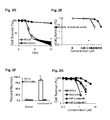


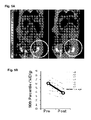
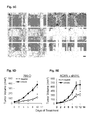
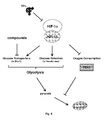


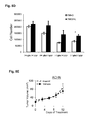

Classifications
-
- A—HUMAN NECESSITIES
- A61—MEDICAL OR VETERINARY SCIENCE; HYGIENE
- A61K—PREPARATIONS FOR MEDICAL, DENTAL OR TOILETRY PURPOSES
- A61K31/00—Medicinal preparations containing organic active ingredients
- A61K31/33—Heterocyclic compounds
-
- A—HUMAN NECESSITIES
- A61—MEDICAL OR VETERINARY SCIENCE; HYGIENE
- A61P—SPECIFIC THERAPEUTIC ACTIVITY OF CHEMICAL COMPOUNDS OR MEDICINAL PREPARATIONS
- A61P35/00—Antineoplastic agents
-
- A—HUMAN NECESSITIES
- A61—MEDICAL OR VETERINARY SCIENCE; HYGIENE
- A61P—SPECIFIC THERAPEUTIC ACTIVITY OF CHEMICAL COMPOUNDS OR MEDICINAL PREPARATIONS
- A61P35/00—Antineoplastic agents
- A61P35/04—Antineoplastic agents specific for metastasis
-
- A—HUMAN NECESSITIES
- A61—MEDICAL OR VETERINARY SCIENCE; HYGIENE
- A61P—SPECIFIC THERAPEUTIC ACTIVITY OF CHEMICAL COMPOUNDS OR MEDICINAL PREPARATIONS
- A61P43/00—Drugs for specific purposes, not provided for in groups A61P1/00-A61P41/00
-
- C—CHEMISTRY; METALLURGY
- C07—ORGANIC CHEMISTRY
- C07D—HETEROCYCLIC COMPOUNDS
- C07D213/00—Heterocyclic compounds containing six-membered rings, not condensed with other rings, with one nitrogen atom as the only ring hetero atom and three or more double bonds between ring members or between ring members and non-ring members
- C07D213/02—Heterocyclic compounds containing six-membered rings, not condensed with other rings, with one nitrogen atom as the only ring hetero atom and three or more double bonds between ring members or between ring members and non-ring members having three double bonds between ring members or between ring members and non-ring members
- C07D213/04—Heterocyclic compounds containing six-membered rings, not condensed with other rings, with one nitrogen atom as the only ring hetero atom and three or more double bonds between ring members or between ring members and non-ring members having three double bonds between ring members or between ring members and non-ring members having no bond between the ring nitrogen atom and a non-ring member or having only hydrogen or carbon atoms directly attached to the ring nitrogen atom
- C07D213/60—Heterocyclic compounds containing six-membered rings, not condensed with other rings, with one nitrogen atom as the only ring hetero atom and three or more double bonds between ring members or between ring members and non-ring members having three double bonds between ring members or between ring members and non-ring members having no bond between the ring nitrogen atom and a non-ring member or having only hydrogen or carbon atoms directly attached to the ring nitrogen atom with hetero atoms or with carbon atoms having three bonds to hetero atoms with at the most one bond to halogen, e.g. ester or nitrile radicals, directly attached to ring carbon atoms
- C07D213/72—Nitrogen atoms
- C07D213/75—Amino or imino radicals, acylated by carboxylic or carbonic acids, or by sulfur or nitrogen analogues thereof, e.g. carbamates
-
- C—CHEMISTRY; METALLURGY
- C07—ORGANIC CHEMISTRY
- C07D—HETEROCYCLIC COMPOUNDS
- C07D213/00—Heterocyclic compounds containing six-membered rings, not condensed with other rings, with one nitrogen atom as the only ring hetero atom and three or more double bonds between ring members or between ring members and non-ring members
- C07D213/02—Heterocyclic compounds containing six-membered rings, not condensed with other rings, with one nitrogen atom as the only ring hetero atom and three or more double bonds between ring members or between ring members and non-ring members having three double bonds between ring members or between ring members and non-ring members
- C07D213/89—Heterocyclic compounds containing six-membered rings, not condensed with other rings, with one nitrogen atom as the only ring hetero atom and three or more double bonds between ring members or between ring members and non-ring members having three double bonds between ring members or between ring members and non-ring members with hetero atoms directly attached to the ring nitrogen atom
-
- C—CHEMISTRY; METALLURGY
- C07—ORGANIC CHEMISTRY
- C07D—HETEROCYCLIC COMPOUNDS
- C07D215/00—Heterocyclic compounds containing quinoline or hydrogenated quinoline ring systems
- C07D215/02—Heterocyclic compounds containing quinoline or hydrogenated quinoline ring systems having no bond between the ring nitrogen atom and a non-ring member or having only hydrogen atoms or carbon atoms directly attached to the ring nitrogen atom
- C07D215/16—Heterocyclic compounds containing quinoline or hydrogenated quinoline ring systems having no bond between the ring nitrogen atom and a non-ring member or having only hydrogen atoms or carbon atoms directly attached to the ring nitrogen atom with hetero atoms or with carbon atoms having three bonds to hetero atoms with at the most one bond to halogen, e.g. ester or nitrile radicals, directly attached to ring carbon atoms
- C07D215/38—Nitrogen atoms
-
- C—CHEMISTRY; METALLURGY
- C07—ORGANIC CHEMISTRY
- C07D—HETEROCYCLIC COMPOUNDS
- C07D231/00—Heterocyclic compounds containing 1,2-diazole or hydrogenated 1,2-diazole rings
- C07D231/02—Heterocyclic compounds containing 1,2-diazole or hydrogenated 1,2-diazole rings not condensed with other rings
- C07D231/10—Heterocyclic compounds containing 1,2-diazole or hydrogenated 1,2-diazole rings not condensed with other rings having two or three double bonds between ring members or between ring members and non-ring members
- C07D231/14—Heterocyclic compounds containing 1,2-diazole or hydrogenated 1,2-diazole rings not condensed with other rings having two or three double bonds between ring members or between ring members and non-ring members with hetero atoms or with carbon atoms having three bonds to hetero atoms with at the most one bond to halogen, e.g. ester or nitrile radicals, directly attached to ring carbon atoms
- C07D231/38—Nitrogen atoms
- C07D231/40—Acylated on said nitrogen atom
-
- C—CHEMISTRY; METALLURGY
- C07—ORGANIC CHEMISTRY
- C07D—HETEROCYCLIC COMPOUNDS
- C07D239/00—Heterocyclic compounds containing 1,3-diazine or hydrogenated 1,3-diazine rings
- C07D239/02—Heterocyclic compounds containing 1,3-diazine or hydrogenated 1,3-diazine rings not condensed with other rings
- C07D239/24—Heterocyclic compounds containing 1,3-diazine or hydrogenated 1,3-diazine rings not condensed with other rings having three or more double bonds between ring members or between ring members and non-ring members
- C07D239/28—Heterocyclic compounds containing 1,3-diazine or hydrogenated 1,3-diazine rings not condensed with other rings having three or more double bonds between ring members or between ring members and non-ring members with hetero atoms or with carbon atoms having three bonds to hetero atoms with at the most one bond to halogen, directly attached to ring carbon atoms
- C07D239/32—One oxygen, sulfur or nitrogen atom
- C07D239/42—One nitrogen atom
-
- C—CHEMISTRY; METALLURGY
- C07—ORGANIC CHEMISTRY
- C07D—HETEROCYCLIC COMPOUNDS
- C07D241/00—Heterocyclic compounds containing 1,4-diazine or hydrogenated 1,4-diazine rings
- C07D241/02—Heterocyclic compounds containing 1,4-diazine or hydrogenated 1,4-diazine rings not condensed with other rings
- C07D241/10—Heterocyclic compounds containing 1,4-diazine or hydrogenated 1,4-diazine rings not condensed with other rings having three double bonds between ring members or between ring members and non-ring members
- C07D241/14—Heterocyclic compounds containing 1,4-diazine or hydrogenated 1,4-diazine rings not condensed with other rings having three double bonds between ring members or between ring members and non-ring members with hetero atoms or with carbon atoms having three bonds to hetero atoms with at the most one bond to halogen, e.g. ester or nitrile radicals, directly attached to ring carbon atoms
- C07D241/20—Nitrogen atoms
-
- C—CHEMISTRY; METALLURGY
- C07—ORGANIC CHEMISTRY
- C07D—HETEROCYCLIC COMPOUNDS
- C07D277/00—Heterocyclic compounds containing 1,3-thiazole or hydrogenated 1,3-thiazole rings
- C07D277/02—Heterocyclic compounds containing 1,3-thiazole or hydrogenated 1,3-thiazole rings not condensed with other rings
- C07D277/20—Heterocyclic compounds containing 1,3-thiazole or hydrogenated 1,3-thiazole rings not condensed with other rings having two or three double bonds between ring members or between ring members and non-ring members
- C07D277/32—Heterocyclic compounds containing 1,3-thiazole or hydrogenated 1,3-thiazole rings not condensed with other rings having two or three double bonds between ring members or between ring members and non-ring members with hetero atoms or with carbon atoms having three bonds to hetero atoms with at the most one bond to halogen, e.g. ester or nitrile radicals, directly attached to ring carbon atoms
- C07D277/38—Nitrogen atoms
- C07D277/44—Acylated amino or imino radicals
- C07D277/46—Acylated amino or imino radicals by carboxylic acids, or sulfur or nitrogen analogues thereof
-
- C—CHEMISTRY; METALLURGY
- C07—ORGANIC CHEMISTRY
- C07D—HETEROCYCLIC COMPOUNDS
- C07D401/00—Heterocyclic compounds containing two or more hetero rings, having nitrogen atoms as the only ring hetero atoms, at least one ring being a six-membered ring with only one nitrogen atom
- C07D401/02—Heterocyclic compounds containing two or more hetero rings, having nitrogen atoms as the only ring hetero atoms, at least one ring being a six-membered ring with only one nitrogen atom containing two hetero rings
- C07D401/10—Heterocyclic compounds containing two or more hetero rings, having nitrogen atoms as the only ring hetero atoms, at least one ring being a six-membered ring with only one nitrogen atom containing two hetero rings linked by a carbon chain containing aromatic rings
-
- C—CHEMISTRY; METALLURGY
- C07—ORGANIC CHEMISTRY
- C07D—HETEROCYCLIC COMPOUNDS
- C07D413/00—Heterocyclic compounds containing two or more hetero rings, at least one ring having nitrogen and oxygen atoms as the only ring hetero atoms
- C07D413/02—Heterocyclic compounds containing two or more hetero rings, at least one ring having nitrogen and oxygen atoms as the only ring hetero atoms containing two hetero rings
- C07D413/10—Heterocyclic compounds containing two or more hetero rings, at least one ring having nitrogen and oxygen atoms as the only ring hetero atoms containing two hetero rings linked by a carbon chain containing aromatic rings
-
- C—CHEMISTRY; METALLURGY
- C07—ORGANIC CHEMISTRY
- C07D—HETEROCYCLIC COMPOUNDS
- C07D417/00—Heterocyclic compounds containing two or more hetero rings, at least one ring having nitrogen and sulfur atoms as the only ring hetero atoms, not provided for by group C07D415/00
- C07D417/02—Heterocyclic compounds containing two or more hetero rings, at least one ring having nitrogen and sulfur atoms as the only ring hetero atoms, not provided for by group C07D415/00 containing two hetero rings
- C07D417/10—Heterocyclic compounds containing two or more hetero rings, at least one ring having nitrogen and sulfur atoms as the only ring hetero atoms, not provided for by group C07D415/00 containing two hetero rings linked by a carbon chain containing aromatic rings
-
- C—CHEMISTRY; METALLURGY
- C07—ORGANIC CHEMISTRY
- C07C—ACYCLIC OR CARBOCYCLIC COMPOUNDS
- C07C2603/00—Systems containing at least three condensed rings
- C07C2603/56—Ring systems containing bridged rings
- C07C2603/58—Ring systems containing bridged rings containing three rings
- C07C2603/70—Ring systems containing bridged rings containing three rings containing only six-membered rings
- C07C2603/74—Adamantanes
Definitions
- heteroaryl benzamides Provided herein are certain heteroaryl benzamides, compositions, and methods of their manufacture and use.
- HIF ⁇ A key mediator of hypoxic stress is HIF ⁇ .
- HIF is a bHLH heterodimeric transcription factor, made up of an oxygen-labile subunit (HIF- ⁇ ) and a constitutive subunit (HIF- ⁇ ).
- HIF- ⁇ In the presence of oxygen, hydroxylation on proline residues 564 and 402 by prolyl hydroxylases (PHDs) marks HIF- ⁇ for recognition and binding with Von Hippel-Lindau protein (pVHL), leading to degradation of HIF- ⁇ . Under hypoxic conditions, activity of the PHDs decrease, which prevents the recognition of HIF- ⁇ by pVHL. In cells that lack VHL, stabilized HIF- ⁇ binds HIF- ⁇ to activate the transcription of genes involved in several processes. HIF transcribes genes that mediate glycolysis, angiogenesis, tissue remodelling, epithelial permeability and vascular tone. These genes, and processes driven by these genes, act to promote tumor growth and survival in hypoxic conditions.
- pVHL the protein product of VHL
- HIF hypoxia-inducible factor
- pVHL has been implicated in a variety of processes including extracellular matrix assembly, regulation of microtubule stability, polyubiquitination of atypical PKC family members, regulation of fibronectin, and RNA polymerase II subunits.
- HIF inhibitors There is considerable interest in the identification of HIF inhibitors and a variety of pharmacological HIF inhibitors have been identified, although the interaction of these agents is not directly with HIF, but via modulation of cellular processes in which HIF is integral.
- kidney cancer While many solid tumors respond to different combinations of cytotoxic chemotherapies, kidney cancer is a particularly intractable disease. Renal cell carcinoma (RCC), the most common type of kidney cancer, has proven to be particularly challenging, resistant to both radiation therapy and standard systemic chemotherapies. To date, immunotherapy using interferon or interleukin-2 has had mild success with responses in less than 10% of patients with metastatic RCC. The recent development of anti-angiogenic therapies sunitinib (Sutent) and sorafenib (Nexavar) is encouraging although few patients have durable responses and exhibit increased survival. The targeting of receptor tyrosine kinases, which is not specific to the development of RCC, has become the standard of care for advanced RCC.
- RCC Renal cell carcinoma
- RCC Remission of function of the VHL tumor suppressor gene, an essential and frequent mutation.
- a synthetic lethal approach seeking to identify compounds that exhibit selective cytotoxicity to cells that have lost functional VHL.
- the concept of synthetic lethality, or conditional genetics describes the genetic interaction of two genes, both involved in an essential process. When either gene is mutated alone, the cell remains viable. However, the combination of mutations in these two genes results in cell death.
- the first mutation is essential to the development of cancer, while a second gene is inhibited by a small molecule, resulting in cytotoxic cell death. This approach is particularly attractive because it should not affect normal, non-cancerous tissue.
- WO 03/000267 describes amino nicotinate derivatives as glucokinase (GLK) modulators.
- US2008/0076762 A1 describes 4-aminopiperidine derivatives that exhibit parasite aspartic protease inhibiting properties.
- WO 2005/042489 describes N-substituted benzenesulfonamides for use in treating or preventing cognitive disorders.
- US 7312234 B2 describes chemokine receptor binding heterocyclic compounds.
- WO 2008/008374 describes CCR2 inhibitors useful for treating inflammation.
- composition comprising at least one compound of Formula IA: or a pharmaceutically acceptable salt thereof, wherein:
- Methods are also described of targeting cells which have defective pVHL protein.
- Fig. 1 Compound 47 inhibits glycolysis in VHL-deficient cells. Lactate ⁇ M/cell), which is converted from pyruvate, the end product of glycolysis, was measured in RCC4 and RCC4/VHL cells treated with either vehicle or compound 47 (5 ⁇ M).
- B Relative glucose uptake is inhibited by compound 47 in VHL-deficient cells. Following treatment with compound 47 , cells were starved of glucose for 1 hour and then pulsed for 1 hour with 3 H-2-deoxyglucose.
- C Inhibition of glucose in cells that have lost VHL is dependent on compound 47 concentration. Cells were treated with the indicated concentration and glucose uptake was measured.
- E Glucose uptake and hexokinase activity were measured for active and inactive compound 47 analogs. Only active analogs affected both glucose uptake and hexokinase activity in VHL-defective cells.
- F Relative ATP levels are decreased in response to compound 47 in cells that have lost VHL.
- FIG. 2A-G Chemical synthetic lethal screen identifies compounds that specifically target loss of VHL in renal carcinoma.
- A XTT validation of 4-phenylsulfonamido- N -(pyridin-3-yl)benzamides (PPBs): Compound 27 and compound 47 were identified from chemical synthetic lethal screen of renal carcinoma cells that have lost VHL.
- B Clonogenic survival of RCC4 with and without VHL in response to compound 47 (*p ⁇ 0.00005).
- C Representative plates of clonogenic survival in RCC4 and RCC4/VHL cells. Three hundred cells were treated with 5 ⁇ M of compound 47 for 10 days.
- D Compound 47 -induced cell death is irreversible after three days. Cells were treated with compound 47 (5 ⁇ M).
- FIG. 3A-K Compound 47 inhibits glucose metabolism in VHL -deficient cells.
- A Compound 47 inhibits glucose uptake and glycolysis in VHL -deficient cells. Lactate (mM/cell), which is converted from pyruvate, the end product of glycolysis, was measured in RCC4 and RCC4/VHL cells treated with either vehicle or compound 47 (5 ⁇ M)(*p ⁇ 0.01).
- B Relative glucose uptake is inhibited by compound 47 in VHL -deficient cells. Following treatment with compound 47 (5 ⁇ M), cells were starved of glucose for 1 hour and then pulsed for 1 hour with 3 H-2-deoxyglucose. Counts are normalized to cell number.
- FIG. 5A-E In vivo monitoring and efficacy of compound 47 .
- FDG-PET imaging demonstrates an in vivo decrease in glucose uptake in a renal clear cell carcinoma xenograft in response to compound 85 , a more soluble, active analog of compound 47 . 786-O, a renal clear cell carcinoma with a naturally occurring VHL mutation, were implanted subcutaneously into the flanks of CD-1 nude mice. Representative axial cross section of a mouse prior to treatment (left) and following three daily i.p. injections with compound 85 (11.6 mg/kg)(right), overlaid over CT scan.
- B Quantitatively, compound 85 inhibits FDG-PET in mouse xenografts.
- Compound 85 is not toxic to normal tissues.
- Compound 85 delays tumor growth.
- Figure 7A-E Compound 47 does not induce autophagy, apoptosis, or DNA damage.
- A Clonogenic survival of RCC4 and RCC4/VHL treated with compound 27 (5 ⁇ M)(*p ⁇ 0.05). All error bars represent the standard error of the mean.
- B Compound 47 does not induce autophagy.
- RCC4 and RCC4/VHL cells were treated with increasing concentrations of compound 47 (1.25, 2.5 and 5 ⁇ M), a negative control (DMSO) and a positive control (4-(pyridin-4-yl)-N-(m-tolyl)thiazol-2-amine). Cells were lysed and probed for LC3, a marker of autophagy, or ⁇ -tubulin (loading control).
- Compound 47 does not induce apoptosis.
- RCC4 and RCC4/VHL cells were treated with vehicle, increasing concentrations of compound 47 , and camptothecin. Cells were stained with DAPI and nuclear condensation was examined by fluorescence microscopy.
- D RCC4 cells were treated with compound 47 (5 ⁇ M) for the indicated time and stained with Annexin V and propidium iodide and subjected to FACS analysis.
- Compound 47 does not induce DNA damage.
- RCC4 and RCC4/VHL cells were subjected to increasing concentrations of compound 47 (1.25, 2.5, and 5 ⁇ M), a negative control (DMSO), and a positive control (doxorubicin). Cells were lysed and subjected to Western blot with the indicated antibodies.
- FIG. 8A-E VHL -deficient renal carcinomas are more sensitive to glucose deprivation compared to RCCs with wild-type VHL .
- A Relative mRNA expression levels for different genes involved in glucose metabolism in RCC4 cells relative to RCC4/VHL cells.
- B Glucose uptake is impaired by compound 47 (5 ⁇ M) in 786-O cells, which are deficient in VHL, but not 786/VHL, which have wild-type VHL restored.
- C VHL mutant RCC4 cells are more sensitive to glucose deprivation than RCC4/VHL. Cells were grown in media lacking glucose and/or pyruvate for 6 days (*p ⁇ 0.005).
- VHL mutant 786-O cells are more sensitive to glucose deprivation than 786/VHL cells (* p ⁇ 0.05).
- E ACHN tumors with wild-type VHL are insensitive to compound 47 treatment (5 ⁇ M). ACHN cells were implanted subcutaneously into the flanks of immunocompromised mice. Once tumors reached an average of >20 mm 3 , mice were treated daily with compound 85 or vehicle. All error bars represent the standard error of the mean.
- Figure 9 Sensitivity of cancer cell lines to GIUT1 inhibition.
- Subject refers to an animal, such as a mammal, that has been or will be the object of treatment, observation, or experiment.
- the compounds and methods described herein may be useful for both human therapy and veterinary applications.
- the subject is a human.
- treatment refers to an amelioration of a disease or disorder, or at least one discernible symptom thereof.
- treatment refers to an amelioration of at least one measurable physical parameter, not necessarily discernible by the patient.
- treatment or “treating” refers to reducing the progression of a disease or disorder, either physically, e.g., stabilization of a discernible symptom, physiologically, e.g., stabilization of a physical parameter, or both.
- treatment or “treating” refers to delaying the onset of a disease or disorder.
- prevention or “preventing” refers to a reduction of the risk of acquiring a given disease or disorder.
- pharmaceutically acceptable refers to those compounds, materials, compositions, and/or dosage forms that are, within the scope of sound medical judgment, suitable for use in contact with the tissues of human beings and animals without excessive toxicity, irritation, allergic response, or other problem or complication, commensurate with a reasonable benefit/risk ratio.
- parenteral administration and “administered parenterally” refer to modes of administration other than enteral and topical administration, usually by injection, and includes, without limitation, intravenous, intramuscular, intraarterial, intrathecal, intracapsular, intraorbital, intracardiac, intradermal, intraperitoneal, transtracheal, subcutaneous, subcuticular, intraarticular, subcapsular, subarachnoid, intraspinal, and intrasternal injection and infusion.
- a dash (“-") that is not between two letters or symbols is used to indicate a point of attachment for a substituent.
- -CONH 2 is attached through the carbon atom.
- alkyl refers to a saturated straight or branched hydrocarbon, such as a straight or branched group of 1-20, 1-8, or 1-6 carbon atoms, referred to herein as C 1 -C 20 alkyl, C 1 -C 8 alkyl, and C 1 -C 6 alkyl, respectively.
- Exemplary alkyl groups include, but are not limited to, methyl, ethyl, propyl, isopropyl, 2-methyl-1-propyl, 2-methyl-2-propyl, 2-methyl-1-butyl, 3-methyl-1-butyl, 2-methyl-3-butyl, 2,2-dimethyl-1-propyl, 2-methyl-1-pentyl, 3-methyl-1-pentyl, 4-methyl-1-pentyl, 2-methyl-2-pentyl, 3-methyl-2-pentyl, 4-methyl-2-pentyl, 2,2-dimethyl-1-butyl, 3,3-dimethyl-1-butyl, 2-ethyl-1-butyl, butyl, isobutyl, t-butyl, pentyl, isopentyl, neopentyl, hexyl, heptyl, octyl, and the like.
- alkenyl refers to an unsaturated straight or branched hydrocarbon having at least one carbon-carbon double bond, such as a straight or branched group of 2-20, 2-8, or 2-6 carbon atoms, referred to herein as (C 2 -C 20 ) alkenyl, (C 2 -C 8 ) alkenyl, and (C 2 -C 6 ) alkenyl, respectively.
- alkenyl groups include, but are not limited to, vinyl, allyl, butenyl, pentenyl, hexenyl, butadienyl, pentadienyl, hexadienyl, 2-ethylhexenyl, 2-propyl-2-butenyl, and 4-(2-methyl-3-butene)-pentenyl.
- alkynyl refers to an unsaturated straight or branched hydrocarbon having at least one carbon-carbon triple bond, such as a straight or branched group of 2-20, 2-8, or 2-6 carbon atoms, referred to herein as C 2 -C 20 alkynyl, C 2 -C s alkynyl, and C 2 -C 6 alkynyl, respectively.
- alkynyl groups include, but are not limited to, ethynyl, propynyl, butynyl, pentynyl, hexynyl, methylpropynyl, 4-methyl-1-butynyl, 4-propyl-2-pentynyl, and 4-butyl-2-hexynyl.
- Cycloalkyl refers to a saturated hydrocarbon ring group, having the specified number of carbon atoms, such as, for example from 3 to 7 ring carbon atoms.
- Examples of cycloalkyl groups include cyclopropyl, cyclobutyl, cyclopentyl, and cyclohexyl as well as bridged and caged saturated ring groups such as, for example, adamantane.
- alkoxy refers to an alkyl group attached to an oxygen (-O-alkyl-).
- Alkoxy also include an alkenyl group attached to an oxygen (“alkenyloxy”) or an alkynyl group attached to an oxygen (“alkynyloxy”) groups.
- exemplary alkoxy groups include, but are not limited to, groups with an alkyl, alkenyl or alkynyl group of 1-20, 1-8, or 1-6 carbon atoms, referred to herein as (C 1 -C 20 ) alkoxy, (C 1 -C 8 ) alkoxy, and (C 1 -C 6 ) alkoxy, respectively.
- alkoxy groups include, but are not limited to methoxy, ethoxy, propoxy, isopropoxy, n-butoxy, sec-butoxy, tert-butoxy, pentoxy, 2-pentyloxy, isopentoxy, neopentoxy, hexoxy, 2-hexoxy, 3-hexoxy, 3-methylpentoxy, and the like.
- Acyl refers to the groups (alkyl)-C(O)-, (cycloalkyl)-C(O)-, (aryl)-C(O)-, (heteroaryl)-C(O)-, and (heterocycloalkyl)-C(O)-, wherein the group is attached to the parent structure through the carbonyl functionality and wherein alkyl, cycloalkyl, aryl, heteroaryl, and heterocycloalkyl are as described herein.
- Acyl groups have the indicated number of carbon atoms, with the carbon of the keto group being included in the numbered carbon atoms.
- a C 1 -C 6 alkoxycarbonyl group is an alkoxy group having from 1 to 6 carbon atoms attached through its oxygen to a carbonyl linker.
- amino is meant the group -NH 2 .
- Aryl encompasses: 5- and 6-membered carbocyclic aromatic rings, for example, benzene; bicyclic ring systems wherein at least one ring is carbocyclic and aromatic, for example, naphthalene, indane, and tetralin; and tricyclic ring systems wherein at least one ring is carbocyclic and aromatic, for example, fluorene.
- aryl includes 5- and 6-membered carbocyclic aromatic rings fused to a 5- to 7-membered heterocycloalkyl ring containing 1 or more heteroatoms chosen from N, O, and S.
- bicyclic ring systems wherein only one of the rings is a carbocyclic aromatic ring, the point of attachment may be at the carbocyclic aromatic ring or the heterocycloalkyl ring.
- Bivalent radicals formed from substituted benzene derivatives and having the free valences at ring atoms are named as substituted phenylene radicals.
- Bivalent radicals derived from univalent polycyclic hydrocarbon radicals whose names end in "-yl” by removal of one hydrogen atom from the carbon atom with the free valence are named by adding "-idene" to the name of the corresponding univalent radical, e.g., a naphthyl group with two points of attachment is termed naphthylidene.
- Aryl does not encompass or overlap in any way with heteroaryl, separately defined below. Hence, if one or more carbocyclic aromatic rings is fused with a heterocycloalkyl aromatic ring, the resulting ring system is heteroaryl, not aryl, as defined herein.
- aryloxy refers to the group -O-aryl.
- halo includes fluoro, chloro, bromo, and iodo
- halogen includes fluorine, chlorine, bromine, and iodine
- Heteroaryl encompasses: 5- to 7-membered aromatic, monocyclic rings containing one or more, for example, from 1 to 4, or In some embodiments, from 1 to 3, heteroatoms chosen from N, O, and S, with the remaining ring atoms being carbon; and bicyclic heterocycloalkyl rings containing one or more, for example, from 1 to 4, or In some embodiments, from 1 to 3, heteroatoms chosen from N, O, and S, with the remaining ring atoms being carbon and wherein at least one heteroatom is present in an aromatic ring.
- heteroaryl includes a 5- to 7-membered heterocycloalkyl, aromatic ring fused to a 5- to 7-membered cycloalkyl ring.
- the point of attachment may be at the heteroaromatic ring or the cycloalkyl ring.
- the total number of S and O atoms in the heteroaryl group exceeds 1, those heteroatoms are not adjacent to one another.
- the total number of S and O atoms in the heteroaryl group is not more than 2.
- the total number of S and O atoms in the aromatic heterocycle is not more than 1.
- heteroaryl groups include, but are not limited to, (as numbered from the linkage position assigned priority 1), 2-pyridyl, 3-pyridyl, 4-pyridyl, 2-pyrazinyl, 2-pyrimidinyl, 3-pyrazolinyl, 2-thiazolyl, imidazolinyl, isoxazolinyl, oxazolinyl, thiazolinyl, thiadiazolinyl, tetrazolyl, thienyl, benzothiophenyl, furanyl, benzofuranyl, benzoimidazolinyl, indolinyl, pyridizinyl, triazolyl, quinolinyl, and pyrazolyl.
- Bivalent radicals derived from univalent heteroaryl radicals whose names end in "-yl” by removal of one hydrogen atom from the atom with the free valence are named by adding "-idene" to the name of the corresponding univalent radical, e.g., a pyridyl group with two points of attachment is a pyridylidene.
- Heteroaryl does not encompass or overlap with aryl as defined herein.
- Substituted heteroaryl also includes ring systems substituted with one or more oxide (-O - ) substituents, such as pyridinyl N-oxides.
- Heterocycloalkyl refers to a single aliphatic ring, containing at least 2 carbon atoms in addition to 1-3 heteroatoms independently selected from oxygen, sulfur, and nitrogen, as well as combinations comprising at least one of the foregoing heteroatoms.
- Suitable heterocycloalkyl groups include, for example (as numbered from the linkage position assigned priority 1), 2-pyrrolinyl, 2,4-imidazolidinyl, 2,3-pyrazolidinyl, 2-piperidyl, 3-piperidyl, 4-piperdyl, and 2,5-piperzinyl.
- Morpholinyl groups are also contemplated, including 2-morpholinyl and 3-morpholinyl (numbered wherein the oxygen is assigned priority 1).
- Substituted heterocycloalkyl also includes ring systems substituted with one or more oxo moieties, such as piperidinyl N-oxide, morpholinyl-N-oxide, 1-oxo-1-thiomorpholinyl and 1,1-dioxo-1-thiomorpholinyl.
- oxo moieties such as piperidinyl N-oxide, morpholinyl-N-oxide, 1-oxo-1-thiomorpholinyl and 1,1-dioxo-1-thiomorpholinyl.
- cyano refers to -CN.
- carboxy refers to -COOH or its corresponding carboxylate salts (e.g., -COONa).
- carboxy also includes "carboxycarbonyl,” for example, a carboxy group attached to a carbonyl group, for example, -C(O)-COOH or salts, such as -C(O)-COONa.
- nitro refers to -NO 2 .
- hydroxy and "hydroxyl” refer to -OH.
- sulfinyl includes the groups: -S(O)-H, -S(O)-(optionally substituted (C 1 -C 6 )alkyl), -S(O)-optionally substituted aryl), -S(O)-optionally substituted heteroaryl), -S(O)-(optionally substituted heterocycloalkyl); and -S(O)-(optionally substituted amino).
- sulfonyl includes the groups: -S(O 2 )-H, -S(O 2 )-(optionally substituted (C 1 -C 6 )alkyl), -S(O 2 )-optionally substituted aryl), -S(O 2 )-optionally substituted heteroaryl), -S(O 2 )-(optionally substituted heterocycloalkyl), -S(O 2 )-(optionally substituted alkoxy), -S(O 2 )-optionally substituted aryloxy), -S(O 2 )-optionally substituted heteroaryloxy), -S(O 2 )-(optionally substituted heterocyclyloxy); and -S(O 2 )-(optionally substituted amino).
- substituted means that any one or more hydrogens on the designated atom or group is replaced with a selection from the indicated group, provided that the designated atom's normal valence is not exceeded.
- substituents and/or variables are permissible only if such combinations result in stable compounds or useful synthetic intermediates.
- a stable compound or stable structure is meant to imply a compound that is sufficiently robust to survive isolation from a reaction mixture, and subsequent formulation as an agent having at least practical utility.
- substituents are named into the core structure. For example, it is to be understood that when (cycloalkyl)alkyl is listed as a possible substituent, the point of attachment of this substituent to the core structure is in the alkyl portion.
- substituted alkyl, alkenyl, cycloalkyl, aryl, heterocycloalkyl, and heteroaryl include “substituted” pyridinyl, pyrimidinyl, pyrazinyl, quinolinyl, pyrazolyl, and thiazolyl"
- alkyl, alkenyl, cycloalkyl, aryl, heterocycloalkyl, and heteroaryl wherein one or more (such as up to 5, for example, up to 3) hydrogen atoms are replaced by a substituent independently chosen from:
- the terms "substituted” alkyl, alkenyl, cycloalkyl, aryl, heterocycloalkyl, and heteroaryl refer respectively to alkyl, alkenyl, cycloalkyl, aryl, heterocycloalkyl, and heteroaryl wherein one or more (such as up to 5, for example, up to 3) hydrogen atoms are replaced by a substituent independently chosen from: -R a , -OR b , -COR b , -CO 2 R b , NO 2 , -NR b R c , -NR c COR b , -NR c CO 2 R a , -NR c CONR b R c , -NR c CONR b R c , -NR
- substituted acyl refers to the groups (substituted alkyl)-C(O)-, (substituted cycloalkyl)-C(O)-, (substituted aryl)-C(O)-, (substituted heteroaryl)-C(O)-, and (substituted heterocycloalkyl)-C(O)-, wherein substituted alkyl, substituted cycloalkyl, substituted aryl, substituted heteroaryl, and substituted heterocycloalkyl are as described herein.
- substituted acyl refers to the groups (substituted alkyl)-C(O)-, (substituted aryl)-C(O)-, and (substituted heteroaryl)-C(O)-, wherein substituted alkyl, substituted aryl, and substituted heteroaryl are as described herein.
- substituted alkoxycarbonyl refers to the group (substituted alkyl)-O-C(O)- wherein the group is attached to the parent structure through the carbonyl functionality and wherein “substituted alkyl” is as described herein.
- substituted cycloalkyloxy refers to cycloalkyloxy wherein the cycloalkyl constituent is substituted (i.e., -O-(substituted cycloalkyl)) wherein “substituted cycloalkyl” is as described herein.
- substituted amino refers to the group -NR b R c , -NR c COR b , -NR c CO 2 R a , -NR c CONR b R c , and -NR c SO 2 R a , wherein R b and R c are as described herein.
- substituted amino also refers to N-oxides of the groups -NHR d , and NR d R d each as described herein. N-oxides can be prepared by treatment of the corresponding amino group with, for example, hydrogen peroxide or m-chloroperoxybenzoic acid. The person skilled in the art is familiar with reaction conditions for carrying out the N-oxidation.
- substituted aryloxy refers to aryloxy wherein the aryl constituent is substituted (i.e., -O-(substituted aryl)) wherein “substituted aryl” is as described herein.
- Compounds described herein include, but are not limited to, any stereoisomer, tautomer, rotomer, deuterated analogues, and/or pharmaceutically acceptable salt as defined herein.
- the compounds described herein can be asymmetric (e.g., having one or more stereocenters). All stereoisomers, such as enantiomers and diastereomers, are intended unless otherwise indicated.
- optically active forms can be isolated in optically active or racemic forms.
- Methods on how to prepare optically active forms from optically active starting materials are known in the art, such as by resolution of racemic mixtures or by stereoselective synthesis.
- the processes described herein can be stereoselective such that any given reaction starting with one or more chiral reagents enriched in one stereoisomer forms a product that is also enriched in one stereoisomer.
- the reaction can be conducted such that the product of the reaction substantially retains one or more chiral centers present in the starting materials.
- the reaction can also be conducted such that the product of the reaction contains a chiral center that is substantially inverted relative to a corresponding chiral center present in the starting materials.
- An example method includes fractional crystallization using a "chiral resolving acid" which is an optically active, salt-forming organic acid.
- Suitable resolving agents for fractional recrystallization methods are, for example, optically active acids, such as the D and L forms of tartaric acid, diacetyltartaric -acid, dibenzoyltartaric acid, mandelic acid, malic acid, lactic acid or the various optically active camphorsulfonic acids such as ß-camphorsulfonic acid.
- Resolution of racemic mixtures can also be carried out by elution on a column packed with an optically active resolving agent (e.g., dinitrobenzoylphenylglycine).
- an optically active resolving agent e.g., dinitrobenzoylphenylglycine
- Suitable elution solvent composition can be determined by one skilled in the art.
- Compounds as described herein can also include all isotopes of atoms occurring in the intermediates or final compounds.
- Isotopes include those atoms having the same atomic number but different mass numbers.
- isotopes of hydrogen include tritium and deuterium.
- the compounds disclosed herein can be used in different enriched isotopic forms, e.g., enriched in the content of 2 H, 3 H, 11 C, 13 C 14 C and or 18 F.
- the compounds are deuterated.
- Such deuterated forms can be made by the procedure described in U.S. Patent Nos. 5,846,514 and 6,334,997 .
- deuteration can improve the efficacy and increase the duration of action of drugs.
- Deuterium substituted compounds can be synthesized using various methods such as described in: Dean, Dennis C.; Editor. Recent Advances in the Synthesis and Applications of Radiolabeled Compounds for Drug Discovery and Development. [In: Curr., Pharm. Des., 2000; 6(10)] 2000, 110 pp .; Kabalka, George W. and Varma, Rajender S. The Synthesis of Radiolabeled Compounds via Organometallic Intermediates, Tetrahedron, 1989, 45(21), 6601-21 , Evans, E. Anthony. Synthesis of radiolabeled compounds, J. Radioanal. Chem., 1981, 64(1-2), 9-32 .
- Tautomeric forms can be in equilibrium or sterically locked into one form by appropriate substitution.
- Compounds as described herein also include crystalline and amorphous forms of those compounds, including, for example, polymorphs, pseudopolymorphs, solvates, hydrates, unsolvated polymorphs (including anhydrates), conformational polymorphs, and amorphous forms of the compounds, as well as mixtures thereof.
- Crystal form may be used interchangeably herein, and are meant to include all crystalline and amorphous forms of the compound, including, for example, polymorphs, pseudopolymorphs, solvates, hydrates, unsolvated polymorphs (including anhydrates), conformational polymorphs, and amorphous forms, as well as mixtures thereof, unless a particular crystalline or amorphous form is referred to.
- Compounds as described herein also include pharmaceutically acceptable forms of the recited compounds, including chelates, non-covalent complexes, and mixtures thereof.
- a “solvate” is formed by the interaction of a solvent and a compound.
- the term “compound” is intended to include solvates of compounds.
- “salts” includes solvates of salts.
- “salts” includes solvates of salts.
- Suitable solvates are pharmaceutically acceptable solvates, such as hydrates, including monohydrates and hemi-hydrates.
- a “chelate” is formed by the coordination of a compound to a metal ion at two (or more) points.
- the term “compound” is intended to include chelates of compounds.
- salts includes chelates of salts.
- non-covalent complex is formed by the interaction of a compound and another molecule wherein a covalent bond is not formed between the compound and the molecule.
- complexation can occur through van der Waals interactions, hydrogen bonding, and electrostatic interactions (also called ionic bonding).
- Such non-covalent complexes are included in the term "compound'.
- Compound 47 refers to 4-((4- tert -butylphenylsulfonamido)methyl)- N -(pyridin-3-yl)benzamide, a preparation of which is shown in Example 38.
- Compound 85 refers to 4-((4-(4-methylpiperazin-1-yl)phenylsulfonamido)methyl)- N -(pyridin-3-yl)benzamide, a preparation of which is shown in Example 76.
- Compound 116 refers to 4-[( ⁇ [4-(21-amino-4,7,10,13,16,19-hexaoxahenicos-1-yn-1-yl)phenyl]sulfonyl ⁇ amino)methyl]- N -(3-pyridinyl)benzamide, a preparation of which is shown in Example 100.
- R 1 is chosen from hydrogen and optionally substituted alkyl. In some embodiments, R 1 is chosen from hydrogen and lower alkyl. In some embodiments, R 1 is hydrogen or methyl. In some embodiments, R 1 is hydrogen.
- R 2 and R 3 are each independently chosen from hydrogen and optionally substituted alkyl. In some embodiments, R 2 is hydrogen.
- R 3 is chosen from hydrogen and lower alkyl. In some embodiments, R 3 is hydrogen.
- R 4 is chosen from hydrogen, hydroxy, lower alkyl, lower alkoxy, halo, carboxy, and nitro. In some embodiments, R 4 is chosen from hydrogen, methyl, halo, and nitro. In some embodiments, R 4 is chosen from hydrogen and lower alkyl. In some embodiments, R 4 is hydrogen.
- R is chosen from hydrogen and lower alkyl. In some embodiments, R is hydrogen.
- B is an optionally substituted phenyl ring.
- B is phenyl optionally substituted with one or more groups chosen from halo, alkyl, alkenyl, alkynyl, cycloalkyl, aryl, heteroaryl, heterocycloalkyl, hydroxyl, alkoxy, aryloxy, acyl, carboxy, alkoxycarbonyl, NO 2 , optionally substituted amino, and CN, wherein each of said alkyl, alkenyl, alkynyl, alkoxy, cycloalkyl, aryl, heteroaryl, heterocycloalkyl, alkoxy, and aryloxy groups may be optionally independently substituted with one or more groups chosen from halo, alkyl, hydroxyl, alkoxy, carboxy, alkoxycarbonyl, heterocycloalkyl, and optionally substituted amino.
- B is phenyl optionally substituted with one or more groups chosen from optionally substituted amino, halo, and lower alkyl optionally substituted with optionally substituted amino, heterocycloalkyl, alkoxy, or hydroxyl.
- B is phenyl optionally substituted with one or more groups chosen from halo, optionally substituted amino and lower alkyl optionally substituted with optionally substituted amino or heterocycloalkyl.
- B is chosen from phenyl, 2-methylphenyl, 2-fluorophenyl, 2-chlorophenyl, 2-bromophenyl, 2-methoxycarbonylphenyl, 2-trifluoromethylphenyl, 2-cyanophenyl, 3-aminophenyl, 3-methoxyphenyl, 3-methylphenyl, 3-fluorophenyl, 3-chlorophenyl, 3-bromophenyl, 3-trifluoromethylphenyl, tert -butylphenyl, 4-ethynylphenyl, 3-cyanophenyl, 3-nitrophenyl, 3-phenylphenyl, 3-(2-pyrimidinyl)phenyl, 3-(1-methyl-1 H -pyrazol-3-yl)phenyl, 3-(5-methyl-1,3,4-oxadiazol-2-yl)phenyl, 3-(5-methyl-1,2,4-oxadiazol-2-yl)phenyl, 3-(2-(2-pyrimi
- B is chosen from phenyl, 2-methylphenyl, 2-fluorophenyl, 2-chlorophenyl, 2-bromophenyl, 2-methoxycarbonylphenyl, 2-trifluoromethylphenyl, 2-cyanophenyl, 3-aminophenyl, 3-methoxyphenyl, 3-methylphenyl, 3-fluorophenyl, 3-chlorophenyl, 3-bromophenyl, 3-trifluoromethylphenyl, tert -butylphenyl, 4-ethynylphenyl, 3-cyanophenyl, 3-nitrophenyl, 3-phenylphenyl, 3-(2-pyrimidinyl)phenyl, 3-(1-methyl-1 H -pyrazol-3-yl)phenyl, 3-(5-methyl-1,3,4-oxadiazol-2-yl)phenyl, 3-(5-methyl-1,2,4-oxadiazol-2-yl)phenyl, 3-(2-(2-pyrimi
- B is chosen from 3-fluorophenyl, 3-chlorophenyl, 3-bromophenyl, 3-(2-pyrimidinyl)phenyl, 3-(1-methyl-1 H -pyrazol-3-yl)phenyl, 3-(5-methyl-1,3,4-oxadiazol-2-yl)phenyl, 3-(5-methyl-1,2,4-oxadiazol-2-yl)phenyl, 4-butoxyphenyl4-tert-butylphenyl, 4-(2-pyrimidinyl)phenyl, 3,4-dimethoxyphenyl, 3-tert-butyl-4-methoxyphenyl, 3,4-dimethylphenyl, 3,5-dimethylphenyl, 3-fluoro-4-methylphenyl, 3-chloro-4-methylphenyl, 2-(dimethylamino)-2,3-dihydro-5-indeneyl, 4-(4-methylpiperazin-1-yl)phenyl, 4-(
- the radical is attached to the phenyl ring at the 3 position. In some embodiments, the radical is attached to the phenyl ring at the 4 position.
- the methods described herein comprise administering to a subject in need thereof, a therapeutically acceptable amount at least one compound or pharmaceutically acceptable salt thereof described above.
- the methods described herein also may comprise the administration of at least one compound chosen from:
- the subject is a mammal. In some embodiments, the subject is a human.
- the compounds and pharmaceutically acceptable salts described herein can be administered alone, as mixtures, or in combination with other active agents.
- Step 1 a compound of Formula 178 , is combined with an aqueous solution of base (such as NaOH in water), and treated with a compound of Formula 179 , where P is a nitrogen protecting group (such as benzenesulfonyl), and L is a leaving group (such as bromide), to give a compound of Formula 180 , which is isolated and optionally purified.
- base such as NaOH in water
- P is a nitrogen protecting group (such as benzenesulfonyl)
- L is a leaving group (such as bromide)
- a mixture of a compound of Formula 180 is combined with a halogenating agent (such as oxalyl chloride), an organic base (such as pyridine), in a polar organic solvent (such as DMF and/or THF).
- a halogenating agent such as oxalyl chloride
- an organic base such as pyridine
- a polar organic solvent such as DMF and/or THF
- a compound of Formula 182 is treated with an acidic mixture (such as hydrobromic acid and acetic acid), to provide a compound of Formula 183 , where X is a halogen (such as bromide), where the product, a compound of Formula 184 , is isolated and optionally purified.
- an acidic mixture such as hydrobromic acid and acetic acid
- a mixture of a compound of Formula 183 is combined with a compound of Formula 184 , where L is a leaving group (such as chloride) and Q is a substitutent group (such as carbonyl or SO 2 ), and an organic base (such a pyridine) to give the product, a compound of Formula 185 , which is isolated and optionally purified.
- L is a leaving group (such as chloride) and Q is a substitutent group (such as carbonyl or SO 2 ), and an organic base (such a pyridine)
- Step 1 B a mixture of a compound of Formula 178 is combined with a compound of Formula 184 , where L is a leaving group (such as chloride) and Q is a substitutent group (such as carbonyl or SO 2 ), and an organic base (such a pyridine) to give the product, a compound of Formula 186 , which is isolated and optionally purified.
- L is a leaving group (such as chloride) and Q is a substitutent group (such as carbonyl or SO 2 ), and an organic base (such a pyridine)
- Step 2B a mixture of a compound of Formula 186 is combined with a halogenating agent (such as oxalyl chloride), an organic base (such as pyridine), in a polar organic solvent (such as DMF and/or THF).
- a halogenating agent such as oxalyl chloride
- an organic base such as pyridine
- a polar organic solvent such as DMF and/or THF
- composition comprising at least one compound and/or pharmaceutically acceptable salt described herein and at least one pharmaceutically acceptable carrier.
- pharmaceutically acceptable carrier refers to any and all solvents, dispersion media, coatings, isotonic and absorption delaying agents, and the like, that are compatible with pharmaceutical administration.
- aqueous solutions such as water or physiologically buffered saline or other solvents or vehicles such as glycols, glycerol, oils such as olive oil or injectable organic esters.
- the compositions may also contain other active compounds providing supplemental, additional, or enhanced therapeutic functions.
- a pharmaceutically acceptable carrier may contain physiologically acceptable agents that act, for example, to stabilize or to increase the absorption of a compound or pharmaceutically acceptable salt thereof.
- physiologically acceptable agents include, for example, carbohydrates, such as glucose, sucrose or dextrans, antioxidants, such as ascorbic acid or glutathione, chelating agents, low molecular weight proteins or other stabilizers or excipients.
- the choice of a pharmaceutically acceptable carrier, including a physiologically acceptable agent may depend, for example, on the route of administration of the composition.
- the pharmaceutical composition also may comprise a liposome or other polymer matrix, which may have incorporated therein, for example, a compound as described herein. Liposomes, for example, which consist of phospholipids or other lipids, are nontoxic, physiologically acceptable and metabolizable carriers that are relatively simple to make and administer.
- a "pharmaceutically acceptable carrier” as used herein means a pharmaceutically acceptable material, composition, or vehicle, such as a liquid or solid filler, diluent, excipient, solvent, or encapsulating material, involved in carrying or transporting the subject compounds from one organ, or portion of the body, to another organ, or portion of the body.
- a pharmaceutically acceptable material, composition, or vehicle such as a liquid or solid filler, diluent, excipient, solvent, or encapsulating material, involved in carrying or transporting the subject compounds from one organ, or portion of the body, to another organ, or portion of the body.
- Each carrier is typically “acceptable” in the sense of being compatible with the other ingredients of the formulation and not injurious to the patient.
- materials that may serve as pharmaceutically acceptable carriers include: (1) sugars, such as lactose, glucose and sucrose; (2) starches, such as corn starch and potato starch; (3) cellulose, and its derivatives, such as sodium carboxymethyl cellulose, ethyl cellulose and cellulose acetate; (4) powdered tragacanth; (5) malt; (6) gelatin; (7) talc; (8) excipients, such as cocoa butter and suppository waxes; (9) oils, such as peanut oil, cottonseed oil, safflower oil, sesame oil, olive oil, corn oil and soybean oil; (10) glycols, such as propylene glycol; (11) polyols, such as glycerin, sorbitol, mannitol and polyethylene glycol; (12) esters, such as ethyl oleate and ethyl laurate; (13) agar; (14) buffering agents, such as magnesium hydroxide and aluminum hydroxide;
- a pharmaceutical composition comprising at least one compound and/or salt as described herein may be administered to a subject by any of a number of routes of administration including, for example, orally (for example, drenches as in aqueous or non-aqueous solutions or suspensions, tablets, boluses, powders, granules, pastes for application to the tongue); sublingually; anally, rectally, or vaginally (for example, as a pessary, cream, or foam); parenterally (including intramusclularly, intravenously, subcutaneously, or intrathecally as, for example, a sterile solution or suspension); nasally; intraperitoneally; subcutaneously; transdermally (for example as a patch applied to the skin); or topically (for example, as a cream, ointment or spray applied to the skin). At least one compound and/or salt as described herein may also be formulated for inhalation.
- routes of administration including, for example, orally (for example, dren
- At least one compound of Formula I or IA or a pharmaceutically acceptable salt thereof may be simply dissolved or suspended in sterile water. Details of appropriate routes of administration and compositions suitable for same can be found in, for example, U.S. Patent Nos. 6,110,973 ; 5,763,493 ; 5,731,000 ; 5,541,231 ; 5,427,798 ; 5,358,970 ; and 4,172,896 , as well as in patents cited therein.
- compositions described herein may conveniently be presented in unit dosage form and may be prepared by any methods well known in the art of pharmacy.
- the amount of active ingredient that can be combined with a carrier material to produce a single dosage form will vary depending upon the subject being treated and the particular mode of administration.
- the amount of active ingredient that can be combined with a carrier material to produce a single dosage form will generally be that amount of the compound that produces a therapeutic effect.
- this amount ranges from about 1 percent to about 99 percent of active ingredient.
- this amount ranges from about 5 percent to about 70 percent, and in a further embodiment from about 10 percent to about 30 percent.
- compositions include the step of bringing into association at least one compound and/or pharmaceutically acceptable salt as described herein with at least one carrier and, optionally, one or more accessory ingredients.
- the pharmaceutical compositions are prepared by uniformly and intimately bringing into association at least one compound and/or pharmaceutically acceptable salt as described herein with liquid carriers, or finely divided solid carriers, or both, and then, if necessary, shaping the product.
- compositions suitable for oral administration may be in the form of capsules, cachets, pills, tablets, lozenges (using a flavored basis, usually sucrose and acacia or tragacanth), powders, granules, or as a solution or a suspension in an aqueous or non-aqueous liquid, or as an oil-in-water or water-in-oil liquid emulsion, or as an elixir or syrup, or as pastilles (using an inert base, such as gelatin and glycerin, or sucrose and acacia) and/or as mouth washes and the like, each containing a predetermined amount of at least one compound and/or salt as described herein as an active ingredient.
- the pharmaceutical compositions described herein may also be administered as a bolus, electuary, or paste.
- compounds and/or pharmaceutically acceptable salts described herein are mixed with one or more pharmaceutically acceptable excipients, such as sodium citrate or dicalcium phosphate, and/or any of the following: (1) fillers or extenders, such as starches, lactose, sucrose, glucose, mannitol, and/or silicic acid; (2) binders, such as, for example, carboxymethylcellulose, alginates, gelatin, polyvinyl pyrrolidone, sucrose and/or acacia; (3) humectants, such as glycerol; (4) disintegrating agents, such as agaragar, calcium carbonate, potato or tapioca starch, alginic acid, certain silicates, and sodium carbonate; (5) solution retarding agents, such as paraffin; (6) absorption accelerators, such as quaternary ammonium compounds; (7) wetting agents, such as, for example, cetyl alcohol and glycerol monostearate; (8) absorbents, such as sodium citrate
- compositions may also comprise buffering agents.
- Solid compositions of a similar type may also be employed as fillers in soft and hard-filled gelatin capsules using such excipients as lactose or milk sugars, as well as high molecular weight polyethylene glycols and the like.
- the tablets, and other solid dosage forms pharmaceutical compositions may optionally be scored or prepared with coatings and shells, such as enteric coatings and other coatings well known in the pharmaceutical formulating art. They may also be formulated so as to provide slow or controlled release of the active ingredient therein using, for example, hydroxypropylmethyl cellulose in varying proportions to provide the desired release profile, other polymer matrices, liposomes and/or microspheres.
- compositions may be sterilized by, for example, filtration through a bacteria-retaining filter, or by incorporating sterilizing agents in the form of sterile solid compositions that can be dissolved in sterile water, or some other sterile injectable medium immediately before use.
- These compositions may also optionally contain opacifying agents and may be of a composition in that they release the active ingredient(s) only, preferentially, in a certain portion of the gastrointestinal tract, optionally, or in a delayed manner.
- embedding compositions that may be used include polymeric substances and waxes.
- the active ingredient may also be in micro-encapsulated form, if appropriate, with one or more of the above-described excipients.
- liquid dosage forms for oral administration include pharmaceutically acceptable emulsions, microemulsions, solutions, suspensions, syrups and elixirs.
- the liquid dosage forms may contain inert diluents commonly used in the art, such as, for example, water or other solvents, solubilizing agents and emulsifiers, such as ethyl alcohol, isopropyl alcohol, ethyl carbonate, ethyl acetate, benzyl alcohol, benzyl benzoate, propylene glycol, 1,3-butylene glycol, oils, cottonseed, groundnut, corn, germ, olive, castor oils, sesame oils, glycerol, tetrahydrofuryl alcohol, polyethylene glycols and fatty acid esters of sorbitan, and mixtures thereof.
- inert diluents commonly used in the art, such as, for example, water or other solvents, solubilizing agents and emulsifiers, such as
- the emulsifiers are chosen from cottonseed, groundnut, corn, germ, olive, castor, and sesame oils.
- the oral compositions may also include adjuvants such as wetting agents, emulsifying and suspending agents, sweetening, flavoring, coloring, perfuming, and preservative agents.
- adjuvants such as wetting agents, emulsifying and suspending agents, sweetening, flavoring, coloring, perfuming, and preservative agents.
- Suspensions in addition to the active compounds, may contain suspending agents as, for example, ethoxylated isostearyl alcohols, polyoxyethylene sorbitol and sorbitan esters, microcrystalline cellulose, aluminum metahydroxide, bentonite, agaragar, and tragacanth, and mixtures thereof.
- suspending agents as, for example, ethoxylated isostearyl alcohols, polyoxyethylene sorbitol and sorbitan esters, microcrystalline cellulose, aluminum metahydroxide, bentonite, agaragar, and tragacanth, and mixtures thereof.
- compositions as described herein for rectal, vaginal, or urethral administration may be presented as a suppository, which may be prepared by mixing one or more compounds or salts as described herein with one or more suitable nonirritating excipients or carriers comprising, for example, cocoa butter, polyethylene glycol, a suppository wax or a salicylate, and which is solid at room temperature, but liquid at body temperature and, therefore, will melt in the rectum or vaginal cavity and release the active compound.
- suitable nonirritating excipients or carriers comprising, for example, cocoa butter, polyethylene glycol, a suppository wax or a salicylate, and which is solid at room temperature, but liquid at body temperature and, therefore, will melt in the rectum or vaginal cavity and release the active compound.
- compositions described herein may be formulated for delivery via a catheter, stent, wire, or other intraluminal device. Delivery via such devices may be especially useful for delivery to the bladder, urethra, ureter, rectum, or intestine.
- Formulations suitable for vaginal administration also include pessaries, tampons, creams, gels, pastes, foams, or spray formulations containing such carriers as are known in the art to be appropriate.
- Dosage forms for the topical or transdermal administration include powders, sprays, ointments, pastes, creams, lotions, gels, solutions, patches, and inhalants.
- the active compound may be mixed under sterile conditions with a pharmaceutically acceptable carrier, and with any preservatives, buffers, or propellants that may be required.
- the ointments, pastes, creams, and gels may comprise excipients, such as animal and vegetable fats, oils, waxes, paraffins, starch, tragacanth, cellulose derivatives, polyethylene glycols, silicones, bentonites, silicic acid, talc and zinc oxide, or mixtures thereof.
- excipients such as animal and vegetable fats, oils, waxes, paraffins, starch, tragacanth, cellulose derivatives, polyethylene glycols, silicones, bentonites, silicic acid, talc and zinc oxide, or mixtures thereof.
- Powders and sprays may contain, in addition to a compound as described herein, excipients such as lactose, talc, silicic acid, aluminum hydroxide, calcium silicates, and polyamide powder, or mixtures of these substances.
- Sprays may additionally contain customary propellants, such as chlorofluorohydrocarbons and volatile unsubstituted hydrocarbons, such as butane and propane.
- Transdermal patches have the added advantage of providing controlled delivery to the body.
- dosage forms may be made by dissolving or dispersing the compound in the proper medium.
- Absorption enhancers may also be used to increase the flux across the skin. The rate of such flux may be controlled by either providing a rate controlling membrane or dispersing the compound in a polymer matrix or gel.
- Ophthalmic formulations, eye ointments, powders, solutions, and the like may also comprise at least one of the compounds or salts as described herein.
- compositions as described herein suitable for parenteral administration comprise at least one compound of Formula I, IA, or II, or a pharmaceutically acceptable salt thereof, in combination with one or more pharmaceutically acceptable sterile isotonic aqueous or nonaqueous solutions, dispersions, suspensions, or emulsions, or sterile powders which may be reconstituted into sterile injectable solutions or dispersions just prior to use, which may contain antioxidants, buffers, bacteriostats, solutes which render the formulation isotonic with the blood of the intended recipient or suspending or thickening agents.
- aqueous and nonaqueous carriers examples include water, ethanol, polyols (such as glycerol, propylene glycol, polyethylene glycol, and the like), and suitable mixtures thereof, vegetable oils, such as olive oil, and injectable organic esters, such as ethyl oleate.
- polyols such as glycerol, propylene glycol, polyethylene glycol, and the like
- vegetable oils such as olive oil
- injectable organic esters such as ethyl oleate.
- Proper fluidity may be maintained, for example, by the use of coating materials, such as lecithin, by the maintenance of the required particle size in the case of dispersions, and by the use of surfactants.
- compositions may also contain adjuvants such as preservatives, wetting agents, emulsifying agents, and dispersing agents. Prevention of the action of microorganisms may be ensured by the inclusion of various antibacterial and antifungal agents, for example, paraben, chlorobutanol, phenol sorbic acid, chelators and the like.
- isotonic agents such as sugars, sodium chloride, and the like may be included into the compositions.
- prolonged absorption of the injectable pharmaceutical form may be brought about by the inclusion of agents that delay absorption such as aluminum monostearate and gelatin.
- the absorption of the drug in order to prolong the effect of a drug, it may be advantageous to slow the absorption of the drug from subcutaneous or intramuscular injection. This may be accomplished by the use of a liquid suspension of crystalline or amorphous material having poor water solubility. The rate of absorption of the drug then depends upon its rate of dissolution, which, in turn, may depend upon crystal size and crystalline form. Alternatively, delayed absorption of a parenterally administered drug form is accomplished by dissolving or suspending the drug in an oil vehicle.
- Injectable depot forms are made by forming microencapsuled matrices of the subject compounds in biodegradable polymers such as polylactide-polyglycolide. Depending on the ratio of drug to polymer, and the nature of the particular polymer employed, the rate of drug release can be controlled. Examples of other biodegradable polymers include poly(orthoesters) and poly(anhydrides). Depot injectable formulations are also prepared by entrapping the drug in liposomes or microemulsions that are compatible with body tissue.
- biodegradable polymers such as polylactide-polyglycolide.
- Depot injectable formulations are also prepared by entrapping the drug in liposomes or microemulsions that are compatible with body tissue.
- Methods of introduction may also be provided by rechargeable or biodegradable devices.
- Various slow release polymeric devices have been developed and tested in vivo in recent years for the controlled delivery of drugs.
- a variety of biocompatible polymers including hydrogels, including both biodegradable and non-degradable polymers, may be used to form an implant for the sustained release of a compound at a particular target site.
- compositions described herein may also comprise, or may be used in combination with, one or more known cytotoxic, vascular targeting agents or chemotherapeutic agents including, but not limited to, XelodaTM (capecitabine), PaclitaxelTM, FUDR (fluorouridine) FludaraTM (fludarabine phosphate), GemzarTM (gemcitabine), methotrexate, cisplatin, carboplatin, adriamycin, avastin, tarceva, taxol, tamoxifen, Femora, temezolamide, cyclophosphamide, Erbitux, and Sutent.
- XelodaTM capecitabine
- PaclitaxelTM PaclitaxelTM
- FUDR fluorouridine
- FludaraTM fludarabine phosphate
- GemzarTM gemzarTM
- methotrexate cisplatin, carboplatin, adriamycin, avastin,
- the aqueous solution is pyrogen free, or substantially pyrogen free.
- the excipients may be chosen, for example, to effect delayed release of an agent or to selectively target one or more cells, tissues or organs.
- the pharmaceutical composition may be in dosage unit form such as tablet, capsule, sprinkle capsule, granule, powder, syrup, suppository, injection or the like.
- the composition may also be present in a transdermal delivery system, e.g., a skin patch.
- pharmaceutically acceptable prodrugs represents those prodrugs of a compound of Formula I or IA or a pharmaceutically acceptable salt thereof, that are, within the scope of sound medical judgment, suitable for use in contact with the tissues of humans and lower animals without undue toxicity, irritation, allergic response, commensurate with a reasonable benefit / risk ratio, and effective for their intended use, as well as the zwitterionic forms, where possible, of the compounds and pharmaceutically acceptable salts described herein.
- a discussion is provided in Higuchi et al., "Prodrugs as Novel Delivery Systems," ACS Symposium Series, Vol. 14 , and in Roche, E.B., ed. Bioreversible Carriers in Drug Design, American Pharmaceutical Association and Pergamon Press, 1987 .
- pharmaceutically acceptable salt(s) refers to salts of acidic or basic groups that may be present in compounds used in the present compositions.
- Compounds included in the present compositions that are basic in nature are capable of forming a wide variety of salts with various inorganic and organic acids.
- the acids that may be used to prepare pharmaceutically acceptable acid addition salts of such basic compounds are those that form non-toxic acid addition salts, i.e., salts containing pharmacologically acceptable anions, including but not limited to hydrochloric, hydrobromic, hydriodic, sulfuric and phosphoric acid, as well as organic acids such as para-toluenesulfonic, methanesulfonic, oxalic, para-bromophenylsulfonic, carbonic, succinic, citric, benzoic and acetic acid, and related inorganic and organic acids.
- non-toxic acid addition salts i.e., salts containing pharmacologically acceptable anions
- organic acids such as para-toluenesulfonic, methanesulfonic, oxalic, para-bromophenylsulfonic, carbonic, succinic, citric, benzoic and acetic acid, and related inorganic and organic acids.
- Such pharmaceutically acceptable salts thus include sulfate, pyrosulfate, bisulfate, sulfite, bisulfite, phosphate, monohydrogenphosphate, dihydrogenphosphate, metaphosphate, pyrophosphate, chloride, bromide, iodide, acetate, propionate, decanoate, caprylate, acrylate, formate, isobutyrate, caprate, heptanoate, propiolate, oxalate, malonate, succinate, suberate, sebacate, fumarate, maleate, butyne-1,4-dioate, hexyne-1,6-dioate, benzoate, chlorobenzoate, methylbenzoate, dinitrobenzoate, hydroxybenzoate, methoxybenzoate, phthalate, terephathalate, sulfonate, xylenesulfonate, phenylacetate, phenylpropionate
- pharmaceutically acceptable acid addition salts include those formed with mineral acids such as hydrochloric acid and hydrobromic acid, and those formed with organic acids such as fumaric acid and maleic acid.
- Bases may include, for example, the mineral bases, such as NaOH and KOH, but one of skill in the art would appreciate that other bases may also be used. See Ando et al., Remington: The Science and Practice of Pharmacy, 20th ed. 700-720 (Alfonso R. Gennaro ed.), 2000 .
- the free base can be obtained by basifying a solution of the acid salt.
- an addition salt particularly a pharmaceutically acceptable addition salt, may be produced by dissolving the free base in a suitable organic solvent and treating the solution with an acid, in accordance with conventional procedures for preparing acid addition salts from base compounds.
- Those skilled in the art will recognize various synthetic methodologies that may be used to prepare non-toxic pharmaceutically acceptable addition salts.
- the pharmaceutically acceptable addition salts of the compounds described herein may also exist as various solvates, such as, for example, with water, methanol, ethanol, dimethylformamide, and the like. Mixtures of such solvates may also be prepared.
- the source of such solvate may be from the solvent of crystallization, inherent in the solvent of preparation or crystallization, or adventitious to such solvent.
- the compounds and pharmaceutically acceptable salts thereof described herein may target cells which express HIF-1 ⁇ and/or HIF-2 ⁇ .
- the compounds and pharmaceutically acceptable salts thereof described herein may target cells which express HIF-1 ⁇ .
- the compounds and pharmaceutically acceptable salts thereof described herein may target cells which express HIF-2 ⁇ .
- the compounds and pharmaceutically acceptable salts thereof described herein may target cells which express HIF-1 ⁇ and/or HIF-2 ⁇ .
- the compounds and pharmaceutically acceptable salts thereof described herein may target cells which do not have functional VHL.
- the compounds and pharmaceutically acceptable salts described herein are for use in treating cells, and more particularly, cancerous cells, expressing HIF-1 ⁇ and/or HIF-2 ⁇ . In some embodiments, the compounds and pharmaceutically acceptable salts described herein are for use in treating cells, a more particularly, cancerous cells, expressing HIF-1 ⁇ . In some embodiments, the compounds and pharmaceutically acceptable salts described herein are for use in treating cells, and more particularly, cancerous cells, expressing HIF-2 ⁇ . In some embodiments, the compounds and pharmaceutically acceptable salts described herein are for use in treating cells, and more particularly, cancerous cells, expressing HIF-1 ⁇ and/or HIF-2 ⁇ .
- the compounds and pharmaceutically acceptable salts thereof interfere with glycolysis.
- the disease treated or prevented is cancer.
- the compounds and pharmaceutically acceptable salts described herein may be for use in treating a disease mediated by defective pVHL protein, such as Von Hippel-Lindau disease (which may also be referred to as angiomatosis retinae, angiophakomatosis retinae et cerebelli, familial cerebello- retinal angiomatosis, cerebelloretinal hemangioblastomatosis, Hippel Disease, Hippel-Lindau syndrome, HLS, VHL, Lindau disease or retinocerebellar angiomatosis).
- Von Hippel-Lindau disease which may also be referred to as angiomatosis retinae, angiophakomatosis retinae et cerebelli, familial cerebello- retinal angiomatosis, cerebelloretinal hemangioblastomatosis, Hippel Disease, Hippel-Lindau syndrome, HLS, VHL, Lindau disease or retinocerebellar angiomatosis).
- the compounds and pharmaceutically acceptable salts described herein may be for use in treating a variety of malignant and/or benign tumors of the eye, brain, spinal cord, kidney, pancreas, and/or adrenal glands wherein individuals suffering from VHL may be disposed to such tumors.
- the compounds and pharmaceutically acceptable salts described herein may be for use in treating a disease mediated by defective pVHL protein, such as ngiomatosis, hemangioblastomas, pheochromocytoma, renal cell carcinoma, pancreatic cysts and cafe au lait spots.
- a compound of Formula I or IA, or a pharmaceutically acceptable salt thereof for use in a method for treating a disease mediated by defective pVHL protein, comprising administering to a subject at least one said compound that is specifically cytotoxic to cells that have elevated HIF levels due to their increased rate and dependence on glucose uptake and glycolysis.
- at least one compound of Formula I or IA selectively disrupts glucose uptake and utilization in the subject.
- at least one compound of Formula I or IA, or a pharmaceutically acceptable salt thereof inhibits HIF-mediated induction of PDK1.
- the cells may be contacted with at least one compound of Formula I or IA, or a pharmaceutically acceptable salt thereof, that selectively disrupts glucose uptake and utilization in the cells.
- the compound of Formula I or IA, or a pharmaceutically acceptable salt thereof may inhibit HIF-mediated induction of PDK1.
- the cells may be contacted with at least one compound of Formula I or IA, or a pharmaceutically acceptable salt thereof, that selectively disrupts glucose uptake and utilization in the cells.
- At least one compound of Formula I or IA, or a pharmaceutically acceptable salt thereof may inhibit HIF-mediated induction of PDK1 .
- Also described is a method for treating a disease mediated by HIF-1 ⁇ and/or HIF-2 ⁇ comprising administering to a subject at least one compound of Formula I or IA, or a pharmaceutically acceptable salt thereof, that is specifically cytotoxic to cells that have elevated HIF levels due to their increased rate and dependence on glucose uptake and glycolysis. At least one compound of Formula I or IA, or a pharmaceutically acceptable salt thereof, may selectively disrupt glucose uptake and utilization in the subject. At least one compound of Formula I or IA, or a pharmaceutically acceptable salt thereof, may inhibit HIF-mediated induction of PDK1 .
- Also described is a method for selectively killing cells comprising genetic or epigenetic alterations that make them highly dependent on aerobic glycolysis for energy production comprising administering to the cells at least one compound of Formula I or IA, or a pharmaceutically acceptable salt thereof, that is specifically cytotoxic to cells comprising genetic or epigenetic alterations that make them highly dependent on aerobic glycolysis for energy production.
- At least one compound of Formula I or IA, or a pharmaceutically acceptable salt thereof may selectively disrupt glucose uptake and utilization in cells comprising genetic or epigenetic alterations that make them highly dependent on aerobic glycolysis for energy production.
- Also provided is a method of identifying a compound as a candidate cancer therapy comprising exposing a first population of cells that have elevated expression of GLUT1 but not GLUT2 to a test compound and assaying cytotoxicity of the test compound, exposing a second population of cells that have elevated expression of GLUT2 but not GLUT1 to the test compound and assaying cytotoxicity of the test compound, and identifying the test compound as a candidate cancer therapy if the test compound induces significantly higher cytotoxicity in the first population of cells than in the second population of cells.
- at least one compound, or a pharmaceutically acceptable salt thereof, identified by such method are also provided.
- the subject receiving treatment may be any mammal in need of such treatment.
- Such mammals include, e.g ., humans, ovines, bovines, equines, porcines, canines, felines, non-human primate, mice, and rats.
- the subject is a human.
- the subject is a non- human mammal.
- “Therapeutically-effective amount” refers to the concentration of a compound that is sufficient to elicit the desired therapeutic effect (e.g. , treatment or prevention of a disease). It is generally understood that the effective amount of the compound will vary according to the weight, gender, age, and medical history of the subject. Other factors that influence the effective amount may include, but are not limited to, the severity of the patient's condition, the disorder being treated, the stability of the compound, and, if desired, another type of therapeutic agent being administered with the compounds and pharmaceutically acceptable salts described herein. A larger total dose may be delivered by multiple administrations of the agent. Methods to determine efficacy and dosage are known to those skilled in the art. See, e.g. , Roden, Harrison's Principles of Internal Medicine, Ch. 3, McGraw-Hill, 2004 .
- Actual dosage levels of the active ingredients in the pharmaceutical compositions comprising at least one compound or pharmaceutically active salt as described herein may be varied so as to obtain an amount of the active ingredient that is effective to achieve the desired therapeutic response for a particular patient, composition, and mode of administration, without being toxic to the patient.
- a physician or veterinarian having ordinary skill in the art can readily determine and prescribe the effective amount of the pharmaceutical composition required.
- the physician or veterinarian could start doses of the compounds described herein employed in the pharmaceutical composition at levels lower than that required in order to achieve the desired therapeutic effect and gradually increase the dosage until the desired effect is achieved.
- a suitable daily dose of at least one compound of Formula I or IA, or a pharmaceutically acceptable salt thereof will be that amount of the compound that is the lowest dose effective to produce a therapeutic effect. Such an effective dose will generally depend upon the factors described herein.
- the effective daily dose of the active compound may be administered as one, two, three, four, five, six, or more sub-doses administered separately at appropriate intervals throughout the day, optionally, in unit dosage forms.
- the active compound may be administered two or three times daily.
- the active compound may be administered once daily.
- the optimal frequency of administration and effective dosage will vary from one individual to another and will depend upon the particular disease being treated and may be determined by one skilled in the art.
- effective dosages of at least one compound of Formula I or IA, or a pharmaceutically acceptable salt thereof may range from as low as about 1 mg per day to as high as about 1000 mg per day, including all intermediate dosages there between.
- effective dosages may range from about 10 mg per day to about 100 mg per day, including all intermediate dosages there between.
- the compositions may be administered in a single dosage, or in multiple, divided dosages.
- At least one compound of Formula I or IA may be used for treating or preventing cancer.
- such methods may, further comprise administration of a chemotherapeutic agent.
- Chemotherapeutic agents that may be coadministered with compounds and pharmaceutical compositions of Formula I or IA, may include: alemtuzumab, aminoglutethimide, amsacrine, anastrozole, asparaginase, Bacillus Calmette-Guérin, bevacizumab, bicalutamide, bleomycin, bortezomib, buserelin, busulfan, campothecin, capecitabine, carboplatin, carmustine, CeaVac, cetuximab, chlorambucil, cisplatin, cladribine, clodronate, colchicine, cyclophosphamide, cyproterone, cytarabine, dacarbazine, daclizumab, dactinomycin, daunorubicin, dienestrol, diethylstilbestrol, docetaxel, doxorubicin, edrecolomab, epirub
- chemotherapeutic agents for combination with the compounds as described herein include MDX-010; MAb, AME; ABX-EGF; EMD 72 000; apolizumab; labetuzumab; ior-tl; MDX-220; MRA; H-11 scFv; Oregovomab; huJ591 MAb, BZL; visilizumab; TriGem; TriAb; R3; MT-201; G-250, unconjugated; ACA-125; Onyvax-105; CDP-860; BrevaRex MAb; AR54; IMC-1C11; GlioMAb-H; ING-1; Anti-LCG MAbs; MT-103; KSB-303; Therex; KW-2871; Anti-HMI.24; Anti-PTHrP; 2C4 antibody; SGN-30; TRAIL-RI MAb, CAT; Prostate cancer antibody; H22xKi-4; ABX-
- chemotherapeutic agents may be categorized by their mechanism of action into, for example, the following groups: anti-metabolites/anti-cancer agents, such as pyrimidine analogs (e.g. , 5-fluorouracil, floxuridine, capecitabine, gemcitabine and cytarabine) and purine analogs, folate antagonists and related inhibitors ( e.g. , mercaptopurine, thioguanine, pentostatin and 2-chlorodeoxyadenosine (cladribine)); antiproliferative/antimitotic agents including natural products such as vinca alkaloids (e.g.
- vinblastine, vincristine, and vinorelbine microtubule disruptors such as taxane (paclitaxel, docetaxel), vincristin, vinblastin, nocodazole, epothilones and navelbine, epidipodophyllotoxins (teniposide), DNA damaging agents (e.g.
- actinomycin amsacrine, anthracyclines, bleomycin, busulfan, camptothecin, carboplatin, chlorambucil, cisplatin, cyclophosphamide, cytoxan, dactinomycin, daunorubicin, docetaxel, doxorubicin, epirubicin, hexamethylmelamineoxaliplatin, iphosphamide, melphalan, merchlorethamine, mitomycin, mitoxantrone, nitrosourea, paclitaxel, plicamycin, procarbazine, teniposide, triethylenethiophosphoramide and etoposide (VP16)); antibiotics such as dactinomycin (actinomycin D), daunorubicin, doxorubicin (adriamycin), idarubicin, anthracyclines, mitoxantrone, bleomycins,
- alkyl sulfonatesbusulfan nitrosoureas (e.g. , carmustine (BCNU) and analogs, streptozocin), trazenes - dacarbazinine (DTIC); antiproliferative/antimitotic antimetabolites such as folic acid analogs ( e.g. , methotrexate); platinum coordination complexes ( e.g. , cisplatin, carboplatin), procarbazine, hydroxyurea, mitotane, aminoglutethimide; hormones, hormone analogs (e.g.
- aromatase inhibitors e.g. , letrozole, anastrozole
- anticoagulants e.g. , heparin, synthetic heparin salts and other inhibitors of thrombin
- fibrinolytic agents such as tissue plasminogen activator, streptokinase and urokinase, aspirin, COX-2 inhibitors, dipyridamole, ticlopidine, clopidogrel, abciximab
- antimigratory agents e.g.
- breveldin immunosuppressives
- immunosuppressives e.g. , cyclosporine, tacrolimus (FK-506), sirolimus (rapamycin), azathioprine, mycophenolate mofetil
- anti-angiogenic compounds e.g ., TNP-470, genistein
- growth factor inhibitors e.g ., vascular endothelial growth factor (VEGF) inhibitors, fibroblast growth factor (FGF) inhibitors, epidermal growth factor (EGF) inhibitors
- VEGF vascular endothelial growth factor
- FGF fibroblast growth factor
- EGF epidermal growth factor
- angiotensin receptor blocker nitric oxide donors
- anti-sense oligonucleotides antibodies
- cell cycle inhibitors and differentiation inducers e.g ., tretinoin
- mTOR inhibitors topoisomerase
- compositions comprising at least one compound of Formula I or IA, may be coadministered with chemotherapeutic agents either singly or in combination.
- Combination therapies comprising at least one compound of Formula I or IA, or a pharmaceutically acceptable salt thereof, and a conventional chemotherapeutic agent may be advantageous over combination therapies known in the art because the combination allows the conventional chemotherapeutic agent to exert greater effect at lower dosage.
- the effective dose (ED 50 ) for a chemotherapeutic agent, or combination of conventional chemotherapeutic agents, when used in combination with a compound of Formula I or IA, or a pharmaceutically acceptable salt thereof as described herein is at least 2 fold less than the ED 50 for the chemotherapeutic agent alone.
- the ED 50 is about 5-fold less, about 10-fold less, and further about 25-fold less.
- the therapeutic index (TI) for such chemotherapeutic agent or combination of such chemotherapeutic agent when used in combination with a compound or pharmaceutically acceptable salt described herein may be at least 2-fold greater than the TI for conventional chemotherapeutic regimen alone.
- the TI is about 5-fold greater, about 10-fold greater, and further about 25-fold greater.
- the compounds and pharmaceutically acceptable salts thereof described herein may be for administration in combination with radiation therapy.
- DCM dichloromethane
- DME dimethoxyethane
- DMF dry N , N -dimethylformamide
- ether refers to diethyl ether
- EtOAc refers to ethyl acetate
- EtOH refers to ethanol
- MeOH refers to methanol
- pet. ether refers to petroleum ether, boiling range 40-60 °C
- THF refers to tetrahydrofuran dried over sodium benzophenone ketyl.
- Acetic anhydride (0.10 mL, 1.1 mmol) was added dropwise to a stirred solution of 4-aminophenylsulfonamide 48 (210 mg, 0.55 mmol) in pyridine (10 mL) and the solution was stirred at 20 °C for 16 h. The solvent was evaporated and the residue suspended in water (20 mL) for 1 h. The precipitate was filtered, washed with water (5 mL) and dried.
- PdCl 2 (PPh 3 ) 2 (47 mg, 66 ⁇ mol) was added to a stirred, degassed solution of iodide 106 (327 mg, 0.66 mmol), TMS-acetylene (0.93 mL, 6.6 mmol) and CuI (13 mg, 66 ⁇ mol) in Et 3 N (3 mL) and DMF (3 mL), and the mixture was stirred in a sealed pressure vessel at 50 °C for 2 h. The mixture was cooled to 20 °C, diluted with EtOAc (150 mL) and washed with water (3 ⁇ 50 mL), washed with brine (50 mL) and dried.
- 4-(4-Fluorophenylsulfonamidomethyl)benzoic Acid (110).
- 4-Fluorobenzenesulfonyl chloride (1.85 g, 9.49 mmol) was added to a stirred solution of 4-aminomethylbenzoic acid (1.62 g, 8.63 mmol) in 1 M NaOH (17 mL) at 20 °C.
- the mixture was stirred at 20° for 16 h.
- the pH of the mixture was adjusted to 2-3 with 6 M HCl and the precipitate filtered.
- the precipitate was washed with water (2 ⁇ 20 mL), ether (20 mL) and pet. ether (2 ⁇ 20 mL) and air-dried.
- PdCl 2 (PPh 3 ) 2 29 mg, 42 ⁇ mol was added to a stirred, degassed solution of iodide 106 (208 mg, 0.42 mmol), 3-methoxypropyne (53 ⁇ L, 0.63 mmol) and Cul (8 mg, 42 ⁇ mol) in Et 3 N (2 mL) and DMF (2 mL), and the mixture was stirred in a sealed pressure vessel at 50 °C for 4 h. The mixture was cooled to 20 °C, diluted with EtOAc (150 mL) and washed with water (3 ⁇ 50 mL), washed with brine (50 mL) and dried.
- PdCl 2 (PPh 3 ) 2 (36 mg, 51 ⁇ mol) was added to a stirred, degassed solution of iodide 106 (250 mg, 510 ⁇ mol), acetylene 114 (320 mg, 770 ⁇ mol) and Cul (10 mg, 51 ⁇ mol) in Et 3 N (3 mL) and DMF (3 mL), and the mixture was stirred in a sealed pressure vessel at 50 °C for 3 h. The mixture was cooled to 20 °C, diluted with EtOAc (150 mL) and washed with water (3 x 50 mL), washed with brine (50 mL) and dried.
- TBTA 28 mg, 53 ⁇ mol was added to a suspension of CuSO 4 ⁇ H 2 O (13 mg, 53 ⁇ mol), sodium ascorbate (21 mg, 106 ⁇ mol), acetylene 107 (208 mg, 0.53 mmol) and benzyl azide (0.14 mL, 1.06 mmol) in water (1 mL) and DMSO (1 mL). The mixture was stirred at 20 °C for 24 h. The mixture was diluted with water (50 mL) and stirred at 20 °C for 30 min. The mixture was filtered, washed with water (3 ⁇ 5 mL) and dried.
- PdCl 2 (PPh 3 ) 2 (105 mg, 149 ⁇ mol) was added to a stirred, degassed solution of iodide 106 (734 mg, 1.49 mmol), propargyl alcohol (132 ⁇ L, 2.23 mmol) and Cul (28 mg, 149 ⁇ mol) in Et 3 N (3 mL) and DMF (3 mL), and the mixture was stirred in a sealed pressure vessel at 50 °C for 4 h. The mixture was cooled to 20 °C, diluted with EtOAc (150 mL) and washed with water (3 ⁇ 50 mL), washed with brine (50 mL) and dried.
- PdCl 2 (PPh 3 ) 2 (40 mg, 57 ⁇ mol) was added to a stirred, degassed solution of iodide 113 (284 mg, 570 ⁇ mol), acetylene 114 (362 mg, 863 ⁇ mol) and CuI (11 mg, 57 ⁇ mol) in Et 3 N (3 mL) and DMF (3 mL), and the mixture was stirred in a sealed pressure vessel at 50 °C for 3 h. The mixture was cooled to 20 °C, diluted with EtOAc (150 mL) and washed with water (3 ⁇ 50 mL), washed with brine (50 mL) and dried.
- Oxalyl chloride (132 ⁇ L, 1.5 mmol) was added dropwise to a stirred suspension of benzoic acid 124 (350 mg, 1.0 mmol) and DMF (1 drop) in dry THF (20 mL) and the solution was stirred at 20 °C for 2 h, then at 66 °C for 1 h. The solution was cooled to 20 °C, then the solvent was evaporated and the residue dissolved in dry pyridine (10 mL). 2-Methyl-3-pyridinylamine was added and the solution stirred at 20 °C for 16 h. The solvent was evaporated and the residue suspended in ice/water (50 mL) for 1 h.
- Oxalyl chloride (132 ⁇ L, 1.5 mmol) was added dropwise to a stirred suspension of benzoic acid 124 (348 mg, 1.0 mmol) and DMF (1 drop) in dry THF (20 mL) and the solution was stirred at 20 °C for 2 h, then at 66 °C for 1 h. The solution was cooled to 20 °C, then the solvent was evaporated and the residue dissolved in dry pyridine (10 mL). 6-Methyl-3-pyridinylamine (120 mg, 1.1 mmol) was added and the solution stirred at 20 °C for 16 h. The solvent was evaporated and the residue suspended in ice/water (50 mL) for 1 h.
- Triethylamine (0.4 mL, 3 mmol) was added dropwise to a stirred solution of benzoic acid 124 (250 mg, 0.72 mmol), EDCI (154 mg, 0.8 mmol), HOBt (108 mg, 0.8 mmol) and 6-methoxypyridin-3-amine (134 mg, 1.1 mmol) in anhydrous DCM (10 mL), and the reaction mixture was stirred at 20 oC for 4 d. The solution was diluted with DCM (100 mL), washed with H 2 O (2 ⁇ 50 mL), and washed with brine (50 mL). The combined organic phase was dried, filtered and the solvent evaporated.
- Oxalyl chloride (0.13 mL, 1.44 mmol) was added to a stirred solution of carboxylic acid 124 (250 mg, 0.72 mmol) and a catalytic amount of DMF (2 drops) in anhydrous THF (20 mL) and the solution was heated at reflux temperature for 2 h. The solvent was evaporated and the residue was dried under high vacuum. The residue was dissolved in anhydrous pyridine (10 mL), 6-chloropyridin-3-amine (102 mg, 0.8 mmol) was added, and the reaction mixture was stirred at 20 oC for 16 h then at 60 oC for 3 h.
- Oxalyl chloride (0.13 mL, 1.44 mmol) was added to a stirred solution of carboxylic acid 124 (250 mg, 0.72 mmol) and a catalytic amount of DMF (2 drops) in anhydrous THF (20 mL) and the solution was heated at reflux temperature for 2 h. The solvent was evaporated and the residue was dried under high vacuum. The residue was dissolved in anhydrous pyridine (10 mL), 4-chloropyridin-3-amine (102 mg, 0.8 mmol) was added, and the reaction mixture was stirred at 60 oC for 3 h. The solvent was evaporated and the residue was suspended in cold H 2 O (50 mL) and stirred at 0 oC for 1 h.
- Oxalyl chloride (0.13 mL, 1.44 mmol) was added to a stirred solution of carboxylic acid 124 (250 mg, 0.72 mmol) and a catalytic amount of DMF (2 drops) in anhydrous THF (15 mL) and the solution was heated at reflux temperature for 2 h. The solvent was evaporated and the residue was dried under high vacuum. The residue was dissolved in anhydrous pyridine (10 mL), 2-chloropyridin-3-amine (102 mg, 0.8 mmol) was added, and the reaction mixture was stirred at 20 oC for 16 h. The pyridine was evaporated and the residue was suspended in cold water (50 mL) and stirred at 0 oC for 1 h.
- Oxalyl chloride (132 ⁇ L, 1.5 mmol) was added dropwise to a stirred suspension of benzoic acid 124 (350 mg, 1.0 mmol) and DMF (1 drop) in dry THF (20 mL) and the solution was stirred at 20 °C for 2 h, then at 66 °C for 1 h. The solution was cooled to 20 °C, then the solvent was evaporated and the residue dissolved in dry pyridine (10 mL).
- Oxalyl chloride (132 ⁇ L, 1.5 mmol) was added dropwise to a stirred suspension of benzoic acid 124 (350 mg, 1.0 mmol) and DMF (1 drop) in dry THF (20 mL) and the solution was stirred at 20 °C for 2 h, then at 66 °C for 1 h. The solution was cooled to 20 °C, then the solvent was evaporated and the residue dissolved in dry pyridine (10 mL). 5-Chloro-3-pyridinylamine (143 mg, 1.1 mmol) was added and the solution stirred at 20 °C for 16 h. The solvent was evaporated and the residue suspended in ice/water (50 mL) for 1 h.
- Oxalyl chloride (132 ⁇ L, 1.5 mmol) was added dropwise to a stirred suspension of benzoic acid 124 (355 mg, 1.0 mmol) and DMF (1 drop) in dry THF (20 mL) and the solution was stirred at 20 °C for 2 h, then at 66 °C for 1 h. The solution was cooled to 20 °C, then the solvent was evaporated and the residue dissolved in dry pyridine (10 mL). 2-Nitro-3-pyridinylamine (156 mg, 1.1 mmol) was added and the solution stirred at 20 °C for 16 h. The solvent was evaporated and the residue suspended in ice/water (50 mL) for 1 h.
- Oxalyl chloride (132 ⁇ L, 1.5 mmol) was added dropwise to a stirred suspension of benzoic acid 124 (350 mg, 1.0 mmol) and DMF (1 drop) in dry THF (20 mL) and the solution was stirred at 20 °C for 2 h, then at 66 °C for 1 h. The solution was cooled to 20 °C, then the solvent was evaporated and the residue dissolved in dry pyridine (10 mL). 6-(4-morpholinyl)-3-pyridinylamine (200 mg, 1.1 mmol) was added and the solution stirred at 20 °C for 16 h. The solvent was evaporated and the residue suspended in ice/water (50 mL) for 1 h.
- Oxalyl chloride (132 ⁇ L, 1.5 mmol) was added dropwise to a stirred suspension of benzoic acid 124 (350 mg, 1.0 mmol) and DMF (1 drop) in dry THF (20 mL) and the solution was stirred at 20 °C for 2 h, then at 66 °C for 1 h. The solution was cooled to 20 °C, then the solvent was evaporated and the residue dissolved in dry pyridine (10 mL). 6-Trifluoromethyl-3-pyridinylamine (180 mg, 1.1 mmol) was added and the solution stirred at 20 °C for 16 h. The solvent was evaporated and the residue suspended in ice/water (50 mL) for 1 h.
- Oxalyl chloride (132 ⁇ L, 1.5 mmol) was added dropwise to a stirred suspension of benzoic acid 124 (350 mg, 1.0 mmol) and DMF (1 drop) in dry THF (20 mL) and the solution was stirred at 20 °C for 2 h, then at 66 °C for 1 h. The solution was cooled to 20 °C, then the solvent was evaporated and the residue dissolved in dry pyridine (10 mL). 6-Acetyl-3-pyridinylamine (168 mg, 1.1 mmol) was added and the solution stirred at 20 °C for 16 h. The solvent was evaporated and the residue suspended in ice/water (50 mL) for 1 h.
- Oxalyl chloride (132 ⁇ L, 1.5 mmol) was added dropwise to a stirred suspension of benzoic acid 124 (350 mg, 1.0 mmol) and DMF (1 drop) in dry THF (20 mL) and the solution was stirred at 20 °C for 2 h, then at 66 °C for 1 h. The solution was cooled to 20 °C, then the solvent was evaporated and the residue dissolved in dry pyridine (10 mL). 6-Fluoro-3-pyridinylamine (124 mg, 1.1 mmol) was added and the solution stirred at 20 °C for 16 h. The solvent was evaporated and the residue suspended in ice/water (50 mL) for 1 h.
- Oxalyl chloride (132 ⁇ L, 1.5 mmol) was added dropwise to a stirred suspension of benzoic acid 124 (350 mg, 1.0 mmol) and DMF (1 drop) in dry THF (20 mL) and the solution was stirred at 20 °C for 2 h, then at 66 °C for 1 h. The solution was cooled to 20 °C, then the solvent was evaporated and the residue dissolved in dry pyridine (10 mL). 5-Fluoro-3-pyridinylamine (124 mg, 1.1 mmol) was added and the solution stirred at 20 °C for 16 h. The solvent was evaporated and the residue suspended in ice/water (50 mL) for 1 h.
- Oxalyl chloride (132 ⁇ L, 1.5 mmol) was added dropwise to a stirred suspension of benzoic acid 124 (350 mg, 1.0 mmol) and DMF (1 drop) in dry THF (20 mL) and the solution was stirred at 20 °C for 2 h, then at 66 °C for 1 h. The solution was cooled to 20 °C, then the solvent was evaporated and the residue dissolved in dry pyridine (10 mL). 4-Trifluoromethyl-3-pyridinylamine (180 mg, 1.1 mmol) was added and the solution stirred at 20 °C for 16 h. The solvent was evaporated and the residue suspended in ice/water (50 mL) for 1 h.
- Oxalyl chloride (132 ⁇ L, 1.5 mmol) was added dropwise to a stirred suspension of benzoic acid 124 (350 mg, 1.0 mmol) and DMF (1 drop) in dry THF (20 mL) and the solution was stirred at 20 °C for 2 h, then at 66 °C for 1 h. The solution was cooled to 20 °C, then the solvent was evaporated and the residue dissolved in dry pyridine (10 mL). 2-Fluoro-3-pyridinylamine (124 mg, 1.1 mmol) was added and the solution stirred at 20 °C for 16 h. The solvent was evaporated and the residue suspended in ice/water (50 mL) for 1 h.
- Oxalyl chloride (132 ⁇ L, 1.5 mmol) was added dropwise to a stirred suspension of benzoic acid 124 (350 mg, 1.0 mmol) and DMF (1 drop) in dry THF (20 mL) and the solution was stirred at 20 °C for 2 h, then at 66 °C for 1 h. The solution was cooled to 20 °C, then the solvent was evaporated and the residue dissolved in dry pyridine (10 mL).
- Oxalyl chloride (132 ⁇ L, 1.5 mmol) was added dropwise to a stirred suspension of benzoic acid 124 (350 mg, 1.0 mmol) and DMF (1 drop) in dry THF (20 mL) and the solution was stirred at 20 °C for 2 h, then at 66 °C for 1 h. The solution was cooled to 20 °C, then the solvent was evaporated and the residue dissolved in dry pyridine (10 mL). 6-Bromo-3-pyridinylamine (210 mg, 1.2 mmol) was added and the solution stirred at 20 °C for 16 h. The solvent was evaporated and the residue suspended in ice/water (50 mL) for 1 h.
- PdCl 2 (dppf) 25 mg, 0.03 mmol was added to a degassed solution of iodide 106 (150 mg, 0.3 mmol), 3-trifluoromethylboronic acid (75 mg, 0.39 mmol) and K 2 CO 3 (415 mg, 3 mmol) in a mixture of toluene/ethanol/H 2 O/DMF (5:3:2:2, 12 mL) and the mixture was heated at 90 oC for 16 h. The mixture was cooled to 20 oC, partitioned between EtOAc (200 mL) and H 2 O (50 mL), and washed with brine (50 mL). The organic phase was dried, filtered and the solvent was evaporated.
- PdCl 2 (dppf) (25 mg, 0.03 mmol) was added to a degassed solution of iodide 106 (150 mg, 0.3 mmol), 2-benzyl-4,4,5,5-tetramethyl-1,3,2-dioxaborolane (87 mg, 0.39 mmol) and K 2 CO 3 (415 mg, 3 mmol) in a mixture of toluene/ethanol/H 2 O/DMF (5:3:2:2, 12 mL) and the mixture was heated at 90 oC for 16 h. The mixture was cooled to 20 oC, partitioned between EtOAc (200 mL) and H 2 O (50 mL), and washed with brine (50 mL).
- Morpholine (0.44 mL, 5.0 mmol) was added to a solution of crude mesylate in anhydrous THF (20 mL) and the solution was stirred at 50 oC for 2 h. The solution was cooled to 20 oC, partitioned between EtOAc (200 mL) and saturated aqueous NaHCO 3 solution (50 mL), and the organic fraction was washed with NaHCO 3 (50 mL). The organic phase was dried, filtered and the solvent was evaporated.
- Propionyl chloride (25 ⁇ L, 0.29 mmol) was added dropwise to a stirred solution of aniline 26* (106 mg, 0.28 mmol) and iPr 2 NEt 2 (54 ⁇ L, 0.31 mmol) in dry THF (10 mL) and the solution was stirred at 20 °C for 16 h. The solvent was evaporated and the residue was suspended in ice/water (30 mL) for 1 h. The precipitate was filtered, washed with water (10 mL) and dried.
- RCC4 parental and RCC4 with VHL-reintroduced were maintained in DMEM supplemented with 10% FCS.
- IC 50 values for compounds were determined by XTT assay. For 2,3-bis[2-methoxy-4-nitro-5-sulfophenyl]-2H-tetrazolium-5-carboxanilide inner salt (XTT) assays, five thousand cells were plated in 96-well plates. The next day, vehicle or drug was added to each well and incubated for four days. Media was aspirated and phenol red-free medium with 0.3 mg/mL XTT and 2.65 ug/mL N-methyl dibenzopyrazine methyl sulfate was added. This was incubated at 37 °C for 1-2 hours and absorbance was read at 450 nm. IC 50 values for each compound were calculated using linear interpolation.
- Clonogenic assay Three hundred cells were plated into 60-mm tissue culture dishes in DMEM. The next day, cells were treated with vehicle or drug and were further incubated for an additional 10 days. After 10 days, the media was removed and colonies were fixed and stained in 95% ethanol and 0.1% crystal violet for 15 minutes. The stain was removed and plates were washed in deionized water. Colonies were quantified. All conditions were measured in triplicate and all experiments were performed in triplicate.
- Glucose uptake One hundred thousand cells were plated into 6-well plates. The following day, the cells were treated with vehicle or drug and incubated for the indicated time. Cells were washed twice in phosphate buffered saline and low glucose media was added for 30 minutes. Cells were then incubated with 0.5 microCi of tritiated-2-deoxyglucose and incubated for an hour at 37 °C. Cells were washed twice in PBS and then lysed in 0.2 N NaOH and 0.2% SDS. Lysates were transferred to scintillation tubes with scintillation fluid and quantified by scintillation counter.
- mice Five million cells were injected into the flanks of nu/nu mice (4-6 weeks old males) and allowed to grow to approximately 50 mm 3 . The mice were injected daily by intra-peritoneal to deliver either vehicle or drug. Tumors were measured every other day and tumor volume was calculated as 0.5 length by width squared.
- IC50values and selectivity ratios for certain exemplary compounds are described below.
- the designation A reflects an IC50 of ⁇ 1 ⁇ M; B reflects an IC50 ranging from 1 to 20 ⁇ M; and C is an IC50 of > 20 ⁇ M.
- the designation "a” reflects a ratio of RCC4/RCC-VHL+ ranging from 1 to 10; “b” reflects from 10 to 100; “c” reflects a ratio of > 100, and "nd” represents "not determined”.
- RNA oligos were grown in DMEM +10% FCS.
- ACHN and ACHN shVHL were a kind gift from George V. Thomas (UCLA).
- HIF overexpressing clones were described previously.
- Transfection of RNA oligos were performed with DnarmaFECT Reagent 1 (Dharmcon), according to manufacturer's directions.
- ON-TARGETplus SMART pools against HIF-1 ⁇ /ARNT were purchased from Dharmacon.
- Glut1 was detected with anti-GLUT1 antibody from NeoMarkers/LabVision/Fisher. Pyruvate/lactate levels and hexokinase activity were both measured by fluorometric assay (BioVision and Sigma-Aldrich, respectively).
- ATP levels were measured by bioluminescence assay (ATP Determination Kit from Molecular Probes/Invitrogen). In vitro kinase activities were performed by Millipore KinaseProfiler. Affi-Gel 10 (BioRad) activated affinity media was coupled to analogs to generate immobilized affinity linkers.
- XTT 2,3-bis[2-methoxy-4-nitro-5-sulfophenyl]-2H-tetrazolium-5-carboxanilide
- DMSO vehicle
- drug was added by serial dilution.
- media were aspirated, XTT solution (0.3 mg/ml of XTT (Sigma), 2.65 mg/ml N-methyl dibenxopyrazine methyl sulfate (Simga) in phenol red-free media) was added, and the plates were incubated at 37°C for 1-2 hours.
- Metabolism of XTT was quantified by measuring the absorbance at 450 nm. IC 50 s were calculated using linear interpolation.
- IC 50 s were calculated using linear interpolation.
- For clonogenic survival assays three hundred cells were plated per 60 mm tissue culture dish. The cells were allowed to attach overnight and then treated with vehicle or drug for 14 days. Colonies were fixed and stained with crystal violet (0.1% crystal violet in 95% ethanol). All conditions were measured in triplicate and each experiment was done in duplicate or triplicate. To determine necrosis, cells were treated with drug for a given time point. Media and cells were collected, centrifugated, and resuspended in 0.4% trypan blue (Invitrogen). Live and dead cells were counted on a hematocytometer.
- Glucose Uptake One hundred thousand cells were plated per well in a six-well plate. The next day, cells were treated with the indicated concentration of drug and incubated for the indicated time. Cells were then washed twice with phosphate-buffered saline, incubated in low-glucose medium for 30 minutes, and 3 H-2-deoxyglucose (0.5 ⁇ Ci) was added in 1 ml of glucose-free media for an additional hour. Cells were washed twice in PBS and lysed (0.2 N NaOH and 0.2% sodium dodecyl sulfate). Glucose uptake was quantified with a scintillation counter.
- Oxygen Consumption Following treatment with vehicle or drug, cells were trypsinized, suspended at 5 million cells per ml in DMEM +10% FCS, and oxygen consumption was measured in 0.5 ml volume using an Oxytherm electrode unit (Hansatech).
- mice were randomized into vehicle (DMSO diluted in 16% cremaphor EL/PBS) or treated groups. Mice were treated with compound 85 (11.6 mg/kg for the first 3 days, followed by 7.8 mg/kg for the 7-9 days). Five-micron sections were cut for immunohistochemistry.
- mice bearing tumors were fasted overnight. The next day, the mice were anesthetized with 2% isoflurane and injected intraperitoneally with 250 ⁇ Ci of FDG. Mice were imaged for 10 minutes at one hour post-injection, using a Rodent R4 microPET system (Concorde Microsystems). Data were reconstructed into three-dmensional volumes using an ordered subset expectation maximization algorithm and were calibrated into units of percent injected dose per gram.
- a second class which includes compound 27 and compound 47 (i.e., 4-((4-(tert-butyl)phenylsulfonamido)methyl)-N-(pyridin-3-yl)benzamide), members of a family of 4-( p henylsulfonamido)- N -( p yridin-3-yl)benzamides (PPBs).
- PPBs 4-( p henylsulfonamido)- N -( p yridin-3-yl)benzamides
- hypoxia-inducible factor family of transcription factors are the best-characterized VHL targets, we next examined whether toxicity was HIF-dependent.
- a non-degradable, constitutively active HIF was overexpressed in RCC4/VHL cells.
- Two individual HIF-overexpressing clones were tested for their sensitivity to compound 47.
- Ectopic expression of HIF in cells with wild-type VHL sensitized these cells to compound 47 treatment suggesting that deregulated HIF expression in VHL- deficient cells is responsible for their selective cytotoxicty to compound 47 ( Fig. 2G ).
- compound 47 represents a new class of drugs that function in a synthetic lethal manner to VHL mutation, preferentially targeting VHL -deficient cells.
- the sensitivity of RCCs that lack functional VHL to compound 47 is directly linked to the aberrant upregulation of HIF.
- HIF As the central mediator of oxygen homeostasis, HIF plays an important role in the cellular adaptation to low oxygen conditions through the regulation of genes involved in metabolism and energy production. Inactivation of VHL results in an increase in the half-life of HIF protein. In turn, HIF directs the transcription of many genes, including those involved in glucose metabolism ( Fig. 8A ). We hypothesized that compound 47 might have an effect on metabolic pathways, which if inhibited, would lead to necrotic cell death. This possibility, along with the increased expression of glucose transporters in VHL -deficient RCCs, directed us to investigate how compound 47 affects glucose metabolism.
- compound 47 inhibited glucose uptake in RCC4 cells in a dose-dependent manner, but glucose levels in RCC4/VHL cells were relatively stable with increasing concentrations of compound 47 ( Fig. 3C ). Because the phosphorylation of glucose to glucose-6-phosphate is important for preventing glucose efflux from the cell, we asked whether compound 47 might function by inhibiting the phosphorylation of glucose by hexokinase. Hexokinase activity was inhibited by compound 47 only after three days of treatment in VHL-deficient RCC4 cells but hexokinase activity of RCC4/VHL cells with wild-type VHL was unchanged by compound 47 ( Fig. 3D ).
- the baseline activity of hexokinase is higher in RCC4 cells, consistent with VHL -deficient RCCs having higher rates of glycolysis, and that the hexokinase gene is a HIF target ( Fig. 3A ).
- the decrease in hexokinase activity occurred subsequent to changes in glucose uptake, indicating that inhibition of hexokinase is not directly responsible for the differential cytotoxicity of compound 47 in cells with and without VHL.
- inhibitors of hexokinase did not result in selective cytotoxicity to VHL -deficient cells (data not shown).
- HIF-1 ⁇ was silenced in RCC4 cells and assessed its affect on glucose uptake.
- Transiently inhibiting HIF-1 ⁇ the constitutively expressed binding partner of HIF-1 ⁇ and HIF-2 ⁇ reduces HIF activity in RCC4 cells to the levels found in wild-type VHL cells.
- Glucose uptake was insensitive to treatment with compound 47 when the HIF-1 ⁇ was silenced in RCC4 cells, further supporting the concept that the HIF-dependent glucose uptake was responsible for the differential toxicity of compound 47 to VHL -deficient renal carcinomas ( Fig. 3E ).
- GLUT1 is an inducible, high-affinity glucose transporter
- GLUT2 is the glucose transporter responsible for basal glucose uptake.
- Other family members, such as GLUT3 and GLUT4 are not expressed in renal cells.
- GLUT1 was highly expressed in cells lacking VHL, while cells with VHL had very low levels of GLUT1 ( Fig. 3I ).
- GLUT2 was highly expressed in cells with wild-type VHL.
- this affinity column was eluted with several fractions of increasing salt concentration with a final elution of urea. These elution fractions were then subjected to immunoblotting for GLUT1.
- GLUT1 bound to compound 116, an analog of compound 47, in RCC4 cells but not RCC4/VHL cells ( Fig. 3K ).
- GLUT1 did not bind a similarly prepared resin linked to 4- ⁇ 2-[1-(6-aminohexyl)-1H-1,2,3-triazol-4-yl]-4-pyridinyl ⁇ -N-(3-methylphenyl)-1,3-thiazol-2-amine, an analog of 4-(pyridin-4-yl)-N-(m-tolyl)thiazol-2-amine, the compound implicated in autophagic cell death, in either RCC4 or RCC4/VHL cells, indicating the specificity of the interaction between GLUT1 and compound 47.
- FDG-PET fluoro-deoxyglucose positron emission tomography
- ACHN tumors with wild-type VHL grew at similar rates as those treated with compound 85 or treated with vehicle control, indicating that compound 85 is differentially cytotoxic to tumors that have lost VHL function, a common and frequent event in renal cell carcinoma ( Fig. 8A ).
- compound 85 is differentially cytotoxic to tumors that have lost VHL function, a common and frequent event in renal cell carcinoma ( Fig. 8A ).
- Compound 47 represents the second class of small molecules that we have identified that selectively kill RCCs lacking functional VHL. However, compound 47 is distinct from the previous class in its mechanism of killing RCC.
- VHL -deficient RCCs are selectively sensitive to compound 47 because aberrant HIF stabilization results in diminished mitochondrial activity, causing these cells to become highly dependent on glucose uptake for glycolysis and ATP production.
- compound 47 specifically targets the Achilles' heel of RCCs.
- Cells with an intact VHL pathway are not strictly dependent on glycolysis for viability and therefore insensitive to compound 47 toxicity.
- Our findings indicate that the differential metabolism of cancer cells can be exploited for the preferential targeting of these cells by small molecules.
Landscapes
- Chemical & Material Sciences (AREA)
- Organic Chemistry (AREA)
- Health & Medical Sciences (AREA)
- General Health & Medical Sciences (AREA)
- Veterinary Medicine (AREA)
- Medicinal Chemistry (AREA)
- Public Health (AREA)
- Pharmacology & Pharmacy (AREA)
- Life Sciences & Earth Sciences (AREA)
- Animal Behavior & Ethology (AREA)
- Chemical Kinetics & Catalysis (AREA)
- Nuclear Medicine, Radiotherapy & Molecular Imaging (AREA)
- General Chemical & Material Sciences (AREA)
- Epidemiology (AREA)
- Oncology (AREA)
- Engineering & Computer Science (AREA)
- Bioinformatics & Cheminformatics (AREA)
- Pyridine Compounds (AREA)
- Pharmaceuticals Containing Other Organic And Inorganic Compounds (AREA)
- Plural Heterocyclic Compounds (AREA)
- Quinoline Compounds (AREA)
- Thiazole And Isothizaole Compounds (AREA)
Description
- This invention was made in part with U.S. Government support under Contract number CA-082566, awarded by the National Cancer Institute. The government may have certain rights in the invention.
- Provided herein are certain heteroaryl benzamides, compositions, and methods of their manufacture and use.
- Tumor hypoxia has a well defined role in driving tumor progression and metastasis, as well as resistance to therapy. A key mediator of hypoxic stress is HIFα. HIF is a bHLH heterodimeric transcription factor, made up of an oxygen-labile subunit (HIF-α) and a constitutive subunit (HIF-β).
- In the presence of oxygen, hydroxylation on proline residues 564 and 402 by prolyl hydroxylases (PHDs) marks HIF-α for recognition and binding with Von Hippel-Lindau protein (pVHL), leading to degradation of HIF-α. Under hypoxic conditions, activity of the PHDs decrease, which prevents the recognition of HIF-α by pVHL. In cells that lack VHL, stabilized HIF-α binds HIF-β to activate the transcription of genes involved in several processes. HIF transcribes genes that mediate glycolysis, angiogenesis, tissue remodelling, epithelial permeability and vascular tone. These genes, and processes driven by these genes, act to promote tumor growth and survival in hypoxic conditions.
- Functional studies indicate that pVHL, the protein product of VHL, is an E3 ubiquitin ligase that targets the α-subunit of the hypoxia-inducible factor (HIF) for proteasomal degradation under normoxia. In addition to its role in HIF regulation, pVHL has been implicated in a variety of processes including extracellular matrix assembly, regulation of microtubule stability, polyubiquitination of atypical PKC family members, regulation of fibronectin, and RNA polymerase II subunits.
- There is considerable interest in the identification of HIF inhibitors and a variety of pharmacological HIF inhibitors have been identified, although the interaction of these agents is not directly with HIF, but via modulation of cellular processes in which HIF is integral.
- An extension of this therapy would be in the treatment of cells defective in the von Hippel-Lindau gene and diseases associated with such defects.
- While many solid tumors respond to different combinations of cytotoxic chemotherapies, kidney cancer is a particularly intractable disease. Renal cell carcinoma (RCC), the most common type of kidney cancer, has proven to be particularly challenging, resistant to both radiation therapy and standard systemic chemotherapies. To date, immunotherapy using interferon or interleukin-2 has had mild success with responses in less than 10% of patients with metastatic RCC. The recent development of anti-angiogenic therapies sunitinib (Sutent) and sorafenib (Nexavar) is encouraging although few patients have durable responses and exhibit increased survival. The targeting of receptor tyrosine kinases, which is not specific to the development of RCC, has become the standard of care for advanced RCC.
- One key distinguishing feature in RCC is the loss of function of the VHL tumor suppressor gene, an essential and frequent mutation. In order to specifically target RCC cells without toxicity to normal cells, a synthetic lethal approach, seeking to identify compounds that exhibit selective cytotoxicity to cells that have lost functional VHL, can be used. The concept of synthetic lethality, or conditional genetics, describes the genetic interaction of two genes, both involved in an essential process. When either gene is mutated alone, the cell remains viable. However, the combination of mutations in these two genes results in cell death. In the case of chemical synthetic lethality, the first mutation is essential to the development of cancer, while a second gene is inhibited by a small molecule, resulting in cytotoxic cell death. This approach is particularly attractive because it should not affect normal, non-cancerous tissue.
-
WO 03/000267 US2008/0076762 A1 describes 4-aminopiperidine derivatives that exhibit parasite aspartic protease inhibiting properties.WO 2005/042489 describes N-substituted benzenesulfonamides for use in treating or preventing cognitive disorders.US 7312234 B2 describes chemokine receptor binding heterocyclic compounds.WO 2008/008374 describes CCR2 inhibitors useful for treating inflammation. - Compounds that function in a synthetic lethal manner to the loss of VHL and/or selectively target RCC are described herein. Provided is at least one compound of Formula I:

wherein: - A is 3-pyridinyl which is optionally substituted;

- R1, R2, and R3 are each independently selected from the group consisting of hydrogen, optionally substituted alkyl, and optionally substituted alkenyl;
- R4 is hydrogen or C1-C8 alkyl;
- W is -NRSO2-, wherein_R is hydrogen or C1-C8 alkyl; and
- B is an optionally substituted aryl ring,
- provided that if A is 3-pyridinyl, R1, R2, and R3 are each hydrogen, and W is -NHSO2-, then B is not 3-methoxyphenyl, 3,4-dimethylphenyl, 2,3,4-trifluorophenyl, 2,3,5,6-tetramethylphenyl, 2,5-dimethylphenyl, 3-chlorophenyl, 3-trifluoromethylphenyl, 4-methoxyphenyl, 4-tertbutylphenyl, 4-fluorophenyl, or 4-acetylphenyl;
wherein "aryl" refers to a 5- or 6-membered carbocyclic aromatic ring; a bicyclic ring system wherein at least one ring is carbocyclic and aromatic; or a tricyclic ring system wherein at least one ring is carbocyclic and aromatic. - Provided is a pharmaceutical composition comprising at least one compound of Formula IA:

wherein: - A is 3-pyridinyl which is optionally substituted;

- R1, R2, and R3 are each independently selected from the group consisting of hydrogen, optionally substituted alkyl, and optionally substituted alkenyl;
- R4 is hydrogen or C1-C8 alkyl;
- W is -NRSO2-, wherein R is hydrogen or C1-C8 alkyl; and
- B is an optionally substituted aryl ring,
wherein "aryl" refers to a 5- or 6-membered carbocyclic aromatic ring; a bicyclic ring system wherein at least one ring is carbocyclic and aromatic; or a tricyclic ring system wherein at least one ring is carbocyclic and aromatic; - and at least one pharmaceutically acceptable carrier.
- Methods are described for treating diseases mediated by HIF-1α and/or HIF-2α.
- Methods are also described of targeting cells which express HIF-1α and/or HIF-2α.
- Also provided are compounds for use in a method for treating a disease mediated by defective pVHL protein.
- Methods are also described of targeting cells which have defective pVHL protein.
-
Fig. 1 . (A)Compound 47 inhibits glycolysis in VHL-deficient cells. Lactate µM/cell), which is converted from pyruvate, the end product of glycolysis, was measured in RCC4 and RCC4/VHL cells treated with either vehicle or compound 47 (5 µM). (B) Relative glucose uptake is inhibited bycompound 47 in VHL-deficient cells. Following treatment withcompound 47, cells were starved of glucose for 1 hour and then pulsed for 1 hour with 3H-2-deoxyglucose. (C) Inhibition of glucose in cells that have lost VHL is dependent oncompound 47 concentration. Cells were treated with the indicated concentration and glucose uptake was measured. (D) Relative hexokinase activity is impaired bycompound 47 specifically in cells without VHL. Whole cell lysates were examined for hexokinaseactivity following compound 47 treatment. (E) Glucose uptake and hexokinase activity were measured for active andinactive compound 47 analogs. Only active analogs affected both glucose uptake and hexokinase activity in VHL-defective cells. (F) Relative ATP levels are decreased in response tocompound 47 in cells that have lost VHL. (G) Decrease in ATP levels in VHL-deficient cells is dependent oncompound 47 concentration. (H) Oxygen consumption (nmol/min/106 cells) does not change in response tocompound 47. -
Figure 2A-G Chemical synthetic lethal screen identifies compounds that specifically target loss of VHL in renal carcinoma. (A) XTT validation of 4-phenylsulfonamido-N-(pyridin-3-yl)benzamides (PPBs):Compound 27 andcompound 47 were identified from chemical synthetic lethal screen of renal carcinoma cells that have lost VHL. (B) Clonogenic survival of RCC4 with and without VHL in response to compound 47 (*p<0.00005). (C) Representative plates of clonogenic survival in RCC4 and RCC4/VHL cells. Three hundred cells were treated with 5 µM ofcompound 47 for 10 days. (D) Compound 47-induced cell death is irreversible after three days. Cells were treated with compound 47 (5 µM). The media was replaced after the indicated time and cells were allowed to grow for a total of 10 days (*p<0.0005). (E) Clonogenic survival of ACHN with and without shRNA to VHL in response to compound 47 (*p<0.0001). (F)Compound 47 induces a necrotic cell death. RCC4 and RCC4/VHL cells were treated for 3 days with 5 µM ofcompound 47 and amount of cell death was examined by trypan blue staining (*p<0.01). (G)Compound 47 toxicity is mediated through HIF. RCC4, RCC4/VHL or RCC4/VHL cell clones overexpressing HIF-2α were treated with compound 47 (*p<0.005). All error bars represent the standard error of the mean. -
Figure 3A- K Compound 47 inhibits glucose metabolism in VHL-deficient cells. (A)Compound 47 inhibits glucose uptake and glycolysis in VHL-deficient cells. Lactate (mM/cell), which is converted from pyruvate, the end product of glycolysis, was measured in RCC4 and RCC4/VHL cells treated with either vehicle or compound 47 (5 µM)(*p<0.01). (B) Relative glucose uptake is inhibited bycompound 47 in VHL-deficient cells. Following treatment with compound 47 (5 µM), cells were starved of glucose for 1 hour and then pulsed for 1 hour with 3H-2-deoxyglucose. Counts are normalized to cell number. (C) Inhibition of glucose uptake in cells that have lost VHL is dependent oncompound 47 concentration. Cells were treated with the indicated concentration and glucose uptake was measured (*p<0.00005). (D) Relative hexokinase activity is impaired bycompound 47 specifically in cells without VHL. Whole cell lysates were examined for hexokinaseactivity following compound 47 treatment (5 µM). (E)Compound 47 inhibition of glucose uptake is dependent on HIF. RCC4 cells were transfected with siRNA to HIF-1β, treated with compound 47 (5 µM), and glucose uptake was measured (*p<0.05). (F) Oxygen consumption (nmol/min/106 cells) does not change in response to compound 47 (5 µM). (G) Relative ATP levels are decreased in response to compound 47 (5 µM) in cells that have lost VHL (*p<0.005). (H) Decrease in ATP levels in VHL-deficient cells is dependent oncompound 47 concentration (*p<0.01). (I) Relative mRNA expression of Glut1 in RCC4 and RCC4/VHL as determined by quantitative real-time PCR and normalized to TBP. (J) Relative mRNA expression of GLUT1 in RCC4 and RCC4/VHL as determined by quantitiative real-time PCR and normalized to TBP. All error bars represent the standard error of the mean. (K)Compound 47 analog, Compound 116, binds to GLUT1. 4-{2-[1-(6-Aminohexyl)-1H-1,2,3-triazol-4-yl]-4-pyridinyl}-N-(3-methylphenyl)-1,3-thiazol-2-amine does not bind to GLUT1. Cell lysates of RCC4 and RCC4/VHL were incubated with Affi-gel immobilized compound 116 or 4-{2-[1-(6-aminohexyl)-1H-1,2,3-triazol-4-yl]-4-pyridinyl}-N-(3-methylphenyl)-1,3-thiazol-2-amine and eluted with increasing salt concentration. Elutions were probed for GLUT1. -
Figure 4 Glucose uptake and hexokinase activity were measured for active andinactive compound 47 analogs. Only active analogs affected both glucose uptake and hexokinase activity in VHL-defective cells. All error bars represent the standard error of the mean. -
Figure 5A-E In vivo monitoring and efficacy ofcompound 47. (A) FDG-PET imaging demonstrates an in vivo decrease in glucose uptake in a renal clear cell carcinoma xenograft in response tocompound 85, a more soluble, active analog ofcompound 47. 786-O, a renal clear cell carcinoma with a naturally occurring VHL mutation, were implanted subcutaneously into the flanks of CD-1 nude mice. Representative axial cross section of a mouse prior to treatment (left) and following three daily i.p. injections with compound 85 (11.6 mg/kg)(right), overlaid over CT scan. (B) Quantitatively,compound 85 inhibits FDG-PET in mouse xenografts. Quantification of FDG-PET inhibition bycompound 85 as determined by the 90th percentile ROI for percent injected dose per gram (%ID/g) (*p<0.01). (C)Compound 85 is not toxic to normal tissues. (a, b) Kidney of vehicle- and compound 85-treated animals. (c, d) Spleen of vehicle- and compound 85-treated animals. (e, f) Liver of vehicle- and compound 85-treated animals. (g, h) Heart of vehicle-and compound 85-treated animals. (i, j) Salivary gland of vehicle- and compound 85-treated animals. (k, I) Brain of vehicle- and compound 85-treated animals. Scale bar represents 100 microns. (D)Compound 85 delays tumor growth. 786-O tumor-bearing mice were treated daily with vehicle or compound 85 (11.6 mg/kg for the first 3 days, followed by 7.8 mg/kg for the next week)(*p<0.005). (E)Compound 85 delays tumor growth in cells that have lost VHL. ACHN cells expressing a short hairpin RNA to VHL were implanted subcutaneously into the flanks of immunocompromised mice. Once tumors reached an average of >20 mm3, mice were treated daily withcompound 85 or vehicle (*p<0.05). All error bars represent the standard error of the mean. -
Figure 6 Model ofcompound 47 mechanism of synthetic lethality. -
Figure 7A- E Compound 47 does not induce autophagy, apoptosis, or DNA damage. (A) Clonogenic survival of RCC4 and RCC4/VHL treated with compound 27 (5 µM)(*p<0.05). All error bars represent the standard error of the mean. (B)Compound 47 does not induce autophagy. RCC4 and RCC4/VHL cells were treated with increasing concentrations of compound 47 (1.25, 2.5 and 5 µM), a negative control (DMSO) and a positive control (4-(pyridin-4-yl)-N-(m-tolyl)thiazol-2-amine). Cells were lysed and probed for LC3, a marker of autophagy, or α-tubulin (loading control). (C)Compound 47 does not induce apoptosis. RCC4 and RCC4/VHL cells were treated with vehicle, increasing concentrations ofcompound 47, and camptothecin. Cells were stained with DAPI and nuclear condensation was examined by fluorescence microscopy. (D) RCC4 cells were treated with compound 47 (5 µM) for the indicated time and stained with Annexin V and propidium iodide and subjected to FACS analysis. (E)Compound 47 does not induce DNA damage. RCC4 and RCC4/VHL cells were subjected to increasing concentrations of compound 47 (1.25, 2.5, and 5 µM), a negative control (DMSO), and a positive control (doxorubicin). Cells were lysed and subjected to Western blot with the indicated antibodies. -
Figure 8A-E VHL-deficient renal carcinomas are more sensitive to glucose deprivation compared to RCCs with wild-type VHL. (A) Relative mRNA expression levels for different genes involved in glucose metabolism in RCC4 cells relative to RCC4/VHL cells. (B) Glucose uptake is impaired by compound 47 (5 µM) in 786-O cells, which are deficient in VHL, but not 786/VHL, which have wild-type VHL restored. (C) VHL mutant RCC4 cells are more sensitive to glucose deprivation than RCC4/VHL. Cells were grown in media lacking glucose and/or pyruvate for 6 days (*p<0.005). (D) VHL mutant 786-O cells are more sensitive to glucose deprivation than 786/VHL cells (*p<0.05). (E) ACHN tumors with wild-type VHL are insensitive to compound 47 treatment (5 µM). ACHN cells were implanted subcutaneously into the flanks of immunocompromised mice. Once tumors reached an average of >20 mm3, mice were treated daily withcompound 85 or vehicle. All error bars represent the standard error of the mean. -
Figure 9 Sensitivity of cancer cell lines to GIUT1 inhibition. - As used in the present specification, the following words, phrases, and symbols are generally intended to have the meanings set forth below, except to the extent that the context in which they are used indicated otherwise. The following abbreviations and terms have the indicated meanings throughout:
- "Subject" refers to an animal, such as a mammal, that has been or will be the object of treatment, observation, or experiment. The compounds and methods described herein may be useful for both human therapy and veterinary applications. In some embodiments, the subject is a human.
- As used herein, "treatment" or "treating" refers to an amelioration of a disease or disorder, or at least one discernible symptom thereof. In another embodiment, "treatment" or "treating" refers to an amelioration of at least one measurable physical parameter, not necessarily discernible by the patient. In yet another embodiment, "treatment" or "treating" refers to reducing the progression of a disease or disorder, either physically, e.g., stabilization of a discernible symptom, physiologically, e.g., stabilization of a physical parameter, or both. In yet another embodiment, "treatment" or "treating" refers to delaying the onset of a disease or disorder.
- As used herein, "prevention" or "preventing" refers to a reduction of the risk of acquiring a given disease or disorder.
- As used herein, "pharmaceutically acceptable" refers to those compounds, materials, compositions, and/or dosage forms that are, within the scope of sound medical judgment, suitable for use in contact with the tissues of human beings and animals without excessive toxicity, irritation, allergic response, or other problem or complication, commensurate with a reasonable benefit/risk ratio.
- As used herein, "parenteral administration" and "administered parenterally" refer to modes of administration other than enteral and topical administration, usually by injection, and includes, without limitation, intravenous, intramuscular, intraarterial, intrathecal, intracapsular, intraorbital, intracardiac, intradermal, intraperitoneal, transtracheal, subcutaneous, subcuticular, intraarticular, subcapsular, subarachnoid, intraspinal, and intrasternal injection and infusion.
- A dash ("-") that is not between two letters or symbols is used to indicate a point of attachment for a substituent. For example, -CONH2 is attached through the carbon atom.
- The term "alkyl" refers to refers to a saturated straight or branched hydrocarbon, such as a straight or branched group of 1-20, 1-8, or 1-6 carbon atoms, referred to herein as C1-C20 alkyl, C1-C8 alkyl, and C1-C6 alkyl, respectively. Exemplary alkyl groups include, but are not limited to, methyl, ethyl, propyl, isopropyl, 2-methyl-1-propyl, 2-methyl-2-propyl, 2-methyl-1-butyl, 3-methyl-1-butyl, 2-methyl-3-butyl, 2,2-dimethyl-1-propyl, 2-methyl-1-pentyl, 3-methyl-1-pentyl, 4-methyl-1-pentyl, 2-methyl-2-pentyl, 3-methyl-2-pentyl, 4-methyl-2-pentyl, 2,2-dimethyl-1-butyl, 3,3-dimethyl-1-butyl, 2-ethyl-1-butyl, butyl, isobutyl, t-butyl, pentyl, isopentyl, neopentyl, hexyl, heptyl, octyl, and the like.
- The term "alkenyl" refers to an unsaturated straight or branched hydrocarbon having at least one carbon-carbon double bond, such as a straight or branched group of 2-20, 2-8, or 2-6 carbon atoms, referred to herein as (C2-C20) alkenyl, (C2-C8) alkenyl, and (C2-C6) alkenyl, respectively. Exemplary alkenyl groups include, but are not limited to, vinyl, allyl, butenyl, pentenyl, hexenyl, butadienyl, pentadienyl, hexadienyl, 2-ethylhexenyl, 2-propyl-2-butenyl, and 4-(2-methyl-3-butene)-pentenyl.
- The term "alkynyl" refers to an unsaturated straight or branched hydrocarbon having at least one carbon-carbon triple bond, such as a straight or branched group of 2-20, 2-8, or 2-6 carbon atoms, referred to herein as C2-C20 alkynyl, C2-Cs alkynyl, and C2-C6 alkynyl, respectively. Exemplary alkynyl groups include, but are not limited to, ethynyl, propynyl, butynyl, pentynyl, hexynyl, methylpropynyl, 4-methyl-1-butynyl, 4-propyl-2-pentynyl, and 4-butyl-2-hexynyl.
- "Cycloalkyl" refers to a saturated hydrocarbon ring group, having the specified number of carbon atoms, such as, for example from 3 to 7 ring carbon atoms. Examples of cycloalkyl groups include cyclopropyl, cyclobutyl, cyclopentyl, and cyclohexyl as well as bridged and caged saturated ring groups such as, for example, adamantane.
- The term "alkoxy" as used herein refers to an alkyl group attached to an oxygen (-O-alkyl-). "Alkoxy" groups also include an alkenyl group attached to an oxygen ("alkenyloxy") or an alkynyl group attached to an oxygen ("alkynyloxy") groups. Exemplary alkoxy groups include, but are not limited to, groups with an alkyl, alkenyl or alkynyl group of 1-20, 1-8, or 1-6 carbon atoms, referred to herein as (C1-C20) alkoxy, (C1-C8) alkoxy, and (C1-C6) alkoxy, respectively. Exemplary alkoxy groups include, but are not limited to methoxy, ethoxy, propoxy, isopropoxy, n-butoxy, sec-butoxy, tert-butoxy, pentoxy, 2-pentyloxy, isopentoxy, neopentoxy, hexoxy, 2-hexoxy, 3-hexoxy, 3-methylpentoxy, and the like.
- "Acyl" refers to the groups (alkyl)-C(O)-, (cycloalkyl)-C(O)-, (aryl)-C(O)-, (heteroaryl)-C(O)-, and (heterocycloalkyl)-C(O)-, wherein the group is attached to the parent structure through the carbonyl functionality and wherein alkyl, cycloalkyl, aryl, heteroaryl, and heterocycloalkyl are as described herein. Acyl groups have the indicated number of carbon atoms, with the carbon of the keto group being included in the numbered carbon atoms. For example a C2 acyl group is an acetyl group having the formula CH3(C=O)-.
- "Alkoxycarbonyl" refers to an ester group of the formula (alkoxy)(C=O)-attached through the carbonyl carbon wherein the alkoxy group has the indicated number of carbon atoms. Thus, a C1-C6 alkoxycarbonyl group is an alkoxy group having from 1 to 6 carbon atoms attached through its oxygen to a carbonyl linker.
- By "amino" is meant the group -NH2.
- "Aryl" encompasses: 5- and 6-membered carbocyclic aromatic rings, for example, benzene; bicyclic ring systems wherein at least one ring is carbocyclic and aromatic, for example, naphthalene, indane, and tetralin; and tricyclic ring systems wherein at least one ring is carbocyclic and aromatic, for example, fluorene.
For example, aryl includes 5- and 6-membered carbocyclic aromatic rings fused to a 5- to 7-membered heterocycloalkyl ring containing 1 or more heteroatoms chosen from N, O, and S. For such fused, bicyclic ring systems wherein only one of the rings is a carbocyclic aromatic ring, the point of attachment may be at the carbocyclic aromatic ring or the heterocycloalkyl ring. Bivalent radicals formed from substituted benzene derivatives and having the free valences at ring atoms are named as substituted phenylene radicals. Bivalent radicals derived from univalent polycyclic hydrocarbon radicals whose names end in "-yl" by removal of one hydrogen atom from the carbon atom with the free valence are named by adding "-idene" to the name of the corresponding univalent radical, e.g., a naphthyl group with two points of attachment is termed naphthylidene. Aryl, however, does not encompass or overlap in any way with heteroaryl, separately defined below. Hence, if one or more carbocyclic aromatic rings is fused with a heterocycloalkyl aromatic ring, the resulting ring system is heteroaryl, not aryl, as defined herein. - The term "aryloxy" refers to the group -O-aryl.
- The term "halo" includes fluoro, chloro, bromo, and iodo, and the term "halogen" includes fluorine, chlorine, bromine, and iodine.
- "Heteroaryl" encompasses: 5- to 7-membered aromatic, monocyclic rings containing one or more, for example, from 1 to 4, or In some embodiments, from 1 to 3, heteroatoms chosen from N, O, and S, with the remaining ring atoms being carbon; and bicyclic heterocycloalkyl rings containing one or more, for example, from 1 to 4, or In some embodiments, from 1 to 3, heteroatoms chosen from N, O, and S, with the remaining ring atoms being carbon and wherein at least one heteroatom is present in an aromatic ring. For example, heteroaryl includes a 5- to 7-membered heterocycloalkyl, aromatic ring fused to a 5- to 7-membered cycloalkyl ring. For such fused, bicyclic heteroaryl ring systems wherein only one of the rings contains one or more heteroatoms, the point of attachment may be at the heteroaromatic ring or the cycloalkyl ring. When the total number of S and O atoms in the heteroaryl group exceeds 1, those heteroatoms are not adjacent to one another. In some embodiments, the total number of S and O atoms in the heteroaryl group is not more than 2. In some embodiments, the total number of S and O atoms in the aromatic heterocycle is not more than 1. Examples of heteroaryl groups include, but are not limited to, (as numbered from the linkage position assigned priority 1), 2-pyridyl, 3-pyridyl, 4-pyridyl, 2-pyrazinyl, 2-pyrimidinyl, 3-pyrazolinyl, 2-thiazolyl, imidazolinyl, isoxazolinyl, oxazolinyl, thiazolinyl, thiadiazolinyl, tetrazolyl, thienyl, benzothiophenyl, furanyl, benzofuranyl, benzoimidazolinyl, indolinyl, pyridizinyl, triazolyl, quinolinyl, and pyrazolyl. Bivalent radicals derived from univalent heteroaryl radicals whose names end in "-yl" by removal of one hydrogen atom from the atom with the free valence are named by adding "-idene" to the name of the corresponding univalent radical, e.g., a pyridyl group with two points of attachment is a pyridylidene. Heteroaryl does not encompass or overlap with aryl as defined herein. Substituted heteroaryl also includes ring systems substituted with one or more oxide (-O-) substituents, such as pyridinyl N-oxides.
- "Heterocycloalkyl" refers to a single aliphatic ring, containing at least 2 carbon atoms in addition to 1-3 heteroatoms independently selected from oxygen, sulfur, and nitrogen, as well as combinations comprising at least one of the foregoing heteroatoms. Suitable heterocycloalkyl groups include, for example (as numbered from the linkage position assigned priority 1), 2-pyrrolinyl, 2,4-imidazolidinyl, 2,3-pyrazolidinyl, 2-piperidyl, 3-piperidyl, 4-piperdyl, and 2,5-piperzinyl. Morpholinyl groups are also contemplated, including 2-morpholinyl and 3-morpholinyl (numbered wherein the oxygen is assigned priority 1). Substituted heterocycloalkyl also includes ring systems substituted with one or more oxo moieties, such as piperidinyl N-oxide, morpholinyl-N-oxide, 1-oxo-1-thiomorpholinyl and 1,1-dioxo-1-thiomorpholinyl.
- The term "cyano" as used herein refers to -CN.
- The term "carboxy" as used herein refers to -COOH or its corresponding carboxylate salts (e.g., -COONa). The term carboxy also includes "carboxycarbonyl," for example, a carboxy group attached to a carbonyl group, for example, -C(O)-COOH or salts, such as -C(O)-COONa.
- The term "nitro" refers to -NO2.
- The term "hydroxy" and "hydroxyl" refer to -OH.
- The term "sulfinyl" includes the groups: -S(O)-H, -S(O)-(optionally substituted (C1-C6)alkyl), -S(O)-optionally substituted aryl), -S(O)-optionally substituted heteroaryl), -S(O)-(optionally substituted heterocycloalkyl); and -S(O)-(optionally substituted amino).
- The term "sulfonyl" includes the groups: -S(O2)-H, -S(O2)-(optionally substituted (C1-C6)alkyl), -S(O2)-optionally substituted aryl), -S(O2)-optionally substituted heteroaryl), -S(O2)-(optionally substituted heterocycloalkyl), -S(O2)-(optionally substituted alkoxy), -S(O2)-optionally substituted aryloxy), -S(O2)-optionally substituted heteroaryloxy), -S(O2)-(optionally substituted heterocyclyloxy); and -S(O2)-(optionally substituted amino).
- By "optional" or "optionally" is meant that the subsequently described event or circumstance may or may not occur, and that the description includes instances where the event or circumstance occurs and instances in which it does not. For example, "optionally substituted alkyl" encompasses both "alkyl" and "substituted alkyl" as defined below. It will be understood by those skilled in the art, with respect to any group containing one or more substituents, that such groups are not intended to introduce any substitution or substitution patterns that are sterically impractical, synthetically non-feasible and/or inherently unstable.
- The term "substituted", as used herein, means that any one or more hydrogens on the designated atom or group is replaced with a selection from the indicated group, provided that the designated atom's normal valence is not exceeded. When a substituent is oxo (i.e., =O) then 2 hydrogens on the atom are replaced. Combinations of substituents and/or variables are permissible only if such combinations result in stable compounds or useful synthetic intermediates. A stable compound or stable structure is meant to imply a compound that is sufficiently robust to survive isolation from a reaction mixture, and subsequent formulation as an agent having at least practical utility. Unless otherwise specified, substituents are named into the core structure. For example, it is to be understood that when (cycloalkyl)alkyl is listed as a possible substituent, the point of attachment of this substituent to the core structure is in the alkyl portion.
- The terms "substituted" alkyl, alkenyl, cycloalkyl, aryl, heterocycloalkyl, and heteroaryl (including "substituted" pyridinyl, pyrimidinyl, pyrazinyl, quinolinyl, pyrazolyl, and thiazolyl"), unless otherwise expressly defined, refer respectively to alkyl, alkenyl, cycloalkyl, aryl, heterocycloalkyl, and heteroaryl wherein one or more (such as up to 5, for example, up to 3) hydrogen atoms are replaced by a substituent independently chosen from:
- -Ra, -ORb, -O(C1-C2 alkyl)O- (e.g., methylenedioxy-), -SRb, guanidine, guanidine wherein one or more of the guanidine hydrogens are replaced with a lower-alkyl group, -NRbRc, halo, cyano, oxo (as a substituent for heterocycloalkyl), nitro, -CORb, -CO2Rb, -CONRbRc, -OCORb, -OCO2Ra, -OCONRbRc, -NRcCORb, -NRcCO2Ra, -NRcCONRbRc, -SORa, -SO2Ra, -SO2NRbRc, and -NRcSO2Ra,
- where Ra is chosen from optionally substituted C1-C6 alkyl, optionally substituted C2-C6 alkenyl, optionally substituted cycloalkyl, optionally substituted aryl, optionally substituted heterocycloalkyl, and optionally substituted heteroaryl;
- Rb is chosen from hydrogen, optionally substituted C1-C6 alkyl, optionally substituted cycloalkyl, optionally substituted aryl, optionally substituted heterocycloalkyl, and optionally substituted heteroaryl; and
- Rc is chosen from hydrogen and optionally substituted C1-C4 alkyl; or
- Rb and Rc, and the nitrogen to which they are attached, form an optionally substituted heterocycloalkyl group; and
- where each optionally substituted group is unsubstituted or independently substituted with one or more, such as one, two, or three, substituents independently selected from C1-C4 alkyl, aryl, heteroaryl, aryl-C1-C4 alkyl-, heteroaryl-C1-C4 alkyl-, C1-C4 haloalkyl-, -OC1-C4 alkyl, -OC1-C4 alkylphenyl, -C1-C4 alkyl-OH, -OC1-C4 haloalkyl, halo, -OH, -NH2, -C1-C4 alkyl-NH2, -N(C1-C4 alkyl)(C1-C4 alkyl), -NH(C1-C4 alkyl), -N(C1-C4 alkyl)(C1-C4 alkylphenyl), -NH(C1-C4 alkylphenyl), cyano, nitro, oxo (as a substitutent for heteroaryl), -CO2H, -C(O)OC1-C4 alkyl, -CON(C1-C4 alkyl)(C1-C4 alkyl), -CONH(C1-C4 alkyl), -CONH2, -NHC(O)(C1-C4 alkyl), -NHC(O)(phenyl), -N(C1-C4 alkyl)C(O)(C1-C4 alkyl), -N(C1-C4 alkyl)C(O)(phenyl), -C(O)C1-C4 alkyl, -C(O)C1-C4 phenyl, -C(O)C1-C4 haloalkyl, -OC(O)C1-C4 alkyl, - SO2(C1-C4 alkyl), -SO2(phenyl), -SO2(C1-C4 haloalkyl), -SO2NH2, -SO2NH(C1-C4 alkyl), -SO2NH(phenyl), -NHSO2(C1-C4 alkyl), -NHSO2(phenyl), and -NHSO2(C1-C4 haloalkyl).
- In some embodiments, the terms "substituted" alkyl, alkenyl, cycloalkyl, aryl, heterocycloalkyl, and heteroaryl (including "substituted" pyridinyl, pyrimidinyl, pyrazinyl, quinolinyl, pyrazolyl, and thiazolyl"), unless otherwise expressly defined, refer respectively to alkyl, alkenyl, cycloalkyl, aryl, heterocycloalkyl, and heteroaryl wherein one or more (such as up to 5, for example, up to 3) hydrogen atoms are replaced by a substituent independently chosen from: -Ra, -ORb, -CORb, -CO2Rb, NO2, -NRbRc, -NRcCORb, -NRcCO2Ra, -NRcCONRbRc, -NRcSO2Ra and CN, where Ra, Rb, and Rc are as described herein.
- The term "substituted acyl" refers to the groups (substituted alkyl)-C(O)-, (substituted cycloalkyl)-C(O)-, (substituted aryl)-C(O)-, (substituted heteroaryl)-C(O)-, and (substituted heterocycloalkyl)-C(O)-, wherein substituted alkyl, substituted cycloalkyl, substituted aryl, substituted heteroaryl, and substituted heterocycloalkyl are as described herein. In some embodiments, the term "substituted acyl" refers to the groups (substituted alkyl)-C(O)-, (substituted aryl)-C(O)-, and (substituted heteroaryl)-C(O)-, wherein substituted alkyl, substituted aryl, and substituted heteroaryl are as described herein.
- The term "substituted alkoxycarbonyl" refers to the group (substituted alkyl)-O-C(O)- wherein the group is attached to the parent structure through the carbonyl functionality and wherein "substituted alkyl" is as described herein.
- The term "substituted cycloalkyloxy" refers to cycloalkyloxy wherein the cycloalkyl constituent is substituted (i.e., -O-(substituted cycloalkyl)) wherein "substituted cycloalkyl" is as described herein.
- The term "substituted amino" refers to the group -NRbRc, -NRcCORb, -NRcCO2Ra, -NRcCONRbRc, and -NRcSO2Ra, wherein Rb and Rc are as described herein. The term "substituted amino" also refers to N-oxides of the groups -NHRd, and NRdRd each as described herein. N-oxides can be prepared by treatment of the corresponding amino group with, for example, hydrogen peroxide or m-chloroperoxybenzoic acid. The person skilled in the art is familiar with reaction conditions for carrying out the N-oxidation.
- The term "substituted aryloxy" refers to aryloxy wherein the aryl constituent is substituted (i.e., -O-(substituted aryl)) wherein "substituted aryl" is as described herein.
- Compounds described herein include, but are not limited to, any stereoisomer, tautomer, rotomer, deuterated analogues, and/or pharmaceutically acceptable salt as defined herein.
- The compounds described herein can be asymmetric (e.g., having one or more stereocenters). All stereoisomers, such as enantiomers and diastereomers, are intended unless otherwise indicated.
- Compounds that contain asymmetrically substituted carbon atoms can be isolated in optically active or racemic forms. Methods on how to prepare optically active forms from optically active starting materials are known in the art, such as by resolution of racemic mixtures or by stereoselective synthesis. The processes described herein can be stereoselective such that any given reaction starting with one or more chiral reagents enriched in one stereoisomer forms a product that is also enriched in one stereoisomer. The reaction can be conducted such that the product of the reaction substantially retains one or more chiral centers present in the starting materials. The reaction can also be conducted such that the product of the reaction contains a chiral center that is substantially inverted relative to a corresponding chiral center present in the starting materials.
- Resolution of racemic mixtures of compounds can be carried out by any of numerous methods known in the art. An example method includes fractional crystallization using a "chiral resolving acid" which is an optically active, salt-forming organic acid. Suitable resolving agents for fractional recrystallization methods are, for example, optically active acids, such as the D and L forms of tartaric acid, diacetyltartaric -acid, dibenzoyltartaric acid, mandelic acid, malic acid, lactic acid or the various optically active camphorsulfonic acids such as ß-camphorsulfonic acid. Resolution of racemic mixtures can also be carried out by elution on a column packed with an optically active resolving agent (e.g., dinitrobenzoylphenylglycine). Suitable elution solvent composition can be determined by one skilled in the art.
- Compounds as described herein can also include all isotopes of atoms occurring in the intermediates or final compounds. Isotopes include those atoms having the same atomic number but different mass numbers. For example, isotopes of hydrogen include tritium and deuterium.
- The compounds disclosed herein can be used in different enriched isotopic forms, e.g., enriched in the content of 2H, 3H, 11C, 13C 14C and or 18F. In one particular embodiment, the compounds are deuterated. Such deuterated forms can be made by the procedure described in
U.S. Patent Nos. 5,846,514 and6,334,997 . As described inU.S. Patent Nos. 5,846,514 and6,334,997 , deuteration can improve the efficacy and increase the duration of action of drugs. - Deuterium substituted compounds can be synthesized using various methods such as described in: Dean, Dennis C.; Editor. Recent Advances in the Synthesis and Applications of Radiolabeled Compounds for Drug Discovery and Development. [In: Curr., Pharm. Des., 2000; 6(10)] 2000, 110 pp.; Kabalka, George W. and Varma, Rajender S. The Synthesis of Radiolabeled Compounds via Organometallic Intermediates, Tetrahedron, 1989, 45(21), 6601-21, Evans, E. Anthony. Synthesis of radiolabeled compounds, J. Radioanal. Chem., 1981, 64(1-2), 9-32.
- Compounds as described herein can also include tautomeric forms, such as keto-enol tautomers. Tautomeric forms can be in equilibrium or sterically locked into one form by appropriate substitution.
- Compounds as described herein also include crystalline and amorphous forms of those compounds, including, for example, polymorphs, pseudopolymorphs, solvates, hydrates, unsolvated polymorphs (including anhydrates), conformational polymorphs, and amorphous forms of the compounds, as well as mixtures thereof. "Crystalline form," "polymorph," and "novel form" may be used interchangeably herein, and are meant to include all crystalline and amorphous forms of the compound, including, for example, polymorphs, pseudopolymorphs, solvates, hydrates, unsolvated polymorphs (including anhydrates), conformational polymorphs, and amorphous forms, as well as mixtures thereof, unless a particular crystalline or amorphous form is referred to. Compounds as described herein also include pharmaceutically acceptable forms of the recited compounds, including chelates, non-covalent complexes, and mixtures thereof.
- A "solvate" is formed by the interaction of a solvent and a compound. The term "compound" is intended to include solvates of compounds. Similarly, "salts" includes solvates of salts. Similarly, "salts" includes solvates of salts. Suitable solvates are pharmaceutically acceptable solvates, such as hydrates, including monohydrates and hemi-hydrates.
- A "chelate" is formed by the coordination of a compound to a metal ion at two (or more) points. The term "compound" is intended to include chelates of compounds. Similarly, "salts" includes chelates of salts.
- A "non-covalent complex" is formed by the interaction of a compound and another molecule wherein a covalent bond is not formed between the compound and the molecule. For example, complexation can occur through van der Waals interactions, hydrogen bonding, and electrostatic interactions (also called ionic bonding). Such non-covalent complexes are included in the term "compound'.
-
Compound 47 refers to 4-((4-tert-butylphenylsulfonamido)methyl)-N-(pyridin-3-yl)benzamide, a preparation of which is shown in Example 38.Compound 85 refers to 4-((4-(4-methylpiperazin-1-yl)phenylsulfonamido)methyl)-N-(pyridin-3-yl)benzamide, a preparation of which is shown in Example 76. Compound 116 refers to 4-[({[4-(21-amino-4,7,10,13,16,19-hexaoxahenicos-1-yn-1-yl)phenyl]sulfonyl}amino)methyl]-N-(3-pyridinyl)benzamide, a preparation of which is shown in Example 100. - Provided is at least one compound of Formula I:

wherein: - A is 3-pyridinyl which is optionally substituted;

- R1, R2, and R3 are each independently selected from the group consisting of hydrogen, optionally substituted alkyl, and optionally substituted alkenyl;
- R4 is hydrogen or C1-C8 alkyl;
- W is -NRSO2-, wherein_R is hydrogen or C1-C8 alkyl; and
- B is an optionally substituted aryl ring,
- provided that if A is R1, R2, and R3 are each hydrogen, and W is -NHSO2-, then B is not 3-methoxyphenyl, 3,4-dimethylphenyl, 2,3,4-trifluorophenyl, 2,3,5,6-tetramethylphenyl, 2,5-dimethylphenyl, 3-chlorophenyl, 3-trifluoromethylphenyl, 4-methoxyphenyl, 4-tertbutylphenyl, 4-fluorophenyl, or 4-acetylphenyl;
wherein "aryl" refers to a 5- or 6-membered carbocyclic aromatic ring; a bicyclic ring system wherein at least one ring is carbocyclic and aromatic; or a tricyclic ring system wherein at least one ring is carbocyclic and aromatic. - In some embodiments, R1 is chosen from hydrogen and optionally substituted alkyl. In some embodiments, R1 is chosen from hydrogen and lower alkyl. In some embodiments, R1 is hydrogen or methyl. In some embodiments, R1 is hydrogen.
- In some embodiments, R2 and R3 are each independently chosen from hydrogen and optionally substituted alkyl. In some embodiments, R2 is hydrogen.
- In some embodiments, R3 is chosen from hydrogen and lower alkyl. In some embodiments, R3 is hydrogen.
- In some embodiments, R4 is chosen from hydrogen, hydroxy, lower alkyl, lower alkoxy, halo, carboxy, and nitro. In some embodiments, R4 is chosen from hydrogen, methyl, halo, and nitro. In some embodiments, R4 is chosen from hydrogen and lower alkyl. In some embodiments, R4 is hydrogen.
- In some embodiments, R is chosen from hydrogen and lower alkyl. In some embodiments, R is hydrogen.
- In some embodiments, B is an optionally substituted phenyl ring.
- In some embodiments, B is phenyl optionally substituted with one or more groups chosen from halo, alkyl, alkenyl, alkynyl, cycloalkyl, aryl, heteroaryl, heterocycloalkyl, hydroxyl, alkoxy, aryloxy, acyl, carboxy, alkoxycarbonyl, NO2, optionally substituted amino, and CN, wherein each of said alkyl, alkenyl, alkynyl, alkoxy, cycloalkyl, aryl, heteroaryl, heterocycloalkyl, alkoxy, and aryloxy groups may be optionally independently substituted with one or more groups chosen from halo, alkyl, hydroxyl, alkoxy, carboxy, alkoxycarbonyl, heterocycloalkyl, and optionally substituted amino.
- In some embodiments, B is phenyl optionally substituted with one or more groups chosen from optionally substituted amino, halo, and lower alkyl optionally substituted with optionally substituted amino, heterocycloalkyl, alkoxy, or hydroxyl.
- In some embodiments, B is phenyl optionally substituted with one or more groups chosen from halo, optionally substituted amino and lower alkyl optionally substituted with optionally substituted amino or heterocycloalkyl.
- In some embodiments, B is chosen from phenyl, 2-methylphenyl, 2-fluorophenyl, 2-chlorophenyl, 2-bromophenyl, 2-methoxycarbonylphenyl, 2-trifluoromethylphenyl, 2-cyanophenyl, 3-aminophenyl, 3-methoxyphenyl, 3-methylphenyl, 3-fluorophenyl, 3-chlorophenyl, 3-bromophenyl, 3-trifluoromethylphenyl, tert-butylphenyl, 4-ethynylphenyl, 3-cyanophenyl, 3-nitrophenyl, 3-phenylphenyl, 3-(2-pyrimidinyl)phenyl, 3-(1-methyl-1H-pyrazol-3-yl)phenyl, 3-(5-methyl-1,3,4-oxadiazol-2-yl)phenyl, 3-(5-methyl-1,2,4-oxadiazol-2-yl)phenyl, 3-(2-methyl-1,3-thiazol-4-yl)phenyl, 4-aminophenyl, 4-methoxyphenyl, 4-butoxyphenyl, 4-phenoxyphenyl, 4-methylphenyl, 4-propylphenyl, 4-tert-butylphenyl, 4-(1-adamantyl)phenyl, 4-(3-chloro-1-adamantyl)phenyl, 4-methoxycarbonylethylphenyl, 4-acetamidophenyl, 4-fluorophenyl, 4-chlorophenyl, 4-bromophenyl, 4-iodophenyl, 4-trifluoromethoxyphenyl, 4-methoxycarbonylphenyl, 4-acetylphenyl, 4-trifluoromethylphenyl, 4-cyanophenyl, 4-nitrophenyl, 4'-methoxy[1,1'-biphenyl]-4-yl, 4'-methyl[1,1'-biphenyl]-4-yl, 4-phenylphenyl, 4'-fluoro[1,1'-biphenyl]-4-yl, 4'-chloro[1,1'-biphenyl]-4-yl, 4-(2-pyrimidinyl)phenyl, 4-(1H-pyrazol-1-yl)phenyl, 4-(2-methyl-1,3-thiazol-4-yl)phenyl, 4-(1,3-oxazol-5-yl)phenyl, 3,4-dimethoxyphenyl, 3-tert-butyl-4-methoxyphenyl, 2,3,4,5,6-pentamethylphenyl, 2,4-dimethylphenyl, 3,4-dimethylphenyl, 3,5-dimethylphenyl, 3-fluoro-4-methylphenyl, 3-chloro-2-methylphenyl, 3-chloro-4-methylphenyl, 3,4-dichlorophenyl, 3-cyano-4-fluorophenyl, 2-naphthalenyl, 5-(dimethylamino)-2-naphthalenyl, 2,3-dihydro-5-indeneyl, 2-(dimethylamino)-2,3-dihydro-5-indeneyl, 4-(4-methylpiperazin-1-yl)phenyl, 4-(dimethylamino)methylphenyl, 4-(diethylamino)methylphenyl, 4-(dipropylamino)methylphenyl, 4-(1-pyrrolidinylmethyl)phenyl, 4-(1-piperidinylmethyl)phenyl, 4-(1-azepanylmethyl)phenyl, 4-(4-morpholinylmethyl)phenyl, 4-(4-methoxy-1-piperidinyl)methylphenyl, 4-(4-methyl-1-piperazinyl)methylphenyl, 4-(3-hydroxypropyl)phenyl, 3-morpholinophenyl, 4-morpholinophenyl, 4-(1-piperidinyl)phenyl, (4-methoxy-1-piperidinyl)phenyl, (21-amino-4,7,10,13,16,19-hexaoxahenicos-1-yl)phenyl, {[3-(4-morpholinyl)propyl]amino}phenyl, 3-(4-methyl-1-piperazinyl)phenyl, 4-{[2-(dimethylamino)ethyl]amino}phenyl, 3'-(trifluoromethyl)[1,1'-biphenyl], 4-benzylphenyl, 4-[3-(4-morpholinyl)-1-propynyl]phenyl, 4-[3-(dimethylamino)-1-propynyl]phenyl, 4-[3-(4-morpholinyl)propyl]phenyl, 4-[3-(dimethylamino)propyl]phenyl, 3-(propionylamino)phenyl, and 3-(acryloylamino)phenyl.
- In some embodiments, B is chosen from phenyl, 2-methylphenyl, 2-fluorophenyl, 2-chlorophenyl, 2-bromophenyl, 2-methoxycarbonylphenyl, 2-trifluoromethylphenyl, 2-cyanophenyl, 3-aminophenyl, 3-methoxyphenyl, 3-methylphenyl, 3-fluorophenyl, 3-chlorophenyl, 3-bromophenyl, 3-trifluoromethylphenyl, tert-butylphenyl, 4-ethynylphenyl, 3-cyanophenyl, 3-nitrophenyl, 3-phenylphenyl, 3-(2-pyrimidinyl)phenyl, 3-(1-methyl-1H-pyrazol-3-yl)phenyl, 3-(5-methyl-1,3,4-oxadiazol-2-yl)phenyl, 3-(5-methyl-1,2,4-oxadiazol-2-yl)phenyl, 3-(2-methyl-1,3-thiazol-4-yl)phenyl, 4-aminophenyl, 4-methoxyphenyl, 4-butoxyphenyl, 4-phenoxyphenyl, 4-methylphenyl, 4-propylphenyl, 4-tert-butylphenyl, 4-(1-adamantyl)phenyl, 4-(3-chloro-1-adamantyl)phenyl, 4-methoxycarbonylethylphenyl, 4-acetamidophenyl, 4-fluorophenyl, 4-chlorophenyl, 4-bromophenyl, 4-iodophenyl, 4-trifluoromethoxyphenyl, 4-methoxycarbonylphenyl, 4-acetylphenyl, 4-trifluoromethylphenyl, 4-cyanophenyl, 4-nitrophenyl, 4'-methoxy[1,1'-biphenyl]-4-yl, 4'-methyl[1,1'-biphenyl]-4-yl, 4-phenylphenyl, 4'-fluoro[1,1'biphenyl]-4-yl, 4'-chloro[1,1'biphenyl]-4-yl, 4-(2-pyrimidinyl)phenyl, 4-(1H-pyrazol-1-yl)phenyl, 4-(2-methyl-1,3-thiazol-4-yl)phenyl, 4-(1,3-oxazol-5-yl)phenyl, 3,4-dimethoxyphenyl, 3-tert-butyl-4-methoxyphenyl, 2,3,4,5,6-pentamethylphenyl, 2,4-dimethylphenyl, 3,4-dimethylphenyl, 3,5-dimethylphenyl, 3-fluoro-4-methylphenyl, 3-chloro-2-methylphenyl, 3-chloro-4-methylphenyl, 3,4-dichlorophenyl, 3-cyano-4-fluorophenyl, 2-naphthalenyl, 5-(dimethylamino)-2-naphthalenyl, 2,3-dihydro-5-indeneyl, 2-(dimethylamino)-2,3-dihydro-5-indeneyl, 4-(4-methylpiperazin-1 -yl)phenyl, 4-(dimethylamino)methylphenyl, 4-(diethylamino)methylphenyl, 4-(dipropylamino)methylphenyl, 4-(1-pyrrolidinylmethyl)phenyl, 4-(1-piperidinylmethyl)phenyl, 4-(1-azepanylmethyl)phenyl, 4-(4-morpholinylmethyl)phenyl, 4-(4-methoxy-1-piperidinyl)methylphenyl, and 4-(4-methyl-1-piperazinyl)methylphenyl.
- In some embodiments, B is chosen from 3-fluorophenyl, 3-chlorophenyl, 3-bromophenyl, 3-(2-pyrimidinyl)phenyl, 3-(1-methyl-1H-pyrazol-3-yl)phenyl, 3-(5-methyl-1,3,4-oxadiazol-2-yl)phenyl, 3-(5-methyl-1,2,4-oxadiazol-2-yl)phenyl, 4-butoxyphenyl4-tert-butylphenyl, 4-(2-pyrimidinyl)phenyl, 3,4-dimethoxyphenyl, 3-tert-butyl-4-methoxyphenyl, 3,4-dimethylphenyl, 3,5-dimethylphenyl, 3-fluoro-4-methylphenyl, 3-chloro-4-methylphenyl, 2-(dimethylamino)-2,3-dihydro-5-indeneyl, 4-(4-methylpiperazin-1-yl)phenyl, 4-(dimethylamino)methylphenyl, 4-(diethylamino)methylphenyl, 4-(dipropylamino)methylphenyl, 4-(1-pyrrolidinylmethyl)phenyl, 4-(1-piperidinylmethyl)phenyl, 4-(1-azepanylmethyl)phenyl, 4-(4-morpholinylmethyl)phenyl, 4-(4-methoxy-1-piperidinyl)methylphenyl, 4-(4-methyl-1-piperazinyl)methylphenyl, and 4-(3-hydroxypropyl)phenyl.
- In some embodiments, the radical


- Also provided is at least one compound chosen from:
- 4-(Phenylsulfonamidomethyl)-N-(pyridin-3-yl)benzamide;
- 4-((2-Methylphenylsulfonamido)methyl)-N-(pyridin-3-yl)benzamide;
- 4-((2-Fluorophenylsulfonamido)methyl)-N-(pyridin-3-yl)benzamide;
- 4-((2-Chlorophenylsulfbnamido)methyl)-N-(pyridin-3-yl)benzamide;
- 4-((2-Bromophenylsulfonamido)methyl)-N-(pyridin-3-yl)benzamide;
- Methyl 2-(N-(4-(Pyridin-3-ylcarbamoyl)benzyl)sulfamoyl)benzoate;
- N-(Pyridin-3-yl)-4-((2-(trifluoromethyl)phenylsulfonamido)methyl)benzamide;
- 4-((2-Cyanophenylsulfonamido)methyl)-N-(pyridin-3-yl)benzamide;
- 4-((3-Aminophenylsulfonamido)methyl)-N-(pyridin-3-yl)benzamide;
- 4-((3-Methylphenylsulfonamido)methyl)-N-(pyridin-3-yl)benzamide;
- 4-((3-Fluorophenylsulfonamido)methyl)-N-(pyridin-3-yl)benzamide;
- 4-((3-Bromophenylsulfonamido)methyl)-N-(pyridin-3-yl)benzamide;
- 4-((3-Cyanophenylsulfonamido)methyl)-N-(pyridin-3-yl)benzamide;
- 4-((3-Nitrophenylsulfonamido)methyl)-N-(pyridin-3-yl)benzamide;
- 4-{[([1,1'-Biphenyl]-3-ylsulfonyl)amino]methyl}-N-(3-pyridinyl)benzamide;
- 4-[({[3-(2-Pyrimidinyl)phenyl]sulfonyl}amino)methyl]-N-(3-pyridinyl)benzamide;
- 4-[({[3-(1-Methyl-1H-pyrazol-3-yl)phenyl]sulfonyl}amino)methyl]-N-(3-pyridinyl)benzamide;
- 4-[({[3-(5-Methyl-1,3,4-oxadiazol-2-yl)phenyl]sulfonyl}amino)methyl]-N-(3-pyridinyl)benzamide;
- 4-[({[3-(5-Methyl-1,2,4-oxadiazol-3-yl)phenyl]sulfonyl}amino)methyl]-N-(3-pyridinyl)benzamide;
- 4-[({[3-(2-Methyl-1,3-thiazol-4-yl)phenyl]sulfonyl}amino)methyl]-N-(3-pyridinyl)benzamide;
- 4-((4-Aminophenylsulfonamido)methyl)-N-(pyridin-3-yl)benzamide;
- 4-((4-Butoxyphenylsulfonamido)methyl)-N-(pyridin-3-yl)benzamide;
- 4-((4-Phenoxyphenylsulfonamido)methyl)-N-(pyridin-3-yl)benzamide;
- 4-((4-Methylphenylsulfonamido)methyl)-N-(pyridin-3-yl)benzamide;
- 4-((4-Propylphenylsulfonamido)methyl)-N-(pyridin-3-yl)benzamide;
- 4-[({[4-(1-Adamantyl)phenyl]sulfonyl}amino)methyl]-N-(3-pyridinyl)benzamide;
- 4-[({[4-(3-Chloro-1-adamantyl)phenyl]sulfonyl}amino)methyl]-N-(3-pyridinyl)benzamide;
- Methyl 3-{4-[({4-[(3 Pyridinylamino)carbonyl]benzyl}amino)sulfonyl]phenyl} propanoate;
- 4-((4-Acetamidophenylsulfonamido)methyl)-N-(pyridin-3-yl)benzamide;
- 4-((4-Chlorophenylsulfonamido)methyl)-N-(pyridin-3-yl)benzamide;
- 4-((4-Bromophenylsulfonamido)methyl)-N-(pyridin-3-yl)benzamide;
- N-(Pyridin-3-yl)-4-((4-(trifluoromethoxy)phenylsulfonamido)methyl)benzamide;
- Methyl 4-(N-(4-(Pyridin-3-ylcarbamoyl)benzyl)sulfamoyl)benzoate;
- N-(Pyridin-3-yl)-4-((4-(trifluoromethyl)phenylsulfonamido)methyl)benzamide;
- 4-((4-Cyanophenylsulfonamido)methyl)-N-(pyridin-3-yl)benzamide;
- 4-((4-Nitrophenylsulfonamido)methyl)-N-(pyridin-3-yl)benzamide;
- 4-((Biphenyl-4-ylsulfonamido)methyl)-N-(pyridin-3-yl)benzamide;
- 4-({[(4'-Methoxy[1,1'-biphenyl]-4-yl)sulfonyl]amino}methyl)-N-(3-pyridinyl)benzamide;
- 4-({[(4'-Methyl[1,1'-biphenyl]-4-yl)sulfonyl]amino}methyl)-N-(3-pyridinyl)benzamide;
- 4-({[(4'-Fluoro[1,1'-biphenyl]-4-yl)sulfonyl]amino}methyl)-N-(3-pyridinyl)benzamide;
- 4-({[(4'-Chloro[1,1'-biphenyl]-4-yl)sulfonyl]amino}methyl)-N-(3-pyridinyl)benzamide;
- 4-[({[4-(2-Pyrimidinyl)phenyl]sulfonyl}amino)methyl]-N-(3-pyridinyl)-benzamide;
- 4-[({[4-(1H-Pyrazol-1-yl)phenyl]sulfonyl}amino)methyl]-N-(3-pyridinyl)benzamide;
- 4-[({[4-(2-Methyl-1,3-thiazol-4-yl)phenyl]sulfonyl}amino)methyl]-N-(3-pyridinyl)benzamide;
- [({[4-(1,3-Oxazol-5-yl)phenyl]sulfonyl}amino)methyl]-N-(3-pyridinyl)benzamide;
- 4-((3,4-Dimethoxyphenylsulfonamido)methyl)-N-(pyridin-3-yl)benzamide;
- 4-((3-tert-Butyl-4-methoxyphenylsulfonamido)methyl)-N-(pyridin-3-yl)benzamide;
- 4-((2,3,4,5,6-Pentamethylphenylsulfonamido)methyl)-N-(pyridin-3-yl)benzamide;
- 4-((2,4-Dimethylphenylsulfonamido)methyl)-N-(pyridin-3-yl)benzamide;
- 4-((3,4-Dimethylphenylsulfonamido)methyl)-N-(pyridin-3-yl)benzamide;
- 4-((3,5-Dimethylphenylsulfonamido)methyl)-N-(pyridin-3-yl)benzamide;
- 4-((3-Fluoro-4-methylphenylsulfonamido)methyl)-N (pyridin-3-yl)benzamide;
- 4-((3-Chloro-2-methylphenylsulfonamido)methyl)-N-(pyridin-3-yl)benzamide;
- 4-((3-Chloro-4-methylphenylsulfonamido)methyl)-N-(pyridin-3-yl)benzamide;
- 4-((3,4-Dichlorophenylsulfonamido)methyl)-N-(pyridin-3-yl)benzamide;
- 4-((3-Cyano-4-fluorophenylsulfonamido)methyl)-N-(pyridin-3-yl)benzamide;
- 4-((Naphthalene-2-sulfonamido)methyl)-N-(pyridin-3-yl)benzamide;
- 4-((5-(Dimethylamino)naphthalene-1-sulfonamido)methyl)-N-(pyridin-3-yl)benzamide;
- 4-((2,3-Dihydro-1H-indene-5-sulfonamido)methyl)-N-(pyridin-3-yl)benzamide;
- 4-((2-(Dimethylamino)-2,3-dihydro-1H-indene-5-sulfonamido)methyl)-N-(pyridin-3-yl)benzamide;
- 4-((4-(4-Methylpiperazin-1-yl)phenylsulfonamido)methyl)-N-(pyridin-3-yl)benzamide;
- 4-[({4-[(Dimethylamino)methyl]phenyl}sulfonyl)amino]methyl-N-(3-pyridinyl)benzamide;
- 4-{[({4-[(Diethylamino)methyl]phenyl}sulfonyl)amino]methyl}-N-(3-pyridinyl)benzamide,
- 4-{[({4-[(Dipropylamino)methyl]phenyl}sulfonyl)amino]methyl}-N-(3-pyridinyl)benzamide;
- 4-[({[4-(1-Pyrrolidinylmethyl)phenyl]sulfonyl}amino)methyl]-N-(3-pyridinyl)-benzamide;
- 4-[({[4-(1-Piperidinylmethyl)phenyl]sulfonyl}amino)methyl]-N-(3-pyridinyl)benzamide;
- 4-[({[4-(1-Azepanylmethyl)phenyl]sulfonyl}amino)methyl]-N-(3-pyridinyl)benzamide;
- 4-[({[4-(4-Morpholinylmethyl)phenyl]sulfonyl}amino)methyl]-N-(3-pyridinyl)benzamide;
- 4-{[({4-[(4-Methoxy-1-piperidinyl)methyl]phenyl}sulfonyl)amino]methyl}-N-(3-pyridinyl)benzamide;
- 4-{[({4-[(4-Methyl-1-piperazinyl)methyl]phenyl}sulfonyl)amino]methyl}-N-(3-pyridinyl)benzamide;
- 4-tert-Butyl-N-(4-(pyridin-3-ylcarbamoyl)benzyl)benzamide;
- 4-((4-tert-Butylphenylsulfonamido)methyl)-N-methyl-N-(pyridin-3-yl)benzamide;
- N-Methyl-4-(phenylsulfonamidomethyl)-N-(pyridin-3-yl)benzamide;
- 3-((4-tert-Butylphenylsulfonamido)methyl)-N-(pyridin-3-yl)benzamide;
- 3-(Phenylsulfonamidomethyl)-N-(pyridin-3-yl)benzamide;
- 3-(4-(Phenylsulfonamidomethyl)benzamido)pyridine 1-oxide;
- 4-((4-lodophenylsulfonamido)methyl)-N-(pyridin-3-yl)benzamide;
- 4-((4-Ethynylphenylsulfonamido)methyl)-N-(pyridin-3-yl)benzamide;
- 4-((4-Bromophenylsulfonamido)methyl)-N-(pyridin-3-yl)benzamide;
- 4-((4-Fluorophenylsulfonamido)methyl)-N-(pyridin-3-yl)benzamide;
- 3,5-Dimethyl-N-(4-(pyridin-3-ylcarbamoyl)benzyl)benzamide;
- 3,4-Dimethoxy-N-(4-(pyridin-3-ylcarbamoyl)benzyl)benzamide;
- 4-{[({4-[3-(Methyloxy)-1-propynyl]phenyl}sulfonyl)amino]methyl}-N-(3-pyridinyl)benzamide;
- 4-[({[4-(21-Amino-4,7,10,13,16,19-hexaoxahenicos-1-yn-1-yl)phenyl]sulfonyl}amino)methyl]-N-(3-pyridinyl)benzamide;
- 4-[({[4-(3-Mcthoxypropyl)phenyl]sulfonyl}amino)methyl]-N-(3-pyridinyl)benzamide;
- 4-[({[4-(1-benzyl-1H-1,2,3-triazol-4-yl)phenyl]sulfonyl}amino)methyl]-N-(3-pyridinyl)benzamide;
- 4-[({[4-(3-Hydroxy-1-propynyl)phenyl]sulfonyl}amino)methyl]-N-(3-pyridinyl)benzamide;
- 4-[({[4-(3-Hydroxypropyl)phenyl]sulfonyl}amino)methyl]-N-(3-pyridinyl)benzamide;
- 4-({[(4-tert-Butylphenyl)sulfonyl]amino}methyl)-N-(5-methyl-3-pyridinyl)benzamide;
- 4-({[(4-tert-Butylphenyl)sulfonyl]amino}methyl)-N-(2-methyl-3-pyridinyl)benzamide;
- 4-({[(4-tert-Butylphenyl)sulfonyl]amino}methyl)-N-(6-methyl-3-pyridinyl)benzamide;
- 4-({[(4-tert-Butylphenyl)sulfonyl]amino}methyl)-N-(6-methoxy-3-pyridinyl)benzamide;
- 4-({[(4-tert-Butylphenyl)sulfonyl]amino}methyl)-N-(6-chloro-3-pyridinyl)benzamide;
- 4-({[(4-tert-Butylphenyl)sulfonyl]amino}methyl)-N-(4-chloro-3-pyridinyl)benzamide;
- 4-({[(4-tert-Butylphenyl)sulfonyl]amino}methyl)-N-(2-chloro-3-pyridinyl)benzamide;
- 4-({[(4-tert-Butylphenyl)sulfonyl]amino}methyl)-N-(4-methyl-3-pyridinyl)benzamide;
- 4-({[(4-tert-Butylphenyl)sulfonyl]amino}methyl)-N-(5-chloro-3-pyridinyl)benzamide;
- 4-({[(4-tert-Butylphenyl)sulfonyl]amino}methyl)-N-(2-nitro-3-pyridinyl)benzamide;
- 4-({[(4-tert-Butylphenyl)sulfonyl]amino}methyl)-N-[6-(4-morpholinyl)-3-pyridinyl]benzamide;
- 4-({[(4-tert-Butylphenyl)sulfonyl]amino}methyl)-N-[6-(trifluoromethyl)-3-pyridinyl]benzamide;
- N-[6-(Acetylamino)-3-pyridinyl]-4-({[(4-tert-butylphenyl)sulfonyl]amino}methyl)benzamide;
- 4-({[(4-tert-Butylphenyl)sulfonyl]amino}methyl)-N-(6-fluoro-3-pyridinyl)benzamide;
- 4-({[(4-tert-Butylphenyl)sulfonyl]amino}methyl)-N-(5-fluoro-3-pyridinyl)benzamide;
- 4-({[(4-tert-Butylphenyl)sulfonyl]amino}methyl)-N-[4-(trifluoromethyl)-3-pyridinyl]benzamide;
- 4-({[(4-tert-Butylphenyl)sulfonyl]amino}methyl)-N-(2-fluoro-3-pyridinyl)benzamide;
- 4-({[(4-tert-Butylphenyl)sulfonyl]amino}methyl)-N-(4-methoxy-3-pyridinyl)benzamide;
- N-(6-Bromo-3-pyridinyl)-4-({[(4-tert-butylphenyl)sulfonyl]amino}methyl)benzamide;
- 4-[({[3-(4-Morpholinyl)phenyl]sulfonyl}amino)methyl]-N-(3-pyridinyl)benzamide;
- 4-[({[4-(4-Morpholinyl)phenyl]sulfonyl}amino)methyl]-N-(3-pyridinyl)benzamide;
- 4-[({[4-(1-Piperidinyl)phenyl]sulfonyl}amino)methyl]-N-(3-pyridinyl)benzamide;
- 4-[({[4-(1-Piperidinyl)phenyl]sulfonyl}amino)methyl]-N-(3-pyridinyl)benzamide;
- 4-[({[4-(21-Amino-4,7,10,13,16,19-hexaoxahenicos-1-yl)phenyl]sulfonyl}amino) methyl]-N-(3-pyridinyl)benzamide;
- 4-({[(4-{[3-(4-Morpholinyl)propyl]amino}phenyl)sulfonyl]amino}methyl)-N-(3-pyridinyl)benzamide;
- 4-[({[3-(4-Methyl-1-piperazinyl)phenyl]sulfonyl}amino)methyl]-N-(3-pyridinyl)benzamide;
- 4-({[(4-{[2-(Dimethylamino)ethyl]amino}phenyl)sulfonyl]amino}methyl)-N-(3-pyridinyl)benzamide;
- N-(3-Pyridinyl)-4-[({[3'-(trifluoromethyl)[1,1'-biphenyl]-4-yl]sulfonyl}amino)methyl]benzamide;
- 4-({[(4-Benzylphenyl)sulfonyl]amino}methyl)-N-(3-pyridinyl)benzamide;
- 4-{[({4-[3-(4-Morpholinyl)-1-propynyl]phenyl}sulfonyl)amino]methyl}-N-(3-pyridinyl)benzamide;
- 4-{[({4-[3-(Dimethylamino)-1-propynyl]phenyl}sulfonyl)amino]methyl}-N-(3-pyridinyl)benzamide;
- 4-{[[(4-tert-Butylphenyl)sulfonyl](methyl)amino]methyl}-N-(3-pyridinyl) benzamide;
- 4-{[[(4-tert-Butylphenyl)sulfonyl](ethyl)amino]methyl}-N-(3-pyridinyl)benzamide;
- 4-{[[(4-tert-Butylphenyl)sulfonyl](propyl)amino]methyl}-N-(3-pyridinyl)benzamide;
- 4-{[({4-[3-(4-Morpholinyl)propyl]phenyl}sulfonyl)amino]methyl}-N-(3-pyridinyl)benzamide;
- 4-{[({4-[3-(Dimethylamino)propyl]phenyl}sulfonyl)amino]methyl}-N-(3-pyridinyl)benzamide;
- 4-[({[3-(Propionylamino)phenyl]sulfonyl}amino)methyl]-N-(3-pyridinyl)benzamide;
- 4-[({[3-(Acryloylamino)phenyl]sulfonyl}amino)methyl]-N-(3-pyridinyl)benzamide;
- 4-({[(4-tert-Butylphenyl)sulfonyl]amino}methyl)-2-methyl-N-(3-pyridinyl)benzamide;
- 4-({[(4-tert-Butylphenyl)sulfonyl]amino}methyl)-2-fluoro-N-(3-pyridinyl)benzamide;
- 4-({[(4-tert-Butylphenyl)sulfonyl]amino}methyl)-3-methyl-N-(3-pyridinyl)benzamide;
- 4-({[(4-tert-Butylphenyl)sulfonyl]amino}methyl)-3-fluoro-N-(3-pyridinyl)benzamide;
- 4-(1-{[(4-tert-Butylphenyl)sulfonyl]amino}ethyl)-N-(3-pyridinyl)benzamide;
- 4-[(anilinosulfonyl)methyl]-N-(3-pyridinyl)benzamide;
- 4-{[(4-tert-butylanilino)sulfonyl]methyl}-N-(3-pyridinyl)benzamide;
- 4-{[(4-fluoroanilino)sulfonyl]methyl}-N-(3-pyridinyl)benzamide; and
- 4-({[4-(4-methyl-1-piperazinyl)anilino]sulfonyl}methyl)-N-(3-pyridinyl)benzamide;
- 4-((4-(tert-butyl)phenylsulfonamido)methyl)-2-methyl-N-(pyridin-3-yl)benzamide;
- 4-((4-(tert-butyl)phenylsulfonamido)methyl)-3-methyl-N-(pyridin-3-yl)benzamide;
- 4-((4-(tert-butyl)phenylsulfonamido)methyl)-2-fluoro-N-(pyridin-3-yl)benzamide;
- 4-((4-(tert-butyl)phenylsulfonamido)methyl)-3-fluoro-N-(pyridin-3-yl)benzamide;
- 4-((4-(tert-butyl)phenylsulfonamido)methyl)-3-nitro-N-(pyridin-3-yl)benzamide;
- 4-(1-(4-(tert-butyl)phenylsulfonamido)ethyl)-N-(pyridin-3-yl)benzamide,
- 4-(N-phenylsulfamoylmethyl)-N-(pyridin-3-yl)benzamide;
- 4-((N-(4-fluorophenyl)sulfamoyl)methyl)-N-(pyridin-3-yl)benzamide;
- 4-((N-(4-tert-butylphenyl)sulfamoyl)methyl)-N-(pyridin-3-yl)benzamide;
- 4-((N-(4-(4-methylpiperazin-1-yl)phenyl)sulfamoyl)methyl)-N-(pyridin-3-yl)benzamide,
- or a pharmaceutically acceptable salt thereof.
- The methods described herein comprise administering to a subject in need thereof, a therapeutically acceptable amount at least one compound or pharmaceutically acceptable salt thereof described above.
- In addition to those compounds and pharmaceutically acceptable salts described above, the methods described herein also may comprise the administration of at least one compound chosen from:
- 4-((3-Methoxyphenylsulfonamido)methyl)-N-(pyridin-3-yl)benzamide;
- 4-((3,4-dimethylphenylsulfonamido)methyl)-N-(pyridin-3-yl)benzamide;
- 3-((3,4-dimethylphenylsulfonamido)methyl)-N-(pyridin-3-yl)benzamide;
- N-(pyridin-3-yl)-3-((2,3,4-trifluorophenylsulfonamido)methyl)benzamide;
- N-(pyridin-3-yl)-4-((2,3,4-trifluorophenylsulfonamido)methyl)benzamide;
- N-(pyridin-3-yl)-3-((2,3,5,6-tetramethylphenylsulfonamido)methyl)benzamide;
- N-(pyridin-3-yl)-4-((2,3,5,6-tetramethylphenylsulfonamido)methyl)benzamide;
- 3-((2,5-dimethylphenylsulfonamido)methyl)-N-(pyridin-3-yl)benzamide;
- 4-((2,5-dimethylphenylsulfonamido)methyl)-N-(pyridin-3-yl)benzamide;
- 4-((3-Chlorophenylsulfonamido)methyl)-N-(pyridin-3-yl)benzamide,
- N-(Pyridin-3-yl)-4-((3-(trifluoromethyl)phenylsulfonamido)methyl)benzamide,
- 4-((4-Methoxyphenylsulfonamido)methyl)-N-(pyridin-3-yl)benzamide,
- 3-((4-tert-Butylphenylsulfonamido)methyl)-N-(pyridin-3-yl)benzamide,
- 4-((4-Fluorophenylsulfonamido)methyl)-N-(pyridin-3-yl)benzamide, and
- 4-((4-Acetylphenylsulfonamido)methyl)-N-(pyridin-3-yl)benzamide, or a pharmaceutically acceptable salt thereof.
- In some embodiments, the subject is a mammal. In some embodiments, the subject is a human.
- The compounds and pharmaceutically acceptable salts described herein can be administered alone, as mixtures, or in combination with other active agents.
- Methods for obtaining the compounds and pharmaceutically acceptable salts described herein will be apparent to those of ordinary skill in the art, suitable procedures being described, for example, in the reaction schemes and examples below, and the references cited herein.

- Referring to
Reaction Scheme 1,Step 1, a compound of Formula 178, is combined with an aqueous solution of base (such as NaOH in water), and treated with a compound of Formula 179, where P is a nitrogen protecting group (such as benzenesulfonyl), and L is a leaving group (such as bromide), to give a compound of Formula 180, which is isolated and optionally purified. - Referring to
Reaction Scheme 1,Step 2, a mixture of a compound of Formula 180 is combined with a halogenating agent (such as oxalyl chloride), an organic base (such as pyridine), in a polar organic solvent (such as DMF and/or THF). A compound of Formula 181 is then added to give the product, a compound of Formula 182, which is isolated and optionally purified. - Referring to
Reaction Scheme 1,Step 3, a compound of Formula 182 is treated with an acidic mixture (such as hydrobromic acid and acetic acid), to provide a compound of Formula 183, where X is a halogen (such as bromide), where the product, a compound of Formula 184, is isolated and optionally purified. - Referring to
Reaction Scheme 1,Step 4, a mixture of a compound of Formula 183 is combined with a compound of Formula 184, where L is a leaving group (such as chloride) and Q is a substitutent group (such as carbonyl or SO2), and an organic base (such a pyridine) to give the product, a compound of Formula 185, which is isolated and optionally purified.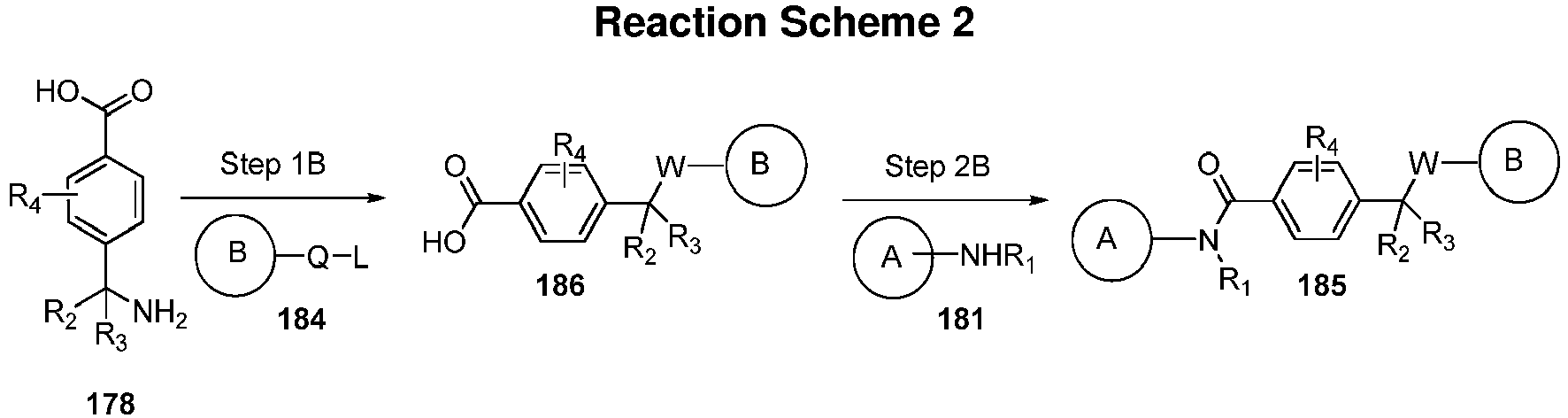
- Referring to
Reaction Scheme 2, Step 1 B, a mixture of a compound of Formula 178 is combined with a compound of Formula 184, where L is a leaving group (such as chloride) and Q is a substitutent group (such as carbonyl or SO2), and an organic base (such a pyridine) to give the product, a compound of Formula 186, which is isolated and optionally purified. - Referring to
Reaction Scheme 1, Step 2B, a mixture of a compound of Formula 186 is combined with a halogenating agent (such as oxalyl chloride), an organic base (such as pyridine), in a polar organic solvent (such as DMF and/or THF). A compound of Formula 181 is then added to give the product, a compound of Formula 185, which is isolated and optionally purified. - Also provided is a pharmaceutical composition comprising at least one compound and/or pharmaceutically acceptable salt described herein and at least one pharmaceutically acceptable carrier.
- The term "pharmaceutically acceptable carrier" refers to any and all solvents, dispersion media, coatings, isotonic and absorption delaying agents, and the like, that are compatible with pharmaceutical administration. The use of such media and agents for pharmaceutically active substances is well known in the art, such as, for example, aqueous solutions such as water or physiologically buffered saline or other solvents or vehicles such as glycols, glycerol, oils such as olive oil or injectable organic esters. The compositions may also contain other active compounds providing supplemental, additional, or enhanced therapeutic functions.
- A pharmaceutically acceptable carrier may contain physiologically acceptable agents that act, for example, to stabilize or to increase the absorption of a compound or pharmaceutically acceptable salt thereof. Such physiologically acceptable agents include, for example, carbohydrates, such as glucose, sucrose or dextrans, antioxidants, such as ascorbic acid or glutathione, chelating agents, low molecular weight proteins or other stabilizers or excipients. The choice of a pharmaceutically acceptable carrier, including a physiologically acceptable agent, may depend, for example, on the route of administration of the composition. The pharmaceutical composition also may comprise a liposome or other polymer matrix, which may have incorporated therein, for example, a compound as described herein. Liposomes, for example, which consist of phospholipids or other lipids, are nontoxic, physiologically acceptable and metabolizable carriers that are relatively simple to make and administer.
- In some embodiments, a "pharmaceutically acceptable carrier" as used herein means a pharmaceutically acceptable material, composition, or vehicle, such as a liquid or solid filler, diluent, excipient, solvent, or encapsulating material, involved in carrying or transporting the subject compounds from one organ, or portion of the body, to another organ, or portion of the body. Each carrier is typically "acceptable" in the sense of being compatible with the other ingredients of the formulation and not injurious to the patient. Some examples of materials that may serve as pharmaceutically acceptable carriers include: (1) sugars, such as lactose, glucose and sucrose; (2) starches, such as corn starch and potato starch; (3) cellulose, and its derivatives, such as sodium carboxymethyl cellulose, ethyl cellulose and cellulose acetate; (4) powdered tragacanth; (5) malt; (6) gelatin; (7) talc; (8) excipients, such as cocoa butter and suppository waxes; (9) oils, such as peanut oil, cottonseed oil, safflower oil, sesame oil, olive oil, corn oil and soybean oil; (10) glycols, such as propylene glycol; (11) polyols, such as glycerin, sorbitol, mannitol and polyethylene glycol; (12) esters, such as ethyl oleate and ethyl laurate; (13) agar; (14) buffering agents, such as magnesium hydroxide and aluminum hydroxide; (15) alginic acid; (16) pyrogen-free water; (17) isotonic saline; (18) Ringer's solution; (19) ethyl alcohol; (20) phosphate buffer solutions; and (21) other non-toxic compatible substances employed in pharmaceutical formulations. See Remington: The Science and Practice of Pharmacy, 20th ed. (Alfonso R. Gennaro ed.), 2000.
- In some embodiments, a pharmaceutical composition comprising at least one compound and/or salt as described herein may be administered to a subject by any of a number of routes of administration including, for example, orally (for example, drenches as in aqueous or non-aqueous solutions or suspensions, tablets, boluses, powders, granules, pastes for application to the tongue); sublingually; anally, rectally, or vaginally (for example, as a pessary, cream, or foam); parenterally (including intramusclularly, intravenously, subcutaneously, or intrathecally as, for example, a sterile solution or suspension); nasally; intraperitoneally; subcutaneously; transdermally (for example as a patch applied to the skin); or topically (for example, as a cream, ointment or spray applied to the skin). At least one compound and/or salt as described herein may also be formulated for inhalation.
- In some embodiments, at least one compound of Formula I or IA or a pharmaceutically acceptable salt thereof, may be simply dissolved or suspended in sterile water. Details of appropriate routes of administration and compositions suitable for same can be found in, for example,
U.S. Patent Nos. 6,110,973 ;5,763,493 ;5,731,000 ;5,541,231 ;5,427,798 ;5,358,970 ; and4,172,896 , as well as in patents cited therein. - The pharmaceutical compositions described herein may conveniently be presented in unit dosage form and may be prepared by any methods well known in the art of pharmacy. The amount of active ingredient that can be combined with a carrier material to produce a single dosage form will vary depending upon the subject being treated and the particular mode of administration. The amount of active ingredient that can be combined with a carrier material to produce a single dosage form will generally be that amount of the compound that produces a therapeutic effect.
- In some embodiments, this amount ranges from about 1 percent to about 99 percent of active ingredient.
- In another embodiment, this amount ranges from about 5 percent to about 70 percent, and in a further embodiment from about 10 percent to about 30 percent.
- Methods of preparing these compositions include the step of bringing into association at least one compound and/or pharmaceutically acceptable salt as described herein with at least one carrier and, optionally, one or more accessory ingredients.
- In some embodiments, the pharmaceutical compositions are prepared by uniformly and intimately bringing into association at least one compound and/or pharmaceutically acceptable salt as described herein with liquid carriers, or finely divided solid carriers, or both, and then, if necessary, shaping the product.
- Pharmaceutical compositions suitable for oral administration may be in the form of capsules, cachets, pills, tablets, lozenges (using a flavored basis, usually sucrose and acacia or tragacanth), powders, granules, or as a solution or a suspension in an aqueous or non-aqueous liquid, or as an oil-in-water or water-in-oil liquid emulsion, or as an elixir or syrup, or as pastilles (using an inert base, such as gelatin and glycerin, or sucrose and acacia) and/or as mouth washes and the like, each containing a predetermined amount of at least one compound and/or salt as described herein as an active ingredient. The pharmaceutical compositions described herein may also be administered as a bolus, electuary, or paste.
- In some embodiments, compounds and/or pharmaceutically acceptable salts described herein are mixed with one or more pharmaceutically acceptable excipients, such as sodium citrate or dicalcium phosphate, and/or any of the following: (1) fillers or extenders, such as starches, lactose, sucrose, glucose, mannitol, and/or silicic acid; (2) binders, such as, for example, carboxymethylcellulose, alginates, gelatin, polyvinyl pyrrolidone, sucrose and/or acacia; (3) humectants, such as glycerol; (4) disintegrating agents, such as agaragar, calcium carbonate, potato or tapioca starch, alginic acid, certain silicates, and sodium carbonate; (5) solution retarding agents, such as paraffin; (6) absorption accelerators, such as quaternary ammonium compounds; (7) wetting agents, such as, for example, cetyl alcohol and glycerol monostearate; (8) absorbents, such as kaolin and bentonite clay; (9) lubricants, such a talc, calcium stearate, magnesium stearate, solid polyethylene glycols, sodium lauryl sulfate, and mixtures thereof; and (10) coloring agents. In the case of capsules, tablets and pills, the pharmaceutical compositions may also comprise buffering agents. Solid compositions of a similar type may also be employed as fillers in soft and hard-filled gelatin capsules using such excipients as lactose or milk sugars, as well as high molecular weight polyethylene glycols and the like.
- In some embodiments, the tablets, and other solid dosage forms pharmaceutical compositions, such as dragees, capsules, pills and granules, may optionally be scored or prepared with coatings and shells, such as enteric coatings and other coatings well known in the pharmaceutical formulating art. They may also be formulated so as to provide slow or controlled release of the active ingredient therein using, for example, hydroxypropylmethyl cellulose in varying proportions to provide the desired release profile, other polymer matrices, liposomes and/or microspheres. They may be sterilized by, for example, filtration through a bacteria-retaining filter, or by incorporating sterilizing agents in the form of sterile solid compositions that can be dissolved in sterile water, or some other sterile injectable medium immediately before use. These compositions may also optionally contain opacifying agents and may be of a composition in that they release the active ingredient(s) only, preferentially, in a certain portion of the gastrointestinal tract, optionally, or in a delayed manner. Examples of embedding compositions that may be used include polymeric substances and waxes. The active ingredient may also be in micro-encapsulated form, if appropriate, with one or more of the above-described excipients.
- In some embodiments, liquid dosage forms for oral administration include pharmaceutically acceptable emulsions, microemulsions, solutions, suspensions, syrups and elixirs. In addition to the active ingredient, the liquid dosage forms may contain inert diluents commonly used in the art, such as, for example, water or other solvents, solubilizing agents and emulsifiers, such as ethyl alcohol, isopropyl alcohol, ethyl carbonate, ethyl acetate, benzyl alcohol, benzyl benzoate, propylene glycol, 1,3-butylene glycol, oils, cottonseed, groundnut, corn, germ, olive, castor oils, sesame oils, glycerol, tetrahydrofuryl alcohol, polyethylene glycols and fatty acid esters of sorbitan, and mixtures thereof.
- In some embodiments, the emulsifiers are chosen from cottonseed, groundnut, corn, germ, olive, castor, and sesame oils.
- Besides inert diluents, the oral compositions may also include adjuvants such as wetting agents, emulsifying and suspending agents, sweetening, flavoring, coloring, perfuming, and preservative agents.
- Suspensions, in addition to the active compounds, may contain suspending agents as, for example, ethoxylated isostearyl alcohols, polyoxyethylene sorbitol and sorbitan esters, microcrystalline cellulose, aluminum metahydroxide, bentonite, agaragar, and tragacanth, and mixtures thereof.
- Pharmaceutical compositions as described herein for rectal, vaginal, or urethral administration may be presented as a suppository, which may be prepared by mixing one or more compounds or salts as described herein with one or more suitable nonirritating excipients or carriers comprising, for example, cocoa butter, polyethylene glycol, a suppository wax or a salicylate, and which is solid at room temperature, but liquid at body temperature and, therefore, will melt in the rectum or vaginal cavity and release the active compound.
- Alternatively or additionally, pharmaceutical compositions described herein may be formulated for delivery via a catheter, stent, wire, or other intraluminal device. Delivery via such devices may be especially useful for delivery to the bladder, urethra, ureter, rectum, or intestine.
- Formulations suitable for vaginal administration also include pessaries, tampons, creams, gels, pastes, foams, or spray formulations containing such carriers as are known in the art to be appropriate.
- Dosage forms for the topical or transdermal administration include powders, sprays, ointments, pastes, creams, lotions, gels, solutions, patches, and inhalants. The active compound may be mixed under sterile conditions with a pharmaceutically acceptable carrier, and with any preservatives, buffers, or propellants that may be required.
- The ointments, pastes, creams, and gels may comprise excipients, such as animal and vegetable fats, oils, waxes, paraffins, starch, tragacanth, cellulose derivatives, polyethylene glycols, silicones, bentonites, silicic acid, talc and zinc oxide, or mixtures thereof.
- Powders and sprays may contain, in addition to a compound as described herein, excipients such as lactose, talc, silicic acid, aluminum hydroxide, calcium silicates, and polyamide powder, or mixtures of these substances. Sprays may additionally contain customary propellants, such as chlorofluorohydrocarbons and volatile unsubstituted hydrocarbons, such as butane and propane.
- Transdermal patches have the added advantage of providing controlled delivery to the body. Such dosage forms may be made by dissolving or dispersing the compound in the proper medium. Absorption enhancers may also be used to increase the flux across the skin. The rate of such flux may be controlled by either providing a rate controlling membrane or dispersing the compound in a polymer matrix or gel.
- Ophthalmic formulations, eye ointments, powders, solutions, and the like, may also comprise at least one of the compounds or salts as described herein.
- In some embodiments, pharmaceutical compositions as described herein suitable for parenteral administration comprise at least one compound of Formula I, IA, or II, or a pharmaceutically acceptable salt thereof, in combination with one or more pharmaceutically acceptable sterile isotonic aqueous or nonaqueous solutions, dispersions, suspensions, or emulsions, or sterile powders which may be reconstituted into sterile injectable solutions or dispersions just prior to use, which may contain antioxidants, buffers, bacteriostats, solutes which render the formulation isotonic with the blood of the intended recipient or suspending or thickening agents.
- Examples of suitable aqueous and nonaqueous carriers that may be employed in the pharmaceutical compositions include water, ethanol, polyols (such as glycerol, propylene glycol, polyethylene glycol, and the like), and suitable mixtures thereof, vegetable oils, such as olive oil, and injectable organic esters, such as ethyl oleate. Proper fluidity may be maintained, for example, by the use of coating materials, such as lecithin, by the maintenance of the required particle size in the case of dispersions, and by the use of surfactants.
- These compositions may also contain adjuvants such as preservatives, wetting agents, emulsifying agents, and dispersing agents. Prevention of the action of microorganisms may be ensured by the inclusion of various antibacterial and antifungal agents, for example, paraben, chlorobutanol, phenol sorbic acid, chelators and the like.
- In some embodiments, isotonic agents, such as sugars, sodium chloride, and the like may be included into the compositions. In addition, prolonged absorption of the injectable pharmaceutical form may be brought about by the inclusion of agents that delay absorption such as aluminum monostearate and gelatin.
- In some cases, in order to prolong the effect of a drug, it may be advantageous to slow the absorption of the drug from subcutaneous or intramuscular injection. This may be accomplished by the use of a liquid suspension of crystalline or amorphous material having poor water solubility. The rate of absorption of the drug then depends upon its rate of dissolution, which, in turn, may depend upon crystal size and crystalline form. Alternatively, delayed absorption of a parenterally administered drug form is accomplished by dissolving or suspending the drug in an oil vehicle.
- Injectable depot forms are made by forming microencapsuled matrices of the subject compounds in biodegradable polymers such as polylactide-polyglycolide. Depending on the ratio of drug to polymer, and the nature of the particular polymer employed, the rate of drug release can be controlled. Examples of other biodegradable polymers include poly(orthoesters) and poly(anhydrides). Depot injectable formulations are also prepared by entrapping the drug in liposomes or microemulsions that are compatible with body tissue.
- Methods of introduction may also be provided by rechargeable or biodegradable devices. Various slow release polymeric devices have been developed and tested in vivo in recent years for the controlled delivery of drugs. A variety of biocompatible polymers (including hydrogels), including both biodegradable and non-degradable polymers, may be used to form an implant for the sustained release of a compound at a particular target site.
- As further detailed below, the pharmaceutical compositions described herein may also comprise, or may be used in combination with, one or more known cytotoxic, vascular targeting agents or chemotherapeutic agents including, but not limited to, XelodaTM (capecitabine), PaclitaxelTM, FUDR (fluorouridine) FludaraTM (fludarabine phosphate), GemzarTM (gemcitabine), methotrexate, cisplatin, carboplatin, adriamycin, avastin, tarceva, taxol, tamoxifen, Femora, temezolamide, cyclophosphamide, Erbitux, and Sutent.
- In some embodiments, when pharmaceutically acceptable compositions are for human administration, the aqueous solution is pyrogen free, or substantially pyrogen free. The excipients may be chosen, for example, to effect delayed release of an agent or to selectively target one or more cells, tissues or organs. The pharmaceutical composition may be in dosage unit form such as tablet, capsule, sprinkle capsule, granule, powder, syrup, suppository, injection or the like. The composition may also be present in a transdermal delivery system, e.g., a skin patch.
- The term "pharmaceutically acceptable prodrugs" as used herein represents those prodrugs of a compound of Formula I or IA or a pharmaceutically acceptable salt thereof, that are, within the scope of sound medical judgment, suitable for use in contact with the tissues of humans and lower animals without undue toxicity, irritation, allergic response, commensurate with a reasonable benefit / risk ratio, and effective for their intended use, as well as the zwitterionic forms, where possible, of the compounds and pharmaceutically acceptable salts described herein. A discussion is provided in Higuchi et al., "Prodrugs as Novel Delivery Systems," ACS Symposium Series, Vol. 14, and in Roche, E.B., ed. Bioreversible Carriers in Drug Design, American Pharmaceutical Association and Pergamon Press, 1987.
- The term "pharmaceutically acceptable salt(s)" refers to salts of acidic or basic groups that may be present in compounds used in the present compositions. Compounds included in the present compositions that are basic in nature are capable of forming a wide variety of salts with various inorganic and organic acids. The acids that may be used to prepare pharmaceutically acceptable acid addition salts of such basic compounds are those that form non-toxic acid addition salts, i.e., salts containing pharmacologically acceptable anions, including but not limited to hydrochloric, hydrobromic, hydriodic, sulfuric and phosphoric acid, as well as organic acids such as para-toluenesulfonic, methanesulfonic, oxalic, para-bromophenylsulfonic, carbonic, succinic, citric, benzoic and acetic acid, and related inorganic and organic acids. Such pharmaceutically acceptable salts thus include sulfate, pyrosulfate, bisulfate, sulfite, bisulfite, phosphate, monohydrogenphosphate, dihydrogenphosphate, metaphosphate, pyrophosphate, chloride, bromide, iodide, acetate, propionate, decanoate, caprylate, acrylate, formate, isobutyrate, caprate, heptanoate, propiolate, oxalate, malonate, succinate, suberate, sebacate, fumarate, maleate, butyne-1,4-dioate, hexyne-1,6-dioate, benzoate, chlorobenzoate, methylbenzoate, dinitrobenzoate, hydroxybenzoate, methoxybenzoate, phthalate, terephathalate, sulfonate, xylenesulfonate, phenylacetate, phenylpropionate, phenylbutyrate, citrate, lactate, β-hydroxybutyrate, glycollate, maleate, tartrate, methanesulfonate, propanesulfonates, naphthalene-1-sulfonate, naphthalene-2-sulfonate, mandelate, hippurate, gluconate, lactobionate, and the like salts.
- In some embodiments, pharmaceutically acceptable acid addition salts include those formed with mineral acids such as hydrochloric acid and hydrobromic acid, and those formed with organic acids such as fumaric acid and maleic acid.
- Compounds included in the present compositions, that are acidic in nature may react with any number of inorganic and organic bases to form pharmaceutically acceptable base salts. Bases may include, for example, the mineral bases, such as NaOH and KOH, but one of skill in the art would appreciate that other bases may also be used. See Ando et al., Remington: The Science and Practice of Pharmacy, 20th ed. 700-720 (Alfonso R. Gennaro ed.), 2000.
- In addition, if the compounds described herein are obtained as an acid addition salt, the free base can be obtained by basifying a solution of the acid salt. Conversely, if the product is a free base, an addition salt, particularly a pharmaceutically acceptable addition salt, may be produced by dissolving the free base in a suitable organic solvent and treating the solution with an acid, in accordance with conventional procedures for preparing acid addition salts from base compounds. Those skilled in the art will recognize various synthetic methodologies that may be used to prepare non-toxic pharmaceutically acceptable addition salts.
- In some embodiments, the pharmaceutically acceptable addition salts of the compounds described herein may also exist as various solvates, such as, for example, with water, methanol, ethanol, dimethylformamide, and the like. Mixtures of such solvates may also be prepared. The source of such solvate may be from the solvent of crystallization, inherent in the solvent of preparation or crystallization, or adventitious to such solvent.
- The compounds and pharmaceutically acceptable salts thereof described herein may target cells which express HIF-1α and/or HIF-2α. The compounds and pharmaceutically acceptable salts thereof described herein may target cells which express HIF-1α. The compounds and pharmaceutically acceptable salts thereof described herein may target cells which express HIF-2α. The compounds and pharmaceutically acceptable salts thereof described herein may target cells which express HIF-1α and/or HIF-2α.
- The compounds and pharmaceutically acceptable salts thereof described herein may target cells which do not have functional VHL.
- In some embodiments, the compounds and pharmaceutically acceptable salts described herein are for use in treating cells, and more particularly, cancerous cells, expressing HIF-1α and/or HIF-2α. In some embodiments, the compounds and pharmaceutically acceptable salts described herein are for use in treating cells, a more particularly, cancerous cells, expressing HIF-1α. In some embodiments, the compounds and pharmaceutically acceptable salts described herein are for use in treating cells, and more particularly, cancerous cells, expressing HIF-2α. In some embodiments, the compounds and pharmaceutically acceptable salts described herein are for use in treating cells, and more particularly, cancerous cells, expressing HIF-1α and/or HIF-2α.
- In some embodiments, the compounds and pharmaceutically acceptable salts thereof interfere with glycolysis.
- In certain embodiments, the disease treated or prevented is cancer.
- In some embodiments, the compounds and pharmaceutically acceptable salts described herein may be for use in treating a disease mediated by defective pVHL protein, such as Von Hippel-Lindau disease (which may also be referred to as angiomatosis retinae, angiophakomatosis retinae et cerebelli, familial cerebello- retinal angiomatosis, cerebelloretinal hemangioblastomatosis, Hippel Disease, Hippel-Lindau syndrome, HLS, VHL, Lindau disease or retinocerebellar angiomatosis). In some embodiments, the compounds and pharmaceutically acceptable salts described herein may be for use in treating a variety of malignant and/or benign tumors of the eye, brain, spinal cord, kidney, pancreas, and/or adrenal glands wherein individuals suffering from VHL may be disposed to such tumors. In some embodiments, the compounds and pharmaceutically acceptable salts described herein may be for use in treating a disease mediated by defective pVHL protein, such as ngiomatosis, hemangioblastomas, pheochromocytoma, renal cell carcinoma, pancreatic cysts and cafe au lait spots.
- Also provided is a compound of Formula I or IA, or a pharmaceutically acceptable salt thereof, for use in a method for treating a disease mediated by defective pVHL protein, comprising administering to a subject at least one said compound that is specifically cytotoxic to cells that have elevated HIF levels due to their increased rate and dependence on glucose uptake and glycolysis. In some embodiments, at least one compound of Formula I or IA, selectively disrupts glucose uptake and utilization in the subject. In some embodiments, at least one compound of Formula I or IA, or a pharmaceutically acceptable salt thereof, inhibits HIF-mediated induction of PDK1.
- Also described is a method of targeting cells which have defective pVHL protein. The cells may be contacted with at least one compound of Formula I or IA, or a pharmaceutically acceptable salt thereof, that selectively disrupts glucose uptake and utilization in the cells. The compound of Formula I or IA, or a pharmaceutically acceptable salt thereof, may inhibit HIF-mediated induction of PDK1.
- Also described is a method for selectively killing cells which have defective pVHL protein. The cells may be contacted with at least one compound of Formula I or IA, or a pharmaceutically acceptable salt thereof, that selectively disrupts glucose uptake and utilization in the cells. At least one compound of Formula I or IA, or a pharmaceutically acceptable salt thereof, may inhibit HIF-mediated induction of PDK1.
- Also described is a method for treating a disease mediated by HIF-1α and/or HIF-2α comprising administering to a subject at least one compound of Formula I or IA, or a pharmaceutically acceptable salt thereof, that is specifically cytotoxic to cells that have elevated HIF levels due to their increased rate and dependence on glucose uptake and glycolysis. At least one compound of Formula I or IA, or a pharmaceutically acceptable salt thereof, may selectively disrupt glucose uptake and utilization in the subject. At least one compound of Formula I or IA, or a pharmaceutically acceptable salt thereof, may inhibit HIF-mediated induction of PDK1.
- Also described is a method for treating a disease mediated by cells comprising genetic or epigenetic alterations that make them highly dependent on aerobic glycolysis for energy production, comprising administering to a subject at least one compound of Formula I or IA, or a pharmaceutically acceptable salt thereof, that is specifically cytotoxic to cells comprising genetic or epigenetic alterations that make them highly dependent on aerobic glycolysis for energy production.
- Also described is a method for selectively killing cells comprising genetic or epigenetic alterations that make them highly dependent on aerobic glycolysis for energy production, comprising administering to the cells at least one compound of Formula I or IA, or a pharmaceutically acceptable salt thereof, that is specifically cytotoxic to cells comprising genetic or epigenetic alterations that make them highly dependent on aerobic glycolysis for energy production. At least one compound of Formula I or IA, or a pharmaceutically acceptable salt thereof, may selectively disrupt glucose uptake and utilization in cells comprising genetic or epigenetic alterations that make them highly dependent on aerobic glycolysis for energy production.
- Also described is a method for treating a disease mediated by GLUT1 administering to a subject at least one compound of Formula I or IA, or a pharmaceutically acceptable salt thereof. Also described is a method for treating a disease mediated by
GLUT 1, comprising administering to a subject at least one compound of Formula I or IA, or a pharmaceutically acceptable salt thereof, that is specifically cytotoxic to cells that have elevatedGLUT 1 levels due to their increased rate and dependence on glucose uptake and glycolysis. At least one compound of Formula I or IA, or a pharmaceutically acceptable salt thereof, may selectively disrupt glucose uptake and utilization in the subject. At least one compound of Formula I or IA, or a pharmaceutically acceptable salt thereof, may inhibit glucose transport by GLUT1. - Also provided is a method of identifying a compound as a candidate cancer therapy, comprising exposing a first population of cells that have elevated expression of GLUT1 but not GLUT2 to a test compound and assaying cytotoxicity of the test compound, exposing a second population of cells that have elevated expression of GLUT2 but not GLUT1 to the test compound and assaying cytotoxicity of the test compound, and identifying the test compound as a candidate cancer therapy if the test compound induces significantly higher cytotoxicity in the first population of cells than in the second population of cells. Also provided is at least one compound, or a pharmaceutically acceptable salt thereof, identified by such method.
- The subject receiving treatment may be any mammal in need of such treatment. Such mammals include, e.g., humans, ovines, bovines, equines, porcines, canines, felines, non-human primate, mice, and rats. In some embodiments, the subject is a human. In some embodiments, the subject is a non- human mammal.
- "Therapeutically-effective amount" refers to the concentration of a compound that is sufficient to elicit the desired therapeutic effect (e.g., treatment or prevention of a disease). It is generally understood that the effective amount of the compound will vary according to the weight, gender, age, and medical history of the subject. Other factors that influence the effective amount may include, but are not limited to, the severity of the patient's condition, the disorder being treated, the stability of the compound, and, if desired, another type of therapeutic agent being administered with the compounds and pharmaceutically acceptable salts described herein. A larger total dose may be delivered by multiple administrations of the agent. Methods to determine efficacy and dosage are known to those skilled in the art. See, e.g., Roden, Harrison's Principles of Internal Medicine, Ch. 3, McGraw-Hill, 2004.
- Actual dosage levels of the active ingredients in the pharmaceutical compositions comprising at least one compound or pharmaceutically active salt as described herein may be varied so as to obtain an amount of the active ingredient that is effective to achieve the desired therapeutic response for a particular patient, composition, and mode of administration, without being toxic to the patient.
- A physician or veterinarian having ordinary skill in the art can readily determine and prescribe the effective amount of the pharmaceutical composition required. For example, the physician or veterinarian could start doses of the compounds described herein employed in the pharmaceutical composition at levels lower than that required in order to achieve the desired therapeutic effect and gradually increase the dosage until the desired effect is achieved.
- In general, a suitable daily dose of at least one compound of Formula I or IA, or a pharmaceutically acceptable salt thereof, will be that amount of the compound that is the lowest dose effective to produce a therapeutic effect. Such an effective dose will generally depend upon the factors described herein.
- If desired, the effective daily dose of the active compound may be administered as one, two, three, four, five, six, or more sub-doses administered separately at appropriate intervals throughout the day, optionally, in unit dosage forms.
- The active compound may be administered two or three times daily. The active compound may be administered once daily.
- The optimal frequency of administration and effective dosage will vary from one individual to another and will depend upon the particular disease being treated and may be determined by one skilled in the art.
- In some embodiments, effective dosages of at least one compound of Formula I or IA, or a pharmaceutically acceptable salt thereof, may range from as low as about 1 mg per day to as high as about 1000 mg per day, including all intermediate dosages there between.
- In another embodiment, effective dosages may range from about 10 mg per day to about 100 mg per day, including all intermediate dosages there between. The compositions may be administered in a single dosage, or in multiple, divided dosages.
- As described herein, at least one compound of Formula I or IA, may be used for treating or preventing cancer. In some embodiments, such methods may, further comprise administration of a chemotherapeutic agent.
- Chemotherapeutic agents that may be coadministered with compounds and pharmaceutical compositions of Formula I or IA, may include: alemtuzumab, aminoglutethimide, amsacrine, anastrozole, asparaginase, Bacillus Calmette-Guérin, bevacizumab, bicalutamide, bleomycin, bortezomib, buserelin, busulfan, campothecin, capecitabine, carboplatin, carmustine, CeaVac, cetuximab, chlorambucil, cisplatin, cladribine, clodronate, colchicine, cyclophosphamide, cyproterone, cytarabine, dacarbazine, daclizumab, dactinomycin, daunorubicin, dienestrol, diethylstilbestrol, docetaxel, doxorubicin, edrecolomab, epirubicin, epratuzumab, erlotinib, estradiol, estramustine, etoposide, exemestane, filgrastim, fludarabine, fludrocortisone, fluorouracil, fluoxymesterone, flutamide, gemcitabine, gemtuzumab, genistein, goserelin, huJ591, hydroxyurea, ibritumomab, idarubicin, ifosfamide, IGN-101, imatinib, interferon, interleukin-2, irinotecan, ironotecan, letrozole, leucovorin, leuprolide, levamisole, lintuzumab, lomustine, MDX-210, mechlorethamine, medroxyprogesterone, megestrol, melphalan, mercaptopurine, mesna, methotrexate, mitomycin, mitotane, mitoxantrone, mitumomab, nilutamide, nocodazole, octreotide, oxaliplatin, paclitaxel, pamidronate, pentostatin, pertuzumab, plicamycin, porfimer, procarbazine, raltitrexed, rituximab, sorafinib, streptozocin, sunitinib, suramin, tamoxifen, temozolomide, temsirolimus, teniposide, testosterone, thalidomide, thioguanine, thiotepa, titanocene dichloride, topotecan, tositumomab, trastuzumab, tretinoin, vatalanib, vinblastine, vincristine, vindesine, and vinorelbine.
- Other useful chemotherapeutic agents for combination with the compounds as described herein include MDX-010; MAb, AME; ABX-EGF;
EMD 72 000; apolizumab; labetuzumab; ior-tl; MDX-220; MRA; H-11 scFv; Oregovomab; huJ591 MAb, BZL; visilizumab; TriGem; TriAb; R3; MT-201; G-250, unconjugated; ACA-125; Onyvax-105; CDP-860; BrevaRex MAb; AR54; IMC-1C11; GlioMAb-H; ING-1; Anti-LCG MAbs; MT-103; KSB-303; Therex; KW-2871; Anti-HMI.24; Anti-PTHrP; 2C4 antibody; SGN-30; TRAIL-RI MAb, CAT; Prostate cancer antibody; H22xKi-4; ABX-MA1; Imuteran; and Monopharm-C. - These chemotherapeutic agents may be categorized by their mechanism of action into, for example, the following groups: anti-metabolites/anti-cancer agents, such as pyrimidine analogs (e.g., 5-fluorouracil, floxuridine, capecitabine, gemcitabine and cytarabine) and purine analogs, folate antagonists and related inhibitors (e.g., mercaptopurine, thioguanine, pentostatin and 2-chlorodeoxyadenosine (cladribine)); antiproliferative/antimitotic agents including natural products such as vinca alkaloids (e.g., vinblastine, vincristine, and vinorelbine), microtubule disruptors such as taxane (paclitaxel, docetaxel), vincristin, vinblastin, nocodazole, epothilones and navelbine, epidipodophyllotoxins (teniposide), DNA damaging agents (e.g., actinomycin, amsacrine, anthracyclines, bleomycin, busulfan, camptothecin, carboplatin, chlorambucil, cisplatin, cyclophosphamide, cytoxan, dactinomycin, daunorubicin, docetaxel, doxorubicin, epirubicin, hexamethylmelamineoxaliplatin, iphosphamide, melphalan, merchlorethamine, mitomycin, mitoxantrone, nitrosourea, paclitaxel, plicamycin, procarbazine, teniposide, triethylenethiophosphoramide and etoposide (VP16)); antibiotics such as dactinomycin (actinomycin D), daunorubicin, doxorubicin (adriamycin), idarubicin, anthracyclines, mitoxantrone, bleomycins, plicamycin (mithramycin) and mitomycin; enzymes (e.g., L-asparaginase, which systemically metabolizes L-asparagine and deprives cells which do not have the capacity to synthesize their own asparagine); antiplatelet agents; antiproliferative/antimitotic alkylating agents such as nitrogen mustards (e.g., mechlorethamine, cyclophosphamide and analogs, melphalan, chlorambucil), ethylenimines and methylmelamines (e.g., hexamethylmelamine and thiotepa), alkyl sulfonatesbusulfan, nitrosoureas (e.g., carmustine (BCNU) and analogs, streptozocin), trazenes - dacarbazinine (DTIC); antiproliferative/antimitotic antimetabolites such as folic acid analogs (e.g., methotrexate); platinum coordination complexes (e.g., cisplatin, carboplatin), procarbazine, hydroxyurea, mitotane, aminoglutethimide; hormones, hormone analogs (e.g., estrogen, tamoxifen, goserelin, bicalutamide, nilutamide) and aromatase inhibitors (e.g., letrozole, anastrozole); anticoagulants (e.g., heparin, synthetic heparin salts and other inhibitors of thrombin); fibrinolytic agents (such as tissue plasminogen activator, streptokinase and urokinase), aspirin, COX-2 inhibitors, dipyridamole, ticlopidine, clopidogrel, abciximab; antimigratory agents; antisecretory agents (e.g., breveldin); immunosuppressives (e.g., cyclosporine, tacrolimus (FK-506), sirolimus (rapamycin), azathioprine, mycophenolate mofetil); anti-angiogenic compounds (e.g., TNP-470, genistein) and growth factor inhibitors (e.g., vascular endothelial growth factor (VEGF) inhibitors, fibroblast growth factor (FGF) inhibitors, epidermal growth factor (EGF) inhibitors); angiotensin receptor blocker; nitric oxide donors; anti-sense oligonucleotides; antibodies (e.g., trastuzumab and others listed above); cell cycle inhibitors and differentiation inducers (e.g., tretinoin); mTOR inhibitors, topoisomerase inhibitors (e.g., doxorubicin (adriamycin), amsacrine, camptothecin, daunorubicin, dactinomycin, eniposide, epirubicin, etoposide, idarubicin, irinotecan (CPT-11) and mitoxantrone, topotecan, irinotecan), corticosteroids (e.g., cortisone, dexamethasone, hydrocortisone, methylpednisolone, prednisone, and prenisolone); growth factor signal transduction kinase inhibitors; mitochondrial dysfunction inducers and caspase activators; chromatin disruptors.
- Pharmaceutical compositions comprising at least one compound of Formula I or IA, may be coadministered with chemotherapeutic agents either singly or in combination.
- Combination therapies comprising at least one compound of Formula I or IA, or a pharmaceutically acceptable salt thereof, and a conventional chemotherapeutic agent may be advantageous over combination therapies known in the art because the combination allows the conventional chemotherapeutic agent to exert greater effect at lower dosage. In some embodiments, the effective dose (ED50) for a chemotherapeutic agent, or combination of conventional chemotherapeutic agents, when used in combination with a compound of Formula I or IA, or a pharmaceutically acceptable salt thereof as described herein is at least 2 fold less than the ED50 for the chemotherapeutic agent alone. In another embodiment, the ED50 is about 5-fold less, about 10-fold less, and further about 25-fold less. Conversely, the therapeutic index (TI) for such chemotherapeutic agent or combination of such chemotherapeutic agent when used in combination with a compound or pharmaceutically acceptable salt described herein may be at least 2-fold greater than the TI for conventional chemotherapeutic regimen alone. In another embodiment, the TI is about 5-fold greater, about 10-fold greater, and further about 25-fold greater.
- In some embodiments, the compounds and pharmaceutically acceptable salts thereof described herein may be for administration in combination with radiation therapy.
- The invention is further illustrated by the following non-limiting examples. If an abbreviation is not defined, it has generally accepted meaning.
- Analyses were carried out in the Campbell Microanalytical Laboratory, University of Otago, Dunedin, NZ. Melting points were determined on an Electrothermal 2300 Melting Point Apparatus. NMR spectra were obtained on a
Bruker Avance 400 spectrometer at 400 MHz for 1Hand 100 MHz for 13C spectra. Spectra were obtained in [(CD3)2SO] unless otherwise specified, and were referenced to Me4Si. Chemical shifts and coupling constants were recorded in units of ppm and Hz, respectively. Assignments were determined using COSY, HSQC, and HMBC two-dimensional experiments. Low resolution mass spectra were gathered by direct injection of methanolic solutions into a Surveyor MSQ mass spectrometer using an atmospheric pressure chemical ionization (APCI) mode with a corona voltage of 50 V and a source temperature of 400 °C. Solutions in organic solvents were dried with anhydrous MgSO4. Solvents were evaporated under reduced pressure on a rotary evaporator. Thin-layer chromatography was carried out on aluminium-backed silica gel plates (Merck 60 F254) with visualization of components by UV light (254 nm) or exposure to I2. Column chromatography was carried out on silica gel (Merck 230-400 mesh). DCM refers to dichloromethane; DME refers to dimethoxyethane, DMF refers to dry N,N-dimethylformamide; ether refers to diethyl ether; EtOAc refers to ethyl acetate; EtOH refers to ethanol; MeOH refers to methanol; pet. ether refers to petroleum ether, boiling range 40-60 °C; THF refers to tetrahydrofuran dried over sodium benzophenone ketyl.
- General Method A. Oxalyl chloride (13 mmol) was added dropwise to a solution of acid (9 mmol) and DMF (4 drops) in dry THF (40 mL), and the mixture stirred at 50 °C for 3 h. The solvent was evaporated and the residue dissolved in pyridine (25 mL). Aminopyridine (9.6 mmol) was added and the solution stirred at 20 °C for 16 h. Water (150 mL) was added, the mixture stirred for another 2 h, the precipitate filtered off, washed with water and dried to give the amide.
- General Method B. A suspension of benzylcarbamate (7 mmol) in HBr/AcOH (30%, 30 mL) was stirred at 20 °C for 5 h. Et2O (150 mL) was added, the mixture was stirred for another 30 min, the precipitate filtered off, washed with Et2O and dried to give the amine dihydrobromide.
- General Method C. A mixture of amine dihydrobromide (0.9 mmol) and benzenesulfonyl chloride (1.0 mmol) in dry pyridine (10 mL) was stirred at 20 °C for 16 h. The solvent was evaporated and the residue stirred in water (20 mL) for 1 h. The precipitate was filtered, washed with water (5 mL) and dried. The crude solid was purified by column chromatography, to give the sulfonamide.
-

- 4-(Benzyloxycarbonylamino)methyl)benzoic acid (2). Benzyl chloroformate (10.3 mL, 72.7 mmol) and 2 M NaOH solution (33 mL, 66 mmol) were simultaneously added dropwise to a stirred solution of 4-aminomethylbenzoic acid (1) (10.0 g, 66.2 mmol) in 2 M NaOH solution (33 mL) and THF (30 mL) at 0 °C. The mixture was stirred at 20 °C for 16 h, then the organic solvent was evaporated and the residue acidified with 2 M HCl until the pH of the mixture was 2-3. The precipitate was filtered, washed with water (250 mL), washed with EtOH (50 mL), and finally washed with Et2O (100 mL). The solid was dried under vacuum to give acid 2 (16.43 g, 87%) as a white powder: mp 190-192 °C [lit. (Loge et. al., J. Enzyme Inhibit. Med. Chem. 2002, 17, 381-390) mp (toluene) 194-195 °C; 1H NMR δ 7.85 (br d, 2 H, H-2, H-6), 7.82 (br t, J = 6.1 Hz, 1 H, NHCO2), 7.30-7.40 (m, 5 H, H-2', H-3', H-4', H-5', H-6'), 7.27 (br d, J = 8.2 Hz, 2 H, H-3, H-5), 5.05 (s, 2 H, OCH2), 4.24 (d, J = 6.1 Hz, 2 H, CH2N).
- Benzyl 4-(pyridine-2-ylcarbamoyl)benzylcarbamate (3). Method A. Reaction of benzoic acid 2 (2.5 g, 8.8 mmol) and oxalyl chloride (1.15 mL, 13.1 mmol), with subsequent reaction with 2-aminopyridine (0.91 g, 9.6 mmol), gave carbamate 3 (2.43 g, 77%) as a pale pink solid: mp (EtOAc) 127-129 °C; 1H NMR δ 10.69 (s, 1 H, NHCO), 8.37-8.39 (m, 1 H, H-3'), 8.19 (d, J = 8.4 Hz, 1 H, H-6'), 7.99 (d, J = 8.3 Hz, 2 H, H-2, H-6), 7.84 (br t, J = 6.0 Hz, 1 H, NHCO2), 7.80-7.85 (m, 1 H, H-5'), 7.29-7.39 (m, 7 H, H-3, H-5, phenyl), 7.14-7.18 (m, 1 H, H-4'), 5.07 (s, 2 H, OCH2), 4.09 (d, J = 6.2 Hz, 2 H, CH2N); 13C NMR δ 165.6, 156.3, 152.1, 147.8, 143.8, 137.9, 137.0, 132.5, 128.2 (2), 127.9 (2), 127.7, 127.6 (2), 126.6 (2), 119.6, 114.5, 65.3, 43.5. Anal. Calcd for C21H19N3O3: C, 69.79; H, 5.30; N, 11.63. Found: C, 69.54; H, 5.46; N, 11.40%.
- 4-(Aminomethyl)-N-(2-pyridinyl)benzamide dihydrobromide (4). Method B. Reaction of benzylcarbamate 3 (2.4 g, 6.6 mmol) gave benzamide 4 (1.65 g, 64%) as a pale pink solid: mp (EtOAc) 281-284 °C; 1H NMR δ 10.61 (s, 1 H, NHCO), 8.49 (dd, J = 5.4, 1.0 Hz, 1 H, H-3'), 8.38 (br s, 3 H, NH2·HBr), 8.22 (dd, J = 7.9, 1.6 Hz, 1 H, H-5'), 8.09-8.14 (m, 3 H, H-2, H-6, H-6'), 7.68 (d, J = 8.3 Hz, 2 H, H-3, H-5), 7.46 (t, J = 6.2 Hz, 1 H, H-4'), 4.16 (q, J = 5.8 Hz, 2 H, CH2N), 7.06 (br s, 1 H, pyrN·HBr); 13C NMR δ 166.4, 149.6, 142.9, 142.7, 138.6, 132.6, 128.8 (2), 128.4 (2), 120.4, 116.1, 41.7. Anal. Calcd for C13H15Br2N3O: C, 40.13; H, 3.89; N, 10.80. Found: C, 40.26; H, 4.07; N, 10.53%.
- 4-(Phenylsulfonamidomethyl)-N-(pyridin-2-yl)benzamide (9). Method C. Reaction of amine salt 4 (357 mg, 0.9 mmol) and benzenesulfonyl chloride (0.13 mL, 1.0 mmol), followed by column chromatography, eluting with EtOAc, gave benzamide 9 (272 mg, 80%) as a white powder: mp (EtOAc) 169-170 °C; 1H NMR δ 10.68 (br s, 1 H, NHCO), 8.38 (ddd, J = 4.9, 1.8, 0.8 Hz, 1 H, H-6'), 8.24 (br s, 1 H, NHSO2), 8.18 (br d, J = 8.4 Hz, 1 H, H-3'), 7.97 (br d, J = 8.3 Hz, 2 H, H-2, H-6), 7.80-7.86 (m, 3 H, H-4', H-2", H-6"), 7.62-7.67 (m, 1 H, H-4"), 7.56-7.61 (m, 2 H, H-3", H-5"), 7.37 (br d, J = 8.3 Hz, 2 H, H-3, H-5), 7.16 (ddd, J = 7.3, 4.9, 0.9 Hz, 1 H, H-5'), 4.08 (s, 2 H, CH2N); 13C NMR δ 165.5, 152.0, 147.8, 141.8, 140.6, 137.9, 132.7, 132,3, 129.1 (2), 127.8 (2), 127.2 (2), 126.3 (2), 119.6, 114.6, 45.6; MS m/z 368.4 (MH+, 100%). Anal. Calcd for C19H17N3O3S: C, 62.11; H, 4.66; N, 11.44. Found: C, 62.17; H, 4.86; N, 11.44%.
-

- Benzyl 4-(pyridine-3-ylcarbamoyl)benzylcarbamate (5). Method A. Reaction of benzoic acid 2 (10.0 g, 35.0 mmol) and oxalyl chloride (4.58 mL, 52.5 mmol), with subsequent reaction with 3-aminopyridine (3.62 g, 38.5 mmol) gave carbamate 5 (7.82 g, 62%) as a white solid: mp (EtOH) 207-210 °C; 1H NMR δ 10.37 (s, 1 H, NHCO), 8.92 (d, J = 2.3 Hz, 1 H, H-2'), 8.31 (dd, J = 4.7, 1.5 Hz, 1 H, H-6'), 8.18 (ddd, J = 8.34, 2.5, 1.5 Hz, 1 H, H-4'), 7.93 (br d, J = 8.3 Hz, 2 H, H-2, H-6), 7.89 (br t, J = 6.0 Hz, 1 H, NHCO2), 7.41 (br d, J = 8.3 Hz, 2 H, H-3, H-5), 7.31-7.39 (m, 6 H, H-5', H-2", H-3", H-4", H-5", H-6"), 5.06 (s, 2 H, CH2O), 4.30 (d, J = 6.2 Hz, 2 H, CH2N). Anal. Calcd for C21H19N3O3: C, 69.79; H, 5.30; N, 11.63. Found: C, 69.60; H, 5.40; N, 11.63%.
- 4-(Aminomethyl)-N-(3-pyridinyl)benzamide dihydrobromide (6). Method B. Reaction of carbamate 5 (2.2 g, 6.1 mmol) gave benzamide 6 (2.35 g, 99%) as a white solid: mp (EtOAc) 292-296 °C; 1H NMR δ 11.06 (s, 1 H, NHCO), 9.35 (d, J = 2.2 Hz, 1 H, H-2'), 8.70 (ddd, J = 8.5, 2.2, 1.1 Hz, 1 H, H-4'), 8.64 (br d, J = 5.4 Hz, 1 H, H-6'), 8.31 (br s, 3 H, NH2·HBr), 8.09 (br d, J = 8.2 Hz, 2 H, H-2, H-6), 7.96 (dd, J = 8.6, 5.4 Hz, 1 H, H-5'), 7.67 (d, J = 8.4 Hz, 2 H, H-3, H-5), 5.95 (br s, 1 H, pyrN·HBr), 4.16 (q, J = 5.8 Hz, 2 H, CH2N); Anal. Calcd for C13H15Br2N3O: C, 40.13; H, 3.89; N, 10.80. Found: C, 39.99; H, 3.94; N, 10.36%.
- 4-(Phenylsulfonamidomethyl)-N-(pyridin-3-yl)benzamide (10). Method C. Reaction of amine salt 6 (411 mg, 1.1 mmol) and benzenesulfonyl chloride (0.15 mL, 1.2 mmol), followed by column chromatography eluting with EtOAc, gave benzamide 10 (237 mg, 61%) as a white powder: mp (EtOAc) 168-170 °C; 1H NMR δ 10.37 (s, 1 H, NHCO), 8.93 (d, J = 2.3 Hz, 1 H, H-2'), 8.31 (dd, J = 4.7, 1.5 Hz, 1 H, H-6'), 8.25 (br s, 1 H, NHSO2), 8.18 (ddd, J = 8.4, 2.5, 1.5 Hz, 1 H, H-4'), 7.90 (br d, J = 8.3 Hz, 2 H, H-2, H-6), 7.83 (br d, J = 8.0 Hz, 2 H, H-2", H-6"), 7.57-7.69 (m, 3 H, H-3", H-4", H-5"), 7.37-7.42 (m, 3 H, H-3, H-5, H-5'), 4.09 (s, 2 H, CH2N); 13C NMR δ 165.4, 144.4, 141.9, 141.7, 140.5, 135.7, 132.9, 129.1 (2), 127.6 (2), 127.3 (2), 127.2, 126.3 (2), 123.3, 45.6; MS m/z 368.4 (MH+, 100%). Anal. Calcd for C19H17N3O3S: C, 62.11; H, 4.66; N, 11.44. Found: C, 62.37; H, 4.82; N, 11.39%.
-

- Benzyl 4-(pyridine-4-ylcarbamoyl)benzylcarbamate (7). Method A. Reaction of benzoic acid 2 (5.8 g, 20.3 mmol) with oxalyl chloride (2.65 mL, 30.4 mmol), with subsequent reaction with 4-aminopyridine (2.10 g, 22.3 mmol) gave carbamate 7 (2.30 g, 31%) as a pale pink solid: mp (EtOAc) 146-149 °C; 1H NMR δ 10.51 (s, 1 H, NHCO), 8.47 (dd, J = 4.7, 1.6 Hz, 2 H, H-2', H-6'), 7.87-7.93 (m, 3 H, H-2, H-6, NHCO2), 7.76 (dd, J = 4.7, 1.6 Hz, 2 H, H-3', H-5'), 7.42 (br d, J = 8.3 Hz, 2 H, H-3, H-5), 7.27-7.38 (m, 5 H, H-2", H-3", H-4", H-5", H-6"), 5.06 (s, 2 H, CH2O), 4.29 (d, J = 6.0 Hz, 2 H, CH2N). Anal. Calcd for C21H19N3O3: C, 69.79; H, 5.30; N, 11.63. Found: C, 69.92; H, 5.39; N, 11.71%.
- 4-(Aminomethyl)-N-(4-pyridinyl)benzamide dihydrobromide (8). Method B. Reaction of carbamate 7 (2.24 g, 6.6 mmol) gave benzamide 8 (1.98 g, 82%) as a white solid: mp (Et2O) 280-282 °C; 1H NMR δ 14.60 (br s, 1 H, pyrN·HBr), 11.56 (s, 1 H, NHCO), 8.80 (br d, J = 7.3 Hz, 2 H, H-2, H-6), 8.30-8.40 (m, 5 H, H-3', H-5', NH2·HBr), 8.10 (br d, J = 8.4 Hz, 2 H, H-2, H-6), 7.69 (d, J = 8.4 Hz, 2 H, H-3, H-5), 4.18 (q, J = 5.6 Hz, 2 H, CH2N). Anal. Calcd for C13H15Br2N3O·½H2O: C, 39.22; H, 4.05; N, 10.55. Found: C, 39.40; H, 4.06; N, 10.48%.
- 4-(Phenylsulfonamidomethyl)-N-(pyridin-4-yl)benzamide (11). Method C. Reaction of amine salt 8 (394 mg, 1.0 mmol) and benzenesulfonyl chloride (0.14 mL, 1.1 mmol), followed by column chromatography eluting with a gradient (0-5%) of MeOH/EtOAc, gave benzamide 11 (232 mg, 63%) as a white powder: mp (MeOH/EtOAc) 231-234 °C; 1H NMR δ 10.51 (s, 1 H, NHCO), 8.47 (dd, J = 4.9, 1.5 Hz, 2 H, H-4', H-6'), 8.26 (br s, 1 H, NHSO2), 7.89 (br d, J = 8.3 Hz, 2 H, H-2, H-6), 7.83 (br d, J = 8.1 Hz, 2 H, H-2", H-6"), 7.78 (dd, J = 4.8, 1.6 Hz, 2 H, H-3', H-5'), 7.64-7.68 (m, 1 H, H-4"), 7.57-7.61 (m, 2 H, H-3", H-5"), 7.41 (br d, J = 8.4 Hz, 2 H, H-3, H-5), 4.10 (s, 2 H, CH2N); 13C NMR δ 165.9, 150.2 (2), 145.8, 142.0, 140.5, 132.8, 132.3, 129.1 (2), 127.7 (2), 127.3 (2), 126.3 (2), 113.9 (2), 45.6; MS m/z 368.3 (MH+, 100%). Anal. Calcd for C19H17N3O3S: C, 62.11; H, 4.66; N, 11.44. Found: C, 62.36; H, 4.84; N, 11.47%.
-

- 4-(Phenylsulfonamidomethyl)benzoic Acid (12). Benzenesulfonyl chloride (1.27 mL, 10.0 mmol) was added dropwise to a stirred solution of 4-aminomethylbenzoic acid (1) (1.51 g, 10 mmol) in 2 M NaOH (10 mL) at 20 °C. The mixture was stirred at 20 ° for 3 h. The pH of the mixture was adjusted to 2-3 with 6 M HCl and the precipitate filtered. The precipitate was washed with water (2 × 20 mL), ether (20 mL) and pet. ether (2 × 20 mL) and air-dried. The residue was purified by chromatography, eluting with 5% MeOH/EtOAc, to give benzoic acid 12 (2.33 g, 80%) as a white powder: mp 223-227 °C; 1H NMR δ 12.20 (br s, 1 H, CO2H), 8.23 (br s, 1 H, NHSO2), 7.84 (br d, J= 8.3 Hz, 2 H, H-2, H-6), 7.78-7.82 (m, 2 H, H-2', H-6'), 7.60-7.64 (m, 1 H, H-4'), 7.55-7.59 (m, 2 H, H-3', H-5'), 7.34 (br d, J= 8.3 Hz, 2 H, H-3, H-5), 4.05 (br d, J= 5.8 Hz, 2 H, CH2N). Anal. Calcd for C14H13NO4S: C, 57.72; H, 4.50; N, 4.81. Found: C, 57.46; H, 4.52; N, 4.73%.
- Method A. Reaction of benzoic acid 12 (485 mg, 1.7 mmol) and oxalyl chloride (0.22 mL, 2.5 mmol) and subsequent reaction with 2-aminothiazole (185 mg, 1.8 mmol), followed by column chromatography eluting with a gradient (50-70%) of EtOAc/pet. ether, gave benzamide 13 (221 mg, 36%) as a white powder: mp (EtOAc/pet. ether) 189-191 °C; 1H NMR δ 12.56 (s, 1 H, NHCO), 8.25 (br s, 1 H, NHSO2), 8.01 (br d, J = 8.4 Hz, 2 H, H-2, H-6), 7.82 (ddd, J = 8.0, 2.1, 1.6 Hz, 2 H, H-2", H-6"), 7.62-7.66 (m, 1 H, H-4"), 7.56-7.61 (m, 2 H, H-3", H-5"), 7.55 (d, J = 3.6 Hz, 1 H, H-4'), 7.39 (br d, J = 8.4 Hz, 2 H, H-3, H-5), 7.27 (t, J = 3.6 Hz, 1 H, H-5'), 4.09 (s, 2 H, CH2N); 13C NMR δ 164.6, 158.6, 142.4, 140.6, 137.4, 132.3, 130.8, 129.1 (2), 128.0 (2), 127.4 (2), 126.3 (2), 113.7, 45.6; MS m/z 374.3 (MH+, 100%). Anal. Calcd for C17H15N3O3S2: C, 54.67; H, 4.05; N, 11.25. Found: C, 54.94; H, 4.09; N, 11.30%.
-

- Method A. Reaction of benzoic acid 12 (402 mg, 1.38 mmol) and oxalyl chloride (0.18 mL, 2.1 mmol) with subsequent reaction with 1H-pyrazol-3-amine hydrochloride (126 mg, 1.5 mmol), followed by column chromatography eluting with EtOAc, gave benzamide 14 (396 mg, 80%) as a white powder: mp (EtOAc/pet. ether) 180-182 °C; 1H NMR δ 12.40 (br s, 1 H, NH), 10.71 (s, 1 H, NHCO), 8.22 (br s, 1 H, NHSO2), 7.91 (br d, J = 8.3 Hz, 2 H, H-2, H-6), 7.82 (ddd, J = 8.0, 2.1, 1.5 Hz, 2 H, H-2", H-6"), 7.61-7.66 (m, 2 H, H-5', H-4"), 7.55-7.60 (m, 2 H, H-3", H-5"), 7.34 (br d, J = 8.3 Hz, 2 H, H-3, H-5), 6.62 (br s, 1 H, H-4'), 4.07(s, 2 H, CH2N); 13C NMR δ 164.0 147.2, 141.2, 140.6, 132.9, 132.3, 129.1 (2), 128.4, 127.5 (2), 127.1 (2), 126.3 (2), 96.9, 45.6; MS m/z 357.3 (MH+, 100%). Anal. Calcd for C17H16N4O3S: C, 57.29; H, 4.52; N, 15.72. Found: C, 57.53; H, 4.60; N, 15.73%.
-

- Method A. Reaction of benzoic acid 12 (424 mg, 1.46 mmol) and oxalyl chloride (0.19 mL, 2.2 mmol) with subsequent reaction with 3-aminoquinoline (232 mg, 1.6 mmol), followed by column chromatography eluting with EtOAc, gave benzamide 15 (528 mg, 87%) as a white powder: mp (EtOAc) 186-188 °C; 1H NMR δ 10.63 (br s, 1 H, NHCO), 9.15 (d, J= 2.5 Hz, 1 H, H-2'), 8.83 (d, J = 2.5 Hz, 1 H, H-4'), 8.27 (br s, 1 H, NHSO2), 7.95-8.00 (m, 3 H, H-2, H-6, H-8'), 7.84 (ddd, J = 8.0, 2.1, 1.6 Hz, 2 H, H-2", H-6"), 7.63-7.70 (m, 2 H, H-5', H-4"), 7.56-7.62 (m, 4 H, H-6', H-7', H-3", H-5"), 7.44 (br d, J = 8.3 Hz, 2 H, H-3, H-5), 4.11 (s, 2 H, CH2N); 13C NMR δ 165.6, 145.4, 144.3, 141.8, 140.6, 132.9, 132.7, 132.3 (2), 129.1 (2), 128.4, 127.9, 127.6 (2), 127.3 (3), 126.9, 126.3 (2), 123.3, 45.6; MS m/z 418.5 (MH+, 100%). Anal. Calcd for C23H19N3O3S: C, 66.17; H, 4.59; N, 10.07. Found: C, 66.40; H, 4.58; N, 10.27%.
-

- Method A. Reaction of benzoic acid 12 (440 mg, 1.5 mmol) and oxalyl chloride (0.20 mL, 2.3 mmol) with subsequent reaction with 5-aminoquinoline (240 mg, 1.7 mmol), followed by column chromatography eluting with EtOAc, gave benzamide 16 (426 mg, 68%) as a white powder: mp (EtOAc/pet. ether) 198-201 °C; 1H NMR δ 10.48 (br s, 1 H, NHCO), 8.92 (dd, J = 4.2, 1.6 Hz, 1 H, H-2'), 8.32 (br d, J = 8.6 Hz, 1 H, H-4'), 8.27 (br s, 1 H, NHSO2), 8.01 (br d, J = 8.3 Hz, 2 H, H-2, H-6), 7.97 (d, J = 8.3 Hz, 1 H, H-6'), 7.85 (ddd, J = 8.0, 2.1, 1.6 Hz, 2 H, H-2", H-6"), 7.80 (dd, J = 8.4, 7.5 Hz, 1 H, H-7'), 7.70 (dd, J = 7.4, 1.0 Hz, 1 H, H-8'), 7.65-7.68 (m, 1 H, H-4"), 7.58-7.63 (m, 2 H, H-3", H-5"), 7.56 (dd, J = 8.6, 4.2 Hz, 1 H, H-3'), 7.44 (br d, J = 8.3 Hz, 2 H, H-3, H-5), 4.12 (s, 2 H, CH2N); 13C NMR δ 165.9, 150.4, 148.1, 141.6, 140.6, 134.0, 132.9, 132.3, 132.0, 129.1 (2), 128.8, 127.7 (2), 127.3 (2), 127.0, 126.3 (2), 124.1, 123.6, 120.9, 45.6; MS m/z 418.5 (MH+, 100%). Anal. Calcd for C23H19N3O3S: C, 66.17; H, 4.59; N, 10.07. Found: C, 66.40; H, 4.62; N, 10.29%.
-

- Method A. Reaction of benzoic acid 12 (413 mg, 1.4 mmol) and oxalyl chloride (0.19 mL, 2.1 mmol) with subsequent reaction with 2-aminopyrazine (149 mg, 1.6 mmol), followed by column chromatography eluting with EtOAc, gave benzamide 24 (398 mg, 76%) as a white powder: mp (EtOAc/pet. ether) 200-202 °C; 1H NMR δ 11.00 (br s, 1 H, NHCO), 9.41 (d, J = 1.5 Hz, 1 H, H-2'), 8.47 (dd, J = 2.5, 1.5 Hz, 1 H, H-6'), 8.41 (d, J = 2.3 Hz, 1 H, H-5'), 8.20 (br s, 1 H, NHSO2), 7.98 (br d, J = 8.4 Hz, 2 H, H-2, H-6), 7.84 (ddd, J = 7.0, 2.1, 1.6 Hz, 2 H, H-2", H-6"), 7.62-7.67 (m, 1 H, H-4"), 7.56-7.61 (m, 2 H, H-3", H-5"), 7.39 (br d, J = 8.4 Hz, 2 H, H-3, H-5), 4.09 (s, 2 H, CH2N); 13C NMR δ 165.6, 148.9, 142.4, 142.4, 140.6, 139.8, 137.4, 132.3, 132.0, 129.1 (2), 128.1 (2), 127.2 (2), 126.3 (2), 45.6; MS m/z 369.2 (MH+, 100%). Anal. Calcd for C18H16N4O3S: C, 58.68; H, 4.38; N, 15.21. Found: C, 58.91; H, 4.45; N, 15.26%.
-

- Method A. Reaction of benzoic acid 12 (509 mg, 1.8 mmol) and oxalyl chloride (0.23 mL, 2.6 mmol) with subsequent reaction with pyrimidin-2-amine (183 mg, 1.9 mmol), followed by column chromatography eluting with a gradient (0-5%) of MeOH/EtOAc, gave benzamide 18 (262 mg, 41%) as a white powder: mp (MeOH/EtOAc) 180-182 °C; 1H NMR δ 10.91 (s, 1 H, NHCO), 8.72 (d, J = 4.8 Hz, 2 H, H-4', H-6'), 8.24 (br s, 1 H, NHSO2), 7.89 (br d, J = 8.3 Hz, 2 H, H-2, H-6), 7.82 (ddd, J = 8.0, 2.1, 1.5 Hz, 2 H, H-2", H-6"), 7.62-7.67 (m, 1 H, H-4"), 7.56-7.61 (m, 2 H, H-3", H-5"), 7.37 (br d, J = 8.3 Hz, 2 H, H-3, H-5), 7.26 (t, J = 4.8 Hz, 1 H, H-5'), 4.08(s, 2 H, CH2N); 13C NMR δ 165.0, 158.2 (2), 158.1, 141.9, 140.6, 132.9, 132.3, 129.1 (2), 128.1 (2), 127.2 (2), 126.3 (2), 117.2, 45.6; MS m/z 369.3 (MH+, 100%). Anal. Calcd for C18H16N4O3S: C, 58.68; H, 4.38; N, 15.21. Found: C, 58.70; H, 4.48; N, 14.91%.
-

- Method C. Reaction of amine salt 6 (400 mg, 1.0 mmol) and 2-toluenesulfonyl chloride (216 mg, 1.1 mmol) followed by column chromatography, eluting with EtOAc, gave benzamide 19 (264 mg, 67%) as a white powder: mp (EtOAc) 159-161 °C; 1H NMR δ 10.36 (s, 1 H, NHCO), 8.93 (d, J = 2.3 Hz, 1 H, H-2'), 8.30-8.32 (br s, 1 H, NHSO2), 8.31 (dd, J = 4.6, 1.5 Hz, 1 H, H-6'), 8.19 (d, J = 8.3 Hz, 1 H, H-4'), 7.89 (d, J = 6.7 Hz, 2 H, H-2, H-6), 7.83 (dd, J = 7.7, 1.1 Hz, 1 H, H-6"), 7.50 (dt, J = 7.5, 1.3 Hz, 1 H, H-5"), 7.34-7.41 (m, 5 H, H-3, H-5, H-5', H-3", H-4"), 4.12 (s, 2 H, CH2N), 2.59 (s, 3 H, CH3); 13C NMR δ 165.4, 144.4, 142.0, 141.9, 138.7, 136.3, 135.7, 132.9, 132.4, 132.3, 128.2, 127.5 (2), 127.2 (2), 127.2, 126.1, 123.3, 45.3, 19.7. Anal. Calcd for C20H19N3O3S: C, 62.97; H, 5.02; N, 11.02. Found: C, 63.28; H, 5.06; N, 11.13%.
-

- Method C. Reaction of amine salt 6 (442 mg, 1.1 mmol) and 2-fluorobenzenesulfonyl chloride (0.17 mL, 1.3 mmol) followed by column chromatography, eluting with EtOAc, gave benzamide 20 (219 mg, 50%) as a white powder: mp (EtOAc) 189-191 °C; 1H NMR δ 10.35 (s, 1 H, NHCO), 8.92 (d, J = 2.2 Hz, 1 H, H-2'), 8.58 (br s, 1 H, NHSO2), 8.31 (dd, J= 4.7, 1.5 Hz, 1 H, H-6'), 8.18 (ddd, J = 8.3, 2.5, 1.5 Hz, 1 H, H-4'), 7.88 (br d, J = 8.3 Hz, 2 H, H-2, H-6), 7.79 (dt, J = 7.6, 1.7 Hz, 1 H, H-6"), 7.65-7.71 (m, 1 H, H-4") 7.36-7.42, (m, 4 H, H-3, H-5, H-5', H-3"), 7.34 (dd, J = 7.6, 1.0 Hz, 1 H, H-5"), 4.22 (s, 2 H, CH2N); 13C NMR δ 165.4, 158.0 (d, J = 253 Hz), 144.4, 141.9, 141.7, 135.7, 135.0 (d, J = 9 Hz), 132.9, 129.4, 128.6 (d, J = 14 Hz), 127.5 (2), 127.2 (3), 124.6 (d, J = 4 Hz), 123.4, 117.0 (d, J = 21 Hz), 45.4; MS m/z 386.4 (MH+, 100%). Anal. Calcd for C19H16FN3O3S: C, 59.21; H, 4.18; N, 10.90. Found: C, 59.38; H, 4.29; N, 10.85%.
-

- Method C. Reaction of amine salt 6 (424 mg, 1.1 mmol) and 2-chlorobenzenesulfonyl chloride (0.16 mL, 1.2 mmol) followed by column chromatography, eluting with EtOAc, gave benzamide 21 (165 mg, 38%) as a white powder: mp (EtOAc) 190-192 °C; 1H NMR δ 10.35 (s, 1 H, NHCO), 8.92 (d, J = 2.2 Hz, 1 H, H-2'), 8.54 (br s, 1 H, NHSO2), 8.31 (dd, J = 4.7, 1.5 Hz, 1 H, H-6'), 8.18 (ddd, J = 8.4, 2.5, 1.5 Hz, 1 H, H-4'), 7.95 (dd, J = 7.4, 1.2 Hz, 1 H, H-6"), 7.87 (br d, J = 8.3 Hz, 2 H, H-2, H-6), 7.57-7.64 (m, 2 H, H-3", H-5"), 7.47-7.52 (m, 1 H, H-4"), 7.36-7.42 (m, 3 H, H-3, H-5, H-5'), 4.21 (s, 2 H, CH2N); 13C NMR δ 165.3, 144.4, 141.9, 141.7, 138.1, 135.7, 133.8, 132.9, 131.6, 130.5, 130.2, 127.5 (2), 127.4, 127.2 (2), 127.1, 123.4, 45.5; MS m/z 402.4 (MH+, 100%). Anal. Calcd for C19H16ClN3O3S: C, 56.79; H, 4.01; N, 10.46. Found: C, 56.90; H, 4.07; N, 10.57%.
-

- Method C. Reaction of amine salt 6 (400 mg, 1.0 mmol) and 2-bromobenzenesulfonyl chloride (289 mg, 1.1 mmol) followed by column chromatography, eluting with EtOAc, gave benzamide 22 (219 mg, 48%) as a cream coloured powder: mp (EtOAc) 200-202 °C; 1H NMR δ 10.35 (s, 1 H, NHCO), 8.93 (d, J = 2.3 Hz, 1 H, H-2'), 8.51 (br s, 1 H, NHSO2), 8.31 (dd, J = 4.7, 1.4 Hz, 1 H, H-6'), 8.18 (d, J = 8.3 Hz, 1 H, H-4'), 7.98 (dd, J = 7.6, 1.9 Hz, 1 H, H-5"), 7.88 (d, J = 8.3 Hz, 2 H, H-2, H-6), 7.81 (dd, J = 7.6, 1.4 Hz, 1 H, H-2"), 7.49-7.54 (m, 2 H, H-3", H-4"), 7.37-7.41 (m, 3 H, H-3, H-5, H-5'), 4.22 (s, 2 H, CH2N); 13C NMR δ 165.4, 144.4, 141.9, 141.7, 139.8, 135.7, 135.1, 133.7, 132.9, 130.4, 128.0, 127.5 (2), 127.2 (2), 127.2, 123.4, 119.1, 45.6. Anal. Calcd for C19H16BrN3O3S: C, 51.13; H, 3.61; N, 9.41. Found: C, 51.69; H, 3.78; N, 9.52%.
-

- Method C. Reaction of amine salt 6 (400 mg, 1.0 mmol) and methyl 2-(chlorosulfonyl)benzoate (365 mg, 1.6 mmol) followed by column chromatography, eluting with EtOAc, gave the benzoate 23 (225 mg, 49%) as a white powder: mp (EtOAc) 155-157 °C; 1H NMR δ 10.36 (s, 1 H, NHCO), 8.92 (d, J = 2.2 Hz, 1 H, H-2"), 8.31 (dd, J = 4.7, 1.5 Hz, 1 H, H-6"), 8.18 (d, J = 8.4 Hz, 1 H, H-4"), 8.11 (br s, 1 H, NHSO2), 7.90-7.87 (m, 3 H, H-6, H-2', H-6'), 7.65-7.71 (m, 3 H, H-3, H-4, H-5), 7.67-7.42 (m, 3 H, H-3', H-5', H-5"), 4.20 (s, 2 H, CH2N), 3.86 (s, 3 H, OCH3); 13C NMR δ 167.7, 165.4, 144.4, 141.9, 141.8, 138.1, 135.7, 132.9, 132.4, 131.7, 130.9, 128.6, 128.1, 127.5 (2), 127.2 (2), 127.2, 123.4, 52.8, 45.5. Anal. Calcd for C21H19N3O5S: C, 59.28; H, 4.50; N, 9.88. Found: C, 59.36; H, 4.46; N, 9.77%.
-

- Method C. Reaction of amine salt 6 (398 mg, 1.0 mmol) and 2-trifluoromethylbenzenesulfonyl chloride (0.17 mL, 1.1 mmol) followed by column chromatography, eluting with EtOAc, gave benzamide 24 (149 mg, 34%) as a white powder: mp (EtOAc) 234-237 °C; 1H NMR δ 10.36 (s, 1 H, NHCO), 8.92 (d, J = 2.2 Hz, 1 H, H-2'), 8.61 (br s, 1 H, NHSO2), 8.31 (dd, J = 4.7, 1.5 Hz, 1 H, H-6'), 8.18 (ddd, J = 8.3, 2.5, 1.5 Hz, 1 H, H-4'), 8.10 (br d, J = 8.7 Hz, 1 H, H-6")*, 7.97 (br dd, J = 7.2, 1.9 Hz, 1 H, H-3")*, 7.91 (br d, J = 8.3 Hz, 2 H, H-2, H-6), 7.80-7.88 (m, 2 H, H-4", H-5"), 7.43 (br d, 2 H, H-3, H-5), 7.39 (ddd, J = 8.3, 4.7, 0.5 Hz, 1 H, H-5'), 4.25 (s, 2 H, CH2N); 13C NMR δ 165.4, 144.4, 141.9, 141.7, 139.6, 135.6, 133.1, 133.0, 132.7, 129.9, 128.2 (q, J = 6 Hz), 127.6 (2), 127.3 (2), 127.1, 125.9 (q, J = 33 Hz), 123.3, 122.8 (q, J = 274 Hz), 45.7; MS m/z 436.5 (MH+, 100%). Anal. Calcd for C20H16F3N3O3S: C, 55.17; H, 3.70; N, 9.65. Found: C, 55.40; H, 3.87; N, 9.66%. *Assignments interchangeable
-

- Method C. Reaction of amine salt 6 (414 mg, 1.1 mmol) and 2-cyanobenzenesulfonyl chloride (240 mg, 1.2 mmol) followed by column chromatography, eluting with EtOAc, gave benzamide 25 (140 mg, 34%) as a white powder: mp (EtOAc) 217-220 °C; 1H NMR δ 10.36 (s, 1 H, NHCO), 8.92 (d, J = 2.2 Hz, 1 H, H-2'), 8.58 (br s, 1 H, NHSO2), 8.31 (dd, J= 4.7, 1.5 Hz, 1 H, H-6'), 8.15-8.19 (m, 2 H, H-4', H-6"), 8.05 (ddd, J = 8.6, 7.6, 1.2 Hz, 1 H, H-5"), 7.91-7.96 (m, 1 H, H-3"), 7.83-7.88 (m, 3 H, H-2, H-6, H-4"), 7.35-7.42, (m, 3 H, H-3, H-5, H-5'), 4.28 (s, 2 H, CH2N); MS m/z 393.3 (MH+, 100%). Anal. Calcd for C20H16N4O3S: C, 61.21; H, 4.11; N, 14.28. Found: C, 61.28; H, 4.08; N, 14.19%.
-

- A mixture of nitrophenylbenzamide 34 (252 mg, 0.6 mmol) and Pd/C (50 mg, catalytic) in EtOH/EtOAc (1:1, 80 mL) was stirred under H2 (50 psi) at 20 °C for 2 h. The mixture was filtered through Celite, the Celite was washed with EtOH (20 mL), and the solvent was evaporated. The residue was purified by column chromatography, eluting with a gradient (0-5%) of MeOH/EtOAc, to give benzamide 26 (166 mg, 71%) as a white powder: mp (EtOH/EtOAc) 211-213 °C; 1H NMR δ 10.39 (s, 1 H, NHCO), 8.93 (d, J= 2.3 Hz, 1 H, H-2'), 8.31 (dd, J= 4.7, 1.5 Hz, 1 H, H-6'), 8.19 (ddd, J = 8.3, 2.5, 1.5 Hz, 1 H, H-4'), 8.03 (br s, 1 H, NHSO2), 7.92 (br d, J = 8.3 Hz, 2 H, H-2, H-6), 7.44 (br d, J = 8.3 Hz, 2 H, H-3, H-5), 7.39 (dd, J = 8.3, 4.7 Hz, 1 H, H-5'), 7.20 (br t, J = 7.9 Hz, 1 H, H-5"), 7.04 (br t, J = 2.0 Hz, 1 H, H-2"), 6.93 (br ddd, J = 7.6, 1.6, 0.8 Hz, 1 H, H-6"), 6.77 br ddd, J = 8.0, 2.2, 0.8 Hz, 1 H, H-4"), 5.56 (s, 2 H, NH2), 4.06 (s, 2 H, CH2N); 13C NMR δ 165.5, 149.3, 144.4, 142.0, 141.9, 140.9, 135.7, 132.9, 129.4, 127.6 (2), 127.3 (2), 127.2, 123.4, 117.1, 113.0, 111.0, 45.7; MS m/z 383.4 (MH+, 100%). Anal. Calcd for C19H18N4O3S: C, 59.67; H, 4.74; N, 14.65. Found: C, 59.48; H, 4.92; N, 14.45%.
-

- Method C. Reaction of amine salt 6 (477 mg, 1.2 mmol) and 3-methoxybenzenesulfonyl chloride (0.19 mL, 1.4 mmol) followed by column chromatography, eluting with a gradient (50-100%) of EtOAc/pet. ether, gave benzamide 27 (247 mg, 51%) as a white powder: mp (MeOH/EtOAc) 148-151 °C; 1H NMR δ 10.37 (s, 1 H, NHCO), 8.92 (d, J = 2.2 Hz, 1 H, H-2'), 8.31 (dd, J = 4.7, 1.5 Hz, 1 H, H-6'), 8.25 (br s, 1 H, NHSO2), 8.17 (ddd, J= 8.3, 2.5, 1.5 Hz, 1 H, H-4'), 7.90 (br d, J = 8.3 Hz, 2 H, H-2, H-6), 7.51 (dd, J = 8.1, 7.9 Hz, 1 H, H-5"), 7.37-7.43 (m, 4 H, H-3, H-5, H-5', H-6"), 7.30 (br dd, J = 2.5, 1.7 Hz, 1 H, H-2"), 7.20 (ddd, J = 8.3, 2.6, 0.9 Hz, 1 H, H-4"), 4.09 (s, 2 H, CH2N), 3.82 (s, 3 H, OCH3); 13C NMR δ 165.4, 159.3, 144.4, 141.9, 141.7, 141.6, 135.7, 132.9, 130.3, 128.0 (2), 127.3 (2), 127.2, 123.4, 118.4, 118.2, 111.4, 55.4, 45.6; MS m/z 398.4 (MH+, 100%). Anal. Calcd for C20H19N3O4S: C, 60.44; H, 4.82; N, 10.57. Found: C, 60.70; H, 4.90; N, 10.53%.
-

- Method C. Reaction of amine salt 6 (400 mg, 1.0 mmol) and 3-toluenesulfonyl chloride (216 mg, 1.1 mmol) followed by column chromatography, eluting with EtOAc, to give benzamide 28 (250 mg, 64%) as a white powder, mp (EtOAc) 180-182 °C; 1H NMR δ 10.37 (s, 1 H, NHCO), 8.93 (d, J = 2.3 Hz, 1 H, H-2'), 8.31 (dd, J = 4.7, 1.5 Hz, 1 H, H-6'), 8.17-8.20 (m, 2 H, NHSO2, H-4'), 7.91 (d, J = 8.3 Hz, 2 H, H-2, H-6), 7.60-7.64 (m, 2 H, H-2", H-6"), 7.37-7.48 (m, 5 H, H-3, H-5, H-5', H-4", H-5"), 4.09 (d, J = 6.3 Hz, 2 H, CH2N), 2.38 (s, 3 H, CH3); 13C NMR δ 165.4, 144.4, 141.9, 141.8, 140.5, 138.7, 135.7, 132.9, 132.9, 128.9, 127.5 (2), 127.3 (2), 127.2, 126.6, 123.5, 123.4, 45.6, 20.7. Anal. Calcd for C20H19N3O3S: C, 62.97; H, 5.02; N, 11.02. Found: C, 63.19; H, 5.05; N, 11.05%.
-

- Method C. Reaction of amine salt 6 (400 mg, 1.0 mmol) and 3-fluorobenzenesulfonyl chloride (220 mg, 1.1 mmol) followed by column chromatography, eluting with EtOAc gave benzamide 29 (230 mg, 58%) as a white powder: mp (EtOAc) 181-183 °C; 1H NMR δ 10.37 (s, 1 H, NHCO), 8.93 (d, J = 2.3 Hz, 1 H, H-2'), 8.40 (br s, 1 H, NHSO2), 8.31 (dd, J = 4.7, 1.5 Hz, 1 H, H-6'), 8.18 (d, J = 8.3 Hz, 1 H, H-4'), 7.91 (d, J = 8.3 Hz, 2 H, H-2, H-6), 7.51-7.67 (m, 4 H, H-2", H-4", H-5", H-6"), 7.37-7.42 (m, 3 H, H-3, H-5, H-5), 4.14 (s, 2 H, CH2N); 13C NMR δ 165.4, 161.6 (d, J = 248 Hz), 144.4, 142.7 (d, J = 7 Hz), 141.9, 141.5, 135.7, 133.0, 131.5 (d, J = 8 Hz), 127.6 (2), 127.3 (2), 127.2, 123.4, 122.6 (d, J = 3 Hz), 119.4 (d, J = 21 Hz), 113.4 (d, J = 24 Hz), 45.6. Anal. Calcd for C19H16FN3O3S: C, 59.21; H, 4.18; N, 10.90. Found: C, 59.24; H, 4.14; N, 10.73%.
-

- Method C. Reaction of amine salt 6 (798 mg, 2.1 mmol) and 3-chlorobenzenesulfonyl chloride (0.32 mL, 2.3 mmol) followed by column chromatography, eluting with a gradient (50-100%) of EtOAc/pet. ether, gave benzamide 30 (455 mg, 55%) as a white powder: mp (EtOAc) 181-183 °C; 1H NMR δ 10.36 (s, 1 H, NHCO), 8.92 (d, J = 2.5 Hz, 1 H, H-2'), 8.42 (br s, 1 H, NHSO2), 8.31 (dd, J = 4.7, 1.5 Hz, 1 H, H-6'), 8.18 (ddd, J = 8.3, 2.5, 1.5 Hz, 1 H, H-4'), 7.91 (br d, J = 8.3 Hz, 2 H, H-2, H-6), 7.76-7.79 (m, 2 H, H-2", H-4"), 7.71 (dt, J = 8.2, 1.6 Hz, 1 H, H-6"), 7.62 (br t, J = 8.2 Hz, 1 H, H-5"), 7.36-7.43 (m, 3 H, H-3, H-5, H-5'), 4.14 (s, 2 H, CH2N); 13C NMR δ 165.34, 144.4, 142.5, 141.9, 141.4, 135.7, 133.6, 133.0, 132.2, 131.0, 127.6 (2), 127.4 (2), 127.2, 126.0, 125.0, 123.4, 45.6; MS m/z 402.3 (MH+, 100%). Anal. Calcd for C19H16ClN3O3S: C, 56.79; H, 4.01; N, 10.46. Found: C, 56.74; H, 4.18; N, 10.51%.
-

- Method C. Reaction of amine salt 6 (392 mg, 1.0 mmol) and 3-bromobenzenesulfonyl chloride (0.16 mL, 1.1 mmol) followed by column chromatography, eluting with EtOAc, gave benzamide 31 (271 mg, 60%) as a white powder: mp (MeOH/EtOAc) 181-184 °C; 1H NMR δ 10.36 (s, 1 H, NHCO), 8.92 (d, J = 2.4 Hz, 1 H, H-2'), 8.41 (br s, 1 H, NHSO2), 8.31 (dd, J = 4.7, 1.5 Hz, 1 H, H-6'), 8.18 (ddd, J = 8.3, 2.4, 1.5 Hz, 1 H, H-4'), 7.89-7.93 (m, 3 H, H-2, H-6, H-2"), 7.78-7.85 (m, 2 H, H-4", H-6"), 7.55 (t, J = 7.9 Hz, 1 H, H-5"), 7.36-7.43 (m, 3 H, H-3, H-5, H-5'), 4.14 (s, 2 H, CH2N); 13C NMR δ 165.3, 144.4, 142.6, 141.9, 141.4, 135.7, 135.1, 133.0, 131.3, 128.8, 127.6 (2), 127.4 (2), 127.2, 125.4, 123.4, 122.0, 45.6; MS m/z 446.1, 446.2 (MH+, 100%). Anal. Calcd for C19H16BrN3O3S: C, 51.13; H, 3.61; N, 9.41. Found: C, 51.40; H, 3.75; N, 9.48%.
-

- Method C. Reaction of amine salt 6 (588 mg, 1.5 mmol) and 3-trifluoromethylbenzenesulfonyl chloride (0.27 mL, 1. 7 mmol) followed by column chromatography, eluting with a gradient (50-100%) of EtOAc/pet. ether, gave benzamide 32 (280 mg, 43%) as a white powder: mp (MeOH/EtOAc) 200-201 °C; 1H NMR δ 10.34 (s, 1 H, NHCO), 8.92 (d, J = 2.4 Hz, 1 H, H-2'), 8.52 (br s, 1 H, NHSO2), 8.31 (dd, J = 4.7, 1.5 Hz, 1 H, H-6'), 8.18 (ddd, J = 8.4, 2.5, 1.5 Hz, 1 H, H-4'), 8.10 (br d, J = 7.9 Hz, 1 H, H-4"), 7.98-8.03 (m, 2 H, H-2", H-6"), 7.88 (br d, J = 8.3 Hz, 2 H, H-2, H-6), 7.83 (br t, J = 7.8 Hz, 1 H, H-5"), 7.39 (dd, J = 8.3, 0.6 Hz, 1 H, H-5'), 7.38 (br d, J = 8.3 Hz, 2 H, H-3, H-5), 4.17 (s, 2 H, CH2N); 13C NMR δ 165.2, 144.2, 141.9, 141.8, 141.2, 135.6, 132.9, 130.7, 130.4, 129.7 (q, J = 33 Hz), 128.9 (q, J = 3 Hz), 127.6 (2), 127.4 (2), 127.2, 123.3, 123.2 (q, J = 273 Hz), 122.8 (q, J = 4 Hz), 45.6; MS m/z 436.5 (MH+, 100%). Anal. Calcd for C20H16F3N3O3S: C, 55.17; H, 3.70; N, 9.65. Found: C, 55.40; H, 3.78; N, 9.69%.
-

- Method C. Reaction of amine salt 6 (419 mg, 1.1 mmol) and 3-cyanobenzenesulfonyl chloride (239 mg, 1.2 mmol) followed by column chromatography, eluting with EtOAc, gave benzamide 33 (266 mg, 63%) as a white powder: mp (MeOH/EtOAc) 214-217 °C; 1H NMR δ 10.36 (s, 1 H, NHCO), 8.92 (d, J = 2.2 Hz, 1 H, H-2'), 8.49 (br s, 1 H, NHSO2), 8.31 (dd, J = 4.7, 1.5 Hz, 1 H, H-6'), 8.18 (ddd, J = 8.3, 2.5, 1.5 Hz, 1 H, H-4'), 8.15 (t, J = 1.5 Hz, 1 H, H-2"), 8.07-8.12 (m, 2 H, H-4", H-6"), 7.90 (br d, J = 8.3 Hz, 2 H, H-2, H-6), 7.79 (dd, J = 8.0, 7.9 Hz, 1 H, H-5"), 7.36-7.41 (m, 3 H, H-3, H-5, H-5'), 4.17 (s, 2 H, CH2N); 13C NMR δ 165.3, 144.4, 141.9 (2), 141.3, 135.8, 135.6, 133.0, 130.8, 130.6, 129.9, 127.6 (2), 127.4 (2), 127.2, 123.4, 117.4, 112.3, 45.6; MS m/z 393.4 (MH+, 100%). Anal. Calcd for C20H16N4O3S: C, 61.21; H, 4.11; N, 14.28. Found: C, 61.04; H, 4.19; N, 14.00%.
-

- Method C. Reaction of amine salt 6 (940 mg, 2.4 mmol) and 3-nitrobenzenesulfonyl chloride (589 mg, 2.7 mmol) followed by column chromatography, eluting with a gradient (0-5%) of MeOH/EtOAc, gave benzamide 34 (588 mg, 59%) as a white powder: mp (MeOH/EtOAc) 228-230 °C; 1H NMR δ 10.33 (s, 1 H, NHCO), 8.92 (d, J = 2.1 Hz, 1 H, H-2'), 8.63 (br s, 1 H, NHSO2), 8.41-8.48 (m, 2 H, H-2", H-4"), 8.31 (dd, J = 4.7, 1.5 Hz, 1 H, H-6'), 8.15-8.21 (m, 2 H, H-4', H-6"), 7.83-7.90 (m, 3 H, H-2, H-6, H-5"), 7.36-7.41 (m, 3 H, H-3, H-5, H-3'), 4.18 (s, 2 H, CH2N); 13C NMR δ 165.2, 147.7, 144.4, 142.3, 141.9, 141.0, 135.6, 133.0, 132.4, 131.1, 127.6 (2), 127.5 (2), 127.2, 126.8, 123.3, 121.6, 45.7; MS m/z 413.5 (MH+, 100%). Anal. Calcd for C19H16N4O5S: C, 55.33; H, 3.91; N, 13.58. Found: C, 55.57; H, 4.07; N, 13.54%.
-

- Method C. Reaction of amine salt 6 (150 mg, 0.39 mmol) and 3-phenylbenzenesulfonyl chloride (107 mg, 0.42 mmol) followed by column chromatography, eluting with a gradient (0-5%) of MeOH/DCM, gave benzamide 35 (88 mg, 52%) as a white powder: mp 180-182 °C; 1H NMR δ 10.33 (s, 1 H, NHCO), 8.91 (d, J = 2.1 Hz, 1 H, H-2'), 8.31 (dd, J = 4.7, 1.5 Hz, 2 H, H-6', NHSO2), 8.17 (ddd, J = 8.3, 2.5, 1.5 Hz, 1 H, H-4'), 8.02 (t, J = 1.7 Hz, 1 H, H-2"), 7.92 (ddd, J = 7.8, 1.7, 1.1 Hz, 1 H, H-4"), 7.89 (br d, J = 8.3 Hz, 2 H, H-2, H-6), 7.81 (ddd, J = 7.8, 1.7, 1.1 Hz, 1 H, H-6"), 7.66-7.70 (m, 3 H, H-5", H-2"', H-6"'), 7.51 (t, J = 7.5 Hz, 2 H, H-3"', H-5"'), 7.37-7.45 (m, 4 H, H-3, H-5, H-5', H-4"'), 4.15 (s, 2 H, CH2N); 13C NMR δ 165.3, 144.4, 141.9, 141.7, 141.3, 141.0, 138.5, 135.6, 132.9, 130.5, 129.8, 129.0 (2), 128.1, 127.5 (2), 127.3 (2), 127.2, 126.8 (2), 125.2, 124.3, 123.3, 45.7; MS m/z 445.0 (MH+, 100%); HRMS (FAB+) calcd for C25H22N3O3S (MH+) m/z 444.1382, found 444.1381. Anal. calcd for C25H21N3O3S: C, 67.70; H, 4.77; N, 9.47. Found: C, 67.23; H, 4.81; N, 9.55%.
-

- Method C. Reaction of amine salt 6 (175 mg, 0.45 mmol) and 3-pyrimidine-2-ylbenzenesulfonyl chloride (150 mg, 0.59 mmol) gave benzamide 36 (136 mg, 68%) as a dark yellow powder: mp 203-206 °C; 1H NMR δ 10.31 (s, 1 H, NHCO), 8.96 (d, J = 4.9 Hz, 2 H, H-4"', H-6"'), 8.91 (d, J = 2.3 Hz, 1 H, H-2'), 8.82 (t, J = 1.7 Hz, 1 H, H-2"), 8.62 (dt, J = 8.0, 1.3 Hz, 1 H, H-6" or H-4"), 8.41 (t, J = 6.2 Hz, 1 H, NHSO2), 8.31 (dd, J = 4.7, 1.4 Hz, 1 H, H-6'), 8.17 (ddd, J = 8.4, 2.5, 1.5 Hz, 1 H, H-4'), 7.97 (ddd, J = 7.8, 1.8, 1.1 Hz, 1 H, H-4" or H-6"), 7.87 (br d, J = 8.3 Hz, 2 H, H-2, H-6), 7.75 (t, J = 7.8 Hz, 1 H, H-5"), 7.52 (t, J = 4.9 Hz, 1 H, H-5"'), 7.37-7.42 (m, 3 H, H-3, H-5, H-5'), 4.14 (s, 2 H, CH2N); 13C NMR δ 165.3, 161.8, 157.8 (2), 144.4, 141.9, 141.5, 141.3, 138.0, 135.6, 132.9, 131.0, 129.7, 128.5, 127.6 (2), 127.3 (2), 127.2, 125.5, 123.3, 120.5, 45.7; MS m/z 446.9 (MH+, 100%); HRMS (FAB+) calcd for C23H20N5O3S (MH+) m/z 446.1287, found 446.1286. Anal. calcd for C23H19N5O3S¼CH3OH: C, 61.58; H, 4.45; N, 15.44. Found: C, 61.35; H, 4.45; N 15.58 %.
-

- Method C. Reaction of amine salt 6 (160 mg, 0.41 mmol) and 3-(1-methyl-1H-pyrazol-3-yl)benzenesulfonyl chloride (137 mg, 0.54 mmol) followed by column chromatography, eluting with a gradient (0-5%) of MeOH/DCM, gave benzamide 44 (141 mg, 77%) as a white powder: mp 188-191 °C; 1H NMR δ 10.34 (s, 1 H, NHCO), 8.92 (br s, 1 H, H-2'), 8.28-8.31 (m, 2 H, H-6', NHSO2), 8.23 (t, J = 1.6 Hz, 1 H, H-2"), 8.18 (ddd, J = 8.4, 2.4, 1.5 Hz, 1 H, H-4'), 8.01 (dt, J = 8.0, 1.3 Hz, 1 H, H-4" or H-6"), 7.90 (br d, J= 8.3 Hz, 2 H, H-2, H-6), 7.78 (d, J= 2.3 Hz, 1 H, H-5"'), 7.72 (ddd, J = 7.8, 1.8, 1.1 Hz, 1 H, H-6" or H-4"), 7.61 (t, J = 7.8 Hz, 1 H, H-5"), 7.37-7.43 (m, 3 H, H-3, H-5, H-5'), 6.77 (d, J = 2.3 Hz, 1 Hz, H-4"'), 4.12 (s, 2 H, CH2N), 3.91 (s, 3 H, CH3); 13C NMR δ 165.4, 148.4, 144.3, 141.8, 141.7, 141.0, 135.7, 134.3, 132.9, 132.6, 129.5, 128.6, 127.6 (2), 127.3 (2), 127.2, 125.0, 123.4, 122.4, 102.9, 45.6, 38.6; MS m/z 449.0 (MH+, 100%); HRMS (FAB+) calcd for C23H22N5O3S (MH+) m/z 448.1443, found 448.1442. Anal. calcd for C23H21N5O3S·½CH3OH: C, 60.89; H, 5.00; N, 15.11. Found: C, 60.93; H, 4.70; N 15.49 %
-

- Method C. Reaction of amine salt 6 (150 mg, 0.39 mmol) and 3-(5-methyl-1,3,4-oxadiazol-2-yl)benzenesulfonyl chloride (150 mg, 0.58 mmol) followed by column chromatography, eluting with a gradient (0-10%) of MeOH/DCM, gave benzamide 38 (45 mg, 26%) as a white powder: mp (MeOH/DCM) 227-230 °C; 1H NMR δ 10.30 (s, 1 H, NHCO), 8.91 (d, J = 2.0 Hz, 1 H, H-2'), 8.50 (t, J = 6.3 Hz, 1 H, NHSO2), 8.31 (d, J= 3.8 Hz, 1 H, H-6'), 8.24 (t, J= 1.6 Hz, 1 H, H-2"), 8.15-8.19 (m, 2 H, H-4', H-4" or H-6"), 7.99-8.02 (m, 1 H, H-6" or H-4"), 7.86 (br d, J = 8.3 Hz, 2 H, H-2, H-6), 7.79 (t, J = 7.9 Hz, 1 H, H-5"), 7.37-7.43 (m, 3 H, H-3, H-5, H-5'), 4.16 (d, J = 6.3 Hz, 2 H, CH2N), 2.59 (s, 3 H, CH3); 13C NMR δ 165.2, 164.3, 144.3, 141.9, 141.8, 141.2, 132.8, 130.5, 129.7, 129.2, 127.5 (2), 127.4 (2), 127.3, 127.0, 124.3, 124.0, 123.4, 45.7, 10.5, one C not observed; MS m/z 450.9 (MH+, 100%); HRMS (FAB+) calcd for C22H20N5O4S (MH+) m/z 450.1236, found 450.1238. Anal. calcd for C22H19N5O4S·½CH3OH: C, 58.06; H, 4.55; N, 15.04. Found: C, 58.13; H, 4.30; N 15.01%.
-

- Method C. Reaction of amine salt 6 (163 mg, 0.42 mmol) and 3-(5-methyl-1,2,4-oxadiazol-3-yl)benzenesulfonyl chloride (130 mg, 0.50 mmol) followed by column chromatography, eluting with a gradient (0-6%) of MeOH/DCM, gave benzamide 39 (115 mg, 61%) as a cream powder: mp 182-185 °C; 1H NMR δ 10.30 (s, 1 H, NHCO), 8.91 (d, J = 2.1 Hz, 1 H, H-2'), 8.47 (br s, 1 H, NHSO2), 8.30-8.33 (m, 2 H, H-6', H-2"), 8.21 (m, 1 H, H-4" or H-6"), 8.17 (ddd, J = 8.3, 2.5, 1.5 Hz, 1 H, H-4'), 7.99 (ddd, J = 7.9, 1.8, 1.2 Hz, 1 H, H-6" or H-4"), 7.86 (br d, J = 8.3 Hz, 2 H, H-2, H-6), 7.77 (t, J = 7.8 Hz, 1 H, H-5"), 7.37-7.41 (m, 3 H, H-3, H-5, H-5'), 4.15 (s, 2 H, CH2N), 2.67 (s, 3 H, CH3); 13C NMR δ 177.8, 166.5, 165.2, 144.4, 141.9, 141.7, 141.3, 135.6, 132.8, 130.3, 130.2, 129.1, 127.5 (2), 127.4 (2), 127.2, 127.1, 124.7, 123.3, 45.7, 11.9; MS m/z 450.9 (MH+, 100%). Anal. calcd for C22H19N5O4S: C, 58.79; H, 4.26; N, 15.58. Found: C, 58.90; H, 4.54; N, 15.36%.
-

- Method C. Reaction of amine salt 6 (165 mg, 0.42 mmol) and 3-(2-methyl-1,3-thiazol-4-yl)benzenesulfonyl chloride (150 mg, 0.55 mmol) followed by column chromatography, eluting with a gradient (0-10%) of MeOH/DCM, gave benzamide 40 (112 mg, 57%) as a white powder: mp 200-202 °C; 1H NMR δ 10.33 (s, 1 H, NHCO), 8.92 (d, J = 2.4 Hz, 1 H, H-2'), 8.36 (t, J = 1.6 Hz, 1 H, H-2"), 8.30-8.32 (m, 2 H, H-6', NHSO2), 8.16-8.19 (m, 2 H, H-4', H-4" or H-6"), 8.08 (s, 1 H, H-5"'), 7.89 (br d, J = 8.3 Hz, 2 H, H-2, H-6), 7.77 (m, 1 H, H-6" or H-4"), 7.64 (t, J = 7.8 Hz, 1 H, H-5"), 7.37-7.42 (m, 3 H, H-3, H-5, H-5'), 4.13 (s, 2 H, CH2N), 2.73 (s, 3 H, CH3); 13C NMR δ 166.0, 165.3, 152.0, 144.4, 141.9, 141.6, 141.1, 135.7, 134.9, 132.9, 129.6 (2), 129.3 (2), 127.6, 127.3, 127.2, 125.5, 123.7, 123.3, 115.4, 45.6, 18.8; MS m/z 466.0 (MH+, 100%). Anal. calcd for C23H20N4O3S2: C, 59.46; H, 4.34; N, 12.06. Found: C, 59.39; H, 4.37; N 12.07%.
-

- A mixture of nitrophenylbenzamide 60 (296 mg, 0.72 mmol) and Pd/C (50 mg, catalytic) in EtOH/EtOAc (1:1, 80 mL) was stirred under H2 (50 psi) at 20 °C for 2 h. The mixture was filtered through Celite, the Celite was washed with EtOH (20 mL), and the solvent was evaporated. The residue was purified by column chromatography, eluting with a gradient (0-5%) of MeOH/EtOAc, to give benzamide 41 (210 mg, 76%) as a white powder: mp (EtOH/EtOAc) 219-221 °C; 1H NMR δ 10.37 (s, 1 H, NHCO), 8.93 (d, J = 2.2 Hz, 1 H, H-2'), 8.31 (dd, J = 4.7, 1.5 Hz, 1 H, H-6'), 8.18 (ddd, J = 8.3, 2.5, 1.5 Hz, 1 H, H-4'), 7.92 (br d, J = 8.3 Hz, 2 H, H-2, H-6), 7.72 (br t, J = 6.4 Hz, 1 H, NHSO2), 7.47 (ddd, J = 8.7, 2.6, 1.8 Hz, 2 H, H-2", H-6"), 7.42 (br d, J = 8.3 Hz, 2 H, H-3, H-5), 7.38 (dd, J = 8.3, 4.7 Hz, 1 H, H-5'), 6.62 (ddd, J = 8.7, 2.6, 1.8 Hz, 2 H, H-3", H-5"), 5.92 (br s, 2 H, NH2), 3.98 (d, J = 6.4 Hz, 2 H, CH2N); 13C NMR δ 165.5, 152.4, 144.4, 142.4, 141.9, 135.7, 132.8, 128.4 (2), 127.5 (2), 127.3 (2), 127.2, 125.4, 123.3, 112.6 (2), 45.6; MS m/z 383.4 (MH+, 100%). Anal. Calcd for C19H18N4O3S·1½H2O: C, 55.75; H, 5.17; N, 13.68. Found: C, 55.79; H, 4.71; N, 13.46%.
-
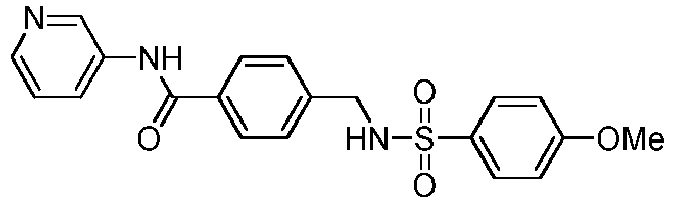
- Method C. Reaction of amine salt 6 (400 mg, 1.0 mmol) and 4-methoxybenzenesulfonyl chloride (234 mg, 1.1 mmol) followed by column chromatography, eluting with EtOAc, gave benzamide 42 (311 mg, 76%) as a white powder: mp (EtOAc) 208-210 °C; 1H NMR δ 10.37 (s, 1 H, NHCO), 8.93 (d, J = 2.2 Hz, 1 H, H-2'), 8.31 (dd, J = 4.6, 1.5 Hz, 1 H, H-6'), 8.18 (d, J = 8.3 Hz, 1 H, H-4'), 8.08 (br s, 1 H, NHSO2), 7.90 (d, J = 8.4 Hz, 2 H, H-2, H-6), 7.75 (dd, J = 8.9, 3.0 Hz, 2 H, H-2", H-6"), 7.37-7.42 (m, 3 H, H-3, H-5, H-5'), 7.10 (dd, J = 8.9, 3.0 Hz, 2 H, H-3", H-5"), 4.05 (br s, 2 H, CH2N), 3.83 (s, 3 H, OCH3); 13C NMR δ 165.4, 162.0, 144.4, 141.9, 141.8, 135.7, 132.9, 132.2, 128.5 (2), 127.6 (2), 127.3 (2), 127.2, 123.4, 114.2 (2), 55.5, 45.6. Anal. Calcd for C20H19N3O4S: C, 60.44; H, 4.82; N, 10.57. Found: C, 60.73; H, 4.91; N, 10.65%.
-

- Method C. Reaction of amine salt 6 (395 mg, 1.0 mmol) and 4-butoxybenzenesulfonyl chloride (277 mg, 1.1 mmol) followed by column chromatography, eluting with a gradient (50-100%) of EtOAc/pet. ether, gave benzamide 43 (319 mg, 71%) as a white powder: mp (EtOAc/pet. ether) 189-191 °C; 1H NMR δ 10.36 (s, 1 H, NHCO), 8.92 (d, J = 2.0 Hz, 1 H, H-2'), 8.31 (dd, J = 4.7, 1.5 Hz, 1 H, H-6'), 8.19 (ddd, J = 8.3, 2.5, 1.5 Hz, 1 H, H-4'), 8.07 (br s, 1 H, NHSO2), 7.89 (br d, J= 8.3 Hz, 2 H, H-2, H-6), 7.71 (ddd, J= 8.9, 3.0, 2.0 Hz, 2 H, H-2", H-6"), 7.35-7.41 (m, 3 H, H-3, H-5, H-5'), 7.07 (ddd, J = 8.9, 3.0, 2.0 Hz, 2 H, H-3", H-5"), 4.00-4.06 (m, 4 H, CH2O, CH2N), 1.65-1.73 (m, 2 H, CH2), 1.37-1.47 (m, 2 H, CH2), 0.91 (t, J = 7.4 Hz, 3 H, CH3); 13C NMR δ 165.4, 161.5, 144.4, 141.9, 140.7, 135.7, 132.9, 132.0, 128.5 (2), 127.5 (2), 127.3 (2), 127.1, 123.3, 114.6 (2), 67.6, 45.6, 30.4, 18.5, 13.5; MS m/z 440.6 (MH+, 100%). Anal. Calcd for C23H25N3O4S: C, 62.85; H, 5.73; N, 9.56. Found: C, 63.07; H, 5.84; N, 9.52%.
-

- Method C. Reaction of amine salt 6 (318 mg, 0.82 mmol) and 4-phenoxyphenylsulfonyl chloride (241 mg, 0.90 mmol) followed by column chromatography, eluting with EtOAc, gave benzamide 44 (184 mg, 49%) as a white powder: mp (MeOH/EtOAc) 200-202 °C; 1H NMR δ 10.37 (s, 1 H, NHCO), 8.93 (d, J = 2.3 Hz, 1 H, H-2'), 8.31 (dd, J = 4.7, 1.5 Hz, 1 H, H-6'), 8.22 (m, 1 H, NHSO2), 8.19 (ddd, J = 8.3, 2.5, 1.5 Hz, 1 H, H-4'), 7.90 (br d, J = 8.3 Hz, 2 H, H-2, H-6), 7.76 (ddd, J = 8.9, 2.1, 2.0 Hz, 2 H, H-2", H-6"), 7.37-7.45 (m, 5 H, H-3, H-5, H-5', H-3"', H-5'"), 7.23 (dt, J = 7.4, 1.0 Hz, 1 H, H-4"'), 7.11 (dt, J = 7.6, 1.0 Hz, 2 H, H-2"', H-6"'), 7.07 (ddd, J = 8.9, 2.9, 2.0 Hz, 2 H, H-2", H-6"), 4.11 (s, 2 H, CH2N); 13C NMR δ 165.4, 160.2, 154.8, 144.4, 141.9, 141.6, 135.7, 134.7, 132.8, 130.2 (2), 129.9 (2), 127.5 (2), 127.4 (2), 127.2, 124.7, 123.4, 119.8 (2), 117.5 (2), 45.6; MS m/z 460.6 (MH+, 100%). Anal. Calcd for C25H21N3O4S: C, 65.34; H, 4.61; N, 9.14. Found: C, 65.41; H, 4.55; N, 9.22%.
-

- Method C. Reaction of amine salt 6 (530 mg, 1.4 mmol) and 4-toluenesulfonyl chloride (286 mg, 1.5 mmol) followed by column chromatography, eluting with a gradient (0-10%) of MeOH/EtOAc, gave benzamide 45 (218 mg, 42%) as a white powder: mp (EtOAc) 194-197 °C; 1H NMR δ 10.37 (s, 1 H, NHCO), 8.92 (d, J = 2.2 Hz, 1 H, H-2'), 8.31 (dd, J = 4.7, 1.5 Hz, 1 H, H-6'), 8.19 (ddd, J = 8.3, 2.5, 1.5 Hz, 1 H, H-4'), 8.16 (br s, 1 H, NHSO2), 7.90 (br d, J = 8.3 Hz, 2 H, H-2, H-6), 7.70 (br d, J = 8.3 Hz, 2 H, H-2", H-6"), 7.36-7.44 (m, 5 H, H-3, H-5, H-5', H-3", H-5"), 4.06 (s, 2 H, CH2N), 2.39 (s, 3 H, CH3); 13C NMR δ 165.4, 144.4, 142.5, 141.9 (2), 141.8, 137.6, 132.9, 129.5 (2), 127.5 (2), 127.3 (2), 127.2, 126.4 (2), 123.4, 45.6, 20.9; MS m/z 382.5 (MH+, 100%). Anal. Calcd for C20H19N3O3S: C, 62.97; H, 5.02; N, 11.02. Found: C, 62.23; H, 5.11; N, 11.16%.
-

- Method C. Reaction of amine salt 6 (400 mg, 1.0 mmol) and 4-propylbenzenesulfonyl chloride (247 mg, 1.1 mmol) followed by column chromatography, eluting with EtOAc, gave benzamide 46 (300 mg, 71%) as a white powder: mp (EtOAc) 190-191 °C; 1H NMR δ 10.35 (s, 1 H, NHCO), 8.92 (d, J = 2.3 Hz, 1 H, H-2'), 8.31 (dd, J= 4.7, 1.4 Hz, 1 H, H-6'), 8.15-8.20 (m, 2 H, H-4', NHSO2), 7.88 (d, J= 8.3 Hz, 2 H, H-2, H-6), 7.70 (d, J= 8.3 Hz, 2 H, H-2", H-6"), 7.36-7.40 (m, 5 H, H-3, H-5, H-5', H-3", H-5"), 4.09 (d, J = 6.4 Hz, 2 H, CH2N), 2.62 (t, J= 7.6 Hz, 2 H, CH2), 1.59 (s, J= 7.4 Hz, 2 H, CH2), 0.87 (t, J = 7.3 Hz, 3 H, CH3); 13C NMR δ 165.4, 146.9, 144.4, 141.9, 141.7, 138.0, 135.7, 132.8, 128.9 (2), 127.5 (2), 127.3 (2), 127.2 (2), 126.4, 123.3, 45.6, 36.8, 23.6, 13.4. Anal. Calcd for C22H23N3O3S: C, 64.53; H, 5.66; N, 10.26. Found: C, 64.46; H, 5.73; N, 10.16%.
-

- Method C. Reaction of amine salt 6 (740 mg, 1.9 mmol) and 4-tert-butylbenzenesulfonyl chloride (490 mg, 2.1 mmol) followed by column chromatography, eluting with a gradient (50-100%) of EtOAc/pet. ether, gave benzamide 47 (560 mg, 70%) as a white powder: mp (EtOAc) 210-212 °C; 1H NMR δ 10.35 (s, 1 H, NHCO), 8.90 (d, J= 2.3 Hz, 1 H, H-2'), 8.31 (dd, J= 4.7, 1.4 Hz, 1 H, H-6'), 8.13-8.20 (m, 2 H, NHSO2, H-4'), 7.86 (br d, J= 8.3 Hz, 2 H, H-2, H-6), 7.68 (br d, J = 8.6 Hz, 2 H, H-2", H-6"), 7.54 (br d, J = 8.6 Hz, 2 H, H-3", H-5"), 7.35-7.40 (m, 3 H, H-3, H-5, H-5'), 4.09 (s, 2 H, CH2N), 1.29 [s, 9 H, C(CH3)3]; 13C NMR δ 165.4, 155.2, 144.4, 141.9, 141.7, 137.7, 135.7, 132.8, 127.5 (2), 127.3 (2), 127.2, 126.2 (2), 125.8 (2), 123.4, 45.7, 34.6, 30.6 (3); MS m/z 424.5 (MH+, 100%). Anal. Calcd for C23H25N3O3S: C, 65.22; H, 5.95; N, 9.92. Found: C, 65.19; H, 6.10; N, 9.84%.
-

- Method C. Reaction of amine salt 6 (200 mg, 0.51 mmol) and 4-adamantan-1-ylbenzenesulfonyl chloride (208 mg, 0.67 mmol) followed by column chromatography, eluting with a gradient (50-75%) of EtOAc/pet. ether gave benzamide 48 (73 mg, 28%) as a white powder: mp (H2O) 220-222 °C; 1H NMR δ 10.32 (s, 1 H, NHCO), 8.93 (d, J = 2.3 Hz, 1 H, H-2'), 8.30 (dd, J = 4.7, 1.5 Hz, 1 H, H-6'), 8.16-8.20 (m, 2 H, NHSO2, H-4'), 7.83 (br d, J= 8.3 Hz, 2 H, H-2, H-6), 7.66 (br d, J = 8.6 Hz, 2 H, H-2", H-6"), 7.47 (br d, J = 8.6 Hz, 2 H, H-3", H-5"), 7.39 (dd, J = 8.4, 4.7, 1 H, H-5'), 7.35 (br d, J = 8.6 Hz, 2 H, H-3, H-5), 4.10 (d, J = 6.3 Hz, 2 H, CH2N), 1.98-2.03 (m, 3 H, 3 × CH), 1.83 (br s, 6 H, 3 × CH2), 1.75-1.84 (m, 6 H, 3 × CH2); 13C NMR δ 165.3, 155.1, 144.4, 141.8, 141.5, 137.8, 135.7, 132.7, 127.4 (2), 127.3 (2), 127.1, 126.2 (2), 125.3 (2), 123.3, 45.7, 42.0 (3), 36.0, 35.8 (3), 28.0 (3); MS m/z 503.2 (MH+, 100%). Anal. calcd for C29H31N3O3S: C, 69.43; H, 6.23; N, 8.38. Found: C, 69.25; H, 6.30; N, 8.50%.
-

- Method C. Also isolated from the above reaction was the chloride 49 (23 mg, 8%) as a white powder: mp (H2O) 229-232 °C; 1H NMR δ 10.32 (s, 1 H, NHCO), 8.93 (d, J = 2.3 Hz, 1 H, H-2'), 8.30 (dd, J = 4.7, 1.5 Hz, 1 H, H-6'), 8.17-8.23 (m, 2 H, NHSO2, H-4'), 7.83 (br d, J = 8.3 Hz, 2 H, H-2, H-6), 7.67 (br d, J = 8.6 Hz, 2 H, H-2", H-6"), 7.50 (br d, J = 8.6 Hz, 2 H, H-3", H-5"), 7.38 (dd, J = 8.3, 4.7, 1 H, H-5'), 7.34 (br d, J = 8.6 Hz, 2 H, H-3, H-5), 4.11 (d, J = 6.3 Hz, 2 H, CH2N), 2.22 (br s, 4 H, 2 × CH2), 2.10 (br d, J = 2.5 Hz, 4 H, 2 × CH2), 1.75-1.84 (m, 4 H, 2 × CH2), 1.57-1.65 (m, 2 H, CH2); 13C NMR δ 165.3, 152.9, 144.4, 141.8, 141.4, 138.3, 135.7, 132.7, 127.4 (2), 127.3 (2), 127.1, 127.0, 126.3 (2), 125.4 (2), 123.3, 69.5, 51.5 (2), 46.0 (2), 40.4, 40.0 (2), 33.6, 31.2 (2); MS m/z 533.3 (MH+, 100%). Anal. calcd for C29H30ClN3O3S: C, 64.97; H, 5.64; N, 7.84. Found: C, 64.97; H, 5.94; N, 7.65%.
-

- Method C. Reaction of amine salt 6 (500 mg, 1.29 mmol) and 3-(4-chlorosulfonyl)phenylpropionate (407 mg, 1.55 mmol) followed by column chromatography, eluting with a gradient (0-10%) of MeOH/DCM, gave benzamide 50 (427 mg, 73%) as a white powder: mp 181-182 °C; 1H NMR δ 10.35 (s, 1 H, NHCO), 8.92 (d, J = 2.0 Hz, 1 H, H-2"'), 8.31 (dd, J = 4.7, 1.5 Hz, 1 H, H-6"'), 8.18 (ddd, J = 8.3, 2.5, 1.5 Hz, 2 H, H-4"', NHSO2), 7.89 (br d, J = 8.3 Hz, 2 H, H-3", H-5"), 7.71 (br d, J = 8.4 Hz, 2 H, H-3', H-5'), 7.37-7.43 (m, 5 H, H-2', H-6', H-2", H-6", H-5"'), 4.08 (s, 2 H, CH2N), 3.57 (s, 3 H, CH3), 2.93 (t, J = 7.6 Hz, 2 H, H-3), 2.67 (t, J = 7.6 Hz, 2 H, H-2); 13C NMR δ 172.3, 165.4, 145.3, 144.4, 141.9, 141.7, 138.4, 135.7, 132.9, 128.9 (2), 127.5 (2), 127.3 (2), 127.2, 126.4 (2), 123.3, 51.2, 45.6, 34.1, 29.8; MS m/z 455.0 (MH+, 100%); Anal. Calcd for C23H23N3O5S: C, 60.91; H, 5.11; N, 9.27. Found: C, 60.97; H, 5.02; N,9.25%.
-

- Acetic anhydride (0.10 mL, 1.1 mmol) was added dropwise to a stirred solution of 4-aminophenylsulfonamide 48 (210 mg, 0.55 mmol) in pyridine (10 mL) and the solution was stirred at 20 °C for 16 h. The solvent was evaporated and the residue suspended in water (20 mL) for 1 h. The precipitate was filtered, washed with water (5 mL) and dried. The crude solid was purified by column chromatography, eluting with a gradient (0-10%) of MeOH/EtOAc, to give benzamide 51 (150 mg, 64%) as a white powder: mp (MeOH/EtOAc) 229-231 °C; 1H NMR δ 10.36 (br s, 1 H, NHCO), 10.32 (br s, 1 H, NHCO), 8.93 (d, J = 2.2 Hz, 1 H, H-2'), 8.31 (dd, J = 4.7, 1.5 Hz, 1 H, H-6'), 8.18 (ddd, J = 8.3, 2.5, 1.5 Hz, 1 H, H-4'), 8.10 (br s, 1 H, NHSO2), 7.91 (br d, J = 8.3 Hz, 2 H, H-2, H-6), 7.75 (br s, 4 H, H-3", H-5", H-2", H-6"), 7.37-7.43 (m, 3 H, H-3, H-5, H-5), 4.06 (s, 2 H, CH2N), 2.08 (s, 3 H, COCH3); 13C NMR δ 168.8, 165.4, 144.4, 142.7, 141.9, 141.8, 135.7, 134.1, 132.9, 127.6 (2), 127.5 (2), 127.3 (2), 127.1, 123.3, 118.5 (2), 45.6, 24.0; MS m/z 425.4 (MH+, 100%). Anal. Calcd for C21H20N4O4S: C, 59.42; H, 4.75; N, 13.20. Found: C, 59.63; H, 4.97; N, 12.89%.
-

- Method C. Reaction of amine salt 6 (453 mg, 1.2 mmol) and 4-flourobenzenesulfonyl chloride (249 mg, 1.3 mmol) followed by column chromatography, eluting with EtOAc, gave benzamide 52 (288 mg, 64%) as a white powder: mp (EtOAc/pet. ether) 189-191 °C; 1H NMR δ 10.37 (s, 1 H, NHCO), 8.93 (d, J = 2.3 Hz, 1 H, H-2'), 8.27-8.31 (m, 2 H, NHSO2, H-6'), 8.19 (ddd, J = 8.3, 2.5, 1.5 Hz, 1 H, H-4'), 7.91 (br d, J = 8.3 Hz, 2 H, H-2, H-6), 7.85-7.89 (m, 2 H, H-2", H-6"), 7.36-7.45 (m, 5 H, H-3, H-5, H-5', H-3", H-5"), 4.10 (s, 2 H, CH2N); 13CNMR δ 165.4, 164.0 (d, J = 251 Hz), 144.4, 141.9, 141.6, 137.0 (d, J = 3 Hz), 135.7, 133.0, 129.4 (2, q, J = 10 Hz), 127.6 (2), 127.3 (2), 127.2, 123.4, 116.2 (2, q, J = 23 Hz), 45.6; MS m/z 436.5 (MH+, 100%). Anal. Calcd for C19H16FN3O3S·⅛ pet. ether: C, 59.88; H, 4.51; N, 10.65. Found: C, 59.79; H, 4.29; N, 10.86%.
-

- Method C. Reaction of amine salt 6 (400 mg, 1.0 mmol) and 4-chlorobenzenesulfonyl chloride (239 mg, 1.1 mmol) followed by column chromatography, eluting with a gradient (0-5%) of MeOH/EtOAc, gave the benzamide 53 (150 mg, 36%) as a cream coloured powder: mp (EtOAc) 229-231 °C; 1H NMR δ 10.36 (s, 1 H, NHCO), 8.92 (d, J = 2.2 Hz, 1 H, H-2'), 8.36 (br t, J = 6.3 Hz, 1 H, NHSO2 ), 8.31 (dd, J = 4.7, 1.5 Hz, 1 H, H-6'), 8.15-8.19 (m, 1 H, H-4'), 7.90 (d, J = 8.4 Hz, 2 H, H-2, H-6), 7.81 (d, J = 8.8 Hz, 2 H, H-2", H-6"), 7.66 (d, J = 8.8 Hz, 2 H, H-3", H-5"), 7.37-7.41 (m, 3 H, H-3, H-5, H-5'), 4.11 (d, J = 6.2 Hz, 2 H, CH2N); 13C NMR δ 165.4, 144.4, 141.9, 141.5, 139.4, 137.1, 135.7, 133.0, 129.2 (2), 128.3 (2), 127.6 (2), 127.4 (2), 127.2, 123.4, 45.6. Anal. Calcd for C19H16ClN3O3S: C, 56.79; H, 4.01; N, 10.46. Found: C, 56.80; H, 3.93; N, 10.47%.
-

- Method C. Reaction of amine salt 6 (353 mg, 0.91 mmol) and 4-bromobenzenesulfonyl chloride (278 mg, 1.1 mmol) followed by column chromatography, eluting with a gradient (0-10%) of MeOH/EtOAc, gave benzamide 54 (326 mg, 80%) as a white powder: mp (MeOH/EtOAc) 244-247 °C; 1H NMR δ 10.37 (s, 1 H, NHCO), 8.92 (d, J = 2.3 Hz, 1 H, H-2'), 8.36 (br s, 1 H, NHSO2), 8.31 (dd, J = 4.7, 1.4 Hz, 1 H, H-6'), 8.18 (ddd, J = 8.3, 2.5, 1.5 Hz, 1 H, H-4'), 7.91 (br d, J = 8.3 Hz, 2 H, H-2, H-6), 7.80 (ddd, J = 8.7, 2.2, 2.0 Hz, 2 H, H-2", H-6"), 7.73 (ddd, J = 8.7, 2.2, 2.0 Hz, 2 H, H-3", H-5"), 7.36-7.42 (m, 3 H, H-3, H-5, H-5'), 4.11 (s, 2 H, CH2N); 13C NMR δ 165.4, 144.4, 141.9, 141.5, 139.8, 135.7, 133.0, 132.1 (2), 128.4 (2), 127.6 (2), 127.4 (2), 127.2, 126.1, 123.4, 45.6; MS m/z 446.4, 448.5 (MH+, 100%). Anal. Calcd for C19H16BrN3O3S: C, 51.13; H, 3.61; N, 9.41. Found: C, 50.90; H, 3.41; N, 9.20%.
-

- Method C. Reaction of amine salt 6 (400 mg, 1.0 mmol) and 4-trifluoromethoxybenzenesulfonyl chloride (0.19 mL, 1.1 mmol) followed by column chromatography, eluting with EtOAc, gave benzamide 55 (276 mg, 59%) as a white powder: mp (EtOAc/pet. ether) 221-223 °C; 1H NMR δ 10.35 (s, 1 H, NHCO), 8.91 (d, J = 2.0 Hz, 1 H, H-2'), 8.42 (br s, 1 H, NHSO2), 8.30 (dd, J = 4.7, 1.5 Hz, 1 H, H-6'), 8.18 (ddd, J = 8.3, 2.5, 1.5 Hz, 1 H, H-4'), 7.92 (ddd, J = 8.9, 3.0, 2.0 Hz, 2 H, H-2", H-6"), 7.88 (br d, J = 8.4 Hz, 2 H, H-2, H-6), 7.55 (br d, J = 8.9 Hz, 2 H, H-3", H-5"), 7.39 (m, 3 H, H-3, H-5, H-5'), 4.14 (s, 2 H, CH2N); 13C NMR δ 165.3, 150.6 (q, J = 3 Hz), 144.4, 141.9, 141.4, 139.6, 135.7, 133.0, 128.9 (2), 127.6 (2), 127.4 (2), 127.2, 123.4, 121.3 (2), 119.7 (q, J = 258 Hz), 45.6; MS m/z 452.5 (MH+, 100%). Anal. Calcd for C20H16F3N3O4S: C, 53.21; H, 3.57; N, 9.31. Found: C, 53.32; H, 3.74; N, 9.36%.
-

- Method C. Reaction of amine salt 6 (1.69 g, 4.3 mmol) and methyl 4-(chlorosulfonyl)benzoate (1.02 g, 4.3 mmol) followed by column chromatography, eluting with a gradient (0-20%) of MeOH/EtOAc, gave benzoate 56 (553 mg, 30%) as a white powder: mp (MeOH/EtOAc) 212-215 °C; 1H NMR δ 10.34 (s, 1 H, NHCO), 8.92 (d, J = 2.4 Hz, 1 H, H-2"), 8.47 (br s, 1 H, NHSO2), 8.31 (dd, J = 4.7, 1.4 Hz, 1 H, H-6"), 8.18 (ddd, J = 8.3, 2.5, 1.5 Hz, 1 H, H-4"), 8.12 (ddd, J = 8.6, 1.9, 1.7 Hz, 2 H, H-3, H-5), 7.93 (ddd, J = 8.6, 1.9, 1.7 Hz, 2 H, H-2, H-6), 7.88 (brd, J = 8.3 Hz, 2 H, H-2', H-6'), 7.36-7.42 (m, 3 H, H-3', H-5', H-5"), 4.14 (s, 2 H, CH2N), 3.88 (s, 3 H, CO2CH3). Anal. Calcd for C21H19N3O5S·½CH3OH: C, 58.49; H, 4.80; N, 9.52. Found: C, 58.55; H, 4.51; N, 9.35%.
-

- Method C. Reaction of amine salt 6 (400 mg, 1.0 mmol) and 4-acetylbenzenesulfonyl chloride (247 mg, 1.1 mmol) followed by column chromatography, eluting with a gradient (0-10%) of MeOH/EtOAc, gave benzamide 57 (229 mg, 54%) as a white powder: mp (MeOH/EtOAc) 229-231 °C; 1H NMR δ 10.35 (s, 1 H, NHCO), 8.92 (d, J = 2.2 Hz, 1 H, H-2'), 8.45 (br s, 1 H, NHSO2), 8.30 (dd, J = 4.7, 1.5 Hz, 1 H, H-6'), 8.18 (ddd, J = 8.3, 2.5, 1.5 Hz, 1 H, H-4'), 8.10 (ddd, J = 8.5, 1.9, 1.8 Hz, 2 H, H-3", H-5"), 7.92 (ddd, J = 8.5, 1.9, 1.8 Hz, 2 H, H-2", H-6"), 7.88 (br d, J = 8.3 Hz, 2 H, H-2, H-6), 7.36-7.42 (m, 3 H, H-3, H-5, H-5'), 4.13 (s, 2 H, CH2N), 2.62 (s, 3 H, COCH3); 13C NMR δ 197.2, 165.4, 144.4, 144.3, 141.9, 141.4, 139.3, 135.6, 133.0, 128.8 (2), 127.6 (2), 127.4 (2), 127.2, 126.7 (2), 123.4, 45.6, 26.8; MS m/z 410.5 (MH+, 100%). Anal. Calcd for C21H19N3O4S: C, 61.60; H, 4.68; N, 10.26. Found: C, 61.63; H, 4.84; N, 10.31%.
-
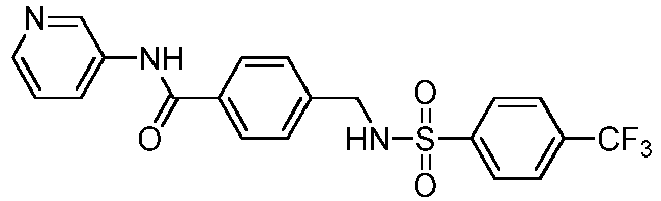
- Method C. Reaction of amine salt 6 (397 mg, 1.0 mmol) and 4-triflouromethylbenzenesulfonyl chloride (275 mg, 1.1 mmol) followed by column chromatography, eluting with EtOAc, gave benzamide 58 (272 mg, 61 %) as a white powder: mp (EtOAc) 243-246 °C; 1H NMR δ 10.35 (s, 1 H, NHCO), 8.92 (d, J = 2.5 Hz, 1 H, H-2'), 8.54 (br s, 1 H, NHSO2), 8.31 (dd, J = 4.7, 1.5 Hz, 1 H, H-6'), 8.18 (ddd, J = 8.3, 2.5, 1.5 Hz, 1 H, H-4'), 7.99 (br d, J = 8.3 Hz, 2 H, H-3", H-5"), 7.94 (br d, J = 8.3 Hz, 2 H, H-2", H-6"), 7.88 (br d, J = 8.4 Hz, 2 H, H-2, H-6), 7.37-7.41 (m, 3 H, H-3, H-5, H-5'), 4.16 (s, 2 H, CH2N); 13C NMR δ 165.3, 144.5, 144.4, 141.9, 141.3, 135.7, 133.0, 132.0 (q, J = 32 Hz), 127.6 (2), 127.4 (2), 127.3 (2), 127.2, 126.2 (2, q, J = 4 Hz), 123.4 (q, J = 272 Hz), 123.3, 45.6; MS m/z 436.5 (MH+, 100%). Anal. Calcd for C20H16F3N3O3S: C, 55.17; H, 3.70; N, 9.65. Found: C, 55.39; H, 3.80; N, 9.58%.
-

- Method C. Reaction of amine salt 6 (424 mg, 1.1 mmol) and 4-cyanobenzenesulfonyl chloride (242 mg, 1.2 mmol) followed by column chromatography, eluting with a gradient (0-5%) of MeOH/EtOAc, gave benzamide 59 (201 mg, 47%) as a white powder: mp (MeOH/EtOAc) 249-251 °C; 1H NMR δ 10.36 (s, 1 H, NHCO), 8.93 (d, J = 2.2 Hz, 1 H, H-2'), 8.56 (br s, 1 H, NHSO2), 8.31 (dd, J = 4.7, 1.5 Hz, 1 H, H-6'), 8.18 (ddd, J = 8.3, 2.3, 1.5 Hz, 1 H, H-4'), 8.06 (ddd, J = 8.3, 2.3, 1.5 Hz, 2 H, H-3", H-5"), 7.95 (dd, J = 8.3, 1.9 Hz, 2 H, H-2", H-6"), 7.89 (br d, J = 8.3 Hz, 2 H, H-2, H-6), 7.37-7.42 (m, 3 H, H-3, H-5, H-5'), 4.15 (s, 2 H, CH2N); 13C NMR δ 165.3, 144.7, 144.3, 141.9, 141.2, 135.6, 133.2 (2), 133.0, 127.6 (2), 127.4 (2), 127.2, 127.1 (2), 123.4, 117.6, 114.7, 45.6; MS m/z 393.4 (MH+, 100%). Anal. Calcd for C20H16N4O3S: C, 61.21; H, 4.11; N, 14.28. Found: C, 61.16; H, 4.09; N, 14.17%.
-

- Method C. Reaction of amine salt 6 (984 mg, 2.5 mmol) and 4-nitrobenzenesulfonyl chloride (620 mg, 2.8 mmol) followed by column chromatography, eluting with a gradient (0-10%) of MeOH/EtOAc, gave benzamide 60 (687 mg, 66%) as a white powder: mp (MeOH/EtOAc) 241-243 °C; 1H NMR δ 10.34 (s, 1 H, NHCO), 8.90 (d, J = 2.5 Hz, 1 H, H-2'), 8.64 (br s, 1 H, NHSO2), 8.37 (ddd, J = 8.5, 1.9, 1.8 Hz, 2 H, H-3", H-5"), 8.31 (dd, J = 4.7, 1.5 Hz, 1 H, H-6'), 8.17 (ddd, J = 8.3, 2.5, 1.5 Hz, 1 H, H-4'), 8.10 (ddd, J = 8.5, 1.9, 1.8 Hz, 2 H, H-2", H-6"), 7.88 (br d, J = 8.3 Hz, 2 H, H-2, H-6), 7.35-7.41 (m, 3 H, H-3, H-5, H-5'), 4.13 (s, 2 H, CH2N); 13C NMR δ 165.3, 149.4, 146.2, 144.4, 141.9, 141.1, 135.6, 133.0, 127.9 (2), 127.6 (2), 127.4 (2), 127.2, 124.4 (2), 123.3, 45.6; MS m/z 413.5 (MH+, 100%). Anal. Calcd for C19H16N4O5S: C, 55.33; H, 3.91; N, 13.58. Found: C, 55.58; H, 3.99; N, 13.57%.
-

- Method C. Reaction of amine salt 6 (200 mg, 0.51 mmol) and 4'-methoxy-(1,1'-biphenyl)-4-sulfonyl chloride (189 mg, 0.67 mmol) gave benzamide 61 (157 mg, 65%) as a cream powder: mp 244-247 °C; 1H NMR δ 10.34 (s, 1 H, NHCO), 8.91 (d, J = 2.2 Hz, 1 H, H-2'), 8.31 (dd, J = 4.7, 1.5 Hz, 1 H, H-6'), 8.26 (br s, 1 H, NHSO2), 8.17 (ddd, J = 8.4, 2.5, 1.5 Hz, 1 H, H-4'), 7.89 (br d, J = 8.3 Hz, 2 H, H-2, H-6), 7.78-7.84 (m, 4 H, H-2", H-3", H-5", H-6"), 7.68 (br d, J = 8.9 Hz, 2 H, H-2"', H-6"'), 7.37-7.43 (m, 3 H, H-3, H-5, H-5'), 7.03 (br d, J = 8.8 Hz, 2 H, H-3"', H-5"'), 4.12 (br s, 2 H, CH2N), 3.80 (s, 3 H, OCH3); 13C NMR δ 165.4, 159.5, 144.4, 143.4, 141.9, 141.7, 138.5, 135.6, 132.9, 130.7, 128.1 (2), 127.5 (2), 127.4 (2), 127.2, 127.0 (2), 126.5 (2), 123.3, 114.4 (2), 55.1, 45.7; MS m/z 475.0 (MH+, 100%). Anal. calcd for C26H23N3O4S: C, 65.94; H, 4.90; N, 8.87. Found: C, 65.63; H, 5.04; N, 8.79%.
-

- Method C. Reaction of amine salt 6 (200 mg, 0.51 mmol) and 4'-methyl(1,1'-biphenyl)-4-sulfonyl chloride (178 mg, 0.67 mmol) gave benzamide 62 (231 mg, 98%) as a yellow powder: mp 263-266 °C; 1H NMR δ 10.33 (s, 1 H, NHCO), 8.91 (d, J = 2.4 Hz, 1 H, H-2'), 8.31 (dd, J = 4.7, 1.4 Hz, 1 H, H-6'), 8.28 (t, J = 6.4 Hz, 1 H, NHSO2), 8.17 (ddd, J = 8.4, 2.4, 1.5 Hz, 1 H, H-4'), 7.89 (br d, J = 8.3 Hz, 2 H, H-2, H-6), 7.81-7.90 (m, 4 H, H-2", H-3", H-5", H-6"), 7.62 (br d, J = 8.1 Hz, 2 H, H-2"', H-6"'), 7.37-7.43 (m, 3 H, H-3, H-5, H-5'), 7.29 (br d, J = 8.0 Hz, 2 H, H-3"', H-5"'), 4.13 (d, J = 6.2 Hz, 2 H, CH2N), 2.35 (s, 3 H, CH3); 13C NMR δ 165.4, 144.4, 143.7, 141.9, 141.6, 139.0, 137.8, 135.6, 135.5, 132.9, 129.5 (2), 127.5 (2), 127.4 (2), 127.2, 127.0 (2), 126.9 (2), 126.7 (2), 123.3, 45.7, 20.5; MS m/z 459.0 (MH+, 100%); HRMS (FAB+) calcd for C26H24N3O3S (MH+) m/z 458.1538, found 458.1540. Anal. calcd for C26H23N3O3S·¼H2O: C, 66.94; H, 5.19; N, 9.01. Found: C, 67.04; H, 5.29; N, 8.82%.
-

- Method C. Reaction of amine salt 6 (305 mg, 0.78 mmol) and 4-biphenylsulfonyl chloride (238 mg, 0.94 mmol) followed by column chromatography, eluting with a gradient (0-10%) of MeOH/EtOAc, gave benzamide 63 (263 mg, 76%) as a white powder: mp (MeOH/EtOAc) 248-250 °C; 1H NMR δ 10.36 (s, 1 H, NHCO), 8.92 (d, J = 1.7 Hz, 1 H, H-2'), 8.29-8.34 (m, 2 H, NHSO2, H-6'), 8.17 (ddd, J = 8.3, 2.3, 1.4 Hz, 1 H, H-4'), 7.90 (br d, J = 8.4 Hz, 2 H, H-2, H-6), 7.83-7.87 (m, 4 H, H-2", H-3", H-5", H-6"), 7.71 (br d, J = 8.5 Hz, 2 H, H-2"', H-6"'), 7.46-7.51 (m, 2 H, H-3"', H-5"'), 7.36-7.44 (m, 4 H, H-3, H-5, H-5', H-4'"), 4.13 (d, J = 5.6 Hz, 2 H, CH2N); 13C NMR δ 165.4, 144.4, 143.8, 141.9, 141.6, 139.3, 138.5, 135.7, 132.9, 128.9 (2), 128.3, 127.6 (2), 127.4 (2), 127.2 (2), 127.1, 127.0 (2), 126.9 (2), 123.3, 45.7; MS m/z 444.6 (MH+, 100%). Anal. Calcd for C25H21N3O3S·¼EtOAc: C, 67.08; H, 4.98; N, 9.03. Found: C, 67.11; H, 4.73; N, 9.32%.
-

- Method C. Reaction of amine salt 6 (200 mg, 0.51 mmol) and 4'-fluoro(1,1'-biphenyl)-4-sulfonyl chloride (181 mg, 0.668 mmol) gave benzamide 64 (159 mg, 67%) as a cream powder: mp (MeOH/DCM) 249-250 °C; 1H NMR δ 10.34 (s, 1 H, NHCO), 8.91 (d, J = 2.5 Hz, 1 H, H-2'), 8.31 (dd, J = 4.7, 1.5 Hz, 2 H, H-6', NHSO2), 8.17 (ddd, J = 8.3, 2.5, 1.5 Hz, 1 H, H-4'), 7.89 (br d, J = 8.3 Hz, 2 H, H-2, H-6), 7.82-7.87 (m, 4 H, H-2", H-3", H-5", H-6"), 7.77 (dd, J = 8.9, 5.4 Hz, 2 H, H-2"', H-6"'), 7.37-7.43 (m, 3 H, H-3, H-5, H-5'), 7.31 (t, J = 8.9 Hz, 2 H, H-3"', H-5"'), 4.13 (s, 2 H, CH2N); 13C NMR δ 165.4, 162.3 (d, J = 246 Hz), 144.4, 142.7, 141.9, 141.6, 139.3, 135.6, 134.9 (d, J = 3 Hz), 132.9, 129.0 (2) (d, J = 8 Hz), 127.6 (2), 127.4 (2), 127.2 (2), 127.1, 127.0 (2), 123.3, 115.8 (2) (d, J = 22 Hz), 45.7; MS m/z 463.0 (MH+, 100%). Anal. calcd for C25H20FN3O3S: C, 65.06; H, 4.37; N, 9.10. Found: C, 64.66; H, 4.31; N, 9.01%.
-

- Method C. Reaction of amine salt 6 (200 mg, 0.51 mmol) and 4-(4'-chlorophenyl)benzenesulfonyl chloride (177 mg, 0.62 mmol) gave benzamide 65 (208 mg, 85%) as a white powder: mp (H2O) 276-278 °C; 1H NMR δ 10.33 (s, 1 H, NHCO), 8.91 (d, J = 2.4 Hz, 1 H, H-2'), 8.30-8.33 (m, 2 H, H-6', NHSO2), 8.16 (ddd, J = 8.4, 2.5, 1.5 Hz, 1 H, H-4'), 7.89 (br d, J = 8.3 Hz, 2 H, H-2, H-6), 7.84-7.86 (m, 4 H, H-2", H-3", H-5", H-6"), 7.75 (br d, J = 8.6 Hz, 2 H, H-2"', H-6"'), 7.53 (br d, J = 8.6 Hz, 2 H, H-3"', H-5"'), 7.37-7.42 (m, 3 H, H-3, H-5, H-5'), 4.13 (d, J = 6.2 Hz, 2 H, CH2N); 13C NMR δ 165.4, 144.4, 142.4, 141.9, 141.6, 139.7, 137.2, 135.6, 133.3, 132.9, 128.9 (2), 128.7 (2), 127.6 (2), 127.4 (2), 127.3 (2), 127.2, 127.1 (2), 123.3, 45.7; MS m/z 479.0 (MH+, 100%). Anal. calcd for C25H20ClN3O3S: C, 62.82; H, 4.22; N, 8.79. Found: C, 62.61; H, 4.36; N, 8.59%.
-

- Method C. Reaction of amine salt 6 (180 mg, 0.46 mmol) and 4-pyrimidin-2-ylbenzenesulfonyl chloride (130 mg, 0.51 mmol) gave benzamide 66 (152 mg, 74%) as a yellow powder: mp (H2O) 278-280 °C; 1H NMR δ 10.33 (s, 1 H, NHCO), 8.96 (d, J = 4.9 Hz, 2 H, H-4"', H-6"'), 8.90 (d, J = 2.2 Hz, 1 H, H-2'), 8.56 (d, J = 8.6 Hz, 2 H, H-3", H-5"), 8.37 (br s, 1 H, NHSO2), 8.31 (dd, J = 4.7, 1.4 Hz, 1 H, H-6'), 8.16 (ddd, J = 8.3, 2.5, 1.5 Hz, 1 H, H-4'), 7.97 (d, J = 8.6 Hz, 2 H, H-2", H-6"), 7.90 (br d, J = 8.3 Hz, 2 H, H-2, H-6), 7.52 (t, J = 4.9 Hz, 1 H, H-5"'), 7.42 (br d, J = 8.3 Hz, 2 H, H-3, H-5), 7.38 (dd, J = 8.3, 4.7, 1 H, H-5'), 4.15 (s, 2 H, CH2N); 13C NMR δ 165.3, 161.9, 157.8 (2), 144.4, 142.4, 141.9, 141.6, 140.5, 135.6, 132.9, 128.2 (2), 127.6 (2), 127.3 (2), 127.2, 126.9 (2), 123.3, 120.5, 45.7; MS m/z 446.9 (MH+, 100%). Anal. calcd for C23H19N5O3S: C, 62.01; H, 4.30; N, 15.72. Found: C, 61.95; H, 4.46; N, 15.5%.
-
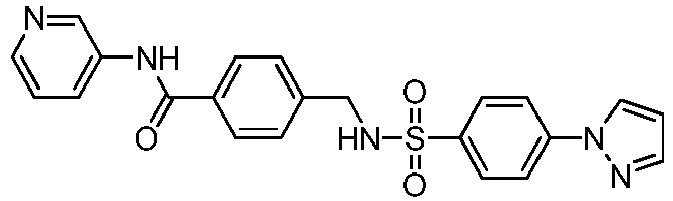
- Method C. Reaction of amine salt 6 (170 mg, 0.44 mmol) and 4-(1H-pyrazol-1-yl)benzenesulfonyl chloride (159 mg, 0.66 mmol) gave benzamide 67 (167 mg, 88%) as a pale yellow powder: mp (H2O) 243-245 °C; 1H NMR δ 10.34 (s, 1 H, NHCO), 8.91 (d, J = 2.0 Hz, 1 H, H-2'), 8.61 (d, J = 2.3 Hz, 1 H, H-5"'), 8.31 (dd, J = 4.7, 1.4 Hz, 1 H, H-6'), 8.28 (br s, 1 H, NHSO2), 8.17 (ddd, J = 8.4, 2.5, 1.5 Hz, 1 H, H-4'), 8.05 (br d, J = 8.9 Hz, 2 H, H-3", H-5"), 7.89-7.93 (m, 4 H, H-2, H-6, H-2", H-6"), 7.82 (d, J = 1.7 Hz, 1 H, H-3"'), 7.42 (br d, J = 8.4 Hz, 2 H, H-3, H-5), 7.39 (ddd, J = 8.4, 4.7, 0.6, 1 H, H-5'), 6.60 (dd, J = 2.5, 1.8 Hz, 1 H, H-4"'), 4.12 (s, 2 H, CH2N); 13C NMR δ 165.4, 144.4, 142.1, 142.0, 141.9, 141.6, 137.6, 135.6, 133.0, 128.2, 128.1 (2), 127.6 (2), 127.4 (2), 127.2 (2), 123.3, 118.3, 108.6, 45.7; MS m/z 434.9 (MH+, 100%). Anal. calcd for C22H19N5O3S: C, 60.96; H, 4.42; N, 16.16. Found: C, 60.63; H, 4.57; N 15.84%.
-

- Method C. Reaction of amine salt 6 (154 mg, 0.40 mmol) and 4-(2-methyl-1,3-thiazol-4-yl)benzenesulfonyl chloride (130 mg, 0.48 mmol) followed purification by column chromatography, eluting with a gradient (0-10%) of MeOH/DCM gave benzamide 68 (114 mg, 62%) as a yellow powder: mp (MeOH/DCM) 221-223 °C; 1H NMR δ 10.34 (s, 1 H, NHCO), 8.91 (d, J = 2.2 Hz, 1 H, H-2'), 8.31 (dd, J = 4.7, 1.4 Hz, 1 H, H-6'), 8.27 (br s, 1 H, NHSO2), 8.17 (ddd, J = 8.4, 2.5, 1.5 Hz, 1 H, H-4'), 8.09-8.14 (m, 3 H, H-3", H-5", H-5"'), 7.90 (d, J = 8.3 Hz, 2 H, H-2, H-6), 7.86 (d, J = 8.6 Hz, 2 H, H-2", H-6"), 7.37-7.43 (m, 3 H, H-3, H-5, H-5'), 4.12 (s, 2 H, CH2N), 2.72 (s, 3 H, CH3); 13C NMR δ 166.0, 165.3, 152.1, 144.4, 141.9, 141.7, 139.4, 137.5, 135.6, 132.9, 127.6 (2), 127.3 (2), 127.2, 127.0 (2), 126.3 (2), 123.3, 116.4, 45.6, 18.8; MS m/z 465.9 (MH+, 100%). Anal. calcd for C23H20N4O3S2: C, 59.46; H, 4.34; N, 12.06. Found: C, 59.69; H, 4.45; N, 12.03%.
-

- Method C. Reaction of amine salt 6 (160 mg, 0.41 mmol) and 4-(1,3-oazol-5-yl)benzenesulfonyl chloride (150 mg, 0.62 mmol) gave benzamide 69 (123 mg, 69%) as a dark yellow powder: mp (H2O) 240-242 °C; 1H NMR δ 10.33 (s, 1 H, NHCO), 8.91 (br s, 1 H, H-2'), 8.53 (s, 1 H, H-2"') 8.31-8.34 (m, 2 H, H-6', NHSO2), 8.17 (m, 1 H, H-4'), 7.87-7.94 (m, 7 H, H-2, H-6, H-2", H-3", H-5", H-6", H-4"'), 7.37-7.42 (m, 3 H, H-3, H-5, H-5'), 4.12 (d, J = 6.3 Hz, 2 H, CH2N); 13C NMR δ 165.4, 152.6, 149.1, 144.3, 141.7, 141.6, 140.0, 135.7, 132.9, 130.7, 127.6 (2), 127.4 (2), 127.3 (2), 124.5 (2), 124.1, 123.4, 45.6, one C not observed; MS m/z 435.9 (MH+, 100%); HRMS (FAB+) calcd for C22H19N4O4S (MH+) m/z 435.1127, found 435.1124. Anal. calcd for C22H18N4O4S·½H2O: C, 59.58; H, 4.32; N, 12.63. Found: C, 59.55; H, 4.27; N, 12.45%.
-

- Method C. Reaction of amine salt 6 (407 mg, 1.1 mmol) and 3,4-dimethoxybenzenesulfonyl chloride (272 mg, 1.2 mmol) followed by column chromatography, eluting with EtOAc, gave benzamide 70 (295 mg, 66%) as a white powder: mp (EtOAc) 164-166 °C; 1H NMR δ 10.36 (s, 1 H, NHCO), 8.93 (d, J = 2.2 Hz, 1 H, H-2'), 8.31 (dd, J = 4.7, 1.5 Hz, 1 H, H-6'), 8.18 (ddd, J = 8.3, 2.5, 1.5 Hz, 1 H, H-4'), 8.06 (br s, 1 H, NHSO2), 7.91 (br d, J = 8.3 Hz, 2 H, H-2, H-6), 7.41 (br d, 2 H, H-3, H-5), 7.35-7.40 (m, 2 H, H-5', H-6"), 7.30 (d, J = 2.1 Hz, 1 H, H-2"), 7.10 (d, J = 8.5 Hz, 1 H, H-5"), 4.04 (s, 2 H, CH2N), 3.83 (s, 3 H, OCH3), 3.81 (s, 3 H, OCH3); 13C NMR δ 165.4, 151.8, 148.6, 144.4, 141.9, 141.8, 135.7, 132.9, 132.0, 127.5 (2), 127.3 (2), 127.2, 123.4, 120.1, 111.1, 109.4, 55.7, 55.6, 45.7; MS m/z 428.5 (MH+, 100%). Anal. Calcd for C21H21N3O5S: C, 59.00; H, 4.95; N, 9.83. Found: C, 59.27; H, 5.01; N, 9.93%.
-

- Method C. Reaction of amine salt 6 (391 mg, 1.0 mmol) and 3-tert-butyl-4-methoxybenzene sulfonyl chloride (290 mg, 1.1 mmol) followed by column chromatography, eluting with a gradient (70-100%) of EtOAc/pet. ether, gave benzamide 71 (221 mg, 49%) as a white powder: mp (EtOAc) 189-192 °C; 1H NMR δ 10.33 (s, 1 H, NHCO), 8.91 (d, J = 2.3 Hz, 1 H, H-2'), 8.31 (dd, J = 4.7, 1.5 Hz, 1 H, H-6'), 8.17 (ddd, J = 8.3, 2.5, 1.5 Hz, 1 H, H-4'), 8.08 (br s, 1 H, NHSO2), 7.88 (br d, J = 8.3 Hz, 2 H, H-2, H-6), 7.64 (dd, J = 8.5, 2.3 Hz, 1 H, H-6"), 7.60 (d, J = 2.3 Hz, 1 H, H-2"), 7.36-7.42 (m, 3 H, H-3, H-5, H-5'), 7.11 (d, J = 8.6 Hz, 1 H, H-5"), 4.07 (br s, 2 H, CH2N), 3.88 (s, 3 H, OCH3), 1.33 [s, 9 H, C(CH3)3]; 13C NMR δ 165.3, 160.9, 144.4, 141.9, 141.8, 137.8, 135.6, 132.7, 131.7, 127.5 (2), 127.3 (2), 127.2, 126.5, 124.6, 123.3, 111.7, 55.5, 45.6, 34.5, 29.0 (3); MS m/z 454.8 (MH+, 100%). Anal. Calcd for C24H27N3O4S: C, 63.56; H, 6.00; N, 9.26. Found: C, 63.53; H, 5.98; N, 9.34%.
-

- Method C. Reaction of amine salt 6 (329 mg, 0.85 mmol) and 2,3,4,5,6-pentamethylbenzene sulfonyl chloride (230 mg, 0.93 mmol) followed by column chromatography, eluting with EtOAc, gave benzamide 72 (191 mg, 51%) as a white powder: mp (EtOAc) 229-231 -C; 1H NMR δ 10.32 (s, 1 H, NHCO), 8.92 (d, J = 2.3 Hz, 1 H, H-2'), 8.31 (dd, J = 4.7, 1.5 Hz, 1 H, H-6'), 8.17 (ddd, J = 8.3, 2.4, 1.5 Hz, 1 H, H-4'), 8.00 (br s, 1 H, NHSO2), 7.85 (br d, J = 8.3 Hz, 2 H, H-2, H-6), 7.39 (ddd, J = 8.3, 4.7, 0.3 Hz, 1 H, H-5'), 7.31 (br d, J = 8.3 Hz, 2 H, H-3, H-5), 4.06 (s, 2 H, CH2N), 2.48 (s, 6 H, 2 × CH3), 2.20 (s, 3 H, CH3), 2.15 (s, 6 H, 2 × CH3); 13 CNMR8 165.3, 144.4, 141.9, 141.8, 138.5, 136.9, 135.7, 134.0, 133.2 (2), 132.6, 127.3 (2), 127.2 (2), 127.1 (2), 123.4, 45.6, 18.6 (2), 17.2, 16.5 (2); MS m/z 438.7 (MH+, 100%). Anal. Calcd for C24H27N3O3S: C, 65.88; H, 6.22; N, 9.60. Found: C, 65.92; H, 6.12; N, 9.70%.
-

- Method C. Reaction of amine salt 6 (333 mg, 0.86 mmol) and 2,4-dimethylbenzene sulfonyl chloride (193 mg, 0.94 mmol) followed by column chromatography, eluting with EtOAc, gave benzamide 73 (156 mg, 46%) as a white powder: mp (EtOAc) 180-182 °C; 1H NMR δ 10.35 (s, 1 H, NHCO), 8.92 (d, J = 2.2 Hz, 1 H, H-2'), 8.31 (dd, J = 4.7, 1.5 Hz, 1 H, H-6'), 8.16-8.21 (m, 2 H, H-4', NHSO2), 7.89 (br d, J = 8.3 Hz, 2 H, H-2, H-6), 7.70 (d, J = 8.0 Hz, 1 H, H-6"), 7.35-7.41 (m, 3 H, H-3, H-5, H-5'), 7.19 (br s, 1 H, H-3"), 7.15 (br d, J = 8.0 Hz, 1 H, H-5"), 4.07 (s, 2 H, CH2N), 2.54 (s, 3 H, CH3), 2.32 (s, 3 H, CH3); 13C NMR δ 165.4, 144.4, 142.4, 142.0, 141.9, 136.2, 135.8, 135.6, 132.9, 132.8, 128.5, 127.5 (2), 127.2 (2), 127.1, 126.4, 123.4, 45.3, 20.5, 19.6; MS m/z 396.5 (MH+, 100%). Anal. Calcd for C21H21N3O3S: C, 63.78; H, 5.35; N, 10.63. Found: C, 64.07; H, 5.38; N, 10.73%.
-

- Method C. Reaction of amine salt 6 (284 mg, 0.73 mmol) and 3,4-dimethylbenzene sulfonyl chloride (164 mg, 0.83 mmol) followed by column chromatography, eluting with EtOAc, gave benzamide 74 (130 mg, 45%) as a white powder: mp (EtOAc) 181-183 °C; 1H NMR δ 10.37 (s, 1 H, NHCO), 8.92 (d, J = 2.2 Hz, 1 H, H-2'), 8.31 (dd, J = 4.7, 1.5 Hz, 1 H, H-6'), 8.18 (ddd, J = 8.3, 2.5, 1.5 Hz, 1 H, H-4'), 8.10 (br s, 1 H, NHSO2), 7.90 (br d, J = 8.4 Hz, 2 H, H-2, H-6), 7.50-7.56 (m, 2 H, H-2", H-6"), 7.37-7.43 (m, 3 H, H-3, H-5, H-5'), 7.34 (d, J = 7.7 Hz, 1 H, H-5"), 4.07 (br d, J = 4.8 Hz, 2 H, CH2N), 2.29 (s, 3 H, CH3), 2.28 (s, 3 H, CH3); 13C NMR δ 165.4, 144.4, 141.9, 141.8, 141.3, 137.8, 137.3, 135.7, 132.9, 129.9, 127.5 (2), 127.3 (2), 127.2, 127.1, 124.0, 123.4, 45.6, 19.3, 19.2; MS m/z 396.6 (MH+, 100%). Anal. Calcd for C21 H21 N3O3S: C, 63.78; H, 5.35; N, 10.63. Found: C, 64.01; H, 5.36; N, 10.65%.
-

- Method C. Reaction of amine salt 6 (404 mg, 1.0 mmol) and 3,5-dimethylbenzenesulfonyl chloride (234 mg, 1.1 mmol) followed by column chromatography, eluting with EtOAc, to give benzamide 75 (277 mg, 67%) as a white powder: mp (EtOAc/pet. ether) 181-183 -C; 1H NMR δ 10.37 (s, 1 H, NHCO), 8.93 (d, J = 2.5 Hz, 1 H, H-2'), 8.31 (dd, J = 4.7, 1.5 Hz, 1 H, H-6'), 8.18 (ddd, J = 8.3, 2.5, 1.5 Hz, 1 H, H-4'), 8.13 (br s, 1 H, NHSO2), 7.91 (br d, J = 8.3 Hz, 2 H, H-2, H-6), 7.37-7.43 (m, 5 H, H-3, H-5, H-5', H-2", H-6"), 7.26 (br s, 1 H, H-4"), 4.08 (s, 2 H, CH2N), 2.34 (s, 6 H, 2 x CH3); 13C NMR δ 165.4, 144.4, 141.9, 141.8, 140.4, 138.5 (2), 135.7, 132.9, 127.5 (2), 127.3 (2), 127.2, 123.8 (2), 123.4, 45.6, 20.6 (2); MS m/z 396.4 (MH+, 100%). Anal. Calcd for C21H21N3O5S: C, 63.78; H, 5.35; N, 10.63. Found: C, 63.77; H, 5.41; N, 10.77%.
-

- Method C. Reaction of amine salt 6 (392 mg, 1.0 mmol) and 3-fluoro-4-methylbenzene sulfonyl chloride (231 mg, 1.1 mmol) followed by column chromatography, eluting with EtOAc, gave benzamide 76 (192 mg, 48%) as a white powder: mp (EtOAc) 202-204 °C; 1H NMR δ 10.36 (s, 1 H, NHCO), 8.93 (d, J = 2.3 Hz, 1 H, H-2'), 8.31 (dd, J = 4.7, 1.5 Hz, 1 H, H-6'), 8.18 (ddd, J = 8.3, 2.5, 1.5 Hz, 1 H, H-4'), 8.28 (br s, 1 H, NHSO2), 7.91 (br d, J = 8.3 Hz, 2 H, H-2, H-6), 7.48-7.57 (m, 3 H, H-2", H-5", H-6"), 7.36-7.42 (m, 3 H, H-3, H-5, H-5'), 4.11 (s, 2 H, CH2N), 2.30 (d, J = 1.9 Hz, 3 H, CH3); 13C NMR δ 165.4, 159 (d, J = 247 Hz), 144.4, 141.9, 141.5, 139.9 (d, J = 7 Hz), 135.6, 132.9, 132.3 (d, J = 5 Hz), 129.4 (d, J = 17 Hz), 127.6 (2), 127.4 (2), 127.2, 123.3, 122.3 (d, J = 3 Hz), 113.0 (d, J = 25 Hz), 45.6, 14.0 (d, J = 4 Hz); MS m/z 400.5 (MH+, 100%). Anal. Calcd for C20H18FN3O3S: C, 60.14; H, 4.54; N, 10.59. Found: C, 60.19; H, 4.53; N, 10.59%.
-

- Method C. Reaction of amine salt 6 (400 mg, 1.0 mmol) and 3-chloro-2-methylbenzenesulfonyl chloride (255 mg, 1.1 mmol) followed by column chromatography, eluting with EtOAc, gave the benzamide 77 (274 mg, 64%) as a white powder: mp (EtOAc) 218-221 °C; 1H NMR δ 10.35 (s, 1 H, NHCO), 8.93 (d, J = 2.3 Hz, 1 H, H-2'), 8.55 (br s, 1 H, NHSO2), 8.31 (dd, J = 4.7, 1.4 Hz, 1 H, H-6'), 8.19 (d, J = 8.3 Hz, 1 H, H-4'), 7.89 (d, J = 8.3 Hz, 2 H, H-2, H-6), 7.84 (dd, J = 7.9, 1.0 Hz, 1 H, H-4"),* 7.70 (dd, J = 8.0, 0.8 Hz, 1 H, H-6"),* 7.35-7.41 (m, 4 H, H-3, H-5, H-5', H-5"), 4.16 (s, 2 H, CH2N), 2.61 (s, 3 H, CH3); 13C NMR δ 165.3, 144.4, 141.9, 141.7, 141.1, 135.7 (2), 133.9, 133.0, 132.9, 127.5 (2), 127.3 (2), 127.3 (2), 127.2, 123.4, 45.4, 16.4. Anal. Calcd for C20H18ClN3O3S: C, 57.76; H, 4.36; N, 10.10. Found: C, 57.79; H, 4.23; N, 10.04%. * assignments interchangeable
-

- Method C. Reaction of amine salt 6 (400 mg, 1.0 mmol) and 3-chloro-4-methylbenzenesulfonyl chloride (255 mg, 1.1 mmol) followed by column chromatography, eluting with EtOAc, gave the sulfonamide 78 (267 mg, 63%) as a white powder: mp (EtOAc) 203-205 °C; 1H NMR δ 10.36 (s, 1 H, NHCO), 8.93 (d, J = 2.3 Hz, 1 H, H-2'), 8.30-8.33 (m, 2 H, H-6', NHSO2), 8.18 (d, J = 8.3 Hz, 1 H, H-4'), 7.90 (d, J = 8.3 Hz, 2 H, H-2, H-6), 7.73 (d, J = 1.8 Hz, 1 H, H-2"), 7.66 (dd, J = 8.0, 1.8 Hz, 1 H, H-6"), 7.55 (d, J = 8.0 Hz, 1 H, H-5"), 7.37-7.41 (m, 3 H, H-3, H-5, H-5'), 4.11 (d, J = 4.8 Hz, 2 H, CH2N), 2.39 (s, 3 H, CH3); 13C NMR δ 165.3, 144.4, 141.9, 141.4, 140.4, 139.8, 135.7, 133.7, 132.9, 131.8, 127.6 (2), 127.4 (2), 127.2, 126.5, 125.0, 123.4, 45.7, 19.5. Anal. Calcd for C20H18ClN3O3S: C, 57.76; H, 4.36; N, 10.10. Found: C, 57.97; H, 4.48; N, 10.13%.
-

- Method C. Reaction of amine salt 6 (379 mg, 0.97 mmol) and 3,4-dichlorobenzene sulfonyl chloride (263 mg, 1.1 mmol) followed by column chromatography, eluting with EtOAc, gave benzamide 79 (144 mg, 34%) as a white powder: mp (EtOAc) 219-221 °C; 1H NMR δ 10.34 (s, 1H, NHCO), 8.92 (d, J = 2.4 Hz, 1 H, H-2'), 8.48 (br s, 1 H, NHSO2), 8.30 (dd, J = 4.7, 1.5 Hz, 1 H, H-6'), 8.18 (ddd, J = 8.3, 2.5, 1.5 Hz, 1 H, H-4'), 7.88-7.93 (m, 3 H, H-2, H-6, H-2"), 7.85 (d, J = 8.4 Hz, 1H, H-5"), 7.75 (dd, J = 8.4, 2.2 Hz, 1 H, H-6"), 7.37-7.42 (m, 3 H, H-3, H-5, H-5'), 4.16 (s, 2 H, CH2N); 13C NMR δ 165.2, 144.4, 141.9, 141.2, 141.0, 135.6, 135.3, 133.7, 131.9, 131.4, 128.2, 127.6 (2), 127.4 (2), 127.2, 126.5, 123.3, 45.6; MS m/z 436.6 (MH+, 100%), 438.6 (MH+, 70%). Anal. Calcd for C19H15N3O3S: C, 52.30; H, 3.47; N, 9.63. Found: C, 52.50; H, 3.46; N, 9.67%.
-

- Method C. Reaction of amine salt 6 (422 mg, 1.1 mmol) and 3-cyano-4-fluorobenzene sulfonyl chloride (262 mg, 1.2 mmol) followed by column chromatography, eluting with EtOAc, gave benzamide 80 (149 mg, 34%) as a white powder: mp (EtOAc) 211-213 °C; 1H NMR δ 10.35 (s, 1 H, NHCO), 8.91 (d, J = 2.4 Hz, 1 H, H-2'), 8.49 (br s, 1 H, NHSO2), 8.31 (dd, J = 4.7, 1.4 Hz, 1 H, H-6'), 8.26 (dd, J = 6.0, 2.4 Hz, 1 H, H-2"), 8.18 (ddd, J = 8.3, 2.4, 1.5 Hz, 1 H, H-4'), 8.14 (ddd, J = 8.9, 5.0, 2.4 Hz, 1 H, H-6"), 7.91 (br d, J = 8.3 Hz, 2 H, H-2, H-6), 7.73 (t, J = 9.0 Hz, 1 H, H-5"), 7.37-7.42 (m, 3 H, H-3, H-5, H-5'), 4.18 (s, 2 H, CH2N); 13C NMR δ 165.3, 164.0 (d, J = 262 Hz), 144.4, 141.9, 141.1, 138.1 (d, J = 3 Hz), 135.6, 134.2, (d, J = 10 Hz), 133.0, 132.5, 127.6 (2), 127.5 (2), 127.2, 123.3, 117.7 (d, J = 21 Hz), 112.7, 101.2 (d, J = 16 Hz), 45.6; MS m/z 411.6 (MH+, 100%). Anal. Calcd for C20H15FN4O3S: C, 58.53; H, 3.68; N, 13.65. Found: C, 58.59; H, 3.74; N, 13.58%.
-

- Method C. Reaction of amine salt 6 (400 mg, 1.0 mmol) and 2-naphthalenesulfonyl chloride (256 mg, 1.1 mmol) followed by column chromatography, eluting with EtOAc gave benzamide 81 (280 mg, 65%) as a white powder: mp (EtOAc) 210-213 -C; 1H NMR δ 10.32 (s, 1 H, NHCO), 8.91 (d, J = 2.3 Hz, 1 H, H-2'), 8.45 (d, J = 1.5 Hz, 1 H, H-1"), 8.34 (br t, J = 6.1 Hz, 1 H, NHSO2), 8.31 (dd, J = 4.7, 1.5 Hz, 1 H, H-6'), 8.12-8.16 (m, 3 H, H-4', H-3", H-4"), 8.04 (d, J = 7.8 Hz, 1 H, H-5"*), 7.84-7.89 (m, 3 H, H-2, H-6, H-8"*), 7.65-7.70 (m, 2 H, H-6", H-7"), 7.36-7.43 (m, 3 H, H-3, H-5, H-5'), 4.13 (d, J = 6.0 Hz, 2 H, CH2N); 13C NMR δ 165.3, 144.4, 141.9, 141.7, 137.5, 135.6, 134.0, 132.9, 131.6, 129.3, 129.0, 128.5, 127.7, 127.5 (2), 127.4, 127.3 (2), 127.3, 127.2, 123.3, 122.1, 45.7. Anal. Calcd for C23H19N3O3S: C, 66.17; H, 4.59; N, 10.07. Found: C, 66.13; H, 4.77; N, 10.10%. * assignment interchangable
-

- Method C. Reaction of amine salt 6 (417 mg, 1.1 mmol) and 5-(dimethylamino)naphthalene sulfonyl chloride (318 mg, 1.2 mmol) followed by column chromatography, eluting with EtOAc, gave benzamide 82 (20 mg, 4%) as a white powder: mp (EtOAc) 208-211 °C; 1H NMR δ 10.28 (s, 1 H, NHCO), 8.90 (d, J = 2.3 Hz, 1 H, H-2'), 8.55 (m, 1 H, NHSO2), 8.42 (d, J = 8.5 Hz, 1 H, H-2"), 8.32 (d, J = 9.0 Hz, 1 H, H-8"), 8.30 (dd, J = 4.7, 1.5 Hz, 1 H, H-6'), 8.15 (ddd, J = 8.3, 2.5, 1.5 Hz, 1 H, H-4'), 8.10 (dd, J = 7.3, 1.2 Hz, 1 H, H-4"), 7.77 (br d, J = 8.3 Hz, 2 H, H-2, H-6), 7.55-7.62 (m, 2 H, H-3", H-7"), 7.38 (ddd, J = 8.3, 4.7, 0.5 Hz, 1 H, H-5'), 7.28 (br d, J = 8.3 Hz, 2 H, H-3, H-5), 7.26 (d, J = 7.3 Hz, 1 H, H-6"), 4.13 (s, 2 H, CH2N), 2.81 [s, 6 H, N(CH3)2]; 13C NMR δ 165.3, 151.3, 144.5, 141.9 (2), 141.8, 136.0, 135.6, 132.6, 129.4, 128.9, 128.3, 127.8, 127.3 (3), 127.2 (2), 123.4, 123.3, 119.0, 115.0, 45.5, 44.9 (2); MS m/z 461.8 (MH+, 100%). Anal. Calcd for C25H24N4O3S: C, 65.20; H, 5.25; N, 12.17. Found: C, 65.08; H, 5.31; N, 11.91%.
-

- Method C. Reaction of amine salt 6 (438 mg, 1.1 mmol) and 2,3-dihydro-1H-indene-5-sulfonyl chloride (268 mg, 1.2 mmol) followed by column chromatography, eluting with EtOAc, gave benzamide 83 (229 mg, 50%) as a white powder: mp (EtOAc) 179-181 °C; 1H NMR δ 10.35 (s, 1 H, NHCO), 8.92 (d, J = 2.3 Hz, 1 H, H-2'), 8.30 (dd, J = 4.7, 1.5 Hz, 1 H, H-6'), 8.18 (ddd, J = 8.3, 2.4, 1.5 Hz, 1 H, H-4'), 8.11 (br s, 1 H, NHSO2), 7.89 (br d, J = 8.3 Hz, 2 H, H-2, H-6), 7.57-7.61 (m, 2 H, H-2", H-6"), 7.36-7.42 (m, 4 H, H-3, H-5, H-5', H-7"), 4.07 (s, 2 H, CH2N), 2.88-2.93 (m, 4 H, H-1", H-3"), 2.04 (m, 2 H, H-2"); 13C NMR δ 165.4, 148.7, 144.8, 144.4, 141.9, 141.8, 138.5, 135.7, 132.8, 127.5 (2), 127.3 (2), 127.2, 124.6, 124.5, 123.3, 122.2, 45.7, 32.1, 31.9, 30.5; MS m/z 408.6 (MH+, 100%). Anal. Calcd for C22H21N3O3S: C, 64.85; H, 5.19; N, 10.31. Found: C, 64.78; H, 5.20; N, 10.29%.
-

- Method C. Reaction of amine salt 6 (142 mg, 0.36 mmol) and 2-(dimethylamino)-2,3-dihydro-1H-indene-5-sulfonyl chloride (100 mg, 0.38 mmol) followed by column chromatography, eluting with a gradient (0-15%) of MeOH/DCM, gave benzamide 84 (15 mg, 9%) as a white gum: 1H NMR δ 10.36 (s, 1 H, NHCO), 8.94 (d, J = 2.4 Hz, 1 H, H-2'), 8.31 (dd, J = 4.7, 1.5 Hz, 1 H, H-6'), 8.19 (ddd, J = 8.3, 2.5, 1.5 Hz, 1 H, H-4'), 8.15 (br t, J = 6.4 Hz, 1 H, NHSO2), 7.89 (br d, J = 8.3 Hz, 2 H, H-2, H-6), 7.59 (br d, J = 7.9 Hz, 1 H, H-7"), 7.55 (br s, 1 H, H-4"), 7.34-7.42 (m, 4 H, H-3, H-5, H-5', H-6"), 4.07 (d, J = 6.4 Hz, 2 H, CH2N), 3.03-3.12 (m, 2 H, CH2), 2.81-2.89 (m, 2 H, CH2), 2.21-2.32 [m, 7 H, H-2", N(CH3)2]; 13C NMR δ 165.3, 146.2, 144.4, 142.4, 141.9, 141.7, 138.9, 135.7, 132.8, 127.5 (2), 127.3 (2), 127.1, 124.9, 124.7, 123.3, 122.2, 66.8, 45.6, 42.7 (2), 36.1, 35.9.
-

- A mixture of fluoride 52 (696 mg, 1.8 mmol) and 4-methylpiperazine (3.0 mL) in DMSO (3 mL) was stirred in a sealed tube at 140 °C for 16 h. The solvent was evaporated and the residue was purified by column chromatography on neutral alumina, eluting with a gradient (0-5%) of MeOH/EtOAc, to give benzamide 85 (786 mg, 94%) as a white solid: mp (MeOH/EtOAc) 246-249 °C; 1H NMR δ 10.39 (s, 1 H, NHCO), 8.91 (d, J = 2.4 Hz, 1 H, H-2'), 8.31 (dd, J = 4.7, 1.4 Hz, 1 H, H-6'), 8.19 (ddd, J = 8.3, 2.4, 1.5 Hz, 1 H, H-4'), 7.95 (t, J = 6.3 Hz, 1 H, NHSO2), 6.90 (br d, J = 8.3 Hz, 2 H, H-2, H-6), 7.63 (d, J = 8.9 Hz, 2 H, H-2", H-6"), 7.36-7.42 (m, 3 H, H-3, H-5, H-5'), 7.08 (d, J = 8.9 Hz, 2 H, H-3", H-5"), 4.01 (d, J = 6.3 Hz, 2 H, CH2N), 3.47 (br s, 4 H, 2 x CH2N), 2.94 (br s, 4 H, 2 x CH2N), 2.57 (s, 3 H, NCH3); MS m/z 466.8 (MH+, 100%). The compound was recrystallized as the dihydrochloride salt. Anal. Calcd for C24H28ClN5O3S: C, 57.42; H, 5.62; N, 13.95. Found: C, 57.14; H, 5.62; N, 13.76%.
-

- Method C. Reaction of amine salt 6 (300mg, 0.77 mmol) and 4-(bromomethyl)benzenesulfonyl chloride (249 mg, 0.93 mmol) gave the intermediate bromide. Dimethylamine (40% solution in H2O, 2.0 mL, 39.5 mmol) was added and the mixture was warmed to 20 °C and stirred for a further 2 h. H2O (50 mL) was added and the solvent evaporated and the residue triturated with H2O (25 mL). The crude solid was purified by column chromatography, eluting with a gradient (0-10%) of MeOH/DCM followed by 1% cNH3/10% MeOH/DCM, to give benzamide 86 (138 mg, 42%) as a pale yellow powder: mp 186-188 °C; 1H NMR δ 10.36 (s, 1 H, NHCO), 8.93 (br s, 1 H, H-2'), 8.32-8.35 (m, 2 H, H-6', NHSO2), 8.18 (ddd, J = 8.4, 2.3, 1.5 Hz, 1 H, H-4'), 7.88 (br d, J = 8.3 Hz, 2 H, H-2, H-6), 7.83 (br d, J = 8.1 Hz, 2 H, H-2", H-6"), 7.60 (br d, J = 7.8 Hz, 2 H, H-3", H-5"), 7.38-7.41 (m, 3 H, H-3, H-5, H-5'), 4.13 (d, J = 6.3 Hz, 2 H, CH2N), CH2, N(CH3)2 not observed; 13C NMR δ 165.3, 144.4, 141.9, 141.6, 139.9, 135.7, 132.8, 129.8 (2), 127.5 (2), 127.3 (2), 127.2, 126.5 (2), 123.4, 61.3, 45.6, 43.9 (2), one C not observed; MS m/z 425.9 (MH+, 100%). Anal. calcd for C22H24N4O3S·½CH2Cl2: C, 57.87; H, 5.40; N, 12.00. Found: C, 57.74; H, 5.61; N, 12.17%.
-

- Method C. Reaction of amine salt 6 (300 mg, 0.77 mmol) and 4-(bromomethyl)benzenesulfonyl chloride (249 mg, 0.93 mmol) gave the intermediate bromide. Diethylamine (0.5 mL, 4.9 mmol) was added and the mixture was warmed to 20 °C and stirred for a further 5 h. The solvent was evaporated, H2O (10 mL) added to the residue, the resulting precipitate triturated with H2O (2 × 15 mL) and filtered. The crude solid was purified by column chromatography, eluting with a gradient (0-10%) of MeOH/DCM, to give benzamide 87 (66 mg, 19%) as a yellow powder: mp (MeOH/DCM) 159-162 °C; 1H NMR δ 10.35 (s, 1 H, NHCO), 8.92 (d, J = 2.4 Hz, 1 H, H-2'), 8.31 (dd, J = 4.7, 1.4 Hz, 1 H, H-6'), 8.20 (br s, 1 H, NHSO2), 8.18 (ddd, J = 8.4, 2.5, 1.5 Hz, 1 H, H-4'), 7.87 (br d, J = 8.3 Hz, 2 H, H-2, H-6), 7.73 (br s, 2 H, H-2", H-6"), 7.49 (br s, 2 H, H-3", H-5"), 7.37-7.41 (m, 3 H, H-3, H-5, H-5'), 4.11 (d, J = 5.9 Hz, 2 H, CH2N), 3.58 (s, 2 H, CH2N), 2.45 (br s, 4 H, 2 × CH2), 0.96 (br s, 6 H, 2 × CH3); 13C NMR δ 165.4, 144.4, 141.9, 141.7, 135.7, 132.8, 128.8 (2), 127.5 (2), 127.3 (2), 127.1, 126.4 (2), 123.4, 56.2, 55.9 (2), 45.6, 11.3 (2), two C not observed; MS m/z454.1 (MH+, 100%); HRMS (FAB+) calcd for C24H29N4O3S (MH+) m/z 453.1960, found 453.1962. Anal. calcd for C24H28N4O3S·2H2O: C, 59.00; H, 6.60, N, 11.47. Found: C, 58.67; H, 5.83; N, 11.26%.
-

- Method C. Reaction of amine salt 6 (150 mg, 0.39 mmol) and 4-(bomomethyl)benzenesulfonyl chloride (125 mg, 0.46 mmol) gave the intermediate bromide. Dipropylamine (0.21 mL, 1.5 mmol) was added and the mixture was warmed to 20 °C and stirred for a further 3 h. The solvent was evaporated and the residue was dissolved in DCM (50 mL), washed with H2O (110 mL) and dried. The crude solid was purified by column chromatography, eluting with a gradient (0-10%) of MeOH/DCM and recrystallized from DCM/MeOH/iPr2O. The solid was then triturated with H2O (5 mL) and EtOAc (2 mL) to give benzamide 88 (42 mg, 23%) as a pale yellow powder: mp (MeOH/DCM) 184-187 °C; 1H NMR δ 10.35 (s, 1 H, NHCO), 8.92 (d, J = 2.4 Hz, 1 H, H-2'), 8.31 (dd, J = 4.7, 1.4 Hz, 1 H, H-6'), 8.17-8.21 (m, 2 H, H-4', NHSO2), 7.87 (br d, J = 8.3 Hz, 2 H, H-2, H-6), 7.73 (br d, J = 8.3 Hz, 2 H, H-2", H-6"), 7.48 (br d, J = 8.3 Hz, 2 H, H-3", H-5"), 7.37-7.40 (m, 3 H, H-3, H-5, H-5'), 4.10 (d, J = 6.1 Hz, 2 H, CH2N), 3.58 (s, 2 H, CH2N), 2.32 (t, J = 7.4 Hz, 4 H, 2 x CH2N), 1.41 (sextet, J = 7.3 Hz, 4 H, 2 × CH2), 0.81 (t, J = 7.4 Hz, 6 H, 2 × CH3); 13C NMR δ 165.3, 145.2, 144.4, 141.8, 141.7, 138.8, 135.7, 132.8, 128.7 (2), 127.5 (2), 127.3 (2), 127.1, 126.2 (2), 123.3, 57.4, 55.3 (2), 45.6, 19.6 (2), 11.6 (2); MS m/z 482.1 (MH+, 100%); HRMS (FAB+) calcd for C26H33N4O3S (MH+) m/z 481.2273, found 481.2271. Anal. calcd for C26H32N4O3S·¼CH3OH: C, 64.52; H, 6.81; N, 11.47. Found: C, 64.39; H, 6.82; N, 11.55%.
-

- Method C. Reaction of amine salt 6 (300 mg, 0.77 mmol) and 4-(bromomethyl)benzenesulfonyl chloride (249 mg, 0.93 mmol) gave the intermediate bromide. Pyrrolidine (0.4 mL, 4.8 mmol) was added and the mixture was warmed to 20 °C and stirred for a further 5 h. The solvent was removed under reduced pressure, H2O (10 mL) added to the residue, the resulting precipitate triturated with H2O (2 × 15 mL) and filtered. The crude solid was purified by column chromatography, eluting with a gradient (0-10%) of MeOH/DCM, to give benzamide 89 (191 mg, 55%) as a yellow powder: mp (MeOH/DCM) 114-118 °C; 1H NMR δ 10.36 (s, 1 H, NHCO), 8.93 (d, J = 2.3 Hz, 1 H, H-2'), 8.31 (dd, J = 4.7, 1.5 Hz, 2 H, H-6', NHSO2), 8.18 (ddd, J = 8.4, 2.5, 1.5 Hz, 1 H, H-4'), 7.88 (br d, J = 8.3 Hz, 2 H, H-2, H-6), 7.79 (br d, J = 7.4 Hz, 2 H, H-2", H-6"), 7.59 (br s, 2 H, H-3", H-5"), 7.37-7.41 (m, 3 H, H-3, H-5, H-5'), 4.11 (d, J = 6.2 Hz, 2 H, CH2N), 3.94 (s, 2 H, CH2N), 2.73 (br s, 4 H, 2 × NCH2), 1.80 (br s, 4 H, 2 × CH2); 13C NMR δ 165.4, 144.4, 141.9, 141.6, 140.2, 135.7, 132.8, 129.8 (2), 127.5 (2), 127.3 (2), 127.2, 126.5 (2), 123.3, 57.5, 53.2 (2), 45.6, 22.7 (2), one C not observed; MS mlz 452.0 (MH+, 100%); MS m/z 452.0 (MH+, 100%); HRMS (FAB+) calcd for C24H27N4O3S (MH+) mlz 451.1804, found 451.1806.
-

- Method C. Reaction of amine salt 6 (150 mg, 0.39 mmol) and 4-(bromomethyl)benzenesulfonyl chloride (109 mg, 0.41 mmol) gave the intermediate bromide. Piperidine (0.20 mL, 1.9 mmol) was added and the mixture was warmed to 20 °C and stirred for 3 h. The solvent was evaporated and the residue was dissolved in DCM (50 mL), washed with H2O (100 mL) and dried. The crude solid was purified by column chromatography, eluting with a gradient (0-10%) of MeOH/DCM, to give benzamide 90 (63 mg, 35%) as pale yellow crystals: mp (MeOH/DCM) 201-203 °C; 1H NMR δ 10.35 (s, 1 H, NHCO), 8.92 (d, J = 2.3 Hz, 1 H, H-2'), 8.31 (dd, J = 4.7, 1.3 Hz, 1 H, H-6'), 8.16-8.23 (m, 2 H, H-4', NHSO2), 7.87 (br d, J = 8.3 Hz, 2 H, H-2, H-6), 7.74 (br d, J = 8.3 Hz, 2 H, H-2", H-6"), 7.46 (br d, J = 8.3 Hz, 2 H, H-3", H-5"), 7.37-7.40 (m, 3 H, H-3, H-5, H-5'), 4.11 (d, J = 6.3 Hz, 2 H, CH2N), 3.48 (s, 2 H, CH2N), 2.30 (br s, 4 H, 2 × NCH2), 1.48 (p, J = 5.5 Hz, 4 H, 2 × CH2), 1.36 (m, 2 H, CH2); 13C NMR δ 165.4, 144.4, 143.5, 141.9, 141.7, 139.1, 135.7, 132.8, 129.0 (2), 127.5 (2), 127.3 (2), 127.1, 126.3 (2), 123.3, 61.9, 53.8 (2), 45.6, 25.4 (2), 23.7; MS m/z 466.1 (MH+, 100%). Anal. calcd for C25H28N4O3S: C, 64.63; H, 6.07; N, 12.06. Found: C, 64.35; H, 6.21; N, 11.98%.
-
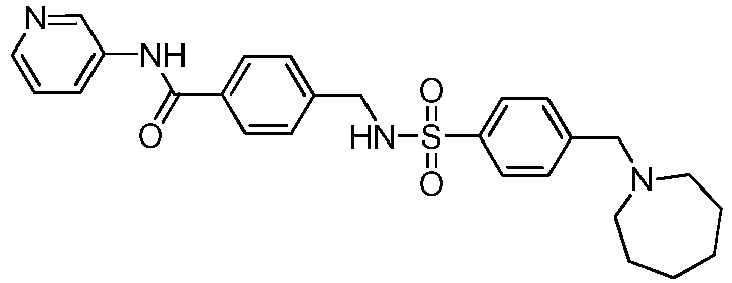
- Method C. Reaction of amine salt 6 (150 mg, 0.39 mmol) and 4-(bromomethyl)benzenesulfonyl chloride (125 mg, 0.46 mmol) gave the intermediate bromide. Hexamethyleneimine (0.22 mL, 1.9 mmol) was added and the mixture was warmed to 20 °C and stirred for a further 4 h. The solvent was evaporated and H2O (20 mL) added to the residue. The resulting solid was filtered and washed with H2O (50 mL). The crude solid was purified by column chromatography, eluting with a gradient (0-10%) of MeOH/DCM, to give benzamide 91 (77 mg, 42%) as a cream powder: mp (MeOH/DCM) 170-172 °C; 1H NMR δ 10.35 (s, 1 H, NHCO), 8.92 (d, J = 2.4 Hz, 1 H, H-2'), 8.31 (dd, J = 4.7, 1.4 Hz, 1 H, H-6'), 8.22 (br s, 1 H, NHSO2), 8.18 (ddd, J = 8.4, 2.5, 1.5 Hz, 1 H, H-4'), 7.87 (br d, J = 8.3 Hz, 2 H, H-2, H-6), 7.74 (br d, J = 7.8 Hz, 2 H, H-2", H-6"), 7.49 (br d, J = 6.3 Hz, 2 H, H-3", H-5"), 7.37-7.41 (m, 3 H, H-3, H-5, H-5'), 4.12 (d, J = 6.3 Hz, 2 H, CH2N), 3.66 (s, 2 H, CH2N), 2.55 (br s, 4 H, 2 × NCH2), 1.55 (br s, 8H, 4 × CH2); 13C NMR δ 165.4, 144.4, 141.9, 141.7, 139.1, 135.7, 132.8, 128.9(2), 127.5(2), 127.3(2), 127.1, 126.3(2), 123.4, 60.9, 54.8 (2), 45.6, 27.5 (2), 26.3 (2), one C not observed; MS m/z 480.1 (MH+, 100%); HRMS (FAB+) calcd for C26H31N4O3S (MH+) m/z 479.2117, found 479.2113.
-

- Method C. Reaction of amine salt 6 (150 mg, 0.39 mmol) and 4-(bromomethyl)benzenesulfonyl chloride (125 mg, 0.46 mmol) gave the intermediate bromide. Morpholine (0.20 mL, 2.3 mmol) was added and the mixture was warmed to 20 °C and stirred for a further 5 h. The solvent was evaporated and the residue dissolved in CH2Cl2 (60 mL), washed with H2O (80 mL). The solvent was evaporated and the crude solid purified by column chromatography, eluting with a gradient (0-10%) of MeOH/DCM, to give benzamide 92 (122 mg, 68%) as a yellow powder: mp (MeOH/DCM) 158-160 °C; 1H NMR δ 10.34 (s, 1 H, NHCO), 8.92 (d, J = 2.3 Hz, 1 H, H-2'), 8.31 (dd, J = 4.7, 1.5 Hz, 1 H, H-6'), 8.23 (br s, 1 H, NHSO2), 8.18 (ddd, J = 8.3, 2.5, 1.5 Hz, 1 H, H-4'), 7.87 (br d, J = 8.3 Hz, 2 H, H-2, H-6), 7.75 (br d, J = 8.3 Hz, 2 H, H-2", H-6"), 7.48 (br d, J = 8.4 Hz, 2 H, H-3", H-5"), 7.36-7.41 (m, 3 H, H-3, H-5, H-5'), 4.11 (s, 2 H, CH2NH), 3.57 (t, J = 4.6 Hz, 4 H, 2 × OCH2), 3.52 (s, 2 H, CH2N), 2.34 (t, J = 4.6 Hz, 4 H, 2 × NCH2); 13C NMR δ 165.4, 144.4, 142.7, 141.8, 141.7, 139.3, 135.7, 132.8, 129.2 (2), 127.5 (2), 127.3 (2), 127.1, 126.3 (2), 123.4, 66.0 (2), 61.5, 53.0 (2), 45.6; MS m/z 468.0 (MH+, 100%). Anal. calcd for C24H26N4O4S C, 61.78; H, 5.62; N, 12.01. Found: C, 62.01; H, 5.74; N, 12.13%.
-

- Method C. Reaction of amine salt 6 (340 mg, 0.87 mmol) and 4-(bromomethyl)benzenesulfonyl chloride (283 mg, 1.1 mmol) gave the intermediate bromide. 4-Methoxypiperidine hydrochloride (266 mg, 1.8 mmol) was added and the mixture was warmed to 20 °C and stirred for a further 150 mins. The solvent was evaporated, H2O (30 mL) added to the residue and the resulting precipitate filtered. The aqueous layer was extracted with DCM (2 × 20 mL) and combined with the crude solid. The solvent was evaporated and the crude solid purified by column chromatography, eluting with a gradient (0-10%) of MeOH/DCM, to give benzamide 93 (67 mg, 16%) as a pale yellow powder: mp (MeOH/DCM) 182-184 °C; 1H NMR δ 10.34 (s, 1 H, NHCO), 8.92 (d, J = 2.2 Hz, 1 H, H-2'), 8.30 (dd, J = 4.6, 1.2 Hz, 1 H, H-6'), 8.22 (t, J = 6.3 Hz, 1 H, NHSO2) 8.18 (ddd, J = 8.4, 2.4, 1.5 Hz, 1 H, H-4'), 7.86 (br d, J = 8.3 Hz, 2 H, H-2, H-6), 7.73 (br d, J = 8.2 Hz, 2 H, H-2", H-6"), 7.46 (br d, J = 8.0 Hz, 2 H, H-3", H-5"), 7.36-7.40 (m, 3 H, H-3, H-5, H-5'), 4.11 (d, J = 6.3 Hz, 2 H, CH2N), 3.50 (s, 2 H, CH2N), 3.17 (s, 3 H, CH3), 3.13 (m, 1 H, CH), 2.59 (m, 2 H, 2 × CH), 2.07 (m, 2 H, 2 × CH), 1.80 (m, 2 H, 2 × CH), 1.41 (m, 2 H, 2 × CH); 13C NMR δ 165.3, 144.4, 143.4, 141.8, 141.7, 139.2, 135.7, 132.8, 129.0 (2), 127.5 (2), 127.3 (2), 127.1, 126.3 (2), 123.3, 75.3, 61.1, 54.6, 50.3 (2), 45.6, 30.4 (2); MS m/z 496.1 (MH+, 100%); HRMS (FAB+) calcd for C26H30N4O4S (MH+) m/z 495.2066, found 495.2073. Anal. calcd for C26H30N4O4S·½CH3OH: C, 62.33; H, 6.32; N, 10.97. Found: C, 62.28; H, 6.02; N 11.26%.
-

- Method C. Reaction of amine salt 6 (250 mg, 0.64 mmol) and 4-(bromomethyl)benzenesulfonyl chloride (208 mg, 0.77 mmol) gave the intermediate bromide. 1-Methylpiperazine (0.36 mL, 3.3 mmol) was added and the mixture was warmed to 20 °C and stirred for 4 h. The solvent was evaporated, H2O (25 mL) was added to the residue and the resulting precipitate filtered. The crude solid was purified by column chromatography, eluting with a gradient (0-10%) of MeOH/DCM, to give benzamide 94 (115 mg, 37%) as a pale tan powder: mp (MeOH/DCM) 158-162 °C,; 1H NMR δ 10.36 (s, 1 H, NHCO), 8.93 (d, J = 2.4 Hz, 1 H, H-2'), 8.31 (dd, J = 4.7, 1.5 Hz, 1 H, H-6'), 8.25 (t, J = 6.4 Hz, 1 H, NHSO2), 8.18 (ddd, J = 8.3, 2.5, 1.5 Hz, 1 H, H-4'), 7.87 (br d, J = 8.3 Hz, 2 H, H-2, H-6), 7.75 (br d, J = 8.3 Hz, 2 H, H-2", H-6"), 7.48 (br d, J = 8.2 Hz, 2 H, H-3", H-5"), 7.36-7.41 (m, 3 H, H-3, H-5, H-5'), 4.11 (d, J = 6.3 Hz, 2 H, CH2N), 3.58 (s, 2 H, CH2N), 2.80 (br s, 4 H, 2 × NCH2), CH3, 2 × NCH2 not observed; 13C NMR δ 165.4, 144.4, 142.4, 141.9, 141.7, 139.4, 135.7, 132.8, 129.2 (2), 127.5 (2), 127.3 (2), 127.2, 126.4 (2), 123.3, 60.4, 53.3 (2), 50.3 (2), 45.6, 43.4; MS m/z 481.1 (MH+, 100%). Anal. calcd for C25H29N5O3S-CH2Cl2: C, 55.32; H, 5.53; N, 12.41. Found: C, 54.97; H, 5.91; N, 12.69%.
-

- Method A. Reaction of 4-tert-butylbenzoic acid (207 mg, 1.2 mmol) and oxalyl chloride (0.15 mL, 1.7 mmol) with subsequent reaction with amine salt 6 (542 mg, 1.4 mmol), followed by column chromatography eluting with a gradient (0-10%) of MeOH/EtOAc, gave benzamide 95 (246 mg, 55%) as a white powder: mp (EtOAc) 182-184 °C; 1H NMR δ 10.37 (s, 1 H, NHCO), 9.03 (t, J = 6.0 Hz, 1 H, NHCO), 8.92 (d, J = 2.2 Hz, 1 H, H-2'), 8.30 (dd, J = 4.7, 1.5 Hz, 1 H, H-6'), 8.18 (ddd, J = 8.3, 2.5, 1.5 Hz, 1 H, H-4'), 7.95 (br d, J = 8.3 Hz, 2 H, H-2, H-6), 7.86 (ddd, J = 8.5, 2.0, 1.8 Hz, 2 H, H-2", H-6"), 7.50 (ddd, J = 8.5, 2.0, 1.8 Hz, 2 H, H-3", H-5"), 7.47 (d, J = 8.3 Hz, 2 H, H-3, H-5), 7.38 (ddd, J = 8.3, 2.0, 0.5 Hz, 1 H, H-5'), 4.56 (d, J = 6.0 Hz, 2 H, CH2N), 1.31 [s, 9 H, C(CH3)3]; 13C NMR δ 166.1, 165.6, 154.0, 144.4, 143.8, 141.9, 135.7, 132.6, 131.4, 127.6(2), 127.1, 127.0(2), 126.9(2), 125.0(2), 123.3, 42.2, 34.5, 30.8 (3); MS m/z 388.6 (MH+, 100%). Anal. Calcd for C24H25N3O2: C, 74.39; H, 6.50; N, 10.84. Found: C, 74.33; H, 6.52; N, 10.81%.
-
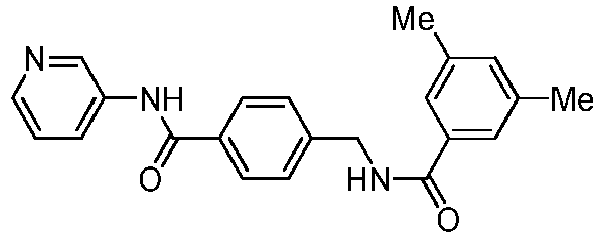
- Method A. Reaction of 3,5-dimethylbenzoic acid (333 mg, 2.2 mmol) and oxalyl chloride (0.29 mL, 3.3 mmol) with subsequent reaction with amine salt 6 (1.04 g, 2.7 mmol), followed by column chromatography eluting with a gradient (0-10%) of MeOH/EtOAc, gave benzamide 96 (184 mg, 23%) as a white powder: mp (EtOAc) 241-243 °C; 1H NMR δ 10.37 (s, 1 H, NHCO), 9.00 (t, J = 6.0 Hz, 1 H, NHCO), 8.94 (d, J = 2.3 Hz, 1 H, H-2'), 8.30 (dd, J = 4.7, 1.5 Hz, 1 H, H-6'), 8.18 (ddd, J = 8.3, 2.5, 1.5 Hz, 1 H, H-4'), 7.94 (br d, J = 8.3 Hz, 2 H, H-2, H-6), 7.52 (br s, 2 H, H-2", H-6"), 7.47 (br d, J = 8.3 Hz, 2 H, H-3, H-5), 7.38 (ddd, J = 8.3, 4.7, 0.5 Hz, 1 H, H-5'), 7.17 (s, 1 H, H-4"), 4.54 (d, J = 6.0 Hz, 2 H, CH2N), 2.32 [s, 6 H, 2 × CH3); 13C NMR δ 166.4, 165.6, 144.4, 143.8, 141.9, 137.3 (2), 135.7, 134.2, 132.7, 132.4, 127.7 (2), 127.1, 127.0 (2), 124.9 (2), 123.3, 42.3, 20.7 (2); MS m/z 360.5 (MH+, 100%). Anal. Calcd for C22H21N3O2: C, 73.52; H, 5.89; N, 11.69. Found: C, 73.22; H, 6.00; N, 11.59%.
-

- Method A. Reaction of 3,4-dimethoxybenzoic acid (247 mg, 1.4 mmol) and oxalyl chloride (0.18 mL, 2.0 mmol) with subsequent reaction with amine salt 6 (580 mg, 1.5 mmol), followed by column chromatography eluting with a gradient (0-10%) of MeOH/EtOAc, gave benzamide 97 (411 mg, 70%) as a white powder: mp (EtOAc) 219-220 °C; 1H NMR δ 10.37 (s, 1 H, NHCO), 8.97 (t, J = 6.0 Hz, 1 H, NHCO), 8.92 (d, J = 2.3 Hz, 1 H, H-2'), 8.31 (dd, J = 4.7, 1.4 Hz, 1 H, H-6'), 8.18 (ddd, J = 8.3, 2.5, 1.5 Hz, 1 H, H-4'), 7.96 (br d, J = 8.3 Hz, 2 H, H-2, H-6), 7.55 (dd, J = 8.4, 2.0 Hz, 1 H, H-6"), 7.51 (d, J = 2.0 Hz, 1 H, H-2"), 7.48 (br d, J = 8.3 Hz, 2 H, H-3, H-5), 7.38 (dd, J = 8.3, 4.7 Hz, 1 H, H-5'), 7.03 (d, J = 8.4 Hz, 1 H, H 5"), 4.55 (br d, J = 6.0 Hz, 2 H, CH2N), 3.82 (s, 3 H, OCH3), 3.81 (s, 3 H, OCH3); 13C NMR δ 165.7, 165.6, 151.3, 148.2, 144.4, 143.9, 141.9, 135.6, 132.7, 127.7 (2), 127.1, 127.0 (2), 126.4, 123.3, 120.4, 110.9, 110.6, 55.5, 55.4, 42.3; MS m/z 392.6 (MH+, 100%). Anal. Calcd for C22H21N3O4: C, 67.51; H, 5.41; N, 10.74. Found: C, 67.24; H, 5.36; N, 10.75%.
-

- 4-(4-tert-Butylphenylsulfonamidomethyl)benzoic Acid (98). 4-tert-Butylbenzenesulfonyl chloride (4.85 g, 20.8 mmol) was added dropwise to a stirred solution of 4-aminomethylbenzoic acid (3.0 g, 19.9 mmol) in 2 M NaOH (20 mL) at 20 °C. The mixture was stirred at 20° for 3 h. The pH of the mixture was adjusted to 2-3 with 6 M HCl and the precipitate filtered. The precipitate was washed with water (2 × 20 mL), ether (20 mL) and pet. ether (2 × 20 mL) and air-dried. The crude solid was purified by column chromatography, eluting with a gradient (5-20%) of MeOH/EtOAc, to give benzoic acid 98 (4.88 g, 71%) as a white powder: mp 290-291 °C; 1H NMR δ 12.84 (br s, 1 H, CO2H), 8.16 (br t, J = 6.1 Hz, 1 H, NHSO2), 7.78 (br d, J = 8.2 Hz, 2 H, H-2, H-6), 7.68 (ddd, J = 8.6, 2.2, 1.9 Hz, 2 H, H-2', H-6'), 7.53 (ddd, J = 8.6, 2.2, 1.9 Hz, 2 H, H-3', H-5'), 7.27 (br d, J = 8.3 Hz, 2 H, H-3, H-5), 4.05 (br d, J = 6.1 Hz, 2 H, CH2N), 1.29 [s, 9 H, C(CH3)3]. Anal. calcd for C18H21NO4S: C, 62.23; H, 6.09; N, 4.03. Found: C, 62.32; H, 6.14; N, 4.06%.
- 4-[(4-tert-Butylphenylsulfonamido)methyl]-N-methyl-N-(3-pyridinyl)benzamide (99). Method A. Reaction of benzoic acid 98 (404 mg, 1.2 mmol) and oxalyl chloride (0.15 mL, 1.7 mmol) and subsequent reaction with 3-aminomethylpyridine (138 mg, 1.3 mmol), followed by column chromatography, eluting with EtOAc, gave benzamide 99 (137 mg, 27%) as a white powder: mp (EtOAc) 141-143 °C; 1H NMR δ 8.34 (dd, J = 4.7, 1.4 Hz, 1 H, H-6'), 8.31 (d, J = 2.3 Hz, 1 H, H-2'), 8.05 (br t, J = 6.4 Hz, 1 H, NHSO2), 7.66-7.71 (m, 3 H, H-4', H-2", H-6"), 7.57 (ddd, J = 8.7, 2.2, 1.8 Hz, 2 H, H-3", H-5"), 7.33 (ddd, J = 8.1, 4.7, 0.6 Hz, 1 H, H-5'), 7.19 (d, J = 8.3 Hz, 2 H, H-2, H-6), 7.11 (d, J = 8.3 Hz, 2 H, H-3, H-5), 3.93 (br d, J = 6.4 Hz, 2 H, CH2N), 3.37 (s, 3 H, NCH3), 1.30 [s, 9 H, C(CH)3]; 13C NMR δ 169.3, 155.3, 148.1, 147.0, 141.0, 139.5, 137.9, 134.5, 134.1, 128.4 (2), 126.9 (2), 126.3 (2), 125.9 (2), 123.8, 45.5, 37.8, 34.8, 30.8 (3); MS m/z 438.6 (MH+, 100%). Anal. calcd for C24H27N3O3S·½EtOAc: C, 64.84; H, 6.49; N, 8.73. Found: C, 64.74; H, 6.36; N, 8.85%.
-
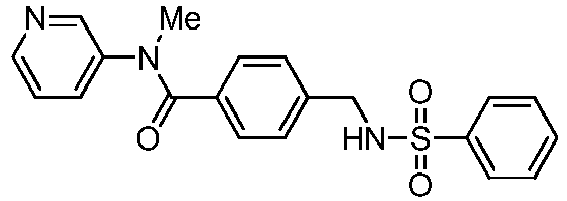
- Method A. Reaction of benzoic acid 12 (406 mg, 1.4 mmol) and oxalyl chloride (0.18 mL, 2.1 mmol) and subsequent reaction with 3-aminomethylpyridine (165 mg, 1.5 mmol), followed by column chromatography, eluting with EtOAc, gave benzamide 100 (85 mg, 16%) as a white powder: mp (EtOAc) 170-172 °C; 1H NMR δ 8.34 (dd, J = 4.7, 1.5 Hz, 1 H, H-6'), 8.32 (d, J = 2.3 Hz, 1 H, H-2'), 8.12 (br t, J = 6.3 Hz, 1 H, NHSO2), 7.77 (ddd, J = 7.0, 2.1, 1.5 Hz, 2 H, H-2", H-6"), 7.69 (ddd, J = 8.2, 2.6, 1.5 Hz, 1 H, H-4'), 7.59-7.63 (m, 1 H, H-4"), 7.53-7.58 (m, 2 H, H-3", H-5"), 7.34 (ddd, J = 8.2, 4.7, 0.6 Hz, 1 H, H-5'), 7.19 (d, J = 8.3 Hz, 2 H, H-2, H-6), 7.11 (br d, J = 8.3 Hz, 2 H, H-3, H-5), 3.94 (d, J = 6.3 Hz, 2 H, CH2N), 3.38 (s, 3 H, NCH3); 13C NMR δ 169.3, 148.1, 147.1, 140.7, 139.4, 134.5, 134.1, 132.3, 129.1 (2), 128.3 (2), 126.9 (2), 126.4 (2), 123.4, 45.6, 37.8; MS m/z 381.6 (MH+, 100%). Anal. calcd for C20H19N3O3S.¼EtOAc: C, 62.52; H, 5.25; N, 10.41. Found: C, 62.36; H, 5.23; N, 10.57%.
-

- 3-(4-tert-Butylphenylsulfonamidomethyl)benzoic Acid (101). 4-tert-Butylbenzenesulfonyl chloride (1.36 g, 5.9 mmol) was added in small portions to a stirred solution of 3-aminomethylbenzoic acid (1.0 g, 5.3 mmol) in 1 M NaOH (10 mL) at 20 °C. The mixture was stirred at 20 °C for 16 h. The pH of the mixture was adjusted to 2-3 with 6 M HCl and the precipitate filtered. The precipitate was washed with water (2 × 20 mL), ether (20 mL) and pet. ether (2 × 20 mL) and air-dried. The crude solid was purified by column chromatography, eluting with a gradient (0-5%) of MeOH/EtOAc, to give benzoic acid 101 (1.25 g, 65%) as a white powder: mp (MeOH/EtOAc) 191-193 °C; 1H NMR δ 12.87 (br s, 1H, CO2H), 8.15 (t, J = 6.4 Hz, 1 H, NHSO2) 7.82 (br s, 1 H, H-2), 7.77 (br t, J = 7.7, 1.3 Hz, 1 H, H-6), 7.68 (ddd, J = 8.6, 2.2, 1.9 Hz, 2 H, H-2', H-6'), 7.54 (ddd, J = 8.6, 2.2, 1.9 Hz, 2 H, H-3', H-5'), 7.44 (br d, J = 7.9 Hz, 1 H, H-4), 7.37 (br t, J = 7.6 Hz, 1 H, H-5), 4.05 (br d, J = 6.1 Hz, 2 H, CH2N), 1.29 [s, 9 H, C(CH3)3]; MS m/z 380.5 (MH+, 100%). Anal. calcd for C18H21NO4S: C, 62.23; H, 6.09; N, 4.03. Found: C, 62.44; H, 6.23; N, 4.03%.
- 3-[(4-tert-Butylphenylsulfonamido)methyl]-N-(3-pyridinyl)benzamide (102). Method A. Reaction of benzoic acid 101 (0.35 g, 1.0 mmol) and oxalyl chloride (0.13 mL, 1.5 mmol) and subsequent reaction with 3-aminopyridine (105 mg, 1.1 mmol), followed by column chromatography, eluting with EtOAc, gave benzamide 102 (285 mg, 67%) as a white powder: mp (EtOAc) 183-186 °C; 1H NMR δ 10.37 (s, 1 H, CONH), 8.92 (d, J = 2.2 Hz, 1 H, H-2'), 8.31 (dd, J = 4.6, 1.5 Hz, 1 H, H-6'), 8.13-8.20 (m, 2 H, H-5, H-4'), 7.83-7.86 (m, 2 H, H-2, NHSO2), 7.73 (ddd, J = 8.6, 2.2, 1.9 Hz, 2 H, H-2", H-6"), 7.57 (ddd, J = 8.6, 2.2, 1.9 Hz, 2 H, H-3", H-5"), 7.44-7.49 (m, 2 H, H-4, H-6), 7.39 (br d, J = 8.7, 4.4 Hz, 1 H, H-5'), 4.09 (br d, J = 6.2 Hz, 2 H, CH2N), 1.29 [s, 9 H, C(CH)3]; 13C NMR δ 165.6, 155.3, 144.6, 142.0, 138.2, 137.8, 135.8, 134.2, 131.0, 128.3, 127.3, 127.1, 126.4 (2), 125.9 (2), 123.5, 45.9, 34.8, 30.8 (3), 1 C not observed; MS m/z 424.6 (MH+, 100%). Anal. calcd for C23H25N3O3S·¼CH3OH: C, 64.71; H, 6.07; N, 9.73. Found: C, 64.76; H, 6.15; N, 9.71%.
-

- 3-(Phenylsulfonamidomethyl)benzoic Acid (103). Benzenesulfonyl chloride (0.80 mL, 6.2 mmol) was added dropwise to a stirred solution of 3-aminomethylbenzoic acid (1.06 g, 5.7 mmol) in 1 M NaOH (12 mL) at 20 °C. The mixture was stirred at 20 °C for 16 h. The pH of the mixture was adjusted to 2-3 with 6 M HCl and the precipitate filtered. The precipitate was washed with water (2 × 20 mL), ether (20 mL) and pet. ether (2 × 20 mL) and air-dried. The crude solid was purified by column chromatography, eluting with a gradient (0-5%) of MeOH/EtOAc, to give benzoic acid 103 (0.96 g, 56%) as a white powder: mp (MeOH/EtOAc) 171-173 °C; 1H NMR δ 12.91 (br s, 1 H, CO2H), 8.23 (t, J = 6.3 Hz, 1 H, NHSO2), 7.85 (br s, 1 H, H-2), 7.77-7.81 (m, 3 H, H-6, H-2', H-6'), 7.53-7.58 (m, 2 H, H-3', H-5'), 7.46 (br d, J = 7.8 Hz, 1 H, H-4), 7.39 (br t, J = 7.6 Hz, 1 H, H-5), 4.06 (d, J = 6.3 Hz, 2 H, CH2N); MS m/z 292.5 (MH+, 100%). Anal. calcd for C14H13NO4S: C, 57.72; H, 4.50; N, 4.81. Found: C, 57.77; H, 4.47; N, 4.78%.
- 3-[(Phenylsulfonamido)methyl]-N-(3-pyridinyl)benzamide (104). Method A. Reaction of benzoic acid 103 (0.56 g, 1.9 mmol) and oxalyl chloride (0.25 mL, 2.9 mmol) and subsequent reaction with 3-aminopyridine (200 mg, 2.1 mmol), followed by column chromatography, eluting with EtOAc, gave benzamide 104 (535 mg, 76%) as a white powder: mp (EtOAc) 74-78 °C; 1H NMR δ 10.40 (s, 1 H, CONH), 8.93 (d, J = 2.3 Hz, 1 H, H-2'), 8.32 (dd, J = 4.6, 1.5 Hz, 1 H, H-6'), 8.23 (br t, J = 6.2 Hz, 1 H, NHSO2), 8.18 (ddd, J = 8.3, 2.5, 1.5 Hz, 1 H, H-4'), 7.81-7.87 (m, 4 H, H-2, H-6, H-2", H-6"), 7.55-7.65 (m, 3 H, H-3", H-4", H-5"), 7.45-7.50 (m, 2 H, H-4, H-5), 7.39 (br dd, J = 8.3, 4.6 Hz, 1 H, H-5'), 4.09 (br d, J = 6.2 Hz, 2 H, CH2N); 13C NMR δ 165.7, 144.6, 142.0, 140.6, 138.1, 135.7, 134.3, 132.4, 131.0, 129.2 (2), 128.3, 127.4, 127.1, 126.5 (2), 126.4, 123.5, 45.9; MS m/z 368.8 (MH+, 100%). Anal. calcd for C19H17N3O3S·¼EtOAc: C, 61.68; H, 4.92; N, 10.79. Found: C, 61.74; H, 4.90; N, 10.72%.
-
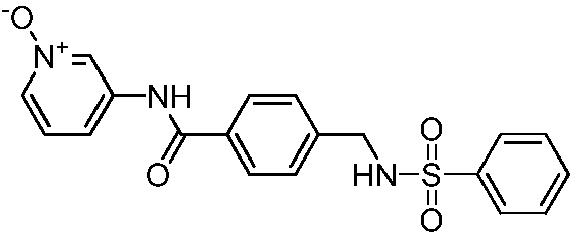
- A mixture of MCPBA (223 mg, 0.65 mmol) and benzamide 10 (0.16 mL, 0.4 mol) in DCM (15 mL) was stirred at 20 °C for 16 h. The mixture was diluted with DCM (20 mL), washed with saturated aqueous KHCO3 (2 × 5 mL), water (5 mL), brine (5 mL) and dried. The solvent was evaporated and the residue purified by column chromatography, eluting with a gradient (0-5%) of MeOH/DCM, to give N-oxide 105 (106 mg, 64%) as a white powder: mp (MeOH/EtOAc) 230-231 °C; 1H NMR δ 10.52 br s, 1 H, NHCO), 8.92 (t, J = 1.7 Hz, 1 H, H-2"), 8.32 (br s, 1 H, NHSO2), 8.00 (ddd, J = 6.4, 1.7, 0.8 Hz, 1 H, H-6"), 7.88 (br d, J = 8.3 Hz, 2 H, H-2, H-6), 7.82 (ddd, J = 6.9, 2.0, 1.4 Hz, 2 H, H-2', H-6'), 7.68 (ddd, J = 8.5, 1.7, 1.4 Hz, 1 H, H-4"), 7.57-7.66 (m, 3 H, H-3', H-4', H-5'), 7.37-7.43 (m, 3 H, H-3, H-5, H-5"), 4.08 (s, 2 H, CH2N); 13C NMR δ 165.7, 142.2, 140.5, 138.4, 133.9, 132.5, 132.4, 130.8, 129.2 (2), 127.8 (2), 127.4 (2), 126.4 (2), 126.1, 116.7, 45.7; MS m/z 384.5 (MH+, 100%). Anal. calcd for C19H17N3O4S: C, 59.52; H, 4.47; N, 10.96. Found: C, 59.47; H, 4.36; N, 10.99%.
-

- A mixture of 4-(aminomethyl)-N-(3-pyridinyl)benzamide 6 (727 mg, 3.2 mmol) and 4-iodobenzenesulfonyl chloride (970 mg, 3.2 mmol) in dry pyridine (10 mL) was stirred at 20 °C for 16 h. The solvent was evaporated and the residue stirred in water (20 mL) for 1 h. The precipitate was filtered, washed with water (5 mL) and dried. The crude solid was purified by column chromatography, eluting with a gradient (0-20%) of MeOH/EtOAc, to give benzamide 106 (1.47 g, 93%) as a cream powder: mp (MeOH/EtOAc) 249-251 °C; 1H NMR δ 10.36 (s, 1 H, NHCO), 8.93 (d, J = 2.3 Hz, 1 H, H-2'), 8.34 (br s, 1 H, NHSO2), 8.31 (dd, J = 4.7, 1.5 Hz, 1 H, H-6'), 8.18 (ddd, J = 8.3, 2.5, 1.5 Hz, 1 H, H-4'), 7.97 (ddd, J = 8.6, 2.2, 1.9 Hz, 2 H, H-2", H-6"), 7.90 (br d, J = 8.3 Hz, 2 H, H-2, H-6), 7.56 (ddd, J = 8.6, 2.2, 1.9 Hz, 2 H, H-3", H-5"), 7.37-7.42 (m, 3 H, H-3, H-5, H-5'), 4.09 (s, 2 H, CH2N); 13C NMR δ 165.5, 144.5, 142.0, 141.6, 140.3, 138.1 (2), 135.8, 133.1, 128.2 (2), 127.7 (2), 127.5 (2), 127.3, 123.5, 100.3, 45.7; MS m/z 494.6 (MH+, 100%).
-

- PdCl2(PPh3)2 (47 mg, 66 □mol) was added to a stirred, degassed solution of iodide 106 (327 mg, 0.66 mmol), TMS-acetylene (0.93 mL, 6.6 mmol) and CuI (13 mg, 66 □mol) in Et3N (3 mL) and DMF (3 mL), and the mixture was stirred in a sealed pressure vessel at 50 °C for 2 h. The mixture was cooled to 20 °C, diluted with EtOAc (150 mL) and washed with water (3 × 50 mL), washed with brine (50 mL) and dried. The solvent was evaporated and the residue suspended in MeOH (20 mL) and K2CO3 (110 mg, 0.72 mmol) was added. The mixture was stirred at 20 °C for 1 h. The solvent was evaporated and the residue purified by column chromatography, eluting with a gradient (0-5%) of MeOH/DCM, to give benzamide 107 (200 mg, 77%) as a tan powder: mp (EtOAc) 182-185 °C; 1H NMR δ 10.36 (s, 1 H, NHCO), 8.92 (d, J = 2.2 Hz, 1 H, H-2'), 8.35 (br t, J = 4.0 Hz, 1 H, NHSO2), 8.31 (br dd, J = 4.6, 1.2 Hz, 1 H, H-6'), 8.18 (ddd, J = 8.3, 2.4, 1.5 Hz, 1 H, H-4'), 7.90 (br d, J = 8.3 Hz, 2 H, H-2, H-6), 7.81 (ddd, J = 8.6, 1.9, 1.6 Hz, 2 H, H-2", H-6"), 7.68 (ddd, J = 8.6, 1.9, 1.6 Hz, 2 H, H-3", H-5"), 7.37-7.42 (m, 3 H, H-3, H-5, H-5'), 4.45 (s, 1 H, CH), 4.11 (br d, J = 4.0 Hz, 2 H, CH2N); 13C NMR δ 165.5, 144.4, 142.0, 141.7, 140.7, 135.7, 133.1, 132.4 (2), 127.7 (2), 127.4 (2), 127.3 (2), 126.8, 125.7, 123.5, 83.8, 82.1, 47.7; MS m/z 392.5 (MH+, 100%). Anal. calcd for C21H17N3O3S: C, 64.43; H, 4.38; N, 10.73. Found: C, 64.26; H, 4.38; N, 10.43%.
-
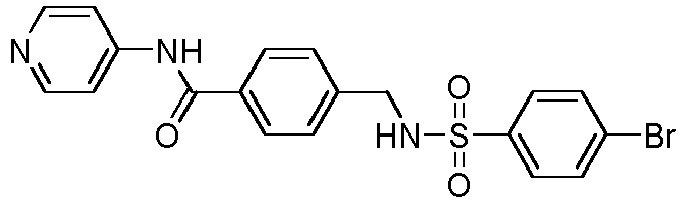
- 4-((4-Bromophenylsulfonamido)methyl)benzoic Acid (108). 4-Bromobenzenesulfonyl chloride (2.36 g, 10.14 mmol) was added to a stirred solution of 4-aminomethylbenzoic acid (1.73 g, 9.22 mmol) in 1 M NaOH (19 mL) at 20 °C. The mixture was stirred at 20 ° for 3 h. The pH of the mixture was adjusted to 2-3 with 6 M HCl and the precipitate filtered. The precipitate was washed with water (2 × 20 mL), ether (20 mL) and pet. ether (2 × 20 mL) and air-dried. The residue was purified by chromatography, eluting with a gradient (0-20%) of MeOH/EtOAc, to give benzoic acid 108 (2.44 g, 71%) as a white powder: mp 268-271 °C; 1H NMR δ 12.82 (br s, 1 H, CO2H), 8.34 (br t, J = 6.1 Hz, 1 H, NHSO2), 7.85 (br d, J = 8.3 Hz, 2 H, H-2, H-6), 7.78 (ddd, J = 8.7, 2.2, 2.0 Hz, 2 H, H-2', H-6'), 7.70 (ddd, J = 8.7, 2.2, 2.0 Hz, 2 H, H-3', H-5'), 7.34 (br d, J = 8.3 Hz, 2 H, H-3, H-5), 4.10 (br d, J = 6.0 Hz, 2 H, CH2N). Anal. calcd for C14H12BrNO4S·¼CH3OH: C, 45.23; H, 3.46; N, 3.70. Found: C, 44.95; H, 3.24; N, 3.68%.
- 4-[(4-Bromophenylsulfonamido)methyl]-N-(4-pyridinyl)benzamide (109). Method A. Reaction of benzoic acid 108 (920 mg, 2.5 mmol) and oxalyl chloride (0.33 mL, 3.7 mmol) and subsequent reaction with 4-aminopyridine (260 mg, 2.7 mmol), followed by column chromatography, eluting with EtOAc, gave benzamide 109 (146 mg, 13%) as a white powder: mp (EtOAc) 219-222 °C; 1H NMR δ 10.52 (s, 1 H, NHCO), 8.48 (dd, J = 4.9, 1.5 Hz, 2 H, H-2', H-6'), 8.05 (br t, J = 6.3 Hz, 1 H, NHSO2), 7.89 (br d, J = 8.3 Hz, 2 H, H-2, H-6), 7.77-7.81 (m, 4 H, H-3', H-5', H-2", H-6"), 7.78 (br ddd, J = 8.7, 2.0, 1.0 Hz, 2 H, H-3", H-5"), 7.40 (br d, J = 8.3 Hz, 2 H, H-3, H-5), 4.10 (d, J = 6.3 Hz, 2 H, CH2N); 13C NMR δ 166.0, 150.1 (2), 146.0, 141.9, 139.9, 132.9, 132.3 (2), 128.5 (2), 127.9 (2), 127.5 (2), 126.2, 114.0 (2), 45.7; MS m/z 368.4/370.4 (MH+, 100%). Anal. calcd for C19H16BrN3O3S·¼H2O: C, 50.12; H, 3.76; N, 9.23. Found: C, 50.12; H, 3.45; N, 8.33%.
-

- 4-(4-Fluorophenylsulfonamidomethyl)benzoic Acid (110). 4-Fluorobenzenesulfonyl chloride (1.85 g, 9.49 mmol) was added to a stirred solution of 4-aminomethylbenzoic acid (1.62 g, 8.63 mmol) in 1 M NaOH (17 mL) at 20 °C. The mixture was stirred at 20° for 16 h. The pH of the mixture was adjusted to 2-3 with 6 M HCl and the precipitate filtered. The precipitate was washed with water (2 × 20 mL), ether (20 mL) and pet. ether (2 × 20 mL) and air-dried. The residue was purified by chromatography, eluting with a gradient (0-20%) of MeOH/EtOAc, to give benzoic acid 110 (2.23 g, 84%) as a white powder: mp 231-234 °C; 1H NMR δ 8.28 (t, J = 6.3 Hz, 1 H, NHSO2), 7.80-7.85 (m, 4 H, H-2, H-6, H-2', H-6'), 7.31-7.40 (m, 4 H, H-3, H-5, H-3', H-5'), 4.07 (d, J = 6.3 Hz, 2 H, CH2N), CO2H not observed. Anal. calcd for C14H12FNO4S: C, 54.36; H, 3.91; N, 4.53. Found: C, 54.51; H, 3.81; N, 4.57%.
- 4-[(4-Fluorophenylsulfonamido)methyl]-N-(4-pyridinyl)benzamide (111). Method A. Reaction of benzoic acid 110 (840 mg, 2.7 mmol) and oxalyl chloride (0.36 mL, 4.1 mmol) and subsequent reaction with 4-aminopyridine (282 mg, 3.0 mmol), followed by column chromatography, eluting with EtOAc, gave benzamide 111 (406 mg, 39%) as a white powder: mp (EtOAc) 231-233 °C; 1H NMR δ 10.50 (s, 1 H, NHCO), 8.47 (dd, J = 4.8, 1.5 Hz, 2 H, H-2', H-6'), 8.30 (t, J = 5.9 Hz, 1 H, NHSO2), 7.85-7.91 (m, 4 H, H-2, H-6, H-2", H-6"), 7.78 (br ddd, J = 4.8, 1.5 Hz, 2 H, H-3', H-5'), 7.39-7.45 (m, 4 H, H-3, H-5, H-3", H-5"), 4.10 (d, J = 5.9 Hz, 2 H, CH2N); 13C NMR δ 166.0, 164.1 (d, J = 250 Hz), 150.3 (2), 145.9, 142.0, 137.8 (d, J = 3 Hz), 133.0, 129.5 (2, d, J = 9 Hz), 127.8 (2), 127.5 (2), 116.3 (2, d, J = 22 Hz), 114.0 (2), 45.7; MS m/z 386.5 (MH+, 100%). Anal. calcd for C19H16FN3O3S: C, 59.21; H, 4.18; N, 10.90. Found: C, 59.34; H, 4.12; N, 10.78%.
-

- PdCl2(PPh3)2 (29 mg, 42 µmol) was added to a stirred, degassed solution of iodide 106 (208 mg, 0.42 mmol), 3-methoxypropyne (53 µL, 0.63 mmol) and Cul (8 mg, 42 µmol) in Et3N (2 mL) and DMF (2 mL), and the mixture was stirred in a sealed pressure vessel at 50 °C for 4 h. The mixture was cooled to 20 °C, diluted with EtOAc (150 mL) and washed with water (3 × 50 mL), washed with brine (50 mL) and dried. The solvent was evaporated and the residue purified by column chromatography, eluting with a gradient (0-5%) of MeOH/EtOAc, to give benzamide 112 (157 mg, 86%) as a cream powder: mp (MeOH/EtOAc) 200-201 °C; 1H NMR δ 10.37 (s, 1 H, NHCO), 9.10 (br s, 1 H, H-2'), 8.50 (br s, 1 H, H-6'), 8.35 (br s, 1 H, NHSO2), 8.20 (br d, J = 8.3 Hz, 1 H, H-4'), 7.59 (d, J = 8.3 Hz, 2 H, H-2, H-6), 7.60 (dd, J = 8.5, 1.8 Hz, 2 H, H-2", H-6"), 7.65 (dd, J = 8.5, 1.8 Hz, 2 H, H-3", H-5"), 7.50 (br s, 1 H, H-5'), 7.40 (d, J = 8.3 Hz, 2 H, H-3, H-5), 4.35 (s, 2 H, CH2O), 4.11 (br s, 2 H, CH2N), 3.29 (s, 3 H, OCH3); 13C NMR δ 165.5, 146.7, 144.4, 142.1, 141.6, 140.5, 135.8, 133.1, 132.1 (2), 127.7 (2), 127.5 (2), 127.1, 126.8 (2), 125.9, 89.0, 84.5, 59.4, 57.0, 45.7; MS m/z 436.8 (MH+, 100%). Anal. calcd for C23H21N3O4S: C, 63.43; H, 4.86; N, 9.65. Found: C, 63.51; H, 4.91; N, 9.54%.
-

- A mixture of 4-(aminomethyl)-N-(4-pyridinyl)benzamide 8 (520 mg, 2.3 mmol) and 4-iodobenzenesulfonyl chloride (690 mg, 2.3 mmol) in dry pyridine (20 mL) was stirred at 20 °C for 16 h. The solvent was evaporated and the residue stirred in water (20 mL) for 1 h. The precipitate was filtered, washed with water (5 mL) and dried. The crude solid was purified by column chromatography, eluting with a gradient (0-30%) of MeOH/EtOAc, to give benzamide 113 (906 mg, 80%) as a cream powder: mp (EtOAc) 270-273 °C; 1H NMR δ 10.50 (s, 1 H, NHCO), 8.48 (br d, J = 4.8 Hz, 2 H, H-2', H-6'), 8.34 (br t, J = 6.2 Hz, 1 H, NHSO2), 7.96 (ddd, J = 8.6, 2.2, 1.9 Hz, 2 H, H-2", H-6"), 7.89 (br d, J = 8.4 Hz, 2 H, H-2, H-6), 7.78 (br dd, J = 6.3, 1.4 Hz, 2 H, H-3', H-5'), 7.56 (ddd, J = 8.6, 2.2, 1.9 Hz, 2 H, H-3", H-5"), 7.40 (br d, J = 8.4 Hz, 2 H, H-3, H-5), 4.10 (d, J = 6.2 Hz, 2 H, CH2N); 13C NMR δ 166.0, 150.3 (2), 145.9, 141.9, 140.2, 138.1 (2), 136.4, 133.0, 128.2 (2), 127.8 (2), 127.5 (2), 114.0, 100.3, 45.7; MS m/z 494.6 (MH+, 100%). Anal. calcd for C19H16IN3O3S: C, 46.26; H, 3.27; N, 8.52. Found: C, 46.49; H, 3.24; N, 8.46%.
-

- tert-
Butyl - tert-Butyl 21-{4-[({4-[(3-Pyridinylamino)carbonyl]benzyl}amino)sulfonyl]phenyl}-3,6,9,12,15,18-hexaoxahenicos-20-yn-1-ylcarbamate (115). PdCl2(PPh3)2 (36 mg, 51 µmol) was added to a stirred, degassed solution of iodide 106 (250 mg, 510 µmol), acetylene 114 (320 mg, 770 µmol) and Cul (10 mg, 51 µmol) in Et3N (3 mL) and DMF (3 mL), and the mixture was stirred in a sealed pressure vessel at 50 °C for 3 h. The mixture was cooled to 20 °C, diluted with EtOAc (150 mL) and washed with water (3 x 50 mL), washed with brine (50 mL) and dried. The solvent was evaporated and the residue purified by column chromatography, eluting with a gradient (0-5%) of MeOH/EtOAc, to give carbamate 115 (367 mg, 92%) as a tan oil: 1H NMR (CDCl3) δ 8.61 (br s, 1 H, H-2'), 8.41 (br s, 1 H, NHSO2), 8.31 (d, J = 4.6 Hz, 1 H, H-6'), 8.25 (ddd, J = 8.3, 2.4, 1.4 Hz, 1 H, H-4'), 7.79-7.84 (m, 4 H, H-2, H-6, H-2", H-6"), 7.55 (dd, J = 8.6, 1.8 Hz, 2 H, H-3", H-5"), 7.28-7.34 (m, 3 H, H-3, H-5, H-5'), 5.78 (br s, 1 H, NHCO), 5.07 (br s, 1 H, NHCO2), 4.42 (s, 2 H, CH2O), 4.22 (br d, J = 6.0 Hz, 2 H, CH2N), 3.74-3.77 (m, 2 H CH2O), 3.68-3.71 (m, 2 H CH2O), 3.55-3.66 (m, 18 H, 9 × CH2O), 3.25 (br dd, J = 5.4, 5.2 Hz, 2 H, CH2N), 1.43 [s, 9 H, C(CH3)3]; MS m/z 786.0 (MH+, 100%); HRMS calcd for C39H53N4O11S (MH+) m/z 785.3426, found 785.3410 (2.5 ppm).
- 4-[({[4-(21-Amino-4,7,10,13,16,19-hexaoxahenicos-1-yn-1-yl)phenyl]sulfonyl}amino)methyl]-N-(3-pyridinyl)benzamide (116). A solution of carbamate 115 (360 mg, 0.46 mmol) in HCl saturated MeOH (10 mL) was stood at 20 °C for 16 h. The solvent was evaporated and the crude oil purified by preparative HPLC [gradient elution 5-55% of (90%MeCN/H2O)/(0.02% v/v aqueous CF3CO2H)] to give the amine as the trifluoracetate salt (270 mg, 73%) as a brown gum: 1H NMR δ 11.34 (s, 1 H, NHCO), 9.42 (d, J = 2.2 Hz, 1 H, H-2'), 8.88 (d, J = 8.8 Hz, 1 H, H-4'), 8.64 (d, J = 4.9 Hz, 1 H, H-4'), 8.47 (br s, 1 H, NHSO2), 8.04 (br d, J = 8.3 Hz, 2 H, H-2, H-6), 7.96 (m 4 H, NH2·CF3CO2H, H-5'), 7.82 (dd, J = 8.5, 1.8 Hz, 2 H, H-2", H-6"), 7.65 (dd, J = 8.5, 1.8 Hz, 2 H, H-3", H-5"), 7.44 (br d, J = 8.3 Hz, 2 H, H-3, H-5), 4.43 (s, 2 H, CH2O), 4.12 (br d, J = 6.2 Hz, 2 H, CH2N), 3.51-3.65 (m, 22 H, 11 × CH2O), 2.95 (br q, J = 5.5 Hz, 2 H, CH2N); 13C NMR δ 165.9, 142.5, 140.5, 138.6, 137.0, 134.7, 133.5, 132.0 (2), 131.9, 129.1, 128.1 (2), 127.7 (2), 127.5 (2), 127.1, 126.8 (2), 125.8, 89.2, 84.3, 69.7 (3), 69.6 (2), 69.5, 68.8, 66.6, 58.0, 48.5, 45.7, 38.8; HRMS calcd for C34H45N4O9S (MH+) m/z 685.2902, found 685.2898 (1.2 ppm).
-

- A mixture of acetylene 98 (103 mg, 0.24 mmol) and Pd/C (30 mg) in EtOH (50 mL) was stirred under H2 (60 psi) for 1 h. The mixture was filtered through Celite, washed with EtOH. The solvent was evaporated and the crude solid was crystallized to give methyl ether 117 (62 mg, 59%) as a cream powder: mp (MeOH/EtOAc) 172-174 °C; 1H NMR δ 10.36 (s, 1 H, NHCO), 8.92 (d, J = 2.2 Hz, 1 H, H-2'), 8.31 (br dd, J = 4.5, 1.5 Hz, 1 H, H-6'), 8.15-8.21 (m, 2 H, H-4', NHSO2), 7.89 (br d, J = 8.2 Hz, 2 H, H-2, H-6), 7.71 (br d, J = 8.2 Hz, 2 H, H-2", H-6"), 7.35-7.42 (m, 5 H, H-3, H-5, H-5', H-3", H-5"), 4.09 (s, 2 H, CH2N), 3.31 (t, J = 6.3 Hz, 2 H, CH2O), 3.22 (s, 3 H, OCH3), 2.65-2.70 (m, 2 H, CH2), 1.76-1.83 (m, 2 H, CH2); 13C NMR δ 165.5, 146.7, 144.5, 142.0, 141.8, 138.2, 135.8, 133.0, 129.0 (2), 127.6 (2), 127.4 (2), 127.3, 126.6 (2), 123.4, 70.9, 57.8, 45.7, 31.5, 30.4; MS m/z 440.7 (MH+, 100%). Anal. calcd for C23H25N3O4S·H2O: C, 60.38; H, 5.95; N, 9.18. Found: C, 60.13; H, 5.60; N, 9.16%.
-

- TBTA (28 mg, 53 µmol) was added to a suspension of CuSO4·H2O (13 mg, 53 µmol), sodium ascorbate (21 mg, 106 µmol), acetylene 107 (208 mg, 0.53 mmol) and benzyl azide (0.14 mL, 1.06 mmol) in water (1 mL) and DMSO (1 mL). The mixture was stirred at 20 °C for 24 h. The mixture was diluted with water (50 mL) and stirred at 20 °C for 30 min. The mixture was filtered, washed with water (3 × 5 mL) and dried. The precipitate was suspended in MeOH/EtOAc (1:1, 10 mL), filtered and washed with EtOAc to give benzamide 118 (240 mg, 86%) as a grey powder: mp (MeOH/EtOAc) 256-260 °C; 1H NMR δ 10.37 (s, 1 H, NHCO), 8.79 (s, 1 H, H-2'), 8.25-8.30 (m, 2 H, H-6', NHSO2), 8.20 (br d, J = 8.2 Hz, 1 H, H-4'), 8.06 (d, J = 8.4 Hz, 2 H, H-3", H-5"), 7.85-7.94 (m, 4 H, H-2, H-6, H-2", H-6"), 7.57 (br s, 1 H, H-5"'), 7.33-7.46 (m, 8 H, H-3, H-5, H-5', H-2"', H-3"', H-4"', H-5"', H-6"'), 5.67 (s, 2 H, CH2N), 4.11 (br d, J = 6.1 Hz, 2 H, CH2N); 13C NMR δ 165.5, 145.3, 144.3, 142.2, 141.8, 139.5, 135.8, 134.4, 133.1, 128.8 (2), 128.7, 128.2, 127.9 (2), 127.7 (2), 127.4 (2), 127.3 (2), 126.9, 125.6 (2), 122.8, 53.1, 47.7 (1 C not observed); MS m/z 525.6 (MH+, 100%). Anal. calcd for C28H24N6O3S·H2O: C, 61.98; H, 4.83; N, 15.48. Found: C, 61.60; H, 4.33; N, 15.41%.
-

- PdCl2(PPh3)2 (105 mg, 149 µmol) was added to a stirred, degassed solution of iodide 106 (734 mg, 1.49 mmol), propargyl alcohol (132 µL, 2.23 mmol) and Cul (28 mg, 149 µmol) in Et3N (3 mL) and DMF (3 mL), and the mixture was stirred in a sealed pressure vessel at 50 °C for 4 h. The mixture was cooled to 20 °C, diluted with EtOAc (150 mL) and washed with water (3 × 50 mL), washed with brine (50 mL) and dried. The solvent was evaporated and the residue purified by column chromatography, eluting with a gradient (0-5%) of MeOH/EtOAc, to give benzamide 119 (460 mg, 73%) as a cream powder: mp (MeOH/EtOAc) 207-210 °C; 1H NMR δ 10.36 (s, 1 H, NHCO), 8.92 (d, J = 2.4 Hz, 1 H, H-2'), 8.34 (br s, 1 H, NHSO2), 8.31 (dd, J = 4.6, 1.5 Hz, 1 H, H-6'), 8.18 (ddd, J = 8.4, 2.5, 1.5 Hz, 1 H, H-4'), 7.91 (d, J = 8.3 Hz, 2 H, H-2, H-6), 7.80 (dd, J = 8.5, 1.9 Hz, 2 H, H-2", H-6"), 7.62 (dd, J = 8.5, 1.9 Hz, 2 H, H-3", H-5"), 7.36-7.42 (m, 3 H, H-3, H-5, H-5'), 5.38 (br t, J = 5.9 Hz, 1 H, OH), 4.35 (br d, J = 5.8 Hz, 2 H, CH2O), 4.11 (br s, 2 H, CH2N); 13C NMR δ 165.5, 144.5, 142.0, 141.7, 140.2, 135.8, 133.1, 131.9 (2), 127.7 (2), 127.4 (2), 127.3, 126.8 (2), 126.4, 123.1, 93.0, 82.4, 49.4, 45.7; MS m/z 422.5 (MH+, 100%). Anal. calcd for C22H19N3O4S: C, 62.69; H, 4.54; N, 9.97. Found: C, 62.99; H, 4.38; N, 10.07%.
-

- A mixture of acetylene 119 (405 mg, 0.96 mmol) and Pd/C (60 mg) in EtOH (150 mL) was stirred under H2 (60 psi) for 1 h. The mixture was filtered through Celite, washed with EtOH. The solvent was evaporated and the crude solid was crystallized to give methyl ether 120 (295 mg, 72%) as a cream powder: mp (MeOH/EtOAc) 177-179 °C; 1H NMR δ 10.36 (s, 1 H, NHCO), 8.92 (d, J = 2.2 Hz, 1 H, H-2'), 8.31 (dd, J = 4.7, 1.5 Hz, 1 H, H-6'), 8.18 (ddd, J = 8.3, 2.5, 1.5 Hz, 1 H, H-4'), 8.14 (br s, 1 H, NHSO2), 7.90 (br d, J = 8.3 Hz, 2 H, H-2, H-6), 7.72 (br d, J = 8.3 Hz, 2 H, H-2", H-6"), 7.37-7.42 (m, 5 H, H-3, H-5, H-5', H-3", H-5"), 4.48 (br s, 1 H, OH), 4.08 (s, 2 H, CH2N), 3.38-3.41 (m, 2 H, CH2O), 2.69 (dd, J = 7.9, 7.6 Hz, 2 H, CH2), 1.68-1.77 (m, 2 H, CH2); 13C NMR δ 165.5, 147.2, 144.5, 142.0, 141.9, 138.0, 135.8, 133.0, 129.0 (2), 127.6 (2), 127.4 (2), 127.3, 126.5 (2), 123.5, 59.9, 45.7, 33.8, 31.4; MS m/z 426.6 (MH+, 100%). Anal. calcd for C22H23N3O4S: C, 62.10; H, 5.45; N, 9.88. Found: C, 62.27; H, 5.41; N, 9.94%.
-

- tert-Butyl 21-{4-[({4-[(4-Pyridinylamino)carbonyl]benzyl}amino)sulfonyl]phenyl}-3,6,9,12,15,18-hexaoxahenicos-20-yn-1-ylcarbamate (121). PdCl2(PPh3)2 (40 mg, 57 □mol) was added to a stirred, degassed solution of iodide 113 (284 mg, 570 □mol), acetylene 114 (362 mg, 863 □mol) and CuI (11 mg, 57 □mol) in Et3N (3 mL) and DMF (3 mL), and the mixture was stirred in a sealed pressure vessel at 50 °C for 3 h. The mixture was cooled to 20 °C, diluted with EtOAc (150 mL) and washed with water (3 × 50 mL), washed with brine (50 mL) and dried. The solvent was evaporated and the residue purified by column chromatography, eluting with a gradient (0-10%) of MeOH/EtOAc, to give carbamate 121 (427 mg, 95%) as a tan oil: 1H NMR (CDCl3) δ 8.52 (dd, J = 6.3, 1.5 Hz, 2 H, H-2', H-6'), 8.42 (br s, 1 H, NHSO2), 7.78-7.84 (m, 4 H, H-2, H-6, H-2", H-6"), 7.64 (dd, J = 6.3, 1.5 Hz, 2 H, H-3', H-5'), 7.54 (ddd, J = 8.6, 1.9, 1.6 Hz, 2 H, H-3", H-5"), 7.33 (br d, J = 8.3 Hz, 2 H, H-3, H-5), 5.45 (br s, 1 H, NHCO), 5.06 (br s, 1 H, NHCO2), 4.42 (s, 2 H, CH2O), 4.23 (d, J = 6.2 Hz, 2 H, CH2N), 3.74-3.77 (m, 2 H CH2O), 3.68-3.71 (m, 2 H CH2O), 3.55-3.65 (m, 18 H, 9 × CH2O), 3.24 (br d, J = 5.3 Hz, 2 H, CH2N), 1.43 [s, 9 H, C(CH3)3]; MS m/z 786.0 (MH+, 100%); HRMS calcd for C39H53N4O11S (MH+) m/z 785.3426, found 785.3436 (-1.0 ppm).
- 4-[({[4-(21-Amino-4,7,10,13,16,19-hexaoxahenicos-1-yn-1-yl)phenyl]sulfonyl}amino)methyl]-N-(4-pyridinyl)benzamide (122). A solution of carbamate 121 (410 mg, 0.52 mmol) in HCl saturated MeOH (10 mL) was stood at 20 °C for 16 h. The solvent was evaporated and the crude oil was purified by preparative HPLC [gradient elution 5-55% of (90%MeCN/H2O)/(0.02% v/v aqueous CF3CO2H)] to give the amine 122 as the trifluoracetate salt (217 mg, 52%) as a tan gum: 1H NMR δ 11.42 (s, 1 H, NHCO), 8.76 (d, J = 7.1 Hz, 2 H, H-2', H-6'), 8.41 (br t, J = 6.3 Hz, 1 H, NHSO2), 8.28 (d, J = 7.1 Hz, 2 H, H-3', H-5'), 7.97 (d, J = 8.4 Hz, 2 H, H-2, H-6), 7.81 (dd, J = 8.5, 1.8 Hz, 2 H, H-2", H-6"), 7.77 (br s, 3 H, NH3 +CF3CO2 -), 7.65 (dd, J = 8.5, 1.8 Hz, 2 H, H-3", H-5"), 7.46 (d, J = 8.4 Hz, 2 H, H-3, H-5), 4.43 (s, 2 H, CH2O), 4.13 (d, J = 6.3 Hz, 2 H, CH2N), 3.63-3.66 (m, 2 H CH2O), 3.51-3.61 (m, 20 H, 10 × CH2O), 2.95-3.02 (m, 2 H, CH2N); 13C NMR δ 166.8, 158.3, 152.8, 143.1, 153.0 (2), 140.4, 132.1 (2), 131.9, 128.3 (2), 127.6 (2), 126.8 (2), 125.9, 115.1 (2), 89.2, 84.3, 69.7 (br, 8), 69.6 (2), 69.5, 68.8, 66.6, 58.0, 45.6; MS m/z 685.2 (MH+, 100%); HRMS calcd for C34H45N4O9S (MH+) m/z 685.2902, found 685.2893 (1.9 ppm).
-

- A mixture of 4-(aminomethyl)-N-(4-pyridinyl)benzamide dihydrobromide 8 (399 mg, 1.03 mmol) and 4-tert-butylbenzenesulfonyl chloride (263 mg, 1.13 mmol) in dry pyridine (10 mL) was stirred at 20 °C for 16 h. The solvent was evaporated and the residue stirred in water (20 mL) for 1 h. The precipitate was filtered, washed with water (5 mL) and dried. The crude solid was purified by column chromatography, eluting with a gradient (0-10%) of MeOH/EtOAc, to give benzamide 123 (189 mg, 43%) as a white powder: mp (MeOH/EtOAc) 261-263 °C; 1H NMR δ 10.48 (s, 1 H, NHCO), 8.47 (dd, J = 4.8, 1.5 Hz, 2 H, H-2', H-6'), 8.19 (br t, J = 6.3 Hz, 1 H, NHSO2), 7.86 (br d, J = 8.3 Hz, 2 H, H-2, H-6), 7.77 (dd, J = 4.8, 1.5 Hz, 2 H, H-3', H-5'), 7.70 (ddd, J = 8.6, 2.2, 2.0 Hz, 2 H, H-2", H-6"), 7.54 (ddd, J = 8.6, 2.2, 2.0 Hz, 2 H, H-3", H-5"), 7.38 (d, J = 8.3 Hz, 2 H, H-3, H-5), 4.09 (br d, J = 6.3 Hz, 2 H, CH2N), 1.28 [s, 9 H, C(CH3)3]; 13C NMR δ 165.9, 155.2, 150.1 (2), 145.8, 142.0, 137.8, 132.7, 127.6 (2), 127.4 (2), 126.2 (2), 125.8 (2), 113.9 (2), 45.6, 34.6, 30.6 (3); MS m/z 424.5 (MH+, 100%). Anal. calcd for C23H25N3O3S: C, 65.23; H, 5.95; N, 9.92. Found: C, 65.29; H, 6.05; N, 9.88%.
-

- 4-({[(4-tert-Butylphenyl)sulfonyl]amino}methyl)benzoic Acid (124). (4-tert-Butylphenyl)sulfonyl chloride 4.85 g, 20.84 mmol) was added in small portions to a stirred solution of 4-aminomethylbenzoic acid (3.0 g, 19.85 mmol) in 2 M NaOH solution (20 mL) and the mixture was stirred at 20 °C for 16 h. The pH was adjusted to 2 with 6 M HCl and the resulting precipitate was filtered, washed with water (2 × 10 mL), dried, washed with pet. ether (2 × 10 mL) and the material dried to give acid 124 (4.88 g, 71%) as a white powder: mp (MeOH) 290-291 °C; 1H NMR δ 12.84 (br s, 1 H, CO2H), 8.19 (t, J = 6.4 Hz, 1 H, NHSO2), 7.79 (br d, J = 8.3 Hz, 2 H, H-2, H-6), 7.66 (ddd, J = 8.8, 2.2, 1.9 Hz, 2 H, H-2', H-6'), 7.52 (ddd, J = 8.8, 2.2, 1.9 Hz, 2 H, H-3', H-5'), 7.31 (br d, J = 8.3 Hz, 2 H, H-3, H-5), 4.07 (d, J = 6.4 Hz, 2 H, CH2N). Anal. calcd for C18H21NO4S: C, 62.23; H, 6.09; N, 4.03. Found: C, 62.32; H, 6.14; N, 4.06%.
- 4-({[(4-tert-Butylphenyl)sulfonyl]amino}methyl)-N-(5-methyl-3-pyridinyl)benzamide (125). Oxalyl chloride (94 µL, 1.1 mmol) was added dropwise to a stirred suspension of benzoic acid 124 (250 mg, 0.7 mmol) and DMF (1 drop) in dry THF (20 mL) and the solution was stirred at 20 °C for 2 h, then at 66 °C for 1 h. The solution was cooled to 20 °C, then the solvent was evaporated and the residue dissolved in dry pyridine (10 mL). 2-Methyl-3-pyridinylamine (86 mg, 0.8 mmol) was added and the solution stirred at 20 °C for 16 h. The solvent was evaporated and the residue suspended in ice/water (50 mL) for 1 h. The precipitate was filtered, washed with water (5 mL) and dried. The crude solid was purified by column chromatography, eluting with EtOAc, to give benzamide 125 (156 mg, 50%) as a white powder: mp (EtOAc) 189-191 °C; 1H NMR δ 10.27 (s, 1 H, CONH), 8.71 (d, J = 2.3 Hz, 1 H, H-2'), 8.18 (br s, 1 H, NHSO2), 8.16 (d, J = 1.2 Hz, 1 H, H-6'), 8.00-8.04 (m, 1 H, H-4'), 7.86 (br d, J = 8.4 Hz, 2 H, H-2, H-6), 7.70-7.74 (ddd, J = 8.6, 2.2, 1.9 Hz, 2 H, H-2", H-6"), 7.55 (ddd, J = 8.6, 2.2, 1.9 Hz, 2 H, H-3", H-5"), 7.37 (br d, J = 8.4 Hz, 2 H, H-3, H-5), 4.09 (br s, 2 H, CH2N), 2.31 (s, 3 H, CH3), 1.29 [s, 9 H, C(CH3)3]; 13C NMR δ 165.4, 155.3, 144.9, 141.7, 139.3, 137.9, 135.4, 133.0, 132.7, 127.7, 127.6 (2), 127.4 (2), 126.3 (2), 125.9 (2), 45.8, 34.8, 30.7 (3), 17.9; MS m/z 438.6 (MH+, 100%). Anal. calcd for C24H27N3O3S: C, 65.88; H, 6.22; N, 9.60. Found: C, 65.72; H, 6.37; N, 9.58%.
-

- Oxalyl chloride (132 µL, 1.5 mmol) was added dropwise to a stirred suspension of benzoic acid 124 (350 mg, 1.0 mmol) and DMF (1 drop) in dry THF (20 mL) and the solution was stirred at 20 °C for 2 h, then at 66 °C for 1 h. The solution was cooled to 20 °C, then the solvent was evaporated and the residue dissolved in dry pyridine (10 mL). 2-Methyl-3-pyridinylamine was added and the solution stirred at 20 °C for 16 h. The solvent was evaporated and the residue suspended in ice/water (50 mL) for 1 h. The precipitate was filtered, washed with water (5 mL) and dried. The crude solid was purified by column chromatography, eluting with EtOAc, to give benzamide 126 (266 mg, 60%) as a white powder: mp (EtOAc) 188-190 °C; 1H NMR δ 9.95 (s, 1 H, CONH), 8.34 (dd, J = 4.8, 1.6 Hz, 1 H, H-2'), 8.19 (br t, J = 6.4 Hz, 1 H, NHSO2), 7.87 (br d, J = 8.3 Hz, 2 H, H-2, H-6), 7.68-7.74 (m, 3 H, H-4', H-2", H-6"), 7.56 (ddd, J = 8.6, 2.2, 2.0 Hz, 2 H, H-3", H-5"), 7.36 (br d, J = 8.4 Hz, 2 H, H-3, H-5), 7.27 (dd, J = 8.0, 4.8 Hz, 1 H, H-5'), 4.09 (d, J = 6.4 Hz, 2 H, CH2N), 2.43 (s, 3 H, CH3), 1.30 [s, 9 H, C(CH3)3]; 13C NMR δ 165.1, 155.3, 153.9, 146.1, 141.7, 137.9, 133.8, 132.7, 132.4, 127.5 (2), 127.4 (2), 126.3 (2), 125.9 (2), 121.4, 45.8, 34.8, 30.8 (3), 21.0; MS m/z 438.6 (MH+, 100%). Anal. calcd for C24H27N3O3S: C, 65.88; H, 6.22; N, 9.60. Found: C, 66.13; H, 6.40; N, 9.41%.
-

- Oxalyl chloride (132 µL, 1.5 mmol) was added dropwise to a stirred suspension of benzoic acid 124 (348 mg, 1.0 mmol) and DMF (1 drop) in dry THF (20 mL) and the solution was stirred at 20 °C for 2 h, then at 66 °C for 1 h. The solution was cooled to 20 °C, then the solvent was evaporated and the residue dissolved in dry pyridine (10 mL). 6-Methyl-3-pyridinylamine (120 mg, 1.1 mmol) was added and the solution stirred at 20 °C for 16 h. The solvent was evaporated and the residue suspended in ice/water (50 mL) for 1 h. The precipitate was filtered, washed with water (5 mL) and dried. The crude solid was purified by column chromatography, eluting with EtOAc, to give benzamide 127 (322 mg, 74%) as a white powder: mp (EtOAc) 235-237 °C; 1H NMR δ 10.25 (s, 1 H, CONH), 8.77 (d, J = 2.5 Hz, 1 H, H-2'), 8.19 (br t, J = 6.3 Hz, 1 H, NHSO2), 8.04 (dd, J = 8.4, 2.5 Hz, 1 H, H-4'), 7.85 (br d, J = 8.3 Hz, 2 H, H-2, H-6), 7.70 (ddd, J = 8.6, 2.2, 1.9 Hz, 2 H, H-2", H-6"), 7.55 (ddd, J = 8.6, 2.2, 1.9 Hz, 2 H, H-3", H-5"), 7.37 (br d, J = 8.3 Hz, 2 H, H-3, H-5), 7.23 (d, J = 8.4 Hz, 1 H, H-5'), 4.09 (s, 2 H, CH2N), 2.44 (s, 3 H, CH3), 1.28 [s, 9 H, C(CH3)3]; 13C NMR δ 165.2, 155.2, 152.7, 141.6, 141.3, 137.8, 133.2, 133.0, 127.9, 127.5 (2), 127.4 (2), 126.3 (2), 125.8 (2), 122.5, 45.7, 34.7, 30.7 (3), 23.3; MS m/z 438.6 (MH+, 100%). Anal. calcd for C24H27N3O3S: C, 65.88; H, 6.22; N, 9.60. Found: C, 65.72; H, 6.23; N, 9.62%.
-

- Triethylamine (0.4 mL, 3 mmol) was added dropwise to a stirred solution of benzoic acid 124 (250 mg, 0.72 mmol), EDCI (154 mg, 0.8 mmol), HOBt (108 mg, 0.8 mmol) and 6-methoxypyridin-3-amine (134 mg, 1.1 mmol) in anhydrous DCM (10 mL), and the reaction mixture was stirred at 20 ºC for 4 d. The solution was diluted with DCM (100 mL), washed with H2O (2 × 50 mL), and washed with brine (50 mL). The combined organic phase was dried, filtered and the solvent evaporated. The residue was purified by column chromatography, eluting with 4% MeOH/DCM, to give benzamide 128 (71 mg, 22%) as a pink powder: mp (MeOH/DCM) 238-240 ºC; 1H NMR δ 10.18 (s, 1 H, CONH), 8.49 (d, J = 2.5 Hz, 1 H, H-2'), 8.18 (t, J = 6.3 Hz, 1 H, NHSO2), 8.02 (dd, J = 8.9, 2.7 Hz, 1 H, H-4'), 7.84 (br d, J= 8.3 Hz, 2 H, H-2, H-6), 7.69 (br d, J = 8.6 Hz, 2 H, H-2", H-6"), 7.55 (br d, J = 8.6 Hz, 2 H, H-3", H-5"), 7.36 (br d, J = 8.3 H, 2 H, H-3, H-5), 6.84 (d, J = 8.9 Hz, 1 H, H-5'), 4.08 (d, J = 6.3 Hz, 2 H, CH 2NHSO2), 3.84 (s, 3 H, OCH3), 1.29 [s, 9 H, C(CH3)3]; 13C NMR δ 165.0, 159.9, 155.3, 141.5, 138.9, 137.9, 133.0, 132.6, 129.9, 127.5 (2), 127.4 (2), 126.3 (2), 125.9 (2), 109.9, 53.1, 45.8, 34.7, 30.8 (3); MS m/z 455.3 (MH+, 100%). Anal. calcd for C24H27N3O4S: C, 63.56; H, 6.00; N, 9.26. Found: C, 63.29; H, 6.00; N, 9.13%.
-

- Oxalyl chloride (0.13 mL, 1.44 mmol) was added to a stirred solution of carboxylic acid 124 (250 mg, 0.72 mmol) and a catalytic amount of DMF (2 drops) in anhydrous THF (20 mL) and the solution was heated at reflux temperature for 2 h. The solvent was evaporated and the residue was dried under high vacuum. The residue was dissolved in anhydrous pyridine (10 mL), 6-chloropyridin-3-amine (102 mg, 0.8 mmol) was added, and the reaction mixture was stirred at 20 ºC for 16 h then at 60 ºC for 3 h. The solvent was evaporated and the residue was suspended in cold water (50 mL) and stirred at 0 ºC for 1 h. The solid was filtered, washed with water (20 mL) and dried. The residue was purified by column chromatography, eluting with 50% EtOAc/pet. ether to give benzamide 129 (60 mg, 19%) as a white solid: mp (EtOAc/pet. ether) 251-253 ºC; 1H NMR δ 10.48 (s, 1 H, CONH), 8.78 (d, J = 2.5 Hz, 1 H, H-2'), 8.24 (dd, J = 8.7, 2.8 Hz, 1 H, H-4'), 8.19 (br t, J = 6.3 Hz, 1 H, NHSO2), 7.86 (br d, J = 8.3 Hz, 2 H, H-2, H-6), 7.69 (dt, J = 8.6, 2.0 Hz, 2 H, H-2", H-6"), 7.55 (dt, J = 8.6, 2.0 Hz, 2 H, H-3", H-5"), 7.52 (d, J = 8.8 Hz, 1 H, H-5'), 7.38 (br d, J = 8.3 Hz, 2 H, H-3, H-5), 4.09 (d, J = 6.1 Hz, 2 H, CH 2NHSO2), 1.28 [s, 9 H, C(CH3)3]; 13C NMR δ 165.5, 155.3, 144.0, 142.0, 141.5, 137.9, 135.4, 132.6, 130.9, 127.6 (2), 127.5 (2), 126.3 (2), 125.9 (2), 124.0, 45.8, 34.8, 30.8 (3); MS m/z 459.2 (MH+, 100%). Anal. calcd for C23H24ClN3O3S: C, 60.32; H, 5.28; N, 9.18. Found: C, 60.27; H, 5.28; N, 9.10%.
-

- Oxalyl chloride (0.13 mL, 1.44 mmol) was added to a stirred solution of carboxylic acid 124 (250 mg, 0.72 mmol) and a catalytic amount of DMF (2 drops) in anhydrous THF (20 mL) and the solution was heated at reflux temperature for 2 h. The solvent was evaporated and the residue was dried under high vacuum. The residue was dissolved in anhydrous pyridine (10 mL), 4-chloropyridin-3-amine (102 mg, 0.8 mmol) was added, and the reaction mixture was stirred at 60 ºC for 3 h. The solvent was evaporated and the residue was suspended in cold H2O (50 mL) and stirred at 0 ºC for 1 h. The solid was filtered, washed with H2O (50 mL) and dried. The residue was purified by column chromatography, eluting with 4% MeOH/DCM, to give benzamide 130 (112 mg, 34%) as a white solid: mp (MeOH/DCM) 125-128 ºC; 1H NMR δ 10.22 (s, 1 H, CONH), 8.67 (s, 1 H, H-2'), 8.44 (d, J = 5.2 Hz, 2 H, H-6'), 8.19 (t, J = 6.4 Hz, 1 H, NHSO2), 7.88 (br d, J = 8.3 Hz, 2 H, H-2, H-6), 7.70 (br d, J = 8.6 Hz, 2 H, H-2", H-6"), 7.67 (d, J = 5.3 Hz, 1 H, H-5'), 7.55 (br d, J = 8.6 Hz, 2 H, H-3", H-5"), 7.38 (br d, J = 8.3 Hz, 2 H, H-3, H-5), 4.10 (d, J = 6.3 Hz, 2 H, CH 2NHSO2), 1.30 [s, 9 H, C(CH3)3]; 13C NMR (DMSO-d6) δ 165.3, 155.3, 149.3, 147.9, 142.0, 139.4, 137.9, 132.2, 132.0, 127.7 (2), 127.5 (2), 126.3 (2), 125.9 (2), 124.6, 45.7, 34.8, 30.8 (3); MS m/z 459.2 (MH+, 100%). Anal. calcd for C23H24ClN3O3S·¼CH2Cl2: C, 58.27; H, 5.15; N, 8.77. Found: C, 58.66; H, 5.20; N, 8.55%.
-
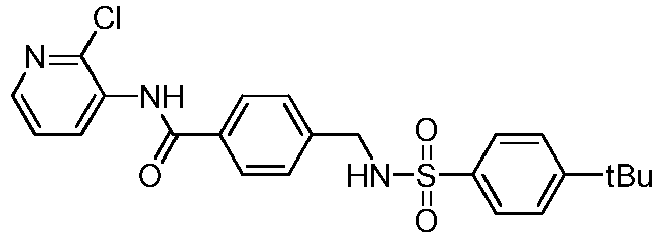
- Oxalyl chloride (0.13 mL, 1.44 mmol) was added to a stirred solution of carboxylic acid 124 (250 mg, 0.72 mmol) and a catalytic amount of DMF (2 drops) in anhydrous THF (15 mL) and the solution was heated at reflux temperature for 2 h. The solvent was evaporated and the residue was dried under high vacuum. The residue was dissolved in anhydrous pyridine (10 mL), 2-chloropyridin-3-amine (102 mg, 0.8 mmol) was added, and the reaction mixture was stirred at 20 ºC for 16 h. The pyridine was evaporated and the residue was suspended in cold water (50 mL) and stirred at 0 ºC for 1 h. The solid was filtered, washed with water (10 mL) and dried. The residue was purified by column chromatography, eluting with 40% EtOAc/pet.ether followed by 2% MeOH/DCM, to give benzamide 131 (131 mg, 40%) as a white solid: mp (MeOH/DCM) 161-162 ºC; 1H NMR δ 10.10 (s, 1 H, CONH), 8.31 (dd, J = 4.6, 1.8 Hz, 1 H, H-6'), 8.19 (t, J = 6.4 Hz, 1 H, NHSO2), 8.05 (dd, J = 7.9, 1.8 Hz, 1 H, H-4'), 7.88 (br d, J = 8.3 Hz, 2 H, H-2, H-6), 7.70 (dt, J = 8.6, 2.0 Hz, 2 H, H-2", H-6"), 7.56 (dt, J = 8.7, 2.0 Hz, 2 H, H-3", H-5"), 7.50 (dd, J = 7.9, 4.7 Hz, 1 H, H-5'), 7.38 (br d, J = 8.3 Hz, 2 H, H-3, H-5), 4.10 (d, J = 6.3 Hz, 2 H, CH 2NHSO2), 1.29 [s, 9 H, C(CH3)3]; 13C NMR δ 165.2, 155.3, 146.6, 146.2, 142.1, 137.9, 136.7, 132.2, 132.1, 127.6 (2), 127.5 (2), 126.3 (2), 125.9 (2), 123.4, 45.7, 34.8, 30.8 (3); MS m/z 459.2 (MH+, 100%). Anal. calcd for C23H24ClN3O3S: C, 60.32; H, 5.28; N, 9.18. Found: C, 60.46; H, 5.36; N, 8.95%.
-

- Oxalyl chloride (132 µL, 1.5 mmol) was added dropwise to a stirred suspension of benzoic acid 124 (350 mg, 1.0 mmol) and DMF (1 drop) in dry THF (20 mL) and the solution was stirred at 20 °C for 2 h, then at 66 °C for 1 h. The solution was cooled to 20 °C, then the solvent was evaporated and the residue dissolved in dry pyridine (10 mL). 5-Methyl-3-pyridinylamine [prepared by reduction of 5-methyl-3-nitropyridine (152 mg, 1.1 mmol) in EtOH (50 mL) under H2 (60 psi) for 2 h, filtering through Celite and evaporation of the solvent] was added and the solution stirred at 20 °C for 16 h. The solvent was evaporated and the residue suspended in ice/water (50 mL) for 1 h. The precipitate was filtered, washed with water (5 mL) and dried. The crude solid was purified by column chromatography, eluting with a gradient (50-100%) of EtOAc/pet. ether, to give benzamide 132 (154 mg, 35%) as a white powder: mp (EtOAc) 183-185 °C; 1H NMR δ 10.00 (s, 1 H, CONH), 8.45 (s, 1 H, H-2'), 8.31 (d, J = 4.8 Hz, 1 H, H-6'), 8.19 (br t, J = 6.3 Hz, 1 H, NHSO2), 7.87 (d, J = 8.3 Hz, 2 H, H-2, H-6), 7.70 (ddd, J = 8.6, 2.2, 1.9 Hz, 2 H, H-2", H-6"), 7.55 (ddd, J = 8.6, 2.2, 1.9 Hz, 2 H, H-3", H-5"), 7.37 (br d, J = 8.3 Hz, 2 H, H-3, H-5), 7.32 (d, J = 4.8 Hz, 1 H, H-5'), 4.10 (d, J = 6.3 Hz, 2 H, CH2N), 2.39 (s, 3 H, CH3), 1.29 [s, 9 H, C(CH3)3]; 13C NMR δ 165.3, 155.3, 147.4, 146.7, 142.9, 141.7, 137.9, 133.5, 132.6, 127.6 (2), 127.4 (2), 126.3 (2), 125.9 (2), 125.3, 45.8, 34.8, 30.8 (3), 17.3; MS m/z 438.7 (MH+, 100%). Anal. calcd for C24H27N3O3S: C, 65.88; H, 6.22; N, 9.60. Found: C, 65.69; H, 6.35; N, 9.44%.
-

- Oxalyl chloride (132 µL, 1.5 mmol) was added dropwise to a stirred suspension of benzoic acid 124 (350 mg, 1.0 mmol) and DMF (1 drop) in dry THF (20 mL) and the solution was stirred at 20 °C for 2 h, then at 66 °C for 1 h. The solution was cooled to 20 °C, then the solvent was evaporated and the residue dissolved in dry pyridine (10 mL). 5-Chloro-3-pyridinylamine (143 mg, 1.1 mmol) was added and the solution stirred at 20 °C for 16 h. The solvent was evaporated and the residue suspended in ice/water (50 mL) for 1 h. The precipitate was filtered, washed with water (5 mL) and dried. The crude solid was purified by column chromatography, eluting with a gradient (30-50%) of EtOAc/pet. ether, to give benzamide 133 (243 mg, 53%) as a white powder: mp (EtOAc) 217-219 °C; 1H NMR δ 10.98 (s, 1 H, CONH), 8.38 (d, J = 5.4 Hz, 1 H, H-6'), 8.29 (d, J = 2.0 Hz, 1 H, H-2'), 8.17 (br s, 1 H, NHSO2), 7.92 (d, J = 8.4 Hz, 2 H, H-2, H-6), 7.70 (ddd, J = 8.6, 2.2, 1.9 Hz, 2 H, H-2", H-6"), 7.56 (ddd, J = 8.6, 2.2, 1.9 Hz, 2 H, H-3", H-5"), 7.35 (br d, J = 8.4 Hz, 2 H, H-3, H-5), 7.30 (dd, J = 5.4, 2.0 Hz, 1 H, H-4'), 4.08 (br s, 2 H, CH2N), 1.29 [s, 9 H, C(CH3)3]; 13C NMR δ 166.0, 155.3, 153.4, 149.3, 143.9, 142.2, 137.9, 132.3, 128.0 (2), 127.3 (2), 126.3 (2), 125.9 (2), 119.7, 114.0, 45.7, 34.8, 30.8 (3); MS m/z 458.8 (MH+, 100%). Anal. calcd for C23H24ClN3O3S: C, 60.32; H, 5.28; N, 9.18. Found: C, 60.07; H, 5.28; N, 8.81%.
-

- Oxalyl chloride (132 µL, 1.5 mmol) was added dropwise to a stirred suspension of benzoic acid 124 (355 mg, 1.0 mmol) and DMF (1 drop) in dry THF (20 mL) and the solution was stirred at 20 °C for 2 h, then at 66 °C for 1 h. The solution was cooled to 20 °C, then the solvent was evaporated and the residue dissolved in dry pyridine (10 mL). 2-Nitro-3-pyridinylamine (156 mg, 1.1 mmol) was added and the solution stirred at 20 °C for 16 h. The solvent was evaporated and the residue suspended in ice/water (50 mL) for 1 h. The precipitate was filtered, washed with water (5 mL) and dried. The crude solid was purified by column chromatography, eluting with a gradient (50-100%) of EtOAc/pet. ether, to give benzamide 134 (64 mg, 13%) as a cream powder: mp (EtOAc) 191-193 °C; 1H NMR δ 10.78 (s, 1 H, CONH), 8.42 (dd, J = 4.5, 1.5 Hz, 1 H, H-6'), 8.28 (dd, J = 8.2, 1.5 Hz, 1 H, H-4'), 8.20 (br t, J = 6.4 Hz, 1 H, NHSO2), 7.88 (dd, J = 8.2, 4.5 Hz, 1 H, H-5'), 7.85 (d, J = 8.4 Hz, 2 H, H-2, H-6), 7.71 (dd, J = 8.6, 1.8 Hz, 2 H, H-2", H-6"), 7.56 (dd, J = 8.6, 1.8 Hz, 2 H, H-3", H-5"), 7.40 (br d, J = 8.3 Hz, 2 H, H-3, H-5), 4.10 (d, J = 6.3 Hz, 2 H, CH2N), 1.29 [s, 9 H, C(CH3)3]; 13C NMR δ 165.1, 155.4, 150.9, 144.1, 142.6, 137.8, 136.1, 131.6, 129.2, 127.7 (2), 127.6 (2), 127.3, 126.4 (2), 125.9 (2), 45.7, 34.8, 30.8 (3); MS m/z 469.8 (MH+, 100%). Anal. calcd for C23H24N4O4S: C, 58.96; H, 5.16; N, 11.96. Found: C, 59.17; H, 5.17; N, 12.08%.
-

- Oxalyl chloride (132 µL, 1.5 mmol) was added dropwise to a stirred suspension of benzoic acid 124 (350 mg, 1.0 mmol) and DMF (1 drop) in dry THF (20 mL) and the solution was stirred at 20 °C for 2 h, then at 66 °C for 1 h. The solution was cooled to 20 °C, then the solvent was evaporated and the residue dissolved in dry pyridine (10 mL). 6-(4-morpholinyl)-3-pyridinylamine (200 mg, 1.1 mmol) was added and the solution stirred at 20 °C for 16 h. The solvent was evaporated and the residue suspended in ice/water (50 mL) for 1 h. The precipitate was filtered, washed with water (5 mL) and dried. The crude solid was purified by column chromatography, eluting with a gradient (50-100%) of EtOAc/pet. ether, to give benzamide 135 (262 mg, 51%) as a white powder: mp (EtOAc) 264-266 °C; 1H NMR δ 10.05 (s, 1 H, CONH), 8.45 (d, J = 2.6 Hz, 1 H, H-2'), 8.17 (br t, J = 6.0 Hz, 1 H, NHSO2), 7.91 (dd, J = 9.1, 2.6 Hz, 1 H, H-4'), 7.84 (br d, J= 8.3 Hz, 2 H, H-2, H-6), 7.69 (ddd, J = 8.6, 2.1, 1.8 Hz, 2 H, H-2", H-6"), 7.54 (ddd, J = 8.6, 2.1, 1.8 Hz, 2 H, H-3", H-5"), 7.34 (br d, J = 8.3 Hz, 2 H, H-3, H-5), 6.86 (d, J = 9.1 Hz, 1 H, H-5'), 4.08 (br d, J = 6.0 Hz, 2 H, CH2N), 3.71 (br t, J = 4.8 Hz, 4 H, 2 × CH2O), 3.40 (br t, J = 4.8 Hz, 4 H, 2 × CH2N), 1.29 [s, 9 H, C(CH3)3]; 13C NMR δ 164.8, 156.1, 155.3, 141.3, 140.3, 137.9, 133.2, 131.1, 127.4 (2), 127.3 (2), 127.0, 126.3 (2), 125.9 (2), 106.6, 65.9 (2), 45.8, 45.6 (2), 37.8, 30.8 (3); MS m/z 509.8 (MH+, 100%). Anal. calcd for C27H32N4O4S: C, 63.76; H, 6.34; N, 11.02. Found: C, 63.77; H, 6.51; N, 10.81%.
-

- Oxalyl chloride (132 µL, 1.5 mmol) was added dropwise to a stirred suspension of benzoic acid 124 (350 mg, 1.0 mmol) and DMF (1 drop) in dry THF (20 mL) and the solution was stirred at 20 °C for 2 h, then at 66 °C for 1 h. The solution was cooled to 20 °C, then the solvent was evaporated and the residue dissolved in dry pyridine (10 mL). 6-Trifluoromethyl-3-pyridinylamine (180 mg, 1.1 mmol) was added and the solution stirred at 20 °C for 16 h. The solvent was evaporated and the residue suspended in ice/water (50 mL) for 1 h. The precipitate was filtered, washed with water (5 mL) and dried. The crude solid was purified by column chromatography, eluting with a gradient (50-100%) of EtOAc/pet. ether, to give benzamide 136 (268 mg, 54%) as a white powder: mp (EtOAc) 249-252 °C; 1H NMR δ 10.69 (s, 1 H, CONH), 9.09 (d, J = 2.4 Hz, 1 H, H-2'), 8.48 (dd, J = 8.6, 2.2 Hz, 1 H, H-4'), 8.23 (br s, 1 H, NHSO2), 7.86-7.93 (m, 3 H, H-2, H-6, H-5'), 7.70 (ddd, J = 8.6, 2.2, 2.0 Hz, 2 H, H-2", H-6"), 7.55 (ddd, J = 8.6, 2.2, 1.9 Hz, 2 H, H-3", H-5"), 7.40 (d, J = 8.4 Hz, 2 H, H-3, H-5), 4.11 (br s, 2 H, CH2N), 1.28 [s, 9 H, C(CH3)3]; 13C NMR δ 165.9, 155.3, 142.2, 141.7, 140.7 (q, J = 34.1 Hz), 138.8, 137.9, 132.4, 127.8 (2), 127.6, 127.5 (2), 126.3 (2), 125.9 (2), 121.8 (q, J = 273.0 Hz), 121.1 (q, J = 2.8 Hz), 45.7, 34.7, 30.7 (3); MS m/z 493.0 (MH+, 100%). Anal. calcd for C24H24F3N3O3S: C, 58.65; H, 4.92; N, 8.55. Found: C, 58.82; H, 4.94; N, 8.41%.
-

- Oxalyl chloride (132 µL, 1.5 mmol) was added dropwise to a stirred suspension of benzoic acid 124 (350 mg, 1.0 mmol) and DMF (1 drop) in dry THF (20 mL) and the solution was stirred at 20 °C for 2 h, then at 66 °C for 1 h. The solution was cooled to 20 °C, then the solvent was evaporated and the residue dissolved in dry pyridine (10 mL). 6-Acetyl-3-pyridinylamine (168 mg, 1.1 mmol) was added and the solution stirred at 20 °C for 16 h. The solvent was evaporated and the residue suspended in ice/water (50 mL) for 1 h. The precipitate was filtered, washed with water (5 mL) and dried. The crude solid was purified by column chromatography, eluting with a gradient (60-100%) of EtOAc/pet. ether, to give benzamide 137 (290 mg, 60%) as a white powder: mp (EtOAc) 240-243 °C; 1H NMR δ 10.42 (s, 1 H, CONH), 10.27 (s, 1 H, CONH), 8.69 (t, J = 1.7 Hz, 1 H, H-2"), 8.18 (br s, 1 H, NHSO2), 8.03-8.09 (m, 2 H, H-4", H-5"), 7.85 (br d, J = 8.4 Hz, 2 H, H-2, H-6), 7.70 (ddd, J = 8.6, 2.2, 2.0 Hz, 2 H, H-2', H-6'), 7.55 (ddd, J = 8.6, 2.2, 2.0 Hz, 2 H, H-3', H-5'), 7.37 (br d, J = 8.4 Hz, 2 H, H-3, H-5), 4.09 (br s, 2 H, CH2N), 2.09 (s, 3 H, CH3), 1.29 [s, 9 H, C(CH3)3]; 13C NMR δ 168.8, 165.1, 155.3, 147.9, 141.6, 140.0, 137.9, 133.0, 131.6, 130.0, 127.5 (2), 127.4 (2), 126.3 (2), 125.9 (2), 113.0, 45.8, 34.8, 30.6 (3), 23.8; MS m/z 481.8 (MH+, 100%). Anal. calcd for C25H28N4O4S: C, 62.48; H, 5.87; N, 11.66. Found: C, 62.51; H, 5.91; N, 11.88%.
-

- Oxalyl chloride (132 µL, 1.5 mmol) was added dropwise to a stirred suspension of benzoic acid 124 (350 mg, 1.0 mmol) and DMF (1 drop) in dry THF (20 mL) and the solution was stirred at 20 °C for 2 h, then at 66 °C for 1 h. The solution was cooled to 20 °C, then the solvent was evaporated and the residue dissolved in dry pyridine (10 mL). 6-Fluoro-3-pyridinylamine (124 mg, 1.1 mmol) was added and the solution stirred at 20 °C for 16 h. The solvent was evaporated and the residue suspended in ice/water (50 mL) for 1 h. The precipitate was filtered, washed with water (5 mL) and dried. The crude solid was purified by column chromatography, eluting with a gradient (50-100%) of EtOAc/pet. ether, to give benzamide 138 (253 mg, 57%) as a white powder: mp (EtOAc) 254-257 °C; 1H NMR δ 10.43 (s, 1 H, CONH), 8.57 (dd, J = 2.7,1.3 Hz, 1 H, H-2'), 8.31 (ddd, J = 8.9, 7.4, 2.8 Hz, 1 H, H-4'), 8.19 (br s, 1 H, NHSO2), 7.86 (dd, J = 8.4, 1.7 Hz, 2 H, H-2, H-6), 7.70 (ddd, J = 8.6, 2.2, 1.9 Hz, 2 H, H-2", H-6"), 7.55 (ddd, J = 8.6, 2.2, 1.9 Hz, 2 H, H-3", H-5"), 7.38 (br d, J = 8.4 Hz, 2 H, H-3, H-5), 7.20 (dd, J = 8.9, 3.2 Hz, 1 H, H-5'), 4.09 (br s, 2 H, CH2N), 1.29 [s, 9 H, C(CH3)3]; 13C NMR δ 165.3, 158.1 (d, J = 233.0 Hz), 155.3, 141.9, 138.9 (d, J = 15.6 Hz), 137.9, 134.1 (d, J = 4.5 Hz), 133.9 (d, J = 7.6 Hz), 132.7, 127.6 (2), 127.5 (2), 126.3 (2), 125.9 (2), 109.2 (d, J = 39.0 Hz), 47.8, 34.7, 30.8 (3); MS m/z 442.7 (MH+, 100%). Anal. calcd for C23H24FN3O3S: C, 62.57; H, 5.48; N, 9.52. Found: C, 62.64; H, 5.64; N, 9.56%.
-

- Oxalyl chloride (132 µL, 1.5 mmol) was added dropwise to a stirred suspension of benzoic acid 124 (350 mg, 1.0 mmol) and DMF (1 drop) in dry THF (20 mL) and the solution was stirred at 20 °C for 2 h, then at 66 °C for 1 h. The solution was cooled to 20 °C, then the solvent was evaporated and the residue dissolved in dry pyridine (10 mL). 5-Fluoro-3-pyridinylamine (124 mg, 1.1 mmol) was added and the solution stirred at 20 °C for 16 h. The solvent was evaporated and the residue suspended in ice/water (50 mL) for 1 h. The precipitate was filtered, washed with water (5 mL) and dried. The crude solid was purified by column chromatography, eluting with a gradient (50-70%) of EtOAc/pet. ether, to give benzamide 139 (186 mg, 42%) as a white powder: mp (EtOAc) 214-217 °C; 1H NMR δ 10.58 (s, 1 H, CONH), 8.78 (t, J = 1.6 Hz, 1 H, H-2'), 8.32 (d, J = 2.6 Hz, 1 H, H-6'), 8.16-8.21 (m, 2 H, NHSO2, H-4'), 7.87 (br d, J = 8.4 Hz, 2 H, H-2, H-6), 7.70 (ddd, J = 8.6, 2.2, 1.9 Hz, 2 H, H-2", H-6"), 7.55 (ddd, J = 8.6, 2.2, 1.9 Hz, 2 H, H-3", H-5"), 7.40 (br d, J = 8.4 Hz, 2 H, H-3, H-5), 4.10 (br s, 2 H, CH2N), 1.28 [s, 9 H, C(CH3)3]; 13C NMR δ 165.8, 158.6 (d, J = 253.0 Hz), 155.3, 142.1, 137.9 (d, J = 4.0 Hz), 137.0 (d, J = 6.2 Hz), 132.6, 132.0 (d, J = 22.6 Hz), 127.7 (2), 127.5 (2), 126.3 (2), 125.9 (2), 113.9 (d, J = 22.5 Hz), 45.7, 34.8, 30.7 (3); MS m/z 442.7 (MH+, 100%). Anal. calcd for C23H24FN3O3S: C, 62.57; H, 5.48; N, 9.52. Found: C, 62.48; H, 5.58; N, 9.52%.
-

- Oxalyl chloride (132 µL, 1.5 mmol) was added dropwise to a stirred suspension of benzoic acid 124 (350 mg, 1.0 mmol) and DMF (1 drop) in dry THF (20 mL) and the solution was stirred at 20 °C for 2 h, then at 66 °C for 1 h. The solution was cooled to 20 °C, then the solvent was evaporated and the residue dissolved in dry pyridine (10 mL). 4-Trifluoromethyl-3-pyridinylamine (180 mg, 1.1 mmol) was added and the solution stirred at 20 °C for 16 h. The solvent was evaporated and the residue suspended in ice/water (50 mL) for 1 h. The precipitate was filtered, washed with water (5 mL) and dried. The crude solid was purified by column chromatography, eluting with EtOAc, to give benzamide 140 (265 mg, 53%) as a white powder: mp (EtOAc) 121-123 °C; 1H NMR δ 10.29 (s, 1 H, CONH), 8.78 (dd, J = 5.1, 1.6 Hz, 1 H, H-6'), 8.76 (s, 1 H, H-2'), 8.19 (t, J = 6.2 Hz, 1 H, NHSO2), 7.86 (br d, J = 8.4 Hz, 2 H, H-2, H-6), 7.84 (d, J = 5.1 Hz, 1 H, H-5'), 7.71 (ddd, J = 8.6, 2.2, 1.9 Hz, 2 H, H-2", H-6"), 7.56 (ddd, J = 8.6, 2.2, 1.9 Hz, 2 H, H-3", H-5"), 7.38 (br d, J = 8.4 Hz, 2 H, H-3, H-5), 4.10 (br s, 2 H, CH2N), 1.30 [s, 9 H, C(CH3)3]; 13C NMR δ 166.3, 155.3, 152.0, 148.9, 142.1, 137.9, 133.7 (q, J = 31.2 Hz), 131.9, 130.9, 127.6 (2), 127.5 (2), 126.4 (2), 125.9 (2), 122.4 (d, J = 274.6 Hz), 120.2 (q, J = 4.4 Hz), 45.7, 34.8, 30.8 (3); MS m/z 492.8 (MH+, 100%). Anal. calcd for C24H24F3N3O3S·H2O: C, 56.57; H, 5.14; N, 8.24. Found: C, 56.76; H, 5.28; N, 8.30%.
-

- Oxalyl chloride (132 µL, 1.5 mmol) was added dropwise to a stirred suspension of benzoic acid 124 (350 mg, 1.0 mmol) and DMF (1 drop) in dry THF (20 mL) and the solution was stirred at 20 °C for 2 h, then at 66 °C for 1 h. The solution was cooled to 20 °C, then the solvent was evaporated and the residue dissolved in dry pyridine (10 mL). 2-Fluoro-3-pyridinylamine (124 mg, 1.1 mmol) was added and the solution stirred at 20 °C for 16 h. The solvent was evaporated and the residue suspended in ice/water (50 mL) for 1 h. The precipitate was filtered, washed with water (5 mL) and dried. The crude solid was purified by column chromatography, eluting with a gradient (0-20%) of MeOH/EtOAc, to give benzamide 141 (276 mg, 62%) as a white powder: mp (EtOAc) 198-200 °C; 1H NMR δ 10.18 (s, 1 H, CONH), 8.21 (t, J = 6.2 Hz, 1 H, NHSO2), 8.16 (ddd, J = 9.6, 7.8, 1.2 Hz, 1 H, H-4'), 8.07 (dt, = 4.8, 1.5 Hz, 1 H, H-6'), 7.86 (br d, J = 8.4 Hz, 2 H, H-2, H-6), 7.69 (ddd, J = 8.6, 2.2, 1.9 Hz, 2 H, H-2", H-6"), 7.54 (ddd, J = 8.6, 2.2, 1.9 Hz, 2 H, H-3", H-5"), 7.40 (ddd, J = 7.8, 4.8, 1.2 Hz, 1 H, H-5'), 7.37 (br d, J = 8.4 Hz, 2 H, H-3, H-5), 4.10 (br s, 2 H, CH2N), 1.29 [s, 9 H, C(CH3)3]; 13C NMR δ 165.3, 156.3 (d, J = 237.5 Hz), 155.3, 143.2 (d, J =14.3 Hz), 142.0, 137.9, 136.6 (d, J = 3.4 Hz), 132.1, 127.7 (2), 127.5 (2), 126.3 (2), 125.9 (2), 122.1 (d, J = 4.0 Hz), 121.2 (d, J = 27.6 Hz), 45.8, 34.7, 30.8 (3); MS m/z 442.6 (MH+, 100%). Anal. calcd for C23H24FN3O3S: C, 62.57; H, 5.48; N, 9.52. Found: C, 62.46; H, 5.27; N, 9.46%.
-

- Oxalyl chloride (132 µL, 1.5 mmol) was added dropwise to a stirred suspension of benzoic acid 124 (350 mg, 1.0 mmol) and DMF (1 drop) in dry THF (20 mL) and the solution was stirred at 20 °C for 2 h, then at 66 °C for 1 h. The solution was cooled to 20 °C, then the solvent was evaporated and the residue dissolved in dry pyridine (10 mL). 4-Methoxy-3-pyridinylamine [prepared by stirring 4-methoxy-3-nitropyridine (202 mg, 1.32 mmol) with Pd/C (50 mg) in EtOH under H2 (60 psi) for 1 h, filtered through Celite and the solvent was evaporated] was added and the solution stirred at 20 °C for 16 h. The solvent was evaporated and the residue suspended in ice/water (50 mL) for 1 h. The precipitate was filtered, washed with water (5 mL) and dried. The crude solid was purified by column chromatography, eluting with a gradient (0-20%) of MeOH/EtOAc, to give benzamide 142 (165 mg, 36%) as a white powder: mp (EtOAc) 231-233 °C; 1H NMR δ 9.28 (s, 1 H, CONH), 8.76 (d, J = 2.2 Hz, 1 H, H-2'), 8.20 (t, J = 6.2 Hz, 1 H, NHSO2), 7.77 (d, J = 8.2 Hz, 2 H, H-2, H-6), 7.67-7.73 (m, 3 H, H-6', H-2", H-6"), 7.54 (d, J = 8.6 Hz, 2 H, H-3", H-5"), 7.38 (d, J = 8.3 Hz, 2 H, H-3, H-5), 7.30 (d, J = 7.3 Hz, 1 H, H-5'), 4.08 (d, J = 6.2 Hz, 2 H, CH2N), 3.77 (s, 3 H, OCH3), 1.28 [s, 9 H, C(CH3)3]; 13C NMR δ 168.8, 163.9, 155.3, 142.0, 139.9, 137.9, 132.3, 128.6, 128.5, 126.9 (2), 126.9 (2), 126.3 (2), 125.9 (2), 112.5, 45.7, 43.9, 34.7, 30.7 (3); MS m/z 454.8 (MH+, 100%). Anal. calcd for C24H27N3O4S·½CH3OH: C, 62.67; H, 6.23; N, 8.95. Found: C, 62.65; H, 6.11; N, 9.17%.
-

- Oxalyl chloride (132 µL, 1.5 mmol) was added dropwise to a stirred suspension of benzoic acid 124 (350 mg, 1.0 mmol) and DMF (1 drop) in dry THF (20 mL) and the solution was stirred at 20 °C for 2 h, then at 66 °C for 1 h. The solution was cooled to 20 °C, then the solvent was evaporated and the residue dissolved in dry pyridine (10 mL). 6-Bromo-3-pyridinylamine (210 mg, 1.2 mmol) was added and the solution stirred at 20 °C for 16 h. The solvent was evaporated and the residue suspended in ice/water (50 mL) for 1 h. The precipitate was filtered, washed with water (5 mL) and dried. The crude solid was purified by column chromatography, eluting with a gradient (0-20%) of MeOH/EtOAc, to give benzamide 143 (351 mg, 69%) as a white powder: mp (EtOAc) 242-244 °C; 1H NMR δ 10.48 (s, 1 H, CONH), 8.78 (d, J= 2.8 Hz, 1 H, H-2"), 8.20 (br t, J = 6.0 Hz, 1 H, NHSO2), 8.17 (dd, J = 8.7, 2.8 Hz, 1 H, H-4"), 7.86 (dd, J = 8.3, 1.6 Hz, 2 H, H-2, H-6), 7.69 (ddd, J = 8.6, 2.2, 1.9 Hz, 2 H, H-2', H-6'), 7.63 (d, J = 8.7 Hz, 1 H, H-5"), 7.54 (ddd, J = 8.6, 2.2, 1.9 Hz, 2 H, H-3', H-5'), 7.38 (d, J = 8.3 Hz, 2 H, H-3, H-5), 4.09 (d, J = 6.0 Hz, 2 H, CH2N), 1.28 [s, 9 H, C(CH3)3]; 13C NMR δ 156.5, 155.3, 142.1, 142.0, 137.9, 135.8, 134.4, 132.6, 130.7, 127.8, 126.7 (2), 127.5 (2), 126.3 (2), 125.9 (2), 45.8, 34.8, 30.8 (3); MS m/z 502.5/504.5 (MH+, 100%). Anal. calcd for C23H24BrN3O3S: C, 54.98; H, 4.81; N, 8.36. Found: C, 55.05; H, 5.01; N, 8.28%.
-

- A mixture of fluoride 29 (110 mg, 0.29 mmol) and morpholine (2 mL) in DMSO (1 mL) was stirred in a sealed tube at 130 °C for 72 h. The solvent was evaporated and the residue was suspended in ice/water (50 mL) for 1 h. The precipitate was filtered, washed with water (5 mL) and dried. The crude solid was purified by column chromatography, eluting with a gradient (0-10%) of MeOH/EtOAc, to give benzamide 144 (113 mg, 86%) as a white powder: mp (EtOAc) 160-162 °C; 1H NMR δ 10.36 (s, 1 H, CONH), 8.93 (d, J = 2.2 Hz, 1 H, H-2'), 8.31 (dd, J = 4.7, 1.4 Hz, 1 H, H-6'), 8.18 (ddd, J = 8.3, 2.4, 1.5 Hz, 1 H, H-4'), 8.14 (t, J = 6.0 Hz, 1 H, NHSO2), 7.91 (br d, J = 8.3 Hz, 2 H, H-2, H-6), 7.37-7.45 (m, 4 H, H-3, H-5, H-3", H-5"), 7.13-7.26 (m 3 H, H-5', H-2", H-4"), 4.08 (d, J = 6.0 Hz, 2 H, CH2N), 3.75 (br dd, J = 4.9, 4.7 Hz, 4 H, 2 × CH2O), 3.15 (br dd, J = 4.9, 4.7 Hz, 4 H, 2 × CH2N); 13C NMR δ 165.5, 151.2, 144.5, 142.0, 141.9, 141.4, 135.8, 133.0, 129.7, 127.7 (2), 127.4 (2), 127.3, 123.5, 118.5, 116.5, 111.9, 65.9 (2), 47.8 (2), 45.8; MS m/z 453.6 (MH+, 100%). Anal. calcd for C23H24N4O4S: C, 61.05; H, 5.35; N, 12.38. Found: C, 61.12; H, 5.49; N, 12.21%.
-

- A mixture of fluoride 52 (108 mg, 0.28 mmol) and morpholine (2 mL) in DMSO (1 mL) was stirred in a sealed tube at 130 °C for 16 h. The solvent was evaporated and the residue was suspended in ice/water (50 mL) for 1 h. The precipitate was filtered, washed with water (5 mL) and dried. The crude solid was purified by column chromatography, eluting with a gradient (0-10%) of MeOH/EtOAc, to give benzamide 145 (110 mg, 87%) as a white powder: mp (EtOAc) 206-208 °C; 1H NMR δ 10.36 (s, 1 H, CONH), 8.93 (d, J = 2.1 Hz, 1 H, H-2'), 8.31 (dd, J = 4.7, 1.5 Hz, 1 H, H-6'), 8.19 (ddd, J = 8.3, 2.5, 1.5 Hz, 1 H, H-4'), 7.94 (t, J = 6.0 Hz, 1 H, NHSO2), 7.90 (br d, J = 8.3 Hz, 2 H, H-2, H-6), 7.61 (ddd, J = 9.0, 2.8, 1.9 Hz, 2 H, H-2", H-6"), 7.36-7.42 (m, 3 H, H-3, H-5, H-5'), 7.02 (ddd, J = 9.0, 2.8, 1.9 Hz, 2 H, H-3", H-5"), 4.02 (d, J = 6.0 Hz, 2 H, CH2N), 3.72 (br dd, J = 5.0, 4.8 Hz, 4 H, 2 × CH2O), 3.25 (br dd, J = 5.0, 4.8 Hz, 4 H, 2 × CH2N); 13C NMR δ 165.4, 153.2, 144.4, 141.9, 141.8, 135.7, 132.8, 128.8, 128.0 (2), 127.5 (2), 127.3 (2), 127.2, 123.3, 113.4 (2), 65.7 (2), 49.6 (2), 45.6; MS m/z 453.6 (MH+, 100%). Anal. calcd for C23H24N4O4S: C, 61.05; H, 5.35; N, 12.38. Found: C, 61.11; H, 5.57; N, 12.49%.
-

- A mixture of fluoride 52 (107 mg, 0.28 mmol) and piperidine (2 mL) in DMSO (1 mL) was stirred in a sealed tube at 130 °C for 16 h. The solvent was evaporated and the residue was suspended in ice/water (50 mL) for 1 h. The precipitate was filtered, washed with water (5 mL) and dried. The crude solid was purified by column chromatography, eluting with a gradient (0-10%) of MeOH/EtOAc, to give benzamide 146 (97 mg, 77%) as a white powder: mp (EtOAc) 220-223 °C; 1H NMR δ 10.35 (s, 1 H, CONH), 8.93 (d, J = 2.2 Hz, 1 H, H-2'), 8.31 (dd, J = 4.7, 1.5 Hz, 1 H, H-6'), 8.19 (ddd, J = 8.3, 2.5, 1.5 Hz, 1 H, H-4'), 7.86-7.91 (m, 3 H, H-2, H-6, NHSO2), 7.55 (br d, J = 9.0 Hz, 2 H, H-2", H-6"), 7.36-7.41 (m, 3 H, H-3, H-5, H-5'), 6.96 (br d, J = 9.0 Hz, 2 H, H-3", H-5"), 4.02 (d, J = 5.6 Hz, 2 H, CH2N), 3.28-3.32 (m, 4 H, 2 × CH2N), 1.56 (br s, 6 H, 3 × CH2); 13C NMR δ 165.4, 153.0, 144.4, 142.0, 141.8, 135.7, 132.7, 128.0, 127.5 (3), 127.3 (2), 127.2 (2), 127.1, 113.4 (2), 47.8 (2), 45.6, 24.6 (2), 23.7; MS m/z 451.7 (MH+, 100%). Anal. calcd for C24H26N4O3S: C, 63.98; H, 5.82; N, 12.44. Found: C, 63.76; H, 5.77; N, 12.62%.
-

- A mixture of fluoride 52 (119 mg, 0.31 mmol) and 4-methoxypiperidine (0.75 g) in DMSO (2 mL) was stirred in a sealed tube at 130 °C for 16 h. The mixture suspended in ice/water (50 mL) for 1 h. The precipitate was filtered, washed with water (5 mL) and dried. The crude solid was purified by column chromatography, eluting with a gradient (0-10%) of MeOH/EtOAc, to give benzamide 147 (124 mg, 83%) as a white powder: mp (EtOAc) 197-198 °C; 1H NMR δ 10.35 (s, 1 H, CONH), 8.93 (d, J = 2.2 Hz, 1 H, H-2'), 8.30 (dd, J = 4.7, 1.5 Hz, 1 H, H-6'), 8.19 (ddd, J = 8.3, 2.4, 1.5 Hz, 1 H, H-4'), 7.89 (br d, J = 8.3 Hz, 2 H, H-2, H-6), 7.91 ( br s, 1 H, NHSO2), 7.56 (br d, J = 9.0 Hz, 2 H, H-2", H-6"), 7.35-7.42 (m, 3 H, H-3, H-5, H-5'), 7.00 (br d, J = 9.0 Hz, 2 H, H-3", H-5"), 4.02 (br s, 2 H, CH2N), 3.58-3.66 (m, 2 H, 2 × CHN), 3.34-3.40 (m, 1 H, OCH), 3.24 (s, 3 H OCH3), 3.03-3.11 (m, 2 H, 2 × CHN), 1.84-1.92 (m, 2 H, 2 × CH), 1.42-1.52 (m, 2 H, 2 × CH); 13C NMR δ 165.5, 152.7, 144.5, 142.1, 142.0, 135.8, 132.9, 128.2 (2), 127.7, 127.6 (2), 127.4 (2), 127.2, 123.5, 113.7 (2), 75.0, 54.9, 45.8, 44.6 (2), 29.7 (2); MS m/z 481.6 (MH+, 100%). Anal. calcd for C25H28N4O4S: C, 62.48; H, 5.87; N, 11.66. Found: C, 62.18; H, 5.91; N, 11.61 %.
-
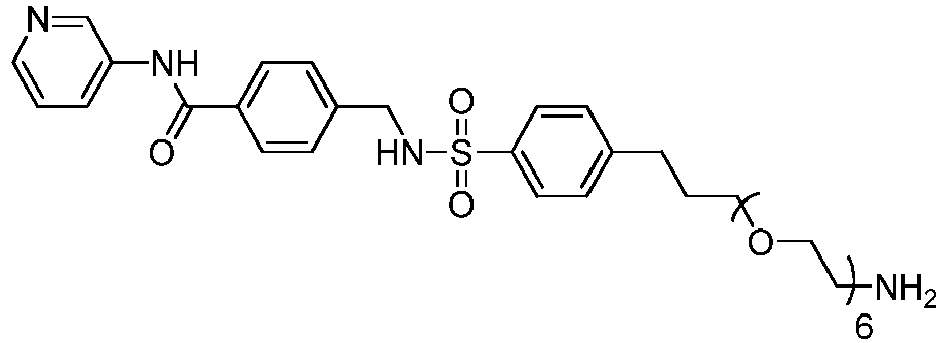
- tert-Butyl 21-{4-[({4-[(3-Pyridinylamino)carbonyl]benzyl}amino)sulfonyl]phenyl} -3,6,9,12,15,18-hexaoxahenicos-1-ylcarbamate (148). A mixture of alkyne 115 (743 mg, 0.95 mmol) and 10% Pd/C (250 mg, 0.1 mmol) in absolute EtOH (30 mL) was stirred at 20 ºC under of H2 (60 psi) for 16 h. The mixture was filtered through Celite, washed with EtOH (100 mL), and the solvent was evaporated. The residue was purified by column chromatography, eluting with a gradient (3-5%) of MeOH/DCM, to give the carbamate 148 (650 mg, 87%) as a pale yellow oil: 1H NMR δ 10.35 (s, 1 H, CONH), 8.92 (d, J = 2.4 Hz, 1 H, H-2'), 8.31 (dd, J = 4.7, 1.4 Hz, 1 H, H-6'), 8.17-8.20 (m, 2 H, NHSO2, H-4'), 7.88 (br d, J = 8.3 Hz, 2 H, H-2, H-6), 7.88 (br d, J = 8.3 Hz, 2 H, H-2", H-6"), 7.37-7.40 (m, 5 H, H-5', H-3, H-5, H-3", H-5"), 6.69 (br s, 1 H, NHCO2), 4.08 (d, J = 5.0 Hz, 2 H, CH2N), 3.45-3.52 (m, 20 H, CH2O), 3.37 (t, J = 6.2 Hz, 4 H, H-3"', H-20"'), 3.05 (q, J = 6.0 Hz, 2 H, H-21"'), 2.69 (t, J = 7.7 Hz, 2 H, H-1"'), 1.77-1.84 (m, 2 H, H-2"'), 1.37 [s, 9 H, C(CH3)3]; HRMS calcd for C39H56N4O11S (M+) m/z 789.3739; found 789.3723 (1.6 ppm).
- 4-[({[4-(21-Amino-4,7,10,13,16,19-hexaoxahenicos-1-yl)phenyl]sulfonyl}amino) methyl]-N-(3-pyridinyl)benzamide (149). Trifluoroacetic acid (0.74 mL, 10 mmol) was added to a solution of carbamate 148 (313 mg, 0.4 mmol) in anhydrous DCM (5 mL) and the reaction mixture was stirred at 20 ºC for 2 h. The solvent was evaporated and the residue was purified by column chromatography, eluting with 8% MeOH/DCM containing 1% aqueous NH3, to give the amine 149 (195 mg, 71%) as a colourless oil: 1H NMR δ 10.35 (br s, 1 H, CONH), 8.92 (d, J = 2.2 Hz, 1 H, H-2'), 8.31 (dd, J = 4.7, 1.4 Hz, 1 H, H-6'), 8.18 (ddd, J = 8.3, 2.5, 1.5 Hz, 1 H, H-4'), 7.88 (br. d, J = 8.3 Hz, 2 H, H-2, H-6), 7.70 (br. d, J = 8.3 Hz, 2 H, H-2", H-6"), 7.37-7.40 (m, 5 H, H-5', H-3, H-5, H-3", H-5"), 4.08 (s, 2 H, CH 2NHSO2), 3.45-3.52 (m, 20 H, CH2O), 3.37 (t, J = 6.3 Hz, 2 H, H-3"'), 3.34 (t, J = 5.8 Hz, 2 H, H-20"'), 2.70 (t, J = 7.9 Hz, 2 H, H-1"'), 2.63 (t, J = 5.7 Hz, 2 H, H-21"'), 1.80 (tt, J = 6.4, 7.9 Hz, 2 H, H-2"'), NHSO2 and NH2 not observed; 13C NMR δ165.4, 146.6, 144.4, 141.9, 141.7, 138.0, 135.7, 132.8, 128.9 (2), 127.5 (2), 127.3 (2), 127.2, 126.4 (2), 123.3, 72.2, 69.69 (2), 69.66 (4), 69.62 (2), 69.4, 69.3, 69.1, 45.6, 40.9, 31.3, 30.4; H RMS calcd for C34H48N4O9S (M+) m/z 689.3215; found 389.3224 (-1.0 ppm).
-

- A mixture of fluoride 52 (113 mg, 0.29 mmol) and 3-(4-morpholinyl)propylamine (2.0 mL) in DMSO (1 mL) was stirred in a sealed tube at 130 °C for 16 h. The mixture suspended in ice/water (50 mL) for 1 h. The precipitate was filtered, washed with water (5 mL) and dried. The crude solid was purified by column chromatography, eluting with a gradient (5-10%) of MeOH/DCM followed by 1% aqueous NH3/10% MeOH/DCM, to give benzamide 150 (135 mg, 91%) as a white powder: mp (EtOAc) 181-183 °C; 1H NMR δ 10.36 (s, 1 H, CONH), 8.93 (d, J = 2.3 Hz, 1 H, H-2'), 8.31 (dd, J = 4.7, 1.4 Hz, 1 H, H-6'), 8.19 (ddd, J = 8.3, 2.4, 1.5 Hz, 1 H, H-4'), 7.90 (br d, J = 8.3 Hz, 2 H, H-2, H-6), 7.75 ( br s, 1 H, NHSO2), 7.30 (br d, J = 8.8 Hz, 2 H, H-2", H-6"), 7.36-7.43 (m, 3 H, H-3, H-5, H-5'), 6.62 (br d, J = 8.8 Hz, 2 H, H-3", H-5"), 6.48 (br t, J = 5.4 Hz, 1 H, NH), 3.98 (br d, J = 6.4 Hz, 2 H, CH2N), 3.58 (br t, J = 4.6 Hz, 4 H, 2 × CH2N), 3.10 (dt, J = 6.5, 5.4 Hz, 2 H, CH2N), 2.30-2.38 (m, 6 H, CH2H, 2 × CH2O), 1.68 (p, J = 6.9 Hz, 2 H, 2 × CH2); 13C NMR δ 165.5, 152.0, 144.5, 142.3, 142.0, 135.8, 132.9, 128.4 (2), 127.6 (2), 127.4 (2), 127.2, 125.2, 123.4 (2), 110.8, 66.2 (2), 55.9, 53.4 (2), 45.7, 40.5, 25.3; MS m/z 510.8 (MH+, 100%). The compound was formulated as the HCl salt. Anal. calcd for C26H31N5O4S·HCl: C, 61.28; H, 6.13; N, 13.74. Found: C, 61.27; H, 6.15; N, 13.84%.
-

- A mixture of fluoride 29 (110 mg, 0.29 mmol) and 4-methylpiperazine (2 mL) in DMSO (1 mL) was stirred in a sealed tube at 130 °C for 72 h. The solvent was evaporated and the residue was suspended in ice/water (50 mL) for 1 h. The precipitate was filtered, washed with water (5 mL) and dried. The crude solid was purified by column chromatography, eluting with a gradient (5-10%) of MeOH/DCM followed by 1% aqueous NH3/10% MeOH/DCM, to give starting material 29 (67 mg, 60%) and benzamide 151 (45 mg, 33%) as a white powder: 1H NMR δ 10.36 (s, 1 H, CONH), 8.93 (d, J = 2.4 Hz, 1 H, H-2'), 8.31 (dd, J = 4.7, 1.4 Hz, 1 H, H-6'), 8.18 (ddd, J = 8.3, 2.4, 1.5 Hz, 1 H, H-4'), 8.13 (t, J = 6.3 Hz, 1 H, NHSO2), 7.91 (br d, J = 8.3 Hz, 2 H, H-2, H-6), 7.37-7.43 (m, 4 H, H-3, H-5, H-5', H-5"), 7.25 (br t, J = 1.9 Hz, 1 H, H-2"), 7.16-7.21 (m, 2 H, H-4", H-6"), 4.07 (d, J = 6.3 Hz, 2 H, CH2N), 3.15-3.3.20 (m, 6 H, 3 × CH2N), 2.48-2.52 (m, 2 H, CH2N), 2.20 (s, 3 H, NCH3); 13C NMR δ 165.5, 151.0, 144.5, 142.0, 141.9, 141.4, 135.8, 133.0, 129.7, 127.7 (2), 127.4 (2), 127.3, 123.5, 118.7, 116.1, 112.1, 54.2 (2), 43.7 (2), 45.8, 45.4; MS m/z 466.7 (MH+, 100%).
-

- A mixture of fluoride 52 (170 mg, 0.44 mmol) and N,N-dimethylethylenediamine (2.0 mL) in DMSO (1 mL) was stirred in a sealed tube at 130 °C for 40 h. The mixture suspended in ice/water (50 mL) for 1 h. The precipitate was filtered, washed with water (5 mL) and dried. The crude solid was purified by column chromatography, eluting with a gradient (5-10%) of MeOH/DCM followed by 1%aqueous NH3/10% MeOH/DCM, to give benzamide 152 (171 mg, 86%) as a white powder: mp (EtOAc) 166-168 °C; 1H NMR δ 10.36 (s, 1 H, CONH), 8.93 (d, J = 2.2 Hz, 1 H, H-2'), 8.31 (dd, J = 4.7, 1.5 Hz, 1 H, H-6'), 8.18 (ddd, J = 8.3, 2.5, 1.5 Hz, 1 H, H-4'), 7.90 (br d, J = 8.3 Hz, 2 H, H-2, H-6), 7.76 (t, J = 6.4 Hz, 1 H, NHSO2), 7.50 (d, J = 8.9 Hz, 2 H, H-2", H-6"), 7.35-7.43 (m, 3 H, H-3, H-5, H-5'), 6.66 (d, J = 8.9 Hz, 2 H, H-3", H-5"), 6.28 (br t, J = 5.3 Hz, 1 H, NH), 3.99 (d, J = 6.4 Hz, 2 H, CH2N), 3.14 (dt, J = 6.5, 5.3 Hz, 2 H, CH2N), 2.43 (t, J = 6.5 Hz, 2 H, CH2N), 2.18 [s, 6 H, N(CH3)2]; 13C NMR δ 165.4, 151.7, 144.5, 142.1, 141.9, 135.8, 132.8, 128.3 (2), 127.5 (2), 127.3 (2), 127.1, 125.3, 123.3 (2), 110.8, 57.4, 45.6, 45.1 (2), 40.3; MS m/z 454.7 (MH+, 100%). Anal. calcd for C23H27N5O3S: C, 60.91; H, 6.00; N, 15.44. Found: C, 60.93; H, 6.00; N, 15.54%.
-

- PdCl2(dppf) (25 mg, 0.03 mmol) was added to a degassed solution of iodide 106 (150 mg, 0.3 mmol), 3-trifluoromethylboronic acid (75 mg, 0.39 mmol) and K2CO3 (415 mg, 3 mmol) in a mixture of toluene/ethanol/H2O/DMF (5:3:2:2, 12 mL) and the mixture was heated at 90 ºC for 16 h. The mixture was cooled to 20 ºC, partitioned between EtOAc (200 mL) and H2O (50 mL), and washed with brine (50 mL). The organic phase was dried, filtered and the solvent was evaporated. The residue was purified by column chromatography, eluting with a gradient (3-5%) of MeOH/DCM, to give benzamide 153 (147 mg, 96%) as a white powder: mp (MeOH/DCM) 227-229 ºC; 1H NMR δ 10.33 (s, 1 H, CONH), 8.90 (d, J = 2.4 Hz, 1 H, H-2"'), 8.35 (t, J = 6.4 Hz, 1 H, NHSO2), 8.31 (dd, J = 1.4, 4.6 Hz, 1 H, H-6"'), 8.16 (ddd, J = 1.6, 2.4, 8.3 Hz, 1 H, H-4"'), 8.05-8.03 (m, 2 H, H-2", H-4"), 7.95 (br d, J = 8.5 Hz, 2 H, H-2', H-6'), 7.89 (br. d, J = 8.7 Hz, 4 H, H-2, H-6, H-3', H-5'), 7.79 (br. d, J = 7.8 Hz, 1 H, H-6"), 7.72 (br. t, J = 8.0, 1 H, H-5"), 7.42 (br. d, J = 8.3 Hz, 2 H, H-3, H-5), 7.38 (dd, J = 4.7, 8.4 Hz, 1 H, H-5'"), 4.14 (d, J = 6.3 Hz, 2 H, CH 2NH); 13C NMR δ 165.4, 144.4, 142.1, 141.8, 141.5, 140.1, 139.5, 135.6, 132.9, 131.1, 130.0, 129.8 (q, J = 31.8 Hz), 127.7 (2), 127.6 (2), 127.4 (2), 127.1 (2), 124.9 (q, J = 3.7 Hz), 124.0 (q, J = 272.5 Hz), 123.4, (q, J = 3.9 Hz), 123.3, 45.7, 1 resonance not observed; MS m/z 513.4 (MH+, 100%). Anal. calcd for C26H20F3N3O3S: C, 61.05; H, 3.94; N, 8.21. Found: C, 61.13; H, 3.84; N, 8.22%.
-

- PdCl2(dppf) (25 mg, 0.03 mmol) was added to a degassed solution of iodide 106 (150 mg, 0.3 mmol), 2-benzyl-4,4,5,5-tetramethyl-1,3,2-dioxaborolane (87 mg, 0.39 mmol) and K2CO3 (415 mg, 3 mmol) in a mixture of toluene/ethanol/H2O/DMF (5:3:2:2, 12 mL) and the mixture was heated at 90 ºC for 16 h. The mixture was cooled to 20 ºC, partitioned between EtOAc (200 mL) and H2O (50 mL), and washed with brine (50 mL). The organic phase was dried, filtered and the solvent evaporated. The residue was purified by column chromatography, eluting with 30% EtOAc/pet. ether, to give benzamide 154 (40 mg, 29%) as a white powder: mp (EtOAc/pet. ether) 198-200 ºC; 1H NMR δ 10.36 (s, 1 H, CONH), 8.93 (d, J = 2.3 Hz, 1 H, H-2'), 8.31 (dd, J = 4.7, 1.4 Hz, 1 H, H-6'), 8.17-8.20 (m, 2 H, NHSO2, H-4'), 7.88 (br d, J = 8.3 Hz, 2 H, H-2, H-6), 7.73 (br d, J = 8.3 Hz, 2 H, H-2", H-6"), 7.37-7.43 (m, 5 H, H-3, H-5, H-5', H-3", H-5"), 7.28-7.32 (m, 2 H, H-3'", H-5'"), 7.23-7.25 (m, 2 H, H-2'", 6'"), 7.17-7.21 (m, 1 H, H-4'"), 4.07 (s, 2 H, CH 2NH), 4.03 (s, 2 H, CH2Ph); 13C NMR δ165.4, 146.0, 144.4, 141.9, 141.7, 140.1, 138.3, 135.7, 132.9, 129.2 (2), 128.6 (2), 128.4 (2), 127.5 (2), 127.3 (2), 127.1, 126.6 (2), 126.1, 123.3, 45.6, 40.6; MS m/z 459.3 (MH+, 100%). Anal. calcd for C26H23N3O3S: C, 68.25; H, 5.07; N, 9.18; Found: C, 68.14; H, 4.98; N, 9.17%.
-

- MsCl (22 µL, 0.29 mmol) was added to a solution of alcohol 119 (100 mg, 0.24 mmol) and NEt3 (67 µL, 0.48 mmol) in anhydrous THF (10 mL) at -20 ºC and the reaction mixture was stirred at -20 ºC for 1 h. The mixture was diluted with EtOAc (100 mL), washed with H2O (30 mL) and then washed with brine (30 mL). The organic phase was dried, filtered and the solvent was evaporated. Morpholine (0.44 mL, 5.0 mmol) was added to a solution of crude mesylate in anhydrous THF (20 mL) and the solution was stirred at 50 ºC for 2 h. The solution was cooled to 20 ºC, partitioned between EtOAc (200 mL) and saturated aqueous NaHCO3 solution (50 mL), and the organic fraction was washed with NaHCO3 (50 mL). The organic phase was dried, filtered and the solvent was evaporated. The residue was purified by column chromatography, eluting with 5% MeOH/DCM containing 0.5% aqueous NH3, to give benzamide 155 (56 mg, 47%) as a white powder: mp (MeOH/DCM) 209-211 ºC; 1H NMR δ10.36 (s, 1 H, CONH), 8.92 (d, J = 2.3 Hz, 1 H, H-2'), 8.34 (d, J = 6.3 Hz, 1 H, NHSO2), 8.31 (dd, J = 1.3, 4.7 Hz, 1 H, H-6'), 8.18 (ddd, J = 8.3, 2.4, 1.5 Hz, 1 H, H-4'), 7.90 (br d, J = 8.3 Hz, 2 H, H-2, H-6), 7.78 (br d, J = 8.5 Hz, 2 H, H-2", H-6"), 7.62 (br d, J = 8.5 Hz, 2 H, H-3", H-5"), 7.37-7.41 (m, 3 H, H-3, H-5, H-5'), 4.10 (d, J = 6.3 Hz, 2 H, CH 2NH), 3.61 (t, J = 4.5 Hz, 4 H, 2 × CH2O), 3.54 (s, 2 H, CH2C≡C), 2.51 (m, 4 H, 2 × CH2N); 13C NMR δ 165.4, 144.4, 141.9, 141.5, 140.0, 135.7, 133.0, 131.9 (2), 127.6 (2), 127.3 (2), 127.2, 126.7 (2), 126.2, 123.3, 88.4, 83.7, 65.9 (2), 51.6 (2), 46.8, 45.6; MS m/z 492.4 (MH+, 100%); Anal. calcd for C26H26N4O4S: C, 63.66; H, 5.34; N, 11.42; Found: C, 63.65; H, 5.33; N, 11.37%.
-

- MsCl (41 µL, 0.53 mmol) was added to a solution of alcohol 119 (185 mg, 0.44 mmol) and Et3N (0.13 mL, 0.88 mmol) in anhydrous THF (10 mL) at -20 ºC and the reaction mixture was stirred at -20 ºC for 1 h. The solution was then diluted with EtOAc (100 mL), washed with H2O (30 mL) then brine (30 mL). The organic phase was dried, filtered and the solvent was evaporated. A 2 M solution of dimethylamine in THF (2.2 mL, 4.4 mmol) was added to a solution of crude mesylate in anhydrous DMF (10 mL) and the reaction mixture was stirred at 50 ºC for 2 h. The solution was cooled to 20 ºC, then partitioned between EtOAc (200 mL) and saturated aqueous NaHCO3 solution (50 mL), and washed with NaHCO3 (50 mL). The organic phase was dried, filtered and the solvent was evaporated. The residue was purified by column chromatography, eluting with 5% MeOH/DCM containing 0.5% aqueous NH3, to give benzamide 156 (93 mg, 47%) as a pale yellow solid: mp (MeOH/DCM) 200-202 ºC; 1H NMR δ 10.35 (s, 1 H, CONH), 8.93 (d, J = 2.3 Hz, 1 H, H-2'), 8.30-8.35 (m, 2 H, NHSO2, H-6'), 8.18 (ddd, J = 8.3, 2.4, 1.5 Hz, 1 H, H-4'), 7.90 (br. d, J = 8.3 Hz, 2 H, H-2, H-6), 7.78 (br. d, J = 8.5 Hz, 2 H, H-2", H-6"), 7.62 (br d, J = 8.5 Hz, 2 H, H-3", H-5"), 7.36-7.41 (m, 3 H, H-5', H-3, H-5), 4.10 (d, J= 6.2 Hz, 2 H, CH 2NH), 3.48 (s, 2 H, CH 2N(CH3)2), 2.23 [s, 6 H, N(CH3)2]; 13C NMR δ 165.4, 144.4, 141.9, 141.5, 139.9, 135.7, 133.0, 131.9 (2), 127.6 (2), 127.3 (2), 127.1, 126.7 (2), 126.4, 123.3, 88.6, 83.6, 47.5, 45.6, 43.6 (2); MS m/z 450.2 (MH+, 100%). Anal. calcd for C24H24N4O3S: C, 64.27; H, 5.39; N, 12.49; Found: C, 64.41; H, 5.38; N, 12.42%.
-

- Mel (8 µL, 0.12 mmol) was added to a stirred suspension of benzamide 47 (50 mg, 0.12 mmol) and Cs2CO3 (80 mg, 0.24 mmol) in anhydrous DMF (2 mL), and the reaction mixture was stirred at 20 ºC for 16 h. The mixture was partitioned between EtOAc (100 mL) and H2O (30 mL), and the organic fraction was washed with brine (30 mL). The organic phase was dried, filtered and the solvent was evaporated. The residue was purified by column chromatography, eluting with 5% MeOH/DCM, to give benzamide 157 (30 mg, 57%) as a white powder. mp (MeOH/DCM) = 215-218 ºC; 1H NMR δ 10.41 (s, 1 H, CONH), 8.92 (d, J = 2.3, 1 H, H-2'), 8.31 (dd, J = 4.6, 1.4 Hz, 1 H, H-6'), 8.18 (ddd, J = 8.3, 2.5, 1.5 Hz, 1 H, H-4'), 7.97 (d, J= 8.3 Hz, 2 H, H-2, H-6), 7.79 (dt, J = 8.6, 1.7 Hz, 2 H, H-2", H-6"), 7.68 (dt, J = 8.6, 1.8 Hz, 2 H, H-3", H-5"), 7.48 (d, J = 8.3 Hz, 2 H, H-3, H-5), 7.39 (ddd, J = 8.3, 4.6, 0.4 Hz, 1 H, H-5'), 4.25 (s, 2 H, CH2N), 2.60 (s, 3 H, NCH3), 1.34 [s, 9 H, C(CH3)3]; 13C NMR δ165.6, 156.1, 144.2, 141.6, 140.3, 135.9, 134.2, 133.6, 128.1 (2), 128.0 (2), 127.6, 127.1 (2), 126.3 (2), 123.6, 52.9, 34.9, 34.7, 30.8 (3); MS m/z 439.2 (MH+, 100%); Anal. calcd for C24H27N3O3S: C, 65.88; H, 6.22; N, 9.60; Found: C, 65.78; H, 6.31; N, 9.69%.
-

- Ethyl iodide (38 µL, 0.47 mmol) was added to a stirred suspension of benzamide 47 (200 mg, 0.47 mmol) and Cs2CO3 (308 mg, 0.94 mmol) in anhydrous DMF (5 mL), and the reaction mixture was stirred at 20 ºC for 24 h. The mixture was partitioned between EtOAc (150 mL) and H2O (50 mL), and the organic fraction was washed with brine (50 mL). The organic phase was dried, filtered and the solvent was evaporated. The residue was purified by column chromatography, eluting with 30% EtOAc/pet. ether to give benzamide 158 (63 mg, 30%) as a white solid; mp (EtOAc/pet. ether) 163-165 ºC; 1H NMR δ 10.41 (s, 1 H, CONH), 8.93 (d, J = 2.4 Hz, 1 H, H-2'), 8.31 (dd, J = 4.7, 1.4 Hz, 1 H, H-6'), 8.18 (ddd, J = 8.3, 2.5, 1.5 Hz, 1 H, H-4'), 7.95 (br d, J = 8.3 Hz, 2 H, H-2, H-6), 7.80 (dt, J = 8.6, 2.0 Hz, 2 H, H-2", H-6"), 7.65 (dt, J = 8.6, 1.9 Hz, 2 H, H-3", H-5"), 7.49 (br d, J = 8.3 Hz, 2 H, H-3, H-5), 7.39 (dd, J = 8.8, 4.7 Hz, 1 H, H-5'), 4.41 (s, 2 H, CH 2NEtSO2), 3.16 (q, J = 7.2 Hz, 2 H, CH 2CH3), 1.33 [s, 9 H, C(CH3)3], 0.88 (t, J = 7.1 Hz, 3 H, CH2C3); 13C NMR δ 165.5, 155.7, 144.4, 141.9, 141.4, 136.4, 135.6, 133.3, 127.8 (2), 127.7 (2), 127.2, 126.7 (2), 126.1 (2), 123.3, 50.4, 43.0, 34.7, 30.7 (3), 13.6; MS m/z 453.3 (MH+, 100%). Anal. calcd for C25H29N3O3S: C, 66.49; H, 6.47; N, 9.31. Found: C, 66.66; H, 6.67; N, 9.25%.
-

- Propyl iodide (46 µL, 0.47 mmol) was added to a stirred suspension of benzamide 47 (200 mg, 0.47 mmol) and Cs2CO3 (308 mg, 0.94 mmol) in anhydrous DMF (5 mL), and the reaction mixture was stirred at 20 ºC for 24 h. The mixture was partitioned between EtOAc (150 mL) and H2O (50 mL), and the organic fraction was washed with brine (50 mL). The organic phase was dried, filtered and the solvent was evaporated. The residue was purified by column chromatography, eluting with 40% EtOAc/pet. ether to give benzamide 159 (132 mg, 60%) as a white solid; mp (EtOAc/pet. ether) 177-179 ºC; 1H NMR δ 10.41 (s, 1 H, CONH), 8.92 (d, J = 2.3 Hz, 1 H, H-2'), 8.31 (dd, J = 4.7, 1.4 Hz, 1 H, H-6'), 8.18 (ddd, J = 8.3, 2.5, 1.5 Hz, 1 H, H-4'), 7.94 (br. d, J = 8.3 Hz, 2 H, H-2, H-6), 7.79 (dt, J = 8.6, 1.9 Hz, 2 H, H-2", H-6"), 7.64 (dt, J = 8.6, 1.9 Hz, 2 H, H-3", H-5"), 7.48 (br d, J = 8.3 Hz, 2 H, H-3, H-5), 7.39 (ddd, J = 8.3, 4.7, 0.4 Hz, 1 H, H-5'), 4.39 (s, 2 H, CH 2NPrSO2), 3.06 (br t, J = 7.5 Hz, 2 H, NCH 2CH2CH3), 1.33 [s, 9 H, C(CH3)3], 1.33-1.27 (m, 2 H, NCH2CH 2CH3), 0.67 (t, J= 7.4 Hz, 3 H, NCH2CH2CH 3); 13C NMR δ 165.5,155.7, 144.4, 141.9, 141.5, 136.2, 135.7, 133.3, 127.71 (2), 127.70 (2), 127.2, 126.7 (2), 126.1 (2), 123.4, 51.3, 50.5, 34.8, 30.7 (3), 21.3, 10.8; MS m/z 467.3 (MH+, 100%). Anal. calcd for C26H31N3O3S: C, 67.07; H, 6.71; N, 9.02. Found: C, 66.78; H, 6.78; N, 8.93%.
-

- A mixture of alkyne 155 (190 mg, 0.39 mmol) and 10% Pd/C (70 mg, 0.06 mmol) in MeOH (20 mL) was stirred at 20 ºC under of H2 (60 psi) for 4 h. The mixture was filtered through Celite, the pad was washed with MeOH (100 mL), and the solvent was evaporated. The residue was purified by column chromatography, eluting with 6% MeOH/DCM containing 0.5% aqueous NH3, to give the benzamide 160 (50 mg, 26%) as a white powder: mp (MeOH/DCM) 170-171 ºC; 1H NMR δ 10.35 (s, 1 H, CONH), 8.92 (d, J = 2.3 Hz, 1 H, H-2'), 8.31 (dd, J = 4.7, 1.4 Hz, 1 H, H-6'), 8.20-8.16 (m, 2 H, NHSO2, H-4'), 7.88 (br d, J = 8.3 Hz, 2 H, H-2, H-6), 7.69 (br d, J = 8.3 Hz, 2 H, H-2", H-6"), 7.40-7.37 (m, 5 H, H-3, H-5, H-5', H-3", H-5"), 4.08 (d, J = 6.3 Hz, 2 H, CH2NHSO2), 3.54 (t, J = 4.6 Hz, 4 H, H-2"", H-6""), 2.66 (t, J = 7.4 Hz, 2 H, H-1"'), 2.31 (t, J = 4.3 Hz, 4 H, H-3"", H-5""), 2.25 (t, J = 7.2 Hz, 2 H, H-3"'), 1.73 (q, J = 7.4 Hz, 2 H, H-2"'); 13C NMR δ 165.5, 147.1, 144.5, 142.0, 141.8, 138.1, 135.8, 133.0, 129.0 (2), 127.6 (2), 127.4 (2), 127.2, 126.5 (2), 126.5, 66.2 (2), 57.4, 53.2 (2), 45.8, 32.6, 27.4; MS m/z 496.4 (MH+, 100%). Anal. calcd for C26H30N4O4S: C, 63.14; H, 6.11; N, 11.33. Found: C, 63.10; H, 6.19; N, 11.36%.
-

- A mixture of alkyne 156 (250 mg, 0.56 mmol) and 10% Pd/C (80 mg, 0.07 mmol) in MeOH (20 mL) was stirred at 20 ºC under of H2 (60 psi) for 4 h. The mixture was filtered through Celite, the pad was washed with MeOH (100 mL), and the solvent was evaporated. The residue was purified by column chromatography, eluting with 6% MeOH/DCM containing 0.5% aqueous NH3, to give benzamide 161 (100 mg, 40%) as a white powder: mp (MeOH/DCM) 169-170 ºC; 1H NMR δ 10.35 (s, 1 H, CONH), 8.92 (d, J = 2.2 Hz, 1 H, H-2'), 8.31 (dd, J = 1.5 Hz, 1 H, H-6'), 8.16-8.20 (m, 2 H, NHSO2, H-4'), 7.88 (br d, J = 8.3 Hz, 2 H, H-2, H-6), 7.70 (br d, J = 8.3 Hz, 2 H, H-2", H-6"), 7.38-7.40 (m, 5 H, H-3, H-5, H-5', H-3", H-5"), 4.08 (d, J = 6.1 Hz, 2 H, CH2NHSO2), 2.65 (t, J = 7.4 Hz, 2 H, H-1"'), 2.18 (t, J = 7.2 Hz, 2 H, H-3"'), 2.11 [s, 6 H, N(CH3)2], 1.69 (br q, J = 7.3 Hz, 2 H, H-2"'); 13C NMR δ 165.5, 147.1, 144.5, 142.0, 141.8, 138.1, 135.8, 133.0, 129.0 (2), 127.6 (2), 127.4 (2), 127.3, 126.5 (2), 123.4, 58.3, 45.7, 45.1 (2), 32.6, 28.5; MS m/z 454.3 (MH+, 100%). Anal. calcd for C24H28N4O3S·H2O: C, 61.26; H, 6.43; N, 11.91. Found: C, 61.61; H, 6.17; N, 11.90%.
-

- Propionyl chloride (25 µL, 0.29 mmol) was added dropwise to a stirred solution of aniline 26* (106 mg, 0.28 mmol) and iPr2NEt2 (54 µL, 0.31 mmol) in dry THF (10 mL) and the solution was stirred at 20 °C for 16 h. The solvent was evaporated and the residue was suspended in ice/water (30 mL) for 1 h. The precipitate was filtered, washed with water (10 mL) and dried. The residue was purified by column chromatography, eluting with a gradient (0-10%) of MeOH/EtOAc, to give benzamide 162 (78 mg, 64%) as a white powder: mp (EtOH/EtOAc) 215-218 °C; 1H NMR δ 10.38 (s, 1 H, CONH), 10.17 (s, 1 H, CONH), 8.93 (d, J = 2.2 Hz, 1 H, H-2'), 8.31 (dd, J = 4.7, 1.5 Hz, 1 H, H-6'), 8.28 (t, J = 6.3 Hz, 1 H, NHSO2), 8.16-8.21 (m, 2 H, H-4', H-2"), 7.91 (br d, J = 8.3 Hz, 2 H, H-2, H-6), 7.77 (dt, J = 8.0, 1.7 Hz, 1 H, H-6"), 7.51 (t, J = 7.8 Hz, 1 H, H-5"), 7.47 (dt, J = 7.8, 1.6 Hz, 1 H, H-4"), 7.37-7.44 (m, 3 H, H-3, H-5, H-5'), 4.08 (s, 2 H, CH2N), 2.35 (q, J = 7.5 Hz, 2 H, CH2CO), 1.09 (t, J = 7.5 Hz, 3 H, CH3); 13C NMR δ 172.4, 165.5, 144.5, 142.0, 141.9, 141.0, 139.9, 135.8, 133.0, 129.7, 127.7 (2), 127.4 (2), 127.3 123.5, 122.3, 120.6, 116.7, 45.7, 29.5, 9.5; MS m/z 439.5 (MH+, 100%). Anal. calcd for C22H22N4O4S: C, 60.26; H, 5.06; N, 12.78. Found: C, 59.97; H, 5.18; N, 12.39%.
-

- Acryloyl chloride (50 µL, 0.62 mmol) was added dropwise to a stirred solution of aniline 26 (225 mg, 0.59 mmol) and iPr2NEt2 (113 µL, 0.65 mmol) in dry THF (10 mL) and the solution was stirred at 20 °C for 16 h. The solvent was evaporated and the residue was suspended in ice/water (30 mL) for 1 h. The precipitate was filtered, washed with water (10 mL) and dried. The residue was purified by column chromatography, eluting with a gradient (0-10%) of MeOH/EtOAc, to give benzamide 163 (76 mg, 30%) as a white powder: mp (EtOH/EtOAc) 178-180 °C,; 1H NMR δ 10.44 (s, 1 H, CONH), 10.36 (s, 1 H, CONH), 8.92 (d, J = 2.3 Hz, 1 H, H-2'), 8.25-8.33 (m, 3 H, NHSO2, H-6', H-2"), 8.18 (ddd, J = 8.4, 2.3, 1.6 Hz, 1 H, H-4'), 7.91 (br d, J = 8.2 Hz, 2 H, H-2, H-6), 7.87 (dt, J = 7.5, 1.7 Hz, 1 H, H-6"), 7.50-7.58 (m, 2 H, H-4", H-5"), 7.36-7.45 (m, 3 H, H-3, H-5, H-5'), 6.44 (dd, J = 17.0, 10.0 Hz, 1 H, =CH2), 6.30 (dd, J = 17.0, 2.0 Hz, 1 H, =CH2), 5.80 (dd, J = 10.0, 2.0 Hz, 1 H, =CH), 4.08 (d, J = 6.2 Hz, 2 H, CH2N); 13C NMR δ 165.5, 163.5, 144.5, 142.0, 141.8, 141.1, 139.6, 135.8, 133.0, 131.5, 129.8, 127.6 (2), 127.5, 127.4 (2), 127.3, 123.5, 122.7, 121.2, 117.1, 45.8; MS m/z 437.6 (MH+, 100%). Anal. calcd for C22H20N4O4S: C, 60.54; H, 4.62; N, 12.84. Found: C, 60.27; H, 4.67; N, 12.70%.
-

- 4-Cyano-2-methylbenzoic acid (164). A solution of nBuLi in THF (2.5 M, 2.24 mL, 5.6 mmol) was added dropwise to a stirred solution of 4-bromo-3-methylbenzonitrile (1.0 g, 5.1 mmol) in dry THF (50 mL) at -78 °C and the solution stirred at -78 °C for 1 h. A stream of dry CO2 was bubbled through the solution for 10 min and the mixture warmed to 20 °C. The mixture was diluted with water (100 ml) and washed with Et2O (3 × 20 mL). The aqueous phase was acidified to pH 2 with cHCl and extracted with CHCl3 (3 × 50 mL) and the organic fraction was dried and the solvent evaporated to give crude acid 164 (0.67 g, 82%) as a tan powder: mp (CHCl3) 193-195 °C; 1H NMR δ 13.43 (br s, 1 H, CO2H), 7.90 (d, J = 8.0 Hz, 1 H, H-6), 7.82 (br s, 1 H, H-3), 7.77 (dd, J = 8.0, 1.0 Hz, 1 H, H-5), 2.53 (s, 3 H, CH3).
- 4-Cyano-2-methyl-N-(3-pyridinyl)benzamide (165). Oxalyl chloride (720 µL, 8.32 mmol) was added dropwise to a stirred suspension of benzoic acid 164 (670 mg, 4.16 mmol) and DMF (1 drop) in dry THF (25 mL) and the solution was stirred at 20 °C for 2 h, then at 66 °C for 1 h. The solution was cooled to 20 °C, then the solvent was evaporated and the residue dissolved in dry pyridine (10 mL). 3-Pyridinylamine (430 mg, 4.60 mmol) was added and the solution stirred at 20 °C for 16 h. The solvent was evaporated and the residue suspended in ice/water (50 mL) for 1 h. The precipitate was filtered, washed with water (5 mL) and dried. The crude solid was purified by column chromatography, eluting with EtOAc, to give benzamide 165 (608 mg, 62%) as a white powder: mp (EtOAc) 193-195 °C; 1H NMR δ 10.70 (s, 1 H, CONH), 8.86 (d, J= 2.3 Hz, 1 H, H-2'), 8.33 (dd, J = 4.7, 1.5 Hz, 1 H, H-6'), 8.16 (ddd, J = 8.3, 2.4, 1.5 Hz, 1 H, H-4'), 7.85 (br s, 1 H, H-3), 7.81 (br dd, J = 7.9, 1.0 Hz, 1 H, H-5), 7.69 (d, J = 7.9 Hz, 1 H, H-6), 7.41 (dd, J = 8.3, 4.7 Hz, 1 H, H-5'), 2.42 (s, 3 H, CH3); MS m/z 238.4 (MH+, 100%). Anal. calcd for C14H11N3O: C, 70.87; H, 4.67; N, 11.71. Found: C, 70.68; H, 4.75; N, 17.52%.
- 4-(Aminomethyl)-2-methyl-N-(3-pyridinyl)benzamide (166). A mixture of benzamide 165 (410 mg, 1.72 mmol) and 10% Pd/C (50 mg) and cHCl (0.43 mL, 5.2 mmol) in EtOH (100 mL) was stirred under H2 (60 psi) at 20 °C for 16 h. The mixture was filtered through Celite, the Celite was washed with EtOH (20 mL), and the solvent was evaporated. The residue was partitioned between dilute aqueous NH3 solution (30 mL) and CHCl3 (3 × 30 mL) and the organic fraction dried and the solvent evaporated to give crude amine 166 (338 mg, 81%) as a gum: 1H NMR δ 10.43 (s, 1 H, CONH), 8.87 (d, J = 2.2 Hz, 1 H, H-2'), 8.29 (dd, J = 4.7, 1.5 Hz, 1 H, H-6'), 8.37 (br d, J = 8.3 Hz, 1 H, H-4'), 7.45 (br d, J = 7.7 Hz, 1 H, H-6), 7.37 (ddd, J = 8.3, 4.7, 0.5 Hz, 1 H, H-5'), 7.24-7.28 (m, 2 H, H-3, H-5), 3.73 (s, 2 H, CH2N), 2.38 (s, 3 H, CH3), 2.05 (s, 2 H, NH2); MS m/z 242.4 (MH+, 100%).
- 4-({[(4-tert-Butylphenyl)sulfonyl]amino}methyl)-2-methyl-N-(3-pyridinyl)benzamide (167). A mixture of benzamide 166 (334 mg, 1.38 mmol) and 4-tert-butylbenzenesulfonyl chloride (354 mg, 1.52 mmol) in dry pyridine (10 mL) was stirred at 20 °C for 16 h. The solvent was evaporated and the residue stirred in water (40 mL) for 1 h. The precipitate was filtered, washed with water (5 mL) and dried. The crude solid was purified by column chromatography, eluting with EtOAc, to give benzamide 167 (369 mg, 61%) as a white powder: mp (EtOAc) 162-163 °C; 1H NMR δ 10.43 (s, 1 H, CONH), 8.86 (d, J = 2.2 Hz, 1 H, H-2'), 8.30 (dd, J = 4.7, 1.5 Hz, 1 H, H-6'), 8.13-8.18 (m, 2 H, NHSO2, H-4'), 7.73 (ddd, J = 8.6, 2.2, 1.9 Hz, 2 H, H-2", H-6"), 7.60 (br d, J = 8.6, 2.2, 1.9 Hz, 2 H, H-3", H-5"), 7.43 (d, J = 7.8 Hz, 1 H, H-6), 7.37 (dd, J = 8.3, 4.7 Hz, 1 H, H-5'), 7.18 (br d, J = 7.8 Hz, 1 H, H-5), 7.12 (br s, 1 H, H-3), 4.08 (s, 2 H, CH2N), 2.32 (s, 3 H, CH3), 1.31 [s, 9 H, C(CH3)3]; 13C NMR δ 167.9, 155.2, 144.3, 141.2, 149.7, 137.9, 135.8, 135.4, 135.0, 129.6, 127.3, 126.4, 126.3 (2), 125.9 (2), 124.6, 123.5, 45.6, 34.7, 30.7 (3), 19.3; MS m/z 438.6 (MH+, 100%). Anal. calcd for C24H27N3O3S: C, 65.88; H, 6.22; N, 9.60. Found: C, 65.95; H, 6.40; N, 9.33%.
-

- 4-Cyano-2-fluoro-N-(3-pyridinyl)benzamide (168). Oxalyl chloride (0.79 mL, 9.08 mmol) was added dropwise to a stirred suspension of 4-cyano-2-fluorobenzoic acid (1.00 g, 6.06 mmol) and DMF (1 drop) in dry THF (40 mL) and the solution was stirred at 20 °C for 2 h, then at 66 °C for 1 h. The solution was cooled to 20 °C, then the solvent was evaporated and the residue dissolved in dry pyridine (10 mL). 3-Pyridinylamine (0.627 g, 6.67 mmol) was added and the solution stirred at 20 °C for 16 h. The solvent was evaporated and the residue suspended in ice/water (50 mL) for 1 h. The precipitate was filtered, washed with water (5 mL) and dried. The crude solid was purified by column chromatography, eluting with EtOAc, to give benzamide 168 (1.36 g, 93%) as a white powder: mp (EtOAc) 140-142 °C; 1H NMR δ 10.86 (s, 1 H, CONH), 8.85 (d, J= 2.2 Hz, 1 H, H-2'), 8.36 (dd, J = 4.7, 1.5 Hz, 1 H, H-6'), 8.14 (ddd, J = 8.3, 2.5, 1.5 Hz, 1 H, H-4'), 8.08 (dd, J =1 0.0, 1.1 Hz, 1 H, H-3), 7.85-7.93 (m, 2 H, H-5, H-6), 7.42 (ddd, J = 8.3, 4.7, 0.4 Hz, 1 H, H-5'); MS m/z 242.3 (MH+, 100%). Anal. calcd for C13H8FN3O·½H2O: C, 62.40; H, 3.63; N, 16.79. Found: C, 62.53; H, 3.50; N, 16.92%.
- 4-(Aminomethyl)-2-fluoro-N-(3-pyridinyl)benzamide (169). A mixture of benzamide 168 (163 mg, 0.68 mmol) and 10% Pd/C (30 mg) and cHCl (0.17 mL, 2.0 mmol) in EtOH (50 mL) was stirred under H2 (60 psi) at 20 °C for 16 h. The mixture was filtered through Celite, the Celite was washed with EtOH (20 mL), and the solvent was evaporated. The residue was partitioned between dilute aqueous NH3 solution (30 mL) and CHCl3 (3 × 30 mL) and the organic fraction dried and the solvent evaporated to give crude amine 169 (127 mg, 54%) as a white powder: mp (CHCl3) 90-91 -C: 1H NMR δ 10.51 (s, 1 H, CONH), 8.86 (d, J = 2.3 Hz, 1 H, H-2'), 8.31 (dd, J = 4.7, 1.5 Hz, 1 H, H-6'), 8.16 (br d, J = 8.3 Hz, 1 H, H-4'), 7.63 (t, J = 7.7 Hz, 1 H, H-6), 7.39 (ddd, J = 8.2, 4.7, 0.6 Hz, 1 H, H-5'), 7.34 (d, J =11.7 Hz, 1 H, H-3), 7.28 (dt, J = 7.8, 0.7 Hz, 1 H, H-5), 3.78 (s, 2 H, CH2N), 2.01 (s, 2 H, NH2); MS m/z 246.4 (MH+, 100%). Anal. calcd for C13H12FN3O: C, 63.66; H, 4.93; N, 17.13. Found: C, 63.54; H, 5.01; N, 17.01%.
- 4-({[(4-tert-Butylphenyl)sulfonyl]amino}methyl)-2-fluoro-N-(3-pyridinyl)benzamide (170). A mixture of benzamide 169 (116 mg, 0.34 mmol) and 4-tert-butylbenzenesulfonyl chloride (86 mg, 0.37 mmol) in dry pyridine (10 mL) was stirred at 20 °C for 16 h. The solvent was evaporated and the residue stirred in water (40 mL) for 1 h. The precipitate was filtered, washed with water (5 mL) and dried. The crude solid was purified by column chromatography, eluting with EtOAc, to give benzamide 170 (111 mg, 74%) as a white powder: mp (EtOAc) 185-187 °C; 1H NMR δ 10.52 (s, 1 H, CONH), 8.85 (d, J = 2.3 Hz, 1 H, H-2'), 8.32 (dd, J = 4.7, 1.5 Hz, 1 H, H-6'), 8.27 (br s, 1 H, NHSO2), 8.13 (br d, J = 8.8 Hz, 1 H, H-4'), 7.70 (ddd, J = 8.6, 2.2, 1.9 Hz, 2 H, H-2", H-6"), 7.55-7.61 (m, 3 H, H-6, H-3", H-5"), 7.39 (ddd, J = 8.3, 4.7, 0.4 Hz, 1 H, H-5'), 7.20 (br dd, J = 8.0, 1.3 Hz, 1 H, H-5), 7.15 (br d, J = 11.4 Hz, 1 H, H-3), 4.10 (s, 2 H, CH2N), 1.29 [s, 9 H, C(CH3)3]; 13C NMR δ 162.9, 158.8 (d, J = 249.9 Hz), 155.4, 144.8, 143.7 (d, J = 7.7 Hz), 141.4, 137.8, 135.5, 129.8 (d, J = 2.7 Hz), 126.8, 126.3 (2), 126.0 (2), 123.6, 123.4, 122.7 (d, J = 14.5 Hz), 114.9 (d, J = 22.8 Hz), 45.2, 34.8, 30.7 (3); MS m/z 442.6 (MH+, 100%). Anal. calcd for C23H24FN3O3S: C, 62.57; H, 5.48; N, 9.52. Found: C, 62.56; H, 5.57; N, 9.46%.
-

- 4-Cyano-3-methylbenzoic acid (171). A solution of nBuLi in THF (2.5 M, 4.49 mL, 11.2 mmol) was added dropwise to a stirred solution of 4-bromo-2-methylbenzonitrile (2.0 g, 10.2 mmol) in dry THF (100 mL) at -78 °C and the solution stirred at -78 °C for 1 h. A stream of dry CO2 was bubbled through the solution for 10 min and the mixture warmed to 20 °C. The mixture was diluted with water (100 ml) and washed with Et2O (3 × 20 mL). The aqueous phase was acidified to pH 2 with cHCl and extracted with CHCl3 (3 × 50 mL) and the organic fraction was dried and the solvent evaporated to give crude acid 171 (1.05 g, 64%) as a tan powder: mp (EtOAc) 215-217 °C; 1H NMR δ 13.49 (br s, 1 H, CO2H), 7.99 (br s, 1 H, H-2), 7.91 (br d, J = 7.9 Hz, 1 H, H-5), 7.87 (br d, J = 8.0 Hz, 1 H, H-6), 2.55 (s, 3 H, CH3).
- 4-Cyano-3-methyl-N-(3-pyridinyl)benzamide (172). Oxalyl chloride (763 µL, 8.75 mmol) was added dropwise to a stirred suspension of benzoic acid 171 (940 mg, 5.83 mmol) and DMF (1 drop) in dry THF (40 mL) and the solution was stirred at 20 °C for 2 h, then at 66 °C for 1 h. The solution was cooled to 20 °C, then the solvent was evaporated and the residue dissolved in dry pyridine (10 mL). 3-Pyridinylamine (603 mg, 6.41 mmol) was added and the solution stirred at 20 °C for 16 h. The solvent was evaporated and the residue suspended in ice/water (50 mL) for 1 h. The precipitate was filtered, washed with water (5 mL) and dried. The crude solid was purified by column chromatography, eluting with EtOAc, to give benzamide 172 (1.43 g, 99%) as a white powder: mp (EtOAc) 189-190 °C; 1H NMR δ 10.64 (s, 1 H, CONH), 8.92 (d, J = 2.4 Hz, 1 H, H-2'), 8.34 (dd, J = 4.7, 1.5 Hz, 1 H, H-6'), 8.18 (ddd, J = 8.3, 2.5, 1.5 Hz, 1 H, H-4'), 8.02 (br s, 1 H, H-2), 7.97 (d, J = 8.1 Hz, 1 H, H-5), 7.91 (dd, J = 8.1, 1.0 Hz, 1 H, H-6), 7.41 (dd, J = 8.3, 4.7 Hz, 1 H, H-5'), 2.59 (s, 3 H, CH3); MS m/z 238.4 (MH+, 100%). Anal. calcd for C14H11N3O: C, 70.87; H, 4.67; N, 11.71. Found: C, 70.95; H, 4.67; N, 17.68.
- 4-({[(4-tert-Butylphenyl)sulfonyl]amino}methyl)-3-methyl-N-(3-pyridinyl)benzamide (173). A mixture of benzamide 172 (240 mg, 1.00 mmol) and 10% Pd/C (50 mg) and cHCl (0.25 mL, 3.0 mmol) in EtOH (50 mL) was stirred under H2 (60 psi) at 20 °C for 16 h. The mixture was filtered through Celite, the Celite was washed with EtOH (20 mL), and the solvent was evaporated. The residue was partitioned between dilute aqueous NH3 solution (30 mL) and CHCl3 (3 × 30 mL) and the organic fraction dried and the solvent evaporated to give crude amine as a gum which was used directly. A mixture of crude amine (288 mg, 1.19 mmol) and 4-tert-butylbenzenesulfonyl chloride (306 mg, 1.31 mmol) in dry pyridine (10 mL) was stirred at 20 °C for 16 h. The solvent was evaporated and the residue stirred in water (40 mL) for 1 h. The precipitate was filtered, washed with water (5 mL) and dried. The crude solid was purified by column chromatography, eluting with EtOAc, to give benzamide 173 (44 mg, 10%) as a white powder: mp (EtOAc) 203-205 °C; 1H NMR δ 10.32 (s, 1 H, CONH), 8.91 (d, J = 2.3 Hz, 1 H, H-2'), 8.30 (dd, J = 4.7, 1.4 Hz, 1 H, H-6'), 8.17 (ddd, J = 8.3, 2.5, 1.5 Hz, 1 H, H-4'), 8.06 (t, J = 6.2 Hz, 1 H, NHSO2), 7.68-7.75 (m, 4 H, H-2, H-6, H-2", H-6"), 7.57 (ddd, J = 8.6, 2.2, 1.9 Hz, 2 H, H-3", H-5"), 7.33-7.40 (m, 2 H, H-5, H-5'), 4.04 (d, J = 6.2 Hz, 2 H, CH2N), 2.30 (s, 3 H, CH3), 1.30 [s, 9 H, C(CH3)3]; MS m/z 438.6 (MH+, 100%).
-

- 4-Cyano-3-fluoro-N-(3-pyridinyl)benzamide (174). Oxalyl chloride (0.79 mL, 9.08 mmol) was added dropwise to a stirred suspension of 4-cyano-3-fluorobenzoic acid (1.00 g, 6.06 mmol) and DMF (1 drop) in dry THF (40 mL) and the solution was stirred at 20 °C for 2 h, then at 66 °C for 1 h. The solution was cooled to 20 °C, then the solvent was evaporated and the residue dissolved in dry pyridine (10 mL). 3-Pyridinylamine (627 mg, 6.67 mmol) was added and the solution stirred at 20 °C for 16 h. The solvent was evaporated and the residue suspended in ice/water (50 mL) for 1 h. The precipitate was filtered, washed with water (5 mL) and dried. The crude solid was purified by column chromatography, eluting with EtOAc, to give benzamide 174 (1.19 g, 81%) as a white powder: mp (EtOAc) 189-191 °C; 1H NMR δ 10.71 (s, 1 H, CONH), 8.92 (d, J = 2.4 Hz, 1 H, H-2'), 8.36 (dd, J = 4.7, 1.5 Hz, 1 H, H-6'), 8.13-8.20 (m, 2 H, H-5, H-4'), 8.06 (dd, J =10.0, 1.4 Hz, 1 H, H-2), 7.97 (dd, J = 8.0, 1.5 Hz, 2 H, H-6), 7.43 (ddd, J = 8.3, 4.7, 0.7 Hz, 1 H, H-5'); MS m/z 242.3 (MH+, 100%). Anal. calcd for C13H8FN3O: C, 64.73; H, 3.34; N, 17.42. Found: C, 64.51; H, 3.31; N, 17.05%.
- 4-({[(4-tert-Butylphenyl)sulfonyl]amino}methyl)-3-fluoro-N-(3-pyridinyl)benzamide (175). A mixture of benzamide 174 (330 mg, 1.37 mmol) and 10% Pd/C (30 mg) and cHCl (0.34 mL, 4.1 mmol) in EtOH (30 mL) was stirred under H2 (60 psi) at 20 °C for 16 h. The mixture was filtered through Celite, the Celite was washed with EtOH (20 mL), and the solvent was evaporated. The residue was partitioned between dilute aqueous NH3 solution (30 mL) and CHCl3 (3 × 30 mL) and the organic fraction dried and the solvent evaporated to give crude amine which was used directly. A mixture of amine (106 mg, 0.43 mmol) and 4-tert-butylbenzenesulfonyl chloride (111 mg, 0.48 mmol) in dry pyridine (10 mL) was stirred at 20 °C for 16 h. The solvent was evaporated and the residue stirred in water (40 mL) for 1 h. The precipitate was filtered, washed with water (5 mL) and dried. The crude solid was purified by column chromatography, eluting with EtOAc, to give benzamide 175 (45 mg, 7%) as a white powder: mp (EtOAc) 198-200 °C; 1H NMR δ 10.40 (s, 1 H, CONH), 8.90 (d, J = 2.3 Hz, 1 H, H-2'), 8.33 (dd, J = 4.7, 1.2 Hz, 1 H, H-6'), 8.23 (t, J = 5.6 Hz, 1 H, NHSO2), 8.15 (ddd, J = 8.4, 2.5, 1.5 Hz, 1 H, H-4'), 7.71 (br d, J = 8.0 Hz, 1 H, H-6), 7.63-7.68 (m, 3 H, H-5, H-2", H-6"), 7.52 (br d, J = 8.5 Hz, 2 H, H-3", H-5"), 7.46 (br t, J = 7.8 Hz, 1 H, H-2), 7.40 (br dd, J = 8.3, 4.7 Hz, 1 H, H-5'), 4.12 (d, J = 5.6 Hz, 2 H, CH2N), 1.27 [s, 9 H, C(CH3)3]; MS m/z 442.6 (MH+, 100%).
-

- 4-Acetyl-N-(3-pyridinyl)benzamide (176). Oxalyl chloride (0.67 mL, 7.68 mmol) was added dropwise to a stirred suspension of 4-acetylbenzoic acid (0.97 g, 5.12 mmol) and DMF (1 drop) in dry THF (40 mL) and the solution was stirred at 20 °C for 2 h, then at 66 °C for 1 h. The solution was cooled to 20 °C, then the solvent was evaporated and the residue dissolved in dry pyridine (10 mL). 3-Pyridinylamine (505 mg, 5.38 mmol) was added and the solution stirred at 20 °C for 16 h. The solvent was evaporated and the residue suspended in ice/water (50 mL) for 1 h. The precipitate was filtered, washed with water (5 mL) and dried. The crude solid was purified by column chromatography, eluting with EtOAc, to give benzamide 176 (1.05 g, 85%) as a white powder: mp (EtOAc) 169-171 °C; 1H NMR δ 10.59 (s, 1 H, CONH), 8.94 (d, J = 2.2 Hz, 1 H, H-2'), 8.34 (dd, J = 4.7, 1.5 Hz, 1 H, H-6'), 8.20 (ddd, J = 8.3, 2.5, 1.5 Hz, 1 H, H-4'), 8.07-8.13 (m, 4 H, H-2, H-3, H-5, H-6), 7.42 (ddd, J = 8.3, 4.7, 0.6 Hz, 1 H, H-5'), 2.26 (s, 3 H, COCH3); MS m/z 241.3 (MH+, 100%). Anal. calcd for C14H12N2O2: C, 69.99; H, 5.03; N, 11.66. Found: C, 69.69; H, 5.05; N, 11.72%.
- 4-(1-{[(4-tert-Butylphenyl)sulfonyl]amino}ethyl)-N-(3-pyridinyl)benzamide (177). NaCNBH3 (40 mg, 0.63 mmol) was added to a stirred solution of benzamide 176 (217 mg, 0.90 mmol) and NH4OAc (0.70 g, 9.0 mmol) in dry MeOH (10 mL) and the mixture was stirred at 20 °C for 16 h. The solvent was evaporated and the residue was partitioned between dilute aqueous NH3 solution (30 mL) and CHCl3 (3 × 30 mL). The combined organic fraction was dried and the solvent evaporated to give crude 4-(1-aminoethyl)-N-(3-pyridinyl)benzamide (210 mg, 98%) as a white foam: 1H NMR δ 10.34 (s, 1 H, CONH), 8.93 (d, J = 2.2 Hz, 1 H, H-2'), 8.30 (dd, J = 4.7, 1.5 Hz, 1 H, H-6'), 8.19 (ddd, J = 8.3, 2.5, 1.5 Hz, 1 H, H-4'), 7.92 (br d, J = 8.3 Hz, 2 H, H-2, H-6), 7.53 (br d, J =8.3 Hz, 2 H, H-3, H-5), 7.39 (ddd, J = 8.3, 4.7, 0.5 Hz, 1 H, H-5'), 4.07 (q, J = 6.6 Hz, 2 H, CHN), 1.27 (s, 3 H, CH3). A mixture of amine (210 mg, 0.87 mmol) and 4-tert-butylbenzenesulfonyl chloride (213 mg, 0.91 mmol) in dry pyridine (10 mL) was stirred at 20 °C for 16 h. The solvent was evaporated and the residue stirred in water (40 mL) for 1 h. The precipitate was filtered, washed with water (5 mL) and dried. The crude solid was purified by column chromatography, eluting with EtOAc, to give benzamide 177 (163 mg, 43 %) as a white powder: 1H NMR δ 10.34 (s, 1 H, CONH), 8.90 (d, J = 2.4 Hz, 1 H, H-2'), 8.31 (dd, J = 4.7, 1.4 Hz, 1 H, H-6'), 8.21 (d, J = 8.4 Hz, 1 H, NHSO2), 8.15 (ddd, J = 8.3, 2.5, 1.5 Hz, 1 H, H-4'), 7.74 (br d, J = 8.3 Hz, 2 H, H-2, H-6), 7.51 (ddd, J = 8.5, 2.1, 1.8 Hz, 2 H, H-2", H-6"), 7.36-7.41 (m, 3 H, H-5', H-3", H-5"), 7.28 (br d, J = 8.3 Hz, 2 H, H-3, H-5), 4.39-4.49 (m, 2 H, CH2N), 1.28 (d, J = 7.0 Hz, 3 H, CH3), 1.27 [s, 9 H, C(CH3)3]; 3C NMR δ 165.3, 155.8, 146.9, 144.4, 141.9, 138.2, 135.7, 132.4, 127.3 (2), 127.2, 126.1 (2), 126.0 (2), 125.4 (2), 123.4, 52.6, 34.5, 30.6 (3), 23.4; MS m/z 438.6 (MH+, 100%).
- Using procedures similar to those described herein, the following compounds may be prepared and tested:
- 4-((4-(tert-butyl)phenylsulfonamido)methyl)-3-nitro-N-(pyridin-3-yl)benzamide;
- (S)-4-(1-(4-(tert-butyl)phenylsulfonamido)ethyl)-N-(pyridin-3-yl)benzamide and (R)-4-(1-(4-(tert-butyl)phenylsulfonamido)ethyl)-N-(pyridin-3-yl)benzamide and mixtures thereof;
- 4-(N-phenylsulfamoylmethyl)-N-(pyridin-3-yl)benzamide; 4-((N-(4-fluorophenyl)sulfamoyl)methyl)-N-(pyridin-3-yl)benzamide; 4-((N-(4-tert-butylphenyl)sulfamoyl)methyl)-N-(pyridin-3-yl)benzamide; 4-((N-(4-(4-methylpiperazin-1-yl)phenyl)sulfamoyl)methyl)-N-(pyridin-3-yl)benzamide.)
- Cell culture. RCC4 parental and RCC4 with VHL-reintroduced (RCC4/VHL), SN12C and SN12C-CSCG-VHL shRNA were maintained in DMEM supplemented with 10% FCS.
- IC50 Assays. IC50 values for compounds were determined by XTT assay. For 2,3-bis[2-methoxy-4-nitro-5-sulfophenyl]-2H-tetrazolium-5-carboxanilide inner salt (XTT) assays, five thousand cells were plated in 96-well plates. The next day, vehicle or drug was added to each well and incubated for four days. Media was aspirated and phenol red-free medium with 0.3 mg/mL XTT and 2.65 ug/mL N-methyl dibenzopyrazine methyl sulfate was added. This was incubated at 37 °C for 1-2 hours and absorbance was read at 450 nm. IC50 values for each compound were calculated using linear interpolation.
- Clonogenic assay. Three hundred cells were plated into 60-mm tissue culture dishes in DMEM. The next day, cells were treated with vehicle or drug and were further incubated for an additional 10 days. After 10 days, the media was removed and colonies were fixed and stained in 95% ethanol and 0.1% crystal violet for 15 minutes. The stain was removed and plates were washed in deionized water. Colonies were quantified. All conditions were measured in triplicate and all experiments were performed in triplicate.
- Glucose uptake. One hundred thousand cells were plated into 6-well plates. The following day, the cells were treated with vehicle or drug and incubated for the indicated time. Cells were washed twice in phosphate buffered saline and low glucose media was added for 30 minutes. Cells were then incubated with 0.5 microCi of tritiated-2-deoxyglucose and incubated for an hour at 37 °C. Cells were washed twice in PBS and then lysed in 0.2 N NaOH and 0.2% SDS. Lysates were transferred to scintillation tubes with scintillation fluid and quantified by scintillation counter.
- In vivo experiments. Five million cells were injected into the flanks of nu/nu mice (4-6 weeks old males) and allowed to grow to approximately 50 mm3. The mice were injected daily by intra-peritoneal to deliver either vehicle or drug. Tumors were measured every other day and tumor volume was calculated as 0.5 length by width squared.
- IC50values and selectivity ratios for certain exemplary compounds are described below. The designation A reflects an IC50 of <1 µM; B reflects an IC50 ranging from 1 to 20 µM; and C is an IC50 of > 20 µM. The designation "a" reflects a ratio of RCC4/RCC-VHL+ ranging from 1 to 10; "b" reflects from 10 to 100; "c" reflects a ratio of > 100, and "nd" represents "not determined".
Table 1 Example IC50 RCC4 µM Ratio (RCC4:RCC/VHL) Example 1 C nd Example 2 B a Example 3 C nd Example 4 C nd Example 5 C nd Example 6 C nd Example 7 C nd Example 8 C nd Example 9 C nd Example 10 B a Example 11 B a Example 12 B a Example 13 B a Example 14 C nd Example 15 C nd Example 16 C a Example 17 B b Example 18 B b Example 19 A b Example 20 A b Example 21 A b Example 22 A b Example 23 A b Example 24 B a Example 25 B b Example 26 B b Example 27 A b Example 28 A c Example 29 B b Example 30 A c Example 31 B b Example 32 B b Example 33 B b Example 34 A b Example 35 B b Example 36 B b Example 37 A b Example 38 A c Example 39 nd nd Example 40 nd nd Example 41 C nd Example 42 B a Example 43 B a Example 44 B b Example 45 B b Example 46 B b Example 47 C nd Example 48 A b Example 49 B a Example 50 B a Example 51 C nd Example 52 B b Example 53 B a Example 54 B b Example 55 A b Example 56 B b Example 57 A b Example 58 B a Example 59 B b Example 60 A b Example 61 A C Example 62 A C Example 63 A b Example 64 B a Example 65 A C Example 66 A C Example 67 A C Example 68 C nd Example 69 A b Example 70 B b Example 71 nd nd Example 72 B b Example 73 A c Example 74 A c Example 75 A c Example 76 A c Example 77 A b Example 78 A c Example 79 A b Example 80 A c Example 81 A b Example 82 A c Example 83 A c Example 84 A c Example 85 A c Example 86 C nd Example 87 C nd Example 88 C nd Example 89 B a Example 90 B a Example 91 C nd Example 92 C nd Example 93 C nd Example 94 B a Example 95 B b Example 96 C ND Example 97 C ND Example 98 B a Example 99 C ND Example 100 B a Example 101 B ND Example 102 C a Example 103 C nd Example 104 A c Example 105 C nd Example 107 C nd Example 108 C nd Example 109 C nd Example 110 C nd Example 111 C nd Example 112 C a Example 113 C a Example 114 C nd Example 115 C nd Example 116 C nd Example 117 C a Example 118 C nd Example 119 C nd Example 120 C nd Example 121 C nd Example 122 B a Example 123 B a Example 124 C nd Example 125 C nd Example 126 B b Example 127 A b Example 128 A c Example 129 A c Example 130 B a Example 131 A b Example 132 A b Example 133 A c Example 134 C nd Example 135 A b Example 136 A b Example 137 A b Example 138 B a Example 139 C a Example 140 C nd Example 141 A c Example 142 A b Example 143 nd nd Example 144 nd nd Example 145 nd nd Example 146 nd nd Example 147 nd nd Example 148 nd nd Example 149 nd nd Compound A C a Compound B B a Compound C C nd Compound D C nd Compound E B b 


- Cell Culture and Reagents. All cells were grown in DMEM +10% FCS. ACHN and ACHN shVHL were a kind gift from George V. Thomas (UCLA). HIF overexpressing clones were described previously. Transfection of RNA oligos were performed with DnarmaFECT Reagent 1 (Dharmcon), according to manufacturer's directions. ON-TARGETplus SMART pools against HIF-1β/ARNT were purchased from Dharmacon. Glut1 was detected with anti-GLUT1 antibody from NeoMarkers/LabVision/Fisher. Pyruvate/lactate levels and hexokinase activity were both measured by fluorometric assay (BioVision and Sigma-Aldrich, respectively). ATP levels were measured by bioluminescence assay (ATP Determination Kit from Molecular Probes/Invitrogen). In vitro kinase activities were performed by Millipore KinaseProfiler. Affi-Gel 10 (BioRad) activated affinity media was coupled to analogs to generate immobilized affinity linkers.
- Cell Viability Assays. For 2,3-bis[2-methoxy-4-nitro-5-sulfophenyl]-2H-tetrazolium-5-carboxanilide (XTT) assays, five thousand cells were plated in 96-well plates. The next day, vehicle (DMSO) or drug was added by serial dilution. Four days later, media were aspirated, XTT solution (0.3 mg/ml of XTT (Sigma), 2.65 mg/ml N-methyl dibenxopyrazine methyl sulfate (Simga) in phenol red-free media) was added, and the plates were incubated at 37°C for 1-2 hours. Metabolism of XTT was quantified by measuring the absorbance at 450 nm. IC50s were calculated using linear interpolation. For clonogenic survival assays, three hundred cells were plated per 60 mm tissue culture dish. The cells were allowed to attach overnight and then treated with vehicle or drug for 14 days. Colonies were fixed and stained with crystal violet (0.1% crystal violet in 95% ethanol). All conditions were measured in triplicate and each experiment was done in duplicate or triplicate. To determine necrosis, cells were treated with drug for a given time point. Media and cells were collected, centrifugated, and resuspended in 0.4% trypan blue (Invitrogen). Live and dead cells were counted on a hematocytometer.
- Glucose Uptake. One hundred thousand cells were plated per well in a six-well plate. The next day, cells were treated with the indicated concentration of drug and incubated for the indicated time. Cells were then washed twice with phosphate-buffered saline, incubated in low-glucose medium for 30 minutes, and 3H-2-deoxyglucose (0.5 µCi) was added in 1 ml of glucose-free media for an additional hour. Cells were washed twice in PBS and lysed (0.2 N NaOH and 0.2% sodium dodecyl sulfate). Glucose uptake was quantified with a scintillation counter.
- Oxygen Consumption. Following treatment with vehicle or drug, cells were trypsinized, suspended at 5 million cells per ml in DMEM +10% FCS, and oxygen consumption was measured in 0.5 ml volume using an Oxytherm electrode unit (Hansatech).
- Quantitative Real-time RT-PCR. Total RNA was extracted from cells (TRIzol, Invitrogen) as per manufacturer's directions. Total RNA (1.5 µg) was reversed transcribed with random hexamers and MMLV-RT. Power SYBR Green PCR reactions were performed in triplicate for each sample and analyzed using the ABI Prism 7900HT sequence detection system. Data were normalized to TBP levels.
- In Vivo Studies and Immunohistochemistry. All experiments were approved by Stanford's Administrative Panel on Laboratory Animal Care (APLAC) and in accordance with both institutional and national guidelines. Five million cells were implanted subcutaneously into the flanks of nude mice (4-6 weeks old)(Charles River Laboratories). Tumors were measured with calipers. Volume was calculated by the following formula: width2 x 0.5 length. Once tumors reached an average size of >20 mm3, mice were randomized into vehicle (DMSO diluted in 16% cremaphor EL/PBS) or treated groups. Mice were treated with compound 85 (11.6 mg/kg for the first 3 days, followed by 7.8 mg/kg for the 7-9 days). Five-micron sections were cut for immunohistochemistry. Sections were counterstained with hematoxylin and eosin. For 2-[18F]-fluoro-2-deoxy-glucose-positron emission tomography imaging, mice bearing tumors were fasted overnight. The next day, the mice were anesthetized with 2% isoflurane and injected intraperitoneally with 250 µCi of FDG. Mice were imaged for 10 minutes at one hour post-injection, using a Rodent R4 microPET system (Concorde Microsystems). Data were reconstructed into three-dmensional volumes using an ordered subset expectation maximization algorithm and were calibrated into units of percent injected dose per gram.
- Statistical Analyses. Student's t test was used to determine significance. All error bars represent the standard error of the mean.
- Primers
- Glut1/SLC2A1:
Forward: 5'-GGCCAAGAGTGTGCTAAAGAA-3'
Reverse: 5'-ACAGCGTTGATGCCAGACAG-3' - Glut2/SLC2A2 :
Forward: 5'-GTCACTGGGACCCTGGTTTTC-3'
Reverse: 5'-AGTTGTTGATAGCTTTTCGGTCA-3' - HK1:
Forward: 5'-TGGCCTATTACTTCACGGAGC-3'
Reverse: 5'-GGAATGGACCTTACGAATGTTGG-3' - H K2:
Forward: 5'-TTTGACCACATTGCCGAATGC-3'
Reverse: 5'-GGTCCATGAGACCAGGAAACT-3' - PAI-1/Serpine1:
Forward: 5'-CATCCCCCATCCTACGTGG-3'
Reverse: 5'-CCCCATAGGGTGAGAAAACCA-3' - PDK:
Forward: 5'-CTGTGATACGGATCAGAAACCG-3'
Reverse: 5'-TCCACCAAACAATAAAGAGTGCT-3' - PGK:
Forward: 5'-CCTGGGCGGAGCTAAAGTTG-3'
Reverse: 5'-TCTCAGCTTTGGACATTAGGTCT-3' - VEGF:
Forward: 5'-CAACATCACCATGCAGATTATGC-3'
Reverse: 5'-CCCACAGGGATTTTCTTGTCTT-3' - In order to discover classes of drugs that would selectively target RCC, we screened approximately 64,000 compounds to identify small molecules that function in a synthetic lethal manner to the loss of VHL. We employed multiple RCC cell lines with naturally occurring VHL mutations and, as a negative control, their genetically matched counterparts with reintroduced wild-type VHL. These matched cell lines, engineered to stably express enhanced yellow fluorescent protein, were treated with a small molecule library at a concentration of 10-20 µM for four days. Fluorescence was measured on day four as a surrogate marker for viability and growth. From this fluorescent-based cell assay, two classes of drugs exhibited toxicity to cells that had lost VHL, but were relatively non-toxic to cells with functional VHL. Here we characterize the selective cytotoxicity of a second class, which includes compound 27 and compound 47 (i.e., 4-((4-(tert-butyl)phenylsulfonamido)methyl)-N-(pyridin-3-yl)benzamide), members of a family of 4-(phenylsulfonamido)-N-(pyridin-3-yl)benzamides (PPBs). Both short-term metabolic assays and long-term survival assays were used to validate the primary screen (
Fig. 2A and 2B ). Metabolic activity was measured by 2,3-bis[2-methoxy-4-nitro-5-sulfophenyl]-2H-tetrazolim-5-carboxanilide (XTT) after four days of treatment with compound 27 and compound 47. We observed a significant decrease in the number of RCC4 cells that had lost VHL compared to their wild-type counterparts (RCC4/VHL) in a concentration-dependent manner (Fig. 2A ). Clonogenic survival confirmed that these PPBs were specifically toxic to RCC4 cells while the RCC4/VHL cells were relatively unaffected (Fig. 1B, 1C , and7A ). Approximately 80% of RCC4 cells treated with compound 47 were killed following treatment whereas RCC4 cells treated under the same conditions were largely able to recover (Fig. 2D ). To corroborate the VHL-dependence of PPB resistance, we examined a cell line, ACHN, which normally maintains functional VHL. We found that only the ACHN renal carcinoma cells where VHL expression was silenced by shRNA were sensitive to compound 47 (Fig. 2E ). Thus, our chemical synthetic screening using a fluorescent, cell-based assay has identified compounds that are specifically cytotoxic to cells that have impaired VHL function. - Having previously demonstrated a selective sensitivity of VHL-deficient cells to autophagic cell death, we next sought to determine whether compound 47 acts by the same mechanism or whether this small molecule targets a different pathway. Treatment with compound 47 did not induce any morphologic or biochemical features of autophagy, such as intracellular accumulation of vacuoles (data not shown) or LC3 processing (
Fig. 7B ). Incubation of VHL-deficient and isogenic matched wild-type VHL RCCs with compound 47 showed no nuclear condensation in either cell line (Fig. 7C ), nor an increase in either propidium iodide or annexin V staining (Fig. 7D ), suggesting that compound 47 is not killing these cells by apoptosis. Compound 47 did not increase total p53 or phospho-p53 levels, also indicating that compound 47 does not induce a DNA damage response in treated cells (Fig. 7E ). However, RCC cells without VHL undergo a necrotic cell death in response to compound 47 as measured by the ability of the cells to exclude trypan blue, an indicator of cell membrane integrity. Treatment with compound 47 resulted in greater than 80% of RCC4 cells exhibiting necrotic cell death, while RCC4/VHL cells were relatively insensitive (Fig. 2F ). Taken together, these results indicate that compound 47 is synthetic lethal to the loss of VHL by causing a necrotic cell death. These results also demonstrate that compound 47 acts in a manner distinct from the autophagic cell death pathway we previously described for 4-(pyridin-4-yl)-N-(m-tolyl)thiazol-2-amine. - As the hypoxia-inducible factor family of transcription factors are the best-characterized VHL targets, we next examined whether toxicity was HIF-dependent. A non-degradable, constitutively active HIF was overexpressed in RCC4/VHL cells. Two individual HIF-overexpressing clones were tested for their sensitivity to compound 47. Ectopic expression of HIF in cells with wild-type VHL sensitized these cells to compound 47 treatment, suggesting that deregulated HIF expression in VHL-deficient cells is responsible for their selective cytotoxicty to compound 47 (
Fig. 2G ). These data suggest that compound 47 represents a new class of drugs that function in a synthetic lethal manner to VHL mutation, preferentially targeting VHL-deficient cells. Furthermore, the sensitivity of RCCs that lack functional VHL to compound 47 is directly linked to the aberrant upregulation of HIF. - As the central mediator of oxygen homeostasis, HIF plays an important role in the cellular adaptation to low oxygen conditions through the regulation of genes involved in metabolism and energy production. Inactivation of VHL results in an increase in the half-life of HIF protein. In turn, HIF directs the transcription of many genes, including those involved in glucose metabolism (
Fig. 8A ). We hypothesized that compound 47 might have an effect on metabolic pathways, which if inhibited, would lead to necrotic cell death. This possibility, along with the increased expression of glucose transporters in VHL-deficient RCCs, directed us to investigate how compound 47 affects glucose metabolism. To examine whether this compound alters the rate of glycolysis in VHL-deficient cells, we measured the intracellular production of lactate, which is rapidly converted from pyruvate, the end-product of glycolysis. Treatment with compound 47 significantly inhibited lactate production in VHL-deficient cells by approximately 60% compared to control-treated cells (Fig. 3A ). Baseline levels of lactate production were lower in wild-type VHL cells compared to VHL-deficient cells, likely due to the constitutive expression of HIF and subsequent overexpression of glucose transporters and glyolytic enzymes. However, treatment with compound 47 did not affect glycolysis in cells with wild-type VHL cells. - We then examined whether this decrease in glycolysis in response to compound 47 was due to a decrease in glucose uptake or whether compound 47 inhibited a particular glycolytic enzyme. To test this, we measured glucose uptake using 2-deoxy-D-[3H] glucose, a non-hydrolyzable, radioactive glucose analog, following two days of treatment with compound 47. Compound 47 impaired glucose uptake in RCC4 and 786-O cells but not in the matched isogenic cells expressing wild-type VHL (
Fig. 3B and8B ). RCC4/VHL cells had lower baseline levels of glucose uptake compared to RCC4 cells and were unaffected by treatment with compound 47. Furthermore, compound 47 inhibited glucose uptake in RCC4 cells in a dose-dependent manner, but glucose levels in RCC4/VHL cells were relatively stable with increasing concentrations of compound 47 (Fig. 3C ). Because the phosphorylation of glucose to glucose-6-phosphate is important for preventing glucose efflux from the cell, we asked whether compound 47 might function by inhibiting the phosphorylation of glucose by hexokinase. Hexokinase activity was inhibited by compound 47 only after three days of treatment in VHL-deficient RCC4 cells but hexokinase activity of RCC4/VHL cells with wild-type VHL was unchanged by compound 47 (Fig. 3D ). Again, the baseline activity of hexokinase is higher in RCC4 cells, consistent with VHL-deficient RCCs having higher rates of glycolysis, and that the hexokinase gene is a HIF target (Fig. 3A ). The decrease in hexokinase activity occurred subsequent to changes in glucose uptake, indicating that inhibition of hexokinase is not directly responsible for the differential cytotoxicity of compound 47 in cells with and without VHL. Furthermore, inhibitors of hexokinase did not result in selective cytotoxicity to VHL-deficient cells (data not shown). These data indicate that compound 47 decreases glycolysis by decreasing glucose transport and not by inhibiting a particular glycolytic step or enzyme per se. - To further investigate the relationship between HIF and compound 47 toxicity, we silenced HIF-1β in RCC4 cells and assessed its affect on glucose uptake. Transiently inhibiting HIF-1β, the constitutively expressed binding partner of HIF-1α and HIF-2α reduces HIF activity in RCC4 cells to the levels found in wild-type VHL cells. Glucose uptake was insensitive to treatment with compound 47 when the HIF-1β was silenced in RCC4 cells, further supporting the concept that the HIF-dependent glucose uptake was responsible for the differential toxicity of compound 47 to VHL-deficient renal carcinomas (
Fig. 3E ). - We next investigated how a decrease in glycolysis could lead to selective necrotic cell death. One possibility is that the reduction in glycolysis lowers the availability of pyruvate, the essential precursor for the generation of acetyl-CoA. As previous studies have indicated that RCCs have decreased oxygen consumption because of constitutive HIF expression and the subsequent induction of genes, such as PDK1 and MXI1, that inhibit the conversion of pyruvate to acetyl-CoA, we hypothesized that compound 47 may be inhibiting oxidative phosphorylation and the use of pyruvate. We therefore examined oxygen consumption as a marker of oxidative phosphorylation and ATP production in treated and untreated cells. While there was a difference in oxygen consumption between VHL-deficient and wild-type VHL cells, there was no difference in oxygen consumption between cells treated with compound 47 and those that were not treated (
Fig. 3F ). This finding demonstrates that the mitochondria and the oxidative pathway remain unaffected by compound 47. However, the decrease in glucose uptake in response to treatment with compound 47 in VHL-deficient cells results in a 75% decrease in ATP levels (Fig, 3G ). Furthermore, inhibition of ATP production in response to compound 47 treatment is dose-dependent (Fig. 3H ). Taken together, these data suggest that loss of VHL is associated with reduced oxidative phosphorylation and greater dependence on glycolysis for ATP production. By disrupting glycolysis, compound 47 functions in a synthetic lethal manner to VHL mutation, ultimately killing VHL-deficient cells by inhibiting their primary mechanism of energy production. - These data support an emerging model that renal cells with defective VHL, like a range of other cancers, are highly dependent on aerobic glycolysis for energy production. We further examined this conditional genetic interaction of glucose dependency and VHL interaction by depriving the cells of glucose in a growth curve assay. RCC4 cells and 786-O cells lacking functional VHL were sensitive to changes in glucose levels, while the isogenically matched cells with wild-type VHL continued to grow despite the absence of glucose (
Fig. 8C andFig. 8D ). Conversely, when cells were deprived of pyruvate, cells with and without VHL were relatively unaffected. These results suggest that VHL-deficient cells are more sensitive than cells with VHL to changes in glucose. The addition of pyruvate was unable to overcome deprivation of glucose and the inhibition of glycolysis because of the increased expression of PDK and MXI1 that inhibit the conversion of pyruvate to acetyl-CoA. Together, these data demonstrate that VHL-deficient cells are unable to utilize oxidative phosphorylation to overcome their dependence on glycolysis for energy production. - We next wanted to investigate the differential glucose uptake between RCCs with and without VHL treated with compound 47 that subsequently lead to the selective death of VHL-deficient cells. We first examined the message levels of the two main glucose transporters, GLUT1 and GLUT2 by quantitative real-time PCR. GLUT1 is an inducible, high-affinity glucose transporter, while GLUT2 is the glucose transporter responsible for basal glucose uptake. Other family members, such as GLUT3 and GLUT4, are not expressed in renal cells. GLUT1 was highly expressed in cells lacking VHL, while cells with VHL had very low levels of GLUT1 (
Fig. 3I ). In contrast, GLUT2 was highly expressed in cells with wild-type VHL. Cells deficient in VHL had very low levels of GLUT2 that could barely be detected (Fig. 3J ). The expression of the two different glucose transporters suggests that compound 47 kills cells with mutant VHL by inhibiting the higher affinity glucose transporter, depriving VHL-deficient cells of glucose and consequently, energy needed to sustain the cells. In order to more directly test this, we performed binding assays to see whether compound 47 was directly interacting with GLUT1. An analog of compound 47, compound 116 was synthesized and linked to an immobilized linker (Affi-gel 10). Cell lysates from both RCC4 and RCC4/VHL were incubated with the Affi-gel-compound 47. Following washing of the resin-bound compound 47, this affinity column was eluted with several fractions of increasing salt concentration with a final elution of urea. These elution fractions were then subjected to immunoblotting for GLUT1. GLUT1 bound to compound 116, an analog of compound 47, in RCC4 cells but not RCC4/VHL cells (Fig. 3K ). Importantly, GLUT1 did not bind a similarly prepared resin linked to 4-{2-[1-(6-aminohexyl)-1H-1,2,3-triazol-4-yl]-4-pyridinyl}-N-(3-methylphenyl)-1,3-thiazol-2-amine, an analog of 4-(pyridin-4-yl)-N-(m-tolyl)thiazol-2-amine, the compound implicated in autophagic cell death, in either RCC4 or RCC4/VHL cells, indicating the specificity of the interaction between GLUT1 and compound 47. Thus, binding of compound 47 to the high affinity glucose transporter, GLUT1, prevents glucose uptake in VHL-deficient cells leading to an inhibition of glycolysis and ATP production. This impairment of GLUT1 activity results in necrotic cell death in cells that lack VHL. We also investigated whether the small molecule compound 47 functioned as a kinase inhibitor. In vitro testing of a broad range of 50 different kinases demonstrated no significant decrease in any of the kinases examined (Table 2).Table 2 Abl 108 IRAK1 105 AMPK 92 JAK2 113 ASK1 129 JNK1α1 101 Aurora-A 108 MAPKAP-K2 87 Axl 87 MEK1 99 CaMKI 87 Met 105 CDK1/cyclinB 96 MKK4 128 CDK6/cyclinD3 105 MLK1 97 CHK1 114 MSK1 107 CK1γ1 85 mTOR 101 cKit(D816H) 99 NEK2 103 CSK 99 PAK2 97 c-RAF 103 PDK1 105 cSRC 104 PI3K 97 DAPK1 92 Pim-2 112 DYRK2 94 PKA 96 EphA1 102 PKBα 99 FGFR1 107 PKCδ 116 Flt3 111 Plk3 104 Fyn 91 ROCK-1 74 GSK3α 134 Rsk1 120 Hck 84 SAPK2a 127 IGF-1R 108 Syk 94 IKKα 102 Tie2 111 IR 121 TrkA 124 - To determine a pharmacological structure-activity relationship (SAR), analogs of the selective cytotoxin compound 47 were synthesized and tested in a 4-day viability assay using paired RCC lines with and without VHL (See Table 1). All analogs of compound 47 that selectively killed VHL-deficient RCCs inhibited glucose uptake, whereas all inactive analogs that did not kill VHL-deficient cells did not inhibit glucose uptake (
Fig. 4 ). To determine whether this assay reflected a specific inhibition of glucose uptake rather than broad toxicity, we also investigated cytotoxins that are known to act by a different mechanism. The compounds (e.g. 4-(pyridin-4-yl)-N-(m-tolyl)thiazol-2-amine), which induced VHL-dependent, HIF-independent autophagic cell death, did not decrease glucose uptake in this assay, indicating that compound 47 cytotoxicity is dependent on glucose metabolism (Table 1 andFig. 4 ). These data suggest that compound 47 is specifically cytotoxic to cells that have elevated HIF levels due to their increased rate and dependence on glucose uptake and glycolysis. - The high utilization of glucose by cancer cells compared to normal cells is the basis of fluoro-deoxyglucose positron emission tomography (FDG-PET) in the diagnosis of cancer. We hypothesized that if compound 47 was functioning by inhibiting glucose uptake, we could monitor the effects of compound 47 by FDG-PET. Pre-treatment scans of animals inoculated with subcutaneous VHL-deficient human renal cell carcinomas revealed a high glucose uptake within the tumors (
Fig. 5A ). Following three daily doses of compound 85, a more soluble analog of compound 47, subsequent scanning revealed a striking decrease in glucose uptake within the tumors (Fig. 5A ). Despite a variation in initial tumor FDG uptake, treatment with compound 85 consistently decreased FDG uptake, suggesting that the inhibition of glucose uptake by compound 85 may lead to tumor control (Fig. 5B ). Importantly, animals treated with compound 85 exhibited no normal tissue toxicity (Fig. 5C ). Control animals that were given either vehicle or 4-(pyridin-4-yl)-N-(m-tolyl)thiazol-2-amine did not have a decrease in glucose uptake (data not shown). Moreover, these results demonstrate that the effectiveness of compound 47 and its analog compound 85 can be directly monitored by clinically by FDG-PET. - We next tested whether the PPBs are effective at treating tumors in a xenograft model of RCC. Daily systemic treatment of mice with VHL-deficient xenografts with compound 85 for ten to fourteen days markedly delayed tumor growth in two renal cell carcinoma model systems: 786-O with a naturally occurring VHL mutation and ACHN expressing short hairpin RNA to VHL (
Fig. 5D and 5E ). In both of these models, treatment with compound 85 delayed tumor growth compared to tumors treated with vehicle alone. Importantly, ACHN tumors with wild-type VHL grew at similar rates as those treated with compound 85 or treated with vehicle control, indicating that compound 85 is differentially cytotoxic to tumors that have lost VHL function, a common and frequent event in renal cell carcinoma (Fig. 8A ). Taken together, we have identified an agent that is selectively toxic to a particular genotype found in the vast majority of kidney cancers. Furthermore, through its mechanism of action of inhibiting glucose metabolism, we are able to follow its effectiveness with FDG-PET, a clinically utilized imaging modality. - Compound 47 represents the second class of small molecules that we have identified that selectively kill RCCs lacking functional VHL. However, compound 47 is distinct from the previous class in its mechanism of killing RCC. Ccompound 47 and other compounds of Formula I, IA, or II, or pharmaceutically acceptable salts thereof, act by disrupting glucose uptake and utilization. The selective cytotoxicity of this effect provides direct evidence to support an emerging model of dependence on glycolysis in many cancer cell types, including the majority of RCCs. In this model, the disruption of VHL or other regulators of HIF leads to active inhibition of mitochondrial activity through the HIF-mediated induction of PDK1, a kinase that blocks the activity of pyruvate dehydrogenase and the production of acetyl-CoA (
Fig. 6 ). Thus, VHL-deficient RCCs are selectively sensitive to compound 47 because aberrant HIF stabilization results in diminished mitochondrial activity, causing these cells to become highly dependent on glucose uptake for glycolysis and ATP production. By inhibiting glucose uptake and retention, compound 47 specifically targets the Achilles' heel of RCCs. Cells with an intact VHL pathway are not strictly dependent on glycolysis for viability and therefore insensitive to compound 47 toxicity. Our findings indicate that the differential metabolism of cancer cells can be exploited for the preferential targeting of these cells by small molecules. - Our results have a number of implications for the development of new cancer therapeutics. Firstly, our method of screening for compounds that are synthetically lethal to the loss of VHL should be adaptable to other tumor types with distinct genotypes, such as the loss-of-function of a particular tumor suppressor gene or gain-of-function of a specific oncogene. Secondly, the selective cytotoxicity of compound 47 may not be restricted only to VHL-deficient tumors alone. It is likely that a number of other cancer types possess genetic or epigenetic alterations that make them highly dependent on aerobic glycolysis for energy production and therefore sensitive to PPBs. This is currently an active area of research. Similarly, cells with wild-type VHL could be sensitized to compound 47 by inactivating VHL. It should also be noted that targeting GLUT1 in human renal cell cancers is feasible as Glut1 heterozygous knockout mice are viable and recapitulate the human GLUT1 deficiency syndrome, which is effectively treated by a ketogenic diet. It is important to reiterate here that we did not observe any normal tissue toxicity, including brain, in these studies. Finally, our data show that the effectiveness of compound 47 can be monitored by in vivo imaging. This property offers the potential advantages of enabling dosage optimization and more importantly, identification of which kidney cancers will respond best to compound 47 treatment in Phase I clinical trials. Being able to track the response of a particular tumor is both cost-effective and lends itself to personalized medicine, which are two of the primary objectives of future cancer therapy.
- A broad range of cancer types were tested and shown to be sensitive to GLUT1 inhibition. (
Fig. 9 .) - <110> The Board of Trustees of the Leland Stanford University Auckland UniServices Limited
- <120> HETEROARYL BENZAMIDES, COMPOSITIONS AND METHODS OF USE
- <130> N115924
- <140>
EP10802849.9
<141> 2010-07-21 - <150>
US 61/227,213
<151> 2009-07-21 - <150>
US 61/323,681
<151> 2010-04-13 - <160> 16
- <170> PatentIn version 3.5
- <210> 1
<211> 21
<212> DNA
<213> artificial - <220>
<223> synthetic primer - <400> 1
ggccaagagt gtgctaaaga a 21 - <210> 2
<211> 20
<212> DNA
<213> artificial - <220>
<223> synthetic primer - <400> 2
acagcgttga tgccagacag 20 - <210> 3
<211> 21
<212> DNA
<213> artificial - <220>
<223> synthetic primer - <400> 3
gtcactggga ccctggtttt c 21 - <210> 4
<211> 23
<212> DNA
<213> artificial - <220>
<223> synthetic primer - <400> 4
agttgttgat agcttttcgg tca 23 - <210> 5
<211> 21
<212> DNA
<213> artificial - <220>
<223> synthetic primer - <400> 5
tggcctatta cttcacggag c 21 - <210> 6
<211> 23
<212> DNA
<213> artificial - <220>
<223> synthetic primer - <400> 6
ggaatggacc ttacgaatgt tgg 23 - <210> 7
<211> 21
<212> DNA
<213> artificial - <220>
<223> synthetic primer - <400> 7
tttgaccaca ttgccgaatg c 21 - <210> 8
<211> 21
<212> DNA
<213> artificial - <220>
<223> synthetic primer - <400> 8
ggtccatgag accaggaaac t 21 - <210> 9
<211> 19
<212> DNA
<213> artificial - <220>
<223> synthetic primer - <400> 9
catcccccat cctacgtgg 19 - <210> 10
<211> 21
<212> DNA
<213> artificial - <220>
<223> synthetic primer - <400> 10
ccccataggg tgagaaaacc a 21 - <210> 11
<211> 22
<212> DNA
<213> artificial - <220>
<223> synthetic primer - <400> 11
ctgtgatacg gatcagaaac cg 22 - <210> 12
<211> 23
<212> DNA
<213> artificial - <220>
<223> synthetic primer - <400> 12
tccaccaaac aataaagagt gct 23 - <210> 13
<211> 20
<212> DNA
<213> artificial - <220>
<223> synthetic primer - <400> 13
cctgggcgga gctaaagttg 20 - <210> 14
<211> 23
<212> DNA
<213> artificial - <220>
<223> synthetic primer - <400> 14
tctcagcttt ggacattagg tct 23 - <210> 15
<211> 23
<212> DNA
<213> artificial - <220>
<223> synthetic primer - <400> 15
caacatcacc atgcagatta tgc 23 - <210> 16
<211> 22
<212> DNA
<213> artificial - <220>
<223> synthetic primer - <400> 16
cccacaggga ttttcttgtc tt 22
Claims (11)
- A compound of Formula I:

wherein:A is a 3-pyridinyl which is optionally substituted;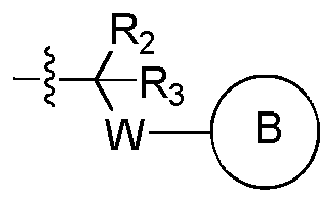 R1, R2, and R3 are each independently selected from the group consisting of hydrogen, optionally substituted alkyl, and optionally substituted alkenyl;R4 is hydrogen or C1-C8 alkyl;W is -NRSO2-, wherein R is hydrogen or C1-C8 alkyl; andB is an optionally substituted aryl ring,provided that if R1, R2, and R3 are each hydrogen, and W is -NHSO2-, then B is not 3-methoxyphenyl, 3,4-dimethylphenyl, 2,3,4-trifluorophenyl, 2,3,5,6-tetramethylphenyl, 2,5-dimethylphenyl, 3-chlorophenyl, 3-trifluoromethylphenyl, 4-methoxyphenyl, 4-tertbutylphenyl, 4-fluorophenyl, or 4-acetylphenyl;
wherein "aryl" refers to a 5- or 6-membered carbocyclic aromatic ring; a bicyclic ring system wherein at least one ring is carbocyclic and aromatic; or a tricyclic ring system wherein at least one ring is carbocyclic and aromatic. - The compound according to claim 1, wherein R2 and R3 are each independently hydrogen or optionally substituted alkyl.
- The compound according to claim 1, wherein R4 is hydrogen or methyl.
- The compound according to claim 1, wherein B is an optionally substituted phenyl ring.
- The compound according to claim 4, wherein B is phenyl optionally substituted with one or more substituents selected from the group consisting of heterocycloalkyl, halo, alkyl, alkenyl, alkynyl, cycloalkyl, aryl, heteroaryl, hydroxyl, alkoxy, aryloxy, acyl, carboxy, alkoxycarbonyl, NO2, optionally substituted amino, and CN, wherein each of said alkyl, alkenyl, alkynyl, alkoxy, cycloalkyl, aryl, heteroaryl, heterocycloalkyl, alkoxy, and aryloxy groups may be optionally independently substituted with one or more substituents selected from the group consisting of alkyl, halo, hydroxyl, alkoxy, carboxy, alkoxycarbonyl, heterocycloalkyl, and optionally substituted amino.
- The compound according to claim 4, or a pharmaceutically acceptable salt thereof, wherein B is selected from the group consisting of 4-(4-methylpiperazin-1-yl)phenyl, phenyl, 2-methylphenyl, 2-fluorophenyl, 2-chlorophenyl, 2-bromophenyl, 2-methoxycarbonylphenyl, 2-trifluoromethylphenyl, 2-cyanophenyl, 3-aminophenyl, 3-methoxyphenyl, 3-methylphenyl, 3-fluorophenyl, 3-chlorophenyl, 3-bromophenyl, 3-trifluoromethylphenyl, tert-butylphenyl, 4-ethynylphenyl, 3-cyanophenyl, 3-nitrophenyl, 3-phenylphenyl, 3-(2-pyrimidinyl)phenyl, 3-(1-methyl-1H-pyrazol-3-yl)phenyl, 3-(5-methyl-1,3,4-oxadiazol-2-yl)phenyl, 3-(5-methyl-1,2,4-oxadiazol-2-yl)phenyl, 3-(2-methyl-1,3-thiazol-4-yl)phenyl, 4-aminophenyl, 4-methoxyphenyl, 4-butoxyphenyl, 4-phenoxyphenyl, 4-methylphenyl, 4-propylphenyl, 4-tert-butylphenyl, 4-(1-adamantyl)phenyl, 4-(3-chloro-1-adamantyl)phenyl, 4-methoxycarbonylethylphenyl, 4-acetamidophenyl, 4-fluorophenyl, 4-chlorophenyl, 4-bromophenyl, 4-iodophenyl, 4-trifluoromethoxyphenyl, 4-methoxycarbonylphenyl, 4-acetylphenyl, 4-trifluoromethylphenyl, 4-cyanophenyl, 4-nitrophenyl, 4'-methoxy[1,1'-biphenyl]-4-yl, 4'-methyl[1,1'-biphenyl]-4-yl, 4-phenylphenyl, 4'-fluoro[1,1'-biphenyl]-4-yl, 4'-chloro[1,1'-biphenyl]-4-yl, 4-(2-pyrimidinyl)phenyl, 4-(1H-pyrazol-1-yl)phenyl, 4-(2-methyl-1,3-thiazol-4-yl)phenyl, 4-(1,3-oxazol-5-yl)phenyl, 3,4-dimethoxyphenyl, 3-tert-butyl-4-methoxyphenyl, 2,3,4,5,6-pentamethylphenyl, 2,4-dimethylphenyl, 3,4-dimethylphenyl, 3,5-dimethylphenyl, 3-fluoro-4-methylphenyl, 3-chloro-2-methylphenyl, 3-chloro-4-methylphenyl, 3,4-dichlorophenyl, 3-cyano-4-fluorophenyl, 2-naphthalenyl, 5-(dimethylamino)-2-naphthalenyl, 2,3-dihydro-5-indeneyl, 2-(dimethylamino)-2,3-dihydro-5-indeneyl, 4-(dimethylamino)methylphenyl, 4-(diethylamino)methylphenyl, 4-(dipropylamino)methylphenyl, 4-(1-pyrrolidinylmethyl)phenyl, 4-(1-piperidinylmethyl)phenyl, 4-(1-azepanylmethyl)phenyl, 4-(4-morpholinylmethyl)phenyl, 4-(4-methoxy-1-piperidinyl)methylphenyl, 4-(4-methyl-1-piperazinyl)methylphenyl, 4-(3-hydroxypropyl)phenyl, 3-morpholinophenyl, 4-morpholinophenyl, (1-piperidinyl)phenyl, (4-methoxy-1-piperidinyl)phenyl, (21-amino-4,7,10,13,16,19-hexaoxahenicos-1-yl)phenyl, {[3-(4-morpholinyl)propyl]amino}phenyl, 3-(4-methyl-1-piperazinyl)phenyl, 4-{[2-(dimethylamino)ethyl]amino}phenyl, 3'-(trifluoromethyl)[1,1'-biphenyl], 4-benzylphenyl, 4-[3-(4-morpholinyl)-1-propynyl]phenyl, 4-[3-(dimethylamino)-1-propynyl]phenyl, 4-[3-(4-morpholinyl)propyl]phenyl, 4-[3-(dimethylamino)propyl]phenyl, 3-(propionylamino)phenyl, and 3-(acryloylamino)phenyl.
- A compound selected from the group consisting of
4-((4-(4-Methylpiperazin-1-yl)phenylsulfonamido)methyl)-N-(pyridin-3-yl)benzamide;
4-(Phenylsulfonamidomethyl)-N-(pyridin-3-yl)benzamide;
4-((2-Methylphenylsulfonamido)methyl)-N-(pyridin-3-yl)benzamide;
4-((2-Fluorophenylsulfonamido)methyl)-N-(pyridin-3-yl)benzamide;
4-((2-Chlorophenylsulfonamido)methyl)-N-(pyridin-3-yl)benzamide;
4-((2-Bromophenylsulfonamido)methyl)-N-(pyridin-3-yl)benzamide;
Methyl 2-(N-(4-(Pyridin-3-ylcarbamoyl)benzyl)sulfamoyl)benzoate;
N-(Pyridin-3-yl)-4-((2-(trifluoromethyl)phenylsulfonamido)methyl)benzamide;
4-((2-Cyanophenylsulfonamido)methyl)-N-(pyridin-3-yl)benzamide;
4-((3-Aminophenylsulfonamido)methyl)-N-(pyridin-3-yl)benzamide;
4-((3-Methylphenylsulfonamido)methyl)-N-(pyridin-3-yl)benzamide;
4-((3-Fluorophenylsulfonamido)methyl)-N-(pyridin-3-yl)benzamide;
4-((3-Bromophenylsulfonamido)methyl)-N-(pyridin-3-yl)benzamide;
4-((3-Cyanophenylsulfonamido)methyl)-N-(pyridin-3-yl)benzamide;
4-((3-Nitrophenylsulfonamido)methyl)-N-(pyridin-3-yl)benzamide;
4-{[([1,1'-Biphenyl]-3-ylsulfonyl)amino]methyl}-N-(3-pyridinyl)benzamide;
4-[({[3-(2-Pyrimidinyl)phenyl]sulfonyl}amino)methyl]-N-(3-pyridinyl)benzamide;
4-[({[3-(1-Methyl-1H-pyrazol-3-yl)phenyl]sulfonyl}amino)methyl]-N-(3-pyridinyl)benzamide;
4-[({[3-(5-Methyl-1,3,4-oxadiazol-2-yl)phenyl]sulfonyl}amino)methyl]-N-(3-pyridinyl)benzamide;
4-[({[3-(5-Methyl-1,2,4-oxadiazol-3-yl)phenyl]sulfonyl}amino)methyl]-N-(3-pyridinyl)benzamide;
4-[({[3-(2-Methyl-1,3-thiazol-4-yl)phenyl]sulfonyl}amino)methyl]-N-(3-pyridinyl)benzamide;
4-((4-Aminophenylsulfonamido)methyl)-N-(pyridin-3-yl)benzamide;
4-((4-Butoxyphenylsulfonamido)methyl)-N-(pyridin-3-yl)benzamide;
4-((4-Phenoxyphenylsulfonamido)methyl)-N-(pyridin-3-yl)benzamide;
4-((4-Methylphenylsulfonamido)methyl)-N-(pyridin-3-yl)benzamide;
4-((4-Propylphenylsulfonamido)methyl)-N-(pyridin-3-yl)benzamide;
4-[({[4-(1-Adamantyl)phenyl]sulfonyl}amino)methyl]-N-(3-pyridinyl)benzamide;
4-[({[4-(3-Chloro-1-adamantyl)phenyl]sulfonyl}amino)methyl]-N-(3-pyridinyl)benzamide;
Methyl 3-{4-[({4-[(3 Pyridinylamino)carbonyl]benzyl}amino)sulfonyl]phenyl} propanoate;
4-((4-Acetamidophenylsulfonamido)methyl)-N-(pyridin-3-yl)benzamide;
4-((4-Chlorophenylsulfonamido)methyl)-N-(pyridin-3-yl)benzamide;
4-((4-Bromophenylsulfonamido)methyl)-N-(pyridin-3-yl)benzamide;
N-(Pyridin-3-yl)-4-((4-(trifluoromethoxy)phenylsulfonamido)methyl)benzamide;
Methyl 4-(N-(4-(Pyridin-3-ylcarbamoyl)benzyl)sulfamoyl)benzoate;
N-(Pyridin-3-yl)-4-((4-(trifluoromethyl)phenylsulfonamido)methyl)benzamide;
4-((4-Cyanophenylsulfonamido)methyl)-N-(pyridin-3-yl)benzamide;
4-((4-Nitrophenylsulfonamido)methyl)-N-(pyridin-3-yl)benzamide;
4-((Biphenyl-4-ylsulfonamido)methyl)-N-(pyridin-3-yl)benzamide;
4-({[(4'-Methoxy[1,1'-biphenyl]-4-yl)sulfonyl]amino}methyl)-N-(3-pyridinyl)benzamide;
4-({[(4'-M ethyl[1,1'-biphenyl]-4-yl)sulfonyl]amino}methyl)-N-(3-pyridinyl)benzamide;
4-({[(4'-Fluoro[1,1'-biphenyl]-4-yl)sulfonyl]amino}methyl)-N-(3-pyridinyl)benzamide;
4-({[(4'-Chloro[1,1'-biphenyl]-4-yl)sulfonyl]amino}methyl)-N-(3-pyridinyl)benzamide;
4-[({[4-(2-Pyrimidinyl)phenyl]sulfonyl}amino)methyl]-N-(3-pyridinyl)-benzamide;
4-[({[4-(1H-Pyrazol-1-yl)phenyl]sulfonyl}amino)methyl]-N-(3-pyridinyl)benzamide;
4-[({[4-(2-Methyl-1,3-thiazol-4-yl)phenyl]sulfonyl}amino)methyl]-N-(3-pyridinyl)benzamide;
[({[4-(1,3-Oxazol-5-yl)phenyl]sulfonyl}amino)methyl]-N-(3-pyridinyl)benzamide;
4-((3,4-Dimethoxyphenylsulfonamido)methyl)-N-(pyridin-3-yl)benzamide;
4-((3-tert-Butyl-4-methoxyphenylsulfonamido)methyl)-N-(pyridin-3-yl)benzamide;
4-((2,3,4,5,6-Pentamethylphenylsulfonamido)methyl)-N-(pyridin-3-yl)benzamide;
4-((2,4-Dimethylphenylsulfonamido)methyl)-N-(pyridin-3-yl)benzamide;
4-((3,4-Dimethylphenylsulfonamido)methyl)-N-(pyridin-3-yl)benzamide;
4-((3,5-Dimethylphenylsulfonamido)methyl)-N-(pyridin-3-yl)benzamide;
4-((3-Fluoro-4-methylphenylsulfonamido)methyl)-N-(pyridin-3-yl)benzamide;
4-((3-Chloro-2-methylphenylsulfonamido)methyl)-N-(pyridin-3-yl)benzamide;
4-((3-Chloro-4-methylphenylsulfonamido)methyl)-N-(pyridin-3-yl)benzamide;
4-((3,4-Dichlorophenylsulfonamido)methyl)-N-(pyridin-3-yl)benzamide;
4-((3-Cyano-4-fluorophenylsulfonamido)methyl)-N-(pyridin-3-yl)benzamide;
4-((Naphthalene-2-sulfonamido)methyl)-N-(pyridin-3-yl)benzamide;
4-((5-(Dimethylamino)naphthalene-1-sulfonamido)methyl)-N-(pyridin-3-yl)benzamide;
4-((2,3-Dihydro-1H-indene-5-sulfonamido)methyl)-N-(pyridin-3-yl)benzamide;
4-((2-(Dimethylamino)-2,3-dihydro-1H-indene-5-sulfonamido)methyl)-N-(pyridin-3-yl)benzamide;
4-[({4-[(Dimethylamino)methyl]phenyl}sulfonyl)amino]methyl-N-(3-pyridinyl)benzamide;
4-{[({4-[(Diethylamino)methyl]phenyl}sulfonyl)amino]methyl}-N-(3-pyridinyl)benzamide,
4-{[({4-[(Dipropylamino)methyl]phenyl}sulfonyl)amino]methyl}-N-(3-pyridinyl)benzamide;
4-[({[4-(1-Pyrrolidinylmethyl)phenyl]sulfonyl}amino)methyl]-N-(3-pyridinyl)-benzamide;
4-[({[4-(1-Piperidinylmethyl)phenyl]sulfonyl}amino)methyl]-N-(3-pyridinyl)benzamide;
4-[({[4-(1-Azepanylmethyl)phenyl]sulfonyl}amino)methyl]-N-(3-pyridinyl)benzamide;
4-[({[4-(4-Morpholinylmethyl)phenyl]sulfonyl}amino)methyl]-N-(3-pyridinyl)benzamide;
4-{[({4-[(4-Methoxy-1-piperidinyl)methyl]phenyl}sulfonyl)amino]methyl}-N-(3-pyridinyl)benzamide;
4-{[({4-[(4-Methyl-1-piperazinyl)methyl]phenyl}sulfonyl)amino]methyl}-N-(3-pyridinyl)benzamide;
4-tert-Butyl-N-(4-(pyridin-3-ylcarbamoyl)benzyl)benzamide;
4-((4-tert-Butylphenylsulfonamido)methyl)-N-methyl-N-(pyridin-3-yl)benzamide;
N-Methyl-4-(phenylsulfonamidomethyl)-N-(pyridin-3-yl)benzamide;
3-((4-tert-Butylphenylsulfonamido)methyl)-N-(pyridin-3-yl)benzamide;
3-(Phenylsulfonamidomethyl)-N-(pyridin-3-yl)benzamide;
3-(4-(Phenylsulfonamidomethyl)benzamido)pyridine 1-oxide;
4-((4-Iodophenylsulfonamido)methyl)-N-(pyridin-3-yl)benzamide;
4-((4-Ethynylphenylsulfonamido)methyl)-N-(pyridin-3-yl)benzamide;
4-((4-Bromophenylsulfonamido)methyl)-N-(pyridin-3-yl)benzamide;
4-((4-Fluorophenylsulfonamido)methyl)-N-(pyridin-3-yl)benzamide;
3,5-Dimethyl-N-(4-(pyridin-3-ylcarbamoyl)benzyl)benzamide;
3,4-Dimethoxy-N-(4-(pyridin-3-ylcarbamoyl)benzyl)benzamide,
4-{[({4-[3-(Methyloxy)-1-propynyl]phenyl}sulfonyl)amino]methyl}-N-(3-pyridinyl)benzamide;
4-[({[4-(21-Amino-4,7,10,13,16,19-hexaoxahenicos-1-yn-1-yl)phenyl]sulfonyl}amino)methyl]-N-(3-pyridinyl)benzamide;
4-[({[4-(3-Methoxypropyl)phenyl]sulfonyl}amino)methyl]-N-(3-pyridinyl)benzamide;
4-[({[4-(1-benzyl-1H-1,2,3-triazol-4-yl)phenyl]sulfonyl}amino)methyl]-N-(3-pyridinyl)benzamide;
4-[({[4-(3-Hydroxy-1-propynyl)phenyl]sulfonyl}amino)methyl]-N-(3-pyridinyl)benzamide;
4-[({[4-(3-Hydroxypropyl)phenyl]sulfonyl}amino)methyl]-N-(3-pyridinyl)benzamide;
4-({[(4-tert-Butylphenyl)sulfonyl]amino}methyl)-N-(5-methyl-3-pyridinyl)benzamide;
4-({[(4-tert-Butylphenyl)sulfonyl]amino}methyl)-N-(2-methyl-3-pyridinyl)benzamide;
4-({[(4-tert-Butylphenyl)sulfonyl]amino}methyl)-N-(6-methyl-3-pyridinyl)benzamide;
4-({[(4-tert-Butylphenyl)sulfonyl]amino}methyl)-N-(6-methoxy-3-pyridinyl)benzamide;
4-({[(4-tert-Butylphenyl)sulfonyl]amino}methyl)-N-(6-chloro-3-pyridinyl)benzamide;
4-({[(4-tert-Butylphenyl)sulfonyl]amino}methyl)-N-(4-chloro-3-pyridinyl)benzamide;
4-({[(4-tert-Butylphenyl)sulfonyl]amino}methyl)-N-(2-chloro-3-pyridinyl)benzamide;
4-({[(4-tert-Butylphenyl)sulfonyl]amino}methyl)-N-(4-methyl-3-pyridinyl)benzamide;
4-({[(4-tert-Butylphenyl)sulfonyl]amino}methyl)-N-(5-chloro-3-pyridinyl)benzamide;
4-({[(4-tert-Butylphenyl)sulfonyl]amino}methyl)-N-(2-nitro-3-pyridinyl)benzamide;
4-({[(4-tert-Butylphenyl)sulfonyl]amino}methyl)-N-[6-(4-morpholinyl)-3-pyrid inyl]benzamide;
4-({[(4-tert-Butylphenyl)sulfonyl]amino}methyl)-N-[6-(trifluoromethyl)-3-pyridinyl]benzamide;
N-[6-(Acetylamino)-3-pyridinyl]-4-({[(4-tert-butylphenyl)sulfonyl]amino}methyl)benzamide;
4-({[(4-tert-Butylphenyl)sulfonyl]amino}methyl)-N-(6-fluoro-3-pyridinyl)benzamide;
4-({[(4-tert-Butylphenyl)sulfonyl]amino}methyl)-N-(5-fluoro-3-pyridinyl)benzamide;
4-({[(4-tert-Butylphenyl)sulfonyl]amino}methyl)-N-[4-(trifluoromethyl)-3-pyridinyl]benzamide;
4-({[(4-tert-Butylphenyl)sulfonyl]amino}methyl)-N-(2-fluoro-3-pyridinyl)benzamide;
4-({[(4-tert-Butylphenyl)sulfonyl]amino}methyl)-N-(4-methoxy-3-pyridinyl)benzamide;
N-(6-Bromo-3-pyridinyl)-4-({[(4-tert-butylphenyl)sulfonyl]amino}methyl)benzamide;
4-[({[3-(4-Morpholinyl)phenyl]sulfonyl}amino)methyl]-N-(3-pyridinyl)benzamide;
4-[({[4-(4-Morpholinyl)phenyl]sulfonyl}amino)methyl]-N-(3-pyridinyl)benzamide;
4-[({[4-(1-Piperidinyl)phenyl]sulfonyl}amino)methyl]-N-(3-pyridinyl)benzamide;
4-[({[4-(1-Piperidinyl)phenyl]sulfonyl}amino)methyl]-N-(3-pyridinyl)benzamide;
4-[({[4-(21 -Amino-4,7,10,13,16,19-hexaoxahenicos-1 -yl)phenyl]sulfonyl}amino) methyl]-N-(3-pyridinyl)benzamide;
4-({[(4-{[3-(4-Morpholinyl)propyl]amino}phenyl)sulfonyl]amino}methyl)-N-(3-pyridinyl)benzamide;
4-[({[3-(4-Methyl-1-piperazinyl)phenyl]sulfonyl}amino)methyl]-N-(3-pyridinyl)benzamide;
4-({[(4-{[2-(Dimethylamino)ethyl]amino}phenyl)sulfonyl]amino}methyl)-N-(3-pyridinyl)benzamide;
N-(3-Pyridinyl)-4-[({[3'-(trifluoromethyl)[1,1'-biphenyl]-4-yl]sulfonyl}amino)methyl]benzamide;
4-({[(4-Benzylphenyl)sulfonyl]amino}methyl)-N-(3-pyridinyl)benzamide;
4-{[({4-[3-(4-Morpholinyl)-1-propynyl]phenyl}sulfonyl)amino]methyl}-N-(3-pyridinyl)benzamide;
4-{[({4-[3-(Dimethylamino)-1-propynyl]phenyl}sulfonyl)amino]methyl}-N-(3-pyridinyl)benzamide;
4-{[[(4-tert-Butylphenyl)sulfonyl](methyl)amino]methyl}-N-(3-pyridinyl) benzamide;
4-{[[(4-tert-Butylphenyl)sulfonyl](ethyl)amino]methyl}-N-(3-pyridinyl)benzamide;
4-{[[(4-tert-Butylphenyl)sulfonyl](propyl)amino]methyl}-N-(3-pyridinyl)benzamide;
4-{[({4-[3-(4-Morpholinyl)propyl]phenyl}sulfonyl)amino]methyl}-N-(3-pyridinyl)benzamide;
4-{[({4-[3-(Dimethylamino)propyl]phenyl}sulfonyl)amino]methyl}-N-(3-pyridinyl)benzamide;
4-[({[3-(Propionylamino)phenyl]sulfonyl}amino)methyl]-N-(3-pyridinyl)benzamide;
4-[({[3-(Acryloylamino)phenyl]sulfonyl}amino)methyl]-N-(3-pyridinyl)benzamide;
4-({[(4-tert-Butylphenyl)sulfonyl]amino}methyl)-2-methyl-N-(3-pyridinyl)benzamide;
4-({[(4-tert-Butylphenyl)sulfonyl]amino}methyl)-2-fluoro-N-(3-pyridinyl)benzamide;
4-({[(4-tert-Butylphenyl)sulfonyl]amino}methyl)-3-methyl-N-(3-pyridinyl)benzamide;
4-({[(4-tert-Butylphenyl)sulfonyl]amino}methyl)-3-fluoro-N-(3-pyridinyl)benzamide;
4-(1-{[(4-tert-Butylphenyl)sulfonyl]amino}ethyl)-N-(3-pyridinyl)benzamide;
4-[(anilinosulfonyl)methyl]-N-(3-pyridinyl)benzamide;
4-{[(4-tert-butylanilino)sulfonyl]methyl}-N-(3-pyridinyl)benzamide;
4-{[(4-fluoroanilino)sulfonyl]methyl}-N-(3-pyridinyl)benzamide;
4-({[4-(4-methyl-1-piperazinyl)anilino]sulfonyl}methyl)-N-(3-pyridinyl)benzamide,
4-((4-(tert-butyl)phenylsulfonamido)methyl)-2-methyl-N-(pyridin-3-yl)benzamide;
4-((4-(tert-butyl)phenylsulfonamido)methyl)-3-methyl-N-(pyridin-3-yl)benzamide;
4-((4-(tert-butyl)phenylsulfonamido)methyl)-2-fluoro-N-(pyridin-3-yl)benzamide;
4-((4-(tert-butyl)phenylsulfonamido)methyl)-3-fluoro-N-(pyridin-3-yl)benzamide;
4-((4-(tert-butyl)phenylsulfonamido)methyl)-3-nitro-N-(pyridin-3-yl)benzamide;
4-(1-(4-(tert-butyl)phenylsulfonamido)ethyl)-N-(pyridin-3-yl)benzamide;
4-(N-phenylsulfamoylmethyl)-N-(pyridin-3-yl)benzamide;
4-((N-(4-fluorophenyl)sulfamoyl)methyl)-N-(pyridin-3-yl)benzamide;
4-((N-(4-tert-butylphenyl)sulfamoyl)methyl)-N-(pyridin-3-yl)benzamide; and
4-((N-(4-(4-methylpiperazin-1-yl)phenyl)sulfamoyl)methyl)-N-(pyridin-3-yl)benzamide; or a pharmaceutically acceptable salt thereof. - A pharmaceutical composition comprising at least one compound of Formula IA:

wherein:A is 3-pyridinyl which is optionally substituted; R1, R2, and R3 are each independently selected from the group consisting of hydrogen, optionally substituted alkyl, and optionally substituted alkenyl;R4 is hydrogen or C1-C8 alkyl;W is -NRSO2-, wherein R is hydrogen or C1-C8 alkyl; andB is an optionally substituted aryl ring,
wherein "aryl" refers to a 5- or 6-membered carbocyclic aromatic ring; a bicyclic ring system wherein at least one ring is carbocyclic and aromatic; or a tricyclic ring system wherein at least one ring is carbocyclic and aromatic;and at least one pharmaceutically acceptable carrier. - A pharmaceutical composition as defined in claim 8 in which the compound or salt is as defined in any one of claims 1 to 7.
- A compound or pharmaceutically acceptable salt thereof, which is specifically cytotoxic to cells that have elevated HIF levels due to their increased rate and dependence on glucose uptake and glycolysis, for use in a method for treating a disease mediated by defective pVHL protein, comprising administering to a subject at least one said compound or pharmaceutically acceptable salt;
wherein the compound is a compound of formula I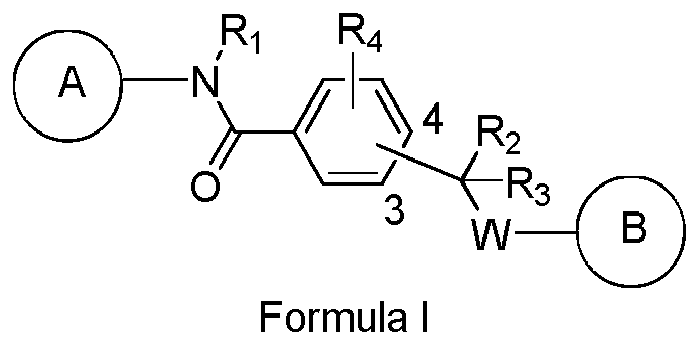 A is 3-pyridinyl which is optionally substituted;
 R1, R2, and R3 are each independently selected from the group consisting of hydrogen, optionally substituted alkyl, and optionally substituted alkenyl;R4 is hydrogen, hydroxy, optionally substituted alkyl, optionally substituted alkenyl, optionally substituted alkoxy, optionally substituted cycloalkyl, optionally substituted aryl, optionally substituted heterocycloalkyl, optionally substituted heteroaryl, halo, carboxy, nitro, sulfonyl, sulfinyl, or optionally substituted amino;W is -NRSO2-, -SO2NR-, or -NRCO-, wherein each R is independently selected from the group consisting of hydrogen, alkyl, alkenyl, alkynyl, cycloalkyl, aryl, heterocycloalkyl, and heteroaryl, each of which, except for hydrogen, is optionally substituted; andB is an optionally substituted aryl ring,provided that if R1, R2, and R3 are each hydrogen, and W is -NHSO2-, then B is not 3-methoxyphenyl, 3,4-dimethylphenyl, 2,3,4-trifluorophenyl, 2,3,5,6-tetramethylphenyl, 2,5-dimethylphenyl, 3-chlorophenyl, 3-trifluoromethylphenyl, 4-methoxyphenyl, 4-tertbutylphenyl, 4-fluorophenyl, or 4-acetylphenyl;
wherein "cycloalkyl" refers to a saturated hydrocarbon ring group which may be a bridged or caged saturated ring group; and"aryl" refers to a 5- or 6-membered carbocyclic aromatic ring; a bicyclic ring system wherein at least one ring is carbocyclic and aromatic; or a tricyclic ring system wherein at least one ring is carbocyclic and aromatic. - A compound or pharmaceutically acceptable salt thereof for use as defined in claim 10 in which the compound or salt is as defined in any one of claims 1 to 8.
Applications Claiming Priority (3)
| Application Number | Priority Date | Filing Date | Title |
|---|---|---|---|
| US22721309P | 2009-07-21 | 2009-07-21 | |
| US32368110P | 2010-04-13 | 2010-04-13 | |
| PCT/US2010/042742 WO2011011514A1 (en) | 2009-07-21 | 2010-07-21 | Heteroaryl benzamides, compositions and methods of use |
Publications (3)
| Publication Number | Publication Date |
|---|---|
| EP2456435A1 EP2456435A1 (en) | 2012-05-30 |
| EP2456435A4 EP2456435A4 (en) | 2013-02-20 |
| EP2456435B1 true EP2456435B1 (en) | 2015-06-24 |
Family
ID=43499400
Family Applications (1)
| Application Number | Title | Priority Date | Filing Date |
|---|---|---|---|
| EP10802849.9A Not-in-force EP2456435B1 (en) | 2009-07-21 | 2010-07-21 | Heteroaryl benzamides, compositions and methods of use |
Country Status (7)
| Country | Link |
|---|---|
| US (1) | US20120225862A1 (en) |
| EP (1) | EP2456435B1 (en) |
| JP (1) | JP5789603B2 (en) |
| AU (1) | AU2010276215A1 (en) |
| CA (1) | CA2768373A1 (en) |
| ES (1) | ES2547072T3 (en) |
| WO (1) | WO2011011514A1 (en) |
Families Citing this family (6)
| Publication number | Priority date | Publication date | Assignee | Title |
|---|---|---|---|---|
| JP2011057661A (en) * | 2009-08-14 | 2011-03-24 | Bayer Cropscience Ag | Pesticidal carboxamides |
| AU2011313853A1 (en) * | 2010-10-11 | 2013-05-02 | Auckland Uniservices Limited | Substituted benzamides and their uses |
| EP2712290A4 (en) | 2011-05-19 | 2014-11-19 | Univ Leland Stanford Junior | ANTIPROLIFERATIVE COMPOUNDS AND METHODS FOR THEIR USE |
| SG11201406518XA (en) * | 2012-04-12 | 2014-11-27 | Univ Leland Stanford Junior | Substituted benzamides and their uses |
| MX362290B (en) * | 2013-12-09 | 2019-01-10 | Unichem Lab Ltd | An improved process for the preparation of (3r,4r)-(1-benzyl-4-me thylpiperidin-3-yl)-methylamine. |
| KR20240172217A (en) * | 2022-04-05 | 2024-12-09 | 더블유엠티 에이쥐 | N-(3-(benzo[B]thiophene-2-carboxamido)-phenyl)-2,3-dihydrobenzo[B][1,4]dioxine-6-carboxamide derivatives and related compounds as lactate/ATP production inhibitors for cancer therapy |
Family Cites Families (20)
| Publication number | Priority date | Publication date | Assignee | Title |
|---|---|---|---|---|
| HUP0003073A3 (en) * | 1997-07-11 | 2002-10-28 | Smithkline Beecham Plc | Benzenesulfonamide derivatives, process for producing them and their use as medicines |
| BR0011571A (en) * | 1999-06-24 | 2002-03-05 | Smithkline Beecham Corp | Macrophage cleaning receptor antagonists |
| MXPA03002325A (en) | 2000-09-15 | 2003-06-24 | Anormed Inc | Chemokine receptor binding heterocyclic compounds. |
| SE0102300D0 (en) * | 2001-06-26 | 2001-06-26 | Astrazeneca Ab | Compounds |
| CN1780621A (en) * | 2001-08-03 | 2006-05-31 | 先灵公司 | Sulfonamide derivatives as gamma secretase inhibitors |
| EP2399903A1 (en) * | 2002-05-24 | 2011-12-28 | Millennium Pharmaceuticals, Inc. | Ccr9 inhibitors and methods of use thereof |
| WO2005004810A2 (en) * | 2003-07-02 | 2005-01-20 | Merck & Co., Inc. | Arylsulfonamide derivatives |
| CA2544350A1 (en) * | 2003-10-29 | 2005-05-12 | Elan Pharmaceuticals, Inc. | N-substituted benzene sulfonamides |
| CA2566387A1 (en) * | 2004-05-12 | 2005-12-01 | Chemocentryx, Inc. | Aryl sulfonamides as chemokine receptor ccr9 antagonists |
| WO2006056930A2 (en) * | 2004-11-25 | 2006-06-01 | Actelion Pharmaceuticals Ltd | Novel 4 -aminopiperidine derivatives as plasmepsin ii inhibitors |
| US7754717B2 (en) * | 2005-08-15 | 2010-07-13 | Amgen Inc. | Bis-aryl amide compounds and methods of use |
| CA2618770A1 (en) * | 2005-08-25 | 2007-03-01 | Emory University | Hif inhibitors |
| US7544676B2 (en) * | 2005-11-10 | 2009-06-09 | Adolor Corporation | Sulfamoyl benzamides and methods of their use |
| KR100787131B1 (en) * | 2006-07-04 | 2007-12-21 | 한국생명공학연구원 | Compounds that inhibit HIF-1 activity, preparation method thereof, and pharmaceutical composition containing the same as an active ingredient |
| US20100234364A1 (en) | 2006-07-14 | 2010-09-16 | Arindrajit Basak | Ccr2 inhibitors and methods of use thereof |
| CL2007003874A1 (en) * | 2007-01-03 | 2008-05-16 | Boehringer Ingelheim Int | COMPOUNDS DERIVED FROM BENZAMIDA; PHARMACEUTICAL COMPOSITION THAT INCLUDES SUCH COMPOUNDS; AND ITS USE TO TREAT CARDIOVASCULAR DISEASES, HYPERTENSION, ATEROSCLEROSIS, RESTENOSIS, ICTUS, HEART FAILURE, ISCHEMICAL INJURY, HYPERTENSION |
| US20080293711A1 (en) * | 2007-03-08 | 2008-11-27 | Clark Michael P | Chemokine receptor modulators |
| US8461189B2 (en) * | 2007-06-27 | 2013-06-11 | Merck Sharp & Dohme Corp. | Pyridyl derivatives as histone deacetylase inhibitors |
| AR071310A1 (en) * | 2008-04-11 | 2010-06-09 | Merck Serono Sa | SULFONAMIDS |
| US9079859B2 (en) * | 2011-01-21 | 2015-07-14 | Auckland Uniservices Limited | Synthetic lethal targeting of glucose transport |
-
2010
- 2010-07-21 ES ES10802849.9T patent/ES2547072T3/en active Active
- 2010-07-21 AU AU2010276215A patent/AU2010276215A1/en not_active Abandoned
- 2010-07-21 JP JP2012521753A patent/JP5789603B2/en not_active Expired - Fee Related
- 2010-07-21 WO PCT/US2010/042742 patent/WO2011011514A1/en not_active Ceased
- 2010-07-21 US US13/384,978 patent/US20120225862A1/en not_active Abandoned
- 2010-07-21 EP EP10802849.9A patent/EP2456435B1/en not_active Not-in-force
- 2010-07-21 CA CA2768373A patent/CA2768373A1/en not_active Abandoned
Also Published As
| Publication number | Publication date |
|---|---|
| JP2013500254A (en) | 2013-01-07 |
| WO2011011514A1 (en) | 2011-01-27 |
| AU2010276215A1 (en) | 2012-02-16 |
| JP5789603B2 (en) | 2015-10-07 |
| EP2456435A1 (en) | 2012-05-30 |
| ES2547072T3 (en) | 2015-10-01 |
| HK1171190A1 (en) | 2013-03-22 |
| US20120225862A1 (en) | 2012-09-06 |
| EP2456435A4 (en) | 2013-02-20 |
| CA2768373A1 (en) | 2011-01-27 |
Similar Documents
| Publication | Publication Date | Title |
|---|---|---|
| US9085570B2 (en) | Substituted benzamides and their uses | |
| CA2661654C (en) | Certain substituted amides, method of making, and method of use thereof | |
| WO2009114552A1 (en) | Heteroaryl compounds, compositions, and methods of use in cancer treatment | |
| JP5670266B2 (en) | Furazanobenzimidazole | |
| US20120329786A1 (en) | Compounds and therapeutic uses thereof | |
| US7560462B2 (en) | Compounds useful for inhibiting CHK1 | |
| JP5789603B2 (en) | Heteroarylbenzamides, compositions and methods of use | |
| JP2008525409A (en) | Pyrazine and pyridine and their derivatives as therapeutic compounds | |
| US20130317027A1 (en) | Compounds and therapeutic uses thereof | |
| KR20210065097A (en) | Substituted indoles and methods of use thereof | |
| US9296732B2 (en) | Substituted benzamides and their uses | |
| HK1171190B (en) | Heteroaryl benzamides, compositions and methods of use | |
| CA2571424A1 (en) | Bisarylurea derivatives useful for inhibiting chk1 |
Legal Events
| Date | Code | Title | Description |
|---|---|---|---|
| PUAI | Public reference made under article 153(3) epc to a published international application that has entered the european phase |
Free format text: ORIGINAL CODE: 0009012 |
|
| 17P | Request for examination filed |
Effective date: 20120208 |
|
| AK | Designated contracting states |
Kind code of ref document: A1 Designated state(s): AL AT BE BG CH CY CZ DE DK EE ES FI FR GB GR HR HU IE IS IT LI LT LU LV MC MK MT NL NO PL PT RO SE SI SK SM TR |
|
| DAX | Request for extension of the european patent (deleted) | ||
| A4 | Supplementary search report drawn up and despatched |
Effective date: 20130118 |
|
| RIC1 | Information provided on ipc code assigned before grant |
Ipc: C07D 277/46 20060101ALI20130114BHEP Ipc: C07D 231/40 20060101ALI20130114BHEP Ipc: C07D 213/89 20060101ALI20130114BHEP Ipc: C07D 239/42 20060101ALI20130114BHEP Ipc: C07D 241/20 20060101ALI20130114BHEP Ipc: A61K 31/33 20060101AFI20130114BHEP Ipc: C07D 213/75 20060101ALI20130114BHEP Ipc: C07D 413/10 20060101ALI20130114BHEP Ipc: C07D 215/38 20060101ALI20130114BHEP Ipc: C07D 401/10 20060101ALI20130114BHEP Ipc: C07D 417/10 20060101ALI20130114BHEP |
|
| REG | Reference to a national code |
Ref country code: HK Ref legal event code: DE Ref document number: 1171190 Country of ref document: HK |
|
| 17Q | First examination report despatched |
Effective date: 20131022 |
|
| GRAP | Despatch of communication of intention to grant a patent |
Free format text: ORIGINAL CODE: EPIDOSNIGR1 |
|
| INTG | Intention to grant announced |
Effective date: 20140728 |
|
| GRAP | Despatch of communication of intention to grant a patent |
Free format text: ORIGINAL CODE: EPIDOSNIGR1 |
|
| INTG | Intention to grant announced |
Effective date: 20141222 |
|
| GRAS | Grant fee paid |
Free format text: ORIGINAL CODE: EPIDOSNIGR3 |
|
| GRAA | (expected) grant |
Free format text: ORIGINAL CODE: 0009210 |
|
| AK | Designated contracting states |
Kind code of ref document: B1 Designated state(s): AL AT BE BG CH CY CZ DE DK EE ES FI FR GB GR HR HU IE IS IT LI LT LU LV MC MK MT NL NO PL PT RO SE SI SK SM TR |
|
| RAP1 | Party data changed (applicant data changed or rights of an application transferred) |
Owner name: THE BOARD OF TRUSTEES OF THE LELAND STANFORD JUNIO Owner name: AUCKLAND UNISERVICES LIMITED |
|
| REG | Reference to a national code |
Ref country code: GB Ref legal event code: FG4D |
|
| REG | Reference to a national code |
Ref country code: CH Ref legal event code: NV Representative=s name: VENI GMBH, CH Ref country code: CH Ref legal event code: EP |
|
| REG | Reference to a national code |
Ref country code: AT Ref legal event code: REF Ref document number: 732600 Country of ref document: AT Kind code of ref document: T Effective date: 20150715 |
|
| REG | Reference to a national code |
Ref country code: FR Ref legal event code: PLFP Year of fee payment: 6 |
|
| REG | Reference to a national code |
Ref country code: IE Ref legal event code: FG4D |
|
| REG | Reference to a national code |
Ref country code: DE Ref legal event code: R096 Ref document number: 602010025461 Country of ref document: DE |
|
| PGFP | Annual fee paid to national office [announced via postgrant information from national office to epo] |
Ref country code: NL Payment date: 20150726 Year of fee payment: 6 |
|
| REG | Reference to a national code |
Ref country code: ES Ref legal event code: FG2A Ref document number: 2547072 Country of ref document: ES Kind code of ref document: T3 Effective date: 20151001 |
|
| PG25 | Lapsed in a contracting state [announced via postgrant information from national office to epo] |
Ref country code: FI Free format text: LAPSE BECAUSE OF FAILURE TO SUBMIT A TRANSLATION OF THE DESCRIPTION OR TO PAY THE FEE WITHIN THE PRESCRIBED TIME-LIMIT Effective date: 20150624 Ref country code: HR Free format text: LAPSE BECAUSE OF FAILURE TO SUBMIT A TRANSLATION OF THE DESCRIPTION OR TO PAY THE FEE WITHIN THE PRESCRIBED TIME-LIMIT Effective date: 20150624 Ref country code: NO Free format text: LAPSE BECAUSE OF FAILURE TO SUBMIT A TRANSLATION OF THE DESCRIPTION OR TO PAY THE FEE WITHIN THE PRESCRIBED TIME-LIMIT Effective date: 20150924 Ref country code: LT Free format text: LAPSE BECAUSE OF FAILURE TO SUBMIT A TRANSLATION OF THE DESCRIPTION OR TO PAY THE FEE WITHIN THE PRESCRIBED TIME-LIMIT Effective date: 20150624 |
|
| PGFP | Annual fee paid to national office [announced via postgrant information from national office to epo] |
Ref country code: DE Payment date: 20150714 Year of fee payment: 6 Ref country code: GB Payment date: 20150715 Year of fee payment: 6 Ref country code: IE Payment date: 20150723 Year of fee payment: 6 Ref country code: CH Payment date: 20150727 Year of fee payment: 6 Ref country code: ES Payment date: 20150727 Year of fee payment: 6 |
|
| REG | Reference to a national code |
Ref country code: NL Ref legal event code: FP |
|
| REG | Reference to a national code |
Ref country code: AT Ref legal event code: MK05 Ref document number: 732600 Country of ref document: AT Kind code of ref document: T Effective date: 20150624 |
|
| REG | Reference to a national code |
Ref country code: LT Ref legal event code: MG4D |
|
| PG25 | Lapsed in a contracting state [announced via postgrant information from national office to epo] |
Ref country code: LV Free format text: LAPSE BECAUSE OF FAILURE TO SUBMIT A TRANSLATION OF THE DESCRIPTION OR TO PAY THE FEE WITHIN THE PRESCRIBED TIME-LIMIT Effective date: 20150624 Ref country code: BG Free format text: LAPSE BECAUSE OF FAILURE TO SUBMIT A TRANSLATION OF THE DESCRIPTION OR TO PAY THE FEE WITHIN THE PRESCRIBED TIME-LIMIT Effective date: 20150924 Ref country code: GR Free format text: LAPSE BECAUSE OF FAILURE TO SUBMIT A TRANSLATION OF THE DESCRIPTION OR TO PAY THE FEE WITHIN THE PRESCRIBED TIME-LIMIT Effective date: 20150925 |
|
| PGFP | Annual fee paid to national office [announced via postgrant information from national office to epo] |
Ref country code: FR Payment date: 20150723 Year of fee payment: 6 |
|
| REG | Reference to a national code |
Ref country code: HK Ref legal event code: GR Ref document number: 1171190 Country of ref document: HK |
|
| PG25 | Lapsed in a contracting state [announced via postgrant information from national office to epo] |
Ref country code: EE Free format text: LAPSE BECAUSE OF FAILURE TO SUBMIT A TRANSLATION OF THE DESCRIPTION OR TO PAY THE FEE WITHIN THE PRESCRIBED TIME-LIMIT Effective date: 20150624 |
|
| PGFP | Annual fee paid to national office [announced via postgrant information from national office to epo] |
Ref country code: IT Payment date: 20151102 Year of fee payment: 6 |
|
| PG25 | Lapsed in a contracting state [announced via postgrant information from national office to epo] |
Ref country code: PL Free format text: LAPSE BECAUSE OF FAILURE TO SUBMIT A TRANSLATION OF THE DESCRIPTION OR TO PAY THE FEE WITHIN THE PRESCRIBED TIME-LIMIT Effective date: 20150624 Ref country code: RO Free format text: LAPSE BECAUSE OF NON-PAYMENT OF DUE FEES Effective date: 20150624 Ref country code: PT Free format text: LAPSE BECAUSE OF FAILURE TO SUBMIT A TRANSLATION OF THE DESCRIPTION OR TO PAY THE FEE WITHIN THE PRESCRIBED TIME-LIMIT Effective date: 20151026 Ref country code: CZ Free format text: LAPSE BECAUSE OF FAILURE TO SUBMIT A TRANSLATION OF THE DESCRIPTION OR TO PAY THE FEE WITHIN THE PRESCRIBED TIME-LIMIT Effective date: 20150624 Ref country code: AT Free format text: LAPSE BECAUSE OF FAILURE TO SUBMIT A TRANSLATION OF THE DESCRIPTION OR TO PAY THE FEE WITHIN THE PRESCRIBED TIME-LIMIT Effective date: 20150624 Ref country code: SK Free format text: LAPSE BECAUSE OF FAILURE TO SUBMIT A TRANSLATION OF THE DESCRIPTION OR TO PAY THE FEE WITHIN THE PRESCRIBED TIME-LIMIT Effective date: 20150624 Ref country code: IS Free format text: LAPSE BECAUSE OF FAILURE TO SUBMIT A TRANSLATION OF THE DESCRIPTION OR TO PAY THE FEE WITHIN THE PRESCRIBED TIME-LIMIT Effective date: 20151024 |
|
| REG | Reference to a national code |
Ref country code: DE Ref legal event code: R097 Ref document number: 602010025461 Country of ref document: DE |
|
| PG25 | Lapsed in a contracting state [announced via postgrant information from national office to epo] |
Ref country code: MC Free format text: LAPSE BECAUSE OF FAILURE TO SUBMIT A TRANSLATION OF THE DESCRIPTION OR TO PAY THE FEE WITHIN THE PRESCRIBED TIME-LIMIT Effective date: 20150624 |
|
| PG25 | Lapsed in a contracting state [announced via postgrant information from national office to epo] |
Ref country code: DK Free format text: LAPSE BECAUSE OF FAILURE TO SUBMIT A TRANSLATION OF THE DESCRIPTION OR TO PAY THE FEE WITHIN THE PRESCRIBED TIME-LIMIT Effective date: 20150624 |
|
| PLBE | No opposition filed within time limit |
Free format text: ORIGINAL CODE: 0009261 |
|
| STAA | Information on the status of an ep patent application or granted ep patent |
Free format text: STATUS: NO OPPOSITION FILED WITHIN TIME LIMIT |
|
| 26N | No opposition filed |
Effective date: 20160329 |
|
| PG25 | Lapsed in a contracting state [announced via postgrant information from national office to epo] |
Ref country code: SI Free format text: LAPSE BECAUSE OF FAILURE TO SUBMIT A TRANSLATION OF THE DESCRIPTION OR TO PAY THE FEE WITHIN THE PRESCRIBED TIME-LIMIT Effective date: 20150624 |
|
| PG25 | Lapsed in a contracting state [announced via postgrant information from national office to epo] |
Ref country code: BE Free format text: LAPSE BECAUSE OF FAILURE TO SUBMIT A TRANSLATION OF THE DESCRIPTION OR TO PAY THE FEE WITHIN THE PRESCRIBED TIME-LIMIT Effective date: 20150624 |
|
| REG | Reference to a national code |
Ref country code: DE Ref legal event code: R119 Ref document number: 602010025461 Country of ref document: DE |
|
| REG | Reference to a national code |
Ref country code: CH Ref legal event code: PL |
|
| REG | Reference to a national code |
Ref country code: NL Ref legal event code: MM Effective date: 20160801 |
|
| GBPC | Gb: european patent ceased through non-payment of renewal fee |
Effective date: 20160721 |
|
| PG25 | Lapsed in a contracting state [announced via postgrant information from national office to epo] |
Ref country code: MT Free format text: LAPSE BECAUSE OF FAILURE TO SUBMIT A TRANSLATION OF THE DESCRIPTION OR TO PAY THE FEE WITHIN THE PRESCRIBED TIME-LIMIT Effective date: 20150624 |
|
| PG25 | Lapsed in a contracting state [announced via postgrant information from national office to epo] |
Ref country code: NL Free format text: LAPSE BECAUSE OF NON-PAYMENT OF DUE FEES Effective date: 20160801 Ref country code: LI Free format text: LAPSE BECAUSE OF NON-PAYMENT OF DUE FEES Effective date: 20160731 Ref country code: DE Free format text: LAPSE BECAUSE OF NON-PAYMENT OF DUE FEES Effective date: 20170201 Ref country code: CH Free format text: LAPSE BECAUSE OF NON-PAYMENT OF DUE FEES Effective date: 20160731 Ref country code: FR Free format text: LAPSE BECAUSE OF NON-PAYMENT OF DUE FEES Effective date: 20160801 |
|
| REG | Reference to a national code |
Ref country code: FR Ref legal event code: ST Effective date: 20170331 |
|
| REG | Reference to a national code |
Ref country code: IE Ref legal event code: MM4A |
|
| PG25 | Lapsed in a contracting state [announced via postgrant information from national office to epo] |
Ref country code: GB Free format text: LAPSE BECAUSE OF NON-PAYMENT OF DUE FEES Effective date: 20160721 Ref country code: SM Free format text: LAPSE BECAUSE OF FAILURE TO SUBMIT A TRANSLATION OF THE DESCRIPTION OR TO PAY THE FEE WITHIN THE PRESCRIBED TIME-LIMIT Effective date: 20150624 Ref country code: HU Free format text: LAPSE BECAUSE OF FAILURE TO SUBMIT A TRANSLATION OF THE DESCRIPTION OR TO PAY THE FEE WITHIN THE PRESCRIBED TIME-LIMIT; INVALID AB INITIO Effective date: 20100721 |
|
| PG25 | Lapsed in a contracting state [announced via postgrant information from national office to epo] |
Ref country code: CY Free format text: LAPSE BECAUSE OF FAILURE TO SUBMIT A TRANSLATION OF THE DESCRIPTION OR TO PAY THE FEE WITHIN THE PRESCRIBED TIME-LIMIT Effective date: 20150624 Ref country code: SE Free format text: LAPSE BECAUSE OF FAILURE TO SUBMIT A TRANSLATION OF THE DESCRIPTION OR TO PAY THE FEE WITHIN THE PRESCRIBED TIME-LIMIT Effective date: 20150624 |
|
| PG25 | Lapsed in a contracting state [announced via postgrant information from national office to epo] |
Ref country code: IE Free format text: LAPSE BECAUSE OF NON-PAYMENT OF DUE FEES Effective date: 20160721 |
|
| PG25 | Lapsed in a contracting state [announced via postgrant information from national office to epo] |
Ref country code: TR Free format text: LAPSE BECAUSE OF FAILURE TO SUBMIT A TRANSLATION OF THE DESCRIPTION OR TO PAY THE FEE WITHIN THE PRESCRIBED TIME-LIMIT Effective date: 20150624 Ref country code: IT Free format text: LAPSE BECAUSE OF NON-PAYMENT OF DUE FEES Effective date: 20160721 |
|
| PG25 | Lapsed in a contracting state [announced via postgrant information from national office to epo] |
Ref country code: LU Free format text: LAPSE BECAUSE OF NON-PAYMENT OF DUE FEES Effective date: 20150721 |
|
| PG25 | Lapsed in a contracting state [announced via postgrant information from national office to epo] |
Ref country code: ES Free format text: LAPSE BECAUSE OF NON-PAYMENT OF DUE FEES Effective date: 20160722 |
|
| PG25 | Lapsed in a contracting state [announced via postgrant information from national office to epo] |
Ref country code: MK Free format text: LAPSE BECAUSE OF FAILURE TO SUBMIT A TRANSLATION OF THE DESCRIPTION OR TO PAY THE FEE WITHIN THE PRESCRIBED TIME-LIMIT Effective date: 20150624 |
|
| PG25 | Lapsed in a contracting state [announced via postgrant information from national office to epo] |
Ref country code: AL Free format text: LAPSE BECAUSE OF FAILURE TO SUBMIT A TRANSLATION OF THE DESCRIPTION OR TO PAY THE FEE WITHIN THE PRESCRIBED TIME-LIMIT Effective date: 20150624 |
|
| REG | Reference to a national code |
Ref country code: ES Ref legal event code: FD2A Effective date: 20181116 |