EP2455437B1 - Sealing material - Google Patents
Sealing material Download PDFInfo
- Publication number
- EP2455437B1 EP2455437B1 EP10799846.0A EP10799846A EP2455437B1 EP 2455437 B1 EP2455437 B1 EP 2455437B1 EP 10799846 A EP10799846 A EP 10799846A EP 2455437 B1 EP2455437 B1 EP 2455437B1
- Authority
- EP
- European Patent Office
- Prior art keywords
- sealing material
- range
- rubber
- ethylene
- vinyl acetate
- Prior art date
- Legal status (The legal status is an assumption and is not a legal conclusion. Google has not performed a legal analysis and makes no representation as to the accuracy of the status listed.)
- Not-in-force
Links
Images

Classifications
-
- C—CHEMISTRY; METALLURGY
- C08—ORGANIC MACROMOLECULAR COMPOUNDS; THEIR PREPARATION OR CHEMICAL WORKING-UP; COMPOSITIONS BASED THEREON
- C08J—WORKING-UP; GENERAL PROCESSES OF COMPOUNDING; AFTER-TREATMENT NOT COVERED BY SUBCLASSES C08B, C08C, C08F, C08G or C08H
- C08J9/00—Working-up of macromolecular substances to porous or cellular articles or materials; After-treatment thereof
- C08J9/04—Working-up of macromolecular substances to porous or cellular articles or materials; After-treatment thereof using blowing gases generated by a previously added blowing agent
- C08J9/06—Working-up of macromolecular substances to porous or cellular articles or materials; After-treatment thereof using blowing gases generated by a previously added blowing agent by a chemical blowing agent
- C08J9/10—Working-up of macromolecular substances to porous or cellular articles or materials; After-treatment thereof using blowing gases generated by a previously added blowing agent by a chemical blowing agent developing nitrogen, the blowing agent being a compound containing a nitrogen-to-nitrogen bond
- C08J9/102—Azo-compounds
- C08J9/103—Azodicarbonamide
-
- C—CHEMISTRY; METALLURGY
- C08—ORGANIC MACROMOLECULAR COMPOUNDS; THEIR PREPARATION OR CHEMICAL WORKING-UP; COMPOSITIONS BASED THEREON
- C08J—WORKING-UP; GENERAL PROCESSES OF COMPOUNDING; AFTER-TREATMENT NOT COVERED BY SUBCLASSES C08B, C08C, C08F, C08G or C08H
- C08J3/00—Processes of treating or compounding macromolecular substances
- C08J3/24—Crosslinking, e.g. vulcanising, of macromolecules
-
- C—CHEMISTRY; METALLURGY
- C08—ORGANIC MACROMOLECULAR COMPOUNDS; THEIR PREPARATION OR CHEMICAL WORKING-UP; COMPOSITIONS BASED THEREON
- C08K—Use of inorganic or non-macromolecular organic substances as compounding ingredients
- C08K3/00—Use of inorganic substances as compounding ingredients
- C08K3/10—Metal compounds
-
- C—CHEMISTRY; METALLURGY
- C08—ORGANIC MACROMOLECULAR COMPOUNDS; THEIR PREPARATION OR CHEMICAL WORKING-UP; COMPOSITIONS BASED THEREON
- C08L—COMPOSITIONS OF MACROMOLECULAR COMPOUNDS
- C08L23/00—Compositions of homopolymers or copolymers of unsaturated aliphatic hydrocarbons having only one carbon-to-carbon double bond; Compositions of derivatives of such polymers
- C08L23/02—Compositions of homopolymers or copolymers of unsaturated aliphatic hydrocarbons having only one carbon-to-carbon double bond; Compositions of derivatives of such polymers not modified by chemical after-treatment
- C08L23/16—Ethylene-propylene or ethylene-propylene-diene copolymers
-
- C—CHEMISTRY; METALLURGY
- C09—DYES; PAINTS; POLISHES; NATURAL RESINS; ADHESIVES; COMPOSITIONS NOT OTHERWISE PROVIDED FOR; APPLICATIONS OF MATERIALS NOT OTHERWISE PROVIDED FOR
- C09K—MATERIALS FOR MISCELLANEOUS APPLICATIONS, NOT PROVIDED FOR ELSEWHERE
- C09K3/00—Materials not provided for elsewhere
- C09K3/10—Materials in mouldable or extrudable form for sealing or packing joints or covers
-
- C—CHEMISTRY; METALLURGY
- C08—ORGANIC MACROMOLECULAR COMPOUNDS; THEIR PREPARATION OR CHEMICAL WORKING-UP; COMPOSITIONS BASED THEREON
- C08J—WORKING-UP; GENERAL PROCESSES OF COMPOUNDING; AFTER-TREATMENT NOT COVERED BY SUBCLASSES C08B, C08C, C08F, C08G or C08H
- C08J2323/00—Characterised by the use of homopolymers or copolymers of unsaturated aliphatic hydrocarbons having only one carbon-to-carbon double bond; Derivatives of such polymers
- C08J2323/02—Characterised by the use of homopolymers or copolymers of unsaturated aliphatic hydrocarbons having only one carbon-to-carbon double bond; Derivatives of such polymers not modified by chemical after treatment
- C08J2323/16—Ethene-propene or ethene-propene-diene copolymers
-
- C—CHEMISTRY; METALLURGY
- C08—ORGANIC MACROMOLECULAR COMPOUNDS; THEIR PREPARATION OR CHEMICAL WORKING-UP; COMPOSITIONS BASED THEREON
- C08J—WORKING-UP; GENERAL PROCESSES OF COMPOUNDING; AFTER-TREATMENT NOT COVERED BY SUBCLASSES C08B, C08C, C08F, C08G or C08H
- C08J2400/00—Characterised by the use of unspecified polymers
- C08J2400/22—Thermoplastic resins
-
- C—CHEMISTRY; METALLURGY
- C08—ORGANIC MACROMOLECULAR COMPOUNDS; THEIR PREPARATION OR CHEMICAL WORKING-UP; COMPOSITIONS BASED THEREON
- C08J—WORKING-UP; GENERAL PROCESSES OF COMPOUNDING; AFTER-TREATMENT NOT COVERED BY SUBCLASSES C08B, C08C, C08F, C08G or C08H
- C08J2423/00—Characterised by the use of homopolymers or copolymers of unsaturated aliphatic hydrocarbons having only one carbon-to-carbon double bond; Derivatives of such polymers
- C08J2423/02—Characterised by the use of homopolymers or copolymers of unsaturated aliphatic hydrocarbons having only one carbon-to-carbon double bond; Derivatives of such polymers not modified by chemical after treatment
- C08J2423/04—Homopolymers or copolymers of ethene
- C08J2423/08—Copolymers of ethene
-
- C—CHEMISTRY; METALLURGY
- C08—ORGANIC MACROMOLECULAR COMPOUNDS; THEIR PREPARATION OR CHEMICAL WORKING-UP; COMPOSITIONS BASED THEREON
- C08K—Use of inorganic or non-macromolecular organic substances as compounding ingredients
- C08K5/00—Use of organic ingredients
- C08K5/0008—Organic ingredients according to more than one of the "one dot" groups of C08K5/01 - C08K5/59
- C08K5/0025—Crosslinking or vulcanising agents; including accelerators
-
- C—CHEMISTRY; METALLURGY
- C08—ORGANIC MACROMOLECULAR COMPOUNDS; THEIR PREPARATION OR CHEMICAL WORKING-UP; COMPOSITIONS BASED THEREON
- C08K—Use of inorganic or non-macromolecular organic substances as compounding ingredients
- C08K5/00—Use of organic ingredients
- C08K5/16—Nitrogen-containing compounds
- C08K5/22—Compounds containing nitrogen bound to another nitrogen atom
- C08K5/23—Azo-compounds
-
- C—CHEMISTRY; METALLURGY
- C08—ORGANIC MACROMOLECULAR COMPOUNDS; THEIR PREPARATION OR CHEMICAL WORKING-UP; COMPOSITIONS BASED THEREON
- C08L—COMPOSITIONS OF MACROMOLECULAR COMPOUNDS
- C08L2203/00—Applications
- C08L2203/14—Applications used for foams
-
- C—CHEMISTRY; METALLURGY
- C08—ORGANIC MACROMOLECULAR COMPOUNDS; THEIR PREPARATION OR CHEMICAL WORKING-UP; COMPOSITIONS BASED THEREON
- C08L—COMPOSITIONS OF MACROMOLECULAR COMPOUNDS
- C08L23/00—Compositions of homopolymers or copolymers of unsaturated aliphatic hydrocarbons having only one carbon-to-carbon double bond; Compositions of derivatives of such polymers
- C08L23/02—Compositions of homopolymers or copolymers of unsaturated aliphatic hydrocarbons having only one carbon-to-carbon double bond; Compositions of derivatives of such polymers not modified by chemical after-treatment
- C08L23/04—Homopolymers or copolymers of ethene
- C08L23/08—Copolymers of ethene
- C08L23/0846—Copolymers of ethene with unsaturated hydrocarbons containing atoms other than carbon or hydrogen
- C08L23/0853—Ethylene vinyl acetate copolymers
-
- C—CHEMISTRY; METALLURGY
- C08—ORGANIC MACROMOLECULAR COMPOUNDS; THEIR PREPARATION OR CHEMICAL WORKING-UP; COMPOSITIONS BASED THEREON
- C08L—COMPOSITIONS OF MACROMOLECULAR COMPOUNDS
- C08L2312/00—Crosslinking
-
- C—CHEMISTRY; METALLURGY
- C08—ORGANIC MACROMOLECULAR COMPOUNDS; THEIR PREPARATION OR CHEMICAL WORKING-UP; COMPOSITIONS BASED THEREON
- C08L—COMPOSITIONS OF MACROMOLECULAR COMPOUNDS
- C08L2666/00—Composition of polymers characterized by a further compound in the blend, being organic macromolecular compounds, natural resins, waxes or and bituminous materials, non-macromolecular organic substances, inorganic substances or characterized by their function in the composition
- C08L2666/02—Organic macromolecular compounds, natural resins, waxes or and bituminous materials
- C08L2666/04—Macromolecular compounds according to groups C08L7/00 - C08L49/00, or C08L55/00 - C08L57/00; Derivatives thereof
- C08L2666/06—Homopolymers or copolymers of unsaturated hydrocarbons; Derivatives thereof
-
- C—CHEMISTRY; METALLURGY
- C09—DYES; PAINTS; POLISHES; NATURAL RESINS; ADHESIVES; COMPOSITIONS NOT OTHERWISE PROVIDED FOR; APPLICATIONS OF MATERIALS NOT OTHERWISE PROVIDED FOR
- C09K—MATERIALS FOR MISCELLANEOUS APPLICATIONS, NOT PROVIDED FOR ELSEWHERE
- C09K2200/00—Chemical nature of materials in mouldable or extrudable form for sealing or packing joints or covers
- C09K2200/02—Inorganic compounds
- C09K2200/0204—Elements
- C09K2200/0208—Carbon
-
- C—CHEMISTRY; METALLURGY
- C09—DYES; PAINTS; POLISHES; NATURAL RESINS; ADHESIVES; COMPOSITIONS NOT OTHERWISE PROVIDED FOR; APPLICATIONS OF MATERIALS NOT OTHERWISE PROVIDED FOR
- C09K—MATERIALS FOR MISCELLANEOUS APPLICATIONS, NOT PROVIDED FOR ELSEWHERE
- C09K2200/00—Chemical nature of materials in mouldable or extrudable form for sealing or packing joints or covers
- C09K2200/04—Non-macromolecular organic compounds
- C09K2200/0405—Hydrocarbons
-
- C—CHEMISTRY; METALLURGY
- C09—DYES; PAINTS; POLISHES; NATURAL RESINS; ADHESIVES; COMPOSITIONS NOT OTHERWISE PROVIDED FOR; APPLICATIONS OF MATERIALS NOT OTHERWISE PROVIDED FOR
- C09K—MATERIALS FOR MISCELLANEOUS APPLICATIONS, NOT PROVIDED FOR ELSEWHERE
- C09K2200/00—Chemical nature of materials in mouldable or extrudable form for sealing or packing joints or covers
- C09K2200/06—Macromolecular organic compounds, e.g. prepolymers
- C09K2200/0615—Macromolecular organic compounds, e.g. prepolymers obtained by reactions only involving carbon-to-carbon unsaturated bonds
- C09K2200/0617—Polyalkenes
- C09K2200/062—Polyethylene
-
- C—CHEMISTRY; METALLURGY
- C09—DYES; PAINTS; POLISHES; NATURAL RESINS; ADHESIVES; COMPOSITIONS NOT OTHERWISE PROVIDED FOR; APPLICATIONS OF MATERIALS NOT OTHERWISE PROVIDED FOR
- C09K—MATERIALS FOR MISCELLANEOUS APPLICATIONS, NOT PROVIDED FOR ELSEWHERE
- C09K2200/00—Chemical nature of materials in mouldable or extrudable form for sealing or packing joints or covers
- C09K2200/06—Macromolecular organic compounds, e.g. prepolymers
- C09K2200/0615—Macromolecular organic compounds, e.g. prepolymers obtained by reactions only involving carbon-to-carbon unsaturated bonds
- C09K2200/0622—Polyvinylalcohols, polyvinylacetates
-
- C—CHEMISTRY; METALLURGY
- C09—DYES; PAINTS; POLISHES; NATURAL RESINS; ADHESIVES; COMPOSITIONS NOT OTHERWISE PROVIDED FOR; APPLICATIONS OF MATERIALS NOT OTHERWISE PROVIDED FOR
- C09K—MATERIALS FOR MISCELLANEOUS APPLICATIONS, NOT PROVIDED FOR ELSEWHERE
- C09K2200/00—Chemical nature of materials in mouldable or extrudable form for sealing or packing joints or covers
- C09K2200/06—Macromolecular organic compounds, e.g. prepolymers
- C09K2200/0642—Copolymers containing at least three different monomers
Definitions
- the present invention relates to a sealing material to be provided between members for sealing a gap between the members, and particularly relates to a sealing material comprising ethylene- a -olefin-diene copolymer rubber foam.
- a gap between members formed in constructs such as buildings, vehicles, electronic devices is filled with a sealing material, to provide water cut-off, heat insulation and sound absorption.
- Foams made of synthetic resins or rubbers are used for the sealing materials.
- the foams have appropriate repulsive force (compression stress). Therefore, the foams adhere, due to compliance, to the irregularity on the surface of the members to be sealed, under application of small compression deformation. Accordingly, an excellent seal property can be attained.
- a rubber foam obtained by expanding ethylene- a -olefin-diene copolymer rubber foam by using a blowing agent such as azodicarboxylic amide is preferably used as a sealing material, because of excellent weather resistance, heat resistance and seal properties (Patent Literature 1 and 2).
- a blowing agent such as azodicarboxylic amide
- the rubber foam small cell diameter, appropriate expansion ratio and compression stress are effective for improving the properties required to the foam (water cut-off property, heat insulation property, sound absorption property, etc). Therefore, the rubber foam is subjected to bubble control by use of a treatment/processing auxiliary such as stearic acid.
- Patent Literature 3 discloses a sealing material which is a rubber foam containing a rubber composition and an olefin resin.
- examples 1-4 disclose a sealing composition obtained by vulcanising and foaming a composition comprising EPDM rubber, ethylene-vinyl acetate copolymer having a melting point of 89 °C and sulfur.
- Patent Literature 4 discloses a crosslinked foamed composition which can be used as a sealing material comprising a blend of EPDM rubber and ethylene-vinyl acetate copolymer having a melting point of 77 °C.
- Patent Literature 5 discloses a vulcanized rubber foam comprising an ethylene-vinyl acetate copolymer having a melting point higher than 80 °C.
- Patent Literature 6 discloses a cross-linked foamed composition to be used as a sealing material comprising an ethylene, ⁇ -olefin, and non-conjugated diene copolymer, and sulfur as crosslinking agent. The document, however, does not make any reference to the use of an ethylene-vinyl acetate copolymer (EVA).
- EVA ethylene-vinyl acetate copolymer
- the sealing material obtained by using a conventional rubber foam has a problem of decreasing sealing property, due to the time dependent decrease of the compression stress. This problem easily happens, particularly when the sealing material is used at high temperatures for a long time or subjected to a long-term use under an environment where a high temperature and a low temperature are repeatedly observed.
- a sealing material prepared by vulcanizing and foaming a mixture comprising a rubber component comprising a copolymer rubber of ethylene, an ⁇ -olefin having 3 or more carbon atoms and a non-conjugated diene, a vulcanizing agent, and a blowing agent, wherein the mixture comprises a thermoplastic resin having a melting point of 80°C or less, when the thermoplastic resin is ethylene-vinyl acetate copolymer and the vulcanizing agent comprises sulfur.
- the sealing material of the present invention comprising ethylene-vinyl acetate copolymer comprising which has a melting point of 80°C or less helps to increase an adhesion property, as time elapses. Therefore, the adhesion between a surface of the sealing material and a surface to be sealed is further improved. As a result, the sealing material maintains excellent sealing properties for a long time.
- the sealing material of the invention is prepared by vulcanizing and foaming a mixture comprising a rubber component comprising a copolymer rubber of ethylene, an ⁇ -olefin having 3 or more carbon atoms, and a conjugated diene, a vulcanizing agent, a blowing agent, and ethylene-vinyl acetate copolymer (EVA) resin having a melting point of 80°C or less.
- a rubber component comprising a copolymer rubber of ethylene, an ⁇ -olefin having 3 or more carbon atoms, and a conjugated diene
- a vulcanizing agent e.g., ethylene-vinyl acetate copolymer (EVA) resin having a melting point of 80°C or less.
- EVA ethylene-vinyl acetate copolymer
- the EVA resin having a melting point of 80°C or less bleeds out, as the time elapses, to the surface of the sealing member. Therefore, adhesion is obtained on the surface of the sealing material with respect to a surface to be sealed. Further, repulsive force of the sealing material further helps to increase the adhesion between the surface of the sealing material and the surface to be sealed.
- the bleeding out of the EVA is promoted particularly at a high temperature of 60°C or more. Therefore, even after the sealing material deteriorates to have a lower compression stress, it is possible to maintain adhesion between the sealing material and the surfaces to be sealed, and hence the sealing material can maintain an excellent sealing property for a long time.
- the sealing material of the present invention is excellent in terms of productivity, since there is no need to further provide, on the surfaces of the rubber foam, an adhesive agent layer or the like for improving the adhesion with respect to surfaces to be sealed.
- the sealing material comprising a conventional rubber foam may include a thermoplastic resins such as EVA, for increasing the strength of the sealing material.
- EVA thermoplastic resins
- the thermoplastic resin included in the conventional rubber foam in general, has a melting point exceeding 80°C, which fails to attain the above-discussed effect of the present invention.
- the EVA resin has a melting point of 80°C or less, preferably in the range of 50 to 75°C, and particularly preferably in the range of 60 to 70°C.
- the melting point of the EVA resin is a value measured by differential scanning calorimetry (DSC) pursuant to JIS K6924-2.
- EVA exhibits an excellent adhesion property without staining a material to be sealed when EVA bleeds out with respect to the surface of the material. Moreover, EVA further increases the durability of the sealing material. In addition to the above, EVA has a water repellent property, and also helps to form a film/coating on the surface of the sealing material. Accordingly, it is possible to improve water cut-off sealing property of the sealing material by using EVA.
- EVA which has a melting point of 80°C or less and is capable of bleeding out to the surface of the sealing material, preferably has an appropriate melt flow rate (MFR) and vinyl acetate content.
- Ethylene-vinyl acetate copolymer has a melt flow rate, preferably in the range of 1 to 2500 g/10 min.
- the melt flow rate of EVA is greater than 2500 g/ 10 min, the sealing material has a poor adhesion, and the water cut-off properties are sometimes lowered.
- the melt flow rate of EVA is smaller than 1 g/10 min, a film which is effective for water cut-off is not easily prepared, and the water cut-off properties of EVA are sometimes decreased.
- the melt flow ratio of EVA is in the range of 10 to 500 g/10 min, and particularly preferable in the range of 30 to 400 g/10 min.
- the above-discussed MFR values of EVA are measured in compliance with JIS K6924-1, under the condition at 190°C and a load application of 21.18N.
- Ethylene-vinyl acetate copolymer has a vinyl acetate content, preferably in the range of 10 to 50 wt.%.
- the vinyl acetate content in EVA is increased, the rubber elasticity, flexibility and adhesion are improved
- the vinyl acetate content in EVA is excessively large, the adhesion becomes too large, and the handling property of EVA is deteriorated, and hence the working/processing characteristics are sometimes decreased.
- It is more preferable that EVA has vinyl acetate content in the range of 15 to 35 wt.%, and particularly preferable in the range of 25 to 35 wt%.
- the vinyl acetate content of EVA is measured in compliance with JIS K 6924.
- the content of the EVA resin is in the range of 1 to 40 parts by weight, particularly in the range of 10 to 30 parts by weight, based on 100 parts by weight of the rubber component.
- the content of the EVA resin exceeds 40 parts by weight, it is possible that kneading property and formability are lowered, the cells enlarge, and that the compression stress of the foam is decreased.
- the content of the EVA resin is less than 1 part by weight, it is possible that the EVA resin cannot bleed out sufficiently.
- the rubber component comprises at least ethylene- a -olefin-diene copolymer rubber.
- the ethylene- a -olefin-diene copolymer rubber is a copolymer of ethylene, an ⁇ -olefin and a non-conjugated diene.
- ⁇ -olefins those having 3 or more carbon atoms.
- Specific examples include propylene, 1-butene, 4-methyl-1-pentene, 1-hexene, 1-octene, 1-decene, 1-dodecene, 1-tetradecene, 1-hexadecene, 1-octadecene, and 1-eicocene.
- the use of propylene is particularly preferable.
- non-conjugated diene it is possible to use 1,4-hexadiene, 1,6-octadiene, 1,7-octadiene, 1,8-nonadiene, 1,9-decadiene, 2-methyl-1,5-hexadiene, 6-methyl-1,5-hexadiene, 7-methyl-1,6-octadiene, cyclohexadiene, dicyclopentadiene, methylterahydroindene, 5-vinyl-2-norbomene, 5-ethylidene-2-norbornene, and 5-methylene-2-norbornene. Among these materials, 5-ethylidene-2-norbornene is preferably used.
- Ethylene- ⁇ -olefin-diene copolymer rubber is preferably ethylene-propylene-diene copolymer rubber (EPDM).
- the non-conjugated diene content in the EPDM is preferably in the range of 3 to 20 % by weight, particularly in the range of 5 to 15% by weight.
- the application of the EPDM helps to restrict the lowering of the compression stress of the sealing material, as time elapsed.
- Ethylene- a -olefin-diene copolymer rubber is included in the rubber component, preferably in an amount of 60% by weight or more, particularly 85% by weight or more, based on the total weight of the rubber component. Accordingly, it is possible to prevent from the sealing material having a compression stress being lowered, as time elapsed.
- EPM ethylene-propylene rubber
- IIR butyl rubber
- IR isoprene rubber
- NR natural rubber
- SBR styrene-butadiene rubber
- BR butadiene rubber
- RB 1,2-polybutadiene
- acrylic rubber ACM, ANM
- CSM chlorosulfonatd polyethylene
- CR chloropropylene
- the vulcanizing agent examples include sulfur, sulfur compound, zinc flower, selenium, magnesium oxide, and organic peroxide.
- the vulcanizing agent of the sealing material of the invention comprises at least sulfur.
- the content of the vulcanizing agent is preferably in the range of 1 to 30 parts by weigh, particularly in the range of 5 to 20 parts by weight based on 100 parts by weight of the rubber component.
- vulcanization is not understood to be limited to bridging by using sulfur, but is used as a synonym of "crosslinkage”.
- a blowing agent is used not only for gas generation for foaming, but also used for vulcanization control with respect to the rubber component.
- the blowing agent include dinitropentamethylenetetramine (DPT), azodicarbonamide (ADCA), 4,4'-oxybisbenzenesulfonylhydrazide (OBSH), and sodium bicarbonate.
- DPT dinitropentamethylenetetramine
- ADCA azodicarbonamide
- OBSH 4,4'-oxybisbenzenesulfonylhydrazide
- sodium bicarbonate sodium bicarbonate.
- ADCA is particularly preferably used, with the heat resistance of the foam, and the durability of the sealing material taking into account.
- the content of the blowing agent is in the range of 5 to 40 parts by weight, particularly in the range of 10 to 30 parts by weight, based on 100 parts by weight of the rubber component.
- the mixture used for the sealing material of the present invention may include a further additive, depending on the object.
- a vulcanization promoter such as thiazole promoter, dithiocarbamate promoter, thiourea promoter dithiophosphite promoter, and thiurum-based vulcanization promoting agent
- a vulcanization promoting auxiliary such as stearic acid, lauric acid, and zinc oxide (activated zinc flower) are used.
- a resin softener such as paraffin oil, paraffm wax, blow asphalt, polybutene, or rosin
- a filler such as calcium carbonate, magnesium carbonate, silicic acid or silicic acid salts, talk, clay, mica flour, bentonite, carbon black, silica, aluminum hydroxide, magnesium hydroxide, alumina, aluminum silicate, acetylene black, aluminum flour, ceramic, glass fiber, wood flour, or waste textile
- dehydrating agent such as potassium oxide, cesium oxide, sodium oxide, calcium oxide, and blowing auxiliary such as urea and urea derivatives, and anti-aging agent, antioxidant, pigment, coloring agent, and anti-mold agent, etc.
- carbon black can be used also as a reinforcement agent.
- a resin softener is preferably used, since a sealing material, which has excellent mechanical strength and excellent adhesion with respect to a surface to be sealed, can be obtained by the use.
- the content of the resin softener is preferably in the range of 50 to 100 parts by weight, based on 100 parts by weight of the rubber component.
- a sealing material for preparing a sealing material according to the present invention, the above-explained mixture kneaded and formed to have a desired shape, and the thus obtained form is vulcanized and foamed. Accordingly, a sealing material is obtained, which has a closed cell structure.
- the mixture of the invention is kneaded, which has not yet include a blowing agent, blowing auxiliary, vulcanizing agent, and vulcanization auxiliary.
- the kneading is carried out by use of Banbury mixer, kneader, an enclosed mixer such as Intermix, or an open mixer such as rolls. It is preferable to perform the kneading at a temperature in the range of 80 to 170°C, particularly at a temperature in the range of 90 to 140°C, for 2 to 20 minutes.
- a blowing agent, a blowing auxiliary, a vulcanization agent, and a vulcanizing auxiliary are added to the kneaded mixture, and the resultant mixture is further kneaded.
- the kneading is performed preferably at a temperature in the range of 40 to 90°C, particularly at a temperature in the range of 50 to 80°C for 5 to 30 minutes.
- the thus obtained kneaded mixture is formed to have a desired shape such as a sheet shape by a calender machine, or an extruder, etc.
- the kneaded substance is formed to have a desired shape, and then introduced to a vulcanization apparatus.
- the kneaded substance is heated at a temperature in the range of 130 to 270°C, in particular at a temperature in the range of 140 to 200°C for 1 to 90 minutes to vulcanize and foam the same.
- a foam having a closed cell structure is obtained.
- Heat application is carried out in a vulcanization vessel, by using heat application means such as a hot air vulcanizing vessel (HAV), glass beads fluidized bed, microwave vulcanization machine (UHF), or steam.
- HAV hot air vulcanizing vessel
- UHF microwave vulcanization machine
- vulcanization and foaming can be carried out simultaneously, or successively under different temperature conditions.
- the expansion ratio of the rubber foam (density ratio of the mixture before and after foaming) having a closed cell structure in the range of 5 to 30 times, particularly in the range of 10 to 20 times, based on the original size. Accordingly, a rubber foam with a appropriate mechanical strength is obtained.
- the rubber foam which has been prepared by the vulcanization and foaming, has a closed cell structure.
- the cells in the rubber foam having a closed cell structure are fine/minute, to give the rubber foam with a high density. Accordingly, a sealing material having excellent properties such as water cut-off property, sound insulation property, and heat insulation property can be obtained.
- the mean diameter of the cell in the sealing material is in the range of 125 to 2500 ⁇ m, particularly in the range of 167 to 500 ⁇ m.
- the above-mentioned mean diameter of the cell is a value measured in accordance with ASTM D 3576-77.
- the number of the cell in the sealing material is in the range of 10 to 200/25 mm, in particular in the range of 50 to 150/25 mm.
- the number of the cell is defined as that prescribed in JIS K 6767(1999), namely, based on the number of the cell per 25 mm of the foam.
- the rubber foam with a closed cell structure has 50% compression stress in a thickness direction of the foam at 25°C in the range of 0.5 to 100 kPa, particularly in the range of 45 to 70 kPa.
- 50% compression stress is a value measured pursuant to JIS K6767.
- the sealing material has a density (weight/volume), in the range of 50 to 150 kg/m 3 , particularly in the range of 90 to 110 kg/m 3 .
- the sealing material has a low density because the fine cells are highly dispersed therein, which means that the sealing material is excellent in view of cost performance.
- the density is a value measured pursuant to a method prescribed in JIS K7222.
- the sealing material has a tensile strength of 300% elongated in a longitudinal direction of the foam in the range of 50 to 500 kPa, particularly in the range of 200 to 300 kPa.
- the tensile strength is a value measured pursuant to JIS K6767 (A method).
- the sealing material of the present invention has an ability of maintaining an excellent adhesion for a long time between the surface of the rubber foam and surfaces to be sealed. Such effect is particularly obtained in the use at high temperatures (60°C or more) for a long time, or in the use for a long time under an environment where a high temperature (60°C or more) and a low temperature (30°C or less) are repeatedly observed.
- the sealing material is preferably applicable, for instance, to a window-dam in vehicles; electric installations such as air-conditioner, washing machine, refrigerator, and vending machine; audio equipments; outer wall joint, sash, roof joint parts in architecture; housing equipment such as kitchen apparatus, modular bath, and water heater; joint in structures, roads or bridges or joint part of waterway in construction work.
- the sealing material is used for dust-proof, heat insulation, sound insulation, vibration-proof, shock absorption, watertight, and airtight purposes.
- the sealing material can be used as a dust-proof material, a heat insulator, a sound insulator, a vibration insulator, a shock absorber, and a filler.
- the thickness of the sealing material can be decided depending on the usage, preferably in the range of 3 to 50 mm.
- the components in the mixture except for a blowing agent, a blowing auxiliary, a vulcanizing agent and a vulcanization promoter were mixed by a kneader at 120°C for 8 minutes. Subsequently, the kneaded mixture was left to cool to have a surface temperature of 20°C, to which a blowing agent, a blowing auxiliary, a vulcanizing agent and a vulcanization promoter were further added, and kneaded at 80°C for 5 minutes by a kneader. Then, the resultant kneaded mixture was formed to have a sheet form, through an extruder for rubbers. The formed mixture was introduced to a heating furnace, and vulcanized and expanded at 140°C for 80 minutes, whereby a sealing material of a rubber foam having a closed cell structure was obtained.
- a sealing material of a rubber foam with a closed cell structure was prepared in the same way as in Example 1, except that the formulation was changed as shown in Table 1.
- the details of EVA 2 to EVA 4 in Table 1 are as follows.
- a sealing material of a rubber foam with a closed cell structure was prepared in the same way as in Example 1, except that the formulation was changed as shown in Table 2. Subsequently, a cell breakage treatment was carried out with respect to the rubber foam having a close cell structure, by subjecting the rubber foam to roll crashing. Therefore, a sealing material of a rubber foam having a semi-open cell structure was obtained.
- a sealing material of a rubber foam with a closed cell structure was prepared in the same way as in Example 1, except that the formulation was changed as shown in Table 2.
- a sealing material of a rubber foam with a closed cell structure was prepared in the same way as in Example 1, except that EVA was not used. Subsequently, EVA1 (melting point: 71°C; melt flow rate: 18 g/10 min; vinyl acetate content: 28 wt.%) was fused by the application of heat at 80°C thereto for 30 min, coated to the surface of the rubber foam by use of a bar coater, and died at 20°C for 60 min. It was not possible, however, to form an EVA coating which is capable of being evaluated on water cut-off properties.
- a sealing material of a rubber foam with a closed cell structure was prepared in the same way as in Example 1, except that the formulation was changed as shown in Table 2.
- the details of EVA 5 in Table 2 are as follows.
- the density of the sealing material was measured by using a thickness gauge (Dial thickness gauge, manufactured by Teclock) and a balance (digital balance, manufactured by Shimadzu Corporation), pursuant to JIS K 7222. The results are shown in Table 3.
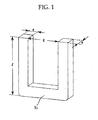
- the sealing material was punched out to obtain a sample S 1 in the form of a U shape, as shown in Fig. 1 , which has a thickness (a) of 10 mm, a width (e) of 10 mm, a height (f) of 130 mm, and an interval (g) between free ends of the sample of 45 mm.
- the sample S 1 was subjected to 60% compression in the thickness direction of the sample by using two acrylic boards 2 and 3 as shown in Fig. 2 . Water was poured to the inside of the U shape to the level of 100 mm. The time period by when water leakage was observed was measured. The results are shown in Table 3.
- the sealing material of Examples 1 to 6 maintained high adhesion between the surfaces of the rubber foam and the acrylic boards and excellent water cut-off properties, even after being left under the high temperature environment.
Landscapes
- Chemical & Material Sciences (AREA)
- Organic Chemistry (AREA)
- Health & Medical Sciences (AREA)
- Chemical Kinetics & Catalysis (AREA)
- Medicinal Chemistry (AREA)
- Polymers & Plastics (AREA)
- Engineering & Computer Science (AREA)
- Materials Engineering (AREA)
- General Chemical & Material Sciences (AREA)
- Sealing Material Composition (AREA)
- Manufacture Of Porous Articles, And Recovery And Treatment Of Waste Products (AREA)
- Compositions Of Macromolecular Compounds (AREA)
Description
- The present invention relates to a sealing material to be provided between members for sealing a gap between the members, and particularly relates to a sealing material comprising ethylene- a -olefin-diene copolymer rubber foam.
- Hitherto, a gap between members formed in constructs such as buildings, vehicles, electronic devices is filled with a sealing material, to provide water cut-off, heat insulation and sound absorption. Foams made of synthetic resins or rubbers are used for the sealing materials. The foams have appropriate repulsive force (compression stress). Therefore, the foams adhere, due to compliance, to the irregularity on the surface of the members to be sealed, under application of small compression deformation. Accordingly, an excellent seal property can be attained.
- Above all, a rubber foam obtained by expanding ethylene- a -olefin-diene copolymer rubber foam by using a blowing agent such as azodicarboxylic amide is preferably used as a sealing material, because of excellent weather resistance, heat resistance and seal properties (
Patent Literature 1 and 2). In the rubber foam, small cell diameter, appropriate expansion ratio and compression stress are effective for improving the properties required to the foam (water cut-off property, heat insulation property, sound absorption property, etc). Therefore, the rubber foam is subjected to bubble control by use of a treatment/processing auxiliary such as stearic acid.
Patent Literature 3 discloses a sealing material which is a rubber foam containing a rubber composition and an olefin resin. In particular examples 1-4 disclose a sealing composition obtained by vulcanising and foaming a composition comprising EPDM rubber, ethylene-vinyl acetate copolymer having a melting point of 89 °C and sulfur.
Patent Literature 4 discloses a crosslinked foamed composition which can be used as a sealing material comprising a blend of EPDM rubber and ethylene-vinyl acetate copolymer having a melting point of 77 °C. However the document does not cite the use of sulfur as vulcanising agent but only of peroxides such as dicumylperoxide.
Patent Literature 5 discloses a vulcanized rubber foam comprising an ethylene-vinyl acetate copolymer having a melting point higher than 80 °C.
Patent Literature 6 discloses a cross-linked foamed composition to be used as a sealing material comprising an ethylene, α-olefin, and non-conjugated diene copolymer, and sulfur as crosslinking agent. The document, however, does not make any reference to the use of an ethylene-vinyl acetate copolymer (EVA). -
- Patent Literature 1:
JP-A 2000-313762 - Patent Literature 2:
JP-A 2001-64429 - Patent Literature 3
JP-A 2009-74014 - Patent Literature 4
US 5932659 - Patent Literature 5
EP 1413597 - Patent Literature 6
JP-A 2000-1558 - >
- However, the sealing material obtained by using a conventional rubber foam has a problem of decreasing sealing property, due to the time dependent decrease of the compression stress. This problem easily happens, particularly when the sealing material is used at high temperatures for a long time or subjected to a long-term use under an environment where a high temperature and a low temperature are repeatedly observed.
- It is therefore an object of the present invention to provide a sealing material which maintains excellent sealing properties for a long time.
- The above problem of the present invention is solved by a sealing material prepared by vulcanizing and foaming a mixture comprising a rubber component comprising a copolymer rubber of ethylene, an α -olefin having 3 or more carbon atoms and a non-conjugated diene, a vulcanizing agent, and a blowing agent, wherein the mixture comprises a thermoplastic resin having a melting point of 80°C or less, when the thermoplastic resin is ethylene-vinyl acetate copolymer and the vulcanizing agent comprises sulfur.
- The sealing material of the present invention comprising ethylene-vinyl acetate copolymer comprising which has a melting point of 80°C or less helps to increase an adhesion property, as time elapses. Therefore, the adhesion between a surface of the sealing material and a surface to be sealed is further improved. As a result, the sealing material maintains excellent sealing properties for a long time.
-
- [
Fig. 1] Fig. 1 is a perspective view of a U-shaped sample to be used for evaluating water cut-off property. - [
Fig. 2] Fig. 2 is a diagram for generally explaining U-shaped test method for evaluating water cut-off property. - The sealing material of the invention is prepared by vulcanizing and foaming a mixture comprising a rubber component comprising a copolymer rubber of ethylene, an α-olefin having 3 or more carbon atoms, and a conjugated diene, a vulcanizing agent, a blowing agent, and ethylene-vinyl acetate copolymer (EVA) resin having a melting point of 80°C or less.
- The EVA resin having a melting point of 80°C or less bleeds out, as the time elapses, to the surface of the sealing member. Therefore, adhesion is obtained on the surface of the sealing material with respect to a surface to be sealed. Further, repulsive force of the sealing material further helps to increase the adhesion between the surface of the sealing material and the surface to be sealed. The bleeding out of the EVA is promoted particularly at a high temperature of 60°C or more. Therefore, even after the sealing material deteriorates to have a lower compression stress, it is possible to maintain adhesion between the sealing material and the surfaces to be sealed, and hence the sealing material can maintain an excellent sealing property for a long time. At the point of time where the sealing material is installed, the thermoplastic resin has not yet bled. Therefore, the position of the sealing material can be easily adjusted at the installation. In other words, it is possible to maintain a good working property. Moreover, the sealing material of the present invention is excellent in terms of productivity, since there is no need to further provide, on the surfaces of the rubber foam, an adhesive agent layer or the like for improving the adhesion with respect to surfaces to be sealed.
- The sealing material comprising a conventional rubber foam may include a thermoplastic resins such as EVA, for increasing the strength of the sealing material. However, it is considered for the known material that bleeding out of the components included in the sealing material is not desirable. Therefore, the thermoplastic resin included in the conventional rubber foam, in general, has a melting point exceeding 80°C, which fails to attain the above-discussed effect of the present invention.
- The EVA resin has a melting point of 80°C or less, preferably in the range of 50 to 75°C, and particularly preferably in the range of 60 to 70°C.
- The melting point of the EVA resin is a value measured by differential scanning calorimetry (DSC) pursuant to JIS K6924-2.
- EVA exhibits an excellent adhesion property without staining a material to be sealed when EVA bleeds out with respect to the surface of the material. Moreover, EVA further increases the durability of the sealing material. In addition to the above, EVA has a water repellent property, and also helps to form a film/coating on the surface of the sealing material. Accordingly, it is possible to improve water cut-off sealing property of the sealing material by using EVA.
- EVA, which has a melting point of 80°C or less and is capable of bleeding out to the surface of the sealing material, preferably has an appropriate melt flow rate (MFR) and vinyl acetate content.
- Ethylene-vinyl acetate copolymer has a melt flow rate, preferably in the range of 1 to 2500 g/10 min. When the melt flow rate of EVA is greater than 2500 g/ 10 min, the sealing material has a poor adhesion, and the water cut-off properties are sometimes lowered. When the melt flow rate of EVA is smaller than 1 g/10 min, a film which is effective for water cut-off is not easily prepared, and the water cut-off properties of EVA are sometimes decreased. It is further preferable that the melt flow ratio of EVA is in the range of 10 to 500 g/10 min, and particularly preferable in the range of 30 to 400 g/10 min. The above-discussed MFR values of EVA are measured in compliance with JIS K6924-1, under the condition at 190°C and a load application of 21.18N.
- Ethylene-vinyl acetate copolymer has a vinyl acetate content, preferably in the range of 10 to 50 wt.%. When the vinyl acetate content in EVA is increased, the rubber elasticity, flexibility and adhesion are improved On the other hand, when the vinyl acetate content in EVA is excessively large, the adhesion becomes too large, and the handling property of EVA is deteriorated, and hence the working/processing characteristics are sometimes decreased. It is more preferable that EVA has vinyl acetate content in the range of 15 to 35 wt.%, and particularly preferable in the range of 25 to 35 wt%. Herein, the vinyl acetate content of EVA is measured in compliance with JIS K 6924.
- It is preferable that the content of the EVA resin is in the range of 1 to 40 parts by weight, particularly in the range of 10 to 30 parts by weight, based on 100 parts by weight of the rubber component. When the content of the EVA resin exceeds 40 parts by weight, it is possible that kneading property and formability are lowered, the cells enlarge, and that the compression stress of the foam is decreased. When the content of the EVA resin is less than 1 part by weight, it is possible that the EVA resin cannot bleed out sufficiently.
- The rubber component comprises at least ethylene- a -olefin-diene copolymer rubber. The ethylene- a -olefin-diene copolymer rubber is a copolymer of ethylene, an α-olefin and a non-conjugated diene.
- As α-olefins, those having 3 or more carbon atoms. Specific examples include propylene, 1-butene, 4-methyl-1-pentene, 1-hexene, 1-octene, 1-decene, 1-dodecene, 1-tetradecene, 1-hexadecene, 1-octadecene, and 1-eicocene. The use of propylene is particularly preferable.
- As the non-conjugated diene, it is possible to use 1,4-hexadiene, 1,6-octadiene, 1,7-octadiene, 1,8-nonadiene, 1,9-decadiene, 2-methyl-1,5-hexadiene, 6-methyl-1,5-hexadiene, 7-methyl-1,6-octadiene, cyclohexadiene, dicyclopentadiene, methylterahydroindene, 5-vinyl-2-norbomene, 5-ethylidene-2-norbornene, and 5-methylene-2-norbornene. Among these materials, 5-ethylidene-2-norbornene is preferably used.
- Ethylene-α-olefin-diene copolymer rubber is preferably ethylene-propylene-diene copolymer rubber (EPDM). The non-conjugated diene content in the EPDM is preferably in the range of 3 to 20 % by weight, particularly in the range of 5 to 15% by weight. The application of the EPDM helps to restrict the lowering of the compression stress of the sealing material, as time elapsed.
- Ethylene- a -olefin-diene copolymer rubber is included in the rubber component, preferably in an amount of 60% by weight or more, particularly 85% by weight or more, based on the total weight of the rubber component. Accordingly, it is possible to prevent from the sealing material having a compression stress being lowered, as time elapsed.
- As a rubber component used in addition to the ethylene- a -olefin-diene copolymer rubber, ethylene-propylene rubber (EPM), butyl rubber (IIR), isoprene rubber (IR), natural rubber (NR), styrene-butadiene rubber (SBR), butadiene rubber (BR), 1,2-polybutadiene (RB), acrylic rubber (ACM, ANM), chlorosulfonatd polyethylene (CSM), chloropropylene (CR), silicone rubber or the like can be used. Among these, EPM, and IIR are preferably used.
- Examples of the vulcanizing agent are sulfur, sulfur compound, zinc flower, selenium, magnesium oxide, and organic peroxide. With the heat stability of the foam and the durability of the sealing material taking into account, the vulcanizing agent of the sealing material of the invention comprises at least sulfur.
- The content of the vulcanizing agent is preferably in the range of 1 to 30 parts by weigh, particularly in the range of 5 to 20 parts by weight based on 100 parts by weight of the rubber component.
- In the present invention, the term "vulcanization" is not understood to be limited to bridging by using sulfur, but is used as a synonym of "crosslinkage".
- A blowing agent is used not only for gas generation for foaming, but also used for vulcanization control with respect to the rubber component. Examples of the blowing agent include dinitropentamethylenetetramine (DPT), azodicarbonamide (ADCA), 4,4'-oxybisbenzenesulfonylhydrazide (OBSH), and sodium bicarbonate. Among these materials, ADCA is particularly preferably used, with the heat resistance of the foam, and the durability of the sealing material taking into account.
- It is preferable that the content of the blowing agent is in the range of 5 to 40 parts by weight, particularly in the range of 10 to 30 parts by weight, based on 100 parts by weight of the rubber component.
- The mixture used for the sealing material of the present invention may include a further additive, depending on the object. For instance, a vulcanization promoter such as thiazole promoter, dithiocarbamate promoter, thiourea promoter dithiophosphite promoter, and thiurum-based vulcanization promoting agent, a vulcanization promoting auxiliary such as stearic acid, lauric acid, and zinc oxide (activated zinc flower) are used.
- It is also possible to use a resin softener such as paraffin oil, paraffm wax, blow asphalt, polybutene, or rosin; a filler such as calcium carbonate, magnesium carbonate, silicic acid or silicic acid salts, talk, clay, mica flour, bentonite, carbon black, silica, aluminum hydroxide, magnesium hydroxide, alumina, aluminum silicate, acetylene black, aluminum flour, ceramic, glass fiber, wood flour, or waste textile; dehydrating agent such as potassium oxide, cesium oxide, sodium oxide, calcium oxide, and blowing auxiliary such as urea and urea derivatives, and anti-aging agent, antioxidant, pigment, coloring agent, and anti-mold agent, etc. One or more of these additives can be added to the mixture, if necessary. Carbon black can be used also as a reinforcement agent.
- Among the above-mentioned substances, a resin softener is preferably used, since a sealing material, which has excellent mechanical strength and excellent adhesion with respect to a surface to be sealed, can be obtained by the use. The content of the resin softener is preferably in the range of 50 to 100 parts by weight, based on 100 parts by weight of the rubber component.
- For preparing a sealing material according to the present invention, the above-explained mixture kneaded and formed to have a desired shape, and the thus obtained form is vulcanized and foamed. Accordingly, a sealing material is obtained, which has a closed cell structure.
- For preparing the sealing material, the mixture of the invention is kneaded, which has not yet include a blowing agent, blowing auxiliary, vulcanizing agent, and vulcanization auxiliary. The kneading is carried out by use of Banbury mixer, kneader, an enclosed mixer such as Intermix, or an open mixer such as rolls. It is preferable to perform the kneading at a temperature in the range of 80 to 170°C, particularly at a temperature in the range of 90 to 140°C, for 2 to 20 minutes. After kneading, a blowing agent, a blowing auxiliary, a vulcanization agent, and a vulcanizing auxiliary are added to the kneaded mixture, and the resultant mixture is further kneaded. The kneading is performed preferably at a temperature in the range of 40 to 90°C, particularly at a temperature in the range of 50 to 80°C for 5 to 30 minutes. The thus obtained kneaded mixture is formed to have a desired shape such as a sheet shape by a calender machine, or an extruder, etc.
- The kneaded substance is formed to have a desired shape, and then introduced to a vulcanization apparatus. The kneaded substance is heated at a temperature in the range of 130 to 270°C, in particular at a temperature in the range of 140 to 200°C for 1 to 90 minutes to vulcanize and foam the same. In accordance with this treatment, a foam having a closed cell structure is obtained. Heat application is carried out in a vulcanization vessel, by using heat application means such as a hot air vulcanizing vessel (HAV), glass beads fluidized bed, microwave vulcanization machine (UHF), or steam. Herein, vulcanization and foaming can be carried out simultaneously, or successively under different temperature conditions.
- In vulcanization and foaming, it is preferable to set the expansion ratio of the rubber foam (density ratio of the mixture before and after foaming) having a closed cell structure in the range of 5 to 30 times, particularly in the range of 10 to 20 times, based on the original size. Accordingly, a rubber foam with a appropriate mechanical strength is obtained.
- The rubber foam, which has been prepared by the vulcanization and foaming, has a closed cell structure. The cells in the rubber foam having a closed cell structure are fine/minute, to give the rubber foam with a high density. Accordingly, a sealing material having excellent properties such as water cut-off property, sound insulation property, and heat insulation property can be obtained.
- The mean diameter of the cell in the sealing material is in the range of 125 to 2500 µm, particularly in the range of 167 to 500 µm. The above-mentioned mean diameter of the cell is a value measured in accordance with ASTM D 3576-77.
- The number of the cell in the sealing material is in the range of 10 to 200/25 mm, in particular in the range of 50 to 150/25 mm. Here, the number of the cell is defined as that prescribed in JIS K 6767(1999), namely, based on the number of the cell per 25 mm of the foam.
- The rubber foam with a closed cell structure has 50% compression stress in a thickness direction of the foam at 25°C in the range of 0.5 to 100 kPa, particularly in the range of 45 to 70 kPa. Here, 50% compression stress is a value measured pursuant to JIS K6767.
- Moreover, the sealing material has a density (weight/volume), in the range of 50 to 150 kg/m3, particularly in the range of 90 to 110 kg/m3. The sealing material has a low density because the fine cells are highly dispersed therein, which means that the sealing material is excellent in view of cost performance. Here, the density is a value measured pursuant to a method prescribed in JIS K7222.
- Moreover, the sealing material has a tensile strength of 300% elongated in a longitudinal direction of the foam in the range of 50 to 500 kPa, particularly in the range of 200 to 300 kPa. Here, the tensile strength is a value measured pursuant to JIS K6767 (A method).
- The sealing material of the present invention has an ability of maintaining an excellent adhesion for a long time between the surface of the rubber foam and surfaces to be sealed. Such effect is particularly obtained in the use at high temperatures (60°C or more) for a long time, or in the use for a long time under an environment where a high temperature (60°C or more) and a low temperature (30°C or less) are repeatedly observed. For sealing gaps between members, the sealing material is preferably applicable, for instance, to a window-dam in vehicles; electric installations such as air-conditioner, washing machine, refrigerator, and vending machine; audio equipments; outer wall joint, sash, roof joint parts in architecture; housing equipment such as kitchen apparatus, modular bath, and water heater; joint in structures, roads or bridges or joint part of waterway in construction work.
- Moreover, the sealing material is used for dust-proof, heat insulation, sound insulation, vibration-proof, shock absorption, watertight, and airtight purposes. For instance, the sealing material can be used as a dust-proof material, a heat insulator, a sound insulator, a vibration insulator, a shock absorber, and a filler. The thickness of the sealing material can be decided depending on the usage, preferably in the range of 3 to 50 mm.
- The present invention will now be explained by referring to Examples. The present invention is not restricted to the following Examples.
- In the formulation of a mixture shown in Table 1, the components in the mixture except for a blowing agent, a blowing auxiliary, a vulcanizing agent and a vulcanization promoter were mixed by a kneader at 120°C for 8 minutes. Subsequently, the kneaded mixture was left to cool to have a surface temperature of 20°C, to which a blowing agent, a blowing auxiliary, a vulcanizing agent and a vulcanization promoter were further added, and kneaded at 80°C for 5 minutes by a kneader. Then, the resultant kneaded mixture was formed to have a sheet form, through an extruder for rubbers. The formed mixture was introduced to a heating furnace, and vulcanized and expanded at 140°C for 80 minutes, whereby a sealing material of a rubber foam having a closed cell structure was obtained.
- Following is the details of EPDM and EVA1 in the formulation in Table 1. Detailed description for the other components will be omitted.
-
- EPDM (Commercial name 501A, manufactured by Sumitomo Chemical Company, Limited; ethylene content: 52 % by weight, diene (5-ethylidene-2-norbomene) content: 5 % by weight)
- EVA1 (melting point: 71°C; melt flow rate: 18 g/ 10 min; vinyl acetate content: 28 wt.%)
- A sealing material of a rubber foam with a closed cell structure was prepared in the same way as in Example 1, except that the formulation was changed as shown in Table 1. The details of EVA 2 to EVA 4 in Table 1 are as follows.
-
- EVA2 (melting point: 67°C; melt flow rate 400 g/10 min; vinyl acetate content: 28 wt.%)
- EVA3 (melting point: 66°C; melt flow rate 30 g/10 min; vinyl acetate content: 32 wt.%)
- EVA4 (melting point: 79°C; melt flow rate 2500 g/10 min; vinyl acetate content: 14 wt.%)
- A sealing material of a rubber foam with a closed cell structure was prepared in the same way as in Example 1, except that the formulation was changed as shown in Table 2. Subsequently, a cell breakage treatment was carried out with respect to the rubber foam having a close cell structure, by subjecting the rubber foam to roll crashing. Therefore, a sealing material of a rubber foam having a semi-open cell structure was obtained.
- A sealing material of a rubber foam with a closed cell structure was prepared in the same way as in Example 1, except that the formulation was changed as shown in Table 2.
- A sealing material of a rubber foam with a closed cell structure was prepared in the same way as in Example 1, except that EVA was not used. Subsequently, EVA1 (melting point: 71°C; melt flow rate: 18 g/10 min; vinyl acetate content: 28 wt.%) was fused by the application of heat at 80°C thereto for 30 min, coated to the surface of the rubber foam by use of a bar coater, and died at 20°C for 60 min. It was not possible, however, to form an EVA coating which is capable of being evaluated on water cut-off properties.
- A sealing material of a rubber foam with a closed cell structure was prepared in the same way as in Example 1, except that the formulation was changed as shown in Table 2. The details of EVA 5 in Table 2 are as follows.
-
- EVA5 (melting point: 90°C; melt flow rate 14 g/10 min; vinyl acetate content: 15 wt.%)
- The density of the sealing material was measured by using a thickness gauge (Dial thickness gauge, manufactured by Teclock) and a balance (digital balance, manufactured by Shimadzu Corporation), pursuant to JIS K 7222. The results are shown in Table 3.
- 2. The number of cells in the sealing material was measured in accordance with JIS K 6767(1999). The results are shown in Table 3.
- 50% compression stress of the sealing material in the thickness direction was measured pursuant to a method JIS K 6767 (1999) by using a rigidity tester (Autograph, manufactured by Shimadzu Corporation). The results are shown in Table 3.
- The sealing material was punched out to obtain a sample S1 in the form of a U shape, as shown in
Fig. 1 , which has a thickness (a) of 10 mm, a width (e) of 10 mm, a height (f) of 130 mm, and an interval (g) between free ends of the sample of 45 mm. The sample S1 was subjected to 60% compression in the thickness direction of the sample by using two acrylic boards 2 and 3 as shown inFig. 2 . Water was poured to the inside of the U shape to the level of 100 mm. The time period by when water leakage was observed was measured. The results are shown in Table 3. - The water cut-off property of the sealing material was evaluated, as in the same way as above, after the sealing material was left under an environment at 80°C, 0%RH for 24 hours. The results are shown in Table 3. In table 3, "⊚", "○" and "×" represent the following states.
- ⊚: No water leakage was observed for 24 hours or more.
- ○: No water leakage was observed for 8 hours or more.
- ×: Water leakage was observed within 8 hours.
- As shown in Table 3, the sealing material of Examples 1 to 6 maintained high adhesion between the surfaces of the rubber foam and the acrylic boards and excellent water cut-off properties, even after being left under the high temperature environment.
-
- S1
- U-shaped sample
- 2, 3
- Acrylic boards


| Characteristics of Sealing Material | Water Cut-Off property of Sealing Material | ||||
| density [Kg/m3] | number of foams [number/25mm] | 50% compression stress [kPa] | Before heat resistant test (60% 100mm water height) | After heat resistant test (60% 100mm water height) | |
| Example 1 | 105 | 91 | 62 | ⊚ | ○ |
| Example 2 | 102 | 80 | 58 | ⊚ | ○ |
| Example 3 | 105 | 72 | 59 | ⊚ | ⊚ |
| Example 4 | 106 | 78 | 60 | ⊚ | ⊚ |
| Example 5 | 104 | 75 | 58 | ⊚ | ⊚ |
| Example 6 | 105 | 77 | 60 | ⊚ | ○ |
| Comparative Example 1 | 98 | 29 | 10 | × | × |
| Comparative Example 2 | 121 | 54 | 69 | ○ | × |
| Comparative Example 3 | 113 | 85 | 59 | ⊚ | × |
| Comparative Example 4 | - | - | - | - | - |
| Comparative Example 5 | 108 | 75 | 70 | × | × |
Claims (5)
- A sealing material prepared by vulcanizing and foaming a mixture comprising a rubber component comprising a copolymer rubber of ethylene, an α-olefin having 3 or more carbon atoms, and a non-conjugated diene, a vulcanizing agent, and a blowing agent, characterized in that the mixture comprises a thermoplastic resin having a melting point measured by differential scanning calorimetry pursuant to JIS K6924-2 of 80°C or less, the thermoplastic resin being ethylene-vinyl acetate copolymer, and the vulcanizing agent comprises sulphur.
- The sealing material as claimed in Claim 1, wherein the ethylene-vinyl acetate copolymer has a melt flow rate, measured in compliance with JIS K6924-1 under the condition of 190°C and load application of 21.18 N, in the range of 1 to 2500 g/10 min.
- The sealing material as claimed in Claims 1 or 2, wherein the ethylene-vinyl acetate copolymer has a vinyl acetate content, measured in compliance with JIS K6924, in the range of 25 to 35 wt%.
- The sealing material as claimed in any of Claims 1 to 3, wherein the content of the thermoplastic resin is in the range of 1 to 40 parts by weight, based on 100 parts by weight of the rubber component.
- The sealing material as claimed in any of Claims 1 to 4, wherein the blowing agent is azodicarboxylic amide.
Applications Claiming Priority (2)
| Application Number | Priority Date | Filing Date | Title |
|---|---|---|---|
| JP2009165230 | 2009-07-14 | ||
| PCT/JP2010/061863 WO2011007788A1 (en) | 2009-07-14 | 2010-07-14 | Sealing material |
Publications (3)
| Publication Number | Publication Date |
|---|---|
| EP2455437A1 EP2455437A1 (en) | 2012-05-23 |
| EP2455437A4 EP2455437A4 (en) | 2012-12-05 |
| EP2455437B1 true EP2455437B1 (en) | 2014-08-20 |
Family
ID=43449395
Family Applications (1)
| Application Number | Title | Priority Date | Filing Date |
|---|---|---|---|
| EP10799846.0A Not-in-force EP2455437B1 (en) | 2009-07-14 | 2010-07-14 | Sealing material |
Country Status (5)
| Country | Link |
|---|---|
| US (1) | US9403957B2 (en) |
| EP (1) | EP2455437B1 (en) |
| JP (1) | JP5746622B2 (en) |
| CN (1) | CN102471668B (en) |
| WO (1) | WO2011007788A1 (en) |
Families Citing this family (10)
| Publication number | Priority date | Publication date | Assignee | Title |
|---|---|---|---|---|
| EP2716729B1 (en) * | 2011-06-02 | 2019-02-20 | Bridgestone Corporation | Sealing material |
| JP2013221061A (en) * | 2012-04-16 | 2013-10-28 | Mitsufuku Industry Co Ltd | Rubber composition and method for producing the same |
| WO2013161920A1 (en) * | 2012-04-26 | 2013-10-31 | 株式会社ブリヂストン | Sealing material |
| CN103613898A (en) * | 2013-11-12 | 2014-03-05 | 铜陵市肆得科技有限责任公司 | Multi-rubber compound sealing ring for capacitor and preparation method thereof |
| CN104250532B (en) * | 2014-09-25 | 2016-05-18 | 张家港爱科思汽车配件有限公司 | The expansion type film that expands for a kind of automobile |
| JP6419032B2 (en) * | 2015-07-02 | 2018-11-07 | 株式会社鶴見製作所 | Water fence |
| US10988720B1 (en) * | 2015-11-09 | 2021-04-27 | Charm Sciences, Inc. | Peel plate assembly |
| CN106050093B (en) * | 2016-08-03 | 2017-12-26 | 安徽卡塔门窗有限公司 | a soundproof window |
| CN114561070A (en) * | 2022-02-16 | 2022-05-31 | 佛山市顺德区美的洗涤电器制造有限公司 | Sealing part of washing equipment, preparation method of sealing part and washing equipment |
| CN119431965B (en) * | 2024-11-06 | 2025-08-15 | 三浦橡胶(无锡)有限公司 | Environment-friendly pressure-resistant inner tube and preparation method thereof |
Citations (2)
| Publication number | Priority date | Publication date | Assignee | Title |
|---|---|---|---|---|
| EP1413597A1 (en) * | 2002-10-23 | 2004-04-28 | Nichias Corporation | Thermally expandable material, method for producing the same and soundproof sheet for automobiles |
| JP2009074014A (en) * | 2007-09-21 | 2009-04-09 | Toyo Quality One Corp | Rubber foam and method for producing the same |
Family Cites Families (17)
| Publication number | Priority date | Publication date | Assignee | Title |
|---|---|---|---|---|
| JPS54125262A (en) * | 1978-03-22 | 1979-09-28 | Nitto Electric Ind Co Ltd | Sealing medium |
| JPH0395238A (en) * | 1989-09-07 | 1991-04-19 | Sumitomo Chem Co Ltd | Foam |
| JPH06228355A (en) * | 1993-02-02 | 1994-08-16 | Fujikura Ltd | Flame-retardant heat-resistant polyolefin foam |
| CN1117503A (en) * | 1994-08-20 | 1996-02-28 | 叶一伸 | One-time molding vulcanization bonding method of ethylene-vinyl acetate foam and rubber |
| US5932659A (en) | 1994-09-19 | 1999-08-03 | Sentinel Products Corp. | Polymer blend |
| JP3766219B2 (en) * | 1998-04-13 | 2006-04-12 | 三井化学株式会社 | Rubber composition for sponge and its vulcanized rubber foam molding |
| JP4081203B2 (en) | 1999-04-30 | 2008-04-23 | 日東電工株式会社 | Rubber foam |
| JP2001064429A (en) | 1999-09-01 | 2001-03-13 | Nitto Denko Corp | Rubber foam |
| JP2002030171A (en) * | 2000-07-18 | 2002-01-31 | Takafuji Kasei:Kk | Sponge rubber added with polyolefin or copolymer of ethylene and another comonomer |
| JP2002212328A (en) * | 2001-01-18 | 2002-07-31 | Mitsui Chemicals Inc | Rubber foamed product |
| JP2003049156A (en) * | 2001-08-06 | 2003-02-21 | Bridgestone Corp | Sealing material |
| US6734218B2 (en) * | 2001-09-12 | 2004-05-11 | Sumitomo Chemical Company, Limited | Process for producing foamed rubber |
| JP3830415B2 (en) * | 2002-04-12 | 2006-10-04 | 三井化学株式会社 | Cross-linked rubber composition with excellent transparency |
| US7820086B2 (en) * | 2005-01-04 | 2010-10-26 | Sumitomo Chemical Company, Limited | Process for producing rubber composition, process for producing vulcanized molded article of rubber composition, and process for producing vulcanized and foamed molded article of rubber composition |
| JP2009084506A (en) | 2007-10-02 | 2009-04-23 | Tosoh Corp | Pellets and films made thereof |
| PL2107176T3 (en) * | 2008-03-31 | 2016-03-31 | Iso Chemie Gmbh | Production of a sealing tape made of soft foam |
| WO2010137524A1 (en) * | 2009-05-25 | 2010-12-02 | 株式会社ブリヂストン | Sealing material and method for producing same |
-
2010
- 2010-07-14 CN CN201080031704.5A patent/CN102471668B/en not_active Withdrawn - After Issue
- 2010-07-14 EP EP10799846.0A patent/EP2455437B1/en not_active Not-in-force
- 2010-07-14 WO PCT/JP2010/061863 patent/WO2011007788A1/en not_active Ceased
- 2010-07-14 JP JP2011522822A patent/JP5746622B2/en active Active
- 2010-07-14 US US13/384,140 patent/US9403957B2/en not_active Expired - Fee Related
Patent Citations (2)
| Publication number | Priority date | Publication date | Assignee | Title |
|---|---|---|---|---|
| EP1413597A1 (en) * | 2002-10-23 | 2004-04-28 | Nichias Corporation | Thermally expandable material, method for producing the same and soundproof sheet for automobiles |
| JP2009074014A (en) * | 2007-09-21 | 2009-04-09 | Toyo Quality One Corp | Rubber foam and method for producing the same |
Also Published As
| Publication number | Publication date |
|---|---|
| US20120123003A1 (en) | 2012-05-17 |
| WO2011007788A1 (en) | 2011-01-20 |
| US9403957B2 (en) | 2016-08-02 |
| EP2455437A4 (en) | 2012-12-05 |
| EP2455437A1 (en) | 2012-05-23 |
| CN102471668B (en) | 2015-06-10 |
| CN102471668A (en) | 2012-05-23 |
| JPWO2011007788A1 (en) | 2012-12-27 |
| JP5746622B2 (en) | 2015-07-08 |
Similar Documents
| Publication | Publication Date | Title |
|---|---|---|
| US9403957B2 (en) | Sealing material | |
| JP4912588B2 (en) | Open cell foam of ethylene / propylene / diene rubber | |
| US8906274B2 (en) | Sealing material and method for preparing the same | |
| JP5969819B2 (en) | SEALING MATERIAL COMPOSITION AND SEALING MATERIAL USING THE SAME | |
| EP2716729B1 (en) | Sealing material | |
| EP2843023B1 (en) | Sealing material | |
| JP2000159953A (en) | Rubber foam and sealing material | |
| JP6031093B2 (en) | Composition for rubber foam and rubber foam using the same | |
| JP6076162B2 (en) | Ethylene / propylene / diene rubber foam and sealing material | |
| JP5480020B2 (en) | Seal material and manufacturing method thereof | |
| JP5961038B2 (en) | Sealing material | |
| JP5928131B2 (en) | Manufacturing method of sealing material and sealing material | |
| JP3647983B2 (en) | Rubber foam | |
| JP3670457B2 (en) | Waterproof rubber foam | |
| JP2019178253A (en) | Copolymer composition for foam and the foam | |
| JP5926104B2 (en) | Method for producing rubber foam | |
| JP2002212328A (en) | Rubber foamed product | |
| JP2001310967A (en) | Foam rubber and method for producing the same |
Legal Events
| Date | Code | Title | Description |
|---|---|---|---|
| PUAI | Public reference made under article 153(3) epc to a published international application that has entered the european phase |
Free format text: ORIGINAL CODE: 0009012 |
|
| 17P | Request for examination filed |
Effective date: 20120112 |
|
| AK | Designated contracting states |
Kind code of ref document: A1 Designated state(s): AL AT BE BG CH CY CZ DE DK EE ES FI FR GB GR HR HU IE IS IT LI LT LU LV MC MK MT NL NO PL PT RO SE SI SK SM TR |
|
| DAX | Request for extension of the european patent (deleted) | ||
| A4 | Supplementary search report drawn up and despatched |
Effective date: 20121106 |
|
| RIC1 | Information provided on ipc code assigned before grant |
Ipc: C08L 23/08 20060101ALI20121030BHEP Ipc: C08J 3/24 20060101ALI20121030BHEP Ipc: C08K 5/23 20060101ALI20121030BHEP Ipc: C08J 9/10 20060101ALI20121030BHEP Ipc: C09K 3/10 20060101AFI20121030BHEP Ipc: C08K 3/06 20060101ALI20121030BHEP Ipc: C08L 31/04 20060101ALI20121030BHEP |
|
| GRAP | Despatch of communication of intention to grant a patent |
Free format text: ORIGINAL CODE: EPIDOSNIGR1 |
|
| INTG | Intention to grant announced |
Effective date: 20140127 |
|
| GRAS | Grant fee paid |
Free format text: ORIGINAL CODE: EPIDOSNIGR3 |
|
| GRAA | (expected) grant |
Free format text: ORIGINAL CODE: 0009210 |
|
| AK | Designated contracting states |
Kind code of ref document: B1 Designated state(s): AL AT BE BG CH CY CZ DE DK EE ES FI FR GB GR HR HU IE IS IT LI LT LU LV MC MK MT NL NO PL PT RO SE SI SK SM TR |
|
| REG | Reference to a national code |
Ref country code: GB Ref legal event code: FG4D |
|
| REG | Reference to a national code |
Ref country code: CH Ref legal event code: EP |
|
| REG | Reference to a national code |
Ref country code: AT Ref legal event code: REF Ref document number: 683485 Country of ref document: AT Kind code of ref document: T Effective date: 20140915 |
|
| REG | Reference to a national code |
Ref country code: IE Ref legal event code: FG4D |
|
| REG | Reference to a national code |
Ref country code: DE Ref legal event code: R096 Ref document number: 602010018458 Country of ref document: DE Effective date: 20141002 |
|
| REG | Reference to a national code |
Ref country code: AT Ref legal event code: MK05 Ref document number: 683485 Country of ref document: AT Kind code of ref document: T Effective date: 20140820 |
|
| REG | Reference to a national code |
Ref country code: NL Ref legal event code: VDEP Effective date: 20140820 |
|
| REG | Reference to a national code |
Ref country code: LT Ref legal event code: MG4D |
|
| PG25 | Lapsed in a contracting state [announced via postgrant information from national office to epo] |
Ref country code: NO Free format text: LAPSE BECAUSE OF FAILURE TO SUBMIT A TRANSLATION OF THE DESCRIPTION OR TO PAY THE FEE WITHIN THE PRESCRIBED TIME-LIMIT Effective date: 20141120 Ref country code: GR Free format text: LAPSE BECAUSE OF FAILURE TO SUBMIT A TRANSLATION OF THE DESCRIPTION OR TO PAY THE FEE WITHIN THE PRESCRIBED TIME-LIMIT Effective date: 20141121 Ref country code: FI Free format text: LAPSE BECAUSE OF FAILURE TO SUBMIT A TRANSLATION OF THE DESCRIPTION OR TO PAY THE FEE WITHIN THE PRESCRIBED TIME-LIMIT Effective date: 20140820 Ref country code: BG Free format text: LAPSE BECAUSE OF FAILURE TO SUBMIT A TRANSLATION OF THE DESCRIPTION OR TO PAY THE FEE WITHIN THE PRESCRIBED TIME-LIMIT Effective date: 20141120 Ref country code: PT Free format text: LAPSE BECAUSE OF FAILURE TO SUBMIT A TRANSLATION OF THE DESCRIPTION OR TO PAY THE FEE WITHIN THE PRESCRIBED TIME-LIMIT Effective date: 20141222 Ref country code: SE Free format text: LAPSE BECAUSE OF FAILURE TO SUBMIT A TRANSLATION OF THE DESCRIPTION OR TO PAY THE FEE WITHIN THE PRESCRIBED TIME-LIMIT Effective date: 20140820 Ref country code: LT Free format text: LAPSE BECAUSE OF FAILURE TO SUBMIT A TRANSLATION OF THE DESCRIPTION OR TO PAY THE FEE WITHIN THE PRESCRIBED TIME-LIMIT Effective date: 20140820 Ref country code: ES Free format text: LAPSE BECAUSE OF FAILURE TO SUBMIT A TRANSLATION OF THE DESCRIPTION OR TO PAY THE FEE WITHIN THE PRESCRIBED TIME-LIMIT Effective date: 20140820 |
|
| PG25 | Lapsed in a contracting state [announced via postgrant information from national office to epo] |
Ref country code: AT Free format text: LAPSE BECAUSE OF FAILURE TO SUBMIT A TRANSLATION OF THE DESCRIPTION OR TO PAY THE FEE WITHIN THE PRESCRIBED TIME-LIMIT Effective date: 20140820 Ref country code: HR Free format text: LAPSE BECAUSE OF FAILURE TO SUBMIT A TRANSLATION OF THE DESCRIPTION OR TO PAY THE FEE WITHIN THE PRESCRIBED TIME-LIMIT Effective date: 20140820 Ref country code: LV Free format text: LAPSE BECAUSE OF FAILURE TO SUBMIT A TRANSLATION OF THE DESCRIPTION OR TO PAY THE FEE WITHIN THE PRESCRIBED TIME-LIMIT Effective date: 20140820 Ref country code: IS Free format text: LAPSE BECAUSE OF FAILURE TO SUBMIT A TRANSLATION OF THE DESCRIPTION OR TO PAY THE FEE WITHIN THE PRESCRIBED TIME-LIMIT Effective date: 20141220 |
|
| PG25 | Lapsed in a contracting state [announced via postgrant information from national office to epo] |
Ref country code: NL Free format text: LAPSE BECAUSE OF FAILURE TO SUBMIT A TRANSLATION OF THE DESCRIPTION OR TO PAY THE FEE WITHIN THE PRESCRIBED TIME-LIMIT Effective date: 20140820 |
|
| PG25 | Lapsed in a contracting state [announced via postgrant information from national office to epo] |
Ref country code: RO Free format text: LAPSE BECAUSE OF FAILURE TO SUBMIT A TRANSLATION OF THE DESCRIPTION OR TO PAY THE FEE WITHIN THE PRESCRIBED TIME-LIMIT Effective date: 20140820 Ref country code: CZ Free format text: LAPSE BECAUSE OF FAILURE TO SUBMIT A TRANSLATION OF THE DESCRIPTION OR TO PAY THE FEE WITHIN THE PRESCRIBED TIME-LIMIT Effective date: 20140820 Ref country code: IT Free format text: LAPSE BECAUSE OF FAILURE TO SUBMIT A TRANSLATION OF THE DESCRIPTION OR TO PAY THE FEE WITHIN THE PRESCRIBED TIME-LIMIT Effective date: 20140820 Ref country code: SK Free format text: LAPSE BECAUSE OF FAILURE TO SUBMIT A TRANSLATION OF THE DESCRIPTION OR TO PAY THE FEE WITHIN THE PRESCRIBED TIME-LIMIT Effective date: 20140820 Ref country code: EE Free format text: LAPSE BECAUSE OF FAILURE TO SUBMIT A TRANSLATION OF THE DESCRIPTION OR TO PAY THE FEE WITHIN THE PRESCRIBED TIME-LIMIT Effective date: 20140820 Ref country code: DK Free format text: LAPSE BECAUSE OF FAILURE TO SUBMIT A TRANSLATION OF THE DESCRIPTION OR TO PAY THE FEE WITHIN THE PRESCRIBED TIME-LIMIT Effective date: 20140820 |
|
| REG | Reference to a national code |
Ref country code: DE Ref legal event code: R097 Ref document number: 602010018458 Country of ref document: DE |
|
| PG25 | Lapsed in a contracting state [announced via postgrant information from national office to epo] |
Ref country code: PL Free format text: LAPSE BECAUSE OF FAILURE TO SUBMIT A TRANSLATION OF THE DESCRIPTION OR TO PAY THE FEE WITHIN THE PRESCRIBED TIME-LIMIT Effective date: 20140820 |
|
| PLBE | No opposition filed within time limit |
Free format text: ORIGINAL CODE: 0009261 |
|
| STAA | Information on the status of an ep patent application or granted ep patent |
Free format text: STATUS: NO OPPOSITION FILED WITHIN TIME LIMIT |
|
| 26N | No opposition filed |
Effective date: 20150521 |
|
| PG25 | Lapsed in a contracting state [announced via postgrant information from national office to epo] |
Ref country code: SI Free format text: LAPSE BECAUSE OF FAILURE TO SUBMIT A TRANSLATION OF THE DESCRIPTION OR TO PAY THE FEE WITHIN THE PRESCRIBED TIME-LIMIT Effective date: 20140820 |
|
| PG25 | Lapsed in a contracting state [announced via postgrant information from national office to epo] |
Ref country code: MC Free format text: LAPSE BECAUSE OF FAILURE TO SUBMIT A TRANSLATION OF THE DESCRIPTION OR TO PAY THE FEE WITHIN THE PRESCRIBED TIME-LIMIT Effective date: 20140820 |
|
| REG | Reference to a national code |
Ref country code: CH Ref legal event code: PL |
|
| GBPC | Gb: european patent ceased through non-payment of renewal fee |
Effective date: 20150714 |
|
| PG25 | Lapsed in a contracting state [announced via postgrant information from national office to epo] |
Ref country code: LU Free format text: LAPSE BECAUSE OF FAILURE TO SUBMIT A TRANSLATION OF THE DESCRIPTION OR TO PAY THE FEE WITHIN THE PRESCRIBED TIME-LIMIT Effective date: 20150714 |
|
| REG | Reference to a national code |
Ref country code: IE Ref legal event code: MM4A |
|
| PG25 | Lapsed in a contracting state [announced via postgrant information from national office to epo] |
Ref country code: CH Free format text: LAPSE BECAUSE OF NON-PAYMENT OF DUE FEES Effective date: 20150731 Ref country code: LI Free format text: LAPSE BECAUSE OF NON-PAYMENT OF DUE FEES Effective date: 20150731 Ref country code: GB Free format text: LAPSE BECAUSE OF NON-PAYMENT OF DUE FEES Effective date: 20150714 |
|
| REG | Reference to a national code |
Ref country code: FR Ref legal event code: PLFP Year of fee payment: 7 |
|
| PG25 | Lapsed in a contracting state [announced via postgrant information from national office to epo] |
Ref country code: IE Free format text: LAPSE BECAUSE OF NON-PAYMENT OF DUE FEES Effective date: 20150714 |
|
| PG25 | Lapsed in a contracting state [announced via postgrant information from national office to epo] |
Ref country code: MT Free format text: LAPSE BECAUSE OF FAILURE TO SUBMIT A TRANSLATION OF THE DESCRIPTION OR TO PAY THE FEE WITHIN THE PRESCRIBED TIME-LIMIT Effective date: 20140820 |
|
| PG25 | Lapsed in a contracting state [announced via postgrant information from national office to epo] |
Ref country code: SM Free format text: LAPSE BECAUSE OF FAILURE TO SUBMIT A TRANSLATION OF THE DESCRIPTION OR TO PAY THE FEE WITHIN THE PRESCRIBED TIME-LIMIT Effective date: 20140820 Ref country code: HU Free format text: LAPSE BECAUSE OF FAILURE TO SUBMIT A TRANSLATION OF THE DESCRIPTION OR TO PAY THE FEE WITHIN THE PRESCRIBED TIME-LIMIT; INVALID AB INITIO Effective date: 20100714 |
|
| PG25 | Lapsed in a contracting state [announced via postgrant information from national office to epo] |
Ref country code: CY Free format text: LAPSE BECAUSE OF FAILURE TO SUBMIT A TRANSLATION OF THE DESCRIPTION OR TO PAY THE FEE WITHIN THE PRESCRIBED TIME-LIMIT Effective date: 20140820 |
|
| REG | Reference to a national code |
Ref country code: FR Ref legal event code: PLFP Year of fee payment: 8 |
|
| PG25 | Lapsed in a contracting state [announced via postgrant information from national office to epo] |
Ref country code: TR Free format text: LAPSE BECAUSE OF FAILURE TO SUBMIT A TRANSLATION OF THE DESCRIPTION OR TO PAY THE FEE WITHIN THE PRESCRIBED TIME-LIMIT Effective date: 20140820 |
|
| PG25 | Lapsed in a contracting state [announced via postgrant information from national office to epo] |
Ref country code: MK Free format text: LAPSE BECAUSE OF FAILURE TO SUBMIT A TRANSLATION OF THE DESCRIPTION OR TO PAY THE FEE WITHIN THE PRESCRIBED TIME-LIMIT Effective date: 20140820 |
|
| REG | Reference to a national code |
Ref country code: FR Ref legal event code: PLFP Year of fee payment: 9 |
|
| PG25 | Lapsed in a contracting state [announced via postgrant information from national office to epo] |
Ref country code: AL Free format text: LAPSE BECAUSE OF FAILURE TO SUBMIT A TRANSLATION OF THE DESCRIPTION OR TO PAY THE FEE WITHIN THE PRESCRIBED TIME-LIMIT Effective date: 20140820 |
|
| PGFP | Annual fee paid to national office [announced via postgrant information from national office to epo] |
Ref country code: BE Payment date: 20190718 Year of fee payment: 10 |
|
| PGFP | Annual fee paid to national office [announced via postgrant information from national office to epo] |
Ref country code: FR Payment date: 20200723 Year of fee payment: 11 Ref country code: DE Payment date: 20200721 Year of fee payment: 11 |
|
| REG | Reference to a national code |
Ref country code: BE Ref legal event code: MM Effective date: 20200731 |
|
| PG25 | Lapsed in a contracting state [announced via postgrant information from national office to epo] |
Ref country code: BE Free format text: LAPSE BECAUSE OF NON-PAYMENT OF DUE FEES Effective date: 20200731 |
|
| REG | Reference to a national code |
Ref country code: DE Ref legal event code: R231 Ref document number: 602010018458 Country of ref document: DE |
|
| PG25 | Lapsed in a contracting state [announced via postgrant information from national office to epo] |
Ref country code: DE Free format text: LAPSE BECAUSE OF THE APPLICANT RENOUNCES Effective date: 20210703 |
|
| PG25 | Lapsed in a contracting state [announced via postgrant information from national office to epo] |
Ref country code: FR Free format text: LAPSE BECAUSE OF NON-PAYMENT OF DUE FEES Effective date: 20210630 |
|
| PG25 | Lapsed in a contracting state [announced via postgrant information from national office to epo] |
Ref country code: FR Free format text: LAPSE BECAUSE OF NON-PAYMENT OF DUE FEES Effective date: 20210630 |