EP2455333A2 - Photonic crystal, conjugated polymers suitable for photonic crystals, and a method for synthesizing conjugated polymers - Google Patents
Photonic crystal, conjugated polymers suitable for photonic crystals, and a method for synthesizing conjugated polymers Download PDFInfo
- Publication number
- EP2455333A2 EP2455333A2 EP12154713A EP12154713A EP2455333A2 EP 2455333 A2 EP2455333 A2 EP 2455333A2 EP 12154713 A EP12154713 A EP 12154713A EP 12154713 A EP12154713 A EP 12154713A EP 2455333 A2 EP2455333 A2 EP 2455333A2
- Authority
- EP
- European Patent Office
- Prior art keywords
- refractive index
- photonic crystal
- electromagnetic energy
- wavelength
- organic material
- Prior art date
- Legal status (The legal status is an assumption and is not a legal conclusion. Google has not performed a legal analysis and makes no representation as to the accuracy of the status listed.)
- Withdrawn
Links
- 239000004038 photonic crystal Substances 0.000 title claims abstract description 54
- 238000000034 method Methods 0.000 title description 14
- 229920000547 conjugated polymer Polymers 0.000 title description 10
- 230000002194 synthesizing effect Effects 0.000 title description 3
- 239000011368 organic material Substances 0.000 claims abstract description 36
- 239000000463 material Substances 0.000 claims abstract description 26
- 229920000123 polythiophene Polymers 0.000 claims description 36
- 229920000642 polymer Polymers 0.000 claims description 28
- 229920000414 polyfuran Polymers 0.000 claims description 4
- 229920000128 polypyrrole Polymers 0.000 claims description 4
- 229920001577 copolymer Polymers 0.000 claims description 3
- -1 polyphenylenevinylene Polymers 0.000 claims description 3
- 229920000553 poly(phenylenevinylene) Polymers 0.000 claims description 2
- 229920000620 organic polymer Polymers 0.000 description 45
- 239000000178 monomer Substances 0.000 description 24
- XUIMIQQOPSSXEZ-UHFFFAOYSA-N Silicon Chemical compound [Si] XUIMIQQOPSSXEZ-UHFFFAOYSA-N 0.000 description 12
- 239000002841 Lewis acid Substances 0.000 description 11
- 150000007517 lewis acids Chemical class 0.000 description 11
- 229910052710 silicon Inorganic materials 0.000 description 11
- 230000015572 biosynthetic process Effects 0.000 description 10
- 239000010703 silicon Substances 0.000 description 10
- 239000000243 solution Substances 0.000 description 10
- 239000013078 crystal Substances 0.000 description 7
- 229920006395 saturated elastomer Polymers 0.000 description 7
- 238000003786 synthesis reaction Methods 0.000 description 7
- 230000021615 conjugation Effects 0.000 description 6
- 239000003989 dielectric material Substances 0.000 description 6
- 230000002378 acidificating effect Effects 0.000 description 5
- 238000004519 manufacturing process Methods 0.000 description 5
- 238000006116 polymerization reaction Methods 0.000 description 5
- 239000006185 dispersion Substances 0.000 description 4
- 239000012535 impurity Substances 0.000 description 4
- 238000010348 incorporation Methods 0.000 description 4
- 239000004065 semiconductor Substances 0.000 description 4
- 238000005033 Fourier transform infrared spectroscopy Methods 0.000 description 3
- VSCWAEJMTAWNJL-UHFFFAOYSA-K aluminium trichloride Chemical compound Cl[Al](Cl)Cl VSCWAEJMTAWNJL-UHFFFAOYSA-K 0.000 description 3
- 150000001875 compounds Chemical class 0.000 description 3
- 230000000379 polymerizing effect Effects 0.000 description 3
- 238000003672 processing method Methods 0.000 description 3
- 238000001308 synthesis method Methods 0.000 description 3
- IDOFMGSESVXXQI-UHFFFAOYSA-N 2,4,6-tritert-butylpyridine Chemical compound CC(C)(C)C1=CC(C(C)(C)C)=NC(C(C)(C)C)=C1 IDOFMGSESVXXQI-UHFFFAOYSA-N 0.000 description 2
- VYWSYEDVFVGRGG-UHFFFAOYSA-N 2,4,6-tritert-butylpyrimidine Chemical compound CC(C)(C)C1=CC(C(C)(C)C)=NC(C(C)(C)C)=N1 VYWSYEDVFVGRGG-UHFFFAOYSA-N 0.000 description 2
- UWKQJZCTQGMHKD-UHFFFAOYSA-N 2,6-di-tert-butylpyridine Chemical compound CC(C)(C)C1=CC=CC(C(C)(C)C)=N1 UWKQJZCTQGMHKD-UHFFFAOYSA-N 0.000 description 2
- 229910021630 Antimony pentafluoride Inorganic materials 0.000 description 2
- 238000010521 absorption reaction Methods 0.000 description 2
- VBVBHWZYQGJZLR-UHFFFAOYSA-I antimony pentafluoride Chemical compound F[Sb](F)(F)(F)F VBVBHWZYQGJZLR-UHFFFAOYSA-I 0.000 description 2
- 230000008901 benefit Effects 0.000 description 2
- 238000010276 construction Methods 0.000 description 2
- 238000011161 development Methods 0.000 description 2
- LSXWFXONGKSEMY-UHFFFAOYSA-N di-tert-butyl peroxide Chemical compound CC(C)(C)OOC(C)(C)C LSXWFXONGKSEMY-UHFFFAOYSA-N 0.000 description 2
- 239000012969 di-tertiary-butyl peroxide Substances 0.000 description 2
- 230000005670 electromagnetic radiation Effects 0.000 description 2
- 230000008014 freezing Effects 0.000 description 2
- 238000007710 freezing Methods 0.000 description 2
- 238000012986 modification Methods 0.000 description 2
- 230000004048 modification Effects 0.000 description 2
- 230000000704 physical effect Effects 0.000 description 2
- 239000002904 solvent Substances 0.000 description 2
- 238000002371 ultraviolet--visible spectrum Methods 0.000 description 2
- XLYOFNOQVPJJNP-UHFFFAOYSA-N water Substances O XLYOFNOQVPJJNP-UHFFFAOYSA-N 0.000 description 2
- ZOXJGFHDIHLPTG-UHFFFAOYSA-N Boron Chemical compound [B] ZOXJGFHDIHLPTG-UHFFFAOYSA-N 0.000 description 1
- KZMGYPLQYOPHEL-UHFFFAOYSA-N Boron trifluoride etherate Chemical compound FB(F)F.CCOCC KZMGYPLQYOPHEL-UHFFFAOYSA-N 0.000 description 1
- 239000003929 acidic solution Substances 0.000 description 1
- 238000004458 analytical method Methods 0.000 description 1
- 229910052796 boron Inorganic materials 0.000 description 1
- 230000015556 catabolic process Effects 0.000 description 1
- 238000007796 conventional method Methods 0.000 description 1
- 238000006731 degradation reaction Methods 0.000 description 1
- 230000001627 detrimental effect Effects 0.000 description 1
- 125000004177 diethyl group Chemical group [H]C([H])([H])C([H])([H])* 0.000 description 1
- 230000000694 effects Effects 0.000 description 1
- 230000005684 electric field Effects 0.000 description 1
- 150000002240 furans Chemical class 0.000 description 1
- 230000014759 maintenance of location Effects 0.000 description 1
- 230000003287 optical effect Effects 0.000 description 1
- 230000000737 periodic effect Effects 0.000 description 1
- 230000010287 polarization Effects 0.000 description 1
- 150000003233 pyrroles Chemical class 0.000 description 1
- 230000002000 scavenging effect Effects 0.000 description 1
- 239000007858 starting material Substances 0.000 description 1
- 238000012360 testing method Methods 0.000 description 1
- 229930192474 thiophene Natural products 0.000 description 1
- 150000003577 thiophenes Chemical class 0.000 description 1
- 230000007704 transition Effects 0.000 description 1
- 239000012780 transparent material Substances 0.000 description 1
Images
Classifications
-
- C—CHEMISTRY; METALLURGY
- C08—ORGANIC MACROMOLECULAR COMPOUNDS; THEIR PREPARATION OR CHEMICAL WORKING-UP; COMPOSITIONS BASED THEREON
- C08G—MACROMOLECULAR COMPOUNDS OBTAINED OTHERWISE THAN BY REACTIONS ONLY INVOLVING UNSATURATED CARBON-TO-CARBON BONDS
- C08G61/00—Macromolecular compounds obtained by reactions forming a carbon-to-carbon link in the main chain of the macromolecule
- C08G61/12—Macromolecular compounds containing atoms other than carbon in the main chain of the macromolecule
- C08G61/122—Macromolecular compounds containing atoms other than carbon in the main chain of the macromolecule derived from five- or six-membered heterocyclic compounds, other than imides
- C08G61/123—Macromolecular compounds containing atoms other than carbon in the main chain of the macromolecule derived from five- or six-membered heterocyclic compounds, other than imides derived from five-membered heterocyclic compounds
- C08G61/126—Macromolecular compounds containing atoms other than carbon in the main chain of the macromolecule derived from five- or six-membered heterocyclic compounds, other than imides derived from five-membered heterocyclic compounds with a five-membered ring containing one sulfur atom in the ring
-
- C—CHEMISTRY; METALLURGY
- C08—ORGANIC MACROMOLECULAR COMPOUNDS; THEIR PREPARATION OR CHEMICAL WORKING-UP; COMPOSITIONS BASED THEREON
- C08G—MACROMOLECULAR COMPOUNDS OBTAINED OTHERWISE THAN BY REACTIONS ONLY INVOLVING UNSATURATED CARBON-TO-CARBON BONDS
- C08G61/00—Macromolecular compounds obtained by reactions forming a carbon-to-carbon link in the main chain of the macromolecule
- C08G61/12—Macromolecular compounds containing atoms other than carbon in the main chain of the macromolecule
- C08G61/122—Macromolecular compounds containing atoms other than carbon in the main chain of the macromolecule derived from five- or six-membered heterocyclic compounds, other than imides
- C08G61/123—Macromolecular compounds containing atoms other than carbon in the main chain of the macromolecule derived from five- or six-membered heterocyclic compounds, other than imides derived from five-membered heterocyclic compounds
- C08G61/124—Macromolecular compounds containing atoms other than carbon in the main chain of the macromolecule derived from five- or six-membered heterocyclic compounds, other than imides derived from five-membered heterocyclic compounds with a five-membered ring containing one nitrogen atom in the ring
-
- C—CHEMISTRY; METALLURGY
- C08—ORGANIC MACROMOLECULAR COMPOUNDS; THEIR PREPARATION OR CHEMICAL WORKING-UP; COMPOSITIONS BASED THEREON
- C08G—MACROMOLECULAR COMPOUNDS OBTAINED OTHERWISE THAN BY REACTIONS ONLY INVOLVING UNSATURATED CARBON-TO-CARBON BONDS
- C08G61/00—Macromolecular compounds obtained by reactions forming a carbon-to-carbon link in the main chain of the macromolecule
- C08G61/12—Macromolecular compounds containing atoms other than carbon in the main chain of the macromolecule
- C08G61/122—Macromolecular compounds containing atoms other than carbon in the main chain of the macromolecule derived from five- or six-membered heterocyclic compounds, other than imides
- C08G61/123—Macromolecular compounds containing atoms other than carbon in the main chain of the macromolecule derived from five- or six-membered heterocyclic compounds, other than imides derived from five-membered heterocyclic compounds
- C08G61/125—Macromolecular compounds containing atoms other than carbon in the main chain of the macromolecule derived from five- or six-membered heterocyclic compounds, other than imides derived from five-membered heterocyclic compounds with a five-membered ring containing one oxygen atom in the ring
-
- G—PHYSICS
- G02—OPTICS
- G02B—OPTICAL ELEMENTS, SYSTEMS OR APPARATUS
- G02B6/00—Light guides; Structural details of arrangements comprising light guides and other optical elements, e.g. couplings
- G02B6/10—Light guides; Structural details of arrangements comprising light guides and other optical elements, e.g. couplings of the optical waveguide type
- G02B6/12—Light guides; Structural details of arrangements comprising light guides and other optical elements, e.g. couplings of the optical waveguide type of the integrated circuit kind
- G02B6/122—Basic optical elements, e.g. light-guiding paths
- G02B6/1225—Basic optical elements, e.g. light-guiding paths comprising photonic band-gap structures or photonic lattices
-
- B—PERFORMING OPERATIONS; TRANSPORTING
- B82—NANOTECHNOLOGY
- B82Y—SPECIFIC USES OR APPLICATIONS OF NANOSTRUCTURES; MEASUREMENT OR ANALYSIS OF NANOSTRUCTURES; MANUFACTURE OR TREATMENT OF NANOSTRUCTURES
- B82Y20/00—Nanooptics, e.g. quantum optics or photonic crystals
-
- C—CHEMISTRY; METALLURGY
- C08—ORGANIC MACROMOLECULAR COMPOUNDS; THEIR PREPARATION OR CHEMICAL WORKING-UP; COMPOSITIONS BASED THEREON
- C08G—MACROMOLECULAR COMPOUNDS OBTAINED OTHERWISE THAN BY REACTIONS ONLY INVOLVING UNSATURATED CARBON-TO-CARBON BONDS
- C08G2261/00—Macromolecular compounds obtained by reactions forming a carbon-to-carbon link in the main chain of the macromolecule
- C08G2261/30—Monomer units or repeat units incorporating structural elements in the main chain
- C08G2261/32—Monomer units or repeat units incorporating structural elements in the main chain incorporating heteroaromatic structural elements in the main chain
- C08G2261/322—Monomer units or repeat units incorporating structural elements in the main chain incorporating heteroaromatic structural elements in the main chain non-condensed
- C08G2261/3221—Monomer units or repeat units incorporating structural elements in the main chain incorporating heteroaromatic structural elements in the main chain non-condensed containing one or more nitrogen atoms as the only heteroatom, e.g. pyrrole, pyridine or triazole
-
- C—CHEMISTRY; METALLURGY
- C08—ORGANIC MACROMOLECULAR COMPOUNDS; THEIR PREPARATION OR CHEMICAL WORKING-UP; COMPOSITIONS BASED THEREON
- C08G—MACROMOLECULAR COMPOUNDS OBTAINED OTHERWISE THAN BY REACTIONS ONLY INVOLVING UNSATURATED CARBON-TO-CARBON BONDS
- C08G2261/00—Macromolecular compounds obtained by reactions forming a carbon-to-carbon link in the main chain of the macromolecule
- C08G2261/30—Monomer units or repeat units incorporating structural elements in the main chain
- C08G2261/32—Monomer units or repeat units incorporating structural elements in the main chain incorporating heteroaromatic structural elements in the main chain
- C08G2261/322—Monomer units or repeat units incorporating structural elements in the main chain incorporating heteroaromatic structural elements in the main chain non-condensed
- C08G2261/3222—Monomer units or repeat units incorporating structural elements in the main chain incorporating heteroaromatic structural elements in the main chain non-condensed containing one or more oxygen atoms as the only heteroatom, e.g. furan
-
- C—CHEMISTRY; METALLURGY
- C08—ORGANIC MACROMOLECULAR COMPOUNDS; THEIR PREPARATION OR CHEMICAL WORKING-UP; COMPOSITIONS BASED THEREON
- C08G—MACROMOLECULAR COMPOUNDS OBTAINED OTHERWISE THAN BY REACTIONS ONLY INVOLVING UNSATURATED CARBON-TO-CARBON BONDS
- C08G2261/00—Macromolecular compounds obtained by reactions forming a carbon-to-carbon link in the main chain of the macromolecule
- C08G2261/30—Monomer units or repeat units incorporating structural elements in the main chain
- C08G2261/32—Monomer units or repeat units incorporating structural elements in the main chain incorporating heteroaromatic structural elements in the main chain
- C08G2261/322—Monomer units or repeat units incorporating structural elements in the main chain incorporating heteroaromatic structural elements in the main chain non-condensed
- C08G2261/3223—Monomer units or repeat units incorporating structural elements in the main chain incorporating heteroaromatic structural elements in the main chain non-condensed containing one or more sulfur atoms as the only heteroatom, e.g. thiophene
Definitions
- the present invention relates to conjugated polymers and a method for their synthesis. Furthermore, the present invention relates to electro-synthesis methods for producing polymers that include the use of at least one Lewis acid and at least one proton trap to form organic conjugated polymers having elevated refractive indices.
- the doping of the silicon crystal can give rise to the absence of a silicon atom or the presence of an impurity at a silicon site in the lattice, or an impurity atom located at a non-silicon site within the lattice structure. In this way, electrons are permitted to have an energy within the band gap, thereby minimizing the size of the energy gap that electrons must surmount in order to make the transition from the valence band to the conduction band, and improving the overall conductivity of the silicon crystal.
- a photonic crystal can include a block of dielectric transparent material having air holes interspersed throughout said material.
- the refractive index of the dielectric material is large relative to the refractive index of the air. Photons passing through the block of dielectric material will periodically encounter regions of high refractive index and low refractive index in a manner analogous to electrons periodically encountering allowable energy ranges and the band gap as they pass through a silicon crystal.
- a large contrast between the refractive index of the dielectric material and the air holes causes most of the light passing through the photonic crystal to be confined within the dielectric material, essentially forming an allowable energy region separated by forbidden energy regions, which are commonly referred to as the photonic band gap.
- the photonic band gap Just as it is possible to create allowable energy levels in the band gap of silicon crystals, it is also possible to create allowable energy levels within the photonic band gap by altering the size of some of the air holes interspersed through the dielectric material.
- photonic crystals Although photonics is theoretically sound, there are practical obstacles preventing its widespread application.
- the construction of photonic crystals requires regular fine features on the length scale of hundreds of nanometers formed with materials having a high refractive index relative to that of air.
- Photonic crystals made with semiconducting materials and processing methods have been considered for development of photonic crystals.
- semiconducting materials and their processing methods can be used to manufacture regular structures having high refractive indices, the materials have only a limited set of physical properties, and the conventional processing methods for such materials are capital intensive.
- Photonic crystals made from polymeric materials possess a relatively low refractive index contrast, which is usually the ratio of the refractive index of the polymeric material to the refractive index of the air.
- organic materials have a refractive index of 1.3 to 1.7, which is lower than desired for photonic crystal fabrication.
- the present invention relates to conjugated polymers and a method for their synthesis. Furthermore, the present invention relates to electro-synthesis methods for producing polymers that include the use of at least one Lewis acid and at least one proton trap to form organic conjugated polymers having elevated refractive indices.
- the present invention provides organic materials suitable for the formation of photonic crystals and a method for the synthesis of such materials.
- One benefit of the present invention is that it permits one to, among other things, minimize the cost of synthesizing organic materials that are suitable for use in photonic crystals. Additionally, the present invention permits the development of a photonic crystal that includes one or more organic materials therein.
- the present invention achieves these and other objectives by providing organic conjugated polymers having elevated refractive indices suitable for photonic applications and a photonic crystal fabricated from one or more organic conjugated polymers.
- the present invention relates to an organic polymer having an elevated refractive index, the organic polymer formed by a process comprising the steps of: providing a solution of unsaturated organic monomer units and at least one acidic component; impeding saturation of the unsaturated organic-monomer units by at least one protic element in the solution; and polymerizing the unsaturated organic monomer units to form a conjugated organic polymer having a refractive index of at least about 2.3 for electromagnetic energy having a wavelength of about 700 nm.
- the present invention relates to an organic polymer comprising a conjugated portion with extensively-delocalized pi-electrons, wherein the organic polymer has a refractive index of at least about 2.3 for electromagnetic energy having a wavelength of about 700 nm.
- the present invention relates to a photonic crystal comprising: a base region comprising at least one organic material having a refractive index of at least about 2.3 for electromagnetic energy having a wavelength of about 700 nm; and a plurality of secondary regions formed in the base region, the secondary regions comprising a second material, wherein the photonic crystal reflects at least a portion of electromagnetic energy falling within a first range of frequencies and transmits at least a portion of electromagnetic energy falling within a second range of frequencies that is different from the first range of frequencies.
- the present invention relates to conjugated polymers and a method for their synthesis.
- the present invention relates to electro-synthesis methods for producing polymers that include the use of at least one Lewis acid and at least one proton trap to form organic conjugated polymers having elevated refractive indices. Additionally, certain terminology is used herein for convenience only and is not to be taken as a limitation on the present invention.
- the present invention includes a conjugated organic polymer having an elevated refractive index suitable for use in the fabrication of a photonic crystal.
- the conjugated organic polymer of the present invention has a refractive index that is greater than about 2.3, greater than about 2.4, greater than about 2.5, greater than about 2.6, greater than about 2.7, greater than about 2.8, greater than about 2.9, and even greater than about 3.0. It should be noted, that for purposes of this invention all of the above-mentioned refractive indices are determined with light having a wavelength of about 700 nm.
- the present invention further includes a method of synthesizing one or more conjugated organic polymers having suitably-high refractive indices for photonic purposes, and a photonic crystal including such organic polymers.
- the refractive index of a material is influenced by both its electron density and its polarizability. Electron density is a measure of amount of electrons in a -unit volume. Polarization of the material is a related phenomenon whereby the electron distribution of the material is altered from its natural, unbiased state by an electric field. Like charges tend to repel each other while opposite charges tend to generate an attractive force therebetween.
- the organic polymer of the present invention includes an extensively conjugated path formed from organic monomers to enhance the polarizability of that polymer.
- An example of a suitable conjugated organic polymer is polythiophene (PT), formed by the method of the present invention and having the following general structure: wherein m represents a number of repeated units in the polymer.
- m is equal to an integer in the range of about 25 to about 100,000, or from about 50 to about 50,000, or from about 100 to about 25,000, or from about 500 to about 20,000, or from about 1,000 to about 15,000, or from about 1,500 to about 10,000, or from about 2,500 to about 7,500, or even from about 3,500 to about 5,000.
- m is equal to an integer greater than about 1,000, about 2,500, about 5,000, about 10,000, about 15,000, about 20,000, about 40,000, about 50,000, about 75,000, about 100,000, or even about 250,000.
- individual range limits may be combined.
- large m values are preferred to enhance the properties of polythiophene (PT).
- other suitably unsaturated monomers may be polymerized to form the conjugated organic polymers of the present invention.
- suitable conjugated organic polymers include polypyrrole, polyfuran, polythiophenevinylene and polyphenylenevinylene.
- polythiophene (PT) synthesized according to conventional methods has a refractive index within the range of 1.3 to 1.7, which is common for most organic polymers.
- the method of the present invention results in a conjugated polythiophene (PT) having an elevated refractive index such as those listed above for various preferred embodiments.
- Synthesis of polythiophene (PT) via electro-polymerization is used herein as an illustrative embodiment without excluding other conjugated organic polymers and other synthesis techniques from the scope of the present invention.
- Lewis acids are well known species capable of accepting a pair of electrons and forming a coordinate covalent bond.
- Nonlimiting examples of Lewis acids suitable for purposes of the present invention include boron trifluoro diethyl etherate (“BFEE”), antimony pentafluoride and aluminium trichloride.
- the presence of water in the Lewis-acid solution introduces acidic protons that can saturate at least a portion of the thiophene-monomer units and cause these saturated units to be introduced into the resulting polymer. Incorporating the saturated units into the resulting polymer will be detrimental to the degree of conjugation of the polymer.
- These saturated monomer units affect the refractive index in two ways. First, they impede the mobility of the electrons and accordingly reduce the polarizability of the polymer. Second, the saturated monomer units are not generally planar like the unsaturated units, so incorporation of these saturated monomer units into the polymer results in density-reducing kinks in the polymer. To minimize the saturation of monomer units and their subsequent incorporation into the polymer, one or more proton traps can be added to the solution to scavenge and sequester these acidic protons.
- Proton traps are typically bulky species that include a cyclical portion and one or more branches extending from the cyclical portion.
- Suitable proton traps include, but are not limited to, 2,6-di- tert -butylpyridine ("DTBP"), 2,4,6-tri- tert -butylpyridine (“TTBP1”), and 2,4,6-tri- tert -butylpyrimidine (“TTBP2”), shown as items I, II, and III below, respectively, but any other proton sequestering and scavenging species can be used.
- DTBP 2,6-di- tert -butylpyridine
- TTBP1 2,4,6-tri- tert -butylpyridine
- TTBP2 2,4,6-tri- tert -butylpyrimidine
- the concentration of the proton trap is optimized to scavenge a substantial portion (e.g., at least about 50%, at least about 60%, at least about 80%, at least about 90%, at least about 95%, or even at least about 99%) of the protic impurities without significantly abstracting protons from the monomer units to impede conjugation.
- a suitable proton trap such as DTBP is used at a concentration of about 50 mmol.
- a suitable proton trap such as TTBP1 is used at a concentration of about 10 mmol.
- a suitable proton trap such as TTBP2 is used at a concentration of about 10 mmol.
- the present invention is not limited to certain concentrations of proton trap compounds. Rather, any suitable amount of proton trap compound can be utilized in the present invention depending on the conditions under which an organic polymer in accordance with the present invention is synthesized. Some of the conditions that effect the amount of proton trap compound used in the present invention are the nature of the monomer being polymerized via the methods of the present invention, the Lewis acid chosen, the water present in the acidic solution, among other factors. In another embodiment, concentrations of up to about 250 mmol can be used, without significant detriment to the resulting polymer.
- the concentration of polythiophene (PT) monomer units is in the range of about 5 mmol to about 100 mmol, or about 10 to about 75 mmol, or even about 25 to about 50 mmol.
- Polythiophene (PT) films formed in accordance with the present invention are analyzed using FT-IR and UV-Vis.
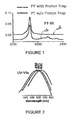
- the FT-IR, shown in Figure 1 of films produced with and without a proton trap show that the formation and subsequent incorporation of saturated monomer units is minimized by adding at least one proton trap.
- the absorption peak shown in the UV-Vis spectrum in Figure 2 is shifted from about 490 nm to about 501 nm. This shift is indicative of an increase in the level of conjugation in the polythiophene (PT) chains.
- the method of the present invention involves reducing the run temperature used for the polymerization reaction of the present invention to a temperature near the freezing point of the solvent used in the polymerization reaction.
- the UV-Vis spectrum in Figure 2 is further shifted from 501 nm to 521 nm. This shift is indicative of an increase in the level of conjugation in the polythiophene (PT) chains.
- the refractive-index dispersion curve for an optically-enhanced polythiophene (PT) film of the present invention was analyzed using a variable-angle spectroscopic ellipsometer.
- the ellipsometer gives the optical constants for a material which can then be used to determine the material's refractive index.
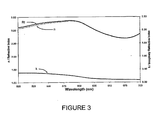
- the refractive-index dispersion curve for the optically-enhanced polythiophene (PT) film was generated over a wavelength range from about 500 nm to about 700 nm, as is shown in Figure 3 .
- the curve labeled "Refractive Index" is the complex refractive index
- n is the real part of the refractive index
- k is the absorption coefficient.
- the film has a maximum refractive index of about 3.36 occurring at a wavelength of about 585 nm, and refractive indices of about 3.35 occurring at about 589 nm, and about 2.94 occurring at about 633 nm.
- An organic material having such elevated refractive indices is suitable for use in the fabrication of 3-D photonic crystals with an inverse opal structure, which is the most commonly used structure, for about a 100 nm range of wavelengths.
- a photonic crystal is a spatially-periodic dielectric structure that reflects electromagnetic radiation that falls within a range of frequencies, and passes electromagnetic radiation that falls outside the range of frequencies. Thus, photonic crystals form photonic band gaps that prevent the propagation of light in a certain frequency range.
- a photonic crystal of the present invention includes a base region formed from an organic material having a refractive index of at least about 2.3 for electromagnetic energy having a wavelength of about 700 nm.
- the organic material of the base includes delocalized pi electrons that can travel along the conjugated portion of the organic material.
- Secondary regions are formed in the base region by periodically interspersing any second material in the base region.
- the second material can be any material that has a refractive index that produces a refractive index contrast of the organic material to the second material of at least about 2.3.
- the present invention includes photonic crystals having a refractive index contrast of at least about 2.4, or at least about 2.5, or at least about 2.6, or at least about 2.7, or at least about 2.8, or at least about 2.9, or at least about 3.0, or at least about 3.1, or at least about 3.2, or at least about 3.3, or at least about 3.4, and so on.
- suitable second materials include organic materials other than the organic material used to form the base region, air, and other dielectric materials.
- the photonic crystal of the present invention reflects at least a portion of electromagnetic energy falling within a first range of frequencies and transmits at least a portion of electromagnetic energy falling within a second range of frequencies that is different from the first range of frequencies.
Landscapes
- Chemical & Material Sciences (AREA)
- Health & Medical Sciences (AREA)
- Chemical Kinetics & Catalysis (AREA)
- Medicinal Chemistry (AREA)
- Polymers & Plastics (AREA)
- Organic Chemistry (AREA)
- Physics & Mathematics (AREA)
- Engineering & Computer Science (AREA)
- Optics & Photonics (AREA)
- Nanotechnology (AREA)
- Microelectronics & Electronic Packaging (AREA)
- General Physics & Mathematics (AREA)
- Life Sciences & Earth Sciences (AREA)
- Biophysics (AREA)
- Crystallography & Structural Chemistry (AREA)
- Polyoxymethylene Polymers And Polymers With Carbon-To-Carbon Bonds (AREA)
- Optical Integrated Circuits (AREA)
- Addition Polymer Or Copolymer, Post-Treatments, Or Chemical Modifications (AREA)
Abstract
Description
- The present invention relates to conjugated polymers and a method for their synthesis. Furthermore, the present invention relates to electro-synthesis methods for producing polymers that include the use of at least one Lewis acid and at least one proton trap to form organic conjugated polymers having elevated refractive indices.
- Conventional integrated circuits transmit signals by conducting electrons through semiconducting materials. In a pure silicon crystal, for example, the silicon atoms are arranged in a highly-ordered lattice structure. Electrons moving through this lattice experience periodic potentials as they interact with the silicon nuclei, resulting in the formation of a band gap between a conduction band and a valence band. Since no electrons will have an energy in the band gap of pure silicon crystals, the silicon is doped with suitable impurities to disrupt the periodicity of the crystal lattice. The doping of the silicon crystal can give rise to the absence of a silicon atom or the presence of an impurity at a silicon site in the lattice, or an impurity atom located at a non-silicon site within the lattice structure. In this way, electrons are permitted to have an energy within the band gap, thereby minimizing the size of the energy gap that electrons must surmount in order to make the transition from the valence band to the conduction band, and improving the overall conductivity of the silicon crystal.
- The field of photonics aims to develop circuitry that harnesses light to transmit signals and supersede in function the utilities currently carried out by electrons. For example, a photonic crystal can include a block of dielectric transparent material having air holes interspersed throughout said material. The refractive index of the dielectric material is large relative to the refractive index of the air. Photons passing through the block of dielectric material will periodically encounter regions of high refractive index and low refractive index in a manner analogous to electrons periodically encountering allowable energy ranges and the band gap as they pass through a silicon crystal. A large contrast between the refractive index of the dielectric material and the air holes causes most of the light passing through the photonic crystal to be confined within the dielectric material, essentially forming an allowable energy region separated by forbidden energy regions, which are commonly referred to as the photonic band gap. Just as it is possible to create allowable energy levels in the band gap of silicon crystals, it is also possible to create allowable energy levels within the photonic band gap by altering the size of some of the air holes interspersed through the dielectric material.
- Though photonics is theoretically sound, there are practical obstacles preventing its widespread application. The construction of photonic crystals requires regular fine features on the length scale of hundreds of nanometers formed with materials having a high refractive index relative to that of air. Photonic crystals made with semiconducting materials and processing methods have been considered for development of photonic crystals. Although semiconducting materials and their processing methods can be used to manufacture regular structures having high refractive indices, the materials have only a limited set of physical properties, and the conventional processing methods for such materials are capital intensive.
- Polymeric materials have been proposed for use in the construction of photonic crystals to both expand the physical properties of such devices and reduce the capital requirements in their production. Unlike photonic crystals manufactured from semiconducting materials, however, photonic crystals made from polymeric materials possess a relatively low refractive index contrast, which is usually the ratio of the refractive index of the polymeric material to the refractive index of the air. Typically, organic materials have a refractive index of 1.3 to 1.7, which is lower than desired for photonic crystal fabrication.
- It has been proposed that certain conjugated organic polymers, such as polythiophene ("PT"), could be synthesized with a high refractive index of about 1.7, but experimental tests disclosed in A. Hamnett and A. R. Hillman in the J. Electrochem. Soc. 1988, 135, 2517, revealed that the refractive index of polythiophene was actually 1.4. It was hypothesized that the lower-than-expected refractive index was caused by what is referred to as the "Polythiophene Paradox." This paradox arises becausepolythiophene (PT) is electrosynthesized and the potential required to polymerize the starting material is greater than the potential required to degrade the resultant polymer. This results in a highly degraded polymer with very low levels of conjugation.
- Thus, there is a need in the art for organic polymers having elevated indices of refraction and for methods of making such polymers that permit one to obtain elevated indices of refraction.
- The present invention relates to conjugated polymers and a method for their synthesis. Furthermore, the present invention relates to electro-synthesis methods for producing polymers that include the use of at least one Lewis acid and at least one proton trap to form organic conjugated polymers having elevated refractive indices.
- In one embodiment, the present invention provides organic materials suitable for the formation of photonic crystals and a method for the synthesis of such materials. One benefit of the present invention, is that it permits one to, among other things, minimize the cost of synthesizing organic materials that are suitable for use in photonic crystals. Additionally, the present invention permits the development of a photonic crystal that includes one or more organic materials therein.
- The present invention achieves these and other objectives by providing organic conjugated polymers having elevated refractive indices suitable for photonic applications and a photonic crystal fabricated from one or more organic conjugated polymers.
- In one embodiment, the present invention relates to an organic polymer having an elevated refractive index, the organic polymer formed by a process comprising the steps of: providing a solution of unsaturated organic monomer units and at least one acidic component; impeding saturation of the unsaturated organic-monomer units by at least one protic element in the solution; and polymerizing the unsaturated organic monomer units to form a conjugated organic polymer having a refractive index of at least about 2.3 for electromagnetic energy having a wavelength of about 700 nm.
- In another embodiment, the present invention relates to an organic polymer comprising a conjugated portion with extensively-delocalized pi-electrons, wherein the organic polymer has a refractive index of at least about 2.3 for electromagnetic energy having a wavelength of about 700 nm.
- In still another embodiment, the present invention relates to a photonic crystal comprising: a base region comprising at least one organic material having a refractive index of at least about 2.3 for electromagnetic energy having a wavelength of about 700 nm; and a plurality of secondary regions formed in the base region, the secondary regions comprising a second material, wherein the photonic crystal reflects at least a portion of electromagnetic energy falling within a first range of frequencies and transmits at least a portion of electromagnetic energy falling within a second range of frequencies that is different from the first range of frequencies.
- The foregoing and other features and advantages of the present invention will become apparent to those skilled in the art to which the present invention relates upon reading the following description with reference to the accompanying drawings.
-
-
Figure 1 is a FT-IR plot comparing the incorporation of saturated monomer units into a polymer network with and without the use of a proton trap; -
Figure 2 is a graphical representation of results obtained during a UV-Vis analysis comparing the level of conjugation of the polymer obtained with and without using the proton trap, and when synthesized at reduced temperatures with a proton trap; and -
Figure 3 is a refractive index dispersion curve for a polythiophene (PT) film for electromagnetic energy having wavelengths from about 500 nm to about 700 nm. - The present invention relates to conjugated polymers and a method for their synthesis. In one instance, the present invention relates to electro-synthesis methods for producing polymers that include the use of at least one Lewis acid and at least one proton trap to form organic conjugated polymers having elevated refractive indices. Additionally, certain terminology is used herein for convenience only and is not to be taken as a limitation on the present invention.
- In one embodiment, the present invention includes a conjugated organic polymer having an elevated refractive index suitable for use in the fabrication of a photonic crystal. In such a case, the conjugated organic polymer of the present invention has a refractive index that is greater than about 2.3, greater than about 2.4, greater than about 2.5, greater than about 2.6, greater than about 2.7, greater than about 2.8, greater than about 2.9, and even greater than about 3.0. It should be noted, that for purposes of this invention all of the above-mentioned refractive indices are determined with light having a wavelength of about 700 nm. The present invention further includes a method of synthesizing one or more conjugated organic polymers having suitably-high refractive indices for photonic purposes, and a photonic crystal including such organic polymers.
- The refractive index of a material is influenced by both its electron density and its polarizability. Electron density is a measure of amount of electrons in a -unit volume. Polarization of the material is a related phenomenon whereby the electron distribution of the material is altered from its natural, unbiased state by an electric field. Like charges tend to repel each other while opposite charges tend to generate an attractive force therebetween. The organic polymer of the present invention includes an extensively conjugated path formed from organic monomers to enhance the polarizability of that polymer. An example of a suitable conjugated organic polymer is polythiophene (PT), formed by the method of the present invention and having the following general structure:

- In one embodiment, large m values (e.g., those greater than about 1,000, about 2,500, or even about 5,000) are preferred to enhance the properties of polythiophene (PT). In addition to polythiophene (PT), other suitably unsaturated monomers may be polymerized to form the conjugated organic polymers of the present invention. Non-limiting examples of suitable conjugated organic polymers include polypyrrole, polyfuran, polythiophenevinylene and polyphenylenevinylene.
- As mentioned above, polythiophene (PT) synthesized according to conventional methods has a refractive index within the range of 1.3 to 1.7, which is common for most organic polymers. In contrast, the method of the present invention results in a conjugated polythiophene (PT) having an elevated refractive index such as those listed above for various preferred embodiments. Synthesis of polythiophene (PT) via electro-polymerization is used herein as an illustrative embodiment without excluding other conjugated organic polymers and other synthesis techniques from the scope of the present invention. A Lewis acid solution is introduced to a solution including the unsaturated thiophene-monomer units, thereby lowering the electric potential required to initiate polymerization of the monomer units to a level below the electric potential at which the resulting polymer experiences substantial degradation. Lewis acids are well known species capable of accepting a pair of electrons and forming a coordinate covalent bond. Nonlimiting examples of Lewis acids suitable for purposes of the present invention include boron trifluoro diethyl etherate ("BFEE"), antimony pentafluoride and aluminium trichloride.
- The presence of water in the Lewis-acid solution introduces acidic protons that can saturate at least a portion of the thiophene-monomer units and cause these saturated units to be introduced into the resulting polymer. Incorporating the saturated units into the resulting polymer will be detrimental to the degree of conjugation of the polymer. These saturated monomer units affect the refractive index in two ways. First, they impede the mobility of the electrons and accordingly reduce the polarizability of the polymer. Second, the saturated monomer units are not generally planar like the unsaturated units, so incorporation of these saturated monomer units into the polymer results in density-reducing kinks in the polymer. To minimize the saturation of monomer units and their subsequent incorporation into the polymer, one or more proton traps can be added to the solution to scavenge and sequester these acidic protons.
- Proton traps are typically bulky species that include a cyclical portion and one or more branches extending from the cyclical portion. Suitable proton traps include, but are not limited to, 2,6-di-tert-butylpyridine ("DTBP"), 2,4,6-tri-tert-butylpyridine ("TTBP1"), and 2,4,6-tri-tert-butylpyrimidine ("TTBP2"), shown as items I, II, and III below, respectively, but any other proton sequestering and scavenging species can be used.

- The concentration of the proton trap is optimized to scavenge a substantial portion (e.g., at least about 50%, at least about 60%, at least about 80%, at least about 90%, at least about 95%, or even at least about 99%) of the protic impurities without significantly abstracting protons from the monomer units to impede conjugation. In one embodiment, a suitable proton trap such as DTBP is used at a concentration of about 50 mmol. In another embodiment, a suitable proton trap such as TTBP1 is used at a concentration of about 10 mmol. In still another embodiment, a suitable proton trap such as TTBP2 is used at a concentration of about 10 mmol.
- It should be noted that the present invention is not limited to certain concentrations of proton trap compounds. Rather, any suitable amount of proton trap compound can be utilized in the present invention depending on the conditions under which an organic polymer in accordance with the present invention is synthesized. Some of the conditions that effect the amount of proton trap compound used in the present invention are the nature of the monomer being polymerized via the methods of the present invention, the Lewis acid chosen, the water present in the acidic solution, among other factors. In another embodiment, concentrations of up to about 250 mmol can be used, without significant detriment to the resulting polymer.
- In one embodiment, the concentration of polythiophene (PT) monomer units is in the range of about 5 mmol to about 100 mmol, or about 10 to about 75 mmol, or even about 25 to about 50 mmol.
- Polythiophene (PT) films formed in accordance with the present invention are analyzed using FT-IR and UV-Vis. The FT-IR, shown in
Figure 1 , of films produced with and without a proton trap show that the formation and subsequent incorporation of saturated monomer units is minimized by adding at least one proton trap. As a consequence, the absorption peak shown in the UV-Vis spectrum inFigure 2 is shifted from about 490 nm to about 501 nm. This shift is indicative of an increase in the level of conjugation in the polythiophene (PT) chains. - In an additional embodiment, the method of the present invention involves reducing the run temperature used for the polymerization reaction of the present invention to a temperature near the freezing point of the solvent used in the polymerization reaction. By reducing the synthesis temperature to within approximately 20°C of the freezing point of a Lewis acid solvent, the UV-Vis spectrum in
Figure 2 is further shifted from 501 nm to 521 nm. This shift is indicative of an increase in the level of conjugation in the polythiophene (PT) chains. - The refractive-index dispersion curve for an optically-enhanced polythiophene (PT) film of the present invention was analyzed using a variable-angle spectroscopic ellipsometer. The ellipsometer gives the optical constants for a material which can then be used to determine the material's refractive index. With the ellipsometer, the refractive-index dispersion curve for the optically-enhanced polythiophene (PT) film was generated over a wavelength range from about 500 nm to about 700 nm, as is shown in
Figure 3 . InFigure 3 , the curve labeled "Refractive Index" is the complex refractive index, n is the real part of the refractive index, and k is the absorption coefficient. From the refractive-index dispersion curve inFigure 3 it can be seen that in the wavelength range of 500 to 700 nm the film has a maximum refractive index of about 3.36 occurring at a wavelength of about 585 nm, and refractive indices of about 3.35 occurring at about 589 nm, and about 2.94 occurring at about 633 nm. An organic material having such elevated refractive indices is suitable for use in the fabrication of 3-D photonic crystals with an inverse opal structure, which is the most commonly used structure, for about a 100 nm range of wavelengths. - A photonic crystal is a spatially-periodic dielectric structure that reflects electromagnetic radiation that falls within a range of frequencies, and passes electromagnetic radiation that falls outside the range of frequencies. Thus, photonic crystals form photonic band gaps that prevent the propagation of light in a certain frequency range. Generally, a photonic crystal of the present invention includes a base region formed from an organic material having a refractive index of at least about 2.3 for electromagnetic energy having a wavelength of about 700 nm. The organic material of the base includes delocalized pi electrons that can travel along the conjugated portion of the organic material.
- Secondary regions are formed in the base region by periodically interspersing any second material in the base region. The second material can be any material that has a refractive index that produces a refractive index contrast of the organic material to the second material of at least about 2.3. In one embodiment, the present invention includes photonic crystals having a refractive index contrast of at least about 2.4, or at least about 2.5, or at least about 2.6, or at least about 2.7, or at least about 2.8, or at least about 2.9, or at least about 3.0, or at least about 3.1, or at least about 3.2, or at least about 3.3, or at least about 3.4, and so on. Non-limiting examples of suitable second materials include organic materials other than the organic material used to form the base region, air, and other dielectric materials. The photonic crystal of the present invention reflects at least a portion of electromagnetic energy falling within a first range of frequencies and transmits at least a portion of electromagnetic energy falling within a second range of frequencies that is different from the first range of frequencies.
- Although the invention has been described in detail with particular reference to certain embodiments detailed herein, other embodiments can achieve the same results. Variations and modifications of the present invention will be obvious to those skilled in the art and the present invention is intended to cover in the appended claims all such modifications and equivalents.
- 1. An organic polymer having an elevated refractive index, the organic polymer formed by a process comprising the steps of:
- providing a solution of unsaturated organic monomer units and at least one acidic component;
- impeding saturation of the unsaturated organic-monomer units by at least one protic element in the solution; and
- polymerizing the unsaturated organic monomer units to form a conjugated organic polymer having a refractive index of at least about 2.3 for electromagnetic energy having a wavelength of about 700 nm.
- 2. The organic polymer according to 1, wherein the unsaturated organic monomer units are selected from thiophenes, pyrroles, furans, or combinations of two or more thereof.
- 3. The organic polymer according to 1, wherein the at least one acidic component comprises a Lewis acid.
- 4. The organic polymer according to 3, wherein the at least one Lewis acid is selected from boron trifluoride diethyl ether, antimony pentafluoride, aluminium chloride, or combinations of two or more thereof.
- 5. The organic polymer according to 1, wherein the step of impeding saturation of the unsaturated organic-monomer units comprises the step of introducing a proton trap into the solution.
- 6. The organic polymer according to 5, wherein the proton trap is selected from 2,6-di-tert-butylpyridine, 2,4,6-tri-tert-butylpyridine, 2,4,6-tri-tert-butylpyrimidine, or combinations of two or more thereof.
- 7. The organic polymer according to 1, wherein polymerizing the organic monomer units comprises the step of subjecting the solution to an electric potential to initiate polymerization of the unsaturated organic monomer units.
- 8. The organic polymer according to 1, wherein the organic polymer is selected from polythiophenes, polypyrroles, polyfurans and copolymers of these polymers.
- 9. The organic polymer according to 1, wherein the conjugated organic polymer has a refractive index of at least about 2.4 for electromagnetic energy having a wavelength of about 700 nm.
- 10. The organic polymer according to 1, wherein the conjugated organic polymer has a refractive index of at least about 2.5 for electromagnetic energy having a wavelength of about 700 nm.
- 11. The organic polymer according to 1, wherein the conjugated organic polymer has a refractive index of at least about 2.6 for electromagnetic energy having a wavelength of about 700 nm.
- 12. The organic polymer according to 1, wherein the conjugated organic polymer has a refractive index of at least about 2.7 for electromagnetic energy having a wavelength of about 700 nm.
- 13. The organic polymer according to 1, wherein the conjugated organic polymer has a refractive index of at least about 2.8 for electromagnetic energy having a wavelength of about 700 nm.
- 14. The organic polymer according to 1, wherein the conjugated organic polymer has a refractive index of at least about 2.9 for electromagnetic energy having a wavelength of about 700 nm.
- 15. The organic polymer according to 1, wherein the conjugated organic polymer has a refractive index of at least about 3.0 for electromagnetic energy having a wavelength of about 700 nm.
- 16. An organic polymer comprising a conjugated portion with extensively-delocalized pi-electrons, wherein the organic polymer has a refractive index of at least about 2.3 for electromagnetic energy having a wavelength of about 700 nm.
- 17. A photonic crystal comprising:
- a base region comprising at least one organic material having a refractive index of at least about 2.3 for electromagnetic energy having a wavelength of about 700 nm; and
- a plurality of secondary regions formed in the base region, the secondary regions comprising a second material,
- wherein the photonic crystal reflects at least a portion of electromagnetic energy falling within a first range of frequencies and transmits at least a portion of electromagnetic energy falling within a second range of frequencies that is different from the first range of frequencies.
- 18. The photonic crystal according to 17, wherein the organic material has a refractive index of at least about 2.4 for electromagnetic energy having a wavelength of about 700 nm.
- 19. The photonic crystal according to 17, wherein the organic material has a refractive index of at least about 2.5 for electromagnetic energy having a wavelength of about 700 nm.
- 20. The photonic crystal according to 17, wherein the organic material has a refractive index of at least about 2.6 for electromagnetic energy having a wavelength of about 700 nm.
- 21. The photonic crystal according to 17, wherein the organic material has a refractive index of at least about 2.7 for electromagnetic energy having a wavelength of about 700 nm.
- 22. The photonic crystal according to 17, wherein the organic material has a refractive index of at least about 2.8 for electromagnetic energy having a wavelength of about 700 nm.
- 23. The photonic crystal according to 17, wherein the organic material has a refractive index of at least about 2.9 for electromagnetic energy having a wavelength of about 700 nm.
- 24. The photonic crystal according to 17, wherein the organic material has a refractive index of at least about 3.0 for electromagnetic energy having a wavelength of about 700 nm
- 25. The photonic crystal according to 17, wherein the organic material is selected from one or more polythiophene polymers, polypyrrole polymers, polyfuran polymers, or copolymers of these polymers.
- 26. The photonic crystal according to 17, wherein the second material is air.
- 27. The photonic crystal according to 17, wherein a ratio of the refractive index of the organic material to a refractive index of the second material is at least about 2.3.
Claims (14)
- A photonic crystal comprising: a base region comprising at least one organic material having a refractive index of at least 2.3 for electromagnetic energy having a wavelength of 700 nm; and a plurality of secondary regions formed in the base region, the secondary regions comprising a second material, wherein the photonic crystal reflects at least a portion of electromagnetic energy falling within a first range of frequencies and transmits at least a portion of electromagnetic energy falling within a second range of frequencies that is different from the first range of frequencies.
- The photonic crystal according to claim 1, wherein the organic material has a refractive index of at least 2.4 for electromagnetic energy having a wavelength of 700 nm.
- The photonic crystal according to claim 1, wherein the organic material has a refractive index of at least 2.5 for electromagnetic energy having a wavelength of 700 nm.
- The photonic crystal according to claim 1, wherein the organic material has a refractive index of at least 2.6 for electromagnetic energy having a wavelength of 700 nm.
- The photonic crystal according to claim 1, wherein the organic material has a refractive index of at least 2.7 for electromagnetic energy having a wavelength of 700 nm.
- The photonic crystal according to claim 1, wherein the organic material has a refractive index of at least 2.8 for electromagnetic energy having a wavelength of 700 nm.
- The photonic crystal according to claim 1, wherein the organic material has a refractive index of at least 2.9 for electromagnetic energy having a wavelength of 700 nm.
- The photonic crystal according to claim 1, wherein the organic material has a refractive index of at least 3.0 for electromagnetic energy having a wavelength of 700 nm.
- The photonic crystal according to claim 1, wherein the organic material is selected from one or more polythiophene polymers, polypyrrole polymers, polyfuran polymers, or copolymers of these polymers.
- The photonic crystal according to claim 1, wherein the organic material is selected from polythiophenevinylene and polyphenylenevinylene.
- The photonic crystal according to claim 1, wherein the second material is air.
- The photonic crystal according to claim 1, wherein a ratio of the refractive index of the organic material to a refractive index of the second material is at least 2.3.
- The photonic crystal according to claim 1, wherein the organic material is a polythiophene having the following general structure:

- The photonic crystal according to claim 1, wherein the organic material is a polythiophene having the following general structure:

Applications Claiming Priority (2)
| Application Number | Priority Date | Filing Date | Title |
|---|---|---|---|
| US60281004P | 2004-08-19 | 2004-08-19 | |
| EP05791479A EP1794254A4 (en) | 2004-08-19 | 2005-08-19 | CONJUGATED POLYMERS FOR PHOTONIC CRYSTALS AND PROCESS FOR THE SYNTHESIS OF CONJUGATED POLYMERS |
Related Parent Applications (1)
| Application Number | Title | Priority Date | Filing Date |
|---|---|---|---|
| EP05791479.8 Division | 2005-08-19 |
Publications (2)
| Publication Number | Publication Date |
|---|---|
| EP2455333A2 true EP2455333A2 (en) | 2012-05-23 |
| EP2455333A3 EP2455333A3 (en) | 2013-03-20 |
Family
ID=35968192
Family Applications (2)
| Application Number | Title | Priority Date | Filing Date |
|---|---|---|---|
| EP12154713A Withdrawn EP2455333A3 (en) | 2004-08-19 | 2005-08-19 | Photonic crystal, conjugated polymers suitable for photonic crystals, and a method for synthesizing conjugated polymers |
| EP05791479A Ceased EP1794254A4 (en) | 2004-08-19 | 2005-08-19 | CONJUGATED POLYMERS FOR PHOTONIC CRYSTALS AND PROCESS FOR THE SYNTHESIS OF CONJUGATED POLYMERS |
Family Applications After (1)
| Application Number | Title | Priority Date | Filing Date |
|---|---|---|---|
| EP05791479A Ceased EP1794254A4 (en) | 2004-08-19 | 2005-08-19 | CONJUGATED POLYMERS FOR PHOTONIC CRYSTALS AND PROCESS FOR THE SYNTHESIS OF CONJUGATED POLYMERS |
Country Status (6)
| Country | Link |
|---|---|
| US (2) | US8257493B2 (en) |
| EP (2) | EP2455333A3 (en) |
| JP (1) | JP5275627B2 (en) |
| KR (2) | KR101266334B1 (en) |
| CA (1) | CA2577717C (en) |
| WO (1) | WO2006023699A2 (en) |
Families Citing this family (6)
| Publication number | Priority date | Publication date | Assignee | Title |
|---|---|---|---|---|
| CA2577717C (en) * | 2004-08-19 | 2015-12-01 | University Of Akron | Photonic crystal, conjugated polymers suitable for photonic crystals, and a method for synthesizing conjugated polymers |
| EP1827674B1 (en) * | 2005-11-08 | 2012-09-12 | LG Chem, Ltd. | Colloidal photonic crystals using colloidal nanoparticles and method for preparation thereof |
| US8179034B2 (en) | 2007-07-13 | 2012-05-15 | 3M Innovative Properties Company | Light extraction film for organic light emitting diode display and lighting devices |
| TWI410476B (en) * | 2010-08-25 | 2013-10-01 | Univ Nat Cheng Kung | Polymer film without cholesteric liquid crystal, polymer film and reflective display module |
| CN108395556B (en) * | 2018-03-27 | 2020-11-24 | 中国科学院化学研究所 | A kind of high regularity polythiophene film with excellent thermoelectric properties and preparation method thereof |
| CN113075421B (en) * | 2021-03-22 | 2024-03-01 | 广东工业大学 | Hot-wire type wind speed sensor, preparation method and wind speed detection system |
Family Cites Families (17)
| Publication number | Priority date | Publication date | Assignee | Title |
|---|---|---|---|---|
| US4588609A (en) * | 1984-11-26 | 1986-05-13 | Leyden Richard N | Process for the photochemical vapor deposition of aromatic polymers |
| IT1231816B (en) * | 1989-09-04 | 1992-01-14 | Enichem Spa | NON-LINEAR OPTICAL SWITCH. |
| GB9018698D0 (en) * | 1990-08-24 | 1990-10-10 | Lynxvale Ltd | Semiconductive copolymers for use in electroluminescent devices |
| JP2844122B2 (en) * | 1990-11-01 | 1999-01-06 | 株式会社巴川製紙所 | Polymer thermometer |
| US5670607A (en) * | 1996-06-07 | 1997-09-23 | Gumbs Associates, Inc. | Miscible forms of electrically conductive polyaniline |
| GB9921048D0 (en) * | 1999-09-07 | 1999-11-10 | Secr Defence | Colloidal photonic crystals |
| GB2356713A (en) * | 1999-11-26 | 2001-05-30 | Seiko Epson Corp | Distributed Bragg reflector |
| JP3925769B2 (en) * | 2000-03-24 | 2007-06-06 | 関西ティー・エル・オー株式会社 | Two-dimensional photonic crystal and multiplexer / demultiplexer |
| US7045195B2 (en) * | 2000-10-16 | 2006-05-16 | Governing Council Of The University Of Toronto | Composite materials having substrates with self-assembled colloidal crystalline patterns thereon |
| JP2002022981A (en) * | 2000-07-05 | 2002-01-23 | Nec Corp | Photonic crystal multiplayered substrate and method for manufacturing the same |
| KR100354500B1 (en) * | 2000-09-05 | 2002-09-30 | 한화석유화학 주식회사 | Fluorene based polymers and light emitting diodes fabricated with the same as light emitting material |
| US6893502B2 (en) * | 2001-03-05 | 2005-05-17 | University Of Connecticut | Apparatus and method for fabrication of photonic crystals |
| JP2003283014A (en) * | 2002-03-22 | 2003-10-03 | Nippon Telegr & Teleph Corp <Ntt> | Two-dimensional photonic crystal laser and two-dimensional photonic crystal laser fabrication method |
| KR100482276B1 (en) * | 2002-08-12 | 2005-04-13 | 한국과학기술연구원 | Pyrrole compounds, polymers thereof and el element using the same |
| JP4156316B2 (en) * | 2002-09-24 | 2008-09-24 | 富士フイルム株式会社 | Photonic crystal manufacturing method |
| JP5188009B2 (en) * | 2004-03-08 | 2013-04-24 | キヤノン株式会社 | Three-dimensional periodic structure and functional element and light emitting element having the same |
| CA2577717C (en) * | 2004-08-19 | 2015-12-01 | University Of Akron | Photonic crystal, conjugated polymers suitable for photonic crystals, and a method for synthesizing conjugated polymers |
-
2005
- 2005-08-19 CA CA2577717A patent/CA2577717C/en not_active Expired - Fee Related
- 2005-08-19 EP EP12154713A patent/EP2455333A3/en not_active Withdrawn
- 2005-08-19 KR KR1020077005749A patent/KR101266334B1/en not_active Expired - Fee Related
- 2005-08-19 EP EP05791479A patent/EP1794254A4/en not_active Ceased
- 2005-08-19 WO PCT/US2005/029498 patent/WO2006023699A2/en not_active Ceased
- 2005-08-19 US US11/573,694 patent/US8257493B2/en not_active Expired - Fee Related
- 2005-08-19 JP JP2007528033A patent/JP5275627B2/en not_active Expired - Fee Related
- 2005-08-19 KR KR1020127028930A patent/KR101338974B1/en not_active Expired - Fee Related
-
2012
- 2012-07-31 US US13/562,773 patent/US9206285B2/en not_active Expired - Fee Related
Non-Patent Citations (2)
| Title |
|---|
| A. HAMNETT; A. R. HILLMAN, J. ELECTROCHEM. SOC., vol. 135, 1988, pages 2517 |
| CASSAGNEAU T ET AL: "SEMICONDUCTING POLYMER INVERSE OPALS PREPARED BY ELECTROPOLYMERIZATION", ADVANCED MATERIALS, WILEY VCH VERLAG, DE, vol. 14, no. 1, 4 January 2002 (2002-01-04), pages 34 - 38, XP001129564, ISSN: 0935-9648, DOI: 10.1002/1521-4095(20020104)14:1<34::AID-ADMA34>3.0.CO;2-M * |
Also Published As
| Publication number | Publication date |
|---|---|
| KR20120137430A (en) | 2012-12-20 |
| US20080130111A1 (en) | 2008-06-05 |
| US9206285B2 (en) | 2015-12-08 |
| US20120296060A1 (en) | 2012-11-22 |
| KR20070052790A (en) | 2007-05-22 |
| KR101266334B1 (en) | 2013-05-22 |
| CA2577717C (en) | 2015-12-01 |
| US8257493B2 (en) | 2012-09-04 |
| WO2006023699A3 (en) | 2009-04-30 |
| EP2455333A3 (en) | 2013-03-20 |
| WO2006023699A2 (en) | 2006-03-02 |
| JP5275627B2 (en) | 2013-08-28 |
| JP2008510853A (en) | 2008-04-10 |
| EP1794254A2 (en) | 2007-06-13 |
| CA2577717A1 (en) | 2006-03-02 |
| KR101338974B1 (en) | 2013-12-10 |
| EP1794254A4 (en) | 2009-11-25 |
Similar Documents
| Publication | Publication Date | Title |
|---|---|---|
| US9206285B2 (en) | Photonic crystal, conjugated polymers suitable for photonic crystals, and a method for synthesizing conjugated polymers | |
| Iacono et al. | Science and technology of perfluorocyclobutyl aryl ether polymers | |
| DE60036872T2 (en) | OPTICAL DEVICES FROM RADIATION NETWORKED FLUOR MIXTURES | |
| Hong et al. | Synthesis of electrically conductive polypyrroles at the air-water interface of a Langmuir-Blodgett film balance | |
| Kim et al. | Structural Control in Thin Layers of Poly (p-phenyleneethynylene) s: Photophysical Studies of Langmuir and Langmuir− Blodgett Films | |
| Lee et al. | Synthesis and characterization of soluble polypyrrole | |
| Singh et al. | Micromorphology, photophysical and electrical properties of pristine and ferric chloride doped poly (3-hexylthiophene) films | |
| Tiwari et al. | Microwave‐assisted chemical synthesis of conducting polyindole: Study of electrical property using S chottky junction | |
| KR20100131312A (en) | Polyfluorosilsesquioxane and preparation method thereof | |
| Ding et al. | Fluorinated poly (arylene ether ketone) s bearing pentafluorostyrene moieties prepared by a modified polycondensation | |
| Cho et al. | Effect of magnetic field on electrochemical polymerization of EDOT | |
| US7320813B2 (en) | Synthesis of highly conducting and transparent thin polymer films | |
| Ciprelli et al. | Enhanced stability of conducting poly (3-octylthiophene) thin films using organic nitrosyl compounds | |
| Du et al. | Varying the sequence distribution and hydrogen bonding strength provides highly Heat-Resistant PMMA copolymers | |
| Jang et al. | Balancing Surface Hydrophobicity and Polarizability of Fluorinated Dielectrics for Organic Field‐Effect Transistors with Excellent Gate‐Bias Stability and Mobility | |
| Irie et al. | Synthesis of bifunctional terminal octasilicate‐core dendrimer containing fluorocarbon and hydrocarbon chains | |
| Elyashevich et al. | New composite systems on the base of polyethylene porous films covered by polypyrrole and polyacrylic acid | |
| Anderson et al. | p‐Doping and Fiber Spinning of Poly (heptadiyne) s | |
| Tsegay et al. | Infrared laser‐ignited horizontal frontal polymerization of versatile unsaturated polyester resins | |
| Zengin et al. | Synthesis, characterization and spectroscopical investigation of poly (paraphenylenevinylene)(PPV) polymers with symmetric alkoxy side-chain lengths | |
| Yu et al. | Polymeric materials for third-order nonlinear optical susceptibility | |
| Brown et al. | Conducting thermoset polymers: A comparative study of Schiff base precursors with different end groups | |
| Fu et al. | Synthesis and performances of 9, 9‐bis (perfluorohexylethyl propionate) fluorene copolymers | |
| CHO | Cl (C6H5) 3P-CH2s.(C6H5) 3P-CH2 | |
| US20220243003A1 (en) | Preparation method of polymer |
Legal Events
| Date | Code | Title | Description |
|---|---|---|---|
| PUAI | Public reference made under article 153(3) epc to a published international application that has entered the european phase |
Free format text: ORIGINAL CODE: 0009012 |
|
| AC | Divisional application: reference to earlier application |
Ref document number: 1794254 Country of ref document: EP Kind code of ref document: P |
|
| AK | Designated contracting states |
Kind code of ref document: A2 Designated state(s): AT BE BG CH CY CZ DE DK EE ES FI FR GB GR HU IE IS IT LI LT LU LV MC NL PL PT RO SE SI SK TR |
|
| RIN1 | Information on inventor provided before grant (corrected) |
Inventor name: GRAHAM, MATTHEW J. Inventor name: SHI, JIN Inventor name: HARRIS, FRANCK W. Inventor name: CHENG, STEPHEN Z. |
|
| PUAL | Search report despatched |
Free format text: ORIGINAL CODE: 0009013 |
|
| RIC1 | Information provided on ipc code assigned before grant |
Ipc: B82Y 20/00 20110101AFI20130207BHEP Ipc: C08G 61/12 20060101ALI20130207BHEP Ipc: G02B 6/122 20060101ALI20130207BHEP |
|
| AK | Designated contracting states |
Kind code of ref document: A3 Designated state(s): AT BE BG CH CY CZ DE DK EE ES FI FR GB GR HU IE IS IT LI LT LU LV MC NL PL PT RO SE SI SK TR |
|
| RIC1 | Information provided on ipc code assigned before grant |
Ipc: B82Y 20/00 20110101AFI20130213BHEP Ipc: G02B 6/122 20060101ALI20130213BHEP Ipc: C08G 61/12 20060101ALI20130213BHEP |
|
| 17P | Request for examination filed |
Effective date: 20130919 |
|
| RBV | Designated contracting states (corrected) |
Designated state(s): AT BE BG CH CY CZ DE DK EE ES FI FR GB GR HU IE IS IT LI LT LU LV MC NL PL PT RO SE SI SK TR |
|
| 17Q | First examination report despatched |
Effective date: 20131014 |
|
| STAA | Information on the status of an ep patent application or granted ep patent |
Free format text: STATUS: THE APPLICATION IS DEEMED TO BE WITHDRAWN |
|
| 18D | Application deemed to be withdrawn |
Effective date: 20160301 |